Trapped and Mistreated
LTTE Abuses against Civilians in the Vanni
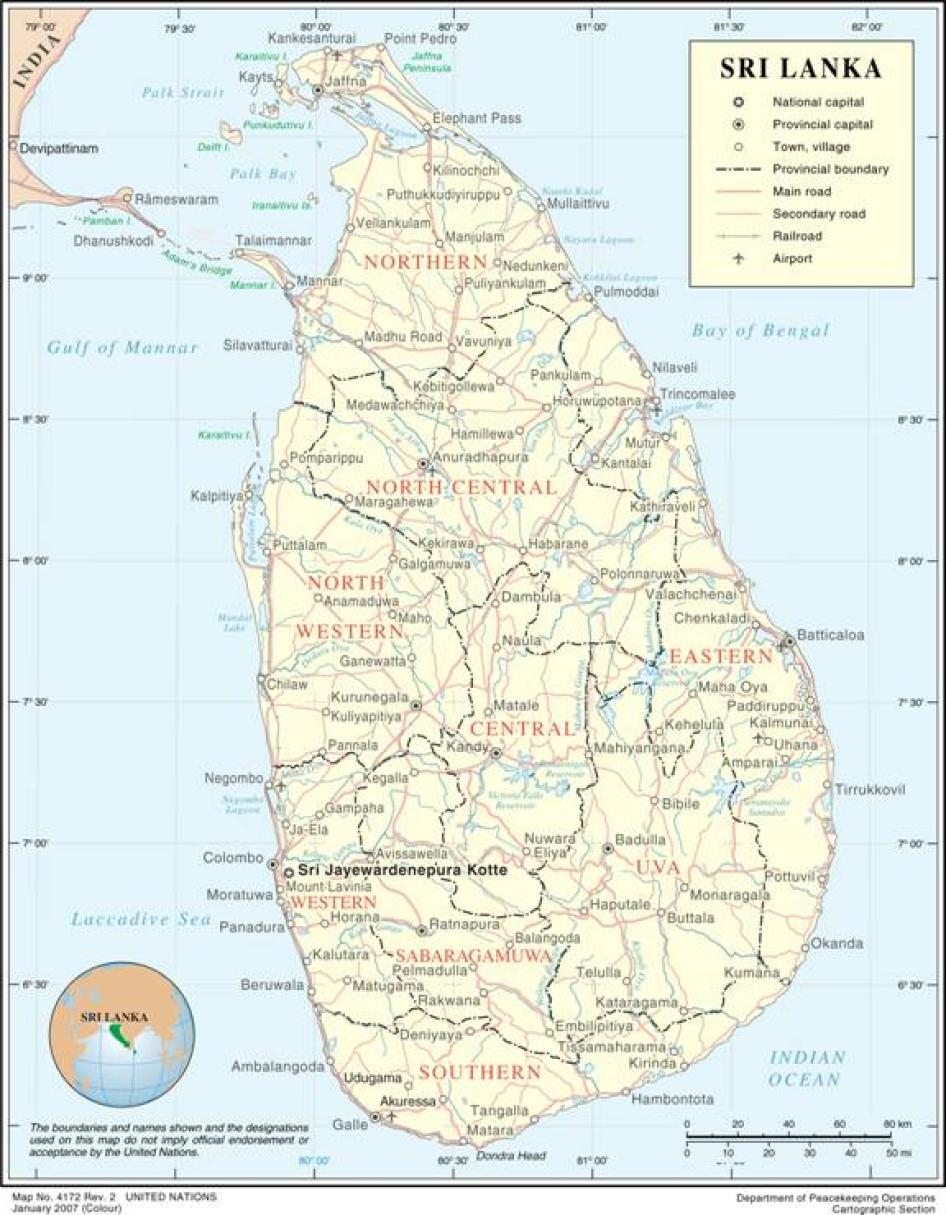
Map of Sri Lanka
I. Summary
Last year they were taking the people born in 1990; now [they are taking] those born in 1991. They look at the family identity cards and take the young ones. If people of military age go into hiding, they will take younger children or the father, until they get the boys or girls they want.[1]
The LTTE no longer gives people passes to go [out of the Vanni.] At the moment, only medical cases or the elderly will get an LTTE pass. Before this time, you could hand over all your assets to the LTTE and you were free to go. But now they stop everyone, saying, "We are fighting for the people, but the people have to stay with us."[2]
Hundreds of thousands of ethnic Tamil civilians are currently trapped in intensified fighting between the Sri Lankan armed forces and the separatist Liberation Tigers of Tamil Eelam (LTTE) in the LTTE's northern stronghold, known as the Vanni.[3] As the LTTE has lost ground to advancing government forces, civilians have been squeezed into a shrinking conflict zone. The encroaching fighting has placed their lives increasingly in danger. Many spend their day under the constant sound of nearby small-arms fire, shelling, and bombing. Because of a near total government ban on access by humanitarian agencies and the media, the suffering of the civilian population of the Vanni receives scant attention outside Sri Lanka.
This report addresses abuses committed by the LTTE against civilians during the current fighting in the Vanni. Given the sharp limitations on access to the Vanni imposed by the LTTE and the government, we do not suggest that this is a full picture of the situation there. Yet Human Rights Watch research in Sri Lanka shows that the LTTE has brutally and systematically abused the Tamil population on whose behalf they claim to fight, and that the LTTE bears a heavy responsibility for the desperate plight of the civilians in the Vanni.[4] The LTTE, which has been fighting for an independent Tamil state-Tamil Eelam-has a deplorable human rights record. During the past 25 years it has committed innumerable murders of Sinhalese, Muslim, and Tamil civilians, political assassinations in Sri Lanka and abroad, and suicide bombings with high loss of life. The LTTE has frequently targeted civilians with bombs and remote-controlled landmines, killed perceived political opponents including many Tamil politicians, journalists, and members of rival organizations, and has forcibly recruited Tamils into its forces, many of them children. In the areas under its control, the LTTE has ruled through fear, denying basic freedoms of expression, association, assembly, and movement.
During the current fighting, abuses have again mounted. In research conducted by Human Rights Watch in Sri Lanka from October through December 2008-including 35 interviews with eyewitnesses and humanitarian aid workers working in the north-we found extensive evidence of ongoing LTTE forced recruitment of civilians, widespread use of abusive forced labor, and improper and unjustified restrictions on civilians' freedom of movement.
The LTTE continues to systematically compel young men and women, including children, to join their forces, and have dramatically increased their forced recruitment practices. The LTTE has recently gone beyond its long-standing "one person per family" forced recruitment policy in LTTE-controlled territory and now sometimes requires two or more family members to join the ranks, depending on the size of the family. Notably, after a significant decrease in reported LTTE use of child soldiers in recent years, recruitment of children under 18 may be on the increase since September 2008, particularly of 17-year-olds. LTTE militants still use schools and displaced person camps to encourage children to join their ranks.
The LTTE continues to force civilians to engage in dangerous forced labor, including the digging of trenches for its fighters and the construction of military bunkers on the frontlines. It also uses forced labor as punishment, often forcing family members of civilians who flee to perform dangerous labor near the frontlines.
By shutting down its pass system for travel, the LTTE has banned nearly all civilians from leaving areas under LTTE control (with the exception of urgent medical cases), effectively trapping several hundred thousand civilians in an increasingly hazardous conflict zone, with extremely limited humanitarian relief. The trapped civilians provide a ready pool of civilians for future forced labor and recruitment of fighters. In doing so, the LTTE is unlawfully seeking to use the presence of the large civilian population in areas under its control for military advantage.
Human Rights Watch calls on the LTTE to stop its widespread abuses against the Tamil civilian population under its control, and to respect their human rights. In particular, Human Rights Watch urges the LTTE to stop preventing civilians from leaving areas under its control, to stop forced recruitment, as well as any recruitment of children, and to bring an end to abusive forced labor. More detailed recommendations are contained at the end of this report.
The government-ordered withdrawal of the United Nations (UN) and virtually all international humanitarian agencies from the Vanni in September 2008 has drastically worsened the plight of the civilian population. The forced withdrawal has also made it more difficult to protect the rights of the Vanni population: with a greatly restricted presence on the ground, protection agencies like UNICEF have lost the ability to monitor and act on abuses committed by all parties to the conflict in the Vanni. The government's policy of detaining those who flee from the Vanni has made many civilians fearful to seek safety in government-held areas. The massive flooding caused when Cyclone Nisha struck Sri Lanka on November 25 caused 60,000-70,000 persons to lose their homes and shelters. Although the Sri Lankan government denies it, state relief efforts have been inadequate and restrictive government policies on UN and other assistance have exacerbated humanitarian suffering in the Vanni.
II. Forced Recruitment of Adults and Children as Soldiers
Human Rights Watch has long documented abuses by the LTTE, particularly the LTTE's systematic recruitment and use of children as soldiers.[5] In recent years, international pressure on the LTTE, increased monitoring of its practices by the UN Children's Fund (UNICEF), and other factors have led to a significant decline in its known recruitment of children, from 1,494 reported child recruitment cases in 2002 to 166 in 2007.[6] Twenty-six cases were reported to UNICEF in the first 10 months of 2008,[7] although escalating hostilities and limited access by international child protection agencies may result in significant under-reporting.
According to UNICEF, as of October 31, 2008, there were 1,424 cases of children recruited by the LTTE whose fate remains unknown. Of this number, 108 remain under the age of 18.[8]
Despite the reduced number of reported child recruitment cases, several reports suggest that the LTTE has increasingly targeted children in the Vanni for recruitment in recent months. Humanitarian agencies operating in the Vanni prior to the September 2008 expulsion documented a number of cases where LTTE cadre went to villages and IDP locations and organized rallies specifically targeted at 15 to 17 year-olds, urging them to volunteer for the LTTE and join the battle.[9] The staff of a nongovernmental organization (NGO) active in the education sector in the Vanni also documented several cases where LTTE cadre went to address students aged between 14 and 17 at their schools, urging them to join the LTTE.[10]
The government-ordered withdrawal of UN and humanitarian agencies significantly weakened the ability of UNICEF and other protection agencies to monitor and respond to child recruitment practices by the LTTE. UNICEF has been unable to receive and verify cases of child recruitment in the Vanni since the September withdrawal.[11] There have been a number of credible reports of underage recruitment by the LTTE since the humanitarian withdrawal, but international agencies have been unable to independently confirm these reports. Government agencies on the ground report that the LTTE has not massively expanded its underage recruitment policies out of fear of losing public support from the local population.[12]
One particular practice of the LTTE is to recruit children when they turn 17 for military training, apparently calculating that by the time such cases are reported to protection agencies, the recruited children will have turned 18 and will no longer be considered child soldiers. This trend towards recruiting older children is borne out by UNICEF statistics. In 2002, the average age of children who were reported recruited by the LTTE was 14. By 2007, the average age had risen to 16, and in 2008, the average age was 17.[13]
Through village-level officials, the LTTE closely monitors families. As soon as a boy or girl turns 17, they are forced to join the LTTE for military training. According to a humanitarian official from the Vanni:
Last year they were taking the people born in 1990-now those born in 1991. They look at the family identity cards and take the young ones. If people of military age go into hiding, they will take younger children or the father, until they get the boys or girls they want."[14]
LTTE officials also have threatened affected families not to report child recruitment cases to UN and humanitarian agencies. UN and humanitarian protection staff involved in monitoring recruitment practices themselves came under increasing pressure from the LTTE's administrative center in Kilinochchi in the months prior to their government-ordered expulsion in September. This resulted in a number of Tamil national staff refusing to work in the Vanni because of fear of LTTE threats.[15]
International law prohibits the recruitment of children under the age of 18 by non-state armed groups or the participation of children in active hostilities. The recruitment of children under the age of 15 is a war crime.[16]
The LTTE has also increased the forced recruitment of adults. Each family in LTTE-controlled territory is required to "volunteer" one family member for service in the LTTE military. According to several sources, the LTTE has recently expanded its recruitment practices beyond "one person per family" in some cases, requiring families to volunteer two or more family members at the same time, depending on the overall size of the family.[17] The LTTE has also forcibly re-mobilized all former LTTE fighters, including former fighters who were originally recruited as children and former fighters who had since married (previously, married persons were exempted from forced recruitment), in an apparent effort to boost their ranks with experienced fighters.
An eyewitness who visited the Vanni in mid-November 2008 expressed his concern about the levels of forced recruitment in the Vanni:
The recruitment process of the LTTE is going on at high speed. The rule of one person per family that was applied earlier last year is [now] more than one person per family. Every male from the age of 18 to 45 has to compulsorily go through a two week [military] training course for engagement in the battlefield and they are given an identity tag after such training. Families shudder even to think of their breadwinner or [another family member] being [forced to go to the battlefield] without [the family's] knowledge and even in the dead of the night. Many children refuse to go to school as they do not want to [find] their father or elder brother missing on their return. [When ordered], they have to leave for the battlefield, and many such people are brought back home dead. All the former cadre who had left the LTTE and had married and settled down with their families are all being re-recruited and their families are rendered miserable.[18]
The fear engendered by the LTTE's forced recruitment practices were underscored when the LTTE withdrew from the Omanthai area north of Vavuniya in mid-November 2008. Soon thereafter, more than 300 civilians from villages in northern Vavuniya district previously under the control of the LTTE approached the Sri Lankan army near the Omanthai checkpoint in small groups[19] and were detained and brought to public buildings under military guard in the Menik Farm area, where they remain. According to a source who visited the Menik camp and interviewed some of the detained arrivals, many of these were single young men and women who had been hiding in the jungles of northern Vavuniya district in order to avoid LTTE forced recruitment. They had fled the area as soon as the LTTE withdrew.[20] They reported that the LTTE had stopped many other young men from fleeing: one group of three young men from a particular village stated that they had been part of a group of 30 people that had try to flee, but that the LTTE had stopped the others from leaving.[21] Other displaced persons reported to humanitarian officials that they believed that many other people had been caught by the LTTE while trying to flee.[22] According to a priest who visits the Vanni regularly, many of the individuals and families who fled the Vanni earlier and are now being kept in detention camps in Kalimoddai and Sirunkandal[23] also fled to escape recruitment, or the recruitment of their children.[24]
In September 2008, the LTTE publicly announced a stricter punitive policy for those who try to avoid recruitment: the LTTE said that if persons called up for military service flee, it would arrest up to 10 of their relatives and use them for hazardous forced labor, building military reinforcements on the frontlines. An international humanitarian official told Human Rights Watch about the 21-year-old son of a local staff member who went into hiding when the LTTE tried to recruit him. In response, the LTTE arrested the local staff member, his wife's brother, and other male relatives, until the recruited son came out of hiding and agreed to fight for the LTTE.[25]
Humanitarian workers have not been exempt from LTTE recruitment, despite promises by the LTTE that they would refrain from harassing or recruiting NGO and humanitarian workers. During the government-ordered withdrawal from the Vanni, many NGOs and UN agencies had to leave local staff behind.[26] Some are known to have been forcibly recruited for service in the LTTE. One female humanitarian worker in her mid-20s was ordered to report for military service by the LTTE the day before she was scheduled to depart from the Vanni. Several others who had prior LTTE military experience from when they had themselves been recruited as child soldiers were also not allowed to leave the Vanni by the LTTE, probably so they could be called up for military service in case of need.[27] Several private UN security guards (not UN staff members) were also forcibly recruited by the LTTE in the months prior to the withdrawal: although the UN originally allowed the security guards to remain within the UN compounds for their safety, after LTTE pressure on the UN agencies, the guards were allegedly asked to leave the UN compound and the LTTE forcibly recruited the guards.[28]
International humanitarian law prohibits all parties to armed conflicts from arbitrarily depriving any person of their liberty, including through abductions and forced recruitment. Parties must treat all civilians humanely-arbitrary deprivation of liberty is incompatible with this requirement.[29]
III. Use of Forced Labor
The LTTE's demands on the civilian population under its control are not limited to forced recruitment of fighters: all families are also forced to "donate" labor to the LTTE, mostly in projects involving the hazardous task of building LTTE military defenses. According to a confidential humanitarian report: "Civilians, including IDPs, are also required to do forced labor for the LTTE of 10 days every 3 months, duties include building bunkers close to areas of military activity."[30] A humanitarian official confirmed this practice to Human Rights Watch: "The LTTE call it 'voluntary service'-you have to go work on military projects, or you pay Rs 5,000 (US$50) to be exempted."[31] A UN interagency assessment mission in mid-October found that forced labor by the LTTE was continuing.[32]
According to a protection official familiar with current LTTE forced labor practices, the LTTE has increased its forced labor requirements in recent months. Currently, the LTTE requires each family to provide one family member to work between five and seven days per month, mostly constructing bunkers and other forms of military defensive structures for LTTE forces. The LTTE also has stopped accepting exemption payments from families in many areas of the Vanni, requiring each family to contribute labor.[33]
The LTTE also uses forced labor as a form of punishment. For example, when the LTTE was still providing passes to civilians to leave the Vanni, persons who obtained passes often had to leave other family members behind as "guarantors" to ensure they would return. If the person with the pass did not return as agreed, the "guarantor" would often be detained until the person who had left the Vanni returned, and in some cases would be required to engage in dangerous forced labor, such as digging military trenches, for months.[34]
International humanitarian law during internal armed conflicts places prohibitions on the use of forced labor. Relevant provisions of the Fourth Geneva Convention, which is reflective of customary international law, provide that civilians may not be compelled by the parties to the conflict to engage in work "directly relative to the conduct of military operations" or work that would involve them "in the obligation of taking part in military operations." For any work, payment of a wage is required.[35]
IV. Restrictions on Freedom of Movement
Freedom of movement is essential for civilians in times of conflict. The ability to move is often the only way to avoid becoming a casualty or to gain access to relief assistance. Yet, between 230,000 and 300,000 civilians,[36] most of them already multiple times displaced (some as many as 10 to 12 times), remain trapped inside the Vanni war zone. The main reason so many civilians are trapped is because the LTTE has forced civilians to flee with them, often to remote locations into LTTE-controlled territory, and refuses to allow civilians to freely leave areas under their control for government-controlled territory.
One international humanitarian official explained LTTE restrictions on movement, its pass system, and its impact on local humanitarian staff:
The LTTE has a pass system for those who want to leave the Vanni for government areas. Many of our staff members were simply refused a pass for one reason or another… The passes are granted to individuals, not families, so those who were granted one had a heartbreaking decision to make, whether to leave their spouse and children behind under a barrage of shells and air attacks to come with us to continue to work and earn money, or to stay behind with their family and face the possibility of being forced to join the LTTE and sent to fight.
To manage, advise and counsel our staff through this process was the hardest thing emotionally I and many of us had ever dealt with. As the roar of the shells got ever closer to Kilinochchi the urgency of the decision-making increased and staff had to begin to move to government areas, leaving their loved ones behind.[37]
The LTTE has long used a coercive pass system to prevent civilians from leaving areas under its control. Strict regulations on movement of civilians have been in place since at least 1995. Ordinarily, persons of recruitment age (between 12 and 35 years old, male or female, more recently extended to 45 years) wishing to temporarily exit LTTE-controlled areas are required to leave a relative behind as a "guarantor." A "guarantor" is normally a relative who ensures that the person leaving the Vanni will return to the Vanni as promised. If the individual fails to return to the Vanni as promised, the "guarantor" is arrested and normally subjected to forced labor.
Prior to the current phase of the conflict, if families wanted to leave LTTE-controlled areas permanently, they had to hand over their land, home, and property to the LTTE (an option only available to the relatively wealthy). Once permission is granted by the LTTE's Transport Monitoring Division (TMD), the person or family wishing to move is given a one-time travel pass by the TMD.
Movement restrictions were somewhat relaxed during the ceasefire agreement period from 2002 until 2006, when the TMD issued everyone over the age of 10 in LTTE-controlled areas a Transport Admission Card (TAC), which allowed individuals and families to move relatively freely in and out of LTTE-controlled areas during this period.
After the closure of the LTTE's Jaffna peninsula checkpoint on the A9 road leading to the Vanni on August 11, 2006, the LTTE again began to issue increasingly restrictive travel regulations. As before the ceasefire, the LTTE again started requiring individuals to apply for a one-time pass from the TMD and leave a relative behind as a guarantor. Passes are now only issued on the day of travel and authorize travel outside LTTE-controlled areas for a period of one day to three months.
These strict travel policies also have allowed the LTTE to implement its "one person per family" forced recruitment policies for military service in the LTTE, as they prevent persons the LTTE wishes to recruit in the future from leaving LTTE-controlled areas.
Following the closure of the LTTE's northwestern Uyilankulam checkpoint in Mannar district in September 2007, even more restrictive policies were implemented. Anyone wishing to travel outside the Vanni now had to apply to the TMD with an application that included a letter from the LTTE recruitment office certifying that the family had complied with the "one person per family" recruitment policies; the reason for travel had to be supplemented by supporting documentation such as hospital records (for medical cases); and all persons aged between 10 and 55 years old had to leave a "guarantor" behind.
Since being under increased military pressure from Sri Lankan forces, the LTTE has virtually stopped giving out passes, except for a few urgent medical cases. This has effectively trapped the several hundred thousand displaced persons remaining, as well as a smaller number of nondisplaced persons, inside LTTE-controlled territory. As one humanitarian official, an ethnic Tamil native of the Vanni, told Human Rights Watch in October 2008:
The LTTE no longer gives people passes to go [out of the Vanni.] At the moment, only medical cases or the elderly will get an LTTE pass. Before this time, you could hand over all your assets to the LTTE and you were free to go. But now they stop everyone, saying, "We are fighting for the people, but the people have to stay with us."[38]
The restrictions on movement also affected many humanitarian organizations during the September withdrawal. Despite earlier agreements that the LTTE would not interfere with the freedom of humanitarian workers and their families to leave the Vanni, the LTTE refused to allow most Vanni residents employed by humanitarian agencies to leave when the government ordered the UN and humanitarian agencies to leave. Even those individuals allowed to leave by the LTTE often had to leave their immediate families behind. One humanitarian agency official told Human Rights Watch that out of their eight local staff members, only one who was not a Vanni resident was allowed to leave without conditions; four staff members were allowed to leave but not take along their immediate relatives; one staff member was allowed to leave because another family member had been forcibly recruited by the LTTE; and two staff members were forced to remain behind by the LTTE, possibly because the LTTE wanted to forcibly recruit them.[39]
In another case involving a humanitarian worker, a local ethnic Tamil humanitarian staff member not from the Vanni who had been working in the Vanni for several years was prevented from leaving even though she had been issued a pass by the TMD. The LTTE argued that she had become a resident of the Vanni during her several-year stay, and insisted on forcibly recruiting her for military service. Constant efforts by the humanitarian agency to get her released from military service, and allowed to leave the Vanni, have been unsuccessful to date.
The LTTE's restrictions on the movement of civilians in the Vanni violate international humanitarian law. Parties to a conflict must, to the extent feasible, remove civilians under their control from the vicinity of military objectives.[40] This obligation is considered especially relevant "where military objectives can not feasibly be separated from densely populated areas."[41] Thus parties to a conflict deploying in populated areas should take measures to ensure that civilians move to safer areas.
It is also unlawful under international humanitarian law to deny freedom of movement to civilians seeking access to humanitarian relief.[42] Holding civilians as "guarantors" for family members allowed to leave the Vanni would constitute a form of hostage taking and arbitrary deprivation of liberty.[43] Collective punishments are also prohibited.[44] Those who commit such acts deliberately or recklessly are responsible for war crimes.
V. Recommendations
Human Rights Watch calls upon the Liberation Tigers of Tamil Eelam (LTTE) to:
- Stop preventing civilians from leaving areas under LTTE control. Respect the right to freedom of movement of civilians, including the right of civilians to move to government-controlled territory for safety.
- Stop all forced recruitment into the LTTE. End all abductions and coercion.
- End all recruitment of children under age 18. Cease the use of children in military operations. Release all child combatants currently in LTTE ranks, as well as all persons who were recruited when children but are now over age 18.
- Stop all abusive or unpaid forced labor, including labor characterized as "voluntary" by the LTTE. Cease demanding that all families provide labor to the LTTE. Stop forcing civilians to engage in labor directly related to the conduct of military operations, such as construction of trenches and bunkers.
- Provide humanitarian agencies and UN agencies safe and unhindered access to areas under LTTE-control, and guarantee the security of all humanitarian and UN workers, including Vanni residents working as humanitarian or UN staff.
[1] Humanitarian official in the Vanni describing LTTE forced recruitment practices, October 14, 2008.
[2] Humanitarian official, Vavuniya, October 14, 2008.
[3] Also sometimes spelled "Wanni."
[4] The conflict between the Sri Lankan government and the LTTE is considered a non-international armed conflict under international humanitarian law, or the laws of war. Applicable law includes article 3 common to the four Geneva Conventions of 1949 and customary international humanitarian law. Common article 3 provides minimum standards for the treatment of all persons in custody, including prohibitions on murder, torture, and other cruel treatment, and the taking of hostages. Customary international humanitarian law sets out, among other things, rules on the means and methods of warfare, including prohibitions on deliberate, indiscriminate, or disproportionate attacks on civilians. International human rights law, such as found in the International Covenant on Civil and Political Rights and the Convention against Torture and Other Cruel, Inhuman or Degrading Treatment or Punishment, also remains in effect.
[5] Human Rights Watch, Living in Fear: Child Soldiers and the Tamil Tigers in Sri Lanka, vol. 16, no. 13 (c), November 2004, http://www.hrw.org/reports/2004/srilanka1104/.
[6]Data supplied to Human Rights Watch by UNICEF, November 6, 2008.
[7] Ibid.
[8] Ibid.
[9]Human Rights Watch interview with humanitarian official, Vavuniya, October 16, 2008.
[10] Ibid.
[11] Human Rights Watch communication with UNICEF spokesperson, December 5, 2008.
[12] Human Rights Watch communication with UN protection official, November 19, 2008.
[13] Data supplied to Human Rights Watch by UNICEF, November 6, 2008.
[14]Human Rights Watch interview with humanitarian official, Vavuniya, October 14, 2008.
[15]Human Rights Watch interview with senior child protection official, Colombo, October 28, 2008.
[16] Sri Lanka is a party to the Optional Protocol to the Convention on the Rights of the Child on the involvement of children in armed conflict, adopted May 25, 2000. G.A. Res. 54/263, Annex I, 54 U.N. GAOR Supp. (No. 49) at 7, U.N. Doc. A/54/49, Vol. III, entered into force February 12, 2002. The protocol raised the standards set in the Convention on the Rights of the Child by establishing 18 as the minimum age for any conscription or forced recruitment or direct participation in hostilities. Article 4 states that "armed groups that are distinct from the armed forces of a state should not, under any circumstances, recruit or use in hostilities persons under the age of eighteen."
[17] Human Rights Watch interview with UN protection official, Vavuniya, October 17, 2008. The LTTE has also reportedly stopped exempting some families from "volunteering" family members, for example, families in which a family member who previously "volunteered" had been killed in combat.
[18] Letter from an eyewitness who visited the Vanni in mid-November 2008, on file with Human Rights Watch.
[19] Not all of the persons detained at Menik Farm had voluntarily approached the Sri Lankan army. In at least one case, Sri Lankan troops went to a village in northern Vavuniya district and detained the villagers and took them to Menik Farm. Human Rights Watch communication with protection official, December 11, 2008.
[20] Human Rights Watch telephone interview with humanitarian official, November 26, 2008.
[21] Ibid.
[22] Human Rights Watch communication with protection official, December 11, 2008.
[23] Human Rights Watch opposes the Sri Lankan government policy of routinely interning displaced persons because it is inconsistent with international human rights and humanitarian law standards. See Human Rights Watch press release, "Sri Lanka: End Internment of Displaced Persons," July 1, 2008, available at http://www.hrw.org/en/news/2008/07/01/sri-lanka-end-internment-displaced-persons.
[24] Human Rights Watch interview with priest, Vavuniya, October 16, 2008.
[25]Human Rights Watch interview with humanitarian official, Vavuniya, October 16, 2008.
[26] The response of various UN and humanitarian agencies to the LTTE's refusal has varied widely. Some UN and humanitarian agencies have gone to great lengths to try and get LTTE permission to evacuate their local staff, and continue to seek the release of such staff. Other agencies appear to have done little to convince the LTTE to release their staff.
[27]Human Rights Watch interview with humanitarian official, Vavuniya, October 16, 2008; Human Rights Watch communication with UN spokesperson Gordon Weiss, November 13, 2008.
[28]Human Rights Watch interview with humanitarian official, Vavuniya, October 16, 2008; Human Rights Watch communication with UN official, November 14, 2008.
[29]See article 3 common to the 1949 Geneva Conventions; see also International Committee of the Red Cross (ICRC), Customary International Humanitarian Law(Cambridge, UK: Cambridge University Press, 2005), rule 99 and accompanying text.
[30]Confidential humanitarian briefing document dated September 18, 2008, on file with Human Rights Watch.
[31] Human Rights Watch interview with humanitarian official, Vavuniya, October 14, 2008.
[32] Briefing presentation on UN interagency assessment mission of October 17-18, 2008, on file with Human Rights Watch.
[33] Human Rights Watch communication with protection official, November 19, 2008, on file at Human Rights Watch.
[34] Human Rights Watch interview with humanitarian official, Vavuniya, October 16, 2008.
[35]See Fourth Geneva Convention, arts. 40, 51 and 95; see also, ICRC, Customary International Humanitarian Law, rule 95 (uncompensated or abusive forced labor is prohibited).
[36] At a meeting for humanitarian agencies convened by the Government Agent of Vavuniya on November 4, 2008, the Government Agents for Mullaittivu and Kilinochchi stated that they had counted a total of 197,103 displaced persons in Mullaittivu (96,135 persons displaced since August 11, 2006, and 100,968 persons displaced before that date), and 151,000 displaced persons in Kilinochchi (148,109 since August 11, 2006, the remainder before that date), for a total of 348,103 displaced persons. UNHCR's most recent (November 2008) estimates are 230,000 displaced, but this does not include the more than 100,000 registered displaced persons who were displaced prior to August 11, 2006, and which are included in the counts of the Government Agents. There is no clarity on how many of the pre-2006 displaced persons are also included in the post-2006 displaced persons count, because many of the pre-2006 displaced persons have again been displaced by the conflict. Responding to an Amnesty International report on the humanitarian situation in the Vanni, the Ministry of Disaster Management and Human Rights claimed that the actual number of persons displaced after April 2006 was only 207,000 persons. Ministry of Disaster Management and Human Rights press release, "AI Statement on Sri Lankan IDPs Subjective and Misleading," November 21, 2008. During a November 21 ceremony accepting India government aid for the civilian population of the Vanni, Sri Lankan Foreign Secretary Palitha Kohana gave an even smaller number, arguing that the figures of displaced persons in the Vanni were "grossly exaggerated," and stating that he believed there were "around 100,000" displaced persons in the Vanni. B. Muralidhar Reddy, "Aid Distribution: Red Cross, India differ with Sri Lanka," The Hindu, November 21, 2008. It's not clear why the foreign secretary gave a figure only half that estimated by the Ministry of Disaster Management and Human Rights, but the humanitarian plight of the Vanni displaced population has greatly concerned neighboring India, with a large Tamil population in Tamil Nadu state: lowering the figures of affected persons may be an attempt to limit Indian pressure.
[37] "'Pain' of Sri Lanka aid pull-out," BBC, September 23, 2008.
[38] Human Rights Watch interview with humanitarian official, Vavuniya, October 14, 2008.
[39] Human Rights Watch interview with humanitarian official, Vavuniya, October 16, 2008. See also, Center for Policy Alternatives, "Field Mission to Vavuniya," September 2008 (On file with Human Rights Watch).
[40] See Protocol Additional to the Geneva Conventions of 12 August 1949, and Relating to the Protection of Victims of International Armed Conflicts (Protocol I) of 8 June 1977, 1125 U.N.T.S. 3, entered into force December 7, 1978, article 58(a).
[41]See ICRC, Customary International Humanitarian Law, p. 76.
[42] See, e.g., Protocol II, art. 18(2).
[43] See article 3 common to the four Geneva Conventions of 1949.
[44] See ICRC, Customary International Humanitarian Law, rule 102.