"We Will Crush You"
The Restriction of Political Space in the Democratic Republic of Congo
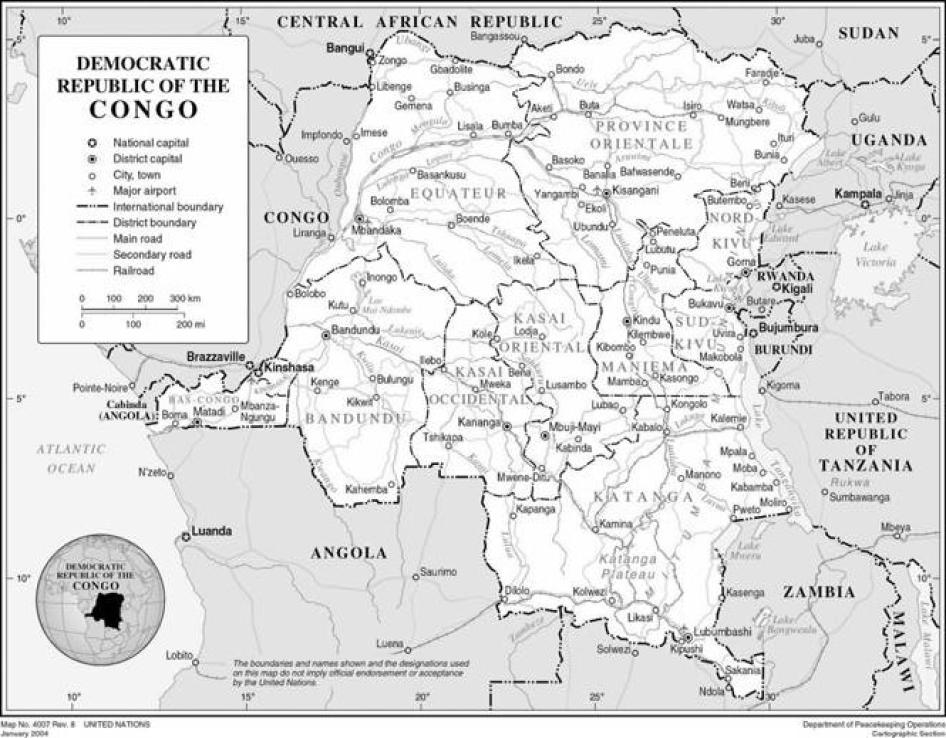
Map of the Democratic Republic of Congo
I. Summary
As they beat me with sticks and whips, the soldiers repeatedly shouted, "We will crush you! We will crush you!" Then they threatened to kill me and others who opposed Kabila.
-A political party activist detained and tortured in Kinshasa in March 2007 by President Kabila's Republican Guards
The 2006 presidential elections in the Democratic Republic of Congo, the first in over 40 years, raised hopes for stability and improved governance in this vast, war-torn nation. Yet in the two years following elections, there have been disturbing signs that Congo's democratic transition is not only fragile, but that the newly elected government is brutally restricting democratic space. The government of President Joseph Kabila has used violence and intimidation to eliminate its political opponents beginning in the immediate aftermath of the election's inconclusive July-August 2006 first round. In his first interview after his victory in the October runoff against former vice-president Jean-Pierre Bemba, Kabila said that he would be "severe" in governing Congo. He has matched his actions to those words.
This report focuses on some of the most violent episodes of political repression in Kinshasa and the western province of Bas Congo during the two years following the 2006 elections. The brutal and repressive tactics used by President Kabila and his advisors are emblematic of the resort to violence to stifle opponents. During our research, Human Rights Watch received reports of other incidents of repression, often smaller in scale and sometimes less violent, that are not included here. The violence in eastern Congo, where the Kabila government is in a military confrontation with an insurgency led by former general Laurent Nkunda, has been documented in other Human Rights Watch reports.
The government's lack of popularity in western Congo, and the fear of losing power through a military overthrow, have dominated policy discussions amongst Kabila and his advisors in their first two years of administration. According to many military and intelligence officials and others close to Kabila who were interviewed by Human Rights Watch, Kabila set the tone and direction of the repression. In giving orders, he spoke of "crushing" or "neutralizing" the "enemies of democracy," "terrorists," and "savages," implying it was acceptable to use unlawful force against them. Possibly due to a lack of capacity in the military and law enforcement services, Kabila's attempts to monopolize power were sometimes disorganized, though his intention to rid himself of perceived opponents was clear. As one disillusioned member of Kabila's inner circle remarked to Human Rights Watch, Kabila pursued an approach of "winner take all," leaving no room for other strong political opponents.
The worst of the repression took place in the capital, Kinshasa, and in the province of Bas Congo, areas where Kabila failed to win an electoral majority. In Kinshasa, Kabila launched what were in effect military operations (qualifying as internal armed conflict under international law) against his electoral rival Bemba in August 2006 and again in March 2007. Soldiers and Republican Guards interviewed by Human Rights Watch who participated in the military operations said that they had received and interpreted their orders in March 2007 as needing to "eliminate Bemba." The military operations against Bemba and his often ill-disciplined guards were brutal and sudden. The use of heavy weapons during the busy work day in central Kinshasa left hundreds of civilians dead through the indiscriminate use of force by both sides, and left many others injured.
In Bas Congo in February 2007 and March 2008, state agents acting under Kabila's authority used unnecessary or excessive force against Bundu Dia Kongo (BDK), a political-religious group based in Bas Congo that promoted greater provincial autonomy and gained significant electoral popularity. In August 2006, ahead of the runoff vote for president, the BDK allied themselves with Bemba. Since then the harsh conduct of government forces toward the BDK has increased. When BDK demonstrators protested, at times violently, against electoral corruption in early 2007, police and government soldiers shot or stabbed to death 104 BDK adherents and bystanders. In March 2008 police made a preemptive strike in anticipation of further protests, in what United Nations (UN) investigators said appeared to be a deliberate effort to wipe out the movement. Over 200 BDK supporters and others were killed and the BDK's meeting places were systematically destroyed.
The BDK and Bemba's bodyguards also perpetrated acts of violence in the context of clashes with police and army soldiers, and, in the case of the BDK, in trying to assert administrative control in parts of Bas Congo. While the government has a right and duty to respond to such violence, it must do so with restraint and respect for human rights. Congolese authorities seized on the violent acts of their opponents to try to justify their far more extensive violence.
During and after the military operations in Kinshasa and Bas Congo, soldiers, police officers, and intelligence agents loyal to President Kabila deliberately killed, injured, arbitrarily arrested, and tortured hundreds of persons. They acted at the direction of Kabila or his advisors and with the objective of reinforcing Kabila's control. These subordinates worked through both formal and informal channels, relying on first one and then another of several state security forces-including the paramilitary Republican Guards, a "secret commission," the special Simba battalion of the police, and the intelligence services-as circumstances dictated-to tighten control over perceived opponents.
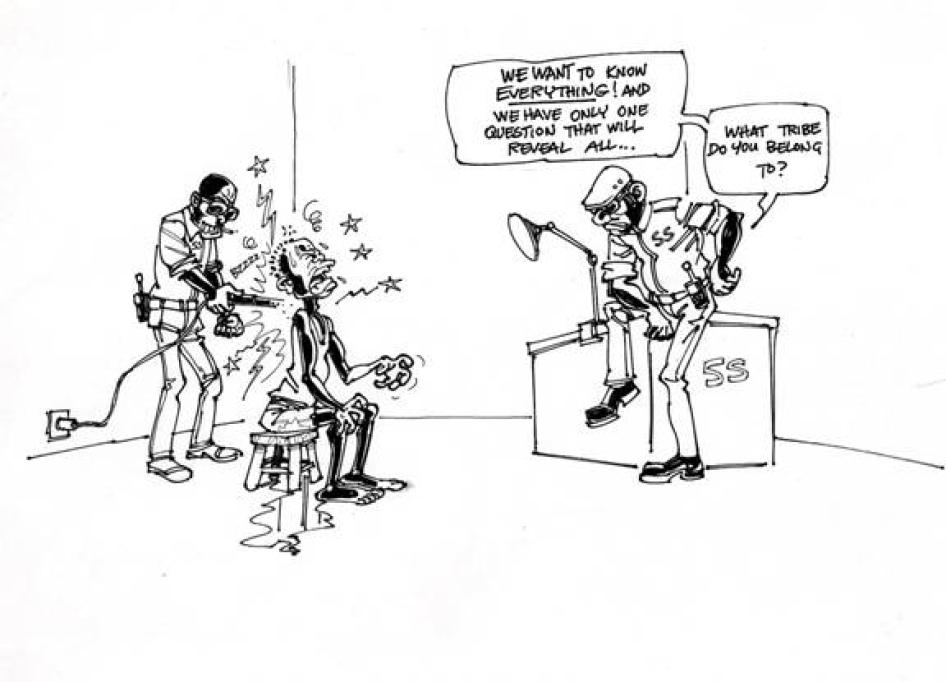
State security forces deliberately killed or summarily executed more than 500 persons in Kinshasa and Bas Congo and arbitrarily arrested and detained about a thousand more, many of whom were tortured or ill-treated. Many of the detainees were from Equateur (the home province of Bemba) and were insulted about their origins, questioned about their alleged support for Bemba, accused of being disloyal to President Kabila, and threatened with death. Those initially held at Kin-Mazière prison in central Kinshasa consistently described the means of torture used against them, including the use of electric batons on their genitals and other parts of their bodies, beatings, whippings, and mock executions. They were forced to sign confessions saying they had been involved in coup plots against Kabila. Some were kept chained for days or weeks. At this writing, some 200 remain in detention without trial.
Government agents have also threatened, arrested, tortured, and otherwise harassed journalists and members of civil society who were linked to political opponents or who protested abuses against them. The government closed down radio stations and television networks, such as those linked to Bemba, sometimes temporarily, sometimes permanently. Hundreds of other perceived government opponents have been harassed and intimidated through anonymous phone calls, threatening cell phone text messages, and middle-of the-night visits by army or police. Some went into hiding; others fled the country.
The Congolese government response when challenged about its actions has been denial and cover-up. Bodies were dumped in the Congo river, buried secretly in mass graves, or otherwise disposed of. In towns or cities where violence had occurred government authorities ordered soldiers or police to guard the morgues and burial sites and blocked UN officials, human rights monitors and family members of the dead or missing from approaching these areas. They ordered hospitals to provide no information on the numbers of persons killed or injured. In one case in Bas Congo, bodies from a mass burial site were removed just before local parliamentarians arrived to gather information about the atrocities.
Government officials repeatedly claimed that those they attacked were plotting coup attempts or otherwise threatening state authority, but they provided no convincing evidence of such charges. Senior ministers and advisors gave elaborate but unconvincing presentations concerning alleged coup threats to diplomats, journalists, and Congolese parliamentarians to explain their actions and to influence national and international opinion.
Prosecutors brought only a handful of cases to court, the most noteworthy of which-the case against Bemba's lawyer Marie-Thérèse Nlandu-resulted in an acquittal for lack of proof. Several of those arrested for threatening the state were tried in procedures that failed to meet international fair trial standards; many of the defendants claimed in court to have been tortured into making confessions.
In April 2007 the government threatened to try Bemba for treason but never issued a warrant against him. He fled Congo that same month. In May 2008 he was arrested by authorities in Belgium under a warrant by the International Criminal Court (ICC) on charges related to crimes allegedly committed by combatants under his command in the Central African Republic between October 2002 and March 2003. At the time of his arrest, Bemba had reportedly been about to return to Congo where he anticipated being selected as spokesperson for the opposition, a new leadership position in Congo's parliament. Although the ICC had been preparing the case against Bemba for several years, the timing of his arrest led his supporters and other Congolese to speculate publicly that his arrest had been politically motivated and had been ordered to assist Kabila by eliminating a rival who had escaped his reach.
Proper investigations are needed into the serious human rights violations committed in Kinshasa and Bas Congo, carried out by persons with genuine authority to require cooperation and compel accountability, unlike the meager government efforts to date. As described in this report, Congolese military, law enforcement, and intelligence personnel have violated fundamental rights protected under Congolese and international law with virtual impunity. No independent and transparent judicial investigation has been conducted into the violence committed by government troops and Bemba's guards in August 2006 or March 2007 in Kinshasa, nor into the violence in Bas Congo in February 2007 and March 2008, despite some feeble promises by the government to do so. Human Rights Watch has found no instance where senior ranking civilian or military leaders sought to prevent or take serious actions to punish individuals under their effective control who were responsible for crimes in violation of international law.
The Congolese government should immediately release all those still held without charge and prosecute before courts that meet international fair trial standards all individuals implicated in crimes, regardless of their position or rank. The failure to hold to account those responsible further aggravates Congo's culture of impunity and significantly decreases the likelihood the Congolese government will develop respect for the rule of law, a cornerstone of democracy.
In the press to establish good relations with the newly elected president, donor nations and other international actors have given little attention to the grave human rights violations of the first two years of the Kabila government and the failure to hold accountable the perpetrators of these abuses. The rare UN reports detailing abuses were buried and others published too late to have a significant impact on policy decisions by diplomats in the immediate aftermath of the events. After Bemba left Congo in April 2007, diplomats did try to assure some space for the opposition by insisting on legislation to define its status, complete with the "spokesperson" position, whose holder would have cabinet rank. Bemba was the frontrunner to hold the position, though his arrest by the ICC in May 2008, just ahead of the election for the spokesperson, effectively ended his bid. Without firm international support for open democracy, the opposition struggles unsuccessfully to counterbalance Kabila's lurch towards authoritarian rule.
In September 2008, after the completion of this report, Prime Minister Antoine Gizenga resigned, and the following month a new government with Adolphe Muzito as prime minister was appointed by President Kabila. In October 2008, security services in Kinshasa conducted another round of arrests and arbitrarily detained dozens of civilians and military personnel from Equateur province, many of them Bemba supporters. The renewed arrests highlight the systemic nature of political repression under President Kabila, a problem that requires urgent attention by the prime minister and his new government.
Elections themselves cannot bring democracy. Congolese and international actors must work to establish an independent judiciary and a vibrant parliament with an effective opposition to improve human rights, hold the executive to account for its actions, and counterbalance the restriction of political space. Failure to establish such counterweights will endanger Congo's young democracy. The same kind of focus and international cooperation that brought about the elections must be replicated in the cause of improving human rights and opening up democratic space if the hopes for stability and improved governance for this war-torn nation are to be fulfilled.
Methodology
This report is based on interviews by Human Rights Watch with more than 250 persons between August 2006 and June 2008 in the Democratic Republic of Congo, the Republic of Congo, Europe, and the United States, including a dozen of President Joseph Kabila's advisors and close political associates, Senator Jean-Pierre Bemba and his close political associates, the leader of Bundu Dia Kongo and his advisors, the minister of the interior, the minister of justice, parliamentarians from major parties, senior military and police officers, civilian and military justice officials, intelligence officers, former guards of Bemba, journalists, detainees, former detainees, their families, lawyers, diplomats, officials of various United Nations agencies, church officials, and representatives of national and international nongovernmental organizations (NGOs). Human Rights Watch requested and was granted a meeting with President Kabila, but at the time set for the meeting the president was indisposed.
The research for this report also relied on reporting from United Nations sources (especially those from MONUC), other national and international human rights organizations, election observation mission reports, legal papers from lawyers and judicial officials, government documents and prison records.
Many of those interviewed requested anonymity. Consequently, we have withheld names, and we have also omitted other information about interviews from some notes.
II. Recommendations
To the Congolese Government
- Release immediately all individuals detained without charge, or charge them with a legally cognizable offense and prosecute them before courts that meet international fair trial standards.
- Investigate and discipline or prosecute as appropriate soldiers, police officers, intelligence agents, and any other official, regardless of rank, implicated in killings, torture, or mistreatment.
- Establish a task force under the supervision of the Ministry of Justice comprising military and civilian judicial officials, and international and national human rights experts, to establish the number and identities of persons detained without charge or trial, to monitor the release of detainees, and to document cases of torture and ill-treatment of detainees for future judicial action. Direct the task force to report regularly and publicly to parliament and the government.
- Ensure that members of the political opposition, the media, and civil society are permitted to exercise freely their rights to free expression, association, and assembly as guaranteed by the International Covenant on Civil and Political Rights.
- Permit national and international human rights monitors access to all places of detention and interviews in private with those detained.
- Establish an independent vetting mechanism to remove and exclude, with appropriate due process mechanisms, members of the security forces responsible for serious human rights violations.
- Take all necessary action to stop government officials from interfering in judicial proceedings.
- In accordance with Congolese law prohibit trial by military courts of civilians.
- Enact legislation implementing the Rome Statute of the International Criminal Court to grant civilian courts jurisdiction over military personnel implicated in criminal offenses against civilians.
To the Congolese National Assembly and Senate
- Conduct a parliamentary inquiry into arbitrary arrests, torture, and ill-treatment of detainees by the military, police, and the security services.
- Review the role of all security and intelligence services; eliminate duplication and clarify mandates of various services in order to facilitate more effective parliamentary oversight of their conduct.
To International Donors
- Urge the government to release immediately all persons detained without charge or prosecute them in courts meeting international fair trial standards.
- Make the human rights situation in Congo, including arbitrary arrests, torture and ill-treatment, and harassment and attacks on perceived political opponents a high priority in dialogues with Congolese government officials, emphasizing the need for concrete steps to address these concerns to assure favorable bilateral relations.
- Provide financial and political support for the creation of a Ministry of Justice task force to monitor persons in custody, their treatment, and their release.
- Monitor trials and regularly visit places of detention to promote compliance by the Congolese government with international human rights standards.
- Press the government to permit MONUC and other international and national human rights monitors free access to all places of detention.
- As part of continued donor support for the Security Sector Reform program, urge that the Congolese government establish an independent vetting mechanism to remove and exclude, with appropriate due process mechanisms, members of the security forces responsible for serious human rights violations. Assist the government in designing and implementing such a mechanism.
- Request an urgent visit to Congo by the UN special rapporteur on torture.
To MONUC and the Office of the High Commissioner for Human Rights (OHCHR)
- Publish promptly MONUC and OHCHR reports on serious human rights abuses in Congo.
Military, Law Enforcement, and Intelligence Agencies: multiple institutions, overlapping mandates
Armed Forces of the Democratic Republic of Congo (Forces Armées de la République démocratique du Congo,FARDC). The current national army, numbering some 100,000 soldiers, was created by integrating former belligerent forces into the existing government army, a process not completed by the time of the 2006 elections. From 2006 through 2008, the 7th integrated brigade was the main force in Kinshasa, based at Camp Kokolo military base. The FARDC throughout Congo have been accused of widespread human rights violations, including extrajudicial executions, torture, rape, and pillage.
Republican Guard (Garde Républicaine). A special unit, including many soldiers from Katanga (home province of Joseph Kabila's father), commanded directly by the president and with a mandate to protect him and presidential premises. Estimated to number 10,000 to 15,000, the Republican Guard is deployed at airports, border posts, and other strategic sites and carries out security functions far beyond its mandated role. It has its own military intelligence units who operate separately from those of the FARDC and former DEMIAP (see below). Despite efforts by foreign governments and the UN to have the unit integrated into the army during the transition period, the Republican Guard remains outside the regular military structure. The majority of the force is in Kinshasa and operates from Camp Tshatshi.
"Maison militaire"[or "Military House"]. A powerful military and security body established by presidential decree in 2003 to advise the president on national defense and security affairs. It serves as a liaison between the president's office and the military and security services, including the police. It often operates outside official ministerial and security force chains of communication and command.
National Security Council (Conseil national de sécurité, CNS).A civilian structure headed by the president's national security advisor responsible for coordinating national security strategy. Its role overlaps those of other security agencies.
Military Intelligence (l'Etat major général des renseignements militaires). A specialist military intelligence agency of the Congolese army, commonly known by its former acronym DEMIAP.[1] Its central headquarters is in the Kitambo area of Kinshasa where it has a detention center. It has staff in each of Congo's 12 military regions, headed by an agent often known by the military designation T2. There are many military intelligence detention centers throughout the country where civilians are frequently illegally detained.
National Intelligence Agency (Agence Nationale de Renseignements, ANR). Under direct control of the president, the agency is mandated to investigate crimes against the state, such as treason and conspiracy, but its officials also routinely detain persons suspected of common criminal offenses, such as theft, and have on occasion arbitrarily arrested opposition and civil society leaders. Local and international human rights monitors and Congolese lawyers have limited access to ANR detention centers across the country and in some places, like Kinshasa, have no access at all.
National Police Force (Police Nationale Congolaise, PNC).The police force, estimated at just over 100,000 officers, has suffered from years of neglect and poor command. Officers are ill-paid and have been badly trained; the force is currently being reformed with international and UN assistance. Among its specialized units is the Simba Battalion, a group of former soldiers, which is part of a counterterrorist division and operates with minimal oversight. The Simba battalion was accused by UN officials of serious human rights abuses in Bas Congo in March 2008. Another specialized unit is the Integrated Police Unit (Unité de Police Intégrée, UPI), whose role was to guard the institutions and government actors of the transitional government but was to be dissolved at the end of the transition. Its personnel are due to be integrated into other police units as part of the national reform program. The UPI was also involved in abuses in Bas Congo.
Rapid Intervention Police (Police d'Intervention Rapide, PIR).A special police unit for security and crowd control that played an important role in providing security during the elections. A number of PIR units received training funded by international donors. PIR police officers were allegedly involved in arbitrary arrests and detention in Kinshasa in March 2007 and in Bas Congo in March 2008.
Office of General Intelligence and Special Services (Direction des Renseignements Généraux et Services Spéciaux de la police, DRGS).A specialized intelligence division of the police commonly known as Special Services (Services Spéciaux), it is based at Kin-Mazière in central Kinshasa, where it operates a detention center. Special Services has the legal power to arrest and detain civilians, an authority it has been known to abuse for political purposes.
Other government agencies, including the Immigration Service (Direction Générale de Migration, DGM), also reportedly have intelligence functions.
III. Prelude to Violence: A Climate of Suspicion
In 2006 the Democratic Republic of Congo (DRC) held its first multiparty elections in 40 years, marking the end of a difficult three-year transition period that followed nearly a decade of war. Two successive wars, the first from 1996 to 1997 and the second from 1998 to 2003, left Congo devastated and at least five million of its citizens dead, some due to violence but many as a result of preventable disease and starvation.[2] For the millions of Congolese citizens who voted in presidential and legislative polls, the elections promised a new era of peace and hope.
During the period of transition, Joseph Kabila had served as nominal president but had been obliged to share power with leaders of the former government, armed groups, the political opposition, and civil society. He and his People's Party for Reconstruction and Democracy (Parti du Peuple pour la Reconstruction et la Démocratie, PPRD) saw the elections as the opportunity to finally establish their predominance over these rivals, particularly over chief contender Jean-Pierre Bemba, who had served as one of four vice-presidents during the transition, and his party, the Congolese Liberation Movement (Mouvement de Libération du Congo, MLC).
During a bitter campaign both candidates tried to mobilize ethnic and regional loyalties to win votes. Bemba, member of a well-known business and political family from the northwestern province of Equateur, portrayed himself as "One Hundred Percent Congolese,"[3] implying that Kabila was a foreigner. Bemba supporters stressed that Kabila was unable to speak Lingala (the main language of western Congo) and raised questions about his parentage, alleging that his mother was a Rwandan Tutsi. Following the five years of Congo's second war, in which Rwanda (as well as other countries), had occupied large swathes of Congolese territory, anti-Tutsi sentiment was strong and provided a powerful rallying cry to organize anti-Kabila opposition. The Kabila campaign portrayed Bemba, a former armed group leader, as a war criminal whose forces had committed cannibalism and other horrific acts.
Kabila and his supporters had expected an outright victory in the first round of voting (held July 30, with vote counting running into the third week of August) but a last-minute surge in support for Bemba deprived Kabila of the 50 percent plus one needed to win.[4] The voting showed a split in the country between Lingala speakers in the west who had largely voted for Bemba, and Swahili speakers in the east who had largely voted for Kabila.[5] This divide shocked Kabila and his advisors who feared Bemba might attempt to capitalize on the division. It also raised concerns about how Kabila would govern if the capital Kinshasa and large parts of western Congo were hostile to him and his government.[6]
Following this inconclusive first round, leaders on each side suspected that the other might attempt a preemptive coup or take other military action. The continued existence of troops from both sides who remained outside of the national army heightened these fears. According to the terms of the agreement that had established the transitional government, formerly hostile military forces were supposed to be integrated into a new national army, a process that was to be finished before the elections but which had not been completed.[7] Despite pressure from donor governments to put the Republican Guard under regular army command, Kabila had kept its 10,000 to 15,000 troops under his own direct control.[8] Diplomats and UN officials widely viewed the Republican Guards "as Kabila's private militia."[9] As vice-president, Bemba was permitted a personal protection guard,[10] which he increased in the lead-up to the elections to some 800 to 900 armed men, at least 400 of whom were based in Kinshasa.[11]
According to a respected Congolese analyst interviewed by Human Rights Watch, the presence of these guards and the fear of large sections of Lingala speaking people opposing Kabila panicked his inner circle. They further worried that delivering on election promises in the short term would be exceedingly difficult and might quickly lead to dissatisfaction among the population which could be exploited by the opposition, especially by Bemba.[12] To counter these threats, Kabila and his advisors pursued violence and intimidation against their rivals. The prevailing environment established by nearly a decade of war when there had been few functioning democratic institutions remained largely unchanged: military solutions to political problems were able to dominate the policy agenda with devastating consequences for human rights. Following the bloody events in the capital Kinshasa (as described below), an article in one of Kinshasa prominent newspapers, Le Potentiel, questioned whether Kabila's new government was "returning [the country] to the worst period of Mobutu's terror."[13]
IV. Crushing Jean-Pierre Bemba and his Supporters
In August 2006 some members of the Republican Guard got into an armed skirmish with members of Bemba's guard in Kinshasa. Kabila, commanding the stronger force, took advantage of the opportunity to conduct a military operation that struck a major blow against Bemba. Unsuccessful then in completely destroying Bemba's strength, Kabila's forces launched a second military operation in March 2007 that, together with a campaign of arbitrary arrests and intimidation, effectively ended Bemba's challenge to Kabila's power and pushed Bemba into exile.
Speaking of this period, a Congolese army officer told Human Rights Watch, "General Kisempia gave us the order to eliminate Bemba, to finish with him and the MLC."[14] General Kisempia was Lt. Gen. Kisempia Sungilanga Lombe, then military chief of staff. Other Republican Guard and Congolese army soldiers interviewed by Human Rights Watch referred to Bemba and his supporters as "the enemy who could weaken the government" and interpreted their orders as "eliminating" this enemy.[15]
In November 2007 Minister of the Interior Denis Kalume told Human Rights Watch that "neutralizing Bemba" had not meant assassinating him.[16] But another person close to Kabila explained that Kabila's supporters understood the risk that Bemba could be killed in such operations. He said, "Some hardliners desired just such an outcome."[17]
Military 0perations August 2006
Expecting the announcement on August 20, 2006, of a runoff election, Bemba planned to give a national televised address that evening to thank his supporters and launch his campaign for the second round of voting.[18] The Kabila camp was shocked at their failure to win the presidency in the first round and some in the group claimed that Bemba meant to preempt the official announcement and try a military takeover. Bemba later told Human Rights Watch that Kabila said he had received a text message warning him that Bemba would attempt a coup.[19] Denis Kalume, then one of Kabila's security advisors,[20] supported the view that Bemba was planning a coup. In an interview with Human Rights Watch he said that this "subversive" attempt by Bemba "had to be stopped."[21] According to another member of Kabila's inner circle, "Kabila took a decision to beat-up on Bemba and to teach him a lesson."[22]
In the late afternoon on August 20 the police and Republican Guards exchanged fire with Bemba's security guards in the streets outside the building of Canal Congo Television (CCTV, a pro-Bemba station) where Bemba was expected for his televised address.[23] The fighting prevented Bemba from making his scheduled speech and for a few hours delayed the announcement of the election results. It was unclear which side initiated the skirmish.
The following day, the Republican Guard and Congolese army soldiers moved heavy weaponry, including armored personnel carriers and tanks mounted with howitzers, into central Kinshasa. Lieutenant General Kisempia informed MONUC and European military officers that he had deployed these troops to restore law and order and to disarm Bemba's guard.[24] The MONUC force commander, fearing escalation of the conflict, strongly advised against this course of action, but his advice was ignored.[25]
A group of diplomats from 14 Western and African countries, members of the International Committee Accompanying the Transition (Comité international d'accompagnement de la transition, CIAT), were taken aback at the violence during such a crucial time in the election and hurried to mediate the crisis, going first to meet Bemba at his home. During the meeting with Bemba, the Republican Guard and army soldiers surrounded Bemba's house and his offices nearby, exchanging fire with Bemba's guard and pinning the diplomats down for six hours. There was a flurry of phone calls between Kabila, then-UN Secretary-General Kofi Annan, and others. Kabila's troops then withdrew a short distance and allowed MONUC and EUFOR soldiers (part of a force provided by the European Union to assist MONUC during the electoral period) to surround Bemba's residence and extract the trapped diplomats.[26]
Skirmishes continued until August 23 when a ceasefire was arranged. MONUC established a joint commission incorporating both sides to encourage dialogue, investigate the events, and obtain agreement of the two candidates concerning rules of conduct for themselves and their supporters during the second round of voting.[27]
The fighting left 23 persons dead and 43 wounded, according to figures provided by the Ministry of Interior to the United Nations.[28] Government soldiers and Bemba's guards deliberately killed some civilians, while other deaths and injuries resulted from indiscriminate use of weapons by both sides.[29] Neither the MONUC commission of inquiry nor any other source published an independent assessment of the number of causalities. When Human Rights Watch asked MONUC officials about the commission report, one replied, "It has been put in a drawer and will never be seen." Suggesting that the UN and the diplomats preferred to ease tensions rather than establish responsibility for the violence, the official continued, "No one was willing to say anything to Kabila about what had happened or about the threats to security posed by his Republican Guard."[30] Foreign governments preferred to stick to the line that both sides were equally responsible, although at least two European diplomats conceded to Human Rights Watch that this was not the case. One diplomat who had been in Bemba's house when Republican Guards attacked said, "We let Kabila get away with it and we did not reprimand him. It was a mistake."[31] Another said, "In hindsight, this was the moment when we started to see President Kabila's true colors."[32]
Effect on the second round of elections
In the aftermath of the August 2006 violence, the two rivals intensified their media campaigns, with both permitting insulting and xenophobic statements by their supporters. The European Union electoral mission reported that the media became "true war machines at the service of their preferred candidates."[33]Congo's public radio and television station, Radio Télévision Nationale Congolaise (RTNC), overtly biased in favor of President Kabila, portrayed the violence in Kinshasa as the sole responsibility of Bemba and his supporters, as did other pro-Kabila media.[34] Bemba's media outlets, shut down briefly in August, were able to broadcast on only a limited basis during the second election, permitting the domination of pro-Kabila media.
© 2008 Anthony De Bibo/Human Rights Watch
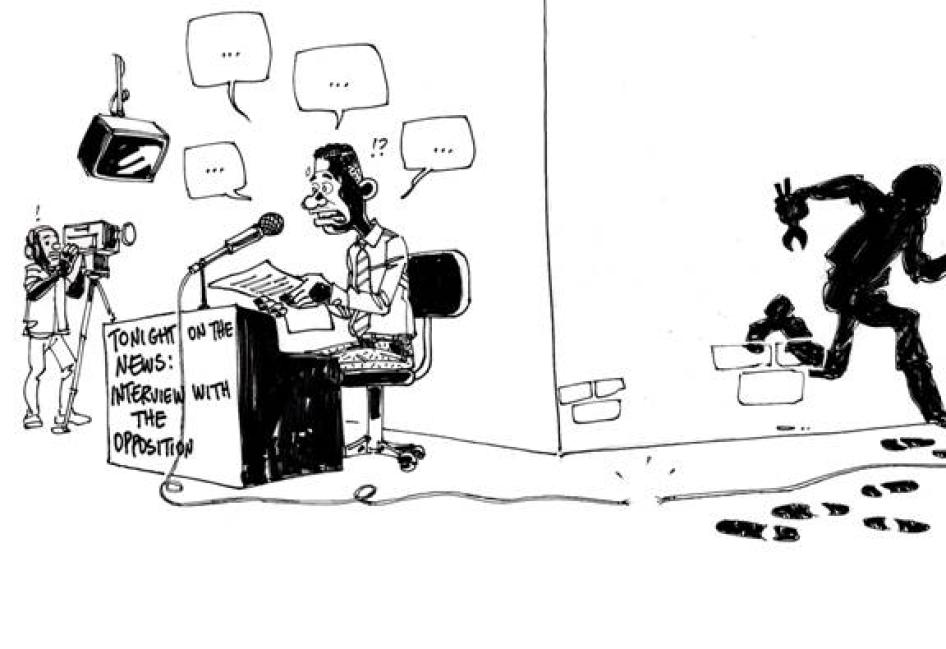
Unlike the first round of elections, neither Bemba nor Kabila campaigned personally during the runoff because each feared the possibility of assassination by the other side. Both candidates stayed away from rallies and other public functions, providing for minimal debate or scrutiny of their policies. A national televised debate between the two candidates, required by law and widely anticipated by the public and the media, did not take place, largely due to preconditions set by the Kabila camp, which feared that a face-to-face debating format would be a disadvantage to their candidate.[35]
A few hours before the campaign drew to a close on October 28, President Kabila addressed the nation with his final campaign message broadcast on most media outlets, including RTNC; Bemba had no similar opportunity to deliver a last-minute message. International election observers called Kabila's speech an "abuse of government power."[36] Yet no foreign government criticized this interference with a fair electoral process, nor did they criticize the failure to adhere to the law on the televised debate.
On October 29, 2006, the runoff election was held, with Kabila winning 58 percent of the vote as opposed to Bemba's 42 percent. After initially contesting the results in the courts, Bemba accepted Kabila's victory in a public statement on November 28.[37] Bemba was elected a senator in January 2007 and vowed to play an important role in leading a democratic opposition to President Kabila.
The Alliance for the Presidential Majority (Alliance pour la Majorité Présidentielle, AMP), a political coalition based on Kabila's PPRD, also won a clear majority in the National Assembly and Senate elections. Bemba's coalition, the Union for the Nation (Union pour la nation, UPN), did well in provincial elections, winning a majority in five provincial assemblies, a victory that should have given it a strong chance to win important gubernatorial positions.
Despite his strong political position after the elections, Kabila did not seek to heal the divisions that resulted from years of war and bitter electoral campaigning. As one disillusioned member of Kabila's inner circle later remarked to Human Rights Watch, Kabila pursued an approach of "winner take all."[38]
March 2007 violence
Following the election, Bemba's determination to lead a vigorous political opposition was perceived by persons around the president as a continuing threat.[39] Bemba's refusal to put his guard under the command of the national army hierarchy provided an opportunity for the Kabila forces to again use military force, and given the silence of UN agencies in Congo and foreign governments after the August 2006 violence, there was little to deter Kabila from once again resorting to military force against a political opponent. In clashes between Kabila's forces and Bemba's guard in March 2007, hundreds of people were killed, a large number of them civilians, and at least 300 were arrested, many arbitrarily and without respect for due process. A European military advisor with close links to the Congolese army told Human Rights Watch, "We all saw this coming, but again we did not do enough to avert the crisis."[40]
Bemba's guard, numbering somewhere between 400 and 500 armed men, were stationed in central Kinshasa at Bemba's two residences and his office, and at his farm in Maluku on the outskirts of the city. Nominally part of the Congolese army, these ill-disciplined guards, who were responsible for numerous abuses against civilians, were still in fact commanded by Bemba. They were angry at Kabila's election and, after the previous clash, easily provoked.[41]
The Kabila camp saw the large number of well-armed guards as a threat to security in the heart of Kinshasa. Some Kabila supporters say that, as in the previous August, they feared that Bemba's guard would be used to launch a coup.[42]
On March 6, 2007, Lieutenant General Kisempia ordered all soldiers guarding former vice-presidents to report within 10 days to their nearest military base for redeployment.[43] Twelve police officers were offered as a replacement to each of the former vice-presidents, including Bemba. Claiming "repeated attempts" on his life, Bemba said that 12 police officers were too few to protect him and he refused to direct his guards to comply with the order.[44] He invoked the accord with Kabila signed on October 29, 2006, guaranteeing him appropriate security and freedom of movement, as justification for asserting that Kisempia's order did not apply to his guards.[45]
The Kabila camp also feared that Bemba was trying to win over soldiers based in Kinshasa, especially those who were from Equateur and had fought under Bemba during the war and had then been integrated into the Congolese army. An army officer and a person close to the Bemba camp, interviewed separately, told Human Rights Watch that there had been efforts to convince soldiers to remain loyal to Bemba.[46] A senior diplomat and advisors close to Bemba told Human Rights Watch that Bemba may have hoped for a popular uprising of Kinshasa residents in his defense, should he be attacked again.[47]
On March 14, in his first televised interview since losing the elections, Bemba criticized President Kabila and the newly installed government for corruption, the lack of political space for the opposition, an agreement to cede some Congolese territory to Angola (which he described as high treason),[48] as well as for supposed attempts on his life. In an interview that set the tone for his opposition agenda, Bemba publicly declared, "We have gone backwards in our country, we are far from democracy. It's the dictatorship of money."[49] According to one former senior government minister, Bemba's interview triggered Kabila's decision to take military action against his rival. "When Bemba did his press interview, it was a key moment," he said. "It was as if we had passed a red line and Kabila made a decision to attack Bemba."[50] In comments to Human Rights Watch a member of Kabila's inner circle said, "The president had been told he needed to show Bemba who was boss. He had gotten into the habit of using military force to resolve issues … His intention was to crush Bemba."[51]
In the following days, Kabila's advisors began to prepare the diplomatic community for an eventual showdown, and the army increased its troops around Bemba's residences and office.[52] On March 21 broadcasts from two of Bemba's media outlets, CCTV and Radio Liberté Kinshasa (RALIK), were suddenly interrupted when their terrestrial and satellite signals-which rely on transmitters at a government-controlled RTNC compound-were cut. A CCTV manager interviewed by Human Rights Watch said that there had been no technical failure to explain the interruption in broadcasts and that he believed that the cut had been deliberate and could only have been carried out on the order of a senior official.[53] Ambassador William Swing, head of MONUC, who had been away for three weeks, returned to Kinshasa and offered to mediate between the two rivals, but it was too late.
Around midday on March 22, 2007, Bemba's guards and government soldiers exchanged fire. It is not clear who fired the first shot. Within an hour a full-scale battle erupted on Kinshasa's main avenue, the Boulevard de 30 Juin, and raged for three days, engulfing other parts of central Kinshasa and trapping tens of thousands of people at their workplaces, schools, and homes. MONUC military officers estimated that some 2,600 soldiers, including some in tanks, fought Bemba's 400 to 500 guards, who were assisted by several hundred family members and untrained supporters.[54]
That afternoon Bemba and his family took refuge in the nearby South African embassy while fighting continued. Over the course of the next two days, 121 of Bemba's guards fled across the Congo river to Brazzaville, capital of the Republic of Congo, along with over a hundred members of their families.[55] Another 161 guards and some 250 family members sought protection with UN peacekeepers and at least 30 gave themselves up to the Congolese army.[56] Others were arrested and some were executed.
Both sides used heavy weapons including machine-guns and rocket-propelled grenades in densely populated urban areas. The Republican Guards also used T-55 tanks and mortars.[57] Much of the firing by both sides appears to have been indiscriminate, with no effort to protect, warn, or evacuate the civilian population. It left hundreds of civilians dead. MONUC peacekeepers managed to rescue some civilians, including children trapped in schools, but they were severely hampered by the scale of the fighting, which raged directly around MONUC buildings in the city center.
Some diplomatic offices and premises were also damaged in the fighting including premises of the Greek, Spanish, and Nigerian embassies, the residence of a French diplomat, and the UNICEF offices, all close to the main area of fighting. Diplomats assert the damage was largely inflicted by Republican Guards who also ransacked the Italian residency.[58] The Nigerian ambassador, Dr Onuorah Jonikul Obodozie, was severely wounded and was evacuated by MONUC.[59] An American embassy building was shot at and damaged by Bemba's Guards.[60]
Killings and Summary Executions
Relying on the loyalists
During and after the military operations, soldiers, police officers, and intelligence agents loyal to President Kabila deliberately killed, injured, arbitrarily arrested, and tortured hundreds of persons. They acted at the direction of Kabila or his immediate subordinates and with the objective of reinforcing Kabila's control. These subordinates worked through both formal and informal channels, relying on first one and then another of several state security forces, as circumstances dictated.
Kabila commands the Republican Guard and has direct control over the civilian National Intelligence agency (Agence Nationale de Renseignements, ANR) and military intelligence (commonly known as DEMIAP), both of which operate outside the command structure of the Ministries of Defense, Interior, and Justice (see Box 1.) During the transition period, Vice-Presidents Bemba and Azarias Ruberwa had repeatedly raised concerns about President Kabila's exclusive control over these agencies, but to no avail.[61] The control established by the Kabila camp over these agencies during the transition was critical in the later repression of his rivals.
In agencies where Kabila had no formal control, such as the police Office of General Intelligence and Special Services (Direction des Renseignements Généraux et Services Spéciaux de la police, DRGS), he and his supporters worked through a network of personal connections. Both during the transitional period and after, they created chains of command parallel to official hierarchies, in which lower-ranking officers loyal to Kabila could be in touch with the president or his advisors, bypassing superiors whose loyalty to the president was less certain.[62] One foreign military expert told Human Rights Watch, "We know Kabila gives orders directly to many of his generals or loyal officers. There is an official hierarchy but it's meaningless. The real power lies with those who are considered loyal to the president."[63] Many of the loyalists are from Kabila's province of Katanga and are known as "les Katangais."
Abuses by the Republican Guard
The Republican Guard was one of the main tools of repression used by Kabila and his subordinates. Between August 2006 and May 2008, soldiers of the Republican Guard summarily executed or caused the "disappearance" of more than 125 people. Together with agents from military intelligence and from other army units, Republican Guards arbitrarily arrested over 600 persons and subjected many of those in their custody to torture and inhuman treatment. Most of these persons were arrested during or shortly after the March 2007 military operation and were either guards or supporters of Bemba. A smaller number of people were swept up by the Republican Guards merely because they were from Bemba's ethnic group, the Ngwaka, or his region of origin, Equateur.
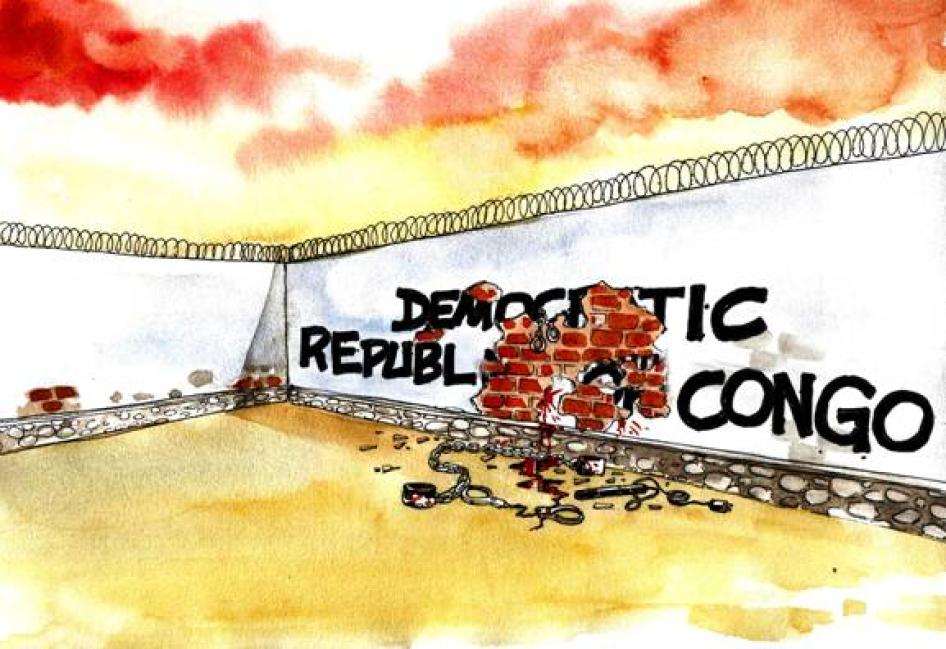
© 2008 Anthony De Bibo/Human Rights Watch
Summary executions at Camp Tshatshi, March 2007
Human Rights Watch's investigations found that the Republican Guard committed many summary executions in March 2007 at Camp Tshatshi, their base on a hill just outside central Kinshasa, overlooking the Congo river.
Republican Guards have no legal authority to carry out arrests, but in March and April they arrested hundreds of persons, both civilian and military, and illegally detained them at Camp Tshatshi. According to 10 former detainees interviewed by Human Rights Watch, Republican Guards took away scores of persons at night from the camp, sometimes reading the names of those targeted from a list. The Guards tied the detainees' hands and sometimes blindfolded and gagged them before leading them away. They frequently beat and insulted the detainees as they led them away, calling them "part of Bemba's terrorists" and "enemies of democracy." They also said that persons from Equateur had ruled Congo for too long (Equateur was also the home province of the late Congolese leader Mobutu Sese Seko) and that "now it's the turn of the Katangais."[64] With the one exception mentioned below, the persons removed did not return to the prison and have not been seen since.
A Congolese army officer from the Ngwaka ethnic group, arrested by the Republican Guard on March 23 and detained at Camp Tshatshi, told Human Rights Watch what he witnessed:
There were 38 of us in the prison. Some of the prisoners were Congolese army soldiers from Equateur, like me, others were Bemba's security guards that they had captured, and some were civilians. At 3 in the morning seven Republican Guards came into the prison. They took 10 of the prisoners, tied their hands, blindfolded them, and taped pieces of cardboard over their mouths so they couldn't scream. The captain who did this said he had received orders. He said he would drink the blood of Equateurians that night. They took them away. About an hour later they came back for a second group. I knew one of the guards and asked what had happened. He said the others had been taken to the [Congo] river near Kinsuka and killed. He quickly put me into another cell which saved my life. They took the others away in a truck. I am sure they were killed as well.[65]
A civilian from Equateur whom we interviewed had been arrested by Republican Guards on March 23 at his home. Not personally involved in politics, he had a brother who was considered to be a Bemba supporter. The interviewee said he was taken to Camp Tshatshi, where he was brutally beaten and detained (his and other experiences of ill-treatment there are described later in this chapter). He continued,
They threw me in a cell with three other civilians. At around 3 a.m. the soldiers took the four of us out and said we would "eat peanuts" [arachides]. I asked what kind and they said I would find out. Then they tied heavy metal wheel hubs [jantes] to each of us and marched us to another part of the camp, near the river. Another soldier came up to us and asked [for me] … and I was told to go back to the prison. When I arrived back one of the soldiers in the prison said I had been lucky as eating peanuts meant eating bullets and the others were going to be killed and that the metal hubs would weigh their bodies down in the river. I never saw them again, they did not return to the prison. I was told that 20 others were earlier taken from the prison and also made to eat peanuts, that is, killed.[66]
A former civilian detainee said that at around 2 a.m. on two consecutive nights, March 27 and 28, a Republic Guard commander came to the prison with a list and called out names of people. They were led out to jeeps and taken away. He said, "The guards told us to pray as they said if you were taken away like that it meant you were going to be eliminated."[67] The prison guards told the remaining detainees that the persons had been killed near the river, and threatened to do the same to them.[68]
Approximately 100 cases of summary executions were reported during this period to officials of MONUC and the UN Office of the High Commissioner for Human Rights (OHCHR). When MONUC human rights investigators attempted to visit Camp Tshatshi on March 24, 2007, to check on some of these reports, Republican Guards refused them entry at gunpoint. The investigators succeeded in obtaining access to the camp three days later, after diplomats had brought pressure to bear on Congolese officers. Despite this and later Congolese reluctance to assist UN investigators, MONUC and OHCHR officials were able to establish that some 30 to 40 bodies, some with blindfolds and their hands tied, had been found in the Congo river at the rapids near Kinsuka.[69] According to persons who saw the bodies, some of them also had tape over their mouths.[70] No bodies weighed down with metal wheel hubs were found, presumably because they had sunk to the bottom of the river.
Other cases of summary execution of Bemba associates
Republican Guards summarily executed persons thought to be linked with Bemba at other locations in Kinshasa. Some of Bemba's guards and members of their families had gathered at the CCTV television building in central Kinshasa during the March 2007 fighting. When they heard that a number of their colleagues had sought protection from MONUC by gathering at the UN compound nearby, those gathered at the CCTV television building called MONUC officers, seeking UN protection, but Republican Guards arrived first, took control of the area, and killed an undetermined number of guards and civilians in the building.[71]
A young eyewitness reported seeing several persons summarily executed and gave a detailed account of one such killing. He told us,
There were about 60 of us in the building. The soldiers entered and started to hit and beat people with their rifle butts. They made us lie face down of the floor and some people were killed. They shot one boy dead … one bullet in the head and another one in the foot. They then made about 10 people, including me, go over to the body and urinate on it.[72]
Congolese authorities later told MONUC that the building was empty by the time the Republican Guard arrived,[73] but two eyewitnesses interviewed by Human Rights Watch contradicted this official story. They said those not killed by the Republican Guard were arrested and taken to Camp Tshatshi. [74]
Summary executions were also carried out near Kinshasa's main airport and at Bemba's farm in Maluku, on the outskirts of Kinshasa. At the airport on March 26 and 28, Republican Guards allegedly forced victims to dig their own graves before shooting them. Several of the victims were guards who had been protecting Bemba's private airplane and four others were civilians who failed to show identification cards and were suspected of being Bemba supporters.[75] In an incident at Bemba's farm in Maluku, Congolese army soldiers summarily executed at least three of Bemba's guards-one of them an injured man, the other two with their hands raised in surrender, according to an eyewitness.[76]
More recently, Republican Guards targeted Daniel Boteti, the vice-president of the Kinshasa provincial assembly and a member of Bemba's Congolese Liberation Movement (MLC), assassinating him in his car on July 6, 2008, while he was on his way home in Kinshasa. A Republican Guard arrested at the scene and now standing trial with four co-accused including two other Republican Guards, told a military tribunal that Kinshasa Governor Andre Kimbuta, a close ally of President Kabila, had ordered the murder. According to a press account, the governor denied the charges.[77] MLC deputies and senators boycotted parliamentary sessions in protest at the assassination and demanded a full and transparent investigation as well as the removal of all Republican Guards from the capital to military barracks outside the city.[78] On October 8, the five were found guilty of murder and sentenced to death.[79]
Dr. Faustin Sosso, Bemba's personal physician and also from Equateur province, "disappeared" on August 20, 2006, and is presumed dead. According to members of Dr. Sosso's family, he was en route to hear Bemba deliver his scheduled address on television when Republican Guards arrested him and took him to an unknown location.[80] An unverified account says that Dr. Sosso was taken to Camp Tshatshi where he was subjected to torture before being executed.[81] During the days following the "disappearance," Dr. Sosso's wife received phone calls from persons claiming to be Republican Guards, who demanded money for Dr. Sosso's release.[82]
Arbitrary Arrest, Torture, and Ill-Treatment
Abuses by the Republican Guard
At Camp Tshatshi, detainees were kept in various locations including cells inside the small military prison; in a dirty underground room below the main prison known as "the cellar" (la cave); in a small room with no windows at a separate outbuilding known as the "eighth" (huitième); and at the office buildings of the Republican Guard intelligence services.[83] Some detainees were kept for only a few days, while others were held for two to three months before being released or transferred to other places of detention.
On August 22, 2006, during the fighting in Kinshasa, Republican Guards arbitrarily arrested 84 fishermen, most of them from Equateur province, illegally detained them in the Camp Tshatshi "cellar," mistreated or tortured them, and threatened them with death, reportedly because they were thought to be "rebels." Some said that they were arrested for having witnessed Republican Guards dump bodies into the Congo river during the August 2006 violence. After MONUC officials intervened, the fishermen were released.[84]
Republican Guards at Camp Tshatshi systematically tortured and ill-treated scores of detainees whom they arbitrarily arrested in March 2007 and in the months that followed. Former detainees interviewed by Human Rights Watch described how they were repeatedly beaten with belts, cords, branches and planks, kicked, punched, and threatened with death. Many said they heard screams coming from different parts of the camp late at night.[85]
Many of those detained by the Republican Guard were repeatedly questioned about the whereabouts of Bemba or his security guards and accused of being disloyal to President Kabila. Interrogators repeatedly heaped abuse on persons from Equateur. One former detainee told Human Rights Watch, "They kept shouting at me that Mobutu had ruled for 32 years, now it was their turn. They said that we Equateurians had been in power long enough and that our time was up. They called it Code 32 [a reference to a post-Mobutu provision to punish those linked to Mobutu]."[86] A Republican Guard who told Human Rights Watch he disapproved of the abuse meted out to some detainees said of his colleagues, "There was no shortage of inept people in our ranks … Plenty of them got into a tribalist mentality and there was a settling of scores."[87]
On March 24, Republican Guards arrested seven men who were drinking at a bar in Kinshasa and accused them of being Bemba supporters. Six of the men were civilians and one was an off-duty police officer from Equateur. The seven men were beaten, thrown in a jeep, and driven to Camp Tshatshi. One of the men said,
The guards argued as we approached Camp Tshatsi. Some said that they should just throw us in the river and others said that we should be taken to the office first. When we arrived at the office Commander Shoma was there. They started to interrogate us. It was horrible. We were tied up and they took sticks, cords, and bamboo branches to whip us. We were taken one after the other. I was last. I heard the awful screams of those who had been before me. There was blood everywhere. They pointed their guns at me and asked me questions. They said I was with Bemba, that they would arrest him, and that they would kill us. They had a photo of Bemba and claimed that one of my friends with whom I had been arrested was standing behind Bemba in the picture. The soldiers kept repeating that they were going to eliminate all of us.
We were returned to the cells and I overheard Major Baseleba [Bin Mateto, the head of military intelligence of the Republican Guards] say that it was best to finish with us that evening. He said it in Swahili and I understand Swahili. But nothing happened and the next day … Major Baseleba came back to the prison. I heard him shouting, "Where are those terrorists of Bemba?" We were taken out of the cells with our hands tied. He spoke on the telephone for a long time and then came back and said the president was aware of our dossier. He ordered the head of the prison to put us in the cellar. It was really awful down there. It was hot and dirty and the ceiling was so low that we couldn't stand. On occasion some of the guards would take pity on us and allow us out for a few moments of air.[88]
Another man from Equateur arrested during a separate incident described what happened to him:
When I arrived they put me on the ground and beat me with a plank. They told me not to scream but it hurt so badly that I did scream. They questioned me about Bemba and my brother who they said was a Bemba [supporter]. A soldier started to sharpen his machete and said he would kill me and then he beat me on my back with the flat side of the machete.[89]
The same detainee was later sexually assaulted by a Republican Guard who forced his penis into his mouth.[90]
On June 21, 2007, Republican Guards working with military intelligence agents arrested a member of Bemba's family and some 15 other persons, both military and civilian, and detained them at Camp Tshatshi.[91] Some were held for nearly two months before being released or transferred to other places of detention (see below). Some of the detainees from this group said that at Camp Tshatshi Major Baseleba Bin Mateto ordered that they be tortured to reveal information about Bemba's car and driver. One was tied up between two iron bars, spat on, insulted and beaten each day for a week while being interrogated. Other detainees were beaten with large sticks and branches.[92]
In May and June 2008 Republican Guards, military intelligence agents and police officers from the Simba Battalion[93] arrested at least 15 persons, including three former Bemba security guards, officers in the Congolese army and the national police, and at least two civilians, all from Equateur. After a brief stay in police and other detention facilities, the detainees were transferred to either Camp Tshatshi or the Republican Guard training camp at Kibomango, on the outskirts of Kinshasa, where they were held incommunicado for several months. On September 1, 2008, 12 of the detainees were transferred to the Makala central prison, officially known as the Penitentiary and Reeducation Centre (Centre Pénitentiaire et de Rééducation de Kinshasa, CPRK), some of them showing visible marks of torture.[94] The detainees claimed they had all been brutally beaten. Some of the detainees reported that they had been handcuffed for weeks, others said they had been deprived of food and water for prolonged periods of time.[95]Hours before their transfer to the central prison, the detainees were charged for the first time. As with previous waves of arrests, they were accused of plotting a coup and endangering state security.Government officials refused to answers questions from UN human rights monitors about the arrests and the whereabouts of the remaining detainees.[96]
Former detainees held at Camp Tshatshi also told Human Rights Watch about other cruel and degrading treatment inflicted on them by Republican Guards. Several described how they were forced to clean the prison toilets on their knees with their bare hands, sometimes while Republican Guards urinated on them and shouted abuse.[97]
Many detainees told Human Rights Watch that they continued to suffer from the physical or psychological effects of their treatment at Camp Tshatshi.[98] The mother of one man who had been detained for several months reported that after his release her son refused to eat and would not speak.[99]
Detainees were not informed of the reasons for their arrest or ever brought before a judge. In the register of detainees at Camp Tshatsi, the usual reason listed was "investigation purposes" (raison d'enquéte).[100] Bribery was the usual method of release: many former detainees told Human Rights Watch that they or their families had paid Republican Guards sums ranging from US$20 to over $500 to obtain their release. One said, "My wife sold everything we had so that she could pay the guards to release me. I am now left with nothing except my scars."[101]
Abuses by the "secret" commission
From September 2006 through May 2007, Kabila supporters also sought to silence political opponents by using a "secret" commission established by Samba Kaputo, then Kabila's national security advisor.[102] According to one well informed intelligence official, President Kabila had given his approval to the activities of the commission, which included state agents from various law enforcement and intelligence services selected on the basis of their loyalty to the president. The commission was given power to investigate and arrest, an exceptional arrangement mandated by Kaputo. Continuing the language used to justify the August military action, the commission referred to political opponents as "coup plotters."[103]
In the nine months of its operation, the commission and state agents acting at its behest arrested at least 200 persons, including soldiers, police officers, journalists, and others assumed to be supporters of Bemba, many of whom were subjected to torture and cruel and inhuman treatment. At least three people died as a result of the abuses. Some 40 remain in detention at this writing, under military justice jurisdiction.
The commission, which operated out of Kin-Mazière police center in Kinshasa,[104] was chaired by Col. Daniel Mukalay of police Special Services (Services Spéciaux) and Col. Jean-Louis Mutonkole of military intelligence (former DEMIAP), assisted by Majors Mopepe and Mukinzi, also from Special Services. It had some 15 other members including representatives of various intelligence and security agencies such as Special Services, military intelligence, ANR, the National Security Council (Conseil National de Sécurité, CNS) and the military justice system.[105] According to two intelligence agents interviewed by Human Rights Watch, the commission reported daily to Kaputo who regularly informed the president of its progress. The intelligence officials also said that Kabila had frequent direct contact with the commission's co-chairs.[106]
In response to questions from a Human Rights Watch researcher, Gen. Unyon Vakpa, current head of Special Services who took up his post after the commission disbanded in May 2007, said that the commission had operated in "secret" and that he had been unaware of its existence or activities at the time.[107]
So far as we have been able to establish, only one of the cases investigated by the commission was brought to trial, that involving Marie-Thérèse Nlandu, Bemba's lawyer and supporter (notwithstanding that she had also stood in the 2006 presidential election). A military court acquitted Nlandu and her co-defendants on April 30, 2007, saying the military prosecutor had not proved charges that she planned violence against the state.[108] The acquittal was welcomed by national and international trial observers who had raised concerns about the violations of fair trial procedures and the military prosecutor's use of evidence obtained under torture (allegations that Nlandu was tortured, along with nine people arrested with her in November 2006, are discussed in the section "Government Responsibility," below). The senior judge later lost his post due to what one senior government official called an "erroneous" judgment, not further specified. The state has appealed the acquittal but at this writing the appeal has yet to be heard.[109] After her release, Nlandu fled the country.
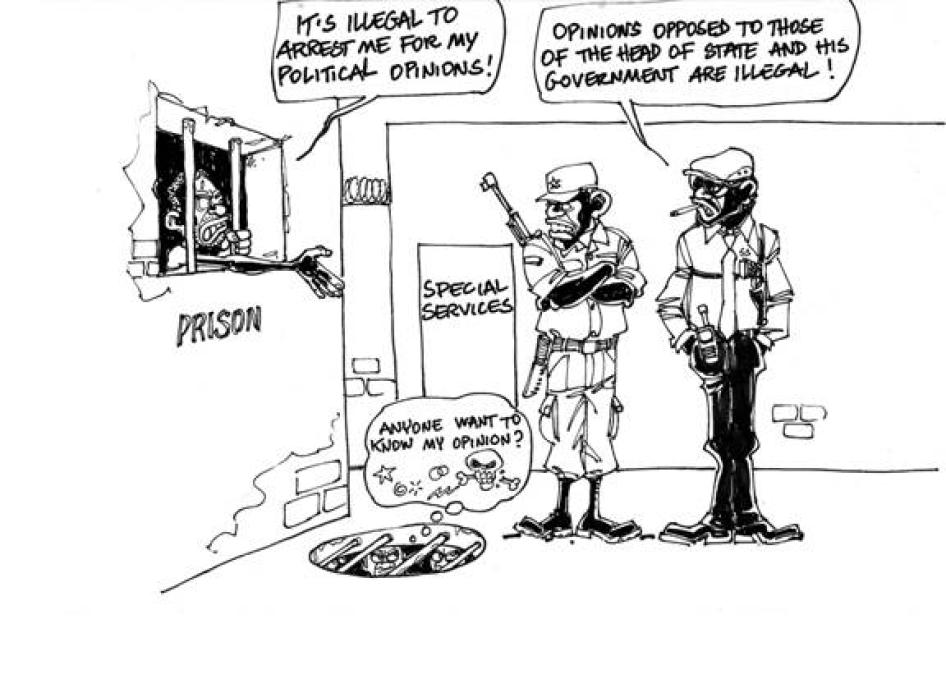
© 2008 Anthony De Bibo/Human Rights Watch
Torture and ill-treatment at Kin-Mazière
Human Rights Watch interviewed 20 persons who had been detained by the secret commission at Kin-Mazière prison. Most had been arrested in November and December 2006. Many said they were forced to confess to a plot to overthrow President Kabila and to incriminate other colleagues or friends. They provided consistent descriptions of means of torture used against them, including the use of electric batons on their genitals and others parts of their bodies, beatings, whippings, and mock executions. One of the woman detained said that she was gang raped. Most of the detainees from Equateur were insulted about their origins, questioned about their alleged support for Bemba, and threatened with death. Some were kept chained for days or weeks, so weighed down they could barely move. Almost none of them received medical treatment. Many told Human Rights Watch researchers that they still suffered from physical and psychological effects of the torture.
On December 5, 2006, agents from the commission arrested a Congolese army officer from the Ngwaka ethnic group at his home in Kinshasa. When the officer asked to see the arrest warrant, the agents refused, blindfolded him, and searched his house. He was taken to Kin-Mazière prison where he was interrogated by Major Mopepe and Major Mukinzi. The officer said,
They ordered that I be tortured. I was surprised and asked why since I had done nothing wrong. Then Major Mopepe punched me in the face. He said, "You, the Ngwaka, you are all working with your brothers. You want to plot a coup d'etat." … I said I was apolitical. They said it was not true and that I was plotting with the MLC. Major Mopepe said, "Give the captain the shocks so he will tell the truth."
They started to hit me. They stripped off my clothes. They took four sets of handcuffs and tied my hands behind me and then to my feet. I was thrown on the ground in this position. One policeman stood on one leg and another person on the other. They kicked me. They gave me electric shocks all over my body. They put the electric baton in my anus and on my genitals. They shouted at me to admit that I had been at the meeting and that I had a gun in the house. They hit me with the butts of their guns. This went on for hours. Both Major Mopepe and Major Mukinzi were there when it was happening. I cried so much that I could hardly see any more. I shouted I would sign whatever they wanted me to. They brought a piece of paper, which they said was my testimony. I didn't read it. I just signed. I wanted the torture to stop and I would have signed anything.
A few days later the detained officer was brought back for another interrogation, this time before the commission. According to the officer, Colonel Mutonkole managed the proceedings. The officer was questioned about a one-page document the commission claimed had been found at his home and which, they said, ordered him to fight for Bemba. The officer said,
They showed me the piece of paper with the order. I knew it was fake and asked to see the [official document] which said that this order had been found amongst my things. I asked who had witnessed [that this was found in my home]. They told me to shut up and that I talked too much. Colonel Mutonkole accused me of being from the same family as Bemba and Mobutu. I said do what you want to me. Colonel Mutonkole said that Mobutu had killed Kimba [a Katangan politician hanged by Mobutu in 1963] and that now it was the turn of the Equateurians to die. He said I should be tortured. Again they hit me, kicked me, and gave me shocks with the electric baton. They put a gun to my head and said if I did not admit that I knew about the note, they would kill me. Colonel Mutonkole told the [judicial officer] what to write down. He took his revolver and pointed it at me. He pushed the piece of paper at me and said, "Sign." I did. I wanted to live. I didn't even read what it said.[110]
Another Ngwaka detainee told a Human Rights Watch researcher that he had been chained up for 20 days at Kin-Mazière before his statement was taken. He said,
Finally I was unchained, but they still hit me. Colonel Mutonkole placed a weapon and an electric baton on the table and threatened to use them. I was questioned by the commission, and Mutonkole ordered the magistrate to write what he told him to put down. When I refused to agree to this, I was slapped. They tried to make me say that I was planning a coup d'etat. I was questioned about my ethnic group, and they told me that I was from the family of Bemba."[111]
© 2008 Anthony De Bibo/Human Rights Watch
Three women, including a mother and daughter, who worked with Bemba's MLC political party, were arrested at a restaurant in Kinshasa on October 21, 2006. They were taken to Kin-Mazière, where they were repeatedly tortured with electric batons. One of the women was gang raped by five police officers.[112] One of the group said,
They tortured all of us with electric prods. They slapped and hit us. We were tortured every day, in the morning and in the evening for the first five days. They would insult Jean-Pierre Bemba. One of us is Ngwaka from Equateur. She was told that "she is the sister of Jean-Pierre Bemba, that she is the one that we are looking for." We were charged with espionage, but when they took our statements they did not write down what we said. We would say one thing, and they would write something completely different. I didn't want to sign the statement, but they threatened us. We were obliged to sign, even if it didn't contain what we had said."[113]
The husband of one of the women tried to visit his wife in Kin-Mazière prison, but was also arrested and tortured.[114] The group-the 3 women plus the husband-was transferred to Kinshasa central prison on November 22, 2006. They were eventually released in mid-2008.
In violation of Congolese and international human rights law, detainees were initially denied access to lawyers and often to family members. Lawyers who attempted to assist clients were not permitted to see arrest warrants or other judicial documents. Some were later told no investigations were necessary in these cases. The persons arrested by the commission were all held under military authority, although many were civilians. Of the at least 200 people arrested by the commission, some were released but dozens were transferred to Makala prison where lawyers were eventually permitted access to them. Only much later were files available for detainees. Lawyers working on these cases expressed the opinion that the files were prepared long after the arrests, a violation of Congolese legal procedure. The charges included public insult (injure publique), false propaganda (propaganda des faux bruits), inciting hatred and violence (incitation à la haine et à la violence), and participation in an insurrectional movement.[115]
On March 23, 2007, during the violence in Kinshasa, a small number of Bemba's guards arrived at Kin-Mazière prison and freed the detainees who had not yet been transferred to other places of detention. Local residents then ransacked parts of the building.
Human Rights Watch received reports of further arrests of political opponents between April and June 2007, but it was unclear whether the secret commission had ordered these arrests. One intelligence official told a Human Rights Watch researcher that by the end of May 2007 the secret commission had largely stopped functioning. On August 1, 2007, Samba Kaputo died, effectively ending the operations of the commission.
Abuses by other security services
According to victims and their families, officers of other law enforcement and security services including military intelligence (former DEMIAP), the Rapid Intervention Police (PIR), other police officers, and soldiers also arbitrarily arrested citizens and tortured or ill-treated persons in their custody. These units, working with Republican Guards or on their own, targeted persons suspected of supporting Bemba and his party.
In October 2006 MONUC expressed concern about the illegal detention of 130 persons, including nine children and two infants, many from Equateur, who were held at the provincial police headquarters in Kinshasa (IPKIN) and who had been detained for nearly a month without charge. According to MONUC, there was evidence that some of them had been ill-treated.[116] In another case during the violence in March 2007 PIR officers raided the house where an MLC party activist used to live and arrested four of the occupants whom they detained, beat, and interrogated in an attempt to locate the activist.[117]
In July, August and September 2007 Republican Guards and military intelligence agents arrested some 20 persons, including army officers from Equateur accused of being disloyal to the president. They detained many of them in the cells at Camp Kokolo, a large military base in central Kinshasa, and others at the military intelligence detention facility (former DEMIAP) at Kitambo just outside the centre of Kinshasa. A Human Rights Watch researcher, another human rights monitor, and a relative of a detainee tried together to visit one of the detainees but were denied entry. The relative was threatened with arrest for having brought a "white person" and human rights monitors with her.[118] On August 14, 2008, after more than a year of detention without charge, five soldiers from this group were transferred to Makala central prison. The previous evening, another soldier held in detention at Camp Kokolo died of unknown causes after being admitted to a military hospital.[119] Another soldier, from the same group, was taken from the Camp Kokolo detention facility in May 2008 and transferred to an unknown location, before arriving at Makala prison on September 1, 2008.[120]
At around the same time, in July and August 2007, others of this group were transferred from Camp Tshatshi to Camp Kokolo and the Kitambo military intelligence facility, including a member of Bemba's family whose arrest in June 2007, by Republican Guards and military intelligence agents, was described above. Following transfer they continued to be interrogated, but with less harsh methods than at Camp Tshatshi.[121]
On July 18, 2008, five police officers and three civilians from Equateur Province, were arrested on charges of endangering state security and the illegally possessing ammunition. The detainees were held at various detention facilities including the cells at the Rapid Intervention Police, Kin-Mazière and military intelligence (former DEMIAP) before being transferred to Makala prison on August 16, 2008. The detainees claimed they had been brutally beaten and that others from Equateur remained in incommunicado detention.[122]
Human Rights Watch also interviewed several former detainees who had been kept at other locations such as at the National Security Council (CNS) offices and in outbuildings of the Palais des Marbres, one of the presidential residences. One detainee, a senior law enforcement official from Equateur, was kept in solitary confinement at the Palais des Marbres, on the orders of a senior presidential advisor. For several weeks he received no food and very little water. His condition deteriorated so badly that he was finally given medical attention. He described to us how the presidential advisor himself questioned him in an effort to determine his political loyalties. After two months of detention he was released without charge.[123]
During the violence in Kinshasa in March 2007, authorities at Makala prison isolated some 40 detainees who were allegedly Bemba supporters and/or persons from Equateur, moving them into a single building that was provided with extra security. Former detainees told Human Rights Watch that prison officials crammed them into dark cells with as many as six to a cell and refused to allow them to come out of the cells to exercise for some 30 days. The detainees believed these measures had been taken because prison authorities feared the detainees might revolt.[124]
Former detainees, family members of detainees, and human rights monitors reported cases of grave abuse, including torture and ill treatment at ANR detention facilities in Kinshasa. Despite repeated requests to senior Congolese officials, International Committee of the Red Cross (ICRC) delegates and international human rights monitors from the UN and international NGOs have no access to ANR facilities.[125]
Harassment, Intimidation, and Destruction of Property
Harassment and intimidation of MLC parliamentarians, of party activists, and of journalists and others thought to be associated with Bemba, as well as of their family members, intensified during and after the March 2007 violence, creating a climate of fear and discouraging efforts to build an effective opposition. Human Rights Watch researchers spoke to dozens of persons who had been repeatedly targeted by Republican Guards or other state agents through visits to and searches of their homes-often at night and without appropriate warrants. Many had also been threatened with death or injury in anonymous telephone calls or text messages. MONUC registered 51 cases of harassment and intimidation in the days and weeks following the March 2007 events.[126]
Against party activists and close Bemba associates
On the morning of March 23, 2007, Republican Guards targeted the residence of Jeannot Bemba, the father of Jean-Pierre Bemba and a well-known businessman. A number of soldiers climbed the wall surrounding the residence, entered the compound, and shot at the house; one bullet narrowly missed Jeannot Bemba. After he and neighbors who were members of the international diplomatic community called senior political figures, including Samba Kaputo, who lived nearby, the Republican Guards withdrew.[127] On March 23-24 the Republican Guard visited the homes of senior leaders of the MLC allegedly looking for Bemba's guards or illegal arms, in at least one case gaining entry through threats rather than through presentation of a legitimate warrant. Republican Guards looted the MLC national headquarters on March 23 and occupied the building.
The same day, a group of 30 soldiers from the army and the Republican Guard forcibly entered the Centre Hospitalier Mixte SCIBE-Congo, commonly known as "Bemba's hospital" because it had been established by Jeannot Bemba. The soldiers went from ward to ward, shouting and carelessly firing their weapons. They wounded several persons, including one fatally. According to MONUC's special investigation report, there was no military threat in the hospital and no reason to discharge weapons there.[128]
On March 31 officers of the Rapid Intervention Police looted the MLC Kinshasa regional office. The party was allowed to reoccupy its office on April 21 only after heavy pressure from the diplomatic community. According to a senior MLC official, when party workers were finally allowed to return to their office they found "an empty shell":[129] all documents, computers, archives, video footage, and most of the furniture had been removed.[130] People had urinated and defecated throughout the building. When Thomas Luhaka, the MLC's executive secretary, protested against destruction of MLC property to Kabila's advisors, they told him, he said, that this was just part of the "dynamic" of the violence.[131] The MLC requested compensation for the damage caused but has so far received nothing.[132]
In another case, an MLC party activist who went into hiding in late March 2007 after having learned he was being sought by state agents began to receive threatening text messages four days later. One read, "You will die like a dog."[133] As the messages continued during the following weeks, he fled the country.[134]
On April 6, police forcibly entered the Kinshasa home of Jose Makila, governor of Equateur, the only MLC governor in the country and a former minister of the transitional government, allegedly seeking to recover state cars. Police officers looted money, phones, and other property, abused household workers, and threatened to rape one of the female workers. They arrested two guards, ignored the documents naming them as security personnel to the governor, and charged them with being former Bemba soldiers. The guards were detained for more than two weeks without charge at a military intelligence facility before being released.[135]
On April 10 Bemba himself left Congo, saying he was living in a "climate of permanent insecurity."[136] Three days later parliamentarians of the MLC and of other opposition parties protested the harassment and intimidation by walking out of the National Assembly. Denouncing the arbitrary arrests and the illegal searches of homes, MLC members demanded improved security conditions. The president of the national assembly, Vital Kamerhe, mediated the crisis and provided assurances of security. When President Kabila also agreed to meet with the parliamentarians, they were sufficiently reassured to return to the legislature on April 25.[137]
Security conditions improved somewhat in the second half of 2007 but the intimidation and harassment did not completely cease. According to the MONUC human rights division, security services in Kinshasa cordoned off the home of a founding member of the MLC in February 2008 and detained his wife, sister, and six others present at the house for about 24 hours on suspicion of "spreading rumors."[138] On June 20, 2008, a senior member of the MLC, Imana Engulu, rapporteur of the High Media Authority (the body that regulates Congo's media) was arrested and held for six days without charge by the police after he was involved in a car accident. He was released only after significant pressure from opposition politicians and diplomats.[139]
Against journalists and their defenders
More than a dozen journalists who worked at media outlets owned by Bemba, including CCTV, RALIK, and Canal Kin Television (CKTV), received threatening phone calls, text messages, and visits by Republican Guards or other state agents in March and April 2007, causing many of them to go into hiding and at least three to flee the country.[140] One senior journalist received repeated anonymous phone calls saying "We're going to kill you."[141] Intelligence agents looking for two prominent journalists searched the homes of family members.[142]
On March 23, Republican Guards looted Bemba's media operations located in the CCTV building in a central business district of Kinshasa, removing much of the broadcasting equipment. CCTV resumed broadcasting in July 2007, but its staff continued to suffer intimidation.[143] One senior news editor was asked by an anonymous caller on August 14, "Why are you going back to work? You'll end up like Franck! [a reference to murdered journalist Franck Ngyke]."[144]
On October 20, 2007, then-Minister of Information, Media and Communication Toussaint Tshilombo Send interrupted the signals of 38 Kinshasa-based television and radio stations, including CCTV and other media outlets affiliated with Bemba, alleging failure to pay taxes and other license fees. The minister said his intention was "to rid the profession of black sheep and other lame ducks."[145] Station owners complained they had been given no advance notice before the minister's drastic action.[146] After Emile Bongeli succeeded Tshilombo as the responsible minister, he lifted the ban on some stations on December 20, 2007, but not on CCTV, which was directed to provide further administrative documents not required by law.[147]
On October 30, 2007, a police officer ordered the arrest of 11 journalists who were covering a protest march organized by Bemba's opposition coalition.[148] The journalists were released later the same day, but the police confiscated their video and audio recordings. One cameraman was beaten in the police vehicle when he resisted attempts to take his camera. Others who resisted arrest were also beaten. According to one of the journalists, "[The police] threw us in the trucks and said, 'You should have stayed at home. Why did you come and get involved with things that don't concern you?'"[149] No charges were brought against the journalists.
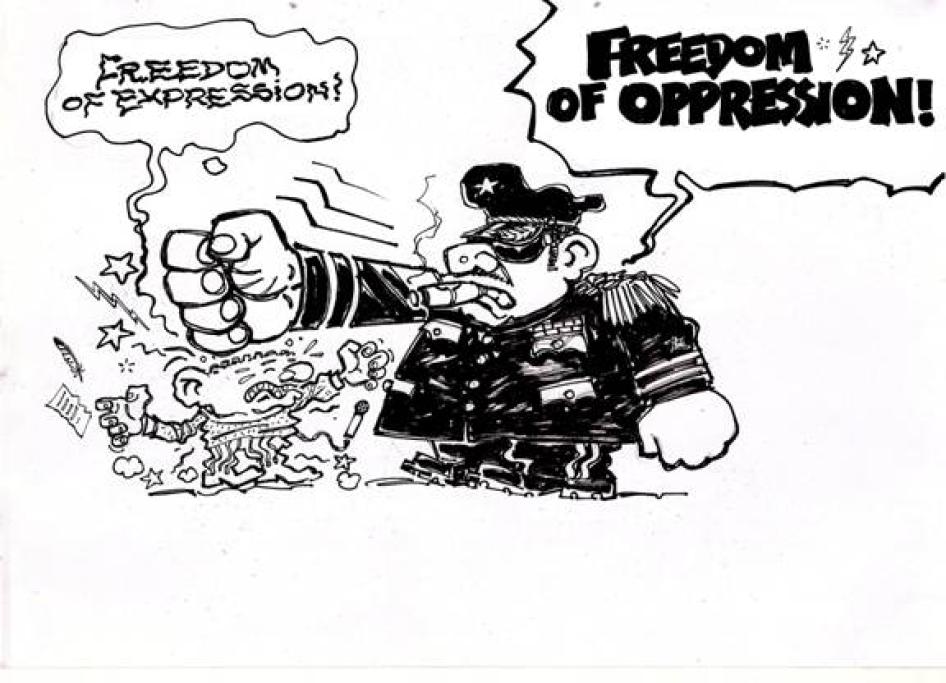
© 2008 Anthony De Bibo/Human Rights Watch
Human rights activists who defended journalists were themselves threatened. After the local media group Journaliste en Danger (JED) took up the cases of journalists and publicly denounced the threats to press freedoms by the government, a JED representative received a text message that said, "You JED who do you think you are? If you don't agree with the regime, go into exile and wait until your champion takes power. If you don't leave we'll help to shut you up for good. We won't miss. Too much is too much. You have been warned."[150] On July 31, 2007, then-Information Minister Tshilombo denounced JED as "anti-patriotic" in a television interview. He accused the organization of tarnishing the country's image abroad and threatened to withdraw its legal status as an NGO. In July 2007, following further threats, JED's executive director, Donat M'Baya Tshimanga, and its secretary general, Tshivis Tshivuadi, temporarily left the country.[151]
Just as hostile actions began again against MLC supporters in early 2008 after a period of relative calm, so too did harassment of journalists. Nsimba Embete Ponte, editor of the opposition journal L'Interprète, was arrested on March 7, as was his colleague Davin Ntondo Nzovuangu on March 29. Both were illegally detained at the ANR prison in Kinshasa. Minister for Communication and the Media Emile Bongeli told members of the National Press Union that Embete had been detained for writings critical of President Kabila, but no formal charges were made against him. According to JED, the editor had been threatened after publishing a series of articles on Kabila's health. The detainees were later transferred to Makala prison where they are still held at this writing.[152]
On September 12, state agents raided the offices of Global TV, a private television station in Kinshasa, arresting journalist Daudet Lukombo, and taking essential broadcasting equipment; the station went off the air. The previous day, Global TV had covered a press conference by opposition parliamentarian Ne Muanda Nsemi, the spiritual leader of Bundu Dia Kongo, who criticized the government for its actions in eastern Congo (see chapter V below for more information about BDK). Lukombo was taken to Kin- Kin-Mazière prison and later charged with "incitement to rebellion" for having broadcast the press conference. Two other journalists who covered the same press conference also allegedly received death threats.[153]
Government Responsibility
The Republican Guards and military and civilian intelligence agencies responsible for the criminal offenses described above taking place in Congo since the beginning of the July 2006 elections are directly answerable to the president. The involvement of so many state agencies in these human rights violations strongly indicates the complicity, and perhaps direct participation, of the highest levels of the government. According to over a dozen officials close to the summit of power in Congo-military officers, intelligence officials, and others close to the president-Kabila set the direction of the repression. The language used by President Kabila and his senior advisors in giving orders-"crushing" or "neutralizing" the "enemies of democracy" or "savages"-contributed to the acceptability of using unlawful force against Bemba supporters, including unarmed civilians. These sources, as well as UN officials, diplomats, and NGO monitors, also told Human Rights Watch that Kabila, as well as his direct advisor Kaputo, were cognizant of the nature and scale of the security operations and the abuses being committed. (The requirements that, in situations of grave violations of international law, command responsibility bears legal consequences, are discussed in detail below, in Chapter VI.)
Human Rights Watch recorded some 15 accounts concerning the command role and personal conduct of Maj. Baseleba Bin Mateto, the head of military intelligence of the Republic Guards, who directed interrogations of detainees at Camp Tshatshi. According to former detainees with whom Human Rights Watch spoke, Major Baseleba was in the prison regularly, was present during interrogations where torture or ill-treatment was used, and decided who would be executed and who would be released (two such detainee accounts are given above). A Republican Guard member at Camp Tshatshi told Human Rights Watch that "nobody left without the order of [Major] Baseleba."[154] UN officials who attempted to secure the release of detainees at the camp told Human Rights Watch that this had been their experience as well.[155]
Within the military hierarchy, Major Baseleba reported to Gen. Dieudonné Banze Lubundji, head of the Republican Guard, but eyewitnesses said that Major Baseleba also had a direct line to Kabila, with whom he spoke by telephone during and after the March 2007 events.[156] One army officer said that he was with Major Baseleba just after the March events when Baseleba received a phone call, evidently from Kabila. He said, "I knew it was the president as Baseleba immediately snapped to attention and addressed the caller as Mr. President and he confirmed afterwards, when he hung up the phone, that it was Kabila. I overheard him say to the president that there was only the clean-up left to do."[157]
There was one reported attempt in March 2007 to curtail abuses by Major Baseleba. A Republican Guard officer told Human Rights Watch, "There was some internal debate about how to interpret our orders, but after 15 days of activity, the boss [Kabila] clarified the orders through General Banze. From then on we should arrest only real suspects and people with weapons." If an accurate account, this clarification of the orders suggests that Kabila was aware of ongoing abuses, yet neither he nor any other senior officer ordered immediate disciplinary action against Baseleba. According to a MONUC official, Major Baseleba may have been detained for two or three weeks in early 2008, but he later resumed his functions.[158]
Captain Kongolo, in charge of operations for the Republican Guards, assisted Major Baseleba in many of the arrests and, according to detainees and a Republican Guard soldier present on the scene, frequently visited the cells to torture or beat those who were held there. Among detainees, Kongolo was given the nickname "mal à l'aise" [ill at ease] and detainees feared his arrival at the prison.[159] In July 2007 Kongolo was briefly detained for beating a civilian so severely that he required hospitalization. After two weeks, Kongolo was released under strict orders not to visit the prison at Camp Tshatshi. He faced no charges and retained his position as Republican Guard director of operations.[160]
Human Rights Watch also collected 10 accounts of abuses committed by the former head of Special Services, Col. Raus Chalwe (commonly known as Colonel Raus), alleging that he was directly involved in interrogating, torturing, and threatening detainees at Kin-Mazière prison. One of the cases in which Colonel Raus intervened was that of Marie-Thérèse Nlandu, Bemba's lawyer, arrested along with nine of her supporters and household staff in November 2006. According to the victims, Colonel Raus personally beat them with his revolver, tortured them with electric shocks from an electric baton, ordered that their heads be forced into toilets, accused them of being traitors, threatened them with death, and forced them to sign confessions.[161] During their trial, a number of the victims publicly raised the use of torture to extort information and confessions, causing the military prosecutor to attempt to justify the state's use of such tactics.[162] Intelligence officers, persons close to Kabila, and eyewitnesses told Human Rights Watch that Colonel Raus had regular direct contact with President Kabila.[163] Following a visit to Kin-Mazière police center in May 2007, representatives from diplomatic missions also concluded that "the ultimate chain of command for the service remains direct orders from the Presidential entourage rather than via normal government and judicial channels."[164] In mid-2007 Raus was promoted to general and named head of police in the province of Bas Congo (see below, Chapter V).
During Raus's tenure as the head of police Special Services, Samba Kaputo established the "secret" commission. While Raus was not a member of the commission, a number of his staff were members and the commission worked out of his headquarters at Kin-Mazière.[165]
Among the dozen or so secret commission members, four were most frequently named by former detainees as having ordered and directly participated in committing torture: Colonel Mutonkole (co-chair of the commission and a member of DEMIAP), Colonel Daniel Mukalay (co-chair of the commission, a member of Special Services, and brother-in-law of Kaputo), Major Mupepe (Special Services) and Major Mukinzi Kapita (Special Services). According to 20 ex-detainees interviewed by Human Rights Watch, these four officers gave orders and were directly involved in torture with electric batons, beatings, whippings, and mock executions. Colonels Mutonkole and Mukalay allegedly managed sessions where detainees were interrogated and forced to sign confessions after being threatened with death.[166]
The new head of Special Services, Gen. Unyon Vakpa, refused to permit Human Rights Watch researchers to meet with the co-chairs of the commission. He did say, however, that shortly after the death of Samba Kaputo in August 2007, Colonel Mukalay was temporarily suspended from his position for "irregular attendance" at work, but that he was expected to return.[167]
According to UN officials and other sources, General Mukuntu Kiyana, a former advisor to Samba Kaputo, ordered mass arrests in July 2008 as well as the most recent arrests in October 2008.[168] Currently the assistant military prosecutor, General Mukuntu also serves as a security advisor to the president.[169]
Government Response
Despite overwhelming evidence of arbitrary arrests, torture, killings, and other serious human rights violations, Congolese government authorities repeatedly and publicly in meetings with Human Rights Watch denied that Republican Guards and other state security forces were responsible for widespread abuses. General Banze told Human Rights Watch that "no civilians had been held at Camp Tshatshi during or after the March 2007 violence" and that Bemba's guards who had been arrested were "immediately taken to the competent authorities."[170] He denied there had ever been a case of torture at Camp Tshatshi. General Vakpa, when informed about the numerous cases of torture and other cruel and degrading treatment at Kin-Mazière collected by Human Rights Watch, denied them out-of-hand and replied that "these testimonies have no truth to them."
Instead, government officials blamed Bemba for the violence, claiming that he and his supporters had repeatedly plotted to overthrow Kabila's government and that official actions had been justified by the need to ensure law and order.[171] The government did not attempt to determine criminal responsibility for the August 2006 and March 2007 violence, nor even to obtain an accurate count of the lives lost. It took no action on a MONUC report on the March 2007 events, published on January 7, 2008, that detailed crimes committed, including by Republican Guards and army soldiers. It also took no action on an October 2007 Amnesty International report detailing torture and killings by state security agents.[172] The government blocked initiatives by parliament to look into these abuses.
Lukansu commission
In reaction to criticisms from diplomats and UN officials concerning the number of arrests in March and April 2007, the government established a judicial commission in April 2007 to examine the cases. Headed by Col. Lukansu Mputu, a legal counselor in the military justice division, the commission included 10 military magistrates and judicial staff.
The commission had difficulty establishing the numbers of persons arrested and the number still in detention at the time of their inquiry: Lukansu told us that military justice officials were vague as to whether all persons arrested had been transferred to Makala central prison, and repeatedly changed the stated number of persons in detention there.[173] (Based on interviews with military magistrates, lawyers, MONUC officials, prison officials and human rights monitors, Human Rights Watch estimates that more than 215 people were transferred to Makala prison from various places of detention in Kinshasa following the March violence.[174] Of those arrested, 54 were guards of Bemba, 16 were soldiers or police, and 145 were civilians, including at least 10 children.[175])
The commission found that in violation of Congolese law, there were no arrest warrants and frequently no documents of any kind to legitimate the arrests. In some cases, magistrates were told that written statements had been taken from the accused but such documents were not transferred to the commission, despite its repeated requests.[176] Military magistrates charged most of the detainees with participation in an insurrection or with rebellion, but did not conduct any judicial investigations. Some of the soldiers and police officers arrested were charged with failure to obey orders, desertion, or looting.[177] Military magistrates believed that a large number of those arrested were innocent, including those against whom they had prepared charges. They secured the release of five persons who were mentally handicapped, but, according to Colonel Lukansu, he did not have the authority to release any others, including those against whom there was no evidence. Said Lukansu, "This is a political dossier and the hierarchy will have to decide what to do."[178]
In a confidential report completed in July 2007 and sent to Minister of Defense Tshikez Diemu, the Lukansu commission recommended the release of dozens of detainees at Makala for lack of evidence.[179] But no action was taken for more than a year. The Ministry of Justice has oversight over all judicial matters, but then Minister of Justice Georges Minsay Booka told Human Rights Watch in September 2007 that he had not received a copy of the report and was not kept informed of the work of the commission, despite the large number of civilians arrested whose cases did not fall under military jurisdiction.[180]
On July 25, 2008, Minister of Justice Mutombo Bakafwasenda ordered the release of 258 prisoners from Makala prison, including 116 civilians (107 of whom had been arrested during the March 2007 violence) and 142 military prisoners, including many who had been arrested in 2004 and whose cases had not been brought to trial. The minister claimed the release had been ordered to "ease the severe crowding" in Makala prison and gave no further clarification.[181] Some of the detainees were required to publicly apologize to President Kabila before being granted release. Local human rights groups welcomed the release but criticized the apparently arbitrary nature of the releases which, they said, resulted from a personal decision by the president rather than from judicial review of the cases. They called for the release of other remaining political prisoners.[182] At this writing, no trials had opened against those still detained.
Government officials have not investigated the arbitrary arrests, torture, or ill-treatment of persons held at other facilities and not transferred to Makala prison.
Cover-up
Instead of investigating and punishing those responsible for abuses, the government has tried to cover up the crimes committed. As mentioned above, officials arrested fishermen who saw bodies in the Congo river in August 2006, probably in an effort to intimidate them into silence. Republican Guards and intelligence agents guarded city morgues and fresh, unmarked graves at Kinkole and Mikonde cemeteries following the March 2007 violence, as well as locations where bodies were found, such as among the rocks and in the water of the Congo river downstream from Kinshasa.[183] They prevented UN officials, humanitarian organizations, and human rights monitors from approaching these sites.[184]
Government authorities ordered hospitals to provide no information on the numbers of persons killed or injured. UN agencies and local human rights groups nonetheless collected enough information to show that the government death toll of 60 killed and 74 injured in the March 2007 violence was far too small.[185] In a press conference, European Union ambassadors stated that they believed the death toll could have been up to 600 people.[186]
The government also regularly denied the International Committee of the Red Cross, UN human rights investigators, and others access to places of detention where alleged supporters of Bemba were held, including detention facilities at Camp Tshatshi, Kin-Mazière prison, Camp Kokolo, military intelligence (former DEMIAP), and ANR. Under pressure from diplomats or UN officials, government authorities occasionally allowed MONUC human rights monitors access to some of the sites, but then officials hid detainees or threatened them with punishment if they told visitors about abuses and ill-treatment.[187]
The government developed elaborate documents and PowerPoint presentations to try to convince diplomats, foreign journalists, and others that Bemba was a "terrorist" and his supporters "savages."[188] Some of the information presented was patently inaccurate. Minister of the Interior Denis Kalume, for example, showed diplomats photographs of bodies in the streets after the March 2007 violence, claiming that they were people killed by Bemba's guards. Photojournalists from international agencies who had taken the photographs said this was untrue.[189] Kalume also told diplomats that Bemba's guards were responsible for damage to several embassies and diplomatic residences, although in many cases Republican Guards or government soldiers were known to have caused the damage.[190]
Kalume also showed Human Rights Watch a handwritten five-page document entitled "Ordre Opérationnel" (operational order)[191] which he claimed proved that Bemba had planned a coup. He said the document had been found "on the battlefield" and was "likely to have fallen out of the pocket of one of Bemba's commanders."[192] The authenticity of the document was questionable: it was unsigned, had no MLC stamp or other official markings, and was handwritten in French rather than Lingala, the language used by Bemba's guards.
In interviews with Human Rights Watch, government law enforcement authorities claimed the "secret" ad hoc commission established in September 2006 had been a legal and legitimate attempt to uncover alleged coup plotters. But they could provide no information about its mandate, the duration of its work, how many persons were arrested on its orders, why some persons were still in detention, or why no cases investigated by the commission had been brought to trial. As already noted, General Vakpa, who took over as national director of Special Services in mid-2007, said he had received no records of the commission's work when he took up his post.[193] In response to questions about torture and mistreatment, he said he could not comment on the interrogation practices that had been used, but stated categorically that no electric batons were used in the police service and he had never seen one himself. Human Rights Watch discovered that such batons can be purchased with relative ease in Kinshasa.[194] One intelligence official who participated in the work of the commission was more open: he told Human Rights Watch, "Of course the interrogation practices were harsh. No one ever admits the first time."[195]
Judicial investigations of Bemba
On April 10, 2007, before Bemba had left Kinshasa, the then public prosecutor, Tshimanga Mukeba, asked the Senate to lift Bemba's parliamentary immunity, to allow for his prosecution as the "intellectual author" of the March 2007 violence in the capital.[196] The Senate, not yet fully established or fully functional, ignored the request.[197] According to the prosecutor's letter, the charges against Bemba included threatening state security, murder, armed robbery, inciting the military to commit acts against orders, looting and destruction of property,[198] but no warrant was actually issued on these or other charges.[199] In an interview with Human Rights Watch in October 2007, Bemba said he considered the charges against him to be political and ordered by Kabila to deter him from returning to Kinshasa. He said that neither he nor his lawyers had received any notification of an arrest warrant against him.[200]
Bemba's guards committed crimes during the March 2007 violence including indiscriminate firing in heavily populated areas, and should be held to account for such acts.[201] An independent and transparent investigation into the violence in March 2007 should focus on the crimes committed by both sides, including those who held command responsibility, yet no such investigation has been conducted.
On May 22, 2007, the prosecutor of the International Criminal Court (ICC) based in The Hague, Netherlands, announced that following an earlier request from the government of the Central African Republic (CAR), he was opening an investigation into crimes committed in the CAR between 2002 and 2003.[202] At that time combatants from the MLC, then a rebel group under Bemba's command, had gone to the CAR capital Bangui to assist then-President Ange Félix Patassé put down a coup attempt by his former army chief François Bozizé (Bozizé later successfully ousted Patassé in 2003 and is now CAR president). During the military operation combatants reportedly raped women and girls, looted property, and committed other violations of international humanitarian law.
In Kinshasa the ICC investigation was widely interpreted as focusing solely on alleged crimes by Bemba and his combatants. Before and during the election campaign, Kabila's supporters called Bemba a "war criminal" and talked about complaints they had filed against him at the ICC for his conduct in Congo.[203]
On May 24, 2008, authorities in Belgium arrested Bemba on the basis of an ICC warrant charging him as the head of the MLC with war crimes and crimes against humanity for the rapes, torture, and looting allegedly carried out by his forces during the 2002-2003 conflict in the CAR.[204]A few weeks later, the ICC added an additional charge of murder. At this writing the ICC prosecutor has not added any charges for crimes committed by Bemba in Congo, though he stated investigations were continuing.
The ICC's pursuit of a former vice-president and its attention to crimes of sexual violence in the arrest warrant against Bemba was applauded by human rights groups, including Human Rights Watch, who congratulated the court for targeting those most responsible for crimes despite their official position. Human Rights Watch called on the court to pursue other senior officials in CAR and Congo who were also responsible for serious human rights crimes, including in the ICC's investigations in Ituri, northeastern Congo.[205]The focus on rape was particularly poignant in Congo where tens of thousands of women and girls suffered sexual violence at the hands of MLC soldiers and dozens of other armed groups during Congo's brutal wars, including the Congolese national army. Few of the perpetrators have been arrested.[206]
Bemba's arrest coincided with the final stages of electing an opposition "spokesperson" in the National Assembly. Under pressure from donor governments, Kabila had agreed in mid-2007 to a law guaranteeing and defining the role of the opposition, including the creation of a new position of "spokesperson," to be elected by opposition parliamentarians and to serve as the effective leader of the opposition.[207] The MLC, as the largest political group in the opposition, had put Bemba forward as their candidate and it was widely believed that he would be elected. Bemba hoped that his selection as spokesperson of the opposition would facilitate his return to Congo.[208]
Bemba's arrest just as he was considering a return to Congo was widely interpreted by the MLC and other opposition groups as a move orchestrated by Kabila, and his international backers, to remove his rival and weaken the opposition. Francois Mwamba, a top official of the MLC, in a statement on behalf of the party said,
The members of the political office [of the MLC] deeply regret the politicization of the judicial procedures initiated by the prosecutor of the International Criminal Court. The arrest of Senator Jean-Pierre Bemba, days before his election as the spokesperson of the opposition in DRC, cannot have been pure coincidence, all the more since neither the [CAR] President Ange Félix Patassé, nor the military chiefs of his army who fought together with the MLC troops, were charged and subject to arrest.[209]
Protest demonstrations took place in various cities across the DRC, especially in Bemba's native province of Equateur, calling for his release and denouncing the political manipulation of the ICC.[210]
The government issued no statement on the arrest, but a spokesperson for Kabila's AMP political coalition said the arrest was a "personal matter"and should not affect Congo's opposition parties.[211]
The ICC prosecutor's office tried to counter the perception that the arrest had been politically motivated by emphasizing the court's independence and stressing the importance of this first ICC prosecution for sexual violence as a crime against humanity.[212] But many of the statements from the prosecutor's office were overly legalistic and failed to quell the criticisms from the MLC and other Congolese commentators.
Elections for the opposition spokesperson were suspended, further delaying the development of a robust political opposition.
V. Crackdown on the BDK in Bas Congo
State security forces acting under the authority of President Kabila have used unnecessary or excessive force against Bundu Dia Kongo (BDK), a political-religious group based in the province of Bas Congo, much as they did with Bemba and his supporters. The BDK is the latest of a series of independent religious movements in Bas Congo, a province in the westernmost part of the country whose people have often complained of being marginalized in Congolese politics and whose leaders seek greater autonomy.[213] The Belgian colonial administration, as well as the Mobutu government, used harsh tactics against such movements in order to keep the economically important province firmly under control.
With Kabila as president, there have been several clashes between BDK members and police and soldiers. In July 2002 soldiers killed 14 unarmed BDK supporters who were demonstrating for provincial autonomy. In June 2006 soldiers again opened fire on BDK demonstrators, killing 13.[214] With the resumption of political party competition, the BDK gained significant electoral popularity and its leader, Ne Muanda Nsemi, won a seat in the National Assembly in July 2006 with one of the largest majorities in the country. In August 2006 the BDK allied with Bemba and the MLC, bringing them important support in the second round of presidential polling. Since then the harshness of government forces toward the BDK has increased. When BDK demonstrators protested, at times violently, against electoral corruption in early 2007, police and government soldiers shot or stabbed to death 104 BDK adherents as well as several others not affiliated with the movement.[215] In March 2008 police made a preemptive strike in anticipation of further protests, in what MONUC investigators said appeared to be a deliberate effort to wipe out the movement.[216] Over 200 BDK supporters and others were killed and the BDK's meeting places were systematically destroyed. The 2007-08 violence is described in more detail below.
The BDK has perpetrated acts of violence itself, in the context of clashes with police and army soldiers, and in the context of trying to assert administrative control in parts of Bas Congo including killing 15 police officers and soldiers in various incidents in 2007 and 2008. The BDK adherents who carried out these acts committed crimes punishable under Congolese law and should be held to account in proceedings that conform to international fair trial standards. Congolese authorities have seized on these violent acts to try to justify their far more extensive violence against the BDK. Defending the March 2008 operation to diplomats and to the National Assembly, Interior Minister Denis Kalume presented what he called "evidence of BDK atrocities," and maintained that the police did a necessary job in restoring state authority.[217]It is the right and the duty of any government to halt crimes such as the killing of its law enforcement officials, but in doing so, government agents, including soldiers and police, are obligated to respect basic human rights standards governing the use of force in police operations.[218] Acts of violence by the BDK do not give government agents carte-blanche in response.
Bas Congo is of significant economic importance to Kinshasa. The province supplies the capital with most of its electricity, agricultural produce, and gasoline, and an estimated 80 percent of manufactured goods sold in Kinshasa enter through the ports of Bas Congo. The province also has the potential to generate tremendous future profits should the offshore oil fields and hydroelectric power of the Inga Dam be fully developed. The government initiated new plans to tap those resources soon after Kabila's election. Nsemi and his BDK supporters raised concerns about the development plans, which they said profited officials in Kinshasa and did little for the people of Bas Congo.[219]
Since Congo's independence, the people of Bas Congo have been at the forefront of demands for greater provincial autonomy. Congo's new constitution provides for decentralization within three years of the elections through the creation of more powerful provincial governments (including the creation of 12 new provinces) with greater control over natural resources and financial revenue, the details of which are due to be spelled out in a future decentralization law. Some Bas Congo elected officials and other observers told Human Rights Watch that the crackdown on the BDK was in part a show of force by the Kinshasa authorities against those pushing for greater autonomy.[220] One said, "This is a debate which Kinshasa seeks to dominate. They want to hold on to as much of the power and revenue as possible."[221]
Who are the BDK?
Bundu dia Kongo (Kikongo, meaning The Church or Assembly of the Kongo) is a religious movement founded in 1986 by Ne Muanda Nsemi, a former chemist turned spiritual leader. The BDK advocates a return to African authenticity and bases its teachings on visions revealed to Nsemi by the spirits of his people. Nsemi writes extensively and has published over 500 booklets since 1986 in both French and Kikongo on the religion, culture, history, and politics of the Bakongo people.
Nsemi claims the Bakongo people are oppressed and have little access to high-level positions even in their home province. He favors removing "outsiders" from such posts, including the governorship, and insists that the resources of Bas Congo be first and foremost used for the development of the region. The BDK aims for greater autonomy for Bas Congo within a federal system.
BDK followers worship in a temple, known as a zikua, the first of which was established in Kinshasa and served as the original center for recruiting adepts, who are known as makesa (disciples or warriors). Despite government claims that the BDK are armed, they ordinarily carry only sticks and other wooden weapons, not firearms. The BDK claims to have thousands of supporters but the number of members has not been independently verified.[222]
During 2007 and 2008, in a number of Bas Congo locations where BDK support is strong and the presence of the police weak, the BDK declared themselves in charge of local administration. Their de facto authority was accompanied by episodes of harassment, violence, and summary justice meted out by BDK adherents.
February 2007 Violence
Flawed gubernatorial elections
In February 2007 police and soldiers used unnecessary or excessive force to halt demonstrations being organized by the BDK to protest against corruption in the gubernatorial elections the month before. In ensuing clashes both sides were responsible for killings and injuries.
Congolese election law provides for provincial assembly members to elect senators, governors, and vice-governors. Bemba's MLC coalition won majorities in a number of provincial assemblies in the election held at the same time as the October 2006 presidential runoff election, including in Bas Congo where it took 16 of the 29 provincial assembly seats.[223] Ne Muanda Nsemi stood for the position of vice-governor as running mate to Leonard Fuka Nzola, the MLC's candidate for Bas Congo governor. In the January 2007 election by the provincial assembly Nsemi and Nzola lost, however, 14 votes to 15, to candidates linked to Kabila's coalition, Simon Mbatshi Batshia and his running mate Deo Gratias Nkusu Kunzi-Bikawa. In at least three other provincial assemblies where Bemba's coalition had won a majority, it also failed to win the governorships; only in the province of Equateur was a Bemba candidate chosen as governor. Congolese and international observers alike found that the elections were marred by corruption. According to a report by the International Crisis Group, Kabila's advisors later openly acknowledged that bribes had been paid to win votes in these crucial gubernatorial elections.[224]
Many people in Bas Congo were angered by the evident fraud. Several persons interviewed by Human Rights Watch said that the position of governor had been "stolen from the people" and that "President Kabila had imposed his candidate on the people of Bas Congo."[225] Nsemi and his running mate filed a legal challenge to the results, demanding a new vote.[226]
Quelling BDK protests
Nsemi called on his followers and other citizens to protest the corruption through a "journée morte" ("dead day," or general strike) on February 1, 2007.[227] Concerned about protests, the outgoing governor of Bas Congo and Kabila supporter, Jacques Mbadu, met with the main employers in the provincial capital Matadi on January 31 and urged them to carry on business as usual on February 1.[228]In other Bas Congo towns, law enforcement officials held security meetings to prepare for possible action against the protest, in some cases declaring the demonstrations illegal even though they had no legal justification for doing so.[229]
Also on January 31, 50 police officers in Matadi raided Nsemi's house where BDK members were gathered, claiming that weapons were hidden there.[230] BDK adherents set up a barricade and threw stones at the police. In an ensuing skirmish that continued into the following day, the police shot and stabbed to death 15 BDK adherents and injured 18 others. BDK supporters stoned one police officer to death and injured another.[231] No weapons were found at Nsemi's house.[232]
The news of the violence in Matadi spread quickly and increased tensions between BDK demonstrators and the police elsewhere. On February 1 BDK supporters gathered for protests in the towns of Muanda and Boma, carrying sticks and clubs, but no firearms.[233] When the police attempted to disperse the groups, BDK members killed nine police officers and two civilians by beating them to death. In Muanda dozens of BDK supporters raided the police station and the neighboring administrative offices.[234]
The governor called in the army to assist the police in quelling the protests in Muanda, Boma, and Songololo. According to eyewitnesses, police officers and soldiers fired at demonstrators who were armed with rocks and sticks. In Muanda, government soldiers attacked a BDK zikua with assault rifles and explosive devices, killing 23, including four women and two children, none of whom had participated in the demonstrations. In Boma, soldiers and police opened fire with assault rifles on BDK protestors while they were praying at the esplanade at Kalamu commune, killing 24 of them. The eyewitnesses said the soldiers and police issued no warning nor attempted to use any non-lethal method of controlling the crowd. The police and soldiers then summarily executed those in the square who were injured-they "finished them off," eyewitnesses told Human Rights Watch, by stabbing them to death or shooting them in the head, even following trails of blood to track down and kill injured persons trying to escape.
In total police and soldiers killed 104 persons.[235]
Following the events, the police and army rounded up scores of BDK supporters, including some who had not participated in the protests. They beat some detainees with rifle butts on the face and on their backs and kicked them repeatedly.[236]
On February 8, 2007, the Bas Congo appeals court ruled in favor of Nsemi and Fuka, concluding that the gubernatorial elections had been marked by "grave irregularities," that a clear majority had not been obtained, and that a new election must be held.[237] On February 17the Supreme Court overturned this decision, ruling that Congolese law did not clearly define the notion of an absolute majority and that the election results must stand.[238]
Government response
As with assaults on Bemba supporters, Congolese government officials sought to justify repression against the BDK by claiming that the protests threatened state security. It is the obligation and the duty of any government to prevent crimes and arrest the perpetrators. In accordance with international standards, force may be used only when strictly necessary and to the extent required under the circumstances. Lethal force may only be used when unavoidable to protect human life. BDK attacks on law enforcement officers and their forcible entry and looting of government buildings may have permitted the use of force, even lethal force, by state security forces, but only to the extent permitted under international law.
Minister of the Interior Denis Kalume repeatedly told the media and the National Assembly that the BDK was an armed group seeking to overthrow the government and was allied with rebel groups in neighboring Angola and Congo-Brazzaville. He said also that the BDK had established a military training camp at Kiala Mungu in Bas Congo. He repeated these claims in an interview with Human Rights Watch but presented no substantiating evidence.[239] During research missions in Bas Congo in February and September 2007, Human Rights Watch found no convincing evidence to substantiate these claims, nor did UN human rights monitors in their investigation of the events.[240]
Following heated debates in the National Assembly about the killing of BDK protestors, the government suspended the head of the army in Bas Congo, General Mbuayama Nsiona, and the provincial police inspector, General Mukendo. General Nsiona was later named to another senior army post. General Bonjuka Botungu, who had been responsible for the operations in Muanda, was also later removed from his post, but no criminal charges were brought against any of these officers. Instead, officials sought to arrest Ne Muanda Nsemi for inciting violence and asked the National Assembly to lift his parliamentary immunity so that he could be arrested. The request did not proceed to a vote in the National Assembly.
The National Assembly established a commission of inquiry-the first such commission in Congo's newly elected assembly-to investigate the events, but political leaders hampered its work. The chair of the commission, Hon. Egide Ngokoso, a member of the AMP majority coalition, initially accepted an offer from a Human Rights Watch researcher to present to the commission the results of her investigation, but then cancelled the presentation at the last minute. One opposition parliamentarian resigned from the commission to protest the cancellation, which he saw as an attempt to cover-up crimes committed by police and soldiers.[241] On May 22, 2007, the commission presented a report to the National Assembly that assigned blame for the violence primarily to the BDK. Two opposition members of the commission of inquiry publicly disowned the report presented to the National Assembly, stating the text was not one they had approved.[242] Without any discussion of the report, the National Assembly adopted recommendations calling for the prosecution of all persons, including officials, involved in the events, and asking for a provincial roundtable to promote dialogue in the province.[243] The National Assembly decided to publish the report after further revisions, but never did so. Other than a few BDK supporters, no one else was prosecuted.
In mid-2007 the government promoted Raus Chalwe, the head of police Special Services in Kinshasa and a Kabila loyalist (see above, Chapter IV), to the rank of general and named him head of the police for Bas Congo province. Some BDK leaders interpreted his appointment as a sign that further repression was planned.[244]
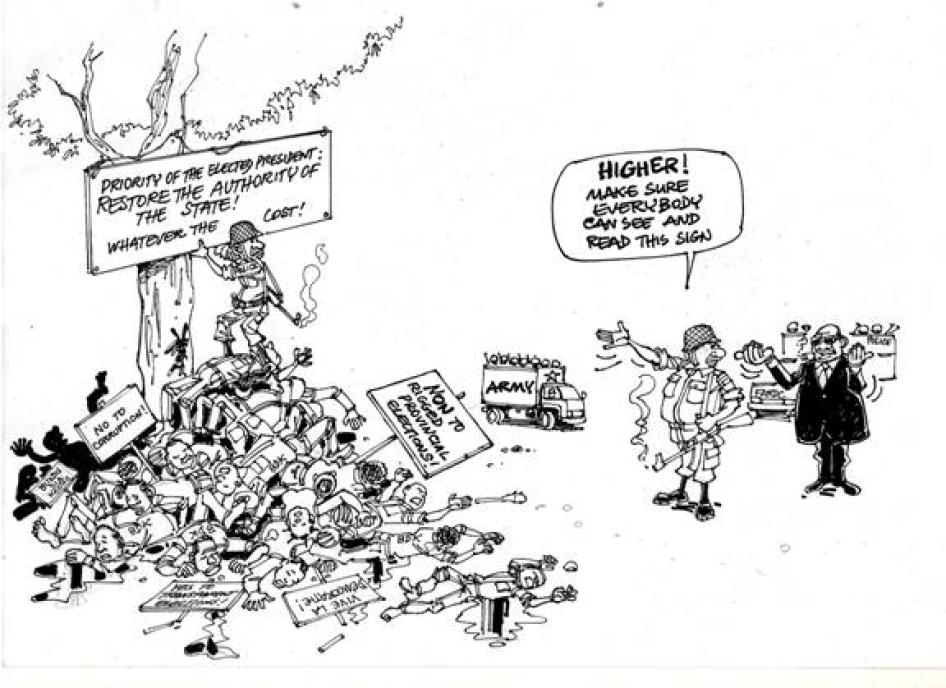
© 2008 Anthony De Bibo/Human Rights Watch
March 2008 Violence
Build-up to renewed violence
The brutal repression against the BDK demonstrators and the flawed gubernatorial elections led to widespread popular resentment toward Bas Congo provincial political leaders and Kabila's government that would continue through 2007. In a number of locations in the territories of Seke-Banza and Luozi, where BDK support is strong and the presence of the police weak, the BDK declared itself in charge of local administration. The BDK freed inmates from Luozi prison whom, it claimed, had been wrongly condemned, but the BDK perpetrated serious human rights abuses of its own. BDK adherents killed an off-duty soldier and harassed and beat local police officers. They set up a local court that convicted two persons of sorcery and burned them to death. They forced some Roman Catholic priests to leave the area.[245] Provincial police responded with renewed force to these challenges to authority.
On January 5, 2008, six people, including one state agent, four BDK supporters and another civilian were killed during BDK protests against the arrest of two other BDK adherents in Seke-Banza territory. The protestors did not carry firearms, though some reportedly carried sticks and shouted abuse at the police. Police officers shot at the protestors and crushed and killed several BDK members with their vehicles when they attempted to flee the scene.[246] Anticipating further trouble ahead of the first anniversary of the February 2007 killings, MONUC sent additional civilian police units to Bas Congo but withdrew them in late February to meet needs in eastern Congo and other volatile regions.
The provincial government continued to label the BDK a "terrorist organization" and increased the pressure on central government officials to neutralize the BDK threat. Charges against the BDK were repeatedly broadcast on pro-government television networks.[247] To help ease the tensions, a leading opposition member from Bas Congo, Gilbert Kiakwama, organized a meeting on February 26, 2008, between BDK leader Nsemi and three Bas Congo Roman Catholic bishops, which led to a common statement of mutual respect and commitment to non-violence.[248]
The same day, President Kabila met with officials, including Interior Minister Kalume and Inspector General of Police John Numbi to discuss the security situation in Bas Congo. On February 28 the government launched a police operation intended, said Kalume, to "restore the authority of the State."[249] Some 600 police officers were dispatched from Kinshasa including units of the Rapid Intervention Police (PIR), the Integrated Police Unit (Unité de Police Intégrée, UPI)[250]and the Simba Battalion, a group of former soldiers, mainly from Katanga, who are part of an anti-terrorist unit, and whose commander, Maj. Christian Ngoyi, was reportedly the de facto head of the operation. Their arms, including grenades and machine guns, gave the operation a strong military character and, according to international police experts, were "totally inappropriate for operations aimed at the arrest and detention of persons who are not carrying firearms."[251] (For more on these expert conclusions, see "MONUC investigation," below. Many of the details of the March violence we present here come from MONUC's report of its investigation.)
Police operation against the BDK
In the last days of February and the first week of March, truckloads of heavily armed police moved through towns in Cataracts district of Bas Congo attacking BDK adherents, most of whom were gathered in or around their zikua meeting places, and at improvised road blocks. The BDK had stones, nuts,[252] sticks, and pieces of wood fashioned into the shape of weapons. Some of them refused to surrender to the police, chanting war cries and sometimes throwing stones, but did not present a serious and immediate threat to the numerically superior, heavily armed police units.[253] With no adequate warning, the police fired at them, killing over 200 and injuring scores of others during three weeks of police operations.
As in previous operations, in the various deadly encounters with BDK adherents during this period the police used excessive force and in some cases deliberately killed persons who were wounded, running away, or otherwise in no position to threaten them. On March 8, during their operation in Matadi, police entered the home of a family who lived near the BDK zikua, demanded money, and then shot two young children, one of whom later died.[254] In some locations, such as at Sumbi village, the police called local residents to look at the bodies of the people they had killed, possibly in an attempt to intimidate others who were or might become BDK adherents. The police systematically burned meeting places, homes, and other buildings belonging to BDK adherents. They arrested over 150 suspected BDK followers, including those who had not participated in any actions against the police, and tortured or ill-treated some of them.[255] One person, arrested at his home in Kinsundi, was transferred along with a group of BDK adherents and two corpses to Lemba village, where police beat the detainees and burned them with hot melted plastic.[256]
Police summarily executed some injured persons seeking medical treatment at health centers and arrested others. A 13-year-old boy who was shot in the leg on March 3 while trying to run away from the violence in Nsumbi village was arrested by police at a clinic while undergoing treatment. He spent six days in prison where he was regularly beaten before judicial officials sent him to a hospital.[257] As the police actions became known, other injured persons fled from clinics and hospitals.[258]
Cover-up again
The police attempted to hide or minimize the extent of the violence. They dumped dozens of bodies in the Congo river and hastily buried others in mass graves. According to a Congolese human rights organization, three graves containing the remains of an estimated 50 bodies were discovered in March. Unidentified persons later dug up the bodies at one grave in Materne and moved them to an unknown location.[259] According to information gathered in April by a provincial parliamentary commission, police ordered first-aid workers to bury 40 bodies in five mass graves in Sumbi, Nienge, and Lolo Bene, in the Seke-Banza territory. Local residents told the commission that some bodies had been removed from the largest of these graves a few days before parliamentarians gathered their information.[260]
On March 5, 2008, Vice-Governor Deo Nkusu and provincial police chief General Raus warned residents of Lufuku, a village where at least 36 persons had been killed, to reject the BDK and keep silent about the casualties in the village.[261] The authorities prevented health teams from entering the area even after police had stopped firing and they limited interaction between the local population and an inter-agency UN humanitarian mission in mid-March.[262]
The government claimed that only 27 people, including three police officers, had died in the events. MONUC investigators concluded that at least 100 people died and noted that they had received information of many more killings that they were unable to confirm. Based on information from local sources, including medical workers, Human Rights Watch estimates the death toll to have been well over 200, with the heaviest loss of life at Seke-Banza, Sumbi, Luozi, Mbandakani, and Lufuku. Among the victims were several people hit by stray bullets, including children.[263]
On March 21 the Congo government revoked the authorization of the BDK to operate as a social and cultural organization, effectively making the movement illegal.[264] In a heated three-day debate from March 27 to 29 in the National Assembly, a number of parliamentarians criticized the government for failing to investigate and prosecute alleged BDK crimes while others criticized the failure to find nonviolent solutions to the crisis and to minimize the use of force. Gilbert Kiakwama, who had sought to calm tensions in late February, initiated the parliamentary debate. He publicly castigated Interior Minister Kalume: "Stop hiding behind the need to restore state authority in an area where state authority had been non-existent," he said. "This excuse cannot justify your actions."[265]
In response Kalume said the police carried out their mission "to protect the population" with great professionalism, characterizing the BDK as a "militia" and their actions as a "rebellion."[266] He repeated this claim to diplomats.[267]
In one of the few judicial proceedings following the Bas Congo violence, a tribunal in Mbanza-Ngungu on May 22 convicted 18 BDK supporters for criminal offenses, including murder. Three of those convicted received the death penalty, while the others received sentences of two months to 20 years. The lawyers for the defense claimed that the only evidence presented to the court was the signed confessions of the accused, which they said had been obtained under torture. Four defendants were acquitted.[268]
MONUC investigation
MONUC human rights investigators received little cooperation from government officials in their efforts to ascertain the facts about and responsibilities for the Bas Congo violence. They nonetheless produced a report on June 13, 2008, concluding that the aim of the operation appeared to have been to cripple the BDK.[269] The investigators criticized the use of the Simba battalion, a special force of police troops with more military than police training, as "at best misguided, or at worst a deliberate decision to conduct a military-style operation aimed at punishing the BDK and severely reducing its capacity as a group."[270]The weapons and tactics used during the operation further reinforced the conclusion that there may have been "a premeditated plan to use lethal force against the BDK."[271]
When the MONUC report was published, a government spokesperson responded by saying that the report was "mendacious." The spokesperson added, "While we congratulate MONUC for taking the trouble to shed light on the situation in Congo, we sadly deplore the overly partial, overly tendentious nature of this report and the casualness of its authors." The spokesperson stood by the government's death toll of 27 people and said MONUC had based its larger figure on "imaginary people."[272]
Under pressure from the UN, the government agreed to conduct a judicial inquiry into the police operation. A similar commitment by government authorities following the 2007 violence in Bas Congo led to no arrests or prosecution of police or army personnel.
Threats against Other Politicians from Bas Congo
The intense debates in the National Assembly about the police operation were given broad media coverage and highlighted Bas Congo opposition politician Gilbert Kiakwama's role as a leading critic of the government's actions. Some of Kiakwama's supporters saw him as a possible contender for the position of spokesperson of the opposition, should Bemba not return home.[273] Kiakwama expressed interest in taking on this role.
With his increasing visibility, Kiakwama became a new target for intimidation by Kabila's supporters. As one local observer later noted to Human Rights Watch, "Kiakwama was the first opposition politician who dared to [conduct] a political tour of Bas Congo, but he was bullied at every step."[274]
On April 27, 2008, Kiakwama, back in Bas Congo for a series of meetings, attended a gathering organized by the Roman Catholic Church. Kabila's People's Party for Reconstruction and Democracy supporters broke up the meeting, shouting abuses at Kiakwama, throwing chairs, and forcing the audience from the hall. On subsequent days two further meetings were disrupted in a similar fashion.[275] Calls to the police for assistance got no response. A senior member of Kiakwama's Christian Democrat party told Human Rights Watch that he had received numerous reports that local "hooligans" had been paid by Vice-Governor Deo Nkusu to disrupt the meetings.[276]
At another meeting on May 2, this time in his home town of Mbanza-Ngungu where Kiakwama in the past regularly met local residents without trouble, a group of 50 persons threw rocks at the meeting hall and dispersed the crowd. Residents identified some of the attackers as Republican Guards in civilian dress from a camp some two kilometers outside of the town. Others were said to be police. Kiakwama's driver was temporarily arrested and Kiakwama was escorted back to Kinshasa by police.[277] When Kiakwama asked for the opportunity to explain the events and register his objections before the National Assembly, he was allowed to speak but was blocked from showing video footage or naming those whom he believed to be responsible for the harassment.[278]
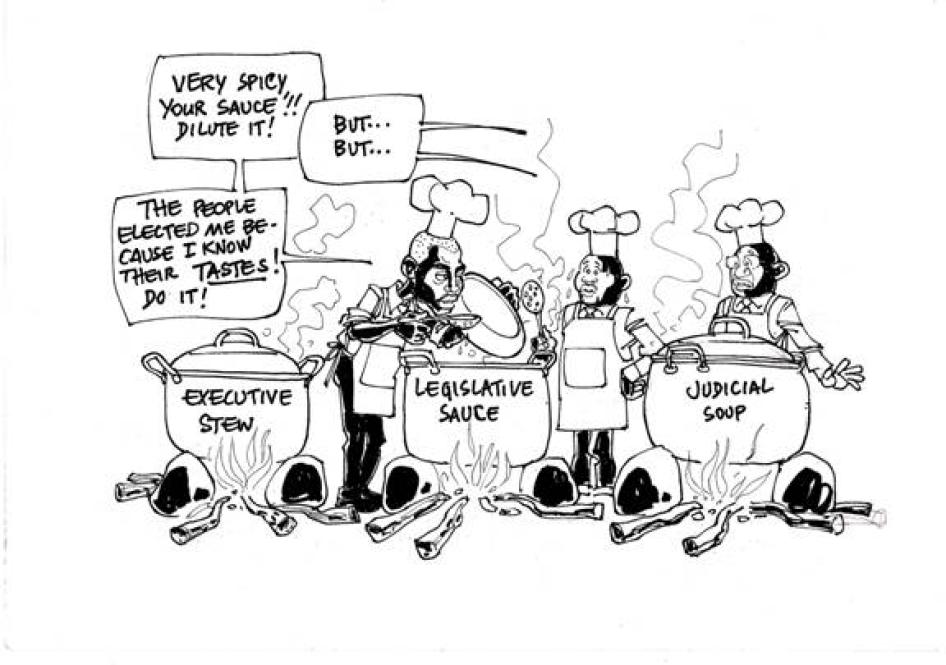
© 2008 Anthony De Bibo/Human Rights Watch
VI. Applicable Legal Standards
International Human Rights Law
The crimes committed by Congolese security forces documented in this report, including summary executions, arbitrary arrest, detention without trial, and torture and inhuman treatment, constitute violations of Congo's obligations under international human rights law, including the International Covenant on Civil and Political Rights (ICCPR), which Congo ratified in 1976; the African Charter on Human and People's Rights, which Congo ratified in 1987; and the Convention against Torture and Other Cruel, Inhuman or Degrading Treatment or Punishment, which Congo ratified in 1996.
Security forces used force, including lethal force, during demonstrations in Bas Congo in January–February 2007 and March 2008 without regard to international standards. The UN Basic Principles on the Use of Force and Firearms by Law Enforcement Officials offer important guidance on the use of force by police and other state agents in circumstances of civil unrest.[279] The principles state that officials exercising police powers shall "not use firearms against persons except in self-defense or defense of others against the imminent threat of death or serious injury … and only when less extreme means are insufficient to achieve these objectives" and that "[i]n any event, intentional lethal use of firearms may only be made when strictly unavoidable in order to protect life."[280]
Governments have a duty to investigate and prosecute serious violations of physical integrity under international law. The UN Human Rights Committee, which monitors the compliance of states parties to the ICCPR, has stated that governments not only have a duty to protect their citizens from such violations, but also to investigate violations when they occur and to bring the perpetrators to justice.[281] According to the committee, when investigations uncover violations of human rights:
States Parties must ensure that those responsible are brought to justice. As with failure to investigate, failure to bring to justice perpetrators of such violations could in and of itself give rise to a separate breach of the Covenant. These obligations arise notably in respect of those violations recognized as criminal under either domestic or international law, such as torture and similar cruel, inhuman and degrading treatment (article 7), [and] summary and arbitrary killing (article 6) … Indeed, the problem of impunity for these violations, a matter of sustained concern by the Committee, may well be an important contributing element in the recurrence of the violations.[282]
International human rights law also enshrines the right to an effective remedy.[283] A victim's right to an effective remedy not only obligates the state to prevent, investigate, and punish serious human rights violations, but also to provide reparations. Among various reparations mechanisms, states should restore the right violated and provide compensation for damages.[284]
International Humanitarian Law
To the extent that fighting between government security forces and Bemba's guards reached the level of an armed conflict, international humanitarian law applies. Applicable international humanitarian law is binding on all parties to the conflict and includes article 3 common to the four Geneva Conventions of 1949 and customary law applicable to non-international armed conflicts. Prohibitions include summary executions and torture, as well as attacks that deliberately target civilians or do not discriminate between civilians and combatants. Congo is party to the Rome Statute of the International Criminal Court, which may exercise jurisdiction for "the most serious crimes of concern to the international community as a whole," specifically, genocide, crimes against humanity, and war crimes.[285]
States have an obligation to investigate and prosecute individuals responsible for war crimes, which are serious violations of international humanitarian law. Commanders and civilian leaders may be prosecuted for war crimes as a matter of command responsibility when they knew or should have known about the commission of war crimes and took insufficient measures to prevent them or punish those responsible.[286]
Congolese Law
The actions of government officials and agencies documented in this report also infringe fundamental rights set out in the Congolese constitution, which came into effect on February 18, 2006.[287]Article 16 of the constitution assures citizens the right to life and the right not to be subjected to cruel, inhuman, or degrading treatment. Article 18 states that all arrested persons must be immediately informed of the reasons for arrest, the charges against them, and their rights. Detained persons have the right to enter into immediate contact with their family or legal counsel and must not be held in police investigative custody for longer than 48 hours, after which time they must be released or brought before the competent judicial authority. The life, physical and mental health, and dignity of all detainees must be protected. Article 19 states that every person has the right to trial before a competent judge within a reasonable time.[288]
Many constitutional rights have been incorporated into the Congolese penal code. For instance, arbitrary arrest is a crime under article 67 of the penal code, punishable by between one and five years' imprisonment. This sentence can be increased up to 20 years if the arrest was accompanied by physical ill-treatment or torture and up to death or life imprisonment where such injuries inflicted in detention result in the death of the victim. (Human Rights Watch opposes the death penalty in all circumstances because of its inherent cruelty and finality.)
Under the constitution, Republican Guards and other military security personnel are not empowered to arrest civilians or detain them in military facilities, such as those at Camp Tshatshi, military intelligence (former DEMIAP) headquarters, or Camp Kokolo. And the military justice system has jurisdiction only to prosecute crimes committed by soldiers and the police, not civilians.[289]
As described in this report, Congolese military, law enforcement, and intelligence personnel have violated fundamental rights protected under domestic and international law with virtual impunity. At this writing, Human Rights Watch is not aware of any officer or state agent having been prosecuted for these serious crimes. No independent and transparent judicial investigation has been conducted into the violence committed by government troops and Bemba's guards in August 2006 or March 2007 in Kinshasa, nor into the violence in Bas Congo in February 2007 and March 2008. Human Rights Watch has found no instance where senior ranking civilian or military leaders sought to prevent or take serious actions to punish individuals under their effective control who were responsible for serious crimes in violation of international law.
The government should conduct investigations into violations of international human rights and humanitarian law documented in this report-whether committed by Congolese military or law enforcement personnel, Bemba's guards, or BDK adherents-and should address both direct responsibility for the commission of crimes and command responsibility. All individuals implicated in crimes should be prosecuted to the fullest extent of the law, regardless of their position or rank. The failure to hold to account those responsible further aggravates Congo's culture of impunity and significantly decreases the likelihood the Congolese government will develop respect for the rule of law, a cornerstone of democracy.
VII. The Role of the International Community
The United Nations and a number of bilateral donors invested significant financial and political capital in the Congolese elections, one of the largest electoral support programs in the UN's history. But with the polls finished, they have failed to invest comparable resources and attention in assuring that the new government implements its international human rights obligations. For donor governments, concern about winning a favored position with the new government took priority over halting abuses and assuring accountability.[290] MONUC proved unwilling to permit its human rights monitors to criticize violations openly so long as the future role of MONUC in Congo was not secured. Eventually Belgium stepped forward to raise concerns about abuses by the Congolese government, while UN envoys proved the most insistent in calling for improvements in human rights.
International Donors
Working through the International Committee Accompanying the Transition (Comité international d'accompagnement de la transition, CIAT), diplomats from 12 countries, the African Union (AU), and the UN coordinated their activities and met regularly with Kabila and Bemba, as well as other key actors, to keep the electoral process on track. They further established a Committee of the Wise with African former heads of state to help them in their efforts. Donor states pinned their hopes on the electoral process, expecting that it would allow them to begin drawing down the costly UN peacekeeping operation, MONUC, and to see some return on the aid money invested in trying to restore a functioning state. Preoccupied with the political and logistical challenges of the electoral process, international actors did little to plan for the period after elections.
Economic concerns take priority
After the completion of the elections and the inauguration of President Kabila in December 2007, the mood in Kinshasa among diplomats and UN officials was a mixture of celebration and relief. Many went on leave following Kabila's inauguration and those who remained focused on developing bilateral relations, especially in the economic domain, with the newly elected president and his government.[291] Shortly after the killings of BDK adherents in February 2007, Belgium signed a cooperation agreement worth €195 million for 2007-2008.[292] The World Bank pledged US$1.4 billion.[293] The French cooperation minister, Brigitte Girardin, signed a five-year partnership agreement for €235 million with Kabila in Kinshasa on March 27, 2007, even as gun battles pitted government soldiers against Bemba's guard.[294] During a visit on April 23, UK International Development Secretary Hilary Benn announced an aid contribution of £70 million for 2007, though added a caveat that his government would "judge progress by events."[295] In September 2007 Congo received a US$9 billion loan and investment package from China.
There was little scrutiny of gubernatorial and senate elections in January 2007 and little attention paid to the evident corruption of the process, so that diplomats were taken by surprise by the Bas Congo protests and ensuing violence against the protestors. Few joined the UN in publicly condemning the violence. One diplomat in Kinshasa later told Human Rights Watch that at the time, "nobody protested enough."[296] No donor provided financial or political support to the National Assembly's first commission of inquiry established to investigate the Bas Congo events, thus missing an opportunity to encourage parliamentary efforts to hold the government accountable for human rights violations.
The violence in March 2007 elicited a somewhat more robust response from diplomats and UN officials, who had begun to raise questions about the direction of the new government. The EU Heads of Mission issued a statement deploring the premature use of force and the loss of civilian lives.[297] A small group of EU diplomats met with Kabila to condemn the violence and attacks on diplomatic missions. But on March 29 the German ambassador undercut the criticism by telling reporters the EU had ruled out any suspension of cooperation.[298]
South African diplomats and UN officials played an important role in providing security for Bemba and his family in March 2007 and in facilitating his departure in April for medical treatment in Portugal.[299] Once Bemba was gone, few diplomats wanted to see him return. As one diplomat remarked to Human Rights Watch, "Kabila is much calmer now that Bemba is gone and the country is better off."[300] One of the few to recognize that the departure of Bemba could hinder the development of a strong opposition, EU Commissioner for Development and Humanitarian Aid Louis Michel, attempted in July 2007 to negotiate with Kabila for Bemba's eventual return to Kinshasa, but he was unsuccessful.
Ready to accept Bemba's removal from the leadership of the opposition, donor governments nonetheless hoped to ensure the opposition more political space in parliament by calling for legislation that would guarantee and specify the role of the opposition and create the position of "spokesperson" of the opposition (see above, Chapter IV).[301] International pressure apparently played an important part also in assisting opposition politicians to obtain the chairmanship of two committees. Diplomats also monitored and raised objections about fair trial lapses in the military trial of Bemba's lawyer Marie-Thérèse Nlandu.
Donor governments said they would devote considerable financial and technical resources to security sector reform programs, but have yet to insist that such programs include adequate vetting to rid the military and law enforcement services of individuals in senior positions who have been implicated in serious human rights violations.
The Belgians take the lead
In late 2007 and 2008 the Belgian government took the lead in raising concerns with Kabila over corruption, violation of human rights, and the lack of transparency in Congolese dealings with China. Belgium particularly criticized the Congolese government's unwillingness to accept the continuation of the mandate of the UN Human Rights Council's independent expert for Congo (see below). When Foreign Minister Karel De Gucht and two other Belgian ministers met with Kabila in April 2008, the session turned into an angry confrontation following which Kabila declared that Belgium should choose between "an adult partnership ... or a master-slave relationship" with Congo. He said that he would not "accept a Belgian delegation come[ing] to Kinshasa and tell[ing] us how to run our country."[302] Congo recalled its ambassador from Belgium.[303]
The Belgian effort failed to spur other donor governments to raise human rights issues, significantly reducing the impact of the Belgian intervention.
The UN Peacekeeping Mission, MONUC
The UN peacekeeping force in Congo, MONUC, had to redefine its role in the wake of the elections. It has struggled to maintain its impartiality among contending political actors while still implementing its mandate to protect civilians.
MONUC peacekeepers helped rescue civilians during the March 2007 violence and attempted as soon as was possible to visit places where people were detained and where summary executions and torture were reportedly taking place, though such attempts were often rebuffed. MONUC's human rights section regularly monitored places of detention in Kinshasa, attempted to intervene in individual cases of wrongful detention and of torture, and stayed in regular contact with political opponents and others who were intimidated and harassed. The daily interventions over the course of weeks and months assisted scores of people who would otherwise have gone unaided.
MONUC also assisted some 160 of Bemba's guards who sought protection during the March 2007 violence, protecting them with more than 250 family members at a secure compound in Kinshasa. MONUC refused to hand them over to Congolese government authorities without guarantees for their safety. When MONUC prepared a draft agreement providing such guarantees, Congolese authorities deleted references to common article 3 of the Geneva Conventions, modified the provision concerning the death penalty, and insisted that MONUC have prior authorization from Congolese judicial authorities before being able to visit any persons who might subsequently be arrested by the government.[304] MONUC refused to accept a number of these conditions, and at this writing the group remained under MONUC protection.[305]
Unfortunately, lack of high-level political support from within MONUC and obstacles to publishing reports in a timely fashion to demonstrate the pattern and scale of the abuses seriously limited the impact of work by the mission's dedicated human rights professionals. Following the killings in Bas Congo in February 2007, MONUC sent a multi-disciplinary team to investigate. Its report was not published for five months as it was deemed "too sensitive." UN officials did not want to criticize the new government before securing its agreement on the role of MONUC in the post-electoral period.[306] Similarly MONUC delayed publication of its report on the March 2007 events for fear of upsetting relations with Kabila. Both reports were blocked by the head of MONUC, Ambassador William Swing, who deflected repeated requests from the UN Department for Peacekeeping Operations (DPKO) in New York and from the then UN high commissioner for human rights, Louise Arbour, for the reports to be made public.[307] If the reports had been promptly published, they could have contributed to wider awareness of the serious violations committed and might have led to additional diplomatic pressure on the Congolese government to halt the abuses and hold the perpetrators accountable. The March 2007 investigation report was eventually published in French on January 4, 2008, after a copy was leaked to the press; no English version has been made public.
In what may represent a change of policy, MONUC published its investigation report on the 2008 Bas Congo violence in a more timely fashion, three months after the events.
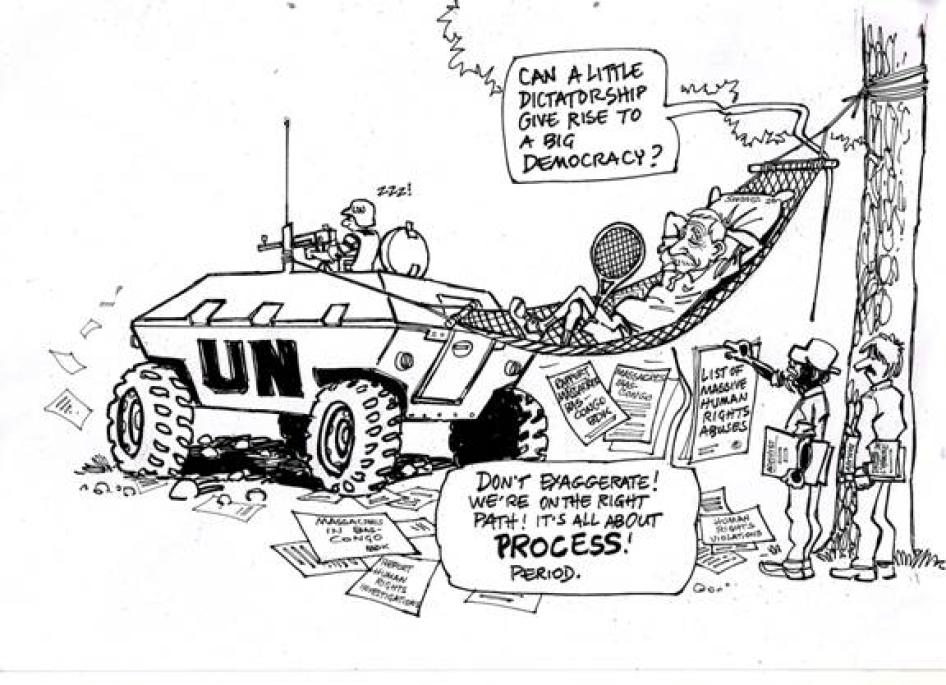
© 2008 Anthony De Bibo/Human Rights Watch
UN Human Rights Envoys
The most vocal and detailed criticisms of human rights violations in Congo came from UN experts and special rapporteurs who visited Congo in 2007 and 2008. The most high-profile visitor was then-High Commissioner Arbour, who met with Kabila in Kinshasa in May 2007. She criticized the "culture of impunity that reigns virtually throughout [the] country" and remarked that "grave human rights violations occur almost every day in DRC."[308]
After visiting Congo in April 2007, the UN special rapporteur on the independence of judges and lawyers, Leandro Despouy, concluded that "uniformed men, such as soldiers and [intelligence officers], often carry out arbitrary arrests and detentions - which is beyond their authority - and often for activities that do not constitute a crime."[309]He added that interference by the executive and the army in judicial proceedings was "very common."[310]In June 2007 Despouy wrote the Congolese government to express serious concern about the lack of judicial action for grave human rights abuses committed by the army and law enforcement services in Bas Congo and in Kinshasa in March 2007. He commented, "The lack of action by military judges on these serious cases is extremely worrying and contributes significantly to a climate of impunity and insecurity in the country."[311]
In annual reports to the Human Rights Council in Geneva in 2007 and 2008 the independent expert on Congo, Titinga Frédéric Pacéré, also raised serious concerns about human rights violations in Congo. In his 2008 report he condemned the March 2007 violence in Kinshasa and noted that "despite the undertaking by President Joseph Kabila and the Congolese Government to prioritize efforts to combat impunity following the elections, little progress has been made."[312]
Despite these serious criticisms, the Human Rights Council discontinued the mandate of the independent expert on Congo in March 2008. Kabila had privately assured diplomats in Kinshasa that he would support the continuation of the mandate, but Congolese government officials in Geneva actively lobbied against it.[313] The EU and states which had said they would make renewal of the mandate a key priority did not vote against the motion discontinuing the mandate and agreed to a weak compromise scheduling the next discussion on the human rights situation in Congo for March 2009.
The Deficiency in International Attention to Congo
In the press to establish good relations with the newly elected president, donor nations and other international actors have given little attention to the grave human rights violations of the first two years of the Kabila government and the failure to hold accountable the perpetrators of these abuses. Although they took some steps to ensure political space for the opposition, they failed to act otherwise to check executive power, even though some Congolese were voicing concerns about the lurch to authoritarian rule. In May 2007, one of Kinshasa's main newspapers, Le Potentiel, ran an opinion piece about the ruthless behavior of the government. Questioning the electoral process and its bloody aftermath in Kinshasa and Bas Congo, the author lamented, "We were ardently searching to become a democracy, but we are on our way to becoming an absurd dictatorship."[314]
Elections themselves cannot bring democracy. Congolese and international actors must work to establish an independent judiciary and a vibrant parliament with an effective opposition to improve human rights, hold the executive to account for its actions, and counterbalance the restriction of political space. Failure to establish such counterweights will endanger Congo's young democracy. The same kind of focus and international cooperation that brought about the elections must be replicated in the cause of improving human rights and opening up democratic space if the hopes for stability and improved governance for this war-torn nation are to be fulfilled.
Acknowledgments
This report was researched and written by a team of researchers led by Anneke Van Woudenberg, senior researcher in the Africa Division of Human Rights Watch, and including consultants Aurélie Demaugé and Fred Robarts. The report was reviewed and edited by Alison Des Forges, senior advisor to the Africa Division; Ian Gorvin, senior program officer; and James Ross, legal director at Human Rights Watch. Sarah Jackson and Sarah Mathewson, associates in the Africa Division, provided invaluable production assistance and support. Grace Choi, publications director, provided production coordination. Danielle Serres translated this report into French.
Human Rights Watch thanks our many international and local colleagues who provided us with valuable insight and information. In particular we would like to thank the eyewitnesses, victims, officials, and others who agreed to speak to us about their experiences. Because of the sensitivity of our research, we regret that we have to withhold the names of those whose assistance we greatly appreciated.
Human Rights Watch gratefully acknowledges the generous support of the Open Society Institute for this work.
[1] Détection militaire des activités anti-patrie, Military Detection of Anti-State Activities.
[2] The International Rescue Committee, "Mortality in the Democratic Republic of Congo: An Ongoing Crisis," January 22, 2008, http://www.theirc.org/special-report/congo-forgotten-crisis.html (accessed August 4, 2008).
[3] In Lingala the slogan was mwana mboka (son of the soil), in French fils du pays.
[4] Kabila won 45 percent of the votes, Bemba 20 percent, with other candidates taking the remainder.
[5] "The DR Congo's dangerous run-off," Open Democracy, August 23, 2008, http://www.opendemocracy.net/democracy-africa_democracy/drc_runoff_3845.jsp (accessed August 28, 2008); "Congo election shows worrying East-West divide," Reuters, August 4, 2006, reproduced at http://www.redorbit.com/news/international/602514/congo_election_shows_worrying_eastwest_divide/index.html (accessed September 12, 2008).
[6] Human Rights Watch interview with diplomats, Kinshasa, August 16 and 31, 2006. In an attempt to find more support in the west, the Kabila camp persuaded rival politicians to join their campaign for the runoff election round including Francois Joseph Nzanga Mobutu, the son of former leader Mobutu Sese Seko, and Antoine Gizenga, an elderly politician from Bandundu province. Both were later rewarded with senior government posts: Gizenga became prime minister, while Nzanga Mobutu was appointed minister of state for agriculture. These appointments did help Kabila to gain further votes in the west, but not enough to dramatically overturn the east-west divide.
[7] Known as the Global and All-Inclusive Agreement, it was signed in South Africa in 2002.
[8] The Republican Guard was formerly known as the Garde Spéciale de Sécurité Présidentielle (GSSP). See Human Rights Watch, Democratic Republic of Congo – Elections in Sight: "Don't Rock the Boat"?, December 15, 2005, hrw.org/backgrounder/africa/drc1205/.
[9] Human Rights Watch interviews with diplomats and donor representatives, Kinshasa, August 16 and 31 and September 3, 2006.
[10] Bemba's bodyguards were part of the Presidential Protection Division (Division de Protection Présidentielle, DPP), a part of the government army. Throughout this report they are referred to as "Bemba's guards."
[11] Bemba's other guards were based in Gbadolite and Gemena in the province of Equateur. Human Rights Watch email correspondence with MONUC official, June 5, 2008.
[12] Human Rights Watch interview with Congolese analyst, Kinshasa, August 17, 2007.
[13]"Sortir de la politique du pire: Une exigence pour le chef de l'Etat, " Le Potentiel Newspaper , Kinshasa, May 18, 2007
[14] Human Rights Watch interview with Congolese army officer, Kinshasa, August 31, 2007.
[15] Human Rights Watch interviews with Republican Guard officer, September 19 and November 27, 2007; and Congolese army officer, Kinshasa, August 31, 2007.
[16] Human Rights Watch interview with Denis Kalume, minister of the interior, Kinshasa, November 5, 2007.
[17] Human Rights Watch interview with Kabila insider, Kinshasa, November 22, 2007.
[18] Human Rights Watch interview with Senator Jean-Pierre Bemba, Faro, Portugal, October 4, 2007.
[19] Ibid.
[20] Kalume, a former general, was appointed minister of the interior in October 2006.
[21] Human Rights Watch interview with Denis Kalume, November 5, 2007
[22] Human Rights Watch interview with Kabila advisor, Kinshasa, August 26, 2007.
[23] UN Security Council, Twenty-second report of the Secretary-General on the United Nations Organization Mission in the Democratic Republic of the Congo, S/2006/759, September 21, 2006, para. 13; Human Rights Watch interview with CCTV staff member, Kinshasa, August 17, 2007.
[24] UN Security Council, Twenty-second report of the Secretary-General on the UN Mission in DRC, para. 18. Human Rights Watch interview with European military expert, Kinshasa, August 31, 2006.
[25] UN Security Council, Twenty-second report of the Secretary-General on the UN Mission in DRC, para. 18.
[26] Ibid., paras. 19-23.
[27] UN Security Council, Twenty-second report of the Secretary-General on the UN Mission in DRC, para. 25.
[28] United Nations, MONUC Human Rights Division and the Office of the High Commissioner for Human Rights (OHCHR) joint report, "The Human Rights Situation in the Democratic Republic of Congo (DRC) during the period of July to December 2006," February 8, 2007, para. 25.
[29] Ibid.
[30] Human Rights Watch interview with MONUC official, Kinshasa, November 17, 2006.
[31] Human Rights Watch interview with diplomat, Kinshasa, August 31, 2006.
[32] Human Rights Watch interview with diplomat, Kinshasa, September 2007.
[33] EU Election Observation Mission in the Democratic Republic of Congo, "Rapport Final: Elections présidentielle, législatives et provinciales 2006," Kinshasa, February 23, 2007, p. 46 ("véritables machines de guerre au service de leur candidat de prédilection").
[34] The EU made numerous public comments about the bias of the public broadcaster RTNC. Ibid., and EU Election Observation Mission in the Democratic Republic of Congo, Preliminary Declaration, November 1, 2006.
[35]Human Rights Watch interview with Kabila advisor, Kinshasa, August 29, 2007.
[36] Carter Center, "Preliminary Statement on the Oct. 29 Presidential Elections in the Democratic Republic of Congo," Kinshasa, November 1, 2006. See also EU Election Observation Mission, "Rapport Final," p. 47.
[37] "Bemba accepts DR Congo poll loss," BBC News Online, November 28, 2006, http://news.bbc.co.uk/1/hi/world/africa/6193384.stm (accessed August 4, 2008).
[38] Human Rights Watch interview with person close to Kabila, Kinshasa, August 29, 2007.
[39] Human Rights Watch interview with Kabila advisor, Kinshasa, August 26, 2007.
[40] Human Rights Watch interview with European military expert, Kinshasa, August 17, 2007.
[41] United Nations, MONUC Human Rights Division and the Office of the High Commissioner for Human Rights Special Report, "Special Investigation Into the Kinshasa Events of March 2007 and their Aftermath: Preliminary Findings," unpublished English version, June 2007, para. 14.
[42] Human Rights Watch interviews with Denis Kalume, Kinshasa, November 5, 2007; foreign military expert, Kinshasa, August 17, 2007; and Kabila advisor, Kinshasa, August 26, 2007.
[43] Lt. Gen. Kisemplia Sungilinga Lombe, "Communiqué du Haut Commandement des FARDC," Kinshasa, March 6, 2007, on file with Human Rights Watch.
[44] Human Rights Watch interview with Jean-Pierre Bemba, October 4, 2007. See also "Affrontements de Kinshasa: l'interview qui a jeté la poudre au feu," Congolite, March 26, 2007, http://www.congolite.com/polsoc305.htm (accessed August 4, 2008).
[45] "Déclaration d'intentions post électorales des deux candidats au deuxième tour des présidentielles du 29 octobre 2006," available at http://www.monuc.org/downloads/Declaration_d_intentions_post_electorales_des_deux_candidats.pdf (accessed August 4, 2008); Human Rights Watch interviews with Jean-Pierre Bemba, October 4, 2007; and Bemba security guards, Brazzaville, August 27-28, 2007.
[46] Human Rights Watch interviews with Congolese army officer, August 31, 2007; Bemba supporter, August 16 and 18, 2007; and foreign military expert, Kinshasa, August 17, 2007.
[47] Human Rights Watch interviews with senior diplomat, Kinshasa, September 10, 2007; and senior Congolese politician, January 16, 2008.
[48] In February 2007 Angola claimed a number of villages reportedly rich in diamonds in Kahemba, in the southern province of Bandundu, bordering Angola. The villages had been administered by Congolese officials for years and residents had voted in Congo's elections. A Congolese parliamentary commission set up to investigate the claims concluded in July 2007 the communities were on Congolese soil and that Angola's occupation was illegal. A government appointed expert delegation published its report before the parliamentary investigation had concluded its work and found the communities were inside Angolan territory, causing uproar in Kinshasa. A joint DRC-Angola commission was established with the help of former colonial powers Belgium and Portugal to determine the exact location of the border. International Crisis Group, "Congo: Consolidating the Peace," Report No. 128, July 5, 2007.
[49]"Affrontements de Kinshasa: l'interview qui a jeté la poudre au feu," Congolite.
[50] Human Rights Watch interview with former senior government minister, Goma, January 26, 2008.
[51] Human Rights Watch interview with Kabila advisor, Kinshasa, August 26, 2007.
[52] Human Rights Watch interviews with Kabila advisor, Kinshasa, August 26, 2007; and former senior government minister, Goma, January 26, 2008. See also MONUC Human Rights Division and OHCHR, "Special Investigation Into the Kinshasa Events of March 2007 and their Aftermath," para. 17.
[53] Human Rights Watch interviews with CCTV managers, Kinshasa, August 17 and September 4, 2007.
[54] MONUC Human Rights Division and OHCHR, "Special Investigation Into the Kinshasa Events of March 2007 and their Aftermath," para. 15. Figures on Bemba's guards were further clarified in email correspondence between Human Rights Watch and a MONUC official, June 5, 2008.
[55] Human Rights watch interview with Tsoumou Gavouka Mpili, general director, Humanitarian Action and Solidarity Unit, Government of RoC, Brazzaville, August 29, 2007.
[56] Human Rights Watch interviews with MONUC political affairs official, September 28, 2007; and former Bemba guard who surrendered, Kinshasa, August 24, 2007.
[57] MONUC Human Rights Division and OHCHR, "Special Investigation Into the Kinshasa Events of March 2007 and their Aftermath," para. 15.
[58] International Crisis Group, "Congo: Consolidating the Peace," Report No. 128, July 5, 2007, page 11.
[59] Ibid.
[60] Human Rights Watch email communication with US diplomat, Kinshasa, June 13, 2008.
[61] Human Rights Watch interviews with Jean-Pierre Bemba, October 4, 2007; and former Vice-President Azarias Ruberwa, Congo, January 16, 2008.
[62] Human Rights Watch interviews with Kabila advisor, Kinshasa, August 26, 2007; intelligence officials, Kinshasa, August 29 and September 10, 2007; Kabila insider, November 22, 2007; and former senior government minister, January 26, 2008.
[63] Human Rights Watch interview with foreign military advisor, Kinshasa, August 17, 2007.
[64] Human Rights Watch interviews with former detainees at Camp Tshatshi and other locations, Kinshasa, August 15-17 and 24-26, 2007.
[65] Human Rights Watch interview with former Camp Tshatshi detainee, Kinshasa, August 24-25, 2007.
[66] Human Rights Watch interview with former Camp Tshatshi detainee, Kinshasa, August 15, 2007.
[67] Ibid.
[68] Human Rights Watch interviews with former Camp Tshatshi detainees, Kinshasa, August 15 and 17, 2007.
[69] MONUC Human Rights Division and OHCHR, "Special Investigation into the Kinshasa Events of March 2007 and their Aftermath," para. 57. Human Rights Watch interview with MONUC official, Kinshasa, September 1, 2007.
[70] MONUC Human Rights Division and OHCHR, "Special Investigation into the Kinshasa Events of March 2007 and their Aftermath," paras 47 and 57. Human Rights Watch interview with MONUC official, Kinshasa, September 1, 2007.
[71] MONUC Human Rights Division and OHCHR, "Special Investigation Into the Kinshasa Events of March 2007 and their Aftermath," paras 24 and 52.
[72] Human Rights Watch interview with eyewitness, Kinshasa, August 25, 2007.
[73] MONUC Human Rights Division and OHCHR, "Special Investigation Into the Kinshasa Events of March 2007 and their Aftermath," para. 52.
[74] Human Rights Watch interview with eyewitnesses, Kinshasa, August 25, 2007.
[75] Human Rights Watch interview with MONUC official, Kinshasa, September 3, 2007. MONUC Human Rights Division and OHCHR, "Special Investigation Into the Kinshasa Events of March 2007 and their Aftermath," para. 55.
[76] Human Rights Watch interviews with eyewitnesses, Brazzaville, August 27 and 28, 2007.
[77]"Kinshasa governor denies role in politician's murder," Reuters, July 29, 2008.
[78]"L'opposition déserte le parlement" and "Des Partis de l'opposition et de l'AMP appuient la position du MLC," Journal du Citoyen, No. 135, July 12-18, 2008.
[79]"Five Get Death for Killing of DRC MP," Agence France-Presse, October 8, 2008.
[80] Human Rights Watch interview with member of the family of Dr. Sosso, Kinshasa, February 28, 2007.
[81] Human Rights Watch interview with MONUC official, Kinshasa, September 1, 2007.
[82] Human Rights Watch interview with member of the family of Dr. Sosso, Kinshasa, February 28, 2007.
[83] Human Rights Watch interviews with former Camp Tshatshi detainees, Kinshasa, August 15-17, 2007; and Republican Guard officer, Kinshasa, September 19 and November 27, 2007.
[84] UN General Assembly, Report of the independent expert on the situation of human rights in the Democratic Republic of the Congo, Mr. Titinga Frédéric Pacéré, A/HRC/4/7, February 21, 2007.
[85] Human Rights Watch interviews with former Camp Tshatshi detainees, Kinshasa, August 15 and 16, 2007. Confidential information from MONUC on file with Human Rights Watch.
[86] Human Rights Watch interview with former Camp Tshatshi detainee, Kinshasa, August 17, 2007.
[87] Human Rights Watch interview with Republican Guard officer, Kinshasa, November 27, 2007.
[88] Human Rights Watch interview with former Camp Tshatshi detainee, Kinshasa, August 17, 2007.
[89] Human Rights Watch interview with former Camp Tshatshi detainee, Kinshasa, August 15, 2007.
[90] Ibid.
[91] Human Rights Watch interviews with former detainees and family members, Kinshasa, August 16 and 21 and September 24 and 26, 2007.
[92] Human Rights Watch interviews with former detainees, Kinshasa, August 16 and 21, 2007.
[93] The Simba Battalion is a group of former soldiers, mainly from Katanga, who are part of an anti-terrorist unit in the Rapid Intervention Police. See Box 1 for further details.
[94] UN cable, Kinshasa to New York, September 25, 2008. On file at Human Rights Watch.
[95] Ibid.
[96]Human Rights Watch telephone interview with MONUC official, June 6, 2008, and email communication, June 4 and 6, 2008. "Allégations persistantes d'exécution sommaire et extra-judiciaires des militaires des ex-FAZ," Voix des sans Voix press release no. 29, Kinshasa, August 14, 2008.
[97] Human Rights Watch interview with former Camp Tshatshi detainees, Kinshasa, August 15 and 17, 2007.
[98] Human Rights Watch interviews with former Camp Tshatshi detainees, Kinshasa, August 15-17 and 24-25, 2007.
[99] Human Rights Watch interview with local human rights activist, Kinshasa, August 19, 2007.
[100] Human Rights Watch interview with MONUC official, September 3, 2007; and Republican Guard officer, November 27, 2007.
[101] Human Rights Watch interview with former Camp Tshatshi detainee, Kinshasa, August 17, 2007.
[102] Human Rights Watch interview with intelligence official, Kinshasa, September 10, 2007.
[103] Human Rights Watch interviews with intelligence officials, Kinshasa, August 29 and September 10, 2007.
[104] Human Rights Watch interview with Gen. Unyon Vakpa, head of Services Spéciaux, Kinshasa, September 3, 2007; and intelligence officials, Kinshasa, September 4 and 10, 2007.
[105] Human Rights Watch interviews with intelligence officials, Kinshasa, August 29 and September 10, 2007.
[106] Ibid.
[107] Human Rights Watch interview with Gen. Unyon Vakpa, September 3, 2007.
[108] Tribunal Militaire de Garnison de Kinshasa-Gombe, Jugement, Case RP No. 221/2006, Kinshasa, April 30, 2007.
[109] Human Rights Watch interview with senior legal officer, Kinshasa, August 21, 2007.
[110] Human Rights Watch interview with former detainee at Kin-Mazière prison, Kinshasa, August 23, 2007.
[111] Human Rights Watch interview with former detainee at Kin-Mazière prison, Kinshasa, March 12, 2007.
[112] Human Rights Watch interviews with former detainees at Kin-Mazière prison, Kinshasa, March 2 and 9, 2007.
[113]Human Rights Watch interview with former detainee at Kin-Mazière prison, Kinshasa, March 9, 2007.
[114]Human Rights Watch interview with former detainee at Kin-Mazière prison, Kinshasa, March 1, 2007.
[115]Human Rights Watch interviews with lawyers representing the detainees, Kinshasa, February 28 and August 24 and 26, 2007.
[116] UN General Assembly, Report of the independent expert on the situation of human rights in the Democratic Republic of the Congo, A/HRC/4/7, para. 26.
[117] Human Rights Watch interview with detainees arrested at activist's house, Kinshasa, August 25, 2007.
[118] Human Rights Watch visit to DEMIAP, September 12, 2007. Human Rights Watch interviews with family members of detainees, September 6and 12, 2007.
[119] UN cable Kinshasa to New York, September 25, 2008. On file at Human Rights Watch.
[120] Ibid.
[121] Human Rights Watch interviews with former detainees and family members, Kinshasa, August 16 and 21 and September 24 and 26, 2007.
[122] UN cable Kinshasa to New York, September 25, 2008. On file at Human Rights Watch.
[123] Human Rights Watch interviews with former detainee at the Palais des Marbres, Kinshasa, August 17, and with human rights activists who followed the case, Kinshasa, August 18, 2007. The former detainee showed Human Rights Watch two official receipts he obtained during his detention, one of which had a stamp of the Palais des Marbres corresponding to the dates of detention.
[124] Human Rights Watch interviews with detainees at Makala prison, August 24 and 25, 2007.
[125] Human Rights Watch interviews with former detainees and family members, August 15, 19, and 21, 2007; and human rights monitors, Kinshasa, August 21 and 27, 2007. ANR violations are also regularly described in MONUC human rights reports-see, for example, MONUC Human Rights Division and OHCHR, "The human rights situation in the DRC during the period of July to December 2007," February 2008.
[126] MONUC Human Rights Division and OHCHR, "Special Investigation Into the Kinshasa Events of March 2007 and their Aftermath," para. 73.
[127] Human Rights Watch interviews with Jeannot Bemba, Kinshasa, August 22, 2007; and MONUC official who inspected the residence shortly after the attack, Kinshasa, August 27, 2007. Human Rights Watch saw the traces of bullet marks still visible on interior and exterior walls of the house.
[128] MONUC Human Rights Division and OHCHR, "Special Investigation Into the Kinshasa Events of March 2007 and their Aftermath," para. 45.
[129] "RDCongo: les députés de Bemba réintègrent le siège saccagé de leur parti," Agence France-Presse, April 21, 2007.
[130] Human Rights Watch interview with CCTV manager, Kinshasa, August 17, 2007. "Inspection certificate of the looted property," from Judicial Police and the Republican Guard carried out on May 10, 2007, on the instructions of the Procureur General, on file with Human Rights Watch.
[131] Human Rights Watch interview with Thomas Luhaka, MLC executive secretary, Kinshasa, September 10, 2007.
[132] Ibid.
[133] Human Rights Watch interview with party activist, August 27, 2007.
[134] Ibid.
[135] Human Rights Watch interview with Governor Jose Makila, Mbandaka, September 7, 2007; and witnesses to police operation at the governor's home, Kinshasa, September 9, 2007.
[136] "Bemba's Party Concerned about Security," Reuters, April 14, 2007.
[137] Human Rights Watch interview with Thomas Luhaka, September 10, 2007.
[138] MONUC Human Rights Monthly Report for February 2008, http://www.monuc.org/news.aspx?newsID=17105 (accessed July 2, 2008).
[139] "RDC: libération d'un cadre du MLC (opposition) arrêté le 20 juin," Agence France-Presse, June 26, 2008.
[140] Human Rights Watch interviews with CCTV managers and journalists, Kinshasa, August 17, 20, and 21, 2007. See also MONUC Human Rights Division and OHCHR, "Report on the human rights situation in the DRC July to December 2006," February 8, 2007.
[141] Human Rights Watch interview with senior journalist, Kinshasa, August 20, 2007.
[142] Human Rights Watch interview with opposition media journalist, August 27, 2007.
[143] Human Rights Watch interview with CCTV manager, Kinshasa, August 20, 2007.
[144] Human Rights Watch interview with CCTV news editor, Kinshasa, August 17, 2007. Franck Ngyke of La Référence Plus and his wife Hélène Mpaka were murdered outside their Kinshasa home in November 2005. Four suspects were arrested, but their trial has been subject to repeated adjournments. See Human Rights Watch, Democratic Republic of Congo – Journalists and Human Rights Defenders Under Fire, June 2006, http://hrw.org/backgrounder/africa/drc0606/2.htm#_Toc137546983.
[145] "22 chaines de télévision et 16 stations de radio interdites de diffusion à Kinshasa," Le Phare (Kinshasa), October 21, 2007, reproduced with a list of affected stations at http://www.laconscience.com/article.php?id_article=6603 (accessed August 4, 2008).
[146] Memo from affected television stations to the president of the National Assembly, November 22, 2007, on file with Human Rights Watch. See also Reporters Without Borders, "Community Radio Stations Threatened by Botched Government Decree," October 25, 2007, http://www.rsf.org/print.php3?id_article=24161 (accessed August 4, 2008).
[147] "JED salue la levée partielle de la mesure d'interdiction frappant une trentaine des radios et télévisions," JED press release, December 21, 2007, http://www.jed-afrique.org/full_view.php?id_alerte=717 (accessed August 6, 2008).
[148] Journaliste en danger (JED) and International Freedom of Expression Exchange (IFEX), "Eleven journalists briefly detained and beaten by police for covering opposition demonstration in Kinshasa," October 31, 2007, http://www.ifex.org/en/content/view/full/87355/ (accessed August 4, 2008).
[149] Human Rights Watch telephone interview with journalist, Kinshasa, November 23, 2007.
[150] Anonymous text message to Journaliste en Danger, June 3, 2007, seen by Human Rights Watch September 10, 2007: "Vous JED pr qui vs vs prenez? Si vs n ete pas daccord avec le regime allez en exil et attendez quand vtre champion prendra le pvr. Si vs ne partez pas on va vs aider a vs taire definitivement. On ne vou ratera. Trop c est trop. Un homme averti."
[151] Human Rights Watch interview with JED representatives, August 20, 2007.
[152] "Disparition de deux professionnels des médias à Kinshasa," Journaliste en Danger and Reporters Sans Frontières joint letter, April 10, 2008.
[153] "DR Congo rights group protests journalist's arrest," Agence France-Presse, September 16, 2008, http://www.citizen.co.za/index/article.aspx?pDesc=77871,1,22 (Accessed on September 16, 2008)
[154] Human Rights Watch interviews with Republican Guard officer, Kinshasa, September 19 and November 27, 2007.
[155] Human Rights Watch interview with UN officials, Kinshasa, September 3, 2007.
[156] Human Rights Watch interviews with Republican Guard officer, Kinshasa, September 19 and November 27, 2007; FARDC officer, August 31, 2007; civilian intelligence officer, September 10, 2007; military intelligence officer, September 4, 2007; and Kabila advisor, August, 26, 2007.
[157] Human Rights Watch interview with Congolese army officer, Kinshasa, August 31, 2007.
[158] Human Rights Watch phone interview with MONUC official, Kinshasa, June 8, 2008.
[159] Human Rights Watch interviews with Republican Guard officer, Kinshasa, September 19 and November 27, 2007; and former Camp Tshatshi detainees, August 17 and 19, 2007.
[160] Ibid.
[161] Human Rights Watch interviews with Nlandu co-accused, August 28, 2007; and Marie-Thérèse Nlandu, former presidential candidate and Bemba lawyer, London, May 2007.
[162] Tribunal Militaire de Garnison de Kinshasa-Gombe, Jugement, Case RP No. 221/2006, Kinshasa.
[163] Human Rights Watch interviews with civilian intelligence officer, September 10, 2007; military intelligence officer, September 4, 2007; Kabila supporter, August, 26, 2007; and Nlandu co-accused, August 28, 2007.
[164]Confidential report from diplomatic sources, "Visit to Kin-Mazière, 24 May 2007." Copy on file at Human Rights Watch.
[165] Human Rights Watch interview with Gen. Unyon Vakpa, September 3, 2007.
[166] Human Rights Watch interviews with former detainees at Kin-Mazière prison, March 2 and 9 and August 24-28, 2007; and civilian intelligence officer, Kinshasa, September 10, 2007.
[167] Human Rights Watch interview with Gen. Unyon Vakpa, September 3, 2007.
[168] Human Rights Watch interviews, with UN officials, Kinshasa, October 22 and 24, 2008; and diplomat, Kinshasa, October 23, 2008. Internal MONUC memorandum on the arrests of October 14, 2008. On file at Human Rights Watch.
[169] Human Rights Watch interviews, UN officials, October 22 and 24, 2008.
[170] Human Rights Watch phone interview with General Banze, head of the Republican Guard, September 10, 2007.
[171] Human Rights Watch interview with Denis Kalume, November 5, 2007.
[172] Amnesty International, "Democratic Republic of Congo: Torture and Killings by State Security Agents Still Endemic," AFR 62/012/2007, October 24, 2007, http://www.amnesty.org/en/library/info/AFR62/012/2007/en (accessed August 6, 2008).
[173] Human Rights Watch interviews with Col. Lukansu Mputu, legal counselor, military justice division and commission head, Kinshasa, August 31 and September 11, 2007.
[174] Given that many people were released after paying bribes to Republican Guards, army soldiers, or police officers, or for other reasons, it seems likely the total number of arrests was much higher.
[175] Human Rights Watch interviews with Col. Lukansu Mputu, August 31 and September 11, 2007; prison officials, August 25 and September 14, 2007; MONUC officials, September 1 and 10, 2007; and human rights lawyers, August 13, 2007.
[176] Human Rights Watch interviews with Col. Lukansu Mputu, Kinshasa, August 31 and September 11, 2007.
[177] Ibid. MONUC Human Rights Division and OHCHR, "Special Investigation Into the Kinshasa Events of March 2007 and their Aftermath," para. 69.
[178] Human Rights Watch interview with Col. Lukansu Mputu, August 31, 2007.
[179] Human Rights Watch interviews with Col. Lukansu Mputu, August 31 and September 11, 2007.
[180] Human Rights Watch interview with Georges Minsay Booka, minister of justice, Kinshasa, September 11, 2007.
[181] "116 civils et 142 militaires libérés de la prison centrale," Radio Okapi, Kinshasa, July 25, 2008.
[182] "Libération des détenus du cprk: pour l'élargissement de la mesure administrative à tous les détenus," Voix des sans Voix press release, N°025/RDC/VSV/CD/2008, Kinshasa, July 2008.
[183] MONUC Human Rights Division and OHCHR, "Special Investigation Into the Kinshasa Events of March 2007 and their Aftermath."
[184] Ibid., para. 11.
[185] Minister of Information Toussaint Tshilombo, RTNC radio broadcast, March 24, 2007.
[186] "Up to 600 Dead in Congo Clashes," BBC News Online, March 27, 2007, http://news.bbc.co.uk/1/hi/world/africa/6499729.stm (accessed on June 12, 2008).
[187] Human Rights Watch interviews with former detainees at Kin-Mazière prison and Camp Tshatshi, Kinshasa, August 17, 23, and 24, 2007.
[188] Including, for example, "Rapport Synthèse des Evènements de jeudi 22 et vendredi 23 mars 2007," and "Diaporamas sur les Missions diplomatiques touchées et les armes confusquées à la milice de JP Bemba lors des évènements survenus le 22 et le 23 mars 2007 à Kinshasa," Minister of the Interior, Kinshasa, presented to Human Rights Watch November 2007.
[189] Human Rights Watch interviews with photographers, Kinshasa, November 2006 and April 2007.
[190] Human Rights Watch interviews with Denis Kalume, November 5, 2007; and diplomats, Kinshasa, August 21 and 24, 2007.
[191] "Ordre Opérationnel," unsigned, March 13, 2007. On file with Human Rights Watch.
[192] Human Rights Watch interview with Denis Kalume, November 5, 2007.
[193] Human Rights Watch interview with Gen. Unyon Vakpa, September 3, 2007.
[194] Human Rights Watch email communication with foreign police expert, Kinshasa, November 28, 2007.
[195] Human Rights Watch interview with intelligence official, Kinshasa, September 10, 2007.
[196] Letter from Tshimanga Mukeba, public prosecutor to the President of the Senate, Kinshasa, April 10, 2007. Copy on file at Human Rights Watch.
[197]At the time the senate had a temporary office while it organized elections for president of the senate and other key posts as well as determining internal rules of procedure. Léon Kengo wa Dondo, an opposition senator, was elected to become president of the senate in May 2007.
[198] Ibid.
[199] Human Rights Watch telephone interview with Tshimanga Mukeba, public prosecutor, March 30, 2007.
[200] Human Rights Watch interview with Jean-Pierre Bemba, Faro, Portugal, October 4, 2007.
[201] For further information on crimes committed by Bemba's Guards (also referred to as the DPP) see MONUC Human Rights Division and OHCHR, "Special Investigation Into the Kinshasa Events of March 2007 and their Aftermath."
[202] "International Criminal Court opens probe into Central African Republic," UN News Centre, May 22, 2007.
[203] Human Rights Watch interview with senior government official, Kinshasa, August 19, 2007.
[204] "ICC: Congo Former Vice President Arrested," Human Rights Watch news release, May 30, 2008, http://hrw.org/english/docs/2008/05/30/carepu18981.htm.
[205] Ibid.
[206] For further information on crimes of sexual violence in Congo see Human Rights Watch, Democratic Republic of Congo – Seeking Justice: Prosecution of Sexual Violence in the Congo War, vol. 17, no. 1(A), March 2005, http://hrw.org/reports/2005/drc0305/; and Democratic Republic of Congo – The War within the War: Sexual violence against women and girls in Eastern Congo, June 2002, http://www.hrw.org/reports/2002/drc/.
[207] National Assembly, Proposition de Loi No 07 du 2007 portant statut de l'Opposition Politique," Kinshasa, June 2007.
[208] Human Rights Watch interview with Jean-Pierre Bemba, October 4, 2007.
[209] "Arrestation de Jean-Pierre Bemba: le Sénat, le MLC et l'AMP réagissent," Radio Okapi news, Kinshasa, May 26, 2008.
[210] "Mbandaka : manifestations contre l'arrestation de Jean-Pierre Bemba," Radio Okapi News, Équateur, May 26, 2008.
[211] "Arrestation de Jean-Pierre Bemba: le Sénat, le MLC et l'AMP réagissent," Radio Okapi news.
[212] "ICC Arrest Jean-Pierre Bemba – massive sexual crimes in Central African Republic will not go unpunished," International Criminal Court press release, ICC-OTP-20080524-PR316-ENG, May 24, 2008, http://www.icc-cpi.int/press/pressreleases/371.html (accessed August 6, 2008).
[213] The most important is the Kimbanguist movement of Kongo prophet and folk hero Simon Kimbangu, who claimed to have been sent by God to heal and minister to the black race. His ministry lasted only a few months in 1921 before he was arrested by Belgian authorities and imprisoned in Katanga province where he died in his cell in 1951. His sons later founded the Kimbanguist church, which is today recognized as one of Congo's three Christian churches. No fewer than 15 prophets and several messianic movements appeared in Bas Congo from 1920 onwards, some of whom, like the BDK, claimed to promote African authenticity. Another notable movement was the Eglise des Noirs (Church of the Blacks) founded by Simon Mpadi in 1939. He was also arrested by the Belgian authorities and deported to Elisabethville (now Lubumbashi).
[214] Ne Muanda Nsemi, "Qui Ne Respecte Pas La Loi Du Pays?" Kongo Dieto (Kinshasa), No. 275, July 1, 2003; Willy Kabwe, "Affaire Bundu Dia Kongo: Eviter La Répétition de la Situation De L'Est," Institute Panos, Paris, 2002.
[215] The death toll is based on Human Rights Watch's investigations in Bas Congo in February and March 2007. For further information see Human Rights Watch, "Statement to the parliamentary commission investigating events in Bas-Congo," April 12, 2007, http://hrw.org/backgrounder/africa/drc0407/.
[216] MONUC Human Rights Division and the Office of the OHCHR joint report, "Special Inquiry Into the Bas Congo events of February and March 2008," Kinshasa and Geneva, June 13, 2008.
[217] Human Rights Watch telephone interview with European development official, March 18, 2008.
[218]These universal standards are embodied in the United Nations Basic Principles on the Use of Force and Firearms by Law Enforcement Officials, Eighth U.N. Congress on the Prevention of Crime and the Treatment of Offenders, Havana, 27 August to 7 September 1990, U.N. Doc. A/CONF.144/28/Rev.1 at 112 (1990).
[219] Ne Muanda Nsemi, "Combattre Farouchement La Démocratie de la Corruption," Kongo Dieto,No. 501, January 28, 2007.
[220] Human Rights Watch interview with Bas Congo elected officials and other observers, Matadi and Kinshasa, February 15 and August 17, 2007.
[221] Human Rights Watch interview with Bas Congo elected official, Kinshasa, August 17, 2007.
[222] Wendy Lee Bernhard, "BunduDia Kongo: A New Non-Christian Religious Movement in Zaire," thesis for Master of Theology in Missiology, Fuller Theological Seminary, May 1997. See also Ne Muanda Nsemi, series "Connaitre Ses Racines," Kongo Dieto, Nos. 439-443, October 2005.
[223] The provincial assembly in Bas-Congo should have 30 members, but one position allocated to a traditional chief was vacant due to disputes about the legitimacy of the candidate. Kabila's AMP coalition has 13 seats.
[224] International Crisis Group, "Congo: Consolidating the Peace," Report No. 128, July 5, 2007.
[225] Human Rights Watch interviews, Matadi, February 15-17, 2006.
[226] Human Rights Watch interview with BDK lawyer, Kinshasa, February 14, 2007. The challenge was based on the mathematical calculation that half of 29 is 14.5 and that a majority plus one would require 15.5 votes (rounded up to 16) in order to win. The challenge further claimed that Mbatsi held dual Congolese and South African citizenship and as such should be disqualified from standing for election.
[227] Human Rights Watch interview with Ne Muanda Nsemi, spiritual leader of BDK, Kinshasa, February 12, 2007. Ne Muanda Nsemi, "Combattre Farouchement La Démocratie de la Corruption," Kongo Dieto.
[228] Human Rights Watch interview with Jacques Mbadu, governor of Bas-Congo, Boma, February 25, 2007.
[229] Ibid., and Human Rights Watch interview with police official, Matadi, February 16, 2007.
[230] Human Rights Watch interviews with Jacques Mbadu, February 25, 2007; Albert Semana, provincial director of DGM, Matadi, February 16, 2007; Gen. Joseph Mukendi, provincial police inspector, Matadi, February 17, 2007; and Col. Bazenge Batunuabi, chief of police operations, Kinshasa, February 28, 2007. See also Mandat de Perquisition, Ref. RG.030/080/2007/SEC, signed by Tela Ziele, L'Officier Du Ministère Public, January 31, 2007, and Mandate de Perquisition, Pro Justitia, Ref to Note 102/035/030/PNC/IP-BC/DPRGS/07 du 31 Janvier 2007, signed by Lt. Col. Likulia Bakumi, Magistrat Près de la Cour Militaire du Bas Congo à Matadi, January 31, 2007. Copies on file with Human Rights Watch.
[231] Human Rights Watch interviews with medical staff, Matadi, February 16 and 26, 2007.
[232] Human Rights Watch interview with police official, Matadi, February 16, 2007.
[233] Human Rights Watch interviews with eyewitnesses in Muanda, Boma, Songololo, and Matadi, February-March 2007.
[234] Human Rights Watch interviews with police officer, Muanda, February 20, 2007; and Dieu Donné Koalo, territorial administrator, Muanda, February 22, 2007.
[235] Human Rights Watch interviews with eyewitnesses in Muanda, Boma, and Matadi, February-March 2007. For further information see Human Rights Watch, "Statement to the parliamentary commission investigating events in Bas-Congo."
[236] Human Rights Watch interviews with eyewitnesses and victims, Muanda, February 21-22, 2007, Boma, February 24, 2007, and Matadi, February 16, 2007.
[237] "Cour d'appel du Bas-Congo: Il faut un 2ème tour pour l'élection du gouverneur," MONUC information service, February 8, 2007, http://www.monuc.org/News.aspx?newsId=13795 (accessed May 27, 2008).
[238] "DRC Supreme Court upholds election of Bas Congo governor," Xinhua news service, February 17, 2007.
[239] Human Rights Watch interview with Denis Kalume, November 5, 2007.
[240] MONUC, "Mission d'Enquête au Bas Congo," February 2007, www2.ohchr.org/english/docs/rep_bascongo.doc (accessed July 3, 2008).
[241] Human Rights Watch interview with Franck Diongo, member of the National Assembly, Kinshasa, August 31, 2007.
[242] "Notre désengagement au Rapport d'enquête parlementaire sur les événements du Bas Congo," letter to Hon. Egide Ngokoso , president of the commission of inquiry, from Hon. Mupata Lugalu Dieu Donne and Hon. Mpaka Mawete Ruffin,members of the commission of inquiry for the opposition party the Christian Democrats, N/Ref.021/GPCD/R/007, Kinshasa, May 28, 2007.
[243] National Assembly, "Rapport de la Commission Parlementaire d'enquête sur les évènements survenus les 31 janvier et 1 février 2007 dans la province du Bas Congo," Kinshasa, April 2007.
[244] Ne Muanda Nsemi, "Quelle est la mission de Raus?" Kongo Dieto, No. 511, June 20, 2007; "Un Complot Avorté," Kongo Dieto, No. 513, August 27, 2007.
[245] MONUC Human Rights Division and OHCHR, "Special Inquiry Into the Bas Congo events of February and March 2008."
[246] Ligue pour la Défense et la Vulgarisation des droits de l'homme, "Affrontement Sanglant entre Adeptes de Bundu Dia Kongo (BDK) et les éléments de la Police national congolaise (PNC) à Vanga et Kimvuza/Seke-Banza/Bas-Congo/RDC," January 2008.
[247] Human Rights Watch telephone interview with local observer, May 19, 2008.
[248] Speech by Gilbert Kiakwama to the National Assembly, March 29, 2008. Human Rights Watch telephone interview with senior member of the Christian Democrats, Kinshasa, May 15, 2008.
[249] MONUC Human Rights Division and OHCHR, "Special Inquiry Into the Bas Congo events of February and March 2008." "Congo bans western separatist sect after crackdown," Reuters, March 22, 2008.
[250] The UPI is a special police unit established during the transition to guard transitional government institutions, provide escorts to ministers and other key actors of the transitional government, and to organize prevention and intervention patrols. UPI police were trained and equipped by the European Commission. With the end of the transition, the unit was to be disbanded and its personnel integrated into the wider police force.
[251] MONUC Human Rights Division and OHCHR, "Special Inquiry Into the Bas Congo events of February and March 2008." Paras. 48-51.
[252] Some BDK supporters reportedly believed that the nuts they carried could be transformed into explosive devices.
[253] MONUC Human Rights Division and OHCHR, "Special Inquiry Into the Bas Congo events of February and March 2008."
[254] Confidential information received from medical and other sources, April 2008, on file with Human Rights Watch.
[255] Human Rights Watch telephone interviews with local sources, May, 2008. MONUC Human Rights Division and OHCHR , "Special Inquiry Into the Bas Congo events of February and March 2008."
[256] Confidential information received from medical and other sources, April 2008, on file with Human Rights Watch.
[257] Ibid.
[258] Human Rights Watch interviews and confidential information received from eyewitnesses and medical sources, April-May 2008, on file at Human Rights Watch.
[259] "DRC: Mass graves found in Bas-Congo, rights group claims," IRINnews, April 11, 2008, http://www.irinnews.org/Report.aspx?ReportId=77715 (accessed May 20, 2008).
[260] Bas Congo Provincial Assembly, March 28, 2008, "Report of the Mission charged with the verification of facts relating to the exhumation of bodies buried in mass graves in Sumbi, Seke-Banza." On file with Human Rights Watch. The report also noted that the bodies had been buried along with BDK flags and effigies.
[261] MONUC Human Rights Division and OHCHR, "Special Inquiry Into the Bas Congo events of February and March 2008," para. 86.
[262] UN OCHA, "Province Bas-Congo, Rapport de la mission Inter-Agences, 10-14 mars 2008,"March 18, 2008. Document on file with Human Rights Watch
[263]Confidential information received from medical and other sources, April 2008, on file with Human Rights Watch. See also "Doctors unable to reach DR Congo crackdown victims," Agence France-Presse, March 22, 2008; MONUC Human Rights Division and OHCHR, "Special Inquiry Into the Bas Congo events of February and March 2008."
[264] "Congo bans western separatist sect after crackdown," Reuters.
[265] "Après trois folles journées à l'Assemblée Nationale," Le Potentiel (Kinshasa), March 31, 2008.
[266] Association Congolaise de la Presse, "Débat houleux à l'Assemblée nationale sur l'affaire 'Bundu dia Kongo,'" March 27, 2008, http://www.mediacongo.net/show.asp?doc=8674 (accessed May 21, 2008).
[267] Human Rights Watch telephone interview with European development official, March 18, 2008.
[268] Human Rights Watch telephone interview with defense lawyer, May 22, 2008.
[269] MONUC Human Rights Division and OHCHR, "Special Inquiry Into the Bas Congo events of February and March 2008," para. 3.
[270]Ibid., para. 47. MONUC said police troops who had received anti-riot training from international experts were available but were not used.
[271] Ibid., para. 57.
[272]"DRC: UN 'lied' in report On Bas-Congo killings – govt," IRINnews, June 18, 2008, http://www.irinnews.org/report.aspx?ReportID=78800 (accessed August 6, 2008).
[273] Human Rights Watch interviews with local analysts and supporters of the Christian Democrats, August 20, 2007, and by telephone, May 15, 2008.
[274] Human Rights Watch telephone interview with local observer, Boma, March 20, 2008.
[275] Human Rights Watch interviews with local analysts and supporters of the Christian Democrats, August 20, 2007, and by telephone, May 15, 2008.
[276] Human Rights Watch telephone interviews with senior member of the Christian Democrats, Kinshasa, May 15, 2008; and local eyewitness, Boma, May 20, 2008.
[277] Ibid.
[278] Ibid.
[279]Basic Principles on the Use of Force and Firearms by Law Enforcement Officials, Eighth U.N. Congress on the Prevention of Crime and the Treatment of Offenders, Havana, 27 August to 7 September 1990, U.N. Doc. A/CONF.144/28/Rev.1 at 112 (1990).
[280] Ibid., principle 9.
[281]UN Human Rights Committee, General Comment No. 31 on Article 2 of the Covenant: The Nature of the General Legal Obligation Imposed on States Parties to the Covenant, U.N. Doc. CCPR/C/74/CRP.4/Rev.6 (2004), para. 15.
[282] Ibid., para. 18.
[283]International Covenant on Civil and Political Rights (ICCPR), adopted December 16, 1966, G.A. Res. 2200A (XXI), 21 U.N. GAOR Supp. (No. 16) at 52, U.N. Doc. A/6316 (1966), 999 U.N.T.S. 171, entered into force March 23, 1976, art. 2(3). The DRC (then Zaire) ratified the ICCPR on November 1, 1976.
[284] According to the Human Rights Committee, the ICCPR "requires that States Parties make reparation to individuals whose Covenant rights have been violated. Without reparation to individuals whose Covenant rights have been violated, the obligation to provide an effective remedy, which is central to the efficacy of [enforcing the ICCPR] is not discharged.… [T]he Covenant generally entails appropriate compensation." Human Rights Committee, General Comment 31, para. 16. Compensation covers material losses, such as medical expenses and the loss of earnings, as well as economically assessable moral damage, such as pain and suffering.
[285] Rome Statute of the International Criminal Court, U.N. Doc. A/CONF.183/9, July 17, 1998, entered into force July 1, 2002, ratified by the DRC September 8, 2000, art. 5,
[286]See International Committee of the Red Cross (ICRC), Jean-Marie Henckaerts and Louise Doswald-Beck, eds., Customary International Humanitarian Law (Cambridge: Cambridge University Press, 2005), p. 554.
[287] Constitution of the Democratic Republic of Congo. See also Congolese Penal Code and Congolese Military Penal Code.
[288] Constitution of the Democratic Republic of Congo, arts. 16, 17, and 18.
[289] Ibid., art. 156.
[290] Human Rights watch interviews with European diplomats, Kinshasa, August 19 and September 25, 2007; and UN officials in Kinshasa and New York, August and October 2007.
[291] The 60-member Cabinet was announced on February 5 and presented to the president on February 17 before being sworn in.
[292] "Joint meeting between Belgium and the Democratic Republic of Congo," Belgian Development Cooperation news release, March 19, 2007, http://www.dgcd.be/EN/news/20070319.html (accessed August 6, 2008).
[293] "Paul Wolfowitz: Arrival Statement, Democratic Republic of Congo [DRC]," World Bank news release, March 8, 2007, http://tinyurl.com/3c2jzb (accessed August 6, 2008).
[294] The accompanying press release underlined the point: "Ms Girardin reaffirmed France's support to the legitimate Congolese authorities that emerged from the democratic elections in October and November 2006." See French Ministry of Foreign and European Affairs, "Visit of Ms Brigitte Girardin to the Republic of the Congo," March 24, 2007, http://tinyurl.com/yvohh7 (accessed August 11, 2008).
[295] See "Benn in Kinshasa stresses importance of democracy for lasting peace in Democratic Republic of Congo," UK Department for International Development press release, April 23, 2007, http://www.dfid.gov.uk/news/files/pressreleases/benn-kinshasa.asp (accessed August 11, 2008).
[296] Human Rights watch interview with European diplomat, Kinshasa, September 25, 2007.
[297] "Up to 600 Dead in Congo Clashes," BBC News Online, March 27, 2007, http://news.bbc.co.uk/1/hi/world/africa/6499729.stm (accessed June 12, 2008). (Delegation officials told Human Rights Watch that Brussels complained that it had not been properly consulted on the wording.)
[298] "DRC, EU hold talks on recent clashes in Kinshasa," Xinhua, March 29, 2007, http://tinyurl.com/39qr5r (accessed August 11, 2008).
[299] "Opposition Leader Leaves DR Congo," BBC News Online, April 11, 2007, http://news.bbc.co.uk/1/hi/world/africa/6542165.stm (accessed August 11, 2008).
[300] Human Rights Watch interview with European diplomat, Kinshasa, August 19, 2007.
[301] The law came into effect in late 2007.
[302] "DR Congo recalls Belgian ambassador in post-colonial row," Agence France-Presse, May 26, 2008, reproduced at http://www.monuc.org/News.aspx?newsId=17416 (accessed August 11, 2008).
[303] "Congo recalls Belgium envoy in diplomatic row," Reuters, May 24, 2008.
[304] Confidential UN document, April 2007, on file with Human Rights Watch.
[305] In September 2008, 33 of this group accepted clemency and agreed to go to an army integration (brassage) center in Kamina, Katanga. Some guards refused the clemency, citing concerns for their own safety and that of their families. According to new reports, on October 25, 2008, these resisters were forced onto waiting vehicles, some with their hands tied, supposedly en route to integration centers where they would be forced to enter the army integration process. Human Rights Watch interview, UN official, Kinshasa, October 22, 2008. «FARDC : près de 90 militaires de l'ancien vice-président Jean-Pierre Bemba évacués d'un site de la Monuc,» Radio Okapi News service, October 25, 2008, http://www.radiookapi.net/index.php?i=53&a=20823 (accessed October 27, 2008).
[306] Human Rights Watch interviews with MONUC officials, Kinshasa, April 2007.
[307] Human Rights Watch interviews with UN officials in Kinshasa and New York, August and October 2007.
[308] "DRC: Violations of human rights common – Arbour," IRINnews, May 15, 2007.
[309] UN General Assembly, "Report of the Special Rapporteur on the independence of judges and lawyers: Addendum – Preliminary note on the mission to the Democratic Republic of Congo," A/HRC/4/25/Add.3, May 24, 2007.
[310] Ibid.
[311] Letter from Leandro Despouy, special rapporteur on the independence of judges and lawyers, to the government of the DR Congo, Ref AL G/SO 214 (3-3-13) September 26, 2007.
[312] UN General Assembly, Report of the independent expert on the situation of human rights in the Democratic Republic of the Congo, Mr. Titinga Frédéric Pacéré, A/HRC/7/25, February 29, 2008.
[313] "UN: Rights Council Fails Victims in Congo," Human Rights Watch news release, March 27, 2008, http://hrw.org/english/docs/2008/03/27/congo18380.htm.
[314]"Sortir de la politique du pire: Une exigence pour le chef de l'Etat, " Le Potentiel Newspaper, Kinshasa, May 18, 2007.