A Violent Education
Corporal Punishment of Children in US Public Schools
I. Summary and Key Recommendations
On August 18, 2003, 10-year-old Tim L. started the fifth grade at his public elementary school in rural east Texas. On the fourth day of school, Tim refused to run in gym class because he did not have his asthma medication. When the gym coach confronted him, Tim said, "coach sucks." The coach then took a wooden paddle and beat Tim severely on the buttocks. Faye L., Tim's mother, reported, "There was blood in his underpants…. I had to pull the underwear off his behind from the dried blood."[1]
Though Tim had always been an enthusiastic student, he begged his mother not to make him get on the school bus the next day. Three days later, with his bruises still fresh, Tim was hit again, this time by a teacher, for playing with a pen during band class. His genitals were bruised and swollen. With her son physically injured and terrified of school, Faye decided she could not risk sending him back. She began to teach him herself, at home.
Faye wanted school authorities to hold the teachers accountable. They reminded her, however, that corporal punishment is legal in their district, and refused to take disciplinary action against the two teachers who had hit her son. When she tried to file assault charges, the police dissuaded her, saying she had to "follow school procedure." Next, she attempted to pursue private litigation, but her claims were dismissed in court because the law provides immunity for teachers who paddle.
Faye was left feeling that she had no way to seek justice for the injuries her son had already sustained, and no way to protect him from future harm. Though Tim asked to go back to school, Faye felt she could not offer him a guarantee of safety in their public school district. "The law is supposed to be there to protect you. How do you explain this to your son, after this? 'Well, I'm sorry, honey.' That's all you can say."[2]
* * *
Tim's mother's tenacity and commitment to protecting her son's rights make this story extraordinary. Yet in other ways, Tim's story is far from unique. In school districts in many states, students of all ages are routinely subjected to corporal punishment.[3] Though some states have outlawed the practice, it is permitted by some federal and state laws. Hundreds of school districts allow students to be beaten, and state legislatures provide specific legal protection for educators who injure students when using corporal punishment. Studies show that beatings can damage the trust between educator and student, corrode the educational environment, and leave the student unable to learn effectively, making it more likely he or she will leave school. African-American students are punished at disproportionately high rates, creating a hostile environment in which minority students struggle to succeed.
The United States is out of step with international practice and jurisprudence on the use of corporal punishment in schools. Today 106 countries outlaw the practice, including the United Kingdom and other European countries, following rulings on corporal punishment by the European Court of Human Rights. Experts charged with issuing definitive interpretations of international human rights treaties also consistently have concluded that corporal punishment by school officials and teachers violates governmental obligations to protect children from physical violence and cruel, inhuman, and degrading treatment. The disproportionate use of corporal punishment against African-American students in particular violates the right to non-discrimination in accessing education.
Corporal Punishment in US Public Schools
As students across the United States return to school each year, they, like their parents, are hoping for academic success. Policymakers and educators have the important responsibility of creating an educational environment based on respect, including an effective disciplinary system. Yet for many students, "discipline" means extensive use of violence.
According to the Office for Civil Rights at the US Department of Education, 223,190 students nationwide received corporal punishment at least once in the 2006-2007 school year, including 49,197 students in Texas alone, the largest number of any state. In Mississippi, 7.5 percent of public school students were paddled during this period, the highest percentage in the nation. The actual numbers almost surely are higher: Human Rights Watch interviewees reported that corporal punishment is often administered in a chaotic environment in which many instances of the practice are not recorded. One administrator reported that 37 students in a single day were sent to his office for corporal punishment. A high school student in another district estimated that as many as 60 students a day are paddled at her school.
Today 21 US states permit corporal punishment to be used in schools. Corporal punishment usually takes the form of paddling (also called "swats," "pops," or "licks"). A teacher or administrator swings a hard wooden paddle that is typically a foot-and-a-half long against the child's buttocks, anywhere between three and 10 times. Paddling can happen in the office or elsewhere, as noted by one Mississippi teacher: "The principal would do it in the hallway, in the classroom, in the band room. He would patrol the hallways with a paddle."[4] Students can be physically punished for a wide range of misbehavior, including minor infractions such as chewing gum, being late, sleeping in class, talking back to a teacher, violating the dress code, or going to the bathroom without permission.
Even students who are not punished find themselves in a hostile, violent environment designed to instill fear. One student told us that "licks would be so loud and hard you could hear it through the walls." A teacher reported that a principal turned on the loud speaker while paddling a student: "It was on the intercom in every class in the school…. He was trying to send a message … [l]ike, 'you could be next.'"
A Violent and Degrading School Environment
Minor bruising and stinging are the most common results of corporal punishment. Some children are more seriously injured. Some parents we interviewed sought medical care for their children who, like Tim L., sustained bleeding and deep bruising to the buttocks. Other children sustained blows to other parts of their bodies, including their hands or arms when they reached back to protect themselves. Corporal punishment can also impact students' mental health, especially for some special education students.
For hundreds of thousands of school children in the US, violence inflicted by those in authority is a regular part of their experience at school. All corporal punishment, whether or not it causes significant physical injury, represents a violation of each student's rights to physical integrity and human dignity. It is degrading and humiliating, damaging the student's self-esteem and making him or her feel helpless.
A number of teachers told us that as students are beaten, or see those around them beaten, the trust between administrators, teachers, and students is often destroyed. Over time, students may become less engaged in school and less interested in exploring and discovering new academic concepts. Corporal punishment may result in the student failing to thrive academically and may contribute to school drop out.
Though some educators believe that corporal punishment is an effective way to deter students from misbehavior, including students who may engage in physically disruptive and harmful behaviors like fighting, corporal punishment teaches students that violence is legitimate. Research suggests that children who are physically punished are more inclined to engage in aggressive conduct toward their siblings, parents, teachers, and schoolmates.
As a consequence of the helplessness and humiliation felt by students who experience corporal punishment, some students become angry: students told Human Rights Watch that it only makes them want to lash out against teachers or other students. Others become depressed or withdrawn; still others become immune to the constant violence, accepting it as a part of their daily lives.
Some parents are concerned that the use of corporal punishment in schools could also legitimize domestic violence in the home. One mother observed: "What are we teaching our young women when a school principal can swat … on the behind? We're saying that it's okay for a man to beat a woman … [that's] something we don't want in our families."
Discrimination in the Classroom
Corporal punishment in the US disproportionately affects African-American students, and in some areas, Native American students. In the 2006-2007 school year, African-American students made up 17.1 percent of the nationwide student population, but 35.6 percent of those paddled. In the same year, in the 13 states with the highest rates of paddling, 1.4 times as many African-American students were paddled as might be expected given their percentage of the student population. Although girls of all races were paddled less than boys, African-American girls were nonetheless physically punished at more than twice the rate of their white counterparts in those 13 states during this period. These disparities violate students' right to non-discrimination in access to education, making it harder for these students to succeed and undermining the social fabric of schools.
Special education students-students with mental or physical disabilities-also receive corporal punishment at disproportionate rates. For instance, in Texas, the number of special education students who were beaten in the 2006-2007 school year amounted to 18.4 percent of the total number of students who received corporal punishment statewide. However, special education students made up only 10.7 percent of the Texas student population, meaning almost twice as many were beaten as might be expected. Corporal punishment damages these students' education as much as other students, and it may also adversely affect some students' underlying physical or psychological conditions.
Lack of Recourse
Students, parents, and teachers encounter obstacles when trying to limit corporal punishment. For instance, teachers who work in schools that use corporal punishment may find themselves without alternative ways of disciplining particularly troublesome students. We interviewed teachers who wanted to send chronically misbehaving students out of the classroom, but were reluctant to do so knowing they would be beaten. While some teachers believe corporal punishment is an effective tool, other teachers concur with academic research showing that positive forms of discipline such as counseling and mediation are more effective in addressing the student's underlying issues. Yet if the school does not support these forms of discipline, individual teachers face obstacles implementing them on a classroom-by-classroom basis.
Students are sometimes asked to choose between corporal punishment and other forms of discipline such as suspensions or detentions, decisions children should not be asked to make. One elementary teacher described her pupils' decision process as follows: "I take the five licks because I'm nine and I want to go outside and play."[5] Older students choose paddling because they want to seem tough or because their parents are less likely to find out about the underlying infraction. While it is a recognized principle of human rights that children should have a voice in making the policies to which they are subjected (and that participation is increasingly important as they get older), giving children of any age a stark choice between being beaten and other forms of discipline is not appropriate. Rather, it is a form of coercion that exploits vulnerable young people with underdeveloped decision-making capabilities, asking them to trade away their right to be free from beatings by school personnel.
Parents in some school districts are given methods of "opting out" of the use of corporal punishment on their children. However, these mechanisms are inadequate: parents report that opt-out forms are ignored and that their children are beaten anyway. Parents have virtually no legal recourse when opt-out forms are ignored, or when their children are beaten severely with or without an opt-out form. Human Rights Watch investigated several cases in which parents said school districts were unwilling to provide adequate responses, police were reluctant to investigate, and courts were unable to offer redress. Some parents we interviewed, like Faye L., felt they had no recourse but to withdraw their children from school and teach them at home.
Legality and Reform
While corporal punishment is prohibited in most US juvenile detention centers and even foster care settings, it continues to be allowed in certain US public schools. Many parents and teachers hold to the belief that corporal punishment in public schools has an instructive purpose, providing the discipline "necessary" for children to learn. The fact that many people believe that corporal punishment has a genuine pedagogical function does not diminish the fact that it violates children's human rights.
International instruments, including the United Nations Convention on the Rights of the Child, the UN Convention against Torture, and the International Covenant on Civil and Political Rights, prohibit the use of cruel, inhuman, or degrading treatment, regardless of circumstance. Corporal punishment in US public schools also violates other human rights, including the right to freedom from physical violence and the right to non-discrimination. Corporal punishment infringes on the right to education, and educational experts have concluded that the use of corporal punishment hinders learning, encourages children to drop out of school, and generally undermines the purposes of education as articulated by a broad spectrum of US educators and embodied in international law.
Standards set by the US government and many states on corporal punishment fall far below the best practices counseled by educational experts and the obligations inherent in international human rights law. Though more than half the states prohibit the use of corporal punishment in schools, federal law does not ban the practice. The US Supreme Court has refused to impose constitutional restrictions on the practice of "reasonable" corporal punishment.[6]
Some state laws criminalize the imposition of excessive corporal punishment, but the standard of "excessiveness" is hard for students to prove. While some school districts have attempted to regulate corporal punishment, for example by placing limits on the number of blows a child may receive or requiring that the paddler not beat the child in anger, these regulations have proved difficult if not impossible to enforce. And such attempts do not address the basic fact that a child's rights are violated whenever he or she is beaten by school authorities.
While some Americans might believe firmly in the adage "spare the rod, spoil the child," corporal punishment has increasingly been prohibited in many states and municipalities. In fact, 95 of the 100 largest school districts in the country have banned corporal punishment, including Houston, Dallas, Memphis, Atlanta, and MobileCounty.[7] Twenty-nine states and Washington, DC, have banned the practice,[8] as have many school districts within states that permit corporal punishment. Outside of the US, as noted above, 106 countries reject the use of corporal punishment in public schools.[9]
Teachers in districts that use corporal punishment may want the best for their students, and may genuinely believe that corporal punishment can help to educate them. Likewise, parents and even children want orderly, safe school environments in which students can learn. But corporal punishment is not the answer. The practice hurts students, it damages the cohesive school culture that they need in order to learn, it is discriminatory, and it teaches violence as an appropriate response to problems.
Poverty and lack of resources help create conditions that lead to corporal punishment in schools. Teachers may have overcrowded classrooms and lack resources such as counselors to assist with particularly disruptive students or classroom dynamics. These conditions do not facilitate effective discipline, and they may explain why teachers feel it is necessary to subject students to beatings, but they do not excuse such actions.
Better approaches to school discipline are available. Effective discipline does not require paddling of students. Nationwide, teachers and administrators increasingly have been using positive discipline methods that foster nurturing school cultures, which allow students to thrive. With appropriate funding, training, and support, teachers and administrators can implement discipline systems that respond to students' fundamental needs and do better at producing environments in which every student can maximize his or her academic potential.
Key Recommendations
- The president of the United States, the US Congress, state legislatures, and governors should take all necessary steps to ban explicitly the use of corporal punishment in schools. There should be no exceptions for "reasonable" force or corporal punishment "to maintain discipline."
- Until a complete ban on corporal punishment has been instituted, federal and state legislatures, governors, and boards of education should establish an immediate moratorium on corporal punishment for special education students, in light of their particular vulnerability and additional potential for serious physical or psychological injury.
- Until a complete ban is adopted, state legislatures, governors, and boards of education should require school districts to respect parents' wishes not to have their children beaten by school officials, at a minimum by establishing an "opt-in" scheme requiring parents affirmatively to agree before their child could be subjected to this practice.
- State legislatures, police, district attorneys, state courts, and local school boards should remove obstacles that prevent victims of corporal punishment (and their parents) from pursuing redress. Lawmakers should repeal legislation that grants educators who use corporal punishment immunity from civil or criminal laws. Law enforcement officials and courts should treat corporal punishment complaints as any other assault complaint.
- State boards of education, local school boards, superintendents, principals, and teachers should prohibit the use of corporal punishment in all schools and classes under their control, and provide educators with extensive training and support for effective, non-abusive discipline techniques.
- State boards of education and local school boards should implement statistical review systems that track every instance of corporal punishment, and take measures to ensure that students of color are not punished at disproportionate rates.
- Federal and state governments, local school boards, superintendents, principals, and teachers should conduct comprehensive and sustained awareness-raising campaigns among parents and children on the right not to be disciplined physically, including appropriate programs according to the age of the child.
II. Methodology
For this report, researchers from Human Rights Watch and the American Civil Liberties Union (ACLU) conducted 181 in-person and telephone interviews with experts and individuals directly affected by corporal punishment, including parents, students, teachers, and administrators. Seventy-one interviewees were current students, recent high school graduates, or young people who left school without obtaining a diploma. Of the current and former students we interviewed, 34 were between the ages of 9 and 17, and 37 were between 18 and 26. All of these young people were interviewed in person in Mississippi or Texas, where corporal punishment is widely used.
We spoke with 40 parents of students in school districts that use or used corporal punishment, 24 teachers who have relevant experience, 12 officials (including current and former school board members and current or former superintendents or assistant superintendents), and three school administrators. In addition, we spoke with lawyers, advocates, and educational experts to obtain information on all sides of the issue. Finally, we contacted 40 school districts with high rates of paddling in Mississippi and Texas by email, fax, and telephone, and received nine responses to our queries.
We chose to focus on Mississippi and Texas after examining data from the US Department of Education's Office for Civil Rights (OCR), which measure prevalence of corporal punishment (and other school discipline and educational tracking data) by school district, by race, and by gender. As discussed in this report, the OCR data likely undercount the number of incidents of corporal punishment that take place in a year, because some instances of school corporal punishment are not recorded by schools and thus not included in these data, and because the data are recorded per student per year, and therefore do not record occurrences where a student is hit multiple times in one year. Nonetheless, the OCR data provide the most reliable numbers presently available on the use of corporal punishment in US public schools. According to these data, Mississippi has the largest percentage of students who receive corporal punishment each year and Texas has the largest absolute number of students subjected to corporal punishment. We also decided to focus on Mississippi and Texas after discussions with advocates against corporal punishment and other experts in educational policy in each state.
Within each of the target states, we focused on particular school districts that had high rates of corporal punishment. First, we looked at the OCR data to locate districts with high rates of corporal punishment (both absolute and as a percentage of the student population); and second, we looked at districts where African-American boys and girls were punished at disproportionate rates. We measured disproportionality by comparing the rate at which a racial or gender group appeared among students who are physically punished to that group's proportion of the student population, on a district-by-district basis. We also traveled to districts with high rates of corporal punishment and interviewed teachers, administrators, or school board members in those districts.
We conducted in-person research in Mississippi in December 2007 and in Texas in February 2008. We conducted additional interviews with individuals in locations throughout the United States by telephone between September 2007 and May 2008. All students were interviewed in person; some adults were interviewed by telephone. Interviews were conducted in one-on-one settings in almost all circumstances, although some children, particularly younger children, were interviewed in the presence of their parents. We conducted several group discussions with students for background information but comments from these discussions were not used directly in the report.
Within the targeted school districts, students, parents, and teachers were referred to us by one another or through assistance from non-profit organizations or community members. Occasionally, current and former students were approached on college campuses or at shopping malls in the targeted districts. All interviews were conducted in English.
Before interviewing any subject, we obtained written or oral consent to use the information obtained in the interview, and we determined whether the interviewee wished to remain anonymous. We obtained written consent from all in-person interview subjects, oral consent from those interviewed by telephone, and parental consent to speak to minors aged 16 or younger. Participants did not receive any material compensation in return for speaking with us. All participants were informed of the purpose of the interview, its voluntary nature, and the ways in which the data would be collected and used. Care was taken not to retraumatize affected children.
All children interviewed are identified in this report with pseudonyms to safeguard their privacy and ensure there is no retaliation against them. Neither the first names nor last initials we use in such cases correlate in any way with the child's actual name. In some cases certain other identifying information such as school, town, or grade level also has been withheld for the same reasons. In addition, all parents, teachers, administrators, school board members or other adults who requested confidentiality are identified with pseudonyms. Where interviewees gave consent to use their real names, we have so indicated in the relevant citations.
III. Corporal Punishment in US Public Schools
The Mechanics of Corporal Punishment
Corporal punishment in US public schools[10] usually takes the form of a student hit on the buttocks and upper thighs with a wooden paddle. David F., an eighth grader in Texas, was beaten in seventh grade against his mother's expressed wishes. It happened when David and another student were sent by their teacher to the principal's office for shooting rubber bands at each other. Though school policy required an adult witness in addition to the paddler, David said:
[The Principal] did it on his own. When I went in we didn't talk. He just yelled, "What the heck were you doing that for?" and then he said "I get two swats." So I had to bend over and put my arms on the hands of the chair … it probably hurt for at least another school period.[11]
The mechanics of corporal punishment in public schools help to illustrate why it is a poor choice for disciplining children. The instruments used and the position of the child during the beatings are designed to cause pain and humiliation to the child. This, combined with the fact that blows are administered by mostly male school officials who are supposed to set an example, lead to an atmosphere of humiliation, violence, and degradation. This atmosphere, in some cases tinged with sexual undertones-as when teenage girls are paddled by men-is not conducive to creating a learning environment characterized by safety and mutual respect.
The Paddles and the Position of the Child
As in David F.'s case, described above, students are typically hit on their buttocks with a wooden paddle, approximately 15 inches long, between two and four inches wide, and one-half inch thick, with a six-inch handle at one end. The size of paddles can vary. For instance, one teacher in a Mississippi high school stated that his "principal uses a paddle with a flat head and a thin neck and handle. It's about four feet long and it's made of wood."[12] The SouthDeltaSchool District, a different Mississippi district, specifies dimensions in its official policy: paddles must be 14-15 inches long, two inches wide, and 1/4-3/8 inches thick.[13]
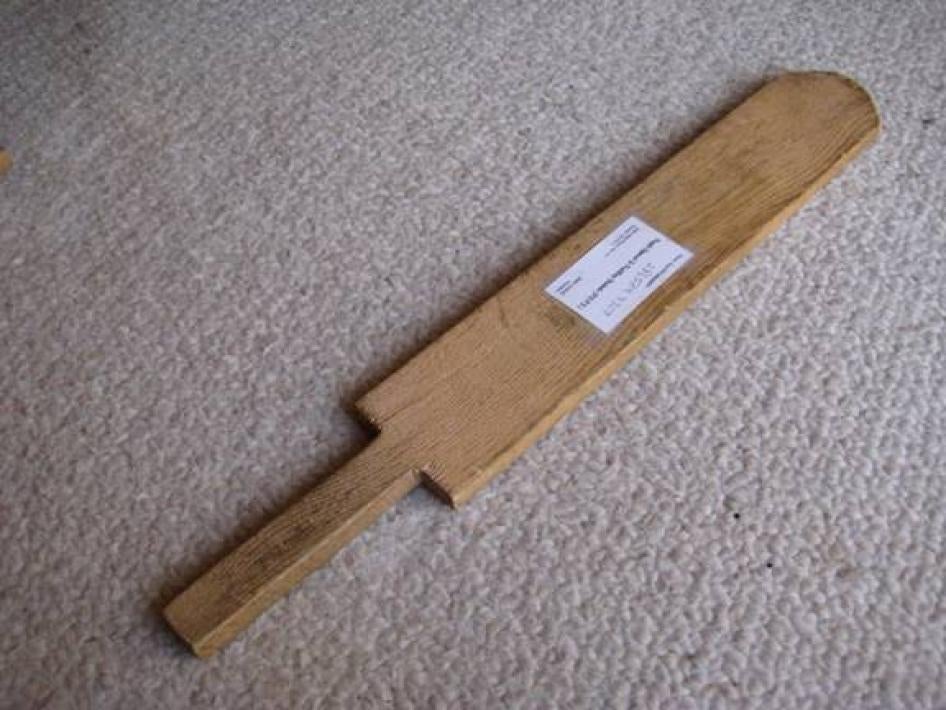
Picture of standard paddle. © 2008 Alice Farmer/Human Rights Watch.
Students describe the paddle as "a big ole long wooden thing with a handle,"[14] and say "the paddle looks like an oar, but smaller."[15] One student noted, "They use a short one for girls and a long one for the boys."[16] One former teacher in Texas told Human Rights Watch that he found shaved down baseball bats that were being used as paddles, similar to those depicted in the following photograph.[17]
Paddles made from shaved down baseball bats; keys indicate size. © 2008 Alice Farmer/ Human Rights Watch.
As analyzed later in this report, international human rights standards state that the use of force against students is only permissible as a restraint in exceptional circumstances, and even then only to a minimal degree.[18] Any force with intent to punish is impermissible,[19] meaning that the use of corporal punishment in public schools in the United States violates international human rights law.
In a vain attempt to limit the suffering caused to children by paddling, some school district policies specify that the type of paddle used must not injure the child. For instance, the RankinCountySchool District in Mississippi specifies, "Any instrument used to administer corporal punishment shall be such as not to cause either temporary or permanent physical injury."[20] Likewise, the MeridianPublicSchool District in Mississippi specifies that the administrator "should use an instrument approved by the principal which will produce no physical injury to the child."[21] A former administrator in Meridian commented on the logical inconsistency of his district's policy: "that's a catch-22. Essentially … any striking of a child that causes pain would be an injury."[22]
Sometimes the paddle is modified to improve the paddler's swing or to inflict greater pain. The paddle might have holes in it,[23] allowing it to move faster and therefore hurt more. One student noted, "It has holes in it, so the air can just woosh through."[24] Part or all of the paddle can be covered with duct tape to prevent the wood from splitting or to improve the paddler's grip.[25] A middle school boy in Mississippi reported that this contributes to the pain of the impact: "They duct tape all around the paddle and it makes it have a grip and that's why it hurts."[26]
Making Paddles in School
Paddles are not commonly available from school supply companies for purchase,[27] and educators may keep their paddles for a number of years.[28] One Mississippi superintendent noted, "You're not going to find them in school supply stores, they don't want to be sued. They're mostly made in woodshop."[29] We received multiple reports of students making paddles as a part of their woodworking ("shop") class. One high school teacher reported, "the kids would make them in shop class and have all their friends sign them."[30] A former principal noted, "I made my paddles myself, in woodshop. There were no specifications that I knew of for dimensions, wood, etc."[31] Another teacher noted that a student gave a teacher a paddle: "One of her students had a woodshop in his family and he gave it to her as a gift."[32] The fact that students might make paddles themselves underscores the extent to which corporal punishment has become part of school culture.
Sometimes teachers give their paddles nicknames such as "Dr. Pepper."[33] A student told us that "one man had a big, big paddle with a print on it that said, 'Mr. Whoopin.'"[34] A former teacher in Mississippi reported that one of her colleagues "had Big Bob and Little Bob,"[35] while another former teacher noted that his colleagues referred to paddles as "their 'boards of education.'"[36]
When a student is paddled, he or she is typically told to stand with his or her hands on a desk or a chair, so that the student is bent over, exposing the buttocks.[37] One former student in Texas described being hit in ninth grade: "This one time, like the other times, I had to stand up, and put my hands on the chair … and then, 'pop, pop.'"[38] These stances are submissive, placing the student in a position with no opportunity for self defense, even though they are being subjected to violent blows. In addition, the experience of being hit on the buttocks, an inherently private part of the body, can be particularly humiliating.
Occasionally, students might be paddled in other positions. For instance, students might be paddled against the wall when a principal is patrolling the hallways.[39] One boy who was paddled in the second grade for laughing when his friend threw something at a teacher, said, "[The principal] took me into the office and gave me three licks…. He made me hold onto the wall and he paddled me. It hurt for about two hours, it felt like fire under my butt."[40]
Some students are paddled in even more submissive positions. One sixth-grade student who was paddled in gym class was forced to line up with other students and bend over with her hands on her knees.[41] An elementary school student reported seeing two peers paddled: "My teacher left the door wide open … I could see what was happening. [The teacher] had her legs wide open and then she closed them and put their head in between her legs. The kids had to get on their knees on the floor and she holds you down."[42]
Students are required to remain in position throughout the administration of the beating; this condition is hard to meet as moving is a natural defense to physical violence. A Mississippi boy reported that "some teachers ask for hands in pockets-so you can't move."[43] A teacher at a Mississippi high school noted that it is difficult for children to stay still when being beaten: "I saw the principal giving licks once in the hallway. He was paddling a girl…. He would hit her and she would jump away and shout that it hurt."[44]
If students move during beatings they may receive additional blows and injuries. One eleventh-grade girl in Mississippi reported that in the course of a beating, her wrist was injured: "One time I got hit on my wrist with the paddle, and he told me, 'I told you not to be sticking your hand back there.' Well, I had my hands on the table and he was about to swing and hit me, and I reached back and he hit my arm with the paddle by mistake ... it hurt!"[45] Another Mississippi girl told us, "[The principal] reared back and paddled me once and I stood up and he said, 'No, bend over.' And I said, 'No, I can't take no more-that really hurt.'… [H]e paddled me again."[46]
Clothing as Protection against Blows
While Human Rights Watch did not receive any reports of students being asked to undress completely from the waist down prior to paddling, some students reported that they were told to hold their pants tight across the buttocks or that the paddler used one hand to tighten their pants. The fact that paddlers initiate this tightening of the fabric demonstrates the intent to cause pain or discomfort, a prohibited act under international law.[47] A Mississippi high school girl stated that the principal "tightened my pants and paddled me. He … went 'pow.' He grabs pants to make them tighter on your behind. It hurts more then."[48] A Texas student agreed: "The principal pulled my pants tight-it gives you a wedgie. By making things tight, it hurts more."[49]
Students take steps to mitigate blows, well aware of the painful punishments they may face. One middle school boy who receives regular beatings reported that "I wear two pairs of gym shorts under my pants to protect against the paddling," and that during one paddling in sixth grade, all of his clothing except for the second pair of gym shorts were removed.[50]
Number of Blows
Some school districts' corporal punishment policies limit the number of blows a student can receive. For example, the MarshallIndependentSchool District in Texas limits corporal punishment to two swats.[51] Students in the Grand PrairieIndependentSchool District near Dallas, Texas, cannot receive more than three licks per day.[52]DrewSchool District in Mississippi states that "[n]o more than five (5) licks will be given to elementary students and no more than seven (7) licks will be given to students in grade 7-12."[53] The SouthDeltaSchool District in Mississippi specifies that "[n]o student shall receive more than a maximum of five (5) licks of the paddle and only to the fleshy parts of the buttocks."[54]
In other districts, we received reports of students being subjected to large numbers of consecutive blows, and/or accelerating numbers of blows. A former high school teacher in the Mississippi Delta noted that students might accumulate a number of licks: "Say they had 30 licks, they could choose 10 today, 10 more the next day."[55] Some students reported accelerating punishments. One Mississippi high school girl said, "If it's your first time, then you get like, three licks. And then if you continue to go, it'd increase to like, three, five, seven, ten."[56] Another girl noted, "He got to give you from three to nine licks. And most time for curses, he's got to give you three licks for every letter in the curse word you say…. You got to be beat down."[57] Corporal punishment always carries some risk of serious harm;[58] increasing the number of blows exacerbates that risk.
Other Instruments Used
Human Rights Watch received some reports of students being struck with objects other than a paddle, including rulers and a belt. We heard multiple reports of students being hit by teachers with rulers, especially among younger children. A Mississippi middle school boy was hit in fifth grade with a set of rulers taped together: "I was talking, it was a group of students and she [the teacher] told us to come up to her desk and she popped us on our palms … this was with four rulers taped together."[59] A girl in Texas noted that "in kindergarten … they hit us with rulers on the hands … I saw it all the time in class."[60] One former teacher in rural Mississippi reported that hitting children with rulers was prevalent in her school, noting that "in my district, this happened all the way through high school."[61]
Other Physical Force Used against Students
Human Rights Watch received reports that students were subjected to other forms of physical force in addition to paddling. A Texas middle school boy, for example, reported that, after some gym students were misbehaving, his teacher made the whole class perform "'gut checks,' where we bear crawl" across the yard; the dry grass left some students bleeding on their hands and knees.[62] Because corporal punishment is defined as any punishment involving physical force "intended to cause some degree of pain or discomfort,"[63] such punishments, seemingly portrayed as part of routine physical education, amount to corporal punishment because of the intent to cause pain.
Persons Administering Corporal Punishment
Students are typically beaten by administrators (principals, vice principals, or assistant principals)[64] and in some cases, by coaches.[65] Students are usually referred to the principal's office (or the discipline office) by a teacher; teachers also administer corporal punishment,[66] particularly among younger students.[67] According to our interviewees, coaches beat students on their teams[68] as well as non-athlete students referred to them by teachers.[69] One recent graduate explained, "In high school, it was usually the coaches who paddled. Everyone had P[hysical] E[ducation] or was on a team, so everyone had contact with the coaches…. If a teacher had a problem, they'd send that person to the coaches."[70]
The majority of paddlers in incidents described by our interviewees were male. One Mississippi teacher and mother noted that the "swats are given by grown men; some of them [are] good swingers."[71] One former teacher reported that at her Mississippi Delta high school, the female basketball coach administered corporal punishment to the girls.[72] One teacher noted there was a policy of having a female witness whenever girls were hit,[73] though this was not common in other districts we visited.
Given these school environments, in which corporal punishment is an accepted means of punishment, and in which teachers and school administrators are perceived as community leaders entitled to respect, it is not surprising that Human Rights Watch received multiple reports of parents and guardians who cooperated with administrators by coming to school to beat their children themselves.[74] One mother in rural east Texas described one such situation:
There was an incident the last year when the principal asked me whether she could paddle my child. I said no, but said that I would come over there and use the paddle myself…. I don't remember what he did but I gave him two pops and told him to cut it out. I used her paddle in the principal's office, she was there.[75]
Parents may discipline their children on school premises to show their commitment to the child's education. One teacher and mother in Mississippi reported, "Some parents get called in and they will give their child swats in front of the administrators to show that they take discipline seriously."[76] A teacher noted that parents might also volunteer to paddle their children at home for infractions committed at school: "If I call parents about a kid with a discipline problem, 80 percent of the time the parent will say, 'Okay, I'm gonna give him a few good licks.' It's a way of showing respect to the teacher."[77] It is natural that parents want to engage in their children's education, and show their commitment to helping their children succeed. However, endorsing this sort of punishment undermines the learning environment by sending the message that violence and humiliation are appropriate and tolerated.
The Atmospherics of Corporal Punishment
The size and shape of paddles, the identity of persons administering corporal punishment, and the bodily positions of children, as discussed above, all contribute to a school atmosphere of harm and degradation. Beyond these mechanical elements, corporal punishment can set a tone of intimidation and humiliation in schools, as other students see and hear the punishment.
Intimidation and Threats
Students are constantly aware of the possibility of being beaten, a threat that discourages an open, trusting relationship between students and educators. One mother noted, "[my sons] talk about it all the time. It's always there in the school, and even in the classrooms. Some of my sons' teachers like to walk around holding their paddle."[78] Some teachers display paddles while making verbal threats. A seventh-grade boy in Mississippi reported that a teacher had a paddle: "He used to have it in the cabinet but he brought it out when kids started acting out towards the beginning of the school year. It gives us the signal that if we talk some, we going to get a whuppin.'"[79] One fifth-grade girl said her teacher leaves the paddle on her desk: "I feel [it] ain't supposed to be there because I don't like paddles, I just don't."[80]
Many students report specific threats of violence. For instance, a tenth grader reported she was told by her principal, "'Y'all go back to class before I tear you all up.'"[81] A recent graduate recalled that her cheerleading coach threatened her with a sorority paddle.[82] Some parents instructed the school not to paddle their children, but those students were nonetheless threatened: a fifth-grade boy reported that his principal "told me that 'if I could paddle you I would beat you black and blue.'"[83]
Witnesses to Paddling
In some instances, the administration of corporal punishment requires that another adult at the school witness the beating. Neither Texas nor Mississippi law requires such a witness, since both states delegate responsibility to school districts for determining the parameters of the administration of corporal punishment.[84] However, the school board associations in both states provide sample policies that individual districts may use in drafting their discipline policies and those sample policies call for a witness.
The Mississippi Association of School Boards recommends that any paddling be witnessed by at least one certified school employee at all times.[85] The Texas Association of School Boards suggests that "[c]orporal punishment shall be administered in the presence of one other District professional employee."[86] One teacher in Mississippi reported that the witness rule existed in her district in order to ensure the paddler is not hitting "in anger,"[87] but the presence of an adult witness cannot guarantee lack of anger on the part of the individual administering the blows.
Sample policies in Texas specifically dictate that corporal punishment should occur "in a designated place out of view of other students,"[88] and many school districts we visited adopted that language.[89] Sample policies in Mississippi do not give the same guidance, but some individual districts in Mississippi also require students to be paddled "not in the view"[90] of other students.[91]
Despite these attempts to preserve the privacy of students, many students we interviewed in other districts had witnessed their peers being beaten. A fifth-grade girl in rural Mississippi described witnessing a friend's paddling because "my teacher left the door wide open." She noted, "It made me mad, angry, and sad to see her get hit by a paddle."[92] Frequently, students are beaten in hallways: one middle schooler saw students paddled in the hallway through the crack of a door.[93]
Even in districts that prohibit students from witnessing paddling, students nonetheless hear their peers being beaten. An 18-year-old remembered high school paddlings: "I didn't see it but I could hear it. Licks would be so loud and hard you could hear it through the walls. You could hear the moans and yelling through the walls."[94] Allowing students to hear beatings may have been intentional, according to one former Mississippi high school teacher:
One time [the principal] was paddling this kid and put it on the loud speaker. It was on the intercom in every class in the school. You could hear him paddling this kid, talking bad to this kid. Oh yes, he did it on purpose. It lasted a minute or two. He was trying to send a message. I don't know … like, "you could be next."[95]
Some students are forced to wait for their own punishment while listening to the beatings of others, as one Mississippi middle school boy described, "You have to stand in line for like 30 minutes, waiting to get paddled while you're listening to everyone else."[96] As another middle school boy noted, "sometimes you hear five or six licks, and you're like, damn."[97] A tenth-grade girl in Texas noted that in ninth grade, "there was this separate waiting room. We'd hear it, the other kids getting hit. It sounds like dropping books on the floor. We'd all laugh, be like, 'damn, that's hurtin' today.'"[98]
Some students and teachers have seen or heard paddling so often that they are no longer outwardly affected by the experience. A former Mississippi teacher described how another teacher came into her classroom and paddled a student. The rest of the class's reaction was "normal. They got quiet and watched. For a select few I know they feared, but most of them laughed."[99] Another teacher noted, "Once you've been in it for a while, I don't know … you get immune to it happening around you."[100]
"The Devil's Bargain": Choosing to Be Beaten
In many districts, students are given a choice of corporal punishment or another punitive form of discipline. Students in both Mississippi and Texas may be asked to choose between corporal punishment and detention,[101] in-school suspension[102] or out-of-school suspension.[103] We also heard reports of elementary students being asked to choose between getting beaten and losing recess,[104] and of high school students being asked to choose between being paddled and getting worse grades.[105]
In some districts, the alternatives to corporal punishment, such as out-of-school suspension, are not desirable for students or for educators who prefer to keep their students in the classroom setting. In other cases, schools have such limited resources that alternative disciplinary measures are not an option, thereby increasing the frequency of corporal punishment. Whether or not students are mature enough to make these decisions, they should never be put in the position of bargaining away their human right not to be beaten by school officials.
Typically, interviewees reported that three to five blows are equivalent to one day of in-school or out-of-school suspension.[106] The "exchange rate" of physical strikes to alternative punishment can vary, however. At a high school in Mississippi, students were given the choice between five blows or five days away from school.[107] At another Mississippi high school, students were asked to choose between five blows or 15 minutes in lunch detention.[108]
Our interviews indicate that students often choose beatings over other forms of punishment. This is not surprising since the costs of refusing to be beaten and taking a suspension instead can be high. If a student is suspended, he or she is forced to miss class and teachers are not obliged to provide make-up work, meaning that students may fail. An 18-year-old boy in Mississippi noted that at his high school, "my friends who refused to be paddled got ISS [in-school suspension] or a zero day-that meant your parents had to bring you back [to school]."[109]
In fact, proponents of corporal punishment often justify their views by citing the undesirability of suspension, and pointing out that corporal punishment means the student returns to class faster. For example, one superintendent asked if a student is home alone, suspended from school, "is that really what's best educationally?"[110] This argument ignores the students' basic rights, and the fact that other options are available. Ultimately, schools should not be forcing students to make this difficult choice, and should instead be using effective positive discipline measures.[111]
Students may be induced to use corporal punishment as a bargaining chip. One interviewee in Texas took paddling to reduce the number of days in detention: "The principal said I could take two licks and get some of the days reduced. I didn't want to stay for the after-school detention, so I took the deal."[112] A seventh-grade boy in Mississippi watched a teacher paddle his peers in class: "He [the teacher] gave them the option of getting one lick in or three licks out. This was Social Studies. The kids were talking too much…. He told them to come up and he said 'do you want one in here or three out the door?' So they chose one lick. The class started laughing."[113]
Why Students Opt for Beatings
Students we interviewed chose corporal punishment for reasons that ranged from wanting to keep good grades to wanting to keep their parents from finding out; some simply did not know how much paddling would hurt. A twelfth-grade girl said she chose paddling the first time because "that meant I got my lunch detention erased." She noted, however, "I would have made a different decision if I had known how much it would hurt."[114]
Many students said they chose corporal punishment in order to avoid missing classroom instruction or suffering other academic consequences. A recent graduate in Texas told us, "I chose licks. If I had got written up, and suspended, I would have had to play catch-up. I would have missed class."[115] One student saw paddling as the better academic option: "I would take the paddling because I ain't trying to flunk out or anything."[116] An honors student at a Texas high school explained the calculation she and her friends make:
[My school] uses corporal punishment as a way to get out of SAC [StudentAssignmentCenter, or in-school suspension] … it's three swats to get out of SAC…. My freshman year, two friends of mine-they were girls-chose to get the swats…. It meant they could still "exempt the exam"… that means you use your [classroom grade point] average instead of taking the final. So my friends chose to get swats so they wouldn't have SAC and they wouldn't have to take the exam. I mean, who wants to take an exam if you don't have to?[117]
Some students, especially younger students, might think that the alternative punishment is more unpleasant than the beating. These students simply do not have the maturity to make such a decision, and should not be put in this position. A mother whose 10-year-old was paddled felt her son wasn't old enough to make that choice: "The principal said he asked my son whether he wanted two pops or two days of ISS and no field trip. He always wanted to go on field trips…. So how are you going to ask this child whether he wants two pops when he is 10 years old?"[118]
Male students may choose paddling in part because of a desire to meet perceived societal expectations of masculinity. One former high school teacher in Mississippi noted, "It's always one bad thing versus another bad thing-which one are you ready for? And with masculinity and the pressures to be tough and unfeeling, often the young man is going to want to take the licks. Take it like a man. It's almost a show when you offer the bargain."[119] This attitude affects even young children, according to one former teacher in Mississippi: "There's a certain amount of bravado that comes with it, you want to take your licks like a man, not crying or anything."[120] He emphasized, "with boys, it's a badge of courage to choose corporal punishment over ISS."[121]
A parent in rural Mississippi noted some obstacles to choosing suspension above corporal punishment: "Their parents have jobs. Their moms have jobs. They say they can't sit home [with the child]."[122] A superintendent in a district that uses paddling described the complications of this dynamic: "When you tell a parent we have to send the child home for a day, the parent will ask, 'can you not paddle them? I'm going to be at work. They'll be home by themselves.'"[123]
Sometimes schools do not tell parents about beatings and so, unlike with a suspension, the student's parents do not find out about the underlying infraction; this motivates students to choose corporal punishment. One Mississippi mother's son had been paddled when he was 17 years old; she did not find out until he was 22:
The school did this thing where they told the kids to take the paddling, don't tell anyone, and it would be over … [my son] says he got paddled almost every day…. That was an example of how they covered it up so the parent didn't know. I had signed the card for no paddling … I think they went so far as to tell [my son] that we'll just give you some licks and it will all be over and we won't have to call your mom.[124]
Many parents, like this Mississippi parent, disagreed with this scheme: "Your kid can get a paddling and you wouldn't know it…. Let me know. That's only right."[125]
Teachers and coaches sometimes directly pressure students not to tell parents about beatings. For instance, student athletes, for whom paddling can be a routine part of their training, might keep the abuse from their parents. One recent high school graduate noted, "for boys in the football program, they get licks without telling the parents. [The coach would give] them a choice-take your licks and we won't call your parents or we'll drop your grade and your parents will find out. It's your choice, it's up to you."[126]
Some students prefer to be paddled rather than have parents informed of the infraction because they feel punishment at home might be worse. A former high school teacher felt that her students' attitude was: "You get three smacks on the behind, you shed a tear, and it's over. Your parents don't know and they're not going to beat you."[127]
While students should not be subjected to abuse at home, this is not a reason to give the student the option of "buying" the school's silence by submitting to physical harm as a form of discipline. It is a recognized principle of human rights that children should have a voice in the policies and procedures to which they are subjected.[128] However, in this context, providing children a choice between physical beatings or another disciplinary option is not a rights-protective policy. Providing students a choice in this context is fundamentally exploitative, preying on vulnerable young people with underdeveloped decision-making capabilities.
IV. Offenses Leading to Corporal Punishment
Students are beaten in schools for a wide range of infractions. Though corporal punishment is never a legitimate response to misbehavior, it is particularly troubling when used as a disproportionate, angry response to minor infractions that might reasonably be expected from any child. The punishment is frequently meted out in an arbitrary manner, leaving students unsure why they were punished and angry about the injury they have suffered. Even in cases where students committed serious infractions, corporal punishment is not an effective method of redressing the problem.
Disproportionate Responses to Minor Misbehavior
The large majority of instances of corporal punishment reported to Human Rights Watch was for minor infractions, such as having a shirt untucked,[129] being tardy (late to class or to school),[130] or talking in class[131] or in the hallway.[132] While no student behavior should result in corporal punishment, it is egregious when applied for minor transgressions such as these.
As Justice Byron White observed when dissenting from a US Supreme Court decision allowing school corporal punishment, "[i]f there are some punishments that are so barbaric that they may not be imposed for the commission of crimes, designated by our social system as the most thoroughly reprehensible acts an individual can commit, then … similar punishments may not be imposed on persons for less culpable acts, such as breaches of school discipline."[133]
One teacher described a policy in which teachers were required to lock classroom doors when the bell rang; students who were still in the hallway were then paddled by an administrator patrolling with a paddle in hand before they could attend class.[134] A superintendent in a district that uses corporal punishment noted that the practice is particularly unpleasant if used for minor misbehavior: "I hate to think that a child gets three or five swats for being late to class, I hate to think that a child gets three or five swats for running in the hall-those are minor infractions."[135]
Despite this superintendent's concern, Human Rights Watch received reports of corporal punishment in response to a wide range of minor misbehavior. Students were paddled for eating or drinking in class,[136] sleeping in class,[137] walking on the wrong side of the hallway,[138] running in the hallway,[139] talking back to a teacher,[140] not turning in homework,[141] not having a belt in violation of the dress code,[142] and going to the bathroom without permission.[143] While some kind of disciplinary response to these misbehaviors may well be warranted, corporal punishment is grossly disproportionate. Teachers and students said that minor misbehavior leads to somewhere between three and five blows.[144] An 18-year-old noted, "You could get a paddling for almost anything. I hated it. It was used as a way to degrade, embarrass students."[145]
Students in the early grades receive corporal punishment for behavior typical among young children. This is especially problematic because while young children may immediately comply with adults' wishes, they frequently do not remember why they are being hit and will only refrain from future misbehavior if they face an imminent threat of violence.[146] A middle school boy in Mississippi was beaten for throwing paper balls at the teacher: "I was just trying to make the class more fun. Eventually after I threw about four or five paper balls she got really mad and sent me and my friends to the office and we got a whuppin'."[147] Two kindergarteners were paddled for playing a child's version of "footsie": "Me and my friend, we were stepping on each other's feet. [The teacher] called us both into the hall and … gave us three licks and sent us back into the classroom."[148]
In Texas, we received reports that coaches would paddle student athletes for bad grades. One 16-year-old student athlete said, "We had to show [coach] our grade sheets, we had to take it around to get it signed by all the teachers and then take it back to the coach."[149]
Disproportionality also arises where students or parents have the option of choosing another punishment such as suspension.[150] In such cases, students who refuse to be beaten typically receive a punishment that the school usually reserves for more serious infractions. A student who, for example, was tardy, and then chose to exercise his right not to be beaten, might then be suspended.[151] According to the hierarchy of punishment established by the schools, the suspension is the more serious punishment. In effect, students are being further punished for asserting their right to be free from physical violence.
Vague Offenses and Arbitrary Use of Corporal Punishment
Students and teachers reported that students could be paddled for a catch-all category of "disrespect," a term which is rarely defined in school policy and is used arbitrarily by teachers. In some cases, this is a category that can be checked on the school's official discipline form when a student is referred to the principal's office for paddling.[152] One Mississippi teacher implied it can be a catch-all term used to discipline students at the teacher's whim:
Disrespect can mean different things. Disrespect is doing something that you are told not to do. Not doing your work, talking out of turn, raising your voice to another teacher, putting your hands on another student. Breaking the rules. But it depends on a person's definition of respect.[153]
One middle schooler described punishments for "disrespect" as: "if you mess up, and don't say ma'am or sir."[154] A high school girl objected to being written up for a dress code violation, stating that she was not aware of the new rule; the teacher then wrote her up for "disrespect" instead.[155] Another similarly vague term for which students are sometimes paddled is "defiance of authority," which, as a recent high school graduate in Mississippi noted, "could be anything; that phrase could mean anything. Teachers threw it around all the time."[156]
Corporal punishment is sometimes administered arbitrarily, with inconsistent rules, underscoring the inefficacy of the punishment.[157] One teacher noted that at her high school in the Mississippi Delta, the reasons for giving corporal punishment were "vague," and that "there was never, at my school, a list of things that a kid did wrong that would result in corporal punishment."[158] One former teacher noted that whether or not a child received corporal punishment "just depended on the teacher. The only school-wide rule was no food or drink in the classroom."[159] A former student from Texas agreed, "Whether you get in trouble, whether you get paddled, it depends on the teachers."[160] A teacher noted that she thought it was "least effective because it was a catch-all punishment."[161] In these situations, students are not given adequate notice or clear rules that would indicate when they will be punished.
Corporal Punishment for Serious Offenses, including Violence
Some students we spoke with were subjected to corporal punishment for more serious infractions. Fighting in particular led to corporal punishment of students in both Mississippi[162] and Texas.[163] Even very young students who were caught fighting were then beaten: Human Rights Watch spoke with a student who was paddled after fighting in second grade,[164] and another student who was paddled after hitting another child on the head with a chair in third grade.[165] One student we interviewed was paddled for setting off firecrackers in school.[166] Students on a field trip were reportedly paddled for getting drunk.[167]
A superintendent who is against corporal punishment nonetheless reflected a popular sentiment when he observed that corporal punishment may be "more appropriate for major infractions: gambling, aggression towards other students."[168] While students who commit serious offenses need effective discipline, corporal punishment is not an acceptable answer.
Under international law, in "exceptional circumstances … dangerous behavior [may] justif[y] the use of reasonable restraint," but that force must be the minimum amount necessary for the shortest period of time, and must never be used to punish.[169] Educators are confronted with the difficult task of maintaining order and ensuring a safe environment for their students, while avoiding the use of unnecessary force. Therefore, they must be trained to respond to dangerous behavior, "both to minimize the necessity to use restraint and to ensure that any methods used are safe and proportionate to the situation and do not involve the deliberate infliction of pain as a form of control."[170] Educators should only use force when absolutely necessary, and should do so in compliance with the strict limits articulated in international law.[171]
Contrary to this standard, we received some reports that excessive and unnecessary force was used to control students. For instance, a Mississippi high school girl reported that when fights break out in the gym at her school, the principal and assistant principal "come up into the bleachers and put their hands on the girls and choke them, and slam them … [they put their hands] on their necks, they'll grab them all types of ways…. The principal is the biggest man at our school and he can literally just throw down anyone."[172] Elsewhere in Mississippi, two young students, both of whom have mental disabilities, were physically pushed into closets as punishment after acting out in class.[173]
V. Prevalence of Corporal Punishment in US Public Schools
Data on Corporal Punishment
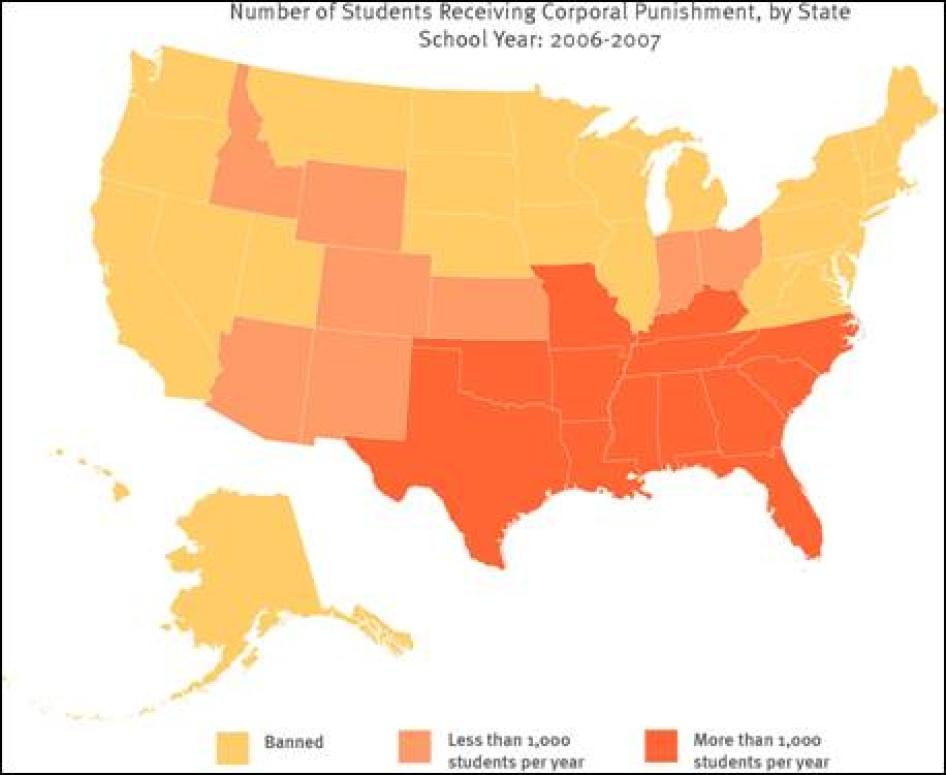
223,190 students nationwide received corporal punishment at least once in the 2006-2007 school year, according to data from the Office for Civil Rights (OCR) at the United States Department of Education.[174]
Figure 1
© Human Rights Watch, 2008.
While corporal punishment is legal in 21 states,[175] Table 1 shows that it is used more heavily in some states than others. In Texas alone, OCR data show that 49,197 students were subjected to corporal punishment during the 2006-2007 school year, more than in any other state.[176] In Mississippi, 7.5 percent of schoolchildren were paddled at least once during that same school year, the highest percentage in the nation.[177]
Table 1: Nationwide Prevalence of Corporal Punishment
State |
Number of Students Paddled During the 2006-2007 School Year |
State |
Percentage of Students Paddled During the 2006-2007 School Year |
Texas |
49,197 |
Mississippi |
7.5% |
Mississippi |
38,131 |
Arkansas |
4.7% |
Alabama |
33,716 |
Alabama |
4.5% |
Arkansas |
22,314 |
Oklahoma |
2.3% |
Georgia |
18,249 |
Louisiana |
1.7% |
Tennessee |
14,868 |
Tennessee |
1.5% |
Oklahoma |
14,828 |
Georgia |
1.1% |
Louisiana |
11,080 |
Texas |
1.1% |
Florida |
7,185 |
Missouri |
0.6% |
Missouri |
5,129 |
Florida |
0.3% |
Source: United States Department of Education, Office for Civil Rights, "2006 Civil Rights Data Collection."
Corporal punishment was widely accepted in US public schools in the latter part of the 19th century and the early 20th century.[178] While New Jersey banned corporal punishment by statute in 1867,[179] many other US states, including Michigan, Connecticut, and Nevada, did not enact a ban until the late 1980s or early 1990s.[180] In the present decade, the number of students subjected to corporal punishment in US public schools has been steadily dropping. OCR data indicate that 342,038 children in US public schools were paddled in the 2000-2001 school year;[181] by the 2004-2005 school year, the figure had dropped to 272,028 students.[182] In 2006-2007, the most recent school year for which data are available, the numbers fell to 223,190.[183] Any level of corporal punishment is too high; the fact that the numbers are dropping shows that districts still using paddling are becoming the exception, making it all the more imperative that they change their discipline policies.
Boys are subjected to corporal punishment more than girls: nationwide, boys make up 78.3 percent of those paddled.[184] African-American students are paddled at more than twice the rate than might be expected given their percentage of the student population: African Americans constitute 17.1 percent of the nationwide student population, but 35.6 percent of those paddled.[185] Though girls as a group are paddled less than boys, African-American girls are more than twice as likely to be subjected to paddling as their white counterparts.[186]
Special education students[187] are also subjected to corporal punishment, even though the behavior that leads teachers or administrators to beat them may result from their disabilities rather than any lack of discipline.[188] Nationwide, OCR data indicate that 41,972 special education students received corporal punishment in the 2006-2007 school year.[189] In the two states examined in detail for this report, Mississippi and Texas, large numbers of special education students were among those receiving corporal punishment. In Mississippi, 5,831 special education students were beaten in the 2006-2007 school year.[190] In Texas, 10,222 special education students were beaten, amounting to approximately one-fifth of the total number of students who were beaten statewide.[191]
While these figures and rates may already appear quite high, they do not reflect the full extent of the problem. First, the data record the number of students hit each year, not the number of incidents.[192] In other words, the data show that 223,190 individual students were beaten in the relevant school year, but do not show how many incidents of corporal punishment occurred. Because many students likely were beaten more than once in a school year-a reasonable assumption given the evidence collected from our interviewees-the overall number of beatings administered each year undoubtedly is far higher.
The data also very likely undercount the number of students beaten each year because some school districts fail to report all incidents to the federal government. Corporal punishment is often seen as a quick form of discipline: a former high school teacher recalled that "paddling was just a fast way to deal with it and not write it down."[193] Records are not always kept for corporal punishment: a high school teacher noted that discipline is "completely haphazard … many teachers don't even bother with writing referrals anymore."[194] One superintendent of a major Mississippi school district told us the reported numbers were low:
[W]e probably do it twice as much as reported…. [T]here is no documentation you have to send to the central office to say that you did it…. [It's] an option where you don't have to do so much documentation, It's much easier than signing the suspension form and giving it to the parents or any of that. I'm speaking realistically.[195]
Incidents of corporal punishment may not be recorded when they do not take place in the principal's office (or the school's "main" office). A Mississippi teacher told us:
I know that there are paddlings that aren't reported…. A concrete example: during my planning period, I spent a considerable amount of time in this one teacher's class. I've seen the teacher ask students to get the paddle from the corner, wait outside for him, the students are paddled, they come in, and class resumes. No paperwork is filled out. I'm sure if you ask teachers, they wouldn't be able to tell you how many students they paddled at the end of the day.[196]
Informal referrals from teachers to coaches might not be recorded. Another Mississippi teacher reported that "[w]here the coach is giving licks, the coaches don't report to the office. It's sort of part of the coaching, [the coach's] rights, which contributes to the lack of data on corporal punishment."[197] The lack of record-keeping may be particularly evident when students are paddled in hallways or classrooms. One former Mississippi teacher, who frequently saw her principal administer corporal punishment in the hallway, noted, "Oh yeah, he [the principal] never reported it. He never took names; he didn't know who all these kids were."[198] It is unlikely such instances of informal, unregulated corporal punishment are recorded by the administrator upon return to his or her office.
Constant and High Levels of Paddling in Some Schools
Routine, high levels of paddling in schools can indicate a threatening, violent environment.[199] A former assistant principal in charge of discipline at a middle school in Meridian, Mississippi, recalled that he received 19-23 referrals for paddling every day; one day he had 37 students sent to his office to receive a beating.[200] Interviewees described long lines of students waiting to get paddled outside the principal's office.[201] One teacher noted his elementary students were punished so often it had become routine: "The kids would put their hands on the back of the chair, stick their butts out, and the principal would start hitting."[202]
Corporal punishment is so commonplace in certain public schools in Texas and Mississippi that students reported high levels of paddling in casual tones. A high school boy in Texas recalled, "I was paddled in elementary, yeah. Too many times to count."[203] A Mississippi high school girl observed that she was paddled "at least three times a week" in the ninth and tenth grades.[204] She estimated that "at least 60" students are paddled daily at her school, noting, "A lot of kids get paddled. Every class block you will hear a list of students being called [to the office for paddling] on the intercom."[205]
We received reports of students of all ages receiving corporal punishment, from pre-kindergarten to high school. A Mississippi middle school boy recalled receiving three blows as a kindergartener for making another child eat dirt in the playground.[206] Another Mississippi kindergartener was beaten three times for stepping on another student's feet.[207] An east Texas kindergartener was paddled for pulling a chair out from underneath another student.[208] Among our interviewees, paddling was no less common in older grades. We received reports of paddlings administered to a twelfth-grade girl in Mississippi,[209] an eleventh-grade girl in Texas,[210] and a 17-year-old boy in Mississippi.[211] A former teacher recalled that one of her high school students was paddled despite being "a really big kid … [for whom] the paddle just seemed kind of silly."[212]
VI. Impact of Corporal Punishment
Corporal punishment in schools harms children and damages their education. The practice almost always causes immediate pain, and can result in lasting physical injury. It humiliates and degrades students, and may leave them depressed or withdrawn. Corporal punishment teaches students that violence is acceptable: it can make students aggressive, angry, and more likely to lash out against their peers or educators, and it can teach them that domestic violence is permissible. Furthermore, as a result of being physically punished, students can become less engaged in school, less motivated to succeed, and may become more likely to drop out.
Lasting Injuries and Immediate Pain
Many victims of corporal punishment in schools sustain serious injuries, as noted by the Society for Adolescent Medicine, including severe muscle injury, extensive bruising, and whiplash damage.[213] A girl in Mississippi was paddled in sixth grade: "[The coach] hit me so hard I felt nauseous at my stomach. I was mad because I remember I came home to take a shower, and I was like, I'm going to look and see if I have bruises. And I looked in the mirror and I had bruises all over, and I said, 'Mama, come look.'"[214] Her mother took her immediately to the local hospital's emergency department for medical care,[215] and also reported the incident to the sheriff's office.[216] The same girl was paddled in twelfth grade: "[The principal] reared back and paddled me … you could see where the paddle hit and it was really red…. That was first period and I had bruises by third period."[217] Once again, her mother took her to receive medical care,[218] and filed a sheriff's report.[219]
A middle school student in rural Mississippi was severely bruised when his beatings escalated. He was sent to the office for paddling, and "[w]hen I came back, [the teacher] said I was laughing so she sent me back and I got three more licks…. The principal was like, 'you're in here again already?'… He said, 'Do you realize that every time you come in here I'm going to hit you harder and harder?'"[220] When his mother met him after school, she noticed he was in pain. She found his buttocks were black from bruising.[221] It took more than a week for the bruises to heal, and during this period "he couldn't sit down."[222]
One very young student in Texas, a three-year-old boy attending a public pre-kindergarten program, was beaten and bruised during paddling. The program was run at the local elementary school and governed by the school district policy on discipline.[223] The boy, who has diagnosed Attention Deficit Hyperactivity Disorder (ADHD), was paddled for taking off his shoes and for playing with an air conditioner. He became reluctant to go to school: his mother reported that "all he would say is that 'she [the principal] hit him with a board.'"[224] The child sustained bruises to his hips that reached around to his belly button.[225] While this case may seem exceptional, it is a direct byproduct of the climate created in school districts by the regular use of corporal punishment.
Some students sustain injuries to other body parts. An 18-year-old San Antonio, Texas, girl sued her school district when she was hit on her buttocks and her hand. Her hand was injured when she tried to block one of the blows. She went to the emergency room with a severely swollen hand that was put into a cast.[226] An injury to a hand is not unique to this case; many students use their hands or arms to protect themselves. Among our interviewees, a Mississippi high school junior reported that she reached back when the principal was swinging and was hit on her arm,[227] and a Mississippi middle school boy reported that when the principal was about to paddle him, the boy put his hand back and the principal hit his thumb with the paddle.[228]
In one case the student paddled was visibly pregnant, as a Mississippi teacher described:
I had a pregnant girl get paddled once for being tardy. She was five months pregnant. She was 16. The principal paddled her … she was showing and it was known that she was pregnant. She was part of a group that was tardy to class. And she yelled something along the lines of "you shouldn't paddle me, I'm pregnant."[229]
Nearly all students we spoke with had vivid memories of the immediate physical pain caused by corporal punishment. A recent graduate in Texas recalled of her sixth-grade paddling: "[I]t hurt. Oh yes. It stings, and I remember it brought tears to my eyes."[230] A former teacher in Mississippi reported that "[y]ou could hear it wooshing through the air and hitting an object. Some kids would say 'No, No, NO,' and then 'Owww!'"[231] A fifth-grade girl remembered being beaten when she was in kindergarten: "they hit me on my bottom. It feeled like it burned and burned … it hurt."[232]
Students describe the paddling as "stinging" or "burning." They report that the effect can last for hours, and upon return to class, it is painful to sit. A female recent graduate remembered, "It hurt very much. There were definitely red markings and then swelling. I remember it being red on my buttocks. Almost welt-like markings. It didn't last for more than a couple days. It was painful to sit down immediately after."[233] One 19-year-old girl described why it was difficult to sit: "You know how when you bite your lip it swells up a little bit? Well, that's how my butt felt."[234]
The risk of serious physical injury makes corporal punishment impossible to regulate, or administer in "appropriate" amounts. A former teacher in Texas argued, "There's always a risk of a teacher hitting too hard. How can you control how hard a kid is hit?"[235] A superintendent of a major Mississippi school district noted corporal punishment is "not worth the risk. If you paddle a child, you can't pull their pants down and make sure there's not a bruise there. You have to wonder and worry that if I administer corporal punishment, will I leave a mark and bruise?"[236] Some students may receive more serious physical injuries from the same levels of paddling, perhaps because they bruise more easily, or because they have an underlying medical condition of which the school was not aware.A former president of the Dallas School Board emphasized that this was one reason for that district's decision to prohibit corporal punishment: "It's hard to know if someone is being too forceful, or if there's a physical condition that they're unaware of."[237]
Some school districts have policies dictating that a child cannot be hit in anger, but these policies are virtually impossible to enforce. For instance, the PontotocCountySchool District (Mississippi) states that all corporal punishment "shall be reasonable and moderate and not administered maliciously or for the purpose of revenge."[238]GentryHigh School in the IndianolaSchool District (Mississippi) asserts that "action may not be motivated by malice or anger."[239] It is next to impossible to assess the paddler's state of mind at the time of paddling, since an educator can be angry or motivated by revenge, thus hitting with extra force, without revealing these emotions to others.[240] None of the regulations related to the state of mind of the paddler or the "degree" of paddling that we have seen can be enforced in a way that would eliminate the risk of serious injury.
Depression and Anger
Corporal punishment is humiliating and degrading, may make students angry and ready to lash out at their peers or at educators, and may make them less inclined to engage in learning. The AmericanAcademy of Pediatrics, in taking a position against corporal punishment, observes that "corporal punishment may adversely affect a student's self-image and school achievement and that it may contribute to disruptive and violent behavior."[241]
Research suggests that children who are physically punished at home or at school may become less likely than other children to internalize moral values, and may become depressed or aggressive.[242] A 2005 UNESCO study notes that "[c]orporal punishment has been found to be consistently related to poor mental health; including depression, unhappiness, anxiety, and feelings of hopelessness in children and youth."[243]
There have been fewer studies on the effects of corporal punishment in schools, as opposed to in the home. Nonetheless, studies suggest that school corporal punishment legitimates violence.[244] According to the Society for Adolescent Medicine, victims of corporal punishment may endure psychological harm, including: difficulty sleeping, suicidal thoughts, anxiety, increased anger, feelings of resentment, outbursts of aggression, deteriorating peer relationships, and a tendency for school avoidance and school drop out.[245]
Students interviewed by Human Rights Watch spoke of the psychological degradation caused by the punishment. Sean D., an 18-year-old boy, reported that in his school district in the Mississippi Delta, "you could get a paddling for almost anything. I hated it. It was used as a way to degrade, embarrass students." Sean received paddlings himself in middle school: "After [location withheld] Middle School, I said I'd never take another paddling. It's humiliating, it's degrading. Some teachers like to paddle students…. Paddling causes you to lose respect for a person, stop listening to them."[246] Dr. Ollye B. Shirley, a former member of the school board in Jackson, Mississippi, asked, "What kind of classroom can you have once you've stopped the learning to beat somebody? I just thought kids shouldn't be treated that way. They needed to be treated with dignity."[247] A current school board member in another district agreed, "Think about the mental capacity that this kind of treatment leaves our children with. We are telling them we don't respect them. They leave that principal's office and they think, 'they don't consider me as a human being.'"[248]
Research suggests that corporal punishment is linked to increased rates of bullying and aggression in school in the months and years following the punishment.[249] Some studies suggest that children who are physically punished may be inclined to engage in aggressive conduct toward their siblings, parents, teachers, and schoolmates.[250] There are no definitive studies separating the effects of corporal punishment in the home and in schools on the aggressiveness of the child, but researchers believe corporal punishment in the schools has deleterious effects.[251]
Dr. Shirley, the former member of the school board in Jackson, Mississippi, a district that has abolished corporal punishment, noted:
One of the problems with corporal punishment is that students will fight back. I remember one incident where the girl struck back at the teacher. The child just knocked the teacher down because she just wasn't going to take the whupping. That was one of the things that led me to oppose it. What do you think it does to high school students to be paddled in front of their peers?... It makes them angry … I think it's dangerous.[252]
Both students and teachers we interviewed saw links between corporal punishment and bullying or peer aggression. One middle school boy said, "The other kids were watching and laughing. It made me want to fight them…. When you get a paddling and you see everyone laugh at you, it makes you mad and you want to do something about it."[253] A nine-year-old girl observed, "If they lay hands on me, I'll lay hands back."[254] "Students rarely think they did anything wrong," commented one teacher. "Couple that with physical [punishment], that will elicit anger [from the student]. I have seen students acting out their aggression for receiving corporal punishment."[255] A former high school teacher in Mississippi agreed that "as a result, they [students] are violent with each other."[256]
Academic Disengagement and Drop Out
Corporal punishment erodes students' trust in their teachers and their schools. In the United Nations Secretary-General's worldwide Study on Violence against Children, physical punishment in schools is noted as one factor that contributes to absenteeism, dropping out, and lack of motivation for academic achievement.[257] According to Dr. Daniel F. Whiteside, assistant surgeon general to President Ronald Reagan, "corporal punishment of children actually interferes with the process of learning and with their optimal development as socially responsible adults."[258]
Corporal punishment can lead to students feeling disrespectful and angry toward their educators. A middle school boy stated that corporal punishment made him feel violent toward the staff: "I wanted to fight [the principal] just for doing it to me. And the teacher who sent me to the office."[259] One teacher said, "As soon as they were paddled, they got sent back to the classroom, and the kid would be angry and say 'Oh you just got me paddled.' And it was like, 'Well, that certainly didn't solve anything.' [I would imagine sarcastically saying to the principal,] 'Thank you, I really want that child back right now.' So I thought it was terrible."[260]
An eleventh-grade boy whose friend was paddled told us that "[h]e won't say anything else to the teacher, even a friendly conversation. He's mad at the teacher now."[261] "Corporal punishment doesn't create respect for teachers," said one recent graduate in Texas. "I wasn't going to let her put her hands on me."[262]
Corporal punishment can leave students disengaged in school, less likely to succeed, and more likely to drop out. A Save the Children survey of children in South Asia found that regular beatings resulted in a loss of interest in studies and a drop in academic performance.[263] A statistical study of public education in Alabama found a correlation linking corporal punishment in schools to drop-out rates.[264]
Links to Domestic Violence
Corporal punishment teaches both boys and girls that violence is acceptable when used against a weaker person. Psychologists argue there is a connection between corporal punishment and accepting or perpetrating domestic violence later in life.[265] A Mississippi teacher and mother asked, "What are we teaching our young women when a school principal can swat a … young woman on the behind? We're saying that it's okay for a man to beat a woman. I just don't get that at all. It's a little too close to … something that we don't want in our families-men beating on women."[266]
Parents of both girls and boys were concerned about the messages their children received in school. A Texas mother explained her reasons for opting out of corporal punishment for her now 19-year-old daughter: "I tell the principal one of the reasons that I'm not going to let you hit my daughter is that I don't want you conditioning her to accept abuse later. I mean domestic violence."[267] A Mississippi father was concerned about his son, after the father went to school and observed a 12-year-old girl being beaten by a male teacher: "I didn't want my own son to see, to know it was okay to hit little girls."[268]
Nevertheless, some parents and students support corporal punishment because they see it as an expression of concern for the child, through which the paddler is "acting like family." A Mississippi teacher said, "Some teachers may just hit the kids…. There is an understanding that the teachers are almost like a part of the kid's family. They know the kid's family, and they give swats almost as a parent would."[269] The Society for Adolescent Medicine takes the position that this is particularly risky behavior: "Children who are spanked or subjected to other corporal punishment means in the home may arrive at school already programmed to be aggressive; corporal punishment in the schools only perpetuates this cycle of violence."[270] The notion that teachers are like family does not change the fact that corporal punishment remains destructive and degrading, and that children should be taught to counteract, not perpetuate, the violence that surrounds them.
VII. Best Practices in School Discipline
Corporal punishment should be abolished not only because it causes pain, injury, humiliation, and anger, and not only because it is contrary to international law and evolving US standards. It should be abolished because it is an ineffective form of school discipline. Better, proven methods of discipline are available.
Best practices for school discipline, as discussed below, focus on creating inclusive, consistent school cultures in which misbehavior has clear and immediate consequences but students are valued and respected. By using corporal punishment, educators debase the school culture, emphasizing humiliation of students and use of violence above positive, reinforcing discipline.
Positive Disciplinary Approaches
There are many alternatives to corporal punishment that respond better to students' educational and psychological needs.[271] With today's educators facing increasing pressure to improve student achievement and reduce drop-out rates,[272] the creation of nurturing school environments in which students can meet and exceed academic targets is a critically important issue.
The National Education Association opposes corporal punishment in schools, recommending instead disciplinary procedures that "enhance high expectations and quality instruction, thereby promoting self-control and responsible behavior in students."[273] A government study conducted in the United Kingdom shortly after corporal punishment was banned found little evidence that corporal punishment was an effective deterrent, and concluded that "[t]he best way to encourage good standards of behavior in a school is a clear code of conduct backed by a combination of rewards and punishments within a positive community atmosphere."[274] Even traditional methods such as detention of children (in classrooms or study halls, for example) or removal of privileges are preferable to corporal punishment in respecting students' rights and responding effectively to discipline problems.
Nationwide, educators are moving toward positive discipline practices-those that respond to the underlying reasons for the child's misbehavior, and are consistent with the school's mission of education[275]-as a way of creating effective school cultures.[276] Within this structured environment, children can learn to change their behavior and return to class ready to learn.[277]
In 2000, the US Department of Education and US Department of Justice produced a joint guide on school discipline and school safety, aimed at addressing "violence and other troubling behaviors in schools."[278] The guide, which is supported by numerous national educational organizations including the American Federation of Teachers,[279] endorses Positive Behavior Support (PBS) systems as a way of providing "a social and physical environment that fosters appropriate behavior."[280] Critical components include establishing school-wide behavioral expectations, creating incentives for appropriate behavior, and ensuring that there are consequences for inappropriate behavior.[281] Responses to misbehavior include: "An explanation of why the behavior is a problem, an explanation of which rule was violated, and the provision of opportunities to learn appropriate behaviors and to correct mistakes."[282] An administrator at a new school in a high-poverty area observed that in his personal experience, incorporating school discipline as an integral part of the school's mission statement is very effective: "It's always good practice to be clear with the kids as to what the rules of the class are, and how they will be rewarded or punished."[283]
In 46 states around the US, there are schools currently using the School-Wide Positive Behavior Support (PBS) model, implementing three levels of positive behavior supports:[284]
- Universal: rules, routines, and physical arrangements for all students developed to prevent initial problem behavior;
- Secondary: small group or individual responses for students at risk of problem behaviors, such as mentoring programs and staff support teams for students; and
- Tertiary: more intensive interventions tailored to meet the specific needs of individual students with patterns of problem behaviors.
Formal evaluations of School-Wide PBS have found significant reductions in discipline referrals to the principal's office and increased satisfaction among teachers because they feel more effective in their teaching and management of student behavior.[285] Furthermore, studies in Illinois have shown that School-Wide PBS can also improve the academic performance and test scores of students.[286]
A Harvard University study in 2000 concluded that schools can implement a wide range of programs to bring about positive discipline models, "including peer courts, conflict resolution programs, early interventions, mentoring, mediations, and character education programs that promote a mutually respectful and collaborative school climate and teach students and teachers how to handle and resolve conflict in appropriate ways."[287]
One high-poverty elementary school in Chicago, for example, was able to drastically reduce its suspension rate and increase its attendance and reading achievements after incorporating positive discipline.[288] The school posts a clear series of rules and consequences around the school, and a copy must be signed by parents, who are encouraged to become an integral part of the school culture. Supervised study halls are used in place of almost all out-of-school suspension. This is just one of many examples of how positive discipline can help students succeed. These methods can also be successful in rural schools with mentoring, school-wide commitment, and professional development for teachers.[289]
Educational experts have also turned to positive discipline models as a way of redressing racial and special education disparities in school discipline. The federal Individuals with Disabilities Education Act (IDEA) encourages the use of positive behavior support systems to respond better to the needs of students with disabilities.[290]
Likewise, positive behavior support systems can respond to racial disparities. A Justice Matters Institute report from the year 2000 on preventing racial bias in school discipline observes that effective schools, "rather than striving to shape students' behavior solely through a discipline policy … create a community based on the mission or guiding principles, shaping the larger context of relationships which, in turn, influence student behavior."[291] Again, discipline and school culture are seen as integral in effective schools: "This comprehensive approach proves far more effective than relying on a discipline policy alone to guide student behavior."[292]
Corporal punishment has no place in these positive discipline structures. When the Jackson, Mississippi, public schools banned corporal punishment in 1990, the school board's decision was "intended to maintain a sound, productive, healthy and safe environment in the schools."[293] School districts need to follow Jackson's lead by discarding corporal punishment and embracing positive discipline methods, and Jackson must continue to present itself as a leader on this issue.
Educators' Views on Corporal Punishment
Many educators we spoke with said that corporal punishment is ineffective in addressing students' underlying misbehavior.[294] A middle school teacher stated, "I've seen its ineffectiveness-the immediate impact is to get that student to stop that behavior but there is no guarantee that it [won't] continue."[295] A superintendent in Mississippi believes it is pointless: "You administer corporal punishment, it's over in two minutes. Children, depending on their age, have a very short memory."[296] A former principal and assistant superintendent noted that corporal punishment "is not a cure-all, it's like putting a band-aid on a broken leg."[297]
Educators we spoke with believe that some students become immune to paddling. A former high school teacher in a school that used corporal punishment regularly felt the practice became like "water off the duck's back for the kids."[298] Another teacher said that "kids who get whupped a lot, they stop responding relatively quickly…. It doesn't address their core issues."[299] An eleventh-grade boy added that "[s]o many kids are so used to getting paddled that it really don't faze them at all."[300]
Some educators support corporal punishment in schools, even though research demonstrates that it is ineffective in addressing student misbehavior. One teacher pointed out that corporal punishment can be considered "cost-effective. It's free, basically. You don't have to be organized. All you need is a paddle."[301] Some parents and teachers think corporal punishment is preferable to keeping children out of class and letting them fall further behind in their studies.[302] Others believe that corporal punishment "in moderation" is not harmful, especially if the educator believes the punishment will benefit the child.[303] The GreenvillePublicSchool District (Mississippi), in answering a Human Rights Watch survey, stated that corporal punishment can help the school environment because it is immediate, but can also damage the environment as students become accustomed to negative reinforcement.[304]
Some proponents of corporal punishment argue that the Old Testament references to "spare the rod, spoil the child" give support for corporal punishment.[305] Yet, many religious leaders disagree, including Archbishop Desmond M. Tutu who responds, "Violence begets violence, and [through corporal punishment] we shall reap a whirlwind. Children can be disciplined without violence that instills fear and misery, and I look forward to church communities working in solidarity with others … towards ending all forms of violence against children."[306] The UnitedMethodistChurch is one major US denomination that condemns corporal punishment, arguing that "it is difficult to imagine Jesus of Nazareth condoning any action that is intended to hurt children physically or psychologically."[307]
Corporal punishment also negates a child's capacity to respond to reason. The Society for Adolescent Medicine argues that corporal punishment may respond more to the teacher's needs than to the child's, and is likely to be administered under conditions of emotional distress on the part of the teacher (triggered by the misbehavior of the child).[308] Corporal punishment may make the teacher "feel better," and that may serve as a principal justification for using the technique.[309] Self-control on the part of the teacher and strategies to reason with students would be more effective and beneficial. One recent high school graduate argued that reason would work better for older students: "It's not fair, getting licks. There are other ways to discipline children besides hitting them…. My brain is in my head, not in my butt."[310]
In some school districts in Mississippi, logistical or financial obstacles prevented the use of after-school detention as an alternative punishment, thereby increasing the use of corporal punishment. One 18-year-old who was critical of the corporal punishment regime in his rural school district stated that "we couldn't have after-school detention. There was no busing. Kids who got detention would have to find another way home."[311] A teacher noted that corporal punishment was used heavily at her school, and teachers had few alternatives: "There was no ISS or anything. We had lunch duty so we couldn't bring them in during lunch."[312] Mr. G., as a new teacher, tried to institute detention at his Mississippi middle school:
I knew that I was not going to paddle, so in the first year, I asked my principal if I could hold after-school detention … it did not work at all. Parents had to come get their own kids-there was no bus so you had parents who objected. They would say, "I'm not picking them up, I'm not taking off work, I'm not using the gas."[313]
Positive behavior support systems, as well as other more traditional methods, can be effective alternatives to corporal punishment. The superintendent of a major Mississippi school district noted that "[c]hildren will correct themselves if you engage in positive reinforcement."[314] Mr. G. believes that with the right resources, his school could find effective alternatives to corporal punishment.[315]
VIII. The Use of Corporal Punishment against Specific Groups
Corporal punishment is used disproportionately against certain groups of students, including boys, African-American students, and special education students. For instance, African-American students make up 17.1 percent of the nationwide student population, but 35.6 percent of those paddled.[316] Even while overall corporal punishment rates have declined during the last 30 years, disparate rates of physical punishment of African-American students have persisted.[317]
Some might argue that this discrepancy exists because there is a higher percentage of African-American students in states that paddle heavily, and so they are overrepresented in national statistics on corporal punishment. Yet when we examine data from only the 13 states that paddle more than 1,000 students per year,[318] disproportionality of paddling of African-American students persists. Among those 13 states, African-American students are 1.4 times more likely to get paddled than might be expected given their proportion of the student body. Likewise, among those 13 states, Native American students make up 1.2 percent of the student body, but 2.4 percent of those paddled, a disproportionality of two to one.[319]
These disproportionalities impinge on students' right to non-discrimination in access to education. In addition, they further undermine the learning environment of the school, and create a hostile environment in which minority groups may struggle to succeed.
Boys Paddled More Than Girls
Boys are subjected to corporal punishment at much higher rates than girls: nationwide, boys make up 78.3 percent of those paddled, while girls make up 21.7 percent.[320] Boys are paddled more than girls in all states that use corporal punishment. For instance, in Mississippi, 74.2 percent of those paddled in schools are boys, while in Texas, 78.7 percent of those paddled are boys.[321]
One high school teacher suggested one possible reason for the gender disparity in paddling, noting that at her school it was common practice to "stay away from hitting the girls. I guess they're more fragile, and a lot of them could be pregnant and we wouldn't know it."[322] A father of two boys and a girl felt that it was more acceptable for boys to be paddled than girls. He explained, "My little girl-don't you put your hands on her…. As far as my boys, I am super hard on them. For one, they are young black men and they are faced with different obstacles in life. I get on them every day, and I know they say, 'Man, my dad is tough.'"[323]
Many interviewees reported that boys were beaten more harshly than girls. A middle school boy in Mississippi observed that one of his teachers "paddle the boys real hard and when he paddle the girls he don't really hit them."[324] One student reported that there are smaller paddles for girls: "They use a short one for girls and a long one for the boys."[325] One middle school student, however, told us that "[s]ome girls that act fast like they're gay or something … they'll get hit real hard. When they be trying to feel other girls."[326]
Figure 2
Source: US Department of Education, Office for Civil Rights (OCR), "Civil Rights Data Collection 2006," March 26, 2008, http://ocrdata.ed.gov/ocr2006rv30/xls/2006Projected.html (accessed July 18, 2008).
* "National" statistics refer to data from the states that permit the use of corporal punishment in schools.
Race
Nationwide, African-American and Native American students are beaten in public schools at disproportionate rates, violating their rights to be free from physical violence and to equal protection under the law. While the use of corporal punishment has declined overall in the past 30 years, the disproportionate rate at which African-American students are corporally punished has stayed the same or increased.[327] The most recent statistics available demonstrate that, when compared to relevant percentages of the nationwide student population, both African-American boys and African-American girls are significantly more likely to be punished than their white counterparts. African-American students make up 17.1 percent of the nationwide student population, but 35.6 percent of those paddled.[328]
As mentioned above, the discrepancy in the rates of paddling of African-American students cannot be explained merely because there is a higher percentage of African-American students in states that paddle heavily, and so they are overrepresented in national statistics on corporal punishment. Looking at data from only the 13 states that paddle more than 1,000 students per year,[329] in order to compare accurately the proportion of students punished to the overall student body, disproportionality of paddling of African-American students persists. Among those 13 states, African-American students make up 24.8 percent of the student population but 35.9 percent of those paddled,[330] meaning that African-American students are 1.4 times more likely to get paddled than might be expected given their proportion of the student body. Likewise, among those 13 states, Native American students are paddled at more than two times the rate that would be expected given their proportion of the student body.[331]
The disparate use of corporal punishment against African-American students was noted by some of our interviewees. One high school girl in a racially diverse school in Mississippi observed that "every time you walk down the hall you see a black kid getting whupped. I would say out of the whole school year there's only about three white kids who have gotten paddled."[332]
Because boys are beaten more often than girls, this disproportionality is even more stark when one separates out the data for boys. When looking at the 13 states with high rates of paddling, African-American boys are 2.1 times more likely to be paddled than might be expected given their proportion of the student body; Native American boys are 3.2 times more likely to be paddled.[333] White boys are also beaten at disproportionate rates, though the disparity is less stark: white boys are 1.6 times more likely to be paddled than might be expected given their proportion of the student population in these 13 states.[334]
The disparities for African-American boys are not uniform across states. In Mississippi, one of the two states focused on in this report, white boys are 1.2 times as likely to be paddled as might be expected given their proportion of the student body, whereas African-American boys are 1.7 times as likely to be paddled.[335] In Texas, the other state focused on here, however, white boys are 2.3 times as likely to be paddled as might be expected, whereas African-American boys are 2.1 times as likely to be paddled.[336]
While girls are paddled less than boys as a group,[337] African-American girls are more than twice as likely to be subjected to paddling than their white counterparts. In the 13 states that paddle more than 1,000 students per year, African-American girls are 2.07 times as likely as white girls to be corporally punished.[338] This disparity persists in the target states for this report, though to a lesser degree in Texas than in Mississippi. In Texas, African-American girls are 1.35 times as likely as white girls to be paddled.[339] In Mississippi, African-American girls are 2.22 times as likely as white girls to be paddled, a number that exceeds the 13-state average.[340]
Figure 3
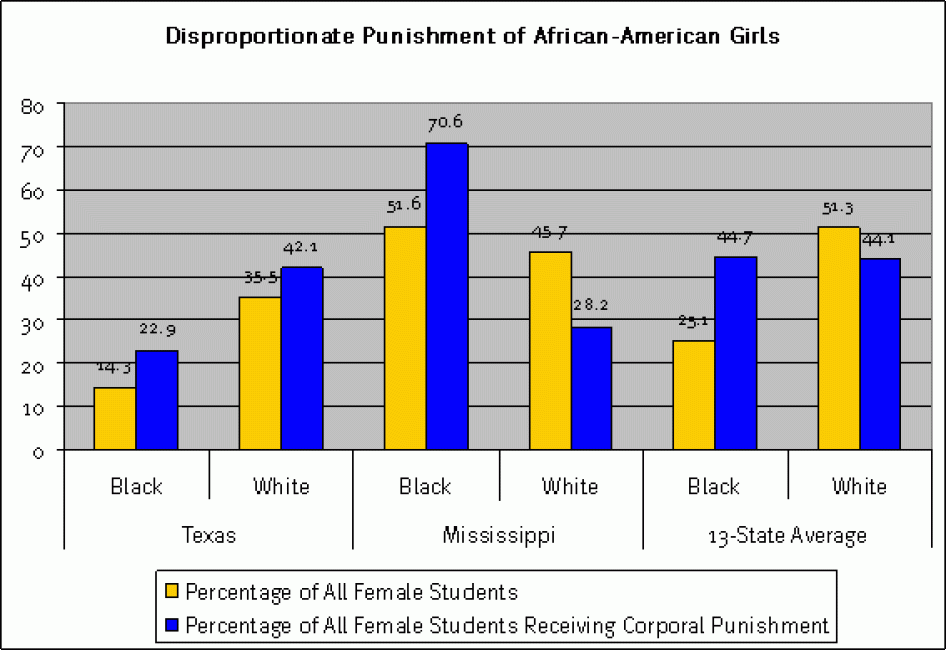
Source: OCR, "Civil Rights Data Collection 2006."
A former member of the Jackson (Mississippi) Public School Board of Trustees cited the disproportionate treatment of black girls as one of the reasons for abolishing corporal punishment in Jackson: "Some of the white teachers, male teachers, were spanking black girls but not white girls. If they could spank black girls, then why couldn't they spank white girls? So that was another issue. It was not being executed fairly. We have to have the same policy for everybody."[341]
Some might argue that African-American students are punished more because they commit more serious disciplinary infractions, or because they commit a higher number of minor disciplinary infractions. The US Department of Education, Office for Civil Rights, the main source for information on rates of corporal punishment, does not collect data on the underlying infraction; the question of whether black students commit more serious infractions that would explain their disproportionate punishment cannot be answered in this report. Neither can we determine whether black students commit more (as opposed to more serious) infractions than white students, and therefore receive corporal punishment more frequently.[342] Existing data do establish that African-American students receive corporal punishment at vastly disproportionate rates, and that the disproportionality has persisted over time.[343]
Discriminatory Learning Environment
The disparate use of corporal punishment creates a hostile school environment in which students of color may struggle to succeed; students, teachers, and administrators are conscious of these discriminatory patterns in their day-to-day lives. A 17-year-old girl spoke of the atmosphere produced by the disparate use of corporal punishment at the high school she used to attend in rural Mississippi: "It feels to me like we're back in slavery."[344] A proclamation opposing school corporal punishment, signed by 20 national African-American leaders, including Kweisi Mfume, Marc Morial, and Reverend Jesse Jackson, Sr., observes that "corporal punishment in schools is disproportionately used on African-American children, and … all children deserve to be able to learn in a safe and supportive learning environment free from corporal punishment."[345]
Some of our interviewees believe corporal punishment was administered with discriminatory motives. A teacher in a rural Mississippi school described how, even among African-American students, darker-skinned students were punished more severely, in part because of the belief that there was less risk that heavy bruising would be visible:
I've heard this said at my school and at other schools: "This child should get less whips, it'll leave marks." Students that are dark-skinned, it takes more to let their skin be bruised. Even with all black students, there is an imbalance: darker-skinned students get worse punishment. This really affected me, being a dark-skinned person myself.[346]
One father and one guardian in separate Mississippi towns voiced their concerns that their African-American sons "needed" corporal punishment because of the discriminatory environment they would face as adults. The guardian stated, "For young black males, if you can't listen to authority, you're headed to jail. Discipline needs to come from people they love to prevent that."[347] This corresponds with the opinions of a high school boy in Jackson, Mississippi, a district without corporal punishment, who believes that corporal punishment would have helped make his classes more orderly: "Corporal punishment shows [kids] how they can make it in the world-it teaches them about life after school."[348] Yet, there are other ways to teach children how to deal with the challenges they will face later in life; a nurturing school environment structured with positive discipline models can help deliver this self-confidence.
In interviews with Human Rights Watch, students and parents repeatedly linked the use of corporal punishment in schools to slavery, characterizing hitting young African Americans as classroom discipline as a dehumanizing reminder of techniques used to control slaves on plantations.[349] One fifth-grade African-American boy commented that "[i]t comes from the time of slavery. They used to tie a black slave up and make another slave beat him."[350] Another student, exasperated with paddlings for not wearing the school uniform, told us she felt like asking, "Okay, are you still in slave mentality, Coach?"[351]
Experienced educators also see links between corporal punishment and submissiveness, which in turn they relate to domination by whites over blacks. One superintendent observed that corporal punishment "has its origins in the times of slavery when slaves were tied up and whipped as a means of control. But because you get compliance does not mean you have control."[352] A school board member in a Mississippi town reflected on this issue:
I see corporal punishment as a form of slavery. Beating on the slaves was how the headman got them to do something. Racism is not about hatred, it's about domination … we're focused so much on making kids do what we want. Think about the mental capacity that this kind of treatment leaves our children with. We are telling them we don't respect them. They leave that principal's office and they think, "They don't consider me a human being." That young person loses self-respect.[353]
Particular Issues Raised by the Paddling of Girls
While girls are paddled less than boys, many teachers and parents we spoke with said they had particular concerns about the sexual overtones of subjecting teenage girls to corporal punishment. In addition, as already noted, some interviewees expressed unease over the link between corporal punishment and domestic violence. These interviewees argued that it was wrong to teach children in school that it is permissible for someone in authority to strike a weaker person who cannot hit back.
Case Study: Allison Guthrie
Allison Guthrie, a recent high school graduate in the Dallas area, was paddled when she was 17. She was sent to detention three times in one week for being late, and was given the choice of in-school suspension or "swats":
"The principal was male. I think he used to be the athletic director, he was maybe 300 pounds…. I had to get parental consent, my mom had to sign off on the swats. She actually came up to the school to sign off on that. She decided to leave it up to me, I guess she figured I could decide for myself….
"My mom left, and I went into the principal's office and there was a female there, like a secretary, a female witness. He gave me a chair and said hold onto the chair. The paddle had holes in it. Then he just did three swats … I was hit on my buttocks…. There were holes in the paddle to make it go faster. There was a bit of a pause in between each swat. The whole thing was a minute. The principal didn't say anything to me…. It hurt very much. There were definitely red marks and then swelling. I remember it being red on my buttocks. Almost welt-like markings. It didn't last for more than a couple days….
"It was strange back then and it was even stranger when I got older. It was like, 'Wow, you were a 17-year-old girl and got hit?' But it was not out of the ordinary then because people got swats. It left me feeling very humiliated. I think there were several levels of emotion. Physical pain, mental humiliation. One, it felt a little unjustified-just for being late? And being a female at that age, it was like there was this older man hitting me on the butt. That's weird. Very strange at that age. Even at that age I knew it was inappropriate, this being a man that I don't know. It was this instinctual knowing that it was inappropriate….
"I have talked about it since then, but we didn't talk about it as being inappropriate then. I think it took me a while to realize why I was so ashamed by it and how inappropriate it was."[354]
One twelfth-grade Texas girl told us she had been paddled in eleventh grade for being tardy: "It seemed normal at the time, but now it seems weird that a man was hitting a teenage girl…. Well that's just what I thought was supposed to happen. Weird to look back on it, though."[355] Another twelfth-grade girl echoed that sentiment: "Can you believe it, I got paddled by a male teacher? It was for little stuff, like talking out loud. It was just a tap on my behind. But why does a man have to tap a girl? That's why I think he's a pervert."[356] One expert felt that because corporal punishment is now more often practiced in private (in the principal's office, as opposed to in the classroom), it is more likely to have sexual overtones.[357] A Mississippi teacher summarized the sense of discomfort:
I know, as a 24-year-old male, I would feel very uncomfortable paddling a 14-year-old female on the butt … I don't know, there are sexual connotations with paddling on the butt. It's not a storyline I want to be involved in.[358]
Special Education Students and Students with Disabilities
While no child should ever be beaten in school, special education students[359] are exceptionally vulnerable to harm from corporal punishment. OCR data show that nationwide, 41,972 special education students received corporal punishment in the 2006-2007 school year.[360] In Mississippi and Texas, the states targeted in this report, special education students receive corporal punishment in large numbers. In Mississippi, 5,831 special education students were recorded as being physically punished in the 2006-2007 school year; while in Texas, the figure was 10,222.[361]
Special education students are beaten in disproportionate numbers when compared to the general student population, according to data from OCR. Focusing on students who qualify for special education under the federal Individuals with Disabilities Education Act (IDEA),[362] IDEA students in Texas made up 18.4 percent of the total number of students who were beaten statewide.[363] However, IDEA students in Texas made up only approximately 10.7 percent of the statewide student population,[364] meaning that they were almost twice as likely to be beaten as might be expected.In Mississippi, IDEA students made up 15.1 percent of those beaten in the 2006-2007 school year, but only 12.2 percent of the statewide student population.[365] Louise P., a former special education teacher in a Mississippi Delta high school, argued that some special education students are paddled more than other students in part because their particular needs are not being met by the school.[366]
Paddling and other forms of physical punishment can be particularly harsh for special education students. Johnny McPhail, the father of a girl with autism in north Mississippi, described a combination of aggressive techniques used to control his daughter: "In kindergarten, they'd pop her, and put her in a closet. It's isolation. They'd pop her on the hand first. I didn't find out until later."[367]
The R.'s, parents of a boy with Tourette Syndrome, obsessive compulsive disorder (OCD), and bipolar disorder, described an early incident in which he was restrained and spanked:
When he was in kindergarten, they would have meetings and decide they would have a time-out room for him. Time out-they basically just cleaned out a closet and would put him in there … for hours…. And even though they weren't supposed to touch him, they did. They carried him in there. But these people were not trained to do any restraint holds or anything like that…. He came home several times with bruises and red marks. He was spanked on his behind, with an open hand, by the teacher. It happened-the times he told us about it-at least five or six times. At least.[368]
The R.'s reported that their son sustained serious injuries when he was punished as a fifth grader for using the wrong utensils and cursing at the assistant principal. His mother described the situation:
He was eating lunch in the special ed room…. They had mashed potatoes and pineapple that day…. He had a fork, but he was saving it for his pineapple because he didn't want to get his fork dirty. And they told him not to eat his potatoes with his fingers … The teacher grabbed his hand, and that's what started it…. [The assistant principal] asked [my son] to go with her … she grabbed him and started dragging him down the hallway by his arm…. The assistant principal reached around and [my son] turned around, he was all mad … and accidentally hit her in the stomach. So she pinned him to the floor, and he bit her because he kept telling her to get off, because she was hurting him.[369]
The police came and handcuffed the fifth grader. Mrs. R. reported, "His wrists were so tiny that he just pulled the cuffs off."[370] Mr. R. added, "he had bruises on his upper ribs, across both his arms, and down both of his legs, for at least a week."[371]
The experience of the R. family also illustrates how, on occasion, special education students may be punished with force for "acting out" behaviors connected with their disabilities. Mrs. R. noted that her son's Tourette Syndrome induces physical "tics." As she explained:
One of his tics was balling up his fists like this, and that was seen as aggression and he would get in trouble with it. He would be put in time out and he didn't understand why. He would try to explain that it was a tic, and he couldn't control it, but they see that as him escalating it. So now they have in him in restraints and then they're giving him sedatives and calling for me to come pick him up. They had a closet and he would go in there and that's where he was hit.[372]
Incidents such as these-in which force is used to punish special education students-may occur because teachers lack understanding of the student's condition. As Mr. R. concluded, "I honestly believe that most of the teachers believe that [my son] had a behavioral problem and needed to be spanked. A couple of them have told us that, that he just needs a good spanking."[373]
Mrs. R., who is also a special education teacher, said she intervened when her school suggested applying corporal punishment to a student with ADHD who regularly failed to do his homework: "The approach was, 'each day you come in and don't bring your homework, then you'll get paddled. Maybe that will help you remember.'"[374]A school board member in a major Mississippi town stated, "I'm concerned that the teachers are not reading the children's individual learning plans…. The child with a discipline problem may not be acting out of his behavior problems but rather out of his disability."[375]
Corporal punishment can be particularly harmful for special education students, as it can exacerbate the student's underlying condition. Johnny McPhail, the father of a Mississippi girl with autism, felt paddling was extremely detrimental: "An autistic child never forgets a paddling. They have total recall, programming needs to be the same. If you hit her, she'd be hitting, it's hard to talk her out of it."[376] Beverly Shields, the mother of an autistic boy in Mississippi, fought hard to have her son excluded from the punishment: "Corporal punishment to an autistic person is just not acceptable in any fashion. He wouldn't know why they were doing it."[377] Mrs. R. witnessed a student with Asperger's Syndrome and a bipolar condition receive corporal punishment, and noted the student's adverse reaction: "He was just crying and just broke down, a kind of helplessness-'I don't know what to do.'"[378]
In addition to causing extensive physical and mental harm, corporal punishment can create further barriers to education for this already disadvantaged group of students. Louise P. felt licks were especially detrimental for her special education students: "A lot of my kids had discipline problems. They'd universally miss first period, they'd be in the office, waiting for their licks. That would harm their education. Depending on the teacher, they'd try and make up the lesson…. But the same kids would be hard to get in after school … [and] it was hard to get them to graduate."[379]
IX. Regulating Discipline in Schools
Regulations and Training on School Discipline
Regulations in states that permit corporal punishment do not adequately protect children from abusive disciplinary measures in school or offer necessary support for alternative methods of discipline.
Mississippi law does not affirmatively call for corporal punishment in schools; rather, it states that such treatment does not constitute negligence or child abuse.[380] Likewise, there is no Texas law affirmatively granting school districts authority to use corporal punishment; policies regarding discipline and control of students are left to individual districts. Provisions in both Mississippi and Texas law provide for governmental immunity from civil and criminal liability in corporal punishment cases.[381]
Both states recognize that corporal punishment is inappropriate for children in contexts other than the public schools. Texas law prohibits corporal punishment against youth in correctional facilities,[382] in residential treatment centers,[383] and for children in the custody of the Department of Family and Protective Services.[384]Mississippi prohibits corporal punishment by foster parents,[385] and by school bus drivers.[386]Mississippi does have a provision requiring schools to adopt evidence-based practices and positive behavioral interventions in addressing student discipline.[387] This is a positive first step by the state, and should be followed with prohibition of corporal punishment in public schools.
While most states do offer extensive teacher training, not all train their teachers in appropriate, non-violent disciplinary practices.[388] One administrator felt that teachers at his middle school resorted to paddling far too fast, having little or no training on alternative measures of discipline.[389] A superintendent in east Mississippi felt that paddling was something that people just knew how to do, and that teachers "don't need to be trained on how to use a paddle."[390] One parent interviewed by Human Rights Watch had serious concerns about the lack of training: "What are the guidelines? Who is trained? Anybody can just grab my child at school?"[391]
Educators Who Disagree are without Recourse
In some instances, teachers and administrators who object to the use of corporal punishment find themselves without recourse or alternative resources. One teacher in a district that does not permit corporal punishment did not know what to do after he witnessed an incident of paddling on a school bus, and was asked to keep the incident to himself: "One of the coaches explained to me very tersely that word of this incident should not leave the bus. This sort of cowboy justice … preempting my discomfort and my whistle blowing…. [The incident] never resurfaced. I wouldn't know who to take it to. So much, I regret it. I feel guilty."[392]
Teachers who have students who seriously misbehave sometimes find they have exhausted in-class remedies but do not want to send the child to the office as they know the child will be beaten there.[393] One teacher noted that she had a new vice principal halfway through her first year: "He used corporal punishment a lot more than the other teachers. I didn't want to send my kids to him; I wouldn't send my kids to him.[394] Another teacher said he "got the message that 'in this culture, we establish order through corporal punishment, and until you do it, you won't get respect.'"[395]
Some teachers, reluctant to endorse corporal punishment, lacked alternative resources for dealing with particularly difficult students. One teacher described the dilemma: "I only sent kids to the office if they were so out of hand I couldn't handle it. I didn't want to send them to get paddled. I tried to handle it within my own classroom. But I didn't have the option of requesting a different form of punishment."[396] Another teacher described what happened when she exhausted her options:
An interesting thing happens when you're in a classroom. You have high stakes, you have a day teaching, and a history with a student who's a problem in the classroom, who's disruptive. You've tried everything else, and you get to a point-well, you're in a cultural setting where people tell you it's okay, and you've tried everything else. I wouldn't have thought … that I'd send a kid to the office to get corporal punishment. I would have thought I'd tried everything in my power not to do it…. Once you're in the classroom, you realize that doesn't always work.[397]
Case Study: Ralph McLaney
Ralph McLaney, a veteran teacher, became the assistant principal at CarverMiddle School in Meridian, Mississippi, in Fall 2003. Soon, Mr. McLaney was receiving 19-23 paddling referrals of children to his office every day. In schools where he had worked previously, paddling was rarely used. He noted, "In Meridian, though, it was clear that most teachers resorted to paddling pretty fast. If the kid said anything they didn't like, they were sent to the disciplinary office … I would end up with a backlog of students in my disciplinary office. The principal would pull them out, and whack 'em…. We were supposed to have a witness, but the principal didn't have that."
Mr. McLaney grew increasingly uncomfortable, in part because of the racial disparity between the majority African-American student body and the largely white staff: "I realized I did not want to be an overseer on an educational plantation." He tried to contact parents to discuss options, but "it was hard to contact them, phones might be disconnected. If I did get a hold of them, the parents would often just authorize the procedure, or say 'just beat that boy's butt.'… The teachers felt if I wasn't hitting the kids, something was wrong. They felt I wasn't backing them up, it was that kind of mentality…. To have earned a second master's degree, to have that lead to a position where the primary activity of each day would be hitting children, now, that's ludicrous."
He sought legal advice from a local chapter of the National Education Association (NEA) where he was warned of the risks of insubordination. "They told me that to refuse to hit a child at the direction of my supervisor, I'd be fired for it…. I ended up resigning, at the time, the pressure, and the whole bit.[398]… I have some regret, sometimes I think I should have blown the thing open instead of resigning.[399]… In the aftermath of this whole thing, I finally contacted the NEA's national headquarters-and they were shocked-but this was after the fact." He concludes, "This period has been one of the most negative experiences of my life."[400]
Parental Choice
In many school districts, parents are given ways to opt out of the use of corporal punishment on their children,[401] but those mechanisms are hard to access and difficult to enforce. In some cases, parents' preferences are ignored and the student is beaten anyway; the parents may then be without redress. Even if the child is not beaten, he or she is still aware of the violence meted out against his or her peers.
Parents say they choose to opt out for fear that corporal punishment will injure their children or because they do not "think anybody should be hitting anybody else's children. There are too many variables. You don't know their intent, their temperament."[402] Parents mistrusted the ability of teachers and administrators to regulate their decisions to resort to corporal punishment or to moderate the levels of violence used. One former Mississippi teacher explained, "There were a couple of parents that didn't want their kids to get corporal punishment; it wasn't that they were against corporal punishment but that they were distrustful of how the school was using it."[403]
Methods of Opting Out of Corporal Punishment
If a school district has a policy for opting out-and not all school districts do-the policy usually falls into one of three categories. First, in some districts, all parents must sign a "yes or no" form, specifying whether or not their child can receive corporal punishment. If the form is not returned, corporal punishment is typically not administered. One superintendent in a small Mississippi district noted that in this situation, the principals usually would speak with the parent before administering corporal punishment.[404]
The second way of expressing preference starts from an assumption that all students will receive corporal punishment. Those who do not want their child to be punished "opt out" by submitting a form to the school or by writing a letter. In the MidlandIndependentSchool District in west Texas, for instance, the policy specifies that "[c]orporal punishment shall not be used in instances where the student's parent or guardian has filed a written statement with the school principal indicating that the parent does not approve of corporal punishment. These written statements should be in the form of a letter, mailed or delivered to the school principal, and submitted annually."[405] In very limited cases, parents may express their preferences orally. A former Mississippi elementary school teacher explained that on the first day of school, the parents could tell the teacher if they did not want their children to be hit: "Not a lot [of parents] would come and articulate that, but some."[406]
Third, in Texas in particular, some districts have policies under which parents are called after the infraction but before corporal punishment is administered. In the TylerIndependentSchool District in Texas, for instance, "a parent or legal guardian of the student must be contacted and approve of the use of corporal punishment prior to each administration."[407] One recent graduate noted that at her high school, "parents could choose-they'd have the principal call your house and decide on swats."[408] We spoke with only one interviewee in Mississippi who reported a scheme in which parents could elect to be called before punishment was administered.[409]
Some school districts do not provide any mention of opt-out methods or parental notification in their official policies or student handbooks. For example, among districts we investigated, Texas school districts Rosebud-Lott, Quinlan, Marshall, and Paris contain no description of opt-out policies.[410] Likewise, the policies of PearlPublicSchool District in Mississippi do not give information on opting out.[411]
Parental Struggles to Opt Out
Some parents feel the opt-out methods are underpublicized and difficult to comply with. One Texas mother told us that she "turned [an opt-out form] in this year, but not last year because I wasn't aware of it and it's kind of hidden."[412] A former teacher in rural Mississippi was not surprised that parents lacked information on how to opt out: "Parents had a page the student would take home. If the student didn't bring it back, then they didn't opt out. I don't know if the students ever showed their parents or not."[413] A Texas parent whose middle school son had been beaten felt the burden on parents was unnecessarily high: "Only if you read the handbook do you find out that the school administers corporal punishment, and then you have to re-write a letter each year and say that you are opposed to it."[414] A former administrator in Meridian, Mississippi, reported to Human Rights Watch that parents felt coerced into signing forms authorizing paddling because, if they did not, their children were more likely to be threatened with expulsion should disciplinary problems emerge.[415]
In addition, parents of special education students have had to fight repeatedly to opt out of corporal punishment for their children. Each special education student has a yearly Individualized Education Plan (IEP) that is devised by the parents, teachers, and administrators; this IEP includes a discipline plan. Parents in Mississippi described problems having corporal punishment expressly prohibited in the IEP. Beverly Shields, a northeast Mississippi mother of an autistic boy who is now 16, stated that she had to "forcibly have this [a ban on corporal punishment] put in his IEP, because corporal punishment to an autistic person is just not acceptable in any fashion. He wouldn't know why they were doing it."[416] Her older boys had been paddled in a different Mississippi school district in violation of her opt-out forms:
I knew from my experiences that the teachers weren't going to look at the card [indicating opt-out]. The principal was saying we won't spank him [my autistic son]. But I needed something in a permanent fashion, that no corporal punishment will be administered and that you will use positive reinforcement. The school tries to make you give up.[417]
She noted that another advantage of fighting to get a ban on corporal punishment placed in the IEP is that, unlike with the opt-out forms in her district, the ban does not have to be renewed every year.[418]
Johnny McPhail, the father of the autistic girl in north Mississippi, also had difficulties securing appropriate discipline for his daughter. At an IEP meeting during his daughter's second-grade year, the school sought permission to paddle her. "They wanted to paddle her because she was having tantrums in class. They were from the 'old school,' [meaning] 'if you cry, they'll whip your butt.'"[419] McPhail felt strongly that the school board, the officials in charge of writing the school discipline policy in his district, knew nothing about behavioral issues for students with disabilities.[420]
Parental Preferences against Corporal Punishment Ignored
Several parents reported to Human Rights Watch that their expressed preferences were ignored, and that their children were paddled in violation of written or verbal opt outs. For instance, Janet Y., a mother in rural Mississippi, filed opt-out forms every year subsequent to the sixth grade, when her daughter was paddled and bruised. Janet renewed the no-paddle request in twelfth grade, but her daughter was subsequently paddled, by the same perpetrator, for "disrespect."[421] The girl was once again seriously bruised, and was taken to receive medical care.[422]
A seventh-grade boy in rural west Texas was paddled even though his mother had followed school procedure by submitting a letter stating her opposition to paddling at the beginning of the school year. She commented, "I made it a point to do this each year, and they didn't even check the files. They automatically smacked him without checking the files."[423] A 10-year-old boy with diagnosed ADHD in rural east Texas received two blows for "horse-playing" in September 2007. His mother maintains that she had two in-person conversations with his principal in the weeks prior to her son's paddling, expressing her opposition to corporal punishment.[424]
One former elementary school teacher in rural Mississippi noted that students were discouraged from enforcing their parents' preferences:
Even if a student is opted out, students don't have a voice … they're told their job is to listen and be obedient…. Students are powerless, unfortunately.[425]
One high school girl in Mississippi tried to assert her right not to be paddled when her principal was swinging his paddle to threaten her: "I told him that my mom opted out, and he said I was trying to be smart-ass. He said, 'I see you standing on your soapbox this morning, bitch.'"[426]
Even students whose parents' no-paddle preferences were honored find themselves in a coercive environment. A sixth-grade boy on the opt-out list "came home crying … basically scared to death" after his principal threatened the school with paddling during an assembly.[427] A mother of a nine-year-old and a 12-year-old noted that "I always say 'no' on the forms … but it's always there in the school, and even in the classrooms."[428]
It is a recognized principle of human rights that children, by reason of their physical and mental immaturity, are exceptionally vulnerable and therefore in need of special safeguards and legal protections.[429] Likewise, parents have a duty to facilitate their children's exercise of their fundamental rights.[430] The parents discussed above were explicitly trying to ensure their children's rights were respected. When schools paddle a student in violation of parental preferences, they not only impinge on the child's fundamental rights, they directly contradict parents' attempts to protect the best interest of their own children to be free from humiliating and degrading treatment.
X. Seeking Redress for Corporal Punishment
Parents find that they have few, if any, methods of redress when their children are beaten. Parents we interviewed who sought redress did so primarily because their child either sustained bruising or other serious injury or was paddled in violation of their express wishes to the contrary. State laws provide considerable legal protection for educators who physically punish children. We spoke with eight separate sets of parents who had extreme difficulties pursuing legal action or obtaining adequate responses from school district officials after their children were paddled.[431] In these cases, which point to more systemic failings, parents were left without any recourse for defending their children's rights.
School District Response to Parental Complaints
The parents we spoke with found educational authorities to be unresponsive to complaints that their children had been subjected to force against their wishes, or that they had been seriously injured in the course of paddling. This was true for parents whether they raised the incident with the principal, superintendent, school board, or even state-wide educational authorities.
Some parents were told not to question the school authority's decision to discipline their child. Andrea N., a Texas mother of a 10-year-old with ADHD who was paddled against her verbally expressed wishes, went to meet with the administration: "The superintendent and the school board said they would have to agree with any decision the principal made."[432] Leah F., the mother of a middle school boy who was paddled in violation of her written request in west Texas, described her interactions with the principal:
When this happened to my son, I marched right over to the school and spoke with the principal. He had the gall to yell at me and tell me not to question what he did…. The principal tried to shift the blame to [my son]. He said [my son] should have told him [that he was on the no-paddle list]. I said, he's just a kid! You're the one with authority. The burden should lie with the administration to check the files.[433]
Rhonda H.'s sixth-grade son was transferred by school authorities from an elementary school with an opt-out policy to an alternative school in a larger district. There, he was paddled and severely bruised. When Rhonda subsequently tried to opt out of paddling, she was told there was no opt-out policy in the new district, even though there had been one in her home district, and her son's transfer was involuntary. She spoke to the principal in the home district: "I confronted [her] about it, and her thing was 'well, that's an entirely different school, different system.' I said I understand that but my point was they sent him up there; they should have known what they were sending him to." Rhonda was unable to opt-out of paddling in the alternative school, and chose to home school her children instead.[434]
School districts were also unresponsive to parents who complained that their children had been subjected to excessive or disproportionate force. Chris B., a father in north Mississippi, believes his son should not have been paddled 10 times merely for being tardy. School authorities told him he had to take his complaint to the school board, as it is responsible for making policy changes. Chris B. noted that he was then stonewalled, because the board chose to go into "'executive session' [a private session in which public access to the board is limited] so it wouldn't get out…. The school board said it wasn't their concern, because they don't oversee the day-to-day issues at the school."[435] Some parents who are met with this lack of response from school authorities feel hopeless and do not know where else to turn.[436]
Immunity for Perpetrators
Both Texas and Mississippi protect perpetrators from legal responsibility for assaulting children with or without opt outs from parents, and fail to provide parents with appropriate redress. In school districts that have opt-out policies, our research has failed to reveal any administrative or regulatory remedies for parents when opt-out preferences are not followed. The parents who raised concerns that their children were paddled in violation of opt-out forms did so either by approaching the superintendent or the school board, as discussed above. This is a general remedy for any school-based complaint, as opposed to a specific procedure to be followed when the opt-out preferences are violated.
Human Rights Watch is not aware of any state-wide laws that provide a cause of action when parental preferences are ignored. School districts render opt-out forms meaningless when they fail to provide redress for paddlings in violation of those forms. When serious injuries to children result from corporal punishment in schools-events that occur with or without parents expressing their opt-out preferences-states rarely allow the perpetrators to be held responsible.
States that permit school corporal punishment provide legal immunity for paddlers.[437] In Mississippi, for example, the only way to prevail in a lawsuit against an educator for corporal punishment is if the educator's conduct constitutes a criminal offense, or if he or she acted with a "malicious purpose."[438] These immunity laws make it extremely difficult for parents to pursue legal action against school officials who have acted contrary to parental wishes, or who have injured children in their care.
Texas statutes also provide immunity for persons who administer corporal punishment under both criminal and civil law. The Texas Penal Code immunizes educators against criminal responsibility when they use "force, but not deadly force," as long as the "actor reasonably believes the force is necessary" to further discipline.[439] Likewise, educators are immune from civil liability when paddling does not result in bodily injury. The Texas Education Code specifies that "[a] professional employee of a school district is not personally liable for any act that is incident to or within the scope of the duties of the employee's position of employment … except in circumstances in which a professional employee uses excessive force in the discipline of students or negligence resulting in bodily injury to students."[440]
Lack of Adequate Responses from Police or Courts
Parents we spoke with who have sought redress in corporal punishment cases have faced obstacles at every level of the criminal justice system. Parents have been unable to convince police to investigate cases where students were injured, and have found district attorneys reluctant to file criminal charges.[441] Equally, parents have faced obstacles pursuing civil lawsuits against paddlers; they have had trouble finding attorneys who will represent them, and they have had trouble meeting the high standard of proof established in the immunity statutes.
According to parents, police have refrained from making arrests in paddling cases. Faye L., whose story is profiled at the start of this report, wanted to file assault charges after her 10-year-old son Tim sustained heavy bruising and swollen genitals after two paddlings in less than a week: "The police told me I wasn't allowed until I had 'followed school procedure.' I was told to go to the school board … finally, the third time I went back to the police, they filed charges."[442] In a similar case, Rose T. wanted an arrest made when her three-year-old son was paddled. The sheriff's department sent the case to the district attorney, who ultimately declined to pursue the case.[443] Reportedly, the district attorney told Rose that a grand jury would not indict for felony assault in a corporal punishment case.[444] Rose's attorney reported there are no remaining options for legal redress, stating that "parents are told it's just a paddling, no harm done."[445]
Parents interviewed by Human Rights Watch had difficulty finding lawyers who would pursue these cases. Faye L. noted that she conducted an extensive search for a lawyer to take her son's case:
I searched the world for an attorney … it was hard to find an attorney. I had an attorney in Huntsville; he took the case when he saw the pictures [of her son's injuries]. But once he knew where the case was, he dropped it. He said he felt it wouldn't go anywhere. So I searched high and low…. A guy in Dallas gave me the run-around … I saw another lawyer in Lufkin, I took my papers there. He told me his wife was a superintendent, so he wouldn't take the case…. I couldn't find anyone in Houston; I even called as far as Galveston.[446]
Even when Faye finally found a lawyer, she received no relief. Although her son sustained heavy bruising and swollen genitals, no criminal charges were filed, because a grand jury decided not to indict the perpetrator.[447] She then pursued the case in federal court, but it was dismissed.[448] Likewise, there is evidence that some local courts in Texas may not be receptive to cases challenging corporal punishment: in at least four instances since 2002, judges or justices of the peace have been reprimanded for using or requiring parents to use corporal punishment against juveniles appearing before their courts.[449]
Leah F., who wanted to pursue legal action in Texas after her seventh-grade son was paddled, "called this one attorney-and she said she didn't think it would be worth shelling out for an attorney because my kids would be retaliated against."[450] Leah also spoke to a lawyer for Legal Aid: "She listened to me, but pretty much said the same thing…. She basically said, only do something if it happens again…. I feel discouraged; I really should try though because it feels like they got away with it."[451]
Parents ultimately find that justice is elusive. Janet Y., whose daughter was paddled in violation of an opt-out form, was able to find a lawyer, but still has faced obstacles. Her state civil case has been postponed. She commented, "I feel like it's the good ol' boys' system…. If [the prosecutor] goes too hard after this case, he's an elected official and it will hurt his career…. I asked the judge to step down because her husband works for the school board."[452]
Parents' Inability to Protect Children
Ultimately, some parents decide that they cannot adequately protect their children from corporal punishment. They believe that they are left with the option of pulling their children out of school or subjecting them to an unsafe environment. Rose T., as already noted, pulled her three-year-old son out of the public pre-kindergarten program to which she was entitled as soon as she found out he had been paddled, and sent him to private day care at personal expense.[453] And Faye L. removed her son Tim from public school after he was paddled in September of his fifth-grade year. She home schooled him for the remainder of the school year, quitting her own job to do so, and then found him a place in a neighboring school district.[454]
Parents who have sought redress for corporal punishment have found themselves and their families ostracized within their communities. Prior to the paddling incident in which her son was badly beaten, Faye L. regularly attended a local church. After she started speaking out, "it was best we didn't go there anymore-the preacher, well, his wife was a teacher, and the school nurse was a congregant-I felt I couldn't go anymore, I couldn't talk to my own preacher."[455] She noted, "We're trash now, because we talked."[456]
Janet Y. reported that she and her daughter Brittany, who are suing the school district after Brittany was paddled in violation of an opt-out form, have been "completely ostracized…. When it came out on the radio show, that was the worst … [I was told] that I can disappear."[457]Brittany, now 19 years old, hates that she is discussed on talk radio stations: "Oh, it made me feel terrible, because, you know, they were judging me and my character … one parent called in and said I was a trouble maker." She stated that she is glad to be fighting the case, "but it's stressful. I just hate riding by the school and people saying, 'Oh, that's her.' I went to homecoming … and everyone just stared at me."[458]
Parents who find themselves unable to protect their children feel helpless. After Janet Y.'s daughter was paddled in violation of an opt-out form, she commented, "I thought I had done everything to protect her. After telling them not to lay a hand on her again and signing the opt-out form, it didn't do any good. I mean, this child is a gift from God, I've vowed to protect her…. It hurts that I haven't protected her."[459] Rose T. noted that she was afraid of the lasting effects on her three-year-old: "What made me so angry-he's three years old, he was petrified. He didn't want to go back to school, and he didn't want to start his new school. I was so worried that this was going to constantly be with him, equating going to school with being paddled."[460]
XI. Banning Corporal Punishment: International Human Rights Law and US Constitutional Standards
Corporal punishment violates internationally recognized human rights to freedom from cruel, inhuman, and degrading treatment or punishment, and freedom from physical violence. In many instances, it violates the prohibition on discrimination and impinges on children's right to education. Corporal punishment is also contrary to respect for human dignity, a deep-seated guiding principle of international human rights law enshrined in the Universal Declaration of Human Rights.
Numerous international and regional human rights institutions, including the United Nations Committee on the Rights of the Child, the UN Human Rights Committee, and the UN Committee against Torture, have spoken out against corporal punishment in schools.[461] 106 countries and 29 US states have outlawed the practice.
International Human Rights Law
With a handful of exceptions, children have the same human rights as adults. For example, they should never be subjected to torture or ill-treatment, and if charged with a crime, they have the right to a fair trial. Children also have certain rights not afforded to adults. Even before the drafting of major human rights treaties, governments acknowledged these special rights of children that reflect their unique needs and vulnerabilities, and the responsibility of governments and governmental institutions such as schools to protect them.
In November 1959 the United Nations General Assembly adopted the Declaration on the Rights of the Child, which recognized that "the child, by reason of his physical and mental immaturity, needs special safeguards and care, including appropriate legal protection, before as well as after birth."[462] The United States was one of the then 78 members of the UN General Assembly, which voted unanimously to adopt the declaration.[463] Since that time, nearly all governments, including the United States, have further elaborated the specific rights of children, including in educational settings.
Freedom from Cruel, Inhuman, or Degrading Treatment or Punishment
The United States has signed and ratified the Convention against Torture and Other Cruel, Inhuman, or Degrading Treatment or Punishment (Convention against Torture) and the International Covenant on Civil and Political Rights (ICCPR). Each of these treaties prohibits the use of cruel, inhuman, or degrading treatment or punishment.[464]International human rights bodies have repeatedly emphasized that corporal punishment is incompatible with these provisions.
Article 7 of the ICCPR states that "[n]o one shall be subjected to … cruel, inhuman or degrading treatment or punishment."[465] The Human Rights Committee (HRC), which offers the authoritative interpretation of the ICCPR in addition to its role as the body charged with overseeing governmental implementation of the treaty, issued a General Comment on the scope of obligations under article 7, concluding that this "prohibition must extend to corporal punishment, including excessive chastisement ordered … as an educative or disciplinary measure."[466] The HRC emphasizes, "Article 7 protects, in particular, children, pupils and patients in teaching and medical institutions."[467] In its concluding observations (which the HRC issues after it has examined a government's record under the treaty), it repeatedly has stated that governments should abolish corporal punishment in schools.[468]
Corporal punishment may also violate US obligations under the Convention against Torture. Article 16 of the convention obliges the US government to undertake to prevent acts of cruel, inhuman or degrading treatment or punishment.[469] The Committee against Torture, the body charged with overseeing state compliance with the Convention against Torture, declared that the "continuing application" of corporal punishment "could constitute in itself a violation of the Convention."[470]
The Right to Freedom from Physical Violence
Various international instruments protect the child's right to be free from any form of physical violence. For instance, article 9 of the ICCPR states that "[e]veryone has the right to liberty and security of person,"[471] while article 5(b) of the International Convention on the Elimination of All Forms of Racial Discrimination (ICERD), to which the US is also party, provides for non-discrimination in the enjoyment of "the right to security of person and protection by the State against violence or bodily harm."[472]
The Convention on the Rights of the Child (CRC), the world's most universally ratified human rights treaty, includes the fundamental recognition of a child's right to be free from any form of physical or mental violence, and the special capacity of children to learn from their mistakes and rehabilitate themselves. While the United States is one of only two countries not to have ratified the treaty, it is a signatory and the treaty's provisions should be treated as authoritative guidance (as discussed below). Article 19 states:
States Parties shall take all appropriate legislative, administrative, social and educational measures to protect the child from all forms of physical or mental violence, injury or abuse, neglect or negligent treatment, maltreatment or exploitation, including sexual abuse, while in the care of parent(s), legal guardian(s) or any other person who has the care of the child.[473]
In 2006 the Committee on the Rights of the Child, the international body charged with monitoring compliance with the CRC, issued General Comment 8, discussing the right of the child to protection from corporal punishment. General Comments are considered authoritative interpretations of the treaty. The committee found that article 19 "does not leave room for any level of legalized violence against children" and that "[c]orporal punishment and other cruel or degrading forms of punishment are forms of violence and States must take all appropriate legislative, administrative, social and educational measures to eliminate them."[474]
The Inherent Dignity of the Child and the Right to Education
Protecting the dignity of each and every individual is the fundamental guiding principle of international human rights law. Corporal punishment violates children's right to human dignity, found in the preamble to the Universal Declaration of Human Rights and in many other legal documents to which the US is party, including the ICCPR.[475]
Both the Committee on the Rights of the Child and the Committee on Economic, Social, and Cultural Rights have expressly stated that corporal punishment is inconsistent with the fundamental right to human dignity, and further asserted that the child's human dignity must be upheld in school discipline policies. Article 28 of the CRC discusses the right to education, and states that "States Parties shall take all appropriate measures to ensure that school discipline is administered in a manner consistent with the child's human dignity[.]" In General Comment 8, the Committee on the Rights of the Child comments on this article, noting that corporal punishment "directly conflicts with the equal and inalienable rights of children to respect for their human dignity and physical integrity."[476] Likewise, the Committee on Economic, Social and Cultural Rights, the body charged with overseeing the International Covenant on Economic, Social and Cultural Rights (ICESCR), states in General Comment 13 (on the right to education):
In the Committee's view, corporal punishment is inconsistent with the fundamental guiding principle of international human rights law enshrined in the Preambles to the Universal Declaration and both Covenants: the dignity of the individual.[477]
In addition, "[t]he Committee welcomes initiatives taken by some States parties which actively encourage the schools to introduce 'positive,' non-violent approaches to school discipline."[478]
The Committee on the Rights of the Child defines corporal punishment broadly. Corporal punishment is "any punishment in which physical force is used and intended to cause some degree of pain or discomfort, however light."[479] This encompasses all forms of corporal punishment currently used in the US, including but not limited to paddling.
Non-discrimination and Equality
The use of corporal punishment in US public schools can also violate children's rights to non-discrimination, a fundamental principle of human rights law. As a consequence of seeking public education, minority children, specifically African-American children, find their rights to security of person violated at disproportionate rates.
Article 5(b) of the International Convention on the Elimination of All Forms of Racial Discrimination requires the US to protect "the right of everyone, without distinction … to security of person and protection by the State against violence or bodily harm, whether inflicted by government officials or by any individual group or institution." Likewise, article 5(e)(v) of the ICERD requires non-discrimination in access to education and training. When compared to relevant percentages of both nationwide and statewide student populations, African-American students are significantly more likely to be punished than their white counterparts. The racially disparate use of corporal punishment in US public schools subjects students to violations of their rights to be free from physical violence and to access education. In effect, African-American students have their rights to security of person violated at disproportionate rates merely as a consequence of participating in public education.
Article 24 of the ICCPR provides that "every child shall have, without any discrimination as to race, color, sex … the right to such measures of protection as are required by his status as a minor"; and article 2 states that the rights in the ICCPR must be recognized "without distinction of any kind."[480] To the extent that the ICCPR prohibits corporal punishment through articles 7 and 9 (see above), that prohibition must be upheld in a non-discriminatory manner.
Corporal punishment also violates article 26 of the ICCPR, which mandates that "all persons … are entitled without any discrimination to the equal protection of the law." Corporal punishment violates the right to equal protection by allowing children to be assaulted in the name of discipline. Criminal laws on assault should, at a minimum, protect children in the same way that they protect adults. In fact, human rights law provides for additional protection for children due to their vulnerability.[481] Yet corporal punishment leaves children deprived of the very protections assured to adults.
Parents' Rights
Parents have "the prior right to choose the kind of education that shall be given to their children."[482] Furthermore, as guardians of their children, they must be able to uphold and defend their children's rights. The preamble of the Convention on the Rights of the Child affirms that precisely because of their "physical and mental immaturity," children need "special safeguards and care, including appropriate legal protection."[483]Children cannot defend their rights on their own; parents have a duty to aid them in exercising those rights.[484]
Parents who try to prevent their children from being subjected to corporal punishment, or who seek redress after their children have been paddled, are very much acting within their rights under international law.[485] Furthermore, the state has both an obligation to respect and ensure children's rights,[486] and an obligation to respect the responsibilities of parents who are trying to protect their children's rights.[487] Parents should be given fair hearings and proceedings in order to uphold their children's right to be free from corporal punishment.
The United States and International Human Rights Law
The United States is obliged to follow the international norms articulated above. For instance, the United States is party to the ICCPR and the Convention against Torture. However, it attached limiting reservations to these treaties that attempt to restrict both the scope of the treaties and their use in domestic court proceedings.[488] The United States sought to limit the domestic impact of the ICCPR and the Convention against Torture by declaring both treaties to be "non-self-executing," that is, they cannot be relied upon to enforce rights in US courts without enabling legislation. The United States asserts that existing state and federal laws adequately protect citizens from violations of the treaties; yet in reality, both the ICCPR and the Convention against Torture offer protections broader than those found under US law. The prohibition on corporal punishment is among them.
US constitutional law requires both individual states and the federal government to uphold human rights treaties made under the authority of the United States. The US Constitution states:
[A]ll treaties made, or which shall be made, under the authority of the United States shall be the Supreme Law of the Land; and the Judges in every State shall be bound thereby, anything in the Constitution or Law of any State to the contrary notwithstanding.[489]
Upholding this constitutional principle, the US Supreme Court has stated, "[I]nternational law is part of our law, and must be ascertained and administered by the courts of justice of the appropriate jurisdiction[.]"[490] Treaties of the United States have been held to be binding on states independent of the will and power of state legislatures.[491] Human rights treaties, like other treaty obligations of the US government, are similarly binding on state governments, although this fact is not commonly understood or accepted by states or by the federal government.[492] Apart from the binding nature of treaty obligations, the Supreme Court has often relied upon international human rights standards as "instructive" in interpreting US constitutional obligations.[493] Therefore, not only should state officials adhere to the prohibition on corporal punishment, but the federal government should support those states, including through federal funding, that eliminate the practice in the future.
The United States also sought to circumscribe the domestic impact of the ICCPR and the Convention against Torture by limiting the scope of the rights acknowledged. For instance, the United States considers itself bound by the right to freedom from cruel, inhuman, and degrading treatment only to the extent that cruel and unusual punishment is prohibited by the US Constitution.[494] Yet in 1995, the Human Rights Committee found that the US reservation to article 7 (on cruel, inhuman, and degrading treatment) was incompatible with the object and purpose of the ICCPR, and therefore invalid.[495]US law on corporal punishment falls short of international standards; and, at a minimum, the federal and state governments should prevent and remedy violations of the prohibition on corporal punishment in keeping with their obligations under international law.
As well as upholding its obligations under the ICCPR and the Convention against Torture, the United States must adhere to standards articulated in the Convention on the Rights of the Child. The CRC is nearly universally accepted: as of 2005, 192 countries were party to it. Singapore is the only party that has issued a declaration on the use of corporal punishment in the context of its obligations under the CRC.[496] The United States and Somalia are the only two countries in the world that have failed to ratify the CRC, although both have signed it.[497] As a signatory to the convention, the United States must not take actions that would defeat the CRC's object and purpose.[498]
In addition to being prohibited from defeating the object and purpose of the CRC as a signatory, the US government has proclaimed its commitment to the CRC's principles on several occasions. The Supreme Court explicitly acknowledged the CRC's authority as an expression of "the overwhelming weight of international opinion" in interpreting domestic legal standards, observing that the "express affirmation of certain fundamental rights by other nations and peoples simply underscores the centrality of those same rights within our own heritage of freedom."[499] When Ambassador Madeleine Albright, as the US permanent representative to the UN, signed the CRC on behalf of the United States, she declared, "The Convention is a comprehensive statement of international concern about the importance of improving the lives of the most vulnerable among us, our children…. United States participation in the Convention reflects the deep and long-standing commitment of the American people."[500] The United States has reaffirmed this commitment on subsequent occasions. For example, in 1999 AmbassadorBettyKing, US representative to the UN Economic and Social Council, stated:
Although the United States has not ratified the Convention on the Rights of the Child, our actions to protect and defend children both at home and abroad clearly demonstrate our commitment to the welfare of children. The international community can remain assured that we, as a nation, stand ready to assist in any way we can to enhance and protect the human rights of children wherever they may be.[501]
In sharp contrast to its expressed desire to protect the human rights of children, however, certain individual states in the US have taken no steps to reduce or eliminate the use of corporal punishment. In addition, while the United States is a federal system in which considerable power over education rests with state and local officials, the federal government has obligations and authority to secure compliance with human rights laws among its constituent states.[502]
US Law Permitting Corporal Punishment
Despite the federal government's obligations to secure compliance with binding human rights norms among the states, federal law fails to live up to the international standards protecting children from corporal punishment. Corporal punishment has been permitted under US common law for centuries.[503] In 1977 the Supreme Court ruled that routine corporal punishment is not considered cruel and unusual punishment, and does not per se violate procedural due process.[504] Since then, however, a majority of the states have enacted legislation outlawing the use of corporal punishment in public schools.[505] The federal standards that continue to permit corporal punishment were established decades ago; it is incumbent on the US government to bring its law into line with international commitments.
Cruel and Unusual Punishment
In the 1977 decision Ingraham v. Wright, the US Supreme Court held that the cruel and unusual punishments clause of the Eighth Amendment to the US Constitution does not apply to disciplinary corporal punishment in public schools.[506] The majority argued that the history of the Eighth Amendment and prior decisions of the Supreme Court indicate that the prohibition on cruel and unusual punishments was designed to protect those convicted of a crime,[507] and it declined to extend the prohibition to school disciplinary practices.[508] The majority further argued that the openness of the public school and its supervision by the community offers safeguards against the kinds of abuses to which convicted criminals may be subjected.[509] This argument stands in opposition to international jurisprudence, as discussed above.
The ruling in Ingraham was supported by only a narrow majority of the Court.[510] The dissenting opinion points out some flaws in the majority's argument, noting that "the constitutional provision is against cruel and unusual punishments; nowhere is that prohibition limited or modified by the language of the Constitution…. No one can deny that spanking of schoolchildren is 'punishment' under any reasonable reading of the word."[511] The dissent goes on to argue that "[i]f there are some punishments that are so barbaric that they may not be imposed for the commission of crimes … then, a fortiori, similar punishments may not be imposed on persons for less culpable acts, such as breaches of school discipline."[512]
The US has attempted to argue that the domestic interpretation of the cruel and unusual punishments clause of the Eighth Amendment governs the scope of US obligations to uphold the international prohibition on cruel, inhuman, and degrading treatment.[513] As discussed above, the Human Rights Committee rejects this argument. In the case of corporal punishment, US standards fall far short of the protections offered to children under international law.
Due Process
Federal law acknowledges that children have the right to personal security which is jeopardized when corporal punishment is administered.[514] The Supreme Court noted in Ingraham that the child "has a strong interest in procedural safeguards that minimize the risk of wrongful punishment."[515] Nonetheless, the Supreme Court held that imposing additional safeguards-such as prior notice and a hearing before corporal punishment is administered-would be costly and would intrude on the decision-making of the public school authorities.[516] Other federal courts have ruled that adequate common law remedies exist for excessive corporal punishment.[517] Yet, as demonstrated above, these remedies are often illusory.
In other words, federal law asserts that while children's rights exist, corporal punishment does not necessarily violate those rights and the government is not obliged to prevent abuses before they happen. The dissent in Ingraham argues that this is problematic: "even if the student could sue for good faith error in the infliction of punishment, the lawsuit occurs after the punishment has been finally imposed. The infliction of physical pain is final and irreparable; it cannot be undone[.]"[518] Indeed, as our research demonstrates, the legal procedures available in the US for redressing instances of corporal punishment are severely inadequate.
The Supreme Court has not yet ruled on whether a student has a constitutional right to be free from excessive corporal punishment.[519] Lower federal courts appear to recognize such a right, though they are split as to the underlying reasons.[520] Some courts argue that students have the right to be free from corporal punishment that is so brutal and disproportionate to the misconduct that it "shocks the conscience,"[521] while others argue students have a right to be free from forms of corporal punishment that are "arbitrary, capricious, or wholly unrelated to the legitimate state goal of maintaining an atmosphere conducive to learning."[522] Federal courts should bring this jurisprudence into line with international standards and protect children from all forms of corporal punishment.
Trends to Abolish Corporal Punishment
Governments worldwide and the majority of US states have now prohibited corporal punishment in schools, providing a clear measure of accelerating global adherence to the prohibition. By early 2008, 106 countries had prohibited corporal punishment in schools.[523] For instance, the European Court of Human Rights has considered a series of cases on corporal punishment[524] that have resulted in the abolition of corporal punishment in all schools in the United Kingdom and in other European states.[525]
In keeping with transnational trends, school districts and states throughout the US are upholding the rights of children by rejecting corporal punishment at an accelerating rate. Twenty-nine states and the District of Columbia have passed bans on corporal punishment in public schools.[526] Of the remaining 21 states, only eight of them paddle more than one percent of school children, according to the US Department of Education.[527] Ninety-five of the 100 largest school districts in the US have prohibited corporal punishment in their public schools, including major school districts in Texas such as Houston, Dallas, Fort Worth, Austin, and El Paso.[528]Jackson, the largest school district in Mississippi, has also banned paddling. Mississippi, Texas, and other states that still use paddling must join this accelerating trend.
XII. Conclusion and Recommendations
Given the international legal prohibition on corporal punishment, and the accelerating rate of bans on the practice in public schools in the US and abroad, corporal punishment should be abolished immediately in the US. Children like Tim L., the 10-year-old Texas boy who was beaten and bruised twice in the first two weeks of the fifth grade, suffer the consequences of this abusive practice on a daily basis. Corporal punishment can violate children's rights to freedom from cruel, inhuman, or degrading treatment, to education, and to freedom from physical violence. Furthermore, it contributes to a hostile school environment in which students struggle to learn. Tim and his peers deserve better: they deserve a school environment in which they can learn, grow, and reach their full potential.
Not only is corporal punishment abusive, it is ineffective. Students, teachers, and parents alike share the goal of orderly, disciplined classrooms in which students can learn. Yet corporal punishment fails to produce such an environment. By responding violently to misbehavior, by degrading and humiliating students, and by injuring them physically and psychologically, those administering corporal punishment damage the educational environment. Students may withdraw, fearful to express their ideas; they may react with aggression to their peers and to teachers; or they may disengage from school altogether and ultimately drop out.
Corporal punishment disproportionately affects minority students, making it harder for students of color to achieve their educational goals. The practice is also used disproportionately against special education students, the very students who are in need of special care and guidance in the public school system. When parents try to defend their children's rights, whether those students are minority students, special education students, or any other students, they face serious opposition from school districts, police, the justice system, and their communities.
This discriminatory, abusive, and ineffective practice should be abolished in US schools. It is past time for Mississippi, Texas, and other US states to ban corporal punishment and provide adequate protection and a decent education for all students.
To Legislatures in States with Corporal Punishment
- Enact legislation explicitly banning the use of corporal punishment in public schools. Such legislation should clarify the fact that while teachers in many respects have the same authority as parents over students in their charge, this authority does not extend to any right to use corporal punishment. There must be no exceptions for "reasonable" force or corporal punishment "to maintain discipline."
- Repeal or modify existing legislation that grants educators who use corporal punishment immunity from civil lawsuits or criminal prosecution. Any child who is punitively struck in school by an educator should be able to seek redress. Children must receive at least the same level of protection afforded by assault laws as adults.
- Until a complete ban is adopted, state legislatures, governors, and boards of education should require school districts to respect parents' wishes not to have their children beaten by school officials, at a minimum by establishing an "opt-in" scheme requiring parents affirmatively to agree before their child could be subjected to this practice.
- Until a full ban is adopted, provide parents with the right to seek redress against school districts and educators who use corporal punishment in violation of their preferences. This redress could be facilitated by creation of an administrative ombudsman, charged with overseeing compliance with state and local regulations on corporal punishment. Redress should always include access to legal remedies.
- Enact legislation requiring school boards to incorporate positive behavior support (PBS) systems into individual school district discipline policies and codes of conduct. Require school boards to revise their discipline policies regularly, and to base those discipline policies on methodologically sound studies proving the efficacy of the disciplinary methods chosen.
- Increase funding for additional behavior analysts and counseling staff to ensure that special education students are treated appropriately, particularly on discipline issues.
To Governors and Departments of Education in States with Corporal Punishment
- Propose and support the enactment of state legislation that ends the practice of corporal punishment in public schools. Issue clear directives to all educators that corporal punishment and all other forms of cruel or degrading punishment should not be used in public schools.
- Until such a ban is enacted, establish adequate complaint and redress procedures (accessible to parents and children) for children who are beaten severely or inappropriately (including consideration of their age or special education status), or who are beaten in violation of expressed parental preferences.
- Until a ban on corporal punishment is in place, enact clear standards for teachers, principals, and other professional educators that provide for sanctions, dismissal, or other disciplinary action if those working with children violate school district procedures for corporal punishment, or, once a ban has been passed, continue to paddle children.
- Until a ban is enacted, implement a statistical review system that tracks every instance of corporal punishment. Authorities should be required to record each instance, taking data on the race, gender, and special education status of the students and paddlers, and the type of infraction for which corporal punishment was administered.
- Ensure that state agencies charged with overseeing child welfare investigate school-based corporal punishment complaints as thoroughly as they investigate other child abuse complaints and take appropriate action to prevent child abuse in schools.
- Conduct comprehensive and sustained awareness-raising campaigns among parents, teachers, and others concerned with children's education on the dangers of corporal punishment in schools.
- Conduct comprehensive and sustained awareness-raising campaigns among children of their rights not to be disciplined physically, including appropriate programs according to the age of the child.
To Police, District Attorneys, and State Courts
- Treat corporal punishment complaints as any other assault complaint. Take statements from victims of corporal punishment without requiring those individuals first to appear before the school board or superintendent.
- Remove obstacles that prevent victims of corporal punishment from pursuing their cases in court. Once defenses, justifications, and authorizations of corporal punishment have been abolished by state legislation, assault laws must apply equally to children and to adults.
To the President of the United States
- Propose and urge Congress to enact legislation abolishing the use of corporal punishment in US schools.
- Submit the Convention on the Rights of the Child to the US Senate for its consent to ratification without reservation.
To the United States Congress
- Prohibit the use of corporal punishment against all students in US public schools.
- Until that point, immediately prohibit the use of corporal punishment against special education students in public schools (as defined by the Individuals with Disabilities Education Act and/or Section 504 of the Rehabilitation Act of 1973).
- Until a full ban on corporal punishment is enacted, withhold discretionary educational funding from school districts that use corporal punishment.
- Support measures to improve school discipline through the implementation of positive behavior and restorative justice methods, such as those discussed in the Positive Behavior for Effective Schools Act (H.R. 3407, S. 2111).
- Increase funding to states and to school districts that choose to end the use of corporal punishment and use positive behavioral interventions instead, so that principals and teachers can be trained on effective methods of creating school discipline plans.
- Increase funding to states to fund additional behavior analysts and counseling staff to improve the delivery of appropriate discipline to special education students.
- (To the Senate): ratify the Convention on the Rights of the Child without reservation.
To the US Department of Education, Office for Civil Rights
- Pursue sanctions, mediation, or other measures to end the discriminatory use of corporal punishment in public schools. If unsuccessful, refer the issue to the Department of Justice for litigation.
- Revise and expand the collection of school discipline data with a particular focus on corporal punishment. Data should be collected by incident as well as by pupil punished per year. Data should also be collected on the underlying infraction that leads to corporal punishment.
- Conduct comprehensive and sustained awareness-raising campaigns among school districts, administrators, and others concerned with children's education on the dangers of corporal punishment in schools.
- Conduct comprehensive and sustained awareness-raising campaigns among children on their right not to be disciplined physically, including appropriate programs according to the age of the child.
To School Boards, Superintendents, Principals, and Teachers
- Revise discipline policies to prohibit corporal punishment in all schools and classes under their control.
- Institute alternative discipline systems such as positive behavior support (PBS) systems to deal with discipline problems in a non-violent, effective manner and construct a school environment in which students can thrive.
- Provide educators with extensive training on effective classroom management techniques and positive school discipline techniques. Provide new teachers with adequate resources for learning to manage classrooms, and appropriate support for helping to reach particularly disruptive students.
- Better utilize professionally conducted behavioral assessments for special education students so that they receive the disciplinary support they need before teachers resort to corporal punishment. Ensure that those assessments include classroom observation to determine why misbehavior is occurring, and what individualized, positive interventions should be incorporated into the student's plan to provide effective incentives for appropriate conduct.
- Until a complete ban on corporal punishment has been instituted, provide adequate mechanisms for parents who do not want their children to be subjected to corporal punishment. Establish an "opt-in" scheme requiring parents affirmatively to agree before their child is subjected to this practice. Ensure that such mechanisms include practicable methods for parents to file complaints and seek redress should children be paddled in violation of the parents' expressed preferences.
- Until a complete ban on corporal punishment has been instituted, establish an immediate moratorium on corporal punishment for special education students, in light of their particular vulnerability and the potential for serious physical or psychological injury.
- Until corporal punishment has been banned, institute a regular statistical review process to ensure that minorities do not receive corporal punishment at disproportionate rates.
- Conduct comprehensive and sustained awareness-raising campaigns among parents, teachers, and others concerned with children's education on the dangers of corporal punishment in schools.
To Teachers' Colleges and Teacher Training Programs
(including Teach for America)
- Provide new teachers with extensive training on appropriate discipline techniques, including positive behavior models. Include a component underscoring the fact that corporal punishment is prohibited by international law.
- If teachers will likely be placed in districts that use corporal punishment, give teachers extensive resources for managing particularly disruptive students, so that they do not have to send those students out of the classroom to receive corporal punishment.
To Professional Bodies Working in Education
(such as the National Education Association, the National Association for State Boards of Education, and the National Parent Teachers Association)
- Establish or strengthen policies that support the prohibition of corporal punishment, and conduct active advocacy campaigns to end the practice.
- Develop codes of conduct for members that refer to the legal prohibition of corporal punishment and promote positive, non-violent school discipline.
- Conduct comprehensive and sustained awareness-raising campaigns among parents, teachers, and others concerned with children's education on the dangers of corporal punishment in schools.
- Promote positive, non-violent forms of school discipline by members and their constituencies.
To Private and Non-Profit Foundations that Fund US Public Education or Advocate for Improvements in Education
- Make the prohibition of corporal punishment a condition for grants, awards, and other funding and support.
- Provide funding for additional academic research on the effects of school-based corporal punishment.
- Conduct comprehensive and sustained awareness-raising campaigns among parents, teachers, and others concerned with children's education on the dangers of corporal punishment in schools.
- Conduct comprehensive and sustained awareness-raising campaigns among children on their right not to be disciplined physically, including appropriate programs according to the age of the child.
Acknowledgments
Human Rights Watch and the American Civil Liberties Union thank all of the students, parents, family members, siblings, teachers, administrators, superintendents, school board officials, and other government officials who shared their views and experiences with us for this report. This report was researched and written by Alice Farmer, Aryeh Neier fellow for Human Rights Watch and the American Civil Liberties Union. Additional research was conducted by Alison Parker, deputy director of the US Program at Human Rights Watch, and a staff member from the American Civil Liberties Union (who chose to remain anonymous). The principal editors were: Alison Parker; David Fathi, director of the US Program at Human Rights Watch; Joseph Saunders, deputy program director at Human Rights Watch; and Clive Baldwin, senior legal advisor at Human Rights Watch. This report was also reviewed and edited by: Jo Becker, advocacy director of the Children's Rights Division at Human Rights Watch; Terri Burke, executive director of the American Civil Liberties Union of Texas; Jamil Dakwar, director of the Human Rights Program at the American Civil Liberties Union; Nsombi Lambright, executive director of the American Civil Liberties Union of Mississippi; Dennis Parker, director of the Racial Justice Program at the American Civil Liberties Union; and Meghan Rhoad and Janet Walsh of the Women's Rights Division at Human Rights Watch.Brian Root, consultant to Human Rights Watch, provided methodological and data review for this report. Ashoka Mukpo and Thomas Gilchrist, US Program associates at Human Rights Watch, and Kennji Kizuka, Children's Rights Division associate at Human Rights Watch, provided research and production assistance. Additional research assistance was provided by: Jennifer Norris, Giancarlo Rivero-Pelligrini, and Leanne Webster, interns with the US Program at Human Rights Watch; and by Joy Frey and Catherine Oddy of NorthwesternUniversityLawSchool. Grace Choi, publications director, Ella Moran, multimedia specialist, Fitzroy Hepkins, print and mail manager, Xabay Spinka, communications coordinator, and Enrique Piraces, web content management specialist, provided layout and production for this report.
We express our deep appreciation to the leaders, staff, and volunteers of non-profit organizations, after-school programs, community groups, and other organizations who assisted enormously with our research. Human Rights Watch and the American Civil Liberties Union are grateful to the Open Society Institute for its support of the Aryeh Neier fellowship. We would also like to thank Gara LaMarche, vice president of the Open Society Institute, for initiating the fellowship. Human Rights Watch would also like to thank Peter B. Lewis and the John Merck Fund for their generous support of the US Program.
[1]Human Rights Watch interview with Faye L., rural east Texas, February 26, 2008.
[2]Ibid.
[3] This report examines the use of corporal punishment in US public schools. While US private schools are not the subject of this report, Human Rights Watch is aware that corporal punishment occurs in some private schools as well and believes it should be abolished in all schools.
[4]Human Rights Watch interview with Tiffany Bartlett (real name used with consent), Austin, Texas, February 22, 2008 (referring to events in Mississippi).
[5] Human Rights Watch telephone interview with Catherine V., Washington, DC, November 7, 2007 (referring to a school in the Mississippi Delta).
[6]Ingraham v. Wright, 430 U.S. 651 (1977).
[7] The Center for Effective Discipline, "Large City School Districts Banning Corporal Punishment, Discipline at School," August 2008, http://www.stophitting.com/disatschool/100largest.php (accessed August 8, 2008) (This site lists the 100 largest school districts in the US, and notes that 94 of them do not use corporal punishment, listing Aldine, Texas as one of the large districts that permits corporal punishment. However, Human Rights Watch has on file email correspondence of July 1, 2008 from Ken Knippel, assistant superintendent of administration in the Aldine, TexasIndependentSchool District, stating that the Aldine ISD currently does not permit corporal punishment.).
[8] Corporal punishment is prohibited in: Alaska, California, Connecticut, Delaware, Hawaii, Illinois, Iowa, Maine, Maryland, Massachusetts, Michigan, Minnesota, Montana, Nebraska, Nevada, New Hampshire, New Jersey, New York, North Dakota, Oregon, Pennsylvania, Rhode Island, South Dakota, Utah, Vermont, Virginia, Washington, West Virginia, Wisconsin, and Washington, DC. States permit or prohibit corporal punishment in varying ways: affirmative state legislation, state-wide regulation, consensus of school districts, or silence. Consequently there is some disagreement as to whether 21 or 22 states permit the use of corporal punishment. After analyzing these laws, we take the position that 21 states permit the use of corporal punishment. The Center for Effective Discipline, "U.S.: Corporal Punishment and Paddling Statistics by State and Race, States Banning Corporal Punishment," 2008, http://www.stophitting.com/disatschool/statesBanning.php (accessed August 8, 2008).
[9]Global Initiative to End All Corporal Punishment of Children, "Countdown to universal prohibition: Summary of legality of corporal punishment of children worldwide," April 2008, http://www.endcorporalpunishment.org/pages/progress/countdown.html (accessed August 8, 2008).
[10] This report focuses on corporal punishment in US public schools only. Corporal punishment in private schools and in the home can also amount to serious violations of children's human rights, but they lie outside of the scope of this report.
[11]Human Rights Watch interview with David F., an eighth-grade boy, rural west Texas, February 23, 2008 (interviewed in the presence of his mother).
[12] Human Rights Watch interview with Bryce M., a high school teacher, Leland, Mississippi, December 3, 2007.
[13] South Delta School District (Sharkey-Issaquena), "South Delta School District (Sharkey-Issaquena) Student Handbook," http://www.southdelta.k12.ms.us/districtoffice/pages/files/shandbook.pdf (accessed August 8, 2008), p. 20 ("Paddle specifications: Elementary school 14" long from end to end, 2" wide and ¼" thick oak or ash wood used-middle and high schools, 15" x 2" x 3/8").
[14] Human Rights Watch interview with Shannon Q., an 18-year-old girl, Midland, Texas, February 25, 2008.
[15]Human Rights Watch interview with Gerardo H., who recently left high school, Midland, Texas, February 25, 2008.
[16]Human Rights Watch interview with Bre L., a 16-year-old girl, Midland, Texas, February 25, 2008 (interviewed in the presence of another witness).
[17] Human Rights Watch interview with Jimmy Dunne (real name used with consent), former teacher in Houston, February 19, 2008.
[18] UN Committee on the Rights of the Child, General Comment 8, The right of the child to protection from corporal punishment and other cruel or degrading forms of punishment, UN Doc. CRC/C/GC/8 (2006), para. 15 (commenting on the Convention on the Rights of the Child (CRC), adopted November 20, 1989, G.A. Res. 44/25, annex, 44 UN GAOR Supp. (No. 49) at 167, UN Doc. A/44/49 (1989), entered into force September 2, 1990, signed by the United StatesFebruary 16, 1995, arts. 19, 28(2), and 37) ("The Committee recognizes that there are exceptional circumstances in which teachers and others … may be confronted by dangerous behavior which justifies the use of reasonable restraint to control it. Here too there is a clear distinction between the use of force motivated by the need to protect a child or others and the use of force to punish. The principle of the minimum necessary use of force for the shortest necessary period of time must always apply.").
[19] UN Committee on the Rights of the Child, General Comment 8, para. 11 (defining corporal punishment as "any punishment in which physical force is used and intended to cause some degree of pain or discomfort, however light…. In the view of the Committee, corporal punishment is invariably degrading.").
[20]RankinCountySchool District, "Rankin County School District Student Handbook, Grades K-12, 2006-2007," http://www.rcsd.k12.ms.us/pdfs/2006-07StudentHandbook.pdf (accessed August 8, 2008), p. 53.
[21]MeridianPublicSchool District, "Student Code of Conduct, K-12, 2006-2007," http://www.mpsd.k12.ms.us/handbooks/codeofconduct0607.pdf (accessed August 8, 2008).
[22] Human Rights Watch telephone interview with Ralph McLaney (real name used with consent), a former middle school administrator, Alabama, October 26, 2007.
[23] Human Rights Watch interview with Bre L., a 16-year-old girl, Midland, Texas, February 25, 2008.
[24] Human Rights Watch interview with Gerardo H., who recently left high school, Midland, Texas, February 25, 2008.
[25] Human Rights Watch interview with Lisa P., a former teacher in the Mississippi Delta, Austin, Texas, February 22, 2008 ("It had tape around it … I think they put tape on it because it split or whatever.").
[26] Human Rights Watch interview with Matthew S., a middle school student in the Mississippi Delta, December 12, 2007.
[27] On May 22, 2008, Human Rights Watch called five school supply stores in Mississippi and seven school supply stores in Texas that sold school supplies state-wide. None sold paddles. Earlier calls also did not yield any school supply stores that sold paddles. These stores gave various reasons for not carrying paddles, saying, for example, "nobody asks for them," or "there's no real demand," and that they did not "know of any company that makes them," that they had "never seen them in any catalog from suppliers," and that they are "not something our vendors offer."
[28]GreenvillePublicSchool District, "Corporal Punishment Survey," May 22, 2008, unpublished document on file with Human Rights Watch.
[29] Human Rights Watch telephone interview with a superintendent of a small district in east Mississippi, April 14, 2008.
[30] Human Rights Watch interview with Tiffany Bartlett (real name used with consent), Austin, Texas, February 22, 2008 (referring to events in Mississippi).
[31] Human Rights Watch telephone interview with John Booth (real name used with consent), Levelland, Texas, April 23, 2008.
[32] Human Rights Watch interview with Lisa P., a former teacher in the Mississippi Delta, Austin, Texas, February 22, 2008 (referring to events in Mississippi).
[33] Human Rights Watch interview with Kiashia T., a fifth-grade girl in rural Mississippi, December 10, 2007 ("[the teacher] said, 'I'm going to get my Dr. Pepper out'").
[34] Human Rights Watch interview with Mathew S., middle school student in the Mississippi Delta, December 12, 2007.
[35] Human Rights Watch interview with Elizabeth Savage (real name used with consent), New Orleans, Louisiana, December 9, 2007.
[36] Human Rights Watch telephone interview with Chris Myers Asch (real name used with consent), a former elementary school teacher in the Mississippi Delta, Washington, DC, December 19, 2007.
[37] Human Rights Watch interview with Nakia D., a twelfth-grade girl in rural Mississippi, December 4, 2007 (noting that students are asked to put their "hands on the top of the desk"); and Human Rights Watch interview with Keshawn E., eleventh grader in urban Mississippi, December 7, 2007 ("[The principal] told each of us to come into the office separately and told us to put our hands on the desk and gave us a paddling.").
[38] Human Rights Watch interview with Gerardo H., who recently left high school, Midland, Texas, February 25, 2008.
[39] Human Rights Watch interview with Mei N., teacher at a high school in Mississippi, December 4, 2007 ("my principal has walked around with a paddle in hallways, you know, to get kids to class … he will give them licks in the hallway.")
[40] Human Rights Watch interview with Matthew S., a middle school student in the Mississippi Delta, December 12, 2007.
[41] Human Rights Watch interview with Brittany Y., who recently left high school, rural Mississippi, December 11, 2007.
[42] Human Rights Watch interview with Kiashia T., a fifth-grade girl in rural Mississippi, December 10, 2007.
[43] Human Rights Watch interview with Sean D., recent high school graduate, Oxford, Mississippi, December 14, 2007.
[44] Human Rights Watch interview with Chantal K., Leland, Mississippi, December 3, 2007.
[45] Human Rights Watch interview with LaShell M., Mississippi Delta, December 4, 2007.
[46] Human Rights Watch interview with Brittany Y., who recently left high school, rural Mississippi, December 11, 2007.
[47] UN Committee on the Rights of the Child, General Comment 8, para. 11.
[48] Human Rights Watch interview with LaShell M., Mississippi Delta, December 4, 2007.
[49] Human Rights Watch interview with Rochelle T., who recently left high school, Midland, Texas, February 25, 2008.
[50] Human Rights Watch interview with Jake G., a middle school boy in north Mississippi, December 14, 2007.
[51] Marshall Independent School District, "Student Code of Conduct, 2006-2007," on file with Human Rights Watch, pp. 14, 15, and 17.
[52]Grand PrairieIndependentSchool District, "Student Code of Conduct," http://www.gpisd.org/forparents/documents/StudentCodeofConduct2007-2008.pdf (accessed July 18, 2008), p. 61.
[53]DrewSchool District, "Drew School District Handbook, 2005-2006," http://www2.mde.k12.ms.us/6720/Files/2005shb.pdf (accessed August 8, 2008), p. 36.
[54]SouthDeltaSchool District (Sharkey-Issaquena), "SouthDeltaSchool District (Sharkey-Issaquena) Student Handbook," http://www.southdelta.k12.ms.us/districtoffice/pages/files/shandbook.pdf (accessed August 8, 2008), p. 20.
[55] Human Rights Watch telephone interview with Louise P., Chicago, Illinois, November 19, 2007 (interviewed with family member).
[56] Human Rights Watch interview with Nakia D., a twelfth grader in rural Mississippi, December 4, 2007.
[57] Human Rights Watch interview with LaShell M., Mississippi Delta, December 4, 2007.
[58] "Corporal Punishment in Schools: Position Paper of the Society for Adolescent Medicine," Journal of Adolescent Health, vol. 32, no. 5 (2003), p. 389, http://www.adolescenthealth.org/PositionPaper_Corporal_Punishment_in_Schools.pdf (accessed August 8, 2008) ("Medical complications [of corporal punishment] may prevent students from returning to school for days, weeks, or even longer. Reported medical findings include abrasions, severe muscle injury, extensive hematomas, whiplash damage, life-threatening fat hemorrhage, and others"). See also Chapter VI: Impact of Corporal Punishment for a more in-depth discussion of the physical impact of paddling.
[59] Human Rights Watch interview with Ryan A., a seventh-grade boy in rural Mississippi, December 12, 2007.
[60] Human Rights Watch interview with Chelsea S., recent high school graduate, in Houston, Texas, February 18, 2008.
[61] Human Rights Watch telephone interview with Catherine V., Washington, DC, November 7, 2007.
[62] Human Rights Watch interview with David F., an eighth-grade boy, rural west Texas, February 23, 2008 (interviewed in the presence of his mother).
[63] UN Committee on the Rights of the Child, General Comment 8, para. 11.
[64] Human Rights Watch interview with Sharrie L., teacher, Mississippi Delta, December 4, 2007; Human Rights Watch interview with Doreen W., school board member in a Mississippi Delta town, December 4, 2007; Human Rights Watch interview with Mei N., teacher at a high school in the Mississippi Delta, December 4, 2007; Human Rights Watch interview with Nakia D., twelfth-grade girl, Mississippi Delta, December 4, 2007; Human Rights Watch interview with Cerise F., recent high school graduate, Beaumont, Texas, February 20, 2008; Human Rights Watch interview with Tammy K., high school student, Beaumont, Texas, February 19, 2008.
[65] Human Rights Watch interview with Mei N., teacher at a high school in the Mississippi Delta, December 4, 2007; Human Rights Watch interview with Dr. Ollye B. Shirley (real name used with consent), Jackson, Mississippi, December 5, 2007; Human Rights Watch interview with Joseph O., former teacher, Jackson, Mississippi, December 5, 2007; Human Rights Watch interview with Dean D., recent high school graduate, Oxford, Mississippi, December 14, 2007; Human Rights Watch interview with George R., who recently left high school, Beaumont, Texas, February 19, 2008; Human Rights Watch interview with Kathy J., 16-year-old girl, Beaumont, Texas, February 19, 2008.
[66] Human Rights Watch telephone interview with Catherine V., Washington, DC, former teacher in the Mississippi Delta, November 7, 2007; Human Rights Watch interview with Doreen W., school board member in a Mississippi Delta town, December 4, 2007; Human Rights Watch interview with Mei N., teacher in the Mississippi Delta, December 4, 2007; Human Rights Watch interview with Blake C., 17-year-old boy, Beaumont, Texas, February 19, 2008; Human Rights Watch interview with Tammy K., high school student, Beaumont, Texas, February 19, 2008.
[67] Human Rights Watch interview with Roxie G., high school junior, Jackson, Mississippi, December 5, 2007 (describing paddling by first-grade teacher); Human Rights Watch interview with Corinne J., fourth-grade girl, rural Mississippi, December 10, 2007 (describing paddling by third-grade teacher).
[68] Human Rights Watch interview with Nick E., recent high school graduate, Nacogdoches, Texas, February 27, 2008 ("In high school, it's also the sports coaches who paddle. Athletes, they'll listen to the coach before they listen to anyone else.").
[69] Human Rights Watch interview with Brittany Y., who recently left high school, rural Mississippi, December 11, 2007.
[70] Human Rights Watch interview with Jordan Y., Longview, Texas, February 27, 2008.
[71] Human Rights Watch interview with Sharrie L., Indianola, Mississippi, December 4, 2007.
[72] Human Rights Watch telephone interview with Paula H., Illinois, January 17, 2008.
[73] Human Rights Watch interview with Mei N., a teacher at a high school in the Mississippi Delta, December 4, 2007.
[74] Human Rights Watch interview with Zack T., fifth-grade boy, rural Mississippi, December 10, 2007; Human Rights Watch interview with Ralphine L., Indianola, Mississippi, December 12, 2007 (in the presence of another interviewee) (A mother of four children in the Mississippi Delta reported coming to school to discipline her fifth-grade niece: "She's smart but she acts out too, she's just a class clown … I spanked her myself. She's my sister's child. She got sent to the office for disrespecting the teacher … I was already at the school to pick up my son and the principal asked me to scare her up. I went into the office and … I tapped her on the behind.").
[75] Human Rights Watch interview with Andrea N., rural east Texas, February 28, 2008.
[76] Human Rights Watch interview with Sharrie L., Indianola, Mississippi, December 4, 2007.
[77] Human Rights Watch interview with Bryce M., Leland, Mississippi, December 3, 2007.
[78] Human Rights Watch interview with Sharrie L., Indianola, Mississippi, December 4, 2007.
[79] Human Rights Watch interview with Ryan A., Mississippi Delta, December 12, 2007.
[80] Human Rights Watch interview with Kiashia T., rural Mississippi, December 10, 2007.
[81] Human Rights Watch interview with Brittany Y., who recently left high school, rural Mississippi, December 11, 2007.
[82] Human Rights Watch interview with Ronette P., recent high school graduate, Aldine, Texas, February 18, 2008 ("She'd claim she was going to use it, she'd make verbal threats.").
[83] Human Rights Watch interview with Zack T., rural Mississippi, December 10, 2007.
[84] Miss. Code Ann. § 37-11-57 (establishing that corporal punishment does not constitute negligence or child abuse); Tex. Educ. Code § 37.102 (allowing school boards to adopt discipline rules); Tex. Penal Code § 9.62 (allowing use of non-lethal force in an educator-student relationship); Tex. Educ. Code § 22.0511, 22.0512 (providing immunity for school officials who paddle).
[85] Sample Policy from the Mississippi School Board Association, "Student Conduct-Discipline Plan," on file with Human Rights Watch.
[86] Sample School District Handbook from the Texas Association of School Boards, "Student Discipline," April 14, 2008, on file with Human Rights Watch.
[87] Human Rights Watch interview with Mei N., teacher at a high school in the Mississippi Delta, December 4, 2007.
[88] Sample School District Handbook from the Texas Association of School Boards, on file with Human Rights Watch.
[89] For example, Midland Independent School District, "Student Discipline," March 20, 2006, p. 2; Tyler Independent School District, "Student Discipline," November 21, 2005, p. 2; Beaumont Independent School District, "Student Discipline," October 6, 1998, p. 2; Crockett Independent School District-Houston County, "Student Discipline," October 31, 2005, p. 2. (all on file with Human Rights Watch).
[90]PearlPublicSchool District, "Pearl High School, Student Handbook, Grades 9-12, 2007-2008, " http://www.pearl.k12.ms.us/news/downloads/StudentHandbook2007.pdf (accessed August 8, 2008).
[91] For example, Harrison County School District, "Handbook 2007-2008," http://www.harrison.k12.ms.us/LinkClick.aspx?fileticket=gOZqMTWqvBg%3d&tabid=165&mid=1404 (accessed April 18, 2008) ("corporal punishment will not be administered in the presence of other students"); Rankin County School District, "Rankin County School District Student Handbook, Grades K-12, 2006-2007," http://www.rcsd.k12.ms.us/pdfs/2006-07StudentHandbook.pdf (accessed August 8, 2008), p. 53.
[92] Human Rights Watch interview with Kiashia T., rural Mississippi, December 10, 2007.
[93] Human Rights Watch interview with Matthew S., Mississippi Delta, December 12, 2007.
[94] Human Rights Watch interview with Sean D., recent high school graduate, Oxford, Mississippi, December 14, 2007 (referring to events in a small school district in the Mississippi Delta).
[95] Human Rights Watch interview with Elizabeth Savage (real name used with consent), New Orleans, Louisiana, December 9, 2007 (referring to events in a Mississippi Delta high school).
[96] Human Rights Watch interview with Robert H., seventh grader, rural Mississippi, December 11, 2007 (interviewed in the presence of family).
[97] Human Rights Watch interview with Ben H., eighth grader, rural Mississippi, December 11, 2007 (interviewed in the presence of family).
[98] Human Rights Watch interview with Bre L., 16-year-old girl, Midland, Texas, February 25, 2008.
[99] Human Rights Watch interview with Lisa P., a former teacher in the Mississippi Delta, Austin, Texas, February 22, 2008 (referring to events in the Mississippi Delta).
[100] Human Rights Watch interview with Sharrie L., Indianola, Mississippi, December 4, 2007.
[101] Human Rights Watch interview with Keith D., recent high school graduate, Houston, Texas, February 19, 2008 (noting that students at his junior high school could choose between corporal punishment and detentions or in-school-suspension; Human Rights Watch telephone interview with Louise P., Chicago, Illinois, former high school teacher in the Mississippi Delta, November 19, 2007 (interviewed in the presence of a family member) (describing a scheme in which students could choose between five licks or a 15-minute lunch detention).
[102] Human Rights Watch interview with Mei N., teacher at a Mississippi school, December 4, 2007 (noting students can take licks and get out of in-school suspension earlier); Human Rights Watch interview with Sean D., 18-year-old boy, Oxford, Mississippi, December 14, 2007 (noting that if students refused paddling, they received in-school suspension or a "zero day"); Human Rights Watch interview with Allison Guthrie (real name used with consent), recent high school graduate, Houston, Texas, February 18, 2008 (noting that she was offered a choice of corporal punishment instead of in-school suspension for being tardy in her Dallas-area district).
[103] Human Rights Watch interview with Nakia D., twelfth-grade girl in the Mississippi Delta, December 4, 2007 (high school students given choice of paddling or suspension); Human Rights Watch interview with Peter E., recent high school graduate, Beaumont, Texas, February 19, 2008 ("I was given a choice of getting licks or getting written up and then getting suspension.").
[104] Human Rights Watch telephone interview with Chris Myers Asch (real name used with consent), a former elementary school teacher in the Mississippi Delta, Washington, DC, December 19, 2007.
[105]Human Rights Watch interview with Cassie L., recent high school graduate, College Station, Texas, February 21, 2008.
[106]Human Rights Watch interview with Kathy J., 16-year-old girl, Beaumont, Texas, February 19, 2008; Human Rights Watch telephone interview with John Booth (real name used with consent), superintendent of the Levelland School District, Texas, April 23, 2008 (noting that high school students can choose between two swats or after-school suspension); Human Rights Watch telephone interview with Gail Krohn (real name used with consent), superintendent of the Nederland School District, Texas, April 22, 2008 (noting a choice between two licks or one day of in-school suspension).
[107] Human Rights Watch interview with Bryce M., teacher, Mississippi Delta, December 3, 2007.
[108] Human Rights Watch telephone interview with Louise P., Chicago, Illinois, former teacher in the Mississippi Delta, November 19, 2007 (interviewed in the presence of a family member).
[109] Human Rights Watch interview with Sean D., Oxford, Mississippi, December 14, 2007 (referring to a school district in the Mississippi Delta).
[110] Human Rights Watch interview with a superintendent of a mid-sized urban district in the Mississippi Delta, December 12, 2007.
[111] See Chapter VII: Best Practices in School Discipline for further discussion of positive discipline.
[112] Human Rights Watch interview with Rochelle T., who recently left high school, Midland, Texas, February 25, 2008.
[113] Human Rights Watch interview with Ryan A., middle school boy, Mississippi Delta, December 12, 2007.
[114] Human Rights Watch interview with Shannon Q., Midland, Texas, February 25, 2008.
[115] Human Rights Watch interview with Peter E., who recently left high school, Beaumont, Texas, February 19, 2008.
[116] Human Rights Watch interview with Steven R., high school student, Jackson, Mississippi, December 7, 2007.
[117]Human Rights Watch interview with Kathy J., Beaumont, Texas, February 19, 2008.
[118] Human Rights Watch interview with Andrea N., rural east Texas, February 28, 2008.
[119] Human Rights Watch interview with Joseph O., former teacher in an urban Mississippi district, Jackson, Mississippi, December 5, 2007.
[120] Human Rights Watch telephone interview with Chris Myers Asch (real name used with consent), a former elementary school teacher in the Mississippi Delta, Washington, DC, December 19, 2007.
[121] Ibid.
[122] Human Rights Watch telephone interview with Angie T., Mississippi, November 6, 2007.
[123] Human Rights Watch interview with a superintendent of a mid-sized urban district in the Mississippi Delta, December 12, 2007.
[124] Human Rights Watch interview with Beverly Shields (real name used with consent), Cumberland, Mississippi, December 11, 2007 (referring to events in a suburban Mississippi school district).
[125] Human Rights Watch interview with Bobby Daniel (real name used with consent), Indianola, Mississippi, December 12, 2007.
[126] Human Rights Watch interview with Cassie L., College Station, Texas, February 21, 2008.
[127] Human Rights Watch telephone interview with Paula H., former teacher in Mississippi, currently based in Illinois, January 17, 2008.
[128]Convention on the Rights of the Child, art. 12 ("States Parties shall assure to the child who is capable of forming his or her own views the right to express those views freely in all matters affecting the child, the views of the child being given due weight in accordance with the age and maturity of the child.").
[129] Human Rights Watch interview with Sharrie L., a teacher in the Mississippi Delta, December 4, 2007; Human Rights Watch interview with LaShell M., an eleventh-grade girl in the Mississippi Delta, December 4, 2007; Human Rights Watch interview with Kiashia T., a fifth-grade girl in rural Mississippi, December 10, 2007; Human Rights Watch interview with Robert H., a seventh-grade boy in rural Mississippi, December 11, 2007; Human Rights Watch interview with Blake C., a 17-year-old boy in Beaumont, Texas, December 19, 2007.
[130] Human Rights Watch interview with Brittany Y., who recently left high school and was disciplined in the sixth grade, rural Mississippi, December 11, 2007; Human Rights Watch telephone interview with Chris B., a parent whose son was paddled 10 times for being tardy, north Mississippi, January 14, 2008; Human Rights Watch interview with Kristin S., recent high school graduate, Midland, Texas, February 25, 2008; Human Rights Watch interview with Bre L., 16-year-old girl, Midland, Texas, February 25, 2008; Human Rights Watch interview with Shannon Q., an 18-year-old high school student, west Texas, February 25, 2008.
[131] Human Rights Watch interview with Roxie G., an eleventh-grade girl in urban Mississippi, December 5, 2007; Human Rights Watch interview with Ryan A., a seventh-grade boy in the Mississippi Delta, December 12, 2007; Human Rights Watch interview with Blake C., a 17-year-old boy in Beaumont, Texas, February 19, 2008.
[132] Human Rights Watch interview with LaShell M., an eleventh-grade girl in the Mississippi Delta, December 4, 2007.
[133]Ingraham v. Wright, 430 U.S. 651, 684 (1977); see also Jerry R. Parkinson, "Federal Court Treatment of Corporal Punishment in Public Schools: Jurisprudence that is Literally Shocking to the Conscience," South Dakota Law Review, vol. 36 (1994), pp. 284-286 (criticizing the implications, if the decision were taken to its logical conclusion, of the majority decision in Ingraham).
[134] Human Rights Watch interview with Tiffany Bartlett (real name used with consent), Austin, Texas, February 22, 2008 (referring to events at a rural junior high school in the Mississippi Delta) ("I know sometimes I locked kids out for being tardy, and he would knock on my door so I could let them in. And I said no, they don't have tardy passes. So he said, 'Alright, bend over,' and he would paddle them.").
[135] Human Rights Watch interview with a superintendent of a mid-sized urban district in the Mississippi Delta, December 12, 2007.
[136] Human Rights Watch interview with Nakia D., a twelfth-grade girl in the Mississippi Delta, December 4, 2007.
[137] Human Rights Watch interview with Fred K., recent graduate, Nacogdoches, Texas, February 27, 2008 (16-year-old paddled for being asleep in class and for arguing with the teacher when woken up).
[138] Human Rights Watch interview with LaShell M., an eleventh-grade girl in the Mississippi Delta, December 4, 2007.
[139] Ibid.
[140] Human Rights Watch interview with Keshawn E., an eleventh-grade boy, Jackson, Mississippi, December 7, 2007 (referring to events in a suburban district); Human Rights Watch interview with Ken A., a 17-year-old high school student, Midland, Texas, February 25, 2008 ("Kids get paddled for cussing at teachers, that happens a lot.").
[141] Human Rights Watch interview with Elizabeth Savage (real name used with consent), a former teacher in the Mississippi Delta, New Orleans, Louisiana, December 9, 2007.
[142] Human Rights Watch interview with Kiashia T., a fifth-grade girl in rural Mississippi, December 10, 2007.
[143] Human Rights Watch interview with Scott I., a recent high school graduate, in rural Mississippi, December 10, 2007.
[144] Human Rights Watch interview with Bryce M., a high school teacher in the Mississippi Delta, December 3, 2007 ("If I send a kid out of class for a minor incident, they usually get three-five licks and then they get sent back to my class.").
[145] Human Rights Watch interview with Sean D., a recent high school graduate, Oxford, Mississippi, December 14, 2007.
[146] Paulo Pinheiro (Independent Expert), United Nations Secretary-General's Study on Violence against Children, World Report on Violence against Children (Geneva: UN, 2006), p.53 (discussing a Save the Children Alliance survey of the impact of corporal punishment on younger children).
[147] Human Rights Watch interview with Keshawn E., Jackson, Mississippi, December 7, 2007 (referring to events in a suburban district).
[148] Human Rights Watch interview with Tamika C., an 11-year-old girl, in rural Mississippi, December 10, 2007.
[149] Human Rights Watch interview with Stuart J., Beaumont, Texas, February 19, 2008.
[150] See Chapter III: Corporal Punishment in US Public Schools ("The Devil's Bargain": Choosing to be Beaten").
[151] For example, Human Rights Watch interview with Sean D., a recent graduate, Oxford, Mississippi, December 14, 2007 (describing the scheme at his high school).
[152] Gentry High School, Indianola, Mississippi, "Discipline Referral," on file with Human Rights Watch (indicating under "Issue(s) of Concern": "Defiance/Disrespect Insubordination"); [Name withheld] High School, Mississippi, "Office Referral Form," on file with Human Rights Watch (indicating under "Misconduct Reported": "Defiance of staff/Disrespect").
[153] Human Rights Watch interview with Brad G., Mississippi Delta, December 12, 2007.
[154] Human Rights Watch interview with Ben H., an eighth-grade boy in rural Mississippi, December 11, 2007.
[155] Human Rights Watch interview with Brittany Y., who recently left high school, rural Mississippi, December 11, 2007.
[156]Human Rights Watch interview with Sean D., recent high school graduate, Oxford, Mississippi, December 14, 2007 (describing the scheme at his high school).
[157] Compare, for example, Lord Elton, Committee of Enquiry into Discipline in Schools, UK Secretary of State for Education and Science, Enquiry into Discipline in Schools (London: 1989), pp. 64-65 (discussing the efficacy of consistent discipline codes used to replace corporal punishment in the United Kingdom after a nationwide ban).
[158] Human Rights Watch telephone interview with Catherine V., Washington, DC, November 7, 2007.
[159] Human Rights Watch telephone interview with Paula H., former high school teacher in the Mississippi Delta, currently based in Illinois, January 17, 2008.
[160] Human Rights Watch interview with Shequita F., 19-year-old girl, Beaumont, Texas, February 19, 2008.
[161] Human Rights Watch interview with Tiffany Bartlett (real name used with consent), Austin, Texas, February 22, 2008 (referring to events at a rural junior high school in the Mississippi Delta).
[162] Human Rights Watch interview with Nakia D., twelfth-grade girl in the Mississippi Delta, December 4, 2007; American Civil Liberties Union interview with Hector Z., twelfth-grade boy, Jackson, Mississippi, December 5, 2007; Human Rights Watch interview with Scott I., recent high school graduate, rural Mississippi, December 10, 2007.
[163] Human Rights Watch interview with Haley K., recent high school graduate, Beaumont, Texas, February 20, 2008; Human Rights Watch interview with LaShell M., recent high school graduate, Beaumont, Texas, February 20, 2008 (LaShell's younger brother was repeatedly paddled for fighting and for talking back to the teacher); Human Rights Watch interview with Mario T., recent high school graduate, Odessa, Texas, February 25, 2008.
[164] Human Rights Watch interview with Scott I., recent high school graduate, rural Mississippi, December 10, 2007.
[165] American Civil Liberties Union interview with Hector Z., twelfth-grade boy, Jackson, Mississippi, December 5, 2007.
[166] Human Rights Watch interview with Jake G., middle school student in north Mississippi, December 14, 2007.
[167] Human Rights Watch interview with former high school teacher in major Mississippi school district, Jackson, Mississippi, December 5, 2007.
[168] Human Rights Watch interview with a superintendent of a mid-sized urban district in the Mississippi Delta, December 12, 2007.
[169] UN Committee on the Rights of the Child, General Comment 8, para. 15 (commenting on the Convention on the Rights of the Child, arts. 19, 28(2), and 37).
[170] Ibid.
[171] Ibid.
[172] Human Rights Watch interview with Nakia D., high school senior, Mississippi Delta, December 4, 2007.
[173] Human Rights Watch group interview with Tom R. and Michelle R. (spouses), Hinds County, Mississippi, December 8, 2007; Human Rights Watch interview with Johnny McPhail (real name used with consent), Oxford, Mississippi, December 14, 2007.
[174]US Department of Education, Office for Civil Rights (OCR), "Civil Rights Data Collection 2006," March 26, 2008, http://ocrdata.ed.gov/ocr2006rv30/xls/2006Projected.html (accessed August 8, 2008). The US Department of Education, Office for Civil Rights, has been conducting a biennial survey of the nation's public elementary and secondary schools since 1968. The Civil Rights Data Collection is conducted pursuant to 34 C.F.R. Section 100.6(b) of the Department of Education regulation implementing Title VI of the Civil Rights Act of 1964. Information is collected on enrollment and discipline, among other topics, by race and by gender. The data collection is a rolling stratified sample of approximately 6,000 districts and 60,000 schools within those districts, which facilitates state and national projections of data. The 2006 Civil Rights Data Collection contains information on 5,929 public school districts and 62,484 schools in those school districts, and provides information reflecting the 2006-2007 school year. OCR, "About the Data," http://ocrdata.ed.gov/ocr2006rv30/aboutdat.html (accessed August 8, 2008); OCR, "Data Collection," http://ocrdata.ed.gov/ocr2006rv30/wdscoll.html (accessed August 8, 2008); Human Rights Watch telephone interview with an official at the US Department of Education who chose to remain anonymous, Washington, DC, April 15, 2008.
[175] Corporal punishment is permitted in some form in Alabama (Ala. Code § 16-28A-1), Arizona (Ariz. Rev. Stat. Ann. § 15-843B(2)), Arkansas (Ark. Code Ann. § 6-18-503b.1), Colorado (Colo. Rev. Stat. § 22-32-109.1), Florida (Fla. Stat. § 1003.32), Georgia (Ga. Code Ann. § 20-2-730, 20-2-731), Idaho (Idaho Code Ann. § 33-1224), Indiana (Ind. Code § 31-34-1-15), Kansas (Kan. Stat. Ann. § 21-3609), Kentucky (Ky. Rev. Stat. Ann. § 503.110), Louisiana (La. Rev. Stat. Ann. § 17:223), Mississippi (Miss. Code Ann. § 37-11-57), Missouri (Mo. Rev. Stat. § 160-261), New Mexico (N.M. Stat. § 22-5-4-3), North Carolina (N.C. Gen. Stat. § 115C-391), Ohio (Ohio Rev. Code § 3319.41), Oklahoma (Okla. Stat. tit. 21, § 844), South Carolina (S.C. Code Ann. § 59-63-260), Tennessee (Tenn. Code Ann. § 49-6-4103), Texas (Tex. Penal Code Ann. § 9.62), and Wyoming (Wyo. Stat. Ann. § 21-4-308). Global Initiative to End All Corporal Punishment of Children, "North America: summary of legal status of corporal punishment of children," June 2007, http://www.endcorporalpunishment.org/pages/pdfs/charts/Chart-NorthAmerica.pdf (accessed July 18, 2008). There is debate among scholars and advocates as to whether 21 or 22 states in the US currently permit corporal punishment, in part because there is some controversy as to whether certain states have bans on corporal punishment, or whether it has merely fallen out of use. For instance, both Rhode Island state law and the policy manuals of each Rhode Island school district are silent on the issue; however, Rhode Island school districts can only act pursuant to positive legal authorization. Thus, corporal punishment is essentially outlawed in Rhode Island. Parkinson, "Federal Court Treatment of Corporal Punishment in Public Schools: Jurisprudence that is Literally Shocking to the Conscience," South Dakota Law Review, p. 279, footnote 30. In another example, South Dakota Codified Law 13-32-2 is ambiguous, stating that "superintendents, principals, supervisors, and teachers and their aids and assistants, have the authority, to use the physical force that is reasonable and necessary for supervisory control over students." However, legislative history for this provision shows that the intent was "to repeal the authorization to administer physical punishment or use of violence in correcting a child." South Dakota HB-1142, 1990, on file with Human Rights Watch; Human Rights Watch telephone interview with an assistant attorney general for South Dakota (responsible for overseeing education in the state of South Dakota), July 14, 2008.
[176]OCR, "Civil Rights Data Collection 2006."
[177]Ibid.
[178] Andre R. Imbrogno, "Corporal Punishment in America's Public Schools and the UN Convention on the Rights of the Child: A Case for Nonratification," Journal of Law and Education, vol. 29, no. 2 (April 2000), p. 128 (giving an historical overview of the use of corporal punishment in the United States); Carl F. Kaestle, "Social Change, Discipline, and the Common School in Early Nineteenth-Century America," Journal of Interdisciplinary History, vol. 1, no. 1 (1978), pp. 3-5 (discussing the evolving attitudes to school discipline in the 19th century); Barbara Finkelstein, "A Crucible of Contradictions: Historical Roots of Violence against Children in the United States," History of Education Quarterly, vol. 40, no. 1 (2000), pp. 1-4 (discussing the prevalence of violence against children in the United States generally in the 19th century).
[179] NJ Permanent Statutes, Education 18A:6-1.
[180]The Center for Effective Discipline, "U.S.: Corporal Punishment and Paddling Statistics by State and Race, States Banning Corporal Punishment," 2008, http://www.stophitting.com/disatschool/statesBanning.php (accessed August 8, 2008).
[181] OCR, "Elementary and Secondary School Survey 2000," http://ocrdata.ed.gov/ocr2000rv30/wdsdata.html (accessed August 8, 2008).
[182] OCR,"Civil Rights Data Collection 2004," http://ocrdata.ed.gov/ocr2004rv30/wdsdata.html (accessed August 8, 2008).
[183]OCR,"Civil Rights Data Collection 2006."
[184] Ibid.
[185] Ibid.
[186] Ibid. (In the 13 states that paddle more than 1,000 students per year, 0.384 times as many white girls were paddled as might be expected given their percentage of the student population, whereas 0.795 times as many African-American girls were paddled, a disproportionality of 2.06.).
[187] Defined here (and by the OCR) as students who qualify for federal services under the Rehabilitation Act of 1973, sec. 504 (29 USCA Section 701 et seq.) ("The term 'disability' means (A) except as otherwise provided in subparagraph (B), a physical or mental impairment that constitutes or results in a substantial impediment to employment; or (B) for the purposes of sections 701, 711, and 712 of this title and subchapters II, IV, V, and VII of this chapter, a physical or mental impairment that substantially limits one or more major life activities") or under the Individuals with Disabilities Education Act (IDEA) of 2004, sec. 602 (PL 108-446) (20 U.S.C. 1400) ("(A) In general. The term 'child with a disability' means a child (i) with mental retardation, hearing impairments (including deafness), speech or language impairments, visual impairments (including blindness), serious emotional disturbance (referred to in this title as 'emotional disturbance'), orthopedic impairments, autism, traumatic brain injury, other health impairments, or specific learning disabilities; and (ii) who, by reason thereof, needs special education and related services. (B) Child aged 3–9 - The term 'child with a disability' for a child aged 3 through 9 (or any subset of that age range, including ages 3 through 5), may, at the discretion of the State and the local educational agency, include a child - (i) experiencing developmental delays, as defined by the State and as measured by appropriate diagnostic instruments and procedures, in 1 or more of the following areas: physical development; cognitive development; communication development; social or emotional development; or adaptive development; and (ii) who, by reason thereof, needs special education and related services.").
[188] See Chapter VIII: The Use of Corporal Punishment against Specific Groups for further discussion of the use of corporal punishment against these students.
[189] OCR, "Civil Rights Data Collection 2006." (39,093 of these students qualify for IDEA, and 2,879 qualify for section 504).
[190] Ibid.
[191] Ibid.
[192] OCR, "Civil Rights Data Collection Individual School Report: ED102, Reporting Requirement," March 31, 2005, www.ed.gov/about/inits/ed/pbdmi/surveytool/crdcollection/ed102_inst.pdf (accessed August 8, 2008), p. 4 ("Enter the number of students who … received corporal punishment. Count each student only once regardless of the number of times punished."); Human Rights Watch telephone interview with an official at the US Department of Education who chose to remain anonymous, Washington, DC, April 15, 2008 (reporting that the OCR does not have the resources to perform external audits of the school districts' reports, but noting that they do check that a district does not report more corporal punishment than enrollment, which would indicate that a school district reported number of instances, as opposed to number of students).
[193] Human Rights Watch interview with Tiffany Bartlett (real name used with consent), Austin, Texas, February 22, 2008 (referring to a school district in the Mississippi Delta). Students report similar information. See, for example, Human Rights Watch interview with Peter E., recent high school graduate, Beaumont, Texas, February 19, 2008 (noting that at his high school, "Typically we weren't written up for licks. It doesn't end up in the office, no one knows what you did.").
[194] Human Rights Watch interview with Chantal K., Mississippi Delta, December 3, 2007.
[195] Human Rights Watch interview with a superintendent of a mid-sized urban district in the Mississippi Delta, December 12, 2007.
[196] Human Rights Watch interview with Brad G., Mississippi Delta, December 12, 2007.
[197] Human Rights Watch interview with Mei N., Mississippi Delta, December 4, 2007.
[198] Human Rights Watch interview with Tiffany Bartlett (real name used with consent), Austin, Texas, February 22, 2008 (referring to a school district in the Mississippi Delta).
[199] Pinheiro, World Report on Violence against Children, p.129 (discussing the educational environment produced by physical punishment, and arguing that, in terms of systemic violence, "the behaviour of the school heads, teachers, and other school staff is also critical. If they engage in abusive behavior and show disrespect for the rights, comfort and safety of others, then children will follow their example.").
[200] Human Rights Watch telephone interview with Ralph McLaney (real name used with consent), Alabama, October 26, 2007; follow-up telephone interview, Alabama, November 6, 2007.
[201] Human Rights Watch interview with Brad G., teacher, Mississippi Delta, December 12, 2007; Human Rights Watch telephone interview with Johnny McPhail (real name used with consent), parent, Oxford, Mississippi, November 14, 2007.
[202] Human Rights Watch telephone interview with Chris Myers Asch (real name used with consent), a former elementary school teacher in the Mississippi Delta, Washington, DC, December 19, 2007.
[203] Human Rights Watch interview with Blake C., Beaumont, Texas, February 19, 2008.
[204] Human Rights Watch interview with Kimberly P., Mississippi Delta, December 4, 2007.
[205] Ibid.
[206] Human Rights Watch interview with Ben H., rural east Mississippi, December 11, 2007 (interviewed in the presence of family).
[207] Human Rights Watch interview with Tamika C., then in fifth grade, rural Mississippi, December 10, 2007.
[208] Human Rights Watch interview with Ruth W., parent, Austin, Texas, February 22, 2008 (referring to events in Beaumont, Texas).
[209] Human Rights Watch interview with Brittany Y., who recently left high school, rural Mississippi, December 11, 2007.
[210] Human Rights Watch interview with Shannon Q., Midland, Texas, February 25, 2008 (interviewed in the presence of another witness).
[211] Human Rights Watch interview with Beverly Shields (real name used with consent), parent, Cumberland, Mississippi, December 11, 2007 (referring to events in a suburban Mississippi district).
[212] Human Rights Watch telephone interview with Lanesra P., Rochester, NY, November 9, 2007.
[213] "Corporal Punishment in Schools: Position Paper of the Society for Adolescent Medicine," Journal of Adolescent Health, p. 389 ("Medical complications may prevent students from returning to school for days, weeks, or even longer. Reported medical findings include abrasions, severe muscle injury, extensive hematomas, whiplash damage, life-threatening fat hemorrhage, and others.").
[214] Human Rights Watch interview with Brittany Y., who recently left high school, rural Mississippi, December 11, 2007.
[215] Human Rights Watch interview with Janet Y., rural Mississippi, December 11, 2007; "Emergency Department Physician Report," February 12, 2001, on file with Human Rights Watch (noting symmetrical bruises and welts on the buttocks, each 2 inches wide and 2 ¼ inches long).
[216] Human Rights Watch interview with Janet Y., rural Mississippi, December 11, 2007 (the mother did not keep a record of the sheriff's report at the time).
[217] Human Rights Watch interview with Brittany Y., who recently left high school, rural Mississippi, December 11, 2007.
[218] "Chart Document," The Women's Group of [name of location withheld], March 22, 2007, on file with Human Rights Watch (noting, "Large area of bruising on both hips consistent with paddle trauma. Tender to touch.").
[219] [Name of location withheld] County Sheriff Department, Statements from Mother and Daughter, March 20, 2007, on file with Human Rights Watch.
[220] Human Rights Watch interview with Robert H., seventh-grade boy, rural east Mississippi, December 11, 2007.
[221] Human Rights Watch interview with Rhonda H., rural east Mississippi, December 11, 2007.
[222] Ibid.
[223] Early ChildhoodCenter, "Student-Parent Handbook, 2007-2008" [name of location withheld], on file with Human Rights Watch (referring to the [name withheld] School District Student Code of Conduct, on file with Human Rights Watch).
[224] Human Rights Watch interview with an attorney in private practice representing Rose T. (mother of the three-year-old boy), rural Texas, February 26, 2008.
[225] Ibid.
[226] "18-year-old student sues over paddling," Associated Press, January 31, 2005.
[227] Human Rights Watch interview with LaShell M., Mississippi Delta, December 4, 2007.
[228] Human Rights Watch interview with Jake G., north Mississippi, December 14, 2007 (interviewed in the presence of his guardian).
[229] Human Rights Watch interview with Tiffany Bartlett (real name used with consent), Austin, Texas, February 22, 2008.
[230] Human Rights Watch interview with Chelsea S., recent high school graduate, Houston, Texas, February 18, 2008 (referring to events in the MidlandIndependentSchool District).
[231] Human Rights Watch interview with Lisa P., a former teacher in the Mississippi Delta, Austin, Texas, February 22, 2008.
[232] Human Rights Watch interview with Tamika C., rural Mississippi, December 10, 2007.
[233] Human Rights Watch interview with Allison Guthrie (real name used with consent), Houston, Texas, February 18, 2008 (referring to events in a Dallas suburb).
[234] Human Rights Watch interview with Brittany Y., who recently left high school, rural Mississippi, December 11, 2007.
[235] Human Rights Watch interview with Jimmy Dunne (real name used with consent), Houston, Texas, February 19, 2008.
[236] Human Rights Watch interview with a superintendent of a mid-sized urban district in the Mississippi Delta, December 12, 2007.
[237] Human Rights Watch interview with Ken Zornes, former Dallas school board president, Austin, Texas, February 22, 2008.
[238]PontotocCountySchool District, "Teacher Handbook," http://www.pcsd.k12.ms.us/Resources/Teacherhb.pdf (accessed July 18, 2008).
[239]GentryHigh School, IndianolaSchool District, "Procedures," on file with Human Rights Watch, p. 43.
[240] Irwin A. Hyman and Donna C. Perone, "The Other Side of School Violence: Educator Policies and Practices that May Contribute to Student Misbehavior," Journal of School Psychology, vol. 36, no. 1 (1998), p. 18 (discussing how aggression and victimization of students by teachers can lead to student misbehavior, aggression, and alienation).
[241]AmericanAcademy of Pediatrics, Committee on School Health, "Corporal Punishment in Schools," Pediatrics, vol. 106, no. 2 (August 2000), http://aappolicy.aappublications.org/cgi/content/full/pediatrics%3b106/2/343 (accessed August 8, 2008), p. 343.
[242] Pinheiro, World Report on Violence against Children, p.129-130 (discussing studies from many different countries on the social impact of corporal punishment and other forms of violence against children in schools).
[243] United Nations Educational, Scientific, and Cultural Organization, Eliminating Corporal Punishment – The Way Forward to Constructive Child Discipline (UNESCO, 2005), Executive Summary, p. 2 (discussing corporal punishment both at home and in schools).
[244] Stephen S. Owen, "The Relationship Between Social Capital and Corporal Punishment in Schools: A Theoretical Inquiry," Youth and Society, vol. 37, no. 1 (2005), p. 88; Hyman and Perone, "The Other Side of School Violence," Journal of School Psychology, p. 18 (arguing that while there is not yet a definitive body of work proving a connection between school paddling and school violence, based on social learning and modeling theory one would expect increasing aggression as a function of the frequency, intensity, and duration of the paddlings).
[245] "Corporal Punishment in Schools: Position Paper of the Society for Adolescent Medicine," Journal of Adolescent Health, p. 388.
[246] Human Rights Watch interview with Sean D., Oxford, Mississippi, December 14, 2007.
[247] Human Rights Watch interview with Ollye B. Shirley (real name used with consent), Jackson, Mississippi, December 5, 2007.
[248] Human Rights Watch interview with Doreen W., Mississippi Delta, December 4, 2007.
[249] "Corporal Punishment in Schools: Position Paper of the Society for Adolescent Medicine," Journal of Adolescent Health, p. 388 ("punished children become more rebellious and are more likely to demonstrate vindictive behavior"); Pinheiro, World Report on Violence against Children, p.132 (reviewing North American studies that have found a direct correlation between abusive behavior from educators and the prevalence of violence or bullying among children).
[250] Pinheiro, World Report on Violence against Children, p. 130 (noting that children who are physically punished may be less inclined to resist temptation, to empathize with others, or to exercise moral judgment, and more inclined to engage in disorderly conduct against their peers).
[251] Hyman and Perone, "The Other Side of School Violence," Journal of School Psychology, p. 19 (stating that "almost all violent delinquents have a history of corporal punishment, often at home, in school, and not infrequently, in correctional institutions[,]" and noting that many school psychologists "will attest to the anger, rage, and desire for revenge that corporal punishment of any type instills in recipients, especially those who have a history of abuse at home.").
[252] Human Rights Watch interview with Ollye B. Shirley (real name used with consent), Jackson, Mississippi, December 5, 2007.
[253] Human Rights Watch interview with Matthew S., middle school student in the Mississippi Delta, December 12, 2007.
[254] Human Rights Watch interview with Corinne J., rural Mississippi, December 10, 2007.
[255] Human Rights Watch interview with Brad G., middle school teacher in Marks, Mississippi, December 12, 2007.
[256] Human Rights Watch interview with Elizabeth Savage (real name used with consent), former teacher in the Mississippi Delta, New Orleans, Louisiana, December 9, 2007.
[257] Pinheiro, World Report on Violence against Children, p. 130 ("In the Regional Consultations for this study, physical and psychological punishment … were repeatedly reported as reasons for absenteeism, dropping-out, and lack of motivation for academic achievement.").
[258] End Physical Punishment of Children (EPOCH), "Newsletter," vol. 1, issue 11 (Fall 2007), http://www.stophitting.com/disathome/newsletter/EPOCH_Newsletter_2007v1Iss11.pdf (accessed August 8, 2008). Whiteside continues, "We feel it is important for public health workers, teachers, and others concerned for the emotional and physical health of children and youth to support the adoption of alternative methods for the achievement of self-control and responsible behavior in children and adolescents."
[259] Human Rights Watch interview with Matthew S., Mississippi Delta, December 12, 2007.
[260] Human Rights Watch interview with Tiffany Bartlett (real name used with consent), Austin, Texas, February 22, 2008 (referring to events at a rural junior high school in the Mississippi Delta).
[261] Human Rights Watch interview with Wade M., high school student, Mississippi Delta, December 12, 2007.
[262] Human Rights Watch interview with Haley K., recent high school graduate, Beaumont, Texas, February 20, 2008.
[263] International Save the Children Alliance, "Ending Physical and Humiliating Punishment of Children – Making it Happen," Submission to the United Nations Secretary-General's Study on Violence against Children, Stockholm, Sweden, 2005.
[264] Sandra de Hotman, "Dissertation: A Comparison of School Systems in Alabama Using Corporal Punishment and Not Using Corporal Punishment on Selected Demographic Variables," unpublished document on file with Human Rights Watch (1997) (finding a statistically significant correlation between districts that use corporal punishment and districts with higher drop-out rates).
[265] Elizabeth Thompson Gershoff, "Corporal Punishment by Parents and Associated Child Behaviors and Experiences: A Meta-Analytic and Theoretical Review," Psychological Bulletin, vol. 128, no.4 (2002), p. 541 (summarizing academic studies suggesting a link between corporal punishment and domestic violence, and finding that "if corporal punishment is associated with a general aggressive tendency in adulthood, this aggression also may manifest in relationships with family members, particularly with a child or spouse."). For additional commentary, including arguments on the other side of this point, see: Diana Baumrind, Robert E. Lazerlere, and Philip A. Cowan, "Ordinary Physical Punishment: Is it Harmful? Comment on Gershoff," Psychological Bulletin, vol. 128, no. 4 (2002), http://www.apa.org/journals/releases/bul1284580.pdf (accessed August 8, 2008) (stressing that Gershoff's review may be skewed by overreliance on severe violence, and that it does not prove a causal relationship between corporal punishment and domestic violence, only a correlation between the two); "Corporal Punishment in Schools: Position Paper of the Society for Adolescent Medicine," Journal of Adolescent Health, p. 389 (reviewing Gershoff's analysis and stating that "the best evidence indicates that children and adolescents subjected to corporal punishment are also more likely to utilize violence in their own families in the future").
[266] Human Rights Watch interview with Sharrie L., Indianola, Mississippi, December 4, 2007 (referring to events in a nearby school district).
[267] Human Rights Watch telephone interview with Libby Dunagan (real name used with consent), Paris, Texas, March 5, 2008.
[268] Human Rights Watch telephone interview with Johnny McPhail (real name used with consent), parent, Oxford, Mississippi, November 14, 2007.
[269] Human Rights Watch interview with Sharrie L., Mississippi, December 4, 2007.
[270]"Corporal Punishment in Schools: Position Paper of the Society for Adolescent Medicine," Journal of Adolescent Health, p. 388.
[271] "Corporal Punishment in Schools: Position Paper of the Society for Adolescent Medicine," Journal of Adolescent Health, p. 390 (discussing alternatives to corporal punishment).
[272] See, for example, Sam Dillon, "States' InflatedDataObscureHowFewFinishHigh School," The New York Times, March 20, 2008 (asserting that Mississippi, like other states, uses an inflated graduation rate for federal reporting requirements and is under pressure to establish better goals for improving graduation rates).
[273] National Education Association, "2006-2007 NEA Resolutions," Resolution B-59: Discipline, http://www.nea.org/handbook/images/resolutions.pdf (accessed August 8, 2008), p. 30 (adopted at the 2007 NEA Rep. Assembly).
[274] Lord Elton, Committee of Enquiry into Discipline in Schools, UK Secretary of State for Education and Science, Enquiry into Discipline in Schools (London: 1989), p. 63, para. 50. For additional discussion, see Lord Elton, Enquiry into Discipline in Schools, p. 41 (giving specific examples of good classroom management, including knowing pupils as individuals, planning and organizing the classroom, emphasizing positive behavior as well as good work, and making sparing and consistent use of reprimands and punishments).
[275] US Department of Education, Office of Special Education Programs (OSEP), Technical Assistance Center on Positive Behavioral Interventions and Supports, "School-Wide PBS," http://www.pbis.org/schoolwide.htm (accessed August 8, 2008) (giving definitions and details of positive behavior support (PBS)).
[276] Major school districts have initiated such changes. For examples, see Los Angeles Unified School District (LAUSD), "Discipline Foundation Policy: School-Wide Positive Behavior Support," March 27, 2007, http://notebook.lausd.net/pls/ptl/docs/PAGE/CA_LAUSD/FLDR_ORGANIZATIONS/STUDENT_HEALTH_HUMAN_SERVICES/SHHS/DISCIPLINE_POLICY/BUL-3638.0.PDF (accessed August 8, 2008) (requiring every school in the district to adopt and implement a school-wide positive behavior support discipline plan); Kentucky General Assembly, "Legislative Declaration on Goals for Commonwealth's Schools-Model Curriculum Framework," July 14, 2000, http://www.lrc.ky.gov/krs/158-00/6451.PDF (accessed August 8, 2008) (providing a framework for schools to incorporate character education into curriculum to eliminate barriers to achievement); "Chicago Public Schools Policy Manual: Student Code of Conduct for the Chicago Public Schools for the 2007-2008 School Year," June 27, 2007, Section 705.5, http://policy.cps.k12.il.us/documents/705.5.pdf (accessed August 8, 2008) (revising the "Student Code of Conduct" to reflect a comprehensive approach to student discipline and including components of restorative justice, alternatives to out-of-school suspension, and other measures aimed at creating a safe and positive environment for students and school personnel).
[277] US Department of Education, Office of Special Education and Rehabilitative Services, "Safeguarding our Children: An Action Guide," April 21, 2000, http://www.ed.gov/admins/lead/safety/actguide/action_guide.pdf (accessed August 8, 2008), p. 12 (noting that positive discipline is based on three important characteristics: "[a]n explanation of why the behavior is a problem, an explanation of which rule was violated, and the provision of opportunities to learn appropriate behaviors and to correct mistakes").
[278] Ibid., p. 1.
[279] This guide is supported by the American Association of School Administrators, the American Federation of Teachers, the American Psychiatric Association, the American School Counselor Association, the National Association of Elementary School Principals, the Council of Administrators of Special Education, the National Association of Secondary School Principals, the National Education Association, the National PTA, and the National School Boards Association, among others. US Department of Education, "Safeguarding our Children: An Action Guide," inside front cover.
[280] Ibid., p. 11.
[281] Ibid.
[282] Ibid., p. 12.
[283] Human Rights Watch telephone interview with Morgan Barth (real name used with consent), former teacher in an Arkansas district that uses corporal punishment, and current academic dean at Elm City College Prep, New Haven, Connecticut, November 7, 2007 ("We have very high expectations for student behavior, we spend a great deal of time thinking about school culture … this encompasses a feeling that everyone will work hard to climb the mountain to college.").
[284] OSEP, "School-Wide PBS."
[285] US Department of Education, "Safeguarding our Children: An Action Guide," p. 13.
[286] Illinois Positive Behavior Interventions & Supports Network, "2005-06 Progress Report," February 2007, http://www.pbisillinois.org/Downloads/Annual%20Reports/FY06_AnnualRpt_FINAL.pdf(accessed June 24, 2008), p. 33.
[287] Harvard University Civil Rights Project, "Opportunities Suspended: The Devastating Consequences of Zero Tolerance and School Discipline," June 2000, http://eric.ed.gov/ERICDocs/data/ericdocs2sql/content_storage_01/0000019b/80/17/21/dd.pdf (accessed July 19, 2008), p. 32.
[288] Ibid., pp. 33-34.
[289] Nedra Skaggs Wheeler and Alice Glover Anderson, "Creating Classrooms in Rural Settings that Prevent Discipline Problems," Annual National Conference Proceedings of the American Council on Rural Special Education, March 2002, http://eric.ed.gov/ERICDocs/data/ericdocs2sql/content_storage_01/0000019b/80/19/ea/8f.pdf (accessed August 8, 2008).
[290] Southern Poverty Law Center, Mississippi Youth Justice Project, "Effective Discipline for Student Success: Reducing Student and Teacher Dropout Rates in Mississippi," 2008, http://www.splcenter.org/images/dynamic/main/effective_discipline.pdf (accessed August 8, 2008), p. 7.
[291] Justice Matters Institute, "Turning To Each Other, Not On Each Other: HowSchool Communities Prevent Racial Bias in School Discipline," 2000, p. 38.
[292] Ibid.
[293] Jackson Public School Board Meeting Minutes, July 16, 1990, on file with Human Rights Watch.
[294] Human Rights Watch telephone interview with Paula H., former high school teacher in the Mississippi Delta, currently based in Illinois, January 17, 2008 ("I just knew it wasn't an effective form of discipline; it didn't help me at all in the classroom as a teacher, and I don't like children being hit."); "Corporal Punishment in Schools: Position Paper of the Society for Adolescent Medicine," Journal of Adolescent Health, p. 388 ("No clear evidence exists that such punishment leads to better control in the classroom…. Physically punishing children has never been shown to enhance moral character development, increase the students' respect for teachers or other authority figures in general, intensify the teacher's control in class, or even protect the teacher.").
[295] Human Rights Watch interview with Brad G., middle school teacher, Mississippi Delta, December 12, 2007.
[296] Human Rights Watch interview with a superintendent of a mid-sized urban district in the Mississippi Delta, December 12, 2007.
[297] Human Rights Watch interview with Tasha R., Jackson, Mississippi, December 7, 2007.
[298] Human Rights Watch interview with Elizabeth Savage (real name used with consent), former teacher in the Mississippi Delta, New Orleans, Louisiana, December 9, 2007.
[299] Human Rights Watch telephone interview with Chris Myers Asch (real name used with consent), a former elementary school teacher in the Mississippi Delta, Washington, DC, December 19, 2007.
[300] Human Rights Watch interview with Wade M., Jackson, Mississippi, December 7, 2007.
[301] Human Rights Watch interview with Elizabeth Savage (real name used with consent), former teacher in the Mississippi Delta, New Orleans, Louisiana, December 9, 2007.
[302] Human Rights Watch interview with superintendent of a mid-sized urban district in the Mississippi Delta, December 12, 2007 ("The parent would say 'I prefer my child to be in class rather than in [in-school suspension] so why don't you paddle him.'"); For further discussion, see Michael Dobbs, "US Students Still Getting the Paddle: Corporal Punishment Laws Often Reflect Regional Chasms," Washington Post, February 21, 2004.
[303] Murray Straus, University of New Hampshire, "Demystifying the Defenses of Corporal Punishment," 2001, http://pubpages.unh.edu/~mas2/CP64E.htm (accessed July 19, 2008) (giving an overview of common arguments in support of corporal punishment, in the context of a discussion of corporal punishment by parents); Gershoff, "Corporal Punishment by Parents and Associated Child Behaviors and Experiences," Psychological Bulletin, p. 541 (reviewing psychological studies on corporal punishment in the home and its effects on immediate compliance and moral internalization).
[304] Greenville Public School District, "Corporal Punishment Survey," May 22, 2008, on file with Human Rights Watch.
[305] Dobbs, "US Students Still Getting the Paddle," Washington Post.
[306] The Most Reverend Desmond M. Tutu, Archbishop Emeritus, cited in Global Initiative to End All Corporal Punishment of Children, Ending Legalized Violence against Children (Global Report 2007): Following up the UN Secretary-General's Study on Violence against Children (Global Initiative: London, 2007), p. 3.
[307] The UnitedMethodistChurch, "Policies Adopted by the United Methodist Church General Conference 5/04: Corporal Punishment by Parents and Caretakers," 2004, http://www.stophitting.com/religion/unitedmethodist.php (accessed August 8, 2008).
[308] "Corporal Punishment in Schools: Position Paper of the Society for Adolescent Medicine," Journal of Adolescent Health, p. 389.
[309] Ibid.
[310] Human Rights Watch interview with Peter E., Beaumont, Texas, February 19, 2008.
[311] Human Rights Watch interview with Sean D., Oxford, Mississippi, December 14, 2007 (referring to a school district in the Mississippi Delta).
[312] Human Rights Watch interview with Lisa P., a former teacher in the Mississippi Delta, Austin, Texas, February 22, 2008.
[313] Human Rights Watch interview with Brad G., Mississippi Delta, December 12, 2007.
[314] Human Rights Watch interview with a superintendent of a mid-sized urban district in the Mississippi Delta, December 12, 2007.
[315] Human Rights Watch interview with Brad G., Mississippi Delta, December 12, 2007.
[316] OCR, "Civil Rights Data Collection 2006."
[317] Elizabeth Thompson Gershoff, "Race and Gender Disparities in School Corporal Punishment in the U.S.," paper presented at the annual conference of the Society for the Psychological Study of Social Issues, Chicago, Illinois, June 2008.
[318] The 13 states that paddle more than 1,000 students per year are: Alabama, Arkansas, Florida, Georgia, Kentucky, Louisiana, Mississippi, Missouri, North Carolina, Oklahoma, South Carolina, Tennessee, and Texas. OCR, "Civil Rights Data Collection 2006."
[319] Ibid. (OCR cautions that some of the data for Native American students in this sample should be used with caution due to large statistical uncertainty in the estimate, based on a standard error for each projected item.).
[320] OCR, "Civil Rights Data Collection 2006."
[321] Ibid.
[322] Human Rights Watch interview with Mei N., a teacher at a high school, Mississippi Delta, December 4, 2007.
[323] Human Rights Watch interview with Myron Evans, II (real name used with consent), Jackson, Mississippi, December 7, 2007.
[324] Human Rights Watch interview with Matthew S., Mississippi Delta, December 12, 2007.
[325] Human Rights Watch interview with Bre L., 16-year-old girl, Midland, Texas, February 25, 2008.
[326] Human Rights Watch interview with Matthew S., Mississippi Delta, December 12, 2007.
[327] Elizabeth Thompson Gershoff, "Race and Gender Disparities in School Corporal Punishment in the U.S."
[328] OCR, "Civil Rights Data Collection 2006."
[329] Ibid. The 13 states that paddle more than 1,000 students per year are: Alabama, Arkansas, Florida, Georgia, Kentucky, Louisiana, Mississippi, Missouri, North Carolina, Oklahoma, South Carolina, Tennessee, and Texas.
[330] Ibid.
[331] Ibid. (OCR cautions that some of the data for Native American students in this sample should be used with caution due to large statistical uncertainty in the estimate, based on a standard error for each projected item.).
[332] Human Rights Watch interview with Abrea T., rural Mississippi, December 10, 2007.
[333]OCR, "Civil Rights Data Collection 2006" (African-American boys make up 12.6 percent of the student body in the 13 states with high rates of paddling, but 26.1 percent of those paddled; Native American boys make up o.6 percent of the student body, but 1.9 percent of those paddled. OCR cautions that some of the data for Native American students in this sample should be used with caution due to large statistical uncertainty in the estimate, based on a standard error for each projected item.).
[334] Ibid. (White boys make up 26.6 percent of the student population in the 13 states with high rates of paddling, but 43.7 percent of those paddled.).
[335] Ibid. (Native American boys are two times as likely to be paddled as might be expected, though there were only 515 Native American boys in the Mississippi public school system in the 2006-2007 school year.).
[336] Ibid.
[337] Ibid. (78.3 percent of those paddled nationwide are boys, whereas only 21.7 percent of those paddled are girls.).
[338] Ibid. (In the 13 states that paddle heavily, there were 2,042,779 African-American girls in the student population, and 21,527 African-American girls who were paddled in the 2006-2007 school year, meaning that African-American girls have a 0.0105 probability of receiving corporal punishment. White girls have a 0.00509 probability of receiving corporal punishment, meaning that the relative risk for African-American girls is 2.07.).
[339] Ibid.
[340] Ibid.
[341] Human Rights Watch interview with Ollye B. Shirley (real name used with consent), Jackson, Mississippi, December 5, 2007.
[342] OCR, "Civil Rights Data Collection 2006."
[343] Gershoff, "Race and Gender Disparities in School Corporal Punishment in the U.S."
[344] Human Rights Watch interview with Abrea T., rural Mississippi, December 10, 2007.
[345] "Proclamation Signed by African American Leaders Opposing School Corporal Punishment," compiled by Dr. Alvin Poussaint and End Physical Punishment of Children (EPOCH-USA), December 2004, http://www.thehittingstopshere.com/hsh-a2.htm (accessed August 8, 2008).
[346] Human Rights Watch telephone interview with Catherine V., former elementary school teacher at a school district in Mississippi, Washington, DC, November 7, 2007.
[347]Human Rights Watch interview with Suzanne G., Oxford, Mississippi, December 14, 2007.
[348] Human Rights Watch interview with Ron C., Jackson, Mississippi, December 5, 2007.
[349]Human Rights Watch interviews with parents in Indianola, Mississippi on December 4, 2007 and Eupora, Mississippi on December 11, 2007, and with high school students in Sunflower, Mississippi on December 4, 2007 and Jackson, Mississippi on December 5, 2007.
[350] Human Rights Watch interview with Zack T., rural Mississippi, December 10, 2007.
[351] Human Rights Watch interview with LaShell M., Mississippi Delta, December 4, 2007.
[352] Human Rights Watch interview with a superintendent of a mid-sized urban district in the Mississippi Delta, December 12, 2007.
[353] Human Rights Watch interview with Doreen W., December 4, 2007.
[354] Human Rights Watch interview with Allison Guthrie (real name used with consent), Houston, Texas, February 18, 2008.
[355]Human Rights Watch interview with Shannon Q., Midland, Texas, February 25, 2008.
[356] Human Rights Watch interview with Tammy K., Beaumont, Texas, February 19, 2008.
[357] Human Rights Watch interview with Jordan Riak, executive director of Parents and Teachers Against Violence in Education, California, October 1, 2007. Perhaps as a way to negate these overtones, some schools in districts investigated by Human Rights Watch use female paddlers or witnesses when teenage girls are hit.
[358] Human Rights Watch interview with Brad G., teacher, Mississippi Delta, December 12, 2007.
[359]For the purposes of this statistical discussion, "special education students" refers to students who are qualified for federal assistance under IDEA or section 504.
[360] OCR, "Civil Rights Data Collection 2006" (39,093 of these students qualify for IDEA, and 2,879 qualify for Section 504).
[361] Ibid. (In Mississippi, 5,763 of these students qualify for assistance under IDEA, and 68 qualify for assistance under section 504. In Texas, 9,055 of these students fall under IDEA and 1,167 fall under section 504.).
[362] As discussed above, students may qualify for assistance either through IDEA or under section 504. This discussion of disproportionality specifically examines students who fall under IDEA as information on the IDEA student body is more readily available.
[363] OCR, "Civil Rights Data Collection 2006" (49,197 students received corporal punishment in Texas in the 2006-2007 school year, and 9,055 of them, or 18.4 percent, qualified for assistance under IDEA.).
[364] Ibid. (There were 4,557,140 students in Texas in the 2006-2007 school year, of whom 489,850, or 10.7 percent, qualified for assistance under IDEA.).
[365] Ibid. (There were 38,131 students who received corporal punishment in Mississippi in the 2006-2007 school year, of whom 5,763, or 15.1 percent, qualified for assistance under IDEA. Of the 506,397 students in Mississippi public schools in the 2006-2007 school year, 62,461, or 12.2 percent, qualified for assistance under IDEA.).
[366] Human Rights Watch telephone interview with Louise P., Illinois, November 19, 2007 (interviewed in the presence of a family member) ("The Special Ed kids had a greater chance of misbehaving in class-some of them had identified behavior problems in class. Their needs weren't being met by the school.").
[367] Human Rights Watch interview with Johnny McPhail (real name used with consent), Oxford, Mississippi, December 14, 2007.
[368] Human Rights Watch interview with Tom R., Hinds County, Mississippi, December 8, 2007 (interviewed with Michelle R., spouse).
[369] Human Rights Watch interview with Michelle R., Hinds County, Mississippi, December 8, 2007 (interviewed with Tom R., spouse).
[370] Human Rights Watch interview with Michelle R., Hinds County, Mississippi, December 8, 2007 (interviewed with Tom R., spouse).
[371] Human Rights Watch interview with Tom R., Hinds County, Mississippi, December 8, 2007 (interviewed with Michelle R., spouse).
[372] Human Rights Watch interview with Michelle R., Hinds County, Mississippi, December 8, 2007 (interviewed with Tom R., spouse).
[373] Human Rights Watch interview with Tom R., Hinds County, Mississippi, December 8, 2007 (interviewed with Michelle R., spouse).
[374] Human Rights Watch interview with Michelle R., Hinds County, Mississippi, December 8, 2007 (interviewed with Tom R., spouse).
[375] Human Rights Watch interview with Doreen W., Mississippi Delta, December 4, 2007.
[376] Human Rights Watch interview with Johnny McPhail (real name used with consent), Oxford, Mississippi, December 14, 2007.
[377] Human Rights Watch interview with Beverly Shields (real name used with consent), Cumberland, Mississippi, December 11, 2007.
[378] Human Rights Watch interview with Michelle R., Hinds County, Mississippi, December 8, 2007 (interviewed with Tom R., spouse).
[379] Human Rights Watch telephone interview with Louise P., Chicago, Illinois, November 19, 2007 (interviewed with family member).
[380]Miss. Code Ann. Section 37-11-57. Compare with Arkansas law, which specifically permits the use of corporal punishment, Ark. Code Ann 6-18.
[381]Tex. Educ. Code Section 37.102, Tex. Penal Code Section 9.62; Mississippi Torts Claims Act, Miss. Code Ann. Section 11-46-7 and Miss. Code Ann. Section 11-46-9(1)(x).
[382] 37 Tex. Admin. Code Section 95.1.
[383] 40 Tex. Admin. Code Section 748.2303.
[384] 40 Tex. Admin. Code Section 749.1003.
[385] 2007 MS Reg Text 112699.
[386] Mississippi State Department of Education, "Instructor's Guide for Training School Bus Drivers," http://www.healthyschoolsms.org/healthy_school_environment/documents/instructorguide.pdf(accessed August 8, 2008), p. 10.
[387]Miss. Code Ann. Section 37-11-54.
[388] While corporal punishment is prohibited under international law, the Committee on the Rights of the Child permits the use of restraint in exceptional circumstances, noting that "detailed guidance and training is also required, both to minimize the necessity to use restraint and to ensure that any methods used are safe and proportionate to the situation and do not involve the deliberate infliction of pain as a form of control." UN Committee on the Rights of the Child, General Comment 8, para 15.
[389] Human Rights Watch telephone interviews with Ralph McLaney (real name used with consent), Alabama, October 26, 2007 and November 6, 2007.
[390] Human Rights Watch telephone interview with a superintendent of a small district in east Mississippi, April 14, 2008.
[391] Human Rights Watch interview with Michelle R., Hinds County, Mississippi, December 8, 2007.
[392] Human Rights Watch interview with Joseph O., Mississippi, December 5, 2007.
[393] Human Rights Watch telephone interview with Catherine V., former teacher in the Mississippi Delta, Washington, DC, November 7, 2007; Human Rights Watch telephone interview with Charlotte M., former teacher in the Mississippi Delta, New Haven, Connecticut, November 16, 2007.
[394] Human Rights Watch telephone interview with Catherine V., former teacher in the Mississippi Delta, Washington, DC, November 7, 2007.
[395] Human Rights Watch telephone interview with Chris Myers Asch (real name used with consent), a former elementary school teacher in the Mississippi Delta, Washington, DC, December 19, 2007.
[396] Human Rights Watch telephone interview with Paula H., former high school teacher in the Mississippi Delta, currently based in Illinois, January 17, 2008.
[397] Human Rights Watch telephone interview with Charlotte M., former teacher in the Mississippi Delta, New Haven, Connecticut, November 16, 2007.
[398] Georgia E. Frye, "Carver's former assistant principal condemns paddling," Meridian Star, March 25, 2004 (describing Mr. McLaney's resignation).
[399] Dobbs, "US Students Still Getting the Paddle," Washington Post (discussing how McLaney resigned "when it became clear to him that the alternative was to be fired for insubordination").
[400] Human Rights Watch telephone interviews with Ralph McLaney (real name used with consent), Alabama, October 26, 2007 and November 6, 2007.
[401] Human Rights Watch was unable to obtain reliable statistics on the number of parents who chose to opt out of corporal punishment. One district, the GreenvillePublicSchool District in Mississippi, estimated that 30 percent of parents chose to opt out. Greenville Public School District, "Corporal Punishment Survey," May 22, 2008, on file with Human Rights Watch.
[402] Human Rights Watch interview with Janet Y., Mississippi, December 11, 2007.
[403] Human Rights Watch telephone interview with Louise P., Chicago, Illinois, November 19, 2007 (interviewed in the presence of a family member).
[404] Human Rights Watch telephone interview with a superintendent of a small district in east Mississippi, April 14, 2008.
[405] Midland Independent School District, "Student-Parent Handbook, 2007-2008," on file with Human Rights Watch, p. 36.
[406] Human Rights Watch telephone interview with Catherine V., Washington, DC, November 7, 2007.
[407] Tyler Independent School District, "Student Discipline," November 21, 2005, on file with Human Rights Watch, p. 2.
[408] Human Rights Watch interview with Kristin S., Midland, Texas, February 25, 2008 (referring to events in MidlandIndependentSchool District).
[409] Human Rights Watch telephone interview with Charlotte M., New Haven, Connecticut, November 16, 2007.
[410] Rosebud-Lott Independent School District, "Rosebud-Lott Student Handbook, 2006-2007"; Rosebud-Lott Independent School District, "Rosebud-Lott Student Code of Conduct," August 16, 2005; Quinlan Independent School District, "Student Handbook, 2007-2008"; Quinlan Independent School District, "Student Code of Conduct, 2007-2008"; Marshall Independent School District, "Student Code of Conduct," July 18, 2006; Paris Independent School District, "Discipline Management Plan and Student Code of Conduct," August 2007, all on file with Human Rights Watch.
[411]PearlPublicSchool District, "Pearl High School, Student Handbook, Grades 9-12, 2007-2008, " http://www.pearl.k12.ms.us/news/downloads/StudentHandbook2007.pdf (accessed August 8, 2008).
[412] Human Rights Watch interview with Mary Schwartz (real name used with consent), Alpine, Texas, February 24, 2008.
[413] Human Rights Watch telephone interview with Paula H., Illinois, January 17, 2008.
[414] Human Rights Watch interview with Leah F., rural west Texas, February 23, 2008.
[415] Human Rights Watch telephone interview with Ralph McLaney (real name used with consent), Alabama, October 26, 2007.
[416] Human Rights Watch interview with Beverly Shields (real name used with consent), Cumberland, Mississippi, December 11, 2007.
[417] Ibid.
[418] Ibid.
[419] Human Rights Watch interview with Johnny McPhail (real name used with consent), Oxford, Mississippi, December 14, 2007.
[420] Ibid.
[421] Human Rights Watch interview with Janet Y., Mississippi, December 11, 2007.
[422] "Chart Document," The Women's Group of [name of location withheld], March 22, 2007, on file with Human Rights Watch (noting "large area of bruising on both hips consistent with paddle trauma. Tender to touch.").
[423] Human Rights Watch interview with Leah F., rural west Texas, February 23, 2008.
[424]Human Rights Watch interview with Andrea N., rural east Texas, February 28, 2008.
[425] Human Rights Watch telephone interview with Chris Myers Asch (real name used with consent), a former elementary school teacher in the Mississippi Delta, Washington, DC, December 19, 2007.
[426] Human Rights Watch interview with Abrea T., who recently left high school, rural Mississippi, December 10, 2007.
[427] Human Rights Watch group interview with two parents, Hinds County, Mississippi, December 8, 2007.
[428] Human Rights Watch interview with Sharrie L., Indianola, Mississippi, December 4, 2007.
[429]Convention on the Rights of the Child, preamble ("Bearing in mind that, as indicated in the Declaration of the Rights of the Child, 'the child, by reason of his physical and mental immaturity, needs special safeguards and care, including appropriate legal protection[.]'").
[430]Ibid., art. 5 ("States Parties shall respect the responsibilities, rights, and duties of parents or, where applicable, the members of the extended family or community as provided for by the local custom, legal guardians or other persons legally responsible for the child, to provide, in a manner consistent with the evolving capacities of the child, appropriate direction and guidance in the exercise by the child of the rights recognized in the present Convention.").
[431] Human Rights Watch group interview with Michelle and Tom R., Hinds County, Mississippi, December 8, 2007; Human Rights Watch interview with Janet Y., Mississippi, December 11, 2007; Human Rights Watch group interview with Rhonda H., Ben H., and Robert H., Mississippi, December 11, 2007; Human Rights Watch telephone interview with Chris B., north Mississippi, January 14, 2008; Human Rights Watch interview with Leah F., rural west Texas, February 23, 2008; Human Rights Watch interview with Faye L., rural east Texas, February 26, 2008; Human Rights Watch interview with Andrea N., rural east Texas, February 28, 2008; Human Rights Watch telephone interview with Rose T., east Texas, March 4, 2008.
[432]Human Rights Watch interview with Andrea N., rural east Texas, February 28, 2008.
[433] Human Rights Watch interview with Leah F., rural west Texas, February 23, 2008.
[434] Human Rights Watch group interview with Rhonda H., Ben H., and Robert H., Mississippi, December 11, 2007.
[435] Human Rights Watch telephone interview with Chris B., north Mississippi, January 14, 2008.
[436] Human Rights Watch interview with Leah F., rural west Texas, February 23, 2008.
[437] State employees are typically shielded from liability in certain ways for official actions taken within the scope of their employment duties, under their individual states' "Sovereign Immunity" statutes. In states that use corporal punishment, this means that the administration of physical punishment, as long as it is "reasonable" and in conformity with the school district's policies, may be considered an official act of maintaining order and discipline, and therefore protected. Such is the case in Kentucky, Arizona, Ohio, Oklahoma, and Louisiana. See, for example, in Kentucky, Carr v. Wright, 423 S.W.2d 521 (Ct. App. Ky., 1968), Wood v. Bd. of Educ. of Danville, 412 S.W.2d 877 (Ct. App. Ky., 1967); in Arizona, A.R.S. § 15-341(E), LaFrentz v. Gallagher, 462 P.2d 804 (Ariz. 1969); in Ohio, Ohio Code Ann. § 3319.41(A)(1), State v. Albert, 456 N.E.2d 594 (Ohio Ct. App. 1998); in Oklahoma, 21 O.S. 1981 § 844, Holman v. Wheeler, 677 P.2d 645 (Okla. 1983) (overturned on unrelated grounds); in Louisiana, Roy v. Continental Ins. Co., 313 So.2d 349 (La. Ct. App. 1975), Setliff v. Rapides Parish School Bd., 888 So. 2d 1156 (La. Ct. App. 2004). Some states that use corporal punishment provide an extra layer of protection for school employees by addressing disciplinary acts explicitly within the state's law, rather than relying on general Sovereign Immunity. These states include Missouri, North Carolina, Indiana, Wyoming, Florida, Georgia, Arkansas, Alabama, Colorado, Tennessee, and New Mexico. See, for example, in Missouri, V.A.M.S. § 160.261, see also Streeter v. Hundley, 580 S.W.2d 284 (Mo. 1979); in North Carolina, N.C.G.S.A. § 115C-391(h); in Indiana, Ind. Code Ann. § 13-3-3(20); in Wyoming, W.S. 1977 § 21-4-308; in Florida, F.S.A. § 1006.11; in Georgia, Ga. Code Ann. § 20-2-732; in Arkansas, A.C.A. § 6-17-112; in Alabama, Ala. Code Ann. 1975 § 16-28A-1; in Colorado, C.R.S.A. § 22-32-109.1; in Tennessee, T.C.A. § 49-6-4105; in New Mexico, N.M.S.A. 1978 § 22-5-4.3.
[438]Mississippi Torts Claims Act, Miss. Code Ann. Section 11-46-7 and Miss. Code Ann. Section 11-46-9(1)(x).
[439]Texas Penal Code, Section 9.62.
[440]Texas Education Code, Section 22.051(a).
[441] Human Rights Watch spoke with district attorneys' offices in both Mississippi and Texas to ask what policies and procedures the district attorneys would follow on receiving corporal punishment cases. Seven of the 11 county offices we called did not respond to our messages. Human Rights Watch calls to district attorneys in Hinds County, Mississippi; Sunflower and Washington Counties, Mississippi; Meridian City, Mississippi; Webster County, Mississippi; Smith County, Texas; Jefferson County, Texas; and Potter County, Texas, June 25, 2008. The remaining four offices stated that they do not have clear policies or procedures that were followed for these cases. Human Rights Watch calls to district attorneys in Lauderdale County, Mississippi; Midland County, Texas; Nacogdoches County, Texas; and Lubbock County, Texas, June 25, 2008.
[442] Human Rights Watch interview with Faye L., rural east Texas, February 26, 2008.
[443] Human Rights Watch interview with an attorney in private practice representing Rose T., rural Texas, February 26, 2008.
[444] Ibid.
[445] Ibid.
[446] Human Rights Watch interview with Faye L., rural east Texas, February 26, 2008.
[447] Ibid.
[448] Ibid.
[449] Christopher Sherman, "South Texas Justice of Peace Must Cease Paddling in Court," El Paso Times, June 11, 2008 (Cameron County Justice of the Peace ordered stepfather to paddle 14-year-old stepdaughter for truancy); Texas State Commission on Judicial Conduct, "Private Sanction Summaries, FY 2000 to Present," June 4, 2008, http://www.scjc.state.tx.us/pdf/actions/FY00-Present-PVsum.pdf (accessed July 19, 2008), p. 17 ("judge's actions and suggestions regarding the administration of corporal punishment by parents to their children constituted willful or persistent conduct that cast public discredit on the judiciary"); Review Tribunal, Appointed by the [Texas] Supreme Court (reviewing recommendation from the State Commission on Judicial Conduct), In re Thurman Bill Bartie, Order No. 90 (April 16, 2004) (Justice of the Peace in Jefferson County removed and barred from judicial office in part for engaging in corporal punishment of juveniles who appeared before him on truancy charges); Texas State Commission on Judicial Conduct, "Summaries of Public Sanctions, September 1, 1999 through August 31, 2003," http://www.scjc.state.tx.us/pdf/actions/FY2000-2003PUB-SANC-SUMM.pdf (accessed June 17, 2008) (during a truancy hearing the judge ordered a foster parent to paddle his foster child in the courtroom with a paddle obtained from the judge's chambers).
[450] Human Rights Watch interview with Leah F., rural west Texas, February 23, 2008.
[451] Ibid.
[452] Human Rights Watch interview with Janet Y., Mississippi, December 11, 2007.
[453]Human Rights Watch telephone interview with Rose T., east Texas, March 4, 2008.
[454] Human Rights Watch interview with Faye L., rural east Texas, February 26, 2008.
[455] Ibid.
[456] Ibid.
[457] Human Rights Watch interview with Janet Y., Mississippi, December 11, 2007.
[458] Human Rights Watch interview with Brittany Y., who recently left high school, rural Mississippi, December 11, 2007.
[459] Human Rights Watch interview with Janet Y., Mississippi, December 11, 2007.
[460]Human Rights Watch telephone interview with Rose T., east Texas, March 4, 2008.
[461] UN Committee on the Rights of the Child, General Comment 8, The Right of the Child to Protection from Corporal Punishment and Other Cruel or Degrading Forms of Punishment, UN Doc. CRC/C/GC/8 (2006), para. 18; UN Human Rights Committee, General Comment 20, Article 7, Replaces General Comment 7 Concerning Prohibition of Torture and Cruel Treatment of Punishment, UN Doc. CCPR/C/GC/20* (1992), para. 5; Report of the Committee against Torture, UN GAOR, UN Doc. A/50/44 (1995), para. 169.
[462] UN General Assembly, Resolution 1386 (XIV), November 20, 1959. Similarly, article 19 of the American Convention on Human Rights states that "[e]very minor child has the right to the measures of protection required by his condition as a minor on the part of his family, society, and the state." American Convention on Human Rights ("Pact of San José, Costa Rica"), adopted November 22, 1969, O.A.S. Treaty Series No. 36, 1144 U.N.T.S. 123, entered into force July 18, 1978, reprinted in Basic Documents Pertaining to Human Rights in the Inter-American System, OEA/Ser.L.V/II.82 doc.6 rev.1 at 25 (1992), art. 19.
[463] While United Nations General Assembly resolutions do not in and of themselves constitute binding international law, passage of resolutions by unanimous consent is strong authority for asserting their status as customary international law. Schwebel, "The Effect of Resolutions of the U.N. General Assembly on Customary International Law," American Society of International Law Proceedings, vol. 73 (1979), p. 301.
[464] International Covenant on Civil and Political Rights (ICCPR), adopted December 16, 1966, G.A. Res. 2200A (XXI), 21 UN GAOR Supp. (No. 16) at 52, UN Doc. A/6316 (1966), 999 U.N.T.S. 171, entered into force March 23, 1976, ratified by the United StatesJune 8, 1992, art. 7; Convention against Torture and Other Cruel, Inhuman or Degrading Treatment or Punishment (Convention against Torture), adopted December 10, 1984, G.A. res. 39/46, annex, 39 UN GAOR Supp. (No. 51) at 197, UN Doc. A/39/51 (1984), entered into force June 26, 1987, ratified by the United StatesOctober 21, 1994, art. 16.
[465] ICCPR, art. 7.
[466] UN Human Rights Committee, General Comment 20, para. 5.
[467] Ibid.
[468] UN Human Rights Committee, "Consideration of Reports Submitted by States Parties Under Article 40 of the Covenant: Concluding Observations by the Human Rights Committee: United Kingdom of Great Britain and Northern Ireland," UN Doc. CCPR/C/79/Add.55 (1995), paras. 4 and 5; UN Human Rights Committee, "Consideration of Reports Submitted by States Parties Under Article 40 of the Covenant: Concluding Observations by the Human Rights Committee: Tanzania," UN Doc. CCPR/C/79/Add.79 (1998), para. 16; UN Human Rights Committee, "Consideration of Reports Submitted by States Parties Under Article 40 of the Covenant: Concluding Observations by the Human Rights Committee: Greece," UN Doc. CCPR/CO/83/GRC (2005), para. 16.
[469] Convention against Torture, art. 16.
[470] Report of the Committee against Torture, UN GAOR, UN Doc. A/50/44 (50th Sess., 1995), para. 169.
[471] ICCPR, art. 9.
[472] International Convention on the Elimination of All Forms of Racial Discrimination (ICERD), adopted December 21, 1965, G.A. Res. 2106 (XX), annex, 20 UN GAOR Supp. (No. 14) at 47, UN Doc. A/6014 (1966), 660 U.N.T.S. 195, entered into force January 4, 1969, ratified by the United StatesOctober 21, 1994, art. 5(b).
[473]Convention on the Rights of the Child (CRC), adopted November 20, 1989, G.A. Res. 44/25, annex, 44 UN GAOR Supp. (No. 49) at 167, UN Doc. A/44/49 (1989), entered into force September 2, 1990, signed by the United StatesFebruary 16, 1995, art. 19 (emphasis added).
[474] UN Committee on the Rights of the Child, General Comment 8, para. 18.
[475] Universal Declaration of Human Rights (UDHR), adopted December 10, 1948, G.A. Res. 217A(III), UN Doc. A/810 at 71 (1948), preamble ("Whereas recognition of the inherent dignity and of the equal and inalienable rights of all members of the human family is the foundation of freedom, justice and peace in the world.").
[476] UN Committee on the Rights of the Child, General Comment 8, para. 21.
[477] UN Committee on Economic, Social and Cultural Rights, General Comment 13, Article 13, The Right to Education, UN Doc. E/C.12/1999/10 (1999), para. 41.
[478] Ibid.
[479] UN Committee on the Rights of the Child, General Comment 8, para. 11.
[480] ICCPR, arts. 2 and 24.
[481] CRC, preamble ("as indicated in the Declaration of the Rights of the Child, 'the child, by reason of his physical and mental immaturity, needs special safeguards and care, including appropriate legal protection.'").
[482] UDHR, art. 26(3).
[483] CRC, preamble.
[484] CRC, art. 5 ("States Parties shall respect the responsibilities, rights, and duties of parents … to provide, in a manner consistent with the evolving capacities of the child, appropriate direction and guidance in the exercise by the child of the rights recognized in the present Convention.").
[485] The Committee on the Rights of the Child notes that "interpretation of a child's best interests must be consistent with the whole Convention, including the obligation to protect children from all forms of violence and the requirement to give due weight to the child's views; it cannot be used to justify practices, including corporal punishment and other forms of cruel or degrading punishment, which conflict with the child's human dignity and right to physical integrity." UN Committee on the Rights of the Child, General Comment 8, para. 26.
[486] CRC, art. 2.
[487] CRC, art. 5 .
[488]The US government attached three reservations, five understandings, and two declarations to its ratification of the Convention against Torture. Five reservations, five understandings, and four declarations accompanied the ICCPR. The United States has not ratified the First Optional Protocol to the ICCPR and did not declare itself bound by article 22 of the Convention against Torture. The First Optional Protocol and article 22 allow the committees responsible for monitoring compliance with the treaties to receive complaints from individuals and organizations, in addition to complaints from other governments. The effect of the US positions, combined with inadequate enforcement at the state level of prohibitions on torture and cruel, inhuman, and degrading treatment, is to deny US citizens and others who allege violations of such treaties any forum in which their grievances can be heard or resolved.
[489]US Constitution, art. VI, clause 2.
[490]The Paquete-Habana, 175 U.S. 677, 700 (1900). See also Murray v. The Charming Betsy, 6 U.S. (2 Cranch) 64, 118 (1804) (statutes "can never be construed to violate … rights … further than is warranted by the law of nations"); Harold Hongju Koh, "Is International Law Really State Law?," Harvard Law Review, vol. 111 (1998), p. 1824 (noting that customary international law is federal common law and preempts inconsistent state practices).
[491]Asakura v. City of Seattle, 265 U.S. 332 (1924) (holding that a treaty made under the authority of the United States stands on the same footing of supremacy as do the provisions of the Constitution and laws of the United States and "operate[s] of itself without the aid of any legislation, state or national; and it will be applied and given authoritative effect by the courts"). See also Maiorano v. Baltimore & Ohio R. R. Co., 213 U.S. 268, 272 (1888); Baldwin v. Franks, 120 U.S. 678 (1887); Head Money Cases, 112 U.S. 580, 598 (1884); Chew Heong v. United States, 112 U.S. 536, 540 (1884); Foster v. Neilson, 2 Pet. 253, 314 (1829).
[492] Jordan J. Paust, "Self-Executing Treaties," American Journal of International Law, vol. 82 (1988), p. 760 (explaining that when John Jay was secretary of foreign affairs of the Confederation in 1787, he reported to Congress that a treaty "made, ratified and published by Congress, … immediately [became] binding on the whole nation, and superadded to the laws of the land"). See also Asakura v. City of Seattle 265 U.S. 332, 341 (1924) ("The rule of equality established by [the treaty] cannot be rendered nugatory in any part of the United States by municipal ordinances or state laws. It stands on the same footing of supremacy as do the provisions of the Constitution and laws of the United States. It operates of itself without the aid of any legislation, state or national; and it will be applied and given authoritative effect by the courts."); ICCPR, art. 50, (providing that the provisions of the covenant "shall exten[d] to all parts of federal States without any limitations or exceptions."). The UN Human Rights Committee states in its General Comment 31, "The obligations of the Covenant in general and article 2 in particular are binding on every State Party as a whole. All branches of government (executive, legislative and judicial), and other public or governmental authorities, at whatever level-national, regional or local-are in a position to engage the responsibility of the State Party. The executive branch that usually represents the State Party internationally, including before the Committee, may not point to the fact that an action incompatible with the provisions of the Covenant was carried out by another branch of government as a means of seeking to relieve the State Party from responsibility for the action and consequent incompatibility. This understanding flows directly from the principle contained in article 27 of the Vienna Convention on the Law of Treaties, according to which a State Party 'may not invoke the provisions of its internal law as justification for its failure to perform a treaty.'… In this respect, the Committee reminds States Parties with a federal structure of the terms of article 50, according to which the Covenant's provisions 'shall extend to all parts of federal states without any limitations or exceptions.'" UN Human Rights Committee, General Comment 31, Nature of the General Legal Obligation on States Parties to the Covenant, UN Doc. CCPR/C/21/Rev.1/Add.13 (2004), para. 4.
[493]Roper v. Simmons, 543 U.S. 551, 574 (2005) ("Yet at least from the time of the Court's decision in Trop [1958], the Court has referred to the laws of other countries and to international authorities as instructive for its interpretation of the Eighth Amendment … [of the US Constitution].").
[494] United Nations Treaty Collection, ICCPR, "United States of America: Reservations," para. 5; Committee against Torture, "Status of the Convention against Torture and other Cruel, Inhuman or Degrading Treatment or Punishment, and Reservations, Declarations and Objections under the Convention," http://www2.ohchr.org/english/bodies/ratification/9.htm (accessed August 8, 2008).
[495]UN Human Rights Committee, "Concluding Observations of the Human Rights Committee: United States of America," UN Doc. CCPR/C/79/Add 50 (1995), http://www1.umn.edu/humanrts/hrcommittee/US-ADD1.htm (accessed August 8, 2008); UN Human Rights Committee, "Concluding Observations of the Human Rights Committee on the Second and Third US Reports to the Committee (2006)," UN Doc. CCPR/C/SR.2395 (2006), http://www1.umn.edu/humanrts/usdocs/hruscomments2.html (accessed August 8, 2008) (discussing in detail US failure to comply with article 7 of the Covenant).
[496] Office of the United Nations High Commissioner for Human Rights (OHCHR), "Convention on the Rights of the Child," http://www2.ohchr.org/english/bodies/ratification/11.htm (accessed August 8, 2008) Singapore's declaration reads: "The Republic of Singapore considers that articles 19 and 37 of the Convention do not prohibit-(a) the application of any prevailing measures prescribed by law for maintaining law and order in the Republic of Singapore; (b) measures and restrictions which are prescribed by law and which are necessary in the interests of national security, public safety, public order, the protection of public health or the protection of the rights and freedom of others; or (c) the judicious application of corporal punishment in the best interest of the child." A number of states have interpreted Singapore's declaration as a reservation and objected to it as contrary to the object and purpose of the Convention. "UN Treaty Collection Database," (Germany: September 4, 1996; Belgium: September 26, 1996; Italy: October 4, 1996; The Netherlands: November 6, 1996; Norway: November 29, 1996; Finland: November 25, 1996; Portugal: December 3, 1996).
[497] The United States signed the CRC on February 16, 1995 and Somalia signed on May 2, 2002.
[498]See Vienna Convention on the Law of Treaties, concluded May 23, 1969, 1155 U.N.T.S. 331, entered into force January 27, 1980, art. 18. Although the United States has signed but not ratified the Vienna Convention on the Law of Treaties, it regards this convention as "the authoritative guide to current treaty law and practice." S. Exec. Doc. L., 92d Cong., 1st sess. (1971), p. 1; Theodor Meron, "The Meaning and Reach of the International Convention on the Elimination of All Forms of Racial Discrimination," American Journal of International Law, vol. 79 (1985), p. 283. The US government has also accepted that it is bound by customary international law not to defeat a treaty's object and purpose. "Albright Says U.S. Bound by Nuke Pact; Sends Letters to Nations Despite Senate Vote," Washington Times, November 2, 1999 (describing the Clinton administration's acceptance of obligations under the Comprehensive Test Ban Treaty despite the Senate's failure to ratify).
[499]Roper v. Simmons, 543 U.S. 551, 578 (2005).
[500] "Remarks by Ambassador Madeleine K. Albright, United States Permanent Representative to the United Nations on the Occasion of the Signing of the U.N. Convention on the Rights of the Child," White House Press Release, February 16, 1995.
[501] "Statement by Ambassador Betty King, United States Representative on the Economic and Social Council, to the Plenary of the 54th Session of the General Assembly on the Tenth Anniversary of the Convention on the Rights of the Child," November 11, 1999.
[502] ICCPR, art. 50.
[503]Ingraham v. Wright, 430 U.S. 651, 660 (1977) (stating that corporal punishment "has survived the transformation of primary and secondary education from the colonials' reliance on optional private arrangements to our present system of compulsory education and dependence on public schools").
[504]Ingraham v. Wright, 430 U.S. 651 (1977). At the circuit court level, corporal punishment has also been considered under the US Constitution's substantive due process clause (Hall v. Tawney, 621 F.2d 607, 611 (4th Cir. 1980), Garcia v. Miera, 817 F.2d 650, 656 (10th Cir. 1987), Saylor v. Board of Education of Harlan County, 118 F.3d 507, 514-515 (6th Cir. 1997)), as well as the equal protection clause (Cunningham v. Beavers, 858 F.2d 269, 273 (5th Cir. 1988) (holding that intermediate scrutiny under equal protection jurisprudence does not apply to corporal punishment cases because children are not viewed as a "suspect class.")).
[505] Global Initiative to End All Corporal Punishment of Children, "North America: Summary of legal status of corporal punishment of children," June 2007, http://www.endcorporalpunishment.org/pages/pdfs/charts/Chart-NorthAmerica.pdf (accessed August 8, 2008). Compare to Ingraham v. Wright, 430 U.S. 651, 660-661 (1977) (the majority, writing in 1977, observed that corporal punishment "continues to play a role in the public education of school children in most parts of the country…. We can discern no trend toward its elimination.").
[506]Ingraham v. Wright, 430 U.S. 651, 664-670 (1977).
[507]Ingraham v. Wright, 430 U.S. 651, 664 (1977).
[508]Ingraham v. Wright, 430 U.S. 651, 669 (1977).
[509]Ingraham v. Wright, 430 U.S. 651, 670 (1977).
[510] The nine-member court divided, with five members in the majority and four dissenting.
[511]Ingraham v. Wright, 430 U.S. 651, 685 (1977) (White, J., dissenting).
[512]Ingraham v. Wright, 430 U.S. 651, 684 (1977) (White, J., dissenting).
[513] OHCHR, "International Covenant on Civil and Political Rights: Declarations and Reservations made upon ratification, accession or succession," United States of America, http://www2.ohchr.org/english/bodies/ratification/docs/DeclarationsReservationsICCPR.pdf (accessed August 8, 2008), reservation 3 ("That the United States considers itself bound by article 7 to the extent that 'cruel, inhuman or degrading treatment of punishment' means the cruel and unusual treatment or punishment prohibited by the Fifth, Eighth, and/or Fourteenth Amendments to the Constitution of the United States.").
[514]Ingraham v. Wright, 430 U.S. 651, 673-674 (1977) (noting that the liberty interest in personal security is implicated where public school authorities, acting under color of state law, deliberately punish a child for misconduct by restraint and infliction of appreciable pain).
[515]Ingraham v. Wright, 430 U.S. 651, 676 (1977).
[516]Ingraham v. Wright, 430 U.S. 651, 682 (1977).
[517]Cunningham v. Beavers, 858 F.2d 269, 272 (5th Cir. 1988) (citing to Tex. Penal Code Ann. § 9.62 (Vernon 1986), Texas Educ. Code Ann. § 21.912 (Vernon 1986), among others, to support the contention that common law remedies exist); Woodward v. Los Fresnos, 732 F.2d 1243, 1245 (5th Cir. 1984) (citing to older cases).
[518]Ingraham v. Wright, 430 U.S. 651, 693 (1977) (White, J., dissenting).
[519]Ingraham v. Wright, 430 U.S. 651, 676 (1977) (noting that routine corporal punishment does not violate substantive due process: "There can be no deprivation of substantive rights as long as disciplinary corporal punishment is within the limits of the common-law privilege"). But see Garcia v. Miera, 817 F.2d 650, 653 (10th Cir. 1987) ("[W]e believe that Ingraham requires us to hold that, at some point, excessive [corporal punishment] violates the pupil's substantive due process rights.").
[520]Saylor v. Board of Education of Harlan County, 118 F.3d 507, 513 (6th Cir. 1997) ("The courts of appeals are not of one mind on the substantive due process question.").
[521]Garcia v. Miera, 817 F.2d 650, 653 (10th Cir. 1987); Hall v. Tawney, 621 F.2d 607 (4th Cir. 1980).
[522]Woodward v. Los Fresnos, 732 F.2d 1243, 1245 (5th Cir. 1984).
[523]Global Initiative to End All Corporal Punishment of Children, "Countdown to universal prohibition: Summary of legality of corporal punishment of children worldwide," April 2008, http://www.endcorporalpunishment.org/pages/progress/countdown.html (accessed August 8, 2008).
[524]Campbell and Cosans v. UK, European Court of Human Rights (ECHR), (Application No. 7511/76; 7743/76), February 25, 1982 (holding that by failing to respect the parents' philosophical objections against corporal punishment, United Kingdom schools had violated the children's rights to education); Costello-Roberts v. UK, ECHR, (Application No. 13134/87),March 25,1993 (finding that corporal punishment in schools can reach the level of severity as to violate Article 3 of the European Convention ("No one shall be subjected to torture or to inhuman or degrading treatment or punishment."); A v. UK, ECHR, (Application No. 25599/94),September 23,1998 (holding that parental corporal punishment can violate article 3 of the European Convention); Tyrer v. UK, ECHR, (Application No. 5856/72),April 25,1978 (barring corporal punishment of juveniles in custody).
[525] Section 548 of the Education Act (1996) (United Kingdom) as amended by section 131 of the School Standards and Framework Act (1998) (clarifying that there is no right for a member of an educational staff to administer corporal punishment to a child in any location).
[526]The Center for Effective Discipline, "U.S.: Corporal Punishment and Paddling Statistics by State and Race, States Banning Corporal Punishment," 2008, http://www.stophitting.com/disatschool/statesBanning.php (accessed August 8, 2008).
[527] OCR, "Civil Rights Data Collection 2006."
[528] The Center for Effective Discipline, "Discipline at School," http://www.stophitting.com/disatschool/100largest.php (accessed August 8, 2008).