Chop Fine*
The Human Rights Impact of Local Government Corruption and Mismanagement in Rivers State, Nigeria
Summary
Nigeria has produced several hundred billion dollars worth of oil since independence in 1960, but ordinary Nigerians have derived appallingly little benefit from all of that wealth. This situation exists primarily because successive governments, both military and civilian, have stolen or misused much of Nigeria's tremendous oil wealth. The head of Nigeria's Economic and Financial Crimes Commission has stated that the country lost as much as $380 billion to corruption and waste between 1960 and 1999, the year Nigeria's current government came to power.
The human rights impact of those losses has been profound, as funds that government could have spent on basic health care and primary education for Nigeria's citizens have instead been squandered or embezzled. Nigeria's public schools and clinics have been left to crumble and wither away and Nigerians have suffered greatly from the decay of those vital public services. Accurate statistics do not exist, but one million Nigerian children are believed to die each year before the age of five, and most of those children lose their lives to diseases that are easily preventable or treatable at low cost. The country is also thought to have the world's second-highest number of maternal deaths each year, trailing only India. Public primary schools have reached the point of near-collapse in many areas, with many children passing through the system without learning to read.
Meanwhile, corruption has undermined public accountability and fueled political violence and other forms of human rights abuse. Those who speak out against the conduct of those in power have often been targets of violence or intimidation, and officials who commit such abuses are often able to enjoy complete impunity. In mid-2006, one local government chairman in Rivers shot three of his constituents following an argument about a broken electrical transformer. He continues to occupy his office.
Since coming to power in 1999, the government of Nigerian President Olusegun Obasanjo has been presented with a tremendous opportunity for change-rising oil prices have filled government coffers with the revenues Nigeria needed to begin the long, hard task of recovering from the debilitating effects of corrupt, unaccountable military rule. That opportunity remains largely unfulfilled. Many officials at all levels of government, but especially at the state and local levels, have acted with utter disregard for the rights of their constituents. Their use of public resources has been characterized by extravagance, waste and opacity; their performance in providing for basic health and education services has widely been viewed as a shocking and disastrous failure.
Nigeria's federal government has made important-albeit limited-strides towards becoming more transparent and responsible in its own use of public resources. But it has failed to stem rampant corruption in the country's state and local governments, and that failure has crippled governments' capacity to realize their citizens' rights and deliver the services poor Nigerians need most.
This failure has been particularly acute at the local level. Nigeria has an obligation under international law as well as under its own Constitution to progressively achieve the full realization of the rights to education and the highest obtainable standard of health for its people. Nigeria's Constitution, together with federal government policy, has largely delegated those responsibilities to the country's 774 local governments.
Until 1999, local governments often lacked any real resources to invest in health and education, but local revenues have now risen to unprecedented levels, due largely to rising oil prices in recent years. Local government budgets in much of Nigeria have quadrupled since 1999, fueled by federal government allocations that have risen on the strength of international oil prices. Too often, local leaders have failed to direct that windfall into any attempt to meet their most important responsibilities.
Human Rights Watch investigated these failures in Rivers State, which is in the oil-producing Niger Delta region. Rivers is the heart of Nigeria's oil industry and its state government is wealthier than that of any other Nigerian state. The contradiction between Rivers' wealth and the material deprivation experienced by many of its people could not be any starker.
In five local governments researched by Human Rights Watch in Rivers, local administrations have failed to make more than nominal investments into health care and education. Much of the money that could have gone into improving these services has been squandered or outright stolen. Human Rights Watch found that one local government chairman habitually deposited his government's money into his own private bank account. Another has siphoned off money by allocating it towards a "football academy" that he has not built. According to state and federal government officials, civil society activists and other sources, these problems mirror the situation in most of Rivers' local governments.
The results of this malfeasance have been devastating. Rivers' people have been robbed of some of their most basic human rights, including their rights to health and education. Public schools have been left to fall apart and health care facilities lack even the most basic of amenities. One local government's primary health care coordinator told Human Rights Watch that many of his demoralized staff had simply given up, padlocking and abandoning their posts in rural areas because their salaries were in arrears and their clinics lacked any of the materials they needed to do their jobs. A school headmaster in another local government said that when he had complained about his school's lack of chalk, he was told the local government had no money for education. "Maybe they are deceiving us," he said. "We don't know."
Part of the reason these problems have not been addressed is that nearly eight years after the end of military rule, the people of Rivers State still have no way of holding their local officials accountable for their actions. Basic information about the use of public resources at the state and local level is kept a closely guarded secret, and state government "oversight" of the local governments is often carried out in a manner that is both secretive and ineffective. Past elections in Rivers State have been violent farces.[1] Most of the officials who came to power in those polls have no real mandate from the people-and no real fear of being turned out of office at the next election.
All of these problems are mirrored, and fueled, by the extravagance and cynicism of the Rivers State government. Rivers had a budget of $1.3 billion in 2006, larger than those of many West African countries, with a smaller population. But the state government has done little to alleviate poverty or improve the delivery of basic services, and has not lived up to its responsibilities under state law to rein in corrupt local government officials. At the same time, the governor of Rivers budgeted tens of millions of dollars that year alone on questionable priorities like foreign travel, "gifts" and "souvenirs" to unspecified recipients, and the purchase of jet aircraft and fleets of new cars for his office.
Human Rights Watch calls upon the Nigerian government to attack the roots of the country's corruption epidemic with more resolve; only by doing so can government begin to meet its human rights obligations in the areas of health and education. The outgoing government of President Obasanjo should work to put in place some key reforms that have been left unfinished, such as passage of legislation that would enhance the transparency of government spending and give ordinary Nigerians a right to demand and receive information about the activities of their officials at all levels. In the longer term, the authorities must accept the fact that fighting corruption will require them to make government in general far more transparent and accountable to the electorate than it is today-and that reforms must be pushed much harder at the state and local levels as well.
This report is based on a four-week research mission to Nigeria. That research included visits to five of Rivers State's 23 local governments-Etche, Khana, Tai, Obio/Akpor and Akuku/Toru-as well as interviews in Port Harcourt, the capital of Rivers State, and the national capital Abuja. Human Rights Watch conducted more than 100 interviews with government officials, civil servants, donor agency officials, health care workers, teachers, civil society groups and residents of communities in Rivers. State government officials interviewed included individuals responsible for conducting oversight of Rivers' local governments and others charged with overseeing and supporting the local government's activities in the areas of health care and education. The names and identifying details of some interviewees, especially local government health care workers, teachers and other civil servants, have been withheld to avoid any possibility of reprisal.
Recommendations
To the Government of the Federal Republic of Nigeria
- Enact and sign into law the Freedom of Information, Fiscal Responsibility and Public Audit and Accountability bills without delay.
- Authorize and fund the publication of performance data on state and local governments to encourage good governance and transparency.
- Work with civil society to reform the Economic and Financial Crimes Commission to provide it greater institutional independence.
- Provide a truer picture of the financial resources over which local governments have direct control over by publishing the amount of federal deductions to local government monthly allocations.
- End the practice of distributing local government allocations through the state governments by developing mechanisms to pass them directly to the local government councils. In the interim, require state governments to publish federal funds allocated to local governments, including the amount the state government withheld from local government allocations.
- Subject the discretionary spending of governors and local government chairpersons to greater oversight; require that the actual use of funds allocated to discretionary budget lines be reported in detail and made public.
To the Economic and Financial Crimes Commission
- Be more proactive in launching and following through on criminal investigations into credible allegations of corruption.
- Investigate pervasive allegations of local government corruption in Rivers State in greater depth even where information presented by outside petitioners is not by itself enough to warrant prosecution.
To the State Governments
- Make public quarterly budget execution reports that detail monthly state government income from federal allocations and other sources, and state government expenditures, including allocations to local governments.
- Hold public hearings in various state locales as part of the budget-making process to allow for greater public scrutiny of government spending priorities.
- Require local governments to make public quarterly budget execution reports, as well as local government budgets and expenditure reports when they are submitted to the state government.
- Publish annual state budgets immediately upon their passage and disseminate these widely, including by posting them on the internet.
- Introduce clear procedures for the handling of local government allocations deposited by the federal government into state-controlled joint allocation accounts, and publish the actual amounts distributed to the local governments each month.
- Improve availability of information on public investment projects. Require bulletin boards in public places for publicly funded projects, to inform local communities on the nature of the projects, total project costs, sources of funds, the timetable for project completion, and the name and address of the contactors carrying out the work. Make public all contracts awarded by government to private contractors. Require or encourage local governments to do the same.
To the Government of Rivers State
- Significant increases in state government financial resources should be reflected in increased budgetary expenditures for health and education so as to progressively realize these basic rights.
- Publish the state's budget for 2007 and future years along with the budgets of the state's 23 local governments. Also publish the supplementary budgets passed by the state House of Assembly in 2005 and 2006. Publish a detailed accounting of state government expenditures in 2006.
- Encourage and assist local civil society participation in the state's oversight of local government councils. Publish all reports issued by the Auditor General for Local Government and Ministry of Local Government Affairs in the course of carrying out their oversight responsibilities.
To the Local Governments
- Take all necessary steps to ensure that international legal requirements to provide for primary health care and primary education are met.
- Hold public hearings as part of the budget-making process to allow for greater public scrutiny of government spending priorities. Publish annual budgets and end-of-year expenditure reports and make these widely available to the public.
- Introduce public bulletin boards outside of the local government secretariat and other prominent public places in the Local Government Area. Post the total amount of the allocations received by the local government each month.
- Post detailed accountings of all local government spending on the health and education sectors to coincide with the production of the local government's end-of-year expenditure report.
- Post information on publicly funded projects, to inform local communities on the nature of the projects, total project costs, sources of funds, the timetable for project completion, and the name and address of the contactors carrying out the work.
To Foreign Governments and Donor Agencies
- Prioritize programs to improve good governance and transparency of state and local governments in Nigeria.
- Support independent comparative evaluation of state-level performance to promote good governance and transparency. This could include the regular preparation and publication of an index of state transparency.
- Insist upon the timely publication and wide dissemination of budgets, expenditure reports, and audits when providing aid and other forms of cooperation to Nigeria's federal, state and local governments alike. In the event that state and local governments are unwilling to undertake these measures, examine the feasibility of ways to provide needed social services directly to affected communities instead of through aid to government, while at the same time continuing to insist on government reforms, in a manner consistent with the principles laid out in the World Bank's strategy for strengthening engagement on governance and anti-corruption issues.[2]
- Consistent with the principles articulated by the World Bank's anti-corruption strategy and the United States government's anti-kleptocracy initiative, improve governmental efforts to prevent officials in foreign countries from hiding the proceeds of corruption in Western financial institutions and help the governments of those countries to recover stolen assets that have been invested abroad. Make assertive use of prerogatives to deny corrupt foreign government officials the right to enter the country or invest money there.
To Foreign Companies Operating in the Niger Delta
- Publish and ensure wide public dissemination of regular and detailed accountings of all development, social and humanitarian expenditures undertaken by the company in the Niger Delta in order to differentiate private from public funding, and make government expenditures more transparent.
Methodology
The conclusions of this report are based largely on field research carried out by Human Rights Watch in five local governments in Rivers State: Etche, Khana, Tai, Akuku/Toru, and Obio/Akpor. In all of those local governments, Human Rights Watch sought out and interviewed health and education workers including teachers, health workers and civil servants. Where possible, Human Rights Watch also interviewed elected local officials or their spokesmen where those officials would agree to be interviewed; such officials agreed to be interviewed only in Khana, Tai, and Obio/Akpor local governments. Human Rights Watch also worked to obtain the budgets produced by these five local governments in addition to some others. While only the chairman of Tai local government agreed to provide this information, Human Rights Watch was able to obtain budgets for Etche, Khana, Obio/Akpor, and Akuku/Toru governments through other channels.
Human Rights Watch was not able to travel to Opobo/Nkoro local government. The information about corruption in that local government is based largely on evidence that was presented to a judicial panel of inquiry that ultimately found Opobo/Nkoro's chairman guilty of gross misconduct. Human Rights Watch also interviewed the lawyer who worked to gather that evidence and the leader of Opobo/Nkoro's legislative council as well as civil society activists and government officials at the state and federal levels who were familiar with the case.
In addition, Human Rights Watch carried out extensive interviews with state and federal government officials; health workers; teachers; civil society groups; and officials with donor agencies. Many of the government sources cited in this report are directly responsible for overseeing the conduct of local governments in Rivers State or for overseeing local governments' implementation of health and education policies. Similarly, many of the civil society and donor agency interviewees have carried out work in local governments throughout Rivers State.
Background and Context: Oil, Poverty and Governance in Nigeria
Corruption has a disastrously debilitating impact on the Nigerian government's ability to deliver on its legal obligations to support the progressive realization of the rights to health and education. This report focuses mainly on five local governments in Rivers State, one of Nigeria's oil-producing states in the Niger Delta, which in recent years have experienced a financial bonanza as a result of rising oil prices. This has not been translated into investment in health or education. Instead, as this report documents, funds have been embezzled and squandered. Governance at the state level in Rivers is plagued by many of the same problems that have crippled local government. Corruption, however, is not a localized issue. Based on its interviews and other sources, Human Rights Watch believes that the patterns of corruption and mismanagement revealed by our own field research-along with the human rights impacts of those issues-reflect a problem that exists in many other local governments in Rivers State and elsewhere in the oil-rich Niger Delta.
Corruption in the Niger Delta's state and local governments has also directly fueled political violence and other forms of human rights abuse and has subverted ostensibly democratic processes. In Nigeria's last nationwide elections in 2003, many politicians throughout the Delta were able to use the wealth at their disposal to mobilize violence and graft to support their bids for office.[3] In previous reports Human Rights Watch has documented how hundreds of people throughout Nigeria lost their lives in election-related violence in the months leading up to the 2003 polls.[4] In the Niger Delta the campaigns were bloodier even than the prevailing norm. Many electoral contests were rigged by candidates using resources acquired through corruption. One leading Nigerian observer group characterized the electoral process as being marred by "monumental fraud."[5]
Since the politicians who won elections in those tainted polls have become entrenched in office, they have maintained the mantle of impunity that cloaked them during their campaigns. In some cases, civil society activists or journalists who call attention to the financial and other misdeeds of elected officials have been harassed or arrested by security forces.[6] In other cases, militias once armed and sheltered by powerful political figures have committed widespread abuses against civilian populations after being abandoned by their former patrons.[7] All of these abuses are directly fueled by the problem of corruption, and by making government less accountable to its electorate or the law, they serve in turn to reinforce the very patterns of corruption that helped create them.
Corruption therefore undermines accountability. With this as the backdrop, this report documents one way that corruption particularly affects poor, the sick and the young, by undermining the provision of basic services at the local level. Local Government Councils (LGCs) generally treat budgets and financial reports as closely guarded secrets, thereby taking away the ability of citizens to monitor where money is going. While local leaders are getting rich, provision of health care and education is falling into ruin.
State and Local Government in Nigeria
Nigeria has a three-tiered federal system of government that divides the country into 36 state governments and 774 Local Government Councils. The state governments receive large monthly allocations from the federal government and are responsible for providing a range of important services. State governments run public hospitals, public secondary schools, and universities, and are meant to invest in other basic public infrastructure as well. Some of these functions overlap to some degree with federal government efforts, while others-such as the day-to-day operation of public secondary schools-are the sole preserve of state governments.
While often over-looked, Nigeria's local governments have a fundamentally important role in providing for basic social and economic rights, as some of government's key responsibilities are largely devolved to their control. Most importantly, the LGCs are tasked with the principal responsibility for delivering and funding primary education and primary health care services across Nigeria.[8]
Nigeria's local governments are responsible for the day-to-day operation of all of the country's estimated 13,000 government-run primary health care centers.[9] These facilities are charged with providing primary health care services including the provision of basic immunizations with federal government assistance, the treatment of ailments ranging from malaria to tuberculosis, and assisting women with childbirth.[10] Local government responsibilities include building and maintaining the physical infrastructure of primary health centers, payment of all staff salaries and stocking facilities with medicines and other necessary resources.
The federal government is mainly responsible for articulating overarching health policies and with monitoring and evaluation. The states are meant to provide the LGCs with planning, logistical and financial assistance. The frontline responsibilities, however, rest squarely on the shoulders of the local governments.[11]
In the area of education, local governments bear the main responsibility for ensuring the implementation of government education policies and for running Nigeria's primary schools on a day-to-day basis through their Local Government Education Authorities (LGEAs).[12] Their practical responsibilities include building and maintaining primary school facilities and providing them with educational materials and other basic amenities. Where local governments do not meet their responsibilities, the basic physical infrastructure of the school system is left to decay, teaching materials are scarce or nonexistent, and effective oversight of the quality of teaching on offer in the schools is not carried out.
In the area of primary education, practical federal government intervention has been more substantial than it has been in health.[13] Most controversially, the federal government has essentially stripped local governments of their responsibility for paying primary school teachers by deducting the money to pay their salaries from local government allocations "at source."[14] Essentially, the federal government appropriates money that would otherwise go into local government coffers and uses it to pay primary school teachers' salaries directly. This came about because of the widespread failure of many local governments to pay their teachers. State governments have also inaugurated State Universal Basic Education Boards (SUBEBs) beginning in 2006, which are meant to coordinate the use of increased federal and state support to primary education.[15]
Because of the responsibilities delegated to local government, poor governance at this level has a dramatic impact on the delivery of services that are an essential component of the government's human rights obligations to its people. One of Nigeria's leading anti-corruption officials put it this way: "Local government corruption has a direct impact on every aspect of human rights and causes poverty. It affects the quality of life and even the right to life and retards progress at all levels of society."[16]
Financing Local Government
Each month the federal government divides 20 percent of its total revenues between the country's 774 local governments, using criteria that result in a roughly equitable distribution of income across most of the LGCs. Local governments supplement this with whatever revenues they are able to generate internally, but most depend on federal allocations for upwards of 80 percent of their total income.[17] Federal law also requires state governments to make contributions to the treasuries of all LGCs within the state, but many states reportedly ignore that requirement altogether.
However, local governments do not actually receive the entire amount of their allocations. As described, the federal government withholds the funds necessary to pay the salaries of primary school teachers from LGC allocations. This and other much smaller deductions are known as statutory deductions. In Rivers State, the main focus area of this report, they consume up to one-third of many local governments' theoretical allocations. No other category of local government employee is paid directly by the federal government; all other local government workers are paid by the LGC.
Additionally, the actual amount received by local government is made uncertain by the procedure of federal government sending allocations to joint allocation accounts controlled by the state governments instead of directly to the LGCs. Many state governments appropriate a portion of those funds for their own use-without any legal justification-before passing the funds on to the LGCs. Some observers estimate that some states siphon off a huge proportion of local governments' incomes each year. However, according to local officials and other sources, this is not a particularly significant problem in Rivers State perhaps because the state government's own budget has become extremely large in recent years.[18]
Every local government in Rivers is required by state law to produce a budget each year. The local government chairperson submits the budget to his legislative council, which can suggest amendments to it and must ultimately approve it or vote it down. These budgets are only estimates of actual expenditure because they are based on what the local government expects that its income for the year will be. Actual income is almost entirely dependent upon the size of the allocations it receives from the federal government, which in turn depends largely on worldwide oil prices.
Budgets are divided into two categories of spending: "Recurrent Expenditures," and "Capital Expenditure." Recurrent expenditures include the payment of salaries, maintenance, staff training, the provision of basic materials, and all other operational needs. Capital expenditures largely encompass new construction, road construction and the purchase of particularly expensive items such as automobiles. The line between the two categories of expenditure is sometimes blurred, however, with some local governments listing large one-time expenditures, such as their "security votes" (see below), as capital expenditures even though there is no obvious reason why this should be the case. This confusing and sometimes arbitrary categorization of expenditures adds to the opacity of the budget-making process.
At the end of the financial year, each local government is required to produce a statement of expenditure which details how much it actually earned and how that money was spent, as against the estimates reflected in the budget. These documents are generally treated as tightly guarded secrets.[19]
Oil-producing states are entitled to 13 percent of the revenues generated by oil within their jurisdictions. This passes through the central government as well before making its way into state coffers.[20] According to figures published by the Nigerian Ministry of Finance, average total monthly allocations to the 774 LGCs have risen from just under $84.5 million (N11 billion) to roughly $460 million (N59.8 billion) between 1999 and 2006. According to one forthcoming World Bank report, "spending by local government authorities has been growing even faster than state government spending."[21]
Oil and Governance
Nigeria's oil industry had its beginnings with the discovery of oil deposits near the small Niger Delta community of Oloibiri in 1956, just four years prior to the country's independence. From those humble beginnings, oil production has grown to dominate Nigeria's economy. That trend was cemented by worldwide increases in the price of oil during the 1970s; the value of Nigerian oil production skyrocketed from $250 million in 1970 to $11.2 billion by 1974.[22] Nigeria has since produced several hundred billion dollars worth of oil since independence, even as other sectors of the economy have withered away to comparative insignificance.[23] Nigeria's net oil revenues topped $45 billion in 2005 and were expected to rise in 2006.[24]
Most of Nigeria's more than 130 million people[25] have gotten remarkably little in return for all of the wealth their nation has produced, in large measure because much of it has been stolen or squandered by those in government. Nigeria's Economic and Financial Crimes Commission (EFCC) has estimated that more than $380 billion of public funds was stolen or squandered by those in government between 1960 and 1999.[26]
Nigeria endured almost thirty years of military rule between 1960 and 1999 and has been saddled with leaders whose time in office has been marked by the wholesale looting of public finds. During the administration of General Ibrahim Babangida who seized power in 1985 and ruled until 1993, as much as $12.2 billion in oil revenues are alleged to have "disappeared."[27] Babangida was also widely accused of consciously working to institutionalize corruption as a tool of political control, destroying what remained of the integrity and independence of Nigeria's civil service in the process. Babangida's successor in office, General Sani Abacha, is believed to have personally stolen between one and three billion dollars during his four-year reign.[28] Many government officials at all levels followed their leaders' example by looting whatever public resources to which they had access.[29]
Corruption
The World Bank and the non-governmental organization Transparency International generally define corruption as "the abuse of public office for private gain." The World Bank notes that this definition includes situations when "public officials accept, solicit, or extort bribes; and when private actors offer bribes to subvert or circumvent public policies for competitive advantage and profit." Corruption can also occur in the absence of bribes. For example, the World Bank considers patronage or nepotism by government officials, theft of state assets, or the illegal diversion of state revenues as corruption.[30]
The World Bank also distinguishes between two forms of corruption: state capture and administrative corruption. State capture is defined as the "actions of individuals, groups, or firms in both the public and private sectors to influence the formation of laws, regulations, decrees, and other government policies (that is, the basic rules of the game) to their own advantage by means of the illicit and non-transparent provision of private benefits to public officials."[31] Administrative corruption involves changing or altering the implementation of existing laws, rules, and regulations to "provide advantages to either state or non-state actors as a result of the illicit and non-transparent provision of private gain to public officials." In this case, state officials can "simply misdirect public funds under their control for their own or their family's direct financial benefit."[32]
Nigeria has suffered from both types of corruption on a scale that has crippled government's capacity to invest in its people and provide for the realization of their basic human rights. For ordinary Nigerians, the consequences of government's long-term failure to invest its resources in the country's development have been dire. Nigeria's Gross National Income has risen to $86.9 billion, but real per capita income stands at just 1/3 the level it had reached in 1980 and poverty is widely considered to be more widespread and more severe than it was at independence in 1960.[33] Somewhere between 50 and 90 million Nigerians live in absolute poverty-defined as an average income of less than one dollar per day-and 90 percent of Nigeria's 140 million people are believed to live on less than twice that amount.[34] Nigeria is ranked 159th out of 177 countries in UNDP's Human Development Index.[35]
The Decentralization of Corruption in Nigeria since 1999
Under military rule, state and local governments were often starved of the resources they needed to govern, but their financial situation has dramatically improved since the return to civilian rule in 1999. Nigeria's 36 state governments received more than $35.6 billion (over N4.6 trillion) in federal allocations between May 1999 and August 2006, while the 774 Local Government Councils (LGCs), were allocated an additional $23.4 billion (more than N3 trillion) by the federal government over the same period.[36] Average federal monthly allocations to both state and local governments have been steadily increasing, and sub-national government spending was four times higher in real terms in 2005 than it was in 1999.[37]
These vast increases in state and local revenues have not led to progress in combating poverty or to successful government efforts to provide for the progressive realization of Nigerians' rights to an acceptable level of basic health and education services.[38] Perhaps the single most important reason is that a large proportion of these revenues continue to be lost to corruption. Nigeria's state governments have produced a constant stream of corruption-related scandals in recent years.[39] The head of Nigeria's Economic and Financial Crimes Commission announced in October 2006 that 31 of Nigeria's 36 governors face possible charges of corruption after leaving office.[40]
The picture is even worse at the local government level. The head of Nigeria's Independent Corrupt Practices and Other Related Offenses Commission (ICPC), Emmanuel Olayinka Ayoola, told Human Rights Watch that corruption at the local government level is "rampant."[41] The Executive Chairman of the Economic and Financial Crimes Commission (EFCC) went further, telling Human Rights Watch that the conduct of many local government officials in Nigeria "is not even corruption. It's gangsterism. It's organized crime."[42]
The Niger Delta: A Rising Tide of Discontent
Nigeria's southeastern Niger Delta is the heart of the country's oil industry, a fact that also makes it the driving force behind the Nigerian economy. For precisely that reason, the grinding poverty that afflicts the populations of Nigeria's main oil-producing states throws Nigeria's fundamental inequities and its failure to realize the basic human rights of Nigerians into sharp relief. A 2006 UNDP report described the Niger Delta's human development situation as "appalling" and stated that the region was unlikely to meet any of the Millennium Development Goal targets, other than school enrollment, by 2015 "or anytime soon after."[43] Infant mortality in rural areas of the South-South geopolitical zone that encompasses the Delta is higher than in any other part of Nigeria.[44]
The Niger Delta's people have also had to cope with the environmental impacts of a poorly regulated oil industry. Every year the network of pipelines that crisscross the region's maze of creeks and mangrove swamps records hundreds of oil spills that often spoil farmland and waterways.[45] Multinational oil companies have continued the environmentally harmful practice of flaring excess natural gas despite repeated promises to phase it out. Flaring has produced one of the best-known symbols of the Delta's problems in the controlled infernos that light up the night sky for miles around them. Many residents of the Delta complain that these and other harmful practices have led to health problems and made it harder for them to earn a living off the land.[46]
Political discourse throughout the Niger Delta often centers on allegations that the federal government and multinational oil companies have conspired to abuse, impoverish and marginalize the region's population. Shell, Nigeria's largest and most venerable industry player, has been singled out for especially harsh criticism in many quarters.[47] Shell, for its part, claims that it has made significant investments in communities throughout the Niger Delta including $32 million in spending on sustainable community development in 2005 alone.[48]
Resource Control
Public anger over the Niger Delta's continuing impoverishment has coalesced into a disorganized but very broad political movement demanding greater local control of the region's oil wealth from both the federal government and multinational oil companies. Under military rule, public expressions of discontent were largely peaceful, but in many instances the federal government nonetheless responded with heavy-handed force.[49] State brutality in the Delta reached a crescendo in 1995 with the hanging of Ogoni activist Ken Saro-Wiwa and eight others after a sham trial.[50]
The overall situation has not improved since the return to civilian rule in 1999. Government has made no real dent in the underlying poverty that fuels popular discontent, and the region's problems are now compounded by rising levels of insecurity and violence. The federal government has failed to tackle these problems and has often responded to them by exacting reprisals on civilian populations.[51]
The rising tide of violence in the Niger Delta has transformed the nature of the Niger Delta's political struggle. In place of the non-violent struggles of the past, well-armed militant groups have emerged at the forefront of the "resource control" movement. Their activities are a volatile blend of political violence and criminal activity, the latter centered on the illegal trade in crude oil stolen from pipelines across the region, commonly known as "bunkering." Shell estimated that between 20,000 to 40,000 barrels of oil per day were lost to bunkering in 2005; some estimates from outside the company range considerably higher.[52] The most prominent of these new groups has been the Movement for the Emancipation of the Niger Delta (MEND), a loose coalition that emerged in early 2006 and is now spread throughout the Delta. Militants associated with MEND and other groups have clashed with military forces, staged armed attacks on oil company installations and kidnapped expatriate oil workers for ransom and publicity.[53]
State governments in the Niger Delta already control a far larger proportion of Nigeria's national income than they did in 1999 because they are now entitled to a share of the oil resources they produce. At the end of military rule, the oil-producing states of the Delta were seeing no more benefit from Nigeria's oil revenues than states that had no oil at all.[54] However, since 1999 the federal government has returned 13 percent of its oil revenues to the governments of the states that generate them.[55] High oil prices in recent years have translated this seemingly modest percentage into an extraordinary windfall that has made the major oil producing states far richer than their counterparts across the rest of Nigeria.
In 2004, Nigeria's 36 states received a combined total of just under $6 billion in transfers from the federal government; nearly one-third of that total went to the country's four major oil-producing states of Akwa Ibom, Bayelsa, Delta and Rivers.[56] These four states, all in the Niger Delta, make up less than 11 percent of Nigeria's total estimated population.[57] State governments in the Niger Delta have generally failed to translate their newfound wealth into any real effort to combat poverty, improve health care and education, or otherwise meet their human rights obligations to their constituents. The loss of increasing state and local government allocations to corruption and mismanagement has made government's betrayal of the Niger Delta's people an increasingly localized affair.
Nigeria's leading anti-corruption official, Nuhu Ribadu of the EFCC, cast the state of governance in the Delta in dramatic terms: "The elite in the Niger Delta is the richest segment of the Nigerian population, but this is not translated into health, education or infrastructure.…Resources that go into the Niger Delta are just going to feed the patterns of corruption-it is going to complete waste and corruption."[58]
The human toll exacted by the breakdown of governance in the Delta has been just as dramatic as the sheer scale of the theft that has helped perpetuate the region's poverty. Nowhere is this more true than in Rivers State, which as Nigeria's largest oil producer has the wealthiest state government in the nation.[59] Whether or not Rivers' state and local governments are actually any more corrupt than those in other parts of Nigeria, the situation there stands out simply because of the amounts of money that flow into the state with little in the way of positive results.
Local Government Corruption and Mismanagement in Rivers State: An Overview
Rivers State is made up of 23 Local Government Areas and Human Rights Watch has found that for the most part their performance has been a shocking and disastrous failure. This view is widely shared among residents of Rivers State, academics, civil society groups and even government officials. Although their budgets have grown dramatically in recent years, most have not made any serious effort to meet their most central obligations.
In local public discourse, Rivers' local government administrations are frequently denounced in vitriolic terms. The head of one Port Harcourt-based civil society organization, for example, declared to Human Rights Watch that the state's local government chairs "have no goals, no objectives, nothing they want to accomplish. Ninety-nine percent think of local government as nothing more than an opportunity to get paid to do nothing."[60] A prominent academic in Port Harcourt who has studied the subject described the conduct of local governments in the state as "sheer madness."[61]
Similar opinions were voiced by many state government and foreign donor agency officials. One official with a foreign donor agency who had overseen a range of development projects in Rivers State told Human Rights Watch that local-level corruption in the state "is so ingrained that people do not even expect to receive any services from the people who are paid to deliver it."[62] Inemeh Friday, Rivers State's Auditor General for Local Government, was more reserved but spoke of the need to "restore sanity" to the state's local governments.[63]
In fact, in many cases such sentiments do not exaggerate reality at all. Many local governments throughout Rivers State have become mired in patterns of corruption so pervasive and so debilitating that, with the exception of paying civil service salaries, they have virtually ceased to perform any of the duties assigned to them. Some local government chairmen do not even reside in their local governments, returning there only to pay salaries and give out the remainder of their monthly allocations as patronage. The problem has become so widespread that exceptions to the dismal norm are rare. An official of the Federal Economic and Financial Crimes Commission based in Port Harcourt told Human Rights Watch that, "To say that [local government] everywhere is a disaster is not a fair assessment, but it is not far from the truth."[64]
A Vast Increase in Financial Resources
Rivers State's 23 LGCs have been allocated more than $636 million (N82.7 billion)[65] through the Federation Account since 1999, and their average monthly allocations have increased more than fourfold over that same period (see table 1). Rivers' LGCs received just under $115 million (N15 billion) in federal allocations during the first eight months of 2006, as against some $31.7 million (N4 billion) during the whole of the year 2000. These trends largely reflected the improved financial situation of LGCs throughout Nigeria due to increased federal government revenues.
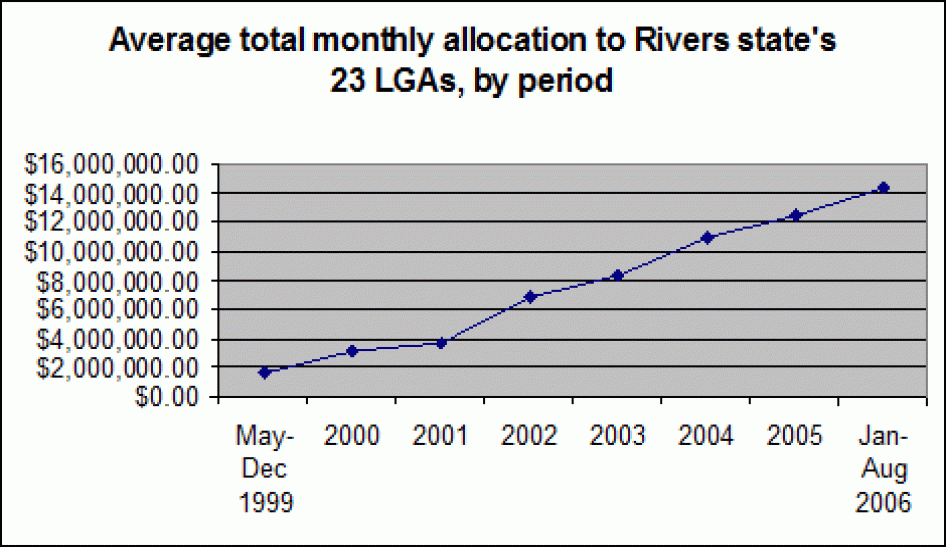
TABLE 1: Average Total Monthly Allocation to Rivers State's 23 LGCs, by period[66]
Local governments in Rivers generally employ well over 1,000 people, a figure that is often bloated by public pressure to create more jobs as well as by corruption.[67] As much as one-third of the total "income" of LGCs in Rivers is withheld by the federal government, although the bulk of the money deducted does not actually impact on theoretical local government spending capacity because it goes towards meeting primary school teachers' salaries (which the LGCs would be obligated to pay for as part of their responsibility for primary education).
Many local government officials have responded to critics-who complain that they have not put the resources at their disposal to any legitimate purpose-by claiming that after federal deductions and paying workers' salaries, they have no money left for any other purpose. As this report documents, these claims are not technically accurate. However, even if they were, they demonstrate an odd perception of a disconnection between employment and role. Such officials would seem to be suggesting that government jobs do not exist to provide for the conduct of any real work. As one disaffected former Rivers State government official put it, "If I have N500 million and am using it to pay a large workforce which I admit is not providing any services, then what am I doing?"[68]
In fact, because of the steady and dramatic rise in local government revenues since 1999, wage bills and deductions now consume a far smaller proportion of local government revenues than local government chairs would have their constituents believe. Of the five Rivers State local governments whose budgets were obtained by Human Rights Watch, not one allocated more than fifteen to twenty percent of their total allocations for the payment of salaries.[69] The chairman of one local government and the deputy chair of another confirmed to Human Rights Watch that such allocations reflected the amount actually spent on wages in their own local governments.[70] Combining this with the money "lost" to statutory deductions, most Rivers local governments still have, on average, fifty percent or more of their federal allocations left to deploy in other ways. During the first eight months of 2006 that percentage would amount to an average of N40 million ($310,000) per month in each Rivers State LGA.
As is true throughout Nigeria, Rivers' local governments may still lack the human and financial capacities to meet objectively high standards with regard to either health care or education. Their fourfold increase in revenues, however, should at least have allowed them to make significant investments in efforts to progressively realize a higher standard of service in those sectors, which have teetered on the edge of near-collapse for many years. As one recent World Bank report put it:
The financial resources to LGAs may have been insufficient for them to meet their responsibilities in some years, but this is currently less of a constraint given the increased oil revenues…there seems [sic] to be significant problems with commitment, governance and accountability.[71]
At least one Rivers local government, Tai LGC in Ogoniland, has proven that local governments can do more with their increased allocations. The local government in Tai has produced and publicized a long list of projects it has been able to undertake with the increased resources at its disposal since the current chair came to office in 2004.[72] According to local residents and civil society activists interviewed by Human Rights Watch around Tai and in Port Harcourt, the government has renovated schools, built new classroom blocks and constructed seven new health centers while providing medicines and new equipment for others. Many of those projects were undertaken at the request of various communities within the local government.[73] Tai was also the only local government whose chair voluntarily provided Human Rights Watch with a copy of its budget.
Numerous problems remain in Tai and there are indications that its government remains immersed in some of the same patterns of corruption and mismanagement that are described in the pages that follow.[74] But some proportion of the government's increase in revenues has been translated into support for basic education and health that has benefited communities in Tai. Many other local governments have not performed nearly so well. Asked what he thought explained the difference, Tai's chair, Jacobson Nbina, speculated that his counterparts in other local governments "do not have the interest of their people at heart. Maybe they want to become millionaires."[75]
The Dynamics and Mechanics of Corruption and Mismanagement
The following pages describe what Human Rights Watch found to be among the most significant patterns of local-level corruption and mismanagement prevailing in Rivers State. The case studies presented throughout this report, especially the discussions of Opobo/Nkoro and Khana local governments, provide more detailed accounts of how these common patterns have played out in Rivers LGAs. The ways in which many local officials steal public funds in Nigeria are varied and this report does not purport to provide an exhaustive catalogue of those techniques.
The Contract Industry
Human Rights Watch carried out research in several Rivers local governments that have used a large proportion of their local governments' newfound wealth to fund the construction of immense new headquarters for their operations and for other infrastructure projects. According to state and federal government officials and civil society groups, this lavish spending on new construction mirrors the practice in other local governments, and at the state level as well.[76]
Some examples of this phenomenon are as follows:
- Obio/Akpor local government budgeted more than N353 million ($2.7 million) for the construction and furnishing of its enormous new local government secretariat along with a new shopping mall in 2005 and 2006.[77]
- Tai local government budgeted nearly N100 million ($770,000) in 2005 and 2006 for the construction of its own new secretariat, more than twice its total capital expenditures on health and education.[78]
- Opobo/Nkoro local government set aside N140 million ($1.1 million) in 2005 to pay for one phase in the ongoing construction of a new secretariat and a new hotel near the site of that secretariat, more than 15 percent of the total budget.
Such allocations, which often dwarf the funds set aside for health care and education-related spending, may merely be examples of questionable government decisions, rather than corruption. But the lack of transparency and accountability of local government, combined with the urgent and unfulfilled needs of the state's crippled health and education sectors, leads many to view such projects as indistinguishable from the problem of corruption. As one embittered resident of Port Harcourt put it, "All they do is build their headquarters, massive things, air-condition them, and buy vehicles to drive around in."[79] In fact, most state and local governments channel an enormous proportion of their resources into "projects" that require the awarding of large contracts to private enterprises to carry out construction or other work.[80] Many such projects are so extravagant and without merit that they constitute a gross mismanagement of government revenues given the LGAs' underlying context of badly decaying basic services.[81]
The reasons for the prevalence of this problem would appear to have much to do with the easy opportunities for graft that large construction contracts present.[82] Procedures established by state and federal law, as well as local government bylaws, that are meant to keep the contracting process both transparent and honest are routinely ignored, especially at the local level.[83] Bids are inflated to allow for substantial kickbacks to both chairmen and contractors.[84] Local government chairmen sometimes award contracts to friends or relatives and in some cases have gone so far as to award lucrative contracts to themselves.[85] In other instances chairmen are pressured to illegally award contracts to their legislative council members. As one recent study of local government corruption in Nigeria put it, "If the chairman fails to satisfy them [the members of the legislative council], they find fault-genuine or otherwise-in him, and may even threaten him with impeachment."[86] The case studies presented later in this report provide some examples of this problem.
Many large contracts are never completed even though enormous sums of money are channeled into them. A forthcoming World Bank report notes that "anecdotal evidence suggests that more than half of all public investment projects [in Nigeria] are abandoned and never completed" and that this problem is "even more acute" at the state and local levels.[87] One important reason for this is that contracts provide an opportunity for corrupt enrichment of the parties involved only so long as the work remains unfinished. One World Bank official in Abuja explained the problem this way:
One big problem is that they [state and local governments] are always trying to build new structures; it's hard to convince them that it's a good idea to buy textbooks and medicines…Governments are always starting new projects without completing their old ones. The incentives are to start as many projects as you can and keep them incomplete because they are a source of rent. Completing projects is against the basic economic incentives of civil servants.[88]
Construction projects are a particularly prevalent source of "rent" because government officials can inflate their cost and then embezzle the funds allocated to carry them out. In some cases, when construction work is near completion, projects are simply abandoned because their usefulness as sources of corrupt revenue has been outlived. Rivers State is littered with such projects, from abandoned schools to empty fish ponds to padlocked "Women Development Centers." Some examples are discussed in detail in the case study of Khana local government below.[89]
Problems with Local Government Budgets
While every local government in Nigeria is required to produce a budget each year, the plans set down in those budgets are frequently ignored. While extra-budgetary spending is illegal, the Rivers State government's oversight of local governments is so weak that LGC chairs are left free to spend their monthly allocations more or less as they see fit, even if this involves substantial departures from any plans laid down on paper.[90] An official with the World Bank in Abuja described most state and local government budgets as "jokes" and asserted that generally "there is no correlation between what's in the budget and the way money is actually spent."[91]
Even if local government chairs were to adhere to the guidelines spelled out by their budgets, ample opportunities for corruption remain. This is because those budgets generally channel a large proportion of government income into items that are so broad and so lacking in transparency that there is no practicable way of determining how the funds are actually spent. These include enormous allocations for items such as "special projects," "entertainment and hospitality," and "miscellaneous expenses."[92]
The result is that many local government chairs are able to use or misuse these funds at their complete discretion. As one Port Harcourt-based academic who has studied the issue put it, "The budget is a budget only in name-they create all manner of grey areas deliberately under which anything is possible."[93] Numerous examples of this phenomenon are discussed in more detail in the case studies presented further on in this report.
Security Votes
Perhaps the most notoriously murky form of discretionary spending is a budget line called the "security vote," which consumes a substantial proportion of many local governments' revenues in Rivers State. The security vote is a pool of funds that are meant to be used by the chair for the purpose of maintaining peace and security in the LGA. Even in theory, it is often not at all clear what legitimate use such funds are intended to be put towards. In practice, the chair has complete discretion in his use of these funds and does not have to account for or even report the manner in which he uses them. The security vote is one of the most opaque items in any local government budget, and it is also typically one of the largest single allocations:
- According to a Commission of Inquiry convened in 2006, Khana local government's chair has received an average of N60 million ($461,000) annually for his security vote.[94]
- Tai local government's chair had a security vote of N40 million ($300,000) in 2006.[95]
- Opobo/Nkoro local government's security vote was N36 million ($280,000) in 2006.[96]
In each of these cases, the security votes exceeded the total capital budgets for either health or education.[97]
Human Rights Watch found that in some LGAs much of the total set aside for security votes was stolen outright or channeled into improper forms of patronage. For instance, one local government chairman dipped into his security vote to help pay for a "football academy" that he never actually built.[98] Worse, it is often alleged that security vote money is actually used by many chairs to carry out political violence on their behalf. The head of the EFCC's Port Harcourt office told Human Rights Watch that many local government chairs "will give half of the [security vote] money in the name of 'empowerment' to youth they use as thugs and the rest goes into their own bank accounts."[99]
Making Returns
The requirement that relatively junior government employees "make returns" to their superiors and colleagues is common at all levels of government in Nigeria.[100] Many state- and local-level politicians throughout Nigeria are bound up in complex relationships that mirror such arrangements, with sponsors popularly known as political "godfathers." These are powerful and wealthy individuals who help arrange for their protégées to be placed in office through their political connections, through financing their campaigns and through their ability to mobilize both violence and corruption to subvert the democratic process. In return, they claim the right to influence government policy and also lay claim to a substantial share of local government revenues for their own personal enrichment.[101]
Several LGC chairmen in Rivers are allegedly entangled in such relationships with "godfathers" who are themselves prominent state-level politicians.[102] Other state-level officials have also developed ways of laying claim to revenues meant for local governments. Prominent members of the Rivers State House of Assembly, which is charged with oversight responsibilities over the local governments and their finances, are widely alleged to receive regular payments from several local government chairs.[103]
Payments flow downwards from the chairman's office as well; many local government chairmen throughout Nigeria allegedly bribe their local government councils to pass their budgets each year.[104] Some Rivers State chairmen have claimed that this practice amounts to extortion carried out by the members of their councils.[105]
Other Forms of Corruption
According to civil servants and health workers interviewed by Human Rights Watch in several Rivers local governments, allowances that local government employees are entitled to in addition to their salaries are routinely withheld while the funds that were set aside to pay them in the budget disappear.[106] Some chairs have budgeted funds to carry out projects that were actually undertaken by other tiers of governments or multinational oil companies.[107] Others are alleged to pad their local government payrolls with nonexistent workers.[108]
Along with all of this, large amounts of money are lost to simple theft. As one Nigerian academic noted recently, there have been cases "of outgoing chairmen of councils…stealing refrigerators, generators, and some furniture from their official quarters. Some of them switched the engines and tyres of their official cars with those of their private cars before leaving office."[109] Beyond the chairperson and the legislative council, some local government civil servants, teachers and lower-level officials have also developed means of indulging in much smaller-scale corruption.[110]
Together these practices add up to such a severe drain on government finances and capacity that they have led many local governments throughout Rivers State to fail in their most important obligations towards their citizens.
Case Study A: Opobo/Nkoro Local Government
Opobo/Nkoro is one of four local governments that make up the Ogoni region of Rivers State.[111] In April 2006, the members of Opobo/Nkoro's legislative council voted unanimously to file allegations of gross misconduct against their chairman, Christopher Ogolo, with the state government. Those allegations ultimately led to Ogolo's impeachment and removal from office by the Rivers State House of Assembly in August 2006.
The case against the chairman was well-documented. Human Rights Watch has obtained much of the evidence presented to the judicial panel of inquiry that investigated the allegations, and it provides a clear illustration of how the chairman set about looting the Opobo/Nkoro treasury.
While the malfeasance of some officials in Rivers is quite brazen, Chairman Ogolo was exceptional in doing little to cover up his misdeeds. One of the lawyers involved in the effort to secure his impeachment told Human Rights Watch that his job had been made easier by "some of the most stupid acts of corruption I have seen."[112]
The complainants were able to produce documents proving that the chairman had habitually withdrawn funds from the local government's bank account and then deposited them into accounts held by his own private companies at the same branch of the same bank.[113] Ogolo was also shown to have awarded numerous construction contracts without following any pretense of proper procedure. Between 2005 and the first few months of 2006 he illegally awarded at least N12 million ($92,000) worth of construction contracts to himself and gave another lucrative contract to his brother, all in clear violation of the law.[114]
Ogolo also claimed to have expended large sums of money for items or services that were never delivered. This included billing the treasury for twice as much diesel fuel as he actually purchased for the running of electrical generators in the local government, at an average cost of more than N4 million ($30,000) per month.[115] The leader of Opobo/Nkoro's legislative council told Human Rights Watch that the chairman had also spent some N50 million ($384,000) to build a fish pond for the sake of encouraging small-scale aquaculture but that "no one has seen a fish inside this pond."[116]
Ogolo often disappeared from his government position for weeks at a time. During one especially prolonged period of absence, the local chapter of Nigeria's local government employees union wrote a letter begging the leader of the Opobo/Nkoro's legislative council to "use [his] good office to locate the whereabout [sic] of our Council Chairman so that the problems of workers can be attended to."[117]
Questionable "Priorities"
Human Rights Watch was able to obtain a copy of the Opobo/Nkoro local government budget for 2005. The budget reveals the extent to which the local government's most important responsibilities-including the provision of basic health care and education-have been neglected even on paper. It also betrays a pattern of government expenditure focused on using public funds for precisely the kind of questionable and opaque expenditures described earlier in this report.[118]
Opobo/Nkoro's 2005 budget provided for total expenditures of just under N900 million (some $6.92 million) and the local government allocated just 2.4 percent of this total-N21,900,000 (roughly $170,000)-to education-related spending outside of the money deducted by federal authorities for teacher salaries.[119] More than half of that amount was earmarked for the payment of bursaries given to provide financial support to university students from the local government, leaving just under N10 million ($77,000) available for expenditures that could be seen as related to the provision of primary education. The health sector's budget is similarly barren. Only N3 million ($23,000) was allocated to equip, build and repair primary health care facilities in the local government.[120]
Perhaps most telling is the contrast between those figures and the generous (if not necessarily unlawful) funding of budget items that the chair and the legislative council set aside for their own, largely discretionary, use. More than 30 percent of the entire local government budget was set aside for salaries and overhead expenses for the offices of the chairman and the legislative council.[121] Included in this total were:
- A travel budget for the chairman (N7 million or $53,800) that was more than twice as large as the capital budget for the health sector (N3 million or $23,000)[122];
- Salaries for 116 "Functional Committees, Protocol Officers" that exceeded the amount allocated to pay the local government's 123 health-sector workers[123];
- An allocation for "Miscellaneous Expenses" to the office of the chairman that exceeded the combined education overhead and capital budgets[124]; and
- A Security Vote to the Office of the Chairman roughly equivalent to the entire health sector budget.[125]
While both the health and education budgets had been cut slightly from 2004, more than 11 percent of government revenue in 2005 was allocated for the "take-off" of construction of a hotel at local government headquarters, by far the single largest expenditure in the entire budget.[126] See table 2 below for some further comparison of these budgetary priorities.
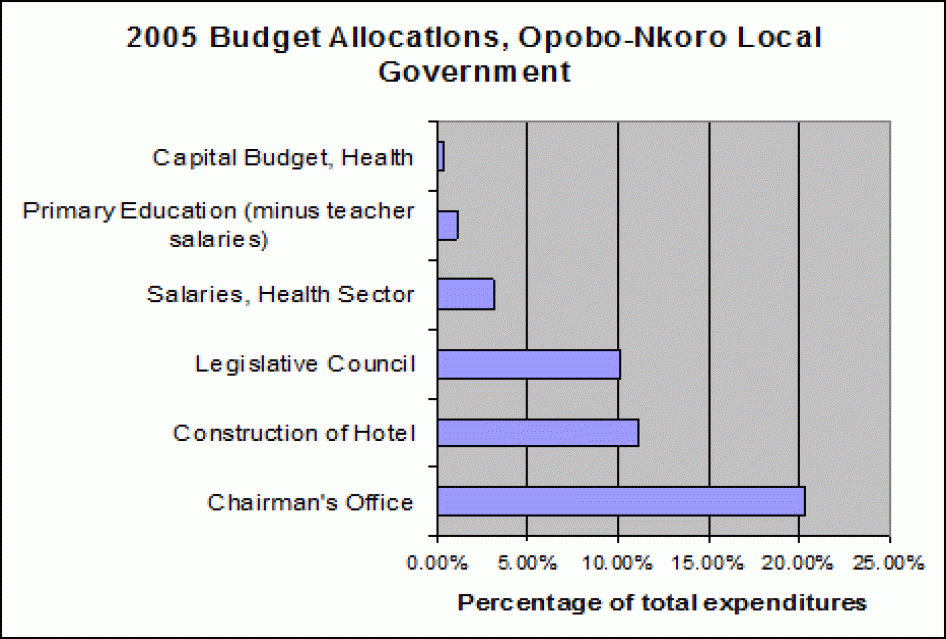
Table 2: Budget Allocations, Opobo-Nkoro Local Government[127]
A Double Standard?
The Leader of Opobo/Nkoro's legislative council told Human Rights Watch that for more than two years, the council was kept in the dark and had no idea that anything was awry. Asked by Human Rights Watch what he had thought was happening to the government's money, he said, "We don't know. He [Ogolo] claimed he was paying for power [electricity], but there was no power."[128]
The problem with these assertions is that the legislative council gave its seal of approval to budgets that channeled a great proportion of government revenue into its own members' hands as well as those of the chairman on exceedingly vague terms. Almost nothing was left aside, even on paper, to meet government's health- and education-related responsibilities.
Many critics in Rivers State have alleged that the councilors in Opobo/Nkoro went after their chairman not because he was corrupt, but because he was not making adequate returns to them and to other influential actors in the local government. The same critics allege that his impeachment ultimately succeeded only because the chairman had also failed to "settle" key members of the state House of Assembly. As one Port Harcourt-based activist put it, "the chairman's problem was that he had taken things to such an extreme that he had no friends left."[129]
Since leaving office, Christopher Ogolo has not faced criminal charges or any other form of additional sanction. The head of the Economic and Financial Crimes Commission's Port Harcourt office described the situation in Opobo as a "disaster," and confirmed that "you could not see anything visible that the guy did." He nonetheless said that the case had not been taken up by the EFCC or any other government agency for criminal prosecution, citing a lack of concrete evidence presented to the Commission.[130]
Impact of Local Government Corruption and Mismanagement on Primary Education and Primary Health Care in Rivers State
If you look at the last five years, you had a really great opportunity to really improve basic living standards, especially in the Niger Delta. But in fact, nothing much has changed. It's very sad.
–Donor agency official, Abuja[131]
Nigeria has some of the worst socioeconomic indicators in the world and the overall picture has not improved since the end of military rule. Government's failure to address the urgent health-related needs of its population over the years has had particularly devastating consequences. Many African countries have made important progress in cutting their infant mortality rates in recent years, but Nigeria is not among them; Nigeria has more than 255,000 newborn deaths each year, as against 1.16 million for the entire continent of Africa.[132] Donor agencies estimate that one in five Nigerian children dies before the age of five,[133] a statistic that translates into more than one million child deaths per year.[134] Many of those children die from diseases that are either preventable or treatable at low cost.[135] Maternal mortality is estimated at 7 per 1,000 births, and it is believed that Nigeria has the world's second-highest number of maternal deaths each year after India.[136]
Corruption is widely cited as a major impediment to government efforts to improve the situation.[137] One 2005 World Bank assessment noted that:
The long decades of military rule weakened, politicized, and encouraged rentseeking in government bureaucracies, and the health system was no exception. The culture and incentives became such that their own economic interest is the first priority for many public employees.[138]
The same study noted that "In general, information…suggests that although salaries are usually met, there is little funding made available by the LGC for drugs, supplies, and maintenance."[139]
Primary education in Nigeria has also experienced a steady decline over the course of the past few decades. One assessment written in 2000 spelled out the extent of the problems of the education system as a whole:
The public perception is that the quality of education offered is low and that standards have dropped. These perceptions are based on lack of adherence to acceptable educational practice. Teacher qualifications are low. The learning environment does not promote effective learning. Basic facilities, teaching and learning resources are generally not available. Teacher-pupil ratios are high. General performance in examinations is poor and the graduates have low levels of competencies in the work environment.[140]
These problems have remained intractable despite well-publicized government efforts to tackle them. DFID's current Country Assistance Plan notes that "[i]n the 1980s, Nigeria had one of the best education systems in Africa, with near-full enrolment in some parts of the country," but says that "the education system has declined considerably since then" and that "many emerging from primary school are not functionally literate."[141]
In Rivers State, corruption and the gross mismanagement of government funds stand out as one of the most important reasons why many local governments have continued to neglect their obligations to provide basic education and primary health care.[142] Corruption first leads many local governments to allocate insufficient funds to health and education, and in some cases leads even to the theft of those that are allocated. One former state government education official told Human Rights Watch that:
When allocations are made, it is at the local government level that…they now see this money as money that has come just gratis to be shared out among political friends and members of the ruling party. The result is that after paying salaries they scarcely have enough to do anything else…When you go to remote areas and see what is there, you wonder if government even considers that they exist.[143]
Such sentiments are echoed by the people living in many Rivers communities. One teacher in a Riverine community in Akuku/Toru local government complained to Human Rights Watch that, "It isn't just the schools-we don't feel their [local government's] impact at all in this community-let alone providing us with a decent school. They don't do what they are supposed to do."[144]
The following pages will provide a brief overview of the devastating impact that local government neglect-fueled in large measure by corruption-has had on basic health and education services in many Rivers State communities. The two case studies that follow will use the examples of Etche and Khana local governments to describe the problem in greater depth.
Health Care
Box 1: Etche Health Center |
The following are excerpts from interviews with the staff at a comprehensive primary health center in Etche local government: |
"We treat minor ailments including malaria, tuberculosis, leprosy and dysentery. Communities up to six kilometers away use this place. Some of them will walk or use bicycles…but in one week only 15 or 20 people will come here for treatment. We have not done even one delivery here-no woman would like to come here because of the conditions. Instead they travel far to go to hospital." "Our facilities are not adequate at all. We are lacking many things. We have beds but no mattresses; the patients must bring their own. We have no toilet; patients will use the toilets of the people who live nearby to here. We have no running water. The pump is there but it is out of use for two years. We have no light; we are not even wired [to the power lines running through town nearby]…When it rains the place will flood-the environment of this clinic is one of our major problems." "They are paying us now but they are still in arrears. They are owing us about three or four months salaries and leave bonus for about five years. At times they say they have no money to pay [our salaries]." |
State government officials estimate that Rivers' local governments operate some three hundred primary health care facilities.[145] Human Rights Watch visited more than a dozen primary health care centers in five different local government areas. All but a few lacked even a basic supply of medicines and other equipment and did not have access to a reliable supply of water, any sort of toilet facilities or electricity. Some were housed in structures nearing the point of actual collapse and others had simply been abandoned by their demoralized staff. The few health centers visited that had access to even the most basic amenities were located within the walls of local government secretariats.
According to both state and local health officials, such conditions are in no way atypical in Rivers State. Officials and health care workers in all but one of the local governments visited by Human Rights Watch said that their local government provided their primary health care facilities with neither medicines nor any funds with which to purchase them.[146] Many local governments once maintained a modest "revolving loan scheme" that their primary health centers could draw on to purchase needed drugs, but these had been long abandoned in all but one of the local governments surveyed.[147]
Much of this neglect is directly linked to the problem of corruption in one way or another. As has been discussed above, many local government budgets are designed around large, discretionary and often indecipherable allocations to the local government chairman.[148] Local governments spend significant amounts on health sector salaries, but often provide almost nothing for any other health-related purpose, even on paper. Where funds are allocated to improve the provision of health care, they often end up being diverted to other purposes or channeled into "projects" that are never executed.
Health care workers' salaries and allowances are also affected by government corruption. In several local governments, health workers said that while their base salaries were typically paid in a timely manner, they were occasionally withheld without any reason being given. Health care workers in most of the local governments visited by Human Rights Watch said that their salaries were consistently 3-4 months in arrears or more.[149] In Khana and Etche local governments, local authorities had failed to pay leave allowance for health sector staff for more than five years running, even though funds had been set aside in their budgets to make those payments.[150]
Many local government civil servants and health care workers were quite forthright in their belief that their neglect by local government was due largely to corruption and the LGC chairmen's need to please political patrons more powerful than themselves. As the Primary Health Care Coordinator of one local government put it, "The chairmen are all politicians and they have to please the people who brought them into office."[151]
Staff in several health centers reported that these problems had demoralized them, and many expressed frustration with their local governments' failure to give them the tools they needed to do their jobs. A member of the staff at one health center told Human Rights Watch that the problems affecting his own health center "affect [the staff] greatly…when there are no resources everything is looking paralyzed-no one is interested to come here and work."[152] The one service that most health centers were able to perform reliably was administering the government's immunization program; the federal government has largely taken over the responsibility for ensuring the availability of needed vaccines from the local governments.[153]
Perhaps the most obvious consequence of the health centers' problems is that some of them are avoided by the very populations they are meant to treat. Staff in many health centers said that they treated no more than a handful of patients each week despite serving several different communities across an expanse of several kilometers. As the head of one local government's immunization program put it, "If you go to the health centers you will not see anyone, frankly speaking."[154] Human Rights Watch visited one health center that had, in fact, been completely abandoned by its staff.[155] In one recent survey, four out of ten households in Rivers reported that they had no access to health services.[156]
Some Rivers residents patronize more expensive private health care facilities instead of visiting government-run health centers; others simply do not seek care at all or do so only sporadically.[157] One resident of Akuku/Toru local government, asked whether he had visited the government-run primary health center near his house, replied, "Why would we go there? There is nothing inside of that building-no staff and no medicine. So why would we go there?"[158]
Trading Blame in Obio/Akpor Local Government
Recent controversies in Obio/Akpor local government, possibly the wealthiest local government in Rivers State,[159] provide a good illustration of how corruption has undermined the provision of health care. Officials in Obio/Akpor have done almost nothing to support the local government's 12 government-run primary health care centers. However, what makes Obio/Akpor unique is the fact that its administration has publicly acknowledged this fact. Local officials even admit that their health care facilities have been run into the ground by corruption and mismanagement.
The local government chairman, Ezenwo Nyesom Wike, placed the blame for these failures squarely on the shoulders of his deputy, who also served as the local government's "supervisor for health." As part of an (ultimately successful) attempt to have his deputy impeached, the chairman accused him of offenses that included the theft of some N11.7 million ($90,000) and of having "vividly shown gross and persistent lack of interest" in his health-related responsibilities. The alleged result, as stated in the notice of impeachment filed against the deputy chairman, was that:
[T]he health sector has suffered tremendous neglect and condemnable inactivity as vital health policies and programmes are left unimplemented or pursued much to the detriment of the well being of the ordinary people of the local government area.[160]
In an interview with Human Rights Watch, then-deputy chairman Lawrence Chuku denied all of these allegations, claiming that they were part of campaign of violence and slander that the chairman had embarked upon in order to crush his own political ambitions.[161] He did agree that "despite massive allocations" the quality of health care offered to his constituents was "the worst," and stated that "My local government, from 1999 to date, has not spent one kobo on drugs." He alleged, however, that this was due entirely to the corrupt activities of chairman Wike, who he accused of having "siphoned off massive funds" meant for health-related activities and other purposes. In particular, he accused the chairman of grossly inflating the cost of Obio/Akpor's recently-constructed and surprisingly large local government secretariat.[162]
Asked to describe the quality of health care on offer in the local government, the LGA's primary health care coordinator said that in only two primary health centers was it possible to obtain "some moderate level of care" and one of those was within the walls of the brand-new local government secretariat. He also told Human Rights Watch that the chairman had made no funds available for the purchase of basic medicines or other amenities.[163]
Obio/Akpor's budget allocated more than N125 million (some $961,000) for the "upgrading/expansion and renovation" of health centers in 2005 and 2006,[164] but the Coordinator, who had never seen a copy of the budget, told Human Rights Watch that no such work had been carried out or even planned. The coordinator nonetheless expressed his belief that the local government chairman was "trying" to improve the quality of health care on offer. The chairman declined to meet with Human Rights Watch.
Primary Education
Box 2: Primary Schools in Akuku/Toru and Khana LGAs |
The following are excerpts from interviews with two teachers at primary schools in Akuku/Toru and Khana local governments, respectively: |
"The local government doesn't do what they are supposed to do, extending resources to all communities. They only concentrate their work on their LGA headquarters. We started to produce oil in 1957 here but look at the town--government has done nothing for us. In October at high tide the whole community floods and we move about like fish…Local government is supposed to help the school but they don't. They have not given us any support…The most important things we need are textbooks, instructional materials, and a toilet…" "The standard is lower than what it was in our days. But today Nigeria has more qualified staff, so the quality should have improved. One problem is management- the staff and the children are not very well cared for. Teaching materials are lacking up to even desks and textbooks. And there are insufficient classrooms…The local government has not done anything to support the schools. We have applied to them for help but nothing is done." |
In a refrain heard time and time again from a variety of sources, one high-ranking official in the Rivers State Universal Basic Education Board (SUBEB) told Human Rights Watch that:
In general, all over the state, it is fair to say that the LGAs are doing almost nothing to support UBE [Universal Basic Education]. What they are supposed to do, they don't do. So what do they do with the money that is provided to do these things? I don't know what really happens. They are supposed to be doing a lot to help education, but they don't.[165]
As discussed above, the federal government deducts primary school teachers' salaries from local government allocations "at source."[166] Beyond that, many local governments allocate next to nothing in their budgets to support primary education, and much of the money they do allocate disappears. This problem exists throughout Nigeria; one recent World Bank study found that while "Very good mechanisms to control expenditure at all levels of government already exist in [Nigeria's] education sector," those mechanisms "are not being properly used and the actual control of expenditure is very weak."[167]
Most local governments allocate funds for school rehabilitation and maintenance in their budgets. While the amount is often a tiny fraction of what is needed, even that money is often not spent in pursuit of any legitimate purpose. In most of the local governments visited by Human Rights Watch, local education officials and civil servants said that their chairmen had not renovated or repaired a single school building during their entire tenures of three years or more.[168] Some claimed that they were not even aware that such allocations had existed on paper to begin with. The secretary of one local government's Education Authority, asked why the local government had not begun renovating any of its schools despite budgeting more than N22 million ($169,000) for that purpose in 2004 and 2005, replied, "How should I know what the chairman does with his money?"[169]
Local government neglect, fueled by corruption, has had a devastating impact on primary schools throughout the state. This is perhaps most obviously reflected in the schools' crumbling physical infrastructure. Human Rights Watch visited eleven primary schools in Rivers State; some had actually collapsed altogether and others were on the verge of doing so.[170] Many others are nothing more than the empty shells of schoolhouses, with nothing being done to maintain or equip them to even the most minimal of standards. UNDP's recent Niger Delta Human Development Report found that "Nearly all school facilities [in the Delta] are in a state of extreme disrepair, requiring major rehabilitation."[171]
Most primary schools, especially in rural areas, are simple structures. Many blocks of "classrooms" do not have partitions between the classes, leaving teachers to shout above each other as their classes sit packed alongside each other in one large room. Most schools visited by Human Rights Watch did not have blackboards, with teachers writing their lessons on writing surfaces that are painted on the wall. Such basic infrastructure would not require enormous investments to maintain in a safe and usable condition, but many Rivers local governments have failed to invest anything at all in the maintenance of their schools. In the handful of visited schools that had been renovated, the work had been paid for either by the state government or foreign donor agencies.
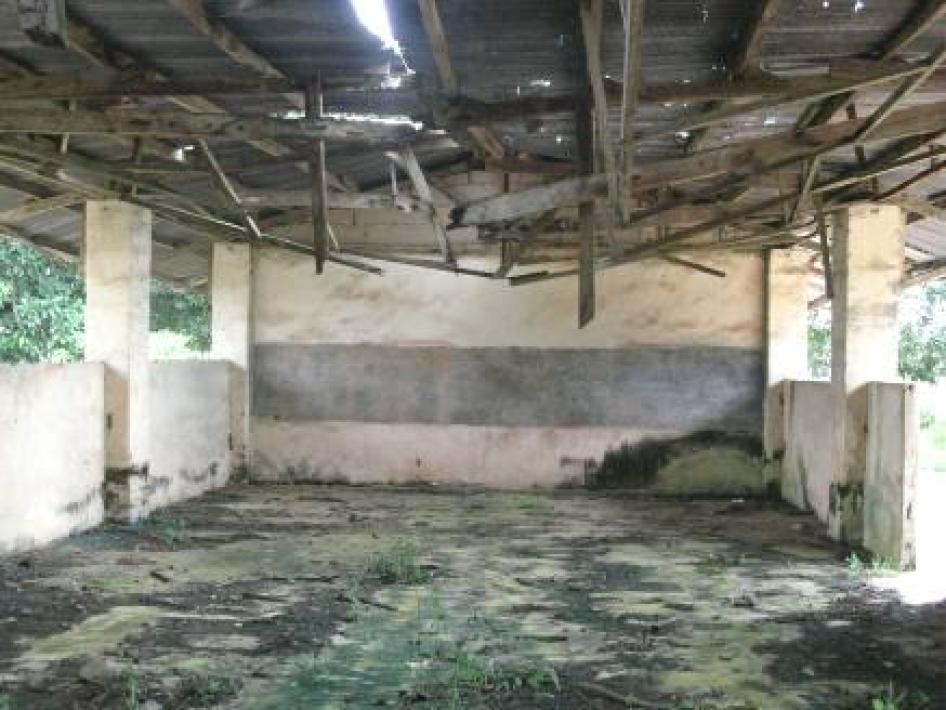
A primary school in Khana local government, Rivers State. This classroom was abandoned after the roof nearly collapsed, forcing students to cram into the sole remaining classroom or learn outside. © 2006 Chris Albin-Lackey/Human Rights Watch
Most of the schools visited by Human Rights Watch had neither textbooks nor any other form of teaching materials; an LGEA official in one local government burst into laughter when asked whether his local government's schools had any books at all.[172] Only one of the schools visited by Human Rights Watch had any textbooks, and those were more than ten years old.[173] Only one of the schools visited had desks, something that could be procured locally and at minimal cost by local governments. None of the schools visited by Human Rights Watch had outhouses, running water or electricity and some even claimed to be running short of chalk.
State and local officials confirmed that such conditions prevail across most of the primary schools in the state. The Rivers State government has announced plans to remedy some of the basic material shortfalls through the activities of its State Universal Education Board (SUBEB).[174] In August 2006, SUBEB officials told Human Rights Watch that they had received initial shipments of textbooks and other teaching materials for distribution to primary schools around the state, but this had not yet begun to happen; SUBEB's operations only got under way in 2006.[175] While such efforts may hold out real promise, they are late in coming and cannot by themselves counteract the near-total neglect of education shown by the tier of government directly responsible for running the state's primary schools.
Aside from the physical decay of the schools and the lack of basic materials, local government neglect has left many teachers profoundly demoralized. One donor agency official who had spent several years working in Rivers State told Human Rights Watch that:
[Teachers] are so demoralized, the basic facilities are not there. Very basic things that the local governments could deliver if they wanted to. They always complain about money, but it isn't about money; it's a question of will…They bring proposals here and there, asking for millions to achieve simple objectives. The students have the zeal, but the guidance-money is not the real issue-it's people waking up to their responsibilities.[176]
The head teacher in one school in Akuku-Toru local government presented a long list of improvements he said his school needed in order to provide a decent learning environment. Asked whether the school had ever asked the local government for any of those, he replied, "They won't do it. So why ask?"[177] In one government-run survey only 44 percent of all Rivers households reported satisfaction with the quality of primary education received by their children.[178]
As is true of the state's primary health care system, many citizens of Rivers State have deserted the public schools in favor of private-sector alternatives. Rivers State officials estimate that nearly a quarter of the state's one million primary school students are enrolled in private schools.[179] But for many Rivers residents, private education is simply too expensive to be a viable alternative.
Case Study B: Khana Local Government
The Kingsley Leh Impeachment Controversy
Khana local government area is situated southeast of Port Harcourt in the Ogoni region of Rivers State. An intractable dispute between Khana's local government chairman and his legislative council left its government completely paralyzed throughout much of 2006. The origins of the dispute are contested, with both sides producing different explanations as to how it came about. The one thing both sides agree on is that the dispute began in earnest with the local government's failure to pass a budget for 2006.
The chairman, Kingsley Leh, alleges that the legislative council refused to pass his budget because he would not pay the substantial bribes they had demanded in exchange for their votes. Leh's press secretary told Human Rights Watch that the entire controversy came about because Leh took a principled stand as a man who has always "refused to pay a bribe to any person."[180]
The councilors who rose up against the chairman tell a different story, alleging that Leh never submitted a budget for 2006 to them at all. They also claim that the chairman had channeled large sums of money into dubious or non-existent projects and diverted other revenues directly into his own pockets. He is alleged to have passed some of that stolen money on to thugs he used to enforce his will in Khana.[181]
Other sources provided an account of the dispute somewhere in between these two extremes. Several well-placed individuals told Human Rights Watch that the real reason for the dispute between Leh and his council was a disagreement over the amount of the "payment" that the councilors sought to claim.[182]
In accordance with the Rivers State Local Government Law, the State House of Assembly constituted a judicial panel of inquiry to investigate the councilors' allegations. In May 2006, that panel came to what it called "the irresistible conclusion" that Kingsley Leh was guilty of acts of gross misconduct. Its report produced a number of detailed findings in support of that conclusion.[183]
In spite of this, the attempt to remove Kingsley Leh from office ultimately came to nothing. Following the procedure set down by law, the panel of inquiry referred the matter back to the State House of Assembly. The House voted to throw out the entire complaint against the chairman on a technicality and reinstate him to his office.[184] Leh's opponents were undeterred by their failure to have him removed from office and lodged a complaint against him with the EFCC, which detained Leh for several weeks.[185] He was ultimately released following a preliminary investigation and is not currently facing any charge.
This controversy led to an increased level of violence and insecurity in Khana local government. In mid-2006 opponents of the chairman burned out a small section of the new local government secretariat in one nighttime attack, and the overall climate of insecurity has led Leh and some of his councilors to avoid travel to the area whenever possible.[186] As one local source put it, "The chairman and his opponents are at loggerheads and they pose a security threat to one another, so neither comes to their local government headquarters."[187]
Whatever their motives, the councilors' very public revolt against Kingsley Leh has helped to cast a harsh and very public light on the manner in which Khana has been governed. Evidence that emerged during the attempt to impeach the chairman, coupled with Human Rights Watch's own investigation, paints a stark picture of rampant government malfeasance and its impact on the health and education sectors.
Leh's "Phantom Projects"
Kingsley Leh's opponents in the legislative council asserted that between assuming office in 2004 and the end of 2005, he "ha[d] received the sum of N1,243,295,330 ($9.56 million) and has nothing to show for it."[188] Leh disputed the precise total amount of Khana's revenues, but as Human Rights Watch has found, the facts of the case support the contention that much of Khana's total revenues have in fact been squandered or outright stolen.[189]
As is true of other local governments in Rivers, a large proportion of Khana's revenues has been channeled directly into the chairman's hands for purposes that were either opaque or questionable for other reasons. In 2005, the last year that Khana managed to produce a budget, the chairman was allocated the remarkable sum of nearly N49 million ($376,000) for his own salary and "allowances," in apparent contravention of state law.[190] That was nearly half the total amount allocated for the wages and allowances of Khana's 325 health-sector workers.[191]
Total allocations to the office of the chairman and the legislative council totaled more than N200 million ($1.54 million) for the year, nearly 20 percent of the government's total annual allocation.[192] Such expenditures constituted an enormous drain on the local government's resources, but even the limited funds that were left for other purposes seem largely to have disappeared.
Khana local government has nearly completed construction of a new local government secretariat with offices for several hundred workers.[193] Aside from this, the judicial panel of investigation was able to identify only four "projects" that had been completed by the chairman since 2004 and found that these were "not commensurate with the sums that had accrued to him."[194] It also identified a number of "phantom projects" that the chairman had allegedly used to siphon off and steal substantial amounts of money. These included a "demonstration fish pond," a "school for the physically challenged," and a "football academy."[195]
Human Rights Watch was not able to secure a meeting with Kingsley Leh, who would not disclose his whereabouts when reached by phone.[196] The chairman's press secretary defended Leh's record in office, denied all allegations of corruption and said the chairman had accomplished a number of things with the local government's allocations prior to the "crisis" in 2006.[197] The press secretary acknowledged that the local government had accomplished "nothing" during the first eight months of 2006, but said that this was because the State Ministry of Finance had withheld nearly all of the local government's funds because of Khana's failure to produce a budget.[198]
As achievements, the press secretary pointed to the construction of Khana's new local government secretariat. He also said that some of the projects the judicial panel of inquiry had labeled "phantoms"-the football academy, the fish pond, and the school for the physically challenged-were "fully operational."[199] Human Rights Watch visited each of the three sites, however, and found that all three "projects" had either been abandoned or did not exist.
Construction had not begun on the "football academy," although the local government had cleared a plot of land for its construction.[200] While the structure itself does not exist, the chairman was found by the panel of investigation to have spent more than N7.2 million ($55,000) for what it termed "peripheral issues connected with this project." These included an "international press conference" to announce the academy's inauguration; the unexplained purchase of 1,000 World Cup qualifying match tickets; and a trip to the northern city of Kano by the chairman and several councilors to meet with players on Nigeria's national football team.[201]
The "demonstration fish pond," which cost several million Naira to construct, was theoretically a facility that would be used to teach Khana residents the basics of small-scale commercial aquaculture. It consisted entirely of two long rows of shallow basins constructed out of cinderblocks. Although it had been commissioned only in late 2005 and the chairman's press secretary told Human Rights Watch that it remained "operational," the site had clearly been abandoned for some time.[202] The fish pond's concrete basins contained neither water nor fish, and the path to the "pond" had been completely overgrown with a dense tangle of grasses and weeds.[203] Local civil society partners told Human Rights Watch that the pond had been abandoned almost immediately after being inaugurated in late 2005.[204]
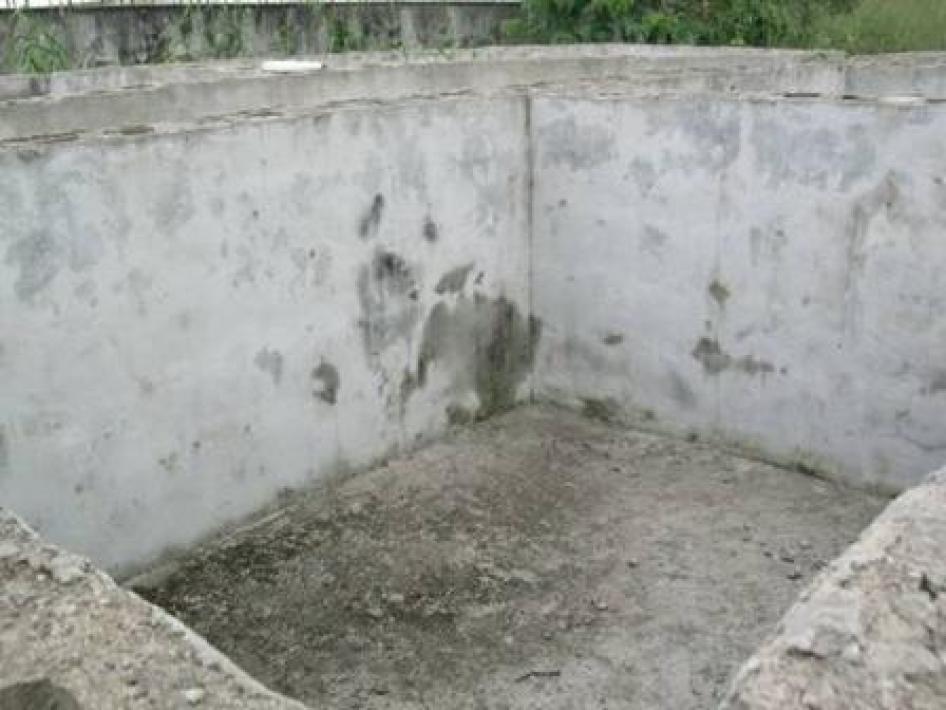
The "demonstration fish farm" at Bori. © 2006 Chris Albin-Lackey/Human Rights Watch
The "School for the Physically Challenged" was commissioned only in late 2005 but nearby residents said that it had never opened its doors to any students and had no staff.[205] It was accessible from the adjacent road only by leaping across a steep and muddy ditch. The structure itself was already suffering from disuse; several of its windows were broken, and weeds had sprouted up through some of the classrooms' concrete floors.
The local government also allocated N29 million ($223,000) for the construction of a "mini stadium" in 2005.[206] This stadium also reportedly does not exist, and it is not clear what became of the funds that were meant to be used for its construction.
Little Left Over for Health Care and Education
Between the "phantom projects" and the enormous allocations to the chairman and his council, little was left over for health care and education (see table 3). According to local officials, teachers and health workers, however, even the inadequate funds set aside for those two sectors were largely squandered.
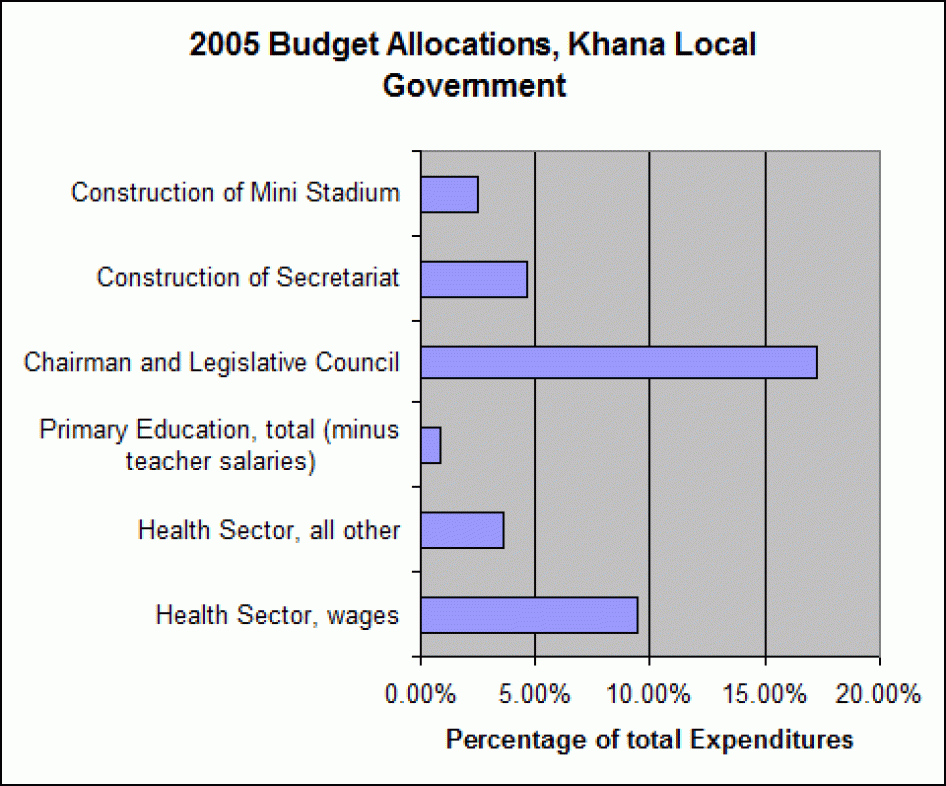
Table 3: 2005 Budget Allocations, Khana LGA[207]
Primary Education
Khana set aside only N750,000 ($5,770) to cover the overhead expenses of all of the local government's 112 public primary schools in 2005: roughly N6,700 ($51) per school.[208] The budget also called for N10 million ($77,000) to be spent on the "renovation and furnishing" of primary schools.[209] The Secretary of the Local Government Education Authority, however, told Human Rights Watch that no schools had been renovated in either 2005 or 2006. He attributed this failure to "the people who are causing trouble for the chairman."[210]
Asked whether any of the LGA's primary schools had pit latrines or supplies of water, the LGEA Secretary replied, "You should begin by asking whether they even have classroom facilities, not to speak of toilets and water! How can you have toilet facilities when you do not even have classrooms?" Asked about the availability of textbooks, he said, "There is nothing like that."[211]
The LGEA Secretary nonetheless defended the chairman's record, stating that he honestly believed that "the man is trying."[212] The teachers in the several primary schools visited by Human Rights Watch felt differently, however.[213] The headmaster of one remote community's school complained that "the local government doesn't provide anything for us." He claimed that since 2004 the LGC had even stopped providing the school with chalk and said that in a meeting he had attended along with staff from other schools in 2005:
The chairman said the allocation given to them was not enough-that after paying staff salaries, security and a few other projects, they would have nothing left for primary education…Maybe they are deceiving us. We don't know.[214]
Those complaints were echoed at other schools. As one teacher in another community put it, "As regards local government, I don't think they are doing anything tangible for the improvement of the schools or to allow schools to progress."[215]
None of the four Khana schools visited by Human Rights Watch had desks, toilet facilities, textbooks or a supply of drinking water. Many school buildings were in an advanced state of physical decay similar to those seen in other local governments. And, as was also true in other LGAs, many teachers complained that these conditions had severely impacted on their ability to provide an adequate education to their students. One teacher lamented that "We cannot measure up to the standards we would like to reach."[216] Another confirmed, "The quality of schooling is not good because of a lack of all amenities. We want it to improve."[217]
Health Care
In 2005 Khana budgeted fairly substantial sums for the operation of its 23 Primary Health Care Centers.[218] Again, however, much of that money appears to have been lost. Health-sector civil servants and health care workers at a number of different health centers said that their salaries were eight months in arrears. They also complained that some of the allowances that make up part of their compensation had not been paid in five years even though funds had been budgeted to make those payments in both 2004 and 2005.[219]
The 2005 budget allocated N35 million ($269,000) for the renovation and purchase of necessary materials for the local government's existing health centers and the construction of new facilities. High-ranking local government civil servants working in the health sector, however, said that no renovation work had been done in recent years.[220] One high-ranking health official said that they had requested less than N20 million ($154,000) to run all of Khana's health centers but had received almost nothing for the year. The official added, "The money is there, but it is not being spent on health care."[221]
Workers in four health centers visited by Human Rights Watch also complained that they were given no funds to procure medicines or any other materials. Many said that the only thing they received regularly were shipments of vaccines as part of federally-coordinated immunization programs. Some health centers had no supply of medicines at all; in another, the community had pooled funds to allow the local health center's staff to purchase some basic supplies.[222]
Many health workers told Human Rights Watch that the standard of care they were able to offer to their patients was generally substandard and had fallen over time. A member of one remote health center's staff complained that, "The health delivery is very poor. The public is not getting adequate services."[223] In another community, a nurse complained that their health center "used to be at the forefront. Many people were going there to deliver [babies]. Now no one wants to go to such a place to deliver."[224]
Many of Khana's health centers had closed their doors altogether, abandoned by their demoralized staff. One health official in Bori told Human Rights Watch that some of the health centers in Khana "exist in name only-many of them are nonfunctional because of these problems."[225] He said that this problem had developed partly because of the non-payment of salaries and allowances but also because "they lack the means to do their job-it's like asking a farmer to work without any implements."[226]
Human Rights Watch visited one such health center, in a community called Wiiyaakara not far from Bori. The doors were padlocked and one nearby resident said that "[t]he last time I saw anyone here was two months ago….we don't know why they are picking their salaries without coming to work."[227] One young man who had grown up in the community recalled that when he was a boy, the health center had been a busy and well-run place that he had often visited to seek treatment for his asthma.[228]
In spite of the near-total lack of local government support, staff in some health centers had worked heroically to keep their health centers up to some sort of reasonable standard. A Health Technician at another health center in Khana told Human Rights Watch that the closure of some nearby health centers had come about because, "Staff salaries are eight months in arrears, and the system has started to collapse." Asked why his own clinic had remained open, he replied simply, "Those of us who are interested in doing our jobs cannot allow this place to close."[229]
Case Study C: Etche Local Government
Violence, the Misuse of Government Revenue and Corruption in Etche
Etche Local Government Area is situated just north of Port Harcourt, and it is the only LGA in Nigeria where the Etche ethnic group is demographically predominant. In recent years Etche has earned a degree of unwelcome notoriety due to allegations of corruption, thuggery and murder leveled against its current chairman, Ephraim Nwuzi.
Chairman Nwuzi was elected to office in 2004. By the end of 2005 he had become embroiled in a dispute with several local government councilors, who charged that he was misappropriating a large proportion of what they referred to as the "huge monthly financial allocations to the council."[230] Not least among their grievances was the chairman's alleged failure to pay salaries and other allowances they said were due to them.[231]
The councilors also alleged that Nwuzi had made use of "thugs equipped with dangerous weapons" to intimidate them into abandoning demands that he account for what had happened to the local government's funds during his first 18 months in office. Among other things, they alleged that some councilors had been forced by the chairman's "boys" to sign loyalty oaths and that some had even been "taken to juju shrines to make oaths never to call for accounts any more."[232]
In late 2005 the chairman's opponents ultimately filed a complaint against him with the Economic and Financial Crimes Commission, which detained Chairman Nwuzi in its Port Harcourt offices but ultimately released him without charge. The EFCC did not respond to Human Rights Watch's requests for clarification on this case. No other organ of the state or federal government has conducted any investigation into the allegations against the chairman.
Human Rights Watch was not able to substantiate the specific allegations of corruption against chairman Nwuzi. However, very few resources have been devoted to health and education in the local government even as comparatively large allocations have been funneled into various projects and other expenditures of questionable merit or directly into the office of the chairman. Substantial funds that were allocated for school rehabilitation in at least one year appear to have been diverted to some unknown purpose. Numerous sources including civil society organizations and one former high-ranking state government official also alleged that the Rivers State Commissioner for Sport-also from Etche-acts as the chairman's political "godfather" and claims a large share of the local government's monthly allocations as his own.[233]
The allegations of violence leveled against the chairman fit into a pattern of similar abuses. According to more than a dozen eyewitnesses interviewed by Human Rights Watch, Chairman Nwuzi killed one of his constituents in the town of Ulakwo on June 22, 2006. A heated confrontation between Nwuzi and a crowd of local residents had developed over the chairman's alleged failure to replace a broken electrical transformer.[234] A meeting to discuss the matter ended in recrimination, and the chairman's police escort dispersed the angry crowd with tear gas.
Observers said that the chairman regained his automobile and began driving towards the edge of town, but that the vehicle stopped quite suddenly some 200 meters away from where the initial confrontation had taken place. According to the witnesses interviewed by Human Rights Watch, the chairman then alighted from his vehicle and without any warning began wildly firing his handgun into a smaller crowd of people that was still lingering about near the center of town.[235]
One young man was killed instantly by a bullet from the chairman's gun, and two others were seriously wounded. One of the wounded men was still in hospital in Port Harcourt when Human Rights Watch visited two months later.[236] An examination of the scene of the incident revealed buildings on both sides of the road with walls pockmarked from bullets.
Nwuzi told the media that he fired those shots in self defense.[237] Eyewitnesses to the incident with whom Human Rights Watch spoke unanimously and independently disputed that claim. They also said that the police escorts he had with him did not fire a single shot.
The shooting was widely reported in the local press, and the chairman was briefly invited by the police for questioning. No charges were filed, however, and no serious investigation was carried out.[238] The Nigerian police did not respond to requests by Human Rights Watch for comment on the case.
Allegations that the chairman employs a group of thugs as political muscle were also widely substantiated by Etche residents. Several people provided Human Rights Watch with what they said were lists of those young men.[239] One resident complained that "the chairman's boys are known for causing trouble. They move day and night causing trouble and nobody will arrest them."[240] One elderly man told Human Rights Watch that in April 2004 his wife had been accidentally shot and wounded in the street by one of the chairman's "boys," who the man said had started firing into the air after an afternoon of heavy drinking. When the man went to the police to file a complaint, he said that "they told me I should go back to my village, and there was no arrest."[241]
These and other interviews conducted in Etche painted a picture of local governance that had devolved into a form of criminal activity that entails not only the theft of public monies but also a pattern of violence and intimidation directed against critics of the chairman. Nowhere was the impact of government's failures more stark, however, than in its neglect of its official responsibilities.
Health Care
The local government has badly neglected the 30 health centers it is charged with operating.[242] As of 2004-the most recent year for which Human Rights Watch was able to obtain a budget-the local government employed more than 240 people to administer and staff its network of health centers, but budgeted only 5 million Naira ($38,500) to cover all of their operating expenses.[243] This was less than one percent of total government spending that year and slightly less than the combined "entertainment and hospitality" budgets for the chairman and the legislative council.[244]
It was not possible to obtain more recent budgets for Etche because Chairman Nwuzi declined to meet with Human Rights Watch. However, figures published by the federal Ministry of Finance indicate that the local government's monthly allocations have increased substantially between 2004 and 2006, following the trend across all of Rivers' LGCs.[245] But according to local health officials and staff at several primary health centers, this has not translated into any increased government interest in the health sector. One local civil servant with a supervisory role over the LGA's primary health centers told Human Rights Watch that:
They don't really take us as their baby. We know all of this money is there in the allocation they send to the local government…I don't think they accept their obligation to really support primary health care. If we apply for money they say it is our own fault because we are not generating funds.[246]
The result of the local government's neglect has been the near-collapse of its primary health care system. According to Etche's primary health care coordinator-the highest-ranking local official in the health sector-most of the LGA's 30 health centers are in an advanced state of physical decay and some have even been abandoned as a result. Only one clinic-located within the walls of the local government secretariat in Okehe-has running water or electricity. No more than two or three have any sort of toilet facilities, even pit latrines.[247]
Several local health officials acknowledged that not one health center in all of Etche has been renovated or repaired in recent years. One local health official attributed this to "the attitude of the chairman."[248] The only recent investment the chairman had made in health infrastructure was for the construction of two new health centers: one inside of the local government secretariat and the other in his home town. Staff salaries at all clinics are 3-4 months in arrears, and some allowances have not been paid in nearly five years.[249]
The local government does nothing to help its primary health care centers procure basic medicines. Etche's primary health care coordinator told Human Rights Watch that many health centers' only supplies of medicine had expired as far back as 2000. The result, she said, is that "people do not come to the health centers because they know we have no drugs." What limited medicines some health centers do have are donated by foreign donors and UN agencies.[250]
Human Rights Watch visited three primary health centers in Etche. In one of these the floor was literally covered with garbage and other filth; staff said that the building flooded with each heavy rain, and when Human Rights Watch visited the floors were caked with mud and strewn with waterlogged boxes of ruined polio vaccines.[251]
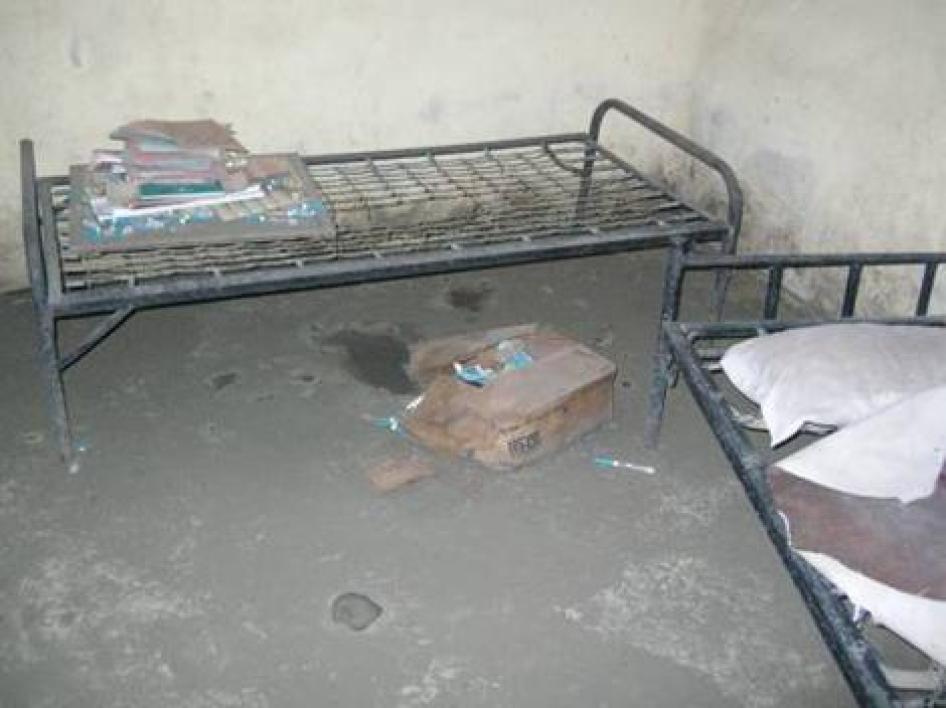
Overnight patient facilities in a comprehensive primary health care center run by Etche local government. The floors were caked with mud and strewn with vaccines ruined during a recent flood. The center had no mattresses, toilet facilities, or other basic amenities. © 2006 Chris Albin-Lackey/Human Rights Watch
Staff said that the Center was meant to provide for overnight patients,[252] but its rusty bed frames had no mattresses and the place had no water supply, electricity or toilet facilities. The nurse on duty said that one mattress had been donated by the Etche diaspora in the United States but had yet to arrive, and the staff had negotiated an agreement with a neighboring household to allow them and their patients to use that family's outhouse. The compound had a water pump, but this had been broken for more than two years and never repaired.[253]
The center also boasted a "labor room" for deliveries, but the only equipment on offer for this purpose was a dirty wooden table, a pillow, a plastic tray and a sponge. One member of the staff told Human Rights Watch that, "we have not done one delivery here. No woman would come here because of the conditions." She also said that they had repeatedly petitioned the local government for funds with which to purchase a pair of forceps, but without success.[254]
The staff present when Human Rights Watch visited the health center unanimously agreed with one of their colleagues when he described the standard of care they were able to offer at the center as "not adequate at all." Although they theoretically served several communities in roughly a six-kilometer radius, staff said that they rarely saw any patients. The traditional ruler of the nearest community confirmed this, stating that local residents did not patronize the health center because it was "not conducive to health."[255]
The other two health centers visited by Human Rights Watch were somewhat better off, more on account of the personal investment of their staff than anything else. One health center had managed to pull together some beds and mattresses along with some basic medical equipment. The staff had pooled their own money and used it to purchase a supply of basic medicines which they sold to their patients.[256] Nonetheless, they lacked many basic amenities including a reliable supply of clean water. Asked what the local government had done to support them in their work, the nurse on duty replied, "nothing." To prove the point, she walked through the entire clinic and explained how they had managed to procure each and every item in the place without any sort of government assistance.[257]
Education
According to local education officials, Etche has 89 primary schools with an enrollment of nearly 30,000 students, one of the largest student populations in Rivers State.[258] The local government's neglect of these schools mirrors its treatment of the health sector. An official with Etche's Local Government Education Authority (LGEA), the body responsible for running the local primary schools, told Human Rights Watch:
We don't even talk of resources because we don't have any. The allocation for local government-teacher's salaries are deducted at source [by the federal government]. After that there is only enough money left over for the local government to attend to its own needs.…
I don't say there is nothing available to be spent by the local government because I am not in charge of it. Only that it is not there in the budget.
The official declined to comment further, saying only that, "We don't get anything- you have to put these questions to the chairman."[259]
In its 2004 budget Etche allocated only N9,800,000 ($75,300) to cover the overhead expenses-including maintenance, staff training and other expenses-of all of these schools; roughly N110,000 ($845) per school.[260] By contrast, the local government allocated the substantial sum of N35 million ($270,000) for the renovation of ten primary schools throughout the local government.[261] Unfortunately, local education officials acknowledged that none of that work had been undertaken and that despite large allocations on paper, in fact not one LGC-funded school renovation had occurred in recent years.[262] There is no way to determine how or if the money allocated for this purpose was actually spent because neither the local nor the state government makes such information available to the public.
The consequences of the government's neglect are stark. Many schools are falling apart; the Secretary of Etche's LGEA confirmed that "some classrooms are so dilapidated that no one can use them." He also said that no more than a handful of schools have either running water or any sort of toilet facilities.[263]
LGEA authorities said that no school in the entire local government has a single textbook for the use of its students or any other teaching materials, and the LGEA Secretary stated that "there are some schools that have not enjoyed any supplies since they started."[264] Only one school out of the 89 has desks for its students, and those were provided by the state government. LGEA officials told Human Rights Watch that the chairman had asked them to "apply" for funds from elsewhere to obtain these.[265]
Human Rights Watch visited three primary schools in Etche local government. All consisted of simple blocks of classrooms that had been left to fall into varying states of decay. In one school in Ulakwo town, up to three classes at a time were being taught inside of a "building" with no partitions between the classrooms and only the crumbling remnants of exterior walls. Community members told Human Rights Watch that several years prior they had used their own money to install a water pump and a block of toilets on the school campus; the pump had since broken and the toilets had been damaged during a storm and had then been almost completely reclaimed by the surrounding brush.[266]
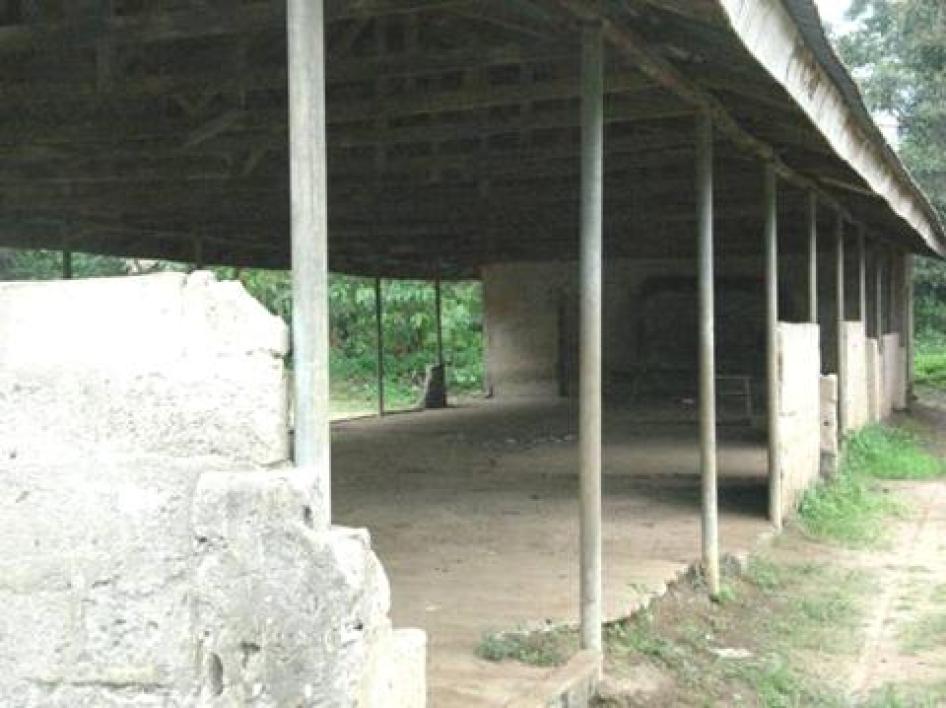
Block of primary school classrooms, Ulakwo, Etche local government. The school had no desks, no chairs, no teaching supplies and this classroom block had almost no walls. © 2006 Chris Albin-Lackey/Human Rights Watch
In another Etche community called Akwu/Obuor, the primary school had collapsed during a rain storm in 2004. The school's more than 100 students had since been left to take their lessons outside underneath a tree. The main problem with this arrangement, one parent explained, was that "If it rains they will just go home. And it rains almost every day."[267] A teacher at the school said that the local government had not indicated that it had any plans to repair the school, explaining with a shrug that "We do not have any politician people; we are not strong politicians."[268]
Teachers at each of the three schools visited by Human Rights Watch complained about the difficult conditions they were made to work under.[269] The LGEA Secretary told Human Rights Watch that many teachers had not had access to any sort of training in more than twenty years on the job, and described many of the local government's teachers as demoralized. "Our teachers are not taken care of," he said, "and so they in turn do not take care of the children."[270]
Roots of Local-Level Corruption in Rivers State
The Rivers State Government: "Leading By Example"
Rivers State's Commissioner for Information, Magnus Abe, told Human Rights Watch that one of the state government's primary strategies for addressing problems of local-level governance is to "lead by example at the state level."[271] But in fact, governance at the state level in Rivers is plagued by many of the same problems that have crippled the state's local governments. This is evidenced not only by the opaque and unaccountable manner in which the state dispenses with its revenues, but also by a host of other basic failures of governance. In this sense the state government is indeed leading by example, as its own failures have helped to fuel those of Rivers' local governments.
The Rivers State government's annual income has increased by leaps and bounds in recent years, fueled by dramatic increases in the price of oil. During the first eight months of 2006 the state government's average monthly federal allocations topped N12.4 billion ($95.5 million), a figure that dwarfs the allocations received by most other Nigerian states (see table 4 below). The 2006 state budget projected total government spending in excess of N168 billion ($1.3 billion ), double the amount the state had to spend as recently as 2004 and more than the annual budgets of several West African countries (see tables 4 and 5 below).
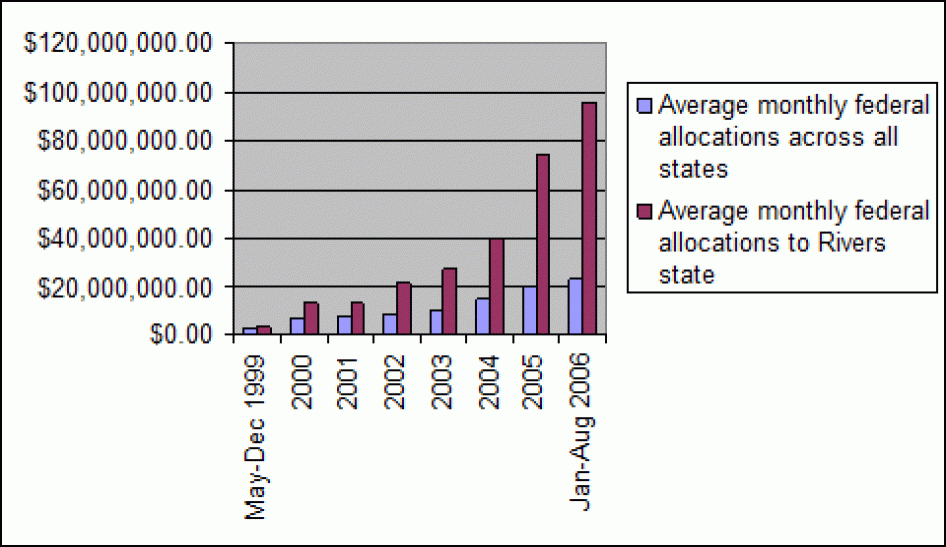
Table 4: Comparison of Monthly Allocations to Rivers State and Other Nigerian States.[272]
Country/State |
Central Government Budget, 2006 |
Population |
Senegal |
$1.68 billion |
11.7 million |
Rivers State, Nigeria |
$1.33 billion |
Between 4 and 5 million |
Mali |
$1.29 billion |
10.5 million |
Guinea |
$642 million |
8.44 million |
Niger |
$320 million |
11.3 million |
Table 5: Comparison of Population and 2006 Budget of Rivers State Against Those of Selected West African Countries.[273]
Much of this windfall has been lost to the extravagance, waste and corruption that characterize state government spending, a problem that is exemplified by the state's 2006 budget. Enormous sums have been channeled into the office of Governor Peter Odili, often on terms so vague that it is impossible to determine what they are actually meant to be used for. Such items include:
- Budgets for unspecified "Grants, Contributions and Donations" and "Grants for Women, Youths and Other Organizations" to be handed out by the governor's office at the rate of more than $91,000 per day or roughly N4.33 billion ($33.2 million) over the course of the year;[274]
- A Security Vote of N5 billion (nearly $38.5 million);[275] and
- N10 billion ($77 million) for unspecified "Special Projects," an item that did not even exist in the 2005 budget.[276]
Other items in the budget of the governor's office are more specified but on their face show little apparent regard to legitimate state priorities, including:
- Transport and travel budgets that total more than $65,000 per day;[277]
- Budgets for catering services; "Entertainment and Hospitality"; and "Gifts and Souvenirs for Visitors to Government House" that total N1.3 billion ($10 million)-more than the total annual budget of some local governments;
- N5 billion ($38.4 million) for the purchase of two helicopters and the construction of landing facilities-on top of 1.5 billion Naira that was allocated for the purchase of two jet aircraft in 2005.[278]
- N1.5 billion ($11.5 million) for the purchase of new vehicles for Government House, even though N800 million was budgeted for this same purpose in 2005.[279]
Added together, the above items alone constitute 17 percent of total state government spending in 2006, or more than N30.1 billion ($230 million), an amount that exceeds the total annual allocation given to many Nigerian states in 2005.[280]
The state government has not been nearly so generous in providing support to activities outside of Government House. The 2006 capital budget for the health sector actually declined slightly, to N2.8 billion from N3 billion in 2005. While government allocations to the governor's office skyrocketed, an official with one donor agency official said that they had been approached with an "enormous" request for funds from one state education official; he had claimed that the state could not afford to purchase wooden desks for the state's schools without outside help.[281] The governor's highly-touted "Rivers State Sustainable Development Program" has attracted only $20 million in state spending in 2006, less than the governor's travel budget.[282]
Human Rights Watch was not granted an interview with Governor Odili, but did interview Rivers State's Commissioner for Information Magnus Abe. Asked by Human Rights Watch to respond to criticisms that have been leveled against the government's spending priorities, the Commissioner replied, "Let's not be overly judgmental…The satisfaction of the people may not always be about food and drink." He said that the government's purchase of jet aircraft in particular had been a worthwhile investment because it allowed him and other officials to arrive for meetings in other parts of Nigeria in a timely manner.[283] In a recent interview with Time Magazine, the Commissioner said that it was "not nice" to suggest that there might be something wrong with the government's spending priorities.[284]

"Our Lady Queen of Victories," as pictured in a photo book detailing purported accomplishments of the Odili Administration entitled "Rivers State: The Rebirth," provided to Human Rights Watch by the Rivers State Ministry of Information
Centralization of Power and Accountability
Political and economic power in Rivers State rests overwhelmingly in the hands of its governor. This basic fact is starkly reflected in the enormous proportion of state revenues available to the governor to spend at his discretion, and in the financial neglect accorded to other government agencies.[285] Rivers State is by no means unique in this regard; one World Bank official confirmed to Human Rights Watch that in state and local governments throughout Nigeria, "All money generally passes through the hands of the governor or chairman."[286]
The centralization of state revenues in the hands of a single office-holder, with its commensurate political and economic power, discourages state government from being accountable for its spending.[287] It also tends to undermine any pretense of effective oversight, allows for tremendous secrecy in the conduct of government business, and thereby fuels the problem of corruption.
The same centralizing trends are in evidence at the local level in Rivers State. According to law, each of Rivers State's 23 LGAs is governed by an elected legislative council headed by an elected chair.[288] In practice, most legislative councils have no real role in the affairs of day-to-day governance and nearly unfettered decision-making power lies in the hands of LGC chairpersons.
The one substantial check that legislative councils by law have over the power of their chairs lies in the requirement that they approve or vote down the local governments' annual budgets.[289] Legislative councils are also entitled to review the end-of-year expenditure reports each chair is required to submit.[290]
Unfortunately, this theoretical check on the power of the chairman's office has largely evolved into little more than an opportunity for self-enrichment. Many local government councilors do not scrutinize the merits of proposed budgets but instead simply demand large bribes from their chairs in return for passing them.[291] Because they enjoy so little power in other contexts, many councilors look at the annual budget exercise as their single best opportunity to claim a share of local government revenues for their own enrichment.[292] The farcical nature of this budget-making process is then compounded by the fact that chairmen routinely ignore even the minimal constraints they impose upon themselves through that process; local government chairmen are generally left free to spend money in ways not provided for in their budgets even though this is a violation of state law.[293]
Access to Information about Government Spending
There is no practicable way for citizens of Rivers State to determine how their state and local governments are making use of public revenues. Rivers State government officials claim that the state's budget is published and made available to the public, but in fact this is not true.[294]
The personal assistant to the Rivers State Commissioner for Budget and Planning told Human Rights Watch that the only way to obtain a copy of the state budget would be to submit a request in person to the commissioner himself. At the time, the commissioner was said to be away from the state on business and officials said that it was impossible to predict when he might return.[295] The State Commissioner for Information insisted in an interview that the state budget was nonetheless "very easy" to obtain, but offered no insight as to how this might be accomplished.[296] Human Rights Watch was ultimately able to obtain a copy of the state budget, but only through partners outside of government.
Government revenues were so unexpectedly high in 2005 that the Rivers State government was forced to pass a supplementary budget in September 2005 to govern the dispensation of a N43 billion ($340 million) windfall. Despite repeated efforts from a number of different quarters, neither Human Rights Watch nor any member of the public has been able to obtain a copy of this document, and very little is known about what it purportedly contained.[297] In November, the state government passed a N23 billion ($176.9 million) supplementary budget for 2006[298] as well as a budget for 2007 that totals N179.3 billion ($1.38 billion).[299] To date neither document has been made public.
The picture is much the same at the local level. None of Rivers State's 23 LGCs publish their budget or any other annual account of how they intend to spend the money they receive. In addition, most local governments make it nearly impossible for their constituents to obtain such information. Even the Rivers State Commissioner for Information acknowledged this problem:
The amount of funds coming into the local level is actually quite new, so the expectations that should build up about the results those funds should yield have yet to materialize on the part of the public. People do not actually know that their local governments have enough money to tar their own roads, pay their nurses, and so on.[300]
At all four of the local government secretariats visited by Human Rights Watch, local officials said that the only way to obtain a copy of the budget was to submit a request directly to the chairperson. In only one of those local governments-Tai local government in Ogoni-did the chairman agree to make the budget available.[301] A handful of local government budgets were obtained through the state government's Ministry for Local Government Affairs, and a number of others were acquired through informal channels.
Asked whether there was any way for citizens to discover the contents of their local governments' budgets, JD Nalley, the top-ranking civil servant in the Rivers State Ministry of Local Government Affairs, replied, "I don't know whether budgets are accessible to every Dick, Tom and Harry, but it's a two-way street. Have the local people actually gone and asked for it?"[302] The same official described one local government as exceptionally transparent simply because the chairman tells his staff how much money the local government receives each month.[303]
Oversight of Local Government Conduct
Under state law, the Rivers State government is responsible for oversight of the state's 23 local governments. Perhaps the most important dimension of the state's oversight role lay in its power to examine local government finances and to mete out sanctions to corrupt local officials.
The state government's financial oversight powers are by law quite extensive. Rivers State maintains a Ministry of Local Government Affairs which has a general supervisory role over the local governments. The Ministry is charged with collecting all local government budgets, monitoring whether those budgets are reflected in the local governments' actual spending patterns, and notifying the State House of Assembly wherever problems arise. The Ministry also produces occasional reports on issues relating to the quality of local governance in Rivers.[304]
The State also employs an Auditor General for Local Government whose office is empowered to inspect the accounts of any and all local governments. The auditor general can also impose financial sanctions on local officials who are deemed to have improperly diverted local government funds.[305] On top of all of this, the Rivers State House of Assembly has the power to remove local government chairmen and vice chairmen from office where they are found guilty of "gross misconduct" or other offenses warranting impeachment.[306]
The state's actual application of these powers has been patchy at best. Few local government officials are sanctioned despite the rampant nature of their misconduct.[307] Just as important, most of the information gleaned through the state government's half-hearted attempts at oversight is treated as a carefully guarded secret.
The Auditor General for Local Government told Human Rights Watch that his office produced regular reports on irregularities in various local governments that were passed along to the State House of Assembly to act on.[308] He claimed that those reports contained recommendations that could "bring sanity to the local governments" and "go a long way towards changing the system" if they were implemented. He complained, however, that the reports were generally ignored by the House. He also stated that he was not at liberty to discuss either their contents or their recommendations in even the most general of terms.[309]
The Ministry for Local Government Affairs responded similarly to inquiries about their own oversight work. The Permanent Secretary for local government affairs did say that the Ministry had submitted a report dealing with problems local governance to the state House of Assembly in mid-2006. Asked about the report's conclusions, however, he could only reply with the vague hope that it might be made public "after some time."[310]
Violence and Corruption
Corruption in Rivers State is both fueled and facilitated by the state government's lack of accountability to the electorate. Nigeria's 2003 elections were marred by widespread violence and outright fraud; in Rivers State the process was even bloodier and less fair than the prevailing norm.[311] Some of those perpetrating violence on behalf of the candidates were allegedly funded with money embezzled from state and local coffers. And because the Rivers State government is currently a one-party government-not one seat in the State House of Assembly is now occupied by a member of any opposition party-there are no elected officials to demand, let alone ensure, accountability.
Many leading politicians armed and deployed organized gangs of thugs to manipulate the 2003 elections, and the state is now awash with guns.[312] Many former political enforcers have since evolved into well-armed criminals or leading anti-government militants. The violent trends set in motion during the 2003 elections have persisted, with many politicians maintaining links to armed gangs in order to defend their political and economic interests. Some leading state politicians, including the state's Commissioner for Finance, have even sent their gangs into the streets to wage deadly political turf wars on their behalf.[313] Lawrence Chuku, then the Deputy Chairman of Obio/Akpor local government told Human Rights Watch that his chairman, with whom he was engaged in a protracted political battle, had sent thugs to attack his supporters on multiple occasions.
Some local government officials have used violence to improve their incomes directly through the practice of extortion. In 2005, a group of okada (motorcycle taxi) riders came together to protest a variety of extortionate practices to which they said the local government administrations of Port Harcourt and neighboring Obio/Akpor local government had subjected them. The okada riders alleged that the chairmen of both local governments were forcing them to pay illegal fees they had no authority to collect and that those fees were going directly into the pockets of those officials.[314] They also accused local government officials of privately employing gangs of touts called "task forces" who beat up okada riders they caught without the required tickets.
The okada riders took up their case in the courts and were met with a swift and violent reaction. Mobile police officers on one occasion allegedly attacked the office of their lawyer.[315] In another instance, police stripped a leading member of the okada riders' group naked in the street outside the lawyer's office and severely beat him. "They took me in my nakedness to the police station," he said, where he was kept naked in a cell for three days without being given a reason for his arrest.[316]
Suppression of Media Criticism
Nigeria as a whole has seen marked improvements in the freedom of expression accorded to its population and the media since the end of military rule. However, local media outlets in some states have not fared as well as their more prominent national counterparts. Rivers State is home to numerous statewide newspapers, but many Port Harcourt-based editors and journalists told Human Rights Watch that they are subjected to forms of harassment and intimidation that often dissuade them from criticizing state government policies and actions.
The editor of one Port Harcourt-based newspaper told Human Rights Watch that members of his staff had been "invited" for questioning (that is, detained) by the police or State Security Service (SSS) more than half a dozen times since 1999 because of stories they had written that included criticism of state government policies and actions.[317] A particularly vocal columnist for one local paper told Human Rights Watch that his editor had threatened to discontinue publishing him on numerous occasions because of the anger his columns had elicited from state officials.[318]
The publisher of one Port Harcourt daily described the impact of such incidents this way:
You should be able to attack government policies and actions, but every time you do so they take it as a personal attack and the police and SSS end up issuing you invitations…There are so many loopholes that could land a journalist in jail, it has an impact. It makes us extremely cautious about what we write. And for some of us, it weakens our resolve to publish what we would want.[319]
Nigeria's Obligations under International Law
The Rights to Health and Education
The rights to health and education are enshrined in international human rights law, most notably the International Covenant on Economic, Social and Cultural Rights (ICESCR).[320] The ICESCR recognizes that the ability of governments to realize those rights varies according to the resources they have at their disposal. Thus, as a party to the ICESCR, Nigeria is obligated to take steps "to the maximum of its available resources" to achieve the progressive realization of the rights to health and to education.[321]
The ICESCR along with other international instruments requires that primary education should be "compulsory and available free to all."[322] In its general comment on the right to education, the UN Committee on Economic, Social and Cultural Rights, the international body of experts that monitors compliance with the ICESCR, found that among other requirements primary education must meet certain minimum standards of "availability."[323] In explaining this it noted that:
[A]ll institutions and programmes are likely to require buildings or other protection from the elements, sanitation facilities for both sexes, safe drinking water, trained teachers receiving domestically competitive salaries, teaching materials, and so on; while some will also require facilities such as a library, computer facilities and information technology.[324]
Primary schools in Rivers State are generally without access to most or even all of these basic facilities, especially sanitation facilities, safe drinking water and teaching materials. Some even lack any physical structure to protect students from the weather or only possess classrooms that had been allowed to degrade into a severe state of physical decay.
The right to health is defined by the ICESCR as the "right of everyone to the enjoyment of the highest attainable standard of physical and mental health," with specific emphasis placed on efforts to create "conditions which would assure to all medical service and medical attention in the event of sickness."[325] The Committee on Economic, Social and Cultural Rights has articulated the content of this right in more specific terms, stating that states' efforts to realize the right to health should include the provision of "functioning public health and health-care facilities, goods and services…" including:
…the underlying determinants of health, such as safe and potable drinking water and adequate sanitation facilities, hospitals, clinics and other health-relatedbuildings, trained medical and professional personnel receiving domestically competitive salaries,and essential drugs, as defined by the WHO Action Programme on Essential Drugs.[326]
The Committee has also stated that included in the right to health is "a core obligation to ensure the satisfaction of, at the very least, minimum essential levels of each of the rights enunciated in the Covenant, including essential primary health care."[327] Such facilities do not exist in much of Rivers State.
Governmental Corruption and Waste and its Impact on Health and Education
As has been documented in this report, primary education and primary health care services throughout much of Rivers State have been grossly neglected by the local governments tasked with keeping them alive. At the same time, enormous sums have been lost to corruption or channeled into questionable and frivolous expenditures. In some cases even the limited funding that has been allocated to health and education has itself been improperly diverted and cannot be accounted for. Not only are local governments in Rivers failing to take steps "to achieving progressively the full realization" of their people's rights to health and education, but in many respects government efforts appear to be heading in the opposite direction despite the recent huge increases in government budgets.
The UN Committee on Economic, Social, and Cultural Rights has said that a "violation of the obligation to fulfill" regarding the right to health can occur when there is "insufficient expenditure or misallocation of public resources which results in the non-enjoyment of the right to health by individuals or groups."[328] The Maastricht Guidelines on Violations of Economic, Social, and Cultural Rights interprets the ICESCR as being violated when a government engages in the "reduction or diversion of specific public expenditure, when such reduction or diversion results in the non-enjoyment of such rights and is not accompanied by adequate measures to ensure the minimum subsistence rights for everyone."[329]
Nigeria has tasked its local governments with the front-line responsibility for providing both primary health care and primary education, but the responsibility for government's failure to live up to its responsibilities does not rest with them alone. In Rivers, the state government has failed to exercise its oversight duties in a responsible manner and has allowed corrupt local government chairmen to run roughshod over the rights of their constituents.
Ultimately, Nigeria's federal government cannot escape its responsibility to work towards realizing the rights to health and education. Nigeria's constitution delegates much of that responsibility to the country's local governments, but the federal government retains its ultimate responsibility to ensure the rights are realized.[330]
Right of Access to Official Information
The ability of citizens, the media and civil society to access official information, such as budgets and government contracts, is essential for combating corruption. The 1999 report of a Commonwealth expert group meeting on the right to know stated:
Freedom of information has many benefits. It facilitates public participation in public affairs…. It enhances the accountability of government, improves decision-making, provides better information to elected representatives, enhances government credibility with its citizens, and provides a powerful aid in the fight against corruption. It is also a key livelihood and development issue, especially in situations of poverty and powerlessness.[331]
In Rivers State, the state and local governments have taken the opposite approach. The State government claims to publish its budget each year, but in practice both state and local government budgets are treated as closely guarded secrets. Local journalists have been harassed and intimidated for questioning government policies and actions. Federal government efforts have allowed citizens a rough idea of how much money is coming to their state and local governments, but they remain without any way of discovering how those administrations claim that they are spending the money they receive.
Legislation currently pending before the Nigerian parliament-the Freedom of Information, Fiscal Responsibility and Audit bills-would improve the access of Nigerians to government information. As of December 2006, none of these bills had been passed into law.[332]
Providing greater access to official information is consistent with Nigeria's obligations to promote and respect the right to freedom of expression. Article 19(2) of the International Covenant on Civil and Political Rights states that "[e]veryone shall have the right to freedom of expression; this right shall include freedom to seek, receive and impart information and ideas of all kinds."[333]
The UN special rapporteur on the promotion and protection of the right to freedom of opinion and expression clarified the meaning of article 19 with respect to access to information:
[T]he right to seek and receive information is not simply a converse of the right to freedom of opinion and expression but a freedom on its own…. [T]he right to access to information held by the Government must be the rule rather than the exception. Furthermore, there must be a general right of access to certain types of information related to what may be called "State activity," for example, meetings and decision-making forums should be open to the public wherever possible.[334]
In 2000 the special rapporteur endorsed, and the Commission on Human Rights noted, principles on freedom of information legislation.[335] These principles include: a presumption that all information held by public bodies at all levels should be subject to disclosure and that this presumption may be overcome only in very limited circumstances; public bodies should publish and disseminate widely documents of significant public interest (including operational information about how the public body functions); and, a presumption that all meetings of governing bodies be open to the public.[336]
Similarly, the African Charter of Human and People's Rights recognizes, in article 9, that "[e]very individual shall have the right to receive information."[337] In 2002, the African Union's African Commission on Human and Peoples' Rights adopted a Declaration of Principles on Freedom of Expression in Africa. Part IV on the right to information provides that "[p]ublic bodies hold information not for themselves but as custodians of the public good." Specifically, public bodies shall be required actively to publish important information of significant public interest; everyone has the right to access information held by public bodies; and, any refusal to disclose information shall be subject to appeal to an independent body or the courts.[338]
Nigerian Government Efforts to Fight Corruption
Since President Olusegun Obasanjo came to power in 1999, Nigeria's highly-touted "war on corruption" has been a rhetorical centerpiece of his administration. While little was done to prosecute that "war" during President Obasanjo's first four years in office, since 2003 important efforts have been made to make government finances more transparent and to hold corrupt officials accountable for their actions.
Improvements in Transparency
The Nigerian government has made some strides in making its finances more transparent. At the beginning of his second term, Obasanjo named former World Bank official Ngozi Okonjo-Iweala as Finance Minister. She pushed through a number of modest but important reforms and took the unprecedented step of publishing the amount of monthly federal allocations to the states and local governments.[339] The federal government has also published its annual budgets, in sharp contrast to most state and local governments. Nigeria was the first country to sign onto the Extractive Industries Transparency Initiative (EITI), a voluntary initiative aimed at securing greater transparency of the payments made to resource-rich countries such as Nigeria by multinational companies working in the energy sector.[340]
Internationally, Nigeria's image has been boosted by the perception that its government is trying to manage its finances more transparently and responsibly. The nation's treasury has benefited from this improvement, with the government managing to secure some $18 billion in debt relief from Paris Club creditors and the return of $458 million in stolen funds that had been hidden in Swiss banks by former military ruler Sani Abacha.[341]
The "War on Corruption"
In December 2002, Nigeria established the Economic and Financial Crimes Commission (EFCC) to complement the efforts of the already-existing Independent Corrupt Practices and Other Related Offenses Commission (ICPC).[342] The mandates of the two institutions differ but overlap in their shared pursuit of corrupt officials.[343] The ICPC has gone about its work with relatively little fanfare and has been criticized in some quarters as being ponderous and ineffective. By contrast, the EFCC and its outspoken Executive Chairman, Nuhu Ribadu, have made constant headlines with their vigorous and very public attacks upon corruption in Nigeria.
In 2005 an EFCC investigation resulted in the unprecedented conviction of the former Inspector General of the Nigerian police on charges of having stolen more than $121 million in public funds.[344] Such high-profile convictions have been rare, but sensational arrests and accusations have not. The EFCC has extensive police powers and has made liberal use of them, routinely detaining government officials and others for prolonged periods of questioning. The EFCC is also actively pursuing criminal cases against several sitting Nigerian governors;[345] recently arrested the son of powerful former military ruler Ibrahim Babangida;[346] and has publicly accused Nigerian Vice President and presidential hopeful Atiku Abubakar of corruption involving more than $100 million in public funds.[347]
The government's collective efforts have yielded real dividends. All told, the EFCC claims to have successfully prosecuted more than 82 people on charges of corruption and fraud and recovered more than $5 billion in stolen money.[348] The ICPC has secured convictions at a slower rate-it managed only four during the first eight months of 2006-but had more than 65 trials ongoing as of August 2006.[349] Nigeria's Corrupt Practices and Related Offenses Act, passed in 2000, provides steep criminal penalties for many corruption-related offenses.[350] Nigeria's government also ratified the United Nations Convention Against Corruption in December 2004 and is a signatory to the African Union Convention on Preventing and Combating Corruption and Related Offenses.[351]
Failures and Backward Steps
Corruption
For all of the publicity the Nigerian government's anti-corruption "war" has generated, its victories have in fact been rather limited. Nigeria still ranks 142nd out of 163 countries surveyed for Transparency International's Corruption Perceptions Index, tied with countries such as Angola and Congo-Brazzaville. While some gains have been seen at the federal level-the World Bank has spoken of a "considerable reduction in bribery" since 2002-corruption remains rampant at all levels of Nigerian society.[352] In part, the lack of dramatic progress against corruption may simply reflect the scale of the task at hand. As EFCC head Nuhu Ribadu said in an interview with Human Rights Watch, "The problem started a long time ago and it has eaten deep into all sectors of society and has almost taken over our entire way of life…Everyone is involved now, even community leaders."[353]
The problem of corruption is no doubt daunting, but it is also true that President Obasanjo's administration has often appeared hesitant to allow that work to move too far ahead. In 2003, Nigeria's auditor general produced a scathing report that detailed pervasive corruption in federal government expenditures; President Obasanjo promptly had him fired.[354] When Nuhu Ribadu announced in September 2006 that 31 of Nigeria's 36 governors could face criminal charges of corruption when their terms expired, President Obasanjo moved immediately to silence him.[355] Perhaps most damaging, aides to President Obasanjo were widely implicated in a massive scheme to bribe members of the National Assembly to support his unsuccessful bid for a third term. An investigation announced by the EFCC has thus far come to nothing.[356]
Transparency
The government's work to promote transparency has also suffered setbacks. Most dramatically, President Obasanjo removed Finance Minister Ngozi Okonjo-Iweala from her post in August 2006 and she ultimately resigned from government altogether. Okonjo-Iweala was widely credited as the architect of much of the government's progress in the area of transparency.
Nigeria has also failed to push through key pieces of reform legislation that would have complemented its participation in EITI by making government expenditure at all levels more transparent. Nigeria has yet to pass the ambitious Fiscal Responsibility bill, which was introduced by former finance minister Okonjo-Iweala and has been sitting in the National Assembly for several years along with other promising reforms.[357] Nigeria's Senate passed the long-delayed Freedom of Information Bill in November 2006, but as of the time of writing it is unclear whether President Obasanjo will sign it into law before leaving office.[358]
More generally, a recent World Bank report found that, "While the federal government has made impressive progress in establishing and maintaining aggregate fiscal discipline, there is no evidence yet that the quality of budget expenditure has been improving."[359] It went on to call for "a radical change in incentives that government officials face, based on much stronger accountability for rational utilization of public funds."[360]
"Political Motives" and Public Cynicism
Many critics have accused the government of prosecuting its "war on corruption" in a selective manner that disproportionately targets political opponents of the president. Several prominent rivals of the president have in fact been targeted for EFCC investigation, most notably Vice President Atiku Abubakar.[361] Abubakar is campaigning for presidential elections next year despite President Obasanjo's vehement opposition.
At the same time, some rather notorious allies of the president have been left entirely unscathed. Anambra state political "godfather" Chris Uba, for example, helped to plunge his state into violence and chaos in 2004 when then-governor Chris Ngige tried to break free of his political control.[362] Ngige was impeached, but Chris Uba has never faced any meaningful inquiry and remains a member of the People's Democratic Party's (PDP) board of trustees. Chris Uba's older brother Andy served in President Obasanjo's cabinet until resigning in November 2006 and has since won the PDP nomination for Anambra's gubernatorial race in 2007. Shortly before resigning in order to pursue that election, allegations emerged that he had been caught smuggling $170,000 in cash into the United States on board Nigeria's presidential jet in late 2003.[363] Some $45,000 of that amount allegedly went towards the purchase of equipment for President Obasanjo's farm at Ota, Ogun State; a lawyer speaking for the president reportedly claimed that the purchase of that equipment was "unsolicited" and that the president had merely "joked" about it with Uba.[364] The EFCC has thus far declined to investigate despite a public outcry over the affair.[365]
Apparent contradictions such as these have fostered a degree of public cynicism that has begun to undermine the legitimacy of the government's anti-corruption drive. Whether justified or not, that skepticism has worked to the benefit of officials who find themselves the targets of investigation.
Perhaps the best example of this phenomenon is the case of former Governor Diepreye Alamieyeseigha of Bayelsa State in the Niger Delta. The governor was arraigned in London on charges of money laundering; investigators had found nearly ₤1 million in cash in his London home.[366] He was released on bail and quickly fled the country, allegedly by disguising himself as a woman.[367] When he eventually reappeared in his home state, he claimed to have been transported there by God.[368] Alamieyeseigha was subsequently impeached and is currently standing trial in Abuja.
Many Nigerians saw the governor's actions as a national disgrace and were happy to see him put on trial. But many others, including leading Delta militant groups, have loudly demanded his release and accused the government of pursuing him for political reasons.[369] Alamieyeseigha was widely seen as an opponent of the president, and popular cynicism has allowed many of the former governor's defenders to argue that his alleged crimes were no different from the day-to-day conduct of other public officials who are left unmolested by the law.[370] To this day, Alamieyeseigha's ongoing trial is portrayed by some leading Delta militants as an injustice and as evidence of the government's hostility to the Ijaw cause.[371]
Civilian Rule without Accountability
Nigeria is nearly eight years into the longest stretch of uninterrupted civilian rule in its history as a nation. But as the example of River State illustrates so clearly, many political officeholders in Nigeria remain largely unaccountable to their constituents. Nigeria's federal government has allowed the perpetuation of a political system that often rewards politicians who use their ill-gotten gains to mobilize violence in support of their political ambitions. In doing so, it has undermined its own efforts to fight corruption.
The elections that brought Obasanjo to power in 1999 were hailed as a milestone, but they were riddled with fraud and other basic flaws that called their legitimacy into question. Former US President Jimmy Carter summed up the conclusions of an observation mission by stating that, "Regrettably, it is not possible for us to make an accurate judgment about the outcome of the presidential election."[372] The elections that brought Obasanjo a second term in 2003 were even worse, with results in several states blatantly rigged in favor of the president; one analyst estimated that up to ten million voters' cards were fraudulently issued.[373]
Those elections did more than bring President Obasanjo to power. Many of the governors that the EFCC is now denouncing as corrupt helped to organize and rig the process and were themselves swept into office on the president's coattails.
Violence and fraud was so prevalent in much of the Niger Delta in 2003 that a large proportion of the region's population was effectively disenfranchised.[374] Rivers State Governor Peter Odili's re-election campaign in 2003 was an especially violent affair, with one local group describing electioneering in some parts of the state as a "low-intensity armed struggle."[375] Local government elections-last held in 2004 in Rivers under the supervision of Rivers' fraudulently-elected state authorities-were no better and offered the people of the state little real hope of turning corrupt, abusive chairmen out of office.[376]
This reality of fraud and violence that has lasting implications beyond its own importance. In Rivers State, state government officials often complain quite loudly about the graft and inactivity that characterize many local government administrations. But the state has been extremely lax in holding those officials to account, in part because state-level politicians expect the chairmen to "make returns" on their embezzled funds. Just as important, politicians at all levels rely upon the chairmen to mobilize violence and otherwise manipulate the results of state and federal elections in their constituencies. As one prominent Port Harcourt-based activist put it, "The governor never challenges the local government chairmen over their corruption because those chairmen are the governor's champions of violence."[377]
International Efforts to Promote Transparency and Fight Corruption
Western governments have generally been reluctant to pressure Nigeria's government over its appalling human rights record, in large measure because of Nigeria's economic and geopolitical importance in Africa and beyond. But in recent years members of the international community have sponsored new efforts to promote transparency in resource-rich states such as Nigeria.
The Nigerian government has helped improve the transparency of its finances by being the first country to sign on to one of these efforts, the Extractive Industries Transparency Initiative (EITI). EITI is a voluntary initiative aimed at encouraging oil and mining companies to publish the payments they make to the governments of developing world countries in which they operate. Human Rights Watch has participated in EITI's development as well as that of the complementary NGO-led Publish What You Pay campaign.[378]
Like other international initiatives, EITI suffers from inherent limitations in that it currently extends only to enhancing the transparency of government income. The value of that alone is tremendous, but EITI does little to enhance the transparency of governmentexpenditure in Nigeria, especially at the state and local level. As one Nigerian activist associated with EITI put it, "It is not enough to publish what they [the Nigerian government] earn. They must also publish how they spend it."[379]
There have also been limited international efforts to help countries like Nigeria go after corrupt officials and stolen funds. The US government in August 2006 announced that it was launching an effort to "internationalize efforts against kleptocracy." Among other things, this seeks to deny corrupt officials access to international banking institutions; deny safe haven to "kleptocrats" themselves and take stronger action against those who bribe foreign officials.[380] The UK government has also helped in the pursuit of corrupt officials through the workings of its own criminal justice system. In 2006 UK authorities arrested and attempted to prosecute two Nigerian governors on charges of money laundering when they were found on British soil, although both were able to escape back to Nigeria while out on bail.[381]
EFCC head Nuhu Ribadu told Human Rights Watch that these and other efforts had not gone far enough but had yielded some success in making it harder for corrupt Nigerian officials to salt away the proceeds of corruption abroad. He said this was important because it was far easier for the EFCC to pursue such assets if they stayed within Nigeria.[382]
In Rivers State, donor governments and multinational oil companies have backed the state government's Rivers State Sustainable Development Plan (RSSDP). The RSSDP is essentially a parallel channel that directs state government largesse into development-related projects outside of its mainline ministries; the program adheres to more rigorous standards of transparency than the state government itself. During its pilot phase, representatives of donor agencies and multinational oil companies assumed direct oversight powers over the award of contracts under the program and reported success in preventing those revenues from being diverted improperly. Funding for the program is meant to come almost entirely from the Rivers State government.
The RSSDP has yet to get underway in earnest; only $20 million was set aside for it by the state government in 2006 and relatively little work has been carried out on the ground. The Rivers State government has since introduced legislation that, if passed, would greatly increase the funding of the program beginning in 2007. As the project moves from its pilot phase, however, the direct oversight role of international actors will at the same time be phased out. In interviews with Human Rights Watch, international officials involved with the program's development expressed skepticism that it would ultimately prove more transparent or more effective in its use of government funds than existing government structures.[383] It is not clear how much the state government has allocated towards the program in 2007 because the recently passed state budget for that year has not been made available to the public.
The Role of Multinational Oil Companies
Historically, oil companies operating in the Niger Delta have contributed to Nigeria's epidemic of corruption in a number of important ways. Under military rule, many companies were working with governments that had institutionalized corruption as a tool of governance and their involvement in corruption became almost inevitable.[384] The overall situation has improved since 1999, but the problem has not been resolved.
In April 2006, independent auditors announced that they had discovered a $232 million gap between what oil companies said they had paid to the Nigerian government and what the central bank said it had received.[385] It is not at all clear that this gap is the result of malfeasance on the part of oil companies as opposed to governmental corruption or something else altogether. But at the very least it is clear evidence of mismanagement on a colossal scale that forms part of the context within which companies do business.
Companies operating in the Delta face enormous pressure to reinvest some of their profits into the communities around their operations-pressure made more intense by government's own failure to do the same. They are also under constant pressure to compensate communities for losses they claim to suffer from pollution caused by company activities.
All of that is understandable, but the manner in which companies respond to those demands is often deeply flawed. Payments and projects are often undertaken with a view towards securing short-term peace rather than working towards development. In some cases, "contracts" are awarded to youths in exchange for their agreeing not to sabotage company facilities; such payments increase the power of unaccountable armed groups and local politicians involved in the extortionate demands.[386] These are often the same actors who use their wealth and command of violence to control local-level politics in some areas.
In 2006, several companies paid large ransoms to secure the release of kidnapped employees. Many of those payments were made through corrupt Rivers State government officials who siphoned off a portion of the ransoms before passing the remainder along to the kidnappers.[387] While companies' need to secure the safety of their employees is a paramount interest, it is nonetheless an important fact that the manner in which ransom payments were delivered helped in a small way to fuel patterns of state-level corruption and contributed to spawning a cottage industry of kidnappings from which some government officials are alleged to have profited.
Acknowledgements
This report was written and researched by Chris Albin-Lackey, researcher in the Africa Division of Human Rights Watch. It was reviewed and edited by Corinne Dufka, senior researcher and West Africa team leader in the Africa Division; Georgette Gagnon, deputy director of the Africa Division; Arvind Ganesan, director of the Business and Human Rights Program of Human Rights Watch; James Ross, senior legal advisor of Human Rights Watch; and Andrew Mawson, deputy program director of Human Rights Watch. Celeste Bruff, associate in the Africa Division, provided production assistance. Andrea Holley, publications director of Human Rights Watch, provided assistance with the photographs. Fitzroy Hepkins, mail manager, made possible the production of the report.
Human Rights Watch wishes to thank the many individuals who came forward to offer the testimony and other information that made this report possible.
We also wish to thank the organizations and individuals in Rivers State and elsewhere who offered their assistance in facilitating this research and helping to review sections of the final report. Their names have been withheld to avoid any possibility of reprisal.
Human Rights Watch wishes to thank the John D. and Catharine T. MacArthur Foundation for funding its work on Nigeria.
* In Nigerian slang, to "chop" literally means to eat, but the word is also commonly used to describe the practice of embezzling government money (to "chop money"). "Chop fine" means "eat well."
[1]The 2003 elections in particular were marred by widespread political violence and outright fraud. These issues are discussed in this report; see also Human Rights Watch, Nigeria's 2003 Elections: The Unacknowledged Violence, June 2004, pp. 14-19, http://hrw.org/reports/2004/nigeria0604/nigeria0604.pdf.
[2]See, for example, Joint Ministerial Committee of the Boards of Governors of the Bank and the Fund on the Transfer of Real Resources to Developing Countries, Strengthening Bank Group Engagement on Governance and Anti-Corruption, September 8, 2006, pp. 37-38, http://www.worldbank.org/html/extdr/comments/governancefeedback/gacpaper.pdf (accessed December 19, 2006).
[3] See below, Civilian Rule Without Accountability.
[4] Ibid. SeealsoHuman Rights Watch, Nigeria's 2003 Elections: The Unacknowledged Violence.
[5] "Do the votes count? Final report of the 2003 general elections in Nigeria," Transition Monitoring Group. Similarly, the European Union's observation mission found evidence of "widespread electoral fraud" in several Niger Delta states. European Union Election Observation Mission Final Report, http://ec.europa.eu/comm/external_relations/human_rights/eu_election_ass_observ/nigeria/rep03.pdf (accessed January 16, 2007).
[6] See below, The Roots of Local Government Corruption.
[7] The havoc unleashed by such militias has proven especially costly to the people of Rivers State. See Human Rights Watch, Rivers and Blood: Guns, Oil and Power in Nigeria's Rivers State, February 2005, http://hrw.org/backgrounder/africa/nigeria0205/nigeria0205.pdf.
[8] Schedule four of Nigeria's Constitution defines the local government's role only as "participation" in overall state government efforts, but in practice responsibility has largely been delegated to the local level. Nigeria's National Health Policy States that, "With the general guidance, support and technical supervision of State Health Ministries, under the aegis of Ministries of Local Government, Local Government Councils shall design and implement strategies to discharge the responsibilities assigned to them under the Constitution, and to meet the health needs of the local community." National Health Policy, p. 26, cited in Stuti Khemani, "Local Government Accountability for Health Service Delivery in Nigeria," Journal of African Economies, October 15, 2005, p. 5.
[9] By contrast, hospitals are run by the state and federal governments.
[10] World Bank, "Nigeria Health, Nutrition and Population Country Status Report," November 2005, p.54. These include clinics, dispensaries, primary health care centers and comprehensive primary health care centers. Most of the facilities visited in the course of this research were primary health care centers.
[11]See Khemani, "Local Government Accountability for Health Service Delivery" and World Bank, "Nigeria Health, Nutrition and Population Country Status Report," pp. 45-92.
[12] Ibid.
[13] Ibid.
[14] See below, A Note About Local Government Capacity and Budgets.
[15] For an overview of the federal government's Universal Basic Education policies and administrative framework, see World Bank, "The Capacity of the Nigerian Government to Deliver Basic Education." It is not yet clear to what extent the SUBEBs will become reliable providers of basic support to the primary schools, as they are relatively new institutions. Rivers' SUBEB only became fully operational in 2006.
[16] Human Rights Watch interview with Emmanuel Olayinka Ayoola, chairman, ICPC, Abuja, August 10, 2006.
[17] In many local governments the percentage may rise above ninety percent. In Rivers State local governments have the power to tax certain activities within their jurisdictions and to invest funds in income-generating activities. Rivers State Local Government Law, no. 3 of 2000, sec. 67.
[18] Human Rights Watch interviews, Rivers State, August and September 2006.
[19]For a more detailed discussion of the distribution of revenue between the federal, state and local governments and the politics behind it, see Rotimi Suberu, Federalism and Ethnic Conflict in Nigeria, (Washington: USIP, 2001).
[20]See below, Resource Control.
[21] Forthcoming World Bank Expenditure Review for Nigeria, on file with Human Rights Watch.
[22] International Crisis Group (ICG), "Nigeria: Want in the Midst of Plenty," Africa Report No. 113, July 19, 2006, p.7, http://www.crisisgroup.org/home/index.cfm?id=4274&l=1 (accessed November 6, 2006).
[23] As of 2004 it was estimated that Nigeria's oil industry had generated some $400 billion in revenues since 1960. By contrast, manufacturing accounted for only six percent of the national economy, a smaller share than at independence. See Peter Lewis, "Getting the Politics Right: Governance and Economic Failure in Nigeria," in Robert Rotberg, ed., Crafting the New Nigeria: Confronting the Challenges (Boulder: Lynne Rienner, 2004), p. 99. Oil revenues have come to account for roughly 95 percent of Nigeria's export earnings and nearly 80 percent of total government income, reaching $45 billion in 2005. See United Nations Development Program (UNDP), Niger Delta Human Development Report (Abuja: United Nations Development Program, 2006), p.14, http://web.ng.undp.org/documents/nigeria-delta-hdr.pdf (accessed November 6, 2006).
[24] According to the US government Energy Information Administration, Nigeria's oil earnings stood at $45.1 billion in 2005 and as of January 2006 were forecast to rise to $52.7 billion in 2006. Energy Information Administration, "OPEC Revenues: Country Details," http://www.eia.doe.gov/cabs/OPEC_Revenues/OPECDetails.html (accessed December 4, 2006).
[25] Accurate census data for Nigeria does not exist; current population estimates generally range between 130 million and 140 million. The results of a census exercise conducted in 2006 have yet to be published, in part because of fears that they will provoke controversy and possible violence ahead of elections scheduled for next year.
[26] "Nigerian Leaders 'Stole' $380 Billion," BBC News Online, October 20, 2006, http://news.bbc.co.uk/2/hi/africa/6069230.stm (accessed November 4, 2006).
[27] See ICG, "Want in the Midst of Plenty," p. 13.
[28] Nigeria has already secured the return of more than $450 million of "Abacha loot" from Swiss banks where the money had been stashed. Abacha actually seized power from the civilian administration of Ernest Shonekan, put in place upon Babangida's departure from power in August 1993. Abacha dominated that government from the outset and overthrew it only three months after its inception.
[29]Claude Ake, one of Nigeria's most prominent political scientists, described the problems posed by the institutionalization of corruption in Nigerian governance this way: "Our predatory disposition constitutes the Nigerian state as a negative unity of takers in which collective enterprise is all but impossible…Where does the wealth which we are ever scheming to appropriate come from? We do not want to know. All we want to know is whether we can muster the power to appropriate it." Claude Ake, "Points of Departure," Nigerian Tribune, December 17, 1992, quoted in Rotimi Suberu, Federalism and Ethnic Conflict in Nigeria (Washington: USIP, 2001), p. 10.
[30] The World Bank, Helping Countries Combat Corruption: The Role of the World Bank (Washington, DC: The World Bank, 1997), p.8; and Transparency International, "Frequently Asked Questions About the Corruption Perceptions Index: 2002," press release, August 28, 2002.
[31] The World Bank, Anticorruption in Transition: A Contribution to the Policy Debate (Washington, DC: The World Bank, 2000), pp.1-2.
[32] Ibid., p.2
[33] Lewis, "Getting the Politics Right," in Rotberg, ed., Crafting the New Nigeria, p. 99.
[34] Estimates vary widely, owing largely to a dearth of reliable statistics. The UK's Department for International Development (DFID) estimates that 90 million Nigerians live in absolute poverty. DFID, "Nigeria Country Assistance Plan, 2004-2008," http://www.dfid.gov.uk/pubs/files/nigeria-cap.asp (accessed November 6, 2006). The World Bank has put the figure at 37 percent of Nigeria's population. World Bank, "Nigeria Country Brief," updated April 2006. Nigeria is ranked 158th out of 177 countries in UNDP's Human Development Index for 2005. United Nations Development Program, 2005), http://hdr.undp.org/statistics/data/indicators.cfm?x=133&y=1&z=1 (accessed November 6, 2006).
[35] Current rankings across all countries with data can be found online at http://hdr.undp.org/hdr2006/statistics/ (accessed November 28, 2006).
[36] The amount of monthly allocations to the state and local governments are published by Nigeria's Ministry of Finance and available online at http://www.fmf.gov.ng.
[37] Forthcoming World Bank Public Expenditure Review for Nigeria, on file with Human Rights Watch.
[38] For a discussion of Nigeria's legal obligation to provide basic health and education services, see below, Nigeria's Legal Obligations.
[39] Two Nigerian Governors-Joshua Dariye and Diepreye Alamieyeseigha-were arrested in London, in 2004 and late 2005 respectively, on charges of money laundering and both subsequently fled the country while out on bail; both were eventually impeached by their respective state legislatures, though at the time of writing Dariye has managed to elude capture by the Nigerian authorities. Ekiti state governor Ayo Fayose was impeached in October 2006 on allegations of corruption and subsequently went into hiding. The Governor of Zamfara State was recently accused by the EFCC of the large-scale "direct stealing" of state revenues in a case one Nigerian official referred to as a "tragedy." Also see below, The Federal Government Response.
[40] "Ribadu in Senate: 31 Governors Under Investigation," This Day, September 28, 2006.
[41] Human Rights Watch interview with Emmanuel Olayinka Ayoola, chairman, ICPC, Abuja, August 10, 2006.
[42] Human Rights Watch interview with Nuhu Ribadu, executive chairman, Economic and Financial Crimes Commission, Abuja, August 18, 2006.
[43] UNDP, Niger Delta Human Development Report, p. 16.
[44] World Bank, "Health, Nutrition and Population Country Status Report" p. 7, para. 6. Nigeria is unofficially divided into six geopolitical "zones," each of whose component states share a set of common political interests vis-à-vis the federal government and the distribution of federal government resources and positions. The South-South zone encompasses all of the Niger Delta's major oil producing states, including Rivers.
[45]Shell, which accounts for roughly half of the Delta's onshore infrastructure, recorded 224 spills in 2005 and 236 in 2004. Shell claims that the majority of these were the result of sabotage or a byproduct of the region's booming trade in stolen oil. Many local activists dispute this. Shell Nigeria, "Annual Report 2005; People and the Environment," http://www.shell.com (accessed November 6, 2006) and http://www.crisisgroup.org/home/index.cfm?id=4394&l=1 (accessed November 6, 2006).
[46]See UNDP, Niger Delta Human Development Report. For more on the practice of flaring, see Human Rights Watch, The Price of Oil: Corporate Responsibility and Human Rights Violations in Nigeria's Oil Producing Communities (New York: Human Rights Watch, 1999), http://www.hrw.org/reports/1999/nigeria/. See also ICG, "Fueling the Niger Delta Crisis," p. 20.
[47] Shell Nigeria is made up of several companies, with Shell Petroleum Development Company of Nigeria (SPDC) carrying out the bulk of its production and exploration activities. For a detailed account of the human rights impact of Shell's operations in the Delta under military rule, see Human Rights Watch, The Price of Oil.
[48] SeeShell Nigeria, "Annual Report 2005," p. 20-34. Shell also reports making $75 million in payments to the federally-funded Niger Delta Development Commission (NDDC) in 2005. Ibid.
[49]The first instance of extreme government brutality in response to Delta protests came with the massacre of some 80 unarmed demonstrators by soldiers in the Rivers State town of Umuechem in 1990. That massacre marked the beginning of a pattern of abusive conduct by the security forces in the region that has continued through the present day. See ICG, "The Swamps of the Insurgency: Nigeria's Delta Unrest," Africa Report No. 115, August 3, 2006, http://www.crisisgroup.org/home/index.cfm?id=4310&l=1 (accessed November 6, 2006).
[50]Saro-Wiwa had led a campaign of non-violent resistance against Shell and the Nigerian government that culminated in Shell's withdrawal from Ogoniland under the banner of the Movement for the Survival of the Ogoni People (MOSOP). He was charged with organizing the murder of four Ogoni leaders who supported a faction of MOSOP opposed to Saro-Wiwa. The trial made little pretense of respecting international fair trial standards, and Shell was widely criticized for failing to intercede on Saro-Wiwa's behalf. Human Rights Watch, The Price of Oil.
[51]In 1999 military forces attacked the Bayelsa state town of Odi and burned it to the ground, killing hundreds of people in the process. Human Rights Watch, The Destruction of Odi and Rape in Choba (New York: Human Rights Watch, 1999), http://www.hrw.org/press/1999/dec/nibg1299.htm. In February 2005, soldiers staged a similar attack on the town of Odioma. No military personnel have been held to account for these or other incidents. See Amnesty International, "Ten Years On: Injustice And Violence Haunt The Oil Delta", AI Index:
AFR 44/022/2005, November 3, 2005, http://web.amnesty.org/library/Index/ENGAFR440222005?open&of=ENG-NGA (accessed November 6, 2006).
[52] SeeShell Nigeria, "Annual Report 2005," p. 4-8.
[53]SeeICG, "The Swamps of the Insurgency: Nigeria's Delta Unrest," Africa Report No. 115, August 3, 2006, http://www.crisisgroup.org/home/index.cfm?id=4310&l=1 (accessed November 6, 2006).
[54]The principle of "derivation"-the idea that some portion of the revenues produced by oil-producing states should be returned to them-was largely obliterated under military rule. In 1969, the federal government returned 50 percent of all oil revenues to the state governments those revenues derived from. By 1989 this had declined to one percent and remained at that level through 1999.
[55] Article 162(2) of the Nigerian Constitution provides that the proportion of revenues returned through derivation must be "not less" than 13 percent. Remaining oil revenues are divided between the federal, state and local governments according to the same formulas that apply to all other government revenue.
[56] ICG, "Nigeria: Want in the Midst of Plenty," Africa Report No. 113, July 19, 2006, p. 21, http://www.crisisgroup.org/home/index.cfm?id=4274&l=1 (accessed November 6, 2006). According to a forthcoming World Bank Expenditure Review for Nigeria, in 2005 those four states received roughly 90 percent of all derivation revenues. Expenditure Review, para. 9.
[57] According to figures extrapolated from Nigeria's 1991 census, which are generally not regarded as being entirely reliable, the populations of these four states in 2005 were estimated as follows: Rivers State, 4,858,000; Bayelsa State, 1,710,000; Akwa/Ibom State, 3,343,000; Delta State, 3, 694,000.
[58] Human Rights Watch interview with Nuhu Ribadu, executive chairman, Economic and Financial Crimes Commission, Abuja, August 18, 2006.
[59] See below, The Roots of Local Government Corruption.
[60] Human Rights Watch interview, Port Harcourt, August 26, 2006.
[61]Human Rights Watch interview, University of Port Harcourt, August 16, 2006.
[62] Human Rights Watch interview, August 2006.
[63] Human Rights Watch interview with Inemeh Friday, auditor general for Local Government, Port Harcourt, August 14, 2006.
[64] Human Rights Watch interview with Sani Mohammed, Economic and Financial Crimes Commission, Port Harcourt, August 29, 2006.
[65]Monetary figures throughout this report are calculated from Naira to US dollars at an exchange rate of N130/$1.
[66] This table is drawn from figures published by the Nigerian Ministry of Finance each month. Those figures are available online at http://www.fmf.gov.ng/detail.php?link=faac (accessed December 4, 2006).
[67] Human Rights Watch interviews with state and local officials, Rivers State, August 2006; local government budgets on file with Human Rights Watch. Some local government chairmen have added fictitious civil servants to their payroll, and others have illegally "hired" political cronies or members of violent gangs. See Jones Oluwole Aluko, Corruption in he Local Government System in Nigeria (Ibadan: BookBuilders, 2006), pp 55-105. Also see below, Local Government Corruption and Mismanagement in Rivers State: An Overview; and The Roots of Local-Level Corruption in Rivers State.
[68] Human Rights Watch interview, Port Harcourt, August 2006.
[69]Human Rights Watch obtained budgets for Tai, Obio/Akpor, Etche, Khana and Opobo/Nkoro local governments.
[70] Human Rights Watch interview with Lawrence C. Chuku, deputy chairman, Obio/Akpor Local Government Council, August 25, 2006; Human Rights Watch interview with Jacobson Nbina, executive chairman, Tai Local Government Council, Saakpenwa, August 30, 2006.
[71] World Bank, "Health, Nutrition and Population Country Status Report," p. 47, para. 12.
[72] These are listed in a manifesto entitled, "An Epitome of Delivery of Democratic Dividends."
[73]For this participatory approach in particular, the Movement for the Survival of the Ogoni People (MOSOP), named Tai's chair the best-performing local government chair in Ogoniland in 2006. Human Rights Watch interview with Leddum Mittee, Port Harcourt, August 15, 2006.
[74] Tai local government allocated nearly 20 percent of its budget to the office of its chairman, much of it for purposes that are impossible to decipher. This included a N40 million security vote and N45 million for "Miscellaneous Expenses." Tai local government budget, 2006. One of the chairman's central education-related initiatives was the distribution of 100,000 notebooks to students in the LGA's primary schools, each one bearing a portrait of the chairman.
[75] Human Rights Watch interview with Jacobson Nbina, executive chairman, Tai Local Government Council, Saakpenwa, Tai local government, August 30, 2006.
[76] See below, The Roots of Local Government Corruption.
[77]Obio/Akpor Local Government Council, 2006 Recurrent and Capital Estimates, Head 7001 and 7002. Also see below, Trading Blame in Obio/Akpor local government.
[78]Tai Local Government Estimates for 2006, Heads 5001, 5002 and 7001.
[79]Human Rights Watch interview, Port Harcourt, August 14, 2006.
[80] Human Rights Watch interviews with World Bank official, Abuja, September 2006.
[81] See below, Case Studies A, B and C; and Trading Blame in Obio/Akpor local government.
[82]Another, not unrelated, reason for such massive expenditures on construction projects is that they provide tangible evidence that local government has at least done something with the funds at its disposal.
[83] The Corrupt Practices and Other Related Offenses Act of 2000, for example, provides for criminal penalties for various offenses related to the improper awarding of contracts. See below, Opobo/Nkoro case study.
[84]The head of the EFCC's Port Harcourt office told Human Rights Watch that such practices are "where they [local government chairmen] really have the opportunity to enrich themselves" in Rivers State. Human Rights Watch interview with Sani Mohammed, Economic and Financial Crimes Commission, Port Harcourt, August 29, 2006.
[85]See below, Opobo/Nkoro and Khana local government case studies.
[86]Aluko, Corruption in the Local Government System, p. 97
[87] Forthcoming World Bank Expenditure Review for Nigeria, on file with Human Rights Watch.
[88] Human Rights Watch interview with World Bank official, September 2006.
[89] See below, Khana local government case study.
[90] See below, The Roots of Local Government Corruption. Section 77(1) of the Rivers State Local Government Law of 1999 requires that any departure from the spending plans set down in the budget estimates be specifically authorized by a resolution of the legislative council.
[91] Human Rights Watch interview with World Bank official, September 2006.
[92] See below, Khana and Etche local government case studies.
[93]Human Rights Watch interview, Port Harcourt, August 16, 2006.
[94]"Findings of the Judicial Panel of Investigation," p.5.
[95] Tai local government estimates, 2006.
[96]See below, Opobo/Nkoro local government case study.
[97] See below, Khana and Opobo/Nkoro local government case studies.
[98] "Findings of the Judicial Panel of Investigation;" See below, Khana local government case study.
[99] Human Rights Watch interview with Sani Mohammed, Economic and Financial Crimes Commission, Port Harcourt, August 29, 2006.
[100] Most notoriously, the police who man "checkpoints" set up to extort money from passing motorists throughout Nigeria are often required to pass along a fixed amount in "returns" each day or week to their commanding officers. Human Rights Watch interview with member of Police Service Commission, December 2005.
[101] The Governors of Oyo and Anambra states were both impeached by their state legislatures after publicly breaking with their erstwhile godfathers. For more on both of these cases, see below, The Federal Government Response.
[102]The chairman of Etche local government, for instance, is widely understood to have come into office due in large measure to the political and financial sponsorship of the Rivers State Commissioner for Sport, who also hails from Etche. Human Rights Watch interviews, Port Harcourt, August and September 2006.
[103] Human Rights Watch interviews with former state government official and civil society activists, Port Harcourt, August and September 2006. For more on the failure of state government oversight, see below, The Roots of Local Government Corruption.
[104] See below,The Roots of Local Government Corruption.
[105] This was true in Khana and Opobo/Nkoro local governments, both of which are described in case studies later on in this report.
[106] See below, Khana and Etche local government case studies.
[107] See below, Khana local government case study.
[108]Human Rights Watch interviews, Port Harcourt, August 2006.
[109] Aluko, Cooruption in the Local Government System, p. 99
[110] See Ibid., pp. 88-101.
[111] The others are Khana, Gokana and Tai.
[112]Human Rights Watch interview with Leddum Mittee, Port Harcourt, August 15, 2006.
[113]Statement of Facts of Gross Misconduct, p. 6, para. 3.5(ii) and Exhibits G and G1 (documents on file with Human Rights Watch). The two companies in question were called ROC Engineering and Liquid World Nig. Ltd.
[114] The actual total amount of the contracts Ogolo awarded to himself was N11,881,372 ($91,395). Opobo/Nkoro's bylaws explicitly prohibited such practices. Opobo/Nkoro Local Government Council, "A Bye-Law to Establish and Regulate Opobo/Nkoro Local Government Tender Board," sec. 7 (on file with Human Rights Watch). See also Corrupt Practices and Other Related Offenses Act of 2000, Sec. 9.
[115] Between April 2005 and January 2006, Ogolo was alleged to have "purchased" 66,000 liters of fuel while only 33,000 liters were delivered. Statement of Facts of Gross Misconduct, p. 5, para. 3.3(i). Those funds were collected and spent even during periods where the electrical generators in question were non-functional. Ibid., p. 5, para. 3.3(ii).
[116]Human Rights Watch interview with Henry Uranta, leader, Opobo/Nkoro Legislative Council, Port Harcourt, August 26, 2006.
[117] Statement of Facts of Gross Misconduct, Exhibit F. At the time, the local government was having trouble paying salaries because of financial difficulties arising out of Ogolo's refusal to pay the government's debts. Human Rights Watch interview with Henry Uranta, Leader, Opobo/Nkoro Legislative Council, Port Harcourt, August 26, 2006.
[118]See above, Local Government Corruption: An Overview.
[119]See above, A Note on Local Government Budgets.
[120] Ibid., Heads 2007 and 5002.
[121] Ibid., Heads 2001 and 2003.
[122] The Chairman's travel budget came to N7 million ($53,846). The health capital budget totaled N3 million ($23,076).
[123] The total for the "Protocol Officers'" salaries came to N32,220,000 ($247,846) while the total wage bill for the health sector totaled N27,955,293.27 ($215,040).
[124] The Chairman's budget for Miscellaneous Expenses totaled N 25,500,000. The total amount spent on education, including bursaries for university students, was N 21,900,000.
[125]The Security Vote came to N36,000,000, while the total amount of health-related spending totaled N 37,655,293. For a further discussion of security votes, see above, The Dynamics and Mechanics of Local Government Corruption.
[126] Opobo/Nkoro Year 2005 Appropriations Bill, Head 5004. The budget predicted another N50 million of spending for this project in 2006.
[127] The figures in this table are drawn from Opobo/Nkoro's 2005 budget, which is on file with Human Rights Watch.
[128] Human Rights Watch interview with Henry Uranta, Leader, Opobo/Nkoro Legislative Council, Port Harcourt, August 26, 2006.
[129] Human Rights Watch interview, Port Harcourt, August 12, 2006.
[130] Human Rights Watch interview with Sani Mohammed, Economic and Financial Crimes Commission, Port Harcourt, August 29, 2006.
[131] Human Rights Watch interview, Abuja, September 6, 2006.
[132] Partnership for Material, Newborn and Child Health, Opportunities for Africa's Newborns: Practical data, programmatic and policy support for newborn care in Africa (Cape Town: PMNCH, 2006), http://www.who.int/pmnch/media/publications/africanewborns/en/index.html (accessed December 5, 2006).
[133] World Health Organization (WHO), World Health Report 2006: Working Together for Health, p. 172 (Geneva: World Health Organization, 2006), http://www.who.int/whr/2006/en/ (accessed November 7, 2006).
[134] World Bank, "Health, Nutrition and Population Country Status Report" November 2005, p.5, para. 2.
[135] An estimated 300,000 children die from malaria every year, with diarrhea and pneumonia accounting for another 400,000 child deaths annually. Ibid., p. 14, para. 21.
[136] World Bank, "Health Country Status Report," p. 15, para. 27.
[137] While the World Bank notes that total government spending on health care is relatively high (total public and private spending is estimated to exceed 6 percent of GDP), primary health care has been neglected, largely in favor of spending on hospitals. Forthcoming World Bank Expenditure Review for Nigeria, p.6 (on file with Human Rights Watch).
[138]World Bank, "Health Country Status Report," para .10.
[139] Ibid., p. 47, para. 12.
[140] Teboho Mojoa, "Nigeria Education Sector Analysis: An Analytical Synthesis of Performance and Main Issues," January 2000, pp. 12-13.
[141] DFID, "Nigeria Country Assistance Plan 2004-2008," December 2004, p. 8, http://www.dfid.gov.uk/pubs/files/nigeria-cap.pdf (accessed November 7, 2006).
[142] Transparency International has produced reports that examine the impact of corruption on health care and education in a general sense (not specific to the context of Nigeria). See Transparency International, Stealing the Future: Corruption in the Classroom (Berlin: Transparency International, 2005) and Transparency International, Global Corruption Report 2006 (London: Pluto Press, 2006). The latter report focuses on the impact of corruption on health care systems worldwide. Both can be found online at www.transparency.org.
[143]Human Rights Watch interview, Port Harcourt, August 22, 2006.
[144]Human Rights Watch interview, Soku, Akuku/Toru local government, September 1, 2006.
[145]Human Rights Watch interview with Dr. C.U. Ajie, Director, Rivers State Primary Health Care Department, Port Harcourt, August 29, 2006.
[146]Human Rights Watch interviews, Rivers State, August-September 2006.
[147] The sole exception was Tai local government, which was discussed above. See above, Local Government Corruption and Mismanagement in Rivers State: An Overview.
[148]See above, The Dynamics and Mechanics of Local Government Corruption.
[149] These were Khana, Etche, Akuku-Toru and Obio/Akpor.
[150] Human Rights Watch interviews, Khana and Etche local governments, August-September 2006. For a discussion of the links between corruption and non-payment of health care workers' salaries in Kogi and Lagos states, see Stuti Khemani, "Local Government Accountability for Health Service Delivery in Nigeria," Journal of African Economies, October 15, 2005.
[151] Human Rights Watch interview, August 2006. The primary health care coordinator in each local government is the highest-ranking local official in the health sector.
[152] Human Rights Watch interview, Primary Health Care Center in Khana local government, August 23, 2006.
[153] The federal government provides funding for its immunization program and coordinates the procurement of vaccines through UNICEF; this is the only aspect of primary health care delivery where the federal government has taken on such a leading role. SeeWorld Bank, "Nigeria Health, Nutrition and Population Country Status Report," November 2005, p.75, para.97.
[154]Human Rights Watch interview, August 21, 2006.
[155] See below, Etche local government case study.
[156] National Bureau of Statistics, Core Welfare Indicator Questionnaire Survey (CWIQ), Rivers State Summary, http://www.nigerianstat.gov.ng/cwiq/2006/survey0/outputInformation/State%20Flyer/Rivers.pdf (accessed January 16, 2006).
[157] Human Rights Watch interviews with state and local health officials and with donor agency officials, Port Harcourt, August 2006.
[158] Human Rights Watch interview, Akuku/Toru local government, August 2006.
[159]Obio/Akpor's then-deputy chairman told Human Rights Watch that "from April '04 to now we have received nothing less than N90 million per month. After deductions it will come down to 70 million. Yet, salaries and wages are not more than 20 million per month." He also estimated that the local government earns at least N800 million per year in internally-generated revenues, a far higher amount than any other local government in the state with the possible exception of Port Harcourt. Human Rights Watch interview with Lawrence Chuku, Obio/Akpor local government, August 25, 2006.
[160] Notice of Impeachment, Obio/Akpor Legislative Assembly, July 20, 2006 (on file with Human Rights Watch).
[161]Human Rights Watch interview with Lawrence Chuku, Obio/Akpor local government, August 25, 2006.
[162] Ibid.
[163]Human Rights Watch interview with primary health care coordinator, Obio/Akpor local government, August 29, 2006.
[164]Obio/Akpor Local Government Council, 2006 Recurrent and Capital Estimates, Head 5002.
[165] Human Rights Watch interview, SUBEB, Port Harcourt, August 29, 2006.
[166] See above, A Note About Local Government Budgets.
[167] World Bank, "The Capacity of the Nigerian Government to Deliver Basic Education Services," 2004, p. 43.
[168] These were Khana, Etche and Obio/Akpor local governments. Officials in Akuku/Toru local government were not available for comment at the time of Human Rights Watch's visit. The only surveyed local government where such work had demonstrably taken place was Tai local government.
[169] Human Rights Watch interview, Rivers State, August 2006.
[170] See below, Etche local government case study.
[171] UNDP, Niger Delta Human Development Report, p. 52.
[172] Human Rights Watch interview, secretary, Khana Local Government Education Authority, Bori, August 23, 2006.
[173] This was in Soku, in Akuku/Toru local government.
[174] See above, The Importance and Capacity of Local Government, for a discussion of the potential role of SUBEBs across Nigeria.
[175] Human Rights Watch interviews, State Universal Basic Education Board, Port Harcourt, August 29, 2006.
[176]Human Rights Watch interview, August 2006.
[177] Human Rights Watch interview, Akuku-Toru local government, September 1, 2006.
[178] National Bureau of Statistics, CWIQ survey.
[179]According to Government statistics, Rivers' public primary schools have an estimated student population of 761,829, while public and private primary schools together have a combined population of 1,002,206 students. Human Rights Watch interview with SUBEB Director of Research, Planning and Statistics, Port Harcourt, August 29, 2006. The difference between the two figures is just under 240,000 students.
[180] Human Rights Watch interview with press secretary to Kingsley Leh, Bori, Khana local government, August 23, 2006.
[181] "Findings of the Judicial Panel of Investigation into Allegations of Gross Misconduct Leveled Against the Chairman of Khana Local Government Council Honorable Kingsley Legborsi Leh by the Khana Legislative Assembly", May 31, 2006, pp.2-3. The panel consisted of three state judges.
[182] Human Rights Watch interviews, Bori and Port Harcourt, August 2006.
[183] "Findings of the Judicial Panel of Investigation."
[184] Human Rights Watch interviews, Port Harcourt, August 2006. The House found that the councilors who purported to impeach the chairman had in fact failed to achieve the required 2/3 majority of the council's total membership.
[185] Human Rights Watch interview with Sani Mohammed, Economic and Financial Crimes Commission, Port Harcourt, August 29, 2006.
[186] One of the allegations leveled against the chairman was that even before all of this came to pass he rarely visited the local government, conducting official meetings out of his home in Port Harcourt. "Findings of the Judicial Panel of Investigation," p. 3.
[187] Human Rights Watch interview, Bori, Khana local government, August 23, 2006.
[188] "Findings of the Judicial Panel of Investigation," p. 2.
[189] Leh claimed that the local government had actually received only N842,814,382. The figure offered by the councilors corresponds roughly to the amounts set down in the local government's expenditure reports and budget estimates for 2004 and 2005 after subtracting all federal government deductions (including teachers' salaries). There is no record that the chairman offered any explanation for the significantly smaller figure he submitted to the panel.
[190] The actual total figure was N48,794,774, and roughly the same amount had been allocated for this purpose in 2004. Khana Local Government 2005 estimate, Head 2001. The total allocation for the health workers' salaries was N109,099,468 including N49,630,451 in allowances which according to staff had for the most part not been paid in several years. Ibid., Head 2007. Section 52 of Rivers State's Local Government Law pegs local government chairman's compensation as equivalent to that received by the chairman of the State's Civil Service Commission.
[191]The total allocation for the health workers' salaries was N109,099,468 including N49,630,451 in allowances which according to staff had for the most part not been paid in several years. Ibid., Head 2007.
[192] Khana Local Government 2005 estimate, Head 2001.
[193]Human Rights Watch visited the government's new secretariat on two occasions in August 2006. It is an impressive structure, and N64 million was allocated for its construction and furnishing in 2005 alone.[193] On both visits, however, the sprawling complex was almost totally deserted. On one occasion, one of the few officials present offered that there had been "some people working" earlier that day.
[194] One of those "projects" was the construction of a bungalow for a widow named Mrs. Londa. "Findings of the Judicial Panel of Investigation," p.5.
[195] "Findings of the Judicial Panel of Investigation," p.6.
[196]Reached by phone, Leh insisted he was in his office in Bori even though his staff in Bori said they had not seen him in nearly two weeks. He may have been in hiding, as he was arrested by the EFCC several days later.
[197] Human Rights Watch interview with press secretary to Kingsley Leh, Bori, Khana local government, August 23, 2006.
[198] The Commissioner for Finance Kenneth Kobani, could not be reached for comment because at the time of Human Rights Watch's mission he was being held in state security service detention after allegedly orchestrating a series of bloody clashes in Gokana local government. See below, The Roots of Local Government Corruption.
[199] Ibid.
[200]Chairman Leh claimed that one reason for embarking upon this project was to "reduce the incidence of violence" by attracting "jobless youths" to the football academy. "Findings of the Judicial Panel of Investigation," p. 4.
[201] Ibid., pp. 6-7.
[202] Human Rights Watch interview with press secretary to Kingsley Leh, Bori, Khana local government, August 23, 2006.
[203]As the panel of inquiry caustically noted in its report, "Certainly a demonstration fish pond without a single fish in it is not in the true sense of the word a fish pond." "Findings of the Judicial Panel of Investigation," p.7.
[204] The staff of one civil society organization in Bori told Human Rights Watch that several fish had been placed in the pond prior to the inauguration ceremony, but that immediately afterwards the fish had been divided up among some of the people in attendance and taken home to eat. Human Rights Watch interview, Bori, August 23, 2006.
[205] Human Rights Watch interviews, Bori, August 23, 2006.
[206] Khana Local Government 2005 Estimates, Head 5004.
[207] The figures in this table are taken from Khana local government's 2005 budget (on file with Human Rights Watch).
[208] Khana Local Government 2005 Estimate, Head 2006.
[209] Ibid., Head 5001.
[210]Human Rights Watch interview, secretary, Local Government Education Authority, Bori, August 23, 2006.
[211] Ibid.
[212] Ibid.
[213] Human Rights Watch visited schools in four different communities around Khana local government
[214]Human Rights Watch interview with primary school headmaster, Khana local government, August 21, 2006.
[215] Human Rights Watch interview, Khana local government, August 23, 2006.
[216] Human Rights Watch interview, Khana local government, August 23, 2006.
[217] Human Rights Watch interview, Khana local government, August 21, 2006.
[218] There seemed to be some confusion among local officials as to how many primary health care centers of the local government actually ran. The Primary Health Care coordinator said that there were 23, while another health official pegged the number at only 21. Human Rights Watch interviews, Bori, August 21, 2006.
[219] Human Rights Watch interviews, Khana local government, August 21 and 23, 2006.
[220]Human Rights Watch interviews, Bori, August 21 and 23, 2006.
[221] Human Rights Watch interview, Bori, August 2006.
[222] Human Rights Watch interview with health care workers, community in Khana local government, August 2006.
[223] Human Rights Watch interview with health care worker, Khana local government, August 2006.
[224] Human Rights Watch interview, Khana local government, August 2006.
[225] Human Rights Watch interview, Bori, August 2006.
[226] Ibid.
[227] Human Rights Watch interview, Wiiyaakara, August 21, 2006.
[228] Human Rights Watch interview, Wiiyaakara, August 21, 2006.
[229] Human Rights Watch interview, Khana local government, August 23, 2006.
[230] Letter from Ken Atsuwete, Barrister, to Peter Odili, Governor of Rivers State, December 6, 2005. Specifically, the councilors alleged that the chairman had colluded with the local government treasurer and other officials to "defraud the council through unbudgeted and unapproved projects."
[231]Ibid.
[232] Ibid. The reference to "juju shrines," while not a common term, refers to the not uncommon use (and sometimes perversion) of traditional religious practices to enforce loyalty and other oaths by community leaders; criminal gangs and politicians alike.
[233]Human Rights Watch interviews, Port Harcourt and Etche local government, August-September 2006.
[234]The transformer that had been in place in Ulakwo broke down, and the chairman had it replaced with one that had a substantially smaller capacity and was inadequate to the needs of the community. The argument with the chairman came about when he responded to these complaints by threatening to take away even the smaller generator that had been installed. At the time of the shooting, government sources alleged that members of the community had prevented the transformer from being installed. Community members denied this, and at the time of Human Rights Watch's visit, it was in place and functioning.
[235] Human Rights Watch interviews, Ulakwo, August 17, 2006.
[236] Human Rights Watch interviews, Ulakwo, August 17, 2006.
[237] See "Etche LG Boss Attacked at Ulakwo," The Tide, June 30, 2006. The Tide is Rivers State's government-owned newspaper.
[238]Human Rights Watch interviews with Etche residents and local officials, Ulakwo and Okehe, August 2006.
[239] Human Rights Watch interviews, Ulakwo, Etche local government, August 17, 2006.
[240] Human Rights Watch interview, Ulakwo, Etche local government, August 17, 2006.
[241] Human Rights Watch interview, Ulakwo, Etche local government, August 17, 2006.
[242]Twelve of the thirty are meant to provide maternal health care including delivery services in addition to other basic health care services. Human Rights Watch interview with primary health care coordinator, Okehe, Etche local government, August 24, 2006.
[243] 2004 Estimates of Etche Local Government Council, Head 2007. This amount included one million Naira for entertainment and hospitality and another one million Naira for the printing of stationary. Ibid.
[244] The Chairman's office budget for entertainment and hospitality came to N2,500,000, while the Council's came to N4,500,000. 2005 Estimates of Etche Local Government Council, Heads 2001 and 2003.
[245] Monthly allocation figures are published by Nigeria's Ministry of Finance and available online at http://www.fmf.gov.ng.
[246]Human Rights Watch interview, Okehe, Etche local government, August 2006.
[247]Human Rights Watch interview with primary health care coordinator, Okehe, Etche local government, August 24, 2006.
[248]Human Rights Watch interview, Okehe, Etche local government, August 2006.
[249] Human Rights Watch interviews with local government officials and health workers, Etche local government, August 2006.
[250] Human Rights Watch interview with primary health care coordinator, Okehe, Etche local government, August 24, 2006.
[251]The staff said that the center had last flooded more than a week previously but had neither cleaned the mud off the floor nor removed the debris that the water had scattered about the building. Human Rights Watch interviews, Etche local government, August 17, 2006.
[252] The center was a Comprehensive Primary Health Care Center; these provide a slightly wider range of health services than are on offer at a Primary Health Care Center, which often do not cater to overnight patients.
[253] Human Rights Watch interviews with health center staff, Etche local government, August 17, 2006.
[254]Human Rights Watch interviews with health center staff, Etche local government, August 17, 2006.
[255] Human Rights Watch interview, Etche local government, August 17, 2006.
[256]Etche's primary health coordinator told Human Rights Watch that the staff at several primary health centers had done this, but noted that the practice was problematic because those medicines were sold for considerably higher prices than the subsidized rates that would be charged if the local government had assisted in their purchase. Human Rights Watch interview with primary health care coordinator, Okehe, Etche local government, August 24, 2006.
[257] Human Rights Watch interviews, Etche local government, August 17, 2006.
[258] Human Rights Watch interview with Secretary of Etche Local Government Education Authority, Okehe, Etche local government, August 17, 2006.
[259] Human Rights Watch interview, Etche local government, August 2006.
[260] 2005 Estimates of Etche Local Government Council, Head 2006.
[261] Ibid., Head 5001.
[262] Human Rights Watch interviews, Okehe, Etche local government, August 2006.
[263] Human Rights Watch interview with secretary of Etche Local Government Education Authority, Okehe, Etche local government, August 17, 2006.
[264]Human Rights Watch interview with Secretary of Etche Local Government Education Authority and other LGEA officials, Okehe, Etche local government, August 17, 2006.
[265] Human Rights Watch interviews, Okehe, Etche local government, August 2006.
[266] Human Rights Watch interviews, Ulakwo, Etche local government, August 17, 2006.
[267] Human Rights Watch interview, Akwu/Obuor, Etche local government, August 17, 2006.
[268] Human Rights Watch interview, teacher, Akwu/Obuor, Etche local government, August 17, 2006.
[269] Human Rights Watch interviews, Ulakwo, Akwu/Obuor and Ndashi, Etche local government, August 2006.
[270] Human Rights Watch interview with Secretary of Etche Local Government Education Authority, Okehe, Etche local government, August 17, 2006.
[271]Human Rights Watch interview with Magnus Abe, Rivers State Commissioner for Information, Port Harcourt, August 31, 2006.
[272]This chart is drawn from figures published by the Nigerian Ministry of Finance each month.
[273]2006 Budget data for Senegal, Mali, Guinea and Niger taken from the US State Department Background notes for those countries, available online at http://www.state.gov/r/pa/ei/bgn/ (accessed November 7, 2006).
[274] Rivers State 2006 Budget, Heads 412(9) and 412(12A). The total amount budgeted is N4.33 billion (more than $33.3 million), nearly twice the amount that was allocated in 2005.
[275] Rivers State 2006 Budget, Head 467B(1).
[276] Rivers State 2006 Budget, Head 468C(1).
[277] Rivers State 2006 Budget, Heads 412(2A) and 412(14). The Government House budget for "transport" comes to N800 million ($6.15 million), while the "travel" budget comes to N2.2 billion ($16.92 million).
[278]Rivers State 2006 Budget, Heads 470(B) and 470(C). The Rivers State government claims that one of its new jet aircraft is actually "for the purpose of emergency evacuation for medical treatment abroad for anybody who would like to rent it" and can also be "rented or leased by companies or individuals for personal use." http://www.riversstatenigeria.net/index.php?cat=0&pid=70 (accessed October 1, 2006).
[279] Rivers State 2006 Budget, Head 467A(1).
[280]According to the Federal Ministry of Finance's published figures, the average total federal allocation to each of Nigeria's 36 states in 2005 was N30,174,838,129.31 ($232 million). Total allocations to Rivers State in 2005 exceeded N116 billion ($892 million).
[281] Human Rights Watch interview, August 2006.
[282] See below, The International Response, for more discussion of the Rivers State Sustainable Development Program. Rivers State 2006 Budget, Head 459.
[283] Human Rights Watch interview with Magnus Abe, Rivers State Commissioner for Information, Port Harcourt, August 31, 2006.
[284]Simon Robinson, "Nigeria's Deadly Days," Time Europe Magazine, May 14, 2006, http://www.time.com/time/europe/magazine/printout/0,13155,1193987,00.html (accessed November 8, 2006).
[285] According to an analysis produced by one Port Harcourt-based NGO, 78% of the total budget allocations for overhead expenses to 15 state ministries and a range of other departments are set aside for Government House and the State House of Assembly.
[286]Human Rights Watch interview with World Bank official, September 2006.
[287] See below, The Federal Government Response.
[288] For instance, chairs are theoretically obligated to hold regular meetings with their vice-chairs and leading members of the legislative council to decide "the general directions of the policies of the local government" and other basic matters. Rivers State Local Government Law, No. 3 of 2000, sec. 33.
[289]Rivers State Local Government Law, No. 3 of 2000, sec. 19(1)(a). Legislative councils can also propose amendments to the budgets. Ibid.
[290] Ibid., sec. 19(1)(b).
[291]Human Rights Watch interviews with anti-corruption officials and civil society activists, Abuja and Port Harcourt, August and September 2006.
[292] See Aluko, Corruption in the Local Government System, p. 97: "Usually, these legislators demand a bribe from the executive before they approve the local government's annual budget. They demand weekly 'pay' from the chair, and also ask for 'returns' (that is, their own share of money from executed projects)."
[293] See above, Local Government Corruption and Mismanagement in Rivers State: An Overview.
[294]Some state officials told Human Rights Watch that the budget was available for viewing in the state library. All of the staff present at the library when Human Rights Watch visited vehemently denied this.
[295]Human Rights Watch interviews, Port Harcourt, August 2006.
[296] Human Rights Watch interview with Rivers State Commissioner for Information Magnus Abe, Port Harcourt, August 31, 2006.
[297] Human Rights Watch interviews, Port Harcourt, August 2006.
[298]"Odili Budget N23bn as 4 Pick Guber Forms," This Day, November 30, 2006.
[299]"Gov. Odili Presents N 179.3 Billion Budget for 2007," Rivers State House of Assembly Press Release, http://www.riversassembly.org/news/27-GOV._ODILI_PRESENTS_N179.3_BILLION_BUDGET (accessed December 4, 2006).
[300] Human Rights Watch interview with Rivers State Commissioner for Information Magnus Abe, Port Harcourt, September 1, 2006.
[301] In Khana and Etche local governments it was not even possible to present such a request; at the time of Human Rights Watch's visit to both localities, officials said that they had not seen their chairs for several weeks and did not know where they could be found.
[302] Human Rights Watch interview with JD Nalley, Rivers State Permanent Secretary for Local Government Affairs, Port Harcourt, August 26, 2006.
[303]Human Rights Watch interview with Rivers State Permanent Secretary for Local Government Affairs JD Nalley, Port Harcourt, August 26, 2006. He was referring to Emohua local government, northwest of Port Harcourt. The Ministry is responsible for collecting local government budgets, but could not locate copies of most of those that were requested by Human Rights Watch.
[304]Human Rights Watch interview with JD Nalley, Rivers State Permanent Secretary for Local Government Affairs, Port Harcourt, August 26, 2006.
[305]Rivers State Local Government Law, No. 3 of 2000, sec.114 and 117.
[306]Rivers State Local Government Law, No. 3 of 2000, sec. 13.
[307] See, for example, the case studies on Khana and Etche local governments above.
[308] Human Rights Watch interview with Inemeh Friday, auditor general for Local Government, Port Harcourt, August 14, 2006. The Public Accounts Committee of the House is directly responsible for receiving and acting upon those reports. Ibid.
[309] Ibid.
[310] Human Rights Watch interview with JD Nalley, Rivers State Permanent Secretary for Local Government Affairs, Port Harcourt, August 26, 2006.
[311]See Human Rights Watch, Nigeria's 2003 Elections: The Unacknowledged Violence, June 2004, pp. 14-19, http://hrw.org/reports/2004/nigeria0604/nigeria0604.pdf.
[312]See Human Rights Watch, Rivers and Blood: Guns, Oil and Power in Nigeria's Rivers State, February 2005, http://hrw.org/backgrounder/africa/nigeria0205/nigeria0205.pdf.
[313] The most dramatic recent example of this phenomenon occurred in the town of Bodo in Gokana local government. Two prominent Rivers State politicians hail from Gokana- Kenneth Kobani, the State Commissioner for Finance, and Gabriel Pidomson, a member of the Rivers State House of Assembly. In what local analysts called a struggle for position ahead of the 2007 elections, gangs allegedly linked to the two politicians carried out a series of brutal attacks on one another in and around Bodo during August 2006. At least a dozen people were killed and the community was plunged into a state of insecurity and terror for several weeks. Apparently alarmed by the scale of the violence and worried that it might set a precedent for the 2007 elections, the federal government's State Security Service took the unusual step of arresting both Kobani and Pidomson. After several weeks in detention, however, both men were released and left to resume their posts in government. Neither has been charged with any crime or received any other sort of formal sanction. See Patrick Naagbanton, "The Bodo War of Attrition," July 31, 2006, http://www.cehrd.org/files/The_Bodo_War_of_Attrition2.doc (accessed November 8, 2006).
[314]Officials allegedly forced them to join a union (called the Rivers State United Motorcycle Commercial Association, or RUMCA) that existed for the sole purpose of extracting membership fees from them.
[315]Human Rights Watch interviews, Port Harcourt, August 28 and 29, 2006.
[316] Human Rights Watch interview, Port Harcourt, August 29, 2006. This incident was reported in the local press. Constance Meju, "Okada Rider Stripped Naked as Association Chairman Battles Activist," The Beacon, March 10-16, p.5.
[317] Human Rights Watch interview, Port Harcourt, September 1, 2006.
[318] Human Rights Watch interview, Port Harcourt, August 28, 2006.
[319] Human Rights Watch interview, Port Harcourt, August 29, 2006.
[320]International Covenant on Economic, Social and Cultural Rights (ICESCR), adopted December 16, 1966, G.A. Res. 2200A (XXI), 21 U.N. GAOR Supp. (No. 16) at 49, U.N. Doc. A/6316 (1966), 993 U.N.T.S. 3, entered into force January 3, 1976, Art. 2(1).
[321] Ibid. Nigeria became a party to the ICESCR in October 1993.
[322] Ibid., Art. 13(2)(a). See also African Charter on the Rights and Welfare of the Child, OAU Doc. CAB/LEG/24.9/49 (1990), entered into force November 29, 1999, art. 11(3)(a).
[323] UN Committee on Economic, Social and Cultural Rights, "Substantive Issues Arising in the Implementation of the International Covenant on Economic, Social and Cultural Rights," General Comment No. 13, The Right to Education, E/C.12/1999/10 (1999), Para. 6 and 8, http://www.unhchr.ch/tbs/doc.nsf/(symbol)/E.C.12.1999.10.En?OpenDocument (accessed November 8, 2006).
[324] Ibid., para. 6(a).
[325]ICESCR, Art. 12(2).
[326]UN Committee on Economic, Social and Cultural Rights, "Substantive Issues Arising in the Implementation of the International Covenant on Economic, Social and Cultural Rights," General Comment No. 14, The Right to the Highest Attainable Standard of Health, E/C.12/2000/4 (2000), para. 12(a), http://www.unhchr.ch/tbs/doc.nsf/(Symbol)/40d009901358b0e2c1256915005090be?Opendocument (accessed November 8, 2006)
[327] Ibid., para. 43.
[328] Ibid., para. 52.
[329]The Maastricht Guidelines on Violations of Economic, Social, and Cultural Rights, January 1997, paragraph 14(g), http://www1.umn.edu/humanrts/instree/Maastrichtguidelines_.html (accessed December 19, 2006). The Maastricht Guidelines were an effort by a group of more than thirty experts on international law to elaborate obligations, violations, and remedies under the ICESCR. Governments, multilateral organizations, and NGOs use the guidelines as guidance for interpreting the ICESCR.
[330]The Vienna Convention on the Law of Treaties, done at Vienna on May 23, 1969; entered into force on January 27, 1980, 1155 UNTS 331, article 27, on internal law and observance of treaties, states that "[a] party may not invoke the provisions of its internal law as justification for its failure to perform a treaty."
[331]Commonwealth Expert Group Meeting on the Right to Know and the Promotion of Democracy and Development, Marlborough House, London, 30-31 March 1999, "Promoting Open Government: Commonwealth Principles and Guidelines on the Right to Know," 1999, p. 1, http://www.humanrightsinitiative.org/programs/ai/rti/international/cw_standards/recommendations_for_transparent_governance.pdf.
[332] See below, Nigerian Government Efforts to Fight Corruption.
[333] International Covenant on Civil and Political Rights (ICCPR), adopted December 16, 1966, G.A. Res. 2200A (XXI), 21 U.N. GAOR Supp. (No. 16) at 52, U.N. Doc. A/6316 (1966), 999 U.N.T.S. 171, entered into force March 23, 1976, art. 19(2). Similar language is found in article 19 the Universal Declaration of Human Rights (1948)
[334]UN Commission on Human Rights, Economic and Social Council, "Promotion and protection of the right to freedom of opinion and expression Report of the Special Rapporteur, Mr. Abid Hussain, submitted pursuant to Commission on Human Rights resolution 1997/26," E/CN.4/1998/40, January 28,1998 (accessed at http://www.unhchr.ch/Huridocda/Huridoca.nsf/TestFrame/7599319f02ece82dc12566080045b296?Opendocument) , paras. 11 & 12. The Commission of Human Rights endorsed the special rapporteur's statement, Commission on Human Rights resolution 1998/42, April 17, 1998.
[335]Commission on Human Rights resolution 2000/38, "The Right to Freedom of Opinion and Expression" (2000), preamble.
[336]See generally, "The public's right to know: Principles on Freedom of Information
Legislation," in Commission on Human Rights, "Report of the Special Rapporteur on the promotion and protection of the right to freedom of opinion and expression, Mr. Abid Hussain, submitted in accordance with Commission resolution 1999/36," E/CN.4/2000/63, January 18, 2000, p. 56.
[337] African [Banjul] Charter on Human and Peoples' Rights, adopted June 27, 1981, OAU Doc. CAB/LEG/67/3 rev. 5, 21 I.L.M. 58 (1982), entered into force Oct. 21, 1986. Nigeria ratified the charter in 1983.
[338]Declaration of Principles on Freedom of Expression in Africa, adopted by The African Commission on Human and Peoples' Rights, 32nd Ordinary Session, Banjul, October 17-23, 2002, part IV.
[339]These are available at http://www.fmf.gov.ng (accessed November 1, 2006).
[340] See below, International Efforts to Promote Transparency.
[341]"Nigeria Settles Paris Club Debt," BBC News Online, April 21, 2006, http://news.bbc.co.uk/2/hi/business/4926966.stm (accessed November 8, 2006). Nigeria's pursuit of debt relief was not without controversy within Nigeria. Many activists believed that the $12.4 billion spent to pay down Nigeria's remaining debt as part of the underlying bargain should have been spent on efforts to fight poverty and other social ills.
[342] The ICPC was inaugurated in September 2000.
[343] The EFCC also pursues investigations of financial crimes and fraud that are unrelated to the conduct of public officials, including so-called advance fee fraud or "419," as it is known in Nigeria. The ICPC, for its part, places a strong emphasis on public education and outreach alongside its enforcement activities.
[344] "Nigerian ex-Police Chief Jailed," BBC News Online, November 22, 2005, http://news.bbc.co.uk/2/hi/africa/4460740.stm (accessed November 8, 2006).
[345] The EFCC is openly pursuing corruption cases against the Governors of Plateau, Zamfara and Ekiti states and has threatened prosecution of up to 31 of Nigeria's 36 governors.
[346]"Nigeria Agents in Corruption Raid," BBC News Online, August 17, 2006, http://news.bbc.co.uk/2/hi/africa/5259252.stm (accessed November 8, 2006).
[347]"Obasanjo Accuses Deputy of Fraud," BBC News Online, September 7, 2006, http://news.bbc.co.uk/2/hi/africa/5324942.stm (accessed November 8, 2006).
[348]Human Rights Watch interview with Nuhu Ribadu, executive chairman, Economic and Financial Crimes Commission, Abuja, August 18, 2006.
[349] Human Rights Watch interview with Emmanuel Olayinka Ayoola, chairman, ICPC, Abuja, August 10, 2006. While the EFCC pursues fraud and other financial crimes that have nothing to do with government, the ICPC's work is focused more narrowly on malfeasance by public officials.
[350] Making a "corrupt offer" to a public official, for example, carries a seven-year prison term. Some offenses even carry a possible sentence of hard labor. Corrupt Practices and Other Related Offenses Act of 2000.
[351] Both conventions require state parties to adopt a range of policies aimed at stemming corruption within their own borders and abroad, including through increased international cooperation in recovering looted assets and other matters. United Nations Convention Against Corruption (CAC), adopted October 31, 2003, G.A. Res 58/34, entered into force December 14, 2005, http://www.unodc.org/pdf/crime/convention_corruption/signing/Convention-e.pdf (accessed December 19, 2006); African Union Convention on Preventing and Combating Corruption, adopted July 11, 2003, entered into force August 4, 2006, http://www.africa-union.org/Official_documents/Treaties_%20Conventions_%20Protocols/Convention%20on%20Combating%20Corruption.pdf (accessed December 19, 2006).
[352]Forthcoming World Bank Expenditure Review for Nigeria (on file with Human Rights Watch).
[353] Human Rights Watch interview with Nuhu Ribadu, executive chairman, Economic and Financial Crimes Commission, Abuja, August 18, 2006.
[354] ICG, "Want in the Midst of Plenty," p. 19, fn. 104.
[355] Obasanjo suggested that the true total was probably closer to "two or three." Chucks Akunna, "Obasanjo: EFCC Report on Governors 'Sensational,'" This Day, September 29, 2006. The EFCC had said that as many as 15 Governors would be brought into court the following week; not one has been.
[356] Opposition members of Nigeria's National Assembly told Human Rights Watch that members had been promised cash payments to vote in favor of the proposed third term amendment to Nigeria's constitution. In the days preceding the vote, credible reports emerged that many Assemblymen were going turn-by-turn to the same bank branch in Abuja and withdrawing large sums of cash. Human Rights Watch interviews, May 2006. See also Elendu Reports, "Third Term: Nigeria Saved from Bloodbath," June 17, 2006, http://elendureports.com/index.php?option=com_content&task=view&id=226&Itemid=33 (accessed November 8, 2006).
[357]The Fiscal Responsibility Bill would introduce new measures to ensure the integrity, transparency and uniformity of budget-making and government expenditure at all levels of government. The bill's chief backer, former finance Minister Ngozi Okonjo-Iweala, framed the bill as a key component of the government's anti-corruption efforts, stating that its passage would help to fight corruption by addressing some of the "many loopholes which exist in the system and the absence for so many years of real and biting sanction for bad behaviour." Iyobosa Uwugiaren, "The Inherent Weaknesses in Fiscal Responsibility Bill," The Daily Independent, April 14, 2006. Nigeria's National Assembly has also been considering a "Public Audit and Accountability Law" that would among other things greatly enhance the power and independence of a restructured Auditor General's office (draft bill on file with Human Rights Watch).
[358]The Freedom of Information bill gives Nigerians the right to request and receive information from public bodies about the conduct of public business, with relatively narrow exceptions for information that touches upon matters of national security, foreign relations and a handful of other sensitive areas. It would also provide protection for whistleblowers in the public service.
[359] Forthcoming World Bank Expenditure Review for Nigeria, para. 11 (on file with Human Rights Watch).
[360] Forthcoming World Bank Expenditure Review for Nigeria, para. 12 (on file with Human Rights Watch).
[361] "Obasanjo Accuses Deputy of Fraud," BBC News Online, September 7, 2006, http://news.bbc.co.uk/2/hi/africa/5324942.stm (accessed November 8, 2006).
[362] See "Tensions High in Nigerian State," BBC News Online, November 12, 2004, http://news.bbc.co.uk/2/hi/africa/4006215.stm (accessed November 8, 2006). At one point, then-Governor Ngige was kidnapped and forced to sign a letter of resignation; he was eventually denounced by the PDP and was impeached in 2006.
[363]Andy Uba was indicted in US court but reportedly reached a settlement out-of-court that involved the payment of an undisclosed fine. Jibrin Abubakar, "Uba Resigns From Obasanjo's Cabinet," This Day, November 8, 2006; "US Money Laundering Case: Andy Uba Settles Out of Court, Forefeits $26,000," Gilbert Da Costa, "Nigerian Opposition Leaders Seek Probe of Indicted Presidential Aide," Voice of America, November 8, 2006, http://voanews.com/english/2006-11-08-voa61.cfm (accessed November 8, 2006).
[364] See "Obasanjo Breaks Silence on Uba," The Punch, November 14, 2006, p. 2.
[365] EFCC Executive Chairman Nuhu Ribadu has reportedly claimed that Uba was not investigated because the funds he allegedly smuggled into the United States were not shown to be public funds. See Kayode Matthew, "Why EFCC didn't prosecute Andy Uba- Ribadu," The Vanguard, January 16, 2006.
[366]See "Nigeria Governor 'Skips' UK Bail," BBC News Online, November 21, 2005, http://news.bbc.co.uk/1/hi/world/africa/4456300.stm (accessed December 15, 2006).
[367] See "Nigeria Governor 'Did Not Flee in Dress," BBC News Online, November 25, 2006, http://news.bbc.co.uk/1/hi/world/africa/4469510.stm (accessed December 15, 2006).
[368]One of the more remarkable reactions to this statement came from Oronto Douglas; formerly a prominent Ijaw activist, Douglas had taken a position under Alamieyeseigha as his Commissioner for Information. Asked by reporters whether he believed that the governor had been miraculously transported back to Bayelsa, he replied, "As a Christian, I believe in miracles." Lydia Polgreen, "As Nigeria Tries to Fight Graft, a New Sordid Tale," New York Times, November 29, 2005.
[369]As recently as December 2006, MEND militants staged a kidnapping of four oil workers from an Agip facility in Bayelsa state and demanded the release of Alamieyeseigha and Asari Dukobo as conditions for their release; similar demands have been made following other kidnappings of expatriate oil workers in the Delta. See"Militants Claim Nigeria Oil Raid," BBC News Online, December 8, 2006, http://news.bbc.co.uk/2/hi/africa/6220562.stm (accessed December 19, 2006).
[370]One member of a militant group based in Rivers State, asked to explain his feeling that Alamieyeseigha's prosecution was an abuse of government power, replied simply, "Is he [Alamieyeseigha] the only corrupt governor in the whole of Nigeria?" Human Rights Watch interview, Rivers State, August 2006.
[371] The Ijaw are the largest single ethnic group in the Niger Delta. At the time Alamieyeseigha was the only Ijaw Governor in Nigeria.
[372]"Observing the 1998-1999 Nigeria Elections: Final Report," Carter Center and National Democratic Institute for International Affairs, November 1999, p.12, http://www.cartercenter.org/documents/1152.pdf (accessed November 8, 1999).
[373]In the President's home state of Osun, Obasanjo won an improbable 99.92 percent of all votes cast. ICG, "Want in the Midst of Plenty," p. 15.
[374]Human Rights Watch, Nigeria's 2003 Elections: The Unacknowledged Violence, citing Election monitoring report on the ongoing Nigeria federal and state general elections, April/May 2003 (executive summary), Environmental Rights Action. Reproduced in Nigeria Today, April 26, 2003.
[375] Human Rights Watch, Nigeria's 2003 Elections: The Unacknowledged Violence, p.6.
[376] Ibid., pp.9-10.
[377] Human Rights Watch interview, Port Harcourt, August 15, 2006.
[378] PWYP presses governments to require publicly traded natural resource extraction companies to disclose net payments to, and other financial transactions with, governments and other public sector entities in the companies they operate in.
[379] Human Rights Watch interview with Nigeria Extractive Industries Transparency Initiative official, Abuja, November 2006.
[380]See "Fact Sheet: National Strategy to Internationalize Efforts Against Kleptocracy," August 2006, http://www.whitehouse.gov/news/releases/2006/08/20060810-1.html (accessed November 9, 2006).
[381]These were the Governors of Bayelsa and Plateau states. See above, Nigerian Government Efforts to Fight Corruption.
[382] Human Rights Watch interview with Nuhu Ribadu, executive chairman, Economic and Financial Crimes Commission, Abuja, August 18, 2006.
[383] Human Rights Watch interviews, Port Harcourt and Abuja, August 2006.
[384] See Human Rights Watch, The Price of Oil.
[385] See ICG, "Fuelling the Niger Delta Crisis," p. 18.
[386]See Human Rights Watch, The Price of Oil.
[387]Human Rights Watch interviews with oil company officials and civil society groups, Port Harcourt, August 2006.