Schools and Armed Conflict
A Global Survey of Domestic Laws and State Practice Protecting Schools from Attack and Military Use
Summary
The school has been damaged. There is no education happening here. There are no teachers, no instructors, no benches, no fans, nothing. The whole building has been ruined. The windows are smashed and blown. The floor is cracked, [and] so are the walls and ceiling. Even the door is broken. Everything is in ruins.
— A student describing his school in Jharkhand state, India, blown up in 2009 by Maoist fighters, June 2009.
I had nothing against the soldiers when they were outside the school, it was okay. But when they moved into the school, I feared there would be an attack on the school, so that is the reason I withdrew my children. The children always play with the soldiers in their quarters, so if there was an attack on the grounds, the children would be hit as well. There was no separation between the school and the soldiers’ quarters.
— A mother who withdrew her children from a school in Thailand, which had been partially occupied by paramilitary forces for two years, March 2010.
In many countries around the world, the ability of children to obtain an education in a safe and nurturing environment is being disrupted by armed forces and non-state armed groups who attack schools or who occupy and use schools for long periods. This report examines the laws and practices of 56 countries around the world, and evaluates global progress on ensuring that schools and other education facilities are protected during times of conflict.
The bombing, shelling, and burning of schools imperils the lives and wellbeing of students, teachers, and education administrators. It destroys important infrastructure and education materials. The occupation and use of schools by security forces and non-state armed groups also make school buildings vulnerable to attack from opposition forces. Students attending classes alongside troops in occupied schools are often exposed to physical, sexual, and verbal abuse from the troops within the school. Apart from the physical effects, the destruction of schools infrastructure can also result in trauma, anxiety, and despondency.
Moreover, attacks on buildings dedicated to education are not just attacks on buildings; they are an attack on the right to education as these attacks can lead to children dropping out of school, reduced school enrollment, lower rates of transition to higher education, and poorer educational outcomes.
And it is not just the schools that are directly affected that suffer. An attack on one school creates an environment of fear and insecurity that often leads to the closure, for weeks or months, of other nearby schools.
During situations of conflict and instability, education can be both life-saving and life-sustaining. When provided in a safe and protective environment, attending school can provide an important sense of normalcy crucial to a child’s development. Schools can also be a center for life-saving information and services, such as mine-awareness and HIV prevention. Importantly, ensuring future generations are well educated is vital for overcoming conflict, aiding recovery, and ensuring future development and security. Attacking or militarily occupying schools puts all this at risk.
Schools and other education facilities are protected under two bodies of international law: international humanitarian law and international human rights law. International humanitarian law, or the laws of war, provides protections for civilian objects such as school buildings from all parties to an armed conflict. International human rights law, which is applicable at times of war and peace, provides for the right to education.
These international legal protections are frequently violated during armed conflicts, particularly during so-called non-international (internal) armed conflicts between states and rebel groups. Between December 2008 and June 2011, schools were attacked in Afghanistan, Burma, the Central African Republic, Colombia, Cote d’Ivoire, the Democratic Republic of Congo (DRC), India, Iraq, Israel and the Occupied Palestinian Territories, Libya, Pakistan, the Philippines, Somalia, Sudan, Thailand, and Yemen. During the same period, government forces or non-state armed groups used or occupied schools in Afghanistan, the Central African Republic, Colombia, Cote d’Ivoire, DRC, India, Libya, the Occupied Palestinian Territories, the Philippines, Somalia, Sri Lanka, Sudan, Thailand, and Yemen.
Reducing attacks on school buildings and minimizing disruptions of the educational environment by forces using schools for a military purpose does not require changes to the international legal protections, but a genuine commitment by countries to addressing the problem. This can be done by the enactment of domestic laws that place greater legal weight behind the international standards and ensuring better implementation and enforcement.
Prosecuting in domestic courts those on both sides who violate the law is critical. The Rome Statute of the International Criminal Court (ICC) already lists attacks on education buildings that are not military objectives among war crimes during both international and internal armed conflicts. But the ICC is a court of last resort, stepping in only where national authorities are unable or unwilling to conduct investigations and prosecutions. The ICC’s jurisdiction is also limited to its 116 member countries, unless a non-member has temporarily accepted the court’s jurisdiction or a non-member is referred to the ICC by the United Nations Security Council. All states should incorporate explicit provisions on attacks on education structures into their domestic war crimes legislation, providing a basis for domestic prosecution and sending a strong and clear public message that such attacks are unlawful and will not be tolerated. To both strengthen that message and genuinely reduce the harm to the right to education during wartime, states should adopt regulations that either prohibit or place greater restrictions on the use and occupation of schools by armed forces.
This report examines—in three separate chapters—law and state practice relevant to three issues: (1) protecting civilian objects (buildings and other infrastructure) from intentional attack; (2) protecting education buildings from intentional attack, and (3) deterring education facilities from being used or occupied by government security forces and non-state armed groups. Each chapter begins by examining the relevant international law, including both the international treaties that bind states that have ratified them, and what is known as customary international law, which is binding on all states. The report then analyzes how different countries are applying protections for education facilities within their own domestic law, especially within criminal law and military law. Finally, each chapter examines relevant examples of state behavior in providing these protections. Such examples can be particularly useful because state practice—especially when carried out in a way that indicates that the country accepts that it is legally required to act in a certain way—can be influential in understanding and developing customary international law.
An appendix to the report contains a summary of information on the laws and practice of each of the 56 countries discussed in this report and makes country specific recommendations.
All countries should recognize the importance of education. Most have tacitly accepted the prohibitions against attacking schools under international humanitarian law, and enshrined broadly worded endorsements of the right to education in their constitutions. The issue is whether countries committed to these principles are prepared to go beyond the minimum and take action that will demonstrate a genuine commitment to their children. This means making explicit in their criminal and military law that attacks on school buildings not being used for military purposes are a war crime. Similarly, military regulations, manuals and rules of engagement should discourage the use of schools for basing troops.
Recommendations
- All countries should enact domestic legislation that prohibits as a war crime intentionally attacking buildings dedicated to education, provided they are not military objectives. For ICC states parties, this prohibition should be included in legislation implementing the Rome Statute.
- All countries that lack regulation over the military use of schools should consider enacting domestic legislation or other policies that prohibit armed forces and armed groups from using or occupying schools, school grounds, or other education facilities in a manner that either violates the international humanitarian law requirement to take all feasible precautions to protect the civilian population and civilian objects against the effects of attacks, or that violates the right to education under international human rights law.
- At a minimum, all countries should introduce
policies or regulations for government security forces that state:
- In which limited circumstances, if ever, a building or other property dedicated to education can be used or occupied by security forces;
- That concurrent use of a site for both education and military purposes is always impermissible;
- Precautions to minimize the harm so that such use and occupation does not endanger civilians;
- The appropriate planning and logistics required prior to operations to minimize the need for a force to use an education institution;
- The mitigating action to be undertaken by
the government to ensure that any use and occupation does not violate
students’ right to education, including:
- earliest feasible notification to school principals and local education committees;
- maximizing transparency and independent monitoring of occupations by requiring immediate notification of any such occupation, the justification of the occupation, the size and extent of the occupation, and the expected date of exit to the Ministry of Education and an independent body such as a human rights commission;
- requirements to ensure that any education building is handed over in the same condition or better than it was prior to occupation, including the removal of all vestiges of occupation, and providing compensation to affected students.
- Appropriate penalties for violations of the policy.
- Ensure that all protections afforded to schools and other buildings dedicated to education are adequately included in military trainings, training materials, military law manuals, field manuals, and rules of engagement.
- Ensure that all violators of international and domestic protections for schools and other buildings dedicated to education are disciplined or prosecuted as appropriate.
Introduction
Armed groups and state security forces that attack schools or use school buildings for long periods violate children’s human rights in a variety of ways. Damaging buildings dedicated to education goes beyond the destruction of such buildings; such acts put teachers and students’ lives at risk, and lead to children dropping out of school, reduced school enrollments, and inferior educational outcomes, thus adversely affecting the enjoyment of the right to education.
Protecting Education Buildings from Attack
Regulations explicitly prohibiting armies from attacking and destroying schools during war date at least to the 17th century, where they can be found in the Articles of War of Sweden’s King Gustavus II Adolphus during the Thirty Years War and of England’s King Charles I.
In the 20th century, deliberate attacks on buildings dedicated to education were largely treated as attacks on other civilian objects, as violations of the laws of war amounting to war crimes. Special protections were also afforded to schools of special cultural importance, like important religious buildings and museums. However, very few countries incorporated a specific crime of unlawfully attacking education buildings within their national criminal or military laws.
The Rome Statute—the international treaty which established the International Criminal Court (ICC) in 2002—specifically includes as a war crime in both international and internal armed conflicts “[i]ntentionally directing attacks against buildings dedicated to religion, education, art, science or charitable purposes, historic monuments, [and] hospitals … provided they are not military objectives.” Today 116 countries are parties to the ICC treaty. Yet only about 25 ICC member states have promulgated domestic criminal and military laws to enshrine this protection for buildings dedicated to education. The principle of complementarity—according to which an ICC state party bears primary responsibility for investigating and prosecuting serious international crimes committed on its territory or by its nationals with the ICC intervening only as a court of last resort—is at the core of the Rome Statute system. To give complementarity full effect in practice, states parties should implement Rome Statute crimes into their national law.
At the same time, lack of membership in the ICC should not be considered a bar to states that wish to better protect education buildings during wartime. The Philippines and Azerbaijan, even though they are not ICC members, have recently updated their criminal codes to reflect the same protection for buildings dedicated to education as contained in the Rome Statute, using similar language.
Protecting Education Institutions from Military Occupation
Various government security forces and non-state armed groups, involved in armed conflict and attracted by schools’ central locations, solid structures, electricity, and sanitation facilities, have occupied schools for weeks, months, and even years, converting them into military bases, shelters, and outposts. Such military use of schools not only seriously disrupts students’ education, it also provokes attacks from opposing forces.
At times, armed forces and armed groups will take over a school entirely, displacing all the students. In other instances, they may use a school to store weapons, munitions and other military equipment. Or they may partially occupy an education facility, sharing it with students who attempt to continue their studies alongside the armed men.
International humanitarian law requires parties to a conflict to take all feasible precautions to protect civilians under their control from attacks, and to remove as feasible all civilians from areas where they are deployed. Yet, in countries where government security forces use schools as military bases, there is often no acknowledgement of the risk to students, teachers, and the education infrastructure. Moreover, there is rarely an understanding that prolonged occupation and use of school buildings interferes with the government’s obligation to ensure that children can enjoy their right to education.
Government security forces sometimes claim that they have no alternative but to use school buildings during military operations. But a number of countries, including some currently involved in internal armed conflicts, have decided to prohibit the use of school buildings as military bases, shelters, and outposts. They recognize that their armed forces can function effectively without having to use or occupy education facilities. As this survey shows, the decision to occupy schools is frequently a logistical choice, one in which military convenience, rather than necessity, is trumping children’s right to a safe and secure learning environment.
|
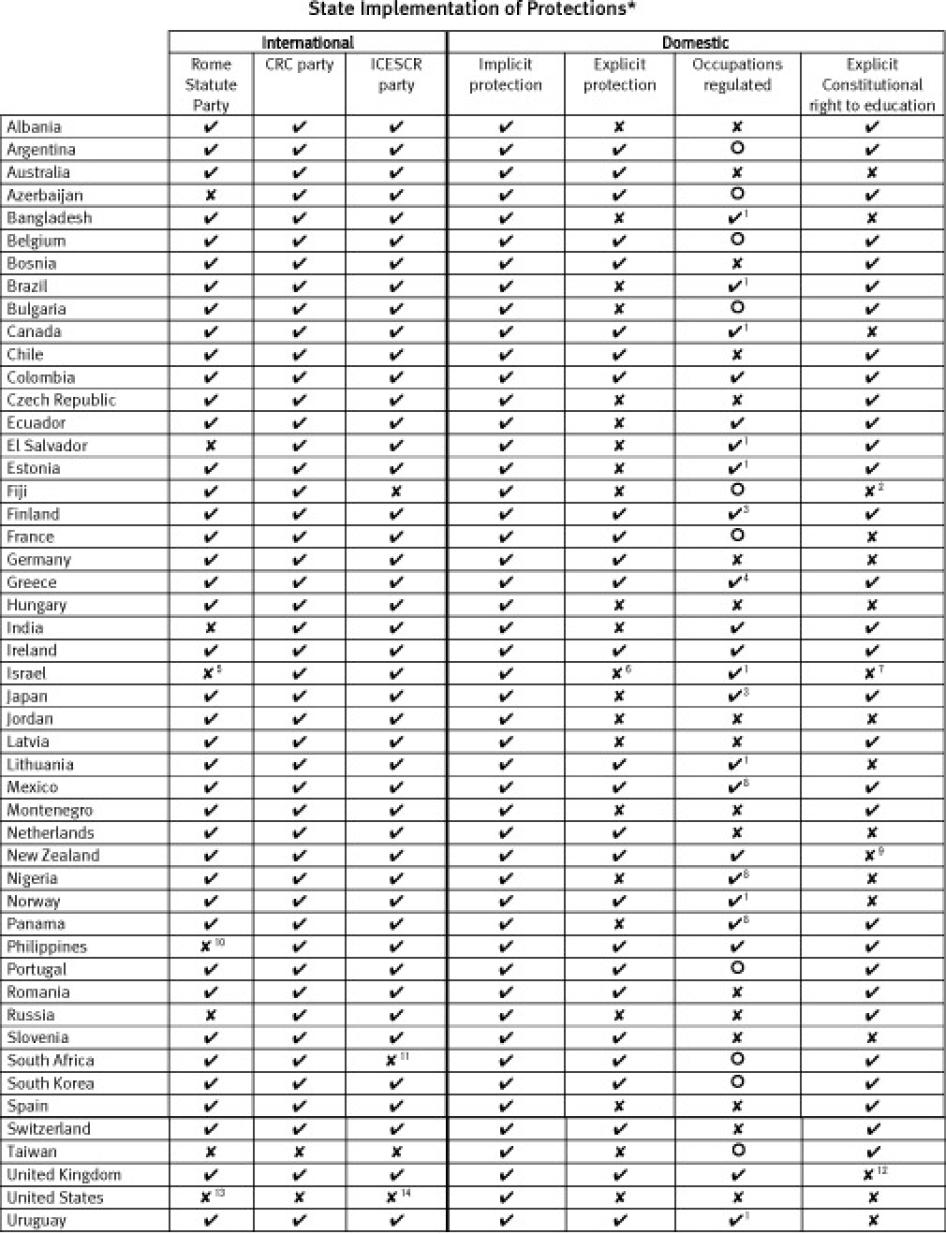
* Although aspects of the situations of Burundi, China, the Democratic Republic of Congo, Italy, Mali, Thailand, and Ukraine are discussed elsewhere in this report, they are not included in this table due to incomplete information and difficulty accessing relevant sources.
¡= Information not provided by government
CRC = Convention on the Rights of the Child
ICESCR = International Covenant on Economic, Social and Cultural Rights
1 = According to the response of the relevant government, this regulation is implicit, rather than explicit. See country entry in the appendix for more details.
2 = Fiji’s Constitution has been suspended since 2009.
3 = According to the response of the relevant government, without stating whether or not such a prohibition exists, the military avoids the practice of using schools and other education buildings as short-term shelters or long-term bases. See country entry in the appendix for more details.
4 = Greece has explicit protections for institutions of higher education, and implicit protections for other education institutions. See country entry in the appendix for more details.
5 = Israel signed the Rome Statute on December 31, 2000, but has not ratified the treaty. See country entry in the appendix for more details.
6 = According to the response of the Israeli government, although there is not an explicit protection provided to schools under domestic legislation, schools may receive explicit protections in standing orders and operational plans. See country entry in the appendix for more details.
7 = Israel has no single written constitution.
8 = Limited protections; see country entry in the appendix for more details.
9 = New Zealand has no single written constitution.
10 = The Philippines signed the Rome Statute on December 28, 2000. On February 28, 2011, Philippines president Benigno Aquino III signed the instrument of ratification of the treaty, although, at the time of writing, the treaty had not been ratified by the Senate.
11 = South Africa signed the ICESCR on October 3, 1994, but has not ratified the treaty.
12 = The United Kingdom has no single written constitution. However, the right to education is included in its 1998 Human Rights Act.
13 = The United States signed the Rome Statute on December 31, 2000, but has not ratified the treaty.
14 = The United States signed the ICESCR on October 5, 1977, but has not ratified the treaty.
Methodology
This report contains information on the domestic laws or practice of 56 countries. Much of the information was gathered from the countries themselves through the use of a set of standard survey questions sent to the relevant governments. Countries were selected to reflect diversity in geography, prevailing legal systems, ratification of international treaties, armed forces size, participation in peacekeeping operations, logistical capacity, experiences of armed conflict, and membership in various international military alliances. As the selection was not random, numbers quoted in this report should not be taken to be representative.
In total, survey questions were sent to 78 countries: Albania, Argentina, Australia, Azerbaijan, Bangladesh, Belgium, Belize, Bolivia, Bosnia and Herzegovina, Botswana, Brazil, Bulgaria, Canada, Chile, China, Colombia, Croatia, Cuba, Czech Republic, Denmark, Ecuador, El Salvador, Estonia, Fiji, Finland, France, Guatemala, Germany, Greece, Guyana, Honduras, Hungary, India, Israel, Ireland, Italy, Jamaica, Japan, Jordan, Kenya, Latvia, Lithuania, Macedonia, Madagascar, Malawi, Mexico, Montenegro, Morocco, Mozambique, Namibia, the Netherlands, New Zealand, Nicaragua, Nigeria, Norway, Oman, Pakistan, Panama, Paraguay, Peru, Philippines, Qatar, Romania, Russia, Senegal, Singapore, Slovenia, South Korea, South Africa, Spain, Switzerland, Taiwan, Thailand, Ukraine, the United Arab Emirates, the United Kingdom, the United States, and Uruguay. The governments of each of these countries were contacted variously by letters to their minister of defense, their armed forces, or through their diplomatic representatives either to the United States or to the United Nations. The survey was distributed, as appropriate, in Chinese, English, French, Indonesian, Japanese, Portuguese, Spanish, and Russian.
The survey asked five questions:
1) Does the domestic legislation, national military law, or current military policies or practices binding on the armed forces of your country provide that in either an international or a non-international (internal) armed conflict, civilian objects shall not be the object of attack, unless, and only for such time as, they are military objectives? If so, please cite the relevant articles of the laws, codes, policies, or practices.
2) Is a violation of any such protection explicitly categorized as a “war crime”? If so, please cite the relevant articles of the laws, codes, articles, policies, or practices.
3) In your country, do you have legislation, national military law, or current military policies or practices binding on the armed forces of your country state specifically (not implicitly) that schools and other educational institutions shall not be the object of attack by armed forces during international or non-international armed conflict unless they are military objectives? If so, please cite the relevant articles of the laws, codes, policies, or practices.
4) Is a violation of any such protection explicitly categorized as a “war crime”? If so, please cite the relevant articles of the laws, codes, policies, or practices.
5) Does domestic legislation, national military law, or current military policies or practices binding on the armed forces of your country provide any prohibition, regulation, or limitation on the use or occupation of schools and other educational institutions by armed forces for short-term shelters or long-term bases? If so, please cite the relevant articles of the laws, codes, policies, or practices.
Human Rights Watch received replies from 42 countries (a 54 percent response rate). The response was provided by the Ministry of Defense or an equivalent government department, from the following countries: Albania, Argentina, Australia, Bangladesh, Belgium, Bosnia-Herzegovina, Brazil, Bulgaria, Canada, Colombia, Czech Republic, Ecuador, El Salvador, Estonia, Finland, France, Germany, Greece, Hungary, Israel, Japan, Latvia, Lithuania, Mexico, Montenegro, the Netherlands, Norway, the Philippines, Romania, Slovenia, Spain, Taiwan, the United Kingdom, the United States, and Uruguay. In Jordan, it was the office of the prime minister that responded to the survey, and in Panama it was the Ministry of Public Safety. In Chile, the Ministry of Defense forwarded to us answers they had collected from each of the three branches of the armed forces. The answer from Switzerland was provided by the Swiss Army, and from New Zealand by the New Zealand Defense Force. The Minister of Defense of Namibia wrote to inform Human Rights Watch that his ministry was not able to respond within the requested timeframe because of their late receipt of the survey. The Ministry of Defense of Denmark similarly telephoned Human Rights Watch to inform that they were unable to respond within the requested timeframe because of their late receipt of the survey.
The following governments did not respond to Human Rights Watch’s enquiries: Azerbaijan, Belize, Bolivia, Botswana, China, Croatia, Cuba, Fiji, Guatemala, Guyana, Honduras, India, Ireland, Italy, Kenya, Macedonia, Madagascar, Malawi, Morocco, Mozambique, Nicaragua, Nigeria, Oman, Pakistan, Paraguay, Peru, Qatar, Russia, Senegal, Singapore, South Korea, South Africa, Thailand, Ukraine, and the United Arab Emirates.
In many cases, additional research was required to supplement, clarify, or verify the information provided by countries.
Additional information was received on the following countries from humanitarian law experts identified by Human Rights Watch in the relevant country: Belgium, Germany, Nigeria, and the US.
Research by Human Rights Watch identified some information regarding the following countries where the relevant government did not provide any information: Azerbaijan, China, Fiji, India, Ireland, Italy, Nigeria, Portugal, Russia, South Africa, South Korea, Thailand, and Ukraine. Human Rights Watch also gathered information on three countries not originally included in the survey: Burundi, the Democratic Republic of the Congo (DRC), and Mali.
Information on whether countries enshrined the right to education in their national constitutions was collected from the Right to Education Project (www.right-to-education.org).
Examples of state practice were drawn largely from situations where Human Rights Watch has independently investigated attacks on schools or the use of schools – including Afghanistan, the DRC, India, Iraq, Pakistan, and Thailand – although some particularly illustrative examples of state practice which were identified during the research of this report were included.
Full copies of the written responses by countries to the survey are available online at http://www.hrw.org/node/100138.
Terminology
Civilian objects
Under international humanitarian law, all objects—including buildings, infrastructure, land, and vehicles—which are not by their nature, location, or use making an effective contribution to military action and the total or partial destruction, capture, or neutralization of which, in the circumstances ruling at the time, does not offer a definite military advantage. Civilian objects may not be deliberately attacked, unless they have become lawful military objectives. In case of doubt whether an object which is normally dedicated to civilian purposes, such as a school, is being used to make an effective contribution to military action, it shall be presumed not to be so used.
Customary international law
Customary international law is the general practices of countries that they follow because of an accepted legal obligation to do so. Customary international law exists independent of international treaties, and is not compiled in any one central document or source. Unlike treaty law, which is binding only on the states that choose to become a party to it, customary international law is binding on all states.
Education buildings and institutions
Various international treaties and tribunals refer to buildings or institutions dedicated to, or intended for, education. Such places are not limited to government or private schools where children are educated, but can also include places of pre-school education, higher education, vocational education, and places dedicated to increasing literacy and numeracy or providing scientific or technical instruction.
International humanitarian law
Also referred to as “the laws of war” or “the law of armed conflict,” these are the rules of international law that regulate the conduct of hostilities and treatment of persons by states and non-state armed groups during situations of international and non-international (internal) armed conflict and military occupation. International humanitarian law can be found in both customary international law and treaty law.
Military objectives
Under international humanitarian law, military objectives, so far as objects (but not individuals) are concerned, are those objects which by their nature, location, or use make an effective contribution to military action and whose total or partial destruction, capture, or neutralization, in the circumstances ruling at the time, offers a definite military advantage.
School
This report uses this term broadly to refer to all education institutions, not only education institutions dedicated to children of any particular age.
State party
A country that has ratified or acceded to an international treaty.
Treaty
A formal agreement between two or more countries that is binding on all states parties. A treaty may sometimes be called a “convention,” “covenant,” or “protocol,” but the different names make no difference to their status in international law.
I. Implicit Protection from Attack: Protections for “Civilian Objects”
I was in the classroom when I heard the explosion. It was very loud … it scared us … I ran to the school yard as soon as we heard the explosion. The classroom windows were shattered. Many students were already in the yard. Many of us didn’t know what had happened. I saw smoke … I heard many children screaming. I think some of them got light injuries because of falling on the pieces of glass when they were running in chaos.… Several teachers were injured. I got really scared when I realized it was a bomb explosion.
—A teenage student at a school in Balochistan, Pakistan, 2010
School, university, and other buildings that are centers of learning are clear examples of what are referred to in international humanitarian law as “civilian objects.” As such, they should be protected from attack under both international humanitarian law as well as domestic laws incorporating these international law obligations, unless they have become military objectives.
International Humanitarian Law
A fundamental principle of the laws of war is the distinction between civilians and military objectives, and the requirement that attacks may only be directed at military objectives.[1]
Under international humanitarian law, schools and other education structures are civilian objects that are protected from attack. They may only be attacked if, and only for such time as, they are military objectives. Military objectives are those objects that contribute to the military action and whose destruction under the existing circumstances would offer a definite military gain.[2]
Thus a school is normally protected from deliberate attack, unless, for instance, forces involved in military operations were using it to deploy. In case of doubt whether a school building is being used for a military purpose, it must be presumed to be a protected civilian object.[3] Additional Protocol I to the Geneva Conventions of 1977 (“Protocol I”) explicitly provides the example that, “In case of doubt whether an object which is normally dedicated to civilian purposes, such as … a school, is being used to make an effective contribution to military action, it shall be presumed not to be so used.”[4]
Attacks on valid military targets – including school buildings being used for military purposes – must be neither indiscriminate nor disproportionate. An indiscriminate attack is one in which the attack is not directed at a specific military objective or the methods or means used cannot differentiate between combatants and civilians.[5] A disproportionate attack is one in which the expected loss of civilian life and property is excessive compared to the anticipated military gain of the attack.[6]
Domestic Law and State Practice
All states that responded to Human Rights Watch’s survey recognized that they were bound by the rule of distinction under international humanitarian law.
The vast majority of responding states noted that this obligation stemmed from being a party to the Additional Protocols to the Geneva Conventions. These states reported that they had either incorporated them into their domestic legislation, or stated that their legal system recognized them as being self-executing and therefore not in need of implementing legislation in order to be binding on national forces.
Even countries that were not parties to the Additional Protocols nonetheless recognized their obligation to be bound by the rule preventing deliberate attacks on civilian objects, which is widely accepted as reflective of customary international humanitarian law. The United States has long recognized that this rule was part of customary international humanitarian law, and that it was also included in other international treaties to which the US is a party.[7] Taiwan, which is not widely recognized as an independent state and is not a party to the Geneva Conventions, has nonetheless codified in its Criminal Law and Criminal Code for the Armed Forces protections for civilians and civilian objects.[8]
There are examples of individuals who were successfully prosecuted for attacks on schools because they are civilian objects in the countries of the former Yugoslavia. For example, in April 2008, the State Court of Bosnia-Herzegovina found Pasko Ljubicic guilty of war crimes against civilians and sentenced him to 10 years imprisonment, following the acceptance of a plea agreement. Ljubicic, a former senior officer of the military police of the Croatian Defence Council in central Bosnia during the Balkans conflict in the early 1990s, was responsible for, among many other things, deploying a military police battalion to attack a Bosnian-Muslim village during which a Muslim primary school was burned.
Ljubicic had been originally indicted by the International Criminal Tribunal for the former Yugoslavia (ICTY) on 10 counts, including for a charge available under that tribunal (and discussed more in the following chapter) of “destruction and willful damage to institutions dedicated to religion or education.”[9] Although Ljubicic surrendered to the tribunal, in July 2005 the ICTY’s chief prosecutor requested his trial be transferred to Bosnia-Herzegovina.[10] Under the Bosnian indictment, however, there was no separate charge for Ljubicic’s attacks on educational institutions, and this crime appeared to have been subsumed within war crimes charges for attacks on civilian objects and the destruction and looting of property.[11] In his allocution as part of his guilty plea, however, Ljubicic stated that soldiers under his command had attacked a religious school.[12]
Another individual indicted by the ICTY for crimes related to educational institutions who was ultimately transferred to domestic courts—in Serbia—was Vladimir Kovacevic.[13] He was charged for his role as commander of the Third Battalion of the Yugoslav People’s Army in the shelling of the Croatian city of Dubrovnik on December 6, 1991, including a specific charge for “destruction or willful damage to institutions dedicated to … education” for damage to a university graduate center, a kindergarten, two schools, and a music education center.[14] Once the case was in domestic court, the specific charges for damage to educational facilities disappeared, and although the indictment from the Serbian war crimes prosecutor explicitly referred to damage caused to educational institutions, Kovacevic was charged more broadly for a “war crime against civilian population” in line with the domestic criminal statute, which lacked a specific charge for the destruction of institutions dedicated to education.[15]
While this encompassing of charges for attacks on education within broader war crimes charges may lead to similar punishment for the perpetrators of these crimes, it is nonetheless less precise than the specific delineation of the prohibition against attacks on schools and other education institutions under the Rome Statue or the statute of the ICTY. Such lack of clarity can be unhelpful to prosecutors and victims, and to the cause of deterrence for these types of attacks.
During the invasion of Iraq in 2003, the United States and the United Kingdom provide an example of state practice being guided in a way intended to protect civilian objects including schools under the principle of distinction and proportionality. Once hostilities began, Human Rights Watch expressed concern about the use of cluster munitions by Coalition forces because the weapons are inherently indiscriminate in populated areas. Furthermore, while the Coalition took precautions by establishing vetting processes for individual strikes, the results showed them to be inadequate. Despite the care taken, ground-launched cluster munitions strikes caused hundreds of civilian casualties, and the duds they left behind increased the number of deaths and injuries after the conflict.[16] However, the United States and the United Kingdom sought to minimize harm to civilians and civilian objects, including schools.
The United States and the United Kingdom recognized that employment of precision-guided munitions alone was not enough to provide civilians and civilian objects with adequate protection. They employed other methods to help minimize civilian casualties and destruction of civilian objects, such as generally requiring visual confirmation of a target before firing, bombing at night when civilians were less likely to be on the streets, using penetrator munitions and delayed fuses to ensure that most blast and fragmentation damage was kept within the impact area, in addition to using attack angles that took into account the locations of civilian facilities such as schools and hospitals.[17]
US forces screened ground strikes through a computer and human vetting system. For instance, the Third Infantry Division’s artillery batteries were programmed with a “no-strike” list of 12,700 sites that could not be fired upon without manual override. The list included civilian buildings such as schools, as well as mosques, hospitals, and historic sites.[18] Officers of the Second Brigade told Human Rights Watch that they strove to keep strikes at least 500 meters away from such targets although sometimes they cut the buffer zone to 300 meters.[19]
The Third Infantry Division also established another layer of review by sending lawyers to the field to review proposed strikes, a relatively recent addition to the vetting process.[20] The division assigned 16 lawyers to divisional headquarters and each brigade.[21] Although less controversial strikes, such as those on forces in the desert, were not reviewed, lead lawyer Col. Lyle Cayce, who served at the tactical headquarters, told Human Rights Watch, “I would feel pretty confident [that] a lawyer was involved in strikes in populated areas.”[22] Commanders had the final say, but lawyers provided advice about whether a strike was legal under international humanitarian law.
British artillery units had a similar vetting process although it gave observers more responsibility than lawyers. Its no-strike list also included schools, as well as mosques and hospitals. Col. Gil Baldwin, commanding officer of the Queen’s Dragoon Guards, told Human Rights Watch: “We couldn’t fire on [such a site] irrespective of who was in it. Even if you called for fire, it couldn’t happen. They were no-fire zones.”[23] Although US forces considered radar acquisition sufficient in the case of responding to counter-battery fire, the British still required forward observation even in the case of counter-battery fire. Either a human or the video of an unmanned aerial vehicle (or drone), had to confirm visually that no civilians were present. “At no time did we fire where we couldn’t see,” Baldwin said.[24]
Non-state armed groups are also bound by international humanitarian law, including the principle of distinction. An interesting example of the practice of non-state armed groups that indicates a felt obligation to abide by the rule against attacking schools that are not military objectives can be found in India, where Maoist fighters (also known as Naxalites) frequently blow up government schools as part of their fight against the Indian government. In public, the Maoists have frequently attempted to justify their attacks on schools on the grounds that all the schools attacked were being used by government security forces and therefore legitimate military targets. For instance, in an article in the Communist Party of India (Maoist) Information Bulletin in November 2008, in reaction to a Human Rights Watch report, the anonymous author defended the attacks on schools:
Destruction of school buildings by Naxalites is another issue that HRW [Human Rights Watch] gets concerned about. It asks Naxalites not to destroy school buildings despite its own recognition of the fact of police occupation of school buildings and using these camps for carrying out combing operations against Naxalites … As for destroying schools used by CRPF [government paramilitary] as their camps, neither the people nor our Party think it is wrong. The schools, once they are occupied by these forces, are transformed into torture chambers and concentration camps and there is no hope that they will once again be used as schools in the near future… Education of the adivasis [tribal communities] is not affected by destruction of school buildings used by the security forces but by the destruction of entire villages … by the state police, para-military forces and Salwa Judum [a state-sponsored vigilante groups aimed at eliminating Maoist] goondas [thugs] with active police support.[25]
In the same issue of the bulletin, editorial comments on another article regarding the conflict in Chhattisgarh stated: “No school was destroyed by the Maoists if it was not used by the police as its camp. You cannot show a single instance where we had destroyed a school that was really meant for education purpose.”[26]
Human Rights Watch investigations have nonetheless revealed that the Maoists have attacked numerous schools that were not occupied by Indian government security forces at the time of the attack. The organization’s research suggests that the Naxalites target schools in part because they are normally undefended government structures whose damage or destruction maximizes publicity and spreads terror among the local community.[27] Human Rights Watch research shows, for example, that attacks on schools sometimes coincide with broader efforts of the Maoists to disrupt national holidays, enforce strikes, and promote a boycott of elections. However, what is of importance to note for the purposes of this survey is that the Maoists appear compelled to explain their actions in line with a justification that would be permissible under international humanitarian law for attacking a school.
II. Explicit Protection from Attack: Criminalizing Deliberate Attacks on Education Buildings
Around 2 p.m. on September 17, [2008] just after students were let out of school, a child came to tell me that the LRA [Lord’s Resistance Army] had arrived and were abducting children. I looked out my window towards the center of town, and there was total panic. The LRA had started burning the market, the church, people’s houses, even bicycles. I left my house and fled into the bushes, just behind the school. I watched as about 50 LRA combatants raided the town. They burned my home and the school; all our materials were lost. During their four days in Kiliwa, the LRA abducted 41 of my students and killed 20 men.
—School director, Kiliwa, Province Orientale, Democratic Republic of Congo, January 2009
The explicit protections for education buildings found in international law indicates a recognition by states that schools and other buildings dedicated to education deserve additional protections from intentional attacks, beyond those afforded to all civilian property.
The Rome Statute, the international treaty establishing the International Criminal Court (ICC), provides that intentional attacks on buildings dedicated to education are a war crime in both situations of international and non-international armed conflict, so long as the building is not a military objective. Currently, 116 countries are parties to the treaty.
Yet despite this important international recognition that attacks on schools are war crimes deserving special attention, very few countries have incorporated this provision as a specific crime within their national criminal or military laws. In failing to do so, states are missing an opportunity to send a message to belligerent forces and non-state armed groups about the seriousness of this crime, as well as a symbolic message about the importance of education.
Armed groups may target schools for a variety of reasons. Rebel groups often see schools as symbols of the state. Indeed in rural areas, they may be the only structures and government employees in the vicinity, serving multiple purposes. They have also attacked schools used as polling places around elections.
Schools can also make high-visibility “soft” targets: they are more easily attacked than the government security forces, and attacks are likely to attract media attention to the assailants and their political agenda, and undermine public confidence in government. Opposition groups may view schools as symbols of an oppressive educational system.
Sometimes schools are attacked because armed groups are hostile to the content of the education being delivered or because of the students being educated. In some countries, schools have been targeted because their curriculum is perceived to be secular or “Western,” others simply because the schools educate girls.
International Humanitarian and Criminal Law
In addition to the general protection afforded to schools and other education buildings as a result of their status as civilian structures, international law also gives explicit protection to buildings dedicated to education.
Early Protections
Educational institutions first received important international protections at two peace conferences held in The Hague in 1899 and 1907. From the first conference emerged the 1899 Convention With Respect to the Laws and Customs of War on Land (Hague II). Education buildings were not included in the list of buildings to be spared “as far as possible” in sieges and bombardments – although “edifices devoted to religion, art, science, and charity, hospitals, and places where the sick and wounded are collected” did receive such a protection. Nonetheless, the convention stated that the property of educational institutions in occupied territory should not be seized, destroyed, or intentionally damaged.[28]
The 1907 Convention Respecting the Laws and Customs of War on Land (Hague IV) contained a similar provision, again noting that in situations of occupation, military authority over the territory was limited:
The property of … institutions dedicated to … education, … even when State property, shall be treated as private property. All seizure of, destruction or willful damage done to institutions of this character … is forbidden, and should be made the subject of legal proceedings.[29]
International recognition that the deliberate destruction of education buildings constitutes a war crime can be found following World War I. In January 1919, the Preliminary Peace Conference in Paris established a “Commission on the Responsibility of the Authors of War and on the Enforcement of Penalties” to investigate individual criminal responsibility for the “authors of the war” and for violations of the laws and customs of war.[30] Two individuals from each of the five main Allied powers – France, Italy, Japan, the UK and the US – were represented on the commission, along with one individual from each of Belgium, Greece, Poland, Romania, and Serbia. The commission’s report, presented to the preliminary peace conference in Versailles on March 29, 1919, listed the “violations of the laws and customs of war” which they had determined should be subject to criminal prosecution. Among their list of 32 such violations was the “wanton destruction of ... educational … buildings.”[31]
In the 1920s and 30s, a movement was instigated by Russian painter and philosopher Nicholas Roerich to establish an international treaty to protect cultural objects. The resulting 1935 treaty on “Protection of Artistic and Scientific Institutions and Historic Monuments” (also known as the Roerich Pact), provides for the neutrality and protection of “historic monuments, museums, scientific, artistic, educational and cultural institutions.”[32] The treaty states that education institutions “shall be considered as neutral and as such respected and protected by belligerents.”[33] Twenty-one nations signed the treaty, although only 10 ratified it.[34]
International Criminal Tribunal for the Former Yugoslavia
The statute of the International Criminal Tribunal for the former Yugoslavia (ICTY) – the ad hoc international tribunal that was established by the UN Security Council in 1993 to prosecute serious international crimes committed during the wars in the former Yugoslavia since 1991 – was the first international judicial mechanism that explicitly referenced attacks on schools and other institutions dedicated to education. Established by the UN Security Council in accordance with Chapter VII of the UN Charter, the ICTY was the first international war crimes tribunal since the Nuremberg and Tokyo tribunals, and the first established following the adoption of the 1949 Geneva Conventions and the Additional Protocols.
The ICTY statute provided for the tribunal to have jurisdiction to try individuals for “violations of the laws or customs of war,” including the “seizure of, destruction or willful damage done to institutions dedicated to … education.”[35] The case law makes clear that this was viewed as a crime not just in situations of occupation, but also to destruction that occurred during battles, sieges, and bombardments. For example, Pavle Strugar, commander of the Second Operational Group of the Yugoslav People’s Army that conducted the campaign against the Dubrovnik region of Croatia, was convicted for the destruction of institutions dedicated to education during the shelling of Dubrovnik’s Old Town.[36]
In the case against Tihomir Blaskic, a colonel and then later general in the Croatian Defense Council, the ICTY trial chamber explained what it considered to be the elements of the offense of “destruction or willful damage to institutions dedicated to religion or education,” stating:
The damage or destruction must have been committed intentionally to institutions which may clearly be identified as dedicated to religion or education and which were not being used for military purposes at the time of the acts. In addition, the institutions must not have been in the immediate vicinity of military objectives.[37]
In 2003, in a case against two commanders in the Bosnian Croat “Convicts Battallion,” Mladen Naletilic and Vinko Martinovic, when considering an allegation of the blowing up a mosque, the Trial Chamber revisited this standard, instead noting:
The Chamber respectfully rejects that protected institutions “must not have been in the vicinity of military objectives.” The Chamber does not concur with the view that the mere fact that an institution is in the “immediate vicinity of military objective” justifies its destruction. The Chamber considers that a crime under Article 3(d) of the Statute has been committed when: i) the general requirements of Article 3 of the Statute are fulfilled; ii) the destruction regards an institution dedicated to religion; iii) the property was not used for military purposes; iv) the perpetrator acted with the intent to destroy the property.[38]
The ICTY prosecutors have charged at least 18 individuals in an indictment for the destruction or willful damage done to institutions dedicated to education; however, as of June 2011, the court has convicted only three individuals on charges that included attacks on institutions dedicated to education.[39]
Special Panels for Serious Crimes in East Timor
The Special Panels for Serious Crimes in East Timor was established by the UN following the withdrawal of Indonesia from East Timor (now Timor Leste) in 1999. The panels held jurisdiction over serious international and national crimes committed between January and October of 1999, including “intentionally directing attacks against buildings dedicated to … education … provided they are not military objectives,” which it recognized constituted a war crime in both international and non-international armed conflicts.[40] Human Rights Watch was unable to identify anyone charged under this provision in the 55 cases before the panel.
International Criminal Court
The Rome Statute of the ICC specifies the crimes over which the court has jurisdiction, and explicitly makes intentionally directing attacks against “buildings dedicated to … education” a war crime in both international and internal armed conflicts, provided they are not military objectives.[41]
The working text that was submitted to the Rome Conference in 1998 for consideration by the 160 state delegations contained two options for the war crime of “intentionally directing attacks against buildings dedicated to religion, education, art, science or charitable purposes, historic monuments, hospitals and places where the sick and wounded are collected, provided they are not being used at the time for military purposes” with one option deleting the protection of education buildings.
During the debate, certain delegations publicly supported the inclusion of buildings dedicated to education—Algeria, Brazil, Chile, Cuba, Egypt, New Zealand, Syria, Costa Rica, Libya, U.A.E., Greece, Italy, Thailand, Kuwait, South Korea, Saudi Arabia, Senegal, Switzerland, Tunisia, Venezuela, Vietnam—while others went on record against—China, Denmark, France, the UK,[42] Macedonia, Russia, and Sweden.[43] The addition was eventually adopted by the conference.[44]
Since 2003, when the ICC began operations, its prosecutor has opened investigations in the Democratic Republic of Congo, northern Uganda, the Darfur region of Sudan, the Central African Republic, Kenya, and Libya. Arrest warrants or summonses to appear have been issued in 13 cases; trials have begun in three of these cases, while judges declined to confirm the charges in one other case. As of May 2011, nobody has been charged under the provisions of the Rome Statute regarding attacks on educational buildings. The issues of attacks on schools and the effect that recruitment of children as soldiers can have on education, however, have been touched upon in a handful of cases already on the court’s docket.[45]
Domestic Law and State Practice
The earliest explicit prohibition against attacking schools during wartime that Human Rights Watch has been able to identify dates to 1621, when Sweden’s King Gustavus II Adolfus promulgated a set of 150 “Articles of War” that were first read to his troops assembled at Årsta Meadow, south of Stockholm, as they prepared to be shipped to fight Russian forces in Poland as part of the Thirty Years War. The articles were then read by army commanders to their troops once every month. These “Articles of War” had been drafted by Gustavus himself, and edited by the Lord High Chancellor of the Privy Council, Axel Oxenstierna.[46]
Article 100 of the decree prohibited Swedish troops from burning schools or destroying them in any way, under pain of punishment. The only exception was for those carrying out an order from their captain, who had himself received such an order from the King:
No man shall set fire upon any Church, Hospital, School, or Mill, or spoil them any way, except he be commanded.[47]
The following article reads:
No soldier shall abuse any Churches, Colleges, Schools or Hospitals; or offer any kind of violence to Ecclesiastical persons, nor in any way be troublesome with pitching or in quartering upon them, or with exacting of contribution from them; no soldier shall give disturbance or offence to any person exercising his sacred function or Ministry, upon pain of death.[48]
In 1631, in the midst of his campaign, Gustavus added the rule that:
Every soldier and every servant attached to our army, convicted of having committed any disorder in churches, hospitals, or schools, shall be punished with death; whether he has committed it of his own accord or at the instigation of others.[49]
An English language version of the Gustavus’ Articles of War was printed in England in 1632, and appears to have greatly influenced the efforts of King Charles I and his advisors to revise their own regulations for their armed forces. Indeed, the Royalist Articles of War of 1643/1644, which governed all of the armies of Charles I, incorporated virtually exactly the same protection of churches, hospitals, schools, and mills from fire and spoil.[50]
The first modern codification of the laws of war, the so-called Lieber Code, which was drafted by the US government during the American Civil War in 1863, only mentions schools and other education institutions in the context of military occupation:
As a general rule, the property belonging to churches, to hospitals, or other establishments of an exclusively charitable character, to establishments of education, or foundations for the promotion of knowledge, whether public schools, universities, academies of learning or observatories, museums of the fine arts, or of a scientific character-such property is not to be considered public property [and thus subject to confiscation]; but it may be taxed or used when the public service may require it.[51]
In the 20th century, Italy was one of the earliest countries to codify a special protection for buildings dedicated to education from attack. In its Wartime Military Penal Code of 1941, which is still in force today as amended,[52] article 187 reads:
Any person in an enemy country who, not being compelled by the need to conduct military operations, sets a house or a building on fire or destroys them by any other means shall be punished with imprisonment for no less than fifteen years. If the death of one or more persons results from this act, the death penalty, with demotion, shall be applied. The same provisions apply in case of fire or destruction or serious damage of … buildings destined to … education … including those belonging to the enemy State.[53]
The punishment for this crime, following the abolition of the death penalty, has been commuted to the maximum punishment prescribed under the penal code.
China was also an early country to codify the prohibition against attacking schools and other buildings dedicated to education and to call it a “war crime.” After World War II, China’s Nationalist, or Kuomintang, government tried 605 war crimes cases involving 883 Japanese defendants, under its 1946 Law Governing the Trial of War Criminals.[54] The law provided a comprehensive list of applicable war crimes, that appears similar to – although more expansive than – the list of war crimes enumerated by the Commission on the Responsibility of the Authors of the War following World War I, and referenced above.[55] The law declared that “destroying religious, charitable, educational, historical constructions or memorials” constituted a war crime.[56] However, as the law was created by the Nationalist government, it lost effect with other laws after the Communists took power in 1949, which reordered Chinese military law considerably.[57] Nonetheless, the Kuomintang took the 1946 law with them to Taiwan, where it remained on the books until being repealed by presidential decree in 1978.[58]
Based on its survey, Human Rights Watch is aware of only 25 countries which are party to the Rome Statute of the ICC that have enacted domestic legislation explicitly codifying as a war crime intentional attacks on buildings dedicated to education in situations of international and non-international armed conflict, unless they constitute military objectives.
In Slovenia, the Criminal Code explicitly prohibits intentional attacks on buildings dedicated to education, provided that they are not military objectives, but only in situations of international armed conflict.[59] (However, according to a letter from the Slovenian Ministry of Defense to Human Rights Watch, “it is implicitly included through the usage of the wording ‘other serious violations of the laws and customs applicable in armed conflicts not of an international character’[.]”[60]
Although apparently intended for peacetime situations, Mexico has some explicit protections for schools contained in its Federal Penal Code, which provides for five to ten years’ imprisonment and a fine “to cause a fire, flood, explosion damage, or danger to ... schools.”[61]
It is evident though that some countries are either updating their domestic legislation specifically to conform with the Rome Statute, or are taking the opportunity when updating laws to ensure conformity with the Rome Statute. However, almost nine years after the Rome Statute came into force, only a small number of state parties have implemented the Rome Statute provision on attacks on educational buildings into national law.
Countries should do more than just update their legislation, however. It is also important that these revised laws be incorporated into other military and field manuals and trainings. In Canada, for example, despite updating their national legislation to reflect definitions under the Rome Statute, neither the Canadian Force’s Code of Conduct (a summary of Canada’s obligations and duties under international humanitarian law, which applies to operations where Canada is a party to an armed conflict or to peace support operations), nor the Canadian Force’s “Joint Doctrine Manual: Law of Armed Conflict at the Operational and Tactical Levels” (or “LOAC Manual,” issued under the authority of the Chief of the Defence Staff, and which provides the Canadian perspective of the laws of armed conflict based on customary international law and the treaties binding on Canada), have been updated to reflect this explicit ban on the direct targeting of buildings dedicated to education unless they constitute military objectives.[62]
Argentina has updated its domestic legislation to criminalize attacks on buildings dedicated to education in 2007—incorporating the terms directly by referencing the Rome Statute. In its new Ministry of Defence manual on international law during armed conflict released in 2010, the military included the war crime of intentional attacks on buildings dedicated to education – but only as a possible war crime during armed conflict of a non-international character.[63]
Finally, a number of countries have updated their relevant domestic law since becoming parties to the Rome Statute, but have failed to incorporate appropriate language and provisions.
For example, Ecuador revised its penal code in 2010, and although it includes as war crimes attacks “on protected property,” including against “Civilian objects which do not constitute a military objective;” “Goods for the satisfaction of civil and political rights of the civilian population, such as those for religion, the arts, science or charitable purposes;” “Assets that are … historical, cultural, or environmental;” and “Other objects protected under international humanitarian law”[64] – the government did not add language on the protection of buildings dedicated to education.
Similarly, Spain in 2003 passed a new law to add criminal provisions relevant to the Rome Statute into its Criminal Code,[65] but the law failed to make the necessary amendments to war crimes laws to explicitly criminalize attacks on buildings dedicated to education in line with the Rome Statute.
Although Fiji updated its entire criminal code in 2009 with its news Crimes Decree, which included new provisions on genocide and crimes against humanity matching the provisions of the Rome Statute, the Crimes Decree nonetheless contains no section on war crimes, and therefore does not include the specific war crime of attacking buildings dedicated to education.[66]
Despite the low numbers of ICC member states having implemented the crime of attacking educational buildings into national law, some positive benefits from the language of the Rome Statute can also be seen in countries that are not parties. The Philippines, which at the time of writing has signed the Rome Statute but not ratified it,[67] nonetheless already has appropriate domestic legislation on this crime with language drawn from the statute.[68] Azerbaijan also has domestic legislation criminalizing deliberate attacks on education buildings in similar language, despite not being a party to the Rome Statute.[69]
Although the ICC has not yet tried any individual for the intentional destruction of buildings dedicated to education, the potential for the Rome Statute to promote accountability for attacks on buildings dedicated to education in domestic contexts can be seen in one domestic case from the Democratic Republic of Congo (DRC). Ives Kahwa Panga Mandro (“Chief Kahwa”), founder of the Party for Unity and Safeguarding of the Integrity of Congo, was convicted by an Ituri Military Tribunal in August 2006 on six charges, including the war crime of intentionally directing attacks against a building dedicated to education, for attacks against schools committed in October 2002. Citing the DRC constitution’s provision allowing courts and military tribunals to apply international treaties, the tribunal directly applied the Rome Statute’s war crime of intentionally directing attacks against buildings dedicated to education. Kahwa received a 20-year sentence.[70]
The Ituri military tribunal laid out five elements to the crime in its decision: (1) the perpetrator launched the attack; (2) the target of the attack was one or more buildings dedicated to education or other protected activities listed in the statute (in Kahwa’s case at least two schools); (3) the perpetrator intended to target the building, which was not a military objective; (4) that the conduct happened in the context of a non-international armed conflict; and (5) that the perpetrator was aware of the circumstances that established the existence of the armed conflict.[71]
However, in a decision light on both legal and factual reasoning, the Orientale Province Military Court later acquitted Kahwa on two offenses that it held to fall within applicable amnesty provisions, and in respect to the other charges – including that for the destruction of the school – the appeal chamber cancelled the lower court’s verdict citing procedural violations.[72]
III. Protecting Education Buildings from Military Use
The number of students decreased after the occupation. Around 25 students have left. The teachers went to the village and tried to convince the local residents to send their children to school. The teenage girls were afraid to come.... Sometimes the jawans [troops] scold the students and [glare in an intimidating manner] at the children, and the children feel threatened by these incidents and sometimes don’t come to school for one or two days. When the teacher learns this they go to the village to encourage the child to return to school. The teacher tried to convince them to come, but because of these incidents, fear remains, and this hampers their studies.... Sometimes the jawan shout and howl, and they even use abusive language. But we [teachers] can’t say anything against them.
—Teacher at a partially occupied school in Chota Nagra, West Singhbhum district, Jharkhand, India, June 2009
Attracted by schools’ central locations, solid structures, and electrical and sanitation facilities, state security forces have taken over schools for weeks or months, and sometimes years for their own purposes. Research by Human Rights Watch has shown that military or police use of schools not only disrupts students’ education, it may itself provoke attacks from opposing armed groups.[73]
In some instances, security forces entirely displace students. But even when schools are not being used for classes, military use is problematic because attacks by opposing forces can destroy school infrastructure and blur the lines between civilian and military installations, potentially exposing schools to attack when students return.
In other cases, military forces occupy only parts of schools, with classes continuing to be held in the unoccupied areas. Such partial occupation of schools is also problematic. In partially occupied schools visited by Human Rights Watch in India and southern Thailand, students, teachers, and parents variously complained about problems as diverse as overcrowding of classrooms, loss of kitchens, and inability to use school latrines. (Lack of access to toilets is a globally recognized factor contributing to lowered school attendance by girls.[74]) Students try to continue their studies alongside armed men whose often poor behavior – ranging from beating criminal suspects in front of students to gambling, drinking, and using drugs – are all counter to a safe and positive learning environment for children. When security forces move in, there is typically an immediate exodus of students. Long-term occupations also deter new enrollments and re-enrollment into the higher class years. Human Rights Watch’s research indicates that girls appear more likely to drop out or fail to enroll, motivated in part by fear of harassment by troops using the schools.
International Humanitarian Law
Parties to a conflict are required under international humanitarian law to take all feasible precautions to protect the civilian population and civilian objects such as schools under their control against the effects of attacks. Moreover, each party to the conflict must, to the extent feasible, remove civilians and civilian objects under its control from the vicinity of military objectives.[75] Thus it is unlawful to use a school simultaneously as an armed stronghold and as an educational center.
Although there is no ban in international humanitarian law on the use of school buildings as military bases or for other deployments, a UN treaty body and the UN Security Council have raised concerns about such use.
The Optional Protocol to the Convention on the Rights of the Child on the Involvement of Children in Armed Conflict, which has been ratified by 139 countries, requires member states to submit regular reports to the Committee on the Rights of the Child, an international expert body charged with monitoring state compliance with the treaty. When presented with evidence of military occupation of schools, the committee has urged the immediate discontinuation of such use. In 2010, reviewing the situation in Colombia, the final report from the committee noted:
The Committee is … concerned over continued reports indicating the occupation of schools by the armed forces and over military operations in the vicinity of schools. The Committee recognizes the State party’s duty to guarantee the right to education throughout the territory, however underlines that military presence in the vicinity of schools significantly increases the risk of exposing school children to hostilities and retaliations by illegal armed groups.
The Committee urges the State party to immediately discontinue the occupation of schools by the armed forces and strictly ensure compliance with humanitarian law and the principle of distinction. The Committee urges the State party to conduct prompt and impartial investigations of reports indicating the occupation of schools by the armed forces and ensure that those responsible within the armed forces are duly suspended, prosecuted and sanctioned with appropriate penalties.[76]
Also in 2010, on Sri Lanka, the Committee stated:
The Committee … calls upon the State party to:
(a) Immediately discontinue military occupation and use of the schools and strictly ensure compliance with humanitarian law and the principle of distinction and to cease utilizing the primary section of V/Tamil MV school and the Omanthai Central College in Vavuniya to host separatees; and
(b) Ensure that school infrastructures damaged as a result of military occupation are promptly and fully restored.[77]
The UN Security Council has also called on armed forces to refrain from using schools for military operations because of the impact it can have on children’s access to education. In a statement delivered by the president of the UN Security Council in April 2009, “The Security Council … urges parties to armed conflict to refrain from actions that impede children’s access to education, in particular … the use of schools for military operations.”[78] Although presidential statements are not legally binding, they require a consensus to be adopted, and they are thus persuasive indicators of the views of the membership of UN’s principle body for the maintenance of peace and security.
International humanitarian law is binding on non-state parties to an armed conflict just as it is on state parties. However, non-state armed groups do not have the legal capacity to sign or ratify international treaties. One approach to this issue was the drafting of the 2010 Deed of Commitment for the Protection of Children from the Effects of Armed Conflict, a document that would give armed groups an opportunity to demonstrate their commitment to international norms protecting children during armed conflict. The document contains among other commitments, a provision “To further endeavor to provide children in areas where we exercise authority with the aid and care they require, in cooperation with humanitarian or development organizations where appropriate. Towards these ends, and among other things, we will: … v) avoid using for military purposes schools or premises primarily used by children.”[79]
General Protections for Education during Military Occupation
International humanitarian law during occupation by foreign armed forces provide a variety of special protections for education to ensure that children are still able to obtain an education even in the aftermath of an armed conflict. Thus although the Geneva Conventions do not prohibit military use of schools, they do impose an obligation on occupying forces to ensure that children continue to have access to education.
Under the Fourth Geneva Convention, which is applicable during a belligerent occupation, an occupying power must facilitate, with the cooperation of the authorities, “the proper working” of all institutions devoted to the education of children.[80] In addition, “should the local institutions be inadequate for the purpose, the Occupying Power shall make arrangements for the maintenance and education, if possible by persons of their own nationality, language and religion, of children who are orphaned or separated from their parents as a result of the war and who cannot be adequately cared for by a near relative or friend.” [81]
While the concept of belligerent occupation does not exist during non-international armed conflicts, Protocol II provides a fundamental guarantee that children “shall receive an education, including religious and moral education, in keeping with the wishes of their parents, or in the absence of parents, of those responsible for their care.”[82]
Education Buildings as Cultural Property
International humanitarian law prohibits the use of property of “great importance to the cultural heritage of every people” for purposes that are likely to expose it to destruction or damage, unless imperatively required by military necessity.[83]
There are differing views on the extent to which educational buildings are protected under this standard.
In a case before the ICTY, Dario Kordic and Mario Cerkez were accused, among other things, of destroying schools in Bosnian Muslim towns and villages, and the Trial Chamber ruled in 2001:
The Trial Chamber notes that educational institutions are undoubtedly immovable property of great importance to the cultural heritage of peoples in that they are without exception centers of learning, arts, and sciences, with their valuable collections of books and works of art and science.[84]
However, on appeal, the ICTY Appeals Chamber found that “the Trial Chamber erred when it considered that educational institutions are undoubtedly immovable property of great importance to the cultural heritage of peoples”[85] because the Appeals Chamber did not see how all educational buildings could be objects “whose value transcends geographical boundaries, and which are unique in character and are intimately associated with the history and culture of a people.”[86]
Human Rights Law
Even during armed conflict, international human rights law remains in effect.[87] When the extended use of a school by government security forces affects children’s ability to receive education, they may be violating children’s right to education guaranteed under international human rights law.[88] Indeed, states are under an obligation to achieve increasing realization of the right to education. These include measures to encourage regular attendance at schools, reduce dropout rates, encourage the development of higher forms of education, and continually improve the material conditions of teacher staff – all elements that Human Rights Watch has shown are threatened by military use of schools.[89]
Two major international treaties guarantee the right to education. The International Covenant on Economic, Cultural and Social Rights (ICESCR) in article 13 provides:
1. The States Parties to the present Covenant recognize the right of everyone to education …
2. … [W]ith a view to achieving the full realization of this right:
(a) Primary education shall be compulsory and available free to all;
(b) Secondary education in its different forms, … shall be made generally available and accessible to all by every appropriate means, and in particular by the progressive introduction of free education;
(c) Higher education shall be made equally accessible to all, …;
(d) Fundamental education shall be encouraged or intensified as far as possible for those persons who have not received or completed the whole period of their primary education;
(e) The development of a system of schools at all levels shall be actively pursued … and the material conditions of teaching staff shall be continuously improved.
The Convention on the Rights of the Child (CRC), which has been ratified by all states except Somalia and the US, also guarantees the fundamental right to education. Under article 28:
1. States Parties recognize the right of the child to education, and with a view to achieving this right progressively and on the basis of equal opportunity, they shall, in particular:
(a) Make primary education compulsory and available free to all;
(b) Encourage the development of different forms of secondary education, … make them available and accessible to every child…;
(c) Make higher education accessible to all on the basis of capacity by every appropriate means; …
(e) Take measures to encourage regular attendance at schools and the
reduction of dropout rates.
The right to education is also guaranteed in various regional human rights treaties.[90]
Domestic Law and State Practice
State practice when it comes to domestic regulations on armed forces using schools as either short-term shelters or long-term bases varies. Although many countries told Human Rights Watch that they placed no restrictions on their use of schools, a few countries do have explicit prohibitions against the use of schools by their armed forces, while others have explicit restrictions on their use. Two countries stated that although they have no such regulations they nonetheless do or would avoid this practice, and others told Human Rights Watch that they recognized that there were implicit restrictions under their laws on the use of schools.
Countries with Explicit Prohibitions or Explicit Restrictions on the Use of Schools
Eight countries covered by the Human Rights Watch survey have either explicit prohibitions or explicit restrictions on the use of either all, or some, education buildings by their armed forces: Colombia, Ecuador, Greece, India, Ireland, New Zealand, the Philippines, and the UK. Of particular note is that Colombia, India, and the Philippines are all involved in prolonged internal armed conflicts against various rebel groups. That countries with these experiences have opted for such explicit restrictions against the use of schools may reflect certain lessons from these conflicts. It certainly demonstrates a belief that their armed forces can fight successfully without having to resort to the use and occupation of schools.
In 1992, the Congress of the Philippines enacted the Special Protection of Children Against Child Abuse, Exploitation, and Discrimination Act, which prohibits the use of school buildings as government forces command post, detachment, depot, or any similar facility.[91] This prohibition has also been incorporated into military directives.[92]
In Ireland, although the military has extensive powers to set up military camps in pursuant of a “maneuvers (authorization) order,” the Defence Act of 1954 stipulates that this authorization does not allow “the entry on or interference with (except to the extent of using any road) any … school, … [or] ground attached to any … school.”[93]
Under India’s Requisitioning and Acquisition of Immovable Property Act of 1952, the central government is barred from requisitioning or acquiring a school property, or teacher housing, even if it is determined that such a property is needed for any public purpose.[94] (However, under India’s constitutional system, state governments have equal power to requisition, and therefore this ban does not apply to them.) In practice, state governments in India have frequently used schools as bases for police and paramilitary police forces. However, the Supreme Court of India and some state courts have on a number of occasions ordered that such occupied schools be vacated. India’s judiciary has often ordered paramilitary forces and police to vacate schools that they occupy, and has banned future occupations. For example, in a September 2010 ruling, the Indian Supreme Court ordered armed security forces to vacate all schools buildings occupied in the northeast states of Assam and Manipur and that schools should not be allowed to be occupied by the armed or security forces “in the future for whatsoever purpose.”[95]
In an ongoing case against the state of Chhattisgarh where Maoist opposition forces have a large presence, the Supreme Court in December 2010 ordered the state government to vacate all schools occupied by security forces.[96] During a hearing the following month, the court ruled: “There shall be a direction to the Union of India and the State of Chhattisgarh to ensure that the security forces vacate all the educational institutions, school buildings and hostels within a period of four months from today.”[97]
State courts in India have also ordered that schools be vacated when they have become occupied by police or paramilitary security forces.[98]
The Ministry of Defense for Colombia told Human Rights Watch that “the General Command of the Military Forces has issued different instructions which target all the military units. The aim of these is to remind the military units that the occupation of civilian goods, and in particular, of schools and educational centers, is prohibited, because it will mean a violation of [international humanitarian law].” As an example of such directives, the Ministry cited a July 2010 order of the Commander General of the Military Forces, which states that “it is a serious offence, [if] a commander occupies or allows the occupation on the part of his troops of … public institutions, such as educational establishments, including colleges, schools, and community halls, which causes an imminent risk for the protection of minors, noticeably affecting the guarantee of the fulfillment and respect of their rights.”[99] The order also notes that “since the use of civilian and public property has historically triggered other accusations against troops, such as forced displacement, theft, indiscriminate attacks, and both physical and verbal abuse against minors, who are subject to special protection…it is required to undertake disciplinary investigations where possible and to carry out … monitoring in order to avoid a repetition of [such] behavior in operation areas.[100]
The Ministry of Defense for Ecuador told Human Rights Watch that through their minister, there are “guidelines that dictate that schools and other educational institutions may not be used by the military.” Moreover, the ministry noted that “the directives of the Joint Command and three branches of the Armed Forces state that under no circumstances can these facilities be used as they are considered protected facilities and perform their specific function and cannot be interrupted nor used by members of the institution.”[101]
At the time of writing, New Zealand was preparing to release the second edition of their Manual of Armed Force Law, expected to be issued by the Chief of Defence Force as a Defence Force Order during 2011. According to the director general of Defence Legal Services in the NewZealandDefence Forces (NZDF), Brig. Kevin Riordan, the draft manual provides that members of the NZDF are only to use the buildings of educational institutions for military purposes “if it is absolutely necessary to so.”[102] In such cases, the draft manual states that all feasible steps are to be taken to ensure that:
a. Civilians and, in particular, children are protected from the effects of attack upon the institutions by opposing forces – including where necessary the removal of such persons from the vicinity;
b. Such use is for the minimum time possible;
c. The adverse effects upon children, in particular in respect to their right to education, are minimised to the maximum extent possible.[103]
The commentary to these provisions in the draft manual states that educational institutions are entitled to “particular protection from the effects of war as the destruction or endangerment of such facilities is unequivocally an attack upon the learning and development of future generations who bear no responsibility for the armed conflict from which the damage arises.”[104]
The draft manual notes that because the educational, religious, or cultural nature of all buildings encountered during operations will not always be apparent to troops, commanders and others responsible for the planning and execution of operations “therefore bear particular responsibility for the identification of such objects and for ensuring that this information is passed to those members of the NZDF involved in operations.”[105]
Noting that New Zealand recognizes that children have a right to education, the commentary of the draft manual states:
Use and occupation of schools and other educational institutions obviously inhibits the exercise of this right [to education]. Where for military reasons it is necessary for a force to use such an institution all feasible steps must be taken, in consultation with local authorities, to ensure that the disruption to the education of children is reduced to as low as reasonably practicable. This may include the need to identify and facilitate the use of other suitable facilities for such purposes.[106]
New Zealand’s Brigadier Kevin Riordan added: “Members of the NZDF are also required to ensure that they do not use the facilities of a school in a way that is perfidious i.e by purporting to rely upon the protected civilian character of the buildings with intent to betray that confidence. To use a school as cover for a sniper, for example, would breach this provision.”[107]
In the United Kingdom, the Joint Service Manual of the Law of Armed Conflict states that during internal armed conflicts it is prohibited to commit any act of hostilities against cultural property so long as it is not being used for military purposes, but notes that “[a]s a corollary, the better view is that the law also prohibits … the use of cultural property for purposes which are likely to expose it to destruction or damage in armed conflict, unless there is no feasible alternative to such use.”[108] This exhortatory language is a higher standard of protection than exists under customary international humanitarian law. The manual states that “cultural property includes places of worship, institutions dedicated to religion, charity, education, the arts and sciences, historic monuments, and works of art and science.”[109]
In Greece, there is a long and historically important tradition of “university asylum” or “academic asylum,” whereby public security forces are banned from entering the property of institutions of higher learning without permission. This traditional protection was famously violated by the military junta in November 1973 after students at Athens Polytechnic barricaded themselves in protest against the dictatorship. In the early hours of November 17, the military government sent a battle tank into the campus to break the protest. Following the return to democracy, the government codified the practice of “academic asylum” in a 1981 law. This law was updated in 2007, to make the procedures for lifting the asylum easier.[110] Under the current law, “public powers” (police and other public security forces) are banned from entering institutions of higher learning, except by invitation or permission of either the rector’s council of a university or the council of a technical school, and the presence of a representative of the judiciary.[111] Public powers can otherwise only enter an institution of higher education in response to certain crimes such as crimes against life.[112] Anyone who violates the protection can be punished with at least six months’ imprisonment.[113] The university asylum has only been lifted three times since it was enshrined in law—during riots in 1985 and 1995, and to relocate hunger-striking migrants occupying Athens University Law School in 2011.[114] The 1973 uprising is commemorated annually on November 17 with the closing of all schools and universities.
Countries with Implicit Restrictions on the Use of Schools
In response to the question in Human Rights Watch’s survey regarding restrictions on military use of education buildings, a number of countries noted that although they had no such explicit regulations, they said such use would nonetheless be either prohibited or restricted in some way by other existing obligations.
For example, the Director General of the Ministry of Defense in Norway told Human Rights Watch that Protocol I, article 58 obligates military forces to take the other necessary precautions to protect civilian objects under their control against the danger resulting from military operations, and stated that, “[u]sing a school for military purpose will easily be a violation of this obligation and consequently a violation of the general regulation regarding protection of civilian objects.”[115]
Greece’s explicit protection for higher education institutions from interference, referenced above, does not protect lower educational institutions. However, with respect to the occupation and use of schools, the Department Director of Human Resources and Environment at the Hellenic Ministry of Defense, Col. Yannakakis Spyridon, told Human Rights Watch: “Such actions are, in principle prohibited by international humanitarian law, due to the fact that the above use would then render them to military targets. The Greek Armed Forces are aware of this prohibition (which stems from a ratified International Law and is consistent to Military Regulations/Orders/Directions etc.) thus acting accordingly.”[116]
In response to the question whether Canada has regulations binding on the armed forces regarding occupation or use of school buildings, Maj. Jean-Michel Cambron, Deputy Director of the Directorate of International and Operational Law in the Office of the Judge Advocate General, wrote to Human Rights Watch: “Implicitly, yes.”[117] The rule cited by Major Cambron as the source of this implicit limitation on the occupation or use of education buildings was rule 4 of the Canadian Forces’ Code of Conduct, which states that civilian property must be respected, and rule 9, which states that, as a general rule, buildings and property dedicated to cultural or religious purposes may not be attacked.[118] He also cited the obligation to protect civilians and civilian objects against the effects of attacks as outlined in Canada’s law on armed conflict manual.[119]
Lithuania’s Deputy Chairman of the Ministry of Defense’s Commission on Implementation of the International Humanitarian Law noted that “the right of armed forces to occupy schools and other educational institutions are limited by general provisions of Articles 57 and 58 [of] Protocol I.”[120]
The Ministry of Defense in El Salvador confirmed that there were restrictions on the use of education buildings, citing article 72 of the Code of Military Justice, which states that it is a crime for the military to “unduly or unnecessarily occupy” a building, punishable with imprisonment of one to five years.[121]
There are no specific prohibitions in legislation in Estonia prohibiting the use or occupation of schools by armed forces. However, the Penal Code provides that:
A person belonging to the armed forces or participating in acts of war who destroys or illegally appropriates property on a large scale in a war zone or an occupied territory, whereas such act is not required by military necessity and lacks the necessary elements of an offence provided for in §95 [Acts of war against civilian population], 106 [Attacks against non-military objects] or 107 [Attacks against cultural property] of this Code, shall be punished by a pecuniary punishment or up to 5 years’ imprisonment.[122]
The Estonian Minister of Defense and Permanent Secretary of Defense said this prohibition also covers schools and other educational institutions.[123]
According to the Office of the Legal Advisor to Israel’s Ministry of Defense: “the use of schools or other educational facilities, for military purposes, is generally prohibited, unless it is done under an imperative demand due to the necessities of war.”[124] According to the Legal Advisor’s office, this prohibition arises from the general protection that civilian objects have from seizure under international humanitarian law, with two exceptions: (1) As a school becomes a military object the seizure of a school in order to remove the threat posed is also permitted; and (2) In the existence of an “imperative demand due to the necessities of war,” civilian objects can be seized or destroyed.[125]
In a December 2000 case, Israel’s High Court allowed the seizure of three schools by the Israel Defense Forces (IDF) in the West Bank city of Hebron, one of which was used as a military outpost. The IDF contended that the seizure and use of the schools granted the IDF observation and fire control over a source of shooting directed towards an Israeli settlement and force.[126]
Countries that Do Not Use Schools, Regardless of Any Obligation
Representatives from the defense ministries of two countries—Japan and Finland—told Human Rights Watch that although their countries had no legal obligation prohibiting the use of schools, they did not and would not, undertake such action.
In the case of an armed attack against Japan, under the Self-Defense Forces Act, the country’s self-defense forces can “control hospitals, medical facilities, and other facilities specified in government order(s), can use lands, houses and goods, and can order those who regularly produce, collect, sell, distribute and keep goods, to keep their goods or to confiscate their goods.”[127] However, in a written response to Human Rights Watch, the Defense Policy Division of the Ministry of Defense said that nonetheless “Self-Defense Forces would not assume the use/occupation of schools and other educational institutions as military shelters/bases.”[128]
On the existence of legal provisions prohibiting, regulating, or limiting the use or occupation of schools and other educational institutions, the Minister of Defence of Finland, Jyri Häkämies, said: “Generally speaking, it can be noted that this has been taken into account in operative planning.”[129]
Other State Practice
The United States invasion of Iraq in 2003 involved the military use of schools by both sides to the conflict, during the hostilities and in the ensuing military occupation. The incidents raised both the strengths and limits of current prohibitions on the use of school buildings under existing international humanitarian law.
During the invasion, the US military sought to portray Iraq’s use of its schools for military purposes as contributing to civilian casualties, though not necessarily a violation of the laws of war.[130] Prior to the war, the Iraqi military stored large amounts of ammunition and small arms in schools and other civilian sites in residential areas in the run-up to the war,[131] in violation of the requirement to avoid deploying military objectives in densely populated areas. The US condemned Iraqi military commanders for using school buildings and grounds as sites for artillery, material storage, headquarters, and bases to launch attacks.[132] US Defense Secretary Donald Rumsfeld accused Iraqi President Saddam Hussein of using “schools, hospitals, orphanages, and cultural treasures to shield military forces thereby exposing helpless men, women and children to danger.”[133]
At the same time, US military forces occupying Iraq also deployed in school buildings that were characterized as abandoned or closed because of the war.[134] In April 2003 it was reported that US forces were occupying three schools in a town in northern Iraq, all closed due to the war.[135] A US military spokesman, Lt. Col. Gary Keck, appeared unwilling to defend such a practice in public. Interviewed by the media at the time he said that the US military had no information on the operation in northern Iraq, “but it certainly is our policy to not establish military headquarters or other operations in protected areas under the Geneva Convention.”[136]
That same month, on April 23, 2003 in the city of Fallujah, approximately 150 US soldiers of the 82nd Airborne Division took over the al-Qa’id primary school near the city center. The battalion commander, Lt. Col. Eric Nantz, told Human Rights Watch that his forces chose the school in order to be closer to the community: “The only reason we occupied the school is [that] we were trying to find a location where we could communicate with the people.”[137] He did not indicate that he saw any tension between his community relations objective and the response of townspeople to their school being used for military purposes. Nantz noted that the soldiers under his command had discovered schools full of arms in other cities of Iraq, especially Samawa, where the 82nd Airborne had faced Iraqi resistance. “With that experience, we went to reduce the weapons flow and remove them,” he said. “They were a danger to coalition forces and to civilians.”[138]
However, his soldiers found no weapons in the Falluja school. The two-story building offered the US military a strategic base—a defensible structure, with a seven-foot high perimeter wall around the compound and sweeping views from the roof – while placing troops under possible attack in a densely populated area and rendering the school unsafe for educational purposes. Schools in Falluja were scheduled to reopen on April 29, 2003, and tensions ran high as parents in the neighborhood wanted the soldiers out.[139] The US unit was open to withdrawing from the school, and they asked the mayor for an alternative location to base the troops. According to Nantz and his commander, Col. Bray, they had decided to withdraw from the al-Qa’id school on April 29. Before they did however, on April 28, Fallujah residents staged a demonstration outside the school calling for the soldiers to leave. The demonstration turned violent and US soldiers opened fire on the protesters, killing 17 Iraqis and wounding more than 70.[140]
At a UN press conference, the spokesperson for the UN children’s agency, UNICEF, Simon Ingram, was asked about the incident, and similar instances of US soldiers occupying schools in northern Iraq. He responded:
We were naturally very concerned to see [that] the original incident was triggered by the US troops in Fallujah where they were occupying a school. However, we did discover that the US troops have in fact left that school; as far as I’m aware, no contact [between UNICEF and US forces] was necessary as it happened swiftly afterwards, but what I can say is that this extremely worrying incident, very much underlines our positions that schools are places of learning. We are very keen to see they are reutilized for their intended purposes as quickly as possible. We have made our position clear a number of times and I have no doubt that with our continuing contacts with the de-facto authorities on the ground in Baghdad, that we will be making that point strenuously … I am not aware of any other places that this situation holds. I remember the incident you referred to, there was a school in the north and some contacts were necessary to persuade the US troops there to leave the premises, which they subsequently did. I am not aware of any other places were schools are being occupied.[141]
In 2006, the UN Mission for Iraq noted that the Multi-National Forces in Iraq (MNF-I) reportedly occupied three public schools in Eskan district, close to Aziziya.[142] In May 2008, the UN reported that 10 schools in Sadr City were being occupied by Iraqi Security Forces, MNF-I or militias – many, but not all, of which were located in sectors of the city where all primary schools had been closed because of the security situation.[143] The UN secretary-general said in 2009 that in Iraq’s Diyala governorate, efforts were under way to have units from the MNF-I, the Iraqi Army and Iraqi police units vacate more than 70 school buildings they had occupied and used for military purposes.[144]
US forces’ use of school buildings in Iraq can be contrasted with US efforts to label as a war crime the use of protected property as “shields,” including education buildings, for the purposes of prosecuting detainees at Guantanamo Bay.
On November 13, 2001, US President George W. Bush issued a military order allowing special military commissions to try non-US citizens charged with terrorism.[145] In April 2003, the US Department of Defense released “Military Commission Instruction No. 2,” which listed the crimes in violation of the laws of war that were available to be tried before such military commissions.[146] Included on the list was “Using Protected Property as Shields,” the elements of which included: “[t]he accused positioned, or took advantage of the location of, civilian property or property protected under the law of war,” “[t]he accused intended to shield a military objective from attack or to shield, favor, or impede military operations,” and that the conduct took place in the context of armed conflict.[147] In the “Military Judges’ Benchbook For Trial of Enemy Prisoners of War,” released by the Department of the Army in 2004, to explain to military judges the elements of the crimes, the explanation of “Using Protected Property as Shield” gave “schools” as an example of “protected property.”[148]
These definitions were inconsistent with international humanitarian law’s notion of “shielding” – which only concerns seeking protection behind civilians and other protected persons. With regard to the use of education buildings, the Military Commission instruction attempted to create a new cause of action that would have punished individuals for something that was not a crime at the time of its commission, and that is not a crime under international humanitarian law.
After the US Supreme Court rejected the legal basis by which the Bush administration sought to establish military commissions to try detainees at Guantanamo Bay,[149] the US Congress enacted the 2006 Military Commissions Act. The Act similarly listed “using protected property as a shield” as a crime triable by military commission.[150] The Act defined “protected property” to explicitly include “buildings dedicated to … education … if such property is not being used for military purposes or is not otherwise a military objective.”[151] The elements of using protected property as a shield according to the law are positioning, or otherwise taking advantage of the location of, protected property with the intent to shield a military objective from attack, or to shield, favor, or impede military operations.[152]
Again, such a crime would be inconsistent with current international humanitarian law. Because the definition of protected property excludes property that is being used for military purposes or is a military objective, criminalizing the use of protected property to favor military operations appears to be internally inconsistent.
The US responded to Human Rights Watch’s survey by stating that: “There is no domestic legislation, military regulation, policy, or practice binding on the US armed forces that prohibits or regulates the use of schools or other educational institutions by armed forces as short-term shelters or for other purposes not prohibited by the law of war. Decisions on the use of a school and the length of such use are the responsibility of the on-scene commander based on information reasonably available at the time and the commander’s compliance with the law of war.”[153] This indicates that the Department of Defense does not consider US forces’ ability to use or occupy schools to be limited by the criminalization of using protected property as a shield as articulated by the Military Commissions Act.
Countries with a Constitutional Right to Education
Of the countries surveyed by Human Rights Watch, 37 had an explicit right to education enshrined in their constitution.[154]
Another six countries without an explicit right to education included provisions requiring that education be required or compulsory for all.[155]
The potential for domestic constitutional protections to limit military occupations of schools is demonstrated in Brazil’s Constitution, which expands upon the right to education by explaining that “The Government’s failure to offer compulsory education or offering it irregularly implies liability of the proper authority” (art. 208(VII)(2)).
Colombia’s constitution points out that “The rights of children have priority over the rights of others” (art. 44).
Appendix: Laws and State Practice by Country
In the tables below, the following symbols are used:
✔ = The country has ratified or acceded to this international treaty/has domestic laws or policies that provide this protection
✘= The country has not ratified or acceded to this international treaty/does not have domestic laws or policies that provide this protection
¡= Information not provided by government
-- = Human Rights Watch did not request this information from the government, and was unable to discover the answer through research
Albania
International |
Domestic |
|||||
|
Rome Statute Party |
CRC party |
ICESCR party |
Implicit protection |
Explicit protection |
Occupations regulated |
Explicit Constitutional right to education |
✔ |
✔ |
✔ |
✔ |
✘ |
✘ |
✔ |
Key Recommendations for Albania
- Enact domestic legislation that prohibits as a war crime intentionally attacking a building dedicated to education, provided it is not a military objective, in line with the Rome Statute.
- Consider enacting domestic legislation or instituting regulations or official policies that would prohibit armed forces and armed groups from using or occupying schools, school grounds, or other education facilities in a manner that either violates the international humanitarian law requirement to take all feasible precautions to protect the civilian population and civilian objects against the effects of attacks, or that violates the right to education under international human rights law.
- At a minimum, devise regulations for state security forces that prescribe in which circumstances, if ever, a building or other property dedicated to education, can be used or occupied during periods of conflict; that concurrent use of a site for both education and military purposes is impermissible; the appropriate planning and logistics required prior to operations to minimize the need for a force to use an education institution; the mitigating action required by the government to ensure that such use and occupation does not endanger civilians or violate students’ right to education; and appropriate penalties for violations of such regulations.
Discussion of Domestic Law and Policies
According to the Albanian Penal Code, destruction of civilian property unless it is used for military purposes is considered a “war crime.” The relevant article reads: “Acts committed by different people during war time such as … destruction of public or private property, devastation of cities, communes or villages, which are not ordained from military necessity, are sentenced with at least 15 years up to life imprisonment.”[156]
Albania has no provisions regulating the use of schools by military forces.[157]
Albania’s 1998 Constitution in article 57 guarantees: “(1) Everyone has the right to education; … (3) General high school public education is open for all; … (5) Mandatory education and general high school education in public schools are free.”
Argentina
International |
Domestic |
|||||
|
Rome Statute Party |
CRC party |
ICESCR party |
Implicit protection |
Explicit protection |
Occupations regulated |
Explicit Constitutional right to education |
✔ |
✔ |
✔ |
✔ |
✔ |
¡ |
✔ |
Key Recommendations for Argentina
- Consider enacting domestic legislation or instituting regulations or official policies that would prohibit armed forces and armed groups from using or occupying schools, school grounds, or other education facilities in a manner that either violates the international humanitarian law requirement to take all feasible precautions to protect the civilian population and civilian objects against the effects of attacks, or that violates the right to education under international human rights law.
- At a minimum, devise regulations for state security forces that prescribe in which circumstances, if ever, a building or other property dedicated to education, can be used or occupied during periods of conflict; that concurrent use of a site for both education and military purposes is impermissible; the appropriate planning and logistics required prior to operations to minimize the need for a force to use an education institution; the mitigating action required by the government to ensure that such use and occupation does not endanger civilians or violate students’ right to education; and appropriate penalties for violations of such regulations.
- Ensure that all protections afforded to schools and other buildings dedicated to education are adequately included in military trainings, training materials, military law manuals, field manuals, and rules of engagement.
Discussion of Domestic Law and Policies
Argentina’s 1951 Code of Military Justice punished as a “violation” anyone who “attacks, without any necessity … schools … which are marked by the appropriate distinctive signs.”[158] However, in 2008, the old military code was revised extensively, and this language no longer appears in the revised law.[159]
Nonetheless, in 2007, Argentina enacted the Rome Statute Implementation Act,which incorporated into Argentinean law, by reference, the definition of crimes contained within the Rome Statute.[160]
The Constitution of Argentina of 1994, in article 14, states that “All inhabitants of the Nation enjoy the following rights ... of teaching and learning.”
Australia
International |
Domestic |
|||||
|
Rome Statute Party |
CRC party |
ICESCR party |
Implicit protection |
Explicit protection |
Occupations regulated |
Explicit Constitutional right to education |
✔ |
✔ |
✔ |
✔ |
✔ |
✘ |
✘ |
Key Recommendations for Australia
- Consider enacting domestic legislation or instituting regulations or official policies that would prohibit armed forces and armed groups from using or occupying schools, school grounds, or other education facilities in a manner that either violates the international humanitarian law requirement to take all feasible precautions to protect the civilian population and civilian objects against the effects of attacks, or that violates the right to education under international human rights law.
- At a minimum, devise regulations for state security forces that prescribe in which circumstances, if ever, a building or other property dedicated to education, can be used or occupied during periods of conflict; that concurrent use of a site for both education and military purposes is impermissible; the appropriate planning and logistics required prior to operations to minimize the need for a force to use an education institution; the mitigating action required by the government to ensure that such use and occupation does not endanger civilians or violate students’ right to education; and appropriate penalties for violations of such regulations.
- Ensure that all protections afforded to schools and other buildings dedicated to education are adequately included in military trainings, training materials, military law manuals, field manuals, and rules of engagement.
Discussion of Domestic Law and Policies
Australia’s parliament has passed the Geneva Conventions Act 1957 (Commonwealth), which implements the Geneva Conventions and Protocols I and II in domestic law.[161]
In addition, the Criminal Code Act (Commonwealth) incorporates all war crimes covered by the Rome Statute of the International Criminal Court.[162] The Criminal Code establishes a war crime that is a grave breach of Protocol I for the offense of “attacking civilian objects during international armed conflict.”[163] The penalty is 15 years’ imprisonment. The code establishes the offense of “attacking protected objects” as a serious war crime, and the offense specifically refers to the protection of buildings dedicated to education purposes.[164] The penalty is 20 years’ imprisonment. According to the code, it is also a war crime in non-international armed conflicts to attack protected objects, and the offense specifically refers to the protection of buildings dedicated to education purposes.[165] The penalty is 20 years’ imprisonment.
The Australian Defence Force (ADF) publication that describes the law applicable to armed conflict is published as “Australian Defense Doctrine Publication 06.4 Law of Armed Conflict,” and is applied by the ADF in both international and non-international armed conflicts. The doctrine deals with the protection of civilian objects which are not military objectives. The ADF doctrine also sets out the special protection provided to cultural, historical, scientific, and spiritual property and objects. Australia’s then-Minister for Defence, John Faulkner, stated in a letter to Human Rights Watch that “these protections extend to schools and education institutions where those buildings are of cultural significance.”[166]
However, Australian domestic law and military doctrine do not expressly address whether the ADF is prohibited from occupying, for short-term use or as a long-term base, any school building or education institution which is not subject to protection by way of an emblem reflecting its special protection as a cultural or historical object. The Minister of Defence wrote to Human Rights Watch: “Use of school buildings and educational institutions which are not under special protection is not prohibited by the Geneva Conventions.”[167]
The constitution of Australia contains no guarantees concerning the right to education.
Azerbaijan
International |
Domestic |
|||||
|
Rome Statute Party |
CRC party |
ICESCR party |
Implicit protection |
Explicit protection |
Occupations regulated |
Explicit Constitutional right to education |
✘ |
✔ |
✔ |
✔ |
✔ |
¡ |
✔ |
Key Recommendations for Azerbaijan
- Accede to the Rome Statute of the International Criminal Court.
- Consider enacting domestic legislation or instituting regulations or official policies that would prohibit armed forces and armed groups from using or occupying schools, school grounds, or other education facilities in a manner that either violates the international humanitarian law requirement to take all feasible precautions to protect the civilian population and civilian objects against the effects of attacks, or that violates the right to education under international human rights law.
- At a minimum, devise regulations for state security forces that prescribe in which circumstances, if ever, a building or other property dedicated to education, can be used or occupied during periods of conflict; that concurrent use of a site for both education and military purposes is impermissible; the appropriate planning and logistics required prior to operations to minimize the need for a force to use an education institution; the mitigating action required by the government to ensure that such use and occupation does not endanger civilians or violate students’ right to education; and appropriate penalties for violations of such regulations.
- Ensure that all protections afforded to schools and other buildings dedicated to education are adequately included in military trainings, training materials, military law manuals, field manuals, and rules of engagement.
Discussion of Domestic Law and Policies
Under Azerbaijan’s Criminal Code, directing attacks against “specially protected … educational objects” is a violation of international humanitarian law during armed conflict and a war crime, and shall be punished by imprisonment for a term of seven to fifteen years or life imprisonment.[168]
The government of Azerbaijan did not respond to Human Rights Watch’s survey, and we were unable to determine whether or not Azerbaijan had regulations regarding the occupation or use of school buildings.
Azerbaijan’s Constitution of 1992, in article 42, guarantees the rights to education, including the right to free compulsory secondary education.
Bangladesh
International |
Domestic |
|||||
|
Rome Statute Party |
CRC party |
ICESCR party |
Implicit protection |
Explicit protection |
Occupations regulated |
Explicit Constitutional right to education |
✔ |
✔ |
✔ |
✔ |
✘ |
See below |
✔ |
Key Recommendations for Bangladesh
- Enact domestic legislation that prohibits as a war crime intentionally attacking a building dedicated to education, provided it is not a military objective, in line with the Rome Statute.
- Consider enacting domestic legislation or instituting regulations or official policies that would prohibit armed forces and armed groups from using or occupying schools, school grounds, or other education facilities in a manner that either violates the international humanitarian law requirement to take all feasible precautions to protect the civilian population and civilian objects against the effects of attacks, or that violates the right to education under international human rights law.
- At a minimum, devise regulations for state security forces that prescribe in which circumstances, if ever, a building or other property dedicated to education, can be used or occupied during periods of conflict; that concurrent use of a site for both education and military purposes is impermissible; the appropriate planning and logistics required prior to operations to minimize the need for a force to use an education institution; the mitigating action required by the government to ensure that such use and occupation does not endanger civilians or violate students’ right to education; and appropriate penalties for violations of such regulations.
Discussion of Domestic Law and Policies
Under Bangladesh’s International Crimes (Tribunals) Act of 1973, individuals who violate “any humanitarian rules applicable in armed conflicts laid down in the Geneva Conventions of 1949,” “any other crimes under international law,” and the war crimes including “devastation not justified by military necessity,” may be prosecuted.[169]
On the question regarding the use of school buildings by military forces, Mohammed Matiar Rahman, senior assistant secretary in the Ministry of Defence told Human Rights Watch: “No. The Principles and Provisions article 59 and 60 of the Geneva Conventions are adhered [to] in such a situation.”[170]
Bangladesh’s 2004 Constitution requires, in article 17, for the state to adopt “effective measures” for the purpose of “a) establishing a uniform, mass-oriented and universal system of education and extending free and compulsory education to all children to such stage as may be determined by law; b) relating education to the needs of society and producing properly trained and motivated citizens to serve those needs; removing illiteracy within such time as may be determined by law.” It does not, however, refer to an explicit right to education.
Belgium
International |
Domestic |
|||||
|
Rome Statute Party |
CRC party |
ICESCR party |
Implicit protection |
Explicit protection |
Occupations regulated |
Explicit Constitutional right to education |
✔ |
✔ |
✔ |
✔ |
✔ |
¡ |
✔ |
Key Recommendations for Belgium
- Consider enacting domestic legislation or instituting regulations or official policies that would prohibit armed forces and armed groups from using or occupying schools, school grounds, or other education facilities in a manner that either violates the international humanitarian law requirement to take all feasible precautions to protect the civilian population and civilian objects against the effects of attacks, or that violates the right to education under international human rights law.
- At a minimum, devise regulations for state security forces that prescribe in which circumstances, if ever, a building or other property dedicated to education, can be used or occupied during periods of conflict; that concurrent use of a site for both education and military purposes is impermissible; the appropriate planning and logistics required prior to operations to minimize the need for a force to use an education institution; the mitigating action required by the government to ensure that such use and occupation does not endanger civilians or violate students’ right to education; and appropriate penalties for violations of such regulations.
- Ensure that all protections afforded to schools and other buildings dedicated to education are adequately included in military trainings, training materials, military law manuals, field manuals, and rules of engagement.
Discussion of Domestic Law and Policies
Belgium has codified the Geneva Conventions, Protocols I and II, and the Rome Statute into its domestic Penal Code through its Law on Grave Violations of International Humanitarian Law, under which it is prohibited to deliberately attack a building dedicated to education.[171]
In the response to Human Rights Watch’s survey questions, Gen. Charles-Henri Delcour, Chief of Defense, did not explicitly respond to the question whether Belgium had any regulations on the use of schools as military bases.[172]
Article 24 of Belgium’s 1994 Constitution guarantees various aspects of the right to education, including: “Education is free; any preventative measure is forbidden; the repression of offences is governed by law or decree only”; “Everyone has the right to education with the respect of fundamental rights and freedoms. Access to education is free until the end of obligatory [schooling]”; and “All pupils or students, parents, teaching staff or educational institutions are equal before the law or decree.”
Bosnia and Herzegovina
International |
Domestic |
|||||
|
Rome Statute Party |
CRC party |
ICESCR party |
Implicit protection |
Explicit protection |
Occupations regulated |
Explicit Constitutional right to education |
✔ |
✔ |
✔ |
✔ |
✔ |
✘ |
✔ |
Key Recommendations for Bosnia and Herzegovina
- Consider enacting domestic legislation or instituting regulations or official policies that would prohibit armed forces and armed groups from using or occupying schools, school grounds, or other education facilities in a manner that either violates the international humanitarian law requirement to take all feasible precautions to protect the civilian population and civilian objects against the effects of attacks, or that violates the right to education under international human rights law.
- At a minimum, devise regulations for state security forces that prescribe in which circumstances, if ever, a building or other property dedicated to education, can be used or occupied during periods of conflict; that concurrent use of a site for both education and military purposes is impermissible; the appropriate planning and logistics required prior to operations to minimize the need for a force to use an education institution; the mitigating action required by the government to ensure that such use and occupation does not endanger civilians or violate students’ right to education; and appropriate penalties for violations of such regulations.
- Ensure that all protections afforded to schools and other buildings dedicated to education are adequately included in military trainings, training materials, military law manuals, field manuals, and rules of engagement.
Discussion of Domestic Law and Policies
Under the 2003 revised Criminal Code of Bosnia and Herzegovina, buildings dedicated to education are protected under the following provisions:
ar Crimes against Civilians – article 173(2): “[imprisonment for a term not less than ten years or long-term imprisonment] shall be imposed on whomever in violation of rules of international law, in the time of war, armed conflict or occupation, orders or perpetrates any of the following acts: … (b) Targeting indiscriminately of civilian objects which are under specific protection of international law, of non-defended places and of demilitarized zone … “
Violating the Laws and Practices of Warfare – article 179: “(2) Violations of laws and practices of warfare … shall include: … (d) Confiscation, destruction or deliberate damaging of establishmenWts devoted to … educational purposes … ;(e) Plundering and looting of public and private property.
Destruction of Cultural, Historical and Religious Monuments – article 183: “(1) Whoever, in violation of the rules of international law at the time of war or armed conflict, destroys … buildings or establishments devoted to … education, … shall be punished by imprisonment for a term between one and ten years.”[173]
The Ministry of Defense informed Human Rights Watch that the “criminal code … does not prohibit the use of schools and education buildings as short-term shelter, or their long-term use.”[174]
Article II(3)(1) of Bosnia’s 1995 Constitution guarantees the right to education.
Brazil
International |
Domestic |
|||||
|
Rome Statute Party |
CRC party |
ICESCR party |
Implicit protection |
Explicit protection |
Occupations regulated |
Explicit Constitutional right to education |
✔ |
✔ |
✔ |
✔ |
✘ |
See below |
✔ |
Key Recommendations for Brazil
- Enact domestic legislation that prohibits as a war crime intentionally attacking a building dedicated to education, provided it is not a military objective, in line with the Rome Statute.
- Consider enacting domestic legislation or instituting regulations or official policies that would prohibit armed forces and armed groups from using or occupying schools, school grounds, or other education facilities in a manner that either violates the international humanitarian law requirement to take all feasible precautions to protect the civilian population and civilian objects against the effects of attacks, or that violates the right to education under international human rights law.
- · Share with other countries best practices in regulating and avoiding the use of schools for military operations.
Discussion of Domestic Law and Policies
According to the Vice-Chief of the Army General Staff, Gen. Div. Alberto Marcio Ferraz Sant’Ana, Brazil’s Military Penal Code criminalizes “by default” the destruction and appropriation of property not justified by military necessity and carried out in large-scale and in an illicit and arbitrary manner.[175] In peacetime, prohibitions exist under articles 240 and 241 (Seizure), 242 (Theft), and 259 (Damage) of the Code. In wartime, provisions exists under articles 404 (Damage), 405 (Theft), 406 (Looting), and 383 to 385 (Damage) of the Code.[176]
With regards to the use and occupation of schools and other learning institutions as temporary shelter or long-term bases, according to the Vice-Chief of Staff: “During military operations, no provision which would allow the commanding officer to make such a choice exists.”[177]
Brazil’s Constitution guarantees a variety of educational rights, including: that education is a right (art. 6 and 205); that teaching shall be provided on the basis of equality of conditions for access to and staying in school (art. 206); that access to compulsory and free education is a public right (art. 208(VII)(1)); and notes that “The Government’s failure to offer compulsory education or offering it irregularly implies liability of the proper authority” (art. 208(VII)(2)).
Bulgaria
International |
Domestic |
|||||
|
Rome Statute Party |
CRC party |
ICESCR party |
Implicit protection |
Explicit protection |
Occupations regulated |
Explicit Constitutional right to education |
✔ |
✔ |
✔ |
✔ |
✘ |
¡ |
✔ |
Key Recommendations for Bulgaria
- Enact domestic legislation that includes the prohibition against the war crime of intentionally attacking buildings dedicated to education, provided they are not military objectives, in line with the Rome Statute.
- Consider enacting domestic legislation or instituting regulations or official policies that would prohibit armed forces and armed groups from using or occupying schools, school grounds, or other education facilities in a manner that either violates the international humanitarian law requirement to take all feasible precautions to protect the civilian population and civilian objects against the effects of attacks, or that violates the right to education under international human rights law.
- At a minimum, devise regulations for state security forces that prescribe in which circumstances, if ever, a building or other property dedicated to education, can be used or occupied during periods of conflict; that concurrent use of a site for both education and military purposes is impermissible; the appropriate planning and logistics required prior to operations to minimize the need for a force to use an education institution; the mitigating action required by the government to ensure that such use and occupation does not endanger civilians or violate students’ right to education; and appropriate penalties for violations of such regulations.
Discussion of Domestic Law and Policies
Under the Bulgarian Constitution, article 5(4), “Any international instruments which have been ratified by the constitutionally established procedure, promulgated and having come into force with respect to the Republic of Bulgaria, shall be considered part of the domestic legislation of the country. They shall supersede any domestic legislation stipulating otherwise.” Moreover, according to the Law of Defence and Armed Forces of the Republic of Bulgaria, activities connected with the defense of the country and with the armed forces shall be implemented in compliance with the Constitution, the laws and the international agreements to which Bulgaria is a party.[178] However, according to the Constitutional Court of the Republic of Bulgaria, no international treaty, regardless of the provisions in the Constitution, may be a source for Bulgarian Criminal Law.
The Acting Director of the Legal Affairs Directorate in the Ministry of Defence, Gergana Peychevska, and the Chief of Defense, Gen. Simeon Simeonov, wrote separately to Human Rights and each said that protections under international humanitarian law for buildings intended for “cultural, scientific or other humanitarian purposes” were also of relevance to the protection of schools.[179] In this regard, the Chief of Defence pointed to protections under Bulgaria’s Penal Code which establish it as a war crime to destroy, damage, or render unfit “buildings and installations of cultural, scientific or other humanitarian importance,” and provides for imprisonment for one to ten years for such crimes.[180] The same punishment can be imposed on those who “misappropriate or conceal objects under the preceding para[graph], or impose contribution or confiscation regarding such objects.”[181]
The Chief of Defense conceded in his letter to Human Rights Watch that the current Penal Code provisions do not comply fully with the Rome Statute. However, he noted, the Bulgarian Penal Code is currently being reviewed and a harmonization of its provisions with the Rome Statute “is expected in the short-term future.”[182]
The Chief of Defense indicated that although “there are no special explicit legal texts dedicated to the protection of schools, other education institutions, prevention of their occupation and so forth[,] all the protection … will be provided, if needed on a general basis – as protection of civilian facilities. In other words, there will be real protection with respect to such sites, but implicit, not explicit.”[183]
The Chief of Defense also noted that the Bulgarian Armed Forces must follow detailed NATO procedures concerning Rules of Engagement (ROE). He noted: “Often, this type of soft-law, political-military policies and practices in the form of Rules of Engagement embrace specifically and explicitly protection of schools, other educational institutions, their occupation and so forth. It is not isolated practice [for] NATO ROE to be more restrictive than the provisions of [international humanitarian law].”[184]
Bulgaria’s Constitution guarantees the right to education, including compulsory education until age 16, and free education in primary and secondary education (art. 53).
Burundi
International |
Domestic |
|||||
|
Rome Statute Party |
CRC party |
ICESCR party |
Implicit protection |
Explicit protection |
Occupations regulated |
Explicit Constitutional right to education |
✔ |
✔ |
✔ |
✔ |
✔ |
-- |
✔ |
Key Recommendations for Burundi
- Consider enacting domestic legislation or instituting regulations or official policies that would prohibit armed forces and armed groups from using or occupying schools, school grounds, or other education facilities in a manner that either violates the international humanitarian law requirement to take all feasible precautions to protect the civilian population and civilian objects against the effects of attacks, or that violates the right to education under international human rights law.
- At a minimum, devise regulations for state security forces that prescribe in which circumstances, if ever, a building or other property dedicated to education, can be used or occupied during periods of conflict; that concurrent use of a site for both education and military purposes is impermissible; the appropriate planning and logistics required prior to operations to minimize the need for a force to use an education institution; the mitigating action required by the government to ensure that such use and occupation does not endanger civilians or violate students’ right to education; and appropriate penalties for violations of such regulations.
- · Ensure that all protections afforded to schools and other buildings dedicated to education are adequately included in military trainings, training materials, military law manuals, field manuals, and rules of engagement.
Discussion of Domestic Law and Policies
Under Burundi’s Law on Genocide, Crimes Against Humanity, and War Crimes, “intentionally directing attacks against buildings dedicated to … education … provided they are not military objectives” is a war crime in both international and non-international conflicts.[185]
Burundi’s 2005 Constitution, in article 53, states that “Every citizen has the right to equal access to education,” and that “The State has the duty to organize public education and to promote access.”
Canada
International |
Domestic |
|||||
|
Rome Statute Party |
CRC party |
ICESCR party |
Implicit protection |
Explicit protection |
Occupations regulated |
Explicit Constitutional right to education |
✔ |
✔ |
✔ |
✔ |
✔ |
✔ |
✘ |
Key Recommendations for Canada
- Consider enacting domestic legislation or instituting regulations or official policies that would prohibit armed forces and armed groups from using or occupying schools, school grounds, or other education facilities in a manner that either violates the international humanitarian law requirement to take all feasible precautions to protect the civilian population and civilian objects against the effects of attacks, or that violates the right to education under international human rights law.
- At a minimum, devise regulations for state security forces that prescribe in which circumstances, if ever, a building or other property dedicated to education, can be used or occupied during periods of conflict; that concurrent use of a site for both education and military purposes is impermissible; the appropriate planning and logistics required prior to operations to minimize the need for a force to use an education institution; the mitigating action required by the government to ensure that such use and occupation does not endanger civilians or violate students’ right to education; and appropriate penalties for violations of such regulations.
- Ensure that all protections afforded to schools and other buildings dedicated to education are adequately included in military trainings, training materials, military law manuals, field manuals, and rules of engagement.
Discussion of Domestic Law and Policies
The provisions of the Geneva Conventions and the Additional Protocols are implemented into Canadian law by virtue of the Geneva Conventions Act of 1985.[186] Canada’s Crimes Against Humanity and War Crimes Act of 2000 incorporates, by reference, the war crimes provisions of the Rome Statute, and therefore criminalizes as war crimes the provisions of the Rome Statute applicable to intentionally directing attacks against buildings dedicated to education in international and in non-international armed conflicts.[187]
The Crimes Against Humanity and War Crimes Act is applicable to armed forces personnel either directly or through section 130 of the National Defence Act, which provides the legal basis for civilian control of the armed forces and for command authority in the Canadian armed forces.[188] Military personnel are subject to the Code of Service Discipline and are liable to be charged, tried, and punished under military law for committing “Service Offences,” which include offenses specified in the Code of Service Discipline, which is part of the National Defence Act, and offenses under other Canadian law. When members of the Canadian forces deploy overseas, they are liable for the full range of Service Offences (criminal and military). Any offenses committed by personnel while on overseas missions can be tried in the military justice system and all actions that are considered crimes under international humanitarian law are also crimes punishable under Canadian military law.
However, despite the updating of the national legislation to reflect obligations under the Rome Statute, neither the Canadian Force’s Code of Conduct (a summary of Canada’s obligations and duties under international humanitarian law, which applies to operations where Canada is a party to an armed conflict and to peace support operations)[189] nor the Canadian Force’s Joint Doctrine Manual: Law of Armed Conflict at the Operational and Tactical Levels (“LOAC Manual,” which provides the Canadian perspective of the laws of armed conflict based on customary international law and the treaties binding on Canada),[190] have been updated to reflect this explicit ban on the direct targeting of buildings dedicated to education unless they constitute military objects.
In response to the question whether Canada has regulations binding on the armed forces regarding occupation or use of school buildings, Maj. Jean-Michel Cambron, Deputy Director of the Directorate of International and Operational Law in the Office of the Judge Advocate General, wrote to Human Rights Watch: “Implicitly, yes.”[191] Major Cambron cited rule 4 of the Canadian Forces’ Code of Conduct, which states that civilian property must be respected, and rule 9 of the Code of Conduct, which states that, as a general rule, buildings and property dedicated to cultural or religious purposes may not be attacked.[192]
He also noted that the LOAC Manual elaborates on customary international law with regard to the obligation to protect civilians and civilian objects against the effects of attacks:
421. 1. To protect civilians, the parties to a conflict shall, to the maximum extent feasible:
a. endeavour to remove the civilian population, individual civilians and civilian objects under their control from the vicinity of legitimate targets;
b. avoid locating legitimate targets within or near densely populated areas; and
c. take other necessary precautions to protect the civilian population, individual civilians and civilian objects under their control against the dangers resulting from military operations.[193]
Another example of this “implicit obligation” cited by Cambron is found in the LOAC Manual chapter on rights and duties of occupying powers.[194] For example, during an armed conflict, the occupying power may not damage real property belonging to the State which is essentially of a civil or non-military character, such as a public building or office, unless the destruction is “imperatively demanded by the exigencies of war.” In such a case, that occupying power becomes administrator of the property and able to use it, but it must not exercise this right in such a way as to decrease the value of the property, nor does the occupant have the right of disposal or sale of the property.[195]
Furthermore, the LOAC Manual summarizes a clear obligation regarding the treatment of schools as private property during an armed conflict:
The property of municipalities, that of institutions dedicated to religion, charity and education ... shall be treated as private property even when owed by the state. All seizure or destructions of, or willful damage to, institutions of this character ... is forbidden, and should be made the subject of legal proceedings.[196]
Canada has no constitutional right to education.
Chile
International |
Domestic |
|||||
|
Rome Statute Party |
CRC party |
ICESCR party |
Implicit protection |
Explicit protection |
Occupations regulated |
Explicit Constitutional right to education |
✔ |
✔ |
✔ |
✔ |
✔ |
✘ |
✔ |
Key Recommendations for Chile
- Consider enacting domestic legislation or instituting regulations or official policies that would prohibit armed forces and armed groups from using or occupying schools, school grounds, or other education facilities in a manner that either violates the international humanitarian law requirement to take all feasible precautions to protect the civilian population and civilian objects against the effects of attacks, or that violates the right to education under international human rights law.
- At a minimum, devise regulations for state security forces that prescribe in which circumstances, if ever, a building or other property dedicated to education, can be used or occupied during periods of conflict; that concurrent use of a site for both education and military purposes is impermissible; the appropriate planning and logistics required prior to operations to minimize the need for a force to use an education institution; the mitigating action required by the government to ensure that such use and occupation does not endanger civilians or violate students’ right to education; and appropriate penalties for violations of such regulations.
- Ensure that all protections afforded to schools and other buildings dedicated to education are adequately included in military trainings, training materials, military law manuals, field manuals, and rules of engagement.
Discussion of Domestic Law and Policies
Chile’s Law on Genocide, Crimes Against Humanity, and War Crimes of 2009 defines protected property to include property related to education,[197] and notes that the destruction of such protected property is a crime during situations of armed conflict if not justified by the necessities of the armed conflict,[198] although it provides that a different provision in the criminal code is to be used if the destruction occurs by arson.[199] The law goes on to state explicitly that it is a crime to attack civilian property that is not a military objectives,[200] and to attack buildings dedicated to education, provided that they are not military objectives.[201] (The chapter of the law introduces various violations as “crimes in the case of an armed conflict of an international character,” although an earlier article states that the provisions of the law apply to armed conflicts of both an international and non-international character.)[202]
As regards the occupation of schools and other educational institutions by the armed forces for short or long term, Air Force General Secretary Gen. Maximiliano Larraechea Loeser reported that such matters were not addressed in the law.[203] However, he noted that Chile is also a party to Protocols I and II as well as to the Convention for the Protection of Cultural Property in the Event of Armed Conflict. He also noted that Rules for the Implementation of the Convention adopted by Supreme Decree No. 240 of October 1, 2008, precludes parties to a conflict using designated symbols to cover activities that can be legally targeted.[204]
The Constitution of Chile guarantees to all persons the right to education, and adds that “The State shall provide special protection for the exercise of this right” (art. 19).
China
International |
Domestic |
|||||
|
Rome Statute Party |
CRC party |
ICESCR party |
Implicit protection |
Explicit protection |
Occupations regulated |
Explicit Constitutional right to education |
✘ |
✔ |
✔ |
¡ |
¡ |
¡ |
✔ |
Key Recommendations for China
- Accede to the Rome Statute of the International Criminal Court.
- Enact domestic legislation that includes the prohibition against the war crime of intentionally attacking buildings dedicated to education, provided they are not military objectives.
- Consider enacting domestic legislation or instituting regulations or official policies that would prohibit armed forces and armed groups from using or occupying schools, school grounds, or other education facilities in a manner that either violates the international humanitarian law requirement to take all feasible precautions to protect the civilian population and civilian objects against the effects of attacks, or that violates the right to education under international human rights law.
- At a minimum, devise regulations for state security forces that prescribe in which circumstances, if ever, a building or other property dedicated to education, can be used or occupied during periods of conflict; that concurrent use of a site for both education and military purposes is impermissible; the appropriate planning and logistics required prior to operations to minimize the need for a force to use an education institution; the mitigating action required by the government to ensure that such use and occupation does not endanger civilians or violate students’ right to education; and appropriate penalties for violations of such regulations.
Discussion of Domestic Law and Policies
China’s Law Governing the Trial of War Criminals of 1946, provided that “destroying religious, charitable, educational, historical constructions or memorials” constituted a war crime.[205] However, as the law was created by the Nationalist Chinese government, it lost effect with the coming to power of the Communist government in 1949, which reordered Chinese military law considerably.
The government of China did not respond to Human Rights Watch’s survey.
China’s Constitution requires that “Citizens … have the duty as well as the right to receive education” (art. 46(1)).
Colombia
International |
Domestic |
|||||
|
Rome Statute Party |
CRC party |
ICESCR party |
Implicit protection |
Explicit protection |
Occupations regulated |
Explicit Constitutional right to education |
✔ |
✔ |
✔ |
✔ |
✔ |
✔ |
✔ |
Key Recommendations for Colombia
- Ensure that all protections afforded to schools and other buildings dedicated to education are adequately included in military trainings, training materials, military law manuals, field manuals, and rules of engagement.
- Share with other countries best practices in regulating and avoiding the use of schools for military operations.
- Ensure that all violators of international and domestic protections for schools and other buildings dedicated to education are held to account either in criminal court or, where relevant, before courts-martial.
Discussion of Domestic Law and Policies
The Geneva Conventions and the Additional Protocols have been incorporated in Colombian domestic law through Law 5 of 1960; Law 11 of 1992; and Law 171 of 1994.
The Colombian Penal Code, in its section dealing with “Crimes Against People and Protected Goods by the International Humanitarian Law,” criminalizes attacks on civilian objects that are not military targets.[206]
The Penal Code also provides for the punishment of “whoever, at the occasion of and during armed conflict, attacks or destroys, without any justification based on imperative military necessity, and without previously taking adequate and opportune measures of protection, historical monuments, works of art, educational institutions or places of worship, constituting the cultural or spiritual heritage of peoples, which are duly marked with the conventional signs, or using such objects in support of military effort …”[207]
The Rome Statute was incorporated into domestic law in 2002, although limited the Court’s competence regarding war crimes to only being valid for incidents committed after November 1, 2009.[208]
The Ministry of Defense told Human Rights Watch:
Regarding specifically the use of schools and other educational institutions by the armed forces, the General Command of the Military Forces has issued different instructions which target all the military units. The aim of these is to remind the military units that the occupation of civilian [objects], and in particular, of schools and educational centers, is prohibited, because it will mean a violation of [international humanitarian law].[209]
As an example, the Ministry cited an order from July 6, 2010, from the Commander General of the Military Forces:
Considering International Human Rights norms, it is considered a clear violation of the Principle of Distinction and the Principle of Precaution in attacks and, therefore a serious fault the fact, that a commander occupies or allows the occupation by his troops, of a good of private nature, or of its public use, as is the housing where the civilian population lives and the public institutions such as education establishments, communal rooms; which causes an imminent risk to minors’ protection. This affects in a sensible manner the way in which minors’ Rights are granted and respected.
The General Command of the Armed Forces and the Military Commanders have repeated on various occasions through different directives the prohibition of the occupation of the buildings mentioned above, warning about the serious danger that teachers and children may face who go daily to exercise their right to education. For this reason, commanders at all levels are responsible for the application of issued orders and instructions and the control of the actions taken by their subordinates, since the use of civilian and public property has historically triggered other accusations against troops, such as forced displacement, theft, indiscriminate attacks, and both physical and verbal abuse against minors, who are subject to special protection. Against such accusations, it is required to undertake disciplinary investigations where possible and to carry out … monitoring in order to avoid a repetition of the behavior in operation areas.[210]
Colombia’s Constitution contains a number of protections for children. Article 44 states that “The following are basic rights of children: … instruction,” and that “The rights of children have priority over the rights of others.” Article 67 states: “Education is an individual right and a public service that has a social function … The State, society, and the family are responsible for education, which will be mandatory between the ages of five and 15 years and which will minimally include one year of preschool instruction and nine years of basic instruction; Education will be free of charge in the state institutions, without prejudices to those who can afford to defray the costs.”
State Practice
The UN Secretary-General reported that in Colombia during 2010:
Serious concerns continued over the occupation of schools by the national security forces in Antioquia, Arauca, Cauca, Cordoba, and Norte de Santander. The presence of national security forces in or near schools increased the risks of schools being attacked by armed groups, placing the lives of children and teachers in danger.
The armed groups have also been reported to occupy schools. Schools were damaged as a result of hostilities, and anti-personnel mines and explosive devises planted by the [Fuerzas Armadas Revolucionarias de Colombia]. In addition, schools and students were being targeted by armed groups for recruitment and use in the conflict.[211]
Czech Republic
International |
Domestic |
|||||
|
Rome Statute Party |
CRC party |
ICESCR party |
Implicit protection |
Explicit protection |
Occupations regulated |
Explicit Constitutional right to education |
✔ |
✔ |
✔ |
✔ |
✘ |
✘ |
✔ |
Key Recommendations for Czech Republic
- Enact domestic legislation that prohibits as a war crime intentionally attacking a building dedicated to education, provided it is not a military objective, in line with the Rome Statute.
- Consider enacting domestic legislation or instituting regulations or official policies that would prohibit armed forces and armed groups from using or occupying schools, school grounds, or other education facilities in a manner that either violates the international humanitarian law requirement to take all feasible precautions to protect the civilian population and civilian objects against the effects of attacks, or that violates the right to education under international human rights law.
- At a minimum, devise regulations for state security forces that prescribe in which circumstances, if ever, a building or other property dedicated to education, can be used or occupied during periods of conflict; that concurrent use of a site for both education and military purposes is impermissible; the appropriate planning and logistics required prior to operations to minimize the need for a force to use an education institution; the mitigating action required by the government to ensure that such use and occupation does not endanger civilians or violate students’ right to education; and appropriate penalties for violations of such regulations.
Discussion of Domestic Law and Policies
There is no specific provision in Czech legislation stating that schools and other education institutions shall not be the object of attack unless they are a military objective.[212] Provisions of the Geneva Conventions and their Additional Protocols – published as a series of domestic laws[213] — are the basis for implicit protections. Any violation of these protections constitutes the criminal offense “Using prohibited means and methods of warfare” under the Czech Criminal Code, and is punished by imprisonment for two to ten years.[214] In a letter to Human Rights Watch, the acting head of the international law department of the Ministry of Defence of the Czech Republic equated this criminal definition to being a “war crime.”[215]
There is no specific provision in Czech legislation that schools and other educational institutions shall not be used or occupied.[216]
The Czech Constitution in article 33 states that “Everybody has the right to education.”
Democratic Republic of Congo
International |
Domestic |
|||||
|
Rome Statute Party |
CRC party |
ICESCR party |
Implicit protection |
Explicit protection |
Occupations regulated |
Explicit Constitutional right to education |
✔ |
✔ |
✔ |
-- |
-- |
-- |
✔ |
Key Recommendations for the Democratic Republic of Congo
- Enact domestic legislation that prohibits as a war crime intentionally attacking a building dedicated to education, provided it is not a military objective, in line with the Rome Statute.
- Consider enacting domestic legislation or instituting regulations or official policies that would prohibit armed forces and armed groups from using or occupying schools, school grounds, or other education facilities in a manner that either violates the international humanitarian law requirement to take all feasible precautions to protect the civilian population and civilian objects against the effects of attacks, or that violates the right to education under international human rights law.
- At a minimum, devise regulations for state security forces that prescribe in which circumstances, if ever, a building or other property dedicated to education, can be used or occupied during periods of conflict; that concurrent use of a site for both education and military purposes is impermissible; the appropriate planning and logistics required prior to operations to minimize the need for a force to use an education institution; the mitigating action required by the government to ensure that such use and occupation does not endanger civilians or violate students’ right to education; and appropriate penalties for violations of such regulations.
- Ensure that all violators of international and domestic protections for schools and other buildings dedicated to education are held to account either in criminal court or, where relevant, before courts-martial.
Discussion of Domestic Law and Policies
The Democratic Republic of Congo(DRC) does not have a law criminalizing attacks on buildings dedicated to education. A draft law proposing to do so,[217] may be enacted in 2011.[218]
In August 2006, Ives Kahwa Panga Mandro (Chief Kahwa), founder of the Party for Unity and Safeguarding of the Integrity of Congo, was convicted by an Ituri Military Tribunal on six charges, including the war crime of intentionally directing attacks against a primary school, a church, and a medical center burned in a village in Bedu-Ezekere in October 2002. Citing the DRC constitution’s provision allowing courts and military tribunals to apply international treaties, the tribunal directly applied the Rome Statute’s charge of intentionally directing attacks against institutions of education. Kahwa received a 20-year sentence.[219] However, in a decision light on both legal and factual reasoning, the Orientale Province Military Court later acquitted Kahwa on two offenses that it held to fall within applicable amnesty provisions, and in respect to the other charges - including that for the destruction of the school - the appeal chamber cancelled the lower court’s verdict citing procedural violations.[220] For more on this case, see the discussion in chapter VI.
Under the DRC constitution in article 43, everyone has the right to school education.
State Practice
The UN Secretary-General reported that in the Democratic Republic of Congo: “In 2010, at least 14 schools and nine hospitals (10 in North Kivu, 8 in Ituri, 5 in South Kivu) were attacked by armed forces and groups…. The attacks include 10 cases in which the buildings were destroyed, 18 cases of looting and seven cases of occupation of the buildings.”[221]
Ecuador
International |
Domestic |
|||||
|
Rome Statute Party |
CRC party |
ICESCR party |
Implicit protection |
Explicit protection |
Occupations regulated |
Explicit Constitutional right to education |
✔ |
✔ |
✔ |
✔ |
✘ |
✔ |
✔ |
Key Recommendations for Ecuador
- Enact domestic legislation that prohibits as a war crime intentionally attacking a building dedicated to education, provided it is not a military objective, in line with the Rome Statute.
- Share with other countries best practices in regulating and avoiding the use of schools for military operations.
- Ensure that all protections afforded to schools and other buildings dedicated to education are adequately included in military trainings, training materials, military law manuals, field manuals, and rules of engagement.
Discussion of Domestic Law and Policies
Under Ecuador’s 2010 Criminal Code Reform Act on crimes committed by the military, the criminal code was revised so as to criminalize attacks “on protected property,” including against “Civilian objects which do not constitute a military objective”; “Goods for the satisfaction of civil and political rights of the civilian population, such as those for religion, the arts, science or charitable purposes”; “Assets that are … historical, cultural, or environmental”; and “Other objects protected under international humanitarian law.”[222]
In response to our question as to whether Ecuador had any prohibition on the use of schools by the armed forces, the Ministry of Defense wrote to Human Rights Watch:
Through the Minister, the Ministry of National Defense dictates policies that are to be enforced in cases of both international and non-international armed conflicts and especially during [security] activities in peacetime, which is why there are guidelines that dictate that schools and other educational institutions may not be used by the military. In turn, the directives of the Joint Command and three branches of the Armed Forces state that under no circumstances can these facilities be used as they are considered protected facilities and perform their specific function and cannot be interrupted nor used by members of the [armed forces].[223]
The ministry did not provide further specific citations for these directives.
The letter from the ministry also noted that: “Within the military system for both international armed conflict as well as internal armed conflict, schools are not considered targets as they are civilian possessions and it would be worse for them to be occupied by troops in armed conflict as they would then be considered military targets by the enemy.”[224]
The 2008 Constitution of Ecuador variously guarantees that “Education is a right of a person throughout his life and an inescapable inexcusable duty of the state” (art. 26). It also states that “Public education will be universal and secular at all levels, and free through the third level of secondary school” (art. 28).
El Salvador
International |
Domestic |
|||||
|
Rome Statute Party |
CRC party |
ICESCR party |
Implicit protection |
Explicit protection |
Occupations regulated |
Explicit Constitutional right to education |
✘ |
✔ |
✔ |
✔ |
✘ |
✔ |
✔ |
Key Recommendations for El Salvador
- Enact domestic legislation that explicitly prohibits the war crime of intentional attacks on buildings dedicated to education.
- Accede to the Rome Statute of the International Criminal Court.
- Consider enacting domestic legislation or instituting regulations or official policies that would prohibit armed forces and armed groups from using or occupying schools, school grounds, or other education facilities in a manner that either violates the international humanitarian law requirement to take all feasible precautions to protect the civilian population and civilian objects against the effects of attacks, or that violates the right to education under international human rights law.
- At a minimum, devise regulations for state security forces that prescribe in which circumstances, if ever, a building or other property dedicated to education, can be used or occupied during periods of conflict; that concurrent use of a site for both education and military purposes is impermissible; the appropriate planning and logistics required prior to operations to minimize the need for a force to use an education institution; the mitigating action required by the government to ensure that such use and occupation does not endanger civilians or violate students’ right to education; and appropriate penalties for violations of such regulations.
Discussion of Domestic Law and Policies
Although El Salvador has no explicit protection for education buildings from unjustified direct attack, the protection is implicit in both national criminal law and in the military law. Under the country’s Penal Code it is a violation of the laws or customs of war, susceptible to a punishment of five to twenty years.[225] Under the Code of Military Justice such an unlawful attack is considered a “crime against the law of nations” and the penalty is 15 to 20 years.[226]
In response to Human Rights Watch’s question regarding limitation on the use of school buildings by the military as bases, the Salvadoran Ministry of Defense responded that this issue was covered by article 72 of the Code of Military Justice, which states that “undue or unnecessary” occupation of a building by the military is to be punished with imprisonment of one to five years.[227]
The Constitution in article 56 states: “All inhabitants of the Republic have the right and the duty to receive a simple and basic education that will train them to perform as useful citizens.”
Estonia
International |
Domestic |
|||||
|
Rome Statute Party |
CRC party |
ICESCR party |
Implicit protection |
Explicit protection |
Occupations regulated |
Explicit Constitutional right to education |
✔ |
✔ |
✔ |
✔ |
✘ |
✔ |
✔ |
Key Recommendations for Estonia
- Enact domestic legislation that prohibits as a war crime intentionally attacking a building dedicated to education, provided it is not a military objective, in line with the Rome Statute.
- Consider enacting domestic legislation or instituting regulations or official policies that would prohibit armed forces and armed groups from using or occupying schools, school grounds, or other education facilities in a manner that either violates the international humanitarian law requirement to take all feasible precautions to protect the civilian population and civilian objects against the effects of attacks, or that violates the right to education under international human rights law.
- At a minimum, devise regulations for state security forces that prescribe in which circumstances, if ever, a building or other property dedicated to education, can be used or occupied during periods of conflict; that concurrent use of a site for both education and military purposes is impermissible; the appropriate planning and logistics required prior to operations to minimize the need for a force to use an education institution; the mitigating action required by the government to ensure that such use and occupation does not endanger civilians or violate students’ right to education; and appropriate penalties for violations of such regulations.
Discussion of Domestic Law and Policies
Estonia’s Strategic Military Defense Plan provides that military defense is carried out in accordance with international law, which, as written to Human Rights Watch by both the Minister of Defense and the Permanent Secretary of Defense, “clearly includes human rights law and humanitarian law.” Similarly, the Peacetime National Defense Act provides that “Achievement of national defense goals shall be based on the Constitution and Acts of the Republic of Estonia as well as on the generally recognized norms and principles of international law.”[228]
Estonia’s domestic legislation does not contain explicit protections against attacks on educational buildings. However, under the Penal Code, “an attack against an object not used for military purposes … is punishable by a pecuniary punishment or up to 5 years imprisonment.” A violation is explicitly categorized as a “war crime” under the Penal Code.[229]
There are no specific prohibitions in Estonian legislation prohibiting the use or occupation of schools or other educational institutions by armed forces for short-term shelters or long-term bases. However, the Penal Code does provide that “person[s] belonging to the armed forces or participating in acts of war who destroys or illegally appropriates property on a large scale in a war zone or an occupied territory, whereas such act is not required by military necessity and lacks the necessary elements of an offence provided for in §95 [Acts of war against civilian population], 106 [Attacks against non-military objects] or 107 [Attacks against cultural property] of this Code, shall be punished by a pecuniary punishment or up to 5 years’ imprisonment.”[230] In a joint letter to Human Rights Watch, the Minister of Defence and Permanent Secretary of Defence wrote: “This prohibition also covers schools and other educational institutions.”[231]
Estonia’s 1992 Constitution guarantees in article 37 that: “(1) All persons shall have the right to an education. Education shall be compulsory for school-age children to the extent specified by law, and shall be free of school fees in state and local government general education schools; (2) In order to make education available, State and local governments shall maintain the necessary number of educational institutions.”
Fiji
International |
Domestic |
|||||
|
Rome Statute Party |
CRC party |
ICESCR party |
Implicit protection |
Explicit protection |
Occupations regulated |
Explicit Constitutional right to education |
✔ |
✔ |
✘ |
✔ |
✘ |
¡ |
✘ |
Key Recommendations for Fiji
- Enact domestic legislation that prohibits as a war crime intentionally attacking a building dedicated to education, provided it is not a military objective, in line with the Rome Statute.
- Consider enacting domestic legislation or instituting regulations or official policies that would prohibit armed forces and armed groups from using or occupying schools, school grounds, or other education facilities in a manner that either violates the international humanitarian law requirement to take all feasible precautions to protect the civilian population and civilian objects against the effects of attacks, or that violates the right to education under international human rights law.
- At a minimum, devise regulations for state security forces that prescribe in which circumstances, if ever, a building or other property dedicated to education, can be used or occupied during periods of conflict; that concurrent use of a site for both education and military purposes is impermissible; the appropriate planning and logistics required prior to operations to minimize the need for a force to use an education institution; the mitigating action required by the government to ensure that such use and occupation does not endanger civilians or violate students’ right to education; and appropriate penalties for violations of such regulations.
Discussion of Domestic Law and Policies
In 2007, Fiji’s Interim Government issued the Geneva Conventions Promulgation (No. 52 of 2007) that gave effect to the Geneva Conventions and their Additional Protocols.
Although Fiji updated its entire criminal code in November 2009 with its new Crimes Decree, which included new provisions on genocide and crimes against humanity to conform with the Rome Statute, the Crimes Decree nonetheless contains no section on war crimes, and therefore does not include the specific war crimes of attacking buildings dedicated to education.[232]
The government of Fiji did not respond to Human Rights Watch’s survey, and Human Rights Watch was unable to determine whether or not Fiji had regulations regarding the use and occupation of schools.
Fiji’s 2007 Constitution stated, in article 39, that “Every person has the right to basic education and to equal access to educational institutions.” However, in April 2009, Fiji’s President Josefa Iloilo suspended the Constitution.
Finland
International |
Domestic |
|||||
|
Rome Statute Party |
CRC party |
ICESCR party |
Implicit protection |
Explicit protection |
Occupations regulated |
Explicit Constitutional right to education |
✔ |
✔ |
✔ |
✔ |
✔ |
See below |
✔ |
Key Recommendations for Finland
- Consider enacting domestic legislation or instituting regulations or official policies that would prohibit armed forces and armed groups from using or occupying schools, school grounds, or other education facilities in a manner that either violates the international humanitarian law requirement to take all feasible precautions to protect the civilian population and civilian objects against the effects of attacks, or that violates the right to education under international human rights law.
- Share with other countries best practices in regulating and avoiding the use of schools for military operations.
- Ensure that all protections afforded to schools and other buildings dedicated to education are adequately included in military trainings, training materials, military law manuals, field manuals, and rules of engagement.
Discussion of Domestic Law and Policies
The protections of the Geneva Conventions and Additional Protocols were incorporated into Finnish legislation by the Act on the Acceptance of Certain Regulations in the Additional Protocols to the 1949 Geneva Conventions (Sops 81/1980) and by the Decree on the Implementation of the Additional Protocols to the 1949 Geneva Conventions Relating to the Protection of Victims of International and Non-International Armed Conflicts. The Criminal Code of Finland regards violations of these protections as a war crime.[233]
As of 2008, the Criminal Code also incorporates, by reference, all the crimes of the Rome Statute, thus including by reference the war crime of intentional attacks on buildings dedicated to education.[234]
In response to Human Rights Watch’s inquiry as to the existence of legal provisions prohibiting, regulating, or limiting the use or occupation of schools and other educational institutions, the Minister of Defense of Finland, Jyri Häkämies, responded: “Generally speaking, it can be noted that this has been taken into account in operative planning.”[235]
Finland’s Constitution, in chapter 2, section 16 states: “Everyone has the right to basic education free of charge.”
France
International |
Domestic |
|||||
|
Rome Statute Party |
CRC party |
ICESCR party |
Implicit protection |
Explicit protection |
Occupations regulated |
Explicit Constitutional right to education |
✔ |
✔ |
✔ |
✔ |
✔ |
¡ |
✘ |
Key Recommendations for France
- Consider enacting domestic legislation or instituting regulations or official policies that would prohibit armed forces and armed groups from using or occupying schools, school grounds, or other education facilities in a manner that either violates the international humanitarian law requirement to take all feasible precautions to protect the civilian population and civilian objects against the effects of attacks, or that violates the right to education under international human rights law.
- At a minimum, devise regulations for state security forces that prescribe in which circumstances, if ever, a building or other property dedicated to education, can be used or occupied during periods of conflict; that concurrent use of a site for both education and military purposes is impermissible; the appropriate planning and logistics required prior to operations to minimize the need for a force to use an education institution; the mitigating action required by the government to ensure that such use and occupation does not endanger civilians or violate students’ right to education; and appropriate penalties for violations of such regulations.
- Ensure that all protections afforded to schools and other buildings dedicated to education are adequately included in military trainings, training materials, military law manuals, field manuals, and rules of engagement.
Discussion of Domestic Law and Policies
France revised its Penal Code following the ratification of the Rome Statute to explicitly prohibit deliberate attacks on buildings dedicated to education.[236] Violation of this law is considered a war crime liable to 20 years’ imprisonment. France’s Defense Code reiterates the obligation of the armed forces to abide by international humanitarian law during armed conflicts.[237]
The director of the civilian and military cabinet at the Ministry of Defense, Laurent Bilj, informed Human Rights Watch that it is illegal under the Defense Code to deliberately abuse the symbols of “protected persons,” although he did not explicitly answer what restrictions this would place on the use of schools by military forces.[238]
France’s 1958 Constitution does not include an explicit right to education, although in article 34 it says “Statutes shall also lay down the basic principles of: … education”. Moreover, France’s Constitutional Court on July 16, 1971, recognized that a provision in the preamble of France’s 1946 Constitution was incorporated by reference into the 1958 Constitution. The preamble of the 1946 Constitution stated that “The nation guarantees equal access for children and adults to instruction.... The organization of free public education … at all levels is a duty of the state.”
Germany
International |
Domestic |
|||||
|
Rome Statute Party |
CRC party |
ICESCR party |
Implicit protection |
Explicit protection |
Occupations regulated |
Explicit Constitutional right to education |
✔ |
✔ |
✔ |
✔ |
✔ |
✘ |
✘ |
Key Recommendations for Germany
- Consider enacting domestic legislation or instituting regulations or official policies that would prohibit armed forces and armed groups from using or occupying schools, school grounds, or other education facilities in a manner that either violates the international humanitarian law requirement to take all feasible precautions to protect the civilian population and civilian objects against the effects of attacks, or that violates the right to education under international human rights law.
- At a minimum, devise regulations for state security forces that prescribe in which circumstances, if ever, a building or other property dedicated to education, can be used or occupied during periods of conflict; that concurrent use of a site for both education and military purposes is impermissible; the appropriate planning and logistics required prior to operations to minimize the need for a force to use an education institution; the mitigating action required by the government to ensure that such use and occupation does not endanger civilians or violate students’ right to education; and appropriate penalties for violations of such regulations.
- Ensure that all protections afforded to schools and other buildings dedicated to education are adequately included in military trainings, training materials, military law manuals, field manuals, and rules of engagement.
Discussion of Domestic Law and Policies
Germany has transposed the criminal offenses specified in the Rome Statute into its national law though the Code of Crimes Against International Law, which makes it a war crime in an international or a non-international armed conflict to attack a civilian object, which includes buildings dedicated to education.[239]
Germany’s manual on international humanitarian law in armed conflict makes no explicit reference to the protection of schools or buildings dedicated to education from.[240] Beyond this, the military service regulations do not contain any separate rules that refer explicitly to schools or other education institutions, nor regulating their use.[241]
Germany’s constitution has no explicit guarantee of a right to education. Article 5 states that “arts and sciences, research and teaching shall be free.”
Greece
International |
Domestic |
|||||
|
Rome Statute Party |
CRC party |
ICESCR party |
Implicit protection |
Explicit protection |
Occupations regulated |
Explicit Constitutional right to education |
✔ |
✔ |
✔ |
✔ |
✔ |
✔ |
✔ |
Key Recommendations for Greece
- Consider enacting domestic legislation or instituting regulations or official policies that would prohibit armed forces and armed groups from using or occupying schools, school grounds, or other education facilities in a manner that either violates the international humanitarian law requirement to take all feasible precautions to protect the civilian population and civilian objects against the effects of attacks, or that violates the right to education under international human rights law.
- Ensure that all protections afforded to schools and other buildings dedicated to education are adequately included in military trainings, training materials, military law manuals, field manuals, and rules of engagement.
- Share with other countries best practices in regulating and avoiding the use of schools for military operations.
Discussion of Domestic Law and Policies
Greece has ratified the Geneva Conventions and the Additional Protocols, and the Constitution of Greece states that “the generally recognized rules of international law and international conventions ratified by the law and put into effect, in accordance with their respective conditions consist an integral part of domestic Hellenic legislation and prevail over any other legal contrary provision” (art. 28(1)).
In a letter to Human Rights Watch, Col. Yannakakis Spyridon, Department Director of Human Resources and Environment, at the Hellenic Ministry of Defense, stated that “Military regulations have been adjusted, accordingly, by the three Branches of the Armed Forces (Army, Navy and Air Force) as well as their military policy and practices” to incorporate the protection of civilian objects.[242] As an example, he pointed to article 14 of the Military Rules/Regulation of 20-1 of the Army,[243] which he said states that the military in time of combat must respect the laws and morals of war, which specifically prohibit attacking education buildings, unless they have been acknowledged as military enemy targets. However, Human Rights Watch’s reading of article 14 finds no specific reference to educational buildings, and only to “respect hospitals and places of assembly or sick injured personnel, buildings, equipment and means of health services,” “not to destroy historical monuments, and buildings destined for religious worship, the arts, sciences and charity, provided that it is not used for military purposes” and not “to destroy and to plunder private property without reason.”[244]
In March 2010, Greece enacted a law that incorporated the criminal provisions of the Rome Statute into domestic law.[245]
On the question of whether there were regulations regarding the use of school buildings by the armed forces as bases, Colonel Spyridon wrote: “Such actions are, in principle prohibited by international humanitarian law, due to the fact that the above use would then render them to military targets. The Greek Armed Forces are aware of this prohibition (which stems from a ratified International Law and is consistent to Military Regulations/Orders/ Directions etc.) thus acting accordingly.”[246]
In Greece, there is a long and historically important tradition of “university asylum” or “academic asylum,” whereby public security forces are banned from entering the property of institutions of higher learning without permission. This traditional protection was famously violated by military junta in November 1973 after students at Athens Polytechnic barricaded themselves in protest against the dictatorship. In the early hours of November 17, the military government sent a battle tank into the campus to break the protest. Following the return to democracy, the government codified the practice of “academic asylum” in a 1981 law. This law was updated in 2007, to make the procedures for lifting the asylum easier.[247] Under the current law, “public powers” (police and other public security forces) are banned from entering institutions of higher learning, except by invitation or permission of either the rector’s council of a university or the council of a technical school, and the presence of a representative of the judiciary.[248] Public powers can otherwise only enter an institution of higher education in response to certain crimes such as crimes against life.[249] Anyone who violates the protection can be punished with at least six months’ imprisonment.[250] The university asylum has only been lifted three times since it was enshrined in law—during riots in 1985, 1995, and to relocate hunger striking migrants occupying Athens University Law School in 2011.[251]
Article 16(4) of Greece’s constitution states that “All Greeks are entitled to free education on all levels at State educational institutions.”
Hungary
International |
Domestic |
|||||
|
Rome Statute Party |
CRC party |
ICESCR party |
Implicit protection |
Explicit protection |
Occupations regulated |
Explicit Constitutional right to education |
✔ |
✔ |
✔ |
✔ |
✘ |
✘ |
✘ |
Key Recommendations for Hungary
- · Enact domestic legislation that prohibits as a war crime intentionally attacking a building dedicated to education, provided it is not a military objective, in line with the Rome Statute.
- · Consider enacting domestic legislation or instituting regulations or official policies that would prohibit armed forces and armed groups from using or occupying schools, school grounds, or other education facilities in a manner that either violates the international humanitarian law requirement to take all feasible precautions to protect the civilian population and civilian objects against the effects of attacks, or that violates the right to education under international human rights law.
- At a minimum, devise regulations for state security forces that prescribe in which circumstances, if ever, a building or other property dedicated to education, can be used or occupied during periods of conflict; that concurrent use of a site for both education and military purposes is impermissible; the appropriate planning and logistics required prior to operations to minimize the need for a force to use an education institution; the mitigating action required by the government to ensure that such use and occupation does not endanger civilians or violate students’ right to education; and appropriate penalties for violations of such regulations.
Discussion of Domestic Law and Policies
The rules regulating Hungarian soldiers are contained in the Service Regulations of the Hungarian Defense Forces.[252] In the appendix to these regulations, schools are used as an example of a civilian object. However, there is no explicit prohibition against deliberate attacks on buildings dedicated to education under Hungarian law. There are also no regulations regarding the protection of schools from use by armed forces.[253]
Hungary’s constitution states in article 16 that “The Republic of Hungary pays special attention to the secure existence, education and training of young people and protects the interests of youth.” It also states in article 70F that citizens have the right to culture, and that this right is ensured in part “through free and compulsory eighth-grade education, through the general accessibility of secondary and third-level instruction, and moreover through financial assistance for those in school.”
As of March 2011, Hungary’s draft new constitution would include the provision “Every Hungarian citizen shall have the right to education” (art. X(1)).[254]
India
International |
Domestic |
|||||
|
Rome Statute Party |
CRC party |
ICESCR party |
Implicit protection |
Explicit protection |
Occupations regulated |
Explicit Constitutional right to education |
✘ |
✔ |
✔ |
✔ |
✘ |
✔ |
✔ |
Key Recommendations for India
- Enact domestic legislation that explicitly prohibits the war crime of intentional attacks on buildings dedicated to education.
- Accede to the Rome Statute of the International Criminal Court.
- Consider enacting domestic legislation or instituting regulations or official policies that would prohibit armed forces and armed groups from using or occupying schools, school grounds, or other education facilities in a manner that either violates the international humanitarian law requirement to take all feasible precautions to protect the civilian population and civilian objects against the effects of attacks, or that violates the right to education under international human rights law.
- Ensure that all violators of international and domestic protections for schools and other buildings dedicated to education are held to account either in criminal court or, where relevant, before courts-martial.
Discussion of Domestic Law and Policies
The Geneva Conventions, although not the Additional Protocols, are incorporated into Indian domestic law through the Geneva Conventions Act.[255]
Under India’s Requisitioning and Acquisition of Immovable Property Act, the central government is barred from requisitioning or acquiring a school property, or teacher housing, even if it is determined that such a property is needed for any public purpose.[256]
India’s courts have frequently banned paramilitary security forces and police from occupying schools. For example, in the case Exploitation of Children in Orphanages in the State of Tamil Nadu v. Union of India, the Supreme Court of India ordered armed security forces to vacate all schools buildings occupied in the northeast states of Assam and Manipur and stated that schools were not to be allowed to be occupied by the armed or security forces “in future for whatsoever purpose.”[257]
In the ongoing case of Sundar v. Chhattisgarh, the Supreme Court ordered during a hearing on December 15, 2010 that the state government had to vacate all schools occupied by security forces.[258] This was despite the fact that in February 2010, the Chhattisgarh government had told the court that they had already vacated all schools,[259] only to file a list in November 2010 that showed that they were still occupying 31 schools. On January 6, 2011, the state government filled an affidavit that stated that they had subsequently only vacated six of the schools. During the January 18, 2011 hearing, the court ruled: “There shall be a direction to the Union of India and the State of Chhattisgarh to ensure that the security forces vacate all the educational institutions, school buildings and hostels within a period of four months from today.”[260]
State courts in India have also ordered the vacation of schools when they have become occupied by police or paramilitary security forces.[261]
The government of India did not respond to Human Rights Watch’s survey.
The right to education is guaranteed under India’s constitution, in articles 21A, 41, 45, and 46.
State Practice in India
Armed Maoists – known locally as Naxalites — a longstanding, pan-Indian armed militant movement, continue to target and blow up state-run schools in India. Human Rights Watch has documented that at least 36 schools in Jharkhand and 23 schools in Bihar were attacked during 2009. As discussed earlier in chapter V, above, the Maoists have claimed that they only attack schools that are being used as bases by the government security forces. However, many attacked schools were not occupied by security forces at the time of attack, and were therefore not legitimate military targets.
The government’s failure to repair the bombed schools promptly prolongs the negative impact of these attacks on children’s education.[262]
Despite directives from the Indian central government, state courts, and the Supreme Court, police and paramilitary security forces have carried out short-term and long-term occupation of schools in India. Although the number of long-term occupations appears to be on the decrease, with states slowly vacating schools in response to court orders, during 2010, at least the following number of schools had long-term occupations from security forces: 30 in Bihar;[263] 31 in Chhattisgarh state;[264] 20 in Jharkhand;[265] 16 in Tripura;[266] and an unknown number in Assam.[267] Human Rights Watch has documented that the government security forces occupy school buildings as bases for anti-Maoist operations, sometimes only for a few days but often for periods lasting several months, and even years. Sometimes the security forces occupy school buildings completely, while in other places they occupy parts of school buildings, with students trying to carry on their studies in the remaining space.[268]
Human Rights Watch has documented how Maoist attacks and school occupations by government security forces place students unnecessarily at risk of harm, and lead many to drop out or cause interruptions to their studies. Girls appear especially likely to drop out following a partial occupation of a school due to perceived or experienced harassment by the security forces. Students also reported being upset by witnessing security forces beating suspects on school grounds. Often, schools are closed altogether and students may not be able to attend at all or are forced to move into inferior sites, to study outdoors or, for those able to reach them, to travel to schools further away.[269]
Ireland
International |
Domestic |
|||||
|
Rome Statute Party |
CRC party |
ICESCR party |
Implicit protection |
Explicit protection |
Occupations regulated |
Explicit Constitutional right to education |
✔ |
✔ |
✔ |
✔ |
✔ |
✔ |
✘ |
Key Recommendations for Ireland
- Ensure that all protections afforded to schools and other buildings dedicated to education are adequately included in military trainings, training materials, military law manuals, field manuals, and rules of engagement.
- Share with other countries best practices in regulating and avoiding the use of schools for military operations.
Discussion of Domestic Law and Policies
Ireland has incorporated the Geneva Conventions and their Additional Protocols into domestic legislation.[270] Domestic courts and courts martial are authorized to punish the war crime of intentionally targeting of buildings dedicated to education in situations of both international and non-international armed conflict by the International Criminal Court Act in 2006.[271]
Under Ireland’s Defence Act of 1954, although the military has extensive powers to set up military camps in pursuant of a maneuvers (authorization) order, article 270(2)(a) stipulates that this authorization does not allow “the entry on or interference with (except to the extent of using any road) any … school … [or] ground attached to any … school[.]”[272]
The government of Ireland did not respond to Human Rights Watch’s survey.
Ireland’s 1937 constitution states that, “The State shall … as guardian of the common good, require in view of actual conditions that the children receive a certain minimum education, moral, intellectual and social” and that “the State shall provide for free primary education” (art. 42(3.2) and (4)). Although the language on its face does not guarantee a right to education, the Irish Supreme Court has clarified in many cases before it that this article guarantees a right to education up to the age of 18.[273]
Israel
International |
Domestic |
|||||
|
Rome Statute Party |
CRC party |
ICESCR party |
Implicit protection |
Explicit protection |
Occupations regulated |
Explicit Constitutional right to education |
✘ |
✔ |
✔ |
✔ |
✘ |
✔ |
✘ |
Key Recommendations for Israel
- Enact domestic legislation that explicitly prohibits the war crime of intentional attacks on buildings dedicated to education.
- Accede to the Rome Statute of the International Criminal Court.
- Consider enacting domestic legislation or instituting regulations or official policies that would prohibit armed forces and armed groups from using or occupying schools, school grounds, or other education facilities in a manner that either violates the international humanitarian law requirement to take all feasible precautions to protect the civilian population and civilian objects against the effects of attacks, or that violates the right to education under international human rights law.
- Ensure that all protections afforded to schools and other buildings dedicated to education are adequately included in military trainings, training materials, military law manuals, field manuals, and rules of engagement.
Discussion of Domestic Law and Policies
The Office of the Legal Advisor to the Ministry of Defense of Israel informed Human Rights Watch that Israel Defense Force (IDF) “orders and doctrine” strictly prohibit the intentional targeting of civilians or civilian objects, and that this principle is accordingly “explicitly implemented in IDF standing orders, as well as in its specific operative plans.” The Office explained further: “Such plans and orders regularly include a legal annex, specifying relevant principles of [the law of armed conflict], including the prohibition on attacking civilian objects. Such annex is an integral part of operative plans and orders.” This principle, according to the Legal Advisor “naturally applies to schools, which are generally considered to be civilian objects, unless it is considered to be a military objective, for instance when being used as a regular storage place for ammunition or otherwise makes an effective contribution to military action.”[274]
Israel’s Military Justice Law does not include a specific category of war crimes, and nor does any other criminal law in Israeli legislation. However, when a military prosecution concludes that a norm which constitutes a war crime under international law has been violated, it is required to identify which criminal provision under the jurisdiction of the military court the activity is relevant to and indict the alleged perpetrator accordingly. Explaining this practice, the Legal Advisor to the Ministry of Defense stated: “International law does not require that the domestic criminal offence be identical in all its components to the prohibition under international law, but rather reflect the level of gravity of the alleged offence in accordance with international law.”[275]
The targeting of schools or other education buildings is not explicitly protected under Israeli domestic law. However, according to the Legal Advisor to the Ministry of Defense:
Nonetheless, due to the great sensitivity attributed to the infliction of harm to schools and to other educational facilities, such facilities are granted enhanced protection in the framework of the IDF standing orders and operational plans. For example, an IDF standing order concerning the civil component in a war zone, asserts that facilities in which there is a concentration of civilians, such as schools, are immune of attack, as are any other civilian objects. This order further sets forth than in case that such facility loses its immunity and is considered to be a military objective according to international law, special emphasis must be given to the risk to civilians situated in the facility, in the framework of compliance with the principle of proportionality.
In addition, during the course of operational planning, the locations of schools are specifically indicated on maps and other auxilliary tools used by the IDF, in order to ensure that the soldiers operating in the areas of combat are aware of schools’ locations, avoid targeting them and minimizing, to the extent feasible, possible collateral damage to them as a result of targeting a nearby legitimate military objective.[276]
Israel does not have any particular regulations prohibiting the use of schools as a military base. Recognizing the general protection that civilian objects have from seizure under international humanitarian law, the Legal Advisor to the Ministry of Defense noted two exceptions: (1) As a school becomes a military object the seizure of a school by the IDF in order to remove the threat posed is also permitted; and (2) In the existence of an “imperative demand due to the necessities of war,” civilian objects can be seized or destroyed. The Legal Advisor stated, “To conclude, the use of schools or other educational facilities, for military purposes, is generally prohibited, unless it is done under an imperative demand due to the necessities of war.”[277]
In December 2000, Israel’s High Court in the case Association for Civil Rights in Israel v. Commander of the IDF Forces in the Area of Judea and Samaria allowed the seizure of three schools by the IDF in Hebron, one of which was used as a military outpost.[278]
The IDF contended that the seizure and use of the schools granted the IDF observation and fire control over a source of shooting directed towards an Israeli settlement and force.[279]
Israel signed the Rome Statute on December 31, 2000. However, in a communication received by the United Nations on August 28, 2002, the government of Israel informed the secretary-general:
[I]n connection with the Rome Statute of the International Criminal Court adopted on 17 July 1998, [...] Israel does not intend to become a party to the treaty. Accordingly, Israel has no legal obligations arising from its signature on 31 December 2000. Israel requests that its intention not to become a party, as expressed in this letter, be reflected in the depositary’s status lists relating to this treaty.
Israel has no written constitution.
State Practice
The UN Secretary-General reported that in 2010 three incidents involving airstrikes and shelling by Israeli security forces resulted in damage to four schools in Gaza, although schools did not appear to have been targeted in these incidents.[280] He also reported that in 2010, Palestinian armed groups were responsible for two attacks on UNRWA summer schools in Gaza and one incident of a rocket that was launched into Israel that struck near a kindergarten in Ashkelon.[281] He wrote: “Of particular concern was the attack in May on UNRWA Summer camps located in Gaza by masked assailants. The attack and intimidation against UNRWA officials, for which no group has claimed responsibility, was apparently intended to have a negative effect on the attendance of the quarter million boys and girls who participated in those summer camps.”[282]
Italy
International |
Domestic |
|||||
|
Rome Statute Party |
CRC party |
ICESCR party |
Implicit protection |
Explicit protection |
Occupations regulated |
Explicit Constitutional right to education |
✔ |
✔ |
✔ |
✔ |
✔ |
¡ |
✘ |
Key Recommendations for Italy
- · Enact domestic legislation that includes the prohibition against the war crime of intentionally attacking buildings dedicated to education, provided they are not military objectives, in situations of both international and non-international armed conflict, in line with the Rome Statute.
- · Consider enacting domestic legislation or instituting regulations or official policies that would prohibit armed forces and armed groups from using or occupying schools, school grounds, or other education facilities in a manner that either violates the international humanitarian law requirement to take all feasible precautions to protect the civilian population and civilian objects against the effects of attacks, or that violates the right to education under international human rights law.
- · At a minimum, devise regulations for state security forces that prescribe in which circumstances, if ever, a building or other property dedicated to education, can be used or occupied during periods of conflict; that concurrent use of a site for both education and military purposes is impermissible; the appropriate planning and logistics required prior to operations to minimize the need for a force to use an education institution; the mitigating action required by the government to ensure that such use and occupation does not endanger civilians or violate students’ right to education; and appropriate penalties for violations of such regulations.
· Ensure that all protections afforded to schools and other buildings dedicated to education are adequately included in military trainings, training materials, military law manuals, field manuals, and rules of engagement.
Discussion of Domestic Law and Policies
Under Italy’s Wartime Military Penal Code of 1941, which, as amended, is still in force today:[283]
Any person in an enemy country who, not being compelled by the need to conduct military operations, sets a house or a building on fire or destroys them by any other means shall be punished with imprisonment for no less than fifteen years. If the death of one or more persons results from this act, the death penalty, with demotion, shall be applied. The same provisions apply in case of fire or destruction or serious damage of … buildings destined to … education … including those belonging to the enemy State.[284]
(The death penalty is no longer available as punishment for this crime, and has been commuted to the maximum punishment prescribed under the penal code.)
The government of Italy did not respond to Human Rights Watch’s survey. We were unable to determine whether or not Italy has regulations regarding the use or occupation of schools.
Under Italy’s Constitution there is no explicit right to education. However, article 34 states: “(1) Education is available to everyone; (2) Elementary education, imparted for at least eight years, is compulsory and free; (3) Capable and deserving pupils, even if without financial resources, are entitled to attain the highest grades of learning.”
Japan
International |
Domestic |
|||||
|
Rome Statute Party |
CRC party |
ICESCR party |
Implicit protection |
Explicit protection |
Occupations regulated |
Explicit Constitutional right to education |
✔ |
✔ |
✔ |
✔ |
✘ |
See below |
✔ |
Key Recommendations for Japan
- Enact domestic legislation that prohibits as a war crime intentionally attacking a building dedicated to education, provided it is not a military objective, in line with the Rome Statute.
- Consider enacting domestic legislation or instituting regulations or official policies that would prohibit armed forces and armed groups from using or occupying schools, school grounds, or other education facilities in a manner that either violates the international humanitarian law requirement to take all feasible precautions to protect the civilian population and civilian objects against the effects of attacks, or that violates the right to education under international human rights law.
- At a minimum, devise regulations for state security forces that prescribe in which circumstances, if ever, a building or other property dedicated to education, can be used or occupied during periods of conflict; that concurrent use of a site for both education and military purposes is impermissible; the appropriate planning and logistics required prior to operations to minimize the need for a force to use an education institution; the mitigating action required by the government to ensure that such use and occupation does not endanger civilians or violate students’ right to education; and appropriate penalties for violations of such regulations.
Discussion of Domestic Law and Policies
Japan is a party to the Geneva Conventions and the Additional Protocols. International treaties ratified by Japan are a constituent part of the national legal system, and are directly applicable with no requirement to adopt national legal acts incorporating the provisions of a treaty into the domestic legal system. They are considered the law of the land and override contradictory laws enacted by the Diet (legislature).
Although Japan is a party to the Rome Statute, and has enacted the Law on Cooperation with the International Criminal Court, which ensures procedures for cooperation with the ICC,[285] it has not yet enacted national legislation to provide for the investigation and prosecution of crimes that fall under the jurisdiction of the court.
In the case of an armed attack against Japan, the Self-Defense Forces Act, the country’s self-defense forces can “control hospitals, medical facilities, and other facilities specified in government order(s), can use lands, houses and goods, and can order those who regularly produce, collect, sell, distribute and keep goods, to keep their goods or to confiscate their goods.”[286] However, in its written response to Human Rights Watch, the Defense Policy Division of the Ministry of Defense wrote that, “Self-Defense Forces would not assume the use/occupation of schools and other educational institutions as military shelters/bases.”[287]
Japan’s 1946 Constitution states that “(1) All people shall have the right to receive an equal education correspondent to their ability, as provided by law; (2) All people shall be obligated to have all boys and girls under their protection receive ordinary education as provided for by law; (3) Such compulsory education shall be free” (art. 26).
Jordan
International |
Domestic |
|||||
|
Rome Statute Party |
CRC party |
ICESCR party |
Implicit protection |
Explicit protection |
Occupations regulated |
Explicit Constitutional right to education |
✔ |
✔ |
✔ |
✔ |
✘ |
✘ |
✘ |
Key Recommendations for Jordan
- Enact domestic legislation that prohibits as a war crime intentionally attacking a building dedicated to education, provided it is not a military objective, in line with the Rome Statute.
- Consider enacting domestic legislation or instituting regulations or official policies that would prohibit armed forces and armed groups from using or occupying schools, school grounds, or other education facilities in a manner that either violates the international humanitarian law requirement to take all feasible precautions to protect the civilian population and civilian objects against the effects of attacks, or that violates the right to education under international human rights law.
- At a minimum, devise regulations for state security forces that prescribe in which circumstances, if ever, a building or other property dedicated to education, can be used or occupied during periods of conflict; that concurrent use of a site for both education and military purposes is impermissible; the appropriate planning and logistics required prior to operations to minimize the need for a force to use an education institution; the mitigating action required by the government to ensure that such use and occupation does not endanger civilians or violate students’ right to education; and appropriate penalties for violations of such regulations.
Discussion of Domestic Law and Policies
The Jordanian Military Penal Code prohibits the targeting or destruction of civilian property without lawful military justification, and indiscriminate and disproportionate attacks:
War crimes — Article 41
A - The following acts committed during armed conflicts are war crimes: -
… (8) the destruction of property or assault without justification or military necessity and unlawfully and wantonly …
(10) indiscriminate attacks perpetrated against the civilian population or civilian property with knowledge that such attack will cause excessive loss in life or injury to civilians or damage to civilian property …
B - Punish the perpetrators of the crimes set forth in paragraph (A) of this article as follows: -
1 - death in the cases stipulated in items … (10) … thereof.
2 - temporary hard labor for a period of not less than ten years in the cases stipulated in items (8) … thereof.[288]
The prime minister’s legal advisor, Dr. Mohammad Al Qudah, wrote to Human Rights Watch that this included a protection of schools.[289]
Without specifying whether such a rule protects the use of schools by the Jordanian military, the prime minister’s legal advisor also stated that the Jordanian Military Penal Code provides criminal penalties for the unlawful use of the Red Crescent or Red Cross signs or any other “protected areas according to International Humanitarian Law” for bases for military action.[290]
Jordan’s constitution states in article 20 that “Elementary education shall be compulsory for Jordanians and free of charge in government schools.” It does not, however, refer to a right to education.
Latvia
International |
Domestic |
|||||
|
Rome Statute Party |
CRC party |
ICESCR party |
Implicit protection |
Explicit protection |
Occupations regulated |
Explicit Constitutional right to education |
✔ |
✔ |
✔ |
✔ |
✘ |
✘ |
✔ |
Key Recommendations for Latvia
- Enact domestic legislation that prohibits as a war crime intentionally attacking a building dedicated to education, provided it is not a military objective, in line with the Rome Statute.
- Consider enacting domestic legislation or instituting regulations or official policies that would prohibit armed forces and armed groups from using or occupying schools, school grounds, or other education facilities in a manner that either violates the international humanitarian law requirement to take all feasible precautions to protect the civilian population and civilian objects against the effects of attacks, or that violates the right to education under international human rights law.
- At a minimum, devise regulations for state security forces that prescribe in which circumstances, if ever, a building or other property dedicated to education, can be used or occupied during periods of conflict; that concurrent use of a site for both education and military purposes is impermissible; the appropriate planning and logistics required prior to operations to minimize the need for a force to use an education institution; the mitigating action required by the government to ensure that such use and occupation does not endanger civilians or violate students’ right to education; and appropriate penalties for violations of such regulations.
Discussion of Domestic Law and Policies
The provisions of the Geneva Conventions are considered directly applicable following their adoption by the Latvian parliament on November 20, 1991. Latvia’s Criminal Law states that “for a person who commits war crimes, that is, commits violation of provisions or law, in regard to prohibited conduct in war, comprised in international humanitarian law binding upon the Republic of Latvia, including … unjustifiable destruction of cities and other entities, or other prohibited activity – the applicable sentence is life imprisonment or deprivation of liberty for a term of not less than three and not exceeding twenty years.”[291]
There is no domestic legislation explicitly protecting buildings dedicated to education. As regarding the use of or occupation of schools and other educational institutions for short-term shelters or long-term bases, there is no specific domestic legislation applicable to national armed forces.[292]
Latvia’s 2005 Constitution states that “Everyone has the right to education; The State shall ensure that everyone may acquire primary and secondary education without charge; Primary education shall be compulsory” (art. 112).
Lithuania
International |
Domestic |
|||||
|
Rome Statute Party |
CRC party |
ICESCR party |
Implicit protection |
Explicit protection |
Occupations regulated |
Explicit Constitutional right to education |
✔ |
✔ |
✔ |
✔ |
✔ |
✔ |
✘ |
Key Recommendations for Lithuania
- Consider enacting domestic legislation or instituting regulations or official policies that would prohibit armed forces and armed groups from using or occupying schools, school grounds, or other education facilities in a manner that either violates the international humanitarian law requirement to take all feasible precautions to protect the civilian population and civilian objects against the effects of attacks, or that violates the right to education under international human rights law.
- At a minimum, devise regulations for state security forces that prescribe in which circumstances, if ever, a building or other property dedicated to education, can be used or occupied during periods of conflict; that concurrent use of a site for both education and military purposes is impermissible; the appropriate planning and logistics required prior to operations to minimize the need for a force to use an education institution; the mitigating action required by the government to ensure that such use and occupation does not endanger civilians or violate students’ right to education; and appropriate penalties for violations of such regulations.
- Ensure that all protections afforded to schools and other buildings dedicated to education are adequately included in military trainings, training materials, military law manuals, field manuals, and rules of engagement.
Discussion of Domestic Law and Policies
International treaties ratified by the Lithuanian Parliament are a constituent part of the national legal system, and are directly applicable with no requirement to adopt national legal acts incorporating the provisions of a treaty into the domestic legal system.
Lithuania’s Criminal Code establishes criminal liability for the destruction of “Protected Objects or Plunder of National Valuable Properties,” stating: “A person who issues an order not justifiable by military necessity to destroy or destroys the … objects of … education … protected by treaties or national legal acts … shall be punished by imprisonment for a term of three up to twelve years.”[293]
Although schools and other educational institutions are not otherwise specifically distinguished from other civilian objects in national legislation, national military policies, or practice, the response from the deputy chairman of the Ministry of Defense’s Commission on Implementation of the International Humanitarian Law, Bartas Trakymas, nonetheless noted that “the right of armed forces to occupy schools and other educational institutions are limited by general provisions of Articles 57 and 58 [of] Protocol I.”[294]
The 2004 Constitution of Lithuania in article 41 provides that “Education shall be compulsory for persons under the age of 16” and that “Education at State and municipal schools of general education, vocational schools and schools of further education shall be free of charge.” It does not, however, refer to a right to education.
Mali
International |
Domestic |
|||||
|
Rome Statute Party |
CRC party |
ICESCR party |
Implicit protection |
Explicit protection |
Occupations regulated |
Explicit Constitutional right to education |
✔ |
✔ |
✔ |
✔ |
✔ |
-- |
✔ |
Key Recommendations for Mali
- · Ensure that all protections afforded to schools and other buildings dedicated to education are adequately included in military trainings, training materials, military law manuals, field manuals, and rules of engagement.
Discussion of Domestic Law and Policies
Mali was not included in our survey.
Under Mali’s Penal Code, “deliberate attacks against buildings dedicated to … education … provided that such buildings are not used for military purposes,” constitute a war crime in international armed conflicts.[295]
Mali’s 1992 constitution states: “Education … constitute[s a] recognized right” (art. 17), “Every citizen has the right to education” (art. 18), and “Public education is obligatory, free and secular” (art. 18).
Mexico
International |
Domestic |
|||||
|
Rome Statute Party |
CRC party |
ICESCR party |
Implicit protection |
Explicit protection |
Occupations regulated |
Explicit Constitutional right to education |
✔ |
✔ |
✔ |
✔ |
✔ |
See below |
✔ |
Key Recommendations for Mexico
- Enact domestic legislation that prohibits as a war crime intentionally attacking a building dedicated to education, provided it is not a military objective, in line with the Rome Statute.
- Consider enacting domestic legislation or instituting regulations or official policies that would prohibit armed forces and armed groups from using or occupying schools, school grounds, or other education facilities in a manner that either violates the international humanitarian law requirement to take all feasible precautions to protect the civilian population and civilian objects against the effects of attacks, or that violates the right to education under international human rights law.
- · At a minimum, devise regulations for state security forces that prescribe in which circumstances, if ever, a building or other property dedicated to education, can be used or occupied during periods of conflict; that concurrent use of a site for both education and military purposes is impermissible; the appropriate planning and logistics required prior to operations to minimize the need for a force to use an education institution; the mitigating action required by the government to ensure that such use and occupation does not endanger civilians or violate students’ right to education; and appropriate penalties for violations of such regulations.
Discussion of Domestic Law and Policies
Under the Mexican Code of Military Justice, it is an offense susceptible to 12 years of imprisonment, although not described as a “war crime,” to “without the extreme necessities [demands] of war, burn buildings.”[296]
Although not in line with the relevant provisions of the Rome Statute, Mexico’s Federal Criminal Code provides at all times for five to ten years’ imprisonment and a fine for anyone “to cause a fire, flood, explosion damage, or danger to: ... schools.”[297]
Although there are no provisions specifically regulating the use of schools by the armed forces, the deputy director of international affairs, Brig. Gen. Rogelio Rodriguez Correa, in the directorate for human rights in the office of the Secretary of Defense in Mexico, informed Human Rights Watch that there are provisions of the Federal Penal Code which are designed to protect schools from damage.[298] He cited the provision mentioned above criminalizing causing danger to a school.[299] Moreover, it is a crime for public servants whose job requirement involves “guard[ing], monitor[ing], protect[ing] and provid[ing] security to people, places, facilities or objects, to break their ... duty in any way conducive to harming people or places, facilities or objects, or the loss or theft of objects under their care.”[300]
Under article 3 of the Mexican constitution, “Every individual has the right to receive an education. The State – Federation, States, Municipalities – shall impart preschool, primary and secondary education. Primary and secondary education is obligatory.”
Montenegro
International |
Domestic |
|||||
|
Rome Statute Party |
CRC party |
ICESCR party |
Implicit protection |
Explicit protection |
Occupations regulated |
Explicit Constitutional right to education |
✔ |
✔ |
✔ |
✔ |
✘ |
✘ |
✔ |
Key Recommendations for Montenegro
- Enact domestic legislation that prohibits as a war crime intentionally attacking a building dedicated to education, provided it is not a military objective, in line with the Rome Statute.
- Consider enacting domestic legislation or instituting regulations or official policies that would prohibit armed forces and armed groups from using or occupying schools, school grounds, or other education facilities in a manner that either violates the international humanitarian law requirement to take all feasible precautions to protect the civilian population and civilian objects against the effects of attacks, or that violates the right to education under international human rights law.
- At a minimum, devise regulations for state security forces that prescribe in which circumstances, if ever, a building or other property dedicated to education, can be used or occupied during periods of conflict; that concurrent use of a site for both education and military purposes is impermissible; the appropriate planning and logistics required prior to operations to minimize the need for a force to use an education institution; the mitigating action required by the government to ensure that such use and occupation does not endanger civilians or violate students’ right to education; and appropriate penalties for violations of such regulations.
Discussion of Domestic Law and Policies
The protection of civilian facilities during an armed conflict is covered by the Criminal Code, which provides that those who order “an attack without a specific target which strikes civilian population or civilian facilities under special protection of international law; an attack upon military targets that was known to cause killing of civilian population or damage to civilian facilities in obvious disproportion to expected military effect, shall be punished by an imprisonment sentence for a minimum term of five years” (art. 428).[301] Such a violation is classified as a war crime and the minimum sentence is five years.
In addition, the law prescribes that the same sentence shall be imposed on any person who, violating the rules of international law during a war, armed conflict or occupation, orders: “strikes at civilian facilities under special protection of international law, places without defense and demilitarized zones.”[302]
Montenegro does not have any regulations explicitly referring to buildings dedicated to education, nor regulating the use of schools as military bases. However, the written response from a counselor in the Ministry of Defense stated that “Protection of these facilities is ensured through the quoted Article 428 of the Criminal Code. Also, this area is regulated by international conventions and agreements (The Hague Convention, the Geneva Convention, etc.), which were signed by Montenegro and which are applied as an integral part of domestic legislation of Montenegro.”[303]
“The right to education under same conditions” is guaranteed by article 75 of Montenegro’s 2007 constitution. The same article also states that “Elementary education shall be obligatory and free of charge.” The constitution also states, in article 77, that “The state shall encourage and support the development of education.”
Netherlands
International |
Domestic |
|||||
|
Rome Statute Party |
CRC party |
ICESCR party |
Implicit protection |
Explicit protection |
Occupations regulated |
Explicit Constitutional right to education |
✔ |
✔ |
✔ |
✔ |
✔ |
✘ |
✘ |
Key Recommendations for the Netherlands
- Consider enacting domestic legislation or instituting regulations or official policies that would prohibit armed forces and armed groups from using or occupying schools, school grounds, or other education facilities in a manner that either violates the international humanitarian law requirement to take all feasible precautions to protect the civilian population and civilian objects against the effects of attacks, or that violates the right to education under international human rights law.
- At a minimum, devise regulations for state security forces that prescribe in which circumstances, if ever, a building or other property dedicated to education, can be used or occupied during periods of conflict; that concurrent use of a site for both education and military purposes is impermissible; the appropriate planning and logistics required prior to operations to minimize the need for a force to use an education institution; the mitigating action required by the government to ensure that such use and occupation does not endanger civilians or violate students’ right to education; and appropriate penalties for violations of such regulations.
- Ensure that all protections afforded to schools and other buildings dedicated to education are adequately included in military trainings, training materials, military law manuals, field manuals, and rules of engagement.
Discussion of Domestic Law and Policies
The Dutch International Crimes Act explicitly criminalizes as a war crime deliberate attacks on buildings dedicated to education.[304]
According to the director of legal affairs in the Ministry of Defense, Marc Gazenbeek, “In the education on [international humanitarian law] provided to the Dutch military, schools and other educational facilities are often offered as an example of a protected object (provided that they are not military objectives).”[305]
There are no specific provisions regulating the use or occupation of schools and other educational institutions by armed forces for short-term shelters or long-term bases in the Netherlands.[306]
The Dutch constitution does not contain an explicit right to education; however, it does provide that “Education shall be the constant concern of the Government” (c. 1, art. 23(1)). It also states that “the authorities shall ensure that primary education is provided in a sufficient number of public-authority schools in every municipality,” but “Deviations from this provision may be permitted under rules to be established by Act of Parliament on condition that there is opportunity to receive the said form of education” (c. 1, art. 23(4)).
New Zealand
International |
Domestic |
|||||
|
Rome Statute Party |
CRC party |
ICESCR party |
Implicit protection |
Explicit protection |
Occupations regulated |
Explicit Constitutional right to education |
✔ |
✔ |
✔ |
✔ |
✔ |
✔ |
✘ |
Key Recommendations for New Zealand
- Ensure that all protections afforded to schools and other buildings dedicated to education are adequately included in military trainings, training materials, military law manuals, field manuals, and rules of engagement.
- Share with other countries best practices in regulating the use of schools for military operations.
New Zealand has incorporated all four Geneva Conventions and Additional Protocols I and II into domestic legislation through the Geneva Conventions Act 1958.[307]
The second edition of New Zealand’s Manual of Armed Force Law was in draft form as of May 2011, and was expected to be issued by the Chief of Defence Force as a Defence Force Order during 2011.
The draft manual states that members of the New Zealand Defence Force (NZDF) are to attack only military objectives.[308] The manual further provides that members of the NZDF are to conduct operations on the presumption that objects which are normally dedicated to civilian purposes such as, among other things, schools are not military objectives “unless it is clear that they are being used by the opposing force to make an effective contribution to their combat effort.”[309] These provisions apply in respect of both international and non-international armed conflict.[310]
New Zealand has also incorporated the Rome Statute into New Zealand law through the International Crimes and International Criminal Court Act 2000, and thereby criminalizes attacks on buildings dedicated to education by reference to the applicable sections within the Rome Statute.[311] New Zealand was actively involved in the inclusion of the provisions criminalizing attacks on buildings dedicated to education into the Rome Statute.[312]
The draft manual provides that members of the NZDF are to respect and protect cultural property, places of worship, and educational and charitable institutions.[313] The draft Manual provides that commanders and other members of the NZDF responsible for planning, deciding upon or executing attacks are not to attack educational institutions, if they are not military objectives.[314] It also provides that wherever possible the commander of a New Zealand force is to demand that the opposing force cease its military use of the property within a reasonable time and may only attack the objective if the opposing force fails to do so.[315] In a letter to Human Rights Watch, the director general of Defence Legal Services in the NZDF, Brig. Kevin Riordan, noted that “in some cases such warning will not be practicable.”[316] The draft manual requires that in planning an attack on a military objective which is, or may include, educational institutions which have lost their protection, the commander of the New Zealand force is to take all feasible precautions in the choice of means and methods of attack to avoid or minimize incidental loss to such property and is not attack where the damage to such property would be excessive in relation to the direct military advantage anticipated from the attack considered as a whole.[317]
In a letter to Human Rights Watch, Brig. Riordan said: “There is no provision in treaty law that specifically prohibits the occupation and use of a school or educational institution for military purposes unless the institution is also cultural property or otherwise protected, e.g. a hospital. However, the universally-recognized principle of military necessity must apply in respect of any such use as do the obligations in respect of precautions to be taken against the effect of attacks and the provisions relating to the protection of children.”
The draft manual provides that members of the NZDF are only to use the buildings of educational institutions for military purposes if it is “absolutely necessary” to so.[318] In such cases all feasible steps are to be taken to ensure that:
a. Civilians and, in particular, children are protected from the effects of attack upon the institutions by opposing forces – including where necessary the removal of such persons from the vicinity;
b. Such use is for the minimum time possible;
c. The adverse effects upon children, in particular in respect to their right to education, are minimised to the maximum extent possible.[319]
The commentary to these provisions in the draft manual states:
Similarly schools and other educational institutions are entitled to particular protection from the effects of war as the destruction or endangerment of such facilities is unequivocally an attack upon the learning and development of future generations who bear no responsibility for the armed conflict from which the damage arises.
In many cases the fact that a building or object is of religious or cultural significance, or is an educational or charitable institution, will be easily apparent to commanders of New Zealand forces and members of the NZDF. On the other hand it cannot be taken for granted that every member of the NZDF will know the purpose or cultural or spiritual significance of every object encountered during operations. Commanders and other members of the NZDF responsible for the planning and execution of operations therefore bear particular responsibility for the identification of such objects and for ensuring that this information is passed to those members of the NZDF involved in operations. As wanton damage to objects which are not of military objectives is prohibited outright in any event, the provisions relating to cultural, religious, educational or charitable property should be regarded as an additional safeguard.
New Zealand also recognises that children have a right to education. [Citation provided to ICESCR.] Use and occupation of schools and other educational institutions obviously inhibits the exercise of this right. Where for military reasons it is necessary for a force to use such an institution all feasible steps must be taken, in consultation with local authorities, to ensure that the disruption to the education of children is reduced to as low as reasonably practicable. This may include the need to identify and facilitate the use of other suitable facilities for such purposes.[320]
Brig. Riordan added: “Members of the NZDF are also required to ensure that they do not use the facilities of a school in a way that is perfidious i.e. by purporting to rely upon the protected civilian character of the buildings with intent to betray that confidence. To use a school as cover for a sniper, for example, would breach this provision.”[321]
New Zealand does not have a written constitution.
Nigeria
International |
Domestic |
|||||
|
Rome Statute Party |
CRC party |
ICESCR party |
Implicit protection |
Explicit protection |
Occupations regulated |
Explicit Constitutional right to education |
✔ |
✔ |
✔ |
✔ |
✘ |
See below |
✘ |
Key Recommendations for Nigeria
- Enact domestic legislation that prohibits as a war crime intentionally attacking a building dedicated to education, provided it is not a military objective, in line with the Rome Statute.
- Consider enacting domestic legislation or instituting regulations or official policies that would prohibit armed forces and armed groups from using or occupying schools, school grounds, or other education facilities in a manner that either violates the international humanitarian law requirement to take all feasible precautions to protect the civilian population and civilian objects against the effects of attacks, or that violates the right to education under international human rights law.
- At a minimum, devise regulations for state security forces that prescribe in which circumstances, if ever, a building or other property dedicated to education, can be used or occupied during periods of conflict; that concurrent use of a site for both education and military purposes is impermissible; the appropriate planning and logistics required prior to operations to minimize the need for a force to use an education institution; the mitigating action required by the government to ensure that such use and occupation does not endanger civilians or violate students’ right to education; and appropriate penalties for violations of such regulations.
Discussion of Domestic Law and Policies
Nigeria has incorporated the Geneva Conventions domestically through its Geneva Conventions Act,[322] and a bill to incorporate the Additional Protocols was pending before the legislature at the time of writing. The Geneva Conventions Act institutes the death penalty for extensive destruction and appropriation of property not justified by military necessity and carried out unlawfully and wantonly.
There is no specific Nigerian domestic law regulating the use or occupation of educational institutions within Nigeria. Nigeria’s Manual on the Laws of War is consistent with international humanitarian law on the occupation of civilian property of a belligerent state: “Real property belonging to local government such as … buildings dedicated to … education … should be treated as private property … Destruction or damage of such buildings is forbidden.”[323] Moreover, the Code of Conduct for Nigerian Army Troops on Foreign Missions stipulates that a “patrol team during operation must not enter private dwellings except when operational exigencies demand.”[324]
The government of Nigeria did not respond to Human Rights Watch’s survey.
Nigeria’s 1999 constitution contains no explicit right to education. It does, however, provide under chapter II, article 18: “(1) Government shall direct its policy towards ensuring that there are equal and adequate educational opportunities at all levels; … (3) Government shall strive to eradicate illiteracy; and to this end Government shall as and when practicable provide (a) free, compulsory and universal primary education; (b) free secondary education; (c) free university education.”
Norway
International |
Domestic |
|||||
|
Rome Statute Party |
CRC party |
ICESCR party |
Implicit protection |
Explicit protection |
Occupations regulated |
Explicit Constitutional right to education |
✔ |
✔ |
✔ |
✔ |
✔ |
✔ |
✘ |
Key Recommendations for Norway
- Consider enacting domestic legislation or instituting regulations or official policies that would prohibit armed forces and armed groups from using or occupying schools, school grounds, or other education facilities in a manner that either violates the international humanitarian law requirement to take all feasible precautions to protect the civilian population and civilian objects against the effects of attacks, or that violates the right to education under international human rights law.
- Ensure that all protections afforded to schools and other buildings dedicated to education are adequately included in military trainings, training materials, military law manuals, field manuals, and rules of engagement.
- Share with other countries best practices in regulating and avoiding the use of schools for military operations.
Discussion of Domestic Law and Policies
The Norwegian Military Penal Code states that violations of the Geneva Conventions and the Additional Protocols may lead to up to four years in prison.[325]Longer sentences are available if the violation is regulated in another provision in the Norwegian laws.[326]
In a letter to Human Rights Watch, the Royal Norwegian Ministry of Defense said: “Schools are not explicitly mentioned in the Norwegian Penal Code, but are covered by the general regulations regarding protection of civilian objects.”[327] However, according to Human Rights Watch research, an explicit protection against intentional attacks on buildings dedicated to education, provided they are not military objectives, was in fact added to Norway’s Penal Code in 2008.[328]
The use of schools as short-term shelter or long-time bases is also not explicitly mentioned in the Norwegian Penal Code. However, the letter from the Ministry of Defense noted that article 58 of Protocol I of the Geneva Conventions provides that parties to a conflict must take all feasible precautions to protect civilian objects under their control against the danger resulting from military operations, and stated that, “Using a school for military purpose will easily be a violation of this obligation and consequently a violation of the general regulation regarding protection of civilian objects.”[329]
Norway’s constitution contains no reference to education.
Panama
International |
Domestic |
|||||
|
Rome Statute Party |
CRC party |
ICESCR party |
Implicit protection |
Explicit protection |
Occupations regulated |
Explicit Constitutional right to education |
✔ |
✔ |
✔ |
✔ |
✘ |
See below |
✔ |
Key Recommendations for Panama
- Enact domestic legislation that prohibits as a war crime intentionally attacking a building dedicated to education, provided it is not a military objective, in line with the Rome Statute.
- Consider enacting domestic legislation or instituting regulations or official policies that would prohibit armed forces and armed groups from using or occupying schools, school grounds, or other education facilities in a manner that either violates the international humanitarian law requirement to take all feasible precautions to protect the civilian population and civilian objects against the effects of attacks, or that violates the right to education under international human rights law.
- · At a minimum, devise regulations for state security forces that prescribe in which circumstances, if ever, a building or other property dedicated to education, can be used or occupied during periods of conflict; that concurrent use of a site for both education and military purposes is impermissible; the appropriate planning and logistics required prior to operations to minimize the need for a force to use an education institution; the mitigating action required by the government to ensure that such use and occupation does not endanger civilians or violate students’ right to education; and appropriate penalties for violations of such regulations.
Discussion of Domestic Law and Policies
Under Panama’s constitution the country may have no military; however the police could be temporarily organized for the protection of the country’s borders and territory.
Attacks on civilians objects have been classified as “crimes against persons and property protected by international humanitarian law” in the Panamanian Penal Code.[330] However, national legislation does not explicitly mention that schools and other educational institutions should not be subject to attack.[331]
Panamanian law does not establish any regulations regarding the use of school building by security forces[332]
The Minister of Public Security, José Raúl Mulino, informed Human Rights Watch that “in some cases” education centers will also be considered cultural property and therefore protected under the Hague Protocol of 1954 and the Second Protocol to the Hague Convention of 1999, to both of which Panama is a party.
Article 87 of Panama’s constitution states: “All have the right to an education, and the responsibility to become educated.”
Philippines
International |
Domestic |
|||||
|
Rome Statute Party |
CRC party |
ICESCR party |
Implicit protection |
Explicit protection |
Occupations regulated |
Explicit Constitutional right to education |
See below |
✔ |
✔ |
✔ |
✔ |
✔ |
✔ |
Key Recommendations for Philippines
- Ensure that all protections afforded to schools and other buildings dedicated to education are adequately included in military trainings, training materials, military law manuals, field manuals, and rules of engagement.
- Share with other countries best practices in regulating and avoiding the use of schools for military operations.
- Ensure that all violators of international and domestic protections for schools and other buildings dedicated to education are held to account either in criminal court or, where relevant, before courts-martial.
Discussion of Domestic Law and Policies
In 2009, the Philippine Congress passed a law affording protection against “intentionally directing attacks against buildings dedicated to … education,… provided they are not military objectives,” which is listed as a “war crime.” Penalties range up to life imprisonment and fines from 100,000 to 1 million Philippine pesos (US$2,300-$23,100).[333]
Additionally, the Philippine Congress enacted a law in 1992 that prohibits the use of school buildings as government forces command posts, detachments, depots, or any similar facilities.[334]
The Armed Forces of the Philippines Letter Directive Number 34 orders that all armed forces personnel shall strictly abide and respect that “Basic infrastructure such as schools … shall not be utilized for military purpose such as command posts, barracks, detachments, and supply depots.”[335]
The Philippines signed the Rome Statute on December 28, 2000. On February 28, 2011, Philippines president Benigno Aquino III signed the instrument of ratification of the treaty, although, at the time of writing, the treaty had not been ratified by the Senate.
The Constitution of the Philippines states that “The State shall protect and promote the right of all citizens to quality education at all levels, and shall take appropriate steps to make such education accessible to all.” Moreover, “The State shall give priority to education.”
State Practice
According to the UN Secretary-General’s 2011 report on Children and Armed Conflict, concerning the Philippines:
There has been an upward trend in the attacks on schools and hospitals and
their personnel in 2010. This may be partially attributed to the use of schools as polling stations during the May and October elections. Forty-one incidents were recorded compared to 10 incidents in 2009. Of these, 14 incidents were attributed to the [Armed Forces of the Philippines (AFP)], 4 to the [New People’s Army], 1 to the [Moro Islamic Liberation Front], 2 to the [Abu Sayyaf Group], 6 to private militias of local politicians, and 14 to unidentified perpetrators. Schools have been targets of [improvised explosive device] attacks and burning…
There has also been a rising trend of the occupation of schools by AFP and [Citizen Armed Force Geographical Units (CAFGU)] in 2010, in contravention of national legislation prohibiting such practice. In remote communities across the country, AFP and CAFGU have been using functioning public school buildings as barracks and command centres, including for storing weapons and ammunition. In some situations, the soldiers were observed approaching children, questioning them and allowing them to handle weapons.[336]
Portugal
International |
Domestic |
|||||
|
Rome Statute Party |
CRC party |
ICESCR party |
Implicit protection |
Explicit protection |
Occupations regulated |
Explicit Constitutional right to education |
✔ |
✔ |
✔ |
✔ |
✔ |
¡ |
✔ |
Key Recommendations for Portugal
- Consider enacting domestic legislation or instituting regulations or official policies that would prohibit armed forces and armed groups from using or occupying schools, school grounds, or other education facilities in a manner that either violates the international humanitarian law requirement to take all feasible precautions to protect the civilian population and civilian objects against the effects of attacks, or that violates the right to education under international human rights law.
- At a minimum, devise regulations for state security forces that prescribe in which circumstances, if ever, a building or other property dedicated to education, can be used or occupied during periods of conflict; that concurrent use of a site for both education and military purposes is impermissible; the appropriate planning and logistics required prior to operations to minimize the need for a force to use an education institution; the mitigating action required by the government to ensure that such use and occupation does not endanger civilians or violate students’ right to education; and appropriate penalties for violations of such regulations.
- Ensure that all protections afforded to schools and other buildings dedicated to education are adequately included in military trainings, training materials, military law manuals, field manuals, and rules of engagement.
Discussion of Domestic Law and Policies
Under the law adapting Portuguese criminal legislation to the statute of the International Criminal Court, it is a “War crimes against property” whenever:
Anyone who, in the context of an international armed conflict or a non-international armed conflict: (a) Appropriates, destroys or damages property on a large scale or of great value, in a manner not justified by military necessity or carried out unlawfully or wantonly; (b) Attacks destroys or damages buildings used for religious worship, education, the arts, science or charitable purposes, cultural or historical monuments, archaeological sites, hospitals and places where the sick and wounded are collected, provided they are not being used for military purposes; … shall be punished with a term of imprisonment of 5 to 15 years.[337]
The government of Portugal did not respond to Human Rights Watch’s survey. Our research was unable to determine whether or not Portugal had regulations regarding the occupation or use of school buildings.
Portugal’s constitution states that everyone shall possess the right to education (arts. 73 and 74).
Romania
International |
Domestic |
|||||
|
Rome Statute Party |
CRC party |
ICESCR party |
Implicit protection |
Explicit protection |
Occupations regulated |
Explicit Constitutional right to education |
✔ |
✔ |
✔ |
✔ |
✔ |
✘ |
✔ |
Key Recommendations for Romania
- Consider enacting domestic legislation or instituting regulations or official policies that would prohibit armed forces and armed groups from using or occupying schools, school grounds, or other education facilities in a manner that either violates the international humanitarian law requirement to take all feasible precautions to protect the civilian population and civilian objects against the effects of attacks, or that violates the right to education under international human rights law.
- At a minimum, devise regulations for state security forces that prescribe in which circumstances, if ever, a building or other property dedicated to education, can be used or occupied during periods of conflict; that concurrent use of a site for both education and military purposes is impermissible; the appropriate planning and logistics required prior to operations to minimize the need for a force to use an education institution; the mitigating action required by the government to ensure that such use and occupation does not endanger civilians or violate students’ right to education; and appropriate penalties for violations of such regulations.
- Ensure that all protections afforded to schools and other buildings dedicated to education are adequately included in military trainings, training materials, military law manuals, field manuals, and rules of engagement.
Discussion of Domestic Law and Policies
Romania ratified the Rome Statute. According to the Romanian Constitution (art. 11(2)), treaties ratified by parliament are part of the national law.[338] The Romanian Penal Code provides for imprisonment from 7 to 15 years for persons who intentionally launch attacks against buildings dedicated to education.[339]
According to the Law on the Requisition of Goods and Services in the Public Interest, schools and other buildings for educational purposes are not exempted from requisition.[340] Moreover, the annex to the list of goods approved by an order of the Central State Office for Special Problems for requisition states that sites that host schools and kindergartens can be requisitioned.[341]
Article 23 of Romania’s Constitution states that “The right to education is provided by the compulsory general education, by education in high schools and vocational schools, by higher education, as well as other forms of instruction and postgraduate improvement,” and that “State education shall be free, according to the law” (art. 32).
Russia
International |
Domestic |
|||||
|
Rome Statute Party |
CRC party |
ICESCR party |
Implicit protection |
Explicit protection |
Occupations regulated |
Explicit Constitutional right to education |
✘ |
✔ |
✔ |
✔ |
✘ |
✘ |
✔ |
Key Recommendations for Russia
- Enact domestic legislation that explicitly prohibits the war crime of intentional attacks on buildings dedicated to education, provided they are not military objectives.
- Accede to the Rome Statute of the International Criminal Court.
- Consider enacting domestic legislation or instituting regulations or official policies that would prohibit armed forces and armed groups from using or occupying schools, school grounds, or other education facilities in a manner that either violates the international humanitarian law requirement to take all feasible precautions to protect the civilian population and civilian objects against the effects of attacks, or that violates the right to education under international human rights law.
- At a minimum, devise regulations for state security forces that prescribe in which circumstances, if ever, a building or other property dedicated to education, can be used or occupied during periods of conflict; that concurrent use of a site for both education and military purposes is impermissible; the appropriate planning and logistics required prior to operations to minimize the need for a force to use an education institution; the mitigating action required by the government to ensure that such use and occupation does not endanger civilians or violate students’ right to education; and appropriate penalties for violations of such regulations.
Discussion of Domestic Law and Policies
The USSR ratified the four Geneva Conventions and the Additional Protocols, and the Russian Federation has succeeded to all treaties concluded by the USSR. Under the Criminal Code of the Russian Federation, “means and methods of warfare banned by an international treaty of the Russian Federation shall be punishable by deprivation of liberty for a term of up to 20 years. “[342]
The Law on the Status of Military Service Personnel makes it a soldier’s duty “to observe the generally recognized principles and norms of international law and international treaties of the Russian Federation.”[343] The Service Regulations of the Armed Forces of the Russian Federation, promulgated by presidential decree in 1993, state in paragraph 19: “every member of the armed forces must know and strictly observe the international rules governing the conduct of military operations and the treatment of … the civilian population in the zone of military operations.”
Russia does not appear to have explicit protections against intentional attacks on buildings dedicated to education or regulations regarding the occupation or use of school buildings.
The government of Russia did not respond to Human Rights Watch’s survey.
Under article 43 of the Russian constitution, “Everyone shall have the right to education” and “The accessibility and gratuity of pre-school, general secondary and vocational secondary education in public and municipal educational institutions and enterprises shall be guaranteed.”
Slovenia
International |
Domestic |
|||||
|
Rome Statute Party |
CRC party |
ICESCR party |
Implicit protection |
Explicit protection |
Occupations regulated |
Explicit Constitutional right to education |
✔ |
✔ |
✔ |
✔ |
✔ |
✘ |
✘ |
Key Recommendations for Slovenia
- Consider enacting domestic legislation or instituting regulations or official policies that would prohibit armed forces and armed groups from using or occupying schools, school grounds, or other education facilities in a manner that either violates the international humanitarian law requirement to take all feasible precautions to protect the civilian population and civilian objects against the effects of attacks, or that violates the right to education under international human rights law.
- At a minimum, devise regulations for state security forces that prescribe in which circumstances, if ever, a building or other property dedicated to education, can be used or occupied during periods of conflict; that concurrent use of a site for both education and military purposes is impermissible; the appropriate planning and logistics required prior to operations to minimize the need for a force to use an education institution; the mitigating action required by the government to ensure that such use and occupation does not endanger civilians or violate students’ right to education; and appropriate penalties for violations of such regulations.
- Ensure that all protections afforded to schools and other buildings dedicated to education are adequately included in military trainings, training materials, military law manuals, field manuals, and rules of engagement.
Discussion of Domestic Law and Policies
Slovenia’s Penal Code provides criminal penalties for intentional attacks against buildings dedicated to education, provided they are not military objectives, in situations of international armed conflict.[344]
The prohibition of intentionally directing attacks against civilian objects is not currently included in Slovenian domestic law. However, according to a letter from the Ministry of Defense to Human Rights Watch, “it is implicitly included through the usage of the wording ‘other serious violations of the laws and customs applicable in armed conflicts not of an international character’ [in war crimes articles in the Penal Code], therefore recognizing the possible customary nature of such prohibition, thus making it applicable also in internal armed conflict via customary international humanitarian law. The final decision on the customary nature of such prohibition is of course to be made by a competent court, but the government can nevertheless contribute to the existence of such customary rule through its state practice.”[345]
The Defense Ministry also noted that “it is our national military policy that members of our armed forces respect … ratified international treaties and international humanitarian law regardless of the classification of the armed conflict in accordance with the international law or the mission in which they are taking part.”[346]
There is no domestic legislation, national military law, or military policy or practice binding on Slovenian armed forces that would prohibit, regulate, or limit the use or occupation of schools and other educational institutions by armed forces either for short-term shelters or long-term-bases.[347]
The constitution of Slovenia does not provide an explicit universal right to education. Article 52 states that “Physically or mentally disabled children and other more seriously affected persons shall have the right to education.” It also states, under article 57, that “Education shall be unrestricted. Primary school education shall be compulsory and be financed from public resources. The State shall create the possibility for citizens to acquire appropriate education.”
South Africa
International |
Domestic |
|||||
|
Rome Statute Party |
CRC party |
ICESCR party |
Implicit protection |
Explicit protection |
Occupations regulated |
Explicit Constitutional right to education |
✔ |
✔ |
✘ |
✔ |
✔ |
¡ |
✔ |
Key Recommendations for South Africa
- Consider enacting domestic legislation or instituting regulations or official policies that would prohibit armed forces and armed groups from using or occupying schools, school grounds, or other education facilities in a manner that either violates the international humanitarian law requirement to take all feasible precautions to protect the civilian population and civilian objects against the effects of attacks, or that violates the right to education under international human rights law.
- At a minimum, devise regulations for state security forces that prescribe in which circumstances, if ever, a building or other property dedicated to education, can be used or occupied during periods of conflict; that concurrent use of a site for both education and military purposes is impermissible; the appropriate planning and logistics required prior to operations to minimize the need for a force to use an education institution; the mitigating action required by the government to ensure that such use and occupation does not endanger civilians or violate students’ right to education; and appropriate penalties for violations of such regulations.
- Ensure that all protections afforded to schools and other buildings dedicated to education are adequately included in military trainings, training materials, military law manuals, field manuals, and rules of engagement.
Discussion of Domestic Law and Policies
South Africa’s Implementation of the Rome Statute of the International Criminal Court Act incorporates the definition of a war crime that includes intentionally directing attacks against buildings dedicated to education, provided they are not military objectives, in situations of both international and non-international armed conflict.[348]
The government of South Africa did not respond to Human Rights Watch’s survey. Our research was unable to determine whether or not South Africa had regulations regarding the occupation or use of school buildings.
South Africa signed the ICESCR on October 3, 1994, but has not ratified the treaty.
South Africa’s 1997 constitution guarantees that “Everyone has the right … to a basic education, including adult basic education; and … to further education, which the State, through reasonable measures, must make progressively available and accessible” (art. 29).
State Practice
The 1998 final report of South Africa’s Truth and Reconciliation Commission, established following the transition from apartheid, details how schools in South Africa had been bombed, burned, and occupied during the anti-apartheid struggle; and how teachers and students had been assaulted and killed. The report documents attacks on schools and students and infringements on the right to education carried out by various state and non-state actors, including: police occupation of schools; high school pupils arrested and tortured by the South African police and Security Branch police members; six schoolchildren killed and seven others injured when African National Congress supporters ambushed a bus on March 2, 1993; school children who were boycotting classes in protest over Steve Biko’s death targeted in 1977 by vigilantes backed by the Ciskei homeland government; arson attacks on government schools by opposition supporters; arson of schools by a member of the Azanian Students’ Movement; an attack on a school by Zulu nationalists; and a series of bomb attacks on schools by militant right-wing groups.[349]
The names of individual perpetrators or responsible groups are frequently cited, and many individual perpetrators came before the Commission to confess to their own involvement in attacks against schools, students, and teachers. Despite reporting on abuses by all sides, the Truth and Reconciliation Commission’s fundamental condemnation for attacks on education was directed at the apartheid state:
The state identified and targeted schools as centres of resistance. Schools were occupied, and students and teachers intimidated and arrested. This created a climate within which unnecessary violence occurred. As a result, education was severely disrupted. Many children were unable to complete their schooling and/or advance to tertiary education.[350]
South Korea (Republic of Korea)
International |
Domestic |
|||||
|
Rome Statute Party |
CRC party |
ICESCR party |
Implicit protection |
Explicit protection |
Occupations regulated |
Explicit Constitutional right to education |
✔ |
✔ |
✔ |
✔ |
✔ |
¡ |
✔ |
Key Recommendations for South Korea
- Consider enacting domestic legislation or instituting regulations or official policies that would prohibit armed forces and armed groups from using or occupying schools, school grounds, or other education facilities in a manner that either violates the international humanitarian law requirement to take all feasible precautions to protect the civilian population and civilian objects against the effects of attacks, or that violates the right to education under international human rights law.
- At a minimum, devise regulations for state security forces that prescribe in which circumstances, if ever, a building or other property dedicated to education, can be used or occupied during periods of conflict; that concurrent use of a site for both education and military purposes is impermissible; the appropriate planning and logistics required prior to operations to minimize the need for a force to use an education institution; the mitigating action required by the government to ensure that such use and occupation does not endanger civilians or violate students’ right to education; and appropriate penalties for violations of such regulations.
- Ensure that all protections afforded to schools and other buildings dedicated to education are adequately included in military trainings, training materials, military law manuals, field manuals, and rules of engagement.
Discussion of Domestic Law and Policies
South Korea incorporated the crimes of the Rome Statute through their Act on the Punishment of Crimes within the Jurisdiction of the International Criminal Court in 2007, including the definition of a deliberate attack on a building dedicated to education as a war crime.[351]
The government of South Korea did not respond to Human Rights Watch’s survey. Our research was unable to determine whether or not South Korea had regulations regarding the occupation or use of school buildings.
South Korea’s constitution states that “All citizens shall have an equal right to receive an education corresponding to their abilities” (art. 31).
Spain
International |
Domestic |
|||||
|
Rome Statute Party |
CRC party |
ICESCR party |
Implicit protection |
Explicit protection |
Occupations regulated |
Explicit Constitutional right to education |
✔ |
✔ |
✔ |
✔ |
✘ |
✘ |
✔ |
Key Recommendations for Spain
- Enact domestic legislation that prohibits as a war crime intentionally attacking a building dedicated to education, provided it is not a military objective, in line with the Rome Statute.
- Consider enacting domestic legislation or instituting regulations or official policies that would prohibit armed forces and armed groups from using or occupying schools, school grounds, or other education facilities in a manner that either violates the international humanitarian law requirement to take all feasible precautions to protect the civilian population and civilian objects against the effects of attacks, or that violates the right to education under international human rights law.
- At a minimum, devise regulations for state security forces that prescribe in which circumstances, if ever, a building or other property dedicated to education, can be used or occupied during periods of conflict; that concurrent use of a site for both education and military purposes is impermissible; the appropriate planning and logistics required prior to operations to minimize the need for a force to use an education institution; the mitigating action required by the government to ensure that such use and occupation does not endanger civilians or violate students’ right to education; and appropriate penalties for violations of such regulations.
Discussion of Domestic Law and Policies
Spain in 2003 passed a law to add criminal provisions relevant to the Rome Statute into its Criminal Code,[352] but the law did not amend the war crimes laws to explicitly provide criminal penalties for attacks on buildings dedicated to education in line with the Rome Statute.
There are also no specific rules regarding the use or occupation of schools and other educational institutions by the military as short-term shelter or long-term bases in the event of armed conflict.[353]
Everyone has the right to education under article 27 of Spain’s constitution.
Switzerland
International |
Domestic |
|||||
|
Rome Statute Party |
CRC party |
ICESCR party |
Implicit protection |
Explicit protection |
Occupations regulated |
Explicit Constitutional right to education |
✔ |
✔ |
✔ |
✔ |
✔ |
✘ |
✔ |
Key Recommendations for Switzerland
- Consider enacting domestic legislation or instituting regulations or official policies that would prohibit armed forces and armed groups from using or occupying schools, school grounds, or other education facilities in a manner that either violates the international humanitarian law requirement to take all feasible precautions to protect the civilian population and civilian objects against the effects of attacks, or that violates the right to education under international human rights law.
- At a minimum, devise regulations for state security forces that prescribe in which circumstances, if ever, a building or other property dedicated to education, can be used or occupied during periods of conflict; that concurrent use of a site for both education and military purposes is impermissible; the appropriate planning and logistics required prior to operations to minimize the need for a force to use an education institution; the mitigating action required by the government to ensure that such use and occupation does not endanger civilians or violate students’ right to education; and appropriate penalties for violations of such regulations.
- Ensure that all protections afforded to schools and other buildings dedicated to education are adequately included in military trainings, training materials, military law manuals, field manuals, and rules of engagement.
Discussion of Domestic Law and Policies
The Geneva Conventions and the Additional Protocols are integrated directly and in full in Swiss legislation. The spirit of these rules and their contents are also included in other codes and respective Swiss manuals, including the Swiss Military Penal Code,[354] the Service Regulations of the Swiss Army,[355] and military regulations.[356]
The Rome Statute is included directly and in full in Swiss law[357] and the Federal Penal Code has been updated to explicitly define intentional attacks on buildings dedicated to education “which are protected by international humanitarian law” as war crimes in situations of armed conflict; conviction on this charge mandates a minimum three-year sentence.[358] Similarly, the Military Penal Code punishes as a war crime, with a sentence of at least three years, attacks on buildings dedicated to education which are protected by international humanitarian law.[359]
There are no specific rules regarding the use or occupation of schools and other educational institutions in Switzerland.[360]
“The right to a sufficient and free basic education is guaranteed” under article 19 of the Swiss constitution.
Taiwan
International |
Domestic |
|||||
|
Rome Statute Party |
CRC party |
ICESCR party |
Implicit protection |
Explicit protection |
Occupations regulated |
Explicit Constitutional right to education |
✘ |
✘ |
✘ |
✔ |
✘ |
¡ |
✔ |
Key Recommendations for Taiwan
- · Enact domestic legislation that explicitly prohibits the war crime of intentional attacks on buildings dedicated to education.
- · Consider enacting domestic legislation or instituting regulations or official policies that would prohibit armed forces and armed groups from using or occupying schools, school grounds, or other education facilities in a manner that either violates the international humanitarian law requirement to take all feasible precautions to protect the civilian population and civilian objects against the effects of attacks, or that violates the right to education under international human rights law.
- · At a minimum, devise regulations for state security forces that prescribe in which circumstances, if ever, a building or other property dedicated to education, can be used or occupied during periods of conflict; that concurrent use of a site for both education and military purposes is impermissible; the appropriate planning and logistics required prior to operations to minimize the need for a force to use an education institution; the mitigating action required by the government to ensure that such use and occupation does not endanger civilians or violate students’ right to education; and appropriate penalties for violations of such regulations.
Discussion of Domestic Law and Policies
Taiwan is not a party to the Geneva Conventions. However, there are provisions in the Criminal Law and the Criminal Code of the Armed Forces protecting civilians and civilian objects.[361]
Of particular relevance to protecting schools and other centers of education is article 353 of the Criminal Law, under which “A person who destroys another person’s buildings … shall be sentenced to imprisonment of no less than 6 months and no more than 5 years,”[362] and article 57 of the Criminal Code of the Armed Forces, under which “A person who confiscates goods and forces materials, installation or labors of the civilians without following the requisitions shall be punished with imprisonment for no less than three years and no more than ten years.”[363]
The Ministry of National Defense has also codified international humanitarian law as the “International Law for the RoC Armed Forces,” and has translated the ICRC Handbook on the Law of War for Armed Forces and Model Manual on the Law of Armed Conflict for Armed Forces.[364]
Taiwan guarantees that “The people shall have the right and the duty of receiving citizens’ education” under article 21 of its constitution.
Thailand
International |
Domestic |
|||||
|
Rome Statute Party |
CRC party |
ICESCR party |
Implicit protection |
Explicit protection |
Occupations regulated |
Explicit Constitutional right to education |
✘ |
✔ |
✔ |
¡ |
¡ |
¡ |
✔ |
Key Recommendations for Thailand
- · Enact domestic legislation that explicitly prohibits the war crime of intentional attacks on buildings dedicated to education.
- · Accede to the Rome Statute of the International Criminal Court.
- · Consider enacting domestic legislation or instituting regulations or official policies that would prohibit armed forces and armed groups from using or occupying schools, school grounds, or other education facilities in a manner that either violates the international humanitarian law requirement to take all feasible precautions to protect the civilian population and civilian objects against the effects of attacks, or that violates the right to education under international human rights law.
- · At a minimum, devise regulations for state security forces that prescribe in which circumstances, if ever, a building or other property dedicated to education, can be used or occupied during periods of conflict; that concurrent use of a site for both education and military purposes is impermissible; the appropriate planning and logistics required prior to operations to minimize the need for a force to use an education institution; the mitigating action required by the government to ensure that such use and occupation does not endanger civilians or violate students’ right to education; and appropriate penalties for violations of such regulations.
- · Ensure that all violators of international and domestic protections for schools and other buildings dedicated to education are held to account either in criminal court or, where relevant, before courts-martial.
Discussion of Domestic Law and Policies
The government of Thailand did not respond to Human Rights Watch’s survey.
Under Thailand’s 2007 Constitution, “A person shall enjoy an equal right to receive education for the duration of not less than twelve years which shall be provided by State thoroughly, up to the quality, and without charge” (art. 49(1)). Thailand’s constitution also stresses that the poor and the disabled have an equal right to receive basic education (art. 49(2)).
Above and beyond the government’s commitment to provide 12 years of free quality education, the state also commits in the Constitution to provide all “appropriate protection and promotion” of education “provided by professional or private organizations, alternative education of the public, self-directed learning and lifelong learning” (sec. 49(3)).
State Practice
Human Rights Watch has extensively documented attacks on schools by armed militant groups and the occupation and use of schools by state security forces in southern Thailand.[365]
Ethnic Malay Muslim insurgents, who view the government educational system as a symbol of Thai state oppression, have threatened and killed teachers, burned and bombed government schools, and spread terror among students and their parents. The insurgents have also used Islamic schools to indoctrinate and recruit students into their movement.
At the same time, Thai army and paramilitary forces are disrupting education and placing students at unnecessary risk of insurgent attack by occupying schools for long periods as bases for their counterinsurgency operations.
Insurgents have also bombed and set fire to schools, usually during evening hours. There have been at least 327 arson attacks on government schools in southern Thailand between January 2004 and March 2011.
As part of its counterinsurgency operations, the Thai government has increased the number of military and paramilitary forces deployed in the south. To accommodate these troops in potentially hostile areas, the government has frequently established camps inside school buildings and school compounds. Such occupations, which often are not in response to a direct threat on a specific school, may last for several years. Government security forces occupied at least 79 schools in 2010.
Human Rights Watch has documented how these long-term occupations cause immense disruption to students. Many parents remove their children from occupied schools out of fear that the camp will put the students at risk of attack from the insurgents, or that children, particularly girls, will be harassed by the security forces. Students who drop out of an occupied school have to bear the risk and expense of traveling to alternative schools farther away from their homes, and their presence can cause overcrowding in receiving schools.
Ukraine
International |
Domestic |
|||||
|
Rome Statute Party |
CRC party |
ICESCR party |
Implicit protection |
Explicit protection |
Occupations regulated |
Explicit Constitutional right to education |
✘ |
✔ |
✔ |
✔ |
¡ |
¡ |
✔ |
Key Recommendations for Ukraine
- Consider enacting domestic legislation that explicitly prohibits the war crime of intentional attacks on buildings dedicated to education.
- Accede to the Rome Statute of the International Criminal Court.
- Consider enacting domestic legislation or instituting regulations or official policies that would prohibit armed forces and armed groups from using or occupying schools, school grounds, or other education facilities in a manner that either violates the international humanitarian law requirement to take all feasible precautions to protect the civilian population and civilian objects against the effects of attacks, or that violates the right to education under international human rights law.
- At a minimum, devise regulations for state security forces that prescribe in which circumstances, if ever, a building or other property dedicated to education, can be used or occupied during periods of conflict; that concurrent use of a site for both education and military purposes is impermissible; the appropriate planning and logistics required prior to operations to minimize the need for a force to use an education institution; the mitigating action required by the government to ensure that such use and occupation does not endanger civilians or violate students’ right to education; and appropriate penalties for violations of such regulations.
Discussion of Domestic Law and Policies
Under Ukraine’s Criminal Code of 2001, “violations of the rules of warfare recognized by international instruments consented to as binding by the Verkhovna Rada [Parliament] of Ukraine … shall be punishable by imprisonment for a term of eight to twelve years.”[366]
The government of Ukraine did not respond to Human Rights Watch’s survey. Our research was unable to determine whether or not Ukraine had explicit laws protecting buildings dedicated to education from intentional attack, or had regulations regarding the occupation or use of school buildings.
Everyone has the right to education under Ukraine’s 1996 constitution (art. 53).
United Kingdom
International |
Domestic |
|||||
|
Rome Statute Party |
CRC party |
ICESCR party |
Implicit protection |
Explicit protection |
Occupations regulated |
Explicit Constitutional right to education |
✔ |
✔ |
✔ |
✔ |
✔ |
✔ |
✘10 |
Key Recommendations for the United Kingdom
- Consider enacting domestic legislation or instituting regulations or official policies that would prohibit armed forces and armed groups from using or occupying schools, school grounds, or other education facilities in a manner that either violates the international humanitarian law requirement to take all feasible precautions to protect the civilian population and civilian objects against the effects of attacks, or that violates the right to education under international human rights law.
- Ensure that all protections afforded to schools and other buildings dedicated to education are adequately included in military trainings, training materials, military law manuals, field manuals, and rules of engagement.
- Share with other countries best practices in regulating and avoiding the use of schools for military operations.
Discussion of Domestic Law and Policies
The criminal offense of directing attacks on buildings dedicated to education, as set out in the Rome Statute, is included as an offense under domestic law in England and Wales by the International Criminal Court Act of 2001,[367] and in Scotland by the International Criminal Court (Scotland) Act 2001.[368] This offense is also made explicit in the Joint Service Manual of the Law of Armed Conflict (“Joint Service Manual”).[369]
The Joint Service Manual includes an example using a school building to highlight the presumption that civilian objects are not being used for military purposes: “If, for example, it is suspected that a schoolhouse situated in a commanding tactical position is being used by an adverse party as an observation post and gun emplacement, this suspicion, unsupported by evidence, is not enough to justify an attack on the schoolhouse.”[370]
The UK military defines “culture property” to include institutions dedicated to education.[371] According to the Joint Service Manual, during internal armed conflicts:
It is prohibited:
a. to commit any act of hostilities against cultural property, so long as it is not being used for military purposes.
As a corollary, the better view is that the law also prohibits:
b. the use of cultural property for purposes which are likely to expose it to destruction or damage in armed conflict, unless there is no feasible alternative to such use[.][372]
In occupied territories, the Joint Service Manual states that “Cultural property is not to be used for military purposes.”[373]
The Joint Service Manual states that the “use of a privileged building for an improper purpose” is a “war crime traditionally recognized by the customary law of armed conflict”; the manual does not define “improper purposes.” A footnote states: “Hospitals, churches, schools, and other civilian installations, as well as cultural objects, lose their protection if used, for example, as a sniper’s post, though the rule of proportionality requires steps to be taken to minimize incidental damage to such objects if the sniper post is attacked.”[374]
The Joint Service Manual also notes that in occupied territory, “Schools and other educational establishments must be permitted to continue their ordinary activities … In certain circumstances an occupying power may be within its rights in temporarily closing educational institutions, but only when there are very strong reasons for doing so, these reasons are made public, and there is a serious prospect that the closure will achieve important and worthwhile results.”[375]
The United Kingdom does not have a written constitution. However, the Human Rights Act of 1998 states that “No person shall be denied the right to education.”[376]
United States
International |
Domestic |
|||||
|
Rome Statute Party |
CRC party |
ICESCR party |
Implicit protection |
Explicit protection |
Occupations regulated |
Explicit Constitutional right to education |
✘ |
✘ |
✘ |
✔ |
✘ |
✘ |
✘ |
Key Recommendations for the United States
- Consider enacting domestic legislation that explicitly prohibits the war crime of intentional attacks on buildings dedicated to education.
- Accede to the Rome Statute of the International Criminal Court.
- Consider enacting domestic legislation or instituting regulations or official policies that would prohibit armed forces and armed groups from using or occupying schools, school grounds, or other education facilities in a manner that either violates the international humanitarian law requirement to take all feasible precautions to protect the civilian population and civilian objects against the effects of attacks, or that violates the right to education under international human rights law.
- At a minimum, devise regulations for state security forces that prescribe in which circumstances, if ever, a building or other property dedicated to education, can be used or occupied during periods of conflict; that concurrent use of a site for both education and military purposes is impermissible; the appropriate planning and logistics required prior to operations to minimize the need for a force to use an education institution; the mitigating action required by the government to ensure that such use and occupation does not endanger civilians or violate students’ right to education; and appropriate penalties for violations of such regulations.
Discussion of Domestic Law and Policies
In a letter to Human Rights Watch, Charles A. Allen, deputy general counsel for international affairs in the Department of Defense, noted that an early codification of protection for schools during armed conflict was in article 34 of US General Orders No. 100 of April 24, 1863, prepared by Columbia College Professor Francis Lieber during the US Civil War.[377]
Although the United States is not a party to Protocol I, according to the letter to Human Rights Watch, “many of its provisions have been followed by U.S. military forces in armed conflict.”[378] In addition, some of its provisions have been incorporated into subsequent treaties to which the United States is a party. For example, the United States is a party to Protocol III (Incendiary Weapons) and Amended Protocol II (Mines, Booby Traps, and Other Devices) to the 1980 Convention on Certain Conventional Weapons. Each repeats the prohibition on attacks on civilian objects and the definition of “military objective” contained in Protocol I.
The response from the Department of Defense further states:
The law of war related to actions such as use of buildings is a part of the 1907 Hague Convention IV Respecting the Laws and Customs of War on Land, much of which remains in effect. Historically, armies have made temporary use of public and private buildings, including schools, for a variety of legitimate military purposes, such as billeting of troops. This practice is similar to that of municipalities using schools for shelter in response to natural disasters. It is important that military commanders understand that such action will result in the property that is being used as such (for military purposes) being regarded by enemy forces as a military objective. A military commander utilizing such buildings is responsible for ensuring that members of the command do not engage in acts not justified by combat operations, such as looting or defacing the building.[379]
According to the response from the Department of Defense, there is no domestic legislation, military regulation, policy, or practice binding on the US armed forces that prohibits or regulates the use of schools or other educational institutions by armed forces as short-term shelters or for other purposes not prohibited by the law of war.[380] The response from the Department of Defense notes: “Decisions as to use of a school and the length of such use are the responsibility of the on-scene commander based upon information reasonably available at the time and the commander’s compliance with the law of war.”[381]
However, the 2006 Military Commissions Act lists as “crimes triable by military commissions,” both “attacking protected property” and “using protected property as a shield.”[382] The Act defines “protected property” to explicitly include “buildings dedicated to … education… if such property is not being used for military purposes or is not otherwise a military objective.”[383] The elements of using protected property as a shield according to the law are positioning, or otherwise taking advantage of the location of, protected property with the intent to shield a military objective from attack, or to shield, favor, or impede military operations.[384]
This definition of “shielding” is inconsistent with international humanitarian law, and it seeks to create a new cause of action regarding the use of education buildings that is not a crime under international humanitarian law.
The United States signed the ICESCR on October 5, 1977, but has not ratified the treaty.
The United States signed the Rome Statute on December 31, 2000, but has not ratified the treaty.
The United States constitution contains no reference to education.
State Practice
For a discussion of US state practice with regards to protecting schools from attack, see earlier discussions in chapter V, and with regards to the issue of occupation of schools, see earlier discussions in chapter VII.
Uruguay
International |
Domestic |
|||||
|
Rome Statute Party |
CRC party |
ICESCR party |
Implicit protection |
Explicit protection |
Occupations regulated |
Explicit Constitutional right to education |
✔ |
✔ |
✔ |
✔ |
✔ |
✔ |
✘ |
Key Recommendations for Uruguay
- Consider enacting domestic legislation or instituting regulations or official policies that would prohibit armed forces and armed groups from using or occupying schools, school grounds, or other education facilities in a manner that either violates the international humanitarian law requirement to take all feasible precautions to protect the civilian population and civilian objects against the effects of attacks, or that violates the right to education under international human rights law.
- Ensure that all protections afforded to schools and other buildings dedicated to education are adequately included in military trainings, training materials, military law manuals, field manuals, and rules of engagement.
Discussion of Domestic Law and Policies
Uruguay is a party to the Additional Protocols.[385] As a party to the Rome Statute, Uruguay incorporated into domestic law the treaty’s definition of war crimes, including that of intentionally directing attacks against buildings dedicated to education.[386]
Uruguay was the only state to note in its survey response that it was also a party to the Roerich Pact.[387]
In its response to the Human Rights Watch survey, the Ministry of Defense stated that “a limitation on the use or occupation of schools and other educational institutions” was achieved by Uruguay’s legal framework of both international law and domestic law; its definition in law of a military objective, and the precautionary measures in attack; the rules for protecting the civilian population, civilian objects, cultural property, and educational institutions.[388]
Under Uruguay’s constitution, the education of children is “the duty and the right of parents,”[389] and primary, secondary, agrarian, and industrial education are compulsory.[390] Individuals, however, have no explicit constitutional right to education.
Acknowledgments
This report was written by Bede Sheppard, senior researcher in the Children’s Rights Division of Human Rights Watch.
The report was edited by Zama Coursen-Neff, deputy director of the Children’s Rights Division; James Ross, legal and policy director; and Babatunde Olugboji, deputy program director in the program office.
Specialist review was provided by: Fred Abrahams, special advisor, Program office; Eva Cosse, assistant in the Europe and Central Asia division; Judit Costa, associate in the Children’s Rights division; Kanae Doi, Japan Director; Jessica Evans, researcher in the Asia division; Meenakshi Ganguly, South Asia Director; Neela Ghoshal, researcher in the Africa division; Thomas Gilchrist, research assistant in the Africa division; Giorgi Gogia, researcher in the Europe and Central Asia division; Yulia Gorbunova, associate in the Europe and Central Asia division; Eric Guttschuss, researcher in the Africa division; Jasmine Herlt, Canada Executive Director; Tanya Lokshina, Deputy Director, Moscow office; Amanda McRae, researcher in the Europe and Central Asia division; Wenzel Michalski, Germany Director; Sipho Mthathi, South Africa director; Samer Muscati, researcher in the Middle East division; Alison Parker, director of US program; Elaine Pearson, deputy director of the Asia division; Sunai Phasuk, senior researcher in the Asia division; Andrea Prasow, senior counsel in the Terrorism and Counterterrorism Program; Aisling Reidy, senior legal adviser; Sophie Richardson, advocacy director of the Asia division; Phil Robertson, deputy director of the Asia division; Ida Sawyer, researcher in the Africa division; Ole Solvang, researcher in the Asia division; Nik Steinberg, researcher in the Americas division; Judith Sunderland, senior researcher in the Europe and Central Asia division; Tamara Taraciuk, special advisor in the Americas division; Tejshree Thapa, researcher in the Asia division; Anna Timmerman, Netherlands Director; Bill van Esveld, researcher in the Middle East division; Christoph Wilcke, senior researcher in the Middle East division; Daniel Wilkinson, deputy director of the Americas division.
Cindy Fang and Michael Judd, interns in the Children’s Rights Division of Human Rights Watch, provided translation and research assistance. Kyle Knight, coordinator in the Children’s Rights Division provided editing and production assistance. Anna Lopriore, creative manager; Ella Moran, video and photography manager; Grace Choi, publications director; and Fitzroy Hepkins, mail manager, provided production assistance.
Human Rights Watch is particularly grateful to the following individuals who provided research information and direction for this study: Professor Eric David, Centre de droit international, Université libre de Bruxelles, Belgium; Dr. Stefanie Haumer, legal advisor, international law and institutions department, German Red Cross; and Professor Muhammed Tawfiq Ladan, department of public law, Ahmadu Bello University, Zaria, Kaduna State, Nigeria.
[1] See Protocol Additional to the Geneva Conventions of August 12, 1949, and relating to the Protection of Victims of International Armed Conflicts (Protocol I), of June 8, 1977, arts. 48 and 51(2); Protocol Additional to the Geneva Conventions of 12 August 1949, and relating to the Protection of Victims of Non-International Armed Conflicts (Protocol II), of 8 June 1977, art. 13(2); see also International Committee of the Red Cross (ICRC), Henckaerts & Doswald-Beck, eds., Customary International Humanitarian Law (Cambridge: Cambridge Univ. Press 2005), rule 1.
[2] See Protocol I, art. 52: “Civilian objects shall not be the object of attack or of reprisals…. Attacks shall be limited strictly to military objectives…. In case of doubt whether an object which is normally dedicated to civilian purposes, such as … a school, is being used to make an effective contribution to military action, it shall be presumed not to be so used.”; see also Prosecutor v. Kordic, IT-95-14/2-A (Judgement December 17, 2004), para 92: “there is no doubt that the crime envisaged of destruction of educational buildings [is] part of international customary law.”
[3]See Protocol I, art. 52(3); see also ICRC, Customary International Humanitarian Law, rule 10.
[4] Ibid.
[5] See Protocol I, art. 51(4); see also ICRC, Customary International Humanitarian Law, rules 11-12.
[6] See Protocol I, art. 51(5); see also ICRC, Customary International Humanitarian Law, rule 14.
[7] Letter to Human Rights Watch from Charles A. Allen, Deputy General Counsel (International Affairs), Department of Defense, September 9, 2010.
[8] Letter to Human Rights Watch from Lieutenant General Xu Ching-Chuan, director of the Department of Military Justice, Ministry of National Defense, undated, received October 2010, citing as examples: 中華民國刑法 (Criminal Law), arts. 271, 277, 278, 353, available at http://db.lawbank.com.tw/FLAW/FLAWDAT0201.asp (accessed March 2011). 陸海空軍刑法(Criminal Code of the Armed Forces), arts. 26, 28, 33, 43, 55, 57, 62, available at http://db.lawbank.com.tw/FLAW/ FLAWDAT0201.asp (accessed March 2011), available in English at http://db.lawbank.com.tw/Eng/FLAW/FLAWDAT0201.asp (accessed March 2011).
[9] International Criminal Tribunal for the former Yugoslavia (ICTY), Prosecutor v. Pasko Ljubicic, Indictment (The Hague, September 26, 2000).
[10] The case was transferred in accordance with ICTY Rules of Procedure and Evidence, art. 11 bis; see ICTY, Prosecutor v. Pasko Ljubicic, decision on appeal against decision on referral under rule 11 bis, IT-00-41-AR11bis.1, available at http://www.icty.org/x/cases/ljubicic/acdec/en/acdec040606e.pdf (accessed June 2011).
[11] Pursuant to art. 173(a) and (f) of the Bosnian Criminal Code.
[12] Court of Bosnia and Herzegovina, Prosecutor v. Pasko Ljubicic, X-KR-06/241, First Instance Decision (Sarajevo, May 28, 2008).
[13] ICTY, Prosecutor v. Vladimir Kovacevic, decision on appeal against decision on referral under rule 11 bis, IT -01-42/2-AR11his.1 , March 28, 2007, available at http://www.icty.org/x/cases/kovacevic_vladimir/acdec/en/070328.pdf (accessed June 2011).
[14] ICTY, Prosecutor v. Pavle Strugar, Milodrag Jokic, and Vladimir Kovacevic, IT-01-42-PT, Amended Indictment (March 31, 2003), Schedule IV.
[15] District Court of Belgrade-War Crimes Chamber, Indictment Against Vladimir Kovacevic (July 26, 2007). Kovacevic was charged under the Criminal Act of the Federal Republic of Yugoslavia (FRY), art.142 (‘War Crime Against Civilian Population’). Kovacevic, however, is yet to stand trial, as he is currently being treated for a mental disorder.
[16] Human Rights Watch, Off-target: The Conduct of the War and Civilian Casualties in Iraq, December 11, 2003.
[17] Human Rights Watch telephone interview with senior CENTCOM official #1, Tampa, September 27, 2003.
[18] Human Rights Watch interview with Lt. Col. Eric Wesley, executive officer, Second Brigade, Third Infantry Division, US Army, Baghdad, May 23, 2003.
[19] Human Rights Watch interview with Lt. Col. Eric Eric Wesley, executive officer, Second Brigade,
Third Infantry Division, US Army, Baghdad, May 23, 2003.
[20] Human Rights Watch interview with Colonel David Perkins, commanding officer of the Second Brigade, Third Infantry Division, 2003.
[21] Human Rights Watch telephone interview with Colonel Lyle Cayce, staff judge advocate for the Third Infantry Division,2003.
[22] Human Rights Watch telephone interview with Colonel Lyle Cayce., staff judge advocate for the Third Infantry Division, 2003.
[23] Human Rights Watch telephone interview with Colonel Gil Baldwin, commanding officer, First Queen’s Dragoon Guards, Cardiff, Wales, July 2, 2003.
[24] Human Rights Watch telephone interview with Colonel Gil Baldwin, commanding officer, First Queen’s Dragoon Guards, Cardiff, Wales, July 2, 2003.
[25] “A Review of the Report of Human Rights Watch on human rights violations in Dantewara and Bijapur,” CPI (Maoist) Information Bulleting-5, November 5, 2008.
[26] Editorial comments on “To help Maoists, activists criticize Salw Judum,” CPI (Maoist) Information Bulleting-5, November 5, 2008.
[27] Human Rights Watch, “Sabotaged Schooling: Naxalite Attacks and Police Occupation of Schools in India’s Bihar and Jharkhand States,” December 9, 2009, available at http://www.hrw.org/en/reports/2009/12/09/sabotaged-schooling-0 (accessed March 2011).
[28] Convention (II) with Respect to the Laws and Customs of War on Land and its annex: Regulations concerning the Laws and Customs of War on Land (Hague II); July 29, 1899, 32 Stat. 1803, entry into force September 4, 1900, compare article 27 with article 56, available at http://www.icrc.org/ihl.nsf/FULL/150?OpenDocument (accessed March 2011).
[29] Convention (IV) respecting the Laws and Customs of War on Land and its annex: Regulations concerning the Laws and Customs of War on Land, October 18, 1907, entered into force January 26, 2010, art. 56, available at http://www.icrc.org/ihl.nsf/FULL/195?OpenDocument (accessed March 2011).
[30] M. Cherif Bassiouni, “Commission on Responsibilities,” in Dinah L. Shelton (ed.), Genocide and Crimes Against Humanity, 2005.
[31] Report submitted to the Preliminary Conference of Versailles by the Commission on Responsibility of the Authors of the War and on Enforcement of Penalties, Versailles, March 29, 1919. Reprinted in American Journal of International Law, Vol. 14, No. 1 (Jan. - Apr., 1920), pp. 95-154.
[32] Protection of Artistic and Scientific Institutions and Historic Monuments, Apr. 15, 1935, 49 Stat. 3267, 167 L.N.T.S. 289, art. 1, available at http://www.icrc.org/ihl.nsf/FULL/325?OpenDocument (accessed March 2011).
[33] Ibid.
[34] Brazil, Chile, Colombia, Cuba, Dominican Republic, El Salvador, Guatemala, Mexico, United States, and Venezuela ratified the treaty; Argentina, Bolivia, Costa Rica, Ecuador, Haiti, Honduras, Nicaragua, Panama, Paraguay, Peru, and Uruguay were the other signatories.
[35] Statute of the ICTY, art. 3(d).
[36]Strugar“Dubrovnik”, IT-01-42, Judgment, January 31, 2005.
[37]Blaškić, “Lašva Valley,” (IT-95-14), Judgment, March 3, 2000, at para. 185.
[38]Naletilic & Martinovic, “Tuta and Stela” (IT-98-34), Judgment, March 31, 2003, at paras. 604-605.
[39] (1) Dario Kordic in ICTY, Prosecutor v. Dario Kordic and Cerkez (‘Lasva Valley’), IT-95-14/2 was convicted at trial among other charges. (2) In ICTY, Prosecutor v. Miodrag Jokic (‘Dubrovnik’), IT-01-42/1, Jokic pleaded guilty for his involvement on the attack on Dubrovnik, and was sentenced to seven years’ imprisonment, including for destruction of education buildings among other charges. (3) In ICTY, Prosecutor v. Pavle Strugar (‘Dubrovnik’) IT-01-42, Strugar was convicted among other charges for destruction or willful damage done to institutions dedicated to education during the attack on Dubrovnik and sentenced to 7.5 years imprisonment. (4) In ICTY, Prosecutor v. Milan Martic (‘RSK’), IT-95-11, Martic was charged with destruction of buildings dedicated to religion and education and although he was convicted on this count it was due to attacks on religious buildings not schools as the Court found there was insufficient evidence that the school at the church of the Assumption of the Virgin in Skabrnja was not being used for military purposes in November 1991. (5) In ICTY, Prosecutor v. Tihomir Blaskic (‘Lasva Valley’) IT-95-14, Blaskic was originally convicted by the trial chamber of, amongst other crimes, destruction or wilful damage to institutions of education and religion, however, that portion of his conviction was overturned on appeal. (6) In ICTY, Prosecutor v. Milan Babic, (‘RSK’), IT-03-72, Babic was originally indicted for destruction or willful damage done to institutions dedicated to education or religion, however that accusation was withdrawn as part of a plea agreement. (7)-(12) The six defendants on trial in ICTY, Prosecutor v. Jadranko Prlic et al., IT-04-74 are all charged with destruction or willful damage to institutions dedicated to religion or education; although closing arguments have been made no verdict has yet been delivered. (13) The case ICTY, Prosecutor v. Slobodan Milosevic (‘Kosovo, Croatia and Bosnia’), IT-02-54, included charges of destruction and willful damage to institutions dedicated to education, but those proceedings were terminated following Milosevic’s death. (14) Mehmed Alagic (ICTY, Prosecutor v. Enver Hadzihasanovic and Amir Kubura, IT-01-47) was indicted on these grounds but died and the proceedings were terminated. (15) In ICTY, Prosecutor v. Goran Hadzic, IT-04-75, Hadzic has also been indicted for the destruction or willful damage to institutions dedicated to religion or education, but remains at large. (16) ICTY, Prosecutor v. Vojislav Seselj, IT-03-67 originally indicted Seselj on these grounds, although that charge was dropped from the third amended indictment. As discussed above, the cases against (17) Pasko Ljubicic and (18) Vladimir Kovacevic have been referred to domestic courts in Bosnia and Serbia, respectively. Another fourteen cases referenced the use of schools as detention centres or as sites of beatings, torture, executions, or rape: ICTY, Prosecutor v. Vujadin Popovic et al. (‘Srebrenica’) IT-05-88 (currently on trial); ICTY, Prosecutor v. Milan Simic (‘Bosanski Samac’) IT-95-9/2 (pleaded guilty); ICTY, Prosecutor v. Zdravko Tolimir (‘Srebrenica’) IT-05-88/2 (currently on trial); ICTY, Prosecutor v. Dragan Zelenovic (‘Foca’) IT-96-23/3 (pleaded guilty); ICTY, Prosecutor v. Stevan Todorovic (‘Bosanski Samac’) IT-95-9/1 (pleaded guilty); ICTY, Prosecutor v. Milorad Trbic (‘Srebrenica’) IT-05-88/1 (case transferred to Bosnia courts); ICTY, Prosecutor v. Dragan Obrenovic (‘Srebrenica’) IT-02-60/2 (pleaded guilty); ICTY, Prosecutor v. Stevan Janovic and Dragan Stankovic (‘Foca’) IT-96-23/2 (case transferred to Bosnia and convicted); ICTY, Prosecutor v. Vidoje Blagojevic and Dagan Jokic, IT-02-60 (convicted); ICTY, Prosecutor v. Radoslav Brdanin (‘Krajina’) IT-99-36 (convicted); ICTY, Prosecutor v. Hadzihasanovic and Kubura, IT-01-47 (Enver Hadzihasanovic convicted for cruel treatment at a Zenica music school, Amir Kubura convicted on other grounds, Mehmed Alagic deceased); ICTY, Prosecutor v. Ivica Rajic (‘Stupni do’) IT-95-12 (pleaded guilty); ICTY, Prosecutor v. Dragoljub Kunarac, Radomir Kovac, and Zoran Vukovic (‘Foca’) IT96-23 and 23/1 (all three defendants convicted); and ICTY, Prosecutor v. Milan Simic et al. (‘Bosanski Samac’) IT-95-9.
[40] UNTAET Regulation No. 2000/15, secs. 6(1)(b)(ix) and (e)(iv).
[41] Rome Statute of the International Criminal Court, A/CONF.183/9 (July 17, 1998), arts. 8(2)(b)(ix) and 8(2)(c)(iv).
[42] The delegate for the United Kingdom said that “Though she did not dispute the principle of protecting schools, it seemed to her to be not only unnecessary but also wrong to specify them in the relevant provision because of the apparent implication that schools could be military objects.”
[43] United Nations Diplomatic Conference of Plenipotentiaries on the Establishment of an International Criminal Court, “4th meeting of the Committee of the Whole,” A/CONF.183/C.1/SR.4, available at http://untreaty.un.org/cod/ diplomaticconferences/icc-1998/docs/english/vol2/a_conf_183_c1_sr4.pdf (accessed May 2011); and United Nations Diplomatic Conference of Plenipotentiaries on the Establishment of an International Criminal Court, “5th meeting of the Committee of the Whole,” A/CONF.183/C.1/SR.5, available at http://untreaty.un.org/cod/diplomaticconferences/icc-1998/docs/english/vol2/a_conf_183_c1_sr5.pdf (accessed May 2011).
[44] Mahnoush H. Arsanjani, “The Rome Statute of the International Criminal Court,” 93 American Journal of International Law 22 (1999), pp. 33-34.
[45] For example, in the case against Thomas Lubanga, charged with conscripting children under the age of 15 and using them in hostilities, a total of 122 victims have been accepted to participate and are represented through seven lawyers. The victims’ lawyers are present in the courtroom and are able to question witnesses and present evidence, and, under certain circumstances, victims may also give oral testimony, even where not called as a witness. .The Rome Statute’s inclusion of victims as participants represents a positive shift from the ad hoc tribunals for the former Yugoslavia and Rwanda, where the role of victim is confined to that of witness. One of the victims in the Lubanga case is a school principal who is considered a victim both in his own personal right given that he was beaten when trying to intervene in the recruitment of children as soldiers from his school), but also as the representative of his school itself which was destroyed , and, as of January 2009, had not been rebuilt. ICC, Prosecutor v. Thomas Lubango Dyilo, ICC-01/04-01/05, Decision on the Applications by Victims to Participate in the Proceedings (December 15, 2008), paras. 105-111. See also ICC, Prosecutor v. Thomas Lubanga Dyilo, ICC-01/04-01/06-T-107-ENG ET WT, Procedural Matters (Open Session) (January 26, 2009), pp. 44-45. Under the ICC, Rules of Procedure and Evidence, ICC-ASP/1/3 (2002), rule 85, victims may include both natural persons and “organizations or institutions that have sustained direct harm to any of their property which is dedicated to religion, education, art or science or charitable purposes, and to their historic monuments, hospitals and other places and objects for humanitarian purposes.”
[46] Kenneth Ögren, “Humanitarian law in the Articles of War decreed in 1621 by King Gustavus II Adolphus of Sweden,” International Review of the Red Cross, No. 313, August 31, 1996; Benjamin Chapman, The history of Gustavus Adolphus and of the Thirty Years War up to the king’s death, 1856, pp. 90-91; see also Cicely Veronica Wedgwood, The Thirty Years War, 1938, p. 275.
[47] Reprinted in Kenneth Ögren, “Humanitarian law in the Articles of War decreed in 1621 by King Gustavus II Adolphus of Sweden,” International Review of the Red Cross, No. 313, August 31, 1996. Ögren dates article 100 to 1621, although Margaret Griffin, Regulating Religion and Morality in the King’s Armies, 1639-1646, Brill Academic Publishers (2003), dates the article to an addition in 1632.One quarter of the breaches of discipline mentioned in the King’s military code were punishable by death. Cicely Veronica Wedgwood, The Thirty Years War, 1938, p. 275.
[48] Reprinted in William Winthrop, Military Law and Precedents, 1920.
[49] James Francis Hollings, The Life of Gustavus Adolphus, Surnamed the Great, Kind of Sweden, 1838, p. 248.
[50] Royalist Articles of War of 1643/4, art. 134, reprinted in Margaret Griffin, Regulating Religion and Morality in the King’s Armies, 1639-1646, Brill Academic Publishers (2003), p. 174, see also pp. 141-145.
[51] United States, General Orders No. 100 (Lieber Code), April 24, 1863, art. 34.
[52] See ICRC, “Implementing Laws and Regulations: Introduction,” available at http://www.icrc.org/ihl-nat.nsf/ 6fa4d35e5e3025394125673e00508143/9a8621781b31464441256c9100339c6a!OpenDocument (accessed May 2011).
[53] Codice Penale Militare di Guerra (Wartime Military Penal Code), February 20, 1941, art. 187, available at http://www.difesa.it/NR/rdonlyres/69067A32-B549-4A28-9C56-518BBC2BF90F/0/CPMG.pdf (accessed March 2011), available in English at http://www.difesa.it/GiustiziaMilitare/Legislazione/CPMG-en/ (accessed March 2011).
[54] Capt. David C. Rodearmel, “Military Law in Communist China: Development, Structure, and Function,” Military Law Review, vol. 119, winter 1988, pp. 1-88, at p. 74.
[55] “Chinese Law Concerning War Criminals,” in United Nations War Crimes Commission, Law Reports of Trial of War Criminals, vol. XIV, 1949, pp. 152-160, at 154.
[56]战争罪犯审判条例(Law Governing the Trial of War Criminals), October 24, 1946, art. 3(34), available at http://zh.wikisource.org/zh-hans/%E6%88%B0%E7%88%AD%E7%BD%AA%E7%8A%AF%E5%AF%A9%E5%88%A4% E6%A2%9D%E4%BE%8B/%E6%B0%91%E5%9C%8B36%E5%B9%B4 (accessed March 2011), English excerpts in “Chinese Law Concerning War Criminals,” in United Nations War Crimes Commission, Law Reports of Trial of War Criminals, vol. XIV, 1949, pp. 152-160, at 154.
[57]战争罪犯审判条例(Law Governing the Trial of War Criminals), October 24, 1946, available at http://zh.wikisource.org/zh-hans/%E6%88%B0%E7%88%AD%E7%BD%AA%E7%8A%AF%E5%AF%A9%E5%88%A4%E6%A2%9D%E4%BE%8B/%E6%B0%91%E5%9C%8B36%E5%B9%B4 (accessed March 2011), English excerpts in “Chinese Law Concerning War Criminals,” in United Nations War Crimes Commission, Law Reports of Trial of War Criminals, vol. XIV, 1949, pp. 152-160, at 154..
[58]廢止戰爭罪犯審判條例 (Ordinance to Repeal the Trial of War Criminals), No. 3357, May 19, 1978, citation available at http://www.president.gov.tw/Default.aspx?tabid=84&lctl=view&itemid=5149&ctid=96&q= (accessed March 2011).
[59] Kazenski zakonik Republike Slovenije (Criminal Code of the Republic of Slovenia), May 20, 2008, art. 102, available at http://www.uradni-list.si/1/objava.jsp?urlid=200855&stevilka=2296 (accessed March 2011).
[60] Letter to Human Rights Watch from Ljubica Jelušiča, Ministry of Defense, August 20, 2010.
[61] Código Penal Federal (Federal Penal Code), art. 397, available at http://www.oas.org/juridico/MLA/sp/mex/ sp_mex-int-text-cp.pdf (accessed March 2011).
[62] Office of the Judge Advocate General, Code of Conduct For CF Personnel, B-GG-005-027/AF-023, rules 4 and 9, available at http://www.forces.gc.ca/jag/publications/Training-formation/CFCC-CCFC-eng.pdf (accessed March 2011); Chief of Defence Staff , Canadian Force’s Joint Doctrine Manual: Law of Armed Conflict at the Operational and Tactical Levels, B-GJ-005-104/FP-021, chapter 4, available at http://www.forces.gc.ca/jag/publications/Training-formation/LOAC-DDCA_2004-eng.pdf (accessed March 2011).
[63] Ministry of Defense of Argentina, Manual De Derecho Internacional de los Conflictor Armados (2010), p. 94, available at http://www.libroblanco2010.gov.ar/descargas/Manual_derecho_humanitario.pdf (accessed March 2011).
[64] Ley Reformatoria al Código Penal Para La Tipificación de los Delitos Cometidos en el Servicio Militar y Policial (Criminal Code Reform Act for the Characterization of Crimes Committed by the Military and Police), No. 196 of 2010, arts. 602.55(1), 602.55(4), 602.55(5), and 602.55(6) respectively, available at http://www.derechoecuador.com/index2.php?option=com_content&do_pdf=1&id=5588 (accessed March 2011).
[65] Ley Orgánica 15/2003 por la que se modifica la Ley Orgánica 10/1995, del Código Penal (For modifying the Criminal Code, Law No. 10/1995), November 25, 2003 , available at http://noticias.juridicas.com/base_datos/Penal/lo15-2003.html (accessed March 2011), excerpts available in English at http://www.legal-tools.org/en/doc/3dbf7f/ (accessed March 2011).
[66] Crimes Decree (Decree No. 44 of 2009), November 5, 2009, available at http://www.fiji.gov.fj/index.php?option=com_ docman&task=doc_download&gid=100&Itemid=158 (accessed March 2011).
[67] The Philippines signed the Rome Statute on December 28, 2000. On February 28, 2011, Philippines president Benigno Aquino III signed the instrument of ratification of the treaty, although, at the time of writing, the treaty had not been ratified by the Senate.
[68] Republic Act No. 9851 (An Act Defining and Penalizing Crimes against International Humanitarian Law, Genocide and Other Crimes Against Humanity, Organizing Jurisdiction, Designating Special Courts, and for other related purposes), 2009, sec. 4(a)(4)(c)(3)&(10), available at http://www.lawphil.net/statutes/repacts/ra2009/ra_9851_2009.html (accessed March 2011).
[69]Уголовныйкодекс АзербайджанскойРеспублики (Criminal Code of the Azerbaijan Republic), 1999, art. 116.0.8, available in Russian and English at http://www.legislationline.org/documents/section/criminal-codes/country/43 (accessed March 2011).
[70] Tribunal Militaire de Garnison de l’Ituri, Jugement Contre Kahwa Panga Mandro, RPA No. 039/2006, RMP No. 227/ PEN/2006 (August 2, 2006).
[71] Ibid, paras. 90-101. These elements laid out by the military tribunal match the elements of the crime of intentional attacks on buildings dedicated to education as presented in the ICC’s Elements of Crimes, U.N. Doc. PCNICC/2000/1/Add.2 (2000).
[72] Cour Militaire de la Province Orientale, Arrêt Contre Kahwa Panga Mandro, RPA No. 023/2007, RMP 227/PEN/2006 (July 28, 2007).
[73]Human Rights Watch, Thailand – “Targets of Both Sides”: Violence against Students, Teachers, and Schools in Thailand’s Southern Border Provinces, September 20, 2010, http://www.hrw.org/en/reports/2010/09/20/targets-both-sides; Human Rights Watch, Schools as Battlegrounds, 2011, http://www.hrw.org/en/world-report-2011/schools-battlegrounds.
[74] Barbara Herz and Gene B. Sperling, “What Works in Girls’ Education: Evidence and Policies from the Developing World,”
Council on Foreign Relations (2004), pp. 63-64; Inter-Agency Network for Education in Emergencies’ Minimum Standards for
Education in Emergencies (2004), pp. 29 and 47-48.
[75] See Protocol I, art. 58(c), and art. 58(a); see also ICRC, Customary International Humanitarian Law, rules 22 and 24.
[76] Consideration of reports submitted by States parties under article 8 of the Optional Protocol to the Convention on the Rights of the Child on the involvement of children in armed conflict, Concluding observations: Colombia, U.N. Doc. CRC/C/OPAC/COL/CO/1 (2010), paras. 39-40, available at http://www2.ohchr.org/english/bodies/crc/docs/CRC.C.OPAC. COL.CO.1.doc (accessed March 2011).
[77] Consideration of reports submitted by States parties under article 8 of the Optional Protocol to the Convention on the Rights of the Child on the involvement of children in armed conflict, Concluding observations: Sri Lanka, CRC/C/OPAC/LKA/CO/1 (2010), para. 25, available at www2.ohchr.org/english/bodies/crc/docs/.../CRC-C-OPAC-LKA-CO-1.doc (accessed March 2011).
[78] Statement by the President of the Security Council, 6114th meeting of the Security Council, April 29, 2009, S/PRST/2009/9.
[79] Geneva Call, Deed of Commitment under Geneva Call for the Protection of Children from the Effects of the Armed Conflict (2010).
[80] Geneva IV, art. 50.
[81] Ibid.
[82] Optional Protocol II, art. 4(3)(a).
[83] See Convention for the Protection of Cultural Property in the Event of Armed Conflict, 249 U.N.T.S. 240, entered into force Aug. 7, 1956, arts. 1, 4. These provisions are recognized as reflecting customary international humanitarian law. ICRC, Customary International Humanitarian Law, rule 39.
[84]Kordic & Cerkez, ‘‘Lasva Valley’’ (IT-95-14/2), Judgment, February 26, 2001, at para. 360.
[85]Kordic & Cerkez, ‘‘Lasva Valley’’ (IT-95-14/2), Appeals Judgment, December 17, 2004, para. 92.
[86]Kordic & Cerkez, ‘‘Lasva Valley’’ (IT-95-14/2), Appeals Judgment, December 17, 2004, paras. 91-92.
[87] The International Court of Justice in the Nuclear Weapons advisory opinion stated that “the protection of the International Covenant of Civil and Political Rights does not cease in times of war, except by operation of Article 4 of the Covenant whereby certain provisions may be derogated from in a time of national emergency.” International Court of Justice (ICJ), Legality of the Threat or Use of Nuclear Weapons, Advisory Opinion, 1996, ICJ Reports (July 8, 1996) para. 25. According to the Human Rights Committee, the ICCPR “applies also in situations of armed conflict to which the rules of international humanitarian law are applicable. While, in respect of certain Covenant rights, more specific rules of international humanitarian law may be specially relevant for the purposes of the interpretation of Covenant rights, both spheres of law are complementary, not mutually exclusive.” Human Rights Committee, General Comment 31, Nature of the General Legal Obligation on States Parties to the Covenant, U.N. Doc. CCPR/C/21/Rev.1/Add.13 (2004), para. 11.
[88] See Convention on the Rights of the Child (CRC), adopted November 20, 1989, G.A. Res. 44/25, annex, 44 U.N. GAOR Supp. (No. 49) at 167, U.N. Doc. A/44/49 (1989), entered into force September 2, 1990, art. 28(a); International Covenant on Economic, Social, and Cultural Rights (ICESCR), adopted December 6, 1966, G.A. Res. 2200A (XXI), 21 U.N. GAOR Supp. (No. 16) at 49, U.N. doc. A/6316 (1966), 993 U.N.T.S. 3, entered into force January 3 1976
[89]Human Rights Watch, Thailand – “Targets of Both Sides”: Violence against Students, Teachers, and Schools in Thailand’s Southern Border Provinces, September 20, 2010, http://www.hrw.org/en/reports/2010/09/20/targets-both-sides; Human Rights Watch, Schools as Battlegrounds, 2011, http://www.hrw.org/en/world-report-2011/schools-battlegrounds.
[90] See African Charter on Human and Peoples’ Rights, art. 17; African Charter on the Rights and Welfare of the Child, art. 11; American Convention on Human Rights, Additional Protocol, art. 13; European Convention for the Protection of Human Rights, Additional Protocol 1, art. 2: “No person shall be denied the right to education.”
[91] RA No. 7610, An Act Providing for Stronger Deterrence and Special Protection Against Child Abuse, Exploitation, and Discrimination, Providing Penalties for its Violation and Other Purposes, June 17, 1992, art. X(22)(e), available at http://www.ncrfw.gov.ph/index.php/downloads/doc_download/135-republic-act-7610 (accessed March 2011).
[92] Armed Forces of the Philippines Letter Directive No. 34, GHQ AFP, November 24, 2009, para. 7(e): “Basic infrastructure such as schools…shall not be utilized for military purpose such as command posts, barracks, detachments, and supply depots.” Cited in letter to Human Rights Watch from Brig. Gen. Jose B. Vizcarra, Adjutant General, Armed Forces of the Philippines, undated, received September 2010.
[93] Defence Act, No. 18 of 1954, art. 270(2)(a), available at http://www.irishstatutebook.ie/1954/en/act/pub/0018/print.html (accessed March 2011).
[94] Requisitioning and Acquisition of Immovable Property Act, Act No. 30 of 1952, March 14, 1952, available at http://indiacode.nic.in/rspaging.asp?tfnm=195230 (accessed March 2011).
[95]Exploitation of Children in Orphanages in the State of Tamil Nadu v. Union of India & Others, W.P. (Crl.) 102/2007 (Order of Sept. 1, 2010), at para. (a).
[96]Nandini Sundar & Ors. v. State of Chhattisgarh, W.P. (Civ.) 250/2007, order of December 15, 2010.
[97] Ibid, order of January 18, 2011.
[98]Shashi Bhusan Pathak v. State of Jharkhand and Others, W.P.(P.I.L.) No. 4652 of 2008, High Court of Jharkhand in Ranchi, order of November 20, 2008; Inqualabi Nava Yuva Sabha and another v. State of Bihar and Others, C.W.J.C. No. 4787 of 1999, High Court of Judicature at Patna; and Paschim Medinipur Bhumij Kalyan Samiti v. State of West Bengal, W.P. No. 16442(W) of 2009, High Court of Calcutta.
[99] Order of the Commander General of the Military Forces, July 6, 2010 (No. 2010124005981 / CGFM-CGING-25.11), cited in letter to Human Rights Watch by Elena Ambrosi Turbay, Human Rights Director, Ministry of National Defense, September 22, 2010.
[100] Order of the Commander General of the Military Forces, July 6, 2010 (No. 2010124005981 / CGFM-CGING-25.11), cited in letter to Human Rights Watch by Elena Ambrosi Turbay, Human Rights Director, Ministry of National Defense, September 22, 2010.
[101] Letter to Human Rights Watch from Ministry of Defense, January 26, 2011.
[102] Letter to Human Rights Watch from Brig. Kevin Riordan, director general of Defence Legal Services, New Zealand Defence Forces, April 21, 2011, referencing Draft Manual of Armed Force Law (2nd Ed), volume 4, draft para. 14.35.8.
[103] Ibid, draft para. 14.35.8.
[104] Ibid, commentary to draft para. 14.35.8.
[105]Ibid.
[106] Commentary to draft para. 14.35.8, in ibid.
[107] Letter to Human Rights Watch from Brigadier Kevin Riordan, Director General of Defence Legal Services, New Zealand Defence Force, April 21, 2011.
[108] Ibid, par. 15.18.
[109] United Kingdom Ministry of Defense, Joint Service Manual of the Law of Armed Conflict, Joint Service Publication 383 (2004), para. 15.18.1.
[110]Μεταρρύθµιση του θεσµικού πλαισίου για τη δοµή και λειτουργία των Ανωτάτων Εκπαιδευτικών Ιδρυµάτων (Reform of the institutional framework for the structure and function of Higher Education Institutions), Law 3549/2007, available at http://www.policenet.gr/portal/arthra-dimosieymata/nomiki-enhmerosi/nomos-peri-asyloy.html (accessed April 2011).
[111] Ibid, art. 3(4)-(5).
[112] Ibid, art. 3(6).
[113] Ibid, art. 3(7).
[114] Kathy Tzilivakis, “University asylum law lifted,” Athens News, January 31, 2011, available at http://www.athensnews.gr/ issue/13428/36835 (accessed March 2011).
[115] Letter to Human Rights Watch from Svein Efjestad, Director General, and Jarl Eirik Hemmer, Special Adviser, Royal Norwegian Ministry of Defense, August 24, 2010.
[116] Letter to Human Rights Watch from Colonel Yannakakis Spyridon, Department Director of Human Resources and Environment, Hellenic Ministry of Defense, August 13, 2010.
[117] Human Rights Watch letter from Major Jean-Michel Cambron, Deputy Director. Directorate of International and Operational Law, Office of the Judge Advocate General, Ministry of Defence, August 31, 2010.
[118] Office of the Judge Advocate General, Code of Conduct For CF Personnel, B-GG-005-027/AF-023, rules 4 and 9, available at http://www.forces.gc.ca/jag/publications/Training-formation/CFCC-CCFC-eng.pdf (accessed March 2011).
[119] Chief of Defence Staff , Canadian Force’s Joint Doctrine Manual: Law of Armed Conflict at the Operational and Tactical Levels, B-GJ-005-104/FP-021, chapter 4, available at http://www.forces.gc.ca/jag/publications/Training-formation/LOAC-DDCA_2004-eng.pdf (accessed March 2011).
[120] Letter to Human Rights Watch from Bartas Tryakymas, Deputy Chairman, Ministry of National Defence Commission on Implementation of the International Humanitarian Law, August 2010.
[121] Código de Justicia Militar de 1964, May 5, 1964, art. 72, available at http://www.csj.gob.sv/leyes.nsf/efe7469ed5879 9b286256d480070874f/f841e184afed9d8406256d02005a3f1e?OpenDocument (accessed March 2011), and letter to Human Rights Watch from David Munguía Payés, directorate of legal affairs, Ministry of National Defense, December 2, 1010.
[122] Karistusseadustik (Penal Code), June 6, 2001, entered into force September 1, 2002, RT1 I 2001, 61, 364 (consolidated text RT I 2002, 86, 504), sec. 108, available at https://www.riigiteataja.ee/akt/184411 (accessed March 2011), available in English at www.nottingham.ac.uk/shared/shared.../Penal_Code__English_.doc (accessed March 2011).
[123] Letter to Human Rights Watch from Jaak Aaviksoo, Minister of Defense, and Riho Terras, Permanent Secretary, Ministry of Defense, September 14, 2010.
[124] Letter to Human Rights Watch from Gili Mehulal, Office of the Legal Adviser, Ministry of Defense, October 18, 2010.
[125] Letter to Human Rights Watch from Gili Mehulal, Office of the Legal Adviser, Ministry of Defense, October 18, 2010.
[126]Association for Civil Rights in Israel v. Commander of the IDF Forces in the Area of Judea and Samaria (HCJ 8286/00), as cited in letter to Human Rights Watch from Gili Mehulal, Office of the Legal Adviser, Ministry of Defense, October 18, 2010.
[127]自衛隊法, Self-Defence Forces Act, Law No. 165, 1995 as amended, art. 103, available at http://www.houko.com/00/01/ S29/165.HTM (accessed March 2011).
[128] Letter to Human Rights Watch from Defense Policy Division, Defense Policy Department, Ministry of Defense, August 16, 2010.
[129] Letter to Human Rights Watch from Jyri Häkämies, Minister of Defence, August 26, 2010.
[130] The US had taken this approach previously. During the Gulf War in 1991, US forces, as part of their psychological operations, dropped millions of leaflets inside Iraqi territory. One leaflet depicted a mosque and a schoolyard, in which the Iraqi military had placed tanks, anti-aircraft artillery, and other military equipment. According to the US Department of Defense, “The message to the Iraqi soldier was that Saddam Hussein was deliberately endangering their religion and families.” “Final Report to Congress: Conduct of the Persian Gulf War, ”Pursuant to Title V of the Persian Gulf Conflict Supplemental Authorization and Personnel Benefits Act of 1991, April 1992.
[131] At the al-Bayda’ Secondary School for Girls in Kirkuk, for example, Human Rights Watch researchers on April 13, 2003, found one classroom still stacked with dozens of boxes of ammunition, including rocket-propelled grenades, 82mm and 100mm mortar shells, and 12.7mm machine gun bullets. The guard at the school told Human Rights Watch that the Iraqi military had brought the ammunition to the school about five or six days before the start of the war, leaving one sentry in the classroom, and that students had been obliged to attend their classes in these conditions. (Human Rights Watch interview with Latif Sattar Mustafa, al-Bayda’ Secondary School for Girls, Kirkuk, April 13, 2003.) At al-Najah Intermediary School for Girls, located in a Karbala’ residential area, Iraqi troops had dug fighting positions with anti-aircraft guns in the schoolyard. Human Rights Watch found additional evidence of occupation of schools in Baghdad, al-Hilla, al-Najaf, and Basra. (Human Rights Watch field visits, April to June, 2003.)
[132] See Gregory Raymond Bart, “The ambiguous protection of schools under the law of war: Time of parity with hospitals and religious buildings,” Georgetown Journal of International Law, vol. 40,issue 2, winter 2009, citing to Kathleen T. Rhem, Marine General: Fallujah Operations ‘Ahead of Schedule,’ American Forces Press Service, Nov. 11, 2004, and Central Intelligence Agency, Putting Noncombatants at Risk: Saddam’s Use of “Human Shields” (2003), available at https://www.cia.gov/library/reports/general-reports-1/iraq_human_shields/index.html (accessed May 2011).
[133] US Defense Secretary Donald Rumsfeld, quoted in Catherine Taylor, “Contrary to policy, US forces occupy schools and church,” The Christian Science Monitor, April 4, 2003, available at http://www.csmonitor.com/2003/0404/p07s01-woiq.html (accessed March 2011). Human Rights Watch noted at the time that the Iraqi practice directly contributed to the number of civilian casualties by making those buildings lawful targets for the coalition forces. Human Rights Watch, Off Target: The Conduct of the War and Civilian Casualties in Iraq 79, 125 (2003), available at http://www.hrw.org/reports/2003/ usa1203/usa1203.pdf (accessed May 2011).
[134] See Gregory Raymond Bart, “The ambiguous protection of schools under the law of war: Time of parity with hospitals and religious buildings,” Georgetown Journal of International Law, vol. 40,issue 2, winter 2009, citing to Russell Skelton, “U.S. Forces Use Schools for Cover,” Sydney Morning Herald, April 4, 2003.
[135] Catherine Taylor, “Contrary to policy, US forces occupy schools and church,” The Christian Science Monitor, April 4, 2003, available at http://www.csmonitor.com/2003/0404/p07s01-woiq.html (accessed March 2011); and Russell Skelton, U.S. Forces Use Schools for Cover, Sydney Morning Herald, April 4, 2003, available at http://www.smh.com.au/articles/2003/04/03/1048962881242.html (accessed March 2011).
[136] Catherine Taylor, “Contrary to policy, US forces occupy schools and church,” The Christian Science Monitor, April 4, 2003, available at http://www.csmonitor.com/2003/0404/p07s01-woiq.html (accessed March 2011).
[137] Human Rights Watch interview with Lt. Col. Eric Nantz, Baghdad, May 8, 2003.
[138] Human Rights Watch interview with Lt. Col. Eric Nantz, Baghdad, May 8, 2003.
[139] Human Rights Watch interview with Muhammad Ahmad al-`Isawi, manager of the al-Qa’id School, al-Falluja, May 3, 2003.
[140] For more on Human Rights Watch’s investigation on this case, see Human Rights Watch, Violent Response: The U.S. Army in Al-Falluja, (2003).
[141] UN humanitarian press briefing in Amman, April 30, 2003, available at http://www.un.org/apps/news/infocus/iraq/
infocusnews.asp?NewsID=509&sID=9 (accessed 2011).
[142] UN Assistance Mission for Iraq, Human Rights Report, September 1–October 31, 2006, available at http://www.ohchr.org/Documents/Countries/sept-october06.pdf (accessed March 2011).
[143] Humanitarian Coordinator and the Office for the Coordination of Humanitarian Affairs (OCHA), “Humanitarian Situation Report Sadr City, Baghdad,” May 2, 2008, available at http://www.uniraq.org/documents/Sadr_City_Situation_Report%20 May%202,%202008.pdf.
[144] Report of the Secretary-General on Children and Armed Conflict, March 26, 2009, A/63/785–S/2009/158, para 69, available at http://daccess-dds-ny.un.org/doc/UNDOC/GEN/N09/282/44/PDF/N0928244.pdf?OpenElement (accessed March 2011).
[145] Military Order of November 13, 2001: Detention, Treatment, and Trial of Certain Non-citizens in the War Against Terrorism, 3 C.F.R. 918 (2002), reprinted in 41 ILM 252 (2002).
[146] Department of Defense, Military Commission Instruction No. 2, April 30, 2003, available at http://www.defense.gov/news/May2003/d20030430milcominstno2.pdf.
[147] Department of Defense, Military Commission Instruction No. 2, April 30, 2003, available at http://www.defense.gov/news/May2003/d20030430milcominstno2.pdf.
[148] Department of the Army, Military Judges’ Benchbook For Trial of Enemy Prisoners of War, Pamphlet 27–9–1, available at http://www.loc.gov/rr/frd/Military_Law/pdf/DA-PAM-27-9-1.pdf.
[149]Hamdan v. Rumsfeld, 548 U.S. 557 (2006), available at
[150] Military Commissions Act of 2006, sec. 3, amending United States Code at chapter 47A, sec. 950v(b)(4) and (10), available at http://www.gpo.gov/fdsys/pkg/BILLS-109s3930es/pdf/BILLS-109s3930es.pdf (accessed March 2011).
[151] Ibid, amending United States Code at chapter 47A, sec. 950v(a)(3).
[152] Ibid, amending United State Code at chapter 47A, sec. 950v(b)(10).
[153] Letter to Human Rights Watch from Charles A. Allen, Deputy General Counsel (International Affairs), September 9, 2010.
[154] Albania, Argentina, Azerbaijan, Belgium, Bosnia and Herzegovina, Brazil, Bulgaria, Burundi, Chile, China, Colombia, Czech Republic, Democratic Republic of Congo, Ecuador, El Salvador, Estonia, Finland, Greece, India, Ireland, Japan, Latvia, Mali, Mexico, Montenegro, Panama, Philippines, Portugal, Romania, Russia, South Africa, South Korea, Spain, Switzerland, Thailand, Taiwan, and Ukraine.
[155] Bangladesh, Italy, Jordan, Lithuania, and Slovenia.
[156] Kodi Penal i Republikes se Shqiperise (Criminal Code of the Republic of Albania), Law No. 7895, January 27, 1995 (as amended by Law No. 8733 of January 1, 2001, art. 79), art. 75, available at http://www.mpcs.gov.al/dpshb/images/stories/ files/kodet/3.3.5._Kodi_Penal.pdf (accessed March 2011); English version available at http://www.hidaa.gov.al/english/ laws/penal%20code.pdf (accessed March 2011).
[157] Letter to Human Rights Watch from Brigadier General Maksim Malaj, Chief of General Staff of Albanian Armed Forces, Ministry of Defense, August 31, 2010.
[158] Código de Justicia Militar (Code of Military Justice), Argentina, Ley 14.029, June 4, 1951, art. 746(2), available at
http://pdba.georgetown.edu/Security/citizensecurity/argentina/leyes/codigojusticiamilitar.pdf (accessed March 2011).
[159] Nuevo Código de Justicia Militar (New Code of Military Justice), Argentina, Ley 26.394, August 6, 2008, available at http://www.mindef.gov.ar/codigo_ley.html (accessed March 2011).
[160] Ley 26,200 Implementacion del Estatuto de Roma (Law 26,200 Rome Statute Implementation Act), Argentina, January 5, 2007, available at http://www.diputados-catamarca.gov.ar/ley/bo090107.pdf (accessed March 2011).
[161] An Act to enable effect to be given to certain Conventions done at Geneva on 12 August 1949 and to a Protocol additional to those Conventions done at Geneva on 10 June 1977 (Geneva Conventions Act (Commonwealth)), 1957, available at http://www.austlii.edu.au/au/legis/cth/consol_act/gca1957208/ (accessed March 2011).
[162] Criminal Code Act (Commonwealth) 1995, available at http://www.austlii.edu.au/au/legis/cth/consol_act/cca1995115/ (accessed March 2011).
[163] Ibid, sec. 268.36.
[164] Ibid, sec. 268.46.
[165] Ibid, sec. 268.80.
[166] Letter to Human Rights Watch from John Faulkner, Minister for Defence, August 15, 2010.
[167] Letter to Human Rights Watch from John Faulkner, Minister for Defence, August 15, 2010.
[168]Уголовныйкодекс АзербайджанскойРеспублики (Criminal Code of the Azerbaijan Republic), 1999, art. 116.0.8, available in Russian and English at http://www.legislationline.org/documents/section/criminal-codes/country/43 (accessed March 2011).
[169] International Crimes (Tribunals) Act of 1973 (as amended in 2009),art. 2(3)d-f, available at http://bdlaws.minlaw.gov.bd/print_sections_all.php?id=435 (accessed March 2011).
[170] Letter to Human Rights Watch from Mohammed Matiar Rahman, senior assistant secretary in the Ministry of Defence, November 24, 2010.
[171] Loi du 5 août 2003 relative à la répression des infractions graves au droit international humanitaire (Law of August 5, 2003, on Grave Violations of International Humanitarian Law), art. 8(35), amending Penal Code art. 136quater, §1(34) , available at http://www.ulb.ac.be/droit/cdi/Site/Legislation_files/Loi%20du%205%20aout%202003%20texte%20de%20loi.pdf (accessed March 2011).
[172] Letter to Human Rights Watch from General Charles-Henri Delcour, Chief of Defense, August 18, 2010.
[173] Krivični zakon Bosne i Hercegovine (Criminal Code of Bosnia and Herzegovina), June 27, 2003, available at http://www.ilo.org/dyn/natlex/docs/ELECTRONIC/66356/94268/F713662015/BIH66356%20Bosnian.pdf (accessed March 2011), English version available at http://www.ilo.org/dyn/natlex/docs/ELECTRONIC/66356/72592/F394314462/ BIH66356.pdf (accessed March 2011).
[174] Letter to Human Rights Watch from Selmo Cikotić, Minister of Defense, January 12, 2011.
[175] Letter to Human Right Watch from Gen. Div. Alberto Marcio Ferraz Sant’Ana, Vice-Chief of the Army General Staff, Ministry of Defense, August 30, 2010.
[176] Código Penal Militar (Military Penal Code), Law-Decree 1.001, October 21, 1969, available at http://www.portaljuridico empresarial.com.br/codigos/cpm.html (accessed March 2011).
[177] Letter to Human Right Watch from Gen. Div. Alberto Marcio Ferraz Sant’Ana, Vice-Chief of the Army General Staff, Ministry of Defense, August 30, 2010.
[178]Закон за отбраната и въоръжените сили на Република България (Law on Defense and Armed Forces of the Republic of Bulgaria (as amended February 2010) art. 5, available at http://www.nrs.bg/BG/documents/law/ZAKON_za_ otbranata_i_vyoryjenite_sili_na_Republika_Bulgariq.pdf (accessed March 2011).
[179] Letters to Human Rights Watch from Gen. Simeon Simeonov, Chief of Defense, August 27, 2010 and from Gergana Peychevska, Acting Director, Legal Affairs Deirectorate, Ministry of Defense, August 8, 2010.
[180]Наказателен кодекс (Criminal Code), art. 414(1), available at http://www.vks.bg/vks_p04_04.htm (accessed March 2011), and available in English at http://www.mvr.bg/NR/rdonlyres/330B548F-7504-433A-BE65-5686B7D7FCBB/0/04_Penal_ Code_EN.pdf (accessed March 2010).
[181] Ibid, art. 414(2).
[182] Letter to Human Rights Watch from General Simeon Simeonov, Chief of Defense, August 27, 2010.
[183] Letter to Human Rights Watch from General Simeon Simeonov, Chief of Defense, August 27, 2010.
[184] Letters to Human Rights Watch from General Simeon Simeonov, Chief of Defense, August 27, 2010.
[185] Loi No. 1/004 du 8 mai 2003 portant repression du crime de génocide, des crimes contre l’humanité et des crimes de guerre (Law on Genocide, Crimes Against Humanity, and War Crimes), art. 4(B)(i) and (D)(d), incorporated into the Code Penal (Penal Code) as art. 198(2)(i) and 198(5)(d)), available at http://www.forsc.org/spip.php?article946 (accessed March 2011).
[186] Geneva Conventions Act, R.S.C. 1985, c. G-3, available at http://www.canlii.org/en/ca/laws/stat/rsc-1985-c-g-3/31685/ (accessed March 2011).
[187] Crimes Against Humanity and War Crimes Act, 2000, c. 24, available at http://www.canlii.org/en/ca/laws/stat/sc-2000-c-24/32765/ (accessed March 2011).
[188] National Defence Act, R.S.C. 1985, c. N-5, available at http://www.canlii.org/en/ca/laws/stat/rsc-1985-c-n-5/latest/rsc-1985-c-n-5.html (accessed March 2011).
[189] Office of the Judge Advocate General, Code of Conduct For CF Personnel, B-GG-005-027/AF-023, available at http://www.forces.gc.ca/jag/publications/Training-formation/CFCC-CCFC-eng.pdf (accessed March 2011).
[190] Chief of Defence Staff , Canadian Force’s Joint Doctrine Manual: Law of Armed Conflict at the Operational and Tactical Levels, B-GJ-005-104/FP-021, available at http://www.forces.gc.ca/jag/publications/Training-formation/LOAC-DDCA_2004-eng.pdf (accessed March 2011).
[191] Human Rights Watch letter from Maj. Jean-Michel Cambron, Deputy Director. Directorate of International and Operational Law, Office of the Judge Advocate General, Ministry Defence, August 31, 2010.
[192] Office of the Judge Advocate General, Code of Conduct For CF Personnel, B-GG-005-027/AF-023, rules 4 and 9, available at http://www.forces.gc.ca/jag/publications/Training-formation/CFCC-CCFC-eng.pdf (accessed March 2011).
[193] Chief of Defence Staff , Canadian Force’s Joint Doctrine Manual: Law of Armed Conflict at the Operational and Tactical Levels, B-GJ-005-104/FP-021, chapter 4, available at http://www.forces.gc.ca/jag/publications/Training-formation/LOAC-DDCA_2004-eng.pdf (accessed March 2011).
[194] Ibid, chapter 12.
[195] Ibid, see para. 1243.
[196] Ibid, para. 1244.
[197] Ley 20.357 tipifica crímenes de lesa humanidad y genocidio y crímenes y delitos de Guerra (Law No. 20,357 on Genocide, Crimes Against Humanity, and War Crimes), June 12, 2009, art. 17(8)(e), available at http://www.bcn.cl/histley/lfs/hdl-20357/HL20357.pdf (accessed March 2011).
[198] Ibid, art. 27.
[199] Codigo Penal (Penal Code), book II, title IX, para. 9, available at http://www.servicioweb.cl/juridico/Codigo%20Penal% 20de%20Chile%20libro2.htm (accessed March 2011).
[200] Law No. 20,357 on Genocide, Crimes Against Humanity, and War Crimes, art. 29(c).
[201] Ibid, art. 29(g).
[202] Ibid, art. 16.
[203] Letter to Human Rights Watch from Secretary General Maximiliano Larraechea Loeser, Air Force General, January 31, 2011.
[204] Letter to Human Rights Watch from Secretary General Maximiliano Larraechea Loeser, Air Force General, January 31, 2011.
[205]战争罪犯审判条例(Law Governing the Trial of War Criminals), October 24, 1946, art. 3(34), available at http://zh.wikisource.org/zh-hans/%E6%88%B0%E7%88%AD%E7%BD%AA%E7%8A%AF%E5%AF%A9%E5%88%A4% E6%A2%9D%E4%BE%8B/%E6%B0%91%E5%9C%8B36%E5%B9%B4 (accessed March 2011), English excerpts in “Chinese Law Concerning War Criminals,” in United Nations War Crimes Commission, Law Reports of Trial of War Criminals, vol. XIV, 1949, pp. 152-160.
[206] Código Penal Colombiano (Colombian Penal Code), Law 599 of 2000, art. 154, available at http://www.legal-tools.org/doc/c4a117/ (accessed March 2011).
[207] Ibid, art. 156.
[208] Ley No. 742 de 2002 Por medio de la cual se aprueba el Estatuto de Roma de la Corte Penal Internacional (Law No. 742 of 2002 for approving the Rome Statute of the International Criminal Court), June 5, 2002, abailable at http://www.cnrr.org.co/ interior_otros/pdf/ley_742_02.pdf (accessed March 2011).
[209] Letter to Human Rights Watch from Elena Ambrosi Turbay, Human Rights Director, Human Rights Division, Ministry of National Defense, September 22, 2010.
[210] General Commander of the Military Forces , order of July 6, 2010, official document Number 2010124005981 / CGFM-CGING-25.11, cited in letter to Human Rights Watch from Elena Ambrosi Turbay, Human Rights Director, Human Rights Division, Ministry of National Defense, September 22, 2010.
[211] “Report of the Secretary-General on Children and Armed Conflict,” S/2011/250 (2011), paras. 162-163.
[212] Letter to Human Rights Watch from Lt. Col. Tomáš Andrejsek, Acting Head of International Law Department, August 30, 2010.
[213] Vyhláška o Ženevských úmluvách ze dne 12. srpna 1949 na ochranu obětí války (Decree on the Geneva Conventions of 12 August 1949 for the Protection of War Victims), No. 65/1954, available at http://aplikace.mvcr.cz/archiv2008/sbirka/1954/sb40-54.pdf (accessed March 2011); and Sdělení federálního ministerstva zahraničních věcí o vázanosti České a Slovenské Federativni Republiky Dodatkovými protokoly I a II k Ženevským úmluvám z 12. srpna 1949 o ochraně obětí mezinárodních ozbrojených konfliktů a konfliktů nemajících mezinárodní charakter, přijatých v Ženevě dne 8. června 1977 (Communication of the Federal Ministry of Foreign Affairs regarding Additional Protocols I and II to the Geneva Conventions of 12 August 1949 for the Protection of Victims of International Armed Conflict and Non-International Conflict, adopted at Geneva on 8 June 1977), No. 168/1991, available at http://aplikace.mvcr.cz/archiv2008/sbirka/1991/sb035-91.pdf (accessed March 2011).
[214] Trestní Zákoník (Penal Code), No. 40/2009, sec. 411, available at http://www.ilo.org/dyn/natlex/docs/ELECTRONIC/84824/94642/F253295692/84824.pdf (accessed March 2011).
[215] Letter to Human Rights Watch from Lt. Col. Tomáš Andrejsek, Acting Head of International Law Department, August 30, 2010.
[216] Letter to Human Rights Watch from Lt. Col. Tomas Andrejsek, Acting Head of International Law Department, August 30, 2010.
[217] Loi modifiant et complétant certaines dispositions du Code pénal, du Code d’organisation et de la compétence judiciaires, du Code pénal militaire et du Code judiciaire militaire, en application du Statut de la Cour pénale international (Law Amending and Supplementing Certain Provisions of the Criminal Code, of the Code on the Organization and Jurisdiction of the Judiciary, of the Criminal Code, and of the Military Justice Code to Apply the Statute of the International Criminal Court), 2005 draft, art. 10.
[218] Email to Human Rights Watch from Stefanie Kueng, Programme Officer, International Law and Human Rights Programme, Parliamentarians for Global Action (PGA), June 21, 2011.
[219] Tribunal Militaire de Garnison de l’Ituri, Jugement Contre Kahwa Panga Mandro, RPA No. 039/2006, RMP No. 227/ PEN/2006 (August 2, 2006).
[220] Cour Militaire de la Province Orientale, Arrêt Contre Kahwa Panga Mandro, RPA No. 023/2007, RMP 227/PEN/2006 (July 28, 2007).
[221] “Report of the Secretary-General on Children and Armed Conflict,” S/2011/250 (2011), para. 89.
[222] Ley Reformatoria al Código Penal Para La Tipificación de los Delitos Cometidos en el Servicio Militar y Policial (Criminal Code Reform Act for the Characterization of Crimes Committed by the Military and Police), No. 196 of 2010, arts. 602.55(1), 602.55(4), 602.55(5), and 602.55(6) respectively, available at http://www.derechoecuador.com/index2.php?option=com_content&do_pdf=1&id=5588 (accessed March 2011).
[223] Letter to Human Rights Watch from Ministry of Defense, January 26, 2011.
[224] Letter to Human Rights Watch from Ministry of Defense, January 26, 2011.
[225] Código Penal (Penal Code), April 26, 1997, sec. 362, available at http://www.csj.gob.sv/leyes.nsf/ed400a03431a688906 256a84005aec75/29961fcd8682863406256d02005a3cd4 (accessed March 2011).
[226] Código de Justicia Militar de 1964, May 5, 1964, sec. 68, available at http://www.csj.gob.sv/leyes.nsf/efe7469ed5879 9b286256d480070874f/f841e184afed9d8406256d02005a3f1e?OpenDocument (accessed March 2011).
[227] Letter to Human Rights Watch from David Munguía Payés, directorate of legal affairs, Ministry of National Defense, December 2, 1010.
[228] Rahuaja riigikaitse seadus (Peacetime National Defense Act), 2002, June 12, 2002, entered into force August 15, 2002, RT I 2002, 57, 354, sec. 2(3), available at https://www.riigiteataja.ee/akt/12751452 (accessed March 2011).
[229] Karistusseadustik (Penal Code), June 6, 2001, entered into force September 1, 2002, RT1 I 2001, 61, 364 (consolidated text RT I 2002, 86, 504), sec. 106, available at https://www.riigiteataja.ee/akt/184411 (accessed March 2011), available in English at www.nottingham.ac.uk/shared/shared.../Penal_Code__English_.doc (accessed March 2011).
[230] Ibid, sec. 108.
[231] Letter to Human Rights Watch from Jaak Aaviksoo, Minister of Defense, and Riho Terras, Permanent Secretary, Ministry of Defense, September 14, 2010.
[232] Crimes Decree (Decree No. 44 of 2009), November 5, 2009, available at http://www.fiji.gov.fj/index.php?option=com_ docman&task=doc_download&gid=100&Itemid=158 (accessed March 2011).
[233] Rikoslaki (Criminal Code), as amended by 212/2008, chapter 11, sec. 5(1), available at http://www.finlex.fi/fi/laki/ ajantasa/1889/18890039001#a11.4.2008-212 (accessed March 2011), available in English at www.finlex.fi/en/ laki/kaannokset/1889/en18890039.pdf (accessed March 2011).
[234] Ibid, chapter 11, sec. 5, (2).
[235] Letter to Human Rights Watch from Jyri Häkämies, Minister of Defense, August 26, 2010.
[236] Code Pénal (Penal Code), art. 461-13, available at http://www.legifrance.gouv.fr/affichCode.do?cidTexte= LEGITEXT000006070719 (accessed March 2011), as amended by Law no. 2010-930 portant adaptation du droit pénal à l'institution de la Cour pénale international (amending criminal law to the institution of the International Criminal Court), August 10, 2010, available at http://www.legifrance.gouv.fr/affichTexte.do?cidTexte=JORFTEXT000022681235&dateTexte= 20100810 (accessed March 2011).
[237] Code de la Defense (Defense Code), arts. D 4122(7)-(8), available at http://www.legifrance.gouv.fr/affichCode.do? cidTexte=LEGITEXT000006071307 (accessed March 2011).
[238] Letter to Human Rights Watch from Laurent Bilj, director of the civilian and military cabinet, Ministry of Defense, August 25, 2010.
[239] Völkerstrafgesetzbuch (Code of Crimes Against International Law), June 25, 2002, article 11(1)(2), available at http://www.gesetze.juris.de/bundesrecht/vstgb/gesamt.pdf (accessed March 2011).
[240] Federal Ministry of Defense, Humanitäres Völkerrecht in bewaffneten Konflikten—Handbuch (Humanitarian Law
in Armed Conflicts—Manual), 1992, available at http://www.humanitaeres-voelkerrecht.de/HbZDv15.2.pdf (accessed March 2011), and available in English at http://www.humanitaeres-voelkerrecht.de/ManualZDv15.2.pdf (accessed March 2011).
[241] See also Letter to Human Rights Watch from Dr. Dieter Weingärtner, Secretary, Federal Ministry of Defense, August 17, 2010.
[242] Letter to Human Rights Watch from Colonel Yannakakis Spyridon, Department Director of Human Resources and Environment, Hellenic Ministry of Defense, August 13, 2010.
[243]Γενικός Κανονισμός Υπηρεσίας στο Στρατό (Military Rules/Regulation of 20-1 of the Army), ratified by Presidential Decree 130/1984, available at www.army.gr/files/File/STRATIOTIKOI_KANONISMOI/sk20-1.pdf (accessed March 2011)
[244] Ibid arts. 14(14)(d)) and 14(15)(d).
[245]Προσαρμογή των διατάξεων του εσωτερικού δικαίου προς τις διατάξεις του Καταστατικού του Διεθνούς Ποινικού Δικαστηρίου (Adaption of the Provisions of Domestic Law to the Provisions of the Statute of the International Criminal Court), Law 3948/2011, art. 12(b), available at http://www.et.gr/idocs-nph/search/pdfViewerForm.html?args=5C7QrtC22wFYAFdDx4L 2G3dtvSoClrL8xnlx3_1FgALtIl9LGdkF53UIxsx942CdyqxSQYNuqAGCF0IfB9HI6hq6ZkZV96FIUbU1Ut2TCqrwe6XZjw_wfKu3FFNaDplBn8uPy-VHVgw (accessed June 2011).
[246] Letter to Human Rights Watch from Colonel Yannakakis Spyridon, Department Director of Human Resources and Environment, Hellenic Ministry of Defense, August 13, 2010.
[247]Μεταρρύθµιση του θεσµικού πλαισίου για τη δοµή και λειτουργία των Ανωτάτων Εκπαιδευτικών Ιδρυµάτων (Reform of the institutional framework for the structure and function of Higher Education Institutions), Law 3549/2007, available at http://www.policenet.gr/portal/arthra-dimosieymata/nomiki-enhmerosi/nomos-peri-asyloy.html (accessed April 2011).
[248] Ibid, art. 3(4)-(5).
[249] Ibid, art. 3(6).
[250] Ibid, art. 3(7).
[251] Kathy Tzilivakis, “University asylum law lifted,” Athens News, January 31, 2011, available at http://www.athensnews.gr/ issue/13428/36835 (accessed March 2011).
[252] A magyar honvédség szolgálati szabályzata (Hungarian Defense Service Regulations), 24/2005 (VI. 30), available at http://jab.complex.hu/hjegy.php?docid=A0500024.HM (accessed March 2011).
[253] Letter to Human Rights Watch from Dr. Zoltán József Tóth, Deputy State Secretary for Legal Affairs and Administration, Ministry of Defense, August 25, 2010.
[254] Draft Fundamental Law of Hungary, available in English at http://www.pesterlloyd.net/2012_13/13verfassungDebatte/
verfassung.pdf (accessed April 2011).
[255] Geneva Conventions Act, No. 6 of 1960, available at http://indiacode.nic.in/fullact1.asp?tfnm=196006 (accessed March 2011).
[256] Requisitioning and Acquisition of Immovable Property Act, Act No. 30 of 1952, art. 3(2)(b), March 14, 1952, available at http://indiacode.nic.in/rspaging.asp?tfnm=195230 (accessed March 2011).
[257]Exploitation of Children in Orphanages in the State of Tamil Nadu v. Union of India & Others, W.P. (Crl.) 102/2007 (Order of Sept. 1, 2010), at para. (a).
[258]Nandini Sundar & Ors. v. State of Chhattisgarh, W.P. (Civ.) 250/2007, December 15, 2010 hearing.
[259] Ibid, order of February 18, 2010.
[260] Ibid, order of January 18, 2011.
[261] See for example Shashi Bhusan Pathak v. State of Jharkhand and Others, W.P.(P.I.L.) No. 4652 of 2008, High Court of Jharkhand in Ranchi, order of November 20, 2008; Inqualabi Nava Yuva Sabha and another v. State of Bihar and Others, C.W.J.C. No. 4787 of 1999, High Court of Judicature at Patna; and Paschim Medinipur Bhumij Kalyan Samiti v. State of West Bengal, W.P. No. 16442(W) of 2009, High Court of Calcutta.
[262] Human Rights Watch, “Sabotaged Schooling: Naxalite Attacks and Police Occupation of Schools in India’s Bihar and Jharkhand States,” December 9, 2009, available at http://www.hrw.org/en/reports/2009/12/09/sabotaged-schooling-0 (accessed March 2011).
[263] Email to Human Rights Watch from Bihar police, December 10, 2010, listing 28 occupied schools. Human Rights Watch also visited two occupied schools not included on that list: Kasma Middle School, Aurangabad district, Bihar, and Tankuppa High School, Gaya, Bihar, in December 2010.
[264] Affidavit of Chhattisgarh government to the Supreme Court of India, January 6, 2011, cited by J. Venkatesan, “Chhattisgarh Government pulled up for misleading Supreme Court,” The Hindu, January 9, 2011.
[265] Human Rights Watch interview with V.H. Deshmukh, Inspector General for Human Rights, Jharkhand police, October 2010.
[266] “SC asks Jharkhand, Tripura to free schools from security forces,” Times of India, March 7, 2011.
[267] “SC pulls up State for not furnishing details,” Assam Tribune, March 7, 2011.
[268] Human Rights Watch, “Sabotaged Schooling: Naxalite Attacks and Police Occupation of Schools in India’s Bihar and Jharkhand States,” December 9, 2009, available at http://www.hrw.org/en/reports/2009/12/09/sabotaged-schooling-0 (accessed March 2011).
[269] Human Rights Watch, “Sabotaged Schooling: Naxalite Attacks and Police Occupation of Schools in India’s Bihar and Jharkhand States,” December 9, 2009, available at http://www.hrw.org/en/reports/2009/12/09/sabotaged-schooling-0 (accessed March 2011).
[270] Geneva Conventions Act (No. 11/1962), available at http://www.acts.ie/print/en.act.1962.0011.1.html (accessed March 2011), and Geneva Conventions (Amendment) Act (No. 35/1998), available at http://www.irishstatutebook.ie/1998/en/ act/pub/0035/index.html (accessed March 2011)
[271] International Criminal Court Act (No. 30/2006), available at http://www.irishstatutebook.ie/2006/en/act/pub/0030/ index.html (accessed March 2011).
[272] Defence Act, No. 18 of 1954, art. 270(2)(a), available at http://www.irishstatutebook.ie/1954/en/act/pub/0018/print.html (accessed March 2011).
[273] See e.g. Crowley v. Ireland , [1980] I.R. 102, opinion of O'Higgens CJ: “However, the imposition of the duty under Article 42, s. 4 of the Constitution creates a corresponding right in those in whose behalf it is imposed to receive what must be provided. In my view, it cannot be doubted that citizens have the right to receive what it is the State's duty to provide under Article 42, s. 4.” The majority judgment, delivered by Kenny J, stated: “The effect of that Article is that each child in the State has a right to receive a minimum education, moral, intellectual and social;. ... So, Section 4 of Article 42 prescribes that the State shall provide for free primary education. The effect of this is that the State is to provide the buildings, to pay the teachers who are under no contractual duty to it but to the manager or trustees, to provide means of transport to the school if this is necessary to avoid hardship, and to prescribe minimum standards.”
[274] Letter to Human Rights Watch from Gili Mehulal, Office of the Legal Adviser, Ministry of Defense, October 18, 2010.
[275] Letter to Human Rights Watch from Gili Mehulal, Office of the Legal Adviser, Ministry of Defense, October 18, 2010.
[276] Letter to Human Rights Watch from Gili Mehulal, Office of the Legal Adviser, Ministry of Defense, October 18, 2010.
[277] Letter to Human Rights Watch from Gili Mehulal, Office of the Legal Adviser, Ministry of Defense, October 18, 2010.
[278]Association for Civil Rights in Israel v. Commander of the IDF Forces in the Area of Judea and Samaria (HCJ 8286/00), as cited in letter to Human Rights Watch from Gili Mehulal, Office of the Legal Adviser, Ministry of Defense, October 18, 2010.
[279] Letter to Human Rights Watch from Gili Mehulal, Office of the Legal Adviser, Ministry of Defense, October 18, 2010.
[280] “Report of the Secretary-General on Children and Armed Conflict,” S/2011/250 (2011), para. 126.
[281] “Report of the Secretary-General on Children and Armed Conflict,” S/2011/250 (2011), para. 127.
[282] Ibid.
[283] See ICRC, “Implementing Laws and Regulations: Introduction,” available at http://www.icrc.org/ihl-nat.nsf/ 6fa4d35e5e3025394125673e00508143/9a8621781b31464441256c9100339c6a!OpenDocument (accessed May 2011).
[284] Codice Penale Militare di Guerra (Wartime Military Penal Code), February 20, 1941, art. 187, available at http://www.difesa.it/NR/rdonlyres/69067A32-B549-4A28-9C56-518BBC2BF90F/0/CPMG.pdf (accessed March 2011), available in English at http://www.difesa.it/GiustiziaMilitare/Legislazione/CPMG-en/ (accessed March 2011).
[285]国際刑事裁判所に対する協力等に関する法律 (Law on Cooperation with the International Criminal Court), available at law.e-gov.go.jp/announce/H19HO037.html (accessed March 2011).
[286]自衛隊法, Self-Defence Forces Act, Law No. 165, 1995 as amended, art. 103, available at http://www.houko.com/00/01/ S29/165.HTM (accessed March 2011).
[287]「自衛隊が学校及びその他教育施設を防御施設や基地として使用することは想定しておりません」Letter to Human Rights Watch from Defense Policy Division, Defense Policy Department, Ministry of Defense, August 16, 2010.
[288]قانون العقوبات العسكري (Military Penal Code), No. 58/2006, art. 41, available at http://www.lob.gov.jo/ui/laws/search_ no.jsp?no=58&year=2006 (accessed March 2011)
[289] Ibid, art. 41(14); Letter to Human Rights Watch from Dr. Mohammad Al Qudah, PM legal advisor, Prime Ministry, October 28, 2010.
[290] Ibid, art. 41(14); Letter to Human Rights Watch from Dr. Mohammad Al Qudah, PM legal advisor, Prime Ministry, October 28, 2010.
[291] Krimināllikuma (Criminal Law), art. 74, as amended November 19, 2009, available at http://www.likumi.lv/doc.php?id= 88966 (accessed March 2011).
[292] Letter to Human Rights Watch from Jānis Sārts, State Secretary, Ministry of Defense, September 1, 2010.
[293] Baudžiamojo kodekso (Criminal Code), Sept. 26, 2000, art. 106, available at http://www3.lrs.lt/pls/inter2/dokpaieska. showdoc_l?p_id=111555 (accessed March 2011).
[294] Letter to Human Rights Watch from Bartas Tryakymas, Deputy Chairman, Ministry of National Defence Commission on Implementation of the International Humanitarian Law, August 2010.
[295] Code Pénal (Penal Code), art. 31(i)(9), available at http://www.legal-tools.org/en/doc/730855/ (accessed March 2011).
[296] Código de Justicia Militar (Code of Military Justice), art. 209, available at http://info4.juridicas.unam.mx/ijure/tcfed/3.htm (accessed March 2011); related offences include devastating crops, looting towns and villages, attacking hospitals, ambulances and nursing charities; destroying libraries, museums, archives, aqueducts, notable works of art, and means of communication.
[297] Código Penal Federal (Federal Criminal Code), art. 397, available at http://www.oas.org/juridico/MLA/sp/mex/ sp_mex-int-text-cp.pdf (accessed March 2011).
[298] Letter to Human Rights Watch from Brigadier General Rogelio Rodriguez Correa, directorate for human rights, Secretary of Defense, February 2, 2011.
[299] Código Penal Federal (Federal Criminal Code), art. 397, available at http://www.oas.org/juridico/MLA/sp/mex/ sp_mex-int-text-cp.pdf (accessed March 2011).
[300] Código Penal Federal (Federal Criminal Code), art. 214, available at http://www.oas.org/juridico/MLA/sp/mex/
sp_mex-int-text-cp.pdf (accessed March 2011).
[301] Criminal Code, Criminal Code (Official Gazette of the Republic of Montenegro 70/03 from December 25, 2003; 13/04 from February 26, 2004; 47/06 from July 25, 2006; and the Official Gazette of Montenegro 40/08 from June 27, 2006; and 25/10 from May 05, 2010), art. 428(1), cited in letter to Human Rights Watch from Ministry of Defense, January 20, 2011.
[302] Ibid, art. 428(2).
[303] letter to Human Rights Watch from Ministry of Defense, January 20, 2011.
[304] Wet Internationale Misdrijven (International Crimes Act), June 19, 2003, sec. 5(5)(p) and 6(3)(d), available at http://www.st-ab.nl/wetten/0572_Wet_internationale_misdrijven.htm (accessed March 2011), available in English at http://www.legal-tools.org/doc/d98e2b/ (accessed March 2011).
[305] Letter to Human Rights Watch from Marc Gazenbeek, director of legal affairs, Ministry of Defense, August 19, 2010.
[306] Letter to Human Rights Watch from Marc Gazenbeek, director of legal affairs, Ministry of Defense, August 19, 2010.
[307] Geneva Conventions Act 1958, available at http://www.legislation.govt.nz/act/public/1958/0019/latest/DLM318002.html (accessed May 2011).
[308] Draft Manual of Armed Force Law (2nd Ed), volume 4,draft para. 8.8.2, as cited in letter to Human Rights Watch from Brigadier Kevin Riordan, Director General of Defence Legal Services, New Zealand Defence Force, April 21, 2011.
[309] Letter to Human Rights Watch from Brigadier Kevin Riordan, Director General of Defence Legal Services, New Zealand Defence Force, April 21, 2011, referencing draft para. 8.8.6 in ibid.
[310] Letter to Human Rights Watch from Brigadier Kevin Riordan, Director General of Defence Legal Services, New Zealand Defence Force, April 21, 2011.
[311] International Crimes and International Criminal Court Act 2000, sec. 11, available at http://www.legislation.govt.nz/ act/public/2000/0026/latest/DLM63091.html (accessed May 2011).
[312] Letter to Human Rights Watch from Brigadier Kevin Riordan, Director General of Defence Legal Services, New Zealand Defence Force, April 21, 2011.
[313] Draft Manual of Armed Force Law (2nd Ed), volume 4, draft para. 14.35.5, as cited in letter to Human Rights Watch from Brigadier Kevin Riordan, Director General of Defence Legal Services, New Zealand Defence Force, April 21, 2011.
[314] Draft para. 14.35.6, in ibid.
[315] Draft para. 14.35.10, in ibid.
[316] Letter to Human Rights Watch from Brigadier Kevin Riordan, Director General of Defence Legal Services, New Zealand Defence Force, April 21, 2011.
[317]Draft Manual of Armed Force Law (2nd Ed), volume 4, draft para. 14.35.11, as cited in letter to Human Rights Watch from Brigadier Kevin Riordan, Director General of Defence Legal Services, New Zealand Defence Force, April 21, 2011.
[318] Letter to Human Rights Watch from Brigadier Kevin Riordan, Director General of Defence Legal Services, New Zealand Defence Force, April 21, 2011, referencing draft para. 14.35.8.
[319] Draft Manual of Armed Force Law (2nd Ed), volume 4, draft para. 14.35.8, as cited in letter to Human Rights Watch from Brigadier Kevin Riordan, Director General of Defence Legal Services, New Zealand Defence Force, April 21, 2011.
[320] Commentary to draft para. 14.35.8, in ibid.
[321] Letter to Human Rights Watch from Brigadier Kevin Riordan, Director General of Defence Legal Services, New Zealand Defence Force, April 21, 2011.
[322] Geneva Conventions Act (Cap. G3), LFN 2004.
[323] Lt. Col. L. Ode PSC, The Laws of War (Manual on the Laws of War), sec. 27, cited by ICRC, Customary international humanitarian law.
[324] Ministry of Defense/Chief of Army Staff, Code of Conduct for Nigerian Army Troops on Foreign Missions (2010), rule 8(b)(4), cited in letter to Human Rights Watch by Prof. Muhammed Tawfiq Ladan, Department of Public Law, Faculty of Law, Ahmadu Bello University, Zaria, Kaduna State, Nigeria, September 2010.
[325] Militær Straffelov (Military Penal Code), para. 108, available at http://www.lovdata.no/all/nl-19020522-013.html (accessed March 2011).
[326] Letter to Human Rights Watch from Svein Efjestad, Director General, and Jarl Eirik Hemmer, Special Adviser, August 24, 2010.
[327] Letter to Human Rights Watch from Svein Efjestad, Director General, and Jarl Eirik Hemmer, Special Adviser, August 24, 2010.
[328] Lov om straff – straffeloven (Criminal Code), sec. 106(f), available at http://www.lovdata.no/all/hl-20050520-028.html (accessed March 2011).
[329] Letter to Human Rights Watch from Svein Efjestad, Director General, and Jarl Eirik Hemmer, Special Adviser, August 24, 2010.
[330] Código Penal (Penal Code), No. 14 of 2007 (as amended), arts. 446, 447, and 448, available at http://www.oas.org/juridico/mla/sp/pan/sp_pan-int-text-cp.pdf (accessed March 2011).
[331] Letter to Human Rights Watch from José Raúl Mulino, Minister for Public Security, November 30, 2010.
[332] Letter to Human Rights Watch from José Raúl Mulino, Minister for Public Safety, November 30, 2010.
[333] Republic Act No. 9851 (An Act Defining and Penalizing Crimes against International Humanitarian Law, Genocide and Other Crimes Against Humanity, Organizing Jurisdiction, Designating Special Courts, and for other related purposes), 2009, sec. 4(a)(4)(c)(3)&(10), available at http://www.lawphil.net/statutes/repacts/ra2009/ra_9851_2009.html (accessed March 2011).
[334] RA No. 7610, An Act Providing for Stronger Deterrence and Special Protection Against Child Abuse, Exploitation, and Discrimination, Providing Penalties for its Violation and Other Purposes, June 17, 1992, art. X(22)(e), available at http://www.ncrfw.gov.ph/index.php/downloads/doc_download/135-republic-act-7610 (accessed March 2011).
[335] Armed Forces of the Philippines Letter Directive No. 34, GHQ AFP, November 24, 2009, para. 7(e).Cited in letter to Human Rights Watch from Brigadier General Jose B. Vizcarra, Adjutant General, Armed Forces of the Philippines.
[336] “Report of the Secretary-General on Children and Armed Conflict,” S/2011/250 (2011), paras. 1178-179.
[337] Law No. 31/2004 Adapta a legislação penal portuguesa ao Estatuto do Tribunal Penal Internacional, tipificando as condutas que constituem crimes de violação do direito internacional humanitário - 17.ª alteração ao Código Penal (Adapting Portuguese criminal legislation to the Statute of the International Criminal Court, incorporating the crimes that are violations of international humanitarian law - 7th amendment of the Criminal Code), art. 15, available at http://www.pgdlisboa.pt/ pgdl/leis/lei_mostra_articulado.php?nid=123&tabela=leis (March 2011), and available in English at http://www.icrc.org/ihl-nat.nsf/6fa4d35e5e3025394125673e00508143/6af0950f91cbc493c1256ef500419718!OpenDocument (accessed March 2011).
[338] Letter to Human Rights Watch from Cpt. Florentin Ilie, International Law Office, Parliamentary Liaison and Legal Counseling Directorate, Ministry of National Defense to Human Rights Watch, September 1, 2010.
[339] Codul penal (Penal Code), Law no. 286/2009, art. 443(1)(b) http://www.avocatnet.ro/UserFiles/articleFiles/noul-cod-penal-2009-text-integral.html (accessed March 2011).
[340] Lege nr.132 din 1997 privind rechiziţiile de bunuri şi prestările de servicii în interes public (Law No. 132 of 1997 on the Requisition of Goods and Services in the Public Interest), available at http://www.cdep.ro/pls/legis/legis_pck.htp_ act_text?idt=2634 (accessed March 2011).
[341] Ordinul 175/2009 privind aprobarea Nomenclatorului bunurilor rechizitionabile (Order 175/2009 approving the list of requisitioned goods), November 23, 2009, available at http://www.legestart.ro/Ordinul-175-2009-aprobarea-Nomenclatorului-bunurilor-rechizitionabile-(MzQyNzU0).htm (March 2011).
[342]Уголовный Кодекс Российской Федерации (Criminal Code of the Russian Federation), art. 356, available at http://www.consultant.ru/popular/ukrf/ (accessed March 2011), available in English at http://www.russian-criminal-code.com/ (accessed March 2011).
[343]Федеральный Закон "О Статусе Военнослужащих" (Federal Law on the Status of Military Service Personnel), May 27, 1998, art. 26, available at http://base.garant.ru/178792/ (accessed March 2011).
[344] Kazenski zakonik Republike Slovenije (Criminal Code of the Republic of Slovenia), May 20, 2008, art. 102, available at http://www.uradni-list.si/1/objava.jsp?urlid=200855&stevilka=2296 (accessed March 2011).
[345] Letter to Human Rights Watch from Ljubica Jelušiča, Ministry of Defense, August 20, 2010.
[346] Letter to Human Rights Watch from Ljubica Jelušiča, Ministry of Defense, August 20, 2010.
[347] Letter to Human Rights Watch from Ljubica Jelušiča, Ministry of Defense, August 20, 2010.
[348] Implementation of the Rome Statute of the International Criminal Court Act, No. 27 of 2002, arts. part 3(e)(iv) and b(ix), available at http://www.info.gov.za/gazette/acts/2002/a27-02.pdf (accessed March 2011).
[349] Truth and Reconciliation Commission of South Africa, Report of the Truth and Reconciliation Commission of South Africa (1998), vol. I, p. 34; Volume II pp. 154, 150, 380, 387, 431, 436, and 661-662; Volume III pp. 59-60, 236, 311, 370, 408, and 617; Volume IV p. 266; and Volume V p. 255.
[350] Ibid, Volume V, p. 355
[351]호로국제형사재판소관할범죄의처벌등에관한법률을제정함 (Act on the Punishment of Crimes within the Jurisdiction of the International Criminal Court) Act. No. 8719, December 17, 2007, art. 13, available at http://www.glin.gov/download.action?fulltextId=197818&documentId=205598&glinID=205598 (accessed March 2011), available in English at http://www.moleg.go.kr/FileDownload.mo?flSeq=26438 (accessed March 2011).
[352] Ley Orgánica 15/2003 por la que se modifica la Ley Orgánica 10/1995, del Código Penal (For modifying the Criminal Code, Law No. 10/1995), November 25, 2003 , available at http://noticias.juridicas.com/base_datos/Penal/lo15-2003.html (accessed March 2011), excerpts available in English at http://www.legal-tools.org/en/doc/3dbf7f/ (accessed March 2011).
[353] Letter to Human Rights Watch from Salvador Torres Ballesteros, Chief General Counsel, Ministry of Defense, August 17, 2010.
[354] Code pénal militaire (Military Penal Code), available at http://www.admin.ch/ch/f/rs/c321_0.html (accessed March 2011).
[355] Règlement de service de l’armée Suisse (Service Regulations of the Swiss Army), available at http://www.admin.ch/ch/f/rs/c510_107_0.html (accessed March 2011).
[356] Armée Suisse, Bases légales du comportement à l'engagement (Military regulations of the Swiss Army), 2005.
[357] RS 0.312.1 Statut de Rome de la Cour pénale international (Rome Statute of the International Criminal Court), available at http://www.admin.ch/ch/f/rs/0_312_1/index.html (accessed March 2011).
[358] Swiss Military Penal Code, art. 264d(3)(a)(1)(d).
[359] Swiss Military Penal Code, art. 112(1)(e).
[360] Letter to Human Rights Watch from Carl Marchand, Head of International Law of Armed Conflict, Swiss Army, August 19, 2010.
[361] Letter to Human Rights Watch from Lieutenant General Xu Ching-Chuan, director of the Department of Military Justice, Ministry of National Defense, undated, received October 2010, citing as examples: 中華民國刑法 (Criminal Law), arts. 271, 277, 278, 353, available at http://db.lawbank.com.tw/FLAW/FLAWDAT0201.asp (accessed March 2011). 陸海空軍刑法(Criminal Code of the Armed Forces), arts. 26, 28, 33, 43, 55, 57, 62, available at http://db.lawbank.com.tw/FLAW/ FLAWDAT0201.asp (accessed March 2011), available in English at http://db.lawbank.com.tw/Eng/FLAW/FLAWDAT0201.asp (accessed March 2011).
[362]中華民國刑法 (Criminal Law), available at http://db.lawbank.com.tw/FLAW/FLAWDAT0201.asp (accessed March 2011).
[363]陸海空軍刑法(Criminal Code of the Armed Forces), available at http://db.lawbank.com.tw/FLAW/FLAWDAT0201.asp (accessed March 2011), available in English at http://db.lawbank.com.tw/Eng/FLAW/FLAWDAT0201.asp (accessed March 2011).
[364] Letter to Human Rights Watch from Lieutenant General Xu Ching-Chuan, director of the Department of Military Justice, Ministry of National Defense, undated, received October 2010.
[365] Human Rights Watch, “’Targets of Both Sides’: Violence against Students, Teachers, and Schools in Thailand’s Southern Border Provinces,” September 20, 2010, available at http://www.hrw.org/en/reports/2010/09/20/targets-both-sides.
[366]Кримінальний Кодекс Украіни(Criminal Code of Ukraine), art. 438, available at http://legislationline.org/download/ action/download/id/1709/file/18691871f696ac66b9fe4d9a4fdd.htm/preview (accessed March 20110), available in English at http://legislationline.org/documents/action/popup/id/16257/preview (accessed March 2011).
[367] International Criminal Court Act of 2001, part 5, available at http://www.legislation.gov.uk/ukpga/2001/17/contents (accessed March 2011).
[368] International Criminal Court (Scotland) Act 2001, part 1, available at http://www.legislation.gov.uk/asp/2001/13/contents (accessed March 2011).
[369] United Kingdom Ministry of Defense, Joint Service Manual of the Law of Armed Conflict, Joint Service Publication 383 (2004), paras. 5.4.5 n. 24, 15.16.1, and 15.18.3.
[370] Ibid, para. 5.4.2, n. 16.
[371] Ibid, para. 15.18.1; and Letter to Human Rights Watch from Nick Harvey, Minister of State for the Armed Forces, Ministry of Defense, December 2, 2010.
[372] Joint Service Manual of the Law of Armed Conflict, para. 15.18.
[373] Ibid, para. 11.87.1.
[374] Ibid, para. 16.29(c) and n. 122.
[375] Ibid, para. 11.40.
[376] Human Rights Act of 1998, art. 2, available at http://www.legislation.gov.uk/ukpga/1998/42/contents (accessed March 2011).
[377] The Lieber Code of April 24, 1863, officially known as Instructions for the Government of Armies of the United States in the Field, General Orders No. 100, was an instruction signed by President Abraham Lincoln to the Union forces of the United States during the American Civil War regulating how soldiers should conduct themselves in war. In paragraph 31, the code reads: “A victorious army appropriates all public money, seizes all public movable property until further direction by its government, and sequesters for its own benefit or of that of its government all the revenues of real property belonging to the hostile government or nation.” Paragraph 34 limits the extent of such confiscations: “As a general rule, the property belonging to churches, to hospitals, or other establishments of an exclusively charitable character, to establishments of education, or foundations for the promotion of knowledge, whether public schools, universities, academies of learning or observatories, museums of the fine arts, or of a scientific character-such property is not to be considered public property in the sense of paragraph 31; but it may be taxed or used when the public service may require it.”
[378] Letter to Human Rights Watch from Charles A. Allen, Deputy General Counsel (International Affairs), Department of Defense, September 9, 2010.
[379] Letter to Human Rights Watch from Charles A. Allen, Deputy General Counsel (International Affairs), Department of Defense, September 9, 2010.
[380] Letter to Human Rights Watch from Charles A. Allen, Deputy General Counsel (International Affairs), Department of Defense, September 9, 2010.
[381] Letter to Human Rights Watch from Charles A. Allen, Deputy General Counsel (International Affairs), Department of Defense, September 9, 2010.
[382] Military Commissions Act of 2006, sec. 3, amending United States Code at chapter 47A, sec. 950v(b)(4) and (10), available at http://www.gpo.gov/fdsys/pkg/BILLS-109s3930es/pdf/BILLS-109s3930es.pdf (accessed March 2011).
[383] Ibid, amending United States Code at chapter 47A, sec. 950v(a)(3).
[384] Ibid, amending United State Code at chapter 47A, sec. 950v(b)(10).
[385] Ley 15,764 (Convenios de Derecho Internacional Humanitario), September 13, 1985, available at http://www.parlamento.gub.uy/leyes/AccesoTextoLey.asp?Ley=15764&Anchor= (accessed June 2011).
[386] Ley 18,026 (Cooperación con la corte penal internacional en materia de lucha contra el genocidio, los crímenes de guerra y de lesa humanidad), September 25, 2006, art. 26.3(17), available at http://www.parlamento.gub.uy/leyes/AccesoTextoLey. asp?Ley=18026&Anchor= (accessed June 2011).
[387] Letter to Human Rights Watch from Jorge Delgado, Director General Secretary, Ministry of National Defense, May 27, 2011.
[388] Letter to Human Rights Watch from Jorge Delgado, Director General Secretary, Ministry of National Defense, May 27, 2011.
[389] Constitution of the Oriental Republic of Uruguay, art. 41, available at http://pdba.georgetown.edu/Constitutions/ Uruguay/uruguay04.html (accessed June 2011), and in English at http://www.unhcr.org/refworld/category,LEGAL,,,URY,3ae6b 5600,0.html (accessed June 2011).
[390] Ibid, art. 70.