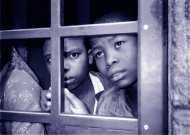
 © Yodon Thonden/Human Rights Watch 1997
Street children in adult court lockup, Nairobi, Kenya
© Yodon Thonden/Human Rights Watch 1997
Street children in adult court lockup, Nairobi, Kenya

Child Labor
Child Soldiers
Children in the U.S.
International Criminal Court
Juvenile Justice
Orphans and Abandoned Children
Refugees
Street Children
Violence Against Children in Schools
Children’s Rights Division - Home Page
|

|
|
|

Juvenile Justice
In the ten years since the adoption and near-universal ratification of the Convention on the Rights of the Child, a growing number of countries have modified their juvenile justice laws to guarantee children the rights set forth in the convention and in other international instruments. In other countries, reforms are under consideration but have not yet been enacted into law. And a large number of countries in the region and elsewhere in the world must still take action to bring their legislation into compliance with the convention.
Where they have taken place, legislative reforms are positive first steps toward greater recognition of the human rights of children. Even so, the gaps between law and practice are often vast. Many children are denied due process, detained under appalling conditions, subjected to violence at the hands of guards and police, and some are even put to death.
Far too often, children around the world are brought to trial and sentenced in ways that violate their rights. Human Rights Watch has documented systemic failures to guarantee children legal representation and otherwise provide them with fair hearings in Brazil, Bulgaria, Guatemala, India, Jamaica, Kenya, Pakistan, Russia, and the United States Of particular concern are sentences that violate the international principle that deprivation of liberty should be a measure of last resort and for the shortest appropriate period of time or that constitute torture or cruel, inhuman, or degrading treatment.
Throughout the world, children are subjected to appalling conditions of confinement that violate international standards. Often held with adults and subjected to violence at the hands of guards and other detainees, children in confinement are frequently denied adequate food, medical and mental health care, education, and access to basic sanitary facilities. These children eventually return to society, meaning that the failure to prepare them for their return is shortsighted as well as cruel, carrying enormous social costs.
Human Rights Watch recommends that countries around the world take the following minimum steps to safeguard the human rights of children in conflict with the law:
1) All governments should ensure that children in conflict with the law are detained only as a last resort and for the shortest appropriate period of time. Children should never be incarcerated for acts that would not be crimes if committed by adults.
2) Conditions of detention and incarceration should meet international standards. Children should never be detained with adults. They should be permitted regular, frequent contact with their family members, legal representatives, and others from the outside world and should be given access to education, health and mental health care, adequate food, and sanitary facilities.
3) Countries that retain the use of the death penalty should end the practice immediately and amend their legislation accordingly.
The Death Penalty and Juvenile Offenders
Only six countries in the world—Iran, Nigeria, Pakistan, Saudi Arabia, the United States, and Yemen—were known to have executed juvenile offenders (people convicted of acts committed before the age of eighteen) in the 1990s, in violation of international legal standards. The United States has executed nine juvenile offenders in this decade, more than the reported total for any other nation in the world.
HRW Death Penalty Home Page
Letter Brief to the Department of Justice Solicitor General Waxman on the Michael Domingues v. Nevada Case
Related Press Releases
January, 2000
Human Rights Watch Calls on Virginia Governor to Halt
Two Juvenile Executions
June 1999
Virginia Governor Urged to Halt Execution of Juvenile Offender
February 1999
Human Rights Watch Condemns Execution of Juvenile Offender
January 1999
State Governor Urged to Stop Execution of Juvenile
Trial and Sentencing Practices
California's Proposition 21: All Smoke and Mirrors
by Michael Bochenek
Conditions of Confinement
Human Rights Watch has documented abominable conditions for children in detention in countries around the world. In the United States (Colorado, Georgia, Louisiana, and Maryland), Pakistan, Jamaica, among other countries, children are subjected to excessive force, inadequate medical and mental health care, and are provided with little or no education. Often, these children are placed in the facilities along side adults, exposing them to physical and sexual abuse.
Human Rights Watch Prison Project
Close to Home: Juveniles in Adult Jails
Op-Ed by Michael Bochenek
The Washington Post
Related press releases:
March 2000
South Dakota: Stop Abuses of Detained Kids
Governor Must End Inhumane Practices
November 1999
Children Abused In Maryland Jails
November 1999
Child Detainees Being Tortured in Pakistan
July 1999
Jamaican Children Endure Abusive Conditions in Police Lockups
July 1999
HRW Welcomes Release of Chldren from Jamaican Police Lockups
Children Detained by the Immigration and Naturalization Service in the U.S.
Each year, thousands of children enter the United States unaccompanied by parents or relatives. Many are apprehended by the INS and held in detention, sometimes for months at a time. Investigating detention conditions in Arizona, California and Pennsylvania, Human Rights Watch has found that their rights are often violated — in breach of the U.S. Constitution, U.S. statutory provisions, INS regulations, the terms of court orders binding on the U.S., and international law.
Detained and Deprived of Rights: Children in INS Custody
HRW homepage
The Other Immigrant Children
Editorial by Jo Becker
Related HRW reports
Top of Page
|
|
|
|
|

