Afraid and Forgotten
Lawlessness, Rape, and Impunity in Western Côte d’Ivoire
Map of Côte d’Ivoire
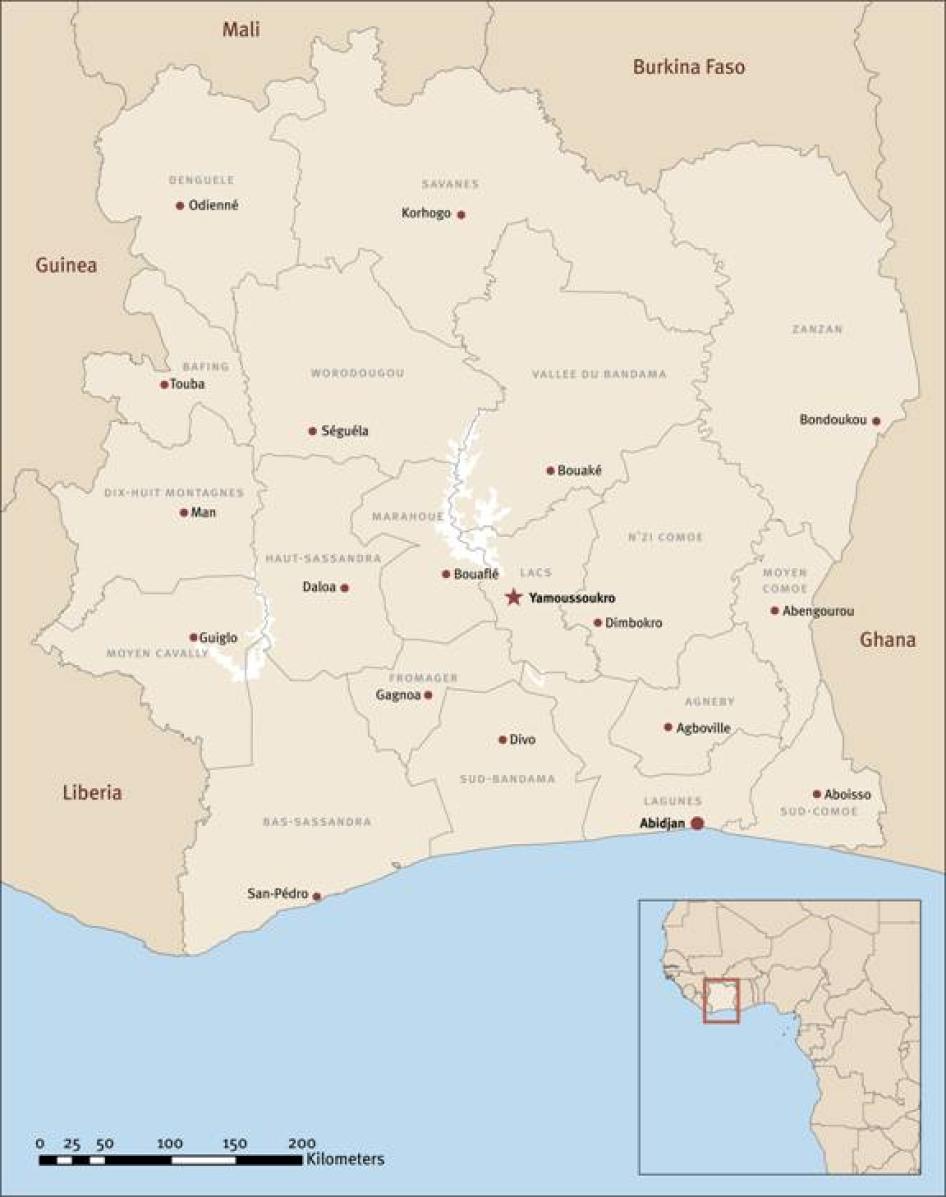
© 2010 John Emerson / Human Rights Watch
Map of Côte d’Ivoire’s Far West
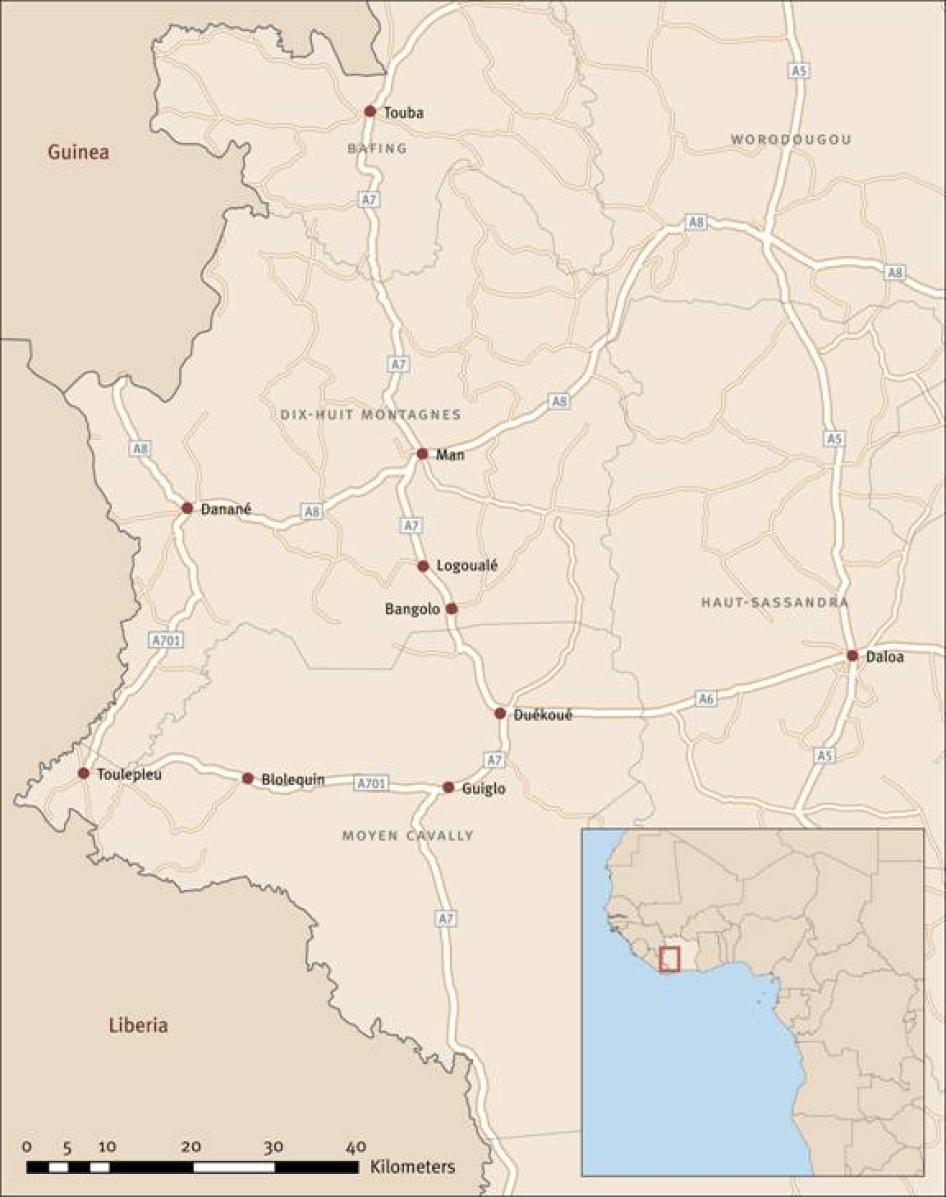
© 2010 John Emerson / Human Rights Watch
Summary
As Côte d’Ivoire heads toward long-delayed presidential elections scheduled for October 31, 2010, the far west of the country is in a state of near lawlessness. Here, the power of the gun prevails and the rule of law has all but disintegrated amid increasing political, conflict-related, and criminal violence. Criminal gangs, militiamen, police, gendarmes, and rebel forces subject locals to an unrelenting stream of abuses, including banditry, assault, extortion, and the rape of women, girls, and even babies. State institutions tasked with preventing and holding accountable those responsible for the violence have largely failed to act, allowing a dangerous culture of impunity to take hold.
The worst-hit areas are the western administrative regions of Moyen Cavally and Dix-Huit Montagnes—often referred to as the “Wild West” by humanitarian organizations and journalists—where criminal gangs attack and subject the population to abuse on a widespread basis in their homes, en route to market, and as they travel between their villages and the main regional towns.
International human rights law obligates Côte d’Ivoire’s government to respect the right to life, right to bodily integrity, right to liberty and security of the person, and the right to be free from discrimination, which includes an obligation on states to take appropriate measures to eliminate sexual and gender-based violence. As a result, the state—headed by the president, who is also commander-in-chief of the armed forces—must take all reasonable steps to protect persons within its territory or jurisdiction, including supporting the investigation and prosecution of private actors who infringe these rights. Ending the impunity that allows violence and other criminal practices to continue requires leadership from the highest levels of the state. Proactive patrolling by police and gendarmes, particularly on market days and during the harvest season, would likewise contribute greatly to improved security.
The region’s problems are rooted in the social, political, and military crisis that has racked Côte d’Ivoire since 2000, accelerating economic decline, deepening political and ethnic divisions, and leading to serious human rights abuses. Following the end of active hostilities in 2003, the country settled into a state of “no peace, no war,” divided between a rebel-controlled north and a government-controlled south. In 2007, the belligerent parties signed the Ouagadougou Political Agreement, which outlined plans for citizen identification, voter registration, disarmament, and the country’s reunification. However, there were immediate delays in implementation: presidential elections were postponed six times; disarmament was an almost total failure; and the country remained divided. Moreover, the government’s failure to re-establish the rule of law in the west—the region hardest hit by the conflict and with the highest concentration of arms—has allowed bands of armed former combatants and other armed youth to make a living from banditry and other forms of criminality.
One particular problem, especially within the violent-prone regions of Moyen Cavally and Dix-Huit Montagnes, is the severely compromised judicial system. There is no functioning trial court or prison in the whole of Moyen Cavally, leaving victims to travel between 70 and 250 kilometers to the courthouse in Daloa, located in the neighboring Haut-Sassandra region. While a trial court does exist in Man, the largest town in Dix-Huit Montagnes, it remains essentially non-operational due to a lack of essential state judicial personnel and the de facto authority of the rebel forces known as the Forces Nouvelles (“New Forces,” or FN). Corruption and inadequate staffing means the few cases that are adjudicated often result in the premature release of prisoners who are on remand or even convicted. The government has failed to take adequate steps to improve security and access to justice, even as international partners like the European Union and the World Bank pour hundreds of millions of dollars into judicial and security sector development.
Police and gendarme officials present another problem, routinely failing to fulfill their duties to protect, investigate, or prevent lawlessness. Victims described how security officials repeatedly refused to pursue and investigate criminal elements, even when attacks were reported at checkpoints only a few kilometers from the scene of brutal physical and sexual violence. Indeed, state authorities often demand bribes from victims to file complaints, most of which languish with authorities who show little interest in investigating or arresting perpetrators. Even when arrests do occur, suspected perpetrators are often freed within 24 or 48 hours, leaving victims disillusioned with authorities and terrified of revenge.
Police and gendarmes also engage in systematic extortion at checkpoints and roadblocks. In government-controlled Moyen Cavally, state officials routinely prey on individuals by extorting and, at times, beating, robbing, and arbitrarily detaining residents under the pretense that they do not have proper identity cards. Immigrant populations from northern Côte d’Ivoire and neighboring countries are targeted for particularly harsh treatment. Meanwhile, in Forces Nouvelles-controlled Dix-Huit Montagnes, rebel forces dispense with such pretense altogether, and simply demand money from residents and businesses through threat, intimidation, or force. The rebels, who accrue a financial windfall from this extortion, actively maintain control despite the redeployment of many state authorities to the northern half of the country—including to Dix-Huit Montagnes in the west.
All levels of state and rebel authority appear to be either directly involved in extortion or complicit in these practices due to their failures to reprimand, much less discipline, subordinates. Moreover, the prevalent checkpoints further weaken the already precarious security situation by reducing the population’s confidence in the respective forces and pushing people to take secondary roads with fewer checkpoints, where criminality is rife.
In Moyen Cavally and Dix-Huit Montagnes, the now-infamous coupeurs de routes, or road bandits, prey in particular on those traveling during the cocoa harvest and on market days, when victims generally carry greater amounts of money. Many residents and victims described almost daily attacks during the cocoa harvest, and attacks occurring like clockwork on market days throughout the year.
Groups of bandits establish makeshift roadblocks and then surround their victims walking along the roads or traveling in transport vehicles. Almost always masked, they are armed with Kalashnikovs, hunting rifles, long knives, and machetes. Secondary roads between towns and surrounding villages are notoriously treacherous. The bandits work meticulously, often stripping their victims to ensure that they find every last coin, inflicting physical abuse and, at times, killing those who refuse to relinquish their money or try to identify them.
Hundreds of women and girls have been sexually assaulted, raped, and gang raped during these criminal acts. Women and girls are systematically pulled off transport vehicles, one by one, and marched into the bush where they are raped while other bandits stand guard. Victims include very young children, including babies, and women over 70 years of age. During home attacks, husbands are tied up and forced to watch as wives, daughters, and other female family members are raped. Women sometimes become pregnant as a result of these attacks, while underreporting and clandestine, unsafe abortions likely hide many other cases.
Transport drivers, cocoa farmers, and women going to market are forced to make precarious ends meet as they negotiate between armed bandits, who perpetrate violent criminal acts on a consistent basis, and security forces, who are not only unlikely to investigate these crimes, but engage in their own forms of predatory behavior.
Their overwhelming fear of moving along the roads has led some inhabitants to significantly change their lifestyle; for many, this fear has severely undermined or destroyed their livelihood. Others simply live with the dread that an attack may occur the next time they or a loved one walk to market or travel to sell cocoa. While travel at night is wholly impossible in most areas because of the security situation, the daytime is scarcely better. The vast majority of the scores of road attacks that Human Rights Watch documented occurred during daylight hours.
At least some perpetrators in Moyen Cavally belong to militia, or former militia groups, who were actively armed and supported by the Ivorian government during the 2002-2003 armed conflict and its aftermath. The planned disarmament of these groups, and of the Forces Nouvelles rebels, has been an almost total failure, allowing for continued widespread use of firearms, particularly Kalashnikovs. Gangs of young men have exploited the availability of arms and the breakdown of the rule of law to wreak further havoc on the population.
While Ivorian officials, the UN, and the diplomatic community have focused principally on organizing the October 31 elections, the population continues to suffer rampant criminality with little to no possibility of recourse to justice. Ordinary Ivorians have little faith in authorities’ will or ability to effectively stop perpetrators of abuses, much less hold them to account. As long as state structures fail to function, and state authorities prioritize extortion over protection, people in western Côte d’Ivoire will continue to suffer.
Recommendations
To the Minister of the Interior, the Minister of Defense, the Major General of the Gendarmerie, and the Director General of the National Police
- Investigate gaps in security for the local population in western Côte d’Ivoire, and provide better protection to communities from bandit attacks.
- Strengthen the response to complaints presented at checkpoints regarding nearby bandit attacks, including by proactively pursuing perpetrators.
- Ensure effective allocation of resources to checkpoints, including staffing and equipment, and discipline officers who refuse to respond to complaints.
- Step up patrols on market days and during the harvest season, particularly on secondary roads around Duékoué and Guiglo.
- Develop plans to more systematically root out criminal elements, including by conducting operations in communities and neighborhoods where bandits and criminal gangs are known to be based.
- Significantly increase staffing and logistics of police, gendarmes, and mixed brigade forces deployed to western Côte d’Ivoire, so that they can respond more effectively to the high incidence of criminal acts perpetrated against residents.
- Issue clear directives to police, gendarmes, and customs officers manning checkpoints across Côte d’Ivoire to desist from bribe-taking, extortion, and other corrupt practices.
- Establish a focal point in police and gendarme stations, as well as a telephone hotline, for victims to file complaints about abusive practices by state security forces.
- Ensure that complaints are thoroughly investigated, and establish internal disciplinary measures within the forces to take action against members of the security services who abuse the population.
- Proactively and routinely investigate the behavior of security forces at checkpoints even in the absence of complaints from residents.
- Establish an independent oversight committee in departments throughout the country to monitor and evaluate the police and gendarme response to all crimes, with particular focus on sexual violence cases. Include women from local civil society on the oversight committee.
- Conduct a public information campaign on the mandate and locations of all Integrated Command Center forces. Ensure that they wear distinct uniforms or insignia so that the population can distinguish them from Forces Nouvelles soldiers.
To the Minister of Justice and Human Rights, the Minister of the Interior, and the Judiciary
- Immediately establish functioning legal institutions in the region of Moyen Cavally, in particular by rehabilitating the Guiglo court building and constructing detention facilities. Urgently finalize the agreement with the United Nations Operation in Côte d’Ivoire (UNOCI) that outlines its assistance, and the government’s obligations, in completing these tasks.
- Immediately redeploy outstanding state judicial and correctional officials to Forces Nouvelles territory, including prison officials and judicial police to the prison and trial court in Man, ensuring a return to at least pre-conflict capacity. Ensure that the prison is under state, not Forces Nouvelles, control.
- Improve the response of law enforcement personnel and the judiciary to sexual and gender-based violence, including by recruiting more female police officers to act as focal points in police stations, and by training judicial and security personnel on responding to sexual violence.
- In accordance with international fair trial standards, prosecute members of the security, defense, and rebel forces who engage in criminal conduct, including the solicitation of bribes, arbitrary arrest and detention, or physical abuse against those who refuse to pay a bribe.
- Investigate cases of banditry and sexual violence in western Côte d’Ivoire, and prosecute perpetrators in accordance with international fair trial standards. Pursue impartially cases involving militias in Moyen Cavally and Forces Nouvelles rebels in Dix-Huit Montagnes.
To the Minister of Health and Public Hygiene and the Minister of Family, Women, and Social Affairs
- Improve services for victims of sexual violence, including medical and counseling services.
- Establish free emergency medical services for rape victims in all public hospitals and health centers in Côte d’Ivoire, including access to medical examinations, post-exposure prophylaxis drugs and antibiotics, psychosocial care, and follow-up consultations.
- Ensure sufficient coverage in areas without adequate health infrastructure, through training mobile teams and traditional healers.
- Disseminate information on treatment for rape victims to health centers and professionals nationwide.
To the President and the National Assembly
· Enact a law that eliminates the medical certificate fee in cases of rape and ensure that it is implemented universally.
· Ratify the Protocol to the African Charter on Human and Peoples’ Rights on the Rights of Women in Africa and implement its provisions, particularly regarding sexual violence.
To the President, the Prime Minister, and the Integrated Command Center
- Finalize the disarmament process and ensure that arms are collected from all former combatants not formally integrated into state military and police entities, including from militia and the Forces Nouvelles.
- Allow independent inspection and reporting by UNOCI on weapons collected.
To the Forces Nouvelles
- Cease extortion and racketeering of individuals and businesses in the north.
- In accordance with the Ouagadougou Political Agreement and its Fourth Supplementary Agreement, relinquish control of taxation, customs, the judiciary, and the prison system to redeployed state officials responsible for these functions. Publicly declare that remaining state functions will be immediately handed over upon the redeployment of remaining state officials.
- Relinquish control over security and checkpoints in the north to the Integrated Command Center forces, where they are stationed, and dismantle any additional, unauthorized checkpoints.
- In accordance with the Fourth Supplementary Agreement to the Ouagadougou Agreement, hand over to the Integrated Command Center, in the presence of UNOCI peacekeepers and weapons inspectors, weapons collected by zone commanders from rebel soldiers. Provide statistics to UNOCI, the Integrated Command Center, and the National Program for Disarmament, Demobilization, and Reintegration (PNDDR) on the number of weapons collected and remaining at large.
- Allow the United Nations Group of Experts unfettered access to inspect all arms under Forces Nouvelles control.
- Ensure that demobilized and former Forces Nouvelles soldiers no longer wear military uniforms or carry weapons.
To the United Nations Operation in Côte d’Ivoire
- Engage the UNOCI Human Rights Division to undertake field investigations on human rights abuses suffered by the populations in Moyen Cavally and Dix-Huit Montagnes. Ensure that the reports of such investigations are publicly available.
- Publicly release all reports related to human rights abuses in Côte d’Ivoire, including posting regular updates and periodic reports online.
- In collaboration with Ivorian security forces, increase UN Police patrols around Duékoué and Guiglo on market days, most importantly by adding patrols that accompany women who come into Duékoué and Guiglo on market day from surrounding villages.
- Encourage and support Ivorian authorities to undertake a full and thorough Demobilization, Disarmament, and Reintegration (DDR) program in line with the Integrated DDR Standards (IDDRS) and other internationally recognized best practices.
- Provide technical and logistical support to assist state authorities in conducting thorough investigations of human rights violations, with particular attention to violence committed against women and girls, as articulated in UNOCI’s mandate.
To Foreign Partners and International Aid Agencies, notably the European Union and the World Bank
- Demand that the Ivorian government address the tenuous human rights situation in the country, which has been largely ignored during the long road to elections.
- Demand that UNOCI undertake more proactive investigation and reporting regarding the human rights climate in Côte d’Ivoire and engage more assertively with the government on documented human rights concerns and violations.
- Strengthen and expand funding for programs supporting victims of sexual violence, including medical care, counseling, and legal support.
- Undertake public awareness campaigns on how and where victims of sexual violence can access confidential and free treatment.
- For those funding or implementing rule of law programs, demand that the Ivorian government deliver tangible results, including increasing the staffing and infrastructure of key judicial institutions and courts and reducing corruption and checkpoint extortion by security forces. Fund and use independent monitoring and evaluation mechanisms, such as quarterly reports by the Improved Road Transport Governance (IRTG) Initiative, to determine the state’s success in combating extortion.
Methodology
This report is based on a three-week mission to Côte d’Ivoire in July and August 2010. It focuses principally on events occurring in western Côte d’Ivoire between January 2009 and August 2010.
Two Human Rights Watch researchers conducted interviews with more than 80 victims and witnesses of violence and extortion, as well as with government officials, law enforcement and military personnel, rebel soldiers, officials from the United Nations Operation in Côte d’Ivoire, representatives from Ivorian and international nongovernmental organizations, journalists, and diplomats. Human Rights Watch also received and viewed documentary evidence provided by victims, witnesses, and nongovernmental organizations.
Research was conducted in the financial capital, Abidjan, as well as in the towns of Duékoué, Guiglo, Bangolo, Man, Danané, and Daloa. This field research was accompanied by an extensive literature review of publicly available and unpublished studies on the human rights situation in western Côte d’Ivoire and the broader politico-military crisis.
All witnesses and victims were interviewed individually during in-depth conversations. Most interviews lasted approximately one hour. Interviews were generally held in secure locations agreed upon with the witness or victim to ensure safety and address their fear of reprisal. Most victims of sexual violence were interviewed in private with only a translator and interviewer present. In a few cases, staff from local women’s and human rights organizations were present to support the women. Only females were present for interviews with victims of sexual violence. Interviews were conducted in French, or with the aid of a French-to-English translator. When preferred by the interviewee, interviews were conducted in local dialects with translation into English or French.
Names of victims and witnesses have been changed or withheld to ensure their safety and that of their families. Details, including town names and the specifics of an attack, have been withheld where they could lead perpetrators to identify individuals interviewed. This was often done at the request of the interviewee. The names of officials with Ivorian and international organizations have also been withheld at their request to protect their identity, privacy, and security.
Monetary figures throughout this report are calculated using the rate of 500 CFA francs to the United States dollar.
Background
For decades after it gained independence from France in 1960, Côte d’Ivoire—a diverse country of some 20 million people on the southern coast of West Africa—prospered economically even as parts of its population were left politically excluded.
During the presidency of Félix Houphouët-Boigny (1960-1993), Côte d’Ivoire became an economic power in West Africa as a leader in cocoa and coffee production. Houphouët-Boigny oversaw an open-door immigration policy, which, coupled with the rapid growth of the Ivorian economy, attracted migrant workers from throughout the region who now comprise about a quarter of the population.[1] During this time, the president ruled the country as a one-party state based on an ethnic coalition of groups from the country’s north and center, leaving many ethnic groups in the south and west excluded.[2]
In the late 1980s, plummeting cocoa prices, land scarcity, and rising foreign debt led to an economic recession that left an increasing number of educated youth unable to find employment.[3] Many returned to their villages, including in the western part of the country, but often found that their parents had rented the land to immigrants and that no other arable land was available, resulting in large numbers of unemployed villagers. As unemployment and political discontent rose, opposition parties and civil society demanded multi-party democracy and other reforms, but the newfound parties soon split along ethnic and geographic lines.
Prelude to the Crisis
Questions of ethnicity and nationality dominated campaigning ahead of the first multi-party presidential elections in 1995. The main candidates were Houphouët-Boigny’s successor within the Democratic Party of Côte d’Ivoire (Parti démocratique de Côte d’Ivoire, PDCI), Henri Konan Bédié, also a Baoulé from Côte d’Ivoire’s geographic center; Laurent Gbagbo, the Bété leader of the Ivorian Popular Front (Front populaire ivoirien, FPI) from the south; and Alassane Dramane Ouattara, Houphouët-Boigny’s former prime minister then running as head of the Rally of Republicans (Rassemblement des républicains, RDR), whose constituency is largely drawn from northerners.[4]
Several politicians, notably Bédié, employed the rhetoric of “Ivoirité” (or “Ivorianness”)—an ultranationalist political discourse focusing on Ivorian identity that marginalized immigrants and other perceived outsiders—to garner support and exclude political rivals. After Ouattara was barred from running on account of questions over his citizenship, the RDR boycotted the elections.[5] Gbagbo and the FPI soon withdrew over concerns about transparency, and Bédié easily won the elections. During his six years in power, Bédié relied heavily on ethnic favoritism from the Baoulé and small ethnic groups from central Côte d’Ivoire to maintain control. A combination of plummeting cacao prices and rampant corruption and mismanagement led to the country’s dramatic economic downturn.
In December 1999, General Robert Gueï, a former army chief of staff, took power in a military coup and pledged to oversee a return to civilian rule with elections in 2000. Gueï’s initial pledges to eliminate corruption and introduce an inclusive Ivorian government were largely welcomed by Ivorians, but were soon overshadowed by his personal political ambitions, repressive measures against both real and suspected members of the opposition, and near-total impunity for human rights abuses by military personnel.[6]
During the 2000 election year, Ivorian politics divided increasingly along ethnic, regional, and religious lines.[7] Several weeks before the October presidential election, the military junta deemed a majority of candidates, including Ouattara and former president Bédié, ineligible—resulting in a contest between General Gueï and Gbagbo of the FPI party. After Gbagbo’s victory at the polls, General Gueï attempted to disregard the results and maintain power, leading to massive popular protests and the loss of his military support. He fled the country on October 25, 2000. Gbagbo became president a day later.
RDR supporters immediately called for new elections that included all candidates and clashed with FPI supporters and state security forces across Côte d’Ivoire. Violence, including massacres perpetrated by the army and gendarmes, continued through the December parliamentary elections, leaving more than 200 dead.[8] Political tension remained high, particularly in the west where explosive ethnic rhetoric by political and youth leaders exacerbated pre-existing land disputes. Groups of youth from ethnic and national groups in western Côte d’Ivoire, including Bété, Gueré, Yacouba, and Burkinabé, burned each other’s villages in June and July 2002, displacing thousands from all ethnic groups to Daloa and Duékoué.[9]
Civil War
On September 19, 2002, rebels from the Patriotic Movement of Côte d’Ivoire (Mouvement patriotique de Côte d’Ivoire, MPCI), whose members were drawn largely from the country’s Muslim north, attacked Abidjan, the commercial capital of Côte d’Ivoire, and the northern towns of Bouaké and Korhogo. While the rebels were unable to take Abidjan, they quickly managed to control the northern half of the country. Soon after, the MPCI was joined by two rebel factions from the west, the Ivorian Popular Movement of the Great West (Mouvement populaire ivoirien du Grand Ouest, MPIGO) and the Movement for Peace and Justice (Mouvement pour la paix et la justice, MPJ), creating a politico-military alliance called the Forces Nouvelles, or “New Forces,”under the leadership of Guillaume Soro.
The western part of the country was hit hardest by the war, decimating infrastructure and wreaking havoc on the local population. Certain Liberian rebel groups had long used western Côte d’Ivoire as a base to move arms and fighters to Liberia, where civil war ravaged the population for over a decade; by late 2002, thousands of arms, particularly AK-47s (“Kalashnikovs”), were flowing back. In addition, both the Ivorian government and the Forces Nouvelles recruited former combatants from the Liberian and Sierra Leonean civil wars to fight in the far west, where they committed many of the same kinds of brutal war crimes perpetrated in these neighboring armed conflicts.[10]
As the Forces Nouvelles marched south from Man and Danané through Moyen Cavally, the Ivorian government responded by forming and arming a network of militia groups to support the thinly-stretched Ivorian security forces.[11] General Denis Maho Glofieï, president of the Resistance Forces of the Great West (Forces de résistances du Grand Ouest, FRGO), composed of at least five militia groups that fought during the conflict, claimed to have more than 25,000 militia fighters under his control in the region of Moyen Cavally.[12] Both sides—the rebels as well as government forces and government-supported militias—committed serious human rights abuses, including massacres, extrajudicial executions, torture, and the recruitment and use of child soldiers.[13] Fighting forces perpetrated frequent acts of collective punishment in which civilians considered loyal to the other side were targeted. All of the fighting groups systematically committed sexual violence, including individual and gang rape, egregious sexual assault, forced incest, and sexual slavery.[14]
A ceasefire agreement put an end to active armed conflict between the government and the Forces Nouvelles in May 2003, although recruitment of mercenaries and severe human rights violations against civilian populations continued. Sexual violence against women and girls remained widespread due to weak legal and security institutions that failed to prevent violence, prosecute perpetrators, or support victims.[15] The country has remained effectively split in two, with the Forces Nouvelles controlling the north and the government the south.
Peace Agreements
Since the end of formal hostilities, the warring parties have signed a number of peace agreements. Each of these failed to bring about disarmament and unification of the country or substantial improvements in the rule of law. France, the Economic Community of West African States (ECOWAS), the African Union, and the United Nations have all spearheaded initiatives to end the stalemate.
These efforts resulted in a “zone of confidence” dividing the northern and southern halves of the country; the French commitment of the Force Licorne, a military force including over 4,000 troops during the height of the crisis, to help stabilize the country and monitor the zone of confidence; the installment of the United Nations Operation in Côte d’Ivoire (UNOCI), which peaked at over 11,000 peacekeeping troops; and the establishment of a UN arms embargo, in addition to travel and economic sanctions.[16]
In March 2007, President Gbagbo and rebel leader Guillaume Soro signed the Ouagadougou Political Agreement (OPA), later endorsed by the African Union and the United Nations Security Council.[17] The OPA was the first to have been directly negotiated by the country’s main belligerents on their own initiative. It resulted in the appointment of Soro as prime minister in a unity government, and hope that Côte d’Ivoire was moving out of a stage of “no peace, no war.”
The agreement reiterated previously defined objectives, including disarmament, the country’s reunification (including unified armed forces and state authorities), citizen identification, and voter registration, which at times was marred by low-level violence as issues of citizenship and ethnicity continued to fester.[18] The OPA also called for presidential elections by early 2008. Delays were almost immediate. Over three years after the Ouagadougou Agreement, and after six electoral delays, the presidential elections have still not been held, although they are scheduled for October 31, 2010.[19]
Weakened Rule of Law Institutions
At present, the power of the gun—wielded by militias, Forces Nouvelles rebels, and criminal bandits—has largely replaced the rule of law. Several factors in both the rebel-held north and government-held south have resulted in significant weakening of institutions mandated to maintain law and order, including the police and gendarmerie, and the judicial and corrections systems.
In the north, the failure to reunify the country has played the most significant role in continued lawlessness. After continued delays in implementing the OPA, the principal actors signed the Fourth Supplementary Agreement to the Ouagadougou Political Agreement on December 22, 2008, which committed them to take immediate steps toward reunification of the country, including redeploying state authorities to the north.[20] Police, civil servants and judges were due to begin work in the north by January 15, 2009. However, a lack of political will by both sides resulted in further delays in their redeployment. As a result, rebel commanders continue to exercise near-complete control over economic, security, and judicial affairs within their zones.[21] The May 2010 periodic report of the UN secretary-general on UNOCI notes:
Côte d’Ivoire is still a divided country, with the Forces nouvelles maintaining a parallel administration, economy, treasury, judicial system and security structures in the north…. [Forces Nouvelles] zone commanders, and Forces nouvelles-appointed mayors and other local authorities continue to exercise real authority and collect revenues in the north…. [M]any courts in the north and the west are non-operational…. [T]he tribunals in Man and Katiola remain closed since February, when staff abandoned their posts following the violent disturbances there.[22]
In addition, the Fourth Supplementary Agreement called on the Forces Nouvelles and the Ivorian armed forces to immediately make officials available for the Integrated Command Center (Centre de commandement intégré, CCI)—a joint security and defense force created under the OPA and envisioned to build confidence between the two sides. The CCI was to deploy primarily in the north and former zone of confidence and was mandated to provide security, oversee disarmament, and assist the return of state institutions, including the judiciary. More than a year later, progress remained slow, as noted by the UN report:
The mixed brigades deployed by the Integrated Command Centre, which have the task, inter alia, of maintaining law and order, lack adequate manpower and resources, and are not able to protect the population and the re-established State institutions. They maintain an uneasy coexistence with the heavily armed and well-financed Forces nouvelles security machinery.[23]
In government-held areas, the rule of law is similarly weak. Local human rights organizations working on justice issues decried the widespread corruption in the judiciary, as well as a lack of independence from the executive. Security forces in particular have benefited from longstanding impunity, and their continued extortion of the population at checkpoints around the country has weakened the public’s faith in their role as protectors.
Nowhere is the failure of legal institutions more evident than in the far west. Police and gendarmes routinely refuse to pursue known criminals or investigate crimes, at times demanding bribes merely to file a complaint. No tribunal or prison exists in the government-controlled region of Moyen Cavally, forcing residents to travel over 100 kilometers to Daloa, in the region of Haut-Sassandra, to find the nearest operational legal institutions. No judicial officials—including a prosecutor or judicial police—are therefore stationed in Moyen Cavally, severely hampering those investigations that are undertaken. In the midst of disintegrated state structures, men with arms are ubiquitous.
Failure to Disarm, Demobilize, and Reintegrate
More than three years after the Ouagadougou Agreement, the Ivorian government has failed to disarm various fighting factions, while the Forces Nouvelles and militia forces have ignored and subverted disarmament efforts. Residents in the west, home to tens of thousands of armed militia and rebel soldiers, have suffered disproportionately as a result.
Under the agreement, the CCI is to oversee the disarmament process. However, as noted above, the CCI is essentially not operational due to a lack of political will to commit resources to it. In addition, lack of will on the part of the Forces Nouvelles and the militias to disarm—combined with each party’s distrust of the other—has resulted in scant progress.
An official in UNOCI’s Disarmament, Demobilization, and Reintegration (DDR) division told Human Rights Watch that since 2007, UNOCI had collected a total of 715 arms from the rebels and militia forces combined.[24] This is despite the government’s account that 70,000 ex-combatants have been profiled and 29,207 are already considered to have been demobilized.[25] In the west, Ivorian officials convened a high-profile ceremony marking the disarmament of militia forces in May 2007. However, the UN was not allowed to inspect precisely how many arms were handed over to the government officials, who controlled the event.[26] A UN official who was present at the ceremony told Human Rights Watch:
There was a big ceremony, but it was a charade. The militia only brought out their oldest arms.Few of them handed over the real arms that we have seen them walking around with on the street.[27]
The UN Group of Experts, tasked with monitoring the UN Security Council’s 2004 arms embargo, noted the extensive presence of Kalashnikovs and ammunition among militias in Moyen Cavally, though generally found the light arms to be outdated and of poor quality.[28] In its May 2010 report, the International Crisis Group likewise described a heavy presence of arms among militias in Moyen Cavally, and the continued arrival of new arms via forest roads from Liberia.[29]
The Forces Nouvelles likewise remain well-armed, including in the region of Dix-Huit Montagnes. Of the 715 arms collected by UNOCI, even fewer came from the Forces Nouvelles than from the militias. Many Forces Nouvelles soldiers in Man still wear military fatigues and openly carry Kalashnikovs and other firearms. Indeed, the UN Group of Experts reported in October 2009 that northern rebel commanders were importing additional arms in violation of the UN arms embargo.[30]
Violence and Lawlessness in Western Côte d’Ivoire
Residents are frequently targets of violence and severe abuse in western Côte d’Ivoire. This is due to failed or non-existent state structures to protect and ensure justice for abuses, widespread proliferation of arms, and lack of political will to improve rule of law on both sides of the politico-military divide.
As noted above, several regions in western Côte d’Ivoire were the scene of widespread violence during the more active period of hostilities from 2002 to 2003. However, while the level of violence gradually diminished elsewhere, abuses in the west—particularly in the regions of Moyen Cavally and Dix-Huit Montagnes—have remained at near-crisis levels, and in some areas may even be rising.
A United Nations official based in western Côte d’Ivoire described the security situation to Human Rights Watch:
There have been no real improvements in the human rights situation here because the security situation has worsened. In this area we have the government’s armed forces, Forces Nouvelles, and the militias. The mix results in huge security problems.
The situation with banditry continues to worsen. In addition to road attacks, there have been a rising number of incidents in houses. At least daily I receive a report about armed people attacking a house in a village or a camp, or attacking on the road.[31]
Human Rights Watch documented scores of incidents in which heavily armed individuals, generally operating in small groups, committed acts of banditry along the region’s roads as well as home robberies. In the course of these attacks, victims were often beaten, stabbed with knives and machetes, and shot with firearms.
The armed men also committed frequent acts of sexual violence against women and girls, including aggravated sexual assault, individual and group rape, and gang rape. Human Rights Watch interviewed 23 women and girls who had been victims of rape and sexual violence in Moyen Cavally or Dix-Huit Montagnes since January 2009, and documented at least 86 additional cases from witnesses, including drivers of transport vehicles and family members. These and other victims whose cases were documented by Human Rights Watch were targeted while working in the fields, going to and from markets and places of work, or sleeping at home. They ranged in age from seven months to 78 years old.
The frequency of armed attacks has left the region’s residents in constant fear. Many have curtailed or severely limited their travel and daily routine. Indeed, certain areas are considered too dangerous to enter because of their near-total lawlessness.
Widespread Criminality by Coupeurs de Route
The coupeurs de route, a French term used to describe groups of armed individuals who attack vehicles and then rob the passengers of money and goods, typify the lawlessness in western Côte d’Ivoire.
One resident of a village near Guiglo told Human Rights Watch, “In the last three months, there has not been a single week that has gone by without at least two armed robberies that have touched people from my village alone. Most are by the coupeurs de route.”[32] A resident of Duékoué likewise said that road banditry occurred in the surrounding areas at least weekly, even during the non-harvest season when there is less road banditry.[33]
Moreover, there are indications that the phenomenon is increasing. Residents throughout Moyen Cavally told Human Rights Watch that incidents of road banditry date back to soon after the conflict, but have steadily increased since 2008. A representative of a local organization working with victims of sexual violence, including those raped during armed attacks on cars and transport vehicles, explained:
The incidents with banditry and rape started in 2005, but it was in 2008 and 2009 that it really went up. When they restarted selling cocoa, [the coupeurs de route] started to rob people because they knew people had money. So now they rob and steal money. Sometimes they kill the husband or wound or beat him, and they rape the women.[34]
Human Rights Watch interviewed 10 drivers of public transport vehicles in the west who had been victims of one or multiple attacks on the road, in addition to 18 passengers and other individuals who had been victims of armed banditry. The drivers alone experienced 17 separate attacks between November 2009 and July 2010; one driver had suffered four attacks during these nine months. They indicated that they knew of dozens more similar attacks on other drivers.
According to drivers and passengers who suffered road banditry, the attackers frequently place a large piece of wood across the road, or choose a location where drivers have to slow down because of sharp turns or holes in the road. As the driver brakes, bandits—between three and nine in number according to cases documented by Human Rights Watch—emerge from surrounding vegetation. They are always heavily armed, most often with Kalashnikovs, but at times with hunting rifles and small pistols that victims say appear to be locally made. Many bandits also carry knives and machetes, and are dressed in camouflage or black clothing.[35] All victims interviewed by Human Rights Watch described their attackers as wearing balaclavas or masks, sometimes makeshift masks made out of t-shirt fabric with holes cut for the eyes and mouth. Attackers almost exclusively speak French, with what victims commonly described as an Ivorian accent.
The attackers force the passengers off the road, threatening to open fire if the car drives away. They then quickly and meticulously steal money from each passenger. A driver from Guiglo who had been attacked three times since December 2009 described a typical ambush that occurred in January 2010:
About 10 kilometers from Guiglo on the road to V15 [a village in Moyen Cavally], there is a crossroads. Right before it, there was a long piece of wood stretched out. As soon as I pressed on the brakes, four people came out of the bush, pointing guns at the car. Two of them had Kalashnikovs, two were holding hunting rifles. They also all had long knives. They yelled at us to get out of the car. There were 14 passengers, in addition to myself and an apprentice. They marched us about 10 meters into the bush and forced us to the ground. They were all dressed like ninjas, completely covered in black. They had on masks that you could barely see through, with tiny holes for the eyes and mouth. And they all had on long sleeves and gloves.
Once we were on the ground, they tore at our clothes with knives, trying to find all of our money to make sure we didn’t have any hidden from them. They took 22,000 CFA (US$44) from me and my mobile phone. They kept yelling to keep our heads down and not to look at them, that if we tried to look at them they would kill us. It happened so fast, it lasted about 30 minutes. They took our money and then disappeared back into the bush.[36]
As discussed below, attacks occur most often during the cocoa harvest and on market days when people travel with larger sums of money. Moreover, several drivers and a UN official in the area told Human Rights Watch that the bandits appeared to operate with informants at the inter-city transport hub, at least in Duékoué, to target transport vehicles with wealthier passengers.[37]
The armed attackers often perpetrated severe physical violence against drivers and passengers. One victim of an attack in January 2010 said:
When the bandits didn’t think we got off the truck fast enough, they started beating us. They hit me with the back of their gun in the face and knocked out my front teeth. Three of them were hitting me, one with the back of his gun and then two others with their fists. It lasted for several minutes. I tried to cover myself, but they knocked my front teeth out with one hard hit to my face. I still don’t feel right and have headaches all the time because of this.[38]
Numerous victims and witnesses believed that the most brutal physical violence occurred as a result of victims’ attempts to determine the attackers’ identities, as explained by a driver whose route runs from Guiglo to the village of V15:
You can’t try to look at the bandits. One time when the coupeurs de route robbed my truck, one of the passengers looked at a bandit’s face, or the bandit thought he was looking at him, even though he had a mask on. The bandit yelled, “Why are you looking at me?” and then he hit the guy really hard with the back of his machete—not the blade part—and then with his gun. He hit the guy over and over until his face was running with blood.[39]
Others suffered particularly brutal abuse after refusing to turn over money. A farmer near Guiglo described how he lost his hand when he fought back against his attackers:
I was coming home from the market when I was met by four men who had cut the spiky leaves of the palm tree and placed them on the road. They told me to lay on the sharp leaves, so I went and lay near the sharp edges, but not on them. One said, “lay down,” and he cut me on my right hip with the machete. My mobile phone was in my pocket and blocked the machete but it still cut me—the wound was big enough so you could put two fingers inside it. They said, “Give us money,” and I said, “You told me to lay down so, I lay down, if you want money, take it…. Why do you hurt me like that? Now what money am I going to use to take care of my wound?”….
One caught me by the neck and pushed his machete in my back. Another man in front began to open my pants, and I kicked his legs and he fell to the ground. I tried to grab his throat so I could pull off his mask. Then the one behind me tried to cut my head with the machete, so I put my right arm up to protect me and he cut my hand off. It was hanging by just a few centimeters of flesh…. This happened at 2 [in the afternoon], and I was there in the field until 6 when someone found me and took me to the hospital.
When we arrived at the hospital there were no doctors so I stayed until morning. When the doctor came in, he said my hand was dead so he had to remove it entirely. The hospital took good care of me, but now it’s just a question of how can I work?[40]
Human Rights Watch received credible reports of four killings during road attacks in 2010. A planter from one village about 15 kilometers from Guiglo said that both his uncle and cousin had been killed in separate bandit attacks, in January and April 2010. The relative later saw the bodies, which had gunshots to the head.[41] Several drivers reported the killing of a passenger on a transport vehicle that departed from Duékoué when bandits opened fire after the driver refused to stop at a makeshift roadblock.[42] Finally, several drivers also described the killing in late 2009 of a passenger in their colleague’s vehicle after he refused to hand over money to bandits in an attack around Bangolo.[43] Countless girls and women have also been subjected by armed perpetrators to sexual assault, including rape and gang rape, as discussed below.
Widespread throughout the Far West
Human Rights Watch documented at least two bandit attacks since November 2009 on each of five separate roads in Dix-Huit Montagnes and Moyen Cavally. Multiple drivers noted that the incidence of attacks had reduced on the main road connecting the largest towns in the west, though sporadic attacks still do occur on it, particularly in the former zone of confidence between Duékoué and Bangolo.
One driver whose route went from Man to Daloa, for example, reported how his 18-passenger vehicle was attacked by bandits near Bangolo in December 2009.[44] Another driver of an 18-passenger vehicle was attacked around 10 a.m. in April 2010 between Bangolo and Duékoué.[45] In general, though, security on the main road has improved as compared to immediately after the war, as one driver explained:
At least one axis has improved in terms of security since the war—the main road from Guiglo to Bangolo. In the past, that was a no-go zone, especially from Duékoué to Bangolo. If you didn’t have a UNOCI escort, you just couldn’t drive there, no matter the time of day. It’s possible now, of course not at night. There are some incidents, some banditry, but the problems have diminished.[46]
Several drivers and other community members attributed this decline to convoys and patrols that UNOCI formerly operated along the main road, particularly between Duékoué and Man.
Despite some improvements along the main roads as a result of patrols and escorts by UNOCI, secondary roads in the region remain under frequent attack. These roads are generally unpaved paths leading from the main regional towns to surrounding villages. Drivers interviewed by Human Rights Watch had been victims of multiple attacks along the roads between Duékoué and Gbapeur, Guiglo and Nguya, and Duékoué and Kuassikro. The most treacherous appeared to be the road between Guiglo and V15, where Human Rights Watch documented at least seven separate incidents between December 2009 and May 2010. A UN official who monitors the security situation in the west similarly described the problems as now predominating on secondary roads.[47]
The end result is a level of insecurity and fear that keeps many from traveling unless it is absolutely necessary. Nighttime movement is completely off limits, as one driver who had been attacked multiple times explained:
The robberies are part of being a driver here. It’s tough, but what else am I supposed to do? I have lost a couple of apprentices after attacks—they said they just couldn’t do it, and I couldn’t fault them. I’m just too old to change. For me, the biggest problem is that there are so few hours in the day when people can travel, when I can work and make money. Right now, given the security situation, it’s only possible to be on the roads from 7 in the morning to 6 at night—if I push it, maybe to 7. It’s dangerous enough during the day, but it’s just impossible after that. There is no way to move without something happening.[48]
Period during and after the Harvest
Drivers, farmers, market sellers, and other victims reported that there is a notable increase in the number of road attacks between November and March, when cocoa is harvested and sold in the market. One cocoa farmer explained:
The coupeurs de route problem always exists, but it’s much worse during the cocoa harvest. Everyone has money and people are moving around. Farmers come to town to sell their crop and then receive cash before going back to the village. [Cocoa] buyers circulate around the camps with cash, purchasing from farmers. The robbers come out in full force because of the money available. By now [in late July], we have all run out of money from the previous year’s harvest, so it happens less.[49]
The clear majority of bandit road attacks that Human Rights Watch documented occurred between November 2009 and March 2010. Tens of people interviewed by Human Rights Watch lamented the weak state response to what they feared was a problem that would intensify during each cocoa harvest period. A cocoa planter from near Duékoué explained:
We are already hearing in the community that the bandits will rise again when the harvest comes. It has not stopped right now, but it has slowed down compared to the harvest time. When people start getting money from the harvest, though, it will happen all over again unless someone does something to stop them. As of now, they still have the guns, they still can do whatever they want to.[50]
Market Day
Human Rights Watch documented frequent attacks on market days when villagers converge to buy and sell goods. The concentration of attacks on these days, both during and after the harvest period, was confirmed by nearly all those interviewed—many of whom said that attacks happened weekly, at a minimum.
The petty trading that occurs on market days is primarily conducted by women and, as a result, they are disproportionately impacted by the attacks and violence that occur on these days. Several drivers and other community members told Human Rights Watch that most attacks on market days occur in the latter part of the day, when villagers are returning home with goods and money earned from selling produce. They further noted how the attacks occurred on both primary and secondary roads leading to and from major towns such as Duékoué and Guiglo to the surrounding villages.
While the routine nature of the attacks was well known, villagers had little alternative but to take the risk of robbery and rape to be able to buy provisions and make their living. A driver who had twice been victim to road banditry told Human Rights Watch about the general problem, as well as a particular attack in February 2010:
Driving on market days are the worst, though we have to do it because it’s one of the few days people travel anymore. Bandits are always ready to attack traders who have sold their merchandise, [so] driving home from the market is the most dangerous.
In February, I drove traders to the Friday market on Thursday afternoon. We can’t travel while it’s dark, so you have to take them early and spend the night. On the way back Friday afternoon, we were forced off the road by bandits…. There were six of them and they had Kalashnikovs. They weren’t satisfied when people handed over small sums of money. They knew people had more, so they started getting angry, yelling, “We know you’re coming from market. Give us the rest, or we’ll kill you.” Most people gave them the rest, but one of the passengers said he didn’t have any more. Two of the robbers beat him with their guns for about five minutes. I had to drive him to the hospital.[51]
Attacks are not limited to drivers on the road. Women walking to and from the market are also frequent targets. One Guiglo resident explained:
You hear of an attack almost every Tuesday. That’s market day here in Guiglo, so women from surrounding villages come into town. Some come on transport, but most walk, leaving when the sun rises. They are often in groups; the men are back working in the fields. On several of the secondary roads that lead into town, there is almost always an attack. The women’s money is taken and often some of them are raped.[52]
Indeed, the week before Human Rights Watch researchers were in Guiglo, bandits attacked several groups of women who were traveling to the Guiglo market, raping at least one woman.[53] A woman told Human Rights Watch how she was robbed of 40,000 CFA ($80) earlier in July as she headed back to her village from the Duékoué market.[54]
Despite the routine nature of the attacks and the known correlation with market day, victims and community members told Human Rights Watch that there had been no response from Ivorian security forces, which an Ivorian police officer in Guiglo acknowledged.[55] After a series of high-profile attacks in early 2010, several involving group rape, United Nations peacekeepers in the area established a patrol to accompany women living in Guiglo who were traveling to markets in surrounding villages, particularly the Friday market in the village of Gpapleu. However, no patrol yet exists for women who travel from surrounding areas into Guiglo for the Tuesday market—a significant protection gap for those communities living outside of Guiglo.
Attacks in Towns and Villages
The violence is continuing even though the harvest is over. It just continues in town. They attack homes and businesses. Everyday there is continued violence and rapes in the town…. It is becoming the way of life here. There is recurrent violence on young girls. People don’t report because they are scared of reprisal.
–Leader of a local women’s organization, Moyen Cavally, July 25, 2010
Residents in the western region of Côte d’Ivoire are frequently subjected to violent home invasions, performed by what appear to be the same groups of heavily armed bandits as the coupeurs de route. At times, the attackers also prey on people working in fields near their home.
Like road banditry, attacks in and around homes are most common in the region around and between Bangolo and Guiglo, although they also occur in and around the rebel-held towns of Man and Danané, albeit in a less violent form. The intensity of home attacks likewise appears seasonal, higher during the months when road banditry is less frequent, according to multiple residents of Duékoué and Guiglo.[56] Many of these attacks include egregious sexual assault and rape against women and girls, as discussed below.
Human Rights Watch interviewed 16 victims of home attacks, all involving groups of heavily armed men. A victim of one such attack in January 2010 described a typical case:
I was asleep, and at 3:30 a.m. there was a loud boom and people entered the house, knocking down our front door. There were eight of them. They demanded our mobile phones and then forced us down to the ground. One of them yelled, “If you don’t give us all your money, we’ll kill you.” They took 170,000 CFA ($340) from my wife, and 250,000 CFA ($500) from me—almost all the money we had. They targeted me because they knew we had money. One of them accidentally said my name, so they must have been from the community.
The three that came into my room were all masked and covered in black, and they all carried Kalashes [Kalashnikov rifles]. You could tell they were youth, probably between 22 and 25 years old. Five more stayed in the main room, where my children were, as a lookout. They all had Kalashes too. They searched everything in the house, they even cut into my suitcases. They said they would kill me if I moved. They never hit me, but they did strike and threaten my son—because he recognized one of them.[57]
The armed men often beat, stab, and sometimes murder male members of the family in the course of perpetrating armed robberies. Human Rights Watch received credible information about two separate killings in conjunction with home attacks. In both cases, relatives who lived in the same village saw the bodies and described bullet wounds. In one instance, the victim was alone when the attack occurred, while in the other, additional family members were present and told the relative interviewed by Human Rights Watch that the father was killed after he tried to fight back.[58]
Human Rights Watch documented numerous cases in which perpetrators severely beat or burned male victims, and, in one case, amputated the victim’s extremities. A witness who was present at a January 2010 attack in Moyen Cavally described how perpetrators cut off both of his uncle’s arms when he attempted to fight back.[59] Human Rights Watch also interviewed a victim from a January 2009 home attack who described witnessing the brutalization of the men in the house both before and while she and another woman were raped:
It happened at 1 a.m. There were seven bandits, six with Kalashes and one with a knife. They said to my husband, “Give us your money.” When my husband said “Wait, wait,” they had a knife and they stabbed him once in the buttock and twice in the right shoulder. His first wife’s son is 26, and they cut his leg deeply with a knife from one side to the other across his thigh…. They also tied up all three workers on our farm in a separate room. They lit a plastic bag and burned the workers on the face and back. I saw them just after.[60]
Human Rights Watch documented four instances of attacks by criminal gangs on people working in fields in or around their village. There was also credible information that armed bandits killed a man in April 2010 as he walked back to camp from his cocoa fields. Planters whose own fields were nearby heard gunshots and, while moving toward the area, reported seeing masked men leaving through the vegetation. The victim had been stripped, according to the planters, a sign the attackers were searching for money.[61]
Since women often tend to the fields and grow fruits and vegetables near the village, they appear to suffer disproportionately from these attacks. Human Rights Watch documented cases of sexual violence, discussed in detail below, perpetrated against women working in fields near their homes.
The overwhelming fear that such rampant criminality instills in people manifests in various ways. Many interviewees refused to divulge their name despite guarantees of confidentiality, saying that they were terrified of repercussions if it became known that they spoke about the attacks. Others looked around continuously during interviews with Human Rights Watch researchers, cautious of who might be listening. One Guiglo resident explained, “The criminal elements are everywhere. Nowhere is safe. We are just trying to survive, but everywhere there are these people with guns.”[62]
Widespread Sexual Violence
Victims and witnesses, as well as medical personnel and social workers with local and international humanitarian organizations, described widespread sexual violence by armed men against women and girls in western Côte d’Ivoire. Victims were raped in their homes; as they walked to or returned from market, tended to their fields, or foraged in the forest for food; and after being taken off public transport vehicles. Women interviewed by Human Rights Watch described a paralyzing climate of fear, where no place was safe, every woman and girl was vulnerable to attack, and perpetrators attacked with impunity.
Human Rights Watch documented 109 specific cases of rape in Moyen Cavally and Dix-Huit Montagnes since January 2009. Twenty-three cases were reported by victims, and 86 by witnesses.[63] The vast majority of documented rapes—81—happened during attacks by coupeurs de route on transport vehicles, followed by 11 documented cases during home robberies, 8 cases against infants and young girls either in their houses or the fields, and 9 cases of women and girls attacked while carrying out daily activities around their village.[64] Human Rights Watch documented the rape of girls as young as 7 months old and of women who were nearly 80.
Human Rights Watch also gathered accounts of gender-based violence from multiple organizations providing care and services to victims across Moyen Cavally and Dix-Huit Montagnes. These records indicated 676 cases of sexual and gender-based violence between 2009 and 2010, although the total number of cases occuring during this period is likely to be higher since these organizations did not seek to establish a comprehensive reporting system and cases of sexual and gender-based violence are frequently unreported. Indeed, two-thirds of the 23 cases that Human Rights Watch documented directly from victims were not reflected in these statistics, as victims had not reported the incidents to state authorities or other organizations.[65]
Sexual Violence against Women on Transport Vehicles
You are so scared you want to be a bird and fly away.
–Rape victim, Guiglo, July 25, 2010
The coupeurs de route routinely and systematically commit sexual violence against women and girls during attacks on transport vehicles.[66] In interviews with rape victims, drivers, and other passengers, Human Rights Watch documented at least 12 separate instances in which women had been sexually assaulted during attacks by road bandits. At least 81 women and girls had been sexually assaulted during these 12 attacks, which occurred between January 2009 and August 2010. Reports from drivers who had knowledge of similar attacks on their colleagues’ vehicles, as well as community members who knew neighbors who had been raped in similar attacks, indicated many more cases. A local women’s organization in one town in Moyen Cavally showed Human Rights Watch data for 40 rape cases that it had documented between January and July 2010, of which 26 had occurred during bandit road attacks (see text box below on underreporting of sexual violence).[67] A 31-year-old mother of five from Moyen Cavally talked about one such attack in January 2010:
We were going to the market and got on a truck—the type used to transport cocoa. There were lots of [women] in the back of the truck. We finished at the market around three in the afternoon and were going home when we were attacked by the coupeurs de route…. There were seven of them, including one woman…. They stopped the truck, and we got down and lay down with our faces on the ground, and they beat the men. I had 7,000 CFA ($14) hidden in four pieces of cloth. One of them called me to come. I hesitated but then I went. My husband was there and so was my father in-law…. [The bandit] ripped my underwear with a knife and he took my cloth and threw it aside. In front of my husband and my father-in-law, he raped me…. I lost my dignity that day.[68]
The majority of incidents documented by Human Rights Watch involved the rape of multiple women; in some instances as many as 20 women and girls were raped in a single attack. The women are typically removed from the vehicle one by one and raped in the surrounding vegetation. A 41-year-old victim of such an attack in January 2010 told Human Rights Watch:
Friday is market day in the village and we go to buy things there. We were in a Kia truck and there were about 20 women. When we arrived just outside of Guiglo, there were some branches on the road and the truck could not pass…. Then the coupeurs de route came out and caught the driver and threw him onto the ground.
They took the women one by one [off the truck] into the bush and did what they wanted with them—they raped them. There were many attackers, I think about 10. I was in the middle of the group on the truck and he caught me and took me to the bushes and he pointed the gun to me and he said, “Take off your cloth and lay down.” He had a gun and I was scared. There was nothing I could do. One of the men told the women to hurry up; they were taking all the women into the bush and raping them. Many women were crying and [the coupeurs de route] said, “Shut up or I will kill you….” My sister was in the vehicle coming from the market the week after—they attacked the vehicle and my sister was raped. There were a lot of women with that group also.[69]
Many women and girls taken from transport vehicles described being subjected to gang rape. A 36-year-old driver in Man who had been victim of multiple bandit attacks described the “worst one,” which happened in April 2010:
They raped one girl … it was right in front of me. When they finished taking money, they took the girl—she couldn’t have been more than 18 years old, and I would guess around 16—and separated her from the rest of us. But not far, just five or ten meters. She was the prettiest and the youngest of the women in the car—I think that’s why they chose her. Two of them raped her while three kept guard on the rest of us. We couldn’t do anything, the guns were pointed at us. She was screaming, screaming so loud, crying out. It was horrible. One finished, and then the other started. She never stopped screaming the whole time. And we all just lay there, listening…. We took her to the hospital after, it was the only thing we could do.[70]
Underreporting of Sexual ViolenceDetermining the full extent of sexual violence in western Côte d’Ivoire is challenging for multiple reasons. In the vacuum left behind after the armed conflict, there is still no functioning judicial system in which cases can be pursued or documentation collected. Victims of sexual violence and representatives of local women’s organizations all told Human Rights Watch that police and gendarmes often demanded bribes and, whether paid or not, consistently took little or no action when women filed complaints. As a result, the women said that they lacked confidence in the police and gendarmerie to investigate, and felt deterred from reporting incidents of rape due to the lack of a functioning judicial system. Additionally, women do not report cases of sexual violence out of the fear of reprisal from perpetrators, cultural and societal taboos, and a lack of financial resources to pay for health services or bribe police—all of which pose barriers to women’s perceived and actual ability to report and obtain assistance and justice. In particular, many women stated that police and gendarmes demanded a medical certificate, which had to be obtained at a hospital at a cost of 30,000 CFA ($60), in order to file a complaint—despite this not being required by law. The cost is exorbitant for the vast majority of women in western Côte d’Ivoire.[71] Human rights and humanitarian organizations working on sexual violence issues, as well as community-based women’s groups, told Human Rights Watch that the number of actual cases of sexual violence cannot be accurately gauged by the statistics kept by organizations and government institutions because they generally include only the few who find the means, courage, and support to report the crime and seek assistance.[72] Despite the lack of data, the cases documented by Human Rights Watch and the statements from scores of witnesses and community members who were aware of the frequent unreported incidents in their communities, strongly indicate that rape and other forms of sexual assault are widespread in western Côte d’Ivoire. |
Sexual Violence during Home Invasions
Sexual violence often accompanies home robberies perpetrated by criminal gangs, contributing to the perception of residents in western Côte d’Ivoire that nowhere is safe. Human Rights Watch documented 11 such cases of rape in Moyen Cavally and Dix-Huit Montagnes committed between January 2009 and July 2010.
In some instances, the victims believed that sexual violence was used to frighten their husbands into giving all the money kept in the house. The sexual assaults are generally perpetrated against all women present in the house. A 25-year-old victim of a home attack in Guiglo described what happened to her family:
Two men entered—one with a Kalash and one with a pistol. There were more outside…. I was laying next to my husband sleeping and they picked me up by the cloth. One of the men took me outside, [where] I saw another two men raping my niece. He told me to take off my cloth and I said I was having my period. He said, “You are lying,” and he threw the cloth away and raped me. Then the second one came and saw the blood and said he would not touch me because I was dirty, he then told me to go and tell my husband to give them all his money or he would spill our blood.[73]
Some victims reported being gang raped, like this 61-year-old widow and mother of six who was the victim of an attack in January 2009:
It was night and I was sleeping and they came and knocked at my door. I had a lamp in my room and they pushed the door and broke the lamp. There were four men. They asked me, “Where is the money?” When I said I didn’t have any, one pushed me and he fell on top of me. I fell down on my back and he lay down on me and he took off my cloth and threw it aside. He said don’t talk and put his hand over my mouth. He had sex with me. All four of them raped me and fled. They didn’t rob me as I have nothing to take.[74]
In a separate incident in July 2009 in Dix-Huit Montagnes, a 35-year-old woman described a violent home invasion in which she and her husband were brutally attacked and she was bound and gang raped. She was unable to see her attackers because her head was covered with a pillow case, and so could not be sure of the exact number of men who raped her:
They pushed the door and my husband and I were overwhelmed as they entered. The first robber hit my husband on the side of the head and the second on the waist. He was bleeding a lot. My husband told me to stand behind him…. One of them grabbed me by the shirt and put a machete to my neck. He told my husband, “If you don’t stop being brave, I will kill your wife.” … They took a sheet and covered my husband’s head. They told me to lie down and said, “Give me money.” My husband said he did not have his salary yet, and the bandit said, “In that case, we will kill you.” … I told them I had many pieces of material and they should take it, but they said it was not enough. I said, “Take my jewelry box,” but they said it was not enough.… Finally they covered my head and with a machete they cut my underwear and clothes…. With my husband next to me, they started to rape me. I didn’t say anything and was just hurting inside. My head was covered; I don’t know how many of them passed through and raped me. I was covered in blood. It’s still on the wall of my bedroom.[75]
Sexual Violence while Performing Daily Activities
Human Rights Watch also documented cases of women and girls who were attacked and raped as they walked home from work or the market, tended their fields, and foraged in the forest for food or wood. In Danané, a 15-year-old girl described to Human Rights Watch being raped by two men in May 2010 on her way home from her apprenticeship:
I was coming from work and going to cross the river—I have to use a secondary road to do this. It was 7 in the evening. I went down the road and four men came up behind and jumped on me. Two of them caught me and held me and two of them raped me. There was nothing I could do.[76]
In several cases documented by Human Rights Watch, attackers raped women carrying infants on their back as they returned home from local market. A 32-year-old woman described what happened to her and four other women as they returned from market in January 2010:
We were far from my house in the forest; I was with my baby when [the bandit] stopped us in the middle of the road. They caught me and they said, “Take off the baby,” and they took my baby and threw him on the ground. They beat me and beat me with the end of the Kalash. My baby was in the bushes and they raped me.… After they finished I went to pick up my baby. They beat me, and again my baby fell down.[77]
In the same incident, a 20-year-old woman who was three months pregnant recounted being raped despite pleading with the attackers:
He caught me and told me, “I am going to have sex with you.” I told him it was sacrilege because I was pregnant, but he didn’t say anything. When I said I could not do it he said, “If you don’t, I will kill you.”[78]
No One Is Spared: Women and Girls of All Ages at RiskHuman Rights Watch documented eight cases of girls being raped by bandits and other unknown attackers, including three teenage girls who were raped during a home invasion and arrived at a health facility in Dix-Huit Montagnes while Human Rights Watch was carrying out its investigation.[79] Among these eight cases, Human Rights Watch documented sexual violence against infants as young as seven months old.[80] The infant’s aunt explained to Human Rights Watch that her two nieces—seven months old and two years old—were raped by an unknown attacker in January 2010 while sleeping in a field, as their aunt who was caring for them was tending to her crops only meters away.[81] In another case in Dix-Huit Montagnes, a 16-year-old girl described to Human Rights Watch how she was raped while looking for food in February 2009: I was just walking not far from my house and a man, I didn’t know him … he raped me. He didn’t say anything, he was dressed all in black and he raped me and he left. I started to cry and I went home but I didn’t tell anybody. I was scared because I was alone. I had never had sex before and I became pregnant after this and now I have a baby.[82] Human Rights Watch also documented several cases of rape carried out against women over 60 years old. One was attacked in her home, while two others described being raped on their way to market. Josie (not her real name), a 78-year-old woman, described to Human Rights Watch how she was raped in January 2010 while walking to town: I take grain and palm nuts and I bring them to the town and sell them to help my family to live. One day on my route I met four men. I thought they were going to the village also. When I arrived closer, they said, “Old woman your life is finished today.” I said, “Young man, I am old, don’t kill me.” They said, “Mama you think we are just going to kill you? We are going to do more than just kill you.” … They took my basket and threw it into the river. They took me and dragged me into the bushes … and they did anything they wanted with me, they raped me…. Two of them raped and two of them stood guarding.[83] |
Consequences of Sexual Violence
The women and girls interviewed by Human Rights Watch described severe physical and emotional scars as a result of the sexual violence they had endured, including the inability to conceive. Others described how fear of attack had led them to considerably alter their lifestyle. A 39-year-old Burkinabé woman who had been raped by coupeurs de route on the way from market in January 2010 explained:
In the village we need many things to cook … [that] we have to get in town. After the attack we can’t come to buy the things we need for cooking. We are too scared.[84]
Several women explained that the restriction in movement resulted in a considerable loss of income and an inability to provide for their families. A 29-year-old woman explained:
I can’t go to the market safely. I don’t have a choice, I have to go to market … but we are scared. I don’t go to Duékoué anymore, I go to the smaller market [in another village]. My life has been affected. I sell less because the market there is small. Some women still come to Duékoué, but many don’t.[85]
A number of women reported being unable to conceive after being raped. In other cases, women had become pregnant after the attack; some underwent unsafe abortions. In Danané, Human Rights Watch documented the case of a 15-year-old girl who became pregnant after being raped in early 2009 and gave birth in December 2009.[86] Other women described being forced by family members to terminate the pregnancies in medical facilities; in one case, a 15-year-old girl told Human Rights Watch that she had taken life-threatening measures to carry out an abortion at home after being raped and was unable to access appropriate care.[87] All of the victims described experiencing depression and isolation as a result of the violence they had endured. Two women said that their husbands had left them on account of the rape.[88]
With the exception of a small number of women who had been assisted by local and international organizations who either paid for or provided free medical care and psychosocial support, very few victims were able to obtain appropriate health care after the attack. Few medical facilities are present in the region, and the cost of treatment is frequently prohibitively expensive, including the purchase of medicines to prevent sexually transmitted infections, including HIV. A 41-year-old woman raped by a coupeur de route in Moyen Cavally explained:
I went to the hospital, but they did not follow my case, they just gave me two prescriptions, but I could not afford them. I tried to borrow money to buy the cheaper one but I could not.[89]
Little state-provided care for rape victims is available, and follow-up care, including referral to psychosocial counseling and support services, is poor.[90] Women also described logistical or financial barriers to accessing care in the few hospitals and clinics located far from their homes.[91]
Identifying the Perpetrators
The identity, affiliation, and number of bandits operating in the region were difficult to ascertain. As described above, the attackers almost always wear masks and do not appear to employ distinctive tactics. Victims were asked about the language spoken by attackers, markings, dress, and other potentially distinguishing features, but the groups appear to operate similarly.
The vast majority of residents interviewed by Human Rights Watch believed that the coupeurs de route perpetrating the attacks on transport vehicles and the armed gangs attacking houses and villages were one and the same. They noted how both forms of attackers were organized, wore similar dress—almost always with balaclavas or makeshift masks—and carried AK-47 rifles.
Residents frequently linked the rampant criminality with militias supported by the Gbagbo government during the armed conflict, because of the belief that the militia forces possessed the overwhelming majority of AK-47s in the region, dating back to the armed conflict.[92] While not alleging that the criminal gangs are backed by the government, the residents linked the rising criminality to the proliferation of arms when the government previously supported the militias and to the current failure of disarmament. A resident of Guiglo, the de facto capital of the militia forces in Moyen Cavally, explained a perception echoed by others to Human Rights Watch:
Often the bandits are old militia. They don’t have work, so this is what they do to make money. They have guns from the war, it’s easy. Who else here has that many guns, that many Kalashes? ... And if they get into trouble, there are so many other militia here, and they are so well armed, that they are just let go. Even if masked, we know they’re committing a lot of these crimes.[93]
Several victims interviewed by Human Rights Watch were able to directly identify the perpetrators—either during road or home attacks—as men who were formerly part of a militia. One victim of a home attack recognized an unmasked attacker, formerly in the militia, who had already been arrested multiple times for armed robbery but was always released.[94] A town elder described a gang of at least seven, including several former militia, who operated from a village nearby and had been identified while committing several road attacks in recent months.[95] A victim of a March 2010 home robbery told Human Rights Watch how he discovered that one of his attackers had been a militia member:
The police did nothing, but I did my own investigation and found out who robbed me…. A neighbor overheard the man gloat about the attack, and then I saw him with [several possessions of mine]. He lives nearby, he is in a militia, and he is a known coupeur de route. I have seen his guns, seen his mask, seen him spending loads of money despite having no job.[96]
Militia forces that have not yet been demobilized or disarmed may also be indirectly implicated in some attacks, even when not directly carrying them out. A United Nations official working closely on security and human rights issues in Moyen Cavally told Human Rights Watch that they had documented multiple cases in which individuals had rented weapons from militia forces to engage in banditry.[97]
However, in the overwhelming majority of cases that Human Rights Watch documented, there was no known link to the militias, as victims simply could not identify the perpetrators due to the masks and dress worn. The link is primarily speculative, based on the concentration of arms and a few, isolated cases, and demands further investigation by state authorities.
When asked by Human Rights Watch about the relationship between the militias and criminality in Moyen Cavally, General Denis Maho Glofieï—who asserted that 25,000 militia in the region are directly under his control—said only that criminality was no longer a problem in the region, and that coupeurs de route attacks in particular no longer occurred.[98]
Whether militia or other criminal gangs, the common perception among local residents was that the criminality implicated more than just a few small groups, as the coupeurs de route and armed home attacks occur over at least a 100-kilometer radius stretching from Bangolo through Blolequin, encompassing both main towns and surrounding villages. Victims and residents of each town believed that attacks in their area were by large groups of armed men who lived in well-known neighborhoods in and around their town.[99] A resident of Duékoué, for example, told Human Rights Watch:
Everyone knows who the attackers are and where they live. It’s common knowledge. They are known as the “youth of the crossroads”—there’s a neighborhood where they all live. They are armed, generally with Kalashes, and they are dangerous. There are hundreds, even thousands. Even if they are not all coupeurs de route, they are all in the same group—ex-combatants from militias. Three former militia groups live in that one neighborhood. No one can denounce them because we all know they will punish you, they will get revenge, they will kill you.[100]
Moreover, in each western town visited by Human Rights Watch—Duékoué, Guiglo, Bangolo, and Man—residents described one or multiple neighborhoods as completely off-limits. Those neighborhoods cannot be entered safely, residents said, due to large groups of armed youth who are generally described as either members of former self-defense militia groups or Forces Nouvelles combatants, depending on the region. They were also described as the hubs of criminal activity that the state authorities would not combat. As described by one UN official in the area, “With a gun, they can racket, they can live easily like this. No one stops them; the state authorities are complicit through inaction. It won’t change as long as that exists.”[101]
State Failure: Insecurity and Impunity
Violence has become the primary means of expression in this region. If you aren’t backed with arms, nobody listens to you, because the state does nothing.
–Representative of a local human rights organization in Dix-Huit Montagnes, July 2010
Human Rights Watch spoke to dozens of victims and witnesses of criminal acts who described a near-complete dereliction of duty by policemen and gendarmes who repeatedly failed to proactively investigate criminal acts, apprehend known criminals, or take steps to prevent criminal acts by conducting regular patrols within hard-hit areas. Moreover, the state failure to adequately resource security forces has appeared to embolden those engaged in criminal activity. Widespread extortion of villagers perpetrated by police and gendarmes manning checkpoints has led to even greater suffering and economic hardship for residents, and has diminished what little faith people have in reporting crimes to police.
In western Côte d’Ivoire, the government has almost wholly failed to fulfill its obligations under international human rights law to respect the right to life, right to bodily integrity, right to liberty and security of the person, and the right to be free from discrimination, which includes an obligation on states to take appropriate measures to eliminate sexual and gender-based violence.[102] In accordance with these obligations, the state must take all reasonable steps to protect persons within its territory or jurisdiction, including through prosecuting private actors who are responsible for infringing these rights when the violations amount to crimes.[103] But in Côte d’Ivoire’s far west, as described, armed men commit acts of often brutal violence with no apparent fear of being investigated, much less being held accountable for their crimes.
Numerous failures and obstacles on the part of state authorities leave victims of sexual violence, banditry, and other abuses in western Côte d’Ivoire with no access to justice, and either limited or no immediate protection. Efforts by victims to request protection from immediate danger and to report crimes to police, gendarmes, or other authorities are generally met with inaction from state officials, and even extortion. The rare case that is investigated and reaches prosecution is adjudicated in a system fraught with deficiencies, including inaccessible courts, corrupt and absent judicial officials, and nonexistent witness protection programs. Meanwhile, striking deficiencies within the prison system, including corruption and insufficient facilities and guards to contain suspects, have led to the premature or illegal release of alleged perpetrators who are on remand or even convicted criminals. Once released, they are free to exact revenge on their original victims for reporting them. In some cases, distrust of official state mechanisms has led Ivorians to turn to vigilante groups for protection.
State Authorities’ Failure to Protect from Private Harm
Under international law, the state is obligated to take reasonable steps to protect individuals’ enjoyment of their rights from both state and private harm. While the level and degree of obligation for action by a state varies when dealing with acts by private persons or groups, it is very likely to be a human rights violation when authorities show themselves to be utterly incapable of providing, or simply refuse to provide, even a modicum of security—thereby directly allowing additional attacks. This constitutes extreme state failure, no matter what threshold is used.
Dozens of victims, including drivers, passengers, and women and girls who had been raped on transport vehicles, told Human Rights Watch that police and gendarmes fail to make any contribution to their security. Victims described going to checkpoints—in theory established to provide security for areas with high levels of criminality—immediately after an attack and requesting that the police and gendarmes pursue criminals who had either just assaulted them or were in the process of assaulting others.
Many of these victims said that they reported the incident within 30 minutes of the attack, which had happened within a few kilometers from the police or gendarme checkpoint. Yet in the overwhelming majority of instances, these requests went unheeded: the police or gendarmes refused to move from their checkpoints, call or radio in for reinforcements, or offer first aid to victims. A 36-year-old driver who was the victim of a bandit attack in which a young girl was raped described a typical response from the authorities:
[After the attack], we arrived at the checkpoint when you enter Duékoué. There, we told the gendarmes about what had happened, about the attack and the bandits’ location [less than five kilometers away]…. One of them said, “You’re lucky, there aren’t any dead among you.” He said this with the young girl who had been raped right there, after we had told them the extent of what happened. And they didn’t even move. I stayed there for a while and they never left. Then I came back through [the checkpoint] after we took the girl to the hospital, and they were all still there. I asked someone who was selling goods around there, and had seen all that happened, and she said that they had never left, that they had never even called it in. They just sat there. That’s all they do.[104]
In another incident in Moyen Cavally in 2010, a group of five women who had escaped on foot from an attack by armed perpetrators, and made it to a checkpoint, reported the rape of four other women who they believed were still being held by the attackers. The women described pleading in vain with police and gendarmes guarding the checkpoint to pursue the attackers. Instead, as one of the victims from the group recounted, “The police didn’t go. They said, ‘It’s not our job, our job is only to guard the checkpoint.’”[105]
Many victims believed the men who had assaulted them lived within neighborhoods which were well known to house the members of criminal gangs. And yet none of those interviewed had ever heard of a single gendarme or police action to search for weapons or stolen goods, much less apprehend criminal suspects who were known to reside there.
Many victims reported that the police and gendarmes blamed their lack of response on insufficient vehicles, fuel, or arms necessary to intervene. A village resident explained to Human Rights Watch the response he received after approaching police and gendarmes at a checkpoint after a bandit attack outside Duékoué:
The checkpoint forces asked me if [the bandits] had Kalashes. I said yes and then he said, “We don’t have enough arms, and we don’t have any material or vehicles to track them or fight them.” [The attack] was only two kilometers away. Later I saw [the gendarmes] walking down the street…. After a while I saw they just turned around and went back to the checkpoint.[106]
Although the gendarmes protested to this victim that they did not have sufficient arms, Human Rights Watch often observed gendarmes and other state authorities at checkpoints with semiautomatic weapons as well as pistols.
The state officials’ refusal to respond to attacks in a given area appeared to empower the perpetrators to carry out further attacks. Human Rights Watch interviews with victims and witnesses of two criminal attacks on the same day in January 2010—which they believed were perpetrated by the same group—illustrate this dynamic. Outside Duékoué, a group of women were pulled off a public transport vehicle in the morning and raped. Word of the incident and its precise location spread through the community, including to police and gendarmes at a nearby checkpoint. They failed to pursue the bandits or even undertake a patrol in the area. Around 2 p.m. that day, a cocoa truck was attacked while traveling in the same area by bandits who, based on descriptions from numerous victims, were the same perpetrators who had carried out the morning attack.[107] In the second attack, some 15 women were raped, and several male passengers severely injured.[108] Even if they had not caught and arrested the robbers after the first attack, performing a patrol and establishing a physical presence in the area would have greatly reduced the likelihood of the second attack.
Moreover, despite clear evidence suggesting that criminal attacks peak during the harvest season and are more likely to occur on weekly market days, security forces have failed to undertake proactive patrolling. On market day in particular, minimal effort by the police and gendarmes would likely reduce the violence that takes place given the known routes that people mainly use. Yet state security forces have made no such efforts.
In such situations, the UN Human Rights Committee, the expert body that monitors compliance with the International Covenant on Civil and Political Rights, has found that the state violates its obligation to protect persons “against acts committed by private persons or entities that would impair the enjoyment of Covenant rights”—including the rights to life and bodily integrity.[109] The UN Committee on the Elimination of Discrimination against Women has found the same obligation to protect women from sexual violence, including rape, committed by private actors, and the UN Committee on the Rights of the Child has stated that “States parties have the obligation to protect children from all forms of violence and abuse, whether at home, in school or other institutions, or in the community.”[110]
State Authorities’ Failure to Investigate Reported Crimes
There is no justice in Côte d’Ivoire.
–Town elder, Moyen Cavally, July 2010
Why would I bring a complaint? It is just going to cause me problems. You don’t do that when it involves these guys, you just have to let it go.
–Victim of home invasion, Guiglo, July 25, 2010
State authorities in the far west, including police, gendarmes, and prosecutors, rarely investigate cases filed by victims. Unprofessional conduct by officials, lack of resources, and a noticeable lack of will to pursue alleged perpetrators drive the authorities’ failure to investigate. Meanwhile, extortion and the demand for expensive medical certificates to file a complaint, much less begin investigation, further limit victims’ access to justice.
Dozens of victims of criminal attacks and violent robberies, including victims of sexual violence, explained that when they reported crimes to authorities, they were met with scant interest or dismissive responses. A rape victim who went to the police station in Duékoué in January 2010 expressed sentiments echoed by many to Human Rights Watch:
I went to the police and they asked us questions, they wrote it down, they didn’t say anything. I have never heard anything since.[111]
In tens of cases documented by Human Rights Watch, victims of violence in both Moyen Cavally and Dix-Huit Montagnes said that the police or gendarmes demanded money from them when they filed their complaint. In Moyen Cavally, state authorities routinely demand 2,000 CFA (US$4) to file a complaint, according to victims of sexual violence and organizations working with these victims. In other instances, police and gendarmes refuse to investigate until they receive a medical certificate, which costs 30,000 CFA ($60) that victims can rarely afford. Again, the result is state inaction, as one representative with an organization working with sexual violence victims said:
Often girls come here for help after they have tried to report the case to the gendarmerie. They come to ask for help because the gendarmes have asked them for 2,000 CFA to file their complaint and they don’t have any money…. We also have many cases that stop at the gendarmerie because the girls are asked for medical certificates…. That isn’t right. You don’t require a medical certificate to file a complaint.[112]
Some suspects who were arrested while committing acts of banditry have been released by police within 24 or 48 hours. A former member of the security forces described how one coupeur de route, who was easily identifiable by his victims because of particular physical characteristics, was apprehended and handed over to the police—only to be released hours later. He has since been identified as perpetrating further acts of criminality.[113]
At times, it appears that an alleged perpetrator’s standing in the community can influence the authorities’ reluctance or, indeed, refusal to investigate and make arrests. A town elder in Moyen Cavally told Human Rights Watch about a series of robberies perpetrated by the same man in late June and early July 2010, whom authorities refused to arrest despite the fact that there were witnesses who had implicated him in crimes:
We have been told the authorities will never let this guy be arrested and put away [because he is related to a high-level local state authority]. So instead, the gendarme commander tells us to catch him ourselves. How are we supposed to catch someone who has a Kalash? So this guy, the one who committed these robberies, he still walks around freely in the village. He comes and drinks here almost every night. He is the head of a gang, a gang of coupeurs de route … several who used to be in the militias.[114]
A victim of an armed robbery in Guiglo decided not to bring a complaint to the police about his house attack, despite having identified one of the culprits, for similar reasons:
This guy, the one who did it, has already been arrested several times. But each time he is arrested, a powerful militiaman pushes the police to let him go—and, of course, he is. Several times he has been arrested and then let go within a day, two days max. So what’s the point?[115]
|
Invincible Perpetrators: Confusion and Fear of Reprisal in Dix-Huit Montagnes Victims in rebel-controlled Dix-Huit Montagnes face additional barriers that all but ensure impunity for perpetrators of crimes. In many areas considered Forces Nouvelles territory, it is unclear which authorities are actually in control. Numerous victims and their families in Man told Human Rights Watch that they were unable to distinguish between uniformed members of the Forces Nouvelles and legitimate members of the Integrated Command Center—mandated to take charge of security in Man under the 2007 Ouagadougou Political Agreement.[116] One rape victim in Man told Human Rights Watch: “We don’t know who to report to. They all wear similar uniforms. We just call them all ‘rebels.’”[117] This confusion is compounded by victims’ complete lack of confidence in the integrated forces’ ability to respond to reports and keep victims safe from retribution, particularly in cases of sexual violence. While Human Rights Watch was unable to determine if current or former rebel forces were primarily responsible for perpetrating rape, victims and local organizations made clear that the majority of rapes went unreported to authorities because victims feared reprisal if the perpetrator was a former rebel or had previous or current connections to the Forces Nouvelles. The representative of one local organization who worked with victims of sexual violence explained to Human Rights Watch: “It’s not easy to report. People are scared…. If you are raped by someone who was in or knows someone in the Forces Nouvelles and you report them, they won’t arrest them or they will arrest them and release them after one day, and the person can come after the victim.”[118] Indeed, the sense of lawlessness is so deeply seated in Dix-Huit Montagnes that perpetrators feel free to terrorize and taunt their victims. A 17-year-old rape victim described to Human Rights Watch her attacker’s brazenness: He dragged me into his house, pushed me onto the bed and punched me in the back and ribs for a long time…. Then he started to rape me. I was crying and he said, “You can cry all you want, but there is nobody here, and even if the rebels come, I will give them money and they will release me. You are wasting your time.”[119] |
Failure of Judicial System
In the rare instances where the police or gendarmes do investigate and arrest an alleged perpetrator, the case proceeds through a judicial system that, in the far west, is almost totally broken. Indeed, from interviews with more than 80 victims, Human Rights Watch was able to document just a single case in which a perpetrator was imprisoned: a serial rapist of children, who had been in preventive detention for several months while awaiting trial.[120]
Prior to the armed conflict, one of the seven national trial courts was based in Man, where it adjudicated minor and serious crimes as well as civil cases for the regions of Dix-Huit Montagnes and Moyen Cavally.[121] A justice of the peace court in Danané, with adjacent basic detention facilities, oversaw petty criminal and civil cases in the regions as well.[122] However, judicial officials fled as the rebels occupied Moyen Cavally in 2002, leaving the courts and prisons in rebel hands. The redeployment of state judicial officials to Man began in February 2009, but the court is still largely inactive when it comes to prosecuting criminal cases. While the courts have been inactive, the rule of law has crumbled over the last decade—a period which has seen a marked increase in rampant criminality according to residents.
For people in Moyen Cavally, no trial court, or even justice of the peace court, exists in the region. While there is an unused building for a trial court in Guiglo, it has never been operational—cases were historically sent to Man, as there was no prison in Guiglo. UN officials told Human Rights Watch that the government has promised to build a prison in Guiglo in exchange for UNOCI’s rehabilitation of the trial court. However, as of this writing, the government had yet to sign the agreement, which had been in the works for months.[123] A high-level representative from an international organization working on the issue said that the government had failed to take concrete action toward building the prison, and instead prioritized preparations and campaigning for the upcoming elections. The representative said that this was the case for many human rights and rule of law issues.[124]
As a result, victims must travel anywhere between 70 and 250 kilometers to reach the nearest court, located in the town of Daloa in the neighboring region of Haut-Sassandra. Judicial police and investigating judges charged with investigating the crime must likewise travel similar distances to reach areas in Moyen Cavally. Victims, representatives of community organizations, and UN officials all told Human Rights Watch that the Daloa court was impractical given the insecurity to which they would be subjected and the cost they would incur travelling back and forth to Daloa.[125]
Moreover, many living in Moyen Cavally reported that judicial officials in Daloa release alleged perpetrators within days of their arrest, with no subsequent follow-up, leaving victims as fearful of reprisal as they are discouraged about the efficacy of the judicial system. A town elder expressed a sentiment echoed by tens of others: “There is no such thing as justice here; they are sent to Daloa, and then the next week we see them back here.”[126]
According to victims, witnesses, and observers, the failure to re-establish a functioning judicial system in Dix-Huit Montagnes has made it impossible to hold accountable current or former rebel soldiers, or those linked to the Forces Nouvelles through friends or family. The judicial system in Dix-Huit Montagnes was to have become operational in early 2009 following the full redeployment of judicial and prison officials, in accordance with the 2007 Ouagadougou Agreement and the 2008 Fourth Supplementary Agreement. As discussed above, certain government officials have still not been redeployed, however, including those slated to run the prison. According to a UN official working on the issue, the government has shown little will to make redeployment a priority, and had still not provided a budget for these functions as of August 2010. Without salaries and the necessary support, nominated officials felt that there was little chance for them to perform their work while the Forces Nouvelles still control the area.[127]
Victims and representatives from local human rights organizations said that alleged perpetrators are often simply released even when they commit serious crimes.[128] After the November 2009 rape of a 17-year-old girl in Man, the identified perpetrator was arrested and brought before someone the victim described as a “judge.” The victim told Human Rights Watch that despite determining that the man was the perpetrator, the judge said, “You are lucky there is no prison here. A man like you should not be released. If there was a prison, you would get 10 years.” But, lacking a prison and functioning judiciary, the judge only ordered the rapist to reimburse the goods—plates and knives—that he had also stolen.[129]
The Integrated Command Center (CCI) has yet to have an impact on the failing judicial system. It is supposed to lead criminal investigations in Man, but, as noted above, the unit faces severe budgetary and staffing problems. In Forces Nouvelles territory, it also appears reluctant to get involved given the rebels’ visible presence and authority, as noted by one victim in Man: “What would the CCI do? They either are FN [Forces Nouvelles], or they are terrified of FN! CCI doesn’t do anything here, they don’t leave their offices…. This is FN territory.”[130] One UN official stated simply, “The tribunal in Man will not work until the CCI is completely operational, and that is nowhere near the case.”[131]
The failure to re-establish a functioning judiciary in the far west, including through redeploying judicial and prison officials, appears to primarily be a result of a lack of will on the part of the government—as expressed by local and international organizations working on justice issues. The European Union alone is providing approximately $350 million between 2008 and 2013 for programs including justice and security sector development, yet little progress has been made.[132]
The minimal efforts by state authorities in the far west to punish perpetrators conflict with human rights law. According to the UN Human Rights Committee, a state violates its international obligations by “failing to take appropriate measures or to exercise due diligence to prevent, punish, investigate, or redress the harm caused by such acts by private persons or entities.”[133]
Regarding widespread sexual violence in particular, regional and international law require the government of Côte d’Ivoire to prevent, investigate, prosecute, and punish violence against women and girls.[134] The obligation is grounded in the rights of non-discrimination, security of person, and freedom from torture provided in treaties ratified and acceded to by Côte d’Ivoire,[135] which require states to effectively investigate whenever such violence occurs.[136] States must also ensure appropriate treatment for victims, including counseling, support services, medical treatment, and psychological care.[137] By failing to take any steps to prosecute perpetrators or provide meaningful support to women who are victims of sexual violence in the far west, the Ivorian government has wholly failed to meet these obligations.
Turning to Vigilante Security: Hiring the Dozo
The state authorities have done nothing to solve this problem. They never pursue the bandits. We have to do something if we are to be able to move around at all, what do you expect?
–Driver, Duékoué, July 2010
In order to combat the widespread violence and insecurity in the region, residents of some villages in government-controlled areas have turned to vigilante groups. These most notably include the Dozo, a group of traditional hunters armed with hunting rifles who are believed to have mystical powers. The Dozo originate from further north in Côte d’Ivoire—areas which are now under the effective control of the Forces Nouvelles. This phenomenon clearly illuminates local residents’ lack of trust in state authorities to maintain security in the region.
The security assistance provided by the Dozo is formalized through signed contracts, or self-defense agreements, made between the Dozo and local authorities. Town chiefs, planters’ and youth representatives, and others sign the agreement on behalf of a village providing compensation to the Dozo in exchange for their armed defense and policing of the village and its surrounding roads. Human Rights Watch reviewed two such agreements between the Dozo and elders from two villages around Duékoué. Elders in both towns, as well as a local journalist in Duékoué, told Human Rights Watch that tens of villages in the region had signed similar agreements.[138] A town elder in Fengolo explained:
We used to have really big problems with bandits along a secondary route that goes from here to Blolequin. But we have created our own self-defense checkpoints … manned mostly by the Dozo, but also by Burkinabé, Malian, and Ivorian community members. We entered into a formal agreement with the Dozo, who use regular hunting rifles and their [mystical] powers to keep away the robbers.[139]
At least one transport workers’ union in the region has likewise tasked the Dozo with protecting the roads from banditry, as a driver in Duékoué explained:
There are certain places where you can’t go, but now we have the traditional hunters [the Dozo] who help us with security along the routes. The hunters are gaining control [in some places] and, slowly, the coupeurs de route are moving into town, where they cause more problems now.[140]
While the town elder and the drivers felt that the Dozo had reduced rampant criminality at least in some areas, armed self-defense strategies may increase lawlessness and even violence in the region. Several persons interviewed believed that the Dozo would likely resort to extrajudicial means of punishing an alleged perpetrator, including detention and execution.[141] As discussed above, western Côte d’Ivoire is already rife with arms largely due to the proliferation of militias before and during the 2002-2003 armed conflict. Individuals from at least several of these former community defense groups are implicated in the region’s banditry. State authorities must fulfill their responsibility to ensure the population’s security, so that these vigilante groups are not deemed necessary.
Extortion and Racketeering by State Authorities and the Forces Nouvelles
Ivorian security forces and Forces Nouvelles rebels charged with protecting the population are implicated in widespread extortion, small- and large-scale racketeering, and other human rights abuses.
The most common point of extortion occurs at roadblocks and checkpoints. Ostensibly established to combat the rampant crime described in this report, they have instead become a lucrative venture for police, gendarmes, and other officials in government-controlled areas, and rebel forces in Forces Nouvelles-controlled areas, who demand bribes, harass, and otherwise prey on the population for personal financial gain. Human Rights Watch and other groups documented numerous cases of extortion-related abuses, including discrimination, beatings, arbitrary arrests, and unlawful detentions.[142]
While these abuses occur across Côte d’Ivoire, they are particularly acute in the western regions of Moyen Cavally and Dix-Huit Montagnes due to the sheer number of checkpoints, according to drivers and other residents.[143] The abuses associated with the checkpoints have not only reduced the population’s confidence in the security forces, but also pushed them to take secondary roads without checkpoints, putting them at greater risk of banditry.
Villagers passing through checkpoints on foot, bikes, or in private or public transport vehicles, are typically obliged to pay 1,000 CFA (US$2) and up, while drivers carrying passengers and merchandise pay between 2,000 and 15,000 CFA ($4 and $30). A 2008 World Bank-funded study estimated that checkpoint extortion costs the Ivorian economy between $200 million and $300 million per year—an amount that would represent between 35 and 55 percent of the government’s capital expenditures in 2007.[144] Similarly, a 2010 USAID-funded study by the Improved Road Transport Governance (IRTG) Initiative, which collected and analyzed data from a main road through central Côte d’Ivoire, found that the average delay caused by checkpoints and the average bribe demanded per 100 kilometers in Côte d’Ivoire were significantly higher than in the other five West African countries reviewed.[145] For a driver transporting coffee beans, a craftswoman on her way to market, and thousands of other road travelers, this level of extortion all but destroys their livelihoods.
In western Côte d’Ivoire, those manning checkpoints make little effort to conceal their demands for bribes, exposing the near-total lack of political will to hold accountable those responsible for these abuses. In Moyen Cavally, state authorities routinely demand bribes for “improper” identity cards or immigrant residency permits, while in Forces Nouvelles-controlled Dix-Huit Montagnes, rebel forces dispense with such pretenses altogether and simply demand money. Those who refuse or are unable to pay are in most cases prevented from passing the checkpoint and, at times, subjected to beatings and other brutality or unlawful detention. In both government and rebel territory, all levels of authority appear not to ever discipline subordinates who openly engage in these practices. In some cases, superiors are themselves directly implicated in extorting from the public.
Government-Controlled Moyen Cavally
We have gone to the head of the gendarmes and police here multiple times. They say that they understand our frustrations, that their men won’t take money from us anymore, but then they always do. It never changes.
—Driver, Duékoué, July 23, 2010
Moyen Cavally is host to scores of checkpoints, the highest concentration of which exist along the axis between Toulepleu and Bangolo. These checkpoints are manned primarily by members of the police and gendarmerie, though in many locations customs, immigration, and forestry officials are also present, as Human Rights Watch witnessed and the World Bank documented in its 2008 study.[146] According to tens of people interviewed by Human Rights Watch, state authorities openly extort money from drivers and passengers traveling through nearly every checkpoint in the region. Inter-city transport vehicles holding between 15 and 25 people are particularly vulnerable.
The gendarmes and policemen often use passengers’ lack of identity cards, or irregularities in them, as a pretext for extortion. Until October 2010, many Ivorians did not have valid identity cards because of the politico-military crisis.[147] Even for those that did, authorities inevitably found something “wrong” with the document for which they demanded an informal fine, as described to Human Rights Watch by one trader in Guiglo:
Generally it’s “No identity card, 1,000 CFA ($2).” But now, even for those who have documents, it’s “Why haven’t you correctly signed your card? Why is the fingerprint a little off center? Why is …” whatever they can think up. And then they demand 1,000 CFA.[148]
One resident in western Côte d’Ivoire told Human Rights Watch, “In the authorities’ heads, 1,000 CFA has become the law.”[149] When individuals refuse to pay, the police or gendarmes do not allow them to pass through the checkpoint. For a woman going to market, or a cocoa farmer taking his crop to sell in town, this does not present a real choice—they are forced to pay. A trader in Duékoué explained to Human Rights Watch:
What am I going to do? They will keep me at the checkpoint for hours if I refuse to pay. I have had it happen, and see it all the time. Your transport vehicle will go on without you. If I have goods to sell at market, I will lose more money if I don’t just pay. We are all tired of it, but we can’t refuse or they will make sure you regret it.[150]
Drivers of inter-city transport vehicles and merchandise trucks must likewise pay bribes to pass, a phenomenon the World Bank and the Improved Road Transport Governance Initiative have documented throughout the country.[151] One driver explained the process to Human Rights Watch, and his frustration that higher-level authorities refuse to address the problem:
When you arrive at any checkpoint, the driver has to pay 2,000 CFA ($4) to the police and gendarmes. You can’t distinguish them, they work together. The 2,000 CFA is when you have everything registered with the government and every paper is absolutely perfect. If the driver doesn’t pay, the official will write him a ticket—they will invent any reason possible to write you a ticket, which will force the driver to pay a bribe, generally more than the 2,000 CFA first demanded, so that next time you just pay easily.[152]
Some members of the security forces engage in more elaborate schemes to demand greater sums from transport drivers. One driver explained to Human Rights Watch:
The worst [group] is the gendarme anti-drug unit. They work with people who pretend to be passengers and leave a package in the vehicle. Then they get off and call the gendarmerie. The gendarmes stop you and enter the vehicle. They find the package and accuse the driver of trafficking drugs. We never see the drugs inside the package, it’s never opened. Sometimes you will see the same package reused several times. Sometimes they handcuff the driver and can even take you [the driver] to jail, [but the point is extortion]. The amount they ask for varies from 150,000 to 500,000 CFA ($300 to $1,000). The price is random.[153]
Multiple residents in Duékoué and Guiglo explained that the rampant extortion had pushed the population into choosing between two evils: certain harassment and financial loss at the hands of the security forces on the one hand, and the potential for falling victim to an attack by an armed criminal on the other. Many choose the latter, as a trader in Guiglo explained:
People are so tired of the 1,000 CFA everywhere, it makes it so difficult for villagers to come into town to buy basic things. They want to avoid this harassment, because they just can’t afford it, so now everyone takes the secondary roads [where there are fewer checkpoints]. So what happens? Now they go to the unpaved roads to get into town, and the bandits wait for them there.[154]
A high-level gendarme in Guiglo denied any awareness of extortion when asked by Human Rights Watch, while a police official in the same town claimed that it was customs and forestry officials that imposed such demands, and not the police.[155]
Discriminatory Treatment of Immigrant Populations
Members of the security forces in Moyen Cavally force immigrants and those perceived to be foreigners to pay higher amounts of money than Ivorians, and more frequently subject those unwilling to pay to physical abuse. Many of these non-Ivorians have lived in Côte d’Ivoire for decades, and in some cases their entire lives.[156]
Immigrants are required to carry identity cards as well as a residency permit obtainable from Ivorian police.[157] By law, these documents are supposed to ensure freedom of movement. However, 15 immigrants interviewed by Human Rights Watch in Moyen Cavally, including citizens of Burkina Faso, Mali, Niger, and Guinea, described virtually the same sequence of events every time they reached a checkpoint: instead of the general flat fee of 1,000 CFA for Ivorians, immigrants pay up to 5,000 CFA ($10) to get through. A Malian man from Duékoué said:
At every checkpoint, from here to Toulepleu, it’s the same. They take your papers, hold them by their pocket, and then demand money—how much depends on the officer and the day. Some demand 1,000 CFA, some 2,000, some even 5,000. They do this every day, at every checkpoint, every time you come through. If you don’t pay the money, you don’t pass the checkpoint, and the identity card stays with the gendarmes. Even with all our papers in order, we still have to pay. The only difference is that they extort more out of people who don’t have proper papers.[158]
Moreover, immigrants risk losing their identity card altogether if they fail to pay the demanded bribe, which puts them at risk of even more exorbitant extortion or, potentially, deportation. Human Rights Watch spoke with the leaders of immigrant communities in both Duékoué and Guiglo who described having to retrieve these cards from the gendarmerie. One Burkinabé leader told Human Rights Watch:
You can go to the gendarmerie and see stacks of identity cards from people that didn’t pay, or couldn’t pay. Some days this happens to tens of people. I have to spend so much time trying to get them back.[159]
According to community elders and residents, immigrants who refuse to pay, or who question the authorities’ behavior, are more likely to be subjected to physical abuse and theft by authorities than Ivorian victims of extortion. A 30-year-old Burkinabé trader told Human Rights Watch:
If I don’t pay, often the officer will get really angry. Many times they’ll say, “Pay or go back to Burkina.” And if you catch the wrong officer, they’ll force your hands behind your back and hit you with their gun. It’s happened to me a couple times. And then they went through my pockets and took all my money, saying, “Maybe next time you’ll remember to just pay.”[160]
Similar verbal abuse toward immigrants was reported by almost every immigrant interviewed by Human Rights Watch in Moyen Cavally. Another Burkinabé man described being arbitrarily detained and physically abused for his “questioning” of a gendarme at a checkpoint:
About a month ago, I asked a gendarme to at least look at the document before demanding money. He became very angry. He forced me out of the car and started pushing me, hitting me. His colleague said, “Just pay—why cause problems?” But I was fed up with it all, so I refused to pay. The one who demanded the money said to throw me in jail. This was at 7 o’clock at night. They kept me there overnight, before letting me go the next day at 4 p.m.[161]
Most immigrants interviewed by Human Rights Watch believed that the police and gendarmes—who generally work side-by-side at checkpoints—committed similar levels of abuse.
While members of the security services subject all classes of individuals in Moyen Cavally to extortion-related abuses, they target immigrant populations for higher levels of demands, and possibly more violence. There is no justification for this difference in treatment, which amounts to discrimination impinging upon economic and social rights as well as freedom of movement within a state under the International Convention on the Elimination of All Forms of Racial Discrimination.[162] When individuals are subjected to arbitrary detention, Ivorian authorities also violate article 9 of the International Covenant on Civil and Political Rights.[163]
Forces Nouvelles-Controlled Dix-Huit Montagnes
This isn’t Yamoussoukro. This isn’t Abidjan. This isn’t the same Côte d’Ivoire!
–Rebel soldier demanding payment from a driver at a checkpoint at the entrance to Man, observed by Human Rights Watch, July 2010
For eight years, rebels from the Forces Nouvelles have engaged in widespread and systematic extortion and racketeering of residents living within their areas of control.[164] Efforts to return state authorities to the region have had little impact on this behavior. Forces Nouvelles rebels extort money from ordinary Ivorians openly and commit related abuses, at times under orders from superior officers, and sometimes in full view of integrated units who are formally tasked with security in the region.
Armed members of the Forces Nouvelles readily use threats and intimidation if payment is not quickly forthcoming. An impoverished population bears the brunt of this abusive behavior, losing their businesses’ profitability and suffering from elevated prices while rebels enjoy what amount to often-lavish personal incomes.[165]
Checkpoint Extortion
While checkpoint extortion is common throughout Côte d’Ivoire, it is particularly rife in Forces Nouvelles territory in the north, including the lawless region of Dix-Huit Montagnes, according to the World Bank and other sources.[166] Several UN sources stated that while the government had made some progress in dismantling a few checkpoints in the south, the Forces Nouvelles checkpoints remain largely untouched as they continue to extort high amounts of money from the population.[167]
According to a Forces Nouvelles officer interviewed by Human Rights Watch, rebel soldiers receive explicit instructions from their superiors to run many of the checkpoints in and around Man for the express purpose of “earning” their salary.[168] Human Rights Watch observed soldiers armed with Kalashnikovs and other arms manning checkpoints in uniform. Residents and the Forces Nouvelles officer reported to Human Rights Watch that rebels continue to have full control of checkpoints and carry out extortion at them, sometimes meters away from members of the integrated unit formally responsible for maintaining security in Man. The integrated unit consistently takes no action against the Forces Nouvelles to stop the abusive behavior.
Rebel forces routinely and unabashedly demand bribes from individuals as they pass through checkpoints. A dozen residents described the sum as ranging between 500 and 1,000 CFA ($1 and $2) per passenger per checkpoint, depending on the checkpoint and the individual soldier.[169]
Drivers of inter-city transport vehicles are particularly hard-hit. Human Rights Watch spoke with nine drivers in Man, all of whom described how the Forces Nouvelles’ demands for bribes had virtually ended the profitability of their businesses. One driver of an 18-passenger vehicle, who charged passengers 2,000 CFA ($4) on his route from Man to Bangolo, stated:
First, we have to purchase a laissez-passer from the rebels, which costs 4,000 CFA ($8) and lasts two days. This allows us to drive, but we still have to pay at checkpoints. My route is to Bangolo—there are four checkpoints along the road. Four in 41 kilometers! There was one checkpoint between Man and Duékoué [around 70 kilometers] before the war. Altogether, I pay around 15,000 CFA ($30) each way to get through checkpoints. Then for transporting baggage, FN demand 3,000 CFA ($6) both ways. After petrol costs, how are we to make money?[170]
Drivers with routes from Man to Duékoué, Daloa, Danané, and Touba described similar levels of extortion in Forces Nouvelles territory.[171]
In addition to direct extortion of drivers, every driver interviewed said that the extortion of passengers had led to far fewer people traveling. Drivers estimated that whereas 20 people may have previously made a trip to buy or sell goods elsewhere, now just two people dare to travel.[172] The result, according to a driver who had been working in the area for over 20 years, was the near-complete collapse of their livelihoods:
You see, the war and these rebels have put us in prison. Before, we worked to evolve, we worked to improve our capital, to buy new trucks, to improve our business. Now, we work to eat, nothing more. Before the war, I had a bank account. I made 60,000 CFA ($120) a day and I saved money. Now, I struggle to bring in 10,000 CFA ($20) twice a week. You know how much money is in my bank account? Nothing. I am lucky if I can provide food for my family.[173]
Finally, Forces Nouvelles soldiers take their largest cut from transporters of merchandise. The head of a union that represents merchants and traders told Human Rights Watch that every truck of goods that enters or leaves Forces Nouvelles-controlled territory is subject to a rebel-imposed “tax”:
We are talking about all drivers of merchandise—those bringing candy, wheat, cooking oil, rice, tools, hardware, live chicks. Every product that is sold in stores here, there is a heavy rebel tax when the goods enter this zone.[174]
In Logoualé, the Forces Nouvelles have armed agents who collect the lump “tax” from every merchandise truck that enters the zone. The truck driver must stop and have the agent inspect his charge, paying approximately 100,000 CFA ($200) for a 10-ton load, or 150,000 CFA ($300) for the more common 30-ton load.[175] Receipts are given, in an apparent attempt to make the extortion seem legitimate. In addition to this “tax,” truck drivers must present a laissez-passer, which costs 15,000 CFA ($30) for two days for merchandise loads, and pay between 2,000 and 5,000 CFA ($4 and $10) at each checkpoint they pass through. The union head said that between seven and 20 merchandise trucks pass through the zone daily.[176]
Multiple business owners told Human Rights Watch that these “taxes” result in significant inflation on nearly all goods because they are forced to pass on costs to their customers. Indeed, the 2008 World Bank study found that elevated food prices were a direct result of the extortion on merchandise vehicles.[177]
Racketeering of Businesses
They control here—they control whether we operate at all.
–Timber company director, Dix-Huit Montagnes, July 2010
As with checkpoint extortion, the racketeering of businesses by the Forces Nouvelles affects everyone from petty traders to exporters in the lucrative cocoa and timber trades. Human Rights Watch witnessed a rebel soldier entering the premises of a major timber exporter to exact money, and also observed Forces Nouvelles rebels with receipt books in the market, overhearing their demands for money from merchants in the area. The extortion of money is conducted openly and under direct orders from the highest rebel authorities in the zone.[178]
Most business owners simply hand over the money when it is demanded, on a weekly or monthly basis, as they are too afraid to defy the rebels when no other effective state authority exists. When people do refuse payment, whether because they are tired of paying or because they simply do not have the money, soldiers confiscate goods and other items and often threaten the owner with physical harm.[179]
The owner of a mechanic’s shop in Man described to Human Rights Watch how he, like hundreds of other small business owners and market stall vendors, is forced to pay a weekly tax to the Forces Nouvelles:
The rebels come every Tuesday. One group comes to collect the 500 CFA ($1) a week and then there is a second group that comes to check your documents. If you don’t pay, or your documents are not in order, they confiscate your work machine and material and take it to their military camp. You have to go there and pay 5,000 CFA ($10) to get it back.
Sometimes they shake me down, and it’s because of this that I would rather give them money than buy food for my family…. We have tried to resist or tell them, “My business is not working, I can’t afford to pay.” Sometimes the neighboring businesses will come to try and help you. When you have a group to outnumber them, they return to their camp and come back with many more rebels, this time with pieces of wood or batons and can injure you. [The use of violence has] happened to me twice, the last time in February of this year. I have been paying 500 CFA ($1) every week for two years.[180]
While the rebels who go to this mechanic’s shop are generally unarmed, a hairdresser who faced similar intimidation at the hands of the Forces Nouvelles noted that in his area, “When they come, they come with arms. Sometimes people resist and they come with a Kalash to show you.I’m scared, so I just pay.”[181]
The Forces Nouvelles’ most lucrative source of money in Dix-Huit Montagnes, beyond that which effectively provides for the salaries of low-level members, comes from cocoa and timber, two large and heavily extorted industries.[182] One Forces Nouvelles soldier described how in comparison to the “insignificant” sums obtained from market sellers, hundreds of millions of CFA are extorted each week from these industries during certain periods of the year.[183] Indeed, given the volume of cocoa in Dix-Huit Montagnes, the industry brings in the equivalent of millions of dollars each year to rebel forces in Dix-Huit Montagnes alone.[184] While the small farmer suffers from extortion, Man residents described the proliferation of new houses for mid- and high-level commanders.[185]
For cocoa, Forces Nouvelles soldiers exact money at every point along the production and distribution chain. Human Rights Watch interviewed five small cocoa farmers, all of whom stated that Forces Nouvelles agents operated in plantation areas. During the harvest, agents demand 5 CFA ($0.01) per kilogram of cocoa before the farmer sells to a buyer.[186] Then, to bring the cocoa into Man, the farmer or the buyer must pay bribes at each checkpoint, including up to 10,000 CFA ($20) at the entrance to Man.[187]
Forces Nouvelles rebels visiting the buyer’s warehouse before the cocoa is exported routinely demand an additional 175 CFA ($0.35) per kilogram.[188] Cocoa farmers told Human Rights Watch that the “tax” has risen each year from 100 CFA ($0.20) per kilogram four years ago.[189] One cocoa buyer and exporter told Human Rights Watch that his average-sized truck holds 30 metric tons, or 30,000 kilograms of cocoa, for which the Forces Nouvelles would extort a “tax” of over 5 million CFA ($10,000) at this stage of distribution.[190] Finally, to move the cocoa out of Forces Nouvelles territory, exporters are required to pay an additional 200,000 CFA ($400) or more per truck for an “escort.”[191] In all, an average 30-ton cocoa truck leaving Forces Nouvelles territory to export it elsewhere will have provided at least 10.6 million CFA ($21,200) in informal taxes to the Forces Nouvelles, not counting additional extortion at roadside checkpoints. During the peak of the harvest, which runs from November through March, there are at least 20 to 30 trucks a day leaving Dix-Huit Montagnes alone, according to a rebel soldier.[192]
Individuals working at every stage of the production and distribution of cocoa spoke of the economic hardship associated with the extortion, but it was clear that farmers suffer disproportionately. Each year, the government imposes a fixed price per kilogram of cocoa, but that price rarely holds in the rebel-held north where buyers, themselves burdened by the high rate of “taxation,” pay significantly lower prices to farmers. One farmer said:
This is my job, this is what I know how to do, but it’s not good anymore. Because of the rebel taxes, the money from the harvest [ending in March] barely makes it to May for me now, even living on a tight budget. In the past, it was enough for the whole year. I cannot pay my children’s school fees anymore and I struggle to put food on the table. I had a little child who died this year; I could not pay for proper medicines because the rebels have my money. We just have to hope that with the election, this crisis will end.[193]
Timber, the other main industry in the west, is likewise subject to rebel extortion. The 2008 World Bank study found that, throughout Côte d’Ivoire, timber was the product subject to the highest levels of extortion per kilogram.[194] The head of a smaller timber company in Dix-Huit Montagnes described the bevy of “taxes” imposed on him by rebel authorities, which he estimated totaled more than 15 million CFA ($30,000) each month:
Each month they make up another reason why we have to pay. We can’t say no. We pay to enter into our own land—yes, we have to pay to access the parameter where we cut down timber, despite the fact that we’ve purchased the right to that land! We also pay each time we take a machine into our territory, and then pay again to return the machine here. For one truck loaded with wood to get through all of the checkpoints, we pay around 120,000 CFA ($240). In a good month, we load up between 35 and 40 trucks. And then you have the road harassment just on an average day, and a higher tax we have to pay the rebels for gasoline. It goes on and on. We pay more than triple what operations pay in the government zone, but there isn’t another option.[195]
Living for Free
According to landlords and other community members, since the outbreak of war in 2002, scores of Forces Nouvelles soldiers have commandeered homes across Dix-Huit Montagnes and refused to pay rent. One landlord told Human Rights Watch that Forces Nouvelles soldiers had occupied five of his houses since the outbreak of war, refusing to pay anything and threatening his father and him when they asked the rebels to either pay or leave.[196]
Another landlord described similar problems to Human Rights Watch, including a pervasive attitude among the Forces Nouvelles that the country is far from unified:
Most of the rebels live in the neighborhood of Domboro [in Man]. They occupy dozens of houses, hundreds actually, and they don’t pay anything to the owner. The zone commander lives in the neighborhood, it’s essentially FN’s base in Man, so clearly he knows.
I own villas that in the past I rented. But the rebels took them during the war, and they continue to live there and refuse to pay me anything. I went there earlier this year asking them to pay and one of them pointed at his gun and said, “We pay nothing. This is the spoils of war, and the war is not over yet.”[197]
Acknowledgments
This report was researched and authored by Matthew Wells, researcher in the Africa Division, and Tirana Hassan, researcher in the Emergencies Division. It was reviewed and edited by Corinne Dufka, senior West Africa researcher; Thomas Gilchrist, senior associate in the Africa Division; Lois Whitman, children’s rights director; Agnes Odhiambo, Africa researcher in the Women’s Rights Division; Joseph Amon, health and human rights director; Clive Baldwin, senior legal adviser; and Danielle Haas, program editor. The report was translated into French by Danielle Serres; vetting for a faithful translation was provided by Thomas Gilchrist and Peter Huvos, French website editor. John Emerson designed the maps. The report was prepared for publication by Grace Choi, publications director; Anna Lopriore, creative manager; and Fitzroy Hepkins, mail manager.
Human Rights Watch thanks all of the organizations and individuals interviewed for this report for their invaluable assistance and insight. Many of those who made possible the research for this report cannot be named due to security concerns, and we salute their courage and determination in the face of great risk to their own safety.
Human Rights Watch particularly expresses its gratitude to the victims and eyewitnesses to violence, brutality, and extortion who overcame their fear and agreed to share their stories.
[1] Nordiska Afrikainstitutet, “The Roots of the Military-Political Crises in Côte d’Ivoire,” report no. 128, 2004, p. 10 (noting also that just over 50 percent of immigrants came from Burkina Faso and that Moyen Cavally was the region with the third-highest percentage of immigrants among its inhabitants).
[2] For a discussion of several episodes of repression against “southern” Ivorians during Houphouët-Boigny’s rule, see Tiemoko Coulibaly, “Lente décomposition en Côte d’Ivoire,” Le Monde diplomatique, November 2002; and Jean-Pierre Dozon, “La Côte d’Ivoire entre démocratie, nationalisme et ethnonationalisme,” Politique africaine, no. 78, June 2000, pp. 45-62.
[3] See Richard Banégas, “Côte d’Ivoire: Patriotism, ethnonationalism and other African modes of self-writing,”African Affairs, 105/421 (2006), p. 539; and Jean Pierre Chaveau, “Question foncière et construction nationale en Côte d’Ivoire,” Politique africaine, no. 78, June 2000, p. 112.
[4]Fifteen years later, these remain the main candidates for the elections scheduled for October 31, 2010.
[5] The National Assembly adopted a new electoral code that barred presidential candidates if either of their parents was of a foreign nationality and if they had not lived in Côte d’Ivoire for the preceding five years. Ouattara was effectively barred on the grounds that he held Burkinabé nationality and was not a native Ivorian.
[6] Amnesty International, Côte d’Ivoire: Some military personnel believe they have impunity above the law, AI Index: AFR 31/003/2000, September 18, 2000, http://www.amnesty.org/en/library/info/AFR31/003/2000/en (accessed September 3, 2010).
[7] Human Rights Watch, The New Racism: The Political Manipulation of Ethnicity in Côte d’Ivoire, vol. 13, no. 6(A), August 2001, http://www.hrw.org/node/78097.
[8] Abuses by state security forces, including killings, rape, and torture, are examined in Human Rights Watch, The New Racism.
[9] Human Rights Watch, Trapped Between Two Wars: Violence Against Civilians in Western Côte d’Ivoire, vol. 15, no. 14(A), August 2003, http://www.hrw.org/node/12293.
[10] See Human Rights Watch, Youth, Poverty and Blood: The Lethal Legacy of West Africa’s Regional Warriors, vol. 17, no. 5(A), April 2005, http://www.hrw.org/node/11796; Human Rights Watch, Trapped Between Two Wars; and International Crisis Group, Côte d’Ivoire : sécuriser le processus électoral, Africa report no. 158, May 2010, http://www.crisisgroup.org/fr/regions/afrique/afrique-de-louest/cote-divoire/158-cote-d-ivoire-securing-the-electoral-proces.aspx (accessed September 29, 2010), p. 10 (citing also an internal UNOCI report that estimated the presence of at least 10,000 Liberian mercenaries that fought in the Ivorian conflict).
[11] See International Crisis Group, Côte d’Ivoire : sécuriser le processus électoral, p. 11. These groups are also frequently referred to as self-defense (autodéfense) groups.
[12] Human Rights Watch interview with Denis Maho Glofieï, Guiglo, July 2010 (noting that the groups under his control included FLGO, URGO, APWE, MILOCI, F9 Limo, and Groupes d’Autodéfense de Bangolo).
[13] Human Rights Watch, Trapped Between Two Wars.
[14]Human Rights Watch, “My Heart Is Cut”: Sexual Violence by Rebels and Pro-Government Forces in Côte d’Ivoire, vol. 19, no. 11(A), August 2007, http://www.hrw.org/node/10804.
[15] Ibid.
[16] The UN Security Council implemented an arms embargo under Resolution 1572, adopted November 15, 2004, which has continuously been renewed, most recently by Resolution 1893, adopted October 29, 2009. Three individuals—Charles Blé Goudé, Eugène Djué, and Martin Kouakou Fofié—have also been subject to individual sanctions under Resolution 1572, including a travel ban and asset freezes. The first two were sanctioned largely for advocating violence against United Nations personnel, while Fofié was sanctioned for serious human rights violations, including the use of child soldiers, during the crisis.
[17]African Union Peace and Security Council, “Communiqué of the 73rd Meeting of the Peace and Security Council on the Situation in Côte d’Ivoire,” PSC/PR/Comm.2 (LXXIII), March 19, 2007; and UN Security Council, “Presidential Statement: The situation in Côte d’Ivoire,” U.N. Doc. S/PRST/2007/8, March 28, 2007, http://www.un.org/Docs/sc/unsc_pres_statements07.htm (accessed September 3, 2010).
[18] See “Les « audiences foraines » embrasent la Côte d’Ivoire,” Le Figaro, July 25, 2006; Adam Nossiter, “Many in Ivory Coast May Be Left Out From Vote,” New York Times, February 7, 2010; and Ange Aboa, “Security forces kill protestors in Ivory Coast,” Reuters, February 19, 2010.
[19] By the time of the now-scheduled date, October 31, 2010, President Gbagbo will have served an entire five-year term beyond his original mandate.
[20] For the Fourth Supplementary Agreement, see UN Security Council, “Letter dated 30 December 2008 from the Permanent Representative of Burkina Faso to the United Nations addressed to the President of the Security Council,”U.N. Doc. S/2008/834, December 31, 2008.
[21]Forces Nouvelles-controlled northern Côte d’Ivoire is divided into 10 “comzones,” or zones overseen by various commanders of the rebel forces.
[22] UN Security Council, “Twenty-fourth report of the Secretary-General on the United Nations Operation in Côte d’Ivoire,” May 20, 2010, U.N. Doc. S/2010/245, paras. 24 and 26.
[23] Ibid., para. 25.
[24] Human Rights Watch interview with UNOCI official, Abidjan, August 2, 2010.
[25] As of April 2010, the last date of published statistics, 32,777 Forces Nouvelles and 37,451 militia members had been profiled, and 11,900 Forces Nouvelles had been demobilized as compared to 17,307 former militia. National Reinsertion and Community Rehabilitation Programme (PNRRC), Republic of Côte d’Ivoire, April 2010 (on file with Human Rights Watch).
[26] Human Rights Watch interview with UN official, Abidjan, August 2010.
[27] Human Rights Watch interview with UN official, western Côte d’Ivoire, July 2010.
[28] UN Group of Experts, “Final report of the Group of Experts on Côte d’Ivoire pursuant to paragraph 11 of Security Council resolution 1842” (Group of Experts report), U.N. Doc. S/2009/521, October 9, 2009, paras. 111-121. The Group of Experts found Denis Maho Glofieï, head of the FRGO, and his personal guard to be singularly equipped with assault rifles and Uzi machine guns in the area. Ibid., para. 114.
[29] International Crisis Group, Côte d’Ivoire : sécuriser le processus électoral, pp. 11-12.
[30] Group of Experts report, October 9, 2009, paras. 122-166. In April 2010, the Group of Experts also noted that Forces Nouvelles showed a marked decline in their willingness to allow the inspection of their weapons. UN Group of Experts, “Report of the Group of Experts on Côte d’Ivoire pursuant to paragraph 12 of Security Council resolution 1893” (Group of Experts report),U.N. Doc. S/2010/179, April 12, 2010, paras. 15, 27, and 28.
[31] Human Rights Watch interview with UN official, Duékoué, July 23, 2010. Another UN official in the region told Human Rights Watch that in the previous week he had received at least six reports of major security incidents, indicating that they involved arms. The week before that—during which it had rained, giving the attackers more cover, according to the UN official—there had been 15 reported incidents. Human Rights Watch interview with UN official, Duékoué, July 23, 2010.
[32] Human Rights Watch interview with cocoa farmer, Guiglo, July 25, 2010.
[33] Human Rights Watch interview with resident of Duékoué and victim of bandit attack, Duékoué, July 23, 2010.
[34] Human Rights Watch interview with representative of a local women’s organization, Moyen Cavally, July 22, 2010.
[35] Victims said that normal civilians could buy clothes made of military fatigue fabric in the local markets and did not believe that wearing fatigues indicated involvement by security forces personnel.
[36] Human Rights Watch interview with driver, Guiglo, July 25, 2010.
[37] Human Rights Watch interviews with driver, Duékoué, July 23, 2010; with driver, Duékoué, July 23, 2010; and with UN official, Duékoué, July 23, 2010 (stating, “It is clear that the robbers, the road bandits, are well-informed. They have people who work inside the transport hub—they know when wealthy money is leaving. They are well-informed and they organize and can move quite quickly.”).
[38] Human Rights Watch interview with planter from a camp near Duékoué, Duékoué, July 24, 2010. Human Rights Watch observed that the victim was missing his front teeth.
[39] Human Rights Watch interview with driver, Guiglo, July 25, 2010. Several other witnesses described similarly severe beatings, or threats of killing, for those who were thought to be looking at the bandits. Human Rights Watch interviews with planter from a camp near Duékoué and victim of road banditry, Duékoué, July 24, 2010; with trader and victim of road banditry, Guiglo, July 24, 2010; and with driver and victim of five road attacks, Guiglo, July 26, 2010.
[40] Human Rights Watch interview with farmer, Guiglo, July 25, 2010.
[41] Human Rights Watch interview with relative of two persons killed during bandit attacks, Guiglo, July 25, 2010.
[42] Human Rights Watch interviews with driver, Duékoué, July 23, 2010; and with driver, Guiglo, July 24, 2010.
[43] Human Rights Watch interviews with driver, Man, July 28, 2010; and with driver, Man, July 27, 2010.
[44] Human Rights Watch interview with driver, Man, July 28, 2010.
[45] Human Rights Watch interview with driver, Man, July 28, 2010.
[46] Human Rights Watch interview with driver, Duékoué, July 23, 2010.
[47] Human Rights Watch interview with UN official, Duékoué, July 23, 2010 (“The main problems are between Duékoué and Bangolo, and Duékoué and Guiglo. Not on the main roads—the paved roads—but on the secondary roads through the villages. Attacks remain common.”).
[48] Human Rights Watch interview with driver, Guiglo, July 26, 2010.
[49] Human Rights Watch interview with cocoa farmer, Guiglo, July 24, 2010. Several drivers similarly expressed that the harvest period saw a spike in attacks. Human Rights Watch interviews with driver, Duékoué, July 23, 2010; and with driver, Guiglo, July 25, 2010.
[50] Human Rights Watch interview with planter, Duékoué, July 24, 2010.
[51] Human Rights Watch interview with driver, Guiglo, July 25, 2010.
[52] Human Rights Watch interview with resident, Guiglo, July 25, 2010.
[53] Human Rights Watch interviews with a Burkinabé community leader and relative of a victim of the attack, Guiglo, July 25, 2010; and with resident of the town from which the women left, Guiglo, July 26, 2010.
[54] Human Rights Watch interview with victim of banditry, Fengolo, July 24, 2010.
[55] Human Rights Watch interview with Ivorian police officer, Guiglo, July 30, 2010.
[56] Incidence and locations of rape and sexual violence also follow this pattern. Women throughout Duékoué, Guiglo, Bangolo, and the surrounding areas stated that widespread rape persisted outside of the harvest season, but merely shifted from being carried out on the roads and on market days to occurring in the towns and villages during violent house robberies on any given day. Human Rights Watch interviews with women victims and witnesses of sexual violence, Duékoué, Guiglo, July 2010.
[57] Human Rights Watch interview with victim of a home attack, Guiglo, July 26, 2010.
[58] Human Rights Watch interviews with relative of a person killed during a home attack, Guiglo, July 25, 2010; and with relative of a person killed during a home attack, Guiglo, July 26, 2010.
[59] Human Rights Watch interview with rape victim, Guiglo, July 25, 2010.
[60] Human Rights Watch interview with victim of a home attack, Duékoué, July 23, 2010.
[61] Human Rights Watch interview with two cocoa planters, Guiglo, July 25, 2010.
[62] Human Rights Watch interview with resident of Guiglo and victim of road banditry, Guiglo, July 25, 2010.
[63] In the case of infants and young children, testimony was taken from the guardian.
[64] There is some overlap between the coupeurs de route road attacks and the attacks during daily activities. At least four of the nine cases included under “daily activities” were perpetrated by coupeurs de route—as women were walking home through the forest. These cases have not been included in the 81 road attacks documented by Human Rights Watch, which are limited here to attacks on public transport vehicles.
[65] This figure takes into account cases directly documented by Human Rights Watch in interviews with the women themselves—or guardians in the case of young children—as opposed to witness testimonies by drivers, passengers, and others.
[66] In the context of this report, “girls” refers to females under 18 years old, in accordance with the UN Convention on the Rights of the Child, which states, “For the purposes of the present Convention, a child is every human being below the age of eighteen years unless under the law applicable to the child, majority is attained earlier.” Convention on the Rights of the Child (CRC), adopted November 20, 1989, G.A. Res. 44/25, annex, 44 U.N. GAOR Supp. (No. 49) at 167, U.N. Doc. A/44/49 (1989), entered into force September 2, 1990, ratified by Côte d’Ivoire February 4, 1991.
[67] Human Rights Watch interview with representative of a local women’s organization, Moyen Cavally, July 2010.
[68] Human Rights Watch interview with victim, Moyen Cavally, July 23, 2010.
[69] Human Rights Watch interview with victim, Guiglo, July 25, 2010.
[70] Human Rights Watch interview with driver, Man, July 28, 2010. Another driver related a similar story: “First they took all of our money, and then they raped the three women that were in my truck that day. Multiple bandits raped each of them, right in front of us. We had our heads down, but we could see what was happening, and we could hear the women crying out. Generally the robbery takes at most an hour … but this time, they took their time with the women.” Human Rights Watch interview with driver, Guiglo, July 25, 2010.
[71] While the medical certificate can play an important evidentiary role in prosecutions, there is no legal or procedural requirement in Côte d’Ivoire that victims must obtain a certificate prior to reporting an incident of rape.
[72] Human Rights Watch interviews with representatives of local and international organizations working with victims of sexual violence in Moyen Cavally and Abidjan, July 2010.
[73] Human Rights Watch interview with victim, Guiglo, July 24, 2010.
[74] Human Rights Watch interview with victim, Moyen Cavally, July 26, 2010.
[75] Human Rights Watch interview with victim, Dix-Huit Montagnes, July 29, 2010.
[76] Human Rights Watch interview with victim, Dix-Huit Montagnes, July 29, 2010.
[77] Human Rights Watch interview with victim, Moyen Cavally, July 22, 2010.
[78] Human Rights Watch interview with victim, Moyen Cavally, July 22, 2010.
[79] Human Rights Watch interview with victims, Dix-Huit Montagnes, July 29, 2010.
[80] Human Rights Watch also interviewed mothers of four infants under five years old who had been raped by a serial rapist and pedophile. Human Rights Watch was told by parents that the man is currently in police custody. Human Rights Watch interviews with guardians of child rape victims, Moyen Cavally, July 23, 2010.
[81] Human Rights Watch interview with aunt of child rape victim, Moyen Cavally, 23, 2010.
[82] Human Rights Watch interview with victim, Moyen Cavally, July 29, 2010
[83] Human Rights Watch interview with victim, Moyen Cavally, July 25, 2010.
[84] Human Rights Watch interview with victim, Moyen Cavally, July 23, 2010.
[85] Human Rights Watch interview with victim, Moyen Cavally, July 23, 2010.
[86] Human Rights Watch interview with victim, Danané, Dix-Huit Montagnes, July 29, 2010.
[87] Human Rights Watch interview with victim, Danané, Dix-Huit Montagnes, July 29, 2010.
[88] Human Rights Watch interview with community leader who had mediated between couples after seven women from the village had been raped by coupeurs de route in January 2010, Moyen Cavally, July 31, 2010.
[89] Human Rights Watch interview with victim, Moyen Cavally, July 22, 2010.
[90] For obligations on the state to provide services for victims of sexual violence, see UN Committee on the Elimination of Discrimination against Women (CEDAW Committee), General Recommendation No. 19, Violence against women, U.N. Doc. A/47/38 (1992), para. 9.
[91] In examining other African countries with high levels of sexual violence, the Special Rapporteur on Violence against Women has called on states to ensure adequate access to medical and psychosocial care, including through the creation of mobile health units to reach women in more remote areas. See Special Rapporteur on Violence against Women, Mission to Sierra Leone, February 11, 2002, U.N. Doc. E/CN.4/2002/83/Add.2; Special Rapporteur on Violence against Women, Mission to the Democratic Republic of Congo, February 28, 2008, U.N. Doc. A/HRC/7/6/Add.4., para. 108; Special Rapporteur on Violence against Women, Report of the mission to Rwanda on the issues of violence against women in situations of armed conflict, February 4, 1998, U.N. Doc. E/CN.4/1998/54/Add.1, para. 145; Special Rapporteur on Violence against Women,Intersections of Violence against Women and HIV/AIDS, Sixty-first session of the Commission on Human Rights, January 17, 2005, U.N. Doc. E/CN.4/2005/72, p. 22. The Special Rapporteur also called on states to provide sufficient HIV/AIDS care to victims of sexual violence, including the use of anti-retroviral drugs known as post-exposure prophylaxis. Special Rapporteur on Violence against Women, Intersections of Violence against Women and HIV/AIDS, U.N. Doc. E/CN.4/2005/72, p. 23.
[92] The UN Group of Experts and the International Crisis Group likewise noted the extensive presence of light arms, particularly Kalashnikovs, and ammunition among the militias in Moyen Cavally. Group of Experts report, October 9, 2009, paras. 111-121; and International Crisis Group, Côte d’Ivoire: sécuriser le processus électoral, pp. 11 and 12.
[93] Human Rights Watch interview with resident and victim of road banditry, Guiglo, July 25, 2010.
[94] Human Rights Watch interview with victim of a home attack, Guiglo, July 26, 2010.
[95] Human Rights Watch interview with town elder, Fengolo, July 24, 2010. According to the town elder, the gang members rarely wore masks because they had little fear of accountability; their leader was related to a high-level state official in the area.
[96] Human Rights Watch interview with victim of a home attack, Guiglo, July 25, 2010.
[97] Human Rights Watch interview with UN official, Moyen Cavally, July 2010.
[98] Human Rights Watch interview with Denis Maho Glofieï, Guiglo, July 2010.
[99] Human Rights Watch interviews with journalist, Duékoué, July 23, 2010; with resident, Guiglo, July 25, 2010; with driver and victim of a bandit attack, Duékoué, July 23, 2010; and with town elder, Fengolo, July 24, 2010.
[100] Human Rights Watch interview with informed resident, Duékoué, July 24, 2010.
[101] Human Rights Watch interview with UN official, Duékoué, July 23, 2010.
[102] CEDAW Committee, General Recommendation No. 19, Violence against women.
[103] International Covenant on Civil and Political Rights (ICCPR), adopted December 16, 1966, G.A. res. 2200A (XXI), 999 U.N.T.S. 171, entered into force March 23, 1976, acceded to by Côte d’Ivoire March 26, 1992, art. 2; and UN Human Rights Committee, General Comment No. 31, The Nature of the General Legal Obligation Imposed on States Parties to the Covenant, U.N. Doc. CCPR/C/21/Rev.1/Add.13 (2004), para. 8.
[104] Human Rights Watch interview with driver, Man, July 29, 2010.
[105] Human Rights Watch interview with victim of rape during a bandit attack, Duékoué, July 22, 2010.
[106] Human Rights Watch interview with village resident who went to seek assistance after a January 2010 attack on a truck during which bandits raped one woman, Moyen Cavally, July 31, 2010. A driver from Guiglo who had been the victim of multiple bandit attacks described similar frustrations: “Every time I’ve been attacked, I would tell [the authorities] about the bandits at the next checkpoint…. Twice they told me, ‘We don’t have the means to move and go after the robbers. You can file a report in town.’ So they just sit there on the road and do nothing! The only thing they do is extort money from us when we pass through…. They’re only a kilometer away or less from where a bandit attack is happening, but they simply don’t go after them. How will it stop?” Human Rights Watch interview with driver victim to multiple bandit attacks, Guiglo, July 25, 2010.
[107] Victims described the same number of attackers and types of weapons used. Most notably, victims in both groups said that one of the bandits was a woman, rare in bandit attacks documented by Human Rights Watch.
[108] Human Rights Watch interview with victim of the second attack, Duékoué, July 23, 2010.
[109] Human Rights Committee, General Comment No. 31, The Nature of the General Legal Obligation Imposed on States Parties to the Covenant, para. 8.
[110] CEDAW Committee, General Recommendation No. 19, Violence against women, para. 9; and UN Committee on the Rights of the Child, General Comment No. 3, HIV/AIDS and the rights of the child, U.N. Doc. CRC/GC/2003/3 (2003), para. 37.
[111] Human Rights Watch interview with victim, Moyen Cavally, July 22, 2010.
[112] Human Rights Watch interview with representative of a local organization working with victims of sexual violence, Dix-Huit Montagnes, July 27, 2010.
[113] Human Rights Watch interview with member of security forces, Bangolo, July 2010.
[114] Human Rights Watch interview with town elder, Moyen Cavally, July 2010.
[115] Human Rights Watch interview with victim of home invasion, Guiglo, July 25, 2010.
[116] Between July 26 and July 29, 2010, Human Rights Watch researchers witnessed dozens of Forces Nouvelles troops in uniform in the town of Man manning checkpoints and taking positions around the city.
[117] Human Rights Watch interview with victim, Dix-Huit Montagnes, July 26, 2010.
[118] Human Rights Watch interview with representative of a local organization working with victims of sexual violence, Dix-Huit Montagnes, July 27, 2010.
[119] Human Rights Watch interview with victim, Dix-Huit Montagnes, July 27, 2010.
[120] Human Rights Watch interview with the mothers of six child victims who had presented evidence in a preliminary hearing, Moyen Cavally, July 23, 2010.
[121] Human Rights Watch interviews with representative from a local human rights organization, Man, July 26, 2010; and with UNOCI representative, Man, July 27, 2010; Government of Côte d’Ivoire, “La cour suprême,” http://www.gouv.ci/coursupreme.php (accessed October 5, 2010). For an overview of the judicial system in Côte d’Ivoire, see Robert E. Landloff, Library of Congress, “Judicial System,” in Ivory Coast: A Country Study, 1991, http://memory.loc.gov/cgi-bin/query/r?frd/cstdy:@field(DOCID+ci0123) (accessed October 13, 2010).
[122] Human Rights Watch interview with UNOCI representative, Man, July 27, 2010. Two other justice of the peace courts are under the authority of the Man trial court, located in Touba (region of Touba) and Séguéla (region of Worodougou)—two northern towns.
[123] Human Rights Watch interview with UN official, Abidjan, August 2, 2010.
[124] Human Rights Watch interview with representative of an international organization, Dakar, August 1, 2010.
[125] Human Rights Watch interviews with UN official, Abidjan, July 16, 2010; with victim of bandit attack, Guiglo, July 26, 2010; and with representative of an organization working on sexual violence issues, Guiglo, July 26, 2010.
[126] Human Rights Watch interview with town elder, Duékoué, July 24, 2010.
[127] Human Rights Watch interview with UN official, Man, July 27, 2010.
[128] Human Rights Watch interviews with representative of a local human rights organization, Dix-Huit Montagnes, July 27, 2010; with representative of a local organization working with victims of sexual violence, Dix-Huit Montagnes, July 27, 2010; and with victim of sexual violence, Man, July 27, 2010.
[129] Human Rights Watch interview with victim, Man, July 27, 2010.
[130] Human Rights Watch interview with resident and property owner, Man, July 28, 2010.
[131] Human Rights Watch interview with UN official, Abidjan, August 2, 2010.
[132] European Commission, “EU Relations with Ivory Coast,” updated January 15, 2010, http://ec.europa.eu/development/geographical/regionscountries/countries/country_profile.cfm?cid=ci&type=short&lng=en (accessed October 13, 2010).
[133] Human Rights Committee, General Comment No. 31, The Nature of the General Legal Obligation Imposed on States Parties to the Covenant, para. 8.
[134] CEDAW Committee, General Recommendation No. 19, Violence against women, paras. 9 and 24(t); Human Rights Committee, General Comment No. 31, The Nature of the General Legal Obligation Imposed on States Parties to the Covenant, para. 9; and UN Committee against Torture, General Comment No. 2, Implementation of article 2 by States parties, U.N. Doc. CAT/C/GC/2 (2008).
[135] ICCPR, arts. 2(1) and 26; Convention on the Elimination of All Forms of Discrimination against Women (CEDAW), adopted December 18, 1979, G.A. res. 34/180, 34 U.N. GAOR Supp. (No. 46) at 193, U.N. Doc. A/34/46, entered into force September 3, 1981, ratified by Côte d’Ivoire December 18, 1995; African [Banjul] Charter on Human and Peoples’ Rights, adopted June 27, 1981, OAU Doc. CAB/LEG/67/3 rev. 5, 21 I.L.M. 58 (1982), entered into force October 21, 1986, acceded to by Côte d’Ivoire January 6, 1992, art. 5; and Convention against Torture and Other Cruel, Inhuman or Degrading Treatment or Punishment (Convention against Torture), adopted December 10, 1984, G.A. res. 39/46, annex, 39 U.N. GAOR Supp. (No. 51) at 197, U.N. Doc. A/39/51 (1984), entered into force June 26, 1987, acceded to by Côte d’Ivoire February 21, 1997, art. 2. A 1993 UN General Assembly resolution also declared that prohibiting gender discrimination includes eliminating gender-based violence and that states “should pursue by all appropriate means and without delay a policy of eliminating violence against women.” United Nations General Assembly, “Declaration on the Elimination of Violence against Women,” U.N. Doc. A/RES/48/104, December 20, 1993 (issued on February 23, 1994), art. 4. Finally, Côte d’Ivoire is a signatory to, but has not yet ratified, the Protocol to the African Charter on Human and Peoples’ Rights on the Rights of Women in Africa, which specifically obligates states to adopt appropriate and effective measures to enact andenforce laws to protect women and girls against rape and all other forms of violence, particularly sexual violence, and provides women equal access to justice and equal protection before the law. Protocol to the African Charter on Human and Peoples’ Rights on the Rights of Women in Africa, adopted by the 2nd Ordinary Session of the Assembly of the Union, Maputo, CAB/LEG/66.6 (September 13, 2000), entered into force November 25, 2005, arts. 3, 4(2), and 8.
[136] CEDAW Committee, General Recommendation No. 19, Violence against women, para. 9; Human Rights Committee, General Comment No. 31, The Nature of the General Legal Obligation Imposed on States Parties to the Covenant, para. 9. International human rights tribunal case law requires an investigation capable of leading to the identification and punishment of those responsible. See the European Court of Human Rights’ judgments in Jordan v. United Kingdom, May 4, 2001, application no. 24746/94; Finucane v. United Kingdom, July 1, 2003, application no. 29178/95; Isayeva v. Russia, July 27, 2004, application no. 57950/00; Adali v. Turkey, March 31, 2005, application no. 38187/97; and Opuz v. Turkey, June 9, 2009, application no. 33401/02.
[137] CEDAW Committee, General Recommendation No. 19, Violence against women, para. 9.
[138] International Crisis Group reported that such an agreement has indeed even been made between a neighborhood in Duékoué itself and the Dozo. International Crisis Group, Côte d’Ivoire: sécuriser le processus électoral.
[139] Human Rights Watch interview with town elder, Fengolo, July 24, 2010.
[140] Human Rights Watch interview with driver, Duékoué, July 23, 2010.
[141] Human Rights Watch interviews with journalist, Moyen Cavally, July 2010; with representative of a local human rights organization, Moyen Cavally, July 2010; and with resident of a village where the Dozo have been contracted, July 2010.
[142] During and immediately after the war, checkpoints in the west were also often marked by sexual violence and, at times, extrajudicial killings. See Human Rights Watch, My Heart Is Cut, pp. 48-51, 65-67; and Human Rights Watch, Trapped Between Two Wars.
[143] Human Rights Watch interviews with driver, Guiglo, July 25, 2010 (whose current route runs from Guiglo to Blolequin; he formerly drove a route to San-Pédro); with driver, Man, July 28, 2010 (route from Man to Daloa); and with driver, Guiglo, July 25, 2010 (often drives route to Abidjan). A leader of the Burkinabé community who travels often to Abidjan likewise told Human Rights Watch that this stretch of Moyen Cavally had one of the heaviest concentrations of checkpoints in the country. Human Rights Watch interview with a Burkinabé community leader, Duékoué, July 23, 2010.
[144] Dr. Toure Moustapha Almami, World Bank and Government of Côte d’Ivoire, Study on Rackets on the Roads in Côte d’Ivoire, May 2008, p. 9. Government capital expenditure refers to spending on investment goods, including hospitals, schools, equipment, and roads, as contrasted with government current expenditures, which include day-to-day costs like salaries.
[145] Improved Road Transport Governance (IRTG) Initiative, Twelfth IRTG/UEMOA Report, August 10, 2010, pp. 3, 9, and 12. The other countries included in the study were Ghana, Togo, Burkina Faso, Mali, and Senegal. IRTG is largely funded by the US Agency for International Development. See alsoIRTG, Eleventh IRTG Report, April 25, 2010, p. 1.
[146] World Bank and Government of Côte d’Ivoire, Study on Rackets on the Roads in Côte d’Ivoire, p. 6 (see figure 1).
[147] With preparations well underway leading up to the October 31, 2010 presidential elections, the government began distributing new national identity cards in early October 2010. Evelyn Aka, “Election ivoirienne: Gbagbo et Soro fêtent à Bouaké les cartes d'identité,” Agence France-Presse, October 3, 2010. Because of the crisis and the long-standing division of the country, the government of Côte d’Ivoire had not produced and distributed identity cards since 2000. The expiration date on these identity cards was 2005, meaning that, except for the minority of persons with other valid forms of identity, like passports, Ivorians held identity cards that appeared expired. Human Rights Watch interviews with Namizata Sangare, president of Organisation Femmes Actives en Côte d’Ivoire, Abidjan, July 13, 2010; with Drissa Traoré, president of the Ivorian Movement for Human Rights (Mouvement ivoirien des droits de l’homme, MIDH), Abidjan, July 15, 2010; and with a Burkinabé community leader, Abidjan, July 15, 2010. According to Drissa Traoré of MIDH, the government issued a decree in 2005 extending the validity of these identity cards until new ones were issued. However, state authorities continued to frequently exploit this confusion to extort from people who were unaware that old identity cards remain valid, who no longer had the cards, or who simply did not feel that they had the ability to argue with the authorities. Human Rights Watch interview with Traoré, July 15, 2010.
[148] Human Rights Watch interview with trader, Guiglo, July 24, 2010.
[149] Human Rights Watch interview with driver, Duékoué, July 23, 2010.
[150] Human Rights Watch interview with trader, Duékoué, July 23, 2010.
[151] World Bank and Government of Côte d’Ivoire, Study on Rackets on the Roads in Côte d’Ivoire, p. 9 (noting that, other than Forces Nouvelles, the biggest culprits nationwide were the gendarmes and police); IRTG Initiative, Twelfth IRTG/UEMOA Report, August 10, 2010, p. 9; IRTG Initiative, Eleventh IRTG Report, April 25, 2010, p. 7.
[152] Human Rights Watch interview with driver, Duékoué, July 23, 2010. This was confirmed by several other drivers based in both Moyen Cavally and Dix-Huit Montagnes. Human Rights Watch interviews with driver, Guiglo, July 25, 2010; with driver, Man, July 27, 2010; and with driver, Duékoué, July 23, 2010.
[153] Human Rights Watch interview with driver, Duékoué, July 23, 2010.
[154] Human Rights Watch interview with trader, Duékoué, July 23, 2010.
[155] Human Rights Watch interviews with gendarme official, Guiglo, July 30, 2010; and with police official, Guiglo, July 30, 2010.
[156] In Côte d'Ivoire, a person is not automatically a citizen if born in the country. Under the Nationality Code, a person must be the descendant of an Ivorian parent in order to qualify for citizenship. Nationality Code, Law no. 61-415 of December 14, 1961, modified by Law no. 72-852 of December 21, 1972, arts. 6 and 7.
[157] The residency permit, which has a validity of six months, costs 2,500 CFA ($5).
[158] Human Rights Watch interview with Malian trader, Duékoué, July 23, 2010.
[159] Human Rights Watch interview with a Burkinabé community leader, Duékoué, July 23, 2010. Leaders from the Malian and Nigerien communities described having to retrieve similar stacks of identity cards. Human Rights Watch interviews with a Malian community leader, Guiglo, July 25, 2010; and with a Nigerien community leader, Guiglo, July 25, 2010.
[160] Human Rights Watch interview with Burkinabé trader, Duékoué, July 23, 2010. A Burkinabé planter in Guiglo described similar physical abuse: “Those who dare to question the police or the gendarmes about this treatment, they are the ones who the authorities get physical with. One time I didn’t have enough money, and I asked why it was necessary when I had my documents. A gendarme grabbed me by the shirt and struck me. He said, ‘Who gave you the power to come here and ask questions? Was it Blaise [Compaoré]?’ And then he struck me again in the face.” Human Rights Watch interview with Burkinabé planter, Guiglo, July 25, 2010.
[161] Human Rights Watch interview with Burkinabé planter, Duékoué, July 23, 2010.
[162] International Convention on the Elimination of All Forms of Racial Discrimination (ICERD), adopted December 21, 1965, G.A. Res. 2106 (XX), annex, 20 U.N. GAOR Supp. (No. 14) at 47, U.N. Doc. A/6014 (1966), 660 U.N.T.S. 195, entered into force January 4, 1969, acceded to by Côte d’Ivoire January 4, 1973, arts. 5(d)(i) and 5(e).
[163] ICCPR, art. 9.
[164] Human Rights Watch interviews with residents of Dix-Huit Montagnes, July 2010. See also World Bank and Government of Côte d’Ivoire, Study on Rackets on the Roads in Côte d’Ivoire; United Nations Security Council, “Twenty-fourth report of the Secretary-General on the United Nations Operation in Côte d’Ivoire,” para. 24; Group of Experts report, October 9, 2009, paras. 189-205.
[165] Human Rights Watch interviews with Forces Nouvelles soldier, Dix-Huit Montagnes, July 2010; and with residents of Dix-Huit Montagnes, July 2010. See also Group of Experts report, October 9, 2009, paras. 189-205.
[166] On a main road through central Côte d’Ivoire, the Improved Road Transport Governance Initiative found that, on average for every 100 kilometers, Forces Nouvelles rebels demand 3,786 CFA ($7.57) from transport drivers. This amounts to almost double what the IRTG found government security forces extort (2,142 CFA, or $4.28) from transport drivers over the same distance. IRTG Initiative, Twelfth IRTG/UEMOA Report, August 10, 2010, p. 3, 9. See also World Bank and Government of Côte d’Ivoire, Study on Rackets on the Roads in Côte d’Ivoire; and IRTG, Eleventh IRTG Report, April 25, 2010.
[167] Human Rights Watch interviews with UNOCI official, Abidjan, July 17, 2010; and with UNOCI official, Duékoué, July 23, 2010. The World Bank similarly found that the road axes to the north generally had the highest rackets per 100 kilometers. World Bank and Government of Côte d’Ivoire, Study on Rackets on the Roads in Côte d’Ivoire, map on p. 6.
[168] Human Rights Watch interview with Forces Nouvelles soldier, July 2010.
[169] Human Rights Watch interviews with residents of Dix-Huit Montagnes, July 2010; with driver, Man, July 27, 2010; and with driver, Man, July 28, 2010.
[170] Human Rights Watch interview with driver and union leader, Man, July 27, 2010.
[171] Human Rights Watch interviews with driver, Man, July 26, 2010; with driver, Man, July 26, 2010; with driver, Man, July 27, 2010; and with driver, Man, July 28, 2010.
[172] Ibid.
[173] Human Rights Watch interview with driver and car owner, Man, July 28, 2010.
[174] Human Rights Watch interview with head of traders’ union, Man, July 27, 2010.
[175] Human Rights Watch interviews with head of traders’ union, Man, July 27, 2010; with seller of live chicks and cooking supplies, Man, July 27, 2010; and with seller of home repair equipment, Man, July 27, 2010.
[176] Human Rights Watch interview with head of traders’ union, Man, July 27, 2010.
[177] World Bank and Government of Côte d’Ivoire, Study on Rackets on the Roads in Côte d’Ivoire, p. 10 (estimating that between 15 and 25 percent of the increase in the price of rice, the most important staple food in Côte d’Ivoire, was due to checkpoint extortion, as well as between 10 and 13 percent of the increase in the price of meat).
[178] Human Rights Watch interview with Forces Nouvelles soldier, July 2010.
[179] Human Rights Watch interviews with refrigerator mechanic, Man, July 27, 2010; owner of a hairdressing salon, Man, July 27, 2010; and with shop owner, Man, July 28, 2010.
[180] Human Rights Watch interview with refrigerator mechanic, Man, July 27, 2010.
[181] Human Rights Watch interview with owner of a hairdressing salon, Man, July 27, 2010.
[182] Group of Experts report, October 9, 2009, paras. 211-214, 231-248 (including a statement in paragraph 233 that “cocoa production probably provides the greatest single source of revenue for the Forces nouvelles”); Human Rights Watch interviews with cocoa buyer and exporter, Man, July 28, 2010; and with timber company director, Dix-Huit Montagnes, July 2010. Côte d’Ivoire produces 40 percent of the world’s cocoa supply, and agricultural activity—of which cocoa and timber are the largest and third-largest sectors, respectively—accounts for around 25 percent of the country’s gross domestic product. United States Department of State, Background Note: Côte d’Ivoire, July 16, 2010, http://www.state.gov/r/pa/ei/bgn/2846.htm#econ (accessed September 29, 2010).
[183] Human Rights Watch interview with Forces Nouvelles soldier, July 2010.
[184] See calculations below, estimating extortion of over US$20,000 per 30-ton truck of cocoa, with hundreds of trucks leaving Dix-Huit Montagnes each cocoa season. See also Group of Experts report, October 9, 2009, para. 233 (estimating almost $27 million in revenue from cocoa for the Forces Nouvelles in during the cocoa harvest in 2006-2007); and Group of Experts report, April 12, 2010, para. 47 (noting significantly higher cocoa prices during the 2009-2010 harvest). In the north in particular, cocoa production has also increased since 2006, after the easing of the politico-military crisis following the 2007 Ouagadougou Agreement. Human Rights Watch interviews with cocoa farmer, Man, July 28, 2010; and with cocoa buyer and exporter, Man, July 28, 2010.
[185] Human Rights Watch interviews with resident and property owner, Man, July 28, 2010; with resident and landlord, Man, July 28, 2010; with cocoa buyer and exporter, Man, July 28, 2010; and with driver, Man, July 27, 2010.
[186] Human Rights Watch interviews with cocoa farmer, Man, July 28, 2010; and with cocoa farmers, Danané, July 29, 2010. A small farmer with two hectares of land generally produces around 2,000 kilograms of cocoa, sold at between 850 and 1,000 CFA ($1.70 and $2) per kilogram.
[187] Human Rights Watch interviews with cocoa farmer, Man, July 28, 2010; and with cocoa buyer and exporter, Man, July 28, 2010.
[188] Human Rights Watch interviews with cocoa buyer and exporter, Man, July 28, 2010; with president of a cocoa farmers’ union, Dix-Huit Montagnes, July 27, 2010; with cocoa farmer, Danané, July 29, 2010; and with cocoa buyer and exporter, Man, July 29, 2010.
[189] Human Rights Watch interviews with cocoa buyer and exporter, Man, July 28, 2010; with president of a cocoa farmers’ union, Dix-Huit Montagnes, July 27, 2010; with cocoa farmer, Danané, July 29, 2010; and with cocoa buyer and exporter, Man, July 29, 2010.
[190] Human Rights Watch interviews with cocoa buyer and exporter, Man, July 28, 2010.
[191] Human Rights Watch interviews with cocoa buyer and exporter, Man, July 28, 2010; with president of a cocoa farmers’ union, Dix-Huit Montagnes, July 27, 2010; and with cocoa buyer and exporter, Man, July 29, 2010.
[192] Human Rights Watch interview with Forces Nouvelles soldier, July 2010.
[193] Human Rights Watch interview with cocoa farmer, Danané, July 29, 2010.
[194] World Bank and Government of Côte d’Ivoire, Study on Rackets on the Roads in Côte d’Ivoire, p. 10.
[195] Human Rights Watch interview with timber company director, Dix-Huit Montagnes, July 2010.
[196] Human Rights Watch interview with resident and landlord, Man, July 28, 2010.
[197] Human Rights Watch interview with resident and property owner, Man, July 28, 2010.