“I Saw It with My Own Eyes”
Abuses by Chinese Security Forces in Tibet, 2008-2010
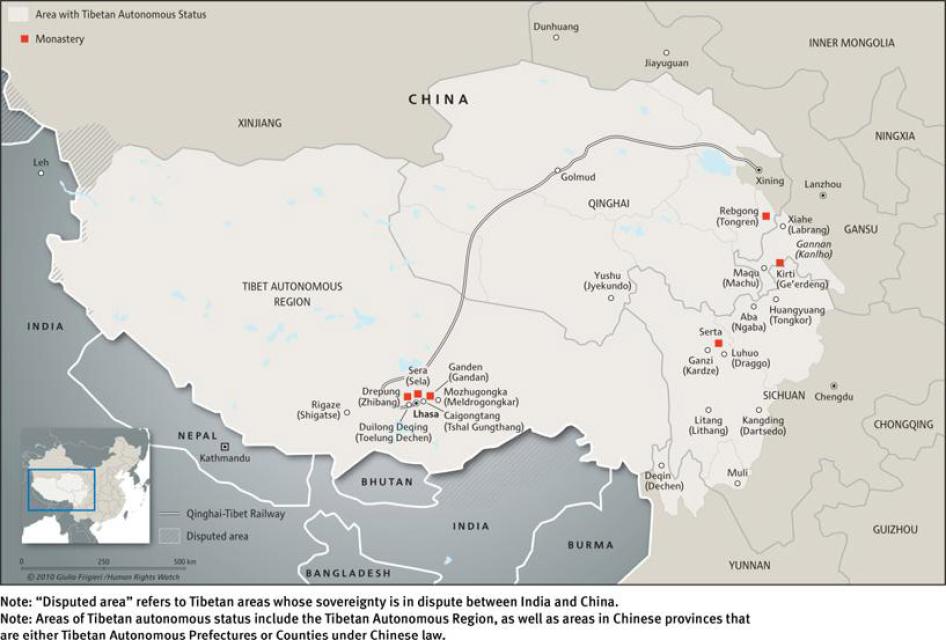
Map: Tibetan Autonomous Areas within the People's Republic of China
I. Summary
More than two years after protests—the largest and most sustained in decades—erupted across the Tibetan plateau in March 2008, the Chinese government has yet to explain
the circumstances that led to dozens of clashes between protesters and police. It has not addressed how its security forces responded to the unrest—including allegedly using lethal force against Tibetan protesters, and abandoning Lhasa’s city-center to protesters and looters for several hours on March 14. Nor has it revealed the fate of hundreds of Tibetans arrested during the protests, or disclosed how many it has detained, sentenced, still holds pending trial, or has sentenced to extrajudicial forms of detention, such as Re-education Through Labor (RTL).
This report, the first comprehensive examination of the crackdown, is based solely on official Chinese sources and eyewitness accounts that Human Rights Watch gathered in more than 200 interviews with Tibetans between March 2008 and April 2010. It finds that the scale of human rights violations related to suppressing the protests was far greater than previously believed, and that Chinese forces broke international law—including prohibitions against disproportionate use of force, torture and arbitrary detention, as well as the right to peaceful assembly—despite government claims to the contrary. It also reveals that violations continue, including disappearances, wrongful convictions and imprisonment, persecution of families, and the targeting people suspected of sympathizing with the protest movement.
Such tactics are unlikely to resolve, and may even aggravate, the longstanding grievances that prompted the protests in the first place, undermining prospects for long-term stability in the region. China urgently needs to investigate the protests and their aftermath, and open the region to media and international monitors. It also needs to examine the conduct of its security forces, which eyewitnesses consistently say used disproportionate force; deliberately brutalized and mistreated Tibetans detained for suspected involvement in the unrest; and deprived detainees of minimum guarantees of due process of law, including formal notification of where, or why, they were held.
China has rejected an independent inquiry into the March 2008 protests and their causes, and has made serious efforts to conceal details of its related security operations. It maintains a heavy security presence in the region, including intense police surveillance, and severely limits domestic and cross-border movement by Tibetans. It also dramatically curtails communication between Tibetans and the rest of the country: those caught trying to pass information about China’s suppression of the protests have been treated as state security offenders and received sentences of up to life in jail.
China has also barred foreigners—including many media organizations—from freely traveling in the region, further preventing investigation into allegations of brutality and abuse. Over the past two-and-a-half years, the government has allowed only a handful of tightly-scripted tours for select foreign media and diplomatic delegations. China has refused to admit UN human rights rapporteurs and—with some rare exceptions—foreign diplomats and, despite a long history of abuses in its detention system, continues to block the International Committee of the Red Cross from visiting its prisons, arguing the government-controlled Chinese Red Cross fulfills this mission. There are no known public Chinese official reports about prison conditions in Tibet.
The commander of the paramilitary People’s Armed Police (PAP) has maintained that security forces acted legally—and that “none of the means … adopted there have exceeded the constitutional rights of the armed forces or international law”—while the Chinese government also insists its forces adhered to international practice when dealing with the protests, exercising “extreme restraint” as they did so.
This characterization seems to be accurate in a few cases when security forces apparently exerted control when they faced large gatherings of Tibetan residents or monks. At times, such groups posed genuine threats to public order, especially in Lhasa on March 14 and in several incidents where protestors targeted official buildings, police stations, vehicles, and Chinese-owned shops. But in most cases there is just too little information about the precise sequence of events to know if protestors became violent only after the police cracked down on peaceful protests or before the security forces intervened. Official accounts and media reports compiled by Human Rights Watch acknowledge specific protests in at least 18 county-level areas in the Tibet Autonomous Region, and Qinghai, Gansu, and Sichuan provinces over two weeks. China’s Xinhua state news agency acknowledges more than 150 incidents between March 10 and March 25. In Lhasa alone, 21 people were killed and several hundred injured during the March 14-15 time period according to government figures.
The Chinese government has a duty to provide public order, thoroughly investigate incidents of violence, and punish perpetrators. But it must do so according to international law, and is obligated to respect basic human rights standards governing the use of force even when dispersing public protests—universal standards laid out in the United Nations Basic Principles on the Use of Force and Firearms by Law Enforcement Officials.
At least two factors complicated the task of maintaining public order for China’s security forces. One is China’s prohibition of all forms of religious or political protests, even if they are peaceful. This meant local authorities could not be flexible in accommodating peaceful assembly and procession, and all gatherings were immediately treated as severe disruptions to social order that had to be suppressed as rapidly as possible.
The second factor is the government’s immediate characterization of the unrest as a conspiracy orchestrated by the Dalai Lama, or (later) by what it refers to as the Dalai “clique,” which threatened the territorial integrity of the People’s Republic of China and warranted a “people’s war” and “life and death struggle.” This instantly raised the stakes, although the Chinese government has not factually substantiated its assertions. Instead, most of its “evidence” regarding such alleged subversion is drawn from the public positions of Tibetan exile organizations and other pro-Tibet groups, which have sought to mobilize popular opinion to end Chinese rule in Tibetan areas, or win Tibetans substantial political autonomy. Such statements and activities are protected under international human rights law, even though Chinese domestic law considers them to be a crime against state security.
Similarly, while the government has attributed the protests to an alleged conspiracy by “hostile foreign forces” it has failed to provide evidence that would cast doubt on the most straightforward explanation for the protests: That Tibetans aimed to express their opposition to Chinese policies that place them at a socio-economic disadvantage, and threaten the survival of their distinctive culture and way of life.
Key Recommendations
To the Government of the People’s Republic of China:
- Release all Tibetan detainees who have not been charged, or who have been detained for exercising their right to peaceful expression.
- Release accurate information about all people detained, released, and formally arrested following protests across the Tibetan plateau, including both the Tibet Autonomous Region (TAR) and the Tibetan Autonomous Prefectures and Counties under the jurisdiction of Qinghai, Sichuan, Gansu and Yunnan provinces.
- Release accurate information about all people killed or injured by security forces.
- Give international monitors, including the International Committee of the Red Cross, access to prisons and places of detentions where Tibetans are held.
- Hold accountable, in a manner consistent with international human rights law, those responsible for using excessive force against unarmed protesters. Support and cooperate with an independent investigation into their actions.
To the United Nations and Foreign Governments:
- Urge the Chinese government to: account for every person detained in connection with the protests; vigorously investigate incidents where security forces used lethal or disproportionate force; put an end to the practice of “disappearances” and unlawful detentions; and discipline or prosecute the perpetrators of abuses.
- Provide full and active support for an investigation into the Tibetan protests carried out under the auspices of the United Nations Office of the High Commissioner for Human Rights.
- Urge the Chinese government to review the official policies and practices that contributed to unrest in Tibetan areas.
More detailed recommendations, as well as more immediate steps the Chinese government and the international community can take, appear at the end of this report.
II. Methodology
China does not allow independent, impartial organizations to freely conduct research or monitor human rights concerns inside Tibetan areas. As a result, obtaining and verifying credible information presents great challenges.
Human Rights Watch interviewed 203 Tibetan refugees and temporary visitors outside China between March 2008 and April 2010. The interviews were conducted by speakers of all three Tibetan regional languages, transcribed, and then translated into English.
The interviews were conducted as soon as possible after the interviewees had left Tibetan areas of People’s Republic of China. In some cases they had already traveled for several weeks. Interviewers used open interviews, in which interviewees were not immediately prompted about whether they had witnessed or experienced abuses but were instead asked to recount their experiences during the protests and their motives for leaving China.
All interviews were extensively checked for consistency and factual accuracy. Except where stated, information from interviews has been used only where it could be corroborated by other interviews or secondary sources, including official Chinese media and government reports. Human Rights Watch believes that the abuses documented here are indicative of larger problems in the areas covered by this report.
To protect their identities, the names of the interviewees have been changed, and the location where they were interviewed has been withheld. However, the interviewee’s place of origin is indicated when possible.
With the exception of Lhasa, the report refers to all place names according to their transcription in Pinyin (Standard Mandarin Romanization), except when quoting directly from interview material, in which case the original appellation given by the interviewee is maintained. In both cases the name is followed by the transcription in the alternate language between brackets, with respectively “Tib.” for Tibetan and “Ch.” for Chinese, the first time the name appears. Example: Aba [Tib. Ngaba]; Kardze [Ch. Ganzi].
Human Rights Watch takes no position regarding the political status of Tibet. The report uses the term “Tibet” to refer to the Tibetan Autonomous Region (TAR) of the PRC and “Tibetan areas” to refer to all officially designated Tibetan areas and areas where the Tibetan population is the largest ethnic group.
No incentives were offered or provided to persons interviewed, and verbal consent was
received from all interview subjects. All participants were informed of the purpose of the
interview, its voluntary nature, and the ways the data would be collected and used.
III. Background
Tibetans living under Chinese rule have a long and documented history of unaddressed grievances. The Chinese government refuses to recognize the validity of virtually all criticisms leveled against state policies in Tibetan areas, and continues to frame all discussions about Tibet as a sovereignty issue, claiming that the country's territorial integrity and inter-ethnic relations are threatened by a secessionist movement supported by “hostile foreign forces.”
The Chinese authorities have also consistently rejected all allegations of human rights abuses in Tibetan areas, claiming they are conspiracies to fan ethnic dissatisfaction against the Communist Party and the government. Authorities stress that Tibetans' rights are fully protected under the law, and point to political, social, and economic development over the past half-century as signs that the human rights of ethnic Tibetans are fully protected.
Despite this long history of grievances, large-scale political unrest involving thousands of Tibetan protestors have been rare in the post-Mao era. The largest, which occurred in Lhasa in 1987-89, were brutally suppressed by the government. In March 1989, the government imposed martial law and arrested thousands of Tibetans suspected of participating in protests, or harboring pro-independence views.[1] This unrest was nonetheless followed in 1993 by a string of protests over economic issues, and the spread of political protest to the countryside.[2]
In 1994, at a meeting called the Third National Forum on Work in Tibet, central Chinese leaders agreed on a program of accelerated economic development, and approved a policy that further curtailed the civil, political and cultural rights of Tibetans. They also introduced new restrictions on religious activities and monastic life. Efforts to curtail the Dalai Lama's political and religious influence intensified, and a “patriotic education campaign” in Tibetan schools and monasteries began.
Tibetans in ChinaSome 5.7 million officially recognized ethnic Tibetans live in China. About 2.6 million live in the Tibet Autonomous Region (TAR), which occupies the Western half of the distinctive geographic area known as the Tibetan plateau. Most of the other 3 million Tibetans live in the eastern part of the plateau, in officially designated “Tibetan Autonomous Prefectures and Counties” under the jurisdiction of the four provinces of Qinghai, Sichuan, Gansu, and Yunnan. Tibetans generally divide the plateau into U-Tsang (roughly the area under the jurisdiction of the TAR), Amdo (the north-eastern part of the plateau), and Kham (the south-eastern part of the plateau). |
Taken together, the new policies appeared intended to eradicate the widespread popular opposition to government policies and encourage migration of ethnic Han Chinese to Tibetan areas.[3] In 1999, the government integrated the economic development of Tibetan areas into the larger national “Western Development drive” (Xibu da kaifa), which led to accelerated exploitation of natural resources and a rapid influx of new ethnic Chinese settlers and migrant workers into the region. In 2005, the Qinghai-Tibet railway to Lhasa was completed, further accelerating this trend. A massive campaign to settle Tibetan herders and forcibly relocate and re-house up to 80 percent of the Tibetan rural population was initiated in the mid-2000s.[4] Economic marginalization of Tibetans, who feared they were becoming strangers in their own land, increased social tensions. The government labeled any criticism of state policies an attempt to encourage “separatist sentiment,” and denied such dissent a public outlet. In fact, the first ever independent Chinese report published in 2009 by a non-governmental legal aid group in Beijing into the causes of the Tibetan protests specifically cited the inability of Tibetans to lawfully raise socio-economic grievances as a root cause of unrest in Tibetan areas the previous year.[5]
Severe, long-standing human rights violations by the Chinese state against Tibetans remain undeniable, irrespective of disputes over the political status of Tibet and the real or imagined motives of the different parties. Sharp statutory restrictions on basic rights and freedoms, religious persecution against the clergy and laity, socio-economic and political discrimination, political prosecutions and torture, and mistreatment of prisoners have all been authoritatively documented over the years, including by inter-governmental bodies such as the United Nations.
In a report issued in December 2008, the UN Committee against Torture referred to “longstanding reports of torture, beatings, shackling and other abusive treatment” of Tibetans and expressed “great concern [about] the reports received on the recent crackdown in the Tibetan Autonomous Region and neighboring Tibetan prefectures and counties in the party, which has deepened a climate of fear and further inhibits accountability:”
These reports follow longstanding reports of torture, beatings, shackling and other abusive treatment, in particular of Tibetan monks and nuns, at the hands of public officials, public security and security, as well as paramilitary and even unofficial personnel at the instigation or with the acquiescence or consent of public officials. Notwithstanding the numbers provided by the party on persons arrested and those sentenced to imprisonment in the aftermath of the March 2008 events in the Tibetan Autonomous Region and neighboring Tibetan prefectures and counties, the Committee regrets the lack of further information on these persons.[6]
Statutory Restrictions on Assembly and ProcessionThe applicable regulations for legally demonstrating in China are contained in the 1989 Law on Assembly, Procession, and Demonstration, and the 1992 implementing regulations. Through a series of restrictive and ambiguous requirements, the law effectively denies Chinese citizens the right to assembly and demonstration as defined under international law:
“[n]o permission shall be granted for an application for an assembly, a procession or a demonstration that involves one of the following circumstances: (1) Opposition to the cardinal principles specified in the Constitution which prohibits deviation from “Marxist ideology, Communist Party of China rule, people's dictatorship and adherence to the Socialist road.” (2) Harming the unity, sovereignty and territorial integrity of the state. (3) Instigation of division among the nationalities. (4) The belief, based on sufficient evidence, that the holding of the assembly, procession or demonstration that is being applied for will directly endanger public security or seriously undermine public order.” The 1992 implementing regulations introduce further administrative requirements for obtaining approval from the law enforcement agencies. In the past 30 years, no Tibetan demonstration has ever been recorded as receiving official approval. Source: Law of the People's Republic of China on Assemblies, Processions and Demonstrations, Adopted at the Tenth Meeting of the Standing Committee of the Seventh National People's Congress, October 31, 1989. |
Forced Confessions: A Nationwide ProblemThe Chinese government has in the past recognized “forced confession” (xingxun bigong) to be a nationwide problem. Criminal suspects in China do not have the right to remain silent to avoid self-incrimination. A 2003 investigation by the Supreme People’s Procuratorate (SPP, the State prosecution) uncovered official abuses, including torture, which had resulted in 460 deaths and serious injuries to 117 people throughout China.[7] The president of the SPC, Jia Chunwang, reported in March 2006 that 930 officials had been investigated for torturing detainees that year, adding the issue “had not been effectively scrutinized and addressed.”[8] In May 2010, the government announced the introduction of new regulation specifying how court evidence obtained under torture could be dismissed. However, the Chinese government has consistently refused to acknowledge even the possibility of any violation having taken place in Tibet, rejecting such allegations as “politicized.”[9] In June 2010, detailed allegations of torture emerged in the case of Karma Samdrup, a prominent Tibetan philanthropist who was tried in what appeared to be a politically-motivated prosecution. In a statement delivered in court, Samdrup alleged that officers repeatedly beat him during several months of interrogation, ordered fellow detainees to also hit him, deprived him of sleep for days on end, and drugged him with a substance that made his eyes and ears bleed—all to extract a confession. His lawyer also contended that several depositions from prosecution witnesses were also coerced. The court refused to exclude the tainted evidence and sentenced Karma Samdrup to 15 years’ imprisonment on June 25, 2010.[10] |
Other UN bodies that have raised concerns about the situation of Tibetans include the United Nations Committee on the Elimination of Racial Discrimination, which recommended that China “carefully consider the root cause” of the incidents in Tibet and Xinjiang, “including inter-ethnic violence, and the reasons why the situation escalated”[11]; the Committee on the Right of the Child; the Committee on the Elimination of Discrimination Against Women; the Committee on the Elimination of all Forms of Discrimination; the Working Group on Arbitrary Detention; the Working Group on Enforced or Involuntary Disappearances; the Special Representative of the Secretary-General on the situation of human rights defenders; and the United Nations special rapporteurs on, respectively, freedom of religion or belief, the Right to Education, and on the Promotion and Protection of the Right to Freedom of Opinion and Expression.[12]
As of today, the number of people arrested, detained, prosecuted and sentenced in relation to the March 2008 protests remains unknown. By the Chinese government's own count, there have been thousands of arrests, and more than 100 trials pushed through the judicial system. Chinese courts in Lhasa have sentenced about 30 Tibetans, of whom two were executed in October 2009 after being accused of causing the death of several people by setting fire to shops where they were hiding. At least 27 Tibetans were sentenced in Gannan Tibetan Autonomous Prefecture, Gansu province, where the largest number of protests was recorded. However, the charges and the trials were so highly politicized that it is impossible to distinguish which cases were justified and which were arbitrary.
Failure to Protect Peaceful Advocacy for Autonomy or IndependenceChinese law does not allow for any form of peaceful advocacy of independence, autonomy or self-determination. Article 103 of the Criminal Law sets forth the crime of “inciting separatism and harming national unity,” which is overtly interpreted by the authorities as precluding any written or oral advocacy of self-determination, including, in the case of Tibet, calls for the return of the Dalai Lama, and displaying the Tibetan flag. Article 103(1) allows penalties of up to life imprisonment or even death for the crime of “organizing, scheming and carrying out activities to split the nation and sabotage national unity.” Article 103(2) permits sentences of over five years, thus up to the statutory maximum of fifteen years for sentences of “fixed term imprisonment,” for “ringleaders" in acts of "incitement to split the nation and sabotage national unity.” |
Several other cases involved people who had passed information about the situation in the region to interlocutors abroad. One was a renowned mountain guide, Gonpo Tserang (Ch. Gongbao Cairang), who was sentenced to three years in prison on state secrets charges for sending text messages that the government said “distorted the facts and true situation regarding social stability in the Tibetan area following the March 14 incident.” An HIV/Aids NGO worker, Wangdu (Ch. Wang Dui), was sentenced to life in prison for communicating with Tibetans in exile. Many other cases have been reported but not confirmed.
IV. Disproportionate Use of Force
None of the means … adopted there have exceeded the constitutional rights of the armed forces or international law.
— Wu Shuangzhan, Commander of the People’s Armed Police, March 16, 2008.
They were firing straight at people. They were coming from the direction of Jiangsu Lu firing at any Tibetans they saw, and many people had been killed.
— Pema Lhakyi, a 24-year -old Lhasa resident.
Witnesses interviewed by Human Rights Watch described circumstances that suggest Chinese security forces used disproportionate force to suppress protesters on many occasions.
Some protests clearly devolved into violence, or had the potential to do so. But international legal standards limit the use of force by states to that which is strictly necessary in order to protect life or to apprehend perpetrators of violent crimes.
Governments are also obligated when dispersing violent protests to respect basic human rights standards governing the use of force. As cited above, the United Nations Basic Principles on the Use of Force and Firearms by Law Enforcement Officials mandate that “Whenever the lawful use of force … is unavoidable, law enforcement officials shall … exercise restraint in such use and act in proportion to the seriousness of the offense.The legitimate objective should be achieved with minimal damage and injury, and preservation of human life respected.”[13] (See below Section V: International Standards.)
The security forces’ most extreme response included opening fire indiscriminately on demonstrators. Substantial evidence, detailed below, indicates that protesters died in at least three such incidents, and unconfirmed reports cite many more incidents that resulted in casualties. The Chinese government has to date acknowledged only one incident that resulted in the death of protesters.
In several protests, witnesses describe security forces deliberately hitting and kicking protesters with batons and rifle butts; systematically punching and kicking subdued protesters as they were arrested or taken away; and beating individual protesters until they remained motionless on the ground. Witnesses to several different incidents reported seeing security forces load inanimate bodies on trucks. These scenes were probably the basis for persistent rumors in Lhasa that security forces had systematically removed Tibetan casualties in order to conceal the use of lethal force on March 14 and 15. According to the Chinese government’s own statistics, security forces have also detained thousands of suspected protesters, monks and nuns, several hundred of whom remain unaccounted for.
The Chinese government has insisted that its response to the protests was consistent with international practice. On March 18, 2008, less than a week after the Lhasa riots, a Foreign Ministry spokesman said the demonstrations had “violated the UN Charter and fundamental norms governing international relations,” and that “not a single responsible government will remain silent or sit back when those violent activities of beating, smashing, robbing and burning take place.”[14] The expression “smashing, looting, beating and burning" (da za qiang rao), which derives from the denunciation of the Red Guards during the Cultural Revolution (1966-1976), is highly ideological and permeates all official accounts of the protests, irrespective of whether they were violent, that took place in Lhasa, or occurred before or after March 14.
Case 1. The Lhasa Unrest, March 10-15
Brutality Against Monks from Sera and Drepung on March 10-13
The sequence of events that led to the violence in Lhasa on March 14 remains unclear and highly disputed.[15] However, eyewitnesses accounts presented below provide some evidence that security agencies used disproportionately lethal force against civilians in at least one sector of Lhasa.
The genesis of the protests on March 14-15 is also firmly established, since authorities had not yet locked down the region and expelled all foreign visitors and journalists. On March 10, 11, and 12, Tibetan monks from monasteries around Lhasa led a string of small-scale protests that led to a sudden breakdown of public order in Lhasa itself on March 14. After state media broadcast accounts of the disturbances, and news of the unrest spread through the Tibetan community, the protests spiraled into the most extensive episode of regional unrest witnessed in five decades.
China’s Security Forces in TibetSecurity forces from four different agencies were deployed to quell the protests in Tibetan-inhabited areas. Those agencies include: - The People’s Armed Police (PAP), a paramilitary force whose chief role is to “safeguard domestic security” and maintain public order. PAP forces have been the primary force in charge of suppressing protests and controlling roads, government facilities, and monasteries. PAP forces have organization and rank structures similar to the People’s Liberation Army (PLA), and are under the dual authority of the public security and the military. They wear uniforms similar to those of the PLA, with whom they are often confused. - The Public Security Bureau (PSB), the main police authority in China, with responsibilities for day-to-day law enforcement. The PSB’s responsibilities include the “prevention, suppression and investigations of criminal activities; maintenance of social security and order; fight against behaviors jeopardizing social order; administration of [the] household registration [system], identification cards, exit-and-entry, stay and travel of foreigners in China; maintenance of border security; management of gatherings, parades and demonstrations…” - The People’s Liberation Army (PLA), the armed forces of the People’s Republic of China. The government denies that the PLA played a direct role in quelling Tibetan protests in 2008, but acknowledges that it “assisted” the security operations. - The People’s Militia, a mixed professional-civilian institution whose mission is to assist in maintaining public order. It is under the command of military organs, the PLA and the Party’s Central Military Commission. Adapted from Dennis J. Blasko, The Chinese Army Today: Tradition and Transformation for the 21st Century, (London: Routledge, 2006), pp.18-19. |
The government has not acknowledged the scale of the protests. The most authoritative statement remains an article by China’s Xinhua state news agency, which reported on April 2, 2008, that over 150 incidents had taken place between March 10 and March 25 in the Tibetan areas of Qinghai, Gansu, and Sichuan provinces, and the Tibet Autonomous Region.[16] Official accounts and media reports compiled by Human Rights Watch acknowledge specific protests in at least 18 county-level areas situated in the prefectures of Changdu [Tibetan: Chamdo], Aba [Tib. Ngaba], Ganzi [Tib. Kardze], Gannan [Tib. Ganlho] and Guoluo [Tib. Golog] in the Tibet Autonomous Region, and Qinghai, Gansu, and Sichuan provinces.[17]
Eyewitnesses reported that police brutality began with the first incident on March 10, and said that this triggered the subsequent protests. At around 5 p.m. a group of monks from the Sera monastery began a small-scale protest in front of central Lhasa’s Jokhang Temple [Ch. Dazhaosi]. Police broke up the protest, hitting protesters with batons and arresting every member of the group. According to Ngawang Richen, a 26-year-old resident originally from Ganzi who witnessed the scene:
There were around 10 monks and 20 to 30 ordinary people, and they shouted slogans. Within minutes, many police arrived and started arresting all of them. A monk began bleeding from the head but the police kept hitting them with electrical batons. I fainted at that point.[18]
At least one official report, published on March 25, confirms that an incident took place in front of the Jokhang Temple that day. According to this report, police arrested 15 monks for participating in “a disturbance” in which the monks “shouted reactionary slogans and brandished the [Tibetan] Snow Lion flag.”[19] The report identified a monk whose Chinese name is Luozhui (probably Lodrup or Lodrul in Tibetan) as the “ringleader” of the protest.[20] Thirteen of the fifteen monks arrested were later prosecuted. Their whereabouts remain unknown. There are no suggestions—either according to eyewitnesses or the official account—that these protestors were violent.
Witnesses described another incident that day when police did not use disproportionate force but blocked and arrested demonstrators in order to enforce the ban on religious demonstrations. Around midday on March 10, 300 to 400 monks from Drepung monastery started a peaceful march toward the city center to press for greater religious freedom. According to eyewitness accounts armed security forces quickly arrived and blocked protesters, leading to a stand-off with monks who sat in the road for several hours. Although the authorities said that the monks “were later persuaded to leave in peace” and that “no disturbance to social stability was caused,” witnesses recounted that monks who initially tried to go through the police lines were thrown to the ground, kicked, and taken away.[21] Up to 60 monks were arrested during the day.
The next day, March 11, several hundred monks from Sera monastery attempted to stage a protest to demand the release of the monks arrested the day before. Around 3 p.m., the monks started to leave the monastery compound and assemble outside, shouting slogans as they went. Plain-clothes and uniformed security personnel stationed in the monastery tried to prevent them from leaving by physically obstructing the monks, and then kicking and punching them as they tried to pass through the doors. A traveler who witnessed the scene told the BBC:
There were four or five [policemen] in uniform and another 10 or 15 in regular clothing. They were grabbing monks, kicking and beating them. One monk was kicked in the stomach right in front of us and then beaten on the ground. The monks were not attacking the soldiers, there was no melee. They were heading out in a stream, it was a very clear path, and the police were attacking them at the sides.[22]
Police stopped the demonstrating monks a few hundred meters from the monastery, and the monks staged a sit-down. “The monks were sitting in neat rows on the ground, surrounded by a phalanx of police,” the witness told the BBC.[23] Several hours later, armed reinforcements arrived and police moved in to end the protest. According to a witness interviewed by Radio Free Asia Tibetan’s service:
There were probably a couple of thousand armed police, Public Security personnel, wearing different uniforms. Police fired tear gas into the crowd.[24]
At around 9:30 p.m., the monks were forced to return to their monastery.
Similar incidents took place the next day in Ganden monastery and Chubsang nunnery, West of Lhasa, when hundreds of monks and nuns tried to march to Lhasa to protest the security presence. Police surrounded them, forced them back into their respective monastery or nunnery, and sealed off the area, according to accounts later provided by some participants. There are no known official reports of these incidents.
Ethnic Violence and Shootings of Protesters, March 14-15
Tensions came to a head on March 14. Around 11 a.m., a group of monks at Ramoche, a small temple in the heart of Lhasa, gathered inside their compound ahead of an intended march to protest the previous days’ detention of monks from Sera and Drepung monasteries. Police stopped them at the door of the compound, and, following a minor confrontation in which both sides pushed and shoved each other, barred the monks from leaving. Tibetans watching from neighboring buildings could see the commotion, and people began to congregate outside the compound. A few bystanders began attacking police and their vehicles, quickly outnumbering a small reinforcement of riot police who could not disperse them.
Amateur footage of the incident that local residents and tourists shot shows members of the public throwing stones at police and overturning their vehicles. Riot police withdrew to a nearby street, where protestors continued to pelt them with stones from a distance. Security forces ultimately withdrew from the area. Despite massive reinforcements on the outskirts of Lhasa, they abandoned the city center to protesters for the rest of the day. The ranks of Tibetan protesters swelled, and some small groups started to attack Chinese shops situated in downtown Lhasa and the Barkor area, near the Jokhang Temple. Rioters set some thousand Chinese-owned shops on fire, and attacked passers-by who they suspected to be Chinese. According to The Economist's correspondent James Miles, one of only two accredited foreign journalists in Lhasa at the time:
Almost every [Chinese or Chinese Muslim] business was either burned, looted, destroyed, smashed into, the property therein hauled out into the streets, piled up, burned. It was an extraordinary outpouring of ethnic violence of a most unpleasant nature to watch, which surprised some Tibetans watching it.[25]
Five Chinese civilians and a Tibetan burned to death after rioters set ablaze the shops in which they were hiding, and a policeman and six other civilians died from beatings or unknown causes, according to the Chinese government.[26] Five more Chinese civilians died from being trapped in a burning shop in a separate protest in the nearby town of Dechen the following day. The Chinese government accounts treat the incidents as all being “the Lhasa riot.”
After several hours, security forces moved in to establish a cordon around the downtown area, but again stood back for several hours and during this period did not try to stop small groups of protesters from looting, and setting fire to buildings, vehicles and Chinese goods seized from ransacked shops.[27]
The Chinese authorities have given conflicting messages about whether security forces used live ammunition. At a March 17 press conference in Beijing, TAR Government Chairman Qiangba Puncog denied that security forces were even carrying guns:
Our public security officers and armed policemen showed great restraint and performed their duty in accordance with the law and in a civilized manner. None of them carried or used any lethal weapon in the process.[28]
Yet pictures and footage broadcast by state media showed large numbers of fully-armed troops on March 14, and Xinhua state news agency acknowledged that police had fired “warning shots,” even though they “had been ordered not to use force against the attacker.”[29]
Testimonies from participants and witnesses challenge this version. Several witnesses told Human Rights Watch that security forces used lethal force to disperse demonstrators on separate occasions, including one incident in southern Lhasa, at the entrance to the south Barkor on Jiangsu road, known in Tibetan as the Southern Lingkor Road. The situation in this area remains unclear, but according to the Chinese government, Tibetan protestors had been engaged in looting, arson, and violence against Chinese-looking civilians.
One Tibetan protester, Pema Lhakyi, who was near the Barkor Square told Human Rights Watch that troops had shot protestors as they moved into position around downtown Lhasa on March 14. She said:
The soldiers did not come until afternoon that day. We could shout and protest as much as we wanted. It felt good. When the soldiers showed up later, they threw tear gas. A gas canister hit my leg and I couldn’t walk any more. Then there was indiscriminate shooting and we saw two people shot dead in front of us. One died in the doorway of the Mentsikhang (the outpatient department of the Tibetan hospital). The bullet hit him on the right side in the kidney area. We banged so hard on the door of the Mentsikhang. That day the hospitals had been ordered not to help anyone. The other died in the doorway of the Pudap Dzong restaurant. Both of those killed were young men of about 25-26. Their clothes were soaked in blood.[30]
Lhakyi also recounted that other protesters had told her the police had also fired on protestors as they moved to take a position south of the downtown area:
They were firing straight at people. They were coming from the direction of Jiangsu Lu firing at any Tibetans they saw, and many people had been killed.[31]
According to another Lhasa resident, who witnessed the same events on March 14:
I did not personally see anyone get killed, but my friend saw 12 people killed near the gate of Rigsum Gonpo Temple in the south of the old city on the afternoon of March 14.[32] It is very dangerous to tell the name of my friend because she is still in Tibet.[33]
Information received by Human Rights Watch indicates that one fatality that afternoon was a 21-year-old man, Lhakpa Tsering. He reportedly stepped out of his family’s courtyard house with another man to view the situation, which appeared calmer. According to residents from the same compound:
All of a sudden a Chinese police vehicle rushed down the road. They were shooting from the vehicle and he was struck by a bullet as he stood against the wall. His companion dragged him inside a neighboring house, but he died almost immediately.[34]
Police showed up shortly afterwards, and took away the body despite the parents’ opposition. One Tibetan policeman reportedly told the family that the military and police would take Lhakpa’s body by force if they did not hand it over voluntarily.[35]
Other reports suggest that several injured Tibetans were taken to the hospital on East Beijing road. One Lhasa resident told Radio Free Asia’s Tibetan language service:
My sister told me that she had seen nine bodies in the area of Luphuk [ed.’s note: just north of Jiangsu road, in the southern part of the Tibetan quarter]. I myself saw a Tibetan woman and a man lying dead in Ani Tsamkung clinic, north of the Southern Lingkor, very close to Rigsum Gonpo Temple. When I arrived at the Lhasa City People’s Hospital, I saw three Tibetans brought in. One was Tenzin Norbu from Pelbar county (Changdu prefecture of the TAR)…. He had been shot in the head, and the hospital suggested he go to the TAR People’s Hospital. He was vomiting and may not have survived. He was very young—about 21 or 22—and according to his sister was a student in a school just below Sera monastery. Another youth was also shot in the head. He was bleeding heavily, and there was little hope for his survival. Another Tibetan youth had been hit in the hip and had about four bullet wounds.[36]
Concealment of Hospital Reports
All efforts by human rights organizations and international media to interview hospital personnel in the weeks and months following the unrest were unsuccessful, making it impossible to confirm eyewitness accounts. Hospital authorities and security forces warned Tibetan doctors and medical personnel that they risked arrest if they passed information about patients and casualties to outsiders.
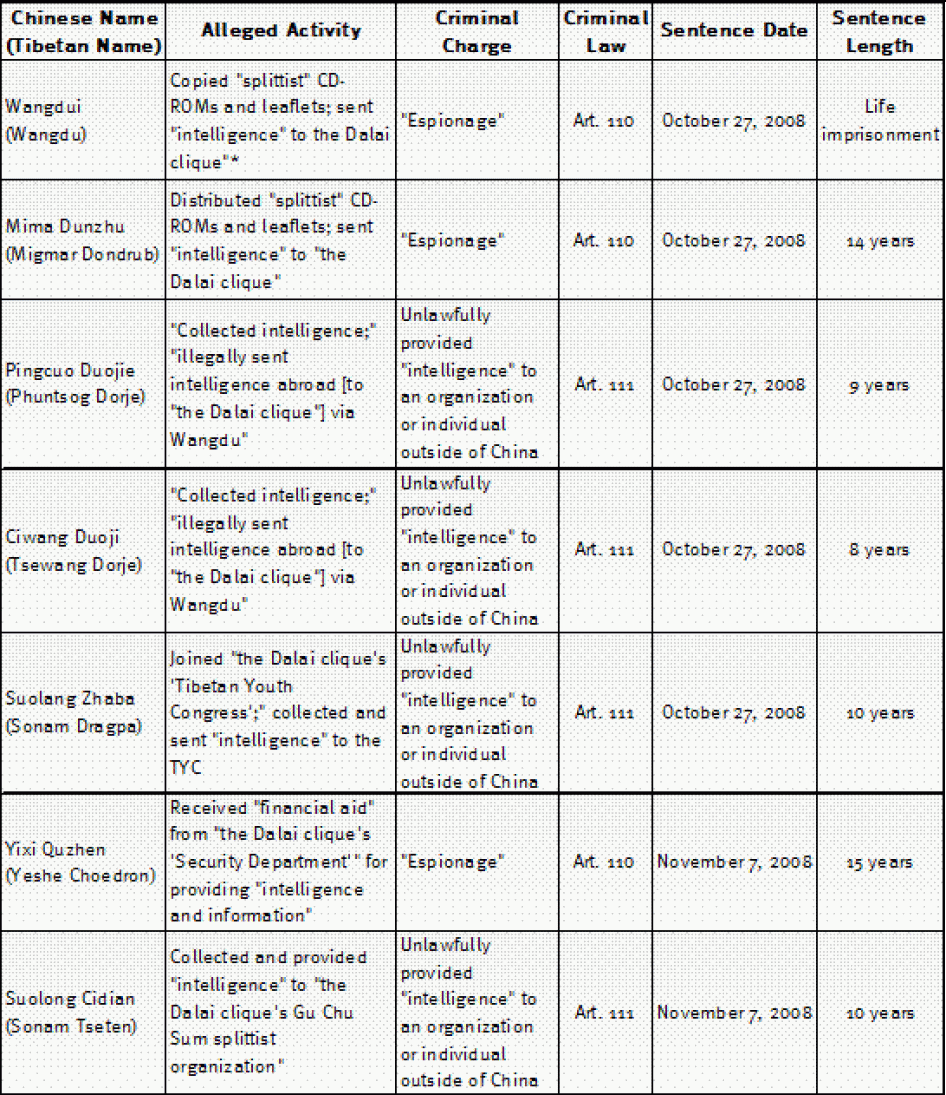
There are two known cases of Tibetans arrested for disregarding these instructions. On November 7, 2008, the Lhasa Intermediate People’s Court sentenced a retired doctor, Yeshe Choedron [Ch. Yixi Quzhen], to 15 years imprisonment on “espionage” charges for having passed “intelligence and information endangering national security” related to the crackdown to the Tibetan government in exile (See box “Tibetans sentenced for reporting the situation in Lhasa”).[37]
Human Rights Watch also received one unconfirmed report about the arrest in early May 2008 of a retired Tibetan doctor who had worked at Lhasa People’s Hospital and her husband. According to the report, local police and security forces took Dr. Yangdzom, 50, and her husband, Shilog, 62, from their home on suspicion that she used hospital medicines to treat injured Tibetan protestors in hiding. Authorities also accused Shilog of aiding protestors at a hospital. Security officials took Shilog to Lhasa PSB Detention Center. Their whereabouts are still unknown.[38]
Brutality and Disappearances During the “Search and Arrest” Period
During the night of March 14-15, security forces progressively regained control of the entire city, carrying out a massive search and arrest campaign by conducting door-to-door checks and detaining large numbers of Tibetans. The Lhasa authorities warned people against sheltering protesters, and called for protesters to turn themselves in before midnight, stating, “Those who surrender and provide information on other lawbreakers will be exempt from punishment, those who cover up or shelter the lawbreakers would be punished in accordance with the law.”[39] All residents were instructed to stay indoors. Foreign tourists and local residents reported hearing motorized troops movements, gunshots, and explosions. They were progressively expelled from the city during the week together with foreign journalists, leaving few independent witnesses.[40] The government started dispatching large numbers of troops from neighboring provinces, and sent squads of PAP soldiers armed with automatic weapons to patrol Lhasa’s streets and checkpoints.[41]
Immediately after the March 14 violence, Zhang Qingli, the Party Secretary of Tibet, urged the “quick arrest, quick hearing and quick sentencing” of rioters.[42]
Tibetans in Lhasa who called relatives in India and Nepal reported seeing troops break into homes, and take away male residents in military trucks.[43] Lhasa residents were typically asked to produce personal identity documents and city municipality residency permits, account for absent family members, identify anyone in the house, and guarantee they had not participated in protests. Some residents claim that troops at times used brutality to intimidate Tibetans, and conducted some arrests at gunpoint.[44]
Tibetans Sentenced for Reporting the Situation in Lhasa
Source: Lhasa Evening News, November 8, 2008. Table reproduced from “Lhasa Court Sentences Tibetans for Sharing Information With ‘The Dalai Clique,’” Congressional-Executive Commission on China, Feb. 3, 2009, http://www.cecc.gov/pages/virtualAcad/index.phpd?showsingle=115942. |
These sweeps continued for some days. One such sweep on March 17 resulted in the death of a 32-year-old monk called Tsondru, who fell from a building during his arrest. According to a Lhasa resident in her 40s, whose relative was arrested at the same time:
My relative, who is 40 years old, was arrested in his house in the Meru Neighborhood Committee compound, in the Tibetan quarter, and taken to a detention center at the Peding military base in Taktse [Ch. Dagze] County near Lhasa. The monk, Tsondru, was thrown from the upper storey of the Neighborhood Committee’s building at the time of his arrest. He died from his injuries in the police vehicle on the way to the detention center.[45]
Another witness, Tenzin Drolkar, told Human Rights Watch that her family had sheltered a 28-year-old Tibetan woman named Lokha (or Loga,) who had been shot by security forces:
On the morning of the 15th we left our house, even though there were reports of shootings. From the rooftops you could see soldiers advancing with guns raised. We found a wounded girl in the street and took her home. She had been shot in the lower back … We called a doctor we know, and his mother persuaded him that he must help fellow Tibetans in need, and he removed the bullet and stitched the wound … [46]
Tenzin Drolkar told Human Rights Watch that she decided to hide the young woman until she was fit enough to leave, despite authorities warning against sheltering “rioters,” and security forces searching the neighborhood for fugitives.
We could not go outside for the next week, not even to buy vegetables. We had that girl in our place. There was a government order saying that anyone harboring people with bullet wounds would be arrested. They said two people with bullet wounds were arrested in the courtyard on the far side of ours. I don’t know their names, but they were both males. Then someone we know sent a message to warn us. We found a way to get her out. Soldiers came to our place that night. About 50 police and soldiers came into our courtyard, and more than 20 of them went inside peoples’ houses. Anyone without an ID card was taken away.[47]
The government has denied that security forces caused the death of any suspect during the arrests that followed the violence. None of the 21 reported deaths in Lhasa on March 14 is attributed to security forces.[48] However a transcript of an interview given by the vice-chairman of the Tibet Autonomous Region to the Hong Kong Chinese-language broadcaster Phoenix TV on March 27, 2008, shows him acknowledging the death of three protesters:
I can inform you that, until now, three law-breakers have died. Some tried to jump off a building during their arrest and died after arriving at the hospital.[49]
The government has offered no explanation for the discrepancies in the different statements, and has not conducted any public investigation into the incident.
Case 2: Shooting in Aba [Tib. Ngaba], March 16, 2008
As protests spread throughout the Tibetan plateau, security forces acknowledged that they had opened fire in at least two other incidents elsewhere.
The first took place on March 16, near the Kirti monastery in Aba prefecture (Sichuan province), when People’s Armed Police (PAP) forces prevented monks from entering the city to protest massive security deployment. The following day, hundreds of residents protested those restrictions, as well as the arrest of several monks.
Arrests and Detention in Tongren [Tib. Rebgong],Qinghai Province, March 16The violence by security forces against protesters was not limited to Lhasa. One eyewitness recalls soldiers and police in Tongren [Tib. Rebgong], Qinghai province, beating protesters on March 16 with electric batons as they took them away in police trucks. One man was beaten so severely that security personnel had to send him to an emergency hospital in the provincial capital. The witness, a 55-year-old former monk whose testimony is cited below, was beaten along with a friend when they tried to intercede: The first anti-government protest was on March 16, 2008. Around 11 a.m., some friends arrived at my home saying that a large crowd of monks and laypeople had gathered at the gate of the government compound and were severely beaten by police. Many of us rushed over there. The first thing I saw was a lot of soldiers and police beating the crowd with electric batons. Groups of four or five soldiers were arresting crowd members one by one and putting them in a truck. There was a stationary police vehicle with a loud siren blaring. A youth pelted the vehicle with stones, and the police grabbed him, and started to beat him mercilessly. Then they put him in the vehicle and took him away.[50] The witness also described soldiers beating an elderly man in his sixties who continued to shout slogans after he had already been loaded in a truck: From inside the truck he kept shouting “May His Holiness the Dalai Lama live for 10,000 years!” and “Tibet is independent!”, and for this, five or six soldiers threw him to the ground and beat him so severely that he seemed close to death. He was immediately taken to [the provincial capital] Xining in an emergency vehicle.[51] Security forces beat those who tried to intercede, even if they were elderly: Alak Kasotsang, the eldest and most senior Lama in Rebgong, arrived to address the crowd of monks and ordinary people. The police and army beat him too. Tsunthar Gyal, a 72-year-old elder, and I could not bear to see the soldiers beating monks and went to restrain them. We thought it would be better if we elders intervened. But incredibly they beat us too, and put us in a car and took us to a public security prison two kilometers from town. There were over 50 people there that day. The two of us were released at 6 p.m. that evening … The relatives of those more than 50 detainees who had good connections with ranking officials were able to get them out after four or five days. Those without connections and monks from other areas were held there for a month, and the monks from elsewhere were then handed over to their local police. Three or four of the monks released at that time were subsequently re-arrested. People said they had been to India in the past.[52] This was confirmed by another witness, whose account was recorded clandestinely in China by a foreign journalist: Some monks and laymen were arrested and put in four army trucks. At that point Alak Kasotsang, some senior clergy and others came between [the security forces and the protesters] but were all immediately arrested. They were beaten severely and taken to the main prison of the Malho prefecture. Many detainees were injured on their hands, heads and backs, especially those whom the soldiers kicked with their rifle butts or police batons. Alak Khasutsang was injured too: his right knee and arm were broken, and his head was injured and needed seven stitches. He had many hematomas on the back. He is 80 years old.[53] A month later, a police official in Tongren confirmed to the New York Times that there had been detentions following “unrest,” but said that half of those detained had since been released.[54] |
Several Aba residents said that security forces opened fire on demonstrators after some protestors threw stones and set fire to several government properties, which were apparently empty of personnel. The first report to surface was an interview that Radio Free Asia aired the day of the shooting:
Four Tibetans were killed by gunfire while they were marching near Kirti monastery … Then a little later, another three were killed. They were shot from a distance. Before they were shot, the protesters had smashed the windows at two police posts … There looked like 5,000 to 6,000 protesters.... The names of the three people killed later are Tsezin, Norbu, and Lobsang Tashi.[55]
A 22-year-old monk told Human Rights Watch about a separate incident he witnessed when police shot at a crowd of protesters as they tried to free about 30 people who security forces were holding in a courthouse next to the police station.
Everyone scattered when they started firing. I went into hiding immediately—a relative who works in the police department warned my father that I had been filmed participating in the protest. I hid in the mountains for five [to] six months.[56]
On March 20, Tibetan organizations abroad released a series of pictures that they claimed showed protestors shot dead by security forces on March 16. The next day, the government for the first time admitted that security forces had shot four protesters in Aba five days earlier in what it described as “self-defense.”[57] The initial Xinhua dispatch on March 21—citing police sources in Aba—reported that police had “shot dead four rioters “in self-defense.”[58] However, it was quickly amended the same day to say the protestors had only been “wounded,” and that “the injured attackers” had “ran away with other mobsters amid the chaos.”[59] Xinhua did not explain the modifications in its dispatch.
One witness interviewed by Human Rights Watch, as well as several press accounts citing local residents, confirmed that protestors were killed. Later on March 16, relatives of those killed brought their bodies to the Kirti monastery.[60] One interviewee gave Human Rights Watch the following account about one 26-year-old victim named Tashi:
It is impossible to know the number of deaths, but I know of one personally: my neighbor’s son. His name was Tashi, the son of Tseduk and Yokri, who are about 50 and 40 years old respectively. Tashi was 26 years old, and a former monk. His body was brought on March 16 by members of the public [after he was shot], including some of his close friends. Later a group of students from the secondary Tibetan school in Ngaba County came to Tashi’s home and took an oath to follow his example. After that they went back to the township to protest. Some of these students were killed on the way … Many of their bodies were taken to Kirti monastery, and monks gathered and prayed for them.[61]
Heavily armed troops sealed off all monasteries in the area, and cut communications, including mobile phone and internet access. Two weeks later, they launched massive sweeps and arrested several hundred monks. The security forces confiscated mobile phones and computers in an apparent effort to suppress evidence of the March 16 violence. “The next day, the town looked green with soldiers,” a witness told the New York Times later that month.[62] “Every day, helicopters hover over the city.”[63] The government has so far refused to conduct a public investigation into the Aba shootings.
Case 3: Shooting in Donggu [Tongkor monastery], April 4, 2008
The second incident in which the government acknowledges that security forces opened fire with live ammunition—although only to fire “warning shots”—took place near the Tongkor monastery [Ch. Donggu si], 60 kilometers from Kardze county [Ch. Ganzi] in western Sichuan. According to multiple eyewitness accounts, several hundred monks and civilians went to protest in front of the Tongren [Tib. Tongkor] township government after security forces raided the monastery and took away two monks, including a widely respected 74-year-old monk named Tsultrim Tenzin [Ch. Cicheng Danzeng].
After a standoff between the police and the protesters, the security forces opened fire on the crowd. A 27-year-old monk from Tongren told Human Rights Watch that soldiers and local police had been photographing protestors, warning they would shoot anyone who approached the Tongren township government building:
About three hours after we started the protest, around 8 p.m., it was getting dark and we approached the building shouting slogans. Suddenly hundreds of soldiers appeared from behind the building toward us. We were just shouting slogans. No one threw stones or carried [weapons like] knives or sticks. We were just having a peaceful demonstration. Then I heard repeated gunfire and protestors started to flee. Some people behind me said it was firecrackers. I was in front. I looked at the soldiers and saw they were shooting into the crowd. There was absolute chaos as the crowd scattered. In a few minutes, some people had been shot dead and many more injured. I saw some people lying on the ground and some being carried by friends. Soldiers arrested all those who were left behind or could not run away.[64]
One Tibetan who participated in the protest alleged that security forces shot indiscriminately, and continued to do so even though the crowd was running away, leaving many people seriously injured:
[A man called] Delek, 45 years old, from Sog [Ch. Suo] Thongda village in Tongkor, was shot in the head. He was with his nephew at the protest. The nephew carried him on his back and tried to take his body home with the help of other Tibetans. But soldiers chased them and kept shooting, so the nephew had to run for his life and left Delek’s body behind in the field.[65]
Security personnel reportedly handed over Phurbu Delek’s body to his family the next day. According to Radio Free Asia, in addition to Delek, 10 people were killed in the shooting, including Samten, 27, Lobsang Rinchen, in his 20s, and Zunde, all monks; six women identified as Sangmo, 34, Tenlo, 32, Tsering Yangzom, Tseyang Kyi, 23, Druklo Tso, 34, and Tsering Lhamo; and a young boy. The other victims could not immediately be identified. Two other monks were described as “seriously injured.”[66]
The monk from Tongkor monastery that Human Rights Watch interviewed could only confirm the death of one other person aside from Delek: Tseyang Kyi, a 23-year-old woman from Dza-ngan village in Tongkor county.
She was shot by a single bullet in the head. Local people managed to take her body home to the village, which is about five kilometers from Tongkor monastery.[67]
Radio Free Asia and the Times of London reported the incident on April 4 and April 5 respectively, after being contacted by local residents.[68] The state-run Xinhua news agency confirmed shortly afterwards that police resorted to force after a government official was injured, but insisted that only “warning shots” had been fired because “people were in great danger.”[69] An official with the prefecture government added that local officials had “exercised restraint during the riot and repeatedly told the rioters to abide by the law.”[70]
After the clash, dozens of monks and protesters escaped into the nearby mountains, while authorities launched a massive security operation to arrest those who had participated in the protest.[71]
Tibetans interviewed for this report described several other incidents when security fired live ammunition. Official reports in local government publications acknowledge that several incidents took place in the area, but do not indicate that security forces used live ammunition, in contrast with the incidents in Lhasa, Aba, and Tongkor.[72]
Case 4: Other Shootings in Ganzi [Tib. Kardze] Prefecture
Some of the most violent confrontations took place in several places in Ganzi [Tib. Kardze] Tibetan Autonomous Prefecture, in western Sichuan province.
In official accounts, the Chinese government claimed that protesters “violently attacked officers carrying out their duties” in Serta [Tib. Serta], Luhuo [Tib. Draggo] and “other counties.”[73] A communiqué from the Ganzi government published on March 31 said that:
A small number of lawbreakers assembled illegally, openly shouted reactionary slogans, posted posters and distributed leaflets in favor of “Tibet Independence,” and hung the [Tibetan] Snow Lion flag. They attacked the local party organs, and carried out violent surprise attacks against the People’s Armed Police, and political and legal officials carrying out their duties according to law.[74]
One monk told Human Rights Watch about an incident that took place on March 17, 2008, in Jiaxue [Tib. Tsership], a small village on the road from the Serta monastery in Kardze prefecture. On March 16, “100 or so local people shouting slogans, pulled down the Chinese national flag on the township government building and raised a white flag. The county police could not get there to stop it, simply because the place is 93 kilometers from the county town.”[75] The security forces arrived the next day:
On March 17, over 300 police and soldiers came from the county. Over 200 local people gathered, and when the soldiers went to remove the white flag, they crowded into the government compound to stop the soldiers from doing so. At first, the soldiers fired in front of the crowd a few times to scare them, but the crowd thought they would not dare to actually fire and continued crowding inside the compound. At that point, the soldiers started to fire on the crowd and hit some 18 people.[76]
At least one protester, a 21-year-old man called Ngodrup Dorje, from Tsership village was killed. Several others were injured, many in the lower body. Among those who survived after being shot were Yungdrung, 35, and Tsepal 26, of Taship village.[77]
After the incident in Tsership, security forces sealed off the area where the alleged shooting had occurred for several months, making verification impossible:
A force of probably over 400 soldiers came and set up camp in the township. They did daily patrols around the villages in groups of ten, carrying guns. For the next three months or so, no one could take the road to the county town, either by car or by foot.[78]
A second confirmed incident in Kardze prefecture took place in Luhuo [Tib. Draggo] county on March 24. However, the government has suppressed information about what took place there, raising significant questions about the proportionality of the response by security forces to the protest.
A monk from that area who had participated in the protest told Human Rights Watch that about a hundred nuns from the nearby Ngang-khong nunnery had begun marching the five kilometers to the government headquarters in Tehor Township, shouting slogans such as “Long Live the Dalai Lama,” “Tibet belongs to Tibetans,” and calling for the Dalai Lama’s return. Monks from Palden Choekri monastery and several hundred Tibetans from surrounding villages joined them: “There must have been over 300 laymen and women, mostly from our village and Joro monastery.”[79]
The nuns left after a while, but the other protesters continued to demonstrate in front of the government building:
The nuns protested around 4 p.m. and we protested probably around 6 p.m., but I don’t know the time exactly. There were many soldiers, police and plain clothes police…. First they started beating the protesters. Then they used tear gas shells. People began running away because of the gas. Then they started firing.[80]
Several people were hit. One monk, Kunga, who was about 21-years-old and from Joro monastery was apparently killed on the spot:
He was shot twice in the chest. My uncle, another monk and I carried him towards the monastery. Many people gathered around. He died there. We took his body to the monastery, but police later came and took it away. My uncle, Tsewang Dhondup, sustained two gun wounds, one in the elbow and one in the back. People said about 10 other people were wounded.”[81]
Tsewang Dondrup, 38, fled into hiding, helped by a relative, Lobsang Thupten, 31. They reached Dharamsala, India, in May 2009, where they gave a press conference at which Dondrup publicly showed the two bullet wounds that he said he sustained while trying to save Kunga’s life.[82]
According to a rare official mention of the protest, a “frenzied mob” consisting of around 70 nuns from Maju nunnery, threw “big stones” at the security forces protecting the government building, hitting an 18-year-old member of the People’s Armed Police named Hun Guochuan in the head. He later died.[83]
Security forces surrounded the entire area following the incident, cut telephone lines, and arrested a large number of nuns, monks, and villagers. Police also visited some Tibetan houses and told inhabitants not to publicly mourn those who had died in earlier clashes, or to post the Dalai Lama’s picture. There were clashes and many people beaten as they were arrested.[84]
The authorities posted fugitive notices in public places featuring the names, pictures and details of three men who they wanted in connection with the PAP soldier’s death, including Tsewang Dhondup. In April 2008, one man and six nuns from the Ngang-khong nunnery were sentenced in closed-door trials for their role in the Luhuo protest.[85] On April 23, two nuns from the same nunnery who went to protest at the administrative seat of Ganzi prefecture were arrested.[86]
Tibetan organizations abroad say they have received a large number of reports of other shooting incidents across Tibet, and have at different times published lists of reported casualties.[87] Most of this information has not been independently confirmed. It is also sometimes ambiguous, and has, in some cases, been specifically refuted by the Chinese government. However, the information is detailed enough in some instances that an independent investigation could easily check its veracity were the Chinese government to allow it, rather than branding attempts to pass information to relatives abroad, international NGOs and foreign media as state security offenses. [88]
V. Brutalization and Mistreatment of Detainees
Effective measures shall be taken to prohibit such acts as corporal punishment, abuse, insult of detainees or the extraction of confessions by torture.
—National Human Rights Action Plan of China (2009-2010) Information Office of the State Council of the People's Republic of China.
We endured such torture. Now our main hope is that the international media and the United Nations' investigators come to Tibet and check on the real situation and then report on it after they assess their findings. This is our main hope.
—Jigme Gyatso, a senior monk from Labrang monastery, September 2008.
Chinese security forces subjected protestors and those suspected of subversive activity to ill-treatment and brutality during arrests. These included large scale round-ups, and raids on monasteries in which rooms were ransacked at gunpoint, and monks beaten and handcuffed, sometimes with wire rope. Abuses continued in a range of detention facilities, where a number of former detainees and relatives of people arrested say that detainees endured torture and mistreatment—including food deprivation and unsanitary conditions—in order to extract confessions and glean information.
Arrests and Detention
In most cases that Human Rights Watch examined from 2008, authorities responded immediately after a protest by sealing off the targeted areas, deploying large numbers of troops, severing communications, calling on demonstrators to turn themselves in, and arresting and detaining large numbers of suspected protesters. Authorities were urged on April 9, 2008, to ensure that “monks can’t go out of their monasteries and that people can’t go out of their villages.”[89]
People’s Armed Police (PAP) carried out many of the arrests, often acting in a manner more consistent with military operations than conducting criminal investigations or safeguarding public order, which in many cases had been restored. State media and top leaders who appeared in local and national television and radio broadcasts described individual incidents as battlefronts in the “fight against separatism.” They called on security forces to “smash,” “destroy,” and/or “severely punish” those who had committed “smashing, looting, beating and burning violent criminal activities.”[90]
The government acknowledged detaining over 900 suspected protestors in Lhasa, over 2,000 protestors in Gannan prefecture, and almost 400 protestors in Aba, among other areas.[91] But its claim that most detentions resulted from “voluntary surrenders” should not be understood as meaning these people turned themselves in of their own will, as under Chinese law this term can be applied to a suspect that volunteers information after, rather than before, being taken in custody[92] (see below, Section IV “Doubts over ‘Voluntary Surrenders’).
Sweeps and Raids on Monasteries
In cases where monks from a particular monastery had demonstrated, security forces often raided the buildings, searching monks’ rooms for evidence of support for the Dalai Lama, and arresting anyone who resisted. One monk from Drepung monastery, where monks demonstrated on March 10, said that several hundred monks had been detained afterward a similar sweep at 2 a.m. on April 11:
They burst in, breaking the doors and gates of the colleges and dormitories. The soldiers were armed and equipped with hatchets and hammers, as well as torches, handcuffs and wire ropes. On entering monks’ rooms they would first ask for phones, which were systematically confiscated. Then they would meticulously search the room, and if they found CDs of His Holiness [the Dalai Lama] or Tibetan flags they would arrest the monk. They were also searching for the people who were in photos taken at the protest on March 10. Some of the arrested monks were handcuffed; others tied up with wire ropes. Some officials told us we were going to be taken to “study law.” They ordered us to move very fast, and if we didn't, they’d hit us. Several hundred monks were taken away. They took us to Nyethang [Ch. Nietang] township south-west of Lhasa for the re-education.[93]
“I saw it with my own eyes” —People’s Armed Police Brutality in LhasaThe following account, from a Chinese-speaking Lhasa resident in March 2009, recounts an incident in which People’s Armed Police (PAP) personnel violently beat up a man before handing him over to the Public Security, a pattern described by many Tibetans interviewed by Human Rights Watch. Beatings by soldiers are so common now. I saw three beatings myself [in Lhasa]. Now it’s usually the People’s Armed Police (PAP) soldiers that go out and arrest people, not the Public Security. They arrest people on the streets, at home; they take anyone who they think is suspicious. There are so many beatings you don’t even notice anymore. Once they’re done with them, if these people are deemed to have no value, or if they are about to die, they hand them over to the Public Security. In front of the place I work there is a compound with a courtyard in the middle where about 200 People’s Armed Police are now stationed. Just a few officials are working there, the rest of the offices are used as dormitories for the troops. They use the courtyard to do exercises, to eat and to relax between patrols. One afternoon last October [2008], around 5 p.m., I saw a very serious beating. The PAP soldiers had arrested someone who might have been involved in a fight. We heard some shouting in the street so I went up to the third floor to see what was happening. I saw a group of soldiers beating someone. They were holding his arms and kicking him, and then they dragged him inside the courtyard and closed the door. The beatings continued in the courtyard. The PAP soldiers were using belts and the butt of their guns. No one in authority came out to stop them or give orders [to stop it]. They were kicking him on the ground, and he was bleeding a lot—there was so much blood. Then they left him just lying on the ground, motionless. First he said something, then he must have passed out. He lay there for about 40 minutes. I thought he was dead. All my colleagues witnessed it too. After 40 minutes or so the police arrive at the gate of the courtyard and I could see them talking with the PAP soldiers. I couldn’t hear what they were saying, but I assume they were negotiating. Then the police took him away. Four policemen carried him away, by his arms and legs, his head just hanging senseless. One shoe was still on, the other was gone. He was covered with blood. I saw it with my own eyes. I heard he died later, but I don’t know. Who could you ask? There is no one to ask. Written testimony from Lhundrup Dorje (not his real name), a Lhasa resident, March 2009. |
A monk from Tongkor monastery, Sichuan, gave a similar description of a raid on April 3, 2008, in which security forces threatened monks at gunpoint and ransacked rooms as they searched for evidence of allegiance to the Dalai Lama.
On April 3, at about 4:30 a.m., I was woken by loud noises. I looked out of my room to find out what was going on. I saw that the monastery was surrounded by hundreds of Chinese soldiers. A Tibetan interpreter was saying in a loud voice, “Any monk who comes out of their room will get killed. Stay where you are and do not lock your door because the army wants to search all rooms in the monastery.” It was still dark outside and there was no one going out. I share my room with my cousin. I had a few photos of the Dalai Lama and hid them, but I could not find any place to hide the big framed photo hanging on the wall. At about 5 a.m., soldiers entered our courtyard and a Tibetan interpreter shouted, “Open the door” in Tibetan.
Five soldiers with a Tibetan interpreter entered, and ordered the monk to remain still seated on his bed, while a gun was pointed to his face:
They started to search my room; they knocked all my books on the floor and stepped on them. They took the Dalai Lama‘s photo off the wall and smashed it on the floor. They kicked it, and broke the glass and frame. One soldier put the photo in his bag and took it with him. The Tibetan interpreter told me, “Stay in your room quietly until the army’s duty has been done.” They left, but I could still hear a lot of noise and some monks calling for help. The search finished about 2:30 p.m. I later learned that 98 army trucks had come to the monastery that night.[94]
There were similar reports of brutality by security forces against monks in Labrang monastery, in Xiahe, Gannan Prefecture, the site of ongoing protests since early March. One 31-year-old monk told Human Rights Watch that soldiers had surrounded the monastery at 2 a.m. on March 20. They then entered the monk’s quarters in groups of 10 and began arresting them:
They were put in a big empty building in the compound of the monastery’s brick firing workshop. Over 200 were arrested that night…. One of my friends was in that group. He said they were beaten a lot and questioned about who in India had incited them to protest, asking, “Was it the Youth Congress or was it the Dalai Lama? If you tell us you will not be beaten, and you will be rewarded by the government with a house and a car.”[95]
Official Measures for Dealing Strictly with Rebellious Monasteries in Ganzi [Tib. Kardze]In June 2008 the People’s Government of the Ganzi Tibetan Autonomous Prefecture (Sichuan) issued sweeping and unprecedented measures to purge monasteries, and punish monks and nuns suspected of participating in the protests. The “Measures for Dealing Strictly With Rebellious Monasteries and Individual Monks and Nuns’’ were implemented to “deal decisively with participants in illegal activities aimed at inciting the division between ethnic groups, such as shouting reactionary slogans, distributing reactionary writings, flying and popularizing the ‘snow lion flag’ and holding illegal demonstrations.” Ganzi is home to over 500 monasteries, which are occupied by about 38,000 monks and nuns. The measures set out a series of drastic and arbitrary punishments:
Original document http://zw.tibet.cn/news/xz_news/ttxw/200807/t20080718_413324.htm (accessed February 18, 2010). |
Abuses in Detention
Detainees often passed through a number of holding facilities, where severe conditions included beatings, food deprivation, lack of sanitation, and relentless interrogations—sometimes for days on end.
Witnesses told Human Rights Watch that many Tibetans arrested in sweeps following the protests were taken to different facilities, including ad hoc detention centers in military bases, schools, and government buildings. Prisoners were moved from one facility to the other as they were processed by the authorities. In Lhasa, security forces “screened” detainees and divided them into three broad categories: (1) people suspected of having participated in the protests, or whose status was problematic, such as former political prisoners, who remained in detention for investigation purposes; (2) Lhasa residents deemed innocent who could be released quickly after interrogation; (3) Tibetans from other parts of Tibet, who were to be sent back to their registered place of residence.[96] This screening process was also reported by Tibetans arrested after protests outside the Tibetan Autonomous Region, notably in Sichuan and Gansu.[97]
Guards routinely brutalized or beat detainees in detention facilities, either as a way to enforce discipline or to force them to state opposition to separatism and the Dalai Lama.[98] Those deemed not cooperative enough were subject to painful treatment. According to a monk detained in Lhasa, one form of punishment was to force prisoners to kneel on gravel for long period of time, causing pain and leg injuries. “The skin on both my knees split because of that,” he told Human Rights Watch.[99]
At times, the security forces seem to have used beatings as a way to intimidate and force compliance:
A young relative of mine was taken in the detention place near the Lhasa railway station. He was there for two days and badly beaten. On the first day when he was in detention he saw security forces bringing a truck full of prisoners. They were lined up in the truck with their hands tied behind the back. One of them, a strongly-build Khampa [Tibetan from the Kham region in Eastern Tibet], was thrown from the truck on the ground. A police officer shouted in Chinese, “Do you remember me?”, and started hitting him in the face with a retractable baton. His face was bleeding. The officer hit him until he was not moving anymore. Everyone had no choice but to watch.[100]
Rinchen Namgyal, a 33-year-old monk from Ganden monastery [Ch. Gandan si], west of Lhasa, was arrested for interceding in the case of two monks who had previously been arrested. He told Human Rights Watch that security forces beat him in all three detention facilities in which he was held. The first location was Meldrogongkar [Ch. Mozhugongka, near Lhasa] county police detention center, where he was detained for two days.
We were beaten very badly. The guards used clubs and sticks to beat us … They hit us mostly on the lower body. This lasted two days. Then we were taken to Gutsa prison in Lhasa. There, the police interrogated us non-stop for two whole days and nights. They were beating us, taking turns to conduct the interrogation …
Interrogators repeatedly demanded that detainees reveal the names of separatists from abroad who had supposedly encouraged them to agitate for Tibet and revive “the corpse of the old society.”
According to Rinchen Namgyal, “There was no basis to the interrogators’ allegation but we had no chance to defend ourselves.”[101] He spent three more months in detention before he was sentenced in 2008 to a year in the Re-education Through Labor camp at Toelung Dechen [Ch. Duilongdeqing], west of Lhasa].
The night we arrived the guards made us lie face down and interrogated us again. They beat our buttocks with sand-filled rubber tubes. They did each of us in turn, beating and questioning. Only after that were we were left alone.[102]
Some detainees described beatings so severe that they sustained permanent injuries. According to the relative of one Tibetan man, Lukhar, who was held in three different detention facilities, detainees at Peding [near Lhasa] had their hands tied behind their backs and were made to kneel with their heads on their knees.
When they leaned or fell over they were beaten and forced to resume their position. This went on for several days, during which they were not given water, much less food. Many people were beaten so badly one could not tell if they were alive or dead.[103]
From there Lukhar was taken to the detention centre in Toelung County, near Lhasa, which was used as a collection point for detainees en route to other facilities. He was held at a two-storey detention center near the Lhasa railway station for 10 days. It was full of people who had been arrested in Lhasa and nearby. In total Lukhar was held for 29 days, then told to return to his registered place of residence in Kham.[104]
Many detainees, including one inmate at Sangyip [the TAR Public Security Detention Center, in the northern suburbs of Lhasa], complained about overcrowding, inadequate food and poor conditions:
There was too little food, only one small piece of steamed bread per day. I was always hungry and cold, and the guards didn't give us any blankets.
There are similar accounts from other provinces. In Aba, Sichuan, where large numbers of people were arrested following the shooting on March 16, many detainees were held in harsh conditions as the security forces “conducted minute investigations to find the leaders of the protest and those who had sent photos out of the country:”[105]
Up to 30 people were crowded in cells of three or four square meters. There was no space to sit down so detainees had to stand most of the day and night. The cells had no toilets but prisoners were not taken out and had to relieve themselves in the cell. They were given one bowl of rice congee a day. Many were subjected to beatings. The prisoners’ relatives were waiting day and night at the door of the prison with food parcels, but they were not allowed to deliver them.[106]
Throughout the remainder of 2008, politically sensitive dates were preceded by large-scale detentions in facilities other than police stations and formal holding institutions. As the first anniversary of the protests neared in early 2009, for example, authorities in Lhasa arrested, detained, and expelled several hundreds of unregistered temporary residents and individuals from the city who were identified as politically suspect. Since they were not criminal suspects, most were detained in ad hoc facilities.
According to several reports that Human Rights Watch received from local residents, one such facility was a former military base on the outskirts of Lhasa, situated in Caigongtang (Tib. Tshal Gungthang ) township, immediately east of Lhasa. At the end of February 2009 it housed hundreds of temporary detainees about to be sent back to neighboring counties, prefectures, or the provinces of their household registration. [107]
According to one interviewee, inmates included people who had been unable to produce Lhasa resident permits when they were stopped on the street and asked for ID, and were now awaiting deportation to their place of origin:
Dorje, 22, and Karma Wangdrak, 16, of Keri Gon monastery were sitting in the square in front of the Jokhang Temple when they were arrested without warning and taken to the vagrants holding centre in Tshal Gungthang. They were to be returned by truck to their native place with other detained pilgrims two days later, but Dorje was found to have a photo of the Dalai Lama in his mobile phone and was taken to Gutsa prison in Lhasa.”[108]
In early 2009, as the 50th anniversary of the Lhasa uprising and escape of the Dalai Lama to India approached—coinciding with the Tibetan New Year—the number of Tibetan detainees increased sharply. According to a Lhasa resident interviewed by Human Rights Watch who went to investigate the detention of a relative:
Before the approach of the Tibetan Lunar New Year [February 25-28, 2009], the government “cleaned up” all undesirable people. They locked up thousands of Tibetan pilgrims, monks, and students in a detention center in the eastern suburbs and drove thousands of them to their respective homes.[109] I went to the detention center in Thsal Gungthang, and I saw over one thousand Tibetans who were held in the detention center, and also witnessed that there were old people, small children, monks, nuns and lay people.[110]
The lack of independent media and watchdogs, means that acts of brutality by the security organs have almost never been captured on film. In March 2009, however, the Tibetan government in exile released several minutes of graphic video footage showing Chinese police officers kicking and beating Tibetan protesters and monks who were lying on the ground after they had been handcuffed.[111] The Chinese government said the video was “a lie” because it had been “edited,” but stopped short of saying the footage was not real, or that the police seen kicking detainees were not real officers.[112]
Torture to Gain Information and Confessions
On March 26, Nechung, a 38-year-old mother of four, was released from detention where she had spent eight days for allegedly tearing down the signboard of the Aba (Ngaba) police station, When she was finally freed “she was unable to speak or eat without vomiting, had bruises on her body and difficulty breathing.”[113] Her family reportedly tried to get her admitted to a hospital but were turned down. Unable to obtain adequate medical care, Nechung died on April 17, 2008.[114]
A number of former detainees and relatives of people arrested after March 2008 have alleged that security forces used torture to extract confessions and information from those arrested, including monks and women. Conditions were sometimes so severe that detainees required hospitalization, and suffered permanent injuries. A few, such as Nechung, even died—either while in jail, or shortly after their release.
Another fatality was Paltsal Kyab, who was detained for his role in the Aba protest and apparently died in detention as a result of torture and ill-treatment. Paltsal Kyab's younger brother, Kalsang, who lives in exile, told the International Campaign for Tibet (ICT) that according to witnesses, “The whole front of his body was completely bruised blue and covered with blisters from burns. His whole back was also covered in bruises, and there was not even a tiny spot of natural skin tone on his back and front torso. His arms were also severely bruised with clumps of hardened blood.”[115]Security officials said that he had died “of natural causes” while in detention.
Reports about the torture of detainees were particularly widespread in the aftermath of the Aba protests in March 2008, when some protestors showed clear signs of mistreatment and torture upon release. According to one interviewee, one woman called Drolma, who was around 30-years-old from Tama Gongma village, could no longer walk after she was released from the Ngaba county police station where she had been held for more than a month after joining the local demonstration on March 16:
She was horribly beaten and tortured during that time. Her interrogators cuffed her hands behind her back, stuck needles in her fingertips and left them there for an hour. She was deprived of food for two days at a time. She was not allowed any visitors, and when she was released and her family came to the county to get her, the police threatened that if they told anyone how she had been beaten and tortured, they would get the same treatment. After the treatment she had received in custody, Drolma was weak and thin, and could not walk by herself. Family members took her home, supporting her on both sides. She lay in bed for more than 20 days and was treated by a local Tibetan doctor.[116]
One resident from the vicinity of Lhasa told Human Rights Watch about another prisoner from Penpo who was released from detention because, according to the prisoner’s relative, he was about to die:
He was around 30. I don’t know how long he had been detained but he was shattered. He cannot stand up now, lots of body parts are broken, and he was beaten and about to die. When I saw him he looked very pitiable, saying nothing, bent over, unable to walk. His relatives have to lift him up and down the stairs.[117]
A 31-year-old former monk named Konchok Tendar, from Derge County, in Kardze prefecture (Sichuan province) also sustained permanent injuries due to torture, according to another account:
He looked very ill and has become very thin. I went toward him and asked what happened to him. He could not even speak properly and said, “I was arrested and was detained more than two months because of my involvement in the March 14 demonstration. At first they did not give me any food for four days. When I was almost dead they gave me a little tingmo [bread] with rice noodles each day. During my time in prison I was badly tortured and the doctor said my kidney is now damaged.[118]
The relative of one man arrested on March 14 in Lhasa said that police officers tortured him and fellow cell mates into confessing that they had been acting on instructions from opposition groups abroad:
My relative shared a cell with three Sera monks from Sog [Ch. Suo] county in Nagchu: Lobsang Tashi, 27, Lobsang Jinpa, 31, Dondrup Namgyel, 24—and a layman from Nagchu called Lobsang Tsering. They were interrogated individually. The police told them: “The Dalai Lama got a lot of money from Western countries and sent a group of Tibetans to Tibet to stir up trouble. How much were you paid?” The police beat the men to make them confess. The men replied that they had received nothing and had participated voluntarily. The police said: “In that case you are really stupid. Now you will find out what happens when you oppose and rebel against the state. You have brought this on yourselves and now you will regret it. No one will sympathize with you or support you.” They were handcuffed, pushed in water and given electric shocks. The pain was so intense that they sometimes passed out.[119]
In September 2008, Jigme Gyatso, a senior monk from Labrang monastery, recorded a detailed video testimony describing the torture he endured after his arrest in March 2008.[120] According to his account, he was pressured into falsely confessing he had connections with “educated people and high Tibetan clerics” abroad, and that he was the “mastermind who set up underground organizations.” He was also pressed into divulging why he had allegedly tried to call people in different provinces, how many Tibetan flags he had printed, and the number of people in his alleged “organization.”
For a whole month I was kept handcuffed most days and nights. During the interrogation, I was left hanging with my hands tied behind my back. They punched my face and chest. They accused me of having connections with people abroad such as the Dalai Lama, Samdhong Rinpoche [head of the Tibetan government in exile], and Akya Rinpoche [a senior Lama at Kumbum in Qinghai province who defected in 1998 and now lives in the US].”[121]
Told he had “no choice but to admit to those crimes,” Gyatso was beaten so severely that he was hospitalized several times after losing consciousness, only to be returned again to detention, where he was hit once again and denied food and water:
I had excruciating pain in my stomach and chest. I remained unconscious in the hospital for six days, unable to speak or even open my eyes. Eventually, when I was on the verge of dying, I was handed over to my family …I was made to put my thumb prints on a letter acknowledging that I was not beaten.[122]
In November 2008, two months after recording this testimony, police re-arrested Gyatso. He was detained for six months without charge before being released on May 2, 2009.
The torture allegations are consistent with the notorious reputation of Tibetan detention facilities.[123] In 2005, the UN special rapporteur on torture, Manfred Nowak, visited one of the newest prisons in the Lhasa area, Qushui (Tib. Chushur)—where some of the detainees from the 2008 and 2009 protests are now believed to be held.[124] Nowak interviewed three Tibetan political prisoners at Qushui Prison. Each prisoner recounted his personal experience of beating, torture, or other abuse during imprisonment.[125] The prisoners told Nowak that conditions in Qushui Prison are harsher than those in the main TAR Prison at Drapchi. They said that imprisoned monks are forbidden to pray, a prohibition consistent with prison regulations in China.[126]
VI. Disappearances and Politicized Prosecutions
We will proceed to quick arrests, quick hearings and quick sentencing according to law for the plotters … the violent offenders … and the hard-core separatist elements who have brandished the reactionary [Tibetan] flag and shouted reactionary slogans.
—Zhang Qingli, TAR Party Secretary, March 16, 2008.
The Tibetan protesters are not ordinary cases, but sensitive cases.
—The Judicial Bureau of Beijing Municipality, justifying its decision to prohibit Beijing lawyers from representing Tibetan defendants, May 2008.
Despite abuses by security forces against protesters and members of the Tibetan clergy, the Chinese government consistently stated that it would handle all cases in an impartial manner and “according to law.” But evidence presented below offers a very difference picture: one in which thousands of protesters and ordinary Tibetans were arrested and detained regardless of legal procedures; where the state provided no accountability as to the whereabouts of detainees; and where a politicized judiciary controlled by Party authorities, conducted proceedings in which defendants had virtually no due process.[127]
Prosecutions in the Tibet Autonomous Region
Statements by government officials and state media reports present a confusing picture regarding the number of people arrested and sentenced for their role in the protests. The government claims that “only 8 percent of Lhasa rioters [were] sent to jail.”[128] According to official figures, out of a total of 953 people initially taken into custody, 76 were sentenced and all the others were subsequently released, sometimes after receiving “public order punishment” and “education”—euphemisms for short-term detentions, fines and political indoctrination.[129] But these figures cover only a fraction of the total number of arrests inside and outside the Tibet Autonomous Region.
The number of 953 people taken into custody—of which 362 were described by the authorities as having “voluntarily surrendered”—excludes arrests that took place after April 2008, and is lower than figures that have appeared in some Chinese-language state media reports. In particular, it is lower than the 1,317 people that Pema Tsewang [Ch. Baima Caiwang],[130] vice-chairman of the regional government, cited on November 4, 2008, as having initially been detained by the public security forces.[131]
Basic information about the conduct of the trial of the 76 defendants remains unavailable. There are also serious doubts about the fairness of the procedures. In the case of the first group of alleged protesters sentenced, the government initially announced that the 30 defendants had been tried in an “open court session” on April 29, 2008. When Human Rights Watch challenged the account by pointing out that the verdicts had been reached covertly, and before this date, state media acknowledged that the actual trials had in fact taken place a week before and that the April 29 session was when the sentences were announced, and not the actual trials.[132]
Isolated state media reports gave the names and sentences of a small number of people, but not the whereabouts of proceedings. These included seven people accused of being agents of the Tibetan government in exile and providing “intelligence” to overseas entities. They were sentenced to terms ranging from eight years to life. The government appears to have been more willing to publicize information about these cases to deter the general population from passing information abroad.
Arrests and Prosecutions in Gansu and Sichuan Provinces
Information about detentions and prosecutions in Tibetan areas outside the Tibet Autonomous Region (TAR) is even more limited.
In January 2009, the authorities reported that between from March 10 through April 8, 2008, law enforcement agencies had placed 432 protesters in criminal detention in Gannan [Tib. Kanlho] prefecture, which is home to over half a million Tibetans. They also said the agencies had accepted the “voluntary surrenders” of 2,224 people who had participated in violent protests, and released 1,870 people.[133] The authorities gave no details about the status of the 334 people who were not released, including 106 monks. The names, whereabouts, charges, and place of detentions of people detained and awaiting trial in Gannan were never detailed, nor was any conviction reported by the government or national state media.
But official documents from the local governments show that courts in Gansu and Sichuan provinces sentenced several dozen Tibetan protesters during 2008 on charges that included disrupting public order, “inciting separatism,” and other state security crimes. Neither government officials nor national state media have so far publicly disclosed any sentences outside the Tibet Autonomous Region.
On January 6, 2009, the head of the Gannan Tibetan Prefecture Intermediate People's Court gave a speech indicating that Gannan courts had tried 16 cases of “violent crimes of ‘March 14’ smashing, looting, beating and burning” in 2008 involving 27 people. They were sentenced to terms ranging from 2 to 20 years in jail, including 10 sentences of between 10 to 15 years, and 8 sentences of between 5 to 10 years. The crimes listed included arson, looting, “collectively attacking state organs,” and “inciting separatism.” The identity of those sentenced, their whereabouts, and details about their trials, such as whether they had benefited from adequate legal representation, also remain unknown.[134]
There are similar concerns about detainees and protesters unaccounted for in the two Tibetan autonomous prefectures of Ganzi [Tib. Kardze] and Aba [Tib. Ngaba] in Sichuan province, home to another million Tibetans. In Ganzi prefecture, official reports state that 289 people had “voluntarily surrendered” after several clashes in mid-March 2008.[135] In Aba county, 381 “law breakers” had “voluntarily surrendered” by March 24, 2008. Nothing has since been heard about the fate of these individuals, including how many were subsequently released or prosecuted.
Doubts Over ‘Voluntary Surrenders’
There are concerns that not all surrenders to the authorities described by official sources as “voluntary” were indeed done by choice. Under Chinese law, the term zishou, or “voluntary surrender,” simply indicates that a suspect at the outset of formal legal procedures already admits to having broken the law.
Tibetans arrested and detained during the numerous paramilitary sweeps that authorities acknowledge took place may have first been coerced into confessing their supposed crimes, and only then transferred into police custody. The Chinese government has provided no details on the circumstances of these “voluntary surrenders.”
Given the unlikelihood that suspects had access to defense counsel at the time of their detention, and the numerous and persistent allegations of police torture, it cannot be ruled out that many of these admissions of wrongdoing were coerced.
Systemic Lack of Due Process in Judicial Proceedings
Failure to Protect Peaceful Dissent
The Chinese government's failure to distinguish between peaceful protesters and those committing acts of violence is rooted in both law and practice. Article 103 of the Criminal Law sets forth the crime of “inciting separatism and harming national unity,” which is overtly interpreted by the authorities as precluding any written or oral advocacy of self-determination, including, in the case of Tibet, calls for the return of the Dalai Lama, and displaying the Tibetan flag.
On March 15, in the first speech by a Chinese official after the violence the previous day, Zhang Qingli, the TAR party secretary told top regional officials that "law breakers" had committed violent crimes that included “attacking innocent bystanders,” government offices and police departments; “setting fire to shops, cars and guest houses;” and non-violent actions, such as “brandishing the [Tibetan] Snow Lion flag, and shouting ‘Independence for Tibet’ and other reactionary slogans of this style.”[136] Official accounts of protests similarly detail the shouting of "reactionary slogans," “illegal demonstrations,” and display of the “reactionary [Tibetan] flag” as illegal acts that prompted the intervention of law enforcement agencies and the detention of protesters—even though the term “reactionary” (fandong) is a political rather than legal category and does not appear in China's criminal code.
A rare disclosure from judicial authorities from Ganzi [Tib. Kardze] Prefecture’s Party Committee, Sichuan province, reflects that the crime of "inciting separatism" was used against peaceful protesters to sentence them to lengthy jail terms. On November 20, 2008, a court in Ganzi prefecture sentenced Dorje Kandrup (also spelled Khandro) [Ch. Duoji Kangzhu], a 34-year-old Tibetan nun, to seven years in prison. She had publicly thrown pamphlets in the air calling for Tibetan independence, and shouted “Tibet independence” slogans with a group of people in the main street of Ganzi township on May 14, 2008.[137]
On November 27, 2008, the same court sentenced Loden You [Ch. Luodan You] to six years in prison for having distributed leaflets in several locations, and “written with a black marker on a bridge ‘Tibetans are independent’ and ‘Independence for the Tibetan people’ and ‘other slogans.’” Several other people who had allegedly participated were also arrested, but it is not known if, and when, they were sentenced in separate cases.
The official account is unambiguous as to whether the acts of writing pamphlets and throwing them in public amounted to the crime of “inciting separatism:”
The Ganzi Tibetan Autonomous Prefecture Intermediate People's Court held that the defendant Dorje Kandrup [Ch. Duoji Kangzhu] wrote pamphlets calling for Tibetan independence, threw them on important roads of Ganzi County, brazenly inciting to split the country and destroy national unity, and that her actions amounted to the crime of inciting separatism.[138]
The cases above seem to indicate that the authorities have conflated non-violent expression of political opinion and violent protests under the label of criminal separatist activities. This raises serious doubts about the validity of the characterization of “criminals” of an unknown proportion of protesters who were detained and sentenced, and suggests clear human rights violations in a number of cases.
Convictions of Tibetan Protesters in Ganzi [Tib. Kardze]The following accounts, published by the Political and Legal Committee of Ganzi Tibetan Autonomous Prefecture (the Party organ in charge of directing the work of the police and the courts in Ganzi,) offer a rare glimpse into the cases of monks and nuns sentenced for isolated acts of protests under the charge of “incitement to separatism.” As these official accounts make clear, none of the defendants had actually engaged in or incited others to engage in violence. Instead, the acts for which they received heavy sentences—between three and ten years imprisonment–include “scattering leaflets,” “shouting slogans,” and causing minor traffic disruptions. Name: Sherab Rongbo [Ch. Xirao Rongbo], monk Age: 25 Sentence: Six years’ imprisonment “During the middle ten days of March 2008, Sherab Rongbo colluded with Jigme Gonpo to secretly produce a 104 cm-by-94 cm “Snow Lion flag” in the No. 29 dormitory of the Tangka Monastery. Around 11 a.m. on March 26, Sherab Rongbo carried the “Snow Lion Flag” along Xinshiqian St. in Kangding [Tib. Dartsedo] County, from the “Kongliang Hotpot” [restaurant] to Xiaqiao Road. Members of the public closed down shops one after another along the street because they were worried that incidents of ‘beating, smashing, looting, and burning’ similar to those Lhasa would take place. Personnel from public security organs took Sherab Rongbo into custody at the scene.” …. “The Ganzi Tibetan Autonomous Prefecture Intermediate People’s Court of Sichuan Province found that the defendant Sherab Rongbo colluded with others to produce a “Tibetan independence” flag, which he then held high in public along a main street in Kangding County, brazenly inciting separatism and undermining national unity, acts that constitute the crime of inciting separatism. Sherab Rongbo’s actions led to mass panic along the street, with shops closing one after another. The consequences were serious, and therefore it constitutes a major criminal act.” Names: Ngodrub Phuntsog [Ch. Enzhu Pengcuo] and Norbu Tsering [Ch. Luobu Zeren] Sentences: Eight and seven years’ imprisonment respectively “At approximately 1:50 p.m. on March 18, 2008, defendant Ngodrub Phuntsog arrived at the intersection of Jiefang Street and Chuanzang Road in the heart of Ganzi County, raised his hands up and started shouting, quickly gathering a crowd of several dozen individuals. The crowd proceeded from south to north along Jiefang Street approaching the section near Xianggen Hospital, loudly shouting “Tibetans want independence!” and other slogans as they marched, attracting a crowd of up to 1,000 onlookers along the way as they marched, and causing disruption of local traffic for a period and leading to mass panic and shop closures. During that time, defendant Norbu Tsering scattered leaflets in Tibetan that read “Tibetans want independence!” and “Tibetans are independent!” that he had and others had handwritten ahead of time and concealed on his person. The local public security organ took Ngodrub Phuntsog and Norbu Tsering into custody and recovered more than 80 “Tibetan independence” pamphlets at the scene.” …. “The Ganzi Tibetan Autonomous Prefecture Intermediate People’s Court of Sichuan Province found that defendants Ngodrub Phuntsog and Norbu Tsering gathered a crowd in a public space, led others in shouting “Tibetan independence” slogans, and scattered “Tibetan independence” leaflets, brazenly inciting separatism and undermining national unity, acts that constitute the crime of inciting separatism.” Name: Dorje Khandro [Ch. Duoji Kangzhu], nun Age: 34 Sentence: Seven years’ imprisonment “On March 18, 2008, Dorje Khandro took leaflets advocating Tibetan independence that she herself had written in Tibetan script and scattered more than 70 copies near the Chinese-Tibetan Hospital on Qinghe Street in Ganzi County. On May 14, 2008, at approximately 9 o’clock, Dorje Khandro gathered with others on the north side of the main intersection in Ganzi County at the entrance to Jiefang Street and publicly shouted pro-independence slogans before being taken into custody at the scene by an on-duty police officer. Searching her satchel, [the officer] found more than 1,330 copies of a pro-Tibetan independence leaflet written in Tibetan script that she was preparing to scatter. …. The Ganzi TAP Intermediate People’s Court found that defendant Dorje Khandro wrote pro-independence leaflets and scattered them along main thoroughfares in Ganzi County. This was a flagrant act of inciting separatism and undermining national unity, and it constitutes the crime of inciting separatism.” Name: Gyurmey Trinley [Ch. Jiumei Chenglie], monk Age: 24 Sentence: Ten years imprisonment “At approximately 11 p.m. on March 18, 2008, defendant Gyurmey Trinley was taken into custody by public security agents while he faced several dozen members of the public in Seda [Tib. Serthar] County’s Jinma Square and loudly shouted “Tibetan independence” slogans in Tibetan that incited separatism and undermined national unity. Acts by Gyurmey Trinley caused some members of the public who were confused and a small number of unlawful individuals to create a disturbance, and public property on Jinma Square and along the adjacent street was smashed. Some public facilities were damaged, and a number of personnel mobilized to maintain order were beaten and injured.” …. “The Ganzi Tibetan Autonomous Prefecture Intermediate People’s Court of Sichuan Province determined that the defendant Gyurmey Trinley, [while] at Jinma Square in Seda County, loudly shouted “Tibetan independence” slogans, incited separatism, and undermined national unity, acts that constitute the crime of inciting separatism.” Names: Tsewang Drakpa [Ch. Chongweng Laba], Thubten Gyatso [Ch. Tudeng Longcuo], and Karma Choephel [Ch. Garigame Caipei]: Sentences: Five, four, and three years’ imprisonment respectively “On June 6, 2008, at approximately noon, defendants Tsewang Drakpa and Thubten Gyatso conspired to gather with defendant Karma Choephel, all wearing identical Tibetan costumes. Setting out from the Kasa Hotel on Tuanjie Road in Luhuo County, Tsewang Drakpa raised a homemade “Snow Lion Flag” and Thubten Gyatso and Karma Choephel scattered leaflets printed in Tibetan script into the air. The three shouted “Tibetans want independence” in Tibetan as they walked in the direction of the Kangbei Hotel. Afterwards, the three defendants were taken into custody by the Luhuo County Public Security Bureau and police recovered more than 460 leaflets scattered on the ground and on the defendants’ persons, as well as a “Tibetan independence” flag.” …. “The Ganzi TAP Intermediate People’s Court found that defendants Tsewang Drakpa, Thubten Gyatso, and Karma Choephel raised the “Snow Lion Flag,” shouted “Tibetan independence” slogans, and scattered “Tibetan independence” leaflets along the main thoroughfares in Luhuo County. This was an act of inciting separatism and undermining national unity, and it constitutes the crime of inciting separatism. As Tsewang Drakpa came up with the idea for the criminal act and Thubten Gyatso participated in the conspiracy, and together they colluded to prepare leaflets; theirs are considered major crimes.” Source: Ganzi Daily (Ganzi Ribao), various dates (on file with Human Rights Watch.) Original English translation courtesy of The Dui Hua Foundation. |
Party Officials Order Rushed Prosecutions
In addition to these statutory limitations on freedom of expression and assembly, political instructions given to courts make it virtually impossible for the cases of Tibetan protestors to be adjudicated fairly and impartially. On March 17, 2008, Zhang Qingli urged that there be “quick arrests, quick hearings, and quick sentencing” of the people involved in the protests.[139] Such a political directive vitiates guarantees for a fair and impartial legal process.
On March 19, prior to any determination by a court, the Lhasa procuratorate (the State prosecution) announced that violence in Lhasa “was organized, planned, and premeditated by the Dalai Lama clique,” and that in the cases of 29 criminal suspects formally arrested that day “the crimes were clear and the evidence conclusive” to determine that they had committed “state security crimes.”[140] This stark pronouncement calls into question whether the courts, which are also subject to Party control, could seriously uphold the right to be presumed innocent until proven guilty.
On April 2, 2008, TAR vice chairman Pema Tsewang reiterated Zhang Qingli's instruction to rush prosecutions at a work meeting of the regional High People's Court, in which he also urged “[c]ourts at all levels to conduct their work under the strong leadership of the Regional Party Committee” and to “combine the application of the law with the application of the Party policies.”[141] Courts in the TAR subsequently established special taskforces to coordinate “March 14 cases,” and reinforced the role of the Party-led adjudication committees to “direct” the trying of these cases.[142]
Sichuan and Gansu Party authorities issued similar instructions to courts. The head of the Gannan Intermediate People's Court, for instance, stressed in his annual report in January 2009 that “courts at all levels [in the prefecture] had achieved excellent political, social and legal results” in trying protester cases “under the leadership of the Party, the People's Congress and the government.”[143]
In essence, this body of instructions required procurators and courts to tailor justice to what best served the Party's highly ideological “anti-separatism” campaign, not what was consistent with the law. They serve as a dramatic illustration of how the Party vitiates the independence of the judiciary, which is a central requirement for administering justice and conducting fair trials.
Restrictions on Adequate Legal Representation of Defendants
The highly politicized situation means that Tibetan defendants accused of participating in the protests stand little chance of benefiting from meaningful legal representation and the due process to which they are entitled under Chinese law.
This includes the right of defendants to be represented by a lawyer of their choice, which evidence suggests judicial authorities have ignored. In April 2008, a group of 18 prominent civil rights lawyers issued an open letter offering to provide legal assistance to the detainees. “As professional lawyers, we hope that the relevant authorities will handle Tibetan detainees strictly in accordance with the constitution, the laws and due process for criminal defendants,” the letter said. “We hope that they will prevent coerced confessions, respect judicial independence, and show respect for the law.”[144]
Shortly afterwards, judicial authorities in Beijing threatened to discipline these lawyers and suspend their professional licenses unless they withdrew their offers of assistance. The authorities claimed that the Tibetan protesters were “not ordinary cases, but sensitive cases.”[145] No lawyer was able to undertake the defense of Tibetan protesters.
Defendants occasionally benefit from court-appointed lawyers, although these are generally Ministry of Justice employees who do not meet standards of independence required of a defense counsel in a fair trial. In the context of the “anti-separatist campaign,” local judicial authorities in Tibet explicitly required lawyers to follow policies set by the Party. For example, Aba [Tib. Ngaba] prefecture judicial authorities told lawyers at a meeting on April 29, 2008, that “[a]ll legal personnel should affirm a high degree of solidarity in thinking and motivation with the Central Party leadership and the provincial and prefectural Party organs,” and “strengthen their attitude for the struggle against separatism in defense of the political stability in Aba prefecture.”[146]
Against this highly politicized background, Tibetan defendants accused of having participated in the protests stand little chance of benefiting from meaningful legal representation and the due process of law to which they are entitled under Chinese law.
VII. International Standards
The abuses documented in this report, including disproportionate use of force, torture and other cruel and inhumane treatments, and arbitrary detention, contravene international human rights law, as well as Chinese domestic law.
Use of Force in Police Operations
Governments have the right to use force to reestablish public order when confronted with violent protests. However, they are obligated to respect basic standards of human rights that govern the use of force in police operations. These universal standards are embodied in the United Nations Basic Principles on the Use of Force and Firearms by Law Enforcement Officials, which, together with the UN Code of Conduct for Law Enforcement Officials, provide international standards governing the use of force in law enforcement.[147] These principles, while not legally binding, provide authoritative guidance, and reflect a high level of consensus within the international community about the standards that states are required to apply to the use of force and firearms by law enforcement officials.
The UN Code of Conduct for Law Enforcement Officials applies similar international human rights standards for law enforcement. Article 3 of the Code requires that “[l]aw enforcement officials may use force only when strictly necessary and to the extent required for the performance of their duty.” The official commentary accompanying Article 3 sets forth detailed standards applying to the use of firearms, urging restraint in their use, and recognizing the principle of proportionality in the use of firearms.
The UN Basic Principles on the Use of Force and Firearms by Law Enforcement OfficialsThe Basic Principles state, inter alia, that: “Whenever the lawful use of force … is unavoidable, law enforcement officials shall … exercise restraint in such use and act in proportion to the seriousness of the offense.The legitimate objective should be achieved with minimal damage and injury, and preservation of human life respected.”[148] The Principles define “law enforcement officials” to include “all officers of the law, whether appointed or elected, who exercise police powers, especially the power of arrest or detention. In countries where police powers are exercised by military authorities, whether uniformed or not, or by State security forces, the definition of law enforcement officials shall be regarded as including officers of such services.”[149]
|
Right to Peaceful Assembly and Expression
Not all Tibetan protests in 2008 and 2009 involved violence on the part of protesters. Yet the government has systematically characterized Tibetan protests as “illegal.” The right to peaceful assembly is a fundamental principle of international human rights law. Article 20 of the Universal Declaration of Human Rights states that, “Everyone has the right to freedom of peaceful assembly and association.” Article 21 of the International Covenant on Civil and Political Rights (ICCPR) provides that:[151]
No restrictions may be placed on the exercise of this right other than those imposed in conformity with the law and which are necessary in a democratic society in the interests of national security or public safety, public order (ordre public), the protection of public health or morals, or the protection of the rights and freedoms of others.[152]
While the covenant accepts that prior notification of a peaceful assembly can be required—as specified under Chinese law—the article also stipulates that restrictions on the right of assembly must be “necessary.” But given that there is no known case of a Tibetan demonstration having ever been approved by the government, it appears that the Chinese government regularly and gratuitously restricts this right. In fact, authorities often use intimidation and threats to discourage people from participating in protests or other peaceful assemblies.[153]
Arbitrary Deprivation of Liberty and Enforced Disappearances
International human rights law also prohibits the arbitrary deprivation of liberty. Article 9 of the International Covenant on Civil and Political Rights (ICCPR) defines as arbitrary and prohibits detention “except on such grounds and in accordance with such procedure as are established by law,” and states that detainees have the right to judicial review of their detention and compensation if it is found to be unlawful.[154] Even during recognized states of emergency, fundamental guarantees still apply, such as the right to appear before a judicial authority to have the legality of detention reviewed.[155]
Enforced disappearances constitute “a multiple human rights violation.”[156] They violate the right to life, the prohibition on torture and cruel, inhuman, and degrading treatment, the right to liberty and security of the person, and the right to a fair and public trial. These rights are set out in the International Covenant on Civil and Political Rights (ICCPR) and the Convention against Torture and Other Cruel, Inhuman or Degrading Treatment or Punishment (Convention against Torture).[157]
The UN Declaration on Enforced Disappearances recognizes the practice of “disappearance” as a violation of the rights to due process, to liberty and security of a person, and to freedom from torture. It also contains a number of provisions aimed at preventing “disappearances,” stipulating that detainees must be held in officially recognized places of detention, of which their families must be promptly informed; that they must have access to a lawyer; and that each detention facility must maintain an official up-to-date register of all persons deprived of their liberty.[158]
The practice of enforced disappearances is often directly linked to the practice of arbitrary and unlawful arrests. In this respect, the ICCPR requires that a state specify the legal basis on which individuals may be deprived of their liberty, and the procedures to be used for arrests and detentions.[159] Only arrests and detentions conducted in accordance with such rules are considered lawful, thus restricting the discretion of individual arresting officers. The prohibition against arbitrary arrest or detention also means that deprivation of liberty, even if provided for by law, must be necessary and reasonable, predictable, and proportional to the reasons for arrest.[160]
The ICCPR also requires an arresting authority promptly communicate to detainees any charges against them. If a person is detained on suspicion of a crime, he or she must be charged within a reasonable time. In addition, international law grants a detainee the right to challenge the lawfulness of his or her detention by petitioning an appropriate judicial authority to review whether the grounds for detention are lawful, reasonable and necessary.
The responsibility of the competent authorities to inform families of the whereabouts of those detained and provide for a detainee’s communication with a counsel is further emphasized by the Body of Principles for the Protection of All Persons under Any Form of Detention or Imprisonment—an authoritative United Nations document summarizing international human rights standards in relation to detention.[161]
Torture and Ill-Treatment
Both customary international human rights law (such as that found in the Universal Declaration of Human Rights), as well as treaty law—including the ICCPR and the Convention against Torture and Other Cruel, Inhuman or Degrading Treatment or Punishment—prohibit torture and cruel or inhuman treatment, among other abuses described in this report.[162] These prohibitions apply at all times, even during recognized states of emergency.[163]
The ban against torture is one of the most fundamental prohibitions in international human rights law. According to the Convention against Torture, torture is “any act by which severe pain or suffering, whether physical or mental, is intentionally inflicted on a person … by or at the instigation of or with the consent or acquiescence of a public official or other person acting in an official capacity.”
The UN Committee Against Torture, which reviews the compliance of states with the convention, has made it clear that “those exercising superior authority—including public officials—cannot avoid accountability or escape criminal responsibility for torture or ill-treatment committed by subordinates where they knew or should have known that such impermissible conduct was occurring, or was likely to occur, and they failed to take reasonable and necessary preventive measures.”[164]
No exceptional circumstances can justify torture. States are responsible for having effective systems in place for addressing victims’ complaints, and prosecuting those who torture, those who order them to, and those in positions of authority who fail to prevent or punish torture.
VIII. Detailed Recommendations
Although more than two years have passed since the largest and most sustained protests in decades broke across the Tibetan plateau in early March 2008, many basic questions remain about the nature of the Chinese security response, the sequence of events of particular incidents, and the extensive allegations of human rights abuses against suspected Tibetan protesters.
The Chinese government has a record of resisting investigation into human rights abuses, especially when committed by law enforcement and security force. Statements by Chinese officials indicate that the government’s account of the 2008-2009 protests in Tibet and other Tibetan areas will not include a serious examination of abuses by government forces.[165]
The Chinese government has yet to account for several hundred Tibetan detainees who disappeared after being taken away by Chinese security forces; to disclose how many Tibetans were arrested and sentenced for participating in the protests; to document how many are still awaiting trial or have been sent to extrajudicial forms of detention, such as reeducation-through-labor; and to justify the use of lethal force in quelling some of the protest incidents. Nor has it shed light on the circumstances that led to violent confrontations between protesters and police forces in dozens of incidents that were either officially acknowledged or never reported.
For these reasons, the international community should press for, and make possible, an independent, international investigation into the protests, and in particular, into the incidents of shootings. The investigation should have competent expertise in forensics, ballistics, and crime scene investigation and must include in its mandate a determination as to whether, and which, Chinese security forces used excessive force against unarmed protesters.
The Chinese government should cooperate with, and support, an independent, international investigation and should hold accountable those responsible for using excessive force on unarmed protesters in a manner consistent with international human rights law.
To the Chinese Government:
a) Release all Tibetan detainees against whom no charges have been brought, or who have been detained for exercising their right to peaceful expression.
b) Release accurate information on all those detained, released, and formally arrested in the aftermath of all protests on the Tibetan plateau, including in Gansu, Qinghai, Sichuan, and Yunnan provinces.
c) Release accurate information on all those injured or killed by security forces.
d) Release accurate information about the events that led to incidents of violence.
e) Investigate all cases of enforced disappearances and unlawful arrests in the aftermath of the protests on the Tibetan plateau. Discipline or prosecute as appropriate all those implicated in these violations.
f) Allow independent monitoring groups to check the veracity of reports received by Tibetan organizations abroad of shooting incidents across Tibet, as well as the accuracy of lists of reported casualties.
g) Ensure that all prosecutions in connection with the protests are conducted in strict compliance with international due process standards.
h) Open prisons and places of detentions where Tibetans are detained to international monitors, including the International Committee of the Red Cross.
i) Immediately stop the practice of enforced disappearances. Sign and ratify the International Convention for the Protection of All Persons from Enforced Disappearance and enact national legislation that gives force to its provisions.
j) Ensure that all arrests are carried out in accordance with international law and promote transparency on detention. To this end:
i. Ensure that all persons detained by security forces are held at recognized places of detention, and that arresting officers identify themselves and present official identification.
ii. All places of detention should be required to maintain records regarding every detainee, including the date, time, and location of arrest, the name of the detainee, the reason for detention, and the specific unit or agency responsible for the detention. The records should be available to detainees' families, counsel, and other legitimately interested persons. All transfers of detainees should be reflected in the records.
iii. In accordance with international and national law, detainees should promptly be brought before a judge and informed of the reasons for arrest and any charges against them. The family should be informed promptly of the arrest and location of the detainee. Any persons detained by the security forces must be allowed contact with family and unhindered access to legal counsel of their choice.
To the United Nations:
a) The United Nations should press China to honor the offer it made before the Human Rights Council in March 2009 to invite the High Commissioner on Human Rights, Navanethem Pillay, "at a time mutually convenient to both sides." Pillay should specifically request to visit the Tibetan Autonomous Region (TAR) and Tibetan Autonomous Areas in Qinghai and Sichuan provinces.
b) The High Commissioner on Human Rights, Navanethem Pillay, as well as the Special Rapporteurs and Working Groups on Torture, Enforced Disappearances, and Independence of Judges and Lawyers, should reiterate their interest in visiting the region to assess the situation.
To the International Community and China’s International Partners, in particular the US government, the European Union, India, UK, France and Germany:
a) Urge the Chinese government to: account for every person detained in connection with the protests; vigorously investigate incidents where security forces have used lethal or disproportionate force; put an end to “disappearances” and unlawful detentions; and discipline or prosecute the perpetrators of abuses.
b) Extend full and active support to the international investigation into the Tibetan protests led by the United Nations Office of the High Commissioner for Human Rights.
c) Urge the Chinese government to review the official policies and practices in Tibetan areas which contributed to unrest.
d) Stress, when seeking cooperation with China on counterterrorism efforts, that the threat of terrorism cannot be an excuse to persecute or curtail the human rights protections of specific ethnic groups.
X. Acknowledgements
This report was edited by Sophie Richardson, advocacy director for the Asia division of Human Rights Watch; and reviewed by Danielle Haas, program editor at Human Rights Watch, Dinah Pokempner, general counsel at Human Rights Watch, and Mickey Spiegel, senior researcher in the Asia division of Human Rights Watch.
Production assistance was provided by Grace Choi, Anna Lopriore, Rafael Jimenez, Giulio Frigieri, and Fitzroy Hepkins.
Human Rights Watch is especially grateful to Robert Barnett and Ben Carrdus; and Joshua Rosenzweig and The Duihua Foundation, as well as two additional external reviewers who wished to remain anonymous, for their assistance and comments on earlier versions of the report.
Above all Human Rights Watch wishes to express its thanks to the interviewees who spoke despite considerable personal risk and fear, and acknowledges the dedicated efforts of the interviewers, interpreters, and translators who made this report possible.
XI. Appendix: Tibetan Autonomous Areas of China (Official Transcription)
Go to: http://hrw.org/sites/default/files/reports/tibet0710webwcover.pdf
[1]For further information see, Asia Watch (now Human Rights Watch/Asia), Human Rights in Tibet (New York: Human Rights Watch, 1988), pp. 57-64; Asia Watch, Evading Scrutiny: Violations of Human Rights after the Closing of Tibet (New York: Human Rights Watch, 1988); Asia Watch, Merciless Repression: Human Rights in Tibet (New York: Human Rights Watch, 1990).
[2]See “Accounts of Lhasa Demonstration, May 1993,” in “Reports from Tibet,” October 1992-1993, TIN News Review, October 1993; see also “Rural Protests in Meldrogungkar, Tibet,” TIN News Update, July 11, 1993.
[3]Tibet Information Network and Human Rights Watch, Cutting Off the Serpent's Head: Tightening Control in Tibet, 1994-1995 (New York: Human Rights Watch, 1996), pp. 20-45.
[4]Human Rights Watch, “No One Has the Liberty to Refuse” Tibetan Herders Forcibly Relocated in Gansu, Qinghai, Sichuan, and the Tibet Autonomous Region, June 10, 2007, http://www.hrw.org/en/node/10945/section/1.
[5]Legal Research Center of the Open Constitution Initiative: An investigative report into the social and economic causes of the 3.14 incident in Tibetan areas, online publication, May 2009, [公盟法律研究中心: 藏区3.14事件社会、经济成因调查报告, 2008年3月]. Chinese version accessed at https://docs.google.com/Doc?id=df4nrxxq_91ctcf6sck. English translation published by the International Campaign for Tibet http://www.savetibet.org/media-center/ict-news-reports/bold-report-beijing-scholars-reveals-breakdown-china%E2%80%99s-tibet-policy (accessed July 1, 2010). For a summary of the report findings see Edward Wong, “Report Says Valid Grievances at Root of Tibet Unrest,” The New York Times, June 5, 2009. The government shut down the Open Constitution Initiative and briefly arrested its legal representative, Xu Zhiyong, in July 2010. It is unclear if the publication of this report played a role in the government’s decision; “China: Advocates Freed, Restrictions on Civil Society Remain,” Human Rights Watch News Release, August 24, 2009. http://www.hrw.org/en/news/2009/08/24/china-advocates-freed-restrictions-civil-society-remain.
[6]United Nations Committee against Torture, “Consideration of Reports Submitted by States Parties Under Article 19 of the Convention, Concluding Observations, China,” CAT/C/CHN/CO/4, Geneva, December 12, 2008, http://daccess-dds-ny.un.org/doc/UNDOC/GEN/G08/457/10/PDF/G0845710.pdf?OpenElement, (accessed July 1, 2010).
[7]“ Violations of Law by Administrative Law Enforcement Officials Result in More Than 650 Million Yuan in Losses and 460 Deaths,” Xinhua News Agency, October 10, 2003, [“行政执法人员犯罪造成损失6.5亿多元死亡460人,” 新华网, 2003-12-10], http://news.xinhuanet.com/legal/2003-12/10/content_1224220.htm, (accessed June 29, 2010).
[8]“Justice on trial: Two defense lawyers have taken up the cause of hundreds of men and women facing execution, who they say have been jailed under a flawed judicial system,” South China Morning Post, October 30, 2007.
[9]The Chinese government reacted to the conclusions of the UN Committee Against Torture by accusing Committee members of “displaying a strong bias against China,” and “deliberately politicizing the review process.” Comments by the Government of the People’s Republic of China to the concluding observations and recommendations of the Committee against Torture (CAT/C/CHN/CO/4), CAT/C/CHN/CO/4/Add.1, December 17, 2008. See also Human Rights Watch Statement on UPR Outcome Report of China, Human Rights Watch letter to the UN Human Rights Council, June 11, 2009, http://www.hrw.org/node/83727.
[10]“China: Investigate Torture Allegations in Tibet Philanthropist Trial,” Human Rights Watch news release, June 23, 1010, http://www.hrw.org/en/news/2010/06/23/china-investigate-torture-allegations-tibet-philanthropist-trial.
[11]59th Session of the Committee on the Elimination of Racial Discrimination (A/56/18,paras.231-255, 30 July – 17 August 2001). For a complete list of relevant documents, see the China country page of the United Nations Office of the High Commissioner on Human Rights, http://www.ohchr.org/EN/countries/AsiaRegion/Pages/CNIndex.aspx, (accessed June 29, 2010).
[12]Ibid.
[13]Basic Principles on the Use of Force and Firearms by Law Enforcement Officials, adopted by the Eighth United Nations Congress on the Prevention of Crime and the Treatment of Offenders, Havana, 27 August to 7 September 1990, U.N. Doc. A/CONF.144/28/Rev.1 at 112 (1990).
[14]“Foreign Ministry Spokesperson Qin Gang's Regular Press Conference on March 18, 2008,” Transcript posted on the official website of the Ministry of Foreign Affairs of the People’s Republic of China, March 18, 2008, http://www.chinaembassy.org.in/eng/fyrth/t416255.htm, (accessed June 29, 2010).
[15]The Chinese government’s most authoritative version of the events has been published as a booklet by the Ministry of Foreign Affairs:Materials on the March 14 Incident in Tibet (I), Beijing: Foreign Languages Press, 2008.
[16]“The Inside Story of the Dalai Clique’s Control of the ‘Tibetan People Uprising Movement’,” Xinhua News Agency, April 2, 2008, [“达赖集团操纵“西藏人民大起义运动”内幕,” 新华网, 2008-04-02], http://news.xinhuanet.com/newscenter/2008-04/01/content_7900919.htm, (accessed June 29, 2010). On file with Human Rights Watch.
[17]“China: Hundreds of Tibetan Detainees and Prisoners Unaccounted for,” Human Rights Watch News Release, March 9, 2009. http://www.hrw.org/en/news/2009/03/09/china-hundreds-tibetan-detainees-and-prisoners-unaccounted.
[18] Human Rights Watch interview with Tseyang Lhamo (not her real name), October 2008.
[19]“Lhasa approves the arrest of the first criminal suspect to wave the reactionary flag,” China Tibet News, www.chinatibetnews.com (accessed July 1, 2010) March 25, 2008, [“拉萨批捕第一个举旗幡动起帆嫌犯,” 中国西藏新闻网, 2008-03-25]. On file with Human Rights Watch.
[20]Ibid.
[21]“Lamas’ rally in Lhasa ‘properly handled’: official,” Xinhua News Agency, March 12, 2008, http://www.china.org.cn/china/local/2008-03/12/content_12354039.htm, (accessed July 1, 2010). See also: Robert Barnett, “Thunder from Tibet,” The New York Review of Books, Volume 55, Number 9, May 29, 2008.
[22]“Eyewitness: Monk ‘kicked to floor,’” BBC News, March 14, 2008, http://news.bbc.co.uk/2/hi/asia-pacific/7296134.stm, (accessed on June 29, 2010).
[23]Ibid.
[24]Radio Free Asia (Tibetan Service) broadcast, March 12, 2008, http://www.rfa.org/english/news/2008/03/12/tibet_march/, (accessed June 29, 2010).
[25]“Transcript: James Miles interview on Tibet,” CNN.com, March 20, 2008, http://edition.cnn.com/2008/WORLD/asiapcf/03/20/tibet.miles.interview/, (accessed June 29, 2010).
[26]“Police confirm identities of 14 civilians killed in Lhasa riots,” Xinhua News Agency, March 31, 2008. In total “18 civilians and one police officer were killed in the riots [in Lhasa], and 623 people, including 382 civilians and 241 police officers, were injured,” the article reports.
[27]Jim Yardley, “As Tibet Erupted, China Security Forces Wavered,” The New York Times, March 24, 2008.
[28]“Opening Statement at the Press Conference on the Incident of Beating, Destruction of Property, Looting and Arson in Lhasa by His Excellency Qiangba Puncog . . .” March 17, 2008, www.fmprc.gov.cn/ce/ceun/eng/xw/t416058.htm, (accessed June 29, 2010). See also: “China Did Not Use Lethal Force During the March 14 Incident,” Legal Daily, March 25, 2008, [“中国在“3·14” 事件中未使用杀伤性武器,” 法制日报, 2008 -3-25].
[29]A subsequent publication of a list of military martyrs indicates that one People’s Armed Police soldier named Bai Leilei, 19 years old, died on March 15 at 5 a.m., “while quelling the disturbances in Lhasa.” The precise circumstances are not detailed. “Glorious Sacrifice in Lhasa of a 19-year old People’s Armed Police Soldier from Jiangxi,” sina.com.cn, March 24, 2008, [“19岁陕籍武警战士在拉萨执勤光荣牺牲” , www.sina.com.cn, 2008-3-4], http://bbs.nj.tfol.com/viewthread.php?tid=25419. On file with Human Rights Watch; The Xinhua news agency dispatch said police forces “were forced to use a limited amount of tear gas and fired warning shots to disperse the desperate crowds.” “Lhasa Calm after Riot, Traffic Control Imposed,” Xinhua News Agency, March 15, 2008.
[30]Human Rights Watch interview with Pema Lhakyi (not her real name), a 24-year-old Lhasa resident, December 2008.
[31]Ibid.
[32]Rigsum Gonpo temple is situated in alleyway just north of Jiangsu road/Southern Lingkor.
[33]Human Rights Watch interview with Ngawang Rinchen (not his real name), May 2008.
[34]Human Rights Watch interview with Tsering Choden (not his real name), Lhasa resident, May 2009.
[35]Lhakpa Tsering appears on a list of alleged casualties published by the Tibetan Government in Exile on March 24, 2008. No conclusive evidence has been made available for any of the cases listed there. “Update on Death Toll from Tibet demonstrations (140 killed, 40 identified),” Central Tibet Administration (Dharamsala, India), March 24, 2008.
[36]“What witnesses are saying,” Radio Free Asia, March 15, 2008, http://www.rfa.org/english/news/politics/tibet_interviews-20080315.html-03312008133734.html, (accessed June 29, 2010).
[37]“Lhasa City Intermediate People's Court Pronounced Judgment on Four Criminal Cases of ‘March 14th Incident’ Accused of Endangering National Security,” Lhasa Evening News, November 8, 2008 [“拉萨市中原宣判 “3.14”事件4起危害国家安全犯罪案件,” 拉萨晚报, 2008-11-08], full English translation, http://www.highpeakspureearth.com/2008/12/tibetan-ngo-worker-given-life-sentence.html, (accessed June 29, 2010).
[38]Human Rights Watch telephone interview with a Lhasa resident while at another location, May 12, 2008, (excerpts of this interview have also been published elsewhere).
[39]“China gives Tibetan protesters surrender ultimatum,” Reuters,
[40]“Foreigners suspended from entering Tibet for safety concerns,” Xinhua News Agency, March 16, 2008; “China Tries to Thwart News Reports from Tibet,” The New York Times, March 18, 2008.
[41]“Chinese Troops Patrol Tibetan Towns,” Spiegel Online, March 21, 2008, www.spiegel.de, (accessed June 29, 2010).
[42]“Tension high, security lockdown in riot-hit Tibet,” Reuters, March 16, 2008.
[43]Human Rights Watch interview with Tenzin Trinle, a Tibetan trader in Lhasa, May 2008.
[44]“100 arrests after Lhasa is brought back under control,” The Guardian, March 19, 2008.
[45]Human Rights Watch interview with Tseyang Lhamo (not her real name), October 2008.
[46]Human Rights Watch interview with Tenzin Drolkar (not his real name), November 2009.
[47]Human Rights Watch interview with Tenzin Drolkar (not his real name), November 2009.
[48]“China did not used lethal weapons during the March 14 incident,” Legal Daily, March 25, 2008, [“中国在 “3·14”事件中未使用杀伤性武器,” 法制日报, 2008-3 -25].
[49]“Tibetan Autonomous Region Vice-Chairman Pema Trinley: Only three law-breakers died during the pacification of the Lhasa unrest, No participation from the PLA,” Xinhua News Agency, April 1, 2008 [“西藏自治区副主席白玛赤林:平息拉萨动乱只死了3个不法分子,解放军未参与,” 新华网, 2008-04-01], on file with Human Rights Watch. The government later published an edited transcript of the statement that read that one law-breaker died after he “jumped from a building when police came to arrest him” and that “some were injured in the mayhem.” See: Ministry of Foreign Affairs of the People’s Republic of China, Materials on the March 14 Incident in Tibet (I), Beijing: Foreign Languages Press, 2008, p. 32.
[50]Human Rights Watch interview with Dorje Tso (not his real name) 55-year-old resident from Skakyil village (Tongren prefecture) October 2008.
[51]Ibid.
[52]Ibid.
[53]Transcript from a camera interview provided to Human Rights Watch by a foreign journalist, December 2008.
[54]Andrew Jacobs, “China arrests Tibetans protesting monks’ detentions,” The New York Times, April 18, 2008.
[55]Violence, Protests Spread from Tibet to Neighboring Chinese Provinces,” Radio Free Asia, March 16, 2008.
[56]Human Rights Watch interview with Tenzin Choepel (not his real name), a 22-year-old monk from Aba county, November 2009.
[57]“FLASH: Four rioters shot dead Sunday in Aba of SW China, police sources,” Xinhua News Agency, March 20, 2008. On file with Human Rights Watch.
[58]Ibid.
[59]“Recast to Correct: Four rioters wounded Sunday in Aba of SW China, police sources,” Xinhua New Agency, March 20, 2008, http://english.peopledaily.com.cn/90001/90776/90882/6377887.html, (accessed June 29, 2010).
[60]Pictures taken at the scene showing crowds of Tibetans and several bodies wrapped in cloth placed in front of the monastery have been published in international media.
[61]Human Rights Watch interview with Drolkar Kyap (not his real name), a 2o-year-old farmer from upper Aba county, October 2008.
[62]Jake Hooker, “At Shuttered Gateway to Tibet, Unrest Simmers Against Chinese Rule,” The New York Times, March 26, 2008.
[63] Ibid.
[64]Human Rights Watch interview, February 2009. Excerpts of this interview by Human Rights Watch were reproduced in “A Great Mountain of Fire,” International Campaign for Tibet, 2009, pp. 55-57.
[65]Ibid.
[66]“Chinese Police Fire on Tibetan Protesters; Death Toll Unknown,” Radio Free Asia, April 4, 2004.
[67]Human Rights Watch interview with Sonam Tenzin (not his real name), a 27-year-old monk, February 2009.
[68]“Chinese Police Fire on Tibetan Protesters; Death Toll Unknown,” Radio Free Asia, April 4, 2004; Jane Macartney, “Exclusive: Chinese police kills eight after opening fire on monks and Tibet protesters,” The Times of London, April 5, 2008.
[69]“Riot in Tibetan-inhabited Garze leaves one official injured,” Xinhua News Agency, April 4, 2008.
[70]Ibid.
[71]“Protests Fueled by Patriotic Education Continue Amidst Lockdowns,” Congressional-Executive Commission on China, April 10, 2008, http://cecc.gov/pages/virtualAcad/tibet/CECCAnalyses-RecentTibetProtest.pdf, (accessed June 29, 2010).
[72]“Communiqué from the People’s Government of the Ganzi Tibetan Autonomous Prefecture,” Ganzi Daily, March 31, 2008, [甘孜藏族自治州人民政府通告, 甘子日报, 2008-03-31.] On file with Human Rights Watch.
[73]Ibid.
[74]Ibid.
[75]Human Rights Watch interview with Tenpa Trinle (not his real name), a 26-year-old monk from Serta county.
[76]Ibid.
[77]Ibid.
[78]Ibid.
[79]Human Rights Watch interview with Sangye Tenzin (not his real name), a 26-year-old resident of Ganzi prefecture, February 2009.
[80]Human Rights Watch interview with Tsewang Dondrup, Dharamsala, March 17, 2010.
[81]Human Rights Watch interview with Sangye Tenzin, February 2009.
[82]Posted on the Tibetan-government-in-exile funded Phayul.com (Dharamsala), May 29, 2009, http://www.phayul.com/news/article.aspx?id=24824#, (accessed June 29, 2010). Viewer discretion advised.
[83]“The Wake of the 18 year-old People’s Armed Police solider Hong Guochuang,” Text and pictures posting on the electronic forum of Tianfu portal (bbs.nj.tfol.com), March 24, 2008, [“18岁的武警战士汪国川追悼会” , 天府网, 2008-3-24], http://bbs.nj.tfol.com/viewthread.php?tid=25419. On file with Human Rights Watch.
[84]Radio Free Asia (Tibetan service), April 4, 2008.
[85]“Seven nuns from Luhuo in Ganzi secretely sentenced,” Radio Free Asia (Mandarin service,) May 4, 2008 [“甘孜炉霍七名尼姑被秘密判刑,” 亚洲自由电台, 2008-05-04], , (accessed June 29, 2010). The sentences announced on April 19 were seven years imprisonment for Khandro Lhamo, 32; Khagongtsang Choedron, 43; Drolma Yangtso, 23; and Wangmo, 29; three years imprisonment for Yibu, 22; Drolyang, 42; and Sonam Choedron, 28. Kalsang Dorje, a layperson, 39, was handed a three year term at the same time. “Tibetan Nuns Jailed, Detained,” Radio Free Asia, May 12, 2008.
[86]“Two Tibetan Buddhist Nuns Detained in Protest,” Radio Free Asia, April 27, 2008, http://www.rfa.org/english/news/tibet/tibet_nuns-05122008160846.html?searchterm=None, (accessed June 29, 2010).
[87]See for instance reports from the Tibetan Centre for Human Rights and Democracy (www.tchrd.org) in Dharamsala, India; the International Campaign for Tibet (www.savetibet.org) in Washington, DC; and the Central Tibetan Administration—usually referred to as the Tibetan Government in Exile, in Dharamsala, India (www.tibet.net).
[88]Such risks are not theoretical. In September 18, 2008, Gonpo Tserang (Chinese: Xiangbao Cairang), a well-respected expedition guide who has trekked with foreign celebrities and participated in high-profile mountain rescue efforts, was sentenced to three years imprisonment for the crime of “inciting separatism” by sending a series of emails and text messages over three days to acquaintances outside China. These messages, which prosecutors claim “distorted the facts and true situation regarding social stability in the Tibetan area following the ‘March 14 incident,’” were considered by the court to be deserving of severe punishment. “Tibetan Guide's Incitement Case Surfaces: 3-Year Sentence for Emails, Text Messages,” Duihua Foundation, June 22, 2009. A reproduction of the original verdict in Chinese is available at http://www.duihua.org/work/verdicts/GonpoTserang_indictment_verdict.pdf, (accessed June 29, 2010).
[89]“Stability overrides everything: Record of the work of maintaining stability in Zhuoni county,” Gannan Daily, March 27, 2008 [“稳定压倒一切:桌尼县稳定工作侧记,” 甘南日报, 2008-3-27]. On file with Human Rights Watch.
[90]“China declares “people’s war” to control Tibet,” Reuters, March 16, 2008.
[91]“China: Hundreds of Tibetan Detainees and Prisoners Unaccounted for,” Human Rights Watch News Release, March 9, 2009, http://www.hrw.org/en/news/2009/03/09/china-hundreds-tibetan-detainees-and-prisoners-unaccounted.
[92]See “Supreme People’s Court explanation on several questions regarding the concrete application of voluntary surrenders and merits,” May 9, 1998, [“最高人民法院关于处理自首和立功具体应用法律若干问题的解释”1998-5-9].
[93]Written testimony by Jampa Lhaga, a former Drepung monk in Lhasa, December 28, 2008. On file with Human Rights Watch.
[94]Human Rights Watch interview with Sonam Tenzin (not his real name), a 27-year-old monk, February 2009.
[95]Human Rights Watch interview with Interview with Tsewang Gyatso (not his real name), a 31-year-old monk from Labrang monastery, October 2008.
[96]Written communication from Tseten Droje (not his real name), a former monk living in Lhasa, February 2009.
[97]“China: Hundreds of Tibetan Detainees and Prisoners Unaccounted for,” Human Rights Watch News Release, March 9, 2009, http://www.hrw.org/en/news/2009/03/09/china-hundreds-tibetan-detainees-and-prisoners-unaccounted.
[98]Human Rights Watch interview with Puntsok Dargye (not his real name), May 2008.
[99]Human Rights Watch interview with Losang Tashi (not his real name), May 2008.
[100]Human Rights Watch interview with Nima Dondrup (not his real name), a Lhasa trader around 50 years of age, May 2008.
[101]Human Rights Watch interview with Rinchen Namgyal (not his real name), a 33-year-old monk from Ganden monastery, November 2009.
[102]Ibid.
[103]Human Rights Watch interview with Losang Tashi (not his real name), May 2008.
[104]Ibid.
[105]Human Rights Watch interview with Pasang Choepel (not his real name), April 2009.
[106]Ibid.
[107]“China: Tibet Lockdown Exacerbates Tensions,” Human Rights Watch news release, February 25, 2009. http://www.hrw.org/en/news/2009/02/25/china-tibet-lockdown-exacerbates-tensions.
[108]Human Rights Watch interview with Rinchen Namgyal (not his real name), a 33-year-old monk from Ganden monastery, November 2009.
[109]Written communication from Tseten Dorje (not his real name), a former monk living in Lhasa, February 2009.
[110]Ibid.
[111]Video available at www.uprisingarchive.org (viewer’s discretion advised.)
[112]“China says Tibet video is 'a lie',” BBC News, March 25, 2009. The government, in contrast, did assert that another segment of the video showing the severely wounded body of a man the government in exile claimed was tortured was fake.
[113]Amnesty International, A year of escalating human rights violations (Media Briefing), March 6, 2009, AI Index: ASA 17/011/2009.
[114]Human Rights Watch interview with Diki (not her real name), March 2009.
[115]“Deaths of two Tibetans after torture,” International Campaign for Tibet, press release, May 21, 2009.
[116]Human Rights Watch interview with Lhundrup Dorje (not his real name), a resident from Aba, December 2008.
[117]Human Rights Watch interview with Pema Lhakyi (not her real name), December 2008.
[118]Human Rights Watch interview with Konchok Tendar (not his real name), a resident from Dege, November 2008.
[119]Human Rights Watch interview with Ngawang Oser (not his real name), a resident from Shigatse [Ch. Rigazi], December 2008.
[120]“China: Ensure Fair Trial for Tibetan Filmmaker,” Human Rights Watch News Release, August 3, 2009. http://www.hrw.org/en/news/2009/08/03/china-ensure-fair-trial-tibetan-filmmaker.
[121]Transcript of Jimge Gyatso's Testimony, September 4, 2008, http://www.freetibet.org/node/1213; The original video testimony recorded by Jigme Gyatso is available at http://www.voanews.com/tibetan/archive/2008-09/2008-09-03-voa1.cfm?CFID=48732761&CFTOKEN=23706370, (accessed June 29, 2010).
[122]Ibid.
[123]Tibet Since 1950: Silence Prison or Exile (Millerton, NY: Aperture, 2000). This book was co-published by Human Rights Watch.
[124]UN Commission on Human Rights, Report of the Special Rapporteur on torture and other cruel, inhuman or degrading treatment or punishment, Manfred Nowak, Mission to China, E/CN.4/2006/6/Add.6, March 10, 2006, http://daccess-dds-ny.un.org/doc/UNDOC/GEN/G06/117/50/PDF/G0611750.pdf?OpenElement, (accessed July 1, 2010). See also “1,000 Tibetans arrested in Chinese crackdown,” The Times of London, March 18, 2008.
[125]Ibid.
[126]Ibid. Regarding the prohibition to perform religious activities, including individual prayers; Human Rights Watch, Devastating Blows: Religious Repression of Uighurs in Xinjiang, (New York: Human Rights Watch, 2005), esp. chapter VIII, “Religious Offenders in Detention,” http://www.hrw.org/en/node/11799/section/11.
[127]The following section is drawn from “China: Hundreds of Tibetan Detainees and Prisoners Unaccounted for,” Human Rights Watch news release, March 9, 2009, http://www.hrw.org/en/news/2009/03/09/china-hundreds-tibetan-detainees-and-prisoners-unaccounted.
[128]“Only 8% of Lhasa Rioters Sent to Jail,” China Daily, March 27, 2009.
[129]Ibid.
[130]Pema Tsewang’s name is sometimes transcribed as “Baema Cewang” in English-language Chinese official media.
[131]Edward Wong, “China Has Sentenced 55 Over Tibet Riot in March,” The New York Times, November 5, 2008.
[132]“Tibetan Protesters Denied Fair Trial,” Human Rights Watch News Release, April 29, 2008, http://www.hrw.org/en/news/2008/04/29/china-tibetan-protesters-denied-fair-trial.
[133] “Over 2200 participants to the Gannan separatist incidents voluntarily surrender,” Xinhua News Agency, April 9, 2008, [“甘南事件系分裂分子策动 2200多名参与者自首,” 新华网, 2008-04-09] http://news.qq.com/a/20080409/002309.htm (accessed July 1, 2010).
[134] “Work Report of the Intermediate People’s Court of Gannan Tibetan Autonomous Prefecture,” [“甘南藏族自治州中级人民法院工作报告,” 每日甘南, 2009-01-06], copy on file with Human Rights Watch.
[135]“The Unrest in Ganzi Prefecture, Sichuan, is Pacified: 289 Lawbreakers Surrender After the Smashing and Looting by Tibetans in Gannan, Gansu Province,” www.chinanew.com.cn, March 25, 2008, [“四川甘孜州3.24骚乱平息甘肃省甘南藏区藏民打砸事件289名不法分子自首,” 中新社, 2008-03-25], copy on file with Human Rights Watch.
[136]“Zhang Qingli gave an important speech calling for the urgent mobilization of people of all nationalities of the Tibet Autonomous Region,” Tibet Daily, March 17, 2009 [“张庆黎在自治区领导干部大会上发表重要讲话号召西藏自治区各族人民紧急动员起来,” 西藏日报, 2008-013-17]. (The speech was given on the March 15 but only reported two days later in the Tibet Daily).
[137]“Dorje Kangzho sentenced according to law for inciting separatism,” Public notice of Ganzi prefecture’s Political and Legal Committee, Ganzi Daily, December 8, 2008, [州委政法委供稿: 多吉康珠煽动分裂国家被依法判刑, 甘孜日报, 2008-12-08], copy on file with Human Rights Watch.
[138]Ibid.
[139]“Zhang Qingli gives an important speech calling for the urgent mobilization of people of all nationalities of the Tibet Autonomous Region,” Tibet Daily, March 17, 2009, [“张庆黎在自治区领导干部大会上发表重要讲话号召西藏自治区各族人民紧急动员起来,” 西藏日报, 2008-013-17].
[140]“Lhasa Approves the Arrest of 24 Smashing, Looting, Beating and Burning Criminal Suspects,” Tibet Daily, March 20, 2008 [西藏拉萨批捕24名打砸抢绕犯罪嫌疑人, 西藏日报, 2008-03-20]; “The Lhasa Municipality People’s Procuratorate Approves the Arrest of 29 Smashing, Looting, Beating and Burning Criminal Suspects,” Tibet Daily, March 26, 2008 [“拉萨市人民检察批准29名打砸抢绕时间犯罪嫌疑人,” 西藏日报, 2008-03-26], copies on file with Human Rights Watch.
[141]“Tibetan Autonomous Region Courts to Quickly Try March 14 Cases,” www.chinanewsreview.com, April 4, 2008, [“西藏法院将对 “3.14”专案快审快判,” 中评社, 2008-4-04]; “Lhasa Intermediate People’s Court Strikes Hard at Crime,” Tibet Daily, February 11, 2009, [“拉萨中法严打刑事犯罪,” 西藏日报2009-02-11], copy on file with Human Rights Watch.
[142]Ibid.
[143]“Work Report of the Intermediate People’s Court of Gannan Tibetan Autonomous Prefecture,” [“甘南藏族自治州中级人民法院工作报告,” 每日甘南, 2009-01-06], copy on file with Human Rights Watch.
[144]“China: Rights Lawyers Face Disbarment Threats,” Human Rights Watch news release, May 30, 2008, http://china.hrw.org/press/news_release/china_rights_lawyers_face_disbarment_threats.
[145]Ibid.
[146]Aba Prefecture People’s Government’s Official Website (www.abazhou.gov.cn), April 30, 2009, [中国阿坝网 (www.abazhou.gov.cn), 2009-04-30].
[147]United Nations Code of Conduct for Law Enforcement Officials, adopted December 17, 1979, G.A. res. 34/169, annex, 34 U.N. GAOR Supp. (No. 46) at 186, U.N. Doc. A/34/46 (1979).
[148]Basic Principles on the Use of Force and Firearms by Law Enforcement Officials, Eighth U.N. Congress on the Prevention of Crime and the Treatment of Offenders, Havana, August 27 to September 7 1990, U.N. Doc. A/CONF.144/28/Rev.1 at 112 (1990).
[149]Basic Principles, “Note.”
[150]Ibid, Principle 9.
[151]China is a signatory to the International Covenant for Civil and Political Rights (ICCPR). While it has not yet ratified the Covenant, it is already bound not to act in such a way as to defeat the objects and purposes of the Covenant. See Vienna Convention on the Law of Treaties, art. 18; Peter Malanczuk, ed., Akehurst's Modern Introduction to International Law (London: Routledge, 7th ed. 1997), p. 135.
[152]International Covenant on Civil and Political Rights (ICCPR), adopted December 16, 1966, G.A. Res. 2200A (XXI), 21 U.N. GAOR Supp. (No. 16) at 52, U.N. doc. A/6316 (1966), 999 U.N.T.S. 171, entered into force March 23, 1976. Article 21.
[153]“China: Police Detain Would-Be Olympic Protesters,” Human Rights Watch News Release, August 13, 2008, http://china.hrw.org/press/news_release/china_police_detain_would_be_olympic_protesters.
[154]ICCPR, Article 9.
[155]See ICCPR, Article 9 (prohibition on arbitrary detention) and Article 4 (states of emergency); see also Human Rights Committee, General Comment 29, States of Emergency (article 4), U.N. Doc. CCPR/C/21/Rev.1/Add.11 (2001), reprinted in Compilation of General Comments and General Recommendations Adopted by Human Rights Treaty Bodies, U.N. Doc. HRI/GEN/1/Rev.6 at 186 (2003), para. 11 (the ICCPR provisions on states of emergency may not be invokes “as justification for acting in violation of humanitarian law or peremptory norms of international law, for instance by taking hostages, by imposing collective punishments, through arbitrary deprivations of liberty or by deviating from fundamental principles of fair trial, including the presumption of innocence”).
[156]United Nations Commission on Human Rights, “Report submitted January 8, 2002, by Mr. Manfred Nowak, independent expert charged with examining the existing international criminal and human rights framework for the protection of persons from enforced or involuntary disappearance, pursuant to paragraph 11 of Commission Resolution 2001/46” (New York: United Nations, 2002), E/CN.4/2002/71, 36.
[157]ICCPR; Convention against Torture and other Cruel, Inhuman or Degrading Treatment or Punishment, (Convention against Torture), adopted December 10, 1984, G.A. Res. 39/46, U.N. Doc. A/39/51, entered into force June 26, 1987. China ratified the Convention against Torture in 1988. China signed the ICCPR in 1988 but has not yet ratified it. China is still legally bound to observe those rights in the treaty that amount to customary international law. Moreover, the act of signing the treaty is significant in terms of state obligations—according to the general principles of international law, by signing the treaty a state undertakes to refrain from any actions that would run counter to the object and purpose of the treaty until it has made clear its final intentions with regard to the treaty. Under the ICCPR, no one should be subjected to arbitrary arrest or detention. An arrested person should be informed, at the time of arrest, of the reasons for his arrest and is to be promptly informed of any charges against him. Anyone arrested or detained on a criminal charge must be brought in a timely fashion before a judge or other officer authorized by law to exercise judicial power, and every person deprived of his or her liberty by arrest or detention has the right “to take proceedings before a court, in order that the court may decide without delay on the lawfulness of his detention and order his release if the detention is not lawful.” ICCPR, Article 9(4). Further protections are offered by Article 6 (the right to life), Article 7 (prohibition of torture), and Article 17 (protection from arbitrary interference with privacy, family and home).
[158]United Nations Declaration on the Protection of All Persons from Enforced Disappearances, adopted December 18, 1992, G.A. res. 47/133, 47 U.N. GAOR Supp. (No. 49) at 207, U.N. Doc. A/47/49 (1992), article 10. These provisions are further reinforced in the Article 17 of the Convention against Enforced Disappearances.
[159]ICCPR, Article 6.
[160]Manfred Nowak, UN Covenant on Civil and Political Rights, CCPR Commentary (Kehl/Strasbourg/Arlington: N.P.Engel, 2005), p.225.
[161]Principle 16(1), Body of Principles for the Protection of All Persons under Any Form of Detention or Imprisonment (Body of Principles), adopted December 9, 1988, G.A. Res. 45/111, annex, 45 U.N. GAOR Supp. (No.49A) at 200, U.N. Doc. A/45/49 (1990).
[162]Universal Declaration of Human Rights (UDHR), adopted December 10, 1948, G.A. res. 217A (III), U.N. Doc A/810 at 71 (1948).
[163]ICCPR, art. 4 (non-derogable rights and states of emergency).
[164] UN Committee against Torture, General Comment no 2, CAT/C/GC/2, January 24, 2008.
[165]For additional sources of information on the 2008 protests and their aftermath, see: Robert Barnett, “The Tibet Protests of Spring, 2008: Conflict between the Nation and the State,” China Perspectives, Issue 108: March 2009; Robert Barnett, “Thunder from Tibet,” The New York Review of Books, Volume 55, Number 9, May 29, 2008. (Available at www.nybooks.com); “Tibet at a Turning Point: The Spring Uprising and China’s New Crackdown,” International Campaign for Tibet, Washington, DC, August 6, 2008, 159 pp. (Available at www.savetibet.org); “A Great Mountain Burned by Fire: China’s Crackdown in Tibet,” International Campaign for Tibet, Washington, DC, March, 2009, 150 pp. (Available at www.savetibet.org); “A ‘Raging Storm’: The Crackdown on Tibetan writers and Artists after Tibet’s Spring 2008 Protests,” International Campaign for Tibet, Washington, DC, March, 2009, 86 pp. (Available at www.savetibet.org); Special Topic Paper: Tibet 2008–2009, U.S. Congressional-Executive Commission on China, Washington, DC, October 22, 2009, 152 pp. (Available at www.cecc.gov); Annual Report 2009, U.S. Congressional-Executive Commission on China, Washington, DC, October 10, 2009, esp. Section V: Tibet, pp. 270-299. (Available at www.cecc.gov).