“I Lost Everything”
Israel's Unlawful Destruction of Property during Operation Cast Lead
Summary
|
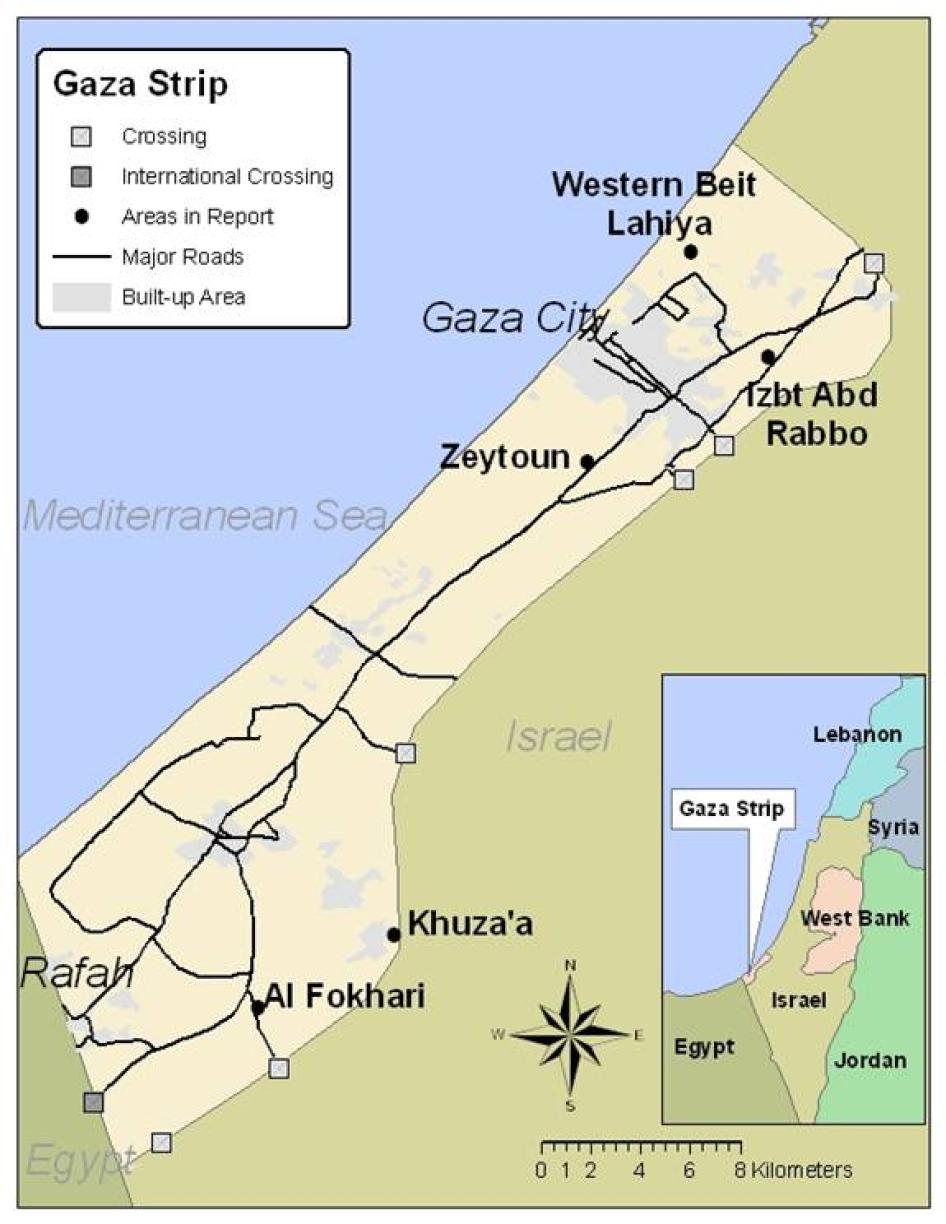
This report documents 12 cases of unlawful destruction of civilian property by the Israel Defense Forces (IDF) in Gaza during Operation Cast Lead from December 27, 2008 to January 18, 2009. These cases describe instances in which Israeli forces caused extensive destruction of homes, factories, farms and greenhouses in areas under IDF control without any evident military purpose. These cases occurred when there was no fighting in these areas; in many cases, the destruction was carried out during the final days of the campaign when an Israeli withdrawal was imminent.
In the cases documented in this report, the IDF violated the prohibition under international humanitarian law – the laws of war – against deliberately destroying civilian property except where necessary for lawful military reasons and the ensuing civilian harm is not disproportionate. This report does not address civilian property damaged or destroyed during immediate fighting; such destruction may or may not be lawful, depending on the circumstances.
The available evidence indicates that the destruction in each of the 12 cases documented in this report was carried out by the IDF for either punitive or other unlawful reasons. Human Rights Watch found – based on visits to each site, interviews with multiple witnesses, and the examination of physical evidence – that there were no hostilities in the area at the time the destruction occurred. In seven cases, satellite imagery of the area was available during the fighting, and corroborated witness accounts that large numbers of structures were destroyed shortly before Israel announced a ceasefire and withdrew its forces from Gaza.
Two factors are especially relevant to the ongoing impact of this destruction today, some 15 months after the conflict ended.
First, Israel's comprehensiveblockade of the Gaza Strip, imposed since June 2007, has prevented reconstruction of private property and public infrastructure after the conflict. The blockade continues to affect the lives of the civilian population, including those whose losses are documented in this report. UN Secretary-General Ban Ki-moon noted in late March 2010 that Israel had allowed imports of cement for several repair projects, including 151 housing units, but these imports were “a drop in a bucket” compared to housing needs, and Israel continued to restrict or bar the entry of many essential goods including materials needed for reconstruction. The media and humanitarian agencies reported in March that many goods were entering Gaza through smuggling tunnels beneath the southern border with Egypt, and many damaged buildings had been at least partially repaired with bricks made from smuggled cement and recycled concrete rubble. However, in the areas of Gaza where the vast majority of homes were completely destroyed during the conflict in December 2008 and January 2009 – including areas addressed in this report – there has been virtually no reconstruction of destroyed buildings, indicating that the cost of reconstruction materials under the blockade remained prohibitive for Gaza’s residents, more than three-quarters of whom live under the poverty line (as defined by international standards). That poverty is often a product of or aggravated by the blockade. Israeli officials insist that the blockade—which had already degraded humanitarian conditions in Gaza before Operation Cast Lead—will remain in place until Hamas releases Staff Sgt. Gilad Shalit, the Israeli soldier captured in June 2006, rejects violence, and fulfills other political conditions. The blockade, which is supported by Egypt at Rafah's Gaza border, amounts to a form of collective punishment of Gaza's 1.5 million civilians in violation of international law.
Second, the inadequate steps that Israel has taken to investigate alleged violations of the laws of war committed during Operation Cast Lead and to bring to justice those found to be responsible compound the violations documented in this report. As of March, Israeli military police had opened 36 criminal investigations, which included interviewing Palestinian witnesses, leading to the sentencing of one soldier who stole a credit card and indictments of two others for endangering a child at a checkpoint. The IDF has undertaken scores of military “operational debriefings” and several broader inquiries, including one focused on the issue of property destruction, but none took any testimony from Palestinian witnesses or victims. The IDF disciplined four soldiers and commanders, one for destroying property, but released only partial information about the circumstances. Notably, Israel has not conducted thorough and impartial investigations into whether policy decisions taken by senior political and military decision-makers including pre-operation decisions led to violations of the laws of war, such as the destruction of civilian infrastructure. (Human Rights Watch is not aware of any meaningful steps by Hamas authorities to ensure accountability for serious violations; a Hamas report released in January which purported to exonerate Palestinian armed groups for laws-of-war violations lacked credibility.)
The laws of war prohibit attacks on civilian objects, including houses and factories, unless they are a military objective. A military objective is anything that provides enemy forces a definite military advantage in the circumstances ruling at the time. Thus, even though a residential home is presumed to be a civilian object, its use by enemy fighters for deployment or to store weaponry or in the event it provides cover for advancing enemy forces, will render it a military objective and subject to attack or destruction. Even an unoccupied civilian structure can be a military objective – such as a house blocking the line of fire to an enemy position – and subject to lawful attack so long as its destruction cannot reasonably be expected to cause harm disproportionate to the anticipated military gain. Under the Fourth Geneva Convention, applicable during occupations, the extensive destruction of property “carried out unlawfully and wantonly” and not justified by military necessity, is a grave breach of the Geneva Conventions, and can be prosecuted as a war crime.
This report examines incidents of destruction that suggest violation of the laws-of-war prohibition of wanton destruction. This report does not necessarily document all instances of unlawful property destruction; our research was limited by practical constraints of time and resources. Rather, Human Rights Watch examined cases of property destruction that seemed particularly difficult to justify, such as when Israeli forces were in control of an area, there was no active fighting there, and the property was destroyed without any apparent lawful military justification. We deliberately did not pursue cases in which the destruction was not extensive, or the evidence suggested any possibility that Israel’s destruction of the property in question could have been militarily justified, based on mistaken information, or a consequence of fighting in the immediate vicinity. Similarly, we did not investigate Israeli conduct when the structures at issue may have been used by Hamas to store ammunition or military equipment or to set booby-traps, or when property was destroyed to permit the movement of Israeli forces because adjoining roads were mined and impassable.
Because of the limited number of cases examined, we cannot claim that the incidents examined in this report are representative of a broader pattern, but instead address them because they are troubling in their own right. Further inquiry is required to determine whether they were part of a broader policy or practice.
Extensive, Unnecessary Destruction
Human Rights Watch documented the complete destruction of 189 buildings, including 11 factories, 8 warehouses and 170 residential buildings, leaving at least 971 people homeless. The 12 incidents documented in this report account for roughly five percent of the homes, factories and warehouses destroyed in Gaza during the conflict. Overall, some 3,540 homes, 268 factories and warehouses, as well as schools, vehicles, water wells, public infrastructure, greenhouses and large swathes of agricultural land, were destroyed, and 2,870 houses were severely damaged. Our conclusions about the unlawfulness of the destruction of property are limited to the incidents we investigated in depth. Israel should thoroughly investigate these cases – including the lawfulness or unlawfulness of any relevant policy decisions – and punish persons found responsible.
Residents of neighborhoods we investigated fled or were ordered to leave their homes by Israeli troops, and returned after the war’s end to find their previously undamaged or moderately damaged homes destroyed and their vehicles demolished. In these cases, all evidence points to the destruction being carried out by Israeli forces. In the cases we examined in the neighborhoods of Izbt Abd Rabbo, Zeitoun, and Khoza’a, virtually every home, factory and orchard had been destroyed within certain areas, apparently indicating that a plan of systematic destruction was carried out in these locations.
The destroyed industrial establishments that Human Rights Watch investigated include a flour mill, juice and biscuit plants, and seven concrete factories. At all the concrete factories that we examined, tanks or military bulldozers destroyed or badly damaged every cement-mixing truck, cement pump truck and other vehicles on the property. As noted, during Operation Cast Lead, Israel could have lawfully attacked otherwise civilian objects if they were making an effective contribution to Palestinian armed groups’ military action and their destruction offered a definite military advantage at the time. For example, if armed groups had commandeered concrete factories during the fighting and were using the concrete produced to build or repair military objects like bunkers, such factories could have been legitimate targets for Israeli attacks. However, Gaza’s concrete factories were unable to operate at all prior to and during the war because they had run out of cement, which they must import due to their lack of capacity to produce it. There is no evidence that any of the cement and concrete factories in Gaza contributed to the military efforts of Palestinian armed groups during the fighting.
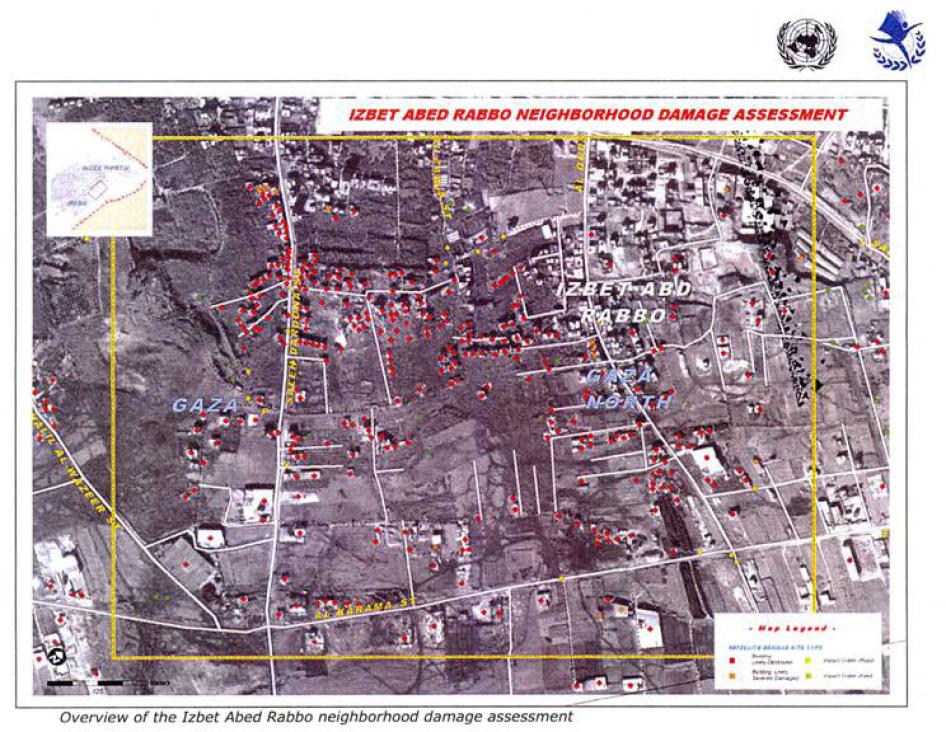
Satellite imagery taken at intervals during the conflict shows that in several neighborhoods Israeli forces destroyed property in areas where they had established control and immediately prior to their withdrawal from Gaza on January 18. In Izbt Abd Rabbo, satellite imagery shows that only 11 buildings were destroyed or severely damaged between December 27, 2008 and January 6, 2009, but that 330 buildings were destroyed or severely damaged from January 6 to 19 – a thirty-fold increase in destruction that occurred after the IDF had apparently established control of the area. In the Zeitoun neighborhood, satellite imagery shows that 43 percent of the destruction of buildings and greenhouses occurred during the last two days of the war, while only three percent of the destruction occurred during the preceding six days. This evidence is consistent with witness accounts that large-scale destruction occurred after the IDF had already established control of the area and there was no ongoing fighting.
An internal IDF investigation completed in April 2009 (which did not examine individual incidents of destruction or consider testimony from Palestinian witnesses) “confirmed that although relatively extensive damage was caused to private property” in Gaza, the IDF’s destruction of civilian property was lawful because Hamas used civilian infrastructure for military purposes by deploying fighters, weapons, booby-traps, and digging tunnels in houses, factories and mosques. The Israeli Ministry of Foreign Affairs stated in July 2009 that “IDF forces demolished structures that threatened their troops and had to be removed,” including (1) houses used by Hamas for military purposes during the fighting; (2) other structures “used by Hamas operatives for terrorist activity”; (3) structures whose total or partial destruction was imperatively required by military necessity, such as the movement of IDF forces; (4) “agricultural elements” used as cover for Hamas tunnels and infrastructure; and (5) buildings next to the security fence between Gaza and Israel that Hamas used for operations against IDF forces or for digging tunnels into Israeli territory.
Incidents of property destruction that fell into these categories would constitute lawful attacks on military targets. However, these categories do not account for any of the incidents of large-scale destruction of civilian property documented in this report. The Israeli government has published the results of a military probe into one case documented in this report, which found an attack on a flour mill to be lawful. The probe’s conclusions, however, are contradicted by available video and other evidence. (IDF lawyers told Human Rights Watch that the case could be reopened if new evidence was presented. In late March, Israel announced that it had approved cement imports to repair the flour mill.) The IDF has not provided explanations for the other 11 incidents that Human Rights Watch documented. Israel should conduct thorough and impartial investigations into these incidents and determine whether the incidents were lawful and, if not, if they reflected official policy.
During the IDF offensive in Gaza, Hamas and other Palestinian armed groups used civilian structures to engage Israeli forces and to store arms, according to news reports, video and photographic evidence. They also booby-trapped and dug tunnels under civilian structures. Human Rights Watch documented that armed groups fired rockets from populated areas; property damage caused by counter-strikes against the attacking forces could have amounted to lawful “collateral damage” (see Legal Obligations). Armed groups may also have been responsible for damage to civilian property in cases in which IDF attacks triggered secondary explosions of weapons or explosives, stored by armed groups, which damaged nearby structures. The IDF has published video footage that appears to show several such incidents.
However, in the 12 incidents examined in this report, extensive investigations revealed no apparent lawful military justifications for the destruction. The IDF was not engaging Palestinian forces at the time they destroyed the property – fighting had stopped – and in most cases the destruction of the property occurred after the IDF had eliminated or dispersed Palestinian fighters in the area and consolidated its control, such as by occupying houses, stationing tanks in streets or on nearby hills, and undertaking continuous surveillance from manned and unmanned aircraft. The possible future military use by armed groups of some civilian structures in these areas – such as to set booby-traps, store weapons, or build tunnels– cannot justify the wide-scale and at times systematic destruction of whole neighborhoods, as well as of factories and greenhouses that provided food and other items essential for the well-being of the civilian population.
For example, in Izbt Abd Rabbo, Human Rights Watch documented the complete destruction of 45 residential structures, which had housed at least 287 people, on or near the neighborhood’s main road during Operation Cast Lead. (Satellite imagery shows that a total of 341 buildings were destroyed in the area.) Fifteen industrial establishments in the area east of the neighborhood were also destroyed. According to separate individual interviews with 17 residents, including residents who were ordered to leave their homes by IDF soldiers or whom the IDF used as “human shields,” the vast majority of the destruction that this report documents in Izbt Abd Rabbo took place after January 7, by which point the IDF exercised control over the neighborhood.
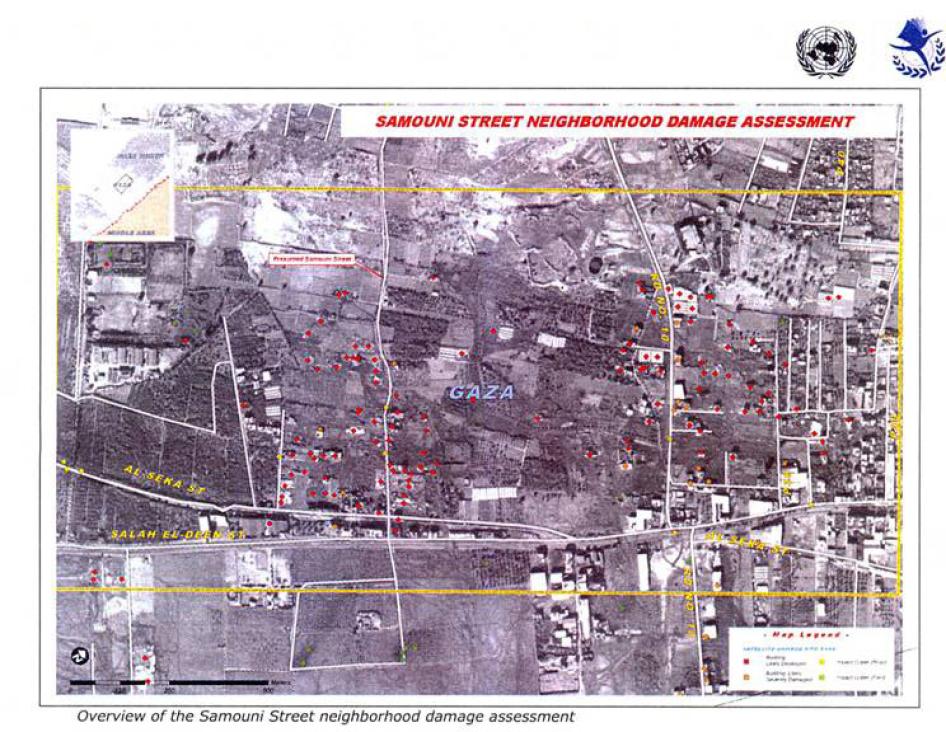
In cases that Human Rights Watch examined in agricultural areas of Zeytoun, south of Gaza City – which represent a fraction of the total destruction in the area – residents said that at least 193 people had lived in residential buildings that were destroyed during the war. The accounts of residents suggest that Israeli forces inflicted extensive damage to buildings and land there in the early days of the ground offensive, but that they did not destroy most houses in these areas until after January 7, when they had already occupied these areas and almost all residents had fled. Many of the Zeytoun residents with whom Human Rights Watch spoke said that they left these areas after their homes had been shelled or hit with small-arms fire or they were ordered to leave by IDF soldiers. When they returned to the areas after the war, they said, they found the buildings had been bulldozed or destroyed with anti-tank mines. Human Rights Watch also observed bulldozer tracks in destroyed agricultural areas. In each incident we investigated, including where destruction occurred after residents and witnesses had left the area, Human Rights Watch cross-checked available reports to determine whether Palestinian armed groups counter attacked the area after the IDF gained control over it. In some cases, Israeli forces engaged and killed Palestinian fighters in areas where destruction occurred after residents and witnesses had left, but there is no evidence that the fighting caused or could in any way account for the extensive destruction of property we documented.
Public statements by some Israeli politicians suggest a willingness to conduct attacks against civilian infrastructure in Gaza to deter rocket attacks against Israel by armed groups. For example, Deputy Prime Minister Eli Yishai said at a conference on February 2, 2009 that “we have to determine a price tag for every rocket fired into Israel,” and recommended that “even if they fire at an open area or into the sea, we must damage their infrastructures and destroy 100 houses.” Because these statements both appeared consistent with some attacks during Operation Cast Lead and might be applied to Israel’s strategy in future conflicts, the Israeli government should publicly repudiate punitive attacks against civilian infrastructure.
Human Rights Watch documented that Palestinian armed groups in Gaza launched thousands of rocket attacks against Israeli population over the years in violation of the laws of war. During “Operation Cast Lead,” approximately 800,000 Israelis were within range of hundreds of rocket attacks, which killed three Israeli civilians and seriously injured several dozen others. Individuals who willfully conducted or ordered deliberate or indiscriminate rocket attacks on civilians are responsible for war crimes. However, laws of war violations by one party to a conflict do not justify violations by another party. The fundamental principle of distinction under the laws of war requires armed forces to distinguish between civilians and military objectives, and only target the latter, regardless of the conduct of the other side.
Inadequacy of Investigations
Israel is obliged under international law to investigate allegations of serious violations of the laws of war, including alleged excessive destruction of civilian property, and to prosecute those found responsible. To date, although Israel has conducted numerous “operational debriefings” and three dozen criminal investigations, it has not met that obligation.
The only reported penalty imposed for unlawful property destruction during “Operation Cast Lead” was an unknown disciplinary measure taken against one soldier. (The IDF has disciplined four soldiers and commanders for actions during “Operation Cast Lead,” but has published only limited information on the circumstances.) IDF lawyers told Human Rights Watch at a meeting in February 2010 that the incident involved “uprooting vegetation” in Gaza and that a disciplinary sanction was imposed immediately by the commander in the field, but they had given no details of the incident or the disciplinary measure.
Overall, it is unclear how many and which incidents the IDF has examined related to the unlawful destruction of property. The Israeli Ministry of Foreign Affairs stated in a report published in January 2010 that the IDF had opened 150 individual inquiries into alleged wrongdoing by Israeli soldiers during Operation Cast Lead, including 36 criminal investigations by military police. According to the report, none of the 36 criminal investigations involved property destruction or examinations of orders or strategies regarding property destruction. (The report said the incidents involved alleged shooting of civilians, using civilians as human shields, mistreatment of detainees and civilians, and pillage and theft.) The military police opened investigations into two incidents that apparently included property destruction as well as another offense; an Israeli government report published in July 2009 stated that military police had opened one investigation into “allegations regarding damage to property and pillage,” and another investigation into a case where a home was destroyed after an Israeli soldier allegedly shot four members of the family, killing two.
Lawyers with the IDF’s Military Advocate General’s office told Human Rights Watch in February 2010 that many of the cases of property destruction that Human Rights Watch documented are being probed either by “operational debriefings” or by “command investigations” – two kinds of probes that may differ in several respects, but are both conducted by IDF officers rather than by trained military police investigators and do not involve contacting Palestinian witnesses. The officers could not provide further information. The cases being probed, according to the IDF lawyers, include the destruction of the Abu Jubbah cement factory, the Wadiyya Food Factory, and areas of the neighborhoods of Khoza’a, Zeytoun and Abd Rabbo. An inquiry into damage to the El Badr Flour Mill has ended, and concluded there was no wrongdoing by the IDF. With the exception of the flour mill case, which according to an Israeli report the IDF learned about on September 15, 2009 with the publication of the report of the UN Fact Finding Mission on the Gaza Conflict, it is not clear when the IDF initiated these inquiries. Human Rights Watch wrote to the IDF detailing all the incidents in the present report on August 21, 2009 (see Annex A) and received a response on September 8, 2009 (see Annex B).
In addition to the probes the IDF has opened into these individual incidents, the IDF also examined the destruction of civilian structures in one of five broad “command investigations” into issues from the Gaza operation. The relevant IDF command investigation, conducted by a colonel, focused on “issues relating to the infrastructure operations and the demolishing of structures by the IDF forces during the ground operations phase of Operation Cast Lead.”
According to the Ministry of Foreign Affairs, the relevant IDF command investigation examined:
a. Orders and instructions given and determined by different command levels (from the headquarters to the ground forces, before and during the operation), regarding the destruction of buildings and infrastructure. b. Extent of destruction of buildings and infrastructure in the different areas, divided in accordance to: stages of the operation, operating units, types of buildings or infrastructure that were damaged, purposes of destruction, the manner in which the destruction was carried out (via engineers/method of destruction/verification of evacuation of residents) and whether the destruction was planned or spontaneous by decisions which were taken in the field in ‘real time’. c. Intelligence and operational information regarding the nature of the enemy’s offensive and defensive methods, and with regard to infrastructure of the enemy that was identified and documented by our forces, which support the operational necessity of destruction.
Israel has provided no specific information on how the investigation was conducted. A report published by the Ministry of Foreign Affairs in January 2010 stated that “the investigation did not deal with specific incidents alleged in complaints or reports.”
The investigation results, approved by IDF Chief of Staff Lt. Gen. Gabi Ashkenazi and published in April 2009, concluded: “In all of the areas in which the IDF operated, the level of damage to the infrastructure was proportional, and did not deviate from that which was required to fulfill the operational requirements.” The investigation blamed “the extent of damage caused to buildings” on “the extensive use by Hamas of those same buildings for terrorist purposes and targeting IDF forces.” The investigation noted that the IDF’s “written plans for the operation” did not sufficiently stress the need to minimize the damage to civilian property, but claimed that nonetheless, “the forces in the field understood” these limitations. Reports published by the Ministry of Foreign Affairs in July 2009 and January 2010 reiterated these conclusions.According to the January 2010 report, Israel launched an additional 10 inquiries into incidents of property damage after becoming aware of them with the publication of the report of the UN Fact Finding Mission on the Gaza Conflict on September 15, 2009. The January 2010 report described the conclusions of probes into four cases of property damage discussed by the Fact Finding Mission; in none of these cases did the IDF find itself liable for laws of war violations. Human Rights Watch documented one of these incidents: the attack on the el-Bader flour mill, which is discussed below. A list of the other six incidents being examined has not been made public.
In January, Israel reportedly agreed to pay the UN US$10.5 million for the damage it caused to UN facilities during the war. A UN Headquarters Board of Inquiry led by Ian Martin investigated nine attacks that damaged UN facilities or killed or injured UN personnel, finding Israel responsible in seven cases and Palestinian armed groups in one case; the responsible party for the remaining attack could not be determined. Israel stated that the payment did not amount to an admission of wrongdoing.
Reconstruction Denied
Post-war reconstruction in Gaza has been greatly hampered by Israel’s continuing blockade (supported by Egypt) of the territory. Israel controls the Gaza Strip’s land, air, and sea access with the exception of a 15-kilometer border with Egypt. Israel’s strict blockade of Gaza has remained in place following the end of major military operations, exacerbating the effects of the wartime destruction. Since the end of the conflict, Israel has granted approval to a limited number of shipments of construction materials designated for specific projects. Israel allowed in only six truckloads of construction materials from January to May 2009, according to the United Nations, which noted that “the parallel figure during the same period of 2007, before the Hamas takeover of Gaza, was over 39,000 truckloads.” In June 2009, Israel allowed entry to 18 truckloads of cement and gravel (to expand the Palestinian side of the Kerem Shalom border crossing). In a significant positive development, Israel allowed the shipment of 100 truckloads of glass from December 2009 to February 2010, and reportedly approved a second shipment of window glass beginning on March 2, 2010, to be sold commercially. UN Secretary-General Ban Ki Moon informed the UN Security Council on March 24 that Israel had approved cement shipments to construct 151 housing units in Khan Younis, and to repair a number of structures damaged during “Operation Cast Lead,” including the Badr Flour Mill discussed in this report. However, Israel continues to deny entry to cement, iron bars, and other construction materials, on the grounds that Hamas could divert them for military purposes.
Israel may inspect goods entering and leaving Gaza, but restrictions should be for specific security reasons and should not be used to block basic goods and civilian necessities.
While Israel has consistently failed to provide specific security justifications for its refusal to allow many basic goods into Gaza, there are valid Israeli security concerns that Hamas could use cement to build strengthened military bunkers and tunnels. However, according to humanitarian aid organizations, Israel has refused to seriously discuss creating a mechanism that would allow the delivery of much-needed construction materials for civilian reconstruction projects in Gaza by ensuring the independent monitoring of the end-use of the materials. According to a March 2010 report prepared by a UK parliamentary delegation after a visit to Gaza, the “UN stresses that every single tile, pipe or bag of cement is tracked from the border crossing to its final use,” and noted that the UN had offered to allow Israel to install permanent remote visual monitoring of their housing projects, “in order to verify that all building materials were being used for their stated purposes.” Israel should seek to create a mechanism for the delivery of needed construction materials that would address these concerns as well as the severe impact of import prohibitions on thousands of civilians who remain displaced by the destruction of their homes. By denying entry to materials necessary for reconstruction, Israel is prolonging the post-war hardship of the civilian population.
Some reconstruction materials are reportedly among the goods smuggled into Gaza from Egypt via underground tunnels but are too limited in quantity and expensive to enable large-scale reconstruction. In March 2010, the price of smuggled concrete had reportedly fallen to 900 Israeli shekels (US $240) per ton from 4000 shekels (US $1080) per ton immediately after the conflict, but the price of smuggled metal reinforcing bars, which are also necessary for the type of home construction common in Gaza, remained high at 2000 (US $540) Israeli shekels per ton. Such prices evidently remain out of reach for persons whose homes were completely destroyed. According to the UN, approximately 80 percent of Gaza’s population is impoverished and dependent on food aid. Human rights and humanitarian workers in Gaza told Human Rights Watch that as of late March 2010, many local factories were producing concrete cinderblocks (or breeze blocks) by grinding down the rubble of destroyed buildings and mixing it with cement smuggled through the tunnels from Egypt, and that many of the partially destroyed buildings in Gaza’s cities and refugee camps had been at least partly rehabilitated with this material. However, they noted that there has been virtually no reconstruction in outlying areas where large numbers of buildings were completely destroyed, including the areas documented in this report.
As a result of the war and the ban on supply of reconstruction materials, thousands of Gazan families remain homeless. As of November 2009 – ten months after the war ended – the UN reported that more than 20,000 people still remain displaced, with children being among the worst affected. The more fortunate displaced are living with relatives or renting apartments; the less lucky still live in makeshift shelters inside their damaged homes. As of November, 120 families, including 500 children, were still living in tent camps set up as temporary shelters ten months previously, according to international humanitarian agencies.
The UN also remains unable to implement reconstruction plans. The UN Relief and Works Agency for Palestine Refugees (UNRWA) reported in August that the blockade was preventing it from conducting an estimated US $43 million worth of needed repairs, including to 2,200 destroyed UNRWA-provided houses, as well as schools, sanitation facilities, warehouses, and other installations damaged during the war. UNRWA announced in December 2009 that it would resort to “compressed earth blocks” to build 122 planned homes for the displaced. (In addition, UNRWA began construction on several new housing projects with a total of 2,400 housing units prior to the siege in 2007, but has been unable to complete them due to the ban on construction materials.)
Many of the industrial establishments that Israeli forces destroyed had not been operating before the war for lack of supplies due to the blockade, but the destruction of these factories’ physical plant makes the rejuvenation of Gaza’s economy an even more remote prospect.
As with armed conflicts elsewhere, Human Rights Watch takes no position on the decision of either side in the recent Gaza conflict to resort to military force, whether to defend itself or to pursue other goals, but instead focuses on how the warring parties use military force, namely, whether they comply with the requirements of international humanitarian law. Just as Hamas should hold its serious abusers accountable, so Israel should hold accountable those responsible for serious laws of war violations, including those related to property destruction. Like Hamas, Israel should cooperate with international accountability mechanisms. And just as Hamas should immediately stop all rocket attacks on Israeli civilian areas emanating from Gaza, so Israel should urgently open Gaza’s borders to reconstruction materials and other essential supplies. The United States, the European Union and other allied states should urge both Israel and Hamas to abide by its legal obligations in these regards.
On September 15, 2009, the United Nations Fact Finding Mission on the Gaza Conflict, led by Justice Richard Goldstone, published a report that found evidence that both Israel and Hamas had committed war crimes and possible crimes against humanity. The report documented cases where Israeli forces allegedly engaged in “extensive destruction of property, not justified by military necessity and carried out unlawfully and wantonly,” and called on both sides to carry out credible investigations within six months. The United Nations Human Rights Council and General Assembly endorsed the report. On February 5, 2009 the UN Secretary-General reported to the General Assembly on steps taken by the Israeli and Palestinian authorities to investigate violations, as called for in General Assembly resolution A/RES/64/10, but concluded that investigations were ongoing and that “no determination can be made on the implementation of the [General Assembly] resolution by the parties concerned.” On February 26, the General Assembly approved resolution A/RES/64/254, reiterating its call for Israel and the Palestinian side to conduct credible investigations and requesting the Secretary-General to report on steps taken by both sides within five months, “with a view to the consideration of further action, if necessary, by the relevant United Nations organs and bodies, including the Security Council.”
The United States and the European Union are the international actors with the greatest leverage to press Israel to uphold its obligations under the laws of war. The United States supplied approximately $2.77 billion in military aid to Israel in 2009. Following the Gaza war, the European Union, Israel’s largest foreign trading partner, unofficially froze any upgrade in its relations with Israel, which are governed by an Association Agreement.
Recommendations
To the Government of Israel
- Conduct thorough and impartial investigations into alleged violations of international humanitarian law during the fighting of December 2008-January 2009 in Gaza. Make the investigation findings public and prosecute those responsible for war crimes in trials respecting international standards. Immediately lift the blockade of Gaza and facilitate the free flow of humanitarian aid and commercial goods, including materials urgently required for the reconstruction of destroyed civilian property, such as concrete and metal rods.
- Provide prompt and adequate compensation to the victims of laws-of-war violations in Gaza.
- Implement the findings and recommendations of the final report produced by the United Nations Fact Finding Mission on the Gaza Conflict.
- Review policy and tactical decisions made during Operation Cast Lead that may have led to unnecessary destruction of civilian property, with public findings and recommendations for minimizing such destruction in any future engagements.
To the Government of the United States
- Suspend shipment to Israel under the Foreign Military Sales Program of Caterpillar D-9 bulldozers, pending the conclusion of an official investigation into the IDF’s use of these bulldozers to destroy civilian property in Gaza in violation of the laws of war.
- Use the leverage that comes from the massive US military assistance to Israel to press Israel to :
- conduct a thorough, independent and impartial investigation into unjustified destruction of civilian infrastructure in the Gaza Strip during Operation Cast Lead, and compensate those unlawfully harmed; and
- open Gaza’s borders to allow for the entry of humanitarian aid and commercial goods needed for rebuilding.
To the European Union
- Under the leverage provided by the terms of the Association Agreement with Israel, the EU should press Israel to :
- conduct a thorough, independent and impartial investigation into alleged violations of the laws of war in the Gaza Strip during Operation Cast Lead, and compensate those unlawfully harmed; and
- open Gaza’s borders to allow for the entry of humanitarian aid and commercial goods needed for rebuilding.
To the United Nations Human Rights Council
- Review implementation of the Goldstone report by the parties to the conflict and UN bodies in future sessions of the Human Rights Council.
To the UN General Assembly
- Consider the UN Secretary-General’s report in response to General Assembly Res A/64/L.48, due by July 26, 2010, and, in case of continued failure by the parties to conduct impartial investigations and prosecute those responsible for serious laws-of-war violations, refer the situation to the Security Council.
To the UN Secretary-General
- Monitor and report to the General Assembly within five months (by July 26, 2010) on investigations conducted by the parties to the conflict as required by UN General Assembly resolution A/64/L.48, including an assessment of whether the steps taken meet international standards of promptness, thoroughness and impartiality.
- Should Israel and Hamas’s investigations continue to fall short of international standards for thoroughness and impartiality, refer the report of the UN Fact Finding Mission on the Gaza Conflict to the UN Security Council under article 99 of the UN Charter.
To the UN Security Council
- As it has done in response to other conflicts, call on the parties to the Gaza conflict to conduct thorough and impartial investigations into the allegations of laws-of-war violations by their respective forces, prosecute those responsible for serious violations, and compensate the victims.
- Await next steps by the UN General Assembly and in case of continued failure by the parties to conduct impartial investigations and prosecute those responsible for serious laws-of-war violations the Security Council should create its own independent committee of experts to monitor and report on progress made by the parties to conduct thorough and impartial investigations into alleged laws-of-war violations.
- If the parties continue to fail to conduct thorough and impartial investigations up to international standards refer the conflict to the prosecutor of the International Criminal Court.
Methodology
Human Rights Watch conducted research for this report in Gaza from April 8 to 19, 2009. A researcher entered Gaza via Egypt after Israeli authorities denied or failed to respond to six Human Rights Watch requests to enter Gaza via the Israeli crossing at Erez. The researcher conducted the research together with a Human Rights Watch consultant based in Gaza.
This report documents 12 incidents in which Israeli forces extensively destroyed or damaged civilian property in apparent violation of the laws of war. These incidents are drawn from four different geographical areas of Gaza – western Beit Lahiya in the northwest, Izbt Abd Rabbo in the northeast, Zeytoun in the north / central part, and Khoza’a in the southeast. We selected these cases by surveying the damage in Gaza, reviewing reports by the United Nations and humanitarian organizations, and considering accounts by the media and human rights groups.
Because the laws-of-war violation of wanton destruction certainly occurs in cases in which one party to a conflict destroys property extensively in an area over which it has effective control without a lawful military purpose, we focused our research on such relatively clear alleged incidents. In cases where initial information or further investigations raised the likelihood that the destruction of property was justified, we did not investigate further.
The laws of war provide that the determination of whether an incident of property destruction was lawful or unlawful must be based on whether it was reasonable for the responsible force to conclude – based on what was known or should have been known at the time rather than in hindsight – that the property was a valid military objective in the circumstances prevailing at the time, and that its destruction would not be expected to cause disproportionate civilian loss compared to the anticipated military gain. In each of the cases we document, the scale of the destruction strongly discounts the possibility that the property was destroyed reasonably, accidentally or based on the mistaken assumption it was serving a contemporaneous military purpose.
As noted, this report deliberately excludes cases where there was a lawful military necessary reason to justify the destruction of civilian property. We did not investigate cases including several reported instances where large-scale destruction was caused by aerial bombings, because of the presumed difficulty in determining whether or not individual aerial bombings of civilian structures were carried out with criminal intent or as part of a widespread attack. In three cases in which Human Rights Watch conducted preliminary research, it either appeared possible or we could not rule out that Israeli forces might have destroyed or damaged property out of military necessity or due to mistaken targeting or intelligence, and we therefore did not pursue those investigations any further or include them in this report; a fourth such case is mentioned in a footnote.
During the course of field research, Human Rights Watch conducted interviews with 94 residents in Gaza – the majority of whom had left their areas of residence before these were destroyed -- primarily in Arabic with an interpreter, as well as with a UN expert on unexploded ordnance in Gaza. These interviews were conducted individually and privately, unless otherwise noted. In addition, we conducted extensive on-site investigations, examining destroyed structures and the surrounding areas for signs of military activity and armed exchanges between Israeli and Palestinian forces. Human Rights Watch examined forensic evidence at the scenes, such as the remnants of anti-tank mines used as demolition explosives and debris from aerial bombardment, artillery fire, tank fire, and small arms fire, as well as tank and bulldozer tread marks. Lastly, Human Rights Watch examined satellite images provided by the United Nations Operational Satellite Applications Programme (UNOSAT), some of which are presented in the report. The images show physical destruction throughout Gaza at different phases of the campaign.
Human Rights Watch does not dispute that in some cases, damage to civilian structures was caused by explosions from booby-traps or secondary explosions due to weapons placed by Palestinian armed groups. However, no reports, media accounts or our own research indicated that explosive booby-traps planted by Palestinian armed groups or secondary explosions caused by weapons stored by these armed groups were responsible for any significant amount of the damage seen in Gaza. (In response to specific questions from Human Rights Watch, the IDF has not provided evidence or claimed that the 12 cases of large-scale destruction documented in this report were caused by Palestinian armed groups.)
On August 21, 2009, Human Rights Watch sent the IDF detailed questions about its policies on property destruction and the incidents documented in this report (see Appendix 1). In its response of September 8, 2009, the IDF referred Human Rights Watch to reports already published by the IDF and Israeli Ministry of Foreign Affairs (see Appendix 2). On November 23, 2009, Human Rights Watch requested a meeting with the IDF to discuss accountability measures taken with regard to alleged violations during “Operation Cast Lead,” including the incidents documented in this report. Members of the IDF Military Advocate General’s office and the Spokesperson’s office met with us on February 4, 2010. This report takes these meetings and Israeli documents as well as other official Israeli statements into account, citing them where relevant. It also cites the statements of Israeli soldiers who fought in Operations Cast Lead, as published by Breaking the Silence, an Israeli nongovernmental organization of IDF veterans.
Destruction of Property during the Conflict
On December 27, 2008, Israel launched what it called Operation Cast Lead. The stated aim of the military operation was to stop the ongoing rocket fire into Israel from Palestinian armed groups in Gaza. After a large-scale air campaign, the Israel Defense Forces (IDF) on January 3, 2009 launched a major ground offensive. Israeli troops began to withdraw from Gaza early on January 18. The IDF operations killed some 1,387 Palestinians, at least 762 of whom were civilians, according to a list of names published by the Israeli human rights organization B’Tselem.[1] Thirteen Israelis died during the fighting, three of them civilians.[2]
Beyond the loss of human life, the war in Gaza resulted in the destruction of thousands of private homes, as well as public infrastructure, factories, businesses and workshops, vehicles, and agricultural land and animals. The sheer extent of the destruction does not, in itself, indicate violations of international humanitarian law (the laws of war). However, Human Rights Watch’s investigation into 12 incidents found that in these specific cases the IDF destroyed extensive civilian property in apparent violation of the laws of war. We do not claim that these violations are typical of the destruction in Gaza generally – the lawfulness or unlawfulness of which must still be assessed. In conducting that investigation, Israel should examine whether any violations were due to policies adopted by the military or the government. Property may be destroyed only for imperative reasons of military necessity and in accordance with the rules of proportionality.
According to a joint survey by UN agencies, the fighting destroyed 3,540 housing units in Gaza and 2,870 sustained severe damage during Operation Cast Lead.[3] Fighting and destruction during the war caused displacement of more than 50,000 people.[4] As of March 2010, humanitarian workers in Gaza informed Human Rights Watch that several factories in Gaza were operating to produce concrete cinderblocks (or breeze blocks) by combining the pulverized rubble of destroyed buildings with cement smuggled through the tunnels from Egypt, and that some reconstruction of damaged homes using this material was underway in refugee camps and cities in Gaza.[5] However, these sources reported that the vast majority of destroyed homes, particularly in areas of Gaza that saw extensive destruction during the war like Izbt Abd Rabbo, have not been rebuilt or repaired. While the price of cement and metal bars smuggled into Gaza via tunnels had dropped to 900 Israeli shekels (US $240) and 2000 shekels (US $540) per ton, respectively, by March, these prices appeared to remain out of reach for the majority of Gazans whose homes were totally destroyed.[6] As of November, ten months after the war, at least 20,000 people remained displaced, in large part due to Israel’s ban on importing into Gaza construction material such as cement, needed to rebuild housing.[7] (According to a January 18, 2009 statement by the Ministry of Foreign Affairs, Israel permits “humanitarian aid” to enter Gaza, but “cement, sand, gravel and steel are not considered to be humanitarian aid.”)[8] The displaced have had no choice but to remain with their relatives, in rented apartments, in makeshift accommodations next to the ruins of their homes, or in tented camps. As of November, thousands of families continued to live in sections of badly damaged homes, and 120 families, including 500 children, were still living in tents provided ten months previously by international aid organizations. Intended as temporary accommodations, many of the tents are unfit for use in winter.[9] In December, the UN completed the first of 122 planned “compressed earth block” structures, intended to improve the lives of those still living in tented camps or in makeshift shelters near their damaged or destroyed homes.[10]
According to the UN Refugee Welfare Agency (UNRWA), which assists Palestinian refugees, wartime attacks destroyed public and service sector infrastructure, including government buildings, bridges and 57 kilometers of asphalt roads (and other roads), and damaged 107 UNRWA installations, almost 20,000 meters of pipes, four water reservoirs, 11 wells, and sewage networks and pumping stations.[11] Because the Israeli blockade had made building materials and supplies unavailable, as of August, the agency reported that it would not be able to conduct US$43 million worth of needed repairs to refugee shelters and UNRWA installations “damaged during Operation Cast Lead."[12] A report prepared for the UK parliament in March 2010 reported that UNRWA remained unable to complete several housing projects, comprising some 2,400 housing units, that had been on hold since June 2007 when Israel blocked shipments of construction materials after the Hamas takeover of Gaza.[13] On March 24, UN Secretary-General Ban Ki Moon informed the UN Security Council that Israel had approved shipments of cement sufficient to complete construction of 151 housing units near Khan Younis as well as repairing several facilities damaged during the conflict, including the Badr Flour Mill. While welcoming the step, Ban noted that “One hundred and fifty-one units amount to far less than 1 per cent of the needs in the shelter sector alone, to say nothing of other needs. I have informed Israel that we will come back with more far-reaching proposals.”[14]
Israeli attacks on Gaza’s electricity infrastructure caused an estimated $10 million in damage, according to Gisha, an Israeli nongovernmental organization; on January 3, the first day of the Israeli ground offensive, Israeli attacks “damaged and put out of commission seven of the 12 electrical power lines that connect Gaza to Israel and Egypt.”[15] On January 13, Israeli aircraft bombed a warehouse containing spare parts needed for repairs to the grid that it had recently allowed Gaza’s utility, GEDCO, to import.[16]
The military offensive destroyed 18 schools (including eight kindergartens) and damaged at least 262 other schools. In North Gaza alone, nearly 9,000 students had to relocate to other schools after their own schools were destroyed.[17]
The war destroyed 268 private business establishments in Gaza and damaged another 432, causing total damage estimated at over $139 million (after discounting for inflated claims), according to a preliminary assessment by a Palestinian group published in February.[18] A study of the industrial sector, published in March, reported that 324 factories and workshops were damaged or destroyed during the war.[19] These reports documented damage to physical structures, equipment and machinery, inventories of raw materials and finished goods, and in some cases, to electronic and paper documentation. As of December 2008, prior to Israel’s military offensive, approximately 4,000 employees worked in the establishments that were subsequently destroyed during the war. According to the Palestine Federation of Industries, a private sector umbrella group representing the industrial sector in Gaza, those employees’ jobs “provide[d] for more than 24,000 people who are now impoverished as a direct result of the war.”[20] As of January 2010, the UN reported, Israel continued to block or severely restrict the entry to Gaza of raw materials needed for industry, as well as spare parts for Gaza’s sanitation and electrical networks, hindering post-war reconstruction.
The construction materials sub-sector was particularly devastated. Human Rights Watch researchers did not survey all concrete ready-mix factories in Gaza, but at all seven of the factories we examined, every vehicle on factory grounds had been demolished, and many buildings and other pieces of equipment had been damaged or destroyed. A preliminary survey of the damage to Gaza’s industrial sector reported in February that the war destroyed or damaged 22 of Gaza’s 29 ready-mix concrete factories, causing an “85 percent loss in the sub-sector’s potential capacity” and an estimated $27 million in damages.[21]
Israel’s military offensive resulted in an estimated $268 million in losses to the agricultural sector. This includes $180 million in direct damage during the war to fruit, grain and vegetable crops, animal production, and infrastructure like greenhouses and farms, according to the UN Office for the Coordination of Humanitarian Affairs (OCHA). As OCHA noted, the severe damage to the agricultural sector is cause for concern for several reasons. First, agriculture plays a vital role in generating economic activity in Gaza, due to “the failure of other economic sectors (including industry) to function, owing to the closure of Gaza’s commercial crossings since June 2007.” In addition, agriculture is a “traditional shock‐absorber” and plays a critical role in protecting livelihoods, especially in rural areas, “for communities whose other social safety nets fail to operate.”[22] Agriculture is usually one of the few economic sectors that can recover quickly after a conflict, supplying needed food and jobs, but Israel’s continuing border blockade continues to exacerbate the damage done to the agricultural sector by the war, by making it extremely difficult to import materials to repair damaged infrastructure, new seedlings and farm animals, and many other necessary inputs from peat moss to heating gas for poultry farms that are difficult to obtain in Gaza.[23] According to the UN Food and Agriculture Organization, “almost all Gaza’s 10,000 smallholder farms suffered damage and many have been completely destroyed” as a result of the war.[24]
A Permissive, Destructive Policy
The conclusions this report draws relate to the unlawfulness of Israeli destruction of property in specific locations in Gaza and are based primarily on evidence gathered during investigations conducted in Gaza. In addition, the destruction we documented in these cases appears consistent with statements by Israeli politicians and military officials, and soldiers who participated in the Gaza conflict, which described two rationales for property destruction that conflict with the Israeli military’s obligations under the laws of war not to destroy property except for reasons of imperative military necessity and in accordance with the principle of proportionality.
First, statements by some Israeli politicians during and after “Operation Cast Lead” – the stated aim of which was to stop rocket attacks by Palestinian armed groups –suggest that a doctrine of punitive attacks intended as a deterrent against rocket attacks may have informed the conduct of the IDF in some cases where it destroyed property unlawfully. Then Foreign Minister Tzipi Livni reportedly stated on January 12, 2009, that “Hamas now understands that when you fire on [Israel’s] citizens it responds by going wild, and this is a good thing."[25] Livni said on January 19, 2009, the day after the conflict ended, that “Israel demonstrated real hooliganism during the course of the recent operation, which I demanded.”[26] Deputy Prime Minister Eli Yishai said at a conference on February 2, 2009 that “we have to determine a price tag for every rocket fired into Israel,” and recommended that “even if they fire at an open area or into the sea, we must damage their infrastructures and destroy 100 houses.”[27]
Such statements are consistent with a statement and an article published before the conflict by Israeli military officials that advocated a doctrine of punitive property destruction intended to deter armed groups from attacking Israel.While these statements focused on Israel’s strategy in a future large-scale conflict in Lebanon, they are consistent with the destruction Human Rights Watch documented in some areas of Gaza. In October 2008, Gen. Gadi Eisenkot, the commander of the IDF’s northern division, stated to the Israeli newspaper Yedioth Aharonoth:
What happened in the Dahiya quarter of Beirut in 2006 [which was severely damaged by Israeli military attacks] will happen in every village from which Israel is fired on. … We will apply disproportionate force on it [the village] and cause great damage and destruction there. From our standpoint, these are not civilian villages, they are military bases. This is not a recommendation. This is a plan. And it has been approved.[28]
International humanitarian law prohibits as indiscriminate any attack “which treats as a single military objective a number of clearly separated and distinct military objectives located in a city, town, village or other area containing a similar concentration of civilians or civilian objects.”[29] The laws of war permit attacks on military objectives such as rocket launchers even if they are located in the midst of populated civilian areas so long as the attacker takes precautions to minimize harm to civilians and the expected civilian harm is proportionate to the military advantage anticipated (see “Legal Obligations”).
The Israeli government should repudiate statements by politicians and military officials that would apply such an unlawful, punitive doctrine to future conflicts.
In addition to the punitive rationale according to which the destruction of civilian property would deter future rocket attacks by Palestinian armed groups, media reports and accounts from Israeli soldiers who participated in the Gaza offensive suggest a second rationale for property destruction: that the IDF would destroy property in order to improve Israel’s military position in Gaza after the conflict. As discussed below and in the section of this report dealing with Israel’s legal obligations, attacks directed against civilian property solely on the grounds that it could potentially be used for military purposes are unlawful.
In some cases Israeli forces may have destroyed property in areas near the border to create a buffer zone that would be devoid of cover from which Palestinian armed groups could in future launch attacks against Israel. This may have been the rationale for destruction of property in one of the cases documented in this report (see “Khuza’a”). However, the laws of war do not permit a party to the conflict to raze all civilian structures in a given area on the grounds that it would provide a buffer zone for a potential future armed conflict (see “Legal Obligations”).
A reserve infantry first sergeant who fought in Operation Cast Lead told Human Rights Watch that at a briefing before he entered Gaza, the battalion commander of his unit said “that the army in our area was going to there with the intention to destroy not only pinpointed targets, but also to do destruction for what they called ‘the day after.’”[30] The sergeant elaborated to Breaking the Silence, an Israeli group of IDF veterans, that “the expression ‘the day after’ was repeated time and again, even as we were still in action.”[31] In addition to being authorized to attack houses that have been “a source of fire” from Palestinian armed groups, the sergeant said,
we were told there are houses to be demolished for the sake of “the day after.” The day after is actually a thought that obviously we're going in [to Gaza] for a limited period of time which could be a week and it might also be a few months. […]. And the rationale was that we want to come out with the area remaining sterile as far as we're concerned. And the best way to do this is by razing. That way we have good firing capacity, good visibility for observation, we can see anything, we control a very large part of the area and very effectively.[32]
According to the sergeant, the “day after” policy applied to any “strategic point … between half a kilometer to over one kilometer [from the border]. I don't remember precisely so I don't want to say, but it's at a reasonable distance [from the border].” The sergeant gave as an example of a “strategic point” a house on a hill from which “anyone on the top of that hill sees both the sea on one side [to the west] and the Israeli border on the other.” The sergeant acknowledged that he felt “a certain confusion” when it came to putting the “day after” policy into operation. “I mean, you see a house, so what do you do? How? I felt the orders here were somewhat amorphous.”[33] The sergeant, whose unit operated during the conflict in a largely open area to the east of Zeytoun, south of Gaza City, said he knew “that this order was carried out in practice, for some of the houses that were demolished had not been incriminated” (i.e. they were not suspected of housing militants, booby-traps, weapons, or otherwise considered military objects).[34] In his area, “several [Caterpillar] D-9 bulldozers were operating around the clock, constantly busy” destroying houses.[35] The first sergeant said that “nobody [in the IDF] was injured in our area,” and that he “didn’t see a single Palestinian during my whole week there,” although other soldiers in his unit reported sporadic attacks by Palestinian militants.[36]
In cases where the “day after” policy was carried out in areas of Gaza near the border with Israel, the sergeant’s account is consistent with a report by the Jerusalem Post on January 11, 2009, that “the IDF was said to be carving out a ‘security zone’ along the border [with Gaza], which it would retain even after an end to the fighting and use to conduct routine patrols aimed at halting rocket attacks against the South.”[37] It is possible that the IDF conducted extensive demolitions in order to create such a buffer area, although the article did not mention such destruction and the IDF did not, in fact, maintain a physical presence inside Gaza after the war. Instead, on May 25 2009, the IDF doubled from 150 to 300 meters the amount of territory inside Gaza’s borders that it denies to Palestinians, by dropping leaflets warning Gaza residents to stay at least 300 meters away from the border or risk being shot. In 2006, Palestinian militants dug a tunnel under the Israeli-Gazan border and captured Israeli Cpl. Gilad Shalit. In June 2009, Israeli Brig.-Gen. (ret.) Shlomo Bron told the Christian Science Monitor that “The buffer zone makes the digging of such tunnels much more complicated and much more difficult […]. Israel established the zone mainly because Palestinian armed groups were attacking Israeli patrols with explosive charges on the Israeli side of the border.”[38]
One of the cases documented in this report – the destruction of 14 homes along the edge of the village of Khuza’a in the south eastern Gaza Strip – involved destruction of property within one kilometer of the Israeli border. Human Rights Watch is not aware of evidence or any IDF claims that Palestinian fighters used the houses later destroyed in Khuza’a as cover for tunnels, rocket or mortar attacks, or other military activity. Apart from Khuza’a, the closest area to the border where Human Rights Watch documented large-scale destruction is Izbt Abd Rabbo and a nearby industrial zone, an area that lies roughly 2.5 kilometers from the border. None of the destroyed buildings Human Rights Watch observed in Khuza’a or Izbt Abd Rabbo were situated in elevated areas of the kind that the IDF sergeant quoted above described as “strategic points.”
The destruction of civilian property to create a “sterile area” that would improve the military position of an attacker in potential future conflicts violates international humanitarian law. While a civilian object that provides a concrete and perceptible military advantage could be justifiably destroyed, a civilian object does not become a target because its destruction would offer the attacker an advantage in a hypothetical future attack, or because of its potential future use as a military objective by the enemy. Since allcivilian objects are potentially military objectives, permitting destruction based on possible future use would allow the destruction of all civilian structures. Thus, while a house protecting the entrance to a tunnel used for military purposes would be subject to destruction, a house that could hypothetically be used by Palestinian armed groups sometime in the indefinite future would not be.[39]
An Israeli soldier who operated a tank in northern Gaza during the conflict told Breaking the Silence, “the amount of destruction there was incredible. You drive around those neighborhoods, and can't identify a thing. Not one stone left standing over another. You see plenty of fields, hothouses, orchards, everything devastated. Totally ruined.”[40] The soldier said that his tank worked in conjunction with D-9 military bulldozers to prepare “secondary protective positions” for IDF forces behind the front lines. If commanders in these areas “didn't like the looks of some house, if it disturbed or threatened them, then it would be taken down,” he said.[41] The laws of war permit house demolitions for imperative military reasons consistent with the laws of war. However, the soldier speculated that only “maybe half” of the demolitions were carried out for “operational needs.” In other cases, it seemed to him that the destruction was gratuitous: “sometimes the company commander would give the D-9s something to demolish just to make them happy.”[42]
Breaking the Silence provided Human Rights Watch with the transcript of an interview the group conducted with the operator of a Caterpillar D-9 militarized bulldozer. The D-9 driver, who requested anonymity, said that he destroyed a large number of homes, orchards and greenhouses in an area of Gaza north of the Sufa border-crossing near the end of Israel’s military operations. Before he entered Gaza, the driver said, he was “shocked” by the briefing that a commander gave his battalion:
[The commander] said, “the fact that we're a democracy works against us, for the army cannot act as aggressively as it would like.” Then he repeated that we're going into this operation aggressively […]. Usually in such talks the army, the commanders mention the lives of civilians and showing consideration to civilians. Here he didn't even mention this. Just the brutality, go in there brutally. […] He said, “In case of any doubt, take down houses. You don't need confirmation for anything, if you want.”[43]
According to the D-9 driver, at a second briefing at the end of the operation, the commander told the battalion that they had demolished 900 houses. The driver found the figure plausible, considering that “around 60” soldiers were involved in operating bulldozers and the fact that “there were people who had been in Gaza for two days constantly demolishing one house after the other.” He added that some demolitions were carried out even after the ceasefire announced on January 18.
We were still going in, this time closer to the fence [along the armistice line] and not demolishing houses, just orchards and stuff like that. Only things that interfere with the ground. We'd flatten the ground near the fence to expand visibility from Israel to […] 200 meters from the fence. I didn't go in at that point, but it was 200 meters.[44]
The driver said he received radio instructions to destroy specific houses, and was not ordered simply to raze an entire area. Nonetheless, he said, no IDF forces followed his bulldozer unit into Gaza and he confirmed that he was the “closing force.” Rather than using the bulldozers to clear explosive charges to prepare the way for a subsequent infantry incursion, he helped raze an area that had already been cleared of militants, concealed tunnels and buildings where intelligence sources said militants might be hiding weapons. It is unlawful to destroy civilian property on the grounds that it might be used by the enemy in potential future conflicts (see “Legal Obligations”). Human Rights Watch observed destroyed civilian property in the area around the Sufa border crossing that was more than 2.8 kilometers from the border (see “Khuza’a, al-Shoka and al-Fokhari,” below).
Several soldiers told Breaking the Silence that they were struck by the “nonstop” nature of home demolitions in areas that the IDF controlled. A member of an Israeli tank crew who had been dug-in in an unspecified residential area in Gaza for a week, stated that Israeli troops destroyed homes in the area with explosive charges “almost daily, all the time,” although the area was emptied of militants and the Israeli forces exercised control. “There were constant blasts […]. Corps of Engineers was engaged there nonstop, with houses containing no one […], where no one was present, and anyway those houses were monitored and I, personally, never saw anyone in there […].”[45]
The IDF has on previous occasions destroyed property in Gaza that even if for a purported military purpose, far exceeded the limits of proportionality under international law – by destroying, for example, 16,000 homes in Rafah from 2000 to 2004, primarily in order to create a buffer zone along the border with Egypt. Human Rights Watch concluded that these house razings were done despite feasible less-destructive alternatives, including the use of ground-penetrating radar that could have detected the presence of tunnels and tactics such as filling up tunnel entrances with cement, indicating that the houses were destroyed “regardless of whether they posed a specific threat.”[46]
The IDF’s willingness to destroy property without sufficient military justification or that caused disproportionate civilian loss mirrored more general reports of military commanders sanctioning attacks on targets without taking all feasible precautions to minimize harm to civilians.A reservist, Amir Marmor, who served as a gunner in a tank crew operating in Jabalya, told The Jewish Chronicle:
We were there for a week and despite the fact that no-one fired on us, the firing and demolitions continued incessantly. I am very doubtful how many of the demolitions can be justified. We were told to expect incoming fire from various directions; our first reaction was to blow up or bulldoze houses in a given direction so as to give us better lines of fire. But then no fire came from that direction, or any other.[47]
Other soldiers described an extremely permissive atmosphere in which commanders failed to discipline soldiers who needlessly destroyed property. “Aviv,” thesquad commander of a company from the Givati Brigade whose forces were in the Zaytoun neighborhood south of Gaza City, reported that soldiers vandalized houses “for no reason other than it’s cool …. You do not get the impression from the officers that there is any logic to it, but they won't say anything.”[48]
In a report published on July 29, 2009, the Israeli Ministry of Foreign Affairs (MFA) stated that “extensive damage to civilian infrastructure and personal property did occur in the course of the Gaza Operation” but that “much of the damage was demanded by the necessities of war and was the outcome of Hamas’ mode of operating.”[49] The report stated that some damage was due to Hamas’s use of explosive booby-traps, which created secondary explosions that caused damage to nearby property after IDF attacks, and that the IDF was required to destroy some booby-trapped buildings to protect its forces, and had to destroy other property in order to bypass booby-trapped roads and buildings.[50] The MFA report did not mention the operational policy, discussed by soldiers, to destroy property for “the day after.”
As noted, the presence or reasonable suspicion of booby-traps or stored weapons would render otherwise civilian objects like residential buildings legitimate military targets. According to an Israeli soldier who participated in the ground offensive, “many explosive charges were found […]. Tank Corps or Corps of Engineers units blew them up. Usually they did not explode because most of the ones we found were wired and had to be detonated, but whoever was supposed to detonate them had run off. It was live, however, ready….”[51] In some cases the IDF triggered booby-trap explosives that destroyed the building in which they were planted. Breaking the Silence published the account of a soldier who witnessed such an incident near Zeytoun: “a D-9 bulldozer makes the rounds to verify that the house is not booby-trapped. Suddenly the D-9 jumps in the air and the entire ground floor collapses as well as part of the second floor.”[52] In other cases, video footage recorded by Israeli aircraft shows secondary explosions triggered by Israeli attacks, apparently caused by weapons stored by Palestinian armed groups. Some of these secondary explosions appear to have destroyed or damaged the targeted area as well as surrounding buildings.[53]
In all the cases Human Rights Watch investigated in which large numbers of buildings were destroyed or damaged, there was clear evidence that the destruction was carried out by Israeli anti-tank mines or bulldozers.[54] While other instances of property destruction could have been unlawful, we did not investigate cases that did not appear clearly to meet the laws-of-war criteria of extensive, unnecessary destruction in areas under effective control. In instances where Human Rights Watch found that Israeli forces could have had a lawful military reason for destroying property, no further inquiry was conducted, (see “Methodology”).
Similarly, IDF forces could legitimately destroy otherwise civilian objects where there were lawful militarily necessary reasons for doing so, such as because soldiers needed to conduct operations close to buildings that they reasonably suspected were booby-trapped or mined in ways that could have endangered soldiers nearby. In the cases Human Rights Watch investigated, the large scale of the destruction and the fact that it was carried out by the IDF days after taking control of the area are irreconcilable with such an explanation.
The MFA report states:
IDF forces demolished structures that threatened their troops and had to be removed. These included (1) houses which were actually used by Hamas operatives for military purposes in the course of the fighting, (2) other structures used by Hamas operatives for terrorist activity, (3) structures whose total or partial destruction was imperatively required for military necessities, such as the movement of forces from one area to another (given that many of the roads were booby-trapped), (4) agricultural elements used as cover for terrorist tunnels and infrastructure, and (5) infrastructure next to the security fence between Gaza and Israel, used by Hamas for operations against IDF forces or for digging tunnels into Israeli territory.[55]
The laws of war do not prohibit the lawful destruction of structures, infrastructure and agricultural land that fall within the criteria listed by the MFA report. These criteria do not apply to any of the cases Human Rights Watch researched for this report. The prior use by Hamas forces of civilian property is not in itself a sufficient justification under the laws of war for its destruction. Nevertheless, Human Rights Watch did not find evidence of Hamas deployment of fighters, weapons or ammunition in infrastructure, or other militarily necessary reasons for Israel to destroy the property in most of the incidents we investigated. As noted, our conclusions are limited to these individual incidents (which we do not claim to be representative of broader Israeli practice) that appear to have violated the laws of war and that Israel should investigate and repudiate so they are not repeated in future; we did not seek to investigate, and excluded from this report, cases of destruction that might have been due to military necessity.
Photographs
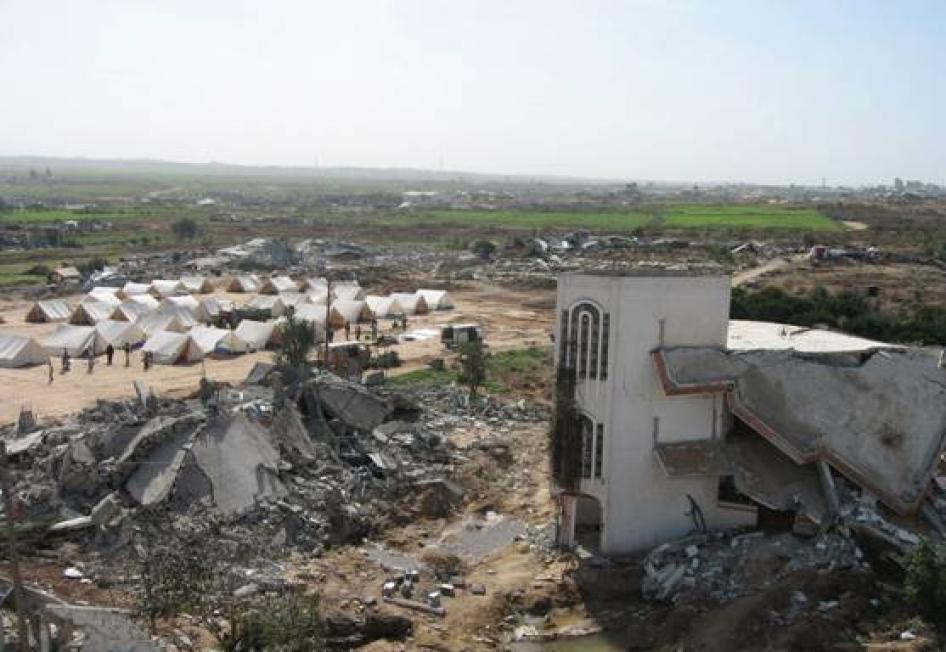
|
Destroyed buildings and a tent camp in Izbt Abd Rabbo, April 2009. Human Rights Watch documented the complete destruction of the homes of at least 287 people on or near the neighborhood’s main road. © 2009 Bill Van Esveld/Human Rights Watch. |
|
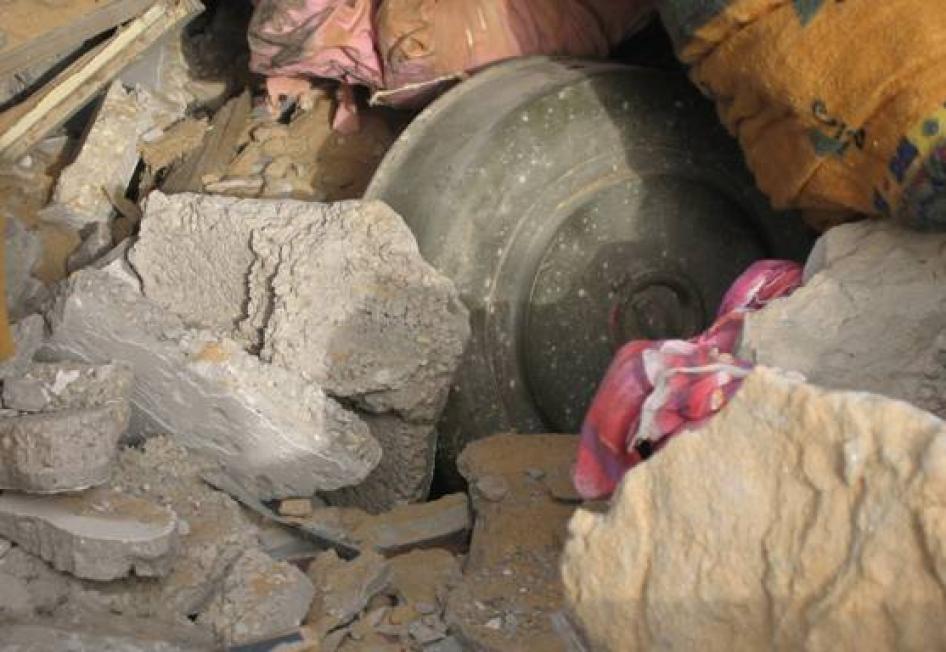
An unexploded Israeli anti-tank mine in the rubble of a demolished home in the Izbt Abd Rabbo area of Gaza. There is evidence that the IDF frequently used anti-tank mines to demolish homes in Gaza. © 2009 Bill Van Esveld/ Human Rights Watch. |
|
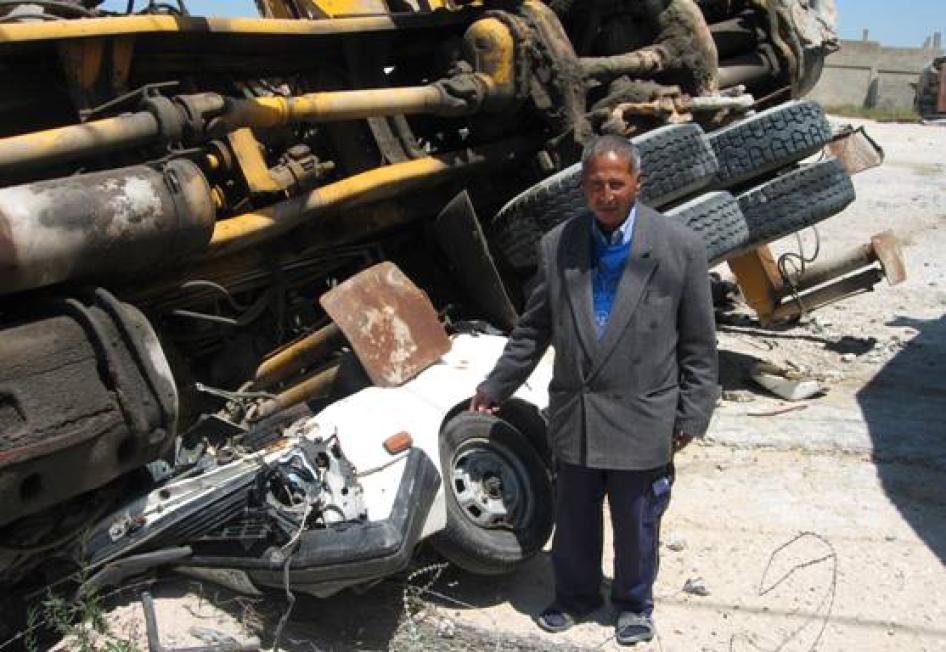
Hamdan Abu Oreiban, a guard at the Engineering Company for Concrete and Construction Materials, stands next to a destroyed cement pump truck and his own car. Human Rights Watch observed 16 vehicles at the factory that were crushed, apparently by IDF tanks or bulldozers, near Gaza’s Zeytoun neighborhood. © 2009 Bill Van Esveld/Human Rights Watch. |
|
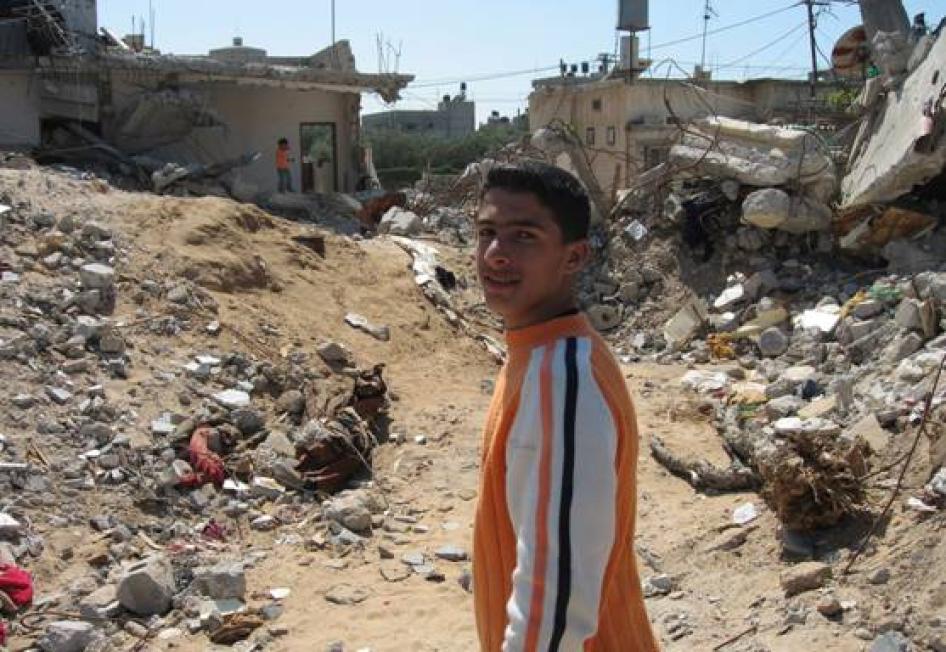
Residents of the village of Khuza’a in southeastern Gaza fled when bulldozers were used against their homes, leaving 119 people homeless. © 2009 Bill Van Esveld/Human Rights Watch |
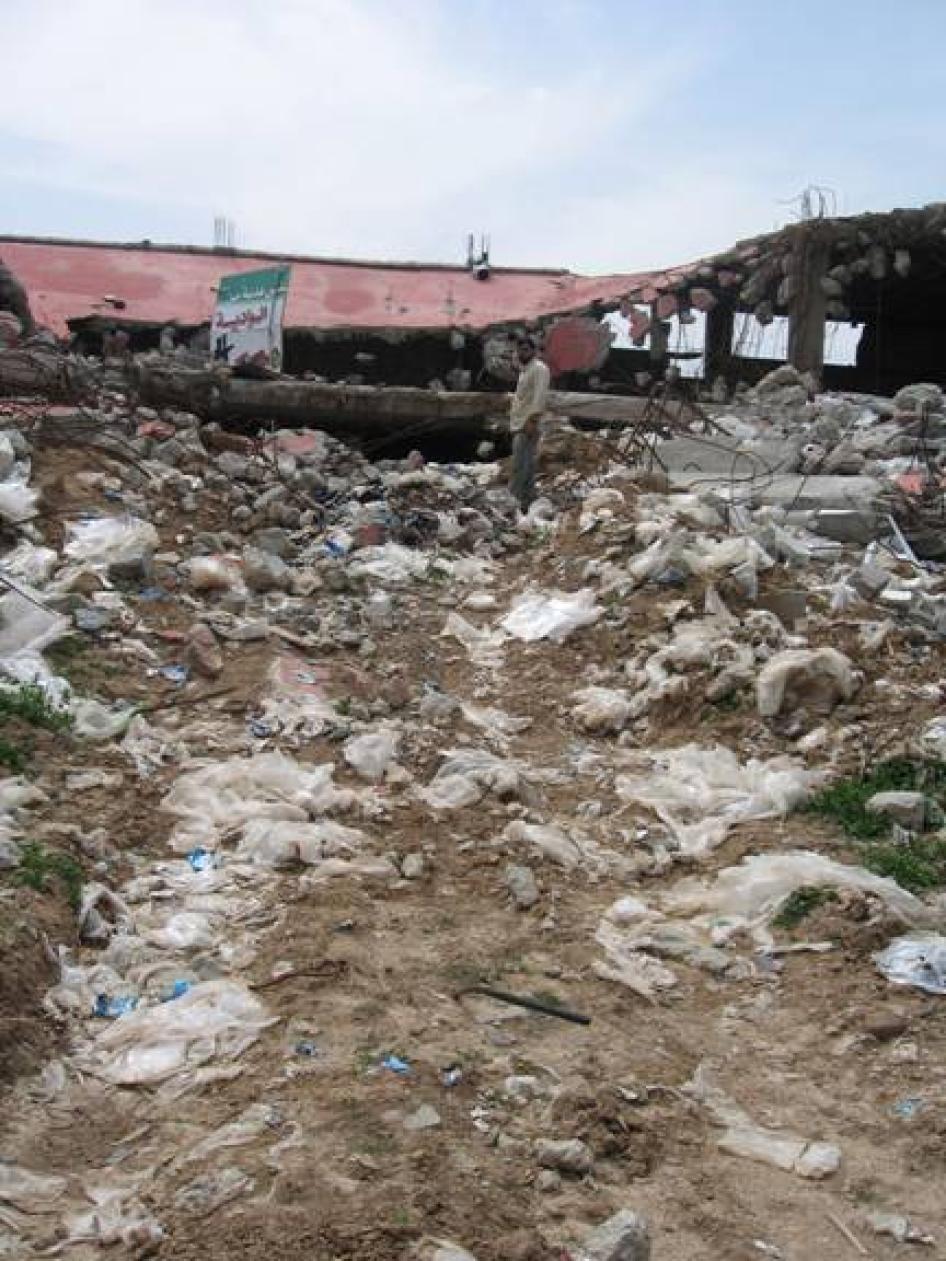
Bulldozer tracks are visible leading to the remains of the Al Wadiyya family’s destroyed biscuit factory, in an industrial area near Izbt Abd Rabbo. © 2009 Bill Van Esveld/Human Rights Watch.
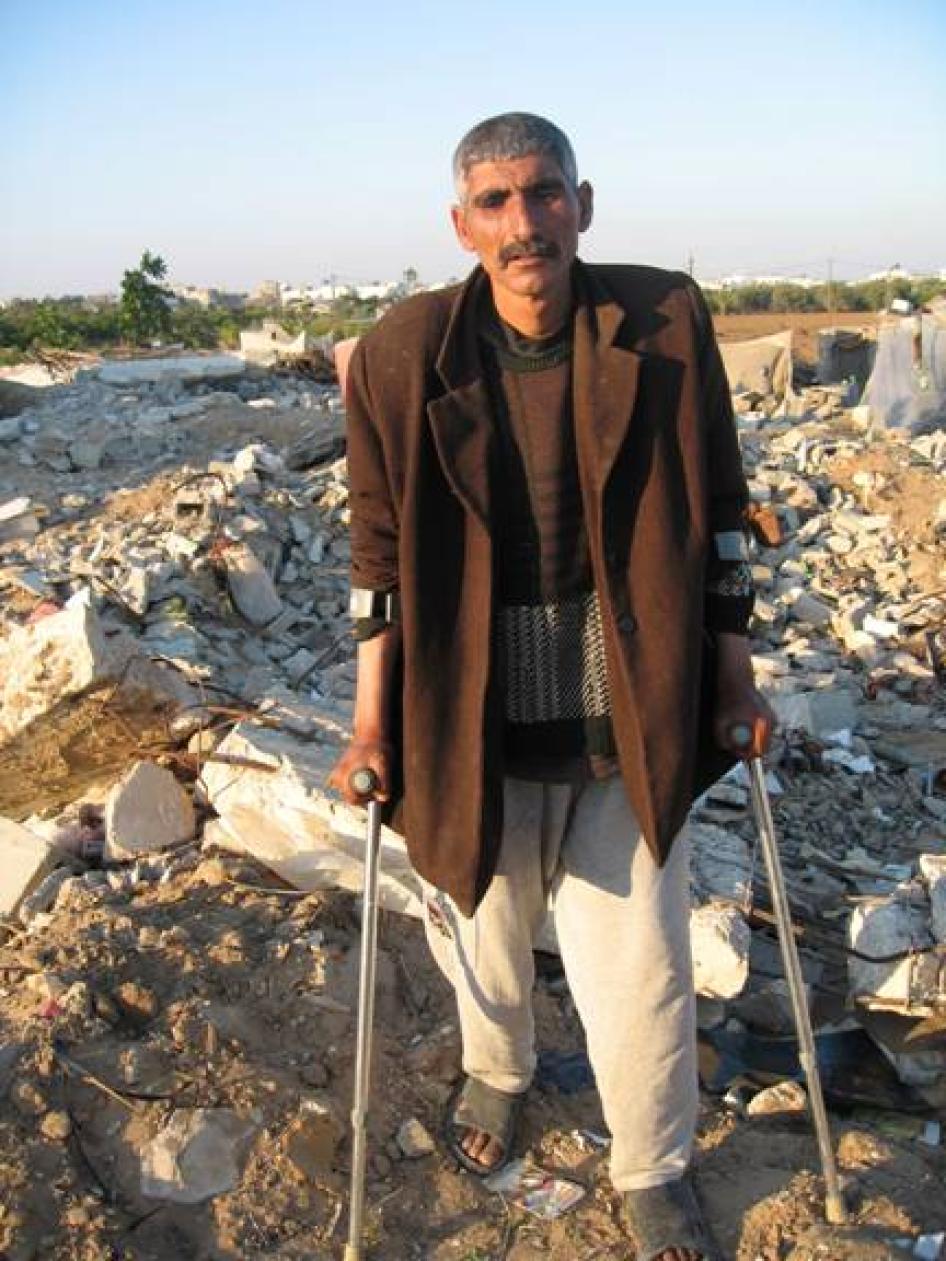
A resident of Gaza’s Zeytoun neighborhood stands among the ruins of his home, April, 2009. © 2009 Bill Van Esveld/Human Rights Watch.
Izbt Abd Rabo and Nearby Industrial Areas
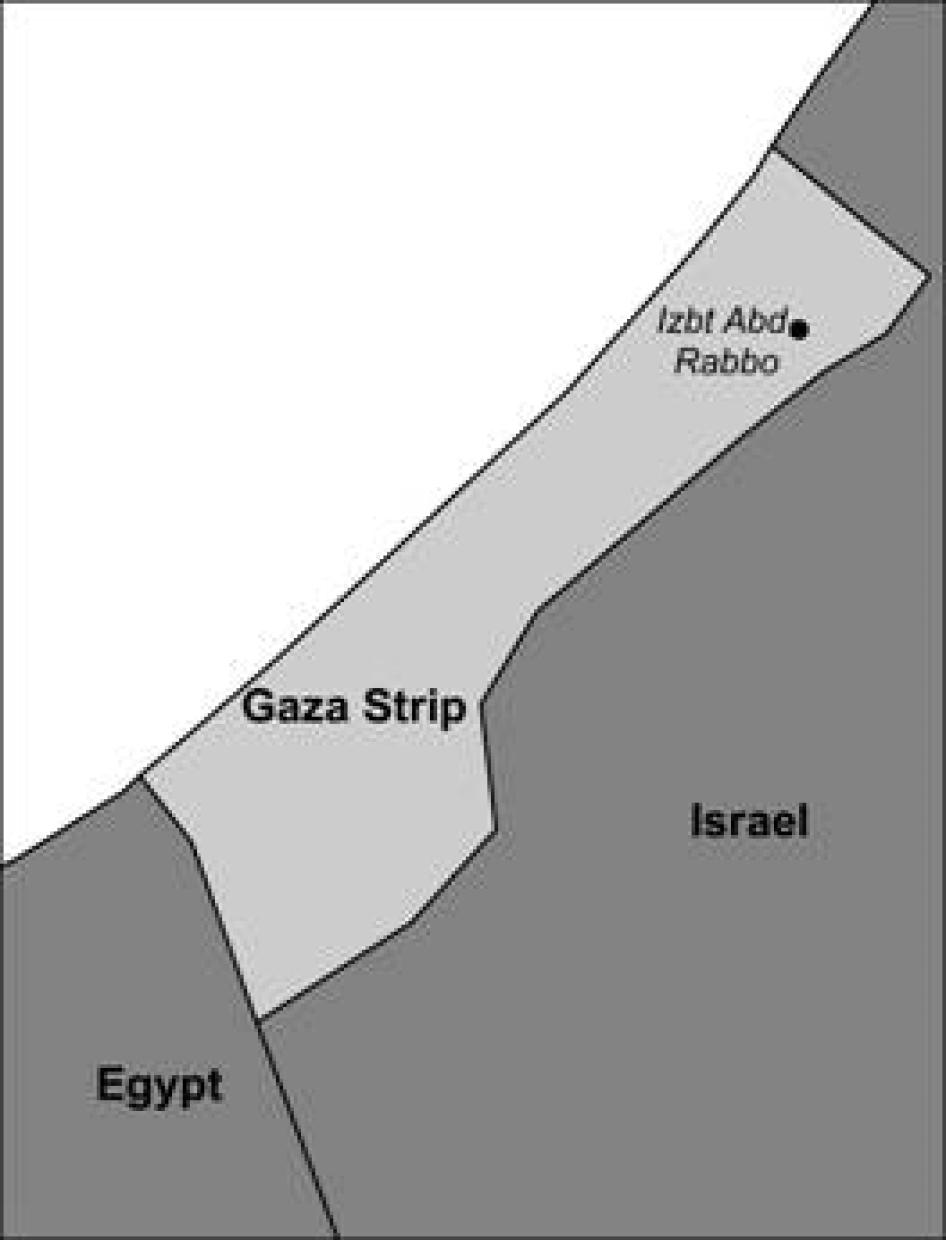
IDF control of Izbt Abd Rabbo
Izbt Abd Rabbo, or the neighborhood of Abd Rabbo, is in southern Jabalya, northeast of Gaza City, roughly 2.5 kilometers from the armistice line with Israel. Human Rights Watch documented the complete destruction of 45 residential structures, which had housed at least 287 people, on or near the neighborhood’s main road during Operation Cast Lead. Fifteen industrial establishments in the area east of the neighborhood were also destroyed, as described below (“Industrial Areas”). According to individual interviews with 17 residents, the vast majority of the destruction that this report documents in Izbt Abd Rabbo took place after January 7, by which point the IDF exercised control over the neighborhood.
Human Rights Watch found no evidence of a lawful militarily necessary reason to destroy the swathe of homes and industrial buildings in Izbt Abd Rabbo. Much of the destruction occurred after the IDF had established control over the area. Military operations in the area had largely ceased, discounting any likelihood that the large number of buildings destroyed occurred in anticipation of imminent fighting.
Human Rights Watch did not attempt to establish the total number of homes destroyed in the neighborhood during the December-January conflict, but the Palestinian human rights organization Al Mezan identified 178 houses in the neighborhood as completely destroyed.[56] Satellite imagery analysis (discussed below) showed that 341 structures were destroyed or badly damaged in the area.
In the 24 hours after the Israeli ground offensive began on January 3, according to neighborhood residents, Israeli forces quickly occupied the small number of buildings on Jebel Kashif, a hill to the north that overlooks the neighborhood, then turned south and moved towards the mosque in the center of the neighborhood. “From the mosque [the soldiers] went house to house, moving eastwards,” occupying houses as they progressed, one resident said. [57] Several residents recalled that by January 5, a tank was dug in near the mosque in the middle of al-Quds Street, the east-west road running through the middle of the neighborhood (usually referred to as Zimmo Street), and that Israeli troops had occupied many of the houses along both sides of the road in the area around the mosque. Israeli soldiers forcibly entered houses or used megaphones to order residents to leave, detaining many of them temporarily. Several residents told Human Rights Watch that Israeli soldiers forced them to search houses or carry out other dangerous military tasks in violation of the laws of war.[58] By the morning of January 7, residents said, IDF ground forces had consolidated their control over the western and eastern parts of Izbt Abd Rabbo.
The UN Headquarters Board of Inquiry, which was mandated to examine damage to UN property and injuries to staff in the course of their duties, investigated a case in which a UN vehicle convoy came under fire in Izbt Abd Rabbo on January 8, after receiving authorization from the IDF to drive to the area to retrieve the body of a UN employee. The Board found that by January 5, the area was “occupied by the IDF.”[59] The details of the incident that occurred on January 8 further substantiate the conclusion that the IDF fully controlled the area. The IDF provided instructions to UN staff to pass through the area at a “specific date and time” and “not to take a particular road.”[60]
Many residents who lived on or near Zimmo Street and who left the area between January 5 and January 12 said their homes and those of their neighbors had not suffered serious damage at that time, and that the closest fighting was at least 500 meters away to the west, beyond the borders of Izbt Abd Rabbo. By January 18, when residents returned to their homes, they found virtually the entire eastern half of the neighborhood, including scores of houses as well as hundreds of dunams of land, had been razed by Israeli forces.
The finding that most of the destruction in the neighborhood occurred after the initial phase of the offensive is corroborated by satellite imagery analysis performed by the UN Operational Satellite Applications Programme (UNOSAT), which identified destroyed or severely damaged buildings in Izbt Abd Rabbo over time, based on damage visible in satellite photographs. UNOSAT found that only 11 buildings in the neighborhood were destroyed or severely damaged between December 27, 2008 and January 6, 2009, but that 330 buildings were destroyed or severely damaged from January 6 to 19 – a thirty-fold increase in destruction that occurred after the IDF had apparently established control of the area.[61]
Palestinian fighters had launched rockets from the surrounding open areas prior to the offensive, residents said. Residents told Human Rights Watch that border observers (murabbetein) from Hamas and other Palestinian armed groups were present in Izbt Abd Rabbo frequently before the conflict, and that armed groups had used open areas nearby to launch rockets at Israel. Hashem Dahalan, 49, speculated that Israeli forces “destroyed many more houses in the eastern part of the neighborhood than the west because the fighters who came to this area in the past [operated in] the east.” [62] At least one house that was destroyed early in the conflict had an escape tunnel leading to another house, Dahalan said. While Hamas militants made use of the area, he added, few lived there: “Only six of the destroyed houses belonged to Hamas.” Another resident, Mahmoud Rajab Abd Rabbo, told Human Rights Watch of tunnels in Jabal Kashif and Jabal ar-Rayes, the hills to the north and south of Izbt Abd Rabbo, respectively.[63] From residents’ accounts, Palestinian armed groups may have used some houses in Izbt Abd Rabbo as cover before or after launching rockets from nearby areas or for other military purposes.
Houses that Palestinian fighters were using as cover, which concealed tunnels, or that otherwise comprised military objectives were subject to lawful attack. Residents said that such buildings constituted a very small minority of the houses in Izbt Abd Rabbo. Human Rights Watch is unaware of any evidence that could lead the IDF to reasonably conclude that more than a small fraction of the houses that it destroyed in the area could have constituted military objectives, even assuming that the IDF considered it lawful to destroy houses that militants were likely to use in future attacks (in addition to houses whose destruction was likely to yield a concrete and definite military advantage during the conflict, as permitted by the laws of war). The wholesale destruction of entire blocks of buildings, even if some could have been lawfully destroyed, would still amount to wanton destruction under the laws of war.
At a meeting on February 4, 2010, members of the Military Advocate General’s office told Human Rights Watch that there was “intense fighting” in Izbt Abd Rabbo, and gave as an example “three militants in a private dwelling who conducted an intense firefight that went on for hours.” The MAG’s office argued that “this incident is not unique, it occurred throughout the Strip,” and referred to photographs published by the IDF Spokesperson’s Office of buildings that Palestinian armed groups had used for military purposes.[64] However, the MAG’s office could not point to any other specific information regarding fighting or the use of civilian property for military purposes in Izbt Abd Rabbo, and acknowledged that no photographs had been published from the area.
According to residents and other reports, some Palestinian fighters were present in the neighborhood at the time of the Israeli air attacks that began on December 27, 2008 and the ensuing ground offensive that began on January 3, 2009. The UN Fact Finding Mission on the Gaza Conflict noted that, according to an article published by an Israeli NGO, “Izbat Abd Rabbo and the nearby areas of Jabal al-Kashef and Jabal al-Rayes appear to have been among the locations in Gaza which saw the most intense combat during the military operations.”[65] In one incident, the article stated that on the evening of January 9, 2009, “three RPG rockets and machine guns are fired against a house where IDF soldiers took up positions in the Ezvet Abd Rabbo region in the eastern sector of Jabalya.”[66] The article was based on information from the websites of Palestinian armed groups, which in at least one case exaggerated their military success.[67]
Human Rights Watch was unable to determine the number of Palestinian fighters and Israeli soldiers killed or wounded in fighting in Izbt Abd Rabbo. We interviewed several residents who said that Israeli attacks killed at least six fighters in Izbt Abd Rabbo by January 6. Cross-checking lists of fatalities compiled by the Palestinian Center for Human Rights (PCHR), a non-governmental organization based in Gaza, and the Israeli NGO B’Tselem, indicates that at least four militants (all Hamas) were killed in Izbt Abd Rabbo on January 3, 12, and 18 (two fatalities).[68]
While some fighting between Israeli and Palestinian forces occurred in the neighborhood during the Israeli ground incursion, as noted, residents reported that the neighborhood was under IDF control when they left the area between January 5 and 14. The fact that three Palestinian fighters were killed during fighting in or around Izbt Abd Rabbo after January 5 may indicate that armed groups counter attacked in the area, raising the possibility that some property was damaged by such an attack or by defending IDF forces. Human Rights Watch spoke to one resident who remained in the area throughout the incursion and did not witness any fighting after the beginning of the incursion, although he remained in his home and therefore had a restricted field of vision.[69] However, as this section discusses, statements by witnesses and physical evidence, including the extensive nature of the destruction, strongly suggest that the vast majority of destruction to civilian property was not the result of fighting or lawful as a matter of military necessity as discussed previously.
Israeli troops entered the middle section of Izbt Abd Rabbo late on January 3. One resident told Human Rights Watch that he heard gunfire at around midnight, and that Israeli soldiers entered the village from the north later that night.[70] He said that he heard tank fire coming from Jebel Kashif on January 4 at 8 a.m.
Hashem Dahalan said he saw soldiers enter the neighborhood on foot at 6 a.m. on January 4 from Jebel Kashif. “A huge number of troops, hundreds, were breaking into houses, clearing and securing them. Already that morning the troops were in the two houses opposite mine.”[71] He said that later that day, IDF bulldozers created an earthen wall on Jebel Kashif, and Israeli forces occupied a white house on the hill, and set up snipers who “fired at my house whenever the curtains moved.” During the rest of the incursion, he said, “two tanks would stay on Jebel Kashif at night, but at 8 a.m. more would come in from the east, along with bulldozers.” The IDF quickly gained control over the area, according to Dahalan.
Ghazzala Salama Abu Freih, 60, lives in a multi-story concrete house (which was not destroyed) that commands a view of the town from the southeastern side of Jebel Kashif. Ghazzala told Human Rights Watch that Israeli soldiers appeared in front of her house at 7 a.m. on January 4. “We were afraid they’d demolish the house, so I asked my daughter-in-law to wake up the kids, so that they’d make some noises [and] show the soldiers there were children. Then they [the soldiers] broke into the house.”[72] The soldiers gathered Ghazzala and her sons and their families into the living room on the ground floor, and occupied the house, firing from the upstairs and not allowing the families to leave until January 14, “two days after our bread ran out.”
Residents reported some fighting in the neighborhood during January 3, 4 and 5—the first three days of the Israeli ground invasion. Hashem Dahalan, 49, who remained in the area throughout the period of the war, told Human Rights Watch of two militants who were killed by Israeli shelling on January 3 near the house of M’Salam al-Haddad, a tile warehouse owner; another fighter was killed on January 4 during clashes on Jebel Kashif; and two others were killed in the middle of the village, on an unknown date.[73] Dahalan said that on January 5 and 6, he heard exchanges of fire to the northwest, on the far side of Jebel Kashif from his home, but he knew of no other fighting near Izbt Abd Rabbo. Dahalan, a security employee of the Palestinian Authority, said that Hamas limited its activity in the area during the fighting, and he criticized Hamas for failing to seize “an historic opportunity to engage the IDF, who actually entered the area on foot.” According to resident Mahmoud Rajab Abd Rabbo, the only fighter from Izbt Abd Rabbo killed during the offensive was Muhammad Nahed Abd Rabbo, a member of Hamas’s al-Qassam Brigades.[74] On January 1, Mahmoud said, Muhammad’s father’s house was struck by a bomb or missile. Mahmoud corroborated the information that IDF forces killed two militants near the home of M’Salam al-Haddad and another one on Jabal Kashif, and said that three fighters were killed around the mosque in the middle of town. Another three fighters were killed near the intersection of Zimmo Street and Salahaddin Road, Gaza’s major north-south artery, he said. Another witness, Majdi Abd Rabbo, told Human Rights Watch that the IDF detained him for two days, starting on January 5, and forced him to act as a messenger between the IDF and three injured Hamas fighters who were trapped in a house.[75] According to Majdi, the IDF attacked and killed the three fighters on the night of January 6.
Jumaa Mbarak Salaam, 25, a shepherd, said that he and his family evacuated their home on the second day of the ground offensive, around January 5. “When we were leaving there was still resistance and a few clashes but it was closer to Salahaddin Road [to the west of Izbt Abd Rabbo] than to the Eastern Line [to the east]. They were hiding but we saw rockets being fired and heard mortars, it was very frequent. But none of the fighters were in this neighborhood. Their most advanced [eastern] location was by Salahaddin Road.”[76]Because the IDF held the territory and continued to advance further into Gaza from Izbt Abd Rabbo, it appears unlikely that rocket-launching squads would have advanced into IDF-held territory after Salaam left the area on January 5. As discussed below, most of the destruction occurred after Israeli troops consolidated their control over the village by January 7.
Many residents of Izbt Abd Rabbo described similar experiences: they were evicted from their homes by IDF troops or fled due to intense shelling, went west along Zimmo Street, and were then stopped and detained by other IDF troops. The soldiers let women and children proceed but kept the men, examined their ID cards, and let them go hours or days later. In some cases, Israeli forces transferred detained men to Israeli territory; in other cases, beginning on January 5 the IDF forced some detained Palestinian men from the neighborhood to perform dangerous tasks of a military nature.[77] For example, Israeli soldiers forced Majdi Abd Rabbo at gunpoint to repeatedly enter a building in which three Palestinian militants had entered.[78] These cases, which involved Israeli troops setting up what amounted to check-points at which they stopped, identified, and separated people attempting to leave the neighborhood, indicate IDF control of the center of the neighborhood.
Arif Salman al-Err, 32, said that Israeli forces detained him on January 4 as he was trying to leave the area. Arif said that he saw a shell hit the home of his relative Muhammad Muhammad al-Err, 55, at sunset on Saturday, January 3.[79] On January 4 at around 10 a.m., Arif decided to evacuate his family from their home south of Zimmo Street on the east side of Izbt Abd Rabbo. Arif and his family walked 450 meters west along Zimmo Street until they reached the mosque. Israeli soldiers wearing green uniforms came out of a house, and separated him from his family, blindfolded him, put him in plastic handcuffs, and took him into the house, where four other men were being detained, including the owner of the house, Abu Lafih. Arif said IDF troops “used me as a human shield” the following day, January 5, forcing him to knock on the door of a nearby house and then to walk in front of an Israeli soldier up the stairs as the building was searched. On January 6, Arif said he was taken in an armored vehicle to a bus, which drove for an hour to an army base where 50 men were detained. After two days, he was released at the Erez crossing into Gaza. “They did not tell us which road to take, they just said, ‘Yalla, everyone go home.’ We went to Jabalya camp.” When Arif and his family returned to Izbt Abd Rabbo after the war, on January 18, his home and three neighboring houses belonging to his relatives had been destroyed, leaving 37 people homeless.
Sabir Abu Freih told Human Rights Watch that he decided to flee from his home near the al-Err block after the area was heavily shelled, and he heard a soldier with a megaphone ordering all families to leave; he believes the date was the first Tuesday of the ground offensive, or January 6.[80] When he left the area, he said, the Abu Freih family’s five houses were all standing. When he returned after the war, they were all destroyed, displacing 31 people.
Akram Ayesh Abd Rabbo, 40, told Human Rights Watch that Israeli soldiers in the neighborhood took him out of his house on January 7.[81] They made him move with them for two days and, in violation of the prohibition against “human shielding,” they forced him at gunpoint to search homes for Palestinian fighters and weapons. According to these residents, major fighting had ceased and Israeli forces controlled the area during the time they were in IDF custody.
Su’ad Muhammad Abd Rabbo, 54, who lived in a multi-story concrete residence facing Zimmo Street, told Human Rights Watch that on January 7, “while we were praying the afternoon prayer,” an Israeli soldier with a megaphone ordered the 13 residents of the house to leave.[82] “The kids ran out, but I tried to get some ID cards and jewelry. I wanted to lock the door but the soldiers prevented me. He said, ‘We are here.’” She returned after the war to find her home demolished.[83]
Esmahan Abu Rashid, 44, and her sister, Nariman Abu Rashid, 43, fled Izbt Abd Rabbo on the afternoon of January 7.[84] The Abu Rashids were among 19 people living in a four-room, one-story building near the al-Err block, also on the south side of Zimmo Street. At 11 a.m. on Wednesday, January 7, shrapnel from shells that hit a neighbor’s home killed their mother, Badir M’Hammed Abu Rashid, 72. Neighbors told the family that there would be a lull in the fighting that afternoon – Israel first announced a daily “humanitarian pause” on January 7 – and a group of 15 family members evacuated their building at around 2 p.m. Esmahan told Human Rights Watch that she helped carry her mother’s body, wrapped in a blanket, west along Zimmo Street toward Salahaddin Road, the main north-south artery in Gaza, half a mile to the west. Israeli forces controlled the areas they passed through: “The soldiers were in the houses. There was a tank in the road where Aish Abd Rabbo’s house is, and there were soldiers in the house near the tank. They forced us to stay there for four hours.” As they left the area, Esmahan said, she saw that her own home, three homes belonging to the Siyyam family, and the large buildings belonging to the Shreiteh family and to the al-Haddad family were still standing and had suffered only minor damage from shrapnel. All were subsequently destroyed.
‘Aid Daher, 34, interviewed separately, also saw the Abu Rashid family carry the body of Badir M’Hammed along Zimmo Street that day.[85] Daher had previously tried to leave the area but was detained by the IDF at the point where a tank was dug in on Zimmo Street en route toward the junction with Salahaddin Road. Israeli troops stopped his group, let the women and children go, and detained six of the men for approximately three hours, along with about 50 other young men, in a house. According to Daher, IDF forces were also present to the south of his house, not only along Zimmo Street to the north. “Only one house was destroyed then, Majdi Abd Rabbo’s,” he said. When Daher returned to the area after the war, the building that had housed him and 21 members of his family was destroyed. Daher pointed out two destroyed homes nearby, including one belonging to his neighbor Abdel Aziz Shreiteh, where 14 people had lived.
Samih al-Sheikh, 25,told Human Rights Watch that his family evacuated their home on the fifth day of the ground offensive, around January 7, “because at noon, when all 16 of us were downstairs, my brother Ihab’s apartment was hit by a shell fired from the north.”[86] At 2 p.m., when the family had heard there would be a lull, they waved a white flag to convey their civilian status and came outside. They walked the west along Zimmo Street but were stopped at the mosque, which was still standing. “They forced us to sit on the street for two hours, they took our IDs, and after that they let us go. They kept all of us there, women and men. There was no destruction yet, but the soldiers were occupying all the alleyways and houses, including the houses that were not facing the road.” Al-Sheikh said that after the war, his family “came back naturally, not expecting anything, we were expecting to see the house. And it was destroyed with landmines. Hamas later took the shrapnel.”[87] Al-Sheikh also pointed out two bulldozed houses near his, where Akram Abd Rabbo lived with his family of five; and where Isma’il Saleh lived alone.
Mahmoud Rajab Abd Rabbo said he left his home, where 34 people had gathered, on the fifth day of the ground offensive – on or around January 8.[88] Tanks positioned on Jebel Reyes, a hill to the south of Izbt Abd Rabbo, fired into his area from 8 a.m. to 1 p.m., hitting the third floor and the ground floor, and troops forcibly entered the house at 2 p.m., evicting them and telling them to go to Jabalya. He and three other men were detained when they reached a tank stationed in Zimmo Street near the mosque; at 11 p.m. they were released and went to Jabalya. “When we left, the IDF had control of the whole area until we crossed Salahaddin Street,” Mahmoud said. “They occupied all the high houses.” According to Mahmoud, Majid Abd Rabbo’s house, near the mosque, and Adnan Jneid’s house, to the southeast, had been partly demolished by bulldozers, but that he saw no other destruction. The mosque was still standing.
Mahmoud said that in the three years he lived in Izbt Abd Rabbo he had witnessed four incursions, each of which had damaged his home. This time, he said, Hamas de-miners found after the fighting that the IDF had rigged six mines which completely destroyed the three-story house, leaving more than 30 people homeless. The house cost around 200,000 Jordanian dinars [$280,000], he said. “We have no money to rebuild the house, and anyway the [border] crossings are closed [to cement]. And if we rebuilt they’d just destroy it again.” To the northeast, he added, “we had three dunams [0.3 hectares] of olive trees, which they destroyed in the past, so we planted it with wheat, but they destroyed that too.”
M’Salam al-Haddad, 58, fled the area at 8 a.m. on January 9. Al-Haddad lived with 25 members of his extended family in a four-story building next to his large warehouse of imported ceramic tiles on the northern side of Zimmo Street. Al-Haddad told Human Rights Watch that the family spent the first week of the ground incursion on the ground floor of his home, but that two tank shells hit the third floor early on the morning of January 9, by which time he had run out of water and insulin for his son Anas, 12, who suffers from diabetes.[89] “Before I left, I went up to the fourth floor” to try to judge the safest route, al-Haddad said. “There were tanks 150 meters east of the Eastern Line, and I thought the infantry was already to the west. So we raised about six white flags and empty water bottles, and we walked along Zimmo Road to the Eastern Line and went north to Beit Lahiya.”
When he fled Izbt Abd Rabbo, al-Haddad said, his home and tile warehouse were otherwise not damaged apart from the third floor. When he returned, he said, “I didn’t even recognize the road to my house.” He found that his home and warehouse had been flattened. “I found 13 mines here [in the house], including unexploded ones. The big transport truck [for moving tiles from the warehouse] was pushed into my swimming pool.” Human Rights Watch observed bulldozer tracks around the steel support pillars of the destroyed warehouse, and examined a large steel cable that al-Haddad speculated the IDF had used to tear down some of the pillars. The eight dunams (0.8 hectares) of fruit trees al-Haddad planted five years ago were destroyed as well.
“I was the biggest importer of tiles in Gaza,” al-Haddad said. “I got them from Spain, Portugal, Italy, Egypt, India, China. I had a huge stock from before the [Israeli border] closure [in June 2007] because no new houses were being built, since there was no cement. I have insurance, but it doesn’t cover the war.” He estimated the total damage to his warehouse, tiles, land and home at $1.7 million.
Majid al-Athamna, al-Haddad’s neighbor to the northwest, attempted to leave the neighborhood on January 10 but that Israeli troops prevented him from doing so until January 12. Majid’s home had an unobstructed view of the south and east sides of Jebel Kashif. He told Human Rights Watch that he saw Israeli forces enter the area from the northeast and take over Jebel Kashif on the evening of January 3.[90] Tanks established a base on the hill, and at around 4:30 a.m. on January 4, bulldozers pushed up earthen barricades around the base. Later that day, at around sunset, Majid said he saw two missiles hit the bedroom of his brother Ra’id’s home. At noon on January 5, Israeli forces destroyed a concrete water tank on Jebel Kashef, and bulldozers attacked four houses on the eastern side of the hill. “The bulldozers would hit the support pillars on one side of the house,” Majid said, “then move around to the other side after the house listed.” On January 7, Israeli bulldozers began to raze Majid’s agricultural land on the hillside. Before sunset on January 9, bulldozers went through a cow farm to the west and demolished two houses, then withdrew back up the hill. On January 10, according to Majid, “tanks came west along Zimmo Street and destroyed al-Haddad’s olive trees on the north side of it, and the Siyyam family’s wall on the south side.” As the fighting continued, more and more members of his extended family moved into his house, a total of 57 people.
By the night of January 10, Majid said, the group decided to try to escape the area.
We sent women out with white flags, but there were three tanks and several bulldozers in the street that fired at the women. They [troops] came to my house at 5 a.m. They were on foot, and firing, so we clustered under the stairway. They called to us with a megaphone and said, in Arabic: “Everyone come out, men, women and children. You have five minutes.” They hit the northwest room, I don’t know with what [munition], and I went out and raised my hands. I moved all 57 of us to the garage. They took my son, Wa’el, though I don’t know why, since he’s a PA employee [rather than a member of Hamas].
Eventually, at 7:30 a.m. on January 12, Majid said Israeli troops told him to evacuate the group to Jabalya. Israeli forces were in control of the area at the time, Majid said. His group walked east along Zimmo Street, which was badly damaged with craters, to the Eastern Line, and began walking north, where he said Israeli troops humiliated some of the group by forcing them to lie down in a crater of mud. Another witness told Human Rights Watch that when she left the area on January 14, the houses belonging to the al-Athamna family and the tile warehouse owned by M’Salam al-Haddad were still standing.
When he returned the following Sunday, January 18, Majid said, he found his house was destroyed, along with four other homes on the same block belonging to his children and relatives. Hashem Dahalan, interviewed separately, confirmed that he witnessed Israeli troops destroy two of Majid’s family’s homes with anti-tank mines, and another two with bulldozers.[91] Majid said that Hamas de-miners had removed a total of 18 anti-tank mines, some of which had failed to detonate, from the houses. He also found his three cars crushed.
Majid said he was still paying loans on his destroyed home. “There are still four Hamas houses standing on Zimmo Street, but mine is destroyed,” he said. “Were my cars launching rockets? Why did they destroy them?”
Ghazzala Salama Abu Freih, 60, left Izbt Abd Rabbo with her family at sunset on January 14, after Israeli soldiers occupied their home and detained them there. The Abu Freih family walked west along Zimmo Street, which “was full of soldiers,” Ghazzala said.[92] A few homes had already been destroyed at that point, she said, and during the time Israeli soldiers occupied her house she was aware of several home-demolitions where Israeli forces used explosives. The soldiers prohibited her from looking out the window, but “when they wanted to blow up a house they’d ask my brother to take the windows out so they wouldn’t shatter. When we returned after a few nights, we found all the windows had been smashed after we left.” She believed Israeli troops were responsible for the damage, presumably as they were withdrawing.
Hashem Dahalan, whose own building was damaged but not demolished and who remained in it throughout the war, said that almost all of the houses the IDF destroyed in Izbt Abd Rabbo, with nine or ten exceptions, were mined or bulldozed during the last four days of the war.[93] Many of the larger homes constructed with reinforced-concrete-were mined, he said.
I saw a special tank come in with a big cube of mines on it. I saw them making an “X” on the support pillars of the houses they were going to destroy. Some of the houses got six or eight mines. All of the mines would blow up at the same time.
In addition to the nine or ten homes Dahalan described as having been destroyed relatively early during the war, Su’ad Abd Rabbo, 54, named another three houses that had been already destroyed when she left, on January 7.[94] She also said that “the airplanes had been hitting constantly” a citrus grove, directly to the south of her home, during the aerial offensive. (Residents made homeless by the war had set up a tent camp in the grove when Human Rights Watch visited in January and again in April.) Su’ad also said that houses to the south of Izbt Abd Rabbo, in the Dordona area near al-Kerem Street (the next east-west street south of Zimmo Street), were demolished on January 4. Su’ad said that most of the houses in the area were still standing when she left.
Many residents of Izbt Abd Rabbo returned to their property after the war to find that their agricultural land had also been destroyed. In total, Majid al-Athamna said, his family lost nine dunams (0.9 hectares) of lemon and olive trees, which he said were razed by Israeli bulldozers.[95] Gharib Muhammad Nabhar, 59, a farmer, left his home during the aerial campaign in late December. When he returned after the war, he found the four dunams (0.4 hectares) of mature lemon trees he tended had been demolished, and that “a bulldozer had pushed my house and the pump of my water well down the street.”[96] Five people lived in his house, he said, and the grove provided jobs for 30 people.
Industrial Areas
The Eastern Line is a main north-south road that runs roughly parallel to the 1949 armistice line with Israel, Gaza’s de facto border, for the length of the Gaza Strip. When it passes by Izbt Abd Rabbo, the Eastern Line is roughly 2.5 kilometers to the west of the border. Moving from north to south, the Eastern Line passes to the east of Jabalya, Izbt Abd Rabbo, Tuffah, and then the Shaja’iya area. Prior to the war, in the areas north and south of Izbt Abd Rabbo, both sides of the Eastern Line were lined with industrial establishments.
Human Rights Watch research documented the destruction of six factories and six warehouses in the industrial area along the Eastern Line during “Operation Cast Lead.” We identified but did not investigate three other destroyed factories in the area. We did not attempt to document all the destruction in the industrial zone, but a large majority of the buildings along the Eastern Line appeared to have been damaged or destroyed. Human Rights Watch is not aware of any information or claims that Palestinian armed groups used the warehouse areas as cover for rocket launches or other attacks, or that the IDF could have otherwise lawfully destroyed them for reasons of military necessity.
A doctor who lives in the Shajai’ya area, south of Izbt Abd Rabbo, described the timing and extent of the Israeli ground offensive in this area of Gaza. “The IDF occupied the entire area east of the Eastern Line and stayed there for the whole war. The tanks were already on the Eastern Line maybe on the first or second day [of the ground invasion].”[97] In addition, Israeli forces also drove quickly in to Izbt Abd Rabbo and also to the north and south of Shaja’iya,close enough that residents of Shaja’iya “remained within sniper range,” the doctor said. The doctor stated that “the resistance [Palestinian armed groups] was not active” in the industrial zone or in Shaja’iya during the war. The doctor, who identified himself as a Fatah supporter and noted his dislike for Hamas, told Human Rights Watch that he fled the area on January 4 after seeing his neighbors’ apartment burn down and did not witness the destruction of structures in the industrial area, but that he knew the positions of Israeli forces because he came back repeatedly during the three-hour “humanitarian pause” Israel announced on January 7.
Wadiyya Sweet Factories
The al-Wadiyya family owns the Sarayo factory, which manufactured biscuits, chips, and ras al-abid (a kind of sweet) and was located on the eastern side of the Eastern Line, near Izbt Abd Rabbo, at a distance of more than two kilometers from the de facto border with Israel.[98] The factory compound included the al-Wadiyya’s al-Amir ice cream factory, and a small building used to produce Dulci-brand sweets.
Naaman al-Khodary, 35, production manager at the Sarayo factory, said he was not present at the factory during the beginning of the Israeli offensive, but that he visited it on January 7 during the lull in the fighting. “I didn’t see any troops so I came to the factory and got some cans of gasoline. But on my way out I saw tanks to the west that I hadn’t seen on my way in, so I locked the door and walked away quietly. None of the factories had been destroyed at that point.”[99]
Human Rights Watch inspected the destroyed factories and the factory grounds. All three facilities in the compound were largely destroyed, and four completely charred mid-sized trucks were next to the factory. The grounds of the compound were covered with heavy bulldozer tracks leading up to the factory buildings. Al-Khodary pointed out “ramps” next to the Sarayo factory, which bulldozers had made out of raw food materials and packing materials, that led from the ground up to the factory’s second floor.
Al-Khodary said that he and other workers found heavy, jagged metal shrapnel up to eight inches long in the factory. Human Rights Watch did not view these fragments, but shrapnel of this size would suggest the factory was hit with artillery or tank fire.
Al-Khodary said he did not know of any witnesses to the destruction. “There was a guard here, Abd al-Majid Khader, around 65-years old. After the war we found his body in the hospital, but it was in such bad shape we could hardly identify it.” Al-Khodary said Khader had been killed at the factory site, but did not know the date or circumstances.
Al-Khodary said Sarayo was the biggest biscuit factory in Gaza and would be difficult to repair. “The process was, the dough was mixed, then formed, and then sent through the ovens. [The IDF] hit the ovens. They hit the middle of the production line. The sheet that rolls through the ovens is 120 centimeters wide.”
The factory owner, Yassir al-Wadiyya, said that at this location and the family’s six other factories and warehouses in eastern Gaza, the IDF destroyed US$22 million in equipment, facilities, vehicles and refrigerators.[100] Al-Wadiyya said that rebuilding the factories would be prohibitively expensive due to the Israeli blockade of Gaza’s borders. “A bag of cement now costs almost $64, when it used to be around $5,” he said.
Warehouses near the Macca Cola factory
To the south of the al-Wadiyya factories, on the western side of the Eastern Line (slightly further away from the de facto Israeli border), Human Rights Watch visited four completely charred and gutted warehouses, which are between the road and a large Macca Cola bottling plant. The owner of the warehouses, Hossam Said Hassanein, 40, said two of the destroyed buildings had been a dried food warehouse and a fluorescent light bulb warehouse; two smaller buildings were used as a carpentry shop and an industrial laundry.[101] Hassanein said he owned two other warehouses elsewhere that were also damaged during the war; in total, his three properties suffered roughly US $850,000 in damages.
According to Hassanein, local residents told him the warehouses were set ablaze “three days before the end of the war,” or around January 15. “We found eight or nine artillery shells, all of them were in one piece, around 70 centimeters long.” Human Rights Watch identified one green-painted white phosphorus shell that Hassanein said had landed in the Macca Cola bottling factory area behind the warehouses.
Imad Nassir Houssu, 30, a warehouse guard, confirmed that the warehouses were destroyed late in the war, on around January 15. Houssu said he spent most of the war sheltering just south of the warehouse area in the Wafa Rehal Center for the Elderly, which occupies part of a multi-story hospital complex and from which it would be possible to have seen fires in the warehouses. “When they announced the lull in the fighting [on January 7], I came back here. These warehouses were fine. Then two days before the withdrawal [around January 15] they hit all these buildings. I saw the [white phosphorus] shells exploding over here, and the fire lasted one or two days.”[102] After the war, he said, he saw bulldozer track marks around the food storage warehouse, which had been flattened.
It is not clear why the IDF fired air-burst white phosphorus munitions over the factory areas on around January 15. While many militaries use white phosphorus to screen troop movements, the white phosphorus that hit the warehouses was apparently fired two days before the IDF began to withdraw from Gaza late at night on January 17.[103]
Although Jebel Rayes – from which residents of Izbt Abd Rabbo said rockets were fired prior to the war – and open fields lie to the northwest of the Macca Cola plant, Houssu and Hassanein insisted that no Palestinian fighters were in the area during the war. “It was impossible to move here, there were drones flying and fighters would have had to cross open fields to get here,” said Houssu. “The closest they [Palestinian fighters] got was around 700 meters away, 400 meters east of Salahaddin Street.”
Gaza Juice factory
In the Tuffah area opposite the Eastern Line from the Macca Cola plant is the Gaza Juice Factory, owned by the Palestinian Food Industries Co. Bulldozers and several kinds of munitions badly damaged the factory buildings and production equipment. After the war, factory employees said they collected anti-tank mines and shrapnel from what appeared to be high explosive artillery or tank shells from factory grounds, along with other weapons, which they showed to Human Rights Watch.[104]
Production engineer Ibrahim al-Sweitti, 50, recalled visiting the factory on January 7, during the first three-hour lull in the fighting. “Nothing had hit the buildings yet. Our guards were still here. The factory burned on January 15. We saw it on the news. It was a huge fire, it burned for two days, but it was impossible to get here [because of the presence of Israeli troops].”[105]
Said al-Ghoula, 40, and his brother Bassam, 38, are both security guards at the factory. Said confirmed that “the destruction happened here during the last three days of the war.”[106] They lived a 10-minutes’ walk from the factory and managed to walk to the Wafa hospital compound to the southwest, across the Eastern Line, during the unilateral pause in the fighting Israel first implemented on January 7. Bassam told Human Rights Watch that on the day the factory was on fire, he and Said had tried to walk to it again, but “We couldn’t get close. We came on the next day to a place 200 meters south of here. The IDF was in the grove to the north of the factory.”[107]
Said and Bassam al-Ghoula, interviewed separately, said the IDF was firmly in control of the area for more than a week before the factory was burned. Bassam recalled an occasion prior to the factory’s destruction when he came under fire from the grove north of the factory while trying to walk from the Wafa hospital complex towards the factory. According to Bassam, “there was no resistance here. Everyone had left within the first 10 days [of the attacks that began on December 27].”
The factory’s owners estimate the total damage to the factory caused by the Israeli military offensive at more than $1,924,000. A report prepared by the Palestine Food Industries Co. detailed extensive damage to the factory’s refrigeration units, evaporator (for condensing juice), production lines and storage tanks, electrical panels, and structural damage to the factory and administration buildings and storehouses.[108] Al-Sweitti, the production engineer, showed Human Rights Watch the evaporator and eight juice-extracting machines on the production line. The eight machines “were installed in 1993 by an Italian company. The first two are wrecked but the rest can be repaired. Each costs $200,000.” As a result of the damage, al-Sweitti said, the factory was working at 10 percent capacity. Unlike most other Gaza factories, “we were actually working close to capacity before the war, because all the raw materials are fruit from Gaza.” The destroyed refrigeration units had also been storing goods for other companies as well as raw materials for the juice factory.
Abu Eida Cement Factory
A preliminary survey of the damage to Gaza’s industrial sector reported in February that the war destroyed or damaged 22 of Gaza’s 29 ready-mix concrete factories, causing an “85 percent loss in the sub-sector’s potential capacity.”[109] Most cement factories had previously been rendered idle by the blockade imposed on Gaza by Israel and Egypt. Since 2007, Israel generally prohibited cement imports from entering Gaza on the grounds that Palestinian armed groups could use cement for military purposes; the lack of cement meant Gaza cement factories could only undertake Israeli-approved projects for which imports were authorized.
As discussed in the Summary, during “Operation Cast Lead,” Israel could have lawfully attacked otherwise civilian objects if they were making an effective contribution to Palestinian armed groups’ military action and their destruction offered a definite military advantage at the time. For example, if armed groups had commandeered concrete factories during the fighting and were using the concrete produced to build or repair military objects like bunkers, such factories could have been legitimate targets for Israeli attack. However, Gaza’s concrete factories were unable to operate at all prior to and during the war because they had run out of cement, which they must import due to their lack of capacity to produce it. There is no evidence that any of the cement and concrete factories in Gaza contributed to the military efforts of Palestinian armed groups during the fighting.
The cement factory owned by the Abu Eida family near Izbt Abd Rabbo was, according to its owners, the largest such facility in Gaza prior to the war. Human Rights Watch is not aware of any information or claims that would have rendered it subject to lawful attack.
Abd Rabbo Abu Eida, 70, a partner in the factory, told Human Rights Watch that he and other members of his family spent the first days of the war locked in their homes, which were set further back on the property behind the factory grounds. Israeli forces attacked the property on January 3, he said. “With the ground offensive, the shells were falling all around, and when the tanks got close they opened machine gun fire at the [cement] storage tanks and the windows. Then the tanks and bulldozers came and leveled the walls and trees around the houses.”[110]
On Sunday, January 4, Abu Eida said, he and his relatives raised white flags, left their homes, and fled the area. “At this point the factory grounds were destroyed but the [factory] buildings and the houses were still OK. When the war ended we came back here and we found the houses demolished and the factory too. We knew it was bulldozers because the cement trucks and pumps had been dragged and turned over.”
Another member of the extended family, Yusuf Abu Eida, 35, interviewed separately, fled with a second group on January 7. Yusuf said he witnessed militarized bulldozers destroying the factory grounds, as well as “the walls and surroundings and cars and gardens and the cattle shed” during the first days of the ground invasion.[111] He could observe the destruction from a three-story building where he lived with two other brothers and their families, at the back of the lot slightly to the west of the factory area. “The tank shells were hitting the houses while we were inside. Then they calmed down suddenly around 1:30 or 2 p.m., during the ceasefire [on January 7], so we waited for about 15 minutes and left. There were 70 of us who left at the same time.” Yusuf said this large group walked north because “we knew the tanks had already gone down to the southwest.” The fact that some tanks had advanced further into Gaza by January 7, the day that Yusuf and his group apparently fled Izbt Abd Rabbo, suggests that by that date the entire area was already under IDF control.
According to Yusuf, during the period from the beginning of the war until January 7, “The only resistance [from Palestinian armed groups] was on the other side of Salahaddin Street,” roughly a kilometer away.
Human Rights Watch viewed the crushed remains of seven cement mixing trucks, three cement pump trucks, one fork lift, and three cars that had been destroyed on factory grounds. Most of the mixing and pump trucks had been pushed over on their sides and partly crushed; the smaller vehicles had been run over and were completely flattened, apparently by tanks or large bulldozers given the tread-marks still visible in the soil and imprinted, in some cases, into the metal surfaces of the destroyed vehicles. A building housing a generator, a water well, a small outbuilding across the street, a multi-story concrete administrative building, and two silos used to store cement were also destroyed.
Human Rights Watch observed eight of the family’s private homes at the back of the large lot that also housed the cement factory, which were totally destroyed.[112] Abd Rabbo Abu Eida said he believed that the private homes, including his own, had been demolished with anti-tank landmines. Human Rights Watch examined these buildings. The interior side of several structural support pillars of the building Abu Eida pointed out as his home were charred and seemed to have blown outwards, which would be consistent with mining, although Human Rights Watch could not find the remnants of mines at the site.
The extended family members who lived there are currently displaced and live in apartments throughout northern Gaza.
According to Abu Eida, the machinery and vehicles destroyed included those used by the factory as well as those recently purchased from another cement factory in Beit Lahiya which had not yet been installed.[113] He said the family also owned another cement factory in the eastern Gaza Strip that was also destroyed during the war. He estimated the total losses the family suffered at US $12 million.[114]
Jamal Abu Eida, 45, another family partner in the business, said the factory was built in 1993. “We had to change the plans 23 times before Israel would give us the ISO certificate. But then the Israelis didn’t make us pay taxes. They encouraged us to be here.”[115] According to Jamal, “Our factories were the biggest in Gaza, they could produce up to 120 cubic meters of cement per hour at full capacity, and we took on the biggest projects because we had the tallest cement pumping trucks.” The Abu Eida factory had supplied the cement for the Gaza power station, Jamal said, and had won the contract to work on an EU-funded project to create sewage treatment ponds to reduce the strain on the dangerous Beit Lahiya sewage lagoon.[116] The Abu Eida factory had been scheduled to receive concrete imports from Israel that were designated for the project – making it unique among Gaza’s cement factories, which had largely been shut down due to lack of raw materials by Israel’s border blockade.
Al-Qonouz cement factory and al-Dalon home
None of the owners or workers at the al-Qonouz factory were present when Human Rights Watch visited the site, but researchers spoke with Rashid al-Dalon, 46, whose destroyed home is 25 meters south of the factory on the western side of the Eastern Line. As with the other structures destroyed in the area, Human Rights Watch is not aware of any information or claims that Palestinian armed groups used these structures or that their destruction was militarily necessary.
According to al-Dalon, Israeli militarized bulldozers destroyed part of the factory on January 4, the first full day of the ground invasion. “I saw the bulldozers knock down the two silos used to hold cement powder,” he said.[117] There were no Palestinian fighters present on factory grounds at the time, al-Dalon said. Human Rights Watch observed that a concrete wall around three sides of the factory had been destroyed and one factory building’s walls badly damaged, apparently by bulldozers.
Later on January 4, at around 3 p.m., tanks opened machine gun fire at al-Dalon’s home. He told Human Rights Watch:
My family and I were the only ones left in the neighborhood. I wrote “Yesh mishpacha ba bait” [“there is a family in the house,” in Hebrew] on a piece of cardboard and my wife and daughter came out of the house holding it. But they forced us back into the house and brought in dogs, and they stayed in the house until Wednesday [January 7]. They threatened me that if I left the house they would shoot me and demolish it. They put us on the ground floor, but took control of the two upper floors. I could hear them shooting from up there. There were literally hundreds of soldiers. There were mechanics to fix the tanks that were in front of the house. On Wednesday at noon the soldiers left, all of them.
Israeli troops occupied and used al-Dalon’s home as a base over the next several days, he said. They allowed him to leave the area with his wife and five children on January 7, during the three-hour pause in the fighting Israel announced that day. When he returned after the war, al-Dalon found his home had been completely demolished. Human Rights Watch observed the fragments of two anti-tank mines in the rubble of his home.
“I built this house 10 years ago for about 50,000 Jordanian dinars [roughly $70,000],” ad-Dalon said. “I lost everything, my house and all my furniture. I also lost my seven cows.”
Al-Dalon said there were no Palestinian militants in the area at the time his home was occupied or during the rest of the time he was forced to stay there; he had not heard any reports that fighters entered the area subsequently. “The closest area they reached during the fighting was to the west of the al-Saraji hill,” he said, indicating a hill roughly a kilometer to the west of the area.
Atta Abu Jubbah cement-packaging factory
The Abu Jubbah factory was located on the Eastern Line to the northeast of Izbt Abd Rabbo (beyond the Israel-imposed buffer zone near the de facto border, like all the other structures whose destruction Human Rights Watch documented in this area). It was the only factory that packaged cement powder for transshipment in Gaza.
Human Rights Watch observed a destroyed administration building and workers’ complex, and the rubble of a very large cylindrical metal tank where the factory stored the concrete before packaging it.[118]
Ibrahim Abu Hanna, 52, who lived next door to the factory, said the factory was still unscathed as of January 15, two days before Israeli troops began to withdraw. He told Human Rights Watch that he had fled his home during the aerial campaign but came back to the area twice before the end of the war, during the daily three-hour ceasefire periods. “I came back five days and again three days before the end of the war [around January 12 and 15], although it was a big risk because of the drones. The factory was still standing and had not been destroyed at that point.”[119] On these two visits to the area, Abu Hanna said, he observed no Palestinian fighters in or near the area, and his description of a large number of Israeli tanks and bulldozers further to the west suggests that the IDF had established control over the area. “The tanks were on the hill [to the west], there were lots of tanks and many D9s [militarized bulldozers]. It seemed each tank had two D9s with it.”
Human Rights Watch observed the remains of a very large cement storage tank. When we visited the site in April the tank had been partly disassembled into individual sections, some of which were punctured by the entry and exit holes of munitions that had been fired into them. Each of the tank’s metal support pillars had rested on one cubic meter blocks of reinforced concrete. Mu`in Hassanein, 42, a guard at the factory who had left the area on the fourth day of the Israeli air campaign (December 30 or 31), told Human Rights Watch that “They put a landmine next to each support and blew them up.”[120] Human Rights Watch observed concrete rubble consistent with this description as well as the remains of one anti-tank mine.
Hassanein said the storage tank was shipped to Gaza in sections from Turkey in 2003. He said that the factory received its last shipment of powder from Israel before November 4, 2008, when Israel cut off all imports of cement. Prior to the border closures, the factory employed up to 40 people.
Al-Tibi cinder block and cement mixing factory
The al-Tibi cement factory was also on the Eastern Line to the north of Izbt Abd Rabbo. In this area, “it was relatively calm for most of the war, not like in the south,” according to Salim Dahrouj Abu M’Hammad, 41, a factory guard.[121] “But then they [the IDF] chose this area to withdraw from. They destroyed the factory then during the withdrawal,” he told Human Rights Watch.
Abu M’Hammed’s home is around 300 meters from the factory. Although it does not have a direct line of sight to the factory, he told Human Rights Watch, “The day before the end of the war [January 17] we could hear the sound of bulldozers in this area and saw columns of smoke and dust, which we realized were from destruction. There were no fighters here. At 7:30 a.m. on the next day [January 18], we heard on the radio that they had withdrawn from Gaza.”
Human Rights Watch observed that the cinderblock factory itself, the walls of the factory compound’s garage and warehouse, and part of the factory’s administration building, all of which were destroyed. Four cement-mixing trucks as well as three large metal tubs (simple equipment used for mixing concrete) were inoperable because of damage; one of the cement-mixing trucks was completely destroyed and the other three had been pushed into one another and badly damaged. A cement-pumping truck was also badly damaged.
The factory had been inoperative since November 4, 2008, due to Israeli border closures and the ban of cement imports, Abu M’Hammad said. At its maximum capacity, the factory produced between 850 and 1000 cubic meters of liquid concrete and 6500 cinderblocks per day, and employed a total of 34 people.
Zeytoun
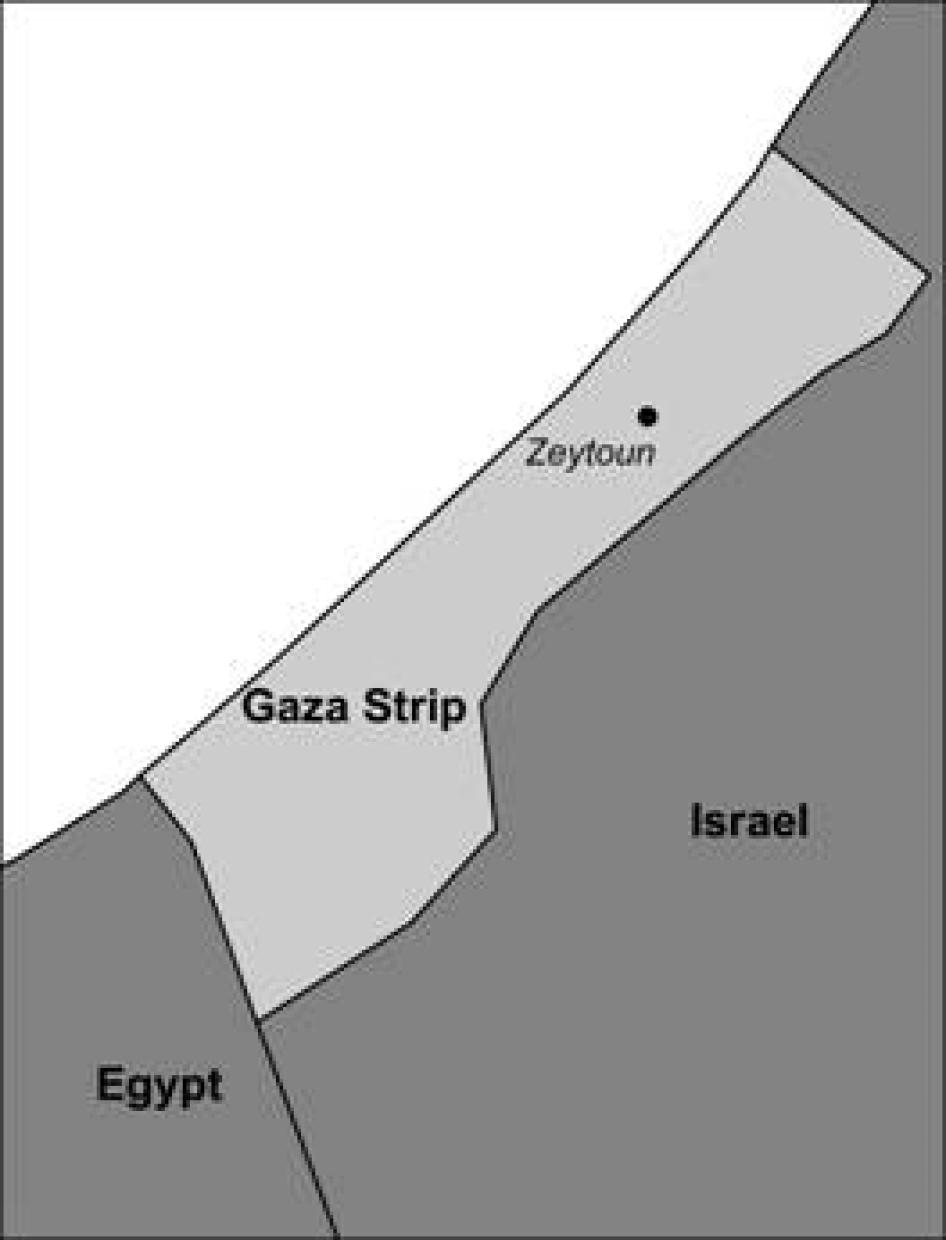
Zeytoun is an area comprising residential neighborhoods and open agricultural lands roughly 2.5 kilometers south of Gaza City.[122] The western boundary of Zeytoun runs south of the Gaza City suburb of Tel el-Hawa. Its eastern edge runs parallel to the east of Salahaddin Road, Gaza’s main north-south artery. Human Rights Watch interviewed residents of al-Samuni Road, an east-west road in the southern part of Zeytoun, and residents of a part of Road 10, another east-west road further to the north. Prior to the war, residential buildings lined sections of both roads, which link agricultural areas in Zeytoun to Salahaddin Road.
Early in the Israeli ground offensive that began on the evening of January 3, IDF armored forces drove into Gaza south of the Karni crossing and rapidly moved west to the sea coast near the area of the former Netzarim settlement, effectively bisecting the territory.[123] By the early morning of January 4, witnesses said, large numbers of Israeli forces had advanced from their positions northward into Zeytoun. The IDF subsequently advanced northwest towards Tel el-Hawa on January 15, badly damaging buildings especially on the suburb’s southern edge. Israeli forces began to withdraw from Gaza early on the morning of January 18.
Human Rights Watch observed extensive damage to homes, greenhouses, and agricultural land in Zeytoun. In cases that Human Rights Watch examined on al-Samuni road and Road 10 – which represent a fraction of the total destruction in the area – residents said that at least 193 people had lived in residential buildings that were destroyed during the war. According to analysis by UNOSAT of satellite imagery taken of the al-Samuni Road and Road 10 area of Zeytoun during and immediately after the conflict, 114 buildings and 27 greenhouses were destroyed or severely damaged from December 27, 2008 to January 19, 2009.[124] On the eastern side of Salahaddin Road opposite its intersection with al-Samuni Road, Human Rights Watch observed two destroyed factories.
The accounts of residents on both al-Samuni Road and Road 10 suggests that Israeli forces inflicted extensive damage to buildings and land there in the early days of the ground offensive, but that they did not destroy most houses along these two roads until after January 7, when they had already occupied these areas and almost all residents had fled. Many of the Zeytoun residents with whom Human Rights Watch spoke said that they left these areas after their homes had been shelled or hit with small-arms fire. When they returned to the areas after the war, they said, they found the buildings had been bulldozed or destroyed with anti-tank mines. Human Rights Watch also observed bulldozer tracks in destroyed agricultural areas.
UNOSAT analysis of satellite imagery found that 43 percent of the buildings and greenhouses in the al-Samuni and Road 10 area were destroyed during the last two days of the war, after six days of relatively little destruction. According to UNOSAT, 60 buildings and 16 greenhouses were damaged or destroyed between December 27 and January 10, but only four buildings and one greenhouse from January 10 to 16. The amount of destruction increased again significantly from January 16 to 19, when 50 buildings and 10 greenhouses were destroyed or severely damaged. Israel withdrew its ground forces from Gaza early in the morning on January 18.
Reports by the Palestinian Center for Human Rights (PCHR), a non-governmental organization based in Gaza, and by the Israeli NGO B’Tselem, indicate that 34 alleged militants were killed in the Zeytoun area from December 27, 2008 to January 14, 2009.[125] According to PCHR and B’Tselem, no fighters were killed in all of Zeytoun after January 14.[126] As noted, satellite imagery shows that almost half the destruction in the al-Samuni and Road 10 areas of Zeytoun occurred after January 16.
According to PCHR researchers, the members of Palestinian armed groups killed in Zeytoun were not killed in areas around al-Samuni road and Road 10.[127] PCHR and B’Tselem did not provide specific locations for the militants’ deaths, and Human Rights Watch could not independently confirm the dates, locations or circumstances of the fighters’ deaths.[128] The most densely built-up areas of Zeytoun lie between 500 meters and 1 kilometer north and northeast of Road 10; by contrast, both al-Samuni Road and Road 10 are surrounded by open agricultural areas. As discussed below, Palestinian witnesses said the IDF came under mortar fire from fighters to the north during the first days of the incursion, when Israeli forces drove into Zeytoun from the south, and one resident said that clashes between the IDF and Palestinian troops occurred in built-up areas in northeastern Zeytoun. Fighters in southern Tel el-Hawa reportedly also put up resistance to the IDF drive further north on January 15.
The accounts of residents, the IDF’s advance from Zeytoun to Tel el-Hawa, and other evidence indicates that the IDF maintained control of the areas on al-Samuni Road and Road 10 from approximately January 5 or 6 onwards. The IDF’s widespread destruction of property in these areas at and after this time would thus be unlikely to meet the requirement of imperative military necessity. As is discussed in detail below, in many cases, buildings were destroyed during a period when residents left the area and before they returned after Israel withdrew its forces; however, the type and significant extent of the destruction in the areas we investigated is not consistent with attacks against individual military objects or with damage sustained during fighting.
Eastern al-Samuni Road (al-Samuni family)
The extended al-Samuni family lived in the southeastern part of the agricultural area of Zeytoun. Israeli forces bombarded the area intensively on the night of Saturday, January 3, the first day of the ground invasion, and continued to do so early the next morning.[129] Residents who lived further to the west on the same street as the al-Samuni family, said that Palestinian fighters to the north fired mortar rounds towards Israeli positions on the night of January 3.[130]
The UN Fact Finding Mission on the Gaza Conflict found that Palestinian combatants may have been present in the al-Samuni neighborhood on January 3, based on a witness’s statement that he heard shots near his house that night and “at first thought it was Palestinian fighters,” and on a report by Al Mezan, a Palestinian NGO, which stated that an Islamic Jihad fighter was killed in the area at around midnight.[131] The Fact Finding Mission found, however, that “already before daybreak on 4 January 2009 the Israeli armed forces were in full control of the al-Samouni neighbourhood.”
On the morning of January 4, Israeli forces attacked the al-Samuni area, ordered residents to evacuate some buildings, and occupied buildings, without facing opposition by Palestinian fighters, according to residents.
Residents said the IDF attacked the al-Samuni area early in the morning. Helmi al-Samuni, who lived on the third floor of a large building on the north side of the street, told Human Rights Watch that he was inside his apartment when a shell came through his window from the north-east and completely destroyed the furnishings of the room where it entered.
Human Rights Watch observed a hole in the eastern wall of al-Samuni’s home, which he said was caused by a second shell that hit and exploded.[132] He and his family fled their apartment and eventually sought shelter in a building belonging to his relative Wa’el al-Samuni, on the south side of the street. He did not see any Palestinian fighters in the area at the time. Nafez al-Samuni told Human Rights Watch that he and his family also sought shelter at Wa’el al-Samuni’s property, after two shells hit their home that morning. He was not aware of any Palestinian fighters in the immediate area at the time.[133]
Israeli troops ordered many residents to leave their homes along al-Samuni Road.[134] In other cases, Israeli forces occupied buildings and ordered residents to remain in their homes. According to Muhammad al-Samuni, who lived near the eastern edge of the area, IDF forces entered his building from the roof and the front door simultaneously at 5 a.m. on January 4, and detained the residents for four days.[135]
Although Human Rights Watch is not aware of any claims that any members of the al-Samuni family engaged in combat with the IDF, it is possible some had active affiliations with militant groups. Muhammad al-Samuni displayed an al-Aqsa Martyrs Brigades training certificate he received in 2000.
Israeli forces continued to exert control over the area the next day, according to residents. By the early morning of January 5, approximately 90 to 100 family members had taken shelter in a warehouse owned by Wa’el al-Samuni, in some cases after Israeli soldiers ordered them to do so. At 6 a.m. on January 5 a group of four or five men tried to leave the building and were struck by a shell.[136] Thereafter at least two shells struck the building, killing at least 21 members of the family taking shelter there.[137] It is not clear what prompted the attack. According to Maysa al-Samuni, “it was quiet in the area” when the attack on Wa’el al-Samuni’s warehouse began. Israeli soldiers already occupied many houses in the area, she said, and subsequently performed first aid on her injured daughter after the two fled Wa’el’s building.[138] According to Nafez al-Samuni, the attack “killed about 20 of us” and wounded him and his son Ahmed, but Israeli troops prevented survivors from fleeing. “I stayed there for days with no food or water, wounded in my left leg. Ahmed was wounded in his chest.”[139]
Many surviving residents of the al-Samuni area fled Zeytoun later on January 5. At that time, they said, Israeli shelling had damaged buildings in the area but most were still standing. Saleh al-Samuni, 52, told Human Rights Watch that when he left the area on January 5, “all the houses were still here. […] When we got back, it was all gone.”[140] Helmi al-Samuni told Human Rights Watch that when he tried to leave on January 5, raising a white flag, “none of these houses were destroyed yet, apart from the shells that had hit.”[141]
Human Rights Watch was unable to determine whether Palestinian fighters attempted to enter the al-Samuni area of Zeytoun after Israeli troops established control of many houses there by January 4 and 5.
On the afternoon of January 7, Israeli forces granted the outstanding request of the International Committee of the Red Cross (ICRC) to access the area.[142] Medics evacuated 18 wounded civilians and another 12 “extremely exhausted” civilians who had been trapped in houses without food and water since January 4. The ICRC criticized Israeli forces for failing to coordinate medical assistance because Israeli soldiers were stationed within around 50 meters from the buildings with the trapped civilians, which indicates that Israeli forces were in control of the area at the time. The Israeli army’s subsequent advance from Zeytoun northwest to Tel el-Hawa, a suburb of Gaza City that came under sustained IDF attacks beginning on around January 15, also suggests that Israeli troops maintained control of the Zeytoun area.[143]
On January 18, within hours after Israel declared a unilateral ceasefire, Amnesty International reported that it visited the house where the ICRC medics had found many of the wounded and the dead but discovered it “had been bulldozed on top of the bodies.”[144] The building was unrecognizable when Human Rights Watch visited the area again in April.
Human Rights Watch separately interviewed several members of the al-Samuni family in order to establish the extent and timing of the destruction of many of their homes and agricultural lands in the area. In the areas to the immediate north and south of the street, members of the al-Samuni family said, Israeli forces destroyed 17 residential buildings, two chicken farms, olive, lemon and apple groves, and a water well belonging to the family.[145] In addition, according to The Independent newspaper, Israeli bulldozers had flattened 14 smaller homes in the eastern part of the neighborhood after they had been cleared of their occupants, and destroyed 48 dunams (4.8 hectares) of the al-Samuni family’s agricultural land.[146] The residents whose homes were not destroyed found them “ransacked and scarcely habitable.” For instance, The Independent reported finding, in the home of Musa al-Samuni, “furnishing and electrical appliances tossed out of the window, gaping holes in the wall made for firing positions, furniture smashed, clothes piled on the floor, pages of family Korans torn out and remains of soldiers' rations littered in many rooms.”[147]
Western al-Samuni Road (Silmi and Ayad families)
Approximately 450 meters west of Salahaddin Street, al-Samuni Road intersects with a dirt track leading north towards Road 10 (an east-west road). Residents of the area described a pattern of events very similar to the IDF’s occupation of the al-Samuni area: the initial assault by Israeli forces on January 3, which met with some Palestinian resistance from the north, after which the IDF established control over the area within a matter of days and evicted most residents by January 7 or 8. When those residents left the area, most of their homes were still standing; when they returned 10 or 11 days later, most had been destroyed.
On the northeast side of the small intersection of al-Samuni Road and the dirt track leading north, Human Rights Watch observed the destroyed two-story concrete home of Abdallah Muhammad Silmi, 45, a taxi driver.[148] Eight members of his extended family shared the house.
Silmi told Human Rights Watch that on the night of January 3, IDF troops occupied the houses of Ra’afat Ayad, to the south, and Rashad al-Samuni to the east. His own home immediately came under large and small caliber sniper fire from those houses, which pinned him down – “I spent three days near water bottles, but I couldn’t get to them”– until around 11 a.m. on January 5.
Then they fired a tank shell that hit the stairway and living room, and three minutes later they fired another one three meters away from the first one and destroyed the kitchen. I was on the second floor and tried to go down to the ground but the stairway was cut. My sons climbed down and I handed down my daughters. Suddenly there were many infantry soldiers around my gate who ordered us to come out. They told me, “Go to Egypt.”[149]
Human Rights Watch separately interviewed Abdallah’s son Freih, 21, who gave a similar account. Freih added that, after being evicted, his family spent several hours in the home of Madhat Ayad, across the street to the south, before both families left the area together on January 5, walking south.[150] Freih Silmi said there had been no Palestinian fighters in the area, and that he saw none to the south when the group walked past Netzarim and through Mughraqa village.
Although tank shells had already struck their home before they left, Abdallah and Freid said the building was still sound and standing when they fled the area. When Abdallah Silmi returned to the area 16 days later, on January 21, he found his house demolished, along with his 1995 Mercedes car. He said that he searched the rubble but could not find $4000, 2000 Israeli shekels, and some jewelry. It was not clear how the home had been destroyed or who stole the money. Silmi said he believed two missiles had entered through the roof – “a whole support pillar was just torn apart.”[151]
Human Rights Watch observed a 50-meter-wide swath of dirt cut through the middle of a fruit tree orchard, which Silmi said had destroyed 18 dunams planted with lemon and olive trees belonging to the Silmi family, as well as four large greenhouses. Bulldozer track marks were still visible in some places when Human Rights Watch visited the area in April.
According to Abdallah, Palestinian fighters somewhere to the north fired six mortar rounds at IDF troops in the area on January 3, the first day of the ground invasion, but that there was no further or nearer armed resistance. Because IDF troops had already occupied nearby houses with direct lines of fire into Abdallah’s building, it appears highly unlikely that Palestinian fighters could have subsequently occupied or otherwise used his home in such a way that would explain and justify Israeli forces’ destruction of it.
Another area resident, Abd al-Karim Razzaq Ayad, 23, told Human Rights Watch that prior to January 5, when he left the area, “there was no resistance around here, or to the south or west,” although he said relatives several hundred meters to the northeast told him they had seen Palestinian fighters near a car dealership there.[152]
M’Baker Amin Mahmoud Ayad, 36, Abdallah’s neighbor to the east whom Human Rights Watchinterviewed separately, also said that during the beginning of the ground invasion (possibly January 3 and 4, although he could not give a precise date), Palestinian fighters fired mortars at tanks in the area from the north, “but the mortars fell short and landed on the house directly east of mine. The firing was coming from behind the houses directly to the north, beyond the next road.”[153] M’Baker said his house had been badly damaged during the war, and he showed Human Rights Watch fragments of a missile he found on his roof.[154] “They also crushed my car,” he said of Israeli forces, “a 1983 Audi I had bought just one week before.”
Immediately to the south of Abdallah Silmi’s home, Israeli forces destroyed the home of Madhat Khalil Ayad, a 31-year-old farmer. He shared his house with his wife and eight children, the youngest born 10 days before the war started. Madhat said that he had not realized that Israeli forces had invaded the area when, at 7 a.m. on January 4, his brother Ra’afat shouted to him that Atiyya al-Samuni’s home was on fire. “So I went to put the fire out, but on the way I saw a soldier in a house wearing a big camouflage helmet, who shot at me but missed.”[155] Israeli forces reached the area of the brothers’ homes at 9 a.m. Like Abdallah Silmi, Mahdat told Human Rights Watch that Abdallah’s home came under sniper fire from Israeli troops in the surrounding houses for several days. According to Madhat, after Israeli troops forced Abdallah and his family from their home on January 5, the Ayad and Silmi families also left the area together, in a group of 34, walking south past the abandoned Israeli settlement of Neztarim to the Nuseirat refugee camp.
Jawad Ayad, 36, lived directly to the east of Madhat. He told Human Rights Watch that after snipers and soldiers who had occupied two neighboring houses shot repeatedly at his windows, pinning him and his family down even when they tried to go to the bathroom, he was forced out of his home on January 6, when two tanks drove up to the house and pointed their guns directly at it. “One of the men in the tank that came from the north gestured for us to go west, but the guy in the other tank told us to go east,” Jawad recalled.[156] “I went west. I saw my uncle, Abd Jumaa Ayad, lying dead on his face in the dirt road.” Two of the Ayad family’s homes, including Madhat’s, had been destroyed by that point, along with their greenhouses, Jawad said. Madhat Abu Ghranima, who lived roughly 150 meters west of the Ayads’ property, told Human Rights Watch that on January 7 he saw a tank drive in from the northeast and destroy the home of Abd Jumaa Ayad, which was to the southwest of the rest of the Ayad family’s property.[157] Both Jawad Ayad and Madhat Abu Ghranima said the rest of the Ayads’ homes were still standing at that point. The Abu Ghranima family left the area on January 8 driving to the southwest, “since on Tuesday [January 6] we heard on the radio that the al-Samunis [to the east] had been killed.”[158]
Jawad Ayad said no Palestinian fighters were active on or near his property before he left on January 7. After heading west, Ayad, who was walking with his pregnant wife and six children, turned north. “I didn’t see any [Palestinian] fighters there” either, he said.[159] “They might have been too afraid to carry their weapons, because of the [Israeli aerial] drones, but they would have been wearing masks and we didn’t see anyone masked,” he said.
Human Rights Watch interviewed numerous residents of the area, including Abd al-Karim Razzaq Ayad and Jawad Ayad, who said that Israeli forces destroyed eight homes owned by the Ayad family and three others belonging to the Lulu, Ashur, and Sahiur families, in a small area at the southwest end of al-Samuni Road. They listed the residents of each home: the Israeli forces’ destruction of all but one of the homes in the area left 49 people homeless.[160] The Ayad family also lost six greenhouses and a grove of guava and peach trees; to the east, they said, were razed lemon and olive groves belonging to the Hejji family and a bulldozed wheat field owned by the al-Samunis.
Road 10 area
A few hundred meters north of the Samuni and Ayad families’ property in the Zeytoun area is the east-west road called Road 10, which intersects in the east with Salahaddin Road. Residents of the Road 10 area corroborated accounts that invading Israeli forces attacked the areas around al-Samuni Road beginning on January 3, and had taken control of Salahaddin Road. According to witnesses, IDF tanks entered the Road 10 area from the east and from the south on the morning of January 4. In a small area of Road 10, Human Rights Watch documented the destruction of seven homes where 45 people had lived before the fighting.[161] We did not document, but observed, many other destroyed homes along the road.
Rajab Abid Ishtweiwi, 57, lived near Road 10 on land that, he told Human Rights Watch, his family has owned land since the Ottoman period.[162] He spent the first eight days of the war in his home, and saw large explosions at the municipal abattoir a half-kilometer to the west, on Salahaddin Street, and another on his farmland 100 meters to the south. Israeli ground forces entered Zeytoun around an hour before sunset on January 3, said Ishteiwi.
The tanks were shelling intensively from east to west. They fired a shell every hundred meters. But the real war started on Sunday [January 4] at 8 a.m. The forces took control of the areas east of Salahaddin and dozens of tanks and huge bulldozers began to move west down 10th Street. The bulldozers dug holes and tanks positioned themselves in them.[163]
Ishteiwi said tanks shelled the mosque and several houses, which soldiers then occupied – the soldiers “had branches stuck to them and were wearing special large cloths over their helmets.”
Sufian Muhammad Silmi, 48, a carpenter whose home still stands near Ishteiwi’s house, told Human Rights Watch that he first saw IDF tanks enter the Road 10 area at 9 a.m. on January 4, from the al-Samuni Road area to the south-east. The tanks fired at his cousin Talaat’s home directly to the east of his own, Silmi said, “and Talaat and his family came to my house. There were 30 of us sheltering here.”[164]
Human Rights Watch separately interviewed Sufian’s cousin, Talaat Ahmad Silmi, 45, who works in Gaza’s central blood bank. The east and south sides of Talaat’s home face open agricultural areas, and he showed Human Rights Watch the damage caused by what he said were four tank shells, fired from those directions, that hit his home within minutes of one another at around 9:30 a.m. on January 4. The shells destroyed, along with other furniture and structural damage, his refrigerator, microwave, gas range, washing machine, and water tanks. He fled with his family to Sufian’s home, and watched as soldiers quickly occupied his own. Human Rights Watch observed that apparently all of Talaat Silmi’s furniture had been smashed. Talaat Silmi said he was in his home at the time the IDF attacked it, and said there were no Palestinian militants in the house and no fire directed against Israeli forces from near the house.[165]
IDF forces quickly seized control of the area, according to Sufian Silmi, and kept his extended family pinned down in his home by “firing gunshots at us. The soldiers kept us here until Tuesday [January 6] at 11 a.m., but then we fled waving white flags, and went to Zeytoun town [to the north].” He pointed at the damage to his home evidently caused by a tank shell fired from the east, which he said hit the house after he left.
According to Rajab Ishteiwi, 110 residents of the area were trapped in their homes, including 32 people in his home, for 12 days, until the ICRC came and evacuated around 20 women, children, and elderly. He believes the evacuation, which was not able to evacuate him and a large group of other residents, occurred on around January 14. After the evacuation, two tanks positioned on a hill near a water tank, to the southwest, began shelling the houses in the area. “We decided then it would be better to die in the open than in the rubble,” Ishteiwi said, and the rest of the group walked west to Salahaddin road and then to Gaza City.[166]
Despite the damage by tank shells and small-arms fire, none of the Ishteiwi family’s homes had been completely destroyed at that point, although the home of a certain Nasser Ayad had already been mined and demolished. Said Ishteiwi:
We spent three days in Gaza City before we came back, and the whole area had been destroyed, most by bulldozers. Six homes belonging to my family were completely gone, another seven were damaged. We used to grow figs, grapes, apricots, citrus and olives, and 40 of the 80 dunams [4 of 8 hectares] we own were razed.
Rajab Ishteiwi and other residents identified, and Human Rights Watch examined, the rubble of seven homes that were totally destroyed and one that was damaged, in a small area along Road 10 and to the south towards Samuni Road. Five of the homes belonged to members of the Ishteiwi family. The destruction left around 45 people homeless.[167]
Talaat Silmi described the destruction he saw when he returned after the war:
There was a [water] tank right outside here [the eastern wall of his home]. This was a wheat field, but these mounds here now are all from bulldozers. We had 18 dunams [1.8 hectares] of land here that was all razed, and another 22 dunams [2.2 hectares] around the al-Samuni area south of here. We also had a house down there, where we stayed when we were farming there, that was totally destroyed, and two of our water wells were demolished.[168]
According to Sufian Silmi, Israeli soldiers occupied his house and destroyed most of the furniture. Human Rights Watch observed small holes punched through the exterior walls near the floor in several second-story rooms, which were consistent with IDF “sniper holes,” indicating that the IDF had occupied and used the house as a firing position. Along with other damage, there were dozens of bullet holes apparently fired point blank into Silmi’s clothes cupboards. Silmi said that he returned after the ceasefire to find 10 of his goats died because of lack of food and water.
Factories East of Salahaddin Road
Human Rights Watch visited two destroyed industrial establishments in the otherwise open areas on the eastern side of Salahaddin Street, opposite the Samuni area of Zeytoun.
Hamdan Abu Oreiban, 70, was a guard at the Engineering Company for Concrete and Construction Materials, a cement mixing and cinderblock factory.[169] He said he was trapped at the factory during the first weeks of the conflict, because ongoing shelling and firing by IDF troops made him too fearful to leave. “The forces were already in the Samuni area, and there were tanks and bulldozers were also to the south of here,” Abu Oreiban said, “and they had occupied all the houses along [Salahaddin] street. There was one house from where they were shooting at the windows of the factory.” On January 8, Abu Oreiban saw an ICRC convoy on Salahaddin Road, which had been called in to evacuate other residents, including the body of a boy, Brahim Juha, who had been killed. “When I saw the ICRC I waved a white flag and ran,” he said.[170]
According to Abu Oreiban, the factory had not been damaged at the time he escaped, apart from suffering small-arms fire. When he returned on January 18, he said, virtually all of the cement plant’s vehicles had been knocked over and partly or completely crushed. Human Rights Watch observed the following vehicles, all of which were destroyed or so badly damaged as to be beyond repair: one dump truck, nine cement mixers, three cement pump trucks with cranes, a bulldozer, a small bulldozer, and a car. “The car was mine, a 1983 Subaru,” Abu Oreiban said. The character of the destruction and large treadmarks on the ground suggested that militarized bulldozers had done the damage.
Abu Oreiban said that no militants were present in or near the factory during the time he was trapped there. It appears doubtful that militants could have occupied it after he left, because the IDF controlled all the houses along Salahaddin Road, which had clear lines of fire at the factory buildings from the west, and because the open fields to the east of the factory would have afforded militants no cover from Israeli tanks and aircraft.
The factory’s buildings and equipment had also been damaged. Hafez Kishku, 47, the cement plant manager, told Human Rights Watch that the control room and gravel conveyor belt were destroyed, and that the administration building had been damaged by a bulldozer. Human Rights Watch also observed that the plant’s one metal silo, for storing concrete, had been badly damaged by a shell that entered from the north east. Immediately to the south of the cement plant was a smaller factory that produced silicate paving stones and cinderblocks, which was also damaged.
Kishku told Human Rights Watch that the cement plant was operating until July 2007, with almost 30 workers. “All our equipment was second hand, but a second-hand cement pumping truck here costs $300,000,” he said.[171] Kishku said that apart from a payment of $7,000 from Gaza’s Ministry of Economy, the factory had received no assistance. The plant had not been operating for some time due to Israel’s border closures and ban on cement imports. The silicate and cinderblock factory next door shut down five months ago, he said, due to the border closures.
To the southeast of the cement plant, in an open area, Human Rights Watch saw the completely flattened remains of a factory owned by Wassim al-Khozanada.[172] Nur al-Tarabin, 39, a guard at the factory, said it produced a wide range of appliances and electrical products, including water heaters, circuit boards, fluorescent lights, and electric plugs. “Because we recycled a lot from old electrical transformers, we didn’t need imports,” he said. “Forty people were working here just before the war.” According to at-Tarabin, the factory was built in 2000 and demolished during an Israeli incursion in 2003. “We rebuilt it in 2005 after the disengagement,” he said.[173]
Al-Tarabin said the factory had been bulldozed, which was consistent with the completely flattened nature of the debris. “We didn’t find any shrapnel or mines here.” Al-Tarabin said he fled his home, near the factory, at 8 p.m. on the first day of the ground invasion, January 3. He said he saw infantry and tanks coming from the east. “The tanks came south, parallel to the Eastern Road, from the north east, then turned west. Their base was just south of here.” He did not witness the destruction of the factory, but his father, who lived in an elevated area to the east, in the village of Juhr al-Dik, did.
Human Rights Watch later separately interviewed Nur’s father, Hassan al-Tarabin, 73, at his home in Juhr al-Dik, several hundred meters to the east. On January 6, he said, “I looked out and saw the bulldozer standing on the factory.”[174] According to Hassan al-Tarabin and his employee Majdi Aid al-Swerki, 19, Israeli forces destroyed homes to the north of Juhr al-Dik on their drive to the west early during the invasion. Other homes, lying closer to the border to the east, were demolished later, towards the end of the operation. Hassan al-Tarabin’s home, in the southern part of the Juhr al-Dik area, was shot at during the conflict, and he said his cow and five of his goats were shot and killed. Human Rights Watch saw a bandaged camel that Hassan al-Tarabin said had been shot in the stomach but survived. Al-Tarabin’s home was not occupied, and he stayed there for the duration of the war.
Al-Tarabin was unaware of any fighters in his area or in the direction or area of the factory, he said. Due to the location of his house it is possible that militants were present in other parts of Juhr al-Dik without his being able to see them.
Western Beit Lahiya
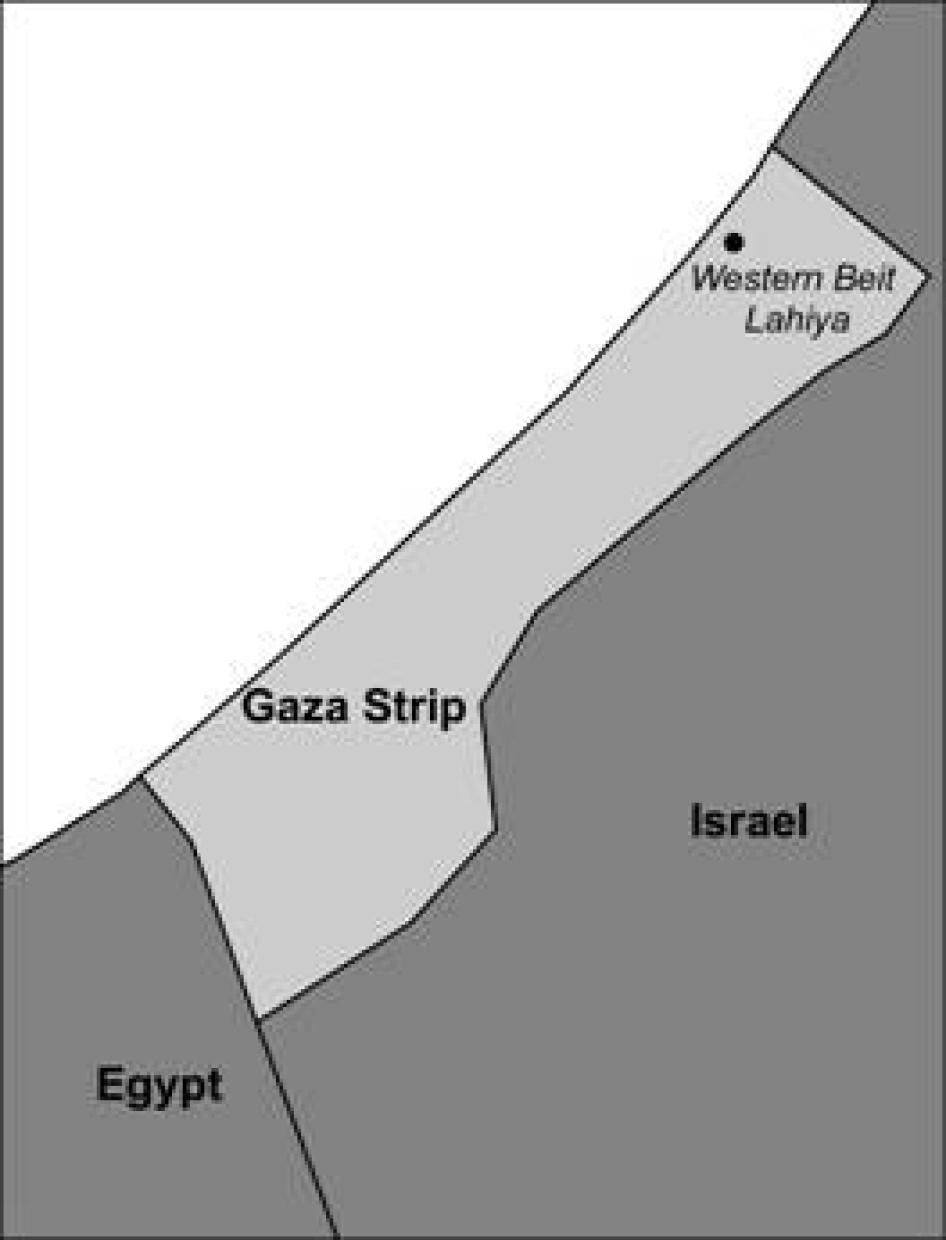
Human Rights Watch investigated several places where Israeli forces destroyed civilian property in an area in western Beit Lahiya comprising residential buildings, some industrial establishments, and open areas used for agriculture, roughly 4 kilometers north of downtown Gaza City.
Israeli forces heavily bombarded the area and drove across the 1949 armistice line into northwestern Gaza early in the ground offensive, according to residents living just north of the Sudaniyya road, about five kilometers south of the border.[175] Residents reported hearing or seeing exchanges of fire between Israeli troops and Palestinian fighters, and some had seen fighters in the elevated, built-up area along a road that connects the Sudaniyya road with the al-Atatra neighborhood around one kilometer to the north. However, much of the destruction occurred in the lower-lying, relatively open areas to the west where, residents said, no armed groups were present. IDF tanks and armored bulldozers advanced into these lower areas over a period of several days, followed by infantry units.
Witnesses who remained in the area until January 13 or 14 reported that it was virtually deserted apart from the presence of IDF armored vehicles, troops and aircraft, and that many homes were still standing. When these witnesses returned after the war, they found numerous homes had been destroyed. As is discussed below, while some buildings were destroyed during a period when residents left the area and before they returned after Israel withdrew its forces, the nature and extent of the destruction in these areas are not consistent with attacks against individual military objects or with damage sustained during fighting.
Human Rights Watch documented the destruction of 38 residential buildings in these areas; we did not establish the total number of people displaced, but 11 of these structures had housed 106 people before the war. When Human Rights Watch conducted our research in April, a tent camp had been set up in the middle of the area; the camp manager said it housed 65 families whose homes had been destroyed or rendered uninhabitable during the war.[176] The families said they were unable to rebuild their homes due to Israel’s restrictions on imports of construction materials.
Badr flour mill
At the northwest corner of an intersection with Sudaniyya road, which runs east-west, lies the Badr Flour Mill, a five-story wheat-processing facility, surrounded to the south and east by other factories and the homes of some of the partners in the mill.[177] A wall encloses the grounds of the mill. Ahmad Hassan Abd Rabbo, 65, a guard at the factory, said he was present when the IDF shelled the factory early in the morning on January 10.
Around 4 a.m. Saturday I was here sheltering in the guard house and I could hear the helicopter hovering very close for about an hour. It fired on the mill, there was a lot of other shelling too, but I couldn’t specify what hit the mill. The attacks that night went on for two and a half hours. After that the mill was burning and the firefighters came to put it out.[178]
Abd Rabbo pointed out that the factory was badly damaged whereas smaller factories (for canned goods and for diapers) immediately to the west of it were not attacked. He could not explain why the IDF targeted the flour mill. He said he had not seen any fighters on the property prior to the attacks.
Fadiyya Hammad al-Rumailat, 66, lives in a residence by the beach, about 75 meters west of the mill. She told Human Rights Watch that the civil defense took her and her daughter with them when they left after fighting the fire at the mill. “Then the next day [January 11] I came back to feed my goats, left again, and I tried to come back the following day but I couldn’t because there were many tanks here and a lot of shooting. Later I saw from the tracks that a tank came and destroyed a truck and a diesel tanker here.”[179] Fadiyya al-Rumailat corroborated Abd Rabbo’s statement that the IDF had shelled the area with white phosphorus, saying that some burning pieces had landed in her yard and that she had covered them with sand.
Hamdan Hamada, a 52-year-old partner in the mill, told Human Rights Watch that he had left the area on January 4, but showed researchers damage and large amounts of shrapnel, and a hand-written note stating that a de-mining team had defused an unexploded aerial bomb, apparently written by the team’s interpreter. The UN Mine Action Team in Gaza City later confirmed to Human Rights Watch that the front half of a 500-pound Mk82 aerial bomb had been identified on an upper floor in a narrow walkway between burnt-out machinery and an outside wall on January 25 and defused on February 11, 2009.[180] The Hamada family later provided Human Rights Watch with video showing the bomb as well as damage to the mill.[181] Hamada also showed Human Rights Watch scores of 40 mm shell casings marked HEDP (high-explosive dual purpose) that he said were found at the factory.[182] He said that after receiving a call about the attacks and learning that the factory was on fire, “[w]e called the civil defense, and they tried to call the ICRC for liaison with the IDF to come and put out the fire, but they couldn’t get here until 10 a.m.”[183]
The UN Fact Finding Mission on the Gaza Conflict examined the mill and concluded that the mill “was hit by an air strike” at 3 or 4 a.m. on January 9, after the mill was also “hit several times” by missiles fired from a helicopter.[184]
The IDF stated that it had conducted an operational debriefing into the incident and rejected the Fact Finding Mission’s conclusion that the mill was attacked from the air.[185] The IDF claimed that although the flour mill was a “‘strategic high point’ in the area, due to its height and clear line of sight,” the IDF “decided not to preemptively attack the flour mill, in order to prevent damage to civilian infrastructure as much as possible.”[186] During a ground operation on January 9, however, “IDF troops came under intense fire from different Hamas positions in the vicinity of the flour mill. The IDF forces fired back towards the sources of fire and threatening locations. As the IDF returned fire, the upper floor of the flour mill was hit by tank shells.”[187] The IDF probe relied in part on aerial “[p]hotographs of the mill following the incident,” which it stated “do not show structural damage consistent with an air attack.”
On February 1, the Guardian reported that the UN had earlier found and defused an aerial bomb at the mill.[188] At a meeting on February 4, 2010, lawyers with the Military Advocate General’s office told Human Rights Watch that they were aware of reports that an aerial bomb had struck the mill during the attack, and said it was possible that the operational debriefing might be reopened to take this evidence into consideration.[189]
The IDF supported its conclusion that the attack on the mill was justified by stating that “200 meters south of the flour mill an IDF squad was ambushed by five Hamas operatives in a booby-trapped house; 500 meters east of the flour mill another squad engaged enemy forces in a house that was also used for weapons storage; and adjacent to the flour mill, two booby-trapped houses exploded.” The presence of Hamas fighters 500 or 200 meters away from the flour mill, or the placement of booby-traps in nearby houses, would not in themselves justify attacks directed against the mill. Human Rights Watch did not identify “exploded” houses adjacent to the mill during a visit to the area, but did observe significant damage to an apartment building and a private home in the mill’s vicinity. The apartment building was damaged, apparently by tank fire, and the private building had been partly demolished by a tracked vehicle.
Human Rights Watch found no evidence that Palestinian armed groups were present in or near the flour mill. According to one witness, two members of Hamas were killed by Israeli shells or missiles in an area roughly 250 to 300 meters east of the flour mill in attacks on January 4 and January 7. Hashem al-Asali, 23, told Human Rights Watch that a drone attack killed his brother, Suhail, 24, at around 7:20 a.m. on January 4.[190] Hashem said he returned to the area with a group of around 15 other residents on January 7, after Israel announced a three-hour lull in the fighting, when a shell struck and killed his other brother Jihad al-Asali, 22, also a Hamas member.
The mill was the second largest of Gaza’s five flour mills, Hamada said, capable of processing 200 tons of wheat per day. The IDF attacks had destroyed specialized semolina milling machines, installed by a team of Turkish engineers, as well as other machinery, and rendered the mill inoperable. “We need engineers,” he said. “The most important thing now is a green light from the Israelis to get experts in here.” Hamada gave Human Rights Watch a copy of a damage estimate stating that machinery losses alone amounted to $1,495,000.
Juma’a Family Houses
Further to the east along Sudaniyya road from the Badr flour mill, members of the extended Juma’a family lived in nine residential buildings on one block facing a small road leading north.[191] Of the nine residential buildings on the Juma’a family’s block, each of which housed up to four families, seven were completely destroyed and two partly destroyed by Israeli forces in January, leaving at least 71 people homeless.[192] Between some of the houses was a small olive grove that had been razed by IDF bulldozers. Residents said that some of the trees were 40-years old.[193]
Residents from the block and surrounding areas said the destruction occurred between January 14 and 18, after the IDF had taken control of the area. When members of the extended Juma’a family returned on January 18, they found that most of their homes had been completely destroyed.
When Human Rights Watch visited the block in April, tread marks consistent with bulldozers were still visible, and ramp-shaped piles of sand and debris with tread marks on them surrounded many of the destroyed buildings on the block. Human Rights Watch did not observe any exploded or unexploded anti-tank mines but, according to resident Ala’a Juma’a, “the IDF left three anti-tank mines on the top two floors of the big house [formerly occupied by Muhammad, Osama, Hani and Nasser Juma’a and their families]. I was here the first day after the war and a mine went off at 10 p.m. that day, another one at 11:30 p.m. and a third one at 2 a.m.”
According to Hassan Ahmad Juma’a, some destruction of agricultural land was the result of IDF shelling with white phosphorus. “That is what burned all the trees on that block of houses – they used lots and lots of white phosphorus here.”[194] Human Rights Watch observed numerous burn marks on buildings but residents said Hamas authorities had already collected shells and shrapnel from the area, possibly in an effort to collect and re-use explosive or other materials in its own weapons.
Mahmoud al-Ajrami, a former assistant secretary of foreign affairs with the Palestinian Authority, lived in an ornate, three-story home roughly 450 meters north of the Juma’a family block. His experiences during the war led him to pass by the Juma’a block on January 13 as he fled the area.
Al-Ajrami said his own home came under small-arms fire from Israeli troops to the north east, and from Israeli helicopter cannons fired on January 6 and 7. The IDF intensified its attacks on the area near al-Ajrami’s home early in the morning on January 8, he said, and his wife and daughter suffered shrapnel injuries on January 9 and 10. “There were tanks to the northeast, the north, the northwest, and to the west along the coast,” al-Ajrami said. His daughter left to the south after she was wounded, but he and his wife stayed behind.
On January 11, at around 1 a.m., al-Ajrami said, IDF troops wearing flashlights on their helmets blew up a gate in the perimeter wall around his property and stormed his home. Al-Ajrami said the soldiers put plastic handcuffs on him and blindfolded him, took him outside, led him up to the second floor of his neighbor’s home, and ordered him to walk, causing him to fall off his neighbor’s balcony. He broke several ribs from the fall, he said. Israeli troops then forced him and a neighbor to walk to an area near the former Israeli settlement of Dugit, about 1.5 kilometers to the north. His wife was not allowed to accompany them. “They kept me outside in a military position with the walls created from earth by bulldozers. I could see that there were lots of tanks and APCs from under my blindfold,” al-Ajrami said. He was interrogated three times, then released on January 13 or 14 and ordered to walk south.
I walked for one and a half hours, very slowly, until I came back to my house. I stumbled into Israeli soldiers twice on the way. They were extremely surprised to see me. No one else was around but soldiers. I got back and saw my car [an SUV] was flattened, and the gates were destroyed. They had killed my dog. My wife had gone, but she told me later that they had attacked our house at around 8:30 or 9 a.m. on the 11th, just after they demolished our cousin’s house with bulldozers [which was catty-corner across the street].
Human Rights Watch inspected al-Ajrami’s ornate, three-story home, which he said he had occupied for seven years. The structure was severely damaged by small arms fire and tank shells. Al-Ajrami showed researchers multiple 20 millimeter shells marked “HEDP” (high explosive dual purpose), likely fired from attack helicopters, the tail-fins of a 120 mm mortar, and other munitions that he said he had collected from inside the house.[195] Al-Ajrami also found small, hand-written notes, in Hebrew, addressed to the “202nd Unit,” which Israeli soldiers had left behind. The notes seem to have accompanied food or other gifts sent by Israelis to the troops in Gaza.[196]
In the afternoon of the day he was released, January 13 or 14, al-Ajrami walked southeast to the Kamal Adwan neighborhood. On his way he passed by the block of nine houses owned by members of the Juma’a family (see below) which were then standing. The entire area was empty of residents at this point, al-Ajrami said. By the time the war ended, four or five days later, most of the Juma’a family’s houses were completely destroyed.
Al-Ajrami said he did not see evidence that Palestinian fighters were present near his home prior to his forced eviction or in any of the areas he passed through while fleeing the area.
There was no fighting [by Palestinians] here. Before the war, the resistance used to fire rockets [at Israel] from groves by the sea, and in open areas to the northwest, but during the war the resistance was around 250 meters to the east, along the [north-south] road. I witnessed exchanges of fire to the east, not here. But the IDF mostly used F-16s in that area. The infantry didn’t enter that area, the APC’s [armored personnel carriers] were closer to me. Really the IDF [ground forces] only entered the [open] areas where it was impossible [for the Palestinian armed groups] to fight.
Human Rights Watch found no evidence (such as bullet holes in neighboring buildings) to contradict his claim that no Palestinian fighters were present on or near his property.
Several residents of the Juma’a block corroborated al-Ajrami’s statement that Palestinian armed groups were active to the east but not in the immediate area or to the west during the war. Ala’a Juma’a, 34, told Human Rights Watch, “The resistance was fighting to the northeast and the IDF came in from the northwest. The resistance stepped back whenever the IDF advanced.”[197] According to Hassan Ahmad Juma’a, 60, an imam who left the area on January 4, “The fighters were to the east of here, around the mosque,” approximately 400 meters to the east.[198]
According to Imad al-Abid Juma’a, whose home was damaged, some members of the Juma’a family fought with armed groups. Khaled Ibrahim Juma’a, a fighter, had been killed in fighting against the IDF in 2000. The second-floor apartment of a three-story house that was destroyed – the largest house on the block – belonged to Osama Juma’a, a 30-year-old member of Hamas’s al-Qassam Brigades, who lived there with his wife and five children. Imad Juma’a told Human Rights Watch:
Osama was killed in the morning of January 10, near the mosque, in a drone attack. We buried him at noon. Then two other martyrs, Ahmad and Omar [Juma’a], were killed in the afternoon, around 100 meters east of the mosque, as they were withdrawing, also by drones. Ahmad Juma’a lived with his parents on the second floor of a house a few houses down from Osama.[199]
The website of the al-Qassam Brigades states that Ahmad Ibrahim Juma’a, 24, was killed on January 10.[200] Human Rights Watch could not locate the names of Osama and Omar Juma’a on the al-Qassam Brigades website or the websites of other armed groups. According to B’Tselem, “Osamah Muhammad Ahmad Jum’ah,” 32, was a combatant and member of Hamas killed on January 10 in the Beit Lahiya area.
Another resident, Yahya Zakariyya Zumailat, 18, stayed in the area until around January 14, one day after al-Ajrami left. During the conflict, Zumailat was sheltering in his uncle’s home, about 75 meters south of al-Ajrami’s property. According to Zumailat, as of January 3, IDF tanks were stationed “around the Horse Club, about 200 meters to the northeast of here.” Later, the tanks made incursions to the south but returned back to this base area.
We heard the sounds of shells and machine guns. Sometimes I went upstairs in my uncle’s house and snipers shot at us. The tanks and bulldozers would pass by to the south, and then go back north. They did the same thing every day. The bulldozers flattened some houses to the south, and also destroyed groves to the northwest. Early in the morning, around 3 a.m., they’d go south, and by 8 a.m. they’d go back. Then it would be quiet, except if they saw something they’d start to shoot. After around 5 p.m. there would be a period of intensive fire. They were there for 10 days.[201]
Zumailat said there were no fighters in his area and that he did not witness exchanges of fire, although he could not see the areas to the south where the tanks went before they returned.
He said that on around January 14, a bulldozer demolished part of the northern wall of his uncle’s house. “Maybe they destroyed it because they wanted to take a look inside,” he speculated.
We looked out from the window and they saw us, and they left. Then we left. Me, my parents, my grandfather, and my younger brothers walked to my girlfriend’s house in the Nasser area [in Gaza City]. An Apache [helicopter] was firing behind us as we were walking. The road was destroyed so we walked beside it. When we left, I saw the houses of the Juma’a family. They were still OK. There was a shed next to a mosque that had been pushed into the middle of the street, to cut it off.
Zumailat said that the area was depopulated by this point and that the only ongoing military activity he witnessed came from the IDF. “There was no fighting. The first time we saw any [Gazan] people was in the al-Karama neighborhood, two kilometers south of here,” he said. Zumailat said that his brother, Muhammad, 12, and his sister, Hadil, 15, returned to the area the next day during the three-hour “lull” in fighting to get the family’s kerosene stove. On approximately January 15, three days before the end of the war, he said they told him that the Juma’a houses were still standing.
Abd al-Karim Abu Nahim, 40, told Human Rights Watch that he stayed with his mother and brother in their home until January 17, one day before the end of the war. Abu Nahim, who is unemployed, lives on the ground floor of a multi-story concrete residential building facing the same east-west road that forms the northern border of the Juma’a family block.
On the last two days of the war, Friday and Saturday, the IDF had reached Sudaniyya Street [the main east-west road in the area, one block south of his house], and the tanks were down there and the troops were up here on foot, breaking into houses. They had been firing at this building. Our upstairs neighbors told us the Israelis shot at their window because they saw something move. So my mother raised a white flag and went out but they shot at her and she was wounded in one hand. This was Saturday at 11 a.m., on the last day. At 4 p.m. they broke into my house. There were scores of soldiers. They detained me and my brother.[202]
Abu Nahim said there was no fighting in his immediate area, and that most of the destruction occurred during the final week of the war. “They reached here by around the second week of the ground war, and they stayed here during the third week. We couldn’t look out, but we could hear the bulldozers.” After being detained, Abu Nahim said, the soldiers took him and his brother to a prison inside Israel, where they were interrogated. Within a week, by around January 24, he said, they were released through the Erez crossing back into Gaza and returned to the Siyafa area.
Al-‘Amudi Street
Two blocks to the east of the Juma’a block is the intersection between Sudaniyya road and the north-south road leading to al-Atatra, al-‘Amudi Road. Two blocks to the north of the intersection, residents of the area pointed out to Human Rights Watch the remains of 15 homes that had been destroyed along the eastern side of the road. Residents of that block said three homes were destroyed; and on the third block, a further two homes were destroyed on the east side of al-‘Amudi Road, as well as a plumber’s shop, a BMW spare-parts shop, and a home on the west side.[203]
Interviews with a number of residents confirmed that Palestinian fighters were present in the area during the conflict. Ra’id abd el-Rahman, 33, showed Human Rights Watch damage to one of the interior cinderblock walls of his home, which he speculated had been caused by fighters using a sledgehammer to clear an opening to escape out the side of the house. “They couldn’t make it through, so they went to the next room and took off the door,” he said.[204] Osama Ziyad as-Sultan, 33, and Fawziya Muhammad as-Sultan, 51, lived in a two-story building that was destroyed.[205] Osama said that he learned from members of armed groups that the IDF completely occupied the neighborhood by January 15, and that at that time the al-Sultan’s home was still standing. His own experience seemed to confirm that it was destroyed late in the war, since “the house was still on fire” when he returned on January 19, he said.
It is possible that IDF armored vehicles destroyed some of the makeshift homes next to al-Amudi street when they first entered the area by driving next to the street rather than on it, in an attempt to avoid anti-tank mines or bombs that might have been placed on the road. The presence of fighters in the area may also account for some of the destruction. However, these considerations do not appear to account for the IDF’s complete destruction of 23 homes and two shops on both sides of the road for three blocks, and of multiple dunams of citrus and olive groves in the area, particularly in cases where the destruction occurred after IDF armor and ground troops had already occupied the area.
The al-Sultans’ former neighbor was Latifa Atta Khalil al-Ankah, about 65. According to al-Ankah, the IDF destroyed the three-story building where she lived with her husband and an unmarried son and daughter, and another son and his family. IDF bulldozers also destroyed three of the family’s six greenhouses, and a quarter-acre grove of fruit trees. She recalled that on a Wednesday, either January 7 or January 14, Israeli soldiers forcibly entered her house and told her to evacuate. “I told him to leave me alone in my house. He said, ‘You have no house.’ I took an alley to the east. My house and the grove were still all right when I left. The al-Sultan’s house was still standing too.”[206] Al-Ankah said that no Palestinian fighters were present in the area at the time. Her son, Bassam al-Ankah, 30, showed Human Rights Watch fragments of shrapnel he said he found in the house. He said that three tanks shells hit the second floor.
Slightly north of the intersection with Sudaniyya street lives Atallah Rihan, a 67-year-old writer, who said bulldozers destroyed an outbuilding containing his office and library as well as nearly three dunams (0.3 hectares) of citrus trees to the south of his house. According to Rihan, “The resistance was active here only on the first two days of the aerial offensive [December 27 and 28].” Nonetheless, Rihan said, “The shelling was continuous from artillery and the navy. It was a mess. The tanks were maybe 500 meters to the northwest.” Although the Israeli military had previously dropped fliers stating that the area was a closed military zone, “and broke into the radio transmissions saying that everyone to the north of Sudaniyya road should go,” Rihan said he stayed until intensive shelling on approximately January 11 made him fear for his life. He believed, though he was not certain, that IDF ground troops had reached his area two days before that point. “When we left the [olive and citrus] trees were still all here,” Rihan said. “There wasn’t major destruction yet, either on the street or to the east, where we walked. When we came back all my trees and the olive trees belonging to the as-Sultan family were gone.”[207]
Hadija Hassan Saqir, 55, owned a three-story building immediately north of Rihan’s home. Before the war, she said, 15 people lived in the building, including her and her husband, as well as her two grown sons and their families. When Human Rights Watch visited the area, the support pillars and several walls of Saqir’s building were still standing, but it had suffered extensive damage on all floors, rendering the building only partly habitable. “We spent the first three days of the ground incursion here,” Saqir said, “and then they hit the house with a tank shell from the north.”[208] The building appeared to have been hit multiple times by shells entering the sides of the building from the north, east and south, consistent with tank shells fired at a relatively flat trajectory, but the family had cleared away the damage to the extent that it was not possible to confirm what munitions had been used. “Some people told me that until the last three days of the war the house wasn’t destroyed,” Saqir said. “A woman who was looking for a missing person that day said the doors of my house were open and she went inside to look. At that point it was just the one tank shell.” Saqir pointed out three dunams (0.3 hectares) of land on the eastern side of the house, where only compacted dirt, small mounds and some tread marks were visible; she said this had been a small citrus tree grove.
Many of the former residents of these destroyed homes now live in a tent camp that Hamas authorities have set up in a nearby vacant lot. Sa’id Rumailat, an unemployed 34-year-old, was living in the camp and said there was no running water, no electricity, and only canned food to eat. Rumailat showed Human Rights Watch a heap of wood and corrugated metal lying beside al-‘Amudi street that he said used to be his home where he lived with his wife and four children. On approximately January 6, he saw people coming south along the road from al-Atatra, carrying white flags. “They were on foot, there were no cars because the F16s had bombed and cut off the road. They said, ‘Why are you staying here? People are being killed.’”[209] Rumailat and his family left that day, with his home intact. “When we came back, my house had been pushed into the middle of the street. Inside my house we found a steel pipe with regular cuts in one side of it, from the bulldozer treads.”
Khuza’a, al-Shoka, and al-Fokhari
Israeli forces entered several areas near the Sufa crossing in south-eastern Gaza on or after January 11, residents said. Human Rights Watch visited the village of Khuza’a, which lies very close to the 1949 armistice line, and the agricultural areas of al-Shokha and al-Fokhari, to the southwest. The latter areas are divided by the road that leads north from the Sufa crossing point, with al-Fokhari lying on the western side of the road. In the case of Khuza’a, residents witnessed bulldozers destroying residential buildings on January 11 and 13. In al-Shoka and al-Fokhari, residents said they fled their homes during attacks that began on January 14, and returned after January 18 to find their homes bulldozed. While in al-Shoka and al-Fokhari many buildings were destroyed during a period when residents had left the area and before they returned, the type and extent of the destruction are not consistent with attacks against individual military objects or with damage sustained during fighting.
Human Rights Watch investigated homes that were demolished on the extreme eastern edge of Khuza’a, which lies approximately 500 meters from the 1949 armistice line. Human Rights Watch is unaware of any evidence or Israeli claims, and residents of Khuza’a denied, that houses in the neighborhood were used to cover tunnels or for other military purposes. It does not appear likely that the IDF would have destroyed these buildings in an attempt to prevent the construction of tunnels from houses to the border, because much of Khuza’a lies close enough to the border to enable tunneling. The IDF has not provided any information to explain why it destroyed these houses.
Satellite imagery (see Khuza’a, below) shows that the IDF also destroyed greenhouses, areas of cultivated agricultural land, and other structures on the opposite side of the village from the swathe of destroyed houses Human Rights Watch investigated. It would have been difficult to tunnel towards the Israeli border from these other destroyed areas; their destruction may indicate that the IDF targeted areas that posed less risk to the troops carrying out the demolition, since no demolitions by ground forces occurred in or near the center of the village but only on its outskirts or in exposed open areas nearby. The areas of al-Shoka and al-Fokhari where Human Rights Watch documented destruction lie more than 2.8 kilometers from the border.
Members of Palestinian armed groups engaged with IDF forces in Khuza’a, but residents of Khuza’a, al-Shoka and al-Fokhari said no militants were in these areas at the time Israeli forces attacked.
In addition to destroying 53 private homes, agricultural land, greenhouses and two cement factories in these areas, Israeli forces also blew up a large, 30-meter-high water tank that serviced the communities of al-Shoka, al-Fokhari and al-Nasir.[210] Atra Abd al-Majid al-Amor, 90, who lived next to the water tank, did not witness its demolition, but he told Human Rights Watch that a nearby house was also demolished in the explosion (Human Rights Watch did not examine this house).[211] Human Rights Watch researchers found large amounts of electrical wiring produced by Teldor, an Israeli company that supplies the IDF with equipment including wires and cables, which may have been used to wire explosives around the tower.[212] A water tower used by three civilian agricultural communities constitutes an object indispensable to the survival of the civilian population and cannot be destroyed.[213]
Khuza’a
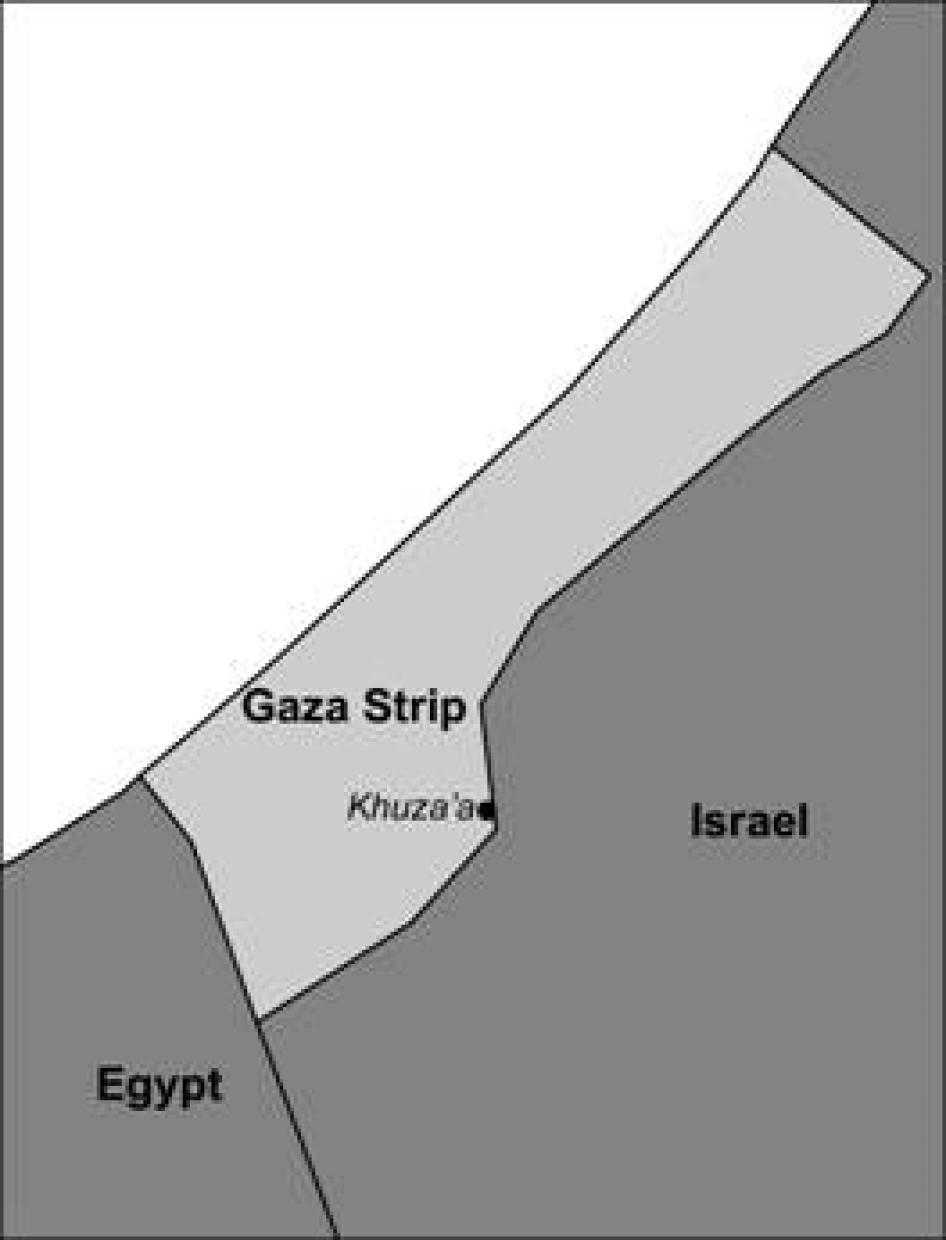
Situated east of Khan Yunis and approximately 500 meters from the 1949 armistice line with Israel, the village of Khuza’a is one of the Palestinian residential areas closest to Israel. Residents can see IDF watchtowers on the armistice line, which is separated from the village by open fields.
It is possible that the IDF destroyed homes in Khuza’a in order to create a buffer zone extending west from the de facto border with Israel. The laws of war do not permit a party to the conflict to raze all civilian structures in a given area on the grounds that it would provide a buffer zone for a potential future armed conflict (see “Legal Obligations”).
From January 11 to 13, according to residents, Israeli militarized bulldozers destroyed a number of houses on the northeastern edge of Khuza’a, which lies closest to the armistice line. All the houses, on the northeastern side of Azata Street, belonged to the extended al-Najjar family. Human Rights Watch confirmed the destruction of 14 houses on the edge of the village on January 13.[214] Residents of the al-Najjar area said there was no fighting in the area, and that Israeli forces had established control over that area and areas further inside the village when their homes were destroyed.
UNOSAT analysis of satellite imagery confirmed that the vast majority of damage sites in Khuza’a – 109 of 118 sites – were struck from January 11 to 18, and that “almost all of the damage was along the eastern edge of Khoza’a, near the border with Israel.”[215]
Residents told Human Rights Watch that no fire was directed at the bulldozers from these homes, and Hamas had not occupied, stored weapons, or placed booby-traps in their homes prior to their destruction.[216] These statements are consistent with statements by several residents that they fled their homes at the last moment during bulldozer attacks.
Residents and local human rights activists told Human Rights Watch that Palestinian fighters had been active in the area, and an Islamic Jihad commander told the media that about a dozen fighters had directly engaged the IDF in Khuza’a.[217] By these same accounts, the fighting was light, with the fighters retreating as Israeli forces advanced. In a series of ground incursions between January 11 and 13, Israeli forces engaged Palestinian fighters, and local officials reported numerous civilian casualties.[218] According to B’Tselem, Israeli forces killed five Palestinian militants in the village on January 11 and January 13.[219]
The IDF’s assault on Khuza’a began around 9:30 p.m. on January 10, with an intense artillery barrage in the area.[220] The IDF heavily used air-burst, artillery-fired white phosphorus, killing one woman and injuring dozens of others.[221]
The next day, January 11, IDF ground forces moved into the al-Najjar district of Khuza’a for the first time. From approximately 5 a.m. to 11 p.m. they stayed on the edge of the village, residents said, and D9 bulldozers destroyed several homes. The IDF returned around 3 a.m. on January 12 and destroyed some more homes, withdrawing again around noon.
The next assault took place around midnight on January 13. After heavy shelling throughout the night, the IDF established full control of the area’s perimeter with armored bulldozers and tanks. By early morning, approximately 100 neighborhood residents had gathered in a small garden. Tanks and bulldozers reached the edge of the village and Israeli soldiers used megaphones to order the residents to go to the village center. According to three witnesses, when residents began to move, soldiers who had advanced into the neighborhood shot in their direction and forced them to turn around.[222]
Witnesses said that Israeli forces occupied two houses further inside the neighborhood and on the morning of January 13 fired on civilian residents attempting to flee while holding white flags. An Israeli sniper shot and killed Rawhiya al-Najjar from a firing position in the doorway or just outside the doorway of one of the houses, suggesting he was not afraid of being exposed to enemy fire.[223]
The homes demolished in the al-Najjar district lay on the extreme perimeter of the village where the tanks and bulldozers had established control.[224] After the fighting, because Israeli border guards routinely fire on Palestinians venturing towards the armistice line, it was not possible for Human Rights Watch to observe all the homes in the area that residents said were destroyed.[225] Human Rights Watch confirmed the destruction of 14 buildings in this small area and observed two more buildings that were partly demolished.[226] The destruction we documented left at least 119 people homeless.
Nabil al-Najjar told Human Rights Watch that at 6:30 a.m. on January 13, three large, militarized bulldozers approached his home, towards the southeastern part of the area, after they had already destroyed several other houses belonging to his relatives, Ashraf and Fuad, and while one or two other bulldozers were leveling Fathi an-Najjar’s home nearby. “I saw them coming and was shouting at them in Hebrew that there were people here, a family was here,” he said.[227] He was not sure if the bulldozer operators could hear or see him.
The first two came for the house, but my house is on a small hill with nine steps leading up to it, and it was not a quick job. They piled up sand in ramps and began destroying the balconies, then they hit the support pillars. There were around 20 support pillars. The third bulldozer was cleaning up the yard. When I couldn’t get them to stop I evacuated my family. We ran down the street to a relative’s home.
By around noon that day, many members of the al-Najjar family managed to leave the area.[228]
A number of factors – the fact that Israeli forces controlled the perimeter area of the town at the time the destruction occurred; the accounts of residents that no militants, weapons or booby-traps were present in those buildings; and the fact that this area is the closest to Israeli territory – indicated that the IDF demolished these homes in order to increase the buffer zone or no man’s land between Israeli territory and inhabited parts of the Gaza Strip. Statements by Israeli soldiers, the Israeli military’s subsequent expansion of the buffer zone to 300 meters, and the Israeli military’s past practice of clearing buffer zones in other areas of Gaza such as Rafah, support such a conclusion. Even if this destruction of the civilian property served a military purpose, the extensive destruction raises serious concerns under the laws of war that the loss of civilian property was excessive in comparison to any expected military gain. It further appeared during Human Rights Watch’s research in the area that Israeli forces stationed at the border exerted significant control over the area between the edge of Khuza’a and the border, as residents warned against stepping into that area due to prior experiences of drawing fire from Israeli forces. The destruction of the homes along the edge of Khuza’a would have extended Israel’s field of fire by only a few dozen meters, at most. The destruction of these homes would not, as mentioned above, provide Israel with any significant security advantage by preventing tunnels being dug from them towards the border, since tunnels could as easily be dug from the row of homes immediately behind the ones that were destroyed, or from many other parts of Khuza’a.
Al-Shoka
To the southwest of Khuza’a, a road runs from the Sufa crossing point towards Salahaddin Road, Gaza’s main north-south artery. On the northern side of the Sufa road lies the agricultural area of al-Shoka, which is flat and open from the border to an elevated area near Salahaddin Road. Residents in the part of the al-Shoka area nearest the Sufa crossing, said that Israeli ground forces entered the area in armored vehicles after sunset on January 14.
Zayed Ahmed Thabit, 53, told Human Rights Watch that he left the area that night when tanks reached an elevated area on Salahaddin Road, to the west, and began firing back towards the area. Thabit said that the following day, as he tried to return to the area to help evacuate a neighbor’s family, he saw four bulldozers on Salahaddin Street. He said there were no Palestinian military activities in the area, and that all the buildings that were subsequently destroyed (in most cases apparently by bulldozers) were still standing when most other residents fled on January 15. He discounted the possibility that fighters could have used the open fields. “There was nothing left to destroy around here,” he said. “There have been no trees in the fields near the border for a long time,” due to previous Israeli incursions. Lacking cover, he said, fighters would have been visible to Israeli ground forces from long distances and exposed to aerial attacks.[229]
Attaya family
The extended Attaya family lived in two separate clusters of homes in al-Shoka. One part of the family lived in 12 houses packed closely together near an intersection 300 meters southwest of Sufa Road. Most of the homes were constructed of concrete and corrugated metal; one two-story home was made of reinforced concrete. The destruction of these structures left 40 people homeless.[230] When Human Rights Watch visited the area, some of the residents had returned and set up tents in the rubble of their former homes.
The owner of the two-storey building, Talal Sulaiman Attaya, 37, and his wife Zenam Salim Attaya, told Human Rights Watch that the entire family evacuated the area on January 14, when the area came under intense shelling at the beginning of the ground invasion.[231] Nahed Attaya, 35, interviewed separately, also said that their group left the area for Khan Yunis on the first day of the ground invasion, after the area came under tank fire from the east during the afternoon. “It wasn’t fighters, it was all wheat around here,” he said. “We rented six dunams of farmland to grow wheat and vegetables. It’s all torn up now. During the last incursion they just destroyed the trees.”[232]
Zenam Attaya told Human Rights Watch, “We spent a week away [after we fled]. And when we came back it was all destroyed. Nothing had hit the house when we left. When we got back we saw some charred areas on the roof, and bulldozer tracks.”[233]
Talal Attaya added that Israeli forces completed, during the latest incursion, the destruction of his five dunams (0.5 hectares) of olive trees, which had been partly destroyed in an incursion the previous year.[234]
Nahed Attaya said that Israeli forces also destroyed nine large greenhouses, used to grow cucumbers, on the opposite side of the lane that forms the western border of the family’s residential area.[235] Human Rights Watch confirmed that some greenhouses had been destroyed but could not determine the number, since the area where the greenhouses used to be had subsequently been cleared.
In another cluster of homes nearby lived a second cluster of the extended Attaya family. Atiyya Ahmad Attaya, 69, showed Human Rights Watch the remains of destroyed homes in two adjoining compounds. Researchers examined the remains of 12 destroyed homes, which residents said had been occupied by 66 people.[236] Residents said they had found extensive bulldozer tracks in the area.
Attiya Attaya told Human Rights Watch that Israeli aerial strikes hit roads and open areas before the ground invasion. In the evening of January 14, “we saw the tanks and bulldozers, still half a mile away to the east, but others had gone north and were coming back down here. We heard drones.” Just before sunset, he and all the other residents of the area left, heading west, due to shelling. Ahmed Atayya, 20, said that a shell, possibly from a tank, hit the kitchen of his house, prompting the family to evacuate the area 10 minutes later. “We went west to the European Hospital, a mile and a half away, and spent six days there.”[237]
The family returned within one or two days after the war ended to find their homes and nearby fields had been completely destroyed, apparently by bulldozers. “No one told me that this had happened,” Atiyya said. “There was no resistance in any house here. I don’t know why they destroyed them.”
Attaya said his home was 25-years-old; the most recent construction in the area was his son’s house, built in 2000. The family lost 22 dunams (five and a half acres) of 50-year-old olive trees.
Al-Imtiaz Concrete Mixing Factory
To Human Rights Watch’s knowledge, Israeli forces destroyed every concrete factory in the al-Shoka and al-Fokhari areas during the incursion. Human Rights Watch observed destroyed property at the al-Imtiaz factory including a two-story building shared by workers and management, the concrete wall around the factory, three steel silos for storing cement, a conveyor belt, a storage tank for sand and gravel, and two weighing machines. Muhammad Sabri Abu Daqqa, 20, the son of the owner, Sabri Abu Daqqa, said that the al-Imtiaz factory had been partly bulldozed during a prior incursion in May 2008.
According to Abu Daqqa, so far as he was aware, no one had witnessed the complete destruction of the immovable parts of the factory. “We used to have a guard, but he was arrested during a previous incursion last year,” he said. “And it was impossible to get here during the war.”[238] A resident of the nearby al-Fokhari area said that he saw tanks near the al-Imtiaz factory site on the evening of January 14.[239]
The factory was demolished with a combination of bulldozers and explosive charges, Abu Daqqa said. “We saw mines and wires all over the place” when he returned to the factory after the ceasefire, he said; Hamas de-miners subsequently removed the shrapnel and debris from the site. Human Rights Watch could not confirm the kinds of explosive munitions used but the remains of bulldozer tracks were still visible.
At its full capacity, the factory could produce 100 cubic meters of concrete per hour, and employed 20 workers. Abu Daqqa told Human Rights Watch that the factory had been able to operate, to an extent, during the ceasefire from June to November 4, 2008. “Whenever Israel allowed cement in, Hamas gave us a share of it.”
Unlike most other factories, the al-Imtiaz factory’s vehicles were not destroyed: the owners had evacuated all moveable property, including the valuable mixing and pump trucks, to an area near Khan Yunis when Israel’s aerial campaign began, Abu Daqqa told Human Rights Watch.
Al-Fokhari
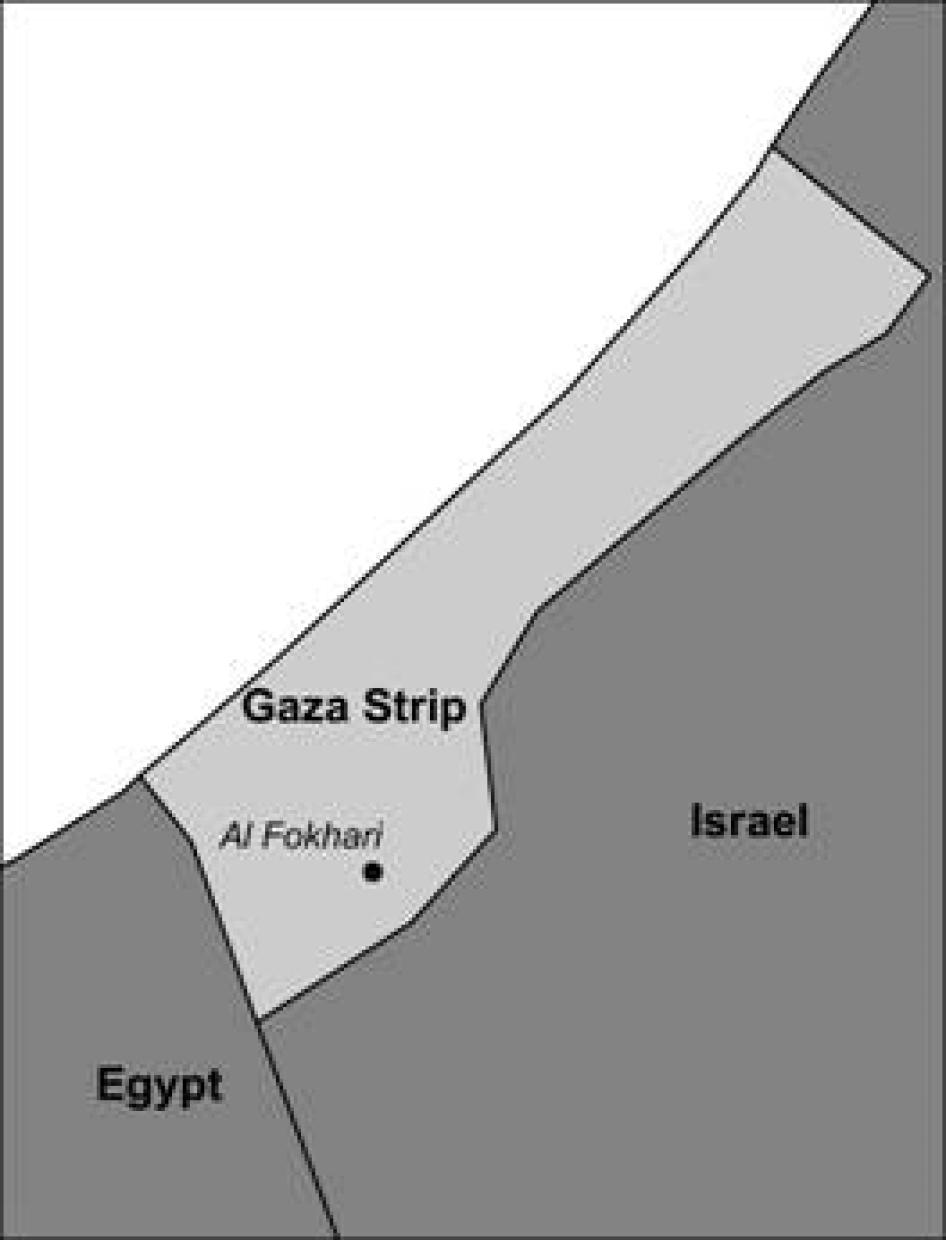
Al-Fokhari lies on the eastern side of Sufa road, across from al-Shoka. Human Rights Watch visited destroyed homes belonging to the extended al-Amor family, not far from the road dividing the two areas.[240]
Al-Amor houses
Like the Atayya family in al-Shoka, the al-Amor family said they had fled the area on January 14 due to heavy shelling. They said that militants were not present in the area and had not made use of their homes in the past. According to Sulaiman al-Amor, a 35-year-old cement truck driver, “We fled at around sunset when a tank shell hit the houses. I didn’t have time even to take my ID. The tanks were nearly at the al-Imtiaz factory.”[241] Al-Amor said his family spent four days at the UNRWA al-Farabi elementary school, before returning home to find their houses had all been destroyed.
Based on information from several residents, during the offensive Israeli forces destroyed 10 houses where 67 people lived.[242] Most of the homes were more than 10 years old. Atwa al-Amor, 30, said the family owned 30 dunams of olive trees that were razed by bulldozers.[243]
Abu Sita Concrete Mixing Factory and al-Amor and al-Orjan Homes
Across open fields to the east of the Attaya family’s property, the Abu Sita concrete factory sits on a road that intersects with Sufa Road half a mile to the north.[244] The factory’s owner, Samir Abd al-Qadir Abu Sita, 52, told Human Rights Watch that he did not witness it himself, but residents of the area told him the factory was destroyed on January 16.
Human Rights Watch observed that three cement pump trucks, four cement mixing trucks, two dump trucks, two small bulldozers and two private cars had been destroyed on the lot. The lot was covered in large track marks consistent with the treads of a militarized bulldozer; the type of damage to the factory vehicles, which were pushed onto their sides or flipped upside down and partly or wholly crushed, also suggested that large militarized bulldozers had destroyed them. The main factory building and the metal silo used to store cement, had been damaged by heavy machine gun fire.
Before Israel closed Gaza’s borders to cement imports in early November 2008, Samir Abu Sita said, the factory employed 26 workers and could produce 120 cubic meters of concrete per hour.
On the eastern side of the lot, behind the factory area, were the remains of two concrete homes, both of which had been three stories high. Their destruction left nine families homeless.[245]
Immediately to the east of the Abu Sita family property, three other homes had also been demolished. Human Rights Watch spoke to Eid Sulaiman al-Orjan, 70, and his sons Sulaiman Eid, 42, Ahmad Eid, 39; and Salim Eid, 29. During a group interview, the al-Orjan family members said 18 people had lived in the buildings, all of whom left the area together after sundown on Wednesday, January 14, because of shelling from the east. “They targeted the big houses first, with tanks,” Sulaiman al-Orjan said. “There were also lots of airstrikes in open areas.”[246] The family fled to an UNRWA school to the west, leaving their houses and the concrete factory relatively unscathed.
Ahmad al-Orjan said that the family returned after the ceasefire to find all their goats had died, possibly due to a white phosphorus attack. “Their eyes and noses were covered in fluid when we returned,” he said, which he believed was the result of their inhaling a poisonous chemical. He also saw the charred remains of burning wedges consistent with white phosphorus munitions in the area.
Sulaiman al-Orjan added that most of the family’s 20 dunams (2 hectares) of wheat had been destroyed by IDF vehicles.
International Legal Obligations and Property Destruction
International humanitarian law, the laws of war, governs fighting between Israel and Palestinian armed groups in the Gaza Strip that rises to the level of armed conflict, including during Operation Cast Lead. This law binds all parties to an armed conflict, whether they are states or non-state armed groups.
Since Operation Cast Lead, the Israeli government has sought to justify the destruction of property in Gaza on several grounds. Buildings destroyed were said to have been used by Hamas, were booby-trapped or hid entrances to tunnels, or could be used for future attacks by being close to the armistice line with Israel. The factual validity of some of these claims is discussed above – but they also raise important questions as a matter of law. While Israeli forces destroyed property for legitimate military reasons, Human Rights Watch found that the large-scale destruction of property in the cases detailed in this report violated Israel’s international legal obligations.
International humanitarian law does not address the legality of a decision by a state or a non-state armed group to resort to war (jus ad bellum). Rather, it focuses on the legality of the conduct of the parties to hostilities that have reached the level of armed conflict (jus in bello). The laws of war governing the methods and means of warfare are primarily found in the Hague Regulations of 1907 and the First Additional Protocol of 1977 to the Geneva Conventions (Protocol I).[247] Although neither treaty formally applies to the armed conflict in Gaza,[248] most of the provisions of both are considered reflective of customary law.[249] Also applicable is article 3 common to the four Geneva Conventions of 1949 (Common Article 3), which concerns the treatment of civilians and combatants who are no longer taking part in the fighting and provisions of the Fourth Geneva Convention of 1949 addressing occupied territories.[250]
Central to the law regulating conduct of hostilities is the principle of distinction, which requires parties to a conflict to distinguish at all times between combatants and civilians. Operations may be directed only against combatants and other military objectives; civilians and civilian objects may not be the target of attack.[251]
Civilian objects have been defined as all objects that are not military objectives.[252] Military objectives are those objects which “by their nature, location, purpose or use make an effective contribution to military action and whose total or partial destruction, capture or neutralization, in the circumstances ruling at the time, offers a definite military advantage” [emphasis added].[253]In cases of doubt there is a presumption that objects normally dedicated to civilian purposes – houses and other dwellings, schools, places of worship, and hospitals – are not subject to attack.[254] Civilian objects remain protected from attack, unless and only for such time that they become military objectives. Once a civilian object that is a military objective – such as a house used as a military headquarters – ceases being used to further the military aims of the adversary, it may no longer be subject to attack.[255]
Deliberate, indiscriminate or disproportionate attacks against civilians and civilian objects are prohibited. Attacks are indiscriminate when they are not directed at a specific military objective or employ a method or means of warfare that cannot be directed at a military objective or whose effects cannot be limited.[256] A disproportionate attack is one in which the expected incidental loss of civilian life and damage to civilian objects would be excessive in relation to the concrete and direct military advantage anticipated. [257]
In the conduct of military operations, parties to a conflict must take constant care to spare the civilian population and civilian objects from the effects of hostilities.[258] Parties are required to take precautionary measures with a view to avoiding, and in any event minimizing, incidental loss of civilian life, injury to civilians, and damage to civilian objects.[259]
Before conducting an attack, parties to a conflict must do everything feasible to verify that the persons or objects to be attacked are military objectives and not civilians or civilian objects.[260] In its Commentary to Protocol I, the International Committee of the Red Cross (ICRC) explains that the requirement to take all “feasible” precautions means, among other things, that those conducting an attack are required to take the steps needed to identify the target as a legitimate military objective “in good time to spare the population as far as possible.”[261]The United Kingdom military manual illustrates the rule with the following example: “If, for example, it is suspected that a schoolhouse situated in a commanding tactical position is being used by an adverse party as an observation post and gun emplacement, this suspicion, unsupported by evidence, is not enough to justify an attack on the schoolhouse.”[262]
The Hague Regulations forbid during hostilities the unnecessary destruction of the enemy’s property.[263] The Geneva Conventions prohibit as a grave breach the “extensive destruction and appropriation of property, not justified by military necessity and carried out unlawfully and wantonly.”[264] Similarly during an occupation, article 53 of the Fourth Geneva Convention prohibits the destruction of property by an occupying power “except where such destruction is rendered absolutely necessary by military operations.”[265] The prohibition on “wanton destruction” is a longstanding rule of customary international law, dating at least back to the US Lieber Code of 1863, the first modern codification of the laws of war.[266]
The rule of military necessity was defined in the Lieber Code, and later adopted by the ICRC, as “the necessity of those measures which are indispensable for securing the ends of the war, and which are lawful according to the modern law and usages of war.”[267] In other words, military necessity cannot be used as an excuse to violate explicit IHL provisions, because the requirements of military necessity have already been incorporated into IHL rules.[268]Military necessity incorporates the fundamental legal obligation to avoid damage to civilian property by distinguishing military objectives from civilian objects, only permitting attacks on the former, and prohibiting such destruction if the expected civilian harm is disproportionate to the direct military advantage anticipated.
The concept of military necessity thus rejects measures that are viewed as a means to justify an otherwise unlawful attack, are not intended to defeat the enemy or that violate the laws of war by excessively damaging civilian objects in relation to the concrete and direct military advantage anticipated from the attack. While the rule of military necessity grants military planners considerable autonomy about the appropriate tactics for carrying out a military operation, this autonomy remains subservient to the laws and customs of war.[269]
The Israeli government has asserted that the rules in effect for its forces on property destruction during Operation Cast Lead were in accordance with international law. The Ministry of Foreign Affairs report of July 29, 2009 notes that the “operational order for the Operation in Gaza specifically stated that ‘[a]ll IDF activities are subject to the principles and rules of international law,’” including the principles of “military necessity, distinction, proportionality, and humanity.” The order further provided that “[d]estruction of property shall be allowed only for imperative operational necessity and provided that the damage for the property would be proportional to the military advantage gained by the destruction. The destruction of property for deterrence purposes is forbidden.”[270] It defined military necessity as the principle that, subject to the other principles and rules, “an attack shall be permitted as long as it is necessary to achieve a military purpose in the course of the military campaign.”[271]
An IDF investigation into the destruction of property in Gaza, published on April 22, 2009, exonerated the IDF of any illegal destruction of property and found that the orders provided to Israeli forces regarding property demolitions were lawful. It stated that “the orders and directions given with regard to damage to property during the operation, at all levels, emphasized that all demolition operations should be carried out in a manner which would minimize to the greatest extent possible the damage caused to any property not used by Hamas and other terror organizations in the fighting.” The only fault found was that “it was apparent that that this issue [property demolition] was not stressed sufficiently in the written plans for the operation.”[272]
The Foreign Ministry report and the IDF investigation conclude that the destruction of houses and other civilian property met the requirements of military necessity as required by the laws of war. It reaches that conclusion on the basis that the properties destroyed were military objectives and that their destruction was not disproportionate.
Human Rights Watch found that in the incidents investigated in this report, the destroyed properties were not military objectives as the term is widely understood. Thus, even where the IDF asserted a military rationale for the destruction of the property, the objects still did not meet the requirements for a military objective and thus were not subject to attack or destruction.
Human Rights Watch distinguishes these cases from those in which the civilian property was a military objective, such as when used by Palestinian armed groups to deploy fighters, to store ammunition or other materiel, or to rig with booby-traps, and thus could be targeted.
As noted, a civilian object becomes subject to attack as a military objective when it makes an effective contribution to military action and its destruction in the circumstances ruling at the time provides a definite military advantage. These criteria are critical for determining whether the destruction of property is lawful. Thus, according to the US army field manual’s regulations for destruction in the context of hostilities, there must be a “reasonably closeconnection between the destruction of property and the overcoming of the enemy’s army.”[273]
Human Rights Watch found instances, detailed above, where it appeared that property was destroyed for its past use as a military objective – that is, for possible punitive reasons – and because of its predicted future use as a military objective – for anticipatory reasons. International humanitarian law prohibits the punitive destruction of property and places sharp limits on what constitutes a military objective’s future use.
Destruction of property that is no longer or was previously used as a military objective is not permitted. With regard to recently captured areas, the UK military manual states:
[O]nce the defended locality has surrendered or been captured, only such further damage is permitted as is demanded by the exigencies of war, for example removal of fortifications, demolition of military structures, destruction of military stores, or measures for the defence of the locality. It is not permissible to destroy a public building or private house because it was defended.[274]
One highly respected academic commentator has previously criticized as a matter of law the IDF’s destruction of houses for punitive purposes:
Destruction of houses as a (legitimate) integral part of military operations must be distinguished from demolitions of residential buildings carried out as a post-combat punitive measure. Israel has resorted to such measures in its fight against terrorism in occupied territories. In support of the Israeli policy it has been maintained that if hand grenades are hurled out of a house (or if terrorists use the premises to prepare an attack), that house becomes a military base, so there is no difference between immediate military reaction leading to its destruction and later demolition as a punitive measure. However, it is wrong to believe that, once used for combat purposes, a civilian object (like a residential building) is tainted permanently as a military objective. As long as combat is in progress, the destruction of property – even in occupied territories – is permissible, if rendered necessary by military operations. Yet, subsequent to the military operations, destruction of property is no longer compatible with modern [law of international armed conflict].[275]
A civilian object can be a military objective if the concrete advantage it provides at the time is of an anticipatory nature. Thus, a military unit can destroy a house that would block fields of fire during an expected enemy attack. Nonetheless, the presumption that a civilian object is not a military objective remains. Thus, acting on the basis of possible enemy intentions is an insufficient basis for attacking a civilian object. The above commentator writes that “field intelligence revealing that the enemy intends to use a particular school as a munitions depot does not just an attack against the school as long as the munitions have not been moved in.” He notes: “Purpose is predicated on intentions known to guide the adversary, and not on those figured out hypothetically in contingency plans based on a ‘worst case scenario.’[276]
As the ICRC’s authoritative Commentary on Protocol I states, “it is not legitimate to launch an attack which only offers potential or indeterminate advantages.”[277] Likewise, the authors of the New Rules for Victims of Armed Conflicts note that the military advantage must be “concrete and perceptible” and not “hypothetical and speculative.”[278]
The Eritrea Ethiopia Claims Commission, commenting on the destruction of civilian property by Ethiopian forces retreating from occupied territory, stated: “The Commission does not agree that denial of potential future use of properties like these, which are not directly usable for military operations, as are, for example, bridges or railways, could ever be justified under Article 53” on the destruction of property.[279]
According to the above commentator, “Certain objects are normally (by nature) dedicated to civilian purposes and, as long as they fulfill their essential function, they must not be treated as military targets.”[280] Objects such as civilian dwellings and schools may be military objectives when they are making an “effective contribution to military action…. The dominant consideration ought to be ‘the circumstances ruling at the time.’” [281]
Other academic commentators explain that the criterion that civilian objects be considered as offering a definite military advantage in the circumstances ruling at the time “is crucial”:
Without this limitation to the actual situation at hand, the principle of distinction would be meaningless, as every object could, in abstracto and under possible future developments, become a military objective. It would suffice that in future enemy troops could occupy a building and transform it into a military objective.[282]
Some of the incidents of demolitions described above indicate an expansion by the IDF of the “buffer zone” between Israel and Gaza. While the law of occupation allows certain security measures – an occupying power can take preventive measures to enhance the security of its forces, such as patrols, fortifications, checkpoints, and taking control of private property – the law concerning destruction of civilian property remains the same.[283] As the ICRC Commentary to the Fourth Geneva Convention notes, the “prohibition of destruction contained in [article 53 dealing with the law of occupation] may be compared with the prohibition of pillage and reprisals.”[284] There is no exception under the Fourth Geneva Convention to article 53, which limits destruction of property to that which is absolutely necessary for “military operations.”[285] Human Rights Watch’s conclusions to the 2004 report Razing Rafah continue to be applicable:
IDF doctrine appears to inappropriately conflate military operations linked to fighting with security measures intended to reduce the general risk to the occupying power. This inherently expansive interpretation of military operations, with the broader latitude for destruction, has been a recipe for incremental expansion of the buffer zone as well as for excessive destruction during incursions into the camp.[286]
Lastly, where destruction is permitted as a matter of imperative military necessity, it must not be disproportionate. That is, as noted above, it cannot be expected to cause damage to civilian objects that would be excessive in relation to the concrete and direct military advantage anticipated.[287] As the Commentary to the Fourth Geneva Convention states, “whenever it is felt essential to resort to destruction, the occupying authorities must try to keep a sense of proportion in comparing the military advantage gained with the damage done.”[288]
With respect to individual responsibility, serious violations of international humanitarian law committed with criminal intent are war crimes. War crimes include the “extensive destruction and appropriation of property, not justified by military necessity and carried out unlawfully and wantonly,” which are grave breaches of the Fourth Geneva Convention.[289]
Criminal intent has been defined as violations committed intentionally or recklessly.[290] Individuals may also be held criminally liable for attempting to commit a war crime, as well as assisting in, facilitating, aiding, or abetting a war crime. Responsibility may also fall on persons planning or instigating the commission of a war crime.[291] Commanders and civilian leaders may be prosecuted for war crimes as a matter of command responsibility when they knew or should have known about the commission of war crimes and took insufficient measures to prevent them or punish those responsible.[292]
The Rome Statute of the International Criminal Court includes wanton destruction as a war crime.[293] The International Criminal Tribunal for the former Yugoslavia (ICTY) concluded that the elements of the war crime of wanton destruction are met where: (i) the destruction of property occurs on a large scale; (ii) is not justified by military necessity; and (iii) the perpetrator acted with the intent to destroy the property or in reckless disregard of its likely destruction.[294] The ICTY elaborated that “the devastation of property is prohibited except where it may be justified by military necessity. So as to be punishable, the devastation must have been perpetrated intentionally or have been the foreseeable consequence of the acts of the accused.”[295]
Under international humanitarian law, states have a duty to investigate war crimes allegedly committed by members of their armed forces and other persons within their jurisdiction. Those found to be responsible should be prosecuted before courts that meet international fair trial standards or transferred to another jurisdiction to be fairly prosecuted.[296]
The laws of war also provide for a state to make full reparations, including directly to individuals, for the loss caused by violations of the laws of war.[297]
The Gaza Blockade and Israeli Obligations under the Laws of Occupation
Especially relevant to the humanitarian situation in Gaza is the law on occupied territories found in the Fourth Geneva Convention of 1949, to which Israel is party. The Fourth Geneva Convention on occupation applies in Gaza because although Israel withdrew its military forces and settlers from the Gaza Strip in 2005, it still exercises control over Gaza’s airspace, sea space and land borders, as well as its electricity, water, sewage and telecommunications networks and population registry.[298]
Occupying powers have a duty to ensure the security and well-being of the civilian population in areas under their control. Article 55 of the Fourth Geneva Convention places duties on an occupying power to ensure the food and medical supplies of the population, and to permit and facilitate the provision of humanitarian relief. These obligations also apply to specific Israeli forces wherever in Gaza they exercise effective control. Israel's continuing blockade of the Gaza Strip, a measure that is depriving its population of food, fuel, and other necessities, constitutes a form of collective punishment in violation of article 33 of the Fourth Geneva Convention.[299]
Customary international humanitarian law prohibits the attacking, destroying, removing or rendering useless objects indispensible to the survival of the civilian population. [300] At the same time, it requires parties to a conflict to allow and facilitate the rapid and unimpeded passage of impartially distributed humanitarian aid to the population. It is prohibited to use starvation of the civilian population as a method of warfare[301]—belligerent parties must allow the free passage of food relief to civilians at risk.[302] They must consent to allowing relief operations to take place but may not refuse such consent on arbitrary grounds. They can take steps to control the content and delivery of humanitarian aid, such as to ensure that consignments do not include weapons.[303] A deliberate refusal to permit access to these supplies in response to military action can constitute a form of collective punishment or an illegal reprisal against the civilian population.[304]
Acknowledgements
This report was researched and written by Bill Van Esveld, researcher in the Middle East and North Africa Division, and researched by Fares Akram, research consultant in the Middle East and North Africa division. It was edited by Joe Stork, deputy director of the Middle East and North Africa Division, James Ross, legal and policy director, and Iain Levine, program director at Human Rights Watch.
Human Rights Watch sincerely thanks all the victims and witnesses in Gaza who provided information for the report.
Thanks also to the Palestinian and Israeli human rights organizations that provided assistance, in particular the Al-Mezan Center for Human Rights, Breaking the Silence, B’Tselem, Gisha, and the Palestinian Centre for Human Rights.
Appendix 1: Human Rights Watch Letter to IDF

Brig.-Gen. Avi Benayahu
IDF Spokesperson Unit
International Organization Desk
Phone: 03 569 1842
Fax: 03 569 8222
August 21, 2009
Dear Brigadier General Benayahu,
We would very much appreciate it if your office could provide us with responses to the questions listed below, which relate to allegations that the IDF engaged in the destruction of property during “Operation Cast Lead” in violation of the laws of war. We would appreciate it if you could provide us with a reply by September 6 in order that we can reflect your views in our forthcoming report.
I. General questions
- What is the IDF’s policy regarding the legal doctrine of military necessity as it applies to property destruction?
- What was the policy of the IDF with regard to the destruction of property during Operation Cast Lead? In what cases or situations did the IDF consider it necessary to destroy property?
- Were IDF forces briefed about the IDF’s policy on property destruction immediately prior to their participation in Operation Cast Lead? At what level or rank?
- How many homes and factories did the IDF demolish in each of the following governorates: Rafah, Khan Younis, Middle Gaza, Gaza City, and Northern Gaza?
- Has the IDF initiated any investigations into allegations of unlawful destruction of property during Operation Cast Lead, in addition to the investigation led by Col. Adam Zusman whose results were published on April 22? If so, which individuals or offices are conducting these investigations, and what are the terms of reference of the investigations? Will the investigations’ findings be made public?
II. Incident questions
Should any of the below allegations of IDF responsibility for the destruction of property be inaccurate, please provide corrected information.
- Residents of the Izbt Abd Rabbo neighborhood of Jabalya said that IDF forces had taken control of the entire eastern and central parts of the neighborhood [31°31'10.66"N 34°29'56.34"E] by early morning on January 7, and that there were no sounds of fighting elsewhere in the western part of the neighborhood after that point. Residents also said that when IDF forces evicted them from their homes, in some cases as late as January 12 or 14, almost all of the buildings in the eastern part of the neighborhood remained standing. Between January 14 and January 18, while the IDF apparently had full control over the area, scores of homes and a tile warehouse in the eastern part of Izbt Abd Rabbo were allegedly demolished with anti-tank mines and bulldozers. Why did the IDF destroy the structures in the eastern part of Izbt Abd Rabbo, and on what date(s) did this destruction occur?
- On the Eastern Line road, in southern Jabalya, Israeli forces allegedly bulldozed an animal fodder mill [31°31'21.78"N 34°30'34.62"E], as well as food production establishments including the Wadiyya Sweet factory and the Gaza Juice Factory. In the same area, the Abu Eida cement factory [31°30'59.77"N 34°30'17.39"E], the Al-Qonouz cement factory, the Abu Jubbah cement-packaging factory, and the Al-Tibi cinderblock and cement factory were all destroyed by a combination of explosives and bulldozers. Every vehicle on factory grounds was destroyed. Witnesses and residents said that IDF tanks and bulldozers continuously controlled the areas where these factories were located from January 4 onward, and were aware of no militant activity within hundreds of meters. For each of these factories, for what reason and on what date did the IDF destroy the facilities? Why did the IDF destroy all the vehicles on factory grounds?
- To the northwest of Gaza City, in southeastern Beit Lahiya, the Badr Flour Mill [31°33'16.94"N 34°28'5.82"E] was severely damaged by alledged IDF 40 mm cannon, mortar fire, and other munitions, including an aerial bomb, on January 10; witnesses were unaware of any presence of militants in the factory or in the surrounding area at that time. Why did the IDF attack the Badr Flour Mill? If the IDF believed the Mill was a military objective, on what basis did it reach this conclusion?
- Near the Zeytun area south of Gaza City, to the east of Salahaddin Street (which Israeli troops refer to as “the Tanja”), an electrical appliances factory [31°28'9.42"N 34°26'6.30"E] and all the vehicles of the Engineering Company for Concrete and Construction Materials [31°28'19.26"N 34°26'8.74"E] were allegedly destroyed by IDF bulldozers. Israeli forces effectively controlled this area in Zeytun by the January 4, and residents who left on January 8 said that the factories were still standing at that point. For each of these factories, for what reason and on what date did the IDF destroy the facilities? Why did the IDF destroy all the vehicles on factory grounds?
- In the southeastern Gaza Strip, to the northwest of the Sufa crossing point east of Khan Yunis, the Al-Imtiaz concrete mixing factory and Abu Sitta concrete mixing factory [31°16'57.54"N 34°18'54.48"E] were allegedly destroyed by the IDF with a combination of explosives and bulldozers. Residents said they fled these areas on January 14 under heavy shelling from approaching tanks, and said that no militants were present. In the cases of the cement factories, Israeli forces individually attacked and destroyed or rendered inoperable each vehicle on factory grounds. For each of these factories, for what reason and on what date did the IDF destroy the facilities? Why did the IDF find destroy each vehicle on factory grounds?
- On January 13, around 7:30 a.m., Israeli D9 bulldozers allegedly began demolishing approximately 16 houses in the al-Najjar neighborhood of Khuza’a village, east of Khan Yunis. The houses were on the periphery of the village approximately 100 meters west of the 1949 armistice line. Previously, bulldozers had demolished four homes in the area on January 11. Witnesses said there had been fighting in the village prior to January 11, but none immediately prior to or at the time of the demolitions on January 13. At least one of the homes was occupied by civilians at the time a bulldozer removed its support pillars [31°18'38.88"N 34°22'1.98"E]. Residents reported that no gunfire had ever been directed against IDF forces from their homes, and that no fighters were present in the area, which lies on the outskirts of the village. Why did the IDF demolish these 16 houses?
- East of Khan Yunis, in the al-Shoka and al-Fokhari areas, which are separated from one another by the road leading from the Sufa crossing point, most residents said they fled under heavy shelling during an IDF ground incursion on the evening of January 14. Residents living in clusters of homes [31°17'7.58"N 34°18'52.89"E] amidst agricultural land said that no militants were operating from this area. When residents returned on January 18, their homes, agricultural land including olive and citrus groves, and greenhouses had allegedly been bulldozed by the IDF. The IDF also allegedly destroyed a 30-meter-high water tower located near the Sufa road with mines [31°17'4.72"N 34°18'45.99"E]. Why did the IDF demolish houses, agricultural land and other structures at these locations? Why did the IDF destroy the water tower near Sufa Road?
- In the Sudaniyya and Siyafa areas northwest of Gaza City, to the north and east of the Badr Flour mill (discussed above), Israeli forces allegedly destroyed 23 homes – some concrete, some (along a road known as al-Amudi Street) made of corrugated metal. Residents said that militants were present in a built-up area some 250 meters to the east, but not in the areas where IDF forces destroyed the affected houses with bulldozers and, in the case of the concrete-constructed homes, with mines. In the case of the concrete homes [31 33’09.03” N 34 28’15.79” E], residents said they were still largely intact on January 13 or 14 and that no militants were present in the area. Why did the IDF bulldoze the 23 houses, including along al-Amudi street?
- In the Zeytun area south of Gaza City, Israeli forces allegedly demolished a large number of homes along two east-west roads (now known as 10th Road and al-Samuni Road) around 200 meters apart, including homes belonging to the extended al-Samuni [e.g., 31°28'37.44"N 34°26'5.04"E], Silmi [e.g., 31°28'56.16"N 34°26'19.50"E], Ayad [e.g. 31°28'38.54"N 34°25'59.73"E] and Ishteiwi [31°28'53.22"N 34°26'20.70"E] families, along with the agricultural lands appurtenant to these homes. Residents said that IDF troops entered the area from the south on the night of January 3 and controlled the length of the southern road by the morning of January 5, occupying many houses. Residents who left on January 5 said their homes and agricultural property were largely unscathed. Residents of the northern road, who were unable to leave the area until January 13 or 14, said that as of the time they left the IDF had complete control of the area and no militants were present. When residents returned on January 18, they found dozens of homes and hundreds of dunums of agricultural land had been destroyed. In what circumstances and on what date(s) did the IDF destroy homes and agricultural lands along these roads?
Thank you for your attention to this request. We would appreciate it very much if you could respond by September 6, 2009.
Sincerely,
Joe Stork
Deputy Director
Middle East and North Africa division
Appendix 2: IDF response

Israel Defense Forces
IDF Spokesperson Unit
International Organizations Desk
Phone: 972-3-5691842 Fax: 972-3-5693971
ז-א - 39136 September 2009Mr. Joe Storl
Deputy Director, Middle East and North Africa Division
Human Rights Watch
Via fax':202-612-4333
Dear Joe Stork,
RE: Reply to your query dated 8/21/09
Please find below our response to your query dated 8/21/09:
- Answers to most of your questions, as well as information relating to other aspects of operation Cast Lead can be found in "THE OPERATION IN GAZA – FACTUAL AND LEGAL ASPECTS" report (available at: www.mag.idf.il); and, in the summary of the findings of the general investigation into "Damage to infrastructure and destruction of buildings by ground forces", which was published on April 22nd, 2009 (please find attached a copy of the relevant pages).
- With regard to the specific incidents referred to in your letter, should suspicion of wrongful conduct arise, and should it remain unaddressed by the findings of the aforementioned general investigation, they will be examined by the relevant IDF bodies, as it has been done in the past, regarding other queries received. In light of the available information, the Military Advocate General will then decide what additional steps, if any, should be taken.
- Needless to say, that the IDF will not hesitate to thoroughly investigate any incident or testimony (sufficiently founded), as it has done to date.
Sincerely,
Lt. Col. Assaf Librati
Head of Public Affairs Branch
IDF Spokesperson Unit
Annex E:
Primary Conclusions:
Damage to infrastructure and destruction of buildings by ground forces
This investigation, carried out by Col. Adam Zusman, focused on issues relating to the infrastructure operations and the demolishing of structures by the IDF forces during the ground operations phase of Operation Cast Lead. During the investigation the commanders of the forces that participated in the operation were questioned in relation to the issues being investigated. In addition, the investigation gathering data from relevant institutions and examined the relevant military orders.
The investigation showed that Hamas based its main line of defense on civilian infrastructure in the Gaza Strip (i.e. buildings, infrastructure, agricultural lands etc.), and specifically on booby trapped structures (mostly residential), the digging of explosive tunnels and tunnels intended for the moving of people and weaponry. This created an above ground and underground deployment in the Gaza Strip's urban areas by Hamas. During the operation, IDF forces were forced not only to fight the gunmen themselves, but to also deal with the physical terrorist infrastructure prepared by the Hamas and other terrorist organizations in advance. As part of this challenge, the forces demolished structures that threatened the forces and had to be removed – houses which were used by the enemy; other structures used by the enemy for terrorist activity; structures that prevented the forces from moving from one area to another (given that many of the roads were booby trapped); structures that were used to protect Israeli soldiers; agricultural elements used as cover for enemy tunnels and infrastructure; and infrastructure next to the security fence used by Hamas for operations against IDF forces or for digging tunnels into Israeli territory.
IDF operations which were intended to demolish booby trapped or structures rigged with explosives(and other similar operations) successfullyprevented the enemy from detonating these structures while IDF forces were in them, despite the enormous efforts made by Hamas and other terrorist organizations, who rigged a substantial number of buildings to explode in the areas where the IDF operated.
The investigation shows that in all the areas of operation, the decision to authorize the demolishing of houses wasonly made by high ranking officers. In addition, the destruction of buildings was only initiated after it was determined by the forces that they were vacant. As a result, as far as the investigation was able to determine, no uninvolved civilians were harmed during the demolition of infrastructure and buildings by IDF forces.
The investigation showed that in many cases, the preparations made by Hamas and other terrorist organizations were responsible for the significant damage caused to houses. This was due to the secondary explosions caused by the detonation of explosive devices or weaponry placed by Hamas within the structures. This was illustrated by an incident which was investigated, in which a building in one of Gaza's northern neighborhoods was fired upon, resulting in the unexpected detonation of a chain of explosive devices planted by Hamas, damaging many other buildings in the neighborhood.
The investigation showed that the orders and directions given with regard to damage to property during the operation, at all levels, emphasized that all demolition operations should be carried out in a manner which would minimize to the greatest extent possible the damage caused to any property not used by Hamas and other terror organizations in the fighting. During the investigation it was apparent that that this issue was not stressed sufficiently in the written plans for the operation. However, the investigation clearly showed that the forces in the field understood in which circumstances structures or infrastructure could be demolished as well as the limitations relating to demolitions.
The investigations did not identify any instances of intentional harm done to civilian infrastructure and with the exception of a single incident (which was immediately halted by the relevant Brigade Commander, and was dealt with using disciplinary measures) it didn't find any incidents in which structures or property were damaged as "punishment" or without an operational justification. In all of the areas in which the IDF operated, the level of damage to the infrastructure was proportional, and did not deviate from that which was required to fulfill the operational requirements.
Overall, the extent of damage caused to buildings was a direct result of the extensive use by Hamas of those same buildings for terrorist purposes and targeting IDF forces.
The IDF Chief of the General Staff, Lt. Gen. Gabi Ashkenazi accepted the recommendation made by the head of the investigation to create clear regulations and orders with regard to the issue of demolition of infrastructure and structures as well as a clear combat doctrine. Lt. Gen. Ashkenazi also accepted the recommendation that the combat doctrine should include a definition of relevant "incidents and responses" to be distributed amongst all combat forces. Lt. Gen. Ashkenazi also accepted the recommendation to create a clear procedure of documentation and reporting for such operations. The conclusion that the extent of the demolished infrastructure and building was proportionate, in light of the operational requirements, was also approved by the IDF Chief of the General Staff.
THE OPERATION IN GAZA: FACTUAL AND LEGAL ASPECTS
(b) Destruction of Private Property
436. Some destruction of private property and infrastructure is an unfortunate but inescapable by-product of every armed conflict. While recognising this reality, the Law of Armed Conflict requires that the damage be justified by military necessity. For instance, Article 23(g) of the Hague Regulations of 1907 states that it is forbidden “to destroy or seize the enemy’s property unless such destruction or seizure be imperatively demanded by the necessities of war.”
437. The investigations thus far reveal that although IDF forces were instructed to operate carefully at all times and to minimise collateral damage to civilian property to the extent possible, extensive damage to civilian infrastructure and personal property did occur in the course of the Gaza Operation. Much of the damage was demanded by the necessities of war and was the outcome of Hamas’ mode of operating.
438. As explained in Section V.B above, Hamas based its main line of defence on civilian infrastructure in the Gaza Strip (i.e. buildings, infrastructure, agricultural lands etc.), and specifically on booby-trapped structures (mostly residential), the digging of explosive tunnels and tunnels intended for the moving of fighters and weaponry. This created an above-ground and underground deployment by Hamas in the Gaza Strip’s urban areas. During the Gaza Operation, IDF troops were forced not only to fight the terrorists themselves, but also to deal with the physical infrastructure prepared in advance by Hamas and other terrorist organisations.
439. As part of this challenge, IDF forces demolished structures that threatened their troops and had to be removed. These included (1) houses which were actually used by Hamas operatives for military purposes in the course of the fighting, (2) other structures used by Hamas operatives for terrorist activity, (3) structures whose total or partial destruction was imperatively required for military necessities, such as the movement of forces from one area to another (given that many of the roads were booby-trapped), (4) agricultural elements used as cover for terrorist tunnels and infrastructure, and (5) infrastructure next to the security fence between Gaza and Israel, used by Hamas for operations against IDF forces or for digging tunnels into Israeli territory.
440. Despite the enormous efforts made by Hamas and other terrorist organisations, who rigged a substantial number of buildings to explode in the areas where IDF forces were present, IDF actions to destroy such buildings in advance successfully prevented their detonation while IDF forces were in them
441. In the context of this complex battlefield, Israeli forces were instructed to operate carefully at all times, and to minimise collateral damage to the extent possible. For purposes of the Law of Armed Conflict, the extent of the damage to private property and infrastructure is not itself indicative of a violation. Rather, as already explained, in each case it must be considered whether a legitimate military purpose existed and if the damage to property was proportional to this aim. Furthermore, unanticipated damage and damage caused by Hamas cannot be blamed on Israeli forces.
442. In light of the multiple allegations raised against the IDF in connection with the destruction of residential and public buildings during the conflict, the IDF launched a full investigation into allegations of excessive damage to civilian objects during the Gaza Operation. The IDF investigation (which is now being examined by the Military Advocate General) confirmed that although relatively extensive damage was caused to private property, the IDF’s activities which caused this damage complied with the Law of Armed Conflict. The Law of Armed Conflict allows the destruction of private property where, as here, it is a matter of military necessity. With the exception of a single incident, which was immediately halted by the relevant Commander and was dealt with using disciplinary measures, the investigation did not find any incidents in which structures or property were damaged as “punishment” or without an operational justification.
443. The investigation showed that in all the areas of operation, the decision to authorise the demolition of houses was made only by high ranking officers. In addition, the destruction of buildings was only initiated after it was determined by the forces that they were vacant in order to minimise civilian casualties. Accordingly, as far as the investigation was able to determine, no civilians were harmed during the demolition of infrastructure and buildings by IDF forces.
444. The investigation showed that, in many cases, the preparations made by Hamas and other terrorist organisations were responsible for the significant damage caused to houses. As explained above, unanticipated damage to some buildings occurred due to the existence of subterranean tunnels that were unknown to IDF forces. In other cases, the damage was due to the secondary explosions caused by the detonation of explosive devices or weaponry placed by Hamas within the structures. This was illustrated by an incident in which a building in one of Gaza’s northern neighbourhoods was fired upon, resulting in the unexpected detonation of a chain of explosive devices planted by Hamas, damaging many other buildings in the neighbourhood.
445. It should be emphasised that IDF orders and directions, dealing with the destruction of private property and applicable in the Gaza Operation, stressed that all demolition operations should be carried out in a manner that would minimise to the greatest extent possible the damage caused to any property not used by Hamas and other terrorist organisations in the fighting. Nevertheless, due to the complex dilemmas commanders faced with regard to decisions on destruction of property in the course of fighting in Gaza, as a result of Hamas’ mode of operations, one of the lessons learned was that there should be a set of clear rules in this regard that will assist commanders in taking such decisions in the future. Accordingly, the Chief of the General Staff instructed the creation of such clear regulations and orders, as well as a clear combat doctrine, with regard to demolition of infrastructure and structures.
[1] B’Tselem determined that Israeli attacks killed 330 combatants. It did not include in its list of civilian casualties 36 fatalities whose status as combatants or non-combatants it could not determine. B’Tselem also did not include as civilian casualties 248 policemen killed at police stations on December 27, 2008, whom the IDF claimed were combatants, but stated, “taking into account the assumption that persons are deemed civilians unless proven otherwise, B’Tselem is unable to determine that all the police officers were legitimate targets and that the Palestinian police in Gaza, as an institution, is part of the combat forces of Hamas.” (B’Tselem, “B’Tselem Publishes Complete Fatality Figures from Operation Cast Lead,” September 9, 2009, http://www.btselem.org/English/Press_Releases/20090909.asp, accessed November 18, 2009.) According to the IDF, 1,166 Palestinians died in Operation Cast Lead. From these people, 709 were “Hamas terror operatives,” 295 were non-combatants, and 162 men had an undetermined status. The IDF did not produce a list of names. (IDF, “Vast Majority of Palestinians Killed in Operation Cast Lead Found to be Terror Operatives,” March 26, 2009, http://dover.idf.il/IDF/English/Press+Releases/09/03/2601.htm, accessed November 18, 2009.)
[2] This included four Israeli soldiers who were killed by IDF “friendly fire.” B’Tselem, “B’Tselem Publishes Complete Fatality Figures from Operation Cast Lead,” September 9, 2009.
[3] UN Office for the Coordination of Humanitarian Affairs (OCHA), Locked In: The Humanitarian Impact of Two Years of Blockade on the Gaza Strip, August 20, 2009, p. 3, http://www.ochaopt.org/documents/Ocha_opt_Gaza_impact_of_two_years_of_blockade_August_2009_english.pdf, accessed September 5, 2009.
[4] During the war, according to the UN Office for the Coordination of Humanitarian Affairs (OCHA), 51,000 displaced people sought shelter in UN facilities; shortly after the war, a preliminary UN assessment conducted in January found that 71,657 people were displaced and staying with host families. In a survey the humanitarian organization CARE conducted in January, 56 percent of Gaza residents contacted said they were hosting displaced people. UN OCHA, “The Humanitarian Monitor,” February 2009, page 10, http://www.ochaopt.org/documents/ocha_opt_humanitarian_monitor_2009_02_01_english.pdf, accessed September 1, 2009; OCHA, “UN Flash Appeal for Gaza,” February 2, 2009, http://www.ochaopt.org/gazacrisis/admin/output/files/ocha_opt_gaza_flash_appeal_2009_02_05_english.pdf, accessed September 2, 2009; CARE phone interviews with 525 people, conducted in January, cited by OCHA, “Situation Report on the Humanitarian Situation in the Gaza Strip – No. 15,” 20-21 January 2009, http://www.unicef.org/malaysia/OCHA_full_report_-_2009.1.21.pdf.
[5] Human Rights Watch telephone interviews and email correspondence with three humanitarian agencies and NGOs, March 21 and 22, 2010. The international humanitarian workers did not want to be identified, either due to internal policy or for fear that their access to Gaza would be limited as a result of criticisms.
[6]Portland Trust , “Palestinian Economic Bulletin, Issue 42,” March 2010, p. 1, citing “Gazan engineer Ali Abu Shalah,” on file with Human Rights Watch.
[7]OCHA, A Protracted Crisis of Human Dignity, December 2009, http://www.ochaopt.org/documents/ocha_opt_cap_2010_overview_english.pdf.
[8] Israel Ministry of Foreign Affairs, “Humanitarian aid to Gaza during IDF operation,” January 18, 2009, http://www.mfa.gov.il/MFA/Government/Communiques/2009/Humanitarian_aid_to_Gaza_following_6_month_calm.htm.
[9] Oxfam International, “Gaza Weekly Update: November 1- 7 2009,” on file with Human Rights Watch.
[10] OCHA, “Protection of Civilians,” December 9-15, 2009, http://unispal.un.org/UNISPAL.NSF/0/926E1EE9AFEE12498525769B00572B1F, accessed January 10, 2010.
[11] UNRWA, Updated Quick Response Plan for Gaza: An Assessment of Needs Six Months After the War, August 2009, pp. 5, 9, http://www.un.org/unrwa/donors/docs/Updated_QRP_aug09.pdf, accessed September 5, 2009.
[12] UNRWA, Updated Quick Response Plan for Gaza.
[13]Britain Palestine All Parliamentary Group, One year on from war: a report on the humanitarian and political situation in Gaza, p. 9, March 22, 2010, http://www.caabu.org/pdf/One%20year%20on%20from%20war.pdf, accessed March 23, 2010.
[14] “Secretary-General's briefing to the Security Council on the situation in the Middle East, including the Question of Palestine,” March 24, 2010.
[15] Gisha, Red Lines Crossed: Destruction of Gaza’s Infrastructure, August 2009, pp. 18, 21, http://www.gisha.org/UserFiles/File/publications_/Infrastructures_Report_Aug09_Eng.pdf, accessed September 12, 2009.
[16] Gisha, Red Lines Crossed, ibid.
[17] OCHA and Association of International Development Agencies, “The Gaza Blockade: Children and Education Fact Sheet,” July 28, 2009, http://www.ochaopt.org/documents/un_ngo_fact_sheet_blockade_figures_2009_07_28_english.pdf, accessed July 28, 2009. The education system of Gaza serves approximately 450,000 children and adolescents through 373 government schools, 221 UNRWA schools and 36 private schools. OCHA, “Rapid needs assessment report,” January 30, 2009, p. 1, http://www.ochaopt.org/gazacrisis/infopool/opt_educ_educcluster_rapid_needs_assesment_report_jan_2009.pdf.
[18] Private Sector Coordination Council (PSCC), Gaza Private Sector: Post-War Status and Needs, February 25, 2009, p. 3, http://www.met.gov.ps/MneModules/epapers/PostWarStatusNeed.pdf, accessed July 25, 2009.
[19] Palestinian Federation of Industries (PFI) and Konrad Adenaur Stiftung, The Need for a Post-War Development Strategy in the Gaza Strip: Overview and Analysis of Industrial Damage and its Grave Consequences, March 2009, p. 13, http://www.pscc.ps/down/Gaza%20Industry%20Reconstruction%20and%20Development%20Report.pdf, accessed September 4, 2009.
[20] PFI, The Need for a Post-War Development Strategy in the Gaza Strip, March 2009, p.8.
[21]Gaza Private Sector: Post-War Status and Needs, February 25, 2009, p. 5. The percentage was measured in terms of “potential” capacity because, in the majority of cases, Israel’s blockade on imports of cement into Gaza had already led most of these factories to stop operating prior to the war.
[22] OHCA, Agriculture Sector Report: Impact of Gaza Crisis, March 2, 2009, http://www.ochaopt.org/cluster/admin/output/files/ocha_opt_agriculture_assessment_report_english-20090302-153410.pdf, accessed July 1, 2009.
[23] OHCA, Agriculture Sector Report: Impact of Gaza Crisis, March 2, 2009.
[24] UN Food and Agriculture Organization (FAO), “The humanitarian situation in Gaza and FAO’s response,” January 23, 2009, http://www.fao.org/fileadmin/user_upload/newsroom/docs/FAO-brief23january.pdf, accessed June 15, 2009.
[25] Kim Sengupta and Donald Macintyre, “Israeli cabinet divided over fresh Gaza surge,” The Independent, January 13, 2009, http://www.independent.co.uk/news/world/middle-east/israeli-cabinet-divided-over-fresh-gaza-surge-1332024.html.
[26] Israel Channel 10 news, “Livni warns Hamas,” January 19, 2009; cited in PCATI, No Second Thoughts, p. 28.
[27] Raanan Ben-Zur, “Yishai: Destroy 100 houses for each rocket fired,” Ynet, February 2, 2009, http://www.ynetnews.com/articles/0,7340,L-3665517,00.html, accessed November 30, 2009.
[28] Reuters, “Israel warns Hizbullah war would invite destruction,” Ynet, October 3, 2008, http://www.ynet.co.il/english/articles/0,7340,L-3604893,00.html, accessed July 10, 2009; Amos Harel, “IDF plans to use disproportionate force in next war,” Haaretz, October 5, 2008, http://www.haaretz.com/hasen/spages/1026539.html, accessed July 10, 2009.
[29] Protocol Additional to the Geneva Conventions of 1949, 1977, Article 51 (5)(a).
[30] Human Rights Watch interview with 1st Sgt. L, Jerusalem, February 13, 2009. The sergeant also provided information to Breaking the Silence.
[31] Breaking the Silence, Operation Cast Lead: Soldiers’ Testimonies from Operation Cast Lead, Gaza 2009, July 15, 2009, p. 9.
[32] Breaking the Silence, Operation Cast Lead, pp. 64-65.
[33] Ibid.
[34] Breaking the Silence, Operation Cast Lead, p. 65.
[35] Breaking the Silence, Operation Cast Lead, p. 67.
[36] Human Rights Watch interview with 1st Sgt. L, Jerusalem, February 13, 2009.
[37] Yaakov Katz, “Army creating ‘security zone’ in Gaza,” Jerusalem Post, January 11, 2009, http://www.jpost.com/servlet/Satellite?pagename=JPost%2FJPArticle%2FShowFull&cid=1231424914146, accessed July 30, 2009.
[38]Erin Cunningham, “UN: Israeli buffer zone eats up 30 percent of Gaza’s arable land,” Christian Science Monitor, June 1, 2009, http://www.csmonitor.com/World/Middle-East/2009/0601/p06s04-wome.html, accessed January 25, 2010.
[39] A civilian object previously used as a military objective (because, for instance, enemy forces sometime earlier deployed there) is not a valid military target; its destruction would be a form of unlawful punitive destruction.
[40] Breaking the Silence, Operation Cast Lead, p. 83.
[41] Breaking the Silence, Operation Cast Lead, p. 84.
[42] Ibid.
[43] Transcript of Breaking the Silence interview with D-9 driver, Jerusalem, January 27, 2009, on file with Human Rights Watch. Breaking the Silence published parts of the interview in Operation Cast Lead, July 15, 2009, available at www.shovrimshtika.org.
[44] Transcript of Breaking the Silence interview with D-9 driver, Jerusalem, January 27, 2009, on file with Human Rights Watch.
[45] Breaking the Silence, Operation Cast Lead, July 15, 2009, “Testimony 9 – Rules of Engagement and House Demolitions,” p. 23.
[46] See, e.g., Human Rights Watch, Razing Rafah: Mass Home Demolitions in the Gaza Strip, 2004, http://www.hrw.org/en/reports/2004/10/17/razing-rafah.
[47] Anshel Pfeffer, “Gaza soldiers speak out,” The Jewish Chronicle, March 5, 2009, http://www.thejc.com/articles/gaza-soldiers-speak-out, accessed June 24, 2009.
[48]Amos Harel, “Shooting and crying,” Haaretz, April 28, 2009, http://haaretz.com/hasen/spages/1072475.html, accessed June 26, 2009.
[49] Israel Ministry of Foreign Affairs (MFA), TheOperation in Gaza, December 27, 2008 – January 18, 2009: Factual and Legal Aspects, July 29, 2009, paragraph 438.
[50] Israel MFA, TheOperation in Gaza, July 2009, paragraph 184.
[51] Breaking the Silence, “Testimony 23: Rules of Engagement and Home Searches,” Operation Cast Lead, July 15, 2009, p. 52.
[52] Breaking the Silence, “Testimony 20: Rules of Engagement,” Operation Cast Lead, July 15, 2009, p. 46.
[53] For example, see the IDF video, “Weapons in Gaza mosque struck by Israel air force, January 1, 2009,” posted to YouTube by the user “Idfnadesk,” http://www.youtube.com/watch?v=jwP_LusgPAw, accessed October 1, 2009.
[54] Human Rights Watch is not aware of any cases where Palestinian armed groups destroyed or damaged homes or other civilian objects in Gaza in the kinds of unlawful actions that are the subject of this report, whether in deliberate or reckless attacks that lacked military necessity, or disproportionately or indiscriminately.
[55]Israel MFA, The Operation In Gaza, July 2009, Paragraphs 438, 439.
[56] http://www.mezan.org/en/details.php?id=9023&ddname=&id2=9&id_dept=31&p=center
[57] Human Rights Watch interview with M’Salam al-Haddad, Izbt Abd Rabbo, April14, 2009.
[58] See discussion below for details about the cases of Majdi Abd Rabbo, Arif Salman al-Err, and Akram Ayesh Abd Rabbo. Fourth Geneva Convention, art. 40 (civilians may only be compelled to undertake work under strict circumstances and “which is not directly related to the conduct of military operations”).
[59]Secretary-General’s Summary of the Report of the United Nations Headquarters Board of Inquiry into certain incidents in the Gaza strip between 27 December 2008 and 18 January 2009, “Incident (e): Small arms fire affecting an UNRWA convoy in the Ezbat Abed Rabou area on 8 January 2009 and related damage to a UN vehicle,” May 5, 2009. The Secretary-General did not publish the Board’s report, but provided a summary to the Security Council.
[60] Ibid.The Board found that as a result of a failure of communication within the IDF, the IDF subsequently fired small-arms rounds at the lead car of the convoy “as a warning.”
[61] Fifty buildings were destroyed or severely damaged from January 10 to 16, and another 90 buildings from January 16 to 19, during the period when the IDF was pulling out of Gaza.UNOSAT identified a similar pattern in the numbers of impact craters, apparently from artillery or aerial bombs, visible in fields and roads in the neighborhood over the course of the IDF operation: 11 craters from December 27, 2008 to January 6, 2009; 20 more from January 6 to 10; none from January 10 to 16; and three from January 16 to 19. UN Institute for Training and Research, Operational Satellite Applications Program (UNOSAT), “Satellite image analysis in support to the United Nations Fact Finding Mission on the Gaza Conflict,” April 27, 2009, p. 14, copy on file with Human Rights Watch.
[62] Human Rights Watch interview with Hashem Dahalan, Izbt Abd Rabbo, April 15, 2009.
[63] Human Rights Watch interview with Mahmoud Rajab Abd Rabbo, Izbt Abd Rabbo, April 15, 2009.
[64] Military Advocate General’s office meeting with Human Rights Watch, Tel Aviv, February 4, 2010.
[65] Report of the UN Fact Finding Mission on the Gaza Conflict, September 15, 2009, paragraph 776, p. 221, citing Lt. Col. (res.) Jonathan Dahoah Halevi, Jerusalem Center for Public Affairs (JCPA), “The hidden dimension of Palestinian war casualties in operation ‘cast lead’: Hamas fire on Palestinian areas” (no date). Despite several phone conversations with Lieutenant Colonel Halevi and other JCPA employees, Human Rights Watch has been unable to obtain a copy of the report.
[66] Report of the UN Fact Finding Mission on the Gaza Conflict, footnote 509, p. 273.
[67] The Fact Finding Mission noted that Halevi’s article provided useful information, but “that the one incident described in the submission which it has investigated itself illustrates the unreliability of some of the sources the [article] relies on. In this incident, the source claimed that three Palestinian combatants had laid an ambush in a house in Izbat Abd Rabbo, hurled explosives at the Israeli armed forces and managed to drag a wounded Israeli soldier into the house. From the facts it has itself gathered, the Mission can exclude that in this incident the Palestinian combatants managed to capture an Israeli soldier. This example suggests that some websites of Palestinian armed groups might magnify the extent to which Palestinians successfully attacked Israeli forces in urban areas.” Report of the Fact Finding Mission, para. 456, p. 139.
[68] The following list provides the names, ages and dates of militants PCHR lists as killed in Izbt Abd Rabbo, followed by the data provided by B’Tselem where that data conflicts. B’Tselem does not provide precise location information, but states that three of the fatalities on PCHR’s list were killed in Jabalya refugee camp, an area that is inconsistent with Izbt Abd Rabbo, and that another was killed on an earlier date. Muhammad Nahed Ali Abed Rabbu, 22, January 3; Hassan Hesham al-Sakka, 21, January 14 [BTselem: killed in Jabalya refugee camp]; Abdullah Malek Addin al-Hajj Ali, 22, January 17 [B’Tselem: killed on January 12]; Fayez Ahmed Muhammad Abu Warda, 30, January 18 [B’Tselem: wounded on January 12 in Jabalya refugee camp, died January 18]; Eyad Khamis Abed al- Banna, 21, January 18 [B’Tselem: wounded on January 12 in Jabalya refugee camp, died January 18]; Ibrahim Ahmed Abdullah ‘Elwan, 32, January 18; and Ibrahim Saber Rabi' Jneid, 21, January 18.
[69] Human Rights Watch interview with Hashem Dahalan, Izbt Abd Rabbo, April 15, 2009.
[70] Human Rights Watch interview with Saleh ali Saleh Sowalha, Izbt Abd Rabbo, April 15, 2009.
[71] Human Rights Watch interview with Hashem Dahalan, Izbt Abd Rabbo, April 15, 2009.
[72] Human Rights Watch interview with Ghazzala Salama Abu Freih, Izbt Abd Rabbo, April 15, 2009.
[73] Human Rights Watch interview with Hashem Dahalan, Izbt Abd Rabbo, April 15, 2009.
[74] Human Rights Watch interview with Mahmoud Rajab Abd Rabbo, Izbt Abd Rabbo, April 15, 2009.
[75] Human Rights Watch interview with Majdi Abd Rabbo, Izbt Abd Rabbo, January 25, 2009. See Human Rights Watch, ‘White Flag Deaths: Killings of Palestinian civilians during Operation Cast Lead, August 13, 2009, http://www.hrw.org/en/node/85004/section/5; see also the Report of the UN Fact Finding Mission on the Gaza Conflict, “The Case of Majdi Abd Rabbo,” pp. 281-287.
[76] Human Rights Watch interview with Jumaa Mbarak Salaam, Izbt Abd Rabbo, April, 2009.
[77] Human Rights Watch interviews with Castro Abd Rabbo, Izbt Abd Rabbo, January 25, 2009, Majdi Abd Rabbo, Izbt Abd Rabbo, January 25 and Akram Ayesh Abed Rabbo, Izbt Abd Rabbo, January 25, 2009.
[78] Human Rights Watch interview with Majdi Abd Rabbo, Izbt Abd Rabbo, January 25, 2009.
[79] Human Rights Watch interview with Arif Salman al-Err, Izbt Abd Rabbo, April 14, 2009.
[80] Human Rights Watch interview with Sabir Abu Freih, Izbt Abd Rabbo, April15, 2009.
[81] Human Rights Watch interview with Akram Ayesh Abd Rabbo, Izbt Abd Rabbo, January 25, 2009.
[82] Human Rights Watch interview with Su’ad Muhammad Abd Rabbo, Izbt Abd Rabbo, April14, 2009. Human Rights Watch previously interviewed Su’ad Abd Rabbo on February 2, 2009. See Human Rights Watch, White Flag Deaths: Killings of Palestinian Civilians During Operation Cast Lead, August 13, 2009, p. 13.
[83] According to the Report of the UN Fact Finding Mission on the Gaza Conflict, Su’ad’s son, Khaled Abd Rabbo, “drew the Mission’s attention to what appeared to be an anti-tank mine visible under the rubble of his neighbour’s house, which had reportedly been used by the Israeli armed forces to cause the controlled explosion which brought down the building. […]the way the buildings had collapsed strongly suggests that both Khaled Abd Rabbo’s house and that of his neighbour were deliberately demolished by explosives experts, rather than damaged during combat.” Report of the UN Fact Finding Mission, para. 993, p. 271.
[84] Human Rights Watch joint interview with Esmahan Abu Rashid and Nariman Abu Rashid, Izbt Abd Rabbo, April 14, 2009.
[85] Human Rights Watch interview with ‘Aid Daher, Izbt Abd Rabbo, April15, 2009.
[86] Human Rights Watch interview with Samih al-Sheikh, Izbt Abd Rabbo, April15, 2009.
[87] Hamas de-miners removed unexploded ordnance (UXO) as well as, in some cases, the shrapnel and remains from exploded artillery munitions and anti-tank mines, from sites across Gaza after the war. UXO experts in Gaza and news reports speculated that, in addition to reducing the threat that civilians would be harmed by UXO, Hamas was collecting explosive material for its own military purposes. Human Rights Watch interview with UXO expert (name and affiliation withheld), Gaza City, April 17, 2009.
[88] Human Rights Watch interview with Mahmoud Rajab Abd Rabbo, Izbt Abd Rabbo, April15, 2009.
[89] Human Rights Watch interview with M’Salam al-Haddad, Izbt Abd Rabbo, April14, 2009.
[90] Human Rights Watch interview with Majid al-Athamna, Izbt Abd Rabbo, April14, 2009.
[91] Human Rights Watch interview with Hashem Dahalan, Izbt Abd Rabbo, April15, 2009.
[92] Human Rights Watch interview with Ghazzala Salama Abu Freih, Izbt Abd Rabbo, April15, 2009.
[93] Human Rights Watch interview with Hashem Dahalan, Izbt Abd Rabbo, April15, 2009.
[94] Human Rights Watch interview with Su’ad Abd Rabbo, Izbt Abd Rabbo, April14, 2009.
[95] Human Rights Watch interview with Majid al-Athamna, Izbt Abd Rabbo, April14, 2009.
[96] Human Rights Watch interview with Gharib Muhammad Nabhar, Izbt Abd Rabbo, April 14, 2009.
[97] Human Rights Watch interview with a doctor, name withheld, Shajaiya, April 11, 2009. The doctor’s home was damaged before the war on March 4 by a locally-made rocket fired by militants that fell short of its intended target in Israel. See Human Rights Watch, Rockets from Gaza: Harm to Civilians from Palestinian Armed Groups’ Rocket Attacks, August 2009, p. 19.
[98] The family has reportedly owned the factories for 55 years and employed up to 170 people. Tim McGirk, “The Devastation of Gaza: From Factories to Ice Cream,” Time, January 28, 2009, http://www.time.com/time/world/article/0,8599,1874539,00.html, accessed September 4, 2009; Report of the UN Fact Finding Mission on the Gaza Conflict, September 15, 2009, para. 1015, p. 278.
[99] Human Rights Watch interview with Naaman al Khodary, April 11, 2009.
[100] Human Rights Watch telephone interview with al-Wadiyya, Gaza City, April 11, 2009. Al-Wadiyya could not immediately provide figures for the losses suffered at each plant, and Human Rights Watch could not independently verify the value of the damage.
[101] Human Rights Watch interview with Hossam Hassanein, Tuffah, April 11, 2009.
[102] Human Rights Watch interview with Imad Houssu, Tuffah, April 12, 2009.
[103] According to an anonymous Israeli soldier, his company was surprised when it received orders to pull out of Gaza at midnight on January 17; they began to leave at 2 a.m. on January 18. Breaking the Silence, Operation Cast Lead, Testimony #52, p. 106. See also Israel Ministry of Foreign Affairs, The Operation in Gaza, paragraph 86.
[104] The other weapons included the remains of five Israel-manufactured fuel-explosive bombs, fired from the ground at a low trajectory and used to clear a path of potential landmines.
[105] Human Rights Watch interview with Ibrahim al-Sweitti, Tuffah, April 12, 2009.
[106] Human Rights Watch interview with Said al-Ghoula, Tuffah, April 12, 2009.
[107] Human Rights Watch interview with Bassam al-Ghoula, Tuffah, April 12, 2009.
[108] Palestine Food Industries Co., Damage Assessment Report on Palestine Food Industries Resulted from the Israeli War on Gaza, December 27, 2008 to January 18, 2009, [no date], available at http://www.pfico.ps/damages.html, accessed July 30, 2009.
[109] PalTrade, Gaza Private Sector: Post-War Status and Needs, February 23, 2009, Section 3.2, p. 5.
[110] Human Rights Watch interview with Abd Rabbo Abu Eida, Izbt Abd Rabbo area, April 12, 2009.
[111] Human Rights Watch interview with Yusuf Abu Eida, Izbt Abd Rabbo area, April 12, 2009.
[112] According to UN OCHA, the extended Abu Eida family comprises 83 people who, prior to December 27, 2008 lived in a total of 11 houses in the industrial zone east of Gaza City; ten of these houses were destroyed during the offensive. The UN reported that in addition to the two concrete factories, the family owned a citrus fruit packing factory, 28 commercial and private vehicles, two farms, and numerous fruit trees and livestock. According to the UN, “all the livestock had been killed; the citrus, date and olive trees had been uprooted; and the citrus packing factory was severely damaged.” OCHA, Locked In: The Humanitarian Impact of Two Years of Blockade on the Gaza Strip, August 20, 2009, p. 8.
[113] Human Rights Watch interview with Abd Rabbo Abu Eida, Izbt Abd Rabbo, April 12, 2009.
[114] Human Rights Watch was unable to independently confirm this estimate.
[115] At the time the factory was built, Abu Eida explained, Israel had the authority to grant certification stating that the factory met the standards set out by the International Standards Organization (ISO). Human Rights Watch interview with Jamal Abu Eida, Izbt Abd Rabbo, April 12, 2009.
[116] Donald MacIntyre, “Israeli strikes leave Blair project with major repairs,” The Independent, January 28, 2009, http://www.independent.co.uk/news/world/middle-east/israeli-strikes-leave-blair-project-with-163140m-repairs-1517855.html, accessed August 15, 2009.
[117] Human Rights Watch interview with Rashid al-Dalon, Tuffah, April 12, 2009. One of the silos had been re-erected when Human Rights Watch visited in April.
[118] According to the report of the UN Fact Finding Mission on the Gaza Conflict, “the Israeli armed forces began striking the plant from the air, damaging it significantly. Later ground forces -- equipped with bulldozers and tanks -- moved in and used mines and explosives to destroy the silo that used to contain 4,000 tons of cement. Helicopters launched rockets to destroy the main manufacturing line and fired holes into the cement containers. Bulldozers were used to destroy the factory walls. Over four days the factory was systematically destroyed.” Report of the UN Fact Finding Mission, para. 1008, p. 277.
[119] Human Rights Watch interview with Ibrahim Abu Hanna, Eastern Jabalya, April 12, 2009.
[120] Human Rights Watch interview with Mu’in Hassanein, Eastern Jabalya, April 12, 2009.
[121] Human Rights Watch interview with Salim Dahrouj Abu M’Hammad, Eastern Jabalya, April 12, 2009.
[122] Zeytoun’s boundaries are not precisely defined, but approximate (conservative) coordinates are as follows: northwest corner, 31°29'40.38"N / 34°25'58.42"E; northeast corner, 31°29'18.18"N / 34°27'51.74"E; southwest corner, 31°29'10.11"N / 34°25'6.99"E; southeast corner, 31°28'1.31"N / 34°26'6.49"E.
[123] “Israeli forces bisect Gaza and surround biggest city,” Associated Press, January 4, available at http://www.independent.co.uk/news/world/middle-east/israeli-forces-bisect-gaza-and-surround-biggest-city-1224897.html, accessed June 15, 2009.
[124] UNOSAT, “Satellite image analysis in support to the United Nations Fact Finding Mission on the Gaza Conflict,” April 27, 2009, p. 17, copy on file with Human Rights Watch.
[125] The following list provides the names, ages and dates alleged militants were killed in Zeytoun according to PCHR, followed by the data provided by B’Tselem where that data conflicts. B’Tselem’s list did not specify any fatalities that occurred in Zeytoun, but listed all these fatalities as occurring in “Gaza City”. One of the fatalities on PCHR’s list was a civilian, according to B’Tselem. Hisham Muhammad Shehada Seyam, 27 [B’tselem: 26], December 27, 2008; Baha'a Nahid Fawzi Sukeik, 28, December 27; Salah Na’im Ahmed Shaldan, 22, January 3, 2009 [B’Tselem: civilian / combatant status is ‘unknown’]; Hamza ‘Awni Muhammad al- Shaghnoubi, 22 [B’Tselem: 21], January 3 [B’Tselem: January 4]; Mustafa Zuhdi Mustafa Erhayem, 22, January 4; Muhammad Fou’ad Mahmoud al-Helu, 26, January 4; Muhammad Bassam Muhammad ‘Anan, 25, January 4; Hassan ‘Isam Hassan al-Jammasi, 20, January 4; Muhammad Muhammad Nabih al-Ghazali, 27 [B’Tselem: 20], January 5; Rashad Helmi Mahmoud al-Samuni, 36 [41], January 5 [civilian]; Mo’in Akram Ahmed Selmi, 34, January 7; Ahmed Fawzi Hassan Lubbad, 17, January 7; ‘Azmi Muhammad Ibrahim Diab, 22 [25], January 7; Ahmed Salah Ali Hawwas, 19, January 7; Asa’ad Muhammad Asa’ad al-Jamala, 24 [31], January 8; Ahmed Talal Dader, 20, January 8; Ashraf Hassan Salman Kali, 18, January 8; Baha'a Addin Zaki ‘Antar Eslim, 24 [23], January 9; Ibrahim Mustafa Sa’id, 17, January 9 [January 3]; Hassan Na’im Hassan Abu Hasira, 37 [36], January 11; Usama Ayoub Yousif al-Seifi, 24 [19], January 12; Ayman Faraj Habib Shaldan, 35, January 12; Sha’aban Abdul Moawla Sha’aban al-Ghurra, 29, January 12 ; Muhammad Habib Diab Abu Lubbad, 20, January 12; Ehsan Fawzi Nazmi al-Nadim, 33, January 12; Ala’a Addin Munther Abdul Ra’ouf al-Shafi, 27, January 12; Raji Rushdi Mahmoud Dalloul, 21 [19], January 12; Mahmoud Ahmed Fares Juha, 16, January 12; Tamer ‘Umar Isma’il al-Louh, 17, January 12 [died from his wounds on January 20]; Ibrahim Rafiq Saber Abu al-Kheir, 27, January 13 [wounded on January 12, died on January 13]; Hatem Mousa Deeb Abu Daf, 24 January 13 [January 12]; Muhammad Maher Muhammad Herzalla, 23, January 13 [January 12]; Reyad Muhammad Ali Mahmoud al-Ra’I, 27 [26], January 14; Mazen Asa’ad Salem al-Dhash, 31[38], January 14; Mahmoud Bakr Mahmoud al-Za'about, 20 [19], January 14.
[126] PCHR and B’Tselem report that 13 Palestinian fighters were killed in the Zeytoun area by or on January 7; 21 other fighters were killed between January 8 and 14.
[127] Human Rights Watch telephone interview with PCHR researchers, Gaza City, October 14, 2009.
[128] In April, Human Rights Watch saw black-clad figures, apparently affiliated with the al-Qassam Brigades of Hamas, training with rifles to the west of Zeytoun, in an open agricultural area on the road toward Tel el-Hawa.
[129] See, e.g., Rory McCarthy, “Amid dust and death, a family’s story speaks for the terror of war,” The Guardian, January 20, 2009 (quoting Salah al-Samuni); and B’Tselem, “Israeli soldiers kill ‘Atiyyah al-Samuni at home, before his family, Gaza City, Jan. '09,” testimony of Fahed al-Samuni, 19, given by telephone on January 13, 2009, http://www.btselem.org/english/Testimonies/20090104_Soldiers_kill_Atiyyah_a_Samuni_witness_Fahed_a_Samuni.asp, accessed June 30, 2009.
[130] See “Western Samuni Road,” below.
[131]Report of the UN Fact Finding Mission on the Gaza Conflict, September 15, 2009, para. 722 p. 205.
[132] Human Rights Watch interview with Helmi al-Samuni, Zeytoun, April 18, 2009.
[133]TheGuardian reported that “all the witnesses are adamant that those gathered in Wa'el al-Samuni's house were all civilians and all from the same extended family.” Rory McCarthy, “Amid dust and death, a family’s story speaks for the terror of war,” The Guardian, January 20, 2009.
[134] For example, Israeli troops reportedly arrived at the home of Musa al-Samuni, 19, at 7:30 a.m. on January 4 under the cover of heavy fire. Don Macintyre, “Gazans return to mourn their dead and salvage their lives,” The Independent, January 20, 2009, http://www.independent.co.uk/news/world/middle-east/gazans-return-to-mourn-their-dead-and-salvage-their-lives-1451409.html, accessed June 12, 2009. Similarly, Maysa al-Samuni, 19, told B’Tselem that at 9 a.m. Israeli soldiers “with faces painted black and automatic weapons” ordered her and 13 members of her family to go from the house of Rashed as-Samuni, her father-in-law, to the house of her father-in-law’s brother, Talal Halmi al-Samuni, 50. At 11 a.m., “the soldiers came back and ordered us to go with them” again to the warehouse of Wael al-Samuni, 40. B’Tselem, “Testimony: Soldiers Killed and injured dozens of persons from a-Samuni family in a-Zeitun neighborhood, Gaza, Jan. '09,” given by Maysaa as-Samuni to Iyad Haddad by telephone on January 7, 2009, http://www.btselem.org/english/Testimonies/20090108_Soldiers_kill_and_wound_members_of_a_Samuni_family.asp, accessed June 25, 2009.
[135] Human Rights Watch interview with Muhammad al-Samuni, Zeytoun, April 18, 2009.
[136] See, e.g., Donald Macintyre, Said Ghazali, and Fares Akram, “Massacre of a family seeking sanctuary,” The Independent, January 10, 2009, http://www.independent.co.uk/news/world/middle-east/massacre-of-a-family-seeking-sanctuary-1297577.html, accessed July 1, 2009; Report of the UN Fact Finding Mission on the Gaza Conflict, September 15, 2009, para. 712 p. 202.
[137]Amira Hass, “Gaza family that lost 29 members drops lawsuit against Israel,” Haaretz, March 11, 2009, http://www.haaretz.com/hasen/spages/1070054.html, accessed July 1, 2009.
[138] B’Tselem, “Testimony of Maysaa as-Samuni,” January 7, 2009.
[139] Human Rights Watch interview with Nafez al-Samuni, Zeytoun, April 18, 2009.
[140] Human Rights Watch interview with Saleh al-Samuni, Zeytoun, April 18, 2009.
[141] Human Rights Watch interview with Helmi al-Samuni, Zeytoun, April18, 2009.
[142] Four Palestinian Red Crescent Society ambulances escorted by an ICRC vehicle evacuated the civilians, many of them children. The medical teams also found 15 corpses but were able to evacuate only two of them. ICRC, “Gaza: ICRC demands urgent access to wounded as Israeli army fails to assist wounded Palestinians,” January 8, 2009, http://www.icrc.org/web/eng/siteeng0.nsf/html/palestine-news-080109, accessed June 10, 2009.
[143] IDF practice during the war was “to control the area and deepen our hold of it” before pushing forward, according to the account of a reserve soldier under the command of an Armored Corps Brigade, which replaced the Givati Infantry Brigade in the Zeytoun area. Breaking the Silence, Operation Cast Lead, July15, 2009,p. 7.
[144] Survivors pulled 22 decomposing bodies from the rubble on that day and on January 19. Amnesty International, “Operation ‘Cast Lead’: 22 days of death and destruction,” July 2009, p. 45.
[145] From west to east along the northern side of Samuni Street, residents told Human Rights Watch that damaged or destroyed houses belonged to the following members of the family: 1) Rashad al-Samuni, 42, who was killed along with his wife Rabab and their two sons Taqfiq and Walid, when their house was partly destroyed and their chicken farm was demolished. 2) ‘Atiyya al-Samuni, in his late 30s, who was killed, and whose 4 year old son Ahmad was wounded and later died; the single-story concrete house they inhabited with ‘Atiyya’s wife Zeinat and their seven other children was destroyed. The third building 3) was a three-story residence, struck by white phosphorus shell on the third floor and severely damaged by tank fire on other floors: a) on the first floor lived Talal al-Samuni, 51, who was killed, one unmarried son and two daughters, and one married son and his wife; b) on the second floor facing the street lived Iyad Talal al-Samuni, 28, his wife Safa who was killed, and their three children, and c) in the north-facing apartment, Salah al-Samuni, 30, his wife, and their six children, of whom a girl, Azza, was killed; d) on the third floor facing east, Helmi al-Samuni, and his wife Maha and six month old son, who were both killed, and e) facing west, his brother Ahmed, 25, with his wife. 4) behind this building, to the north, was the destroyed two-story home of Ibrahim al-Samuni, 45, his wife, and eight children, who lived on the first floor; on the second floor Ibrahim’s son Muhammad, who was killed along with one of his three children, and Muhammad’s wife. 5) the next house facing the street, which was destroyed, belonged to Nafez al-Samuni, 45, his wife, and eight children, one of whom, Ahmed, 12, was wounded and is now in Belgium. 6) Saleh al-Samuni’s home was demolished, where he lived with his wife, Ghaliya Hamdi, 44, and his five sons and daughters. 7) behind it to the north, Israeli forces destroyed the home occupied by Na’il al-Samuni, his wife Hanan, 32, who was killed, their daughters Huda, 17, who was killed, Hitam and Shireen, and their sons Mahmoud, Muhammad and Ahmad. The last two homes on the street belonged to 8) Ziyad al-Samuni, 32, his wife and six children, and 9) Jihad al-Samuni, 36, his wife and six children; both were destroyed. Behind them to the north are the homes of Hamid Ali al-Samuni, 47, Tariq al-Samuni, and Abu Tariq al-Samuni, all of which are still standing; but further behind them, two homes were destroyed that belonged to 10) Imad Izzat al-Samuni, 37, and his wife and 10 children, and 11) his brother Iyad, 32, who was killed, and his wife and six children. From west to east along the southern side of the street, a mosque was destroyed opposite the home of ‘Atiyya al-Samuni. Next to it was 12) the destroyed home of Fares al-Samuni, his wife Rizka who was killed, their unmarried daughter and son, and their married son with his wife and child. 13) Behind Fares’ home to the south, the chicken farm of Maher and Majid al-Samuni was destroyed. 14) Next to Fares’ home was Wa’el al-Samuni’s home, who lived there with his wife Ibtissam, four sons and seven daughters; two of the children were killed. 15) Next, set back from the street, was the destroyed home of Rafiq al-Samuni, his wife Samaker, their two sons and three daughters. 16) Further south and east was the corrugated metal house of Arafat al-Samuni, his two wives, his son, and his mother, which was bulldozed. 17) Finally, near Salahaddin Street, Nidal al-Samuni’s home was destroyed, where he lived with his wife, two sons and daughter; Nidal was killed.
[146] Don Macintyre, “Gazans return to mourn their dead and salvage their lives,” The Independent, January 20, 2009.
[147] Ibid.
[148]Silmi’s house was located at 31°28'40.58"N/ 34°26'2.56"E. Another Abdallah Muhammad Silmi lived in a home on the north side of Road 10; Human Rights Watch visually confirmed witness statements that the home was demolished, but did not interview the second Abdallah Silmi.
[149] Human Rights Watch interview with Abdallah Silmi, Zeytoun, April 17, 2009.
[150] Human Rights Watch interview with Freih Silmi, Zeytoun, April 18, 2009.
[151] Human Rights Watch interview with Abdallah Silmi, Zeytoun, April 17, 2009.
[152] Human Rights Watch interview with Abd al-Karim Razzaq Ayad, Zeytoun, April 17, 2009.
[153] Human Rights Watch interview with M’Baker Amin Mahmoud Ayad, Zeytoun, April 17, 2009.
[154] Human Rights Watch observed the missile, which had markings, in English, that read: “Guided Missile, Surface Attack AGM-114 mfg: 0XYD8 SERNO 3050 18876 ASSY 13007345.”
[155] Human Rights Watch interview with Madhat Khalil Ayad, Zeytoun, April 17, 2009.
[156] Human Rights Watch interview with Jawad Ayad, Zeytoun, April 17, 2009.
[157] Human Rights Watch interview with Madhat Abu Ghranima, Zeytoun, April 17, 2009.
[158] Human Rights Watch interview with Madhat Abu Ghranima, Zeytoun, April 17, 2009. The Abu Ghranima family lived in a compound located at 31°28'43.81"N/ 34°25'57.22"E. Human Rights Watch observed that the family property had a line of sight to the home of Abd Jumaa Ayad.
[159] Human Rights Watch interview with Jawad Ayad, Zeytoun, April 17, 2009.
[160] From west to east along the south side of al-Samuni Road, Israeli forces destroyed the homes of Madhat Ayad, his wife and five children; Osama Ayad, his wife and six children; Ra’id Ayad, 28, who lived in a corrugated metal house with his wife and five children; and Jawad Ayad, 35, his wife and six children. To the south of these houses, a large concrete home owned by Siham Magid Ayad, which was unoccupied before the war, is still standing; IDF troops used it as a command center for the area, residents said. To the south, Israeli forces destroyed homes belonging to Bassam Rezik Ayad, 31, and his wife; Abd al-Karim Razzaq Ayad, 23, and his wife; Muhammad Lulu, 40, and his wife Afaf Lulu; and Iyad Farraj Ashur, 30, who lived alone. Three more houses were destroyed in open areas to the south west: those of Salima Ayad, 75, his wife and their daughter; Abd Jumaa Ayad, 85, and his wife, Madhiya Salima Ayad, 80, both of whom were killed in the area during the war; and Muhammad Sahiur, 30, his wife, three daughters and one son.
[161] The area is around 31°28'55.24"N / 34°26'22.70"E.
[162] Human Rights Watch interview with Rajab Abid Ishteiwi, Zeytoun, April 17, 2009.
[163] Human Rights Watch interview with Rajab Abid Ishteiwi, Zeytoun, April 17, 2009.
[164] Human Rights Watch interview with Sufian Muhammad Silmi, Zeytoun, April 17, 2009.
[165] Human Rights Watch interview with Talaat Ahmad Silmi, Zeytoun, April 17, 2009.
[166] Human Rights Watch interview with Rajab Ishteiwi, Zeytoun, April 17, 2009.
[167] The destroyed homes belonged to Nasser Ayad; Abdallah Silmi; Jaber Abid Ishteiwi, 52, his wife and 11 children; Jibril Abid Ishteiwi, 33, his wife, sister, and six children; Muhammad Ali Saleh Ishteiwi, 50, his wife and eight children; Yunus Ishteiwi, 47 and his family; and Hossam Mahmoud Ishteiwi, 45, his wife and three children. The home of Yusuf Abid Ishteiwi [31°28'53.22"N, 34°26'20.70"E], 58, which he shared with his wife and eight children, was partly destroyed.
[168] Human Rights Watch interview with Talaat Silmi, Zeytoun, April 17, 2009.
[169] The factory was located at 31°28'19.26"N / 34°26'8.74"E.
[170] Human Rights Watch interview with Hamdan Abu Oreiban, Zeytoun, April 18, 2009,
[171] Human Rights Watch interview with Hafez Kishku, Zeytoun, April 18, 2009.
[172] The electrical factory was located at 31°28'9.42"N/ 34°26'6.30"E.
[173] Human Rights Watch interview with Nur al-Tarabin, Zeytoun, April 18, 2009.
[174] Human Rights Watch interview with Hassan al-Tarabin, Juhr al-Dik, April 18, 2009.
[175] Israeli officials announced that the ground invasion of Gaza began at 2 a.m. on January 3, 2009. However, resident Mahmoud al-Ajrami said that on December 29, 2008 he observed tanks in an elevated area roughly 200 meters north of his home. Human Rights Watch interview with Mahmoud al-Ajrami, western Beit Lahiya, April 9, 2009. This interview was conducted in English, without an interpreter.
[176] Human Rights Watch interview with Hani Zagout, 48, Assistant Engineer and General Foreman, director of the tent camp, western Beit Lahiya, April , 2009.
[177] The Badr Flour mill is located at 31°33'16.94"N/ 34°28'5.82"E.
[178] Human Rights Watch interview with Ahmed Hassan Abd Rabbo, western Beit Lahiya, April 8, 2009.
[179] Human Rights Watch interview with Fadiyya al-Rumailat, western Beit Lahiya, April 9, 2009.
[180] Email correspondence from UN Mine Action Team to Human Rights Watch, February 1, 2010.
[181] The video is available at Human Rights Watch, “Gaza: Al Bader Flour Mill,” http://www.hrw.org/en/video/2010/02/05.
[182] For example, one round was marked, “40 mm, HEDP M43041.” The UN Fact Finding Mission on the Gaza Conflict later identified the rounds as 40 mm “grenade machine gun” shells, and determined that they were fired from the Badr flour mill building during its occupation by Israeli forces. The attack on the Badr flour mill is discussed at length in the Report of the UN Fact Finding Mission, Chapter XIII a., pp. 253-260.
[183] Human Rights Watch interview with Hamdan Hamada, western Beit Lahiya, April 9, 2009.
[184] Un Fact Finding Mission on the Gaza Conflict, September 15, 2009, paragraph 915.
[185] Israel Ministry of Foreign Affairs, Gaza Operation Investigations: An Update, January 2010, paragraph 170.
[186] Israel Ministry of Foreign Affairs, Gaza Operation Investigations: An Update, January 2010, paragraph 166.
[187] Israel Ministry of Foreign Affairs, Gaza Operation Investigations: An Update, January 2010, paragraph 167.
[188] Rory McCarthy, “UN find challenges IDF version of attack on civilian building in Gaza war,” February 1, 2010, http://www.guardian.co.uk/world/2010/feb/01/gaza-war-report-accuses-israel, accessed February 5, 2010.
[189] Military Advocate General staff meeting with Human Rights Watch, Tel Aviv, February 4, 2010.
[190] Human Rights Watch interview with Hashem al-Asali, western Beit Lahiya, April 9, 2009. According to B’Tselem, Suhail Ahmad Rashad al-Asali, 24, was a combatant killed in the Beit Lahiya area on January 14. Human Rights Watch could not confirm Suhail al-Asali’s date of death.
[191] The Juma’a family’s block is located at 31°33'9.00"N/ 34°28'15.77"E.
[192] The destroyed homes along al-Amudi street, from south to north, are as follows: 1) The house on the south-west corner of the block had three floors. The first floor was occupied by Muhammad Juma’a, who lived with his wife and two children. The second floor was occupied by Osama Juma’a, a member of the Qassam Brigades who was killed by a drone attack elsewhere. The third floor had two households, one headed by Hani Juma’a with his wife and four children, the second headed by Nasser Juma’a, his wife and four children. 2) Moving north along al-Amudi street, the second house had two floors. The first floor was occupied by El Abid Juma’a, his wife and three children. The second floor was occupied by Muhammad al Abid Ahmad Juma’a, his wife and two children. 3) The third house had two floors, the first occupied by Hassan Ahmad Juma’a, his wife and two children, the second by Hassan’s son Abdel Basset Hassan Juma’a, his wife and five children. 4) The first floor of the fourth house was occupied by Ibrahim Ahmad Juma’a, his wife and three children; the second floor of the fourth house was occupied by Ahmad Juma’a, who was killed by a drone strike elsewhere, and his parents. 5) The fifth house, which lies on the northwest corner of the block, was occupied by Siham Ibrahim Juma’a and her four children. An alleyway forms the northern border of the block; moving east along the alley from Siham Juma’a’s house, a sixth, two-story house, belonging to Majid Ibrahim Juma’a, was seriously damaged. Some of its nine residents continued to occupy part of the first floor when Human Rights Watch visited it in April. The next house to the east was inhabited by Muhammad Ibrahim Juma’a, his wife and six children; it was believed to have been bulldozed. The eighth destroyed house belonged to Ala’a Juma’a, an unemployed worker, who had lived there with his wife and four children. The last house, in the northeast corner of the block, was seriously damaged and still inhabited by Imad al-Abid Juma’a and his family. Human Rights Watch interviews with four former residents, Juma’a block, Salatin, Gaza, April 9 and 13, 2009.
[193] Human Rights Watch interview with Ala’a Juma’a, western Beit Lahiya, April 9, 2009.
[194] Human Rights Watch interview with Hassan Ahmad Juma’a, western Beit Lahiya, April, 2009.
[195] Ajrami complained that in addition to badly damaging the structure, the IDF had destroyed four flat-screen television sets, two refrigerators, and five settees. He says that he believes IDF soldiers stole two laptop computers, 10 or 12 bottles of eau de cologne, a video camera, two mobile phones, and $25,000 in money and gold.
[196] The 202nd Battalion of the IDF is a paratrooper battalion.
[197] Human Rights Watch interview with Ala’a Juma’a, western Beit Lahiya, April 9, 2009.
[198] Human Rights Watch interview with Hassan Ahmad Juma’a, western Beit Lahia, April, 2009.
[199] Human Rights Watch interview with Imad Juma’a, western Beit Lahiya, April 13, 2009.
[200] Ahmad Ibrahim Jumaa, born December 27, 1984, is listed as a “martyr” on the Al-Qassam Brigades website, which states he was killed on January 10, 2009, by an Israeli rocket or missile. See http://www.alqassam.ps/arabic/sohdaa5.php?id=1333, accessed June 23, 2009.
[201] Human Rights Watch interview with Yahya Zakariyya Zumailat, western Beit Lahiya, April 9, 2009.
[202] Human Rights Watch interview with Abd al-Karim Abu Nahim, western Beit Lahiya, April 13, 2009.
[203] The Palestinian Center for Human Rights issued a short report about the BMW spare parts store: http://www.pchrgaza.org/files/campaigns/english/aftermath/6.html, accessed June 30, 2009.
[204] Human Rights Watch interview with Ra’id abd el-Rahman, western Beit Lahiya, April 13, 2009. Human Rights Watch also identified the yellow-painted shell casing of an IDF 155 mm illumination artillery round that abd el-Rahman found in his home after the war.
[205] The building comprised four apartments housing 21 people, including Osama, his wife and five children, his mother, and his three brothers and their families. Human Rights Watch interview with Osama and Fawziya as-Sultan, western Beit Lahiya, April 13, 2009.
[206] Human Rights Watch interview with Latifa al-Ankah, western Beit Lahiya, April 13, 2009.
[207] Human Rights Watch interview with Attalah Rihan, western Beit Lahiya, April 13, 2009.
[208] Human Rights Watch interview with Hadija Hassan Saqir, western Beit Lahiya, April 13, 2009.
[209] Human Rights Watch interview with Sa’id Rumailat, western Beit Lahiya, April 13, 2009.
[210] The water tank was located at 31°17'4.72"N / 34°18'45.99"E.
[211] Human Rights Watch interview with Atra Abd al-Majid al-Amor, al-Fokhari, April 16, 2009.
[212] The wire displayed the following identifying information: TELDOR 9062128109 2X28 AWG OSS 0797600/48790.
[213] Additional Protocol 1, Art 54 (2)(3).
[214] For example, two of the destroyed homes close to the 1949 armistice line are located at 31°18'38.34"N / 34°22'0.42"E (Tawfiq al-Najjar) and 31°18'38.88"N / 34°22'1.98"E (Nabil al-Najjar).
[215] UNOSAT, “Satellite image analysis in support to the United Nations Fact Finding Mission on the Gaza Conflict,” April 27, 2009, p. 23, copy on file with Human Rights Watch.
[216] Human Rights Watch interviews with Nabil, Tawfiq, and Osama al-Najjar, Khuza’a, April 19, 2009; and with Ismail Khadr and Iman al-Najjar, Khuza’a, January 24, 2009.
[217] Ashraf Khalil, “In Gaza Town, A Bitter Aftermath,” Los Angeles Times, February 15, 2009, http://articles.latimes.com/2009/feb/15/world/fg-gaza-reconstruct15 (accessed June 26, 2009).
[218] Ashraf Khalil, “In Gaza Town, A Bitter Aftermath,” Los Angeles Times, February 15, 2009.
[219] B’Tselem lists the following names, ages and dates of death of alleged combatants killed in Khuza’a: Nur Muhammad Nur a-Din ‘Amesh, 24, January 11; Nidal Muhammad Hassan Abu Reidah, 18, January 13; Suliman Jum’ah ‘Amesh, 19, January 13; ‘Alaa Ahmad Abu Reidah, 21, January 13; Ahmad Jum’ah Ahmad Abu Jamus, 27, January 13. PCHR also reported that Nour ‘Amesh was killed in Khuza’a on January 11. Local residents said he was killed by a drone-fired missile. See Human Rights Watch, Rain of Fire: Israel’s Unlawful Use of White Phosphorus in Gaza, page 53.
[220] On January 10, an IDF spokesperson, Capt. Guy Spiegelman, denied that the IDF had conducted operations “in the area of Khuzaa” on that day. Adel Zaanoun, “Three Palestinians killed, dozens hurt in Gaza,” Agence France-Presse, January 10, 2009.
[221] Hanan al-Najjar, 47, died on January 10, when a spent 155mm artillery shell containing white phosphorus crashed through the roof of her house, killing her and wounding her four children. See Human Rights Watch, Rain of Fire.
[222] Human Rights Watch, White Flag Deaths: Killings of Palestinian Civilians during Operation Cast Lead, August 2009, p.17.
[223] Israeli forces shot at an ambulance that came to retrieve her body, forcing it to turn around, and shot and killed Mahmoud al-Najjar, a relative of Rawhiya al-Najjar’s, when he returned to the area to try to retrieve her body. Ibid., p. 19.
[224] Ibid., p. 18.
[225] These included homes lying close to the border to the east, that residents said belonged to Khalid abd el-Aziz al-Najjar, Majid Fathi al-Najjar, and Ramsi al-Najjar. These homes were allegedly all demolished.
[226] From west to east, parallel to Azata street, the following buildings were all partially or completely destroyed: 1) Ayman Muhammad al-Najjar, 38, lived with his wife and five children in a home that was partly demolished. 2) Shawqi Hamdan, 44, lived with his wife and eight children in a destroyed one-story home. 3) Muhammad M’Selim al-Najjar, in his late 20s, lived in a home with his wife and three children that is still habitable but was damaged at the back. 4) Shawgi M’Sellam, 41, lived in a two-story home, now destroyed, with his wife and seven children. 5) Osama al-Najjar, 39, his wife and six children lived in a two-story home that was destroyed. 6) Tawfiq Sulaiman, 58, owned but did not live in a building, now destroyed, where Mahmoud Ibrahim al-Najjar, 25, recently married, and his wife inhabited the second floor. 7) Beside Tawfiq lived Hazim al-Najjar, around 40 years old, his wife and two daughters; their home was destroyed. 8) In another, single-story house close by, now destroyed, Ibrahim Abd al-Aziz al-Najjar, 58, his wife and seven children. 9) East of Ibrahim al-Najjar’s house was a multi-story building inhabited by several families before the IDF leveled it. The ground floor was inhabited by Khaled al-Najjar, 45, his wife and eight children; on the second floor, Yusuf Muhammad al-Najjar, in his 50s, his wife Su’ad, and their three sons and two daughters occupied two apartments; Yusuf al-Najjar’s son Fadi, in his mid 20s, lived on the third floor with his wife and two children. 10) Just south of Yousuf was a one story home owned by Ashraf Marzuq al-Najjar, 35, his wife and six children. 11) East of these homes was Fuad Marzoug al-Najjar’s home, also destroyed; it is not known how many people lived there. 12) Beside Fuad lived Fathi al-Najjar, 40, his wife and seven children. 13) Next to Fathi, Tariq Ibrahim Marzuq al-Najjar, 38, lived with his wife and six children in one apartment of a single-story building he shared with Muhammad al-Najjar and his wife and three children. 14) Ismail Marzuq al-Najjar’s home, next to Tariq’s home, was destroyed; Human Rights Watch does not know how many people lived there. 15) Closer to the street, Nabil Ibrahim Muhammad al-Najjar, 41, lived with his wife and five children, aged six months to nine years, in a concrete home. 16) Ibrahim Ismail al-Najjar, 40, and his wife and six children lived on the ground floor of a multi-story building. Yasir Ismail al-Najjar, 35, his wife and six children lived on the second floor; and Wa’el Ismail, 23, his wife and two children lived on the third floor.
[227] Human Rights Watch interview with Nabil al-Najjar, Khoza’a, April 19, 2009.
[228] Human Rights Watch, White Flag Deaths, p. 17.
[229]In most cases Human Rights Watch investigated, Israeli forces destroyed property with bulldozers or anti-tank mines. However, in one other case, roughly 100 meters from Thabit’s home, which was damaged by what he said was a tank shell, Israeli aerial attacks destroyed an ornate, five-story home belonging to Ismail Abd el-Atif Jarghon. Human Rights Watch observed a hole in the roof of the collapsed structure, and through it, could see a larger hole in the floor of the top story, indicating that an aerial bomb may have been dropped with a delayed fuse in order to detonate inside the house. Human Rights Watch was unable to determine the date of the attacks, which residents said occurred prior to the ground invasion. Hamada Jarghon, 40, said he worked at the building on behalf of his uncle, its owner, who lives in the United Arab Emirates and had not yet occupied the building. “He started to build it in 2005. The construction cost $750,000.” According to Hamada, his uncle owned two homes, this one and another in Khan Yunus city. “The [Israeli] Shabak [Shin Bet] called my uncle’s house in the city and told us to evacuate, but we didn’t know which one. So we evacuated that one. Then they hit this one.” Human Rights Watch had insufficient information on which to determine whether the attack was lawful or not, such as whether the destroyed building had suffered from secondary explosions caused by the presence of weapons stored by militants.
[230] Moving east from the intersection, the homes belonged to: 1) the Abu Akil family (four people); 2) the al-Amor family (the number of residents is not known); 3) Jihad Muhammad Slaam Abu Ataya, 30, and his wife and child; 4) Imad Salam Abu Attaya, his wife and two children; 5) Muhammad Suleiman Abu Attaya, his wife and four children; 6) Nahed Abu Attaya, his wife and four children; 7) Fayok Attaya, 26, and his wife; 8) Salama attaya and his wife and 28 year-old son, with 2-year-old grandson; 9) Meliha Attaya, 65, a widow, with two unmarried sons, 24 and 33, and four unmarried daughters; 10) a home that was not inhabited, owned by two unmarried brothers, Nazif and Badr Attaya; and 12) the home of Talal Abu Attaya, his wife and their eight children.
[231] Human Rights Watch interview with Zenam Salim Attaya, al-Shoka, April 16, 2009.
[232] Human Rights Watch interview with Nahed Attaya, al-Shoka, April 16, 2009.
[233] Human Rights Watch interview with Zenam Salim Attaya, al-Shoka, April 16, 2009.
[234] Human Rights Watch interview with Talal Attaya, al-Shoka, April 16, 2009.
[235] Nahed Attaya’s home was located at 31°16'55.38"N / 34°18'44.40"E.
[236] From the corner of the block, houses belonging to the following people were destroyed: 1) Rami Adel Musa al-Amor, 19, owned a one story home that had just taken delivery of furniture for his upcoming wedding; 2) Adel Musa Amira al-Amor, 42, his wife, son and two girls; 3) Soni Ahmad Atiya, 25, and his wife; 4) Salim Jumaa Ataya, 40, his wife and three children; 5) Tamam Ataya, a 70 year old widow, and her adult daughter. To the east of Tamam’s house, other destroyed homes in the compound belonged to: 6) Aisha Jumaa Ataya, a 30 or 35 year old widow; 7) Rasmiya Hmad Ataya, 48, a widow, and her eight children; 8) Iman Atiya Ataya, 30, a widow and her two children; 9) Faour Ahmad Ataya, 60, his wife, and nine children; and 10) a two story building with Aliya Atayya, 25, and her four children on one floor, and Talal Atayya, his wife and five children on the other. Moving from the corner of the compound where Rami Adel al-Amor’s home was, along the road to the east, other destroyed homes were inhabited by: 11) Ghada Muhammad Amor, a widow, and her child; 12) a large building owned by Muhammad Musa al Amor, 52. Families there included a) Ahmad Atayya, his four sisters, two brothers, and mother; b) Ahmad’s brother Imad, 26, his wife and two children; and c) Majid Muhammad, 24, and his wife.
[237] Human Rights Watch interview with Ahmed Attaya, al-Shoka, April 16, 2009.
[238] Human Rights Watch interview with Muhammad Abu Daqqa, al-Shoka, April 16, 2009.
[239] Human Rights Watch interview with Sleiman Sulaiman al-Amor, al-Fokhari, April 16, 2009.
[240] For example, the destroyed home of Hani Muhammed al-Amor was located at 31°17'7.58"N / 34°18'52.89"E.
[241] Human Rights Watch interview with Sleiman Sulaiman al-Amor, al-Fokhari, April 16, 2009.
[242] According to Sulaiman Muhammad Atwa al-Amor, 35, the driver of a cement mixer at the Abu Taha cement factory, Ashraf Muhammad al-Amor, 30, and Ahmad Atwa al-Amor, buildings belonging to the following members of the family were destroyed: 1) Sulaiman al-Amor’s two story home, where he lived with his wife and five children. 2) Yasir al-Amor, his wife and five children. 3) Sulaiman’s mother, Hijer Sulaiman al-Amor, 60, and her younger daughter. 4) A two-story building where Ashraf Muhammad al-Amor, 30,his wife and four children lived on the first floor, and his second wife and two children lived on the second floor. 5) Atwa Ahmad al-Amor, 30, his wife and three children. 6) Anwar Ahmad al-Amor, 33, his wife and four children. 7) Abdallah Abd al-Majid al-Amor, 33, in a corrugated-metal construction home with his wife and six children. 8) Ahmad Atwa al-Amor, 50, his wife, and three other relatives. 9) Abd al-Majid Atwa al Amor, 40, his wife and eight children. 10) Hani Muhammad al-Amor, his wife and six children.
[243] Human Rights Watch interview with Atwa al-Amor, al-Fokhari, April 16, 2009.
[244] The Abu Sita factory is located at 31°16'57.54"N / 34°18'54.48"E.
[245] The first building housed four families: Iyad as-Seidi, his wife and two daughters; Ibrahim as-Seidi, his wife and child; Ibrahim as-Seidi, his wife and children; and Hamouda as-Seidi, his wife and daughter. Seid Aqil Safi and his four married sons, Hatim, Omar, Ahmad and Ayman Said Safi, lived in the second home.
[246] Human Rights Watch interview with Sulaiman Eid al-Orjan, al-Fokhari, April 16, 2009.
[247]Hague Convention IV - Laws and Customs of War on Land: 18 October 1907 (Hague Regulations), 36 Stat. 2277, 1 Bevans 631, 205 Consol. T.S. 277, 3 Martens Nouveau Recueil (ser. 3) 461, entered into force Jan. 26, 1910; Protocol Additional to the Geneva Conventions of 12 August 1949, and relating to the Protection of Victims of International Armed Conflicts (Protocol I) of 8 June 1977, 1125 U.N.T.S. 3, entered into force December 7, 1978. The “means” of combat generally refer to the weapons used, while “methods” refer to the manner in which such weapons are used.
[248]Israel is not party to Protocol I. Under article 96 of Protocol I, non-state actors may commit, under certain specific circumstances, to apply the Geneva Conventions and the protocols if they declare their willingness to do so to the Swiss government. Neither Hamas nor the Palestinian Authority has ever made a declaration under article 96.
[249]See, e.g., Yoram Dinstein, The Conduct of Hostilities under the Law of International Armed Conflict (Cambridge: Cambridge University Press, 2004), p. 11 ( “Much of the Protocol may be regarded as declaratory of customary international law, or at least as non-controversial.”). See generally International Committee of the Red Cross (ICRC), Customary International Humanitarian Law (Cambridge: Cambridge Univ. Press, 2005).
[250] See the four Geneva Conventions of 1949, all of which entered into force on Oct. 21, 1950.
[251]Protocol I, art. 48. According to ICRC, Commentary on the Additional Protocols, “The basic rule of protection and distinction is confirmed in this article. It is the foundation on which the codification of the laws and customs of war rests.” Ibid., p. 598.
[252] Protocol I, art. 52(1).
[253] Ibid., art. 52(2).
[254] Ibid., art. 52(3).
[255] Under the Rome Statute of the International Criminal Court (ICC Statute), it is a war crime to intentionally direct attacks against civilian objects, except during the time they are military objectives. ICC Statute, art. 8(2)(b)(ii).
[256] Protocol I, art. 51.
[257] Ibid. , art. 51(5)(b); art. 57.
[258]Ibid., art. 57(1).
[259]Ibid., art. 57(2).
[260]Ibid., art. 57(2)(a).
[261]See ICRC, Commentary on the Additional Protocols, pp. 681-82.
[262]UK Ministry of Defence, The Manual of the Law of Armed Conflict (Oxford Univ. Press, Oxford: 2004), p. 55.
[263] Hague Regulations, art. 23(g).
[264] First Geneva Convention, art. 50; Second Geneva Convention, art. 51; Fourth Geneva Convention, art. 147.
[265] Fourth Geneva Convention, art. 53. The article 53 phrase “absolutely necessary by military operations” should “not be viewed as either narrower or wider” than the language of Hague Regulations, art. 23(h). Yoram Dinstein, The International Law of Belligerent Occupation (Cambridge: Cambridge Univ. Press, 2009), p. 196.
[266] United States, General Orders No. 100 (Lieber Code), April 24, 1863, arts. 15-16 (“Military necessity does not admit … the wanton devastation of a district. … [I]n general, military necessity does not include any act of hostility which makes the return to peace unnecessarily difficult.”) See also ibid., art. 22 (“The principle has been more and more acknowledged that the unarmed citizen is to be spared in person, property, and honor as much as the exigencies of war will admit”); art. 38 (“Private property, unless forfeited by crimes or by offenses of the owner, can be seized only by way of military necessity”).
[267] Lieber Code, art. 14. The ICRC in its Commentary defines military necessity as “the necessity for measures which are essential to attain the goals of war, and which are lawful in accordance with the laws and customs of war.” ICRC, Commentary on the Additional Protocols, p. 393. The “four foundations” of military necessity, according to the ICRC, include “urgency, measures which are limited to the indispensable, the control (in space and time) of the force used, and the means which should not infringe on an unconditional prohibition.” Ibid., paragraph 1396.
[268] See, e.g., US Army Field Manual 27-10: The Law of Land Warfare, p. 4.
[269] ICRC, Commentary on the Additional Protocols,, p. 396.
[270] Israel MFA, The Operation in Gaza, July 2009, paras. 226, 223.
[271] Ibid., para. 222.
[272] IDF, Conclusion of Investigations into Central Claims and Issues in Operation Cast Lead, “Annex E: Primary Conclusions: Damage to infrastructure and destruction of buildings by ground forces,” April 22, 2009, p. 20, available at http://dover.idf.il/IDF/English/opcast/postop/press/2201.htm, accessed July 29, 2009.
[273] US Army, Field Manual 27-10: The Law of Land Warfare (Department of the Army, July 1956), pp. 23-24.
[274] UK Ministry of Defence, The Manual of the Law of the Law of Armed Conflict, p. 88.
[275]See Dinstein, The Conduct of Hostilities under the Law of International Armed Conflict, pp. 218-19 (citations omitted).
[276] Ibid., p. 90.
[277] ICRC, Commentary to the Additional Protocols, para. 2024.
[278]Bothe, Partsch and Solf, New Rules for Victims of Armed Conflicts, p. 326; see also Dinstein, The Conduct of Hostilities under the Law of International Armed Conflict, pp 87-92; and Michael N. Schmitt, Washington University Global Studies Law Review, “Effects-Based Operations and The Law Of Aerial Warfare,” vol. 5, no. 2, 2006, p. 278.
[279] Eritrea Ethiopia Claims Commission, Partial Award (Central Front), 43 ILM 1265 (2004), cited in Dinstein, The International Law of Belligerent Occupation, p. 198.
[280]Dinstein, The Conduct of Hostilities under the Law of International Armed Conflict, pp. 90-91.
[281] Ibid., p. 91.
[282]Marco Sassoli and Lindsey Cameron, “The Protection of Civilian Objects – Current State of the Law and de lege ferenda,” in Natalino Ronzitti and Gabriella Venturini (eds), The Law of Air Warfare: Contemporary Issues (Utrecht: Eleven Int., 2006), p. 48.
[283] Hague Regulations, art. 23(h), on destruction of civilian property is “generally conceded to be applicable to occupied territories.” Yoram Dinstein, The International Law of Belligerent Occupation, p. 196.
[284]Commentary to the Fourth Geneva Convention, p. 301.
[285] Fourth Geneva Convention, art. 53; Hague Regulations, art. 23(h).
[286] Human Rights Watch, Razing Rafah: Mass House Demolitions in the Gaza Strip, October 2004, http://www.hrw.org/en/reports/2004/10/17/razing-rafah; see also Dinstein, The International Law of Belligerent Occupation, p. 196 (“When hostilities are conducted in an occupied territory, they are no different from hostilities elsewhere”).
[287] Protocol I, art. 51(5)(b); art. 57.
[288]Commentary to the Fourth Geneva Convention, p. 302.
[289] Fourth Geneva Convention, art. 147.
[290]See ICRC, Customary International Humanitarian Law, p. 574, citing, e.g. International Criminal Tribunal for the former Yugoslavia (ICTY), Delalic case, Case no. IT-96-21-T, Judgment, Trial Chamber II, Nov. 16, 1998.
[291]See ICRC, Customary International Humanitarian Law, p. 554.
[292]See ibid. pp. 558-63.
[293] ICC Statute, arts. 8(2)(a)(iv) and 8(2)(e)(xii).
[294] See ICTY, Kordic and Cerkez (Trial Chamber), February 26, 2001, para. 346-347, excerpt available at http://www.hrw.org/reports/2004/ij/icty/3.htm
[295]See ICTY, Blaskic (Trial Chamber), March 3, 2000, para. 183, excerpt available at http://www.hrw.org/reports/2004/ij/icty/3.htm
[296]See ICRC, Customary International Humanitarian Law, pp. 607-11, citing the Geneva Conventions and the ICC Statute.
[297]See ICRC, Customary International Humanitarian Law, p. 551, citing the draft Articles on State Responsibility, art. 33. Israel's Civil Wrongs Law (Liability of the State) 5712 - 1952 bars claims against Israel for harm caused by the IDF during “war operations” (article 5), which it defines as “any action combating terror, hostile acts, or insurrection, and also an action intended to prevent terror, hostile acts, or insurrection that is taken in a situation endangering life or limb” (article 1). An official English translation of the law as revised in 2005 is available at http://www.adalah.org/features/compensation/lawe.pdf, accessed March 24, 2010. To receive compensation, aggrieved Palestinians must file a complaint with the ministry, which decides whether a settlement committee will review the case (see article 5a, and Palestinian Centre for Human Rights, "Genuinely Unwilling," February 2010, http://www.pchrgaza.org/files/2010/israeli-inve.-%20english.pdf, accessed March 1, 2010). In 2005, the Israeli parliament passed amendments to the Torts Law that would have prevented, inter alia, citizens of an enemy territory from being able to sue Israel for damages committed during or outside of conflict, even if wrongfully committed. On December 12, 2006, Israel’s High Court struck down this part of the amendments. See H.C. 8276/05, Adalah, et. al. v. The Minister of Defense, et. al. Adalah, “Newsletter,” December 12, 2006, http://www.adalah.org/newsletter/eng/dec06/1.php, accessed September 10, 2009.
[298] According to Dinstein, writing in 2009, the proposition that the Israeli occupation of the Gaza Strip is over “is not the prevalent opinion, and the present writer cannot possibly accept it.” See Dinstein, The Conduct of Hostilities under the Law of Belligerent Occupation, pp. 276-280.
[299] Fourth Geneva Convention, art. 33. The prohibition on collective punishment, which is also considered reflective of customary law, does not only apply to criminal sanctions but also to “sanctions and harassment of any sort, administrative, by police action, or otherwise.” Commentary on the Additional Protocols, para. 3055, cited in ICRC, Customary International Humanitarian Law, rule 103.
[300] Protocol I, art. 54(2).
[301] Ibid. art. 54(1).
[302] Fourth Geneva Convention, art. 23.
[303] Protocol I, art. 70(2).
[304] Reprisals against civilians are prohibited by Fourth Geneva Convention, art. 33 (“Reprisals against protected persons and their property are prohibited”).