“Off the Backs of the Children”
Forced Begging and Other Abuses against Talibés in Senegal
Map of Senegal and Guinea-Bissau
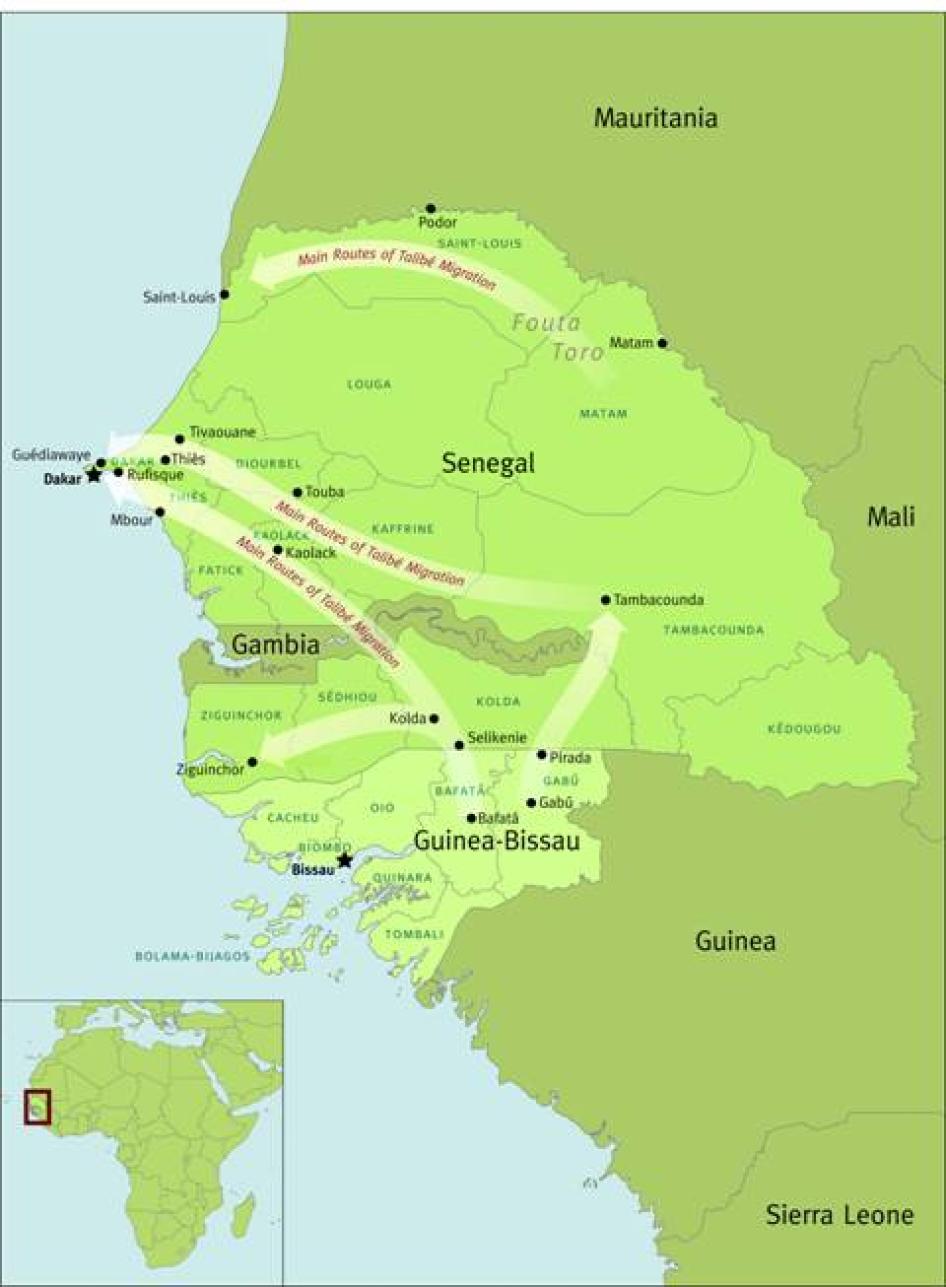
© 2010 John Emerson / Human Rights Watch
The main routes of talibé migration are well known in Senegal and Guinea-Bissau. The routes shown are based on Human Rights Watch’s interviews with talibés, marabouts, parents, and humanitarian and government officials in Senegal and Guinea-Bissau; a 2007 quantitative study of begging children in Dakar performed by the United Nations Children's Fund (UNICEF), the International Labour Organization, and the World Bank; and detailed records kept by SOS Talibé Children (SOS Crianças Talibés) of children returned to Guinea-Bissau after running away from daaras in Senegal.
Summary
I have to bring money, rice, and sugar each day. When I can’t bring everything, the marabout beats me. He beats me other times too, even when I do bring the sum.... I want to stop this, but I can’t. I can’t leave, I have nowhere to go.–Modou S., 12-year-old talibé in Saint-Louis
The teachings of Islam are completely contrary to sending children on the street and forcing them to beg.... Certain marabouts have ignored this—they love the comfort, the money they receive from living off the backs of the children.–Aliou Seydi, marabout in Kolda
At least 50,000 children attending hundreds of residential Quranic schools, or daaras, in Senegal are subjected to conditions akin to slavery and forced to endure often extreme forms of abuse, neglect, and exploitation by the teachers, or marabouts, who serve as their de facto guardians. By no means do all Quranic schools run such regimes, but many marabouts force the children, known as talibés, to beg on the streets for long hours—a practice that meets the International Labour Organization’s (ILO) definition of a worst form of child labor—and subject them to often brutal physical and psychological abuse. The marabouts are also grossly negligent in fulfilling the children’s basic needs, including food, shelter, and healthcare, despite adequate resources in most urban daaras, brought in primarily by the children themselves.
In hundreds of urban daaras in Senegal, it is the children who provide for the marabout. While talibés live in complete deprivation, marabouts in many daaras demand considerable daily sums from dozens of children in their care, through which some marabouts enjoy relative affluence. In thousands of cases where the marabout transports or receives talibés for the purpose of exploitation, the child is also a victim of trafficking.
The Senegalese and Bissau-Guinean governments, Islamic authorities under whose auspices the schools allegedly operate, and parents have all failed miserably to protect tens of thousands of these children from abuse, and have not made any significant effort to hold the perpetrators accountable. Conditions in the daaras, including the treatment of children within them, remain essentially unregulated by the authorities. Well-intentioned aid agencies attempting to fill the protection gap have too often emboldened the perpetrators by giving aid directly to the marabouts who abuse talibés, insufficiently monitoring the impact or use of such aid, and failing to report abuse.
Moved from their villages in Senegal and Guinea-Bissau to cities in Senegal, talibés are forced to beg for up to 10 hours a day. Morning to night, the landscape of Senegal’s cities is dotted with the sight of the boys—the vast majority under 12 years old and many as young as four—shuffling in small groups through the streets; weaving in and out of traffic; and waiting outside shopping centers, marketplaces, banks, and restaurants. Dressed in filthy, torn, and oversized shirts, and often barefoot, they hold out a small plastic bowl or empty can hoping for alms. On the street they are exposed to disease, the risk of injury or death from car accidents, and physical and sometimes sexual abuse by adults.
In a typical urban daara, the teacher requires his talibés to bring a sum of money, rice, and sugar every day, but little of this benefits the children. Many children are terrified about what will happen to them if they fail to meet the quota, for the punishment—physical abuse meted out by the marabout or his assistant—is generally swift and severe, involving beatings with electric cable, a club, or a cane. Some are bound or chained while beaten, or are forced into stress positions. Those captured after a failed attempt to run away suffer the most severe abuse. Weeks or months after having escaped the daara, some 20 boys showed Human Rights Watch scars and welts on their backs that were left by a teacher’s beatings.
Daily life for these children is one of extreme deprivation. Despite bringing money and rice to the daara, the children are forced to beg for their meals on the street. Some steal or dig through trash in order to find something to eat. The majority suffer from constant hunger and mild to severe malnutrition. When a child falls ill, which happens often with long hours on the street and poor sanitary conditions in the daara, the teacher seldom offers healthcare assistance. The children are forced to spend even longer begging to purchase medicines to treat the stomach parasites, malaria, and skin diseases that run rampant through the daaras. Most of the urban daaras are situated in abandoned, partially constructed structures or makeshift thatched compounds. The children routinely sleep 30 to a small room, crammed so tight that, particularly during the hot season, they choose to brave the elements outside. During Senegal’s four-month winter, the talibés suffer the cold with little or no cover, and, in some cases, even a mat to sleep on.
Many marabouts leave their daara for weeks at a time to return to their villages or to recruit more children, placing talibés as young as four in the care of teenage assistants who often brutalize the youngest and sometimes subject them to sexual abuse.
In hundreds of urban daaras, the marabouts appear to prioritize forced begging over Quranic learning. With their days generally consumed with required activity from the pre-dawn prayer until late into the evening, the talibés rarely have time to access forms of education that would equip them with basic skills, or for normal childhood activities and recreation, including the otherwise ubiquitous game of football. In some cases, they are even beaten for taking time to play, by marabouts who see it as a distraction from begging.
Marabouts who exploit children make little to no effort to facilitate even periodic contact between the talibés and their parents. The proliferation of mobile phones and network coverage into even the most isolated villages in Senegal and Guinea-Bissau should make contact easy, but the vast majority of talibés never speak with their families. In many cases, preventing contact appears to be a strategy employed by the marabout.
Unfed by the marabout, untreated when sick, forced to work for long hours only to turn over money and rice to someone who uses almost none of it for their benefit—and then beaten whenever they fail to reach the quota—hundreds, likely thousands, of talibés run away from daaras each year. Many talibés plan their escape, knowing the exact location of runaway shelters. Others choose life on the streets over the conditions in the daara. As a result, a defining legacy of the present-day urban daara is the growing problem of street children, who are thrust into a life often marked by drugs, abuse, and violence.
The exploitation and abuse of the talibés occurs within a context of traditional religious education, migration, and poverty. For centuries, the daara has been a central institution of learning in Senegal. Parents have long sent their children to a marabout—frequently a relative or someone from the same village—with whom they resided until completing their Quranic studies. Traditionally, children focused on their studies while assisting with cultivation in the marabout’s fields. Begging, if performed at all, was rather a collection of meals from community families. Today, hundreds of thousands of talibés in Senegal attend Quranic schools, many in combination with state schools, and the practice often remains centered on religious and moral education. Yet for at least 50,000 children, including many brought from neighboring countries, marabouts have profited from the absence of government regulation by twisting religious education into economic exploitation.
The forced begging, physical abuse, and dangerous daily living conditions endured by these talibés violate domestic and international law. Senegal has applicable laws on the books, but they are scant enforced. Senegal is a party to the Convention on the Rights of the Child, the African Charter on the Rights and Welfare of the Child, and all major international and regional treaties on child labor and trafficking, which provide clear prohibitions against the worst forms of child labor, physical violence, and trafficking. International law also affords children the rights to health, physical development, education, and recreation, obligating the state, parents, and those in whose care a child finds himself to fulfill these rights.
The state is the primary entity responsible for protecting the rights of children within its borders, something which the government of Senegal has failed to do. With the exception of a few modern daaras—which are supported by the government and combine Quranic and state school curricula—not one of the Quranic schools in Senegal is subject to any form of government regulation. In the last decade, the government has notably defined forced begging as a worst form of child labor and criminalized forcing another into begging for economic gain, but this adequate legislation has so far led to little concrete action. Rather than hold marabouts accountable for forced begging, gross neglect, or, in all but the rarest of cases, severe physical abuse, Senegalese authorities have chosen to avoid any challenge to the country’s powerful religious leaders, including individual marabouts.
Countries from which a large number of talibés are sent to Senegal, particularly Guinea-Bissau, have likewise failed to protect their children from the abuse and exploitation that await them in many urban Quranic schools in Senegal. The Bissau-Guinean government has yet to formally criminalize child trafficking and, even under existing legal standards, has been unwilling to hold marabouts accountable for the illegal cross-border movement of children. Guinea-Bissau has also failed domestically to fulfill the right to education—around 60 percent of children are not in its school system—forcing many parents to view Quranic schools in Senegal as the only viable option for their children’s education.
Parents and families, for their part, often send children to daaras without providing any financial assistance. After informally relinquishing parental rights to the marabout, some then turn a blind eye to the abuses their child endures. Many talibés who run away and make it home are returned to the marabout by their parents, who are fully aware that the child will suffer further from forced begging and often extreme corporal punishment. For these children, home is no longer a refuge, compounding the abuse they endure in the daara and leading them to plan their next escapes to a shelter or the street.
Dozens of Senegalese and international aid organizations have worked admirably to fill the protection gap left by state authorities. Organizations provide tens of centers for runaway talibés; work to sensitize parents on the difficult conditions in the daara; and administer food, healthcare, and other basic services to talibés. Yet in some cases, they have actually made the problem worse. By focusing assistance largely on urban daaras, some aid organizations have incentivized marabouts to leave villages for the cities, where they force talibés to beg. By failing to adequately monitor how marabouts use assistance, some organizations have made the practice even more profitable—while marabouts receive aid agency money with one hand, they push their talibés to continue begging with the other. And by treading delicately in their effort to maintain relations with marabouts, many aid organizations have ceased demanding accountability and have failed to report obvious abuse.
The government of Senegal has launched an initiative to create and subject to regulation 100 modern daaras between 2010 and 2012. While the regulation requirement in these new schools is a long-overdue measure, the limited number of daaras affected means that the plan will have little impact on the tens of thousands of talibés who are already living in exploitative daaras. The government must therefore couple efforts to introduce modern daaras with efforts, thus far entirely absent, to hold marabouts accountable for exploitation and abuse.
Under the Convention on the Rights of the Child, the Covenant on Economic, Social and Cultural Rights, and the African Charter on the Rights and Welfare of the Child the state is obliged to ensure that children have access to a compulsory, holistic primary education that will equip them with the basic skills they need to participate fully and actively in society. In addition to supporting the introduction of modern daaras, the government of Senegal should therefore ensure that children have the choice of access to free primary education through state schools or other means.
Without enforced regulation of daaras and success on accountability, the phenomenon of forced child begging will continue its decades-long pattern of growth. If the Senegalese government wants to retain its place as a leading rights-respecting democracy in West Africa, it must take immediate steps to protect these children who have been neglected by their parents and exploited and abused in the supposed name of religion.
Recommendations
To the Government of Senegal
- Enforce current domestic law that criminalizes forcing another into begging for economic gain—specifically, article 3 of Law No. 2005-06—including by investigating and holding accountable in accordance with fair trial standards marabouts and others who force children to beg.
- Consider amending the law to provide for a greater range of penalties, reducing the range of punishment to include only non-custodial sentences and prison sentences under two years, from the present mandatory two to five years, so that punishments can be better apportioned to the severity of exploitation.
- Create a registry of marabouts who are documented by authorities to have forced children to beg for money, or who are convicted for physical abuse or for being grossly negligent in a child’s care.
- Enforce article 298 of the penal code that criminalizes the physical abuse of children, with the exception of “minor assaults,” including by investigating and holding accountable in accordance with fair trial standards marabouts and others who physically abuse talibés.
- Amend the law to include specific reference to all forms of corporal punishment in schools, in accordance with international law, including the Convention on the Rights of the Child and the African Charter on the Rights and Welfare of the Child.
- Amend the law to ensure that it holds responsible a marabout who oversees, orders, or fails to prevent or punish an assistant teacher who inflicts physical abuse on a talibé.
- Enforce anti-trafficking provisions under Law No. 2005-06, which criminalizes child trafficking in accordance with the United Nations Trafficking in Persons Protocol.
- Provide additional resources to civil and border police units, particularly in the regions of Ziguinchor and Kolda, to enhance their capacity to deter child trafficking.
- Improve and require periodic training for police units to ensure that they know the laws governing movements of children across borders.
- Express support, from the highest levels of government, for the prosecution of marabouts who violate laws against forced begging, abuse, and trafficking.
- Relevant authorities within the Ministries of Interior and Justice should monitor, investigate, and, where there is evidence, discipline police, investigating judges, and prosecutors who persistently fail to act on allegations of abuse and exploitation by marabouts.
- Issue clear directives to the Brigade des mineurs (Juvenile Police) to proactively investigate abuse and exploitation, including during street patrols.
- Increase police capacity, particularly within the Juvenile Police, including through increased staffing and equipment, in order to better enforce existing laws against forced begging and physical abuse.
- Provide adequate training to the Juvenile Police on methods for interviewing children, and for protecting and assisting victims of severe physical and psychological trauma, including sexual abuse.
- Ensure that children, aid workers, and others have a safe and accessible means of reporting abuse or exploitation, including by better publicizing the state’s child-protection hotline managed by the Centre Ginddi in Dakar, and by extending availability of hotlines and assistance elsewhere in Senegal.
- Introduce a law requiring humanitarian workers to report to the police incidents of abuse, exploitation, and violations of relevant laws governing the treatment of children, including the law on forced begging.
- Require all daaras to be registered and periodically inspected by state officials.
- Enact legislation setting minimum standards under which daaras must operate, with particular attention to daaras that operate as residential schools.
- Encourage child protection authorities to collaborate with Islamic authorities on the development of these standards, which should include: minimum hours of study; promotion and development of the child’s talent and abilities to their fullest potential, either within the daaras or in another educational establishment; minimum living conditions; the maximum number of children per Quranic teacher; qualifications for opening a residential daara; and registration of the daara for state inspection.
- Expand the capacity and mandate of state daara inspectors in order to improve the monitoring of daaras throughout Senegal; empower inspectors to sanction or close daaras that do not meet standards that protect the best interests of the child.
- Direct the Juvenile Police to investigate the extent to which sexual abuse exists in daaras throughout Senegal. Engage talibés, marabouts, the police, parents, community authorities, and Islamic and humanitarian organizations in establishing and publicizing adequate protection mechanisms for children who are victims of sexual abuse.
- Task a minister with coordinating the state response from the various ministries.
- Improve statistic-keeping on the number of talibés and Quranic teachers who come into contact with state authorities, including: talibés who are in conflict with the law; talibés who run away and are recovered by state authorities; and Quranic teachers who are arrested and prosecuted for forcing another into begging, physical abuse, or other abuses against children.
- Ensure the elimination of informal fees and other barriers to children accessing primary education in state schools.
To the Government of Guinea-Bissau
- Enact and enforce legislation that criminalizes child trafficking, including sanctions for those who hire, employ, or encourage others to traffic children on their behalf, and for those who aid and abet trafficking either in the country of origin or country of destination.
- Enact and enforce legislation that criminalizes forced child begging for economic gain.
- Publicly declare that forced child begging is a worst form of child labor; follow with appropriate legislation.
- Increase the capacity of civil and border police units, particularly in the regions of Bafatá and Gabú, to deter child trafficking and other illegal cross-border movements of children.
- Improve and require periodic training for border units to ensure that they know the laws governing movements of children across borders.
- Continue progress on the regulation of religious schools. Work closely with religious leaders to devise appropriate curricula, teacher standards, and registration and enrollment requirements.
- Ensure the elimination of informal fees and other barriers to children accessing primary education, in an effort to better progressively realize the right to education for the 60 percent of Bissau-Guinean children currently outside the state school system.
To the Governments of Senegal and Guinea-Bissau
- Improve collaboration to deter the illegal cross-border migration and trafficking of children from Guinea-Bissau into Senegal, including through additional joint training of border and civil police.
- Enter into a bilateral agreement to:
- formally harmonize legal definitions for what constitutes the illegal cross-border movement of children;
- coordinate strategies to deter the illegal cross-border movement of children; and
- facilitate the return of children who have been trafficked, and ensure that they receive minimum standards of care and supervision.
- Collaborate with religious leaders, traditional leaders, and nongovernmental organizations to raise awareness in communities on the rights of the child under international and domestic law, as well as within Islam.
To Religious Leaders, including Caliphs of the Brotherhoods, Imams, and Grand Marabouts
- Denounce marabouts who engage in the exploitation and abuse of children within daaras.
- Introduce, including during the Friday prayer (jumu’ah), discussion of children’s rights in Islam.
To International and National Humanitarian Organizations
- Explicitly condition funding for marabouts and daaras on the elimination of forced begging and physical abuse, and on minimum living and health conditions within the daara.
- Improve monitoring to determine if marabouts who receive funds are using them to achieve the prescribed goals.
- Cease funding for marabouts who demonstrate a lack of progress toward eliminating child begging, particularly those who continue to demand a quota from their talibés or who continue to physically abuse or neglect them.
- Implement organizational policies and codes of conduct requiring humanitarian workers to report to state authorities incidents of abuse and violations of relevant laws governing the treatment of children whom they directly encounter, including the 2005 law on trafficking and forced begging.
- Stop returning runaway talibés who have been victims of physical abuse or economic exploitation to the marabout. Bring the child to state authorities so that the Ministry of Justice can perform a thorough review of the child’s situation and determine what environment will protect the child’s best interests.
- Focus greater efforts on supporting initiatives in village daaras and state schools to enable children in rural areas to access an education that equips them with the basic skills they will need to participate fully and actively in society, so that children do not need to move to towns and cities to access quality education.
- Increase pressure on the government of Senegal to enforce its laws on forced begging, child abuse, and child trafficking.
To the United Nations Special Rapporteur on Contemporary Forms of Slavery
- Consider an investigation into the situation of the tens of thousands of children in Senegal who are forced to beg by their Quranic teachers, which appears to qualify as a practice akin to child slavery.
To the Economic Community of West African States
- Work with governments in the region to improve collective response to child trafficking.
To the Organisation of the Islamic Conference
- Denounce the practice of forced begging and physical abuse in Quranic schools as in conflict with the Cairo Declaration and other international human rights obligations.
Methodology
This report is based on 11 weeks of field research in Senegal and Guinea-Bissau between November 2009 and February 2010. During the course of this research, interviews were conducted with 175 children; 33 religious authorities, marabouts, and imams in Senegal and Guinea-Bissau; Senegalese and Bissau-Guinean government officials at the national and local levels; diplomats; academics and religious historians; representatives from international organizations, including the United Nations Children’s Fund (UNICEF) and the International Organization for Migration (IOM); representatives from national and international nongovernmental organizations, national human rights groups, and community associations working in various ways to assist the talibés; and some 20 families in Senegalese and Bissau-Guinean villages who had sent their children to distant cities to learn the Quran.
In Senegal, research was conducted in the capital, Dakar; in the Dakar suburbs of Guédiawaye and Rufisque; in the cities of Saint-Louis, Thiès, Mbour, and Kolda; and in villages in the region of Saint-Louis in the north (area called the Fouta Toro, or the Fouta) and in the region of Kolda in the south. In Guinea-Bissau, research was conducted in the capital, Bissau; the cities of Bafatá and Gabú; as well as in villages in the eastern regions of Bafatá and Gabú. This field research was accompanied by an extensive literature review of publicly available and unpublished studies on the talibés in Senegal and Guinea-Bissau conducted by a range of international and local organizations.
Of the 175 children interviewed, 73 were interviewed during in-depth conversations, generally about one hour in length, in one of two types of centers that assist talibés: food and healthcare assistance centers for current talibés; and temporary shelters that assist in the care and repatriation of runaway talibés. These sites helped ensure a secure environment for the children, most of whom were victims of serious abuse, during and immediately after the time of their interview. Of the 73 children interviewed in centers, 14 were interviewed, at the children’s request, in small groups of between two and four children from the same daara; the other 59 interviews of children in centers were conducted individually and privately, with only a translator and the interviewer present.
An additional 102 interviews were conducted with current talibés living in daaras in four Senegalese cities: Dakar, Thiès, Mbour, and Saint-Louis. These interviews normally lasted from 10 to 15 minutes and were conducted away from their daara, generally on the street. About half of the street interviews were conducted in small groups of between two and five talibés, and the other half individually—depending on whether the children were begging in a group or alone. Privacy from other people on the street was ensured. Human Rights Watch did not interview children in or around their own daaras in order to help protect against acts of reprisal such as beatings by the marabout.
All interviews with talibés, marabouts, and families were conducted with the use of an interpreter between French and one of the main languages spoken by respective ethnic groups in Senegal and Guinea-Bissau. The vast majority of interviews were conducted in the interviewee’s first language—generally Pulaar, Wolof, or Creole.
The names of all current and former talibés interviewed for this report have been withheld in order to protect their identity and help ensure their security. The names of parents have also been withheld, even when consent was provided, to protect the identities of their children who remain under the care of the marabouts. The names of some government officials and representatives of nongovernmental organizations, at their request, have likewise been withheld.
Human Rights Watch identified and spoke with talibés, marabouts, and families with the assistance of humanitarian organizations that work with current and former talibés. Different local partners and translators were used in every city and, often, in each neighborhood in which research was conducted.
The exchange rate between the United States dollar and the West African CFA franc (the currency used by seven West African francophone countries as well as Guinea-Bissau) fluctuated from lows around 430 to highs around 490 from October 2009 to March 2010. In this report, all dollar figures use a rate of 460 CFA to the dollar.
Background
Senegal, the western-most country in continental Africa, has a population estimated at around 12 million, about 95 percent of which is Muslim. The largest ethnic groups in Senegal are the Wolof (approximately 43 percent of the population), Peuhl[1] (24 percent), and Serer (15 percent). Independent from France since 1960, Senegal’s official language according to the constitution is French,[2] though Wolof is generally the lingua franca. Arabic is the second most common language of literacy, even surpassing French—the language taught in state schools—in some regions of Senegal.[3]
Development of Islam in Senegal
The first article of Senegal’s constitution formally defines the state as secular.[4] However, Islamic authorities, particularly through the Muslim brotherhoods that dominate nearly all aspects of Senegalese life, wield considerable influence in the political and economic structures of the country.
The form of Islam prevalent in Senegal draws heavily from Sufism—a broad tradition that includes various mystical forms of Islam. The movement began during the eighth century as a reaction to what was perceived as the overly materialistic and worldly pursuits of many leaders and followers of Islam. Sufi adherents are almost always members of tariqas, or brotherhoods, and, in addition to learning the holy texts, place great importance on following the teachings and example of a personal spiritual guide.[5]
There are four principal Sufi brotherhoods in Senegal: the Qadriyya, the Tijaniyya,[6] the Muridiyya,[7] and the Layenne. The oldest order is the Qadriyya, but the current dominant brotherhoods are the Tijaniyya, to which approximately half of Senegal’s Muslim population adheres, and the Muridiyya, the wealthiest and fastest-growing, followed by some 30 percent of Senegalese.[8]
Each brotherhood maintains a strict hierarchy, led by a caliph, a descendant of the brotherhood’s founder in Senegal, followed by marabouts, who serve as teachers or spiritual guides for the brotherhood’s disciples, or talibés. Marabouts wield immense influence over their disciples: the talibé is expected to be devoted and strictly obedient; and the marabout, for his part, is expected to provide guidance and intercession throughout the disciple’s life.[9] Disciples consult marabouts for guidance on a variety of everyday and major life decisions and problems, such as family illness, a job search, and the harvest. Marabouts themselves are organized in a hierarchy, generally based on lineage, experience, and education. In addition, some marabouts in Senegal are imams, the leaders of mosques.
During the early colonial period, between 1850 and 1910, the French repressed charismatic religious leaders who, with their large followings, the colonial administrators feared could incite rebellion.[10] However, this served only to increase the religious leaders’ popularity.[11] By around 1910, the French and the brotherhood leaders began to see the political and economic benefits of adopting a more cooperative relationship. In return for the religious leaders’ pacifying the population and accepting colonial rule, the French relinquished to them immense profits from the production and trade of groundnuts—one of Senegal’s most important exports even today.[12]
Post-independence, the religious leaders’ political and economic power continued to grow. During the presidency of Léopold Sédar Senghor, from independence to 1980, caliphs from the main brotherhoods issued ndiguels (religious edicts, in Wolof), guiding followers to vote for Senghor and the ruling Socialist Party. In return, Senghor affirmed the brotherhoods’ preeminent religious authority in Senegal and provided them considerable economic benefits.[13] In 1988, in hailing the efforts of Senghor’s successor, President Abdou Diouf, to provide roads and lighting in Touba, the Mourides’ holy capital, the Mouride caliph issued a ndiguel that equated voting for the opposition with a betrayal of the Mouride founder.[14] The brazenness of this ndiguel resulted in a backlash against caliphs’ overt intrusion into political life, which led subsequent caliphs to adopt a superficially apolitical stance regarding support for a given candidate.[15]
While caliphs are nominally apolitical in today’s Senegal, politicking by politicians and political candidates of individual marabouts for their disciples’ votes remains an active practice in national and, even more so, in local elections.[16] Human Rights Watch interviewed marabouts in Dakar, Saint-Louis, Kolda, and Mbour who stated that during the last election cycle, in 2007, politicians or their intermediaries explicitly promised assistance in return for votes.[17]
These various forms of political courting of religious authorities, and political involvement by religious authorities, have over the years produced a political system in which no clear boundaries separate the religious and civic spheres.[18] While public expression of dissent toward the government is commonplace, the population and government leaders appear reluctant to express any opposition to religious leaders, an issue acknowledged by multiple government officials and humanitarian workers.[19] This dynamic has served to embolden those responsible for the proliferation of forced child begging and other abuses committed by the marabouts against talibé children.
Quranic Education prior to French Rule
The introduction of Islam in Senegal brought with it the founding of Quranic schools, or daaras. Prior to the arrival of the French—and even after their arrival in all but the most populous cities—Quranic schools were the principal form of education.
The daaras in existence before French colonial rule, as remain today, were led by marabouts, and the students were, then as now, known as talibés. While many talibés lived at home and studied at a daara in their village, many others were entrusted to marabouts in distant villages. The talibés lived with the marabout at the daara, often without any contact with their parents for several years.[20] While both girls and boys undertook memorization of the Quran in their own villages, it was and remains almost exclusively boys whom parents confide to the care of marabouts.
In these traditional daaras that predominated through independence, most marabouts were also cultivators of the land—though their primary concern generally remained education.[21] During Senegal’s long dry season, emphasis was generally placed on Quranic studies. Then, during the harvest, the marabout and older talibés would work together in the fields to provide food for the daara for much of the year—aided by contributions from families whose talibés did not reside at the daara and from community members through almsgiving. While older talibés assisted in the fields, younger talibés would remain in the daara and continue learning, either from the marabout or an assistant.[22]
During this period, the practice of begging existed where children lived at a residential daara and the harvest could not sustain the daara’s food needs. Mamadou Ndiaye, a professor at the Islamic Institute in Dakar who has studied the daara system for three decades, described how the practice of free boarding in Senegal’s Quranic schools led to the begging phenomenon.[23]
However, in the traditional practice, talibés generally did not beg for money; begging was solely for food and did not take time away from the talibés’ studies or put them on the street. Families would donate a bowl of food for a talibé, who would then return to the daara where all would eat as a community.[24] The experience emphasized mastering the Quran and obtaining the highest attainable level of Arabic. This traditional form of begging, however, bears little resemblance to current practice in Senegal’s cities. Indeed, Professor Ndiaye prefers to refer to these two practices using entirely separate terms: “la quête,” or collection, for the traditional practice; and “la mendicité,” or begging, for the modern practice which is the subject of this report.[25]
Quranic Education under French Rule
Despite the imposition of restrictive regulations and sanctions, as well as strategic subsidies for daaras where French was taught, the French authorities were unable to significantly restrict the proliferation of Quranic schools or limit the influence of Islamic authorities over the population.
Between 1857 and 1900, the French colonial administration tried to limit the number of marabouts authorized to teach children the Quran, first in the then-capital of Saint-Louis[26] and soon after throughout the region.[27] Correspondence between colonial leaders and the means they employed toward their goals demonstrated the central motivations behind these efforts: first, a desire to see the French language replace Arabic as the dominant scholarly and common language; and, second, a fear that Islam as practiced in West Africa was not favorable to colonial rule.[28] One colonial administrator wrote, “We are forced to ask ourselves what could be the utility of the study of the Quran as it is ... done in Senegal. The results from an intellectual point of view are negative.”[29]
An 1857 order required marabouts in Saint-Louis to gain authorization from the French governor in order to legally operate a daara. The set of requirements for authorization—which included proof of residency, educational certificates, and certificates of good morals—were intended to both limit the number of daaras and put out of practice individual marabouts whom the French believed to be hostile to their rule.[30] The order also required that all marabouts send their students of 12 years of age or older to evening classes at either a secular or Christian school in order to learn French.[31]
In 1896, the French administration extended this regulation throughout Senegal in an order that continued the use of restrictive authorization requirements; forbade marabouts from receiving children between the ages of six and 15 at Quranic schools during the hours of public education; and required marabouts to obtain from all their students a certificate proving attendance at French school.[32] If a marabout operated a daara without authorization, or failed to comply with the law, he could be punished with a fine and, for the first time, imprisonment.[33]
These acts angered the population, who saw them as meddling with their religious affairs.[34] Most children continued to attend Quranic schools and French spread slowly. Many marabouts continued to teach without authorization, and even those who had authorization generally failed to comply with official requirements.[35]
In the early 20th century, the colonial authorities continued attempts to limit the influence of Islam and Arabic in favor of French rule and language, but changed their approach, from the “stick” of over-regulation and punitive sanctions, to cooperation and cash payments to marabouts who set aside two hours a day for French instruction.[36]
In another proactive effort, the French in 1908 established the Madrasa of Saint-Louis. A school run by the colonial authorities, its purpose, as stated by the governor general of French West Africa, was “to fight against the proselytizing by those [hostile] marabouts and to improve the current, degraded teaching of Arabic through forming an official corps of marabouts.”[37] Scholarships were awarded with a distinct focus on attracting the sons of leading and influential families. The goal was to train future Senegalese political and religious leaders who would be more inclined to support the French.[38] The Madrasa’s curriculum included French, traditional school subjects, Arabic, and the Quran—prioritized in that order.[39]
Subsidies for Quranic schools that taught French and the training of religious and political leaders expanded the reach of the French language and French colonial authority. However, in most regions, parents continued to prefer traditional Quranic schools.[40] Throughout the entire colonial period, the traditional model of the daara—in which children assisted with the harvest and collected meals, but did not beg for money and instead spent the vast majority of their time on mastering the Quran—remained most prevalent. Ultimately unsatisfied with the results of the “carrot” approach as well, the colonial administration abandoned such attempts. A 1945 order stated that Quranic schools were not to be considered educational schools and were not to be given subsidies under any circumstances.[41]
Because the French authorities’ efforts were so explicitly intended to limit the influence of Islam and religious leaders, they have had a long-lasting impact on later attempts to regulate the daaras: nearly all proposed or enacted regulations have been immediately interpreted by religious leaders as anti-Quranic education and anti-Islam. When a number of marabouts in the post-independence period began to use Quranic education as a cover for the exploitation of talibés, the Senegalese government’s immediate and continued failure to challenge religious authorities on this point allowed an ever-worsening system of exploitation and abuse to develop.
Quranic Education Post-Independence: Rising Tide of Forced Begging
In the post-independence period since 1960, village-based daaras have increasingly given way to urban daaras, in which the practice of forced child begging has become more and more prevalent. Immediately following independence, village-based daaras remained the most common and were the sole option for a religious education, which was not provided by the secular state schools, still widely referred to as “French schools.” Then, severe droughts in the late 1970s brought an influx of migrants, including marabouts, from Senegal’s villages to its cities.[42] Unable to make use of the traditional forms of support as were available in the villages, many marabouts began forcing talibés to beg. By the 1980s, forced child begging was ubiquitous in Senegal’s cities, with profitability attracting numerous unscrupulous marabouts.[43] At present, the practice of child begging in Senegal is almost wholly linked to residential Quranic schools: a 2007 study by the United Nations Children’s Fund (UNICEF), the International Labour Organization (ILO), and the World Bank found that 90 percent of children begging in Dakar and its suburbs were talibés.[44]
While the government has categorically failed to respond to the known prevalence of exploitation and abuse of children associated with residential Quranic schools, it has made mild, unsuccessful attempts at larger reform of the education system. In an attempt to attract some families to the state education system, the Senegalese government introduced at independence the option of Arabic study in state schools,[45] but religious instruction was explicitly banned in state schools until 2004. Thousands of Senegalese families who prioritized religious education continued to send their children to daaras, contributing to the proliferation of Islamic associations and Arabic schools.[46]
At the onset of urban migration in the 1970s, many marabouts ran seasonal daaras, where marabouts and talibés would live in the city during the dry season and then return to the village to prepare for the harvest.[47] Then, as the profits obtainable from forced begging and the greater comforts of urban life became apparent, most marabouts remained in the cities all year. Professor Ndiaye explained these developments, and the negative effect that forced begging has had on children’s Quranic education:
Over time, the marabouts started to stay in the cities all year—they weighed the pros and cons and thought it was more favorable to stay in Dakar. Some marabouts became more at ease in Dakar—there was coffee, rice, fish, clean water. Why return to the village, where they had to work the land for long hours, when [in the city] a child comes daily with money, sugar, and rice? As a result, some marabouts reduced the hours of Quranic learning, because the longer the child remains in the daara learning, the less opportunity he has to bring money. The longer he stays outside the daara, the more the marabout can maximize the money that the talibés bring.[48]
Emphasis on Almsgiving
Academics and Senegalese humanitarian officials working with the talibés noted how almsgiving—both a central tenet of the Islamic faith and a widely practiced custom in Senegal—has had the effect of contributing to the entrenchment of the talibé problem, and as a result, the exploitation and abuses associated with child begging. Professor Ndiaye described this phenomenon:
In Senegal, people love to give alms.... People here need a population to give to. Disciples go to their marabout at crucial times—for example, when they want an important job—and the marabout will say that if they want to achieve this, they must give 50 CFA (US$0.11) to 10 talibés.[49]
This should not be construed to suggest that most Senegalese are in favor of the exploitative and abusive practices carried out against the talibés as detailed in this report. Rather, the attendant need felt by many Senegalese to give alms, coupled with the widespread presence of begging talibés, has at once been exploited by many marabouts and contributed to the normalization of the practice throughout Senegal.
Types of Quranic Schools Present Today in Senegal
Village Daara |
A form present in almost every Senegalese village, it generally preserves the traditional focus on memorizing the Quran. In many village daaras, children live at home with their families, attending state schools in the morning and the daara in the afternoon, or vice versa. Children residing at the daara assist the marabout with cultivation during the harvest and with other tasks such as the collection of wood and water. |
Seasonal Daara |
Almost nonexistent now, particularly in Dakar, marabouts and talibés live in cities during the dry season, with talibés generally forced to beg for money. During the rainy season, to prepare for the harvest, marabouts return to the village, often with the talibés who help cultivate. |
Urban Daara with Few or No Talibés Residing at the Daara |
Frequently led by imams at daaras connected with mosques, these daaras are overwhelmingly comprised of children who reside with their families in the surrounding neighborhood. Most of these children also attend state school. There is generally no begging. |
Urban Daara with Talibés Residing at the Daara |
Comprising the majority of daaras in cities, children often come from rural areas in Senegal and Guinea-Bissau to live and learn from a marabout. Under the pretext that begging is essential to sustain the daara and inculcate humility, many marabouts force their talibés to beg for long hours on the streets. The hours of actual Quranic education vary considerably. |
“Modern” Daara |
Though still relatively few in number, these daaras have introduced fields of study other than memorizing the Quran and learning Arabic, including French and state school subjects. Begging for money is generally not performed, as the modern daaras are often financed by inscription fees, religious authorities, the state, foreign aid, and humanitarian aid agencies. |
Exploitation and Abuses Endured by the Talibés in Senegal
Each of us has our own technique to survive.– Abu J., 12-year-old talibé in Saint-Louis[50]
In every major Senegalese city, thousands of young boys dressed in dirty rags trudge back and forth around major intersections, banks, supermarkets, gas stations, and transport hubs begging for money, rice, and sugar. Often barefoot, the boys, known as talibés, hold out a small tomato can or plastic bowl to those passing by, hoping to fulfill the daily quota demanded by their teachers, or marabouts, who oversee their schooling and, usually, living quarters. Typically the children are forced to beg for long hours every day and are beaten, often brutally, for lacking the tiniest amount. On the street they are vulnerable to car accidents, disease, and often scorching heat.
Inside the daaras, the boys are subjected to deplorable conditions and, at times, physical and sexual abuse from older boys. The boys are typically crammed into a room within an abandoned structure that offers scant protection against rain or seasonal cold. Many choose to sleep outside, exposed to the elements. Very few are fed by their marabouts; instead, they must beg to feed themselves, leaving many malnourished and constantly hungry. When they fall sick, which happens often, they seldom receive help from the marabout in obtaining medicines. Ultimately exploited, beaten, and uncared for, at least hundreds every year dare to run away, often choosing the hardship of a life on the streets over the abuse of life in the daara.
Forced begging places children in a harmful situation on the street and therefore meets the ILO’s definition of a worst form of child labor. Moreover, as the forced begging and gross neglect is done with a view toward exploitation, with the marabout receiving the child from his parents and profiting from the child’s labor, it amounts to a practice akin to slavery.
Large and Growing Problem
In the environment of all-powerful religious brotherhoods, limited government response, and the migration of marabouts to urban centers where forced begging has proliferated, tens of thousands of talibé children in Senegal, the vast majority under 12 years old, endure exploitation and severe abuses. Each year, more and more children fall victim to this system of abuse.
Precise estimates of the number of talibés forced to beg are difficult to ascertain, as children are constantly running away and marabouts, emboldened by the absence of government regulation, frequently open up new daaras. However, based on field research and censuses by academics and humanitarian workers interviewed for this report, Human Rights Watch estimates there to be at least 50,000 talibés in Senegal who are forced to beg with a view toward exploitation by their teachers, out of the hundreds of thousands of boys attending Quranic schools in total.
The Senegalese government’s enactment in 2005 of a law that criminalized forcing another into begging for financial gain, as well as efforts to improve conditions in daaras by local and international aid agencies, have failed to stem either the growing numbers of talibés or the serious human rights violations associated with the practice of forced begging and daara life. Evidence of the growing problem includes:
- A Senegalese government official working within the Ministry of Family, Food Security, Women’s Entrepreneurship, Microfinance, and Small Children (Ministry of Family) in Mbour (80 kilometers south of Dakar) registered a near doubling of daaras in the city between 2002 and 2009, including many in which marabouts subjected children to the practice of forced begging.[51]
- A government official who had previously worked in Ziguinchor (480 kilometers south of Dakar) told Human Rights Watch: “Ziguinchor is an example of the fast rise of the begging talibés phenomenon. Up until 1995, the city had barely encountered the presence of these talibés. Now there are thousands.”[52]
- According to an experienced local aid worker in Saint-Louis (270 kilometers north of Dakar), the number of talibés, including both those who are forced to beg and those who are not, has doubled since 2005 from an estimated 7,000 to 14,000.[53]
- According to the director of Samusocial Senegal, an international aid organization that provides healthcare to vulnerable street children in Dakar, including current and former talibés, “There has been an increase in 2009 in the number of street children in Dakar and a lowering in the age of the kids on the street.”[54]
Profile: Young and Far from Home
Of the 175 talibés interviewed by Human Rights Watch, roughly half were 10 years of age or younger.[55] On average, the children had begun living at the daara at seven years of age, though Human Rights Watch interviewed talibés who arrived at the daara when only three years old.[56] Many talibés in Senegal are from neighboring countries, most notably Guinea-Bissau, and are thrust into a neighborhood or city where few people speak their language. Combined with their age and distance from home, they find themselves entirely dependent on the marabout, their fellow talibés, and, more often than not, themselves.[57]
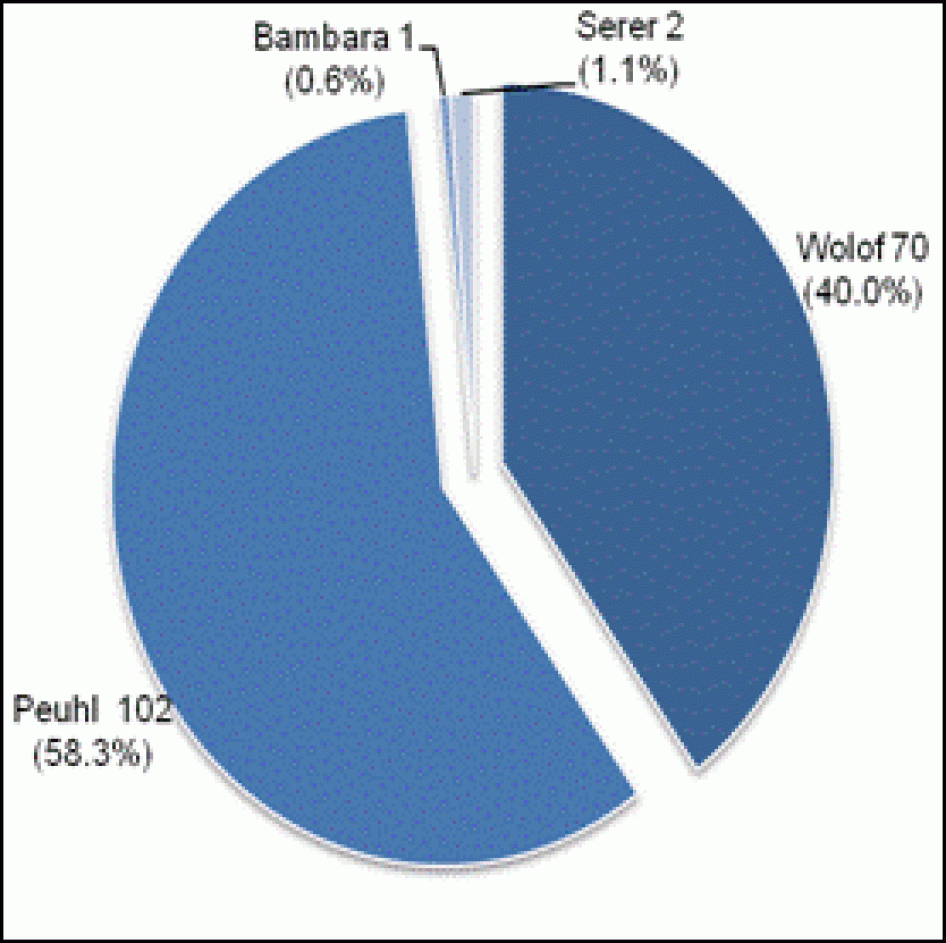
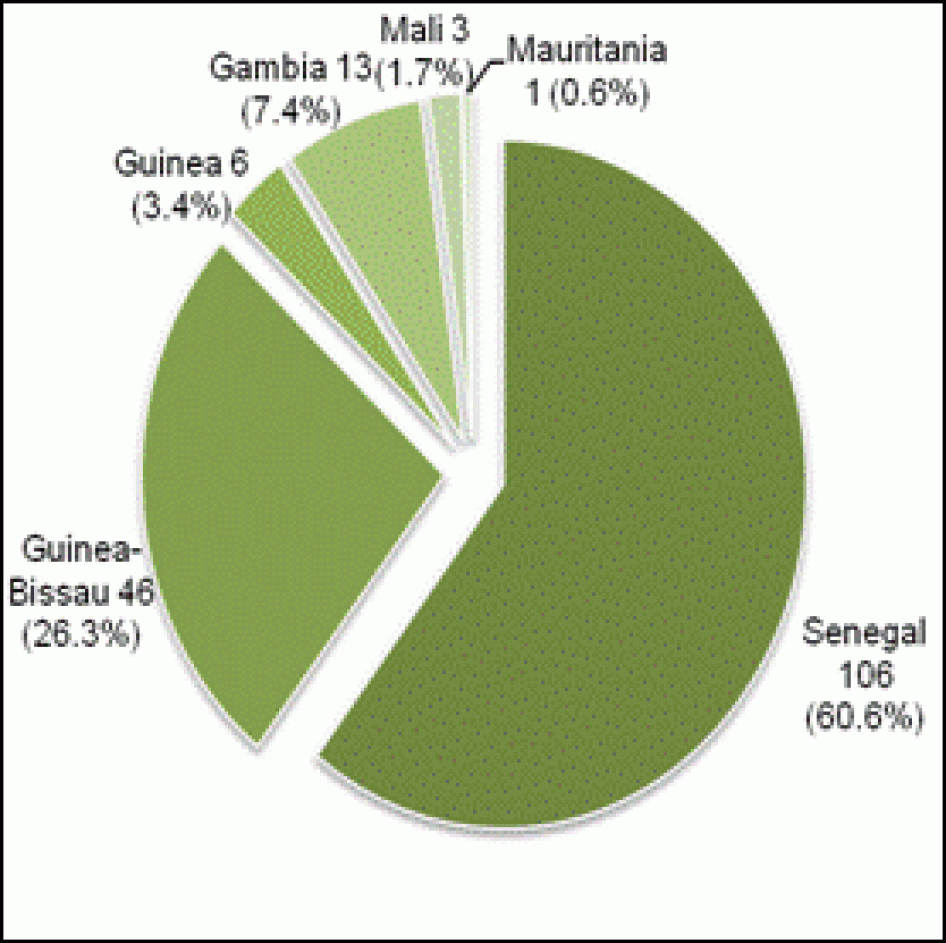
The profiles of talibés interviewed by Human Rights Watch suggest that the practice of forced begging is not limited to children of any one ethnic group, region, or neighboring country. While boys from the Peuhl ethnic group were disproportionately represented amongst the talibés interviewed in most cities—some 58 percent of the talibés interviewed by Human Rights Watch were Peuhl, though the Peuhl ethnicity comprises only one-quarter of Senegal’s population—there were a large number of Wolofs as well. And while a large portion of the talibé population in Dakar hailed from Guinea-Bissau, they were a clear minority in most other Senegalese cities. No matter their places of origin, nearly all talibés who reside at the daara are far from home and rarely, if ever, in contact with their families.
Of the 175 talibés interviewed by Human Rights Watch, the majority (about 60 percent) were Senegalese. However, there were also many from Guinea-Bissau (about a quarter of those interviewed) and smaller, though significant numbers of talibés from the Gambia and Guinea. Of all those interviewed, the majority came from the Peuhl ethnic group (nearly 60 percent) followed by the Wolof (40 percent).
Ethnicities of Talibés Interviewed by Human Rights Watch |
Places of Origin of Talibés Interviewed by Human Rights Watch |
|
|
While samples were insufficient to effectively estimate proportions of talibés by ethnicity or country of origin in each city, Human Rights Watch’s research revealed several distinct patterns of migration related to various cities:
- In Dakar, only about half the talibés interviewed were from Senegal, with almost as many hailing from Guinea-Bissau.[58] In some neighborhoods, over 90 percent of interviewees were from Guinea-Bissau, whereas in other neighborhoods, Senegalese predominated.[59] A clear majority were Peuhl, followed by Wolof and a few Serer.[60]
- In Saint-Louis, about 80 percent of talibés interviewed were from Senegal, followed by Guinea-Bissau, Guinea, and Mauritania.[61] Talibés of the Peuhl ethnicity comprised the overwhelming majority.
- In Thiès, about 60 percent of talibés interviewed were from Senegal. The largest number from a neighboring country hailed from the Gambia, with small percentages from Guinea-Bissau, Mali, and Mauritania.[62] Over half were Wolof, followed closely by Peuhl.
- In a limited number of interviews in Mbour, the vast majority of talibés interviewed were from Senegal, followed by the Gambia. All but one of the talibés were Wolof.[63]
The Story of Ousmane B., a 13-Year-Old Former Talibé[64]I am from the region of Tambacounda. My father decided to send me to learn the Quran when I was six. My mother didn’t want me to leave, but my father controlled the decision. The daara wasn’t a good place, and there were more than 70 of us there. If it was the rainy season, the rain came into where we slept. The cold season was also difficult. We didn’t have any cover and there were no mats, so we slept only on the ground. A lot of the talibés slept outside, because it was more comfortable. I did not have any shoes, and only one shirt and one pair of pants. The marabout had three sons, and when I got clean clothes, the marabout would take them from me and give them to his own children. The marabout paid for his children to go to a modern daara—they didn’t beg. When we were sick, the marabout never bought medicines. We would either come to centers where they would treat us, or we would use our own money to buy medicines. If I told the marabout I was sick and couldn’t beg, the marabout would take me to a room and beat me—just as if I was not able to bring the sum. So I had to go to the streets, even when I was sick. The normal hours for studying were from 6 to 7:30 a.m., 9 to 11 a.m., and 3 to 5 p.m. I begged for money and breakfast from 7:30 to 9 a.m., for money and lunch from 11 a.m. to 2 p.m., and for money and dinner from 5 to 8 p.m. When I first arrived, I had to bring 100 CFA (US$0.22) a day—that was the sum for the youngest. As I got older, the marabout raised the quota to 300 CFA ($0.65), half a kilogram of rice, and 50 CFA ($0.11) worth of sugar. I saw the marabout sell the rice in the community; he never used it to feed us. I have heard from talibés there now that the quota is up to 500 CFA ($1.09). Even then, it was very difficult for me to find the sum. It was easy on Friday, the holy day, but on many other days I had problems. When I couldn’t bring the quota, which happened at least every week, the marabout would take me into the room where the oldest talibés slept. Then he wrapped rope cord around my wrists and beat me with electric cable, over and over. I still have marks on my back (these marks were shown to Human Rights Watch). As bad as it was with the marabout, when he was gone it was even worse. The oldest talibés were really nasty. They would take our money and then beat us really badly if we missed the quota—I would just stay out and keep begging, sleep on the street if necessary. Begging is difficult. We ended up having to do whatever it took to get the daily sum, even steal. To be a talibé, it’s not easy. |
Nature of Forced Begging: Out of the Classroom and onto the Street
Begging is a difficult thing, because I would spend all day begging and sometimes I might end up with nothing.– Mamadou S., eight-year-old former talibé in Thiès[65]
In hundreds of urban residential daaras, the marabout appears to emphasize forced begging over learning the Quran. As one humanitarian worker who works closely with talibés told Human Rights Watch, “In the urban daaras, there is a pretext of education with a real purpose of exploitation.”[66]
In principle, the marabout is responsible for imparting mastery of the Quran and a moral education on the talibé. In practice, the talibés are the marabout’s workers, forced to spend long hours each day on the streets in search of money, rice, and sugar for the marabout—who uses almost none of it for their benefit. With education often secondary to fulfilling the quota, mastering the Quran takes two or three times longer than it would if the children received a proper education, according to Islamic scholars in Senegal.
Long Hours in Search of Money
While the traditional daara placed primary focus on mastering the Quran, the contemporary urban residential daara often focuses on maximizing the marabout’s wealth. Amadou S., 10, told Human Rights Watch that each day the marabout gathers the children at 6 a.m. and, before sending them off into the streets, encourages them by saying, “The rice is there, good luck!”[67] The talibés interviewed by Human Rights Watch spent on average 7 hours and 42 minutes, spaced throughout the day, begging for either money or food.[68] Begging is therefore a full-time job for the talibés, generally performed seven days a week.[69]
The vast majority of marabouts in urban daaras demand a specific sum that the talibés must bring back each day.[70] This quota varies between daaras and even within an individual daara: the youngest and newly arrived are required to bring slightly less; those between eight and 15 years old must bring the most; and those over 15 are often exempt from begging.
For the 175 talibés interviewed by Human Rights Watch, the average daily quota of money demanded by the marabout was 373 CFA ($0.87), except for Friday, where as a result of some marabouts setting higher quotas to take advantage of greater almsgiving on the holy day, the average quota was 445 CFA ($0.97).[71] In a country where approximately 30 percent of the population lives on less than a dollar a day,[72] and the gross domestic product per capita is approximately $900,[73] this is a considerable and often difficult sum to achieve. The quota varies greatly by city, as shown in the text box below, but the hours spent begging each day are remarkably consistent. The principal difference is that Dakar is a far richer city, which results in a higher quota.
Average Begging Quota in CFA and Hours by City | |||
|
Normal Days |
Friday |
Hours |
Dakar |
463 |
642 |
7 hrs, 42 mins |
Saint-Louis |
228 |
228 |
7 hrs, 36 mins |
Thiès |
254 |
268 |
7 hrs, 54 mins |
Mbour |
246 |
246 |
7 hrs, 18 mins |
In addition to money, many marabouts require that their talibés bring back sugar and uncooked rice. Just over 50 percent of talibés interviewed by Human Rights Watch had a quota for either rice or sugar, around 14 percent had a quota for both rice and sugar, and 35 percent only had to bring whatever they could. The daily quotas ranged from half a kilogram to three kilograms of rice, and from 50 to 100 CFA ($0.11-$0.22) worth of sugar.
In daaras where quantities of rice or sugar are demanded, every talibé told Human Rights Watch that none of what they brought back was ever used for their own consumption. The account of Samba G., eight years old, was typical of what occurred in daaras with high rice quotas or a large number of talibés: “When you brought in the rice, the marabout would fill up large [50-kilogram] bags. When they were full, he would send them back to his village or he would sell them in the neighborhood.”[74] A 50-kilogram bag of rice sells for around 20,000 CFA ($43.50) in Dakar.
As the forced begging is done “with a view” toward exploitation, with the marabout receiving the child from his parents and profiting from the child’s labor, it amounts to a practice akin to slavery.[75]
Going to the City: Suburban Talibés’ Holy Day on Dakar’s StreetsIn one of the most exploitative practices, many marabouts in Dakar’s suburbs force their talibés, either explicitly or indirectly, through an elevated quota of 750 ($1.63) to 1,500 CFA ($3.26), to travel into Dakar from Thursday to Saturday in order to maximize their earnings. They beg around the main mosques in Dakar, particularly on the Friday holy day when Senegalese give greater alms. Human Rights Watch interviewed over a dozen talibés from different suburbs, including Guédiawaye, Mbao, Pikine, and Keur Massar (ranging from 10 to 30 kilometers outside Dakar), and the vast majority said that they engaged in this practice. An 11-year-old talibé in Keur Massar described waking up at 5 a.m. on Thursday to catch public transport into Dakar, hopping off and walking when caught not paying. He, like the others, would then beg all day Thursday before sleeping on Dakar’s streets Thursday night. A full day of begging on Friday follows, either with a return to the suburb on Friday night or, more often, another night on the street before returning Saturday morning. Rather than attending mosque with their talibés on Friday, marabouts are widely subjecting children to 16-hour work days and nights on the streets. |
Injury and Death from Car Accidents
The hours spent on the street begging put talibés at considerable risk of injury and death from car accidents. It is a common sight to see talibés, some as young as four years old, weaving precariously between cars on major streets, approaching cars as they pull into and out of driveways and in inter-city transport hubs, and sticking their hand or bowl into car windows in the hopes that alms will be given.
Human Rights Watch documented four cases of death as a result of car accidents, and interviewed nine talibés who had been victims of car accidents, with injuries ranging from soreness and bruises to multiple broken bones. In addition, a marabout interviewed by Human Rights Watch said that an eight-year-old talibé under his de facto guardianship had in late 2009 suffered breaks to both of his legs in a car accident.[76] A father of a former talibé told Human Rights Watch that his son had in 2006 suffered a serious injury to his arm as a result of a car accident in Dakar, which still affected him three years later.[77]
While a small sample, all four deaths documented by Human Rights Watch occurred in Dakar—not surprising given the greater level of traffic in the capital. All the deaths and injuries documented happened while the talibés were begging. A 2007 study on begging children in Dakar noted that the conditions on the street inherently expose begging children to dangers, particularly illnesses and car accidents.[78] Likewise, government officials and directors of international humanitarian organizations and local human rights organizations all related to Human Rights Watch that the dangers on the street, including from car accidents, placed the talibés in an extremely vulnerable position for long hours each day.[79]
Pape M., 13, witnessed the death of a friend and fellow talibé in a car accident in Dakar in 2007. He emotionally told Human Rights Watch:
My friend—we begged together—was killed by a car. It happened when the sun was almost down, during the cold season. We were out begging and a car hit him. It was a big car. I don’t know how it happened. The car just hit him and he died, right next to me. The car stopped and people came around. People were shouting at the driver. I think he was taken to the hospital—someone took him in a car—but he died. I never heard the marabout talk about it.[80]
Two other talibés told Human Rights Watch that a fellow talibé in their daara had been killed by a car accident, but neither was present when it happened.[81]A traditional chief in Guinea-Bissau lost a talibé nephew to a car accident in Dakar, concluding that “the practice of forced begging on the street is truly terrible for the children.”[82]
Nine talibés interviewed by Human Rights Watch described having suffered injuries from car accidents. Bouba D., nine years old, was injured while begging near the transport terminal in Thiès:
I was hit at the place where the cars leave.I was standing on the side of the road begging near one station wagon when another car came by and struck me. It wasn’t bad—I didn’t break any bones. But several other talibés from my daara have been struck by cars here too, and they have suffered broken bones. One his leg, one his arm. Accidents happen frequently.[83]
Similarly, Ibrahima T., 13, related:
I was hit by a motorbike once and hurt my knee. I was on the side of the road—the road from Dakar to Rufisque—but the motorbike came off the road and struck me. My knee still hurts sometimes, and this was several years ago. The marabout never took me to the hospital.[84]
The frequent accidents demonstrate one of the many ways that forced begging meets the ILO definition of a worst form of child labor and constitutes a violation of the child’s right to physical security and protection from injury, and, in cases of death, a violation of the right to life.[85] The Convention on the Rights of the Child (CRC) requires the state to take all appropriate measures to safeguard the children’s right to physical and mental security. Marabouts, as de facto guardians, are failing to act in the best interests of the child as is also required under the CRC.[86]
Denying the Right to Education
The limited time talibés spend in Quranic classes in most urban daaras, as compared with the time spent begging, brings into question not only the motives of the marabouts, but also the relative value of education received in the daaras.
The number of hours the talibés interviewed by Human Rights Watch spent in classes varied greatly—from less than one hour per day to as much as eight hours. However, they almost unanimously described spending more time begging for money and food than they spent in the classroom learning the Quran. On average, they spent nearly eight hours a day begging and only five hours a day scheduled for Quranic classes.
Talibés from several daaras made clear that the hours of study were strictly enforced; however, in the majority of daaras from which talibés were interviewed, it was clear that scheduledhours far surpassed actual hours of learning. Human Rights Watch interviewed tens of talibés in the street in the midst of hours that they said were set aside for studying; when asked why they were not in class at the daara, they universally responded that they would not go back until completing the quota. In addition, many talibés said that the long hours on the street make it difficult for them to concentrate even while at the daara, due to hunger and general fatigue.
The result is that in many urban residential daaras, the talibés’ progress in learning to master the Quran and read and write Arabic, as well as their ability to access education in other basic skills, is severely undermined by the marabouts’ apparent prioritization of begging over classroom time. One marabout in Mbour told Human Rights Watch: “I have never begged my talibés because I want them to learn. The most important part of the apprenticeship is the Quran, and the hours of begging take away from that.”[87] The president of ONG Gounass, a humanitarian organization in Kolda that works closely with daaras in the region and operates a modern daara, likewise related:
The student is there supposedly learning the Quran. But there are many children that pass 10 to 15 years in the daaras and they know neither the Quran nor a true understanding of Islam. They leave the daara without any skills and without even knowing the Quran.[88]
The right to education under the CRC includes an education “designed to empower the child by developing his or her skills, learning and other capacities, human dignity, self-esteem and self-confidence.”[89] Where a child barely learns the Quran and no other educational material, this right is clearly left unfulfilled. Article 7(b) of the Cairo Declaration on Human Rights in Islam gives parents the right to choose the form of education for their children, so long as they take into consideration the child’s interests;[90] and article 9(b) states that “[e]very human being has a right to receive both religious and worldly education.”[91] While Quranic education can therefore be an integral part to a child’s self-development, tens of thousands of talibés in Senegal are failing to receive either a religious education or an education in other basic skills.
Severe Physical Abuse
Each time I was beaten, I would think of my family who never laid a hand on me.– Abdou K., 11-year-old former talibé[92]
The overwhelming majority of talibés interviewed by Human Rights Watch reported suffering repeated, often severe, physical abuse in the daara. Beatings were most frequently reported within the context of failing to return the daily quota, although there were tens of talibés who were also beaten for failure to master the Quranic verses. The physical abuse was perpetrated by the marabout himself or, to a lesser extent, an older talibé, or “grand” talibé, who served as an assistant teacher.[93]
Talibés typically described being taken to a room, stripped of their shirt, and beaten with an electric cable or a club—usually struck repeatedly on the back and neck. Some were subjected to stress positions, chained to a piece of furniture, or bound or shackled during the beating. More than 20 talibés revealed to Human Rights Watch welts and scars resulting from beatings they had received. The children expressed profound levels of fear at what would await them should they fail to meet the marabout’s established quota.
Malick L., a 13-year-old former talibé, showed Human Rights Watch the scars from the beatings he had suffered at the hands of his marabout more than a year before. He recounted his experience, which was typical of many other talibés interviewed:
When I could not bring the quota, the marabout beat me—even if I lacked 5 CFA ($0.01), he beat me. It was always the marabout himself. He took out the electric cable and we went to the room. I stood there and ... he hit me over and over, generally on the back but at times he missed and hit my head. I still have marks on my back from the beatings.[94]
Not surprisingly, all but one of the talibés interviewed by Human Rights Watch who had run away from their daaras said that they had been beaten repeatedly for failing to bring enough money; the other was brutally beaten for mistakes in memorizing the Quran. Of the 139 current talibés interviewed, 77 percent described being beaten for failing to collect the quota. Human Rights Watch believes that this percentage may be even higher, given the apparent fear among children interviewed in groups, particularly on the street, that other talibés might report to the marabout what had been discussed with the researcher.[95]
Of those who described being beaten for failing to collect the quota, the overwhelming majority stated that it happened each and every time that they could not bring the quota. Other talibés described being beaten only after being given a “second chance” to complete the quota, as Boubacar D., 12, told Human Rights Watch:
If we cannot bring the quota one day, our name is put on the board with the sum we owe. We are in debt. If we cannot bring it all the next day, then we are beaten badly with electric cable.[96]
Every talibé but one stated that the punishment was inflicted by the marabout himself or with his clear knowledge and endorsement—since he was, at a minimum, physically present when some of the beatings occurred.[97]
Determining the precise frequency of the beatings is difficult, as many of the talibés are very young and conceptions of time are not always accurate. All but one former talibé interviewed by Human Rights Watch said that they suffered the beatings at least once a week, and many said two or three times. Among current talibés, answers varied from very rarely to every day.[98] A large number of talibés said that their beatings were particularly common on Saturdays and Sundays, since there are far fewer people on the streets to give money.
During in-depth interviews, talibés identified a number of different objects that marabouts and other teachers had used to beat them. Most commonly cited was electric cable (39 cases, including one in which a long strip of iron was attached to inflict additional damage), followed by a club (13 cases), a cane (six), a whip (four), a hand (three), a tire strip (three), rope cord (two), and “whatever is lying around” (two).
Human Rights Watch also documented multiple cases of marabouts using stress positions to accompany beatings.[99] Chérif B., 11, told Human Rights Watch:
If I can’t bring the quota, then the marabout beats me with an electric cable or a club. He takes us into a room and brings other talibés in to watch. Every time he forces us to hold our ears and move up and down as he strikes us—he keeps striking while we do this until we tumble over. If we tumble over right away, he starts again.[100]
Eight talibés described being chained or bound with rope during beatings by their marabout or an assistant.[101] Ibrahima T., 13, recounted being repeatedly bound and beaten in a daara in a Dakar suburb before running away in 2009:
Every time I could not complete the quota by 10 a.m., one of the grand talibés would take me into a room and chain me around my ankles. Then he would beat me with electric cable or a tire strip—the strikes were too numerous to count. After he finished, the grand talibé would leave me there, chained, until seven at night, sometimes beating me again.... The punishment was the same for arriving late. If I came back after 10 a.m., even with the quota, I was chained until nighttime and beaten—the marabout was very strict about it.[102]
One marabout employed a particularly heinous method of punishment, in which he forced the youngest talibés to brutalize each other or suffer additional consequences (see text box of the story of Laye B. below).
The talibés almost universally described the beatings—and the fear of a coming beating when they were unable to collect the quota—as the worst abuse in the daara. Babacar R., 14, related:
Begging is too difficult because if I do not have the daily quota, the grand talibé beats me. He hits me everywhere—on the head, the back, everywhere, and over and over. It’s difficult, it’s very painful.... I want to return home and work in my village. I don’t want to be here.”[103]
Moreover, the gross neglect, deprivation, and serious human rights abuses endured by tens of thousands of talibés at the hands of many marabouts are augmented when, as is common, the marabout is either absent or leaves the daara for days or even weeks. Human Rights Watch documented 18 cases in which the marabout lived in a house separate from the daara where the talibés slept, including some instances when the marabout only came to the daara on certain days.[104] Tens of talibés described how their marabouts left the city multiple times a year to return to home villages—sometimes for holidays, sometimes to bring back more talibés.[105] In each of these daaras, talibés as young as four are left under the supervision of older talibés, generally around 18 years old. Under such circumstances, older talibés are responsible for frequent beatings, stealing money from younger talibés, and sexual abuse.[106]
Talibés who said that they were not beaten generally acknowledged another form of dangerous punishment: refusing entry into the daara. Talibés in these daaras said that while their marabout did not strike them, they could not come back to the daara until they completed the quota. This restriction often resulted in their begging late into the night or, alternatively, sleeping on the streets.[107] In only around 7 percent of Human Rights Watch’s interviews did talibés say that there was no punishment at all for failing to bring the quota.
The fear of corporal punishment or of being forced to sleep outside for failing to meet their quota has driven some talibés to turn to stealing. Seydou R., 13, was one of several talibés to describe this phenomenon to Human Rights Watch:
Because we were scared of being beaten for not having the sum, all of us would steal something and give the money to the marabout if we were in danger of not collecting the sum. We would do anything to get the 300 CFA ($0.65).[108]
A government official of the Action Educative en Milieu Ouvert (AEMO), a part of the Ministry of Justice that works with children, told Human Rights Watch that the problem of talibés implicated in theft, seemingly driven by their need to attain the required quota, is increasing each year.[109] The result, as stressed by a government official within the Ministry of Family, is that “over time, because of the tough life they have led and because they are forced to steal, it becomes difficult to integrate them into productive life.”[110]
The severe physical abuse that many marabouts inflict on the talibés in their care, as well as the looming threat of violence, violates the children’s right to freedom from physical and mental violence and abuse. Under the CRC, the state is obligated to protect children from such abuse whether committed by a parent, a legal guardian, or any other person caring for the child—clearly applying to a marabout who acts as a de facto guardian.[111] The Committee on the Rights of the Child, the body charged with interpreting the CRC, has stated that the prohibition against physical and mental violence also applies to corporal punishment in schools.[112] The physical abuse likewise places the marabout in conflict with Senegal’s penal code, which provides particular care to children.[113]
In addition, particularly in cases in which chaining, binding, stress positions, and other more brutal forms of punishment are used, the physical abuse may rise to the level of torture under the Convention against Torture. The Committee against Torture has stated:
[W]here State authorities or others acting in official capacity or under colour of law, know or have reasonable grounds to believe that acts of torture or ill-treatment are being committed by non-State officials or private actors and they fail to exercise due diligence to prevent, investigate, prosecute and punish such non-State officials or private actors consistently with the Convention, the State bears responsibility and its officials should be considered as authors, complicit or otherwise responsible under the Convention for consenting to or acquiescing in such impermissible acts.[114]
Violations of the Rights to Food, Physical Development, and Health
Human Rights Watch found that many marabouts are grossly negligent in providing for the health and nutritional needs of the talibés for whom they are responsible. Children are subjected to severe overcrowding, a lack of sanitation, and inadequate protection from weather. The poor conditions in the daara are combined with a lack of clothes and shoes for the talibés’ long days on the street, which increases their vulnerability to disease. Forced to beg for food, many are also extremely malnourished. Often sick, their marabout rarely provides medicines, requiring them to beg even greater hours in order to pay for their own treatment; more often, they suffer from the illness—no matter how severe—and continue begging to satisfy the quota. Human Rights Watch documented the cases of two talibés who died from illnesses, in both cases believed to be from malaria not adequately treated by the marabout.[115]
Conditions in the Daara
Human Rights Watch visited over 40 urban residential daaras throughout Senegal. In the vast majority, conditions severely undermined the children’s rights to health and an adequate standard of living for physical and mental development. Serious overcrowding, a lack of sanitation and running water, a lack of adequate protection from harsh weather conditions, and the instability of the daara structures themselves posed a serious health risk to the talibés.
Most of the daaras visited were situated in abandoned, partially constructed structures or makeshift thatched compounds with concrete or sand floors, which offered little protection from the heat, rain, or cold—compounded by a lack of cover and, in some cases, even something as basic as a mat to sleep on. The daaras are also extremely overcrowded with poor sanitation, leaving talibés dirty and vulnerable to bites from mosquitoes and other insects.
One daara visited by Human Rights Watch in Saint-Louis was located in the middle of the neighborhood garbage dump, surrounded by standing water and refuse. While dismal, the daara was described as an upgrade over where the talibés had formerly been housed—the back of an abandoned truck.[116] In Mbour, one talibé was killed and four others were seriously injured in December 2009 when the partially constructed building acting as their daara collapsed at night.[117] While these were two of the most extreme cases documented by Human Rights Watch, the average daara is hardly much better.
Many boys interviewed by Human Rights Watch complained about the cold they suffered during Senegal’s winter—from December through March—when nightly temperatures routinely descend to 60 degrees Fahrenheit, or 17 degrees Celsius.[118] Very few of them had any form of cover, as described by nine-year-old Moussa A.:
There are 57 of us and we all sleep in two rooms. It is very cold right now and we sleep on mats, with no cover. When it gets cold, we huddle and sleep as close together as possible to try to stay warm, but it is really hard. Some nights we hardly sleep.[119]
Indeed, 56 percent of talibés interviewed said that they had no cover at all in the daara. Nearly all the others who reported having some form of cover said it had been provided by a humanitarian organization or marraines (community godmothers),[120]or was made by the talibés themselves.[121]
Moreover, just over 30 percent of talibés interviewed by Human Rights Watch said that they slept directly on the ground. The rest almost all slept on thin mats or rice sacks stuffed with anything soft that the talibés could find. Human Rights Watch visited only one daara in which talibés slept in beds—they had been provided by a humanitarian organization in Mbour.
Many talibés complained of severe overcrowding. Daaras ranged in size from only six talibés to more than 200, with most housing around 40 talibés. In the vast majority of daaras with fewer than 40 talibés, all of them—from ages four to 18—slept in a single room. As the daara size increased, additional rooms generally housing no fewer than 30 talibés each were added. The result, as explained by Alassane L., 12 years old, was that many move outside to sleep:
In Mbao [a suburb of Dakar], there were around 30 students in the daara and one room. It was a small room and ... there was not much space. It was so crowded that when it was hot outside, it became so hot in the room, it was tough to live there; I would just sleep outside.[122]
Human Rights Watch observed several talibés sleeping on the street in Dakar, Saint-Louis, and Thiès. As Idrissa C., 11, and other talibés expressed, however, sleeping outside was impossible during some parts of the year: “During the rainy season, we join the others inside because it’s a little dryer than outside [under the covering]. It’s really crowded and hot then though. It’s almost impossible to sleep.”[123] Yet inside is only a little better during the rainy season, which lasts from July through September, as talibés from tens of daaras said that the shelters routinely leak, forcing them to sleep in water inside the daara.[124]
In addition to the cold, the rain, and the hard ground, talibés often described suffering from exposure to mosquitoes. Human Rights Watch saw mosquito nets in only one of the daaras it visited, and a 2007 study of begging children in Dakar found that only 6 percent slept under mosquito nets.[125] Already only allotted around six hours of sleep a night because of the demands of begging and studying, the talibés are further deprived of sleep by the conditions that leave them at the mercy of the elements.
Marabouts interviewed by Human Rights Watch were keenly aware of the problem; the overwhelming majority cited a lack of rooms as either the most pressing or second most pressing issue they faced.[126] The second most cited problem, no less severe in terms of its effect on the talibés’ health, is a lack of a water pump—meaning that the daara must purchase water, often leading to shortages.[127]
Compounding these difficult conditions, the vast majority of talibés owned few pieces of clothing and one or no pairs of shoes. Human Rights Watch conducted interviews during Senegal’s four-month winter and almost every talibé described having only a T-shirt and pants in which to endure the nightly cold.[128] Several talibés said that the three-month rainy season was even worse: the brutally hot and humid days on the street, with frequent rain showers, combine to soak their clothes with sweat and rain, leaving them few or no other outfits to change into.[129] The few talibés who did describe having sufficient clothing all said that they had received none of it from their marabout.[130] With barely enough water for drinking in the daara, there is rarely enough left over for talibés to wash their clothes, except very infrequently or with the help of marraines or community centers.[131]
Human Rights Watch documented cases from eight daaras—representing over 15 percent of daaras from which talibés were subject to in-depth interviews—in which the marabouts stole new clothing that the talibé had either been given or purchased for himself. While the traditional explanation for the talibés’ wearing rags and not having new clothes is to teach humility, that justification is shown to be hollow when every talibé who had clothing stolen said that the marabout gave the new clothing to his own children.[132] Several talibés described seeing their clothing on the marabout’s children, including 13-year-old Moustafa F.:
One time, after saving my money, I had enough to buy some new clothes, because my two shirts were old and dirty. I bought them in the market and brought them back to the daara, but the marabout took them from me and gave them to his own son. He often wore one of my new shirts, and I had to keep wearing my old stuff.[133]
Over 40 percent of the talibés interviewed reported owning no shoes or sandals, a problem disproportionately weighted toward the youngest talibés and shocking given that plastic sandals generally cost less than 1,000 CFA ($2.17). Adama H., eight years old, told Human Rights Watch: “I begged without shoes on in the heat, it was very difficult. [The ground] was so hot sometimes. I hurt a lot.”[134] One medical professional who treats talibés told Human Rights Watch that the lack of shoes leads to cuts and other wounds on their feet, which often become infected.[135]
The conditions in the daara, including overcrowding, lack of sanitation, lack of protection from the harsh weather, and lack of clothing, violate the children’s right to an adequate standard of living for their physical and mental development, including the right to adequate housing, under the CRC and the African Charter on the Rights and Welfare of the Child.[136] When a marabout willfully deprives a child of these basic needs, he is also committing a criminal act under Senegal’s penal code.[137]
Violation of the Rights to Food and Physical Development
Forced to beg for their meals despite in some cases bringing a considerable amount of rice to the daara, most talibés interviewed by Human Rights Watch described suffering from extreme hunger on a daily basis, often eating at best one or two small meals a day, usually consisting of bread and rice. A 2007 report by UNICEF, the ILO, and the World Bank found that the majority of begging children in Dakar, including talibés, were observed to be malnourished, often severely.[138]
In only one of the more than 100 daaras from which Human Rights Watch interviewed talibés did the marabout provide food for them. Indeed, Human Rights Watch interviewed talibés from some 15 residential daaras in Saint-Louis just after Tabaski, one of the most important religious and cultural holidays in Senegal, marked by a feast of roasted sheep, and all said that they received no food from the marabout that day—even in the daaras where the marabout had prepared one or multiple sheep for himself, his family, and sometimes others in the community.[139]
Deprived of food by their de facto guardians, many talibés are forced to beg in markets or door-to-door in neighborhoods to try to fulfill their daily nutritional needs. Many find specific families that are willing to provide some regular assistance, but rarely is it sufficient. Moussa A., nine years old, told Human Rights Watch:
The marabout does not give us anything from the rice we give him every day.... There is a Peuhl family in the neighborhood that gives me rice at midday most days, sometimes with fish. They don’t give me anything for dinner though, so I have to beg. Sometimes I have trouble finding dinner, and I am very hungry when I can’t.[140]
To help ensure that no one goes completely without food, talibés in many daaras have developed a survival strategy of pooling their food. Issa S., a seven-year-old talibé, told Human Rights Watch: “We share our food from begging with each other, so if someone is not able to find any, he will still be able to eat a little.”[141] Despite survival strategies, many talibés go hungry on an almost daily basis. Mamadou S., eight years old, related: “It wasn’t easy to find food; there were some days when I didn’t eat anything at all.”[142] Likewise, Lamine C., 12, recalled some days when he was so hungry that he looked through trash for food.[143]
The minority of talibés that did receive three full meals a day generally told Human Rights Watch that they were provided by a marraine,or community godmother.[144] Even when talibés had marraines, however, marabouts’ demands sometimes kept them from receiving their meals. Several marraines interviewed by Human Rights Watch said that the talibés they fed occasionally missed meals to beg so as to ensure that their quota was reached.[145] One marraine in Mbour said that a talibé she helped support did not come on days after he was severely beaten, because the marabout refused to let him leave the daara for fear that his wounds would be seen by others.[146]
Forced to beg for food and often extremely malnourished, the vast majority of talibés in urban centers are denied their rights to food and physical development under the CRC and the African Children’s Charter—rights which the state, parents, and the marabout, as a de facto guardian, are failing to fulfill.[147] The Senegalese penal code likewise criminalizes the act of willfully depriving a child of food and care in a way that impacts the child’s health, placing many marabouts in conflict with the law.[148]
Violation of the Right to Health
As a result of the long hours talibés spend on the street, the malnutrition they suffer from inadequate food, and the deplorable conditions in many daaras, nearly all talibés interviewed by Human Rights Watch described suffering from frequent illnesses. Although placed in charge of the talibés by parents—and seemingly in possession of money from the proceeds of forced begging—only around 30 percent of marabouts in daaras from which children were interviewed provided medical assistance to talibés. One medical professional who treats large numbers of talibés described their situation to Human Rights Watch as “very precarious in terms of their health.”[149]
Over 90 percent of talibés interviewed described having suffered from one or more diseases in the previous year,[150] with the most common problems being infected wounds; skin diseases; diarrhea; malaria; eye infections; severe headaches; fever; and fatigue.[151] One marabout said that several of his talibés had suffered from cholera during the hot rainy season.[152] Humanitarian workers described how diseases, particularly conjunctivitis and skin ailments like scabies that often cover the talibés’ entire bodies, spread rapidly through the daaras given the close quarters and lack of sanitation, leaving huge numbers of talibés in a daara sick at the same time. Human Rights Watch visited tens of daaras in which it appeared that over half the children required treatment for visibly present symptoms of conjunctivitis or skin disease.
Approximately 70 percent of talibés interviewed told Human Rights Watch that when they fell sick, their marabout provided no funds with which they could visit a clinic or purchase medicine, no matter how severe the illness was.[153] The account of Pape M., 13, was typical:
When I was sick, I was never treated by the marabout. If we said that we were sick, the marabout would tell us to find medicines ourselves. So generally I would just suffer, try to sleep it off. I had skin diseases and malaria several times, but diarrhea was the most frequent problem.[154]
In a particularly egregious case, a group of some 10 talibés from a large Dakar daara told Human Rights Watch that a nongovernmental organization regularly provided their marabout with medicines, but rather than use the free medicines to treat the talibés, he sold the medicines for profit. When they fell ill, the marabout told them to use their own money from begging to buy medicines. The talibés said that even when their companion suffered a broken leg from a car accident, the marabout told the group to collectively pay for the hospital visit and treatment with begging proceeds.[155]
Human Rights Watch interviewed three talibés who described being beaten by their marabouts for having fallen ill, in order to “test” whether they were faking the illness. Birame N., 13, explained:
When I first became sick, I still had to beg. The marabout would look at me and say, “No, you are not sick.” If I still wouldn’t go out, he would beat me badly. He would say that he was seeing if I was truly sick or just faking.[156]
In addition to failing to provide medical treatment and sometimes physically abusing talibés when they fall ill, most marabouts continue to require the talibés to beg for their quota, even when sick. Saliou M., 13, told Human Rights Watch:
The rule was that if you could walk, you can beg. So even when we were sick, so long as we could walk, we had to beg.[157]
Many children are forced by their marabouts to make up the sum they would bring in from a days’ begging, once they are feeling better. Moussa A., nine, told Human Rights Watch:
If I cannot beg because I am sick, I have to bring double another day. Since that is not easy, I generally just beg when sick.[158]
The few marabouts who did provide medical assistance—including visits to the hospital for serious illnesses—most often did so only after the sickness had become severe.[159] Moreover, several talibés said that they had to repay the marabout for what he had spent on their treatment. Amadou S.,10, explained:
When I am sick, the marabout gives me money for medicine, but he writes down how much he gives. Once we are healthy, we have to beg extra to bring back that amount in addition to the quota.[160]
Forced to suffer through often severe illness, which in many cases could be prevented or treated relatively easily, children are denied their rights to the highest attainable standards of health and the right to physical development under international law.[161] The marabout, as de facto guardian, fails to provide the necessary living conditions, and the state fails to protect the child’s health when parents and the marabout have proven unable or unwilling to ensure the child’s rights. In cases in which the deprivation of healthcare is willful, the marabout is likewise guilty of criminal neglect under Senegal’s penal code.[162] Senegal is a state party to the International Covenant on Economic, Social and Cultural Rights, which requires that for children, “work harmful to their morals or health or dangerous to life or likely to hamper their normal development should be punishable by law.”[163]
Sexual Abuse
Senegal is a conservative society in which discussions of sexual abuse are largely taboo. As a result, sexual abuse typically goes unreported, especially when both victim and perpetrator are male.[164] This conservatism has made it difficult to ascertain the prevalence of sexual abuse of boys living within the daaras, though research by Human Rights Watch and other groups suggests that the problem is very likely to be more widespread than the few cases that Human Rights Watch was able to document in interviews with talibés.[165]
Human Rights Watch documented three cases of sexual abuse within the daaras, two of which were described by the victims themselves and one by a witness to an attack.[166] In each case the perpetrator was an older talibé, two of whom were also assistants to the marabout. Of the two victims, one said that there was inappropriate touching on multiple occasions; the other was raped on one occasion.[167] Ndiaga Y., 13, still clearly affected by the abuse, explained to Human Rights Watch:
When I first came to the daara, in 2006, a grand talibé would take me away and touch me [sexually]. He forced me to do it to him too. It stopped when he left the daara several months later.[168]
Ousmane B., 13, described to Human Rights Watch what he witnessed:
Several times when the marabout was gone, I saw one of the [assistant] Quranic teachers do something to another kid in the daara. While we were sleeping, he came into the youngest boys’ room and pulled one of the talibés outside. I was in the room, not far away. He started trying to take the talibé’s clothes off—the young talibé struggled, and some of us made noise, and he got away. The teacher came again the next night and took the young talibé farther away, and that time he did not get away. He was too small. He told me what the older one did [male rape]. It was not the only time.[169]
In all three cases, the marabout either lived in a house separate from the daara or was away from the daara at the time when the abuses occurred.[170] None of the children informed the marabout about what happened for fear that the abuser would find out and retaliate. This fear demonstrates the need for state authorities to create a more protective environment for victims to come forward.
In addition to sexual abuse inside the daara, humanitarian agencies identified a risk for sexual abuse posed to children who had run away from an abusive marabout. In Mbour, Human Rights Watch was shown medical records documenting multiple cases of male rape against three former talibés, ages seven, eight, and 11, who had in 2008 run away separately from their daaras and were sleeping on a beach. According to a social worker familiar with the case, the children were separately and on several occasions accosted and raped by men armed with knives in the middle of the night.[171]
Social workers in centers for vulnerable children in Dakar, Rufisque, and Saint-Louis had also collectively documented tens of cases of sexual abuse against talibés in 2009, including cases in daaras and on the street after children had run away.[172] Several personnel related that in the daaras the abuser was most often an older talibé.[173] According to one social worker, most cases on the street are committed by an older Senegalese youth also living on the street, who appeared to the child to be under the influence of alcohol or drugs.[174]
The Convention on the Rights of the Child obligates states parties to take all appropriate measures to protect children from sexual abuse.[175] In addition to directly improving protection in the daaras, the government must address the current climate in Senegal, in which discussion of such acts is taboo, so that talibé victims feel more comfortable speaking about the abuse and are aware of state and non-state authorities who can provide protection and psychosocial assistance. While most Dakar-based and Saint-Louis-based Senegalese organizations have begun to document and discuss the problem of sexual abuse, the taboo in other regions remains strong. When asked about cases of sexual abuse by Human Rights Watch, multiple senior officials of local humanitarian groups noted for their admirable work responded with bewilderment, acknowledging that they had never asked male children about sexual abuse.[176]
Denying Contact with Family
Marabouts typically make little to no effort to facilitate periodic contact between the talibés for whom they are responsible and their parents. Despite long distances between the daara and the talibé’s village, the proliferation of mobile phones and network coverage into even more isolated villages in Senegal and Guinea-Bissau should make periodic contact extremely easy.[177] However, Human Rights Watch found that the vast majority of talibés have no contact with their families. In many cases, this lack of contact was a deliberate policy of the marabout.
Fewer than 10 percent of talibés interviewed by Human Rights Watch had seen their parents since leaving home between several months to more than 10 years before. Even within the 10 percent, contact generally consisted of one visit by a parent over several years, or a return home for the Tabaski celebration.[178]
About 20 percent of talibés interviewed had spoken by phone with their family since leaving home, generally only on rare occasions.[179] Most talibés interviewed by Human Rights Watch believed that their marabout knew their parents’ phone number—especially as many marabouts are relatives or acquaintances from the talibés’ village of origin—yet chose not to facilitate contact.
Moreover, in about 15 percent of daaras, the lack of communication was part of a conscious policy by the marabout, according to talibés interviewed by Human Rights Watch, enforced even if the child knew the parents’ mobile phone number and offered to pay for the credit with extra earnings from begging. Oumar M., 11, told Human Rights Watch:
My biggest problem is that the marabout refuses to let us call our parents. I want to talk to them, and I know my mother’s number, but I don’t have a phone. Only the marabout does. I really want to talk to my family, but he says that it makes us want to go home when we talk to our parents, so he forbids it.[180]
Although marabouts consistently explained to Human Rights Watch that isolation from family is a way to help the child more effectively master the Quran, interviews with many parents suggested that there may be a more malevolent motivation: the marabout’s desire to control information, so that the level of suffering and abuse in the daara is not conveyed back to the family. Ansou B., a father from a village in northern Senegal who has two children studying in a Saint-Louis daara, described how he only receives information about his children when the marabout comes back to the village: “The marabout comes here often and he provides news. He tells me that my children are learning, that they are eating well, and that they are in good health. So I know they are well.”[181] While he believed this news, several families interviewed by Human Rights Watch noted that a similar trust was betrayed when their children were returned by aid workers and the truth of the deplorable conditions was revealed.[182] One father related that despite several phone conversations regarding his son’s well-being, the marabout did not tell him that his son suffered a serious injury from a car accident while begging. When the father was informed of his child’s injury by an extended family member in Dakar, the marabout lied and said it happened while his son was “playing around.”[183]
Refusing to allow a talibé to speak to his family, as well as deliberately providing misinformation about the child’s health and well-being to the family, arguably violate the individual duty under article 29 of the African Charter on Human and Peoples’ Rights “to preserve the harmonious development of the family and to work for the cohesion ... of the family.”[184] As noted by Professor Ndiaye at the Islamic Institute in Dakar, whatever value the traditional practice of separation and isolation served when the principal focus was mastering the Quran, “the current environment does not allow for this practice anymore.”[185]
Denying the Right to Play
On average, the talibés interviewed by Human Rights Watch spent 13 hours a day begging to fulfill their marabout’s quota, obtaining sufficient food for themselves, and studying the Quran. With their time consumed from the pre-dawn prayer until the late evening hours, talibés rarely have time to access forms of education that would equip them with basic skills, or for normal childhood activities and recreation, including the otherwise ubiquitous game of football. In some cases, they are even actively punished for playing by their marabouts who view it as a distraction from begging.
Out of the 73 in-depth interviews conducted with talibés, only three reported that their marabout specifically allowed time for leisure or recreation.[186] In addition, three marabouts told Human Rights Watch that they explicitly set aside time for recreation, understanding its benefit to studies, community integration, and quality of life.[187]
For most of the talibés, any chance to play comes at the expense of the hours spent begging, and so generally only occurs after having met the daily quota. Fallou P., 11, explained:
The kids in my daara used our extra money and bought a football for when we finished begging. The marabout allowed us to play—as long as we had the daily quota and studied well.[188]
Some marabouts have gone even further by actively banning any form of leisure or recreation. Abdoulaye S., 11, told Human Rights Watch: “The marabout did not allow us to even play football or anything else. He said, ‘If you have the time to play, you have the time to beg. Go beg!’”[189] Similarly, Pape M., 13, said, “If we started to play, the marabout would take out the electric cable and say, ‘If you continue, I will beat you.’”[190]
While the violation of the right to play may seem insignificant compared to the severe abuses committed against the talibés, several of the talibés interviewed said that, for them, it was one of the worst transgressions of life in the daara. Lamine C., 12, told Human Rights Watch:
If the marabout saw us playing, he would beat us. In the early evening, almost every day, all the other neighborhood kids would be out playing football, but we never could unless we were far away from the daara where the marabout could not see.[191]
The denial of the right to play, an essential element in the healthy development of a child and a guaranteed right under the CRC,[192] is the ultimate symbol that a talibé has no chance, nor right, to be a child.
On the Run, on the Streets
Unfed by the marabout, untreated when sick, forced to work long hours only to turn over money and rice to someone who uses almost none of it for their benefit—and then beaten whenever they fail to reach the quota—hundreds, likely thousands, of talibés run away from daaras each year. If found trying to run away by the marabout, the punishment is swift and severe. If able to achieve their freedom, they often take up life on the streets—generally shy of even 13 years of age—where they encounter an environment replete with drugs, violence, and criminality.
Human Rights Watch interviewed 29 talibés who had run away from their daaras, representing only a small fraction of the children who try each year. Each former talibé interviewed by Human Rights Watch noted that before he ran away, others had done the same.[193] Talibés living in one daara in Dakar with over 70 boys told Human Rights Watch that all of the children older than 12 or 13 had already run away.[194] Adama H., eight years old, similarly described:
Sometimes talibés ran away in groups, sometimes alone. We went from 50 down to less than five. I stayed because my parents had brought me back when I tried to run away the first time. But then I ran away again—this time on the back of a garbage truck to go to Dakar. I couldn’t go back home.[195]
Precise figures on the number of runaways per year are difficult, if not impossible, to ascertain, however the collective traffic of runaway talibés recorded in shelters and on the streets by humanitarian organizations in Senegal leads Human Rights Watch to believe that the number reaches more than 1,000.
There are tens of shelters in Senegal that briefly house vulnerable children while staff work, often with the Ministry of Justice and the International Organization of Migration (IOM), to return the child to his parents. With the exception of Centre Ginddi, a shelter in Dakar run by the Ministry of Family, the children’s shelters are all run by nongovernmental groups, but registered with, and inspected by, the state. Centre Ginddi has the capacity to house approximately 60 children at once, whereas most non-state centers can house between 20 and 30 children. A Human Rights Watch researcher visited shelters for vulnerable children in Dakar, Rufisque, Saint-Louis, and Thiès, finding them all filled or nearly filled to capacity. Often, as many as 50 percent of the children at these shelters were runaway talibés. On average, children at these centers stay for a few weeks to a few months, indicating a collective flow of hundreds of runaway talibés each year.
In addition to figures from shelters in Senegal, groups operating in Senegal and Guinea-Bissau assist a number of runaway talibés to return home to Guinea-Bissau. Two Bissau-Guinean humanitarian organizations that operate shelters for former talibés—SOS Talibé Children (SOS Crianças Talibés) and Association of the Friends of Children (Associação dos Amigos da Criança, AMIC) helped more than 430 former talibés in Senegal to return to their families in Guinea-Bissau in 2007-2008.[196] Although statistics somewhat overlap, the IOM reported having assisted 307 victims of trafficking for “forced begging” between 2007 and 2009.[197] All of these figures are limited, however, to include only talibés that succeed both in running away and in finding centers to house them subsequent to their flight. Many talibés return home on their own[198] and hundreds of others take up life on the streets, particularly in Dakar.
Talibés appear to be running away in higher and higher numbers. Moussa Sow, the head of an organization that works with vulnerable children in Rufisque, told Human Rights Watch that while runaway talibés used to represent only 30 percent of the organization’s caseload, they are now closer to 50 percent.[199] Isabelle de Guillebon, the director of Samusocial Senegal, an organization that provides healthcare to street children, likewise stated that the organization has seen a clear rise in the number of runaway talibés on the street in the past few years. A Samusocial social worker estimated there to be hundreds living on Dakar’s streets alone.[200]
Social workers delineate three principal categories of runaway talibés: those who are found by the marabout or a grand talibé and returned to the daara; those who make it to a shelter; and those who take up life on the street. While fear of corporal punishment forces many to leave, it is likely also a major reason why some talibés do not run away. As severe as the beatings are for failing to bring the daily quota, the beatings inflicted when talibés try to run away and are then found are generally far worse. Assane B., 15, told Human Rights Watch:
When the marabout found runaways, he would put them in a room, strip them, and have four talibés hold each of the hands and feet of the runaway while he beat him. It was a very severe beating; every time he would continue until you could see bad wounds on the body. It was only when he opened skin—sometimes multiple times—that he would stop.[201]
Severe abuse was also documented when runaway talibés were brought back to the daara by parents after successfully making it all the way home. One former talibé described:
When talibés were returned by parents, the marabout would discuss things with the family, talk about the good conditions, the learning. Then once the family left to go back home, the other Quranic teachers would put the returned talibé in a room and beat him badly. Then for the next few weeks a grand talibé would go with the returned talibé everywhere to make sure he didn’t run away again.[202]
Many talibés thus plan their escape, knowing exact locations of shelters to reduce the possibility of being found and returned. Aliou E., 11, recalled going directly to a Dakar shelter when he ran away during the rainy season in 2008.[203] Djiby H., 12, fled his daara with two other talibés in December 2007, telling Human Rights Watch: “One of my companions knew about Centre Ginddi, and we went directly there.”[204]
Other talibés choose life on the streets—either while they figure out how to return home or simply to live there semi-permanently—over the daara. One former talibé, tired of the beatings in the daara and already returned once by his parents after having fled, walked from Kaolack to Fatick (around 50 kilometers) before finding a vehicle that was traveling to Dakar, where he took up residence on the streets.[205]
Human Rights Watch interviewed talibés who had lived on the streets for periods ranging from two days to more than five years. A former talibé explained to Human Rights Watch the rationale of his decision:
Truly, for me, I prefer the street. The oldest talibés and the marabout push us to leave the daara. I slept outside most nights when I was at the daara anyway, which is not much different from the street. On the street, no one makes me bring back a fixed sum; I decide how much I beg and get to keep the money. No one beats me for not having enough money. Life is not easy on the streets, but it’s better than in the daara.[206]
Three former talibés who had lived on the streets for months and, in one case, years, described living in bands ranging from nine to over 40 youth—and described tens of similar bands throughout the region of Dakar.[207] The children generally beg for survival, often posing as talibés to improve their odds. Several admitted, however, that the dire conditions lead them to steal in the market and from houses. The 27-year-old leader of one group of street children and youth explained the streets’ difficulties:
There are lots of difficulties for us on the street—finding food, having a place to sleep, harassment by the police—but the biggest problem is drugs, particularly alcohol and guinze. When a new one joins, he is frequently initiated with alcohol, smoking, and guinze. After that it becomes really tough to break, the street becomes your fixed residence.[208]
Guinze, a Wolof term, is an industrial thinner that many street children soak their shirts in or place under their nostrils.[209] Of the more than 15 youth living on the street at one site near downtown Dakar visited by Human Rights Watch, every youth but one was visibly on guinze. Those who take this drug often become violent, fighting each other with broken bottles, at times leading to severe injuries.[210]
One of the defining legacies of the present-day urban daara is the growing problem of street children;[211] talibés who run away and find themselves on the street are thrust into a life of drugs, theft, predatory behavior, and violence. Without a concerted and sustained effort by the state, religious leaders, families, and nongovernmental organizations, the numbers of street children will continue to grow.
The Story of Laye B., an 18-Year-Old Former Talibé[212]I was born in the town of Dara Diolof [in northwestern Senegal]. When I was five, my family sent me to a powerful marabout’s daara in Saint-Louis. Almost all of us slept outside under the sky because there was no room for us in the daara. There were at least 60 talibés. Each day, the marabout divided us into groups of two. We had to bring 350 CFA ($0.76), rice, and millet—all were obligatory. Then, if one of the two of us found the sum, but the other one failed, the marabout forced the one with the most money to beat the other—with electric cable laced with a strip of iron. If the talibé refused, then the marabout himself would beat both talibés. I couldn’t handle it anymore, so my older brother came to get me. When he arrived, the marabout told him that I was close to finishing the Quran, so my brother left. I was not even halfway through the Quran. It was then that I decided to run away. The first three times, a grand talibé trapped me and brought me back to the daara. With the marabout there, the grand talibé would lock me in a room all day and beat me; he would leave and then return to beat me again. Finally, there was a truck traveling to my aunt’s village, so I escaped. My parents said that they were going to send me back to the daara, so I ran away again, this time to Kaolack. From there, I fled to Mbour, where I begged for money to pay for a trip to Dakar. In Dakar, I’ve lived on and off the streets for the last six years. I begged to survive. During the rainy season, I slept under the overhang of a bank; otherwise I slept outside, where there were other ex-talibés. I often had problems with people on the street—they would rob me while I was asleep and beat me. The police would find us outside sometimes and take us to the police station for a couple days. It’s because of begging—that is why there are so many children on the streets. The marabouts need to understand that it’s really difficult for us to have to bring the sum every day. |
Perpetrators and Complicitous Actors
Hundreds of marabouts in Senegal subject talibés living under their de facto guardianship to conditions akin to slavery. They force the children to perform a worst form of child labor—begging on the streets for long hours—and subject them to often brutal physical and psychological abuse, all within a climate of fear. They are also responsible for gross negligence, failing to fulfill the children’s basic needs—including food, shelter, and healthcare—despite a presumption of adequate resources, brought in primarily by the children themselves. Senior religious leaders have failed to subject exploitative marabouts to any kind of regulation or implement disciplinary measures.
The governments of Senegal and Guinea-Bissau, who bear ultimate responsibility under national and international law for human rights abuses within and at their borders, have failed to take effective action to protect these children, including through punishing the perpetrators and preventing future abuse. In Senegal, the government has made next to no attempt to introduce, much less enforce, regulation of the daaras, apparently allowing the anticipated political backlash from the brotherhoods to trump the welfare of tens of thousands of children. The government has likewise made almost no effort to enforce key laws and hold accountable marabouts who force children to beg or physically abuse them. In Guinea-Bissau, the government has taken some meaningful steps to prevent the large-scale trafficking of children to Senegal, but remains unwilling to hold accountable marabouts who are involved in the practice. Moreover, the Bissau-Guinean government has largely ignored the growing problem of begging talibés in its own cities.
Many parents who knowingly send their children into an abusive situation also bear responsibility for failing to adequately protect their children from harm. Lastly, humanitarian organizations, while attempting to fill the protection gap left by the state, have sometimes incentivized the proliferation of unscrupulous marabouts and urban daaras where forced begging is rampant.
Marabouts and Religious Leaders
Marabouts interviewed by Human Rights Watch often rationalized the practice of forced child begging with explanations that hardly withstand reason. Some marabouts who hide behind these explanations ultimately stand to gain considerable money from the talibés’ labor. Meanwhile, marabouts and religious leaders who take seriously their role as a religious teacher have failed to publicly voice concern, much less take action to end the abuses.
Justifications for Forced Begging: Food, Rent, Humility
Each of the some 30 marabouts interviewed by Human Rights Watch about why they force children under their care to beg gave one or more of three reasons: to provide for the talibés’ food; to pay the rent and related costs; and to teach humility. However, forced child begging as practiced throughout Senegal is wholly inconsistent with each of these stated reasons.
Every marabout interviewed by Human Rights Watch said that he had too many talibés to be able to adequately feed them himself, so begging was necessary to meet the daaras’ food needs. While this may provide for a collection of meals, it is wholly inconsistent with begging for money. As noted above, Human Rights Watch interviewed children living in more than 100 daaras and, with just one exception, none of the money or rice the talibés collected was ever used for their food needs.
A majority of marabouts also said that begging was necessary to assist with the daara’s other costs, including rent. Aliou Seck, a marabout in Saint-Louis, explained: “Begging, in terms of the hours, is mostly so that the daara can survive—in order to pay the electricity, to buy Quranic books, for medicines and shoes, and for soap to clean.”[213] But by occupying abandoned or partially constructed buildings, many marabouts avoid having to pay rent in the first place. And, as demonstrated throughout this report, the clear majority of marabouts who force talibés to beg fail to provide medical care, clothing, adequate shelter, or other basic needs.
Even in daaras where marabouts do pay rent and cover other costs, it is not the children’s responsibility—particularly through a worst form of child labor—to pay for the daara. This is all the more so given that most marabouts consciously chose to leave a village in which they had a house, separate children from families that could have been the primary provider of basic needs, and take them into a situation where these costs exist.
Finally, a majority of marabouts claimed that begging is important for the talibé’s moral education, particularly to teach humility. Masso Baldé, a marabout in Saint-Louis, explained: “Begging is above all for humility—we need to give an education that is very difficult. In order to truly learn the Quran, one must suffer. Begging is a part of that.”[214]
While many marabouts profess the importance of teaching humility, three times as many talibés interviewed by Human Rights Watch said that their marabout’s own children did not beg as those who said that they did.[215] Similarly, as detailed above, some marabouts take clothes from talibés and give them to their own children. In these cases, any argument that forced begging is necessary to inculcate humility appears incredibly hollow. Lastly, the collection of food from community families, combined with living in relatively ascetic conditions and assisting with cultivation, was formerly sufficient to teach humility in the traditional daara—and remains sufficient in village daaras and some urban daaras throughout Senegal.
If one accepts that asceticism and humility are important components of Quranic education, the teaching of these qualities still offers no justification, as many marabouts say, for the forced begging, daily quotas, and physical punishment for failing to bring the quota inflicted on the talibés. As asserted by a Senegalese academic who has studied the daara system: “As we currently observe [the situation] in urban areas, begging does not represent an element of religious education.”[216]
Unjustified by any of the marabouts’ explanations, the practice of forced begging for money, particularly with an often brutally enforced quota, can only be described as exploitation. Aliou Seydi, a marabout in Kolda who has followed his father’s example by not having his talibés beg, explained:
The teachings of Islam are completely contrary to sending children on the street and forcing them to beg. They can work the fields—that teaches them a skill, teaches them hard work. But certain marabouts have ignored this—they love the comfort, the money they receive from living off the backs of the children. That is the only explanation for how the practice has become.[217]
Mohamad Aliou Ba, Village Marabout in the Region of Kolda[218]A Quranic teacher since 1990, Mohamad Ba returned from Dakar to his Kolda village in 1996, with the help of UNICEF. The daara, a well-made structure built by Ba, currently has 60 talibés—six live with families in surrounding villages and 54 reside at the daara. Three women in the village cook for the talibés in residence, and the costs are covered through the cultivation of millet, rice, and fruit. During the week, the children go to school from 8 a.m. to 4 p.m., with a break for lunch and recreation. On the weekend, the talibés combine Quranic studies with cultivation and prayer lessons. Only during the harvest period do children assist with cultivation on weekdays. On his own initiative, Ba “modernized” the daara. The talibés learn French in addition to Quranic and formal Arabic studies. With a strong focus on studies, talibés master the Quran in three years, or in five years when combined with French and Arabic proficiency. When a talibé masters the Quran, Ba travels with the child to his village, for the traditional test and celebration. In addition to providing greater assistance for village daaras, Ba recommends the creation of a “diploma for completing Quranic school, to show who has really mastered the Quran.” |
Mohamadou Sali Ba, a marabout in Saint-Louis, similarly felt that exploitation through forced begging, as well as physical abuse in daaras, sharply conflicted with the tenets of Islam:
We are all under God, and it is necessary to respect the Quran and all human beings. I do not hit my students because that affects their intelligence—they only think about being hit and they cannot study. These false marabouts, who exploit the children with long begging hours and beat them severely, it makes me very angry. In the Quran, the Prophet teaches politeness and mutual respect. Those marabouts that do not act in accordance with this cannot really serve themselves under the Quran.[219]
From Ascetic to Affluent
While Human Rights Watch is not in a position to determine the origin of a given marabout’s apparent wealth, it is clear that some measure of many marabouts’ wealth is derived from the exploitation of talibés. At the least, the money obtained through forced begging is sufficient to provide for a considerably higher standard of care in the daara.
Human Rights Watch visited more than 40 daaras in Senegal, observing that many marabouts—including some who force talibés to beg—live ascetic and relatively poor lives. Other marabouts—generally those that demand higher quotas of money, rice, and sugar—appeared to use proceeds from forced begging for their personal benefit. Many talibés, fellow marabouts, and community members told Human Rights Watch that they knew marabouts who owned multiple homes and enjoyed all available modern luxuries.
In a country where 30 percent of the population lives on less than a dollar a day,[220] half of the population lives below the poverty line,[221] and the government pays the average primary school teacher a monthly wage of around 125,000 CFA ($272),[222] many marabouts have found a way to live comfortably through the exploitation of children.
While each daara is unique in terms of the number of talibés and the quota imposed, below are calculations from four representative daaras from which Human Rights Watch interviewed talibés:
Proceeds of Forced Child Begging: Sums Demanded by Marabouts in Four Representative Daaras[223]
Location |
Number of Talibés |
Daily Quota per Talibé |
Weekly Demanded Total from Talibés |
Marabout’s Annual Demanded Total |
Thiès |
~20 |
250 CFA, rice and sugar optional |
35,000 CFA ($76) |
1,820,000 CFA (~$4,000) |
Saint-Louis |
28 |
300 CFA and ½ kg rice |
58,800 CFA ($128); 98 kg rice, worth 39,000 CFA ($85) |
5,085,600 CFA (~$11,000) |
Dakar |
~60 |
On Friday, 1,000 CFA; other days, 300 CFA; every day, 2 kg rice, and 20 morsels sugar |
168,000 CFA ($365); 840 kg rice, worth 336,000 CFA ($730); and 8,400 sugar morsels, worth 28,000 CFA ($61) |
27,664,000 CFA (~$60,000) |
Guédiawaye |
150+ |
On Friday, 750 CFA; Sunday, rest; other days, 500 CFA; every day but Sunday, 1 or 2 kg rice (dependent on age), sugar optional |
487,500 CFA ($1,060); 1,350 kg rice, worth 540,000 CFA ($1,174) |
53,430,000 CFA (~$116,000) |
A former talibé from the daara in Dakar detailed above, who had run away with four others because of frequent beatings, told Human Rights Watch that the marabout lived in a “nice” house separate from his daara in Dakar, and that he also had the largest house, which the talibé had visited, within his and the surrounding villages in Guinea-Bissau—complete with fully installed electricity, multiple motorbikes, and multiple televisions.[224]
Indeed, talibés from several daaras told Human Rights Watch that they believed their marabouts were wealthy enough from their exploitation to own multiple, often lavish homes, which the talibés had visited.[225] Human Rights Watch visited one daara with over 200 talibés in Guédiawaye, where the talibés lived crammed in an abandoned structure swarming with insects and without water, windows, doors, or a toilet. A kilometer away, the daara’s marabout, Malic Mane, had a house, visited by Human Rights Watch, but he more often resided in a second house in the Dakar suburb of Mbao—coming to the daara only once or twice a week according to talibés at the daara.[226] Several local organizations had informed the Ministry of Justice of the daara’s squalid conditions in 2005, according to the director of one organization, but no action was taken.[227] Human Rights Watch scheduled two meetings with the marabout, but the marabout failed to honor the engagement.[228]
Fellow marabouts and community members in Kolda, a region in southern Senegal from which a disproportionate percentage of Senegalese talibés and marabouts hail, cited wealth as relatively common. One marabout in Kolda stated:
The practice of considerable money coming back from Dakar daaras is very common. There is a grand marabout here in Kolda who has sent students with a grand talibé to Dakar, and then money is sent back to him here, which he lives off very comfortably. And there are many marabouts who use the money from begging to build large homes and to control other buildings, here and in Guinea-Bissau.[229]
A community member who has lived in the region of Kolda for more than 40 years likewise told Human Rights Watch:
I know marabouts here who have big houses, cars, and motorbikes, own multiple buildings, and who dress nicer than businessmen. Some of them live here currently; some have daaras elsewhere in the country. It almost becomes a contest between them to have the most talibés.[230]
Silent Acceptance
A number of marabouts and imams expressed indignation over the proliferation of “faux-marabouts” and what they perceived to be the prioritization of begging and money over the Quran in other daaras. However, few were willing to publically denounce the exploitation, press for government regulation, or bring religious institutional pressure to bear on those engaging in the practice.
Mohamed Niass, a marabout and imam in Guédiawaye, told Human Rights Watch:
The question about exploitation by marabouts is pertinent. It is important for all of us to raise human rights and necessary to denounce exploitation. The Prophet commanded that we educate children, not exploit them.... I see these problems, the children who beg all day and who do not have shoes or clothes, and it angers me.[231]
Ibrahima Puye, a marabout in Guédiawaye, expressed concern that the proliferation of forced begging would result in discrediting the practice of Quranic education within Senegalese society:
I know of the level of exploitation by some other marabouts, and it makes me angry ... [because] the result is that all marabouts are seen as the same. Some kids are on the street all day, because their marabouts do not care about education.... This must stop so that these faux-marabouts do not sully the name of all daaras.[232]
Yet despite the anger expressed to Human Rights Watch, these marabouts, and hundreds of others who feel similarly, have yet to take action to demand regulation and accountability from the government or religious hierarchy.[233] In January 2010, the spokesperson for the Tijaniyya brotherhood voiced opposition to rampant forced begging; however, the statement was not accompanied by concrete action.[234] Leaders of the other brotherhoods have yet to even publicly object to the practice. As expressed by one Senegalese humanitarian worker, “If leaders of the two great brotherhoods in Senegal said ‘no more forced child begging,’ there would be no more forced begging.”[235]
In contrast to Senegal, religious authorities in Guinea-Bissau have begun to speak out against the practice of sending children to daaras in Senegal. Alhadji Alonso Faty, the first vice-president of the High Islamic Council (Conselho Superior Islâmico) in Guinea-Bissau, was one of a half dozen religious leaders who took part in a commission that investigated the conditions of talibés in Senegal, which he said shocked and “revolted” him and his colleagues.[236] The commission presented their findings on national television and urged parents to keep their children in Guinea-Bissau. The president of the National Community of Islamic Youth (Comunidade Nacional da JuventudeIslâmica, CNJI) said that her organization had worked closely with imams in Bissau and cited as concrete results the discussion of sending children to Senegal during the Friday prayer and on radio broadcasts.[237] The head imam in Bafatá, the second-largest city in Guinea-Bissau, told Human Rights Watch that he had publicly expressed his opposition to sending children to Senegal and advised families against it.[238]
Despite these efforts, marabouts continue to bring hundreds, likely thousands, of children from Guinea-Bissau into Senegal each year. The CNJI president acknowledged that sensitization efforts were mostly concentrated in the capital of Bissau and its surroundings, while the vast majority of cross-border movement takes place in the regions of Bafatá and Gabú, in the east.[239] More importantly, all of these religious leaders expressed that, even in the case of child trafficking, they were reluctant to involve the state and press for criminal charges to be brought against perpetrators.
Government of Senegal
The state is the primary entity responsible for protecting the rights of children within its borders, something which the government of Senegal has failed to do with respect to tens of thousands of talibés. In 2007, the government established the Partnership for the Withdrawal and Reinsertion of Street Children (Partenariat pour le Retrait et la Réinsertion des Enfants de la Rue, PARRER), a coordinating body of government ministries, civil society, religious groups, and aid agencies to help address the problem of street children, including the talibés. While PARRER has commissioned and undertaken studies on the number of begging children in Senegal and effective response strategies, it focuses, as its president told Human Rights Watch, “not on the government, [but] on prevention and building social mobilization.”[240] In January 2010, the state signed a 23 million CFA ($50,000) partnership with PARRER, for the coordinating body to continue prevention work.[241]
While improved funding to remove children from the street and to sensitize parents is noteworthy, the government continues to neglect other, crucially important responses that could serve as a deterrent. Central to the widespread neglect and abuse of the talibés is the government’s failure to inspect and regulate the daaras and to require that children access a well-rounded education, much less investigate and prosecute marabouts engaged in the abuse and exploitation of children.
Lack of Regulation
With the exception of a few modern daaras, none of the Quranic schools in Senegal are subject to any form of government regulation, be it regarding the curriculum, living conditions, or standards of health. The government does not require registration of the daara or the children in the daara, nor are there requirements regarding hours of learning; subjects taught; teacher qualifications; student-to-teacher ratio; the quality of the structure where children live and learn; or provision of clean water, nutrition, and healthcare.
Not surprisingly, this has allowed for the proliferation of daaras and marabouts, including those who appear to have little interest in educating children. The government’s failure to regulate the daaras has contributed to every human rights abuse endured by the talibés documented in this report. It can only begin to protect these children if it is enacts legislation to register and regulate all daaras, creating adequate mechanisms to monitor compliance, and then exercise its power to close daaras in which children are forced to beg, brutalized, and subjected to conditions that endanger their education and health.
The need for regulation has long been discussed by Senegalese government officials, the diplomatic community, and aid agencies. Various ministries, particularly the Ministry of Education, have hosted and attended tens of conferences, seminars, and workshops on Quranic education in Senegal.[242] In 2004, the Daara Inspection Directorate was established within the Ministry of Education; however, the unit did not become operational until 2008. Furthermore, its mandate is very limited: the daaras subject to inspection are “modern” daaras.[243] Traditional daaras and urban residential daaras—which one inspector referred to as “daaras outside the law”—are not overseen.[244] Expansion plans for modern daaras, discussed below, will increase the number of daaras subject to regulation, but will still not impact government oversight over the daaras that are the subject of this report. While the government formally recognized all Quranic schools in February 2010, recognition was not coupled with regulation.[245] As a result, it is precisely the daaras most prominently associated with exploitation and abuse that remain outside of the state’s regulatory reach.
As long ago as 1978, a seminar at the Islamic Institute in Dakar, attended by high-level officials of the Ministry of Education,[246] recommended that Quranic school teachers should meet well-defined professional criteria; that pedagogy should be established; and that there should be requirements for opening and operating daaras.[247] However, when interviewed by Human Rights Watch, one high-level official in the Ministry of Family stated: “It is impossible for the state to regulate immediately. It must first gain the marabouts’ trust [and] reflect further on the institution of daaras.”[248]Three decades after leading Islamic authorities in Senegal led a call for regulation to eliminate the then-newly burgeoning exploitation of children, the government still professes a need to further study the issue—now with tens of thousands of children affected.
Eschewing Accountability
State authorities in Senegal have also failed to investigate and hold accountable marabouts implicated in abuse and neglect. In 2005, the government passed a law that criminalized forcing another into begging for financial gain, under penalty of a large fine and imprisonment for between two and five years.[249] Five years later, no government official interviewed by Human Rights Watch could identify a single instance when the law was applied to sanction a marabout solely for the practice of forced begging.
One high-level official in the Directorate for the Protection of Children’s Rights, within the Ministry of Family, explained to Human Rights Watch the two choices the state has identified to address forced child begging:
Either the state applies the [anti-forced begging] law with rigor—and is in a situation where it arrests hundreds, perhaps thousands of marabouts—or the state works with some marabouts, who can then look at others and say, “It’s not like this, it’s like this.” We have chosen the second option, because otherwise too large a number would be implicated; it is just not possible or optimal.[250]
It is not clear why these are the only two options. An influential assemblywoman, who disagreed with the state’s reluctance, noted that the state could hold accountable the most exploitative or abusive marabouts through imprisonment and fines, and use alternative sanctions like public shaming for others. Most importantly, she noted, the state is obligated to take the children out of the abusive environment and return them to their families.[251] Indeed, determining the most exploitative marabouts requires only simple interviews with talibés who are begging outside of their daara, to determine the quota and the punishment for failing to bring the quota.
Beyond failing to punish marabouts for forced begging, state authorities have demonstrated a reluctance to launch and follow through with criminal proceedings, even when marabouts engage in excessive physical abuse against talibés. In the few cases that have resulted in sentencing, judges have only imposed short prison terms. Article 298 of the penal code states that anyone who voluntarily injures or strikes a child under 15 years of age, excluding “minor assaults,” shall be punished with imprisonment and a fine. The findings in this report demonstrate that many marabouts abuse their talibés in a manner far beyond a “minor assault.” Yet for each year between 2005 and 2009, fewer than five arrests of marabouts were made for physical abuse against talibés.[252] Government officials with the Ministry of Justice in Mbour and Kolda said that they could not remember a single case in which a marabout was brought before the tribunal for physically abusing a talibé.[253]
Cases resulting in criminal proceedings and punishment have almost exclusively been those in which a talibé was beaten to death or near-death. A marabout who beat a talibé to death was sentenced to four years imprisonment in 2007; and a marabout who beat a talibé to near-death in 2008 was sentenced to three years in prison.[254] One of the few cases in which the perpetrator received a substantial punishment was in 2008, when an assistant Quranic teacher was sentenced to life in prison for torturing and gruesomely suffocating a talibé in his father’s daara.[255]
Fear of Backlash
As noted in the background section of this report, religious leaders wield enormous social, political, and economic power in Senegal. Almost every humanitarian worker and many government officials interviewed by Human Rights Watch described how the brotherhoods’ power underscores the government’s lack of political will to ensure that relevant ministry personnel—notably from the Ministries of Interior, Justice, and Education—both regulate and hold marabouts accountable for abuse and exploitation. One government official in the Ministry of Family told Human Rights Watch:
The state has made efforts, but is very sensitive to the issue, particularly in terms of punishment. The grand marabouts—the leaders of the brotherhoods—this involves them, even if indirectly. If you touch any of the marabouts, you touch the brotherhoods, and that is very difficult here. You lose votes, maybe you lose office, and you face trouble.[256]
One high-level government official told Human Rights Watch that in 2005 she publicly pushed for the prosecution of a marabout who had severely beaten a three-year-old talibé. While the marabout ultimately received a two-year prison sentence, the government official received multiple death threats by telephone. The official noted that her colleagues are afraid to take the same risks.[257] Similarly, an individual who runs a center for talibés in Mbour described how she faced threats and ostracism from marabouts and the local community for trying to press charges regarding the rape of a young talibé.[258]
Social pressure, in addition to outright threats, reduces the number of cases brought before the authorities. One man who dared to file charges after his son was brutally beaten by a marabout was shunned by his village and his own father, who told an Associated Press journalist: “[The beating] was an accident and my son had no right to humiliate the marabout.... The day they took the marabout to prison, it hurt me so much it was as if they had come to jail me.”[259]
While individuals may endure threats and social pressure for taking action against marabouts, these concerns are no excuse for the Senegalese government, whose support could reduce reprisals. One government official in the Ministry of Justice expressed this sentiment to Human Rights Watch:
There is a great fear of the grand marabouts, but why? This is a law about child protection. It is necessary to apply the text of the law—poverty and religion are not excuses for throwing a child on the street, for making money off a child.[260]
Assistance for Religious Education
Many parents refuse to send their children to state schools due to the curriculum’s lack of Quranic instruction and the imposition of informal school fees. In recognition of the former, in 2004 the government amended the education law to allow for religious instruction in state schools.[261] The government has also built state-funded “modern” daaras in which Quranic studies are combined with Arabic, French, and subjects such as mathematics and science. With funding assistance from international partners, the Ministry of Education in 2010 began the construction of modern daaras to number 100 by 2012, each of which will accommodate around 300 students. According to the plan, the state will establish and regulate the curriculum, teacher training and standards, and health and safety requirements. The schools will be subjected to inspection by state officials and, if they fail to meet standards, can be ordered to close. According to the Ministry of Education, this will satisfy the state’s responsibility regarding universal primary education for these children, while accommodating parental preferences.[262]
While the initiative shows many promising attributes, it is not a solution for the vast majority of exploited talibés. As noted by an inspector in the Ministry of Education, more than 1,600 daaras have already applied to be chosen as one of the 100 to “modernize.”[263] Moreover, those marabouts interested in personal financial gain at the expense of education are unlikely to apply in the first place, because they can reap far greater profits than a state-employed teacher. The result is that while the right to education will be extended to an important number of children, the impact on the tens of thousands of talibés toiling on the streets will be minimal. Their daaras will remain unregulated under current government plans, and additional daaras “outside the law” will very likely be opened.
Plans to expand modern daaras must be paralleled with efforts to ensure that state education is accessible and attractive to children and parents, as well as a determined effort by state authorities to close daaras marked by exploitation and abuse and sanction those who have committed or allowed such abuse. Addressing the widespread exploitation and abuse of children cannot be postponed during the decades it will take to extend “modernization” to the vast majority of daaras in Senegal.
Lack of Coherent Response
A final problem that has plagued the Senegalese government is its diffuse and uncoordinated response to the exploitation of talibés. Multiple officials from national and international organizations told Human Rights Watch that a major impediment to effective state action is that the government response is spread over the Ministries of Family, Education, Justice, Interior, Social Affairs, and even Foreign Affairs with respect to Guinea-Bissau—not to mention dozens of directorates within these ministries—without a clear leader. Officials interviewed by Human Rights Watch felt that the response was at worst contradictory, but more often simply incoherent, with officials in one ministry unaware of other government initiatives.[264] Given the gravity of the problem in Senegal, there is a need to identify one official as a focal point to develop a coordinated strategy.
Government of Guinea-Bissau
While the government of Guinea-Bissau has taken some meaningful steps to combat the illegal cross-border movement of talibés into Senegal, efforts remain hesitant and marred by insufficient financing. Most importantly, the government has lacked the will to sanction marabouts who move children across the border in a manner that violates domestic laws and international human rights norms. Furthermore, the Bissau-Guinean government has largely ignored a burgeoning domestic problem of begging talibés. Underpinning both cross-border movement and forced begging is the government’s failure to ensure the right to education for many children.
Insufficient Action to Address Illegal Cross-Border Migration
After decades of ignoring the mass exodus of Bissau-Guinean children to daaras in Senegal, where thousands have been abused and exploited, the government of Guinea-Bissau finally formed a National Committee to Fight against the Trafficking in Persons (National Trafficking Committee) in 2008 and acknowledged the severity of the problem.[265] Since then, the government has taken positive steps to reduce the illegal movement of children to Senegal, including through training border guards and civil police. Yet action remains limited and slow. The government has left police woefully underfunded to combat the problem, has failed to criminalize child trafficking, and has avoided accountability efforts.
Border Efforts: Improving at Border Posts, Lacking Elsewhere
The National Trafficking Committee has conducted training for civil and border police, and immigration and customs personnel, with some positive results. The commissioner of the civil police force in Bafatá region, perhaps the principal departure point for marabouts and talibés, told Human Rights Watch that in 2007 and 2008, civil and border police stopped around 200 talibés at the border and returned them home. They also arrested nine individuals, either marabouts or someone tasked by the marabout, who were moving the children across the border.[266] In 2009, according to the commissioner and confirmed by the leading humanitarian organization in the region, less trafficking through official posts resulted in the police stopping fewer children and only arresting two marabouts.[267]
While the commissioner felt that this reduction was in part due to reduced overall illegal cross-border movement, he acknowledged that it was also a result of “marabouts better hiding themselves and the children when they are going across.”[268] The police commissioner in Gabú further explained:
There are different explanations for fewer captures. The first is that trafficking has slowed. The second is that the people moving these children have new methods. They used to go through the two official border posts; now, they travel by hundreds of clandestine crossings. Instead of taking 20 children, they take two or three. And they now cross at night, because they know that informers will disclose their location during the day.[269]
Indeed, several children interviewed by Human Rights Watch described crossing the border at night, and one recalled having to walk a long distance with a grand talibé to pass the border clandestinely, before being met by the marabout with a car in Senegal.[270]
A senior police official also acknowledged that efforts to stop child trafficking through official posts remained hampered by bribe-taking officials.[271] Moreover, a humanitarian organization director who assists in border police trainings described receiving phone calls from border officials inquiring as to whether individuals could pass without children’s paperwork—suggesting both the need for further police training, but also the improvements that have led some to recognize a potential problem and seek guidance.[272]
Police face their biggest problem in combating the illegal cross-border movement of children, however, from the lack of funding by the Bissau-Guinean government. Police and border officials in Bafatá region told Human Rights Watch that they collectively had just one car and one motorbike; in Gabú, there was one car, one motorbike, and one bicycle. As Bafatá’s police commissioner described, “If the car is on mission elsewhere, and we receive a call about the movement of children across the border, we are immobile—we cannot do anything.”[273]
Lack of Legal Framework and Accountability
The lack of laws specifically criminalizing trafficking in Guinea-Bissau severely undermines efforts to reduce child trafficking, worsened by a lack of accountability for marabouts who illegally move children into Senegal.
At this writing, there is no law in Guinea-Bissau that criminalizes trafficking, including child trafficking. There is, however, a draft law. The government focal person for the National Trafficking Committee, as well as a UNICEF child protection officer assisting on the issue, expressed optimism that the legislature would pass the law during the first half of 2010, but admitted that the process has already been delayed several times.[274]
At present, arrests are based on border requirements and violations of penal code provisions including kidnapping and “abuse of confidence.”[275] Under Bissau-Guinean law, a non-parent taking a child across the border must present a signed declaration from both parents indicating their approval and a stated purpose.[276] Quranic school education is a legitimate purpose according to the law, but a government official said that both the parents and the marabout must state that the child will not beg and will not be beaten.[277] When these requirements are not met, the cross-border movement is illegal, and, according to the law, the marabout should be arrested and taken before a tribunal.
In practice, this rarely happens. Humanitarian officials who work closely on the issue told Human Rights Watch that no case of a marabout attempting to illegally move children across the border has gone all the way through trial, much less been judged and criminally punished.[278] While the humanitarian officials cited a lack of political will as the primary explanation, the state’s focal person on the National Trafficking Committee cited the lack of legislation specifically sanctioning the practice as the main impediment and assured: “When the [anti-trafficking] law exists, it will be for everyone—marabouts will not be treated differently than anyone else. The law is the law, and the law will be applied to everyone the same.”[279]
Growing Forced Begging Problem in Guinea-Bissau
Numerous aid workers as well as representatives from UNICEF and the National Community of Islamic Youth told Human Rights Watch that the problem of forced begging in Guinea-Bissau has risen dramatically within the last five years, particularly in the capital.[280] The prevalence of tens of begging talibés, with a forced quota, was confirmed by Human Rights Watch in several cities, notably Bissau and Gabú.[281]
At present, the Bissau-Guinean government has failed to take concrete action to combat the rising problem. Unlike in Senegal, forced begging is neither criminalized in domestic law nor defined as a worst form of child labor.[282] The government’s principal response, according to multiple state officials, is sensitization against the practice of forced begging, combined with exploratory efforts into offering financial assistance for madrasas, the Bissau-Guinean equivalent to modern daaras in Senegal.[283] Human Rights Watch urges the Bissau-Guinean government to look carefully at the example of Senegal, where decades of “alternative solutions” and avoiding accountability have served to embolden the perpetrators and resulted in ever-growing numbers of victims.
Denying the Right to Education
Under Bissau-Guinean law, primary education should be compulsory and free, in accordance with international law. Yet when free primary education was introduced in the mid-2000s, the government was unprepared for the enormous number of children who entered school for the first time. The state, recovering from a decade of instability, found itself unable to cover the costs of teachers, materials, and buildings. While the law prescribes education to be “free,” representatives of multiple organizations working on education issues with the government said that informal fees, including inscription and monthly fees, are widespread. The fees force many parents to remove their children from state school and send them to a Quranic school, in either Guinea-Bissau or Senegal, where parents were not responsible for any costs.[284] As a result of this and other barriers to accessing education, more than 60 percent of children in Guinea-Bissau are not enrolled in state school.[285]
Human Rights Watch interviewed eight children in two different village residential daaras in Guinea-Bissau. Seven of the eight had previously attended state school, combining regular school subjects with Quranic studies in their home village, until their parents could no longer cover the state school fees. Six of the seven who were previously in state school said that both they and their parents would have preferred that they continue attending state school and Quranic school at home.[286] While the Bissau-Guinean government certainly faces financial constraints, it must take positive steps toward the realization of the right to education.
As in Senegal, many families in Guinea-Bissau emphasize religious learning at least equally to, if not greater than, state school education. For these families, the government should work with leading Islamic organizations in Guinea-Bissau to regulate and standardize Quranic schools, with a view to ensure educational quality, adequate living conditions, and no exploitation.
Although the project remains in its infancy, the Bissau-Guinean government has started to take steps toward this goal. In September 2009, the government, under the direction of the Institute for the Development of Education (Instituto Nacional para o Desenvolvimento da Educaçao National, INDE), formulated an action plan for the integration of madrasas[287] into the national education system. The plan calls for a consistent curriculum and teacher standards, as well as state subsidies. While these principles have been clarified, ambiguities remain, including whether madrasas will be stand-alone schools with full state school curriculum, or an exclusively religious school associated with a nearby state school. Moreover, as described by several aid workers, it remains unclear how the government plans to fund these initiatives, since 60 percent of its children remain outside the education system largely due to already inadequate funding.
Parents Responsible for Neglect and Abuse
Parents’ treatment of the children they choose to send hundreds of kilometers away to marabouts ranges from neglect to knowing complicity in abuse. In some cases, parents are indeed unaware of the abuse endured by their children—in part due to deliberate obfuscation by the marabout—but in others, they willingly send or return their children to a situation they know to be abusive.
Parents interviewed by Human Rights Watch gave three primary motivations for entrusting a child to a marabout. First, every parent interviewed stressed their desire for the child to memorize the Quran. Second, many parents stated that they could not financially support the child, and thus chose to confide him to a marabout. Finally, some parents stated that the marabout “demanded” the child, and that since the marabout was an authority figure—often an elder, respected relative or community member—they “could not say no.”
In general, talibés in urban residential daaras originate from some of the poorest, rural regions of Senegal and Guinea-Bissau. In Kolda region—from where the largest number of talibés in Senegal hail—the average household has less than a dollar a day (278 CFA, or US$0.60) to spend per person. Seventy-three percent of household expenditures are dedicated to food, leaving 5 percent and 3 percent, respectively, for health and education.[288] Pressed financially, some parents send their children ostensibly to learn the Quran, but also to alleviate household expenditures. One father who sent three of his nine children to learn the Quran told Human Rights Watch:
I would prefer that my children stay by my side, but I did not have the means to keep them all here.... It was for economic reasons that I sent them. When you confide a child to the marabout, the marabout is in charge of food and clothing....[289]
The president of a Senegalese organization that works to sensitize parents, communities, and religious leaders regarding children’s rights in Islam and the risks of sending their children away, explained to Human Rights Watch:
There are a number of people directly responsible for the well-being of these children who are not fulfilling their roles. Here is an example. A father has two children—he sends one to French school and one to Quranic school. For the child in French school, he takes care of food, healthcare, school fees, a place to sleep ... everything. For the child in Quranic school, he takes care of nothing. He hands the child over to the marabout and then takes no part in the child’s well-being. Why, in the name of culture, is this okay?[290]
Indeed, several parents interviewed by Human Rights Watch believed that they had no responsibilities once they confided their child to the marabout. One father of two talibés said, “When I handed [my children] over to the marabout, I gave them to him. They are his responsibility now. If you have questions, you should go ask him—I do not have any answers.”[291] A mother in another village likewise said that she was no longer responsible for the child with a marabout, and that the researcher should speak with him.[292] The overwhelming number of talibés interviewed by Human Rights Watch did not want to leave their family and expressed mild to severe feelings of abandonment, amplified by the fact that, despite the ease of mobile phone communication, they had not spoken with their parents since leaving the village.
The Convention on the Rights of the Child assigns to parents the primary responsibility to ensure “within their abilities and financial capacities, the conditions of living necessary for the child’s development.”[293] At present, the parents of thousands of exploited and abused talibés are failing to meet this obligation. These parents provide no assistance to the marabout for the child’s physical development and fail to maintain contact to aid the child’s emotional development, much less monitor the child’s welfare.
In many cases, parents appear to be unaware of the severity of abuses that their children suffer or are likely to suffer in a daara. In Human Rights Watch’s interviews with talibés, the marabout was frequently someone from the talibés’ village of origin; a relative, either a distant or close one; or someone from or with whom their father studied the Quran. In very few cases was the marabout someone with whom the parents, particularly the father, had no prior contact. Parents therefore often believe that despite the existence of exploitative marabouts, their son’s marabout will focus on education.
When children are returned to their villages by humanitarian organizations after running away, some parents are shocked to hear of their treatment. A village chief in Kolda region who sent one of his nine children to a marabout in Dakar told Human Rights Watch:
I was not satisfied with what happened when I sent my son to Dakar. He did not master the Quran and he was tired from begging. He suffered a great deal there and then ran away. He hid for four years.... When I spoke to the marabout, he made excuses—he said that my child had become a bandit. It was another talibé who helped me find my child. I will not send any more children to marabouts who have relocated to cities.[294]
Malam Baio, the director of SOS Talibé Children in Bafatá, Guinea-Bissau, created a video detailing the conditions and level of exploitation under which most talibés in Senegal’s cities live, which he shows to village communities. He told Human Rights Watch that most parents are appalled when presented with visual evidence of conditions in daaras. Notwithstanding, some of the same parents send their children to Dakar daaras anyway.[295]
Many parents are indeed well aware that their children suffer neglect and abuse. Human Rights Watch interviewed many families who knew that their children begged long hours, but justified it as necessary for the marabout to survive and pay rent.[296] In a recent study in Kolda region, 30 percent of families who had entrusted a child with a marabout believed that living conditions at the daara were indeed harsher for the child than those at home.[297] In these cases, parents are not only implicated in neglect, but also complicit in abuse.
Most egregious, however, some parents return runaway children to a marabout known to be abusive. Human Rights Watch documented tens of cases in which this occurred; in some instances the parents even further beat the child for having run away.
Adama H. was seven years old in 2008 when he ran away from his daara in Mbour because of beatings and constant illness. He found his way home, where he told his parents about the abuse. His parents, particularly his father, decided immediately to return him to the daara. At merely eight years old, he fled again. Knowing that home was no refuge, he set out on foot toward Dakar, 70 kilometers away. A driver eventually brought him to Dakar, where he lived on the street before a social worker found him. At a shelter for two months when interviewed by Human Rights Watch, Adama said, “I want to go back home, but I am afraid, because I don’t want to be sent back to the marabout.”[298]
Another former talibé, Seydou R., 13, told Human Rights Watch a similar story:
I could not handle the beatings anymore, so I ran away. The first time I made it home, but my parents brought me back to the daara. I decided that if I ran away again, I would not go back home. The next two times I was caught, and the marabout gave the worst beatings for trying to run away. When I finally succeeded, I walked by foot to Fatick, where I found a vehicle heading to Dakar and jumped on.[299]
Unable to turn to his parents, Seydou traveled alone to Dakar, at 12 years old, where he had lived on the street for eight months when interviewed by Human Rights Watch.[300] Even if parents can claim not knowing the exploitative conditions in daaras when first entrusting their child to a marabout, the decision to return a child to that situation once they are aware of the abuse without question makes parents complicit in the abuse.
Humanitarian Aid Organizations: Incentivizing Urban Migration, Ignoring Accountability
Dozens of national and international humanitarian aid organizations in Senegal provide a range of services to assist talibés and improve conditions in daaras. Many have done so for almost a decade. Forms of assistance include provision of mats for sleeping; water; clothing and shoes; construction of shelters; food; bath soap, laundry detergent, and disinfectant; medicines or healthcare assistance; French classes; money to satisfy the talibés quota; microcredit loans to marabouts to start businesses; and payment of the marabout’s rent. Given the deplorable conditions in urban daaras, the aid organizations’ efforts are certainly understandable, but they have unintended consequences: by and large, they incentivize marabouts to come to the cities—where begging is prevalent—and they reduce the responsibility of the state, families, and religious authorities. Moreover, many marabouts continue to force their talibés to beg, thereby obtaining even greater net income as the aid organizations help eliminate costs. In extreme cases, marabouts sell the food and medicines they receive from aid organizations. Many organizations have failed to halt assistance to marabouts who continue to exploit talibés under their care, much less report such marabouts to the authorities for abuse and neglect.
Large-scale giving by aid organizations, with no strings attached, encourages village marabouts to come to the cities, where the overwhelming majority of assistance is provided. A marabout in a Kolda village described this enthusiasm to Human Rights Watch:
Part of this [mass migration of marabouts to cities] is because on television programs, you see images of marabouts benefiting from NGO and state aid in Dakar. This motivates many marabouts to go to the cities, as they think they will benefit.[301]
Rather than assisting marabouts who remain in villages, where begging is almost nonexistent, most humanitarian assistance has had the effect of pulling marabouts and their talibés to cities, where begging is omnipresent. Several organizations, including UNICEF, Terre des Hommes, and Intermonde, are working with the Senegalese government’s project against the worst forms of child labor in order to return several urban daaras to villages. Other groups, like ONG Gounass and Tostan, assist village daaras in particular or community development more generally and encourage marabouts and families to keep children in their villages. But the vast majority of money assisting daaras continues to be funneled into urban daaras, particularly in Dakar region.
Some marabouts appear to effectively use the assistance to reduce or eliminate their talibés’ begging hours and greatly improve the health conditions in the daara. Human Rights Watch visited several daaras supported by aid organizations where every child could be seen wearing clean clothes and shoes, there were blackboards and new books, and children did not beg for more than food.[302] In other daaras, marabouts drastically reduced hours of begging and told Human Rights Watch that, with a little more assistance, they would stop forcing children to beg for money altogether.[303]
However, according to interviews with talibés and aid agencies, many marabouts who receive assistance do not adjust the practice of begging at all, but merely use the assistance to obtain even greater net income. As detailed above, current talibés from one Dakar daara told Human Rights Watch that their marabout sold medicines given by an aid agency, requiring the talibés to pay for their own medicines through greater hours of begging.[304] Moreover, several people who formerly assisted one international aid organization expressed grave concerns about that organization’s decision to support daaras through assistance including loans and paying the marabout’s rent. They stated that although the organization told marabouts to cease forcing talibés to beg in return for the provisions, they routinely encountered talibés from these daaras begging on the street. Their opinion was that the organization was indeed “sustaining and encouraging the practice of faux-marabouts.”[305] Finally, one aid agency’s internal review of its three-year program—no longer in existence—to assist scores of daaras acknowledged that some daaras made no effort to either improve sanitation or reduce begging despite considerable assistance provided.[306]
The internal review noted that a serious shortcoming of its program was the lack of consequences for marabouts who failed to demonstrate progress in reducing the hours of begging.[307] Indeed, one employee told Human Rights Watch that when a marabout was caught forcing children to beg after the agreed-upon hours, the sole response was to put an “X” down in one of the organization’s records; no matter how many bad marks the marabout received, the organization never ended its support, claiming that it was trying to “build confidence among the marabouts.”[308] There is little doubt that significant assistance, with no serious efforts at conditioning the assistance or holding accountable those who abuse it, serves to encourage unscrupulous marabouts to start daaras and exploit children.
UNICEF’s current position is not to directly support urban daaras through material means, but rather to work with families, marabouts, and communities on prevention efforts to keep children in their villages and address the issue on a systemic level, including through assisting the Ministry of Family to relocate several urban daaras to villages, improving access to the public education system, and improving the financial standing of families and communities so that children are able to remain at home.[309] While most humanitarian organizations have not followed UNICEF’s lead by halting direct assistance to urban daaras, they must take greater efforts to ensure that assistance is not incentivizing the exploitation of more talibés.
Even when direct assistance improves daara conditions, the programs are generally not sustainable over the long term, and diminish the responsibility of marabouts, parents, religious institutions, and the state. The internal review of the same aid organization’s talibé program stated that sustainability was the most significant obstacle it faced, acknowledging that once program funding ended and provisions to the marabouts accordingly ceased, most daaras returned to their pre-assistance state of begging and lack of sanitation.[310] With tens of thousands of begging talibés in Senegal’s cities, aid agencies simply cannot finance a permanent end to exploitation. Indeed, given the continued rise in the number of talibés forced to beg on the streets, such assistance has proved largely ineffective, and reduces the obviousness of the otherwise indisputable need for a government response to the problem.
Finally, while many international and national humanitarian organizations played a crucial role in pressuring the Senegalese government to pass the 2005 anti-trafficking law that criminalized forced begging, many have subsequently failed to insist on accountability or denounce the government’s utter failure to enforce the law. The humanitarian organization Samusocial Senegal stands out as an exemplary outlier, informing Human Rights Watch that its standard response when members of its staff encounter a child who has been subject to physical abuse is to inform the authorities.[311] By contrast, directors of more than 10 humanitarian organizations working on the talibé problem told Human Rights Watch that pressure for accountability was at present unnecessary, counterproductive, or even a waste of time because it had fallen on the state’s deaf ears for so long.[312] One director of a national organization went so far as to say that sanctions would be unfair: “You cannot sanction someone who does not understand or know why they are being sanctioned—that is what it would be to criminalize or imprison most of the marabouts.”[313]
International and national humanitarian organizations in Senegal and Guinea-Bissau have thus adopted an approach of so-called “constructive engagement” and prevention toward the abuse and neglect inflicted by the marabouts. In so doing they have largely failed to report cases of abuse and neglect to the relevant authorities, much less demand accountability for abusive marabouts.
For their part, UNICEF, in both Senegal and Guinea-Bissau, has contributed to addressing the abuses against the talibés over the last decade. It has commissioned and led several studies on the prevalence of child begging in Senegal and on underlying reasons for child migration and confiage. It has, as discussed, also worked extensively on the protection of vulnerable children, including talibés, through prevention efforts. However, while UNICEF’s country operations in Senegal and Guinea-Bissau have lobbied the respective governments to pass legislation against trafficking and forced begging, they have been hesitant to follow with sustained pressure to apply the laws, particularly regarding prosecution and punishment for forced begging—a hesitancy that stems from concerns about damaging working relationships with government officials over this sensitive issue.[314] Human Rights Watch believes that as the preeminent child protection body, UNICEF must couple its noteworthy prevention work with sustained calls for accountability, as the exploitation and abuse of the talibés will only end with both types of action.
Ultimately, despite the efforts of many humanitarian organizations and community associations, the phenomenon of begging talibés continues to grow. As the director of one large humanitarian organization who formerly ran programs that directly assisted daaras, but who has now shifted his strategy to relocating daaras back to the villages, told Human Rights Watch:
Everyone is profiting from this status quo. International NGOs have manipulated the situation and are receiving their funding. National partners are profiting, as they are funded for implementing programs. Marabouts are profiting. Every NGO is doing something, but it is not clear how they are helping given that the number of begging talibés continues to rise. Everyone is profiting, everyone but the talibés.[315]
Relevant International and National Law
The abuses perpetrated against the talibés represent violations of international and national law. The various abuses suffered by the talibés qualify under international human rights law as a practice similar to slavery, a worst form of child labor, and, in hundreds if not thousands of cases per year, child trafficking. In addition, abuses suffered by the talibés violate rights guaranteed in the Convention on the Rights of the Child, the African Charter on the Rights and Welfare of the Child, and the Cairo Declaration on Human Rights in Islam. Senegal has passed several laws to harmonize its domestic law with international human rights standards, but there has been a complete lack of will to apply these laws.
Child Servitude or Slavery
The UN Supplementary Convention on the Abolition of Slavery, the Slave Trade, and Institutions and Practices Similar to Slavery (Supplementary Convention) defines practices similar to slavery as:
Any institution or practice whereby a child ... is delivered by either or both of his natural parents or by his guardian to another person ... with a view to the exploitation of the child ... [or] his labour.[316]
Children are routinely delivered by parents or guardians to a marabout. The central question is whether the practice involves “a view to the exploitation of the child.” The use of “a view” in the definition indicates that exploitation need only be one of the purposes for the child being delivered. As the evidence of abuses and concomitant benefits for marabouts described in this report makes clear, exploitation is certainly one of the marabout’s motivations when receiving the child in the majority of urban residential daaras. Therefore, the threshold is met.[317]
To combat these practices similar to slavery, the Supplementary Convention requires states parties to “take all practicable and necessary legislative and other measures to bring about progressively and as soon as possible the complete abolition or abandonment of [these] institutions and practices.”[318] Senegal has failed to take such measures to protect the talibés.
Slavery, servitude, and forced labor are also prohibited by article 8 of the International Covenant on Civil and Political Rights.[319] Article 5 of the African Charter on Human and Peoples’ Rights prohibits “all forms of exploitation and degradation,” including slavery.[320]
Worst Form of Child Labor
Article 3 of International Labour Organization (ILO) Convention 182 defines the worst forms of child labor to include:
“(a) all forms of slavery or practices similar to slavery, such as ... forced or compulsory labour;
...
(d) work which, by its nature or the circumstances in which it is carried out, is likely to harm the health, safety or morals of children.”[321]
As discussed above, the practice of forcing children to beg easily qualifies as a practice similar to slavery. In addition, the work—which requires long hours on the street, puts children at risk of car accidents and diseases, and often encourages stealing when a child cannot obtain the quota—qualifies as a worst form of child labor under subsection (d).
Senegal, a party to ILO Convention 182, has indeed defined the practice of forced begging, including specific mention of forcing talibés to beg, as a worst form of child labor.[322] However, the ILO’s Committee of Experts on the Application of Conventions and Recommendations (CEACR), which oversees states parties’ compliance with ILO conventions, including the Worst Forms Convention, noted in 2009 Senegal’s failure to enforce its own legislation:
[A]lthough the legislation is in conformity with the [Worst Forms] Convention ... the phenomenon of child talibés remains a concern in practice. The Committee expresses concern at the use of these children for purely economic purposes. It requests the Government to take the necessary measures to give effect to the national legislation on begging and to punish marabouts who use children for purely economic purposes.[323]
While the committee’s recommendation for accountability is important, the committee’s language may leave many situations that violate the Worst Forms Convention untouched. Few marabouts can be said to use talibés for “purely”—if one defines purely as “only”—economic purposes, as there is generally some, even if minute, educational purpose. At a minimum, accountability must exist for marabouts who principally use talibés for economic purposes or who, as the children’s de facto guardian by accepting them into their care, fail to ensure that their most basic rights are fulfilled.
In contrast to Senegal, the Bissau-Guinean government has not defined forced child begging as a worst form of child labor.
Child Trafficking
The United Nations Trafficking in Persons Protocol (Trafficking Protocol), article 3, states:
(c) The recruitment, transportation, transfer, harbouring or receipt of a child for the purpose of exploitation shall be considered “trafficking in persons”....[324]
Under international law, threat, coercion, deception, and other means are not necessary to meet the threshold of trafficking when a child is involved. Every talibé interviewed by Human Rights Watch was transported or received by the marabout. Therefore, to be defined as trafficking under the protocol, the marabout must receive the child “for the purpose of exploitation.” In article 3(a), the Trafficking Protocol defines exploitation as including, at a minimum, “practices similar to slavery”[325]—which the talibés’ situation has been shown to meet.
However, as compared to the Supplementary Convention, which required only “a view to exploitation,” the Trafficking Protocol’s requirement that the child’s movement be with “the purpose of exploitation” appears to be a higher standard.[326] Even this threshold is almost certainly met in tens of cases documented by Human Rights Watch, in which marabouts lied to family members to keep a child in the daara, brutalized talibés who tried to run away or asked to be returned home, and deceived parents about the conditions in the daara. A strong case can likewise be made that in daaras where marabouts impose the highest quotas and the longest hours of begging—largely neglecting Quranic education—the principal purpose is exploitation.
The requirements for satisfying the child trafficking definition are therefore fully met in many cases, and largely met in others, leaving Human Rights Watch to conclude that there are hundreds, if not thousands, of cases of child trafficking by marabouts of talibés. The situation in some daaras, where begging is coupled with serious studies, is more ambiguous under the Trafficking Protocol.
Cairo Declaration on Human Rights in Islam
The Cairo Declaration, to which Senegal is a supporter, outlines human rights and related responsibilities deemed in line with the Quran and Sharia. Its provisions regarding education and exploitation would appear to interpret the abuses endured by talibés as counter to the tenets of Islam:
- Article 7(a) affirms that “every child has rights due from the parents, the society and the state to be accorded proper ... education and material, hygienic and moral care.”[327] For many talibés, the lack of food and healthcare provisions, even when extremely sick, represent a denial of this right.
- Article 7(b) affords parents the right to choose the form of education for their children, so long as they take into consideration the child’s best interests,[328] but article 9(b) states that “Every human being has a right to receive both religious and worldly education.”[329] At present, a number of Senegalese children are failing to receive either a religious or worldly education, but merely spend long hours begging on the streets.
- Article 11 explicitly forbids the oppression and exploitation of others.[330]
International Treaties on Children’s Rights
The Convention on the Rights of the Child (CRC) and the African Charter on the Rights and Welfare of the Child (African Children’s Charter) lay out the principal responsibilities of the Senegalese and Bissau-Guinean governments under international law in protecting and fulfilling the rights of the child.
The Senegalese government is clearly violating its obligations under the CRC with respect to at least some talibés’ rights to life,[331] health,[332] physical and mental development,[333] education,[334] recreation and leisure,[335] protection from economic exploitation,[336] and protection from sexual abuse.[337]
Article 19 of the CRC also requires the state to protect the child from “all forms of physical or mental violence, injury or abuse, neglect or negligent treatment, maltreatment or exploitation, including sexual abuse, while in the care of parent(s), legal guardian(s) or any other person who has the care of the child (emphasis added).[338] General Comment No. 8 by the Committee on the Rights of the Child, the body responsible for interpreting the convention, made clear that the requirements outlined in article 19 apply to corporal punishment in all settings, including schools.[339] As outlined in this report, the physical abuse that many marabouts inflict on talibés is severe and is unquestionably a violation under article 19. The state has an obligation to protect these talibés, including through improved legislation, regulation of the daaras, and accountability.[340]
As well as including provisions similar to those in the CRC, the African Children’s Charter includes several important additional provisions:
- Article 29 requires states to take “all appropriate measures to prevent” the trafficking of children and “the use of children in all forms of begging.”[341]
- Article 21 calls on states to take “all appropriate measures to eliminate harmful social and cultural practices” that affect the well-being and development of the child, focusing particularly on those “prejudicial to the health or life of the child.”[342] The practice of Quranic education—or even boarding a child in a daara—is not in itself harmful; indeed, the modern practice often marked by exploitation is far removed from the traditional cultural practice. However, this article makes clear that the Senegalese and Bissau-Guinean governments cannot hide behind the “cultural” nature of the practice when they fail to act.
- Article 20 defines the duties of parents toward their children, including: “(a) to ensure that the best interests of the child are their basic concern at all times; [and] (b) to secure, within their abilities and financial capacities, conditions of living necessary to the child’s development.”[343]
The CRC, African Children’s Charter, and the International Covenant on Economic, Social and Cultural Rights all contain provisions requiring states parties to ensure that education leads to the full development of the child.[344]
Finally, article 29 of the African Charter on Human and Peoples’ Rights states, “The individual shall ... have the duty ... to preserve the harmonious development of the family and to work for the cohesion and respect of the family.”[345] When marabouts forbid talibés to have contact with their families, or when marabouts lie to families regarding the well-being of their children, they violate this duty.
Domestic Legislation Relevant to the Talibés
Several Senegalese laws are likewise relevant to the protection of the talibés, including those governing forced begging, trafficking, abuse, and neglect.
Anti-Trafficking Law
In 2005, the Senegalese government passed Law No. 2005-06, which outlawed the practice of forced begging. Article 3 of the law states:
Whosoever organizes the begging of another in order to benefit, or hires, leads, or deceives a person in order to engage him in begging or to exercise pressure on him to beg ... will be punished by imprisonment of 2 to 5 years and a fine of 500,000 to 2,000,000 francs [US$1,160 to $4,350]. The execution of the sentence will not be stayed when the crime is committed against a minor....[346]
The marabouts of almost all the talibés interviewed by Human Rights Watch are forcing children to beg for their financial gain. At the time of this writing, the Senegalese government has failed to punish a single marabout for violating the provisions of this law, despite its daily occurrence in cities across Senegal.
In addition to criminalizing forced begging, the 2005 law formally harmonized Senegalese domestic law with the Trafficking Protocol and made trafficking punishable by imprisonment of between 5 to 10 years and a fine of 5 to 20 million francs ($11,630 to $46,520).[347]
Senegalese Penal Code Provisions
Article 298 of the Senegalese penal code criminalizes physical abuse and willful neglect of children, stating:
Whosoever willfully injures or beats a child under the age of 15, or who willfully deprives a child of food or care as to endanger his health, or who commits against a child any violence or assault, except minor assaults, will be punished by imprisonment of one to five years and a fine of 25,000 to 200,000 francs ($54 to $435).[348]
The penal code prescribes a heightened penalty—up to 10 years imprisonment—if the abuser is a parent or any other person having authority over the child or acting as the child’s guardian.[349] Marabouts, as de facto guardians, would qualify under this elevated standard. While the penal code exempts “minor assaults,” the vast majority of marabouts described in this report perpetrate physical abuses that cannot be considered minor. The abuse inflicts severe physical harm, as well as terror, on the children, the vast majority of whom are under 15 years old and therefore covered under the statute. Neglect, through the willful deprivation of food or care, is likewise a common occurrence in many urban residential daaras as documented in this report.
Acknowledgements
This report was researched and authored by Matthew Wells, a fellow in the Africa Division at Human Rights Watch. It was reviewed and edited by Corinne Dufka, senior West Africa researcher; Lois Whitman, children’s rights director; Clive Baldwin, senior legal advisor; and Andrew Mawson, deputy director of the Program Office. Thomas Gilchrist, senior associate in the Africa Division, provided editorial and production coordination. The report was translated into French by Françoise Denayer and Olivier Ervyn, and into Portuguese by Diana Tarre. Vetting for a faithful translation into French was provided by Thomas Gilchrist and Peter Huvos, French website editor; and into Portuguese by Lisa Rimli, researcher in the Africa Division. John Emerson designed the map. The report was prepared for publication by Grace Choi, publications director; Anna Lopriore, creative manager; and Fitzroy Hepkins, mail manager.
Human Rights Watch expresses its gratitude to all of the organizations and individuals who contributed to this research, including: Isabelle de Guillebon and her colleagues at Samusocial Senegal; Issa Kouyate, president of Maison de la Gare; Malam Baio, president of SOS Talibé Children; Miss Joanita, of the Association of the Friends of Children; Mame Couna Thioye, the program coordinator on children’s rights at Rencontre africaine pour la defense des droits de l’homme(RADDHO); Mamadou Ndiaye, a Senegalese scholar on Quranic schools who provided insight into the practice’s history; and Ibrahim Diallo, who served as a translator throughout Guinea-Bissau. Many others have asked to remain anonymous given the sensitivity of work on the talibé issue in Senegal, but their contributions are duly appreciated.
Human Rights Watch particularly thanks the families, Quranic teachers, and, most of all, the talibés themselves who were willing to share their stories.
[1] This includes three distinct subgroups of the Peuhl, or Fulani, family: the Toucouleurs, or Fula Toro, who live predominantly in the north and east of Senegal; the Fulakunda, who live predominantly in eastern Casamance; and the Fula Jalon, who live predominantly in western Casamance.
[2] Constitution of Senegal, art. 1.
[3] See Ministry of the Economy and Finance, National Agency of Statistics and Demography (ANSD), Results of the Third General Census of the Population (2002) (finding approximately 20 percent of the population literate in Arabic, compared to 37 percent in French).
[4] Constitution of Senegal, art. 1 (“La République du Sénégal est laïque, démocratique et sociale”).
[5] Sufism is not a sect of Islam, as adherents are still often either Sunni or Shia, but rather represents a particular conception of Islam. For background information, see BBC, Sufism, http://www.bbc.co.uk/religion/religions/islam/subdivisions/sufism_1.shtml (accessed February 3, 2010).
[6] Adherents are referred to as Tidjanes or Tidianes.
[7] Adherents are referred to as Mourides.
[8] See Codou Bop, “Roles and the Position of Women in Sufi Brotherhoods in Senegal,” Journal of the American Academy of Religion, vol. 73(4), December 2005, pp. 1103-1104; Cheikh Anta Babou, “Brotherhood solidarity, education and migration: The role of the dahiras among the Murid Muslim community of New York,” African Affairs, vol. 101, 2002, p. 153; Andrew F. Clark, “Imperialism, Independence, and Islam in Senegal and Mali,” Africa Today, vol. 46, 1999, p. 160.
[9] See Bop, “Roles and the Position of Women in Sufi Brotherhoods in Senegal,” Journal of the American Academy of Religion, p. 1104; Christian Coulon, “The Grand Magal in Touba: A Religious Festival of the Mouride Brotherhood of Senegal,” African Affairs, vol. 98, 1999, p. 202 (stating that the oath of allegiance of a disciple to his marabout, or sheikh, is “comparable to the feudal notion of homage”).
[10] For example, the French exiled the founder of the Muridiyya brotherhood, Sheikh Amadou Bamba Mbakké, to Gabon (1895-1902) and Mauritania (1903-1907), and likewise fought with the founder of the Layenne brotherhood, Seydina Laye, despite his teachings of non-violence. See David Robinson, “Beyond Resistance and Collaboration: Amadu Bamba and the Murids of Senegal,” Journal of Religion in Africa, vol. 21(2), 1991, p. 160; Eva Evers Rosander and David Westerlund, “Senegal,” in David Westerlund and Ingvar Svanberg, eds., Islam Outside the Arab World (New York: St. Martin’s Press, 1999), p. 83.
[11] See Bop, “Roles and the Position of Women in Sufi Brotherhoods in Senegal,” Journal of the American Academy of Religion, p. 1105; Robinson, “Beyond Resistance and Collaboration: Amadu Bamba and the Murids of Senegal,” Journal of Religion in Africa, p. 161-62; Lucy Creevey Behrman, “Muslim Politics and Development in Senegal,” Journal of Modern African Studies, vol. 15(2), 1977, p. 262.
[12] See Bop, “Roles and the Position of Women in Sufi Brotherhoods in Senegal,” Journal of the American Academy of Religion, p. 1105; Lucy Creevey, “Islam, Women and the Role of the State in Senegal,” Journal of Religion in Africa, vol. 26(3), August 1996, pp. 268-69 (“The French used the marabouts … to get support for their programs and obedience to their edicts. The marabouts in their turn received government assistance and even used French support to eliminate threatening rivals within their brotherhoods.”).
[13] Benefits included land, unregulated control of Senegal’s informal market, loans that often did not need to be repaid, and the creation of a de facto free port zone in Touba, the holy capital of the Mourides. Linda J. Beck, “Reining in the Marabouts? Democratization and Local Governance in Senegal,” African Affairs, 2001, p. 612; Coulon, “The Grand Magal in Touba,” African Affairs, pp. 203-04; Bop, “Roles and the Position of Women in Sufi Brotherhoods in Senegal,” Journal of the American Academy of Religion, p. 1105.
[14] Beck, “Reining in the Marabouts?,” African Affairs, p. 612 (noting also that 96 percent of voters in Touba voted for Diouf in that election).
[15] See Ibid., p. 613; Frank Wittmann, “Politics, religion and the media: The transformation of the public sphere in Senegal,” Media, Culture & Society, vol. 30, 2008, pp. 484-85. At times the relationship between President Abdoulaye Wade and the Muridiyya brotherhood has appeared to revert to previous forms of overt religious politicking. Without formally issuing a ndiguel, the Mouride caliph voiced his support for Wade on national television just prior to the 2007 presidential vote, stating that a Wade reelection would result in the completion of Touba’s infrastructural development. Penda Mbow, “Senegal: The Return of Personalism,” Journal of Democracy, vol. 19(1), January 2008, p. 161.
[16] See Beck, “Reining in the Marabouts?,” African Affairs, p. 612, note 28; and Bop, “Roles and the Position of Women in Sufi Brotherhoods in Senegal,” Journal of the American Academy of Religion, p. 1105 (noting also that “[i]n return, brotherhood leaders are rewarded with land, technical equipment, and bank loans which may or may not be repaid”).
[17] Human Rights Watch interviews with a marabout, Guédiawaye, November 21, 2009; with a marabout, Saint-Louis, December 2, 2009; with a marabout and imam, Saint-Louis, December 2, 2009; with a marabout, Kolda, January 6, 2010; with a marabout, village of Simtian Samba Koulobale, Kolda region, January 7, 2010; and with a marabout, Mbour, December 18, 2009.
[18] See Mbow, “Senegal: The Return of Personalism,” Journal of Democracy, p. 160; and Wittmann, “Politics, religion and the media,” Media, Culture & Society, pp. 484-85.
[19] Human Rights Watch interviews with Aida Mbodj, former minister of the Family and current vice-president of the National Assembly, Dakar, February 11, 2010; with a government official, Mbour, December 18, 2009; with a director of a local organization working on the talibé issue, Guédiawaye, November 18, 2009; and with a director of talibé programs for a local organization, Dakar, November 6, 2009.
[20] Mamadou Ndiaye, L’Enseignement arabo-islamique au Sénégal (Arabic-Islamic Education in Senegal), 1982, p. 47; Rudolph T. Ware III, “Njàngaan: The Daily Regime of Qur’ânic Students in Twentieth-Century Senegal,” International Journal of African Historical Studies, vol. 37, no. 3, 2004, p. 524; and Donna L. Perry, “Muslim Child Disciples, Global Civil Society, and Children’s Rights in Senegal: The Discourses of Strategic Structuralism,” Anthropological Quarterly, vol. 77, no. 1, 2004, pp. 56-58.
[21] Ndiaye, L’Enseignement arabo-islamique au Sénegal, p. 42; but see Ware, “Njàngaan: The Daily Regime of Qur’ânic Students in Twentieth-Century Senegal,” International Journal of African Historical Studies, p. 524 (discussing exploitation of talibés’ labor in some traditional daaras).
[22] Human Rights Watch interview with Mamadou Ndiaye, director of the Education Department at the Islamic Institute in Dakar and professor in the Arabic Department at University Cheikh Anta Diop (UCAD), Dakar, January 21, 2010.
[23] Ndiaye, L’Enseignement arabo-islamique au Sénégal, pp. 49-50.
[24] Human Rights Watch interview with Mamadou Ndiaye, January 21, 2010. See also Ndiaye, L’Enseignement arabo-islamique au Sénégal, p. 51.
[25] Human Rights Watch interview with Mamadou Ndiaye, January 21, 2010. While a review of the history of Quranic schools in Senegal shows that economic exploitation through forced begging is a relatively recent phenomenon, Human Rights Watch is not in a position to make determinations regarding the prevalence during the pre-colonial and colonial periods of other abuses currently associated with many urban residential daaras, including physical abuse and gross negligence in care. For a discussion of abuses in traditional daaras prior to independence, see Ware, “Njàngaan: The Daily Regime of Qur’ânic Students in Twentieth-Century Senegal,” International Journal of African Historical Studies; and Perry, “Muslim Child Disciples, Global Civil Society, and Children’s Rights in Senegal,” Anthropological Quarterly, pp. 56-58.
[26] Dakar replaced Saint-Louis as the capital of French West Africa in 1902.
[27] In 1857, in introducing the first law to regulate the daaras in Saint-Louis, the colonial governor stated that the French government “could not remain indifferent to the question of educating children from Muslim families and that since, up to today, no guarantee of knowledge and morality has been demanded of marabouts, the master of the school, with each free to exercise this profession and to exercise his way, it is time to end this abuse, in the interest of the families as well as the children.” Order no. 96: Order on Quranic schools, Administrative Bulletin of Senegal 1857, June 22, 1857, p. 446.
[28] Ndiaye, L’Enseignement arabo-islamique au Sénégal, pp. 135-36 (citing, for example, a letter from the governor general of West Africa, in which he wrote, “We cannot subsidize the Quranic schools and we should even avoid appearing to encourage the development of a religion whose adherents, in French West Africa at least, would not be very favorable to our influence and to the ideas which we are representing here”).
[29] Ibid., p. 128.
[30] Ibid., p. 142 (“In imposing the certificate of good morals … the colonial authority looked to eliminate the marabouts who were hostile to its politics and who could constitute a restraint against the expansion of its ideas and its language”). For the requirements of the 1857 order, see Order no. 96, Administrative Bulletin of Senegal 1857, pp. 445-47.
[31] Order no. 96, Administrative Bulletin of Senegal 1857, art. 5, p. 446. In 1870, the French required that within two years, all Quranic schools must teach French to their students—thereby requiring that the marabout, too, learn French. Ndiaye, L’Enseignement arabo-islamique au Sénégal, p. 147.
[32] Order no. 123: Order regarding the reorganization of Muslim schools, Administrative Bulletin of Senegal 1896, May 9, 1896, pp. 227-228.
[33] Ibid., art. 11, p. 228.
[34] Ndiaye, L’Enseignement arabo-islamique au Sénégal, p. 123.
[35] Ibid., pp. 157-58.
[36] See Order no. 254: Order providing a subsidy to Arabic teachers in directly administrated and regularly authorized Territories, who teach French at least two hours per day, Administrative Bulletin of Senegal 1906, June 12, 1906, pp. 607-08.
[37] Ndiaye, L’Enseignement arabo-islamique au Sénégal, p. 168, and see also p. 170 (citing a report from the Inspector of Public Education and Muslim Education, which stated that the graduates of the Madrasa could be used as Quranic school leaders under the authority of the colonial administration, permitting them “to supplant the marabouts trained outside of our [system]”). For the order creating the Madrasa, see Order no. 68: Order creating in Saint-Louis a Madrasa or School of Muslim higher education, Administrative Bulletin of Senegal 1908, January 15, 1908, pp. 98-99.
[38] Ndiaye, L’Enseignement arabo-islamique au Sénégal, p. 169 (quoting the French Inspector of Muslim Education at the time, who wrote: “In creating the Madrasa, we are trying to create the indigenous personnel that we need, the magistrates and clerks, not to mention the masters of Quranic schools and the professors called to teach the elements of our language and interpret the texts that so far have been interpreted in a manner hostile to our ideas and our influence”).
[39] Ibid., p. 181. During the first two years of the student’s education, French received 10 hours of instruction a week, while Arabic received nine. During the following two years, French received 10 hours of instruction a week, while Arabic received six. In teaching Arabic, the school gradually replaced religious texts with literary texts, with the goal of “secularizing Muslim education.” Ibid., p. 172.
[40] Ibid., p. 198.
[41] Ibid., p. 202 (citing Order no. 2541, Administrative Code of French West Africa, August 22, 1945).
[42] Ndiaye, L’Enseignement arabo-islamique au Sénégal, pp. 11, 237-38; Human Rights Watch interview with the director of a local humanitarian organization and shelter for vulnerable children, November 6, 2009; and with Ousmane Diop, Quranic student in region hardest hit by drought during period of mass exodus, Fouta Toro area, December 2, 2009; and Anti-Slavery International, Begging for Change: Research findings and recommendations on forced child begging in Albania/Greece, India and Senegal, 2009, p. 16.
[43]Ndiaye, L’Enseignement arabo-islamique au Sénégal, pp. 237-38, 270.
[44] UNICEF, the ILO, and the World Bank, Enfants mendiants dans la région de Dakar, November 2007, p. 37.
[45] Ndiaye, L’Enseignement arabo-islamique au Sénégal, p. 270.
[46] Ibid., p. 270. In 1997, the caliph of the Mourides, Serigne Saliou Mbacké, closed all of the French schools in the city of Touba, protesting the lack of religious education. Only in 2009, five years after the Senegalese government changed the education law to permit religious instruction in state schools, did the new caliph, Serigne Bara Mbacké, signal an acceptance of the return of state schools to the city. Human Rights Watch interview with Hameth Sall, daara inspector in the Ministry of Education and department head at the Islamic Institute, Dakar, February 8, 2010; “Touba: Retour annoncé d’écoles publiques en langue française,” Agence Presse Senegalaise, April 6, 2009, http://www.seneweb.com/news/article/22139.php (accessed February 8, 2010).
[47] Human Rights Watch interview with Mamadou Ndiaye, January 21, 2010.
[48] Ibid. A director of a local shelter for runaway talibés echoed many of these points, stating, “With the crisis in the 1970s and 1980s, with the drought, there was a strong immigration to cities. It was at this point it became a form of trade, of financial gain, for many. The entire practice has become lucrative.” Human Rights Watch interview with the director of a local humanitarian organization and shelter for vulnerable children, Dakar, November 6, 2009.
[49] Human Rights Watch interview with Mamadou Ndiaye, January 21, 2010. The director of a human rights organization in Senegal made similar observations. Human Rights Watch interview with Alioune Tine, president of Rencontre africaine pour la defense des droits de l’homme (RADDHO), Dakar, November 5, 2009.
[50] Human Rights Watch interview with 12-year-old talibé, Saint-Louis, December 1, 2009.
[51] Human Rights Watch interview with a government official, Mbour, December 19, 2009.
[52] Human Rights Watch interview with a government official, Kolda, January 8, 2010.
[53] Human Rights Watch interview with Issa Kouyate, president of Maison de la Gare, a national humanitarian organization that works with talibés, Saint-Louis, December 3, 2009. Maison de la Gare is currently performing a census in Saint-Louis to determine how many talibés are forced to beg and how many are not. From their substantial work at present, the organization’s president said that those who are forced to beg clearly outnumber those who do not. Ibid.
[54] Human Rights Watch interview with Isabelle de Guillebon, Dakar, November 10, 2009.
[55] Of the 139 current talibés interviewed by Human Rights Watch, the average and median ages were 10 years old, with a range from five to 19 years. Former talibés who had run away from the daara were separated out from these statistics, as many have spent months or years in shelters or have returned to their city or country of origin. Indeed, the average and median ages of the 29 former talibés interviewed were 12 years old, with a range from seven to 18 years. See also UNICEF, the ILO, and the World Bank, Enfants mendiants dans la région de Dakar, p. 36 (finding that around half of begging talibés in the region of Dakar were under 10 years old).
[56] These figures come from the 73 in-depth interviews by Human Rights Watch with current and former talibés. A number of the talibés interviewed began their Quranic studies in their village of origin—for a period ranging from several months to several years—before the decision was made to send them away from home. Given this report’s focus on the conditions and abuses against talibés in residential daaras in Senegal’s cities, the age here reflects the moment at which they began under the care of a marabout in a city daara. In another study, performed by a large research institute, researchers similarly found that boys from Kolda region—perhaps the region in Senegal from which the largest number of talibés hail—are sent to other parts of the country, particularly to study the Quran, at an average age of 7.1 years. Draft version of a study on Kolda region, seen by Human Rights Watch (publication pending).
[57] Prior to being interviewed, the talibés had spent an average of 3.4 years in their daaras, though this period ranged from only one month to as many as 12 years.
[58] A 2007 study with a larger sample size found that, in the region of Dakar, 58 percent of begging talibés were from Senegal, 30 percent were from Guinea-Bissau, and 10 percent were from Guinea. UNICEF, the ILO, and the World Bank, Enfants mendiants dans la région de Dakar, pp. 37-38.
[59] Of those from Senegal, the largest numbers were from the regions of Kolda, Kaolack, and Diourbel. See also UNICEF, the ILO, and the World Bank, Enfants mendiants dans la région de Dakar, p. 37 (finding that 15 percent of begging talibés in Dakar were from Kolda region, 11 percent were from Kaolack region, 7 percent were from Thiès region, 7 percent were from Ziguinchor region, and 5 percent were from Diourbel region).
[60] See also UNICEF, the ILO, and the World Bank, Enfants mendiants dans la région de Dakar, p. 39 (finding that 69 percent of begging talibés in Dakar were Peuhl, approximately 25 percent were Wolof, and 5 percent were Serer).
[61] Of those from Senegal, the largest numbers were from the regions of Saint-Louis (particularly from the Fouta Toro area), Matam, and Kolda.
[62] Of those from Senegal, the largest numbers were from Kaolack, Thiès, and Louga.
[63] A humanitarian worker at a shelter for runaway talibés in Mbour confirmed from his experience that the majority of talibés in Mbour come from the regions of Kaolack and Thiès in Senegal, followed by the Gambia and Guinea-Bissau. He said he encountered far more Wolof talibés in Mbour than Peuhls. Human Rights Watch interview with Ablaye Sall, social worker at Vivre Ensemble, Mbour, December 14, 2009.
[64] Human Rights Watch interview with 13-year-old former talibé in Saint-Louis, Saint-Louis, December 1, 2009.
[65] Human Rights Watch interview with eight-year-old former talibé in Thiès, Mbour, December 14, 2009.
[66] Human Rights Watch interview with the director of a local humanitarian organization and shelter for vulnerable children, Dakar, November 6, 2009. A number of other interviewees made similar statements. Human Rights Watch interviews with Mamadou Ndiaye, January 21, 2010 (see background above); with Amadou Tidiane Talla, president of ONG Gounass, Kolda, January 8, 2010; and with Aliou Seydi, marabout, Kolda, January 7, 2010.
[67] Human Rights Watch interview with 10-year-old talibé, Saint-Louis, November 30, 2009.
[68] The minimum was three hours (only for meals) and the maximum was 10 hours on a typical day, 16 hours on Thursday and Friday. Although it is difficult to fully separate the two forms of begging, since they often occur simultaneously, talibés said that they spend an average of just over five hours a day begging for money, with the rest focused on meals. In their study, UNICEF, the ILO, and the World Bank found that talibé children spend an average of six hours a day begging. It is unclear whether the study included begging for food, or simply for money, in its statistics. UNICEF, the ILO, and the World Bank, Enfants mendiants dans la région de Dakar, p. 41.
[69] Some marabouts provide a pause, or break, on Sundays, but this is in a small minority of daaras.
[70] Some talibés when interviewed first said that there was no “fixed sum,” but when asked what happens if they brought nothing, they said that they were beaten. Human Rights Watch then asked these talibés what happened if they returned progressively greater sums (for example between 300 and 400 CFA), to which talibés responded that they would not be beaten. Human Rights Watch considers such circumstances to constitute a quota, or “fixed sum.” Only when a child said that there was absolutely no punishment for failing to bring money was there deemed to be no quota. Of the 175 talibés interviewed, only two said that their marabout did not force them to beg at all, and only three talibés who were forced to beg were determined to have no quota.
[71] The minimum was 0 CFA with a maximum of 1,000 CFA during the week and 1,500 CFA on Friday.
[72] United Nations, Millennium Development Goals Indicators: Senegal, http://unstats.un.org/unsd/mdg/Data.aspx (accessed February 4, 2010) (based on a 2005 government survey).
[73] UN Data, Senegal, http://data.un.org/CountryProfile.aspx?crName=Senegal (accessed February 26, 2010).
[74] Human Rights Watch interview with eight-year-old former talibé in Mbour, Mbour, December 14, 2009. Other talibés similarly described their marabouts selling rice that they returned. For example, Human Rights Watch interviews with 12-year-old talibé, Saint-Louis, December 1, 2009 (marabout sells rice to community members); with 13-year-old talibé, Saint-Louis, December 1, 2009 (marabout sells rice at his boutique); and with nine-year-old talibé, Thiès, January 24, 2010 (marabout bags and then sells rice).
[75]UN Supplementary Convention on the Abolition of Slavery, the Slave Trade, and Institutions and Practices Similar to Slavery, adopted September 7, 1956, 226 U.N.T.S. 3, entered into force April 30, 1957, acceded to by SenegalJuly 19, 1979, art. 1(d).
[76] Human Rights Watch interview with a marabout, Guédiawaye, November 19, 2009.
[77] Human Rights Watch interview with the father of a former talibé, Kolda region, January 7, 2010.
[78] UNICEF, the ILO, and the World Bank, Enfants mendiants dans la région de Dakar, pp. 22, 27-28.
[79] Human Rights Watch interviews with a government official, Mbour, December 19, 2009; with Isabelle de Guillebon, director of Samusocial Senegal, Dakar, November 10, 2009; and with Alioune Tine, president of RADDHO, Dakar, November 5, 2009.
[80] Human Rights Watch interview with 13-year-old former talibé in Dakar, Dakar, November 10, 2009.
[81] Human Rights Watch interviews with 10-year-old former talibé in Dakar, Gabú, Guinea-Bissau, January 12, 2010 (friend in daara killed by car accident); and with 13-year-old former talibé in Dakar, Bafatá, Guinea-Bissau, January 11, 2010 (friend in daara killed by car accident).
[82] Human Rights Watch interview with Mamadou Salio Sidibe, head of the traditional chiefs in Bafatá region, Bafatá, Guinea-Bissau, January 11, 2010.
[83] Human Rights Watch interview with nine-year-old talibé, Thiès, January 24, 2010.
[84] Human Rights Watch interview with 13-year-old former talibé in Rufisque, Rufisque, January 26, 2010.
[85] Convention on the Rights of the Child (CRC), adopted November 20, 1989, G.A. Res. 44/25, annex, 44 U.N. GAOR Supp. (No. 49) at 167, U.N. Doc. A/44/49 (1989), entered into force September 2, 1990, ratified by Senegal July 31, 1990, art. 19 (right to physical and mental security) and art. 6 (right to life).
[86] Ibid., art. 19 (requirement of state to take all measures to protect the right to physical and mental security) and art. 18 (requirement of parents and guardians to take the best interests of the child into concern).
[87] Human Rights Watch interview with Ibrahim Cissé, marabout, Mbour, December 19, 2009.
[88] Human Rights Watch interview with Amadou Tidiane Talla, Kolda, January 8, 2010. Islamic scholars in Senegal and Guinea-Bissau told Human Rights Watch that when studies are taken seriously, a child of average intelligence should master the Quran in three to four years. Human Rights Watch interviews with Helena Assana Said, president of the National Community of Islamic Youth (Comunidade Nacional da Juventude Islâmica, CNJI), Bissau, January 14, 2010; with Mohamad Aliou Ba, village marabout, Geuro Yiro Alpha, Kolda region, January 7, 2010; and with Hameth Sall, daara inspector in the Ministry of Education and department head at the Islamic Institute, Dakar, February 8, 2010. Yet Human Rights Watch spoke with tens of talibés who, despite having studied in daaras for up to eight years, had, when tested, yet to master even half of it. Others who work closely with the talibés expressed similar frustration over the lack of even Quranic studies in many urban daaras. Human Rights Watch interviews with Issa Kouyate, president of Maison de la Gare, Saint-Louis, December 3, 2009; with Alioune Tine, president of RADDHO, Dakar, November 5, 2009; with Mohamed Niass, marabout, Guédiawaye, November 21, 2009; and with Aliou Seydi, marabout, Kolda, January 7, 2010.
[89] UN Committee on the Rights of the Child, General Comment No. 1, The Aims of Education, 2, U.N. Doc. CRC/GC/2001/1 (2001).
[90] Cairo Declaration on Human Rights in Islam, U.N. GAOR, World Conf. on Hum. Rts., 4th Sess., U.N. Doc. A/CONF.157/PC/62/Add.18 (1993), August 5, 1990, agenda item 5, art. 7(b).
[91] Cairo Declaration, art. 9(b).
[92] Human Rights Watch interview with 11-year-old former talibé in Dakar, Dakar, December 10, 2009.
[93] The assistant Quranic teacher is one who often is both still a talibé working to master the Quran or Sharia and a Quranic teacher to the youngest students. In interviews, child talibés referred to them alternatively as a “grand talibé” or as a “little” Quranic teacher.
[94] Human Rights Watch interview with 13-year-old former talibé in Saint-Louis, Dakar, November 25, 2009.
[95] Local translators and local humanitarian organization personnel suggested in early meetings that talibés interviewed in groups would be less likely to respond affirmatively to questions about corporal punishment, for fear that one of their companions would tell the marabout, resulting in even more severe punishment. Indeed, 88 percent of current talibés interviewed individually told Human Rights Watch that they were beaten for failing to meet the quota, compared to only 64 percent of those interviewed in groups. Similarly, 86 percent of current talibés interviewed in centers, which offered complete privacy and security, described being beaten, compared to only 71 percent of those interviewed on the street.
[96] Human Rights Watch interview with 12-year-old talibé, Saint-Louis, December 1, 2009. A former talibé provided a similar testimony. Human Rights Watch interview with 13-year-old former talibé in Dakar, Dakar, November 12, 2009 (“The marabout would raise the electric cable and before beating me he would say, ‘Are you going to bring the rest of the money?’ If I said yes, then he might not beat me. If I hesitated, he would always hit me. When he did not beat me the first time, I had to find the rest of the sum the next day, or I would be beaten.”).
[97] The one former talibé who said the beatings occurred without the marabout’s knowledge told Human Rights Watch that the marabout lived over 20 kilometers from the daara, in a suburb of Dakar, and therefore did not come to the daara daily. The former talibé believed that it was the grand talibés, not the marabout, who required the quota and beat them for not bringing it. However, after he and other young talibés told the marabout what the grand talibés were doing, the grand talibés brutally beat them once the marabout left—and continued to demand the quota. The young talibés decided not to bring it up with the marabout again. Human Rights Watch interview with 18-year-old former talibé in Dakar, Dakar, December 15, 2009.
[98] The child who said he was beaten every day told Human Rights Watch that he refused to beg, resulting in daily beatings from the marabout. Human Rights Watch interview with seven-year-old talibé, Saint-Louis, November 30, 2009.
[99] Human Rights Watch interviews with nine-year-old talibé, Saint-Louis, December 1, 2009; and with 15-year-old former talibé, Gabú, Guinea-Bissau, January 12, 2010 (stripped down to underwear and held spread-eagle, with a separate talibé holding each hand and foot while the marabout would beat them).
[100] Human Rights Watch interview with 11-year-old talibé, Saint-Louis, December 1, 2009.
[101] Human Rights Watch interviews with 13-year-old former talibé in Saint Louis, Saint-Louis, December 1, 2009 (bound with rope while beaten); with eight-year-old former talibé in Mbour, Mbour, December 14, 2009 (chained around the ankles); and with 15-year-old former talibé in Dakar, Gabú, Guinea-Bissau, January 12, 2010 (held down by other talibés).
[102] Human Rights Watch interview with 13-year-old former talibé in Rufisque, Rufisque, January 26, 2010.
[103] Human Rights Watch interview with 14-year-old talibé, Saint-Louis, December 3, 2009.
[104] Human Rights Watch interviews with 18-year-old former talibé in Dakar, Dakar, December 15, 2009; with 12-year-old talibé, Saint-Louis, December 1, 2009; and with a group of talibés, Guédiawaye, December 12, 2009.
[105] Human Rights Watch interviews with 13-year-old former talibé in Saint-Louis, Saint-Louis, December 1, 2009; with eight-year-old former talibé in Mbour, Mbour, December 14, 2009; with 13-year-old former talibé in Dakar, Dakar, January 26, 2010; and with 18-year-old former talibé in Saint-Louis, Dakar, December 10, 2009. In the week after Tabaski, for example, marabouts were absent from five of the 11 daaras visited by Human Rights Watch.
[106] Human Rights Watch interviews with eight-year-old former talibé in Mbour, Dakar, November 8, 2009; with 13-year-old former talibé in Saint-Louis, Saint-Louis, December 1, 2009 (including sexual violence); and with eight-year-old former talibé in Mbour, Mbour, December 14, 2009.
[107] Human Rights Watch interviews with 14-year-old talibé, Saint-Louis, December 1, 2009; and with nine-year-old talibé, Thiès, December 9, 2009.
[108]Human Rights Watch interview with 13-year-old former talibé in Kaolack, Dakar, December 15, 2009.
[109] Human Rights Watch interview with a government official, Senegal, January 2010.
[110] Human Rights Watch interview with a government official, Mbour, December 19, 2009.
[111] CRC, art. 19.
[112] UN Committee on the Rights of the Child, General Comment No. 8, The Right of the Child to Protection from Corporal Punishment and Other Cruel or Degrading Forms of Punishment (arts. 19; 28, para. 2; and 37, inter alia), UN Doc. CRC/C/GC/8 (2006).
[113] Penal Code of Senegal, art. 298.
[114] UN Committee against Torture, General Comment No. 2, Implementation of Article 2 by States Parties, UN Doc. CAT/C/GC/2 (2008), para. 18.
[115] Human Rights Watch interviews with 19-year-old talibé, Guédiawaye, November 23, 2009 (fellow talibé fell ill in 2007 and died several days later); and with uncle of talibé who fell sick in Dakar and died, Bafatá, Guinea-Bissau, January 11, 2010.
[116] Fortunately, with pressure from the Ministry of Justice’s AEMO and Maison de la Gare, a local humanitarian organization, the marabout moved the children from the abandoned truck. One child interviewed from the daara said that they had lived in the truck for the previous five years. Human Rights Watch interview with 14-year-old talibé, Saint-Louis, December 1, 2009. This was confirmed by the president of Maison de la Gare. Human Rights Watch interview with Issa Kouyate, Saint-Louis, December 3, 2009.
[117] “Mbour : l’effondrement d’un bâtiment tue un talibé et blesse quatre autres,” Agence de Presse Sénégalaise, December 14, 2009, http://www.seneweb.com/news/article/27444.php (accessed March 27, 2010).
[118] Human Rights Watch interviews with 12-year-old talibé, Saint-Louis, December 1, 2009 (stating that there was no door to the talibés’ room in the daara, which meant it was extremely cold during the winter, with no cover for the talibés); with 14-year-old talibé, Saint-Louis, December 1, 2009 (stating that he, and many of the other talibés, had to sleep outside in the cold without cover); with eight-year-old former talibé in Mbour, Mbour, December 14, 2009 (stating that they slept directly on brick, with no mats and limited cover, and had little protection from the cold); and with 11-year-old former talibé in Dakar, Dakar, November 8, 2009 (stating that without cover or adequate clothing, the cold season was miserable).
[119] Human Rights Watch interview with nine-year-old talibé, Saint-Louis, November 30, 2009.
[120] The marrainage programs, in which talibés are paired with a mother in the community, are particularly noteworthy as a return to the traditional practice of “collection” rather than “begging.” Marraines provide meals for the talibés at set times, reducing malnutrition and getting the talibé off the street from begging for food. They also frequently assist with cleaning clothes and provide a place for the talibé to wash himself. Many talibés also said that their marraines helped provide money when they fell sick and sometimes bought them clothes. Perhaps just as importantly, many marraines provide a strong emotional connection for talibés who are far from their families and often in an abusive situation. One marraine, who had helped the same talibé for five years, said how the talibé comes over each evening to watch television with her family while eating dinner, describing her relationship with him as like another son. Another marraine, who leads the women’s community organization that established the marrainage program in one city, said that for young talibés particularly, marraines routinely check the child’s back for severe beatings, and, in some cases, report the problem to the police. Human Rights Watch interviews with a marraine, Guédiawaye, November 23, 2009; and with a marraine, Mbour, December 14, 2009.
[121] See also UNICEF, the ILO, and the World Bank, Enfants mendiants dans la région de Dakar, p. 42 (finding that only 29 percent of begging children in the region of Dakar had cover for the cold season).
[122] Human Rights Watch interview with 12-year-old former talibé in Mbao (a Dakar suburb), Mbour, December 21, 2009. Other talibés described similar overcrowing problems. For example, Human Rights Watch interviews with 11-year-old talibé, Saint-Louis, December 1, 2009 (saying that his daara with 30 talibés had only one room, so many sleep outside); with 12-year-old talibé, Saint-Louis, December 1, 2009 (stating that his daara with around 40 talibés had only two very small rooms, so the majority sleep outside); and with 11-year-old former talibé in Pikine (a Dakar suburb), Dakar, November 12, 2009 (relating that his daara with over 30 talibés had only one room, so he and others often chose to sleep outside).
[123] Human Rights Watch interview with 11-year-old talibé, Saint-Louis, December 1, 2009.
[124] Human Rights Watch interviews with eight-year-old former talibé in Mbour, Dakar, November 8, 2009; and with six-year-old talibé, Saint-Louis, November 30, 2009. Indeed, one talibé said that the flooding of his daara in Guédiawaye, a Dakar suburb, was so bad during the rainy season that the talibés sleep outside in the rain. Human Rights Watch interview with 18-year-old talibé, Guédiawaye, November 23, 2009.
[125] UNICEF, the ILO, and the World Bank, Enfants mendiants dans la région de Dakar, p. 42.
[126] Human Rights Watch interviews with Abdullai Ba, marabout and imam, Saint-Louis, December 2, 2009 (admitting that many of his children were forced to sleep outside because of the overcrowding and sweltering heat in the rooms); with assistant Quranic teacher, Mbour, December 19, 2009; and with Ibrahima Puye, marabout, Guédiawaye, November 18, 2009.
[127] Human Rights Watch interviews with Amadou Boiro, marabout, Guédiawaye, November 19, 2009; with Demba Balde, marabout, Guédiawaye, November 21, 2009; and with Alu Diallo, marabout, Thiès, December 8, 2009 (though he said that families in the community assisted the daara by occasionally bringing water).
[128] Human Rights Watch interviews with 11-year-old former talibé in Dakar, Dakar, November 8, 2009; with six-year-old talibé, Saint-Louis, November 30, 2009; and with eight-year-old former talibé in Mbour, Dakar, November 8, 2009.
[129] Human Rights Watch interviews with 13-year-old former talibé, Rufisque, Rufisque, January 26, 2010; and with nine-year-old talibé, Thiès, January 24, 2010.
[130] Human Rights Watch interviews with 14-year-old talibé, Saint-Louis, December 1, 2009; with 11-year-old talibé, Saint-Louis, December 1, 2009; and with five-year-old talibé, Thiès, December 9, 2009.
[131] Human Rights Watch interviews with 14-year-old talibé, Saint-Louis, December 3, 2009 (washes clothes at lunchtime at the marraine’s house); with a marraine, Mbour, December 14, 2009 (started group of marraines, each of whom has at least one talibé, who offer assistance including cleaning of clothes); and with nine-year-old talibé, Thiès, December 9, 2009 (provided soap and water by aid organization).
[132] Human Rights Watch interviews with 10-year-old talibé in Saint-Louis, November 30, 2009; with 13-year-old former talibé in Saint-Louis, Saint-Louis, December 1, 2009; and with 13-year-old former talibé in Dakar, Bafatá, Guinea-Bissau, January 11, 2010.
[133] Human Rights Watch interview with 13-year-old former talibé in Touba, Dakar, November 25, 2009. Another talibé related a similar story: “My mom gave me new clothing one time when I was home … two shirts and a pair of pants. The marabout never let me wear them at the daara. He took them from me and gave them to his son. He had one son; he was a little younger than me.” Human Rights Watch interview with nine-year-old former talibé in Mbour, Mbour, December 14, 2009.
[134] Human Rights Watch interview with eight-year-old former talibé in Mbour, Dakar, November 8, 2009.
[135] Human Rights Watch interview with Abdullai Diop, head of Samusocial Senegal’s medical team, Dakar, February 22, 2010.
[136] CRC, art. 27; African Charter on the Rights and Welfare of the Child (ACRWC), OAU Doc. CAB/LEG/24.9/49 (1990), entered into force November 29, 1999, art. 20.
[137] Penal Code of Senegal, art. 298.
[138] UNICEF, the ILO, and the World Bank, Enfants mendiants dans la région de Dakar, pp. 42-43 (finding that in the region of Dakar a majority of begging children are undernourished, with only just over half normally consuming vegetables and only around one-fifth normally consuming fruits or meat, insufficient for their development needs).
[139] Human Rights Watch interviews with 13-year-old talibé, Saint-Louis, December 1, 2009 (“On Tabaski we had to beg for meat, not for money. The marabout had two sheep. He and his family ate, and everyone in the community came to prostrate themselves before him, receiving meat, but he did not give us anything.”); with nine-year-old talibé, Saint-Louis, November 30, 2009 (marabout had a sheep but talibés had to beg for food); with six-year-old talibé, Saint-Louis, November 30, 2009 (same); and with five-year-old talibé, Saint-Louis, December 1, 2009 (same).
[140] Human Rights Watch interview with nine-year-old talibé, Saint-Louis, November 30, 2009.
[141] Human Rights Watch interview with seven-year-old talibé, Saint-Louis, November 30, 2009.
[142] Human Rights Watch interview with eight-year-old former talibé in Thiès, Mbour, December 14, 2009.
[143] Human Rights Watch interview with 12-year-old former talibé in Dakar, Dakar, November 8, 2009.
[144] Human Rights Watch interview with 14-year-old talibé, Saint-Louis, December 3, 2009. In several interviews, however, children with marraines noted that food provision was still sometimes unreliable or insufficient. Human Rights Watch interviews with eight-year-old former talibé in Mbour, Mbour, December 14, 2009 (“I had a marraine, but some days I came and she said that all had been eaten”); and with seven-year-old talibé, Thiès, December 8, 2009 (“I have a marraine, but I am still often hungry. Sometimes she does not have anything, other times it is not enough.”).
[145] Human Rights Watch interviews with a marraine, Guédiawaye, November 23, 2009; with a marraine, Saint-Louis, December 1, 2009; and with a marraine, Mbour, December 14, 2009.
[146] Human Rights Watch interview with a marraine, Mbour, December 14, 2009.
[147] CRC, arts. 24 and 27; ACRWC, art. 14.
[148] Penal Code of Senegal, art. 298.
[149] Human Rights Watch interview with Abdullai Diop, Dakar, February 22, 2010.
[150] Of those who said that they had not been sick, all but one had been in the daara for less than six months.
[151] A 2007 study documented similar diseases among begging children. UNICEF, the ILO, and the World Bank, Enfants mendiants dans la région de Dakar, p. 4 (noting fever, fatigue, abdominal pain, diarrhea, skin diseases, and malaria as the most common).
[152] Human Rights Watch interview with Amadou Boiro, marabout, Guédiawaye, November 19, 2009.
[153] In addition to the approximately 30 percent of daaras in which marabouts did provide assistance, talibés in around 10 percent of daaras said that marraines or humanitarian organizations provided healthcare.
[154] Human Rights Watch interview with 13-year-old former talibé in Dakar, Dakar, November 12, 2009. An eight-year-old former talibé similarly told Human Rights Watch: “When I was sick, I never saw anyone. The marabout did not help me, and I had no money. I would just suffer. Malaria was the worst.” Human Rights Watch interview with eight-year-old former talibé in Thiès, Mbour, December 14, 2009.
[155] Human Rights Watch group interview with talibés ages five, seven, nine, 10, and 11, Dakar, January 28, 2010.
[156] Human Rights Watch interview with 13-year-old former talibé in Ziguinchor and Dakar, Bafatá, Guinea-Bissau, January 11, 2010.
[157] Human Rights Watch interview with 13-year-old former talibé in Dakar, Dakar, January 26, 2010.
[158] Human Rights Watch interview with nine-year-old talibé, Saint-Louis, November 30, 2009. Multiple other interviewees described similar situations. For example, Human Rights Watch interviews with six-year-old talibé, Saint-Louis, November 30, 2009; and with 12-year-old former talibé in Guédiawaye, Bafatá region, Guinea-Bissau, January 11, 2010.
[159] Human Rights Watch interviews with 13-year-old talibé, Saint-Louis, December 1, 2009 (“I am often sick with headaches and stomach problems, but the marabout only helps us if it becomes very serious, for bad injuries or if you are very, very sick. He does not help at all for stomach aches or headaches.”); with 12-year-old talibé, Saint-Louis, December 1, 2009; and with 18-year-old former talibé in Saint-Louis and Kaolack, Dakar, December 10, 2009.
[160] Human Rights Watch interview with 10-year-old talibé, Saint-Louis, November 30, 2009.
[161]See CRC, arts. 24 and 27; ACRWC, art. 14; International Covenant on Economic, Social and Cultural Rights (ICESCR), adopted December 16, 1966, G.A. Res. 2200A (XXI), 21 U.N. GAOR Supp. (No. 16) at 49, U.N. Doc. A/6316 (1966), 993 U.N.T.S. 3, entered into force January 3, 1976, ratified by Senegal February 13, 1978, art. 12.
[162] Penal Code of Senegal, art. 298.
[163] ICESCR, art. 10.
[164] Homosexuality is criminalized and brutally suppressed in Senegal. See Penal Code of Senegal, art. 319; Sadibou Marone, “Senegal: 9 Men Jailed for Homosexual Acts,” Associated Press, January 8, 2009; “Senegal jails gays for eight years,” Agence France-Presse, January 7, 2009; “Senegal: Tougher jail terms signal rise of homophobia,” Agence France-Presse, January 16, 2009.
[165] Human Rights Watch interviews with Mohamed Chérif Diop, talibé program director at Tostan, Dakar, November 6, 2009; with Isabelle de Guillebon, director of Samusocial Senegal, Dakar, November 10, 2009; and with Moussa Sow, president of Avenir de l’Enfant, Dakar, December 17, 2009.
[166] Questions about sexual abuse could only be asked in individual interviews conducted in private, secure centers. In addition, to avoid re-traumatizing a young child and to avoid concerns that young children often respond to cues of interviews and offer responses even when not true, Human Rights Watch did not pose any question regarding sexual abuse to children under the age of 10. These two qualifications meant that only 39 children were asked about sexual abuse.
[167] Human Rights Watch interviews with 13-year-old former talibé in Dakar, Dakar, January 26, 2010 (repeated inappropriate touching); and with 11-year-old former talibé in Kaolack and Mbour, Dakar, November 25, 2009 (victim of male rape).
[168] Human Rights Watch interview with 13-year-old former talibé in Dakar, Dakar, January 26, 2010.
[169] Human Rights Watch interview with 13-year-old former talibé in Saint-Louis, Saint-Louis, December 1, 2009.
[170] Human Rights Watch interviews with 10-year-old former talibé in Kaolack and Mbour, Dakar, November 25, 2009 (marabout had left the oldest talibé in charge of the daara while returning to his village); with 13-year-old former talibé in Dakar, Dakar, January 26, 2010 (marabout lived in separate house); and with 13-year-old former talibé in Saint-Louis, Saint-Louis, December 1, 2009 (marabout had left oldest in charge of daara while returning to his village).
[171] Human Rights Watch interview with a social worker at local humanitarian organization, Mbour, December 14, 2009.
[172] Human Rights Watch interviews with a social worker at Samusocial Senegal, Dakar, February 10, 2010; with a social worker at shelter for vulnerable children, Dakar, November 5, 2009; with a social worker at Avenir de l’Enfant, Rufisque, January 26, 2010; and with Issa Kouyate, president of Maison de la Gare, Saint-Louis, December 3, 2009.
[173] Human Rights Watch interviews with a social worker at Samusocial Senegal, February 10, 2010; with a social worker at shelter for vulnerable children, November 12, 2009; and with a social worker at Avenir de l’Enfant, January 26, 2010.
[174] Human Rights Watch interview with a social worker at Samusocial Senegal, February 10, 2010.
[175] CRC, arts. 19 and 34.
[176] Human Rights Watch interviews with three directors of local humanitarian organizations, Senegal and Guinea-Bissau, January 2010 (one even paused for an extended period and then said, “But that would involve homosexuality?”).
[177] Draft version of study on Kolda region performed by a large research institute, seen by Human Rights Watch (publication pending) (finding that 57 percent of households in Kolda region, one of the poorest and most isolated regions of Senegal, had at least one mobile phone).
[178] Human Rights Watch interviews with 10-year-old talibé, Guédiawaye, November 23, 2009 (sees parents each Tabaski); with 12-year-old former talibé in Dakar, Mbour, December 21, 2009 (saw parents for Tabaski once); and with 13-year-old former talibé in Pikine, Pikine, January 26, 2010 (parents visited him once in three years).
[179] Human Rights Watch interviews with 12-year-old former talibé in Dakar, Dakar, November 8, 2009 (spoke on phone once in two years); with nine-year-old talibé, Saint-Louis, November 30, 2009 (spoke to parents a couple times in four years); and with 14-year-old talibé, Saint-Louis, December 3, 2009 (speaks to parents more regularly because an older brother in the daara has a mobile phone). See also UNICEF, the ILO, and the World Bank, Enfants mendiants dans la région de Dakar, pp. 40-41 (noting that child talibés ages two to eight were most often those with no contact with their families, and that contact was most often limited to phone).
[180] Human Rights Watch interview with 11-year-old talibé, Guédiawaye, November 23, 2009.
[181] Human Rights Watch interview with the father of a former talibé, Fouta Toro area, December 2, 2009.
[182] Human Rights Watch interviews with the father of a former talibé, Gabú, Guinea-Bissau, January 12, 2010 (marabout never informed him the first time that his child ran away); and with the father of a former talibé, Gabú, Guinea-Bissau, January 12, 2010 (marabout did not inform him for one month, despite phone conversations, that his child had run away).
[183] Human Rights Watch interview with the father of a former talibé, Kolda region, January 7, 2010.
[184]African [Banjul] Charter on Human and Peoples’ Rights, adopted June 27, 1981, OAU Doc. CAB/LEG/67/3 rev. 5, 21 I.L.M. 58 (1982), entered into force October 21, 1986, ratified by Senegal August 1982, art. 29.
[185] Mamadou Ndiaye, L’Enseignement arabo-islamique au Sénégal, 1982, p. 258.
[186] Human Rights Watch interviews with 14-year-old talibé, Saint-Louis, December 3, 2009 (from 5 to 7 p.m. each day); with eight-year-old former talibé in Mbour, Dakar, November 8, 2009 (an hour before dinner); and with 18-year-old talibé, Guédiawaye, November 23, 2009 (from 6 to 7 p.m.).
[187] Human Rights Watch interviews with Ibrahima Puye, marabout, Guédiawaye, November 18, 2009 (has introduced football and wrestling in a daara assisted by the humanitarian organization ENDA Tiers Monde); with Mohamed Nass, marabout and imam, Guédiawaye, November 21, 2009 (hosts a football tournament on the Day of the African Child at his “modern” daara with assistance from the humanitarian organization Intermonde); and with Malick Sy, marabout, Mbour, December 18, 2009 (provides for recreation every day at 5 p.m. in his daara associated with the humanitarian organization Keur Talibé).
[188] Human Rights Watch interview with 11-year-old former talibé in Mbour, Dakar, November 8, 2009.
[189] Human Rights Watch interview with 11-year-old former talibé in Dakar, Dakar, November 8, 2009.
[190] Human Rights Watch interview with 13-year-old former talibé in Dakar, Dakar, November 12, 2009. A number of other talibés told similar stories. For example, Human Rights Watch interview with seven-year-old former talibé in Dakar, Dakar, November 12, 2009 (beaten for playing with anyone from outside the daara); with 13-year-old former talibé in Touba, Dakar, November 25, 2009 (beaten for playing); and with 12-year-old former talibé in Dakar, Dakar, November 8, 2009 (beaten for playing).
[191] Human Rights Watch interview with 12-year-old former talibé in Dakar, Dakar, November 8, 2009.
[192] CRC, art. 31.
[193] For example, Human Rights Watch interviews with 13-year-old former talibé in Dakar, Dakar, November 12, 2009 (stating that his daara went from 15 talibés to three, before he ran away); with 15-year-old former talibé in Dakar, Gabú, Guinea-Bissau, January 12, 2010 (stating that at least 15 talibés had run away before him); and with 13-year-old former talibé in Dakar and Ziguinchor, Bafatá, Guinea-Bissau, January 11, 2010 (stating that four talibés had run away before him, in addition to his group of four).
[194] Human Rights Watch group interview with talibés ages five, seven, nine, 10, and 11, Dakar, January 28, 2010.
[195] Human Rights Watch interview with eight-year-old former talibé in Mbour, Dakar, November 8, 2009.
[196] Human Rights Watch interviews with Malam Baio, director of SOS Talibé Children, Bafatá, Guinea-Bissau, January 10, 2010 (noting also that of the 334, 212 came from daaras in Dakar, 103 came from daaras in Casamance (particularly Ziguinchor), and 19 came from daaras in other regions of Senegal); with Miss Joanita, president of AMIC-Gabú, Gabú, Guinea-Bissau, January 12, 2010 (records on hand were incomplete, but 62 former talibés were returned between January and June of 2007); and with Laudolino Carlos Medina, executive secretary of AMIC, Bissau, Guinea-Bissau, January 14, 2010.
[197] International Organization for Migration, “Statistics on Assisted Trafficking Victims since 2006,” unpublished document on file with Human Rights Watch.
[198] In 2007-2008, SOS Crianças Talibés encountered 32 former talibés who had returned with no assistance all the way to Guinea-Bissau. Human Rights Watch interview with Malam Baio, January 10, 2010.
[199] Human Rights Watch interview with Moussa Sow, president of Avenir de l’Enfant, December 17, 2009.
[200] Human Rights Watch interviews with Isabelle de Guillebon, director of Samusocial Senegal, November 10, 2009; and with a social worker at Samusocial Senegal, March 1, 2010.
[201] Human Rights Watch interview with 14-year-old former talibé in Dakar, Gabú, Guinea-Bissau, January 12, 2010. A number of other talibés similarly expressed that the worst beatings were for attempts to run away. For example, Human Rights Watch interview with 13-year-old former talibé in Kaolack, Dakar, December 15, 2009 (“The worst beatings were if you tried to flee and then were captured”); and with eight-year-old former talibé in Mbour, Mbour, December 14, 2009 (“The marabout beat us badly all the time…. [But] the worst beating I had was after I ran away and was found.”).
[202] Human Rights Watch interview with 18-year-old former talibé in Saint-Louis, Dakar, December 10, 2009.
[203] Human Rights Watch interview with 11-year-old former talibé in Dakar, Gabú region, Guinea-Bissau, January 13, 2010.
[204] Human Rights Watch interview with 12-year-old former talibé in Dakar, Bafatá region, Guinea-Bissau, January 11, 2010. Another talibé described his group coming across a Senegalese man while begging in the morning who told them that he would take the talibés to a center that afternoon if they wanted to run away—an offer they accepted. Human Rights Watch interview with 13-year-old former talibé in Dakar, Bafatá, Guinea-Bissau, January 11, 2010.
[205] Human Rights Watch interview with 13-year-old former talibé in Kaolack, Dakar, December 15, 2009. Several other former talibés described similar efforts to escape their daara. For example, Human Rights Watch interviews with 14-year-old former talibé in Lobodou, Saint-Louis, December 1, 2009 (walked over 10 kilometers before finding a car to take him to Saint-Louis); and with 10-year-old former talibé in Mbour, Dakar, November 25, 2009 (started walking from Mbour to Dakar before jumping secretly on the back of a garbage truck traveling to Dakar).
[206] Human Rights Watch interview with 18-year-old former talibé in Saint-Louis, Dakar, December 10, 2009.
[207] Human Rights Watch interviews with 13-year-old former talibé who had lived on the street for eight months, Dakar, December 15, 2009; with 18-year-old former talibé who had lived on the street for six months, Dakar, December 15, 2009; and with 18-year-old former talibé in Saint-Louis who had lived on and off the streets in Dakar for six years, December 10, 2009. A leader of a street group with numerous former talibés and a social worker with a humanitarian organization that assists street children described similar numbers. Human Rights Watch interviews with 27-year-old leader of one street group, Dakar, December 16, 2009; and with a social worker at Samusocial Senegal, Dakar, March 1, 2010.
[208] Human Rights Watch interview with 27-year-old leader of one street group consisting largely of former talibés, Dakar, December 16, 2009.
[209] A daily fix of guinze costs around 200 or 300 CFA ($0.43-$0.65). See “Sexually active street children increasingly vulnerable to HIV,” IRINnews, October 31, 2006, http://www.irinnews.org/Report.aspx?ReportId=62639 (accessed February 1, 2010).
[210] Human Rights Watch interviews with 27-year-old leader of one street group consisting largely of former talibés, Dakar, December 16, 2009; with 13-year-old former talibé who had lived on the street for eight months, Dakar, December 15, 2009; and with 18-year-old former talibé in Saint-Louis who has lived on and off the streets for six years, Dakar, December 10, 2009.
[211] This is not to suggest that all street children in Senegal are former talibés. However, the large number of children who run away from abusive daaras each year significantly contributes to the number of children living on the streets.
[212] Human Rights Watch interview with 18-year-old former talibé in Saint-Louis, Dakar, December 10, 2009.
[213] Human Rights Watch interview with Aliou Seck, marabout, Saint-Louis, November 30, 2009. Numerous other marabouts made similar statements. For example, Human Rights Watch interviews with Mohamed Niass, Guédiawaye, November 21, 2009; with Demba Balde, Guédiawaye, November 21, 2009; and with Abdullai Ba, Saint-Louis, December 2, 2009.
[214] Human Rights Watch interview with Masso Balde, marabout, Saint-Louis, December 1, 2009. Numerous other marabouts made similar statements. For example, Human Rights Watch interviews with Abdullai Ba, Saint-Louis, December 1, 2009 (“Begging is to show the children what it is like to have nothing, to show them that they must work hard, to show them the way of righteousness…. They are obliged to survive like this to know pain, in order to be truly blessed later.”); with Alu Diallo, Thiès, December 8, 2009; and with Celein Douda Faye, Guédiawaye, November 23, 2009.
[215] For example, Human Rights Watch interviews with 12-year-old talibé, Saint-Louis, December 1, 2009 (also stating that marabout’s children went to French school); with 13-year-old former talibé in Saint-Louis, Saint-Louis, December 1, 2009 (also stating that marabout’s son went to a private modern daara for which the marabout paid fees); with 12-year-old former talibé in Dakar, Mbour, December 21, 2009; with 13-year-old former talibé in Dakar, Bafatá, Guinea-Bissau, January 11, 2010; and with 14-year-old talibé, Saint-Louis, December 1, 2009 (marabout’s children do beg, but also attend a French school specifically for marabout’s children). This is in contrast to the tradition of daaras, according to one religious historian, in which even the sons of marabouts and village chiefs were part of the ascetic practices. Human Rights Watch interview with Mamadou Ndiaye, director of the Education Department at the Islamic Institute in Dakar and professor in the Arabic Department at University Cheikh Anta Diop (UCAD), Dakar, January 21, 2010.
[216]Ndiaye, L’Enseignement arabo-islamique au Sénégal, p. 24.
[217] Human Rights Watch interview with Aliou Seydi, marabout, Kolda, January 6, 2010.
[218] Human Rights Watch interview with Mohamad Aliou Ba, marabout, Guero Yiro Alpha, Kolda region, January 7, 2010.
[219] Human Rights Watch interview with Mohamadou Sali Ba, marabout, Saint-Louis, November 30, 2009.
[220] United Nations, Millennium Development Goals Indicators: Senegal, http://unstats.un.org/unsd/mdg/Data.aspx (accessed February 4, 2010) (based on a 2005 government survey).
[221] See 2007 Statistics from the Ministry of Economy and Finances, Republic of Senegal, cited in Codou Bop, “Senegal: Homophobia and Islamic Political Manipulation,” Sexuality Policy Watch Working Papers, no. 4, March 2008, p. 3, http://www.sxpolitics.org/wp-content/uploads/2009/03/texto-codou-_revny.pdf (accessed March 27, 2010); Republic of Senegal, Evaluation quantitative du DSRP-I (2003-2005), July 2007, http://siteresources.worldbank.org/INTSENEGAL/Resources/Doc5_Rapport_eval_quant_DSRP1.pdf (accessed February 4, 2010).
[222] See Anti-Slavery International, Begging for Change: Research findings and recommendations on forced child begging in Albania/Greece, India and Senegal, 2009, p. 11.
[223] The information in this table is based on interviews with talibés at daaras in each of these four cities. The figure for the weekly demanded total is calculated by multiplying the daily quota per talibé by the number of talibés in the daara and the number of days per week that they begged. The figure for the marabout’s annual income is calculated by multiplying the weekly total, including sums of money and the value of rice and sugar, by 52. Human Rights Watch interviews with 10-year-old talibé, Thiès, January 24, 2010; with 11-year-old talibé, Saint-Louis, December 1, 2009; with 14-year-old talibé, Saint-Louis, December 1, 2009; with 15-year-old former talibé in Dakar, Gabú, Guinea-Bissau, January 12, 2010; and with 12-year-old talibé in Guédiawaye, November 23, 2009.
[224] Human Rights Watch interview with 15-year-old former talibé in Dakar, Gabú, Guinea-Bissau, January 12, 2010.
[225] Human Rights Watch interviews with 18-year-old former talibé in Dakar, Dakar, December 15, 2009 (stating that the marabout more often lived at a home in a Dakar suburb, rarely coming into the daara, though he also had a home near the daara); and with 10-year-old talibé, Saint-Louis, November 30, 2009 (stating that marabout had a home for his family back in Fouta Toro, where he often visited, in addition to his residence at the daara).
[226] Human Rights Watch interview with a group of talibés, Guédiawaye, December 12 and 20, 2009.
[227] Human Rights Watch interview with a director of a local humanitarian organization, Guédiawaye, December 12, 2009. The director said that the marabout is very powerful and that the state was afraid to bring any action against him as a result.
[228] The first meeting was confirmed the day before the arranged time, and the second meeting was confirmed that morning. When the marabout was called at the arranged time for the first meeting, he said that he had guests at his house in Mbao and would be unable to make it. When the marabout was called at the arranged time for the second meeting, he did not answer and turned off his phone, so that subsequent attempts went straight to voicemail.
[229] Human Rights Watch interview with Aliou Seydi, marabout, Kolda, January 6, 2010. A marabout in Guédiawaye similarly described: “These marabouts build huge buildings in Kolda and Guinea-Bissau with the money. They are part of a group that does not honor the real Quran.” Human Rights Watch interview with a marabout, Guédiawaye, November 19, 2009.
[230] Human Rights Watch interview with Kolda resident and community leader, Kolda, January 5, 2010.
[231] Human Rights Watch interview with Mohamed Niass, marabout, Guédiawaye, November 21, 2009. A number of other marabouts expressed similar anger. For example, Human Rights Watch interviews with Mohamadou Sali Ba, marabout, Saint-Louis, November 30, 2009; with Oustas Pape Faye, marabout, Guédiawaye, November 19, 2009; and with Selene Toure, marabout, Guédiawaye, November 21, 2009.
[232] Human Rights Watch interview with Ibrahima Puye, marabout, Guédiawaye, November 18, 2009.
[233] One marabout blamed the government, who he said tasked “people who do not know anything about the daaras” with inspection, leading the government to “not do anything.” He suggested that if someone like himself was tasked—if there was a delegated marabout from each neighborhood responsible for overseeing the daaras in that neighborhood—”it would be easy to identify and to shut down the bad daaras. The exploitation could end easily.” Human Rights Watch interview with a marabout, Guédiawaye, November 21, 2009.
[234] See Abdoul Aziz Seck, “Serigne Abdoul Aziz Sy ‘Junior’ Invite les Talibés à Refuser d’Etre Exploités,” Le Populaire, January 27, 2010.
[235] Human Rights Watch interview with a director of large humanitarian organization, Dakar, November 11, 2009.
[236] Human Rights Watch interview with Alhadji Alonso Faty, Bissau, Guinea-Bissau, January 15, 2010.
[237] Human Rights Watch interview with Helena Assana Said, Bissau, Guinea-Bissau, January 14, 2010. Said also said that these imams have publicly stated that parents should send their children to Portuguese schools, in addition to learning the Quran.
[238] Human Rights Watch interview with El Hadj Thierno Kolabro Ba, Bafatá, Guinea-Bissau, January 11, 2010.
[239] Human Rights Watch interview with Helena Assana Said, January 14, 2010.
[240] Human Rights Watch interview with Mame Gaye, president of PARRER, Dakar, November 25, 2009.
[241] The Support Unit for Child Protection (La Cellule d’appui à la protection de l’enfance, CAPE) signed the agreement on behalf of the state. See Babacar Dieng, “Convention de partenariat entre Cape et Parrer - 23 millions de francs de l’Etat pour aider les enfants de la rue,” Le Soleil, January 19, 2010.
[242] For a discussion of a number of seminars and workshops—and government-organized working groups—between 1976 and 1982, for example, see Ndiaye, L’Enseignement arabo-islamique au Sénégal, pp. 217-229, 310-317.
[243] Human Rights Watch interview with Hameth Sall, daara inspector in the Ministry of Education and department head at the Islamic Institute, Dakar, February 8, 2010; Pape Coly Ngom, “Daaras modernes – Le ministre crée une inspection,” Le Soleil, December 22, 2009.
[244] Human Rights Watch interview with Hameth Sall, February 8, 2010.
[245] See Iba Der Thiam, “Reconnaissance des écoles coraniques par le gouvernement,” Le Soleil, February 4, 2010.
[246] At that time the Ministère de l’Éducation Nationale (Ministry of National Education).
[247] Ndiaye, L’Enseignement arabo-islamique au Sénégal, pp. 314-316.
[248] Human Rights Watch interview with a high-level official in the Ministry of Family, December 15, 2009. The program director of PARRER similarly told Human Rights Watch that regulation was not possible at present because it was “necessary to experiment first” with methods of assistance, curriculum, and other issues. Human Rights Watch interview with Cheikh Amadou Bamba Diaw, Dakar, November 25, 2009.
[249] Law no. 2005-06 of May 10, 2005, relating to the fight against the trafficking of persons and similar practices and the protection of victims (Loi n° 2005-06 du 10 mai 2005 relatif à la lutte contre la traite des personnes et pratiques assimilées et à la protection des victimes), art. 3.
[250] Human Rights Watch interview with an official in the Ministry of Family, Dakar, December 15, 2009.
[251] Human Rights Watch interview Aida Mbodj, former minister of the Family and current vice-president of the National Assembly, Dakar, February 11, 2010.
[252] See US State Department, Bureau of Democracy, Human Rights, and Labor, “Country Reports on Human Rights Practices - 2005: Senegal,” March 8, 2006 (citing two such arrests according to statistics provided by the government of Senegal); US State Department, Bureau of Democracy, Human Rights, and Labor, “Country Reports on Human Rights Practices - 2006: Senegal,” March 6, 2007 (citing three arrests); and US State Department, “Trafficking in Persons Report 2009,” June 16, 2009 (citing two arrests for 2008).
[253] Human Rights Watch interviews with an official in the Ministry of Justice, Kolda, January 6, 2010; and with an official in the Ministry of Justice, Mbour, December 18, 2009. A humanitarian worker in Mbour indicated that there had been such an arrest following a particularly gruesome beating by one marabout in 2008. Human Rights Watch interview with a social worker for a local humanitarian organization, Mbour, December 14, 2009. See also Pape Mbar Faye, “Maltraitance à Mbour : Un maître coranique déféré pour avoir torturé son talibé,” WalFadjri, June 11, 2008, http://www.seneweb.com/news/article/16853.php (accessed February 5, 2010).
[254] See Soro Diop, “Affaire de la bastonnade du talibé M. B : Garde à vue prolongée pour le maître coranique,” Le Quotidien, July 9, 2008; Birane Diaw, “Sévices corporels sur un talibé de 8 ans : 3 ans ferme requis pour le maître coranique,” Le Quotidien, October 23, 2008; Birane Diaw, “Jugement des sévices sur un talibé à Kaolack : Le maître coranique écope de 3 ans ferme,” Le Quotidien, November 13, 2008.
[255] See Samba Oumar Fall, “Pour avoir torturé à mort un élève, Bassirou Diané écope la perpétuité,” Le Soleil, January 28, 2008, http://www.seneweb.com/news/article/14457.php (accessed February 5, 2010).
[256] Human Rights Watch interview with an official in the Ministry of Family, Dakar, December 2009. An official in the Ministry of Justice made similar statements. Human Rights Watch interview, Dakar, January 2010 (“The whole problem of the talibés exists because of the non-application of the law, the law against begging. The Senegalese government does not apply the law, because the country is dominated by the power of the marabouts (‘force maraboutique’).”).
[257] Human Rights Watch interview Aida Mbodj, former minister of the Family and current vice-president of the National Assembly, Dakar, February 11, 2010.
[258] “Senegal Aid Workers Express Concern About Abuse of Child Beggars,” Voice of America, March 10, 2008.
[259] Rukmini Callimachi, “Child beggar’s father fights abusive teacher,” Associated Press, August 17, 2008.
[260] Human Rights Watch interview with a high-level official in the Ministry of Justice, Dakar, December 22, 2009.
[261] Law no. 2004-37 of December 15, 2004, modifying and completing the National Education Orientation Law no. 91-22 of February 16, 1991 (Loi n° 2004-37 du 15 Décembre 2004 modifiant et complétant la loi d’orientation de l’Education nationale n° 91-22 du 16 Février 1991).
[262] Human Rights Watch interview with Hameth Sall, February 8, 2010.
[263] Ibid.
[264] Human Rights Watch interviews with directors of international and local humanitarian organizations, Dakar, December 2009 and January 2010.
[265] Human Rights Watch interview with Emanuel Fernandes, focal person of the National Committee on the Trade of Persons and official in the Institute of Women and Children (Instituto da Mulher e Criança, IMC), Bissau, Guinea-Bissau, January 13, 2010 (stating that prior to 2008 and the creation of the Committee, there were only two humanitarian organizations that worked and raised awareness on this issue).
[266] Human Rights Watch interview with August Monte, commissioner of the civil police force for the region of Bafatá, Bafatá, Guinea-Bissau, January 11, 2010. The Gabú regional police commissioner told Human Rights Watch that, from his experience, it is more often a designated intermediary, generally a former or older talibé, who is tasked with moving the children across the border. He stated, “He is recruited, this former talibé, and then he sensitizes the village about the virtues of the marabout, about the possible education—then he recruits the children. Less often, the marabout comes to recruit for himself, looking to exploit children in the same way that he was likely exploited.” Human Rights Watch interview with Ibrahima Mane, regional commissioner of the civil police force, Gabú, Guinea-Bissau, January 13, 2010.
[267] Human Rights Watch interviews with August Monte, January 11, 2010; and with Malam Baio, director of SOS Talibé Children, Bafatá, Guinea-Bissau, January 10, 2010.
[268] Human Rights Watch interview with August Monte, January 11, 2010.
[269] Human Rights Watch interview with Ibrahima Mane, January 13, 2010.
[270] Human Rights Watch interview with 11-year-old talibé, Saint-Louis, December 1, 2009.
[271] Human Rights Watch interview with a high-level police official, Guinea-Bissau, January 2010.
[272] Human Rights Watch interview with Laudolino Carlos Medina, executive secretary of AMIC, Bissau, Guinea-Bissau, January 14, 2010.
[273] Human Rights Watch interview with August Monte, January 11, 2010.
[274] Human Rights Watch interviews with Emanuel Fernandes, January 13, 2010; and with UNICEF child protection officer, Bissau, Guinea-Bissau, January 15, 2010.
[275] Human Rights Watch interview with Emanuel Fernandes, January 13, 2010.
[276] Ibid.; and Human Rights Watch interview with Laudolino Carlos Medina, January 14, 2010.
[277] Human Rights Watch interview with Emanuel Fernandes, January 13, 2010.
[278] Human Rights Watch interviews with Laudolino Carlos Medina, January 14, 2010; and with Malam Baio, January 10, 2010.
[279] Human Rights Watch interview with Emanuel Fernandes, January 13, 2010.
[280] Human Rights Watch interviews with Laudolino Carlos Medina; with UNICEF child protection officer, Bissau, Guinea-Bissau, January 15, 2010; and with Helena Assana Said, president of CNJI, Bissau, Guinea-Bissau, January 14, 2010 (noting also that the CNJI had identified the daaras where it happened, tried to sensitize marabouts to at least reduce begging hours, and were starting a marrainage program where talibés would sleep with a host family, in addition to receiving food and other assistance).
[281] Human Rights Watch interviews with eight-year-old talibé, Gabú, Guinea-Bissau, January 12, 2010; and with nine-year-old talibé, Gabú, Guinea-Bissau, January 13, 2010.
[282] The government of Guinea-Bissau, marred by instability and constant changes in personnel in state institutions, has spent the last decade stagnated in its efforts to harmonize domestic laws with international treaty obligations. UNICEF, which has been working with the government, expressed optimism that real progress would be made this year, including on legislation against forced begging. Human Rights Watch interview with UNICEF child protection officer, Bissau, Guinea-Bissau, January 15, 2010. However, directors of two humanitarian organizations in Guinea-Bissau that work with the talibés expressed less optimism, given the lack of progress over the last decade to reform Guinea-Bissau’s laws and the hesitance of the government to interfere with religious leaders. Human Rights Watch interviews with directors of local humanitarian organizations, Bissau, Guinea-Bissau, January 2010.
[283] Human Rights Watch interviews with Emanuel Fernandes, January 13, 2010; with official in the Ministry of Interior, Bafatá, Guinea-Bissau, January 11, 2010; and with regional official, Bafatá, Guinea-Bissau, January 11, 2010.
[284] Human Rights Watch group interviews with talibés ages nine, nine, 12, 16, and 19, Bafatá region, Guinea-Bissau, January 10, 2010; with talibés ages eight, 12, and 15, Bafatá region, Guinea-Bissau, January 10, 2010; and Human Rights Watch interview with the father of a former talibé, Bafatá, Guinea-Bissau, January 10, 2010.
[285] Human Rights Watch interviews with UNICEF child protection officer, January 15, 2010; with an international humanitarian organization official working closely with the government on education policy, Bissau, Guinea-Bissau, January 15, 2010; with Helena Assana Said, January 14, 2010; and with Laudolino Carlos Medina, January 14, 2010.
[286] Human Rights Watch group interviews with talibés ages nine, nine, 12, 16, and 19, Bafatá region, Guinea-Bissau, January 10, 2010; with talibés ages eight, 12, and 15, Bafatá region, Guinea-Bissau, January 10, 2010.
[287] In Guinea-Bissau, a daara is a school where children primarily and in some cases only learn the Quran, whereas a Bissau-Guinean madrasa involves Quranic studies, Arabic, and often Portuguese and other state school subjects.
[288] Draft version of study on Kolda region performed by a large research institute, seen by Human Rights Watch (publication pending) (finding also that the average household size in Kolda was 10.5 people).
[289] Human Rights Watch interview with the father of three talibés, Kolda region, January 7, 2010. Another father of two talibés said that whether his male children stayed at home and went to state school or were sent to live in a daara depended, in part, on the success of the harvest when the child came of school age. Human Rights Watch interview with the father of two talibés in Saint-Louis, Fouta Toro area, December 2, 2009.
[290] Human Rights Watch interview with Amadou Tidiana Talla, president of ONG Gounass, Kolda, January 8, 2010.
[291] Human Rights Watch interview with the father of two talibés in Saint-Louis, Fouta Toro area, December 2, 2009.
[292] Human Rights Watch interview with the mother of one talibé in Saint-Louis, Fouta Toro area, December 2, 2009.
[293] CRC, art. 27.
[294] Human Rights Watch interview with a village chief and father who sent a child to a Dakar daara, Guero Yiro Boucar, Kolda region, January 7, 2010. Other parents made similar statements. Human Rights Watch interviews with the mother of former talibé, Bafatá, Guinea-Bissau, January 11, 2010 (telling Human Rights Watch that her youngest son, age three, would not be going to Senegal to learn the Quran after the experience of her older son, who was returned after running away from his marabout’s physical abuse); and with the father of a former talibé, Gabú, Guinea-Bissau, January 12, 2010 (“It was only when the child returned here that we learned the full truth about the difficulties in Senegal”).
[295] Human Rights Watch interview with Malam Baio, January 10, 2010.
[296] Human Rights Watch interviews with the father of one talibé in Saint-Louis, Fouta Toro area, December 2, 2009; with the father of one talibé in Saint-Louis, Fouta Toro area, December 2, 2009; and with the mother of one current talibé and one former talibé in Dakar, Gabú, Guinea-Bissau, January 13, 2010.
[297] Draft version of study on Kolda region performed by a large research institute, seen by Human Rights Watch (publication pending) (reporting also that 30 percent of parents believed that the child would be in equal living conditions and 31 percent believed that the child would be in better living conditions).
[298] Human Rights Watch interview with eight-year-old former talibé in Mbour, Dakar, November 8, 2009. Many talibés related similar stories. For example, Human Rights Watch interviews with 13-year-old former talibé in Touba, Dakar, November 25, 2009 (beaten by father after he ran away from the daara, forcing him to run away to the streets of Dakar); with 13-year-old former talibé in Saint-Louis, Saint-Louis, December 1, 2009 (beaten by father after he ran away from the daara at age nine; knowing that he would be returned to the daara, he ran away from home); and with 18-year-old former talibé in Saint-Louis, Dakar, December 10, 2009 (about to be returned to daara after running home at 11 years old, he ran away again, forcing him to live on and off the streets in Kaolack, Mbour, Thiès, and Dakar over the last seven years).
[299] Human Rights Watch interview with 13-year-old former talibé in Kaolack, Dakar, December 15, 2009.
[300] Ibid.
[301] Human Rights Watch interview with Mohamed Aliou Ba, village marabout, Guero Yiro Alpha, Kolda region, January 7, 2010. The brother of a marabout who left Kolda for Dakar, as well as a government official in Kolda, described similar influences on marabouts’ migration. Human Rights Watch interviews with the father of Dakar talibé and brother of marabout, Kolda region, January 7, 2010 (“The way that the government and NGOs do their work, the money never leaves Dakar—so the marabouts go there. That was the perception of my brother who left [his village in Kolda]. If you are going to change things, the money must go to the population directly, it must go to the base.”); and with a government official in the Ministry of Social Affairs, Kolda, January 8, 2010 (“The marabouts think that if they have a large number of children around them, that the state or NGOs will assist them. They have seen it happen with other marabouts.”).
[302] Human Rights Watch interviews with Mohamed Niass, marabout and imam, Guédiawaye, November 21, 2009; and with Seybatou Ciss, marabout, Mbour, December 19, 2009.
[303] Human Rights Watch interviews with Ibrahima Puye, marabout, Guédiawaye, November 18, 2009; with Oustas Pape Faye, marabout, Guédiawaye, November 19, 2009; and with Malick Sy, marabout, Mbour, December 18, 2009. A 2008 internal review of one humanitarian organization’s large-scale talibé program, shared with Human Rights Watch, likewise found that some marabouts who received their assistance had abandoned the practice of begging, while others had at least reduced hours.
[304] Human Rights Watch group interview with talibés ages five, seven, nine, 10, and 11, Dakar, January 28, 2010.
[305] Human Rights Watch interview with former employees of an international humanitarian organization, Dakar, November 20, 2009.
[306] Internal review of humanitarian organization’s talibé program, 2008, unpublished document on file with Human Rights Watch. In the same internal review, the organization noted that its assistance may indeed have resulted in an increase in the number of talibés sent to specific daaras, though it believed that the overall increase was likely to have occurred regardless and the organization’s actions only impacted the relative distribution of talibés among daaras rather than the whole number. It is clear, however, that when organizations focus on urban daaras, the relative distribution changes in favor of urban daaras over village daaras—bringing children to where begging is widespread as opposed to largely nonexistent.
[307] Ibid.
[308] Human Rights Watch interview with a humanitarian official, Senegal, December 9, 2009.
[309] Human Rights Watch interview with UNICEF child protection officer, Dakar, February 24, 2010.
[310] Internal review of humanitarian organization’s talibé program, 2008, unpublished document on file with Human Rights Watch.
[311] Human Rights Watch interview with Abdullai Diop, head of Samusocial Senegal’s medical team, Dakar, February 22, 2010.
[312] Human Rights Watch interviews with officials in international and local humanitarian organizations in Senegal and Guinea-Bissau, November 2009 through January 2010.
[313] Human Rights Watch interview with the director of a local humanitarian organization, Dakar, December 2009.
[314] Human Rights Watch interviews with UNICEF child protection officers in Senegal and Guinea-Bissau, December 2009 and January 2010.
[315] Human Rights Watch interview with the director of an international humanitarian organization, Dakar, November 11, 2009.
[316] UN Supplementary Convention on the Abolition of Slavery, acceded to by Senegal July 19, 1979, art. 1(d). Accession has the same legal effect as ratification.
[317] See also Anti-Slavery International, Begging for Change: Research findings and recommendations on forced child begging in Albania/Greece, India and Senegal, 2009, p. 3 (finding same legal conclusion).
[318] UN Supplementary Convention on the Abolition of Slavery, art. 1.
[319]International Covenant on Civil and Political Rights (ICCPR), adopted December 16, 1966, G.A. Res. 2200A (XXI), 21 U.N. GAOR Supp. (No. 16) at 52, U.N. Doc. A/6316 (1966), 999 U.N.T.S. 171, entered into force March 23, 1976, ratified by Senegal, February 13, 1978, art. 8.
[320] African [Banjul] Charter on Human and Peoples’ Rights, art. 5.
[321] ILO Convention No. 182 concerning the Prohibition and Immediate Action for the Elimination of the Worst Forms of Child Labour (Worst Forms of Child Labour Convention), 38 I.L.M. 1207, adopted June 17, 1999, entered into force November 19, 2000, ratified by Senegal June 1, 2000.
[322] See Ministry of Family, Le Projet de Lutte Contre la Traite et les Pires Formes de Travail des Enfants, http://www.famille.gouv.sn/index.php?option=com_content&task=view&id=36&Itemid=128 (accessed February 2, 2010); Ministry of Family, Strategies de Lutte Contre La Mendicité, http://www.enfantsenegal.org/bienvenue/pdf/Doc_Technique_Lutte_Contre_la_Mendicite.pdf (accessed February 2, 2010).
[323] CEACR, Individual Observation concerning Worst Forms of Child Labour Convention (No. 182), Senegal (ratification: 2000), 2009.
[324]Protocol to Prevent, Suppress and Punish Trafficking in Persons, Especially Women and Children, Supplementing the United Nations Convention on Transnational Organized Crime (Trafficking Protocol), adopted November 15, 2000, G.A. Res. 55/25, annex II, 55 U.N. GAOR Supp. (No. 49) at 60, U.N. Doc. A/45/49 (Vol.I) (2001), entered into force December 25, 2003, art. 3(c).
[325] Ibid., art. 3(a).
[326] It is oddly inconsistent, however, that the Trafficking Protocol would exempt cases that satisfy the definition under the Supplementary Convention on Slavery, given that it specifically cites to the Supplementary Convention.
[327] Cairo Declaration, art. 7(a).
[328] Ibid., art. 7(b).
[329] Ibid., art. 9(b).
[330] Ibid., art. 11(a).
[331] CRC, art. 6.
[332] Ibid., art. 24.
[333] Ibid., art. 27.
[334] Ibid., art. 28.
[335] Ibid., art. 31.
[336] Ibid., art. 32.
[337] Ibid., art. 34.
[338] Ibid., art. 19.
[339] UN Committee on the Rights of the Child, General Comment No. 8, The Right of the Child to Protection from Corporal Punishment and Other Cruel or Degrading Forms of Punishment (arts. 19; 28, para. 2; and 37, inter alia), UN Doc. CRC/C/GC/8 (2006).
[340] See also UN Committee on the Rights of the Child, “Consideration of Reports Submitted by States Parties under Article 44 of the Convention, Concluding Observations, Senegal,” CRC/C/SEN/CO/2, October 20, 2006, paras. 39, 60, 61 (noting Senegal’s insufficient laws and implementation, including related to the talibés).
[341] ACRWC, art. 29.
[342] Ibid., art. 21.
[343] Ibid., art. 20.
[344] CRC, art. 29; UN Committee on the Rights of the Child, General Comment No. 1, The Aims of Education, 2, U.N. Doc. CRC/GC/2001/1 (2001); ACRWC, art. 11; ICESCR, art. 13.
[345] African [Banjul] Charter on Human and Peoples’ Rights, art. 29.
[346] Law no. 2005-06 of May 10, 2005, relating to the fight against the trafficking of persons and similar practices and the protection of victims, art. 3. In the original French: “Quiconque organise la mendicité d’autrui en vue d’en tirer profit embauche, entraîne ou détourne une personne en vue de la livrer à la mendicité ou d’exercer sur elle une pression pour qu’elle mendie … est puni d’un emprisonnement de 2 à 5 ans et d’une amende de 500 000 francs à 2 000 000 francs. Il ne sera pas sursis à l’exécution de la peine lorsque le délit est commis à l’égard d’un mineur….”
[347] Ibid., arts. 1 and 2.
[348] Penal Code of Senegal, art. 298. In the original French: “Quiconque aura volontairement fait des blessures ou porté des coups à un enfant au-dessous de l’âge de quinze ans accomplis, ou qui l’aura volontairement privé d’aliments ou de soins au point de compromettre sa santé ou qui aura commis à son encontre toute autre violence ou voie de fait, à l’exclusion des violences légères, sera puni d’un emprisonnement d’un à cinq ans et d’une amende de 25.000 à 200.000 francs.”
[349] Ibid.