Repression of Former Political Prisoners in Tunisia
"A Larger Prison"
Summary
Tunisian authorities subject persons convicted of politically motivated offenses to a wide range of arbitrary restrictions following their release from prison. The scope of these restrictions leads them commonly to describe their post-release life as “a larger prison.” The measures include constant police surveillance and harassment, oral orders from the police confining them to their home district, arbitrary deprivation of passports, sign-in requirements at police stations that disrupt daily life, and, reportedly, pressure on employers to refrain from hiring these ex-prisoners.
Ex-prisoners who object to these measures have few remedies. Several have sued the interior ministry for refusing them a passport in violation of Tunisian law. But even in cases where the court has ruled in the plaintiff’s favor, the authorities have refused to implement the decision. And the courts have re-imprisoned men who traveled outside their districts even though the “confinement orders” they allegedly violated were never provided to them in writing.
Prevented from finding work and from traveling or relocating for a job, many ex-prisoners and their families are reduced to a life of poverty. On top of the poverty, some say that the constant police monitoring and questioning of their families and neighbors have turned them into social pariahs.
Tunisia, like many countries, has provisions in its law for judicially-imposed restrictions on the civil liberties of released prisoners. The courts may impose these “complementary sentences” at the time they convict defendants. But in practice, police and the interior ministry impose on ex-prisoners a whole regime based primarily on oral orders and prohibitions, without judicial sanction, whose purpose seems to be to crush them and serve as a lesson to others of the cost of dissent. These orders are also often unclear in their instructions, leaving ex-prisoners uncertain of their obligations and therefore vulnerable to persecution.
The overwhelming majority of persons convicted for politically motivated offenses in Tunisia are suspected Islamists. Since the 1990s Tunisia has also imprisoned a small number of leftists and other non-Islamist dissidents, along with human rights activists. Upon their release many of these have faced police surveillance and arbitrary deprival of their passports but on the whole, repression far lighter than that imposed on suspected Islamists.
In the early through mid-1990s, most of Tunisia’s political prisoners were men and women who were suspected of involvement in an-Nahdha (Renaissance), the popular Islamist movement that was not legally recognized but tolerated until the authorities banned and launched a major crackdown against it in 1990. Since the later 1990s, the persons arrested on charges of Islamist activism have been accused mostly of affiliation with other groups. These have included many youths charged with preparing or attempting to travel abroad to join jihadist groups fighting in Iraq or elsewhere, or inciting others to do so.
Whether convicted under the penal code or the December 2003 “Law in Support of International Efforts to Fight Terrorism and to Stop Money-Laundering” (the anti-terrorism law), they have faced post-prison surveillance and restrictions that exceed what is provided for by the law on “complementary sentences” and that make it difficult for them to lead an ordinary life.
These restrictions, being imposed without any apparent legal authorization, and without the person being clearly informed, are arbitrary. Fundamental reform is needed.
Recommendations
To the Ministry of Interior
- Provide all former prisoners with a written description of any and all restrictions on their liberties emanating from their judicially imposed term of post-release “administrative control” and ensure that outside of these restrictions and any others that are explicitly provided by the law and imposed by the court at the time of sentence, they are allowed to exercise fully their freedom of movement and all other human rights;
- Issue a valid passport to each Tunisian who has applied for a new passport or for a passport renewal but not yet received one, or provide the applicant in writing with the substantive grounds and legal basis for a refusal to deliver a passport, allowing him or her to challenge this refusal in court, and respecting any judicial ruling on passports;
- In view of the pattern of abuses practiced by local police against former prisoners, publicly issue instructions that no police agent may go beyond enforcing those restrictions on former prisoners that are sanctioned by the law and imposed by the court and provided to them in writing;
- Set up a mechanism for responding effectively to complaints from former prisoners about arbitrary restrictions on their rights, and ensure that they will be investigated and, if warranted, that police who infringe on their rights will be held accountable and persons whose rights have been violated will be compensated for any damage or injury suffered as a result of arbitrary or illegal acts.
- Comply with decisions by administrative courts where those courts find that state agents have violated the rights of citizens.
To Prison Authorities
- Provide all prisoners with a complete set of their prison medical files upon their release.
To the Police
- Halt the practice of obliging former political prisoners to sign in at police stations, except where such a requirement has a legal basis in Tunisian law;
- Refrain from intimidating employers from hiring former prisoners;
- Refrain from arbitrarily extending periods of administrative control beyond what is provided as part of a judicially imposed punishment.
Methodology
In March and April 2009, two Human Rights Watch researchers conducted in-depth interviews with 33 ex-political prisoners in Greater Tunis, Bizerte, and Sfax who left prison as long ago as 1997 and as recently as 2009. Those ex-prisoners came from these places, as well as from elsewhere in Tunisia, including the regions of Jendouba and Kairouan. In addition, the researchers spoke with four human rights lawyers as well as representatives from various human rights organizations in Tunisia. The ex-prisoners interviewed were identified through these lawyers and human rights activists with whom Human Rights Watch has previous contact. The researchers also examined a sample of legal documents pertaining to administrative control measures, including administrative control orders, court rulings, and police reports.
The majority of the ex-prisoners interviewed, though not all, tended to fall under one of two categories: either they were former or current members of the banned Nahdha party arrested between 1990 and 1992 or they were convicted since 2004 under the December 2003 anti-terrorism law.
During their stay in Tunisia, both Human Rights Watch researchers were at times under visible surveillance by men in plainclothes who were unmistakably state security agents. The surveillance was particularly tight in Sfax, where plainclothesmen openly followed the researchers closely by foot and by car wherever they went. On April 2, Human Rights Watch researchers learned that ex-prisoner Taher Harrathi had been questioned by plainclothes police officers the day before, immediately after he left the office of lawyer Samir Ben Amor in Tunis where he had met with the researchers. The next day, police in Harrathi’s hometown of Sidi Amor Bouhajla questioned him for the entire morning about his exchange with Human Rights Watch and about other ex-prisoners whom the police knew were at the law office speaking to the researchers. Harrathi said that the police then let him go, after threatening him with increased restrictions and harassment.[1]
In an effort to solicit official comment on the issues raised in this report before its publication, Human Rights Watch sent on July 14 to Minister of Interior and Local Development Rafeek Belhadj and then-Minister of Justice and Human Rights Béchir Tekkari a detailed letter (reproduced as an appendix to this report). The letter also confirmed our interest in meeting with the ministers to discuss these issues. We received no reply.
Introduction
The Tunisian government is largely intolerant of any form of real or perceived political dissent. The powerful state security system in place expends much time and resources on quelling any individual or group seen as being a challenge to the state.[2] This has included widespread arrests among those thought to have Islamist sympathies but who have not been charged with planning or committing violent acts; and maintaining a strong system of surveillance and control over former prisoners who served time for politically motivated offenses.
The Tunisian government claims that it holds no political prisoners, only criminals tried and convicted for violating Tunisian law.[3] Human Rights Watch disputes this claim on the grounds that the individuals in question were convicted of politically motivated offenses yet almost none of them were convicted of perpetrating specific acts of violence, and many were convicted after unfair trials.[4]
The vast majority of inmates who are commonly labeled as political prisoners fall into two broad categories: first, those who were convicted for alleged connections to the banned opposition Nahdha party; and second, those who were convicted under the 2003 anti-terrorism law.
An-Nahdha was established in 1988 as the successor to Tunisia’s Islamic Tendency Movement (Mouvementde la Tendance Islamique), which was founded in 1981 but never obtained legal recognition. An-Nahdha also was denied legal recognition, although the government of President Ben Ali tolerated it until 1990, despite a law prohibiting political parties based on religion. In the 1989 legislative elections, an-Nahdha established itself as the leading opposition movement when its members, prevented by authorities from running on a party ticket, ran as independents and captured fourteen percent of the vote.
The years 1990 and 1991 were marked by scattered violence linked to Islamists, and the start of an arrest campaign against Nahdha members. Party supporters were involved in numerous demonstrations on university campuses that turned violent. In 1991, party supporters were implicated in a fatal arson attack on a branch office of the ruling party in Tunis, an incident that authorities presented as proof of the party’s violent intentions.
The Nahdha leadership denied authorizing the operation, although they termed it an understandable response to state repression. Three men were sentenced to death for their role in the attack and executed.
After more than a year of arrests among the Nahdha ranks, the government announced in September 1991 the discovery of a plot by the party to assassinate the president and overthrow the government. They charged 279 Nahdha leaders and backers, many of whom had already been in jail for months, of plotting the coup. At least 8,000 suspected members of an-Nahdha were arrested since the round-ups began in September 1990, Amnesty International reported in March 1992.[5] Torture of these suspects during interrogation was pervasive, according to both Amnesty International and the Tunisian League for Human Rights.
In the summer of 1992, the 279 alleged coup-plotters were judged in mass trials before two military courts in Tunis. The defendants retracted their confessions, saying they had been tortured. Two hundred sixty-five were convicted and fourteen acquitted in proceedings that human rights monitors denounced as unfair.[6] Forty-six of the defendants received life terms, although many of these were later commuted to thirty years in prison. The verdicts were not subject to appeal and were all confirmed by the Court of Cassation.
Since the late 1990s, the number of Nahdha prisoners declined, as some went free after completing their sentences or after benefitting from a pardon. On November 5, 2008, the president conditionally released the last 21 imprisoned members of the party.
Despite these releases, the overall number of prisoners held for their political activity, convictions, or affiliations has increased over the last five years due to the convictions of hundreds of young men under the “Law in Support of International Efforts to Fight Terrorism and to Stop Money-Laundering,” (Law no. 2003-75 of December 10, 2003). The state accused very few of these men of plotting specific acts of violence; rather, many were accused of merely discussing sympathetically the jihad and downloading, viewing, or exchanging allegedly jihadist information and opinions online, in apparent violation of these individuals’ right to freedom of expression.
This report addresses arbitrary and extrajudicial forms of restriction and harassment that Tunisian authorities impose on political prisoners after their release, and the obstacles the authorities place in the way of ex-prisoners trying to pursue a normal and dignified life. These measures amount to an extrajudicial and therefore arbitrary prolongation of the punishments that the court imposed on them or an imposition of new punishments. Furthermore, by subjecting ex-prisoners to these severe limitations on their freedoms, in full view of their families and communities, the Tunisian government effectively creates a climate of fear and intimidation that discourages people from engaging in the political arena.
Among the tactics used by authorities, such as the police and the Ministry of Interior, to make life difficult for released political prisoners is close monitoring and surveillance, denying them passports, intimidating prospective employers to discourage them from hiring, threatening to re-arrest some who have spoken out on human rights or politics, and imposing restrictions on movement that are not delivered in writing to the affected person and the violation of which can lead to re-imprisonment. It is notable that while courts impose administrative controls on a range of defendants as part of their sentences, Islamist ex-prisoners are the principal targets of these measures, which are only imposed after release, without the court’s involvement and therefore amount to extrajudicial harassment and control.
We have organized the report to reflect the most common violations suffered by former political prisoners. We open the report by detailing two cases, those of Abdalkarim Harouni and Abdallah Zouari, which illustrate a wide range of the types of violations we address more specifically within the rest of the report.
As such, the report is divided thematically according to the type of violation, and following each heading is a list of examples based on the interviews we conducted. Because each former political prisoner tends to experience several of these violations, there is some repetition in a few cases across themes.
Findings
Administrative Control
The “additional penalty” of “administrative control,” as defined by Articles 23 and 24 of the Tunisian Penal Code, gives the “administrative authority” the right to determine and to revise the location where the former prisoner must reside for a period of time specified at the time of sentencing, and prohibits them from leaving that location without permission.[7] The law does not state which crimes may be subject to administrative control sentences. In many of the cases we encountered, the Tunisian authorities went beyond the law in purporting to apply it, such as requiring individuals to sign in with the police and arresting them for what police claim are infractions of their administrative control orders.
Harassed, Intimidated, and Detained
Abdallah Zouari
Before he was arrested in 1991, Abdallah Zouari was a high school Arabic teacher and a journalist for al-Fajr newspaper, a now-defunct publication of the banned Islamist Nahdha party. Zouari was convicted by a Tunisian military court in a mass trial of leaders and members of the Nahdha movement on charges of plotting to overthrow the state and membership in an illegal organization. He was sentenced to 11 years in prison with an additional five years of administrative control.
Zouari has been and continues to be an outspoken critic of the government’s policies, particularly on issues of human rights.
The terms of Zouari’s administrative control as defined by the Ministry of Interior are unique in that, while the hundreds of other former political prisoners were confined to their habitual place of residence, authorities in effect banished him to a small village located 500 kilometers from where he and his family had been residing in greater Tunis. Zouari has no ties to the village other than that it is the ancestral home of his wife’s family. Tunis is listed as the place of residence on the couple’s identification cards, and the children attend school there. Tunisian authorities for their part have stated that the penal code gives the interior minister discretion to determine Zouari’s place of residence as part of his administrative control.[8] Although released political prisoners in Tunisia commonly confront a range of arbitrary restrictions, the de facto internal banishment of an ex-prisoner is rare.
Upon his release from prison in June 2002, Zouari filed an appeal before the administrative court challenging the legality of the Interior Ministry order banishing him to Hassi Jerbi near the city of Zarzis. He argued that any post-prison administrative control should not include separating him from his family, social milieu and employment prospects. Before the administrative court took any decision, Zouari was arrested on August 19, 2002 at his lawyer’s office in Tunis and brought before the district court of Zarzis, which sentenced him to eight months in prison under article 150 of the penal code for violating the terms of his administrative control. The authorities released Zouari after two months for “humanitarian reasons.” The administrative court never reviewed his appeal of the order confining him to Hassi Jerbi.
Since his release in June 2002, Zouari has been jailed three times, kept under round-the-clock surveillance by plainclothes policemen who were easily recognizable, and intermittently prevented from using local Internet cafés to communicate with others.
On June 5, 2007, the day that Zouari's five-year administrative control was to end, the police chief of Hassi Djerbi summoned him to announce that authorities were extending his confinement to the Zarzis area by 26 months. It was not clear who made that decision, and no court, police, or state official gave Zouari this order in writing or explained its legal basis.
On July 29, 2009, an official “judicial source” told the Agence France-Presse that Zouari was as of July 15 “free to move about and to choose where to live.”
While the arbitrarily extended administrative control expired, police harassment of Zouari did not. On September 13, a police vehicle followed him for about 9 kilometers from Zarzis to Hassi Djerbi and then blocked the road to his house. Police Chief Fathi Ibrahim then demanded that Zouari accompany him to the police station for questioning, which Zouari refused on the grounds that Ibrahim did not present the legally required summons.[9]
On September 15, 2009, police in plainclothes arrested Zouari in front of a post office in Hassi Djerbi, where he was mailing a complaint to the Minister of Interior about unrelenting surveillance by state security agents. The police detained him for nine hours and interrogated him about his work with the media and human rights organizations since his release from prison in 2002. They then threatened that if he did not stop his journalistic and human rights activities, they would release a film purporting to show him engaged in sexual activity, Zouari said.[10] As of the writing of this report, Zouari says he continues to be monitored closely by the police.
Abdelkarim Harouni
|
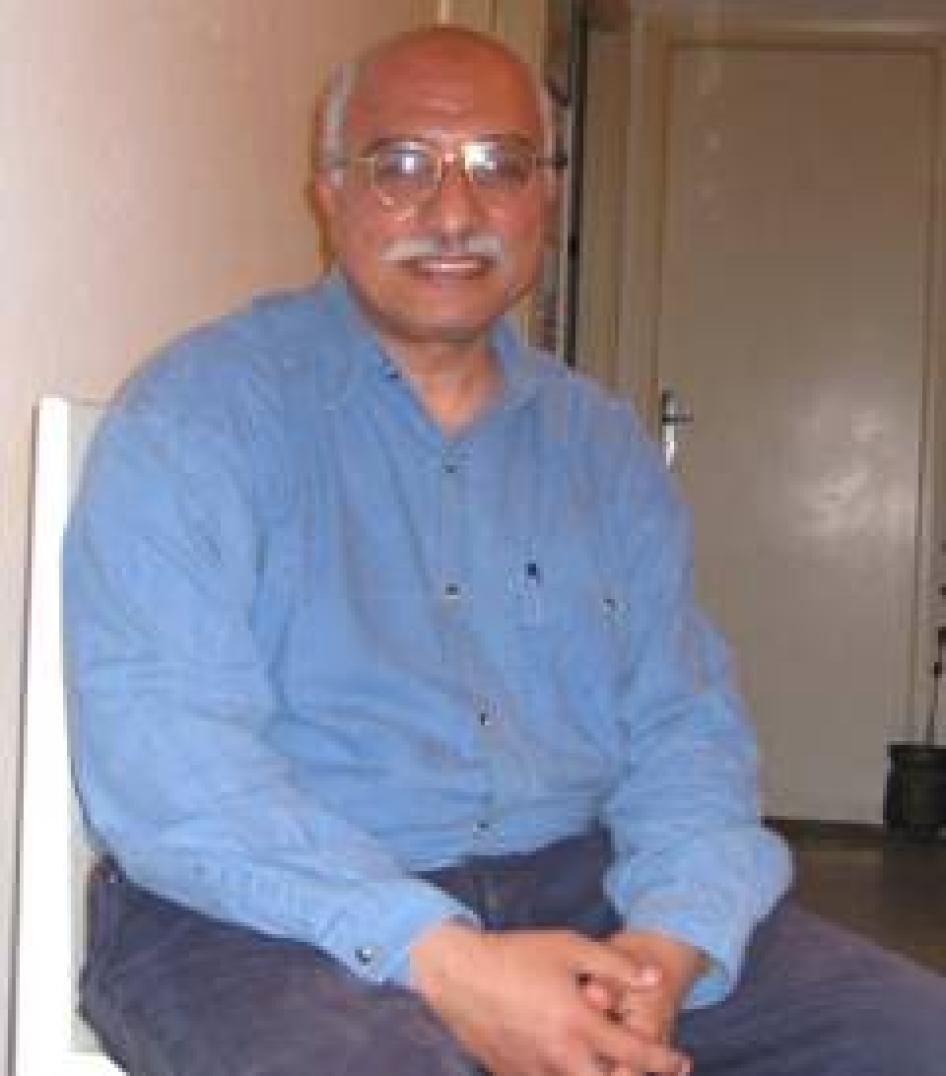
Abdelkarim Harouni, a civil engineer and former secretary-general of the Islamist-leaning General Union of Tunisian Students (l'Union générale tunisienne des étudiants), was arrested on October 30, 1991 and received a life sentence in the mass military court trials of 1992 against an-Nahdha members and leaders for allegedly plotting a coup. In 2002, after Harouni spent most of a decade in solitarity confinement,[11] authorities commuted his life term to a thirty-year sentence.
Harouni was conditionally released on November 7, 2007, meaning that during the remainder of his term authorities could re-imprison him without trial for unspecified offenses.
The court that sentenced Harouni in 1992 gave him a life prison term and thus there was no room for its imposing an administrative control order. However, in a separate trial held on December 1, 1995, while Harouni was already in prison, a Court of First Instance in Tunis tried and sentenced him to five and-a-half years in prison and two years of administrative control. Harouni says he did not learn of the administrative control part of his sentence until he was freed from prison, when he went to the police station in Kram, the suburb of Tunis where he lives, to renew his identity papers.
While he was there, police handed Harouni his administrative control order requiring that he sign in daily with the Kram police for the next two years, until November 2009. Knowing that these instructions have no basis in Tunisian law, Harouni refused to sign and the police did not give him the document.
The police orally informed Harouni that he was confined to the governorate of Tunis, although this requirement was not given in the administrative control order. On October 4, 2008, Harouni tried to go to the neighboring governorate of Ariana to attend the funeral of a colleague’s relative. The police stopped the public bus he was on and ordered him to descend. When he refused, they threatened force, and eventually Harouni acquiesced.
The police in Kram also asked Harouni to sign an order agreeing to sign in daily with them for two years. Harouni, insisting that such an order has no basis in Tunisian law, refused to sign and the police did not give him a copy of it.
After his release from prison, Harouni was elected secretary-general of Liberty and Equity (Liberté Equité), a human rights organization that lacks legal recognition. According to Harouni, police surveillance tightened after his election in an attempt to curtail his activities.[12]
On August 7, 2009, Harouni’s wedding ceremony at the Rahman Mosque in the Menzah 6 area of Tunis took place amidst a heavy police presence. Police cars even followed the guest convoy to the reception and could be seen recording the guests’ license plate numbers, creating an atmosphere of intimidation. At 9 pm, police entered the reception hall and confiscated all of the musical equipment, threatening force if it was not handed over, according to a statement released by Hend Harouni, Harouni’s sister.[13]
One week later, on August 14, a second party in honor of Harouni’s wedding in Ariana was completely surrounded by police, who also followed the newlyweds home. For the next two weeks, police kept Harouni under continuous surveillance, sometimes to the point where three agents stationed themselves outside of his front door and followed him and his wife whenever they left the house.
On October 5, 2009, police arrested Harouni in front of his workplace with a construction company and took him to the Berges du Lac police station. The police questioned him there for three hours about his connections to an-Nahdha and his human rights activism. He was released with a warning to stop all his human rights and political activities and to refrain from all contact with the media. Notably, this took place just 20 days after the arrest of Abdallah Zouari (see above), who was interrogated in a similar manner and given the same instructions under threat of violence.
Arbitrary Restriction of Movement
Of the 33 ex-prisoners we interviewed, 26 received “additional penalties” in the form of “administrative control” at the time of their conviction.
Article 23 of the Tunisia penal code states that “the administrative authority has the right to determine the place of residence of the convicted individual until the expiry of his or her sentence and to change it if deemed necessary.” Additionally, article 24 states that “the convicted person may not leave the assigned place of residence without authorization.” However, there is a discrepancy between these provisions and the manner in which administrative control orders are applied. Many of the ex-prisoners we interviewed said that local police authorities had given them oral orders restricting their freedom, without ever providing those orders in written form, thus obscuring the orders’ issuing authority and making redress more difficult for the ex-prisoners. These measures left the ex-prisoner at risk of prosecution for disobeying the terms of their administrative control whereas the terms they allegedly violated were never provided to them in writing. For example, local police had orally instructed some ex-prisoners that they were not to leave an often ambiguously defined geographic area without first obtaining their permission. In certain cases where the police put the orders in writing for the former prisoner to sign, they did not give copies of the forms to the individuals in question.
By withholding from former prisoners clear, written orders defining all the restrictions they must respect, authorities maintain extensive and arbitrary powers over the lives of the former prisoners.
Abdelkarim Harouni
As noted above, Harouni left prison in November 2007 unaware that he faced restrictions on his movements. He learned that he faced a sentence of administrative control only when he went to the police station to renew his identity card. At that time, the police orally instructed Harouni not to leave the governorate of Tunis for the next two years without first obtaining their permission.
In practice, Harouni says, the police have restricted his movements more tightly than the terms of their oral orders, as noted above.
Slaheddine al-Aloui
|
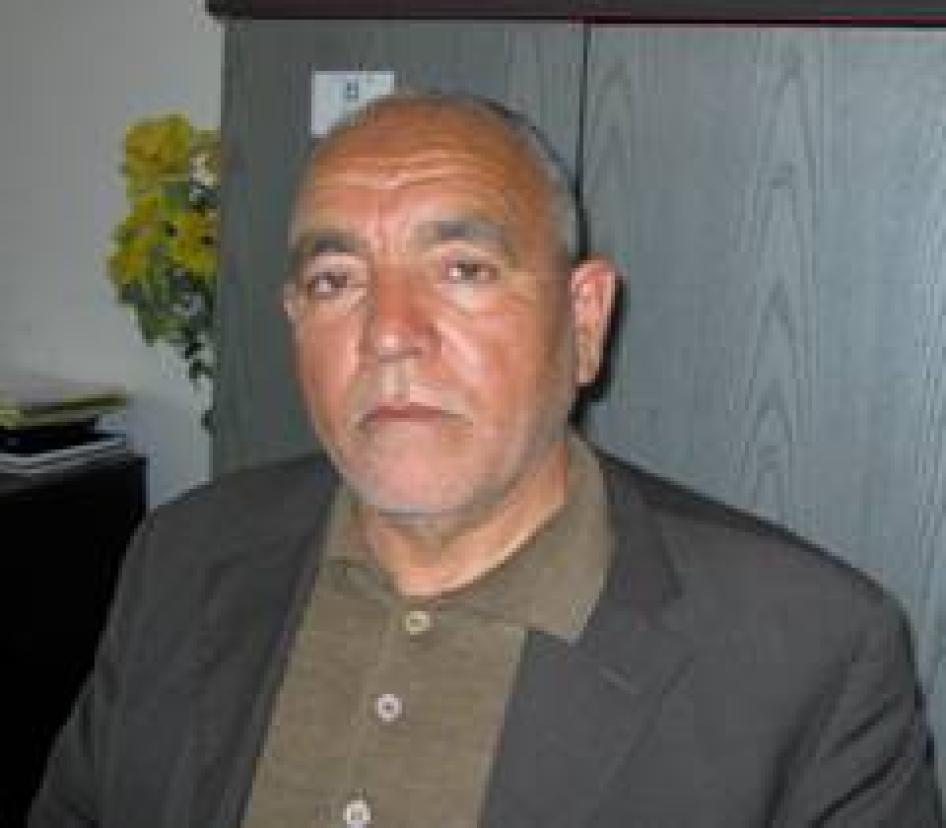
Al-Aloui, a resident of Bousalem in the governorate of Jendouba, was sentenced to a total of 14 years in prison as the result of five different convictions for membership in an-Nahdha. The courts imposed, along with these prison terms, a total of 16 years of administrative control. Upon his release in 2004, intelligence police told al-Aloui orally that he must seek permission from them 3 days in advance if he planned to leave the Jendouba area. In 2009, five years after his release, the police still required him to sign in with them weekly. The restriction on Aloui’s movement effectively hindered his ability to find and maintain work, in order to support himself, his wife and daughters.[14] Trained as an agricultural engineer, Aloui was dismissed from his job when imprisoned and has not had a job since his release. In the autumn of 2005 he staged a hunger strike three days each week to demand the lifting of his administrative control so he could find work. Aloui also mounted a symbolic offer to sell his daughters to protest his being prevented from providing for them.
“Employers tell me they can’t hire me because the police will be on their backs,” Aloui said. “Ex-prisoners usually find work by opening up their own little shops or businesses. If they do anything big, however, they’ll make problems for you. But I can’t even start a little project because I have no money.”[15]
After five years, he has still not been given written notice of the restrictions on his movement.
Ziad Ferchichi
Ziad Ferchichi, a 26-year-old merchant and resident of Bizerte, spent three years in prison on charges of belonging to an Algerian Islamist group. The court also sentenced him to three years of administrative control. Released from prison in 2008, authorities gave him an administrative control order worded in the standard fashion, specifying his place of residence and requiring that he notify the authorities of any change of address. However, the police also gave him oral instructions not to leave Bizerte without permission.[16]
Mahfouth al-Ayyari
Human Rights Watch spoke with Yamina al-Ayyari in Bizerte[17], who recounted the story of her 27-year-old son, Mahfouth al-Ayyari, who was back in prison. A resident of Menzel Bourguiba in Bizerte governorate, he was sentenced to four years in prison which was reduced to two and-a-half on appeal, with an additional five years of administrative control. He was charged under article 13 of the 2003 anti-terrorism law, which criminalizes membership in an organization designated as terrorist by the Tunisian state. Al-Ayyari was released in December 2007.
Upon his release, al-Ayyari had received a written order of administrative control that limits his residence to a specific address that he was not allowed to change without permission from the General Administration of Prisons and Rehabilitation. The Menzel Bourguiba police added to that by orally ordering him to sign in at the station every day for the first year after his release. During the second year they made him sign in once a week.
On March 12, 2009, al-Ayyari signed in as usual with the police in Menzel Bourguiba. On March 13, he traveled to Grombalia in Nabeul governorate and was arrested on the grounds of violating the terms of his administrative control. At his trial, the prosecution argued that al-Ayyari had violated the terms of his administrative control by failing to inform the police of his journey beforehand, although this was not specified in his written order. The standard written order given to former prisoners under administrative control requires them to seek permission from the relevant authorities if they plan to change their place of residence but there is no requirement to inform the police about their movements.[18] The court found Ayyari guilty and sentenced him to six months in prison.
His family was not informed of al-Ayyari’s arrest. It was not until three days later, when his mother went to the police station to inquire that they informed her of his being in custody.[19]
Abdallah Zouari
Zouari was released from prison in 2002. According to the terms of his administrative control order dated July 15, 2002, he was required to reside in Hassi Jerbi, in the governorate of Medenine. Nevertheless, on August 17, 2003, the police arrested Zouari on charges of violating his administrative control when he traveled, together with three visiting human rights lawyers, to the market town of Ben Ghardane, some 40 kilometers from his home. Zouari said at the time that he had believed that Ben Ghardane fell within the area to which he was permitted to travel, especially after traveling there on previous occasions, under close police surveillance. Moreover, the administrative control order did not clearly specify these boundaries. On August 29, 2003, a cantonal court gave Zouari a nine-month prison sentence for violating his administrative control, under Article 150 of the penal code. Zouari served that term consecutively with an earlier four-month sentence for defamation, and was freed in September 2004. In 2002, Zouari had also served two months of an eight-month sentence on an earlier charge of violating his administrative control, before being released for “humanitarian reasons.”[20]
Abdelbari al-Ayeb
A resident of Bizerte, al-Ayeb was sentenced to three years imprisonment and three years of administrative control in 2005 under the anti-terrorism law. Al-Ayeb was arrested and convicted according to article 13, which criminalizes membership in an organization designated as terrorist by the Tunisian state. Al-Ayeb said the only evidence presented against him was records of conversations where he had expressed a desire to fight the American occupation of Iraq.[21]
Upon al-Ayeb’s release on May 23, 2008, the Bizerte police gave him oral instructions to sign in with them every day at a scheduled time, and to inform them 48 hours in advance if he wanted go “anywhere,” a destination whose boundaries they did not define. After that, the police pulled him in for questioning if they learned that he had travelled 4 or 5 kilometers from his home, he said. This restriction impacted his ability to work. A store-owner, al-Ayeb must travel regularly to Tunis, approximately 40 miles from Bizerte, to restock his inventory. According to al-Ayeb, when he informs the police beforehand, they often delay giving him permission, causing him significant economic loss.
Al-Ayeb added that several times, after granting him oral permission to leave, the police warned him that he risked arrest if his absence prevented him from signing in with the police at his appointed time, which, they alleged, would be a violation of his administrative control. Once, according to al-Ayeb, the police warned him that they could orally grant him permission to travel and then arrest him anyway because he would have no proof that they had allowed him to leave.[22]
Khalil Abdelsalam Gharsalaoui
A resident of Sfax, Gharsalaoui is a former lieutenant in the Tunisian army. In 1990, Gharsalaoui says, the authorities transferred university student activists they had arrested to a kind of work camp, and ordered soldiers, including Gharsaloaui, to watch over them.
Gharsalaoui said that when he disobeyed orders to beat the students, the armed forces moved to arrest him. He fled to Libya in May 1990 where he stayed for 10 days until authorities there extradited him to Tunisia. He stood trial in a military court, which sentenced him to 20 years in prison on charges of delivering state secrets to a foreign state. The sentence did not include an additional sentence of administrative control. Gharsalaoui said authorities suspected him of being a member of an-Nahdha, which he denies. However, he claims that this was the reason they imprisoned him in a civilian prison rather than a military one.
In 2007, after serving 17 years, Gharsalaoui was conditionally released. Despite his having no administrative control order, the chief of police in Sfax informed him that anytime he leaves Sfax he has to inform him. Gharsalaoui said that when he did seek permission to leave, the police complicated the process, forcing him to wait for hours before allowing him to leave. After enduring this for a while, he refused to ask for permission any more, although this caused the police to persistently question his family about his whereabouts whenever they found out that he had traveled without their consent.[23]
Hedi Triki
In a mass trial in 1992, the Bab Sa’doun military court in Tunis sentenced Triki to 10 years and two months in prison and five years of post-release administrative control. A resident of Sfax and an engineer by training, Triki was released on March 23, 2002. Triki is an active member of the human rights group AISPP (International Association for the Support of Political Prisoners in Tunisia). Since the end of the period of his administrative control in 2007, the police continue to restrict his movement by regularly preventing him from leaving his house to attend meetings with activists and human rights organizations.[24]
Mohammad Abbou
A lawyer who often takes up cases involving political prisoners and himself an outspoken critic of the government’s human rights practices, Mohammad Abbou’s situation illustrates the restrictions placed on ex-political prisoners even when there is no sentence of administrative control, the usual legal basis for such restrictions. Abbou was sentenced to three and-a-half years prison in April 2005. He was sentenced to 18 months for denouncing torture in Tunisia in an article he posted on the internet in 2004 and to two years for allegedly assaulting a female lawyer in June 2002. He had served 28 months of his sentence when he was granted conditional release on July 27, 2007.
The period of his conditional release expired in August 2008, when his original sentence would have ended. During the period of his conditional release, he was turned back from the airport three times when he attempted to travel abroad, despite there being no written orders banning him from leaving the country. Since August 2008 – that is, after the expiration of the period of conditional release – authorities turned Abbou back at the airport four more times. The first time this happened, the airport authorities demanded that he produce written evidence that the term of his conditional release had expired before they would allow him to travel. However, according to Abbou, this document is not of a type that the Ministry of Justice is known to issue. The last time he was turned back at the airport was March 6, 2009.
In addition to arbitrarily preventing his foreign travel, the police have restricted Abbou’s movement within Tunisia in an attempt to stifle his human rights and political activism. On March 14, 2009, well after the period of his conditional release had ended, Abbou drove towards Chebba in the governorate of Mahdia, around 200 kilometers southeast of his home in Tunis, to give a talk at a conference on press freedom. Policemen riding on three motorcycles and in one car followed him all the way and eventually surrounded him, preventing him from participating in the conference and forcing him to turn back on the pretext that he “wasn’t allowed to leave Tunis.”[25] They also prevented another invited panelist, independent journalist Lotfi Hajji, from reaching the venue.
Taher Harrathi
|
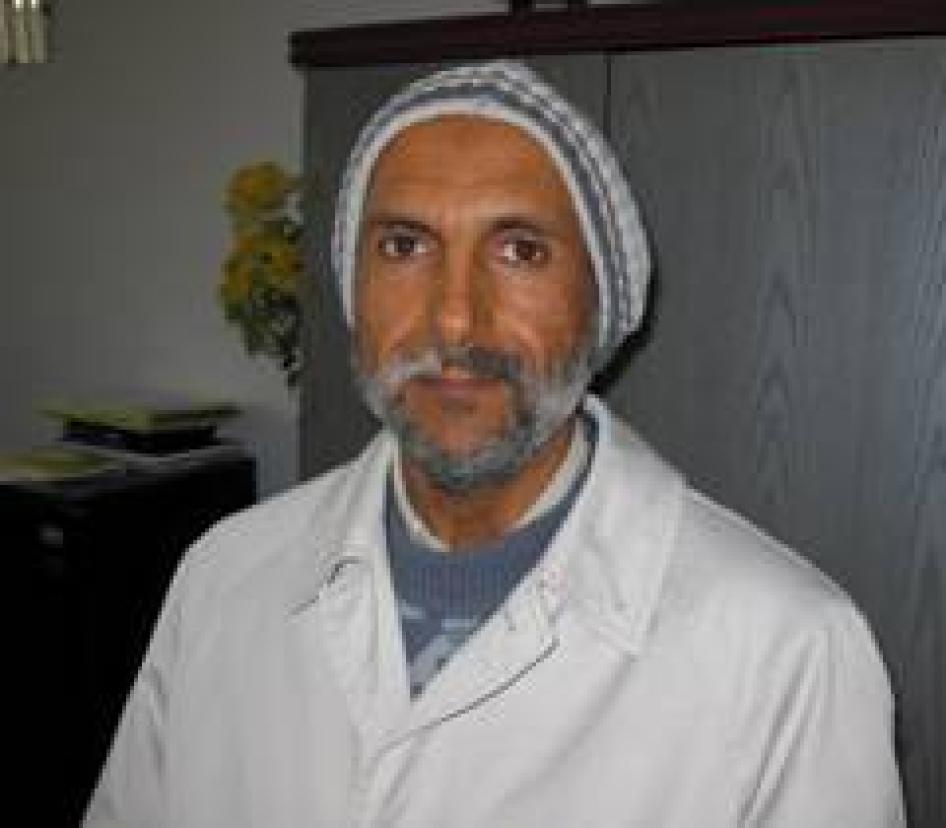
In a mass trial of suspected Nahdha leaders and members, the Bouchoucha military court in Tunis in 1992 sentenced Taher Harrathi, a resident of Sidi Amor Bouhajla in the governorate of Kairouan, to 21 years in prison and five years of administrative control for involvement in an alleged plot to overthrow the government. In November 2005, he was granted a conditional release in a presidential pardon. Following Harrathi’s release, the police required him to sign in regularly at the Bouhajla police station until December 2007. In September 2006, he asked permission to go to Tunis to visit his sister, who had been in an accident. When the police refused, he went anyway and stayed for a week. Upon his return, he was arrested and sentenced to two months in prison for disobeying the terms of his administrative control. In December 2007, the police stopped obliging him to sign in at the local police station, but told him orally that he must still notify them if he wishes to travel outside the Kairouan area.
Harrathi said that in order to visit his daughter in Sousse, where she is a student, he requests, and ordinarily obtains, police permission. However, when he does so, the police in Sousse are promptly informed that he is heading there, he said.
In 2007, Harrathi publicized his plight on the TunisNews website. The police promptly summoned him and warned him, claiming that he was tarnishing the image of Tunisia. He stopped writing after that.[26]
Signing In with the Police
In addition to the problem posed when the police give ex-prisoners orders orally but not in writing, the substance of those orders place onerous burdens on ex-prisoners. An example of this is requiring ex-prisoners to sign in at police stations according to a specific schedule, even though the law defining administrative control nowhere mentions any requirement of signing in. The sign-in requirements range from once monthly to as frequently as four times daily (see, e.g., the case of Mohamed Ammar, below).
Shortly after political prisoners are released, police authorities in their towns of residence commonly inform them orally that they must sign in a certain number of times daily or weekly at specific police stations. There is no basis in Tunisian law for the imposition of this requirement, lawyers told Human Rights Watch.[27] Moreover, no written version of these sign-in requirements is delivered to the affected party, according to the ex-prisoners interviewed, and no mention of it is made in any administrative control order document. Authorities have imposed this sign-in requirement on both ex-political prisoners who were under judicially-imposed sentences of administrative control and on those who were not. In July 2009, Human Rights Watch sent a letter, annexed in this report, to the Tunisian government asking it to clarify the legal basis of such orders, but received no reply.
The sign-in requirement, at its most onerous, hinders basic aspects of ex-prisoners’ lives, such as the ability to maintain steady work or continue their education, as is shown below.
A number of ex-prisoners refused orders to sign in, claiming the orders were illegal. When prosecuted for this act of disobedience, some ex-prisoners prevailed in court (see below, e.g., the case of Ali Rouaihi), whereas others were convicted and returned to prison (see below, e.g., the case of Hedi Triki). There are cases where the police stopped ordering ex-prisoners to sign in after they refused to comply on the grounds that it was illegal (see below, e.g., Abdelkarim Harouni and Ridha Boukadi), or after the ex-prisoners prevailed in court, as noted above.
Abdelkarim Harouni
Police orally ordered Abdelkarim Harouni to sign in every day at the Kram police station until his administrative control order ends in November 2009. Calling this demand unlawful, Harouni has refused to comply. While he has not yet been prosecuted for this act of defiance, the police have kept him under strict surveillance, to the point where three policemen often stood guard outside his home and followed him whenever he left the house.[28]
Mahfouth al-Ayyari
The police orally instructed al-Ayyari to sign in with them every day at the Menzel Bourguiba station during the first year after his release in 2008, and then weekly during the second year. They never gave him a written version of the sign-in instructions, according to his mother, Yamina al-Ayyari.[29]
Abdelbari al-Ayeb
Police orally instructed al-Ayeb of Bizerte to sign in daily following his release from prison in May 2008. Al-Ayeb informed Human Rights Watch that the police also questioned the friends he had asked to tend to his shop while he left it to fulfill his sign-in requirement, which made them wary of helping al-Ayeb while he was away. This resulted in his having to close his shop for periods during the day and consequently losing business.[30]
Ahmed al-Maq'adi
A resident of Bizerte, al-Maq’adi served a three-year prison sentence from August 2005 to August 2008 under the 2003 anti-terrorism law, after which he commenced a three-year term of administrative control. Al-Maq’adi received a written document stating the conditions of his administrative control, which specified the address of his residence and said he could not change it without first getting permission. The Bizerte police orally added instructions to sign in daily until his administrative control sentence ends in 2011.[31]
Mohammad Ammar
Ammar, a resident of Tunis, was sentenced to 12 years in prison in 1994 for membership in an illegal organization, namely an-Nahdha, forming a “criminal gang,” and possession of weapons. He was released in 2006, at which time he began a two-year sentence of administrative control. The police orally instructed him to sign in four times daily, the last time being late at night, Ammar said. Even after the end of his administrative control term, the police still required him to sign in once a week.[32]
Mohamed Saleh Gli’i
Gli’i, currently a laborer in a grocery store in the central market of Bizerte, was arrested on September 13, 1991 and spent two months in pre-trial detention. He was tried and convicted for membership in an illegal organization (an-Nahdha), and received a three and-a-half-year prison sentence. He was released on April 24, 1995. Although he was not sentenced to post-release administrative control, the police obliged him to sign in once daily near his home until 2000. After he had found employment, this requirement changed to twice daily, which, Gli’i says, resulted in his being dismissed from his job. In addition, he said, his employer at the time was questioned by the police because he had hired him.[33] Gli’i said that the police no longer require him to sign in and do not bother his current employer.
Hedi Triki
When Hedi Triki left prison in March 2002, the terms of his five-year administrative control order required him to reside in Sfax. The police in that city orally instructed him to sign in there, first on a daily basis, and later weekly. They also told him he could not leave town without their permission. But Triki also has connections to the city of Mahdia, a provincial center around 55 miles north of Sfax. The Mahdia police notified him that he had to sign in there as well as in Sfax. Triki decided to comply with the orders of the Sfax police but not with those from Mahdia.
In November 2002, a court sentenced Triki to three months in prison for disobeying the sign-in orders in Mahdia despite the fact that he was signing in daily in Sfax. Triki was acquitted on appeal, after obtaining a paper from the police in Sfax confirming that he had been signing in there.[34]
Ridha Boukadi
|
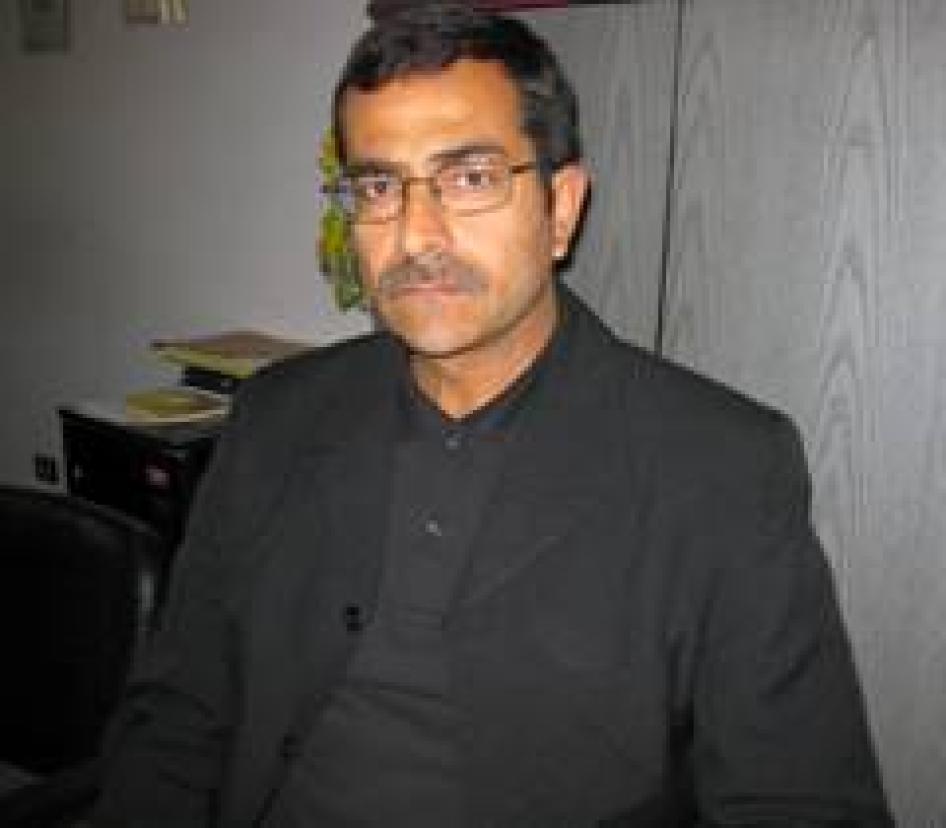
Boukadi is a resident of Ariana who formerly worked in the information technology field. In 1992, he was convicted in absentia for membership in an-Nahdha in the Bab Sa’doun mass trial of leaders and members of that movement. He was arrested in Libya in 1996 and sent back to Tunisia, where he was imprisoned. Boukadi spent a total of 13 years in prison during which he says he had to be hospitalized as a result of torture he suffered at the hands of officers of the Ministry of Interior. Boukadi was granted conditional release in the presidential amnesty of November 2008 and began serving five years of administrative control.
After his release, Boukadi went to the Haï an-Nasr police station to retrieve his national ID card. It was then that the chief of police informed him that he had to sign in there daily. Boukadi refused on the grounds that this order was not to be found in the administrative control document. He left without getting his ID card, but was able finally to get it on March 30, 2009. However, that day a security official responsible for the area of Ariana reaffirmed that Boukadi had to sign in daily with the police. The official asked Boukadi to sign a written statement to the effect that he had agreed to sign in with the police. Boukadi recalls, “I told them I refused to sign such a statement because it contains things I did not say. What I said was, ‘I submit to obeying the law, and that I will obey what is specified in a judicial decision and nothing more.’ After I refused to sign they warned me that I might be prosecuted for refusing to obey, but they let me leave.”[35]
Boukadi said that the chief of police of Haï an-Nasr also ordered him to notify the police whenever he wishes to travel outside greater Tunis. He said that he would refuse this order as well as long as it was oral and without legal foundation. At the time of his interview with Human Rights Watch Boukadi had not traveled outside of greater Tunis since his release from prison.
Plainclothes police officers regularly visit Boukadi’s relatives, asking them where he is and instructing them to tell him to report to the police station. Because they leave no written summons, Boukadi refuses to comply.[36]
Ali Rouaihi
|
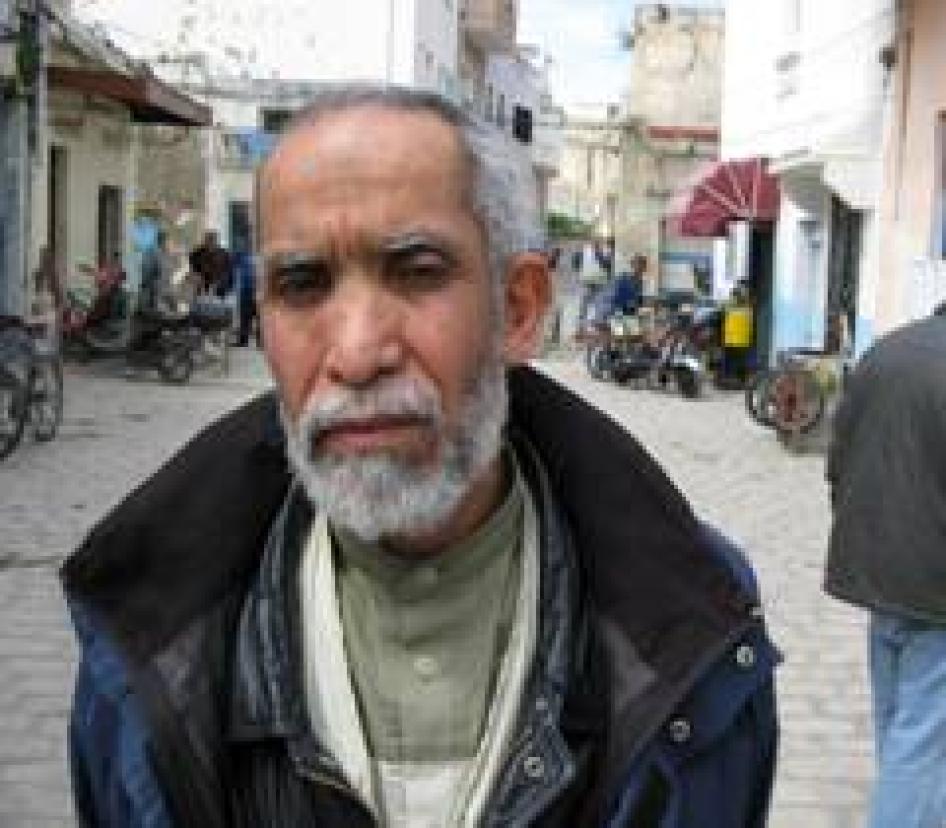
In 1994, Rouaihi, an entrepreneur, was convicted of membership in an-Nahdha and sentenced to nine years in prison, with an additional five years of administrative control. When he was released in 2003, the police in Bizerte informed him orally that the Ministry of Interior had ordered that he was not to leave the governorate of Bizerte and that he had to sign in regularly with the police. As in other cases, they showed him no written order. After Rouahi refused to sign in with the police, he was arrested for violating the terms of his administrative control, just one month after his release from prison. He was eventually acquitted, but only after having spent two weeks in prison awaiting trial. According to Rouaihi, the authorities appealed his acquittal and the case was never closed, but the police no longer obliged him to sign in although they continued to monitor him closely.
In 2003, Rouaihi applied for a passport in order to travel to France to visit his ailing brother. After not receiving a response to his application, Rouaihi illegally crossed the border into Algeria, where he was arrested and sentenced to two years and two months in prison for traveling on a fake passport. He attempted unsuccessfully to obtain asylum in Algeria. Algerian authorities also refused to allow him to travel to the office of the U.N. High Commissioner for Refugees in Algiers, which had his case file. When Rouaihi was deported back to Tunisia, he spent three days in the custody of the Ministry of Interior. He was convicted of disobeying the terms of his administrative control and sentenced to a symbolic punishment of 4.8 dinars (approximately US$3.50).[37] As of March 8, 2010, Rouaihi had still not received a passport.
Abdellatif Bouhjila
|
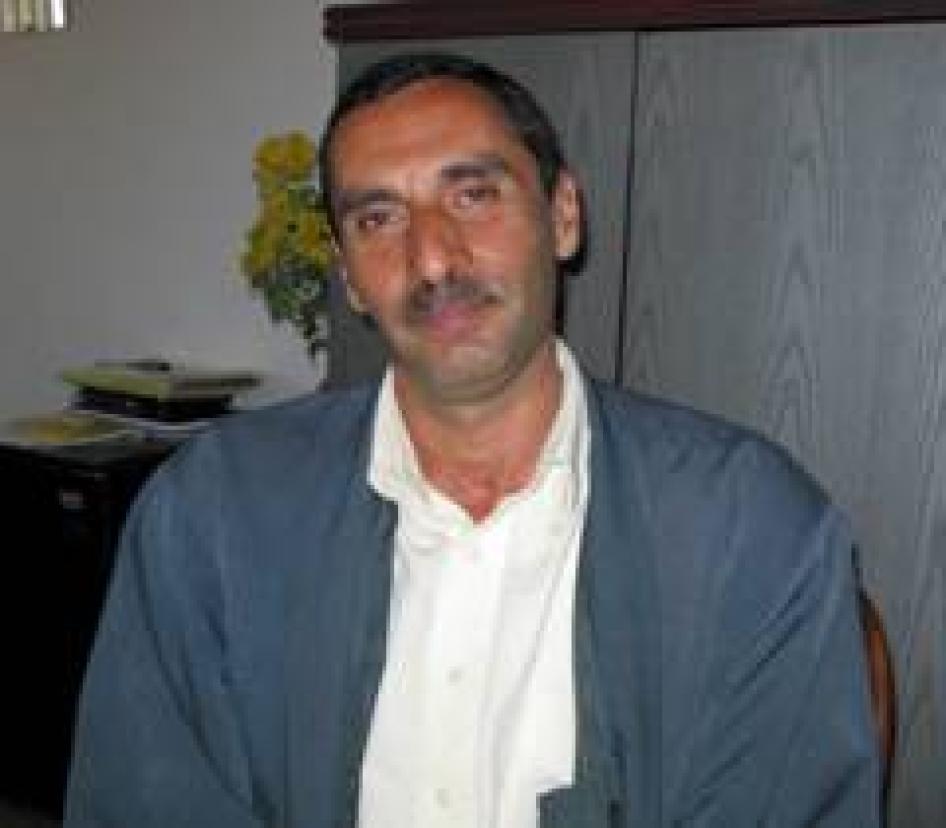
In November 2000, a court sentenced Abdellatif Bouhjila to 17 years’ imprisonment on charges of setting up an Islamist organization, al-Ansar (the Partisans), that sought to undermine state security. In 2002, an Appeals Court reduced his prison sentence to 11 years. He was freed by presidential pardon in November 2007 and began serving a five-year term of administrative control.
Bouhjila said that upon his release the chief of police in Mégrine, in Ben Arous governorate, where he resides, told him he had to sign in at the police station. Bouhjila said he refused to sign because he had received no written order to that effect. The police then threatened to file a report and rearrest him. In late 2008, Bouhjila went on a two-month hunger strike mainly to obtain medical care for his various maladies but also to demand a passport and cancellation of orders that he sign in with the police. He received no official response to his demands.[38]
Surveillance
During the period of administrative control, and in some cases even after its term had expired, many ex-political prisoners face constant disruptive surveillance by plainclothes state security agents. Human Rights Watch spoke to several people who complained that the constant presence of state security agents around their houses and places of employment disrupted their everyday life. They said that prospective employers were discouraged from hiring them fearing that the police monitoring them would attract could harm their businesses. Lawyers such as Mohammad Abbou said they lost clients who were too scared to come to his office because of security agents stationed outside the building housing his law office in downtown Tunis. One former prisoner who preferred to remain anonymous spoke of how he had become a pariah, shunned by neighbors and even family due to the constant, intimidating presence of the police. Oftentimes, police would question family members and neighbors about former political prisoners, asking about their whereabouts or employment situation.
In addition to Mohammad Abbou, former prisoners who are the subject of near-constant and highly visible monitoring include Abdelkarim Harouni, senior an-Nahdha member Habib Ellouz, Abdallah Zouari, and journalist Slim Boukhdir.[39]
The former prisoners have no recourse against such intensive surveillance – there is no authority to whom they can complain, given that they cannot identify who is responsible for the surveillance by agents who dress in streetclothes and wear no badges.[40]
Arbitrary Extension of Administrative Control
In one case, Human Rights Watch learned that the police continue to apply administrative control measures on former prisoners even after the completion of their judicially imposed sentence. Such is the case of Abdallah Zouari, who was released from prison in June 2002 and began serving his five-year term of administrative control. According to the dictates of his control order, Zaouri was to be confined to the remote village Chammakh in the governorate of Zarzis. On June 5, 2007, as his five-year administrative control period was concluding, the police chief of the district police station of Hassi Djerbi summoned him and informed him orally that his confinement to the Zarzis area was being extended for 26 months. Zouari never received written justification for this extension and never learned its legal basis. The 26-month extension expired in August 2009, but despite this plainclothes police continue to monitor and harass Zouari.[41]
Obstacles to Employment
Among the biggest challenges for ex-political prisoners is finding work. Nearly all who worked in the public sector, including educators, automatically lost their jobs upon their convictions and have no chance of getting them back. They come out of prison having fallen behind in their fields and facing a market where they must compete with jobseekers who do not have the blot of a prison record on their résumés.
If it were not already difficult enough for former political prisoners to land a job, the police reportedly pressure employers in the private sector not to employ them. Few employers are willing to talk openly about visits and questions they received from the police, but a number of ex-prisoners gave concordant testimony about what employers had told them about visits from police agents who advised them to dismiss or not to hire former political prisoners.
Unable to find employment, many ex-political prisoners live in abject poverty, unable to provide for their families. Slaheddine al-Aloui and Taher Harrathi are among those who say they were denied work due to direct pressure from the police on employers and are financially strapped.
Excluded from public-sector jobs and unable to get hired by private employers, many ex-prisoners opt for self-employment, either by opening small shops or commercial enterprises. But the security services have interfered even with these, for example in the case of Hedi Triki, below.
Mohammad Ammar
Prior to his arrest in 1994, Ammar worked as a taxi driver in Tunis. He tried to renew his taxi permit following his release from prison, but it was confiscated and he was denied. Despite his staging a hunger strike from June 13 until July 19, 2008, the authorities refused to issue him the permit. Ammar stated that the police informed him that the reason he was denied his permit was that he constitutes a danger to the public order, although they provided him no evidence to justify this finding.[42]
Hedi Triki
Upon his arrest, all of Triki’s engineering diplomas, personal documents, and identity card were confiscated. After his release in 2002, he spent three years without an ID card because the police in Sfax refused to issue him one. He was finally able to secure one from the Mahdia police station.
Unable to find a job after his release, Triki opened a small business selling chickens in 2003. Not long after, the Sfax police chief came to his shop and ordered him to shut it down without providing a justification, Triki said. Triki then went on a one-month hunger strike in protest, after which the authorities backed down.[43]
Lotfi Bouzayyan
Bouzayyan was sentenced to eight years in prison in 1990 for membership in an-Nahdha. He was released in 1998 and served 2 years of administrative control, during which the police required him to sign in six times a day at different places and subjected him to abuse if he arrived late, Bouzayyan said. With such frequent sign-ins, he was unable to secure any employment. He had lost his job with the Ministry of Transport upon his conviction and was unable to reclaim it after his release. He has been unable to find work since.[44]
Denial of Passport
Many ex-political prisoners face difficulty in obtaining passports. Some, like Hadda Abdali, residing in Mourouj el-Arba’ near Tunis, has been applying for her passport since 2000 in order to perform Hajj (pilgrimage) in Mecca. Others, such as Samir al-Qofsy, want to see relatives who live abroad.
The Tunisian constitution recognizes the right to travel in Article 10, which states that “each citizen has the right to move in or outside the country and choose the place of residency according to the law.” The right to travel is also enshrined in article 12 of the International Convention of Civil and Political Rights, which Tunisia ratified in 1969.
The main law regulating the issuance of travel documents is Law n° 75-40 of May 14, 1975, which permits the Ministry of Interior to deny passports in certain situations.[45] This law was amended by Law n° 98-77 of November 2, 1998 to give judges sole authority on virtually all decisions to revoke valid passports or to prohibit someone with a valid passport to leave the country.[46]
Article 13 of Law 75-40 states that every Tunisian citizen has the right to receive, renew, or extend his or her passport except under certain conditions, including, “on request of the prosecution if the subject is under legal proceedings or is wanted for a felony or misdemeanor or has been sentenced to prison following conviction” or for “reasons of public order and security or if there is a danger of harming Tunisia’s good reputation.”[47]
There is no law depriving ex-prisoners of the right to a passport. Nor is there anything in the law governing administrative control stating that persons under this regime are not entitled to passports or are prohibited from traveling abroad, although the wording of the law implies that permission of the authorities is required for foreign travel by a person under administrative control.
It is nevertheless the norm for former political prisoners to encounter extrajudicial obstacles when they apply for passports. As shown in the cases below, sometimes the officer at the local police station refuses even to take the ex-prisoner’s application. In other cases, the application is taken but then results either in a refusal from the interior ministry or no response at all, or a oral refusal from an officer at the local police station without any indication that the application was sent to and processed by the bureaucracy charged with handling passport applications. The ministry seldom furnishes a formal justification for depriving ex-prisoners of their passports unless the applicant pursues the matter before an administrative court. And even if an ex-prisoner wins a judgment in administrative court that the ministry’s non-delivery of a passport was wrongful, that does not guarantee that the ministry will then comply with the court ruling by issuing a passport to the plaintiff.
The result is that there are scores of ex-prisoners who have been arbitrarily denied their passport for years, in some cases for longer than a decade.
Ex-prisoners who completed the application for a passport but never received an answer include:
Omar Salhi
A resident of Bizerte, Salhi was convicted in 1994 for membership in a criminal gang/enterprise and sentenced to nine years in prison. He was released in 2001 in a presidential pardon and began serving five years of administrative control. In 2006, after the term of his administrative control expired, he applied for a passport (file number 276) at al-Rouaibi police station in Bizerte. He has been waiting for an answer for three years, with the police telling him to come back later every time he inquires about it.[48]
Hadda Bint Ramadan bin Khaled Ebdelli
|
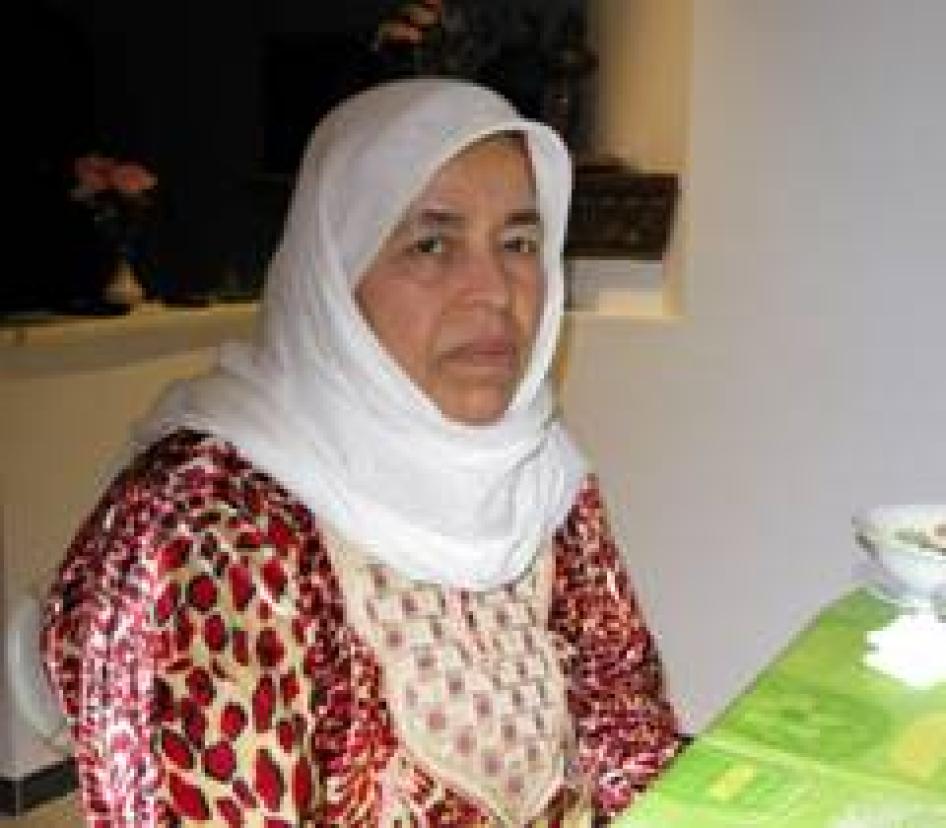
A resident of Mourouj al-Arba’ in the governorate of Ben Arous, Ebdelli was sentenced to 15 years in prison, the longest sentence handed down to a female Nahdha member, for creating and participating in a criminal enterprise. She served five years and was released in 1999. According to Ebdelli, the conviction was based on no more than her efforts to collect donations to help the families of prisoners.
Ebdelli first applied for a passport on November 30, 2000 (file number 14805), and received no answer. On March 30, 2006, she applied again with the same result. Since then she has written letters asking for a passport to President Ben Ali and to the High Committee for Human Rights, a state institution whose functions include receiving individual complaints. On June 7, 2008, in response to a case she had filed with the administrative court of Tunis on March 17 of that year, the Ministry of Interior stated that her case (no. 14805) is “still under study” -- eight years after she first applied.[49]
Samir al-Qofsi
On April 23, 2006, al-Qofsi was arrested at the Tunis airport upon arriving from Germany. A court convicted him and sentenced him to six months in prison for, he said, having failed to inform the police of the illegal activities of persons he knew who were subsequently convicted under the 2003 anti-terrorism law.
The police confiscated both al-Qofsi’s Tunisian and German passports upon his arrest, thus preventing him from going back to Germany where he lived and where his family resides. While he was able to secure another German passport after his release in October 2006, the Tunisian authorities, as of March 2010, had still not granted him a Tunisian passport, the document he is required to present as a Tunisian citizen when leaving the country. He currently resides in Bizerte.[50]
At other times passport applications from ex-prisoners have been turned down by local police orally without formal notice, as was the case with the following people:
Ali Rouaihi
As stated previously, Rouaihi was sentenced to nine years in prison for membership in an-Nahdha with an additonal five years of administrative control. After the expiration of his term of administrative control in 2008, Rouaihi applied for a passport in order to visit his ailing brother in France. Rouahi has said he received an oral refusal from the local police without explanation, and had still not gotten a passport as this report went to press.[51]
Lotfi Amdouni
A resident of Tunis, Amdouni was released from prison in 2005 and is presently serving a five-year term of administrative control. He applied for a passport on August 7, 2005, but the police refused to take his application. A month later they accepted his passport application without giving him a receipt for it but he has not received any reply to the application over four years later. Amdouni maintains that the police told him that if he quit his activities with the prisoners’ rights group AISPP, then he would be granted a passport.[52]
Human Rights Watch has also documented cases where the police prevented passport-seekers even from submitting their applications.
Hedi Triki
Triki attempted to apply for a passport in 2004 at the Souq Zeitoun police station in Sfax. The police there told not him to leave his application because it would be refused. According to Triki, the police there had told him that he does not have a right to a passport. Since then he has attempted to apply three times with the same result.[53]
Brahim Sa’dani
Sa’dani, a resident of Tunis, was sentenced to ten years in prison with five years of administrative control in the Bab Sa’doun trial of 1990. He was released from prison in 2000 and applied for passport for the first time in 2004. After he submitted his application, the police summoned him and asked him to sign a paper in which he undertook never to re-apply for a passport. He signed it but was refused a copy of this document, his wife said.[54]
Abdellatif Bouhjila
Released in 2007 with five years of administrative control, Bouhjila applied for a passport on April 9, 2008 and received no response. According to Bouhjila, the police told him orally that he would never get his passport but he never received a written response.[55]
Rulings of the Administrative Court
The administrative court is a judicial body that rules on administrative disputes and on claims involving the administration, such as citizen appeals against abuses of power and for the annulment of administrative decisions. It is intended to be a mechanism for citizen redress against administrative authorities’ abuse of power.
Of particular concern to Human Rights Watch are rulings by the administrative court in favor of the right to passports that the Ministry of Interior then refuses to implement. Such refusals of court decisions undermine claims that Tunisian citizens have effective remedies when they believe their rights are violated by the state.
Hocine Jelassi
|
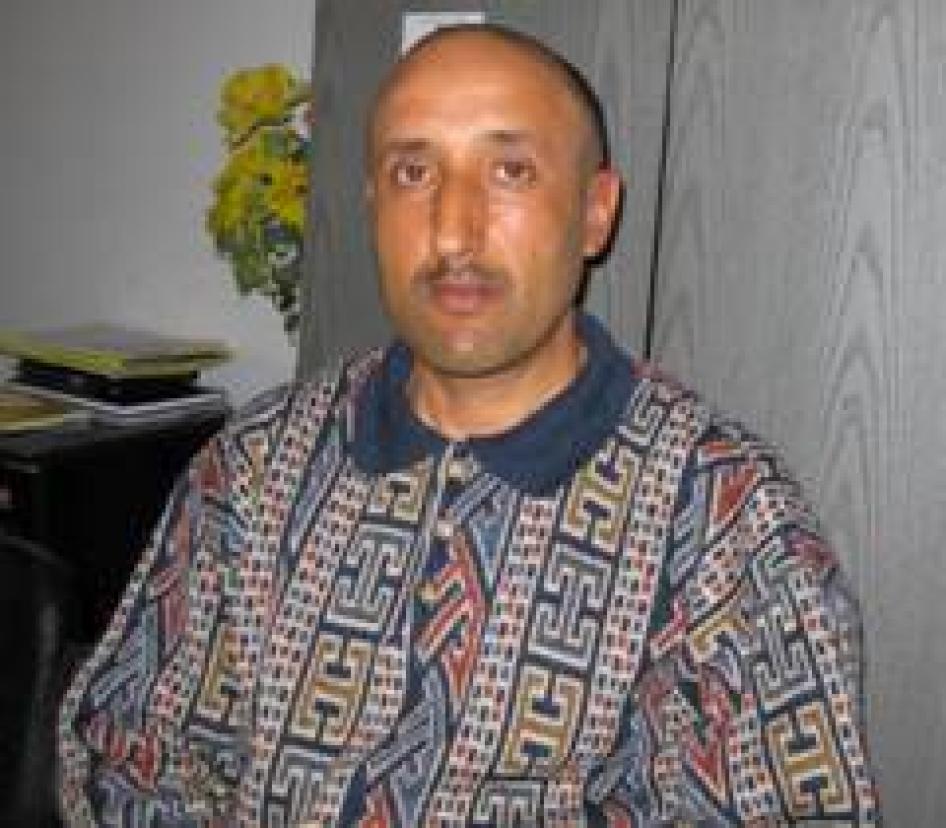
A resident of Bardo, Jelassi, spent 8 years and 3 months in prison after being convicted in 1995 on charges of undergoing military training in Pakistan for the purpose of returning to Tunisia to commit terrorist acts, and of using a false passport. Jelassi admits to having used a false passport to leave Tunisia, explaining that Tunisian authorities had since 1989 refused to issue him one. His trial and conviction came shortly after the United States refused his asylum application and forcibly returned him to Tunisia.
After leaving prison, Jelassi served five years of administrative control. After applying for a passport in 2004 and getting no response, he filed suit at the administrative court in 2006. When the court requested that the administrative authorities provide evidence that Jelassi’s travel constitutes a danger to national security pursuant to the passport law, the administration responded that it had the discretionary power to make such a decision but provided no further justification. In response, the court ruled on May 6, 2006 that Jelassi had been denied a passport improperly.[56] On July 29, 2007, the Minister of Interior appealed the decision on the basis that it has the discretion to make such a decision as the authority legally responsible for the issuing of passports. On December 11, 2007, the court upheld the original ruling in favor of Jelassi, holding that the Ministry of Interior cannot deny the right to travel unless it can show that the individual’s travel would pose a threat to national security.[57] Despite this victory in administrative court, Jelassi remains without a passport more than two years later.[58]
Moncef Ben Salem
Moncef Ben Salem, formerly a professor of mathematics at the University of Sfax, served a total of four and-a-half years in prison on two separate occasions. In November 1987, Ben Salem was arrested and held in detention for nearly a year and-a-half, accused by the Tunisian government of being active in the outlawed organization Mouvement de la Tendance Islamique, although no formal charges were brought against him. In 1990 he was arrested and sentenced to three years in prison for “willfully disseminating false information” for an interview he gave to an Algerian newspaper in which he accused the Tunisian government of human rights abuses and hostility toward Islam.
Since leaving prison in 1993 Ben Salem has been the target of intensive surveillance and harassment extending to members of his family. He also lost his university post as a result of being imprisoned.
Both Ben Salem and his daughter Mariem have been arbitrarily refused their passports after having applied for them several times since 1995. After getting no response to their applications, Ben Salem filed a complaint with the administrative court on April 18, 2006.[59] The Ministry of Interior responded on October 12, 2006 to the court, stating that the application was “still under study.” On November 27, 2006, lawyer Abdelwaheb Ma’tar filed a response on behalf of Ben Salem arguing that this delay was unsatisfactory.
A second reply from the Ministry of Interior came on December 28, 2007, stating that Moncef Ben Salem was denied a passport in accordance with article 13 of Law n° 75-40 of 1975, which gives the authority to the state to deny a passport for reasons that include «public order or security or if there is a question of harming Tunisia’s good reputation.»[60] The ministry provided no further justification for this decision and no response on Mariem Ben Salem’s application. On October 25, 2007 Ma’tar argued that the administration had overstepped its powers in failing to issue passports to the plaintiffs without furnishing an explanation. The affair was postponed until November 22, 2007 to be deliberated over, and the court decided to refer the case for further investigation. Ma’tar insisted that the court at least respond with regard to the passport application of Ben Salem’s daughter Mariem, but in vain.[61] Finally, on June 11, 2009, the court ruled that the authorities had wrongly denied Moncef Ben Salem his passport. On September 23, 2009, he submitted a new application but as of this writing, had yet to receive a passport.[62]
Withholding Medical Files
Some former prisoners complain that authorities refuse to provide them with copies of their prison medical files. This impedes the ability of released prisoners in ill-health to receive adequate health care, a clear violation of their basic right to health. There is absolutely no legal justification for this practice. Human Rights Watch invited authorities to comment on these allegations but got no response to its letter (see appendix to this report).
The ex-prisoners interviewed who had requested their medical files upon their release who never received them are:
- Waheed al-Sara’iry (released in 2008)
- Ridha Boukadi (released in November 2008)[63]
- Hadda Ebdelli (released in 1999)
International Law
Tunisia has ratified both the International Covenant on Civil and Political Rights (ICCPR) and the African Charter on Human and Peoples’ Rights. Both treaties require Tunisia to respect and protect the rights to freedom of movement within a country and to freely choose one’s residency,[64] to privacy,[65] and to leave any country and return to one’s home country.[66]
It is a basic principle of human rights law that a state can only interfere in such rights in a non-arbitrary manner, meaning that any restrictions on such rights by Tunisian authorities must be clearly derived from Tunisian law, and not be subject to the whims of officials, as is often the case when dealing with restrictions on former political prisoners.
Acknowledgements
This report is based on research conducted by Rasha Moumneh, researcher, and Eric Goldstein, research director, both of the Middle East and North Africa division of Human Rights Watch. The report was written by Rasha Moumneh and edited by Eric Goldstein. Legal review was done by Clive Baldwin, senior legal advisor and program review by Iain Levine, program director.
Amr Khairy, Arabic language website and translation coordinator, provided assistance with translation into Arabic. Brent Giannotta and Nadia Barhoum, associates for the Middle East and North Africa Division, prepared this report for publication. Additional production assistance was provided by Grace Choi, publications director, and Fitzroy Hepkins, mail manager. Intern Félix Legrand provided research assistance. All photos © 2009 Human Rights Watch.
We are grateful to the ex-prisoners who chose to share their experiences with us; not all of them could be included in this report. We would also like to thank the lawyers and activists who assisted in our research, including representatives of the following Tunisian groups, the International Association of Solidarity with Political Prisoners (AISPP), Liberty and Equity, the National Council on Liberties in Tunisia (CNLT) and the Tunisian League for Human Rights (LTDH); as well as Luiza Toscane, an independent human rights activist based in Paris.
Appendix
July 9, 2009
Minister of Justice and Human Rights Béchir Tekkari
Ministry of Justice and Human Rights
31, av. Bab Bnat 1030
Tunis, Tunisia
Minister of Interior and Local Development Rafeek Belhadj
Minister of Interior and Local Development
Av. Habib Bourguiba
Tunis, Tunisia
Dear Ministers Tekkari and Belhadj:
Human Rights Watch is currently preparing a report on the treatment by authorities of released prisoners who had served time for politically motivated offenses (whom we will refer to here for convenience as former “security prisoners”), in particular the application of measures of administrative control.
During a visit to Tunisia in March and April 2009, a Human Rights Watch research team spoke to more than 25 ex-security prisoners who alleged that authorities had arbitrarily subjected them to repressive measures, including restrictions on their movement, surveillance by plainclothes police, deprivation of passports, requirements to sign in frequently with the police, and pressure on potential employers not to hire them.
We would like to ensure that our report on the issue is both accurate and reflects official information and perspectives. We have outlined below a number of problems the ex-prisoners say they face, along with illustrative cases. We look forward to your comments and explanations. All pertinent information received by July 30 will be reflected in our report. We are also willing to come to Tunis to discuss these matters in person with you, at a date that is convenient for you.
1. Restriction of movement. The “additional penalty” (peine complémentaire) of “administrative control,” as defined by Articles 23 and 24 of the Penal Code, gives the administrative authority the right to determine and to revise the location where the former prisoner must reside, and prohibits them from departing that location without permission.
The ex-security prisoners we met who faced terms of post-release administrative control all received the same basic written order defining the terms of that control. In each case, the written order limited to specifying the address at which they were to reside and forbad them from changing their place of residence without obtaining authorization from the police.
Thus, this written order did not place the ex-prisoner under house arrest; it required him to reside at a specified location but did not forbid him from leaving that residence.
One aspect of the application of administrative control that concerns us is that nearly all the ex-prisoners we interviewed said that local police authorities had given them verbal orders restricting their freedom, without ever providing those orders in written form. This left the ex-prisoner at risk of prosecution for “disobeying their administrative control” whereas the terms they allegedly violated were never provided to them in writing. For example, local police had verbally instructed ex-prisoners that they were not to leave a specific geographic area without first obtaining their permission. In many cases, local police also told ex-prisoners that they must sign in with police according to a specific schedule – even though the law defining “administrative control” nowhere mentions such a requirement. Examples include:
- Abdelkarim Harouni, a resident of Kram, released from prison on November 7, 2007 and orally told he could not leave greater Tunis without permission.
- Jameleddine al-Aloui, of Bousalem, in the governorate of Jendouba, was told by the intelligence police that he had to needs permission leave the Jendouba area; al-Alaoui was released in 2004 and faces a total of 16 years of administrative control.
- Ziad Ferchichi, a resident of Bizerte, released from prison in 2008 and told he could not leave Bizerte without permission.
Indeed, we learned of several ex-prisoners prosecuted for disobeying their administrative orders when the provisions they allegedly violated had never been presented to them in writing. Examples include:
- Mahfouth al-Ayyari, a resident of Menzel Bourguiba, released from prison in December 2007, and sentenced to 6 months in prison in March 2009 on the grounds of violating the terms of his administrative control by travelling from Menzel Bourguiba to Grombalia on a day-trip.
- Abdallah Zouari, released from prison in 2002 was ordered to reside in Chammakh, in the governorate of Medenine. In 2003, he was imprisoned for nine months for violating his administrative control by traveling together with three visiting human rights lawyers, to the market town of Ben Ghardane, some 40 kilometers from his home.
Please clarify the nature and range of restrictions on freedom of movement that the penalty of “administrative control” permits authorities to impose on the affected person, and the source in Tunisian law that defines such powers. Also, please clarify whether authorities are required to inform in writing the affected person of the precise nature of the restrictions they are imposing on his movement.
2. Obligation to sign in at police stations. Shortly after security prisoners are released, police authorities in their towns of residence commonly inform them orally that they must sign in a certain number of times per day or per week at specific police stations. We have found no basis in Tunisian law for the imposition of this requirement. Moreover, no written version of these sign-in requirements is delivered to the affected party, according to the ex-prisoners we interviewed. We encountered this sign-in requirement both among ex-security prisoners who were under judicially-imposed sentences of administrative control and among those who were not.
Examples of such cases include:
- Abdelkarim Harouni, of Kram, was orally instructed to sign in with the police every day until his administrative control sentence ends in November 2009.
- Mahfouth al-Ayyari of Menzel Bourguiba was released on 14 December, 2007. He was instructed to sign in with the police every day for the first year after his release, and then weekly during the second year.
- Abdelbari al-Ayeb, a resident of Bizerte, was released on May 23, 2008. He was orally instructed to sign in with the police every day.
- Ahmad al-Maq'adi, a resident of Bizerte, was released August 2008. He was orally instructed to sign daily at varying times specified by the police until his administrative control sentence ends in 2011.
- Mohammad Ammar, a resident of Bizerte, was released in 2006, at which time he began a two-year sentence of administrative control. The police orally instructed to sign in 4 times daily. Even after the end of his administrative control sentence, the police insisted he sign in once a week.
Please explain the basis in Tunisian law for requiring former security prisoners to sign in at police stations and whether authorities are required to give the affected person in writing the terms and duration of the sign-in requirements.
3. Denial of passport. Many former prisoners face difficulty in obtaining passports. Below is a list of some ex-prisoners who either submitted applications for a passport and received no response or who encountered the refusal of local authorities to even receive their passport applications. Sometimes applicants wait for years without receiving any answer at all.
- Omar Salhi, a resident of Bizerte, applied for a passport in April 2006 (file number 276) at the al-Rouaibi police station in Bizerte, and has been waiting for three years without an answer.
- Hadda Bint Ramadan bin Khaled Abdali, a resident of Mourouj al-Arba’a in the governorate of Ben Arous, first applied for a passport in November 2000 (file number 14805). Since then she has written letters to the High Committee for Human Rights, and President Ben Ali asking that she be issued a passport. In 2008, the Ministry of Interior, in response to a case she had filed with the administrative court, stated that her case is “still under study”, eight years after she first applied.
- Samir al Qofsi, a dual citizen of Tunisia and Germany, had both his Tunisian and German passports confiscated upon his arrest during a visit to Tunisia in April 2006. While he was able to secure another German passport after his release in October of that year, the Tunisian authorities are not granting him a Tunisian passport and refuse to let him leave the country to go back to Germany. He currently resides in Bizerte.
Other times ex-prisoners have been refused a passport orally without formal notice, as was the case with the following people:
- Ali Rouaihi, a resident of Bizerte, released from prison in 2003, applied for a passport in 2008 and received a verbal refusal, without explanation, from the local police, but nothing further.
- Lotfi Amdouni, a resident of Tunis, released from prison in 2005, applied for a passport on August 7, 2005, but the police refused to take his application.
We have also documented cases where the police prevented passport-seekers even from submitting their applications. For example:
- Hedi Triki, a resident of Sfax, released from prison in 2002, attempted to apply for a passport in 2004 at the Souq Zaitoun police station. The police there told not him to leave his application there because it would be refused.
- Brahim Sa’adani, a resident of Tunis, released from prison in 2000, applied for passport for first time in 2004. After he presented his application, the police summoned him and asked him to sign a paper promising never to re-apply for a passport, Sa’adani said. He signed it but did not get a copy of this document.
In some cases filed by passport seekers, the administrative court had ruled that the authorities had exceeded their authority when they refused to process an applicant’s passport application but even after such rulings, the Ministry of Interior did not process the application. This was the case for Hocine Jelassi, a resident of Tunis, who received a favorable ruling from the Tunis administrative court of appeals on December 11, December 2007 (case 25859) , but who has yet to receive any response to his application for a passport.
Please explain the legal basis for denying passports to what seems to be the vast majority of ex-security prisoners, regardless of whether they are under administrative control when they apply; whether authorities are required to respond to an application within a specified period of time; whether authorities are required to provide a justification in writing when refusing a passport, and whether local authorities have the authority to refuse even to take passport applications from individuals.
We also wish to understand the legal consequences of decisions by administrative courts in Tunisia. Does a court ruling that authorities exceeded their powers when they provided no answer to an applicant for a passport impose any obligation on the authorities to then process the person’s application?
For each of the individuals listed above who applied for passports and have received neither a passport nor a written refusal, kindly provide us the status of their application for a passport and the reasons why authorities have not responded.
4. Arbitrary extension of the duration of administrative control. We have documented cases where the police allegedly continue to apply administrative control measures on former prisoners even after the completion of their judicially imposed sentence. Such is the case of Abdallah Zouari, who was released from prison in June 2002 and began serving his five year term of administrative control, confined to Chammakh, in the governorate of Zarzis. On June 5, 2007, the last day of his administrative control period, the police chief of the district police station of Hassi Djerbi summoned him and informed him orally that they were extending by 26 months his confinement to the Zarzis area. He has never received any written justification of this extension, which remains in effect today.
Please explain the legal basis for the 26-month prolongation in June 2007 by an administrative official of the five-year sentence of administrative control imposed on Abdallah Zouari.
5. Failure to provide ex-prisoners copies of their prison medical files. Some ex-prisoners alleged to us that the prison administration has either refused to provide them with their medical records from the period of incarceration, or simply not responded to their request for these records, thereby hindering the ability of ex-prisoners with medical problems to seek proper treatment.
- Waheed al-Sara'iry, a resident of Tunis, released from prison in 2008. He asked for his medical files in January 2009 and never received a response.
- Ridha Boukadi, a resident of Haï Nasr in Tunis, released in November 2008. Boukadi state that prison authorities have not responded to his requests for a copy of his medical records.
6. Obstacles in the way of finding employment. We were struck by the number of capable-seeming ex-prisoners had been unemployed since their release. Those who worked in the public sector before their imprisonment invariably lost their posts and have been unable to obtain public sector work since their release. Several of them, living in different parts of the country, told us that they have been unable to find work in the private sector because authorities pressure employers not to hire them. They know this, they say, because employers have told them privately that public authorities had contacted or visited them and warned them not to hire specific former prisoners. While it was difficult for us to find employers willing to talk about this subject, one shop owner in Bizerte told us police officers had instructed him to fire an ex-security prisoner he had hired.
Does the government have a policy of discouraging employers from hiring ex-security prisoners? Is it aware of an alleged pattern whereby security officials visit employers and advise them against hiring former security prisoners, or in favor of firing those it has already hired?
We look forward to reading your comments on the above issues, as well as any additional comments you wish to provide on the issues of administrative control and the status of former security prisoners.
As noted above, we will reflect in our forthcoming report all pertinent information you provide to us by July 30. We also reiterate our interest in meeting you in person to discuss these issues, before our report has been finalized and when your comments can be fully incorporated.
Thank you for your consideration.
Sincerely yours,
Sarah Leah Whitson
[1] Human Rights Watch telephone interview with Taher Harrathi, April 2, 2009.
[2] Human Rights Watch, Tunisia: Crushing the Person, Crushing a Movement, April 2005 http://www.hrw.org/en/reports/2005/04/19/tunisia-crushing-person-crushing-movement
[3] Ibid.
[4] Ibid.
[5] Amnesty International, Tunisia: Prolonged Incommunicado Detention and Torture (London: Amnesty International, March 1992), p. 8.
[6] Middle East Watch (now Human Rights Watch) and the International Human Rights Law Group, “Tunisia: Military Courts That Sentenced Islamist Leaders Violated Basic Fair-Trial Norms,” A Human Rights Watch Report, vol. 4, no. 9, October 1992, http://hrw.org/reports/pdfs/t/tunisia/tunisia.92o/tunisia920full.pdf;
Amnesty International, “Tunisia: Heavy Sentences after Unfair Trials,” September 1992, MDE 30/23/92;
International Federation of Human Rights, “Missions d’observation judiciaire devant le Tribunal militaire de Tunis,” No. 160, October 1992; Lawyers Committee for Human Rights, “The Mass Trial of Islamists before Military Courts in Tunisia,” August 21, 1992.
[7] Tunisia’s Penal Code http://www.jurisitetunisie.com/tunisie/codes/cp/cp1010.htm (accessed March 5, 2010).
[8] Letter from Tunisian Ministry of Interior to Human Rights Watch, January 28, 2005.
[9] Human Rights Watch telephone interview with Abdallah Zouari, September 17, 2009.
[10] Ibid.
[11] Human Rights Watch, Tunisia – Long Term Solitary Confinement of Political Prisoners, July 2004, http://www.hrw.org/en/reports/2004/07/06/long-term-solitary-confinement-political-prisoners-0;
Human Rights Watch, Tunisia – Crushing the Person, Crushing a Movement, April 2005, http://www.hrw.org/en/reports/2005/04/19/tunisia-crushing-person-crushing-movement
[12] Human Rights Watch interview with Abdelkarim Harouni, Kram, March 30, 2009.
[13] The Arabic Network for Human Rights Information, http://www.anhri.net/tunisia/makal/2009/pr1005.shtml, (accessed March 5, 2010)
[14] Human Rights Watch interview with Slaheddine al-Aloui, Tunis, April 1, 2009.
[15] Ibid.
[16] Human Rights Watch interview with Ziad Ferchichi, Bizerte, March 31, 2009.
[17] Human Rights Watch interview with Yamina al-Ayyari, Bizerte, March 31, 2009.
[18] Articles 23 and 24 of the penal code.
[19] Human Rights Watch interview with Yamina al-Ayyari, Bizerte, March 31, 2009.
[20] Human Rights Watch telephone interview with Abdallah Zouari, September 17, 2009.
[21] Human Rights Watch interview with Abdelbari al-Ayeb, Bizerte, March 31, 2009.
[22] Ibid.
[23] Human Rights Watch interview with Khalil Abdeslam Gharsalaoui, Sfax, April 3, 2009.
[24] Human Rights Watch interview with Hedi Triki, Sfax, April 3, 2009.
[25] Human Rights Watch interview with Mohammad Abbou, Tunis, March 30, 2009. See also letter from Human Rights Watch to M. Bechir Tekkari, Minister of Justice and Human Rights, March 14, 2005, http://www.hrw.org/en/news/2005/03/14/letter-m-bechir-tekkari-tunisian-minister-justice-and-human-rights, and “Tunisia: Lawyer Imprisoned for Online Dissent”, Human Rights Watch news release, April 28, 2005, http://www.hrw.org/en/news/2005/04/28/tunisia-lawyer-imprisoned-online-dissent.
[26] Human Rights Watch interview with Taher Harrathi, Tunis, April 1, 2009.
[27] Human Rights Watch interview with Mohammad Abbou, Tunis, March 30, 2009.
[28] Human Rights Watch interview with Abdelkarim Harouni, Kram, March 30, 2009.
[29] Human Rights Watch interview with Yamina al-Ayyari, Bizerte, March 31, 2009.
[30] Human Rights Watch interview with Abdelbari al-Ayeb, Bizerte, March 31, 2009.
[31] Human Rights Watch interview with Ahmad al-Mad’adi, Bizerte, March 31, 2009.
[32] Human Rights Watch interview with Mohamed Ammar, Tunis, April 1, 2009.
[33] Human Rights Watch interview with Mohamed Saleh Gli’i, Bizerte, March 31, 2009.
[34] Human Rights Watch interview with Hedi Triki, Sfax, April 2, 2009.
[35] Human Rights Watch interview with Ridha Boukadi, Tunis, April 1, 2009.
[36] Ibid.
[37] Human Rights Watch interview with Ali Rouaihi, Bizerte, March 31, 2009 and telephone interview with Rouaihi March 8, 2010.
[38] Human Rights Watch interview with Abdellatif Bouhjila, Tunis, April 1, 2009.
[39]Human Rights Watch, “Tunisia: President, Emboldened by Vote, Cracks Down on Critics,” December 23, 2009, http://www.hrw.org/en/news/2009/12/23/tunisia-president-emboldened-vote-cracks-down-critics.
[40] Human Rights Watch interview with Mohammad Abbou, Tunis, March 30, 2009.
[41] Human Rights Watch telephone interview with Abdallah Zouari, June 26, 2009.
[42] Human Rights Watch interview with Mohamed Ammar, Tunis, April 1, 2009.
[43] Human Rights Watch interview with Hedi Triki, Sfax, April 2, 2009.
[44] Human Rights Watch interview with Lotfi Bouzayyan, Tunis, April 1, 2009.
[45] Tunisian passport and travel document law, http://www.jurisitetunisie.com/tunisie/codes/passeport/passeport1015.htm (accessed March 5, 2010).
[46] Ibid.
[47] Ibid.
[48] Human Rights Watch interview with Omar Salhi, Bizerte, March 31, 2009.
[49] Human Rights Watch interview with Hadda Ebdelli, Mourouj el-Arba’, March 30, 2009.
[50] Human Rights Watch interview with Samir al-Qofsi, Bizerte, March 31, 2009.
[51] Human Rights Watch interview with Ali Rouaihi, Bizerte, March 31, 2009 and telephone interview, March 8, 2010.
[52] Human Rights Watch interview with Lotfi Amdouni, Tunis, April 1, 2009.
[53] Human Rights Watch interview with Hedi Triki, Sfax, April 2, 2009.
[54] Human Rights Watch interview with Jmila, wife of Brahim Sa’dani, Tunis, April 1, 2009.
[55] Human Rights Watch interview with Abdellatif Bouhjila, Tunis, April 1, 2009.
[56] Case number 14487.
[57] Case number 25859.
[58] Human Rights Watch telephone interview with Hocine Jelassi, March 4, 2010.
[59] Case number 1/15656.
[60] Tunisian passport and travel document law. http://www.jurisitetunisie.com/tunisie/codes/passeport/passeport1015.htm (accessed March 5, 2010).
[61] Human Rights Watch interviews with Moncef Ben Salem and Abdelwaheb Ma’tar, Sfax, April 3, 2009.
[62] Human Rights Watch telephone interview with Abdelwahab Ma’tar, March 5, 2010.
[63] Human Rights Watch telephone interview, March 5, 2010.
[64] International Covenant on Civil and Political Rights (ICCPR), adopted December 16, 1966, G.A. Res. 2200A (XXI), 21 U.N. GAOR Supp. (No. 16) at 52, U.N. Doc. A/6316 (1966), 999 U.N.T.S. 171, entered into force March 23, 1976, ratified by Tunisia on March 18, 1969 art. 12; and African Charter on Human and Peoples’ Rights, adopted June 27, 1981, OAU Doc. CAB/LEG/67/3 rev. 5, 21 I.L.M. 58 (1982), entered into force October 21, 1986, ratified by Tunisia on March 16, 1983, art. 12.
[65] ICCPR, art. 17.
[66] ICCPR, art.12 and the African Charter, art. 12.