Lethal Force
Police Violence and Public Security in Rio de Janeiro and São Paulo
I. Executive Summary
The Brazilian states of Rio de Janeiro and São Paulo have been plagued for years by violent crime, much of it carried out by illegal drug-trafficking gangs. In Rio, these heavily-armed gangs effectively control hundreds of neighborhoods and are largely responsible for the metropolitan region having one of the highest homicide rates in the hemisphere. In São Paulo, despite an encouraging drop in the homicide rate over the past decade, gang violence also continues to pose a major threat to public security.
In both states, criminal gangs have carried out brazen attacks, often in broad daylight, against the police, as well as against rival gang members. In May 2006, for example, the First Command of the Capital (Primeiro Comando da Capital) drug faction launched a series of assaults against police posts in São Paulo, gunning down 43 police officers. More recently, in October 2009, 12 people died in a single day during a turf battle between the rival Red Command (Comando Vermelho) and Friends of Friends (Amigos dos Amigos) factions, including two police officers whose helicopter was shot down by one of the gangs. A third officer from the helicopter died in the hospital days later.
Reducing violent crime and containing these gangs represents a daunting and at times dangerous challenge for the police forces. Too often, however, rather than curbing the violence, police officers in both states have contributed to it through the unwarranted use of lethal force.
In nearly all cases in Rio and São Paulo in which police have killed people while on duty, the officers involved have reported the shootings as legitimate acts of self-defense, claiming they shot only in response to gunfire from criminal suspects. In Brazil, these cases are referred to as “resistance” killings. Given that police officers in both states do often face real threats of violence from gang members, many of these “resistance” killings are likely the result of the use of legitimate force by the police. Many others, however, are clearly not.
The numbers alone are alarming. The Rio and São Paulo police have together killed more than 11,000 people since 2003. In the state of Rio, alleged resistance killings by police reached a record high of 1,330 in 2007. While reported killings decreased to 1,137 in 2008, the number remained alarmingly elevated, as it was the third highest on record for Rio. The number of police “resistance” killings in São Paulo, while less than in Rio, is also comparatively high: over the past five years, for example, there were more police “resistance” killings in São Paulo state (2,176) than police killings of suspects in all of South Africa (1,623), a country with a much higher homicide rate than São Paulo.
After a comprehensive, two-year investigation into policing practices in Rio and São Paulo, Human Rights Watch has concluded that a substantial portion of the alleged resistance killings reported in both states are in fact extrajudicial executions. While this unlawful use of force by police is particularly pronounced in Rio, it is also a very serious problem in São Paulo. In addition, some police officers are members of “death squads” (grupos de extermínio) or, in the case of Rio, illegal armed militias, which together are responsible for hundreds of murders each year.
In many purported “resistance” killings and killings by death squads, police officers take steps to cover up the true nature of the killing, and police investigators often fail to take necessary steps to determine what has taken place, helping to ensure that criminal responsibility cannot be established and that those responsible remain unpunished.
Criminal justice officials, including the attorneys general of both states, recognize that unlawful police killings are a serious problem. Several key public prosecutors insist that extrajudicial executions and subsequent cover ups are commonplace. Indeed, both states have implemented some measures to curb police abuses, such as creating police ombudsman’s offices in the 1990s and, more recently, in the case of São Paulo, establishing a training program in low-lethal defensive policing techniques (known as the “Giraldi method”). In São Paulo, these measures may have contributed to a drop in reported police killings from their overall peak in the 1990s, but they have not come close to eliminating the problem. In Rio, they appear to have had virtually no impact at all.
The principal reason these reform measures have fallen short is that they have not tackled the fundamental issue of accountability. Police officers responsible for unlawful killings in Rio and São Paulo are rarely brought to justice. Although there has recently been some important progress in the reining of certain high-profile militias in Rio as well as in the arrest of several death squad members in São Paulo, impunity for extrajudicial executions committed by police officers remains the norm.
While many factors may contribute to this chronic impunity, one in particular stands out: the criminal justice systems in both states currently rely almost entirely on police investigators to resolve these cases. In other words, the police are left to police themselves. This arrangement is a recipe for continued abuse. So long as it remains unchanged, police impunity will prevail, police homicide rates will stay high, and the states’ legitimate efforts to curb violence and lawlessness will suffer.
In Brazil, as in many other countries, there is a common misperception that human rights and public security are conflicting priorities. Some believe that investigating and prosecuting police abuses would weaken the hand of law enforcement, and thereby strengthen criminal gangs. They are wrong. Rather than undermining the state police forces, fuller accountability would force them to do their job more effectively, and benefit all of society.
Human Rights Watch conducted in-depth interviews with more than 40 state and federal government officials. These included the attorneys general as well as key prosecutors and the police ombudsmen in both states. In Rio, we met with the governor, the mayor, and top police officials. In São Paulo, we also met with top police officials. We also interviewed multiple families of victims of police violence, witnesses, and civil society groups.
Evidence drawn from these interviews, as well as from an exhaustive review of scores of case documents and official quantitative data, is the basis for the following findings:
Police Killings
There is substantial credible evidence that many persons killed in alleged shootouts with police were in fact executed by the police officers. In most of the 51 “resistance” killing cases that Human Rights Watch focused on, the shootout narratives alleged by the officers appeared to be incompatible with forensic reports documenting certain types of gunshot wounds. In many of these cases, gunshot residue patterns were consistent with the victim having been shot at point blank range.
While it is impossible to determine the precise scope of extrajudicial executions by police, official government statistics are consistent with the view of local criminal justice officials that the practice is widespread in both states, and particularly pronounced in certain areas of both capital cities. The high number of alleged resistance killings—11,000 cases since 2003—is all the more dramatic when viewed alongside the comparatively low numbers of non-fatal injuries of civilians and police fatalities in those same incidents or areas of operation.
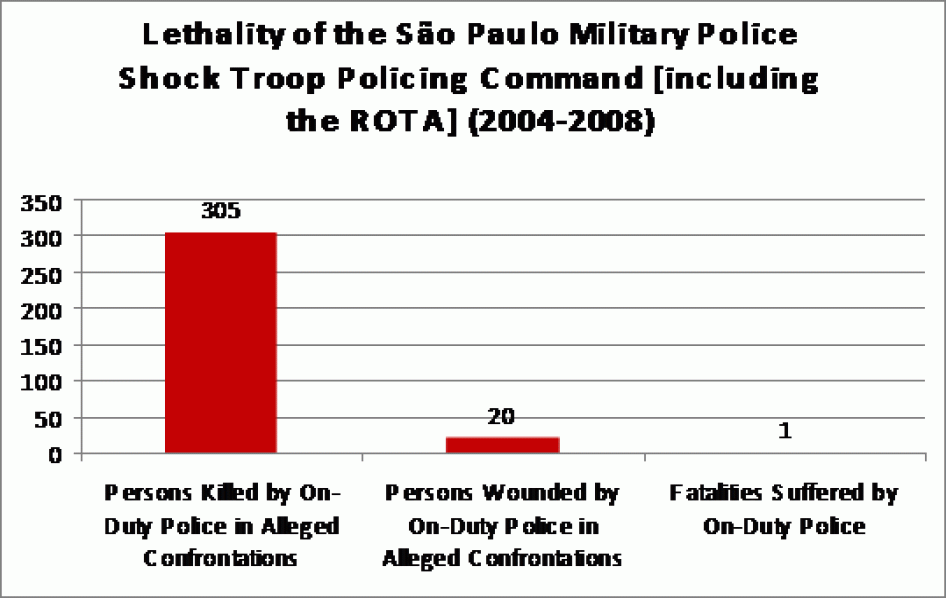
For example, the São Paulo Shock Police Command (Comando de Policiamento de Choque) a special operational branch of the military police containing the Rondas Ostensivas Tobias de Aguiar (ROTA), among other units, killed 305 people from 2004 through 2008 and left only 20 injured. In all of these alleged “shootouts,” the police suffered one death. Similarly, in Rio, units operating in 10 particular military policing zones were responsible for 825 “resistance” killings in 2008 while suffering 12 police fatalities. In one of the zones of operation, police “resistance” killings actually outnumbered all other intentional homicides in 2007.
Human Rights Watch also examined 23 case files containing witness statements and evidence of certain modi operandi indicating that police-linked death squads or militias were responsible for unlawful killings. Criminal justice officials reported that unlawful killings by police-linked criminal gangs are widespread. In São Paulo, the Police Ombudsman’s Office recorded 541 killings by unknown assailants as potential police death squad homicides from May 2006 through 2008. In Rio, the state security secretary acknowledged that militias contribute substantially to the state’s overall homicide rate, while a 2008 report unanimously approved by the state legislature found that police-linked militias were operating in 171 communities throughout the state.
Police Cover Ups
After fatal shootings by police, officers routinely manipulate, disrupt, or fail to preserve evidence that is vital for determining whether or not the killing was lawful. One common cover-up technique is to remove a shooting victim’s corpse from the crime scene, deliver it to the hospital, and claim that the removal was an attempt to “rescue” the victim. These false “rescues” serve to destroy crime scene evidence while providing a veneer of good faith on the part of the police.
When, for example, Rio police killed 19 people in Complexo do Alemão in a single day in 2007, all the shooting victims ended up being taken to the hospital. In at least nine of the killings, police documents state that the victims were taken to the hospital in an attempt to “rescue” them. Yet photographs and autopsy reports obtained by Human Rights Watch leave little doubt that the victims were already dead prior to their removal. In São Paulo, Human Rights Watch identified 17 police shooting victims from May 2006 who, according to autopsy reports, had suffered one or more shots to the brain before police took them to the hospital, purportedly to “rescue” them.
Police officers often attack or threaten witnesses to discourage them from reporting what they have seen. In April 2009, for example, A.L. filed a criminal complaint against a military police officer in São Paulo, stating that the officer had illegally searched his home, beaten him, and repeatedly threatened him over the course of several weeks. According to A.L., the harassment intensified after he filed the complaint. Two months later, two hooded assailants executed A.L. in the street near his workplace, riddling him with some 32 shots, according to the police and autopsy reports. In Rio, a witness to an alleged wrongful police killing in 2005 told Human Rights Watch he was threatened when he went to the civil police precinct to make a statement: “Police officers told me: ‘Watch what you are going to say.’ A police officer pointed a gun to me and said: ‘Pa-pum, pa-pum,’” the witness told us.
Police Investigations
Police investigators routinely fail to conduct proper inquiries into police killings. From the moment of an alleged “resistance” killing, basic tenets of homicide investigation are violated or ignored. These failures result in criminal inquiries that rarely clarify events or provide sufficient evidence to establish criminal responsibility in cases of wrongdoing.
Human Rights Watch reviewed dozens of police inquiries that suffered from a range of serious shortcomings, such as failure to question all police officers involved in a killing, failure to seek out and interview non-police eyewitnesses, and failure to conduct basic forensic tests, such as crime scene analyses. A detailed examination of 29 inquiries into “resistance killings” by one Rio military police battalion from 2007 through 2008 found that every one of them suffered from all—or nearly all—of these failings.
Such investigatory failures are not merely the result of limited resources or poor training. Rather, they reflect fundamental conflicts of interest inherent in assigning police investigators the responsibility of investigating police abuse. In the most egregious cases, shooting inquiries are conducted by members of a shooting officer’s own unit. More generally, however, the lack of independence and autonomy of police investigators, as well as an institutional culture that emphasizes loyalty, undermines the impartiality of police inquiries into cases of alleged abuse by fellow police officers.
Police Impunity
Human Rights Watch found a broad consensus among non-police criminal justice officials—including the attorneys general of both states—that police officers implicated in extrajudicial executions are rarely brought to justice. In the majority of the cases we reviewed, no police officers were held accountable. Many of the cases had been shelved without even reaching trial or even resulting in criminal charges.
While the precise scale of impunity is difficult to determine, the official data that is available lends support to the view that impunity in police abuse cases is the norm. For example, over the past decade, the Rio Police Ombudsman’s Office recorded over 7,800 complaints against police officers concerning criminal conduct; yet those complaints generated only 42 criminal charges by state prosecutors and only four convictions.
According to prosecutors in both states, the main cause of this chronic impunity is the absence of crucial evidence, a product of police cover ups and investigatory failures. While Brazilian law grants prosecutors the authority to conduct oversight of police activities, including investigations, their ability to do so is limited by several factors, including problems with crime notification procedures and the system of case allocation among prosecutors, as well as legal and political challenges from the police. Consequently, prosecutors usually rely entirely on investigations carried out by the police investigators, which are often extremely deficient.
Key Recommendations
The surest way to curb unlawful police killings is to ensure that the officers who commit them are brought to justice. The obstacles that currently prevent or discourage prosecutors from doing so are serious, but not insurmountable. The key to ending chronic police impunity—and thereby deterring future abuses—is to ensure that prosecutors need no longer rely so heavily on police investigators to resolve these cases. As the São Paulo attorney general told Human Rights Watch, “The key problem is in the police investigating members of the police itself.”
Toward that end, the Rio and São Paulo prosecutor’s offices should create specialized units with a mandate focused on police killing cases and the personnel, resources, and expertise necessary to effectively ensure proper investigation and prosecution of those cases in collaboration with the prosecutor designated by law (promotor natural). Among other homicides by police, such a unit should systematically review all alleged resistance killings.
To maximize the effectiveness of these special prosecutorial units, other measures should be taken as well, including:
- Establishing a special team of police investigators detailed to the State Prosecutor’s Offices’ new specialized units on police killings cases, and ensuring that these investigators are selected by, as well as fully and exclusively answerable to, the prosecutor’s offices rather than the normal police hierarchy;
- Requiring police officers to notify prosecutors of “resistance” killings immediately after they take place (rather than waiting the full 30 days currently allowed by law);
- Establishing and strictly enforcing a proper crime scene protocol that allows gunshot victims to receive proper medical attention but deters police officers from engaging in false “rescues” and other cover-up techniques; and
- Investigating potential police cover up techniques, including false “rescues,” and prosecuting officers who engage in them.
Finally, Human Rights Watch believes that it is crucial for Brazil’s elected leaders to publicly support the prosecutors’ efforts to ensure full accountability for police officers who commit abuses. Moreover, they should publicly challenge the misperception that human rights and public security are conflicting priorities. By demonstrating leadership on this critical issue, they could play a crucial role in curbing police abuses, improving law enforcement in Brazil, and making Brazilian society safer as a whole.
A complete list of detailed recommendations is set forth at the end of this report.
II. Methodology
This report is based primarily on in-depth analysis of 74 cases of police killings in which there is substantial credible evidence that the killings were unlawful. We selected these cases for detailed study after reviewing documentary and other evidence regarding more than 200 cases of alleged police abuse in Rio de Janeiro and São Paulo. The majority of the cases occurred since 2006, and all of them involve serious physical injury or death. The cases came principally from archives maintained by state prosecutors, officers of the Brazilian Bar Association, state police ombudsmen, and civil society groups.
In nearly all of the cases selected for in-depth study, we were able to examine official police, forensic, and/or judicial records. For certain cases, we also drew on victim and eyewitness interviews conducted during several trips to Brazil from 2006 through 2009,[1] government statements, NGO reports, and media accounts. Human Rights Watch typically contacted victims and family members of victims through referrals from their legal representatives or local civil society groups, some of which are comprised of family members of victims of police violence. All interviews were conducted by at least one staff member with fluency in Portuguese. No interviewees were provided with remuneration. Finally, we evaluated official police data on police violence and public security in order to assess patterns of abuse.
We interviewed more than 40 state and federal government officials. These included the state attorney generals and key prosecutors in both states. In Rio, we also met with the governor, the mayor, the security secretary, the chief of the civil police, the commander of the military police, heads of police internal affairs units, and the police ombudsman. In São Paulo, we met with the deputy secretary for public security, top military police commanders, representatives from the Homicide and Protection of Persons precinct, heads of police internal affairs units, and the police ombudsman. In Brasília, we met with the national public security secretary, the national human rights minister, and federal prosecutors specialized in police oversight.
For security reasons, names of surviving victims, witnesses, and relatives have been abbreviated and changed in the report, and certain details have been omitted to protect their identities (except in the few cases in which those interviewed affirmatively requested to be named).
When Human Rights Watch sought to find out the current status of certain cases, we were at times hindered by witnesses’ fears of retaliation, the difficulty of tracking and/or accessing certain police records, and the lack of effective monitoring of police killings by police internal affairs units and prosecutor’s offices.
Stefan Schmitt, the director of the International Forensic Program at Physicians for Human Rights, reviewed and provided critical input on the analysis of the forensic issues in this report. Schmitt previously worked for nine years as a forensic analyst at the Florida Department of Law Enforcement’s Crime Lab, and has participated in forensic investigations in Afghanistan, Algeria, Bosnia, Croatia, Guatemala, Honduras, Iraq, Liberia, and Rwanda.
Patrick Ball, Chief Scientist and Vice-President for Human Rights Programs at the Benetech Initiative, reviewed and provided critical input on the analysis of quantitative data in this report. Since 1991, Dr. Ball has designed information management systems and conducted statistical analysis for large-scale human rights data projects used by truth commissions, non-governmental organizations, tribunals and United Nations missions in more than thirty countries around the world.
Rio de Janeiro and São Paulo were selected for this study because they are states containing Brazil’s most populous and influential cities, because they face serious security challenges, and because they contain high numbers of police killings each year.
III. Background
Violence by Criminal Gangs
Policing Rio and São Paulo is a difficult task. In Rio, hundreds of neighborhoods are effectively under the control of drug factions. In São Paulo, despite an encouraging drop in the homicide rate over the last several years, brazen public attacks by a drug gang in May 2006 revealed the state’s continuing security vulnerabilities.
There were over 10,000 victims of intentional homicide[2] in Rio and São Paulo combined in 2008.[3] While both states suffer from serious crime, the situation is markedly worse in Rio. In 2008, Rio’s homicide rate (34.50 per 100,000 inhabitants) was significantly higher than São Paulo’s (10.76 per 100,000 inhabitants).[4] The number of robberies per 100,000 inhabitants in 2008 was 854 in Rio and 530 in São Paulo.[5] Drug traffickers in both states routinely engage in violent crime, including in murder, torture and extortion. In Rio, police-linked militias also regularly engage in violent crime in scores of neighborhoods.[6]
In São Paulo, violence reached a peak in May 2006 when a criminal gang known as the First Command of the Capital (Primeiro Comando da Capital or PCC) carried out more than 100 coordinated attacks against security forces, city buses, and public and financial buildings.[7] The PCC simultaneously organized scores of prison riots. The attacks left 43 police officers dead.[8]
In Rio, public security is in permanent crisis. One particularly severe crime wave started in December 2006, when drug gangs launched a series of coordinated attacks against police officers, public buses, and public buildings, leaving 19 people dead and 22 wounded.[9] Seven passengers were killed by being burnt alive by criminals inside a bus on a major roadway in Rio; another victim died days later.[10] More recently, in October 2009, drug traffickers shot down a military police helicopter, killing three officers and injuring four others.[11]
There have been many notoriously cruel episodes of violence perpetrated by drug traffickers. In July 2008 in Rio, drug traffickers staged a “tribunal” in Morro da Mangueira for a 14-year-old girl accused of stealing a cell phone from a taxi driver. As a “sentence,” they shot the girl through her hands.[12] In 2002, drug traffickers caught journalist Tim Lopes in Vila Cruzeiro while he was investigating their promotion of child sexual abuse and other illegal activities. Lopes was tortured and then executed with a samurai sword.[13] In São Paulo, during a prison riot in 2005, drug gang members in Penitentiary 1 in Presidente Venceslau decapitated five fellow prisoners who were considered enemies of the gang.[14]
Inadequate Pay and Police Corruption
Military and civil police in Rio and São Paulo have very low salaries that do not reflect the challenging nature of their jobs and aggravate problems of corruption and abuse. For example, according to a military police colonel in Rio, a starting military police officer earns less than a low-ranking youth in the drug trade. “A fogueteiro (scout) in drug trafficking gets paid R$1300 per month [roughly US$650],” he told us. “A soldier of the military police, R$1090 [roughly US$545].”[15] Indeed, for years the salary for military police soldiers in Rio has been among the lowest among military police in the country.[16]
United Nations Special Rapporteur on Extrajudicial, Summary, or Arbitrary Executions Philip Alston asserted in his 2008 report that low police pay is one factor that has fueled police membership in illegal gangs such as militias.[17] Annually, there are more violent police deaths off-duty than on-duty in Rio and São Paulo.[18]
Reform Initiatives
Government authorities have taken some practical steps aimed at increasing police professionalism and curbing abuses. For instance, in 1995 São Paulo passed a law creating a Police Ombudsman’s Office to receive and forward public complaints concerning the police.[19] Rio did the same in 1999.[20]
More recently, the federal government has invested significant funds in the National Program for Public Security with Citizenship (PRONASCI), a national public security program, which includes funds for police training and support for internal affairs divisions.[21] In São Paulo, the Public Security Secretariat—which runs the police—has been implementing training modules on the “Giraldi method,” a technique aimed at lowering police lethality during certain confrontations.[22]
In Rio, pilot “pacification” programs in a small set of neighborhoods, such as Dona Marta, are being touted by officials as keeping out drug traffickers while lowering police lethality. The programs involve placing a large police contingent in a low-income community on a permanent basis.[23] “We have definitively occupied four communities in distinct neighborhoods,” Rio Security Secretary José Mariano Beltrame states on the official site of the program.[24]Officials claim these few pilot initiatives have been successful.[25] Human Rights Watch did not independently evaluate them.
Though some of these initiatives are positive, none of these measures address the need for systematic external monitoring of police abuses or replace the need for effective investigation and prosecution of crimes committed by the police.
Criminal Justice in Brazil
Brazil has a federal system of government.[26] Criminal law and criminal procedure is legislated at the federal level.[27] Most law enforcement, however, is primarily the responsibility of the states, which fund and run state-level courts, detention centers, and police forces.[28]
Police in Brazil, therefore, are organized and controlled primarily by states (via security secretariats), rather than at the national or municipal levels. The state police forces are divided into two nearly autonomous entities, the civil and military police. The state governor controls both forces, though the military police are also auxiliary and reserve units of the military.[29] The state civil and military police forces are divided along functional lines.
The military police are tasked with patrolling the streets, maintaining public order, responding to crimes as they are occurring, and arresting suspects who are caught in the act of committing crimes.[30] The military police is also in charge of investigating military crimes, which are defined as such by the Military Penal Code. Military police officers are generally prosecuted and judged in military courts; among the most notable exceptions to this jurisdictional rule is the crime of intentional homicide of a civilian, for which military officers are tried before civilian courts.[31]
The civil police conduct criminal investigations in the civilian justice system, including investigations of intentional homicides committed by police against civilians.[32] Each civil police precinct is run by a precinct chief (delegado).[33] A police-led criminal inquiry (inquérito policial) may be initiated by written orders of the appropriate police authority, at the request of the victim or offended party, or by orders of a judge or the Prosecutor's Office (Ministério Público).[34] Once the civil police know of a violation of the penal code, they must take a series of investigatory steps, including going to the crime scene and ensuring that there is “no alteration in the state and conservation of things until the arrival of criminal forensics experts.”[35] Police investigators should collect as many facts as necessary to clarify the crime and circumstances surrounding it, including by taking witness statements and collecting physical evidence.[36]
Police investigators have 30 days to conclude an investigation before they must send the corresponding case file to the competent judge.[37] The judge (usually at the request of a prosecutor) can repeatedly extend the given deadline for the conclusion of an investigation.[38]
Once the police have concluded their investigations, they are required to deliver a detailed written report to the competent judge.[39] This report is passed on to the competent prosecutor to determine whether to seek charges (denúncias) against a suspect. If either the prosecutor or the judge believes that further police investigation is necessary, they may order it.[40]
Police investigations may only be shelved (arquivados) (i.e. indefinitely suspended) by order of the judge, ordinarily at the request of the prosecutor. When a case gets shelved, it is essentially closed. Only in rare circumstances in which new evidence emerges may it be reopened.[41]
In intentional homicide cases, which fall under the jurisdiction of jury trial courts, the judge should reject a prosecutor’s filings for charges if he or she determines that there is insufficient proof of the existence of a crime (materialidade) or of individual responsibility (autoria) or participation (participação).[42] If, however, the judge believes there is sufficient basis, he or she should issue an indictment (pronúncia).[43]
Brazil’s Obligations Under International Law
Under international law, Brazil has an obligation to criminalize and prevent the commission of human rights violations, such as torture or extrajudicial executions, by its police forces. It is also obligated to ensure that any violations are promptly, thoroughly, impartially, and independently investigated, that perpetrators are held accountable for their actions, and that victims and/or relatives are provided fair and adequate compensation.
These obligations derive from international human rights law, including treaty based obligations such as the International Covenant on Civil and Political Rights (ICCPR),[44] and the American Convention on Human Rights (ACHR).[45]
Prohibition of Extrajudicial Executions
The prohibition on summary, extrajudicial, or arbitrary executions is derived from the right to life guarantees under Article 6 of the ICCPR and Article 4 of the ACHR.[46] In this report we use the term “extrajudicial execution” to encompass all right to life violations by law enforcement agents, including not only purposefully unlawful killings but also deaths produced by excessive use of force. Force used by law enforcement is considered excessive when it contravenes the principles of absolute necessity or proportionality, as interpreted in the UN Basic Principles on the Use of Force and Firearms by Law Enforcement Officials (Articles 4, 5, 7, and 9) and the UN Code of Conduct for Law Enforcement Officials (Article 3).[47]
The UN Principles on the Effective Prevention and Investigation of Extra-Legal, Arbitrary, and Summary Executions include key points relevant to the right to life violations considered in this report, including inter alia:
- “Governments shallprohibit by law all extra-legal, arbitrary, and summary executions and shall ensure that any such executions are recognized as offences under their criminal laws, and are punishable by appropriate penalties which take into account the seriousness of such offenses...
- “Exceptional circumstances including a state of war or threat of war, internal political instability or any other public emergency may not be invoked as a justification of such executions. Such executions shall not be carried out under any circumstances including, but not limited to, situations of internal armed conflict, excessive or illegal use of force by a public official or other person acting in an official capacity or a person acting at the instigation, or with the consent or acquiescence of such person, and situations in which deaths occur in custody...
- “Governments shallprohibit orders from superior officers or public authorities authorizing or inciting other persons to carry out any such extralegal, arbitrary or summary executions. All persons shall have the right and the duty to defy such orders. Training of law enforcement officials shall emphasize the above provisions...”[48]
In addition, prohibitions against torture and other cruel, inhuman, or degrading treatment or punishment apply to Brazil,[49] as do prohibitions against arbitrary detention.[50]
Duty to Investigate and Prosecute Abuses
Victims have a right to a remedy for violations of their rights.[51] In particular the obligation to protect the right to life and the right to a remedy require that an effective investigation be conducted when individuals have been killed as a result of the use of force.[52] In cases in which state agents or bodies are involved or implicated, this investigation is to ensure their accountability. The Inter-American Court has stated clearly that “in cases of extra-legal executions, it is essential for the State to effectively investigate deprivation of the right to life and to punish all those responsible, especially when State agents are involved, as not doing so would create, within an environment of impunity, the conditions for such events to recur...”[53] An effective investigation is one which is prompt, thorough, independent, and impartial. It must be capable of leading to a determination of whether the force used was or was not justified under the circumstances and to the identification and punishment of those responsible.[54]Officials are also required to provide victims with information about investigations into violations.[55]
The UN developed a Manual on the Effective Prevention and Investigation of Extra-Legal, Arbitrary, and Summary Executions in 1991, which is designed to be a practical exposition of best practices and procedures.[56] Given the pervasive failures in police investigations into police abuse in Rio and São Paulo, this manual is a particularly useful reference, particularly with regard to its guidelines and procedures on proper crime scene investigation,[57] gathering of testimonial evidence,[58] and performance of autopsies, including annexes on the postmortem detection of torture and on sample form diagrams and charts to be used.[59]
Again, the UN’s Principles on the Effective Prevention and Investigation of Extra-Legal, Arbitrary, and Summary Executions provide instructive guidelines.[60] Key provisions include, inter alia:
- “There shall be a thorough, prompt and impartial investigationof all suspected cases of extra-legal, arbitrary and summary executions, including cases where complaints by relatives or other reliable reports suggest unnatural death in the above circumstances... The investigative authority shall have the power to obtain all the information necessary to the inquiry. Those persons conducting the investigation shall have at their disposal all the necessary budgetary and technical resources for effective investigation...”
- “In order to ensure objective results, those conducting the autopsy must be able to functionimpartially and independently of any potentially implicated persons or organizations or entities...”
- “In cases in which the established investigative procedures are inadequate because of lack of expertise or impartiality, because of the importance of the matter, or because of the apparent existence of a pattern of abuse, and in cases where there are complaints from the family of the victim abuse these inadequacies or other substantial reasons, Governments shall pursue investigations through an independent commission of inquiry or similar procedure. Members of such a commission shall be chosen for their recognized impartiality, competence, and independence as individuals. In particular, they shall be independent of any institution, agency, or person that may be the subject of the inquiry. The commission shall have the authority to obtain all information necessary to the inquiry and shall conduct the inquiry as provided for under these Principles...
- “Governments shall ensure that persons identified by the investigation as having participated in extra-legal, arbitrary and summary executions in any territory under their jurisdiction are brought to justice...
- “The families and dependents of victims of extra-legal, arbitrary and summary executions shall be entitled to fair and adequate compensation within a reasonable period of time.”[61]
IV. Police Killings
Police in the states of Rio de Janeiro and São Paulo have killed a combined total of more than 11,000 people since 2003, according to official statistics.[62] In nearly all such cases, police report the killings as legitimate acts of self-defense in response to gunfire by criminal suspects, what they call “resistance” killings. However, close analysis of case files, statements by officials, and statistical data strongly suggest that a substantial portion of these cases are in fact extrajudicial executions.
It is lawful for police to use lethal force when absolutely necessary to prevent loss of life and serious injury to themselves or others, provided the force is proportionate to the threat posed. Police officers in Rio de Janeiro and São Paulo often do face real threats of violence from members of criminal gangs, and many reported shootout deaths are likely the result of legitimate use of force by officers during confrontations.
Nonetheless, Human Rights Watch obtained credible evidence in 51 cases indicating that those killed in “resistance” episodes were in fact victims of extrajudicial executions.[63] In some of the cases, the evidence indicates that the killing occurred after the alleged shootout had ended. In others, the evidence indicates that no “shootout” took place at all. We obviously were only able to examine in detail a small percentage of the 11,000 police killings that have taken place in Rio and São Paulo since 2003, and there are undoubtedly many more cases of extrajudicial execution than those which Human Rights Watch was able to identify.
Several key criminal justice officials from both states spoke of the practice of police reporting extrajudicial executions as “resistance” killings as being widespread. São Paulo’s deputy police ombudsman estimated that “80 percent” of police reports of alleged shootout killings raised suspicion of police abuse.[64] A Rio prosecutor with jurisdiction over neighborhoods with some of the highest levels of police killings in the city told Human Rights Watch that he thought “almost all” the scores of “resistance” killing cases he saw annually were “farces.”[65] Even police officials acknowledged to Human Rights Watch that some officers disguise killings as acts of self-defense.[66]
Moreover, official statistics analyzed by Human Rights Watch are consistent with the conclusion that a significant portion of purported “resistance” killings are likely to be extrajudicial executions.[67] Rio police in the city of Duque de Caxias (bordering the city of Rio) killed 103 people in “resistance” killings in 2008, while suffering one police fatality.[68] Disproportionate statistics such as these, many more of which are included below, raise serious doubts about the credibility of claims that legitimate use of lethal force by police in “shootouts” explains the many thousands of killings by police over the last few years.
In addition, a comparative look at police violence statistics in South Africa and the United States helps reveal just how disproportionate such killings are in the states of Rio and São Paulo, even when compared to other violent places. Over the past five years, for example, there were more police “resistance” killings in São Paulo state (2,176) than police killings of suspects in all of South Africa (1,623), a country with a much higher homicide rate than São Paulo.[69]
Some police officers also commit extrajudicial executions while off-duty. In Rio, police-linked militias dominate scores of neighborhoods in the metropolitan area (Greater Rio) and are responsible for large numbers of killings. In the greater metropolitan area of the city of São Paulo (Greater São Paulo), police-linked death squads are suspected of involvement in over 500 killings since 2006, according to the Police Ombudsman’s Office.
“Resistance” Killings
Human Rights Watch found credible evidence that police executed their victims in 35 “resistance” killing cases in Rio and 16 cases in São Paulo. The majority of these cases—40 out of 51—occurred since 2006. Most cases are from the metropolitan areas of the two states, with many concentrated in neighborhoods policed by particular units, such as Rio’s 16th military police battalion.
The terms “account of resistance” from Rio and “resistance followed by death” from São Paulo are used in civil police reports to classify cases of killings by police in which officers claim to have used legitimate force following an individual’s failure to obey a lawful order. Essentially, these classifications denote police killings of persons who allegedly resisted arrest. In all such police reports reviewed by Human Rights Watch, “resistance” killings denoted police killings of individuals whom they claim had engaged in a shootout with them.
In 33 cases (incidents involving one or more “resistance” killings), police reports claiming the victim was killed in a shootout appeared to be inconsistent with forensic evidence. For instance, in at least 17 cases,[70] gunshot residue patterns on the skin of victims indicates shots were fired at point-blank range (from a distance of less than 50 centimeters),[71] even though such close range shots are not typical of shootouts. (Of all the “resistance” killing cases we reviewed, in only two did officers specifically note that they were very close to the suspects during the alleged confrontations.)[72]
In several cases, autopsy reports showed gunshot entry wounds to the back of the head or nape of the neck of the victim, injuries that would seem unlikely in most shootout situations but are consistent with executions.
- On May 13, 2006, military police officers of the Rondas Ostensivas Tobias de Aguiar (ROTA) in São Paulo’s shock troop contingent killed J.T. and E.N. in an alleged resisting arrest episode.[73] According to police, the victims were robbing a car when they were confronted by police in what turned into a chase; the victims then allegedly stepped out of the car, opened fire against the police vehicle, and were killed by return fire from the officers.[74]
However, an autopsy report showed that one of the victims was shot at point blank range.[75] Furthermore, no gunshot residue was found on the hands of the victims (a positive finding would have been consistent with their having used firearms prior to their deaths, as alleged by the police). There were also no bullet markings on the police vehicle as a result of the alleged firefight.[76]
Witness evidence also weighed against the officers. A witness saw one of the victims being detained by the ROTA approximately two hours prior to the alleged shootout in a location 45 minutes away from where the killing took place.[77] Finally, according to witnesses, the individual who officers claimed had been at the wheel of the allegedly stolen car did not know how to drive.[78]
A São Paulo prosecutor charged the officers with homicide and charged the owner of the car with conspiring in an elaborate set-up involving two other unidentified persons, all staged to cover up the murders.[79] He called the killings, “an act typical of a death squad [grupo de extermínio],” since, “the military police officers wanted to take revenge upon individuals with criminal records because of the PCC attacks against state security forces.”[80] A judge accepted charges against the officers (though rejected them against the owner of the car).[81]
- Over 1000 officers from state and federal forces carried out a large-scale police operation in Rio’s Complexo do Alemão starting in May 2007. Some of these officers had been tasked with securing the city in advance of the July Pan-American Games. Numerous police killings over several weeks culminated in 19 alleged “resistance” killings in a single day on June 27, 2007.[82]
Though the police alleged that they had only killed in self-defense during shootouts, autopsy records strongly suggest that several of the victims were extrajudicially executed. Five of the 19 victims suffered shots at point blank range. Two of the 19 suffered shots exclusively from behind, and nine others were also shot in the back (four of them in the back of the head or neck).[83]
Furthermore, a federal panel of forensic experts asserted that forensic evidence indicated that at least two of the victims were shot while lying flat on their backs.[84] The forensics panel—appointed by the federal government’s Special Human Rights Secretariat to investigate the killings —concluded “with certainty, that several of the deaths were the result of a procedure of summary and arbitrary execution.”[85]
- In May 2006 in São Paulo, civil police officers killed W.R. and P.B. in an alleged firefight. W.R., according to police, was a PCC gang leader in the Vale do Paraíba area of São Paulo state. Police allege the men formed part of a group that had plans to bomb public buildings in the area. The autopsy of P.B. shows wounds compatible with execution: one shot between the eyes at point blank range and another shot at point blank range in the center of the mouth. P.B. was also shot two other times in the head (once on top and once in the center of his forehead). He was further shot three other places on his body.[86]
- Officers of the 16th military police battalion in Rio killed R.S. and G.T. on September 9, 2007, in an alleged resistance killing. Forensic evidence raises doubts about the officers’ stories. R.S. was shot twice, once in the back of the head with an upward trajectory, a wound typical of an execution.[87]
Rio prosecutor Alexandre Themístocles de Vasconcelos provided Human Rights Watch with evidence in 13 “resistance” killing cases in which forensic evidence showed circumstances of death that he concluded were inconsistent with the the police’s claim that the victims had died in shootouts. Examples of these cases include the following:
- Officers of the 16th military police battalion in Rio killed 17-year-old M.I. on June 16, 2007, in an alleged resistance killing. M.I. was shot six times, twice in the back and once from under 50 centimeters away.[88]
- Officers of the 16th military police battalion in Rio killed S.U. on September 1, 2007, an alleged resistance killing. S.U. was shot twice at a range of less than 50 centimeters, according to his autopsy report.[89]
- Officers of the 16th military police battalion in Rio killed D.L. on April 4, 2008, in an alleged resistance killing. D.L. was shot four times and all four shots were to the back of his body.[90]
- Officers of the 16th military police battalion in Rio killed M.E. and R.R. on February 14, 2008, in alleged resistance killings. Both victims were shot once. M.E. was shot in the back, and R.R. was shot at a range of less than 50 centimeters.[91]
In at least 21 cases Human Rights Watch reviewed, witness accounts support a finding of extrajudicial execution. (The number may be higher, as in many cases we had access to some official documents but not the entire case file.)
Examples of cases containing witness evidence suggesting that an extrajudicial execution had occurred include:
- In December 2006, Rio police killed R.A. in alleged “resistance” episode. The two civil police officers involved claimed that they shot R.A. in self-defense during a firefight between them and a group of four men to which R.A. belonged.[92] The police officers involved also claimed that R.A. had not died at the scene and that they had tried to save his life by taking him to the hospital.[93] However, the mother of R.A.’s girlfriend told Human Rights Watch that she saw police shoot him when he was kneeling and had his hands up in surrender while begging for his life.[94]
- In July 2008, police killed C.M. and B.N. in an alleged shootout following a car robbery that resulted in a chase and stopped after a crash. However, amateur video of the incident taken by a bystander shows C.M. raising his hands out of the car in surrender before an officer grabbed him and pulled him through the car window by the neck. The video then shows C.M. dead on the ground.[95]
- In March 2009, police in São Paulo killed I.W. in an alleged shootout. Police stated I.W. and another man had been fleeing the scene of a building where they had committed a robbery. A neighborhood resident testified to the Police Ombudsman’s Office that she witnessed the moment of the shooting, along with other residents of her building. According to her, police had subdued the suspects, who were lying on the ground unarmed, before shooting I.W.[96]
- In June 2003, I.M. was shot and killed by Rio military police officers. Police allege that I.M. had initiated a firefight with them and that they killed him in self-defense.[97] However, two witnesses, corroborated by accounts of others, testified before police investigators that they saw I.M. being detained by police officers hours before the alleged encounter and that police had put him in a squad car along with two other youths.[98] I.M. was shot once in the back.[99]The corpses of the other two youths detained at the same time as I.M. later turned up with gunshot wounds in a canal in Pavuna.[100]
Furthermore, many alleged “resistance” killing cases we reviewed contained evidence of attempted cover ups by police officers. As discussed in greater detail in the next chapter, police who commit extrajudicial executions routinely feign rescue attempts of their victims, removing their corpses from police shooting crime scenes and destroying valuable forensic evidence.
Widespread Scope of Extrajudicial Executions
The failure of Brazilian authorities to thoroughly and systematically investigate police killings in which the victims are alleged to have resisted arrest makes it difficult to give a precise estimate of how many such cases are actually extrajudicial executions.[101] However, several key criminal justice officials in both states who work with these cases told Human Rights Watch that they believed the problem is widespread.
In Rio, prosecutor Alexandre Themístocles de Vasconcelos—responsible for receiving a substantial portion of police case files in the two areas in Rio with the highest level of number of police killings—told us that he thought “almost all” of the alleged resistance killing cases he saw were “farces.”[102] Rio Deputy Assistant Attorney General for Human Rights Leonardo Cháves also spoke of unlawful “resistance” killings as a very serious problem in Rio.[103] At the São Paulo Police Ombudsman’s Office, the deputy ombudsman estimated that “80 percent” of police reports of alleged shootout killings raised suspicion of police abuse.[104] São Paulo prosecutor Carlos Cardoso, former human rights aide to the attorney general from 1998 through 2008, said police “with high frequency” forged shootouts to mask executions through the use of planted evidence.[105]
An independent forensic scientist has estimated on the basis of autopsy reports that 60 to 70 percent of 124 persons killed by police in São Paulo during the May 2006 attacks in alleged resistance cases bore signs of having been the victims of executions rather than of shootouts.[106]
Even top police officials in both states acknowledged that extrajudicial executions by police are an ongoing problem, though not all accepted that it is widespread. The Rio security secretary, who supervises the police, José Mariano Beltrame, acknowledged in a meeting with Human Rights Watch regarding police alleged resistance killings that “these executions do exist.”[107] When asked, neither he, the head of the civil police, the commander of the military police, nor the head of the police General Unified Internal Affairs unit could provide us with an estimate of what proportion of alleged resistance killing cases were executions in Rio. Asked about whether there was such an estimate, Secretary Beltrame shook his head.[108]
In São Paulo, the then head of civil police internal affairs and current chief of the civil police, Alberto Angerami, similarly acknowledged the use of resisting arrest reports to mask executions on the part of the military police, particularly the ROTA unit.[109] The then deputy public security secretary of São Paulo, Guilherme Bueno de Camargo, did not deny that alleged resistance killings sometimes masked executions, but claimed that police abuse “is the exception.”[110] When asked, he was unable to provide a more precise official estimate of how many alleged resistance killings were illegitimate.[111]
Government statistics on police killings support the view of those officials who assert that extrajudicial executions are indeed widespread. The high number of alleged resistance killings recorded in both states is particularly dramatic when viewed alongside the total numbers of “regular” murders, arrests, police fatalities, and persons non-fatally injured by police.
Moreover, a comparative look at police violence statistics in South Africa and the United States (US) helps reveal just how disproportionate such killings are in the states of Rio and São Paulo, even when compared to other violent places.[112]
South Africa is a particularly compelling comparison because it has a higher homicide rates than the states of Rio or São Paulo (in “financial year” 2008/2009, the murder rate in South Africa was 37.3 per 100,000 inhabitants, while in Rio and São Paulo in 2008 the intentional homicide rate was 34.5 and 10.76 per 100,000 inhabitants, respectively).[113] This is relevant since police lethality is often argued to be a product of high crime. South Africa is also known to have high levels of police violence. The US provides another useful comparison given that it is a developed country with significant levels of police violence.
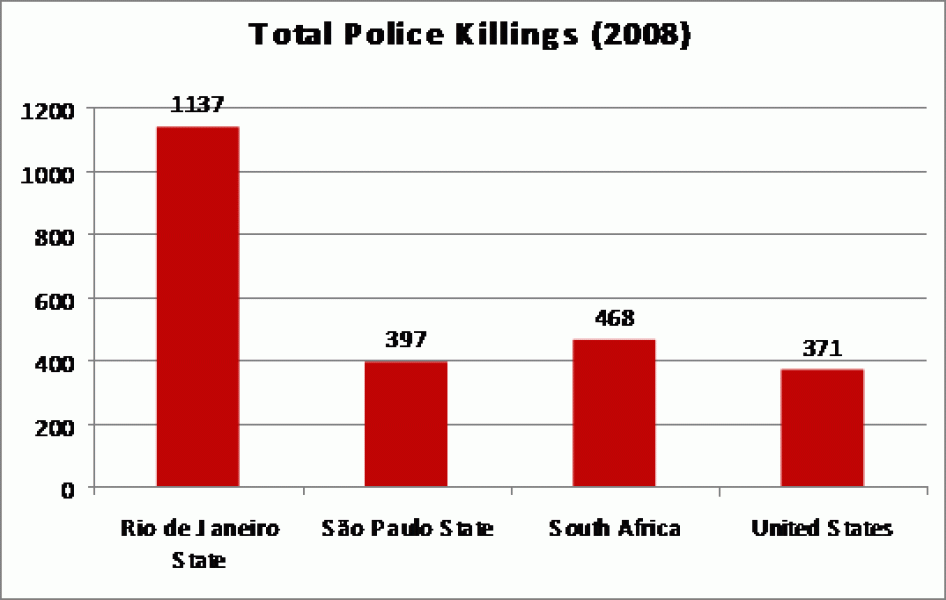
Total Police KillingsWe use the term “police killings” here to refer to on-duty killings by police in alleged confrontations.[114]In the state of Rio, alleged resistance killings by police reached a record high of 1,330 in 2007.[115] While reported police killings decreased to 1,137 in 2008, the number remained alarmingly elevated, the third highest on record for Rio.[116] In the state of São Paulo, though the number of on-duty alleged resistance killings was significantly lower than in recent peak years such as 2002 and 2003 (609 and 787, respectively), it remained high and relatively constant between 2007 and 2008 (401 and 397, respectively).[117] In contrast, the total number of police killings in the entire United States during this time period was 371 and in South Africa was 468.[118] (In just the first 10 months of 2009, São Paulo police killed 455 people in “resistance” episodes and is thus on track to surpass the most recent South Africa figure.[119] In Rio, police killed 805 people in “resistance” cases in the first nine months of 2009.[120]) Figure 1:
|
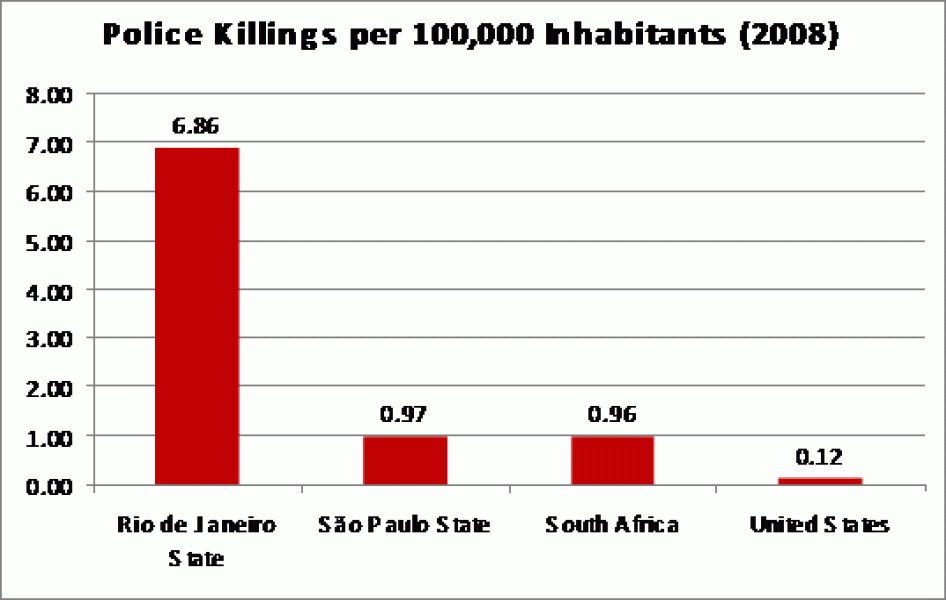
PopulationPolice killed 6.86 people per 100,000 inhabitants in Rio in 2008, while police in São Paulo killed 0.97; by contrast, police in South Africa killed 0.96 people per 100,000 inhabitants and police in the US killed 0.12 people.[121] The quantity of killings by police per capita in Rio de Janeiro in particular suggests a highly elevated lethality. Figure 2:
|
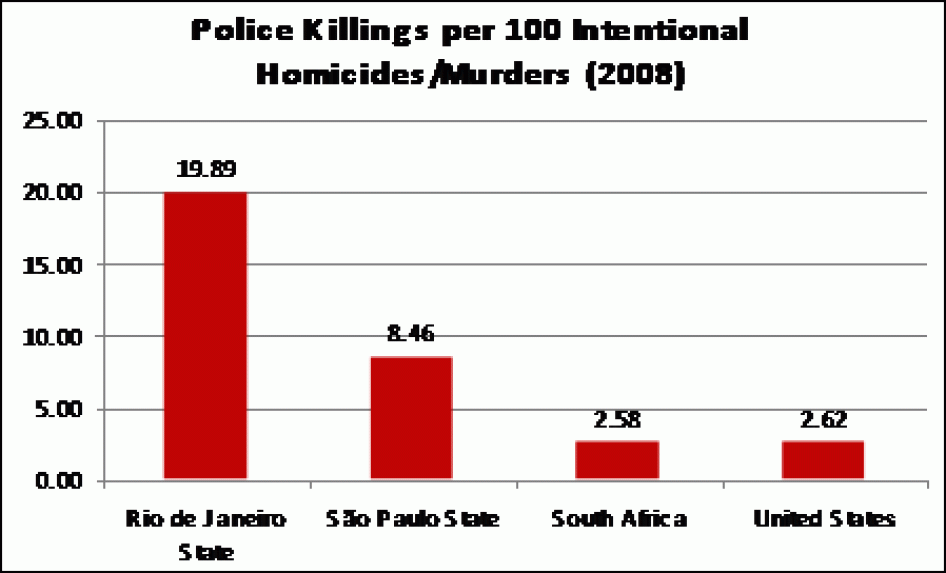
Other Intentional HomicidesFor every 100 other intentional homicides/murders[122] (i.e., “regular” killings not counting killings by on-duty police officers in “resistance”-type cases) that occurred in 2008, the police in Rio state killed 19.89 people and the police in São Paulo state killed 8.46.[123] By contrast, police killed 2.58 people for every 100 murders in South Africa and 2.62 for every 100 in the US.[124] (The numbers for Rio and São Paulo would be even higher if it were possible to count the number of killings by police who were off-duty.[125]) The substantially higher ratio in Rio and São Paulo casts doubt on the possibility that police violence in these states is merely a reflection of the general levels of violence in each place. Figure 3:
|
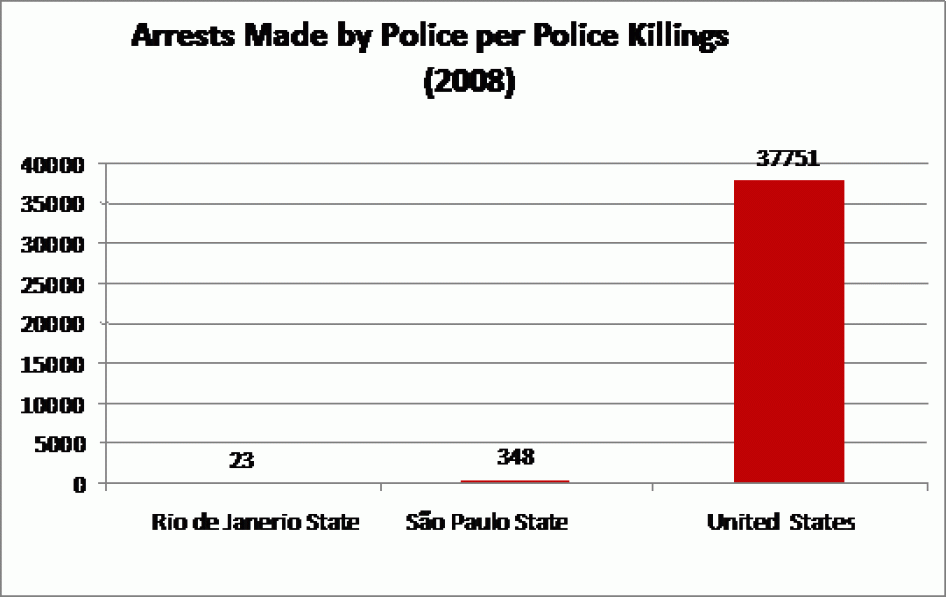
ArrestsThe police in Rio state arrested 23 people for every person they killed in 2008, and the police in São Paulo state arrested 348 for every kill.[126] By contrast, police officers in the U.S. arrested over 37,000 people for every person they killed in an alleged confrontation that year.[127] (Human Rights Watch was unable to obtain arrest figures for South Africa.) In other words, the police arrest to kill rate is 108 times lower in São Paulo than in the United States, and 1,641 times lower in Rio. Figure 4:
|
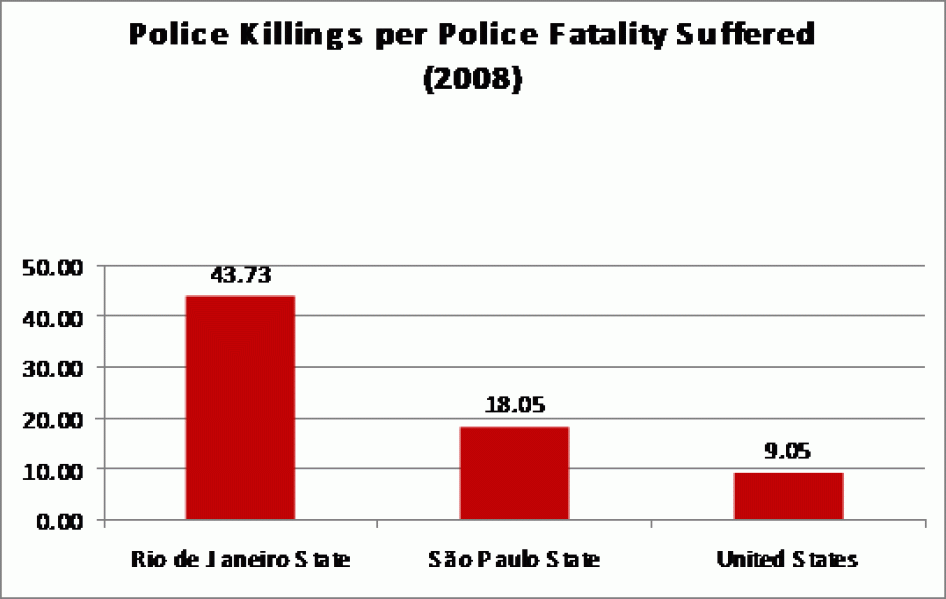
On-Duty Police KilledIn Rio, police killed 43.73 people for every officer killed on duty in 2008.[128] In São Paulo, police killed 18.05 people for every on-duty officer killed in 2008.[129] By contrast, police in the US killed 9.05 people for every officer killed.[130] (We were unable to find comparable disaggregated on-duty police fatality figures for South Africa.) Though differences in training, tactical support, and other factors may to some degree account for differences in the number of people police kill in shootouts per fatality their suffer, the large police killing to fatality ratios in Rio and São Paulo are consistent with the suspicion that in many cases police falsely report killings as having been produced in confrontations that did not actually occur.[131] Figure 5:
|
Persons Non-Fatally Injured by Police
Every year for the last three years, São Paulo military police officers have killed more people in alleged “resisting arrest” episodes than they have injured.[132] In 2008, the on-duty military police killed 371 people in “resistance” cases, while injuring 283 in these cases.[133] The fact that police in the city of São Paulo kill more persons than they injure in such episodes appears to run counter to the historical norm in Brazil. As noted by investigative journalist Caco Barcellos in his 1992 book on police violence in São Paulo, “[t]he history of combat in Brazil consolidated an average ratio of four survivors for every fatal victim.”[134]
This indicator, consistent with police excessive use of force, is most pronounced among military police units operating in São Paulo city and in Greater São Paulo.[135] It is alarmingly acute in relation to the São Paulo shock troop contingent, as described below.[136]
The Ten Most Lethal Military Police Battalions in Rio de Janeiro
Over 70 percent of all “resistance” killings by police in Rio in 2008 occurred in 10 of the state’s 40 Integrated Areas of Public Security (AISPs).[137] Statistics from these 10 geographic zones, which are noted in Table 1 below, show that in alleged resistance killings in each of those neighborhoods, at least 10 and as many as 103 persons are killed for every police officer killed. The disparities are greatest in the neighborhoods policed by certain military police battalions.[138]
The 10 areas listed in Table 1 below are large and generally contain high levels of crime. Together they accounted for 44 percent of Rio de Janeiro’s population and about 53 percent of the state’s murders in 2008.[139] They also contained a large proportion of the state’s police killings. Together they accounted for 825 killings in 2008, or 73 percent of all official police killings in the whole state.[140] This is nearly as many as the combined total of police killings in the United States and South Africa in 2008.[141]
Table 1: For a more complete table including names of the respective cities, neighborhoods, civil police precincts, and correlations with areas of known militia activity, see Appendix I.
The Ten Areas with the Most Lethal Police in the State of Rio de Janeiro (2008)[142] | ||
|
Police “Resistance” Killings |
On-Duty Police Deaths |
1) Integrated Public Security Area 3, (3rd Military Police Battalion) |
59 |
2 |
2) Integrated Public Security Area 7, (7th Military Police Battalion) |
62 |
0
|
3) Integrated Public Security Area 9, (9th Military Police Battalion) |
196 |
2 |
4) Integrated Public Security Area 12, (12th Military Police Battalion) |
41 |
0 |
5) Integrated Public Security Area 14, (14th Military Police Battalion) |
74 |
0
|
6) Integrated Public Security Area 15, (15th Military Police Battalion) |
103 |
1
|
7) Integrated Public Security Area 16, (16th Military Police Battalion) |
117 |
2
|
8) Integrated Public Security Area 20, (20th Military Police Battalion) |
68 |
1
|
9) Integrated Public Security Area 22, (22th Military Police Battalion) |
47 |
4
|
10) Integrated Public Security Area 40, (39th Military Police Battalion) |
58 |
0
|
Twelve officers were killed on-duty in these 10 areas in Rio in 2008, a testament to the fact that policing these locations is a challenging task. But 12 on-duty police deaths contrasted with the 825 “resistance” killings by the police in these areas casts doubt on how many of these hundreds of killings were lawful. For every officer who died on-duty in these 10 zones, police killed nearly 69 people, all of whom were supposedly resisting arrest, typically alleged to be actively firing upon the officers. That kill/casualty ratio is highly dubious for even the most well-trained, well-equipped force under regular conditions. In one extreme example, police in the area of the 14th Military Police Battalion killed 74 people in alleged resistance shootings in 2008. No on-duty officers were killed. In the area of the 15th Military Police Battalion, police killed 103 people and suffered one on-duty fatality.[143]
The 16th military police battalion in particular is associated with extremely elevated police violence statistics. In an unprecedented occurrence, in 2007, police killings in the area patrolled by the 16th battalion (171 in total) actually outnumbered other intentional homicides (170 in total).[144] In other words, police were responsible for the majority of all intentional homicides in the 16th policing zone of Rio in 2007.
The commander of the 16th Military Police Battalion for much of 2007, Colonel Marcus Jardim, publicly called the military police the “best social insecticide.”[145] In February 2008, he was promoted to top commander of military police forces for the city of Rio de Janeiro.[146]
Even taking into account the fact that police in the 16th AISP operate in some of the most dangerous areas of Rio, the volume of police killings there is extremely high. One interesting comparison is between Rio’s 16th AISP and Ceilândia, one of the most violent areas near Brasília, in the Distrito Federal. In several key ways (population, homicide rate, fatal robbery rate, and drug-related crime rate), the 16th AISP in Rio was statistically similar to Ceilândia in 2007. However, there was a substantial difference between the numbers of alleged resistance killings in each area. While police in Ceilândia killed two persons who allegedly resisted arrest in 2007, the number of so-called “resistance killings” by police in Rio’s 16th policing zone that year was 171, a per capita rate nearly 60 times that of Ceilândia.[147]
Table 2
Ceilândia (Distrito Federal) v. Rio de Janeiro’s 16th AISP (2007)[148] | |||
|
Ceilândia (DF) |
AISP 16 (RJ)* |
% Difference |
Population |
332,455 |
473,845 |
43% |
Intentional homicides per 100,000 inhabitants |
32.49 |
35.88 |
10% |
Robberies followed by death per 100,000 inhabitants |
2.71 |
2.11 |
-22% |
Drug-related police actions per 100,000 inhabitants |
172.05 |
47.06 |
-73% |
Total persons killed by police while allegedly resisting arrest |
2 |
171 |
8450% |
Persons killed by police while allegedly resisting arrest per 100,000 inhabitants |
0.60 |
36.09 |
5899% |
*AISP 16 (RJ) contains the Complexo do Alemão, Olaria, Penha, Penha Circular, Brás de Pina, Cordovil, Parada de Lucas, Vigário Geral, Jardim América neighborhoods. |
By making this comparison, Human Rights Watch does not intend to equate the security situation of the 16th policing zone in Rio with those of Ceilândia. Among other factors, the Distrito Federal police do not have to confront as many heavy armaments as their counterparts in Rio.[149] However, the difference in police killings between these two areas is so stark that it undermines the argument that the Rio 16th battalion’s frequent use of lethal force is proportionate to the threat faced.
ROTA: One of São Paulo’s Most Lethal Military Police UnitsFrom 2004 through 2008, São Paulo’s Rondas Ostensivas Tobias de Aguiar (ROTA) killed 305 people while on-duty, all during alleged “resisting arrest” episodes.[150] During the same period, the unit injured 20 people during these “resisting arrest” encounters.[151] This means that the unit killed roughly 15 people for every individual they non-fatally injured in these supposed firefights, an inversion of the typical pattern in armed confrontations, where more people are usually injured than killed over time, as previously discussed. Moreover, the unit suffered exactly one on-duty fatality in the same five year period.[152] Figure 6:
|
This disparity was particularly dramatic in the aftermath of the May 2006 attacks by the First Command of the Capital (PCC) in São Paulo. The São Paulo shock troop contingency officially killed 47 individuals that month, left none injured, and suffered no on-duty casualties.[153]
Killings by Death Squads and Militias
Many police officers in both Rio and Sao Paulo are also alleged to be members of illegal criminal gangs, commonly referred to as death squads (grupos de extermínio) in São Paulo and militias in Rio. These gangs routinely commit extrajudicial executions. Human Rights Watch reviewed evidence in multiple case files of suspected death squad killings from São Paulo over the past three years and found credible evidence of police officer involvement as perpetrators and in covering up the murders. We also found credible evidence of police-linked militia killings in Rio. Criminal justice officials in both states reported that the problem of police-linked gangs continues to be widespread, despite valuable steps taken to confront it.
São Paulo’s Death Squads
Though police-linked death squads have long been active in São Paulo, the number of cases of suspected death squad killings increased from 2006 through 2008. Since May 2006, the state’s Police Ombudsman’s Office has documented 541 killings in 266 cases it suspects were “supposedly carried out by so-called extermination groups.”[154] Human Rights Watch reviewed evidence in 21 cases of killings since 2006 containing credible evidence of police death squad involvement in São Paulo.
Following the initial days of the May 2006 attacks by the PCC in São Paulo, suspected death squads composed of police officers committed a wave of extrajudicial executions, according to the police ombudsman.[155] For example:
- On May 14, 2006, a group of men in ski masks killed five people and wounded one in the neighborhood of São Mateus. The assailants detained their victims outside a bar, lined them up against a wall, and executed them with shots to the head. One of the shooters collected the discharged bullet casings.[156]
A group of military police officers arrived minutes later and removed the bodies of the victims, only one of whom, according to witnesses, showed any signs of life. All of the bodies were naked at autopsy, indicating that key clothing evidence had, at a minimum, not been safeguarded. Military police did not preserve what remained of the crime scene after the bodies were removed, hindering the investigation. Blood on the ground at the scene was even washed away before investigators arrived (the police alleged this was done by a resident, while press accounts pointed to the police).[157]
The Homicide and Protection of Persons Precinct (DHPP) of the São Paulo civil police took on the case and concluded that it “had no doubt that the perpetrators were military police officers” attempting to kill PCC drug traffickers thought to be responsible for the murder of a fellow officer earlier that day.[158]
- The same day in the Parque Bristol neighborhood of São Paulo, four men in an unmarked car wearing ski masks shot and killed F.B., E.D., and S.L. and injured F.O. and E.W.[159]
F.O., who survived, was reportedly pulled out of the hospital by military police officers in early morning hours of May 15 (the day after the attack), according to relatives and friends of victims of the attack (F.O. himself was apparently too scared to give direct interviews about the events). F.O. was said to have been in a hospital gown and still bleeding when police put him in the back of a police car and took him to a local precinct to testify about the shooting. In that testimony, F.O. essentially stated he did not see much during the shooting. The officers who had reportedly taken him from the hospital remained present during his testimony, according to relatives and friends of the victims.[160]
In December 2006, the DHPP summoned F.O. to give his testimony again. Soon after, F.O. was gunned down in a drive-by shooting involving an unmarked car.[161]
The São Mateus and Parque Bristol killings were not isolated incidents. The São Paulo Ombudsperson’s Office examined 54 homicide cases totaling 89 fatal victims of suspected death squads.[162] The ombudsman identified a particular modus operandi in many of the killings: armed men in ski masks arrive on motorcycles or in unmarked cars with tinted windows and gun down victims.
The Ombudsman’s Office also noted as evidence of police collusion the fact that, in many cases, the shooters would be followed closely in time by the arrival of uniformed military police officers, who disturbed the crime scene, removing bodies and sometimes other evidence like cartridge casings.[163]
Death squad activity has continued in São Paulo since 2006. For instance:
- In the February 2007 Limão case, in the northern zone of the city of São Paulo, a pair of assailants who had been driving a Fiat Palio killed six young men and wounded another with gunfire. The shooters lined the victims up with their backs facing them before shooting them, and then fled the scene in the Fiat. São Paulo’s specialized homicide team, the DHPP unit, stated that 27 witnesses—including the sole survivor as well as eyewitnesses, many of whom had no relationship to the victims—confirmed the following facts: a military police ROTA car escorted the Fiat Palio to a street near the scene prior to the shooting; the assailants emerged from the Fiat with jackets labeled “police” and carried out the crime; and the same ROTA car escorted the Fiat away from the scene immediately after the killings.[164]
- In October 2008, in Mauá, two assailants in a car with tinted windows drove up to two men and one youth, got out of the car, and opened fire, killing all three victims. According to the Ombudsman’s Office, witnesses stated that the shooters identified themselves as military police officers prior to shooting; witnesses also said that other military police officers then arrived at the scene and removed cartridge casings prior to the arrival of the forensics teams, which found only one casing on the scene though over 20 shots were reportedly fired. The police ombudsman has received at least eight complaints of homicides in Mauá in which death squads are suspected.[165]
One death squad in São Paulo targeted a top military police official who was investigating their activities:
- Military Police Colonel José Hermínio Rodrigues, commander of the military police for the northern zone of São Paulo, was killed in 2008 by a death squad alleged to be comprised of officers from the 18th military police battalion, which came to be known as the “killers of the 18th.”[166] Prior to his killing, the colonel had been investigating death squad links to gambling rings in the northern zone of Greater São Paulo.[167] He had proposed that 56 military police officers be fired in the course of his investigations, but reportedly received little support from the military police internal affairs unit; he had also sought help from the civil police’s DHPP unit.[168] In January 2008, Colonel Hermínio was shot six times while doing his morning exercises in Mandaqui.[169] Forensic firearms examinations received by the São Paulo’s Homicide and Protection of Persons Precinct (DHPP) matched one of the guns used by the assailants to a gun used in the massacre of six people in June 2007.[170] The DHPP’s work led to the arrest of Military Police Officer Pascoal Santos Lima (nicknamed “the Monster”),[171] a man who has been linked to 16 other homicides since 2005, according to an official Police Ombudsman report.[172]
The death squad killing of Colonel Hermínio forced the São Paulo government to acknowledge the existence of such groups and led to some limited but positive efforts to combat the problem. One month after the killing, São Paulo Governor José Serra acknowledged the existence of death squads and announced his opposition to them: “We do not condone [death] squads; we do not condone extermination groups; we are combating them.”[173] Police also stepped up their investigations into death squads and arrested military police officers suspected of involvement in the “Killers of the 18th” death squad in the northern zone of São Paulo.[174]
Months later, civil police investigators arrested members of another police death squad in the southwestern zone of Greater São Paulo.[175]
- Military police officers in Itapecerica da Serra were identified by civil police investigators in 2009 as members of a group known as the “Highlanders.” The group earned its nickname due to its grisly practice of removing the heads of its victims[176] (this was a practice in the 1986 fictional film called “Highlander”).[177]
By March 2009, 15 men, 14 of whom were military police officers, were arrested in relation to multiple homicides in Taboão da Serra as a result of a civil police investigation.[178] The inquiry led to evidence that military police officers (the majority of whom were members of the 37th Military Police Battalion in São Paulo) were involved in the Highlanders death squad, thought to be responsible for at least 12 murders. The final report of the civil police investigators from Taboão da Serrá concluded that police officers were part of an “extermination group,” which ran extortion schemes by forcing individuals with criminal records to pay them bribes.[179]
Despite the arrests of suspected death squad members in some high profile cases, progress in eliminating the death squads and holding their members accountable has been limited.
According to the São Paulo Police Ombudsman’s Office, killings by unidentified assailants bearing the characteristics of possible death squad activity actually increased from 80 in 2007 to 98 in 2008.[180] In the first semester of 2009, the police ombudsman identified or received complaints of 32 homicides by unknown assailants suspected of being police officers.[181]
Rio’s Militias
Police-linked militias[182]—armed groups which control dozens of neighborhoods in Rio, extorting residents through “security taxes” and running other illicit businesses—are responsible for numerous extrajudicial executions.[183] Militias are now a major source of homicides as well as other crimes in Rio, including torture, corruption, extortion, and—in some cases—drug trafficking.[184]
In December 2008, a unanimously-approved Rio state Parliamentary Commission of Inquiry report (CPI report) found that hundreds of militia members in Rio control a sizeable number of communities. Militias control a staggering 171 neighborhoods in the state of Rio de Janeiro (118 of them in the city).[185]
All of the officials we spoke with agreed that militias are responsible for a large number of killings in Rio. Rio Security Secretary José Mariano Beltrame told the CPI that the militias represent one of the greatest concrete security threats to the state.[186] In 2009, Secretary Beltrame told Human Rights Watch that a spike in homicides in Favela Batan was due to the militias resisting a large-scale police operation there.[187]
Militias routinely engage in abuses. One well-known example of militia abuses comes from Favela Batan in May 2008, when a resident and three employees of the newspaper O Dia conducting an undercover investigation into militia activities were kidnapped and tortured by militia members. The captives endured beatings, suffocation, electric shocks, Russian roulette, threats of sexual assault, and death threats.[188] The episode led to the rapid approval of the state Parliamentary Commission of Inquiry that produced the December 2008 militias report mentioned above.[189]
Other locations infamous for militia activities include Campo Grande, Jacarepaguá, and the Baixada Fluminense.[190] In the latter, police suspect that a militia led by a military police officer has been involved in over 100 killings.[191]
Many other areas in Rio suffering from police-linked militia violence do not receive as much attention. For example, Human Rights Watch gathered several credible reports of killings and other serious crimes committed by the militia in the Quitungo neighborhood in Brás de Pina in the northern zone of the city of Rio (Quitungo militia).[192] The Rio Police Ombudsman’s Office, has received several complaints regarding homicides by this militia since 2006, including the following:
- September 2006 case file: A caller tells the Rio Police Ombudsman’s Office that over a year earlier, police officers arrived at the community “killing the residents without any reasons and organizing parties [baile] on the Estrada do Quitungo, Brás de Pina, in the old Quitungo favela.” He further adds that “the murders occur between 3:00 and 5:00 in the morning at the Rua Castro Menezes, corner with Surui, known as the (Cova da Onça).” Residents supposedly pay the militia for “protection,” which is a typical method of extortion by militias. Four police officers are named by the complainant.[193]
- January and February 2007 case files: A caller states that, at a street party in May 2006 known as the “Police Dance” on the Estrada do Quitungo, four military police had an argument with a youth named A.U., after which they led him away from the party. A.U.’s friends were reportedly threatened and left the party. A.U.’s body was found dead the next day in nearby Cordovil with a gunshot wound to his face.
- The General Unified Internal Affairs unit of the police eventually confirmed, in August 2007, that A.U.’s body had indeed been found in the neighborhood in question at the time indicated by the caller.[194]
- September 2007 case file: A complainant calls about a homicide supposedly committed by the alleged head of the Quitungo militia, a military police officer, on the Estrada do Quitungo, “near the Cruzeiro do Sul Garage, in Brás de Pina.” The officer in the case apparently registered it as an alleged “resistance” killing. In the police report of the incident, the named police officer claimed he killed in self-defense after being subjected to an “unjust aggression” in a shootout. The victim was taken to the hospital by the police in an alleged attempt to rescue him, but he was dead.[195]
According to a study by Justiça Global, over a period of 28 months ending in April 2008, the Rio crime reporting hotline received 92 complaints relating to police-linked militias in the area of Brás de Pina, which contains the Conjunto do Quntungo neighborhood.[196]
Furthermore, the CPI report found that a militia known as the “Galactics” operates at the Conjunto Habitacional do Quitungo neighborhood. In existence since late 2004, the militia kills and extorts the community with mafia-like tactics, earning money by insisting residents pay a “security tax” and charging for natural gas and illicit cable television provision. The militia is said to have 30 members, including civil and military police officers and civilians. Their leaders, said to be one current civil police officer and one former police officer, are named in the CPI report, as are eight other members (at least two of the names are relatively rare and match those of officers repeatedly named in complaints to the ombudsman). Officers in two nearby civil police precincts (numbers 27 and 38), entrusted with investigating crime in the area, are noted in the CPI report as being “complicit” in the actions of the militia.[197]
Since the CPI report was issued, Rio authorities have taken significant steps to combat militias, including arresting over 200 suspected militia members.
Operations coordinated by the current head of the Civil Police Precinct for the Repression of Organized Crime (DRACO), Cláudio Ferraz, in dialogue with other institutions, including the legislature, have produced many arrests of suspected militia members.[198] According to numbers provided to us by Secretary Beltrame in July 2009, arrests of persons for involvement in militia activities have gone up significantly in his years as secretary—from 24 in 2007, to 77 in 2008, and finally to 149 in roughly the first six months of 2009. Under the prior government, only five individuals were arrested for militia involvement in all of 2006.[199] Several key militias, such as the so-called “Justice League,” have been weakened by the arrests. However, many other smaller (but still violent) militias, such as the Quitungo militia, continue to operate with little hindrance. The Chief of the Rio Civil Police told Human Rights Watch in July 2009 that police had arrested the militia’s leader in Quitungo. He claimed other investigations into the group were still ongoing because the police were prioritizing larger militias.[200]
While some progress has been made, even police acknowledge that militias continue to operate.[201] Indeed, as Rio Secretary of Human Rights and Social Assistance Benedita da Silva told Human Rights Watch in April 2009, militias continue to present a significant security challenge to the state.[202] Examples of ongoing militia violence include the following:
- In August 2009, a military police officer within Governor Sérgio Cabral’s personal security detail was discovered to be a suspected militia member linked to a quadruple homicide that month. The governor publicly expressed outrage at the finding and ordered an investigation. The discovery showed the continued vulnerability of the state in the face of the militia threat, even at the highest levels.[203]
- In a May 2009 raid on a Rio das Pedras militia, police found assassination plans drawn up by militia members targeting state legislator and former president of the CPI Marcelo Freixo, along with key aide Vinícius George of the civil police. Both men have personal security details due to the numerous death threats they have received as a result of their anti-militia work.[204]
V. Police Cover Ups
After fatal shootings by police, officers routinely manipulate, disrupt, or fail to preserve evidence that is vital for determining whether or not a killing was lawful. Human Rights Watch documented the repeated use of cover-up techniques in police killing cases: false “rescues,” planting of evidence, and witness intimidation.
False “rescues” occur when police take the corpses of their shooting victims to hospitals and, in the process, destroy crime scene evidence and hinder the capacity for forensic analyses. Police sometimes also remove or fail to safeguard these victims’ clothing, which can provide vital clues regarding the circumstances of death. This is particularly relevant when there are reasons to believe that a victim has been shot at close range and a gunshot residue analysis of clothing could establish such a fact. While it is impossible to determine the precise scope of false “rescues,” the practice is recognized by criminal justice officials (other than police), health officials, and Rio community members as a widespread modus operandi through which police destroy physical evidence of unlawful killings.
Police officers also sometimes plant false evidence to create the impression that a shootout has taken place, or to otherwise incriminate their victims. This includes planting guns in the hands of victims and firing them so as to leave gunshot residue on them compatible with their having engaged in a firefight.
Finally, police officers often intimidate or attack witnesses of abuse. Witnesses are sometimes threatened both by the officers involved in abuses as well as by the officers who are supposed to be investigating the abuses. The resulting fear of the police makes witnesses hesitant to report any abuses to investigators.
False “Rescues”
Police officers in both Rio and São Paulo routinely remove deceased victims of police shootings from crime scenes and deliver them to hospitals in what they claim are “rescue” attempts. While these false “rescues” give the appearance of legitimate effort by officers to help victims, in reality they disrupt crime scene evidence prior to the arrival of forensic teams.
Notwithstanding the specific duties of police to rescue live victims, there is no duty to take already deceased shooting victims to the hospital. On the contrary, when police encounter a deceased individual, their duty under the law as well as standards in place in Rio and São Paulo is to preserve the scene of the incident and await the arrival of forensic experts.[205] But this almost never happens in cases in which the police are the shooters.
In nearly all of the scores of alleged resistance killing cases we examined, police removed deceased victims from the scene of the shooting and delivered their corpses to hospitals. Police typically claimed that they removed the victims in an effort to rescue them from imminent death. However, Human Rights Watch reviewed evidence—such as autopsy reports, photographs, and witness accounts—in numerous cases indicating the victims had died from their gunshot wounds at the scene prior to the removal and transportation of the body to the hospital.
- In the 2007 Complexo do Alemão case, in which Rio police killed 19 individuals in a single day, police and medical files show that all the victims were taken to hospitals. However, evidence reviewed by Human Rights Watch suggest that many victims were subjected to “false” rescue attempts by police officers by having their corpses taken away from the crime scene and driven to hospitals.
Police documents for at least nine of the victims state that they were taken to the hospital in an attempt to “rescue” them. (Recordkeeping was poor in the files of the other victims and they contain no information as to who dropped the bodies off at hospitals.[206])
Human Rights Watch reviewed autopsy records and more than 100 photographs indicating that the victims appeared to have died at the scene of the shooting, before they were taken to hospitals. In the images, the victims appear to be lying lifeless and unattended in parts of Complexo do Alemão prior to their removal. Analyzed together, the evidence leaves little doubt that the victims were dead prior to their removal to the hospital.
- In the aftermath of the April 2008 civil police shooting of C.L. in Rio, press photos showed C.L. lying seemingly dead on the street surrounded by police and others yet officers removed his body from the scene and took it to a hospital[207] before forensic investigators arrived.[208] One photo shows civil police removing C.L.’s body from the scene in a bed sheet. C.L. was then taken by police to the hospital.[209] C.L.’s death certificate supports the view that his wounds, which included a shot to the cranium, were likely to have resulted in death at the scene.[210] His sister, who viewed his body at the hospital, testified to the Brazilian Bar Association that a “large section of his head had been destroyed as a result of innumerable gunshots.”[211]
- In August 2008, a television news cameraman happened to be present after police shot at a car containing C.C. and his apparent kidnapper, R.L., in Rio. Police later alleged that R.L. shot at them during a car chase and that they did not know that the other passenger was a kidnapping victim. The cameraman filmed the police approaching the stopped vehicle after the shooting. An officer took C.C., who was still breathing at the time, out of the passenger’s seat and dropped him to the ground. The officer then kicked C.C. out of the way as he searched the car. Other officers then dragged C.C. along the ground to a vehicle that took him and R.L. to the hospital. Both died as a result of the incident. Before forensics teams arrived, a police officer drove away the non-police vehicle involved in the chase, further disturbing crime scene evidence.[212]
Human Rights Watch also analyzed dozens of autopsies that showed victims “rescued” by police had suffered injuries that likely resulted in quick deaths. These include 17 individuals (in 16 cases) with at least one gunshot wound to the brain by police during alleged confrontations in May 2006 in São Paulo.[213]
- In May 2006, Sao Paulo police killed B.Z., reporting that he had participated in a violent assault on a police precinct.[214] B.Z.’s autopsy report shows that he was shot once, between the eyebrows, from a distance of no greater than 50 centimeters.[215] B.Z. was also shot twice in the chest, both shots bearing a downward trajectory. The bullets pierced his heart, liver, and both lungs, and one shot lodged in his spine.[216] After the shooting, police removed B.Z.’s body from the scene and deposited it at the hospital in an alleged rescue attempt.[217]
Figure 7: Autopsy report diagram depiction of B.Z.’s head wound[218]
|


- Police allegedly tried to rescue N.P. after shooting him in an alleged confrontation in May 2006.[219] N.P.’s autopsy shows he was shot at least five times in the face.[220]
Figure 8: Autopsy report diagram depicting N.P.’s numerous head wounds[221]
|
In the police report, the shooting officer alleged that N.P. was still alive when police backup arrived and took him to a hospital.[222] In support of this claim, the officer said N.P. had been wearing a bulletproof vest. However, a bulletproof vest would not have protected N.P. from the head injuries he sustained.
- I.S. and F.I. were killed by police officers in São José dos Campos, São Paulo, in an alleged shootout in May 2006.[223] They were shot seven and ten times, respectively. Each was shot at least once in the head with the projectile causing brain injuries, according to the autopsy report. The autopsy doctors determined that the wounds of each led “rapidly to death.”[224] Despite the likelihood that they both were killed immediately, police took their bodies away from the crime scene to the Pronto Socorro do Parque Industrial hospital.[225]
Police officers in São Paulo have also engaged in false “rescues” when they arrive at the scene of death squad executions. Human Rights Watch reviewed documentary evidence in 12 of the 54 cases tracked by the São Paulo Ombudsman’s Office of suspected death squad homicides from May 2006. In most of those cases, after the gunmen left the scene of the crime, military police officers rapidly arrived and removed bodies in purported rescue attempts. Many of the bodies removed by the responding police officers had severe injuries and were likely dead before being taken away.[226]
- In the 2006 São Mateus case, several masked gunman lined up six victims against a wall and shot them (five of them in the head, according to their autopsies).[227] All of the victims were removed from the scene by arriving military police officers, though only one victim showed any signs of life, according to witness accounts reported in the press.[228] In addition, the responding officers failed to preserve the crime scene by allowing blood to be washed away prior to the arrival of investigators.[229] The DHPP’s final report on the case did not mention any investigation into the responding officers’ failure to preserve the crime scene.[230]
Human Rights Watch also identified numerous other police killing cases from Rio containing credible forensic evidence that officers had engaged in false rescues of their shooting victims. For example:
- In December 2007, the mother of 17-year-old L.A., the victim of a police shooting, testified before the military police that the officers who killed her son shot in her direction to prevent her from approaching his body before they placed him in the back of an unmarked yellow car.[231] L.A. was dropped off at the hospital in a purported rescue attempt.[232] At least three separate press accounts published within 48 hours of the shooting cited witness narratives that coincided with L.A.’s mother.[233] According to the press, residents alleged the police officers shot L.A. despite no provocation, dragged his body away, forged a shootout by firing a planted gun from his hand, and removed his body from the crime scene in a yellow car with a covered license plate.[234] These accounts appear to be supported by L.A.’s autopsy report which noted scrape marks on his knees and arms consistent with the body having been dragged away after the initial shots. Moreover, the autopsy reports documented that he was shot four times on the back of his body and once in his neck.[235]
- F.R. was killed by officers of Rio’s 16th military police battalion in June 2008. His mother claimed she arrived at the scene moments after he had been killed only to have an officer hoot in her direction to keep her away from his body. She said that rather than awaiting the arrival of forensics teams, the officers placed her son’s already dead body inside a Caveirão (“big skull”) armored police tank and drove it to the hospital.[236]
Missing Clothes
Police often fail to safeguard the clothing of “resistance” killing victims, thereby depriving investigators of a key form of evidence. In these cases, it is usually not possible to determine whether victims’ clothes have been discarded before, during, or after a victim’s body was taken to the hospital (or perhaps by the hospital itself). But what is clear is that those who are subject to purported rescue attempts often arrive for their autopsies naked.[237] The removal of clothing prior to forensics tests is detrimental to investigations, since garments can contain key evidence needed to determine the circumstances of the killing.
The ballistics evidence sometimes found on clothing can be particularly significant. The presence of a point blank gunshot—known in Brazil as a tiro a queima roupa or “shot that burns the clothes”—is a widely known indicator suggestive that a police shooting could have been an execution. However, as one former homicide prosecutor in Rio told us, such close range shots may go undetected if the markings they leave behind are absorbed by the victim’s clothes that are then discarded prior to the forensic examination.[238] São Paulo prosecutor Eduardo Roberto Alcântara Del-Campo, a former DHPP forensic scientist and former civil police precinct chief, has noted the importance of examining clothing evidence for ballistics markings left from close-range shots: “[n]ot rarely, the skin receives only the projectile, all of the other residue being retained by the weaves of the fabric.”[239]
In a substantial portion of the alleged “resistance” killing cases reviewed by Human Rights Watch, the victims appeared to have arrived at autopsies naked.
- In the Complexo do Alemão case, photographs show that at least 17 of the 19 persons killed by police were wearing clothes at the scene under police custody.[240] However, all 19 victims arrived naked for autopsy.[241] According to a federal panel of forensics experts commissioned to study the reports in the case, “the original garments [of the victims] were not subsequently sent for [forensics] examination.”[242]
- Of the 17 alleged May 2006 “resistance” killings from São Paulo in which victims were delivered to the hospital after being shot at least once in the brain, six were noted as naked at autopsy and two were only in underwear. (In three of the 17 deaths, no clothing information was noted in the autopsy report. This suggests that the victims’ cadavers were naked, since it is standard to describe clothing in such reports.[243])
- Forensic doctors said the body of B.Z., who was “rescued” after being shot point blank between the eyes, arrived “naked, washed and with ink for fingerprints on the tips of his digits.”[244]
Broad Scope of the False “Rescues” Problem
Given the lack of systematic investigation of police killings, it is impossible to determine precisely how many false “rescues” occur each year. However, Human Rights Watch found a consensus among criminal justice officials (other than police), health officials, and community members that the practice is commonplace.
Criminal Justice Officials
Every non-police authority with whom we spoke about this subject insisted that the practice of false rescues by police is frequent in both São Paulo and Rio states. In São Paulo, Police Ombudsman Antônio Funari told Human Rights Watch that when police officers execute suspects, “they normally take care” to take the corpses to the hospital.[245] Based on his office’s examination of “resistance” killing cases, Deputy Police Ombudsman Júlio Cesar Fernandes Neves said the objective of police in bringing a corpse to the hospital is often to “whitewash” a crime.[246]
Similarly, in Rio de Janeiro, Deputy Assistant Attorney General for Human Rights Leonardo Cháves recognized false rescues as a major problem.[247] A retired Rio police forensic scientist wrote in a May 2009 blog post: “[regarding the] ‘removals’ by the police of bandits in the favela, the only purpose is the intentional destruction of the crime scene.”[248] Prosecutor Carlos Cardoso, human rights aide to the São Paulo attorney general from 1998-2008, said, “If there’s no way to hide that the police did the killing, they remove the corpse. The [bullet] cartridges disappear.... Everything disappears.”[249]
Health Officials
The directors of the state medical associations in both Rio and São Paulo told Human Rights Watch that false rescues by police are a common practice. The heads of the Regional Medical Council of the State of Rio de Janeiro, for instance, stated that they had sent a formal complaint to the Security Secretariat in the past but had never received a reply. Dr. Márcia Rosa, former Council president, complained of the police “dumping bodies on doctors” and even of “doctors being threatened at gunpoint [to stay quiet].” According to Dr. Rosa, former Council president, two cases are emblematic. In one, which took place around 2004, two police vehicles dumped nine bodies at the entrance to the Bon Sucesso Hospital. In the second, in 2008, police dumped 11 cadavers in the emergency room at the Souza Aguiar Hospital.[250]
Similarly, in São Paulo, the president of the Medical Regional Council, Dr. Henrique Carlos Gonçalves, reported that false rescues remain a problem, though he said the number of bodies dropped off at hospitals by police has decreased somewhat in recent years.[251]
Rio Residents
Residents in Rio communities where “resistance” killings frequently occur told Human Rights Watch that police used false “rescues” to destroy or tamper with evidence of killings. The fact that false “rescues” are widely viewed to be a problem by Rio residents is demonstrated by the fact that, in several cases we looked at, residents from different areas of Rio (AISP 3, AISP 22, and the Baixada Fluminense) complained of the police removing the bodies of fatal shooting victims to hospitals.
- In the case of the December 2008 killing of eight-year-old T.L. in Rio, residents accused military police officers of firing the bullet that pierced the boy’s neck.[252] An ODia photograph shows family members and neighbors physically surrounding the child’s body after the killing on the steps where he had died, so as to prevent the reportedly insistent officers from removing his body to the hospital.[253]
Two mothers of victims of extrajudicial executions felt strongly that the practice of false rescues was common. One told Human Rights Watch that: “[the police] only take bodies. They don’t take the living. This is to destroy the scene of the crime.”[254]Another observed: “If they take them alive, then they kill them in the car, then take them to the hospital to say they rescued them.”[255]
Police Duty to Rescue
Under Brazilian law, officers have a duty to assist injured victims who survive police shootings, and deliberate failure to do so may constitute a criminal offense.[256] In conversations with Human Rights Watch, some police authorities attempted to justify “rescues” to Human Rights Watch on the basis of this duty. For instance, one São Paulo military police colonel emphasized, that “a police officer is not a doctor” and could even fear prosecution for “omission in rescuing.”[257]
However, the professed concern over the crime of “omission in rescuing” does not hold up under scrutiny. Human Rights Watch asked the colonel or any of those present if they could cite a single example of an officer who had been punished for the crime of “omission” following a police shooting. They could not.[258]
Furthermore, as detailed above, Human Rights Watch identified several cases in which there was virtually no question that the victims the police purported to “rescue” were already dead. As one Rio surgeon told O Globo: “Most of the time the bodies arrive [at the hospital] shredded by firearms. Any lay person could attest to the death.”[259]
Rio Deputy Assistant Attorney General for Human Rights Leonardo Cháves also told Human Rights Watch that officers could call for appropriate medical attention, such as an ambulance, to assist injured individuals in the city of Rio, and would not be guilty of “omission in rescuing.”[260]
In an effort to address the problem of police cover ups of executions during “resistance killings,” the Rio state prosecutor’s office signed an innovative agreement in July 2009 with the civil and military police in the city of São Gonçalo. The agreement mandates that officers involved in shootings call for specialized medical assistance for their victims rather than moving them haphazardly from the shooting scene and driving them in a police car to the hospital.[261]
The agreement is in line with local government guidelines in Rio and São Paulo regarding assistance to car accident victims, which state that rescuers operating in non-rural areas should call expert medical assistance to the scene. These rescuers should provide, at most, first aid in cases of grave injury. But the guidelines make clear that, in order to avoid injuring victims further, rescuers should not move them prior to the arrival of medical professionals, except when necessary to get them away from dangers like fire or drowning.[262]
Planting of Evidence
Police in Rio and São Paulo sometimes plant evidence, such as guns or drugs, on victims of shootings in order to make it appear as though they were drug traffickers who violently resisted arrest. This corrupt practice represents an extreme form of tampering with evidence and, though not definitive, supports a finding that the killings were unlawful.
- O.E. told Human Rights Watch that he was tortured in his São Paulo shop in 2005 by a group of military police officers who questioned him about the local drug trade. Initially, according to O.E., a group of eight military police officers simply searched his shop and left. But soon they returned.[263] Next, said O.E.:
They held me by the neck and beat me. They put a gun on my forehead, pulled my hair, and told me to kneel down on the floor. Then two female police officers who accompanied the men suggested that they give me electrical shocks. They gagged me with a towel and gave me shocks on my finger, using the equipment that they found at my store. Then they told me to take my pants off and threatened to give shocks on my genitals, and to throw water over my body while giving the shocks.[264]
According to O.E., after the torture session, the police—having obtained no information and wanting to create cover for their actions—produced two guns, four stolen license plates, and a quantity of marijuana, and, claiming these belonged to O.E., proceeded to arrest him, purportedly in flagrante delito. Afterwards, they took O.E to a civil police precinct for processing. There, the station chief noticed O.E. had no criminal record and released him. O.E. told us that the military police officers involved threatened to come after him if he ever reported the case.[265] One witness’ testimony, in a formal deposition, corroborated O.E.’s story.[266]
São Paulo prosecutor Carlos Cardoso, former human rights aide to the attorney general, told Human Rights Watch in December 2008 that the “alteration of evidence,” including planting weapons, “[occurs] with high frequency.” The aim, he said, is “to make executions look like resistência (confrontations).”[267] São Paulo police ombudsman officials, for instance, said that in one case officers had “forged a shootout” with someone who had gunshot residue on his right hand despite being left-handed.[268]
More recently, in a July 2009 official press statement, a Rio prosecutor recounted a suspicious alleged confrontation in São Gonçalo in which a youth was kidnapped by police and “[s]oon after, he showed up dead, with arms and drugs, in a place that was a ranch, with no drug sale point [boca-de-fumo] nearby.”[269]
The practice of planting evidence on otherwise innocent victims of police extrajudicial executions has been proven at trial in at least three cases:
- In the 2002 Rio police killing of Hanry Silva Gomes de Siqueira, 16, there was strong forensic evidence that the victim was shot at close range, which was incompatible with the shootout story given by the police. Officers were convicted of the crime of procedural fraud for having planted drugs and a .38 revolver on Siqueira’s body. One officer was also found guilty of homicide.[270]
- Police officers were convicted of homicide and planting evidence to cover up their crime in the death of Cristiano Ríspoli Barros, a student allegedly killed in a “shootout” in Rio in 2004. As in Siqueira’s case, the officers involved in Barros’s shooting were found to have falsely claimed that a gun belonged to the victim.[271]
- In São Paulo, police shot and killed Flávio Ferreira Sant’Ana, a 28-year-old black dentist, as he was driving home one night. It was later proved that the police had fired unprovoked upon his car, having supposedly mistaken him for a vehicle thief. The courts found two police guilty of homicide and three guilty of planting of a gun on his body in an attempt to make it seem he had been killed in a shootout.[272]
Witness Intimidation
In many of the cases we reviewed, we found that police officers who committed or investigated the abuses threatened witnesses, discouraging them from reporting crimes by police. In some cases, suspected perpetrators threatened witnesses in an effort to silence them. In other cases, witnesses said they were intimidated or dissuaded by police investigators when they testified about abuses or tried to file complaints. These threats create a pervasive fear among the public of testifying against the police, which ensures that many crimes go unreported and that police abuse remains unpunished.
- According to teenager J.N., he and his friend T.G. were beaten by roughly 9 police officers in September 2003, near J.N.’s home in Rio. J.N., who was 14 at the time of the incident, told Human Rights Watch that the officers, some wearing black ski masks, started beating him and his friend without provocation, asking them where “the other dealers” were, and where they sold drugs. The beating intensified when the two youths said that they did not know what the police were talking about. “They beat me for around 20 minutes with their hands and guns, kicked me, and threw me on the ground several times,” he told Human Rights Watch.[273]
J.N.’s stepfather, L.S., said he heard screams from the street and went outside. “I saw five or six police vehicles on the street. A police officer was beating J.N. Others were pointing their guns at us, and three wanted to enter the gate to our house. I shouted at them and they pointed a rifle at my ear.”[274]
J.N., T.D., L.S., and other witnesses attempted to register a complaint about the incident with the civil police the next morning. Officers discouraged them and warned them that their complaint could put them in danger. “At the police station they tried to make everything hard,” L.S. said.[275] “They wanted us to give them the names of the police officers and the numbers of their vehicles. Since we didn’t have this information, they didn’t want to register the case,” he said.[276]
J.N. also told Human Rights Watch that the police investigators warned them “that we would need to point out who had carried out [the beating], and we would become too exposed, since the perpetrators could do something to us in retaliation.” He added, “A blue-eyed police officer took me off to one side and asked me what had happened. One of the officers who had beaten me had blue eyes. I don’t know if it was the same person, since the officer who beat me was wearing a ski mask. But I became very scared.”[277]
The experience of filing a police abuse complaint at a civil police precinct left the victims feeling frightened and vulnerable to reprisals. “After [reporting the abuse], I was afraid to leave home for a long time,” J.N. told Human Rights Watch.[278]
When Human Rights Watch interviewed the victims three years after the beating, none had heard back from the police about their complaints. As far as they were aware, no investigation had been conducted into the alleged police abuse. When Human Rights Watch offered to go to the police station to check the status of their complaint, the victims were emphatic that we not inquire about it. They said militias with police members had moved into their community, and they feared retaliation. “Now that the militias are in the community, we are deaf, mute, and blind,” L.S. said.[279]
- Witnesses reported being threatened by police investigators in the case of the police killing of C.S. in Rio in 2008. According to police, C.S. was riding a bus with a gun in his possession. During the bus ride, a military police officer boarded the bus and walked toward C.S.[280] According to one of C.S.’s friends who said he witnessed the incident, the officer drew his gun and shot C.S. in the neck while simultaneously reaching for the gun on C.S.’s waist.[281] In the police report, the officer said as he approached C.S., the youth started reaching for the gun and then the officer shot him.[282]
After the shooting, C.S.’s friends were detained and taken to a civil police precinct.[283] The officer did not secure any corroborating eyewitness on the day of the shooting to testify as to his version of the sequence of the shooting, though it happened in the middle of the day on a public bus.[284] According to C.S.’s three friends, while in jail, they were visited by a police officer who warned them to not contradict the shooting officer’s version and threatened that he would keep them in jail if they did.[285] One of the youths said that an investigator already had written statements prepared for them prior to the time he interviewed them.[286] The written statements of the youths in the police file mainly concern their relationship with C.S. and do not contain indications that the youths were asked about whether they witnessed the sequence of the shooting.[287]
- Relatives of L.D. allege that the police killed him with indiscriminate fire in 2005 in Rio. Witnesses in the case told Human Rights Watch they were intimidated both by police implicated in the killing as well as those investigating it. L.D.’s father told Human Rights Watch that police officers stopped him and his two sons in front of his shop. “They told me: ‘So you are the man who likes to turn police officers into defendants,’ Then they looked at my two sons and said: ‘Be careful, suddenly things could change around here.’” He decided to close his shop after that encounter.[288]
Another witness in the L.D. case told Human Rights Watch that the officers who were supposed to be investigating the case threatened him with death. “When we were at the police precinct to give our statements, police officers told me: ‘Watch out what you are going to say.’ A police officer pointed a gun to me and said: ‘Pa-pum, pa-pum.’”[289]
- In 2007, the Rio Police Ombudsman’s Office received a complaint reporting that a 14-year-old boy, who was a witness in a formal case against the police, had been tortured by civil and military police officers in São Gonçalo and was eventually found lying in a street in his neighborhood with his head cut off.[290] The complaint specified an address where the torture had allegedly occurred, and police documents later confirmed that the address identified was the home of an officer of the 7th military police battalion who had been interviewed by the civil police regarding a similar complaint in the past. The officer denied the accusations. The Rio Police Ombudsman’s Office had no further information on whether the complaint had been investigated.[291]
The problem of police intimidation of witnesses is also serious in São Paulo.
- In the São Paulo May 2006 Parque Bristol death squad killings, a surviving witness, F.O., had discussed few details about the case early on in the investigation. Relatives of the victims, testifying to the São Paulo police ombudsman, said that F.O. had been intimidated into silence by military police officers shortly after the shooting. F.O. was killed in December of that year by unknown assailants in a drive-by shooting, shortly after having been summoned by police investigators to testify in the case again.[292]
- In a São Paulo 2009 case, A.L. filed a formal complaint before the civil police and the Police Ombudsman’s Office alleging that he had been arbitrarily detained, beaten, threatened with having drugs planted on him, and had his house illegally searched by a military police officer from the 13th battalion. A.L. claimed the beating incident had happened in front of other members of the battalion, who failed to intervene. According to A.L., the beating had occurred after he had initially tried to file a complaint against the officer at his battalion headquarters. A.L. said that the officer had threatened him in March 2009, saying, “I will pump you full of lead, this time you will not escape, you shit.”[293] Three days after filing the civil police complaint, police searched A.L.’s house again and arrested him for supposed drug possession, which he said was planted. Approximately two months later in June 2009, A.L. was shot some 32 times by unknown masked assailants.[294]
In addition to witnesses, lawyers involved in efforts to prosecute alleged police abuse cases are sometimes also subject to threats. For instance:
- Lawyers involved in the prosecution of alleged executions by São Paulo police were threatened with death. The case involved the killing of C.J. and A.M. in Mongaguá in 2002. Officers were initially acquitted by a jury in 2005 despite significant testimonial and forensic evidence to the contrary.[295] As the lawyers weighed whether to appeal the ruling, three were warned by police officers to give up the case. A police officer told one of the lawyers that he did the police’s “dirty work” and that the lawyer would die if he lodged the appeal.[296]
Fear of police retaliation is a major impediment to investigating police abuse. “Much depends upon witness evidence, and they are very afraid,” said Leonardo Cháves, deputy assistant attorney general for human rights in Rio.[297] One mother of a victim of police execution in Rio told Human Rights Watch that family members and witnesses needed somewhere to turn to besides the police. “We need a safe space in which to file complaints,” she said.[298] Authorities in São Paulo concurred that witnesses’ fear of police retaliation seriously hindered investigations into police abuses.[299]
VI. Police Investigations
Police in Rio de Janeiro and São Paulo routinely fail to conduct proper investigations into police killings. From the moment of an alleged “resistance” killing, basic tenets of proper homicide investigation are violated or ignored by police investigators. These failures result in criminal inquiries that rarely clarify events, let alone provide sufficient evidence for prosecutions in cases of wrongdoing.
Human Rights Watch reviewed police investigatory practices in scores of suspected extrajudicial execution cases in both Rio and São Paulo. We focused particular attention on 29 civil police inquiries into 36 alleged “resistance” killings in 2007 and 2008 by Rio’s 16th military police battalion.
Our review found that police inquiries often suffer from the following types of serious shortcomings:
- Failure to adequately question police officers;
- Failure to interview all police officers involved in a killing;
- Failure to obtain non-police eyewitnesses;
- Failure to conduct forensic examinations;
- Failure to promptly conduct investigations;
- Failure to track records of individual police officers; and
- Failure to ensure that police officers under investigation are taken off street duties.
The overwhelming majority of police investigations of police killings we reviewed contained at least one—and usually more than one—of these failings. In the case of the 29 inquiries into killings by Rio’s 16th military police battalion, each contained nearly all of these failings.
These investigatory failures are not merely the result of limited resources or poor training. Rather, they reflect fundamental conflicts of interest inherent in assigning the police investigators the responsibility of investigating police abuse. In the most egregious cases, shooting inquiries are conducted by members of a shooting officer’s own unit. More generally, however, the lack of independence and autonomy of police investigators, as well as an institutional culture that emphasizes loyalty, undermines the impartiality of police inquiries into cases of alleged abuse.
Investigatory Failures
Under Brazilian law, the civil police is responsible for the principal criminal investigations into intentional homicides, even when military police officers are involved.
Human Rights Watch reviewed key case file documents in dozens of police inquiries into “resistance” killings. In many of these cases, these files contained very little evidence beyond a few standard items, such as an initial case registration, the brief statements of a few of the officers involved (often, just one statement copied and pasted several times), some boiler plate forensic weapons reports that merely confirmed the nature of the items turned in by the officers (e.g., a sheet verifying the make, caliber, and firing efficacy of certain firearms), a criminal background check on the shooting victim, and an autopsy report.
Human Rights Watch reviewed case files for 29 inquiries in “resistance” killings by the 16th battalion of Rio’s military police from the office of state prosecutor Alexandre Themístocles de Vasconcelos. Over the past seven years, Vasconcelos has reviewed hundreds of police inquiries into police killings in areas with two of the most lethal military police battalions in Rio.[300] In July 2009, he sought charges against 23 officers of the 16th battalion for their alleged involvement in 15 extrajudicial executions (not the same cases as the 29 we reviewed).[301]
Vasconcelos told Human Rights Watch that civil police investigations into police killings rarely generate the evidence necessary to determine what took place.[302] “In 90 percent of the inquiries, there is only the testimony of the two officers who initially registered the case,” he said.[303] Other prosecutors in Rio and São Paulo shared his assessment that police investigations into police killings are generally shallow.[304]
Failure to Adequately Question Police Officers
In many cases Human Rights Watch found written records indicating that the officers involved in the fatal shootings were not subject to thorough questioning. Police testimonies in the files often appear to have been cut and pasted from the testimony of other officers, suggesting interviews may have been shallow or done collectively, if at all.
These failings suggest that investigators usually do not conduct questioning in a way that might draw out meaningful inconsistencies between different officers’ accounts or between the officers’ accounts and other available evidence.
- In the 2006 police “resistance” killing of N.F. in Rio, there were numerous failures in the questioning of the officers involved in the alleged shootout. First, though eight officers were at or near the scene of the killing, only three were interviewed on the day the incident report was filed. Second, two of the three testimonies that were written up on the day of the shooting were completed less than five minutes apart by the same police interviewer. These testimonies were identical to each other and nearly identical to the police report on the incident. This raises serious doubts about the methodology in collecting the testimonies and suggests that the investigator had merely copied and pasted from one testimony to another.[305]
A subsequent inquiry by the internal affairs unit of the military police exhibited similar shortcomings. It took the internal affairs investigator almost five months to interview the eight officers involved. The nearly identical nature of the testimonies—which were purportedly taken on different dates over the course of months—raises significant doubts regarding whether the investigator had in fact independently interviewed the officers or merely asked them to sign a previously prepared statement. The chart below reproduces, phrase by phrase, the eight testimonies in the military police inquiry in their entirety:
Complete statements of depositions of eight different military police officers on the death of N.F., Military Police Inquiry from the 6th Military Police Battalion[306]
| ||||||||
|
Officer 1 |
Officer 2 |
Officer 3 |
Officer 4 |
Officer 5 |
Officer 6 |
Officer 7 |
Officer 8 |
|
4/13/2006 -10:15AM |
4/18/2006 -10:10AM |
8/18/2006 -10:10AM |
8/25/2006 -10:05AM |
8/25/2006 -10:45AM |
9/1/2006 -10:40AM |
9/11/2006 -10:00AM |
9/11/2006 -10:35AM |
# |
said that: |
said that: |
said that: |
said that: |
said that: |
said that: |
said that: |
said that: |
1 |
on the 4th of January of the year 2006 |
on the 4th of January of the year 2006 |
on the 4th of January of the year 2006 |
on the 4th of January of the year 2006 |
on the day noted |
on the fourth of January of the current year |
on the day in question |
on the day in question |
2 |
around 17:30 hours |
around 17:30 hours |
around 17:30 hours |
around 17:30 hours |
around 17:30 hours |
around 17:30 hours |
around 17:30 hours |
around 17:30 hours |
3 |
the GAT [Group of Tactical Actions] of the 6th BPM [Military Police Battalion] |
the GAT [Group of Tactical Actions] of the 6th BPM [Military Police Battalion] |
the GAT [Group of Tactical Actions] of the 6th BPM [Military Police Battalion], commanded by him, |
the GAT [Group of Tactical Actions] of the 6th BPM [Military Police Battalion] |
when he comprised the GAT [Group of Tactical Actions] of the 6th BPM [Military Police Battalion] |
when he was part of the squad of the GAT [Group of Tactical Actions] of the 6th BPM [Military Police Battalion] |
when on duty as part of the squad of the GAT [Group of Tactical Actions] |
when on duty as part of the squad of the GAT [Group of Tactical Actions] |
4 |
in an operation in morro da cotia |
in an operation in morro da cotia |
in an operation in morro da cotia |
in an operation in morro da cotia |
in an operation in morro da cotia |
in an operation in morro da cotia |
in an operation in morro da cotia |
in an operation in morro da cotia |
5 |
|
|
|
|
|
|
upon entering in the favela the police officers present |
upon entering in the favela the police officers present |
6 |
came upon heavily armed figures at the location, |
upon being seen by heavily armed figures |
upon being seen by heavily armed figures |
upon being seen by heavily armed figures |
were seen by heavily armed figures |
upon being seen by heavily armed figures |
upon being seen by various armed figures |
upon being seen by various armed figures |
7 |
that immediately once the squad approached, these figures started to shoot at the police officers |
they were received by shots from firearms, |
they were received by shots from firearms, |
they were received by shots from firearms, |
who started shooting firearms, |
who started shooting firearms, |
who started shooting firearms, |
who started shooting firearms, |
8 |
that they returned fire against the unjust aggression, there being an intense shootout, |
that they returned fire there being an intense shootout, |
that they returned fire there being an intense shootout, |
that they returned fire there being an intense shootout, |
there was an intense shootout |
they returned fire and there was an intense shootout |
they returned fire against the unjust aggression there being an intense shootout, |
they returned fire against the unjust aggression there being an intense shootout, |
9 |
that after the shootout they saw a figure fallen on the ground, |
that after the shootout they saw a figure fallen on the ground, |
that after the shootout they saw a figure fallen on the ground, |
resulting from this a figure fallen on the ground, |
remaining from this a figure who, fallen on the ground, |
having as a result an injured figure, |
where one figure came to be injured, |
where one figure came to be injured, |
10 |
the figure being rescued to the hospital of Andaraí, where he came to die, this fact being registered at the 25th DP [civil police precinct]. |
[the figure] being rescued to the hospital of Andaraí. |
[the figure] being rescued to the hospital of Andaraí. |
who was rescued to the hospital of Andaraí. |
was rescued to the hospital of Andaraí. |
who was rescued to the hospital of Andaraí. |
who immediately was rescued to the hospital. |
who immediately was rescued to the hospital. |
11 |
|
|
Asked whether the operation was known to the commander, he responded yes. |
|
|
|
|
|
12 |
Asked whether the squad rescued the individual, he responded yes, that the figure was rescued by the squad to the hospital of Andaraí where he came to die. |
Asked whether the squad rescued the individual, he responded yes, that the figure was rescued by the squad to the hospital of Andaraí where he came to die. |
|
|
|
|
|
|
13 |
Asked whether any materials were apprehended with the figure, he responded yes, |
Asked whether any materials were apprehended with the figure, he responded yes, |
Asked whether any materials were apprehended with the figure, he responded yes, |
Asked whether any materials were apprehended with the figure, he responded yes, |
Asked whether any materials were apprehended with the figure, he responded yes, |
Asked whether any materials were apprehended with the figure, he responded yes, |
Asked whether any materials were apprehended with the figure, he responded yes, |
Asked whether any materials were apprehended with the figure, he responded yes, |
14 |
one .380 caliber pistol and lots of narcotics. |
a pistol and lots of narcotic material. |
a pistol and lots of narcotic material. |
a pistol and lots of narcotic material. |
a pistol together with narcotic material. |
a pistol together with lots of narcotic material were apprehended. |
a pistol and various small sacs of white powder were apprehended. |
a pistol and possibly narcotic material were apprehended. |
15 |
|
Asked whether the figure was shot by the squad, |
Asked whether the figure was shot by the squad, |
Asked whether the figure was shot by the squad, |
Asked whether the figure was shot by the squad, |
Asked whether he could affirm that the figure was shot by the squad, |
Asked whether he could affirm that the figure was shot by the squad, |
Asked whether he could affirm that the figure was shot by the squad, |
16 |
|
responded that he could not say. |
responded that he could not say, for there were other figures firing DAF [shots from firearms] against the squad. |
responded that he did not know to say. |
responded that he did not know. |
responded that he was not sure. |
responded that he did not have a way to say. |
responded no. |
End |
And since he said nothing more nor was asked anything further... |
And since he said nothing more nor was asked anything further... |
And since he said nothing more nor was asked anything further... |
And since he said nothing more nor was asked anything further... |
And since he said nothing more nor was asked anything further... |
And since he said nothing more nor was asked anything further... |
And since he said nothing more nor was asked anything further... |
And since he said nothing more nor was asked anything further... |
In addition to being virtually identical, the cursory nature of the eight testimonies suggests that the interviews were, at best, perfunctory. Such perfunctory interviewing can lead to major errors and shortcomings in the investigation.
In this case, four of the eight statements in the N.F. case reproduced above conflict with the testimonies that two of the officers gave to a civil police investigator shortly after the killing. In those earlier statements, the two officers asserted that the police unit had split in two during the operation, and that one team was not present at the scene at the time of the shooting.[307] However, in the testimonies provided to the internal affairs investigator, all eight officers claimed that they were present at the shooting.[308] This lack of consistency was not explored in questioning by the internal affairs investigator.
In addition, none of the interviews in the N.F. case contain any mention of the victim’s fatal injury. However, the nature of the wound calls into question the genuineness of the police claim that this was an attempt to “rescue” the victim.[309] N.F. was shot through the neck, upper spine, and medulla, which likely resulted in a quick death.[310] “When I saw his body,” N.F.’s father told Human Rights Watch, “his eyes were popping out and his neck was broken.”[311]
- The written accounts of testimonies by two officers in the 2007 Rio police “resistance” killing of L.A. also suggests cursory questioning. The accounts—prepared five minutes apart by the same inspector—are identical, except for the sections containing their names. Their testimonies are also identical to the narrative in the official police report. That police report was written over five hours after the incident, though no accounting for what caused the delay is provided.[312]
Similarly, in 15 of the 29 killing cases we reviewed involving Rio’s 16th military police battalion, the testimonies of the two officers deposed were identical except for biographical details. In another six cases, the testimonies of the two officers deposed were nearly identical, though a few synonymous words and phrases were different.
Not only are testimonies in the files often identical, they are also typically vague, reflecting a lack of competent questioning on the part of investigators. The absence of a concerted effort to collect information related to a shooting is evidenced by the fact that in nearly all 29 inquiries we reviewed into 16th battalion killings, the files suggested that civil police investigators did not even know the full number of officers involved in the incidents until they received a copy of the military police’s internal affairs inquiry, which usually took several months to reach the precinct.
- In one 16th military battalion “resistance” killing case in Rio from 2008, civil police investigators only wrote down the first name of one of the military police officers who registered the alleged shootout with the police precinct. Three months later, the precinct chief had to ask the 16th military police battalion for the full name of the officers involved in the operation and for a list of weapons they used, because his investigator had not recorded any of that crucial information when the officers first reported the fatal shooting. Over a year after the shooting, civil police investigators still had not determined the full name of one of the officers.[313]
Cursory interviews also sometimes fail to adequately explore leads that might clarify responsibility for a killing:
- In the 2006 São Mateus death squad case from São Paulo, police investigators seem not to have challenged weak alibis offered by police officers who had come under suspicion. At least one potentially significant lead may have been dropped as a result. During the investigation, a woman claiming to be the wife of a military police officer involved in the killings sent an anonymous letter to authorities. The letter named seven officers as members of a death squad and stated:
I am a wife with lots of fear, or better, am terrified. I don’t love anymore, nor even get on well with my husband, I discovered he is a monster. He is now part of a death squad, I found out that he and his friends killed those boys that were shown on Fantastico [TV show] ... all of them are from the group that stays behind the 49DP [police precinct], in São Mateus [neighborhood]. I know that they committed other crimes and they said that the captain did not get involved, but certainly, he knew everything...[314]
The Homicide and Protection of Persons Precinct (DHPP) identified the officers named in the anonymous letter, but it did not appear to pursue the lead thoroughly. In his final report, the police investigator summarily dismissed the letter’s accusations on grounds that the officers in question all denied involvement and were off duty on the day of the shooting. The claimed alibi of having been off-duty obviously makes little sense in a case involving killings carried out by a group of plainclothes masked gunmen in a civilian car.[315]
When we raised the problem of how frequently we had come across shallow and seemingly cut and paste testimonies in investigations of police killings in our conversation with the Rio security secretary, the chief of the civil police, and the commander of the military police, they neither denied nor defended the practice. The chief of the civil police nodded as if in acknowledgment, though none of the officials directly addressed the issue.[316]
Failure to Interview All Police Officers Involved in a Killing
Apart from failing to conduct proper interviews with police officers, in many inquiries reviewed by Human Rights Watch police investigators did not even interview all of the officers involved in the case or only did so after a significant amount of time had elapsed. This delay allows for false alibis to be worked out and recollections to be lost.
In reviewing police investigations into killings by Rio’s 16th military police battalion, for example, Human Rights Watch found a consistent failure to interview all of the officers involved in shooting episodes. Rio state prosecutor Alexandre Themístocles de Vasconcelos said that two military police officers are typically sent to register killings at civil police precincts.[317]
In most police shooting cases, the two officers who register the incident are the only ones whom investigators question, even if many more officers are involved. In 14 of the 29 cases we reviewed from the 38th precinct, the documents showed that although more than two officers were involved in the killings, only two were interviewed during investigations. In one 16th battalion shooting case involving 14 officers, only two officers were interviewed.[318] At least seven additional 16th battalion cases involved a high number of officers (13, 9, 8, 8, 7, 6, and 6 officers), yet investigators only questioned the two officers who registered the case.[319] In only one of the 29 cases did police investigators interview more than the two officers who initially registered the case at their precinct.[320]
Failure to Interview Non-Police Eyewitnesses
The failure to interview non-police witnesses is another common problem. In the 16th military police battalion cases investigators routinely failed to seek out or secure eyewitnesses apart from officers themselves. Police investigators did not interview any eyewitnesses other than the police in 26 out of the 29 killings by the 16th military police battalion. In some cases, obvious eyewitnesses were left out.
- In a December 2007 alleged “resistance” killing case in Rio, one surviving victim, P.N., was hospitalized with a bullet in his arm. He was never interviewed by investigators.[321]
Human Rights Watch found this failure repeated in other police investigations elsewhere in Rio:
- Investigators working on the alleged “resistance” killing of R.A. in Rio failed to interview key witnesses. As of March 2009, N. de C., an eyewitness to the shooting, had never been contacted by police investigators, internal affairs agents, or prosecutors in the two-and-a-half years since the event.[322] N.de C. would have been a natural witness for the police to seek out, since she knew the victim well (her daughter was his girlfriend) and lived next to the site of the shooting.[323]
Failure to Conduct Forensic Examinations
The Rio and São Paulo police routinely fail to perform certain basic forensic tests in shooting cases. Furthermore, the forensic analyses that are performed lack essential details.
The most serious forensic deficiencies are rooted in failure to gather vital evidence in the first place. Of the dozens of suspected police execution cases we reviewed from Rio and São Paulo, we found fewer than 10 cases in which either the crime scene or the victims’ clothing were the subject of a forensics report. Sometimes, press photographs were available where official police ones were not:
- In the Complexo do Alemão case, in which police killed 19 people in one day, the Rio police did not produce a single crime scene report or photograph in connection with this incident.[324] The press secured scores of photographs of the operations, deaths, and locations.[325]
Similarly, in all 29 inquiries we reviewed from the killings by Rio’s 16th military police battalion, investigators failed to conduct basic forensics examinations. The absence of certain types of tests was uniform across all the cases, despite the fact that investigators sometimes included these basic forensics examinations on their initial list of investigatory duties to be performed. For example, there was no indication that investigators had visited a single crime scene in the 29 cases investigated. Though the investigations involved the deaths of 36 people, not one case contained any reports, photographs, or descriptions of the crime scene.
As already detailed above, the clothing of shooting victims may contain ballistics evidence relevant to investigations of alleged shootout deaths, but not one 16th battalion case we examined contained an analysis of a victim’s clothing. And even though gunshot residue tests could be done on the victims in order to try to determine whether they had recently fired a gun as alleged by police, not a single investigation contained the results of a gunshot residue test.
Lastly, while investigators routinely submitted weapons involved in the incident for forensics tests in order to ascertain their general nature and firing efficacy, in none of the cases did police ask examiners to try to match a bullet found in a victim’s body to the gun of a police officer. Such tests, when conducted, might serve to individualize police culpability, establish how many shooters hit a victim, and provide the basis for a system of tracking whether an officer’s gun appears in other homicides.
Human Rights Watch found that, even when forensics exams are performed they often lack vital information, sometimes due to a lack of resources. For instance, in dozens of autopsy reports reviewed by Human Rights Watch, forensic doctors were unable to retrieve bullets from the bodies of police shooting victims, rendering key ballistics tests impossible. The reports typically attributed this omission to a lack of functioning X-ray equipment.
The quality of forensics reports varied significantly from case to case. For example, some doctors’ autopsy reports were clear and descriptive, while the brevity of others rendered them nearly worthless. Furthermore, in contrast to São Paulo, almost none of the autopsy reports from Rio that we reviewed included descriptions of bullet trajectories. Such descriptions can be vital to determining the credibility of police accounts.[326]
Independent forensics scientists who have analyzed state forensics reports from Rio and São Paulo have publicly complained about the poor quality of forensic tests in the past. A team of federal forensic scientists, for instance, criticized the forensics work of the Rio police in the Complexo do Alemão case for: 1) not following the recommended protocol for examination of possible extrajudicial, arbitrary, or summary executions; 2) containing deficiencies in the description of injuries to the victims in autopsy reports; 3) omitting bullet trajectories from autopsy reports; and 4) not analyzing victims’ injuries in light of the circumstances of each shooting, in large part because of the lack of crime scene reports.[327] In São Paulo, forensic doctor and university professor Ricardo Molina, who reviewed 124 autopsies of victims killed in alleged shootouts with police in May 2006, said the reports were generally, “poorly done,” adding that, “there is no standard at all.”[328]
Failure to Promptly Conduct Investigations
Human Rights Watch encountered dozens of examples of harmful delays that hindered investigations into police killings. Investigators failed to pursue vital leads in first hours and days after a suspected killing. And they allowed investigations to stretch out for months and years. Since evidence tends to diminish in quality and reliability over time, these delays make it more likely that the cases will not be adequately resolved.
According to the DHPP—São Paulo’s specialized homicide investigation unit[329]—the most vital period of a homicide investigation is the first 48 hours because the evidence is fresh, witnesses’ recollections are intact, and perpetrators are still working to cover their tracks and generate false alibis.[330] However, in practice, almost none of the non-DHPP police inquiries into police killings we reviewed showed anything close to that level of urgency. The police usually take weeks or months to take testimonies.
- In the case of the police killing of L.A. in Rio in 2007, at least three separate press accounts based on multiple witnesses were published within 48 hours of the shooting. They contained similar narratives from witnesses recounting police abuse and attempted cover up.[331] Police investigators, however, did not even get around to taking a statement from L.A.’s mother, who said she personally saw officers destroying crime scene evidence, until 85 days after her son was killed.[332] The police’s concluding investigatory report requested that the case be shelved on the theory that the officers had acted out of self-defense in a shootout with a drug trafficker.[333]
- Of the 54 suspected death squad cases the São Paulo Police Ombudsman’s Office is tracking from May 2006, inquiries into 16 killings were still pending after three years. Another 33 were shelved with no resolution and only five had been resolved (all by the DHPP).[334] In three of those five cases, the assailants were identified as having been military police officers. In the other two cases, they were not police.[335]
- In Rio, despite substantial amounts of evidence already having been collected, the investigation of the 2003 suspected police executions of A.R., L.L., and F.T. was still under civil police investigation more than five years later.[336]
- In the case of Marcio Antonio Maia de Souza, killed by Rio police in 1995, the police inquiry dragged on for nine years despite strong evidence of police abuse (e.g. police said they tried to “rescue” Souza in taking him to the hospital, but police documents show they stopped at a precinct to register the alleged resistance case before dropping Souza’s body off at the hospital). Police investigators informed state prosecutors several times that they had not performed necessary investigatory tasks due to a lack of resources. The case was shelved in 2004.[337]
Delays also consistently hindered the investigations into killings by Rio’s 16th military police battalions in 2007 and 2008. As of July 2009, none of the investigations had significantly advanced. Autopsy reports, which are typically produced within days of a death, were still missing for 7 of the 36 victims. Police investigators had not obtained the hospital records of victims in 20 of the 29 cases. Two of the victims remained unidentified, and criminal background checks had not yet been performed on 20 of the victims who were identified. No criminal background checks had been performed on any of the officers involved.
- In one case from September 2007, civil police investigators still had not obtained a copy of the victim’s autopsy report 22 months after the shooting. They had also not identified the victim or interviewed one of three officers involved in the killing by July 2009.[338]
- In an inquiry into a May 2007 alleged shootout killing, investigators had not obtained an autopsy report or even performed a criminal background check on the victim or officers involved two years after the incident.[339]
Failure to Track Records of Individual Officers
All of the 38th precinct’s inquiries into 16th battalion killings from Rio we reviewed suffered from a lack of investigation into the background of the officers involved. While investigators sometimes had run criminal background checks on the victims of police shootings, they had not run checks on any of the officers.
Were civil police investigators to systematically track the involvement of police officers in fatal shootings, they would find that certain officers were involved in a significant portion of the killings. Human Rights Watch identified 18 officers from the 16th battalion who participated in at least three fatal police operations in 2007 and 2008. At least 16 of the 23 officers who were charged by prosecutor Vasconcelos in July 2009 for death-squad style homicides had been involved in multiple fatal “resistance” shootings in 2007 and 2008.[340]
Failure to Ensure That Officers Under Investigation Be Taken Off Street Duties
In cases of killings by Rio’s 16th battalion, police officers involved in fatal shootings were not taken off street duty while investigations into their conduct remained ongoing. As a result, many officers were involved in further alleged “resistance” killings while they were being investigated.
- Human Rights Watch tallied that one officer was involved in at least five police operations resulting in alleged resistance killings from 2007 through 2008. Two of these lethal operations were only five days apart in June 2008. In the first case, a double homicide, one victim’s mother wrote to the state prosecutor’s office claiming her son had been executed by police. In the second case, Vasconcelos charged the officer in question with homicide in July 2009.[341]
- Human Rights Watch found that another officer involved in a police operation resulting in an alleged resistance killing on April 9, 2007, participated in another killing only six days later. In total, the officer was involved in at least five police operations resulting in alleged resistance killings from 2007 through 2008. He too was one of the officers charged by Vasconcelos in 2009 with homicide.[342]
Conflicts of Interest
Under international standards, for an investigation into alleged unlawful killing by state agents to be effective, the persons responsible for carrying out the investigation should be independent from those implicated in the events. This means not only a lack of hierarchical or institutional connection but also practical independence.[343] However in Brazil a general bias towards the police officers’ versions of events pervades police inquiries into suspected police abuse, a problem compounded by a lack of institutional independence.
Although the principal investigations into killings by military police officers are handled by the civil police, this does not guarantee independence or impartiality of inquiries. In dozens of cases we examined in which civil police investigated alleged military police abuses, one-sided or shoddy investigations led to lack of progress or to inquiries being shelved, ensuring impunity. Lack of institutional independence also seriously hampers forensics institutes (which answer to police officials) and police internal affairs units.
Civil Police Inquiries
Apart from the fact that there are obvious conflicts of interest when civil police investigators are entrusted with civil police shooting cases, there are also structural reasons why civil police inquiries into military police abuse cannot be considered truly independent. First, the civil and military police both have highly vertical and rigid command structures that culminate in the same commander-in-chief: the state governor. Second, at the local level, civil and military police often collaborate closely, maintaining interconnected working relationships that hinder impartiality. Finally, military and civil police officers sometimes collaborate in criminal enterprises, which can further undermine the integrity of civil police investigators; the CPI report, for instance, contained numerous accounts of militias containing both military and civil police officers in Rio.[344]
Human Rights Watch encountered a consensus among non-police criminal justice officials—including the coordinator of the São Paulo prosecutorial anti-organized crime unit, the São Paulo deputy police ombudsman, and the Rio deputy assistant attorney general for Human Rights—that this institutional loyalty was a major obstacle to impartial inquiries.[345]
Gustavo Leite, a former appeals court judge, said in a 2007 press interview when he was the head of the Unified General Internal Affairs of the Rio police: “I do not remember any case in which a police officer testified against another.”[346]
The bias resulting from this institutional loyalty was readily apparent in police reports on recently begun or ongoing investigations:
- In the 2006 case of R.A. in Rio, the civil police precinct chief, when ordering the opening of an inquiry into the police “resistance” killing, stated as if it were established fact: “bearing in mind that the police officers involved were victims of an unjust aggression.”[347]
- In the São Paulo police killing of N.P., who was shot five times in the face in May 2006, the investigator—who was from the same precinct as the officer involved in the shooting—began his initial police incident report with the observation that: “[the police officer] heroically and acting in strict compliance with his legal duties and with legitimate self-defense, responded to the shooting in a moderate fashion, attempting to repel the unjust and cowardly aggression.”[348]
In some cases, police do not take measures to resolve even the most obvious conflicts of interest, such as preventing officers from investigating colleagues from their own unit (as in the N.P. case). This problem is common in shootings by the civil police, since the civil police themselves are entrusted with the principal investigations into such cases. According to Rio prosecutor Vasconcelos, investigations by the civil police into potential human rights violations committed by other civil police officers are generally “born dead” because of the conflict of interest involved.[349]
- In the Rio police “resistance” killing of R.A., the civil police investigators in the case were colleagues from the same precinct as the officers involved in the shooting. Even more problematic is the possibility that the police precinct chief was related to one of the officers involved in the killing, given that they shared the same unusual four-part last name.[350]
Forensics Institutes
The fact that forensic institutes are part of the police structure also undermines the independence of investigations and increases the likelihood of manipulation by those being investigated. In Rio, forensics units report to the chief of the civil police, while in São Paulo the institutes report to the Office of the Secretary for Public Security. As a result, their budgets and jobs are controlled by the police hierarchy, which may make forensic investigators hesitant to investigate alleged police perpetrators. In addition, police often fail to integrate forensic scientists into investigations and only bring them in to assess specific pieces of evidence or provide specific information; forensic scientists thus often are not privy to many of the facts of a case beyond what particular technical analysis has been asked of them.
Police Internal Affairs
Police internal affairs units (corregedorias) in Rio and São Paulo lack the independence to adequately investigate police killings.[351] Internal affairs heads are subordinate to military and civil chiefs of police and can be removed at any time, leaving them with little job security. Furthermore, because many internal affairs officers eventually move on to work in other parts of the police force, investigators are reticent to alienate colleagues, and have a negative incentive to undertake thorough investigations. In some instances, internal affairs units outsource their investigations to the very battalions that are accused of abuses. Internal affairs investigations reviewed by Human Rights Watch demonstrated that, even in cases where evidence strongly suggests extrajudicial executions, investigators fail to adequately investigate.
Internal affairs units lack independence since they fall within the security secretariat chain of command, rather than operating autonomously. Heads of internal affairs (corregedores) are named by the chiefs of the military and civil police, and are subordinate to them. Similarly, the head of the Rio General Unified Internal Affairs (CGU) unit—a unit that is designed to deal with high profile cases—is picked by the secretary for security and is subordinate to him. As a result, the heads of internal affairs have no job security and can be replaced at will. This arrangement makes internal affairs units vulnerable to political pressures, especially in high profile cases involving ranking police officials. The judge in charge of overseeing civil police inquiries in São Paulo told Human Rights Watch that the civil police internal affairs unit has “some difficulty with cases involving higher ranks.”[352] The internal affairs chiefs we spoke with never admitted any interference, however. The head of the CGU, in a meeting alongside the security secretary, assured us he has never felt any pressure from above regarding his investigations.[353]
Furthermore, police officers working in internal affairs may face negative consequences for investigating fellow officers. Because internal affairs officers do not have a specific career path inside the department, many end up transferring to other units. After leaving the internal affairs units, many go on to work alongside colleagues who they had previously investigated. As a result, investigators have less of an incentive to undertake thorough investigations out of fear of future retaliation or ostracization.
Internal affairs units are regarded with contempt by many police officers, and several heads of internal affairs told Human Rights Watch that it is hard to find police officers who want to work in such units.[354] According to some police officers working for internal affairs, the job has prevented them from being promoted.[355] Federal human rights secretariat official Pedro Montenegro cited the lack of a secure career path for internal affairs officers in the internal affairs units as a key contributor to police impunity.[356]
Particularly worrisome with regard to independence is the practice by some internal affairs units of outsourcing their investigations to the commanders of the officers under review. This creates an obvious conflict of interest. The São Paulo head of internal affairs of the military police said that, apart from exceptional cases, investigations into misconduct, even including homicide, were carried out by the battalions of the officers in question.[357] Up until July 2009, this was the policy of the Rio military police internal affairs unit, though the new military police commander said he has since ordered all serious cases to be investigated by personnel from outside the battalions of the officers under investigation.[358]
Lastly, the problem of non-independence of police internal affairs units can increase victims’ reluctance to file complaints. Citizens may fear going to internal affairs unitsto denounce police officers, since the units are part of the police and the atmosphere inside them is not always welcoming to those willing to file complaints. For example, during an informal conversation at the military police internal affairs unit in Rio de Janeiro, a police officer working as a receptionist at the front desk told Human Rights Watch, “police officers don’t like human rights. Human rights are not something for the police. There are people who commit some horrible crimes and don’t deserve any type of human rights.”[359] Military police officers around him agreed.[360]
Human Rights Watch reviewed several cases containing serious investigatory failures by internal affairs units.
- In São Paulo, civil police investigators were highly critical of the military police internal affairs investigations into the Highlander death squad case. According to the civil police, although the internal inquiry of the 37th Military Police Battalion into two of the killings was roughly 600 pages long “the investigator had limited himself to disqualifying the victims, that is, saying that they were delinquents and drug users.”[361] The military police investigators, “fixated on the [persons] disappeared, creating stains on the dead and, consequently, justification for their disappearances,” the civil police investigator added.[362]
In three other suspected death squad homicides in São Paulo, internal affairs investigators reached summary conclusions exonerating military police officers from involvement despite strong evidence to the contrary.
- In the Parque Bristol death squad killings of F.B., E.D., and S.L. and in the injuring of E.W. and F.O. (who was later killed), the military police internal affairs unit submitted a one-page report to the Ombudsperson’s Office in December 2007. The report found that there were “no indications” of any involvement in the killings on the part of the military police.[363]
- The São Paulo military police internal affairs unit found that there were “no indications” of wrongdoing by police officers in the São Mateus multiple death squad homicide in May 2006. In the same case, by contrast, the civil police’s DHPP unit asserted it “had no doubt that the perpetrators were military police officers.”[364]
- In the death squad killing of L.V., the military police internal affairs unit found no evidence of police misconduct, whereas the DHPP was able to identify a military police shooter, who was charged with homicide.[365]
In Rio, the efficacy of the internal affairs divisions in police violence cases is also low.
- In nine of the 29 cases on alleged “resistance” killings by the 16th military police battalion in 2007 and 2008, internal affairs investigators concluded that the officers involved had done nothing wrong before they had even identified the victims in the cases.
- In a blatant example of a conflict of interest, a Rio military police internal affairs unit charged with looking into complaints against four officers in relation to killings by the Quitungo militia passed the investigation over in part to the local 16th military police battalion, the unit of the accused officers. That battalion’s secret service (P2) investigation stated that “nothing was found” in relation to the four officers named in complaints that had been filed with the Ombudsman’s Office. Notably, instead of investigating the homicide complaints, the 16th military police battalion investigators characterized the scope of their inquiry as examining “complaints ... of involvement [by security officers in efforts] to impede the action of drug traffickers in the locations of Conjunto do Quitungo and Conjunto Guaparé...”[366]
Non-police officials interviewed by Human Rights Watch all agreed that internal affairs units need greater autonomy and job security.[367] Some officials even suggested that the units be located outside of the police structure altogether, and include officials from other institutions and parts of the government in order to improve monitoring.[368]
Despite the inadequacies of the internal affairs investigations, authorities claimed there have been some reforms taken in recent years. In São Paulo, for instance, authorities informed us that the military police internal affairs unit dispatches investigators to every alleged shootout incident.[369] The head of internal affairs for the military police there also told us that his office holds weekly meetings to review shootout cases and identify officers repeatedly involved in such killings.[370]
In Rio, the new commander of the military police, Mário Sérgio de Brito Duarte, told us he removed the authority to conduct internal affairs investigations into serious cases of police misconduct from the battalion of the officers implicated and placed it directly with of the internal affairs division itself.[371] As of this writing, a similar reform had yet to be implemented in internal affairs bodies in São Paulo.
VII. Police Impunity
In the majority of cases reviewed for this report containing credible evidence of police extrajudicial execution, no police officers have been held accountable. Many cases have been shelved without reaching trial or even resulting in criminal charges.
According to prosecutors in both states, the main causes of this chronic impunity are police cover ups and investigatory failures. While Brazilian law grants prosecutors the authority to oversee police activities, including investigations, their ability to do so is limited by several factors, including problems with crime notification procedures and the system of case allocation among prosecutors, as well as legal and political challenges from the police. Consequently, prosecutors usually must rely entirely on investigations carried out by police investigators, which are often extremely deficient.
The existing accountability gaps are not resolved by other mechanisms—such as police internal affairs units, police ombudsmen, and federal bodies—which lack the independence, mandate, and/or political will, to adequately address the problem of widespread police extrajudicial executions.
Impunity for Police Killings
Nearly all non-police criminal justice officials we spoke with—including the attorneys general of both states—said that police officers implicated in extrajudicial executions are rarely brought to justice.[372] For example, São Paulo prosecutor Carlos Cardoso, who served as the human rights aide to the state attorney general from 1998 through 2008, said that "the overwhelming majority of [police abuse] cases go unpunished.”[373] His Rio counterpart, Deputy Assistant Attorney General for Human Rights Leonardo Cháves, agreed, stating that convictions of police officers for human rights violations are “rare.”[374]
The precise scale of impunity is difficult to determine, given that official statistics on prosecutions—disaggregated by offense, alleged offender, and judicial outcome—are hard to come by in the Brazilian justice system.[375] Nonetheless, official data supports these officials’ estimation that impunity in these cases is the norm. For instance, in its 10 years of existence (from 1999 to 2009), the Rio Police Ombudsman’s Office recorded over 7800 complaints against police officers concerning criminal conduct.[376] Those 7800+ complaints, however, generated only 42 criminal charges by state prosecutors and a paltry four convictions.[377]
In São Paulo, the Police Ombudsman’s Office does not publish data regarding criminal charges that is disaggregated from data on administrative penalties. However, the office did confirm that it was rare for criminal charges to be sought in cases they tracked. When asked about the number of criminal charges filed in connection with the over 27,000 complaints received by the Ombudsman’s Office from 1998 through 2008, a representative of the Ombudsman’s Office responded that the number was “very very small.”[378]
As a further illustration of the problem of impunity in São Paulo, when the respected Brazilian daily Folha de São Paulo looked at the ombudsman’s homicide files from the May 2006 attacks, the paper found that three years after the office began tracking 102 cases of suspected police involvement in 170 unlawful killings there was real progress in only five cases. In two cases, investigators determined the assailants were not police officers. In another case, investigators found a police officer had been responsible but had since died. In two cases, charges had been brought against military police officers who were still awaiting trial.[379]
The cases we reviewed for this report provide additional evidence:
- No one has been held accountable in connection with the Complexo do Alemão police killings of 19 people on June 27, 2007, despite extensive evidence that multiple extrajudicial executions occurred, crime scene evidence was deliberately destroyed, and investigators negligently failed to request obvious forensics analyses. The investigation into the case was “stalled” as of July 2009, according to Rio Deputy Assistant Attorney General for Human Rights Leonardo Cháves.[380]
- No one has been held accountable for the 2006 police killing of R.A. His mother told Human Rights Watch that two years after he was killed while kneeling with his hands up (an account confirmed by an eyewitness[381]), she had not once been contacted by police investigators or prosecutors. Fearing for the safety of her remaining teenage son, she implored Human Rights Watch not to try to obtain updated case records.[382] Human Rights Watch confirmed that the officers involved in R.A.’s death were still working in the Rio civil police.
- No one has been held accountable for the May 2006 killing of N.P. in São Paulo. Despite evidence that the shooting officer had used excessive force and tried to cover up his execution of N.P., charges have not been successfully filed against the officer. In 2007, a judge rejected a charge against him, arguing that the prosecutor’s work with regard to the officer had been cursory.[383]
- No one has been held accountable for the 2007 killing of L.A. in Rio. The prosecutor assigned to the case has expressed doubts over the conclusion of civil police that the police had acted legitimately in self-defense, according to lawyers representing L.A.’s family.[384] However, by the time the prosecutor studied the file, 18 months had passed since the incident, and she faced significant challenges in trying to collect new evidence. The decision of whether to shelve the case was still pending as of this writing.[385]
- No one has been held accountable for the May 2006 São Mateus suspected death squad killings casein São Paulo. Although an inquiry by the Homicide and Protection of Persons Precinct (DHPP) concluded that military police officers had participated in the unlawful killings, it did not identify the individual perpetrators. A judge shelved the case in March 2008 due to lack of evidence, at the recommendation of the prosecutor’s office.[386]
- No one has been held accountable in connection with the May 2006 Parque Bristol case involving the suspected death squad killings of three people in São Paulo, nor the December 2006 killing of a surviving witness in that case.Both investigations were still pending as of this writing.[387] The human rights organization Conectas has formally requested that the case be “federalized”(taken up within the federal justice system) given the failure to achieve justice at the state level.[388] As of this writing, the Brazilian federal attorney general had not acted on the request.
Impunity for Police Cover Ups
Under Brazilian law, the cover-up techniques detailed in chapter 5—destroying a crime scene, planting evidence, and intimidating witnesses—constitute criminal offenses, namely procedural fraud and threat.[389]
These provisions of the criminal code could potentially play a vital role in efforts to curb police extrajudicial executions. Incriminating evidence of cover-up techniques is often readily available. Even in certain cases in which it might be difficult to mount a full-blown homicide prosecution, there might still be sufficient evidence to charge officers with a crime related to obstruction of justice. The prosecution of these cover-up techniques could serve as a powerful deterrent for police officers who might otherwise help to cover up their colleagues’ violent crimes. By discouraging collusion in cover ups—and thereby making it harder for police officers to disguise extrajudicial executions—these prosecutions could also discourage them from committing these violent crimes in the first place.
Unfortunately, however, these cover-up techniques are not prosecuted on a regular basis. “I do not know of any case of [an officer] being disciplined for disruption of the crime scene,” the São Paulo deputy police ombudsman told us in December 2008.[390] The former human rights aide to the São Paulo attorney general, Carlos Cardoso, was equally categorical in saying that such punishments were rare.[391]
While police officials in both Rio and São Paulo asserted that administrative sanctions are, in fact, meted out for failures to preserve crime scenes, they offered no statistical or case evidence to sustain that claim. Though we asked several officials from both states for examples of officers who were disciplined for failing to preserve crime scenes, in our conversations with authorities in Rio and São Paulo,[392] only one such case was cited to us: the 2004 forged shootout killing of Flávio Ferreira Sant’Ana in São Paulo.[393]
Independently, Human Rights Watch did find two other cases in Rio in which police officers were tried and convicted for manipulating the crime scene (see chapter 5). However, in the other cases we reviewed, including the Complexo do Alemão and São Mateus cases, for instance, no one was held accountable in connection with the glaring destruction of crime scene evidence. In the former case, an analysis of photographic, medical, and police records indicated that false rescues had occurred. In the latter case, investigators determined that the crime scene had not been preserved; witness accounts in the press reported police removing corpses from the location of the shooting prior to the arrival of forensics teams.
Limited Accountability for Killings by Off-Duty Officers
In recent years, Rio and São Paulo officials have made some important arrests of officers for abuses committed while off duty. In Rio, the government has reported detaining over 200 people since 2007 in connection with militia activities.[394] In São Paulo, meanwhile, police investigators have exposed two death squads (the “Killers of the 18th” and the “Highlanders”) in 2008 and 2009.[395]
Yet despite initial progress, impunity for killings committed by police while off-duty remains a serious problem. In São Paulo, the vast majority of suspected death squad cases tracked by the Police Ombudsman’s Office have remained unsolved. As of May 2009, the Police Ombudsman’s Office noted on its website that “there have not been significant advances” in the investigations they have been tracking.[396]
In Rio, much remains to be done given the large scope of the militia problem. Despite a significant number of arrests of militia members, Civil Police Chief Allan Turnowski acknowledged that many militias were still operating, stating that authorities had opted to target the largest groups first, given limited resources.[397] It is far from clear that Rio will be able to fully address the militia problem without expanding the enforcement effort and reforming the police accountability structure. Indeed, the CPI report on militias issued 58 recommendations aimed at addressing the problem of militias, but those have largely not been implemented (one crucial recommendation was the proposed creation of internal affairs units autonomous from the regular police chain of command structure).[398] In June 2009, the Rio government announced that over 200 officers from just one battalion (roughly 40 percent of the military police’s 9th battalion) were under investigation by internal affairs for suspected militia activities.[399] Given current limitations on accountability mechanisms, it will be a daunting task to hold militia members among the 9th battalion accountable, let alone militia members in the dozens of other Rio battalions and civil police units.
The Role of State Prosecutors
Brazilian law assigns public prosecutors the authority and duty to prosecute crimes and exercise external control over the police. Under the country’s federal system of criminal justice, this responsibility falls primarily on prosecutors at the state, rather than federal, level.
Institutional Autonomy
Unlike police investigators, public prosecutors operate independently of the state government and are shielded from direct manipulation by legal provisions guaranteeing their autonomy. The State Prosecutor’s Office is formally an autonomous institution. State attorneys general in Rio and São Paulo, though installed in a process that includes appointment by the governor, do not fall under the supervision of the governor’s office.
Prosecution of Crimes
Under Brazilian law, the legal duty and authority to prosecute crimes falls to the State Prosecutor’s Office. Where there is evidence of a crime, prosecutors are obliged to promote a prosecution.
State rather than federal prosecutors are in charge of prosecuting the vast majority of criminal cases. Prosecutors in charge of criminal dockets are generally geographically assigned and cover most or all types of crimes in a given area. Specific geographically-assigned jury trial prosecutors handle intentional homicide cases. Each criminal case has a legally-designated natural prosecutor (promotor natural) so as to prevent arbitrariness in prosecutorial assignments. Other prosecutors can collaborate with the natural prosecutor in a case at the purely investigatory phase and even the prosecutorial phase.[400]
Oversight of the Police
In Brazil, the constitutional duty of “external control of police activities” falls to prosecutors.[401] This responsibility is reiterated in multiple legal instruments, including national legislation, a resolution by the National Council of Offices of the Prosecutors, and state-level instruments put in place by attorneys general.[402] Prosecutors have a large degree of formal authority and autonomy to carry out this oversight function.
Moreover, the prosecutorial obligation of police oversight contained in the Brazilian constitution has been interpreted in complementary legislation to include responsibilities such as monitoring all stages of police work, requesting documentation and information regarding investigations, analyzing the technical aspects of the investigation process, and evaluating evidence. In other words, the state prosecutor’s officehas a duty to control the quality of investigations, and investigative materials, produced by the police.
Prosecutors legally have free access to police precincts and any other public facility[403] as well as access to any documents related to police investigations.[404]
Obstacles to Effective Prosecution and Oversight
Prosecutors in both São Paulo and Rio states identified multiple obstacles that hinder their ability to use their prosecutorial and oversight powers to remedy the problem of police executions, cover ups, and investigatory failures. These include delayed notification of “resistance” killings, dispersed review of police killings, heavy case loads, and legal and political challenges mounted by police associations and lawyers of individual officers suspected of committing crimes.
Delayed Notification
State prosecutors are generally only notified of police killings after 30 days have passed, the outer limit prescribed in the Criminal Procedural Code. In many cases, notification comes even later. Both the attorney general of Rio and the coordinator of the center for operational support of the criminal prosecutorial division in São Paulo identified delayed notification as a key problem.[405]
As described in the Ombudsman Office section below, the São Paulo State Prosecutor’s Office helped craft an agreement whereby the Police Ombudsman’s Office now provides early warnings to the Attorney General’s Office when it learns of suspicious “resistance” killings, reducing the delays significantly in some cases.[406]
In general, however, prosecutors find out about potential police abuse cases weeks after they have occurred and cannot provide guidance to police on what cases or issues to prioritize and what types of evidence to seek. In many cases, prosecutors are notified of cases only after physical and testimonial evidence has already been lost or compromised.
Moreover, often prosecutors do not intervene significantly in an investigation until the civil police have concluded their inquiry, which can take several months or years. Rather than taking the initiative, prosecutors wait for the results of the police inquiry and on that basis alone decide whether to press charges.
Case Distribution
There is no specific team of prosecutors in either state tasked with addressing police homicide cases. Instead these cases are left to percolate within various parts of the criminal justice system and end up with geographically-assigned jury trial prosecutors responsible for all intentional homicide cases.
Since “resistance” killings occur most frequently in high-crime areas, this geographically-based distribution system results in these cases being handled by prosecutors already burdened with especially heavy caseloads. Given the intensity of public concern over common crime, these prosecutors face considerable pressure to de-prioritize police abuse cases. As a result, it can be difficult for them to devote the time and resources needed to advance relatively complex and controversial criminal cases against police officers.
Moreover, the dispersion of police killing cases means prosecutors do not conduct the type of systematic analysis and supplemental investigation necessary to identify patterns of forged “resistance” killings, police off-duty killings, or police cover ups, or to develop strategies for tackling such complex cases.
Prosecutors’ police oversight function is also harmfully diffuse in both states. In Rio, the prosecutorial police oversight function is dispersed across 51 geographically-arranged Prosecutorial Penal Investigation Divisions (Promotorias de Investigação Penal - PIPs), which also take care of police inquiries for the huge volume of normal crimes that occur in their zones.[407] Furthermore, the oversight mandate itself is very broad, with no particular emphasis placed on cases of violence, like alleged shootout killings by police.[408]
In São Paulo, the lack of systematic analysis of police killings is similar. The State Prosecutor’s Office in São Paulo has a specific team dedicated to police oversight, the Special Action Group of External Control of Police Activities (GECEP)—but it is a small unit and its mandate is too expansive to effectively deal with police violence. Most importantly, GECEP’s mandate specifically excludes intentional homicide cases and crimes perpetrated exclusively by military police officers.[409] (Intentional homicides are the only cases tried by jury in Brazil, so they are distributed to the geographically-appropriate jury trial division. Crimes by military police officers that are not intentional homicides generally get passed to prosecutors in the military justice system.) Believing that this division often truncates his monitoring abilities, the head of GECEP, Márcio Cristino, formally requested that he be granted oversight authority to work on cases concerning the military police as well.[410] This was denied.[411]
The existence in each state of committed human rights prosecutors within the attorney general’s office is important but insufficient to address the diffuse nature of prosecutorial oversight of the police given the caseloads of such prosecutors. For example, Rio Deputy Assistant Attorney General for Human Rights Leonardo Cháves has made important advances in promoting accountability for police abuses. However, he himself readily admits that his task—addressing all human rights issues for the state of Rio—is far too ambitious for a single prosecutor to fulfill adequately.[412]
Legal Challenges
The police have challenged prosecutors’ legal authority to directly investigate crimes, even where—as in the case of suspected police involvement in crimes—conflicts of interest undermine police legitimacy to conduct the investigations.
Civil police officers have organized to challenge the legitimacy of prosecutor-led investigations before Brazil’s highest court, the Supreme Federal Tribunal (STF). Recently, a Rio civil police association sued in response to the Rio attorney general’s July 2009 resolution which outlined norms for prosecutorial oversight of certain aspects of the civil police.[413] The associations claim that they alone have sole authority to conduct investigations and allege any other investigatory effort should be void.
A court ruling overturning prosecutors’ investigatory authority would be a significant setback, negating what advances have been made. It would also be hard to reconcile with Brazil’s obligations to ensure that crimes committed by the police are subject to effective investigation by an independent and impartial body, and would raise questions about the mandate given to prosecutors in the Constitution to monitor the police.
Recent decisions by one panel of the STF in 2009 sensibly recognized the right of prosecutors to conduct investigations, making it more likely that the plenary STF will approve of prosecutor-led investigations as well, at the very least when the cases involve police officers accused of wrongdoing.[414]
Reliance on Police Investigators
The prosecutors’ offices in both states have teams of police investigators that operate under their direct supervision. However, these teams are very small: the Rio prosecutor’s office has a force of 200 investigators,[415] while São Paulo’s numbers less than 30.[416]
Consequently, prosecutors usually must rely on the investigations carried out by the civil police. “Prosecutors currently depend 99 percent [of the time] on the investigative work done by the police,” Carlos Cardoso, then human rights aide to the attorney general in São Paulo, told Human Rights Watch.[417]
Prosecutors have no direct administrative authority over these police investigators. When they find that the investigation has not produced sufficient evidence on which to base a criminal charge, they can request that the inquiry be given back to the police authority so that more investigatory steps can be taken.[418] However, even when prosecutors do make such requests, they are forced to rely on the same body that carried out the inadequate investigation in the first place.
Criminal justice officials (other than the police) agree that the current police self-policing model fails to produce adequate investigations. “The key problem,” explained the São Paulo attorney general, “is in the police investigating members of the police itself.”[419] One of the current human rights assistants to the São Paulo attorney general agreed, adding, “We are finding that we have to do some investigations [ourselves] when those who should do them do not.”[420] The attorney general of Rio took at similar view, stating, for instance, that the problem with impunity for false resistance killings by the police was that “the investigation of these cases is done by the police itself.”[421] The deputy assistant attorney general for human rights in Rio agreed stating, “Crimes by police officers should be investigated directly by the MP [State Prosecutor’s Office]. The police cannot investigate the police itself.”[422] The former human rights aide to the São Paulo attorney general, now working in an intentional homicide prosecutorial unit, also stated that cases often do not result in accountability because “sufficient evidence wasn’t collected in the police inquiry.”[423] A São Paulo judge who manages the brunt of the caseload of torture allegations against police officers in the state put it succinctly: “It is difficult to have police investigate police ... in practice, it doesn’t work.”[424]
Limits of Other External Accountability Mechanisms
Other external accountability mechanisms exist that could, in theory, play a role in promoting accountability for police officers who commit abuses. However, in practice, they are largely ineffective.
Ombudsman’s Offices
Police ombudsman’s offices are relatively autonomous governmental bodies that can play important roles in the accountability process, but their impact is limited because they lack formal investigatory powers.
As demonstrated by the exceptional work of the São Paulo office over the years, ombudsmen can provide many benefits, including 1) serving as an alternative avenue for public complaints and commentary, 2) prompting investigations by other institutions, 3) being a transparent source of information on police conduct, 4) calling press attention to particular problems, 5) tracking endemic problems, and 6) conducting studies on matters of public concern with regard to policing.
At the same time, the role of the Ombudsman’s Office is limited by a restricted mandate and budget that do not effectively allow it to investigate complaints itself. In Rio, the restrictive side of the mandate was repeatedly emphasized by the office’s leadership in interviews with Human Rights Watch. The São Paulo Ombudsman’s Office is an open institution, which takes its job seriously. It primarily functions to transmit the complaints and positive comments of citizens to the relevant police entities and request an accounting in return. Accordingly, it has become an important interlocutor between the police forces and the public, including civil society groups and journalists. The office was helpful, prompt, and transparent in its approach to Human Rights Watch throughout the course of our research.
In terms of accountability for human rights abuses, among the former São Paulo ombudsman’s most recent contributions was a project to track police violence cases from the May 2006 attacks. This has evolved into a permanent tracking of homicides that contain a modus operandi indicative of death squad activities. In turn, the office has used this information to highlight the problem of impunity for police abuse, calling attention to the vast number of unsolved cases of suspected death squad homicides in the press.[425]
In another important effort, São Paulo Ombudsman Antônio Funari recently established a partnership with the State Prosecutor’s Office: under this plan, the ombudsman forwards suspicious police reports of alleged resistance killings directly to the human rights aide of the attorney general at the moment they are published, attempting in this way to provide prosecutors with early warnings so as to allow them to better monitor questionable cases. The human rights aide to the attorney general then sends the case to the geographically-assigned prosecutor with a cover letter drawing his or her attention to the dubious aspects of the police report.[426] Prosecutor Augusto Rossini, human rights aide to the attorney general, said he already detected some positive changes in the work of prosecutors on such cases after the implementation of this relatively new project.[427] The project is based on a mutual agreement between the two institutions, however, and nothing prevents the next attorney general or ombudsman from ending it at any time.
Despite its positive role in fostering accountability, the São Paulo Police Ombudsman’s Office is also highly limited. It lacks the teeth and resources to effectively push investigations. “We do not have any investigatory power at all,” one official at the Ombudsman’s Office told us.[428] As then-Ombudsman Antônio Funari told Human Rights Watch in March 2009, “Do not confuse us with internal affairs. Our authority is moral. We do not have the resources to issue demands.”[429]
The performance of the Rio Police Ombudsman’s Office bears little resemblance to that of its São Paulo counterpart. First, even though police violence indicators are higher in Rio across the board, the Rio office dealt with only 16 homicide cases from 2007 and 2008 while the São Paulo office dealt with 296 homicide allegations in 2008 alone.[430] Second, the Rio ombudsman told us he thought it was not his role to seek out cases or conduct studies on police violence; he felt he should only address what was sent to him.[431]
In the cases it does work on, the Rio Police Ombudsman’s Office has little impact. For instance, though the office received four separate complaints regarding homicide and other crimes committed by the Quitungo militia since 2006, there is little evidence that the office is focusing attention on the militia or that its efforts have had much of an impact on the militia’s activities.[432] In replying to a 2008 letter that protested that militias remained a serious problem in Campo Grande despite repeated complaints, the Ombudsman’s Office thoroughly described the highly limited role it envisioned for itself:
It behooves us to inform you that this Police Ombudsman’s Office forwarded your just complaint to the competent institutions of the State, trusting in the correct solution that we expect and complying with the role that the law reserves to the Ombudsmen’s Offices, which is to serve the citizens well as a channel of communication with the authorities. We do not have the mandate nor the authority to interfere directly in the actions of public institutions, even less so to act on our own initiative in the investigation or punishment of those who might eventually be found guilty. We will seek to follow the measures undertaken and inform you of what it is possible for us to obtain.
Continue writing to us, including to suggest and participate.[433]
One potential reason for the sharp difference in the performance of the ombudsman offices of São Paulo and Rio is the relative independence of the former compared to the latter. Though Rio police ombudsmen cannot be removed without cause for two years once appointed, they are selected by the state security secretary, who controls the police.[434] In São Paulo, the police ombudsmen are selected by the governor from a list of three names picked by the State Council for the Defense of the Rights of the Human Person, an institution whose members are 80 percent drawn from civil society organizations.[435]
Federal Mechanisms
The federal government’s approach to the problem of widespread police extrajudicial executions in Brazil’s two biggest states has been defined by its limitations rather than its potential.
Federal bodies have taken some limited but important steps in pushing for accountability for police extrajudicial executions in Rio and São Paulo. The federal police have assisted the fight against militias in Rio,[436] and have intervened in limited ways in other cases. In the Complexo do Alemão case, for instance, the head of the Commission on Torture and Institutional Violence, Pedro Montenegro, pulled together a team of forensic analysts to review evidence in the case; the report they produced was decisive in establishing that executions had occurred.[437] In São Paulo, federal prosecutors were instrumental in gathering and providing public access to forensic reports that allowed civil society groups to first discern evidence of police abuses in the follow-up to the May 2006 attacks.
However, the federal attorney general has never once invoked his constitutional authority to seek to take federal control (federalize) important police abuse cases from Rio or São Paulo to ensure more effective investigations and prosecutions. São Paulo human rights group CONECTAS requested that the investigation and prosecution of the Parque Bristol death squad killings be federalized, for instance, but the federal attorney general did not act. The Complexo do Alemão case is another good candidate for federal intervention since federal security forces were involved in the operation. Yet so far federal authorities are not involved.
In most cases, federal prosecutors refrain from getting involved in cases involving abuses by state police officers even where there is evidence that state authorities are unable or unwilling to carry out serious, competent investigations.
VIII. Recommendations
The legitimate efforts of Rio de Janeiro and São Paulo to curb violence and lawlessness will continue to suffer so long as some members of their police forces continue to commit unlawful killings. And these unlawful police killings are almost certain to remain a major problem so long as the criminal justice system of each state continues to rely so heavily on the police to police themselves.
Human Rights Watch was encouraged to find that top prosecutors in both states—including the attorneys general—recognized the scope and nature of the problem of police abuse and impunity, and insured us that they were fully committed to finding ways to address it. We believe that the obstacles that these prosecutors face when it comes to overseeing police investigators and prosecuting police abuses are real. However, we also believe these obstacles can be overcome, provided that the states take concrete measures to do so.
The key measure that both states should pursue is the creation of permanent units within their respective public prosecutors offices specialized in police killing cases, allocating the personnel, resources, and expertise necessary to ensure effective investigation and prosecute police abuse cases in collaboration with the legally-assigned natural prosecutor (promotor natural).
Assigning prosecutors to work solely on this issue would reduce conflicts of interests and create incentives to ensure that adequate investigations are carried out. Pedro Fortes, a Rio prosecutor who used to work on intentional homicide cases, identified several benefits to having a permanent prosecutorial task force on alleged resistance killings by police, among them the fact that the team would be able to analyze patterns of abuse, recognize relevant modi operandi, identify bad actors early, and ensure that investigations were properly conducted. It would also create a public institution outside the police apparatus where family members of police abuse victims could go and, hopefully, feel safe testifying and bringing complaints.[438]
Often, where prosecutors have been able to conduct or closely follow investigations into police killings themselves, significant results have been achieved. For example, Alexandre Themístocles de Vasconcelos, a prosecutor in charge of police oversight in connection with two of Rio’s scores of civil police precincts, looked closely at forensic evidence in 20 police killings in the area under his jurisdiction from 2007 through 2008. In an unprecedented move, Vasconcelos brought charges against 30 military police officers simultaneously in connection with the cases. São Paulo, too, contains several positive examples of successful prosecutor-led investigations of police officers in the Special Action Group for Combating Organized Crime (GAECO) and GECEP units.
Other positive examples can be found in Brasilia. There, a police oversight unit in the Prosecutor’s Office of the Federal District routinely investigates police killing and torture cases directly. Today,the Federal District contains some areas, like Ceilândia, with high levels of criminal violence yet relatively low levels of police killings contrasted to places in Rio with comparable crime levels and demographics. Celso Leardini, a former civil police precinct chief and now the head of the special team of prosecutors that carries out police oversight in the Federal District said he strongly believes in the ability of prosecutorial monitoring to prevent police abuse.[439] In his unit, prosecutors themselves conduct or closely follow all police killing and torture investigations.[440]
Human Rights Watch asked Leardini—who is also Coordinator of the National Group for the Effective External Control of Police Activities of the National Council of States Attorneys—in light of his experience as a civil police precinct chief and as a prosecutor in charge of police oversight what he felt it would take to do a similarly thorough oversight job in Rio, with its high rates of police abuse. He estimated that one prosecutor equipped with two field investigators, one forensic doctor, and another forensic expert could, with difficulty, conduct 10 good investigations per month.[441] This calculation led him to say that, in the case of Rio, the work required “a task force of 50 or 60 men counting on independent forensic institutes,” adding, “in an endemic case like Rio de Janeiro, if the investigations are not done by the MP [State Prosecutor’s Office], you can forget about it.”[442]
The Rio attorney general readily endorsed the idea of creating such a group, stating “this is what we want.”[443] The human rights deputy assistant attorney general for Rio thought that a special prosecutorial unit designated to review police “resistance” killings should exist, saying it would be “important.”[444] The São Paulo attorney general, along with his two chief human rights advisers, accepted that an action group focused on police violence could exist, and promised to study the possibility of creating one.[445] As Eduardo Días de Souza Ferreira, a human rights aide to the São Paulo attorney general, noted, such a group would address the current “fragmented” nature of police oversight efforts in the office.[446] Several other state officials concurred that such a group would be valuable.[447]
Given these considerations, Human Rights Watch recommends that the relevant state authorities take the following steps to curb police impunity, deter future police abuses, and strengthen public security in Rio and São Paulo:
I. Establish Special Prosecutorial Units for Police Killing Cases
To the Attorneys General of Rio de Janeiro and São Paulo
- The state prosecutors’ offices of Rio de Janeiro and São Paulo should create permanent specialized prosecutorial teams dedicated to systematically reviewing and leading investigations into killings by police officers, particularly those carried out in alleged self-defense. Prosecutors need the proper resources to do this job, which likely entails strengthening the GAP unit within the Rio state prosecutor’s office and the relatively small investigatory unit in the São Paulo state prosecutor’s office. The new special units should regularly publish reports detailing their performance in individual cases, in impacting the problem of police violence as a whole, and in serving as an alternate public channel for complaints against the police.
- Institutional efforts aimed at curbing police criminal gangs need to be strengthened and prioritized. In Rio de Janeiro, the recently formed prosecutorial anti-organized crime nucleus should be granted the resources and authority it needs to fulfill its mandate, and it should regularly publish an accounting of its performance in order to promote public accountability. In addition, the attorney general should endorse the creation of a multi-institutional Chamber for the Repression of Organized Crime, as proposed by the state legislature’s CPI report on militias. In São Paulo, the push to combat organized crime within the police forces should include ensuring that investigations into death squad activities be made a priority within a suitable prosecutorial special action group, such as GAECO.
- State
prosecutors should lead a systematic review of all alleged resistance killings committed
since at least 2003 in areas and/or by units where the data strongly suggests a
high number of executions. The review should focus on gathering evidence of
extrajudicial executions, false rescues, investigatory failures, and instances
of prosecutorial neglect. Where misconduct is found, the agents responsible
should be criminally and administratively sanctioned accordingly. At a minimum,
this review should encompass:
- All alleged “resistance” killings by civil and military police in Rio’s 10 Integrated Public Security Areas with the highest numbers of reported police killings (Areas 3, 7, 9, 12, 14, 15, 16, 20, 22, 40); and
- All alleged “resistance” killings by military police units in São Paulo within the shock troop command (especially the ROTA), the capital policing command, and the metropolitan policing command for the period in question.
II. Ensure the Success of Special Prosecutorial Units
To the Attorney Generals of Rio de Janeiro and São Paulo
- Police cover ups of extrajudicial executions should be investigated and prosecuted vigorously. Deterring potential cover ups is a key way of deterring abuses generally. There may be cases in which it is possible to prove a crime of obstruction of justice—such as procedural fraud or threat—even if evidence regarding the homicide is harder to obtain.
To the Governors of Rio de Janeiro and São Paulo
- A team of police investigators should be detailed to the State Prosecutor’s Offices’ new specialized units on police killings cases. These police investigators should be selected by and exclusively answerable to the prosecutors’ offices rather than the normal police hierarchy.
- Police institutions should be instructed to notify the competent prosecutor (known as the promotor natural) as well as the human rights prosecutorial officers within the State Prosecutor’s Office of each police killing case as soon as they first learn of it.
- Police institutions should be instructed to conduct specialized inquiries into possible procedural fraud in all alleged “resistance” killings in which shooting victims are delivered dead by police at hospitals. Copies of all documents regarding such investigations should be regularly forwarded to the relevant police ombudsman’s office and to state legislative human rights commissions.
- Police institutions should be instructed to cooperate fully with state prosecutors, including special units working on police abuse, such as allowing them access to necessary documentation and evidence without delay and ensuring that they can promptly conduct interviews with officers implicated in cases as witnesses or potential suspects.
- Protocols on proper police procedure for dealing with injured police shooting victims at crime scenes should be studied, reformed, and published. Potential models include state transportation agency protocols on best practices in responding to car collision victims. The aforementioned 2009 São Gonçalo agreement, mandating, inter alia, that police call competent medical professionals to assist with injured victims, is another potential model. Failures to abide by the new protocols should be investigated and disciplined. Any reform should be the product of a truly consultative process, which could be conducted, for example, by the state legislative human rights commissions.
To the Federal and Regional Medical Councils
- Policies designed to systematically identify, track, document, and report on deliveries
of corpses by the police to hospitals should be adopted and implemented.
- Medical personnel involved in the receipt of bodies from police at hospitals should be trained to ensure that the new monitoring system is carried out safely and successfully. Personnel should also receive training in the safeguarding of forensic evidence, including the rule that the garments of victims of potential homicides should not be discarded.
III. Additional Measures to Curb Police Abuse and Impunity
To the Governors of Rio de Janeiro and São Paulo
- Police internal affairs divisions must be ensured greater autonomy and should operate with greater transparency. The heads of internal affairs divisions should not be police officers, should be appointed with input from civil society, and should be removable only for cause. An independent career track should exist for officers working at internal affairs units. Internal affairs units should systematically track police violence allegations and publish disaggregated statistics on the number of complaints received, cases investigated, investigatory steps taken, and accountability results achieved. Internal affairs files and initiatives should be regularly made readily available for full review by state prosecutors and police ombudsman’s offices, particularly in cases of alleged serious abuse.
To the Security Secretaries of Rio de Janeiro and São Paulo
- All alleged resistance killings in which shooting victims are delivered dead by police at hospitals should be the subject of specialized internal affairs inquiries to determine whether proper crime scene procedure was followed.
- Civil police internal affairs units should conduct a specialized review of the investigatory sufficiency of all inquiries into alleged resistance killings. Minimum investigatory standards must be upheld, such as ensuring documentation of crime scenes and in-depth immediate interviews of all officers involved in fatal shootings. The 1991 United Nations Manual on the Effective Prevention and Investigation of Extra-Legal, Arbitrary, and Summary Executions provides a model for investigations of police extrajudicial executions. Flaws and omissions on the part of investigators should be corrected and misconduct disciplined.
To the Governors and Legislatures of Rio de Janeiro and São Paulo
- Forensics institutes should be given effective autonomy, assured a secure appropriate budget, and granted the safeguards necessary for the maintenance of independence. They should be removed from the police apparatus and instead report to a state entity not answerable to the police hierarchy.
- Standard operating procedures detailing specific investigatory steps that must be undertaken in police shooting cases should be adopted and published; the process should include meaningful public consultation before the procedures are finalized.
To the Police Ombudsmen of Rio de Janeiro and São Paulo
- Attention should be (or continue to be, in the case of São Paulo) focused on police violence cases, especially cases of homicide and torture. The ombudsman’s offices should continuously monitor the prevalence of such serious abuses and the efficacy of police administrative and criminal investigative bodies in responding to them. The offices should also keep statistics on criminal charges, convictions, sentencing, and implementation of sentencing in cases where there is credible evidence of police abuse.
To the Attorney General of Brazil
- The Federal Prosecutors’ Office should take a more active role in ensuring that individual rights are respected by Brazilian state and local police forces. This entails, at a minimum, regularly seeking to federalize (moving the investigation and prosecution of cases into the federal justice system) egregious police abuse cases that have failed to progress at the state investigatory or prosecutorial phases, such as the 2007 Complexo do Alemão case and the São Paulo Parque Bristol death squad killings from May 2006. If state prosecutors’ offices fail to create an effective monitoring system for all police killing cases, federal prosecutors should exercise jurisdiction in key cases, consistent with their powers under Brazilian law, and conduct thorough investigations, seeking assistance as appropriate from the Federal Police through the office of the justice minister.
To the National Council of Prosecutors’ Offices
- The duty of state prosecutors’ offices to fulfill their task of providing “external control of police activities” should be the subject of heightened scrutiny. The National Council should demand periodic public reports from state offices listing their charge and conviction rates in police abuse cases along with an explanation for the rates. It should also requisition a sample of alleged resistance cases from states each year and conduct an evaluation of the performance of prosecutors in the cases, issuing commendations and calling for disciplinary measures as appropriate. The National Council should also monitor the performance of the Federal Prosecutors’ Office, requesting periodic public reports regarding state and local police abuse cases in which federal prosecutors chose to intervene and evaluating their selection of and performance in such cases.
To the Federal Special Secretariat for Human Rights
- The Secretariat should create a permanent federal forensics team specializing in the investigation of human rights crimes. The team could conduct direct examinations or review the performance of state-level forensics investigators, as occurred in the Complexo do Alemão case.
To the President of Brazil and the National Congress
- Brazil’s president should link the disbursement of federal funds for state programs in Rio de Janeiro and São Paulo to strict benchmarks mandating a sharp reduction in on- and off-duty killings by police officers, with particular attention to “resistance” killings by police. The statistics should be made public and be periodically audited by an independent expert agency.
- Federal police involvement in efforts to counter militias and death squads should be increased, particularly when and where states are unwilling or unable to address the problem.
Acknowledgments
This report was researched and written by Fernando Ribeiro Delgado, Alan R. and Barbara D. Finberg Fellow in the Americas Division of Human Rights Watch. Amercias Division researcher Maria Brant and consultant Maíra Magro also carried out extensive research and made invaluable contributions to the drafting of the report. The report was edited by Daniel Wilkinson, deputy director of the Americas Division, Joe Saunders, deputy program director, Aisling Reidy, senior legal advisor, Nik Steinberg, Americas Division researcher, and José Miguel Vivanco, director of the Americas Division. Americas Division associates Kavita Shah and Eva Fortes contributed to logistics, production, and translation. Invaluable research support was provided by associate Kavita Shah and Americas Division interns Luiza Athayde de Araujo, Sergio Garciduenas-Sease, Max Schoening, and Sophia Veltfort. Forensic analysis was reviewed by Stefan Schmitt, director of the International Forensic Program at Physicians for Human Rights. Statistical analysis was reviewed by Patrick Ball, Chief Scientist and Vice-President for Human Rights Programs at the Benetech Initiative. Input on social science research methods was provided by Brian Root. Portuguese translation was done by Nadejda Marques, with the assistance of Celina Beatriz Mendes de Almeida.
Human Rights Watch is grateful to the many individuals and civil society groups who helped make this report possible, including Mães da Cinelândia, Rede de Comunidade e Movimentos contra a Violência, Movimento Moleque, Projeto Legal, Centro de Estudos de Segurança e Cidadania, Núcleo de Estudos da Violência da Universidade de São Paulo, Ação dos Cristãos para Abolição da Tortura, Centro de Defesa da Criança e do Adolescente - Sapopemba, Conectas Direitos Humanos, and Centro Santo Dias. Human Rights Watch would especially like to thank Justiça Global and the Harvard International Human Rights Clinic for their support throughout the research. Human Rights Watch is responsible for any errors or omissions.
Human Rights Watch is also grateful to the São Paulo Police Ombudsman’s Office and the Human Rights Commissions of the Rio de Janeiro and São Paulo Sections of the Brazilian Bar Association for their openness and cooperation. We would also like to thank the range of government officials for their willingness to meet with us. In Rio, this included the state attorney general and his human rights aide, the governor, the mayor, the security secretary, the chief of the civil police, the commander of the military police, heads of police internal affairs units, and the police ombudsman. In São Paulo, this included the state attorney general and his human rights aides, the deputy secretary for public security, top military police commanders, representatives from the Homicide and Protection of Persons precinct, heads of police internal affairs units, and the police ombudsman. In Brasília, this included the national public security secretary, the national human rights minister, and federal prosecutors specialized in police oversight.
Finally, Human Rights Watch is deeply grateful to the survivors of police violence, as well as the relatives of victims and witnesses, who spoke with us, in some cases despite fears of reprisals.
Appendix: Police Killing Statistics in Rio by Area, Precinct, and Battalion
Table 2: Cross-referencing suspicious alleged resistance killing figures in Rio with areas of known militia activity (see “Note” regarding the bolded items below).
The Ten Areas with the Most Lethal Police in the State of Rio de Janeiro, 2008[448] | |
Key: Integrated Public Security Area #, (# of the Responsible Military Police Battalion), [Municipality – # of the Responsible Civil Police Precinct: Neighborhood, Neighborhood; Etc.]. | |
Note: In bold are cities or neighborhoods listed in a unanimously approved December 2008 state legislative report as containing militia activity[449] (See the Abusive Policing and Public Insecurity chapter). | |
|
1) Integrated Public Security Area 3, (3rd Military Police Battalion) a. [Rio de Janeiro – 23rd Civil Police Precinct: Cachambi, Méier; 24th Civil Police Precinct: Abolição, Encantado, Piedade e Pilares; 25th Civil Police Precinct: Engenho Novo, Jacaré, Jacarezinho, Riachuelo, Rocha, Sampaio e São Francisco Xavier; 26th Civil Police Precinct: Agua Santa, Engenho de Dentro, Lins de Vasconcelos e Todos os Santos; 44th Civil Police Precinct: Del Castilho, Engenho da Rainha, Inhaúma, Maria da Graça e Tomás Coelho]. |
KEY DATA *59 police alleged resistance killings *2 on-duty police casualties |
|
2) Integrated Public Security Area 7, (7th Military Police Battalion) a. [São Gonçalo – 72nd Civil Police Precinct: São Gonçalo; 73rd Civil Police Precinct: Neves; 74th Civil Police Precinct: Monjolo; 75th Civil Police Precinct: Ipiiba e Sete Pontes]. |
KEY DATA *62 police alleged resistance killings *Zero on-duty police casualties |
|
3) Integrated Public Security Area 9, (9th Military Police Battalion) a. [Rio de Janeiro – 27th Civil Police Precinct: Colégio (Parte), Irajá, Vicente de Carvalho, Vila Cosmos, Vila da Penha e Vista Alegre; 28th Civil Police Precinct: Campinho, Cascadura, Praça Seca e Quintino Bocaiúva; 29th Civil Police Precinct: Cavalcanti, Engenheiro Leal, Madureira, Turiaçu e Vaz Lobo; 30th Civil Police Precinct: Bento Ribeiro, Marechal Hermes e Oswaldo Cruz; 39th Civil Police Precinct: Acari, Barros Filho, Costa Barros, Parque Colúmbia e Pavuna; 40th Civil Police Precinct: Coelho Neto, Colégio (Parte), Honório Gurgel e Rocha Miranda]. |
KEY DATA *196 police alleged resistance killings *2 on-duty police casualties |
|
4) Integrated Public Security Area 12, (12th Military Police Battalion) a. [Niterói – 76th Civil Police Precinct: Centro, Ponta da Areia, Ilha da Conceição, São Lourenço, Fátima, Morro do Estado, Ingá, São Domingos, Gragoatá e Boa Viagem; 77th Civil Police Precinct: Santa Rosa, Icaraí, Vital Brasil, Pé Pequeno, Viradouro e Cubango; 78th Civil Police Precinct: Fonseca, Viçoso Jardim, Caramujo, Baldeador, Santa Bárbara, Tenente Jardim, Engenhoca, Santana e Barreto; 79th Civil Police Precinct: Jurujuba, Charitas, São Francisco, Cachoeiras, Maceió, Largo da Batalha, Ititioca, Badu, Sapê, Matapaca, Vila Progresso, Muriqui e Maria Paula; 81st Civil Police Precinct: Itaipú, Camboinhas, Itacoatiara, Piratininga, Cafubá, Jacaré, Rio do Ouro, Engenho do Mato, Várzea das Moças], b. [Maricá – 82nd Civil Police Precinct: Maricá e Inoã]. |
KEY DATA *41 police alleged resistance killings *Zero on-duty police casualties |
|
5) Integrated Public Security Area 14, (14th Military Police Battalion) a. [Rio de Janeiro – 31st Civil Police Precinct: Anchieta, Guadalupe, Parque Anchieta e Ricardo de Albuquerque; 33rd Civil Police Precinct: Campo dos Afonsos, Deodoro, Jardim Sulacap, Magalhães Bastos, Realengo e Vila Militar; 34th Civil Police Precinct: Bangu, Gericinó, Padre Miguel e Senador Camará]. |
KEY DATA *74 police alleged resistance killings * Zero on-duty police casualties |
|
6) Integrated Public Security Area 15, (15th Military Police Battalion) a. [Duque de Caxias – 59th Civil Police Precinct: Duque de Caxias (Centro); 60th Civil Police Precinct: Campos Elyseos; 61st Civil Police Precinct: Xerém; 62nd Civil Police Precinct: Imbariê]. |
KEY DATA *103 police alleged resistance killings *1 on-duty police casualty |
|
7) Integrated Public Security Area 16, (16th Military Police Battalion) a. [Rio de Janeiro – 22nd Civil Police Precinct: Brás de Pina (Parte), Complexo do Alemão, Olaria, Penha e PenhaCircular (Parte); 38th Civil Police Precinct: Brás de Pina (Parte), Cordovil, Jardim América, Parada de Lucas, Penha Circular (Parte) e Vigário Geral]. |
KEY DATA *117 police alleged resistance killings *2 on-duty police casualties |
|
8) Integrated Public Security Area 20, (20th Military Police Battalion) a. [Nova Iguaçu – 52nd Civil Police Precinct: Centro; 53rd Civil Police Precinct: Mesquita, Chatuba e Banco de Areia; 56th Civil Police Precinct: Comendador Soares, Cabuçú e Km32;], b. [Mesquita – 57th Civil Police Precinct: Nilópolis e Olinda], c. [Nilópolis – 58th Civil Police Precinct: Posse, Austin, Miguel Couto, Vila de Cava e Tinguá]. |
KEY DATA *68 police alleged resistance killings *1 on-duty police casualty |
|
9) Integrated Public Security Area 22, (22th Military Police Battalion) a. [Rio de Janeiro – 21st Civil Police Precinct: Benfica, Bonsucesso, Higienópolis, Manguinhos, Maré e Ramos]. |
KEY DATA *47 police alleged resistance killings *4 on-duty police casualties |
|
10) Integrated Public Security Area 40, (39th Military Police Battalion) a. [Belford Roxo – 54th Civil Police Precinct: Areia Branca, Jardim Redentor, Parque São José, Nova Aurora e Lote XV]. |
KEY DATA *58 police alleged resistance killings *Zero on-duty police casualties |
[1] Research began in Rio de Janeiro and São Paulo in 2006 and 2007. Research trips in December 2008, March 2009, June 2009, and July 2009 complemented earlier work. Human Rights Watch also traveled to Brasília in June 2009.
[2] “The crime is called ... intentional when the agent wanted the result or assumed the risk of producing it” (Diz-se o crime ... doloso, quando o agente quis o resultado ou assumiu o risco de produzi-lo). Brazilian Criminal Code (Código Penal), arts. 18 and 121.
[3]Of these, 5,717 were in Rio and 4,690 in São Paulo. Institute of Public Security of the Rio de Janeiro State Secretariat of Security (Instituto de Segurança Pública da Secretaria de Estado de Segurança do Rio de Janeiro), “Resumo de Estado do Rio de Janeiro – Dezembro de 2008,” http://urutau.proderj.rj.gov.br/isp_imagens/Uploads/200812totalestado.pdf; São Paulo State Secretariat of Public Security (Secretaria de Segurança Pública do Estado de São Paulo), “Estatísticas trimestrais,” 2008, http://www.ssp.sp.gov.br/estatisticas/trimestrais.aspx.
[4]Institute of Public Security of the Rio de Janeiro State Secretariat of Security, “Resumo de Estado do Rio de Janeiro – Dezembro de 2008”; São Paulo State Secretariat of Public Security, “Estatísticas – Total do Estado de São Paulo,” http://www.ssp.sp.gov.br/estatisticas/dados.aspx?id=E.
[5] Ibid.
[6]See the subsection “Killings by Death Squads and Militias” in Chapter 4, “Police Killings.”
[7]São Paulo State Secretariat of Public Security, “Último balanço da Secretaria da Segurança Pública: 82 presos,” May 15, 2006, http://www.ssp.sp.gov.br/home/noticia.aspx?cod_noticia=8089 (accessed October 26, 2009).
[8]São Paulo State Secretariat of Public Security, “Marzagão participa de homenagem ecumênica aos policiais mortos nos ataques de maio,” May 31, 2007, (accessed October 26, 2009).
[9] Criminal gangs killed 10 civilians and two police officers during the attacks, and police killed seven people that they classified as suspects. Luiza Bandeira, “Ataques criminosos no Rio e confrontos com a polícia matam 18 pessoas,” Agência Brasil,December 28, 2006, (accessed October 26, 2009); “Morre mais uma vítima de ônibus incendiado esta semana no Rio,” Agência Brasil,December 30, 2006, (accessed October 26, 2009).
[10]Ibid.
[11]“Morre mais um policial que estava no helicoptero derrubado por traficantes do Morro dos Macacos,” O Globo, October 20, 2009, http://oglobo.globo.com/rio/mat/2009/10/19/morre-mais-um-policial-que-estava-no-helicoptero-derrubado-por-traficantes-do-morro-dos-macacos-768115881.asp (accessed October 26, 2009).
[12]Priscila Keller, “‘Tribunal’ do trafico: jovem leva tiros nas maos,” O Globo, July 28, 2009.
[13]“Repórter foi capturado, torturado e morto por traficantes,” Estado de São Paulo, June 9, 2002, http://www.estadao.com.br/arquivo/cidades/2002/not20020609p17850.htm; Committee to Protect Journalists, “Tim Lopes,” http://cpj.org/killed/2002/tim-lopes.php.
[14]“Termina rebelião em unidade onde presos foram decapitados,” Folha Online, June 15, 2005, http://www1.folha.uol.com.br/folha/cotidiano/ult95u110073.shtml.
[15]Human Rights Watch interview with Military Police Colonel Jorge Horsae, Rio de Janeiro, March 23, 2009.
[16]João Paulo Aquino, “Desempenho cai com o bico, diz Beltrame,” Jornal do Brasil, March 19, 2009.
[17] “Mission to Brazil,” Report of the United Nations Special Rapporteur on Extrajudicial, Summary, or Arbitrary Executions, Mr. Philip Alston, Human Rights Council, August, 29, 2008, A/HRC/11/2/Add.2, pp. 22-25.
[18]In 2007 for instance, in Rio, 119 police officers were killed while off-duty and 32 were killed while on-duty. That same year in São Paulo, 60 police officers were killed while off-duty and 36 were killed while on-duty. Ibid., p. 23, footnote 39. Institute of Public Security of the State Secretariat of Rio de Janeiro, “Resumo de Estado do Rio de Janeiro – Dezembro de 2007,” ; Military Police Internal Affairs Unit (Corregedoria da Polícia Militar) of the São Paulo State Secretariat of Public Security, “Mortos por Policiais Militares 2008”; Civil Police Internal Affairs Unit (Corregedoria da Polícia Civil) of the São Paulo State Secretariat of Public Security, “Mortos por Policiais Civis 2008.”
[19] Police Ombudsman’s Office (Ouvidoria da Polícia) of the São Paulo State Secretariat of Public Security, “O que é,” http://www.ouvidoria-policia.sp.gov.br/pages/Oque.htm.
[20] Police Ombudsman’s Office of the Rio de Janeiro State Secretariat of Security, “Histórico,” http://www.seguranca.rj.gov.br/ouvidoria/default.asp.
[21]National Program of Public Security with Citizenship of the Ministry of Justice (Programa Nacional de Segurança Pública com Cidadania do Ministério da Justiça; PRONASCI), “Valorização profissional,” http://www.mj.gov.br/pronasci/data/Pages/MJ3FD1029CITEMID2384310F99304F1EAF95FA4DD9BE5211PTBRNN.htm; PRONASCI, “Enfrentamento à corrupção,” http://www.mj.gov.br/pronasci/data/Pages/MJ3FD1029CITEMID7704D4B3BFD744979972CB5F9E70269CPTBRNN.htm.
[22] Nilson Giraldi, “Método Giraldi – Ocorrências com Refens,” ftp://ftp.sp.gov.br/ftpouvidoria-policia/METODO%20GIRALDI.DOC; São Paulo Police Ombudsman’s Office, “Método Giraldi diminui riscos em ocorrências com refens,” http://www.ouvidoria-policia.sp.gov.br/pages/metodogiraldi.htm; Human Rights Watch interview with Guilherme Bueno de Camargo, Deputy Secretary for Public Security, and aides from the Military Police Internal Affairs Unit and the Homicide and Protection of Persons Precinct of the Civil Police, São Paulo, December 16, 2008.
[23] Human Rights Watch interview with Security Secretary José Mariano Beltrame, Commander of the Military Police Mario Sérgio de Brito Duarte, Chief of the Civil Police Allan Turnowski, and Internal Affairs Head Giuseppe Italo Brasiliano Vitagliano, Rio de Janeiro, July 31, 2009.
[24]“Ocupamos quatro comunidades em bairros distintos em caráter definitivo.” “Palavra do Secretário,” UPP Repórter, September 10, 2009, .
[25] Ibid.; “Palavra do Comandante,” UPP Repórter, September 10, 2009, http://upprj.com/wp/?p=113.
[26] Constitution of the Federative Republic of Brazil (Constituição da República Federativa do Brasil), art. 1.
[27] Ibid., art. 22: “The Union is exclusively (privativamente) competent to legislate on: ... criminal, procedural, ... law.”
[28]The duties of the federal police, a relatively small force, include prevention of interstate and international drug trafficking, protecting Brazil's borders, and exercising the functions of a federal judicial police (executing arrest warrants for those indicted on federal offenses, for example). According to the Brazilian constitution, “the Federal Police ... is responsible for: I – Investigating crimes against the public and social order, or against the patrimony, services, or interests of the Union ... as well as other crimes that have interstate or international repercussion and need uniform suppression (repressão).” The Brazilian constitution also establishes that in cases involving gross human rights violations, the federal attorney general (Procurador Geral da República) can request the Superior Justice Tribunal (Superior Tribunal de Justiça) for a transfer of criminal jurisdiction over the matter to the federal justice system. Ibid., art. 144, para. 1, and art. 109, para. 5.
[29]The constitution states, “the military police, corps of military firefighters, auxiliary and reserve forces of the Military, are subordinate to, along with the civil police, the Governors of the States, of the Federal District and of the Territories.” Ibid., art. 144, para. 6.
[30]The constitution states, “the military police has the duty of patrol policing (policiamento ostensivo) and of preserving public order.” Under Brazilian law, except as to military crimes or infractions, persons may only be arrested if they are caught in the act of committing a crime (em flagrante delito) or pursuant to an arrest warrant issued by a judge. In cases of flagrante arrests, once the military police detain a suspect they are required to transport him to the appropriate civil police precinct (delegacia) for processing. Ibid., art. 5(LXI), and art. 144, para. 5; Criminal Procedure Code (Código de Processo Penal), arts. 282, 304, 308.
[31]The constitution states, “State Military Justice is competent to process and judge state military personnel for military crimes defined by law....” However, according to the Military Criminal Code, as amended in 1996: “the crimes prescribed in this article, when intentional, against life, and committed against civilians, will be judged by civilian courts.” Brazilian constitution, art. 125, para. 4; Military Criminal Code (Código Penal Militar), art. 9.
[32]The constitution states: “to the civil police falls responsibility, reserving the jurisdiction of the Union, for the functions of judicial policing and for investigating criminal infractions, except military ones.” Brazilian constitution, art. 144, para. 4.
[33]Ibid.
[34] Criminal Procedure Code, art. 5.
[35]Ibid., art. 6.
[36]Ibid.
[37] Ibid., art. 10. The same provision gives investigators 10 days if a suspect has been arrested.
[38]Ibid., art. 10. In practice, the time limits established by law for the completion of the inquiry are virtually never met. The cases documented in this report include numerous instances in which police inquiries dragged for months and even years.
[39] Ibid., art. 10, para. 1.
[40] Ibid., arts. 13(II) and 16.
[41] Ibid., arts. 18 and 28.
[42] Brazilian constitution, art. 5(XXXVIII); Criminal Procedure Code, art. 414.
[43]Criminal Procedure Code, art. 413.
[44]International Covenant on Civil and Political Rights (ICCPR), adopted December 16, 1966, G.A. Res. 2200A (XXI), 21, U.N. Doc. A/6316 (1966), entered into force March 23, 1976, ratified by Brazil on April 24, 1992.
[45]American Convention on Human Rights (ACHR) (“Pact of San José, Costa Rica”), adopted November 22, 1969, O.A.S. Treaty Series No. 36, 1144 U.N.T.S. 123, entered into force July 18, 1978, reprinted in Basic Documents Pertaining to Human Rights in the Inter-American System, OEA/Ser.L.V/II.82 doc.6 rev.1 at 25 (1992), ratified by Brazil on July 9, 1992.
[46] Universal Declaration of Human Rights (UDHR), adopted December 10, 1948, G.A. Res. 217A(III), U.N. Doc. A/810 at 71 (1948); ICCPR; ACHR.
[47]Basic Principles on the Use of Force and Firearms by Law Enforcement Officials, adopted by the Eighth United Nations Congress on the Prevention of Crime and the Treatment of Offenders, Havana, August 27 to September 7, 1990, U.N. Doc. A/CONF.144/28/Rev.1 at 112 (1990), arts. 4, 5, 7, 9; United Nations Code of Conduct for Law Enforcement Officials, adopted December 17, 1979, G.A. res. 34/169, annex, 34 U.N. GAOR Supp. (No. 46) at 186, U.N. Doc. A/34/46 (1979), art. 3; U.N. Office of the High Commissioner for Human Rights (OHCHR), “Fact Sheet No. 11 (Rev. 1), Extrajudicial, Summary, or Arbitrary Executions,” http://www.ohchr.org/Documents/Publications/FactSheet11Rev.1en.pdf.
[48]Principles on the Effective Prevention and Investigation of Extra-Legal, Arbitrary and Summary Executions, adopted May 24, 1989, E.S.C. res. 1989/65, U.N. Doc. E/1989/89 (1989), paras. 1 and 3.
[49] UDHR, art. 5; ICCPR, art. 7; ACHR, art. 5; Convention against Torture and Other Cruel, Inhuman or Degrading Treatment or Punishment (Convention against Torture), adopted December 10, 1984, G.A. res. 39/46, annex, 39 U.N.GAOR Supp. (No. 51) at 197, U.N. Doc. A/39/51 (1984), entered into force June 26, 1987, ratified by Brazil on September 28, 1989; Inter-American Convention to Prevent and Punish Torture, O.A.S. Treaty Series No. 67, entered into force February 28, 1987, ratified by Brazil on June 9, 1989.
[50] UDHR, art. 9; ICCPR, art. 9; ACHR, art. 7. Among other sources, the standards outlined by the UN Working Group on Arbitrary Detention with regard to what constitutes a violation of this prohibition are instructive. U.N. OHCHR, “Fact Sheet No. 26, The Working Group on Arbitrary Detention,” http://www.ohchr.org/Documents/Publications/FactSheet26en.pdf.
[51] ICCPR, art. 2; ACHR, arts. 1.1, 8 and 25.
[52] Inter-American Court of Human Rights (IACHR), Case of Myrna Mack-Chang v. Guatemala, Judgment of November 25, 2003, Inter-Am.Ct.H.R., (Ser. C) No. 101 (2003), para. 157: “In this regard, safeguarding the right to life requires conducting an effective official investigation when there are persons who lost their life as a result of the use of force by agents of the State.”
[53]Ibid., para. 156. European Court of Human Rights (ECHR), Hugh Jordan v. the United Kingdom, (Application No. 24746/94), Judgment of 4 May 2001, para. 105; ECHR, Kaya v. Turkey, (158/1996/777/978), Judgment of 19 February, 1998, para. 105; ECHR, Makaratzis v. Greece [GC], (Application no. 50385/99), Judgment of 20 December 2004, paras. 73-79.
[54]IACHR, Case of Juan Humberto Sánchez, Judgment of June 7, 2003, Inter-Am.Ct.H.R., (Ser. C) No. 99, paras. 184-186; IACHR, Case of Bulacio v. Argentina, Judgment of September 18, 2003, Inter-Am.Ct.H.R., (Ser. C) No. 100, paras. 110-112. Set of Principles for the Protection and Promotion of Human Rights Through Action to Combat Impunity, October 2, 1997, adopted by the UN Commission on Human Rights, E/CN.4/Sub.2/1997/20/Rev.1; Human Rights Watch, Mexico – Uniform Impunity, April 2009, http://www.hrw.org/sites/default/files/reports/mexico0409web_0.pdf; Human Rights Watch, Colombia – Breaking the Grip?, October 2008, http://www.hrw.org/sites/default/files/reports/colombia1008web.pdf; Declaration of Basic Principles of Justice for Victims of Crime and Abuse of Power, adopted November 29, 1985, G.A. 40/34, annex, 40 U.N. GAOR Supp. (No. 53) at 214, U.N. Doc. A/40/53 (1985).
[55] IACHR, Case of Juan Humberto Sánchez, Judgment of June 7, 2003, para. 186; IACHR, Case of Bulacio v. Argentina, Judgment of September 18, 2003, para. 121. Human Rights Watch, Mexico – Uniform Impunity, April 2009, pp. 64-8.
[56] UN Manual on the Effective Prevention and Investigation of Extra-Legal, Arbitrary, and Summary Executions (UN Manual), May 24, 1989, http://www.mnadvocates.org/4Jun20046.html.
[57] Ibid., secs. III(C)(1) on “Processing the crime scene,” V(B)(1) on “Scene investigation.”
[58] Ibid., sec. III(C)(4) on “Personal testimony.”
[59] Ibid., secs. IV(B)(2) on “Autopsy,” V(B)(2) on “Laboratory analysis of skeletal remains,” Annex II on “Postmortem detection of torture,” and Annex III on “Drawings of parts of human body for identification of torture.”
[60]These principles have often been cited by the Inter-American Court of Human Rights and the European Court of Human Rights as useful guidelines on an effective investigation. IACHR, Miguel Castro-Castro Prison v. Peru, Judgment of November 25, 2006, Inter-Am.Ct.H.R., (Ser. C) No. 160 (2006), para. 383; IACHR, Case of Montero Aranguren et al. (Detention Center of Catia), Judgment of July 5, 2006, Inter-Am.Ct.H.R., (Ser. C) No. 150 (2006), para. 140; IACHR, Case of Vargas Areco, Judgment of September 26, 2006, Inter-Am.Ct.H.R., (Ser. C) No. 155, para. 91; IACHR, Case of Servellón García et al., Judgment of September 21, 2006, Inter-Am.Ct.H.R., (Ser. C) No. 152, para. 120; ECHR, Hugh Jordan v. the United Kingdom; ECHR, McKerr v. the United Kingdom, (Application no. 28883/95), Judgment of 4 May 2001; ECHR, Kelly and Others v. the United Kingdom, (Application no. 30054/96), Judgment of 4 May 2001.
[61]Principles on the Effective Prevention and Investigation of Extra-Legal, Arbitrary and Summary Executions, paras. 9, 10, 11, 14, 18, 20. UN Commission on Human Rights, “Human Rights and Forensic Science,” Resolution 1996/31, E/CN.4/1996/31.
[62] Officially, the number of on-duty police killings in “resistance” cases totaled 11,010 from 2003 through September 2009, with Rio police killing 7611 people and São Paulo police killing 3399 people. Rio de Janeiro State Secretariat of Security, “Indicadores de Criminalidade,” Diário Oficial (2003 a 2008), http://www.isp.rj.gov.br/Conteudo.asp?ident=150; Institute of Public Security of the Rio de Janeiro State Secretariat of Security, “Resumo de Estado do Rio de Janeiro – Trimestre Móvel – Jul/Ago/Set - 2009,”http://urutau.proderj.rj.gov.br/isp_imagens/Uploads/200909totalestado.pdf; Military Police Internal Affairs Unit of the São Paulo State Secretariat of Public Security, “Mortos por Policiais Militares (2003 – 2008)”; Civil Police Internal Affairs Unit of the São Paulo State Secretariat of Public Security, “Mortos por Policiais Civis (2003 – 2008)”; São Paulo State Secretariat of Public Security, “Estatísticas trimestrais,” 2009, http://www.ssp.sp.gov.br/estatisticas/trimestrais.aspx.
[63]Stefan Schmitt, the director of the International Forensic Program at Physicians for Human Rights, reviewed and provided critical input on the analysis of the forensic issues in this report. Schmitt previously worked for nine years as a forensic analyst at the Florida Department of Law Enforcement’s Crime Lab, and has participated in forensic investigations in Afghanistan, Algeria, Bosnia, Croatia, Guatemala, Honduras, Iraq, Liberia, and Rwanda.
[64]Human Rights Watch interview with Julio Cesar Fernandes Neves, Deputy Police Ombudsman, São Paulo State Secretariat of Public Security, São Paulo, December 15, 2008.
[65] Human Rights Watch interview with Rio de Janeiro State Prosecutor Alexandre Themístocles de Vasconcelos, Rio de Janeiro, July 29, 2009.
[66] Human Rights Watch interview with José Mariano Beltrame, Rio de Janeiro, July 31, 2009. Human Rights Watch interview with Alberto Angerami, then-Head of Internal Affairs for the Civil Police, São Paulo, December 1, 2008.
[67] Patrick Ball, Chief Scientist and Vice-President for Human Rights Programs at the Benetech Initiative, reviewed and provided critical input on the analysis of quantitative data in this report. Since 1991, Dr. Ball has designed information management systems and conducted statistical analysis for large-scale human rights data projects used by truth commissions, non-governmental organizations, tribunals and United Nations missions in more than thirty countries around the world.
[68] Institute of Public Security of the Rio de Janeiro State Secretariat of Security, “Resumo da AISP 15 – Dezembro de 2008,” http://urutau.proderj.rj.gov.br/isp_imagens/Uploads/200812aisp15.pdf.
[69] This five year period refers to the time from April 1, 2004, to March 31, 2009. This is the most recent time period for which data is available for South Africa. São Paulo State Secretariat of Public Security, “Estatísticas trimestrais,” 2009; Military Police Internal Affairs Unit of the São Paulo State Secretariat of Public Security, “Mortos por Policiais Militares (2004 – 2008)”; Civil Police Internal Affairs Unit of the São Paulo State Secretariat of Public Security, “Mortos por Policiais Civis (2004 – 2008)”; Independent Complaints Directorate of the Republic of South Africa, “Annual Report 2008/09,” p. 49, http://www.icd.gov.za/documents/2009/ICD%20Annual%20Report%20FINAL.pdf; Independent Complaints Directorate of the Republic of South Africa, “Annual Report 2007/08,” p. 57, http://www.icd.gov.za/documents/2008/icd-annual-%20rpt0708.pdf; Independent Complaints Directorate, Republic of South Africa: “An investigation into deaths as a result of police action in KwaZulu-Natal, Eastern Cape and Gauteng,” 2007, http://www.icd.gov.za/reports/2008/researchreport2007.pdf, pp. 10-11.
[70]The number may be higher than 17, since we were unable to examine autopsy records in all cases.
[71] The technical term is “close range,” which entails shots fired from under 50cm. of distance. Eduardo Roberto Alcântara Del-Campo, Medicina Legal (São Paulo: Editora Saraiva, (5a edição) 2008), p. 190.
[72] In one such case, the officer alleged he engaged in hand to hand combat with this shooting victim. In the other case, the officer alleged he bumped into his shooting victim on a stairwell during a confrontation. Police Incident Report (Boletim de Ocorrência), 2103/2006, 3 D.P.-Campos Eliseus, São Paulo, March 10, 2006 (registro); Police Incident Report (Registro de Ocorrência) 6685/2007, 38 D.P., Rio de Janeiro, October 11, 2007.
[73] Sentença, Pronúncia, Processo 224.01.2006.035118-4, Jury trial branch (Vara do Júri), Fórum de Guarulhos, São Paulo, June 15, 2009.
[74] Sentença, Pronúncia, Processo 224.01.2006.035118-4, Jury trial branch (Vara do Júri), Fórum de Guarulhos, São Paulo, June 15, 2009.
[75] Sentença, Pronúncia, Processo 224.01.2006.035118-4, Jury trial branch (Vara do Júri), Fórum de Guarulhos, São Paulo, June 15, 2009; Denúncia, Processo 224.01.2006.035118-4, Jury trial branch (Vara do Júri), Fórum de Guarulhos, São Paulo, December 1, 2006.
[76]Sentença, Pronúncia, Processo 224.01.2006.035118-4, Jury trial branch (Vara do Júri), Fórum de Guarulhos, São Paulo, June 15, 2009.
[77] Denúncia, Processo 224.01.2006.035118-4, Jury trial branch (Vara do Júri), Fórum de Guarulhos, São Paulo, December 1, 2006; André Caramante, “PMs suspeitos de simular sequëstro são denúnciados,” Folha de São Paulo, December 5, 2006.
[78] Denúncia, Processo 224.01.2006.035118-4, Jury trial branch (Vara do Júri), Fórum de Guarulhos, São Paulo, December 1, 2006.
[79]Denúncia, Processo 224.01.2006.035118-4, Jury trial branch (Vara do Júri), Fórum de Guarulhos, São Paulo, December 1, 2006.
[80]Denúncia, Processo 224.01.2006.035118-4, Jury trial branch (Vara do Júri), Fórum de Guarulhos, São Paulo, December 1, 2006.
[81]As of this writing, the case was pending. Sentença, Pronúncia, Processo 224.01.2006.035118-4, Jury trial branch (Vara do Júri), Fórum de Guarulhos, São Paulo, June 15, 2009.
[82]The day of the killings was the culmination of several weeks of operations involving up to 1,350 officers and numerous other killings. The killings happened a few weeks prior to the opening of the Pan-American Games in Rio that year. Flávia Castro, “Policiais militares fazem operação em favela Complexo do Alemão,” Agência Brasil, July 2, 2007, http://www.agenciabrasil.gov.br/noticias/2007/07/02/materia.2007-07-02.3661324017/view; “OAB: Apenas oito dos 19 mortos no Alemão seriam traficantes,” O Globo, June 28, 2007, http://oglobo.globo.com/rio/mat/2007/06/28/296551265.asp.
[83] Autopsy reports (19) [(laudos necroscópicos (19)], Processo 14314/2007, Rio de Janeiro State Section (Seção do Estado do Rio de Janeiro), Brazilian Bar Association (Ordem dos Advogados do Brasil), July 3, 2007 (protocolado).
[84]The federal commission of experts did a specialized analysis on two cases it described as “illustrative” (the killings of U.J. and O.L.) and found “evidence of death by summary and arbitrary execution,” noting that, with more time, the same analysis could be done for the other deaths. Federal Special Secretariat of Human Rights (Secretaria Especial dos Direitos Humanos da Presidência da República), “Relatório Técnico Visita Cooperação Técnica – Rio de Janeiro (RJ) - Julho de 2007,” October 3, 2007, paras. 11, 45, and discussion following para. 25.
[85] Ibid.
[86]Autopsy report (Laudo necroscópico), No. 186/06, NPML de São José dos Campos, São Paulo, May 17, 2006; Police Incident Report (Boletim de Ocorrência) 251/DIG/2006, Delegacia de Investigações Gerais de São José dos Campos, Polícia Civil, São Paulo, May 17, 2006.
[87]Police Investigation (Inquérito Policial), No. 5913/2007, 38ª DP, Rio de Janeiro, September 9, 2007; Autopsy report (Auto de exame cadavérico), RJ/SN/0/05737/07, 38ª DP, Rio de Janeiro, September 9, 2007.
[88]Summary of cases, 6a Promotoria de Investigação Penal, 1a Central de Inquéritos, Rio de Janeiro State Prosecutor’s Office (Ministério Público do Estado do Rio de Janeiro), Alexandre Themístocles de Vasconcelos, July 29, 2009; Human Rights Watch interview with Alexandre Themístocles de Vasconcelos, July 29, 2009.
[89]Ibid.
[90]Ibid.
[91]Ibid.
[92]Police Incident Report (Registro de Ocorrência), Delegacia de Polícia, December 2006 (identifying information withheld at family’s request).
[93]Ibid.
[94] Human Rights Watch interview with N. de C., Rio de Janeiro, Mar. 25, 2009.
[95]Protocolo 2399/08, Police Ombudsman, São Paulo, July 8, 2008.
[96]Protocolo 480/09, Police Ombudsman, São Paulo, March 2, 2009.
[97]Police Incident Report (Registro de Ocorrência), No. 40-1894/2003, Civil Police, Rio de Janeiro, June 4, 2003.
[98] 9th Battalion (Nono Batalhão da Polícia Militar) of the Rio de Janeiro State Military Police (Polícia Militar do Estado do Rio de Janeiro), Parecer, Averiguação, Portaria 0298/2573/2003, February 9, 2004.
[99] Autopsy report (Auto de exame cadavérico), Laudo 3858, Institute of Forensics Medicine Afrânio Peixoto (Instituto Médico Legal Afrânio Peixoto), Rio de Janeiro, June 4, 2003.
[100]Police Incident Report (Registro de Ocorrência), 39-3122/2003, Civil Police, Rio de Janeiro, June 4, 2003; Police Incident Report (Registro de Ocorrência) 40-1894/2003, Civil Police, Rio de Janeiro, June 4, 2003; Police Incident Report (Registro de Ocorrência) 30-2790/2003, Civil Police, Rio de Janeiro, June 4, 2003.
[101]As explained further in Chapter 6, “Police Investigations,” internal affairs units do review each alleged resistance killing in some form, but they do not seem focused on them and do not appear to study larger patterns: internal affairs officers could not provide us with estimates regarding the size of the extrajudicial execution problem or even how many officers had been prosecuted or disciplined for homicide-related infractions.
[102]Human Rights Watch interview with Alexandre Themístocles de Vasconcelos, July 29, 2009.
[103]Human Rights Watch interview with Deputy Assistant Attorney General for Human Rights Leonardo de Souza Chaves, Public Prosecutors’ Office, Rio de Janeiro, December 3, 2008; Human Rights Watch interview with Leonardo de Souza Chaves, March 25, 2009.
[104]Human Rights Watch interview with Julio Cesar Fernandes Neves, December 15, 2008.
[105] Human Rights Watch interview with Carlos Cardoso, former human rights aide to the state attorney general, São Paulo, December 17, 2008.
[106]The independent forensic scientist, Professor Ricardo Molina de Figueiredo, made the following findings as to the 124 cases of police killings registered as having resulted from shootouts:
1) The majority of the shots hit the victims in regions of high lethality;
2) A significant part of the victims have bullet entry wounds with little dispersion, that is, with a small amount of distance between them; and 3) There is a significant number of shots with a direction ‘from above to below.’
“In a confrontation situation the three aspects above are improbable, even if we consider them in isolation. Since they occur, in many cases, simultaneously, we can assert that there were executions.” Dr. Ricardo Molina de Figueiredo, “Relatório Preliminar: Casos Apresentados como Resistência Seguida de Morte,” in Crimes de Maio (São Paulo: Conselho Estadual de Defesa dos Direitos da Pessoa Humana, 2007).
One case reviewed by Human Rights Watch that fit this description was the police killing in Suzano, São Paulo, of an unidentified man shot four times close to each other in the upper torso with bullets in a downward trajectory. The officers claimed the man had fled, turned, fired, and been hit by return fire, all at a distance. No crime scene inspection was conducted by investigators to try to determine each person’s position at the time of the shooting or to evaluate the terrain, both of which could have shed light on the question of the bullet trajectories. The case was shelved. Police Incident Report (Boletim de Ocorrência), Protocolo 1238/06, Police Ombudsman, São Paulo, May 15, 2006.
[107] Human Rights Watch interview with José Mariano Beltrame, Mario Sérgio de Brito Duarte, Allan Turnowski, and Giuseppe Italo Brasiliano Vitagliano, July 31, 2009.
[108] Ibid.
[109] For instance, Angerami told us, “in the ROTA [São Paulo special operations military police unit], prior to 1988 it was common to have forged resistance [cases] that were executions. Now they are doing it again, according to my colleagues." The routine practice of extrajudicial execution during the 1970s, 1980s, and early 1990s by the military police’s Rondas Ostensivas Tobias de Aguiar (ROTA), a part of the shock troop contingent, was extensively documented by investigative journalist Caco Barcellos in his 1992 book, Rota 66: The History of the Police that Kills. Human Rights Watch interview with Alberto Angerami, December 1, 2008; Caco Barcellos, Rota 66: A História da Polícia que Mata (9th ed.), (Rio de Janeiro: Record, 2008) [originally published in 1992 by Editora Globo].
[110]Human Rights Watch interview with Guilherme Bueno de Camargo et. al., December 16, 2008.
[111]Ibid.
[112] Our analyses below employed official data for the US, São Paulo, and Rio, from calendar year 2008. For South Africa, all data pertains to “financial year” 2008 to 2009. The “financial year” measurement is used to refer to the period of time beginning of April one year to the end of March in the subsequent year; it is a common metric used in South African government data.
The indicators highlighted below were chosen in light of the work of several police violence experts who have analyzed government data in the past in attempting to discern evidence of police excessive use of force. Ignácio Cano, Letalidade da Ação Policial no Rio de Janeiro (Rio de Janeiro: Instituto de Estudos da Religião-ISER, 1997); Barcellos, Rota 66: A História da Polícia que Mata; Paul Chevigny, “Police Deadly Force as Social Control: Jamaica, Brazil and Argentina,” in M.K. Huggins (Ed.), Vigilantism and the State in Modern Latin America: Essays on extralegal violence (New York: Praeger, 1991); Human Rights Watch interview with researcher and former Rio Police Ombudswoman Julita Lemgruber, Rio de Janeiro, June 1, 2009; Human Rights Watch interview with Ana Paula Miranda, former head of the Institute of Public Security of the Rio de Janeiro State Secretariat of Security (Instituto de Segurança Pública da Secretaria de Segurança de Estado do Rio de Janeiro), Rio de Janeiro, December 9, 2008; Human Rights Watch interview with Ana Paula Miranda, Rio de Janeiro, February 19, 2009.
[113]South African Police Service, “Crime Situation in South Africa for the 2008-2009 Financial Year,”;Institute of Public Security of the Rio de Janeiro State Secretariat of Security, “Resumo de Estado do Rio de Janeiro – Dezembro de 2008”; São Paulo State Secretariat of Public Security, “Estatísticas – Total do Estado de São Paulo.”
[114] Official terminology regarding police killings varies from place to place. In Rio, the term "accounts of resistance" (autos de resistência) is used to describe police killings of persons who allegedly resisted arrest. In São Paulo, the term used for the same phenomenon is police "resistance followed by death" (resistência seguida de morte)killings. In the U.S., the term is "justifiable homicides by law enforcement," and is defined as “the killing of a felon by a law enforcement officer in the line of duty.” In South Africa the term "deaths as a result of police action" is used for police killings generally and includes several types of deaths caused by police, including ones resulting from motor vehicle collisions. Human Rights Watch’s analysis here refers to police killings in South Africa classified in financial year 2008/2009 as:
1. “a suspect died during the course of a crime,” (129),
2. “a suspect died during the course of an escape,” (73),
3. “a suspect died during the course of investigation,” (53) and
4. “a suspect died during the course of arrest,” (213).
Thus our analysis excludes police killings in South Africa classified in financial year 2008/2009 as, “an innocent bystander died during the commission of a crime,” (12), “an innocent bystander died during the course of an escape of another,” (20), “domestic violence related and off-duty deaths,” (39), “negligent handling of a firearm leading to a death,” (29), and “negligent handling of a vehicle leading to a death” (44). Independent Complaints Directorate of the Republic of South Africa, “Annual Report 2008/09,” p.49; “Expanded Homicide Data” in Uniform Crime Reports, US Federal Bureau of Investigation (FBI), “Crime in the United States - 2008,” Table 14, http://www.fbi.gov/ucr/cius2008/offenses/expanded_information/data/shrtable_14.html; Institute of Public Security of the Rio de Janeiro State Secretariat of Security, “Avaliação do Trabalho Policial nos Registros de Ocorrência e no Inquéritos Referentes a Homicídios Dolosos Consumados em Áreas de Delegacias Legais,” p. 43, http://urutau.proderj.rj.gov.br/isp_imagens/Uploads/RelatorioPesquisa003.pdf; Túlio Kahn, “Jornal Folha de S. Paulo: Na ‘encenação’, o sangue é de verdade,” February 27, 2007, http://www.ssp.sp.gov.br/home/noticia.aspx?cod_noticia=10198.
[115]Institute of Public Security of the Rio de Janeiro State Secretariat of Security, “Resumo de Estado do Rio de Janeiro – Dezembro de 2008.”
[116] Ibid.
[117] These São Paulo figures do not count the substantial number of police killings committed while off-duty, some of which have in the past been recorded in that state as “resistance” killings. In 2002, there were 152 such “resistance” killings off-duty, and in 2003, there were 124. In 2007 and 2008, there were 36 and 34, respectively. These “resistance” killings while off-duty from São Paulo have been kept out of the analysis above in order to maintain the data comparable. Military Police Internal Affairs Unit of the São Paulo State Secretariat of Public Security, “Mortos por Policiais Militares (2002 – 2008)”; Civil Police Internal Affairs Unit of the São Paulo State Secretariat of Public Security, “Mortos por Policiais Civis (2002 – 2008).”
[118] As mentioned previously, South Africa data here pertains to financial year 2008/2009 (April 1, 2008 through March 31, 2009). Independent Complaints Directorate of the Republic of South Africa, “Annual Report 2008/09,” p. 49; “Expanded Homicide Data” in FBI, “Crime in the United States - 2008,” Tables 1, 14; Military Police Internal Affairs Unit of the São Paulo State Secretariat of Public Security, “Mortos por Policiais Militares – 2008”; Civil Police Internal Affairs Unit of the São Paulo State Secretariat of Public Security, “Mortos por Policiais Civis – 2008.”
[119] Military Police Internal Affairs Unit of the São Paulo State Secretariat of Public Security, “Mortos por Policiais Militares – 2009”; Civil Police Internal Affairs Unit of the São Paulo State Secretariat of Public Security, “Mortos por Policiais Civis – 2009.”
[120]Institute of Public Security of the Rio de Janeiro State Secretariat of Security, “Resumo de Estado do Rio de Janeiro – Setembro de 2009.”
[121]It is worth noting, however, that the states of Rio de Janeiro and São Paulo do have significantly higher population densities (378.79 and 165.75 persons per square kilometer, respectively) than the countries of South Africa and the United States (of 39 and 31 persons per square kilometer, respectively). Independent Complaints Directorate of the Republic of South Africa, “Annual Report 2008/09,” p. 49; Statistics South Africa, “Mid-year population estimates – 2008,” p.3, http://www.statssa.gov.za/publications/P0302/P03022008.pdf; “Expanded Homicide Data” in FBI, “Crime in the United States - 2008,” Tables 1, 14; Military Police Internal Affairs Unit of the São Paulo State Secretariat of Public Security, “Mortos por Policiais Militares – 2008”; Civil Police Internal Affairs Unit of the São Paulo State Secretariat of Public Security, “Mortos por Policiais Civis – 2008”; State System Foundation of Data Analysis (Fundação Sistema Estadual de Análise de Dados; SEADE) of the São Paulo State Secretariat of Economics and Planning (Secretaria de Economia e Planejamento), “Projeção de População Residente em 1o de Julho – Total do Estado de São Paulo – 2008”; SEADE, “Caracterização do Território – Densidade Demográfica (Habitantes/km2) - 2008”; Institute of Public Security of the Rio de Janeiro State Secretariat of Security, “Resumo de Estado do Rio de Janeiro – Dezembro de 2008”; Population Division of the Department of Economic and Social Affairs of the United Nations Secretariat, “World Population Prospects: The 2008 Revision (2005 figures),” http://www.learnstuff.com/world-population-resources/.
[122]“Murder” is the relevant reported category in the United States and South Africa. “Intentional homicides” is the closest analogue in crime statistics in Rio and São Paulo, since it also does not include negligent killings. As noted above, under Brazilian criminal law, “the crime is called...intentional when the agent wanted the result or assumed the risk of producing it,” (Diz-se o crime...doloso, quando o agente quis o resultado ou assumiu o risco de produzi-lo). Criminal Code, art. 18, 121.
[123]In addition, the Secretariat of Public Security keeps statistics on how many people are murdered by police officers outside of alleged confrontations. In 2008, this amounted to a further 121 people. Military Police Internal Affairs Unit of the São Paulo State Secretariat of Public Security, “Mortos por Policiais Militares (2002 – 2008)”; Civil Police Internal Affairs Unit of the São Paulo State Secretariat of Public Security, “Mortos por Policiais Civis (2002 – 2008)”; São Paulo State Secretariat of Public Security, “Estatísticas trimestrais,” 2008; Rio de Janeiro State Secretariat of Security, “Resumo de Estado do Rio de Janeiro – Dezembro de 2008.”
[124]South African Police Service , “Crime Situation in South Africa for the 2008-2009 Financial Year,” p. 5; Independent Complaints Directorate of the Republic of South Africa, “Annual Report 2008/09,” p. 49; Statistics South Africa, “Mid-year population estimates – 2008,” p. 3; “Expanded Homicide Data” in FBI, “Crime in the United States - 2008,” Tables 1, 14.
[125]“Unofficial” police killings, such as those committed by militias and death squads, are not counted here as part of the police killing rate, so the already elevated figures presented here actually may substantially underestimate the contribution made by police in Rio and Sao Paulo to the overall quantity of homicides.
[126]These numbers include arrests “em flagrante” (of persons caught during a criminal act) as well as persons arrested through warrants. Institute of Public Security of the Rio de Janeiro State Secretariat of Security, “Resumo de Estado do Rio de Janeiro – Dezembro de 2008”; São Paulo State Secretariat of Public Security, “Estatísticas trimestrais,” 2008.
[127]The comparison with the U.S. is used simply to make a point about police lethality as inferred from the ratio of arrests to kills by police. We do not here endorse the quantity or legality of the large number of arrests made in the U.S. “Estimated Number of Arrests” in Uniform Crime Reports, US Federal Bureau of Investigation (FBI), “Crime in the United States - 2008,” Table 29, http://www.fbi.gov/ucr/cius2008/data/table_29.html.
[128] A total of 26 Rio police officers were killed while on-duty in 2008. Institute of Public Security of the Rio de Janeiro State Secretariat of Security, “Resumo de Estado do Rio de Janeiro – Dezembro de 2008.”
[129]A total of 22 São Paulo police officers were killed while on-duty in 2008. Military Police Internal Affairs Unit of the São Paulo State Secretariat of Public Security, “Mortos por Policiais Militares – 2008”; Civil Police Internal Affairs Unit of the São Paulo State Secretariat of Public Security, “Mortos por Policiais Civis – 2008.”
[130] A total of 41 US police officers were, “feloniously killed in the line of duty” in 2008. “Law Enforcement Officers Killed and Assaulted,” in FBI, Uniform Crime Reports http://www.fbi.gov/ucr/killed/2008/feloniouslykilled.html.
[131] A significant number of police on-duty casualties suffered would also be expected if many police killings were happening during armed confrontations.
[132]Unfortunately, the statistics we were able to obtain regarding São Paulo are not disaggregated by specific police units in the capital or greater metropolitan area, where most suspicious alleged resistance killings occur. Military Police Internal Affairs Unit of the São Paulo State Secretariat of Public Security, “Mortos por Policiais Militares – 2006-2008”; Civil Police Internal Affairs Unit of the São Paulo State Secretariat of Public Security, “Mortos por Policiais Civis – 2006-2008.”
[133]Among the police, on the other hand, many more were injured than were killed last year. In 2008, 363 São Paulo military police officers were injured while 19 were killed on-duty. Military Police Internal Affairs Unit of the São Paulo State Secretariat of Public Security, “Mortos por Policiais Militares (2003 – 2008).”
[134] Barcellos, Rota 66: A História da Polícia que Mata, p. 153 (citing Professor Hernâni Donato, author of Dicionário das Batalhas Brasileiras, for statistical information regarding the history of Brazilian armed conflict).
[135]The military police units of the Capital Police Command, which operates in São Paulo city, killed 151 people and left 108 injured in “resistance” cases in 2008. The military police units of the Metropolitan Police Command, which operates in greater São Paulo, killed 83 people and left 44 injured in “resistance” cases in 2008. Military Police Internal Affairs Unit of the São Paulo State Secretariat of Public Security, “Mortos por Policiais Militares – 2008.”
[136]Unfortunately, Human Rights Watch did not obtain data on Rio de Janeiro, the U.S., or South Africa regarding persons non-fatally injured by police during alleged confrontations with criminal suspects. Ibid.
[137]Rio de Janeiro State Secretariat of Security, “Indicadores de Criminalidade,” Diário Oficial (January - December 2008) [Based on analysis of datasets DO200801.xls, DO200802.xls, DO200803.xls, DO200804.xls, DO200805.xls, DO200806.xls, DO200807.xls, DO200808.xls, DO200809.xls, DO200810.xls, DO200811.xls, DO200812.xls];Institute of Public Security, Rio de Janeiro State Secretariat of Security, “Relação das AISPs,” http://urutau.proderj.rj.gov.br/isp_imagens/Uploads/AISP.pdf.
[138]Through an analysis of official statistics in Rio, it is possible to identify where the highest number of police killings exists and which units are principally responsible. The Rio government’s Institute for Public Security (ISP) releases its data according to geographic zones called Areas of Integrated Public Security (AISPs), each of which corresponds to a territory under the responsibility of a single military police battalion. This is not to suggest that only local military police battalions commit killings. In Rio, civil police officers, particularly those affiliated with specialized precincts such as the civil police’s Coordenadoria de Recursos Especiais (CORE) unit, regularly appear in press reports and government records as those committing alleged resistance killings. In addition, special military police units, like the Batalhão de Operações Policiais Especiais (BOPE), also account for a portion of police killings. Nevertheless, it is reasonable to infer that the military police battalion responsible for patrolling a given AISP is typically responsible for the majority of the official police killings occurring in that zone. Indeed, it is commonly understood that the military police, not the civil police, commit the majority of official police killings in alleged “resisting arrest” episodes given the size and nature of their deployment. And since special military police units are only supposed to be exceptionally deployed, this leaves local military police battalions as those probably accounting for the majority of the official police killings in a given zone over time. Institute of Public Security, Rio de Janeiro State Secretariat of Security, “Relação das AISPs.”
[139] Rio de Janeiro State Secretariat of Security, “Indicadores de Criminalidade,” Diário Oficial (January - December 2008).
[140]Ibid.
[141]Ibid.;Independent Complaints Directorate of the Republic of South Africa, “Annual Report 2008/09,” p. 49; “Expanded Homicide Data” in FBI, “Crime in the United States - 2008,” Tables 1, 14.
[142] Rio de Janeiro State Secretariat of Security, “Indicadores de Criminalidade,” Diário Oficial (January - December 2008).
[143]Ibid.
[144]Institute of Public Security, Rio de Janeiro State Secretariat of Security, “Resumo da AISP 16 – Zona Norte – Dezembro de 2007,” Instituto de Segurança Pública, Secretaria de Segurança de Estado do Rio de Janeiro, http://urutau.proderj.rj.gov.br/isp_imagens/Uploads/200712aisp16.pdf.
[145]Colonel Jardim’s statement that, “the PM [military police] is the best social insecticide,” was made to the press in April 2008 following a police operation that had resulting in nine deaths in Vila Cruzeiro. He had recently been promoted to be commander for all military police forces in the city of Rio. Malu Toledo, “Nove morrem em ação do BOPE; colonel diz que PM é ‘o melhor inseticida social,’” Folha de S. Paulo, April 16, 2008, http://www1.folha.uol.com.br/folha/cotidiano/ult95u392620.shtml (accessed on May 11, 2009).
[146]Rio de Janeiro State Military Police (Polícia Militar do Estado do Rio de Janeiro), “Novas trocas de Comandos,” February 8, 2008, http://www.policiamilitar.rj.gov.br/detalhe_noticia.asp?ident=48.
[147]Population figures for Ceilândia are from 2004, the most recent available from the Distrito Federal planning authority. Civil Police of the Federal District (Polícia Civil do Distrito Federal), “Relatório de Análise Criminal – No. 18, 2008,” Região Administrativa No. 9 – Ceilândia, January to December (2006/2007), http://www.pcdf.df.gov.br/Upload/PDF/AnaliseCriminalRA/FileUploadAnaliseCriminalPDF9_1.pdf; Federal District Planning Company (Companhia de Planejamento do Distrito Federal) of the Government of the Federal District (Governo do Distrito Federal), “Coletânea de Informações Socioeconômicas,” Região Administrativa RA IX Ceilândia, May 2007, p. 15, http://www.codeplan.df.gov.br; Institute of Public Security of the Rio de Janeiro State Secretariat of Security, “Resumo da AISP 16 – Dezembro de 2007.”
[148]Population figures for Ceilândia are from 2004. Civil Police of the Federal District (Polícia Civil do Distrito Federal), “Relatório de Análise Criminal – No. 18, 2008.” Federal District Company of Planning of the Government of the Federal District, “Coletânea de Informações Socioeconômicas,” p. 15. Institute of Public Security of the Rio de Janeiro State Secretariat of Security, “Resumo da AISP 16 – Dezembro de 2007.”
[149]The prosecutor in charge of police oversight in the Public Prosecutor’s Office of the Federal District and Territories told us that the gangs faced by police in the Federal District did not have as many heavy armaments as in Rio. Human Rights Watch interview with Celso Leardini, head of the Núcleo de Investigação e Controle Externo da Atividade Policial, Ministério Público do Distrito Federal e Territórios, June 3, 2009.
[150] Military Police Internal Affairs Unit of the São Paulo State Secretariat of Public Security, “Mortos por Policiais Militares 2004 – 2008.”
[151]Ibid.
[152]Ibid.
[153]One case involved the killings of J.T. and E.N. noted above.
[154]São Paulo Police Ombudsman’s Office, “Comparativo dos Casos de Autoria Desconhecida, Chacinas e Execuções, 2006 X 2007 X 2008”; “Ouvidoria no atendimento à população,” São Paulo Police Ombudsman’s Office, http://www.ouvidoria-policia.sp.gov.br/pages/atendimentoapopulacao.htm (accessed on May 28, 2009).
[155]São Paulo Police Ombudsman’s Office, “Ouvidoria da Polícia do Estado de São Paulo Acompanha os Casos de Autoria Desconhecida com Suposta Participação de Grupo de Extermínio - Periodo denominado de ‘os ataques de maio’ de 12 a 21/05/2006.”
[156]São Paulo Police Ombudsman’s Office,Protocolo 1277/06.
[157]As reported in the Folha de São Paulo: “‘[The bodies] were put in two cars, thrown there like dogs. When they were going to throw Ivan, the last, a little heavier than the others, the bodies slid and fell on the floor,’ recalls one witness, reconstituting as follows the dialogue she said she heard between a [military police] soldier and her superior. ‘Throw that shit there on top, with the others,’ the superior had responded, pointing to one of the vehicles. The residents of São Mateus found strange the quickness with which the police arrived on the scene, the speed with which they removed the bodies and even washed the sidewalk, which was soaked in blood.” “Testemunhas de chacina acusam policiais,” Folha de S. Paulo, May 18, 2006; São Paulo Police Ombudsman’s Office, Protocolo 1277/06.
[158] Relatório Final, Homicídios Múltiplos, Police Investigation (Inquérito Policial), No. 1.123/2006, 3a Delegacia da Divisão de Homicídios e Latrocínios, Homicide and Protection of Persons Precinct (Departamento de Homicídios e de Proteção à Pessoa), January 2008.
[159]São Paulo Police Ombudsman’s Office, Protocolo 1306/2006, Termo de Declarações, June 26, 2006.
[160]Ibid.; André Caramante, “Testemunha de chacina na zona sul é morto a tiros,” Folha de S. Paulo, December 10, 2006.
[161]São Paulo Police Ombudsman’s Office, Protocolo 3295/2006.
[162]São Paulo Police Ombudsman’s Office, “Ouvidoria da Polícia do Estado de São Paulo Acompanha os Casos de Autoria Desconhecida com Suposta Participação de Grupo de Extermínio - Periodo denominado de ‘os ataques de maio’ de 12 a 21/05/2006”; Human Rights Watch interview with Julio Cesar Fernandes Neves, December 15, 2008.
[163]Ibid.
[164]Police Ombudsman’s Office of the São Paulo State Secretariat for Public Security, Protocolo 264/2007, February 5, 2007; Ofício 67/2007, Homicide and Protection of Persons Precinct, 3ª Delegacia da Divisão de Homicídios e Latrocínios, Homicídios Múltiplos, São Paulo, February 23, 2007.
[165]São Paulo Police Ombudsman’s Office, “Relatório de atividades,” received by Human Rights Watch December 2008.
[166] Marcelo Godoy, “Coronel da PM foi morto por grupo de extermínio,” Estado de S. Paulo, February 9, 2008.
[167]“Serra diz que há grupos de extermínio na PM,” Agência Folha, February 22, 2008.
[168]Godoy, “Coronel da PM morto em SP tentou afastar 56 policiais,” Agência Estado.
[169]São Paulo Police Ombudsman’s Office,“Relatório de atividades,” received by Human Rights Watch December 2008.
[170]Godoy, “Coronel da PM foi morto por grupo de extermínio,” Estado de S. Paulo.
[171]São Paulo Police Ombudsman’s Office,“Relatório de atividades,” received by Human Rights Watch December 2008.
[172]Ibid.
[173] “Serra diz que há grupos de extermínio na PM,” Agência Folha.
[174] Josmar Jozino and Marcelo Godoy, “Presos PMs do 18o Batalhão acusados de execução,” Jornal da Tarde and Estado de S. Paulo, February 16, 2008, http://www.estadao.com.br/noticias/cidades,presos-pms-do-18-batalhao-acusados-de-execucao,125597,0.htm.
[175]“Sargento da Rota é suspeito de matar dois jovens,” Folha de S. Paulo, March 3, 2009; “Justiça manda prender mais 4 PMs acusados de homicídios,” Folha de S. Paulo, February 28, 2009; Relatório de Investigação, Regional Precinct of Taboão da Serra (Delegacia Seccional de Taboão da Serra), São Paulo Civil Police, March 6, 2009.
[176]On April 11, 2008, officers in Itapecerica da Serra, a city neighboring São Paulo’s southwest side, found the headless tortured body of a man with his hands tied behind his back lying in the brush beside Avenue Soldado Gilberto Augustinho. Given the missing head, the body went unidentified and the crime unsolved at the time. A month later, on May 29 and 30, police found two more decapitated bodies with the same characteristics near the same road. The group thought to be responsible for the murders would come to be known as the “Highlanders” because of this modus operandi. In October 2008, two more headless corpses appeared on different days in the same city bordering São Paulo. However, the day before one such body was found, witnesses spoke of a military police GM Blazer that had taken Antônio Carlos da Silva Alves away in custody, a man with a mental disability. Antônio Carlos was not seen again until family members identified his remains through a tattoo. His hands and head had been cut off. Relatório de Investigação, Regional Precinct of Taboão da Serra, São Paulo Civil Police, March 6, 2009.
[177]The Internet Movie Database (IMDB), “Plot Summary for Highlander (1986),” http://www.imdb.com/title/tt0091203/plotsummary.
[178]“Sargento da Rota é suspeito de matar dois jovens,” Folha de S. Paulo; “Justiça manda prender mais 4 PMs acusados de homicídios,” Folha de S. Paulo; Relatório de Investigação, Regional Precinct of Taboão da Serra, São Paulo Civil Police, March 6, 2009.
[179]Civil police investigators said there was “no indication” that some of the murder victims had criminal records. And given the suspected role of extortion in the squad’s operation, it appears that a target might be able to purchase their way out of a death squad execution. Relatório de Investigação, Regional Precinct of Taboão da Serra, São Paulo Civil Police, March 6, 2009.
[180]However, the total number of fatal victims was slightly higher in 2007 (190) than in 2008 (186), given that 2007 had more mass killings. One case from the western zone of São Paulo in 2007 had seven victims. São Paulo Police Ombudsman’s Office, “Comparativo dos Casos de Autoria Desconhecida, Chacinas e Execuções, 2006 X 2007 X 2008”; São Paulo Police Ombudsman’s Office, “Ouvidoria no atendimento à população.”
[181]São Paulo Police Ombudsman’s Office, “Denúncias recebidas na Ouvidoria da Polícia por Departamento – Capital e Interior - 1o Semestre de 2009,” http://www.ouvidoria-policia.sp.gov.br/pages/Relat1Sem2009.htm; São Paulo Police Ombudsman’s Office “Ouvidoria no atendimento à população.”
[182]Given that the line between militias and death squads is sometimes blurry, it is also worth noting the substantial evidence that police-linked death squads have remained a problem in Rio over the last several years. First, in the course of tallying complaints regarding militia, researcher Ignácio Cano noted there were 180 complaints about death squads (“extermination groups”) received by the hotline Disque Denúncia over 28 months. Second, the Rio Police Ombudsman’s Office received 171 complaints of death squads in the last decade. The 2005 death squad killing of 29 residents in a single night by masked officers in the Baixada Fluminense continues to serves as a chilling reminder of such groups in Rio. In 2007, O Dia reported that no less than 300 police officers in the Baixada Fluminense were under investigation by internal affairs for death squad activities. Ignácio Cano, “Seis por meia dúzia?: Um estudo exploratório do fenômeno das chamadas ‘milícias’ no Rio de Janeiro,” in Justiça Global, Segurança tráfico e milícias no Rio de Janeiro, 2008, p. 56; Police Ombudsman of the Rio de Janeiro State Secretariat, “Trimester Report of Activities,” Table III (Tabela III), http://www.seguranca.rj.gov.br/seseg/site/conteudo/Relat%C3%B3rio120meses-COR.pdf; Justiça Global, “Impunidade na Baixada,” 2005, http://www.global.org.br/docs/relatoriobaixada.pdf; Jefferson Machado, “Grupos de matança já são um batalhão,” O Dia, December 2, 2007.
[183]There is no single accepted definition of the term “militia.” For our purposes, we will use an understanding of the term “militia” based on researcher Ignácio Cano’s seminal work in a 2008 Justiça Global study on the subject. The CPI report also referenced Cano in discussing the militia phenomenon. Cano defined militias as having the following simultaneous characteristics:
“1. The control of a territory and population in which an irregular armed group partially inhabits.
2. The, to some degree, coercive character of the control over the residents of the territory.
3. The motive of personal profit as the principal motive of the members of these groups.
4. A legitimating discourse referring to the protection of the residents and the establishment of order, which, as with all forms of order, guarantees certain rights and excludes others but permits the creation of rules and expectations for normalizing conduct.
5. The active and recognized participation of state agents as members of the groups.”
Ignácio Cano, “Seis por meia dúzia?” p. 59; Rio de Janeiro State Legislative Assembly (Assembléia Legislativa do Estado do Rio de Janeiro), “Relatório Final da Comissão Parlamentar de Inquérito Destinada a Investigar a Ação de Milícias no Âmbito do Estado do Rio de Janeiro,” approved December 16, 2008, pp. 33-38.
[184]Rio de Janeiro State Legislative Assembly, “Relatório Final da Comissão Parlamentar de Inquérito Destinada a Investigar a Ação de Milícias no Âmbito do Estado do Rio de Janeiro,” pp.34, 43-45; Ignácio Cano, “Seis por meia dúzia?,” p. 56.
[185] In eight of the 171 areas, the Parliamentary Investigation Commission (Comissão Parlamentar de Inquérito; CPI) report simply named a municipality rather than a neighborhood. We count them as neighborhoods alongside the other 163 neighborhoods listed under the assumption that the lack of specificity is due to a lack of information rather than a claim that the entire municipalities in question are militia-dominated. Rio de Janeiro State Legislative Assembly, “Relatório Final da Comissão Parlamentar de Inquérito Destinada a Investigar a Ação de Milícias no Âmbito do Estado do Rio de Janeiro,” pp. 220-228; “Relatório da CPI das milícias é aprovado por unanimidade na Alerj,” G1, December 6, 2008, http://g1.globo.com/Noticias/Rio/0,,MUL925529-5606,00-RELATORIO+DA+CPI+DAS+MILICIAS+E+APROVADO+POR+UNANIMIDADE+NA+ALERJ.html.
[186] Rio de Janeiro State Legislative Assembly, “Relatório Final da Comissão Parlamentar de Inquérito Destinada a Investigar a Ação de Milícias no Âmbito do Estado do Rio de Janeiro,” p. 43.
[187] Human Rights Watch interview with José Mariano Beltrame, Mario Sérgio de Brito Duarte, and Allan Turnowski, July 31, 2009.
[188] “Milícias: política do terror,” ODia, May 31, 2008, http://odia.terra.com.br/rio/htm/milicias_politica_do_terror_174936.asp; Adriana Cruz and Andrea Uchôa, “Presos 5 ligados à milícia,” ODia, December 12, 2008, http://odia.terra.com.br/rio/htm/presos_5_ligados_a_milicia_218209.asp.
[189] “Aprovada CPI das Milícias,” ODia, June 11, 2008, http://odia.terra.com.br/rio/htm/aprovada_cpi_das_milicias_177315.asp.
[190] Rio de Janeiro State Legislative Assembly, “Relatório Final da Comissão Parlamentar de Inquérito Destinada a Investigar a Ação de Milícias no Âmbito do Estado do Rio de Janeiro,” p. 46; Jefferson Machado, “Grupos de matança já são um batalhão,” O Dia, December 2, 2007.
[191] The Rio civil police arrested the alleged militia leader in August 2009. “Milícia envolvida em mais de cem mortes na Baixada,” Blog Casos de Polícia e Segurança, Extra Online, August 27, 2009, http://extra.globo.com/geral/casodepolicia/post.asp?t=milicia-envolvida-em-mais-de-cem-mortes-na-baixada&cod_post=217866.
[192] The area containing Quitungo is no stranger to police abuses. The community in question is located in a zone under the responsibility of the 16th Military Police Battalion, which, as noted above, is among the 10 most violent in Rio.
[193] Rio de Janeiro State Secretariat of Security Police Ombudsman’s Office, Protocolo 0793-06, September 12, 2006.
[194] Though A.U. had been shot in the head, the case was initially improperly registered by the local civil police as a “finding of a body,” and not as a homicide. Rio de Janeiro State Secretariat of Security Police Ombudsman’s Office, Protocolo 0033-07, January 15, 2007; Rio de Janeiro State Secretariat of Security Police Ombudsman’s Office, Protocolo 0147-07, February 9, 2007.
[195] Rio de Janeiro State Secretariat of Security Police Ombudsman’s Office, Protocolo 1400-07, September 9, 2007.
[196]Ignacio Cano, “Seis por meia dúzia?”, p. 56.
[197]Rio de Janeiro State Legislative Assembly, “Relatório Final da Comissão Parlamentar de Inquérito Destinada a Investigar a Ação de Milícias no Âmbito do Estado do Rio de Janeiro,” p. 133.
[198] Eloisa Leandro, “Draco desarticula grupo de extermínio com características de milícia,” Jornal do Brasil, December 5, 2008, http://jbonline.terra.com.br/extra/2008/12/05/e05129408.html.
[199]“Gráfico – Prisão de Envolvidos com Milícias,” unpublished document obtained from the Rio Security Secretary José Mariano Beltrame on July 31, 2009 (copy on file at Human Rights Watch).
[200] Human Rights Watch interview with José Mariano Beltrame, Mario Sérgio de Brito Duarte, and Allan Turnowski, July 31, 2009.
[201] One complicating factor is the involvement of militias in electoral politics. A full chapter of the December 2008 legislative report describes, “patterns of vote concentration for parliamentary candidates compatible with those of an electoral enclosure, constituted by means of coercion and/or clientalism, in areas identified by the [Parliamentary Commission of Inquiry] as dominated by militias.” Investigations into the links of some legislators to militias have led to arrests, but the broad threat posed to democracy by a potential resurgence of powerful militias remains. “Electoral enclosure” in Brazil refers to areas in which pressure is unlawfully being placed on voters to vote a certain way. Rio de Janeiro State Legislative Assembly, “Relatório Final da Comissão Parlamentar de Inquérito Destinada a Investigar a Ação de Milícias no Âmbito do Estado do Rio de Janeiro,” p. 91; Human Rights Watch interview with José Mariano Beltrame, Mario Sérgio de Brito Duarte, and Allan Turnowski, July 31, 2009.
[202] Human Rights Watch interview with Secretary of Human Rights and Social Assistance Benedita da Silva, New York, April 21, 2009.
[203] “Segurança de Cabral é suspeito de chacina,” Extra, August 24, 2009.
[204] “Grupo tramou assassinato de deputado,” O Dia, May 29, 2009,http://odia.terra.com.br/portal/rio/html/2009/5/grupo_tramou_assassinato_de_deputado_14808.html.
[205]Criminal Procedure Code, art. 6; São Paulo Military Police, Súmula de ICC No. 08-010, Instrução Continuada do Comando, November 2008; Disciplinary Regulations of the Rio de Janeiro State Military Police (Regulamento Disciplinar da Polícia Militar do Estado do Rio de Janeiro), Decreto No. 6.579, March 5, 1983, Anexo I, (II)(118).
[206] Guias de Remocão (19), Processo 14314/2007, Rio de Janeiro State Section, Brazilian Bar Association, July 3, 2007 (protocolado).
[207] Death Certificate (Certidão de Óbito), No. 103842, 14a Circumscrição do Registro Civil das Pessoas Naturais e Tabelionato, Rio de Janeiro State, April 3, 2008.
[208] I.Z.’s written record of testimony (Termo de Depoimento), Procedimento 9680/2008, Comissão de Direitos Humanos e Assistência Jurídica, Rio de Janeiro State Section, Brazilian Bar Association, September 19, 2008; Severino Silva, photographs, Agência O Dia, April 3, 2008, http://odia.terra.com.br/rio/galeria_foto/030408_coreia/.
[209] Severino Silva, photographs,Agência O Dia, April 3, 2008.
[210] Death Certificate (Certidão de Óbito), No. 103842, 14a Circumscrição do Registro Civil das Pessoas Naturais e Tabelionato, Rio de Janeiro State, April 3, 2008.
[211] “...estava com grande parte do crânio esfacelada em razão de inúmeros disparos de arma de fogo.” I.Z.’s written record of testimony, Procedimento 9680/2008, Comissão de Direitos Humanos e Assistência Jurídica, Rio de Janeiro State Section, Brazilian Bar Association, September 19, 2008.
[212] A copy of the video is attached to the Brazilian Bar Association case file. Processo 20081/2007, Rio de Janeiro State Section, Brazilian Bar Association, August 11, 2008 (protocolado).
[213] Forensic doctors affirmed the resulting cranial/brain trauma was a cause of death for 13 of these 17 individuals. Autopsy report (Laudo necroscópico), No. 2627/06, EPMLCENTRO, São Paulo, May 18, 2006; Autopsy report (Laudo necroscópico), No. 2443/06, EPMLCENTRO, São Paulo, May 13, 2006; Autopsy report (Laudo necroscópico), No. 2622/06, EPMLCENTRO, São Paulo, May 18, 2006; Autopsy report (Laudo necroscópico), No. 1886/06, IML de Praia Grande, São Vicente, São Paulo, May 14, 2006; Autopsy report (Laudo necroscópico), No. 126/06, Posto Médico Legal de Guarujá, May 14, 2006; Autopsy report (Laudo necroscópico), No. 1260/06, Posto Médico Legal de Osasco, São Paulo, May 16, 2006; Laudo nescroscópico, No. 180/06, NPML/SJCampos, São Paulo, May 15, 2006; Autopsy report (Laudo necroscópico), No. 317/06, Equipe de Periciais Médico-Legais de Jundiaí, São Paulo, May 15, 2006; Autopsy report (Laudo necroscópico), No. 212/06, Núcleo de Pericias Médico-Legais de Ribeirão Preto, São Paulo, May 19, 2006; Autopsy report (Laudo necroscópico), No.0293/06, NPML de Campinas, São Paulo, May 16, 2006; Autopsy report (Laudo necroscópico), No. 186/06, NPML/SJCampos, São Paulo, May 17, 2006; Autopsy report (Laudo necroscópico), No. 1915/06, Posto Médico-Legal São Sebatão, São Paulo, May 15, 2006; Autopsy report (Laudo necroscópico), No.2458/06, IML-Posto Central, São Paulo, May 14, 2006. [Hereinafter “Autopsy reports of May 2006 fatal ‘resistance’ victims shot through the brain,” 2006].
As to three others, autopsy conclusions were more broadly stated in ways that did not exclude the possibility that the shot to the brain was a contributing cause of death: “multiple traumas caused by firearm projectiles” (politraumatismos causados por projéteis de arma de fogo), “traumatic shock and multiple traumas [caused by at least seven shots” (choque traumático e politraumatismos), and “traumatic hemorrhagic shock” (choque traumático hemorrágico), respectively. Autopsy report (Laudo necroscópico), No. 1217/06, IML de Osasco, São Paulo, May 14, 2006; Autopsy report (Laudo necroscópico), No. 181/06, NPML/SJCampos, May 15, 2006; Laudo necrocópico 0109/06, Posto Médico-Legal de Mogi das Cruzes, São Paulo, May 16, 2006.
In one case, Human Rights Watch did not obtain the autopsy page containing the cause of death, though the records did show the individual was shot in the brain stem (tronco cerebral). Laudo nescroscópico 1100/06, IML de Guarulhos, São Paulo, May 16, 2006.
[214] Police Incident Report (Boletim de Ocorrência) 2991/2006, 49 DP – São Mateus, Polícia Civil, São Paulo, May 13, 2006.
[215] Autopsy report (Laudo necroscópico), No. 2458/06, IML-Posto Central, São Paulo, May 14, 2006; Del-Campo, Medicina Legal, p. 190.
[216]Autopsy report (Laudo necroscópico), No. 2458/06, IML-Posto Central, São Paulo, May 14, 2006.
[217] Police Incident Report (Boletim de Ocorrência), 2991/2006, 49 DP – São Mateus, Polícia Civil, São Paulo, May 13, 2006; Autopsy report (Laudo necroscópico), No. 2458/06, IML-Posto Central, São Paulo, May 14, 2006.
[218] Autopsy report (Laudo necroscópico), No. 2458/06, IML-Posto Central, São Paulo, May 14, 2006.
[219] Police Incident Report (Boletim de Ocorrência), 760/06, 3a D.P., Civil Police, São Vicente, São Paulo, May 13, 2006.
[220]Autopsy report (Laudo necroscópico), No. 1886/06, IML de Praia Grande, São Vicente, São Paulo, May 14, 2006.
[221]Autopsy report (Laudo necroscópico), No. 1886/06, IML de Praia Grande, São Vicente, São Paulo, May 14, 2006.
[222] Police Incident Report (Boletim de Ocorrência), 760/06, 3a D.P., Civil Police, São Vicente, São Paulo, May 13, 2006.
[223]Police Incident Report (Boletim de Ocorrência), No. 245/DIG/06, Delegacia de Investigações Gerais de SJCampos, São Paulo, issued May 14, 2006.
[224]Autopsy report (Laudo de exame necroscópico), 180/06, Institute of Forensics Medicine (Instituto Médical Legal) – NDML SJCampos, Emitido em 15 de maio de 2006; Autospy report (Laudo de exame necroscópico), 181/06, Institute of Forensics Medicine (Instituto Médical Legal) – NDML SJCampos, issued May 15, 2006.
[225]Police Incident Report (Boletim de Ocorrência), No. 245/DIG/06, Delegacia de Investigações Gerais de SJCampos, SP, issued May 14, 2006.
[226] São Paulo State Ombudsman’s Office, “Ouvidoria da Polícia do Estado de São Paulo Acompanha os Casos de Autoria Desconhecida com Suposta Participação de Grupo de Extermínio - Periodo denominado de “os ataques de maio” de 12 a 21/05/2006.”
[227] São Paulo State Ombudsman’s Office, Autopsy reports (Laudos de exames necroscópicos), Protocolo 1277/06.
[228] Witnesses told the Folha de São Paulo that, as officers removed bodies, the corpse of one heavier victim slipped and fell, to which a commanding officer reportedly said, “throw that shit up there,” pointing to a nearby vehicle. “Testemunhas de chacina acusam policiais,” Folha de S. Paulo; Relatório Final, Homicídios Múltiplos, Police Investigation (Inquérito Policial), No. 1.123/2006, 3a Delegacia da Divisão de Homicídios e Latrocínios, Homicide and Protection of Persons Precinct, January 2008;São Paulo State Ombudsman’s Office, Protocolo 1277/06.
[229] Relatório Final, Homicídios Múltiplos, Police Investigation (Inquérito Policial), No. 1.123/2006, 3a Delegacia da Divisão de Homicídios e Latrocínios, Homicide and Protection of Persons Precinct, January 2008;São Paulo State Ombudsman’s Office, Protocolo 1277/06.
[230] Ibid.
[231] Termo de Inquirição de Testemunha, 2nd Military Police Battalion, Policing Command of the Capital, Rio de Janeiro, January 17, 2008.
[232] Police Incident Report (Registro de Ocorrência) 07252/2007, 9ª D.P., Civil Police, Rio de Janeiro, December 1, 2007 (registro).
[233]“Moradores acusam policiais de executarem adolescente no Morro Azul,” ODia; “PMs são acusados de matar jovem,” Extra, December 2, 2007; “Entregador morto pela polícia no Azul,” O Povo, December 2, 2007.
[234]Ibid.
[235] Autopsy report (Auto de exame cadavérico), RJ/SN/0/07564/07, Institute of Forensics Medicine Afrânio Peixoto, Rio de Janeiro, December 1, 2007.
[236] Letter sent by N.L., mother of F.R., to Deputy Assistant Attorney General for Human Rights Leonardo Chaves, Public Prosecutor’s Office, Rio de Janeiro, 2008 (exact date withheld).
[237] While the removal of clothing prior to an autopsy does not necessarily mean that the clothes were not otherwise described in the investigation, Human Rights Watch only confirmed one example of a case in which a victim’s clothes had been submitted to forensics tests though they had been missing in the autopsy; São Paulo State Ombudsman’s Office, Protocolo 525/06.
[238] Human Rights Watch interview with State Prosecutor Pedro Fortes, Rio de Janeiro, March 19, 2009.
[239] Del-Campo, Medicina Legal, p. 190.
[240] It was not possible to determine whether the other two victims were wearing clothing, as the photographs were only of their naked torsos and heads. Processo 14314/2007 and attached photographs, Rio de Janeiro State Section, Brazilian Bar Association, July 3, 2007 (protocolado).
[241]Ibid.; federal Special Secretariat of Human Rights, “Relatório Técnico Visita Cooperação Técnica – Rio de Janeiro (RJ) - Julho de 2007,” p. 5.
[242] Special Secretary of Human Rights of the Presidency of the Republic, “Relatório Técnico Visita Cooperação Técnica – Rio de Janeiro (RJ) - Julho de 2007,” p. 5.
[243] “Autopsy reports of May 2006 fatal ‘resistance’ victims shot through the brain,” 2006.
[244] Laudo de exame necroscópico, 2458/06, Institute of Forensics Medicine (Instituto Médical Legal) – Posto Central, issued May 14, 2006.
[245]Human Rights Watch interview with Police Ombudsman Antônio Funari Filho, São Paulo, March 11, 2009.
[246] Human Rights Watch interview with Júlio Cesar Fernandes Neves, December 15, 2008.
[247]Human Rights Watch interview with Attorney General Cláudio Soares Lopes and Deputy Assistant Attorney General for Human Rights Leonardo Cháves, Rio de Janeiro, July 30, 2009.
[248] Leví Inimá de Miranda, “Desabafo,” Blog Caso de Polícia, Extra Online, May 12, 2009.
[249] Human Rights Watch interview with Carlos Cardoso, December 17, 2008.
[250] Human Rights Watch interview with Preisdent Luiz Fernando Soares Moraes and former President Márcia Rosa, heads of the Medical Regional Council of Rio de Janeiro (Conselho Regional de Medicína do Rio de Janeiro), Rio de Janeiro, June 2, 2009.
[251] Human Rights Watch interview with Dr. Henriqui Carlos Gonçalvez, president of the Medical Regional Council of São Paulo, June 3, 2009.
[252] “Corpo do menino morto na Maré é enterrado no Rio,” Estado de S. Paulo, December 5, 2008.
[253] Marcelo Bastos, “Tragédia na Maré: Moradores acusam policiais de assassinar menino de 8 anos,” O Dia, December 5, 2008.
[254] Group meeting with parents of victims of violence, statements by Márcia de Oliveira Jacinto, mother of Hanry Silva Gomes de Siqueira, Rio de Janeiro, March 17, 2009.
[255] Statements by D. B., mother of victim killed by the police, Group meeting with parents of victims of violence, Rio de Janeiro, March 17, 2009.
[256] Criminal Code, art. 135; Military Criminal Code, art. 201.
[257] The colonel in question was in charge of a community policing program. Human Rights Watch interview with Deputy Secretary for Public Security Willian Sampaio de Oliveira, Coordinator for Planning and Analysis Túlio Kahn, and several top military police colonels, including Davi Nelson Rosolen, São Paulo, June 4, 2009
[258] Ibid.
[259]Tais Mendes, “Os ‘já mortos,’” O Globo, May 25, 2008.
[260]Human Rights Watch interview with Deputy Assistant Attorney General for Human Rights Leonardo Cháves, Rio de Janeiro, July 30, 2009.
[261] Human Rights Watch interview with Cláudio Soares Lopes and Leonardo Cháves, July 30, 2009; Rio de Janeiro State Prosecutor’s Office, “São Gonçalo: acordo garante maior rigor na apuração de autos de resistência,” July 22, 2009.
[262]Rio de Janeiro State Department of Transportation (Departamento de Trânsito do Estado do Rio de Janeiro), “Cartilha,” http://www.detran.rj.gov.br/_include/on_line/cartilha/cartilha.pdf, pp. 34, 39; Rio de Janeiro State Department of Transportation, “Noções de Primeiros Socorros no Trânsito,” 2005, http://www.detran.sp.gov.br/educacao/cartilhasdenatran.zip, pp. 13-14, 27-28, 31-32, 38.
[263]Human Rights Watch telephone interview with O.E., July 25, 2006.
[264]Ibid.
[265]Ibid.
[266] The witness, a neighbor of O.E., said that she heard him screaming after police entered his shop. She also said she witnessed a police officer hold a pistol against his neck, make him kneel, and curse at him. Inquirição Sumária de E.C., Quartel do 2º BPMM, February 17, 2005.
[267]Human Rights Watch interview with Carlos Cardoso, December 17, 2008.
[268]Human Rights Watch interview with Julio Cesar Fernandes Neves, December 15, 2008.
[269]Rio de Janeiro State Prosecutor’s Office, “São Gonçalo: acordo garante maior rigor na apuração de autos de resistência,” July 22, 2009.
[270]Sentença, Processo 2006.001.144.501-4, Comarca da Capital, III Tribunal do Júri, Juízo de Direito, 3rd Criminal Trial Branch (3ª Vara Criminal), September 2, 2008; Sentença, Processo 2006.001.144.501-4, Comarca da Capital, III Tribunal do Júri, Juízo de Direito, 3rd Criminal Trial Branch (3ª Vara Criminal), September 17, 2007; Police Incident Report (Registro de Ocorrência) 5332/2002, 25ª DP, Civil Police, Rio de Janeiro, November 21 , 2002;
[271] Denúncia, 1a Central de Inquéritos, 12a Promotoria de Investigação Penal, Rio de Janeiro State Prosecutor’s Office, June 29, 2004; “PMs são condenados a 13 anos por morte de analista no RIo,” Última Instância, June 30, 2006.
[272] “PMs são condenados a 17 anos de prisão por morte de dentista,” Todo Dia, October 20, 2005, http://www2.uol.com.br/tododia/ano2005/outubro/201005/brasil.htm; Fernando Porfírio, “Policiais que mataram dentista negro vão a júri em agosto,” Consultor Jurídico, July 21, 2005, http://www.conjur.com.br/2005-jul-21/pms_mataram_dentista_negro_juri_agosto.
[273] Human Rights Watch interview with J.N., Rio de Janeiro, December 13, 2006.
[274] Human Rights Watch interview with L.S., Rio de Janeiro, December 13, 2006.
[275] “Na delegacia foi uma dificuldade.” Human Rights Watch interview with L.S., December 13, 2006.
[276]Ibid.
[277] Human Rights Watch interview with J.N., December 13, 2006.
[278]Ibid.
[279] Human Rights Watch interview with L.S., December 13, 2006.
[280] Police Incident Report (Registro de Ocorrência) 1626/2008, 41a D.P., Civil Police, Rio de Janeiro, March 26, 2008.
[281]The other two friends said they were asleep around the time of the shot. L.L.’s written record of testimony (Termo de Depoimento), Procedimento 12.861/2008, Rio de Janeiro State Section, Brazilian Bar Association, May 27, 2008; E.L.’s written record of testimony (Termo de Depoimento), Procedimento 12.861/2008, Rio de Janeiro State Section, Brazilian Bar Association, May 27, 2008; V.E.’s written record of testimony (Termo de Depoimento), Procedimento 12.861/2008, Rio de Janeiro State Section, Brazilian Bar Association, May 27, 2008.
[282]Police Incident Report (Registro de Ocorrência) 1626/2008, 41a D.P., Civil Police, Rio de Janeiro, March 26, 2008.
[283]Police Incident Report (Registro de Ocorrência) 1626/2008, 41a D.P., Civil Police, Rio de Janeiro, March 26, 2008; L.L.’s written record of testimony (Termo de Depoimento), Procedimento 12.861/2008, Rio de Janeiro State Section, Brazilian Bar Association, May 27, 2008; E.L.’s written record of testimony (Termo de Depoimento), Procedimento 12.861/2008, Rio de Janeiro State Section, Brazilian Bar Association, May 27, 2008; V.E.’s written record of testimony (Termo de Depoimento), Procedimento 12.861/2008, Rio de Janeiro State Section, Brazilian Bar Association, May 27, 2008.
[284] Auto de Prisão em Flagrante, 1626/2008, 41 D.P., Civil Police, Rio de Janeiro, March 26, 2008; Processo 12.861/2008, Rio de Janeiro State Section, Brazilian Bar Association, April 24, 2008.
[285] L.L.’s written record of testimony (Termo de Depoimento), Procedimento 12.861/2008, Rio de Janeiro State Section, Brazilian Bar Association, May 27, 2008; E.L.’s written record of testimony, Procedimento 12.861/2008, Rio de Janeiro State Section, Brazilian Bar Association, May 27, 2008; V.E.’s written record of testimony (Termo de Depoimento), Procedimento 12.861/2008, Rio de Janeiro State Section, Brazilian Bar Association, May 27, 2008.
[286] V.E.’s written record of testimony (Termo de Depoimento), Procedimento 12.861/2008, Rio de Janeiro State Section, Brazilian Bar Association, May 27, 2008.
[287]Auto de Prisão em Flagrante, 1626/2008, 41 D.P., Civil Police, Rio de Janeiro, March 26, 2008; Processo 12.861/2008, Rio de Janeiro State Section, Brazilian Bar Association, April 24, 2008.
[288]“Então você é o homem que gosta de colocar policiais no banco dos réus.” Human Rights Watch interview with father of L.D., Rio de Janeiro, January 18, 2007.
[289] Human Rights Watch interview with N.W., Rio de Janeiro, January 18, 2007.
[290]Rio de Janeiro State Police Ombudsman’s Office, Protocolo 0215/07, 2007.
[291]Ibid.
[292]São Paulo State Ombudsman’s Office, Protocolo 1306/2006; São Paulo Police Ombudsman’s Office, Protocolo 3295/2006; André Caramante, “Testemunha de chacina de zona sul é morto a tiros,” Folha de S. Paulo, December 10, 2006.
[293]As stated in the Police Ombudsman’s Office complaint: “Vou lhe meter bala, dessa vez você não vai escapar, seu merda.” Police Ombudsman’s Office of the São Paulo State Secretariat of Public Security, Protocolo 897/09.
[294]Ibid.
[295] Witnesses testified that the two youths were approached in a bar by police officers who dragged them to the bathroom. The witnesses heard the victims screaming before seeing them being driven away in a police car. The two boys never went home, and a week later their bodies were found, buried in a shallow grave in their town. They had been shot five times each: twice in the head and three times in the torso. An official ballistic examination found that at least one shot in each victim had come from the gun of one of the policemen. The police car driven by the officers on the day of the event recorded that it had covered a distance in kilometers which was greater than any other police car that night and incompatible with the two policemen’s account of their activities. It was later found that they did not have authorization to get away from their company’s area of radio coverage, as the officers had claimed they did. Additionally, the police officers said they brought the young men to the police precinct and liberated them soon after, but three police authorities whom they quoted as having seen the young men in the precinct directly refuted this allegation. Jury trial branch (Vara do Júri), Comarca de Itanhaém, Processo-crime nº 02/04, fls. 480, 485, 491, 501, 506, 516, 523, 532, 536; Institute of Forensics Medicine (Instituto Médico-Legal), Exame de Corpo de Delito, B.O. 2015/02, Laudo 3375/02; Jury trial branch (Vara do Júri), Comarca de Itanhaém, Processo-crime nº 02/04, fls. 135-149; Jury trial branch (Vara do Júri), Comarca de Itanhaém, Processo-crime nº 02/04, fls. 58 (Apenso H) and 525 (Deposition of L.O.); Jury trial branch (Vara do Júri), Comarca de Itanhaém, Processo-crime nº 02/04 (Depoimentos de J.G. and L.U.); “Summary of Cases Transmitted to Governments and Replies Received,” Report of the Special Rapporteur on Extrajudicial, Summary or Arbitrary Executons Philip Alston, United Nations Commission on Human Rights, E/CN.4/2006/53/Add.1, March 27, 2006, pp. 39-41.
[296]Letter nº 328/05/04/04 from Ação dos Cristões para a Abolição de Tortura (ACAT)-Brasil to Minister of Justice Marcio Thomaz Bastos, April 5, 2005.
[297]Human Rights Watch interview with Leonardo de Souza Chaves, December 3, 2008.
[298]“Precisamos de um lugar espaço seguro para denunciar.” Human Rights Watch interview with L.B., mother whose son was killed by the police, Rio de Jane iro, March 17, 2009.
[299]Human Rights Watch interview with Luciana Leal Junqueira Vieira, judge in the fifth department of police inquiries in the São Paulo courts, São Paulo, December 15, 2008; Human Rights Watch interview with Carlos Cardoso, former human rights aide to the state attorney general, São Paulo, December 17, 2008; Human Rights Watch interview with Augusto Eduardo de Souza Rossini, coordinator of the Center for Operational Support for the Criminal Prosecutorial Divisions, and Eduardo Dias de Souza Ferreira, coordinator of the Human Rights Area of the Center for Operational Support of the Civil and Collective Prosecutorial Divisions, both human rights advisors to the state attorney general, São Paulo, March 11, 2009; Human Rights Watch interview with Márcio Cristino, head of the Special Group on External Control of Police Activities in the Public Prosecutors’ Office, São Paulo, December 2, 2008.
[300] These are the 9th and the 16th military police battalions.
[301] Vasconcelos also sought charges against another seven officers (from the 9th military police battalion) in four other cases with five victims that day. “RJ: PMs são acusados de matar inocentes,” in “Jornal Nacional,” TV Globo, July 6, 2009, http://jornalnacional.globo.com/Telejornais/JN/0,,MUL1220800-10406,00-RJ+PMS+SAO+ACUSADOS+DE+MATAR+INOCENTES.html; Denúncia, Promotor de Justiça Alexandre Themístocles de Vasconcelos, 6ª Promotoria de Investigação Penal (PIP), 1ª Central de Inquéritos, Rio de Janeiro State Prosecutor’s Office, Police Investigation (Inquérito Policial) (IP), No. 2492/2007, 38 Delegacia Policial (DP), July 6, 2009 [hereinafter “Denúncia, 6ª PIP: IP #/year”]; Denúncia, 6ª PIP: IP 2153/2007; Denúncia, 6ª PIP: IP 4550/2007; Denúncia, 6ª PIP: IP 0566/2007; Denúncia, 6ª PIP: IP 1666/2008; Denúncia, 6ª PIP: IP 2039/2008; 3460/2008; Denúncia, 6ª PIP: IP 2952/2007; Denúncia, 6ª PIP: IP 927/2008; Denúncia, 6ª PIP: IP 7611/2006; Summary of cases, 6ª Promotoria de Investigação Penal (PIP), 1ª Central de Inquéritos, Rio de Janeiro State Prosecutor’s Office, July 29, 2009; Human Rights Watch interview with Alexandre Themístocles de Vasconcelos, July 29, 2009.
[302] Human Rights Watch interview with Alexandre Themístocles de Vasconcelos, July 29, 2009.
[303] Ibid.
[304] Human Rights Watch interview with Carlos Cardoso, December 17, 2008; Human Rights Watch interview with Leonardo de Souza Chaves, December 3, 2008; Human Rights Watch interview with Executive Secretary of the Special Action Group to Combat Organized Crime of the State Prosecutor’s Office José Reinaldo Guimarães Carneiro, São Paulo, December 16, 2008.
[305]Police Incident Report (Registro de Ocorrência) 62/2006, 25ª D.P., Civil Police, Rio de Janeiro, January 4, 2006; Written record of statement (Termo de Declaração), 000966-1025/2006, 25ª D.P., Civil Police, Rio de Janeiro, January 4, 2006; Written record of statement (Termo de Declaração), 000967-1025/2006, 25ª D.P., Civil Police, Rio de Janeiro, January 4, 2006; Written record of statement (Termo de Declaração), 000982-1025/2006, 25ª D.P., Civil Police, Rio de Janeiro, January 4, 2006.
[306]8 written records of testimony [(Termos de Depoimento (8)], Military Police Investigation (Inquérito Policial Militar), portaria No. 026/2572/2006, 6th Military Police Batallion, Military Police, Rio de Janeiro, March 13, 2006.
[307]Written record of statement (Termo de Declaração), 011677-1025/2006, 25ª D.P., Civil Police, Rio de Janeiro, February 21, 2006; Written record of statement (Termo de Declaração), 011670-1025/2006, 25ª D.P., Civil Police, Rio de Janeiro, February 21, 2006; Written record of statement (Termo de Declaração), 000982-1025/2006, 25ª D.P., Civil Police, Rio de Janeiro, January 4, 2006.
[308]8 written records of testimony [Termos de Depoimento (8)], Military Police Investigation (Inquérito Policial Militar), portaria No. 026/2572/2006, 6th Military Police Batallion, Military Police, Rio de Janeiro, March 13, 2006.
[309]Police Incident Report (Registro de Ocorrência) 62/2006, 25ª D.P., Civil Police, Rio de Janeiro, January 4, 2006.
[310]Death Certificate (Certidão de Óbito), 8a Circumscrição Civil das Pessoas Naturais e Tabelionato, Rio de Janeiro, CEP-00006, fl. 46.
[311] Human Rights Watch interview with A.F., Rio de Janeiro, December 19, 2006.
[312] Police Incident Report (Registro de Ocorrência) 07252/2007, 9ª D.P., Civil Police, Rio de Janeiro, December 1, 2007; Written record of statement (Termo de Declaração), 067780-1009/2007, 9ª D.P., Civil Police, Rio de Janeiro, December 1, 2007; Written record of statement (Termo de Declaração), 067781-1009/2007, 9ª D.P., Civil Police, Rio de Janeiro, December 1, 2007.
[313]Police Investigation (Inquérito Policial), 2629/2008, 38a DP, Rio de Janeiro, May 3, 2008.
[314]São Paulo State Police Ombudsman's Office, Protocolo 1277/06.
[315]Ibid.
[316] Human Rights Watch interview with José Mariano Beltrame, Sérgio de Brito Duarte, and Allan Turnowski, July 31, 2009.
[317] Human Rights Watch interview with Alexandre Themístocles de Vasconcelos, July 29, 2009.
[318]Police Investigation (Inquérito Policial), No. 8041/2007, 38a DP, Rio de Janeiro, December 17, 2007.
[319]Police Investigation (Inquérito Policial), No. 5435/2008, 38a DP, Rio de Janeiro, September 25, 2008; Police Investigation (Inquérito Policial), No. 6236/2008, 38a DP, Rio de Janeiro, November 1, 2008; Police Investigation (Inquérito Policial), No. 2446/2007, 38a DP, Rio de Janeiro, April 15, 2007; Police Investigation (Inquérito Policial), No. 3977/2007, 38a DP, Rio de Janeiro, June 17, 2007; Police Investigation (Inquérito Policial), No. 6685/2007, 38a DP, Rio de Janeiro, October 11, 2007; Police Investigation (Inquérito Policial), No. 2629/2008, 38a DP, Rio de Janeiro, May 3, 2008; Police Investigation (Inquérito Policial), No. 3761/2007, 38a DP, Rio de Janeiro, June 27, 2008.
[320]Police Investigation (Inquérito Policial), No. 8273/2007, 38a DP, Rio de Janeiro, December 27, 2007.
[321]Police Investigation (Inquérito Policial), No. 8041/2007, 38a DP, Rio de Janeiro, December 17, 2007.
[322] Human Rights Watch interview with M.T., March 17, 2009; Human Rights Watch interview with N. de C., March 25, 2009.
[323] Human Rights Watch interview with N. de C., March 25, 2009.
[324] Ofício No. 8403/1510/2007, Instituto de Criminalistica Carlos Éboli, Office of the Civil Police Chief (Chefia da Polícia Civil), Rio de Janeiro State Secretariat of Security, August 17, 2007.
[325] Processo 14314/2007 and attached photographs, Rio de Janeiro State Section, Brazilian Bar Association, July 3, 2007 (protocolado); federal Special Secretariat of Human Rights, October 3, 2007, Material.
[326] See, for example, the use of bullet trajectories in the study on May 2006 “resistance killings” in São Paulo done by forensic scientist Dr. Ricardo Molina de Figueiredo. Ricardo Molina de Figueiredo, “Relatório Preliminar: Casos Apresentados como Resistência Seguida de Morte.”
[327] Federal Special Secretariat of Human Rights, October 3, 2007.
[328] Renato Rovai, Glauco Faria, “Executaram Meu Marido,” Revista Forum, July 2006, contained in Protocolo 1266/06, Police Ombudsman’s Office, São Paulo.
[329] Police authorities in São Paulo informed us that the rate of murders solved by the DHPP was 47 percent, which is above the national average. Human Rights Watch interview with Guilherme Bueno de Camargo et. al., December 16, 2008.
[330]Marcos Carneiro Lima, “O Conceito das Primeiras 48 Horas nos Casos de Investigação dos Crimes de Homicídio,” Anuário,Homicide and Protection of Persons Precinct, Civil Police, São Paulo, 2008 (released).
[331]“Moradores acusam policiais de executarem adolescente no Morro Azul,” O Dia; “PMs são acusados de matar jovem,” Extra; “Entregador morto pela polícia no Azul,” O Povo.
[332] Human Rights Watch telephone interview with Renata Lira, Justiça Global lawyer for the family of L.A., July 3, 2009.
[333] Ibid.
[334]São Paulo State Police Ombudsman’s Office, “Autoria Desconhecida com Suposta Participação de Grupos de Extermínio,” Tabela Parcial de Providências por Departamento, accessed on August 10, 2009.
[335]Ibid.
[336]Despacho, 042618-1040/2008, 40ª D.P., Civil Police, Rio de Janeiro, November 11, 2008.
[337]Dados (Police Investigation 336, 19ª D.P., Civil Police, Rio de Janeiro, 1995), 9ª Promotoria de Investigação Penal, Central de Inquéritos, April 26, 2006.
[338]Police Investigation (Inquérito Policial), No. 6049/2007, 38a DP, Rio de Janeiro, September 14, 2007.
[339]Police Investigation (Inquérito Policial), No. 3059/2007, 38a DP, Rio de Janeiro, May 9, 2007.
[340] Human Rights Watch identified a further four military police officers of the 16th BPM who, despite involvement in at least three fatal police operations in 2007 and 2008, have remained under the radar since they were not charged by Vasconcelos and, thus, have only been the subject of shallow case by case investigations.
[341] Summary of cases, 6a Promotoria de Investigação Penal, 1a Central de Inquéritos, Rio de Janeiro State Prosecutor’s Office, Alexandre Themístocles de Vasconcelos, July 29, 2009; Police Incident Report (Registro de Ocorrência), 22-04341/2008, 22a Delegacia Policia, Rio de Janeiro, June 26, 2008; Letter sent by N.L., mother of F.R., to Deputy Assistant Attorney General for Human Rights Leonardo Chaves, Public Prosecutor’s Office, Rio de Janeiro, 2008 [exact date withheld].
[342]Police Investigation (Inquérito Policial), No. 2278/2007, 38a DP, Rio de Janeiro, April 9, 2007; Police Investigation (Inquérito Policial), No. 2446/2007, 38a DP, Rio de Janeiro, April 15, 2007; Summary of cases, 6a Promotoria de Investigação Penal, 1a Central de Inquéritos, Ministério Público do Estado do Rio de Janeiro, Alexandre Themístocles de Vasconcelos, July 29, 2009.
[343] ECHR, Finucane v. United Kingdom, (Application no. 29178/95), Judgment of 1 July, 2003, available at www.echr.coe.int, para. 68; ECHR, Güleç v. Turkey, Judgment of July 27, 1998, Reports 1998-IV, p. 1733, paras. 81-82; ECHR, Ogur v.Turkey {GC}, no. 21594/93, ECHR 1999-III, paras. 91-92; ECHR, Ergi v. Turkey, Judgment of July 28, 1998, Reports 1998-IV, pp. 1778-79, paras. 83-84.
[344] Rio de Janeiro State Legislative Assembly, “Relatório Final da Comissão Parlamentar de Inquérito Destinada a Investigar a Ação de Milícias no Âmbito do Estado do Rio de Janeiro,” pp. 129-209.
[345]Human Rights Watch interview with José Reinaldo Guimarães Carneiro, December 16, 2008; Human Rights Watch interview with Leonardo de Souza Chaves, December 3, 2008; Human Rights Watch interview with Julio Cesar Fernandes Neves, December 15, 2008.
[346] “Impunidade dos milicianos,” O Globo, August 27, 2007, http://oglobo.globo.com/rio/mat/2007/08/27/297441849.asp.
[347]Police Incident Report (Registro de Ocorrência), Delegacia de Polícia, December 2006 (identifying information withheld at family’s request).
[348]Police Incident Report (Boletim de Ocorrência), 760/06, 3a D.P., Civil Police, São Vicente, São Paulo, May 13, 2006.
[349] Human Rights Watch interview with Alexandre Themístocles de Vasconcelos, July 29, 2009.
[350] Corroborating this last piece of information is the fact that both the investigating official in question and the officer sharing his long family name recently switched to the same police precinct in a different part of the city of Rio. Fearing reprisals, R.A.’s mother asked Human Rights Watch not to include the officers’ names in this report; Police Incident Report (Registro de Ocorrência), Delegacia de Polícia, December 2006 (identifying information withheld at family’s request); Email correspondence with a civil police precinct chief and staff, Rio de Janeiro, May 2009.
[351] Both the military and the civil police have their own internal affairs units in both states. In addition, in Rio de Janeiro, there exists a General Unified Internal Affairs (CGU) unit to deal with the most serious cases.
[352]Human Rights Watch interview with Internal Affairs judge of the Police Inquiries Department of the São Paulo courts, São Paulo, December 4, 2008.
[353] Human Rights Watch interview with José Mariano Beltrame, Mario Sérgio de Brito Duarte, Allan Turnowski, and Giuseppe Italo Brasiliano Vitagliano, July 31, 2009.
[354] Human Rights Watch interview with Rio military police deputy director of internal affairs Adailton Moura Mendonça, Rio de Janeiro, December 18, 2006; Human Rights Watch interview with two officers at the Rio de Janeiro Unified Internal Affairs Unit (Corregedoria Geral Unificada) who asked to remain anonymous, December 14, 2006.
[355] Human Rights Watch interview with heads of police internal affairs, Rio de Janeiro, December 2006.
[356]Human Rights Watch interview with the Coordinator of the Permanent Commission for the Combat of Torture and Institutional Violence of the federal Special Secretariat of Human Rights Pedro Montenegro, Brasília, June 3, 2009.
[357] Human Rights Watch interview with Willian Sampaio de Oliveira, et. al., June 4, 2009.
[358] Human Rights Watch interview with José Mariano Beltrame, Mario Sérgio de Brito Duarte, Allan Turnowski, and Giuseppe Italo Brasiliano Vitagliano, July 31, 2009.
[359] HRW informal conversation with police officers at the front desk of the Military Police Internal Affairs unit in Rio de Janeiro, December 2006.
[360] Ibid.
[361] Relatório de Investigação, Regional Precinct of Taboão da Serra, São Paulo State Civil Police, March 6, 2009, pp. 40, 54.
[362]Ibid., p. 54.
[363] This was the most recent update found in the files of the Ombudsman’s Office with regard to this case. São Paulo State Police Ombudsman’s Office, Protocolo 1306/06.
[364] The DHPP were nevertheless unable to identify the exact military police perpetrators in the case, which has since been shelved. São Paulo State Police Ombudsman’s Office, Protocolo 1277/06.
[365]São Paulo State Police Ombudsman’s Office, Protocolo 1223/06.
[366]São Paulo State Police Ombudsman’s Office, Protocolo 0147-07, February 9, 2007.
[367]Human Rights Watch interview with Attorney General Fernando Grella Vieira, Coordinator of the Center for Operational Support for the Criminal Prosecutorial Divisions Augusto Eduardo de Souza Rossini, and Coordinator of the Human Rights Area of the Center for Operational Support of the Civil and Collective Prosecutorial Divisions Eduardo Dias de Souza Ferreira, São Paulo, June 5, 2009; Human Rights Watch interview with Augusto Eduardo de Souza Rossini and Eduardo Dias de Souza Ferreira, March 11, 2009; Human Rights Watch interview with State Legislator and President of the Parliamentary Commission of Inquiry on Militias Marcelo Freixo, Rio de Janeiro, March 23, 2009; Human Rights Watch interview with Carlos Cardoso, December 17, 2008.
[368]Human Rights Watch interview with Augusto Eduardo de Souza Rossini and Eduardo Dias de Souza Ferreira, March 11, 2009; Human Rights Watch interview with Marcelo Freixo, March 23, 2009.
[369] Human Rights Watch interview with Willian Sampaio de Oliveira, et. al., June 4, 2009; Human Rights Watch interview withGuilherme Bueno de Camargo, December 16, 2008.
[370] Human Rights Watch interview with Willian Sampaio de Oliveira, et. al., June 4, 2009
[371] Human Rights Watch interview with José Mariano Beltrame, Mario Sérgio de Brito Duarte, Allan Turnowski, and Giuseppe Italo Brasiliano Vitagliano, July 31, 2009.
[372]These officials included the attorneys general of Rio and São Paulo, the São Paulo Police Ombudsman as well as two of his aides, a judge in the São Paulo judicial branch overseeing police inquiries (DIPO), the president of the Rio de Janeiro state legislative assembly’s commission on human rights, the then-head of the Civil Police Internal Affairs Division in São Paulo, a former police ombudsman in Rio de Janeiro who is now a researcher on public security issues, and the prosecutor and executive secretary of the special prosecutorial unit on organized crime in São Paulo (GAECO). Human Rights Watch interview with Cláudio Soares Lopes and Leonardo Chaves, July 30, 2009; Human Rights Watch interview with Fernando Grella Vieira, Augusto Eduardo de Souza Rossini, and Eduardo Dias de Souza Ferreira, June 5, 2009; Human Rights Watch interview with Julio Cesar Fernandes Neves, December 15, 2008; Human Rights Watch interview with Antônio Funari Filho, March 11, 2009; Human Rights Watch interview with Luciana Leal Junqueira Vieira, December 15, 2008; Human Rights Watch interview with Julita Lemgruber, June 1, 2009; Human Rights Watch interview with Alberto Angerami, December 1, 2008; Human Rights Watch interview with Marcelo Freixo, March 23, 2009; Human Rights Watch interview with José Reinaldo Guimarães Carneiro, December 16, 2008.
[373]Human Rights Watch interview with Carlos Cardoso, December 17, 2008.
[374] Human Rights Watch interview with Leonardo de Souza Chaves, March 25, 2009.
[375] Various facets of the organizational nature of the Brazilian criminal justice system make gathering statistics for quantitative analysis extremely difficult and time-consuming. Perhaps the greatest challenge lies in the fact that a large quantity of police inquiries are formally archived before ever becoming full-blown judicial cases, which makes tracking them difficult even though they have to go through a judge’s hands before being shelved.
[376] Complaints included the potential criminal acts of homicide (336), participation in an extermination group (171), kidnapping (49), attempted homicide (70), beating/torture (121), rape (10), disappearing of persons (37), extortion (1761), aggression (820), threat (1052), passive corruption (640), arms trafficking (139), drug trafficking (237), and corruption of minors (16), among others. Police Ombudsman’s Office of the Rio de Janeiro State Secretariat of Security, “Trimester Report of Activities,” Tabela III.
[377] Ibid.
[378] Human Rights Watch telephone interview with Benê Rodrigues, aide to the São Paulo Police Ombudsman, July 17, 2009; São Paulo Police Ombudsman’s Office, “Relatório Anual de Prestação de Contas,” 2008.
[379] 63 percent of the 102 cases examined by the Folha de São Paulo had been shelved. André Caramante and Luis Kawaguti, “Após três anos, 63 percent das mortes de civis durante ação do PCC são arquivadas,” Folha de S. Paulo, May 12, 2009.
[380] Human Rights Watch interview with Leonardo Cháves, July 30, 2009.
[381] Human Rights Watch interview with N. de C., March 25, 2009.
[382] Human Rights Watch interview with M.T., March 17, 2009.
[383]Interlocutório, Jul 24, 2007, Processo no. 590.01.2006.010261-8, 1st Criminal Trial Branch (1a Vara Criminal), Fórum de São Vicente, São Paulo.
[384] Human Rights Watch telephone interview with Renata Lira, July 3, 2009.
[385] Ibid.
[386] São Paulo State Police Ombudsman’s Office, Protocolo 1277/06.
[387]“Autoria Desconhecida com Suposta Participação de Grupos de Extermínio,” Tabela Parcial de Providências por Departamento, Police Ombudsman’s Office, São Paulo, accessed on August 10, 2009.
[388]João Peres, “ONG quer que Justiça Federal apure crimes de maio de 2006 em São Paulo,” Revista do Brasil, May 13, 2009, http://www.redebrasilatual.com.br/temas/cidadania/organizacao-de-direitos-humanos-quer-que-justica-federal-apure-crimes-de-maio-de-2006-em-sao-paulo.
[389] Criminal Code, Decreto-Lei No. 2.848, 1940, arts. 147, 347, http://www.planalto.gov.br/ccivil_03/Decreto-Lei/Del2848.htm.
[390] Human Rights Watch interview with Julio Cesar Fernandes Neves, December 15, 2008.
[391] Human Rights Watch interview with Carlos Cardoso, December 17, 2008.
[392] Human Rights Watch interview with Director-President of the Institute for Public Security of the Security Secretariat Mário Sérgio de Brito Duarte, Rio de Janeiro, June 2, 2009; Human Rights Watch interview with Willian Sampaio de Oliveira, et. al., June 4, 2009; Human Rights Watch interview withGuilherme Bueno de Camargo, December 16, 2008; Human Rights Watch telephone interview withLieutenant Colonel of the Military Police and representative of the Internal Affairs Unit Ângela diMarzio Godoy, São Paulo, December 17, 2008.
[393] Human Rights Watch interview with Willian Sampaio de Oliveira, et. al., June 4, 2009.
[394]“Gráfico – Prisão de Envolvidos com Milícias,” unpublished document obtained from the Rio Security Secretary José Mariano Beltrame on July 31, 2009; Marcos Benjamin, Rio de Janeiro State Secretariat of Security, “Cortando na carne: Beltrame decreta combate acirrado a milicianos,” Notícias, June 10, 2009, http://www.seguranca.rj.gov.br/exibe_pagina.asp?id=385.
[395] Jozino and Godoy, “Presos PMs do 18o Batalhão acusados de execução,” Jornal da Tarde and Estado de S. Paulo; “Sargento da Rota é suspeito de matar dois jovens,” Folha de São Paulo; “Justiça manda prender mais 4 PMs acusados de homicídios,” Folha de São Paulo; Relatório de Investigação, Regional Precinct of Taboão da Serra, São Paulo State Civil Police, March 6, 2009.
[396]São Paulo State Police Ombudsman’s Office, “Ouvidoria no atendimento à população,” http://www.ouvidoria-policia.sp.gov.br/pages/atendimentoapopulacao.htm (accessed on May 28, 2009).
[397] Human Rights Watch interview with Mário Sérgio de Brito Duarte, June 2, 2009.
[398] Rio de Janeiro State Legislative Assembly, “Relatório Final da Comissão Parlamentar de Inquérito Destinada a Investigar a Ação de Milícias no Âmbito do Estado do Rio de Janeiro,” approved December 16, 2008.
[399]“Mais de 200 PMs do mesmo batalhão suspeitos de participar de milícia,” in “RJTV,” TV Globo, June 17, 2009, http://rjtv.globo.com/Jornalismo/RJTV/0,,MUL1198467-9099,00.html.
[400] One example is in the work of the Special Action Group for Combatting Organized Crime (GAECO) in the São Paulo State Prosecutor’s Office. “Aprovada no Órgão Especial a Reorganização do GAECO,” São Paulo State Prosecutor’s Office (Ministério Público do Estado de São Paulo), August 2008, http://www.mp.sp.gov.br/portal/page/portal/noticias/publicacao_noticias/2008/Agosto/Aprovada%20no%20%C3%93rg%C3%A3o%20Especial%20a%20reorganiza%C3%A7%C3%A3o%20do%20GAECO; Ato Normativo nº 549-PGJ-CPJ, São Paulo State Prosecutor’s Office (Ministério Público do Estado de São Paulo), August 27, 2008; Luiz Flávio Gomes, “Princípio do promotor natural,” August 6, 2008, http://www.lfg.com.br/public_html/article.php?story=2008080114085859.
[401]Brazilian constitution, art. 129, VII.
[402] Lei Complementar No. 75, 1993, ; Resolução CNMP No. 20, National Council of the Prosecutors’ Offices (Conselho Nacional do Ministério Público), May 28, 2007; Resolução GPGJ No. 1524, Rio de Janeiro State Prosecutor’s Office, July 2009; Ato Conjunto PJG – CGMP/RJ - Controle Externo da Atividade Policial, Rio de Janeiro State Prosecutor’s Office, August 19, 2009; Ato Normativo nº 324-PGJ/CGMP/CPJ, São Paulo State Prosecutor’s Office, August 29, 2003.
[403]Lei Orgânica Nacional do Ministério Público, No. 8.625, 1993, http://www.planalto.gov.br/ccivil_03/Leis/L8625.htm , art. 41 (VI – b and c); Lei Complementar No. 75, art. 9 (I).
[404]Lei Orgânica Nacional do Ministério Público, art. 41 (VIII); Lei Complementar No. 75, art. 9 (II).
[405] Human Rights Watch interview with Cláudio Soares Lopes and Leonardo Chaves, July 30, 2009; Human Rights Watch interview with Augusto Eduardo de Souza Rossini and Eduardo Dias de Souza Ferreira, March 11, 2009.
[406]Human Rights Watch interview with Augusto Eduardo de Souza Rossini and Eduardo Dias de Souza Ferreira, March 11, 2009.
[407]Resolução GPGJ No. 1524, Rio de Janeiro State Prosecutor’s Office, July 2009.
[408]Ibid.
[409] The attorney general of São Paulo recognized as much, noting that GECEP dealt with “multiple questions” and was not focused on crimes associated with police violence. Human Rights Watch interview with Fernando Grella Vieira, Augusto Eduardo de Souza Rossini, and Eduardo Dias de Souza Ferreira, June 5, 2009; Human Rights Watch interview with Márcio Cristino, December 2, 2008.
[410]Human Rights Watch interview with Márcio Cristino, December 2, 2008.
[411]Human Rights Watch interview with Augusto Eduardo de Souza Rossini and Eduardo Dias de Souza Ferreira, March 11, 2009.
[412] Human Rights Watch interview with Leonardo de Souza Chaves, December 3, 2008.
[413] Association of Rio de Janeiro Police Precinct Chiefs (Associação dos Delegados de Polícia do Rio; ADEPOL), “Controle Externo: ADEPOL/RJ reage às Inconstitucionalidades praticadas pelo MP,” Rio de Janeiro, August 27, 2009, http://www.adepolrj.com.br/adepol/noticia_dinamica_onprint.asp?id=336; “Adepol propõe Adin contra resoluções que tratam do controle externo,” Notícias JusBrasil, July 20, 2009, http://www.jusbrasil.com.br/noticias/1564082/adepol-propoe-adin-contra-resolucoes-que-tratam-do-controle-externo.
[414] “Ministério Público tem poder de investigação, diz Segunda Turma,” Notícias STF, Federal Supreme Tribunal (Supremo Tribunal Federal), March 10, 2009, http://www.stf.jus.br/portal/cms/verNoticiaDetalhe.asp?idConteudo=104441; Habeas Corpus 89837, Acompanhamento Processual, October 20, 2009, http://www.stf.jus.br/portal/processo/verProcessoAndamento.asp?incidente=2425780.
[415] Increasingly, that unit is becoming functionally part of the State Prosecutor’s Office. In June 2009, the paycheck for those officers finally started being drawn from state prosecutorial coffers. Human Rights Watch interview with Cláudio Soares Lopes and Leonardo Cháves, July 30, 2009.
[416]Human Rights Watch interview with Fernando Grella Vieira, Augusto Eduardo de Souza Rossini, and Eduardo Dias de Souza Ferreira, June 5, 2009.
[417] Human Rights Watch interview with Carlos Cardoso, July 2006.
[418]Criminal Procedural Code, Decreto-Lei No. 3.689, 1941, arts. 13 (II), 16, and 47, http://www.planalto.gov.br/ccivil_03/Decreto-Lei/Del3689.htm.
[419]Human Rights Watch interview with Fernando Grella Vieira, Augusto Eduardo de Souza Rossini, and Eduardo Dias de Souza Ferreira, June 5, 2009.
[420] Prosecutor Rossini was speaking. Ibid.
[421] Human Rights Watch interview with Cláudio Soares Lopes and Leonardo Cháves, July 30, 2009.
[422]Human Rights Watch interview with Leonardo de Souza Chaves, March 25, 2009.
[423]Human Rights Watch interview with Carlos Cardoso, December 17, 2008.
[424]Human Rights Watch interview with Luciana Leal Junqueira Vieira, December 15, 2008.
[425] “‘É muito pouco,’ diz Ouvidor sobre casos resolvidos,” G1, May 11, 2007, http://g1.globo.com/Noticias/SaoPaulo/0,,MUL33199-5605,00.html.
[426]Human Rights Watch interview with Antônio Funari Filho, March 11, 2009; Human Rights Watch interview with Augusto Eduardo de Souza Rossini and Eduardo Dias de Souza Ferreira, March 11, 2009.
[427]Human Rights Watch interview with Augusto Eduardo de Souza Rossini and Eduardo Dias de Souza Ferreira, March 11, 2009.
[428]Human Rights Watch interview with Julio Cesar Fernandes Neves, December 15, 2008.
[429] Without the power to subpoena documents and witnesses or to conduct regular field inquiries, the Ombudsman’s Office is essentially at the mercy of the information provided to it. Furthermore, the very fact that so many of the thousands of complaints to the Ombudsman fail to lead to criminal charges is a testament to the office’s limited authority. For instance, though the Ombudsman’s Office had transmitted six suspicious homicide cases allegedly involving, in some form, the Military Police Officer Paschoal Lima do Santos dating back to 1999, it was not until 2008 that the officer in question (nicknamed “the Monster,” according to the Ombudsman’s Office) faced the consequences of a genuine criminal investigation following his alleged killing of Military Police Coronel José Hermínio Rodrigues. Human Rights Watch interview with Antônio Funari Filho, March 11, 2009; Email communication from São Paulo Police Ombudsman’s aide Benê Rodrigues to Human Rights Watch, July 14, 2009.
[430]São Paulo State Police Ombudsman’s Office, “Relatório Anual de Prestação de Contas,” 2008.
[431] Human Rights Watch interview with Police Ombudsman Luiz Wigderowitz, Rio de Janeiro, March 23, 2009.
[432] This conclusion is based primarily on Human Rights Watch’s review of the Rio Ombudsman’s Office case files. See also Chapter 4, “Police Killings.”
[433] Emphasis is in the original. Rio de Janeiro State Police Ombudsman’s Office, Protocolo 0932/08, July 23, 2008.
[434] Rio de Janeiro State Secretariat of Security, Profile of Police Ombudsman Luiz Wigderowitz, September 28, 2007, http://www.seguranca.rj.gov.br/seseg/site/content.asp?secao_id=20.
[435] Police Ombudsman’s Office of the São Paulo State Secretariat of Public Security, “O que é.”
[436] Vitor Abdala, “Acordo oficializa colaboração da Polícia Federal no combate às milícias no Rio,” Agência Brasil, June 25, 2009, http://www.agenciabrasil.gov.br/noticias/2009/06/25/materia.2009-06-25.0860277496/view.
[437]Human Rights Watch interview with Pedro Montenegro, June 3, 2009; federal Special Secretariat of Human Rights, “Relatório Técnico Visita Cooperação Técnica – Rio de Janeiro (RJ) - Julho de 2007.”
[438] Human Rights Watch interview with Pedro Fortes, March 19, 2009.
[439] Human Rights Watch interview with Celso Leardini, June 3, 2009.
[440]Ibid.
[441]Ibid.; Procuradoria Geral de Justiça - CNPG, “GNCAP define diretrizes durante reunião em Brasília,” April 24, 2009, http://www.mpdft.gov.br/portal/index.php?option=com_content&task=view&id=1442&Itemid=1.
[442] Human Rights Watch interview with Celso Leardini, June 3, 2009.
[443]Human Rights Watch interview with Cláudio Soares Lopes and Leonardo Cháves, July 30, 2009.
[444] Human Rights Watch interview with Leonardo de Souza Chaves, March 25, 2009.
[445]Human Rights Watch interview with Augusto Eduardo de Souza Rossini and Eduardo Dias de Souza Ferreira, March 11, 2009.
[446]Ibid.
[447] Human Rights Watch interview with Carlos Cardoso, December 17, 2008;Human Rights Watch interview with Antônio Funari Filho, March 11, 2009 ("Seria muito bom. É uma idéia ótima"); Human Rights Watch interview with Marcelo Freixo, March 23, 2009.
[448] Rio de Janeiro State Secretariat of Security, “Indicadores de Criminalidade,” Diário Oficial (January - December 2008); Institute of Public Security, Rio de Janeiro State Secretariat of Security, “Relação das AISPs.”
[449] Rio de Janeiro State Legislative Assembly, “Relatório Final da Comissão Parlamentar de Inquérito Destinada a Investigar a Ação de Milícias no Âmbito do Estado do Rio de Janeiro,” pp. 220-228.