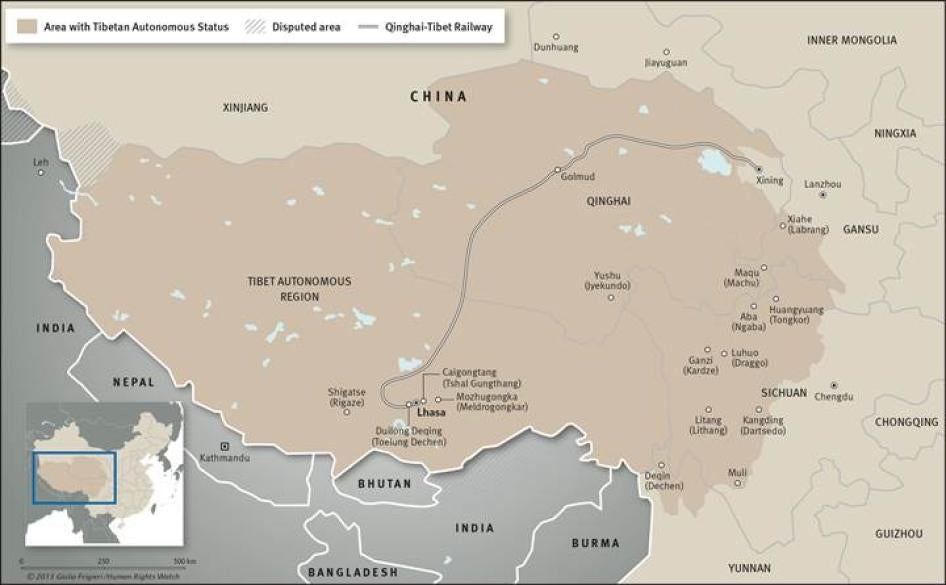
Map: Tibetan Autonomous Areas within the People’s Republic of China
Glossary
|
TAR |
Tibet Autonomous Region |
|
PRC |
People’s Republic of China |
|
ICESCR |
International Covenant on Economic, Social and Cultural Rights |
|
ICERD |
International Covenant on Elimination of All Forms of Racial Discrimination |
|
CEDAW |
Convention on the Elimination of All Forms of Discrimination against Women |
|
CAT |
The International Convention Against Torture and Other Cruel, Inhuman or Degrading Treatment or Punishment |
|
CRC |
The Convention on the Rights of the Child |
|
ICCPR |
International Covenant on Civil and Political Rights |
|
NHRAP |
National Human Rights Action Plan 2009-2010 |
|
ABoC |
Agricultural Bank of China |
Summary
Today I am living in new house with a comfortable life. I am so happy. All of my fortunes do not come from my prayers, but rather from the Communist Party.
—Dekyi, China’s Tibet Magazine, March 2009
People in the village are desperate about abandoning their homes and having to resettle. They don’t have any other skills than farming, and won’t have any herds or land worth speaking of anymore. How is the next generation going to survive as Tibetans?
—Human Rights Watch interviewee from Gyama (Ch. Jiama), Tibet Autonomous Region, July 2012
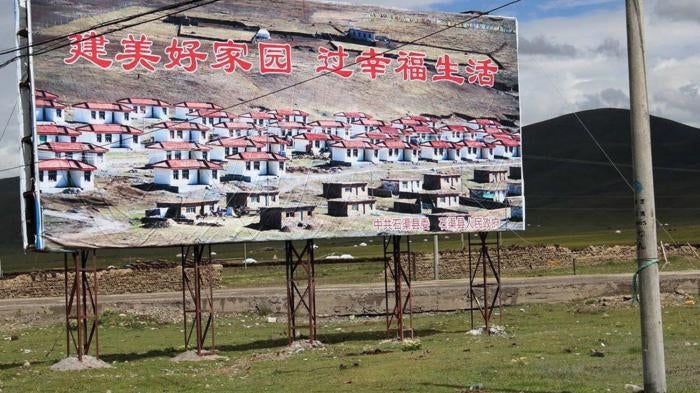
Since 2006, the Chinese government has implemented large-scale programs to “rehouse”—through renovation of existing houses or construction of new ones—a majority of the rural population of the Tibet Autonomous Region (TAR) under a policy called “Comfortable Housing.” In parallel, the government has accelerated the relocation and sedentarization of nomadic herders in the eastern part of the Tibetan plateau, mostly in Qinghai province, and laid the ground for similar policies in other parts of the plateau. Both policies are a component of the government’s effort to “Build a New Socialist Countryside” in Tibetan areas, which the government says is designed to rapidly increase the living standards of rural Tibetans and boost the local economy.
The scale and speed at which the Tibetan rural population is being remodeled by these policies is unprecedented in the post-Mao era. According to official figures, under the Comfortable Housing policy, 2 million people—more than two-thirds of the entire population of the TAR—were moved into new houses or rebuilt their own houses between 2006 and 2012. Twenty percent of those rehoused between 2006 and 2010—about 280,000 people—had to be relocated, some nearby and others at a great distance. The government intends to rehouse 180,000 more by 2015.
In Qinghai province, on the eastern part of the Tibetan plateau, the government has relocated and settled 300,000 nomadic herders since the early 2000s under “Environmental Migration” schemes, and has said it intends to sedentarize 113,000 more by the end of 2013. By then, 90 percent of the herder population of the province will have been sedentarized. A chief aspect of the policy regarding herder communities, and one that upsets many Tibetans because of its impact on Tibetan culture, is that many of those rehoused or relocated have been sedentarized, moved off the land and into permanent structures.
The policy in Tibetan areas is being used as a template for relocating ethnic minority communities in other parts of the country; in June 2011 the central government instructed all provincial units, including the TAR, Sichuan, Qinghai, Gansu, Inner-Mongolia, and Xinjiang , to complete by the end of 2014 all ongoing relocation programs for hundreds of thousands of nomadic herders.
The Chinese government asserts that all relocation and rehousing operations are entirely voluntary and respect “the will of the Tibetan farmers and herders.” It strongly denies that any forced evictions take place in the process, and suggests it is being culturally sensitive by stating that the design and appearance of the new houses suit “ethnic characteristics.” The government also claims that all those who have moved to new houses are satisfied and grateful for the improvement in their living conditions, and stories highlighting the gratitude of rehoused Tibetans since 2006 have become a prominent theme in state media in Tibetan areas.
But Tibetans coming from both farming and herding communities interviewed by Human Rights Watch between 2005 and 2012 say that large numbers of people relocated or rehoused did not do so voluntarily and that they were never consulted or offered alternatives. They say that many face financial difficulties as a result of having to move, reduce their herds, or demolish and reconstruct their houses. They claim that new settlements are sometimes inferior to the ones they previously inhabited and that many promises made to them by local officials to induce them to move have never materialized.
Despite the variety of situations, interviewees from both communities have reported a host of common issues associated with the New Socialist Villages policy. These common issues include:
- The involuntary character of many relocation and rehousing programs;
- The absence of genuine prior consultation with affected communities;
- The lack of meaningful avenues for challenging or seeking remedies for wrongful eviction orders;
- Inadequate and opaque compensation mechanisms;
- Problems with the quality of houses in which communities are resettled or rehoused;
- Increased financial burdens and indebtedness resulting from relocation and/or reconstruction of housing; and
- The loss of tangible and intangible assets and dissolution of communities.
Some of the problems identified by the Tibetans interviewed for this report, such as increased living costs, indebtedness, loss of assets, and the profound alteration of community structures, raise concerns about the sustainability of China’s mass relocation and rehousing policies, especially once the tide of initial subsidies and investments from the central government recedes. For sedentarized or resettled nomadic communities, irreversible dislocation and marginalization are already observable, a fact that even official media are starting to occasionally acknowledge. Underlying all the concerns identified above are fears among Tibetans that these policies will erase their distinct culture and way of life.
This report describes the Chinese government’s relocation of Tibetans as “forcible”, not because we have evidence that officials are using physical force to remove residents from their old homes, but because they are offering them no alternatives. Under international law, the term “forced eviction” does not require the physical removal of residents from their homes. It also applies to evictions that lack meaningful consultation and compensation, or in which no alternatives to relocation have been presented. Chinese government relocation and rehousing policies and practices effectively compel communities to follow government orders or—in the case of nomadic communities—to move into fixed settlements through policies that are presented as having the force of law.
Interviewees told Human Rights Watch that that they see the remodeling of their villages as designed in part to facilitate the Chinese government’s control of Tibetans, who already face sharp curbs on political, religious, and cultural expression imposed in the name of combatting ethnic separatist sentiment. Such fears have been heightened since the announcement in 2011 that the TAR government was planning to dispatch over 20,000 Party and government cadres to be stationed in Tibetan villages, to “live, eat and work” with the local population, “maintain stability,” “conduct propaganda work,” and “further the Comfortable Housing policy.”
Tibetans interviewed by Human Rights Watch also said that in many cases they are in effect being forced to trade poor but stable livelihood patterns for the uncertainties of a cash economy in which they are often the weakest actors.
While the Chinese government has consistently rejected all criticisms and expressions of concerns leveled against its rehousing and relocation policies, labeling them as “politically motivated,” some official reports, as well as Chinese-language academic studies, do acknowledge the existence of significant shortcomings. For instance, in 2009, an inspection team from the State Development and Reform Commission of the State Council issued a report detailing defects in the implementation of the Comfortable Housing policy in the TAR that closely matched what Tibetans interviewed by Human Rights Watch reported. The problems listed by the report include the “lack of rational design” for new houses, housing designs that ignore the actual needs of the rural population, waste of construction material for renovation, and increasing risks that households will default on the bank loans contracted to fund the renovation or rebuilding of their houses. The State Council report acknowledges that some communities have been separated from the herds and livestock that had previously helped guarantee their livelihood, and notes that some new settlements have been built on unsuitable and potentially dangerous sites.
Human Rights Watch also found compelling evidence in official policy documents and Chinese language academic studies that the households themselves bear the bulk of the costs of renovating or rebuilding their houses. Official figures show that self-financing and mandatory bank loans tend to account for financing account for up to 75 percent of the cost of renovating or relocating, a considerable financial burden for many Tibetan households, especially poor ones. This is particularly remarkable because most government public pronouncements and official media accounts—from which ordinary Tibetans derive most of their knowledge of the Comfortable Housing policy—seem to deliberately obscure the importance of household contributions, instead painting a picture in which the government alone is responsible for “solving housing difficulties.”
“Building a New Socialist Countryside”
The establishment of what the government calls “New Socialist Villages”—villages built or remodeled according to a precise set of government standards—is a core aspect of the campaign to build a “New Socialist Countryside” in Tibetan areas. While the campaign includes sometimes overlapping policies that are implemented differently from place to place, it is nonetheless possible to distinguish two broad policy streams that are being used to pressure Tibetans to move out of their traditional habitat into new or remodeled New Socialist Villages.
- The first stream is composed of the various programs that fall under the rubric of “Comfortable Housing” (anju gongcheng). Under this policy, rural Tibetans whose dwellings are deemed unsuitable by the authorities are instructed to destroy and rebuild their houses according to strict government standards, either on the same spot or in new settlements often placed alongside existing or newly built roads. Under this scheme, the cost of construction or reconstruction of the new homes is met by a combination of state subsidies, bank loans, prior savings, and other household assets. This policy is chiefly implemented in the TAR, where it was introduced in 2006, but has been extended to areas in the eastern part of the Tibetan plateau. The term “Comfortable Housing” has over time become used by the government to refer to any policy that aims to improve the living conditions of the Tibetan population, and embraces other issues such as transportation, electrification, and provision of health services.
- The second stream of policies comprises various sedentarization or resettlement schemes aimed at nomadic herder communities. Under so-called “Environmental Migrations” policy schemes, nomadic herder communities must leave the grasslands and relocate to new concentrated settlements, often in the periphery of small towns, and to reduce or sell their livestock. These schemes are chiefly implemented in eastern Tibet (Qinghai province). Human Rights Watch is unaware of any policies in the TAR or in Tibetan areas of Sichuan province that forces herder communities to sedentarize permanently, although the government encourages them to do so by building permanent habitations for them.
In addition to the significant variations between the TAR and eastern Tibet in the building of the New Socialist Countryside, there are also significant disparities in how these policies are implemented from place to place within the same provincial unit. The degree of coercion and scale of rights violations also vary considerably from place to place.
Interviews by Human Rights Watch suggest that some segments of the Tibetan population have benefitted from relocation or rehousing, including many local Tibetan government cadres, entrepreneurs and their families, as well as ordinary villagers. In some parts of the Tibetan plateau, substantial economic growth and new signs of prosperity are visible, spurred by a combination of state subsidies, massive infrastructure investments, expansion of urban centers and markets, rising demand for local medicinal products, and also by construction-related activities. Many Tibetans aspire to better living conditions and welcome many aspects of modernization.
Some Tibetans have genuinely welcomed aspects of the housing policies and benefited from them, yet many are concerned about their ability to maintain their livelihood over time. The majority consider themselves targets of policies they are powerless to oppose or affect.
Official Explanations
The Chinese government has advanced several explanations for policies mandating large-scale rehousing or relocation. The overarching explanation is the long-standing official policy of “helping Tibet” (yuan Zang), which the government says is aimed at rapidly improving the livelihood of the Tibetan population. The government stresses that its relocation and rehousing policies provide Tibetans with better housing, electricity, water, transportation, schooling, healthcare, protection against natural disasters, and foster a rapid transition to the cash economy. According to the central government, these steps offer a chance for economically backward ethnic minorities to take part in the modernization and economic development of the region and nation.
The government also cites several other objectives, including the acceleration of the exploitation of the Tibetan plateau’s natural resources and the implementation of the national Western Development campaign, launched in 2000, which aims at reducing economic disparities between the poorer Western provinces and the rest of China, in part by accelerating urbanization. In respect to herders, it consistently points to the necessity of protecting the fragile ecosystem of the Tibetan-Qinghai plateau by removing herder communities from fragile grasslands whose degradation, the government argues, is mainly caused by over-grazing.
A Context of Rising Tensions
Many of the issues documented in this report echo the problems documented in a June 2007 Human Rights Watch report which focused more narrowly on the resettlement of Tibetan herders in the eastern part of the Tibetan plateau (Qinghai province in general and the Three Rivers Area in particular). The 76-page report, “We Have No Liberty to Refuse,” concluded that the resettlement campaign to move Tibetan herders had often been conducted without consultation or adequate compensation and carried significant risks of impoverishment for the affected communities as a result of loss of traditional livelihoods.
In researching the current report, we found that many of the concerns we raised in 2007 about herder communities have been borne out: the unsustainability of the new settlements, deteriorating living conditions for many, and greater uncertainty about the future. A number of official Chinese-language studies have also come to the same conclusions, and several of those studies are excerpted or summarized in this report. Some Chinese analysts have even expressed concern about the “rash” character of resettlement policies, pointing to a long list of adverse and unforeseen difficulties faced by previously relocated communities. Other studies detail the considerable difficulties faced by newly relocated Tibetans, who have been deprived of their traditional livelihood resources but remain too marginalized to engage in alternative income-generating activities. Many are unable to compete with an increased flow of Chinese migrants from the rest of the country, while insufficient infrastructure and the flaws in the quality of housing settlements become increasingly apparent over time.
The New Socialist Villages campaign also has larger implications for the relationship between Tibetans and the Chinese state. Human Rights Watch’s 2007 report pointed to several studies by Chinese scholars who warned that frictions resulting from ill-thought relocation policies “could severely influence the social and political stability” of the region and evolve into ethnic unrest. It is unclear how much dissatisfaction over mandatory relocation and rehousing polices contributed to the large-scale protests that rippled across the Tibetan plateau in 2008, the largest wave of popular protests in two decades (the subject of “I Saw It with My Own Eyes,” a Human Rights Watch report published in July 2010).
The 2008 protests did not lead to a reappraisal of policies towards Tibetans, including mass relocation and rehousing policies. Since that time, the government has actually accelerated its mass relocation and rehousing efforts, and increased political and religious restrictions. In August 2011, the central government announced that it intended to expedite and expand its relocation and rehousing policies beyond the Tibetan areas, and sedentarize most of the remaining nomadic communities by 2015, including Kazakh and Kyrgyz communities in the Xinjiang Uighur Autonomous Region and Mongols in Inner Mongolia. This is similar to the government’s response to the wave of Tibetan self-immolations that followed the suppression of the 2008 protests: adopting progressively tougher rhetoric and repressive measures while refusing to consider any key policy changes.
To date, the Chinese government has given no indication that it will accommodate the apparent aspirations of Tibetan people for greater autonomy, even within the narrow confines of the country's autonomy law on ethnic minorities' areas. Instead, because it views Tibetans’ distinct culture as a potential vehicle for ethno-nationalist aspirations, the Chinese state has undertaken a series of efforts, through political suppression and economic modernization, to remodel Tibetan society in a way that guarantees China’s long term “cultural security.”
As a result, Tibetans suspected of being critical of official political, religious, cultural, or economic policies are systematically targeted and accused of “separatism,” disruption of public order, or other crimes. Most people interviewed for this report said they were afraid to challenge the massive relocation or rehousing campaigns, since they are portrayed by the government as major political decisions to which opposition is not an option.
Looking Ahead
The Chinese government has deliberately obscured the full impact of its policies by refusing to allow any independent fact-finding investigations in Tibetan areas. Closed at the best of times to human rights investigations, access to the Tibetan plateau, especially to the TAR, has remained extremely limited for academics, journalists, diplomats, and even foreign tourists since the 2008 protests and the ensuing crackdown. Tight censorship on Tibetan and minority issues effectively prevent objective domestic monitoring.
Relocation and rehousing policies are often cited by government officials as an integral part of larger political objectives such as combating ethno-national or “separatist” sentiment among Tibetans. National and regional authorities point to material advances in the livelihood of Tibetans in recent decades as evidence of the legitimacy of Chinese rule over Tibet. They also celebrate the ways these policies facilitate the progressive “homogenization of the Chinese nation,” inculcating loyalty for the Communist Party and the government among Tibetans, and strengthening overall national security. In practice, officials often conflate criticism of state policies with a threat to national security.
These factors help explain why activism on housing rights in other parts of China has been on the rise, but is strikingly absent in Tibetan areas. Protests in Tibetan areas are almost systematically labeled as anti-state or inspired by a “separatist” agenda and immediately suppressed. Without an independent judiciary to turn to, Tibetans told Human Rights Watch that in practice the law is little other than what officials say it is. Tibetan communities are effectively powerless in lawfully opposing or negotiating against relocation and rehousing orders.
Implementation of policies that are overtly aimed at refashioning rural Tibetan society has the potential to exacerbate an already volatile political situation in Tibetan areas. The semi-permanent garrisoning of large numbers of troops on the plateau since 2008, as well as the introduction of new social control mechanisms—dispatching thousands of party cadres to be stationed in villages, permanently posting government cadres inside Tibetan monasteries, and deploying new party structures tasked with monitoring households in urban areas—amply illustrate the concern of the Chinese government about the widespread dissatisfaction of the Tibetan population.
The official presentation of the policy of building of a New Socialist Countryside in Tibetan areas as a way to establish “long term peace and stability” (changzhi jiu’an) over China’s borderlands might also be an indication that Beijing believes such strategic goals override short-term risks of unrest. But forging ahead with mass relocation and rehousing programs in a broadly repressive environment may create an even more incendiary situation that could explode as it did in 2008, and create an irreparable rift between Tibetans and the Chinese state.
Such tensions would be significantly decreased by suspending mass rehousing and relocation policies until the Chinese government commits to carrying them out consistent with international human rights standards on economic, social, and cultural rights, particularly with respect to the right to livelihood and housing rights.
Above all, in order to ensure that Tibetan households are genuinely voluntarily agreeing to be rehoused or relocated, the government must establish credible consultation mechanisms that spell out the legal rights of households targeted by these programs and the legal avenues available to them under Chinese law to defend them. These consultations must truthfully inform targeted households about the economic implications and financial cost entailed by Comfortable Housing schemes, where households typically end up having to finance up to 70 percent of the cost of rehousing. To ensure that these consultation mechanisms are meaningful, the government must depoliticize the nature of rehousing and relocation programs, delinking them from its “anti-separatism” agenda and guaranteeing that criticisms of or opposition to these programs will not be construed or prosecuted as “inciting national disunity,” “fanning ethnic separatism,” “disrupting public order,” or other criminal charges regularly leveled against Tibetans who speak out against government policies.
The government should also quickly suspend all relocations of herding communities. Mounting scientific evidence is calling into question the government’s justification for removing herders from their pastures, and empirical research on relocated communities indicates that the schemes to successfully help transition communities from seasonal nomadism to sedentarization are failing. Where overgrazing is genuinely a factor of pasture degradation, the government should, in consultation with local communities, design solutions so as to reduce herd size or expand grazing areas, but sedentarization should always remain voluntary.
Defusing larger political tensions in Tibetan areas requires that the government address long-standing grievances. It should implement the autonomy statutes listed in the PRC Autonomy Law in a way that actually devolves substantial policymaking power to Tibetans, including over economic and cultural matters, in line with relevant international legal standards.
Key Recommendations
The Chinese government should:
- Impose a moratorium on relocation and rehousing until an independent, expert review of existing policies and practices is carried out to determine whether they comply with international law. The review should assess all government policies that require or lead to the displacement and resettlement of rural Tibetans, confiscation of their property, or imposed slaughter of their livestock.
- Where consultation and compensation have been inadequate, the government should give affected individuals and families the opportunity to return to their original land, to be resettled in an area nearby or like the one from which they were removed, and to receive appropriate compensation as required by Chinese law.
- Where those adversely affected by relocation and rehousing policies are unable to provide for themselves, authorities should take measures to ensure that adequate alternative means of livelihood are available, including return to herding.
- To comply with the recommendations of the United Nations Committee on Economic, Social, and Cultural Rights and other human rights treaty obligations, authorities should review the Property Rights Law 2007 to ensure it guarantees meaningful security of tenure to occupiers of houses and land.
- Recognize and uphold the rights to freedom of expression, assembly, and association to ensure that Tibetans and others are able to engage in peaceful activities and raise concerns and criticisms, including of government relocation and rehousing policies and practices.
Human Rights Watch also urges members and participants in the 2013 Universal Periodic Review of China at the UN Human Rights Council to call on the government to impose a moratorium on all relocation and rehousing programs until they meet international standards.
Detailed recommendations are presented at the end of this report.
Methodology
China does not allow independent, impartial organizations to freely conduct research or monitor human rights concerns inside Tibetan areas. As a result, obtaining and verifying credible information presents significant challenges.
Human Rights Watch interviewed 114 Tibetans outside China between March 2005 and June 2012. The interviews were conducted by speakers of all three main Tibetan regional languages, transcribed, and then translated into English. Thirteen interviews were conducted directly in English through an interpreter. Interviewees included respondents coming from the Tibet Autonomous Region, as well as Tibetan areas in the Sichuan and Qinghai provinces.
The interviews were conducted as soon as possible after the interviewees had traveled out of Tibetan areas of the People’s Republic of China (PRC). In some cases, the individuals had already traveled for several weeks. Interviewers used open interviews, in which interviewees were not immediately prompted about relocation or rehousing policies but were instead asked to recount their experiences and identify current issues in the area from which they came.
All interviews were extensively checked for consistency and factual accuracy. Except where stated, information from interviews has been used only where it could be corroborated by other interviews or secondary sources, including official Chinese media and government reports. The testimonies of Tibetan interviewees who had elected to leave China were compared to information coming from non-refugees to guard against the risks of generalization on the basis of a self-selected group. To protect their identities, the names of all Tibetan interviewees have been changed, and the location where they were interviewed has been withheld. However, the interviewee’s place of origin is indicated when possible.
All those we interviewed were informed of the purpose of the interview, its voluntary nature, and the ways in which the information would be used. All interviewees provided verbal consent to be interviewed. All were informed that they could decline to answer questions or could end the interview at any time and that no compensation would be provided for participating.
In researching this report, Human Rights Watch also had access to a number of Chinese official documents and academic studies, which confirm and verify the existence of widespread problems in the design and implementation of resettlement policies in Tibetan areas. They are cited at relevant points in the text below. The report also makes uses of satellite imagery to illustrate the extent to which some settlements have been remodelled as a result of mandatory rehousing policies.
With the exception of Lhasa, the report refers to all place names according to their transcription in Pinyin (Standard Mandarin Romanization), except when quoting directly from interview material, in which case the original appellation given by the interviewee is maintained. In both cases the name is followed by the transcription in the alternate language between parenthesis, with respectively “Tib.” for Tibetan and “Ch.” for Chinese, the first time the name appears. Example: Aba (Tib. Ngaba); Kardze (Ch. Ganzi).
Human Rights Watch takes no position regarding the political status of Tibet. The report uses the term “Tibet” to refer to the Tibet Autonomous Region (TAR) of the PRC and “Tibetan areas” to refer to all officially designated Tibetan areas and areas where the Tibetan population is the largest ethnic group.
Geographical names of prefectures, counties, towns, and villages are given in this report in Chinese Pinyin, with the Tibetan variant given in parentheses. A table of geographical names mentioned in this report is included as an appendix to this report.
I. Overview of the Human Rights Situation
Tibetans living under Chinese rule have a long and well-documented history of unaddressed social, political, religious, and economic grievances. The Chinese government refuses to recognize the validity of virtually all criticisms leveled against state policies in Tibetan areas. It continues to frame almost all critiques of its policies and practices as efforts to undermine its claim of sovereignty over the Tibetan areas, claiming that the country's territorial integrity and inter-ethnic relations are threatened by a secessionist movement supported by “hostile foreign forces.”[1]
The Chinese authorities systematically reject allegations of human rights violations in Tibetan areas, claiming they are conspiracies to fan ethnic dissatisfaction against the Communist Party and government. The government usually stresses that Tibetans' rights are fully guaranteed under the law, and point to political, social, and economic development over the past half-century as signs that the human rights of ethnic Tibetans are fully protected. In a typical statement of these claims, a government White Paper published in March 2011, “Fifty Years of Democratic Reform in Tibet,” asserts:
Over the past half century, thanks to the care of the Central People's Government and aid from the whole nation, the liberated people of all ethnic groups in Tibet have, in the capacity of masters of the nation, enthusiastically participated in the grand course of constructing a new society and creating a new lifestyle, and worked unprecedented miracles in Tibetan history. The social system of Tibet has developed by leaps and bounds; its modernization has advanced rapidly; Tibetan society has undergone earth-shaking historic changes; and remarkable progress has been witnessed in the cause of human rights that has attracted worldwide attention.[2]
Tibetans in ChinaAccording to the 2010 census, about 6.2 million ethnic Tibetans live in China. 2.7 million live in the Tibet Autonomous Region (TAR), which occupies the western half of the distinctive geographic area known as the Tibetan plateau. Most of the other 3.5 million Tibetans live in the eastern part of the plateau, in officially designated “Tibetan Autonomous Prefectures and Counties,” which are in the provinces of Qinghai, Sichuan, Gansu, and Yunnan. Tibetans generally divide the plateau into U-Tsang (roughly the area of the TAR), Amdo (the north-eastern part of the plateau, part of Qinghai and Gansu provinces), and Kham (the south-eastern part of the plateau, part of Sichuan and Yunnan provinces). |
The reality, however, is that severe, longstanding human rights violations by the Chinese state against Tibetans continue, irrespective of disputes over the political status of Tibet and the real or imagined motives of different parties and commentators. Sharp statutory restrictions on basic rights and freedoms, religious persecution against the clergy and laity, socio-economic and political discrimination, political prosecutions and torture, and mistreatment of prisoners have all been authoritatively documented over the years, including by inter-governmental bodies such as the United Nations.
UN bodies that have raised concerns about the situation of Tibetans in recent years include the United Nations Committee on the Elimination of Racial Discrimination, which recommended that China “carefully consider the root cause” of the ethnic incidents in Tibet and Xinjiang; the Committee on the Rights of the Child; the Committee on the Elimination of Discrimination Against Women; the Committee on the Elimination of All Forms of Discrimination; the Working Group on Arbitrary Detention; the Working Group on Enforced or Involuntary Disappearances; the Special Representative of the Secretary-General on the Situation of Human Rights Defenders; and the UN special rapporteurs on, respectively, Freedom of Religion or Belief, the Right to Education, the Right to Food Security, and on the Promotion and Protection of the Right to Freedom of Opinion and Expression.[3]
Human Rights Watch has documented in recent years severe and systematic human rights abuses, including religious repression, torture, disappearances, politically motivated trials, and disproportionate use of force by security forces.[4]
The 2008 Protests and Their Aftermath
The relationship between the Chinese state and Tibetans significantly deteriorated in the wake of Tibetan protests across the plateau in the spring of 2008.
From March 10, the anniversary of the failed 1959 uprising and the Dalai Lama’s subsequent escape to India, to March 14, 2008, monks from major monasteries in the Lhasa area attempted to hold peaceful demonstrations but were prevented from doing so by security forces. At that point, authorities of the TAR—who to date have not explained this decision—withdrew all security and police forces from central Lhasa for nearly two days, allowing rioting and arson by small groups of protesters. They attacked symbols of the Chinese state, such as police stations and official buildings, and set fire to shops they believed were owned by ethnic Chinese. A number of Chinese-looking people were assaulted and beaten on the street. Twenty-one people, including Han and Tibetans, were killed and several hundred injured in the violence.[5]
The government reacted by sealing off the TAR, imposing quasi-martial law in Lhasa and other areas, expelling almost all journalists and foreigners, and dispatching large numbers of troops from neighboring provinces. State media broadcast footage of the violence and attributed it to a plot by the “Dalai Clique” to sabotage the 2008 Beijing Olympics and fan inter-ethnic tensions. It announced a “life-and-death struggle” against the “separatist forces.” As news and images of the violence in Lhasa spread, dozens of protests erupted throughout the Tibetan plateau, many put down forcibly by Chinese security forces.
In the aftermath of the protests the government launched an unprecedented crackdown that led to thousands of arrests, at least dozens of convictions, and the permanent presence of large number of armed police forces throughout the region.
This crackdown was documented in a July 2010 Human Rights Watch’s report, “I Saw It with My Own Eyes: Abuses by Chinese Security Forces in Tibet, 2008-2010.”[6] The report, based on eyewitness testimonies, detailed abuses committed by security forces during and after protests, including use of disproportionate force in breaking up protests, firing on unarmed protesters, conducting large-scale arbitrary arrests, brutalizing detainees, and torturing suspects in custody.
The government rejected the findings of the report, which established that China had broken international law in its handling of the 2008 protests, and accused Human Rights Watch of "fabricating material aimed at boosting the morale of anti-China forces, misleading the general public and vilifying the Chinese government," but failed to respond to any of the report's substantive allegations.[7]
In September 2009, Navanetham Pillay, the UN High Commissioner on Human Rights, called on the Chinese government “to reflect on the underlying causes” of unrest in ethnic areas, “which include discrimination and the failure to protect minority rights.” [8] Instead, the government introduced additional restrictions on access, movement, and communications in Tibetan areas. It implemented a new policy for controlling Tibetan monasteries in which police and government cadres are permanently stationed inside religious institutions. [9]
Self-Immolations
Tensions further increased after a Tibetan monk from Kirti monastery in Aba, Sichuan province, set himself on fire in March 2011 in protest of religious restrictions, triggering an unprecedented wave of similar self-immolations to the present.
By June 15, 2013, about 119 more Tibetans had set themselves on fire in protest, mostly in eastern Tibet. [10] The Tibetan government-in-exile said that self-immolations reflected the “despair” of Tibetans living in China, [11] while the Chinese government characterized the self-immolations as “terrorism in disguise” [12] and accused the Dalai Lama of having “encouraged” them to “disrupt social harmony.” [13] The government then undertook further efforts to seal off Tibet from outside information, [14] continued to increase the numbers of security forces present, [15] introduced a system whereby monasteries are placed under the direct rule of government officials permanently stationed in religious institutions, [16] and imposed much stricter controls over the movement of ethnic Tibetans, including residents in Lhasa. [17]
II. Origin of Rehousing and Relocation Policies
Since the early 1950s, the Chinese government has carried out a variety of policies to modernize and remodel Tibetan rural society and to encourage the sedentarization of nomadic or semi-nomadic people. These efforts have always been closely associated with larger goals: developing the economy, intensifying exploitation of the Tibetan plateau’s natural resources, and securing political control over an ethnic minority in a region where the legitimacy of Chinese rule remains contested.
Tibet’s current relocation and rehousing policies can be traced to the 1994 Third Work Conference on Tibet , which introduced a strategy combining rapid economic growth with increased political and religious repression designed to curtail the Dalai Lama’s influence.[18] All major policies introduced since that session are a continuation of this basic design, implemented through regional Five-Year Plans designed by central government authorities.[19]
This section provides an overview of these policies and their rehousing and relocation components, starting with the launch of the Great Development of the West in 2000 and culminating in the Leapfrog Development strategy introduced in 2010.[20] It also provides a brief overview of the debate about whether Tibetans have benefited from this economic growth.
The Great Development of the West (2000)
The launch of the national “Great Development of the West” (xibu da kaifa) campaign in 2000 heralded an era of major changes in Tibetan areas, with significant implications for farmers and herders through the introduction of “environmental migration schemes.”[21]
The campaign, officially aimed at “eliminating regional disparities gradually, strengthening the unity of ethnic groups, ensuring safety and social stability and promoting progress,” was a watershed in the state’s attempt to integrate ethnic minority areas.[22] It combined major infrastructure investments, especially in transportation and energy; a massive increase in exploitation of natural resources; renewed efforts to draw foreign and domestic investment; and closer integration with developed areas in the eastern part of China.
The campaign also encompassed major projects aimed at responding to what central government policymakers saw as mounting environmental crises marked by increased desertification, degradation of grassland, deforestation, and declining water resources. The government decided to invest in several major environmental protection programs and to develop programs to resettle populations outside areas designated as ecologically fragile, a strategy referred to as “environmental migration” (shengtai yimin).[23]
Two environmental migration schemes introduced then, and still in place today, entail at times relocating communities:
- “Reverting farmland to forest” (tuigeng huanlin), which entails planting trees on marginal farmland to reduce the threat of soil erosion.[24] In Tibetan areas, this policy requires farmers to provide labor and other inputs for tree planting, and to move off their land and seek alternative livelihoods, though they are given some initial subsidies to help in this transition. In some areas, the policy has been used to justify arbitrary land confiscation. Some schemes have been poorly implemented, leading to adverse ecological consequences.[25] In other places, villagers have been able to take advantage of the policy to receive subsidies from the state, though the ecological benefits remain dubious.
- “Reverting pasture to grassland” (tuimu huancao), which aims at reversing degradation in pastoral regions by imposing total, temporary, or seasonal bans on grazing.[26] The comprehensive overhaul of the Grassland Law in 2002 increased governmental power to limit herds and resettle people to “protect, develop and make rational use of grasslands.”[27]
The New Socialist Countryside and the Comfortable Housing Campaign (2005-present)
In 2005, radical plans to transform the housing of rural Tibetans in the TAR as part of an effort to improve “the production and living conditions of farmers and herdsmen, and increase their income” were introduced as part of the nation-wide initiative to “Build a New Socialist Countryside” (jianshe xin shehuizhuyi nongcun).[28]
The campaign entails establishing “New Socialist Villages” (xinshehuizhuyi nongcun), “close to communications, transportation and economic activity,” through the renovation or remodeling of villages and settlements, and the construction of new villages where relocation is thought necessary. It also entails providing “eight connections to rural homes” (badao nongjia): water, electricity, natural gas, roads, telecommunications, state media broadcasting, postal services, and an “exquisite environment.”[29]
The “Comfortable Housing” policy (anjugongcheng)—one of the key efforts discussed in this report—was launched in 2006 to carry out the renovation or reconstruction of individual homes as part of the New Socialist Villages policy.[30] According to the government’s 11th Five-Year Plan (2006-2010), the campaign was to ensure that 80 percent of Tibetan farmers and herders in the TAR—1.4 million people—would live in “safe and suitable housing within five years.”[31]
The scope and speed of execution of the Comfortable Housing campaign in the TAR are unprecedented. At the end of 2012, the TAR government reported having met the objectives for the 2006-2012 period, with “2.1 million farmers and herdsmen [having] moved into affordable houses since the affordable housing project started.”[32] About 20 percent, or 280,000 people, of those rehoused between 2006 and 2010 had to be relocated.[33] Post-2010 relocation figures are not available. In February 2011, the TAR government announced its intention to rehouse and relocate 185,000 rural households, or about 900,000 people, within three years.[34]
The Leapfrog Development Strategy (2010)
In January 2010, the central government convened the Fifth National Work Conference on Tibet to design policies in response to the 2008 Tibetan protests. Maintaining its view that its Tibet policies “[had] been proved to be entirely correct,” and confident in the fact that economic growth was the best strategy to counter rising tensions, the government announced an even more ambitious rapid-growth strategy for Tibet, called the “ Leapfrog Development Strategy” (kuayueshi fazhan zhanlüe).[35]
The “Leapfrog Development Strategy” is characterized by even greater investment and even broader plans to spur economic growth and further reorganize the Tibetan countryside.[36] For the first time, the strategy includes Tibetan areas outside of the TAR. Its stated objective is to raise the per capita net income of farmers and herders in Tibet to “close to the national level” by 2020.[37] The “Leapfrog Development Strategy” includes “the combination of economic growth, well-off life, a healthy eco-environment, and social stability and progress,” state media quoted President Hu Jintao as saying at the conference.[38]
The establishment of New Socialist Villages through rehousing, renovation and relocation are a key element of the “Leapfrog Development Strategy.” Government experts claimed that the rationale is to bypass the otherwise long and uncertain process of gradually bringing development and modernity to a vast minority nationality region lagging far behind the rest of the country. In those regions, this view holds, development is hindered by factors including dispersion across a vast, relatively inaccessible territory; differences in settlement patterns that complicate the design and implementation of national development strategies; cultural barriers that prevent or slow the introduction of new policies; and traditional modes of subsistence that are considered incompatible with modernization and the rational exploitation of local natural resources.[39]
To that end, the “Leapfrog Development Strategy” includes a continuation of the radical mass relocation programs initiated under the “ecological migration” and comfortable housing campaigns. In addition to plans in the TAR to relocate over 900,000 people by the end of 2014, the Qinghai government announced in 2009 its ambition to permanently settle all Tibetan herders in the province—over half a million people—by 2014.[40]
The Comfortable Housing policy and the settlement of nomadic communities have also been expanded to other areas with significant ethnic minority populations, also on an unprecedented scale and with unusual speed: the Xinjiang Uighur Autonomous Region, home to 8.5 million Turkic-speaking Uighurs, announced it was aiming at rehousing and relocating 1.5 million households between 2011 and 2015 as part of the Comfortable Housing campaign there, at a cost of over 3 billion Yuan.[41] It also announced that 272,000 herding households (about 760,000 people) would be settled within 10 years.[42]
Also reflecting the acceleration of nomad settlement policies, in June 2011, the State Council ordered all 13 provinces with significant grasslands, including Qinghai, Sichuan, Gansu, Inner Mongolia and Xinjiang, to “basically complete the relocation and settlement of nomad [programs] by the end of 2015.”[43] A state media interview with an official from the State Development and Reform Commission (SDRC) in August 2011 noted that the State Council directive was based on the findings of a report by a “joint special investigation task force” involving 28 ministries.[44] Despite the fact that this plan entails the relocation of several hundred thousand people across the country within just four years, there is very little evidence that any consultations were carried out and the report itself has not been made public.[45]
Who Benefits?
The high-growth policies implemented by the central government since the mid-1990s have greatly transformed conditions in the Tibetan plateau.
According to official statistics, the TAR economy more than quadrupled from 1997 to 2007, consistently growing at a faster rate than the rest of the country.[46] Between 2005 and 2010, the average per capita income of farmers and herders doubled, while the number of households earning the lowest income was almost halved, decreasing from 964,000 to slightly over half a million.[47] The tourism industry expanded rapidly, with a tenfold increase in the number of tourists between 2000 and 2010, thanks in part to the new railway and the renovation of the Lhasa airport. In part as a result of these developments, the proportion of farmers and herders in the rural work force decreased significantly, from 76 percent in 1999 to 56 percent in 2008.[48]
Yet socio-economic tensions also became more acute during this period. Most of the recorded growth, official statistics show, came from state-sponsored infrastructure projects and increased exploitation of natural resources shipped to the industrial centers in China proper.[49] Discontent over the rapid increase of the Chinese-speaking population on the plateau, especially migrant workers, as well as a rise in economic disparities and the perceived unequal distribution of the benefits of natural resource extractions, increased sharply.[50] Ever-increasing restrictions on social-cultural expression have further fueled resentment.[51]
In addition, the extent to which local populations have benefited economically from this growth remains a contentious issue. The Tibetan government in exile and Tibetan advocacy groups have consistently claimed that these policies have increasingly marginalized local populations in their homeland and that the primary beneficiaries of increased economic activity are state entities and Chinese-speaking migrants, furthering the goal of cementing China’s control over Tibet.[52] Some scholars have also argued that the state-led growth in Tibetan areas has essentially been “exclusionary,”[53] “an artificially-sustained subsidy bubble”[54] that has accentuated “polarization and effective ethnic discrimination.”[55]
In contrast, other scholars, such as Melvyn Goldstein, a leading Tibetologist and head of the Center for Research on Tibet at Ohio’s Case Western University, have argued that rural Tibetans in the TAR have substantially benefited from the state’s “concerted effort to improve living conditions in rural Tibet,” and that changes in the countryside represent a “major paradigm shift from a predominately subsistence agricultural economy to a new mixed economy in which non-farm income plays a dominant role.”[56] In a joint article in The China Journal published in 2008, Goldstein, Childs, and Wangdui wrote:
In contrast to the widespread academic, political and human rights criticism that the 9th and 10th Five-Year Plans marginalized rather than benefited rural Tibetans, our research has shown that there was a significant trickle-down effect that provided rural Tibetans opportunities to earn non-farm cash income by working as migrant laborers. Rural Tibetans clearly were actively competing in the market economy to improve their standard of living.[57]
While not disputing that Tibetans had little voice in designing these far-reaching policies, the authors suggest that Beijing’s overriding objective remains “to demonstrate to rural Tibetans that their best hope for a positive future lies within the People’s Republic of China.”[58]
Both sides of the debate raise doubts about the sustainability of economic development policies that have rested mostly on massive subsidies and made the Tibetan economy ever more dependent on continued government subsidies.[59] (See Chapter IX for a fuller discussion of Goldstein, Childs and Wangdui’s findings).
Notwithstanding these debates, the unprecedented 2008 protests and the large numbers of self-immolations starting in 2011 seem to indicate that considerable disaffection over Chinese policies on the Tibetan plateau has built up over time.[60] As the authors of a rare independent investigation into the cause of the 2008 protests by a Beijing-based Chinese legal aid group wrote:
In terms of actual benefits, the current rapid process of modernization has not given the ordinary Tibetan people any greater developmental benefits; as a matter of fact, they are becoming increasingly marginalized.[61]
While Beijing put the sole responsibility for these protests on the “Dalai clique,” accumulated socio-economic discontent, along with the twin fears of growing Chinese domination and loss of Tibetan culture, appear to have contributed to the large-scale spontaneous mobilization in 2008.[62] This examination of large-scale rehousing and relocation policies, which shows that improvement in material standards have been achieved during a period of widespread human rights violations, suggests that economic growth alone is unlikely to lower tensions on the Tibetan plateau.
The Chinese Government’s Response to the 2007 Human Rights Watch Report on Tibetan Herder Relocation ProgramsIn June 2007 Human Rights Watch issued a 76-page report describing widespread shortcomings and rights violations in herders’ resettlement policies, based on testimonies gathered from residents who had recently left the affected areas, Chinese academic research, and official media reports.[63] The report, “No One Has the Liberty to Refuse: Tibetan Herders Forcibly Relocated in Gansu, Qinghai, Sichuan and the Tibetan Autonomous Region,” showed that the resettlement campaign to move Tibetan herders had often been conducted without consultation or adequate compensation, and carried significant risks of impoverishment for the affected communities due to loss of traditional livelihoods. The report cited several studies by Chinese scholars who warned that frictions due to the policies “could severely influence the [regional] social and political stability” and devolve into ethnic unrest, a concern apparently borne out by the 2008 protests. The Chinese government’s response to the Human Rights Watch report was that the issue of forced relocation “did not exist.”[64] Several articles subsequently published by the Xinhua state news agency stressed that the population “welcomed” the relocation programs that had led to considerable rise in living standards.[65] After Human Rights Watch reiterated its concerns in its annual World Report in 2011, the People’s Daily, the flagship publication of the Communist Party of China, ran an article rejecting “unfounded accusations against Chinese economic policies,” and ascribed unspecified “ulterior motives” to the report.[66] An English-language version of the article ran the next day in the China Daily, the government’s English flagship newspaper, under the title: “How Can Building Homes for Tibetan People Violate Human Rights?”[67] The article, authored by two scholars at the government’s China Tibetology Research Center in Beijing, stated: [Human Rights Watch] made some unfounded accusations against Chinese economic policies, including the "comfortable housing project" in the Tibet autonomous region. The project is widely welcomed by local residents, but Human Rights Watch distorted facts and singled it out as a human rights violation.[68] The article also disputed the number of people resettled, writing that, “according to our research, in the past six years the number of farmers and nomads who have been relocated is about 150,000, less than 5 percent of the whole population”—while somewhat confusingly acknowledging that “statistics indicate 1.85 million herdsmen and nomads - 61 percent of the total population - had settled down by 2011.” The authors also argued that since the beneficiaries of the Comfortable Housing campaign “still live in places where their ancestors lived,” and therefore one should consider that “[t]hey did not move or relocate.” As this report details, the government’s own official reports attest to large-scale relocation. |
III. Applicable Legal Standards
International Standards
The Right to Property and Security of Tenure
The right to property and security of tenure is widely recognized under international law. The Universal Declaration of Human Rights, which is broadly acknowledged as a statement of customary international law, states that “[e]veryone has the right to own property alone as well as in association with others,” and that “[n]o one shall be arbitrarily deprived of his property.”[69]
The United Nations Commission on Human Rights further affirmed in 1993 that “the practice of forced eviction constitutes a gross violation of human rights,” and urged governments to “undertake immediate measures, at all levels, aimed at eliminating the practice of forced eviction” and to “confer legal security of tenure on all persons currently threatened with forced eviction.”[70]
As detailed here, governments are nonetheless generally entitled to expropriate land for public purposes, if done in conformity with the provisions of international human rights law, including public participation, due process, and adequate compensation.[71] In other words, respect for international human rights law does not prohibit development or modernization projects that entail displacement, but imposes conditions and procedural limits on it.
Forced Evictions and the Right to Adequate Housing
The right to procedural protections against forced or compelled eviction derives from the right to adequate housing as provided by the International Covenant on Economic, Social and Cultural Rights (ICECSR), to which China is a state party.[72] Article 11 of the covenant sets forth that “States Parties to the present Covenant recognize the right of everyone to an adequate standard of living […] including adequate […] housing.”
The UN Committee on Economic, Social and Cultural Rights, established to oversee compliance of state parties with the ICECSR, has defined forced evictions as “the permanent or temporary removal against their will of individuals, families and/or communities from the homes and/or land which they occupy, without the provision of, and access to, appropriate forms of legal or other protection.”[73] Physical force does not have to be used in a forced eviction.
The committee has stated that the prohibition on forced evictions does not, however, apply to “evictions carried out by force in accordance with the law and in conformity with the provisions of the International Covenants on Human Rights.” It has stressed that “instances of forced eviction are prima facie incompatible with the requirements of the Covenant and can only be justified in the most exceptional circumstances, and in accordance with the relevant principles of international law.”[74]
The indivisibility of economic, social and cultural rights from civil and political rights provides the backdrop for distinguishing unjustified instances of eviction from those that can be considered lawful in human rights terms.
The UN Committee on Economic, Social and Cultural Rights has emphasized that for evictions to be lawful under the Covenant, they must be “solely for the purpose of promoting the general welfare in a democratic society[75] and carried out “in strict compliance with the relevant provisions of international human rights law and in accordance with general principles of reasonableness and proportionality.”[76]
The committee noted that as a way to minimize the need for force, “all feasible alternatives” to eviction must have been “explored.” This exploration, “particularly in cases involving large groups,” must have been conducted “in consultation with affected persons.”[77] Should the decision to evict stand, it is important that “legal remedies or procedures should be provided to those who are affected by eviction orders,”[78] and that “individuals concerned have a right to adequate compensation for any property, both personal and real, which is affected.”[79]
The committee in General Comment 7 further elaborated on the procedural and due process protections derived from general principles of human rights law that must be applied in any situation of forced eviction, including:
- An opportunity for genuine consultation with those affected;
- Adequate and reasonable notice for all affected persons prior to the scheduled date of eviction;
- Information on the proposed evictions and where applicable, on the alternative purpose for which the land or housing is to be used, to be made available in reasonable time to all those affected;
- Especially where groups of people are involved, government officials or their representatives to be present during any eviction;
- All persons carrying out the eviction to be properly identified;
- Evictions not to take place in particularly bad weather or at night unless the affected persons consent otherwise;
- Provision of legal remedies; and
- Provision, where possible, of legal aid to persons who are in need of it to seek redress from the courts.[80]
Finally, evictions “must not render persons homeless or vulnerable to the violation of other human rights.”[81]
Additional Standards Regarding Development-Based Forced Evictions
Recognition that most forced evictions around the world are carried out in the name of development has led to the concept of “development-based evictions,” especially as many governments invoke the “right to development” as a justification for eviction programs.[82]
The 1993 Vienna Declaration and Plan of Action, endorsed by the UN General Assembly and in which China participated, had already provided that while development facilitates the enjoyment of all human rights, “the lack of development may not be invoked to justify the abridgment of internationally recognized human rights.”[83]
The UN Office of the High Commissioner on Human Rights and the UN special rapporteur on the right to adequate housing have subsequently offered additional prescriptions that clarify state obligations in complying with human rights standards when forcibly removing populations due to large scale development projects.[84]
Although not yet formally adopted by states, the Comprehensive Guidelines constitute an important framework for protecting individuals and communities against human rights violations arising from forced evictions, and reflect and detail the principles contained in General Comments Nos. 4 and 7 referred to above.
The UN Comprehensive Human Rights Guidelines on Development-Based Displacement,[85] adopted in 1997, mandate, inter alia:
- The obligation to expropriate only as a last resort;
- The obligation to explore all possible alternatives; and
- The obligation to provide effective legal remedies, including a fair hearing before a competent, impartial, and independent court or tribunal, legal counsel, and where necessary, sufficient legal aid.
The guidelines from the special rapporteur mandate that governments:
- Lay down stringent criteria under which displacement can occur in “exceptional circumstances,” with “full justification” and procedural guarantees;[86]
- Enumerate detailed steps to be taken by states to protect human rights prior to, during, and after evictions;[87]
- Call for comprehensive “eviction-impact assessments” to be carried out prior to displacement;[88]
- Call for provision of compensation, restitution, and adequate rehabilitation consistent with human rights standards[89]; and
- Establish a “right to resettle” consistent with the right to adequate housing for displaced communities living in adverse conditions.[90]
A number of international financing organizations, such as the World Bank[91] and the Asian Development Bank,[92] have also developed standards for the financing of projects causing relocation. These standards currently fall short of international human rights law.[93]
In July 2000 the Chinese government withdrew its request for World Bank support for a project that would have led to the resettlement of 58,000 mostly ethnic Chinese farmers in a traditionally Tibetan in Qinghai province. [94] To Human Rights Watch’s knowledge, neither organization was involved in financing relocation programs on the Tibetan plateau as of 2011.
Non-Discrimination Guarantees for National Minority Groups
The protection of minorities is a core element of the international human rights framework, with the principle of non-discrimination at its core.[95] The International Convention on the Elimination of All Forms of Racial Discrimination of 1965 (ICERD) states that, “States Parties undertake to prohibit and to eliminate racial discrimination in all its forms and to guarantee the right of everyone, without distinction as to race, colour, or national or ethnic origin, to equality before the law,” notably in the enjoyment of the following rights:
- The right to equal treatment before the tribunals and all other organs administering justice;
- Political rights, in particular the right to participate in elections—to vote and to stand for election—on the basis of universal and equal suffrage, to take part in the Government as well as in the conduct of public affairs at any level and to have equal access to public service;
- Other civil rights, in particular: the right to freedom of thought, conscience, and religion; the right to freedom of opinion and expression; the right to freedom of peaceful assembly and association; and
- Economic, social and cultural rights, in particular, the right to housing.
Indigenous Rights
Chinadefines itself as a “unitary multi-national state” and does not consider Tibetans or other nationality or ethnic minorities as indigenous people.[96] However, while it has not adopted an official definition of indigenous peoples, the UN and its specialized agencies consider self-identification as a fundamental criterion for indigenous status.
The rights of indigenous peoples derive from several international human rights instruments to which China is a party.[97] There are specific references to indigenous peoples in the Convention on the Rights of the Child and in the ICESCR. In its general recommendation No. 23 (1997), the Committee on the Elimination of Racial Discrimination has called on States parties to recognize and protect the rights of indigenous peoples, “to own, develop, control and use their communal lands, territories and resources and, where they have been deprived of their lands and territories traditionally owned or otherwise inhabited or used without their free and informed consent, to take steps to return those lands and territories.”[98]
The instrument most applicable to indigenous populations with respect to relocation is the UN Declaration on the Rights of Indigenous Peoples, which was adopted by the UN General Assembly in 2007 after many years of negotiation.[99] China was one of the states that voted for the declaration. Under the declaration, states are urged to provide effective mechanisms for prevention of, and redress for, any action that has the effect of dispossessing indigenous peoples of their lands, territories, or resources; any form of forced population transfer that has the effect of violating or undermining any of their rights; and any form of forced assimilation or integration by other ways of life imposed on them by legislative, administrative, or other measures.[100]
The declaration also provides that indigenous peoples shall not be forcibly removed from their lands or territories. It states that no relocation shall take place without the free, prior, and informed consent of the indigenous peoples concerned, and only after agreement on just and fair compensation and, where possible, with the option of return.[101]
Some Tibetans do not want to be identified under this label because they see it as antithetical to the cause of Tibetan national independence, while some others see it as compatible with the position of the Dalai Lama and the Tibetan government in exile that Tibet only seeks autonomy within China, not independence.
General Human Rights Safeguards
China has ratified over 20 human rights treaties, including the Convention on the Elimination of All Forms of Discrimination against Women (CEDAW); the International Convention on the Elimination of All Forms of Racial Discrimination (ICERD); the International Convention Against Torture and Other Cruel, Inhuman or Degrading Treatment or Punishment (CAT); the Convention on the Rights of the Child (CRC) and the International Covenant on Economic, Social and Cultural Rights (ICESCR). China has signed but has yet to ratify the International Covenant on Civil and Political Rights (ICCPR), but as a signatory it is obliged under the Vienna Convention on the Law of Treaties “to refrain from acts which would defeat the object and purpose” of the treaty.
These international treaties set out fundamental rights to which all persons are due, including the right to freedom of opinion and expression; the right to freedom of peaceful assembly and association; as well as freedom from arbitrary arrest, torture, and racial discrimination. Under international law, states also have an obligation to investigate grave violations of human rights and to ensure that victims of abuses have an effective remedy and that persons claiming such a remedy shall have their rights determined by competent judicial, administrative, or legislative authorities.
Domestic Standards
Property Rights and Land Tenure Systems
Under Chinese law, rural land is not privately owned. Instead, it is the property of the “collective.”[102] Village committee officials exercise, in the collective’s name, effective control of land and land use rights.[103] They contract out collective land to its members[104] and have authority to decide on disputes regarding ownership or the right to use land.[105] The most prevalent tenure form, the household responsibility contract, grants use rights for fixed periods of time (generally 70 years), but does not permit the right to sell, transfer or inherit. In practice, land in most villages can be divided into two types: privately managed plots (ziliudi) (contracted-out to households) and collectively controlled land (jitidi).
Turning collective land into state land, as well as the transfer of use rights from agricultural to industrial, business, or tourism, is lucrative and has long been one of the main sources of revenue for local governments.[106] Abuses of power, illegal land seizures, and corruption are recognized as prevalent problems countrywide.[107]
Procedural Protections Against Evictions
China’s Constitution was revised in 2004 to stipulate that the right to “lawful private property is inviolable” but that “[t]he State may, in the public interest and in accordance with law, expropriate or requisition private property for its use and shall make compensation for the private property expropriated or requisitioned.”[108] These guarantees were incorporated in the Property Rights Law, which was adopted on March 16, 2007, and came into effect on October 1, 2007.
The Property Rights Law provides protection of the right to property,[109] including housing and means of livelihood.[110] While it makes provision for expropriation of property and houses in the “public interest,” such expropriation must comply with procedures “prescribed by the relevant law.” The law states that “relocation compensation shall be paid under the law, and the lawful rights and interests of the person subject to expropriation shall be safeguarded; where an individual's dwelling unit is expropriated, the dwelling condition of the person subject to expropriation shall also be assured.”[111]
The Land Administration Law spells out the processes by which property can be requisitioned and compensation should be paid, including the amount of compensation.[112] The State may requisition land owned by collectives according to law for public interest purposes,[113] such as “urban infrastructure projects or public welfare undertakings; major energy, communications, water conservancy and other infrastructure projects supported by the State; and other purposes as provided for by laws or administrative regulations.”[114]
The law requires that those who are to be moved off their land or are to have their property confiscated must be consulted and, if they are moved, compensated for their losses.[115] Articles 41 and 111 of China's constitution guarantee the right to consultation, as does the 1989 Administrative Procedure Law.[116]
The Grassland Law
The Grassland Law governs the administration of grasslands, which make up a large portion of the Tibetan plateau.[117] The law was revised in 2002 to explicitly provide the government the right to radically limit herds and resettle people so as to “protect, develop and make rational use of grasslands.”[118] The law provides that grasslands are “owned by the State, with the exception of the grasslands owned by collectives,” and that the State Council “shall exercise the right of such ownership on behalf of the State.”[119]
The State Council exercises direct authority over the administration and development of grasslands under a system of “unified planning.”[120] The law provides that when grasslands owned by collectives are to be requisitioned for construction, “compensation shall be made to the said collectives in accordance with the Land Administration Law.”[121]
The sweeping powers over grasslands granted to the central government by this law stand in contradiction with China’s Regional Ethnic Autonomous Law (hereafter, “the Autonomy Law”), which provides that:
Organs of self-government of autonomous areas […] determine, in accordance with legal provisions, the right to own and use pastures and forests within their autonomous area. They manage and protect local natural resources by law. They have the priority, in accordance with legal provisions and the unified plans of the state, in developing and using the natural resources that are available to them.[122]
However, a close reading of the Autonomy Law shows that many of the provisions guaranteeing the “exercise of power of autonomy” were negated by other provisions of the law stressing “unified state leadership” and the operation of autonomy “under the guidance of state plans.”[123]
National Human Rights Action Plan Pledges
In addition to formal protections in law, the Chinese government has made additional pledges in recent years regarding forced evictions. In April 2009 the Chinese government issued the National Human Rights Action Plan 2009-2010 (NHRAP), which stated that the government will take further measures to “guarantee farmers’ land rights [...] protect farmers’ right to own and use their own land and obtain profits from the land, and punish any actions violating the regulations on land management,” as well as to “protect the rights of ethnic minorities.”[124] The NHRAP did not have the force of law, but stated that, “Governments and government departments at all levels shall make the action plan part of their responsibilities, and proactively implement it.”[125]
However, by the government’s own admission the NHRAP fell short of its objectives in this area.[126] Reporting on the plan’s completion in July 2011, the vice minister of the State Council Information Office recognized that social conflicts spawned by “illegal land requisitioning” were increasing.[127] In February 2012, Premier Wen Jiabao publicly acknowledged that “arbitrary seizure of farmers land” remained a “widespread problem” sparking numerous mass protests.[128]
In June 2012, the government published a secondplan, the National Human Rights Action Plan of Chinafor 2012-2015, that states that “[f]urther efforts will be made to ensure ethnic minorities enjoy equal economic, political, social and cultural rights.”[129]
IV. Coercion in Relocation and Rehousing Programs
It is necessary to fully hear the opinions of the masses, and not to issue forcible orders.
—TAR Report on the objectives of the Comfortable Housing Project, 2006
They told my village that everyone had to leave their old homes and move to the new houses [at the other end of the valley] by September 2012, and that refusal to do so would be considered as “a political issue.”
—Tenzin Gyaltso, Gyama village, TAR, June 2012
The Chinese government and its critics continue to debate the extent of coercion in relocation and rehousing policies. None of our interviewees claimed they were victims of violent or physical removal from their homes. Human Rights Watch is not aware of cases of opponents to relocation or rehousing being arrested or detained by the authorities solely for opposing rehousing or relocation. Given limited access to Tibetan areas, it is impossible to rule out that violent or forcible evictions have taken place.
However, the fear of arrest or official retribution described by respondents was a major reason people avoided openly opposing the policy. As one man explained to Human Rights Watch:
Nomads were told that now they couldn’t continue to live as before because a “New Socialist Countryside” was being developed. We have to go along because we don’t have our own country and we have followed government orders for so long. If we protest or complain that we don’t have rights, well, then there is only one way it could end […] People are poor and no one dares to oppose this policy.[130]
Challenges to Government Claims that Relocation and Rehousing are Voluntary
The government has stated that the resettlement of both herders and villagers is not compulsory and that households have “the right to choose” whether they want to resettle. According to the government, its policies are guided by the principle according to which “the government shows the way, the masses choose freely,” with no “forcible migration” (qiangzhi yimin) taking place.[131]
In October 2006, in one of many similar articles, Xinhua, the state news agency, quoted a local official as guaranteeing that the government would respect and not interfere with the decision of herders to go back to the grassland if they chose to do so:
Relocation greatly transforms the life of herders, but if they want to go back to the grasslands to continue raising livestock, there won't be any interference. The government respects the right to choose of herders.[132]
Similarly, the TAR government’s Comfortable Housing project report states that local officials ought to refrain from coercive measures:
It’s necessary to fully hear the opinions of the masses, and not to issue forcible orders […] Nothing should be requested forcibly for the construction of the people’s houses. The main thing for this policy to be a success is to get people to want to participate.[133]
In some places local officials appear to have followed these instructions. But interviewees told Human Rights Watch of many cases in which local authorities used a combination of promises, incentives, and threats instead of brute force to persuade households to agree to move.
An interviewee from Jiama (Tib. Gyama), TAR, told Human Rights Watch that in September 2011 villagers were told that refusing to leave their homes within the time limit set by the government would be treated as “a political issue” (zhengzhi wenti). This term is seen as a threat in the context of the intense “war” that the government claims to be waging against “ethnic separatism.” As the man said:
They told my village that everyone had to leave their old homes and move to the new houses [at the other end of the valley] by September 2012, and that refusal to do so would be considered as “a political issue.” Everybody knows what this means: you’re risking a minimum of three years in prison.[134]
Convicted for Protesting RelocationOn July 2, 2012, the People’s Court of Aba county (Sichuan province) sentenced Pulten Tsang, 40, and Gyurko Tsamtsang, 37, to respectively 4 and 3 years of imprisonment, reportedly on charges of disrupting public order.[135] The two men, coming from a nomadic herder community, were accused of having staged a protest against their relocation to a newly built settlement and of shouting slogans in favor of the Dalai Lama.[136] Their current whereabouts remain unknown at the time of publication. |
Because relocation and rehousing policies were presented as “law” and carried out through policy documents and administrative orders that have the force of law (such as national, provincial, and local regulations), this made it seem that opposing resettlement was akin to breaking the law. One Tibetan recounted officials making direct reference to the legal authority of resettlement plans:
At meetings in the People’s Hall at the county, officials always say that even though people have land use rights they must obey government orders and respect the law.[137]
Another respondent, from Drayab County in Changdu (Tib. Chamdo), TAR, told Human Rights Watch that local communities did not feel they had any choice:
The campaign is an order of the central government. No one can oppose it.[138]
One former herder told Human Rights Watch that appeals to higher level of government often fell on deaf ears:
The township leader also did not want to lose such beautiful grassland, and said that he appealed to the county again and again but that the county authorities did not listen.[139]
An unusually candid Chinese academic survey conducted in Qinghai’s Three Rivers Area, which the government said it would turn into a “no-man’s land,” found that over 50 percent of the herders were “dissatisfied” or otherwise opposed plans to be resettled:
Survey data shows that… only 20% of the herders…are able to understand and support the country’s implementation of the policies of ecological migrations to protect pastures. 20% don’t understand or care about it; and 55% are either dissatisfied or oppose these policies.[140]
Interviewees from herder communities told Human Rights Watch that officials tried to persuade Tibetan households to sign written agreements stating that they agreed to be resettled. These agreements were often presented as a way to obtain government subsidies, while other sensitive aspects, such as compulsory herd or farmland reduction, were often left unmentioned.
Since literacy in both Tibetan and Chinese in many communities is at best poor, many households appear in practice to have been coaxed into signing agreements that they did not fully understand. These agreements were then taken later as the legal basis for the authorities to force these households to proceed with resettlement. As one scholar who did fieldwork in several resettled communities in Qinghai and Sichuan explains:
Only later after the contract is signed, most of the contracted nomads find out about the conditions connected to their participation on a resettlement or settlement program. If these conditions mean a partial or total loss of their grassland, the nomads of course dislike it, but cannot do anything about it anymore.[141]
The academic study cited above also found that fear of getting in trouble with the local authorities was a leading factor in communities deciding to go along with resettlement programs:
Officially, participation of nomads in governmental programs … is voluntary, nevertheless in some places such as Zeku or Hongyuan County the executive officials made clear to the nomads that a refusal to participate would lead to denial of any future governmental help [in the form of subsidies]. Therefore, the nomads usually accepted even those less advantageous conditions included in a resettlement or settlement contract, in order to avoid possible trouble with the local government.[142]
Some respondents interviewed by Human Rights Watch reported similar arguments made by local officials in Naqu (Tib. Nagchu) prefecture, TAR. According to Tsering Kyizom, a member of a farming family there:
County officials were saying: “The state is looking after you this time. If you don’t do what the government says, you won’t find a place to hear your complaints about your well-being in the future.”[143]
A respondent from Zetang township (Tib. Tsetang), TAR, echoed the fear of government offices reporting reluctant families to the police:
No, we cannot disagree. Officials say that the farmers have the right to use the farmland only but do not own the land. Therefore, if the owner of the farmland refuses, the local land bureau would call the police to have them arrested. In any case Tibetan residents are not bold enough to argue about their disagreement and give up their farmland. The relevant government departments force them to agree.[144]
He went on to say that local officials had told villagers that opposing resettlement policy “is no different from separatism and harming national unity.” As a result, “No one dares to oppose government policy directly.”[145]
V. Inadequate Consultation and Remedies
The government shows the way, the masses choose freely.
—Official slogan about nomadic herders settlement programs
They [local government officials] said we had to move and relocate at the end of the valley. People thought of opposing it but it is too dangerous, who wants to be arrested?
—Tenzin Gyaltso, a villager from Gyama, TAR, June 2012
Inadequate Consultation
The Chinese government does not claim that rehousing or relocation policies are carried out after consultations with the targeted Tibetan communities. Rather, it maintains that these policies have been “scientifically”designed by central authorities in Beijing as the appropriate strategy for meeting the development objectives fixed by the nationwide campaign to “Build a New Socialist Countryside” in Tibetan areas.[146] The design of policies affecting herders and nomads subject to mass resettlement programs initiated in the early 2000s was similarly “scientifically” determined and did not involve genuine consultation. The removal of herders from fragile grassland was presented as a necessity.[147]
There is almost no public information about the decision making process that led the central authorities to develop relocation or rehousing policies, or about the pilot projects conducted in the TAR in 2003-2005. It is unclear whether the general public participated in any meaningful way in the design of the policies.
Most Tibetans interviewed by Human Rights Watch said that communities learned about relocation or rehousing plans in the context of the New Socialist Countryside campaign from public meetings convened by village leaders or from state media, and only then when they were about to go into effect. One interviewee from Qinghai province described how the policy was announced to his community of semi-nomadic herders:
The township leaders came to the pastoral areas to make the announcement. They said that they were protecting and monitoring the environment of the upper Machu in Qinghai […] and so we Tibetans had to leave our land.[148]
On paper, the government has significant consultative mechanisms, notably the People’s Congresses and the People’s Consultative Political Conferences, as well as village party committees, residential and neighborhood committees, and other such bodies that supposedly can serve a consultative purpose. But there is no evidence that these mechanisms—which do not meet publicly—were used to consult communities. Instead, they were tasked with relaying policy objectives set by higher authorities.
In 2006, the TAR government produced a 379-page report on the Comfortable Housing campaign.[149] It is the most detailed and authoritative document on the topic ever made public by the Chinese government. Yet the participation of Tibetan or other ethnic minority experts seems to have been negligible: out of the 26 authors listed, there is only one Tibetan name. The volume does not mention consultations with local residents or other efforts to engage the public during the development of the policy. Human Rights Watch can find no evidence that any such consultations took place before or since its publication.
In the Comfortable Housing report, relocation and rehousing were identified as the correct model for rural development for both herders and farmers due to Tibet’s geographical location and its alleged “weak ability to develop on its own.”[150] As a result of this report, specific targets for the number of households to be resettled were included in the 11th Five-Year Plan (2006-2010) for the TAR and the other provinces with a significant Tibetan population (Qinghai, Gansu and Sichuan), accompanied by a host of national and local policy documents setting out all the modalities of the campaign. For the TAR, the comfortable housing project aimed at rehousing and sometimes relocating 1.4 million people. Local governments then set out to implement the policy in their respective jurisdictions so as to meet the numerical objectives within five years. This blueprint did not include consultation procedures.
Rural Tibetans who were interviewed for this report were initially unclear about the practical implications of the campaign to build New Socialist Villages when it was announced, such as if and when they would have to move, and under what conditions. However, they said there was no ambiguity about whether they would have to comply with this new policy.
While some villagers said they had agreed to the move willingly, one villager from Changdu (Tib. Chamdo), TAR, told Human Rights Watch that local authorities had announced the resettlement as unchallengeable, while highlighting government subsidies they would receive if they moved:
The village leaders were announcing that the government would give money. They said the [Comfortable Housing] policy had been decided by the government and that no one could oppose it.[151]
By the end of 2011, the government claimed that the program had fully met its objective of rehousing through renovation, reconstruction, or relocation, 1.4 million people and that the Comfortable Housing campaign in the TAR would further rehouse and relocate 185,500 rural households—over 900,000 people—by the end of 2014.[152]
Lack of Remedies
Communities targeted for settlement or resettlement have few effective legal avenues to appeal governmental decisions. Few of those interviewed by Human Rights Watch thought they had the right or ability to challenge officials regarding land ownership issues. One interviewee from Gyama, a valley north-east of Lhasa Municipality, said:
No one here would think of complaining to the local authorities. Whatever local people think about these policies, they just talk among themselves […] Since I am uneducated I have to listen to whatever orders officials give, that’s the sad truth.[153]
He went on to say that when local villagers registered opposition to being relocated, local officials told them, “This is not your land, this is state land.”[154] Another interviewee from Qushui (Tib . Chushur) county recounted a similar story, saying that that local leaders said they had to follow resettlement orders no matter what, given that by law “all the land belongs to the State.”[155]
China’s land rights system offers little protection to rural residents, as exemplified by the acute problem of illegal land grabs throughout the country.[156] The situation is even more critical for Tibetan herders, who have virtually no legal entitlement to land since the adoption of the 2003 revisions to the Grassland Law. (See above, Section III.) Awareness of law and rights also remains very low. Most people lack the education and Chinese language proficiency necessary to make use of the legal system.
Besides, policy documents directing the relocation or rehousing of rural Tibetans typically do not include provisions regarding the rights of and remedies for the population targeted. For instance, the January 2008 notice on “Protection Methods in the Reverting Pasture to Grassland Project, Grassland Degradation and Reseeding of Grasslands (for trial implementation),”[157]issued by the Guoluo [Tib. Golog] Prefecture People’s Government, includes 17 regulations. None mention rights or appeal procedures for the affected people.
Tibetans from both herders and farmers communities interviewed for this report were not surprised at the lack of prior consultation or ways to appeal government decisions, which they viewed as wholly consistent with past practice. They insisted that Tibetans living in China are in any case politically disenfranchised, that local residents are ill-equipped to deal with an unresponsive or hostile bureaucracy, and that there are no avenues for ordinary Tibetans to make their voices heard.
VI. Inadequate Compensation and Subsidies
The government can easily make a promise, but it will only win people's trust by backing up its words with money.
—Zhang Qingli, Party secretary of the TAR, March 2007
[County and township officials] give various reasons and people don’t receive the exact amount promised by the government.
—Interviewee from Tingri county, TAR, May 2007
The government claims that its compensation system for evictions and compulsory rehousing in Tibetan areas is more than adequate and that it is fulfilling all of its commitments to communities targeted by these policies. It points to the amount of government funds invested and to the various loans and financial compensation schemes as evidence of the fulfillment of its obligations.[158]
Local authorities stress that resettlement and rehousing make the Tibetan population better off, in part by providing basic amenities like electricity and water. They insist that the new houses in which people are resettled are more modern, better built, better looking, and more adapted to the harsh climate and environment than the original ones, all while still respecting distinctive traits of traditional Tibetan architecture.[159]
The government also maintains that over time rehousing will lead to an improvement in living standards, that clustering housing simplifies access to public goods such as schools and medical facilities, and that Tibetans are satisfied with and grateful for the benefits derived from relocation and rehousing policies.[160]
But the testimonies below raise questions about these assertions. Some interviewees claimed that the initial assessment of their home was not conducted properly, leading to a lower calculation for compensation. Others reported that they had never received the full amount of compensation promised to them. Some told Human Rights Watch that the authorities failed to provide building material promised to them or that they had to pay higher prices for it than they had been told. Virtually all interviewees said they had no opportunities to challenge compensation decisions by local governmental officials.[161]
Adequate CompensationAlong with proper consultation and review of alternative measures, adequate compensation is required in cases of forced evictions, under both international standards and Chinese law.[162] In practical terms, this means that the government authority that mandates an eviction must ensure that both the loss of habitat and the loss of livelihood associated with the former habitation are adequately compensated. Evictees should not be made worse off by their eviction, either in terms of housing conditions or in terms of livelihood.[163] When the livelihood of the evictees is affected—for instance, when pastoralists must reduce or give up their herds as a result of resettlement—the principle of adequate compensation demands that the authorities put in place income restoration measures so that relocated or forcibly evicted people continue to be able to support themselves. Such measures can include the provision of employment opportunities or job training, financial or material subsidies, and preferential loans. |
Compensation Calculations
The compensation and subsidies system for people affected by the New Socialist Villages and Comfortable Housing policies is complex and opaque. It is governed by a large number of regulations, notices, implementation directives, ministry-specific rules and regulations, intra-agency guidelines, and occasional direct policy instruction. Many of these are classified as “internal” (neibu) by the government and are not publicized. Most of the non-internal regulations are only available in Chinese and are not easily available to the public, leaving local power-holders with considerable room and discretion about how to implement them in order to reach the goals assigned to them.
Overall, compensation and subsidies are composed of three components:
1) Direct government subsidies towards the cost of building the new house;
2) Entitlements to preferential bank loans, also going towards the cost of building the new house; and
3) If applicable, additional layers of compensation and subsidies for the loss of property and assets, compulsory reduction of herds and flocks, loss of vegetable patches and greenhouses, and others losses.
Subsidy levels are influenced by factors such as where the new house is built. There are no aggregate statistics about how many residents were allowed to rebuild their houses on the same spot as their former house and how many were instructed to move to a new spot, sometimes a few hundred meters away, sometimes a few kilometers away. In 2007, the TAR governor claimed that only 20% of the households targeted by the Comfortable Housing campaign, about 280,000 people, had to move location, but he offered no evidence or other information to support this claim.[164]
In addition, some households or communities may qualify for subsidies under a variety of rules relating to poverty alleviation funds. Some of these subsidies are in-kind, such as grain, and are provided over a number of years. Other subsidies are governed by their own procedures or the program under which the household falls: “poverty alleviation” (fupin), “border areas revitalization” (xingbian fumin), or “environmental migration” (shengtai yimin).
Compensation and Subsidies for Relocation and Housing [165]
|
Category |
Compensation or Subsidy |
|
State subsidy for rebuilding (nonghu gaizao buzhu) |
10,000 Yuan |
|
For pastoralists who are being settled (youmumin dingju) |
15,000 Yuan |
|
State subsidy for “absolute poor households” (juedui pinkunhu buzhu) |
25,000 Yuan |
|
State subsidy for “poor households” (pinkunhu) |
12,000 Yuan |
|
State subsidy for relocation from disease-stricken areas (difang bingzhongqu yimin banqian) |
25,000 Yuan |
|
State subsidy for border area residents (bianjing xianxiang xingbian fumin gongcheng) |
12,000 Yuan |
The formula for calculating compensation and subsidies is not based on the value of the original house that the household must abandon or demolish. The amount given is calculated primarily to ensure that Tibetan households will have the financial capacity to build, or to have built, the new houses to government standards. The cost of building houses to government standards was set by the government at between 40,000 to 60,000 Yuan (about $US6,000 to 9,500).[166] Through this formula, an unknown number of rural Tibetans who may have invested considerable sums in improving their homes were given considerably less than the value of that property when obliged to rebuild.
Local officials are largely responsible for implementing compensation and subsidies. They must assess which households or communities in their jurisdictions are eligible for which subsidies and grants and develop solutions to enable households to bear the financial cost of reconstruction.
To determine the level of compensation and subsidies to which each household is entitled, local authorities survey all households under their jurisdiction. Local officials collect data such as how many individuals live in the household and the size, age, and construction materials of the house. The assessment also involves determining whether the house was built on state or collective land, whether there are any assets (such as a barn or a workshop attached to the original house), average yearly income and earning capacity of the household, its bank savings, and other financial assets. The authorities then rank households in different categories (poor, medium, well-off) that correspond to different set levels of subsidies. The amount per household varies according to location, but generally ranges from 10,000 to 25,000 yuan. This direct subsidy is only payable once the new house is finished and local officials have certified it as meeting required specifications.
Many interviewees reported that local officials often withheld part of the compensation on the grounds that the new house did not exactly meet the government standards. Jampa Tsering from Drayab county, Chamdo (Ch. Changdu), TAR, told Human Rights Watch that:
They said that they would give 20,000 Yuan for the best houses, 15,000 Yuan for average ones and 10,000 for poor ones, but when officials came to inspect the completed houses they say that the windows had not been done properly or that money had to be deducted for the wood and stone material used for the construction.[167]
In one village near Shigatse, residents claimed they got a fraction of the promised compensation:
In the end they did not give the total amount promised for compensation, only about a quarter. So households who have built new houses are now stuck with loans and they wonder how they will repay them.[168]
A respondent from Tingri county, TAR, said that although the government originally told each household that they “would be given 16,000 Yuan [about US$2,500),”[169] the full amount did not materialize:
Those households who have completed new houses received a maximum of 6,000 Yuan only. And that too was given only after county and township officials inspected the new house to see if it was built according to official specifications. They give various reasons and people don’t receive the exact amount promised by the government.[170]
Other interviewees alleged that no compensation was paid at all:
Initially, the government said that they would help but after the nomads had spent their money building the new houses in fact the government did not give a single Yuan.[171]
Residents lack effective avenues to challenge the withholding of compensation funds. One respondent told Human Rights Watch that local officials stonewalled most demands:
There is a place [the local government office] where people can go to complain [about lack of compensation] but they tell you that the house has not been built according to official specifications and therefore that the government won’t give the full amount. What’s more, they claim that the government has provided the opportunity for people to live a comfortable and hygienic life so we should be grateful…[172]
Allegations of Corruption
Interviewees told Human Rights Watch that the way compensation and subsidy programs are implemented gives local officials extensive opportunities to embezzle funds. Interviewees from many areas said that individual households never actually received promised state subsidies, compensation, or loans. Instead, village officials recorded these as credit against other costs of the rehousing operations, such as building materials, with no transparency in the process.
One man told Human Rights Watch that local officials told residents that the government funds allocated for the rehousing program had “already been used”:
The way [the government subsidy system] works is that the regional government of the TAR transfers [the funds] to the counties, and then the counties and townships pass it to the households. People say that government officials are stealing some money between the different stages. Some households [in my area] claimed their compensation funds, arguing that they have finished building their new house and have large loans to repay. But the local leaders didn’t give them any; instead they pretended that the money had already been used.[173]
In a case illustrating the far-reaching power of local officials, Tseten Norgye, from Rinpung county, Shigatse, TAR, said officials in his community had taken advantage of the drive to build New Socialist villages by confiscating land to build their own houses:
The county leader informed the household that [those who needed the land] were government officials and leaders, and that the government would compensate [the household]. They couldn’t say anything against it. People always have to obey orders from government officials and life is difficult. They gave a small amount of cash to whomever the land belonged to.[174]
The widespread suspicion that local officials embezzle some of the compensation funds seems reflected by occasional higher-level government communications regarding “misallocation of funds.” In Naqu (Tib. Nagchu), for instance, a 2007 government notice urged officials to crack down on the practices of “making fake reports to fraudulently obtain preferential loans” and “switching the funds to other projects.” The notice went on to say:
Township and village committees must strengthen the management of the funds allocated for loans. [F]alse reporting or the misuse of financial subversions will lead to the suppression of all loans and subsidies for the offending township.[175]
In mid-2012, one Chinese scholar who had carried out research on the Tibetan plateau told Human Rights Watch that in his view embezzlement of government subsidies was a significant problem:
Although many scholars have warned in internal reports the central government about the significant problems associated with relocation, policies from Beijing haven’t really changed. One of the key reasons is that there are powerful interest groups in the government who have an interest in keeping the flow of the massive subsidies associated with the relocation programs coming. There is a lot of ‘leakage’ of funds, especially between the provincial and the county level.[176]
VII. Housing Quality and Suitability Issues
Beaming smiles are fixed on the faces of farmers and herders while they are moving into new houses.
—China’s Tibet magazine, March 2007
Over the past three years, 270,000 herder households have moved to new houses, and not a single one has complained about house quality.
Qinghai Daily, April 14, 2012
There are different views about the new houses among the locals. Some like them, but many do not, because despite spending a huge amount of money they get a poor quality house.
¾An interviewee from Naqu, TAR, November 2008
Chinese state media consistently describe Tibetans as grateful for the new houses they receive under the New Socialist Village policies. According to these sources, the houses are “larger,” “more modern,” “more hygienic,” “respect Tibetan traditional architecture,” and are equipped with “TV receivers, electricity, water, toilets.”[177]
The superior quality of the new housing is used as a prominent justification for the radical change in housing and assumption of related costs. But while some residents have seen their housing conditions improve, many reported problems to Human Rights Watch. Many disliked the regimented rows of identical houses and their standardized size. Relocated residents and those whose house construction was contracted out by local governmental authorities complained about their small size and lack of capacity for growth, poor quality, including design flaws, inappropriate construction materials, and inappropriate design for the local environment and the needs of residents.
Some interviewees reported the new houses were too small to accommodate the household. Because of the rigid design specifications, some households are worse off in terms of size of the house itself. One man observed that:
Some households are losing out because those who are well off had big houses with many rooms, space for their livestock and plenty of land. But now you have to follow the new government regulations and they lose out since they cannot build a new house as big as the old one.[178]
Many complained that they lacked surrounding space due to the design of the villages with rows of identical houses next to each other. One interviewee from Gongbujiangda (Tib. Kongpo Gyamda) told Human Rights Watch:
Before, even though people were all living in one house, they had a lot of land around, and there was sleeping space for visitors, vegetable gardens at the back of the house. Nowadays, in these new houses built along the road, people don't even have enough living space for household members.[179]
Another interviewee from the same area said that the uniform size of the houses meant that large households were now too cramped:
In my area local officials didn’t consider the number of people in the household and the size of the house is the same for everyone. The houses are too small.[180]
A frequent complaint was that the new settlements, with their standardized back enclosure, prevented farmers from keeping livestock:
The old style house was better. For generations people had been living there and you could rear any number of livestock. Nowadays, herders are forced to decrease their livestock by selling some of their sheep, goats, and yaks. The people are losing their right to rear livestock.[181]
Despite the government’s portrayal of the new houses as larger than the old ones, official statistics show extremely limited gains in average size. An article in the China Daily reported in 2011 that the gains in terms of size were only four square meters, a very small increase given the radical requirement to demolish and rebuild one’s house:
As the project nears its end [in 2011], the average amount of space in which peasants and herdsmen in the region live has reached 23.62 square meters, an increase of 4.07 square meters.[182]
Whereas household activities such as drying products in the sun, stocking firewood, repairing tools, keeping livestock, and accommodating visitors could take place in the area surrounding their old house, in the New Socialist villages only the standard-size enclosure at the back is available. In some cases, the location of the houses beside a road means that the area at the front of the house cannot be used for traditional purposes, such as drying crops, preparing food, or washing clothes. The net result, interviewees said, is that while some households have larger houses, many are still worse off and have to buy products that were previously homemade.
Some interviewees said that the new houses were only practical for “old people and kids,” while working herdsman and farmers could not use them.
In one area of Qinghai, a female respondent said that herders relocated over previous years in a settlement built by the government seemed worse off than before resettlement:
I visited one household rehoused by the government. The families do not have enough space so they make shelters outside with plastic sheeting to sleep under and store things […] The houses are made of bricks. They have three small rooms for the whole household. It is plastered inside and the rooms have small windows. There is no courtyard.[183]
Some interviewees cited the long distance to livestock and pasture as inconvenient or insurmountable obstacles to continuing their livelihood.
Many of those interviewed by Human Rights Watch complained about the poor quality of the new houses. Residents interviewed by Human Rights Watch who had supervised the construction of their new houses had fewer complaints about quality, but those organized by the township authorities through contractors, often migrant workers from neighboring provinces, had more concerns. According to a resident from Naqu (Tib. Nagchu):
There are different views about the new houses among the locals. Some like them but many do not, because despite spending a huge amount of money they get a poor quality house.[184]
The use of contractors peaked as local officials tried to meet the targets in the comfortable housing policy set for the end of 2010, apparently worried that rebuilding would take too long if left to the households themselves. In some places the rush was such that officials cut corners on the construction of the new settlements, hiring contractors or using construction materials that are not appropriate for rural Tibet.[185]
According to an interviewee from Naqu (Tib. Nagchu) prefecture, TAR, outside contractors showed “no interest for the durability” of the houses they were building, and major problems surfaced soon after completion:
It is clear that the Chinese builders built the houses only for their profit without concern for the durability of the house. The individual owner was not allowed to intervene during the construction process. Originally the house looked beautiful, but its quality is not good. The back of the house cracked within three years.[186]
Although Chinese state media have stressed the high quality of the new settlements, some of the government’s own reports point to serious problems. For instance, in a 2009 report on the implementation of the Comfortable Housing campaign in the TAR, an inspection team from the Reform Commission of the State Council reported a host of problems, including poor architectural designs that are implemented:
Often, counties are in charge of the architectural design of the houses to be built as part of the comfortable housing campaign. Because many counties don’t have sufficient financial resources to use professional services, they make architectural designs without regard for feasibility, and end up being unable to finish the new construction.[187]
According to the Reform Commission of the State Council team, some designs are ill-suited to conditions of remote and poor Tibetan rural communities:
Some were designed in the style of city houses, with washrooms installed inside the house. But they disregarded the fact that running water is not a given in the countryside, and the inhabitants were put in a difficult situation.[188]
Main Problems Identified by the 2009 State Council Study1. Village houses lack rational design; 2. Gap between house design and needs of the rural population; 3. Pastoralists end up cut off from the herds; 4. Waste of material for renovation; 5. Rising risks for default on comfortable housing loans.[189] |
The report also noted that some new settlements had been built on unsuitable and potentially dangerous sites:
In some cases the location for the new constructions was chosen unscientifically. [For example] some settlements have been constructed on mud-rock beds, landslide zones, flood-prone areas or loose ground.[190]
Many interviewees complained about being resettled in unsuitable locations. One respondent told Human Rights Watch that the spot chosen for resettling a community of farmers was unsuitable for agriculture:
The government probably built houses for the relocated people but now they are facing big problems because the land is not good. There is no cultivable land and there is no place for raising livestock. It is sandy, water is scarce, and sand blows into the houses.[191]
VIII. Increased Financial Burdens
Our investigation shows that currently the financing risks of the comfortable housing loans have already been passed onto the vast population of farmers and herders.
—Conclusions of a Chinese academic study, 2008
Nowadays there is no single household that does not have loans to repay.
—Interview with Tsering Tsomo, TAR, 2006
Most official reports about the Comfortable Housing campaign stress the amount of subsidies and preferential bank loans that recipients get, while effectively obscuring the important fact that households must shoulder a large share of the costs themselves.
The local government and the local branches of the Agricultural Bank of China (ABoC) jointly determine eligibility for set levels of preferential interest free bank loans. These creditworthiness assessments (zixin pingding) are sometimes presented as mandatory by local officials. Each household receives a credit ranking based on an asset survey, house inventory, estimate of earning capacity, and the amount of collateral it can put forward. The standards are:
- “Gold” or “excellent” (youxiu) for the wealthiest households;
- “Silver” or “fair” (jiaohao) for those in the middle;
- “Bronze” or “average” (yiban) for the poorest.[192]
Each household then receives a bank passbook indicating the category to which they belong and is credited with the corresponding loan, which were in the amounts of 30,000, 20,000, and 10,000 yuan for each level in recent years, according to national statistics, though the amounts varied locally.[193]
There is also a substantial amount of private lending largely independent of government control as households look for ways of financing the expenses associated with rehousing or relocation.
In its 2009 “Report on the Economic and Social Development of Tibet,” the government does not mention the share that households themselves contribute, only that:
By the end of 2008, the region had invested more than seven billion Yuan to help 200,000 families, or about one million farmers and herdsmen, to build new houses.[194]
Many Tibetans interviewed for this report described the heavy financial burden placed on their households by the Comfortable Housing program, including having to contribute a large share of the construction costs, often tens of thousands of yuan. This is a considerable sum for households in which an average individual earns a little over 4,000 yuan per year.
In addition, Human Rights Watch found compelling evidence in official policy documents and Chinese language academic studies that individual households have been the primary financial contributors to costs incurred in demolishing and rebuilding their houses. These contributions, referred to by the vague phrase “self-raised funds” (zichou zijin), can represent up to three-quarters of the total cost of these operations. For example, an article published by the State Council Development Research Center reports that for every yuan in governmental subsidies, households had to contribute 4.5 yuan themselves:
Under the strong impulse of the state financial subsidies policy, farmers and herders leaped enthusiastically to build new houses. By the end of 2008, a total of 11.6 billion Yuan had already been invested, of which 2.1 billion were government’s financial subsidies, representing 18.4% of the total, while the farmers’ and herders’ “self-raised funds” totaled 9.5 billion, or 81.6% of the total. In total [up to the end of 2008] 172,000 farmers and herders had happily moved to new houses. In other words, in the comfortable housing campaign, the government gives one Yuan as subsidy and can “get” [qiaodong] farmers and herders to invest 4.5 Yuan.[195]
In other words, while state media emphasizes its aggregate contribution to these policies, its own statistics demonstrate that in some cases up to four-fifths of the cost for each new house is borne by the household itself.
Official government statistics show that on average households contribute about 60 percent of reconstruction costs. A study in the TAR showed, for instance, that the share of the average household contribution ranged from 37 percent in Naqu (Tib. Nagchu) prefecture to 78 percent in Linzhi (Tib, Nyingtri) autonomous prefecture (See table “Self-Raised Funds”).[196]
In 2006, the last year for which aggregate figures for the TAR are available, the proportion of “self-raised funds” amounted to at least 60 percent, or 2.3 billion yuan (approximately $410 million), of the total out of a total of 3.9 billion yuan ($ 590 million) advertised as “Comfortable Housing campaign investments for building a New Socialist Countryside.”
In Naqu prefecture, in the northern part of the TAR, the share of household self-raised funds increased from 37 percent to 44 percent from 2006-2009.[197] In Namling (Tib. Namring), in Shigatse prefecture, 77 percent of “funds invested” were self-raised in the campaign’s first year.[198] Similar figures are reported in Linzhi Prefecture (75 percent)[199] but significantly lower for Maizhokungar (Tib Medrogungkar) county (24 percent).[200] In the district of Lhasa, an internal government report by the Comfortable Housing project bureau dated December 2010 indicates that “self-raised funds” represented 74.8 percent of the total cost, or 200 million out of a total of 268 million yuan spent to rebuild the houses of 3,344 households between 2006 and 2009. This suggests an average cost of 80,000 yuan per new house.[201] In Hongyuan County, Aba prefecture in Sichuan, “self-raised funds” represented 70 percent of the cost of the new houses.[202]
Official sources reflect that encouraging or mobilizing Tibetan farmers to invest their own financial resources into the demolition and rebuilding of their houses was a major aspect of the work of cadres at the local level:
Inciting the masses of farmers and herders to become the main source of investment” was among the main tasks achieved by Linzhi prefecture, along with “mobilizing the enthusiasm of the masses to participate on their own initiative to the Comfortable housing campaign.[203]
Similarly, the Tibet Daily reported in November 2009 that throughout the TAR “the authorities had each year arranged fixed investments […] but also encouraged self-raising funds and other methods of raising funds by farmers, thereby fully progressing towards the construction of New Socialist villages.”[204]
A review of the available Chinese scholarship on the housing campaign in Tibetan areas seems to indicate that the issue of the real share of the financial contribution of households to the campaign is rarely discussed, perhaps because it would contrast too greatly with the official portrayal of the policy. Yet when state media occasionally mention the financial contribution made by a newly settled household, the percentages are markedly below the range reported as the usual costs. For example, a Xinhua article published in 2007 cited the case of “Drolkar, a resident of the Yamda Village near Lhasa, capital of the Tibet Autonomous Region.” He reported having “only spent 18,000 yuan ($2,647) on the construction of [his] new house, and the rest, totaling more than 40,000 [($6520.60)] yuan, were all granted by the government.”[205]
House Construction and Renovation Costs Borne by Individual Households (Unit: 100 million yuan) [206]
|
Municipality |
Total Cost |
Self-Raised |
% Self Raised |
TAR Subsidy |
% TAR |
|
Lhasa |
5.38 |
2.91 |
54% |
0.70 |
13% |
|
Shigatse |
5.38 |
3.04 |
57% |
1.12 |
21% |
|
Shannan |
6.96 |
5.03 |
72% |
0.91 |
13% |
|
Linzhi |
5.93 |
4.64 |
78% |
0.42 |
7% |
|
Changdu |
5.28 |
3.26 |
62% |
1.27 |
24% |
|
Naqu |
3.84 |
1.41 |
37% |
0.99 |
26% |
|
Ali |
1.10 |
0.59 |
54% |
0.39 |
35% |
|
Total |
33.85 |
20.28 |
60% |
5.78 |
17% |
Bank loans distributed to households are important in financing the Comfortable Housing campaign. Farmers or herders often rely mainly on bank loans, especially through the Tibet branch of the Agricultural Bank of China, to renovate or rebuild their homes.[207]
Local cadres, whose performance is evaluated in part on implementing the Comfortable Housing campaign and who stand to profit from it, have a vested interest in ensuring that as many households as possible register with the loan scheme. Also, once a household has been awarded a “preferential loan,” it has to proceed to reconstruction or move to a newly built house. From the perspective of local officials, having households agree to loans first is often the easiest way of ensuring compliance with a move later, as they had “agreed” by contracting the loan.
According to statistics from the Agricultural Bank, “of the 410,000 rural households in Tibet, 370,000 have received the Certificate of Loans for Farmers and Herdsmen." This constitutes 90 percent of all households.[208]
But the campaign, some interviewees told Human Rights Watch, has also indebted some low-income members of the Tibetan population, whose ability to repay the loans was uncertain from the beginning. One interviewee recounted:
People were forced to construct new houses along the road by getting low interest loans even though they didn’t have money. The inability to repay the loans has driven some households into increased financial difficulties.[209]
Some respondents told Human Rights Watch this indebtedness had led to severe hardship for some newly relocated households. A man from Kongbo (Ch. Gongbu) recounted that in his community:
Those who moved could not repay their loans and have become very poor nowadays. Even though they have a new house, there is nothing in it.[210]
The government denies that relocated households face difficulties repaying their loans. Instead, it stresses that “the demand for loans continues to grow as people tap new opportunities or renovate their homes.”[211] According to an interview with the governor of the Tibet Branch of the Agricultural Bank of China, Mima Wangdui:
Many people don’t have a lot of real estate to mortgage, but the Tibetans have a tradition of keeping their word, they have good credit. So we have a special version of credit cards for Tibet, people can get their loans easily. And bad loans are limited to less than one percent.[212]
But other Chinese sources show a different reality. A detailed survey by
Chinese scholars pointed out as early as 2008 that the program was leading some
Tibetan households to unsustainable levels of indebtedness:
Our investigation shows that currently the financing risks of the Comfortable Housing loans have already been passed on to the vast population of farmers and herders. When the bank demands repayment, part of the masses do not have the capacity to make the repayments, while a small minority could but does not wish to repay. This situation will probably lead these loans to be written off by the banks as bad loans, and the government will have to foot the bill.[213]
Since the government publishes very few detailed statistics about loans made as part of this campaign, it is difficult to know what proportion of the Tibetan rural population has been affected by over-indebtedness.
Some experts believe that the authorities will not press for the repayment of some or many of these loans and will ultimately write them off.
Asset Transfers as “Self-Financing”
Since the financial assets of rural Tibetans are often insufficient to meet the cost of the relocation or rehousing, even after state subsidies and loans, local officials require households to meet the shortfall by selling part or all of their livestock, making farmers cede or “exchange” farmland, pressuring them to borrow money from relatives, forcing them to dispatch family members to work as migrant workers, engaging in collecting medical herbs, or working as laborers on the reconstruction program itself.[214]
A frequent and widespread complaint is that local officials used the campaign to repossess land from Tibetan households. Farmers who could not come up with the required investment to build a new house were made to sell or cede part of their land, sometimes at rates far below their real value.[215] The proceeds of such transactions were often registered as “self-raised funds” in official documents.
In cases where villagers or pastoralists were relocated away from their original settlements, households often received a smaller piece of farmland than they originally possessed. The difference in value was used to contribute to the cost of building the new house.
In cases where villagers did not have to be relocated, local officials often arbitrarily reduced land holdings, or converted land use rights to generate revenue. Under China’s weak land rights regime, officials have enormous discretion over managing “collective land,” which technically belongs to the collective, and turning it into state land or private land has been a major source of revenue for officials across the country.
IX. Other Cultural and Economic Impacts
In the process of construction of the New Socialist Villages the local government not only provides consultation services but also provides advice that result in a surge of opportunities for farmers and herders to make income.
—Xinhua News Agency, March 2008
People in the village are desperate about abandoning their homes and having to resettle. They don’t have any other skills than farming, and won’t have any herds or land worth speaking of anymore. How is the next generation going to survive as Tibetans?
—Tenzin Gyaltso, a villager from Gyama (Ch. Jiama), TAR, July 2012
The Chinese government justifies its radical relocation policies, including the loss of traditional habitat, resources, livelihood, and community structures, by describing the longer-term benefits it says those affected will enjoy. It already claims that its strategy is succeeding, pointing to “GDP growth rates in the TAR higher than the national average,” “constant improvement in the living standards of Tibetan farmers and herders,” and “a surge of opportunities for farmers and herders to make income.”[216]
Some observers have concurred. Goldstein has defended the benefits of ushering rural Tibetans into the commoditized economy, based on fieldwork in several villages around Shigatse, the second largest urban center in the TAR.[217] In a 2010 article written with Geoff Childs, and Puchung Wangdu, he notes that:
For the overwhelming majority of villagers economic mobility achieved through the ‘going for income’ has never been so open and material life has never been so good, although to be sure many households still struggle to subsist […] The tremendous increase in the number of villagers going for income has produced an explosion in cash income and a concomitant major improvement in the standard of living. Everyone we interviewed, old, middle aged, and young, commented that material conditions have improved markedly in the past decade.[218]
Goldstein and his co-authors conclude that Tibetan farmers have “adapted well” to the new economic conditions:
The farmers in our study villages, old and young alike, have experienced tremendous changes but have adapted well to these and now feel confident that if government policies concerning economic development and the practice of Tibetan culture/religion are continued, they can both compete successfully in today’s economy for non-farm income and maintain their traditional cultural values and customs.[219]
Goldstein and his co-authors note that although they found “no coercion” in respect to the Comfortable Housing project in their area, “we cannot discount the possibility that some officials in other areas could have tried to coerce villagers.[220]
Yet a close look at measures put in place to restore or expand income-generating activities for relocated or rehoused rural Tibetans, through interviews and analysis of several Chinese academic studies, indicate that a good number are failing, for reasons including ill-conceived measures to push farmers to cultivate cash crops, ineffective employment schemes, and hasty credit schemes.
Interviewees from many different parts of the Tibetan plateau, both from the TAR and neighboring provinces, told Human Rights Watch that while economic conditions have improved overall due to the central government’s massive injection of funds and investment to fund the construction drive, as well as an unexpected boom in the trade in medicinal caterpillar fungus, economic uncertainties have increased overall since they do not feel confident about future employment opportunities, their ability to manage large amounts of debt, and their ability to compete in the cash economy with more experienced communities.
New Socialist Villages have had a major impact on pastoralists’ communities in Qinghai province, as ecological migration schemes have forced many to abandon their traditional grasslands, forfeiting herding and farming revenue and losing economic independence.
According to interviewees, the state subsidies are insufficient to make up for the increase in the cost of living that followed resettlement near urban centers and job opportunities have not materialized or else filled by new Han migrant laborers. Many said the authorities expected them to compete in markets in which native Chinese-speaking laborers and entrepreneurs have a distinct advantage, and even appeared to receive more official support to develop economic initiatives. As a result, Chinese-speaking laborers are better placed to capture the benefits of the government economic policies.[221]
Resettled pastoralists appear to have fared the worst, as Chinese researchers have pointed out in a number of studies in local academic journals.[222] The failures that result from the forced relocation and resettlement of pastoralists make the recent announcement by the central government that by 2015 it aims to accelerate the resettlement of most nomadic communities in the country—from Kazakhs in the Xinjiang Uighur Autonomous Region to Mongols in Inner Mongolia—even more troubling.[223]
While it is probably too soon to discern the long-term economic impact that these policies will have on Tibetans, particularly from a limited number of interviews, the problems detailed below at a minimum call into question the government’s relentless claim of unmitigated success, which in turn is used to justify further relocation and rehousing.
Loss of Farmland Crops and Livestock
Many rural Tibetans who live near urban centers described the replacement of subsistence agriculture with cash crop cultivation as a component of the new resettlement and rehousing policies.
Official media reports confirm that local cadres received training to “transform poverty into affluence” and give “a new impetus to the construction of new socialist villages.” According to the Tibet Daily,training sessions for rural Party cadres in the seven counties of Lhodrak (Ch. Shannan prefecture, TAR) “responded to the cadres’ expressed needs regarding yield increase, pest eradication, and cultivation of vegetables in greenhouses.”
Interviewees told Human Rights Watch that farmers in peri-urban areas were encouraged by local authorities to shift their cultivation from grain to vegetables, which they said they were reluctant to do for fear of jeopardizing their livelihood. One Tibetan interviewee from a village near Shigatse told Human Rights Watch:
Nowadays since many Chinese have come to Tibet, the authorities are accordingly making people to grow vegetables, saying that it is an order of the government. But vegetables cannot be fed to livestock and rot quickly if not sold.[224]
Unlike vegetables, grain and other crops may have less market value but can sustain households. The same interviewee said it was difficult to sell vegetables in urban markets:
We don’t manage to sell our vegetables when we go to Shigatse because there are many Chinese vegetable vendors there. People in the city don’t buy from Tibetan farmers, while in the villages everyone grows and no one buys [...] The vegetables we produce just go to rot.[225]
The government policy of encouraging vegetable production for expanding urban markets also attracts large numbers of native Chinese-speaking migrant laborers from other provinces. Tibetans themselves have often opted for renting out their land to Chinese migrants rather than growing vegetables themselves.
One interviewee said converting farmland to vegetable production further limited the ability to keep livestock since grain and fodder are needed to feed animals in winter:
We can feed the animals with vegetables in summer, but in winter we don’t have grain and fodder to feed livestock anymore. Half the farmland of all households has already been converted into vegetable gardens but from this year everyone should grow only vegetables, so locals are worried and wondering how they are going to live without grain.[226]
For pastoralists, as documented in Human Rights Watch 2007 report, herd reduction, whether mandated by the government as part of relocation programs, or simply as a result of the need to raise funds to meet the cost of the new houses, was cited by many respondents as negatively impacting living standards.[227]
Tenzin Gyaltso, from Gyama village, TAR, said his family and everyone else in his village were bound to lose almost all means of livelihood—herds and land—due to relocation:
People are so desperate; they’re going to lose everything. My family is rich by local standards, we have yaks, horses, sheep, and goats, and over 20 mu of land.[228] We never lacked food. My family home was built at great cost using the best material: the best timber, the best stones, everything. We had spent 50,000 Yuan building this house. And now we have to relocate to the new houses built by government [at the other end of the valley.] Besides, we have not been allowed to take any of our herds to the new place—we had over 100 yaks, 15 horses, and close to 200 sheep and goats. But we have to sell everything.
Thankfully my family could arrange to send the yaks to some relatives living elsewhere, but this is a disaster, we’re losing everything. People in the village are desperate. They don’t have any skills, and don't have any herds or land worth speaking of anymore. How is the next generation going to survive?[229]
Increased Living Costs
Another common concern expressed by newly relocated residents was that life in the new settlement meant far greater living expenses. Foodstuffs as well as utilities, combined with the loss of previously free resources such as water, animal fuel, and edible products led to an increase in expenditure barely matched, if at all, by temporary government subsidies. This was particularly difficult for Tibetans who were living mostly outside the cash economy prior to resettlement. One interviewee told Human Rights Watch:
In the new settlement we have to buy everything, yet we don’t have an income. You cannot live here without cash. The 500 Yuan the government gives us [per month] is not even enough to cover the electricity and water bills. And then you have to buy your own food.[230]
An unusually detailed empirical survey carried out in a resettlement area by a team of Chinese and Tibetan researchers found similar problems in resettled communities from the Three Rivers Area, where residents have become dependent on subsidies:
In actual fact, before their relocation, herders were quite self-sufficient in terms of basic needs such as food, clothing and shelter. After relocation, however, they have to purchase these necessities from markets, which is clearly increasing their expenditures. Now relying on government subsidies, they face innumerable difficulties.[231]
The authors of the survey also noted the inadequacy of subsidies and the lack of income generating activities aside from the seasonal collection of caterpillar fungus:
The standard grain subsidy is based on average-size households: but this is simply not enough to meet the basic needs of herder households that have more members than this average. After resettlement, the main source of family income of farmers and herdsmen has become government subsidies and Cordyceps [caterpillar fungus] collection.[232]
The authors concluded that in the resettlement villages they had surveyed, “the majority of resettled people had not managed to establish their own income generating activity.”[233]
The collection of caterpillar fungus can be extremely lucrative, due to the high price it commands on the market for traditional Chinese medicine.[234] However, it remains both localized and seasonal, and there are doubts that it can develop into sustainable activity. Similar hopes were dashed in inner Mongolia, when expectations that collection of “facai” wild grass would provide a development path for resettled pastoralists ultimately led to increased environmental degradation, inter-ethnic conflicts between Han Chinese migrants and locals, and minimal economic benefit to these communities.[235]
The Caterpillar Fungus in the Tibetan EconomyIn the following excerpt, Daniel Winkler, a geographer who specializes in the study of caterpillar fungus, argues that the dependence of the Tibetan economy on harvesting of the fungus has increased dramatically over the past decade. He estimates that on average 40 percent of rural cash income and 8.5 percent of the GDP of the Tibet Autonomous Region (TAR) comes from collection of the medicinal plant: It is very perplexing [not to have an answer about whether this production boom is sustainable] considering how important Cordyceps income is for households all over the Tibetan Plateau and the Himalayas. Based on field data I collected with Luorong Zhandui in 2005, I have calculated that Cordyceps provided on average 40% of rural cash income and 8.5% of the GDP of the Tibet Autonomous Region (TAR). Furthermore, in prime collection areas in TAR, such as the Sok, Baqen and Biru in the South of Naqu Prefecture as well as Dengchen and Riwoqe counties in the North of Qamdo Prefecture yartsa gunbu lcaterpillar fungus] provides more than 50% to the overall local household income, and probably 80–90% to the cash income. Similar, astonishingly high financial contributions are also observed in the prime collection areas of South Qinghai.[…] Though the percent of income derived from yartsa gunbu is probably not as high in the Tibetan Autonomous Prefectures of western Sichuan, northwest Yunnan, southwest Gansu and eastern Qinghai, it is still unmatched by any other product’s contribution to local incomes. It is possible that this unanticipated source of cash generation for rural Tibetans considerably reduced or delayed the detrimental impact of relocation programs since 2006, and that the appearance of success of the rehousing campaign in fact comes from this single source of revenue and not from the construction of new socialist villages. Winkler notes that “the immense income that can be made from yartsa gunbu collection undermines engagement in long-term economic activities which offer much smaller economic returns.”[236] |
The government has not published detailed statistics regarding the increase in living expenses brought about by resettlement. But the empirical study by Chinese scholars of a resettled Tibetan nomadic community in Ge’ermu (Tib. Golmud) in Qinghai province, notes that living expenses for newly resettled residents were nearly twice as high as they had before resettlement.[237] The authors of the study calculated that average households now had to spend 7,856 yuan (about $1,100) as opposed to 4,130 yuan ($620) before relocation, and reported that, “all ecological migrants without exception said that household expenses have increased after relocation, and have come under huge pressure as a result”:
Looking only at the foodstuff category, expenses went from 1,860 Yuan [about US$300] before relocation to 3,590 Yuan [about US$565]. Now people get their foodstuff mostly from rural markets, where consumer prices are relatively high for lamb and vegetables. This leads to much greater household expenses. Expenditures for water, electricity and medical fees have also increased compared to before relocation.[238]
Human Rights Watch interviewees also reported that these new financial burdens meant that households tried to send family members to seek work as migrant laborers when subsidies came to an end:
If households have many members then some go outside for construction work to earn money, some do business and some do whatever work they get from the Chinese and try to supplement their income. Other than that, there is no support from the government.[239]
Despite the government promises of “an easier life” in the New Socialist Villages, and despite the cash compensation, many Human Rights Watch interviewees from pastoralist communities in Qinhai province report are in fact being faced with greater difficulties, especially those who cannot compete in the heavily saturated caterpillar fungus market. As the authors of the Chinese survey cited above point out, the fundamental problem caused by relocation policies is its unsustainability, as new expenditures outpace new revenues:
Our survey shows that the revenue from business activities remains inadequate, while on the other hand the living expenses continue to augment day after day.[240]
Limited Employment Opportunities
For relocated herders, lack of opportunities for employment to make up for loss of traditional livelihood is another serious problem.
From the outset of the resettlement campaign, the government claimed it would facilitate the entry of Tibetans into the employment market through several measures, such as business loans, vocational training, and tourism projects. While there are undoubtedly some success stories, many employment schemes for resettled residents appear to have been inadequate, impractical, or solely designed to push individuals into becoming migrant labourers.
One Chinese journalist who investigated the situation in Qinghai’s Golok [Ch. Guoluo] prefecture reported that one discernible impact of the job training provided by the local authorities was to highlight the actual lack of opportunities:[241]
In the new He Yuan settlement in Linghu township, Guoluo prefecture, the 53 households underwent a training for construction and car repair work. “But [due to the lack of opportunities] the result is that now they have [no way] to improve their livelihood.”[242]
Some foreign journalists have given similarly critical accounts of the employment situation in some of new socialist villages. Jonathan Watts, an environmental correspondent for The Guardian, said some resettlement centers he visited in Maduo, Qinghai province, were turning into “ghettos.” One local interviewee denounced the situation as “hopeless”:[243]
If I could go back to herding, I would. But the land has been taken by the state and the livestock has been sold off so we are stuck here. It's hopeless […] We were promised jobs. But there is no work. We live on the 3,000 yuan a year allowance, but the officials deduct money from that for the housing, which was supposed to be free.[244]
There, too, Watts was told that people were now dependent on government subsidies paid for renouncing to pastoralism. He wrote:
Qinghai is dotted with resettlement centres, many on the way to becoming ghettos. Nomads are paid an annual allowance—of 3,000 yuan (about £300 or about $467) to 8,000 yuan per household—to give up herding for 10 years and be provided with housing. “Maduo is now very poor. There is no way to make a living,” said a Tibetan teacher who gave only one name, Angang. “The mines have closed and grasslands are destroyed. People just depend on the money they get from the government. They just sit on the kang [a raised, heated floor] and wait for the next payment.”[245]
Although the government does not publish employment statistics from resettlement villages, an unusual report in an official newspaper disclosed that in Yushu prefecture more than half of the residents were unemployed.
At least 60% of nomads were unable to find work after ‘leaving the land,’ said Ming Yue, director of the Yushu Prefecture Three River Sources Office, and based on that proportion, that means there are 25,000 nomads in a situation of “waiting for employment.”[246]
The government has long promoted the tourism sector as one of the most promising avenues for relocated Tibetans to earn a living, but many tourism projects have proved disappointing. In 2009, tourism provided 42,000 jobs for rural Tibetans, compared with fewer than 35,000 in 2007, according to official figures.[247]
While opportunities did materialize in some places, many envisioned projects were overly optimistic about the ability to draw tourists far away from existing tourisms hubs. One Chinese journalist reported on the Qinghai provincial authorities’ creation of the Kunlun Ethnic Culture Village, a pilot project that was supposed to provide employment opportunities for young locals and boost tourism:
Residents of Kunlun started a stone-carving workshop to sell carvings to tourists. […] But visitor numbers were low and those who did come were not keen on carrying a heavy piece of stone home, so few were sold. Now a clothing factory is planned, but without funds it is unlikely to get off the ground.[248]
U.N. Special Rapporteur Urges End to Relocation or RehousingIn January 2012, the UN special rapporteur on the right to food security, Olivier de Schutter, called on the Chinese government to “immediately halt non-voluntary resettlement of nomadic herders from their traditional lands and non-voluntary relocation or rehousing programmes of other rural residents”in his report to the UN Human Rights Council on his mission to China. [249] The UN special rapporteur cited many concerns documented in the Human Rights Watch 2007 report on herders relocation and further detailed in the present report, including the fact that resettlement in the “New Socialist Villages” meant “giving up herding and farming revenues, and consequently losing economic independence.”[250] He also expressed concerns over issues such as “limited ability to keep livestock,” “relocation in areas unsuitable to agriculture,” “increase in the cost of living that followed resettlement near urban centres” and “disruption of traditional patterns of livelihood.”[251] Loss of means of livelihood raises concerns under article 6 of the International Covenant on Economic, Social and Cultural Rights (ICESCR), which affirms the obligation of States parties to assure individuals their right to freely chosen or accepted work.[252] In his report, the special rapporteur further urged the government “to allow for meaningful consultations to take place with the affected communities, permitting parties to examine all available options, including recent strategies of sustainable management of marginal pastures.”[253] The Chinese government rejected the report’s findings and maintains that resettlement policies are “very popular” while failing to respond to any of the Special Rapporteur’s or Human Rights Watch’s specific findings.[254] |
Difficulties Integrating into Urban, Commercial Economies
Preferential business loans for rural Tibetans were another part of the New Socialist Countryside campaign designed to improve economic opportunities for Tibetans. Official Chinese media has credited these loans as having ushered in a new generation of Tibetan entrepreneurs.[255] But both Tibetan interviewees and Chinese scholars have cast doubts about the long term viability of these measures, especially in the case of resettled pastoralist communities.
One interviewee told Human Rights Watch that the loans had been offered in compensation for mandatory restrictions on having livestock, but only resulted in people now being saddled with debts:
After the introduction of limitations on livestock and land, the government offered loans to people. It was to encourage them to do business or open restaurants. The government told them that it was important to become developed by mechanizing [agriculture], and so many people took loans and nowadays there are many who cannot repay them [...] I heard that some were unlucky with their business, they were losing their capital, and could not repay the loans even after selling off their household livestock.[256]
One interviewee made clear that the local authorities’ promise of a “happy life” for those who embraced the New Socialist countryside remained elusive:
The government says that if we sell our animals and start businesses like shops and restaurants we would have a happy life and not have to work so hard. In our village at present, about 100 households still have cattle, and 100 have none left. Of those, about 50 opened shops and restaurants, but they don’t know how to do good business or how to prepare food very well, so naturally they became poor. The other 50 have no shops, no restaurants, and no cattle. [257]
The concerns expressed by Tibetan interviewees echo the comprehensive Chinese study of the results of ecological migration policies written in 2004, stressing “unimaginable problems and difficulties” for herders resettled in urban areas:
New migrants who have moved to the cities find the use of their mother tongue deeply challenged, and are confronted with profound changes in their environment and way of live, as well as to a radical change in the way social relations between people are conducted [... ] The future that awaits them presents unimaginable problems and difficulties.[258]
These problems were confirmed by a Chinese scholar interviewed by Human Rights Watch in 2012, who said that his field research showed that newly resettled communities were also struggling to integrate in their new environment when moved closer to urban centers.
They lack language and professional skills and don’t integrate. They are used to being pastoralists living off the grasslands, they don't know how to survive once resettled. Besides, while the government now tries to resettle pastoralists near existing urban centers closer to where they come from, the populations there don't really welcome them. The dialect they speak is different, and they consider the newcomers to cause many social problems, such as alcoholism and theft.[259]
Six years later, another Chinese report studying the impact of relocation programs in the Three Rivers Area came to similar conclusions, faulting the government’s expectation that resettled rural residents could just shift to the service industry to make a living:
The education level of the farmers and herders is low; their technical work is low. It is very difficult to change them for the primary (agricultural) sector to the tertiary (service) one. In the tertiary sector, their options are actually extremely limited.[260]
X. Recommendations
To the Government of the People’s Republic of China (PRC)
- Impose a moratorium on relocation and rehousing until an independent, expert review of existing policies and practices is carried out to determine whether they comply with international law. The review should assess all government policies that require or lead to the displacement and resettlement of rural Tibetans, confiscation of their property, or imposed slaughter of their livestock.
- Where consultation and compensation have been inadequate, the government should give affected individuals and families the opportunity to return to their original land, to be resettled in an area nearby or like the one from which they were removed, and to receive appropriate compensation as required by Chinese law.
- In order to ensure transparency and accountability in the process of resettlement, institutionalize genuine community consultation that facilitates participation of all those affected by the policies.
- Prior to future resettlements, local authorities should:
- Conduct surveys of affected residents, their assets, and their socio-economic conditions, and use this information in determining the location to which they will be moved and ensuring that their standard of living there will be the same or better.
- Determine whether resettlement will render individuals vulnerable to violation of other human rights.
- Provide adequate and reasonable notice for all affected persons.
- Inform communities of available legal remedies to challenge a demand to resettle, so that individuals who wish to challenge the resettlement concerns are able to do so and have a fair adjudication of such a challenge. Provide legal assistance for such claims.
- Implement mechanisms by which low-income citizens can easily access information on proposed resettlements.
- Where those adversely affected by relocation and rehousing policies are unable to provide for themselves, authorities should take measures to ensure that adequate alternative means of livelihood are available, including return to herding.
- Where alternate land is needed to ensure adequate opportunity to continue existing livelihood activities, aim to use land as close as possible to the original area.
- To comply with the recommendations of the United Nations Committee on Economic, Social, and Cultural Rights and other human rights treaty obligations, authorities should review the Property Rights Law 2007 to ensure it guarantees meaningful security of tenure to occupiers of houses and land.
- Recognize and uphold the rights to freedom of expression, assembly, and association to ensure that Tibetans and others are able to engage in peaceful activities and raise concerns and criticisms, including of government relocation and rehousing policies and practices.
- Establish a regime of transparent accounting for state subsidies from the national to the local level to address the risk of corruption and mismanagement of public funds.
- Grant access to Tibetan areas as requested by several United Nations Special Rapporteurs in the wake of the March 2008 protests.
To International Donors, including the World Bank and Asian Development Bank
- Ensure that no form of support, whether financial, diplomatic, or technical, is used to assist in rehousing and relocation programs in Tibetan areas of China that contravene national and international law.
- Call on the Chinese government to halt all further resettlements until they can be carried out in a fair and transparent manner and are consistent with Chinese national law and China’s international human rights obligations.
- Call on the Chinese government to allow local NGOs, civil society groups, United Nations monitors, and independent media to investigate and report on resettlements.
To the UN Human Rights Council and Other UN Bodies
- The Human Rights Council and the UN Committee on Economic, Social and Cultural Rights should raise questions about China’s Comfortable Housing policy.
- States participating in the October 2013 Universal Periodic Review of China at the Human Rights Council should urge the Chinese government to impose a moratorium on all relocation and rehousing programs.
- The UN Special Rapporteur on Human Rights and the Fundamental Freedoms of Indigenous People should write to the Chinese government raising concerns about the treatment of Tibetans in general and Tibetan herders in particular, and should request an invitation to conduct a mission to Tibetan areas.
- The Human Rights Council should endorse the Basic Principles and guidelines on development-based evictions and displacement presented by the Special Rapporteur on Adequate Housing in his 2006 report to the council, and invite all states to approve guidelines for such displacement as soon as possible.
To Chinese and International Infrastructure Companies Investing in Tibetan Areas
- Ensure that projects do not result in forced evictions in violation of international law and, should resettlements be necessary, ensure that they comply with international human rights standards in their design, implementation, and follow-up.
- Improve public access to information and transparency by:
- Strengthening channels of communication with local and national civil society and with community members affected by resettlement; and
- Making documents such as environmental assessments, periodic environmental monitoring reports, resettlement action plans, and updates on implementation more accessible, including by providing short summaries in non-technical language, translating the summaries and the full reports into local languages, posting them on the internet, and providing copies in public buildings such as local schools in directly affected communities.
- Establish effective grievance mechanisms so that individuals affected by infrastructure projects can complain directly to companies in addition to the government.
- Before entering into any partnerships or contractual dealings with the national or local governments of China, undertake due diligence to ensure that the land for projects was acquired in a manner consistent with Chinese national law and China’s international human rights obligations.
- Adopt explicit policies in support of human rights and establish procedures to ensure that the financing of projects, or participation in projects, does not contribute to, or result in, human rights abuses. At a minimum, analyze the human rights impacts of the proposed project and mitigate adverse impacts. Such a “human rights impact assessment” should be conducted in coordination with local civil society groups.
Acknowledgments
This report was edited by Brad Adams, Asia director at Human Rights Watch; Sophie Richardson, China director; Nicholas Bequelin, senior researcher; Mickey Spiegel, senior advisor; Danielle Haas, senior editor; and Joseph Saunders, deputy program director. Dinah Pokempner provided legal review.
Human Rights Watch wishes to express its thanks to several external reviewers who commented on earlier versions of this report: Matthew Akester; Robert Barnett, Director, Modern Tibet Studies Program, Columbia University; Emily T. Yeh, Associate Professor of Geography, University of Colorado at Boulder; and others who have chosen to remain anonymous.
Julia Bleckner, associate for the Asia division, provided administrative and technical assistance. Production assistance was provided by Grace Choi, publications director; Kathy Mills, publication specialist; Josh Lyons, satellite imagery analyst; and Sakae Ishikawa, senior video editor.
Human Rights Watch is deeply grateful to the Tibetan men and women whom we interviewed for this report and who assisted us in our investigations. For security reasons, none can be named here.
Appendix I: Chinese Terms
|
Pinyin |
Chinese |
English |
|
Anju gongcheng |
安居工程 |
Comfortable Housing project |
|
Badao nongjia |
八道农家 |
Eight connections to rural homes |
|
Changzhi jiu’an |
长治久安 |
Long term peace and stability |
|
Facai |
发菜 |
Wild grass (or “black moss”) |
|
Fupin |
扶贫 |
Poverty alleviation |
|
Hanhua |
汉化 |
Sinization |
|
Jianshe xin shehuizhuyi nongcun |
社会主义新农村建设 |
Build a New Socialist Countryside |
|
Jiaohao |
较好 |
Fair |
|
Jitidi |
集体地 |
Collective land |
|
Kang |
炕 |
Raised, heated floor |
|
Kuayueshi fazhan zhanlüe |
跨越式发展 |
Leapfrog Development strategy |
|
Qiangzhi yimin |
强制移民 |
Forcible migration |
|
Qiaodong |
撬动 |
Pry away, get |
|
Shengtai yimin |
生态移民 |
Environmental migration |
|
Tuigeng huanlin |
退耕还林 |
Reverting farmland to forest |
|
Tuimu huancao |
退牧还草 |
Reverting pasture to grassland |
|
Xibu da kaifa |
西部大开发 |
Great Development of the West |
|
Xingbian fumin |
兴边富民 |
Border areas revitalization |
|
Yi |
亿 |
One hundred million |
|
Youxiu |
优秀 |
Excellent |
|
Yuan Zang |
援藏 |
Helping Tibet |
|
Ziliudi |
自留地 |
Privately managed plots |
|
Zichou zijin |
自筹资金 |
Self-raised funds |
|
Zixin pingding |
资信评定 |
Creditworthiness assessments |
Appendix II: Tibetan Autonomous
Areas of China
(Official Transcription)
[1] For an overview of Sino-Tibetan relations, see Melvyn C. Goldstein, “Tibet and China in the Twentieth Century,” in Governing China’s Multiethnic Frontiers, ed. Morris Rossabi (Seattle: University of Washington Press, 2004), pp. 186-229; Tsering Shakya, The Dragon in the Land of Snows: A History of Modern Tibet since 1947 (New York: Columbia University Press, 1999).
[2] Information Office of the State Council of the People's Republic of China, “Fifty Year of Democratic Reform in China,” unpublished document, March 2, 2009. http://www.china.org.cn/government/whitepaper/node_7062754.htm (accessed March 29, 2012).
[3] 59th Session of the Committee on the Elimination of Racial Discrimination (A/56/18,paras.231-255, 30 July – 17 August 2001). For a complete list of relevant documents, see the China country page of the United Nations Office of the High Commissioner on Human Rights, http://www.ohchr.org/EN/countries/AsiaRegion/Pages/CNIndex.aspx, (accessed June 29, 2010).
[4] For a full list of reports published by Human Rights Watch on Tibet see: http://www.hrw.org/tags/tibet-and-xinjiang
[5] On the 2008 protests and their aftermaths, see Human Rights Watch, I Saw It with My Own Eyes: Abuses by Chinese Security Forces in Tibet, 2008-2010, July 2010, http://www.hrw.org/reports/2010/07/22/i-saw-it-my-own-eyes-0
[6] Human Rights Watch, I Saw It with My Own Eyes.
[7] Human Rights Watch, I Saw It with My Own Eyes, p. 2.
[8] "Tackling impunity and discrimination among top priorities for UN rights chief," UN News Center, September 15, 2009 (accessed April 16, 2012), http://www.un.org/apps/news/story.asp?NewsID=32049&Cr=pillay&Cr1.
[9] “China: Tibetan Monasteries Placed Under Direct Rule,” Human Rights Watch news release, March 16, 2012, http://www.hrw.org/news/2012/03/16/china-tibetan-monasteries-placed-under-direct-rule
[10] International Campaign for Tibet, “Self-Immolation Fact Sheet,” June 12, 2013, http://www.savetibet.org/resource-center/maps-data-fact-sheets/self-immolation-fact-sheet (accessed March 29, 2012).
[11] Central Tibetan Administration (Dharamsala), “At Least Seven Reasons Why Beijing is Responsible for the Self-Immolations in Tibet,” March 26, 2012, http://tibet.net/2012/03/26/at-least-seven-reasons-why-beijing-is-responsible-for-the-self-immolations-in-tibet/ (accessed March 29, 2012).
[12] “Prayers for Tibetans Who Immolated Themselves Denounced by China,” The New York Times, October 20, 2012, (accessed April 15, 2012), http://www.nytimes.com/2011/10/20/world/asia/prayers-for-tibetans-who-immolated-themselves-denounced-by-china.html?_r=1&scp=7&sq=Lobsang&st=cse
[13] “China opposes clergy self-immolations to disrupt social harmony,” Xinhua News Agency, March 14, 2012, (accessed March 29, 2012), http://www.china.org.cn/china/NPC_CPPCC_2012/2012-03/14/content_24895415.htm
[14] “China: Attempts to Seal Off Tibet from Outside Information,” Human Rights Watch news release, July 13, 2012, http://www.hrw.org/news/2012/07/13/china-attempts-seal-tibet-outside-information.
[15] “China: End Crackdown on Tibetan Monasteries,” Human Rights Watch news release, October 12, 2011, http://www.hrw.org/news/2011/10/12/china-end-crackdown-tibetan-monasteries. See also: Edward Wong, “Study Points to Heavy-Handed Repression of Tibetan Area in China,” The New York Times, October 12, 2011, (accessed June 12, 2013), http://www.nytimes.com/2011/10/13/world/asia/study-points-to-heavy-handed-repression-of-tibetan-area-in-china.html?_r=0.
[16] “China: Tibetan Monasteries Placed Under Direct Rule,” Human Rights Watch news release, March 16, 2012, www.hrw.org/news/2012/03/16/china-tibetan-monasteries-placed-under-direct-rule.
[17] “China: Arbitrary Expulsions of Tibetans from Lhasa Escalate,” Human Rights Watch News Release, June 19, 2012, http://www.hrw.org/news/2012/06/19/china-arbitrary-expulsions-tibetans-lhasa-escalate.
[18] June Teufel Dreyer, "Economic Development in Tibet under the People's Republic of China," Journal of Contemporary China, vol. 12, issue 36, 2003, pp. 411-430.
[19]The periodization of the Five-Year Plans is as follows: Ninth Plan (1996-2000), Tenth Plan (2001-2005), Eleventh Plan (2006-2010), Twelfth Plan (2011-2015).
[20] The terminology of development policy campaigns in Chinese official sources is often confusing, and refer to different policies at different time or in different parts of the country. In the case of Tibetan areas under examination, these policies are best pictured as a series of concentric and overlapping circles starting from the concrete, well-defined campaigns (such as the Confortable Housing campaign), to more general developmental strategy appellations for Tibet (such as the “Confortable housing and happy employment” policy,” and “Leapfrog development”), to larger regional objectives (the “Development of the West campaign), ultimately merging into much vaguer national policies and objectives: New Socialist Countryside, Three Rural Issues, Moderately Well-off Society and Long term peace and stability for Tibet.
[21] A detailed analysis of the Great Development of the West campaign can be found in David S.G. Goodman, ed., China’s Campaign to “Open Up the West: National, Provincial and Local Perspectives” (Cambridge: Cambridge University Press, 2004).
[22] Office for the Leading Group for Western Regions Development of the State Council: “Overall Plan of Western Region Development During the Tenth Five-Year Plan Period,” china.com.cn, February 27, 2000, http://www.china.com.cn/market/hwc/400823.htm (accessed March 29, 2010).
[23] “The Ecological Migration Policy in Western China has Already Resettled 700,000 People,” Xinhua News Agency, June 21, 2005, [“我国西部地区生态移民已达70万人,” 新华社, 2005-06-21], (accessed May 11, 2007), http://news.xinhuanet.com/newscenter/2005-06/21/content_3116128.htm . See also “Over one million Qinghai farmers and herders participate in ‘give up farmland for trees’ policy over last 5 years,” Qinghai News, July 2006, (accessed August 2006), www.tibetinfor.com/qh-tibetan.com.
[24] The State Council adopted the “Regulations on Reverting Pasture to Grassland” on December 6, 2002. See: Regulations on Reverting Farmland to Forest, State Council Order No. 367, adopted December 6, 2002, effective from January 2, 2003, [In Chinese] http://news.xinhuanet.com/zhengfu/2002-12/25/content_669840.htm (accessed March 15, 2010).
[25] Human Rights Watch, No One Has the Liberty to Refuse: Tibetan Herders Forcibly Relocated in Gansu, Qinghai, Sichuan, and the Tibet Autonomous Region, June 2007, http://www.hrw.org/de/reports/2007/06/10/no-one-has-liberty-refuse.
[26] Western Regions Agriculture Office, Notice on Transmitting to Lower Levels the Tasks for the Reverting Pastures to Grassland Policy, March 18, 2003 [in Chinese], http://gov.ce.cn/home/gwygb/2003/16/200606/13/t20060613_7326543.shtml (accessed March 15, 2010).
[27] PRC Grassland Law (revised December 28, 2002), art. 18, 45, and 48. See below under section “Legal Standards” for more discussion of the law.
[28] Information Office of the State Council of the People's Republic of China, “Fifty Year of Democratic Reform in China,” unpublished document, March 2, 2009. http://www.china.org.cn/government/whitepaper/node_7062754.htm (accessed March 29, 2012).
[29] This campaign was introduced as part of the 11th Five-Year-Plan (2006-2011) which itself was tied to a comprehensive modernization plan for the countryside introduced under the rubric of the “Three Rural Issues” (san nong wenti) in November 2005, as part of the overall goal of arriving at a “moderately well off society” (xiaokang shehui) by 2020. Like the “New Socialist Countryside,” the term “Comfortable Housing” campaign has been used nationwide, but refers here to specific policies in Tibetan areas.
[30]The Chinese term “安居工程” (anju gongcheng) translates literally as “secure/peaceful residence project.” The official English-language translation adopted by the Chinese government is “comfortable housing project.” This report also use various alternate terms such as “policy,” “campaign,” “program” or “drive.” These terms are equivalent and refer to the same “comfortable housing project” policy.
[31] Website of the Sichuan Province People’s Congress, “Strive to provide 80% of the famers and herders of the region living in save and convenient houses,” April 16, 2009, [“西藏社会主义新农村建设面临的主要困难和问题,” 中国人大新闻网, 2009-4-16], http://www.scspc.gov.cn/html/gdll_24/2009/0416/47191.html (accessed March 12, 2010). The 80 percent figure was later clarified by the government as being 80 percent of the rural households of the TAR deemed to live in poor housing (representing about 70 percent of the total rural Tibetan population).
[32]“All Tibet's farmers, herdsmen to move in affordable houses by 2010,” Xinhua News Agency, December 1, 2009, (accessed March 9, 2012), http://chinatibet.people.com.cn/6829088.html; ”Tibet’s Comfortable Housing Program Fulfills the “Dream of a New House”for Over Two Million Farmers and Herders,”Xinhua News Agency, 29 December 2012 [“西藏农牧民安居工程使200余万农牧民圆"新房梦", 新华社, 2012-12-29] (accessed April 11, 2013), http://www.gov.cn/jrzg/2012-12/29/content_2301825.htm. State media reports have suggested that this goal was accomplished at a cost variously stated as 3.2-13.3 billion yuan (about $480 million-$2 billion.)
[33] Xiangba Pingcuo answers questions from the press,” Xinhua News Agency, June 20, 2007, [ “ 向巴平措回答记者提问 ”, 新华网, 2007-6-20], (accessed April 15, 2012) http://webcast.china.com.cn/webcast/created/1299/34_1_0101_desc.htm
[34]“The Tibet Autonomous Region will build comfortable houses for 180,000 farmers and herders households within the next three years,” Xinhua News Agency, January 13, 2011 [“西藏自治区未来3年将再为18万户农牧民建设安居房”, 新华社, 2011-01-13] (accessed April 12, 2012), http://www.gov.cn/jrzg/2011-01/13/content_1784074.htm.
[35]“China to achieve leapfrog development, lasting stability in Tibet,” China Daily, January 23, 2010, (accessed April 15, 2012), http://www.chinadaily.com.cn/china/2010-01/23/content_9366442.htm.
[36] "Exclusive Interview with Zhang Qingli: Tibet's Leapfrog Development and 'Eternal Peace and Permanent Rule'," Caijing Magazine (via Xinhua), August 8, 2011 [in Chinese], (accessed April 11, 2012), http://news.163.com/11/0808/15/7AUPRNH900014JB5_2.html.
[37] In 2010 the rural per capita income in Tibetan regions was slightly above 4,000 Yuan (about $600), two-thirds of the national average.
[38]“China to achieve leapfrog development, lasting stability in Tibet,” China Daily, January 23, 2010, (accessed April 15, 2012), http://www.chinadaily.com.cn/china/2010-01/23/content_9366442.htm.
[39] Study of Tibet’s Leapfrog Development (Lhasa, Tibet: Renmin Press, 2004) [西藏跨越式发展研究,拉萨:西藏热民出版社, 2004].
[40] “The Tibet Autonomous Region will build comfortable houses for 180,000 farmers and herders within the next three years,” Xinhua News Agency, January 13, 2011 [西藏自治区未来3年将再为18万户农牧民建设安居房”, 新华社, 2011-01-13] (accessed April 12, 2012) http://www.gov.cn/jrzg/2011-01/13/content_1784074.htm“530,000 nomadic people in Qinghai to settle within five years,” People’s Daily, March 11, 2009, [“未来5年青海游牧民定居人数为53万人,” 人民日报, 2009/3/11], (accessed April 29, 2011) http://english.people.com.cn/90001/90776/90882/6611715.html.
[41] “3 Billion Yuan for Loans to Accelerate Investments for ‘Enriching the People and Comfortable Housing Policy,’ Financial News, April 5, 2012. [“农发行新疆分行30亿元富民安居工程贷款投放加速,” 金融时报, 2012-04-05] (accessed April 12, 2012) http://www.xj.xinhuanet.com/2012-04/05/content_25012736.htm.
[42] By July 2011, 37 percent of herders in Xinjiang had been relocated under these policies, with 60 percent remaining nomadic, according to the region’s Development and Reform Commission. “Govt urges action on grasslands,” China Daily, 13 August 2011, (accessed April 12, 2012) http://usa.chinadaily.com.cn/china/2011-08/13/content_13107898.htm.
[43] “Govt urges action on grasslands,” China Daily, 13 August 2011 (accessed April 12, 2012), http://usa.chinadaily.com.cn/china/2011-08/13/content_13107898.htm
[44] State Development and Reform Commission: Investigative research report on several issues affecting husbandry, pastures and herders. (Beijing: Internal report, date unknown.) [国家发展改革委:关于牧业、牧区和牧民问题的调研报告(内部)]. See: “State Development and Reform Commission Answers Journalist Questions on State Council’s ‘Several Opinions on Developing Grassland Rapidly and Well’,” www.gov.cn, August 13, 2011. [“国家发展改革委有关负责就“国务院关于促进牧区又好又快发展的若干意见”答记者问”,中央政府门户网站, 2011-8-13]. http://www.gov.cn/gzdt/2011-08/13/content_1924926.htm (accessed April 12, 2012).
[45] Ibid.
[46] Andrew Fischer, State Growth and Social Exclusion in Tibet: Challenges of Recent Economic Growth, (Copenhagen: Nordic Institute of Asian Studies Press, 2005); Andrew Fischer, “‘Population Invasion’ versus Urban Exclusion in the Tibetan Areas of Western China,” Population and Development Review, vol. 34, n° 4, 2008, pp. 631-662; Andrew Fischer, “Educating for Exclusion in Western China: Structural and Institutional Dimensions of Conflict in the Tibetan Areas of Qinghai and Tibet,” CRISE Working Paper (July 2009), Oxford, Centre for Research on Inequality, Security and Ethnicity, Queen Elizabeth House.
[47] “Tibet Autonomous Region Advances Leapfrog Development and ‘Long Rule and Permanent Peace’,” People’s Daily, July 18, 2011 [“雪域高原树起壮丽丰碑——西藏自治区推进跨越式发展和长治久安,” 人民日报, 2011-7-18], http://politics.people.com.cn/GB/14562/15175138.html (accessed April 16, 2012).
[48] Andrew M. Fisher, “The Great Transformation of Tibet? Rapid Labor Transitions in Times of Rapid Growth in the Tibet Autonomous Region,” Himalaya, vol. 30, issue 1-2 (2010), pp. 63-79.
[49] Ibid.
[50] While the Chinese government insist that there has been no change in the demographic make-up in Tibetan areas—with the governor of the TAR stating for instance categorically in 2007 that the issue of the sinization (hanhua) of Tibet “does not exist”—it is beyond dispute that the number of migrant workers from other provinces has shot up. As Ma Rong, a leading scholar who also advises the government on ethnic issues wrote in 2010: “The central authorities’ policies of ‘helping Tibet’ (yuan Zang) and ‘going West’ have led to a rush in great number of construction workers and individual service providers into Tibet, creating a clear increase in the number of temporary residents and floating population members in cities and townships.” Xiangba Pingcuo answers questions from the press,” Xinhua News Agency, June 20, 2007, [ “ 向巴平措回答记者提问 ”, 新华网 , 2007-6-20], (accessed April 15, 2012) http://webcast.china.com.cn/webcast/created/1299/34_1_0101_desc.htm ; Ma Rong, “Structure and transformations of the population of the Tibet Autonomous Region – Analysis of the 2000 population census,” in Social Development and Employment of Minority Society – In the Process of Modernization in the West of China (Beijing: Social Sciences Academic Press, 2009), pp. 116-37 [ 马戎 , "西藏自治区人口结构与变迁-2000年人口普查数据分析", 少数民族社会发展与就业-以西部现代化进程为背景, 北京: 社会科学文献出版社, 2009 ].
[51] Human Rights Watch, I Saw It with My Own Eyes.
[52] See, e.g., International Campaign for Tibet, “Tracking the Steel Dragon: How China’s Economic Policies and the Railway are Transforming Tibet” (Washington: International Campaign for Tibet, 2008); Department of Information and International Relations of the Central Tibetan Administration, “Tibet: A Human Development and Environmental Report” (Dharamsala: Central Tibetan Administration, 2007); Tibetan Information Network: Mining Tibet: Mineral Exploitation in Tibetan Areas of the PRC (London: Tibetan Information Network, 2002).
[53] Andrew M. Fischer, State Growth and Social Exclusion in Tibet: Challenges of Recent Economic Growth (Copenhagen: Nordic Institute of Asian Studies, 2005).
[54] Ibid.
[55] Andrew M. Fischer, “The Political Economy of Boomerang Aid in China’s Tibet,” China Perspective, no. 3 (2009). Fischer writes that “Ownership in the local economy is progressively transferred to non-Tibetan outsiders, in the relative sense that economic value-added is less and less concentrated where Tibetans have ownership (i.e. the countryside), and increasingly based in the urban areas or in infrastructure and other economic projects where ownership is retained by the investor (such as the railway, a hydroelectric project, or a mine). […] Even tourism and related industries, which have come to be touted as the new pillars of growth for the TAR, function in a similar manner, insofar as much of these industries is con-rolled by out-of-province businesses and employment dominated by migrant labour.” For another critical assessment, see: Françoise Robin, “The ‘Socialist New Villages’ in the Tibet Autonomous Region: Reshaping the Rural Landscape and Controlling the Inhabitants,” China Perspectives, no. 3 (2009).
[56] Melvyn C. Goldstein, Geoff Childs, and Puchung Wangdui, “Going for Income in Village Tibet: A Longitudinal Analysis of Change and Adaptation, 1997–2007,” Asian Survey, vol. XLVIII, no. 3 (May/June 2008).
[57] Melvyn C. Goldstein, Geoff Childs and Puchung Wangdui, “Beijing’s “People First” Development Initiative for the Tibet Autonomous Region’s Rural Sector— A Case Study from the Shigatse Area,” China Journal, no. 63 (January 2010), pp. 57-75.
[58] Incidentally, the authors note that “[t]his economic strategy also allows China to respond to international criticism by showing that living conditions in Tibet are good and improving.” Melvyn C. Goldstein, Geoff Childs and Puchung Wangdui, above, n 55.
[59]See Andrew M. Fischer, State Growth and Social Exclusion in Tibet; Melvyn C. Goldstein, Geoff Childs and Purchung Wangdui, p. 55.
[60]See Human Rights Watch, I Saw It With My Own Eyes.
[61] The government shut down the Open Constitution Initiative and briefly arrested its legal representative, Xu Zhiyong, in July 2010. “China: Advocates Freed, Restrictions on Civil Society Remain,” Human Rights Watch News Release, August 24, 2009. http://www.hrw.org/en/news/2009/08/24/china-advocates-freed-restrictions-civil-society-remain.
[62]See: Edward Wong, “Report Says Valid Grievances at Root of Tibet Unrest,” New York Times, June 5, 2009; “No Power to Pacify,” Economist, February 4, 2012.
[63]Human Rights Watch, No One Has the Liberty to Refuse.
[64] Xiangba Pingcuo answers questions from the press,” Xinhua News Agency, June 20, 2007, [“向巴平措回答记者提问”, 新华网, 2007-6-20], (accessed April 15, 2012), http://webcast.china.com.cn/webcast/created/1299/34_1_0101_desc.htm.
[65]See “China right of reply,” UN Webcast of the 20th meeting of the 19th Session of the Human Rights Council,” March 2012, http://www.unmultimedia.org/tv/webcast/2012/03/china-right-of-reply-20th-meeting-19th-session-human-rights-council.html (accessed April 14, 2012).
[66]“People’s Daily Reject American NGO’s Accusations : How Can Building Homes for Tibetan People Violate Human Rights?”, People’s Daily, January 27, 2012. [ “人民日报再驳美NGO指责:给藏民建房侵犯了什么人权?”, 人民日报, 2012-01-27.] (Accessed April 1, 2012). http://paper.people.com.cn/rmrb/html/2012-01/27/.
[67] Luorong Zhandui, Yang Minghong, “Report distorted facts on Tibet 'housing project',” China Daily, January 28, 2012, (accessed April 12, 2012), http://www.chinadaily.com.cn/opinion/2012-01/28/content_14498549.htm.
[68] Ibid.
[69]Universal Declaration of Human Rights, G.A. res. 217A (III), U.N. Doc A/810 at 71 (1948), art. 17.
[70] United Nations Commission on Human Rights, Resolution 1993/77, 67th meeting, 10 March 1993.
Other UN bodies have made statements regarding forced evictions that highlight their impact on other human rights. For instance, the UN Commission on Human Rights Resolution 1993/77 affirms that forced eviction constitutes a gross violation of human rights, particularly the right to adequate housing.[215]
The Committee on Economic, Social and Cultural Rights, has reaffirmed the right to security often, stating that “Notwithstanding the type of tenure, all persons should possess a degree of security of tenure which guarantees legal protection against forced eviction, harassment and other threats. States Parties should consequently take immediate measures aimed at conferring legal security of tenure upon those persons and households currently lacking such protection, in genuine consultation with affected persons and groups.” General Comment No. 4 para. 8(a).
[71] See The Committee on Economic, Social and Cultural Rights, “The Right to Adequate Housing,” United Nations doc E/1992/23, 1991 and ”Forced Evictions”, United Nations doc.E/1998/22, Annex IV, 1997.
[72]ICESCR, art. 11(1). China ratified in 1997.
[73]UN Committee on Economic, Social and Cultural Rights (UNCESCR), General Comment No. 4 on the Right to Adequate Housing (Sixth session, 1991), para. 18, UN Doc. E/1992/23, annex III at 114 (1991), reprinted in Compilation of General Comments and General Recommendations Adopted by Human Rights Treaty Bodies, UN Doc. HRI/GEN/1/Rev.6 at 18 (2003).
[74]General Comment number 4, para.18.
[75] International Covenant on Economic, Social and Cultural Rights (ICESCR), adopted December 16, 1996, G.A. Res. 2200A (XXI), 21 U.N. GAOR Supp. (No. 16) at 49, U.N. Doc. A/6316 (1966), 999 U.N.T.S. 3, entered into force January 3, 1976, art. 4.
[76] General Comment 7, para. 14.
[77]Ibid., para 13: “Prior to carrying out any eviction, and particularly those involving large groups, all feasible alternatives are explored in consultation with affected persons.”
[78] Ibid.
[79] Ibid.
[80] Ibid., para. 15.
[81] General Comment 7, para. 16.
[82]Luorong Zhandui, Yang Minghong, “Report distorted facts on Tibet 'housing project',” China Daily, January 28, 2012, (accessed April 12, 2012), http://www.chinadaily.com.cn/opinion/2012-01/28/content_14498549.htm.
[83] UN General Assembly, World Conference on Human Rights, 20 December 1993, A/RES/48/121, available at: http://www.unhcr.org/refworld/docid/3b00f0a514.html (accessed February 6, 2012).
[84]See Report of the Special Rapporteur on adequate housing as a component of the right to an adequate standard of living, February 5, 2007, A/HRC/4/18.
[85]United Nations Comprehensive Guidelines on Development-Based Displacement, 1997, E/CN.4/Sub.2/1997/7,www2.ohchr.org/english/issues/housing/docs/guidelines_en.pdf.
[86]Ibid., para. 21.
[87]Ibid., paras. 37-58.
[88] Ibid., paras. 32, 33.
[89]Ibid., paras. 42, 60-63.
[90]Ibid., paras. 16, 52-56.
[91]The World Bank: Operational Policy 4.12 – Involuntary Resettlement, December 2001, Revised February 2011, http://web.worldbank.org/WBSITE/EXTERNAL/PROJECTS/EXTPOLICIES/EXTOPMANUAL/0,,contentMDK:20064610~menuPK:64701633~pagePK:64709096~piPK:64709108~theSitePK:502184~isCURL:Y,00.html#_ftn2 (accessed April 15, 2012). The policy notes: “Bank experience indicates that involuntary resettlement under development projects, if unmitigated, often gives rise to severe economic, social, and environmental risks: production systems are dismantled; people face impoverishment when their productive assets or income sources are lost; people are relocated to environments where their productive skills may be less applicable and the competition for resources greater; community institutions and social networks are weakened; kin groups are dispersed; and cultural identity, traditional authority, and the potential for mutual help are diminished or lost.”
[92] The Asian Development Bank (ADB): Policy on Involuntary Resettlement, August 1995.http://beta.adb.org/site/safeguards/involuntary-resettlement In July 2005, the ADB announced that it would update its policy. It has also published draft working document: Involuntary Resettlement Safeguards: A Planning and Implementation Good Practice Sourcebook. (ADB: March 2011),http://beta.adb.org/documents/involuntary-resettlement-safeguards-planning-and-implementation-good-practice-sourcebook-d?ref=site/safeguards/publications (accessed April 15, 2012).
[93] The World Bank is in the process of reviewing and updating its involuntary resettlement policy together with other social and environmental safeguards. Civil society organizations, including Human Rights Watch, are advocating for the World Bank to enhance its standards and procedures to comply with international human rights law. See, Human Rights Watch, Safeguarding Against Human Rights Abuses: Human Rights Watch’s Submission to the World Bank’s Review and Update of its Safeguard Policies, 2013; and Initial Comments by Civil Society Organizations on the World Bank’s Safeguard Policies Review and Update, December 2012, http://www.hrw.org/sites/default/files/related_material/Initial%20Comments%20by%20Civil%20Society%20Organizations%20on%20the%20World%20Bank%20Safeguards%20Review.pdf (accessed February 12, 2013).
[94] “World Bank rejects Tibet land plan,” BBC News, July 7, 2000, (accessed May 24, 2013), http://news.bbc.co.uk/2/hi/asia-pacific/823072.stm“World Bank Criticizes Itself Over Chinese Project Near Tibet,” NY Times, June 27, 2000, (accessed May 24, 2013), http://www.nytimes.com/2000/06/27/world/world-bank-criticizes-itself-over-chinese-project-near-tibet.html.
[95] The right to equality and non-discrimination is recognized in Article 2 of the UDHR (art. 2) and is a central issue of concern in different UN human rights instruments, including the International Covenant on Civil and Political Rights (art. 2 & 26), the International Covenant on Economic, Social and Cultural Rights (art. 2(2)), the Covenant on the Rights of the Child (art. 2). In addition, two of the major UN human rights treaties are established explicitly to prohibit discrimination, the Convention on the Elimination of Racial Discrimination on the ground of race and Convention on the Elimination of Discrimination against Women on the ground of gender.
[96]Constitution of the People’s Republic of China, adopted December 4, 1982, revised March 22, 2004.
[97]For instance, the UN Committee on Economic, Social and Cultural Rights in General Comment No. 7 on Forced Evictions recognizes that indigenous peoples are often affected disproportionately by forced evictions.
[98]Committee on the Elimination of Racial Discrimination, General Recommendation 23 on Indigenous Peoples (Fifty-First Session, 1997) U.N. Doc. A/52/18, Annex V.
[99]Declaration on the Rights of Indigenous Peoples, G.A. Res. 61/295, U.N. Doc. A/RES/47/1 (2007).
[100]Ibid.
[101] Ibid.
[102] The Law of Land Administration of the People's Republic of China (adopted on June 25, 1986) (amended on December 29, 1988 and August 29, 1998)), art. 10.
[103]See Loren Brandt, Jikun Huang, Guo Li and Scott Rozelle,“Land rights in rural China: Facts, fictions and issues,” The China Journal, no. 47 (January 2002).
[104] Ibid, art. 14.
[105]Ibid.
[106] Loren Brandt et al., above, n 103. See also: You-Tien Hsing, The Great Urban Transformation: Politics of Land and Property in China (New York: Oxford University Press, 2010).
[107]“China's Wen says farmers' rights flouted by land grabs,” Reuters, February 5, 2011 (accessed June 12, 2013), http://www.reuters.com/article/2012/02/05/us-china-land-wen-idUSTRE81406C20120205
[108]Constitution of the People's Republic of China, amended March 14, 2004, by the 10th National People's Congress at its Second Session, art.13, http://english.people.com.cn/constitution/constitution.html (accessed March 23, 2010).
[109] Property Rights Law, arts. 32-39.
[110]Ibid., arts. 64, 66.
[111] Ibid., art. 42.
[112]Land Administration Law (1998/1999), http://www.ccchina.gov.cn/en/NewsInfo.asp?NewsId=5383 (accessed March 23, 2010), and http://www.lawinfochina.com/law/display.asp?id=3673 (accessed March 25, 2010).
[113]Ibid., art. 2 and 54.
[114]Ibid., art. 54.
[115]Land Administration Law (1998/1999), http://www.ccchina.gov.cn/en/NewsInfo.asp?NewsId=5383 (accessed March 23, 2010).
[116]See in particular articles 2 and 9 of the 1989 Administrative Procedure Law, http://en.chinacourt.org/public/detail.php?id=2695 (accessed March 23, 2010).
[117]Grassland Law, promulgated June 18, 1985, revised December 28, 2003.
[118]Grassland Law, arts. 18, 45, and 48.
[119]Ibid.
[120]Ibid. art. 17.
[121]Ibid. art. 39.
[122]People's Republic of China Regional Ethnic Autonomy Law (adopted May 1984, revised February 2001), articles 27 and 28, in: “Information Office of the State Council of the People’s Republic of China: Regional Autonomy for Ethnic Minorities in China,” unpublished document, February 2005, Beijing, http://www.china.org.cn/e-white/20050301/index.htm (accessed April 15, 2012).
[123]See: Theodore C. Sorensen, David L. Phillips, Legal Standards and Autonomy Options for Minorities in China: The Tibetan Case, Harvard University, Belfer Center for Science and International Affairs John F. Kennedy School of Government, September 2004. http://belfercenter.ksg.harvard.edu/publication/1940/legal_standards_and_autonomy_options_for_minorities_in_china.html?breadcrumb=%2Fregion%2F130%2Fasia%3Fgroupby%3D0%26%3D%26filter%3D1997 (accessed April 15, 2012).
[124] Information Office of the State Council: National Human Rights Action Plan of China (2009-2010), April 13, 2009, available at http://news.xinhuanet.com/english/2009- 04/13/content_11177126_8.htm (accessed August 12, 2010), Chapter one: “Guarantee of Economic, Social and Cultural Rights, (8) Safeguarding farmers’ rights and interests,” para. 2.
[125] Ibid., introduction, para. 7.
[126]See: Human Rights Watch, Promises Unfulfilled: An assessment of China’s National Human Rights Action Plan, January 2011, http://www.hrw.org/features/promises-unfulfilled-assessment-china-s-national-human-rights-action-plan.
[127]“China Reports Successful Completion of Human Rights Action Plan,” Voice of America, July 134, 2011 (accessed April 15, 2012), http://blogs.voanews.com/breaking-news/2011/07/14/china-reports-successful-completion-of-human-rights-action-plan/.
[128] “China's Wen says farmers' rights flouted by land grabs,” Reuters, February 5, 2011.
[129] Information Office of the State Council: National Human Rights Action Plan of China (2012-2015), June 11, 2012, http://news.xinhuanet.com/english/china/2012-06/11/c_131645029.htm (accessed June 16, 2012).
[130] Human Rights Watch interview with Losang Namgyal, from Drayab county, Chamdo (Ch. Changdu), TAR. January 10, 2007.
[131] "3,050 herder households from the Three river areas will resettle between this winter and next spring," Xihai Metro News, December 2, 2004 ["三江源地区3050户牧民今冬明春实现定居", 西海都市报, 2004-12-2] (accessed March 23, 2010), http://www.qhnews.com/sjy/system/2006/09/22/000002443.shtml.
[132] "The ecological resettlement work in the Three Rivers Area amply respects the Tibetan herders’ right to choose," Xinhua News Agency, October 30, 2006 ["三江源生态移民工作充分尊重藏族牧民的选择权, " 新华网, 2006-10-30], (accessed March 23, 2010), http://news.sina.com.cn/c/2006-10-30/122811370432.shtml.
[133] Zhou Wei, Sun Yong (eds.), Report on the Comfortable Housing Project, p. 361.
[134]Human Rights Watch interview with Tenzin Gyaltso, from Gyama village, TAR, June 2012. Article 103 of China’s Criminal law specifies a minimum of three years imprisonment for the crime of “inciting separatism,” which criminalizes criticism of the state with respect to ethnic minority issues.
[135]Losang Yeshe and Kanyag Tsering, Kirti monastery in exile (India), June 15, 2012 (in Tibetan, on file with Human Rights Watch).
[136] Ibid.
[137] Human Rights Watch interview with Dorje Phuntsok, from Pasho county, Chamdo prefecture, TAR, July 20, 2006.
[138] Human Rights Watch interview with Losang Namgyal, from Drayab county, Chamdo, TAR. January 10, 2007.
[139]Human Rights Watch interview with Lhundrup Yangdzom, from Dzogang county, Chamdo, TAR. January 6, 2007.
[140] Luo Guihua, “Investigation on the Three Rivers Ecological Resettlement and the Industry’s Follow-up of Development” (English Title of Chinese publication), Journal of Qinghai Nationalities Institute, vol. 35, issue 2 (2009) [骆桂花, “三江源生态移民安置与后续产业发展的社会调查”, 青海民族学院, 2009年 4月].
[141]Jarmila Ptackova, “Sedentarisation of Tibetan nomads in China: Implementation of the Nomadic settlement project in the Tibetan Amdo area; Qinghai and Sichuan Provinces,” Pastoralism: Research, Policy and Practice , Vol. 1 no. 4 (2011). http://www.pastoralismjournal.com/content/1/1/4
[142]Ibid.; There is considerable variation in how strictly resettlement orders are enforced after the initial wave of construction of new settlements. In some areas, herders choose to go back to their pastures and local authorities seem to close their eyes. Some leave all or part of their family at their new home, in particular children so that they can attend school. Others abandon the new settlements altogether. However, such returns to “closed” pastures are illegal and over time the government expects all herders to settle permanently in the new settlements. See: “Govt urges action on grasslands,” China Daily, 13 August 2011 (accessed April 12, 2012), http://usa.chinadaily.com.cn/china/2011-08/13/content_13107898.htm.
[143] Human Rights Watch interview with Tsering Kyizom, Amdo county, Naqu, November 25, 2008.
[144] Human Rights Watch interview with Losang Namgyal, from Drayab county, Chamdo (Ch. Changdu), TAR. January 10, 2007.
[145] Ibid.
[146] Zhou Wei, Sun Yong (eds.), Report on the Comfortable Housing Project of China’s Tibet Village, (Beijing: China Tibet Studies Press (China’s Tibet New Socialist Countryside Green Books Series), 2006), 379 pages [周炜, 孙勇(主编),中国西藏农村安居工程报告2006, (北京:中国藏学出版社(中国西藏新农村建设绿皮书), 2006), 379 页]. The concept of “Scientific development” (ke xue fazhan) was introduced by President Hu Jintao at the 16th Party Congress in 2003. It posits that scientific basis and assessment of policies on the basis of empirical results underpin the development strategy implemented by the Communist Party of China.
[147] See Human Rights Watch, No One Has the Liberty to Refuse.
[148] Human Rights Watch, No One Has the Liberty to Refuse, p. 21.
[149] Zhou Wei, Sun Yong (eds.), Report on the Comfortable Housing Project of China’s Tibet Village, (Beijing: China Tibet Studies Press (China’s Tibet New Socialist Countryside Green Books Series), 2006), 379 pages [周炜, 孙勇(主编),中国西藏农村安居工程报告2006, (北京:中国藏学出版社(中国西藏新农村建设绿皮书), 2006), 379 页].
[150] Ibid.
[151]Human Rights Watch interview with Jampa Tsering from Drayab county, Chamdo, TAR. January 6, 2007.
[152]“Tibet’s Comfortable Housing Program Fulfills the “Dream of a New House” for Over Two Million Farmers and Herders,”Xinhua News Agency, 29 December 2012 [“西藏农牧民安居工程使200余万农牧民圆"新房梦", 新华社, 2012-12-29] (accessed April 11, 2013), http://www.gov.cn/jrzg/2012-12/29/content_2301825.htm“Tibetan herdsmen move into new homes,” Xinhua New Agency, 21 July 2011, (accessed March 9, 2012), http://news.xinhuanet.com/english2010/indepth/2011-07/21/c_13999108.htm; “The Tibet Autonomous Region will build comfortable houses for 180,000 farmers and herders within the next three years,” Xinhua News Agency, January 13, 2011 [西藏自治区未来3年将再为18万户农牧民建设安居房”, 新华社, 2011-01-13] (accessed April 12, 2012), http://www.gov.cn/jrzg/2011-01/13/content_1784074.htm.
[153]Human Rights Watch interview with Tenzin Oser, from Damshung county, Lhasa Prefecture, TAR, November 24, 2006.
[154] Human Rights Watch interview with Tenzin Gyaltso, from Gyama village, Lhasa Prefecture, TAR, June 2012.
[155]Human Rights Watch interview with Losang Tsomo, from Chushul county, Lhasa Prefecture, TAR. November 2010.
[156]“China's Wen says farmers' rights flouted by land grabs,” Reuters, February 5, 2011.
[157]“Protection Methods in the Reverting Pasture to Grassland Policy, Grassland Degradation and Reseeding of Grasslands (for trial implementation),” Guoluo Government, (2008) no.2, January 24, 2008[《果洛州人民政府关于印发果洛州退牧还草工程退化草原补播草地管护办法(试行)的通知》果政[2008]2号, 2008-1-24]http://www.guoluo.gov.cn/html/66/22760.html (accessed June 22, 2010).
[158]“Tibet’s Comfortable Housing Program Fulfills the “Dream of a New House” for Over Two Million Farmers and Herders,”Xinhua News Agency, 29 December 2012 [“西藏农牧民安居工程使200余万农牧民圆"新房梦", 新华社, 2012-12-29] (accessed April 11, 2013).
[159] As two members of the government’s Tibetology Center recount: “In the beginning of the "comfortable housing project", the authorities assigned local architects in Tibet to design dozens of architecture patterns according to local geographic characteristics and ethnic styles for farmers and nomads to choose.” Luorong Zhandui, Yang Minghong, “Report distorted facts on Tibet 'housing project',” China Daily, January 28, 2012, (accessed April 12, 2012), http://www.chinadaily.com.cn/opinion/2012-01/28/content_14498549.htm
[160] “Pride, hope, prosperity, stability: future of Tibet under CPC leadership,” Xinhua, July 19, 2011, (accessed April 11, 2013), http://news.xinhuanet.com/english2010/china/2011-07/19/c_13995889_3.htm.
[161] As detailed in the next chapter, they also claimed that in some cases the new houses were inferior to their original habitation, either because of the mandated design, smaller space, construction material, suitability to the climate and environment, or the loss of non-tangible assets.
[162] PRC Property Rights Law, arts. 32-39., For standards under international law see Section III “Applicable Legal Standards”
[163]International Covenant on Economic, Social and Cultural Rights (ICESCR), adopted December 16, 1996, G.A. Res. 2200A (XXI), 21 U.N. GAOR Supp. (No. 16) at 49, U.N. Doc. A/6316 (1966), 999 U.N.T.S. 3, entered into force January 3, 1976, art. 4.
[164] Xiangba Pingcuo answers questions from the press,” Xinhua News Agency, June 20, 2007, [“向巴平措回答记者提问”, 新华网, 2007-6-20], (accessed April 15, 2012), http://webcast.china.com.cn/webcast/created/1299/34_1_0101_desc.htm .
[165] “State Council Development Research Center, “Comfortable Housing: A livelihood policy that reaches a million Tibetan farmers and herders,” China Economic Times, December 9, 2009 [“国务院发展研究中心, “安居:惠及西藏百万农牧民的民生工程””, 中国经济时报, 2009-12-09] (accessed April 15, 2012), http://chinatibetnews.com/zhuanti/2009-12/09/content_373558.htm.
[166]Ibid.
[167] Human Rights Watch interview with Jampa Tsering from Drayab county, Chamdo, TAR. January 6, 2007.
[168]Human Rights Watch interview with Pema Yangdzom, from Tingri county, Shigatse, TAR. May 11, 2007.
[169]Ibid.
[170]Ibid.
[171]Human Rights Watch interview with Dekyi Lhadzom, from Jomda county, Chamdo, TAR. December 16, 2006.
[172]Human Rights Watch interview with Pema Yangdzom, from Tingri county, Shigatse, TAR. May 11, 2007.
[173] Human Rights Watch interview with Tashi Gyeltsen, Gongkar county, Lhoka prefecture, TAR, December 11, 2006.
[174] Human Rights Watch interview with Tseten Norgye, from Rinpung county, Shigatse, TAR, January 1, 2006.
[175] “Directive regarding the management of preferential loans for the construction of Confortable housing for farmers and herders of Naqu Prefecture,” Naqu Prefecture Information Net, July 9, 2007 [“那曲地区农牧民安居工程建设贷款贴息管理办法(试行)”, 西藏那曲新闻网, 2007/07/09], http://biz.zjol.com.cn/05naqu/system/2007/07/09/008589657.shtml (accessed April 15, 2012).
[176]Human Rights Watch interview with a Chinese scholar, 2012 (name and other identifying details withheld at the request of the interviewee).
[177]Penkyi, “Comfortable Housing and Happy Lives of Tibetan Farmers and Herders,” China’s Tibet, no. 1, 2007, http://en.tibetmagazine.net/zztj/200803/t20080312_51730.htm (accessed April 12, 2012).
[178] Human Rights Watch interview with Pema Gyatsen, from Kongpo Gyamda county, TAR, August 2011.
[179] Interview with Tsering Choeki, from Kongpo Gyamda county, TAR, June 8, 2007.
[180]Human Rights Watch interview with Sanggye Tenzin, from Kongpo Gyamda county, TAR, March 30, 2007.
[181]Interview with Dolma Kyi, cited in “Does resettlement alleviate pressure on the grasslands?,” Man and Biosphere, Vol. 2, Issue 2 (China Academy of Social Science: 2010), p. 67 [“移民, 是否减轻了草场压力?”,《人与生物圈》 2010年第2期,中国科学院, 67页].
[182]“Public subsidies going to house Tibetans,” China Daily, March 15, 2011, (accessed April 15, 2012), http://www.china.org.cn/china/2011-03/15/content_22142508.htm.
[183]Human Rights Watch interview with Losang Tenzin, 25, from Nangchen, Yushu prefecture, Qinghai province, October 7, 2009.
[184]Human Rights Watch interview with Tsering Kyizom, Amdo county, Naqu , Nagchu (Ch. Naqu, TAR), November 25, 2008. In Naqu prefecture, most new houses are built by Tibetans from Shigatse area, in a long established pattern.
[185]“Tibet meets comfortable housing project goal ahead of schedule,” www.chinaview.cn, January 14, 2010, (accessed April 15, 2012), http://tibet.news.cn/english/2010-01/14/c_13135865.htm
[186]Human Rights Watch interview with Tsering Kyizom, Amdo county, Nagchu (Ch. Naqu, TAR), November 25, 2008.
[187]State Council Development Research Center, “Comfortable housing: a project that brings benefit to millions of Tibetans farmers and herders,” China Economic Times, December 9, 2009 [国务院发展研究中心, “安居:惠及西藏百万农牧民的民生工程”, 中国经济时报, 2009/12/09], (accessed April 15, 2012), http://chinatibetnews.com/zhuanti/2009-12/09/content_373558.htm.
[188]Ibid.
[189]State Council Development Research Center, “Comfortable housing: a project that brings benefit to millions of Tibetans farmers and herders,” China Economic Times, December 9, 2012 [国务院发展研究中心, “安居:惠及西藏百万农牧民的民生工程”, 中国经济时报, 2009/12/09], (accessed April 15, 2012), http://chinatibetnews.com/zhuanti/2009-12/09/content_373558.htm.
[190]Ibid.
[191]Human Rights Watch interview with Losang Tenzin, from Tolung Dechen County, TAR, August 18, 2006.
[192]This credit rating system was established prior to the rehousing campaign. Areas outside the TAR have used slightly different variations of this system.
[193] “State Council Development Research Center, “Comfortable Housing: A livelihood policy that reaches a million Tibetan farmers and herders,” China Economic Times, December 9, 2009 [“国务院发展研究中心, “安居:惠及西藏百万农牧民的民生工程””, 中国经济时报, 2009-12-09], (accessed April 15, 2012). http://chinatibetnews.com/zhuanti/2009-12/09/content_373558.htm Official statistics report that 200,000 households benefited from the scheme. Other preferential loans arrangements coexisted. For instance under “Diamond Card” scheme from the Agricultural Bank of China, households were issued a card with three tiers: one, two or three stars, entitling them to 20,000; 15,000 or 10,000 yuan respectively. See “60 years of finances in Tibet: The effectiveness of preferential policies is remarkable – The results in supporting the three rural issues are obvious”, Chinese Financial News, July 18, 2011 [“藏金融业60年:优惠政策效应显著支持三农成效明显”, 金融时报, 2011/07/18] (accessed April 15, 2012), http://insurance.jrj.com.cn/2011/07/18081110467122.shtml,
[194]China Tibetology Research Center (Beijing): Report on the Economic and Social Development of Tibet, March 2009, http://news.xinhuanet.com/english/2009-03/30/content_11098770.htm (accessed April 15, 2012).
[195]State Council Development Research Center, “Comfortable housing: a project that brings benefit to millions of Tibetans farmers and herders,” China Economic Times, December 9, 2009 [国务院发展研究中心, “安居:惠及西藏百万农牧民的民生工程”, 中国经济时报, 2009/12/09], (accessed April 15, 2012), http://chinatibetnews.com/zhuanti/2009-12/09/content_373558.htm
[196]In China’s accounting system, the rubric “self-raised funds” (zichou zijin) can at times designate extra-budgetary funds from government and work units. In all studies cited in this section the figures referred to as “self-raised funds” indicate funds “raised” from the households themselves. To avoid ambiguity official documents often refer to this type of self-raised funds as “self-raised funds from the masses” (qunzhong zichou zijin). See: Zhou Wei, Sun Yong (eds.), Report on the Comfortable Housing Project of China’s Tibet Village, who make clear all the figures for the TAR are household-raised funds.
[197] Subsidies from the Autonomous Region represented 27%, loans, 17%. “Summary of comfortable housing construction policy for farmers and herders in Naqu in 2006 – 2009”, Tibet Naqu Prefecture News, April 16, 2011 ["那曲地区2006—2009年农牧民安居工程建设工作总结," 西藏那曲新闻网, 2010-4-16] (accessed April 28, 2012), http://www.xznqnews.com/05naqu/system/2010/04/16/016525396.shtml.
[198]“Comfortable housing policy bestows benefits upon farmers and herders in Tibet”, Tibet Daily, April 12, 2006, [“安居工程—惠泽西藏农牧民,” 西藏日报, 2006-4-12], (accessed April 28, 2012), http://www.xz.xinhuanet.com/wangqun/2006-04/12/content_6719154.htm.
[199] "Bomi County builds popular morale project, winning the hearts of the masses", China Tibet News, December 29, 2007,[“波密县把民心工程“建”在群众心坎上,” 中国西藏新闻网, 2006-12-29], (accessed April 28, 2012), http://www.chinatibetnews.com/zhuanti/2006-12/29/content_58709.htm.
[200] “Popular morale project warms the heart of the people -- Maizhokunggar County documents the comfortable housing policy for farmers and herders”, China Tibet News, December 11, 2006, [“民心工程暖民心——墨竹工卡县农牧民安居工程建设纪实,” 中国西藏新闻网, 2006-12-11], (accessed April 28, 2012), http://www.chinatibetnews.com/zhuanti/2006-12/11/content_58200.htm
[201]Official figures seem to indicate the existence of the widespread character of such transactions. In Lhasa, “contributions from the masses” only represented about 19% of the total amount invested in rebuilding houses as part of the Comfortable Housing Campaign (100 million yuan for a total investment of 558 million yuan, at a cost of almost 100,000 Yuan per house.)
“Lhasa city comfortable housing policy upgrading package has a completion rate of 58%”, China Tibet News, May 12, 2011, [“拉萨市安居工程配套提升工程完工率达58% ,” 中国西藏新闻网, 2011-5-12] (accessed April 28, 2012), http://www.chinatibetnews.com/xizang/2011-05/12/content_697205.htm.
[202]Hongyuan government website, http://www.hongyuan.gov.cn (accessed March 17, 2012).
[203] “Comfortable housing policy in Nyingchi grounded within four pragmatic principles”, China Tibet News, November 18, 2006, [“林芝地区安居工程立足当地实际做好四篇文章,” 中国西藏新闻网, 2006-11-18] (accessed April 28, 2012), http://www.chinatibetnews.com/zhuanti/2006-11/18/content_57519.htm .
[204] “Tibet comfortable housing policy has been implemented for 4 years, 231,700farmers and herders havemoved into new homes,” Tibet Daily, November 16, 2009 [“西藏安居工程运行四年 23.17万户农牧民搬入新居”,西藏日报, 2009-11-16] (accessed April 28, 2012), http://www.zytzb.org.cn/09/tibet/shsy/200911/t20091119_588302.html
[205] In another case, a resident from Dadun was quoted as having contributed 19 percent of the cost of his new house (8,400 yuan) with a state subsidy of 14,000 and a bank loan of 20,000 yuan.
[206] Zhou Wei, Sun Yong (eds.), Report on the Comfortable Housing Project, p. 375.
[207]Bi Hua, “New progress in the construction of new socialist villages,” Zangxue (Tibet Studies), Issue 81 (2008), pp. 145-150 [毕华, “西藏社会主义新农村建设的新进展 —安居工程 “, 中国藏学, 2008年 1 期总第 81期pp 145-150.
[208]“Affordable loans help Tibetan business grow,” CNTV, July 20, 2011, (accessed April 15, 2012), http://english.cntv.cn/program/newshour/20110720/115566.shtml.
[209]Human Rights Watch interview with Tsering Tsomo, from Kongpo Gyamda Country, Nyingtri, TAR, November 10, 2006.
[210] Ibid.
[211]“Affordable loans help Tibetan business grow,” CNTV, July 20, 2011, (accessed April 15, 2012), http://english.cntv.cn/program/newshour/20110720/115566.shtml.
[212]Ibid.
[213]Bi Hua, “New progress in the construction of new socialist villages,” Tibetology, Issue 81 (2008), pp. 145-150 [毕华, “西藏社会主义新农村建设的新进展 —安居工程 “, 中国藏学, 2008年 1 期总第 81期pp 145-150.
[214]As detailed in the previous chapter, official statistics do not reflect the fact that often households did not receive the full amount of the subsidy that there were promised or to which they were entitled under the campaign, increasing even more the share of their own financing to the costs incurred.
[215]In the absence of a real rural housing market (as opposed to the urban housing market for instance), determining the real “value” or “market value” of a rural habitation remains difficult.
[216] "Exclusive Interview with Zhang Qingli: Tibet's Leapfrog Development and 'Eternal Peace and Permanent Rule”, Economy and Nation Weekly, August 8, 2011 ["专访张庆黎:西藏的跨越式发展与长治久安," 财经国家周刊, August 8, 2011 (accessed April 11, 2012), http://news.163.com/11/0808/15/7AUPRNH900014JB5_2.html.
[217] Melvyn Goldstein, Geoff Childs and Puchung Wangdui, “‘Going for Income in Village Tibet’: A Longitudinal Analysis of Change and Adaptation, 1997-98 to 2006-07.” Asian Survey. Vol. 48, Iss. 3 (May/June 2008), ; Melvyn C. Goldstein, Geoff Childs, and Puchung Wangdui, “Beijing’s “People First” Development Initiative for the Tibet Autonomous Region’s Rural Sector— A Case Study from the Shigatse Area,” The China Journal, no. 63 (January 2010), pp. 57-75.
[218] Ibid.
[219]Melvyn Goldstein, Geoff Childs and Puchung Wangdui, “‘Going for Income in Village Tibet’: A Longitudinal Analysis of Change and Adaptation, 1997-98 to 2006-07.” Asian Survey. Vol. 48, Iss. 3 (May/June 2008), pp. 533-4. The authors do acknowledge some concerns about the “long term viability” of the government approach but express confidence that the central government will continue “to fund Tibet at this level in the years ahead”: “Despite the overall positive impact of the new paradigm, the concomitant dependence on the income it has created raises important concerns about the long-term viability of this approach. Since the availability of jobs is the result of expensive large-scale government development projects (and not the growth of an independent Tibet manufacturing and industrial sector), a major question is whether the Chinese government will continue to fund Tibet at this level in the years ahead.”
[220]Goldstein, Childs, and Puchung Wangdui, ““Going for Income” in Village Tibet: A longitudinal Analysis of Change and Adaptation, 1997-2007.” Asian Survey. footnote 22, p. 66.
[221]Even authors who are optimistic about the rise of a new class of Tibetan entrepreneurs recognize that Tibetans are at a disadvantage: “Tibetan entrepreneurs operate in an environment where they must contend with non-Tibetans who have more business experience, better education, speak better Chinese, have a better understanding of China’s business culture, and have more connections to political and economic elites.” This leads the authors to question whether the successful dynamics of Tibetan entrepreneurship they have observed in their field work is sustainable over the long-term: “[B]ecause the entrepreneurial transition is highly dependent on the government’s development policy, it is unclear whether the momentum we witnessed from 1997 to 2009 is sustainable over the long-term, and if so, how it will transform social, political, and cultural life in the countryside.” Geoff Childs, Melvyn C. Goldstein and Puchung Wangdui, “An Entrepreneurial Transition? Development and Economic Mobility in Rural Tibet.” Himalaya. Vol. 30, no. 1-2, (2010) pp. 61-62.
[222]See: Human Rights Watch, No One Has the Liberty to Refuse.
[223]“Govt urges action on grasslands,” China Daily, August 13, 2011, (accessed April 12, 2012), http://usa.chinadaily.com.cn/china/2011-08/13/content_13107898.htm.
[224] Human Rights Watch interview with Losang Drolma, Panam county, Shigatse, TAR, February 2007.
[225] Ibid.
[226] Human Rights Watch interview with Sanggye Namgyal, from Panam county, Shigatse, TAR, February 2, 2007.
[227]Human Rights Watch, No One Has the Liberty to Refuse.
[228] One mu equals 1/15th of a hectare.
[229]Human Rights Watch interview with Tenzin Gyaltso, from Gyama village, TAR, July 2012.
[230] Human Rights Interview with Drolma Tsomo, from Yushu prefecture, Qinghai province, October 7, 2009.
[231] Zhou Huakun et al., “Difficulties of the Ecological Migrants of the Three River Area and Sustainable Development Strategy”, China Population, Resource et Environment, Vol. 20 Issue 3 (2010) [周华坤等, “三江源区生态移民的困境与可持续发展策略”, 中国人口 ·资源与环境 2010年第 20卷第 3期专刊 ].
[232] Ibid.
[233]Ibid.
[234]Jonathan Watts, “Fungus gold rush in Tibetan plateau rebuilding lives after earthquake”, The Guardian, June 17, 2010, (accessed April 15, 2012), http://www.guardian.co.uk/environment/2010/jun/17/fungus-tibetan-plateau.
[235]For an analysis of the caterpillar fungus economy, see Daniel Winkler, "Caterpillar Fungus (Ophiocordyceps sinensis) Production and Sustainability on the Tibetan Plateau and in the Himalayas" Asian Medicine, Issue 5 (2009), p. 291–316.
[236]Daniel Winkler, “Caterpillar Fungus (Ophiocordyceps Sinepsis) Production and Sustainability on the Tibetan Plateau and in the Himalayas,” Asian Medicine, pp. 291-316.
[237]Zhou Huakun et al., “Difficulties of the Ecological Migrants of the Three River Area and Sustainable Development Strategy”, China Population, Resource et Environment, Vol. 20 Issue 3 (2010) [周华坤等, “三江源区生态移民的困境与可持续发展策略”, 中国人口 ·资源与环境 2010年第 20卷第 3期专刊].
[238] Ibid.
[239] Human Rights Watch interview with Wangdu, a tailor from Gongkar country, TAR, July 29, 2006.
[240]Ibid.
[241]Human Rights Watch respondents also indicated that while becoming a migrant laborer can indeed lead to increased revenue, this new income must often make up for new expenses and the loss of non-cash revenues such as foodstuff and daily necessities that used to be made at no cost by elderly relatives in the household.
[242] Zhou Huakun et al., “Difficulties of the Ecological Migrants of the Three River Area and Sustainable Development Strategy,” China Population, Resource et Environment, Vol. 20, Issue 3 (2010) [周华坤等, “三江源区生态移民的困境与可持续发展策略”, 中国人口 ·资源与环境 2010年第 20卷第 3期专刊 ].
[243]Jonathan Watts, “Tibetan nomads struggle as grasslands disappear from the roof of the world”, TheGuardian, September 2, 2010, (accessed April 15, 2012), http://www.guardian.co.uk/environment/2010/sep/02/tibetan-plateau-climate-change .
[244]Ibid.
[245]Ibid.
[246] Zhang Chao, Wang Yanlin, “Resettled nomads from the Three River areas”, Economy and Nation Weekly, October 30, 2010 [张超, 王雁霖, “三江源区移居后的牧民”, 财经国家周刊 , 2010-10-30] (accessed April 15, 2012), http://finance.sina.com.cn/g/20101012/13108764854.shtml .
[247]“Pilgrims and progress”, TheEconomist, February 4, 2010.
[248] Ibid.
[249]Report of the Special Rapporteur on the right to food, Olivier De Schutter: Mission to China (Addendum), Human Rights Council: Nineteenth session Agenda item 3 Promotion and protection of all human rights, civil, political, economic, social and cultural rights, including the right to development, General Assembly, January 20, 2012, A/HRC/19/59/Add.1. http://www.srfood.org/images/stories/pdf/officialreports/20120306_china_en.pdf (accessed April 12, 2012).
[250] Human Rights Watch, No One Has the Liberty to Refuse.
[251] Report of the Special Rapporteur on the right to food, Olivier De Schutter: Mission to China (Addendum). General Assembly, January 20, 2012, A/HRC/19/59/Add.1.
[252] International Covenant on Economic, Social and Cultural Rights (ICESCR), adopted December 16, 1996, G.A. Res. 2200A (XXI), 21 U.N. GAOR Supp. (No. 16) at 49, U.N. Doc. A/6316 (1966), 999 U.N.T.S. 3, entered into force January 3, 1976, art. 6.
[253] Ibid.
[254]Central Tibetan Administration (Dharamsala), “UN Special Rapporteur challenges China’s forced resettlement policy in Tibet,” March 7, 2012.
[255]“Video: Affordable loans help Tibetan businesses grow,” CNTV, July 20 2011, (accessed October 11, 2011), http://english.cntv.cn/program/newshour/20110720/115182.shtml“Tibetans facing better future, says new report,” China Daily, March 31, 2009. http://www.chinadaily.com.cn/cndy/2009-03/31/content_7631997.htm
[256] Human Rights Watch interview with Tenzin Oser, from Damshung county, Lhasa, TAR, November 24, 2006.
[257] Human Rights Watch interview with P.Tenzin, from Dzorge (Ruo’ergai) county, Ngaba (Aba) prefecture, Sichuan province, May 19, 2006.
[258] Meng Linlin, Bao Zhiming, “Survey of Ecological Migration Studies”, Journal of the Central University for Nationalities (Philosophy and Social Sciences Edition), vol. 31, no. 157, June 2004, p. 50 [孟琳琳, 包智明, “生态移民研究综述”, 中央民族大学学报(哲学社会科学版),第31卷(总第157期),2004年第6期,第50页].
[259] Human Rights Watch interview with a Chinese scholar, 2012 (Particulars withheld at the request of the interviewee.)
[260] Zhou Huakun et al., “Difficulties of the Ecological Migrants of the Three River Area and Sustainable Development Strategy”, China Population, Resource et Environment, Vol. 20 Issue 3 (2010) [周华坤等, “三江源区生态移民的困境与可持续发展策略”, 中国人口 ·资源与环境 2010年 第 20卷 第 3期 专刊 ].