Summary
After the Moroccan boxer Zakaria Moumni won the light-contact boxing world championship in 1999, he repeatedly contacted Moroccan authorities to claim a job in the Youth and Sports Ministry to which he believed he was entitled by law as a Moroccan world title-winner.
When he was rebuffed Moumni frequently made his case before Moroccan and international media. On September 27, 2010, police stopped him at Rabat airport upon his return from a trip to Paris. They accused him of “harming sacred values,” a term often used to refer to the monarchy and the person of the king, and detained him.
According to Moumni’s account security officials then drove him to an unknown location where they handcuffed, stripped, and blindfolded him and subjected him to torture. They beat him, hung him by his arms, applied electric shocks, and deprived him of sleep and food over a three-day period, Moumni said.
On the morning of September 30, Moumni says police put his clothes back on, walked him up a set of metal stairs, and put him in a car. They drove him to the police station in the second district of Rabat, where they removed his blindfold. He found himself in a room with 13 men, most of them in plainclothes. They told him he would have to sign some documents in order to get back his personal belongings. He told Human Rights Watch:
They put documents in front of me, but they were covering the top part of the page. I said I wanted to read what I was signing. They said, “Just sign here, you’ll get your stuff back, and you’ll be free to go.”
Moumni said the security officials drove him straight from the police station to court, where his trial took place in the absence of defense lawyers, witnesses or spectators. Four days later on October 4, Moumni, sitting in jail, learned that the court had found him guilty of fraud and sentenced him to three years in prison. The conviction was based mainly on a signed statement that Moumni insists he was forced to sign without reading it.
Morocco’s new Constitution, approved by voters in July 2011, marked a major step both in the protection of fair-trial rights for defendants and in the promotion of judicial independence and access to justice. The judicial provisions of the Constitution were the culmination of an official campaign to reform Morocco’s justice system, which aimed, in the words of King Mohammed VI, to "make justice more trustworthy, credible, effective, and equitable, because it serves as a strong shield to protect the rule of law."
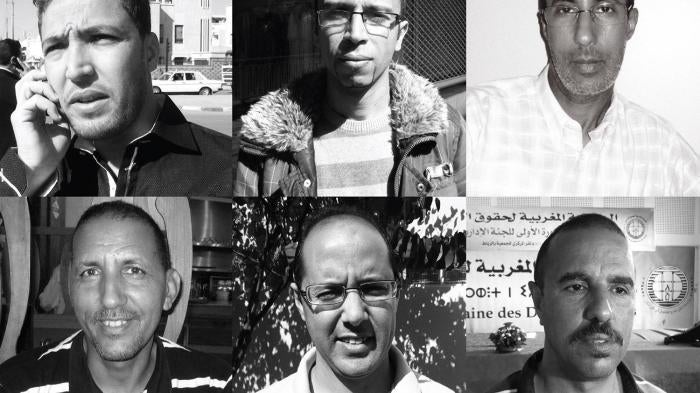
However, enduring flaws in the judicial system indicate that reforming the judiciary will be an uphill struggle. This report offers analysis of six politically sensitive cases adjudicated between 2008 and 2013, including the case of Zakaria Moumni, where the courts violated the right of defendants to a fair trial.
The six cases, involving a total of 84 defendants of whom 81 served time in prison, highlight two major weaknesses. First, in five of the six cases, the courts handed down convictions based largely on confessions that the police obtained from defendants and that those defendants contested in court. The courts did not make a proper effort to determine if these confessions were obtained through torture of the defendants or other illegal methods. The courts also based their convictions on incriminating written statements by witnesses or complainants without requiring those persons to provide their testimony in court where the defendants or their representatives could challenge them.
Second, in two of the six cases, there was a clear denial to the 32 defendants, especially to the 25 of them who had spent at least 18 months in pretrial detention, of timely access to a trial or court hearing once they had been charged or been subjected to prejudicial administrative actions.
It is not clear whether the failures of the Moroccan judicial system in these cases reflect a lack of judicial independence—pressure or interference by the executive branch or another party—or simply poor-quality justice, where judges do not show due diligence in trying to discern the truth by examining all pertinent evidence and discounting statements that may have been obtained through impermissible means. Lack of independence and due diligence may both have played a role. Whatever the reasons, the result is clear: unfair convictions for the defendants.
In five trials, we examined the court’s readiness to admit incriminatory evidence that the defendants had contested as false, notably the defendants’ “confessions” made while in police custody. These cases include the trials of:
- 25 Sahrawis in 2013 for their alleged role in the deaths of police during deadly violence that erupted in Western Sahara in 2010;
- labor and human rights activist Seddik Kebbouri and nine co-defendants for their role in disturbances that erupted in the city of Bouarfa in 2011;
- boxer Zakaria Moumni on charges of fraud in 2010;
- 35 defendants arrested in 2008 and accused of belonging to a terrorist cell, known as the “Belliraj” case, after the family name of one of the leading defendants;
- the trial in 2012 of six protesters from the February 20 youth movement for assaulting police officers while refusing to leave an “illegal” gathering.
In all these trials, the court convicted and imprisoned the defendants primarily on the basis of their contested confessions. In so doing, they displayed an apparent lack of diligence in failing to conduct serious investigations into defendants’ allegations of torture or ill-treatment during interrogation by police while at the same time admitting the defendants’ police statements into evidence.
In the Belliraj case, for example, the court justified dismissing torture allegations on the grounds that the defendants had not raised them at their first appearance in court. On the one hand, some defendants had in fact informed the court early on that the police had mistreated them under interrogation, without triggering any kind of inquiry. But even where they had not done so, the court should not dismiss torture claims summarily simply because the defendant was “late” in making them.
While the court is entitled to consider the timing of a defendant’s introduction of a torture claim as relevant in judging its credibility, it should also recognize that there are many reasons why a defendant may introduce a torture claim late in the trial other than a desire to escape punishment.
The courts also failed to allow the defense sufficient opportunity to challenge other incriminating evidence and deprived defendants of their right to call witnesses whose testimony might shed light on the facts in dispute.
In one respect, Morocco’s laws on evidence contribute to the lack of diligence by the courts in scrutinizing allegations of torture or ill-treatment. Article 290 of the Code of Penal Procedure instructs the court to presume that statements prepared by the police are credible, in cases where the defendant faces less than five years in prison.[1] Courts often quote this rule in written verdicts where they decide to convict defendants based on incriminating statements made to police, even if the defendants allege their statements were coerced. Article 290 should be revised so that the evidentiary standard is the same as the one that applies to more serious offenses, which requires the court to treat a police statement like any other piece of evidence, with no inference made about its credibility.
In two of the six cases examined in this report, courts unduly delayed bringing defendants to trial or concluding their trial, prejudicing defendants and denying them their right under international law to a “trial within a reasonable time,” a right newly enshrined in article 120 of Morocco’s constitution.
In many jurisdictions around the world, including Morocco, delays occur in the justice system due, for example, to backlogged courts, defense requests to postpone hearings, or the necessities of the judicial process. In these two cases, however, these factors do not seem to be responsible for the delay.
In both cases, the defendants include advocates of independence for Western Sahara. Authorities consider advocates of Sahrawi independence to be “separatists” who act in violation of Morocco’s laws that prohibit “attacks on territorial integrity.”
In the first of the two cases, 21 of 25 defendants spent 26 months in pretrial detention before going on trial for their alleged role in the violent clashes that occurred in Gdeim Izik, Western Sahara, in November 2010 in which 11 security force members were killed.
In the second of these two cases, the government has accused seven activists of undermining Morocco’s internal security while visiting the Polisario-run refugee camps near Tindouf, Algeria, by collecting funds there to stir unrest and subversion in Western Sahara; this is an offense punishable by five years in prison. Three of the seven defendants spent a year and-a-half in pre-trial detention before the judge released them. Since their release, more than two years have passed without the trial resuming or the case being dropped. According to a government reply to Human Rights Watch the court is conducting a “complementary investigation” that is continuing.
This apparent inconsistency in the court’s approach to the case—first treating it as serious enough to detain three of the defendants 18 months pretrial, and then freeing them without resuming the trial during two years—may suggest that political concerns guided the court’s handling of the case.
The conclusions from our analysis of the six cases examined here lead to two key recommendations. First, courts should diligently examine any claims made by defendants that the police obtained their self-incriminating statements by force or coercion and exclude statements so obtained, except as evidence against those responsible for abusing the defendant. Secondly, courts should end the practice of unduly prolonged pretrial detention of defendants and conduct trials with reasonable promptness, all the more promptly when the defendants are being provisionally detained. Detailed recommendations follow.
Recommendations
To the Moroccan Government
- Take steps to prevent torture and ill-treatment and to verify and ensure that incriminatory statements obtained through the use of torture or ill-treatment are not admitted into evidence, as required by article 293 of the Code of Penal Procedure.
- Ensure that all persons placed in garde à vue (pre-arraignment) detention are informed immediately of their right to a lawyer, and that they have, if they so request, prompt access to a lawyer, access that should include the possibility of being visited while still in garde à vue by the lawyer for a confidential consultation; in accordance with the U.N. Basic Principles on the Role of Lawyers.
- Amend the Code of Penal Procedure to indicate that where there is an allegation of torture or ill treatment, the burden of proof lies on the prosecution to prove that any confession made has not been obtained by unlawful means, pursuant to the recommendation made by the U.N. special rapporteur on torture and other cruel, inhuman, or degrading treatment or punishment in his February 28, 2013, report on Morocco.
- Ensure that prosecutors, investigating judges, and trial judges give defendants a thorough opportunity to: raise at any point in the investigation and trial any ill-treatment they may have experienced while in police custody; read carefully their police statement and challenge any alleged inaccuracies in it; and consult with a lawyer prior to their first appearance before a prosecutor or judge.
- Ensure that prosecutors, investigating judges and trial judges reflect in the minutes of the hearing and in the court’s written judgment any statements made by defendants before them about ill-treatment or inaccuracies in their police statements.
- Take steps to eliminate torture and coercion during the preparation of reports prepared by the judicial police. Possible steps to ensure the voluntariness of such statements include videotaping police interrogations; requiring the interrogating official to appear in court for cross-examination; and repealing article 290, as described below.
- Implement the recommendation that the U.N. Special Rapporteur on Torture made based on his visit to Morocco in September 2012 “to further develop the forensic capacity of the prosecution and judiciary and implement the right to complain and to ensure that defendants who first appear before them have a fair opportunity to raise allegations of torture or ill-treatment they may have experienced by the police or intelligence services.”
- Require that judges and prosecutors receive instruction regarding their obligation to investigate rigorously torture allegations regardless of when during a trial the defense raises them and to document their investigation efforts in writing. Such training should include awareness-raising about the reasons, other than a desire to escape punishment, why a defendant may raise torture or ill-treatment at a later phase of the trial, even if earlier in the judicial process the defendant had confirmed the veracity of his or her written statement as it was prepared by the police.
- Educate judges on their obligation to assess the credibility of allegations of ill-treatment even in the absence of physical evidence of torture, and the means of making such an assessment, based on international norms, as set out in the Manual on the Effective Investigation and Documentation of Torture and Other Cruel, Inhuman, or Degrading Treatment of Punishment (“the Istanbul Protocol”).
- Educate judges on their obligation, in upholding the “equality of arms” to afford to the prosecution and defense, the opportunity to summon witnesses for questioning if they are brought to the court’s attention and if they appear relevant to determining the truth of the charges against the defendants and, in particular, the truth of incriminatory police statements when these are challenged by the defense.
- To prevent prejudice to defendants caused by inordinate and unreasonable delays in the completion of trials, implement laws that require trials to be completed without undue delay, in keeping with article 120 of the 2011 constitution, which states, “Everyone has the right to a fair trial and to a judgment delivered within a reasonable amount of time.”
- Amend the Code of Penal Procedure to require regular and substantive judicial review of all cases of pre-trial detention, with an increasing burden being placed on the state authorities to justify pre-trial detention the longer the trial is delayed and the person is detained, by showing all possible steps are being taken to ensure a trial as speedily as possible. If the burden is not met, the court should order the detainee’s release.
- Reform domestic law to restrict the jurisdiction of military courts to purely military offenses. Under Moroccan law, the jurisdiction of military courts is extended to also cover crimes committed by civilians against members of the security forces. This broad jurisdiction contravenes a basic norm of international law, which requires trying civilians in civil courts. In addition, military court verdicts are not subject to appeal except to the Court of Cassation, thereby violating the internationally recognized right of defendants to an appeal not only on formal but also on substantive grounds.
- Enact a law that gives force to article 133 of the 2011 constitution, which gives defendants the right to petition the new constitutional court to review the constitutionality of a law being applied in their case.
- Strengthen the fair-trial rights of defendants to ensure an “equality of arms” between the prosecution and the defense by revising Code of Penal Procedure article 290, which gives statements prepared by police inherent credibility in cases involving offenses that incur sentences of less than five years in prison. This law places the burden of proof on the defendant to show that the statement prepared by the police is false. The law should be revised to eliminate this unfair burden, so that a police statement would be treated the same as all other evidence presented in court with no inference made about its credibility.
With respect to the Gdeim Izik case, in which 21 of the 25 defendants are in prison, and the Belliraj case, in which 17 of the 35 defendants are in prison, the Moroccan authorities should:
- Free the defendants still in prison or grant them a new and fair trial. For the Gdeim Izik defendants, any retrials should take place before a civilian court.
- If the cases are retried, the presumption should be that all defendants will be at liberty until their trial. Any individual defendant the prosecuting authorities wish to detain should be entitled to a prompt hearing before a judge to rule on the legality of their detention, with the presumption being for liberty. A judicial decision to detain the defendant pending trial should be based on valid grounds, such as that the defendant is dangerous or is likely to repeat his offenses, tamper with evidence, or take flight;
- When retrying the defendants, the court should examine their allegations of torture and ensure, in compliance with international and Moroccan law, that no statement obtained through violence or coercion is admitted into evidence. The court should conduct investigations even if the physical traces of possible torture may have faded. The investigations should adhere to international standards for investigation of individual complaints of torture, notably those found in the Manual on the Effective Investigation and Documentation of Torture and Other Cruel, Inhuman, or Degrading Treatment of Punishment (“the Istanbul Protocol”);
If the court decides to admit into evidence a police statement that the defendant claims was extracted under torture, it should explain in its written judgment why it decided the claims of torture or improper coercion were not credible.
To Governments and Institutions that Provide Assistance to Morocco
Under the rubric of judicial reform and rule of law assistance programs, encourage Morocco to implement the recommendations enumerated above, notably those designed to prompt judges to:
- scrutinize more critically the evidentiary value of statements prepared by the police when defendants challenge their contents;
- devise and follow methods of probing more thoroughly claims of torture or other ill-treatment regardless of when they are raised during the course of the proceedings;
- impose legal limits on the duration of pretrial detention not only during the phase of the judicial investigation but also when a trial fails to get under way or proceed to completion within a reasonable period of time, and to ensure regular and substantive judicial review of pretrial detention orders.
Methodology
This report is based on the study of selected trials conducted between 2008 and 2013. Human Rights Watch observers attended some sessions of four of them. We also examined written verdicts and case files and interviewed defense lawyers, officials of the Ministry of Justice and Freedoms, and other pertinent sources of information, including the defendants in some cases. We also reflect in the report, and reprint in Appendix I, statements provided to us by the government concerning these cases. However, for the most recent of the six cases, the one involving the February 20th Youth Movement protesters, Human Rights Watch did not formally request official comment and received none.
Human Rights Watch wrote to Minister of Justice Mustapha Ramid on January 12, 2012, informing him of our work on fair trials and requesting a meeting. We did not receive a reply. However, representatives of the Interministerial Delegation for Human Rights received us in Rabat on January 23, 2012.
While representatives of Human Rights Watch were in Morocco in mid-November 2012, Minister Ramid informed us that he could receive them on November 19. Because its representatives would no longer be in Morocco on that date, Human Rights Watch wrote a letter proposing to return in December if he was available to meet and also outlining the interim conclusions of this report. We received no reply.
Human Rights Watch trial observers encountered no obstacles in entering courtrooms and observing trials, with four exceptions relating to a single trial: on November 20, 2012, December 18, 2012, and January 8, 2013, police denied our representative entry to the Rabat Criminal Court of First Instance, where he had identified himself to them as Human Rights Watch and explained that he had come to observe the trial of Camara Laye.[2] Each time, the police told him he needed permission from the Ministry of Justice and Freedoms. Our representative managed to enter on the second occasion when defense lawyers escorted him inside. On May 14, 2013, security offices at the entry to the court denied entry to two representatives of Human Rights Watch who had come to hear the verdict in the Laye case.
With regard to the Gdeim Izik trial before the Rabat Military Court, our observer attended the sessions on February 1, 9, 10, 13 and 14, 2013, but not those on February 8, 11, 12, 15 and 16. For the dates when he was absent, the observer obtained an account of the proceedings from defense lawyers and other trial observers. Human Rights Watch interviewed several members of the defense team about the case, including Noureddine Dhalil in Casablanca on March 19, 2012, Mohamed Fadhel Leili, Mohamed Boukhaled, Mohamed Lahbib Rguibi, and Lahmad Bazaid in El-Ayoun on June 23, 2012, Mohamed Lahbib Rguibi on September 13, 2012, in Rabat, and Mohamed Messaoudi in Rabat during February 2013.
Background
Influential forces are pushing in opposite directions on Morocco’s justice system. In cases with a political coloring, courts continue to deny defendants the right to a fair trial by convicting them on the basis of confessions that they say the police extracted under torture or coercion, without the court making an earnest effort to probe their claims. This practice reinforces an impression that the courts serve as an extension of the state’s repressive security apparatus.
But there is also a logic propelling Morocco to accelerate the pace of reform. Its leaders wish Morocco to be recognized, both domestically and internationally, as a regional model on human rights. When pro-reform street protests erupted in Morocco in February 2011, the authorities responded not by repressing them blindly but by promising a new constitution and calling early elections. While resolutely and successfully opposing proposals at the United Nations Security Council to give a human rights mandate to the peacekeeping mission in the contested Western Sahara, Morocco argues that it is on its own making great strides on human rights.
The official discourse on reform emphasizes the task of reforming the judiciary including by enhancing its independence. This has been a theme for several years in the public pronouncements of Morocco’s leaders, including King Mohammed VI. The 2011 constitution contains a remarkable number of provisions that, if implemented, would advance this objective.
A New Constitution
In July 2011, Moroccan voters approved into law a new constitution rich in affirmations of human rights, including some that did not figure in the previous constitution, promulgated in 1996. These affirmations must still be translated into laws and practices that curtail ongoing violations. The leap forward in rights language suggests, nonetheless, a willingness on the part of Morocco to set for itself a high standard by which its laws and practices are to be judged.
One of the realms in which the new constitution breaks new ground is in promoting judicial independence and the rights of persons before the courts. King Mohammed VI said that the constitutional provisions “stipulate legal guarantees of judicial independence and consecrate the judiciary as an independent power equal to those of the legislative and executive branches.”
The king said these provisions culminated a campaign to reform the judiciary, started in 2009. In a speech on August 20 of that year, he announced an "in-depth, comprehensive reform of the judicial system" to "make justice more trustworthy, credible, effective, and equitable, because it serves as a strong shield to protect the rule of law." He spoke of "moralizing justice and shielding it from corruption and abuse of authority," and of strengthening guarantees of judicial independence.[3]
The king has continued to emphasize the importance of judicial reform since then. On May 8, 2012, he inaugurated the High Commission of National Dialogue on Reforming the Judiciary, a 40-member body charged with leading a national debate that would result in a charter for overhauling the judiciary.[4] On July 30, 2012, a holiday commemorating his accession to the throne 13 years earlier, he declared:
Our starting point is that the rule of law is the source of all progress. This is why we put justice first among our reform projects. Now that the new constitution has placed judicial reform at the heart of its structures, the conditions are now in place to succeed in this major endeavor.[5]
Since its creation, the high commission, presided over by Minister of Justice and Liberties Mustapha Ramid, has convened a series of conferences in cities across the country on different facets of judicial reform. Ramid opened the eighth such conference, devoted to judicial independence, held in the city of Agadir on January 11-12, 2013. There he announced that a “national charter” on judicial reform would be ready by March 2013.[6] It had not been released publicly at the time this report went to print.
One reform that should be a priority is revising the laws to end to the trial of civilian defendants in military courts in peacetime. The National Council for Human Rights made this and other recommendations to King Mohammed VI in February 2013, citing both the constitution and Morocco’s international treaty obligations. On March 2, the king “welcomed” these recommendations.
Enduring Bad Practices
The push to guarantee defendants a fair trial requires a break with prevailing practices. Human Rights Watch and other international and Moroccan human rights organizations have documented tens of cases in the past decade where Moroccan courts convicted citizens due to unfair judicial proceedings. It is not possible to specify the number of “political prisoners” or the number of prisoners who were convicted unjustly. Beyond the handful of persons who are clearly in prison in violation of human rights because they were charged and convicted for their nonviolent speech or political activity, there are hundreds more defendants who were convicted of recognizably criminal offenses—such as drug-trafficking or serving a terrorist organization—but who claim that they are innocent of these charges and were convicted on the basis of flawed evidence. It is not feasible for us to assess how many, if any, of their claims, are true.
Others claim that they were prosecuted on criminal charges fabricated to retaliate against them for unrelated reasons having to do with their politics or whistle-blowing activities. To gauge the frequency of unjust convictions would require examining trials one-by-one and the evidentiary basis for the charges, an undertaking beyond the scope of this report. This report presents one persuasive example of charges that appear to have been fabricated to retaliate against a person for being outspoken toward the authorities: Zakaria Moumni, who was convicted of fraud apparently to punish him for lobbying the king and the royal palace to secure a government job he believed was his due.
In spite of the prohibition on torture and Morocco’s recognition of it, torture and mistreatment of criminal suspects remains a serious problem in Morocco. The torture and ill-treatment of suspects in custody and specifically under interrogation remains a problem in Morocco, as affirmed by the U.N. Special Rapporteur on Torture after his mission to Morocco in September 2012.[7] Human Rights Watch has interviewed numerous detainees and former detainees over the past decade who credibly described abuse to which security forces subjected them while in custody, including beatings, threats, denial of food and water, sleep deprivation, and other means that constitute torture or ill-treatment.[8]
Convictions based Largely on Contested Confessions
Seddik Kebbouri and Co-defendants
In this case, the fair trial concerns revolve around the conviction of defendants based on contested confessions and written reports prepared by the police, without the judges making a diligent effort to explore the defendant’s allegations of mistreatment or summoning witnesses who were relevant for addressing the prosecution’s evidence.
The case relates to protests in the desert town of Bouarfa, in the northeast of Morocco, on May 18, 2011. Seddik Kebbouri, a local activist, called on citizens to join in protests. Alongside citizens demonstrating peacefully, some protesters hurled stones, causing injuries and property damage. No one contests these facts. What is missing from the case file is any evidence showing that Kebbouri directly incited the violence, as the first instance court concluded.
Socio-economic protests like the one that engulfed Bouarfa on May 18, 2011, are increasingly commonplace in towns and cities across Morocco. Marches and open-ended sit-ins often end with forceful intervention by law enforcement agencies to disperse protesters, and not uncommonly with stone-throwing at the police and some property damage.[9] Following Bouarfa, such protests occurred in the coastal Safi in August 2011,[10] Taza in the Atlas Mountains in January-February 2012,[11] and Beni Bouayach and Imzouren in the Rif in March 2012.[12] In each case, authorities arrested, brought charges and obtained the conviction and imprisonment of protesters on such charges as holding unauthorized demonstrations, participating in “armed” gatherings, blocking traffic on public thoroughfares, disobeying or insulting the police, and causing property damage.
Seddik Kebbouri is active in the Democratic Confederation of Labor, the opposition Unified Socialist Party, and social-action committees, including one that protests against the high cost of living and the deterioration of public services. He also heads the local chapter of the Moroccan Human Rights Association (AMDH). Kebbouri was a co-organizer of a long-standing boycott by Bouarfa residents of their water bills, which they considered to be too high. Perhaps Bouarfa’s best-known social activist, Kebbouri often participates in dialogues and mediations between local authorities and protest groups, according to several residents we interviewed.[13]
For about two weeks in May 2011, a coalition of unemployed persons had been holding a sit-in across from the prefecture in Bouarfa. They had demanded, without success, to be received by a senior official. On May 18, relations grew more tense between the protesters and the police, who had repelled an effort by some of the protesters to gain entry to the prefecture. One of the unemployed demonstrators set himself on fire in protest. As his colleagues came to his assistance, the police moved to disperse the sit-in.
At this point, Kebbouri was at the school in Bouarfa where he works. Hearing the news of the self-immolation, he left the school and walked through the streets with a megaphone, urging citizens to march on the prefecture to show support for the protesters. The streets filled with people, and before long the police were chasing and clashing with youths. According to a statement provided later by authorities to Human Rights Watch (see Appendix I):
When the crowd reached approximately 600 persons, most of them minors, they headed to the prefecture in an attempt to storm it. Prevented by the security forces from doing so, they pelted security personnel and auxiliary forces with rocks and empty bottles, inflicting various degrees of injuries. They also threw stones at the Directorate for the Surveillance of National Territory [police headquarters] and attempted to storm it, causing material damage. They targeted the vehicles of security personnel and the Royal Gendarmerie, and uprooted traffic signs and burned tires. As a result of the attacks, 18 civil servants with the General Directorate of National Security, 14 members of the auxiliary forces, and six members of the Royal Gendarmerie were injured.
The police made some arrests that day, but released those they had arrested. However, a few days later, the police arrested nine youths; the Bouarfa Court of First Instance charged them on May 26, 2011. (The court dropped charges against one of the nine, a minor.)
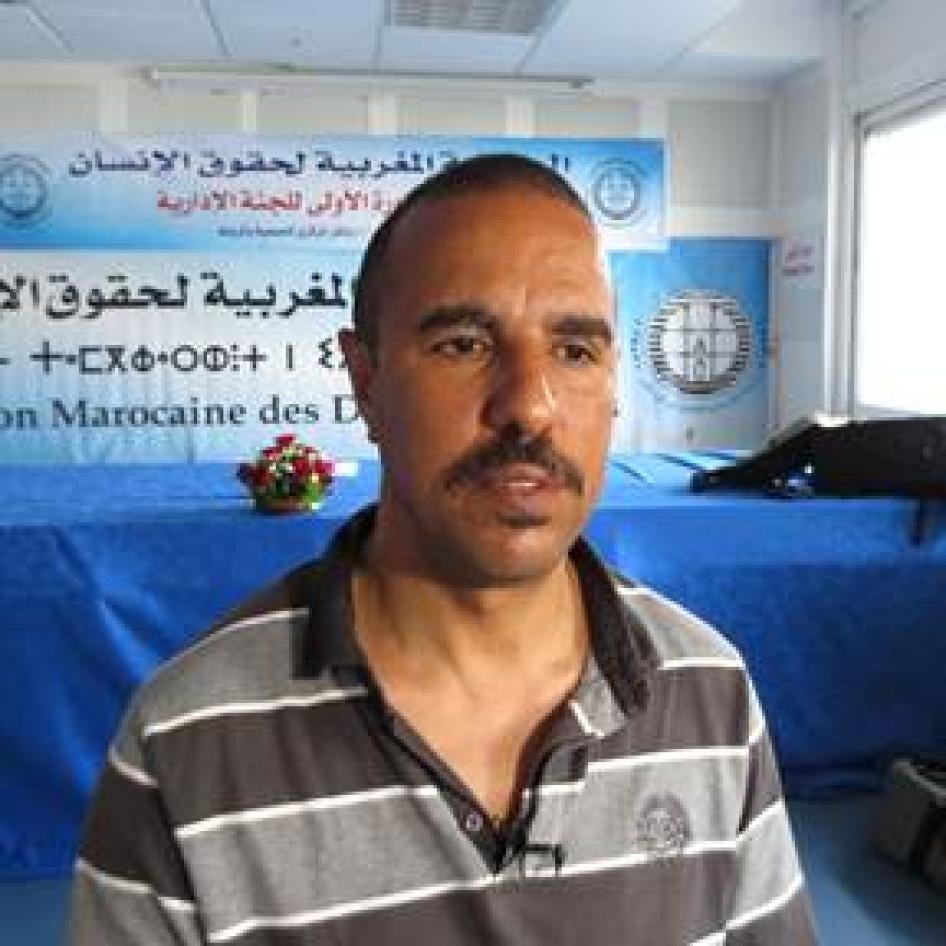
Seddik Kebbouri, May 11, 2013. Kebbouri and nine other men served eight months in prison in connection with a demonstration in Bouarfa. ©2013 Eric Goldstein/Human Rights Watch
Kebbouri attended the youths’ May 26 hearing and while there advised their families on how to mobilize pressure for their release, according to relatives of the detained youths.[14] The case file contains a report prepared by a police officer stating that on May 26, Kebbouri was in court “inciting” the families to protest their sons’ detention.
Police arrested Kebbouri as he emerged from the courthouse. They arrested another labor activist, Mahjoub Chennou, elsewhere in Bouarfa that day. The prosecutor added Kebbouri and Chennou, who are both in their forties, to the same case as the youths, initially charging them all with the same offenses related to the violence that occurred on May 18.
It appears from the case file that the main evidence used by the court to convict the defendants consists of the statements purportedly given by the youths while in police custody and a written report filed by a police agent describing the events of May 18.
While held by the police, Kebbouri’s young co-defendants all signed statements prepared by police, in which they say they heard Kebbouri on the streets urging citizens to march on the prefecture; five of these state also that Kebbouri had announced that the man who had set himself on fire had died. (In fact, the man survived with injuries that were not grave.) However, none of the defendants’ statements implicated Kebbouri in committing or urging acts of violence.
On June 16, 2011, the Figuig Court of First Instance in Bouarfa convicted all ten men.[15] It found the eight younger men guilty of violence against public officials, destruction of private and public property, possession of weapons, insulting on-duty public officials, participating in an unauthorized public gathering, and disobeying law enforcement agents. The eight young men are Mohamed Negbaoui, Jamal Ati, Abdessamad Karboub, Yassine Balit, Abdelali Kdida, Abdelkader Qaza, Abdelaziz Boudabia, and Brahim Mqadmi.
The court also convicted Kebbouri and Chennou of participation in an unauthorized public gathering, disobeying security forces, and insulting on-duty public officials – that is, the same charges as their young co-defendants, excluding those charges involving violence, weapons, and property damage. The court sentenced all ten to pay fines and to serve prison terms of between 30 and 36 months. The sentence for Kebbouri and Chennou was 30 months.
On July 26, 2011, the Oujda Appeals Court upheld all of the verdicts but dropped the charge of insulting on-duty public officials. It reduced the original sentences to two years for Kebbouri and Chennou, and to between 16 and 18 months for the youths.[16]
Those who demonstrated that day in the streets did so without first notifying authorities, as the Law on Public Gatherings would require. However, more than one person in Bouarfa explained to us that notifying the local authorities in advance would have been pointless since they never would have permitted it. Moreover, this demonstration was not planned in advance but rather, erupted in response to that day’s events.
The first-degree court wrote in its judgment that Kebbouri and Chennou had incited the youths to resist the police and to force their way into the prefecture. The government wrote to Human Rights Watch:
[T]he court, in delivering its verdict, was convinced of the flagrante delicto nature of the case and the seriousness of the acts, seen in the rioting and in the defendants’ pelting of security forces with stones and glass bottles at the urging of Seddik Kebbouri and Mahjoub Chennou. The former used a megaphone to assemble more than 600 persons, most of them minors, who headed toward the prefecture office where the security forces confronted them, leading to material damage to vehicles, the destruction of state property, and the injury of several members of the security forces with wounds of varying degrees. They confessed to these acts before the judicial police and the Royal Prosecutor, and their recantation before the court was supported by no material evidence.[17]
On February 4, 2012, King Mohammed VI issued a pardon that included the ten defendants in this case. While the men are now out of prison, this does not alter the unfairness of the proceedings that led to their eight months of incarceration.[18]
The young co-defendants, as soon as they appeared before the prosecutor on May 26, 2011, repudiated the statements attributed to them by the police. The written ruling of the court states that before the prosecutor, the eight defendants said they saw persons throwing stones but denied that they had participated in any acts of violence. Contrary to their police statements, some also denied that Kebbouri had incited them to participate, according to defense lawyer Abdelouahid Benaïssa.[19] Some even denied having taken part in the protests at all.[20] Some told the prosecutor that the police had slapped and threatened them into signing their statements, Benaïssa and Kebbouri told Human Rights Watch.[21] However, these claims of being slapped and threatened do not appear in the official record of that hearing or in the part of the court judgment that summarizes the hearing before the prosecutor.[22]
According to defense lawyer Benaïssa, the prosecutor did not investigate whether the defendants had in fact been mistreated. Benaïssa said later that he did not demand a medical examination of the defendants because he detected no physical signs of mistreatment on them; an absence that would be consistent with mistreatment limited to slaps and threats.[23]
At trial, six of the youths told the judge that the police had either slapped or threatened them to compel their signatures, as the written verdict notes. Some stated that they had not even read their statements before signing. The judge allowed the defendants to make these claims on the stand but did not respond to them and in his written judgment shows that he considered their confessions valid and their recantations not credible.
Kebbouri at trial denied that he had incited or perpetrated acts of violence. He also denied that his appeal to fellow citizens included his announcing that a youth had died from self-immolation. He stated that his activities that day were limited to his usual peaceful activism as a member of the Moroccan Association for Human Rights and the Democratic Confederation of Labor.
Kebbouri’s statement at trial varies from his police statement in the case file. It also varies, he said, from the police statement he read and signed:
After the police finished questioning me, they presented me with a written statement. I reviewed it, found it accurate, and signed it. At trial, I was shocked to find that my statement had been altered to contain things I had never said. I told this to the court.[24]
As an example, in his police statement presented to court, Kebbouri confesses to having announced the death of the youth who immolated himself, a piece of news that was false and could presumably incite public anger. Kebbouri told the court that he had neither announced this on May 18 nor confessed to the police that he had done so.
The case file included videos showing Kebbouri in the streets that day, addressing his fellow citizens. In video clips that Human Rights Watch viewed, posted on YouTube by unknown persons, Kebbouri does not incite others to violence. It is not known if these clips are the same as the ones in the case file.
Besides the defendants’ police statements, the other pieces of evidence incriminating Kebbouri were reports prepared by a police officer stating that he had heard Kebbouri urging citizens not only to join a march but also to force their way into the prefecture. No other evidence in the case file supports this second allegation by the officer. The prosecution also introduced as evidence knives and slingshots purportedly seized in relation to the May 18 disturbances, but demonstrated no link between this material evidence and the defendants, according to the defendants’ lawyers Abdelouahid Benaïssa and Omar Ben Ali.[25]
The case file contains a written statement signed by a police officer who names the young defendants and says they “were seen” throwing stones at the police. However, the statement does not specify who witnessed them or how the police witnesses determined the identity of the stone-throwers.
The lawyers told Human Rights Watch that nothing links these defendants to the violence that occurred that day other than the defendants’ own written statements before the police, which they repudiated, and this written statement by the police officer.
The defense asked the court to summon police officers to answer questions about what they saw and how they identified these defendants among all of those throwing rocks that afternoon. The judges in both the first-instance and appeals court denied this request, but did not provide a justification for this denial in their written judgments other than to say that the court already had all the elements needed to judge the matter.
The defense also asked the appeals court to summon witnesses who would apparently testify that Kebbouri had tried to restrain rather than incite the demonstrators to violence, lawyer Ben Ali told Human Rights Watch.[26] The appeals court also denied this request. Tracking the language of article 290 of the Code of Penal Procedure, it wrote, in upholding the convictions, “The content of the confession recorded in the records of the judicial police, if they are carried out in a proper way, is trustworthy unless proven otherwise.”[27]
Faced with confessions and repudiations of those confessions, the court could have summoned witnesses requested by the defendants whose testimony appeared relevant to determining the veracity of their confessions. Instead, the court treated the written statements prepared by the police as presumptively trustworthy, and declined to summon the witnesses requested by the defense and convicted all the defendants based on their “confessions” and the police reports in the file.
Champion Boxer Zakaria Moumni Imprisoned for Fraud
The evidence in this case suggests that after publicly complaining about the state authorities, Zakaria Moumni, a boxing champion, was arrested, tried and convicted of fraud within three days. Moumni was not a political or social activist but rather someone who campaigned publicly for his personal cause, which was to get the royal palace to give him a government post that he considered his due under the law.
The evidence used to convict Moumni consists of his own confession to the police, which he contends was obtained through torture following an illegal arrest and secret detention, and the written statements filed by two men who claimed that Moumni defrauded them by absconding with their money after promising to find them jobs in Europe.
The main violations of Moumni’s right to a fair trial relate to the court’s acceptance into evidence Moumni’s contested confession and the complainants’ written statements, even though they did not appear in court to testify until the third trial in the case.
The case proceeded with uncommon speed: the police placed Moumni in custody on a Monday, and by Thursday morning they had a confession and a signed declaration from him waiving his right to a lawyer; by that afternoon, his trial had taken place in the absence of a lawyer, witnesses, relatives, or acquaintances.
Because the charges against Moumni were considered minor offenses carrying a maximum prison sentence of five years or less, the presumption of the truthfulness of police statements under article 290 of the Code of Penal Procedure applied in his case.
When Moumni claimed his confession had been obtained through torture, the court did not investigate his allegations of torture. In Moumni’s account to Human Rights Watch of his experience, he said he raised at every opportunity before the court his claim of torture, trying each time to show the court the traces of it on his body, without ever receiving a medical examination or any kind of judicial probe.
Moreover, the court did not give Moumni the opportunity to adequately challenge the complainants’ written statements incriminating him. In the first and second of Moumni’s three trials, the court satisfied itself with the complainants’ written statements without requiring their appearance in court. It was only at Moumni’s second appeals trial, after he had spent 15 months behind bars and the court of cassation had quashed the first appeals verdict that the court required the complainants to appear in person and answer questions.
Another factor fueling suspicions about the handling of Moumni’s trial is the uncommon speed with which the case proceeded, as noted above, just three days from arrest to the completion of the trial. Such speed is highly unusual except, perhaps, in cases where the defendant pleads guilty from the outset and challenges neither the charges nor the procedures.[28]
Background to the Case
Zakaria Moumni won the light-contact boxing world championship in 1999. Since then he repeatedly contacted Moroccan authorities, including the palace, to claim a job in the Youth and Sports Ministry to which he believes he is entitled as a Moroccan world title-winner, by virtue of Royal Decree (dahir) No. 1194-66, dated March 9, 1967, and a later directive concerning its application. Moumni’s wife Taline Moumni told Human Rights Watch that in 2006 a high-level official in the royal court received Moumni but ultimately rebuffed his request for a post. Since then, she said, Moumni made various efforts to re-contact the palace, including by approaching Mohammed VI’s residence in Betz, France, on January 25, 2010, when he knew the king was visiting. He asked to be received but the guards turned him away.[29]
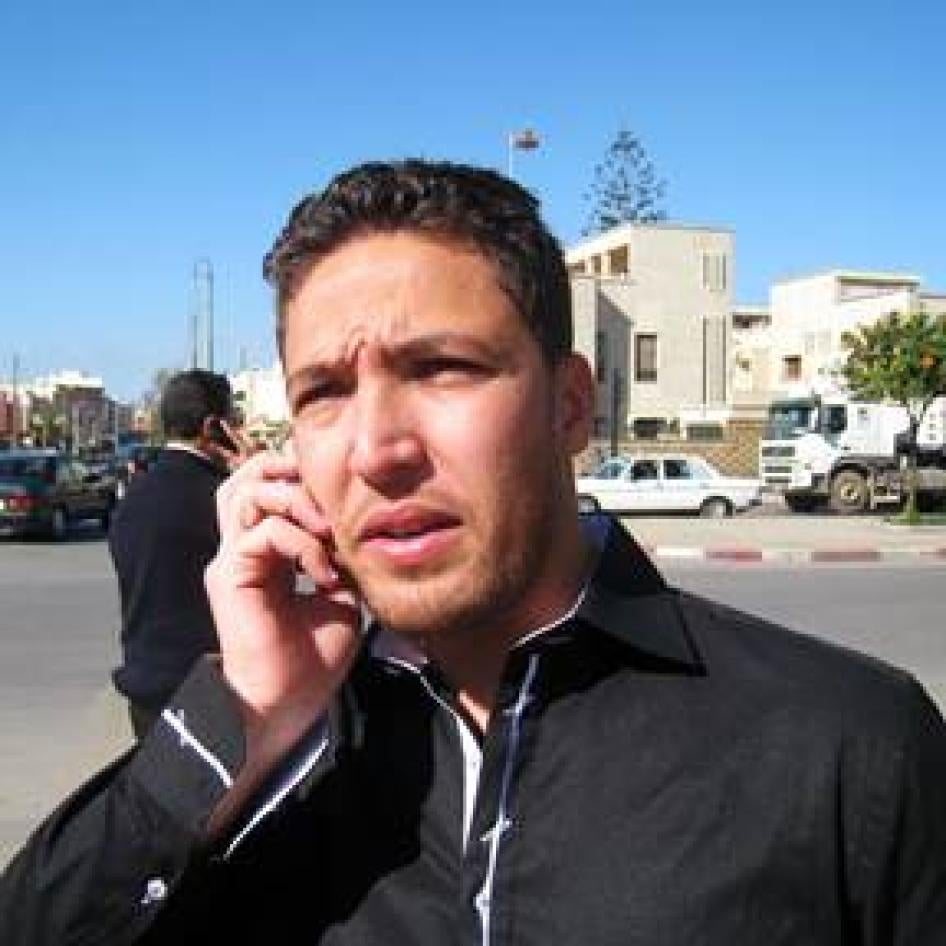
Zakaria Moumni, February 4, 2012, calling his wife minutes after leaving Sale Prison. He was pardoned after serving a year and-a-half on dubious charges of fraud. ©2013 Eric Goldstein/Human Rights Watch
Moumni frequently aired his grievance to the Moroccan and international media. For example, Al Jazeera television in 2006 featured Moumni criticizing the Youth and Sports Ministry and the Royal Federation of Light-Contact Boxing for blocking his access to a paid post.[30] An article on the French news site Bakchich.info dated June 29, 2010, recounted Moumni’s fruitless efforts to contact the palace.[31] The Moroccan weekly al-Ayam detailed Moumni’s grievances in its July 8, 2010 issue, including his alleged rebuff by the palace.[32]
The case file of Zakaria Moumni contains written complaints filed with the Rabat prosecutor, signed by Idriss Saâdi and Mustapha Ouchkatt, who said they reside in the city of Errachidia. Their complaints state that on January 22, 2010, they met in a Rabat café with Moumni, who took 14,000 dirhams (US$1,680) from each of them in exchange for his getting them jobs in Europe. They said that after giving him their money, Moumni became unreachable. The date on the complaints is difficult to read but appears to be the 26th – the day after Moumni sought to be received by the king and his entourage in France.
Moumni told Human Rights Watch that on February 12, 2010, police at Casablanca airport stopped him as he entered Morocco, telling him there was a warrant for him in connection with his having harmed "sacred values” (les sacralités), a term often used to refer to the monarchy and the person of the king. They released him after brief questioning, but stopped him briefly for questioning again when he left the country three days later. They said that they would try to close the matter but that there were no guarantees, he said. According to Moumni, the police did not ask him about the fraud complaint filed the previous month against him, according to the case file, and he remained ignorant of it until his trial seven months later. Moumni heard nothing more until September 27, 2010, when police detained him at Rabat airport upon his arrival from Paris.
From Arrest to the Completion of Trial
Moumni described the events starting with his arrest and concluding with his trial barely 72 hours later.
I landed on a flight from Paris at Rabat airport. When I got to passport control, the agent took my passport and said, “Follow me.” I followed him to a police office in the airport, where there were other police in uniform. I asked why I was there. A police agent looked at his computer and said, “Harming sacred values.” I looked on the screen and saw the same words. I called on my cellphone my relatives who were waiting for me at the airport to say I was inside with the police and would probably be out soon.
Then some guys in plainclothes came. They took my two cellphones, turned them off, searched me and my hand luggage, and handcuffed me behind my back. They walked me to an unmarked car parked on the tarmac—not in the parking lot but on the side of the terminal where the runways are. They put me in the middle in the back seat. There was a driver, a man seated next to him in front, and a man on each side of me in the back. They put a blindfold on me and asked me to put my face down. Then they put a jacket over my head and told me if I didn’t move everything would be OK.
We drove for about 45 minutes. I heard iron doors open. Then the car drove in and stopped. They took me out, slapping, punching, and insulting me. They unlocked my handcuffs, removed my shirt, and reattached them with my hands behind me. Then they removed my pants and underpants. I was completely naked, still blindfolded. They chained my feet and then started walking me forward, shouting at me to lower my head, then raise it, lower it, raise it, as I walked. I heard a door open. They sat me down.
There was more than one man in the room. One of them said, “OK, tell us your life.” I started telling them my story. When I got to the part about meeting with the king’s advisor, Mounir Majidi, they pounced on me and punched me. They put an iron bar under my feet and tightened the leg cuffs around my ankles, swung my legs in the air, hit my feet, and stomped on my chest, which was now on the ground. They kept insulting me and laughing. They used an iron bar to hit me on my shins, saying, “You’re a boxer, we’re going to break your legs.”[33] They said, “This place is a slaughterhouse for men. We’re going to make you into chopped meat and you’ll come out of this place in cans, and no one will know anything.”
After this, they ordered me to tell my story again. When I got to the part about being received by Majidi, they started beating me again. At one point, they yanked my legs up on a bar, held me upside down and twisted me. They call that “the helicopter.” They applied electric shocks to my chest and feet. I was still blindfolded so I couldn’t see it coming; all of a sudden, I just felt a jolt. At another point, they hung me by my arms so that my knees were on the ground.
This continued on and off for three days. They wouldn’t let me sleep. I was naked the whole time. If I slid off my chair, they poured water on me and propped me back up. At one point, they handcuffed my wrists to the chair so I wouldn’t fall over. The men worked in shifts; they all called one another “al-Haj” [Arabic for one who has performed the pilgrimage to Mecca]. I asked to phone my family, but they just laughed. They were laughing throughout. They gave me no food to eat, just water.
Moumni said that at no time did the police tell him the offenses he was suspected of committing. He said they did not try to get him to confess to anything or ask him about the alleged fraud for which he was eventually convicted. They just ordered him to tell his story over and over, he said.
Contrary to what the government claims (see below), and contrary to what Moroccan law requires, both Moumni and his wife, Taline Moumni, told Human Rights Watch that no one informed her or any other relative that Moumni had been taken into custody.[34] Moumni said he first alerted his family of his situation on the evening of September 30, only after arriving in Salé Prison, following his trial.
While Human Rights Watch has not investigated many cases involving defendants in Morocco who, like Moumni, faced common criminal charges, it has found a pattern by the authorities of failing to inform the family when plainclothes police have detained suspects being investigated for terrorism links. Family members commonly learn of their relative’s whereabouts only after he has signed a statement and been brought before a prosecutor or investigating judge.[35]
Moumni believes he was held was a secret detention facility in Témara, outside of Rabat. Authorities deny that any interrogation facility exists at that location, which is the headquarters of the Direction Générale de la Direction générale de la surveillance du territoire (DGST), a police agency. However, scores of terrorism suspects contend that they had been taken there in the years following the May 2003 suicide bombings in Casablanca. Their cases, and the extensive use of the secret detention facility in Témara, have been documented by human rights organizations.[36]
Moumni has no proof he was taken to Témara. He was blindfolded while being transported and heard no one mention the facility’s name; “Témara” appears nowhere in his case file. Moumni offers only circumstantial evidence: he estimated that the drive from the airport to the place of detention took 45 minutes, a time consistent with the journey from Rabat-Salé airport to Témara. In addition, he said he overheard one of the interrogators telling a colleague that he arrived late to his shift because his car had broken down, forcing him to leave it at Aswaq es-Salam (a large supermarket in the vicinity) and walk 20 minutes. He said he heard the same man saying he would return home on the 58 bus, a line that connects Témara and Rabat.
He told Human Rights Watch that on the morning of September 30, police dressed him, walked him up a set of metal stairs, and put him in a car. They drove him to the police station in the second district of Rabat, where they removed his blindfold and switched the handcuffs from behind his back to in front. He found himself in a room with 13 men, most of them in plainclothes. They told him he would have to sign some documents in order to get his personal belongings back.
They put documents in front of me, but they were covering the top part of the page. I said I wanted to read what I was signing. They said, “Just sign here, you’ll get your stuff back and be free to go.” When I insisted on reading it, they put the blindfold back on, stepped on my feet, and threatened to send me back to where I had just been. I still had the handcuffs on. At that point, I signed many things without knowing what they were.
It was only at a later date, said Moumni, that he found in his case file a confession to the police and a statement waiving his right to a lawyer, both of them signed by him and dated September 30.
After I signed, they put me in a police wagon and drove me to a courthouse in Rabat. They removed my blindfold again but kept the handcuffs on. In the courthouse, they brought me into a little office in the basement. Inside, there was a man seated at a desk, two policemen, and someone taking notes. The man behind the desk did not identify himself or ask my identity. I did not even know that he was the prosecutor.[37] He mentioned two names [those of the complainants] and asked me one question: Do I know these two individuals? I answered no. Then I reached down, with my handcuffs still on and lifted the cuffs of my jeans, and showed him my shins. There was blood there and on the pants. I said, “Look what they did to me.” He replied, “I don’t want to see it. Take him upstairs.” The man told me to sign a sheet of paper written up by the clerk. He explained, “It just says that you said that you do not know the two men.” I signed without reading. The whole session lasted two minutes.
Then they escorted me upstairs to the ground floor, where I found myself in a large courtroom. The prosecutor came up too, and stood at one side of the room. Besides the judge, the prosecutor, the police, and me, there was no one else in the room: no lawyers, no complainants, no other defendants, no spectators. The judge launched right in; he did not ask me for my personal details; he just asked if I knew the two complainants.[38]
I stopped and said, “All I know is that I landed on the 27th; I don’t even know what day it is today.” I lifted my pants cuff and said I’d been tortured and electric-shocked. The judge cut me off and said, “Take him away.”
The minutes of the hearing before the prosecutor and the written judgment of the first-degree trial do not indicate that Moumni spoke in either setting of having been tortured. Neither complainant appeared at the September 30 trial, even though the case file contains written statements dated the day before, signed by lawyer Abdessamad Raji Senhaji, reaffirming their original complaints against Moumni.
Moumni recalled that after his brief trial:
The police escorted me out of the courtroom and to a cell where, for the first time, I found myself with other detainees. I waited another 15 minutes, and they put me in a police wagon. I asked where we going now, and they answered, “To Salé Prison.” When I got to the prison, I was able to borrow a phone and call my wife for the first time since being detained.
The next morning I saw a lawyer for the first time. [Attorney] Abderrahim Jamaï came to the prison. He asked me to tell him what had happened. He hadn’t yet seen the file. I told him what I had been through, but I still didn’t know what the case was about.
Jamaï later told Human Rights Watch that on this visit, he observed cuts and bruises on one of Moumni’s legs.[39] He also said that Moumni complained to him that his arms ached from being handcuffed for most of three days.
On October 4, the court pronounced Moumni guilty of fraud and sentenced him to three years in prison. The written verdict cites Moumni’s confession as the main evidence against him, adding, “Whereas what is contained in a statement prepared by the judicial police is to be considered trustworthy and can be discredited only through evidence of the contrary, according to article 290 of the Code of Penal Procedure, and this the defendant has failed to do.[40]
Moumni said he learned of the verdict only later; no one summoned him to attend its announcement.
Lawyer Jamaï filed a motion to appeal the verdict on October 6, 2010. He also petitioned the court to summon the two complainants and engaged a bailiff (huissier) to deliver the summons to the complainants. The bailiff looked for one of the complainants and wrote a statement saying that the complainant could not be found at the address he had provided. The appeals court postponed the trial twice because the complainants did not appear, Jamaï said.[41]
Suspicious of the complainants' statements, Jamaï also asked the court to summon the police agent who reportedly took their statements dated September 29, 2010, that were in the case file.
The appeals court eventually tried the case in a single session on January 13, 2011, with Judge Hachemi Slimani presiding. Judge Slimani did not summon the complainants or the police agent who took their complaint. As in the trial in first instance, the lawyer representing the complainants did not attend. It remained unclear why the complainants, who presumably would seek restitution of the money that Moumni had supposedly defrauded them of, never came to present their case against him. Moumni, however, with his lawyer present, this time spoke at length about being tortured and showed the court the scars on his shins.
The appeal court's written judgment noted Moumni's statement in court that he did not know his accusers, took no money from them, and was tortured in detention. It notes also that the defense asked the police officer to appear as a witness. It nevertheless reaffirmed the conviction, basing its verdict on Moumni’s confession to the police, which it deemed credible. However, it reduced Moumni's term to two and-a-half years.[42]
Moumni appealed to the Supreme Court to quash the verdict. On June 29, 2011, the court sent the case back to appeals court for a re-trial. The Supreme Court, ruling as the Court of Cassation, criticized the trial court for failing, without giving its reasons, to summon the police officer who took the complainants’ statements; and for failing to respond to the defense’s request to summon the complainants’ lawyer to court.”[43]
The third trial, scheduled to start in October 2011, was postponed while the court sought the appearance of the two complainants. On December 15, 2011, the trial took place before the Rabat Appeals Court, and Moumni’s accusers appeared in court for the first time. The complainants repeated the substance of their written complaints. Moumni stated once again that he was innocent of the charges, and that he had never heard of nor met his accusers in his life.
The defense noted several inconsistencies and anomalies in the testimony of the complainants. First, they chose to testify not as complainants but rather as witnesses, which would mean they were not seeking restitution of the money they allege had been defrauded from them. This seems odd since they had presented themselves as men desperate to find work, in which case the money they had lost would have represented a significant sum to them.
Second, in their original written complaints and testimony in court, they referred to a man who gave his name as “Soltan” and who introduced them to Moumni and was allegedly an accomplice in the fraud. The police report on the case, dated February 2, 2010, mentions “Soltan” as an accomplice. Moumni’s lawyer petitioned the court to identify and summon Moumni’s alleged partner-in-crime. Yet at no time during the course of the case did the court do so. The prosecutor justified the absence of Soltan by saying that all they had for him was a name, possibly only a nickname, and could not locate him.
The defense also pointed out in court contradictions between the testimony that the two complainants gave in court and what they had put in their written statements to the police more than one year earlier, relating to their own personal information: their city of residence, whether they were employed, and their family status.
The appeals court on December 22, 2011, upheld the verdict, but reduced the sentence to 20 months. On February 4, 2012, a royal amnesty freed Moumni from prison, after he had served 17 months.
Moroccan authorities provided Human Rights Watch a written defense of the judiciary’s handling of the case, contending that they carried out his arrest and trial with respect for the law at every stage. Here are key excerpts:
As the case documents show, the aforementioned [Moumni] was placed under garde à vue [pre-arraignment police custody] in the station of the judicial police, which is under the supervision of the public prosecutor, beginning September 27, 2010, at 6 p.m. until 11 a.m. on September 30, 2010, after the period of garde à vue was extended for 24 hours, with the approval of the public prosecutor, as per the legal requirements set forth in the Code of Penal Procedure (article 66, first paragraph), and his family was notified about this procedure.
As the complete record demonstrates with regard to the accused, the judicial police heard the complainants, who were able to pick him out from among several persons who were presented in front of them.
As to whether the police informed Moumni’s family about his arrest, the government stated that Moumni’s police statement acknowledged that the police had notified his next of kin.[44] However, as noted above, Moumni repudiated his statement, saying it had been extracted through torture; and his wife, meanwhile, said that no one in the family knew his whereabouts until he was able to call them from Salé prison on September 30.
On the allegation that his confession was obtained under coercion, and that he was denied his right to a lawyer, the statement from the authorities to Human Rights Watch said:
After the judicial police heard the accused in legal proceedings, his remarks were read to him, and he signed the record in his own handwriting without any coercion, as he indicated in front of the public prosecutor. Additionally, when present before the prosecutor and told of his right to have a lawyer be brought immediately to his defense, the accused indicated that he would defend himself, whether it be before the prosecutor or the court itself. During the period of appeal, Mr. Abderrahim Jamaï, a lawyer, assisted him (the accused) during the court’s proceedings. The court based its decision on the oral arguments and the content of the judicial police reports, which are deemed credible in cases involving less serious crimes, unless the defense proves the contrary (article 290 in the Code of Penal Procedure).
On the allegation that he was tortured, the statement added:
[Moumni] did not raise being subjected to torture and ill treatment when appearing before the prosecutor, or during the trial, or even after his appeal of the first instance verdict, even though the law permits him to request a medical examination when brought before a prosecutor for the first time. It is also required of this judge to automatically investigate the matter if it is warranted, and the crown prosecutor did not note any signs of violence on the accused, and the aforementioned never requested a medical exam. The subject of his torture was not raised until after the discussion of the case by the court of appeals, and the court found nothing to prove this. Noting that the aforementioned and his defense did not present any complaints on the matter, and it remains his right to issue a complaint to the public prosecutor directed at those who allegedly tortured him.
As noted in above, this official account differs radically from Moumni’s account. Moumni contends that authorities never notified any relative of his arrest, that they transferred him to secret detention, that he was tortured into signing a false confession and a waiver of his right to a lawyer, and that he immediately flagged the torture to both the prosecutor and the trial judge, showing him marks on his shins, only to have them cut him off and omit mention of his declarations about torture in the record of these hearings.
With respect to Moumni’s torture allegations, authorities defended the court’s discounting of them, saying they lacked credibility since, according to authorities, he did not raise them until after his first appeals trial, and that, moreover, the prosecutor noticed no signs of torture on his body when the prosecutor received him directly out of police custody.
There is no third party who can corroborate Moumni’s claim that he raised his torture at his first appearance before the prosecutor or at his first trial only to have the court ignore them. This is because no lawyers or outside witnesses attended these sessions.
In two other trials described in this report, the Belliraj and Gdeim Izik cases, Moroccan authorities made similar arguments to defend the guilty verdict, stating that the defendants did not raise torture and mistreatment until late in the trial, and therefore the court acted appropriately in discounting these claims. In fact, the court’s minutes of these hearings show that at least some of the Belliraj and Gdeim Izik defendants raised allegations of torture early in the process. In Human Rights Watch’s view, in these cases the courts did not take seriously defendants’ claims of torture even when they allege they raised them at an early stage.
In a statement that Human Rights Watch received from Morocco’s Minister of Foreign Affairs, on September 27, 2011 and that is reproduced in Appendix I, authorities said that the statements made to the police by the two complainants against Moumni contained the details of their identities, addresses, and national identity cards. Therefore, it would be simple, authorities implied, for Moumni’s defense team to contact them or ask the court to summon them.[45]
However, as noted above, it was not so simple. Defense lawyer Abderrahim Jamaï petitioned the court to summon the two complainants and engaged a bailiff (huissier) to deliver the summons to them. The bailiff looked for one of them and wrote a statement saying that he could not find him at the address provided, Jamaï said. Despite defense efforts to summon them, the complainants did not appear in court in the first two trials. They first appeared only after the Court of Cassation had quashed the appeals verdict and ordered a retrial partly on the grounds that the court had not justified its failure to summon the complainants or their lawyer. When they finally appeared in court, during the second appeals trial, the defendant had already spent 15 months in prison.
The “Belliraj” Mass Terrorism Trial
Four years after this mass terrorism trial that resulted in the convictions of 35 defendants, 21 or them remain in prison. The case attracted substantial attention because among the defendants were six political figures, including senior figures in four political parties—three of them moderate Islamist parties, and the fourth, a socialist party. The case came to be known by the family name of the alleged ringleader, Abdelkader Belliraj.
The Salé Court of Appeals, which has jurisdiction nationwide over all charges under the 2003 counter-terrorism law, convicted all of the defendants on July 29, 2009, in the first-instance trial, of various of the following charges: endangering internal security by forming criminal gangs aimed at committing terrorist acts within the framework of a collective project to cause grave harm to the public order by intimidation; trafficking and possession of weapons and firearms to be used in the implementation of terrorist plans, forging official documents and identity theft, collection of funds, properties and assets for the implementation of terrorist plans, money-laundering, and theft.[46]
The appeals court upheld the verdicts on July 16, 2010, while reducing sentences for six of the defendants.[47] In June 2011, the Court of Cassation confirmed most of the verdicts but sent six of the defendants back for new trials at which five were convicted again and one was acquitted. The latter is Abdelazim at-Taqi al-Amrani, who had already completed his three-year prison sentence.
Although the government described the organization as “one of the most dangerous terrorist organizations to be dismantled recently,”[48] the charges against them included no concrete acts perpetrated since 2001. Moreover, the concrete acts attributed to them included murders in Belgium that Belgian authorities never prosecuted, and a robbery in Casablanca for which others had already been tried and convicted in the mid-1990s.
Sessions of the Belliraj trial were open to the public; observers from Human Rights Watch and other international and Moroccan organizations watched the proceedings without impediment. Human Rights Watch attended three of the numerous trial sessions. The trial judge allowed the lawyers and the defendants to speak, including about the torture they said they had endured; their allegations are reflected in the written verdict. The court provided translators for those defendants who spoke French better than Arabic.
Court Convicts Based on Police Statements Without Investigating Defendant Claims of Torture, Falsification
The guilty verdict is based overwhelmingly on the statements purportedly made to the police by the defendants themselves, statements that corroborate one another and, when taken together, incriminate all of the defendants for their involvement in an elaborate terrorist organization that existed from the early 1990s until the police arrested its members in early 2008. This heavy reliance on police statements to convict is similar to other trials in Morocco of terrorism suspects.[49]
As Human Rights Watch argued in its previous reporting on the Belliraj case,[50] the main prejudice to the defendants’ right to a fair trial was the court’s failure to make a demonstrable effort to determine the veracity of their claims that they had been victims of torture, their statements falsified, and other illegal acts. If true, these acts would warrant prosecution as violations of Moroccan law and also would lend credence to their claims that their police statements were inaccurate, and not legally admissible as evidence. The only significant evidence introduced in court other than these confessions was a weapons cache. However, the prosecution presented little if any evidence connecting the defendants to weapons other than their confessions. The written judgment does not dwell on the weapons as an incriminating piece of evidence.[51]
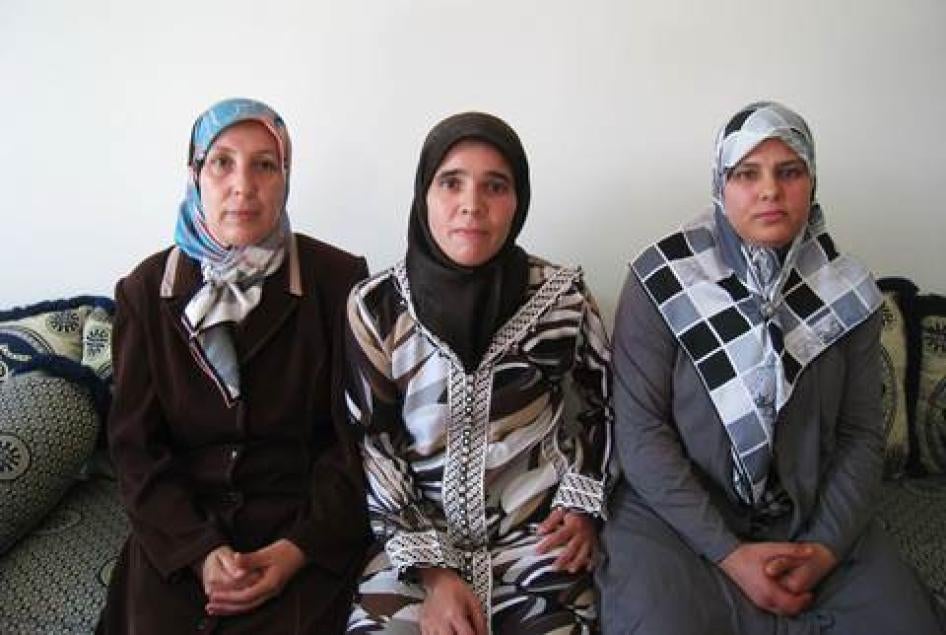
Wives of “Bellarij” defendants, September 14, 2012. L to R: Houriya Ameur, Samira Rammache, and Maymouna Bosh, wives respectively of Mokhtar Lokman (serving an 15-year term), Mansour Belaghdeche (freed in February 2013 after serving a 5-year term) and Ahmed Khouchiâ (serving an 8-year term). ©2013 Eric Goldstein/Human Rights Watch
The defendants’ main line of defense was to repudiate their police statements and to challenge the accuracy and voluntariness of the police statements made by their co-defendants. If the court found the police statements to be inadmissible as evidence, it would presumably acquit them in the absence of other compelling evidence against them.
Some of the defendants repudiated their “confessions” before the investigating judge. Some told the court at their very first appearance that they had been the object of police violence while others did not do so until months later, during the trial phase. Others challenged their confessions on grounds other than torture: they stated that the police had not subjected them to physical violence so much as tricked them into affixing their signature to doctored versions of the statements they had reviewed and approved. In any event, by the trial phase, all of the defendants had repudiated their confessions.
In the end, both the court of first instance and the court of appeals rejected all efforts by the defendants to repudiate their police statements. The court of first instance’s written judgment justified the guilty verdicts by explaining that the defendants’ claims of coercion and falsification were “unproven,” made too late in the process, and in any event undermined by the level of detail and cross-corroboration in the various defendants’ statements when taken together. The judgment concluded:
[The court found its basis for a guilty verdict] in the documents in the case file and the statements that the accused made … to the judicial police, which were detailed and precise in terms of dates and locations…and which corroborated one another. Since there is nothing in the case file to indicate the statements were the product of torture or coercion they should be admitted as evidence -- especially since the court is confident of their veracity from having discussed them with the defendants at the hearing [...] and since there is nothing that should prevent the court from admitting into evidence these statements that the defendants made incriminating others before the judicial police and during the investigation. This gives the court confidence and a basis for forming an intimate conviction about the matter, thus leading it to find the defendants guilty.[52]
The written verdict of the appeals trial, which reaffirmed all 35 convictions but reduced some of the sentences, reasons similarly.
A court should be vigilant when the prosecution’s case is built almost entirely on defendants’ police statements that incriminate themselves and one another, and when the case lacks other forms of corroborative evidence such as eyewitness testimony, authorized wiretaps or video surveillance, reports by informants, fingerprints, or other forms of forensic evidence.
If the report of the investigating judge is to be believed, all of the defendants, within a few days of their arrest, voluntarily confessed to crimes of great gravity. For example, the two political party chiefs among the co-defendants, Mustapha Mouâtassim and Mohamed Merouani, implicate themselves and others in years of plotting violent attacks, including weapons-trafficking, an attempt to rob a vehicle transporting cash, and an attempt to assassinate a Jewish citizen.
However, the defendants claimed their confessions had been obtained by torture or ill-treatment or forgery. Faced with such claims, the court should have tried to ascertain whether the police obtained the statements in a legal fashion before admitting them into evidence. The case file shows no record of any forensic medical examination conducted on any of the defendants, and the court’s written judgment gives no indication that it had probed the matter.
Regarding the probative value of statements prepared by the police, the Code of Penal Procedure, as noted above, provides different instructions depending on the gravity of the crime: if the defendants are accused of minor offenses carrying penalties of less than five years, the court is to consider police statements as trustworthy unless there is evidence to the contrary. However, in cases involving crimes where the defendants risk sentences of longer than five years—as in the Belliraj affair—the court is to approach a police statement as it would any other piece of evidence and presume nothing about its reliability.[53]
The fact that a defendant shows no visible traces of physical torture or tries to repudiate his confession late in the process is no reason for the court to dismiss his claims summarily: there are reasons a defendant may affirm and then later repudiate his statement other than a desire to escape punishment, and there are ways to assess the credibility of a torture claim weeks or months after the fact and in the absence of scars.
The apparent absence of due diligence by the court in the Belliraj trial in examining the defendants’ claims about the evidence against them— when everything rode on the confessions that all the defendants contested at trial—marred its fairness.
Background to the “Belliraj” Affair
While Morocco has held trials involving large groups of defendants allegedly involved in terrorist organizations, the Belliraj trial was the first in recent memory where the defendants included political figures.
Shortly after announcing in February 2008 the arrests of the defendants, then-Interior Minister Chekib Benmoussa said that the group had links to al-Qaida.[54] According to the charges, the organization had been formed in 1992; despite being in existence for 15 years until it was “broken up,” the material criminal acts attributed to it were few and infrequent, and all dated to 2001 and earlier. These included smuggling arms into Morocco, robbing the Makro department store in Casablanca in 1994, firing on and wounding a Jewish resident of Casablanca in 1996, and attempts to rob vehicles transporting cash between 1994 and 2001. For the period from 2001 until their arrests in 2008, the defendants stood accused of conducting surveillance of potential targets, but not of assaults or robberies or other serious offenses.
The trial took place in the Salé Court of Appeals, the jurisdiction of first instance for all trials involving charges under the anti-terrorism law. Investigating Judge Abdelkader Chentouf presided over the “instruction” phase in the spring of 2008 and submitted his report to the court on July 24 of that year. The trial opened on October 16, 2008, with Judge Abdelaziz Benchekroun presiding, and concluded on July 27, 2009.
The six political figures among the defendants included three from moderate Islamist parties and a fourth from a socialist party:
- Mustapha Mouâtassim (born 1954), president of the Civilized Alternative Party (al-Badil al-Hadhari), a legally registered party that competed in the 2007 legislative elections but won no seats;
- Mohamed Lamine Regala (born 1959), spokesman of the same party;
- Mohamed Merouani (born 1959), president of the Movement for the Oumma, which had followed the legal procedures for registering as a political party but had not won approval at the time of the arrests;
- Abadila Maelainin (born 1963), a member of the national council of the Justice and Development Party, the country’s leading Islamist political party, with 46 seats in parliament at the time of his arrest;
- Abdelhafidh Sriti (born 1965), correspondent of al-Manar, the satellite television station of the Lebanese Hezbollah party; and
- Hamid Najibi (born 1969), a member of the national council of the Unified Socialist Party, a small party that, in coalition with two other parties, had five seats in parliament.
According to the charge sheet,[55] the defendants held a meeting in Tangiers in 1992 at which they decided to pursue the goal of establishing an Islamist state in Morocco by creating a secret organization with political and military wings. Mouâtassim, Merouani, and some of the other defendants, including Abdelkader Belliraj, allegedly attended this 1992 meeting. The names they gave to their organization, or to parts of it, were “The Islamic Option” (al-Ikhtiyar al-Islami) and “The Army of God” (Jund Allah). The prosecution alleged that the group discussed assassinating government ministers, military officers, and Moroccan Jews to destabilize the country, and committing robberies to finance their activities. Belliraj’s role, according to the charge sheet, was to finance and obtain weapons for the organization.
The Position of Moroccan Authorities Regarding the “Belliraj” Trial
According to Moroccan authorities, “All stages of the trial took place in conditions that observed all guarantees for a fair trial, particularly in terms of lawyers assisting the defendants, the public nature of the hearings, the presence of witnesses and translators, and all possibilities for introducing evidence.”[56]
Authorities countered the most serious allegation against the fairness of the trial—that some defendants claimed that their interrogators had forced them to sign false confessions—by saying that the defendants had not raised their complaints at the earliest opportunity, making it harder for the court to investigate those claims and to believe them:
It was alleged that they had been tortured. It should be noted that the provisions of articles 99 and 134 of the Code of Penal Procedure state that all public prosecutors and investigating judges must grant the request for a medical exam by defendants under garde à vue or their defense counsel. The public prosecutor or investigating judge must also automatically order a medical exam if they observe any marks on the defendant that warrant it. The defendants did not raise this claim before the public prosecutor or the investigating judge, and the latter observed no marks that would warrant an automatic order for a medical exam.[57]
M’hammed Abdennebaoui, director of penal affairs and pardons of the Ministry of Justice and Freedoms, made a similar point:
The suspects were brought before the prosecutor and then, the same day, before the investigating judge. Their lawyers were present the first day they were heard. Ten days later, we start hearing complaints about torture. The prosecutor didn’t see any signs of torture. They had lawyers; why didn’t they ask for an investigation then? The lawyers didn’t demand a medical examination at the beginning of the “instruction,” when they could have raised it. We try to protect people, but if they don’t have proof…[58]
Both of the above assertions by authorities misstate the facts about the case at hand and also misleadingly suggest that complaints of torture are valid only if submitted at the first opportunity.
Some of the Belliraj defendants in fact did inform the court of their alleged mistreatment at the earliest opportunity. For example, the written record of the hearing of Abadila Maelainin noted that in his first appearance before Investigating Judge Abdelkader Chentouf on February 28, 2008—nine days after his arrest—he complained of the police slapping and insulting him and members of his family.[59] While the court’s own record of Maelainin’s appearance noted his complaints, there was no mention of any investigation to determine if these allegations of illegal acts of violence by the police had merit. The court’s judgment noted that Maelainin’s lawyer asked the trial judge on October 16, 2008, to order a medical examination of him, but that the court declined to do so.
Mohamed Chaâbaoui, May 16, 2013. A senior police officer convicted in the “Belliraj” case, Chaâbaoui left prison in February 2013 after completing his five-year term. ©2013 Eric Goldstein/Human Rights Watch
Defendant Mohamed Chaâbaoui, a police chief accused of aiding the terrorist organizations from within the security forces, told Human Rights Watch that at his very first appearance before Investigating Judge Chentouf, he demanded a medical examination and pulled down his pants to show the judge bruises and scratches he said were the result of being kicked during interrogation. However, the judge did not order the exam nor record that he had seen marks on Chaâbaoui’s body. [60] When Chaâbaoui next appeared before the investigating judge weeks later, the traces of violence had healed and there was no longer any point in requesting a medical exam, he said.
Another defendant, Ahmed Khouchiâ, told the investigating judge at his first appearance before him that state agents had used “violence” against him and that the contents of his police statement were false. Investigating Judge Chentouf’s report (l’ordre de renvoi) states this on pages 133-134. [61] Later, before the trial judge, Khouchiâ; who was born in 1966, once again repudiated his police confession and recounted his abduction, incommunicado detention, and mistreatment while in custody. Defendant Belliraj told the investigating judge that state agents had abducted and tortured him, as the investigating judge’s report states on page 100.
About two-thirds of the defendants contested all or part of their police statements when they appeared before the investigating judge, according to the written verdict of the trial in first instance. Human Rights Watch does not know how many of the other defendants alleged torture and at which point they may have done so during the months-long investigative phase. However, some of the defense lawyers asked Investigating Judge Chentouf to carry out an investigation into the torture allegations made by their clients. When Judge Chentouf declined, they filed an appeal that was examined by an appeal court judge, who ruled against them.
Not all of these men claimed that they had been forced to sign their confessions under torture; the six political figures among the co-defendants claimed that the police had tricked them into signing doctored versions of the statements they had reviewed and approved. Meanwhile defendant Chaâbaoui refused to sign his police statement, even though he says police punched and kicked him during interrogation.[62]
Beyond letting the defendants speak at trial about the abuse they say they endured, and asking them perfunctory questions about it, the court apparently never conducted its own investigation into the merits of the allegations of torture or document falsification. Neither the investigating judge nor the trial judge asked probing questions of the defendants or commissioned an independent expert to examine and interview them, in an effort to evaluate the veracity and voluntariness of their confessions. Instead, the court summarily rejected the defendants’ claims of torture. At the appeals trial, the court again rejected the claims, saying that they had not been “proven” or “raised in a timely way,” and that the defendants “did not request a medical examination to prove [torture], and the investigating judge did not observe on them any signs of violence.”[63]
A Credible Complaint of Torture Should Be Investigated Regardless of When It Is Lodged
The argument that the Belliraj defendants did not raise their claims of torture in a timely way is problematic for several reasons. As noted, some of the complainants did complain of torture at the first opportunity. Human Rights Watch does not know if those who complained formally requested medical examinations at that moment, but even if they did not, the complaints of torture or ill-treatment should have triggered a response by the court, for two reasons. First, Moroccan law criminalizes torture and thus the defendants are alleging that the police have committed a crime. Such allegations, if nothing else, should be brought to the attention of the prosecutor, something that appears not to have happened in any case investigated by Human Rights Watch.
Second, Moroccan law states that any statement obtained by “violence or coercion” is inadmissible as evidence (article 293 of the Code of Penal Procedure). Thus, when defendants make such an allegation, this provision of the law makes it incumbent on the court to carefully consider its merit to ensure that no statement obtained under “violence or coercion” gets admitted. This involves either ordering an independent investigation into the allegations or striving to get to the bottom of the matter by questioning the defendant about his claim, examining other relevant evidence and summoning relevant witnesses, including those who had custody over him during interrogation.
Authorities correctly note that at least some of the Belliraj detainees, accompanied by their lawyers, confirmed their police statements when appearing before the investigating judge, and only tried to repudiate their statements at the later trial phase. They also correctly observe that the passage of time after a detainee emerges from police custody complicates the task of determining the truth of their claims of torture.
There are various reasons why defendants would confirm an inaccurate police “confession.” For example, Abdelkader Belliraj himself explained to the trial judge why he had confirmed his police confession before the investigating judge only to affirm later that his confession was false. Belliraj told the trial court his interrogators threatened him with “more torture” if he went before the investigating judge and retracted the confession he had made to them. He also told the trial court, on April 2, 2009, that one of his alleged torturers was present in Investigating Judge Chentouf’s chambers when the judge questioned Belliraj about his statement, according to the written verdict. Defense lawyer Abderrahim Jamaï asked the trial judge to summon Investigating Judge Chentouf to answer questions about this hearing, but the trial judge declined to do so, Jamaï told Human Rights Watch.
According to a relative of another defendant who attended the hearing on April 9, 2009, defendant Mohamed Yousfi explained to Trial Judge Benchekroun on that day that he had confirmed his police statement before Investigating Judge Chentouf on July 1, 2008 because the police had threatened him with violence if he retracted it.[64]
Defendants in other trials in Morocco also have described to Human Rights Watch how their first appearance in front of the prosecutor or investigating judge was not a setting conducive to raising torture or repudiating one’s police statement. These initial hearings are normally perfunctory, lasting only a few minutes. The prosecutor or judge races through questions about the identity of the defendant while barely looking up at him. The defendant, who is rarely represented by a lawyer at this hearing, is easily intimidated.[65]
Illegal Arrest and Detention Procedures, If Substantiated, Add Credence to Torture Claims
In the Belliraj case, there are additional reasons to take seriously the defendants’ repudiations. The first of these reasons is that some of the detainees alleged that they were subject to conditions of detention that, if true, violated Moroccan law and call into question the voluntariness of any statement obtained from them.
Moroccan law allows the police to place detainees who are suspected of terrorism offenses in pre-arraignment detention for a maximum of 12 days.[66] The law provides detainees certain protections, including ensuring that:police inform the detainee’s family as soon as it is decided to place them in custody;[67] detention take place only in recognized places of detention;[68] and detention, which can last 12 days, should not be incommunicado for the whole period: the detainee has the right to see a lawyer after the first four days in custody, a period that can be extended for no more than two days if approved by a prosecutor.[69]
These provisions make it more difficult for police to use illegal means of coercion against a detainee, and their infringement can help to provide circumstantial evidence that a detainee may have been improperly coerced to give a statement.
Several of the Belliraj defendants alleged that they had been victims of serious violations of the laws governing arrest and detention. Abdelkader Belliraj, the alleged ringleader, told the trial court that authorities intercepted him on a street in Marrakesh at some point in January 2008—and not on February 18 as the authorities reported—and held him incommunicado for one month before bringing him before a judge.
Another co-defendant, Mokhtar Lokman, was held beyond the legal time limit and without the authorities once notifying his family, according to his wife, Houriya Ameur. Lokman, a merchant born in 1958, left his family home in Salé for work around 9 a.m. on February 2, 2008, and did not come home as usual at the end of the afternoon, Ameur told Human Rights Watch. For two and-a-half weeks, his family searched police stations and hospitals, filling out missing person reports at police stations, without being able to find any trace of him, she said.[70] The family learned of his detention only around February 20, 2008, when Minister of Interior Chekib Benmoussa announced the dismantling of a terror network, and lists of the names of those arrested appeared on the Internet. Lokman had never before been arrested, his wife said.
Defendant Ahmed Khouchiâ was arrested by plainclothes police who did not identify themselves near his home in the city of Kénitra at 11:30 p.m. on January 27, 2008, according to his wife, Maymouna al-Bosh. For three weeks his family did not know the whereabouts of Khouchiâ, a travel agent who had never before been arrested, his wife said. The family filed three missing-person reports before they learned he was in police custody.
The allegations by “Belliraj” defendants of illegally prolonged detention and failure to inform kin are consistent with the treatment of terrorism suspects in other cases, as documented by Human Rights Watch and other organizations.[71]
Illegally prolonged garde à vue detention is, however, hard to prove. A defendant can point to the date that his family first reported him as missing and sometimes identify witnesses who saw him being taken away by men in plainclothes. However, the police registers invariably show dates of arrest and of presentation to the court that do not exceed the legally permitted duration. Detainees claim that the police falsify arrest dates by making them later than they actually took place, but have no material proof of this.
In the Belliraj case, the court dismissed the allegations made by various defendants of illegal detention as “unproven.” The written verdicts in the first instance and appeals trials give no indication that the court attempted to probe the credibility of these allegations, either by questioning the defendants in detail or by summoning witnesses who could shed light on their veracity. The first-instance verdict concludes,
An examination of the case file did not prove to the court that the defendants were subjected to abduction, [illegal] detention, and torture. The defense provided no evidence to prove this, and the complaints presented by the relatives cannot serve as a means of proving it, The defendants did not raise their torture claims in a timely way before the prosecutor or the investigating judge, so that appropriate measures; could be taken. Those defendants who declared to the investigating judge that they had been tortured did not request a medical examination to prove this, and the investigating judge did not observe on them any signs of violence. Thus, the claim was rejected.”[72]
The appeals verdict affirms this finding by the first-instance court, using much the same language.[73]
A study of the police statements made by defendants Mohamed Chaâbaoui, Mokhtar Lokman, Ahmed Khouchiâ, and Mansour Belaghdeche, and their efforts from the “instruction” phase of the trial to repudiate those statements, indicate that the court failed to probe seriously whether those statements had been coerced through illegal means.
Chaâbaoui, born in 1962 and a father of four, was the chief of a police station in Fez when plainclothed agents of the Judicial Police arrested him in that city on February 18, 2008. Transported to the headquarters of the Judicial Police’s National Brigade (BNPJ) in Maârif in Casablanca, Chaâbaoui said he was held in isolation there for 9 days; unable to access a lawyer or his family. Chaâbaoui told Human Rights Watch about his interrogation:
About two hours after arriving at Maârif, they blindfolded and handcuffed me, brought me into an office, and sat me on a chair. The chief of the BNPJ began asking me questions. First he asked if I knew Mohamed Merouani. I said, “Yes, he’s my neighbor in Rabat.” He continued, “Merouani is a member of a terrorist organization that has been smuggling weapons into Morocco.” I replied, “What does that have to do with me?” Then he asked me what I knew about Merouani and his ideology, and why I had never filed a report stating what I knew about him. When I repeated I knew Merouani only as my neighbor and I didn’t give the answers they wanted, they punched me in the face and kicked me on my legs. Then they sent me back to my cell.
Chaâbaoui said that when confined to his cell, guards gave him food and drink and treated him normally. He was neither handcuffed nor blindfolded. He continued:
The second day, they handcuffed and blindfolded me and brought me to a room. The interrogators asked about my relations with terrorist organizations and whether I had been providing them information about the police. Again, when I didn’t give the answers they wanted, they beat me.
That evening, they brought me to an office and presented me with a statement 26 pages long. They let me read it. It was completely falsified: it said I had confessed to joining a terrorist organization with Merouani and to aiding the organization from within the police. I refused to sign. The BNPJ chief said, Sign it and we’ll find a way to solve this problem for you. I refused. They did not use any violence at this point and sent me back to my cell.
The next day, they presented me with an eight-page statement and allowed me to read it. This one was also completely falsified. I refused to sign and they sent me back to my cell.
The second police statement of Chaâbaoui, as it appears in the case file, is dated February 19, 2008. In it, he denies serving as an agent of Merouani’s group inside the police forces. But Chaâbaoui “confesses” to having joined “the Islamic Option” organization, attending meetings with Merouani and Lokman wearing a face-mask and using the pseudonym Tahar. The statement ends by noting that Chaâbaoui read it, agreed with its contents, but refused to sign.
Chaâbaoui said while in garde à vue detention he asked to contact a lawyer but his interrogators refused. He first saw a lawyer at his first appearance before the investigating judge on February 28, 2008.
At trial, Chaâbaoui denied the contents of his police statements at every stage. He noted also that while seven co- defendants implicated him in their police statements, at their collective hearing before the investigating judge for “confrontation,” five of the seven denied having done so or even knowing him. The sixth, Mokhtar Lokman, said that he knew Cha âbaoui only as the neighbor of his friend Merouani, whom he visited on occasion. Merouani himself did not respond because he, along with the other five “political” defendants, was boycotting the trial at this stage to protest the court’s refusal to let the defense lawyers copy the case files so the defendants themselves could review them (see below).
The police statement attributed to defendant Lokman mainly implicates at length two co-defendants, Merouani, one of the six political figures in the case, and Chaâbaoui, a police officer. According to Lokman’s statement, he and Merouani attended many meetings together where they discussed furthering Jund Allah, a jihadist organization. He names in his statement many other Belliraj defendants who attended some of the meetings. Merouani proposed financing Jund Allah by robbing vehicles, including some that transport money for businesses. The statement does not mentions any robberies or violent crimes that Lokman participated in, but it says that he discussed robberies with Merouani and conducted surveillance. At one point, according to the police statement, Merouani gave weapons to Lokman for temporary safekeeping. All of these activities took place in 2000 and earlier.
When Lokman emerged from pre-arraignment detention and appeared before the investigating judge for the first time, his lawyer, Khalil Idrissi, accompanied him. According to the written verdict, Lokman refused to give any statement at this first hearing, explaining that he was exhausted and wished to wait until his lawyer could look at the case file. In his second appearance before the investigating judge, again with his lawyer present, he denied all criminal and conspiratorial activities, including weapons possession, that figure in his police statement. He admitted to knowing Merouani, Chaâbaoui, and other co-defendants, but not in the context of a radical Islamist organization or criminal activity.
Lokman told the trial court that he had been tortured into signing a police statement that was false. Human Rights Watch does not have the transcript of what he told the court. However, Lokman’s wife, Houriya Ameur, told Human Rights Watch that he had told her that the police had slapped and insulted him at the beginning of his detention, even before their questioning got under way. During questioning, he told her, they administered electric shocks to his body, causing him to faint. At the end, they presented him with a statement and told him that if wished to see his children he would have to sign it. He signed without reading the statement, his wife said.
The court convicted Lokman of forming a criminal gang with the intent to prepare and commit terrorist acts, and possession and transport of weapons as part of a gang whose purpose was to gravely harm the public order, among other charges. It sentenced him to 15 years in prison.
Ahmed Khouchiâ in his police statement “confessed” that he grew close to Merouani’s organization in the mid-1990s, and went to Syria to obtain military training from Hizballah. After that, the statement said he met with various members of the militant cell, was present when they discussed potential targets for robberies and attacks, conducted surveillance on their behalf, viewed their weapons, and transferred money among members. He named several of his co-defendants as part of the militant organization, but did not admit to having participated in any violent act.
Accompanied by his lawyers at his first appearance before the investigating judge, Khouchiâ refused to give any statement until his lawyers could examine the case file, according to the court verdict. He also at this point stated that police officers used violence against him during the interrogation.[74]
In his second appearance before the investigating judge, again with his lawyers present, Khouchiâ disavowed his police statement. He denied belonging to any radical Islamic movement or political party and said he never met Merouani and never had anything to do with weapons or an attempted robbery of a vehicle. He said he had traveled to Syria in 2001 but for the purpose of trying to enter Europe through Turkey.
Khouchiâ at trial recounted his alleged abduction, incommunicado detention, and mistreatment, and repudiated once again his police statement. Human Rights Watch does not have a transcript of his testimony in court. However, according to his wife, Maymouna Bosh, Khouchiâ had recounted to her that during his interrogation, the police blindfolded him and subjected him to beatings and threats concerning her, and forced him to crouch for long periods of time. In the end, he signed a police statement without reading it, he told her. [75]
The court convicted Khouchiâ of harming internal state security by forming an armed gang to prepare and commit terrorist acts, and possessing and transporting weapons as part of that gang, among other charges. It sentenced him to eight years in prison.
Mansour Belaghdeche, also from Kénitra, contended that the police had forced him to sign a statement without reading it. According to his wife, Samira Rammache, police arrested Belaghdeche, a middle-school teacher born in 1976, near his home on February 19, 2008, and transported him to Maârif police headquarters in Casablanca. She said that he told her that they interrogated him and presented him with a statement to sign while he was still blindfolded. When he tried to resist, he told her later, they grabbed his neck, pushed his head toward the ground, and said, “If you want to leave here, you must sign.” Rammache continued:
My husband told me that he didn’t speak much, but they made him sign a lot of pages. Looking under his blindfold, he happened to see one sentence that he never said, about conducting surveillance of Jews in Kénitra. But he did not learn the full contents of his statement until his lawyer, Khalil Idrissi, went over it with him.[76]
Belaghdeche denied the contents of his police statement when he appeared before the investigating judge, according to the written court judgment. The court convicted him and sentenced him to five years in prison. Authorities freed him in February 2013.
Belliraj, the alleged ringleader, told the court that the police tortured him. Again, Human Rights Watch does not have the transcript of his remarks. In a letter he provided to his Belgian lawyer Vincent Lurquin, he said that during incommunicado detention, his interrogators blindfolded him, beat him, hung him upside down by his feet, and submitted him to electric shocks.[77]
Belliraj’s allegations of torture, which he made during the trial phase, take on special gravity in light of the fact that his file contains, unusually, two quite different statements attributed to him to the police, bearing different dates. His first statement does not mention the six political figures among his co-defendants, whereas his second statement deeply implicates them in the alleged terror organization. This raises the question of what happened to Belliraj while in custody after he made his first statement that led him provide a second statement so different in nature. The addition, during a second round of questioning, of details surrounding the highest-profile defendants in the case may have been entirely voluntary, but given Belliraj’s allegations about illegally prolonged detention and torture, it raises questions.
If we are to believe Belliraj’s police statements—which he repudiated at the trial on April 7, 2009[78]—he confessed not only to involvement in the terrorist group in Morocco that he allegedly co-founded in 1992, but also to involvement with the Palestinian Abu Nidal terrorist organization in the 1980s and in jihadist and criminal activities over a quarter of a century. These included involvement in six ideologically motivated murders in Belgium during 1988-1989, whose victims included Jews and a moderate Muslim imam, and the robbery of the offices of Brinks in Luxembourg in 2000 and other robberies in Belgium carried out in order to finance jihadist activities. According to his police statement, Belliraj also journeyed to Afghanistan, where he met al-Qaida leaders Osama Bin Laden and Ayman Zawahiri shortly before the September 11, 2001 attacks in the United States. He also confessed to traveling to Lebanon in 1983 to train in the use of weapons and explosives.
The prosecutor sought the death penalty for Belliraj.[79] The court found Belliraj guilty as charged, including for the murders committed in Belgium in 1988-1989, and sentenced him to life in prison. Interestingly, Belgian authorities never charged him in connection with any crime, although they questioned him about the murder of the imam and put him under surveillance. In 2000 Belgium granted Belliraj citizenship.[80]
Another apparent anomaly in this case was that the court refused to provide defendants with photocopies of the case file, including their own statements to the police, during the investigative phase. Permitting the defense to copy the complete case file is standard practice in Morocco, although it is not a right provided by law; the Code of Penal Procedure in article 139 provides only that the case file shall be available for review to the defense. Thus, the defense lawyers in the Belliraj case could read the case file at the courthouse but could not bring it to their detained clients so they could study it.
In a particularly complex case like this one, with police statements from more than 30 defendants implicating each other, the inability of defendants to study the file themselves before answering questions from the investigating judge put them at a disadvantage. For this reason, the six political figures among the defendants boycotted their questioning by the investigating judge. The investigating judge responded to their boycott by submitting their police statements to the trial court without taking testimony from them as to the veracity of those statements.
Abadila Maelainin, September 14, 2012. Convicted in the “Belliraj” case, Maelainin spent four years in prison before being pardoned. ©2013 Eric Goldstein/Human Rights Watch
When the six political defendants finally gained access to the case file, they discovered, they said, that their police statements did not match what they had told the police. Before the court; they repudiated those written statements as grossly falsified versions of the oral statements they had actually given.
The six claimed to have been the tricked into signing doctored versions of their statements but not to having been subjected to severe physical mistreatment or secret or illegally prolonged detention, in contrast to many of their co-defendants. Some of the six did allege some ill-treatment: Maelainin told the prosecutor that the police slapped and insulted him. Mouâtassim said the police threatened to arrest other members of his political party if he did not sign. Merouani said the police asked him to sign even though he was ill and had a fever.
Maelainin recounted to Human Rights Watch his arrest and interrogation:
Men in plainclothes intercepted me in front of my home [in Rabat] at 8:30 a.m., as I was getting in my car to drive my kids to school. The night before [February 18, 2008], I had seen on television that they had arrested Mouâtassim and Merouani. I had no idea what was going on. I knew they were police, but they didn’t say why they were detaining me. They drove me to police headquarters in Maârif, in Casablanca. They sat me down and started asking questions about me and my activities. When I didn’t tell them what they wanted to hear, they started slapping me and insulting members of my family and my elders. Then they removed my glasses, covered my eyes, handcuffed me behind my back, and continued the questioning. At one point, when they thought I wasn’t cooperating, a large, strong man —I could tell his size even though I was blindfolded—put his hand on my neck and forced my head down toward my feet. And the questioning continued.
When they were done, they presented me with my statement, along with my glasses so I could read it. It was a reasonably accurate version of what I had told them about the stages of my life, which political parties I had been active in, who I knew, when I had traveled abroad, and so on. But there were some errors that I asked them to correct. Late at night, an officer came to me in my cell with a stack of papers, saying it contained multiple copies of my statement for my signature. I read the first one through and found it to be accurate. I read the first page of the second copy, and it too was accurate. But then the officer asked if I could please speed it up, and so I just signed the rest without reading. I’d say there were about 20 copies. I did so because it was late at night, I was exhausted, the officer was a nice guy and was pleading that he wanted to go home—and, frankly, it didn’t occur to me that they might be preparing a dirty trick, especially since they had cooperated in correcting the errors in the first draft.
It was only much later, when the trial started, that I discovered all the things that they had changed in the written version of my police statement. For example, they altered dates of meetings I had mentioned so as to put me at meetings attended by other defendants. In one case they were careless in their changes, so that the statement has me in October 1992 referring to a meeting in the future—when that “future” meeting in fact took place in the summer of 1992. Also, the statement has me in Morocco plotting terror activities at a time when I was still a student in Belgium—the court could have confirmed this by checking the entries into Morocco in my passport.… But the biggest falsification in the police statement has me admitting that I had offered transport to one of the other defendants who was planning to rob a truck… I never said anything like this.[81]
The other five “political” defendants in the case told the court that the police had tricked them in a similar fashion. They read and signed their statements after verifying their accuracy. Later, they said, the police came back while they were still in custody and presented each of them with multiple “photocopies” of their statement and asked them to sign each. Some of the six stated that the police pressured them in various ways to sign all of the copies without examining each closely, which they did—only to discover later that the copy in the case file contained, according to them, some falsifications: exculpatory details removed and incriminating details added, to fit into the picture of a massive conspiracy.
At trial, the defendants pointed out the discrepancies between what they said they had told the police and what was in the version of their police statements submitted to the court. The court made no apparent effort to assess this claim, and gave no indication it doubted the veracity of the police statements as they were presented to the court.
At trial, the defense lawyers argued that the alleged actions of the defendants, as presented in the various statements, were inconsistent or implausible to a degree that cast doubt on their veracity. For example, some of the defendants were charged with participating in the robbery of a “Makro” department store in Casablanca in 1994. The defense explained in court that at the time of the robbery authorities had announced they had arrested the perpetrators, suspected jihadists who were later convicted for this and other criminal acts in Morocco. The lawyers argued in court that it was implausible, on the basis of contested confessions, to link the defendants to a fourteen-year-old robbery that the authorities had supposedly solved at the time.
Some of the defendants also stood accused of an attempt on the life of a Moroccan of Jewish faith, Baby Azenkout, in Casablanca in 1996. But here too the main evidence linking defendants to this crime came from their own contested confessions. Azenkout testified at the Belliraj trial that he had not seen his assailant. The defense team pointed out that the contemporary eyewitness descriptions of the assailant did not match any of the defendants on trial.
Another factor raising questions about the veracity of the defendants’ police statements is the similar way they are worded in standard Arabic, despite the vastly different levels of education and mastery of standard Arabic among the men, Abderrahim Jamaï, one of the lawyers representing the six political figures, told Human Rights Watch. Jamaï said that, for example, some defendants were educated while one is a parking attendant who is illiterate or nearly so. He added that defendant Abdellatif Al-Bakhti lived in Belgium and could not read Arabic, yet signed his police statement written in Arabic.
Government Claim that There Was No Distinction Among the Detainees
Responding to inquiries about the case from Human Rights Watch, the government said that the six “political” figures charged in the case were defendants like the 29 others, distinct only in the disproportionate amount of publicity they got from their supporters. The government wrote, “The case was the subject of several defamation and media campaigns, and several allegations were made, including that the case of the six aforementioned defendants was a political case given their political and partisan affiliations.”
Despite the government’s claim that the political figures were no different from the other defendants, their fate diverged following the guilty verdict. The five of the six who were still in prison at the time of the appeal all saw their sentences cut from 20 and 25 years to 10 years apiece. Only one of the other 29 defendants benefited from a reduced sentence on appeal: Slah Belliraj, who reportedly suffered from serious health problems.
On April 14, 2012, a date when the king announced a royal pardon releasing scores of prisoners, the only Belliraj prisoners to be freed were the five political figures still in prison—even though the court had convicted them for leadership roles in what the government described as “one of the most dangerous terrorist organizations to be dismantled recently”—and one other defendant, Slah Belliraj, who had less than one year left to serve. None of the other 21 “non-political” detainees serving sentences benefited from the pardon.
February 20th Youth Protesters in Sidi el-Bernoussi, Casablanca
Pro-Reform Protesters Convicted on Basis of Confessions
On September 12, 2012, a Casablanca court convicted six activists from the pro-reform February 20th Youth movement for insulting and assaulting police officers, insulting the police as a state institution, and disobeying orders to leave an illegal assembly.[82] The charges stemmed from a street protest that took place in Casablanca on July 22, 2012. As in the preceding cases, the court relied on the police statements of the defendants to convict them even though the defendants alleged to the court that the police had used force and threats to coerce them to sign false confessions.[83]
However, in contrast to the preceding cases, the court ordered a medical examination of the defendants as they emerged from police custody. The report that emerged from that medical examination, however was superficial and below international norms for examining possible victims of torture or physical coercion. If it is representative of court-ordered medical examinations of detainees who claim to have been the victims of police violence, Morocco should improve their quality by ensuring that they conform to international norms, as set out in the Istanbul Protocol.
The Casablanca Appeals Court on January 9, 2013, confirmed the verdict but reduced the sentences for the five male co-defendants to six months. They were freed from prison on January 23. In contrast to the other cases examined in this report, Human Rights Watch did not write a detailed letter to the authorities inviting official comment on our fair-trial concerns.
Police arrested the six defendants while dispersing a demonstration of a few hundred people in the working-class neighborhood of Sidi el-Bernoussi in Casablanca. The rally was organized by the February 20th Youth Movement, a loosely organized group that has held rallies in cities around the country since forming on that date in 2011 to protest corruption, unemployment, the high cost of living, political repression, and the concentration of power in the monarchy. Authorities often have allowed the marches to take place without interference, but at other times have violently dispersed them and prosecuted participants.
At the July 22 march, protesters chanted strong anti-monarchy slogans but remained peaceful, participants told Human Rights Watch. At one point late in the evening, the police moved in to disperse the protesters. They arrested the six defendants, put them in a police van, and took them to the local police station.
Laila Nassimi, a February 20th activist who said she still has back pain from a beating in a police wagon, described her arrest and mistreatment to Human Rights Watch:
The demonstration was already over. People were still there but beginning to leave. I was sitting in a café when I saw the police moving in, so I got up to see what was happening. The police grabbed me and put me in the back of their van. Inside the van, policemen started beating me right away. Each time they added someone to the wagon, they beat everyone inside again. They drove us to the Anassi station of the judicial police in Sidi el-Bernoussi. At the station, they did not beat me but I saw what they did to the others in the hallways, before they took us to separate offices: they were slapping them, pulling down their pants, ordering them to shout, “Long live the king!” [One slogan of the February 20th Youth Movement is “Long live the people.”] If they refused, the police beat them some more.[84]
Samir Bradli, whom Human Rights Watch interviewed after he had served his prison term, said that the police punched, kicked and insulted him in their wagon. At one point a policeman struck him on his head with a baton, causing bleeding, Bradli said. At the station, the police lined up the defendants in a room where they beat and insulted them.
Bradli said that when he grew faint, a policeman stood on his feet until he cried out. He added that when he requested a lawyer, the police insulted and beat him more and that one officer asked, “Do you think you are in Europe?” Bradli said that when he asked to read his statement before signing it, they insulted and threatened him, so he signed without reading it.[85]
On July 25, after three days of pre-arraignment detention (garde à vue), the six defendants first appeared before deputy prosecutor Mustapha Fadioui, who informed them that he was charging them with staging an “unauthorized” gathering, assaulting and insulting police as they were performing their duties, and insulting the police as an institution.
As noted in the official minutes of the hearing before the prosecutor, all six denied the charges and said the police had tortured them, beating them in the van and, in most cases, again in the police station. One defendant, Tarek Rouchdi, 29, said that at the station, officers pulled off his clothes and inserted fingers in his anus, the minutes say.
Samir Bradli, May 10, 2013. Bradli and four other young men served six months in prison in connection with a demonstration in Sidi el-Bernoussi, Casablanca. ©2013 Eric Goldstein/Human Rights Watch
Another, Youssef Oubella, 23, said the police had tugged out his eyelashes, pulled off his clothes, and inserted fingers in his anus. Samir Bradli, 34, said the police beat him and pulled out his eyelashes.
Prosecutor Fadioui noted in the official minutes, which Human Rights Watch reviewed, that he observed on Oubella a black eye and bruises on his right arm; a wound on Bradli’s head “perhaps two centimeters long”; bruises and red marks on the right arm of Abderrahmane Assal, 43; small injuries on the nose and neck of Nouressalam Kartachi, 21; and no injuries on Rouchdi. He did not mention Nassimi, 51, in this regard.
The prosecutor ordered a doctor to examine the defendants. The doctor visited the six the same day and filed a one-page report covering all of them. The report, dated July 25, 2012, stated that the examination revealed “nothing in particular...no...trauma… [but] a superficial scratch on the scalp of Samir Bradli.”[86]
The other defendants declared later to the court that the doctor had not physically examined them, defense lawyer Omar Bendjelloun told Human Rights Watch. Bradli told Human Rights Watch that the doctor asked their names but did not examine them.[87]
The case was referred to trial before the Aïn Sbaâ (Casablanca) First Degree Court. The court provisionally released Nassimi, but ordered the five men, all from Casablanca, held pending the trial.
The case file included written statements by police officers that protesters had injured them while dispersing the demonstration, with medical reports to support their claims. However, these statements did not identify the individuals who they say assaulted them, except for one officer who accused Nassimi of biting him, defense lawyers Mohamed Messaoudi and Omar Bendjelloun said. This and the defendants’ repudiated statements to the police were the only evidence linking the defendants to the most serious charge of assaulting the police, according to Messaoudi and Bendjelloun.[88]
No police officer or witness for the prosecution testified during the trial, which lasted several sessions and concluded with a marathon hearing that continued until 3 a.m. on September 11, 2012. Nor did the prosecution produce any video or material evidence, according to Bendjelloun and Messaoudi.
The five male defendants steadfastly denied the contents of their “confessions” made before the police, according to Bendjelloun. Four said they signed them under torture; one, Kartachi, had refused to sign his, explaining at the trial this refusal by contending that the police had never interrogated him about the events of that evening. Nassimi told Human Rights Watch that she signed her statement without reading it because she did not have her glasses, and learned only later that in it she had confessed to biting and hitting a police officer, a statement she denies making and that she denied in court.
Three participants in the protest who appeared as defense witnesses told the court on September 7, 2012, that they did not see the police being insulted or assaulted; one of them said the police used violence against the demonstrators rather than the other way around, according to the written judgment.
The defense asked the trial court to subpoena the police complainants to court to answer questions, but Judge Abdellatif Belhmidi refused. According to the defense lawyers, the file also contained written statements by local business owners mainly complaining that the July 22 demonstration had hurt their business but identifying no perpetrators. These complainants never appeared in court, despite defense requests to have them testify, the defense lawyers said.
Laila Nassimi, one of the six protesters convicted in connection with the demonstration in Sidi el-Bernoussi, Casablanca. Photo courtesy of Laila Nassimi
The judge sentenced Kartachi and Oubella to eight months in prison, Bradli, Assal and Rouchdi to 10 months, and Nassimi to a six-month suspended sentence. He fined each of the six 500 dirhams (US$60) and awarded 5,000 dirhams (US$600) to each of the police officers who claimed injuries, to be paid by the defendants. As noted above the five men were all freed in January 2013 after the appeals court reduced their sentences.
During the trial, the defendants described the violence, threats, and insults they said the police used to coerce them to sign false statements, and the trial judge questioned them about their assertions, according to the defense lawyers.
The written judgment made clear that the court relied on the defendants’ police statements to convict.[89] It stated that at the first trial session, the defense asked the court to summon police officers who typed up the defendants’ statements, as well as the doctor who filed the medical report after examining them. The court denied these requests as unwarranted and “not productive.” The judgment noted that at the August 31 hearing, the defendants testified that the police had beaten them, that their police statements were false, and that they were innocent of the charges. As to the charge of illegal assembly, the defendants argued that the 2011 constitution guaranteed the right to peaceful protest.
The court held that the defense’s invocation of rights found in the new constitution was not pertinent since the law on public assemblies remained in effect. On the charges of insulting and assaulting the police, the judgment noted that the defendants confessed to these deeds in their police statements and—in a declaration found in many such rulings—affirmed that “the content of the statements prepared by the judicial police are to be trusted in the absence of proof that contradicts it.” The court appears to have relied exclusively on these statements to convict the defendants of assault, as the other incriminating evidence in the file did not identify these defendants as the perpetrators of the offenses on trial other than participating in the demonstration, to which they freely admitted. The only exception, as noted, is the one written statement by a police officer who accused Nassimi of biting him.
As to the torture claims, the court found “no evidence in the case file indicating the defendants had been tortured. The defendants raised certain acts but exaggerated them and provided no convincing evidence [of torture]. Moreover, the doctor [who examined them] did not find what they were claiming.” The verdict further stated that the scratches that the prosecutor observed on the defendants were normal and “caused by the forceful dispersion of a gathering.” The court did not explain how it knew the source of these injuries. The medical examination of the defendants, ordered by the prosecutor after he saw signs of violence on their bodies, did nothing to undermine, in the court’s view, the evidentiary value of the defendants’ police statements.
While the prosecutor acted properly in ordering a medical exam, which the doctor conducted the same day that he ordered it, the medical report it produced was inadequate in aiding the court to ensure its obligation under the Code of Penal Procedure that no statement obtained through violence or coercion is admitted as evidence. In fact, according to one forensic medicine expert, Dr. Duarte Vieira, who heads Portugal’s National Institute of Forensic Medicine and served as president of the International Academy of Legal Medicine from 2007 to 2012, the report was “absolutely unacceptable as a medico-legal report and has no forensic value.“ Dr. Vieira served as the medical forensics expert in the delegation of the U.N. Special Rapporteur on Torture, which arrived in Morocco three days after the court had convicted the defendants in the Sidi el-Bernoussi case. He examined the medical report at Human Rights Watch’s request and provided his evaluation of it, which is reprinted in Appendix V of this report.[90]
As Special Rapporteur on Torture Juan Méndez stated at the end of his mission to Morocco that one of the reasons that courts rarely rule confessions inadmissible on the grounds they were obtained under duress “may be the poor quality of medical and forensic reports, which currently provide little assistance to the prosecutors and judges in their decision making process.” Méndez concluded:
There is a need for significant investment in the fields of psychiatry and forensic medicine, accompanied by specific training of forensic experts on the assessment of ill treatment and torture, in line with international standards, including the Istanbul Protocol. In practice, the safeguards against torture do not effectively operate because ‘there is no evidence’ that torture has happened and so the confession or declaration remains on the record and no serious effort is made to investigate, prosecute and punish perpetrators. [91]
Military Court Trial of Sahrawi Activists in the Gdeim Izik case
In February 2013, the Rabat Military Court[92] tried and convicted 25 Sahrawi men on charges relating to the resistance that confronted security forces when they dismantled the Gdeim Izik protest encampment near El-Ayoun on November 8, 2010. The violence that day cost the lives of 11 security force members.[93] The court imposed heavy prison sentences, including nine life terms, on the defendants. They appealed the verdict directly to the Court of Cassation; there is no appeals-level trials in the military court system. As this report went to press, the Court of Cassation had not yet ruled and 21 of the defendants remained in Salé Prison.
The judge who presided over the trial, Noureddine Zehhaf, was the sole civilian in a panel of five judges. The judges ensured that the hearings, held in a courtroom that could seat more than 200, were public and accessible to scores of domestic and international journalists and observers, including one from Human Rights Watch. The judges allowed the defendants, who appeared in civilian clothes and were not handcuffed, to speak without interruption, almost without exception.
Despite the orderly and transparent manner in which the court conducted the proceedings, several facets of the trial call its fairness into question:
- The trial of civilians before a military court, in violation of international norms;
- The prolonged period of pretrial detention—26 months for most defendants—without periodic reviews and written rulings by the court justifying its refusal to grant their provisional release (this issue is addressed in the following chapter);
- The court’s failure to probe the allegations that the defendants made at an early stage of the proceedings that the police had tortured or coerced them into signing false statements; and
- The court’s reliance on the defendants’ contested statements to the police as the main—if not sole—basis on which to convict them, as the court’s written judgment, issued one month after the verdicts, makes clear.
A Human Rights Watch observer attended several sessions of the trial (see Methodology section of this report). We also exchanged correspondence with authorities about the case (see Appendix I).
Background to the Events on Trial
In October 2010, Sahrawis set up a makeshift town composed of thousands of tents in the desert outside of El-Ayoun, at Gdeim Izik, to protest their social and economic conditions in Western Sahara, a vast disputed territory that Morocco has administered de facto since seizing control of it in 1975, after Spain, the colonial power, withdrew. Moroccan authorities entered into negotiations with the leaders of the protest movement, but at a certain point decided that the thousands of protesters at Gdeim Izik would have to leave.
On November 8, 2010, security forces moved in to dismantle the settlement. Some camp residents left readily while others resisted the security forces. That set off violent confrontations between Sahrawis and security forces in the camp that spilled over to the city of El-Ayoun, where many public and private buildings and vehicles were damaged. Eleven security officers were killed that day, by the official count.[94] The government White Paper on the Gdeim Izik Events states that these include four agents of the Gendarmerie, four from the Auxiliary Forces, one from the Armed Forces, one from the National Security, and one from the Civilian Protection.[95]
During and after the events, security forces arrested hundreds of Sahrawis in connection with the clashes. Twenty-four were referred to the Rabat Military Court as a group, on charges that include lethal attacks against law enforcement agents, formation of a criminal gang, and defiling a corpse. In 2012, authorities arrested another Sahrawi in connection with these events and added him as a defendant in this case. Authorities referred more than 120 other Sahrawis to trial before the El-Ayoun Court of First Instance on charges that did not include causing the death of others. They were provisionally released, pending trials that have yet to begin.
According to the version of events provided by Moroccan officials, pro-independence Sahrawi activists, in alliance with criminals, took over and militarized the protest encampment, preventing its residents from leaving. They also opposed negotiations with the Moroccan authorities over socio-economic demands and carefully prepared the violent resistance, involving stones, bottles, gas bombs and “white weapons” (weapons other than guns) that they used against the security forces when the latter entered the camp on November 8.[96]
When the case went to trial in February 2013, 21 of the defendants had been in pre-trial detention in Salé Prison since November or December 2010; two others had been arrested more recently, one was being sought and another was provisionally free. (A list of the defendants is provided in Appendix III.) Several of the defendants are well-known advocates of Sahrawi independence and human rights, including Naâma Asfari, Mohamed Tahlil, and Ahmed Sbaï, who have been imprisoned before for their political activism.
The court charged all the defendants with forming a criminal gang, punishable by five to ten years in prison, under articles 293-294 of the penal code. Most also faced a charge of intentionally lethal attacks against police (punishable by death, under article 267.5 of the Penal Code). The rest were charged with “complicity” in these crimes, punishable under Penal Code articles 129-130. For example, Asfari, whom the police arrested the day before the violence broke out, was tried for “complicity” because of his presumed leadership role in preparing it. In addition, two defendants were charged with “defiling or mutilating” a corpse, punishable by two to five years in prison and a fine, under Penal Code article 271.
All the defendants said they were innocent as charged. Some stated at trial that the real reason behind their prosecution was their activism on behalf of Sahrawi self-determination.
At about 2 a.m. on February 17, 2013, the military court announced guilty verdicts for all defendants. Two were sentenced to time served and released. The rest received prison sentences of between 20 years and life.[97] As of this writing, 21 of the defendants are in Salé Prison, serving their sentences.
The Trial of Civilians Before a Military Court
Under the Code of Military Justice, military courts have jurisdiction over civilians who are charged with causing harm to members of the armed forces or related forces (article 3).[98] On December 22, 2011, the investigating judges handling the case, invoking articles 7 and 76 of this code, referred the detainees to military court for trial.[99]
The referral to a military court contravenes a basic norm of international law, which requires trying civilians in civil courts. In Suleiman v. Sudan, the African Commission on Human and Peoples’ Rights affirmed that military tribunals should only “determine offences of a purely military nature committed by military staff” and “should not deal with offences which are under the purview of ordinary courts.” In addition, the principles and guidelines on the right to a fair trial and legal assistance in Africa proclaimed by the African Commission on Human and Peoples’ Rights states, “The only purpose of Military Courts shall be to determine offences of a purely military nature committed by military personnel.”
In Morocco, defendants before a military court are disadvantaged by the absence of an appeals-level court. Their opportunity for appealing the first-degree verdict is limited to petitioning the Court of Cassation, which can quash a verdict due to errors of procedure, jurisdiction, abuse of power, or application of the law, but does not examine the facts of the case. In contrast, the purview of appeals courts in the civilian court system includes a review of the facts.
At the opening of the trial on February 1, the defense contended that the assignment of the case to a military court contravened the 2011 constitution, which outlaws “special courts” (juridictions d’exception) in article 127. The defense also argued that the trial violated the constitutional principle of equality among citizens, since civilians tried before military courts have a more limited right of appeal than if tried before a civilian court. On February 8, the court rejected these arguments, saying that notwithstanding the 2011 constitution, the laws giving military courts jurisdiction over civilians remained in force. Moreover, the judge said, the military court is a “specialized” rather than a “special court.”
The Military Court’s Failure to Probe the Allegations of Torture
When given the opportunity to speak at trial, one defendant after another issued a disclaimer for the statement he had made to the police. The defendants said the security forces had tortured them and forced them to sign statements they had not read. They said they discovered later that the statements did not reflect their words.
At the opening of the trial, the defense asked the court to investigate these allegations. On February 14, the prosecutor urged the judge to dismiss this request, contending that the defense should have made the request earlier, at the investigative phase of the case. While it appears that the defendants did not specifically ask the investigating judge to order a medical examination to check for signs of torture, most of them told him at their first substantive hearing that the police had tortured them. This first substantive hearing before the investigating judge is usually preceded by a perfunctory one shortly after the defendants complete the period of pre-arraignment police custody. The purpose of this initial hearing is to establish the defendants’ identity, inform them of the charges against them, and have them enter a plea. Nearly all of the defendants in this case appeared at the first hearing without counsel. At the second, longer hearing, the investigating judge questions the defendants, in the presence of their lawyers, in more detail about the accusations. The court’s minutes of those more substantive hearings make clear that at this stage, nearly two years before the trial opened, at least 17 of the defendants had informed the investigating judge of their alleged torture and mistreatment, which most of them said led them to sign false confessions. The case file shows no evidence that the court conducted a medical examination on any defendant at any time to check for evidence of abuse; the defense lawyers confirmed the absence of forensic medical exams to Human Rights Watch. At trial, Judge Zehhaf asked some defendants a few short questions about the torture they said they endured but he neither conducted his own investigation nor ordered one. The written judgment suggests that the trial court accepted the prosecutor’s argument that it was too late to conduct such an investigation.
This reasoning by the trial court appears ill founded, even if one were to ignore that most of the defendants had in fact told the investigating judge of torture. Nothing in Moroccan or in international law prevents defendants from introducing new arguments at any stage of a trial. While the timing of a torture claim may be relevant to assessing its motives and credibility, the fact that it is raised late in the process should not be a basis for summary dismissal. The duty on the Moroccan authorities, in particular the court and investigating judges, to reject evidence obtained by torture is absolute, and arises whenever they should have cause to believe that evidence was obtained by torture.
Convictions Based on the Defendants’ Contested Statements to the Police
The court’s written judgment does not detail the evidentiary basis for finding all of the defendants guilty. But since it mentions no other significant incriminating evidence, it clearly relies heavily on the defendants’ contested confessions to the police—as did the Military Investigating Judge Col. Mohamed el-Bakkali’s earlier decision in November 2011 to refer the case to trial.[100]
In his oral arguments in court on February 14, 2013, Prosecutor Col. Abdelkarim Hakimi said that the primary evidence against the defendants was confessions to the police incriminating themselves and the others. He said that police did not use coercion to obtain these statements and that the defendants willingly admitted to their crimes.
In fact, all of the defendants told the investigating judge they were innocent as charged, and most told him that police had tortured them in custody—even if they did not explicitly request a medical examination at this stage. Many also told the investigating judge that the police had forced them to sign or affix their fingerprints to statements that they had not read. The official minutes of these hearings reflect these allegations. The case file contains no evidence that a doctor examined any of the defendants for torture, or that the court investigated the matter, to assess the credibility of their claims.
As he narrates it, the experience of defendant Taki Machdoufi (born in 1985), provides an example. Gendarmes arrested Machdoufi on the morning of November 8, the day that security forces dismantled the camp, along a road leading from the camp to El-Ayoun. During the five days they held him at their base in El-Ayoun, they twice took him out of a communal cell and questioned him alone in an office, while he sat on his knees, handcuffed, with two or three agents standing behind him. These interrogations lasted about 15 minutes each, he said, and centered on his activities at the camp, on who ran the camp, and whether he could identify persons shown in photos. Machdoufi recalled how each time he denied the accusations or failed to provide the information they requested, one of more of the agents standing behind him beat him on the head and neck. At one point, an interrogator told him the police would write what they wanted regardless of what he actually told them, he said.
On the fifth day, the gendarmes presented Machdoufi with a statement to sign. When he asked to read it first, they refused and eventually had him affix his fingerprint to it while his hands were still handcuffed behind his back, he said. At another point they had him sign another document that they did not let him read. According to Machdoufi, they covered the pages except for a space on the bottom intended for his signature. At no time during his detention in El-Ayoun was he able to contact his family or a lawyer. He said he learned the contents of his statement only when the investigating judge later read to him from it.
After five days of detention in El-Ayoun, authorities flew him and other detainees to Rabat, where they presented them before a military investigating judge. At the first hearing before the judge, Machdoufi had no lawyer. The judge took down details about his identity and asked him to respond to the charges against him, which he denied. Machdoufi said that at this intitial hearing, which lasted five minutes, he did not inform the judge about being tortured or request a medical examination. However, he said, “the judge could easily have seen the signs of torture: there was blood on my face and a cut above my eye where the gendarmes had hit me. But the judge did not react to this.... All I could think about was to get some food to eat and to go to sleep.”
At the second hearing, a lawyer assisted Machdoufi. Again the judge asked him to respond to the charges. Machdoufi told Human Rights Watch:
When I said I was innocent, the judge responded, “Well that’s not what you told the police.” I told the judge about the torture, and the marks that were still visible on my body, and about being forced to sign my statement without reading it. The judge did not cut me off, but he asked questions to re-direct the conversation to other subjects. I asked him for a medical examination because my hearing was muffled in the ear where the police had struck me. The judge seemed to agree to this, but in the end no doctor ever examined me for signs of torture.[101]
The official minutes of Machdoufi’s second hearing before the investigating judge confirm that he denied the contents of his police statement and told the judge that the gendarmes had tortured him (see Appendix III). When we met Machdoufi two and-a-half years after his arrest and three months after his release from prison, he still bore a small scar above his right eye that he says is the result of a gendarme having struck him with a flashlight. The very wording of some of the police statements raises questions about their voluntary nature. For example, the police statement of Naâma Asfari includes declarations such as that purpose of establishing the protest camp was “to spread discord and terror, and destabilize the security of [El-Ayoun] and its environs…” Toward that end, “I started soliciting and receiving funds from people involved in associations abroad, who believed that their money would be employed in charities, while the plan’s deeper purpose was to finance the plan for the camp, to organize volunteers from among the people of the area, and to recruit them in missions that would compromise public security and restrict the freedom of movement of those held inside the camp, while exposing as false the image of a calm and peaceful city.”[102]
Mohamed Lamine Haddi told the investigating judge that the police had tortured him and had him put his fingerprint on his statement while blindfolded. According to his police statement, Haddi declared that Asfari and Mohamed Bourial, the purported ringleaders of the revolt, “were instigated by foreign parties whose main and sole purpose is to destabilize the security of the Sahrawi regions and harm the internal security of Morocco.” Haddi’s statement continues:
The local authorities made commendable efforts to peacefully disperse the camp, having acquiesced to the citizens’ demands and enabled a portion of them to realize their aspirations. Consequently, many citizens declared their wish to leave the camp. Faced with this problem, Asfari and his aides [gave] strict orders to prevent all citizens from leaving the camp, through intimidation or even detention if need be.[103]
The prosecution offered little evidence beyond defendants’ police statements such as these. The court heard only one prosecution witness, firefighter Redouane Lahlaoui, who testified on February 13 that on the day of the clashes, he had helped evacuate injured security agents. He said that his shoulder was injured and that a group of civilians detained him for a while. However, he told the court that he did not recognize any of the defendants.The prosecution showed videos in court, on February 14, shot mostly from helicopters flying over the camp. They showed stone throwing by civilians, many of them masked. In one scene, a person is seen throwing stones on a security force agent lying on the ground; in another scene, a masked person is seen urinating on a security force agent lying on the ground. One of the defendants convicted of defiling a cadaver is Mohamed Bachir Boutanguiza. In his police statement, he admits to having thrown stones at the police and urinating on the body of one. But Boutanguiza protested his innocence before the investigating judge at his first appearance and, at his second appearance, told the judge police had tortured him into signing a statement he had not read. At the trial, on February 11, Boutanguiza repeated these allegations and said he was not the person that the video showed defiling a corpse. He asked the court to have an expert determine if he was that person. The court did not do so. In its written judgment, the court did not indicate that the videos in its view constituted evidence against any of the defendants.
The prosecution also presented weapons in the court on February 8 that the police purportedly seized at the camp, including swords but no guns. However, the prosecution presented no evidence that linked the weapons to the defendants other than “confessions” in which they admitted to their possession and use. The defense asked the court to order DNA tests on the weapons to see if this linked them to the defendants. The court did not do so. The court rejected defense motions to summon police officers who recorded the defendants’ statements. No police agents testified during the trial. Furthermore, no autopsy report was introduced at the trial to elucidate how and when each of the security force agents had died. The court did not establish which of the defendants caused the death of which law-enforcement agents. Nor did it not establish that each of the deceased police agents died as a result of protester violence.
In sum, the court convicted the defendants on the basis of their contested police statements, admitting them into evidence despite having made little or no effort to investigate their claims, raised early in the investigative phrase, that these statements were false and obtained through torture and other impermissible means of coercion.
Denial of Timely Access to Justice
The Gdeim Izik Case
An additional flaw in the trial of the Gdeim Izik defendants described above was the violation of the defendants’ right to be tried without unreasonable delay, a right guaranteed by the International Covenant on Civil and Political Rights and article 120 of Morocco’s 2011 constitution. Twenty-one of the defendants spent at least 26 months in pretrial detention in Salé Prison, 1,200 kilometers from El-Ayoun, where most of their families live. (Salé is the prison nearest to the Rabat Military Court, to which their case had been referred.)
When the defendants completed their initial days in pre-arraignment police custody, Investigating Judge Col. Mohamed el-Bakkali ordered them held pending trial, giving as a reason the gravity of the crimes of which they were accused.
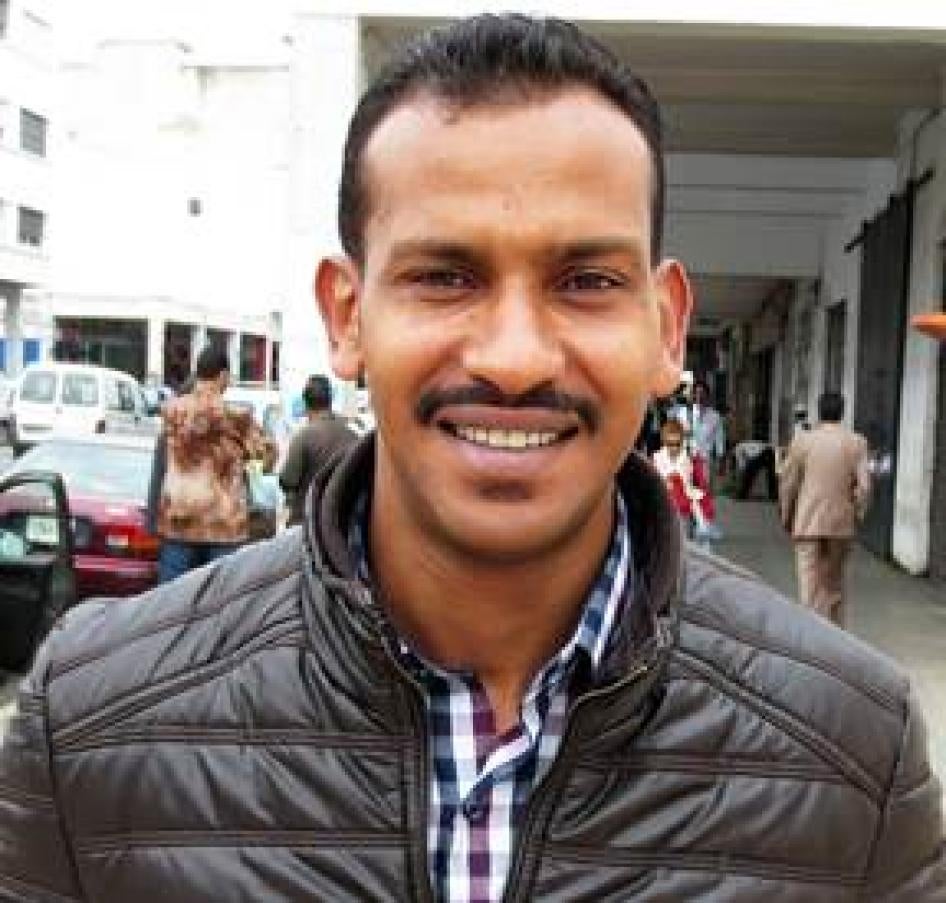
Taki Machdoufi, May 15, 2013. Machdoufi left prison in February 2013 after a military court sentenced him to the 27 months he had already served in the Gdeim Izik case. © 2013 Eric Goldstein/Human Rights Watch.
Morocco’s Code of Penal Procedure states in article 159 that pretrial detention should be an “exceptional” measure. Article 177 limits pretrial detention to two months in serious crimes, renewable for five additional two-month periods at the order of the investigating judge, for a total of 12 months. However, that time limit applies only to the investigation phase: once the investigating judge refers the case to trial, Moroccan law neither limits the time the defendant can remain in custody nor requires a periodic review of the detention.
Thus, while the investigating judge completed his investigation in November 2011, the Gdeim Izik defendants spent another 15 months in pretrial detention before the trial got under way.
Neither international nor Moroccan law specifies a maximum time period for pretrial detention or what constitutes excessive pretrial detention. Various factors, such as the complexity of the case, merit consideration. However, as noted in the section below on international law, a suspect held in custody pending trial has a right to periodic review of his pretrial detention by a judge, who must consider if it is still lawful, bearing in mind that detention before trial must be the exception and that proceedings toward the trial must be speedy.
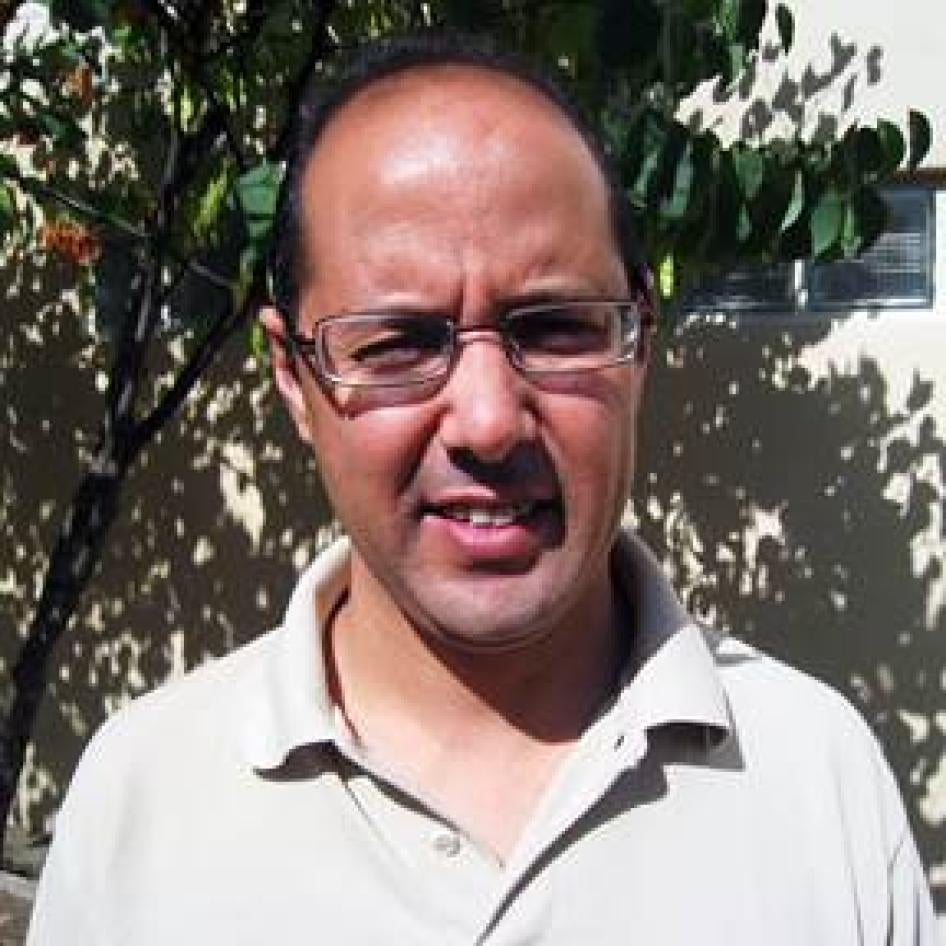
Naâma Asfari, August 4, 2008, presently serving a 30-year prison term handed down by a military court in the Gdeim Izik case. © 2013 Eric Goldstein/Human Rights Watch
According to the Code of Penal Procedure, article 180, a defendant or his lawyer can ask the court at any time for his release from pretrial detention, and the court is obliged to reply in writing. This request can be renewed repeatedly. The Code of Military Justice has a similar provision in article 67.[104] In the Gdeim Izik case, the defendants’ pretrial detention exceeding two years does not appear to have been the subject of a transparent, periodic review. The military court did not, as far as Human Rights Watch has been able to determine, inform the defendants or their lawyers in writing of its response to written motions to release the defendants pending trial. The defendants had no effective recourse to challenge their continued detention, and as a result the prolonged pretrial detention became arbitrary, in violation of the prohibition on arbitrary detention in the ICCPR’s article 9. Initially, the military court scheduled the trial to open on January 13, 2012, 14 months after the events. However, on January 12, the defense team said that it was notified by a phone call that the court had postponed opening the trial, without setting a new date.
Eight months later, the military court announced the trial would open on October 24. However, on October 23, the court announced another indefinite postponement, reportedly because Larbi Elbakai had been arrested in September and added as a defendant in the case, requiring additional time to review the case file. On December 31, the defendants were informed that the trial would begin on February 1, 2013. This time it opened as scheduled and concluded two weeks later.
Trial of Seven Sahrawi Activists
Morocco arrested seven Sahrawi activists in October 2009 and charged them one year later with “harming internal security.” The trial opened in October 2010, but proceeded fitfully, with numerous postponements. Authorities provisionally released four of the seven within seven months of their arrest but held the other three in pretrial detention for 18 months before releasing them in April 2011, when the trial was ongoing. More than two years later, the charges are still pending yet no further court sessions have taken place.
The seven defendants suffered a violation of their right to be tried within a reasonable amount of time. The violation was especially acute for those held for 18 months in pre-trial detention, but extends to the others, who also have a right to end the uncertainty about their fate.
What constitutes an unreasonable delay has to be assessed on a case-by-case basis, taking into account the complexity and the circumstances of each case, as well as the gravity of the charges and whether the defendants are detained pre-trial.
This case involves seven defendants and charges that were initially heavy before being scaled back. For one year, the case remained under investigation by a military judge, since the investigation centered on the charge of damaging Morocco’s “external security,” an offense over which military courts have jurisdiction even for civilians.[105] Just before the detainees reached the 12-month legal limit for detention during the investigative stage that applies to serious crimes,[106] the military investigating judge referred the case to a civilian court for trial on lesser charges.
Those charges, while less serious, nevertheless became the basis for the court to maintain three of the defendants in detention during the trial. That decision, along with the protracted investigation and the delays in conducting and concluding the trial, all suggest that, at the very least, the authorities gave little priority to ensuring a fair and prompt determination of whether these three Sahrawi human rights and self-determination activists had violated the law.
On October 8, 2009, Moroccan authorities arrested Sahrawi activists Ali Salem Tamek, Brahim Dahane, Ahmed Naciri, Degja Lachgar, Yahdih Etarrouzi, Rachid Sghaier, and Saleh Lebeihi immediately upon their return from visiting Sahrawi refugee camps near Tindouf, Algeria. The six men and one woman are all advocates of self-determination for Western Sahara., The Polisario Front, which the United Nations recognizes as the representative of the Sahrawi people, administers those camps. It favors a popular vote on self-determination, including the option of full independence, while Morocco proposes a measure of autonomy for the region but rejects independence as an option. Morocco and the Polisario, which Algeria supports, have engaged in fitful and so-far fruitless negotiations.
Moroccan authorities treat peaceful advocacy of independence, or even of a referendum where independence is one option, as an attack on its "territorial integrity," punishable by law.[107] Tamek, Dahane, Etarrouzi, Sghaier, and Naciri have been previously imprisoned by Morocco, along with hundreds of other Sahrawis, for their pro-independence activities. Dahane and Lachgar are both former victims of forcible disappearance.[108] Tamek, Dahane, and Naciri also are active in Sahrawi human rights organizations. Tamek, a resident of El-Ayoun, is vice-president of the Collective of Sahrawi Human Rights Defenders (CODESA). Dahane, of El-Ayoun, is president of the Sahrawi Association of Victims of Grave Human Rights Violations (ASVDH). Naciri was at the time vice-president of the Smara-based Committee for the Defense of Human Rights. Lachgar is a member of the executive committee of the ASVDH. Moroccan authorities have refused to grant legal recognition to CODESA and the ASVDH.[109]
After their arrest, the seven spent eight days at the headquarters of the Judicial Police in Casablanca, four of them blindfolded and handcuffed in individual cells, according to Dahane, Sghaier, and Etarrouzi. The Moroccan authorities did not inform the detainees' relatives of their arrest until the evening of October 12, 2009, according to Dahane, Sghaier and Etarrouzi,[110] in contravention of the Code of Penal Procedure. The judge to whom they were presented on October 15, 2009, remanded them to Salé Prison.
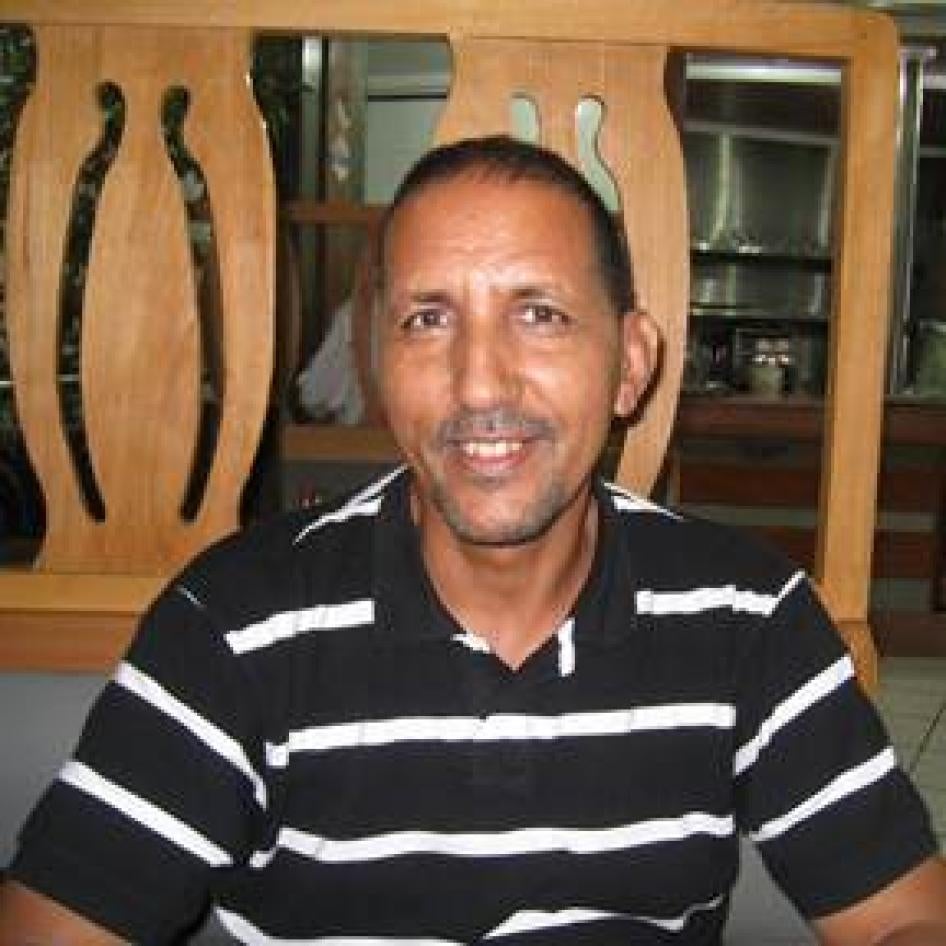
Brahim Dahane, September 12, 2012. Dahane spent a year and-a-half in pre-trial detention before being provisionally released in the case of seven Sahrawi activists charged with “harming internal security.” Two years after his release, the trial has not resumed. ©2013 Eric Goldstein/Human Rights Watch
A military investigating judge investigated the seven on charges of “undermining external state security,” an offense under articles 190-193 of the Penal Code and for which civilians can be tried by a military court, under the Military Justice Code’s article 4. An offense under article 190 of the Penal Code can lead to a prison term of 20 years in prison, plus a fine, if committed in times of peace. On September 21, 2010, after investigating the seven defendants for nearly twelve months, [111] the military investigating judge dropped the charges under article 190-193 and referred them to a civilian court, which filed a less serious charge against them of harming internal state security under Penal Code article 206. [112]
The charge related to the delegation’s two-week visit to the Tindouf refugee camps, where they met openly with officials of the Polisario. During the activists' visit to Tindouf, some Moroccan political parties and newspapers, including the organ of the prime minister's party, denounced the seven as "traitors." According to a report issued on October 8, 2009, by the state news agency, Maghreb Arabe Presse (MAP), the prosecutor ordered the seven arrested because of their meetings with "bodies opposing Morocco," a probable reference to their meetings with Polisario Front officials, including the president in exile.
On November 6, 2009, King Mohammed VI gave a speech indicating a harder line toward advocates of self-determination for Western Sahara:
Now is the time for all government authorities concerned to strive doubly hard, show great resolve and vigilance, enforce the law and deal vigorously with any infringement of the nation's sovereignty, security, stability and public order.... Let me clearly say there is no more room for ambiguity or deceit: either a person is Moroccan, or is not.... One is either a patriot, or a traitor.... One cannot enjoy the rights and privileges of citizenship, only to abuse them and conspire with the enemies of the homeland...
On January 28, 2010, Moroccan authorities provisionally released Lachgar, the only woman in the group, following reports that her health was poor. On March 18, 2010, the remaining six detainees started a hunger strike to protest their continuing detention without trial.It lasted 41 days. The activists said in a statement that their visit to Tindouf was "for humanitarian and purely human rights reasons."[113] They denied accepting money to fund or foment unrest among Sahrawis in Morocco or Western Sahara. On May 18, authorities provisionally released Etarrouzi and Lebeihi, both of El-Ayoun, and Sghaier, of Dakhla.
The trial opened on October 15, 2010, one year after the arrests, before the Casablanca Court of First Instance in Aïn Sbaâ. The court immediately postponed the trial because the authorities had failed to transport the three detained defendants from the prison to the courtroom. Numerous disruptions marred the court session. Disruptions also marked subsequent sessions and led to adjournments of the trial. On October 15, defendants entered the court chanting in favor of Sahrawi self-determination and making a “V” sign with their fingers held high, according to international observers who were present.[114] A large contingent of Moroccan lawyers in robes who were present in the courtroom but not representing any party in the case responded by shouting slogans in favor of “Moroccan Sahara.” The courtroom fell into disorder and the judge adjourned the session.
The trial was supposed to resume on November 5, 2010, but was postponed for another six weeks. Human Rights Watch's observer reported that before the session got under way, men and women wearing lawyers' black robes formed a large and imposing group at the entrance to the courtroom and occupied the front rows inside. They chanted “Moroccan Sahara” slogans; some carried Moroccan flags and a photo of King Mohammed VI.
At about 2 p.m., presiding Judge Hassan Jaber came in, the spectators rose, and the room grew quiet. When the judge called the defendants into the courtroom, they walked in chanting Sahrawi self-determination slogans. This prompted some supporters to raise their hands in the "V" sign, while other spectators began chanting pro-Moroccan slogans.
The shouting and tension escalated, without any apparent intervention by security forces to restore order. After about 20 minutes, the judge left the courtroom. Some of the spectators then punched and kicked known Sahrawi activists attending the trial, including Larbi Messaoud of CODESA and two Spanish journalists, Eduardo Marin of Cadena SER radio and Antonio Carreño of TVE television.
The trial began in earnest on December 17 and continued on January 7 and 14, 2011. The prosecution sought to show that the meetings held by the defendants while in Algeria, and money they allegedly received there, constituted offenses under article 206 of the Penal Code. Moroccan authorities told Human Rights Watch that the defendants “received material support from the Algerian authorities to incite the residents of the southern regions to disobedience and riots that infringe on the country’s higher interests.”[115]
Some of the defendants acknowledged receiving money while in Algeria but said it was only a small amount to cover their travel expenses. Other defendants denied receiving money while there and said that the Casablanca-based Sahrawi activist Mohamed Elmoutaouakil and Aïcha Dahane, defendant Brahim Dahane’s sister, had given them the money they had in their possession.
The judge said the court would announce its verdict on January 28, 2011. Instead, the court decided to summon Elmoutaouakil and Aïcha Dahane as witnesses. The two testified on March 4 and March 25, 2011, respectively. On March 28, 2011, the three detained defendants appeared again before the judge. During the court sessions, the prosecution produced no evidence that the defendants had received “material support” from Algerian authorities to stir unrest, according to defendant Dahane.
Then, on April 14, 2011, the court ordered the provisional release of the three detained defendants, without scheduling a date for the resumption of the case. Since then, the court has shown no signs of resuming the trial; all seven defendants are provisionally free and not impeded in their movements. Authorities state that the court is conducting a “complementary investigation” into the case, which is ongoing.[116]
Moroccan Responses
Moroccan authorities provided responses to questions that we raised regarding the cases discussed in this report and fair-trial protections generally. Those responses are reprinted in full in Appendix I. This chapter looks at key elements of these responses, especially the authorities’ defense of the way courts ruled against defendants who sought to have their police statements ruled inadmissible on the grounds that police obtained them through torture or ill-treatment.
Judges are entitled to wide discretion in making these determinations. Defendants, hoping to escape punishment, will attempt to discredit any incriminating statements attributed to them. However, some portion of them may have been coerced into giving false statements. The court, in order to ensure the rights of the defendant, must probe his allegations diligently, often in the absence of evidence that clearly corroborates or refutes those allegations.
Both international law and Moroccan law contain clear prohibitions on torture; Moroccan law prohibits furthermore the admission of evidence obtained through “violence” or “coercion.” The Code of Penal Procedure obliges, with narrow exceptions, the prosecutor to order a medical examination if he or she observes signs of violence on the suspect. If the suspect complains of police violence or requests a medical examination, the prosecutor must order an exam before he or she commences questioning the suspect.[117] The code imposes a similar requirement on investigating judges, but not on trial judges.[118]
In its 2009 report to the United Nations Committee against Torture, Morocco stated:
[A] confession obtained through the use of violence, coercion or torture has no value. Any confession where a causal link between obtaining it and the use of such methods has been established must be excluded. A court must look for such a link to reach a decision on the inadmissibility of the confession.
[T]his is intended to protect the public interest and not the interest of the individual only. Legislation goes even further by incriminating those who resort to coercion to obtain confessions as a deterrent to committing acts violating human rights.[119]
Moroccan authorities emphasized that many defendants do not raise allegations of torture or coercion at the earliest opportunity, that is, upon being presented to the prosecutor or investigating judge after emerging from police custody. They only raise it at a later stage when, authorities say, it is less credible and harder to verify. Regarding the Belliraj, Gdeim Izik, and Moumni cases, authorities told us that the defendants’ claims were not credible because they had filed them late in their trials (see Appendix I below), an affirmation that is neither a legitimate basis, by itself, to dismiss such claims, nor factually accurate in these cases, according to the defendants.
The official minutes of the hearings show that, in fact, several defendants in the Belliraj and Gdeim Izik cases promptly signaled mistreatment to the prosecutor or investigating judge.[120] Defendant Zakaria Moumni, meanwhile, claimed that he had raised torture when he appeared before the investigating judge, but that the latter did not enter his claim into the minutes of the session. There is no third party who can corroborate that Moumni had raised torture, because no defense lawyers or acquaintances attended that hearing.
While the timing of a torture claim may be relevant to assessing its motives and credibility, the fact that a defendant raises it late in the process should not be a basis for summary dismissal. Nothing in Moroccan or in international law prevents a defendant from introducing new arguments at any stage of a trial, including at the appeals level. Nor is there a deadline under Moroccan law for him to exercise his right to request a medical examination to look for signs of torture, under article 88.4 of the Code of Penal Procedure. A judge may decline the request upon providing his reasons, but no law states that he should or must refuse the request merely because it was filed “late.”
There are reasons why a defendant may raise torture claims “late” other than grasping at ploys to escape conviction. Defendants told Human Rights Watch they did not mention torture at their first appearance because the session was over before they knew it, lasting a minute or two before a prosecutor or judge who barely looked up from the police file on his desk. Other detainees told Human Rights Watch that, having just emerged from police custody, they feared reprisal by the police if they raised torture (see Belliraj case, above). Or defendants may be too traumatized by what they have just endured to raise it before the first judicial official they see.
Furthermore, in Morocco as elsewhere, defendants, emerging from police custody may reason on their own, or be advised by their interrogators or even by their own lawyers -- who may be court-assigned or hired in haste -- that “cooperating” provides their best chance for leniency. The police might tell the defendant—as Moumni states happened to him—that he had only to sign a few papers and perhaps answer a few questions, and he would go free. Later, realizing that they face serious charges and a long prison term, defendants may have second thoughts about “cooperating” and opt to repudiate their “confessions.”
The absence of visible traces of physical abuse on the defendants should also not be a basis for summarily dismissing their claims of abuse, as occurred in the trial of Seddik Kebbouri and his co-defendants. While some forms of torture and coercion leave physical signs that last weeks or longer, others, such as slaps, extended sleep deprivation or prolonged imposition of stress positions, leave no clear visible signs.[121] If the court lacks the expertise to evaluate a complaint of torture, it should order an evaluation by a qualified and independent body.[122]
The court should also examine circumstantial evidence relevant to evaluating defendants’ claims of abuse: did, for example, authorities respect the procedural safeguards governing arrest and detention, many of which are in part designed to safeguard against torture? Was the defendant abducted on the street by plainclothes police? Held in a secret place of detention? Prevented from contacting a lawyer or his family? Held incommunicado longer than the legal limit? Some of the Belliraj defendants claimed all of these things to the court, but the judge apparently did not attempt to evaluate such claims before admitting the defendants’ police statements into evidence.
U.N. Special Rapporteur on Torture Juan Méndez conducted a mission to Morocco in September 2012. While hailing the “emergence of a human rights culture,” Méndez noted shortcomings that include:
- Credible testimonies of “undue physical and mental pressure on detainees in the course of interrogations” including beatings (with fists and sticks), application of electric shocks, cigarette burns, sexual assault, threats of rape of the victim or family members and other forms of ill-treatment amounting to torture.
- Insufficient safeguards of the guarantee of access to legal counsel for detainees.
- Poor quality of medical and forensic reports, which undermines their usefulness as evidence.
- Inadequacy of the complaint system regarding allegations of torture and ill-treatment, and of the system for the investigation, prosecution and punishment of perpetrators.[123]
In his final mission report, published on February 28, 2013, Méndez, stated:
The special rapporteur learned that courts and prosecutors do not comply with their obligation to initiate an ex officio investigation whenever there are reasonable grounds to believe that a confession has been obtained through the use of torture and ill-treatment, or to order an immediate and independent medical examination (see articles 74 (8) and 135 (5) of the Code of Penal Procedure) if they suspect that the detainee has been subjected to ill-treatment. It appears that judges are willing to admit confessions without attempting to corroborate the confession with other evidence, even if the person recants before the judge and claims to have been tortured. In addition, testimonies received indicate that many cases that are submitted to the courts are based solely on confessions by the accused, in the absence of any material evidence. This creates conditions that encourage torture and ill treatment of suspects. The special rapporteur was informed that, often, when defendants try to prove their injuries in court, the judge reacts by questioning the credibility of defendants who did not raise the matter at the earliest opportunity – emerging from police custody and appearing for the first time before the prosecutor or the investigating judge.[124]
When the offense on trial involves a crime that carries a penalty of five or more years in prison, the Code of Penal Procedure provides no special instructions on how the court is to treat police statements: it is presumed to be a piece of evidence like any other to be considered on its merits. However, the rules of evidence governing infractions that occasion a sentence of less than five years are different: in that case, under article 290 of the Code of Penal Procedure, when a police officer signs to affirm that the attached declaration consists of the words spoken before him by the suspect, the court is to deem the police’s affirmation as trustworthy unless the defendant can demonstrate that it is not. [125] This presumption places an unfair burden on the defendant who seeks to repudiate what the police says he told them in the absence of a lawyer or any other third party. In the Kebbouri, Moumni, and Sidi el-Bernoussi cases, the courts cited the language from this article in their written verdicts to admit a defendant’s police statement as evidence despite the defendants’ denying them on the grounds of torture or ill treatment. (See also the case of Naf’i as-Sah and Abdallah al-Boussati, as recounted in an earlier Human Rights Watch report). [126]
Morocco should revise its Code of Penal Procedure to extend the evidentiary standard already in effect governing serious crimes to lesser offenses, so that in all penal trials, statements prepared by the police shall be treated like any other type of evidence, with no presumption as to their truthfulness.
Morocco’s Response to Human Rights Watch on Fair Trial Guarantees
In a statement provided to Human Rights Watch, Moroccan authorities rejected allegations that courts seldom provide fair trials in cases with political overtones, and stated there are no “political trials” in Morocco. According to the government’s statement, the Code of Penal Procedure:
- Provides “all internationally recognized guarantees to uphold the principle of a fair trial, including the presumption of innocence, the right to remain silent, and the provision of an attorney who may visit the detainee from the moment he is placed under garde à vue [pre-arraignment police custody].”
- Guarantees “the right to appeal and litigation over two levels of courts, to legal aid and a translator, to be informed of charges, to publicly and directly confront them, and to bring witnesses.”
- Affirms “the freedom to prove and refute crimes” and excludes “any confession extracted through violence or coercion and punishes the perpetrator, while recognizing that assessing the weight of a confession made before the judiciary [sic][127] is left to the discretion of the court authorities.”
- Tasks the Public Prosecution with “monitoring the judicial police, facilitating its operation, and visiting detention facilities for suspects held under garde à vue, to ensure their lawfulness and the application of guarantees given to suspects.”[128]
This report has examined these assertions by studying specific cases of unfair trials resulting in convictions. The main taint to these trials consists of the court’s admission into evidence of police statements without investigating the allegations made that these confessions had been obtained by torture and other abuse, as well as the court’s admission of other disputed evidence that the court should have scrutinized more carefully, such as written statements by persons whom the court did not compel to testify in person. In only one of the cases featured here did the court order a medical examination when the defendants alleged that the police had beaten their confessions out of them. That medical examination appears to have been completely inadequate and was used by the court to support its finding that the defendants had made their confessions voluntarily.
The government’s statement to Human Rights Watch quoted above warrants two reservations. First, it inaccurately states that a lawyer may visit a detainee “from the moment” he is placed in detention. While this could of course happen if a prosecutor permitted it, the Code of Penal Procedure, as amended in 2011, gives a defendant the right to contact a lawyer after 24 hours in police custody, or a maximum of 36 hours if the prosecutor approves this extension. In cases involving terrorism offenses, the defendant has a right to contact a lawyer after four days in custody, or, if the prosecutor has approved an extension, after a maximum of six days.[129] However, in the cases we have studied, the overwhelming majority of the detainees did not see a lawyer until they were brought to court and had already signed, or not signed, their police statement. To our knowledge, the only exceptions were the political figures among the Belliraj defendants. Their lawyers were able to see them while they were still being held at Maârif Police Station in Casablanca. However, the lawyers were not present when police interrogated them or presented them their statements for signature.
Second, authorities’ statement that defendants have the right to two levels of appeal and litigation is accurate insofar as it refers to defendants convicted by civilian courts of first degree. They have a right to a trial before an appeals court and after that to petition for cassation. However, it does not apply to defendants before military courts, be they military personnel or civilians. The code of military justice provides no appeal except cassation, which examines issues of procedure, jurisdiction, abuse of power, and application of the law, but not of fact. In contrast, appeals courts in the civilian court system are permitted to review the facts.
Morocco’s 2011 Constitution
The 2011 constitution contains many references to human rights and judicial reform and independence. The language is in many instances general, qualified, and/or conditioned on the future adoption of laws that would implement the constitutional principles. Even so, the inclusion of such language that the previous constitution lacked is positive in that it anchors these rights in the country’s supreme legal document.
Nearly two years after adoption of the constitution, Morocco has yet to adopt any laws required to implement the constitutional principles relating to protection of human rights or judicial independence. Addressing the parliament at its opening session for the season, King Mohammed VI on October 12, 2012, urged the government and legislature to speed up the adoption of laws necessitated by the constitution. The king singled out the principles related to the judiciary, urging the adoption of laws on the High Council of the Judicial Authority and on the rules governing judges:
[H]ere too we wish to invite you to follow scrupulously the letter and spirit of the constitutional provisions relating to the judicial authority. We also call on the High Commission of National Dialogue on Reforming the Judiciary to make the independence of the judiciary the cornerstone of its recommendations.[130]
The preamble of the constitution asserts the primacy of international law over domestic law, something that was not present in the 1996 Constitution. However, that primacy applies “within the framework of the dispositions of the constitution and the laws of the kingdom, in the respect of its national immutable identity.” Depending on how authorities interpret these conditions, they could undermine substantially the primacy accorded to international human rights law.
Moreover, the international law that is accorded primacy is limited to “international conventions duly ratified by Morocco” and thus does not include general norms of international human rights law outside of those conventions that Morocco has signed. This contrasts with the broader embrace of international law found in the constitutions of South Africa and Kenya. The former states, in article 232, that “customary international law is law in the Republic unless it is inconsistent with the Constitution or an Act of Parliament.” The next article states, “When interpreting any legislation, every court must prefer any reasonable interpretation of the legislation that is consistent with international law over any alternative interpretation that is inconsistent with international law.”
Kenya’s constitution states in article 2.5, “The general rules of international law shall form part of the law of Kenya,” and in article 21.4, “The State shall enact and implement legislation to fulfil its international obligations in respect of human rights and fundamental freedoms.”
Article 6 of Morocco’s constitution affirms that the law applies to all persons equally: “The law is the supreme expression of the will of the nation. All persons, physical or moral, including public bodies, are equal before it and are obliged to submit to it.”
The constitution proceeds to affirm many specific rights pertaining to citizens before the legal system. Articles 23 and 120 guarantee the right to a “fair trial,” with article 120 also stating, “The rights of the defense are guaranteed before all jurisdictions.” Articles 23 and 119 affirm the presumption of innocence. Article 109 prohibits any interference in cases that are before a court and states, “A judge who fails in any way to fulfill the obligation to be independent and impartial is guilty of a serious professional failing, and may be subject to judicial consequences.”Judges are to render their verdicts “solely on the basis of the impartial application of the law.”
Article 118 guarantees the access to the justice system for everyone “to defend his rights and his interests that are protected by the law.” Article 120 enshrines the right to “a judgment rendered in a reasonable time frame.” Article 121 provides that access to justice is free for those who lack the resources to file a case, “in those cases where the law provides for it.” Article 122 gives a right to reparation from the state to a person who is a victim of a “judicial error.” Article 123 says trials are to be open except when the law provides otherwise.
The 1996 constitution omitted the above-mentioned rights, found in articles 23,109, 118, 119, 120, 121, 122, and 123 of the 2011 constitution. This does not mean that Moroccan law did not recognize these rights previously. For example, the Code of Penal Procedure affirms the presumption of innocence in its first article. However, the elevation of these rights to constitutional principles is a welcome step in affirming their supremacy within the legal framework.
The Constitution also modifies the composition of the official body that governs the profession of judges in ways that could lessen, but not remove entirely, the influence of the executive over the promotion, reassignment, and disciplining of judges. The new “High Council of the Judicial Authority” (Conseil supérieur du pouvoir judiciare), replacing the High Council of Judges (Haut conseil de la magistrature), is still presided over by the king (article 115), but the post of “delegated president” is now filled by the president of the Court of Cassation rather than by the minister of justice and freedoms, who occupied this function under the 1996 constitution (article 86A) but who does not sit on the new High Council. Another innovation of the 2011 constitution is that the president of the National Human Rights Council and the state mediator sit on the High Council.[131]
The Constitution also created in article 129 a Constitutional Court that is empowered to rule on the constitutionality of laws. This new institution, which has yet to be established, must review proposed laws and rule on their conformity to the constitution (article 132). A law that the court declares to be unconstitutional cannot be promulgated (article 134). A ruling by the Constitutional Court is not subject to appeal (article 134).
Parties before the courts can challenge before the Constitutional Court a law being applied in their case on the grounds that it “undermines the rights and liberties guaranteed by the constitution” (article 133). If the Constitutional Court agrees, the law is invalidated.
This power of the Constitutional Court to review existing laws represents an advance over the 1996 constitution, which created a Constitutional Council but endowed it only with the authority to review the constitutionality of proposed laws (articles 58 and 81). The new constitution also for the first time gives citizens before a court the right to appeal to a higher body to rule on the constitutionality of the laws being applied in their case.
The Constitutional Court has yet to exercise any of these powers because parliament has not adopted the laws needed to bring it into existence.
The 2011 Constitution also forbids under all circumstances acts of torture or acts that are “cruel, inhumane, degrading, or that harm one’s dignity” (article 22). Article 23 declares, “Secret or arbitrary detention and forced disappearances are crimes of the greatest seriousness and expose their authors to the most severe punishment.” To protect the rights of persons in custody, the same article requires that authorities “immediately” inform a person taken into custody “in a manner comprehensible to him, the reason for his detention and his rights, including the right to remain silent.” The person in custody “must benefit as early as possible from legal assistance and the possibility to communicate with his relatives, in conformity with the law.”
The 1996 constitution does not mention torture, forced disappearance, secret or arbitrary detention, or the above-mentioned rights of persons taken into custody. While Morocco’s Penal Code and Code of Penal Procedure criminalizes torture and arbitrary detention and provides to detainees most of the rights enumerated above, their introduction as principles in the 2011 constitution suggests a political will to accord them primacy in the reform process.
The issues of torture, arbitrary detention, prompt access to legal counsel, notification of next of kin, and presumption of innocence go to the heart of the question of access to a fair trial. The cases presented in this report involve the violation of several rights that are now, to Morocco’s credit, enshrined in its constitution.
The International Law Framework
International human rights law enshrines the right of a defendant to a fair trial and defines many components of that right. It also defines rights during arrest and detention that are intended, in part, to protect a defendant’s right to a fair trial by, among things, creating safeguards against the use of torture and other improper methods of coercion to extract a statement incriminating oneself or third parties. Such statements should be inadmissible in a fair trial.
The International Covenant on Civil and Political Rights (ICCPR), ratified by Morocco in 1979, contains in article 14 the most basic affirmation of fair-trial rights. It states in part:
1. All persons shall be equal before the courts and tribunals. In the determination of any criminal charge against him, or of his rights and obligations in a suit at law, everyone shall be entitled to a fair and public hearing by a competent, independent and impartial tribunal established by law….
2. Everyone charged with a criminal offence shall have the right to be presumed innocent until proved guilty according to law.
3. In the determination of any criminal charge against him, everyone shall be entitled to the following minimum guarantees, in full equality:
(a) To be informed promptly and in detail in a language which he understands of the nature and cause of the charge against him;
(b) To have adequate time and facilities for the preparation of his defence and to communicate with counsel of his own choosing;
(c) To be tried without undue delay;
(d) To be tried in his presence, and to defend himself in person or through legal assistance of his own choosing; to be informed, if he does not have legal assistance, of this right; and to have legal assistance assigned to him, in any case where the interests of justice so require, and without payment by him in any such case if he does not have sufficient means to pay for it;
(e) To examine, or have examined, the witnesses against him and to obtain the attendance and examination of witnesses on his behalf under the same conditions as witnesses against him;
(f) To have the free assistance of an interpreter if he cannot understand or speak the language used in court;
(g) Not to be compelled to testify against himself or to confess guilt.
Article 14(c)’s guarantee of a trial “without undue delay” is reinforced by article 9(3), which states, “Anyone arrested or detained on a criminal charge shall be brought promptly before a judge or other officer authorized by law to exercise judicial power and shall be entitled to trial within a reasonable time or to release.”
Of particular relevance to this report is the guarantee not to be compelled to testify against oneself or to confess guilt in article 14(g) and the guarantee of equality of arms in article 14(e). On the former, the U.N. Human Rights Committee’s General Comment states:
This safeguard must be understood in terms of the absence of any direct or indirect physical or undue psychological pressure from the investigating authorities on the accused, with a view to obtaining a confession of guilt….[T]he burden is on the State to prove that statements made by the accused have been given of their own free will.
On equality of arms, the Human Rights Committee states:
This guarantee is important for ensuring an effective defence by the accused and their counsel and thus guarantees the accused the same legal powers of compelling the attendance of witnesses and of examining or cross-examining any witnesses as are available to the prosecution. It does not, however, provide an unlimited right to obtain the attendance of any witness requested by the accused or their counsel, but only a right to have witnesses admitted that are relevant for the defence, and to be given a proper opportunity to question and challenge witnesses against them at some stage of the proceedings.[132]
The U.N. Convention against Torture and Other Cruel, Inhuman or Degrading Treatment or Punishment, ratified by Morocco in 1993, seeks not only to abolish torture for its own sake, but also to prevent torture or other forms of ill-treatment from undermining the right to a fair trial. It gives an individual the right to complain of torture to authorities and to receive a prompt and impartial investigation of his complaint (article 13). It also requires states to ensure that any statement “made as a result of torture shall not be invoked as evidence in any proceedings, except against a person accused of torture as evidence that the statement was made” (article 15).
Morocco amended its penal code to define and criminalize torture and to exclude as evidence confessions obtained through “violence” or “coercion.” But in practice, as the cases in this report suggest, the courts make little effort to investigate allegations that interrogators used torture or improper force to obtain confessions before admitting such confessions into evidence, where they became the main basis for a conviction.
The ICCPR gives all defendants the right to be tried “without undue delay” and, if in pretrial detention, the right to be brought to trial within “a reasonable time” or released. Neither international nor Moroccan law specifies a maximum time period for pretrial detention or what makes it excessive. Various factors, such as the complexity of the case, merit consideration.[133] However, a suspect held in custody pending trial has a right to periodic review of his pretrial detention by a judge, who must, in prolonging the detention, provide the reasons it is still warranted, bearing in mind that detention before trial must be the exception rather than the rule and that proceedings toward the trial must be speedy.[134] Prolonged pretrial detention without such a review conducted periodically by a judge can constitute a form of arbitrary detention, which the ICCPR prohibits in article 9.
International norms emphasize that defendants have the right
to consult directly and promptly with a lawyer. The U.N. Basic Principles on
the Role of Lawyers states in article 5 that persons taken into custody or
charged with a criminal offense are “immediately” informed “of
their right to be assisted by a lawyer of their own choice.”
Article 7 states that the access should be “prompt…and in any case
not later than forty-eight hours from the time of arrest or detention.”
Article 8 makes clear that the right to access includes a visit: “All
arrested, detained or imprisoned persons shall be provided with adequate
opportunities, time and facilities to be visited by and to communicate and
consult with a lawyer, without delay…”[135]
Acknowledgments
This report was researched by Brahim Elansari, research assistant, and Eric Goldstein, deputy director of the Middle East and North Africa division at Human Rights Watch. Eric Goldstein wrote the report. Sarah Leah Whitson, executive director of the Middle East and North Africa division, and Tom Porteous, deputy program director, edited it. Clive Baldwin, senior legal advisor at Human Rights Watch, provided legal review. Associates Arwa Abdelmoula and Jillian Slutzker provided production and proofreading assistance. Intern Faris Al-Sulayman helped with research and intern Shannon Mich with proofreading. Grace Choi, publications director; Kathy Mills, publications specialist; Anna Lopriore, creative manager; and Fitzroy Hepkins, administrative manager, prepared the report for publication.
Appendix I: Responses and Statements from Moroccan Authorities
During the preparation of this report, Human Rights Watch wrote several detailed letters to Moroccan authorities concerning the cases featured in it. Human Rights Watch received responses regarding the trial of Seddik Kebbouri and others and the trial of the seven Sahrawis. In addition, Human Rights Watch received from Moroccan authorities correspondence relating to two other cases featured in this report, in response to face-to-face meetings and statements issued by Human Rights Watch: The trials of Belliraj and others and of Zakaria Moumni.
We did not write to authorities concerning the most recent case in this report, the trial of six February 20th Youth Movement protesters, and received no official information about the case. The appeals trial in this case, now concluded, was still under way as this report was being completed.
We wrote letters on July 7 and November 27, 2012, requesting information on the Gdeim Izik case but received no answer. But on March 25, 2013, following the conclusion of the trial, the government spokesperson sent Human Rights Watch the White Paper on the Events of Gdeim Izik, issued by the Interministerial Delegation for Human Rights. We then exchanged correspondence that is reprinted below.
The authorities corresponded in Arabic, except where otherwise indicated; Human Rights Watch has translated into English the communications it received and reprinted them in full below. They have also been excerpted in the pertinent sections of this report.
In addition to case-specific correspondence, Moroccan authorities sent, on February 28, 2012, the following statement on fair trials generally, in response to the newly published Human Rights Watch World Report 2012:
Regarding the claim made in the [report] that courts seldom provide fair trials in cases with political overtones, this is a generalization, and no specific cases were referenced to allow a detailed response. Regarding the term “political trials,” we reiterate that there is no such thing in Morocco and that some parties exploit trials in the public interest in order to draw attention to their own political demands. It should be noted that the Code of Penal Procedure provides all internationally recognized guarantees to uphold the principle of a fair trial, including the presumption of innocence, the right to remain silent, and the provision of an attorney who may visit the detainee from the moment he is placed in garde à vue [pre-arraignment detention]. It also guarantees the right to appeal and litigation over two degrees of courts, the right to legal aid and a translator, the right to be informed of charges, to publicly and directly confront them, and to bring witnesses. The law affirms the freedom to prove and refute crimes, and it excludes any confession extracted with violence or coercion and punishes the perpetrator, while recognizing that assessing the weight of a confession made before the judiciary [sic][136] is left to the discretion of the court authorities.
At the same time, the law tasks the Public Prosecution with monitoring the judicial police, facilitating its operation, and visiting detention facilities holding suspects held under garde à vue, to ensure their lawfulness and the application of guarantees given to suspects.
|
Case of Seddik Kebbouri and Others Statement from Morocco’s Interministerial Delegation for Human RightsReceived August 16, 2012 Following the riots in Bouarfa on May 18, 2011, the judicial police conducted an investigation that revealed that some 16 persons belonging to the unrecognized Association of the Independent Unemployed had organized a protest in front of Prefecture of Figuig province in Bouarfa demanding jobs. They attempted to storm the labor office and during attempts to deter them, they occupied a major thoroughfare, paralyzing traffic in the city. An additional 25 individuals from the Union of the Promotion Nationale[137] joined them, along with 12 former military personnel. When police asked them not to occupy the main street and respect the law, a protestor, one Rachid Ziani, who is the treasurer of the aforementioned association, poured gasoline on his clothes and those of his companions, after which Mohamed Maktouf, an advisor at the local office of the association, lit a lighter in the midst of his comrades, injuring Rachid Ziani. Ziani was taken to al-Farabi Hospital in Oujda for burn treatment. When the protest ended, members of the association, with encouragement from Seddik Kebbouri, the local officer of the Democratic Confederation of Labor (CDT), and Mahjoub Chennou, an officer with the Union of the Promotion Nationale, along with other persons, mobilized local residents. When the crowd reached approximately 600 persons, most of them minors, they headed to the prefecture in an attempt to storm it. Prevented by the security forces from doing so, they pelted security personnel and auxiliary forces with rocks and empty bottles, inflicting various degrees of injuries. They also threw stones at the Directorate for the Surveillance of National Territory [police headquarters] and attempted to storm it, causing material damage. They targeted the vehicles of security personnel and the Royal Gendarmerie, and uprooted traffic signs and burned tires. As a result of the attacks, 18 civil servants with the General Directorate of National Security, 14 members of the auxiliary forces, and six members of the Royal Gendarmerie were injured. In light of these events, ten persons were detained, among them Seddik Kebbouri and Mahjoub Chennou. When they were questioned, they confirmed the acts attributed to them. They were brought before the crown prosecutor, who charged them with insulting public servants in the course of duty, using violence against them, disobedience, vandalism, willful destruction of property of public interest, the possession of weapons in circumstances likely to threaten public security or the safety of persons or property, participating in an unauthorized demonstration on a public street and assembling on it, and intentionally causing material damage to private moveable property. On June 17, 2011, the [Figuig] First Instance Court in Bouarfa found all of the defendants guilty. It convicted Mohamed Negbaoui, Jamal Ati, Abdessamad Karboub, Abdelkader Qaza, Yassine Balit, Abdelaziz Boudabia, and Abdelali Kdida on the charge of willfully damaging private property, and fined them 200 dirhams [US$24]; on the remaining charges, they were sentenced to three years in prison and fined 1,000 dirhams [US$120]. The court acquitted Brahim Mqadmi on the charge of organizing a demonstration on a public road without an authorization and convicted him on the remaining charges. On the crime of the willful causation of material damage to private property, he was fined 200 dirhams; on the remaining charges, he was sentenced to two years and ten months in prison and fined 1,000 dirhams. The court convicted defendants Seddik Kebbouri and Mahjoub Chennou on the charges of assembly and demonstration without a license on a public street, taking part in disobedience, and taking part in insulting public servants in the course of duty. They were each given two and a half years in prison and fined 1,000 dirhams [US$120]. They were acquitted of the remaining charges. The verdict was appealed, no 1134/11, appellate flagrante delicto misdemeanor. The court ruled on July 26, 2011 to overturn the conviction of Seddik Kebbouri and Mahjoub Chennou on charges of participating in insulting public servants in the course of duty. The court also overturned the conviction of the remaining defendants on the charge of insulting public servants in the course of duty. The court again acquitted all defendants of the charges of which they were originally acquitted. The court upheld the rest of the verdict, while reducing the prison sentence against Brahim Mqadmi to 16 months, the sentence of Seddik Kebbouri and Mahjoub Chennou to two years, and the sentence of the remaining defendants to 18 months. Defendants Seddik Kebbouri, Mahjoub Chennou, and Abdessamad Karboub appealed the ruling to the Court of Cassation; which rejected the appeal on February 29, 2012. Given the facts above, it is clear that the court, in delivering its verdict, was convinced of the flagrante delicto nature of the case and the seriousness of the acts, seen in the rioting and in the defendants’ pelting of security forces with stones and glass bottles at the urging of Seddik Kebbouri and Mahjoub Chennou. The former used a megaphone to assemble more than 600 persons, most of them minors, who headed toward the prefecture office where the security forces confronted them, leading to material damage to vehicles, the destruction of state property, and the injury of several members of the security forces with wounds of varying degrees. They confessed to these acts before the judicial police and the Royal Prosecutor, and their recantation before the court was supported by no material evidence. Moreover, the prosecution of the defendants was at all stages unexceptional, during which time they enjoyed their right to defense with formal arguments, to which the court responded. During the process, all the principles and rules for a fair trial were observed while complying with legal codes in accordance with the provisions of the law. Finally, it must be noted that Seddik Kebbouri and Mahjoub Chennou were released on February 4, 2012 pursuant to a royal amnesty. |
|
Case of Zakaria Moumni Statement from Morocco’s Minister of Foreign AffairsReceived September 27, 2011 in French Translated into English by Human Rights Watch Regarding Allegations of a Failure to Inform the Family of his Location The law requires that the judicial police inform the family of the person held in garde à vue as soon as they decide to place that person in garde à vue. Thus, the family is notified by any means, which could be by telephone, in writing, orally, or by a representative of the public authorities (article 67 of the Code of Penal Procedure). Moreover, as noted in the [police statement] signed by [Moumni], his family was informed of the date of his being placed in garde à vue. It must be pointed out that an officer of the judiciary policy is required to submit daily to the crown prosecutor and the general prosecutor, a list of persons placed in garde à vue during the previous 24 hours. The fact that a person is placed in garde à vue in no way restricts the rights he enjoys, except of course for his right to liberty and those rights that depend on it. Regarding the Allegations that [Moumni’s] Defense Team did not Succeed in Contacting the Complainants It must be pointed out that Mustapha Ouchkat and Idriss Saâdi filed a complaint against the suspect via their lawyer, Mr. Abdessamad Raji Senhaji. The two complainants were heard by officers of the judicial police, who took their statements, which note their identities, addresses, and the numbers of their national identity cards. From the preceding, it emerges that the addresses of the complainants are known and [Moumni’s] defense team can contact them and ask the court to summon them, referring to the addresses mentioned in the statements. Statement from Morocco’s Interministerial Delegation for Human Rights Received February 28, 2012 The named individual, Zakaria Moumni, was the subject of an investigation at the national level, based on the complaints presented to the public prosecutor in Rabat by Mr. Abdessamad Raji Senhaji, a lawyer in the district of Rabat, on behalf of Mustapha Ishkat and Idriss Saâdi, alleging that the aforementioned claimed that he was able to obtain for them two employment contracts in France or in another European country in return for the sum of 24,000 dirhams [US$2,880] from each of them; and on January 23, 2010 they each gave him 14,000 dirhams [US$1,680]as a down payment, with the remaining amount to be paid on the attainment of the work contracts, and he gave them his mobile telephone number in France, which is 0033661428342. After a period of communication through the mentioned number they found that the number no longer worked. It then became clear to them that they had been defrauded, and after questioning the accused on September 27, 2010, in Salé airport, he confirmed that he had accepted the mentioned payments. Due to his financial needs and inability to obtain employment and income, he decided to obtain income even through unlawful means by taking advantage of the aspirations of some Moroccans to emigrate abroad. And so the plaintiffs identified the aforementioned from within a group of people who were put before them, and based on this the Public Prosecutor brought him to the First Degree Court in Rabat for fraud. A verdict was reached on his case on October 4, 2010, and he was sentenced to three years imprisonment and a fine of 500 dirhams [US$60], which the plaintiff appealed. In appeal file number 3792/10/19 a ruling was reached upholding the initial conviction but reducing the prison sentence to two and a half years. The sentence was challenged by the defendant, and the Supreme Court issued a ruling of cassation referring the case back to the appeals court of Rabat. After this referral, a file was opened numbered 19/11/3610 and in the hearing of December 15, 2011, the defendant was present defending his initial position and the witnesses (plaintiffs) Mustapha Ishkat and Idriss Saâdi were also present. After taking the legal oath before the court, they verified together all their claims that are available in the case file, and on December 22, 2011, the court issued a ruling denying provisional release and upholding the initial verdict but reducing the prison sentence to twenty months. The prosecutor did not appeal this ruling. It should be noted that the aforementioned was released after benefitting from a royal pardon issued on February 4, 2012 on the occasion of the Prophet’s birthday. Statement on Case of Zakaria Moumni Sent by the Ministry of Foreign AffairsReceived May 26, 2011 [This statement begins with a summary of the case, which we have deleted because it is an earlier version of the statement reprinted above, received on February 28, 2012, from the Interministerial Delegation for Human Rights. It continues:] On [Moumni’s] Detention in an Unknown Location and Not Informing His Family of It These allegations have no basis of truth; as the case documents show, the aforementioned was placed under garde à vue in the station of the judicial police, which is under the supervision of the public prosecutor, beginning September 27, 2010, at 6 P.M. until 11 A.M. on September 30, 2010, after the period of garde à vue was extended 24 hours, with the approval of the public prosecutor, as per the legal requirements set forth in the Code of Penal procedure (article 66, first paragraph), and his family was notified about this procedure. As the completed record demonstrates with regard to the aforementioned, the judicial police heard the plaintiffs, who were able to pick out the defendant from among a number of persons before them. On the Allegation That His Confession Was Obtained under Coercion, and that He Was Denied His Right to a Lawyer After hearing the aforementioned in legal proceedings by the judicial police, his remarks were read to him, and he himself signed the report without any coercion, as he affirmed in front of the crown prosecutor. With regard to the appointment of a lawyer, however, he chose to defend himself, in front of the public prosecutor and the court itself, though during the appeal phase, lawyer Abderrahim Jamaï assisted him before the court. The court based its decision on the oral arguments and the content of the judicial police reports, which are deemed credible in cases involving less serious crimes, unless the defense proves the contrary (article 290 of the Code of Penal Procedure). On the Allegation That the Aforementioned Case was Discussed Behind Closed Doors The case was heard in an open and adversarial setting, where the conditions for a fair trial including the provisions of article 365 of the Code of Penal Procedure, were respected. On the Allegation that He Was Tortured [Moumni] did not raise being subjected to torture and ill treatment when appearing before the prosecutor, or during the trial, or even after his appeal of the first instance verdict, even though the law permits him to request a medical examination when brought before a prosecutor for the first time. It is also required of this judge to automatically investigate the matter if it is warranted, and the crown prosecutor did not note any signs of violence on the accused, and the aforementioned never requested a medical exam. The subject of his torture was not raised until after the discussion of the case by the court of appeals, and the court found nothing to prove this. Noting that the aforementioned and his defense did not present any complaints on the matter, and it remains his right to issue a complaint to the public prosecutor directed at those who allegedly tortured him. |
|
The Case of Abdelkader Belliraj and Others Statement from Morocco’s Interministerial Delegation for Human Rights Received February 28, 2012 The so-called Abdelkader Belliraj organization is one of the most dangerous terrorist organizations to be dismantled recently, given that its significance exceeds the local or national and extends to the international, and given its strong ties to international terrorist organizations, the development of its modes of operation, the diverse social origins of its members, its meticulous structure, and the seriousness of its planned objectives, as well as its establishment of a military wing, its success in importing weapons from abroad, and its massive financial and logistic means, which are sufficient to achieve its goals, both attracting a greater number of followers and in the effectiveness and success of its planned operations. The Public Prosecution named 35 defendants in the case, among them six members of political parties, for crimes including the infringement of internal state security, the formation of an armed group to attack public property, the formation of a group to prepare and commit terrorist acts as part of collective enterprise aimed at a grave infringement of the public order, fundraising with the intent to use funds to commit terrorist acts, possession of weapons and explosives, document forgery, and money laundering. A first-instance ruling was issued against the defendants on July 28, 2009, convicting them and sentencing them to terms ranging from suspended sentences to life imprisonment. All stages of the trial took place in conditions that observed all guarantees for a fair trial, particularly in terms of lawyers assisting the defendants, the public nature of the hearings, the presence of witnesses and translators, and all possibilities for introducing evidence. On appeal, the Criminal Appellate Chamber on July 15, 2010 reduced the prison sentences of Mustapha Mouâtassim, Mohamed Merouani, and Mohamed Lamine Regala from 25 years to 10 years each, and of Abadila Maelainin and Abdelhafidh Sriti from 20 years to 10 years each. The 2-year prison sentence against Hamid Najibi was upheld and the term completed before the appellate ruling was issued. The ruling was challenged before the Supreme Council. The case was the subject of several defamatory and media campaigns, and several allegations were made, including that the case of the six aforementioned defendants was a political case given their political and partisan affiliations. Their defense counsel and families attempted repeatedly to influence the course of justice at every stage of the trial, even threatening to boycott the trial sessions if their demands were not met. Every time the court dismissed one of their requests, they considered it proof of the lack of due process. It was also claimed that their confessions were coerced. It should be noted in this regard that a confession alone is not considered proof, but is subject to the conviction of the judge and must be debated in court. Regarding the judicial police reports in criminal cases (as is relevant for this case), they do not constitute proof, but are considered simply statements. The court based its verdict on the evidence contained in the case file, the statements of witnesses and the defendants, the cross-interviews of the defendants (“confrontations”) conducted by the investigating judge, and the circumstances of each individual case. In addition, the use of any violence or coercion against the defendants was not proven. It was alleged that they had been tortured. Articles 99 and 134 of the Code of Penal Procedure state that all public prosecutors and investigating judges must grant a medical exam when requested by defendants under garde à vue or their defense counsel. The public prosecutor or investigating judge must also automatically order a medical exam if they observe any marks on the defendant that warrant it. The defendants did not raise this claim before the public prosecutor or the investigating judge, and the latter observed no marks that would warrant an automatic order for a medical exam. |
|
Gdeim Izik Case As noted above, Moroccan authorities did not respond to Human Rights Watch letters sent on July 7 and November 27, 2012, asking specific questions about the pretrial detention of the defendants in the Gdeim Izik case. However, on March 25, 2013, following the verdict in the case, they sent us their White Paper on the Gdeim Izik Events. The same day, we sent an e-mail on March 25, requesting clarification of one key passage in the White Paper concerning the trial. That passage reads: The representative of the prosecution countered that this request [to investigate for torture] came too late since the accused did not say so before the prosecutor during the preliminary and detailed interrogations that they were subjected to torture and did not for that latter ask for a medical expertise, while they were assisted by their lawyers. In fact, according to the police statements in the case file, at least 17 of the defendants had told the investigating judge at their first substantive hearing before him that they had been subject to torture; many of them said they had been forced to sign their police statement without reading it. In our e-mail, we asked, In this case was it not the investigating judge who conducted the investigation, and not the prosecutor? If so, the minutes show that the most of the defendants raised torture at this stage. So what did the prosecutor mean when he argued that the defendants had failed to raise torture claims before the investigating judge -- and why does the White Paper seem to embrace this claim? In response, we received on April 1, 2013, the following statement in English, which we reprint as received: Kingdom of Morocco Interministerial Delegation for Human Rights Clarifications Concerning Gdim Izik – HRW Regarding the confusion concerning the Prosecutor and the investigating judge with regard to the delay of the defendants’ requests, first, it should be noted that the extract in question refers to the prosecutor’s assessment voiced during the trial in February 2013, with regard to allegations of torture made by the accused at the time. The White Paper maintains that the Prosecutor reveals the fact that the defendants had not requested medical expertise during the investigation, even though they were assisted by lawyers. The fact that they did not request an expertise during this phase simply compels the Prosecutor to conclude that, if the defendants had actually been tortured, they, or their lawyers, would have asked for forensic examinations to ordered and performed. Therefore, this is not about the Prosecutor has "directing" the investigation in any way whatsoever, or the allegations of torture or her expertise requests were submitted as part of the instruction. As a reminder, at the procedural level, it is the prosecutor who brings matters before the investigating judge. The order for referral, made by the judge, can be based on a request of the Prosecutor to refer the matter to the Permanent Tribunal of the Royal Armed Forces (TPFAR), which was the case here. Moreover, the judge before whom the matter was brought did not estimate it necessary at the time to order investigations into the allegations of torture, and a fortiori, order medical examinations, which had not been requested in the first place. During the trial in February 2013, most of the defendants have actually claimed to have been tortured, and accordingly, requested forensic examinations, as it is reported in the White Paper. Refusal to order medical examinations by the TPFAR during the trial, in February 2013, can be explained simply by the fact that, taking into account the time that has elapsed since the start of the procedure, it is inherently difficult to investigate the allegations of torture or ill-treatment which are older than two years. The only case in which it was actually possible to conduct a forensic examination, is that in which the trace of injury was obvious at trial; however, it turned out that the injury in question had no link whatsoever with the allegations of torture made by the accused. With regard to the Prosecutor’s statement, which maintains that the defendants have not made any allegations of torture before the investigating judge, although the minutes suggest otherwise (at least for 17 people), this assertion is mainly due to the fact that they had not formally requested a medical examination, provided that such request is intrinsically linked to any allegations of torture or ill-treatment. In this case, if the investigating judge has not responded to the allegations made by the defendants at the time, it was because that these allegations were clearly unfounded, as he did not notice at the time any obvious sign or injury which would have indicated that they had been subjected to ill-treatment while arrested. Finally, it should be noted that in general, the Criminal Procedure Code (article 134) provides the opportunity for the Crown General Prosecutor, the Crown Prosecutor, the investigating judge or magistrate in charge of the case, to order a medical examination automatically, when people brought before them manifest signs which suggest that they would have been tortured or subject to ill-treatment, without the need for the people and / or their lawyers to request it. |
|
Case of Seven Sahrawis on Trial for “Harming Internal Security” Statement from Morocco’s Interministerial Delegation for Human Rights Received August 16, 2012 As part of a visit to the Tindouf camps, Ali Salem Tamek, Yahdih Etarrouzi, Brahim Dahane, Ahmed Naciri, Saleh Lebeihi, Rachid Sghaier, and Degja Lachgar met with anti-Moroccan elements. Taking an Algerian military plane, they went to the Tindouf camp, where they attended several meetings with Algerian civilian and military officials, as well as military shows and parades organized in their honor by the mercenaries of the Polisario. They also attended press seminars at which they described Morocco as the enemy. They received material support from the Algerian authorities to incite the residents of the southern regions to disobedience and riots that infringe on the country’s higher interests. Following this, the Public Prosecution at the Casablanca Appellate Court ordered the judicial police to investigate them and refer them to justice. To this end, the aforementioned persons were detained on October 8, 2009 at the Mohammed V Airport in Casablanca and turned over to the police for investigation. They were placed in garde à vue [pre-arraignment detention] the same day for an investigation into the actions attributed to them. They were brought before the prosecutor on October 15, 2009. After examining the prepared report, the prosecutor referred them to the military court, which referred them to questioning on charges of undermining the external and internal state security by accepting gifts from a foreign group to fund activities and propaganda likely to infringe on the unity and sovereignty of the kingdom and shake the loyalty of citizens to the Moroccan state and the institutions of the Moroccan people. On January 28, 2010, the investigating judge ordered the provisional release of Degja Lachgar, and on May 18, 2010, defendants Yahdih Etarrouzi, Rachid Sghaier and Saleh Lebeihi were also granted provisional release. On September 21, 2010, the investigating judge with the Permanent Tribunal of the Royal Armed Forces dropped the charge against Ali Salem Tamek, Brahim Dahane, Ahmed Naciri, Yahdih Etarrouzi, Rachid Sghaier, Saleh Lebeihi and Degja Lachgar of undermining external state security. He also ruled that the military court had no standing to hear the crime of undermining internal state security and referred the case file to the competent body. Pursuant to this, the case was referred to the Casablanca Court of First Instance and a flagrant délict misdemeanor file was opened, no. 8241/10/10. On April 14, 2011, the judge charged with carrying out the complementary investigation of the aforementioned file ordered the temporary release of defendants Ali Salem Tamek, Brahim Dahane and Ahmed Naciri. The complementary investigation is still ongoing. The course that the case has taken indicates that the prosecution of the persons in question took place in accordance with the law and that they have enjoyed all due process guarantees. |
Appendix II: List of Defendants in "Belliraj" Case and the Sentences They Received
Abdelkader Belliraj, life in prison
Abdellatif al-Bekhti, 30 years
Abdessamed Bennouh, 30 years
Jamal al-Bey, 30 years
Lahoussine Brigache, 30 years
Redouane al-Khalidi, 30 years
Abdallah ar-Rammache, 30 years
Mohamed Yousfi, 30 years
Mohamed Merouani, 25 years, reduced to 10 years on appeal, then pardoned April 12, 2012
Mustapha Mouâtassim, 25 years, reduced to 10 years on appeal, then pardoned April 12, 2012
Mohamed Lamine Regala, 25 years, reduced to 10 years on appeal, then pardoned April 12, 2012
Abadila Maelainin, 20 years, reduced to 10 years on appeal, then pardoned April 12, 2012
Abdelhafidh Sriti, 20 years, reduced to 10 years on appeal, then pardoned April 12, 2012
Abd al-Ghali Chighanou, 15 years
Mokhtar Lokman, 15 years
Abderrahim Nadhi, 10 years
Abderrahim Abu ar-Rakha, 10 years
Hassan Kalam, 8 years
Slah Belliraj, 8 years, reduced to 5 years on appeal, then pardoned 2012
Ahmed Khouchiâ, 8 years
Samir Lihi, 8 years
Mustapha at-Touhami, 8 years
Bouchâab Rachdi, 6 years
Mohamed Azzergui, 5 years (freed upon completion of sentence in February 2013)
Mansour Belaghdeche, 5 years (freed upon completion of sentence in February 2013)
Adel Benaïem, 5 years (freed upon completion of sentence in February 2013)
Mohamed Chaâbaoui, 5 years (freed upon completion of sentence in February 2013)
Jamaleddine Abdessamed, 3 years (freed, sentence completed)
Abdelazim at-Taqi al-Amrani, 3 years (freed, sentence completed, acquitted on re-trial after the Court of Cassation quashed his conviction)
Larbi Chine, 2 years (freed, sentence completed in early 2010)
Ibrahim Maya, 2 years (freed, sentence completed in early 2010)
Abdellatif Bouthrouaien, 2 years (freed, sentence completed in early 2010)
Hamid Najibi, 2 years (freed, sentence completed in early 2010)
Mohamed Abrouq, 1 year suspended sentence
Ali Saïdi, 1 year suspended sentence
Appendix III: List of Defendants in the Gdeim Izik Case
Below is a list of the defendants, the charges for which they were convicted and the sentences received. The second column indicates which of the defendants had stated to the investigating judge he had been tortured. This list is based on the official records of those hearings and may not include all the detainees who made such claims.
|
Name |
Allegations of torture or coercion made before the investigating judge (IJ), according to hearing minutes |
Charges on which convicted |
Sentence |
|
Ahmed Sbaï |
|
Membership in a criminal gang, violence against security force member leading to death with intent |
Life in Prison |
|
Mohamed Bachir Boutanguiza |
Told IJ on Mar. 4, 2011, that both the police and the gendarmerie had tortured him. At trial, he said they had coerced him to sign statements without reading them |
Membership in a criminal gang, violence against security force member leading to death with intent, defiling a corpse |
Life in Prison |
|
Sidi Abdallah Abhah |
Told IJ on Mar. 18, 2011, that the police and the gendarmerie had tortured him. On April 11, 2011, he told the investigating judge that he had signed his police statement blindfolded and handcuffed |
Membership in a criminal gang, violence against security force member leading to death with intent, defiling a corpse |
Life in Prison |
|
Mohamed Bani |
|
Membership in a criminal gang, violence against security force member leading to death with intent |
Life in Prison |
Brahim Ismaïli |
Told IJ on June 17, 2011, that gendarmes interrogated him and made him sign his statement under beatings and insults |
Membership in a criminal gang, complicity in violence against security force member leading to death with intent |
Life in Prison |
|
Sidahmed Lemjayed |
Told IJ on May 5, 2011, that gendarmes tortured him |
Membership in a criminal gang, violence against security force member leading to death with intent, complicity in violence against security force member leading to death with intent |
Life in Prison |
|
Abdallah Lekhfawni |
Told IJ on Feb. 25, 2011, that police had tortured him for five days and sodomized him |
Membership in a criminal gang, violence against security force member leading to death with intent |
Life in Prison |
|
Abdeljalil Laâroussi |
Told IJ on Feb. 18, 2011, that persons he cannot identify arrested him and threatened to rape him and his wife, then handed him over to another group that broke his leg
|
Membership in a criminal gang, violence against security force member leading to death with intent |
Life in Prison |
|
Hassanna Alia (in absentia) |
|
The court’s written verdict does not appear to list the charges for which it convicted Alia |
Life in Prison |
|
Naâma Asfari |
Told IJ on Jan. 12, 2011, that the police had tortured him |
Membership in a criminal gang, complicity in violence against security force member leading to death with intent |
30 years in prison |
|
Hassan Dah |
Told IJ on Apr. 29, 2011, that he was tortured, stripped and threatened with rape before he signed his statement |
Membership in a criminal gang and complicity in violence against security force member leading to death with intent |
30 years in prison |
|
Cheikh Banga |
Told IJ on Jan. 12, 2011, that the police had tortured him and forced him to sign his statement while blindfolded |
Membership in a criminal gang and complicity in violence against security force member leading to death with intent |
30 years in prison |
|
Mohamed Bourial |
|
Forming a criminal gang, violence against a security force member on duty leading to death |
30 years in prison |
|
Mohamed Tahlil |
Told IJ on May 13, 2011, that gendarmes tortured him and he signed his statement while blindfolded |
Membership in a criminal gang, complicity in violence against security force member leading to death with intent |
25 years in prison |
|
Mohamed Lamine Haddi |
Told IJ on Mar. 25, 2011, that he had been tortured; at another appearance on Nov. 25, 2011, he told the IJ he had put his fingerprint on his police statement while blindfolded |
Membership in a criminal gang and complicity in violence against security force member |
25 years in prison |
|
Abdallah Toubali |
Told IJ on Apr. 8, 2011, that the police tortured him and that he signed his statement blindfolded and naked |
Forming a criminal gang, violence against security force member leading to death with intent, contribution to and complicity in violence (charges were revised during the trial) |
25 years in prison |
|
Hocine Zaoui |
|
Forming a criminal gang, complicity in violence against security force member leading to death with intent, complicity in violence, defiling a corpse (charges were revised during the trial) |
25 years in prison |
|
Daich Daf |
Told IJ on Apr. 22, 2011, that he was tortured and signed his police statement while blindfolded |
Forming a criminal gang, complicity in violence against security force member leading to death with intent |
25 years in prison |
|
Mohamed Embarek Lefkir |
|
Membership in a criminal gang, complicity in violence against security force member leading to death with intent (charges were revised during the trial) |
25 years in prison |
|
Mohamed Khouna Babeit |
Told IJ on Oct. 25, 2011, that the police had tortured him while interrogating him; at a hearing on December 16, 2011, he said that he put his fingerprint on his police statement while blindfolded |
Membership in a criminal gang, violence against security force member leading to death with intent |
25 years in prison |
|
Larbi Elbakai |
|
Membership in a criminal gang, violence against a security force member leading to death with intent |
25 years in prison |
|
Mohamed el-Ayoubi |
Told IJ on Mar. 11, 2011, that a security force member he identified as “military” sodomized him in a tent at Gdeim Izik camp and that he was also tortured at the gendarmerie facility. |
Membership in a criminal gang, violence against a security force member leading to death with intent |
20 years in prison |
|
Bachir Khadda |
Told IJ on May 6, 2011, that police had tortured him and that he signed his police statement while blindfolded |
Entering into a criminal agreement, complicity in violence against security force member leading to death with intent |
20 years in prison |
|
Taki el-Machdoufi |
Told IJ on February 4, 2011, that at a gendarmerie facility, persons beat him and poured water and urine on him |
Inflicting harm with premeditation on members of the security forces on duty (charges were revised during trial) |
Sentenced to time served and released |
|
Sidi Abderrahmane Zayou |
|
Participation in inflicting harm with premeditation on members of the security forces on duty (charges were revised during trial) |
Sentenced to time served and released |
Appendix IV: Police Statements Attributed to Two Defendants in the Gdeim Izik Trial
The following are the full statements attributed by the police to two of the defendants in the Gdeim Izik trial. They are provided as examples of the police statements that lay at the heart of the trial. To the prosecution, they were “confessions” that constituted the main piece of evidence against the defendants. The defense countered that that the court should discard these statements because they were false and, in many cases, extracted through police torture.
Naâma Asfari
(Translated from Arabic)
Asfari Statement Dated November 8, 2011, as prepared by the Gendarmerie of El-Ayoun
Naâma Asfari, son of Abdi son of Sidi Ahmed son of Moussa, Moroccan, born on August 1, 1970 in Tan-Tan and residing there at 3 Aït Lahcen street, graduate student, whose mother is Lemouaghef bent Mohamed Lehbib, carrying the Moroccan ID No. JF-11056.
Convicted in January 2007 and sentenced to a suspended term of two months of prison for insulting a public official (a police brigadier).
Convicted in August 2009 and sentenced to four months of prison (served) by the district court of Tan-Tan for insulting an official in the course of his duty (a security guard).
I was born in 1970 in Tan-Tan, and spent my childhood in Legsabi in Guelmime. I graduated primary school and pursued my preparatory and secondary studies in Guelmime, at the Al-Hadhrami preparatory school and the Mohammed V secondary school, respectively. After obtaining the baccalaureate in 1990, I studied at the Faculty of Law and Economics, Al-Qadi Ayyad University, Marrakesh. I graduated in 1994, and in 1995-1996, obtained a graduate diploma in political science from the same university. In 1997-1998 I underwent training to obtain a license as a notary public, but did not complete it. Late in 1998, I got a visa to France and enrolled as a student at the University of Saint Denis [sic], where I obtained a masters degree (maîtrise) in law, then a graduate diploma (diplôme d’études approfondies) from Nanterre University in public freedoms and human rights. I have since 2005 been working on my doctoral thesis, to be defended later this year, concerning “political obstacles in partnership conventions between the European Union and the Maghreb countries (Morocco, Algeria and Tunisia).” I am married to a French woman, aged 49, who teaches history and geography in Paris.
While planning for a mass exodus by families of El-Ayoun to settle in tents outside the city, in protest against their social and economic conditions, and while trying to realize this project, to spread discord and terror, and destabilize the security of that city and its environs, I had earlier cooperated with Mohamed Embarek Lefkir in two attempts that the authorities successfully thwarted. We had success with the third attempt thanks to proper planning.
In order to highlight the social demands of the camp-dwellers, which succeeded because of my close coordination with them and my activism with some NGOs, I started soliciting and receiving funds from people involved in associations abroad, who believed that their money would be employed in charities, while the plan's deeper purpose was to finance the plan for the camp, to organize volunteers from among the people of the area, and to recruit them in missions that would compromise public security and restrict the freedom of movement for those held inside the camp, while exposing as false the image of a calm and peaceful city, as it was being portrayed to public opinion.
Thus I came to impose my will on the camp, and my recommendations were obeyed by its organizational committees. Any negotiation with the authorities was always met by disapproval on my part, in an attempt to gain time so as to bring as much attention from the media as possible to the cause, which would serve my personal interests.
As for the knives found in my possession, and now displayed by you before me, it was my intention to give them to the camp's internal security personnel, to use them in intimidating some camp dwellers who expressed a wish to go back to El-Ayoun permanently. This we achieved, up until the intervention of the public forces.
Q: Did you follow all the phases of negotiations between the camp's coordination committee and the region's local authority, in order to resolve the camp dwellers’ problems?
A: I charged Mohamed Bourial, Embarek Souiyeh, Hocine Zaoui, Lefdeil Redouan, Daich Daf, Toubali and others with this task.
Q: What were the goals of this project of yours?
A: It was essentially one goal: to create chaos and destabilize public security. Because I thought that holding camp dwellers at the camp would eventually compel the public forces to intervene, and thus spread chaos to the city of El-Ayoun, and possibly other cities in Morocco.
Q: What motivated you to solicit foreign funds?
A: I used them to finance the organizational cells of the camp, and to hold the camp dwellers inside in order to counter any intervention by the public forces.
Q: Who were the persons charged with carrying out your orders inside the camp? And what were their tasks?
A: They were Brahim Ismaïli, Mohamed Embarek Lefkir, Abdeljalil Laâroussi, Ahmed Sbaï, Lahmad Khattari & Hassan Dah. As for their tasks, they were to counter any attack by the public forces, to kill their personnel and to burn and destroy their equipment by the use of Molotov cocktails and gas cylinders.
Q: Why did this idea occur to you?
A: I undertook these operations to avenge our community for their deteriorating living, social and economic conditions, and for the way that the state gives priority and preferential treatment to people who are not the original population of El-Ayoun.
Q: You spoke earlier of deliberately stalling the dialogue with the authorities, in order to gain time until your scheme drew enough attention to serve your cause. What did you mean by this?
A: I convinced the members of the dialogue committee to employ evasion tactics with the local authorities, by giving false promises of being prepared to evacuate the camp if the social demands of the residents were met. The real purpose of this was to gain more time, so as to facilitate bringing in more camp dwellers to augment their ranks and increase the camp's size, thus making a bigger impression on the media and gaining an advantage in the confrontation with the public forces.
Q: Do you feel remorse for the scheme of bringing discord and chaos to the region?
A: I feel no remorse for what I have done, and am willing to do it again until the cause triumphs.
Q: Did you encounter any harassment while entering the camp?
A: I came and went freely, with no harassment whatsoever from the public forces personnel, although I have two prior cases of attacking police personnel in Smara.
Q: How did you manage to run the camp while coordinating with the other members of your cell inside?
A: The whole group responsible for running the camp was in constant contact with me through the representative of different committees, which I supplied with logistical and financial support in order to achieve the mission successfully.
Q: Do you have anything to add to your statement?
A: This is all I have to say.
[At the end of this statement is the following:]
The signatory is literate and he read his statement himself and confirmed it without addition or deletion. He signed it in the statement book.
Mohamed Lamine Haddi
(Translated from Arabic)
Haddi Statement Dated November 20, 2011, as prepared by the Gendarmerie of El-Ayoun
[On November 21, 2010, at 12:00 p.m., we continued our investigation of the matter by interrogating one Mohamed Lamine Haddi. After confronting him with the allegations against him, he gave the following statement.]
Mohamed Lamine Haddi, son of Ahmed Salem, son of Abidine, Moroccan, born in 1980 in El-Ayoun, and residing at 257 Wlaily street, El-Ayoun, out of work, whose mother is Manina Bent Mohamed. He is single, and his national ID card number is SH.102367.
Judicial antecedents: [The suspect] said he has none.
As already mentioned, I was born in 1980 in the city of El-Ayoun to a very poor family. I started my studies at the Bir Anzarane primary school, from which I graduated to the Hassan I preparatory school. I failed to complete my studies there, and left the school during the fourth preparatory year. The reason for this was my family's inability to pay the necessary school costs. In 1997, I joined the Vocational Training Institute, to specialize in plumbing. I studied there for two full years, and after graduating, I worked as a plumber for three years. My father's health deteriorated and he could no longer tend his goats, so I had to relieve him. I took care of the herd for quite a while. In early 2006, I applied for a license to drive a small taxi and obtained one. With that license I drove a small taxi in the city of El-Ayoun until the time of my arrest.
As for the circumstances which directly involved me in the incidents at the Gdeim Izik camp, I will now relate them with precision and in detail.
The idea of a mass exodus by Sahrawi residents of El-Ayoun, to settle in a camp to be built on the outskirts of the town, was conceived by certain persons. Chief among them are Naâma Asfari and Mohamed Bourial. These two were instigated by foreign parties whose main and sole purpose is to destabilize the security of the Sahrawi regions and harm the internal security of Morocco. For that purpose they went to work, attracting each and every one who could help them carry out this idea. I was among the first persons contacted by Asfari and his circle. He laid out his plans to me, saying that in the beginning a vast segment of Sahrawi citizens would be recruited, under the guise of lobbying the state for their social rights. This would entail the influx of vast numbers of Sahrawi citizens into the camp, at a site that had already been chosen. And he explained that the large number of displaced Sahrawi people would serve as a bargaining chip, to be waved in front of the authorities. It would also allow us clandestinely to carry out our subversive scheme, under cover of the thronging citizens and their demands for improved social conditions.
The idea of mass exodus worked, and huge numbers of citizens marched to the Gdeim Izik camp. A meeting took place among, on the one hand, Asfari, Bourial and Sidi Abderrahmane Zayou – the true masterminds of the camp idea –and other persons who were recruited later, on the other. Those were Abdallah Lekhfawni, Abdeljalil Laâroussi, Mohamed Embarek Lefkir, Brahim Ismaïli, Hocine Zaoui, Abdallah Toubali, Mohamed Boutabâa, Ahmed Sbaï, Embarek Soueyeh, Sidi Abdallah Abhah and others whose names I cannot recall at the moment. During the aforementioned meeting, they suggested the formation of specialized security teams that would be subject to a strict hierarchical command, at the top of which is Asfari, Bourial and Sidi Abderrahmane Zayou. Zayou was special adviser to Asfari, although he moved stealthily in the wings and was very keen on secrecy. They also suggested dividing up the camp into separate security zones, and set its geographical borders, to wrest it from the authority of the state. In light of the physical prowess of Abdeljalil Laâroussi, he was chosen to head those security teams, under the direct supervision of Asfari and his above-mentioned aides. The goal of forming those teams was to subjugate the camp population to get them to serve the purposes of the subversive scheme.
When all this was gradually achieved, and the plan carried out to the letter, we faced the problem of the local authorities and security forces. The local authorities made commendable efforts to peacefully disperse the camp, having acquiesced to the citizens' demands, and enabled a portion of them to realize their aspirations. Consequently, many citizens declared their wish to leave the camp.
Faced with this problem, Asfari and his aides, after consulting with Zayou, decided to mobilize all security teams, and gave the latter strict orders to prevent all citizens from leaving the camp, through intimidation or even detention if need be. And so the camp was surrounded by guards on all sides, which largely contributed to sabotaging all resolution initiatives attempted by the local authority. Meanwhile, under direct orders from Asfari, I was charged with following the movements of the security forces and reporting on them daily. In those reports, I included the strength of these forces and the number of vehicles they had, and surveyed the locations where they were deployed. In light of these reports, Asfari, Bourial, Zayou and Abdeljalil [Laâroussi] would lay down a plan to defend the camp in case the security forces overran it.
The plan involved targeting the members of the security forces and dispersing them, then disabling them individually or in groups by running them over with SUVs. In order to accomplish my mission, and at the request of Asfari, I tracked the movements of the security forces with a video camera he supplied. I delivered the footage to him immediately after shooting it. He, in turn, would send it to outside parties, while I would put it online.
When I detected suspicious movements among the security forces, I hurried to notify Asfari and his aides and also Abdeljalil Laâroussi, which led them to mobilize all the camp guards. I also visited each guard at his post, and supplied them all with the Molotov cocktail bottles that I participated in making. At dawn, it became clear that a showdown was imminent, as we saw the security forces bearing down on the camp. I told Asfari that I wanted to stay by his side to protect him, but he refused and insisted I take my place among the ranks deployed to defend the camp. I disobeyed that order and took a SUV, one of many prepared in advance to attack members of the security forces. Inside the SUV, I found persons who I could not identify, including the driver. When the infantry of the security forces were a stone's throw away, I started egging the driver on, telling him to attack them. He took off at break-neck speed and mowed them down with such force that their bones cracked. In the ensuing melee, I got out of the vehicle and secretly joined the throngs that were about to leave the camp, and among them some guards who were thus able to avoid arrest. On our way to the city of El-Ayoun, I participated with their help in intercepting a bus belonging to the Office Chérifien des Phosphates [OCP], which we sabotaged and burned completely. On the same day, after reaching El-Ayoun and while going down Smara Avenue, I joined a group of hooligans in looting and burning private property. When the security forces were about to regain control of the situation, I went back home at about 3:00 p.m., where I hid until quiet was restored.
I was recruited by Asfari.
I was charged by him with the mission of spying on the security forces.
I submitted to him reports about the security forces' movements.
At the request of Asfari, I shot footage of the security forces' movements.
Sidi Abderrahmane Zayou was Asfari's special advisor.
He was in full knowledge of the intended subversive scheme.
The latter was party to the scheme.
I supplied camp guards with Molotov cocktails prior to the security forces’ entry.
The plan to defend the camp was laid down based on the information I provided.
During the morning of the security forces’ entry, I took a SUV and instigated its driver to run over the infantry of the security forces.
We were able by means of this vehicle to injure many of them and kill some.
I participated in burning a bus belonging to the Office Chérifien des Phosphates [OCP].
I joined a group of looters in downtown El-Ayoun and actively joined them in looting and burning private property.
This is all I have to say.
[At the end of the statement is the following:]
The signatory is literate and he dictated his statement himself. He agrees that the contents of this text is neither more nor less than what he said, and has put the print of his right thumb to the statement book in acknowledgment thereof.
Appendix V: Medical Report on the Defendants in the Sidi el-Bernoussi Case
In four of the six cases featured in this report, the defendants claimed that the police had tortured them while under interrogation. In a fifth case (Seddik Kebbouri and his co-defendants), defendants claimed that the police had slapped and threatened them. In only one case, the one involving members of the 20th February Youth Movement, did the court order a medical examination to search for evidence of physical abuse. The examination was important not only to check whether possible crimes of violence had been committed against persons in custody, but also to shed light on whether the defendants’ confessions were voluntary as required by law for the court to admit them as evidence.
The medical examination in this case appears to have been superficial and well below international norms governing forensic examinations for torture. The physician produced a report of a single page covering all six of the defendants, reproduced below. We follow that report with an assessment of it by Dr. Duarte Vieira, who heads Portugal’s National Institute of Forensic Medicine, served as president of the International Academy of Legal Medicine from 2007 to 2012, and served as the medical expert in the team that accompanied the U.N. Special Rapporteur on Torture on his mission to Morocco and Western Sahara in September 2012.
Medical Report of the Six Defendants by the Examining Doctor
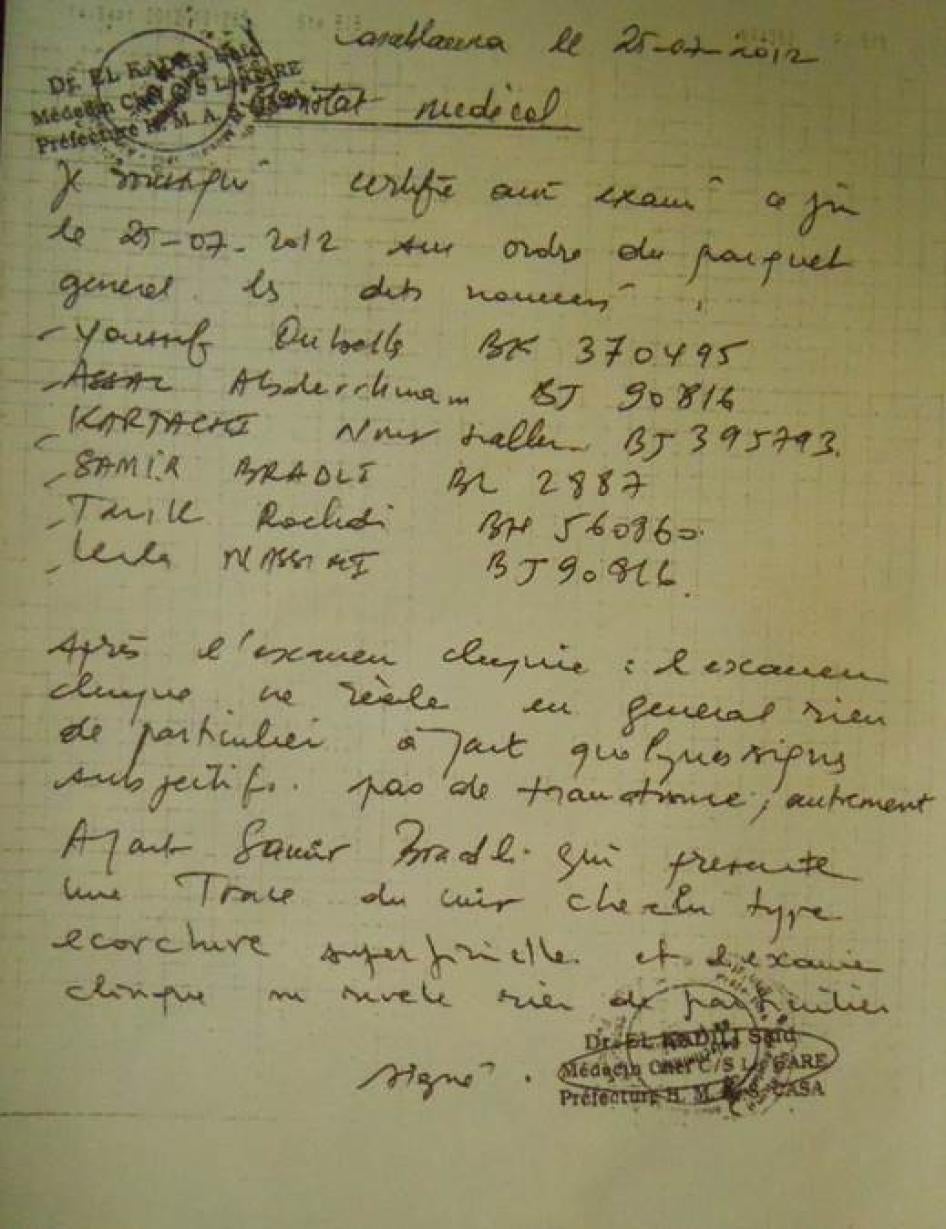
Communication from Dr. Duarte Vieira to Human Rights Watch [138]
I have been asked … to comment on the medico-legal report (“constat medical”) on Mr. Youssef Oubella, Abderrahmane Assal, Nouressalam Kartachi, Samir Bradli, Tarek Rouchdi, and Laila Nassimi, issued in Casablanca, on 25 July 2012, by Dr. Saïd el-Kadili.These are the comments that result from my evaluation of the report:
- There is no indication of the length of time that the medical examination took (no start time and no finish time).
- There is no indication that the examined persons gave their informed consent to the medico-legal examination and for a single medical report covering all of them simultaneously.
- There is no indication about the existence or non-existence of restrictions and constraints placed upon the medical examination.
Apart from the signature of the medical doctor who conducted the examination there is no indication if someone else was present during the medical examination and if the medical examinations were done separately (as they should have been done) or together.
- Overall, the report is extremely brief, with the substantive part only 8 lines long. For a medico-legal report concerning alleged cases of ill-treatment or torture this is unreasonably short, and itself is an indication that a thorough evaluation cannot really have taken place.
- The report does not state the allegations of the different persons submitted to examination.
- The results of the physical examination are provided in a single sentence: “l´examen clinique ne révèle en général rien de particulier à part quelques signes subjectifs ; pas de traumatisme, autrement à part Samir Bradli qui présente une trace du cuir chevelu type écorchure superficielle et l´examen clinique ne révèle rien de particulier ” … [139]
- There are no supporting body diagrams or photographs and there is no description of the precise anatomical location and nature of the only wound mentioned.
- The meaning of the phrase “quelques signes subjectifs” is not clear.
- There is no description of eventual psychological symptoms nor any referral of any of the examined persons for further psychological evaluation by a specialist.
- There is no attempt in the report to elicit any details whatsoever about the alleged acts that led the examined persons to the “constat medical” and no remark about their complaints.
- There is no attempt to obtain or to document any precise details of the alleged ill-treatment or torture, nor any precision in identifying the parts of the body that were targeted.
In conclusion, the medico-legal report issued by Dr. Saïd el-Kadili falls well below internationally accepted practice for the medical examination of alleged victims of torture and other cruel, inhuman or degrading treatment or punishment, as detailed in the Manual on the Effective Investigation andDocumentation of Torture and Other Cruel, Inhuman or Degrading Treatment or Punishment, published by the United Nations in 2001 and known as the Istanbul Protocol.
The report… provides no details of the examinations conducted, and provides only a very undetailed and non-scientific description of the findings of these examinations.
With this degree of brevity, there is no indication at all that a thorough evaluation of the victims’ allegations has been conducted…. No judicial decision can rely on such an unacceptable report, which has no forensic value.
[1] Article 290 of the Code of Penal Procedure reads, “The records and reports prepared by officers of the judicial police in regard to determining misdemeanors and infractions are to be deemed trustworthy unless the contrary is proven in accordance with the rules of evidence.”
[2] International Federation of Human Rights, “Maroc : Libération provisoire et poursuite du harcèlement judiciaire de M. Camara Laye (Morocco: Provisional Release and the Continuing Judicial Harassment of Camara Laye), “ November 15, 2012, http://www.fidh.org/Maroc-Liberation-provisoire-et-12433 (accessed December 21, 2012).
[3] The text of the king’s speech in French is at http://mohamed6.canalblog.com/archives/2009/08/21/14805632.html (accessed May 9, 2013).
[4] “Maroc: Installation de la Haute Instance du dialogue national : le Roi pose le premier acte de la réforme de la justice (Creating a High Commission for National Dialogue : The King Initiates the First Act in Reforming the Judiciary),” Maghreb Info, http://www.maghrebinfo.fr/maroc/actualites/713-maroc-installation-de-la-haute-instance-du-dialogue-national-le-roi-pose-le-premier-acte-de-la-reforme-de-la-justice.html (accessed May 2, 2013).
[5] Speech by King Mohammed VI, July 30, 2012, http://www.bladi.net/discours-du-roi-mohammed-vi-du-30-juillet-2012.html (accessed September 2, 2012).
[6] “La Charte nationale sur la réforme du système judiciaire sera prête avant fin mars (The National Charter on the Reform of the Judiciary System To Be Ready before the End of March), ” Le Matin, January 11, 2013, http://www.lematin.ma/journal/Justice_La-Charte-nationale-sur-la-reforme-du-systeme-judiciaire-sera-prete-avant-fin-mars/176570.html (accessed April 2, 2013).
[7] Statement delivered by Juan E. Méndez, Special Rapporteur on torture and other cruel, inhuman or degrading treatment, at the conclusion of his visit to Morocco from 15 to 22 September 2012, September 22, 2012, http://www.ohchr.org/EN/NewsEvents/Pages/DisplayNews.aspx?NewsID=12569&LangID=E (accessed December 11, 2012).
[8] See Human Rights Watch, “Morocco: Human Rights at a Crossroads,” October 21, 2004, http://www.hrw.org/reports/2004/10/20/morocco-human-rights-crossroads; “Human Rights in Western Sahara and in the Tindouf Refugee Camps,” December 29, 2008, http://www.hrw.org/reports/2008/12/19/human-rights-western-sahara-and-tindouf-refugee-camps; “Morocco: ‘Stop Looking For Your Son’: Illegal Detentions under the Counterterrorism Law,” October 25, 2010, http://www.hrw.org/reports/2010/10/25/morocco-stop-looking-your-son.
[9] Ali Amar, “Maroc - Le temps des révoltes paysannes (Morocco : The Time of Peasant Revolts),” Slate Afrique, June 29, 2012, www.slateafrique.com/89885/maroc-la%20revolution-viendra-peut-etre-des-zones-rurales (accessed April 4, 2013).
[10] Mawassi Lahcen, “Les manifestations de Safi prennent un tour violent (Demonstrations in Safi Take a Violent Turn),” Magharebia, August 7, 2011, http://magharebia.com/fr/articles/awi/features/2011/08/07/feature-01 (accessed April 4, 2013).
[11] Mustapha Elouizi, “Une agitation sociale qui tourne au drame : Violences tous azimuts à Taza (Social unrest Takes a Tragic Turn : All-out Violence in Taza),” Libération, February 3, 2012, http://www.libe.ma/Une-agitation-sociale-qui-tourne-au-drame-Violences-tous-azimuts-a-Taza_a24878.html (accessed April 4, 2013).
[12] Youness Saad Alami, “Emeutes : 8 ans après le seisme, Imzouren explose (Riots : 8 Years after the Earthquake, Imzouren Explodes), ” L’Economiste, March 13, 2012, http://www.leconomiste.com/article/892245-emeutes-8-ans-apr-s-le-s-isme-imzouren-explose (accessed April 4, 2013).
[13] Interviews conducted by Human Rights Watch, Bouarfa, January 31 and February 1, 2012.
[14] Human Rights Watch interviews with several parents of the defendants, Bouarfa, January 31, 2012.
[15] Figuig Court of First Instance in Bouarfa, Judgment 67/2011/4 misdemeanor/flagrante delicto, Figuig Court of First Instance in Bouarfa, June 16, 2011.
[16] Oujda Court of Appeals, Case No. 11/1134/misdemeanor, judgment 4722, July 26, 2011.
[17] This statement is apparently inaccurate: the defendants did not “confess” to the prosecutor; in fact they protested their innocence and repudiated the statements attributed to them by the police. See below in text.
[18] In addition, Kebbouri lost his job as a public school teacher because of his incarceration. He did not get re-hired until one year after his release and then, only in the city of Oujda. He believes this reassignment was intended to keep him away from Bouarfa, three hours away, where his family still lives. Human Rights Watch interview with Seddik Kebbouri, Rabat, May 11, 2013.
[19] Human Rights Watch interview with Abdelouahid Benaïssa, Bouarfa, February 1, 2012 and phone interview, October 4, 2012.
[20] Judgment 67/2011/4 misdemeanor/flagrante delicto.
[21] Human Rights Watch interviews with Abedlouahid Benaïssa, Bouarfa, February 1, 2012, and with Seddik Kebbouri, Rabat, May 11, 2013.
[22] Human Rights Watch interview with Abdelouahid Benaïssa, Bouarfa, February 1, 2012 and phone interview, October 4, 2012.
[23] Human Rights Watch interview with Abdelouahid Benaïssa, Bouarfa, February 1, 2012.
[24] Human Rights Watch interview with Seddik Kebbouri, Rabat, May 11, 2013.
[25] Human Rights Watch interview with Omar Ben Ali, February 1, 2012, Bouarfa.
[26] Email correspondence from Omar Ben Ali to Human Rights Watch, August 28, 2012.
[27] Case 11/1134, p. 22.
[28] Human Rights Watch has no data concerning the average wait in Morocco between arrest and trial. However, the high percentage of the prison population that is in pretrial detention is one indication that those arrested and placed in pre-trial custody must wait a long time for their trial to begin or to be completed. The press quoted a justice ministry official saying that at the end of October 2012, 31,113 persons were in pretrial detention in Moroccan prisons, or 44.68% of the total prison population. “Déclaration relative à la détention préventive: Mustapha Ramid rencontre les associations signataires (Statement on Preventive Detention : Mustapha Ramid Meets the Signatory Associations),” Au Fait, December 18, 2012, http://www.aufaitmaroc.com/actualites/maroc/2012/12/18/mustapha-ramid-rencontre-les-associations-signataires_201640.html (accessed May 7, 2013).
[29] Email correspondence from Taline Moumni to Human Rights Watch, April 22, 2011.
[30] Video clip of an Al Jazeera sports news broadcast, Youtube, http://www.youtube.com/watch?v=Gwt6CIj3_Go (accessed February 22, 2013).
[31] Jacques-Marie Bourget, “Une histoire d’entêtement (A Tale of Stubbornness),” Bakchich, http://www.bakchich.info/international/2010/09/29/zakaria-moumni-un-boxeur-a-disparu-58688 (accessed February 22, 2013).
[32] Mustapha Mansour, “Moumni: Batal ‘Alami yabhath ‘an Ajr Zahid” (Moumni: World Champion Seeks a Modest Salary), Al-Ayam, July 8, 2010, http://www.liberez-zakaria-moumni.org/docs/al-ayyam.pdf (accessed February 22, 2013).
[33] When Human Rights Watch interviewed Moumni on August 6, 2012, nearly two years after his arrest, long, narrow vertical scars were visible on his shins.
[34] Email correspondence from Taline Moumni to Human Rights Watch, October 6, 2010, and Human Rights Watch interview with Zakaria Moumni, Antony, France, August 6, 2012.
[35] See Human Rights Watch, “Morocco: ‘Stop Looking for Your Son,’” p. 14.
[36] Human Rights Watch, “Morocco: Human Rights at a Crossroads,” and “Morocco: ‘Stop Looking for Your Son.’”
[37] The court records show that this was deputy prosecutor Ilyas Saloub, attached to the Rabat Court of First Degree .
[38] Judge Mohamed Yamoudi presided over the trial, according to court records.
[39] Human Rights Watch interview with Abderrahim Jamaï, Rabat, October 26, 2010.
[40] Rabat Court of First Instance, Case No. 21/1576/10 misdemeanor/flagrante delicto, judgment 1316, October 4, 2010.
[41] Human Rights Watch phone interview with Abderrahim Jamaï, March 9, 2011.
[42] Rabat Court of Appeals, Misdemeanor Section, Case No. 19/2010/3792, judgment 92, January 13, 2011.
[43] Supreme Court, Criminal Chamber, Case No. 2011/10/6/4259, judgment 10/688, June 29, 2011.
[44] See Appendix I of this report, statement from the Ministry of Foreign Affairs, received September 27, 2011.
[45] See Appendix I of this report.
[46] Rabat Court of Appeals, Case No. 27/2008/32, July 29, 2009.
[47] Rabat Court of Appeals, Case No. 28/09/40, July 16, 2010.
[48] See Appendix I of this report, statement from the Interministerial Delegation for Human Rights, received February 28, 2012.
[49] See Human Rights Watch, “Morocco: ‘Stop Looking for Your Son.’”
[50] Ibid.; Human Rights Watch, “Morocco: Address Unfair Convictions in Mass Terror Trial,” December 29, 2009, http://www.hrw.org/news/2009/12/29/morocco-address-unfair-convictions-mass-terror-trial; “Morocco: Terror Convictions Upheld for 35, Including Political Figures,” July 28, 2010, http://www.hrw.org/news/2010/07/28/morocco-terror-convictions-upheld-35-including-political-figures; “Morocco/Western Sahara: Dissidents in Prison, Unfair Trials,” January 24, 2011, http://www.hrw.org/news/2011/01/24/moroccowestern-sahara-dissidents-prison-unfair-trials.
[51] See Human Rights Watch, “Morocco: Address Unfair Convictions in Mass Terror Trial.”
[52] Rabat Court of Appeals, Case No. 27/2008/32, July 29, 2009.
[53] Code of Penal Procedure, art. 290.
[54] Sebastian Rotella, “In Morocco, an Unlikely Group of Terror Suspects,” Los Angeles Times, February 27, 2008, http://articles.latimes.com/2008/feb/27/world/fg-morocco27 (accessed May 12, 2013).
[55] Rabat Court of Appeals, First Investigative Chamber, File 08/17.
[56] See Appendix I.
[57] Ibid.
[58] Human Rights Watch interview with M’hammed Abdennebaoui, Rabat, January 27, 2010.
[59] Rabat Court of Appeals, minutes of hearing before investigating judge, February 28, 2008. Human Rights Watch has a copy of the minutes.
[60] Human Rights Watch interview with Mohamed Chaâbaoui, Rabat, May 16, 2013.
[61] The report states that Khouchiâ mentioned having been the victim of police “violence.” This choice of words would have been the way the judge summarized for the court clerk the defendant’s testimony. The defendant’s words may have been more graphic.
[62] Human Rights Watch interview with Mohamed Chaâbaoui, Rabat, May 16, 2013.
[63] Rabat Court of Appeals, Case No. 28/09/40, July 16, 2010, p. 254.
[64] Email correspondence from a relative of one of the defendants to Human Rights Watch, July 30, 2009. The relative asked to remain anonymous.
[65] See, for example, the account provided by Zakaria Moumni, above.
[66] Law No. 03-03 of 28 May 2003 on Combating Terrorism, art. 66, para. 4: “When dealing with a terrorism offense, the period of custody shall be ninety-six hours renewable twice for a period of ninety-six hours each time upon written authorization of the Public Ministry.”
[67] Code of Penal Procedure, art. 67.
[68] Ibid., art. 608.
[69] Ibid., art. 66.
[70] Human Rights Watch interview with Houriya Ameur, Salé, July 27, 2009.
[71] Human Rights Watch, “Morocco: ‘Stop Looking for Your Son,’” Amnesty International, Morocco – Western Sahara: Exclude “confessions” obtained under torture in trial of Sahrawi activist,” April 14, 2013, http://amnesty.org/en/library/asset/MDE29/003/2013/en/51a8adc5-6065-40ba-8911-0b76de8a1b64/mde290032013en.html (accessed May 2, 2013), Amnesty International, “Continuing abuses against individuals suspected of terrorism-related activities in Morocco,” June 16, 2010, http://www.amnesty.org/en/library/asset/MDE29/013/2010/en/1a0ad009-5ae6-4823-9d86-16caa2e8357d/mde290132010en.html (accessed May 2, 2013).
[72] Rabat Court of Appeals, Case No. 27/2008/32, July 29, 2009.
[73] Rabat Court of Appeals, Case No. 28/09/40, July 16, 2010, p. 254.
[74]“Violence” is the term used in the court judgment; the actual words he used may have been more graphic.
[75] Human Rights Watch interview with Maymouna al-Bosh, Rabat, March 12, 2009.
[76] Human Rights Watch interview with Samira Rammache, Kénitra, September 14, 2012.
[77] Jean-Pierre Borloo, “Une lettre de Belliraj: ‘j’ai été torturé (A Letter from Belliraj : I Was Tortured),” Le Soir, November 14, 2008, http://archives.lesoir.be/unelettre-de-belliraj-j-8217-ai-ete-torture-_t-20081114-00K1G9.a.html?&v5=1 (accessed October 15, 2010); “Procès de Rabat: le Belgo-marocain Belliraj se dit victime de tortures (Rabat Trial : The Belgian-Moroccan Belliraj Says He Was Victim of Torture),” Agence France-Presse, November 14, 2008, http://www.journaux.ma/maroc/actualite-internationale/proces-de-rabat-le-belgo-marocain-belliraj-se-dit-victime-de-tortures (accessed May 8, 2013).
[78] “Maroc: Belliraj nie avoir commis des meurtres en Belgique (Morocco : Belliraj Denies Having Committed Murders in Belgium), “ Agence France-Presse, cited in La Dernière Heure, April 7, 2009, http://www.dhnet.be/infos/belgique/article/256626/belliraj-nie-avoir-commis-des-meurtres-en-belgique.html (accessed August 31, 2012).
[79] Morocco continues to impose death penalties but has not carried one out since 1993.
[80] See Jean-Pierre Borloo, “Belliraj avait été entendu chez nous (Belliraj had been questioned by us),” Le Soir, February 26, 2008, http://archives.lesoir.be/belliraj-avait-ete-entendu-chez-nous_t-20080226-00F31E.html (accessed May 2, 2013). See also Mark Eeckhaut, “Belliraj Killed for Abu Nidal and Worked for Al-Qa'idah," De Standaard, October 15, 2008, as translated into English by BBC Monitoring International Reports, October 16, 2008, http://www.accessmylibrary.com/article-1G1-187043808/belgian-magistrates-interrogate-terror.html (accessed May 2, 2013).
[81] Human Rights Watch interview with Abadila Maelainin, Rabat, September 14, 2012.
[82] Arts. 263-265 and 267 of the Penal Code and art. 21 of the law on public assemblies of November 15, 1958, as amended by decree 1.02.200 of July 23, 2002.
[83] See Human Rights Watch, “Morocco: Contested Confessions Used to Imprison Protesters,” September 17, 2012, http://www.hrw.org/news/2012/09/17/morocco-contested-confessions-used-imprison-protesters.
[84] Human Rights Watch interview with Laila Nassimi, Casablanca, September 11, 2012.
[85] Human Rights Watch interview with Samir Bradli, Casablanca, April 19, 2013.
[86] The medical report is reproduced as Appendix V of this report.
[87] Human Rights Watch interview with Omar Bendjelloun, Rabat, September 14, 2012, and with Samir Bradli, Casablanca, April 19, 2013.
[88] Human Rights Watch interview with Omar Bendjelloun, Rabat, September 14, 2012, and phone interview with Mohamed Messaoudi, September 13, 2012.
[89] Casablanca Court of First Instance at Aïn Sbaâ, Misdemeanor Case No. 6340/101/2012, Judgment 8451, September 12, 2012.
[90] For another critical evaluation of a court-ordered medical examination conducted on an alleged torture victim in Morocco, see the discussion of the case of Ali Aarrrass in Alkarama, “Follow-up to the Recommendations of the Committee against Torture in the Context of the Fourth Periodic Review of Morocco,” p. 7, October 1, 2012, http://www2.ohchr.org/english/bodies/cat/docs/followup/AlkaramaMorocco47_en.pdf (accessed January 2, 2013).
[91] Statement delivered by Juan E. Méndez, Special Rapporteur on torture and other cruel, inhuman or degrading treatment, at the conclusion of his visit to Morocco from 15 to 22 September 2012, September 22, 2012, http://www.ohchr.org/EN/NewsEvents/Pages/DisplayNews.aspx?NewsID=12569&LangID=E (accessed December 11, 2012).
[92] Rabat Military Court, Criminal Cases Nos. ع ع 10/2746/3063 and ع ع 10/2746/3063 additional from 1 to 10 and ق س 10/369/3125 additional and ق س 10/369/3125 additional 1 and 2, Judgment 2013/313, February 17, 2013.
[93] Human Rights Watch reported on the events in “Western Sahara: Beatings, Abuse by Moroccan Security Forces,” November 26, 2010, http://www.hrw.org/ar/news/2010/11/26.
[94] See Human Rights Watch, “Western Sahara: Beatings, Abuse by Moroccan Security Forces.” See also, Interministerial Delegation for Human Rights, White Paper on the Gdeim Izik Events, Rabat: February 2013.
[95] Interministerial Delegation for Human Rights, White Paper on the Gdeim Izik Events.
[96] Various undated statements provided by the Embassy of Morocco in Washington, DC. Copies are on file at Human Rights Watch.
[97] A list of the defendants including their charges and sentences appears in Appendix III.
[98] Code of Military Justice, November 10, 1956, dahir no. 1-56-270, http://adala.justice.gov.ma/production/html/Fr/liens/..%5C44976.htm (in French) (accessed May 12, 2013).
[99] Article 7 of the Code of Military Justice code stipulates:
If a person … is simultaneously, charged with a felony or misdemeanor that falls under the jurisdiction of the military court and another felony or misdemeanor that falls under the jurisdiction of ordinary courts, he is first referred to the court that has jurisdiction over the offenses that are punishable with the most severe punishments; he is then referred to a court that has jurisdiction over the other offenses, if warranted. If two sentences are pronounced, the most severe one is applied.
Article 76.4 states, “If the military investigating judge classifies the offense as a felony or misdemeanor that falls under the military court’s prerogatives, he declares the referral of the defendant to [the military court].”
[100] The military investigating judge notes in his report that all of the defendants who appeared before him proclaimed their innocence; some, he notes, told him they had signed their police statements without reading them. However, others, he said, stated before the judge that the police had not coerced or pressured them:
Despite the fact that the defendants have denied, during their second appearance before the investigating judge, what they are accused of, their denial has no tangible basis since it is refuted by their statements to the judicial police in which they all confirmed their deeds, especially since Asfari, Banga, Bourial, el-Machdoufi, Laâroussi, Lekhfawni, Abhah, Haddi, Toubali, Zaoui, Deich, Khadda, Dah and Tahlil confirmed that they were not subjected to any pressure or coercion.
In fact, a number of the defendants, including some of those named above, did tell the investigating judge that the police had subjected them to torture or abuse, and that they had been compelled to sign statements without reading them. See Appendix III below.
[101] Human Rights Watch interview with Taki Machdoufi, Rabat, May 15, 2013.
[102] The complete police statement of Naâma Asfari appears in Appendix IV.
[103] The complete police statement of Mohamed Lamine Haddi appears in Appendix IV
[104] Code of Military Justice, November 20, 1956, dahir no. 1-56-270.
[105] Code of Military Justice, November 20, 1956, dahir no. 1-56-270.
[106] Pretrial detention is limited to two months in serious crimes, renewable for five additional two-month periods at the order of the investigating judge, for a total of 12 months. Code of Penal Procedure, art. 177.
[107] See, for example, article 41 of the press code of 2002.
[108] On Dahane’s forced disappearance from 1987 to 1991, see Amnesty International, “Morocco/Western Sahara: Sahrawi human rights defenders under attack,” November 24, 2005, http://www.amnesty.org/en/library/asset/MDE29/008/2005/en/78b6dddc-d482-11dd-8743-d305bea2b2c7/mde290082005en.html (accessed November 13, 2012). On Degja Lachgar’s forced disappearance from 1980 to 1991, see the Sahrawi Association of Victims of Human Rights Violations, “Report: Political prisoner Dagja Lachgar held in solitary confinement, Zaki prison, Salé, Morocco,” December 10, 2009, http://asvdh.net/3736 (accessed November 13, 2012).
[109] See Human Rights Watch, “Freedom to Create Associations: A Declarative Regime in Name Only,” October 7, 2009, http://www.hrw.org/reports/2009/10/07/freedom-create-associations-0.
[110] Human Rights Watch interview with Brahim Dahane, September 12, 2012, Rabat, and phone interview with Yahdih Etarrouzi and Rachid Sghaier, May 8, 2010.
[111] Military Court of Rabat, first trial chamber, Case No. 2837/2546/09, September 21, 2010.
[112] Penal Code art. 206 stipulates, “A person who directly or indirectly receives from a foreign person or organization, gifts, loans, or other advantages, in any form, that are used or intended to be used, in whole or in part, to carry out or to pay for an activity or for propaganda in Morocco that could harm the integrity, sovereignty, or the independence of the Kingdom, or to shake the loyalty that citizens owe the State and the institutions of the Moroccan people, shall be guilty of harming the internal security of the state and punished by imprisonment from one to five years and a fine of 1000 to 10,000 dirhams [US$120 to 1,200].”
[113] “Essential Clarification,” signed by Tamek, Naciri, Dahane, Sghaier, Lebeihi, and Etarrouzi, March 10, 2010, http://awsa.org.au/wp-content/uploads/2010/04/eng-2.pdf (accessed November 13, 2012).
[114] Swedish Section of the International Commission of Jurists, “Trial Observation Report, From the Proceeding before the Court of First Instance, Ain Seeba, Casablanca, Morocco, brought against Brahim Dahane, Ali Salem Tamek, Ahmed Ennasiri, Degja Lechgar, Yahdid Terrouzi, Saleh Lebeihi, and Rachid Sghair,” February 7, 2011, http://www.icj-sweden.org/Trial%20observation%20Group%20of%207,%202011,%20final%20version.pdf (accessed August 7, 2012).
[115] See Appendix I.
[116] The authorities’ statement on the case is in Appendix I.
[117] Code of Penal Procedure, arts. 73 and 74.
[118] Ibid., art. 134.5. However, art.88.4 states, “If the suspect or his lawyer requests a medical exam or treatment, such a request cannot be refused [by the investigating judge] except by a superior order.”
[119] Fourth Periodic Report by Morocco to the U.N. Committee against Torture, paras. 148 and 143, November 5, 2009, CAT/C/MAR/4, http://www.arabhumanrights.org/publications/countries/morocco/cat/cat-c-mar-4-09e.pdf (accessed May 1, 2013).
[120] Whether their appearance is before a prosecutor or investigating judge depends on the nature of their offense and is determined by the Code of Penal Procedure.
[121] Writing about the practice of torture generally rather than in reference to any one country, Manfred Nowak, at the time U.N. Special Rapporteur on torture and other cruel, inhuman or degrading treatment or punishment, observed, “There is an increasing variety of torture methods applied with the intent not to leave any visible physical traces. These methods comprise inter alia the exposure to extreme temperatures, stress positions, beatings with sand-filled plastic bottles, shaking or submersion in water. The increased use of these methods calls for the strengthened and increased availability of forensic medical expertise in places of detention and in the overall efforts to combat torture. The establishment of psychological torture methods is a particular challenge. Mock executions, sleep deprivation, the abuse of specific personal phobias, prolonged solitary confinement, etc. for the purpose of extracting information, are equally destructive as physical torture methods.” Report of the Special Rapporteur on torture and other cruel,inhuman or degrading treatment or punishment, Manfred Nowak, Addendum, Study on the phenomena of torture, cruel, inhuman or degrading treatment or punishment in the world, including an assessment of conditions of detention, February 5, 2010, A/HRC/13/39/Add.5, http://www2.ohchr.org/english/bodies/hrcouncil/docs/13session/A.HRC.13.39.Add.5_en.pdf (accessed April 4, 2013).
[122] The Manual on the Effective Investigation and Documentation of Torture and Other Cruel, Inhuman, or Degrading Treatment of Punishment (“the Istanbul Protocol”), guidelines drawn up by international experts and approved by the U.N. General Assembly, states, “In cases in which the established investigative procedures are inadequate because of insufficient expertise or suspected bias, or because of the apparent existence of a pattern of abuse, or for other substantial reasons, States must ensure that investigations are undertaken through an independent commission of inquiry or similar procedure. Members of such a commission should be chosen for their recognized impartiality, competence and independence as individuals. In particular, they must be independent of any suspected perpetrators and the institutions or agencies they may serve. The commission must have the authority to obtain all information necessary to the inquiry and shall conduct the inquiry as provided for under these principles.”
[123] Statement delivered by Juan E. Méndez, Special Rapporteur on torture and other cruel, inhuman or degrading treatment, at the conclusion of his visit to Morocco from 15 to 22 September 2012, September 22, 2012, http://www.ohchr.org/EN/NewsEvents/Pages/DisplayNews.aspx?NewsID=12569&LangID=E (accessed December 11, 2012).
[124] Report of the Special Rapporteur on torture and other cruel, inhuman or degrading treatment or punishment, Juan E. Méndez; Addendum: Mission to Morocco, A/HRC/22/53/Add.2, February 28, 2013, http://www.ohchr.org/Documents/HRBodies/HRCouncil/RegularSession/Session22/A-HRC-22-53-Add-2_en.pdf (accessed May 12, 2013).
[125] Art. 290 of the Code of Penal Procedure reads, “The records and reports prepared by officers of the judicial police in regard to determining misdemeanors and infractions are to be deemed trustworthy unless the contrary is proven in accordance with the rules of evidence.”
[126]Human Rights Watch concluded after studying the trial of as-Sah and al-Boussati, “Lacking evidence in the file that would corroborate the defendants' ‘confessions’ to the police, the court lowered the evidentiary threshold by downgrading the charge from a crime – an arson attack (Article 580) – to a minor offense assault on a public agent (Article 267). It then convicted them solely on the basis of their "confessions. It did so without explaining why it deemed their police statements to be trustworthy.” Human Rights Watch, “Human Rights in Western Sahara and in the Tindouf Refugee Camps,” December 2008, p. 46, http://www.hrw.org/node/77259/section/9.
[127] The intended meaning seems to include the judicial police. The Arabic reads:
علما أن الإعتراف أمام القضاء نفسه يخضع لسلطات المحكمة في تقدير قوته .
[128] Letter sent to Human Rights Watch via email from the Moroccan Embassy in Washington, DC on February 29, 2012.
[129] Code of Penal Procedure, art. 66, as amended in 2011.
[130] The text of the king’s speech in French is at http://www.oujdacity.net/national-article-68489-fr/texte-integral-du-discours-de-sm-le-roi-devant-les-deux-chambres-du-parlement.html (accessed December 11, 2012).
[131] The National Human Rights Council (Conseil national des droits de l’Homme, CNDH) created by decree 1-11-19 of March 1, 2011, and mentioned in article 161 of the 2011 constitution, is an “independent” institution charged with monitoring, protecting and promoting human rights in Morocco. It replaced the Advisory Council on Human Rights (Conseil consultatif des droits de l’Homme, CCDH). The mediator, as defined by a decree 1-11-25 of March 17, 2011, and by the 2011 Constitution’s article 162, is an “independent” institution created by the state that has as its objective to defend and promote rights and the rule of law in the interactions between state institutions and persons having contact with those institutions.
[132] Human Rights Committee, General Comment No. 32, art.14: Right to equality before courts and tribunals and to a fair trial, arts. 41 and 39, U.N. Doc. CCPR/C/GC/32, 2007, http://daccess-dds-ny.un.org/doc/UNDOC/GEN/G07/437/71/PDF/G0743771.pdf?OpenElement (accessed May 14, 2013).
[133] See U.N. Human Rights Committee General Comment No. 32, Article 14: Right to Equality before Courts and Tribunals and to a Fair Trial, CCPR/C/GC/32, August 23, 2007, para. 35, http://daccess-dds-ny.un.org/doc/UNDOC/GEN/G07/437/71/PDF/G0743771.pdf?OpenElement (accessed May 14, 2013).
[134] The U.N. Human Rights Committee has held, “In order to comply with articles 9 and 14 [of the ICCPR], the detention of persons awaiting trial should also be reviewed periodically and their trials held without undue delay.” Concluding observations of the Human Rights Committee, Republic of Moldova, CCPR/CO/75/MDA (Concluding Observations/Comments), July 26, 2002, http://www.unhchr.ch/tbs/doc.nsf/0/7945fe5e4947c21bc1256c3300339d88?Opendocument (accessed April 10, 2013).
[135] U.N. Basic Principles on the Role of Lawyers, adopted by the Eighth United Nations Congress on the Prevention of Crime and the Treatment of Offenders, Havana, Cuba, 27 August to 7 September 1990 http://www.refworld.org/cgi-bin/texis/vtx/rwmain?docid=3ddb9f034 (accessed May 14, 2013).
[136]The intended meaning seems to include the judicial police. The Arabic reads:
علما أن الإعتراف أمام القضاء نفسه يخضع لسلطات المحكمة في تقدير قوته .
[137] Explanatory note from Human Rights Watch: The Promotion Nationale (l’Entraide nationale) is a public works job creation program. The union is composed of Promotion Nationale workers who seek better terms of employment.
[138] Dr. Duarte Vieira, in email communication with Human Rights Watch, September 26, 2012. Human Rights Watch made small corrections to the spellings and layout of the communication from Dr. Vieira.
[139] Translation : “The clinical examination generally reveals nothing in particular except for some subjective signs [sic]; no trauma, just Samir Bradli, who has on his scalp a superficial scratch ; the clinical exam reveals nothing in particular.”