Unwelcome Guests
Greek Police Abuses of Migrants in Athens
Summary
Human rights don’t exist for the police.
—Dome Kafari, 28 year old undocumented migrant from Benin, Athens, February 13, 2013.
No matter how many years you live here, you will remain a foreigner.
—Lamine Kaba, 41 year old long-term legal migrant from Guinea, Athens, April 14, 2013.
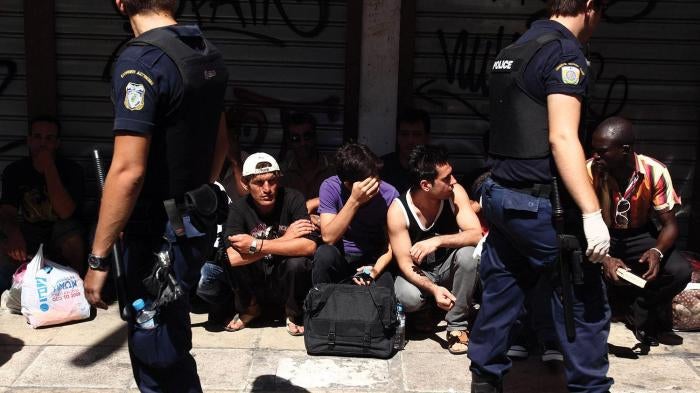
In early August 2012, the Greek government launched a police operation aimed at cracking down on irregular immigration and crime in Athens. It is cruelly ironic that the authorities decided to call the initiative Operation Xenios Zeus. The name refers to the ancient Greek god Zeus’ patronage of hospitality and guests. In Greek mythology, Zeus, the king of the gods, was called upon to avenge wrongs done to strangers. In fact, Operation Xenios Zeus is anything but hospitable towards foreign migrants and asylum seekers in the Greek capital.
A key tactic of Operation Xenios Zeus is the use of police powers to conduct identity checks to verify the legal status of individuals presumed to be irregular migrants. While such police stops were frequent before the launch of the operation, official statistics indicate a significant intensification of stops since its onset. Between August 4, 2012 and February 22, 2013—the most recent period for which government statistics are available—police had stopped almost 85,000 people of foreign origin on the streets of Athens and taken to a police station for examination of their identification papers and legal status. Only 4,811—about 6 percent—were found to be residing unlawfully in Greece.
In a country already notorious for its dysfunctional asylum system, inhuman and degrading migration detention conditions, and law enforcement abuse, an intensification of police sweeps aimed at cracking down on irregular migrants in downtown Athens raised immediate concerns. On August 8, 2012—when 6,000 people had already been rounded up—Human Rights Watch issued a press release urging authorities to avoid discrimination based on race or ethnicity, arbitrary detention, and inhuman and degrading treatment.
This report is based on interviews with forty-four people who have been subjected to at least one stop since the launch of Operation Xenios Zeus. Thirty-five of them had a legal right to be in Greece at the time of the stops because they are asylum seekers, legal foreign residents, or Greeks of foreign origin.
The accounts we heard confirmed our early concerns about Operation Xenios Zeus. Out on the streets police regularly, even repeatedly, stop and search individuals who appear to be foreigners and order them to provide proof of a legal right to be in Greece. Even when these individuals have documents, all too often police stop them and then transfer them to a police station where they may detain them for hours pending verification of their legal status.
The lengthy and intrusive procedure amounts to arbitrary and discriminatory deprivation of liberty. Many legal residents and registered asylum seekers interviewed for this report had experienced being stopped by police officers in the street, confined in police buses, and detained in police stations and the Aliens Police Division for up to five hours. One person interviewed was held for approximately 10 hours, on one occasion. The Greek authorities argue that the procedure is necessary to identify forged documents and to verify photocopies of documents, and that they do not have sufficient capacity or adequate equipment to verify the validity of identity documents on the street. However, authorities have failed to take steps to ensure that police are able to do this verification on the street, including by putting in place the technical means allowing police to do so remotely.
Ali, a 33-year-old Afghan registered asylum seeker told us how on April 2, 2013 his plans for a family picnic were thwarted when police officers stopped him near Attica metro station along with his 12-year-old daughter and 8-year-old son:
The police caught me… The kids explained that ‘he is our father, he has a pink card [asylum seeker’s card], why did you catch him?’ They [the police] said that ‘we will take him to Allodapon [police station], we will do the control [of the identity documents] and we will release him.’ Then the police told me to send the kids home … I said, ‘But we live in Piraeus [outside Athens], how are the kids going to go on their own?’ They told me, ‘We don’t care, tell them to go.’
Ali chose to keep his distraught children with him throughout the procedure, though they were kept separately from him and about forty-five other people the police had rounded up. After five hours he and his children were released only after a Greek nongovernmental organization (NGO) intervened on his behalf.
Police authorities say that police officers determine whom to stop using their informed judgment and intelligence about where undocumented migrants congregate. However, the fact that only 6 percent of stops have led to the identification and detention of undocumented migrants undermines this assertion and gives rise to the concern that the police may be using ethnic profiling in determining whom to stop. Intelligence-led stops should lead to a higher detection rate. As police statistics do not include the many people stopped for a quick identity check in the street and released on the spot, the overall detection rate is likely to be even lower than 6 percent. Moreover, many interviewees felt they were stopped by the police because of their physical characteristics, and we heard accounts of clear targeting on the basis of race or ethnicity.
Tupac, a 19-year-old Guinean registered asylum seeker, for example, told us that in early February at around 5 p.m., uniformed and plain clothed police officers forced black and Asian people, including him, out of a bus at Amerikis Square in central Athens:
There were at least seven blacks, and two Asians.... [P]olice officers came to the door and said in Greek: ‘Oli i black ekso, oli i black ekso [All blacks out, all blacks out].’ … The Greeks in the bus were clapping to encourage them.
Faustin Moto Pamba, a 28-year-old legal migrant from Congo, told Human Rights Watch in April 2013 in Athens:
Xenios Zeus refers to one of Zeus’s many nicknames [patron of hospitality]. In ancient times, Greeks were hospitable. When a stranger was coming they were obliged to … make him feel he’s at home. Now they stop us so that we feel at home, or in order to feel we are different and that we should go?
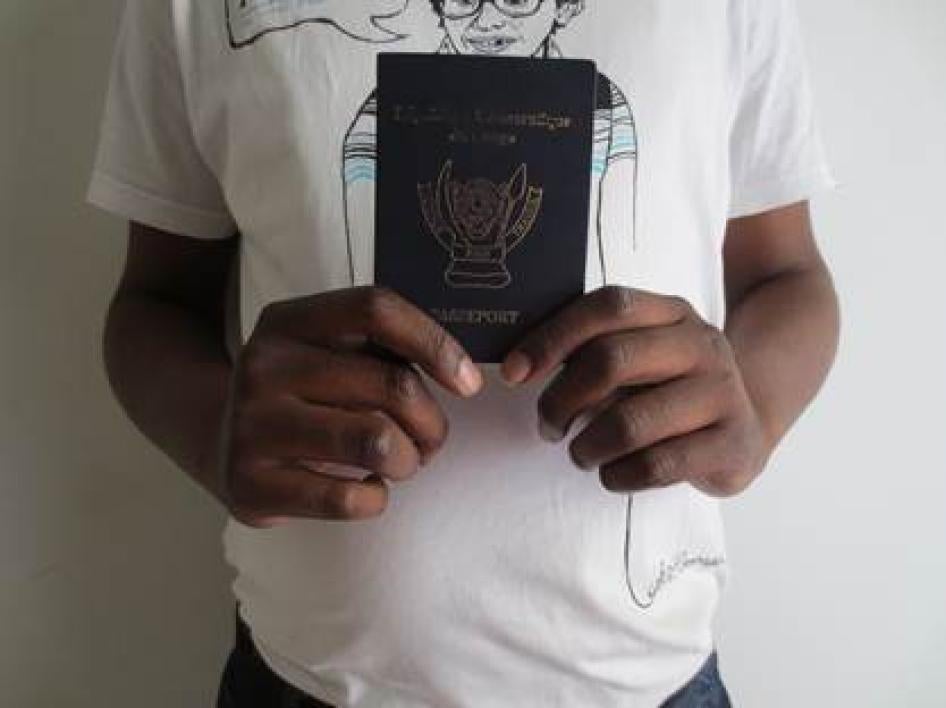
Faustin Moto Pamba, a 28-year-old legal migrant from Congo, who has been in Greece since he was a baby, was taken into police custody for verification of his papers during a sweep operation in February, in central Athens, Greece. © 2013 Human Rights Watch
In November 2012, the US Embassy in Greece took the unusual step of updating its country-specific information on Greece to warn US visitors about “confirmed reports of US African-American citizens detained by police authorities conducting sweeps for illegal immigrants in Athens.”
News emerged in January 2013 that a Nigerian-born US citizen had been detained and handcuffed by the police in July 2012 in the context of an immigration stop. He alleged that officers beat him unconscious when he tried to take a photograph of his handcuffs with his mobile phone.
Police mistreatment of migrants and asylum seekers is a longstanding, serious problem in Greece, as documented by Human Rights Watch and others. While in the course of this research we only heard four accounts of physical abuse during immigration stops, almost everyone we interviewed complained of disrespectful treatment such as rude, insulting, and threatening behavior. Body pat-downs and bag searches during immigration stops appear to be routine, even in the absence of any reasonable suspicion that the individual is carrying unlawful or dangerous objects.
Greece has a right to control irregular immigration and a duty to improve security on the streets for everyone. However, the breadth and intensity of immigration sweeps in the context of Operation Xenios Zeus raise serious concerns about whether the means to achieve those legitimate aims are necessary and proportionate. Official statistics and our research demonstrate that the police are casting an extraordinarily wide net, and subjecting individuals with a legal right to be in Greece, including tourists, to treatment prohibited by international law.
The right to liberty and security of the person is a bedrock principle of international human rights law. To be lawful, any deprivation of liberty must be carried out in accordance with the law, be nondiscriminatory, and be free from arbitrariness. While the Greek government asserts that detention in the context of an identity check is a justifiable restriction on the freedom of movement, Human Rights Watch believes the widespread detention of foreigners for hours for the purpose of verifying their legal status amounts to arbitrary deprivation of liberty. The United Nations Working Group on Arbitrary Detention warned in January 2013, following its visit to Greece, that “any detention on discriminatory grounds constitutes arbitrary detention and furthermore, that detention without any legal basis also renders the detention arbitrary.”
Ethnic profiling is discriminatory and unlawful when police systematically target certain groups for stops in the absence of objective criteria, even when these actions are grounded in unconscious stereotyping rather than an intentional policy. The European Court of Human Rights has clarified that differential treatment based exclusively or to a decisive extent on ethnicity cannot be justified in a contemporary democratic society. Ethnic profiling is unlawful in the context of immigration control as well as general policing, as the UN Human Rights Committee asserted in a landmark 2009 decision when it found that the stopping of a black Spanish citizen in a train station in Spain amounted to prohibited discrimination.
In April 2013, the Council of Europe Human Rights Commissioner, Nils Muižnieks, issued a highly critical report based on a January 2013 visit to Greece. The report urged the authorities to “put an end to the practice of ethnic profiling by the police, reportedly widely used … as part of the ‘Xenios Zeus’ police operation....”
The abuses documented in this report also violate Greek laws and policies on nondiscrimination, justifiable body and bag searches, and grounds for deprivation of liberty.
The lack of training for officers participating in Operation Xenios Zeus makes the use of ethnic profiling and default deprivation of liberty more likely. The operation as a general rule does not involve specialized teams but rather mobilizes police officers in different parts of the city, particularly in the downtown area. With the exception of officers attached to the Border Guards unit, police conducting immigration stops receive no specialized training in immigration and asylum issues, including on how to establish if a person has a legal basis to stay in Greece and how to detect forged documents. Nor have those directing Operation Xenios Zeus issued specific guidelines to officers involved in the operation on how to conduct stops.
Police officials consider Operation Xenios Zeus a success, citing as key indicators lower rates of crime, increased pedestrian traffic in central Athens, and more accurate records of immigrants living in Athens. A comparison between the first quarter of 2012 and the first quarter of 2013 shows that robberies decreased by 14.38% and thefts-burglaries by 24.39% in Attica. It is unclear, however, whether positive results are due to indiscriminate identity checks or instead to more effective policing of actual criminal behavior. In the context of Operation Xenios Zeus, police only arrested 59 people (both foreigners and nationals) for criminal offenses such as possession of illegal weapons and drugs between August 4, 2012, and February 6, 2013. What is clear is that these identity checks imply a significant investment of police resources and have led to widespread violation of rights.
Human Rights Watch calls on the Greek government to revise their general stop and search powers, including Operation Xenios Zeus, to ensure that all measures to identify irregular migrants are conducted in full compliance with national and international law prohibiting discrimination, including ethnic profiling, and arbitrary deprivation of liberty.
Key Recommendations
To the Government of Greece:
- Publicly condemn ethnic profiling by the police and other instances of discrimination and abuse by the police, send a clear and unambiguous message that such methods are unacceptable, and pledge to take concrete measures to document, analyze, and address these problems, including by holding abusers accountable;
- Provide clear guidance to police officers to limit deprivation of liberty in the context of an immigration stop, including the requirement that any deprivation of liberty, even for a brief period of time, must be based on a reasonable and individualized suspicion that a person’s identification documents are not authentic;
- Ensure, either in law or through binding circulars, clear guidelines for law enforcement officers with respect to immigration stops, including the permissible grounds for conducting a stop and for body pat-downs and the search of personal belongings;
- Ensure that each police patrol deployed for an immigration control operation has at least one officer, or a group of officers, with advanced specialized training in immigration and asylum issues, and on how to detect and identify forged documents;
- To avoid unjustified deprivation of liberty, develop and implement the necessary technical capacity to allow police patrols to check the validity of identity documents in the street.
To Regional and International Actors:
- The European Commission and Parliament as well as the EU Fundamental Rights Agency should monitor the Greek authorities continued implementation of Operation Xenios Zeus and hold Greece to its obligations under EU and international human rights law;
- The Council of Europe and United Nations human rights bodies should continue to exert pressure on Greece to address concerns about law enforcement discrimination and abuse, as well as arbitrary deprivation of liberty.
Methodology
This report is based on Human Rights Watch research conducted in Athens in February and April 2013. We chose to focus on Athens because background research, including statistics published by the Hellenic Police and media monitoring, indicated that the problem of abusive identity checks in the context of immigration control police operations was most acute in the capital. Most importantly, Operation Xenios Zeus, aiming at addressing the presence of undocumented migrants in Greece, focuses on Athens.
We interviewed 43 men, 4 women, and 2 boys aged 15 and 16 about their experiences during police stop and search operations. We interviewed 8 undocumented migrants, 20 registered asylum seekers, 5 people with other protected status (one with a recognized refugee status, a person with “subsidiary protection”, and a person holding a residence permit “for humanitarian reasons”), 10 legal foreign residents of Greece, and one migrant holding documentation ordering the suspension of his deportation. They came from Afghanistan, Algeria, Benin, Congo, Egypt, Guinea, Morocco, Nigeria, Senegal, Sierra Leone, Somalia, Sudan, Syria, and Togo. We also interviewed four Greek citizens of African descent; and one white Greek citizen (i.e. from the ethnic majority).
Of the 49 people we interviewed, 44 told us they have been stopped by the police since the launch of Xenios Zeus on August 4, 2012. We note, however, that many interviewees told us about stops even before the start of the operation.
A Human Rights Watch staff member carried out the interviews in Greek with individuals able to express themselves in Greek as well as in the native language of the interviewee through the help of interpreters. Victim interviews were also conducted in French and English with people able to express themselves in those languages. Interpreters were paid for their services.
All of the interviews were conducted individually and in private settings. For all adults, we use only the first name of those interviewed in order to protect their privacy and avoid negative consequences for having spoken with us, except in those cases where the individual requested that their full name be used. Where noted, we have used a pseudonym for adults upon request for the same reasons. In keeping with Human Rights Watch policy, we use pseudonyms followed by an initial for all children. All interviewees were informed of the purpose of the interview, and that their testimony might be used publicly. No incentives were offered or provided to persons interviewed.
We interviewed Major General Emmanouil Katriadakis and Police Brigadier General Alexandros Denekos in the Headquarters of the Hellenic Police, Ministry of Public Order and Citizen Protection. We spoke with senior representatives of the Union of Police Civil Servants of Attica, the Hellenic Police Guards Union of Attica, and the Association of Border Guards of Attica. We also met with the Greek Deputy Ombudsman for Human Rights and representatives from the European Commission Delegation in Greece and the European Commission Task Force for Greece.
Terminology
We have translated the Greek εξακρίβωση στοιχείων as “identity check.” We also refer to identity check operations as police stops, or simply stops throughout this report. We have translated the Greek προσαγωγή as “bringing a person in.”
In line with international conventions, in this report, the term “child” refers to any person under the age of 18.[1]
Where individuals quoted in this report refer to “Allodapon” they mean the Aliens Police Division premises in Athens.
Where individuals refer to the “red” or “pink card” they refer to the asylum seeker’s card, a document that proves they are registered asylum seekers with permission to be in Greece.
Where individuals refer to the word “charti” they mean the paper issued by the authorities ordering them to leave the country within a certain period of time (usually 30 days). This order serves as a proof of legal residence until the deadline to leave the country. The term “charti” or “chartia” in plural has also the broader meaning of “documents,” commonly used by police officers when requesting an individual for proof of identity.
I. Background
Since the early 2000s, Greece has become the major gateway to the European Union for undocumented migrants and asylum seekers from Asia and Africa, in part because it shares a land border with Turkey, a major transit route into Europe. The director of the European Union external borders agency, Frontex, said in August 2012 that Greece accounted for 67 percent of all irregular border crossings into the EU.[2] According to official Greek government data, Afghans comprised by far the largest national group irregularly entering Greece in 2012, followed by Pakistanis.[3] Greek authorities estimated in April 2012 that there were as many as one million undocumented migrants living in Greece.[4]
The failure of successive Greek governments to adopt coherent migration policies, chronic mismanagement of the asylum system, and, most recently, the deep economic crisis and resulting austerity have exacerbated what the United Nations High Commissioner for Refugees (UNHCR) described in late 2010 as a “humanitarian crisis.”[5] Countless undocumented migrants and asylum seekers live in deep destitution, occupying abandoned buildings, town squares, parks, and even forests. The ultimate goal for many, whether they are economic migrants or asylum seekers, is to transit through Greece to other countries in the EU. Hundreds of foreigners congregate in port cities such as Patras and Igoumenitsa looking for a chance to stow away on trucks and ferries heading to Italy, often risking life and limb to do so.[6]
Long-term residents of the center of Athens, in particular, have seen their neighborhoods change dramatically with the increasing numbers of migrants and asylum seekers. Concerns about rising crime and urban degradation have become a dominant feature of everyday conversations as well as political discourse. Parties across the ideological spectrum regularly and explicitly link irregular immigration to the city’s ills.
Undocumented migration and crime in Athens were high on the agenda in the lead-up to the 2012 national elections. As a candidate, now Prime Minister Antonis Samaras campaigned in part on a pledge to reclaim Greek cities from immigrants: “Greece today has become a center for illegal immigrants. We must take back our cities, where the illegal trade in drugs, prostitution, and counterfeit goods is booming. There are many diseases and I am not only speaking about Athens, but elsewhere too.”[7] Golden Dawn, a populist, right-wing party has in recent years gained strength and popularity in part because of their exploitation of anti-immigrant sentiment. Golden Dawn secured enough votes in the June 2012 national elections to enter Parliament for the first time in its history with 18 seats.
Moreover, there has been an alarming surge in xenophobic attacks on migrants and asylum seekers in recent years. Human Rights Watch documented 51 serious attacks by vigilante groups, primarily in the center of Athens, between August 2009 and May 2012.[8]
A network of Greek nongovernmental organizations, coordinated by the UNHCR and the Greek National Commission for Human Rights, recorded 217 racist incidents between October 2011 and December 2012.[9] Though the government has taken steps recently to address the problem, including through the creation, in January 2013, of specialized police units across Greece to tackle racist crimes, the attacks continue and no one to date has been convicted under Greece’s 2008 hate crime statute.
Operation Xenios Zeus
The Samaras government launched Operation Xenios Zeus on August 4, 2012, shortly after taking power. The operation has three core aspects: 1) deterring illegal immigrants by sealing the border with Turkey; 2) identifying undocumented migrants, particularly in urban centers, and returning them to their home countries; and 3) remaking Athens a city of law and improving the quality of life for residents and visitors.[10] The operation was extended to Patras in early October 2012.[11]
Announcing the operation, Minister of Public Order Nikos Dendias said that:
[W]hole areas of Athens have become inaccessible and in these areas … delinquent behavior is booming. Drug trafficking, prostitution, trafficking of illegal goods, thefts, robberies, serious injuries, murders, and even crimes for low-value goods.… I want to clarify that victims of this unacceptable situation are first the immigrants themselves, who live in tragic conditions and are forced… to become drug traffickers, pimps, forgers, thieves … to survive.[12]
Dendias stressed that “We do not care about the color, ethnicity, religion of the illegals. The only criterion is the compliance with legality, with full respect for human rights....”[13]
A key tactic of Operation Xenios Zeus is the use of existing general police powers to conduct identity checks to verify the legal status of individuals presumed to be irregular migrants. While such police stops were frequent before the launch of the operation, official statistics indicate a significant intensification since the onset of the operation. By late February 2013, in Athens alone, 84,792 aliens had been brought to police stations for verification of their legal status in Greece; 4,811 had been arrested for illegal entry and stay in Greece—a criminal offense—and detained pending deportation. The Ministry of Public Order and Citizen Protection stopped publishing statistics on the number of aliens brought to police stations in the context of Operation Xenios Zeus on February 23, 2013. By April 8, 2013, 5,194 foreigners had been arrested for lacking a legal basis in the country.[14] It is impossible to know how many people were subjected to immigration stops in the street but not taken to police stations because the police have not published these statistics.
The operation as a general rule does not involve specialized teams but rather mobilizes police officers in different parts of the city, particularly in the downtown area, on a daily basis. Sweeps often involve a particular category of low-ranking and less trained staff called the police guards.[15] According to police officials, foreigners with valid documents proving lawful stay in Greece will be stopped only briefly. The police will detain and transfer to a police station any individuals without papers or with papers the police decide need to be verified.
The operation implies a significant investment of police resources, with countless officers detailed to conduct stops on the street, time spent holding people on the street awaiting transfer, police buses to transfer individuals to police stations, and staff resources at the Aliens Police Division where the authenticity of documents is assessed. Police officials in the Ministry of Public Order and Citizen Protection say the Greek police do not have sufficient capacity and adequate equipment to verify the validity of identity documents on the street, particularly during large-scale sweeps.
However, our research indicates that the police are also checking papers of people on the spot without taking them to the station for further verification of the identity documents. Most of the people who told us they have been taken to police stations for verification of their identity documents have also experienced stops where the police quickly checked their papers on the spot.
While generally positive about the results of Operation Xenios Zeus, all three police unions we contacted noted the burden on police officers. Vassilis Ntoumas, president of the Hellenic Police Guards Union of Attica, which represents the interests of low-ranking patrol officers in the Attica region, said they have received “many complaints” from members about the amount of time spent just doing immigration related stops since the beginning of Operation Xenios Zeus.[16] Spilios Kriketos, secretary general of the Police Officers Union of Attica said he “gets no satisfaction in sending people to the camps [immigration detention centers]. Our satisfaction is in arresting real criminals. [But] we are bound to stop even a Syrian who doesn’t have papers.”[17] Representatives of the Border Guards Union of Attica also complained about increased (unpaid) overtime and heightened risks to their health and safety.[18]
With only one exception, all of the police officers and officials we spoke with said Operation Xenios Zeus has been a success, citing lower rates of crime and increased pedestrian traffic in central Athens (taken as a sign people feel more secure), and better and more accurate records of immigrants living in Athens as key indicators.[19] However, according to police statistics, from August 4, 2012 to February 6, 2013 under Operation Xenios Zeus, police only arrested 59 people (both foreigners and nationals) for possession of illegal weapons, illegal possession of drugs, human trafficking, and other offenses in Athens, a very small number given that they stopped tens of thousands of people.[20]
Improving security on the streets for everyone and helping foreigners in need are legitimate aims. However, the breadth and intensity of immigration sweeps in the context of Operation Xenios Zeus raise serious concerns about whether the means to achieve those aims are necessary and proportionate. The fact that over 94 percent of those taken to police stations to verify their legal status in Greece were found to be in the country lawfully suggests that the police are casting an extraordinarily wide net.
Furthermore, as explained in this report, Human Rights Watch believes that when not based on a reasonable suspicion police stop-and-search procedures are an inappropriate and unlawful tool to control the immigrant population in the city, even if the ultimate goal is legitimate.
II. Abusive Identity Checks
If a police officer sees you, that you're black, he calls you, takes your paper, throws it, insults you. If he’s a bit racist, he will waste your time at Allodapon.
—Franky, 34-year-old Togolese registered asylum seeker, Athens, February 13, 2013.
Most people in Greece, including Greek nationals, have been stopped at some point in their life and asked to provide proof of their identity to the police. For migrants and asylum seekers living in areas with a high concentration of migrants, such as downtown Athens, identity checks had long been a routine part of life, well before Operation Xenios Zeus started in August 2012. Operation Xenios Zeus has intensified the frequency and onus of these stops. Almost everyone interviewed for this report had been stopped numerous times: out of the 44 people who told us they have been stopped by the police for an identity check since the launch of Xenios Zeus on August 4, 2012, 37 people, including 2 children, said they have been stopped more than once.
Salem, a 42-year-old Somali registered asylum seeker told us that in “the seven months I have been in Greece, the police have stopped me every day. Today, I was stopped two times.… Good day today. I am lucky.”[21] Sixteen-year-old Ruhallah M., an Afghan registered asylum seeker who had been in Athens for two months when we met, told us that police had stopped him every day since his arrival to the capital.[22] Dialo, a 42-year-old Guinean legal migrant who has been in Greece since 1994, told us that “I have been stopped many, many times. Since [Operation] Xenios Zeus, 30 times.”[23]
Under Greek law, the police have broad powers to stop individuals in public areas and require them to provide proof of their identity—the identity check (εξακρίβωση στοιχείων). According to officials in the Ministry of Public Order and Citizen Protection, which is responsible for law enforcement and immigration control, these powers derive from Presidential Decree 141/1991 (hereafter “P.D. 141/1991”) which defines the responsibilities and actions of the staff of the Ministry of Public Order, including of police officers.[24]
P.D. 141/1991 gives police officers the authority to verify the identity of persons entering or leaving shops or homes during the night, if conditions create suspicion that a crime has been or might be committed; and to bring to the police station individuals with no proof of their identity or who, because of the place, time, and circumstances, as well as their behavior, create a suspicion of commission of a criminal act.[25] The decree also gives the police broad powers for preventive purposes to conduct searches of persons, bags, vehicles, and public spaces.[26]
In addition to the prevention and suppression of crime, the Greek police are tasked with monitoring compliance with provisions in law relating to the “entry, residence and employment of foreigners in the country.”[27] In accordance with Greek and EU law, third-country nationals legally residing in Greece, including refugees and asylum seekers, enjoy freedom of movement and residence throughout the Greek territory. Those who do not fulfill legal conditions for entry and stay can be subject to arrest, detention, and deportation.[28]
Identity checks for the purposes of immigration control, such as those conducted on a massive scale during the ongoing Operation Xenios Zeus, are not prescribed explicitly in law. Human Rights Watch was told that the normal procedure for immigration stops requires that individuals who do not have papers, or in case of doubt about the authenticity of papers provided, will be detained briefly on the street, then transferred by police bus to the Aliens Police Division at Petrou Ralli for verification of their identity.[29]
These broad powers leave far too much discretion, in the absence of clear and detailed guidance, to police officers when it comes to choosing whom to stop for an identity check. It is a basic precept of law, well-established in international human rights jurisprudence, that laws must be sufficiently clear and well defined to limit the scope for arbitrary action and interpretation by law enforcement and judicial authorities. Legal precision is also important so that people know what conduct is prohibited and can regulate their behavior accordingly.[30]
Ethnic Profiling
Police officers came at the door [of the bus] and said ... ‘Now all blacks out, this is a control [identity check].’
—Tupac (pseudonym), 19-year-old Guinean registered asylum seeker, Athens, February 22, 2013.
Since the start of Operation Xenios Zeus in August 2012, police authorities have taken tens of thousands of foreigners to police stations for verification of their documents following identity checks in the street. There are no official statistics on how many people have been stopped and released on the spot after a quick check of their papers. The police have, however, published statistics on how many people they have taken to a police station for verification of their identity in the context of Operation Xenios Zeus: between August 4, 2012 and February 22, 2013, police brought 84,792 people of foreign origin to the police station for further verification in Athens.[31] The total number of stops, including those released without being taken to a police station, is unknown. According to the police 4,811 of those stopped during Operation Xenios Zeus in that period were found to be residing unlawfully in Greece (less than 6 percent). Since police statistics do not include people stopped for an identity check in the street and released on the spot, the overall detection rate is likely to be even lower than 6 percent.
The high number of people stopped and taken to the police station compared to the low number of undocumented migrants ultimately identified during Operation Xenios Zeus suggests that police are determining whom to stop on the basis of their foreign appearance, including racial and ethnic physical features. When carried out with no reasonable justification such ethnic profiling is discriminatory and unlawful (see below).
Most of the people we spoke with in the course of this research attributed the stops directly or indirectly to their appearance as foreigners.[32] Nazar, a 35-year-old Afghan registered asylum seeker, for example said he believes he was stopped because of physical appearance. “They understand that I have an Afghan face and that’s why they stop me,” he said.[33] Mamadou, a 33-year-old Guinean registered asylum seeker, explained, “They stop me because I am a foreigner. They want to know who I am.… I don’t think they stop Greeks as frequently.”[34]
Others attributed the stops directly to racism. “Maybe they [the police] are racist, maybe because we are illegal, maybe because they [the police] think we have drugs,” Fathi, a 23-year-old undocumented migrant woman from Somalia, said.[35]
Dome, a 28-year-old undocumented migrant from Benin, explained:
They don’t look for undocumented migrants, they look for blacks. If in 100 [persons], one is black, they [the police] will approach the black. It hurts. It is as if human rights do not exist.[36]
Abou, a 31-year-old registered asylum seeker from Senegal, agreed. “I think that it’s the only country where we can say that every time the police see a black, they stop him to ask for his paper.”[37] Ousmane, an 18-year-old Guinean registered asylum seeker, is persuaded that the police stop him because he’s black: “As a result of my skin,” he stressed.[38] Franky, a 34-year-old Togolese registered asylum seeker simply said: “It is racism.”[39]
We heard twelve accounts of identity checks where people described being stopped explicitly based on physical appearance, including two cases where people were not stopped themselves but witnessed what they felt was a discriminatory stop. It is worth noting that in the vast majority of identity checks we heard about during this research people described being stopped along with other foreigners—Africans, Arabs, Asians—but none cited being stopped along with Greek-looking persons (white) except in one case where the interviewee told us the police put him in a police bus in which they were also holding a number of “unconscious Greeks” (i.e. drunk or high on drugs).[40] It is worth noting that undocumented migrants in Greece can be Caucasian/white, including Georgians, Russians, Ukrainians, and Albanians—the latter being one of the largest groups entering irregularly into Greece.[41] There are no official statistics broken down by nationality of the people stopped and taken to police stations for an identity check in the context of Operation Xenios Zeus.
Tupac, a 19-year-old Guinean registered asylum seeker, told us that in early February at around 5 p.m., uniformed and plainclothed police officers forced black and Asian people, including him, out of a bus at Amerikis Square in central Athens:
There were at least seven blacks, and two Asians.... [P]olice officers came to the door and said in Greek, ‘Oli i black ekso, oli i black ekso’ [All blacks out, all blacks out]. I understand a little bit [of Greek] … the Greeks in the bus were clapping to encourage them.
I thought that when you find someone in a bus you have the right to request his paper or the ticket. But what I see is the blacks and the two Asians, meaning the foreigners … out.… I thought it was like ancient times, slavery.[42]
Lamine Kaba, a 41-year-old Guinean legal migrant who has lived in Greece since 1998 and is married to a Greek woman described how he was the only one stopped by a police officer in plainclothes while on a bus on his way back from work in December 2012:
I was in the trolley that goes from Omonoia to Amerikis Square. At Agiou Meletiou Street, sitting in the bus, I saw a young man entering and coming directly to me. He said, ‘Ta chartia sou[your papers].’ I say, 'It's only me you saw on the bus? But who are you? ’ He took out his card and said, ‘Police.’ I said, ‘Mono emena[only me]?’ ... I felt like finger pointed because of my physical appearance.… It was clearly a question of color. [43]
Later that month, Lamine was subjected to another targeted stop on his way to work, this time by a group of seven plainclothed and uniformed police officers when coming out of the bus on Kannigos Square:
As soon as we got off the bus, every foreigner, Pakistani, African, they were telling us, ‘Stop, sit down.’ A police officer in uniform told me to sit down.… There was a selection by [the] color [of our skin], or by geographic map [by country].[44]
Franky, a 34-year-old registered asylum seeker from Togo, told us on February 13, 2013, that the last time he was subjected to a police stop had been two days before with an African friend around Syntagma Square at 2 p.m.:
They stopped only the two of us even though there were lots of people passing by… After ten minutes they allowed us to go. I was … very, very, angry. But I cannot do anything. There were people passing, plenty of whites, and they stopped only the two of us. Why?[45]
It was not the first time Franky felt he has been singled out for a control because of his physical appearance: in December 2012, four police officers on motorcycles had subjected him to an identity check around 3 p.m., when he and three Togolese friends went to buy food at a street market near Viktoria Square. “There are whites there, but they [the police] came at us, the blacks,” he said.[46]
Andreas, a 26-year-old white Greek who has never been stopped by the police told us that in October 2012, he was walking with three friends—two men of sub-Saharan origin and one white woman—at Amerikis Square when two police officers in plainclothes conducted an identity check only of the black members of the group. “They didn’t even look at us [Andreas and the white woman],” he said. Despite the fact that undocumented migrants can also be white, Andreas told us the police “didn’t ask for our papers.”[47]
John, a 20-year-old Guinean registered asylum seeker, was subjected to an identity check along with a friend in central Athens on the last day of Ramadan in August 2012:
Four [police officers] come to us. They say ‘Muslims?’ We say, ‘Nai’ [yes]. They say, ‘Sit down.’ I told them that we have the red card [asylum seeker’s card], we didn’t do anything. They told us to shut up…. There were two Malian Muslims and Arabs. And a black comes and they asked him if he is Muslim, he said he is Christian and they let him [go]. I think they were stopping people because we are Muslims. We were wearing the Muslim dress. They took us to Amerikis Square and there we found many people. Around 150 people.[48]
Ethnic Profiling Violates Rights
Greece has the right to enforce its immigration laws and the police can use profiling as a legitimate preventive and investigative tool, when for example suspect descriptions, which include ethnicity or national origin, are drawn up on the basis of specific, reliable information.[49] It is also legitimate to increase police patrols in areas of high criminality.
However, police officers do not have the right to presume people are criminals or irregular migrants solely or primarily because of their race or ethnicity, or their presence in a particular place. Profiling is discriminatory and unlawful when police systematically target certain groups for stops, even when these actions are grounded in unconscious stereotyping rather than an intentional policy.[50]
The European Commission against Racism and Intolerance (ECRI), a Council of Europe body, defines unlawful racial (or ethnic) profiling as:
The use by the police, with no objective and reasonable justification, of grounds such as race, colour, language, religion, nationality or national or ethnic origin in control, surveillance or investigation activities.[51]
The Council of Europe’s European Code of Police Ethics requires police officers to discharge their duties “in a fair manner, guided, in particular, by the principles of impartiality and non-discrimination.”[52] Police investigations should be based on “a reasonable suspicion of an actual or possible offence or crime.”[53]
International human rights authorities, the European Court of Human Rights, and national courts have established clearly that law enforcement action based solely or mainly on ethnic profiles is unlawful.
The European Court of Human Rights has applied article 14 of the convention (non-discrimination) to law enforcement activities, notably in the case of Timishev v. Russia, involving an ethnic Chechen prevented by Russian police officers from crossing an internal administrative border. The court argued that “no difference in treatment which is based exclusively or to a decisive extent on a person’s ethnic origin is capable of being objectively justified in a contemporary democratic society.” The court has also found that the convention prohibits indirect discrimination—patterns of discriminatory impact resulting from policies or practices even in the absence of discriminatory intent.
The UN Committee on the Elimination of Racial Discrimination (CERD) has expressed concern about racial discrimination in the criminal justice system, and said that authorities must “take the necessary steps to prevent questioning, arrests and searches which are in reality based solely on the physical appearance of a person, that person’s colour or features or membership of a racial or ethnic group, or any profiling which exposes him or her to greater suspicion.”[54]
Ethnic profiling is unlawful in the context of immigration control as well as general policing. In a landmark decision in 2009, the UN Human Rights Committee (HRC) said the identity check of Rosalind Williams Lecraft, a naturalized Spanish citizen, in a train station in Spain amounted to unlawful discrimination in violation of the International Covenant on Civil and Political Rights. When Williams Lecraft asked police why she was the only person asked to show her documents, she was told the police had to stop people “who looked like her” because “many of them are illegal immigrants.” The HRC said that while identity checks are permitted for protecting public safety, preventing crime, and controlling irregular immigration, “the physical or ethnic characteristics” of persons subjected to a stop “should not be considered as indicative of their possibly illegal situation in the country.”[55]
The HRC warned that targeting people with certain physical characteristics or ethnic backgrounds “would not only negatively affect the dignity of the persons concerned, but would also contribute to the spread of xenophobic attitudes in the public at large and would run counter to an effective policy aimed at combating racial discrimination.”[56]
More recently, the administrative appeals court of Koblenz, Germany, ruled in October 2012, that the immigration stop of a black German student on a train in December 2010 had violated federal antidiscrimination norms because it was mainly based on skin color.[57] The federal government—the defendant in the case—concurred that “skin color as the sole or decisive criterion” for the conduct of an immigration stop is prohibited and apologized to the plaintiff.[58]
The UN Committee on the Elimination of Racial Discrimination has said that:
[D]ifferential treatment based on citizenship or immigration status will constitute discrimination if the criteria for such differentiation, judged in the light of the objectives and purposes of the Convention, are not applied pursuant to a legitimate aim, and are not proportional to the achievement of this aim.[59]
Human Rights Commissioner of the Council of Europe, Nils Muižnieks, said in a report published in April 2013, that “[e]thnic profiling by the Greek police is … an issue of serious concern,” and urged the Greek authorities to “put an end to the practice of ethnic profiling by the police, reportedly widely used concerning Roma and as part of the ‘Xenios Zeus’ police operation under which the legal status of migrants is verified.”[60]
Officials at the Ministry of Public Order and Citizen Protection assured us that a police officer’s decision about who to stop depends on intelligence regarding the presence of irregular migrants in a specific area and on the officer’s judgment in assessing whether a person may have committed an offense.[61] The fact that less than 6 percent of stops have led to the identification and detention of an undocumented migrant, undermines this assertion as intelligence-led stops should lead to a higher detection rate.
Official statistics and our research demonstrate that the police are engaging in ethnic profiling, in violation of international and national law, by deeming individuals likely to be undocumented migrants based on little, if anything, more than their physical appearance.
Comments from police unions’ representatives also tend to confirm the use of ethnic profiling. A representative of the Police Association of Border Guards of Attica stressed that the location and behavior of the person play an important role, while also saying they stop “all persons who don't look Greek. Many times we also check Greeks too who don’t look Greek.”[62] A senior official in the Hellenic Police Guards Union of Attica—which represents police guards—a special category of low-ranking police officers—explained, “When an operation is ordered in the center [of Athens] … it is reasonable for a police officer … to bring to the station whoever they can … who has the characteristics of an immigrant.”[63]
With the exception of officers attached to the Border Guards unit, police conducting immigration stops receive no specialized training in immigration and asylum issues, nor are there specific guidelines for how to conduct stops in the context of Operation Xenios Zeus.[64] Ioannis Fanariotis, secretary general of the Hellenic Police Guards Union of Attica cited this as a problem, saying, “You cannot ask the police officer to say if the person he sees is legal or illegal. We need training on how to tell the difference.”[65]
Intrusive Searches
They asked if I have paper. I said I have a red card. They searched my pockets, my wallet, kicked my legs. I said I’m sick; I’m going to the hospital. He said, ‘It’s not my business. Don’t talk too much.’
—Nazar, 35-year-old Afghan registered asylum seeker, Athens, February 14, 2013
Eighteen interviewees, including a 16-year-old child, gave accounts of experiencing pat-downs and bag searches during police controls in the context of Operation Xenios Zeus, some involving destruction of personal items.
Abdulrahman Mahout Ahmed, a 19-year-old undocumented Somali migrant, complained that four police officers emptied his bag and broke his mobile phone during a stop in August 2012 near Larissis station in central Athens:
It was Ramadan. I went to the mosque to pray. After we finish, we go out.... The police were outside Novotel in the street.... They asked my charti [paper] and I gave them my charti. They checked my pockets, took my wallet and put everything down.… I have a small bag, they took it, threw it on the floor, my phone fell out and they stepped on my phone.… After that I left for Samos [a Greek island in the Aegean].[66]
Twenty-six-year-old Azizi, a registered asylum seeker from Afghanistan, told us that officers stopped him for an identity check a block from the Aghios Panteleimonas police station three months before our interview in February 2013. He was transferred to the aliens police division for further verification. Azizi alleges that police officers took €70 he had in his wallet after they searched him in the street:
They searched everything we had. I showed my wallet and I had €70 and they took it [the wallet].… [At the Aliens Police Division] they gave me back my wallet, my card but not the money. I asked for it and he [a police officer] told me, ‘Fuge, fuge tora,[Go, go now],’ in a brutal way.[67]
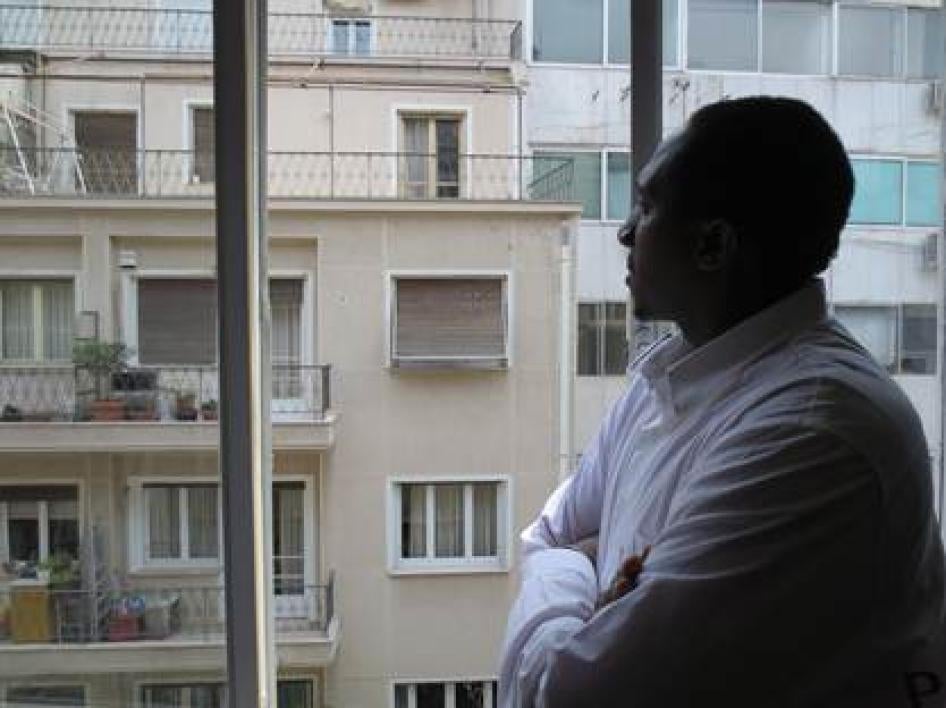
Lamine Kaba, a 41-year-old Guinean legal migrant who has lived in Greece since 1998 and is married to a Greek woman, was stopped by two police officers in Athens, in October 2012, who pushed him against a wall, searched him, emptied his bag and told him to leave the country if he didn’t like it. © 2013 Human Rights Watch
Lamine Kaba, a 41-year-old Guinean who has lived in Greece since 1998, complained about the lack of respect that goes with the search. In October, he was stopped by two police officers in plainclothes in Kato Petralona when leaving work around 2 p.m.:
I had to go and get my little one [daughter]. I was in hurry. I saw two persons in civil clothes. I was by foot. They stopped in front of me, straight on me. I didn’t expect such a thing. One of the police officers tells me, ‘Give me your bag,’ and he pushed me against the wall. I said, ‘If you want the paper there is no need to do that.’ They told me, ‘We don’t care about that.’ They emptied my bag and told me, ‘If you don’t like it, you can leave the country’… If they were polite they wouldn’t put me against the wall, pull my bag very violently.[68]
Thirty-year-old Abdul Khalid Mohammad, a refugee from Afghanistan, had a similar experience in January at around 2:30 p.m. in Thissio [a tourist area in central Athens]:
I was with my friend and we were coming from the Acropolis, and three [police] motorcycles came, stopped, and without asking if we have papers they [the police] immediately put us with the back against the wall and searched us.… I took out everything that I had on me and showed my papers.… They were behaving as if I was a criminal, as if I had guns.… One of them told me, ‘If you have a problem, go file a complaint, go back to your country.’[69]
John, a twenty-year-old registered asylum seeker from Guinea, described how on a January morning in 2013, four police officers in two motorcycles stopped him and two friends near Amerikis Square for a control, and destroyed the certified photocopy of his asylum seeker’s card:
They searched us everywhere. I had my red card and the certified photocopy of the original. When I took it out, he [a police officer] took out a knife and immediately tore the photocopy. He didn’t give me time to explain myself. Then they threw it to the garbage.[70]
Zoeher, a 24-year-old Afghan with subsidiary protection,[71] told us how three months before our interview, police officers in Omonoia police station undressed him and a friend for a search.
It was 2 or 3 p.m. We were returning from work … passing by the police station with a friend and three persons came and asked for our papers.… We gave our papers and this guy [a police officer] said, ‘Let’s go to the station’… In the police station they searched us.… They put us in a room and undressed us and searched all our clothes. Then they gave me my card and told me ‘Fuge malaka [Go away asshole].’[72]
Violation of the Right to Privacy
Routine searches not grounded in a reasonable suspicion of wrongdoing or possession of illegal or dangerous objects violate national and international norms protecting the right to privacy.
Both the European Convention on Human Rights(ECHR) and the International Covenant on Civil and Political Rights (ICCPR) require that interferences in liberty, individual privacy, and bodily integrity be in accordance with law—that is that they comply both in substance and procedure with a clear legal basis. The norm setting out the basis must not only exist in the legal system but be accessible and clear and precise enough to be foreseeable to a reasonable degree in its application and consequences.[73] In this way, it should allow a person to regulate his or her behavior to comply with the law, and to remove the risk of arbitrariness.
In Gillan and Quinton v. the UK, the European Court of Human Rights found that “coercive powers … to require an individual to submit to a detailed search of his person, his clothing and his personal belongings” in the absence of reasonable suspicion under the UK’s counterterrorism legislation amounted to unlawful interference with the right to private life because of the lack of clear delimitations on their use and sufficient safeguards against abuse.[74] The court noted the humiliation and embarrassment that public searches of a person’s private items can cause.[75]
Greek law allows the search of a person and his or her personal belongings only if there is a serious suspicion that an “offense” has been committed or if it is an “absolute necessity.”[76] A 2005 police circular clarifies that existence of those conditions must be based on specific factual or subjective information, which is relevant and sufficient to justify in law the frisk, and that objecting to a physical search is not a ground for a serious suspicion justifying an onerous search.[77]
Representatives from the Border Guards Union of Attica told us that they have to conduct a pat-down for their safety when they have “a suspicion that the person is carrying a weapon. We must do the body check if the person is transferred … with the bus.”[78] However, our research suggests that pat-downs and bag searches are not limited to these circumstances. Body pat-downs and bag searches during immigration stops appear to be routine, even in the absence of any reasonable suspicion that the individual is carrying unlawful or dangerous objects, violating the right to privacy and Greek legislation.
Physical and Verbal Abuse during Stops
[The police officer] became mad and slapped me.… He slapped me and his friends [police officers] came down [off the motorcycle].... They took me, searched me, and handcuffed me.…
— Tupac (pseudonym), 19-year-old Guinean registered asylum seeker, Athens, February 22, 2013
Four interviewees reported they had experienced physical abuse in the context of an immigration stop since the beginning of Operation Xenios Zeus, while many interviewees complained of poor police practices and rude, insulting, and threatening behavior. We interviewed eight other migrants and asylum seekers who experienced physical abuse at the hands of police officers during stops before the beginning of Operation Xenios Zeus or in situations outside the context of a regular immigration stop.
Law enforcement abuse of migrants and asylum seekers in Greece is a serious and long-standing problem, including in the context of identity checks.[79] A network of Greek nongovernmental organizations, coordinated by the UNHCR and the Greek National Commission for Human Rights, recorded 43 incidents of police brutality between October 1, 2011 and December 31, 2012, against migrants and asylum seekers. The incidents concerned “duty officers who resorted to illegal acts and violent practices while carrying out routine checks,” as well as “instances where people were brought to police stations, were detained and mistreated for a few hours,” and “cases where legal documents were destroyed during these operations.” [80]
Abdel, a 25-year-old refugee from Afghanistan, said that two plainclothes police officers approached him outside his home in October 2012 as he left for work, and took him to the building’s parking lot.
[T]hey searched me, my bag, my pockets, everything, and then they beat me. They slapped me; fifteen or sixteen slaps. And I was asking. ‘Why?’ They were telling me, ‘To show you so that you can understand.’ Then they gave me my papers and I left.… I couldn’t hear for two weeks.[81]
Tupac, the 19-year-old Guinean registered asylum seeker quoted above, said a police officer hit him during a stop at the end of December 2012 near Amerikis Square. The officer ridiculed Tupac for the way he was dressed and then slapped him. Using plastic gloves, the officer looked at his asylum seeker’s card and said “Look, look at the black on the photo … look at the monkey.” He then threw the card on the ground and stepped on it. After handcuffing and searching Tupac, the police released him. He told us one of the other three officers in the patrol apologized.[82]
Tourists also have alleged falling victim to police brutality during stops. A Korean backpacker told the BBC a plainclothed policeman punched him in the face during a stop.[83] The backpacker Hyun Young Jung had asked the officer to identify himself. The police subsequently brought him to the police station where they beat him again. The BBC report does not specify when the incident took place. A Nigerian-born US citizen told the BBC police detained and handcuffed him in July 2012, before the launch of Operation Xenios Zeus, while he was on vacation in Greece. He had shown officers his US passport. Christian Ukwuorji alleged that officers beat him unconscious when he tried to take a photograph of his handcuffs with his mobile phone.[84] Both the Korean and the Nigerian said they will not visit Greece again.[85] The police told the BBC they could not comment on the cases, as they are under investigation.[86]
In November 2012, the US Embassy in Greece took the unusual step of updating its country-specific information on Greece to warn US visitors about “confirmed reports of U.S. African-American citizens detained by police authorities conducting sweeps for illegal immigrants in Athens.”[87]
Almost all interviewees complained that police officers were disrespectful during stops, describing a range of abuse including being called “assholes”, being told to shut up, and being threatened with deportation.[88] As Majid, a 26-year-old undocumented Afghan migrant explained, “There are some who are good and treat us like humans but there are some who treat us like animals. Unfortunately those who treat us like humans are very few. They are rare.”[89]
Ill-Treatment Always Violates Rights
Police officers in Greece are confronted with dangerous and threatening situations, and they have the duty to restrain violent individuals to protect others and themselves. All use of force, however, must be justified by the circumstances and limited to the minimum extent necessary.
International human rights law imposes the clear duty on authorities to prevent—through clear laws, regulations, and guidance—and punish unjustified use of force. The European Court of Human Rights has condemned Greece eleven times for cases concerning ill-treatment or misuse of firearms by law enforcement officers, and the absence of effective investigations, including ten cases where the victims were migrants or members of minorities.[90] In particular, the Court has found Greece in violation of article 3 (prohibition of torture) in conjunction with article 14 (prohibition of discrimination) in two of these cases, for police brutality and failure to investigate the racist motivation of crimes committed against Roma by law enforcement officers.[91]
Several international human rights bodies have criticized Greece about excessive use of force by law enforcement officials and ill-treatment of undocumented migrants, asylum seekers, and minorities, including Roma.[92]
In 2012, the UN Committee Against Torture expressed its concern at repeated and consistent reports of “ill-treatment of undocumented migrants, asylum seekers and Roma by law enforcement officials … in the context of regular police checks in the streets of urban settings, in violation of the Convention” and urged Greek authorities to send “a clear and unambiguous message that racist or discriminatory acts, including by police and other public officials, are unacceptable, and by prosecuting and punishing the perpetrators of such acts.”[93]
The European Commission against Racism and Intolerance (ECRI) has repeatedly expressed concerns about police ill-treatment of minorities and migrants at the time of arrest and in custody.[94] In 2009, ECRI reiterated its call on the Greek government to “carry out effective investigations into alleged cases of racial discrimination or racially-motivated misconduct by the police and ensure as necessary that the perpetrators of these acts are adequately punished.”[95]
National and international guidelines for law enforcement officials emphasize the importance of respectful treatment. The Greek Code of Police Ethics requires police officers “to respect the value of the human being and to ensure the protection of his rights” and calls on officers to avoid all “prejudice” based on race, ethnicity, gender, religion, among other protected grounds, as well as to carry out “their duties, guided by the principles of legitimacy, proportionality, leniency, good public governance, non-discrimination and respect for people's diversity.”[96]
The Council of Europe’s European Code of Police Ethics requires that all police personnel act with “integrity and respect towards the public and with particular consideration for the situation of individuals belonging to especially vulnerable groups.”[97] Finally, the UN Code of Conduct of Law Enforcement Officials calls for officers to “respect and protect human dignity and maintain and uphold the human rights of all persons.”[98]
The cases of physical and verbal abuse we documented in this report violate the prohibition of ill-treatment. They amount in some cases to racially-motivated misconduct, and breach the duty of police officers to respect and protect irrespective of race, ethnicity, and religion, in violation of national and international human rights law and standards. Greece has obligations under international human rights law to undertake effective measures to prevent such treatment and to investigate and where appropriate, prosecute offenders.
III. Arbitrary Deprivation of Liberty
[With the red card] you are supposed to move freely and the police [are supposed] to protect you. But they stop you and bring you for nothing to Allodapon.
— Omar, 27-year-old registered asylum seeker from Guinea, Athens, February 20, 2013
While stops can involve a relatively quick check of identity papers, we found that lawfully present migrants and registered asylum seekers are regularly subjected to lengthy procedures, both on the street and at police stations, that amount to unjustified deprivation of liberty. Many lawfully present migrants and registered asylum seekers interviewed for this report had regularly experienced being held by police officers in the street, confined in police buses, and detained in police stations and the Aliens Police Division for up to five hours. One person interviewed was held for approximately 10 hours, on one occasion.
Ministry of Public Order officials and representatives of police unions alike told us that the main reason for bringing persons holding proof of regular status to the police station and briefly detaining them is to verify the authenticity of the document.[99] “Yes, it is a practice. We don’t deny it. But it happens to those for whom there is a doubt about the authenticity of their documents,” Brigadier General Denekos told us.[100]
Spilios Kriketos from the Police Officers Union of Attica told us, “If someone has legal papers it is a double trouble to take him to the police station.” He explained that verification can happen by communicating the protocol number written on the document through the radio to persons at the police station who run the database. He added however: “There are thousands of cases of forged documents. When a police officer finds that something is wrong with the documents he will take the person to the police station and control him.” He stressed that this procedure wouldn’t take more than 10 or 20 minutes.[101]
Police officers told us it would be too time-consuming to verify the authenticity of documents in the street, especially during large-scale sweeps. However, it is unclear why radioing the central database containing the names and identifying numbers of people present in Greece lawfully, including of registered asylum seekers, would be more time-consuming than detaining and transferring people to the Aliens Police Division.
People often carry with them notarized copies of their valid documents for fear of losing the original document.[102] Officials at the Ministry of Public Order and Citizen Protection told us the police as a general rule do not accept notarized copies of identity documents, and cited this as a ground for bringing people to the police station for further verification of the identity.[103]
We spoke with 22 people, including a 16-year-old child, who told us they had proof of regular status in Greece when stopped by the police during Operation Xenios Zeus but were nonetheless held by police officers for further verification, many of them more than once. We spoke with 11 other foreigners with legal status in Greece who were not taken to the police station following an identity check. Neither of the two Greek citizens of African descent who have experienced a stop under Operation Xenios Zeus, were brought in for further verification.
Azizi, a twenty-six-year-old Afghan registered asylum seeker who lives near Viktoria Square in central Athens with his two children, aged three and seven, told us that in mid-November 2012 he was stopped by seven or eight police officers while out shopping. Even though he showed his asylum seeker’s card, he was detained and brought to the Aliens Police Division for further verification:
I explained to them that I have two kids at home and that I cannot leave them alone.… Because I couldn’t explain in Greek I just said, ‘Signomi, dio pedia spiti [Excuse me, two kids home],’ and they told me, ‘No, sit on the side.’ There were around 25 people.… At Allodapon they separated us. Those who had a pink card, they put us in one place. Others with ‘charti’ [an order to leave Greece] in another place. We left after 30 minutes … I was away for two-and-a-half hours. When I went home, my kids were crying so much.…[104]
Tupac, the 19-year-old Guinean registered asylum seeker mentioned above, told Human Rights Watch that after pulling him off a city bus for an identity check, the police held him for approximately six hours at Amerikis Square, along with a large group of Africans and Asians. He was then transferred to the Aliens Police Division, where he was held for approximately four more hours before finally being released in the early hours of the morning.
Abdel, a 25-year-old recognized refugee also from Afghanistan, described to us how in October 2012 he was transferred to the Aliens Police Division, even though he showed his proof of refugee status to police officers who asked for his papers at a control in Acharnon Street, central Athens:
They asked me, ‘Do you have papers?’ I said, ‘Yes.’ I showed them everything, my passport, my work permit. I asked them why they stopped me and they told me, ‘You are going for a short ride.’ I waited with other people, Arabs, Pakistanis, and Afghans. We waited for 10, 15 minutes. Then, the police bus came. We were 27 or 28 people. We got out of the bus [at the Aliens Police Division], waited for 5 minutes and then a police officer asked me, ‘Do you have papers?’ I said ‘Yes,’ and he told me, ‘Fuge [Go].’ This thing has happened to me 8 times.[105]
Ali, a 33-year-old Afghan registered asylum seeker, told us how on April 2, 2013 his plans for a family picnic were thwarted when he was stopped by police officers near Attica metro station along with his 12-year-old daughter and 8-year-old son, and held for 5 hours before a Greek nongovernmental organization intervened for his release:
The police caught me.… The kids explained that ‘he is our father, he has a pink card, why did you catch him?’ They [the police] said that ‘we will take him to Allodapon, we will do the control and we will release him.’ Then the police told me to send the kids home … I said, ‘But we live in Piraeus, how are the kids going to go on their own?’ They told me, ‘We don’t care, tell them to go.’[106]
Ali’s children remained by his side while the officers took him to a police room located inside the Attica metro station where he found seven or eight more migrants. Ali remained there for approximately two hours while his children waited outside the room, and the police brought more and more people, “at the end there were forty-five [of us] … we couldn’t fit inside.”[107] His children were crying when he was taken out of the room along with everyone else for transfer to the Aghios Panteleimonas police station. When he complained, a police officer threatened to deport him to Afghanistan:[108]
I was really sad because he didn’t respect the children who were crying.… They brought us by foot to the police station and held us there at the hall on the ground floor. The kids were with me because I couldn’t let them on their own. One of the police officers from the police station took my pink card in order to check it in the computer but the police officer from the Attica metro station [the one who threatened them] said that ‘he needs to go to Allodapon.’… I asked, ‘What’s the problem [with my card]? It is valid. I renewed it fifteen days ago.’ They said that ‘there is no problem, we know it, but you need to go to Allodapon to check it.’[109]
Ali was only released after he was able to call a Greek nongovernmental organization which intervened on his behalf.
Haisham, a twenty-seven-year-old Syrian Kurd registered asylum seeker, said his last “visit” to the Aliens Police Division had occurred in mid-February 2013 when three uniformed police officers stopped him in downtown Athens. He was made to wait for thirty minutes on the street until a bus came to take him and around twenty others (“most of them blacks”) to the Aliens Police Division. He was detained there for approximately three hours before being released. Haisham told us the police had brought him to the Aliens Police Division five times in the previous six months.[110]
Sixteen-year-old Ruhallah M., a registered asylum seeker from Afghanistan, estimated that he had been taken to the Aliens Police Division seven or eight times in the two months since he arrived in Athens. “Every time it’s the same procedure” he said.[111]
Many complained about the poor procedure and the hassle they had to go through. Nazar, a 35-year-old Afghan registered asylum seeker, deplored: “Many times they have taken me to Allodapon, looked at my red card for two or three hours and then told me to leave.” And added that “[a]ll the time I’m thinking ‘Why they stop me? Because of my country?’ I have a red card. There is no problem to stop me and look at my paper, but why Allodapon?”[112]
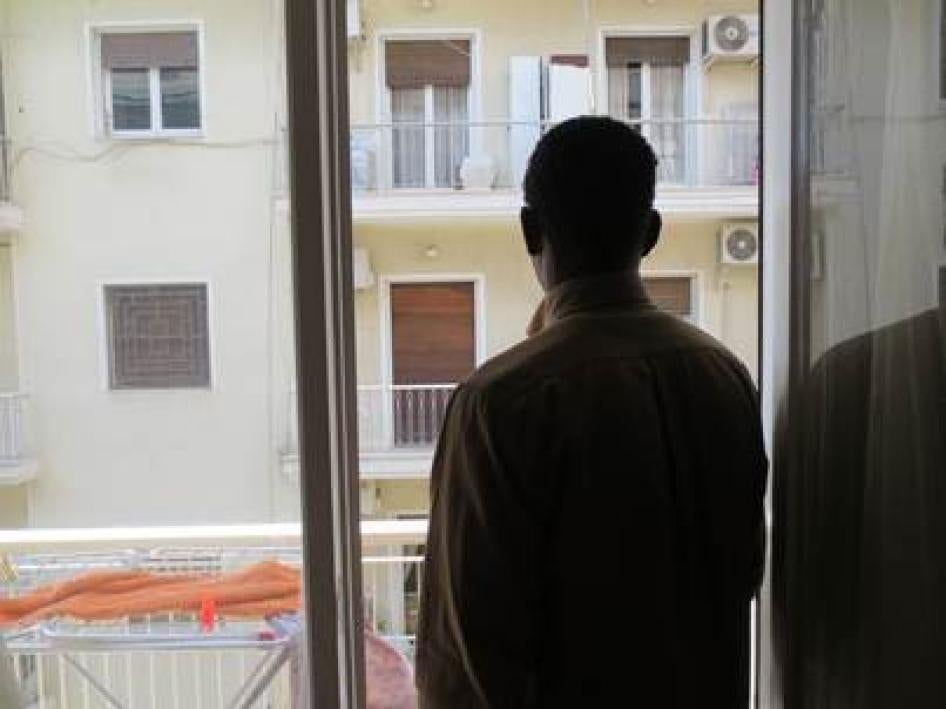
Mamadou, a 33-year-old Guinean registered asylum seeker, in Athens, Greece has been stopped by police numerous times and has been taken into police custody for verification of his papers on three occasions since the start of “Operation Xenios Zeus” in August 2012. © 2013 Human Rights Watch
Thirty-three-year-old Mamadou, a Guinean registered asylum seeker told us that he has been late to work three times in the last six months prior to our interview—once for three hours and twice for two hours—because he was held by police officers in the context of a stop. All three times he produced his asylum seeker’s card but was brought to Syntagma police station, Exarchia police station, and the Aliens Police Division respectively. “Thankfully people I’m working with are kind. I told them that I fall victim of an arbitrary arrest by the police and they understood.”[113]
Migrants and asylum seekers, including undocumented migrants, also told Human Rights Watch how they were brought to the Alien’s Police Division and released almost immediately upon arrival after what appeared to be a basic verification of their documents. This calls into question the assertion by police officers that the motive for transferring immigrants to the police station is the need for a sophisticated verification of their papers.
Franky, a 34-year-old registered asylum seeker from Togo, explained: “They catch you, take you to Allodapon, and as soon as you arrive they tell you, ‘Fuge, fuge [Go, go].’” Two months before our interview Franky was stopped with three Togolese friends, two undocumented and one asylum seeker, near Viktoria Square by police officers who first took them to a police station before transferring them to the Aliens Police Division. “Upon our arrival [to the Aliens Police Division], they told us to form two lines. They were telling us, ‘Show your papers,’ and if we showed it they were telling us, ‘Fuge, fuge [Go, go]’.”[114]
Abou, a 31-year-old Senegalese registered asylum seeker described a similar situation:
Upon arrival to Allodapon they took us out of the bus [police bus] and asked us to queue. We were fifty persons in total.… A police officer came from the office and said, ‘Show me your passports.’ We all showed our papers. When you show it they tell you, ‘Fuge spiti [Go home].’ [115]
The Right to Liberty
International and national law guarantee the right to personal liberty and security. To be lawful under international human rights law, the deprivation of liberty must be carried out in accordance with both formal and substantive rules of domestic and international law, including the principle of nondiscrimination, and be free from arbitrariness. Widespread detention of foreigners for hours for the purpose of verifying their legal status violates these provisions.
The Greek Constitution guarantees the inviolable right to personal liberty and clarifies that “no one shall be … arrested, imprisoned or otherwise confined except when and as the law provides.”[116] All persons in Greece enjoy this right “irrespective of nationality, race or language and of religious or political beliefs.”[117]
Under Greek law, police are authorized to bring anyone who fails to show proof of identity to a police station for further identity checks—a procedure known as “bringing a person in” (προσαγωγή).[118] Police also have the power to bring a person to a police station for further verification if their location, the time, circumstances, and behavior give reason to suspect that a criminal act has been committed or might be committed.[119]
This procedure normally involves remaining at the police station until someone can bring the detained person valid proof of their identity or the police can establish their identity by other means. According to the law, the time should be limited to what is strictly necessary to complete the procedure.[120]
A 2005 police circular defines this procedure as a restriction of the freedom of movement rather than deprivation of liberty “even if these controls may include going to the police station, where the controlled person is released upon completion, within reasonable time, of the control.” [121]
Human Rights Watch believes this interpretation is incorrect, and that the procedure involves deprivation of liberty within the meaning of article 5 of the European Convention on Human Rights. Article 5 of the ECHR specifically enumerates the grounds which can justify a lawful deprivation of liberty. It includes the “arrest or detention of a person affected for the purpose of bringing him before the competent legal authority on reasonable suspicion of having committed an offense.”
In the case Gillan and Quintin v. the UK, the European Court of Human Rights established that a range of criteria such as “the type, duration, effects and manner of implementation of the measure in question” must be taken into account when assessing whether a person has been deprived of their liberty. [122] In that case, which concerned two individuals stopped on the street under UK anti-terrorism legislation, the European Court of Human Rights concluded:
[A]lthough the length of time during which each applicant was stopped and searched did not in either case exceed 30 minutes, during this period the applicants were entirely deprived of any freedom of movement. They were obliged to remain where they were and submit to the search and if they had refused they would have been liable to arrest, detention at a police station and criminal charges. This element of coercion is indicative of a deprivation of liberty within the meaning of Article 5 § 1.[123]
The fact that taking people to police stations for further verification appears to be systematic for migrants and asylum seekers suggests the procedure is not based on a reasonable suspicion of wrongdoing. Deputy Ombudsman for Human Rights Vasileios Karydis criticized Operation Xenios Zeus saying that “there is the problem of proportionality…. They are taking people in for questioning for all checks. It should be based on reasonable suspicion. It's a grey zone actually.”[124]
The European Court of Human Rights has emphasized that “[t]he requirement that the suspicion must be based on reasonable grounds forms an essential part of the safeguard against arbitrary arrest and detention.”[125]
The 2005 police circular requires that suspicion of criminal acts be based “exclusively on personalized evidence deriving from [the person’s] behavior,” and prohibits linking suspicion to “prejudices” based on color, ethnicity, and religion, among other grounds.[126] The circular further states that it is prohibited “to bring to a police station people, especially bound with handcuffs, while holding and producing an identity card, and when their previous behavior does not create suspicion or is not causally linked to the commission of crime.”[127]
The lack of training for officers participating in Operation Xenios Zeus appears to make deprivation of liberty the default procedure for many people. Police officers from the Hellenic Police Guards Union of Attica asserted that the lack of specialized training makes it more likely that police officers will detain someone for further verification. Even representatives of the police union of Border Guards of Attica, who do receive more specialized training in immigration and asylum, told us that the asylum seeker’s card is a “semi-legal document” that requires further verification, while Greek and European law grants registered asylum seekers the right to free movement and the right to stay in the country until the asylum application has been examined.
Following a nine-day visit to Greece, the UN Special Rapporteur on the human rights of migrants said in December 2012 that he “regret[s] the ‘sweep operations’ in the context of operation “Xenios Zeus”, which have led to widespread detention of migrants in different parts of the country, many of whom have lived and worked in Greece for years.”[128] In January 2013, the UN Working Group on Arbitrary Detention expressed similar concern, emphasizing “that any detention on discriminatory grounds constitutes arbitrary detention and furthermore, that detention without any legal basis also renders the detention arbitrary.”[129]
The widespread detention of foreigners for hours, for the ostensible purpose of verifying their legal status, documented in this report, violates the right to liberty. Police officials argue that the police do not have sufficient capacity or adequate equipment to verify the validity of identity documents on the street, particularly during large-scale sweeps. Yet authorities are failing to take steps that would permit on-the-spot verification of documents, including by putting in place the technical means allowing police to do so remotely and avoiding large-scale sweep operations. They are also refusing to accept notarized documents. Second, some of those brought to police stations are released almost as soon as they arrive, suggesting that verification of identity is not the intention of the stop. Detaining systematically migrants and asylum seekers from Asia and Africa presumed to be undocumented or to be using forged documents without a reasonable and individualized suspicion of wrongdoing, and on discriminatory grounds, constitutes arbitrary deprivation of liberty and violates national and international human rights law.
Recommendations
To the Government of Greece
- Ensure that all measures to identify irregular migrants are conducted in full compliance with national and international law prohibiting discrimination, including ethnic profiling and arbitrary deprivation of liberty;
- Publicly condemn ethnic profiling and other instances of discrimination and abuse by the police, send a clear and unambiguous message that such acts are unacceptable, and pledge to take concrete measures to address these problems, including by holding abusers accountable; and
- Develop a national strategy on combating racial discrimination by law enforcement officials that sets out concrete measures and a timetable for implementation, and designates the government institution responsible for monitoring implementation.
To the Ministry of Public Order and Citizen Protection
- Ensure that all operations to identify, apprehend, and detain irregular migrants are conducted in a manner consistent with Greece’s international human rights obligations. The use of force during such operations should be strictly limited to what is necessary and proportionate. Excessive use of force should be subject to disciplinary sanctions and, as appropriate, criminal prosecution;
- Ensure, either in law or through binding
circulars, clear guidelines for law enforcement officers with respect to immigration
stops, including:
- Permissible grounds for conducting an immigration stop;
- Permissible grounds for conducting a pat-down and a search of personal belongings;
- The circumstances and manner in which law enforcement officers may stop and search children;
- Provide clear guidance to police officers to
limit deprivation of liberty in the context of immigration stops. This guidance
should include, at a minimum:
- Permissible grounds for bringing a person to the police station for further verification of their documents;
- A requirement that any deprivation of liberty, even for a brief period of time, in the context of a stop, is based on a reasonable and individualized suspicion that a person’s identification documents are not authentic;
- The circumstances and manner in which law enforcement officers may detain children in the context of an immigration stop;
- Appropriate procedures for the care of children accompanying the individual subject to an immigration stop;
- A requirement to provide all individuals deprived of their liberty with information about their rights in a language they can understand;
- A requirement to inform all individuals deprived of their liberty of the legal basis for their detention;
- A requirement that all people detained in the context of an immigration stop, are given the free assistance of an interpreter, and are able to request the assistance of a lawyer or other individual who can advocate on their behalf;
- Ensure that each police patrol deployed for an immigration control operation has at least one officer with advanced specialized training in immigration and asylum issues, and on how to detect forged documents;
- To avoid unjustified deprivation of liberty, develop and implement the necessary technical capacity to allow police patrols to check the validity of identity documents in the street;
- Ensure that police officers conducting immigration stops accept notarized copies of identity documents; and
- Ensure diligent and independent investigation and accountability for all complaints of police abuse.
To the European Union, including the Commission and the Council Member States)
- Affirm, either through adoption of a new legal instrument or interpretation of existing binding EU legislation, that ethnic profiling in policing is unlawful and has no place in the European Union. The European Commission should formulate an inclusive definition of ethnic profiling, taking as its starting point the one adopted by the European Commission against Racism and Intolerance, which captures the intentional and unintentional aspects of ethnic profiling, the range of law enforcement activities where there is risk of illegitimate profiling, and emphasizes the need for objective and individualized suspicion;
- The European Commission’s Directorate General for Justice and Directorate General for Home Affairs should carefully monitor the Greek authorities’ continued implementation of Operation Xenios Zeus and communicate effectively with the government about violations of fundamental rights in the course of immigration sweeps;
- The European Commission should assist the Greek government in ensuring that immigration stops respect fundamental rights, including non-discrimination. For example the commission should allocate funds and technical support for specialized human rights training for law enforcement officers on immigration and asylum issues. The commission should also allocate funds technical equipment necessary for remote verification of identity papers by officers on patrol.
- The European Parliament’s Committee on Civil Liberties, Justice and Home Affairs (LIBE) should, in the context of its periodic reports on fundamental rights in the European Union as well as through other initiatives, assess Greece’s compliance with EU law and standards with respect to the concerns raised in this report; and
- The EU Fundamental Rights Agency should thoroughly investigate human rights violations in the context of immigration control operations in Greece with a view to providing decision-making institutions such as the European Commission and the Council of the European Union with information and analysis relevant to assessing Greece’s compliance with its obligations to counter racism and discrimination.
To the Council of Europe
- The Commissioner for Human Rights should continue to press the Greek government to address the serious concerns about discriminatory police practices he raised in his April 2013 report.
- The European Commission against Racism and Intolerance (ECRI) should follow up on the concerns highlighted in 2003 and 2009 about discrimination and racially motivated misconduct by the police in its monitoring and future reporting on Greece.
To the United Nations
- The Working Group on Arbitrary Detention should ensure that its final report, pursuant to its country visit to Greece in January 2013, highlights concerns about arbitrary deprivation of liberty in immigration sweep operations, and recommend appropriate action to address these concerns.
- The Special Rapporteur on contemporary forms of racism should conduct a country visit to Greece to monitor closely and draw attention to the impact of ongoing immigration control operations on migrants, asylum seekers, and visible minorities in Greece and communicate concerns about specific cases or general patterns in a timely fashion.
- Member states should question the Greek government about steps taken to address racism, discrimination, and other abuses by law enforcement, including through implementation of the recommendations in this report, during Greece’s second cycle review under the Universal Periodic Review before the Human Rights Council in 2016.
Acknowledgments
Eva Cossé, research assistant in the Europe and Central Asia Division researched and wrote this report.
The report was edited by Judith Sunderland, senior researcher in the Europe and Central Asia Division, and reviewed by Benjamin Ward, deputy director of the Europe and Central Asia Division; Veronika Szente Goldston, advocacy director in the Europe and Central Asia Division, who contributed also to the recommendations; Danielle Haas, senior editor at the Program Office; Gerry Simpson, senior researcher and advocate of the Refugee Program; Alice Farmer, researcher in the Children’s Rights Division. Aisling Reidy, senior legal advisor provided legal review and Tom Porteous, deputy program director provided program review.
Production assistance was provided by Annkatrin Tritschoks, associate in the Europe and Central Asia Division; Grace Choi, director of publications; Kathy Mills, publications specialist; and Fitzroy Hepkins, production manager.
Human Rights Watch is deeply grateful to all those who helped us conduct our research in Greece. We are especially grateful to all of the migrants and asylum seekers who spoke to us about their experiences.
[1] Convention on the Rights of the Child (CRC), adopted November 20, 1989, GA Res. 44/25, annex, 44 U.N. GAOR Supp. (No. 49) at 167, U.N. Doc. A/44/49 (1989), entered into force September 2, 1990, ratified by Greece on May 11, 1993, art. 1.
[2] Migration News Sheet, “FRONTEX reports that Greece is the country of entry of more than two-thirds of clandestine migration into the EU,” September 2012.
[3] Hellenic Police, “Illegal Immigration Statistics 2012,” http://www.astynomia.gr/index.php?option=ozo_content&perform=view&id=12080&Itemid=429&lang= (accessed April 13, 2013). Albanians and Bengalis are in third and fourth place, respectively; In the first three months of 2013, top four nationalities that entered Greece irregularly were Albanians (2,344), Syrians (1,276), Afghans (1,276), Pakistanis (1,172), Hellenic Police, “Illegal Immigration Statistics 2013,” http://www.astynomia.gr/index.php?option=ozo_content&perform=view&id=24727&Itemid=73&lang= (accessed April 13, 2013).
[4] “Chrysochoidis eyes 30 migrant detention centers by 2014,” ekathimerini.com, March 26, 2012, http://www.ekathimerini.com/4dcgi/_w_articles_wsite1_1_26/03/2012_434766 (accessed May 17, 2012). In February 2013, Deputy Interior Minister Haralambos Athanasiou stated there were 537,237 legal foreign residents in Greece, while noting that 577,900 irregular migrants had been arrested between 2008 and 2012. “Figures show 537,237 migrants living in Greece legally,” ekathimerini.com, February 26, 2013, http://www.ekathimerini.com/4dcgi/_w_articles_wsite1_1_26/02/2013_484665 (accessed March 11, 2013).
[5] UNHCR Says Asylum Situation in Greece ‘A Humanitarian Crisis,” UNHCR Briefing Notes, September 21, 2010, http://www.unhcr.org/4c98a0ac9.html (accessed March 22, 2013).
[6] Human Rights Watch, Turned Away: Summary Returns of Adult Asylum Seekers and Unaccompanied Migrant Children from Italy to Greece (New York, Human Rights Watch, January 2013), http://www.hrw.org/reports/2013/01/21/turned-away.
[7]Official YouTube channel of New Democracy, “A. Samaras: The law will return in the cities,” April 19, 2012, http://www.youtube.com/watch?v=fXUXRwk7U6Q&feature=youtu.be (accessed April 13, 2013).
[8] Human Rights Watch, Hate on the Streets: Xenophobic Violence in Greece (New York: Human Rights Watch, July 2012), http://www.hrw.org/reports/2012/07/10/hate-streets-0.
[9] Racist Violence Recording Network, “Pilot phase conclusions 1.10.2011-31.12.2011,” March 30, 2012, http://www.unhcr.gr/1againstracism/pilot-phase-conclusions-1-10-2011-31-12-2011/ (accessed April 24, 2013); Racist Violence Recording Network, “Annual Report 2012 of the Racist Violence Recording Network,” April 24, 2013, http://www.unhcr.gr/1againstracism/11940/ (accessed April 24, 2013).
[10] Headquarters of the Hellenic Police, “Police Operation ‘XENIOS ZEUS’ in Athens and Evros to tackle illegal immigration. Statements by the Spokesperson of the Hellenic Police,” (Αστυνομική επιχείρηση «ΞΕΝΙΟΣ ΖΕΥΣ» σε Αθήνα και Έβρο για την αντιμετώπιση της παράνομης μετανάστευσης. Δηλώσεις του Εκπροσώπου Τύπου της Ελληνικής Αστυνομίας), Press Release, August 4, 2012, http://www.astynomia.gr/index.php?option=ozo_content&lang='..'&perform=view&id=18424&Itemid=950&lang= (accessed April 13, 2013).
[11] Ministry of Public Order and Citizen Protection, "Visit of the Minister of Public Order and Citizen Protection in Patras," (Επίσκεψη του Υπουργού Δημόσιας Τάξης και Προστασίας του Πολίτη κ. Νικόλαου Δένδια στην Πάτρα), Press Release, October 2, 2012, http://www.mopocp.gov.gr/index.php?option=ozo_content&perform=view&id=4364&Itemid=555&lang= (accessed April 16, 2013).
[12] Ministry of Public Order and Citizen Protection, “Today's statement by the Minister of Public Order and Citizen Protection Mr. N. Dendias about operation XENIOS ZEUS,” (Σημερινές δηλώσεις του Υπουργού Δημόσιας Τάξης & Προστασίας του Πολίτη κ.Ν.Δένδια για την επιχείρηση ΞΕΝΙΟΣ ΖΕΥΣ), Press Release, August 4, 2012, http://www.minocp.gov.gr/index.php?option=ozo_content&perform=view&id=4322&Itemid=551&lang= (accessed April 13, 2013).
[13] Ibid.
[14] Webpage of the Hellenic Police on “Police operation ‘Xenios Zeus’ to tackle illegal immigration,” http://www.astynomia.gr/index.php?option=ozo_content&lang=%27..%27&perform=view&id=18437&Itemid=0&lang= (accessed April 13, 2013).
[15] Police guards, a corps created in 1999, are hired based on a point-system of objective criteria and must be high school graduates who have fulfilled their military obligations (and preferably former members of the army’s Special Forces), and have not exceeded their 28th birthday. They do not receive the two-year training that police officers receive; but take a three-month training, which includes possession of a weapon. Motorcycle patrols created in April 2010 to crackdown on crime, particularly in Athens, are staffed in their majority by police guards.
[16] Human Rights Watch interview with Vasilios Ntoumas, president, and Ioannis Fanariotis, secretary general of the Hellenic Police Guards Union of Attica, Athens, April 3, 2013.
[17] Human Rights Watch interview with Spilios Kriketos, secretary general, and Vaios Skampardonis, legal counsel, of the Police Officers Union of Attica, Athens, April 3, 2013.
[18] Human Rights Watch interview with Ioannis Balourdos, vice-president, and Vasilios Tsimpidas, secretary general, of the Border Guards Union of Attica, Athens, April 4, 2013.
[19] A comparison between the first quarter of 2012 and the first quarter of 2013 shows that robberies decreased by 14.38% and thefts-burglaries by 24.39% in Attica. Headquarters of the Hellenic Police, “Press Release on the continued decrease in core crimes (homicides, robberies, burglaries - break-ins) and in the first quarter of 2013, and statistics for the remaining categories of offenses,” (Δελτίο Τύπου σχετικά με τη συνεχιζόμενη μείωση στις βασικές κατηγορίες εγκλημάτων [ανθρωποκτονίες, ληστείες, κλοπές – διαρρήξεις] και το 1ο τρίμηνο του 2013 και στατιστικά στοιχεία για τις υπόλοιπες κατηγορίες αδικημάτων), Press Release, April 8. 2013, http://www.astynomia.gr/index.php?option=ozo_content&lang='..'&perform=view&id=26216&Itemid=1087&lang= (accessed April 14, 2013). Spilios Kriketos, secretary general of the Police Officers Union of Attica, said there is a 25% increase in pedestrian traffic in the center of Athens. Human Rights Watch interview with Spilios Kriketos, secretary general, and Vaios Skampardonis, legal counsel, of the Police Officers Union of Attica, Athens, April 3, 2013.
[20]Hellenic Police, "Evaluation of operation "Xenios Zeus" from the day if its implementation," Press Release, February 6, 2013, http://www.astynomia.gr/index.php?option=ozo_content&perform=view&id=24518&Itemid=1058&lang= (accessed April 19, 2013).
[21] Human Rights Watch interview with Salem, Athens, February 10, 2013.
[22] Human Rights Watch interview with Ruhallah M., Athens, February 18, 2013.
[23] Human Rights Watch interview with Dialo, Athens, February 14, 2013.
[24] Presidential Decree 141/1991 (A-58/1991), on the “Competencies and internal actions of the staff of the Ministry of Public Order, and Organization of Services,” April 30, 1991 (on file with Human Rights Watch). Human Rights Watch interview with Major General Emanouil Katriadakis, Office of the Head of Staff of the Hellenic Police and Police Brigadier General Alexandros Denekos, director of the Aliens Division, Headquarters of the Hellenic Police, Ministry of Public Order and Citizen Protection, Athens, April 5, 2013.
[25] P.D. 141/1991, art. 74, para. 15 (g) and (h). The Decree does not require a “reasonable” suspicion.
[26] Ibid., art. 94. Public areas are defined as any open space (street, square, and generally the countryside) and the indoor spaces which do not fall within the meaning of residence. Suspicious public areas are those designated by the police as such if criminal acts have been committed there in the past, or there is a suspicion that criminal acts, such as drug trafficking or drug use, continue in the area, and if the area is habitually frequented by convicted criminals or people suspected of committing criminal offenses. Police have the power to exercise continuous monitoring of suspicious public areas and to conduct stops and body searches of individuals in these areas, P.D. 141/1991, art. 100.
[27] Law 2800/2000 on the Restructuring of the services of the Ministry of Public Order, the composition of headquarters of the Hellnic Police and other provisions ,” (Αναδιάρθρωση Υπηρεσιών Υπουργείου, Δημόσιας Τάξης, σύσταση Αρχηγείου Ελληνικής Αστυνομίας και άλλες διατάξεις), February 29, 2000 (on file with Human Rights Watch).
[28] Law 3907/2011, art.18 “On the establishment of an Asylum Service and a First Reception Service, transposition into Greek legislation of the provisions of Directive 2008/115/EC ‘on common standards and procedures in Member States for returning illegally staying third-country nationals’ and other provisions,” and Article 83 of Law 3386/2005 on the “Entry, residence and social integration of third country nationals on the Greek Territory.” A third country national, leaving or attempting to leave the Greek territory or entering or attempting to enter it without the necessary documentation can be punished with imprisonment from three months to five years and a minimum fine of €1,500. For entering the country irregularly, the public prosecutor has the discretion however to refrain from pressing charges.
[29] Human Rights Watch interview with Ioannis Balourdos, vice-president, and Vasilios Tsimpidas, secretary general of the Border Guards Union of Attica, Athens, April 4, 2013.
[30] There are examples of good practices. The UK Police and Criminal Evidence Act gives police the power to stop, search, and detain someone only on the basis of a “reasonable suspicion” of wrongdoing. The accompanying Code of Practice explains that: “Reasonable suspicion can never be supported on the basis of personal factors alone without the supporting intelligence or information. For example, person’s colour, age, hairstyle or manner of dress, or the fact that he is known to have a previous conviction for possession of an unlawful article, cannot be used alone or in combination with each other as the sole basis on which to search that person. Reasonable suspicion cannot be based on generalisations or stereotypical images of certain groups or categories of people as more likely to be involved in criminal activity. A person’s religion cannot be considered as reasonable grounds and should never be considered as a reason to stop and search an individual.” Code of Practice, Section 2.2. This circumscribed power and detailed guidance contrasts with the overly-broad stop and search powers under UK counterterrorism legislation, which gave rise to significant abuse and evidence of ethnic and religious profiling. For a detailed analysis, see Human Rights Watch, Without Suspicion: Stop and Search under the Terrorism Act 2000 (New York: Human Rights Watch, July 2010), http://www.hrw.org/reports/2010/07/05/without-suspicion-0.
[31] As of February 22, 2013, the Hellenic Police stopped publishing statistics on the number of foreigners who have been brought to police stations for further verification. The figure 84,792 may include individuals who were brought into polices stations more than once.
[32] Some, like Yousof R., a 15-year-old Afghan asylum seeker, cited high rates of crime in the city center. “There is a lot of mafia,” he said. “The police check us in order to see [if someone is a criminal].” Human Rights Watch interview with Yousof R., Athens, February 12, 2013.
[33] Human Rights Watch interview with Nazar, Athens, February 14, 2013.
[34] Human Rights Watch interview with Mamadou, Athens, February 21, 2013.
[35] Human Rights Watch interview with Fathi, Athens, February 10, 2013.
[36] Human Rights Watch interview with Dome (pseudonym), Athens, February 13,2013.
[37] Human Rights Watch interview with Abou, Athens, February 18, 2013.
[38] Human Rights Watch interview with Ousmane (pseudonym), Athens, February 18, 2013.
[39] Human Rights Watch interview with Franky (pseudonym), Athens, February 13,2013.
[40] Human Rights Watch interview with Abou, Athens, February 18, 2013.
[41] From the start of 2010 to the end of 2012, 72,510 Albanians and 3,128 Georgians have been arrested for irregular entry and stay into the country by police and coastguard authorities. Hellenic Police, Webpage on “Statistical Data of Illegal Immigration,” http://www.astynomia.gr/index.php?option=ozo_content&perform=view&id=24727&Itemid=73&lang= (accessed April 18, 2013).
[42] Human Rights Watch interview with Tupac (pseudonym), Athens, February 22, 2013.
[43] Human Rights Watch interview with Lamine Kaba, Athens, February 14,2013. Two young Ethiopian women sitting near him were not stopped by the police.
[44] Ibid.
[45] Human Rights Watch interview with Franky (pseudonym), Athens, February 13, 2013.
[46] Ibid.
[47] Human Rights Watch interview with Andreas, Athens, February 17, 2013.
[48] Human Rights Watch interview with John (pseudonym), Athens, February 20, 2013.
[49] For detailed discussion of when profiling is legitimate, see Open Society Justice Initiative, Ethnic Profiling in the European Union: Pervasive, Ineffective, and Discriminatory, May 2009, http://www.opensocietyfoundations.org/sites/default/files/profiling_20090526.pdf (accessed March 25, 2013); European Network Against Racism, Factsheet on Ethnic Profiling http://www.opensocietyfoundations.org/sites/default/files/Factsheet-ethnic-profiling-20091001-ENG.pdf (accessed March 25, 2013); and FRA, “Understanding and Preventing Discriminatory Ethnic Profiling: A Guide,” October 2010, http://fra.europa.eu/sites/default/files/fra_uploads/1133-Guide-ethnic-profiling_EN.pdf (accessed March 25, 2013).
[50] FRA, “Understanding and Preventing Discriminatory Ethnic Profiling: A Guide,” p.13; OSJI “Profiling Minorities: A Study of Stop-and-Search Practices in Paris,” June 2009, p. 19, http://www.opensocietyfoundations.org/sites/default/files/search_20090630.Web.pdf (accessed March 25, 2013).
[51] ECRI General Policy Recommendation No. 11 on Combating Racism and Racial Discrimination in Policing, CRI (2007)39, adopted June 29, 2007 and published October 4, 2007, http://www.coe.int/t/dlapil/codexter/Source/ECRI_Recommendation_11_2007_EN.pdf (accessed March 30, 2012), p. 4.
[52] European Code of Police Ethics, http://polis.osce.org/library/f/2687/500/CoE-FRA-RPT-2687-EN-500 (accessed March 30, 2013), article 40.
[53] Ibid. article 47.
[54] UN Committee on the Elimination of Racial Discrimination, General Recommendation 31 on the prevention of racial discrimination in the administration and functioning of the criminal justice system (2005), http://www2.ohchr.org/english/bodies/cerd/docs/GC31Rev_En.pdf, para. 20 (accessed March 30, 2013).
[55] UN Human Rights Committee (HRC), Decision: Rosalind Williams Lecraft v. Spain, Communication No. 1493/2006, July 27, 2009, para. 7.2.
[56] Ibid.
[57] Oberverwaltungsgericht Rheinland-Pfalz – Az.: 7 A 10532/12.OVG vom 29.10.2012. The ruling (in German) can be found at http://www.anwaltskanzlei-adam.de/index.php?id=106,824,0,0,1,0 (accesses April 11, 2013).
[58] Ibid.
[59] CERD, General Recommendation No. 13: Training of Law Enforcement in the Protection of Human Rights, March 21, 1993,
[60] Council of Europe Commissioner for Human Rights, Report by Nils Muižnieks, following his visit to Greece, from 28 January to 1 February 2013, April 16, 2013, III. and para. 133.
[61] Human Rights Watch interview with Major General Katriadakis, Office of the Head of Staff of the Hellenic Police and Police Brigadier General Denekos, director of the Aliens Division Athens, Headquarters of the Hellenic Police, April 5, 2013.
[62] Human Rights Watch interview with Ioannis Balourdos, vice-president, and Tsimpidas Vassileios, secretary general, Athens, April 4, 2013.
[63] Human Rights Watch interview with Vasilios Ntoumas, president, and Ioannis Fanariotis, secretary general, Hellenic Police Guards Union of Attica, Athens, April 3, 2013.
[64] Human Rights Watch interview with Major General Katriadakis, Office of the Head of Staff of the Hellenic Police and Police Brigadier General Denekos, director of the Aliens Division, Headquarters of the Hellenic Police, Ministry of Public Order and Citizen Protection, Athens, April 5, 2013.
[65] Human Rights Watch Interview with Fanariotis Ioannis, secretary general, Hellenic Police Guards Union of Attica, Athens, April 3, 2013.
[66] Human Rights Watch interview with Abdulrahman Mahout Ahmed, Athens, February 11, 2013.
[67] Human Rights Watch interview with Azizi (pseudonym), Athens, February 12, 2013.
[68] Human Rights Watch interview with Lamine Kaba, Athens, February 14, 2013.
[69] Human Rights Watch interview with Abdul Khalid Mohammad, Athens, February 14, 2013.
[70] Human Rights Watch interview with John (pseudonym), Athens, February 20, 2013.
[71] Subsidiary protection is an international form of protection accompanied by a residence permit that is granted to the individuals who were denied the refugee status but who, in the event of returning to the country of origin, will be in a real danger of being seriously harmed.
[72] Human Rights Watch interview with Zoeher (pseudonym), Athens, February 13, 2013.
[73] Jurisprudence of the European Court of Human Rights in Sunday Times v. the UK, April 26, 1979, Series A No. 30, para. 49 ; Kruslin v. France, judgment of April 24, 1990, Series A No. 176, para. 27; and Amuur v. France, judgment of June 25, 1996, Reports 1996-III, para. 50.
[74] European Court of Human Rights, Gillan and Quintin v. the UK, judgment of January 12, 2010, available at www.echr.coe.int, paras. 63 and 87.
[75] Ibid., para. 63.
[76] P.D. 141/1991, art. 96 para. 3. The decree does not clarify what situations would create an absolute necessity.
[77] Circular 7100/22/4α, para. 6.
[78] Human Rights Watch interview with Ioannis Balourdos, vice-president, and Vasilios Tsimpidas, secretary general, of the Border Guards Union of Attica, Athens, April 4, 2013.
[79] For more reporting on law enforcement abuse of migrants and asylum seekers see: Human Rights Watch, Submission to the United Nations Committee against Torture on Greece, April 25, 2012, http://www.hrw.org/news/2012/04/25/updated-human-rights-watch-submission-united-nations-committee-against-torture-greec; Amnesty International, POLICE VIOLENCE IN GREECE Not just ‘isolated incidents,’ July 2012, http://www.amnesty.org/en/library/asset/EUR25/005/2012/en/edbf2deb-ae15-4409-b9ee-ee6c62b3f32b/eur250052012en.pdf (accessed April 14, 2013); Council of Europe Commissioner for Human Rights, Report by Nils Muižnieks, following his visit to Greece, from 28 January to 1 February 2013, April 16, 2013, paras. 103-113, https://wcd.coe.int/ViewDoc.jsp?Ref=CommDH%282013%296&Language=lanEnglish&Ver=original&BackColorInternet=B9BDEE&BackColorIntranet=FFCD4F&BackColorLogged=FFC679 (accessed April 16, 2013); ECRI, ECRI report on Greece (fourth monitoring cycle), adopted on April 2, 2009, paras. 172-179, http://www.coe.int/t/dghl/monitoring/ecri/Country-by-country/Greece/GRC-CbC-IV-2009-031-ENG.pdf (accessed April 16, 2013).
[80] Racist Violence Recording Network, “Presentation of results of pilot phase 1.10.2011-31.12.2011,” Press Release, March 21, 2012, http://www.unhcr.gr/1againstracism/pilot-phase-conclusions-1-10-2011-31-12-2011/ (accessed April 1, 2013); Racist Violence Recording Network, “Findings, 1.1.2012 – 30.9.2012,” October 23, 2012, http://www.unhcr.gr/1againstracism/racist-violence-recording-network-findings/ (accessed April 1, 2013); Racist Violence Recording Network, “Annual Report 2012 of the Racist Violence Recording Network,” April 24, 2013, http://www.unhcr.gr/1againstracism/11940/ (accessed April 24, 2013).
[81] Human Rights Watch interview with Abdel, Athens, February 15, 2013.
[82] Human Rights Watch interview with Tupac (pseudonym), Athens, February 18, 2013.
[83] Chloe Hadjimatheou, “The tourists held by Greek police as illegal migrants,” BBC News Magazine, January 10, 2013, http://www.bbc.co.uk/news/magazine-20958353, (accessed April 14, 2013).
[84] Ibid.
[85] Ibid.
[86] Ibid.
[87] U.S. Department of State, Greece Country Specific Information, http://travel.state.gov/travel/cis_pa_tw/cis/cis_1127.html (accessed April 9, 2013).
[88] Human Rights Watch interview with Salem, Athens, February 10, 2013; Human Rights Watch interview with Fathi, Athens, February 10, 2013; Human Rights Watch interview with Ali (pseudonym), Athens, April 5, 2013; Human Rights Watch interview with Ali Jelam, Athens, February 11, 2013.
[89] Human Rights Watch interview with Majid (pseudonym), Athens, February 10, 2013.
[90] See, Makaratzis v. Greece, Application no. 50385/99, December 20, 2004; Alsayed Allaham v. Greece, Application no. 25771/03, January 18, 2007; Bekos and Koutropoulos v. Greece, Application no. 15250/02, March 13, 2006; Celniku v. Greece, Application no. 21449/04, July 5, 2007; Galotskin v. Greece, Application no. 2945/07, January 14, 2010; Karagiannopoulos v. Greece, Application No. 27850/03, June 21, 2007; Leonidis v. Greece. Application no. 43326/05, January 8, 2009; Petropoulou-Tsakiris v. Greece, Application no. 44803/04, December 6, 2007; Zelilof v. Greece, Application no. 17060/03, May 24, 2007; Stefanou v. Greece, Application no. 2954/07, April 22, 2010; Zontul v. Greece, Application no. 12294/07, January 17, 2012.
[91] See, Petropoulou-Tsakiris v. Greece, Application no. 44803/04, 6 December 2007; Bekos and Eleftherios Koutropoulos v. Greece, Application no. 15250/02, 13 December 2005.
[92] UN Committee against Torture, Concluding Observations: Greece, CAT/C/GRC/CO/5-6, June 2012, http://www2.ohchr.org/english/bodies/cat/cats48.htm (accessed April 1, 2013); ECRI, Report on Greece (third monitoring cycle), adopted on December 5, 2003, paras. 103-108, http://hudoc.ecri.coe.int/XMLEcri/ENGLISH/Cycle_03/03_CbC_eng/GRC-CbC-III-2004-24-ENG.pdf (accessed April 16, 2013); ECRI, Report on Greece (fourth monitoring cycle), adopted on April 2, 2009, paras. 172-179, http://www.coe.int/t/dghl/monitoring/ecri/Country-by-country/Greece/GRC-CbC-IV-2009-031-ENG.pdf (accessed April 16, 2013); UN Special Rapporteur on Torture, Report of the Special Rapporteur on torture and other cruel, inhuman or degrading treatment or punishment, Manfred Nowak: mission to Greece, A/HRC/16/52/Add.4, April 21, 2011, http://www2.ohchr.org/english/bodies/hrcouncil/docs/16session/A.HRC.16.52.Add.4.pdf (accessed April 16, 2013);
Council of Europe Commissioner for Human Rights, Report by Nils Muižnieks, following his visit to Greece, from 28 January to 1 February 2013, April 16, 2013, paras. 103-113, https://wcd.coe.int/ViewDoc.jsp?Ref=CommDH%282013%296&Language=lanEnglish&Ver=original&BackColorInternet=B9BDEE&BackColorIntranet=FFCD4F&BackColorLogged=FFC679, (accessed April 16, 2013); Council of Europe Committee for the Prevention of Torture, Report on the visit to Greece carried out from 17 to 29 January 2011, January 2012, http://www.cpt.coe.int/documents/grc/2012-01-inf-eng.pdf (accessed April 16, 2013).
[93] UN Committee against Torture, Concluding Observations: Greece, CAT/C/GRC/CO/5-6, June 2012, http://www2.ohchr.org/english/bodies/cat/cats48.htm (accessed April 1, 2013), para. 12.
[94] ECRI, Report on Greece (third monitoring cycle), adopted on December 5, 2003, para. 108, http://hudoc.ecri.coe.int/XMLEcri/ENGLISH/Cycle_03/03_CbC_eng/GRC-CbC-III-2004-24-ENG.pdf (accessed April 16, 2013); ECRI, Report on Greece (fourth monitoring cycle), adopted on April 2, 2009, para. 178, http://www.coe.int/t/dghl/monitoring/ecri/Country-by-country/Greece/GRC-CbC-IV-2009-031-ENG.pdf (accessed April 16, 2013).
[95] ECRI, Report on Greece (fourth monitoring cycle), adopted on April 2, 2009, para. 178.
[96] Code of Police Ethnics (“Κώδικας Δεοντολογίας του Αστυνομικού”), Presidential Decree 254/2004, December 2, 2004 (on file with Human Rights Watch), articles 1(b), 1(d) and 5.2.
[97] European Code of Police Ethics, article 44.
[98]UN Code of Conduct for Law Enforcement Officials, adopted by the General Assembly resolution 34/169 of 17 December 1979, http://www.un.org/disarmament/convarms/ATTPrepCom/Background%20documents/CodeofConductforlawEnfOfficials-E.pdf (accessed April 1, 2013), article 2.
[99] Human Rights Watch interview Major General Emmanouil Katriadakis, Office of the Head of Staff of the Hellenic Police and Police Brigadier General Alexandros Denekos, director of the Aliens Division at the Headquarters of the Hellenic Police, in the Ministry of Public Order and Citizen Protection, Athens, April 5, 2013; Human Rights Watch interview with Vasilios Ntoumas, president, and Ioannis Fanariotis, secretary general of the Hellenic Police Guards Union of Attica, Athens, April 3, 2013; Human Rights Watch interview with Spilios Kriketos, secretary general, and Vaios Skampardonis, legal counsel, of the Police Officers Union of Attica, Athens, April 3, 2013; Human Rights Watch interview with Ioannis Balourdos, vice-president, and Vasilios Tsimpidas, secretary general, of the Border Guards Union of Attica, Athens, April 4, 2013.
[100] Human Rights Watch interview with Major General Katriadakis, Office of the Head of Staff of the Hellenic Police and Police Brigadier General Denekos, director of the Aliens Division, Ministry of Public Order and Citizen Protection, Athens, April 5, 2013.
[101] Human Rights Watch interview with Spilios Kriketos, secretary general, and Vaios Skampardonis, legal counsel, of the Police Officers Union of Attica, Athens, April 3, 2013.
[102] A residence permit, an asylum seeker’s card as well as the paper ordering to leave Greece have all a photo of the person holding it.
[103] Human Rights Watch interview with Major General Emanouil Katriadakis, Office of the Head of Staff of the Hellenic Police and Police Brigadier General Alexandros Denekos, director of the Aliens Division at the Headquarters of the Hellenic Police, in the Ministry of Public Order and Citizen Protection, Athens, April 5, 2013.
[104] Human Rights Watch interview with Azizi (pseudonym), Athens, February 12, 2013.
[105] Human Rights Watch interview with Abdel, Athens, February 15, 2013.
[106] Human Rights Watch interview with Ali (pseudonym), Athens, April 5, 2013.
[107] Ibid.
[108] Ibid.
[109] Ibid.
[110] Human Rights Watch interview with Haisham, Athens, February 17, 2013.
[111] Human Rights Watch interview with Ruhallah M., Athens, February 18, 2013.
[112] Human Rights Watch interview with Nazar, Athens, February 14, 2013.
[113] Human Rights Watch interview with Mamadou, Athens, February 21, 2013.
[114] Human Rights Watch interview with Franky (pseudonym), Athens, February 13,2013.
[115] Human Rights Watch interview with Abou, Athens, February 18, 2013.
[116] Greek Constitution, art. 5(3).
[117] Ibid. art. 5(2).
[118] P.D. 141/1991 (A-58/1991), art. 74 para. 15 (i) .
[119] Ibid.
[120] Ibid.
[121] Circular-Order 7100/22/4α, para. 7, of the Chief of the Hellenic Police on “The adductions of people as a preventive and repressive action in the exercise of police powers,” June 17, 2005, http://www.sefeaa.gr/oi-prosagwges-atouwn-ws-prolhptikh-kai-katastaltikh-energeia-sthn-askhsh-ths-astynouikhs-aruodiothtas.html (accessed March 21, 2013).
[122] European Court of Human Rights, Gillan and Quintin v. the UK, judgment of January 12, 2010, available at www.echr.coe.int, para. 56.
[123] Ibid. para. 57.
[124] Human Rights Watch interview with Vasileios Karydis, deputy ombudsman for human rights, Athens, April 4, 2013. He voiced additional concerns about the lack of access to legal counsel during this procedure, because “as they are not arrested or accused [of a crime], the police deny them the rights of the accused.”
[125] European Court of Human Rights, Gusinskiy v. Russia, judgment of May 19, 2004, available at www.echr.coe.int, para. 53.
[126] Circular-Order 7100/22/4α of the Chief of the Hellenic Police on “Bringing in people as a preventive and repressive action in the exercise of police powers,” June 17, 2005, http://www.sefeaa.gr/oi-prosagwges-atouwn-ws-prolhptikh-kai-katastaltikh-energeia-sthn-askhsh-ths-astynouikhs-aruodiothtas.html (accessed March 21, 2013), para 14(a).
[127] Ibid, para. 14(b).
[128] “UN Special Rapporteur on the human rights of migrants concludes the fourth and last country visit in his regional study on the human rights of migrants at the borders of the European Union: Greece,” Press Release, December 3, 2012, http://www.ohchr.org/EN/NewsEvents/Pages/DisplayNews.aspx?NewsID=12858&LangID=E (accessed April 11, 2013).
[129] Working Group on Arbitrary Detention statement upon the conclusion of its mission to Greece (21 - 31 January 2013), Press Release, January 31, 2013, http://www.ohchr.org/EN/NewsEvents/Pages/DisplayNews.aspx?NewsID=12962&LangID=E (accessed March 30, 2013). A final report on the visit will be presented to the Human Rights Council.