Summary
There started to be a phobia of school. Teachers were informants. Families would say, “Don’t talk to your teachers,” or would just keep students home. A big portion of families would not send their kids to school.
—Mostafa, guidance counselor at a boys’ high school in Nimr, Daraa governorate, who fled to Jordan, November 2012
In Syria’s brutal and protracted armed conflict, children have suffered alongside the rest of the population. Many have been killed and wounded as their hometowns have been transformed into warzones. They have endured torture and inhumane conditions in government detention. And they have been tested by severe shortages of humanitarian aid and inadequate medical care.
The government of President Bashar al-Assad has committed widespread human rights violations against the civilian population generally. But it has also carried out unlawful policies and practices targeting students and their schools. Witnesses from six schools in the Daraa, Homs, and the Damascus suburbs told Human Rights Watch that authorities sent security officers and used school officials to interrogate students about their political views and alleged anti-government activities by students and their parents. Witnesses and students from the Damascus suburbs and Daraa described how security forces and pro-government militias used excessive force, even gunfire, against three peaceful student demonstrations.
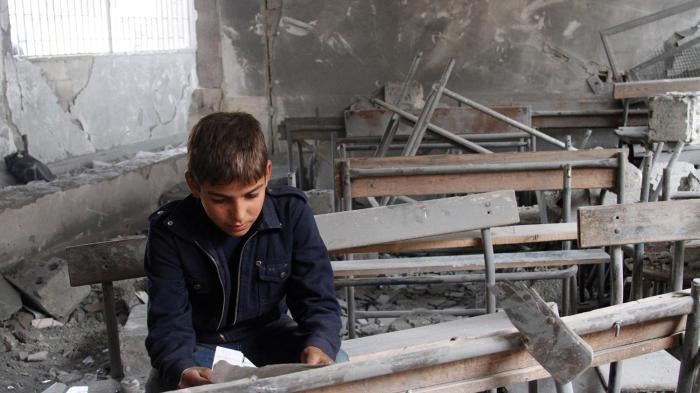
In combat zones, the Syrian armed forces committed apparent laws of war violations by conducting ground and air strikes against schools that were not being used for military purposes. And they deployed forces and pro-government armed groups in schools, endangering students or depriving them of their right to education. Opposition armed groups have contributed to the danger to students by deploying their forces in or very close to functioning schools.
This report documents practices by government and opposition forces that threaten the lives of students, teachers, and school officials and endanger the learning environment. Human Rights Watch’s findings are based on more than 70 interviews conducted between October and December 2012. Interviewees included 16 students, 16 educators, and 22 parents of schoolchildren, all of whom had fled Syria between March 2011—when the uprising began—and December 2012. A few of the interviews were conducted by Skype or telephone, but most were conducted in Jordan. Therefore, our findings reflect the experiences of families in the governorate of Daraa, where many of Jordan’s Syrian refugees originate, as well as the experiences of those in the Homs, Damascus, and the Damascus suburbs governorates, from where others fled.
Students and teachers from the Daraa, Homs, and Damascus suburbs governorates told Human Rights Watch that teachers and security agents interrogated students inside their schools about their political beliefs, their participation in anti-government protests, and the activities of their family members. Students said that admitting participation in activities deemed anti-government could result in a beating or other abuses.
Government forces and shabiha, pro-government armed groups, assaulted and sometimes fired on anti-government, student-organized protest marches that students staged at the end of their school day. They also entered schools to arrest students, sometimes assaulting students and teachers, and firing guns in the air, terrifying the students.
Government forces and shabiha also fired upon schools, including schools still in use as educational institutions. Salma, a high school student from Daraa, described hiding underneath her desk while machine gun fire hit her school walls. Marwan, a 12-year-old student, also from Daraa, said that he ran for safety as tank shells struck his school building.
Syrian government air force fighter jets and helicopters dropped bombs—including what appeared to be improvised “barrel bombs” and incendiary weapons—on school buildings, causing extensive damage. Human Rights Watch documented two air strikes on school buildings. Witnesses interviewed said there were no opposition forces in or near the schools, suggesting that the attacks were unlawful. In addition to these incidents, Human Rights Watch collected several additional witness accounts describing the aftermath of air strikes on school buildings, but was not able to confirm the details of those strikes’ circumstances.
Two Syrian Air Force pilots who had defected to the opposition told Human Rights Watch that they received frequent orders to bomb civilian areas. They said that the methods used—dropping barrel bombs and other munitions from airplane holds—meant that those deploying the weapons had little or no ability to direct them towards specific targets. In its February 5, 2013 report, the United Nations Commission of Inquiry on Syria documented government attacks on more than 17 schools and noted that “anti-Government forces were present in some instances.”
Government forces and shabiha deployed in schools in each of the four governorates from which Human Rights Watch interviewed refugees—Homs, Damascus, the Damascus suburbs, and Daraa—and used them as bases, barracks, sniper posts, and detention centers. Sometimes soldiers only used schools for a very short duration, while at other times, they occupied schools for prolonged and indefinite periods. Schools were used both after students had ceased to study there and while they continued to attend classes.
Opposition armed forces used schools in the Daraa and Homs governorates for military purposes. In its February 2013 report, the UN Commission of Inquiry on Syria stated, “anti-Government armed groups frequently use schools as barracks or offices. These occupations are not always justified by military necessity, and have spread the belief that schools are not safe.”
Military forces—whether national armed forces or non-state armed groups—that deploy in schools or otherwise use them for military purposes, make those schools legitimate targets under the laws of armed conflict. When the schools are still being used, such deployments put students and school personnel at risk of attack, violating the international humanitarian law requirement to take all feasible precautions to protect the civilian population and civilian objects against the effects of attacks.
In December 2012, the Syrian Ministry of Education reported that 2,362 schools in Syria—more than 10 percent of Syria’s approximately 22,000 schools—had been damaged or looted, while 1,468 schools were being used to house internally displaced persons. On December 29, Syria’s Local Coordination Committees, a network of opposition activists, announced that at least 3,873 schools throughout the country had been damaged, 450 of which were entirely destroyed and will need complete reconstruction.
Long-term military deployments in schools also violate the right of children to education under international human rights law, which remains applicable in wartime. The teachers and school principals interviewed by Human Rights Watch said that enrollment dropped by at least 50 percent since the conflict began. Many reported dramatically lower attendance rates. In February 2013, the UN Commission of Inquiry on Syria stated that “[s]chool attendances ranges from 38 to 100 percent across Government controlled areas,” and that attendance “appears severely limited” in opposition-controlled areas. In November 2012, the Ministry of Education announced that only 14 percent of children could attend school in the northern Aleppo governorate, where the fighting has been particularly intense.
As schools have become too risky for students to attend, communities and activists across the country have started informal community schools or clandestine learning programs. These fledgling efforts suffer from inadequate resources. Students who had to leave school because of the conflict told Human Rights Watch that they became child laborers, child soldiers, or helpers for the armed opposition. Several girls between 16 and 17 who dropped out of school because it was no longer safe said they married out of economic need or for lack of other safe options.
To protect the basic human rights of children, including their right to education, the Syrian government should immediately cease using teachers and members of the security forces to interrogate students about their views and activities and those of their families. All cruel, inhuman, and degrading treatment of students should immediately stop. Those responsible for students being mistreated, assaulted, or fired upon should be investigated and appropriately disciplined or prosecuted.
All parties to the conflict in Syria should respect the laws of war, including those laws as they relate to schools. Attacks against schools that are not being used for military purposes should be stopped. Syrian government forces and shabiha and opposition armed groups should take all feasible precautions to protect schools under their control against the effects of attack, and move students and other civilians away from military forces. When military forces use schools, thereby making them legitimate military targets, students should be transferred to safer locations to continue their education.
The international community should protect Syrian children’s right to education by supporting educational initiatives and remedial measures throughout Syria, including in areas controlled by the opposition.
Recommendations
Human Rights Watch has previously made detailed recommendations concerning the steps that the Syrian government, the armed opposition, and inter-governmental bodies and foreign governments should take to address violations of international human rights and humanitarian law in the Syrian conflict. These recommendations include those in Torture Archipelago: Arbitrary Arrests, Torture, and Enforced Disappearances in Syria’s Underground Prisons since March 2011. For more than a year, parties to the conflict and other institutions have failed to implement many of these recommendations while tens of thousands more Syrian civilians—including more than 5,000 children—have been killed, according to local human rights documentation groups.
Human Rights Watch makes the follow recommendations with respect to the specific findings of this report:
To the Syrian Government:
- Cease questioning and physical abuse of students in schools, either by teachers or state security personnel, about the beliefs and activities of the students or their family members. This questioning amounts to unlawful interference with family, privacy, and opinion, violates the rights of children, while beatings and physical abuse amount to cruel, inhuman, or degrading treatment or punishment. Coercive questioning and physical abuse of students should result in appropriate disciplinary action or criminal prosecution of those responsible.
- Cease attacks on schools and other civilian objects.
To the Syrian Government and Armed Opposition:
- Do not deploy forces, weapons and ammunition, or materiel in or near schools where this would place students, teachers, and other civilians at unnecessary risk. All feasible measures should be taken to remove students and other civilians from locations where military forces operate, or from other military objectives.
- Where schools are used for military purposes, work with civilian authorities to ensure that children are immediately relocated and able to continue their education in a separate and safe location.
To the UN Security Council:
- Refer the situation in Syria to the International Criminal Court, which is the forum most capable of effectively investigating and prosecuting those bearing the greatest responsibility for war crimes, including unlawful attacks on schools and other serious international crimes committed in Syria.
- Call for Syria to allow to delivery of humanitarian aid, including emergency, remedial, and other educational materials, across all of its borders, including from Turkey; and
- Support UN efforts to coordinate and provide humanitarian aid to all those in need, including those in opposition-held areas. Such aid should include plans to provide remedial and emergency education.
To Concerned Governments and Intergovernmental Organizations:
Call upon the Syrian government and armed opposition to implement the above recommendations. In particular, they should:
- Urge governments and arms suppliers to stop selling and providing arms to the Syrian government so long as it continues to commit widespread and systematic violations of the laws of war, including attacks on schools;
- Review the human rights and international humanitarian law commitments and records of the opposition groups they are assisting, including by providing weapons and ammunition, materiel, and other military support, and work with those groups to adopt and implement policies that meet international standards. Governments should cease providing military assistance to groups committing crimes against humanity or widespread and systematic violations of the laws of war.
With respect to humanitarian assistance, they should:
- More effectively address the humanitarian crisis in which millions of Syrians face severe shortages in food, shelter, fuel, medical care, and education by working to increase provision of humanitarian assistance to affected individuals inside Syria, in both opposition and government controlled areas, and to the internally displaced and refugees.
- Take necessary steps to secure children’s right to education, which continues even in emergency situations, by supporting community and field schools covering core competencies in basic education in Syria, working in coordination with local civilian councils, and providing emergency education and remedial learning materials.
- Urge Security Council members to call expressly on Syria to allow cross-border humanitarian assistance, and publicly press Syria to consent to cross-border operations.
- Greatly expand the amount and pace of cross-border humanitarian assistance by all those capable of undertaking such operations as the only feasible way to address the severe deprivation faced by those in opposition-held areas. Such aid should include plans to provide remedial and emergency education.
Methodology
This report is based on Human Rights Watch interviews with more than 70 people, conducted between September 2012 and January 2013. The interviewees include 16 students, 11 teachers, 3 school guidance counselors, 2 principals, and a Ministry of Education employee, all of whom left their schools or positions when they fled Syria, as well as 22 parents or family members of schoolchildren. Twenty-four children were interviewed, including fifteen boys and nine girls. Human Rights Watch also interviewed five representatives of international development and humanitarian assistance groups operating inside Syria, and eight opposition activists based outside the country.
Research focused on threats to and attacks on students and schools in Syria. Interviews for the report took place primarily among Syrian refugee communities in Jordan: in the Zaatari refugee camp; in the towns of Mafraq, Irbid, and Ramtha; and in Jordan’s capital, Amman. Some interviews took place in Cairo, Egypt, or through telephone or Skype conversations with people still in Syria or in Turkey. Because most of the research took place in Jordan, the report covers violations primarily in the Daraa, Homs, and Damascus governorates, from where many Syrian refugees in Jordan originate.
Human Rights Watch asked interviewees about their experiences since the beginning of anti-government protests in Syria in March 2011. As a result this report documents violations that took place between the start of the conflict and the time of our interviews. Interviewees had fled Syria between a few days to a year before our interviews with them.
Most interviews were conducted in Arabic by an Arabic-speaking researcher. A minority of the interviews took place in English with an English-speaking interviewee, or, in two cases, with the help of an interpreter. Many interviewees asked us not to use their real names because of fears for their safety or the safety of family members who remained inside Syria. Given these safety concerns, we have withheld the names of all victims and witnesses and instead used pseudonyms.
Interviewees were approached randomly in the camp setting, or were identified in communities by community leaders or NGOs operating locally. All interviewees were informed of the purpose of the research, told they could refuse to be interviewed or to answer any question, and that they could end the interview at any time. No inducement was offered for participation.
Most interviewees described themselves as pro-opposition or as supporters of the opposition Free Syrian Army. Others expressed criticism of the armed opposition. However, none of the individuals interviewed for this report described themselves as pro-government or expressed views in support of the current government. Thus, information on education-related abuses by the opposition remains more limited.
Human Rights Watch also reviewed more than 50 YouTube videos showing student protests, damage caused by shells and bullets to schools inside Syria, and other footage relating to attacks on schools and students. In some cases, we interviewed individuals responsible for videotaping this footage, and in others, we verified the events with other footage or by cross-checking it against news reports or witness accounts.
Human Rights Watch also reviewed secondary sources, including: the four United Nations Commission of Inquiry reports on Syria, particularly sections addressing violations of children’s rights; UN agency and international NGO reporting on violations of children’s rights, including reports published in March 2013 by the UN Children’s Fund (UNICEF) and Save the Children; and documentation by Syrian groups including the Syrian Violations Documenting Center, the Syrian Network for Human Rights, and the Local Coordination Committees.
I. Background
Among developing countries, Syria’s children are well-educated. In 2010, about 93 percent of all eligible children were enrolled in primary education, and 67 percent in secondary education.[1]Before the war, literacy rates among young people were high: approximately 95 percent of the population between ages 15 and 24 could read and write.[2]
However, since the start of Syria’s internal conflict in March 2011, schools and universities have become charged political sites in which government authorities have monitored, threatened, and sometimes physically assaulted students critical of the Assad government. Protests in Daraa, a governorate in southern Syria, began in March 2011 after schoolchildren scrawled anti-government graffiti on the walls of their schools.[3] State security officers detained and tortured them for weeks at various detention centers.[4]
Over the next year, students around the country began protesting in their school courtyards or organizing marches at the end of the school day while still wearing uniforms.[5]Teachers from Idlib, the Damascus suburbs, Homs, and Daraa told Human Rights Watch that their students painted anti-Assad and anti-government slogans on school walls, mimicking the boys from Daraa. “This revolution was a youth revolution,” an activist doctor said. “Every kid thinks he’s a hero.”[6]
As early as November 2011, as Syria’s detention centers filled, security forces turned civilian buildings, including schools and kindergartens, into makeshift detention centers.[7]Human Rights Watch has documented, since September 2012, several incidents in which government snipers shot at civilian demonstrators and passersby—including children—from the rooftops of schools.[8]
Children and parents told Human Rights Watch that shabiha and members of state security branches entered their schools and arrested their classmates in the classrooms, sometimes accompanied by threats and shooting. They described how these arrests gave them further reasons to believe that schools were no longer safe.[9]
By September 2011, the conflict intensified and armed opposition groups began fighting government troops and pro-government militias. Over the next year and a half, schools suffered damage from gunfire, artillery and tank shelling, and aerial bombardment by government forces. In some cases there appears to have been no legitimate military objective, while in others, government troops or armed groups had occupied school buildings, turning them into military targets. Both government forces and armed opposition groups occupied and used schools for military purposes.
In December 2012, the Ministry of Education announced that at least 2,362 of Syria’s 22,000 school buildings—more than 10 percent of Syria’s schools—had sustained damage as a result of the conflict,[10]and that 1,468 additional schools could no longer be used for education because they had become shelters for internally displaced persons.[11] That month, the Syrian Network for Human Rights, a London-based monitoring group, reported that over 450 schools had been completely destroyed, the majority of these in Homs, Rural Damascus and Aleppo, and that 3,423 schools had been partially damaged.[12]
The 16 teachers and school principals who had become refugees said that, since the beginning of the conflict, enrollment dropped below half the number of students that would ordinarily be registered. Many reported dramatically lower attendance rates. In its February 2013 report, the UN Commission of Inquiry on Syria stated that “[s]chool attendances ranges from 38 to 100 percent across Government controlled areas,” and that attendance “appears severely limited” in opposition controlled areas. In March 2013, UNICEF reported that only 6 percent of children in the Aleppo governorate, an area particularly hard hit by the conflict, could attend school.[13]
In response to the education crisis, local civilian councils and activist groups started improvised schools and community schools in areas where government schools were destroyed or no longer safe to attend, as well as in opposition-controlled areas.[14]Communities have located these schools in mosques and in private homes.[15] However, they lack school supplies, and teaching materials, as well as sufficient teachers, and require greater support in order to continue.[16]
II. Abuses in Schools
Syria’s mukhabarat, or intelligence forces, as well as the pro-government armed groups known as shabiha have threatened, interrogated, arbitrarily arrested, and in some cases physically assaulted students and teachers in schools in Homs, Damascus, the Damascus suburbs, and Daraa. Teachers and students told Human Rights Watch that teachers and security officers interrogated students in school, leaving them and their families in fear of repercussions such as arrest and detention. Soldiers or armed men assaulted children at demonstrations staged by students at boys’ and girls’ schools, and sometimes even by children at primary schools.
Human Rights Watch documented two instances in mid-2012 in which government forces and pro-government armed groups fired on schools while students remained inside, as well as firing on empty school buildings.
Human Rights Watch also documented how both government forces and opposition armed groups occupied school buildings and used them for military purposes, thereby turning them into legitimate military targets.
Political Interrogations and Corporal Punishment
Four teachers and two students from the Damascus, Daraa, and Homs governorates told Human Rights Watch that teachers interrogated children at school about their political beliefs and the activities of their family members. Teachers and school principals then beat those who gave answers deemed to show opposition to the Syrian president.
Human Rights Watch did not interview any students or teachers who identified themselves as pro-government, and thus is not in a position to report on teachers questioning, harassment, or abuse of students who continued to support the Syrian government. Some teachers did describe harassment and violence between pro- and anti-government students.[17]
Abdou, a fourth-grade student at a government school in Homs until his family left Syria in May 2012, told Human Rights Watch, “The teachers at my school would ask questions. They’d ask ‘Does your father have a rifle or a revolver? Does your father watch al-Jazeera? Al-Arabiya?’”—two international Arabic news channels that have extensively covered government abuses. He said, “There was a female teacher…. She would ask us, ‘Do you go to protests? Do you like Bashar?’…. Students who said no to that question [about the president] went to the principal [for punishment].”
Abdou said that his school principal beat him after he had ripped up a picture of the president, and whipped him and other students after learning of their participation in anti-government protests:
After I [ripped Assad’s picture], [my teacher] hit me a lot…. [Then] she sent me to the school principal. He took me into the schoolyard and hit me with a stick, and made me sit in the yard for the rest of the day.
One day, we had a protest just after school, and a classmate went to this [same] teacher, and told her: these people went to protest. The principal came and collected all the names and put us in the yard. He hit each of us five times with a hose. The students who used to chant slogans during protests, he beat them more.[18]
Mahmoud, who taught Arabic at Al-Farabi private boys’ school in Douma in the Damascus governorate before he left Syria in June 2012, said that a fellow teacher at his school asked students similar questions. “The sports teacher would ask [students]: ‘Why are you not going to protests to support the president? Are you going to protests? Are you a supporter or an opponent?’ Even the other teachers were scared of him.”[19] Hala, who taught at a girls’ school in Damascus until the school year ended in mid-2012, told Human Rights Watch, “We had teachers that supported the regime, and if the students chanted any slogans [against the government], they would beat them with a stick. A lot of students stopped coming to school. [Some] only came to the final exam.”[20]
Abdulkarim, an employee from the Ministry of Education in Damascus who left his post when he left Syria in mid-2012, told Human Rights Watch that, after the uprising began, the ministry sent informants to schools around the country to monitor students and staff:
[The ministry] used to send one person to each school. They would say this person was a teacher but it was obvious he’s a security officer. For example, they sent a teacher to be a librarian at a school. [Librarians] should hold a special certificate, but he didn’t have any of that. These teachers didn’t have any of the required qualifications.[21]
Teachers also described government security forces openly entering schools and questioning students. Sahar, who worked as a teacher at a government-run primary school in the city of Homs until she left Syria in September 2012, told Human Rights Watch that students faced interrogation at her school. “[Our school] used to be a safe place,” she said. “But [during the conflict] we were afraid…. Security informants came to school and asked students, ‘Does your dad watch Arabiya? Does he watch Jazeera?’”[22]
Assaults on Student Demonstrations
Four children interviewed by Human Rights Watch said they held peaceful anti-government protests on school grounds, or marched with classmates in protests against the Syrian government at the end of the school day while wearing school uniforms. Four teachers described similar protests at the schools where they taught. Three boys—one only 10 years old—and one girl said they participated in student protests. None of those interviewed described violence of any kind from students taking part in these incidents, and none of the more than 20 YouTube videos showing elementary or high-school student demonstrations that Human Rights Watch reviewed showed students engaging in violent activities. Yet students, parents, and teachers from the Daraa, Damascus, and Homs governorates told Human Rights Watch that they saw armed men, either pro-government shabiha or government soldiers, shoot in the direction of student demonstrations, in some cases hitting students. Parents said that they feared their children would be arrested for participating in student demonstrations or that the demonstrations would be attacked. Because they feared their children would participate in such demonstrations, they said, they kept children at home even when their area did not face shelling or aerial bombardment.
Somaya, a 14-year-old girl from the Qadam neighborhood of Damascus, described how she and her classmates in the 7th grade at Rashid al-Khatib Girls’ School organized an after-school protest, bringing flags and handmade signs to school. Shabiha assaulted the protest, she said, and one of her classmates was shot. She told Human Rights Watch:
The shabiha attacked our protest. There were six or seven of them in a normal civilian car, but they had Kalashnikovs [assault rifles]. They threw me on the ground, but I managed to get away. All the girls ran, some of us hid in a falafel shop. They arrested four girls.
They shot at us. One girl got shot in her hand. They threw her on the ground, arrested her and pulled her into the car.[23]
Human Rights Watch reviewed three YouTube videos of girl students protesting in Qadam between February and March 2012, the same approximate time frame that Somaya gave, though we could not confirm that any of these showed the same protest Somaya described.[24] In all of the videos, large groups of female students carried backpacks and wore school uniforms, and did not engage in violence.[25]
Marwan, an 11-year-old student in the 4th grade who used to attend after-school protests at his government school in the Quneitra area of Damascus, told Human Rights Watch what happened at a protest in April 2012. “The [security officers] attacked us…They were wearing black uniforms and they had machine guns. They hit my friend, who is 13, with electric rods.”[26]
Parents and teachers interviewed expressed fears for children’s safety and the consequences they could face for participating in protests. May, the mother of two girls who had attended middle school and high school in Damascus until the school year ended in mid-2012, told Human Rights Watch:
Every chance they got, [my daughters] liked to protest. They would protest in the courtyard of the school…. [At] my son’s school … Sharif Georgi al-Wathba secondary school, in [the] Abbaseen [neighborhood] near Bab Touma … they used to go out and protest. They would protest in their school uniforms, [and still, the shabiha] shot at them twice.[27]
Fatima, a mother with two sons and three daughters, came from the city of Daraa, which saw protests, along with mass arrests, detentions, and torture of men and boys, from the very beginning of Syria’s uprising. She said that though she feared for the safety of all of her children at school, she was particularly frightened for her school-age son and kept him home so he would not be arrested at school or at an after-school protest. “I was most scared about Ali because he might go out protesting,” she said.
Mostafa, a guidance counselor at a boys’ high school in Nimr, another town in Daraa governorate, told Human Rights Watch that Syrian security forces arrested and detained him four separate times, and that each time, interrogators questioned him extensively about student protests. He said:
They asked me: “Did you threaten students to make them protest? Did you give them signs to carry? Did you forbid them to leave school when a protest was occurring? What was your role in the student protest? “They told me, “If you want to be a good citizen, you will forbid [anti-government] protests. You have power over their minds.” They accused us … of brainwashing them. They told me, “You have to tell students to love their country, to teach them love for Bashar. Tell them to protest for Bashar.”[28]
Two other teachers and a school principal told Human Rights Watch that security forces had questioned them about student protests and graffiti on school walls, and told them they were responsible for student anti-government activities.[29] While one teacher was questioned in detention, like Mostafa, the other teacher and principal were both called into a local security branch for questioning, during which they were asked about student protests at their schools.[30]
Raids and Arrests in Schools
Human Rights Watch interviewed nine children from the Daraa, Homs, and Damascus governorates who witnessed raids on their schools by government forces that involved arbitrary arrests of students, or who themselves faced physical violence from security officers on school grounds.
Refaat, a 10-year-old boy from Inkhil in Daraa governorate who left Syria in September 2012, told Human Rights Watch, “A car of army officers came [to my school]. They arrested two boys from my school. [That was when] I was in the third grade [back in Syria].”[31]
Marwan, an 11-year-old from Quneitra in the Damascus governorate, said: “When security officers entered my school [in the spring of 2012], they grabbed me by the ear and asked, ‘Where are the armed people from your house?’”[32]
Ammar, a 10-year-old from Mahajja in Daraa governorate, said:
In 2012, during our second semester, we were outside in the school yard for sports. The army broke in [to the school]. They started saying bad words to the students. They pointed their guns at us and threatened us. They said, “If you don’t go home, we’ll shoot you.”[33]
Girls and their parents also reported that government forces beat female students and carried out violent arrests in their schools. Laila, a high school student from the town of Hajjar al-Aswad in the Damascus governorate, left Syria in September 2012. She said, “I saw security [forces] beating students [at] school. They beat students with their rifle butts, they were wearing the black uniforms. The students were wearing their school uniforms—they were in the first and second grade.[34]
May, the mother of two girls and one boy from the Jobar area of Damascus, told Human Rights Watch, “My daughters studied at Abdullah Mahmoud al-Sweida [school] in Jobar, in al-Abbaseen neighborhood. They were in high school. [Security forces] raided the school [and interrogated] the girls. They arrested four girls between 9th and 11th grades.[35]
The students said the raids and violence led to irregular school attendance. Parents told Human Rights Watch that they kept children out of school because they feared security forces visiting the school would arrest and detain them, including on exam days when students attended in greater numbers. Jamal, a father from the Sayyida Zeinab neighborhood of Damascus, said, “My son was in the 4th grade. The principal told his mother, ‘Don’t bring your son to school because they’ll arrest him.’ [The principal] was trying to help us.”[36]
Ground and Air Attacks on Schools
Syrian government forces have conducted military operations involving attacks on schools in various parts of the country in apparent violation of the laws of war.[37]
Four students told Human Rights Watch that they stopped attending classes after their school was shelled by a government armored vehicle, faced an armed attack, or faced a serious threat of attack.
Salma, a 14-year-old girl from Dael in the Daraa governorate, described how government forces attacked her school twice while she and her fellow students were still attending classes. She said the first attack took place sometime during Ramadan, between July 19 and August 18, 2012. She told Human Rights Watch:
[In the first attack,] when the tank entered the school, it hit the walls of the school with machine guns. So students got down [on the ground] to shelter. We spent half an hour or an hour there underneath our desks. Then the teachers asked [the government soldiers] if the children could leave, so they let us go home.
We were crying because [we heard a] plane and a soldier said “Why are you crying about the plane? When we leave, a ‘barrel bomb’ will fall.”[38]
Human Rights Watch reviewed video footage posted to YouTube on July 25, 2012, approximately a week after Ramadan started, placing it in the same time frame as the first attack Salma described, though it was not possible to confirm that the video showed the same school that Salma attended.[39]The video shows a school in Dael that had been damaged by direct fire from machine guns and several high explosive projectiles. Analysis by arms experts at Human Rights Watch confirms that the weapon used to attack the school was the 73mm gun of a BMP-1 armored infantry fighting vehicle, which a layperson might describe as a tank. BMP-1 armored vehicles also have a machine gun mounted alongside the cannon that is often used to check the aim before firing the main gun. A young man pictured in the video holds the remnants of the fin-stabilized, rocket-assisted projectile fired by this weapon.
Salma described a second incident in mid-September 2012 during which government soldiers surrounded but did not attack her school. “[This time] they wouldn’t let the students leave,” she said.[40]
Rami, a 12-year-old boy from Dael in the Daraa governorate, described to Human Rights Watch how government forces shelled his school, the Shahid Fayez al-Jamous School, and then shabiha entered it. He said:
[The army] fired on my school with a tank. It was during science class, but I was on my way to the bathroom. Two shells hit the fourth floor. I was on the first floor. People started running away. When I ran away, a shabiha caught my shoulder, but I struggled and managed to get away. The shabiha came into the school and shot the windows, broke the computers. After that, I only went back to take my exams.[41]
Both Rami and his mother told Human Rights Watch that there was no armed opposition presence in their school that might justify such an attack.[42]
Radwan, a soldier who defected from the Syrian army and was an opposition fighter until he sustained an injury, told Human Rights Watch that before he left Syria in September 2012, he watched the Shaba’a High School in the suburbs of Damascus being bombarded on the first day of the school year:
It was attacked by a plane and a tank…. Some students were injured, [and] the building sustained a lot of damage. It was 500 meters from [an army] checkpoint; the tank was at the checkpoint. I saw [the tank’s] gun pointed straight, towards the school, not at an angle [which he demonstrated with his arm].[43]
A news update from the Syrian Local Coordination Committees, opposition activists who have sent daily news updates on civilian casualties and government attacks since April 2011, described how on September 16, the first day of school in Syria, “heavy shelling target[ed] residential buildings and the high school in the town [Shaba’a].”[44] A YouTube video posted on September 16 by the Shaba’a Coordination Committee, the Shaba’a unit of the Local Coordination Committees, shows bullet holes and other damage to the outer wall of Shabaa High School.[45]
Human Rights Watch also viewed a YouTube video from the town of Khirbet Ghazala, in Daraa governorate, showing a group of children who had been injured after an attack on their school, the Ghazala Rasmiya Secondary School, on December 31, 2012.[46]A member of the Khirbat Ghazala media office who shot the video told Human Rights Watch:
I rushed to the school, and found it had been shelled and several students injured by shrapnel. The attack happened at about 9:15 in the morning, near the beginning of the school day. Fifteen students were injured: nine boys and six girls. Some of them had to go to Jordan for treatment, and some of them have permanent injuries. One boy lost part of his arm.[47]
Human Rights Watch documented an airstrike, in al-Bab, Aleppo governorate, on November 4, 2012 on a school hosting an opposition civilian council (responsible for civic matters such as garbage collection and schooling) while students were in the school. According to local residents, bombs struck and destroyed four houses to the south of the school in al-Bab around 10:30 a.m., killing five civilians, and then to the north approximately an hour later, with no casualties.[48]Finally, four bombs, one of which failed to explode, struck the school itself, killing the head of the civilian council.[49] The strikes on the school would likely have resulted in more casualties had the school administration not sent the students home earlier that day because of the jet attacks, members of the civilian council said.[50]
Incendiary weapons were used in an attack on a school building and homes in Quseir in the Homs province on December 3, 2012. According to video footage and two local activists interviewed by Human Rights Watch, approximately 20 civilians, including women and children, were wounded that day by an airstrike on Ghaleb Radi school and neighboring homes in Quseir. One video uploaded on December 3 from Quseir shows what appears to be an airstrike using incendiary submunitions filmed from a distance while another video shows burning ZAB-2.5 submunitions on the ground of Ghaleb Radi school.[51]
A local activist in Quseir told Human Rights Watch:
The bombs hit a school called “Ghaleb Radi” Al Rifiat and several residential buildings next to it. The bombs were different than the cluster bombs. They caught fire as they were dropping from the MiG warplane. I heard a big explosion and several smaller ones. We saw smoke in the air and when we arrived to the Al Rifiyat street I saw at least nine houses on fire.
Then when I reached the school I saw at least seven bombs burning on the playground and releasing white smoke that had a terrible smell.
According to the activist, there was no activity by any armed opposition group in the school, a single-story building.[52]
Use of Schools by the Military and Armed Groups
All parties to the armed conflict in Syria have used schools for military purposes. Government armed forces and pro-government armed groups have used schools across the country as bases, barracks, sniper posts, and detention centers. Opposition armed forces have used schools as barracks and command posts. In some cases, troops have only used schools for a very short duration—a day, a weekend, or a week. In other cases, they have occupied schools for long periods or indefinitely. Human Rights Watch found that schools were used both after students had ceased to study there and, in some cases, while they continued to attend lessons.
Army and Pro-Government Armed Groups
Two men who had been detained by government security forces in June and July 2011 told Human Rights Watch that they had been held in the Radwa school in Jisr al-Shugour.[53] One man said he was detained with approximately 65 others in a classroom.[54] A resident of al-Janoudyah, a town just north of Jisr al-Shughour in the Idlib governorate, told Human Rights Watch that as of February 2012, a public school in the town was being used by the army as a detention facility.[55]
Fadi, a teacher from Douma in the Damascus governorate until he left Syria in June 2012, told Human Rights Watch that government troops used the Ahmad Ghura school, a government school for boys, as a temporary detention center in April 2012. “They attacked [our] area, arrested 150 men and boys, [and detained] them in the school,” he said. “Then they took them from there to other prisons.”[56]
Iman, a 20-year-old woman from Quneitra in Damascus governorate, told Human Rights Watch that government snipers had been posted on the roof of Bassel al-Assad High School, which was next door to her family’s house. It also served as a detention center. [57] May, the mother of two girls and a boy from Jobar in Damascus, said that while her daughters continued to attend the Abdullah Mahmoud Sweida Girls’ School, at least two government snipers took up positions on the school roof. “The girls were crying all the time,” she said. She also noted that “there was a checkpoint directly in front of the school, which put a valid military target at a location that put children at unnecessary risk.”[58]
Faisal, the principal of a school in Quneitra until he left Syria in September 2012, told Human Rights Watch that, “During the summer, they made [my school] into a detention center—just for a short period, for 24 hours or so.”[59]
In its February 2013 report, the UN Commission of Inquiry on Syria noted two specific examples in which government forces used schools in the Aleppo and Hama governorates. It reported that in March 2012, a school in Atarib in the Aleppo governorate, “was occupied with tanks on its grounds and snipers positioned on its roof.”[60] In early April 2012, a village school in Hama governorate was occupied by Syrian government forces, “which used it as a command post, again putting snipers on its roof.”[61]
Opposition Armed Groups
The Free Syrian Army and other opposition armed groups have occupied schools in their areas and used them as barracks or command posts, according to refugees from Syria who spoke to Human Rights Watch. As of August 2012, opposition fighters used schools as barracks or command posts in the towns of Sheikh Meskin and Dael in Daraa, and in Tel Rifaat in the Aleppo governorate in August 2012.
Malek, from the town ofSheikh Meskin, in Daraa governorate, told Human Rights Watch that in June 2012, before he left Syria, government forces attacked a school in his town that an armed opposition group had taken over:
In Sheikh Meskin, the Free [Syrian] Army was inside a school and the army attacked it with two tanks. Sixteen people were inside it from the Free Army. [The government army] fired on it until the whole school collapsed. This happened in June. The most targeted places [in Sheikh Meskin] are the schools, because the Free Army used to use schools as a place to rest.[62]
Several other former residents of Sheikh Meskin corroborated Malek’s account.[63] The Syria Network for Human Rights, a London-based human rights documentation group, described an attack on Sheikh Meskin on June 7, 2012, stating that “[government] forces sieged the city, shelled it randomly by heavy artillery, then broke into the school which had a field hospital.”[64]A student from Sheikh Meskin said that armed opposition troops used a school in the town as temporary a field hospital.[65]
Wissam, a 13-year-old boy who attended Dael High School in Daraa governorate until he left Syria in October 2012, told Human Rights Watch that government forces attacked his school because armed opposition fighters had stationed themselves there for four days. He said that “the government shot the school from a plane. They shot it with rockets and dropped a barrel [bomb] on it.” Afterwards, he said, “[soldiers] came to our house and said, ‘We cleaned the school of terrorists. Go back to school.’”
Opposition forces also used a school in Tel Rifaat in the Aleppo governorate as a detention center, as well as a local administration office and court, when government forces attacked it on August 7, 2012.[66] Two detainees said that opposition forces detained them in schools in the Aleppo governorate in July or August 2012.[67]
III. International Human Rights and Humanitarian Law
The Right to Education
Syria is a party to two of the international treaties that establish the right to education under international law: the International Covenant on Economic, Social, and Cultural Rights (ICESCR)[68]and the Convention on the Rights of the Child.[69] These treaties recognize that states are to make primary education free and compulsory, and secondary education generally available. Governments have obligations to ensure these basic rights are met. While opposition groups are not formally bound by international human rights law, those that have effective control over populated areas should seek to act consistently with international human rights law.
Students, teachers, and school officials are protected from being mistreated in schools by state officials under the general provisions of the International Covenant on Civil and Political Rights and other treaties.[70]Protections include the right not to suffer cruel and degrading treatment, not to be arbitrarily detained, and to enjoy the right to freedom of expression and association.
On the subject of education in emergencies, the UN special rapporteur on the right to education has stated that:
Security in schools, meaning not only physical, psychological and emotional safety but also an uninterrupted education in conditions conducive to knowledge acquisition and character development, forms part of the right to education. This means that States have a responsibility to punish perpetrators and devise effective methods of protection….
During times of conflict … teachers, students and parents become the targets of violence. Parents keep their children at home to avoid the risks involved in the trip to and from school.[71]
During wartime, the use of schools and universities for military purposes can jeopardize students’ right to education. The Committee on the Rights of the Child, an international expert body charged with monitoring state compliance with the Convention on the Rights of the Child, has urged states not to use schools for military purposes.[72] It has noted, “Military presence in the vicinity of schools significantly increases the risk of exposing school children to hostilities and retaliations by illegal armed groups.”[73] In instances of such military occupation of schools, the committee has also called on states to “conduct prompt and impartial investigations of reports indicating the occupation of schools by the armed forces and ensure that those responsible within the armed forces are duly suspended, prosecuted, and sanctioned with appropriate penalties.”[74]
The UN Security Council has also called on armed forces to refrain from using schools for military operations because of the impact it can have on children’s access to education. A statement delivered by the president of the UN Security Council in April 2009 reads, “The Security Council … urges parties to armed conflict to refrain from actions that impede children’s access to education, in particular … the use of schools for military operations.”[75]
International Humanitarian Law and Attacks on Schools
The armed conflict in Syria is covered by international humanitarian law, also known as the laws of war.[76] It is considered a non-international (or internal) armed conflict for which Common Article 3 to the four Geneva Conventions of 1949 and customary international humanitarian law apply.[77]
International humanitarian law imposes upon all parties to an armed conflict a legal obligation to reduce unnecessary suffering and minimize harm to civilians. It applies to both government armed forces and non-state armed groups. In Syria the parties to the conflict include the Syrian armed forces, the shabiha armed groups that operate in concert with government forces, and Free Syrian Army and other opposition armed groups.[78]
A fundamental principle of the laws of war is that parties must at all times distinguish between civilians and combatants, and between civilian objects and military objectives. Attacks may only be directed at combatants and military objectives.[79]
Civilians are only subject to attack when and for such time as they are directly participating in hostilities. Where there is doubt as to whether a person is a civilian or a combatant, that person must be considered a civilian.[80]
Military objectives are those targets that “by their nature, location, purpose or use, make an effective contribution to military action and whose total or partial destruction, capture or neutralization, in the circumstances ruling at the time, offers a definite military advantage.”[81] These include, but are not limited to, military personnel, weapons and ammunition, and places of military deployment and operations.
Civilian objects are buildings and structures that are not considered military objectives.[82] In general, the law prohibits direct attacks against what are normally civilian objects, such as homes and apartments, places of worship, hospitals, schools and universities, and cultural monuments, unless they are being used for military purposes.[83]
Parties to the conflict must take all feasible precautions to protect civilians and civilian objects under their control from attack.[84] They also must, to the extent feasible, remove civilians under their control from the vicinity of military objectives.[85]
Under the laws of war, military forces that occupy or otherwise use a school render it a legitimate military target.[86] Thus a school that serves as a military base, an ammunition depot, or a sniper post may be subject to attack. It is unlawful to use a school simultaneously as an armed stronghold and an education center, since it places children, teachers, education personnel, and other civilians at unnecessary risk. In such instances, military forces occupying a school have an obligation to take all feasible precautions to protect civilians from attack and to remove them from the vicinity.[87]
Attacks on legitimate military targets, including schools being used for military purposes, may be neither indiscriminate nor disproportionate. An indiscriminate attack is one in which the attack is not directed at a specific military objective or the methods or means used cannot differentiate between combatants and civilians. A disproportionate attack is one in which the expected loss of civilian life and property is excessive compared to the anticipated military gain of the attack.[88]
Individuals who willfully commit serious violations of international humanitarian law can be prosecuted in domestic or international courts for war crimes. Among the war crimes set out under the Rome Statute of the International Criminal Court is “[i]ntentionally directing attacks against buildings dedicated to … education, … provided they are not military objectives.”[89]States have an obligation to investigate alleged war crimes committed by their nationals, including members of the armed forces, and prosecute those responsible.[90] Non-state armed groups also have a legal obligation to respect the laws of war, and thus a responsibility to ensure that their commanders and combatants abide by their requirements.[91]
Acknowledgments
This report was written by Priyanka Motaparthy, researcher in the Children’s Rights Division of Human Rights Watch.
The report was edited by Bede Sheppard, senior researcher in the Children’s Rights Division; Lama Fakih, Syria and Lebanon researcher; James Ross, legal and policy director; and Babatunde Olugboji, deputy program director. Mark Hiznay, senior researcher in the Arms Division, provided specialist review.
Sylvie Stein, associate in the Children’s Rights Division; Grace Choi, publications director; Kathy Mills, publications specialist; and Fitzroy Hepkins, mail manager, provided production assistance.
We wish to thank the students, teachers, parents, and other individuals who spoke with us about their experiences in Syria.
[1]UNESCO Institute for Statistics, “Education (all levels) profile – Syrian Arab Republic,” 2010, http://stats.uis.unesco.org/unesco/TableViewer/document.aspx?ReportId=121&IF_Language=eng&BR_Country=7600&BR_Region=40525 (accessed May 1, 2013).
[2]Ibid.
[3]Syria is divided into 14 governorates or administrative subdivisions, each headed by a governor appointed by the Ministry of Interior. “Syrian Arab Republic: Public Administration Country Profile,” UN Division for Public Administration and Development Management, Department for Economic and Social Affairs, September 2004, available at: http://unpan1.un.org/intradoc/groups/public/documents/un/unpan023183.pdf (accessed May 16, 2013).
[4]Amal Hanano, “The Syrian schoolboys who sparked a revolution,” The National, March 30, 2012, http://www.thenational.ae/lifestyle/the-syrian-schoolboys-who-sparked-a-revolution#page1; Human Rights Watch, Torture Archipelago: Arbitrary Arrests, Torture, and Enforced Disappearances in Syria’s Underground Prisons since March 2011 (New York: Human Rights Watch, 2012), http://www.hrw.org/node/108415/section/6. Among the sites at which they were tortured was the notorious Palestine Branch (Branch 235) in Damascus.
[5]Bassem Mroue, “Syria: Students Increasingly Join Protests,” The Daily Star (Beirut), September 22, 2011, http://www.dailystar.com.lb/News/Middle-East/2011/Sep-22/149430-syrian-students-increasingly-join-protests.ashx (accessed April 28, 2013).
[6]Human Rights Watch Interview with Dr. Mahmoud from Baba Amr, Homs, Amman, Jordan, October 29, 2012.
[7]Human Rights Watch, Torture Archipelago: Arbitrary Arrests, Torture, and Enforced Disappearances in Syria’s Underground Prisons since March 2011 (New York: Human Rights Watch, 2012), http://www.hrw.org/node/108415/section/6; “Syria: Stop Torture of Children,” Human Rights Watch press release, February 3, 2012, http://www.hrw.org/news/2012/02/03/syria-stop-torture-children.
[8]“Syria: Stop Torture of Children,” Human Rights Watch press release, February 3, 2012, http://www.hrw.org/news/2012/02/03/syria-stop-torture-children.
[9]Ibid.
[10]UNICEF, “Syria Crisis Weekly Humanitarian Situation Report,” September 6, 2012, http://reliefweb.int/sites/reliefweb.int/files/resources/UNICEF%20Syria%20Crisis%20Weekly%20SitRep%20%28Syria,%20Jordan,%20Lebanon,%20Turkey,%20Iraq%29%206%20Sep12.pdf (accessed January 9, 2013).
[11]United Nations Office for the Coordination of Humanitarian Affairs (OCHA), “Humanitarian Bulletin – Syria,” September 1-14, 2012, http://reliefweb.int/sites/reliefweb.int/files/resources/Syria%20Humanitarian%20Bulletin%20-%20Issue%208.pdf (accessed January 9, 2013).
[12]Email from Syrian Network for Human Rights (“A report on the destruction of schools and its consequences”), December 29, 2012, on file with Human Rights Watch.
[13]UNICEF, “Syria conflict depriving hundreds of thousands of children of their education,” March 5, 2013, http://www.unicef.org/media/media_68077.html (accessed April 29, 2013).
[14]Field Schools project description, http://www.syriaincolors-lcc.com/en/projects-and-programs/field-schools/ (accessed April 28, 2013); Human Rights Watch interview with Syrian activist, Cairo, Egypt, October 21, 2012; Human Rights Watch Skype interview with former teacher, January 23, 2013; CNN, “Cave becomes classroom for Syrian kids,” October 12, 2012, http://www.cnn.com/2012/10/05/world/meast/syria-underground-school (accessed April 2013).
[15]A collaborative effort between a range of humanitarian actors, supported by ECHO, DFID and OFDA, facilitated by the Assistance Coordination Unit (ACU), “Joint Rapid Assessment of Northern Syria, Final Report,” February 17, 2013, p. 20, http://reliefweb.int/sites/reliefweb.int/files/resources/130220_J-RANS_2013_Final_Report.pdf (accessed April 28, 2013); Assessment Working Group for Northern, “Joint Rapid Assessment of North Syria, Aleppo City Assessment,”March 28, 2013, http://reliefweb.int/sites/reliefweb.int/files/resources/Aleppo%20Assessment%20Report%20Summary.pdf (accessed April 10, 2013).
[16]Ibid.
[17]Human Rights Watch interview with Mohammed, a teacher from Douma, Irbid, Jordan, November 5, 2012.
[18]Human Rights Watch interview with Abdou, fourth grade student from Homs, Zaatari camp, Jordan, November 1, 2012.
[19]Human Rights Watch interview with Mahmoud, teacher from Douma, Irbid, Jordan, November 5, 2012.
[20] Human Rights Watch interview with Hala, teacher from Abbasiya in Damascus, Irbid, Jordan, November 5, 2012.
[21] Human Rights Watch interview with Abdulkarim, former employee at the Ministry of Education in Damascus, Irbid, Jordan, November 5, 2012.
[22]Human Rights Watch interview with Sahar, schoolteacher from Homs, Amman, Jordan, October 30, 2012.
[23]Human Rights Watch interview with Somaya, 14, from Damascus, interview in Zaatari Camp, Jordan, November 1, 2012.
[24] “Girl Students’ Demonstration in the Qadam Neighborhood – The Tuesday of Anger Towards Russia – 2 -7 -2012,” video clip, February 7, 2012 http://www.youtube.com/watch?v=bnkJ14PcFGw (accessed December 12, 2012); “Student Demonstration by Girls in the Qadam Neighborhood of Victorious Damascus,” video clip, February 29, 2012, http://www.youtube.com/watch?v=e5oRfSiDHjU (accessed December 12, 2012); “Student [Demo] in the Damascus Neighborhood of Qadam,” video clip, March 4, 2012, http://www.youtube.com/watch?v=GRy2rrwA-VA (accessed December 12, 2012).
[25]Ibid.
[26]Human Rights Watch interview with Marwan, Um Yaman, and Abdulrahman, Irbid, Jordan, November 5, 2012.
[27]Human Rights Watch interview with May, mother and teacher from Damascus, Irbid, Jordan, November 5, 2012.
[28] Ibid.
[29] Human Rights Watch telephone interview with Walid, teacher from Idlib governorate, January 23, 2013; telephone interview with Karim, teacher from Idlib governorate, January 24, 2013; interview with Faisal, former principal in Quneitra, Irbid, Jordan, November 5, 2012.
[30]Human Rights Watch telephone interview with Walid, teacher from Idlib governorate, January 23, 2013; telephone interview with Karim, teacher from Idlib governorate, January 24, 2013; interview with Faisal, former principal in Quneitra, Irbid, Jordan, November 5, 2012.
[31]Interview with Refaat, third grade student from Inkhil, 10 years old, Zaatari Camp, Jordan, October 31, 2012.
[32]Human Rights Watch interview with Marwan, Um Yaman, and Abdulrahman, Irbid, Jordan, November 5, 2012.
[33] Human Rights Watch interview with Ammar, 10-year-old from Mahajja, Daraa, Irbid, Jordan, November 5, 2012.
[34]Human Rights Watch interview with Laila, former primary school student from Hajjar al-Aswad, Irbid, Jordan, November 5, 2012.
[35]Human Rights Watch interview with May, Irbid, Jordan, November 5, 2012.
[36]Human Rights Watch interview with Jamal from Sayyida Zeinab, Damascus, Ramtha, Jordan, November 7, 2012.
[37]More in-depth investigations would be needed to determine whether opposition armed forces were deployed in the area.
[38] Human Rights Watch interview with Salma, 14-year-old girl from Dael, Zaatari camp, Jordan, November 3, 2012; “Barrel bombs” are improvised explosives that are typically rolled out of an airplane.
[39]“Daraa: Planes Bomb School 7 -25 - 2012,” video clip, July 25, 2012, http://www.youtube.com/watch?v=UJ1SpX6Odd0 (accessed December 12, 2012).
[40]Human Rights Watch interview with Salma, 14-year-old from Dael, Daraa governorate, Zaatari Camp, Jordan, November 3, 2012.
[41]Human Rights Watch interview with Rami, 12-year-old boy from Dael, interview in Ramtha, Jordan, November 7, 2012.
[42]Human Rights Watch interview with Rami, mother, Ramtha, Jordan, November 7, 2012.
[43]Human Rights Watch interview with Radwan, former soldier in the Free Syrian Army (injured), Mafraq, Jordan, November 4, 2012.
[44]Email newsletter from Syrian Local Coordination Committees to Human Rights Watch.
[45] “Rif Damascus Shaba’a,” video clip, September 16, 2012, http://www.youtube.com/watch?feature=player_embedded&v=QvnOpXbr-lI (accessed February 7, 2013).
[46]“[SNN | Syria | Dara’a: Attack on School leaves boys injured],” video clip, January 1, 2013, http://www.youtube.com/watch?v=zZhmyBHOdak (accessed January 3, 2013).
[47]Human Rights Watch telephone interview with member of Khirbet Ghazala Media Office, January 18, 2012.
[48]Human Rights Watch interview al-Bab, December 12, 2012. Those killed were identified as Abdulatif Sukkar, 56, Mohammed Sukkar, 22, Saheer Sukkar, about 24, and Latif Sukkar.
[49]Ibid.The head of the civilian council was Adnan Hazah.
[50]Ibid. An opposition fighter who disassembled the unexploded bomb identified it as an OFAB 250-270.
[51]“Qusair Mig War Planes Bombing the City,” video clip, December 3, 2012, http://www.youtube.com/watch?v=GrwZPF6Nn9M&feature=youtu.be; “al-Qusair War Planes Bomb the City with a Strange Type of Bomb,” video clip, December 3, 2012.
[52] “Incendiary Weapons Used in Populated Areas,” Human Rights Watch press release, December 12, 2012, http://www.hrw.org/news/2012/12/12/syria-incendiary-weapons-used-populated-areas.
[53] Human Rights Watch interview, Hatay, Turkey, January 9, 2012; Human Rights Watch interview, Hatay, Turkey, January 7, 2012.
[54]Human Rights Watch interview, Hatay, Turkey, January 9, 2012.
[55]“Local Residents Used as Human Shields,” Human Rights Watch press release, March 25, 2012, http://www.hrw.org/news/2012/03/25/syria-local-residents-used-human-shields.
[56]Human Rights Watch interview with Fadi, former teacher from Douma, Irbid, Jordan, November 5, 2012.
[57]Human Rights Watch interview with Iman, from Quneitra, Damascus, Irbid, Jordan, November 5, 2012.
[58] Human Rights Watch interview with May, Irbid, Jordan, November 5, 2012; The Syrian Network for Human Rights, “Daily Report of Human Rights Violations in Syria on January 29-01-2012,” January 29, 2012. The Syrian Network for Human Rights, a London-based monitoring group, reported that five snipers were posted on the roof of Mahmoud Abdullah Sweida school in Jobar.
[59] Human Rights Watch interview with Faisal, former principal in Quneitra, Irbid, Jordan, November 5, 2012.
[60]UN Commission of Inquiry on Syria, “Fourth Report of the Commission of Inquiry on Syria,” February 5, 2013, http://www.ohchr.org/Documents/HRBodies/HRCouncil/CoISyria/A.HRC.22.59_en.pdf (accessed February 10, 2013).
[61]Ibid.
[62]Human Rights Watch interview with Malek, from Sheikh Meskin, Daraa, Zaatari Camp, Jordan, November 1, 2012.
[63] Human Rights Watch group interview with people from Sheikh Meskin, Daraa, Zaatari Camp, Jordan, November 3, 2012.
[64]The Syrian Network for Human Rights, “Human Rights Violations in Syria: Facts and Figures,” February 27, 2013, http://dchrs.org/english/File/Reports/27-02-2013_Facts_And_Figures_SNHR_Report_En.pdf (accessed April 29, 2013).
[65]Human Rights Watch interview with Zayed (in group interview with people from Sheikh Meskin, Daraa), interview with Zayed, Zaatari Camp, Jordan, November 3, 2012.
[66]“Syria: Aleppo Civilians at Great Risk,” Human Rights Watch press release, August 10, 2012, http://www.hrw.org/news/2012/08/10/syria-aleppo-civilians-great-risk.
[67]“Syria: End Opposition Use of Torture, Executions,” Human Rights Watch press release, September 17, 2012 http://www.hrw.org/news/2012/09/17/syria-end-opposition-use-torture-executions.
[68] International Covenant on Economic, Social and Cultural Rights (ICESCR), adopted December 16, 1966, G.A. res. 2200A (XXI), 21 U.N.GAOR Supp. (No. 16) at 49, U.N. Doc. A/6316 (1966), 993 U.N.T.S. 3, entered into force Jan. 3, 1976. Syria ratified the covenant in 1969.
[69]Convention on the Rights of the Child (CRC), adopted November 20, 1989, G.A. res. 44/25, annex, 44 U.N. GAOR Supp. (No. 49) at 167, U.N. Doc. A/44/49 (1989), entered into force Sept. 2 1990. Syria ratified the convention in 1993.
[70]International Covenant on Civil and Political Rights (ICCPR), adopted December 16, 1966, G.A. res. 2200A (XXI), 21 U.N. GAOR Supp. (No. 16) at 52, U.N. Doc. A/6316 (1966), 999 U.N.T.S. 171, entered into force March 23, 1976. Syria ratified the covenant in 1969; CRC.
[71]UN Human Rights Council, “Right to education in emergency situations: Report of the Special Rapporteur on the Right to Education, Vernor Muñoz,” May 20, 2008, A/HRC/8/10, paras. 21 and 30.
[72]Committee on the Rights of the Child, “Consideration of reports submitted by States parties under article 8 of the Optional Protocol to the Convention on the Rights of the Child on the involvement of children in armed conflict: Concluding observations: Sri Lanka,” CRC/C/OPAC/LKA/CO/1 (2010), para. 25.
[73] Ibid., paras. 39-40.
[74] Ibid.
[75] UN Security Council, Statement by the President of the Security Council (made on behalf of the Security Council, at the 6114th meeting, 29 Apr. 2009, in connection with the Council's consideration of the item entitled "Children and armed conflict"), April 29, 2009, S/PRST/2009/9, http://www.refworld.org/docid/49fff5762.html. Although presidential statements are not legally binding, they require a consensus to be adopted, and they are thus persuasive indicators of the views of the membership of UN’s principle body for the maintenance of peace and security.
[76]Human Rights Watch, They Burned My Heart: War Crimes in Northern Idlib during Peace Plan Negotiations (New York: Human Rights Watch, 2012), http://www.hrw.org/reports/2012/05/02/they-burned-my-heart-0. See They Burned My Heart for a detailed discussion on the applicability of international humanitarian law to the conflict in Syria; International Committee of the Red Cross (ICRC), “Syria: ICRC and Syrian Arab Red Crescent maintain aid effort among increased fighting,” July 17, 2013, http://www.icrc.org/eng/resources/documents/update/2012/syria-update-2012-07-17.htm The ICRC concluded in July 2012 that the situation in Syria amounted to a non-international armed conflict.
[77]See ICRC, Henckaerts, Doswald-Beck, eds., Customary International Humanitarian Law (Cambridge: Cambridge University Press, 2005).
[78]Geneva Call, “Engaging Armed Non-State Actors on the Protection of Children in Armed Conflict,” 2010, http://www.genevacall.org/Themes/Children/2010_GC_Flyer_CANSA.pdf (accessed March 19, 2013); Geneva Call, “Deed of Commitment under Geneva Call for the Protection of Children from the Effects of the Armed Conflict,” 2010, http://www.genevacall.org/resources/deed-of-commitment/f-deed-of-commitment/CANSA_DoC_EN.pdf (accessed March 19, 2013). To encourage non-state armed groups to abide by international humanitarian law, to which they are bound as a matter of international customary law, Geneva Call, an international NGO, has drafted a “Deed of Commitment under Geneva Call for the Protection of Children from the Effects of the Armed Conflict.” Among its commitments for non-state armed groups is the commitment to “avoid using for military purposes schools or premises primarily used by children.”
[79] ICRC, Customary International Humanitarian Law, rule 7, arts. 48 and 52(2).
[80]Ibid., rule 6, citing Protocol I, art. 50(1). Some states have expressed reservations about the military implications of a strict interpretation of this rule. According to the ICRC, “when there is a situation of doubt, a careful assessment has to be made as to whether there are sufficient indications to warrant an attack. One cannot automatically attack anyone who might appear dubious.” Ibid., pp. 23-24.
[81]Ibid., rule 8, citing Protocol I, art. 52(2).
[82]Ibid., rule 9, citing Protocol I, art. 52(1).
[83]Ibid., 8, citing military manuals and official statements.
[84]Ibid., rule 9, citing Protocol I, art.58(c).
[85]Ibid., rule 9, citing Protocol I, art.58(a).
[86]Ibid., chapter 2, citing Protocol I, art. 52.
[87]Ibid., rules 22 and 24, citing Protocol I, arts. 58(c) and 58(a).
[88]Ibid., rule 14, citing Protocol I, arts. 51(5)(b) & 57(2)(iii).
[89] Rome Statute of the International Criminal Court (Rome Statute), A/CONF.183/9, July 17, 1998, entered into force July 1, 2002, art. (e)(iv).
[90]ICRC, Customary International Humanitarian Law, rule 158.
[91] Ibid., rule 149.