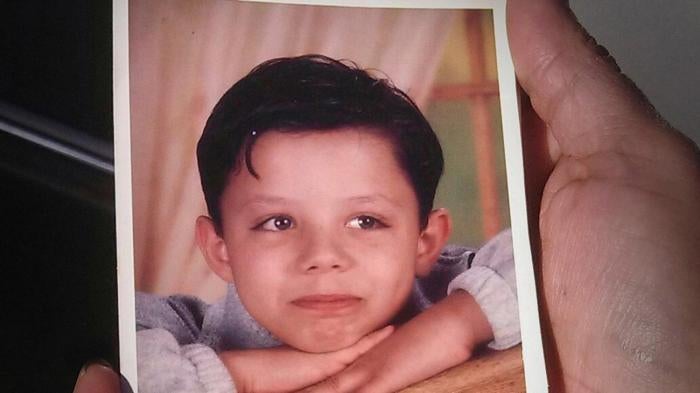
Raised on the Registry
The Irreparable Harm of Placing Children on Sex Offender Registries in the US
Summary
Jacob C. was 11 years old and living in Michigan when he was tried in juvenile court for touching, without penetrating, his sister’s genitals. Found guilty of one count of criminal sexual conduct,[1] Jacob was placed on Michigan’s sex offender registry and prevented by residency restriction laws from living near other children.
This posed a problem for his family— Jacob’s parents were separated, his father lived in Florida, and Jacob could not live in the same house as his little sister. As a result, he was placed in a juvenile home. When Jacob was 14—and still unable to return home—he became the foster child of a pastor and his wife. According to Jacob, the couple helped him to “deal with the trauma” of growing up on the registry.
Since his offense fell under juvenile court jurisdiction, Jacob was placed on a non-public registry. But that changed when he turned 18 during his senior year in high school, and his status as a sex offender became public. Parents of his schoolmates tried to get him expelled and he had to “fight to walk across the stage” at graduation. Jacob attended a local university in Big Rapids, Michigan, but ended up dropping out. “[I was] harassed for being on the registry,” he said. “The campus police followed me everywhere.”
In February 2005, at age 18, Jacob left Michigan to start a new life in Florida and reconnect with his father living there. Jacob worked for his father’s company for a few months. He soon fell in love, married, and had a daughter. A year later, he and his wife divorced, and Jacob was awarded joint custody of his daughter. During this time, Jacob tried to follow Florida’s sex offender laws, but continually ran afoul of residency restrictions that required him to check-in with police on a daily basis and provide them with a home address. At one point, for example, Jacob’s home was too close to a school and he had to move. Another time, he failed to register a new address after a period of homelessness and was arrested and convicted of the felony of failure to register.
While court documents describe Jacob as a doting parent to his daughter, Jacob’s wife came under investigation by Florida’s Department of Children’s Services in 2009 for not having electricity in the house. However, when the court in that case learned of Jacob’s felony conviction for failure to register, the judge denied him custody of his daughter, citing Florida’s Keeping Children Safe Act and the fact that Jacob had a criminal felony conviction for failure to register. Jacob continues to fight for custody and visitation but cannot afford a lawyer because he has been unable to find a job. Now age 26, Jacob was removed from the registry in Michigan in 2011, but remains on the registry in Florida, and his life continues to be defined by an offense he committed at age 11.
***
Jacob’s story is not unique. Throughout the United States, people who commit sex offenses as children (also referred to in this report as “youth sex offenders”) must comply with a complex array of legal requirements that apply to all sex offenders, regardless of age.
Upon release from juvenile detention or prison, youth sex offenders are subject to registration laws that require them to disclose continually updated information including a current photograph, height, weight, age, current address, school attendance, and place of employment. Registrants must periodically update this information so that it remains current in each jurisdiction in which they reside, work, or attend school. Often, the requirement to register lasts for decades and even a lifetime. Although the details about some youth offenders prosecuted in juvenile courts are disclosed only to law enforcement, most states provide these details to the public, often over the Internet, because of community notification laws. Residency restriction laws impose another layer of control, subjecting people convicted of sexual offenses as children to a range of rules about where they may live. Failure to adhere to registration, community notification, or residency restriction laws can lead to a felony conviction for failure to register, with lasting consequences for a young person’s life.
This report challenges the view that registration laws and related restrictions are an appropriate response to sex offenses committed by children. Even acknowledging the considerable harm that youth offenders can cause, these requirements operate as, in effect, continued punishment of the offender. While the law does not formally recognize registration as a punishment, Jacob’s case and those of many other youth sex offenders detailed below illustrate the often devastating impact it has on the youth offenders and their families. And contrary to common public perceptions, the empirical evidence suggests that putting youth offenders on registries does not advance community safety—including because it overburdens law enforcement with large numbers of people to monitor, undifferentiated by their dangerousness.
Human Rights Watch undertook this investigation because we believe the time is right to better understand what it means to be a youth offender raised on the registry. Sex offender laws that trigger registration requirements for children began proliferating in the United States during the late 1980s and early 1990s. They subject youth offenders to registration for crimes ranging from public nudity and touching another child’s genitalia over clothing to very serious violent crimes like rape. Since some of these state laws have been in place for nearly two decades, and the federal law on sex offender registration is coming up on its eighth anniversary, their effects have been reverberating for years.
A Policy Based on a Misconception
Sexual assault is a significant problem in the United States and takes a huge toll on survivors, including children. According to the US Department of Justice (DOJ), there were an estimated 125,910 rapes and sexual assaults in 2009 (the most recent year for which data is available). In an estimated 24,930 of these cases, the victims were between the ages of 12 and 19. The DOJ study did not examine how many of these incidents involved an adult or youth offender. Thus, we do not know how many were similar to the vast majority of the cases investigated for this report—that is, cases of sexual offenses committed by children against another child. Nevertheless, the public and lawmakers have understandable concern, even understandable outrage, about sex crimes. Sex offender registration laws have been put in place to respond to those concerns.
The overlapping systems of sex offender registration, community notification, and residency restrictions were initially designed to help police monitor the “usual suspects”; in other words, to capture the names and addresses of previously convicted adult sex offenders on a list, which could be referred to whenever a new offense was committed. In theory, this was a well-intentioned method to protect children and communities from further instances of sexual assault.
In reality, however, this policy was based on a misconception: that those found guilty of a sex offense are likely to commit new sex offenses. Available research indicates that sex offenders, and particularly people who commit sex offenses as children, are among the least likely to reoffend.
|
Available research indicates that sex offenders, and particularly people who commit sex offenses as children, are among the least likely to reoffend. |
In 2011, the national recidivism rate for all offenses (non-sexual and sexual combined) was 40 percent, whereas the rate was 13 percent for adult sex offenders. Several studies—including one study of a cohort that included 77 percent youth convicted of violent sex offenses—have found a recidivism rate for youth sex offenders of between four and ten percent, and one study in 2010 found the rate to be as low as one percent. These rates are so low that they do not differ significantly from the sex crime rates found among many other (and much larger) groups of children, or even the general public.
A 2006 study of approximately 250 Philadelphia youth sex offenders stated, “[s]ex offending as a juvenile does almost nothing to assist in predicting adult sexual offending.” The study concludes that if the goal of registration is to identify likely future sex offenders, it would be more effective to register youth with five or more contacts with law enforcement for non-sexual offenses than to register youth found guilty or delinquent of a sex offense.
Long-Term Impact on Youth Sex Offenders and Their Families
When first adopted, registration laws neither required nor prohibited inclusion of youth sex offenders. However, by the mid-1990s, many state sex offender registration laws were amended to include children adjudicated delinquent of sex offenses, as well as children tried and convicted of sex offenses in adult court. The resulting policies swept children into a system created to regulate the post-conviction lives of adult sex offenders.
Children accused of sexual offenses were caught at the convergence of two increasingly harsh “tough on crime” policy agendas: one targeting youth accused of violent crimes and the other targeting persons convicted of sexual offenses. In an effort to protect children from sexual assault and hold sex offenders accountable, lawmakers failed to consider that some of the sex offenders they were subjecting to registration were themselves children, in need of policy responses tailored to their specific needs and circumstances.
The harm befalling youth sex offenders can be severe. Youth sex offenders on the registry experience severe psychological harm. They are stigmatized, isolated, often depressed. Many consider suicide, and some succeed. They and their families have experienced harassment and physical violence. They are sometimes shot at, beaten, even murdered; many are repeatedly threatened with violence. Some young people have to post signs stating “sex offender lives here” in the windows of their homes; others have to carry drivers’ licenses with “sex offender” printed on them in bright orange capital letters. Youth sex offenders on the registry are sometimes denied access to education because residency restriction laws prevent them from being in or near a school. Youth sex offender registrants despair of ever finding employment, even while they are burdened with mandatory fees that can reach into the hundreds of dollars on an annual basis.
Youth sex offender registrants often cannot find housing that meets residency restriction rules, meaning that they and their families struggle to house themselves and often experience periods of homelessness. Families of youth offenders also confront enormous obstacles in living together as a family—often because registrants are prohibited from living with other children.
Finally, the impacts of being a youth offender subject to registration are multi-generational—affecting the parents, and also the children, of former offenders. The children of youth sex offenders often cannot be dropped off at school by their parent. They may be banned by law from hosting a birthday party involving other children at their home; and they are often harassed and ridiculed by their peers for their parents’ long-past transgressions.
Onerous Restrictions
Some restrictions imposed on the lives of registrants are so onerous and labyrinthine, it is surprising that registrants actually manage to adhere to them. Many do not. The consequences of running afoul of sex offender registration laws can be severe. The crime of “failure to register” is a felony in many states, carrying lengthy prison sentences. The complex rules and regulations that govern the lives of sex offenders on the registry are particularly difficult to navigate when youth offenders, like the majority of those interviewed for this report, first begin registering when they are still children.
Many youth sex offenders never learn that they will have to register until after they accept a plea deal and often after they serve their time in prison or juvenile detention. This is especially likely to be true of children in the juvenile system, where there is no clear legal obligation that they be informed of the consequences of their admissions of guilt. Youth sex offenders are also sometimes subjected to retroactive registration requirements for offenses committed decades in the past—even after years of living safely in the community. Recent laws, like the Adam Walsh Act, reserve the harshest punishments for those who target children. Yet this means that it is often children themselves who experience these harsher penalties, because their crimes almost always involve other kids.
It is unknown how many persons are subject to registration laws in the United States for crimes committed as children. However, in 2011, there were 747,408 sex offender registrants (adult and youth offenders) in the country. What proportion of these people committed sexual offenses as children is impossible to determine from publicly available national data.
Human Rights Watch tried in various ways to obtain this information, but to no avail. We requested data on offenders registered for crimes committed as children from all 50 states. Two states responded with aggregate counts but we were unable to determine the percentage of total registrants these individuals represent. Our attempts to use public registries to obtain counts were stymied by the fact that states and the federal government do not independently track the age of registrants at offense; moreover, state data may undercount the reality. Since the family members of youth sex offenders often must abide by residency restriction laws if they want to live together, the numbers of people in the US affected by these laws is significant.
Faulty Assumptions About Youth Sex Offenders
Faulty assumptions about youth sex offenders’ tendency to recidivate are but one set of flawed assumptions underpinning registration laws. Registering sex offenders and publicizing information about them is predicated on the idea that sex crimes are committed by strangers. However, evidence suggests that about 86 percent of sex offenses are committed by persons known to the victim. According to the Justice Department, 93 percent of sexually abused children are molested by family members, close friends, or acquaintances. Registration will not protect a victim from a family member.
Moreover, early thinking about juvenile sexual offending behavior was based on what was known about adult child molesters, particularly the adult pedophile, under the mistaken belief that a significant portion of them began their offending during childhood. However, more recent clinical models emphasize that this retrospective logic has obscured important motivational, behavioral, and prognostic differences between youth sex offenders and adult sex offenders and has therefore overestimated the role of deviant sexual tendencies in people convicted of sex offenses as children. More current models emphasize the diversity among children who commit sexual offenses, who in the great majority of cases have a favorable prognosis for never reoffending sexually.
Registering youth sex offenders is bad public policy for other reasons, including the fact it overburdens law enforcement with large numbers of people to monitor, undifferentiated by their dangerousness. With thousands of new registrants added each year, law enforcement is stymied in their attempt to focus on the most dangerous offenders. Sex offender registries treat very different types of offenses and offenders in the same way. Instead of using available tools to assess the dangerousness of particular people who commit sex offenses as children, most sex offender laws paint them all with the same brush, irrespective of the variety of offenses they may have committed and in total denial of their profound differences from adults.
Not all states apply sex offender registration law indiscriminately to youth offenders. In Oklahoma, for example, children adjudicated delinquent of sex offenses are treated in a manner more consistent with juvenile sexual offending behavior. There, a child accused of committing a registerable sex offense undergoes a risk evaluation process reviewed by a panel of experts and a juvenile court judge. The preference is for treatment, not registration, and most high-risk youth are placed in treatment programs with registration decisions deferred until they are released, at which point they may no longer be deemed high-risk. The programs and attention provided by the state to high-risk youth means that very few youth are ultimately registered. The few children that are placed on the registry have their information disclosed only to law enforcement, and youth offenders are removed once they reach the age of 21.
Accountability That Fits
The harm that people convicted of sex offenses as children have caused to victims of sexual assault must be acknowledged, and justice often requires punishment. As a human rights organization, Human Rights Watch seeks to prevent sexual violence and to ensure accountability for sexual assaults.
But accountability achieved through punishment should fit both the offense and the offender. Good public policy should deliver measurable protection to the community and measurable benefit to victims. There is little reason to believe that registering people who commit sexual offenses as children delivers either. Under human rights law, youth sex offenders should be treated in a manner that reflects their age and capacity for rehabilitation and respects their rights to family unity, to education, and to be protected from violence. Protecting the community and limiting unnecessary harm to youth sex offenders are not mutually incompatible goals. Instead, they can enhance and reinforce each other.
Human Rights Watch believes that unless and until evidence-based research shows that sex offender registration schemes or other means of monitoring youth sex offenders have real benefits for public safety, persons convicted of sex offenses committed as children should not be subject to registration, community notification, or residency restriction requirements. If some youth offenders are subject to these laws, they should never be automatically placed on registries without undergoing an individualized assessment of their particular needs for treatment and rehabilitation, including a periodic review of the necessity of registration. Society’s goal should be returning them to the community, not ostracizing them to the point that they and their families are banished from any semblance of a normal life.
Methodology
This report is based primarily on an investigation conducted at Human Rights Watch by Soros Senior Justice Advocacy Fellow Nicole Pittman, between September 2011 and early March 2013. Pittman is considered a leading national expert on the application of sex offender registration and notification laws to children. Before joining Human Rights Watch, she worked as an attorney at the Defender Association of Philadelphia, where she specialized in and consulted nationally on child sexual assault cases and registries. Pittman has provided testimony to numerous legislatures, including the US Congress, on the subject.
In this report, in line with international law, the terms “child” and “children” refer to a person or persons below the age of 18. We use the term “youth sex offender” to describe any person who was below the age of 18 at the time they committed the sex offense that led to their placement on a registry, even if they are now an adult. Individuals who were required to register as sex offenders while they were below age 18 are referred to in this report as “youth registrants” or “child registrants.”
In all, we investigated 517 cases of individuals who committed sexual offenses as children across 20 states for this report, including in Delaware, Florida, Louisiana, Maryland, Michigan, New Jersey, New York, Pennsylvania, Texas, and Washington. Additional information was collected from Arizona, California, Colorado, Georgia, Idaho, Illinois, Iowa, Kansas, Missouri, Nevada, Ohio, South Carolina, Virginia, and Wisconsin.
We conducted in-person interviews with 281 youth sex offenders, as well as immediate family members of another 15, in those 20 states. These 296 in-person interviews form the basis for many of the findings of this report.
Human Rights Watch selected the 20 states because of their geographic diversity and different policy approaches to youth sex offenders. At the time of our research:
- Ten of the 20 research states were deemed to have “substantially implemented” the national Sex Offender Registration and Notification Act (Delaware, Florida, Kansas, Maryland, Michigan, Missouri, Nevada, Ohio, Pennsylvania, and South Carolina).[2]
- Four of the 20 states did not subject any children found delinquent of sex offenses in juvenile court proceedings (as opposed to criminal court proceedings) to sex offender registration (Georgia, Nevada, New York, and Pennsylvania).
- Ten of the states subjected children found guilty in both juvenile and criminal court proceedings to sex offender registration laws, and had done so since the mid-1990s (Arizona, Delaware, Illinois, Kansas, Michigan, Missouri, New Jersey, Texas, South Carolina, and Washington). Several of the states had no minimum age of juvenile jurisdiction and had put children as young as eight on their registries.
- The three states with the largest number of registered sex offenders (adults and children) were California (106,216), Texas (68,529), and Florida (57,896).[3]
In addition to our interviews with people placed on sex offender registries for offenses committed as children, we spoke with family members of registrants, defense attorneys, prosecutors, judges, law enforcement officials, academic experts, juvenile justice advocates, mental health professionals, and victims of child-on-child sexual assault. Individuals placed on the registry for offenses committed as adults were not interviewed for this report.
Approximately 95 percent of the youth offenders we interviewed were found delinquent of sex offenses in juvenile court proceedings; less than five percent were convicted in criminal courts. Many of the registrants were subjected to the same sex offender registration, public disclosure, and residency restrictions as adults.
We identified the majority of interviewees through a written request we posted in a bulletin circulated among loved ones of individuals on registries, mental health treatment providers, juvenile advocates, social workers, and defense attorneys. Approximately 100 interviewees were identified by a search of state sex offender registries. In addition to seeking geographic diversity, we sought registrants from an array of locations (including both rural and urban areas) and ethnic and racial backgrounds.
The overwhelming majority of the individuals interviewed for this report started registering when they were children (under age 18). Registrants were between the ages of 14 and 48 at the time we interviewed them. We made a substantial effort to interview registrants of various ages to better assess the impact of being a child or adolescent on the sex offender registry. The majority of the interviews with youth offenders were conducted at their homes. All interviews were conducted in private. A family member or significant other was present for a portion of most of the interviews.
Interviews were semi-structured and covered a range of topics related to how, if at all, being on the sex offender registry affected aspects of a registrant’s life—such as the ability to go to school, obtain and maintain employment, secure housing, and associate with family. Registrants were also asked a series of questions to determine whether the registrant experienced psycho-social harm, felt vulnerable to or experienced violence, or was subject to discrimination because of his or her status as a registrant.
Before each interview, Human Rights Watch informed each interviewee of the purpose of the investigation and the kinds of issues that would be covered, and asked whether they wanted to participate. A parent or guardian gave permission before contact was made with potential interviewees under the age of 18. We informed interviewees that they could discontinue the interview at any time or decline to answer any specific questions without consequence. No financial incentives were offered or provided to persons interviewed.
Human Rights Watch has disguised with pseudonyms the identities of all interviewees, except in two cases where the degree of publicity surrounding the cases made disguising the identities impossible, and we had the informed consent of the two individuals to use their real names. All documents cited in the report are publicly available or on file with Human Rights Watch.
I. Background
Child-on-Child Sexual Violence in the United States
Sexual violence is a serious problem in the United States. According to a US Department of Justice (DOJ) study, an estimated 125,910 rapes and sexual assaults occurred in the United States in 2009 (the most recent year for which data are available).[4] An estimated 24,930 of the victims were between the ages of 12 and 19 at the time of the assaults.[5] The DOJ study did not examine how many of these incidents involved adult or youth offenders.
While 24,930 incidents of sexual violence against children is a disturbing number, it may be an underestimate. Victim fear, shame, or loyalty to the abuser can each contribute to the underreporting of sexual violence.[6] For example, a study by the National Institute of Justice found that only one in five adult women rape victims (19 percent) reported their rapes to police.[7] Failure to disclose sexual abuse is also common among children.
There is evidence, however, that victims today—including child victims—are more likely to disclose abuse, at least to loved ones, than they once were. Dr. Marc Chaffin, an expert and professor of pediatrics at University of Oklahoma Health Sciences Center, told Human Rights Watch that recent studies suggest that “about half of child victims tell someone.”[8] While this does not necessarily mean more incidents are getting reported to police, it is clear that child victims are more likely to disclose abuse than in decades past.[9]
Historically, the reluctance or inability of survivors of abuse or their family members to report sexual assault crimes has contributed to under-enforcement of the law: the vast majority of sex crimes do not lead to arrests and convictions.[10] A study examining data from 1991 to 1996 found that sexual assaults on child victims were more likely to result in an arrest (29 percent) than were assaults on adults (22 percent), but assaults on children under age six resulted in an arrest in only 19 percent of the cases.[11]
For adults, the emotional and psychological consequences of sexual violence can be profound and enduring and include depression, anxiety, and post-traumatic stress disorder.[12] According to the American Psychological Association, children who have been sexually abused may suffer a range of short- and long-term problems, including depression, anxiety, eating disorders, guilt, fear, withdrawal, self-destructive behaviors, and sexual acting out.[13] This study did not differentiate between the experiences of victims who were abused by adults and those abused by other children. According to Dr. Marc Chaffin, who has studied the specific impacts on child victims of child-on-child sexual offenses,
The overarching summary of the research is this—there are a substantial number of victims who recover and are not highly affected beyond a short time. There is a middle group with moderate effects. And there is a group with severe and often lasting effects.[14]
In many cases, the trauma of child sexual abuse is made more complex because the abuse occurs within the family. Denise, a single mother of two boys, Troy (age 15) and Ted (age 12), recalled the day Ted confided in her that he had been sexually abused by Troy: “Ted explained that ‘he had been touched on his private parts’ by his older brother.”[15] Denise continued, “I felt like I had heard the worst thing a mother can hear. I felt confused and shocked. As I listened to Ted, I began feeling everything through him and seeing it through his eyes. I felt so deeply sad for what he had been through, and I battled with feelings of responsibility. What could I have done to prevent this? Why didn’t I see the signs?”[16] Denise immediately began getting help for both her sons and making sure they were both safe from repeating these behaviors. She stated that it,
[B]ecame clear the boys could not be left alone together. At first, it actually felt like things were getting worse not better, especially when Ted confided in me saying, “I lock my bedroom door at night,” as he described how he fears a visit from his brother…. I wish I could explain what it is like to be the parent of both a child who has been abusing and a child who has been victimized. The feelings are so mixed and confusing. I love both my sons, but at times I felt guilty and ashamed that I cared for Troy even though he had hurt Ted.[17]
Child sexual abuse is a complicated form of harm. The effect sexual violence can have on survivors, their family members, and their communities can be harrowing. After a sexual assault, victims may experience a wide range of emotions, such as sadness, anger, fear, shame, guilt, grief, or self-blame; and they may grow up to experience a variety of psychological, social, relationship, and physical difficulties.[18]Not only are victims left to cope with the very personal and intense after-effects of a sexual assault, but they also must deal with the tangible costs associated with the assault, including medical care, counseling, and potential lost wages.[19] In light of all of this, and given the potential consequences for child victims, ending sexual offenses against children is a legitimate priority.
History of Sex Offender Registration and Notification Laws in the US
In part as a result of high-profile cases of sexual abuse in the late 1980s and 1990s, state and federal policymakers passed an array of registration, community notification, and residency restriction laws for individuals convicted of sex offenses.
- Registration refers to a set of procedures that offenders must follow to disclose information to law enforcement authorities and to periodically update or “register” that information so that it remains current.
- Community notification refers to systems by which information about registrants is transmitted to the public or portions of the public.
- Residency restriction laws refer to mostly state and local ordinances that limit registrants’ ability to live in or spend any time in specific locations (such as near a school).
Each state, US territory, and federally-recognized Indian Tribe now has its own set of sex offender registration, notification, and residency restriction laws. Overlaying this diversity is a series of federal laws.
Early Sex Offender Registration and Community Notification Laws
The first federal law addressing sex offender registration, the Jacob Wetterling Crimes Against Children and Sexually Violent Offender Registration Act of 1994 (the “Wetterling Act”) established a national database of sex offenders and conditioned states’ receipt of federal anti-crime funds on state compliance with the act.[20] Specifically, it required states to create registries of offenders convicted of sexually violent offenses or crimes against children and to establish heightened registration requirements for highly dangerous sex offenders. States moved quickly to implement federal sex offender legislation, with a majority passing notification and registration statutes for adult sex offenders between 1994 and 1996.[21]
Congress passed its first community notification law in 1996 in response to the abduction and murder of seven-year-old New Jersey resident Megan Kanka.[22] Under Megan’s Law, community notification requirements applied only to individuals identified as “potentially dangerous sex offenders.”[23] Community notification systems proliferated rapidly through a series of amendments to Megan’s Law. Some form of community notification for adult sex offenders has been present in all 50 states and the District of Columbia since 1996.
The Lychner Act, passed in 1996, amended the federal community notification laws, providing for a national database to track sex offenders and subjecting certain offenders to lifetime registration and notification requirements.[24] Both of these laws have been superseded by the 2006 Adam Walsh Act (discussed below).[25]
Incorporation of Youth Sex Offenders in Registration and Notification Laws
When first adopted, federal registration and notification laws neither required nor prohibited inclusion of persons convicted of sex offenses as children (youth sex offenders). But by the mid-1990s, many state sex offender registration laws were drafted to include children adjudicated delinquent of sex offenses as well as children tried and convicted of sex offenses in adult court. The resulting policies swept youth sex offenders into a system created to regulate the post-conviction lives of adult sex offenders.
Youth sex offenders were caught at the convergence of two increasingly harsh “tough on crime” policy agendas: one targeting persons convicted of sexual offenses, and the other targeting youth accused of violent offenses, who were often portrayed at the time as “superpredators”—a notion that has since been discredited.[26] The overheated rhetoric surrounding the issue scared the public, and politicians responded, including with increasingly broad laws affecting youth sex offenders. In an effort to protect children from sexual assault and hold sex offenders accountable, lawmakers failed to fully consider that some of the sex offenders they were targeting were themselves children, in need of policy responses tailored to their specific needs and circumstances.[27]
Today, federal law and the laws of all 50 states require adults to register with law enforcement. Eleven states and the District of Columbia do not register any child offenders adjudicated delinquent in juvenile court. However, these 12 jurisdictions do require registration for children convicted of sex offenses in adult court.[28] Thirty-eight states register both children convicted of sex offenses in adult court and those adjudicated in the juvenile system.[29]
State notification laws establish public access to registry information, primarily by mandating the creation of online registries that provide a former offender’s criminal history, current photograph, current address, and other information such as place of employment. In many states, everyone who is required to register is included on the online registry. In the 50 states and the District of Columbia, adults and children convicted in criminal court are generally subject to public notification, meaning that these individuals are included on the online registry. Children adjudicated delinquent in juvenile court are subject to the same public notification as adults in 27 states, allowing for the disclosure of child offenders’ private information to the public.[30]
A growing number of states and municipalities have also prohibited registered offenders from living within a designated distance (typically 500 to 2,500 feet) of places where children gather, such as schools, playgrounds, and daycare centers.
The Adam Walsh Act’s SORNA
In an effort to standardize the vast and growing number of state sex offender registration systems, Congress passed the Adam Walsh Child Protection and Safety Act in 2006.[31] Title I of the Adam Walsh Act, the Sex Offender Registration and Notification Act (SORNA), provides a set of federal guidelines that further expands the breadth of sex offender registration and notification in the 50 states, the District of Columbia, the five US territories, and federally-recognized tribal territories. The Adam Walsh Act did not, in its initial draft, specifically address the situation of child offenders. However, an amendment known as the Amie Zyla Provision expanded the scope of the act to include certain juvenile court adjudications in the act’s definition of “conviction” (children convicted in adult court already fell within the definition).[32]
SORNA made several broad changes to existing federal guidelines on sex offender registration that include, but are not limited to:
- Mandating that children register, if prosecuted and convicted as adults or adjudicated delinquent in family court for a sex offense comparable or more serious than “aggravated sexual abuse or sexual abuse.”[33]
- Establishing a new federal and state criminal offense of “failure to register,” punishable by a term of imprisonment.[34]
- Requiring registration for offenses that may not be considered sexual offenses in some jurisdictions, such as indecent exposure, kidnapping, false imprisonment of a child, public urination, rape, incest, indecency with a child by touching, and possession of child pornography.[35]
- Requiring jurisdictions to reclassify the risk level of each sex offender based solely on the crime of conviction or adjudication, with no reference to individualized risk assessment.[36]
To comply with SORNA, jurisdictions must also require registered offenders to keep their information current in each jurisdiction in which they reside, work, or attend school.[37] Jurisdictions that fail to enact the SORNA guidelines risk losing 10 percent of their Edward Byrne Memorial Justice Assistance federal funding.[38]
After the federal government granted several extensions, the deadline to comply with SORNA was July 2011. Five years after the act was signed into law, no jurisdiction has “completely implemented” SORNA, and only 13 have “substantially implemented” the law. On the deadline, several states signaled that they still were unable to implement SORNA.[39] According to a 2013 US Government Accountability Office (GAO) report on the status of SORNA implementation, as of November 2012, 37 of 56 jurisdictions had submitted complete implementation packages for review, and the US Department of Justice’s (DOJ) Sex Offender Sentencing, Monitoring, Apprehending, Registering, and Tracking (SMART) office had determined that 19 of those jurisdictions (16 states and 3 territories) had substantially implemented SORNA and another 17 had not.[40] The 16 states deemed by the DOJ to have substantially implemented SORNA were Alabama, Delaware, Florida, Kansas, Louisiana, Maryland, Michigan, Mississippi, Missouri, Nevada, Ohio, Pennsylvania, South Carolina, South Dakota, Tennessee, and Wyoming.[41]
An Overbroad Policy of Questionable Effectiveness
Throughout the United States, sex offender registries include offenders convicted for a range of acts, from offensive or vulgar behavior to heinous crimes. Registries create the impression that neighborhoods are thick with recidivist sexual predators, making it impossible for residents, including parents, to discern who actually is dangerous.[42] Sex-offender registries now include not only persons who committed sexually violent offenses or crimes such as kidnapping or false imprisonment of a minor, but also people who have committed offenses like public urination, indecent exposure (such as streaking across a college campus), and other more relatively innocuous offenses. Many people assume that anyone listed on the sex offender registry must be a rapist or a child molester. But most states spread the net much more widely.[43]
Sex offender registration schemes were initially designed to help police monitor the “usual suspects”; that is, to capture the names and addresses of previously convicted adult sex offenders on a list, which could be referred to whenever a new offense was committed. In theory, this was a well-intentioned method to protect children and communities from further instances of sexual assault. In reality, this policy was based on a misconception: that everyone found guilty of a sex offense is a recidivist pedophile. However, according to the National Center on Sexual Behavior of Youth, “most adolescents are not sexual predators nor do they meet the accepted criteria for pedophilia.”[44]
Individuals who commit sexual offenses are not all the same. A one-size-fits-all approach to sex offender registration does not contribute to public safety, especially since, as described further below, the most dangerous offenders are often supervised in the same way as very low-risk offenders who are not likely to commit new sex offenses.
A 2008 report from the Texas Department of Public Safety revealed that the number of registered sex offenders in Texas more than tripled between 1999 and 2008. The 2008 figure was 54,000 offenders, including nearly 7,500 who were placed on the registry for offenses committed as children.[45] Ray Allen, a former chair of the Texas House Corrections Committee who once helped push the tougher sex offender registration bills into law, admitted that he and his colleagues went too far. “We cast the net widely to make sure we got all the sex offenders … it turns out that really only a small percentage of people convicted of sex offenses pose a true danger to the public.”[46]
Does the Registry Prevent Sex Offenses?
Despite the massive growth in the number of registered sex offenders, studies of states that have implemented registration requirements are inconclusive as to whether the registries have any effect on the incidence of reported sex offenses. One study of 10 states with registries concluded that “the results do not offer a clear unidirectional conclusion as to whether sex offender notification laws prevent rapes.”[47] A study in New Jersey found that sex offense rates have been on a consistent downward trend since 1985, with the data showing that the greatest rate of decline in sex offending occurred prior to 1994 (the year registration laws were passed) and the least rate of decline occurred after 1995 (the year registration laws were implemented).[48] There are at least three flaws that help to explain the ineffectiveness of sex offender registries in deterring crime.
First, sex offender registries are focused on preventing recidivism, when instead the focus should be on deterring the first offense from ever happening.[49] The focus on recidivism is misguided because sex offenders are among the least likely to reoffend. Individuals labeled as “sex offenders” have extremely low recidivism rates when compared to persons convicted of robbery, non-sexual assault, burglary, larceny, motor vehicle theft, fraud, drug offenses, and public order offenses.[50] The only type of offense with lower recidivism rates is homicide.[51]
As discussed in detail in the following chapter, youth offenders, including youth sex offenders, have even lower rates of recidivism than adults. The emotion provoked by the sexual abuse of a child is powerful—powerful enough to make many overlook the embedded false presumptions and misperceptions about risks of reoffending, especially with regard to children who have committed sexual offenses against other children.[52] But research indicates that these terrible crimes are extremely unlikely to be committed by an individual who was labeled a sex offender as a child.
Second, sex offender registration overburdens law enforcement. Detective Bob Shilling, a 29-year decorated veteran of the Seattle Police Department who spent 20 years as a detective in the Special Victim’s Unit, Sex and Kidnapping Offender Detail, for the Seattle Police, explained how his officers were required to make home visits to registered sex offenders. He stated that focusing attention and resources on an overly broad group of ex-offenders detracts attention from the smaller number of sexually violent offenses that occur, leaving communities vulnerable to sexual abuse, creating a false sense of security, and exhausting valuable resources by tracking the “wrong offenders”—that is, individuals not likely to ever reoffend sexually. The detective said, “the most recent laws dilute the effectiveness of the registry as a public safety tool, by flooding it with thousands of low risk offenders like children, the vast majority of whom will never commit another sex offense.”[53]
Third, registration fails to target resources where they are most needed. Federal guidelines adopted under SORNA risk worsening the problem by mandating that states eliminate the use of risk assessment tools to help identify those offenders who are likely to reoffend. Instead, as noted above, the guidelines require states to use “crime of conviction” as the sole means to classify offenders. Detective Schilling described the focus on crime of conviction “inherently flawed,” because sex offenders differ greatly in their level of impulsiveness, persistence, risk to the community, and desire to change their deviant behavior. Assigning sex offender tiers based on crime of conviction provides very little information about who a sex offender is and what his or her risk for reoffense may be.[54] All of these factors add more nonviolent, lower risk offenders to the registry—including youth offenders. While the sex offender database grows exponentially, funding for monitoring sex offenders is on the decline.[55]
A 2011 review of state sex offender registration legislation applied to child offenders found that only a small number of states were registering child sex offenders based solely upon the type of offense. [56] Most states that included child offenders in pre-SORNA registration schemes also designed safeguards to protect them, such as judicial discretion, consideration of individual circumstances, assessment of risk, or early termination of juvenile registration. The authors of the survey characterized these findings as noteworthy because “the need to comply with SORNA is pushing states in the opposite direction.” [57]
II. Children Are Different
[C]hildren are constitutionally different from adults.… [J]uveniles have diminished culpability and greater prospects for reform … [and] are less deserving of the most severe punishments.… [C]hildren have a lack of maturity and an underdeveloped sense of responsibility … [c]hildren are more vulnerable … to negative influences and outside pressures … [a]nd … a child’s character is not as well formed as an adult’s.
—Miller v. Alabama, United States Supreme Court, 2012 (No. 10‐9646, slip op. at 8 (2012)).
Federal and state laws on sex offender registration and notification fail to take into account relevant—indeed, fundamental—differences between children and adults. These include not only differences in cognitive capacity, which affect their culpability, but also differences in their amenability to rehabilitation, in the nature of their sexual behaviors and offenses and in the likelihood that they will reoffend. Indeed recent laws, like the Adam Walsh Act, reserve the harshest punishments for those who target children without seeming to appreciate that child offenders, whose crimes almost always involve other kids, are particularly likely to be subjected to these harsher penalties. As noted by Berkeley law professor Frank Zimring, “nobody is making policy for 12-year-olds in American legislatures.… What they’re doing is they’re making crime policy and then almost by accident extending those policies to 12-year-olds—with poisonous consequences.”[58]
Cognitive and Developmental Differences
It is axiomatic that children are in the process of growing up, both physically and mentally. Their forming identities make young offenders excellent candidates for rehabilitation—they are far more able than adults to learn new skills, find new values, and re-embark on a better, law-abiding life. Justice is best served when these rehabilitative principles, which are at the core of human rights standards, are at the heart of responses to child sex offending.
Psychological research confirms what every parent knows: children, including teenagers, act more irrationally and immaturely than adults. Adolescent thinking is present-oriented and tends to ignore, discount, or not fully understand future outcomes and implications.[59] Children also have a greater tendency than adults to make decisions based on emotions, such as anger or fear, rather than logic and reason.[60] And stressful situations only heighten the risk that emotion, rather than rational thought, will guide the choices children make.[61] Research has further clarified that the issue is not just the cognitive difference between children and adults, but a difference in “maturity of judgment” stemming from a complex combination of the ability to make good decisions and social and emotional capability.[62]
Neuroscientists are now providing a physiological explanation for the features of childhood that developmental psychologists—as well as parents and teachers—have identified for years.[63] MRI (magnetic resonance imaging) images of the anatomy and function of the brain at different ages and while an individual performs a range of tasks reveal the immaturity of the portions of children’s brains associated with reasoning and emotional equilibrium.[64] It is in large part these developmental and cognitive differences that have caused the US Supreme Court to conclude that juveniles are “categorically less culpable” than adults when they commit offenses.[65]
Moreover, the fact that young people continue to develop into early adulthood suggests that they may be particularly amenable to change.[66] “The reality that juveniles still struggle to define their identity,” noted the US Supreme Court in its 2005 Roper v. Simmons decision, “means it is less supportable to conclude that even a heinous crime committed by a juvenile is evidence of irretrievably depraved character.”[67] Both criminologists and development experts agree that “[f]or most teens, these [risky or illegal] behaviors are fleeting. Only a relatively small proportion of adolescents who experiment in risky or illegal activities develop entrenched patterns of problem behavior that persist into adulthood.”[68]
Child Sexual Misconduct: A Distinct and Varied Set of Behaviors
The image of the adult sexual predator is a poor fit for the vast majority of children who commit sexual offenses. Children are not merely younger versions of adult sexual offenders.[69]
Current science contradicts the theory that children who have committed a sexual offense specialize in sexual crime, nor is there any evidence of the kind of fixed, abnormal sexual preferences that are part of the image of a pedophile.[70] Although those who commit sex offenses against children are often described as “pedophiles” or “predators” and are assumed to be adults, it is important to understand that a substantial portion of these offenses are committed by other youth who do not fit such labels.
Dr. Marc Chaffin, a leading expert on child sexual offending behavior and professor of pediatrics at the University of Oklahoma Health Sciences Center, explains that “early thinking about juvenile sex offenders was based on what was known about adult child molesters, particularly adult pedophiles, given findings that a significant portion of them began their offending during adolescence.” However, current clinical typologies and models suggest that this assessment is flawed.[71] In fact, empirical evidence, as discussed below, shows that if a history of child sexual offending is used to predict a person’s likelihood of future sex offending, that prediction would be wrong more than nine times out of ten.[72]
Compared to adult sexual offending, sexual misconduct by children is generally less aggressive, often more experimental than deviant, and occurs over shorter periods of time.[73] That said, there is considerable diversity in the sexual behaviors that bring children into clinical settings. Child sex offenses range from “sharing pornography with younger children, fondling a child over the clothes, [and] grabbing peers in a sexual way at school, [to] date rape, gang rape, or performing oral, vaginal, or anal sex on a much younger child.”[74] Enormous diversity also exists within the population of children who commit sex offenses.[75] One expert explains that the population includes:
Traumatized young girls reacting to their own sexual victimization; persistently delinquent teens who commit both sexual and nonsexual crimes; otherwise normal early-adolescent boys who are curious about sex and act experimentally but irresponsibly; generally aggressive and violent youth; immature and impulsive youth acting without thinking; so-called Romeo and Juliet cases; those who are indifferent to others and selfishly take what they want; youth misinterpreting what they believed was consent or mutual interest; children imitating actions they have seen in the media; youth ignorant of the law or the potential consequences of their actions; youth attracted to the thrill of rule violation; youth imitating what is normal in their own family or social ecology; depressed or socially isolated teens who turn to younger juveniles as substitutes for age-mates; seriously mentally ill youth; youth responding primarily to peer pressure; youth preoccupied with sex; youth under the influence of drugs and alcohol; youth swept away by the sexual arousal of the moment; or youth with incipient sexual deviancy problems.[76]
Youth sex offenders come from a variety of social and family backgrounds.[77] In some cases, a history of childhood sexual abuse appears to contribute to child sexual offending behavior, but most child sex abuse survivors do not become sex offenders in adolescence or adulthood.[78] Some child offenders have experienced significant adversity, including maltreatment or exposure to physical violence; others have not.
Many of the sexual behaviors of youth are problematic, and need to be addressed in a clinical setting or by the justice system, but placing children who commit sex offenses on a registry—often for life— is going too far.
Recidivism of Youth Sex Offenders
As noted above, there is no scientific foundation for the belief that children who commit sexual offenses pose a danger of future sexual predation.[79] Once detected, most adolescents who have engaged in sexually abusive behavior do not continue to engage in these behaviors.[80] Studies consistently find that adult sex offenses are committed by individuals not known to have been youth sex offenders.[81]
Recidivism rates for youth sex offenders are consistently low. One study that included a cohort composed mostly of youth convicted of violent sex offenses found a recidivism rate of 10 percent.[82] Several studies have found recidivism rates for all youth sex offenders (violent and nonviolent offenses) at between four and seven percent, and one recent study found the rate to be as low as one percent.[83] A meta-analysis that reviewed 63 data sets reporting on the re-offense behavior of 11,219 youth sex offenders found an estimated mean sexual recidivism rate of 7.08 percent across a 5-year follow-up period.[84] These rates should be compared with a 13 percent recidivism rate for adults who commit sexual offenses[85] and a national recidivism rate of 40 percent for all criminal offenses.[86]
A 2007 study by University of California, Berkeley law professor Franklin Zimring found that youth sex offenders have “a low volume of sexual recidivism during their juvenile careers, and an even lower propensity for sexual offenses during young adulthood.”[87] Another study found that when youth sex offenders are re-arrested, it is “far more likely to be for nonsexual crimes such as property or drug offenses than for sex crimes.”[88] One of Zimring’s studies found that youths with five or more arrests for offenses other than sex offenses pose twice the risk of being arrested in adulthood for a sex offense than do youth sex offenders with fewer than five arrests.[89] Given the low rates of recidivism among youth sex offenders, Zimring points out that if the goal of sex offender registration is to compile a list of names of possible future sex offenders, it would be more effective to register youth offenders with five or more contacts with law enforcement for non-sexual offenses as potential future sex offenders than to register youth sex offenders.
III. Who are Youth Sex Offender Registrants?
The enactment across the United States of increasingly comprehensive sex offender registration laws has brought predictable results: the number of individuals (adult and youth offenders) placed on sex offender registries has exploded. In February 2001, approximately 386,000 individuals nationwide were listed on sex offender registries.[90] By 2011, there were 747,408 registered sex offenders in the country.[91]
While it may be safe to assume that the number of registered youth offenders has expanded alongside adult registrants, there are no disaggregated national statistics on youth sex offenders. This chapter therefore contains information Human Rights Watch culled mainly from our interviews with 281 youth sex offenders and the family members of another 15 youth (comprising 296 cases).[92] The interviewees were identified through chain-referral sampling (where attorneys, family members, advocates, and registrants recruit future subjects from among their networks), so the resulting data involves selection bias.[93] Even with that limitation, our interviews provide important insights into the backgrounds of many youth offenders on sex offender registries.
Age
Throughout the United States, children as young as nine years old who are adjudicated delinquent may be subject to sex offender registration laws. For example, in Delaware in 2011, there were approximately 639 children on the sex offender registry, 55 of whom were under the age of 12.[94] In 2010, Michigan counted a total of 3,563 youth offenders adjudicated delinquent on its registry, a figure that does not include Michigan’s youth offenders convicted in adult court.[95] In 2010, Michigan’s youngest registered sex offenders were nine years old.[96] A 2009 Department of Justice study, which focused only on sex crimes committed by children in which other children were the victims, found that one out of eight youth sex offenders committing crimes against other children was younger than 12.[97]
Human Rights Watch recorded several important dates for each of the youth sex offenders interviewed for this report, allowing us to determine their age at conviction and the age they were first placed on the registry. The median age at conviction or adjudication was 15. The median age at first registration was 16. Eight interviewed registrants were age 10 or younger at the time of their conviction and when registration began, with the youngest being 9 years old. A full 84 percent of those interviewed by Human Rights Watch were 17 years old or younger when they began registering.
Offenses
Most jurisdictions mandate registration of children convicted of a wide range of sex offenses in adult court. The federal Sex Offender Registration and Notification Act (SORNA) expanded the range of sex offenses requiring registration.[98] Notably, it was expanded to include certain sex offenses committed by children adjudicated delinquent in juvenile court.[99] Under the Act, a “sex offense” includes offenses having “an element involving a sexual act or contact with another”;[100] “video voyeurism”; having possession, producing, or distributing child pornography; and “[a]ny conduct that by its nature is a sex offense against a minor.”[101] The “sexual act[s]” or “contact” covered under SORNA include (i) oral-genital or oral-anal contact, (ii) any degree of genital or anal penetration, and (iii) direct genital touching of a child under the age of 16.[102]
Implementation of registration, including the federal SORNA provisions, varies across jurisdictions, resulting in a wide variety of offenses and offenders triggering registration requirements. For example:
- In Kansas, any child convicted of a sex offense in adult court is subject to the same registration requirements as adults. Juveniles adjudicated delinquent for a sex offense in Kansas are also subject to registration for a long list of offenses including rape, indecent liberties with a child, criminal sodomy, indecent solicitation of a child, aggravated incest, electronic solicitation, and unlawful sexual relations. The list also includes attempt or conspiracy to commit the above crimes, criminal solicitation of the crimes, or “any act determined beyond a reasonable doubt to have been sexually motivated.”[103]
- In Arkansas, the courts have discretion to order registration requirements for youth offenders convicted in adult court as well as children adjudicated delinquent for “any offense with an underlying sexually motivated component.”[104]
- Maryland applies registration requirements to youth offenders convicted in adult court, but has different requirements for children adjudicated delinquent.[105]
The following are examples of the wide range of offenses that can trigger registration requirements for youth sex offenders:
- In 2005, in Orange County, California, three boys were convicted of sexually assaulting a 16-year-old girl and videotaping the incident. The crime occurred when one of the boys was 16 and two were 17 years old. All three are subject to sex offender registration requirements.[106]
- In 1997, in Texas, a 12-year-old boy pled guilty to aggravated sexual assault. He inappropriately touched a 7-year-old girl at his babysitter’s house. After completing two years of juvenile probation and therapy, he had to register for ten years. He was finally removed from the registry at age 25.[107]
- In 2004, in Western Pennsylvania, a 15-year-old girl was charged with manufacturing and disseminating child pornography for having taken nude photos of herself and posted them on the internet. She was charged as an adult, and as of 2012 was facing registration for life.[108]
- In March 2010, in Bethlehem, Pennsylvania, an 18-year-old young man pled guilty to two felony counts of sexual assault and two of indecent assault, which will require him to register. The crimes occurred between October 2003 and December 2008, when the offender was between 11 and 16 years old, and involved multiple rapes of a six- or seven-year old girl and a six-year-old boy.[109]
- In 2006, a 13-year old girl from Ogden, Utah was arrested for rape for having consensual sex with her 12-year-old boyfriend. The young girl, impregnated by her younger boyfriend at the age of 13, was found guilty of violating a state law that prohibits sex with someone under age 14. Her 12-year-old boyfriend was found guilty of violating the same law for engaging in sexual activity with her, as she was also a child under the age of 14 at the time.[110]
- In 2000, in New Jersey, then-12-year-old T.T. inserted a “douche” (feminine product) in his 6-year-old half-brother’s anus on one occasion.[111] When asked why he did it, T.T. responded, “I don’t know.”[112] T.T. subsequently pled guilty to aggravated sexual assault and was sent to a juvenile placement. After incarceration, T.T. was given three years of probation and required to register for life.
- In 1997, Stella A., a 17-year-old high school student, was arrested and pled guilty to sodomy for performing consensual oral sex on a 15-year-old male classmate.[113] Stella was placed on probation and required to register on the state’s sex offender registry. Her photograph, address, and identifying information were publicly available for neighbors and the public to see.
The 296 cases examined for this report had a total of 352 convictions (often due to multiple charges arising from the same incident).[114] For purposes of practicality, we grouped the convictions into 53 offense categories, based on similar offense descriptions. Sexual battery was the most common category of conviction, followed by “lewd lascivious molestation” and “unlawful criminal sexual contact.”
|
Offense Category |
Number of Convictions |
Percentage of Convictions |
|
Sexual Battery |
70 |
7.6% |
|
Lewd Lascivious Molestation |
38 |
4.1% |
|
Unlawful Criminal Sexual Contact |
34 |
3.7% |
|
Sexual Assault |
24 |
2.6% |
|
Aggravated Sexual Assault – Child |
21 |
2.3% |
|
Sexual Abuse |
13 |
1.4% |
|
Rape |
11 |
1.2% |
|
Sodomy |
10 |
1.1% |
|
Sexual Battery (multiple counts) |
10 |
1.1% |
|
Indecency with a child – contact |
10 |
1.1% |
|
There were an additional 111 convictions in 43 other crime categories |
||
|
Total |
352 |
Statutory RapeWhen sexual interactions involve a non-consenting party, the sexual interactions are, by definition, abusive.[115] In these circumstances, the person (adult or child) who forces sex is referred to as the “perpetrator” and the non-consenting person is recognized as a “victim” of sexual abuse.[116] When it comes to child-on-child sexual behavior, the lines between “willingness” and “consent” often become blurred.[117] A child may be “willing” to engage in sexual interactions with a peer, but however willing they may be in one sense, children do not have the psychological capacity to give consent.[118] Therefore, in a state in which the legal age of consent is 14 years old, a 14-year-old female engaging in consensual sexual interactions with her 13-year-old neighbor is a crime. Under many current laws, she could be adjudicated delinquent and required to register as a sex offender. Some children are convicted and required to register after engaging in allegedly consensual sex with other children. These cases, known as statutory rape cases, have received a great deal of press attention and have in some cases led states to reform their laws so that children convicted of statutory rape are not required to register. The intent of sex offender registration and notification laws is to protect children from sexual victimization and exploitation by adults,[119] and it was not the original intent of federal legislators to criminalize sexual interactions between adolescent peers when there is no evidence of coercion.[120] Unfortunately, such criminalization occurs all too frequently. For instance, in Michigan, 17-year-old Alexander D. was convicted of criminal sexual conduct for having sex with his 15-year-old girlfriend.[121] He has been registering as a sex offender since 2003. Alexander and his girlfriend met when they were freshmen in high school and dated for nearly a year before having sex. In Michigan, the legal age of consent is 16.[122] Alexander has been penniless, has lost jobs, and has been called a “pedophile” by passing strangers.[123] His girlfriend’s parents have written letters on his behalf, asking for his removal from the registry. However, Alexander will remain on the sex offender registry until the year 2028. In Florida, an 18-year-old boy, Grayson A., had sex with his 15-year-old girlfriend. The girlfriend, Lily A., became pregnant and the couple got married. Despite their marriage, Grayson was arrested and subsequently convicted of “lewd or lascivious molestation.” Originally charged with rape, Grayson pled no contest to the lewd or lascivious molestation charge.[124] He served two years in prison and was required to register as a sex offender for life.[125] The couple, now ages 31 and 35, have two children together. In a 2009 interview, Grayson stated that he lost at least 17 jobs because of being on the sex offender registry.[126] Because his wife was also his victim, the couple could not live together. Grayson became homeless and ended up living in his car.[127] In 2008, the couple consulted a lawyer to challenge the impact the law was having on their family. In 2009, Attorney General Bill McCollum voted to pardon the conviction and remove Grayson from Florida’s registry.[128] |
Date of Registration, Race, and Gender
States and local jurisdictions have had registration systems in place for more than two decades; however, with the advent of federal efforts to set minimum registration standards in 1994, followed by the passage of Megan’s Law in 1996, more and more youth offenders became subject to registration. With SORNA’s passage in 2006, registrations increased. Among those interviewed by Human Rights Watch for this report, the majority were first placed on sex offender registries between 2007 and 2011. Over 60 percent of the interviewees had been registered for five years or less at the time of our interviews with them.
Although there are no national statistics on the race and gender of youth offenders subject to sex offender registration, a 2009 Department of Justice study of youth offenders, examining 2004 data on youth offenders committing sex offenses against other children, found that 93 percent of the offenders were male.[129] The study did not examine the race of the youth offenders or their victims. Among the youth offenders interviewed by Human Rights Watch for this report, 96.6 percent were male, 60 percent were white, 31 percent were black, and 5.7 percent were Latino.
IV. Registration of Youth Offenders in Practice
After they have served out their sentences in juvenile detention or prison, youth sex offenders must comply with a complex array of legal requirements applicable to all sex offenders, whether children or adults. Under sex offender registration laws, youth offenders must register with law enforcement, providing their name, home address, place of employment, school address, a current photograph, and other personal information.
Perhaps the most onerous aspects of registration from the perspective of the youth offender are the community notification and residency restriction requirements, which can relegate a youth sex offender who has served their time to the margins of society. Under community notification laws, the police make registration information accessible to the public, typically via the Internet. And under residency restriction laws, youth sex offenders are prohibited from living within a designated distance of places where children gather, such as schools, playgrounds, parks, and even bus stops. These requirements can apply for decades or even a youth offender’s entire life.
Read in isolation, certain sex offender registration requirements may appear reasonable and insignificant to some. It is only once the totality of the requirements, their interrelationship, and their operation in practice are examined that their full impact can be understood.
Community Notification for Youth Offenders
Community notification involves publicizing information about persons on sex offender registries. States and the federal government provide information about sex offenders through publicly accessible websites. Communities are also notified about sex offenders in their area through public meetings, fliers, and newspaper announcements. Some jurisdictions have expanded notification to include highway billboards, postcards, lawn signs, and publicly available and searchable websites produced by private entities. One youth offender told Human Rights Watch, “I have to display a sign in my window that says
‘Sex Offender Lives Here’.”[130]
|
A series of newspaper clippings that a father of two sons has collected over the years. The two sons are listed on the public sex offender registry for offenses committed when they were ages 9 and 11, and they were often publicly named in the local newspapers. © 2013 Mariam Dwedar/Human Rights Watch |

Community notification was initially reserved for offenders classified as having a high risk of reoffending. But today, every jurisdiction that registers sex offenders also makes publicly available certain information about them, regardless of individual risk classifications and irrespective of the fact that a registrant was a youth offender.
Community notification, as the term is commonly understood, embraces both the public disclosure of registrants’ information and the disclosure of the information to law enforcement officials only (the latter is often called “non-public” community notification). However, as discussed below, the capacity of states and law enforcement to protect the integrity of “non-public” community notification is eroding.
Public Disclosure of Child Registration Information
With the passage of SORNA in 2006, federal guidelines for community notification became more stringent, requiring that states post on publicly accessible websites the picture, home address, and location of the school and employer of certain categories of sex offenders—whether or not they were juveniles at the time of the offense. The state
websites are linked together via the National Sex Offender Public Website (NSOPW). [131]
Since 2007, the number of states subjecting children to community notification via the internet has grown as jurisdictions passed legislation to come into compliance with SORNA.[132] As noted by one expert, “[t]hat means on many state sex-offender web sites, you can find juveniles’ photos, names and addresses, and in some cases their birth dates and maps to their homes, alongside those of pedophiles and adult rapists.”[133]
The Department of Justice (DOJ) received hundreds of critical public comments about the treatment of children as adults for purposes of public notification.[134] Perhaps as a result, under the Supplemental SORNA Guidelines issued on January 11, 2011, DOJ allowed “jurisdictions to use their discretion to exempt information concerning sex offenders required to register on the basis of a juvenile delinquency adjudication from public Web site posting.”[135] However, as of January 2013, not one state previously deemed in compliance with SORNA went back to amend its laws to exempt children from public disclosure.[136]
As of 2011, most jurisdictions subjected children convicted of sex offenses in adult court to the same community notification regimes as adult sex offenders.[137] Fourteen states apply the same notification standards applied to adults to both children convicted in adult court and children adjudicated delinquent of sex offenses.[138] Other states give judges some discretion over which youth sex offenders are subject to community notification. Some jurisdictions permit youths to petition to be removed after a number of years. In some states, a juvenile adjudicated delinquent has to be 14 to be listed on public sex-offender registries. In others, children may be eligible for public Internet community notification at age 10, 11, or 12.[139] Handling of photographs varies as well by state: some jurisdictions do not post the picture of children unless they reoffend, while others post the image of a child upon their initial registration at ages as young as 9, 10, 12, or 14.
“Non-Public” Notification
Even in jurisdictions requiring disclosure of registry information only to law enforcement agencies (also known as “non-public” disclosure), a child’s information and picture can be, and often is, still disseminated publicly. Members of the public can obtain information on non-public registrants upon request and, with a few clicks of a button, widely disseminate a child’s photograph and personal information.
Youth sex offender registrants interviewed for this report described various ways in which their photographs and personal information were made public even when not posted on official state sex offender registration websites:
- Nicholas T. was placed on the registry at the age of 16 for the attempted rape of a younger neighbor.[140] He stated that “a member of the community made flyers that said ‘Beware – Sex Offender in the Neighborhood.’ The flyers, with my grade school picture, offense, and address, were posted all over the place.”[141]
- “My son, [Max B.], started registering at the age of 10 when he was found guilty of inappropriately touching his 8-year-old sister. The local police assured us that they would allow him to register as a non-public registrant until he turned 12. However, a few months after [Max] went on the registry, the local newspaper ran a Halloween story entitled ‘Know where the Monsters are Hiding,’ warning families to beware of the registered sex offenders in the neighborhood when taking their little ones out to go trick-or-treating. The article listed all the sex offenders in our town. [Max’s] name and address was listed.”[142]
- The police in a small town in Illinois created a “Wall of Shame” containing photographs, names, and addresses of all the registered sex offenders in the area, including child registrants and those deemed low-risk and subject to law-enforcement registration only. People from the town frequently visit the police station to check out the wall of shame.[143]
Official sex offender registration information is also available for purchase or use by private security companies, which sometimes create their own searchable web-based sex offender registries. Companies such as Offendex (also known as The Official Sex Offender Archive©) and HomeFacts (also known as RealtyTrac Holdings, LLC™) transfer all state sex offender registration information, including registrant pictures and addresses, to their websites, iPhone/Droid Android applications, or Facebook, to be searched freely by anyone. These companies appear to take no responsibility for deleting records of persons removed from the registry.[144] The Offendex website indicates that the company distinguishes itself from official government records because it includes “both current and past sex offender records nationwide.”[145] Stating that “[e]ven if the sex offender is not required to register that does not mean the record itself goes away [sic]. The information is still public and available through many court and private databases nationwide.”[146]

A newspaper clipping that a father retained regarding the location of sex offenders on Halloween. According to the law, on Halloween registered sex offenders must remain inside their homes, turn the porch light off, and place a sign in their yard that states, “No candy at this residence.” Local police officers also make home visits to ensure compliance. © 2013 Mariam Dwedar/Human Rights Watch.
Maya R.Maya R., now age 28 and a resident of Michigan, was arrested at the age of 10 for sexual experimentation. “Me and my step brothers, who were ages 8 and 5, ‘flashed’ each other and play-acted sex while fully-clothed.”[147] A year later, Maya pled guilty to the charges of criminal sexual conduct in the first and second degree, offenses that required her to register as a sex offender for 25 years.[148] In court proceedings, Maya told the judge that she engaged in sexual activity with both boys. However, she says she lied in court to get away from her stepmother.[149] Maya was committed to a girl’s juvenile prison and spent 18 months there. “I successfully completed the treatment program and was released back into the community.”[150] Upon her return, she says, she felt like a stranger. “[W]hen I was arrested I was in the sixth grade. When I returned from prison I was in the ninth grade. I was on probation from 1998 to 2002 while I attended high school. I also wrote for my school’s newspaper, sang in the choir, performed in theatre, was involved with Students Against Drunk Driving (SADD), and was the president of Diversity Club.”[151] In 1999, when Maya turned 18, her photograph and name were added to the state sex offender public website.[152] In Michigan all children, whether adjudicated delinquent in juvenile court or tried as adults, must register.[153] While children adjudicated delinquent are still under 18 years of age, juvenile registration and included materials are exempt from the public notification requirements.[154] However, public registration is required when the child, adjudicated for certain sexual offenses, turns 18 years old.[155] As a result of being placed on the public registry, Maya was fired from her job. “Despite the setback, I graduated high school in 2002 with academic and leadership honors and took the next step of applying to college,” she said.[156] In her freshman year of college, Maya lived in the campus dormitory. She says she “found angry messages taped to her dorm room door and received threatening instant messages.”[157] She eventually had to move out of the dorm. “Even more stressful than students in the dorms telling me to ‘move out or else,’ was the constant inability to find and keep employment.”[158]Maya moved into off campus housing but quickly ran out of money and could not get a job. Maya said she was forced to drop out of college. “Without student loans to survive off of, I lived in a homeless shelter for about 90 days, I was told by managers at Subway, Burger King, and McDonalds, ‘We don’t hire sex-offenders,’ I was without a car, and also could not afford a cell phone.”[159] Maya told us, “Being on the registry has caused much stress and frustration in my life. The laws make it very difficult for me locate places where I can live. Once while attempting to register my address, a police officer refused to give me the paperwork and instead stated, ‘We’re just taking your kind out back and shooting them.’ This comment, coupled with not being able to get an internship, or a job, all contributed to me falling into a depression, which still comes and goes depending on the discrimination I experience each day.”[160] Despite her the sex offender label, Maya continued to try to find ways to succeed. She worked as a missionary and taught English overseas. While abroad, she fell in love and married a Filipino man. As of early 2013, Maya and her husband were living in Michigan with a two-year-old girl and a baby boy on the way. |
Residency and Zoning Restrictions
Officials in many jurisdictions have imposed residency and zoning restrictions on registered sex offenders, including children.[161] Local ordinances prohibit registrants from residing in or traveling within a certain distance of schools, day care centers, parks, and other locations where children commonly congregate.[162]
Yet research on the effectiveness of residency restrictions imposed on adult sex offenders offers no indication that these laws achieve their intended goals of preventing abuse, protecting children, or reducing reoffending.[163] For example, recidivism by adult sex offenders is not more likely to occur near schools.[164] Rather, abuses happen when adults are able to establish relationships with children and their families and misuse positions of familiarity, trust, and authority[165] Children are most likely to be assaulted by people they know, not strangers lurking in schoolyards.
In 2002, Iowa enacted a law that prohibits sex offenders from living within 2,000 feet of a school or daycare center. The executive director of the Iowa County Attorneys Association, Corwin R. Ritchie, said that the law “has overburdened law enforcement, has concentrated sex offenders in areas where they are allowed to live and has led to an increase in the number of sex offenders who have stopped registering with local authorities and gone missing.[166] Further, Ritchie contended, “I defy anyone to try and convince me, scientifically or logically that those requirements have any affect at all. It makes great sense politically, but has no affect [sic] whatsoever on public safety.”[167]
Because residency restrictions have such questionable utility in deterring offenses committed by adults, there is little reason to expect they would deter children from committing sex offenses. Meanwhile, sex offender residency restrictions have been shown to increase transience, homelessness, and instability.[168]
Duration of Registration
The duration of registration required of youth offenders convicted in adult court is, in most states, the same as that required of adults. But children adjudicated delinquent are often subject to shorter requirements or may petition to be removed from the registry. Federal SORNA, however, is changing the required minimum duration of registration, establishing a “tier” system based on the offense (whether criminal conviction or adjudication in juvenile court), with Tier I offenses having the lightest and Tier III the most stringent requirements. Under SORNA, children convicted of offenses categorized in Tier III are required to register for life. The following are two examples of youth offenders subject to lifetime registration requirements:
- In New Jersey in 1995, ten-year-old J.G. pled guilty in juvenile court to second-degree sexual assault of his cousin, an eight-year-old girl. J.G. received a suspended sentence on condition that he attend a family therapy program and not be left unsupervised with young children. J.G. got into no further trouble. But 16 months after successfully completing treatment, J.G. was notified that under New Jersey’s newly enacted “Megan’s Law,” he would be required to register with local police as a sex offender for the rest of his life.[169]
- In Texas, a juvenile court found ten-year-old Gabriel P. guilty of indecency with a child (touching) in an incident in which he and his two friends were playing with a seven-year-old cousin. He is subject to lifetime registration.[170]
Even when registration is limited in duration, youth offender registrants can experience severe difficulties and high costs in purging their information from the registry. One told Human Rights Watch, “My 10 years of registration was supposed to end on September 27, 2012. It is now 2013 and I am still on the state website and all those other registration sites. I feel like it will never end.”[171] Another told us, “Even though the law stated that I was to be removed from the registry, I had to pay over $3,000 in fees to have my name completely removed from all the various websites.”[172]
V. Life on the Registry
Sex offender registration and notification laws impose harsh, sometimes debilitating, and often lifelong sanctions on children convicted or adjudicated guilty of sex offenses. Many of the individuals interviewed for this report described being placed in a juvenile facility for a few years after being found guilty of the underlying sex offense; those convicted as adults spend time in adult prison. When they return to their communities as teenagers or young adults, they are already significantly behind their contemporaries in education, socialization, establishing stable family relations, and developing employment skills. Yet, required to register as sex offenders, they soon learn they face further obstacles that may be nearly impossible to overcome.
As we document below, youth placed on registries are often ostracized, threatened, and subject to strict residency requirements. Many are in effect banished from their neighborhoods, prevented from attending school, and subjected to restrictions that “potentially permeate every aspect of their lives.”[173] The following sections offer a portrait of life as a youth sex offender growing up on the sex offender registry.
Psychological Impact
Stigmatization and Isolation
Adolescence is a developmental period characterized by identity formation.[174] Labels stick and can last a lifetime. The label of “sex offender,” “child molester,” or “sexually violent predator” can cause profound damage to a child’s development and self- esteem.[175] Stigmatization can also lead to fear or mistrust by others, suspicion, rejection, or isolation from family and friends.
These harms are compounded by the shame that comes with registration and notification, which often lacks an endpoint.[176] Subjecting alienated and confused youth sex offenders to long-term public humiliation, stigmatization, and barriers to education and employment exacerbates the psychological difficulties they already experience.
Among the 281 youth offenders and family members of 15 additional youth offenders interviewed for this report, most (250 people, or 84.5 percent) described negative psychological impacts that they attributed to their status as a registrant, such as depression, a sense of isolation, difficulty forming or maintaining relationships, and suicide ideation. Nearly a fifth of those interviewed (58 people, or 19.6 percent) said they had attempted suicide; three of the registrants whose cases we examined did commit suicide.
The following are examples of the psychological harm youth offenders experience:
- Christian W. was 14 years old when he went on the registry for sexually inappropriately touching his younger cousin. At age 26, Christian told Human Rights Watch, “I live in a general sense of hopelessness, and combat suicidal thoughts almost daily due to the life sentence [registration] and punishment of being a registrant. The stigma and shame will never fully go away, people will always remember. The consequences will always be there even if one could eventually get off the registry.”[177]
- “As a female, I feel like a piece of meat when I have to go update my registration. I think they assume that because I am on the registry I am easy.”[178]
- “He’s changed.… [H]e is angry and depressed. I’m afraid this shame and stigma is more than my son can stand.”[179]
- “I have been registering since I was 12 years old. I am now 26. Sex offender registration is slow death by humiliation.”[180]
- “The police always expect you are the worst of the worst sex offenders and so they treat you that way. Most of them look down on you as if you are the scum of the earth.”[181]
- A 16-year-old who has been on the registry in Louisiana for two years told us, “for sex offenders, our mistake is forever available to the world to see. There is no redemption, no forgiveness. You are never done serving your time. There is never a chance for a fresh start. You are finished. I wish I was executed because my life is basically over.”[182]
Typically, children and adolescents have difficulty navigating close interpersonal relationships. Because of the stigma associated with sex offenders, registration laws place youth offender registrants’ personal relationships “in grave jeopardy.”[183] For example, Dominic G. was placed on the registry for an offense committed when he was 13. Now age 22, he is still on the registry and on sex offender parole, which means that anyone he wants to talk to, by phone or in person, is required to first fill out a form and obtain approval by his parole officer.[184] Another youth offender told Human Rights Watch, “I’m a ghost. I can’t put my name on a lease, I never receive mail. No one cares if I am alive. In fact, I think they would prefer me dead.”[185]
The alienation that emerges from a system set up to regulate personal relationships can thwart healthy development in young people. By contrast, young people who are encouraged to connect with their communities and family members “build hope, a sense of control over one’s environment, expectations for success in school and work,” and a chance for healthier development.[186]
Suicide
Human Rights Watch found that, left with little hope of ever leading a normal life, some youth offenders on the registry opted for what they may have viewed as the only remaining route of escape—suicide. One expert told us, “Suicide [among children placed on sex offender registries] is a possibility … even predictable.”[187]
A registrant told Human Rights Watch, “I attempted suicide when I was 20 due to an article printed in the newspaper about my case. I was just a kid.”[188] Another said, “I sometimes pray that I won’t wake up the next day.”[189] A third said, “when I was 19 I slit both wrists. I would have bled to death if my friend hadn’t found me.”[190]
Parents described how their children were flooded by feelings of despair when they realized that the “sex offender” label would stay with them forever, regardless of whether their name could be found on the state registry. One child was adjudicated delinquent for a sex offense at age 11. At the age of 17 he took his own life. His mother explained, “Under the law at the time he was looking at being put on the public registry when he turned 18. His picture, address and information on the Web…. He just couldn’t bear it.”[191]
Another young man who was placed on the registry at age 12 committed suicide at age 17, a few months after Michigan passed a law to remove offenders who were under 14 at the time of the offense from the registry. His mother said “Everyone in the community knew he was on the sex offender registry, it didn’t matter to them that he was removed … the damage was already done. You can’t un-ring the bell.”[192]
The mother of a former registrant told Human Rights Watch about the circumstances that led to her son, Carson E., taking his own life in 2008. Adjudicated delinquent at the age of 13 for rape, he successfully completed sex offender treatment and as a result was later removed from the public registry and subject to law-enforcement-only registration. But nearly 10 years after his offense, he started facing serious difficulties. Carson’s mother reports that during college he was denied housing and employment due to his status, which was revealed during criminal background checks. At the age of 25, and within weeks of graduating from college, Carson committed suicide. His mother says she knows in her heart that he killed himself because upon graduation, he was going to look for professional work and knew his background would come up in every job interview.[193]
|
Dominic G. Dominic G. was living in Texas when Human Rights Watch interviewed him in 2012. In 2006, when he was 15 years old, Dominic was charged with having molested his sister when he was approximately 14 and she was approximately 12. Dominic denied the allegations. In 2007, after Dominic had spent over a year going back and forth between a psychiatric hospital and jail, his defense attorney told Dominic and his mother that if he did not admit to the allegations, he would be transferred to adult court and face up to 20 years in prison. Grace N., Dominic’s grandmother, said Dominic later told her, “Grandma, I didn’t know what to say.” Dominic admitted to the allegations by entering a plea in December 2007 and was committed to the Texas Youth Commission (the Texas juvenile detention system). While in detention, Dominic received honors and was known for his artistic skill. By the age of 17 he was granted special permission to attend college courses off campus. He was able to work and earn money. Dominic’s mother died in 2009, when he was 18, and his younger brother and sister have lived with his maternal grandmother, Grace, ever since. In April 2012, at the age of 21, Dominic was released from detention and placed on parole under the jurisdiction of the adult criminal court until the year 2037. In December 2012, Dominic’s sister came home and broke down crying to her grandmother. Grace told Human Rights Watch that the young woman “was sobbing hysterically, screaming ‘Don’t hate me. Don’t hate me.’ Then finally she said, ‘I made the whole story up about Dominic, he never touched me. They kept telling me that I was going to go to jail if I didn’t tell the story right.’”[194] Dominic is subject to sex offender registration and notification requirements. Shortly before his release on parole, Dominic met with a parole officer who gave him “stacks of papers and rules to read and sign.”[195] Dominic was told that he was being placed on “Condition X” parole, which requires him to register as a sex offender.[196] Among other conditions, he must:
During the pre-release meeting, Dominic also had to sign a Collateral Contact Form, which required him to identify a contact to assist in monitoring his behavior. The form states that this person may be, for example, a roommate, employer, family member, spouse, significant other, pastor, sponsor, or friend. Dominic specified his maternal grandmother, Grace. But Grace was told that she can never have Dominic in her home because his sister, the victim, resides there. In early January 2013, Dominic tried to commit suicide. Grace said “he slashed his wrists and I knew I had to call his parole officer to get permission to take him to the hospital.”[197] Even though it was an emergency, the parole officer threatened to arrest Dominic for violating parole if he was not brought to the parole office first to sign papers before going to the hospital.[198] Grace took her bleeding grandson to the parole office, parked the car, and ran inside so she could sign the papers. The parole officers demanded that she bring Dominic from the car into the office so that he could sign the papers. After a stressful few minutes, a parole officer came out and told Grace that she could take Dominic to the hospital.[199] Dominic remained in the hospital for nearly two weeks.[200] |
Violent Attacks
Laws that place youth offenders on sex offender registries expose them to vigilante attacks and are at odds with existing state laws that protect the confidentiality of juvenile records. Among the 296 cases examined for this report, 154 (52 percent) youth offenders experienced violence or threats of violence against themselves or family members that they directly attributed to their registration. For example:
- Isaac E. has been on the registry since he was 12 years old, after pleading guilty to a charge of “indecent liberties by forcible compulsion” for touching the chest of a girl. The victim of his offense, a female classmate, was also 12. Isaac states that the state registry does not provide information about the date of conviction for the sex offense, and updates the age of the registrant each year.[201] As time passes, this makes people who committed sex offenses as children look like adult sex offenders. If someone looks Isaac up on the registry, unless they take the time to find out that the offense was committed nearly 15 years earlier, it appears as if he is an adult who sexually assaulted a 12-year-old child. Isaac says “it is very misleading and makes people very angry. My brother, who looks like me, was once harassed and nearly beaten to death by a drunk neighbor who thought he was me.”[202]
- Bruce W. is the father of two sons placed on registry at ages 10 and 12 for the same offense committed against their younger sister, then age 8. He says that a man once held a shotgun to his 10-year-old son’s head.[203]
- Camilo F. was placed on the registry at age 14. He says strange cars started following him home from school. “One time a man from one of those cars yelled ‘child molester’ at me.”[204] Camilo said a week later several bullets were fired from a car driving by. “The bullets went through the living room window as my family and me watched TV.”[205]
- Carson E., from northern Washington, started registering at the age of 13. For the first few years, his picture was on the public website. During this time, he faced harassment and threats from his peers at school. At one point when he was in ninth grade, Carson was beaten severely by some people in the area, his mother recalled. Despite pleading from his parents, Carson refused to file a report with the police.[206]
- “Neighbors harassed our family. We later found out that one of the neighbors shot our family dog,” said the mother of one registrant.[207]
- Terrance W. was placed on the sex offender registry for an offense committed when he was 14. He said, “I fear for my father’s life since I live with him. The registry is being used more and more as a publicly available hit list for vigilantes to murder or assault those on the registry.”[208]
|
|
|
Family photos of two boys at ages 10 and 8 (now adults in their late twenties) who were subject to sex offender registration for offenses committed at ages 12 and 10. Individuals aware of their registration have thrown molotov cocktails through the window of the family home, as well as threatened, insulted, and shouted profanities at all members of the family. Weatherford, Texas, May 1, 2012. © 2012 Nicole Pittman |

Other registrants experienced harassment as a result of their registration status. One female youth sex offender explained, “I was on the public registry at age 11 for the offense of unlawful sexual contact. They thought I was not a virgin. Random men called my house wanting to ‘hook up’ with me.”[209]
A male youth offender living in Texas recounted several incidents of harassment: “I was in the [school] parking lot and this truck drove by and started throwing beer bottles at me. I had to run inside. They yelled, ‘Get out of our school, you child molester! I wish I could kill you!’” Another time, he says, he was approached by a man who said, “that’s my house over there and those are my kids and if you ever come near my house, I’m gonna blow your brains out.” The male youth sex offender also told us that “multiple people had said they planned on throwing me off the town water tower.”[210]
Impact on Families
Registration laws can have a severe impact on the families of registrants.[211] Among the 296 youth offender registrants whose cases were examined for this report, 76.7 percent said their registration status had serious repercussions for their families and family relationships. These included, among others, adding to the family’s economic challenges, difficulty in securing or maintaining an approved residence, and straining or severing family relationships.
Young people exiting custody in the juvenile justice system or adult prisons are often discharged back to families already struggling with domestic violence, substance abuse, mental health issues, unemployment, and poverty.[212] Plans are rarely in place to support youth when they return to their families. Children face unemployment, school enrollment challenges, and sometimes homelessness upon release.[213]
The impact may be more pronounced for families with children subject to sex offender registration requirements. “With parents often the targets of blame for the sins of their children, parents of sex offenders can experience just as much fear, shame and paranoia as their children,” social worker David Prescott said.[214]
Many registrants and family members told Human Rights Watch about the stresses placed on families as a result of registration. These include the following examples:
- Luna L. has two sons on the sex offender registry stemming from the same offense: sexual battery, or inappropriate touching, of a 10-year-old foster child who lived in their home. The brothers, Camilo F. and Julián C., were ages 14 and 16 at the time of the offense. Luna had to petition the local government to make an exception for her young boys to return to her house after their release from juvenile detention. Still today, six years after her sons were arrested, Luna worries about the possibility they will be arrested if they do not come home before curfew. She says she cannot sleep until both arrive home from 12-hour workdays as restaurant managers, before their 11 p.m. curfew.[215]
- One young man who spoke to Human Rights Watch, Ignacio P., was six years old when his brother Fernando P., then 12, was placed on the sex offender registry for allegedly molesting a child in the neighborhood. In 2011, after registering as a sex offender for nearly 14 years, Fernando was acquitted of the sex offense and removed from the registry when the neighbor recanted the allegations. Ignacio, who is now 20 years old, initially described being a sibling of a child registrant as “easy,” but then said his parents were so “consumed with fighting to help Fernando that they ignored me. I was invisible. I could do anything and not get in trouble ... as long as I didn’t get arrested.”[216]
- In 2008, Julián C.was adjudicated delinquent of sexual battery of a child for an offense that occurred when he was 16 and the victim was 10 years old. The offense involved penetration of the child victim, who was a foster child living in the home at the time. Julián was committed to a juvenile prison and, once released, was required to attend sex offender treatment, placed on an electronic monitor, and sentenced to six years’ on adult sex offender probation. At the time Human Rights Watch interviewed Julián, he was still on probation while working full time and attending classes at a local college in Jacksonville, Florida. Julián lives at home with his mother, father, brother, and the brother’s fiancée. Julián’s brother and fiancée were expecting a baby girl in November 2012. Probation told Julián that he would need to move from the home when the baby was born, or that his brother, fiancée, and the baby would need to live elsewhere. The family challenged this condition in court. Each member of the household had to sign a five-page document explaining that the baby would never be alone with Julián. The Judge granted the exception and Julián was allowed to remain at home with his family.[217]
- A youth sex offender who was placed on the registry at age 14 explained, “because of sex offender restrictions my family had to be divided up. I could not live with children. My father stayed in our house with my younger brother. My mother and me moved in with my grandparents 2 hours away.”[218]
Families also suffer as a result of the public stigma associated with the registration status of their loved one. One youth sex offender explained, “A neighbor put a sign on our lawn saying ‘the State let a 13 year old rapist go free and he lives here.’”[219]
Financial Burdens
Parents of registrants reported experiencing increased financial burdens from the moment their child was placed on the registry. Some family members of registrants lost their jobs as a result of the sex offender registration status of their family member. “I was a principal of a school. I lost my job when the school district found out that I had a young child on the registry.”[220]
The fees associated with registration can be prohibitively high for a young person. These expenses often fall on the family, especially when the individual on the registry is a dependent child. Depending on the jurisdiction and the registrant’s classification level, initial registration fees can cost anywhere between $50 and several hundred dollars per year. In the state of Louisiana, Human Rights Watch documented a case (see text box “James” below) in which registration fees and costs associated with registration totaled just over $1,000 annually. The fees associated with registration can be prohibitively high for a young person. These expenses often fall on the family, especially when the individual on the registry is a dependent child. Depending on the jurisdiction and the registrant’s classification level, initial registration fees can cost anywhere between $800 and $1,200 and total upwards of $2,000 per year.
|
Jackson D., at age 12, near his home in Garland, Texas, the year he was placed on the sex offender registry. © 2012 Nicole Pittman. |

Jackson D., who has been registering as a sex offender since he was 12 years old, said, “my mom had to pay my fees. I was too young to work. If you don’t pay, they re-arrest you and convict you for failure to register.”[221] Jackson turned 23 on the day we interviewed him. He still lives with his mother. He struggles to keep jobs to help his mother prevent the house from going into foreclosure.
Children of Registered Sex Offenders
The effects of registration can touch later generations of children as well. Many of the individuals we spoke with were placed on the registry as children but are now married with children of their own. Offender registration laws can have especially harmful impacts on the children of registrants. A 2009 study found that 75 percent of the children of registrants had lost friendships as a result of a parent’s status as a registered sex offender. Additionally, 59 percent reported that other children at school treated them differently when it was discovered that they had a parent on the registry.[222] Another study found that a Kentucky policy restricting registered sex offender parents from attending their children’s school functions interfered with their parenting role and could have serious deleterious consequences for the entire family.[223] Children of registrants reportedly experience adverse consequences including stigmatization, violence, harassment, and differential treatment by teachers and classmates. In one instance, a teenage girl in Texas shot herself to death after her father’s photo appeared on the state Internet registry, embarrassing her at school.[224]
Most youth offender registrants with children we spoke with had very young children who had not yet attained school age. We were able, however, to interview a few school-age children with a parent on the registry. These children reported being treated differently or teased because of their parent’s registration status.
Hunter E. said he was sad that his father was on the sex offender registry. He added that “everyone at school knows my father is a registered sex offender,” and he feels like his classmates and teachers “look at him strangely.”[225] At age 11, Hunter is the same age his father was when he was arrested for the sex offense that placed him on the registry.
Mark O. is a registered sex offender for having had sexual intercourse when he was 17 years old with his 15-year-old girlfriend.[226] He was placed on the sex offender registry after he signed the birth certificate of the daughter he fathered with that girlfriend. Years later, after Mark and his no-longer-underage partner married and had a second child, their first daughter was mortified when a teacher warning her class about sexual predators punched the school’s ZIP code into the online sex offender registry and her dad’s name came up. Her parents had told her that her dad was on the sex offender registry, “but it wasn't something the whole class knew, until then.”[227]
A 10-year-old child, Cindy D., said she can never have a birthday party at her own house. “I cannot bring my friends here because my father cannot be around other children,” she said.[228] Cindy’s father was 14 when he had consensual sex with his 13-year-old girlfriend. In Delaware, where they live, a child under 14 years of age cannot legally give consent. Cindy’s father is now 28 years old and has not been in trouble with the law since, but because he is a registered sex offender, he cannot have unsupervised contact with children under the age of 18.
We asked both non-registered and registered parents to describe ways that their children have been directly affected by sex offender registration laws. They reported that because of various restrictions, the registered parent is unable to participate in most of the child’s activities such as attending a school play, going to sporting events, and attending their child’s birthday party. Individuals placed on the registry for offenses committed over a decade ago, when they were children, cannot even pick up their own children at school.
Jerry M. was placed on the registry for an offense he describes as “sexual play during ‘truth or dare’ with younger kids when I was 11 years old.”[229] Now as a parent in his late twenties, Jerry says “I worry about my two little children, ages 4 and 2, having to live in a publicly identified house and having to pay this lifelong price for something that happened years before they were born. I want to be involved in their lives but I also want them to be able to live free to be who they are without having to carry such a burden.”[230]
One girl with a father on the sex offender registry wrote Human Rights Watch a letter about her life as a child of a registered sex offender. The young woman did not want her name or location identified in this report for “fear it would put us in more danger,” but she wrote,
I would like to take the time to tell you what it is like to be a child of a [registered] sex offender. I wake up every morning wondering how many [sex offender] signs may be on our front lawn; how many people are going to ride by our house, point, and take pictures; how many people are going to watch every move we make today; and how many times people are going to call the police to report that my parent has done something for which an average person would be normal but because my parent is a known “Sex Offender” its suspicious behavior how many more birthdays will be with just family because other parents will not let their kids come to my party; how many parties will I not be invited to [sic]; how many more sports games will my parent not be allowed to watch me play; and how many field trips will I not attend because it is too hard to listen to the whispers of the other parents?[231]
Housing
Local lawmakers have passed municipal ordinances prohibiting individuals on sex offender registries from residing or traveling within close proximity to places where children commonly congregate. Given the large number of parks, schools, daycare centers, and playgrounds in some cities, there can be very few places where sex offenders can live.
In one study, adult registrants cited difficulties in finding housing and being forced to move as the most common problems resulting from their registrant status.[232] A study conducted in Orange County, Florida found that the law banning individuals on the sex offender registry from living within 1,000 feet of a school, daycare, or bus stop would allow them to reside in less than four percent of the county.[233] In Miami-Dade County, Florida, which has a 1,750-foot residency restriction, affordable housing is nearly nonexistent.[234] In Kentucky, a study showed that 45 percent of individuals registering for adult sex offenses reported a loss of housing or inability to find housing.[235] A Wisconsin study revealed that 83 percent of the adult registrants had trouble finding and/or maintain housing.[236] In South Carolina, one study found that nearly half of all the houses in the state would be restricted under the local 1,000-foot restriction zone.[237]
Studies show that adolescents and young adults on sex offender registries have an even harder time securing housing than older adults on registries.[238] Of the 296 youth offender registrants whose cases were examined for this report, over 44 percent (132 respondents) told us they had experienced at least one period of homelessness as a result of the restrictions that come with being registered.
Aaron I., who is on the registry in Florida for an offense committed at the age of 15, constantly struggles to find housing for himself and his wife. “I have found a few places to rent but as soon as we move in the police and neighbors harass us until we get evicted. They keep us homeless. I am banned from living in a homeless shelter. It is impossible to meet these expectations.”[239] Another youth offender said, “It really never ends. Currently I am homeless … for something that happened when I was 12 years old.”[240]
The majority of parents with a child on the registry interviewed by Human Rights Watch reported having trouble providing shelter for their family due to residency restrictions requiring the child registrant to live a certain distance from schools, parks, playgrounds, daycare centers, or bus stops. And once they are living on their own, registrants face similar challenges in procuring housing. For example:
- Audrey R. faced a choice between keeping a house she owned and living with her 14-year-old son, who was on the sex offender registry for inappropriately touching an 8-year-old girl Audrey had been babysitting. Audrey sent her son to live in another county with relatives while she tried to sell her house.[241]
- Luna L. said that the Florida Department of Juvenile Justice told her that her son, who had been adjudicated delinquent at age 14, would not be allowed to live in her house because it was too close to a school. She contested this decision and won. But Luna’s voice cracked as she recalled, “my son had to stay in jail an additional year while we fought to get my house approved.”[242]
- David H., a foster child living with a foster family in Michigan, was found guilty of a sex offense that required him to start registering at the age of 13.[243] He was accused of fondling his foster parents’ young daughter. David completed treatment and therapy and later went on to college. At the beginning of his first semester in college, David was arrested for failure to register. David was charged not because he failed to update his record with his college address but because he failed to inform the State Police that he was attending an institution of higher learning. He simply did not know he needed to inform the police of his attendance on campus. Failure to register is a felony punishable by up to four years in prison.[244]
Public housing authorities can also evict the family of a child on the sex offender registry. The federal Office of Housing and Urban Development allows local housing authorities to terminate assistance to an entire family if any member of the household is arrested or adjudicated delinquent of certain sex offenses.[245]
Because state registration, notification, and residency restrictions often stipulate that offenders may not live in or near the homes of victims, housing issues can become extremely complicated when the victim of a youth offender registrant is a sibling. In these instances, parents are faced with a horrible choice between which of their children to keep in the home. Some parents are forced to place a child with a relative or family friend, or to place a child in the care of the state.
Lucas W. was 17 when he was arrested and adjudicated delinquent of aggravated sexual assault for having consensual sex with his younger girlfriend, Emma J. Lucas was given five years deferred adjudication for the sexual offense. Later, he and Emma married. But Lucas was subsequently arrested twice for violations of probation. He described a “vicious cycle” whereby he was unable to find a job due to his status as a sex offender or a place for his family to live that complied with residency restrictions, and thus could not afford his registration and mandatory therapy fees.[246]
In 2000, Lucas was arrested for failure to register and subsequently sentenced to 10 years in prison. While incarcerated, his wife gave birth to their daughter. Emma, who refused to help prosecutors nearly 15 years ago, said that “[Lucas] has always been my true love but the registration laws have taken a toll on all of [us].”[247] Emma took their daughter to visit Lucas regularly during his entire incarceration. In 2009, Lucas was finally released from prison to a halfway house where he was to remain until he could find proper housing. But he had problems finding suitable housing outside of the city’s sprawling child safety zones, and as a result, Lucas had to remain apart from Emma and their daughter for yet another year.
|
Lewis A. At the age of 14, Lewis A. was adjudicated delinquent of criminal sexual contact in the first degree and was placed in a juvenile treatment facility for about a year. Upon his release, Lewis was made a ward of the state and placed in foster care because his Dad said he could not manage him. At the age of 18, he no longer qualified for foster care and was on his own. Upon release from foster care, Lewis contacted Isabella D., a grade school teacher who knew him before his arrest. “I was his special education teacher before this happened in a classroom for students classified as having cognitive impairments (mental retardation.) When he got out of foster care he managed to find me and I have tried to help him get his life back on track as much as possible,” said Isabella.[248] When Human Rights Watch first interviewed Lewis, he was just 18 years old and had spent nearly nine months homeless in Kalamazoo, Michigan. He survived the previous winter by living in an abandoned building. “It used to be a restaurant, maybe 15 years ago, it was a boarded up abandoned building with no running water.” [249] Isabella and another teacher helped Lewis by giving him places to shower and wash his clothes. Isabella describes her former student as “a sweet and honest young man who is very vulnerable.”[250] Isabella worked with Lewis to get him assessed with a disability so that he could get some services. The results of his IQ test helped him qualify for adult educational services, $200 monthly in social security benefits, $200 monthly in food stamps, and a housing voucher. The voucher, through Michigan Rehabilitation Services, helped with the rent, but it took months to find an apartment that would (1) accept the voucher and (2) rent to a registered sex offender. As the voucher ran out they had to apply for an extension to get more time to look for housing. Finally in August 2012, Lewis moved into his own apartment. He also enrolled in an adult program and was working towards getting his GED. Lewis was supposed to spend Thanksgiving 2012 with Isabella and her family, but he decided to spend the weekend with his father. Immediately after the holiday, Lewis was arrested for vandalizing a cemetery with some older men. Lewis’ housing voucher was revoked and he lost his apartment. In December 2012, Lewis pled guilty to the vandalism charge and has since served his time. But he still sits in jail. As a registered sex offender, Lewis cannot be released from jail until he has a permanent address. Lewis cannot live in public assisted housing because he is a registered sex offender. Isabella has tried to help get Lewis shelter and made referrals to shelters and other agencies. She recently contacted agencies that assist individuals with mental disabilities and was told that all referrals must come from the community mental health center. The community mental health center will not consider making a referral until it can conduct intake, i.e., until Lewis is out of jail and center staff can meet with him in person. Isabella said, “it is impossible to find him housing. I don’t know how he is ever going to be released from jail.… We are scrambling, he has no place to go.”[251] Isabella and the other teacher still visit Lewis every week in jail. She told us, “I do understand that he is 18 years old and is responsible for his own actions but he is a young man with a disability who was removed from his home at the age of 14.”[252] Even though Michigan law does not subject juveniles adjudicated as young as Lewis to public notification, it is very difficult for him to live day-to-day. “He will never show up on the registry because he was 14 when he committed his offense, but life is still one mess after another. He can’t get housing, a job, pay his fees.”[253] At the time this report was written, Lewis remained in jail, unable to be released without a residence and unable to get a residence because he is in jail. |
Restrictions on Movement
In addition to residency restrictions, most jurisdictions also impose “no loitering/child safety zones” around schools, playgrounds, parks, daycare centers, and other locations where children congregate. Essentially, these restrictions ban registrants from passing through certain areas of the city.
Interviewees reported having to map out routes before traveling anywhere. For example, Blake G., originally from Connecticut, was arrested at the age of 15.[254] His crime was having a sexual relationship with his 13-year-old girlfriend.[255] Since his girlfriend was under the age of consent, Blake was charged as an adult for a sexual offense and subsequently placed on the sex offender registry. Shortly after the conviction, Blake’s parents moved the family from Connecticut to a new state. Blake was required to register as a sex offender in the new state. The county where Blake and his family moved to also had stringent residency and zoning restrictions. Blake, who is still a minor, is banned from being “within 300 feet of a place where children regularly congregate, including but not limited to, a school, day care center, playground, park, or bus stop.”[256] Blake described the difficulty he faces navigating his new city, saying, “I have to look at a map before I walk anywhere. I can be arrested if I am walking anywhere near a school or park.”[257] Blake’s mother said she thinks her son is afraid to leave the house.
There are also strict restrictions on the presence of registrants near bus stops. Bus stops are plentiful and not well-defined. In rural areas, school bus stops are not marked or labeled and are often at the end of a driveway or any designated location where the school bus picks up a child. In Orange County, Florida, where the law prohibits a registered sex offender from residing within 2,500 feet of a school bus stop, day care center, park, or school, researchers mapped residential parcels of land and found that 99.6 percent of parcels were located within 2,500 feet of a bus stop. [258]
Travel or Moving to Another Jurisdiction
Because they live with their parents or other adult caregivers, children and very young adults have little control over where they live. Since there is no uniformity among the various states’ registration and notification laws, registration becomes even more complex and onerous when a registrant travels or moves to a new jurisdiction. States differ as to which offenses trigger registration, and state systems do a very poor job of working together to ensure registrants who travel are treated fairly.
For example, Elijah B. started registering at age 16. When he moved to Texas, he transferred his registration from Flint, Michigan to Houston. A few years later, Elijah met his wife. Both were working and they lived together in a new apartment. Elijah explained to Human Rights Watch,
One day while I was at work, the police pulled up in an unmarked car and placed me in the back of the car. Everyone at my job was coming to see me get arrested. Then my general manger made a point to come and publicly fire me in front of everyone because I’m labeled a “so-called sex offender.” I was extradited from Texas to Michigan, handcuffed in a van going state to state picking up other inmates in other states…. It took a full week to get to Flint. I sat in jail for three months accused of failing to register in Michigan. I was finally released when they realized that I was no longer required to update my address in Michigan because I was a resident of Texas and registered properly there.[259]
After his release, Elijah had to find his own way home to his wife in Texas.
When a person has an out-of-state conviction or adjudication, most states require registration which is “comparable, similar, or substantially similar to” a listed registerable offense. However, all too often state registration systems treat individuals convicted of sexual offenses in other states differently from individuals convicted of the same offenses within the state. For instance, in Florida, “exposing the genitals in a lewd or lascivious manner” is a sexual offense requiring registration.[260] In Alabama, however, this offense is not a felony, and if committed by an Alabama resident would not trigger Alabama’s registration requirements. However, Alabama law would require a Florida resident who committed the same crime to register as a sex offender if he moves to Alabama.[261]
Interference with Education
Since registered sex offenders are often banned from being near schools, registration can have an immediate impact on a youth offender’s school attendance and educational opportunities.
Children can find their access to education curtailed even before they begin registering. Many children convicted of sexual offenses are expelled from public school.[262] Often, the school’s code of conduct allows students to be disciplined in school for behavior that occurs outside of school and off school grounds. In most jurisdictions, discipline can take the form of suspension, expulsion, or alternative school placement, any of which can affect the quality of the student’s education and access to higher education opportunities.[263] In some jurisdictions, certain charges brought against a child can lead the school district to place the student in an alternative education program even without an adjudication of delinquency.[264]
Crimes committed on school grounds can have immediate consequences in many states. For example, in Delaware, if police find probable cause to believe a child committed a crime at school, the student must be immediately suspended and referred to alternative services.[265] The Delaware attorney general also “reports any serious crimes committed off school grounds directly to schools.”[266]
Among the 296 youth offender registrants whose cases were examined for this report, a majority (52.4 percent, or 154 respondents) stated that they had been denied access to or experienced severe interruptions in their primary or secondary education as a result of their registration. Others had difficulties in school because of the public nature of their registration status. One youth offender said, “Someone in my high school made flyers of my registration page. They taped them all over the school.”[267] Another said, “This all started in 2003 when I was 12 years old. I didn’t go back to regular school until 10th grade. By then it was too late and I was terrified everyone would find out I was a registered sex offender. I dropped out but later got my GED.”[268]
Registration can negatively affect a child’s access to higher education. Most applications for higher education require information about the applicant’s criminal convictions.[269] While individuals generally do not need to disclose juvenile delinquency adjudications because they are not criminal convictions, registration laws require that they do so if the delinquency involves sexual offenses. Several individuals we spoke with believe this has negatively affected their college admissions.
Ongoing Economic Consequences
Employment
The most commonly reported consequence of registration for adult sex offenders is difficulty finding and maintaining employment.[270] While most employment applications, like college applications, request information about the applicant’s criminal convictions, not juvenile adjudications, sex offender registration status must be disclosed by job applicants regardless of whether the individual was adjudicated delinquent or convicted in adult court. Individuals we interviewed said that their registration status for offenses committed as children decades ago continues to limit their job opportunities.
Certain institutions, including public schools, child care centers, and nursing homes, are legally required to investigate and obtain criminal histories of all applicants for professional or certified licensed positions.[271] State laws prohibit individuals on the sex offender registry from applying for licenses and certifications which require a criminal background check, thus precluding registrants from becoming nurses, doctors, lawyers, and emergency medical technicians such as paramedics. Some states implement blanket laws to prevent registered sex offenders from obtaining certain types of employment or volunteer positions.[272] In addition to the obvious prohibitions, such as on working at a school or day care center, some states have sought to limit employment in other areas, such as operating an ice cream truck or a school bus; working at a carnival, circus, street fair, amusement park, or long-term care facility; or serving as an athletic coach, manager, or trainer.[273]
Maya R., whose case is profiled in section IV above, was arrested and charged with a sexual offense at age 10 for an incident in which she and her stepbrothers, then ages 8 and 5, “flashed” each other and play-acted sex while fully-clothed.[274] A year later, Maya pled guilty to the charges of criminal sexual conduct in the first and second degree, offenses that required her to register as a sex offender for 25 years. Maya also spent nearly four years at a juvenile prison. She said, “My experiences in a juvenile prison helped motivate me to want to become a social worker. Being part of the juvenile justice system, made me determined to prove that with determination, love, and a little support, productive citizens can emerge.[275] I could not believe how many young girls in the facility were lost and without one caring family member. Many girls in there were forced into prostitution by a parent.”[276]
Upon release from prison, Maya persevered and overcame the barriers inherent in being on the registry to graduate from high school, obtain a Bachelor of Arts degree in both social work and comparative religion, and earn a Masters in Social Work (MSW) degree.[277]In 2011, a year after she got her MSW, Maya was relieved of her duty to register under a newly passed Michigan law.[278]Maya was on track to get her social work license, but background checks and old information on the internet revealed she was once on the registry. “I was first accepted for and then refused an internship with a great organization. This was my dream placement, but most agencies and organizations in my field have polices that don’t allow the employment of individuals on the sex offender registry. I have been refused internships by countless other organizations because of being on the public registry,” Maya stated.[279] She lost her internship and has been unemployed since. Despite being 16 years removed from her only arrest and despite having been taken off the registry, the stigma remains. Maya is hopeful that she will one day complete an internship, become a licensed social worker, and realize her dream of helping homeless individuals.[280]
Elijah B. said, “I get hired and fired from so many jobs. I can usually keep a job for a few weeks until the employer’s name and address goes up on the sex offender registry [because registrants must provide this information]. Employers say its ‘bad for business’ to keep me on. I accumulate about 20 W-2 forms at the end of each year.”[281] Another registrant told Human Rights Watch, “Working for the city cleaning out tunnels with acid was the only job I could get for a while.”[282] A third said, “employment is difficult. I have to support my wife and kids. I estimate that between January to April 2012 I have applied for 250 positions.”[283]
Registration Fees and Associated Costs
Many states require sex offenders to pay a one-time initial registration fee. For example, Colorado imposes a registration fee of between $150 and $400, depending on the seriousness of the sex offense.[284] California imposes a fee of $300 on registrants.[285] New York state charges a $50 registration fee,[286] Indiana charges $50, and Ohio charges $100 per year.[287] An Illinois law requires registrants to subsidize the sex offender registration process by paying a fee of $100 to the local police department.[288]
A registrant must keep the registration current in each jurisdiction where the offender resides, is an employee, or is a student, by appearing in-person at least once a year. Certain fees and costs related to registration can be assessed at each appearance. States often impose additional costs on registrants, some of which are imposed on all persons convicted of offenses of a particular severity (such as all felons) in the state. For example, New York state imposes a mandatory surcharge of $300 on persons convicted of felonies, a crime victim assistance fee of $25, a DNA databank fee of $50, a sex offender registration fee of $50, as well as (for certain crimes, including incest) a supplemental sex offender victim fee of $1,000.[289] Given the challenges many registrants face in finding employment, registration fees and associated costs can be extremely difficult or impossible to pay.
A youth sex offender in Texas said, “The fees are impossible to pay. The first year I received a bill to pay $461 for court costs, $2,500 fine, $50 crimestoppers. That’s $3,000! If you don’t pay it you go back to jail for failure to register.”[290]
In Louisiana, attorney Ethan Ashley explained the serious economic hurdles his clients face in paying registration fees and associated costs, which can total more than $1,000 (see text box “James,” below): “The fees associated with registering as a sex offender in Louisiana are absurd. It would be hard for an individual who works a full-time job to be able to manage these types of fees and the demands of registering in general.”[291]
|
James O. James O. was sentenced at age 15 to life without the possibility of parole for aggravated rape in 1979. He spent 27 years and 8 months in prison, primarily at Angola State Penitentiary. He was released from prison at the age of 44, after the Supreme Court ruled in Graham v. Florida that the sentence of life without parole was unconstitutional for juveniles convicted of non-homicide offenses. James was required to register as a sex offender within three days of release from prison. He was also required to:
James’ attorney, Ethan Ashley, added up the fees that James was required to pay, and said, We are now at $1,050 or so in sex offender registration fees for James. Now mind you, James was released from prison after 27 years with a $10 check and an identification card—a card that is not even a valid state ID—it’s a prison identification card. That $10 won’t even get you a proper ID and remember you only have 21 days to get this done. Most jobs would not pay you within two weeks of starting the job. It would be difficult for an individual who was on the outside with a decent job to scrape together these fees. Another thing to note is that if the registrant moves, he has to re-start this process and pay all these initial fees again—even if the landlord sells the house or the registrant has to move through no fault of his own, he has to pay again. These fees are associated with the registrant wherever he goes for the rest of his life. They are forever a tax on his life.[293] |
|
Oklahoma’s Public Health Approach to Juvenile Sex Offenders Oklahoma takes a public health approach to sex offenders in the juvenile justice system that could serve as a model for other states considering alternative approaches to youth sex offender registration. While Oklahoma does not currently take the same approach to youth offenders sentenced in the criminal court system, there is no reason in principle why it could not do so. Most youth sex offenders in Oklahoma are treated differently than adults. The system includes the following features: Public Notification—The adult registry in Oklahoma is public and fully accessible online. The juvenile registry is confidential and only accessible by law enforcement officials. Offenses—Children registering based on a criminal conviction in adult court are subject to the same automatic offense-based registration system that applies to adults. Children adjudicated delinquent of a sex offense, however, can be placed on the registry only after an individualized assessment of the risk they may pose. Expiration—Juvenile registration expires at age 21. A child can be rolled over to the adult registry, but this requires a separate petition, hearing, and judicial determination. In Oklahoma, before a child found guilty in the juvenile system of a registerable sex offense is placed on the registry, his or her case must be evaluated using a three-step process. First, the local prosecutor must make a determination that the child in question, even after completing treatment, still poses a significant risk of reoffending sexually. If so, the prosecutor files an application to have the court require the child to register as a sex offender upon release from custody. The filing of this application triggers phase two of the process, in which the child must undergo evaluation by a panel of two mental health professionals who prepare a report for the court recommending for or against registration. The third phase is handled by the presiding juvenile court judge, who must decide after reviewing the panel recommendation whether to accept or deny the prosecutor’s application to register the child. Over the first 10 years that the sex offender registry existed in Oklahoma, only 10 youth offenders adjudicated delinquent were required to register, according to the Oklahoma Office of Juvenile Affairs.[294] In 2011, the most recent year studied, just one adjudicated youth was on the registry.[295] Dr. Marc Chaffin, a professor of pediatrics at the University of Oklahoma’s Health Sciences Center and a national expert on child sexual offending behavior, told us that the specialized scheme in Oklahoma makes sense because “[children] are not simply younger versions of adult sex offenders, nor do most of them age into becoming adult sex offenders.”[296]Dr. Chaffin also explained, Oklahoma youth who do appear to present a high risk typically receive residential services provided by the state. Under the Oklahoma process any juvenile sex offender registration and notification determination is then deferred until they are eligible for release [and thus are no longer high-risk, and no longer subject to registration]. This creates the main reason why so few youth are registered…. Those in the community who could be registered don’t have enough risk, and those with enough risk aren’t in the community. In short, the treatment system and how it works eliminates the point of registration—i.e. notifying the public about high risk juveniles in the community. Obviously, the cornerstone of this is an individual risk-based system rather than the offense based system that the Adam Walsh Act requires.[297] Federal law mandates that any state that does not meet the requirements of the Adam Walsh Act will receive up to a 10 percent reduction in federal grant money. Based on past funding, that might amount to a loss of about $200,000 for Oklahoma.[298] Some judges and law enforcement officials believe Oklahoma should retain its current approach even if it means losing the federal funds. |
VI. Failure-to-Register Violations: Additional Punishment
Nearly all jurisdictions have made failure to register a criminal offense punishable by fines and imprisonment. In many states, the sentence for a single offense of failure to register can be as long as 10 years in prison, and in two states—Louisiana and Nebraska—the sentence for a second failure-to-register conviction is 20 years imprisonment.[299]
Our research suggests that most youth offenders do not understand the many rules incumbent on registrants or the full implications of failing to comply with all of the rules. In many cases, they do not even know that a serious criminal sentence is hanging over their heads should they fail to comply with every particular.
As noted above, registrants begin their sex offender registration after release from detention, jail, or prison. Over 84 percent of the youth offenders we interviewed were still age 17 or younger at release. Many youth offenders we spoke with reported that they were not permitted to have a parent or guardian accompany them during their initial registration at the local state police or sheriff’s office, where they had to read, acknowledge, and sign multiple forms with long lists of detailed conditions, indicating that they understood and acknowledged their duty to register as sex offenders.
Connor S., who first began registering at age 13, described how nervous he was during his initial registration: “I was shaking when I went to the sheriff’s office to register … the volume of information they throw at you is a lot … it’s just too much information to remember.” Connor said he had to read a list of 70 requirements that “you have to initial and acknowledge that you understand.” [300] When Human Rights Watch interviewed Connor, he was 21 years old and had recently been arrested and convicted for failing to register his college dorm address. “I had to plead guilty to the failure-to-register charge. They had paperwork from when I was 13 where I acknowledged that I understood that condition.” [301]
To date, no study has examined failure to register from the perspective of individuals placed on the registry for offenses committed as children. Our interviews indicate that it may be particularly difficult for youth offenders to meet all registration requirements, for reasons linked to their youth and immaturity as well as the onerous nature of the requirements.
Why Youthful Offenders Fail to Register
Studies of the failure-to-register offense among all offenders (adults and children) emphasize the difficulty of maintaining registration, noting the sheer volume of obligations and the constant vigilance required of registrants to stay in compliance.[302] For young people, who are inherently immature, keeping track of and complying with these requirements may be even more confusing and challenging than for adults. Many of the young people interviewed for this report who were convicted of failure to register were unable to afford registration fees, obtain a proper residence, or otherwise comply with requirements to obtain identification. For example:
- Gabriel P. was arrested in 1996, when he was 11 years old, for sexually touching a playmate. He has not reoffended, but now, at age 26, Gabriel has three felony convictions for failure to register associated with his inability to obtain a proper residence. Since being released from the Texas Youth Center (TYC) at age 17, Gabriel has struggled with finding housing and employment due in part to his status as a sex offender. By law, he was restricted from living in public housing, certain areas, or in a house with children under the age of 14. Gabriel quickly found himself homeless. In 2003, less than a year after being released from TYC, Gabriel was arrested and convicted for his first failure-to-register offense: he was living on the streets, moving nightly from place to place, and had failed to register a suitable address. He served nearly a year in prison. Once released, he again found himself homeless and, in 2004, he was arrested and convicted for again failing to provide an adequate address. He served four more years. In 2010, Gabriel was arrested for his third failure-to-register offense for not residing at the address on record. He served nearly a year for this offense. Since his release from prison in late 2010, Gabriel has not been convicted for a new failure-to-register offense.[303] He attributes much of his recent success to his wife, whom he married while in prison, and who helped find a place where they could live together.
- Jason Q. was 15 when he was released from the Texas Youth Center for an offense committed at the age 0f 11. In Texas, registered sex offenders must obtain a “special driver’s license.”[304] The license is required regardless of whether the registrant plans to drive or is of driving age.[305] Registrants must obtain this special license no later than the 30th day after the date of their release. Jason says that he put off going to get his driver’s license because he was scared. “I had just gotten out of juvenile prison. I didn’t know what was going on.”[306] Finally, he said “on the 30th day of getting home from placement, my mom dragged me down to the Department of Motor Vehicles.”[307] Jason recounts the trip: The room was filled with teenagers waiting to get their driver’s permits or something. When the lady called my name, I nervously walked across the room to her window. She looked at my paperwork and shouted, “since you are a registered sex offender I have to call the main office in Austin.” It felt like she just announced it over the loudspeaker. The teenage girls in the lobby started snickering. I started getting sweaty, dizzy, and ran out of the DMV mortified. My mother and I came back the next day. The DMV notified the police that I was in violation of my registration requirements [because I was then one day late]. I was arrested for failure to register for failing to obtain my driver’s license within 3o days of release.[308]
- Samuel L., who started registering at age 13, said he received his first failure-to-register conviction at age 18, during his senior year of high school. He told Human Rights Watch that he tried to register on his birthday as required by state law, but the state police turned him away, saying they changed their registration hours to Wednesdays only. “I showed up that next Wednesday around 4:30 p.m. and was told that they stopped doing registrations at 4:00 p.m. and to come back next week,” he said. Samuel said this was the week of final exams and he had two term papers and two final exams. “With all my attention focused on my schoolwork, I forgot to re-register. I remembered weeks later and went to the police station. I was informed on the spot that I was under arrest for failure to register.”[309]
- Max. B. began registering as a sex offender at age 12 in Texas. Being on the registry interfered with his ability to complete high school and left him completely isolated during his formative developmental years. On his 19th birthday, in an act of defiance, Max failed to go to the sheriff’s office to update his registration. Max’s father states, “he was an angry young man and sick of it all.”[310] Max ended up serving one year in prison for failure to register, which is a felony conviction. Max is now in his late twenties and completed his 15-year obligation to register, but his failure-to-register conviction has meant that many employers will not hire him.
- David H., who first began registering at age 13, was 21 years old when he was interviewed by Human Rights Watch about his failure-to-register conviction. He spoke about the volume of information he felt was thrown at him when going to register at the sheriff’s office: “It’s just too much information to remember. There are over 70 requirements you have to initial and acknowledge that you understand.”[311] David said he told his university and the campus police department that he was a registered sex offender attending the school, and thought he had fulfilled his duty to notify the university. He continued, “I registered my new address with the local state police, but was not aware that I also needed to tell them that I was a student…. I was not trying to deceive anyone. I was just unaware.”[312]
- After being released from a juvenile facility at the age of 17, Luke J., who was a registered sex offender since the age of 14, learned that he could not go back to school. Sex offender buffer zones barred him from coming within 1,000 feet of a school or place where children congregate. Luke’s former counselor from the juvenile treatment facility helped him enroll in an online virtual high school. Shortly after the start of his first semester of high school, Luke was arrested and convicted of failing to provide the email identifier for his new online school. Under the state law, registered sex offenders are required to submit their email addresses and any identifiers they use before logging into websites, Facebook, MySpace, or making comments on newspaper websites. Luke explained, “I registered but I forgot to add my new email address that was given to me from my online virtual high school.”[313]
|
Special Drivers’ Licenses All states require individuals on the sex offender registry to carry some form of additional identification, and they can be asked, by law enforcement, to produce this identification at any time. In Oklahoma and Louisiana, individuals on the sex offender registry are required to have a valid state issued driver’s license or identification card with the words “sex offender” printed in bold-face type across it.
The “blue card” required to be carried by registered sex offenders at all times in Texas. © 2012 Nicole Pittman In Texas, registrants must carry a “blue card” (see photo). Joshua Gravens, a registrant in Texas, showed Human Rights Watch this card.[314] Josh described how police drop by his apartment unannounced to make sure he is residing at his listed address.[315] They also ask to see his “blue card,” as individuals on the sex offender registry must carry it at all times. In Florida, registrants must carry a driver’s license or identification card containing a restriction code, which declares that the card holder is a sex offender. The driver’s license does not have the words sex offender printed on it but must include the code “943.0435 F.S.” which indicates that the card holder is on the sex offender registry.
Jayden C. was placed on the sex offender registry at age 14. The photograph, taken February 25, 2012 in Baton Rouge, Louisiana, shows the driver’s license and identification card required to be updated yearly and carried at all times by registered sex offenders. © 2012 Nicole Pittman In Louisiana, individuals placed on the sex offender registry, including those adjudicated delinquent as juveniles, must obtain a Louisiana driver’s license displaying the words “sex offender” in orange capital letters (see photo).[316] Human Rights Watch met 16-year-old Jayden C. in Louisiana in February 2012.[317] At the time, Jayden had been registering as a sex offender for a little over a year. He showed us his Louisiana driver’s license and a state identification card; both had his photograph, address, and the words “sex offender” in big, bright, bold font.
Identification card that must be updated yearly and carried at all times by registered sex offenders in Oklahoma. In Oklahoma, certain state residents, including some youth sex offenders who are listed on the Department of Corrections Sex Offender Registry, are required to be identified when they apply for either an original or renewal driver’s license, a commercial driver’s license, or a state identification card. The driver’s license or ID card of these registrants is clearly labeled with the words “sex offender” in red print in three distinct places (see photo). Registrants are required to renew the license or ID card annually. As a teenager living in Oklahoma, Nathaniel H. carried a driver’s license with the words “sex offender” stamped in red below his picture. He told us, “I went to buy a pack of cigarettes and the clerk asked for my license. He looked at my ID, which has the words ‘Sex offender’ printed across it. The clerk threw my license and told me to get out of the store. A woman standing behind me looked at my license as she picked it up off the floor. She handed it back to me with a look of disgust on her face.”[318] |
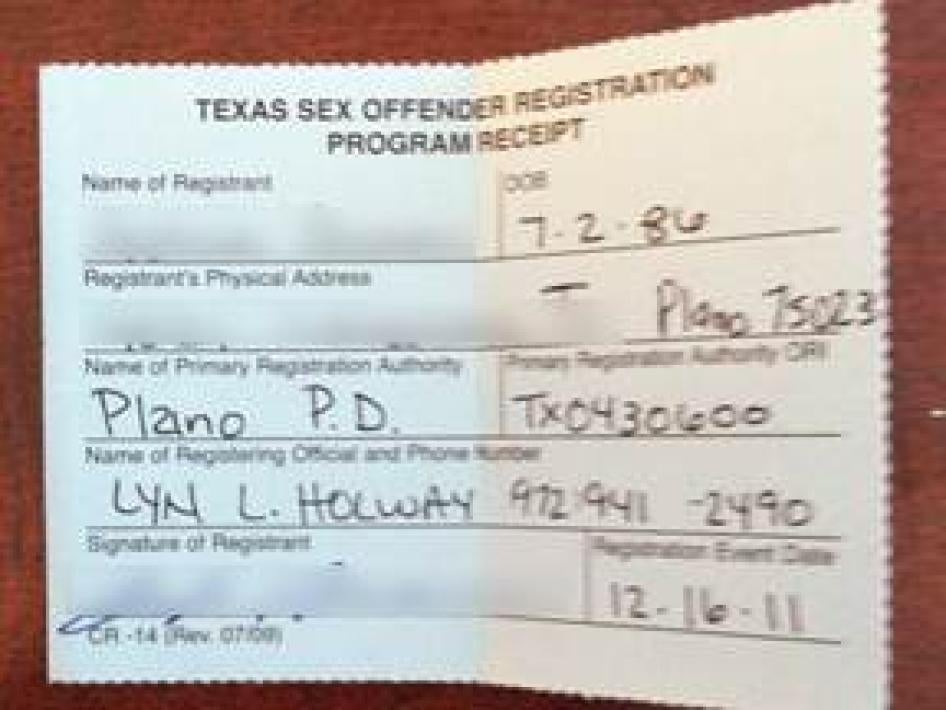

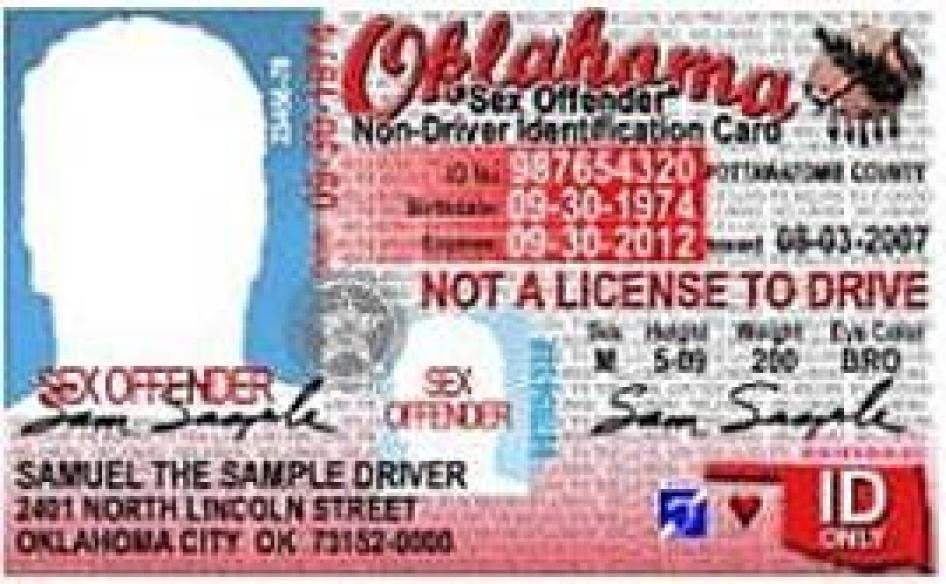
Failure to Register and Recidivism
The serious sentences imposed on youth offenders for failure–to-register crimes appear disproportionate to the offenses, given that their youth and immaturity can make it exceptionally difficult for them to comply with registration laws.
It is unclear whether prosecutions for failure to register are having the desired effect of deterring subsequent sex crimes. Four published studies have examined the relationship between failure to register and sex-offense recidivism. [319] These studies, which looked at all sex offenders (adults and children), concluded that,
- Failure to register is not a significant predictor of sexual recidivism, casting doubt on the idea that sex offenders who are noncompliant with registration are especially sexually dangerous.[320] Instead, results indicate only that a failure-to-register conviction significantly increases the likelihood of subsequent failure-to-register arrests.[321]
- Failure to register is the most common offense leading to reincarceration for convicted sex offenders released from prison, facilities, or treatment and placed on the registry.[322]
- Registered offenders with failure-to-register convictions are more likely to be subsequently rearrested than registered offenders without such convictions. Most of the new convictions, however, are for general, non-sexual crimes and new failure-to-register crimes.[323]
Human Rights Watch was not able to find any studies on the relationship between failure to register and sex offense recidivism among youth sex offenders, but there is no reason to think one would find a stronger correlation in the youth offender population than in the overall offender population. Given that existing research finds very low rates of sex offense recidivism among youth sex offenders, neither public safety nor crime deterrence appears to justify their incarceration for failure-to-register crimes. Even if one thinks registration is appropriate for some youth sex offenders, there is strong reason to question whether offenders under age 18 should be subjected to criminal prosecution for failure to register.
VII. Due Process Concerns
At times, the juvenile or adult court proceedings that result in convictions for sexual offenses are marred by due process failings, prompting additional questions about the fairness of subjecting youth sex offenders to registration.
Guilty Pleas
Children accused of any type of offense (not only sexual offenses) are particularly vulnerable during criminal proceedings. Children and adolescents are less mature than adults and have less life experience on which to draw, and this makes understanding the court process, the charges, and the consequences of a plea more difficult.[324] Like individuals with mental impairment, children may also be more compliant, especially when pressured by adult authority figures.[325] There is also evidence that children are more vulnerable to police pressure during interrogations.[326] Their deference to authority and lack of sophistication can result in both false confessions and agreements to plead guilty to crimes that they may not have committed.[327] The decision to confess or to plead guilty is particularly momentous in the case of sexual assault crimes, since convictions often trigger onerous registration requirements.
|
Ethan A. Ethan A. was 11 years old, growing up in Amarillo, Texas, when his life changed forever. His mother, Eva, told Human Rights Watch that Ethan was “the fixer-upper type who loved taking things apart and seeing how they worked—the toaster, the television, the radio.”[328] Bel said that Ethan was often picked on by the kids in the neighborhood for being the “good kid.”[329]
A photograph of Ethan A. (pseudonym) held by his mother, showing her son at age 11, 4 months before he was arrested for committing a sex offense and placed on the sex offender registry in Texas. © 2013 Private Ethan’s parents divorced when he was very young. At the age of 10, Ethan and his younger brother went to live with their father and stepmother in Amarillo. In 1998, when Ethan was 11, his step-mother accused Ethan of molesting his 3-month-old sister and of touching the genitals of his younger brother. Ethan recalls being terrified and “shaking with fear” at the police station.[330] Ethan denies touching his stepsister and brother, but his stepmother maintained her accusations. He wrote to Human Rights Watch that when he was 11, he “did not think he was allowed to disagree with the police officer.”[331] Ethan entered a plea to aggravated sexual assault of a child and indecency with a child by contact. He was sentenced to serve six years and four months in Texas juvenile detention. After three years, Ethan was released on juvenile probation to the custody of his mother and required to register as a sex offender. He had his first photograph taken for the registry in 2001, at the age of 13. Ethan’s mother said “the rest of his life was drastically altered.”[332] While Ethan was in juvenile detention, he fell behind his peers in school and had to attend an alternative school upon release. Being on the registry permeated most aspects of Ethan’s life and affected his family; he was not allowed to be around his siblings and other young relatives until they turned 18, he was repeatedly stopped by police because they knew he was on the registry, and he was harassed and threatened by neighbors. Because the registry lists the perpetrator’s current age but the victim’s age at the time of the offense, as Ethan grew older the registry gave the impression of an increasingly wide age divide between him and his victims. As a teenager, Ethan was anxious to get a job so he could help his mother pay the bills. Even though Ethan was not a convicted felon, employers refused to hire him when he disclosed that he was on the sex offender registry. Finally things started to look up for Ethan. In 2009, at age 22, he had a girlfriend and got a job working in an auto body shop. Ethan told us that when people in his community learned of his registration status, however, some “told the manger to fire him,” and the manager did so.[333] A few months after getting fired, in August 2009, Ethan went for his yearly registration verification and was arrested on the spot for failing to report that he had been fired from his job. He sat for one year in jail awaiting trial. On August 5, 2010, he was found guilty of failure to register and sentenced to three years in prison. In Texas and most states, registered sex offenders may be prosecuted if they fail to register, fail to verify registration information, or fail to provide notice of change of address or place of employment. Ethan was immediately arrested, convicted, and sentenced to three years in prison for this felony offense.[334] While in prison, Ethan has persevered. He obtained his GED in December 2012 and is due to be released in June 2013. Upon release, Ethan will be placed on the highest level of adult parole for 10 years and required to resume his sex offender registration until 2020. |
In several cases investigated by Human Rights Watch, children (often with little legal advice) agreed to plead guilty to a sex offense without being informed of the registration requirements they would be subject to for years or decades thereafter. For example, in 1999, Mason T. was adjudicated delinquent for aggravated sexual assault for inappropriately touching a 7-year-old girl when he was 12. After completing two years of therapy and probation, at the age of 14, Mason was informed that he had to register as a sex offender for 10 years. This news shocked both Mason and his mother. The family was not told before entering the plea that Mason would be required to register as a sex offender. They were never informed that anyone could access the state’s online sex offender registry and see details of Mason’s offense, his photograph, and their family home address.[335]
It is common practice in the US criminal justice system for attorneys and judges to sometimes use the threat of trial and long sentences to obtain a plea. Elijah B., a youth offender interviewed by Human Rights Watch, said, “I stood in court at the age of 17 and the judge told me: ‘if you enter a plea of not guilty you will serve at least 15 years in prison. If you say guilty you can go home on probation.’”[336] Another youth offender said, “The attorney told me that if I didn’t admit to the charge I would be charged as an adult and get 20 years to life in prison.”[337] A mother of a youth offender told Human Rights Watch,
His attorney advised us to just plead guilty to the charges. He told us that by entering a plea [Justin] would just get some counseling and we could save everyone from the embarrassment of a trial. I agreed. It turned out that [Justin] would be required to register as a sex offender for 10 years starting on the last day of his probation. He was 13 when he started registering.[338]
The vast majority of youth sex offenders interviewed for this report pled guilty (280 people, or 94.6 percent). In only 39.2 percent of the 296 cases examined for this report did youth offenders describe being informed of registration requirements before entering their plea.
Retroactive Application of Registration Requirements
The federal Sex Offender Registration and Notification Act (SORNA) expanded the number of youth sex offenders subject to registration by adding more nonviolent, lower-risk offenders to the federal registry. SORNA also opened the door to the retroactive application of registration requirements to individuals convicted of sex offenses (whether in juvenile or criminal court proceedings) before the registration laws went into effect.
Of the youth sex offenders interviewed for this report, 57 (19 percent) were subject to registration requirements imposed retroactively after their convictions. Some of these individuals had completed the terms of their parole and juvenile or adult probation, started families, and made lives for themselves. Due to the changes wrought by SORNA, others who had shown no risk of reoffending were now considered high-risk offenders because of a crime that occurred decades ago. Some pled guilty to crimes and lived for a time without being subject to registration, only to learn much later that they had agreed to terms which now trigger harsh consequences. While records of juvenile delinquency are normally kept confidential, the retroactive application of SORNA requires individuals who previously pled to acts of juvenile delinquency— and who did so with the expectation that their adjudication would remain confidential— to publicly expose that information to friends, family, colleagues, and neighbors. Some, had they known that they would years later be subject to registration requirements, might not have pled to the charges at all.
As of 2012, all but one appellate district in the United States allowed for the retroactive application of registration requirements to past convictions or adjudications. The one exception is the Ninth Circuit Court of Appeals. In the case of U.S. v. Juvenile Male, the court found that the retroactive application of SORNA to juvenile adjudications was unconstitutional.[339] In 2010, the US Supreme Court reviewed the case but did not address the constitutionality of the retroactive application of SORNA.[340]
Fewer Protections in the Juvenile System?
Juveniles adjudicated delinquent of sexual offenses are less protected from accepting a plea without being informed of registration requirements than children subject to the jurisdiction of adult courts. Many courts have found that a defendant charged as an adult must know the collateral consequences of entering a plea to a criminal offense, such as registration, community notification, and residency requirements.[341] Conversely, the law is less settled as to whether children must be informed of the collateral consequences that result from entering a plea to a juvenile offense.[342] For example, a 2011 study of registration requirements in Delaware, Florida, North Carolina, and Virginia emphasized,
None of the four states studied requires administrators of the juvenile justice system to notify juvenile offenders or their guardians of the collateral consequences of juvenile records or of the opportunity to expunge those records. In each of the states, a youth could have many interactions with the administrators of the juvenile courts, including his attorney, and not learn the potential ramifications of juvenile delinquency adjudications of sexual offenses – i.e. registration.[343]
VIII. Human Rights and Registration of Youth Sex Offenders
International human rights law requires all governments to protect people within their jurisdiction from violence, including by deterring crimes such as sex offenses.[344] While at least six other countries—Australia, Canada, France, Ireland, South Africa, and the United Kingdom—have implemented sex offender registration, they have done so in a more restricted manner, in order to more closely conform with international human rights standards. Thus, in these six countries there are often no public notification or residency requirements and the inclusion of youth offenders is heavily circumscribed.
The important duty of government to protect persons from harm has undoubtedly inspired the creation of sex offender registration schemes in the United States. However, the onerous nature of the schemes and their specific application to youth offenders raise serious questions under human rights law.
The Child’s Right to Special Treatment
Conviction for even a very serious sex offense does not extinguish a child’s claim to just treatment at the hands of government, nor does it free a government to ignore fundamental rights when imposing punishment or “collateral” obligations such as registration.
International law recognizes that juvenile offenders require special protection. The International Covenant on Civil and Political Rights (ICCPR), to which the United States became a party in 1992, specifically acknowledges the need for special treatment of children in the criminal justice system and emphasizes the importance of their rehabilitation.[345] Article 10(3) requires the separation of youth offenders from adults and the provision of treatment appropriate to their age and legal status. Article 14(4), which was co-sponsored by the United States,[346] mandates that criminal procedures for children “take account of the age and the desirability of promoting their rehabilitation.”[347] The ICCPR requires states to respond to the offenses children commit by focusing on positive measures and education rather than punishment.[348]
Those in favor of youth sex offender registration often argue that the requirements—whether registration alone, or registration in combination with community notification and residency restrictions—are distinguishable from criminal punishment. Since registration is imposed only after a child completes his or her criminal sentence, they argue, it is at most a collateral consequence of punishment and as such is distinct from the original punishment. However, the international human rights law requirement that children be treated in a manner that takes into account their age and particular vulnerabilities does not hinge upon whether government is imposing a criminal punishment or instituting other types of administrative procedures that constitute “collateral consequences.” In all cases, juveniles must be treated differently.
In the United States, many sex offender registration laws at both the state and federal levels treat youth offenders no differently from adults. This is true of youth offenders subject to the jurisdiction of adult courts, but also of many children adjudicated delinquent in juvenile courts. When children and adults are subjected to exactly the same procedures and laws, the United States violates provisions of the ICCPR requiring special measures for children. In order to comply with its obligations under international human rights law, the United States should abolish sex offender registration schemes that are not specifically tailored to address the situation of youth offenders.
Recent cases in the US Supreme Court raise serious questions under US constitutional law about any scheme in which the differences between youth and adults are not taken into account. In a case abolishing the death penalty for juveniles, the court stated, “From a moral standpoint it would be misguided to equate the failings of a minor with those of an adult, for a greater possibility exists that a minor’s character deficiencies will be reformed.”[349] Similarly, the court has given weight to:
Developments in psychology and brain science [that] continue to show fundamental differences between juvenile and adult minds. For example, parts of the brain involved in behavior control continue to mature through late adolescence. Juveniles are more capable of change than are adults, and their actions are less likely to be evidence of “irretrievably depraved character” than are the actions of adults.[350]
Moreover, in abolishing the mandatory imposition of life without parole sentences on juveniles, the US Supreme Court based its decision on the fact that the child’s status cannot properly be weighed:
By removing youth from the balance — by subjecting a juvenile to the same life-without-parole sentence applicable to an adult — these laws prohibit a sentencing authority from assessing whether the law’s harshest term of imprisonment proportionately punishes a juvenile offender. That contravenes Graham’s (and also Roper’s) foundational principle: that imposition of a State’s most severe penalties on juvenile offenders cannot proceed as though they were not children.[351]
In a recent opinion outside of the sentencing realm, moreover, the Supreme Court recognized that children’s perception is different from that of adults and that police officers must take into account the age of children when deciding whether they are in custody and need to be informed of their rights under the 1966 case Miranda v. Arizona. The Supreme Court stated, “‘[o]ur history is replete with laws and judicial recognition’ that children cannot be viewed simply as miniature adults. We see no justification for taking a different course here.”[352]
Disproportionate Infringement on Other Rights
Other human rights of children threatened by youth sex offender registration include the rights to protection from harm, family unity, education, health and well-being, and freedom of movement. None of these rights are absolute. But laws that infringe upon these rights must be necessary to serve a legitimate public interest, the relationship between the interest and the means chosen to advance it must be a close one, and the laws must be the least restrictive possible. For example, as the United Nations (UN) Human Rights Committee, which assesses compliance with the ICCPR, has stated with regard to limiting the right to movement,
[I]t is not sufficient that the restrictions serve the permissible purposes; they must also be necessary to protect them. Restrictive measures must conform to the principle of proportionality; they must be appropriate to achieve their protective function; they must be the least intrusive instrument amongst those which might achieve the desired result; and they must be proportionate to the interest to be protected.[353]
If a state restricts a right, it can only do so to the extent consistent with “the provisions, aims, and objectives of the Covenant” and only to the extent “reasonable in the particular circumstances.”[354] Reasonableness is achieved if the restriction is “both proportional to the end sought and necessary in the circumstances.”[355]
Some of the most fundamental rights of children (and adults who are former youth offenders) are put at risk by sex offender registration laws. Given the low recidivism rates of youth sex offenders, it is doubtful whether registration truly furthers the government’s objective of protecting future victims from new sex offenses. Therefore, the infringements on rights imposed by these laws appear to be disproportionate to their purpose.
The Approach of Other Jurisdictions
The US is not alone in implementing registration systems for sex offenders. At least six other countries (Australia, Canada, France, Ireland, South Africa, United Kingdom) have sex offender registries, either for perpetrators of all sex offenses or only offenses in which the victim was a child, and others are contemplating establishing registries. [356] However the US is alone in the scope of the registries, in particular the public and easily accessible nature of the information on the registries, the onerous conditions imposed on registrants, the imposition of residency restrictions, and the broad application of many of these aspects to youth sex offenders.
Sex offender registries in other countries have come under judicial challenge, and courts have found the more circumscribed registration requirements compatible with protection for human rights, only in so far as each scheme strikes the appropriate balance between the rights of the individual on a register and the public safety interest that the registries are designed to meet. The US sex offender registration schemes fail to meet these standards.
The European Court of Human Rights (ECtHR) has acknowledged that registries pursue legitimate aims (such as the prevention of crime and the protection of the rights and freedoms of others) and are consistent with states’ duty to protect individuals from grave forms of violence.[357] In finding that conditions of registration in both the UK and France imposed a proportionate constraint on offenders’ private and family lives, the Court set down clear criteria for assessing proportionality. [358] For example, in its examination of the French law the Court noted that sex offenders could appeal to the prosecutor against their automatic inclusion on the registry, then to an appellate chamber, and then to the president of the investigating chamber. The Court said,
[T]his judicial procedure for removing the information ensures independent review of the justification for the retention of the information according to defined criteria and provides adequate and sufficient safeguards in relation to respect for private life, with regard to the seriousness of the offences justifying registration on the sex offenders’ register.[359]
The criteria the European Court set out was relied on by the UK Supreme Court to strike down a provision in UK law requiring lifetime registration for a person convicted of an offense carrying a sentence of 30 months or more imprisonment.[360] In this case one of the registrants, F, was a youth sex offender, who had been convicted at age 11 of the rape of a younger boy, and was required to register for life. The UK Supreme Court endorsed the conclusion of the Court of Appeal that,
“[A]n offender was, as a matter of principle, entitled to have the question of whether the notification requirements continued to serve a legitimate purpose determined on a review. This entitlement was even stronger in the case of child offenders because of the fact that children change as they mature.” (emphasis added)[361]
Relying directly on ECHR standards on safeguarding the right to privacy, the UK Supreme Court ruled that the life-long notification requirement was a disproportionate interference with sex offenders’ right to private and family life, because it was automatic without any opportunity for review.[362] The European Court has expressly endorsed the UK Supreme Court’s assessment. [363] The UK High Court has also struck down on privacy grounds other procedures for disclosing information about offenders.[364]
Protection from Violence
Two categories of children suffer harm as a result of sexual offenses and the sex offender registration laws described in this report. The most obvious category is the child victims of sexual assault, who have rights to protection from harm and to redress for the harms they have suffered.
However, youth sex offenders are also entitled to protection from harm, including from vigilante violence. The United States has signed and ratified the Convention against Torture and Other Cruel, Inhuman, or Degrading Treatment or Punishment (Convention against Torture) and the International Covenant on Civil and Political Rights (ICCPR). Each of these treaties prohibits cruel, inhuman, or degrading treatment or punishment[365] and includes requirements that the state act to prevent acts of violence directed at anyone—adults and children—committed by private actors.[366]
Protection from violence, moreover, is an essential component in securing other human rights including the right to physical integrity. Additionally, the harassment and violence some youth offenders endure as a result of state sex offender registries and related policies may end up depriving them of their right to live together with their family, or to an education on equal terms with their peers. Such harassment and violence may also have serious mental health consequences and infringe upon the right of youth to the enjoyment of the highest attainable standard of health.[367]
Privacy and Family Unity
Sex offender registration laws interfere with a child’s right to privacy, which international human rights law recognizes as more robust than an adult’s right to privacy. Even in instances in which registration is not explicitly combined with community notification requirements, the reproduction of such records by public and private actors in a variety of ways and locations—particularly in our electronic age—makes it nearly impossible for the heightened privacy rights of children to be respected.
The Convention on the Rights of the Child (CRC), which the United States has signed but not ratified,[368] and the ICCPR both prohibit arbitrary or unlawful interference with a child’s privacy.[369] This prohibition—along with other international legal guarantees of treatment with dignity, respect, and protection from cruel, inhuman, or degrading treatment—underlie the minimum standards for privacy set forth in the UN Standard Minimum Rules for the Administration of Juvenile Justice (the “Beijing Rules”). These minimum standards require that every child’s privacy be respected at all stages of the juvenile justice process, including with regard to dissemination of a youth offender’s criminal record.[370]
Some youth offenders in the US have challenged mandatory registration and community notification laws on the basis that those laws open their records to public view, whereas existing law has generally permitted children to keep their juvenile records confidential or have them expunged. US federal courts have recognized juveniles’ heightened “liberty interest” in the confidentiality of their records but have yet to overturn sex offender registration or notification laws on that basis.[371]
The right to family unity finds articulation in numerous human rights treaties.[372] The concept is also incorporated into the domestic law of the United States. For example, in the context of custody rights for grandparents, the US Supreme Court has held that the “right to live together as a family” is an important right deserving constitutional protection, and an “enduring American tradition.”[373]
In some instances, however, the youth offender’s strong right to family unity is subordinated to the best interests of his or her siblings, who the state assumes would be at risk if the youth offender is allowed to reside with the family. Cases outlined in this report raise questions about whether government is striking the right balance even in these cases.
Education, Health, Well-being, and Freedom of Movement
The Universal Declaration of Human Rights states that everyone has a right to education, to freedom of movement and residence within the borders of their country, and to a standard of living adequate for health and well-being, including housing.[374] Sex offender registration laws can interfere with all of these rights. Residency restrictions and the contradictions between state laws often interfere with registrants’ ability to move residences, including between states within the US. The restrictions also have a profound impact on children’s ability to secure housing, and thus can lead to homelessness.
Sex offender registration, notification, and residency restrictions also have the effect of interfering with children’s access to education. When children are unable to attend school because they are banned from going near or entering school buildings, or when other restrictions on their residency or freedom of movement make it impossible for them to maintain a home and thus the stability to attend school, their access to education is curtailed.
Registration and community notification laws also have a deleterious impact on registrants’ standard of living because they can interfere with access to employment. State and local laws often ban a registered youth offender from working anywhere near children—so registered teens cannot seek jobs at the local mall, fast food restaurants, camps, and recreational centers. Current laws require registrants to provide their employers’ business name and address to be posted on the internet—further deterring employers from hiring them. Finally, the shaming and publicity associated with community notification can negatively impact registrants’ mental health.
IX. Recommendations
To the US Congress and State Legislatures
- Amend state and federal law to explicitly exempt all persons who were below the age of 18 at the time of their offense (youth sex offenders) from all sex offender registration, community notification, and residency restriction laws unless and until evidence-based research demonstrates that such requirements provide a significant, measurable improvement in public safety that outweighs the harms to former youth sex offenders and their families.
- To the extent that youth sex offenders remain subject to registration, amend state and federal law to ensure that youth sex offenders are placed on registries only after an individualized assessment. We recommend that such assessments require that a judge determine by clear and convincing evidence at an evidentiary hearing where the youth offender is represented by counsel that: (a) a panel of qualified experts using a validated risk assessment tool has determined that the youth poses a high risk of sexual reoffending, and (b) public safety cannot be adequately protected through any means other than the youth being subject to registration.
- The determination that registration is necessary should be reviewed at least on an annual basis for as long as the registration requirement lasts.
- All determinations should be made with an eye towards reducing the threat of unnecessary stigmatization to the youth offender and his or her victim.
- At periodic reviews, youth offender registrants should be able to present evidence of rehabilitation, change in life circumstances, incapacitation (for example, disease or disability) or substantial time living in the community without reoffending as grounds for termination of the requirement to register or a change in their assigned level of risk.
- In the initial registration hearing and at all periodic reviews, the burden of proof should remain on the state to prove that a registrant poses a public safety risk and thus must remain on the registry.
- Do not subject any youth offenders to lifetime registration requirements.
- To the extent youth offenders determined to pose a high risk of sexual reoffending continue to be subject to registration, use registration information solely for purposes of law enforcement. Do not subject these offenders to community notification, internet publication, or having their records open to public inspection.
- Do not apply residency restrictions to youth sex offenders, apart from appropriate restrictions on return to a residence where the victim of their offense lives. In the latter cases (as where a sibling is the victim), return to the home should be managed as a part of child welfare, probation, or parole systems and should be made on a case-by-case basis with the input of professionals expert in, for example, child development, psychiatry, and child protection.
- Do not require youth sex offenders to register with their schools or places of employment.
- Amend federal and state legislation to ensure that individuals who are non-registrants in one state are not required to register simply because they move to another state.
To State Legislatures and Agencies
- Require that all persons who are charged with a sexual offense committed before age 18 are represented by counsel.
- Create an impartial body, including representatives from law enforcement agencies and the criminal defense bar, to regularly review all registration information to ensure its accuracy and to remove youth offenders from registries as soon as registration requirements have ended. Additionally, this body should be empowered to ensure that the information on registration sites is not misleading (for example, the age at which the registrant committed the offense should be included).
- Amend state penal law on the crime of “failure to register” to allow for an exception for “good faith” efforts to comply with registration requirements. For those with an underlying juvenile sex offense, “failure to register” should be a juvenile court offense and should remain within juvenile court jurisdiction.
- Support development of a range of strategies to prevent sexual abuse, including educational programs for families, treatment and other resources for survivors of sexual violence, promotion of safety precautions by youth and adults, and campaigns that take a public health approach to the reduction of sexual violence.
- Work with national organizations such as the Center for Sex Offender Management (CSOM) and the National Center for Sexual Behavior of Youth (NCSBY), national experts, and relevant local agencies and organizations to conduct community meetings when registrants move into a neighborhood. Community meetings should aim at safe reintegration of the registrant, as well as provide fact-based education about where the most serious risks of sexual abuse lie and guidance on how to prevent sexual abuse before it occurs.
- Involve youth offenders, family members, survivors of sexual abuse and their communities in the development of prevention and protection programs, and ensure that their particular perspectives—reflecting their different cultural, ethnic, and spiritual backgrounds—are taken into account in the design of such programs.
To State and Federal Judges
- As a part of any plea negotiation, ensure that all persons accused of sexual offenses who are below the age of 18—whether in juvenile or adult court proceedings—are advised, using language tailored to the child’s level of understanding, of the implications of an adjudication or conviction for a sexual offense, including the registration, community notification, and residency requirements.
To Prosecutors
- Exercise prosecutorial discretion to interpret any vague or ambiguous statutes to exclude youth from sex offender registration requirements.
- As a part of any sentencing or plea negotiation, ensure that all persons accused of sexual offenses who are below the age of 18—whether in juvenile or adult court proceedings—are advised of the implications of an adjudication or conviction for a sexual offense, including the registration, community notification, and residency requirements.
To Defense Attorneys
- Using language tailored to the child’s level of understanding, advise all clients below the age of 18—whether in juvenile or adult court proceedings—of the implications of an adjudication or conviction for a sexual offense, including the registration, community notification, and residency requirements and the consequences of a failure-to-register conviction.
- Ensure that courts hold all required periodic review hearings.
- Work to ensure that all youth charged with sexual offenses are represented by counsel.
To Police and Other Law Enforcement Agencies
- If a subgroup of youth sex offenders remain subject to community notification, eliminate the use of posters, flyers, and other easily replicable materials to alert communities of the presence of a registered sex offender in their neighborhood. Inform community members individually, using accurate and responsible language to describe the potential threat posed by the registrant.
- Recognize law enforcement and other local officials’ responsibility and authority to keep all community members safe, including people who have been convicted of sex offenses. In deciding the method and scope of community notification, take into consideration the potential for community hostility against registrants and take any necessary steps to mitigate the potential hostility.
- For officers involved in the investigation of sexual offenses, institute training on adolescent development, issues surrounding youth sexual offending, youth sex offender treatment, and recidivism rates.
Acknowledgments
We are deeply grateful to the Soros Open Society Foundation for their generous support and encouragement. Special gratitude to Lenny Noisette, Luisa Taveras, Adam Culbreath, Christina Voight, and Sarah Baker.
We further thank the Defender Association of Philadelphia for providing office space and support for Nicole Pittman.
Research for this report was conducted by Nicole Pittman, Soros Senior Justice Advocacy Fellow, with the volunteer support of Cassandra Milnes and Quyen Nguyen. This report was written jointly by Nicole Pittman and Alison Parker, US Program director at Human Rights Watch.
The report was edited primarily by Alison Parker; Maria McFarland, US Program deputy director; Elizabeth Calvin, Children’s Rights Division senior advocate; and Zama Coursen-Neff, Children’s Rights Division director. Brian Root, quantitative analyst in the US Program, helped analyze the data and assess the impact of the laws on registrants. Antonio Ginatta, US Program advocacy director, helped provide a consistent and clear message for the report. Elena Vanko and Samantha Reiser, US Program associates, provided significant administrative assistance and support.
Special thanks to former and current Human Rights Watch staff members Sarah Tofte, Corinne Carey, and Jamie Fellner for taking the bold lead by writing the 2007 Human Rights Watch report, No Easy Answers: Sex Offender Laws in the US.
Marc Chaffin, expert on child sexual offending behavior and professor of pediatrics at the University of Oklahoma Health Sciences Center, provided continuous encouragement and support and reviewed and commented on parts of the manuscript. Consultants Alisa Klein and Joan Tabachnick; staff at the Juvenile Division of the Ohio Public Defender; and staff at the Juvenile Law Center in Philadelphia, Pennsylvania lent support and expertise and made specific suggestions for the recommendations section of the report.
We are deeply grateful to all the individuals directly impacted by sex offender registration and notification laws and their families who shared their experiences for this report. Many of these individuals courageously shared their deeply personal and often traumatic experiences of growing up on the registry for the first time, despite the fear of repercussions or further stigmatization.
We are tremendously appreciative of the assistance, encouragement, and warm hospitality from the following organizations, including, but not limited to: Wayne Bowers; eAdvocate; Charlie Sullivan and the CURE community; Terry, founder and director of New Jersey Families Advocating Intelligent Reform (NJ Fair); Reform Sex Offender Laws (RSOL); Mary Sue Molnar, director of Texas Voices for Reason and Justice; Jan Fewell; Diane Iosue; Phil Harris; Ilinois Voices; Texas defense attorney Laura Peterson; Mary Devoy, Reform Sex Offender Laws of Virginia (RSOL); Sharon Denniston; Matthew 25 Ministries and Miracle Village; Leticia Rodriguez; and Vicki Henry, president of Women Against Registry.
Nicole Pittman expresses her gratitude for the continued support of the Defender Association of Philadelphia; National Juvenile Defender Center (NJDC); National Juvenile Justice Network (NJJN); Southern Center for Human Rights; Miriam Aukerman, West Michigan regional staff attorney at the ACLU Michigan; Shelli Weisberg, legislative director of the ACLU Michigan; Carrie Lee, director of the Juvenile Justice Center at Barry University School of Law; Rob Mason, director of the Juvenile Division for the Office of the Public Defender, Fourth Judicial Circuit; Katayoon Majd and the Public Welfare Foundation; and Bob Shilling, former chief of sex crimes for the Seattle Police Department.
Special thanks to the courageous experts who have been spent decades providing valuable, robust, and rigorous scientific data on child sexual offending behavior and the effect of US legal sexual offender policies on youth. These include, but are not limited to: Dr. Robert Prentky, professor and director of graduate training in forensic psychology at Farleigh Dickinson University; Dr. Timothy Foley, forensic evaluator and psychologist; Franklin E. Zimring, William G. Simon professor of law, Wolfen distinguished scholar at Berkeley School of Law; Dr. Jane Silvosky, professor of pediatrics at the University of Oklahoma Health Sciences Center; Dr. Marc Chaffin, professor of pediatrics at the University of Oklahoma Health Sciences Center; Dr. Barbara Bonner, professor of developmental pediatrics at the University of Oklahoma Health Sciences Center; Dr. Michael Caldwell, associate professor, Department of Psychology, University of Wisconsin-Madison; Dr. Fred Berlin, founder of the Johns Hopkins Sexual Disorders Clinic; Dr. Elizabeth Letourneau, assistant professor, Department of Mental Health, Bloomberg School of Mental Health at Johns Hopkins University; and Dr. Andy Harris, associate professor, Department of Criminal Justice & Criminology at the University of Massachusetts-Lowell.
We also extend our special gratitude to Katherine Muns and Sujatha Baliga for their insight on survivors and victims’ issues.
This report is dedicated to the memory of Mary Duval, who passed away after battling cancer on June 19, 2011. Mary was a dedicated mother and activist, and CEO of www.sosen.org. She successfully fought to have her teenage son removed from the registry for a consensual relationship with a peer. Mary left behind a lasting legacy.
Through her tireless efforts and dedication, she helped bring the complex issue of US sex offender laws to national prominence and inspired the passage of laws to protect children charged with certain offenses from a lifetime on the sex offender registry.
[1] For readability, this summary avoids the term “adjudicated delinquent” to describe a finding of guilt in a juvenile court judgment. However, this phrase is used in the remainder of this report because juvenile court judgments are not considered convictions.
[2] The Sex Offender Registration and Notification Act (SORNA) is section 111 of the Adam Walsh Act Child Protection and Safety Act of 2006, codified at 42 U.S.C. §16911, which governs the applicability of SORNA’s sex offender registration requirements to juvenile offenders who are adjudicated delinquent of a sex offense. 42 U.S.C. §16911(8) requires jurisdictions to expand sex offender registration to juveniles. At the time this report was written, only 18 states in the nation were deemed to be in “substantial compliance” with the federal law.
[3] “Number of Registered Sex Offenders in the US Nears Three-Quarters of a Million,” National Center for Missing and Exploited Children, press release, January 23, 2012, http://www.prnewswire.com/news-releases/number-of-registered-sex-offenders-in-the-us-nears-three-quarters-of-a-million-137880068.html (accessed March 8, 2013).
[4] US Department of Justice, Bureau of Justice Statistics, “Criminal Victimization, 2009,” October 2010, http://bjs.ojp.usdoj.gov/content/pub/pdf/cv09.pdf (accessed March 21, 2013). These data are compiled by the National Crime Victimization Survey, in which a representative sample of US households reports on non-fatal crimes (irrespective of whether they are reported to police).
[5] These estimates, as reported by the Department of Justice, are based on 10 or fewer sample cases. US Department of Justice, Bureau of Justice Statistics, “Criminal Victimization, 2009,” October 2010, http://bjs.ojp.usdoj.gov/content/pub/pdf/cv09.pdf (accessed March 21, 2013).
[6] Anna Salter, Transforming Trauma: A Guide to Understanding and Treating Adult Survivors of Child Sexual Abuse (New York: Sage Publications, 1995).
[7] Patricia Tjaden and Nancy Thoennes, National Institute of Justice (NIJ), “Extent, Nature, and Consequences of Rape Victimization: Findings from the National Violence against Women Survey,” January 2006, http://www.ncjrs.gov/pdffiles1/nij/210346.pdf (accessed July 13, 2007).
[8] Human Rights Watch email correspondence with Dr. Marc Chaffin, March 5, 2013. See also MaryLee Floric and Matthew Broyles, Sexual Abuse (New York: The Rosen Publishing Group, Inc., 2012).
[9] Ibid.
[10] Howard N. Snyder, Bureau of Justice Statistics, “Sexual Assault of Young Children as Reported to Law Enforcement: Victim, Incident, and Offender Characteristics,” July 2000, http://bjs.gov/content/pub/pdf/saycrle.pdf (accessed March 21, 2013), p. 11.
[11] Ibid.
[12] Safe Horizon, “After Sexual Assault: A Recovery Guide for Survivors,” undated, http://www.safehorizon.org/files/After_Sexual_Assault_Bklt.pdf (accessed January 8, 2007).
[13] American Psychological Association, “Understanding Child Sexual Abuse: Education, Prevention, and Recovery,” 2001, http://www.apa.org/releases/sexabuse/effects.html (accessed July 13, 2007).
[14] Human Rights Watch email correspondence with Dr. Marc Chaffin, March 5, 2013.
[15] Stop It Now! PARENTtalk, “Loving Them Both,” vol. 5, no. 1 (Spring 2005), http://www.stopitnow.org/files/webfm/Parent%20Talk/PT_Spring05_V5N1.pdf (accessed March 21, 2013). PARENTtalkis a Stop It Now! publication by and for parents and caregivers of youth with sexual behavior problems. (The name “Denise” is a pseudonym for the mother in this story, whose name was “anonymous” in the publication).
[16] Ibid.
[17] Ibid.
[18] Dean G. Kilpatrick and Anne Seymour, National Victim Center & the Crime Victims Research and Treatment Center, Medical University of South Carolina, “Rape in America: A Report to the Nation,” April 23, 1992, http://www.musc.edu/ncvc/resources_prof/rape_in_america.pdf (accessed April 19, 2013); Ted R. Miller, Mark A. Cohen, and Brian Wiersema, National Institute of Justice (NIJ), “Victim Costs and Consequences: A New Look,” January 1996, https://www.ncjrs.gov/pdffiles/victcost.pdf (accessed April 19, 2013).
[19] Center for Sex Offender Management (CSOM), “Understanding sex offenders: An introductory curriculum,” undated, www.csom.org/train/etiology/index.html (accessed April 19, 2013).
[20]Jacob Wetterling Crimes Against Children and Sexually Violent Offender Registration Act, Pub. L. No. 103-322 tit. XVII, subtit.A, 108 Stat. 2038-2042 (1994). Title XVII of the Violent Crime Control and Law Enforcement Act of 1994, 42 U.S.C. 14071 et seq. The Wetterling Act was passed in response to the unsolved abduction of Jacob Wetterling while he was riding his bicycle in a small town in Minnesota.
[21] Center for Sex Offender Management, “Sex Offender Registration: Policy Overview and Comprehensive Practices,” October 1999, http://www.csom.org/pubs/sexreg.pdf (accessed March 21, 2013).
[22] Megan’s Law of 1996, Pub. L. No. 104-145, 110 Stat. 1345 (1996) (codified at 42 U.S.C. § 14071(e)(2) (2000)). Megan’s adult attacker, previously convicted of child molestation, lived near her home in a community release program. In testimony before Congress, Megan’s parents, Richard and Maureen Kanka, asserted that they would have been more vigilant had they known about the offender’s presence.
[23] Megan’s Law of 1996, Pub. L. No. 104-145, 110 Stat. 1345 (1996) (codified at 42 U.S.C. § 14071(e)(2) (2000)).
[24]Pam Lychner Sexual Offender Tracking and Identification Act of 1996, Pub. L. No. 104-236, 110 Stat. 3093 (42 U.S.C. 14072, as amended). Pam Lychner was a 31-year-old woman who was attacked by a previously convicted sexual offender in Houston, Texas.
[25] 42 U.S.C. §16911, §129(a) of the The Sex Offender Registration and Notification Act (SORNA) of the Adam Walsh Act Child Protection and Safety Act of 2006 (States that “Sections 170101 (42 U.S.C. 14071) and 170102 (42 U.S.C. 14072) of the Violent Crime Control and Law Enforcement Act of 1994, and section 8 of the Pam Lychner Sexual Offender Tracking and Identification Act of 1996 (42 U.S.C. 14073) are repealed.”).
[26] Recent decades have been marked by periods of intense media coverage of crimes committed by children. For example, presidential candidate Bob Dole said during his 1996 campaign, “[u]nless something is done soon, some of today’s newborns will become tomorrow’s superpredators—merciless criminals capable of committing the most vicious of acts for the most trivial of reasons.” Policymakers used the notion of the juvenile “superpredator” (coined by academic John DiIulio) as a justification for increasingly punitive and harsh treatment of children under new criminal laws. See generally Jonathon Simon, Governing through Crime: How the War on Crime Transformed American Democracy and Created a Culture of Fear (New York: Oxford University Press, 2007) (addressing the importation of crime control into school administration); Aaron Kupchik, Judging Juveniles: Prosecuting Adolescents in Adult and Juvenile Courts (New York: New York University Press, 2006) (describing a “sequential model of justice,” or a system that borrows both a criminal justice model and a juvenile justice model, as a way of understanding prosecution of adolescents in criminal court). The superpredator myth has been discredited. Dire predictions that “the rise in violent arrests of juveniles in the early 1990s would combine with a growing youth population to produce an extended crime epidemic” have proved inaccurate. Juvenile crime rates began a steady decline around 1994, reaching low levels not seen since the late 1970s. Lori Dorfman & Vincent Schiraldi, Building Blocks for Youth, “Off Balance: Youth, Race & Crime in the News,” April 2001.
[27] Elizabeth Garfinkle, “Coming of Age in America: The Misapplication of Sex Offender Registration and Community Notification Laws to Juveniles,” California Law Review, vol. 91, no. 1 (January 2003), pp. 163-208.
[28] Quyen Nguyen and Nicole Pittman, “A Snapshot of Juvenile Sex Offender Registration and Notification Laws: A Survey of the United States,” Pennsylvania Juvenile Defenders, July 2011, http://www.pajuvdefenders.org/file/snapshot.pdf (accessed March 12, 2013), pp. 44-53; National Conference of State Legislatures (NCSL), “Juvenile Sex Offender Registration and SORNA,” May 2011, http://www.ncsl.org/issues-research/justice/juvenile-sex-offender-registration-and-sorna.aspx (accessed March 12, 2013). The 13 jurisdictions are Alaska, Connecticut, District of Columbia, Georgia, Hawaii, Maine, Montana, Nebraska, New Mexico, New York, Utah, Vermont, and West Virginia.
[29] Ibid. The 38 jurisdictions are: Alabama, Arizona, Arkansas, California, Colorado, Delaware, Florida, Idaho, Illinois, Indiana, Iowa, Kansas, Kentucky, Louisiana, Maryland, Massachusetts, Michigan, Minnesota, Mississippi, Missouri, Nevada, New Hampshire, New Jersey, North Carolina, North Dakota, Ohio, Oklahoma, Oregon, Pennsylvania, Rhode Island, South Carolina, South Dakota, Tennessee, Texas, Virginia, Washington, Wisconsin, and Wyoming.
[30] See American Bar Association, Juvenile Collateral Consequences Project, “Think before you plead: Juvenile collateral consequences in the United States,” undated, http://www.beforeyouplea.com/ (accessed April 19, 2013); Nguyen and Pittman, “A Snapshot of Juvenile Sex Offender Registration and Notification Laws: A Survey of the United States,” pp. 44-53; National Conference of State Legislatures (NCSL), “Juvenile Sex Offender Registration and SORNA,” May 2011; The 27 states are California, Colorado, Delaware, Florida, Idaho, Illinois, Indiana, Iowa, Kansas, Louisiana, Massachusetts, Michigan, Minnesota, Mississippi, Missouri, Nevada, New Jersey, North Dakota, Ohio, Oklahoma, Oregon, South Dakota, South Carolina, Texas, Virginia, Washington, and Wisconsin. For children adjudicated delinquent in juvenile court, Illinois, Massachusetts, Ohio, Oregon, and Michigan limit the information available to the public. Illinois: 730 Ill. Comp. Stat. 152/120(a) (2010) (limited information on children adjudicated delinquent is made available to the public); Massachusetts: Mass. Gen. Laws ch. 6, § 178K (2)(c) (2010) (Children designated at risk levels 2 and 3 are subject to public notification); Ohio: Ohio Rev. Code Ann. § 2152.86 (2010) (A child determined to be a “Public Registry Qualified Juvenile Offender Registrant” (PRQJOR) is subject to public notification); Oregon: Or. Rev. Stat. § 181.592(2)(b) (2009) (limited information on children adjudicated delinquent is made available to the public); Michigan: Mich. Comp. Laws Ann. § 28.728 (2010) (children adjudicated delinquent in juvenile court will not be listed on the public sex offender registry until they turn 18; once they turn 18, their registration will become public and they will be listed on the web-based public registry). See generally In re Wentworth, 651 N.W.2d 773, 777 (2002).
[31] During the March 2006 discussion, Representative John Conyers (D-MI) noted that “this legislation, all 164 pages, has managed to completely circumvent the traditional legislative process.” 152 Cong. Rec. H677 (2006) (statement of Rep. John Conyers). In a July 2006 discussion on the Act, Representative Robert Scott (D-VA) avowed that “unlike most of my colleagues we will hear from today, I believe that we can do better than this bill to effectively address the scourge of child sexual assault.” 152 Cong. Rec. H5723-24 (2006) (statement of Rep. Robert Scott). Regretfully, lawmakers misinformed their peers that individuals convicted of sex offenses are more serious offenders because of their propensity to reoffend. US Representative Ric Keller (R-FL) noted that “[t]he best way to protect children is to keep child predators locked up in the first place, because someone who has molested a child will do it again and again and again.” Hearing Before the Subcommittee on Crime, Terrorism, and Homeland Security of the Committee on the Judiciary, 109th Cong.
[32] Title I, §111.8 of the Adam Walsh Act, Pub. L. No. 109-248, (2006). The Amie Zyla provision was named after Amie Zyla of Waukesha, Wisconsin, who was 8 years old when she was sexually assaulted and threatened by 14-year-old Joshua Wade. Wade was adjudicated delinquent in juvenile court, and was therefore required under Wisconsin law to register with local police as a sex offender. Less than a decade later, while still being monitored as a sex offender, Wade was arrested for assaulting and enticing children to his apartment. Wade was never convicted of these charges. However, Amie Zyla and her parents were successful in lobbying the state legislature to take some additional action against children accused of sexual misconduct. Amie and her parents then took their cause to Washington, DC. The Chairman of the Subcommittee on Crime, Terrorism, and Homeland Security, James Sensenbrenner (R-WI), who was also from Waukesha County, arranged for Ms. Zyla to speak behind closed doors, without any expert testimony, before members of Congress, advocating for extending the Adam Walsh Act to children by placing them on public sex offender registries. “The simple truth is that juvenile sex offenders turn into adult predators.… I want to challenge you to look deep down inside. Isn’t it time to put our kids’ safety before the rights of sexual offenders, adult or juvenile? When is enough going to be enough?” asked Ms. Zyla. After Ms. Zyla’s brief speech, Congressional supporters of the act proposed that the Adam Walsh Act be expanded to include children. In less than an hour, without supporting data or expert testimony, Congress voted, for purposes of sex offender registration and notification, to expand the definition of a “criminal conviction” to include an “adjudication of delinquency” of a child. The provision extending sex offender registration and notification was eventually named after the 17-year-old and is now referred to as SORNA Section 111 - Amie Zyla Expansion of Sex Offender Definition provision (Amie Zyla expansion is codified by 42 U.S.C. §16911(8)).
[33] Amie Zyla expansion is codified by 42 U.S.C. §16911(8); The National Guidelines for Sex Offender Registration and Notification, 73 Fed. Reg. 38030 (July 2, 2008).
[34] Title 42 U.S.C.S. § 16913 creates the sex offender registration requirements, and 18 U.S.C.S. § 2250(g) imposes criminal penalties for failing to register under SORNA.
[35]42 U.S.C.S. § 16911(5); The US Department of Justice, under SORNA, expands the definition of “specified offense against a minor” to include all offenses by children. The term “specified offense against a minor” means an offense against a minor that involves any of a list of itemized offenses.
[36]42 U.S.C.A. § 16911 (2)-(4) (Section 111(2)-(4) of SORNA defines three “tiers” of sex offenders. The tier classifications have implications in three areas: (i) under section 115, the required duration of registration depends primarily on the tier; (ii) under section 116, the required frequency of in-person appearances by sex offenders to verify registration information depends on the tier. SORNA sorts offenders into three tiers to determine the duration of their registration obligations. Tier III includes any sex offender whose offense is punishable by imprisonment for more than 1 year and is comparable to or more severe than aggravated sexual abuse or sexual abuse (as described in sections 2241 and 2242 of Title 18). 42 U.S.C.A. § 16911(4). Tier III offenders must register for life. Id. § 16915(a)(3). Tier II includes offenders convicted of sex offenses against minors. Id. § 16911(3). Individuals in Tier II must register for 25 years. Id. § 16915(a)(2). SORNA designates all offenders not included in Tiers II or III as Tier I offenders who must register for 15 years. Id. § 16911(2); § 16915(a)(1). SORNA’s registration requirements apply to offenders whose convictions pre-date the statute. 28 C.F.R. § 72.3.
[37]42 U.S.C. § 16913(b). Under SORNA, registration information is to be provided immediately to “[e]ach jurisdiction where the sex offender resides, is an employee, or is a student.”
[38]42 U.S.C. §§ 16924(a), 16925(a). Each jurisdiction has until July 27, 2009 to substantially comply with the requirements of SORNA or lose part of its federal funding.
[39]United States Governmental Accountability Office, GAO-13-211 Report to the Subcommittee of Crime, Terrorism, and Homeland Security, Committee on the Judiciary, House of Representatives, “Sex Offender Registration and Notification Act,” February 2013.
[40] Ibid; Department of Justice, Office of Sex Offender Sentencing, Monitoring, Apprehending, Registering, and Tracking (SMART), “SORNA,” http://www.ojp.usdoj.gov/smart/sorna.htm (accessed March 5, 2013).
[41] SMART, “SORNA,” http://www.ojp.usdoj.gov/smart/sorna.htm.
[42]Human Rights Watch, No Easy Answers: Sex Offender Laws in the US, vol. 19, no. 4(G), September 2007, http://www.hrw.org/reports/2007/09/11/no-easy-answers, pp. 55-58.
[43] In our 2007 report No Easy Answers, Human Rights Watch found that at least five states required men to register if they were caught visiting prostitutes. At least 13 states required individuals to register for urinating in public (in two states, only if a child was present). Thirty-two states registered flashers and streakers. No fewer than 29 states required registration for teenagers who had consensual sex with another teenager. Human Rights Watch, No Easy Answers, p.39.
[44] Mark Chaffin, Barbara L. Bonner, and Keri Pierce, National Center on Sexual Behavior of Youth, “What Research Shows About Adolescent Sex Offenders,” July 2003, http://www.dshs.wa.gov/pdf/ca/NCSBYfactsheet.pdf (accessed March 21, 2013) (citing American Psychiatric Association, “Diagnostic and Statistical Manual of Mental Disorders (4th Edition), Washington, DC, 1994).
[45] Lisa Sandberg, “Texas Group Fights Sex Crime Stigma Members Call Unfair,” Houston Chronicle, December 14, 2008.
[46] Ibid.
[47] Jeffrey T. Walker et al., National Criminal Justice Reference Service (NCJRS), “The Influence of Sex Offender Registration and Notification Laws in the United States,” 2006, https://www.ncjrs.gov/App/publications/Abstract.aspx?id=236182 (accessed March 21, 2013).
[48] Kristen Zgoba, et al., New Jersey Department of Corrections, Office of Policy & Planning, The Research & Evaluation Unit, “Megan’s Law: Assessing the practical and monetary efficacy,” 2008, https://www.ncjrs.gov/pdffiles1/nij/grants/225370.pdf (accessed April 20, 2013).
[49] As noted by Elizabeth Barnhill, the Executive Director of the Iowa Coalition against Sexual Assault, “The long-term solutions to eradicating sexual violence from our society, however, do not lie in measures taken to stop reoffense, but rather in preventing sexual violence from happening in the first place.” Elizabeth Barnhill, Testimony to Nebraska Judiciary Committee, February 16, 2006, http://legis.wisconsin.gov/lc/committees/study/2006/PLACE/files/murray2_place.pdf (accessed March 21, 2013).
[50] Bureau of Justice Statistics, “Recidivism of Prisoners Released in 1994,” Table 10: Rearrest Rates of State Prisoners Released in 1994, by most serious offense for which released and charge at rearrest, http://bjs.gov/content/pub/pdf/rpr94.pdf (accessed April 22, 2013) (giving the following percentages of prisoners rearrested within three years of release for the same type of offense: 1.2 percent for homicide, 2.5 percent for rape, 13.4 percent for robbery, 22 percent for non-sexual assault, 23.4 for burglary, 33.9 percent for larceny/theft, 11.5 percent for motor vehicle theft, 19 percent for fraud, 41.2 percent for drug offenses, and 31.2 percent for public order offenses).
[51] Ibid.
[52]Mark Chaffin, “Our minds are made up—don’t confuse us with the facts: Commentary on policies concerning children with sexual behavior problems and juvenile sex offenders,” Child Maltreatment, vol. 13, no. 2 (May 2008), pg. 114.
[53]Presentation by Bob Shilling, Annual National Juvenile Defender Center Leadership Summit, Seattle, Washington, October 18, 2011 (copy on file at Human Rights Watch).
[54]Detective Robert Schilling on “Barriers to timely Implementation of SORNA,” Testimony to US House Judiciary Subcommittee on Crime, Terrorism, and Homeland Security, March 10, 2009.
[55] William Pfeifer, “Too many registered sex offenders make dangerous sex offenders difficult to track,” Legal News Examiner, September 4, 2009, http://www.examiner.com/article/too-many-registered-sex-offenders-make-dangerous-sex-offenders-difficult-to-track (March 21, 2013).
[56] Carole J. Petersen and Susan M. Chandler, “Sex Offender Registration and the Convention on the Rights of the Child: Legal and Policy Implications of Registering Juvenile Sex Offenders,” William &Mary Policy Review, vol. 3, no. 1 (2011), pg. 11.
[57] Ibid.
[58] Diane Jennings, “Franklin Zimring Objects to Juvenile Sex Offender Registration,” The Dallas Morning News, July 19, 2009.
[59] See, for example, William Gardner and Janna Herman, “Adolescent’s AIDS Risk Taking: A Rational Choice Perspective,” in William Gardner et al., eds., Adolescents in the AIDS Epidemic (San Francisco: Jossey Bass, 1990) (“Adolescent’s AIDS Risk Taking”), pp. 17, 25-26; Marty Beyer, “Recognizing the Child in the Delinquent,” Kentucky Child Rights Journal, vol. 7 (Summer 1999), pp. 16-17.
[60] See Thomas Grisso, “What We Know About Youth’s Capacities,” in Thomas Grisso and Robert G. Schwartz, eds., Youth on Trial: A Developmental Perspective on Juvenile Justice (Chicago: University of Chicago Press, 2000), pp. 267-69 (reviewing literature on effects of emotion on children’s cognitive capacities).
[61] See, for example, Kim Taylor-Thompson, “States of Mind/States of Development,” Stanford Law and Policy Review, vol. 14 (2003), p. 155, fn. 107-108 (reviewing research on effects of stress on juvenile decision-making) (“States of Mind/States of Development”).
[62] Elizabeth Cauffman and Laurence Steinberg,“(Im)maturity of Judgment in Adolescence: Why Adolescents May Be Less Culpable Than Adults,” Behavioral Sciences and the Law, vol. 18 (2000), p. 741; see also Laurence Steinberg, Elizabeth Cauffman, et al., “Age Differences in Sensation-Seeking and Impulsivity as Indexed by Behavior and Self-Report: Evidence for a Dual Systems Model,” Developmental Psychology, vol. 44 (2008), pp. 1764-1778; and M. Gardner and Laurence Steinberg, “Peer Influence on Risk Taking, Risk Preference, and Risky Decision making in Adolescence and Adulthood: An Experimental Study,” Developmental Psychology, vol. 41 (2005), pp.625-635.
[63] See, for example, Jeffrey Arnett, “Reckless Behavior in Adolescence: A Developmental Perspective,” Developmental Review, vol. 12 (1992), p. 339; Charles E. Irwin, Jr., “Adolescence and Risk Taking: How are They Related?” in Nancy J. Bell and Robert J. Bell, eds., Adolescent Risk Taking (Thousand Oaks: SAGE Publications, January 1993), p. 7.
[64] See, for example, Jay N. Giedd et al., “Brain Development During Childhood and Adolescence: A Longitudinal MRI Study,” Nature Neuroscience, vol. 2 (1999), p. 861 (discussing an MRI study of the brains of 145 children, images taken up to five times per child over ten years); Kenneth K. Kwong, et al., “Dynamic Magnetic Resonance Imaging of Human Brain Activity During Primary Sensory Stimulation,” Proceedings of the National Academy of Science, vol. 89 (1992), p. 5675.
[65]Roper v. Simmons, 543 U.S. 551, 570 (2005).
[66] The malleability of a youth’s brain development suggests that young people through their twenties may be especially capable of change as they grow older and attain adult levels of development. Laurence Steinberg et al., “The Study of Developmental Psychopathology in Adolescence: Integrating Affective Neuroscience with the Study of Context,” in Dante Cicchetti and Donald Cohen, eds., Developmental Psychopathology (Oxford: John Wiley & Sons, 2006), p. 727.
[67]Roper v. Simmons, 543 U.S. 551, 570 (2005).
[68] Ibid.
[69] J.V. Becker, “What we know about the characteristics and treatment of adolescents who have committed sexual offenses,” Child Maltreatment, vol. 3 (1998), pp. 317-329.
[70] Franklin E. Zimring, An American travesty: Legal responses to adolescent sexual offending (Chicago: University of Chicago Press 2004).
[71] David Finkelhor, Richard Ormrod, and Mark Chaffin, Office of Juvenile Justice and Delinquency Prevention, “Juveniles Who Commit Sex Offenses Against Minors,” December 2009 (citing Letourneau and Miner, 2005), https://www.ncjrs.gov/pdffiles1/ojjdp/227763.pdf (accessed March 21, 2013), p. 3.
[72] Zimring, An American travesty: Legal responses to adolescent sexual offending (citing M.F. Caldwell, 2002);“What we do not know about juvenile sexual reoffense risk,” Child Maltreatment, vol. 7, pp. 291-203 (concluding, based on criminal justice cohorts analyzed by Franklin E. Zimring, that “more than nine out of ten times the arrest of a juvenile sex offender is a one-time event, even if the same offender may be apprehended in the future for the same mix of non-sexual offenses that is typical of other juvenile delinquents.”).
[73] David Finkelhor, Richard Ormrod, and Mark Chaffin, “Juveniles Who Commit Sex Offenses Against Minors,” p. 3.
[75] M. Chaffin, “Our minds are made up—don’t confuse us with the facts: Commentary on policies concerning children with sexual behavior problems and juvenile sex offenders,” Child Maltreatment, vol. 13 (2008), pp. 110-121—citing studies including but not limited to: M.F. Caldwell, “Sexual offense adjudication and sexual recidivism among juvenile offenders,” Sexual Abuse: A Journal ofResearch and Treatment, vol. 19 (2007), pp.107-113; M.F. Caldwell, “What we do not know about juvenile sexual reoffense risk,” Child Maltreatment, vol. 7 (2002), pp. 291-302; M. Carpentier, J.F. Silovsky, and M. Chaffin, “Randomized trial of treatment for children with sexual behavior problems: Ten-year follow-up,” Journal of Consulting and Clinical Psychology, vol. 74 (2006), pp. 482-488; M. Chaffin et al., Report of the ATSA Task Force onChildren with Sexual Behavior Problems (Beaverton, OR: Association for the Treatment of Sexual Abusers, 2006); M. Chaffin and B. Bonner, “Don’t shoot, we’re your children: Have we gone too far in our treatment of adolescent sexual abusers and children with sexual behavior problems,” Child Maltreatment, vol. 3 (1998), pp. 314-316; J.A. Hunter et al., “Juvenile sex offenders: Toward the development of a typology,” Sexual Abuse: Journal of Research & Treatment, vol. 15 (2003), pp. 27-48; A.E. Kazdin and J.R. Weisz, “Identifying and developing empirically supported child and adolescent treatments,” Journalof Consulting and Clinical Psychology, vol. 66 (1998), pp. 19-36; E. Letourneau and M. Miner, “Juvenile sex offenders: The case against legal and clinical status quo,” Sexual Abuse: AJournal of Research and Treatment, vol. 17 (2005), pp. 293-312; R.E. Longo and D.S. Prescott, Current perspectives: Workingwith sexually aggressive youth and children with sexual behavior problems (Holyoke, MA: NEARI Press, 2006); J.K. Marques et al., “Effects of a relapse prevention program on sexual recidivism: Final results from California’s Sex Offender Treatment and Evaluation Project (SOTEP),” SexAbuse: Journal of Research and Treatment, vol. 17 (2005), pp. 79-107; W. Marshall et al., “Early onset and deviant sexuality in child molesters,” Journal of InterpersonalViolence, vol. 6 (1991), pp. 323-335; R. Martinez, J. Flores, and B. Rosenfeld, “Validity of the Juvenile Sex Offender Assessment Protocol–II (JSOAP-II) in a sample of urban minority youth,” Criminal Justice and Behavior, vol. 34 (2007), pp. 1284-1295 M.J. O’Brien and W. Bera, “Adolescent sexual offenders: A descriptive typology,” Newsletter of the National Family LifeEducation Network, vol. 1 (1986), pp. 1-5; D. David Finkelhor, Richard Ormrod, and Mark Chaffin, Office of Juvenile Justice and Delinquency Prevention, “Juveniles Who Commit Sex Offenses Against Minors”; G.A. Parks and D.E. Bard, “Risk factors for adolescent sex offender recidivism: Evaluation of predictive factors and comparison of three groups based upon victim type risk factors for adolescent sex,” Sexual Abuse: A Journal of Research and Treatment, vol. 18 (2006), pp. 319-342; A.R. Piquero, T.E. Moffitt, and B.E. Wright, “Self-control and criminal career dimensions,” Journal of Contemporary CriminalJustice, vol. 23 (2007), pp. 72-89; R. Prentky et al., “Risk management of sexually abusive youth: A follow-up study,” Justice Resource Institute, 2002.
[76] M. Chaffin, “Our minds are made up—don’t confuse us with the facts: Commentary on policies concerning children with sexual behavior problems and juvenile sex offenders,” Child Maltreatment, vol. 13 (2008), pp.110-121.
[77] David Finkelhor, Richard Ormrod, and Mark Chaffin, “Juveniles Who Commit Sex Offenses Against Minors.”
[78] Finkelhor, Ormrod, and Chaffin, “Juveniles Who Commit Sex Offenses Against Minors,” citing I. Lambie et al., “Resiliency in the victim-offender cycle in male sexual abuse,” Sexual Abuse: A Journal of Research and Treatment, vol. 14 (2002), pp. 31–48; C.S. Widom and M.A. Ames, “Criminal consequences of childhood sexual victimization,” Child Abuse and Neglect, vol. 18 (1994), pp. 303–318.
[79] Franklin E. Zimring, An American travesty: Legal Responses to Adolescent Sexual Offending (Chicago: University of Chicago Press, 2004).
[80] Michael Caldwell, “Study Characteristics and Recidivism Base Rates in Juvenile Sex Offender Recidivism,” International Journal of Offender Therapy and Comparative Criminology, vol. 54 (2010), pp. 197-212.
[81] Ibid., p. 207; Franklin E. Zimring et al., “The Predictive Power of Juvenile Sex Offending: Evidence from the Second Philadelphia Birth Cohort Study,” December 2006, http://papers.ssrn.com/sol3/papers.cfm?abstract_id=995918 (accessed November 30, 2011); see also Margaret A. Alexander, “Sexual Offender Treatment Efficacy Revisited,” Sexual Abuse: A Journal of Research and Treatment, vol. 11 (1999), pp. 101-116.
[82] Franklin E. Zimring et al., “The Predictive Power of Juvenile Sex Offending: Evidence from the Second Philadelphia Birth Cohort Study,” June 21, 2007, http://papers.ssrn.com/sol3/papers.cfm?abstract_id=995918 (accessed November 30, 2011) (some believe that studies report low sex re-offense rates because they sample offenders who commit minor, non-violent offenses; in this study, however, 77 percent of the youth had been convicted of violent sexual offenses.)
[83] Michael Caldwell, “Sexual Offense Adjudication and Recidivism Among Juvenile Offenders,” Sexual Abuse: A Journal of Research and Treatment, vol. 19 (2007), pp. 107-113; Donna Vandiver, “A Prospective Analysis of Juvenile Male Sex Offenders: Characteristics and Recidivism Rates as Adults,” Journal of Interpersonal Violence, vol. 21 (2006), pp. 673-688; E.J. Letourneau et al., “Do sex offender registration and notification requirements deter juvenile sex crimes?” Criminal Justice and Behavior, vol. 37 (2010), pp. 553-569. See also Finkelhor, Ormrod, and Chaffin, “Juveniles Who Commit Sex Offenses Against Minors,” https://www.ncjrs.gov/pdffiles1/ojjdp/227763, p.3 (noting that “multiple short and long-term clinical followup studies of juvenile sex offenders consistently demonstrate that a large majority (about 85-95 percent) of sex offending youth have no arrests or reports for future sex crimes.”).
[84] Caldwell, “Study characteristics and recidivism base rates in juvenile sex offender recidivism,” International Journal of Offender Therapy and Comparative Criminology, pp. 197-212.
[85] R. Karl Hanson and Monique T. Bussiere, “Predicting Relapse: A Meta-Analysis of Sexual Offender Recidivism Studies,” Journal of Consulting and Clinical Psychology, vol. 66(1998), pp.348-362.
[86] Pew Center on the States, “State of Recidivism: The Revolving Door of America’s Prisons,” April 2011, http://www.pewcenteronthestates.org/news_room_detail.aspx?id=85899358615 (accessed November 30, 2011). The 40 percent recidivism rate applies to prison inmates released in 1999 who returned to prison within three years due to a new criminal conviction or for violating conditions of release.
[87] Franklin E. Zimring et al., “The Predictive Power of Juvenile Sex Offending: Evidence from the Second Philadelphia Birth Cohort Study,” June 21, 2007, http://papers.ssrn.com/sol3/papers.cfm?abstract_id=995918 (accessed March 21, 2013).
[88] David Finkelhor, Richard Ormrod, and Mark Chaffin, “Juveniles Who Commit Sex Offenses Against Minors,” p.3 (citing Alexander, 1999; Caldwell, 2002; Reitzel and Carbonell, 2007).
[89] Franklin Zimring, “The Wages of Ignorance,” University of California, Berkeley School of Law, July 30, 2009, p. 12.
[90] Devon Adams, Bureau of Justice Statistics, “Summary of State Sex Offender Registries, 2001,” March 1, 2002, http://bjs.gov/content/pub/pdf/sssor01.pdf (accessed April19, 2013).
[91] “Number of Registered Sex Offender in the US Nears Three-Quarters of a Million,” National Center for Missing and Exploited Children (NCMEC) press release, January 23, 2012. NCMEC is a 501(c)(3) nonprofit organization established in 1984, authorized by Congress and working in partnership with the US Department of Justice. It is a public-private partnership, funded in part by Congress and in part by the private sector, which has operated under Congressional authority as the national resource center and clearinghouse on missing and exploited children. NCMEC created the survey in 2006, following the enactment of the Adam Walsh Child Protection and Safety Act in July of that year. Each year since the survey was created, NCMEC contacts the sex offender registry in each state as well as registries located in the District of Columbia and five US territories (Puerto Rico, the US Virgin Islands, Guam, American Samoa, and the Commonwealth of the Northern Mariana Islands). The US Virgin Islands, St. Thomas, and St. Croix maintain separate sex offender registries, bringing the total number of registries surveyed to 57. NCMEC has conducted 13 sex offender register surveys since 2006, and they were performed quarterly until 2009. Since then, they have been done twice each year.
[92] Of these interviews, 281 were with the individuals themselves; 15 were conducted with family members of registrants.
[93] Since Human Rights Watch was seeking individuals willing to speak about the impact registration has had on their lives, it is impossible to know how those interviewed are similar or different from other registrants. Demographic information provided here is not generalizable to a larger population; it merely represents the experiences of the 296 individuals whose cases were examined in this report.
[94] Quyen Nguyen, Nicole Pittman, and Kirsten Rønholt, “Executive Report: A Snapshot of Juvenile Sex Offender Registration and Notification Laws,” Pennsylvania Juvenile Defenders, July 27, 2011, http://www.pajuvdefenders.org/file/snapshot.pdf. (These figures were clarified by the Delaware Public Defender Juvenile Chief, Lisa Minutola, in July 2011).
[95] Ibid. (citing David A. Garcia, “Juveniles crowd Michigan Sex Offender Registry: More than 3,500 teen and pre-teen sex offenders on state list,” The Michigan Messenger, February 10, 2010).
[96] Ibid. (citing Valerie Anderson, “Application of Mandatory Registration and Notification Laws to Juvenile Sex Offenders,” unpublished manuscript, March 26, 2010).
[97] Finkelhor, Ormrod, and Chaffin, “Juveniles Who Commit Sex Offenses Against Minors,” https://www.ncjrs.gov/pdffiles1/ojjdp/227763.pdf.
[98] The Sex Offender Registration and Notification Act (SORNA) is Section 111 of the Adam Walsh Act Child Protection and Safety Act of 2006, codified at 42 U.S.C. §16911.
[99] 42 U.S.C.S. § 16911(8) (Lexis Nexis 2011).
[100] 42 U.S.C.S. § 16911(5)(A)(i) (Lexis Nexis 2011).
[101] 42 U.S.C.S. § 16911(7)(F)-(I) (Lexis Nexis 2011).
[102] 42 U.S.C.S. § 16911(8)(Lexis Nexis 2011).
[103] KANSAS STAT. ANN. § 22-4906(h)(1) (2011).
[104] ARK. CODE ANN. § 9-27-356(b)(1) (2011).
[105] MD. CODE ANN., CRIM. PROC. § 11-704.1(b)(1).
[106] Claire Luna, “3 Guilty of Sexual Assault in O.C. Gang-Rape Retrial,” Los Angeles Times, March 24, 2005, http://articles.latimes.com/2005/mar/24/local/me-haidl24 (accessed March 21, 2013).
[107] Human Rights Watch interview with Mason T., Pinehurst, Texas, April 27, 2012.
[108] Human Rights Watch telephone interview with Sheila F., Pittsburgh, Pennsylvania, September 28, 2012.
[109] Riley Yates, “Bethlehem Teen Sentenced for Rapes,” Morning Call, March 3, 2010, http://articles.mcall.com/2010-03-03/news/all-a7_3gonzalez2.71939672mar03_1_unstable-childhood-giordano-assaulting (accessed March 21, 2013).
[110] Human Rights Watch telephone interview with C.C., Utah, February 21, 2012; State ex rel. Z.C., 2007 UT 54, 165 P.3d 1206 (2007). In 2011, the conviction requiring the young girl to register was reversed when the Utah Supreme Court concluded that while the children violated this particular law as it is worded, the law was not intended to apply to such cases.
[111] In the Matter of Registrant T.T., 188 N.J. 321 (N.J. 2006): Application for Judicial Review of Notification (A-58-2005) NJ Appellate Division (2005).
[112] Ibid.
[113] Human Rights Watch interview with attorneys for Stella A., Southern Center for Human Rights, Atlanta, Georgia, March 3, 2012; Whitaker v. State, 283 Ga. 521 (Ga. 2008).
[114] Some individuals were convicted of multiple offenses in the same case, while others were convicted of crimes over a period of years. If an individual was convicted of multiple counts of the same crime, this was labeled as a “single conviction (multiple counts).” If there were two convictions with different codes, these were coded as separate offense categories.
[115] H.E. Barbaree, W.L. Marshall, and S.M. Hudson, eds., The Juvenile Sex Offender (New York: The Guilford Press, 1993).
[116] Ibid.
[117] Ibid.
[118] B. Rind, P. Tromovitch, and R. Bauserman, “A Meta-Analytic Examination of Assumed Properties of Child Sexual Abuse Using College Samples,” Psychological Bulletin, vol. 124, no. 1 (1998), http://digilib.bc.edu/reserves/sc563/mcgu/sc56310.pdf (accessed March 21, 2013), pp. 22–53.
[119] Barbaree, Marshall, and Hudson, The Juvenile Sex Offender.
[120] Ibid.
[121] Human Rights Watch interview with Alexander D., Muskegon, Michigan, March 22, 2012.
[122] Lee Higgins, “Young Pittsfield Township man struggles with the sex offender label,” AnnArbor.com, December 18, 2009, http://www.annarbor.com/news/a-young-man-struggles-with-the-sex-offender-label/ (accessed March 21, 2013).
[123] Human Rights Watch interview with Alexander D., March 22, 2012.
[124] Human Rights Watch interview with Bert Oram, attorney, Tallahassee, Florida, July 2009.
[125] Human Rights Watch interview with Grayson A., Panama City Beach, Florida, May 3, 2012.
[126] Bill Kaczor, “Crist delays decision on Florida ‘Romeo and Juliet’ Case,” South Florida Sun-Sentinel, June 11, 2009, http://www.sun-sentinel.com/news/local/florida/sfl-romeo-juliet-sex-offender-061009,0,1939750.story (accessed March 5, 2013).
[127] Human Rights Watch interview with Bert Oram, July 2009.
[128] Opinion Staff, “Sex Offender No More,” The Palm Beach Post, August 3, 2009, http://blogs.palmbeachpost.com/opinionzone/2009/08/03/sex-offender-no-more/ (accessed April 19, 2013).
[129] Finkelhor, Ormrod, and Chaffin, “Juveniles Who Commit Sex Offenses Against Minors,” https://www.ncjrs.gov/pdffiles1/ojjdp/227763.pdf (citing “Using the National Incident-Based Reporting System (NIBRS) to Investigate Juvenile Sex Offenders”).
[130] Human Rights Watch telephone interview with Nicholas T., August 26, 2012.
[131] The National Sex Offender Public Website (NSOPW), located at www.nsopw.gov, was created by the US Department of Justice in 2005. The NSOPW works like a search engine by pulling information that is placed by states and local jurisdictions on their own public websites; it does not independently verify that information. US Department of Justice, Office of Sex Offender Sentencing, Monitoring, Apprehending, Registering and Tracking (SMART), “Sex Offender Registration and Notification in the United States: Current Case Law and Issues,” July 2012.
[132] To the best of our knowledge, it appears that seven states (Florida, Louisiana, Maryland, Mississippi, Nevada, Tennessee, and Wyoming) changed their laws between 2007 and 2012 to require that children be subjected to community notification via the internet. In December 2012, Pennsylvania enacted SORNA and included children on the registry for the first time; however, the new law does not require children to be posted on the web.
[133] Maggie Jones, “How Can You Distinguish a Budding Pedophile From a Kid With Real Boundary Problems?” New York Times Magazine, July 22, 2007 (interviewing Brenda V. Smith, author of Breaking the Code of Silence: A Correction Officer's Handbook on Identifying and Addressing Staff Sexual Misconduct with Offenders, US Department of Justice, National Institute of Corrections Project on Addressing Prison Rape, DC (June 2007)).
[134] 76 F.R. 1632. Official Public Comments to the National Guidelines for Sex Offender Registration and Notification, 73 Fed. Reg. 38030, July 2, 2008, https://www.federalregister.gov/articles/2011/01/11/2011-505/supplemental-guidelines-for-sex-offender-registration-and-notification#h-9 (accessed March 21, 2013). Several comments focused on how, as a society, Americans generally refuse to punish the nation’s youth as harshly as they do other adults, or to hold them to the same level of culpability as people who are older and more mature. The avowed priority of the US juvenile justice system (in theory if not always in practice) has, historically, been rehabilitation rather than retribution. Juvenile proceedings by and large take place away from the public eye, and delinquency adjudications do not become part of a young person’s permanent criminal record.
[135] 42 U.S.C. §16901 (2006), et seq. All United States Code references are current as of December 2012. Two sets of guidelines have been issued to assist in the implementation of SORNA. The National Guidelines for Sex Offender Registration and Notification, 73 Fed. Reg. 38030 (July 2, 2008) [hereinafter Final Guidelines], and the Supplemental Guidelines for Sex Offender Registration and Notification, 76 Fed. Reg. 1630 (Jan. 11, 2011) [hereinafter Supplemental Guidelines]. SORNA’s minimum standards require that jurisdictions register juveniles who were at least 14 years old at the time of the offense and who have been adjudicated delinquent for committing (or attempting or conspiring to commit) a sexual act with another by force, by the threat of serious violence, or by rendering unconscious or drugging the victim. “Sexual Act” is defined in 18 U.S.C. §2246. The Supplemental Guidelines for Sex Offender Registration and Notification give jurisdictions full discretion over whether they will post information about juveniles adjudicated delinquent of sex offenses on their public registry website. Supplemental Guidelines, supra note 6 at 1636-37.
[136] United States Governmental Accountability Office, GAO-13-211 Report on the Sex Offender Registration and Notification Act to the US House of Representatives, Committee on the Judiciary, Subcommittee on Crime, Terrorism, and Homeland Security, February 2013.
[137] Quyen Nguyen, Nicole Pittman, and Kirsten Rønholt, “Executive Report: A Snapshot of Juvenile Sex Offender Registration and Notification Laws,” Pennsylvania Juvenile Defenders, July 27, 2011, http://www.pajuvdefenders.org/file/snapshot.pdf (accessed March 21, 2013), pp. 44-53.
[138] Ibid.
[139] Ibid.
[140] Human Rights Watch telephone interview with Nicholas T., August 26, 2012.
[141] Ibid.
[142] Human Rights Watch interview with Bruce W., Texas, May 1, 2012.
[143] Human Rights Watch telephone interview with Mary S., February 22, 2012.
[144] A disclaimer on the HomeFacts website states, “No representation is made that the person listed here is currently on the state’s offenders registry…. Owners of Homefacts.com assume no responsibility (and expressly disclaim responsibility) for updating this site to keep information current or to ensure the accuracy or completeness of any posted information.” HomeFacts, http://www.homefacts.com/offenders.html (accessed March 21, 2013).
[145] See HomeFacts “Terms of Use,” http://www.homefacts.com/termsofuse.html (accessed March 21, 2013).
[146] See, for example, Offendex home page, http://offenders.offendex.com/ (accessed March 21, 2013).
[147] Human Rights Watch interview with Maya R., Howell, Michigan, February 2, 2012; at the time of the offense, second-degree criminal sexual conduct was defined as indecent exposure such as public urination, public nudity (flashing breasts etc.), and lewd behavior in public and a violation of Mich. Crim. Laws § 750.520c(1)(b).
[148] Human Rights Watch interview with Maya R., March 18, 2013.
[149] Ibid.; see Katie Walmsley, “NJ Case Raises Questions About Meghan’s Laws ,” ABC News, July 27, 2011, http://abcnews.go.com/US/nj-case-raises-questions-meghans-laws/story?id=14171897 (accessed March 21, 2013).
[150] Human Rights Watch interview with Maya R., March 18, 2013.
[151] Ibid.
[152] Ibid.
[153] Michigan Compiled Laws (MCL) § 28.721, et seq. describes confidentiality; exemption from disclosure of juvenile offenders.
[154] See MCL 28.728(2) and In re Ayres , 239 Mich App 8, 12 (1999).
[155] See MCL 28.728(2) and In re Ayres, 239 Mich App 8, 12 (1999).
[156] Human Rights Watch interview with Maya R., March 18, 2013.
[157] Ibid.
[158] Ibid.
[159] Ibid.
[160] Human Rights Watch interview with Maya R., March 18, 2013.
[161] Richard Tewksbury, “Collateral consequences of sex offender registration,” Journal of Contemporary Criminal Justice, vol. 21 (2005), pp. 82-90; see, for example Cal. Penal Code §3003.5 (2012); Idaho Code § 18-8329 (2012); 57 Okla. Stat. §590 (2012).
[162] Paul A. Zandbergen, Jill S. Levenson, and Timothy C. Hart, “Residential proximity to schools and daycares: An empirical analysis of sex offense recidivism,” Criminal Justice & Behavior, vol. 37, no. 5 (May 2010).
[163] Richard Tewksbury and Wesley G. Jennings, “Assessing the Impact of Sex Offender Registration and Community Notification on Sex Offending Trajectories,” Criminal Justice and Behavior, vol. 37, no. 5 (2010), pp. 577-580 (comparing the number of charges filed for sex offenses with minor victims in the 12 months prior to the enforcement of the Iowa residency restriction with the number of charges filed within 24 months after implementation. No reduction in sex crime rates was detected; in fact, follow-up revealed that the number of charges steadily increased each year. Furthermore, when the distances to places where children commonly congregate were considered along with other risk factors, proximity was not a significant predictor of recidivism among registrants.); Paul A. Zandbergen and Timothy C. Hart, “Geocoding accuracy considerations in determining residency restrictions for sex offenders,” Criminal Justice Policy Review, vol. 20, no. 1 (March 2009), pp. 62-90 (concluding that individuals in Florida on the sex offender registry who lived closer to schools and daycares were not more likely to reoffend, and living father from schools and daycares did not diminish the probability of sexual reoffending); Zandbergen, Levenson, and Hart, “Residential proximity to schools and daycares: An empirical analysis of sex offense recidivism,” Criminal Justice & Behavior (examining whether a broader local buffer zone was more effective in protecting children than the state’s 1,000-foot restriction. The authors of the study were unable to find evidence that a larger buffer zone of 1,500 or 2,000 feet was more effective in protecting children than the state’s 1,000-foot restriction.).
[164] J.L. Schulenberg, “Predicting noncompliant behavior: Disparities in the social locations of male and female probationers,” Justice Research and Policy, vol. 9, no. 1 (2007), pp.25-57; G.M. Willis and R.C. Grace, “Assessment of community reintegration planning for sex offenders: Poor planning predicts recidivism,” Criminal Justice and Behavior, vol. 36 (2009), pp. 494-512; P.A. Zandbergen and T.C. Hart, “Reducing housing options for convicted sex offenders: Investigating the impact of residency restriction laws using GIS,” Justice Research and Policy, vol. 8, no. 2 (2006), pp. 1-24; Zandbergen et al., “Residential proximity to schools and daycares: An empirical analysis of sex offense recidivism,” Criminal Justice & Behavior, vol. 37, no. 5 (2010).
[165] According to the Justice Department, 93 percent of sexually abused children are molested by family members, close friends, or acquaintances. US Department of Justice, Bureau of Justice Statistics, “Sexual Assault of Young Children as Reported to Law Enforcement: Victim, Incident, and Offender Characteristics (No. NCJ 182990),” 2000.
[166] Peter Whoriskey, “Some Curbs on Sex Offenders Called Ineffective, Inhumane,” Washington Post, November 22, 2006, http://www.washingtonpost.com/wp-dyn/content/article/2006/11/21/AR2006112101468_pf.html# (accessed March 21, 2013).
[167] Ibid.
[168]A recent study in three states, including Florida, has shown that most citizens live within 2,500 feet of a school, park, daycare, or bus stop, and therefore as distance buffers grow, compliant housing for individuals on registries becomes harder to find. Preliminary data from Broward County, Florida illustrated that cities with larger buffer zones had significantly lower numbers of compliant dwellings. Broward Sex Offender & Sexual Predator residence Task Force Report, July 2009. See also “Final Report: Broward Sex Offender & Sexual Predator Residence Task Force Report,” July 2, 2009, http://www.ovsom.texas.gov/docs/FL-Residence-Task-Forc-%20Final-Report-August-2009.pdf (accessed April 23, 2013), p. 26 (These facts raised concern for Broward county commissioners because in the State of Florida, registrants who cannot find housing may be forced to register as “transient” or “homeless.”). In 2009 Broward County Commissioners appointed a task force in an effort to research and anticipate the possible outcomes of increased residency restrictions. The task force, made up of various stakeholders in the community, held differing views and perspectives. However, they agreed on two issues: “that children need to be protected from sexual abuse, and that a public policy should not cause any human being—even a sex criminal—to face homelessness.” The task force made clear in their report that their findings and conclusions were not motivated by sympathy for “sex offenders or a lack of concern for children.” They stated that their main objective was simply to inform the development of effective strategies to better protect communities from the threat of sexual violence.
[169] In re Registrant J.G ., 169 N.J. 304, (2001).
[170] Human Rights Watch interview with Gabriel P., Bryan, Texas, May 2, 2012.
[171] Human Rights Watch interview with Diego G. , Houston, Texas, May 2, 2012; and telephone interview, January 5, 2013.
[172] Human Rights Watch interview with Nolan L., Ypsilanti, Michigan, April 2, 2012.
[173]Smith v. Doe, 538 U.S. 84, 84 (2003) Brief for Office of the Public Defender for the State of New Jersey et al. as Amici Curiae 7-21; Citing E.B. v. Verniero, 119 F.3d 1077 (3d Cir.1997).
[174] M. Chaffin and B. Bonner, “Don’t shoot, we’re your children: Have we gone too far in our response to adolescent sexual abusers and children with sexual behavior problems?” Child Maltreatment , vol. 3, no. 4 (1998), pp. 314–316.
[175] See Franklin E. Zimring and et al., “Sexual Delinquency in Racine: Does Early Sex Offending Predict Later Sex Offending in Youth and Young Adulthood?” Criminology and Public Policy, vol. 6, no.3 (2007), pp. 507-534.
[176] See note, “Shame, Stigma, and Crime: Evaluating the Efficacy of Shaming Sanctions in Criminal Law,” Harvard Law Review, vol. 116, no. 7 (May 2003), pp. 2186-2207.
[177] Human Rights Watch telephone interview with Christian W., June 2, 2012.
[178] Human Rights Watch interview with Jocelyn K., Dover, Delaware, June 3, 2012.
[179] Human Rights Watch interview with mother of Chase V., Florida, May 27, 2012.
[180] Human Rights Watch interview with Joshua Gravens, Dallas, Texas, April 29, 2012.
[181] Human Rights Watch interview with Elijah B., Houston, Texas, April 28, 2012.
[182] Human Rights Watch interview with Austin S., Denham Springs, Louisiana, March 2012.
[183]Smith v. Doe, 538 U.S. 84, 84 (2003) Brief for Office of the Public Defender for the State of New Jersey et al. as Amici Curiae 7-21; citing Otte, 259 F.3d at 987.
[184] Human Rights Watch interviews with Grace N., grandmother of Dominic G., San Antonio, Texas, November 23, 2012; and with Dominic G., San Antonio, Texas, November 23, 2012.
[185] Human Rights Watch interview with Elijah B, April 28, 2012.
[186] See Mark W. Fraser, “Aggressive Behavior in Childhood and Early Adolescence: an Ecological-Developmental Perspective on Youth Violence,” Social Work, vol. 347 (July 1, 1996).
[187] See Abigail Goldman, “Young, But ‘Predators’ for Life: New Sex Offender Laws, Meant to Protect, May Instead Ruin Lives and Increase Risks,” The Las Vegas Sun, January 6, 2008, http://www.lasvegassun.com/news/2008/jan/06/young-but-predators-for-life/ (accessed April 22, 2013).
[188] Human Rights Watch interview with Reginald W., Mount Pleasant, New Jersey, February 2, 2012.
[189] Human Rights Watch interview with Jayden C., Baton Rouge, Louisiana, February 25, 2012.
[190] Human Rights Watch interview with Gavin R. , Grand Rapids , Michigan, April 3, 2012.
[191] Human Rights Watch interview with Elizabeth M., mother of Noah M., Flint, Michigan, April 1, 2012.
[192] Human Rights Watch interview with Julia L., mother of Nathan L. (who is deceased), Grand Rapids, MI, March 3, 2012.
[193] Human Rights Watch interview with Patricia E., mother of Carson E. (who is deceased), Lacey, Washington, April 26, 2012.
[194] Human Rights Watch interviews with Grace N., grandmother of Dominic G., San Antonio, Texas, November 23, 2012; and with Dominic G., San Antonio, Texas, November 23, 2012.
[195] Human Rights Watch interview with Dominic G., November 23, 2012.
[196] The Texas Code of Criminal Procedure permits a judge to impose any reasonable condition that is designed to protect or restore the community, protect or restore the victim, or punish, rehabilitate, or reform an offender. Tex. Code Crim. Proc. art. 42.12 § 11(a) (Supp. 2008).
[197] Human Rights Watch Interview with Grace N., grandmother of Dominic G., January 31, 2013.
[198] Ibid.
[199] Ibid.
[200] Ibid.
[201] Human Rights Watch interview with Isaac E., Spokane, Washington, August 27, 2012. Human Rights Watch visited the Washington State Sex Offender Registry in December 2011 to verify the difficulty in determining how old a registrant was at the time of conviction or adjudication. Similar difficulty was experienced on other state registries, such as the Ohio State Sex Offender Registry, available at: http://www.drc.state.oh.us/OffenderSearch/Search.aspx (accessed April 23, 2013).
[202] Human Rights Watch interview with Isaac E., August 27, 2012.
[203] Human Rights Watch interview with Bruce W., Texas, May 1, 2012.
[204] Human Rights Watch Interview with Camilo F., Florida, June 2012.
[205] Ibid.
[206] Human Rights Watch Interview with Patricia E., mother of Carson E. (who is deceased), April 2012.
[207] Human Rights Watch interview with the mother of Zachary S., Dallas, Texas, April 28, 2012.
[208] Human Rights Watch interview with Terrance W., Missouri, July 2012.
[209] Human Rights Watch interview with Molly K., Dover, Delaware, August 2012.
[210] Human Rights Watch interview with Joshua Gravens and his wife, Dallas, Texas, April 27, 2012
[211] Mary A. Farkas and Gale Miller, “Reentry and Reintegration: Challenges Faced by the Families of Convicted Sex Offenders,” Federal Sentencing Reporter, vol. 20, no. 2 (December 2007), pp.88-92; Jill Levenson and Richard Tewksbury, “Collateral damage: Family members of registered sex offenders,” American Journal of Criminal Justice, vol. 34 (June 2009), pp. 54-68; Richard Tewksbury and Jill S. Levenson, “Stress Experiences of Family Members of Registered Sex Offenders,” Behavioral Sciences and the Law, vol. 27, no. 4 (2009), pp. 611-626. Researchers Levenson and Tewskbury found several common themes, including: 86 percent of family members reported that registration has caused stress in their lives; 77 percent often felt a sense of isolation; 49 percent often felt afraid for their own safety due to public disclosure of the sex offender’s status; 50 percent reported a loss of friend or a close relationship as a result of community notification; 66 percent said that shame and embarrassment often kept them from engaging in community activities. Levenson and Tewskbury, “Collateral Damage: Family members of registered sex offenders,” American Journal of Criminal Justice.
[212] Ashley Nellis and Richard Hooks Wayman, The Sentencing Project, “Back on Track: Supporting Youth Reentry From Out-of-Home Placement to the Community,” 2009, http://www.sentencingproject.org/doc/publications/CC_youthreentryfall09report.pdf (accessed March 21, 2013).
[213] Ibid.
[214] See Emanuella Grinberg, “Mothers of sex offenders share responsibility, burden of label,” CNN, May 12, 2012 (“‘Moms often feel terrible that they didn’t recognize the signs sooner or weren’t able to provide a better environment for their kids to prevent whatever offense occurred,’ said Prescott, former president of the Association for the Treatment of Sexual Abusers and current clinical director of the Becket Programs of Maine, which provide treatment for troubled youth in Maine and New Hampshire.”).
[215] Email communication from Luna L. to Human Rights Watch, September 29, 2012.
[216] Human Rights Watch interview with Ignacio P., brother of Fernando P., Grand Rapids, Michigan, April 1, 2012.
[218] Human Rights Watch interview with Sebastian S., Laredo, Texas, February 13, 2012; email correspondence and telephone conversation with Sebastian S., June 12, 2012.
[219] Human Rights Watch interview with Phillip R., New Castle, Delaware, February 12, 2012.
[220] Human Rights Watch interview with Karen S., Everett, Washington, February 26, 2012.
[221] Human rights Watch interview with Jackson D., Garland, Texas, May 2, 2012.
[222] J.S. Levenson and R. Tewskbury, “Collateral Damage: Family members of registered sex offenders,” American Journal of Criminal Justice, vol. 34 (June 2009), pp. 54-68.
[223] Richard Tewskbury and Travis Humkey, “Prohibiting Registered Sex Offenders from Being at School: Assessing the Collateral Consequences of a Public Policy,” Justice Policy Journal, vol. 7, no. 2 (Fall 2010). The study examined the effects of a Kentucky law (KRS 17.545.2) requiring a registered sex offender parent to obtain written permission in order to be on their child’s school grounds for any event. Events requiring permission include but are not limited to: attending a parent/teacher conference, attending a play or concert in which the student is involved, attending a graduation ceremony, attending a sporting event in which the student is participating, and attending a “bring your parent to school day.”
[224]Smith v. Doe, 538 U.S. 84 (U.S. 2003), Amicus Brief of the Office of the Public Defender for the State of New Jersey, the Association of Criminal Defense Lawyers of New Jersey, and the American Civil Liberties Union of New Jersey; DOC 178.pg.23 (a teenage girl in Texas shot herself to death after her father’s photo appeared on Internet registry, embarrassing her at school); (Amici have lodged with the Court a number of affidavits, newspaper articles, and other materials that shed light on the experiences of the offenders subject to these laws and other issues relevant to this case. The materials lodged under seal are designated as “PD __”; those not under seal are cited “DOC __.”)
[225] Human Rights Watch interview with Hunter E., Delran, New Jersey, July 30, 2012.
[226] Human Rights Watch interview with Mark O. and his family, Grand Rapids, Michigan, March 2012.
[227] Ibid.
[228] Human Rights Watch interview with Cindy D., St. Louis, Missouri, July 18, 2012.
[229] Human Rights Watch interview with Jerry M., Wilmington, Delaware, July 28, 2012.
[230] Ibid.
[231] Human Rights Watch correspondence with Sophie L. on the life of a child of a registered sex offender, July 26, 2012.
[232] Richard Tewskbury and Travis Humkey, “Prohibiting Registered Sex Offenders from Being at School: Assessing the Collateral Consequences of a Public Policy.”
[233]Paul A. Zandbergen and Timothy C. Hart, “Reducing housing options for convicted sex offenders: Investigating the impact of residency restriction laws using GIS,” Justice Research and Policy, vol. 8, no. 2 (2006), pp. 1-24.
[234] Paul A. Zandbergen and Timothy C. Hart, “Geocoding accuracy considerations in determining residency restrictions for sex offenders,” Criminal Justice Policy Review, vol. 20, no. 1 (March 2009), pp. 62‐90.
[235] Richard Tewksbury, “Exile at home: The unintended collateral consequences of sex offender residency restrictions,” Harvard Civil Rights-Civil Liberties Law Review, vol. 42 (2007), pp. 531-541.
[236]Richard G. Zevitz and Mary Ann Farkas, “The impact of sex offender community notification on probation and parole in Wisconsin,” International Journal of Offender Therapy and Comparative Criminology, vol. 44, no. 1 (2000), pp. 8-21.
[237] J. C. Barnes, T. Dukes, R. Tewksbury, and T. De Troye, “Predicting the Impact of a Statewide Residence Restriction Law on South Carolina Sex Offenders,” Criminal Justice Policy Review, July 8, 2008.
[238] Abigail Goldman, “Young, But ‘Predators’ for Life: New Sex Offender Laws, Meant to Protect, May Instead Ruin Lives and Increase Risks,” Las Vegas Sun.
[239] Human Rights Watch interview with Aaron I., Palm Beach, Florida, June 1, 2012.
[240] Human Rights Watch interview with Kyle W., San Antonio, Texas, July 5, 2012.
[241] Human Rights Watch interview with Audrey R., Lake County, Florida, May 26, 2012.
[242] Human Rights Watch interview with Luna L. , Duval County, Florida, May 25, 2012.
[243] Human Rights Watch interview with David H., Grand Rapids, Michigan, March 30, 2012.
[244] Ibid.
[245] University of North Carolina Center for Civil Rights, “Juvenile Delinquency Adjudication, Collateral consequences, and Expungement of Juvenile Records: A Survey of Law and Policy in Delaware, Virginia, North Carolina, and Florida,” 2011, http://www.law.unc.edu/documents/civilrights/centerforcivilrightsexpungementreport.pdf (accessed March 21, 2013). See also Human Rights Watch, No Second Chance: People with Criminal Records Denied Access to Public Housing, November 18, 2004, https://www.hrw.org/reports/2004/11/17/no-second-chance-0.
[246] Human Rights Watch interview with Lucas W., Bartlett, Texas, April 29, 2012.
[247] Human Rights Watch interview with Emma J., wife of Lucas W., Bartlett, Texas, April 29, 2012.
[248] Human Rights Watch email correspondence with Isabella D., former teacher of Lewis A., October 22, 2012.
[249] Ibid.
[250] Human Rights Watch telephone interview and email correspondence with Isabella D., former teacher of Lewis A., in October 2012 and January 2013.
[251] Human Rights Watch telephone interview with Isabella D., former teacher of Lewis A., January 11, 2013.
[252] Ibid.
[253] Ibid.
[254] Human Rights Watch interviews with Blake G., Gainesville, Florida, March 2012 and May 2012.
[255] Connecticut § 53a-70 (a)(2); § 53a-71 (a)(1). Sexual intercourse with a person under age 13 if the actor is more than two years older is categorized as first-degree sexual assault.
[256] Local ordinance 09-019 in Lee County, Florida.
[257] Ibid.
[258] Zandbergen and Hart, “ Reducing housing options for convicted sex offenders: Investigating the impact of residency restriction laws using GIS,” Justice Research and Policy, pp. 1-24.
[259] Human Rights Watch interview with Elijah B., Houston, Texas, April 28, 2012.
[260] Joanna S. Markman, “Community Notification and the Perils of Mandatory Juvenile Sex Offender Registration: The Dangers Faced by Children and their Families,” Seton Hall Legislative Journal, vol. 32 (2007), pp. 261, 285,http://works.bepress.com/joanna_markman/1 (accessed March 21, 2013) (citing Ala. Code § 15-20-21(4)(m) & -23(b)(3) (LexisNexis 1995 & Supp. 2007)).
[261] Alabama Sex Offender Act, sec. 1, 15-20-214(4)(m) and (b)(3); see Joanna S. Markman, “Community Notification and the Perils of Mandatory Juvenile Sex Offender Registration: The Dangers Faced by Children and their Families”; Michele L. Earl Hubbard, “The Child Sex Offender Registration Laws: The Punishment, Liberty Deprivation, and Unintended Results Associated with the Scarlet Letter Laws of the 1990’s,” 90 NW, U.L Rev. 788 (1996), p. 791 (Time limits vary as to when an offender must register when he moves to a different state, as well as the length of time an offender must remain in the registry).
[262] University of North Carolina Center for Civil Rights, “Juvenile Delinquency Adjudication, Collateral Consequences, and Expungement of Juvenile Records: A Survey of law and Policy in Delaware, Virginia, North Carolina, and Florida”; “Convicted Sex Offender Expelled from Montana High School,” Associated Press, October 31, 2007, http://www.foxnews.com/story/0,2933,306976,00.html#ixzz2O2cMtbt9 (accessed March 21, 2013).
[263]VA. CODE ANN.§22.1-277.2:1; Va. CODE ANN.§16.1-260(G). Under Virginia law, a student can be placed in an alternative education program if the student is found guilty or not innocent of an offense not related to homicide, weapons or firearms possession, felonious assault, criminal sexual assault, possession of controlled substances, arson, burglary, robbery, criminal street gang activity or recruitment, consumption of alcohol, or any crime that resulted in or could have resulted in injury to another.
[264] University of North Carolina Center for Civil Rights, “Juvenile Delinquency Adjudication, Collateral Consequences, and Expungement of Juvenile Records: A Survey of Law and Policy in Delaware, Virginia, North Carolina and Florida”; “Convicted Sex Offender Expelled From Montana High School,” Associated Press, October 31, 2007; see also American Bar Association, Juvenile Collateral Consequences Project, “Think before you plead: Juvenile collateral consequences in the United States, ” undated,http://www.beforeyouplea.com/ (accessed April 19, 2013); certain charges brought against a child can result in the school district placing the student in an alternative education program even without an adjudication of delinquency in states such as California (Cal. Educ. Code §§ 48915(d), 48915.01 (2010)), Tennessee (Tennessee State Board of Education, Alternative School Program Standards, http://www.state.tn.us/sbe/aternativeschool.htm), and Virginia (VA. CODE ANN. §22.1-277.2:1).
[265] University of North Carolina Center for Civil Rights, “Juvenile Delinquency Adjudication, Collateral Consequences, and Expungement of Juvenile Records,” p. 6.
[266] Ibid.
[267] Human Rights Watch interview with Liam L., Fulton, Missouri, March 25, 2012.
[268] Human Rights Watch interview with Jackson D., Garland, Texas, May 2, 2012.
[269] University of North Carolina Center for Civil Rights, “Juvenile Delinquency Adjudication, Collateral Consequences, and Expungement of Juvenile Records.”
[270] J.S. Levenson and R. Tewskbury, “Collateral Damage: Family members of registered sex offenders,” American Journal of Criminal Justice, vol. 34 (June 2009), pp. 54-68.
[271] University of North Carolina Center for Civil Rights, “Juvenile Delinquency Adjudication, Collateral Consequences, and Expungement of Juvenile Records.”
[272] Council of State Governments (CSG), “Legislating Sex Offender Management: Trends in State Legislation 2007 and 2008,” 2010, http://www.csg.org/policy/documents/SOMLegislativeReport-FINAL.pdf (accessed April 22, 2013). Most state bills introduced in the 2007 and 2008 sessions dealt with jobs that would bring the offender into contact with children. Recent legislation also sought to prevent sex offenders from being able to obtain or retain certain professional licenses. According to a 2010 survey conducted by the Council for State Governments (CSG), in at least four states—Arizona, California, Hawaii, and Utah—legislators acted to require the revocation or suspension of teaching credentials upon a conviction of certain sexual offenses. California passed a law (CA Senate Bill 252) to deny or revoke dental licenses and massage therapy licenses to convicted sex offenders. Massachusetts now prohibits certain sex offenders from obtaining licenses to drive buses (MA House Bill 4396), while New York targeted real estate licenses (NY Senate Bill 1531).
[273] Council of State Governments (CSG), “Legislating Sex Offender Management: Trends in State Legislation 2007 and 2008,” 2010.
[274] Human Rights Watch interview with Maya R., Howell, Michigan, February 2, 2012.
[275] Ibid.
[276] Human Rights Watch interview with Maya R., Howell, Michigan, March 18, 2013.
[277] Ibid.
[278] Public Acts 17-19 of 2011 amended Michigan’s Sex Offender Registration Act (SORA), effective July 1, 2011.Individuals who were under the age of 14 at the time of their adjudication are not required to register. Anyone currently on the registry must petition the court for removal if not automatically removed.
[279] Human Rights Watch interview with Maya R., March 18, 2013.
[280] Ibid.
[281] Human Rights Watch interview with Elijah B., Houston, Texas, April 28, 2012.
[282] Human Rights Watch interview with Jackson D., Garland, Texas, May 2, 2012
[283] Human Rights Watch interview with Joshua Gravens and his wife, Dallas, Texas, April 27, 2012
[284] Colorado Criminal Code, Section 18-21-103.
[285] California Criminal Code, Chapter 337, Section 18.
[286] New York Penal Law, Article 60, Section 60.35.
[287] Jessica McMaster, “State Sen. Rick Jones Wants Sex Offenders To Pay Annual Fee,” Fox17 News, http://fox17online.com/2013/02/05/state-sen-rick-jones-wants-sex-offenders-to-pay-annual-fee/#ixzz2Qq1qcUUA (accessed April 22, 2013).
[288] Illinois Child Sex Offender Registration Law. 730 ILCS 150/3; Public Act 094-0994 (2007); Frank Main, “Sex offenders file suit to get $100 registration fee waived,” Chicago Sun Times, November 7, 2012, http://www.suntimes.com/news/metro/16220825-418/sex-offenders-file-suit-to-get-100-registration-fee-waived.html (accessed March 21, 2013).
[289] New York Penal Law, Article 60, Section 60.35.
[290] Human Rights Watch interview with Lydia B., Killeen, Texas, April 27, 2012.
[291] Human Rights Watch interview with Ethan Ashley, Juvenile Justice Project of Louisiana, New Orleans, Louisiana, February 29, 2012.
[292] Human Rights Watch interview with Ethan Ashley, Juvenile Justice Project of Louisiana, New Orleans, Louisiana, February 29, 2012.
[293] Ibid.
[294] Alex Cameron, “Risky Business: Registering Juvenile Sex Offenders in Oklahoma,” NewsOn6, Tulsa, Oklahoma, July 12, 2011, http://www.newson6.com/story/15070600/risky-business-registering-juvenile-sex-offenders-in-oklahoma (accessed April 22, 2013).
[295] Ibid.
[296] Ibid. (quoting Dr. Marc Chaffin).
[297] Human Rights Watch email correspondence with Dr. Marc Chaffin, October 12, 2012.
[298] Steve Berg, “Sex offender non-compliance costs Oklahoma federal funds,”KRMG.com, http://www.krmg.com/news/news/local/sex-offender-Oklahoma/nSYZP/ (accessed April 22, 2013).
[299] The range of sentences imposed by states for failure-to-register crimes is discussed in the 2008 Georgia Supreme Court case Bradshaw v. State, 284 Ga. 675 (November 25, 2008), http://statecasefiles.justia.com/documents/georgia/supreme-court/s08a1057.pdf (accessed April 23, 2013).
[300] Human Rights Watch interview with Connor S., Williamson, Texas, March 15, 2012.
[301] Ibid.
[302] In most states, mistake or ignorance of the law is not an affirmative defense to an arrest for failure to register.
[303] Human Rights Watch interview with Gabriel P., Bryan, Texas, October 2012.
[304] Texas Code of Criminal Procedure - Article 42.016. Special Driver's License or Identification Requirements For Certain Sex Offenders.
[305] The legal driving age in Texas is 16 years old. Individuals under age 18 must meet extra requirements to obtain a driver’s license. See Texas Department of Public Safety, “Fast Facts from the DPS,” http://www.txdps.state.tx.us/director_staff/public_information/pr122101.htm (accessed March 21, 2013).
[306] Human Rights Watch interview with Jason Q., Beaumont, Texas, April 27, 2012.
[307] Ibid.
[308] Ibid.
[309] Human Rights Watch interview with Samuel L., Troy, Michigan, April 1, 2012.
[310] Human Rights Watch interview with Bruce W., father of Max B., Weatherford, Texas, May 1, 2012.
[311] Human Rights Watch interview with David H., Grand Rapids, Michigan, March 30, 2012.
[312] Ibid.
[313] Human Rights Watch interview with Luke J., Orlando, Florida, May 26, 2012.
[314] Human Rights Watch interview with Joshua Gravens, Dallas, Texas, April 29, 2012.
[315] Ibid.
[316] La. Rev. State 32:412(I).
[317] Human Rights Watch interview with Jayden C., Baton Rouge, Louisiana, February 25, 2012.
[318] Human Rights Watch telephone interview with Nathaniel H., February 2009.
[319] Washington State Institute for Public Policy, “Sex offender sentencing in Washington State: Failure to Register as a Sex Offender—Revised,” January 2006, http://www.wsipp.wa.gov/rptfiles/06-01-1203a.pdf (accessed April 22, 2013); Grant Duwe and William Donnay, “The effects of failure to register on sex offender recidivism,” Criminal Justice and Behavior, vol. 37, no. 5 (2010), pp. 520-536, http://www.doc.state.mn.us/publications/documents/03-10FailuretoRegisterstudy.pdf (accessed April 22, 2013); Jill Levenson, Elizabeth Letourneau, Kevin Armstrong &Kristen Marie Zgoba, “Failure to register as a sex offender: Is it associated with recidivism?” Justice Quarterly, vol. 27, no. 3 (2010), pp.305-331; Zgoba and Levenson, “Failure to Register as a Predictor of Sex Offense Recidivism: The Big Bad Wolf or a Red Herring?” Sexual Abuse: A Journal of Research and Treatment, vol. 24 (2012), pp. 328-349.
[320] Zgoba and Levenson, “Failure to Register as a Predictor of Sex Offense Recidivism: The Big Bad Wolf or a Red Herring?” Sexual Abuse: A Journal of Research and Treatment.
[321] Duwe and Donnay, “The effects of failure to register on sex offender recidivism,” Criminal Justice and Behavior.
[322] Minnesota Department of Corrections, “The Effects of Failure to Register on Sex Offender Recidivism,” March 2010, http://www.doc.state.mn.us/publications/documents/03-10FailuretoRegisterstudy.pdf (accessed March 21 2013).
[323] Washington State Institute for Public Policy, “Sex offender sentencing in Washington State: Failure to Register as a Sex Offender—Revised,” 2006.
[324] Amanda C. Ferguson, Megan M. Jimenez, and Rebecca L. Jackson, “Juvenile False Confessions and Competency to Stand Trial: Implications for Policy Reformation and Research,” The New School Psychology Bulletin, vol. 7, no.1 (2010).
[325] Ibid.
[326] Ibid.
[327] Ibid.
[328] Human Rights Watch interview with Eva K., mother of Ethan A., Brownwood, Texas, October 5, 2012.
[329] Ibid.
[330] Human Rights Watch correspondence with Ethan A., October 5, 2012.
[331] Ibid.
[332] Human Rights Watch interview with Eva K., October 5, 2012.
[333] Human Rights Watch correspondence with Ethan A., October 5, 2012.
[334] Texas Code of Criminal Procedure Article 62.102 - Failure To Comply With Registration Requirements.
[335] Renee C. Lee, “Juveniles wait years to get past sex crimes,” Houston Chronicle, September 21, 2009, http://www.chron.com/news/houston-texas/article/Juveniles-wait-years-to-get-past-sex-crimes-1601637.php (accessed March 21, 2013).
[336] Human Rights Watch interview with Elijah B., Houston, Texas, April 28, 2012.
[337] Human Rights Watch interview with Mason T., Pinehurst, Texas, May 2, 2012.
[338] Human Rights Watch interview with mother of Justin Z., Fort Worth, Texas, April 27, 2012.
[339] 581 F.3d 977 (9th Cir. 2009), vacated and remanded, 131 S. Ct. 2860 (2011), appeal dismissed as moot, 653 F.3d 1081 (9th Cir. 2011).
[340]USA v. Juvenile Male, 131 S. Ct. 2860 (2011).
[341]Padilla v. Commonwealth of Kentucky, 559 U.S. 356 (2010) (requiring defense attorneys to inform clients of the collateral consequences in immigration law of a criminal conviction). See also Taylor v. State, 698 S.E.2d 384, 388 (Ga. Ct. App. 2010) (applying Padilla to sex offender registration). But see Maxwell v. Larkins, No. 4:08 CV 1896 DDN, 2010 WL 2680333, at 10 (E.D. Mo. July 1, 2010) (declining to extend Padilla to sex offender registration).
[342] See, for example, Interest of L.T., 2011 ND 120, PP 20-22, 798 N.W.2d 657, 663 (declining to require the court to advise the child or respondent-parent of the requirement to register as a sexual offender before accepting an admission of guilt to an offense requiring the juvenile to register).
[343] University of North Carolina Center for Civil Rights, “Juvenile Delinquency Adjudication, Collateral Consequences, and Expungement of Juvenile Records: A Survey of law and Policy in Delaware, Virginia, North Carolina, and Florida,” 2011, http://www.law.unc.edu/documents/civilrights/centerforcivilrightsexpungementreport.pdf (accessed March 21, 2013).
[344] Article 9 of the International Covenant on Civil and Political Rights (ICCPR), to which the US has been party since 1992, guarantees the right to security of the person, including a right to protection of bodily integrity. International Covenant on Civil and Political Rights (ICCPR), adopted December 16, 1966, G.A. Res. 2200 A(XXI), 21 U.N. GAOR Supp (No. 16) at 52, U.N. Doc. A/6316 (1966), 999 U.N.T.S. 161, entered into force March 23, 1976, ratified by the United States on June 8, 1992, art. 9. The United Nations Human Rights Committee (HRC) has made it clear that states party to the ICCPR and other conventions must “take appropriate measures or … exercise due diligence to prevent [and] punish … the harm caused by [rights violations] by private persons or entities.” UN Human Rights Committee, General Comment 31, Nature of the General Legal Obligation imposed on States Parties to the Covenant, U.N. Doc. CCPR/C/21/Rev.1/Add.13 (2004), para. 9. Similarly, the Committee Against Torture (CAT) requires state parties to exercise due diligence in investigating, prosecuting, and punishing perpetrators—including private actors—of rape and sexual assault. UN Committee Against Torture (CAT), General Comment No. 2, Implementation of article 2 by States Parties, U.N. Doc. CAT/C/GC/2 (2008).
[345] The Human Rights Committee has interpreted the ICCPR’s provisions on youth offenders to apply to all persons under the age of 18. Human Rights Committee, General Comment no. 1, Forty-fourth Session (1992), para. 13, in Compilation of General Comments and General Recommendations Adopted by Human Rights Treaty Bodies, HRI/GEN/1/Rev.7, p. 155.
[346] The United States co-sponsored this provision together with Great Britain and India, and it was adopted unanimously. See Marc Bossuyt, Guide to the "Travaux Préparatoires"of the International Covenant on Civil and Political Rights (The
Netherlands: Martinus Nijhoff Publishers, 1987), p. 307.
[347] The ICCPR contains three additional provisions related to juvenile justice. Article 6(5) prohibits imposing the death penalty on persons who committed crimes while under the age of 18. Article 10(2), subparagraph b, mandates the separation of accused children from adults and the swift adjudication of their cases. Article 14(1) provides an exception for cases involving children to the general requirement that judgments be made public.
[348] Manfred Nowak, U.N. Covenant on Civil and Political Rights: CCPR Commentary (Kehl: N.P. Engel, 1993), p. 266.
[349]Roper v. Simmons, 543 U.S. 551, pincite, (2005).
[350]Graham v. Florida, 130 S. Ct. 2011, 2026 (2010).
[351]Miller v. Alabama, 132 S. Ct. 2455, 2466 (2012).
[352]JDB v. North Carolina, 131 S. Ct. 2394, 2404 (2011) (internal citations omitted).
[353] General Comment 16/32, in ICCPR/C/SR.749, March 23, 1988, para. 4. Nicholas Toonen v. Australia, Human Rights Committee, 50th Sess., Case No. 488/1992, U.N. Doc. CCPR/C/50/D/488/1992, para. 8.3. Although the Committee was addressing freedom of movement, the criteria it enunciated apply for all protected rights.
[354] Ibid.
[355] Ibid.
[356] Australia operates a National Child Offender Register (ANCOR) for those who have committed offenses against children, and there are multiple state laws (Victoria Serious Sex Offenders Monitoring Act 2005, Victoria Sex Offenders Registration Act 2004, NSW Child Protection (Offenders Registration) Act 2000, NT Child Protection (Offender Reporting and Registration) Act 2004, QLD Child Protection (Offender Reporting) Act 2004, WA Community Protection (Offender Reporting) Act 2004). Canada has a National Sex Offender Registry (governed by the Sex Offender Information Registration Act). Ireland provides for registration under the Sexual Offenders Act 2001, and the UK operates a Violent and Sex Offender Register governed by the Sexual Offences Act 2003. South Africa operates a national Register for Sex Offenders established by an Act of Parliament in 2007. In France, Law no. 2004-204 created a national judicial database of sex offenders (later extended to include violent offenders) known as FIJAISV (Le fichier judiciaire automatisé des auteurs d'infractions sexuelles ou violentes) governed by the Code of Criminal Procedure. New Zealand and Samoa are both actively considering whether to establish national sex offender registers.
[357] See, for example, Ibbotson v. United Kingdom, No. 40146/98, Decision of October 21, 1998; Adamson v. United Kingdom, Application 4223/98, Decision of January 26, 1999; Massey v. United Kingdom, Application No. 14399/02, Decision of April 8, 2003. Under the UK law, an offender is required to provide basic information to the police who can monitor where they reside, but there is no general public access to the police-held information.
[358] Bouchacourt v. France , application 5335/06; Gardel v. France, application 16428/05; and M.B. v. France, application 22115/06, Judgment of December 17, 2009.
[359] Ibid. para 68.
[360] R (on the application of F) and Thompson v. Secretary of State for the Home Department , April 21, 2010, [2010] UKSC 17 .
[361] Ibid. para 40.
[362] The lead case is S and Marper v. United Kingdom, Application 30562/04 and 30566/04, Judgment December 4, 2008 [2008] ECHR 1581, in which the European Court found that the blanket, indiscriminate, and indefinite retention of DNA samples of suspects, who were never convicted of criminal offences, violated the right to privacy protected by the convention.
[363] M.M. v United Kingdom, Application No. 24029/07, Judgment November 13, 2012. In this case the applicant had been cautioned for child abduction, and that caution remained on her record for life. Twelve years after the caution, the applicant lost an offer of employment as a health worker when she disclosed the caution as part of a criminal-record check by the prospective employer. The disclosure had been made with the applicant’s consent, but the court found that she had no real choice as the employer was entitled to insist on disclosure. The Court held that the retention of a caution on a criminal record for life was a violation of the right to privacy and there were insufficient safeguards in the system to ensure that information relating to the offender’s private life would not be disclosed. At para. 197, the ECtHR expressly endorsed the UK Supreme Court: “The Court also notes that the Supreme Court in R (F and another) recognized the need for a right to review in respect of the lifelong notification requirements imposed pursuant to sex offenders’ legislation (see paragraph 120 above). In doing so, Lord Phillips noted that no evidence had been placed before the court that demonstrated that it was not possible to identify from among those convicted of serious offences, at any stage in their lives, some at least who posed no significant risk of reoffending. In light of the ensuing uncertainty, he considered that the imposition of notification requirements for life was not proportionate. The Court is of the view that similar considerations apply in the context of a system for retaining and disclosing criminal record information to prospective employers.”
[364] In a case brought by four nurses who were prevented from working with children due to minor sex offenses, the UK High Court ruled a system of automatically banning those convicted of or who admitted certain crimes from working with children and vulnerable adults without allowing them to make representations breached their rights to a fair trial. The Royal College of Nursing & Ors, R (on the application of) v. Secretary of State for the Home Department & Anor [2010] EWHC 2761 (Admin) (November 10, 2010). In another case, the High Court ruled that the failure to allow an offender to make representations before information could be disclosed by police about them under the Child Sex Offender Disclosure Scheme (CSOD) violated human rights law. The police had a duty to afford the offender an opportunity to make representations before disclosure was made. Without the offender being afforded such an opportunity, the court reasoned, the decision maker might not have all the information necessary to conduct the balancing exercise that he is required to perform justly and fairly. X (South Yorkshire) v Secretary of State for the Home Department and Chief Constable of Yorkshire[2012] EWHC 2954.
[365] ICCPR, art. 7; Convention against Torture and Other Cruel, Inhuman or Degrading Treatment or Punishment (Convention against Torture), adopted December 10, 1984, G.A. res. 39/46, annex, 39 UN GAOR Supp. (No. 51) at 197, UN Doc. A/39/51 (1984), entered into force June 26, 1987, ratified by the United States on October 21, 1994, art. 16.
[366] The United Nations Human Rights Committee (HRC) has made it clear that states party to the ICCPR and other conventions violate their obligation under these treaties not only when state actors are responsible for the action, but also when the state fails to take necessary steps to prevent violations caused by private actors. The HRC’s General Recommendation 31 to the ICCPR notes that state parties must “take appropriate measures or … exercise due diligence to prevent, punish, investigate or redress the harm caused by such acts by private persons or entities.” UN Human Rights Committee, General Comment 31, Nature of the General Legal Obligation imposed on States Parties to the Covenant, U.N. Doc. CCPR/C/21/Rev.1/Add.13 (2004), para. 9.
[367] Convention on the Rights of the Child (CRC), adopted November 20, 1989, G.A. Res. 44/25, annex, 44 U.N. GAOR Supp. (No. 49) at 167, U.N. Doc. A/44/49 (1989), entered into force September 2, 1990, signed by the United States on February 16, 1995, http://treaties.un.org/Pages/ViewDetails.aspx?src=TREATY&mtdsg_no=IV-11&chapter=4&lang=en (accessed April 2, 2013), arts. 28, 24(1).
[368] By signing the treaty the US is obliged to refrain, in good faith, from acts that would defeat the object and purpose of the treaty. See Vienna Convention on the Law of Treaties, 1969, article 18.
[369] Article 16 of the CRC, following closely the language of article 17 of the ICCPR, states “(1) No child shall be subjected to arbitrary or unlawful interference with his or her privacy, family, home or correspondence, nor to unlawful attacks on his or her honor and reputation. (2) The child has the right to the protection of the law against such interference or attacks.”
[370] Administration of Juvenile Justice (“The Beijing Rules”), adopted November 29, 1985, G.A. Res. 40/33, annex, 40 U.N. GAOR Supp. (No. 53) at 207, U.N. Doc. A/40/53 (1985) (“The juvenile’s right to privacy shall be respected at all stages in order to avoid harm being caused to her or him by undue publicity or by the process of labeling.”).
[371]US v. Juvenile Male, 590 F. 3d 924, 927 (9th Cir. 2010) (dismissed by the US Supreme Court on mootness grounds). One court specified that the issue of confidentiality was immaterial in that particular jurisdiction, mainly because disclosure of juvenile information under its community notification law was limited to law enforcement. In re Appeal in Maricopa County Juvenile Action No. JV-132744, 933 P.2d 1248 (Ariz. Ct. App. 1996). This implies that if notification went beyond law enforcement, it would violate juveniles’ expectation of privacy. Another federal court held that juveniles have a particularized liberty interest in the established policy of “setting aside” their criminal records. However, the court stopped short of finding community notification an impermissible violation of this particularized liberty interest for all juveniles. Rather, it held that procedures to determine who would be subject to notification must consider juveniles’ heightened liberty interests. Doe No. 1 v. Williams, 167 F.Supp. 2d 45, 64 (D.D.C. 2001).
[372] The Universal Declaration of Human Rights states that “[t]he family is the natural and fundamental group unit of society and is entitled to protection by society and the State.” Universal Declaration of Human Rights (UDHR), adopted December 10, 1948, G.A. Res. 217A(III), U.N. Doc. A/810 at 78 (1948), art. 16(3). The Declaration also states, “Motherhood and childhood are entitled to special care and assistance.” UDHR, art. 25(2). The ICCPR states in Article 17(1) that no one shall be “subjected to arbitrary or unlawful interference with his privacy, family, home or correspondence.” Article 23 states that “[t]he family is the natural and fundamental group unit of society and is entitled to protection by society and the state,” and that all men and women have the right “to marry and to found a family.” The right to found a family includes the right “to live together.” UN Human Rights Committee, General Comment 19: Protection of the Family, the right to marriage and equality of the spouses, art. 23, July 27, 1990.
[373]Moore v. City of East Cleveland, 431 U.S. 494, 500, 503, n.12 (1977) (plurality).
[374] UDHR, arts. 13(1), 17, 25, and 26.