Laws of Attrition
Crackdown on Russia’s Civil Society after Putin’s Return to the Presidency
Summary
In the year since Vladimir Putin’s return to the presidency in May 2012, the Russian government has unleashed a crackdown on civil society unprecedented in the country’s post-Soviet history. The authorities have introduced a series of restrictive laws, harassed, intimidated, and in several cases imprisoned political activists, interfered in the work of nongovernmental organizations (NGOs), and sought to cast government critics as clandestine enemies, thereby threatening the viability of Russia’s civil society.
This report analyzes the new laws – including the so-called “foreign agents” law, the treason law, the “Dima Yakovlev law,” and the assembly law – and documents how they have been implemented to date. It describes how some of the laws service the Kremlin’s strategy to conflate the promotion of human rights and government accountability with incursions on state sovereignty. Finally, it documents the rhetoric of officials and pro-Kremlin media that represents government critics as dangerous enemies.
Two of the new laws – the “foreign agents” law and the “Dima Yakovlev law” – clearly seek to limit, or even end, independent advocacy and other NGO work by placing new, draconian limits on association with foreigners and foreign funding. The former, a new law regulating NGOs, requires, among other things, organizations that receive foreign funding and supposedly engage in “political activities” to register as “foreign agents.” The “Dima Yakovlev law,” informally named after a Russian toddler who died in the United States several months after he was adopted by an American family, essentially bans funding emanating from the United States for “political” NGO activity, and bans NGOs whose work is “directed against Russia’s interests.” A third law, the treason law, expands the legal definition of treason in ways that could criminalize involvement in international human rights advocacy.
As these laws were being debated and adopted, pro-government media outlets ran propaganda campaigns targeting prominent nongovernmental groups, accusing them of promoting Western interests in exchange for funding.
As this report went to press, the government was implementing a nationwide campaign of intrusive government inspections of NGOs. The inspections were prompted by the “foreign agents” law and appeared aimed, at minimum, to intimidate civil society activists. The inspections could potentially be used to force some organizations to either end certain types of activities or close altogether.
In addition, libel, decriminalized at the end of Dmitry Medvedev’s presidency, was recriminalized seven months later, and Internet content has been subjected to new legal restrictions. A new assembly law imposes limits on public demonstrations and imposes serious, drastic fines on those who violate the law.
The new laws, most of them sponsored by the ruling United Russia party, were adopted at breakneck speed: the assembly law, for example, entered into force just 18 days after the lower house of parliament, the State Duma, began debating it.
Taken together, the laws and government actions described in this report violate Russia’s international legal obligations to protect freedom of association, expression, and assembly and threaten the viability of Russia’s vibrant civil society.
The “foreign agents” law expanded already extensive and intrusive state control over organizations that receive foreign funding by setting out additional reporting requirements and providing for additional inspections by government bodies. It equates receiving any foreign funding with being an agent of foreign interests. Its definition of “political activities” includes acts that are a routine part of many NGOs’ advocacy work, such as advocating for policy changes or trying to influence public opinion. The law forces such organizations to state clearly in their published materials that they are “foreign agents.” Failure to comply with the law triggers stiff fines and even prison terms.
The term “foreign agent” in Russia is ubiquitously understood as spy or traitor, and it is difficult to avoid the impression that by adopting this law, Russian authorities sought to discredit and demonize certain civil society groups that accept foreign funding.
The treason law broadened the definition of treason by adding the provision of “consultative or other assistance to a foreign state, an international or foreign organization … in activities against the security of the Russian Federation” to the list of actions that can constitute state treason. This new definition leaves broad room for officials to arbitrarily interpret and selectively apply it against individuals engaged in routine discussions with foreign counterparts or presenting human rights reports at international conferences. The United Nations Committee Against Torture, for example, said the law could be interpreted as prohibiting the sharing of information on the human rights situation in the Russian Federation with the UN. Although Human Rights Watch is not aware of any prosecutions under the new definition, the mere possibility that the law will at some point be applied to silence or retaliate against critics is enough to keep civil society groups, and especially human rights organizations, in a constant state of anxiety. For this reason some human rights defenders have dubbed the law “the sword of Damocles.”
The new public assembly law increases the maximum penalty for violating rules regulating protests from 5,000 rubles (approximately US$165) to 300,000 rubles ($9,700), a prohibitive amount given the average Russian monthly income of 26,489 rubles ($880). The law also banned, among other things, persons who have been prosecuted twice or more in one year for violating laws governing public events from organizing protests.
Russia’s Constitutional Court ruled that several of the law’s provisions were unconstitutional, and the Venice Commission of the Council of Europe found that the amendments represent “a step backward for the protection of freedom of assembly” and urged Russia to repeal or revise key provisions.
A new law regulating Internet content creates a federal register of websites that host child pornography images, narcotics-related content, and information that “incites people to commit suicide.” Several government agencies are authorized to submit websites for the registry without a court order.
Once a website is on the registry, content-hosting providers have 24 hours to notify the website owner to remove the prohibited content. The website owner is given another 24 hours to comply. If the website owner fails to take down the banned content, Internet service providers must restrict access to the website within 24 hours.
The law’s stated goal is protecting children, but its definitions of prohibited material are overly broad, giving government agencies wide discretion to ban content.
For example, in January 2013 the government blocked one of Russia’s most widely read blogs because it contained a photograph of Tibetan independence activists performing self-immolation. The blog was reactivated after the blogger removed the photographs.
Regional authorities in Russia have also used the protection of children as a pretext to justify discriminatory laws banning “propaganda for homosexuality.” A similar federal draft law of the same type successfully passed its first reading in the Duma.
Two cases provide further examples of Russia’s waning commitment to its international human rights obligations. The first case is that of the globally renowned prosecution of members of the feminist punk band Pussy Riot, two of whom are serving out two-year prison terms on incitement of religious hatred charges for a 40-second political stunt in a Moscow cathedral that criticized Putin and the Russian Orthodox Church’s close relationship with the Kremlin.
The second relates to Leonid Razvozzhaev, a political activist charged with organizing mass riots during a May 2012 demonstration. Razvozzhaev went missing in Ukraine as he stepped outside a partner organization of the UN high commissioner for refugees’ office to take a break during an asylum interview. Several days later he reappeared in custody in Russia. Razvozzhaev appears to have been forcibly disappeared and was forced to sign a confession under duress while in incommunicado detention. Razvozzhaev is in custody awaiting trial in Russia.
The Russian government should end the crackdown on civil society and instead foster an environment in which civil society can thrive. It should repeal new, overly restrictive legal provisions and follow recommendations set out by such intergovernmental organizations as the Council of Europe and the UN to bring legislation and practices into line with Russia’s commitments to these institutions. Russia’s international partners should use every opportunity to remind the government to do so.
Recommendations
To the Russian Government
Bring Legislation into Line with Russia’s International Legal Obligations :
- Repeal provisions of Law No. 121-FZ (the “foreign agents” law) requiring organizations that accept foreign funding and engage in “political activities” to register as “foreign agents”;
- Repeal the amendment to article 151 of the Criminal Code broadening the definition of treason;
- Repeal provisions of Law No. 272-FZ (the “Dima Yakovlev law”) that allow for the suspension of nongovernmental organizations and the freezing of their assets;
- Repeal article 128.1 of the Criminal Code, reinstating criminal responsibility for libel;
- Amend any other laws regulating NGOs, including Law No. 18-FZ, that create excessive administrative and legislative barriers to NGO work; for example, repeal articles that allow officials to order an unlimited number of inspections;
- In the meantime, desist from implementing laws that contradict Russia’s international human rights obligations and immediately stop using inspections to harass, intimidate, and discredit civil society groups;
- Revise Law No. 65-FZ (the assembly law), in line with recommendations by the Council of Europe Venice Commission, ensuring in particular that any sanctions for violations are proportionate and do not create undue obstacles to freedom of assembly;
- Repeal the Law No. 139-FZ on Internet governance. In the interim publish the list of websites that contain banned content, publish regulations on how government agencies will evaluate content, and invite and take under due consideration public input into such regulations.
Demonstrate Commitment to International Human Rights Obligations:
- End the rhetoric aimed at stigmatizing NGOs and creating a hostile atmosphere for civil society;
- Immediately and unconditionally release Pussy Riot group members Maria Alyokhina and Nadezhda Tolokonnikova;
- Investigate whether the unannounced, last minute change by Moscow city police regarding the venue for the May 6, 2012 protest infringed on the right to freedom of assembly and contributed to the endangerment of public order;
- Release, pending trial, those charged in connection with the Bolotnaya events;
- Stop using force to break up peaceful assemblies, regardless of whether they are sanctioned, if they are not disrupting public order; stop arresting protesters in such situations;
- Launch a comprehensive investigation into the circumstances by which political opposition activist Leonid Razvozzhaev was brought from Ukraine to Russia;
- Cooperate fully with the special procedures of the United Nations Human Rights Council, including by issuing a standing invitation for country visits and responding positively to pending requests for access by the UN special rapporteurs on the protection of human rights defenders, on freedom of association and assembly, and on freedom of expression to Russia;
- Accept recommendations, made in the context of the Universal Periodic Review of Russia at the Human Rights Council, to repeal or revise legislation affecting the work of NGOs and to stop obstructing human rights work.
To Russia’s International Partners, Particularly the United Nations, the Council of Europe, and European Union, and Other Concerned States
- Seize every opportunity to raise, in public and in private, serious concerns about the crackdown on civil society in Russia and call on the Russian government to take the steps listed above, and more generally to foster an environment in which civil society can operate freely;
- Point out to the Russian government that official harassment of NGOs and restrictions imposed by new laws on NGOs will make Russia vulnerable to litigation at the European Court of Human Rights;
- Step up public contacts with civil society in Russia on the occasion of high-level meetings with Russian authorities;
- During debates at the UN Human Rights Council (HRC), voice concern about the gravity of the recent restrictive legislative reforms and the ongoing harassment of NGOs and identify ways to monitor Russia’s compliance with its obligations and with the March 2013 HRC Resolution on Protecting Human Rights Defenders;
- The United Nations Special Rapporteur on the protection of human rights defenders should give particular attention to the implementation by Russia of relevant HRC resolutions and of her recommendations on the use of legislations affecting human rights defenders;
- Donors should provide support to Russian NGOs and be especially sensitive to their legal and other needs in the current, hostile environment; they should help groups cover legal costs associated with compliance with new requirements imposed by legislation and adapt funding policies to the new legal environment.
Specific Additional Recommendations to the Council of Europe:
- The Parliamentary Assembly should hold an urgent debate regarding Russia’s implementation of its obligations under the European Convention;
- The secretary general of the parliamentary assembly should request that the Venice Commission examine the “Dima Yakovlev Law,” the Internet content law, and the law reinstating criminal liability for libel, with a view to determining their compliance with Russia’s obligations under the European Convention;
- The secretary general should raise concern with the Russian authorities about the questions the sweeping crackdown on civil society raises about Russia’s commitments to upholding Council of Europe standards and urge the authorities to reverse course;
- The commissioner for human rights should follow up on his April 2013 statement marking concerns about the impact on NGOs of the “foreign agents” law, the “official rhetoric stigmatizing NGO work,” and the inspection campaign; he should continue to engage Russian authorities on the need to address these concerns as a matter of priority.
Specific Additional Recommendations to the European Union (including EU Member States, the European External Action Service, the European Commission, and the European Parliament):
- In line with commitments made in the EU Strategic Framework on Human Rights and Democracy, the European Union should articulate a unified policy towards Russia that commits the 27 EU Member States and EU institutions to a strong and principled common message on the role of human rights in the EU-Russia relationship and the need to end the crackdown on freedom of expression, assembly, and association in Russia;
- As recommended by a European Parliament recommendation, this common message should be articulated in EU Foreign Affairs Council conclusions;
- Use every opportunity to convey that the EU and Russia have a shared interest in ensuring the rule of law in Russia and a shared interest in ensuring that Russia meets its international human rights obligations.
Methodology
This report is based on 35 interviews with NGO and other activists conducted in six Russian cities: Moscow, St. Petersburg, Voronezh (486 kilometers south of Moscow), Nizhny Novgorod (406 kilometers east of Moscow), Rostov-on-Don (1057 kilometers south of Moscow), and Syktyvkar (1310 kilometers east of Moscow) between January and April 2013. The report also draws on interviews with activists from Arkhangelsk, Maykop, Kazan, Novocherkask, and Karabulak that were conducted by telephone and by email. All interviews were done by two Human Rights Watch researchers who are native speakers of Russian, and another Human Rights Watch staffer who speaks Russian fluently.
Human Rights Watch also reviewed media interviews with government officials and publicly available official documents including laws and draft laws, explanatory parliamentary memoranda accompanying draft laws, government letters, and official directives. We also attended roundtable discussions on the new NGO law that included Ministry of Justice officials.
I. Background
The crackdown after Putin’s May 2012 inauguration follows an authoritarian trajectory that began in 2004, when the Kremlin facilitated the dismantling of checks and balances on central executive power and cracked down on foreign-funded nongovernmental organizations (NGOs). In autumn 2004, Putin introduced a number of political reforms, including new election rules for the State Duma (the lower house of parliament), that made it significantly more difficult for opposition parties to get seats and provided for the appointment of regional governors, who had previously been elected by popular vote.[1]
Following the “colored revolutions” in Georgia (2003) and Ukraine (2004) – popular uprisings perceived to have been driven by foreign-funded NGOs – Russian government leaders expressed profound suspicion that foreign or foreign-funded organizations in Russia aimed to undermine the country's sovereignty. A 2006 law on NGOs imposed new, onerous reporting requirements on NGOs, especially relating to any foreign sources of funding. It further provided for intrusive inspections of NGOs on an annual basis and also for “unannounced” inspections, which became one of several tools for harassing NGOs and obstructing their work.[2]
The law had a punitive dimension: it authorized government agencies to issue warnings to NGOs for a wide variety of violations, many of them quite minor, such as not filing timely activity reports. The implementation of these regulations granted the government the authority to petition a court to dissolve an organization that has received as few as two warnings regarding the same violation.
The lead-up to the 2007-2008 election cycle occasioned numerous inspections of NGOs, other harassment of civil society activists and human rights defenders, and hostile official rhetoric characterizing foreign-funded NGOs as a cover for “foreign” interests.[3]
During Dmitry Medvedev’s presidency the Duma adopted amendments somewhat softening NGO regulations, including by limiting planned inspections to once every three years, and in December 2011 it adopted legislative amendments decriminalizing libel. [4] In March and April 2012 it also adopted amendments liberalizing the parliamentary electoral system, which critics characterized as decorative only. [5] The reforms were adopted too late to apply to the December 4, 2011 parliamentary vote, which saw the ruling party win 49.3 percent of the vote.
The September 2011 announcement by Medvedev and then-Prime Minister Putin that they would essentially switch posts triggered public criticism that built rapidly in the lead-up to the December 2011 parliamentary elections. Soon after the vote, tens of thousands of people took to the streets to protest alleged election fraud. Massive, peaceful rallies, unprecedented in Russia’s post-Soviet period, continued throughout the winter and spring, with participants variously denouncing corruption, calling for fair elections, and expressing general dissatisfaction with Putin and the ruling party, United Russia. [6]
Putin won the March 4, 2012 presidential election with 63.6 percent of the vote.[7] His inauguration was held May 7, 2012.
II. The “Foreign Agents” Law
On July 20, 2012, less than three months after his inauguration, President Putin signed Law No. 121-FZ, which requires, among other things, organizations that receive foreign funding and engage in “political activities” to register as “foreign agents.”[8]
Before signing the law, on July 10 President Vladimir Putin promised a threefold increase in domestic funding for Russian nongovernmental organizations (NGOs), and in March 2013 he announced that two billion rubles (US$64.8 million) had been allocated for 2013 for this purpose.[9]
The new legislation further expanded the already extremely intrusive state control over NGOs that receive foreign funding as well as representative offices/branches of foreign organizations operating in Russia.[10]
Alexander Sidyakin, the United Russia deputy who sponsored Law No. 121-FZ (and the amendments to the public assembly law), said it did not aim at “prohibiting or restricting activities or undermining the rights of nongovernmental organizations but rather at helping to ensure transparency for those who act as foreign agents, to make that information clear for Russian citizens.”[11] Other Duma deputies from United Russia said the law was aimed at curbing “foreign interference” in Russia’s affairs.[12]
Legal experts in Russia and abroad criticized the law’s overly broad scope for interpretation, the breakneck speed with which it was adopted, and the additional burdens it imposed on NGOs. It was also deplored by most of Russia’s leading human rights groups as part of an effort to tar advocacy groups as “spies” or “hidden enemies.”
Key Provisions
Scope
Law No. 121-FZ amends five laws regulating NGOs: the Law on Public Associations; the Law on Noncommercial Organizations; the Criminal Code; the Code of Criminal Procedure; and the Law on Counteracting Legalization (Money Laundering) of Incomes Received in a Criminal Way, and Financing Terrorism.[13]
Law No. 121-FZ applies to the various legal forms of Russian NGOs and introduces additional reporting requirements for representative offices or branches of foreign organizations. It also exempts certain types of noncommercial organizations (NCOs): state corporations, state companies as well as NCOs established by them, state and municipal (including budgetary) institutions, political parties, religious organizations, associations of employers and chambers of commerce.[14]
The “Foreign Agent” Concept
The new law introduces the concept of an NGO “performing the functions of a foreign agent,” to refer to Russian noncommercial organizations or public associations that receive foreign funding and participate, including in the interests of its foreign funding sources, in “political activity” in Russia.[15]
The law covers funding received from a wide range of sources, including “foreign states [,] … international and foreign organizations, foreign citizens and persons without citizenship or persons authorized by them and [or] Russian legal entities that receive funds and other property from the same.”[16]
The law stipulates that an NGO is considered to be carrying out political activity if it “participates (including through financing) in organizing and implementing political actions aimed at influencing decision-making by state bodies intended to change state policy pursued by them, as well as in the shaping of public opinion for the aforementioned purposes.”[17] Such activities are considered political regardless of whether an organization is conducting them in the interest of the foreign entity that is funding them.[18]
The law also introduces a requirement to mark all “materials” published or distributed by NGOs acting as “foreign agents” as such.[19]
Registration of “Foreign Agents”
Law No. 121-FZ requires that NCOs and public associations apply to be included in the special registry of “foreign agents” when they submit their registration documents.[20] Registered organizations that intend to perform activities that fall under the scope of those performed by “foreign agents” must apply to be included in the registry “prior to commencing such activities.”[21]
The law does not establish clearly the registration procedure, specifying only that the procedure for the inclusion of NCOs into the registry as well as maintenance of the registry fall under the scope of responsibilities of a “designated agency,” which at the moment is the Ministry of Justice.[22] The law also does not set out how an organization can remove itself from the registry.[23]
Additional Reporting Requirements
Law No. 121-FZ requires NGOs that “perform the functions of ‘foreign agents’” to:
- Maintain separate records for expenditure of funds received from foreign sources (in addition to the regular reporting on funding sources and expenditures that NGOs must submit to the Tax Service and the Ministry of Justice);
- Submit reports on their management team and their activities twice a year (as opposed to yearly reports required of other NGOs);
- Submit quarterly expense reports to a “designated body” (as opposed to yearly expense reports required of other NGOs);
- Conduct a compulsory annual audit.[24]
In addition, the law requires foreign organizations that operate in Russia through their representative offices or branches to conduct a compulsory annual audit by a Russian auditing company and submit the results of the audit to a designated agency, which must publish the results online and distribute them to the media.[25]
Additional Governmental Inspections and Oversight
Law No. 121-FZ law allows Russian authorities to conduct annual planned inspections of organizations “that perform functions of ‘foreign agents.’” [26] For all other legal entities, including NCOs, planned inspections take place once every three years.[27]
The law expands grounds for conducting unannounced inspections to cases in which:
- The “foreign agent” does not comply with an official warning to remedy a violation by the set deadline;
- The designated agency receives information from individual citizens, legal entities, or mass media alleging that the “foreign agent” might be involved in “extremist” activities;
- The designated agency receives information from state or municipal authorities that that an organization that performs the functions of a “foreign agent” violated Russian law;
- The designated agency receives a request to conduct an unannounced inspection from a prosecutor’s office.[28]
The law also authorizes government agencies to inspect the registered representative or branch offices of foreign organizations.[29] In January 2013 the Ministry of Justice proposed amendments that, if adopted, would expand the grounds for unannounced inspections for all NGOs in the same manner.[30]
The new law requires the designated agency to provide the Duma with annual reports on the former’s monitoring of “foreign agent”’ activities, including the latter’s involvement in “political activities” and information on funding sources and expenditures.[31]
Finally, the law introduces new measures to monitor all revenue received from foreign sources if the amount is equivalent to or exceeds 200,000 rubles (approximately US$6,500).[32]
Penalties
Suspension
The new legislation allows authorities to suspend the activities of an organization that “performs functions of a foreign agent” but failed to register as one and freeze its assets for up to six months.[33] The suspension decision, issued by the “designated agency,” can be appealed. The law further stipulates that the “foreign agent” whose activities have been suspended will be given a deadline, up to six months, to remedy the violation by applying to be included in the registry of “foreign agents” and can resume its activities once it has been added to the registry.[34]
The suspension decision can be made entirely at the discretion of the “designated agency” (presumably, the Ministry of Justice). The International Center for Not-For-Profit Law, an expert organization that promotes the improvement of the legal framework regulating NGOs, noted in its overview of the law, “It is easy to imagine a disagreement between the MoJ and an NCO on what constitutes a ‘political activity’ in which the NCO insists that its activities are purely youth (which are excluded from the scope of ‘political activities’ under the Law), and an MoJ official insisting that its activity is ‘political.’”[35]
Administrative and Criminal Liability
Amendments to Russia’s administrative and criminal codes introduced harsh administrative and criminal sanctions for organizations and their leaders who fail to comply with Law No. 121-FZ.[36]
Failure to submit relevant activity reports and other information on time or provision of “incomplete or erroneous information”[37] is punishable by a warning or fines of up to 30,000 rubles (approximately $980) for individuals and up to 300,000 rubles (approximately $9,700) for legal entities.[38]
Failing to register as a “foreign agent” is punishable by a maximum fine of 300,000 rubles for individuals and up to 500,000 rubles (approximately $16,280) for organizations.[39]
The law also established a maximum fine of 300,000 rubles for individuals and up to 500,000 for organizations for failure to mark materials published or distributed by a “foreign agent” as such.[40]
Law No. 121-FZ added two new offenses to the Criminal Code relating to all NGOs. First, article 239 of the Criminal Code, as amended, established criminal liability for creating and managing a noncommercial organization or a representative office or branch of a foreign organization whose “activities are connected with inciting citizens to refuse to fulfill their civil duties” or commit other unlawful acts.[41] The law does not provide a clear definition of what constitutes such activities. Furthermore, the text of the law does not specify whether the “disobedience” must, in fact, take place for the law to be applied. Criminal penalties for this new type of offense range from a fine of up to 200,000 rubles (approximately $6,500) to up to three years in prison.[42] Participation in and “propaganda” for such activities can lead to a fine of up to 120,000 rubles (approximately $3,900) or a maximum two-year prison term. [43]
Secondly, a new article, article 330.1 of the Criminal Code, introduces a new type of offense: intentional or “malicious” failure to submit documents necessary for the inclusion of the organization in the registry of “foreign agents.”[44] This is punishable by a fine of up to 300,000 rubles or a maximum two-year prison sentence.[45]
Controversy about Implementation
As detailed below, Law No. 121-FZ left Ministry of Justice officials and NGOs alike confused about how aspects of the “foreign agents” law would be implemented and especially about how the term “political activity” would be interpreted. On several occasions Ministry of Justice officials expressed uncertainty about its competence and willingness to implement it.
Implementation became a subject of rare public disagreement among governmental bodies. For example, at a January 2013 roundtable discussion in the Duma a United Russia deputy asked the minister of justice why the law was not being implemented.[46] In his response, the minister criticized the new law as being in “direct contradiction with the spirit of Russia’s NGO legislation” and said that it did not vest the Ministry of Justice with authority to use “repressive” methods, such as additional inspections and extra reporting requirements, necessary to implement it. He also stated that the Ministry of Justice lacked jurisdiction to identify the sources of NGO funding or assess whether NGO activities are “political.”
On February 14, 2013, President Putin told a meeting of Foreign Security Service (FSB) officials, with the foreign minister, justice minister, and Constitutional Court chair present, that he expected the law to be implemented. Putin said, “We have a set of rules and regulations for NGOs in Russia, including rules and regulations about foreign funding. These laws, naturally, should be enforced. Any direct or indirect interference in our internal affairs, any form of pressure on Russia, on our allies and partners is inadmissible.”[47]
Two weeks later the authorities launched an unprecedented, broad series of inspections of NGOs (see below).
Sanctions against Organizations for Failing to Register as a “Foreign Agent”
At this writing, in the context of the government inspection campaign of NGOs described below, Russian authorities had filed administrative charges against two organizations for failing to register as a “foreign agent.” In early April the Ministry of Justice filed charges against the election monitoring group Golos, citing a letter from the Russian Federal Financial Monitoring Service (Rosfinmonitoring) stating that the organization had received €7,728 on December 13, 2012. It also cited a media interview in which the organization’s director, Lilia Shibanova, discussed the group’s work to promote electoral reform.[48]
Shibanova told Human Rights Watch that Golos stopped accepting foreign funding before Law No. 121-FZ entered into force and that Golos ordered the bank to reject the funds referred to in the letter, an honorarium for the Norwegian Helsinki Committee’s Sakharov Prize.[49] Golos and Shibanova face maximum fines of 500,000 and 300,000 rubles respectively, and should a court rule in the ministry’s favor, the organization would either be forced to register as a “foreign agent” or would be further sanctioned under Law No. 121-FZ.[50]
On April 16, 2013, the prosecutor’s office filed administrative charges against the Kostroma Center for Public Initiatives Support, an NGO in Kostroma (about 300 kilometers northeast of Moscow). The local prosecutor’s office cited the fact that the group received funding from the United States and that its charter and activities showed that it “sought to affect public opinion about state policy in the Russian Federation” as evidence of the group’s “foreign agent” status. As evidence of the latter, the prosecutor pointed to a February 2013 seminar on US-Russian relations the group had held in which a US embassy staff member participated. [51]
The Kostroma prosecutor’s office also issued a warning to the Kostroma Committee of Soldiers’ Mothers that because it receives foreign funding and had reported on election violations during the December 2011 parliamentary vote (even though this was a year before the adoption of 121-FZ), it could be held responsible for failing to register as a “foreign agent.” The prosecutor’s office noted that the committee’s election monitoring work “was aimed at forming an image of election commissions and other agencies involved in organizing elections … [which] is considered involvement in political activity.”[52]
NGOs Refuse to Register as Foreign Agents
At the time of this writing, Human Rights Watch is not aware of a single Russian group that has registered as a “foreign agent.” Some adopted a wait-and-see approach; others refused on principle to consider doing so.[53] For example, Lev Ponomarev, head of For Human Rights, one of Russia’s largest human rights groups, said, “We will never be anyone’s agents and we will not abide by these new rules. We are agents of Russian citizens. We will continue to receive foreign funding and we will continue to say that openly.”[54]
Human rights and advocacy groups, confused by vague definitions and the lack of clear procedural steps stipulated in the law, requested that the Ministry of Justice shed some light on the implementation procedure. In September 2012, for example, Agora filed an official request to the Ministry of Justice asking for clarifications on the legal definition of “political activity” as well as an explanation of whether Agora could be considered a “foreign agent.”. [55] The ministry responded in writing that it was not “authorized” to answer such questions and that “based on the provided information” it could not establish whether Agora qualified as a “foreign agent.”[56]
In December 2012 the human rights group Shield and Sword, in Novocheboksarsk (700 kilometers east of Moscow) requested that the Ministry of Justice add the group to the registry of “foreign agents” in order to test how the law worked. [57] The group explained in a public statement, “We do not, of course, consider ourselves ‘foreign agents’ … Russian NGOs don’t know and don’t understand how to apply or comply with this law.” [58] In January the ministry declined to register the organization as a “foreign agent” because the “aims and purposes of the group’s political activities” did not contradict Russia’s “overall state policy and were not directed at changing it.” [59]
Potential Impact on Freedom of Expression and Association
On February 6, 2013, 11 leading Russian human rights NGOs lodged a complaint with the European Court of Human Rights against Russia alleging that the “foreign agents” law violated their rights to freedom of association and expression protected under the European Convention on Human Rights. Furkat Tishaev, the Memorial lawyer who submitted the complaint on behalf of the 11 human rights NGOs, told Human Rights Watch,
The law itself is a source of violation of the applicants’ rights by labeling NGOs as foreign agents if they receive foreign funding and influence public opinion with a view to change state policy. Apart from the risk of arbitrary prosecution due to the law’s vague wording, NGOs will inevitably suffer from damages to their professional reputation if labeled as foreign agents. In fact, the overwhelming majority of the Russian native speakers consider the term of foreign agent as referring to a spy or even a traitor.[60]
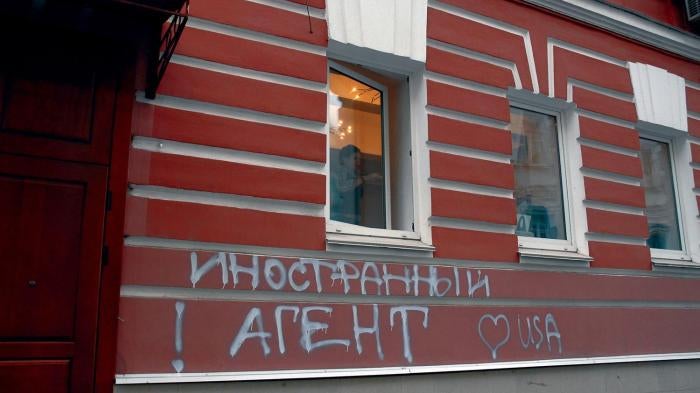
As if to confirm the sentiment expressed above, on the night before the “foreign agents” law came into force, unknown individuals sprayed graffiti reading, “Foreign agent! ♥ USA” on the buildings hosting the offices of three prominent NGOs in Moscow, including Memorial.[61]
Other critics of Law No. 121-FZ also underscored its ambiguity and broad scope for interpretation that could lead to its selective use to retaliate against or silence independent election monitors and groups that work on controversial human rights issues.
Russia’s Presidential Council for Civil Society and Human Rights published an independent expert assessment stating that the law’s provisions legitimized state interference with the nongovernmental sector “beyond the limits” allowed by Russia’s domestic legislation and international obligations, and provided grounds for the state to discriminate against certain noncommercial entities based on their funding sources.[62] It warned that the vagueness of such terms as “political activities,” “influencing decision-making by state bodies in order to change state policy,” or “shaping public opinion” could lead to overly broad interpretation of the law by law enforcement agencies and courts.[63]
In a July 2012 statement, the UN High Commissioner for Human Rights Navi Pillay expressed concern about the “worrying shift in the legislative environment” caused by the series of legislative amendments, including Law No. 121-FZ. Pillay warned that the new laws will have a “detrimental effect” on human rights in Russia.[64]
Council of Europe Secretary General Thorbjørn Jagland pointed out the law’s use of language that had “very negative historic connotations” and criticized Russian legislators for not allowing enough time for reflection and public debate on the draft. Jagland mentioned the positive role that the Council of Europe played in bringing Russia’s existing legislation regulating NGOs in line with democratic standards and reminded Russia of its international obligations as a member of the Council of Europe and a party to the European Convention on Human Rights.[65]
An October 2012 resolution by the Parliamentary Assembly of the Council of Europe (PACE) stated that the new restrictive laws, including Law No. 121-FZ, were “potentially regressive in terms of democratic development” and urged the authorities “not to make use of them in this harmful way.”[66] In June 2013 the Venice Commission is expected to issue an opinion on the law.[67]
Catherine Ashton, the EU high representative for foreign affairs and security policy said the March 2013 inspection wave seemed aimed at “further undermining civil society activities.” She said the inspections and the series of recently adopted laws “constitute a trend that is deeply troubling.”[68] Ashton had previously criticized Law No. 121-FZ, noting the difficulties that Russian NGOs face in obtaining domestic funding and the negative connotations of the term “foreign agent.”[69]
III. NGO Inspections
In the months after the “foreign agents” law was adopted, several organizations received warnings about inspections in connection with it and other grounds, but starting in early March 2013 the government launched a nationwide campaign of inspections of hundreds of NGOs, unprecedented in its scale and scope. The inspections were highly extensive, disruptive, and invasive, and seemed aimed at intimidating NGOs. As this report went to press the full outcome of the inspections was not known; at least two groups have been charged with failing to register as a “foreign agent,” and others have been fined on fire safety and other grounds.
Inspections and Warnings: Mid-October 2012 – March 5, 2013
Soldiers’ Mothers of St. Petersburg and Others
On December 5, 2012, the chief of St. Petersburg’s draft board, Sergey Kachkovsky, requested that the city prosecutor’s office determine whether the Soldiers’ Mothers of St. Petersburg disseminated “extremist” materials and failed to comply with the “law on foreign agents.”[70]
Kachkovsky described leaflets and books on conscientious objection and alternative civil service that the group’s staff members disseminated among conscripts at draft boards. He highlighted the fact that foreign donors financed the publications and alleged their dissemination aimed to “disrupt … the conscription process.”[71]
On February 1, 2013, the group’s chair, Ella Polyakova, received notice that the Ministry of Justice would inspect the organization on the request of the prosecutor’s office.
“They requested all our financial documents since 2010, even tried to request grant applications, but we refused to give these,” Polyakova told Human Rights Watch.[72] The inspection, which lasted until March 1, found two minor violations, both of which had nothing to do with either extremism or the law on “foreign agents”: the group’s emblem had not been officially registered, as required, and although registered in St. Petersburg as a regional NGO, it does work in other regions. The ministry said the Soldiers’ Mothers must amend its charter accordingly by June 2013 and that the inspection materials would be sent to the prosecutor’s office.[73]
On March 12 an officer of the Center for Combating Extremism also visited the organization at the prosecutor’s request, pursuant to Kachkovsky’s complaint. The officer told Polyakova that the group’s publications would be submitted for expert analysis for potential extremism.
“In all the 20 years of our organization’s work, when our Western colleagues asked me if we are persecuted by the authorities for our human rights activities, I confidently said ‘no,’” Polyakova wrote Human Rights Watch. But now, in the twenty-first year, it happened – surprisingly right after we got a grant from the regional administration and I personally became member of the Presidential Council for Civil Society and Human Rights…. And we can only guess who will come to check us next.”[74]
At this writing Poyakova had not received the results of the “extremism” inspection.[75]
On November 28, 2012 a regional department of the Ministry of Justice sent a warning to the Saratov branch of No to Alcoholism and Drug Addiction, a group that helps drug users and raises young people’s awareness about drug addiction.[76] The warning[77] alleged the organization failed to submit a report on foreign funding it received in 2011 and invoked article 2.6 of the NGO law, an amendment introduced by Law No. 121-FZ that had not yet entered into force.[78] The ministry denied the warning was in any way connected with the new “foreign agent” law and stated that the responsibility to report on sources of foreign funding “existed in the national law since 2006,”[79] and that the invocation of article 2.6 of the NGO law was “a technical mistake.”[80]
In February the ministry sent a letter to the organization’s Saratov branch stating that the warning was not entirely lawful.[81] Following the incident, the Ministry of Justice reportedly requested that its regional offices coordinate implementation of the new law at the federal level.[82]
On February 21, 2013, a number of Duma deputies requested that the Investigative Committee and the prosecutor’s office conduct an inspection of Russia’s leading election monitoring watchdog group, Golos, to establish whether the group violates the law by receiving foreign funding without being registered as a “foreign agent.”[83] At a roundtable discussion held at the Public Chamber of the Russian Federation, a Ministry of Justice official stated that the ministry received over 100 requests from individuals to deem Golos and a nongovernmental think-tank Levada Centre “foreign agents.” The official said the ministry rejected such requests because “inspections would take place only when there are indications not only that the organization gets foreign funding but also that it is extremist.”[84]
March 2013: Inspection Campaign Gets Underway
In early March 2013 the office of the prosecutor general requested that lower-level prosecutors’ offices conduct inspections of dozens of NGOs and religious organizations in cooperation with officials from the Federal Tax Service, the Ministry of Justice, and other agencies. As of April 18, 2013, 246 organizations in 54 Russian regions reported to Agora that they had been inspected.[85] A Ministry of Justice official told the Russian Presidential Council for Civil Society and Human Rights that ministry officials participated in 528 prosecutor’s office inspections of NGOs in 49 regions, suggesting the true scale of the inspections. Many of the Russian organizations targeted accept some amount of foreign funding, and include groups working on human rights, environmental protection, government transparency, election monitoring, civic education, religious issues, and the like. Representative offices of foreign organizations, including Human Rights Watch, were also inspected.
On March 28, 2013, after the campaign of inspections had been under way for several weeks, the prosecutor general’s office published a statement giving two explanations for the campaign. It said that the inspections had been planned in 2012 to examine how NGOs were “implementing the law” in order to “identify positive and negative patterns, difficult issues and ways to resolve them.” It also said that the campaign was prompted by “information received” about “banned ultra-nationalist and radical religious organizations.”[86] On April 4 the prosecutor general’s office acknowledged that the inspections were carried out in line with the law on “foreign agents” because “the funding is transferred, but in fact no one is registered [as a ‘foreign agent’].”[87] Answering a journalist’s question about whether the inspections will result in the identification of “foreign agent” NGOs, the deputy prosecutor general said, “Most probably, yes.”[88]
In most cases of which Human Rights Watch is aware the inspections were carried out by a team of prosecutorial, Ministry of Justice, and tax officials. Some teams also included agents from the Federal Security Service (FSB), the Federal Migration Service, the fire department, the health department, and other agencies.
The scope of the inspections was far-ranging. In almost all cases of which Human Rights Watch is aware, the prosecutor’s office representative presented organizations with a notice stating that the inspection would cover the organizations’ compliance “with current legislation.”[89] A document leaked to the media that provides instructions to local prosecutors’ offices for conducting inspections specifically urges them to analyze sources of foreign funding for the groups and their involvement in political activities, as well as any evidence of “extremism.”[90]
Intimidation
Inspections of some organizations that work on sensitive issues – for example on the North Caucasus, the Sochi Olympic Games, or police abuse – clearly aimed to intimidate, and in several cases the procedure more closely resembled a police raid than an inspection.
The inspection at Civic Assistance, a group in Moscow that assists migrants, included a representative from the Federal Migration Service who said upon arrival, “I’m going to check the documents of all non-Russians.” Then, according to the chair of Civic Assistance, the official started to selectively check the identity documents of some staff members based on what appeared to be no more than their physical appearance.[91] Five officials simply walked into the office of one NGO without knocking, having somehow passed through corridor doors requiring a magnetic key card.[92] The inspectors conducted a “visual examination” of the entire office, asked questions about, among other things, photographs on the walls.[93]
In at least three cases, camera crews from NTV, a television station known for its numerous shows seeking to discredit human rights activists and portray Russia’s political opposition as foreign-sponsored, arrived with the inspectors to film the inspections. The NTV news broadcast of the Memorial inspection alleged that Memorial may be in violation of the “foreign agents” law.[94]
It is not clear how NTV learned about the inspections since most government inspections in the current wave were unannounced; the prosecutor’s office explained this by saying that NTV is simply one of the media outlets officially accredited with the agency.[95]
Invasiveness
Several organizations stated on social media platforms that officials thoroughly examined the premises and attempted to probe more intrusively into the groups’ offices, searching libraries for “extremist” literature and requesting to look into computers.[96]
At least one NGO, Environmental Watch of the North Caucasus (EWNC), was forced to provide access to emails even though the inspectors had no warrant. The inspection team, which came to the group’s office in Maykop (1,400 kilometers south of Moscow) on March 27, did not present an inspection notice.[97] It was particularly interested in the organization’s activities related to preparations for the 2014 Olympic Games in Sochi.[98] They urged the group not to publish its report on environmental consequences of the Olympic preparations in order “not to harm the country.” When the group refused, inspectors said they would examine the computers for unlicensed software and look into the group’s email account, threatening to fine the organization if anyone tried to hinder them.
“As we had nothing secret in our emails, we decided to give them access to our account,” Andrey Rudomakha, EWNC’s coordinator, told Human Rights Watch.[99] Officials from the prosecutor’s office and the Center for Combating Extremism went through EWNC’s email account for 1.5 hours and left the office. EWNC plans to file a complaint regarding the inspector’s actions including for violation of the right to privacy.[100]
Inspections at the St. Petersburg offices of the Konrad Adenauer and Friedrich Ebert foundations, the foundations of two German political parties, provoked a diplomatic row as the inspectors confiscated computers belonging to the former to allegedly examine them for unlicensed software. The equipment was returned after a demarche made by the German Ministry of Foreign Affairs.[101]
While inspectors asked some organizations to produce only a standard set of registration, founding, tax, and financial documents, other inspections were more intrusive and demanding. For example, in St. Petersburg, inspectors asked the Memorial Anti-Discrimination Centre to prove its staff had been vaccinated for smallpox and that the organization has plans for “extinguishing rats and utilizing solid waste.”[102] The environmental group Bellona was cited for, among other things, lacking a diary of emergency drills and failing to measure the air quality in the office work stations.[103]
Women of the Don is an NGO in Novocherkassk that carries out educational and peace building programs in the North Caucasus. Officials from the prosecutor’s office, FSB, police (including the economic crimes department), tax, health, and fire inspectorates inspected the group’s office on March 12. The group’s chair, Valentina Cherevatenko, said in an interview with the news portal Caucasian Knot,
Firemen checked documents, fire extinguishers, the fire alarm, and wooden parts the building. Health inspectors examined the ventilation, presence of cold and hot water, and asked for lung X-rays of our staff members (as we have public office hours). The police checked our computers for unlicensed software, asked about our work with children and licenses for educational activity. The tax inspectorate checked financial documents and asked lots of questions about sources of funding and expenses. The prosecutor studied the content of our projects. The FSB officer didn’t ask any questions – I had an impression that he oversaw the inspection by the others, and he also a great interest in our library.[104]
Most inspections covered a three-year period, which meant enormous volumes of paper had to be copied, stapled, and certified by organizations’ representatives. For instance, Memorial (Moscow) submitted in total 8,766 pages of documents (for all its five separate legal entities) for inspection, and the Foundation for Freedom of Information in St. Petersburg – 4,506 pages, or 23 kilograms of paper. NGOs had to use their own paper and ink cartridges for this purpose.
The inspections were in many cases disruptive and demanding. In some cases the inspections lasted only several hours, but in others they were drawn out over a period of days. Officials from the prosecutor’s office, for example, spent a total of seven working days at Memorial, inspecting the organizations’ five legal entities. NGOs also spent significant time in the weeks following the initial inspection responding to follow-up requests. The chair of Women of the Don, for example, was summoned five times to the prosecutor’s office to “give explanations” in connection with the inspection.[105] On April 4 Civic Assistance was told to provide a significant number of additional documents, including texts of speeches made at Civic Assistance events, by the next day.[106] In at least two regions, prosecutors requested that NGOs submit, in addition to the standard package of documents, analyses of their public activities.”[107]
Some inspection teams were polite and respectful, but in other cases they were not. Yuri Vdovin, deputy director of Citizens’ Watch in St. Petersburg said, “The first thing they said was ‘Give us everything and do it right now.’ We told them that a week before our executive director died … and [we had not] replaced him. Secondly, our accountant’s mother died today, so she would not be present…” The officials refused the group’s request to postpone the inspection by four days.[108]
Outcome of Inspections
It is not clear what the overall impact of the inspections will be. One possibility is that organizations could receive official warnings for being in violation of any relevant Russian law. This is a serious matter: as noted above, two official warnings accumulated over an indefinite period can serve as grounds for a court to close an organization. Another potential outcome could be that charges will be brought, for example, on “extremism” allegations, or for failing to comply with the “foreign agents” law.
So far, at the time of the writing, most organizations had not learned the outcome of their inspections. Some had learned the partial outcome. For example, according to Agora, the prosecutor’s office informed the Institute for Media Development – Siberia, based in Novosibirsk, that the group’s letterhead logo had not been properly registered. The city prosecutor’s office ordered a district prosecutor’s office to identify how and why this violation had happened and to determine how the organization should be disciplined.[109]
Several organizations have been cited for fire safety and health violations, and at least two have been fined for similar violations.[110]
NGO Challenges to the Inspections
The prosecutor’s office has the authority to conduct unannounced inspections only when it has received allegations that the organization to be inspected has violated the law.[111] It is not clear whether prosecutors received credible allegations relating to hundreds of NGOs all over Russia, whether such allegations were received just prior to the inspection wave, or whether they had collected such allegations for many months.
A 2011 instruction issued by the prosecutor general’s office requires that officials carry out their oversight work of government bodies and other organizations without groundless interference, without duplicating other state bodies’ functions, and without excessive demands for documents and information, particularly when such information is available publicly or through other government offices.[112]
At least eight human rights NGOs refused to cooperate with the inspections, claiming they were unlawful.[113] Lev Ponomarev, head of three of these groups, is now facing three administrative prosecutions for failing to meet the prosecutor’s demands; each prosecution bears a potential fine of 3,000 rubles.[114] One of the three NGOs’ main arguments was the fact that they had already undergone planned inspections by the Ministry of Justice just one month before, as had several other organizations inspected during the campaign.[115]
Several organizations have sued the prosecutor’s office in relation to the unannounced inspections. For example, Memorial filed a complaint on April 8, 2013 with the Zamoskvoretsky District Court claiming that the inspection was excessively broad in scope and that the prosecutor’s office refused to state the factual grounds that had triggered the inspection.[116]
Golos
The organizations that make up the election-monitoring network Golos, which documented election violations in the November 2011 parliamentary vote, are among those hardest hit by the inspection wave.[117] On February 21, 2013, the Federal Tax Service paid a sudden visit to Golos’s partner organizations in Samara, Chelyabinsk, and Novosibirsk. In Samara, tax officials handed the partner organization’s head a four-page list of required documents.
The Federal Tax Service began inspecting the head office of Golos, in Moscow, a year ago, on April 4, 2012, and as this report went to print the organization was awaiting the inspection outcome report.[118] Nearly all the group’s contractors have also been inspected during this period. The results of the inspections were still not known at this writing.
As of April 10, 2013 all of the seven inter-regional foundations of the Golos network were subjected to tax inspections.[119] As part of these inspections, many individuals who cooperated with Golos as election observers were summoned for questioning as witnesses “to a tax crime.”[120] The election observers were in many cases interrogated not by tax officials, but by officers of the Center for Combating Extremism, who asked questions about their personal involvement in election observation, the content of Golos trainings, and the like.[121]
On March 28, representatives of the prosecutor’s office and the Ministry of Justice inspected the regional branch of Golos in Samara, bringing with them a correspondent and a cameraman of the regional television channel Gubernia.[122]
On April 3 the deputy director of Golos, Grigory Melkonyants, was summoned by a neighborhood police officer in Moscow to pick up an inspection notice issued by the prosecutor’s office. He arrived at the station to discover an NTV film crew waiting for him, which then followed Melkonyants to the metro station asking him why Golos has not registered as a “foreign agent.”[123] Apart from Golos and the inter-regional foundation with the same name, the prosecutors separately requested documents from the editorial office of the Civic Golos newspaper, whose correspondents covered elections. On April 8 the three groups submitted all the requested documents.[124]
Two days later, on April 10, the Ministry of Justice filed documents with a court alleging Golos had violated the law by failing to register as a “foreign agent.” On the same day, the prosecutor’s office contacted the group again requesting that it submit copies of additional documents, including financial documents – all in originals – by April 11.[125]
Meanwhile, on April 11, Golos’s office landlord notified the group, without explanation, that it would have to leave the office before the end of the month.[126]
IV. Treason Law
On October 23, 2012, the State Duma speedily adopted Law No. FZ-190, which expanded the Criminal Code’s definitions of treason and espionage. The draft was endorsed by the Federation Council on October 31.[127] Responding to concerns about the scope for overly broad interpretation of the law (see below), on November 12 President Putin told his human rights council he would review the law himself.[128] However he signed it into law on the same day.[129]
Summary of Provisions
The law broadened the definition of treason by:
- Adding to the list of actions that can constitute state treason the provision of “consultative or other assistance to a foreign state, an international or foreign organization, or their representatives in activities against the security of the Russian Federation” [130]
- Adding international organizations to the list of subjects to whom Russian citizens can transfer “state secret” information for their actions to be qualified as treason;
- Expanding the list of situations in which Russian citizens can be said to have obtained information that constitutes a state secret to include “study or other cases” (previously, only “service and work” were listed);[131]
- Requiring that the actions constituting state treason be directed against “the security of the Russian Federation” (previous wording was “external safety of the Russian Federation”).[132]
Treason is punishable by a fine of up to 500,000 rubles (approximately US$16,280) and a prison term of up to 20 years.[133]
The law also changed the definition of espionage in several ways:
- It includes international organizations among the list of subjects that can be recipients of state secrets;
- An explicit order from a foreign intelligence service is no longer required in order for the transfer of “other” information (that is, information that does not constitute a state secret) for use against Russia’s security by a foreign national or a stateless person to be considered “espionage”; such a transfer made at the behest of an individual “acting in the interests” of a foreign intelligence service can now also be qualified “espionage.”[134]
Potential Impact on Freedom of Expression and Association Before the law was adopted, the Presidential Council for Civil Society and Human Rights found that it contradicted Russia’s domestic legislation and international obligations and called its provisions “repressive” and “unreasonably broad.”[135]
With the new law entering into force, Russian human rights activists and lawyers expressed concern that the authorities could use it to silence and retaliate against its critics. Some dubbed the law “the sword of Damocles.”[136] The International Center for Not-for-Profit Law called the new amendments “so vague, that it allowed the government to brand any inconvenient figure as a traitor.”[137]
Many were alarmed that the legislation could criminalize actions of activists and human rights defenders that have been part of normal practice for them both in Russia and around the world, such as routine working meetings and discussions with foreign counterparts or presenting human rights reports at international conferences.
For example, the United Nations Committee Against Torture stated that the new law “could affect persons providing information to the Committee Against Torture … which could be interpreted as prohibiting the sharing of information on the human rights situation in the Russian Federation with the Committee or other United Nations human rights organs.”[138]
Catherine Ashton expressed concern at the new law “potentially penalizing contacts with foreign nationals with up to 20 years in prison” and reducing “the burden of proof for charges of treason and espionage.”[139] The United States mission to the Organization for Security and Cooperation in Europe (OSCE) warned that such a law could have a “chilling effect on legitimate information-sharing and cooperation between Russian civil society organizations, foreign NGOs, the media, foreign governments, and international bodies, including the OSCE itself.”[140]
Implementation
Human Rights Watch is not aware of any cases in which treason charges have been brought under the new amendments. However, the case of Ivan Moseev, an academic from Archangelsk, illustrates how the treason law can be used arbitrarily to justify intrusive surveillance of individuals. The Federal Security Service (FSB) obtained a court order to tap Moseev’s phone lines in June 2012.
Moseev is an expert on the ancient Pomor peoples that used to populate Russia’s northern White Sea region. He heads an NGO, the Association of Pomors of the Arkhangelsk Region, directs the Institute of Indigenous Peoples and Minorities at the University of Archangelsk, and is in frequent contact with Norwegian diplomats and academics.
In October 2012 Moseev was charged with inciting ethnic hatred after a comment attributed to him and containing a derogatory comment about ethnic Russians was posted to the Echo of the Russian North news portal in April 2012.[141] The website's editors traced the comment to the IP address of Moseev’s computer, which they reported to the FSB. Moseev denies posting the comment, claiming that his computer was not turned on at the time.[142]
In summer 2012 the FSB searched Moseev’s home, confiscated his computers, hard drives, and research documents, and questioned him about how often he visited Norway.
On June 25, 2012, a court issued a warrant for the FSB to tap Moseev’s telephone for 180 days, referring to evidence that suggested he was suspected of state treason. The warrant stated, “Norwegian secret services are using Ivan Moseev to destabilize the social-political situation in Arkhangelsk … With support from foreign networks Moseev has been carrying out activities aiming at making federal Russian authorities recognize the Pomors as an indigenous minority of the North, and including their territory of residence under the jurisdiction of international law, which could lead to a violation of Russia’s territorial integrity.” It also states that, “with financial support from Norway Moseev produced a dictionary of the language of the Pomors, published a series of articles and conducted activities aimed at harming Russia’s safety.”[143]
Moseev’s lawyer is convinced that the FSB invoked the “possible evidence of state treason” to obtain permission for the phone tap, as it would be impossible to do so under charges of inciting hatred.[144]
Moseev appealed the court order, unsuccessfully; on January 17, 2013, the Supreme Court affirmed the legality of the phone tap.[145]
On March 1, 2013, a court sentenced Moseev to a 100,000 fine for insult, a milder crime than incitement.[146] No alleged evidence of treason was mentioned at trial.
FSB surveillance against Moseev continues. On March 11, the Echo of the Russian North website reported on a meeting Moseev had with Norwegian friends. “I told no one about this meeting,” Moseev told Human Rights Watch. “So it seems that the FSB surveillance is still on. They would not leave me alone.” [147]
V. The “Dima Yakovlev Law”
On December 28, 2012, Putin signed Law No. 272-FZ, which defines sanctions against US officials implicated in violations of human rights of Russian citizens, and introduced a ban on the adoption of Russian children by US citizens.[148] It also bans Russian NGOs that either engage in “political” activities and receive funding emanating from the US or engage in activities that threaten Russia’s interests.[149]
The law is informally known as the Dima Yakovlev law for the Russian toddler who died in the US three months after he was adopted by an American family. It is widely accepted in Russia that the bill was passed in retaliation for the so-called Magnitsky Act, signed into law by US President Barack Obama in December 2012, which called for visa bans and asset freezes on Russian officials implicated in torture and killings of whistleblowers in Russia.[150]
Restrictions Relating to NGOs
Public controversy around Law No. 272-FZ focused on the ban on adoptions by US citizens. Less heralded were provisions introducing yet more restrictions on NGOs in Russia.
In particular, the law provides for:
Suspension of NGOs that either
Engage in “political activities” in Russia and are funded by US individuals or organizations or;
Are involved in activities that present a “threat to Russia’s interests.”[151]
Assets of such organizations can be frozen based on a court decision made at request of a relevant executive agency.[152]
The law also authorizes a designated agency to allow suspended organizations to resume work, provided they stop receiving US funding or cease involvement in “threatening” activities. [153]
Prohibition of Russian citizens who also hold US passports from managing or being members of noncommercial organizations that conduct political activities on Russia’s territory.[154]
Exempt from the law are NGO activities in the areas of science, culture, the arts, health protection, protection of persons with disabilities, protection of plant and animal life, and charity work.[155]
Implications for Freedom of Association and Expression
Law No. 272-FZ’s provisions related to NGOs threaten freedom of association because they are vague, discriminatory, excessively punitive, and open the way to arbitrary application. The law does not define “political activity.” Other Russian legislation regulating the activities of NGOs stipulates that a noncommercial organization, with the exception of political parties, is considered to be carrying out political activity if it
participates (including through financing) in organizing and implementing political actions aimed at influencing the decision-making by state bodies intended for the change of state policy pursued by them, as well as in the shaping of public opinion for the aforementioned purposes.[156]
Second, the law defines neither what “Russia’s interests” are, nor what constitutes a “threat” to those interests. Third, it grants a designated agency the authority to determine whether an NGO is involved in “political activities” and receives US funding or is involved in activities that present a “threat to Russia’s interests” and to suspend such organizations without a court order. Finally, the law does not require a prior warning for the suspension, nor does it specify a limit on the duration of the suspension. [157]
Lastly, Law No. 272-FZ prohibits citizens of the Russian Federation who also hold US citizenship from being “members or managers” of noncommercial organizations that participate in “political activity” on the territory of the Russian Federation or of representative offices or branches of foreign organizations that conduct political activities in Russia. If this restriction is violated, the work of the Russian organization or the representative office of a foreign organization can be suspended. It is unclear at this point how the term “members” will be interpreted by the Russian authorities and courts and whether the provision will be applicable to all staff members or just those who are in decision-making positions.
As the law was being debated in the Duma, there was public debate about whether the Duma was targeting Ludmilla Alexeeva, the chair of the Moscow Helsinki Group, Russia’s oldest independent human rights organization, with these provisions. Alexeeva, a Russian national and one of the group’s founders, was granted US citizenship after she was forced to leave the Soviet Union in the 1970s. She returned to Moscow during the glasnost period of the early 1990s. Several Duma deputies denied that this provision was targeted at Alexeeva but pointed out that she would have to step down. Alexeeva has stated numerous times that she would not step down; the Moscow Helsinki Group’s board has unanimously supported this decision. [158]
Implementation
Human Rights Watch is not aware of any efforts to date to implement the NGO-related provisions of Law No. 272-FZ. It is not clear whether the March-April 2013 inspection campaign aimed to check NGOs’ compliance with this law.
In late February, a Ministry of Justice official told an NGO roundtable that the ministry had not been authorized to assess whether organizations “threatened” Russia’s interests and suggested that other agencies would be empowered to do so.[159]
VI. Restrictions on Public Assemblies
On May 22, 2012, barely one month after Vladimir Putin’s inauguration, the State Duma began debating a new assembly law, Law No. 65-FZ, that significantly increased the fines for violating rules for holding public events and imposed various restrictions on organizers and participants of public protests.[160] Seventeen days later, the law was fully adopted and signed into law by President Putin.[161] A wave of international and domestic criticism followed the adoption of the law, with critics pointing to how the law violated rights and contradicted Russia’s international obligations.
A number regions followed suit, adopting additional regulations on public assemblies. For example, in December 2012, the Moscow City Duma amended the municipal law regulating public assemblies by prohibiting single-person protests in Moscow if they are “united by the same organizer and the same purpose.” Additionally, the law prohibited cars decorated with white ribbons or other “protest symbols” from driving on the Garden Ring.[162] White ribbon had become a symbol of the protest movement, and in one instance in February 2012 thousands of people wearing white ribbons formed a chain around Moscow’s Garden Ring Road, with cars and trolleybuses decked in white ribbons honking in support.[163]
Freedom of Assembly in Russia Prior to June 2012
As noted above, from November 2011 through April 2012, massive, peaceful demonstrations took place in Russia without undue police interference. However, as a general rule, even prior to the new assembly law, the right to freedom of assembly in Russia was problematic.[164] The authorities, particularly in Moscow, regularly used arbitrary pretexts to deny requests for peaceful protests; the courts applied excessive penalties for protest organizers and participants; and riot police used violence to disperse peaceful protests.[165]
The right to freedom of assembly is regulated by article 31 of the Constitution of the Russian Federation and the Federal Law on Assemblies, Rallies, Demonstrations, Marches and Picketing (the “assembly law”).
The law’s notification procedure obliges organizers to inform the authorities about their intention to hold a public gathering as well as provide information on the site and the estimated number of participants. If a permit is denied, authorities must offer an alternate venue or time for the event within three days.[166] In practice Russian authorities often refuse to permit protests, using various formal pretexts and pressuring organizers to accept alternative remote locations, which in turn lead them to hold unauthorized demonstrations and face administrative penalties for violating the rules or for not complying with police orders.
For example, following the March 4, 2012 presidential elections, the authorities refused to authorize demonstrations protesting the election results in St. Petersburg and Nizhny Novgorod, and police violently dispersed peaceful, unauthorized protests, beating dozens and arresting hundreds of people.[167]
In Nizhny Novgorod, organizers requested official authorization for the peaceful rally on March 10, but authorities denied the request, citing “public safety” concerns and did not offer an alternative site. Out of approximately 200 people who gathered in Nizhny Novgorod’s city center to publicly protest the election results, 80 were arrested on the spot. The authorities later charged some with disobeying police orders but later released most of them and dropped charges against them. [168]
The so-called Strategy-31 rallies in defense of freedom of assembly have been taking place on the 31st day of each month with 31 days in many Russian cities for the last three years. Many such rallies have been suppressed by police and led to detention of organizers and participants. [169]
Gay prides continue to be banned in Russia, despite the October 2010 ruling of the European Court of Human Rights, which found Russia in violation of freedom of assembly for repeatedly denying activists the right to hold gay rights protests in 2006, 2007, and 2008. [170]
Russia’s Legal Obligations on Freedom of Assembly
Russia is a party to a number of human rights treaties – including the European Convention on Human Rights and the International Covenant on Civil and Political Rights – that impose obligations on the government to respect the right to free peaceful assembly.[171] Any requirement to obtain authorization for a peaceful protest cannot be used to infringe upon the substance of freedom of assembly that is of central importance to a democratic society.
In March 2012 the European Commission for Democracy through Law (the Venice Commission), an advisory body of the Council of Europe, adopted an opinion on the assembly law. The opinion criticized certain provisions of the law, including the requirement to notify the authorities about a public event and the blanket restrictions on the time and places of public events. The commission recommended that Russian authorities:
- Be guided by the “presumption in favor of holding assemblies” while refraining from “depriving the organisers of the right to hold an assembly on the grounds of a failure to agree on any changes to the format of an assembly….” [172]
- Alter the format of a public event only in cases where “there are compelling reasons to do so”;
- Allow peaceful, spontaneous, and urgent assemblies and bring the grounds for restricting public assemblies in line with international standards; [173]
- Reduce the obligations of assembly organizers to uphold public order to encompass only the “exercise of due care.” [174]
The June 2012 Amendments
Law No. 65-FZ did not address concerns flagged by the Venice Commission. Instead, as noted above, the amendments significantly increased the fines for violating rules for holding public events. The maximum penalty for individuals was increased from 5,000 rubles (approximately US$165) to 300,000 rubles (approximately $9,700),[175] a prohibitive amount given the average Russian monthly income of 26,489 rubles ($880).[176]
The new law also banned from acting as organizers of a public events persons with outstanding convictions for offenses “against the foundations of the constitutional system and the security of the state or offences against public safety” as well as persons who have been prosecuted twice or more within a year for violation of laws governing public events.[177]
Law No. 65-FZ also:
- Adds community service to the range of penalties for violations connected with organizing and conducting public events;[178]
- Places on event organizers the burden of financial liability for any damages caused by event participants that involved violations of public order;[179]
- Introduces the concept of sites “specifically designated” for public events;[180]
- Introduces a ban on wearing face masks or otherwise concealing faces of participants of public events;
- Introduces a “minimum permissible distance” of 50 meters between persons who participate in individual protests or “pickets” united by “a single concept”;[181]
- Increases from three months to one year the statute of limitations for violations of the law governing public events.[182]
Implementation of the Assembly Law
Almost immediately after the law entered into force the authorities started applying it, in particular to the political opposition and other activists.
In June 2012, Oleg Kozlovsky, Vsevolod Chernozub, and Anastasia Rybachenko, activists with the opposition movement Solidarnost, notified the Moscow authorities of their intent to organize a gathering of up to 100 to protest the public assembly amendments.[183] Municipal authorities refused to allow the event, citing the amendments prohibiting persons who have been prosecuted twice or more within a year for violating laws governing public events from organizing such gatherings.[184] On June 16 Kozlovsky and his colleagues appealed the refusal to Moscow’s Tagansky District Court, which on July 16 ruled in favor of the municipality.
Oleg Kozlovsky told Human Rights Watch that by trying to obtain permission for the event, the activists mainly sought to “test the system.” Kozlovsky is planning to file a complaint to the European Court of the Human Rights.[185]
On June 22, 2013, a district court in Astrakhan fined local politician Oleg Shein 20,000 rubles ($655) for organizing an unsanctioned protest.[186] In a media interview, Shein said that he attempted to get official authorization for the protest, which involved several hundred people and was peaceful, but authorities denied the request and did not offer him an alternative site. He also noted the fine of 20,000 rubles amounted to four minimum monthly wages in Russia.[187]
On August 17, 2012, the Kazan City Court sentenced Rustem Safin, a representative of a local Islamic center Al Ihlas, and Nail Nabiullin, the head of the Union of Tatar Youth Azatlyik, to fines of 20,000 rubles each for organizing an unauthorized meeting. The charges stemmed from Safin and Nabiullin holding an outdoor press conference concerning the recent assassination attempt on the life of a local Islamic leader.[188]
On October 27, 2012, political opposition activist Alexey Navalny was detained by police after he staged a one-person protest against police torture in front of the headquarters of Russia’s Federal Security Service in Moscow.[189] Under Russian law, a one-person protest does not require official permission. Navalny stated in court that after he finished the protest, a group of journalists followed him to ask questions about the nature of the protest, at which point he was detained and charged with organizing an unauthorized rally.[190] On October 30 Moscow’s Basmanny District Court fined Navalny 30,000 rubles for “violating the order of conducting public gatherings.” Navalny appealed the decision and in January filed a complaint with the Constitutional Court of Russia against the new legislation. The complaint is currently pending.[191]
Impact on Freedom of Assembly
In February 2013 Russia’s Constitutional Court ruled that the ban on individuals with multiple administrative convictions related to organizing public events did not violate their rights and did not find the extension of the statute of limitations for violating laws governing public events unconstitutional.[192]
At the same time, the court ruled that the minimum fine for a violation that did not lead to inflicting damage to health and property must be lowered. The court noted in its decision that the fines were disproportionate and could lead to persons being fined for minor misdemeanors in amounts that frequently exceeded their average monthly salaries.[193] The court also ruled that, until the new law was amended, courts could issue lower fines for the specific administrative offenses than those stipulated in the law.
In addition, the court held that compulsory community service be imposed only as punishment for actions that resulted in inflicting damage to health or property and ruled against a provision of the law that introduced liability of the organizers of public events for harmful actions of its participants, regardless of whether they were guilty of inflicting harm or exercised due care in organizing the event. The court noted that the executive and law enforcement authorities should not discriminate against public events’ participants and organizers, regardless of their political views.[194]
Finally, the court ruled against the provision of the law introducing common sites specifically designated for public events, citing a lack of legislative regulation on the federal level that would ensure equal conditions for citizens in all parts of Russia to realize their right to freedom of assembly.
The court did not find that the law was adopted in violation of rules of parliamentary procedure.
Writing in a separate opinion, Constitutional Court justices Vladimir Yarostlavtsev called the public assembly law unconstitutional and cited serious procedural violations during the process of its adoption.[195] Two more judges of the Constitutional Court, Sergey Kazantsev and Yuri Danilov, also issued separate opinions calling for the law to be repealed.[196]
In a March 2013 opinion, the Venice Commission found that the amendments represent “a step backward for the protection of freedom of assembly in the Russian Federation” and that implementation “may result in infringements of the fundamental right to peaceful assembly guaranteed by the Russian Constitution and by the European Convention on Human Rights.”[197] The commission found that while the Constitutional Court ruling addressed certain problematic aspects of the law, it did not solve all of its problems.
The commission urged Russia “to revise and lower drastically the penalties,” which it said are “excessive for administrative offences with no violence involved and will undoubtedly have a considerable chilling effect on potential organisers and participants in peaceful public events.”
The commission further recommended repealing the provisions which put the burden of financial liability for any damages caused by participants of a public event (which led to violations of public order) on the organizers of the event, ban the wearing face masks during public events, and ban entire “categories of people for breaches of a variety of criminal and administrative offences” from organizing public events.
VII. Internet Content Restrictions
The Legislative Amendments of July 2012
On July 11 the Russian State Duma adopted a bill introducing new restrictions on Internet content. Known as law No. 139-FZ, the new law calls for the creation of a unified register of prohibited websites containing information, “the distribution of which is prohibited in the Russian Federation,” which will then be blocked by Internet service providers (ISPs). The bill came into effect on November 1, 2012.
The law authorizes a federal executive body (hereinafter, the “designated agency”) to maintain the register of blacklisted websites, and Roskomnadzor, the Russian Federal Surveillance Service for Mass Media and Communications, has administered the register since its launch.[198]
With the stated goal of protecting children, the law instructs the designated agency to maintain in the register websites hosting child pornography images, drug-related material, and information that “incites the commission of suicide” or contains “suicide instructions” in the register.
Several government agencies can submit websites for the registry without a court order, including the Interior Ministry, the Federal Drug Control Service (FSKN), and the Federal Service on Surveillance for Consumer Rights Protection and Human Well-Being (Rospotrebnadzor). Roskomnadzor also updates the registry based on court decisions identifying websites containing other, unspecified categories of “illegal content.”[199] In addition, any individual can submit a complaint about online content to Roskomnadzor through its website, which will then be reviewed by Roskomnadzor or the appropriate government agency for inclusion.[200]
Once Roskomnadzor adds a website to the Registry, content-hosting providers have 24 hours to notify the website owner to remove the prohibited content. The website owner is given another 24 hours to comply. Once the content has been removed, Roskomnadzor removes the website from the Registry.[201] If the website owner fails to take down the content, the website remains on the Registry and ISPs must restrict access to the website within 24 hours.[202] Roskomnadzor will only remove a website from the Registry if the owner either takes down the harmful material and sends the agency a request for reinstatement or successfully appeals its ban in court.[203] Appeals must be filed within three months from the day the website was added to the registry.[204]
Potential Impact on Freedom of Expression, Access to Information, and the Right to Privacy
Civil society and industry groups have criticized the definitions of prohibited material as vaguely and broadly defined, leaving too much discretion to government agencies.[205] Opponents also fear that once the mechanisms for nationwide Internet filtering are in place, the kinds of content subject to Roskomnadzor’s decisions will expand over time. In addition, depending on the method of website blocking that ISPs employ – by domain name, uniform resource locator (URL), or Internet protocol (IP) address – the law could lead to disproportionate over-blocking of legal content, with entire services blocked to prevent access to a single video or piece of content.[206]
The Russian Presidential Council for Civil Society and Human Rights also criticized the law, warning that the blacklist would become an “electronic curtain” that would obstruct the development of Russian society.[207] The council argued that the law would limit access to information without sufficient due process guarantees, and that blocking does not address the underlying causes of harm to children. The lack of transparency also prevents scrutiny required to prevent the registry’s misuse as a censorship tool. While the public may check whether a specific website is blocked on the Roskomnadzor website, Roskomnadzor does not publish a full list of blocked websites.[208]
On July 10, 2012, the day before the Duma considered the draft law in second reading, Wikipedia’s Russian website declared a 24-hour blackout and boycott in protest against the bill, which they said would lead to Internet censorship in Russia. The website placed a black banner over the word Wikipedia, which read, “Imagine a world without free knowledge.” [209] Search engines Google and Yandex and social networking sites LiveJournal and VKontakte also joined the protest, urging the authorities to postpone the speedy adoption of the bill pending its further discussion. [210]
In addition, as proponents of the law have suggested, the new law will likely promote nationwide adoption by ISPs of an intrusive monitoring method known as Deep Packet Inspection (DPI).[211] Eric King, head researcher at London-based watchdog Privacy International, describes DPI’s broader deployment: “No Western democracy has yet implemented a dragnet black-box DPI surveillance system due to the crushing effect it would have on free speech and privacy. DPI allows the state to peer into everyone’s internet traffic and read, copy or even modify e-mails and webpages….”[212]
While ISPs may use DPI for commercial reasons, nationwide adoption, made more likely by the new law, raises concerns for the right to privacy in Russia.[213] In 2008 the government began requiring ISPs to install equipment that gives the Federal Security Service (FSB) direct, 24-hour, remote access to their networks to monitor Internet traffic under the SORM “lawful interception” program.[214] While such surveillance may, in theory, be subject to a court order, there is no technical mechanism to prevent unauthorized access, undermining safeguards against illegal surveillance.[215] If SORM obligations are combined with broad adoption of DPI, surveillance may become cheaper and more efficient, allowing agencies to monitor more individuals with fewer resources by shifting the burden to ISPs.
Without stronger oversight and more robust safeguards against illegal surveillance, Law No. 139-FZ could heighten risks that these technologies may be abused, leading to privacy or other harms. As an engineer from one DPI vendor in Russia expresses it, “if you know that [Alexei] Navalny, one of the most famous opposition leaders, is a customer of a known [ISP], you may get all Navalny traffic to be copied through the DPI to the external system. It’s real. And it even shows you which sites he has been to.”[216]
Implementation
According to Roskomnadzor, as of March 15, 2013, the agency received 33,288 requests to place web content in the registry, and the registry contained 4,275 items.[217]
In the first month of the registry’s launch, several popular Russian websites were blocked. On November 11, 2012, Roskomnadzor placed Lurkmore.to, a Russian-language encyclopedia and humor site, in the register at the request of the Federal Drug Control Service.[218] The site became accessible again two days later after its administrators deleted two articles related to marijuana.[219]
Roskomnadzor similarly banned RuTracker, a file-sharing website, for a period of hours until it deleted a copy of The Suicide Handbook from its database.[220] In a third case, access to online library Librusek was blocked because it contained a copy of The Anarchist Handbook. The Federal Drug Control Service purportedly took issue with a marijuana-related chapter of the book, but the site was reinstated only after the entire file was removed.[221]
On January 11, 2013, Roskomnadzor blocked the LiveJournal blog of Rustem Adagamov for publishing “suicide propaganda.” Adagamov, who blogs on LiveJournal under the alias of “drugoi” (“the different one”), is one of the most widely followed bloggers in Russia. The blog entry in question, posted in November, included photos of Tibetan independence activists performing self-immolation. As of January 22, 2013, Adagamov’s blog was again active after he deleted the entry.[222]
In a similar case, Roskomnadzor censored an entry posted by well-known Russian blogger and web designer Artemy Lebedev on February 1, 2013. Three days before, Lebedev had posted a link to the YouTube video “Dumb Ways to Die” on his popular LiveJournal blog. The video, which gathered over 40 million views, was part of a rail safety campaign created by Metro Trains in Melbourne, Australia. It depicts cartoon characters killing themselves in a number of absurd ways, such as swimming with piranhas or eating old pie, and includes a song describing their deaths. After his entry was added to the unified register along with the Russian version of the YouTube video, Lebedev shared part of the letter he received from Roskomnadzor on his blog. According to the website monitoring agency,
The lyrics of the song contain a description of various methods of suicide, such as: taking expired medicine, standing on the edge of a train platform, running across the tracks between platforms, and eating a tube of superglue. The animated characters illustrate the described methods of suicide in a humorous way which attracts children and teenagers. Lines such as ‘hide in a dryer’ and ‘I wonder what this button does’ incite people to commit these acts.[223]
On February 18, 2013, Lebedev reported on his blog that access to the entry was reinstalled at the request of Roskomnadzor.[224]
In March 2013 Facebook stated that it had removed content relating to suicide that had been placed on the unified registry, and Twitter stated that it had removed posts that were on the federal registry on the basis that they had drug- and suicide-related content.[225]
VIII. Other Elements of the Crackdown
The government introduced and implemented the new laws at the same time as it embraced increasingly hostile rhetoric against “foreign influence.” The rhetoric seemed aimed at conflating the promotion of human rights and government accountability with incursions on state sovereignty, and it seemed to influence local officials toward adopting more openly hostile stance toward civil society. At the same time, the state has criminally prosecuted opposition activists and protesters.
Rhetoric against So-Called Foreign Influence
As noted at the beginning of this report, Putin emphasized the need to limit the influence of foreign-funded NGOs during his first presidency and thereafter, particularly in the context of the 2011-2012 election cycle. In a broad-ranging article on foreign policy published several weeks before the March 2012 presidential election, Putin implicitly accused certain kinds foreign-funded NGOs of serving the interests of “foreign masters” in order to “to destabilize other countries.”[226]
A document approved in February 2013 and entitled Concept of the Foreign Policy of the Russian Federation echoed this sentiment. Included in the 104 points of this document was an assessment of the benefits and disadvantages of “soft power.” The document warned against “the risk of destructive and unlawful use of ‘soft power’ and human rights concepts to exert political pressure on sovereign states, interfere in their internal affairs, destabilize their political situation, manipulate public opinion, including under the pretext of financing cultural and human rights projects abroad.”[227]
Two days after approving this document, Putin bluntly warned against any foreign “direct or indirect interference in [Russia’s] internal affairs,” clarifying that this especially concerned “structures which are managed and funded from abroad.”[228]
Much of the rhetoric against so-called foreign influence focused on the United States, and in September 2012 the Russian Foreign Ministry expelled the United States Agency for International Development (USAID), the development arm of the US State Department, and ordered the agency to end its programs in Russia. [229]
Many official and pro-Kremlin politicians made statements implying that opposition leaders and nongovernmental organizations critical of the government were effectively Western spies with a mission to undermine Russia’s interests. [230] In January 2013 Duma members threatened to introduce legislation banning foreign nationals “who discredit Russia” from working for federal state-owned television stations. [231]
Officials in several regions have told civil servants and others not to cooperate with representatives of foreign organizations and foreign-funded domestic groups. For example, a directive posted online on the stationary of the regional government of Mari El Republic (850 kilometers east of Moscow) urged officials to refrain from participating in any social or public political activities organized by foreign NGOs or Russian NGOs receiving funding from foreign sources.[232]
The directive referenced a memorandum on public security and “the expanding activities” of foreign and Russian NGOs issued by the office of the presidential envoy in the Volga Federal District, where Mari El is located. The directive orders heads of regional state agencies to carry out “organizational, informational and awareness-raising work in the workers’ collectives within their jurisdiction” aimed at “minimizing participation of your colleagues and workers in programs and socio-political events organized and financed by foreign and Russian noncommercial organizations.”
The document further demands that regional bureaucrats organize more mass social and political events with participation of young people “with the aim of distracting them from protest actions.”
Human Rights Watch is not aware of similar orders issued in Russia’s other regions. However, the leader of an NGO that promotes law enforcement reform told Human Rights Watch that law enforcement officials in one Siberian region and one region in Russia’s north clearly changed their mode of interaction with the group. She told Human Rights Watch that “[w]hereas previously they participated without reservation in trainings, seminars and the like, since June 2012 they do so only after first obtaining approval from Moscow.”[233] Igor Sazhin, of Memorial-Komi, told Human Rights Watch that local authorities’ relations with the human rights group changed dramatically after the December 2011 protests. He told Human Rights Watch, “Before December 2011 the authorities never tried to go after Memorial-Komi, considering us a ‘necessary evil.’ But now the situation changed sharply.”[234]
In two specific cases, described below, local government officials made statements accusing locally prominent NGOs of being “foreign agents” and “destructive” respectively.
MASHR-Ingushetia
On October 13, 2012, before the “foreign agents” law entered into force, the Federal Security Service chief for Ingushetia, Yuri Seryshev, told Interfax that his agency had “stopped the activities of 20 Ingush NGOs with links to security services of foreign states” and claimed that the human rights organization MASHR was one of three organizations in Ingushetia that fit the definition of “foreign agent.”[235]
MASHR is one of few rights groups that provides pro bono legal help and monitors human rights in Ingushetia. Its head, Magomed Mutsolgov, immediately rejected Seryshev’s allegation.”[236]
On October 15 Alexander Cherkasov, head of the Memorial Human Rights Center, wrote to the Ministry of Justice and the Federal Security Service (FSB) asking which NGOs were closed in Ingushetia for cooperating with foreign intelligence. The letter also asked whether any individuals were being investigated for involvement with foreign states’ security services.[237] In his reply, Seryshev stated that the journalist had misquoted him regarding the 20 NGOs, but did not deny the other statements cited in the interview.[238] In a media interview, a Ministry of Justice official said that only five NGOs had been closed in 2012 due to “severe violations.”[239] MASHR was eventually inspected in March 2013 during the mass inspection wave but continues to operate.[240]
Komi Human Rights Commission “Memorial” (Syktyvkar)
The Komi Human Rights Commission “Memorial” (Memorial-Komi) is a regional group in Syktyvkar that carries out public oversight of police and defends prisoners’ rights.[241] It has faced multifaceted persecution starting in December 2011, when the organization spoke out in support of the protest movement.[242] Five of the group’s members were detained under various circumstances on December 10, the day on which a protest action was announced in Syktyvkar.[243] These detentions were later found unlawful by a court.[244]
This was followed by a massive smear campaign in the regional media, with at least 15 different news items published and television reports aired since January 2012 highlighting the group’s foreign funding and claiming it “works for foreign interests,” it defends “Chechen militants”, and alleging that its members’ had ties with the criminal world.[245]
On January 18, 2012, Red Banner newspaper published an article quoting a report by the head of the regional FSB department for the Komi Republic, Alexander Kalashnikov. In the report, Kalashnikov allegedly stated that Golos and the Komi Human Rights Commission “Memorial,” along with several nationalist groups, were among the “organizations of extremist orientation” active in the region. The Red Banner quote said,
[Their] activity is directed from abroad, often financed by foreign nongovernmental foundations and is aimed at transforming the political system of Russia. The next demonstrations are planned for February 4 and 24, and their aim is to disrupt presidential elections in Russia.[246]
Two days later, on January 20, representatives of Memorial-Komi invited Kalashnikov to attend the organization’s board meeting in order to learn more about the group, its members, activities, and sources of funding and to “discuss opportunities for cooperation between Komi Human Rights Commission “Memorial” and the FSB department for Komi Republic, particularly in the field of combating corruption and extremism.” Because the group received no reply to neither this, nor to a repeated invitation, it asked Alexander Kalashnikov to officially apologize for his statement.[247]
On December 3, 2012, Memorial-Komi filed a defamation suit against the regional FSB department, its head Alexander Kalashnikov, the Red Banner newspaper, and the author of the article citing Kalashnikov’s report. The claim stated that according to the Federal Law on Countering Extremist Activities, an extremist organization is a group in relation to which a court decision has entered into force dissolving its activity for carrying out extremist activities. As there was no such court decision regarding Memorial-Komi, the group claimed that the quote defining it as an “organization of extremist orientation” harmed its business reputation and asked the court to declare the statement invalid and order the newspaper to publish a retraction.[248]
According to the head of the Memorial-Komi, Igor Sazhin, on December 28, 2012, a Komi regional administration official summoned one of Memorial’s staff members for a confidential conversation during which the official threatened to press criminal charges against Memorial staff members if the group did not withdraw the suit against Red Banner.[249] As of March 1, 2013, two staff members of Memorial faced criminal charges.[250]
Hearings on the case started only in February 2013.[251] FSB representatives told the court that its head mentioned Memorial and Golos among “organizations of destructive orientation,” not those of “extremist orientation,” as quoted in the Red Banner article, and that the journalist who wrote the article was not present at the meeting. However, two other journalists, summoned to the court as witnesses, confirmed both that the FSB head used the term “extremist” and that the Red Banner journalist had been present.[252]
On April 5, 2013, the Syktyvkar City Court issued a ruling ordering Red Banner to publish a retraction. However, court refused to satisfy the group’s claims regarding the regional FSB department and its head. The author of the article, Mikhail Kazantsev, explained that the very reason why he decided to write the article was his surprise after hearing Kalashnikov’s statement, which sounded “sensational.”[253]
Post-Election Protests: The “Bolotnaya” Case
On May 6 2012, the day before Vladimir Putin’s inauguration, tens of thousands of protesters marched in central Moscow and began to assemble for a rally sanctioned by the Moscow authorities at Bolotnaya Square, near the Kremlin. Unbeknownst to the rally organizers, the Moscow city police department had, the day before, decided that police should block off one of the entrances to the square on May 6, allegedly for security reasons.[254] This created a bottleneck at the entrance to the square itself.
In response to the bottleneck, several political opposition leaders called for a sit-down strike, and a handful of protesters tried to break through the police line, in some cases throwing asphalt. Police responded with force, including using rubber truncheons, detaining hundreds of people, including peaceful protesters as well as those who were acting aggressively.[255]
One of the participants of the “Bolotnaya” protest has since been sentenced to four years in prison for “mass rioting”; twenty more await trial on charges of rioting and violence against law enforcement agents; and at this writing, 15 are in pretrial custody. A group of members of the Presidential Council on Civil Society Development and Human Rights have questioned the appropriateness of mass rioting charges and called for the detainees to be released prior to trial.[256]
One of the protest leaders, opposition movement Left Front leader Sergei Udaltsov, has been charged with planning “mass riots” and accused of planning the violence in advance with a view to “destabilizing” Russia. Also charged were Udaltsov’s assistants, Konstantin Lebedev and Leonid Razvozzhaev. The evidence for the charges is a documentary aired by the pro-Kremlin television station NTV alleging that a Georgian politician and businessman paid Udaltsov to organize the violence to overthrow the government.[257]
Udaltsov and Lebedev are being held under house arrest prior to trial.[258] Razvozzhaev has been in custody in Russia since October 21, 2012, two days after he disappeared from Ukraine while in the process of applying for political asylum.[259] A member of a prison monitoring body who visited Razvozzhaev in detention in October told Human Rights Watch that Razvozzhaev alleged investigators psychologically tortured him, including by threatening to harm his children and inject him with a “truth drug” that would make him “an idiot for the rest of his life,” so he would sign a confession.[260] An official inquiry into Razvozzhaev’s allegations of torture found no grounds for the allegations, and after Razvozzhaev continued the allegations, in January 2013 he was charged with knowingly making false allegations.[261]
At his March 29, 2013 remand renewal hearing, Razvozzhaev told the court that he was refraining from speaking about abuses against him, lest the authorities add new charges against him, but alleged “outrageous pressure” on him in custody.[262]
In July 2012 another political opposition leader, Alexei Navalny, was charged with embezzlement unrelated to the protest movement in a case that prosecutors had closed in spring 2012 for lack of evidence.[263] At this writing, his trial was scheduled to start in Kirov on April 17, 2012.
Searches Related to the Bolotnaya Case
Investigations into the charges against Udaltsov, Razvozzhaev, and Lebedev have led to broader searches of homes and offices of human rights defenders and political activists who had met with Udaltsov in summer 2012. The searches gave rise to concern that the authorities sought to use the Bolotnaya investigation as a pretext to intimidate independent activists not directly involved with the protest movement and taint their human rights work by association with persons the government has accused of organizing foreign-funded mass riots.
In the early morning of December 19, 2012, police officers from the regional Center for Combating Extremism and officers of the Investigative Committee began searches at the homes of several civil society and opposition activists in Voronezh whose organizations had been active in the protest movement.[264] Officials also searched the apartment of Natalia Zvyagina, a human rights defender who monitors public assemblies but is not directly involved in the protest movement.[265] All the search warrants were issued by the Basmanny District Court in Moscow. Later on the same day, Natalia Zvyagina and three other activists were taken to the regional Investigative Department for questioning and released under a nondisclosure agreement with regards to the case.[266]
The Investigative Committee explained in a public statement that the activists were witnesses in the investigation against Udaltsov, Razvozzhaev, and Lebedev and that Udaltsov had conducted seminars with the political opposition in summer 2012 “with the aim of getting them involved in mass riots.”[267] Since the Voronezh-based activists had attended these events, the statement said that their homes might “contain objects and documents of significance for the criminal case.”[268]
Officials confiscated “electronic data carriers, leaflets and literature with anti-government content” as well as “documents … which confirm that in 2011 and 2012 [the Voronezh Regional Democratic Center] received grants from companies registered in the USA for … 469,000 rubles … allegedly intended for ‘defending the rights of citizens living in tenements’ in Voronezh.”[269]
At around 1 p.m. on December 19, 2012, eight police officers in plain clothes searched the premises of the regional branch of Solidarnost and the Human Rights House of Voronezh.[270] They refused to state which official agency they represented and waved a piece of paper claiming it was a warrant to search the building. They did not allow staff to read the document.[271]
During the search, the officers pushed Victoria Gromova, director of the Youth Human Rights Movement Foundation, out of the room and confiscated the phone of Liubov Zakharova, a representative of Article 20 human rights news agency, while she was reporting the events on Twitter.[272] After about 20 minutes, the officers locked themselves in the room together with several staff members and volunteers, locking out other NGO representatives and a lawyer. The officers examined documents and confiscated two hard drives, a personal laptop, a personal tablet, an e-book, and two USB drives. The equipment has not been returned to the owners.
In early April 2013 court hearings in Moscow began in cases filed by several of the activists complaining about the legality of the search.
Towards the end of December the apartment of an opposition political activist in Voronezh was searched and two more activists were questioned on the same grounds.[273]
More searches related to the Bolotnaya case took place in April 2013 in Orel (325 kilometers southwest of Moscow). On the morning of April 1, 2013, a team consisting of an officer from the Investigative Committee, several police officers from the regional Center for Combating Extremism, and several other police officers searched the apartments in the city of Orel belonging to Dmitry Kraiukhin and Veronika Katkova. Kraiukhin and Katkova are human rights defenders who work on a variety of issues, including election monitoring and prison monitoring.
A copy of the search warrant, which Kraiukhin was able to obtain from the investigators, states that he and Katkova had met Udaltsov in a café in Orel to discuss getting Orel residents involved in the March of Millions protest planned for September 15, 2012. Elsewhere the search warrant states that Udaltsov had organized training camps to train people how to organize “mass riots” in various Russian cities but that he had failed in his efforts to stage these alleged riots.[274]
According to Dmitry Kraiukhin, the officers were polite. Due to the lack of electricity in Kraiukhin’s apartment, the officers could not examine his computers, so they took his computer, a laptop, and several USB drives to the regional Center for Combating Extremism, where they examined the equipment looking for documents related to “plotting mass riots.”[275]
Kraiukhin has filed a complaint with the court regarding the search on April 12.[276]
The Pussy Riot Trial
The unjust criminal trial and imprisonment of the feminist punk band Pussy Riot caused a global uproar. Two of the members, Nadezhda Tolokonnikova and Marina Alyokhina, are currently serving a two-year prison sentences and a third, Ekaterina Samutsevich, was released on a suspended sentence in October 2012.[277]
Four members of the group performed what they call a “punk prayer” on February 21, 2012 in Moscow’s Russian Orthodox Christ the Savior Cathedral. Dressed in brightly colored dresses and wearing balaclavas, they sneaked into the area in front of the iconostasis – a screen that separates the sanctuary from the rest of the church – where the public is generally not supposed to enter.[278] They danced, jumped, and shouted some words to their song, “Virgin Mary, Get Putin Out.” The stunt lasted about a minute before they were forcibly removed from the premises. They caused no damage to church property.
The same day, a video widely shared on social media showed a montage of the stunt with the song spliced in. The song criticizes the Russian Orthodox Church’s alleged close relationship with the Kremlin and the personally close relationship of Putin with the patriarch of the Russian Orthodox Church. The group was particularly critical of the Russian Patriarch Kirill for his alleged calls on Orthodox believers to vote for Putin in the March 2012 presidential election.
In August 2012 a judge found in favor of the prosecution’s argument that the women’s actions were motivated by religious hatred and had caused grievous harm to Christian Orthodox believers. Prosecution witnesses included nine people who said they were profoundly offended by the stunt, including altar boys, security guards, and candle sellers.
Tolokonnikova and Alyokhina lost their October 2012 appeals and have filed a complaint with the European Court of Human Rights.
In September 2012, one month after the trial ended, lawmakers submitted to the Duma a draft law criminalizing religious insult into the Duma, and on April 9, 2013, the Duma approved the draft in first reading. During the April reading, the draft’s author “cited Pussy Riot's performance as evidence that the country's traditional beliefs are in need of additional legislative protection.”[279]
IX. Russia’s International Legal Obligations
As a member of the Council of Europe (CoE) since 1996, a party to the European Convention on Human Rights (ECHR) since 1998, and a party to the International Covenant on Civil and Political Rights (ICCPR) since 1973, Russia has binding and clear obligations to respect freedoms of expression, association, and assembly. The Russian constitution enshrines these same freedoms.[280]
The ECHR and the ICCPR allow only those restrictions on these freedoms that are properly provided for by law and “necessary in a democratic society” for a clearly defined set of reasons (including public order and national security).[281]
Some of the laws described in this report may individually give rise to violations of both instruments. The Venice Commission, as noted below, found that the amendments to the public assemblies law “may result in infringements of the fundamental right to peaceful assembly.”[282]
The law reinstating criminal responsibility for criminal libel is inconsistent with the conditions set forth in international human rights law. As the United Nations special rapporteur on the promotion and protection of the right to freedom of opinion and expression noted in 2008, “[T]he subjective character of many defamation laws, their overly broad scope and their application within criminal law have turned them into a powerful mechanisms to stifle investigative journalism and silence criticism.”[283]
Additionally, several international authorities have determined that criminal penalties are always disproportionate punishments for defamation, which is, by definition, a nonviolent offense.[284]
The “foreign agents” law and the “Dima Yakovlev law” may each give rise to violations of article 11 of the ECHR, which protects the right to freedom of association, as they are discriminatory and unjustifiably imposes disproportionate burdens on NGOs in addition to those already imposed under Russian law. The European Court of Human Rights (ECtHR) has consistently made clear that the right “to form a legal entity in order to act collectively in a field of mutual interest is one of the most important aspects of the right to freedom of association, without which that right would be deprived of any meaning.”[285] While a state has a right to regulate an association’s aim and activities, it must do so in a manner compatible with its obligations under the convention.[286] The protection of opinions and the freedom of expression under article 10 of the ECHR is also one of the objectives of the freedom of association.
The new administrative burdens and punitive dimensions of these laws threaten both the freedom of association to establish and run NGOs and the freedom of expression of NGOs. They are also clearly inconsistent with the Fundamental Principles on the Status of Non-governmental Organizations, a nonbinding standard drawn up by the CoE that sets out best practices for the regulation of NGOs, with a view to ensuring that they benefit from freedom of association and fulfill duties and obligations.[287] The new treason law’s wide berth for interpretation is inconsistent with the ECHR’s requirement that restrictions on free speech be only those that are “necessary for a democratic society.”
Taken together, the arbitrary, punitive, invasive elements of these three laws are contrary to Russia’s obligations under international and regional law to respect freedom of expression and association and have a chilling effect on the exercise of those rights.
Acknowledgements
This report was researched and written by Yulia Gorbunova, researcher with the Europe and Central Asia division of Human Rights Watch, and Konstantin Baranov, a consultant with the Europe and Central Asia division. Additional research was done by Tanya Lokshina, senior researcher with the Europe and Central Asia division, Kaitlin Martin, associate with the Europe and Central Asia division, Hugo Spalding, intern with Human Rights Watch’s Russia office, and Ekaterina Martin, associate, and Maria Kunineva, Natalia Estemirova Fellow.
The report was edited by Rachel Denber, deputy director of the Europe and Central Asia Division. Aisling Reidy, senior legal advisor, and Tom Porteous, deputy program director, of Human Rights Watch reviewed the report; Veronika Szente Goldston, advocacy director with the Europe and Central Asia division, reviewed the recommendations; and Cynthia Wong, senior researcher with the Business and Human Rights program, reviewed the chapter regarding Internet content.
Production assistance was provided by Kaitlin Martin, Ekaterina Martin, Maria Kunineva, Olga Kozlova, Grace Choi, Kathy Mills, and Fitzroy Hepkins.
Human Rights Watch expresses its gratitude to the many civil society organizations that shared their views and stories with us.
[1] Human Rights Watch, Russia–Choking on Bureaucracy: State Curbs on Independent Civil Society Activism, vol. 20, n0. 1(D), February 2008, http://www.hrw.org/en/reports/2008/02/19/choking-bureaucracy-0.
[2] Ibid, pp. 29-30.
[3] Ibid, Choking on Bureaucracy, pp. 17-18.
[4] “Federal Law of the Russian Federation from 7 December 2011 N 420-F3 [Федеральный закон Российской Федерации от 7 декабря 2011 г. N 420-ФЗ],” Rossiyskaya Gazeta, December 9, 2011, http://www.rg.ru/2011/12/08/p-raboty-site-dok.html (accessed December 8, 2011).
[5] Ibid; “Open Address of the Russian Human Rights NGOs to the Parliamentary Assembly of the Council of Europe,” Memorial, September 28, 2012, http://www.memo.ru/d/130013.html (accessed September 29, 2013).
[6] “The protest movement in Russia 2011-2012,” November 2, 2012, http://hro.rightsinrussia.info/archive/right-of-assembly-1/levada/report, The Levada Centre, November 2, 2012 (accessed January 5, 2013).
[7] “CEC counted 100% of the ballots: Putin won with 63.6% [ЦИК обработал 100% протоколов: Путин выиграл выборы с 63,6%], RIA Novosti, March 5, 2012, http://ria.ru/vybor2012_putin/20120305/585287674.html (accessed April 11. 2013).
[8] The State Duma voted on the law on July 13, 2012, the Federation Council approved it on July 18, 2012, it was published on July 23, 2013, and it entered into force on November 21, 2012. Federal Law “On Making Amendments to Certain Legislative Acts of the Russian Federation Regarding the Regulation of Activities of Noncommercial Organizations Performing the Functions of Foreign Agents,” No. 121-FZ, 2012, Rossiyskaya Gazeta, http://www.rg.ru/2012/07/23/nko-dok.html (accessed April 14, 2013).
[9] “Putin asked the cabinet of ministers to increase the funding for domestic non-commercial organizations to 3 billion rubles [Путин просит кабмин увеличить госфинансирование НКО до 3 млрд рублей],” RIA Novosti, July 10, 2012, http://ria.ru/economy/20120710/696276630.html (accessed January 15, 2013); “More than 2 billion rubles is allocated in 2013 to support the activities of NGOs – Kremlin[На поддержку деятельности НКО в 2013 году выделяется более 2 млрд рублей – Кремль],” Interfax, March 30, 2013, http://www.interfax.ru/russia/news.asp?id=298526 (accessed April 3, 2013).
[10] See Human Rights Watch, Choking on Bureaucracy, and Human Rights Watch, Russia – An Uncivil Approach to Civil Society, vol. 20, n0. 1(D), June 2009, http://www.hrw.org/reports/2009/06/16/uncivil-approach-civil-society.
[11] “Putin asked the cabinet of ministers to increase the funding for domestic non-commercial organizations to 3 billion rubles [Путин просит кабмин увеличить госфинансирование НКО до 3 млрд рублей],” RIA Novosti, July 10, 2012, http://ria.ru/economy/20120710/696276630.html (accessed January 15, 2013).
[12] For example, Dmitry Vyatkin said, “Interference in Russian politics by other foreign states has reached significant proportions and that cannot be ignored,” echoing this major theme in Russian foreign and domestic policy. “The law does not prohibit but creates a responsibility to inform [Закон не запрещает, а обязывает информировать],” United Russia, November 21, 2012 http://er.ru/news/2012/11/21/zakon-ne-zapreshaet-obyazyvaet-informirovat/ (accessed January 25, 2013). See also discussion below in “Rhetoric against So-Called Foreign Influence.” The law’s supporters also asserted, mistakenly, that the law was a more lenient version of the US Foreign Agent Registration Acts (FARA). FARA covers organizations and individuals that operate under direction and control of a foreign principle. FARA does not equate receiving foreign funding, in part or in whole, with being under the direction and control of a foreign principle. Finally, FARA relates to a small set of institutions and individuals that operate at the behest of foreign entities, and its effects on those entities are minimal. See “Russia: Reject Proposed Changes to Rules on Foreign-Funded NGOs,” Human Rights Watch news release, July 13, 2012, http://www.hrw.org/news/2012/07/13/russia-reject-proposed-changes-rules-foreign-funded-ngos.
[13] Federal Law “On Making Amendments to Certain Legislative Acts of the Russian Federation Regarding the Regulation of Activities of Noncommercial Organizations Performing the Functions of Foreign Agents,” No. 121-FZ, 2012, http://base.consultant.ru/cons/cgi/online.cgi?req=doc;base=LAW;n=132900 (accessed February 2, 2013).
[14] Federal Law No. 121- FZ of 2012, art. 2, para. 1(a)-1(b).
[15] Ibid, art.2, para. 2.
[16] Open joint stock companies with state participation and their subsidiaries are exempted. Ibid.
[17] Ibid.
[18] Certain activities are exempted, including those in the areas of science, culture, the arts, health protection, protecting persons with disabilities, protecting plant and animal life, and charity work. For the full list of excluded activities, see Federal Law No. 121-FZ of 2012, art. 2, para 2.
[19] Ibid, art. 2, para. 4.
[20] Ibid, art. 2, para. 3(a).
[21] Ibid, art. 2, para 5(k).
[22] Ibid, art. 2, para. 3(b).
[23] See, for example “You can only exit feet first [Выход только вперед ногами],” Kommersant, December 3, 2012, http://www.kommersant.ru/doc/2081599 (accessed January 4, 2013).
[24] Federal Law No. 121-FZ of 2012, art. 2, para. 5(a)-(g).
[25] Ibid, art.2, para. 5(d).
[26] Ibid, art. 2, para 5(g).
[27] Federal Law “On Rights Protection of Legal Entities and Individual Entrepreneurs during State and Municipal Control (Supervision) Actions,” No. 294-FZ, 2008, http://base.consultant.ru/cons/cgi/online.cgi?req=doc;base=LAW;n=137706;fld=134;dst=4294967295;rnd=0.5719579736143712;from=133508-0 from December 2008, as amended (accessed on March 2, 2013), art. 9, para. 2.
[28] Federal Law No. 121-FZ of 2012, art. 2, para, 5(g).
[29] Ibid, art.2, para. 5(z).
[30] “Ministry of Justice expands the list of grounds for unplanned inspections [Минюст расширяет перечень оснований для внеплановых проверок НКО],” Vedomosti, January 30, 2013, http://www.vedomosti.ru/politics/news/8535751/nekommercheskoe_opasno (accessed February 15, 2013).
[31] Federal Law No. 121-FZ of 2012, art. 2, parа. 5(n).
[32] Ibid, art. 4.
[33] Ibid, art. 2, para. 5(z), 5(i).
[34] Ibid.
[35] “Overview
of the draft law No. 121- FZ ‘On Making Amendments to Certain
Legislative Acts of the Russian Federation Regarding the Regulation of
Activities of Noncommercial Organizations Performing the Functions of Foreign
Agents’ [Обзор
Федерального
закона от 20
июля 2012 года №121-ФЗ
«О внесении
изменений в
отдельные
законодательные
акты
Российской
Федерации в
части
регулирования
деятельности
некоммерческих
организаций,
выполняющих
функции
иностранного
агента»],” The International
Center for Not-for-Profit Law, August 10, 2012, http://lawcs.ru/images/doc/overview-of-the-russian-foreign-funding-law.pdf
(accessed March 1, 2013).
[36] Federal Law “On introducing amendments to the Administrative Code of the Russian Federation,” No. 192 – FZ, 2012, http://www.rg.ru/2012/11/14/koap-dok.html (accessed January 21, 2013).
[37] Ibid, art. 1, para. 3.
[38] Ibid.
[39] Ibid, art. 1, para. 4.
[40] Ibid, art. 1 para. 4(2).
[41] Federal Law No. 121-FZ of 2012, art. 3 para. 1(2).
[42] For the full list of penalties, see Federal Law No. 121-FZ of 2012, art. 3 para. 1(2).
[43] Ibid, art. 3, para. 1(3).
[44] Ibid, art. 3, para. 2.
[45] Ibid, art. 3, para. 2.
[46] “Head of the Ministry of Justice criticized the law on ‘foreign agents’ [Глава Минюста раскритиковал закон об ‘иностранных агентах’],” Novaya Gazeta, January 16, 2o13, http://www.novayagazeta.ru/news/62237.html (accessed January 30, 2013).
[47] “Meeting of the board of the Federal Security Service [Заседание коллегии Федеральной службы безопасности],” President of Russia, February 14, 2013, http://www.president.kremlin.ru/transcripts/17516 (accessed February 16, 2013).
[48] Human Rights Watch telephone interview with Lilia Shibanova, executive director of Golos, and Grigory Melkonyants, deputy director of Golos, April 9, 2013.
[49] Ibid.
[50] Ibid.
[51] “Prosecutor’s office calls an NGO ‘foreign agent’ for meeting with a political advisor from the US Embassy [Прокуратура признала НКО «иностранным агентом» за встречу с политическим советником посольства США],” Open Information Agency, April 16, 2013, http://openinform.ru/news/pursuit/16.04.2013/28328/ (accessed April 17, 2013).
[52] “Prosecutor’s office calls Soldiers Mothers’ Committee a foreign agent for exposing election violations [Прокуратура назвала иностранным агентом Комитет солдатских матерей за выявленные нарушения на выборах],” Open Information Agency, April 17, 2013, http://openinform.ru/news/pursuit/17.04.2013/28340/ (accessed April 17, 2013).
[53] Comment by Oleg Orlov of Memorial: “It is stupid to register as a foreign agent” [Глупо регистрироваться в качестве иностранного агента],” Gazeta.ru, July 23, 2012, http://www.gazeta.ru/politics/2012/07/23_a_4690769.shtml (accessed March 3, 2013); “Alexeeva: Moscow Helsinki Group will not register as a foreign agent [Алексеева: МХГ не будет регистрироваться как иностранный агент],” Grani.ru, July 2, 2012, http://grani.ru/Politics/Russia/m.198776.html (accessed November 17, 2012).
[54] “For Human Rights movement will ignore the law on NGOs-foreign agents – Ponomarev [Движение ‘За права человека’ будет игнорировать закон об НКО-агентах – Пономарев],” Interfax, July 21, 2012, http://www.interfax.ru/society/news.asp?id=256750 (accessed April 15, 2013).
[55] Taicia Bekbulatova, “The foreign agents law is written illegibly [Закон об иностранных агентах написан неразборчиво],” Kommersant, September 4, 2012, http://www.kommersant.ru/doc-rss/2014910 (accessed January 5, 2013).
[56] Ibid; also see Pavel Chikov’s Facebook page at http://www.facebook.com/#!/photo.php?fbid=439690952771021&set=a.171541582919294.45156.100001903601702&type=1&theater.
[57] “First NGO in Russia that decided to become a ‘foreign agent’ [В России первая НКО решила войти в реестр «иностранных агентов],” ZonaPrava.org, December 21, 2012, http://zonaprava.org/news/2149.html (accessed December 25, 2012).
[58] Ibid.
[59] “Russia’s Ministry of Justice did not find legal grounds to include ‘Shield and Sword’ into the registry of foreign agents [Минюстом России не установлено достаточных правовых оснований для внесения ЧРПОО «Щит и Меч» в реестр НКО-иностранных агентов],” Ministry of Justice of the Russian Federation, January 22, 2013, http://minjust.ru/node/4433 (accessed January 29, 2013).
[60] Human Rights Watch telephone interview with Furkat Tishaev, March 8, 2013.
[61] “Human rights defenders said the office of Memorial in Moscow was attacked by vandals [Правозащитники заявили что вандалы атаковали здание ‘Мемориала’ в Москве]” Interfax, November 21, 2012, http://www.interfax.ru/russia/news.asp?id=276974 (accessed January 14, 2013).
[62] “Expert conclusion on the draft law ‘On making amendments to certain legislative acts of the Russian Federation regarding the regulation of activities of noncommercial organizations performing the functions of foreign agents’ [Заключение на проект Федерального закона «О внесении изменений в отдельные законодательные акты Российской Федерации в части регулирования деятельности некоммерческих организаций, выполняющих функции иностранного агента»],” Presidential Council for Civil Society and Human Rights,
http://www.president-sovet.ru/structure/group_detst/materials/zaklyuchenie_na_proekt_federalnogo_zakona_o_nko.php (accessed January 10, 2013).
[63]Ibid.
[64] “Pillay concerned about series of new laws restricting human rights in Russian Federation,” United Nations Office of the High Commissioner for Human Rights, July 18, 2012, http://www.ohchr.org/EN/NewsEvents/Pages/DisplayNews.aspx?NewsID=12366&LangID=E (accessed February 13, 2013).
[65] “Secretary General alarmed by proposed NGO legislation in Russia,” Council of Europe, July 7, 2012, http://hub.coe.int/en/web/coe-portal/press/newsroom?p_p_id=newsroom&_newsroom_articleId=1050615&_newsroom_groupId=10226&_newsroom_tabs=newsroom-topnews&pager.offset=120 (accessed February 14, 2013).
[66] Parliamentary Assembly of the Council of Europe, “The honoring of obligations and commitments by the Russian Federation,” Res. 1896 (2012), October 2, 2012, http://assembly.coe.int/ASP/XRef/X2H-DW-XSL.asp?fileid=19116&lang=EN from (accessed March 5, 2013).
[67] “Venice Commission to evaluate laws on ‘foreign agents’ and treason,” Rights in Russia, February 19, 2013, http://hro.rightsinrussia.info/archive/ngos/foreign-agents/coe/venice (accessed March 8, 2013).
[68] “Statement by EU HR Ashton on the situation of NGOs in the Russian Federation,” March 26, 2013, European Union @ United Nations, http://www.eu-un.europa.eu/articles/en/article_13335_en.htm (accessed April 19, 2013).
[69] “Catherine Ashton EU High Representative for Foreign Affairs and Security Policy and Vice President of the European Commission Statement on the political use of justice in Russia European Parliament/Strasbourg,” European Commission, September 11, 2012, http://europa.eu/rapid/press-release_SPEECH-12-598_en.htm?locale=FR (accessed February 5, 2013).
[70] Human Rights Watch interview with Ella Polyakova, director, Soldiers’ Mothers of St. Petersburg, St. Petersburg, January 30, 2013.
[71] Letter of December 5, 2013, on file with Human Rights Watch.
[72] Human Rights Watch telephone interview with Ella Polyakova, February 26, 2013.
[73] St. Petersburg Main Directorate of the Ministry of Justice of the Russian Federation, “Report on the inspection of the St. Petersburg regional public human rights organization, ‘Soldiers’ Mothers of St., Petersburg,’” no. 13, March 1, 2013, on file with Human Rights Watch.
[74] Human Rights Watch email correspondence with Ella Polyakova, March 23, 2013.
[75] Ibid.
[76] Official website of No to Alcoholism and Drug Addiction, http://www.nan.ru/?f=fond/ (accessed January 29, 2013). The fund has been operating in Russia since 1987 and it has over 60 branch offices nationwide.
[77] Warning issued by the Saratov Ministry of Justice to the Saratov branch of No to Alcoholism and Drug Addiction, November 28, 2012, http://openinform.ru/fs/j_photos/openinform_387.pdf (accessed April 19, 2013).
[78] “Ministry of Justice disarms a foreign agent [Минюст обезвреживает иностранного агента],” Kommersant, December 13, 2012, http://www.kommersant.ru/doc/2088739 (accessed January 29, 2013).
[79] “Explanation of the Russian Ministry of Justice on issuance of a warning to the charitable foundation ‘No to Alcoholism and Drug Addiction’ [Разъяснения Минюста России по факту вынесения предупреждения отделению благотворительного фонда ‘Нет алкоголизму и наркотикам’],” Ministry of Justice of the Russian Federation, http://minjust.ru/node/2701?theme=minjust?theme=minjust (accessed March 3, 2013).
[80] Roundtable on implementation of the Federal Law “On Non-commercial Organisations” relating to registration as “foreign agents,” organized by the Independent Council for Legal Expertise, Moscow, February 26, 2013.
[81] “The Ministry of Justice acknowledged unlawful warning to the Saratov office of ‘No to Alcoholism and Drugs’ on the ‘foreign agents’ law [Минюст признал неправомерным предупреждение саратовскому отделению НАН по закону ‘об иностранных агентах’],” Social Information Agency, February 5, 2013, http://www.asi.org.ru/asi3/rws_asi.nsf/va_WebPages/9E7F0F144777293244257B090038FE3CRus (accessed March 2, 2013).
[82] “Will the regions be required to coordinate the implementation of the ‘agents’ law with Moscow? [Регионы обязали согласовывать применение закона об ‘агентах’ с Москвой?]”Human Rights in Russia, February 5, 2013, http://www.hro.org/node/15707, (accessed March 2, 2013).
[83] “The Ministry of Justice declined to inspect foreign funding of ‘Golos’ [Минюст отказался проверять иностранное финансирование «Голоса»],” Golos, March 1, 2013, http://www.golos.org/news/6935 (accessed March 3, 2013); Maksim Korolev, “‘Golos’ is suspected of violation the law on NGOs [«Голос» подозревают в нарушении закона об НКО],” Izvestia, February 22, 2103, http://izvestia.ru/news/545401 (accessed March 3, 2013).
[84] “Reputational Risks [Репутационные риски],” The Civic Chamber of the Russian Federation, February 26, 2013, http://www.oprf.ru/press/news/2013/newsitem/20653 (accessed March 3, 2013).
[85] The list of prosecutors’ inspections compiled by Agora can be found at http://openinform.ru/fs/j_photos/openinform_405.pdf.
[86] “Regarding inspections of public and religious associations and other noncommercial organizations’ implementation of the law [О проверке исполнения законодательства общественными, религиозными объединениями и иными некоммерческими организациями],” Prosecutor General of the Russian Federation, March 28, 2013, http://genproc.gov.ru/smi/news/genproc/news-81834/ (accessed March 31, 2013). Notably, a Ministry of Justice official on February 25 said at a roundtable discussion that the ministry would examine compliance with the “foreign agents” law through planned, not “unannounced” inspections. See “The Ministry of Justice has not performed unplanned inspections of NGOs for the law on foreign agents [Минюст не проверял внепланово НКО по закону об иностранных агентах],” RIA Novosti, February 25, 2013, http://ria.ru/society/20130225/924566033.html (accessed April 3, 2013).
[87] “Prosecutor General: NGOs receive funding from abroad, but no one has registered [Генпрокуратура: НКО получают финансирование из-за рубежа,но соответствующую регистрацию никто не прошел], Gazeta, April 4, 2013, http://www.gazeta.ru/politics/news/2013/04/04/n_2834401.shtml (accessed April 19, 2013).
[88] “Russian NGOs receive funding from abroad without registration [Российские НКО получают финансирование из-за рубежа без регистрации],” RIA Novosti, April 4, 2013, http://ria.ru/incidents/20130404/930940022.html (accessed April 11, 2013).
[89] For example, when Human Rights Watch’s representative office in Moscow was inspected on March 27, 2013, the prosecutor’s office representative presented such a notice. Notice of the Moscow city prosecutor’s office, no. 27-2-4-2013, March 25, 2013, signed by Deputy City Prosecutor A.Y. Zakharov, on file with Human Rights Watch.
[90] Document published on Gazeta, http://static.gazeta.ru/nm2012/docs/zadanie_prokuroru.pdf (accessed April 18, 2013).
[91] Human Rights Watch email correspondence with Svetlana G., chair, Civic Assistance, April 4, 2013. By non-Russians, the official apparently meant non-ethnic Russians, as opposed to non-Russian citizens.
[92] Human Rights Watch telephone interview with A.A., NGO representative, name and date of interview withheld at interviewee’s request.
[93] Ibid.
[94] These included Memorial (see “Russia: New Pressure on Civil Society,” Human Rights Watch news release, March 21, 2013, http://www.hrw.org/news/2013/03/24/russia-new-pressure-civil-society), Amnesty International, For Human Rights, and Golos. In addition, the Samara regional television station, Gubernia, arrived with officials for the inspection of Golos-Samara.
[95] Aleksandr Litoi, “‘Foreign agents’ provoked a confrontation with prosecutors [«Иностранные агенты» вызвали прокуроров на разборки],”RBC daily, March 26, 2013,
http://www.rbcdaily.ru/society/562949986360386 (accessed March 26, 2013).
[96] Human Rights Watch telephone interview with A.A., NGO representative, name and date of interview withheld at interviewee’s request.
[97] Human Rights Watch telephone interview with Andrey Rudomakha, coordinator, EWNC, April 3, 2013.
[98] “Wave of inspections-harassment reaches Environmental Watch of the North Caucasus [Волна проверок-преследований со стороны властей докатилась до экологической вахты по северномы кавказу],” Environmental Watch of the North Caucasus, March 28, 2013, http://ewnc.org/node/11141 (accessed March 28, 2013). The inspection team included officials from the prosecutor’s office, the Center for Combating Extremism, and the FSB.
[99] Human Rights Watch telephone interview with Andrey Rudomakha, April 3, 2013.
[100] Ibid.
[101] “Press statement of the Konrad Adenauer Foundation on events in Russia [Актуальное заявление пресс-службы Фонда Конрада Аденауэра по поводу событий в России],” Konrad Adenauer Foundation, March 28, 2013, http://www.kas.de/ru-moskau/ru/publications/33949/ (accessed March 28, 2013).
[102] “Inspection of St. Petersburg Memorial Society [Проверки в Петербургском обществе ‘Мемориал’],” Cognita!ru, March 26, 2013, http://www.cogita.ru/ (accessed March 26, 2013).
[103] “St. Petersburg NGOs prepare to be fined hundreds of thousands of rubles [Петербургские НКО готовятся оштрафовать на сотни тысяч рублей],” Neva 24, April 2, 2013, http://www.neva24.ru/a/2013/04/01/Peterburgskie_NKO_gotovjat/ (accessed April 2, 2013).
[104] Natalia Krainova, “Security officials started inspections of NGOs in the Rostov oblast [В Ростовской области силовики начали проверки НКО],” Kavkazsky Uzel, March 16, 2013, http://www.kavkaz-uzel.ru/articles/221512/ (accessed March 16, 2013).
[105] The chair of Women of the Don shared this information at the April 15, 2013 meeting of the Presidential Council for Civil Society and Human Rights. A Human Rights Watch consultant attended the meeting.
[106] Human Rights Watch email correspondence with Svetlana Gannushkina, chair, Civic Assistance, April 6, 2013.
[107] See “Baikal area human rights activists describe their political activity in detail to prosecutors [Забайкальские правозащитники подробно описали прокурорам свою политическую деятельность],” Open Information Agency,http://openinform.ru/news/pursuit/29.03.2013/28246/ (accessed April 18, 2013); Letter from O.V. Parshikov, head, regional prosecutor's office Division for Oversight of the Observance of Laws on Federal security, Interethnic relations and Countering Extremism to the Youth Human Rights Movement No. 27-14-2013, April 2, 2013.
[108] Aleksandr Karev, “St. Petersburg. Attack on NGOs [Петербург. Наступление на НКО],” Novaya Svoboda, March 21, 2013, http://www.svobodanew.com/%D0%BF%D0%B5%D1%82%D0%B5%D1%80%D0%B1%D1%83%D1%80%D0%B3-%D0%BD%D0%B0%D1%81%D1%82%D1%83%D0%BF%D0%BB%D0%B5%D0%BD%D0%B8%D0%B5-%D0%BD%D0%B0-%D0%BD%D0%BA%D0%BE/ (accessed March 21, 2013).
[109] “After prosecutors’ inspections, NGOs start to get fined [После прокурорских проверок НКО начали штрафовать],” Open Information Agency, April 1, 2013, http://openinform.ru/news/pursuit/01.04.2013/28256 (accessed April 3, 2013).
[110] Ibid. The Church of the Virgin Mary, a Catholic church in Novocherkassk (1,000 kilometers south of Moscow), and Women of the Don (also in Novocherkassk) have been issued a fines. Others cited for fire safety and health violations include Citizen’s Watch and Bellona in St. Petersburg, and Jerry Rubin’s Club in Moscow.
[111] Federal Law “On the prosecutor’s office in the Russian Federation,” No. 2202-1, 1992, http://base.consultant.ru/cons/cgi/online.cgi?req=doc;base=LAW;n=133796, art. 21.
[112] Order of the Prosecutor General “On exclusion of the practice of the prosecutorial supervision of evidence unwarranted in interference of state and local authorizes and other bodies and organizations” [Указание Генпрокуратуры “Об исключении из практики прокурорского надзора фактов необоснованного вмешательства в деятельность органов государственной власти, органов местного самоуправления, иных органов и организаций”], No. 236/7, 2011, http://base.consultant.ru/cons/cgi/online.cgi?req=doc;base=EXP;n=521692.
[113] These include Shield and Sword, Agora, For Human Rights, Foundation for the Defense of Prisoners, Human Rights Hotline, International Standard Foundation (Ufa), ECOSOCIS Foundation (Voronezh), and the International Youth Human Rights Movement.
[114] “Lev Ponomarev ignores legal requirements, Moscow prosecutors filed 3 cases on administrative offenses [В отношении Льва Пономарева, проигнорировавшего законные требования прокуратуры г. Москвы, возбуждены 3 дела об административном правонарушении],” Prosecutor General of the Russian Federation, March 28, 2013, http://genproc.gov.ru/smi/news/genproc/news-81849/ (accessed March 28, 2013).
[115] Human Rights Watch interview with Elena Panfilova, head, Transparency International, Russia.
[116] Memorial, “Statement challenging the action and decision of the Moscow City Prosecutor’s office (in accordance with chapter 25 of the Civil Procedure Code of the Russian Federation) [Заявление об оспаривании действий и решений Прокуратуры г. Москвы (в порядке гл. 25 ГПК РФ)],” http://www.memo.ru/uploads/files/968.pdf (accessed April 9, 2013).
[117] The Golos network includes Golos in Defense of Voters’ Rights and Inter-Regional Public Foundations in Support of Civil Society Development: Golos-Center, Golos-Volga region, Golos-Urals, Golos-Siberia, Golos-North-West, and Golos-South. Golos was also the target of an intense government harassment campaign in the 2011-2012 election cycle. See “Stop Harassing Election Monitors, Release Demonstrators,” Human Rights Watch news release, December 6, 2012 http://www.hrw.org/news/2011/12/05/russia-stop-harassing-election-monitors-release-demonstrators.
[118] “Chronicles of the inspection of ‘Golos’ [Хроника проверок «ГОЛОСа»], April 10, 2013, http://golos.org/news/7008 (accessed Aril 12, 2013).
[119] Ibid.
[120] Human Rights Watch telephone interview with Grigory Melkonyants, April 17, 2013.
[121] Ibid; “Coordinator of ‘Golos’ in Samara Ludmila Kuzmina appealed to the ombudsman [Координатор «Голоса» в Самаре Людмила Кузьмина обратилась к омбудсманам],” Parkgagarina.ru, April 1, 2012, http://parkgagarina.info/novosti/6428-koordinator-golosa-v-samare-lyudmila-kuzmina-obratilas-k-ombudsmanam.html (accessed April 15, 2013); Comment posted by Nikolai Sorokin on April 11, 2013, to Facebook, https://www.facebook.com/nvsorokin/posts/399651123466219 (accessed April 15, 2013); Ludmila Kuzmina, “Whose ears stick out from the tax examination? [Чьи уши торчат из налогового допроса?],” post to LiveJournal, March 26, 2013, http://ludmila-kuzmina.LiveJournal.com/392338.html (accessed April 15, 2013).
[122] Comment posted by Ludmila Kuzmina on March 28, 2013, to Facebook, https://www.facebook.com/golos.samara/posts/549965168377342 (accessed April 15, 2013).
[123] Comment posted by Grigory Melkonyants on April 3, 2013, to Facebook, https://www.facebook.com/grigory.melkonyants/posts/506286149408694 (accessed April 15, 2013); “Melkonyants: NTV staff walked behind me to the subway and asked me call them ‘Surkov’s propaganda’ [Мельконьянц: сотрудники НТВ шли за мной до метро и просили назвать их сурковской пропагандой],” TVrain.ru, April 3, 2013, http://tvrain.ru/articles/melkonjants_sotrudniki_ntv_shli_za_mnoj_do_metro_i_prosili_nazvat_ih_surkovskoj_propagandoj-340278/ (accessed April 15, 2013).
[124] “Chronicles of the inspection of ‘Golos’ [Хроника проверок «ГОЛОСа»],” Golos, April 10, 2013, http://golos.org/news/7008 (accessed April 12, 2013).
[125] Ibid.
[126] Human Rights Watch telephone interview with Grigory Melkonyants, April 17, 2013.
[127] Federal Law “On Introducing Amendments to the Criminal Code of the Russian Federation and Article 151 of the Criminal Procedure Code of the Russian Federation,” No. 190-FZ, 2012, http://base.consultant.ru/cons/cgi/online.cgi?req=doc;base=LAW;n=137651 (accessed February 23, 2013).
[128] “Putin on state treason, libel, believers and agents [Путин о госизмене, клевете, верующих и агентах],” Interfax, http://www.interfax.ru/world/txt.asp?id=275504, November 13, 2012 (accessed March 6, 2013).
[129] “ Putin signed the law on state treason on the same day as he promised the Presidential Council for Civil Society and Human Rights to ‘reconsider’ [Путин подписал закон о госизмене в один день с обещанием СПЧ ‘посмотреть его повнимательнее’],” Newsru.com, November 15, 2012, http://newsru.com/russia/15nov2012/iznema.html, (accessed March 3, 2013).
[130] See unofficial translation of the Federal Law “On introducing amendments to the criminal code of the Russian Federation and Article 151 of the Criminal Procedure Code of the Russian Federation” by the International Center for Not-for-Profit Law, on file with Human Rights Watch.
[131] See Criminal Code of Russia, art. 283, before the amendments of November 14, 2013, http://base.consultant.ru/cons/cgi/online.cgi?req=doc;base=LAW;n=136634;fld=134;dst=101855;rnd=0.4049069717778209 (accessed April 18, 2013).
[132] Ibid.
[133] Criminal Code of the Russian Federation, amended November 14, 2012, art. 275.
[134] Federal Law, “On Introducing Amendments to the Criminal Code of Russia and Article 151 of the Criminal Procedure Code of the Russian Federation,” No. 190-FZ, art. 1, para. 3.
[135] See “Expert conclusion of the on the draft law No. 139314-5 FZ ‘On introducing amendments to the Criminal Code of the Russian Federation [Заключение Совета при Президенте Российской Федерации по развитию гражданского общества и правам человека по проекту Федерального закона № 139314-5 «О внесении изменений в Уголовный кодекс Российской Федерации»],” Presidential Council for Civil Society and Human Rights, October 4, 2012, http://president-sovet.ru/upload/files/zaklyuchenie_soveta_139314-5.php?sphrase_id=12616, from (accessed March 11, 2013).
[136] See, for example, “The law of precision strikes [Закон точечного действия],” Gazeta, November 23, 2012http://www.gazeta.ru/politics/2012/10/23_a_4821625.shtml (accessed February 3, 2013).
[137] “NCO Law Monitor: Russia,” The International Center for Not-for-Profit Law, February 20, 2013, http://www.icnl.org/research/monitor/russia.html (accessed March 2, 2013).
[138] United Nations Committee Against Torture, “Concluding Observations on the fifth periodic report of the Russian Federation, adopted by the Committee Against Torture at its 49th session (29 October-23 November, 2012),” CAT/C/RUS/CO/5, http://www2.ohchr.org/english/bodies/cat/docs/CAT.C.RUS.CO.5-.doc (accessed March 6, 2013).
[139] European Union, “Statement by the Spokesperson of High Representative on the new law on treason in Russia,” A 473/12, October 25, 2012, Brussels, http://www.consilium.europa.eu/uedocs/cms_Data/docs/pressdata/EN/foraff/133204.pdf (accessed February 13, 2013).
[140] United States Mission to the Organization for Security and Cooperation in Europe, “Statement on the Amendments to the Treason Law in the Russian Federation, November 2, 2012, http://osce.usmission.gov/nov_1_12_russia.html (accessed January 12, 2013).
[141] “Pomerania in the Eurasian world [Поморье в евразийском мире],” Ekho Russkogo Severa, March 31, 2012, http://www.echosevera.ru/politics/2012/03/31/606.html (accessed March 2013).
[142] Human Rights Watch telephone interview with Ivan Moseev, April 1, 2013.
[143] A copy of the document is available at http://echo.msk.ru/blog/kritikator/994984-echo/ and http://svobodanaroda.org/news/3614/.
[144] “Line on the Internet turned to violation of the 282nd article [Строчка в интернете обернулась 282-й статьей],” Kommersant, November 12, 2012, http://www.kommersant.ru/doc/2065045 (accessed March 2013).
[145] “‘The show must go on!’ (Chronicles of harassment-3) [‘Шоу должно продолжаться!’ (Хроники травли-3)],” Kasparov.ru, February 7, 2013, http://www.kasparov.ru/material.php?id=5112BC46DB4D7 (accessed February 2013).
[146] “In Arkhangelsk the court sentenced a Pomor to a fine of 100 thousand rubles for disparagement of Russians” [В Архангельске за унижение достоинства русских суд приговорил помора к штрафу в 100 тысяч рублей], Open Information Agency, March 1, 2013, http://openinform.ru/news/unfreedom/01.03.2013/28120/ (accessed March 2013).
[147] Human Rights Watch telephone interview with Ivan Moseev, April 1, 2013.
[148] Federal Law “On Measures Aimed at Influencing Individuals in Relation to the Violation of Fundamental Human Rights and Freedoms, the Rights and Freedoms of Russian Federation Citizens,” No. 272-FZ, 2012, http://base.consultant.ru/cons/cgi/online.cgi?req=doc;base=LAW;n=139994 (accessed March 2, 2013), art. 4 para. 1. For provisions relating to sanctions on US officials implicated in human rights abuses, see article 1(a)-(z). The law is informally referred to in the Duma as the “Dima Yakovlev law,” in memory of a Russian orphan adopted by an American family in 2008. The boy died less than two months after arriving to the US, after his adoptive father left him alone in a car for several hours. A court in Texas ruled the boy’s death accidental and acquitted the father of manslaughter charges. “Adopted son died. Father got away with a faint [Приемный сын умер. Отец отделался обмороком],” Izvestia, December 19, 2008, http://izvestia.ru/news/343896 (accessed February 23, 2013).
[149] Federal Law No. 272-FZ of 2012, art. 3.
[150] Human Rights Watch news release, “Russia: Reject Adoption Ban Bill,” December 21, 2012, http://www.hrw.org/news/2012/12/21/russia-reject-adoption-ban-bill.
[151] Federal Law No. 272-FZ of 2012, art. 5, para. 1.
[152] Ibid, art. 3, para. 3.
[153] Ibid, art. 3, para. 4.
[154] Ibid, art. 3 para. 2.
[155] For the full list of exempted activities, see Federal Law “On Noncommercial organizations,” No. 7-FZ, 1996, as amended, http://base.consultant.ru/cons/cgi/online.cgi?req=doc;base=LAW;n=142050 (accessed February 6, 2013), art. 2, para. 6.
[156] Ibid.
[157] See, for example, “The club of the Kremlin’s wrath [Дубина кремлевского гнева],” Lenta.ru, December 27, 2012, http://lenta.ru/articles/2012/12/27/antimagnitsky/ (accessed February 2, 2013).
[158] “The Moscow Helsinki Group retains its leader [Московская Хельсинкская группа сохранила главу],”Kommersant, January 11, 2013, http://www.kommersant.ru/doc/2102586 (accessed April 17, 2013).
[159] Independent Council for Legal Expertise, Roundtable discussion on the implementation of the Federal Law “On noncommercial organizations” relating to registration as “foreign agents,” Moscow, February 26, 2013.
[160] Federal Law “On amendments to the Code of Administrative Offenses and the federal law ‘On meetings, rallies, demonstrations, marches, and pickets,’” No. 65-F3, 2012, http://www.rg.ru/2012/06/09/mitingi-dok.html (accessed April 11, 2013); Human Rights Watch news release, “Russia: Reject Restrictions on Peaceful Assembly,” June 8, 2012, http://www.hrw.org/news/2012/06/08/russia-reject-restrictions-peaceful-assembly.
[161] “Introduction of amendments to the Administrative Code and the law on ‘On assemblies, rallies, demonstrations, marches and picketing’ [Внесены изменения в Кодекс об административных правонарушениях и Федеральный закон ‘О собраниях, митингах, демонстрациях, шествиях и пикетированиях’],” President of Russia, June 8, 2012, http://www.kremlin.ru/news/15608 (accessed February 2, 2013).
[162] “No single protests allowed [В одиночные пикеты не собираться}],” Gazeta, December 26, 2012, http://www.gazeta.ru/politics/2012/12/26_a_4907497.shtml (accessed January 28, 2013).
[163] Irina Chereponko, “White ring encloses Moscow [Москва замкнула белое кольцо],”Novaya Gazeta, February 27, 2012, http://www.novayagazeta.ru/politics/51272.html (accessed April 9, 2013).
[164] Council of Europe Commissioner for Human Rights, Letter to Ambassador Alexander Alexeev, with Appendix of Finding [sic] and observations of the Commissioner for Human Rights on the right to freedom of assembly, CommDH (2011)31, July 21, 2011, https://wcd.coe.int/com.instranet.InstraServlet?command=com.instranet.CmdBlobGet&InstranetImage=1995232&SecMode=1&DocId=1779374&Usage=2 (accessed March 31, 2013)
[165] Ibid.
[166] Federal Law “On assemblies, rallies, demonstrations, marches and picketing,” No.54-FZ, 2004, as amended, art. 12.
[167] Human Rights Watch news release, “Russia: Police Beat, Detained Protesters,” March 13, 2012, http://www.hrw.org/news/2012/03/13/russia-police-beat-detained-protesters.
[168] Ibid.
[169] Human Rights Watch extended news release, “Russia: Harassment of Critics,” March 1, 2012, http://www.hrw.org/news/2012/03/01/russia-harassment-critics.
[170] Human Rights Watch news release, “Russia: EU Should Raise LGBT Issues at summit,” June 1, 2012, http://www.hrw.org/news/2012/06/01/russia-eu-should-raise-lgbt-issues-summit.
[171] Arts. 11 and 21, respectively.
[172] Council of Europe Venice Commission, “Opinion on the Federal Law No. 54-FZ of 19 June 2004 on assemblies, meetings, demonstrations, marches and picketing of the Russian Federation,” CDL-AD(2012)007, Strasbourg, March 20, 2012http://www.venice.coe.int/webforms/documents/?pdf=CDL-AD(2012)007-e (accessed February 14, 2012).
[173] Ibid.
[174] Ibid.
[175] Federal Law “On Introducing Amendments to the Administrative Code of the Russian Federation and the Federal Law ‘On Assemblies, rallies, demonstrations, marches and picketing,’” No. 65-FZ, 2012, http://base.consultant.ru/cons/cgi/online.cgi?req=doc;base=LAW;n=130936 (accessed February 3, 2013), art. 1 para. 7.
[176] “Income in Russia has increased [Зарплата в России выросла],” Rossiyskaya gazeta, October 30, 2012, http://www.rg.ru/2012/10/30/zp-site.html (accessed February 1o, 2013).
[177] Federal Law No. 65-FZ of 2012, art. 2(a).
[178] Ibid, art. 2, para. 4.
[179] Ibid, art. 2, para. 1(g).
[180] Ibid, art.2 para. 4(a).
[181] Ibid, art. 2, para. 3.
[182] Ibid, art. 2, para. 1(a).
[183] Ludmila Kuzmina, “Whose ears stick out from the tax examination? [Чьи уши торчат из налогового допроса?],” post to LiveJournal, March 26, 2013, http://ludmila-kuzmina.LiveJournal.com/392338.html (accessed April 15, 2013). Oleg Kozlovsky, “First prohibition of a protest under the new law [Первый запрет акции протеста по новому закону],” post to LiveJournal, June 14, 2012, http://welgar.LiveJournal.com/689923.html (accessed April 19, 2013).
[184] “The law on rallies works. Against Solidarnost and Udalstov [Закон о митингах работает. Против «Солидарности» и Удальцова],” TVrain.ru, June 26, 2012, http://tvrain.ru/articles/zakon_o_mitingakh_rabotaet_protiv_solidarnosti_i_udaltsova-318313/ (accessed April 19, 2013).
[185] Human Rights Watch Skype interview with Oleg Kozlovsky, March 12, 2013.
[186] “Twenty thousand worth of walking [Нагулял на 20 тысяч],” Gazeta, June 22, 2013, http://www.gazeta.ru/politics/2012/06/22_a_4637941.shtml (accessed February 25, 2013).
[187] Ibid.
[188] “Two organizers of an unsanctioned protest in Kazan near hotel ‘Bulgar’ sentenced to fines [К штрафам приговорены два организатора несанкционированного митинга в Казани около отеля ‘Булгар’],” Tatar-inform, August 17, 2012, http://www.tatar-inform.ru/news/2012/08/17/327757/ (accessed February 16, 2013).
[189] “Organizational-administrative penalty [Организационно-распорядительный штраф],” Interfax, October 30, 2012, http://www.interfax.ru/russia/txt.asp?id=273546 (accessed January 25, 2013).
[190] Ibid.
[191] “The protest law made it to court again. Opposition demands recognition that it as unconstitutional [Закон о шествиях снова дошел до суда. Оппозиция требует признать его неконституционным],” Kommersant, January 11, 2013, http://www.kommersant.ru/doc/2102435 (accessed 20 January 2013).
[192] “Constitutional Court: fines for violations of the protest law are excessive [KC: штрафы за нарушения на митингах чрезмерны],” Kommersant, February 14, 2013, http://www.kommersant.ru/doc/2127034/print (accessed March 8, 2013).
[193] Ibid.
[194] Ibid.
[195] “The State Duma accused of violating the speed limit [Госдуме вменили нарушение скоростного режима],” Kommersant, February 25, 2013, http://www.kommersant.ru/doc/2134483?fp=34 (accessed February 28, 2013).
[196] “Constitutional Court did not fix all the problems of the protest law [Конституционный суд не решил всех проблем закона о митингах],” Kommersant, March 12, 2013, http://www.kommersant.ru/doc/2144176 (accessed March 13, 2012).
[197] European Commission for Democracy Through Law, “Opinion on Federal Law No. 65-FZ of 8 June 2012 of the Russian Federation,” CDL-AD (2013)003, Strasbourg, March 11, 2013, http://www.venice.coe.int/webforms/documents/?pdf=CDL-AD (2013)003-e (accessed March 30, 2013).
[198] Federal Law “On introducing changes to the federal law ‘On protecting children from information harmful to their health and development’ and certain legislative acts of the Russian Federation,” No. 139-FZ, 2012, http://base.consultant.ru/cons/cgi/online.cgi?req=doc;base=LAW;n=133282 (accessed March 12, 2013), art. 3, para. 2.
[199] Prior to the adoption of Federal Law No. 136-FZ, the Ministry of Justice maintained a list of websites to be blocked for hosting “extremist” material as identified by the courts. “Federal List of Extremist Materials [Федеральный список экстремистских материалов],” Ministry of Justice, http://minjust.ru/ru/extremist-materials (accessed April 1, 2013).
[200] “Unified register for domain names, indicators of internet pages, and web addresses, allowing to identify websites that contain information prohibited for distribution in the Russian Federation [Единый Реестр доменных имен, указателей страниц сайтов в сети ‘Интернет’ и сетевых адресов, позволяющих идентифицировать сайты в сети ‘Интернет,’ содержащие информацию, распространение которой в Российской Федерации запрещено],” Russian Federal Surveillance Service for Mass Media and Communications, http://zapret-info.gov.ru/ (accessed February 27, 2013).
[201] “Procedure for reviewing websites in the unified register [Процедура рассмотрения заявок в едином реестре],” Russian Federal Surveillance Service for Mass Media and Communications, http://zapret-info.gov.ru/ (accessed February 27, 2013).
[202] Federal Law No. 139-FZ of 2012, art. 3, para. 2.
[203] Ibid.
[204] Ibid.
[205] See, for example, Ekaterina Vinokurova, “The Network is down [Сеть за URL не отвечает],” Gazeta, August 4, 2012, http://www.gazeta.ru/politics/2012/08/03_a_4709265.shtml (accessed April 2, 2013); “Russia internet blacklist law takes effect,” BBC News, October 31, 2012, http://www.bbc.co.uk/news/technology-20096274 (accessed April 1, 2013); “Plans for Internet blacklist in Russia may lead to censorship,” Organization for Security and Co-operation in Europe, July 10, 2012, http://www.osce.org/fom/92023 (accessed April 2, 2013).
[206] See Malavika Jagannathan, “Temporary block on LiveJournal in Russia exemplifies overblocking,” OpenNet Initiative, August 6, 2012, https://opennet.net/blog/2012/08/temporary-block-LiveJournal-russia-exemplifies-overblocking (accessed April 1, 2013); “Russian court bans YouTube over extremist videos,” AFP, July 29, 2010, http://www.google.com/hostednews/afp/article/ALeqM5h9Xp0BwdadfeDiS81jvQbi30HfPg (accessed April 1, 2013).
[207] “Statement in relation to the draft law No. 89417-6 ‘On introducing changes to the Federal law ‘On protecting children from information harmful to their health and development’ [Заявление членов Совета в отношении законопроекта N 89417-6 ‘О внесении изменений в Федеральный закон ‘О защите детей от информации, причиняющей вред их здоровью и развитию’],” Presidential Council for Civil Society and Human Rights, http://www.president-sovet.ru/council_decision/council_statement/zayavlenie_chlenov_soveta_v_otnoshenii_zakonoproekta_89417_6.php (accessed February 13, 2013).
[208] The website RuBlackList was created to document the impact of the blacklist on access to information and freedom of expression. See http://rublacklist.net/ (accessed April 1, 2013).
[209] See, for example, “Russia’s Wikipedia strikes over blacklist,” Financial Times, July 10, 2012, http://www.ft.com/cms/s/0/38fc14d8-ca76-11e1-89f8-00144feabdc0.html#axzz2NbO61D2h (accessed March 6, 2013).
[210] “Vkontakte, Yandex, and LiveJournal protest Internet censorship [‘Вконтакте,’ ‘Яндекс,’ и ‘ЖЖ’ протестуют против цензуры в Интернете],” RBK, July 11, 2012, http://top.rbc.ru/society/11/07/2012/659368.shtml (accessed March 5, 2013).
[211] See, for example, “The Kremlin’s New Internet Surveillance Plan Goes Live Today,” Wired, January 11, 2012, http://www.wired.com/dangerroom/2012/11/russia-surveillance/all/ (accessed February 14, 2013).
[212] Ibid.
[213] For background on DPI, see Alissa Cooper, “Doing the DPI Dance: Assessing the Privacy Impact of Deep Packet Inspection,” in Privacy in America: Interdisciplinary Perspectives, ed. W. Aspray and P. Doty (Plymouth, UK: Scarecrow Press, 2011), http://www.alissacooper.com/wp-content/uploads/2011/10/DPIchapter.pdf (accessed April 19, 2013).
[214] SORM is the Russian acronym for System for Operative Investigative Activities [Система Оперативно-Розыскных Мероприятий]. President Putin has also expanded the list of agencies that can access communications with the SORM system. “Russia Country Profile,” OpenNet Initiative, December 19, 2010, https://opennet.net/research/profiles/russia (accessed March 29, 2013).
[215] Andrei Soldatov, “Lawful interception: the Russian approach,” Privacy International, March 5, 2013, https://www.privacyinternational.org/blog/lawful-interception-the-russian-approach (accessed April 1, 2013).
[216] “The Kremlin’s New Internet Surveillance Plan Goes Live Today,” Wired, January 11, 2012, http://www.wired.com/dangerroom/2012/11/russia-surveillance/all/ (accessed February 14, 2013).
[217] “Minkomsvyaz sharpens its tools [Минкомсвязи оттачивает технику],” Kommersant, March 26, 2013, http://kommersant.ru/Doc/2154714, (accessed April 9, 2013).
[218] “Lurkomore added to the ‘black register’ at the request of FSKN [Луркоморье внесли в ‘черный реестр’ сайтов по требованию ФСКН],” Vedomosti, November 12, 2012, http://www.vedomosti.ru/politics/news/5946191/lurkomore_vnesli_v_chernyj_reestr_sajtov_po_trebovaniyu_fskn (accessed December 27, 2013).
[219] “Piglet Peter grew cannabis [Поросенок Петр перепахал коноплю],” Gazeta, November 13, 2012, http://www.gazeta.ru/social/2012/11/13/4850645.shtml (accessed December 27, 2013).
[220] Ibid.
[221] “Access to Librusek restored [Доступ к ‘Либрусеку’ восстановлен],” Interfax, November 13, 2012, http://interfax.ru/news.asp?id=275544 (accessed December 28, 2013).
[222] “Roskomnadzor put the LiveJournal post by Adagamov on the ‘black list’ in November [Роскомнадзор внес в ‘черный список’ ЖЖ-пост Адагамова еще в ноябре],” RIA Novosti, January 11, 2013, http://ria.ru/society/20130111/917775565.html , (accessed January 16, 2013).
[223] Artemy Lebedev, LiveJournal page, http://tema.LiveJournal.com/1331473.html (accessed April 19, 2013).
[224] Ibid, http://tema.LiveJournal.com/1340019.html (accessed April 19, 2013).
[225] Andrew Kramer, “Russians Selectively Blocking Internet,” The New York Times, March 31, 2013, http://www.nytimes.com/2013/04/01/technology/russia-begins-selectively-blocking-internet-content.html?_r=0 (accessed April 9, 2013).
[226]Vladimir Putin, “Russia and the Changing World,” The Moscow News, February 27, 2012, http://themoscownews.com/politics/20120227/189488862.html (accessed March 24, 2013).
[227] “Concept of the Foreign Policy of the Russian Federation,” The Ministry of Foreign Affairs of the Russian Federation, February 12, 2013, http://www.mid.ru/bdomp/brp_4.nsf/e78a48070f128a7b43256999005bcbb3/76389fec168189ed44257b2e0039b16d!OpenDocument (accessed March 24, 2013).
[228] “Putin warned: pressure on Russia is not acceptable [Путин предупредил: давление на Росиию недопустимо],” RIA Novosti, February 14, 2013, http://ria.ru/defense_safety/20130214/922895640.html (accessed March 1, 2013). Similar sentiments were echoed by FSB chief Nikolai Patrushev and Prosecutor General Yuri Chaika. See “Patrushev: A Putin-Obama victory in the elections would strengthen global stability,” Newsru.com, January 12, 2012, http://newsru.com/russia/12jan2012/obapuvictory.html (accessed April 2, 2013) and Ivan Egorov “Lots to do [Дел – много],” Rossiyskaya Gazeta, January 12, 2012, http://www.rg.ru/2012/01/12/procuror.html (accessed April 2, 2013).
[229] Kathy Lally, “Russia boots out USAID,” The Washington Post, September 18, 2012 http://articles.washingtonpost.com/2012-09-18/world/35497800_1_russian-activists-usaid-golos (accessed March 26, 2013).
[230] See, for example, “Senator Gattarov expects increases in funding of the opposition after the US exit from the working group on civil society [Cенатор Гаттаров ждет увеличения финансирования оппозиции после выхода США из группы по гражданскому обществу],” Interfax, January 28, 2013, http://www.interfax.ru/russia/news.asp?id=287277 (accessed February 5, 2013).
[231] Sonia Elks, Alison Williams, “Russian state TV presenter apologies for insulting parliament,” Reuters, January 28, 2013, http://www.nbcnews.com/id/50616717/ns/world_news/ (accessed March 26, 2013).
[232] The directive was posted to Facebook by one of the leaders of the local rights group Chelovek i Zakon (People and the Law). See https://www.facebook.com/photo.php?fbid=466128863411066&set=a.103665709657385.8117.100000418686309&type=1&theater (accessed April 2, 2013).
[233] Human rights Watch telephone interview with NGO activist, name withheld, April 4, 2013.
[234] Human Rights Watch interview with Igor Sazhin, chair, Memorial-Komi, Syktyvkar, March 1, 2013
[235] “Twenty Ingush nongovernmental organizations closed in connection with foreign intelligence services - FSB [Двадцать неправительственных организаций Ингушетии закрыты за связи с иностранными спецслужбами – УФСБ],” Interfax, October 13, 2012, http://www.interfax.ru/russia/news.asp?id=270607 (accessed March 2013).
[236] Magomed Mutsolgov, “FSB: Political consultants or state security organs? [ФСБ – политтехнологи или органы госбезопасности?],” post to LiveJournal (blog), Kavkazskii Uzel, October 13, 2012, http://www.kavkaz-uzel.ru/blogs/342/posts/12839 (accessed March 2013).
[237] Oleg Krasnov, “Oleg Orlov: ‘The law about foreign agents seriously contradicts the norms of the European Convention’ [Олег Орлов: ‘Закон об иностранных агентах серьезно противоречит нормам Европейской конвенции’],” Kavkazskii Uzel, March 14, 2013, http://www.kavkaz-uzel.ru/articles/221339/ (accessed March 2013).
[238] Written reply from the head of the regional FSB department for the Republic of Ingushetia Yuri Seryshev to the head of the Memorial Human Rights Center Alexander Cherkasov, No.157/26/10472, November 26, 2012, on file with Human Rights Watch.
[239] Vaha Belharoev, “In Ingushetia, the Ministry of Justices declares liquidation of five NGOs since the beginning of the year [В Ингушетии управление Минюста заявляет о ликвидации с начала года пяти НПО],” Kavkazskii Uzel, October 21, 2012, http://www.kavkaz-uzel.ru/articles/214439/ (accessed March 2013).
[240] Human Rights Watch interview email correspondence with Magomed Mutsolgov, April 5, 2013.
[241] Memorial-Komi website, http://www.memorial-komi.org (accessed April 19, 2013).
[242] Human Rights Watch interview with Igor Sazhin, Syktyvkar, March 1, 2013.
[243] “Report from KPK ‘Memorial’ about the events surrounding a public event December 10, 2011 in the city of Syktyvkar [Доклад КПК «Мемориал» о событиях вокруг публичной акции 10 декабря 2011 года в городе Сыктывкаре],” 7x7, December 13, 2012, http://7x7-journal.ru/item/23402?r=komi (accessed December 2012).
[244] “Syktyvkar City Court recognized the preventive detention of human rights defender shortly before the protest December 10 legitimate [Сыктывкарский горсуд признал превентивное задержание правозащитника незадолго до акции протеста 10 декабря законным],” 7x7, August 22, 2012, http://7x7-journal.ru/item/20408?r=komi (accessed August 2012).
[245] Human Rights Watch interview with Igor Sazhin, chair, Memorial-Komi, Syktyvkar, March 1, 2013.
[246] Michael Kazantzev, “Is Paranoia Winning? [Паранойя побеждает?],” Red Banner, January 18, 2012, http://komikz.ru/news/politics/?id=5120 (accessed January 2012). The report was made to a meeting of the collegium of the regional department of the Ministry of Internal Affairs devoted to the results of the work of law enforcement in 2011.
[247] “Head of the Komi Federal Security Service Alexander Kalashnikov, human rights commission Komi-Memorial counted among in extremist organizations, human rights activists ignored the advice of the meeting Начальник УФСБ по Коми Александр Калашников, причисливший Коми правозащитную комиссию «Мемориал» к экстремистским организациям, проигнорировал предложение правозащитников о встрече],”7x7, January 22 2012, http://7x7-journal.ru/item/16513 (accessed January 2012).
[248] Copy of the claim in defense of the business reputation of Memorial-Komi, December 3, 2012, on file with Human Rights Watch.
[249] Igor Sazhin, LiveJournal page, http://seringvar.LiveJournal.com/788096.html (accessed April 19, 2013); Human Rights Watch interview with Igor Sazhin, Syktyvkar, March 1, 2013.
[250] Human Rights Watch interview with Igor Sazhin, Syktyvkar, March 1, 2013. In the months following the December 28, 2012 meeting, criminal charges were filed against two Memorial-Komi members: a young man who has serious health problems has been charged with draft evasion, and another, who was attacked in a café, has been accused of involvement in a fight.
[251]“The representative of the Federal Security Service in the Komi said in court that the main ‘security officer’ of the republic Alexander Kalashnikov did count ‘Memorial’ among extremist organizations [Представитель УФСБ по Коми заявил в суде, что главный «чекист» республики Александр Калашников не причислял КПК «Мемориал» к экстремистским организациям],” 7x7, February 18 2013, http://7x7-journal.ru/item/25446?r=komi (accessed February 2013).
[252]“From the mouth of the chief law enforcement officers of Federal Security Service in the Komi heard one, and journalists – another [Из уст начальника УФСБ по Коми правоохранители услышали одно, а журналисты — другое],” 7x7, March 29, 2013 http://7x7-journal.ru/item/26763?r=komi (accessed March 29, 2013).
[253] “Top ‘security officer’ in Komi won’t answer for words [Главный «чекист» Коми за слова не ответит],” 7x7, April 5, 2013, http://7x7-journal.ru/item/27014?r=komi (accessed April 5, 2013).
[254] Criminal case No. 210/460677 (case of Mikhail Kosenko), Esquire Russia, published online May 6, 2013, http://esquire.ru/bolotnaya-doc (accessed March 26, 2013).
[255] Human Rights Watch news release, “Russia: Investigate Police Use of Force against Peaceful Protesters,” May 8, 2012, http://www.hrw.org/news/2012/05/08/russia-investigate-police-use-force-against-peaceful-protesters.
[256] See “Statement by members of the Council in connections with the hunger strike of Sergei Krivov [Заявление членов Совета в связи с голодовкой Сергея Кривова],”Presidential Council for Civil Society and Human Rights, January 29, 2013, http://www.president-sovet.ru/council_decision/statements_by_members/zayavlenie_chlenov_soveta_v_svyazi_s_golodovkoy_sergeya_krivova.php (accessed April 19, 2013). One member of the council, Yu.A. Kostanov, elaborated an expert opinion on the disproportionality of the “mass rioting” charges as applied to three of the Bolotnaya defendants: M.A. Kosenko, V.B. Akimenkov, and Ya.G. Belousov. See http://rosuznik.org/6may-conclusion (accessed April 12, 2013).
[257] “Udaltsov Faces Charges Over Controversial Video,” RIA Novosti, October 17, 2012, http://www.rianovosti.com/russia/20121017/176688950.html (accessed April 2, 2013); Ellen Barry, “Russian TV Broadcast Besmirching Protesters Draws Furious Reaction,” New York Times, March 24, 2012, http://www.nytimes.com/2012/03/25/world/europe/russian-show-besmirching-protesters-stirs-outrage.html?pagewanted=all (accessed April 2, 2013).
[258] Lebedev was held in remand custody from October 18, 2012 until February 13, 2013, when a court transferred him to house arrest. “Restraining measures changed to house arrest for Udaltsov’s assistant,” Interfax, February 13, 2013, http://www.interfax.ru/russia/news.asp?id=290293&sw=%EA%EE%ED%F1%F2%E0%ED%F2%E8%ED+%EB%E5%E1%E5%E4%E5%E2&bd=12&bm=10&by=2012&ed=2&em=4&ey=2013&secid=1448&mp=1&p=1 (accessed April 2, 2013).
[259] Human Rights Watch news release, “Ukraine: Investigate Disappearance of Asylum Seeker,” October 24, 2012, http://www.hrw.org/news/2012/10/24/ukraine-investigate-disappearance-asylum-seeker.
[260] Human Rights Watch interview with Zoya Svetova, member, Public Monitoring Committee, Moscow, October 24, 2012.
[261] “Razvozzhaev charged with knowingly false allegations” [На Л.Развозжаева завели уголовное дело о ложном доносе], RBK, January 18, 2013, http://top.rbc.ru/society/18/01/2013/840962.shtml (accessed April 3, 2012).
[262] “Leonid Razvozzhaev: speech to the court [Леонид Развозжаев: Выступление в суде],” Ekho Moskvy, March 29, 2013, http://www.echo.msk.ru/blog/echomsk/1041954-echo/ (accessed April 2, 2013).
[263] “The Kirovles investigation is finished [Завершено расследование дела ‘Кировлеса’],” Rossiyskaya Gazeta, March 19, 2013, http://www.rg.ru/2013/03/19/navalny.html (accessed March 19, 2013).
[264] These included co-chairs of the regional branch of the Solidarnost movement Boris Suprenok and Alexander Boldyrev, vice editor-in-chief of the opposition newspaper We, the Citizens! Gennady Pankov and well-known local activist Roman Khabarov and his mother.
[265] Natalia Zviagina is program coordinator of the Inter-regional Human Rights Group-Voronezh/Chernozemie and regional representative of Transparency International-Russia.
[266] Human Rights Watch interview with Natalia Zviagina, Voronezh, February 5, 2013.
[267] “In criminal cases on the preparation for organization of mass riots, searches carried out in the Voronezh oblast [В рамках уголовного дела о приготовлении к организации массовых беспорядков проведены обыски в Воронежcкой области],” Investigative Committee of the Russian Federation, December 19, 2012, http://sledcom.ru/actual/272149/ (accessed April 15, 2013).
[268] Ibid.
[269] Ibid.
[270] Human Rights House-Voronezh brings together a number of human rights organizations, including the secretariat of the International Youth Human Rights Movement, the Inter-regional Human Rights Group, the Free Labour Confederation, ECOSOCIS Foundation, the regional branches of Memorial and Golos, and a number of other groups. Details available at http://hrdom.hrworld.ru. It is an associate member of the international Human Rights House Network (http://humanrightshouse.org). Apart from the premises rented by members of the Human Rights House and by the Solidarnost movement, the building houses dozens of other offices belonging to various organizations, including commercial firms and NGOs closely affiliated with the regional administration’s Committee on Youth Policy.
[271] Human Rights Watch interview with Victoria Gromova, director, Youth Human Rights Movement Foundation, Voronezh, February 5, 2013.
[272] Human Rights Watch interview with Victoria Gromova, Voronezh, February 5, 2013, Human Rights Watch telephone interview with Victoria Gromova, April 17, 2013.
[273] “Chronicles of the harassment of Vonronezh activists – 2 [Хроники преследования воронежских активистов – 2],” Article20, December 27, 2012, http://article20.org/news/khroniki-presledovaniya-voronezhskikh-aktivistov-2 (accessed April 15, 2013); “New interrogations in Voronezh [Новые допросы в Воронеже],” Article20, December 30, 2012, http://www.article20.org/news/novye-doprosy-v-voronezhe (accessed April 15, 2013).
[274] A copy of the search warrant is available on Dmitry Krauikhin’s LiveJournal page, http://kraiukhin.livejournal.com/687502.html (accessed April 19, 2013).
[275] “In Orel during the search of human rights activists’ homes, computers and ‘flash drives’ were seized [В Орле при обыске у правозащитников изъяли компьютеры и «флешки»],” Open Information Agency, April 1, 2013, http://openinform.ru/news/pursuit/01.04.2013/28253/ (accessed April 15, 2013).
[276]“Human rights defenders in Orel filed a complaint to the Moscow City Court on the “Bolotnaya” case search [Орловские правозащитники обжаловали в Мосгорсуд решение об обыске по «болотному делу»],” Open Information Agency, April 12, 2013 http://openinform.ru/news/pursuit/12.04.2013/28315/ (accessed April 17, 2013).
[277] Human Rights Watch news release, “Russia: Justice Fails at Pussy Riot Appeal,” October 10, 2013, http://www.hrw.org/news/2012/10/10/russia-justice-fails-pussy-riot-appeal.
[278] Human Rights Watch news release, “Russia: Band Members’ Conviction a Blow to Free Expression,” August 17, 2013, http://www.hrw.org/news/2012/08/17/russia-band-members-conviction-blow-free-expression.
[279] Alexander Winning, “Duma Approves ‘Blasphemy Bill’ in First Reading,” The Moscow Times, April 9, 2013, http://www.themoscowtimes.com/news/article/duma-approves-blasphemy-bill-in-first-reading/478406.html (accessed April 11, 2013).
[280] Constitution of the Russian Federation, arts. 29, 30, and 31.
[281]European Convention for the Protection of Human Rights and Fundamental Freedoms, 213 U.N.T.S. 222, entered into force September 3, 1953, as amended by Protocols Nos. 3, 5, 8, and 11, entered into force on September 21, 1970, December 20, 1971, January 1, 1990, and November 1, 1998, respectively, art. 11. Russia became a party to the ECHR on May 5, 1998. Article 22 of the ICCPR also sets out that the only restrictions permissible on freedom of association are those “which are prescribed by law and which are necessary in a democratic society in the interests of national security or public safety, public order (ordre public), the protection of public health or morals or the protection of the rights and freedoms of others.” International Covenant on Civil and Political Rights, adopted December 16, 1966, G.A. Res. 2200A (XXI), 21 U.N. GAOR Supp. (No. 16) at 52, U.N. Doc. A/6316 (1966), 999 U.N.T.S. 171, entered into force March 23, 1976. Russia ratified the ICCPR on October 16, 1973.
[282] European Commission for Democracy Through Law, “Opinion on Federal Law No. 65-FZ of 8 June 2012 of the Russian Federation,” CDL-AD(2013)003, Strasbourg, March 11, 2013, http://www.venice.coe.int/webforms/documents/?pdf=CDL-AD(2013)003-e (accessed March 30, 2013).
[283] Ibid, para. 39; Report of the Special Rapporteur on the Promotion and Protection of the Right to Freedom of Opinion and Expression, Ambeyi Ligabo.
[284] In 1994 the Human Rights Committee stated that custodial sanctions are inappropriate for defamatory statements, as well as for any peaceful expression of views. UN Commission on Human Rights, Report of the Special Rapporteur on the promotion and protection of the right to freedom of opinion and expression, Abid Hussain, submitted in accordance with Commission resolution 1999/36, UN Doc. E/CN.4/2000/63, January 18, 2000, para. 48. Additionally, international bodies such as the European Court of Human Rights have determined that excessive damages for defamation violate human rights law because they are likely to have a “chilling effect” on freedom of expression. Tolstoy Miloslavsky v. the United Kingdom (1995).
[285] See for example, Sidiropoulos and Others v. Greece, judgment of 10 July 1998, Reports of Judgments and Decisions 1998-IV, para. 40; Gorzelik and Others v. Poland [GC], judgment of February 17, 2004; and most recently, Ramazanova and Others v. Azerbaijan, judgment of February 1, 2007, para. 54, Zhechev v. Bulgaria, judgment of June 21, 2007, para. 34, and Ismayilov v. Azerbaijan, judgment of January 17, 2008.
[286] Ibid.
[287] Council of Europe, “Fundamental Principles on the Status of Non-governmental Organizations in Europe,” November 13, 2002, http://www.coe.int/t/e/legal_affairs/legal_co-operation/civil_society/basic_texts/Fundamental%20Principles%20E.asp (accessed February 1, 2008).