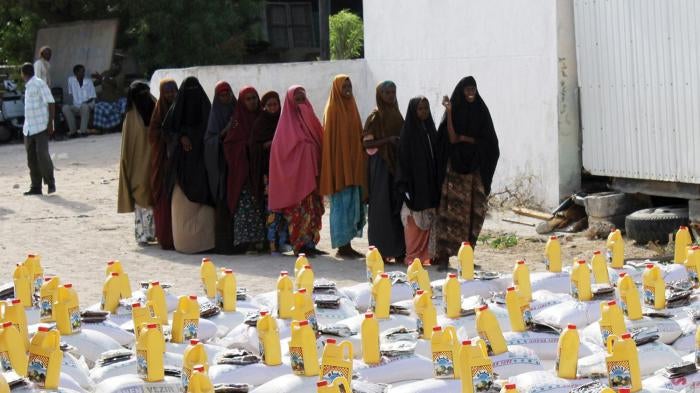
Hostages of the Gatekeepers
Abuses against Internally Displaced in Mogadishu, Somalia
Map 1: Somalia

© 2011 United Nations
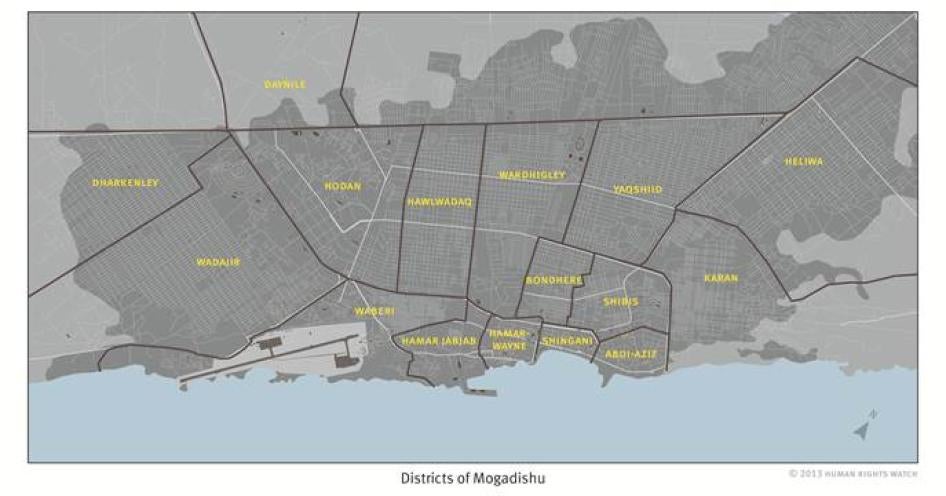
Map 2: Districts of Mogadishu
Summary
In Badbaado camp, only the name is very beautiful, the people are very unkind. The people running the camp are militia allied to the government.… They respect their clan more than the humanity. They don’t care about us, because if they are aware of the attacks against the IDPs they could respond when we reported to them. But they don’t rescue when the women are crying for help.
—43-year-old displaced woman, former resident of Badbaado camp, September 2011
The new government of Somalia plans to relocate tens of thousands of internally displaced people (IDPs) within Mogadishu this year. Many of these people had arrived in the war-torn capital in 2011 as a result of a devastating famine that provoked widespread displacement. The famine was caused by unrelenting drought, ongoing insecurity and fighting, the blocking of civilian access to humanitarian assistance, and increasing “taxation” of resources and livestock by the armed Islamist group al-Shabaab in south-central Somalia. Although there is no accurate death toll, tens of thousands of people are believed to have died as a result of the famine. Hundreds of thousands of people fled into neighboring countries and the United Nations estimates that more than 75,000 IDPs arrived in Mogadishu within the space of nine months in 2011. Instead of finding refuge and the humanitarian assistance they urgently needed, many displaced people encountered a hostile and abusive environment in Mogadishu.
This report is based on more than a year’s research, including 70 interviews with newly arrived persons displaced from south-central Somalia by the 2011-2012 famine and fighting in some of the main IDP camps and settlements in Mogadishu. It examines the situation of displaced people in Mogadishu from the height of the famine in July 2011 through November 2012. And it describes the abuses faced by these people, who are often silenced by those bent on exploiting their vulnerability.
Throughout this period members of displaced communities in Mogadishu faced serious human rights abuses including rape, beatings, ethnic discrimination, restricted access to food and shelter, restrictions on movement, and reprisals when they dared to protest their mistreatment. The most serious abuses were committed by various militias and security forces, often affiliated with the government, operating within or near camps and settlements for the displaced. Frequently these militias were linked or controlled by managers, or “gatekeepers” as they are known, of the IDP camp.
The fate of the displaced is often in the hands of the gatekeepers. By “hosting” IDPs, gatekeepers determine the location of settlements, the access of IDPs to these settlements and, often, their ability to access humanitarian assistance. The gatekeepers are generally from the dominant local clan; occasionally they are linked to local authorities or to clan militias that ostensibly provide security but in fact control the camps.
Among the many problems in the camps perhaps the most threatening is sexual violence. Displaced women and girls face a significant risk of rape in Mogadishu. They told Human Rights Watch that rape usually occurred at night in the huts. Even Badbaado, one of the few government-run IDP camps in the city, was not safe. Several women described being raped by armed men in uniform, some of whom were identified as government soldiers. Many victims of sexual violence never report their experiences to the authorities, fearing reprisals from the perpetrators, wary of the social stigma associated with sexual violence, and having little confidence that the authorities will respond. As the father of a young woman who was raped by four men in government military uniform said: “We don’t know anyone here, we are new to Mogadishu. So we didn’t try to go to justice, because the commander was harassing us at the time my daughter was raped. So how I can trust anyone here? We must keep silent.” Those that do speak out find few options for protection, medical assistance, or redress.
Camp security, which often depends upon government-affiliated militia, have regularly been implicated in threats and assaults against displaced people, including children. It is particularly dangerous during food distributions or inspections of tents provided by humanitarian agencies. And as a result of increasing pressure on land and property in Mogadishu, longstanding as well as recent displaced communities are becoming increasingly vulnerable to forced eviction.
The accounts of people displaced from Bay, Bakool, and the Shabelle regions of south-central Somalia, who are primarily from the Rahanweyn clan and the Bantu minority group, show that these communities are particularly vulnerable to abuse. Gatekeepers and their militia treat them as second class citizens, and subject them to various forms of repression, including frequent verbal and physical abuse.
These displaced communities face serious difficulties obtaining adequate food and shelter. Gatekeepers and militias use various methods to divert or steal food aid during or after distributions. Some of the displaced are forced to resort to begging due to lack of access to food.
Gatekeepers and militias profit from the displaced communities in other ways. They threaten to confiscate the tents provided to IDPs by international humanitarian agencies, to control their movement, including their ability to leave the settlements or camps. Several displaced women said that they felt as if they were hostages of the gatekeepers. As a 40-year-old woman said:
If we give her [the gatekeeper] the tents we have no other alternatives. If we try to move from the camp she takes the tents from us. We don’t have a plastic sheet, we don’t have other shelter, and we don’t have a place to sleep. So until we get rescued we must stay there as hostages.
The displaced, particularly men, have repeatedly tried to raise concerns about abuses with gatekeepers or local and central government authorities. Too often authorities failed to fulfill their promises, or worse, the displaced were later arbitrarily arrested or beaten by local police or militia for daring to raise their concerns. Further displacement has often been the only option available to displaced people seeking to protect themselves from violence.
The economic, social, and political context in Mogadishu at the time of the famine contributed to abuses against the displaced. The Islamist armed group al-Shabaab’s withdrawal in August 2011 created a security vacuum that Somalia’s Transitional Federal Government (TFG) forces were largely unable to fill. This vacuum allowed clan and freelance militias to resurge, many of them directly or indirectly linked to increasingly powerful district commissioners and local officials who emerged to assume control of several of Mogadishu’s districts and its economy.
Internally displaced people are protected under international law—international humanitarian law during wartime and international human rights law at all times. The protections due to IDPs by states have been summarized under the United Nations Guiding Principles on Internal Displacement (the “UN Guiding Principles”), which address both protection and access to humanitarian assistance, among other issues. Of emerging importance to IDPs in Africa is the African Union Convention for the Protection and Assistance of Internally Displaced Persons in Africa (Kampala Convention), which came into force on December 6, 2012. The Kampala Convention provides a comprehensive description of the rights of internally displaced people and the obligations of states and non-state actors. Somalia is a signatory but not yet a party to the convention.
Abuses against IDPs have taken place in a general context of impunity for violations of international human rights and humanitarian law. Somalia has been wracked by numerous violations of international humanitarian law, including deliberate and indiscriminate attacks on civilians, summary executions, rape, and looting. Access to humanitarian assistance, which is protected under international humanitarian law, has been a serious problem, particularly in al-Shabaab controlled areas.
Those responsible for abuses can be difficult to identify, particularly given the plethora of armed groups active in Mogadishu and the ready availability of military uniforms. Displaced people who described rape and other abuses to Human Rights Watch occasionally identified government soldiers as responsible. Also implicated were members of militias connected to district commissioners and other local officials, some of which have been integrated into government forces. Gatekeepers and their local militias have abused the displaced population in camps they control by stealing their food and restricting their movement.
The TFG, which was in place until August 2012, largely failed to provide even the most basic protections and assistance to the internally displaced people in areas under its control during and following the famine. TFG officials often denied that the abuses, including rape, were even taking place. A UN official described the authorities’ denial that rape was occurring as the biggest obstacle to tackling the abuse. Increasing support for comprehensive medical and other services for survivors of sexual violence should be high on current donor priorities.
The TFG did not hold to account abusive members of government security forces and allied militias. Although the displaced population was one of the largest and most vulnerable populations in the area of Mogadishu under government control in 2011 and 2012, the TFG took few measures to address their needs. Two district commissioners were convicted by a military court for looting food aid, but then-President Sharif Sheikh Ahmed promptly pardoned them.
Humanitarian agencies and organizations and the donors who support them have long faced a challenging security situation and other obstacles to their efforts to provide assistance to those at risk in Somalia. During the famine there was significant pressure to rapidly expand assistance programs in Mogadishu. A sudden influx of new humanitarian organizations, some of which had little experience operating in Somalia, resulted in programs that neither appreciated the problems facing the displaced communities nor the complexities of providing assistance through local officials and gatekeepers.
The result was programs that at times reinforced the power of abusive officials and gatekeepers at the expense of the populations they were seeking to assist. These problems were exacerbated by the security situation, which forced UN agencies and other organizations to operate from afar and not carry out the monitoring necessary for such programs. Addressing these issues also does not seem to have been a priority.
Although the famine is officially over, fighting and insecurity persist in much of south-central Somalia. Even if some IDPs opt to return home in the coming months, displaced communities will remain a significant part of Mogadishu’s landscape for years to come. The end of the famine and the fragile peace currently affecting Mogadishu provide an opportunity for greater access and accountability for all international actors engaged with Somalia, an opportunity that should not be missed.
The new Somali government established at the end of the transition period in August 2012 has primary responsibility to provide protection for the displaced—and the rest of the Somali population. Showing Somalis that the new government, unlike its predecessors, is able to ensure the rights of the population under its control will be an important test of its credibility. The government plans to relocate the displaced within Mogadishu. This will be a positive step if the displaced are more secure and receive more assistance in the proposed relocation sites. The government should publicly commit to addressing key concerns about access to protection, adequate and effective police, and assistance in the new sites before any such relocations start. Donors supporting the Somali police should make the deployment of a competent and accountable police force to IDP relocation sites a priority. The government should ensure that displaced persons fully participate in the planning and management of the relocation process and make free and informed choices.
Ensuring the accountability of government forces and non-state armed groups for abuses they commit is also crucial. There have been some positive signals: the new president, Hassan Sheikh Mohamud, publicly committed in November 2012 to hold to account members of the security forces responsible for rape. However, the police arrest and prosecution in January 2013 of a displaced woman and a journalist to whom she had spoken about her alleged rape by government security forces, points to a greater willingness to protect the perpetrators of sexual violence than to address the serious problem. The case—in which the two defendants initially received one-year prison terms, which were later overturned—has marred the credibility of the government’s reform agenda.
Somalia’s international partners contend that the new government represents real hope for the country’s future. But much will depend on the government’s ability to end impunity for abuses and establish the rule of law and respect for basic rights.
International donors should make clear that accountability for serious human rights abuses, including abuses committed by government forces, is crucial. To that end, the Somali government and its international donors should support both short- and long-term measures to address serious past and ongoing human rights abuses.
There is an immediate need for improved monitoring and reporting on human rights violations, protection concerns and diversion of assistance. Supporting an expansion of human rights monitoring and reporting by the UN Office of the High Commissioner for Human Rights (OHCHR) is vital; the current UN review process on Somalia is a perfect opportunity to make this expansion a reality. Donors should also increase support for the UN Risk Management Unit and encourage UN agencies and nongovernmental organizations to collaborate with the unit. UN agencies with a protection mandate should give priority to programs that address the needs of the displaced communities. And the UN Resident and Humanitarian Coordinator’s office should conduct, with the Somali government and other agencies, a Mogadishu-wide profiling exercise to identify and better respond to these needs prior to any future relocation.
Finally, addressing human rights abuses against the displaced and the Somali population generally means tackling longstanding impunity. The Somali government and its international partners should call for the establishment of a UN commission of inquiry—or a comparable, appropriate mechanism to document serious international crimes committed in Somalia—and recommend measures to improve accountability.
Key Recommendations
To the Somali National Government
- Take all necessary measures to ensure that sufficient, competent, and trained police are deployed to protect displaced communities in Mogadishu and other government-controlled areas, including in any new relocation sites, giving special attention to the security needs of women and girls.
- Appropriately discipline or prosecute members of the military, police, non-state armed groups, and government officials responsible for serious human rights violations, including abuses committed against displaced people and misappropriation of humanitarian assistance.
- Initiate, with the assistance of the UN Resident and Humanitarian Coordinator and other international agencies, a profiling exercise of the displaced population in Mogadishu to assess protection needs.
- Support an enlargement of the UN Office of the High Commissioner for Human Rights within the new UN mission with significantly increased capacity to monitor and report on human rights violations.
UN agencies, the UN Resident and Humanitarian Coordinator, the UN Office of the High Commissioner for Human Rights, and donors such as the United States, United Kingdom, European Union, Turkey, the African Union, and Organization of Islamic Cooperation should publicly endorse and support the above measures.
Methodology
Human Rights Watch conducted more than 70 interviews with internally displaced people (IDPs) in the Somali capital, Mogadishu, including 36 women and girls, between August 2011 and December 2012. The majority of those interviewed were from Somalia’s Bay, Bakool, and Lower Shabelle regions and had arrived in Mogadishu in 2011 as a result of the famine, human rights abuses, and armed conflict in south-central Somalia.
The incidents and patterns of abuses they described occurred mostly in three Mogadishu districts—Dharkenley, Hodan, and Wadajir—where much of the displaced population is located.
Human Rights Watch visited at least 14 camps and settlements to interview displaced people between September 2011 and February 2012. Displaced individuals put Human Rights Watch in contact with other IDPs who were survivors of rape, physical abuse, or reprisals, some of whom were subsequently interviewed inside the camps. Others were interviewed outside the camps in private offices. All interviews of individuals under age 18, the internationally recognized age of children,[1] took place in the presence of a parent, with a parent’s consent. Human Rights Watch interviewed an additional 18 displaced people—including survivors of sexual and gender-based violence—camp leaders, and “gatekeepers” during a five-day visit to Mogadishu in October 2012. A Somali nongovernmental organization (NGO) assisted in the identification of witnesses to abuses and in their interviews. For security reasons Human Rights Watch was not able to interview members of militias linked to the camp gatekeepers.
Human Rights Watch conducted interviews in Somali and other local languages, and in Somali with English translation provided by members of a local NGO. Those interviewed were provided no remuneration.
Between September 2011 and December 2012 Human Rights Watch also spoke in person or by telephone with dozens of other knowledgeable individuals, including Somali local and central government officials, UN officials, representatives of international and Somali aid agencies, Somali human rights organizations, and members of the donor and diplomatic community.
The names of interviewees have been withheld and replaced by pseudonyms for security reasons. The majority of international representatives interviewed by Human Rights Watch also requested that their names and organizations be withheld. Names of alleged perpetrators are omitted except when sufficient eyewitness accounts, collected independently, pointed to the same individual being responsible for abuses.
The report is not a comprehensive description of the situation of all displaced communities in Mogadishu given restrictions on access to some city districts. Nor does it document all the human rights issues faced by IDPs in Mogadishu; rather, it highlights the most significant rights concerns of displaced people who have fled to Mogadishu over the last 18 months.
Background
Since the fall of the Siad Barre regime in 1991, state collapse and civil war have contributed to make Somalia one of the world’s worst human rights and humanitarian crises. While the country is prone to cyclical drought, it is the persistent violence against civilians, repeated displacement, and predatory looting by armed groups that have produced serious famine on several occasions in the last 20 years.
A significant proportion of Somalia’s estimated total population of 7.5 million has been displaced—sometimes repeatedly—either internally or beyond the country’s borders as a result of conflict and food insecurity.[2] According to the United Nations, 1.3 million people are currently displaced within Somalia,[3] and there were by July 2012 more than a million Somali refugees in the Horn of Africa.[4]
The 2011 famine followed intense armed conflict in Mogadishu as well as ongoing insecurity and intermittent fighting in southern areas of the country. It was exacerbated by severe restrictions on access for humanitarian agencies. Some of the most important organizations providing food aid had withdrawn or been banned from working in areas under the control of the armed Islamist group al-Shabaab.[5] Al-Shabaab’s increasing “taxation” of communities under its control further eroded the coping mechanisms of an already vulnerable civilian population.[6]
There were many parallels between the 2011 famine and a Somali famine in the early 1990s that affected similar geographic areas and communities.[7] Between 1991 and 1993 fighting in Mogadishu and subsequent clan-based fighting severely damaged harvests in the fertile southern regions of the country. Tens of thousands of people were displaced.[8] The Rahanweyn and Bantu communities living in the inter-riverine areas of the Bay, Bakool, and Shabelle regions were particularly affected both by the fighting that engulfed their land; the looting of resources, food, and crops by different clan militia; and the ensuing famine.[9] As in 2011 these communities—which have limited links with Somali communities in the diaspora and neighboring countries—were primarily displaced internally, with some fleeing to Mogadishu.[10] According to estimates by humanitarian organizations at the time, around 300,000 people lost their lives in the early 1990s famine, predominantly from the Rahanweyn and Bantu communities.[11]
As would occur prior to the 2011 famine, in the early 1990s increasing armed attacks on aid workers and looting of relief constrained the provision of humanitarian assistance.[12] The obstruction and looting of aid by clan-based and freelance militias in 1992 prompted the first UN intervention known as the United Nations Operation in Somalia (UNOSOM) to monitor a ceasefire and protect aid workers. By 1995, the subsequent UN and United States interventions were deemed a failure and were withdrawn. Between the mid-1990s to the mid-2000s, political and humanitarian aid, and general international interest in Somalia, dwindled as successive transitional Somali governments tried and failed to restore a functioning state.[13]
In December 2006 Ethiopia intervened militarily in Somalia at the request of the UN-backed Transitional Federal Government, ousting the Islamic Courts Union, an alliance of Islamic courts that had gained control of Mogadishu and other parts of south-central in mid-2006. The subsequent fighting pitted Ethiopian forces, the TFG, and allied militia against an increasingly powerful insurgency, including al-Shabaab. All of the warring parties were responsible for serious abuses in this period, including unlawful killings, rape, torture, and looting committed in a context of complete impunity.[14]
Ethiopian forces withdrew from Mogadishu in early 2009 following the UN-brokered Djibouti peace agreement,[15] but Ethiopian withdrawal did not bring the peace and stability that many Somalis hoped for. Conflict resumed in Mogadishu, this time between the TFG forces and the African Union Mission in Somalia (AMISOM) on the one side, and al-Shabaab and other armed groups on the other.[16] Fighting intensified in 2010 and 2011 as TFG and AMISOM forces tried to extend and consolidate territorial gains. Despite the increasing humanitarian needs, access for humanitarian organizations after 2009 was severely restricted by al-Shabaab’s attacks on and killings of aid workers, and their restrictions on aid delivery, bolstered by al-Shabaab’s expanded control in much of the country.[17]
Developments in 2011 and 2012
Although al-Shabaab withdrew from much of Mogadishu in August 2011, the group has continued to carry out attacks in the capital with grenades, improvised explosive devices (IEDs), and suicide bombings.
Much of the conflict in late 2011 and 2012 shifted to south-central Somalia as the TFG, AMISOM, and allied forces tried to push back al-Shabaab from areas of control. The fighting caused further displacement of civilians.
On October 16, 2011, Kenya unilaterally intervened in Somalia to conduct military operations against al-Shabaab. In July 2012, Kenyan troops formally joined AMISOM, and alongside Somali militia, have been fighting al-Shabaab in Gedo and the Juba areas near the Kenyan border.[18]
Ethiopian forces also redeployed in Somalia in 2011,[19] conducting operations with two Somali militias: Ahlu Sunna Wal Jama’a (a Sufi militia) and Shabelle Valley State (SVS) (a regional militia), to take control of Beletweyne, along the border with Ethiopia, in December 2011, and then Baidoa, the capital of the Bay region in February 2012.[20]
Throughout 2012 the AMISOM, Ethiopian, TFG forces, and allied militia moved into many other key towns in southern Somalia, including Afgooye, Merka and Afmadow. In late September, following a Kenyan-led air and naval offensive, al-Shabaab fighters withdrew from Kismayo, the strategic southern port town and a major source of al-Shabaab’s revenue.[21]
Mogadishu during the Famine
The economic, social, and political context in Mogadishu at the time of the famine contributed to abuses against the displaced. Relevant factors included the governance situation and security vacuum following al-Shabaab’s withdrawal in mid-2011, the economy and system developed around aid distribution in Mogadishu, and clan dynamics that rendered the displaced population from Bay, Bakool, and the Shabelle regions more vulnerable.
Displacement as a Result of Famine
The UN declared famine conditions in July 2011, but early warnings of impending food shortages were already present in late 2010.[22] Conflict, social inequalities, and the absence of key organizations that typically provide food aid exacerbated the food shortages: the UN’s World Food Programme (WFP) and US-based nongovernmental organizations such as CARE[23] had limited access beyond Mogadishu due to both restrictions by al-Shabaab and restrictions imposed by US counterterrorism sanctions that affected aid delivered to areas under al-Shabaab control. The cumulative effect of all of these factors was a serious reduction in the humanitarian community’s capacity to respond to the unfolding crisis.[24] As a result, in the first quarter of 2011 there was a massive influx of displaced people from the affected regions into Mogadishu, where assistance was more readily available.[25] Others affected by the famine fled south towards refugee camps in Dadaab, Kenya, or west to Dolo Ado, Ethiopia.[26]
By July 2011 the UN declared famine in Bakool and Lower Shabelle regions, and by August the UN declared six regions of Somalia in a state of famine, including Mogadishu, particularly its IDP community.[27]
At the height of the famine, an estimated four million people—more than half of the resident Somali population—were reported to be in need of humanitarian assistance, around three million of whom were in the south in predominantly al-Shabaab-controlled areas.[28] Agencies’ assessments of the total number of IDPs in Mogadishu varied, but estimated that at least 150,000 people arrived in Mogadishu since 2011 as a result of the famine.[29]
By February 2012 the UN declared that the famine in Somalia was over but stressed that at least two million people were still in need of emergency humanitarian assistance.[30]
During the 2011 famine, humanitarian agencies faced a variety of challenges. As mentioned above, al-Shabaab banned the WFP, several other UN agencies, and most nongovernmental organizations from working in areas under its control in 2009 and 2010. This ban was extended to an additional 16 agencies and nongovernmental organizations in November 2011.[31] On January 30, 2012, al-Shabaab also banned the International Committee of the Red Cross (ICRC), the only remaining organization capable of carrying out large-scale food aid distribution in al-Shabaab areas.[32]
Since 2008, humanitarian organizations have also been affected by counterterrorism legislation such as the United States Office of Foreign Assets Control (OFAC) sanctions that criminalize assistance or financial payments to groups designated by the US government as foreign terrorist organizations, including al-Shabaab. The sanctions led to a significant decrease in US funding of humanitarian organizations and new, burdensome measures on those receiving US aid.[33]
Governance in Mogadishu
Other factors contributed to the dangerous situation facing displaced people in Mogadishu at the time of the famine. Mogadishu in 2011 and early 2012 was a war-ravaged city still wracked by fighting and lawlessness. Until mid-2011 the TFG controlled only a small section of southern Mogadishu and generally failed to provide any services to the population in these areas.
Al-Shabaab’s withdrawal in August 2011 created a security vacuum that the TFG forces were largely unable to fill. The transitional government lacked the means, and it seemed the will, to bridge this vacuum. Embroiled in internal disputes and focused on the political process leading up to the end of the transition, the TFG leadership failed to serve the vulnerable IDP population under its control. This vacuum allowed clan and freelance militias to resurge, many of them directly or indirectly linked to increasingly powerful district commissioners and local officials who emerged to assume control of Mogadishu’s districts and its economy.
After a one-year postponement, on August 20, 2012, the transition period ended, paving the way for a new Somali administration, including a new president, prime minister, and speaker of parliament. Both Somalis and Somalia’s supporters abroad heralded the process as a break with the past, pointing in particular to the selection of a leadership with a civil society background as a positive step. However, the new leadership faces enormous challenges in Mogadishu alone, chief among them, greater accountability of government forces and reining in the militias, including government-allied militia, that continue to exert significant control over much of the city.
Protection of IDPs and improvements in their living conditions, starting with steps to improve their basic rights, will be an important test of the new administration. It is a test that the previous transitional government failed, as this report describes.
Reliance on Gatekeepers
Ever since the relief efforts of the 1980s, and especially during and following the massive international involvement in the famine of the early 1990s, humanitarian assistance—specifically food aid—has played a key role in the political economy of Somalia. Patterns of control of aid and of the vulnerable communities who rely on it have become entrenched, with armed groups constantly vying for control of the resources and power associated with aid.[34]
A 2010 report of the UN Monitoring Group on Somalia and Eritrea described the importance of food aid, and specifically WFP assistance in the Somali economy.[35] The report described the diversion of WFP assistance in Somalia as “large scale,” suggesting that around 50 percent of WFP assistance was being diverted, mainly through the creation of a cartel of contractors and transporters. It noted that in some cases the assistance was used to directly support warring parties.[36]
While large-scale diversion of food aid in the 2011 famine has to date not been documented, a 2012 report of the UN Monitoring Group described the means and methods of diversion at the camp level, the role of gatekeepers, and the implication of district and local officials in the process.[37] One in-depth media investigation documented diversion at WFP wet feeding (cooked food) sites.[38]
The UN’s declaration of famine in July 2011 led to a massive increase in the amount of emergency assistance coming into Mogadishu. According to Somalia analyst Ken Menkhaus:
The TFG leadership, and many (though not all) of the Somalis formally or nominally a part of the TFG as civil servants, security forces, paramilitaries, district commissioners, parliamentarians, and ministers approached the flood of famine relief pouring into Mogadishu as an opportunity to enrich themselves.[39]
At the level of IDP camps or settlements, direct control of the camp, its population, and the assistance brought to the camp is often in the hands of camp managers. Camp managers, more commonly known as “gatekeepers” or “black cats,” have existed throughout Somalia’s civil war and exist throughout the country. However, with the massive influx of aid into Mogadishu during the 2011 famine, the gatekeeper phenomenon appears to have taken on new dimensions. Gatekeepers are sometimes from the displaced community but more often in Mogadishu they are landowners or businesspeople from the local clan who have access to land and links to local clan militia or local authorities.
As the UN Monitoring Group report noted, often gatekeepers are intimately linked to district commissioners, their militia, and other local level authorities, including divisional leaders.[40] While the significance of gatekeepers varies across the city, they are the people who often represent the IDPs to aid agencies, distribute assistance, and often pay for protection or manage the relationship with landlords, local militia, political powerbrokers, and district commissioners.
Hosting displaced communities is a lucrative endeavor. As Ifrax D., a 32-year-old displaced woman living in Ufurow camp in Hodan, said of gatekeepers: “The people are assets for them, they are making business on them, they are depriving them of their rights.”[41]
Displaced people from weaker clans or minority groups are particularly vulnerable to exploitation and abuse at the hands of the gatekeepers. As Menkaus points out: “Too often, in the many deals struck over allocation of food aid locally, the weakest lineages are given short shrift. They are also the main victims of diversion of food aid by ‘black cats’ and others.”
The United Nations Monitoring Group on Somalia and Eritrea noted in mid-2012 that:
The withdrawal of Al-Shabaab forces from Mogadishu on 2 August 2011 should, in principle, have improved access throughout the capital for aid agencies, and facilitated the direct provision of humanitarian assistance to vulnerable Somalis. The reality, however, was quite different: UN agencies, INGOs [international nongovernmental organizations] and their national counterparts were confronted instead with pervasive and sophisticated networks of interference: individuals and organizations who positioned themselves to harness humanitarian assistance flows for their own personal or political advantage. These “gatekeepers” often exercised control over the location of IDP camps; the delivery, distribution and management of assistance; and even physical access to IDP camps and feeding centres, through their influence over the “security” forces deployed to such sites.[42]
Gatekeepers are not alone in diverting food aid and seeking to control and exploit assistance at the local level. As a former senior TFG official told Human Rights Watch: “The IDPs don’t get humanitarian assistance directly, but through district commissioners, militias and gatekeepers: this is the biggest business in Mogadishu.”[43]
As a senior UN official put it, “The aid business, the whole chain is eating, the gatekeepers just steal what is remaining.” However, from the perspective of the displaced, at the camp level the gatekeeper is the central figure.
As explained above, given the absence of formal camps or any kind of centralized registration and government control, it is the gatekeepers who are often the interface with humanitarian agencies in Mogadishu.[44] Some humanitarian agencies have tried to minimize gatekeeper control over assistance and circumvent gatekeepers, while others have opted to end dry food distribution in camps. Some humanitarian representatives admitted having very little room for manoeuver. With the exception of the ICRC, which carried out a two-month assessment of local level dynamics prior to distribution, other organizations tended to rely on informal mechanisms, particularly their local partners or staff, to assess the local context and determine abusive gatekeepers and local-level actors. Because the UN directly implements very few projects in Mogadishu because of security reasons, it relies heavily on local implementing partners.
This report focuses on the districts of Wadajir, Dharkenley, and Hodan, where most of the displaced people who arrived in Mogadishu in 2011 are located, as well as one camp in Waberi district.[45] The gatekeeper and formal and informal security set-up differs from area to area, but some generalizations can be made.
In Wadajir district, the main camp, Rajo, which some humanitarian actors have described as a model camp, is administered and controlled by the district commissioner of Wadajir and the divisional leader. Security is provided by the district commissioner’s militia. The militia is Abgal, a Hawiye sub-clan dominant in Mogadishu. Part of this militia is reported to have been integrated into the government forces in recent years.[46] Siliga camp, also in Wadajir, includes one section that is controlled by Hawadle militia, another Hawiye sub-clan prevalent in Mogadishu, and another section controlled by an “umbrella” organization called Saredo, which is run by the wife of former Member of Parliament (MP) Osman Ali Atto, who are from the Sa’ad clan.[47] According to a recent study of political dynamics in Mogadishu, militias in Wadajir are affiliated to members of the local authorities, though this has not been independently verified by Human Rights Watch.[48]
Badbaado, the biggest camp in Dharkenley district, is administered by the government Disaster Management Agency and since October 2011 security is provided by police posted at the camp. However, security was initially provided by a commander reporting to the district commissioner of Dharkenley. Militias under the command of the district commissioner and deputy district commissioner are reportedly sometimes present in the camp. These militias are from two different Abgal sub-clans and have, as described below, clashed on occasion. Part of the district commissioner’s militia is reported to have been integrated into the government forces.[49] In Hodan district the situation is quite different, with a number of camps, gatekeepers, and militia; there are certain camps reportedly controlled by Sa’ad gatekeepers and militia where the Hodan district commissioner cannot even venture. One UN official told Human Rights Watch that the militias in this area are “better equipped and armed” than the police.
While not all gatekeepers seek to abuse IDPs in their camps, serious abuses are taking place at the hands of gatekeepers and affiliated militia, described in greater detail below.
Clan Dynamics
Internally displaced people throughout the world are particularly vulnerable: uprooted from their social networks, deprived of their livelihoods, often living on land belonging to others, leaving them open to abuse. The clan system in Somalia adds an additional layer of vulnerability to those most affected by the 2011 famine. While clan identity is only one among several factors contributing to the abuses against IDPs in Mogadishu, it can have enormous consequences. As Ken Menkhaus points out:
One of the most troubling but least discussed aspects of Somalia’s recurring humanitarian crises is the low sense of Somali social and ethical obligation to assist countrymen from weak lineages and social groups. This stands in sharp contrast to the very powerful and non-negotiable obligation Somalis have to assist members of their own lineage.[50]
A June 2012 IDP assessment in Mogadishu found that 60 percent of internally displaced people originated from Bay, Bakool, and the two Shabelle regions.[51] While an accurate picture of the famine-affected population is not available, it is believed that the majority of IDPs from southern Somalia displaced as a result of the famine in mid-2011 were from the Rahanweyn and Bantu communities.[52] Human Rights Watch’s research focused on newly arrived displaced persons in Mogadishu, therefore the majority of the interviews were with members of these communities. Both their social status, not seen as being one of the noble clans, and their livelihood strategies, being primarily agro-pastoralists and farmers, rendered them particularly vulnerable to famine and later to abuses in Mogadishu.[53] In Mogadishu the most powerful clans, notably in the districts on which this research focuses on, are from the Hawiye clan group. Neither of these two communities have established links with the Hawiye. The more limited international reach of the Rahanweyn and Bantu, including fewer links in the diaspora and neighboring countries, is also believed to undermine their social support mechanisms.[54]
While part of Somalia’s clan structure, the Rahanweyn are not considered as one of the “noble” pastoralist clans.[55] The Rahanweyn, or Digil-Mirifle, are agro-pastoralists and live predominantly in the inter-riverine area in Bay, Bakool, and to a lesser extent in Lower Shabelle and Middle Juba. They have traditionally been politically marginalized, although the last speaker of parliament under the TFG and the current speaker are both Rahanweyn. The Mirifle in particular speak a distinct Somali dialect known as Afmay. Although the Rahanweyn have traditionally been viewed as more socially diverse than other clans, integrating outsiders including Bantus, they do not have established protection networks with other clans and host communities in Mogadishu.[56] While this is not the only reason Rahanweyn IDPs have been vulnerable to abuse, it contributes to their vulnerability to threats from militia linked to more powerful clans.
The other group believed to have been disproportionately affected by the famine is the Bantu. The Bantu are not part of the Somali clan lineage system, and are predominantly farmers. Historically, the Bantu have faced significant discrimination, marginalization, and persecution because of their distinct culture and characteristics; a significant proportion of the Bantu are descendants of former slaves.[57] Like the Rahanweyn, they traditionally do not carry arms or have their own militia, rendering them particularly vulnerable to armed clans. Certain Bantu have integrated into the Rahanweyn clan but are generally prohibited from inter-marriage with the clans.[58]
Clan identity remains fundamental for access to protection and justice in Somalia, partly due to the traditional xeer system (customary laws that regulate intra- and inter-clan disputes, among other issues), rendering the Rahanweyn and Bantu more vulnerable.[59] According to research carried out in Puntland, minority clans are also more likely to be discriminated against within the formal judicial system because police, who tend to be from the majority clans, side with stronger clans.[60]
Abuses against Internally Displaced People in Mogadishu
The displaced Somalis who fled to Mogadishu over the last two years have been subjected to a range of serious human rights abuses, including rape, beatings, ethnic discrimination, and restrictions on access to food and shelter and freedom of movement.
Identifying the perpetrators of the abuses and their relationship with the authorities is often challenging given the plethora of armed groups in the city, including militias, and the ready availability of military uniforms. However, victims and witnesses of abuses often provide credible accounts that state security forces and government-allied militia, some of which are formally or informally entrusted with providing security in IDP settlements, are responsible for some of the abuses. Private individuals, including gatekeepers, and clan and freelance militia, have also committed abuses against the displaced for which they have not been held to account by the authorities.
Internally displaced people are accorded multiple protections under international human rights law,[61] and during the non-international armed conflict in Somalia, international humanitarian law.[62] It is first and foremost the responsibility of the government to ensure protection and assistance to populations under their effective control without discrimination.[63] The government is also prohibited from unnecessarily impeding access of humanitarian assistance to those in need.[64] Destruction, theft, and looting of humanitarian objects are prohibited.[65]
The various international legal protections afforded IDPs under international law can be found in the United Nations Guiding Principles on Internal Displacement, which provide an authoritative restatement of existing international human rights, humanitarian, and refugee law as it relates to the protection of internally displaced people.[66]
The UN Guiding Principles provide that IDPs “shall enjoy, in full equality, the same rights and freedoms under international and domestic law as do other persons in their country. They shall not be discriminated against in the enjoyment of any rights and freedoms on the ground that they are internally displaced.”[67] National authorities have the primary duty and responsibility to provide protection and humanitarian assistance to IDPs within their jurisdiction.[68]
IDPs shall be protected, for example, against rape, torture, cruel, inhuman or degrading treatment or punishment, and other outrages upon personal dignity, such as acts of gender-specific violence, forced prostitution, and any form of indecent assault.[69] They shall have the right to liberty of movement and freedom to choose their residence, in particular the right to move freely in and out of camps or other settlements.[70]
Humanitarian assistance to IDPs shall not be diverted, in particular for political or military reasons.[71] All authorities concerned shall facilitate the free passage of humanitarian assistance and grant persons engaged in the provision of such assistance rapid and unimpeded access to the internally displaced.[72]
Additional protections are provided to IDPs under the regional Kampala Convention, which went into force in December 2012.[73] Somalia has signed but not yet ratified the convention,[74] obliging the government to refrain from acts that would defeat the object and purpose of the convention.[75]
Sexual and Gender Based Violence
Throughout the conflict in Somalia internally displaced women and girls have been particularly vulnerable to sexual violence. The extent of sexual and gender based violence (SGBV) against displaced women and girls is difficult to assess but is believed to be widespread though largely underreported throughout south-central Somalia. Reliable data on SGBV is lacking. Women and girls are often reluctant to report rape, including because of fear of reprisals by perpetrators, including government soldiers and allied militia; ostracism and stigma; lack of trust in the authorities; over-reliance on the informal justice system; and the limited medical, psychosocial, and legal services available to displaced communities. Women and girls in south-central Somalia more generally are also at risk of other forms of gender-based violence including domestic violence, female genital mutilation (FGM), and early forced marriage.[76]
International human rights law also contains protections from rape and other forms of sexual abuse through its prohibitions on torture and other ill-treatment, slavery, forced prostitution, and discrimination based on sex.[77] A state must refrain from, and prevent, sexual and gender based violence of all forms against IDPs, including rape and sexual exploitation.[78] The Convention on the Rights of the Child and the African Charter on the Rights and Welfare of the Child contain additional protections for children.[79] International humanitarian law prohibits acts of sexual violence, prohibiting both states and non-state armed groups from committing rape and other forms of sexual violence.[80]
Human Rights Watch documented several cases of rape in the second half of 2011, mostly in Badbaado camp, in Dharkenley district, a camp that was established by the authorities in mid-2011 as a result of the influx of people into Mogadishu. Incidents of rape were also documented in 2012 in other camps and settlements, including Siliga camp in Wadajir district, Midnimo camp in Tarbuunka district, and Milk Factory camp in Hodan district. Data collected by local organizations working with survivors of SGBV showed an increased number of incidents of rape of displaced people, almost exclusively women and girls, in the second half of 2012. According to the United Nations, over 800 cases of rape were reported in Mogadishu and the surrounding areas between September and late November 2012.[81] Whether these numbers are the result of increased reporting, improved data collection, or an increase in incidents is unclear.
Human Rights Watch research found that armed men in uniform, including government-allied militia and government forces, have been responsible for a significant number of incidents of rape of internally displaced women and girls since July 2011. These included some security personnel who were posted in the camps to provide security. These accounts are supported by NGO and UN reports that conclude that armed and uniformed men, including government allied militias and men in TFG military and police uniform, are the main perpetrators of rape against IDPs.[82]
Quman M., 23, was nine months pregnant when she was gang-raped one night in Badbaado camp by men in TFG military uniform. She told Human Rights Watch:
Three men raped me, and another one was holding a gun on me. They raped me. They didn’t hit me, but they all raped me. I was sleeping and I woke up to discover that someone was pointing a gun on me and a flashlight in my eyes. When I got up, they told me to keep silent and when they all finished they left me. When they were leaving they were in uniform, they wore the mixed light brown uniform of the forces, which the military people wear. They were young men, they were not old men. One of the men was arrested the same day… he was released the same day. When they raped I finished the ninth month of my pregnancy. The pain, which started when they raped me, never left me until I delivered the baby.[83]
According to the United Nations, around 30 percent of victims of sexual violence are girls younger than 18.[84] A Somali NGO working with victims of SGBV noted that girls aged between 12 and 17 are particularly vulnerable to abuse.[85]
A significant number of incidents of rape take place at night, when women and girls are in their huts or makeshift shelters.[86] Safiyo Y., 25, was raped and shot in the leg by a government soldier in Siliga camp, Wadajir district, in the section of the camp that is controlled by Hawadle militia, on October 19, 2011, while she slept in a hut next to her husband.
It was midnight. I was sleeping with my children. I woke up as he [a government soldier] started to open my legs and came in me. … I resisted and I tried to run from him and I screamed. People woke up, and he shot me with four rounds.[87]
Safiyo Y.’s leg had to be amputated.
A 30-year-old blind woman was in her hut in the same camp when she was attacked by an armed man on the night of October 18, 2012:
Three days ago, I was asleep with my children and I heard noises. A man pointed a gun at me then he hit me on the chest with the butt of the gun and the forehead and then he strangled me. I told him: “What do you want? Can you not see I am blind?” and he told me not to make a noise. He later raped me inside my tent. My child is traumatized.[88]
IDPs and local organizations told Human Rights Watch that incidents of rape increased during food distribution as armed men, including government soldiers and militia, come to the IDP areas to get food.[89]
Displaced women and girls and their families have limited means of protection against rape given the context of insecurity in which they live. The destruction or absence of traditional protection mechanisms, especially clan protection, that occurs from being displaced contributes to their vulnerability along with lack of shelter, access to livelihoods, and the culture of impunity that has characterized the conflict in Somalia.[90] The presence of a male relative does not always protect women against abuse; in fact, male relatives are often powerless in the face of armed men. A 25-year-old woman was gang-raped by four armed men in government uniform in Badbaado in front of her husband. She said:
It was 1 a.m. I was sleeping and my husband was sleeping. Two men stepped over my husband. One stood at the side of my head. He held a gun on my heart and told me not to move and not to shout. After the other came from my legs he handed his gun to the one standing at my head.
The two others stood over my husband, one from the legs’ side and the other at his head. They took my husband out of the room. The room [in the makeshift house] was too small. The men tied my husband’s hands back, and blindfolded him. They put a piece of cloth in my mouth to prevent me from shouting, and they covered my eyes with a sheet and they all raped me unkindly. They treated me very awfully.[91]
Traditional clan protections for weak clans and minority groups from outside Mogadishu, such as the Rahanweyn, no longer appear to function in Mogadishu. So women and girls from clans that are weak clans in Mogadishu are particularly vulnerable. One of the few ways for women, girls, and their relatives to prevent the abuses is to flee the camp. The prevalence of rape in Badbaado camp led many IDPs to leave the camp in late 2011 and move to other settlements or IDP areas in the town.[92]
A major reason that the numbers of women and girls that have been subjected to sexual violence in Mogadishu’s IDP camps is likely to be much higher than reported is that victims fear the social stigma of reporting rape, reprisals from their attackers, or do not know their rights. A 70-year-old woman living in Midnimo camp who escaped an attempted rape explained:
The women hide their cases because these people are illiterate and came from the rural areas. They have no idea about the cities, and are surprised that they are attacked and raped by men in the government uniform. So they feel ashamed to say they were raped. Everyone raped runs from the camp to hide herself from people who know her case, and they don’t want any more people to know about it.[93]
Similarly, a 14-year-old girl living in Amara camp in Tarbuunka who was sexually assaulted by boys in the camp and a relative of the gatekeeper described the particular social stigma facing girls who are raped:
In Somalia to break your virginity with rape is humiliation. It can change the rest of your future. Such girls will never get the man they love. They end up dead or turn to become prostitutes.[94]
Staff from a local NGO working with SGBV survivors described the insecurity in which IDPs are living as one of the main reasons more do not come forward to file a complaint or seek redress.[95] The father of a young woman who was raped by four men in government military uniform said: “We don’t know anyone here. We are new to Mogadishu, so we didn’t try to go to justice, because the commander was harassing us at the time my daughter was raped. So how I can trust anyone here? We must keep silent.”[96]
While Human Rights Watch did not carry out a thorough assessment of services available to survivors of rape, UN and NGO staff raised serious concerns about the lack of services, particularly medical services and medication, available to survivors of rape. In 2013 a displaced woman who alleged that she was raped by members of the military was arrested, interrogated without access to a lawyer, and then presented by the police to the media. The case highlighted both the dangers inherent in reporting abuses by security forces and the police’s lack of capacity to provide appropriate response to victims of sexual violence. Furthermore, the prosecution used what they claimed were the woman’s medical records, as she had sought medical assistance following her alleged rape, against her in court, raising further questions about the ability of service providers to guarantee privacy and confidentiality.[97] Research on SGBV in contexts around the world shows that a lack of available services discourages victims from coming forward.[98]
Mistreatment and Discrimination
Those whose mobile phones are robbed are Digil and Mirifle. Those who are in trouble are Digil and Mirifle. They are my people, so we think that we are punished in the camp because of our ethnicity, and when we were taken there we thought a government was handling our problems. We never thought clan militia in government uniforms would oppress us. [99]
—33-year-old IDP man, Badbaado, September 3, 2011
Displaced people living in the camps investigated by Human Rights Watch reported various abuses that have become part of their daily lives in Mogadishu, making their precarious existence even more difficult.
Human Rights Watch heard numerous allegations from displaced people that militias controlled by or linked to gatekeepers, district commissioners, including militias linked to the government, committed routine abuses, including beatings, against displaced people living in camps.
Displaced people living in several camps in Tarbuunka in Hodan district that are run by a gatekeeper also known as Saredo and her husband Gardhere, said that militias working for Saredo routinely inspect IDP tents donated by Turkish NGOs, and beat IDPs whose tents they deem dirty. [100] “My husband also was beaten with the back of the gun,” a displaced woman in one of her camps told Human Rights Watch. “They came to us and told him that the tents are for them so that we must keep them clean. He resisted and told them that some white people gave the tents to us, and it’s ours, not theirs, and they beat him.” [101]
In Rajo camp, the militia controlling the camp, which is under the command of the Wadajir district commissioner and one of the divisional leaders, also beat IDPs, especially during distributions. According to Getachew S., 42, the militias beat up IDPs soon after the district commissioner completes his inspection of food distribution. They start beating people again as they are lining up to receive food. He said that, “The security forces don’t beat the people when he [the district commissioner] is there. They fear him, but when he is gone they start dealing with the people very wildly. They beat us.” [102]
Abuses against IDPs are at times directly linked to their clan identity. They are discriminated against and abused by gatekeepers, militias, and local authorities.
Human Rights Watch heard from IDPs that militias linked to district commissioners and others verbally abuse Rahanweyn IDPs. They are called “Elay” (a sub-clan of Rahanweyn). They are also accused of being al-Shabaab supporters.[103] Al-Shabaab is reported to have recruited a significant number of supporters and fighters among minority groups and the Rahanweyn.[104]
In both Badbaado and Rajo camps IDPs described being verbally abused by the heads of security and their militia while being beaten. A traditional elder at Badbaado camp told Human Rights Watch:
The Dharkenley district commissioner came to us, bringing some 40 men in police uniform. He told us that they are the police guaranteeing our safety, and that Captain Jimale [camp commander placed in the camp by the Dharkenley district commissioner] will be the commander and he will be the chief of the camp. We welcomed that because we thought that they will secure us and will help us.
But things changed soon. The policemen started to beat the people aimlessly. When some food aid came and the people start to gather around the delivery cars, they started beating the women and children, and they started insulting us. They said to us, “You are from Bay and Bakool regions. You are al-Shabaab’s people. You are not displaced by drought, you are cursed people.[105]
Displaced elders also said that camp commanders and government-affiliated militia justify actions aimed at preventing the displaced from mobilizing or complaining about abuses on the basis of their clan identity. One of the Rahanweyn elders in Badbaado said:
When we saw what is going on, we discussed and formed a committee among the displaced people in the camp. We recognized that the police Captain [Jimale] and his supporters in the camp are discriminating against us as a clan, because we [all the displaced in the camp] are from Rahanweyn clan, we are from Middle Shabelle, Bay, and Bakool regions, and his locals are from Da’oud sub-clan of Abgal.
So Captain Jimale was very angry. He arrested us, he kept us in a tent all the night, our hands were tied back, and he denied us any food. He told us that we can’t organize anyone in the camp, we can’t talk to the media, and we can’t enter his office in the camp unless he ordered us to enter.[106]
Similarly, a man was beaten and insulted by the Wadajir district commissioner’s militia that controls Rajo camp. He told Human Rights Watch:
I tried to go to the camp commander, Mohamud, and tell him about the abuse on my son and wife, but he ignored me. And when I tried to inform him about what happened his soldiers tried to beat me. They said to me, “You shit Elay, leave here.”[107]
A displaced man in Rajo camp described the sense of helplessness men feel in the face of abuse by armed camp security:
They [the district commissioner’s militia] beat the women when they collect the water, when we are in line for the food distribution, when the women go for collection of firewood, and whenever they see them passing in the camp. They say, “Here is not your region, why are you here?” Sometimes, we follow the women when they go collecting firewood. We can stop the neighbors from beating them, but when the camp security or administrators beat them we can’t stop because they have guns and they arrest us when we intervene.[108]
A government soldier spoke openly to Human Rights Watch about the discrimination that IDPs face at the hands of gatekeepers and militia and also pointed to the lack of government protection for Rahanweyn IDPs:
The IDPs who fled from Bay and Bakool regions speak a different dialect. Sometimes they are despised, sometimes they are denigrated by the camp administrators, who insult them all the time. They have no representation at all. Their most senior person in the government is the [former] speaker of parliament and … he never visited them. So who cares for them if they have no representation of their government people?[109]
Several IDPs and a member of the governmental Disaster Management Agency described how in Badbaado in late 2011 Captain Jimale would offer tents left vacant by IDPs who had fled the camp because of insecurity, for which his militias were in part responsible, to members of his own clan.[110] Nadif M., a 66-year-old man from the Bakool region, thought this was a deliberate strategy: “The attacks seem like a tactic of displacement, because when we feel threats and some of the people run because of fear, some people from the captain’s clan replace the people who left.”[111]
Evictions
In addition to serious physical abuses, in 2012 displaced families, especially those living in government or private buildings, have increasingly been forcibly evicted from their homes. The reason appears to be growing pressure on land and property in Mogadishu. According to the United Nations around 13 percent of all displacement in Mogadishu is the result of evictions ordered by the government and by private landlords.[112] The report states that, “Earlier in 2012, long-term internally displaced people were forcibly evicted from public buildings in Mogadishu, thus creating a homeless population in the capital.”[113] The evictions often take place with little or no warning, through threats, and with no alternative viable living arrangements provided for the displaced.
The UN Guiding Principles provides that the internally displaced have the right to basic shelter and housing,[114] and the right to liberty of movement and freedom to choose their residence.[115] The International Covenant on Civil and Political Rights (ICCPR), to which Somalia is a party, guarantees the right not to be subjected to arbitrary or unlawful interference with one's privacy and home.[116]
The authorities’ failure to provide residents adequate notification before evicting them is inconsistent with recommendations made by the UN Committee on Economic, Social and Cultural Rights, which calls on governments to ensure various procedural safeguards in cases of forced evictions.[117]
In May 2012, TFG forces moved into al-Adala camp with a “technical,” a vehicle mounted with anti-aircraft guns, and ordered IDPs to vacate. They were not given any prior warning, according to an international aid worker.[118]
In October 2012 several families living at the Banadir High School building and compound in Hodan district were evicted by the district authorities and the local police. The majority had lived in the area for years. The IDPs were given a day to vacate the area. At least four displaced men who went to the district commissioner’s offices to complain were arrested by the police and briefly detained at a local police station.[119]
IDPs from Banadir High School who had been forcibly evicted told Human Rights Watch about not having been given new shelters.[120] One said:
My home was destroyed by the commissioner of Hodan district. He destroyed my house with his bulldozer. Many troops including his bodyguards were taking part. I went to the office of the commissioner several times and requested that my belongings should be taken to a suitable place for me. After they destroyed my home they said to me, “We will give you a tent as shelter,” but I have received nothing from them.[121]
Diversion of Food Aid and Control over Resources
In addition to physical abuses, internally displaced people in Mogadishu face ongoing violations to their rights to food and shelter as a result of diversion of humanitarian assistance at the camp level. Food aid is stolen by a range of actors at the camp level, including government forces, government-allied militia, and private individuals. Shelter is also used to control IDPs movement. Tents are controlled by gatekeepers with the help of their militias.
As noted above, the government has the primary responsibility to provide assistance and protection to the displaced and to seek and facilitate access for international humanitarian organizations where the government is unable to provide adequate resources.[122] The government needs also to protect other fundamental rights, such as the right to housing[123] and freedom of movement.[124]
Looting, Diversion, and Misappropriation of Food Aid
At the camp level, gatekeepers and their militias, government allied-militia, and local authorities use different means to steal assistance that arrives at the camp. These include looting, setting up “ghost” camps, manipulating lists of IDPs who are due to receive assistance, determining access to ration cards, and wrongfully distributing or selling ration cards. Humanitarian agencies told Human Rights Watch that gatekeepers have circumvented monitoring mechanisms of humanitarian agencies and restricted access of journalists.[125] Gatekeepers also demand payments from IDPs as a form of “rent.” These payments are to gatekeepers and sometimes also landowners in exchange for supposed protection or access to land. As one international NGO staff member described it, “There is nowhere that an IDP can live for free.”[126] While payment of rent is not itself an abuse, the displaced who cannot afford to pay for shelter have a right to be accorded assistance by the authorities. If the authorities are unable to provide such assistance, they should seek assistance from humanitarian agencies and international donors.[127]
Many of the IDPs interviewed by Human Rights Watch in 2012 described severe food shortages that often were a result of diversion and misappropriation of food aid by gatekeepers and their militia. As a 30-year-old woman in Kheyr-Qabe camp at Digfeer hospital said, “There is nothing worse than the situation we are in. Now all we want is to get a car and return to our villages, because if I can die here because of food aid diversion, I can also die in my village, because death is death.”[128]
An IDP in one of the Saredo camps in Tarbuunka described the level of diversion and the efforts by gatekeepers to make a profit out of assistance: “Water tanks bring water, and we get it. We have no water shortage, but we have nothing else. They don’t steal the water, because they can’t sell it. If the water would cost money they would steal it.”[129]
Human Rights Watch also documented several incidents in the initial phase of the famine when TFG forces and militias, including government affiliated militias, used deadly force to loot dry food aid.
On August 5, 2011, seven people, including two displaced women, were killed when a militia linked to Yusuf Kaballe, the Dharkenley deputy district commissioner, started looting food aid brought to Badbaado camp by the WFP, prompting a clash with militia guarding the camp.[130] The deputy district commissioner and his militia reportedly refused to allow WFP to distribute the food unless 5 of the 13 trucks were handed over to him.[131]
Human Rights Watch witnessed another incident of looting of rice, flour, and oil supplies. On September 27, 2011, Zamzam Foundation, a Somali humanitarian organization, distributed food at Sayidka camp in Wardhigley district.[132] Once the displaced people had received their rations, pro-government militia in charge of security at the presidential palace, who were overseeing the distribution, started firing in the air, creating chaos. Outside the camp, men with donkey carts were waiting, and started looting the rations of the more vulnerable people, especially unaccompanied women, once the chaos broke out. Other women who were not IDPs but had also received rations were accompanied by armed men and were not targeted. The looted aid was loaded onto the donkey carts that then headed off towards Hamerweyne market. This incident took place only one kilometer from the presidential palace, in an area packed with AMISOM and TFG forces, but no one intervened.
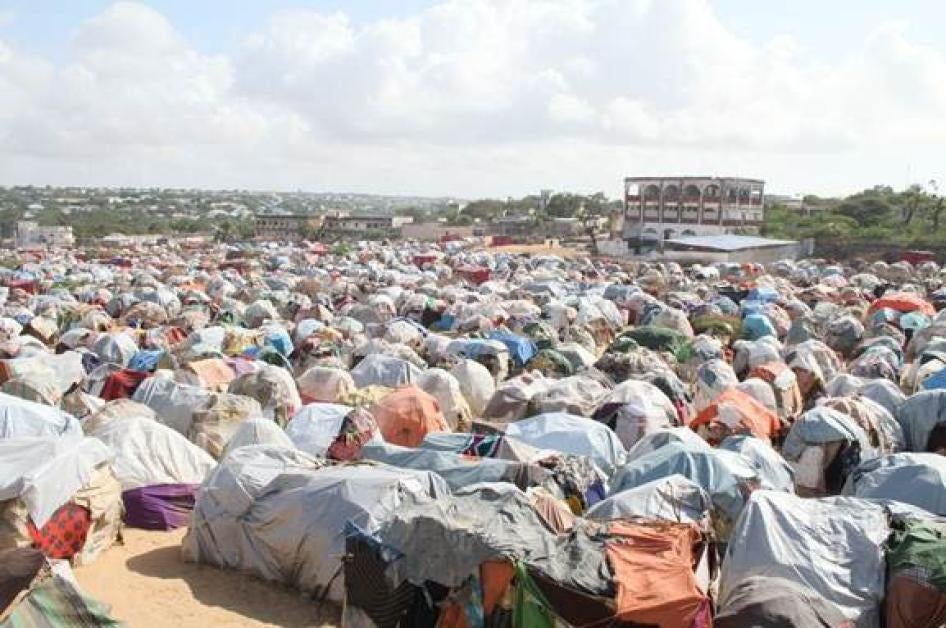
Sayidka (or Beerta Darwiishta) camp is the biggest IDP camp in Mogadishu’s Wardhigley district. A week after this photo was taken in September 2011, government-affiliated militias fired into the air and forcibly looted food aid from the camp. Despite the camp’s close proximity to the presidential palace, government forces did not intervene. © 2011 Private
While more frequent in the initial phases of the 2011 influx, reports of looting continue.
On October 22, 2012, militia associated with the deputy district commissioner of Dharkenley, along with residents living near Badbaado camp, reportedly looted food destined for dozens of households from Badbaado following a distribution by the Turkish Red Crescent.[133]
Controlling the distribution of ration cards has been a common method used to control and misappropriate assistance at the camp level. Displaced people in numerous camps, including the Tarbuunka camps of Hodan district and Rajo camp in Wardigley, described the misappropriation of ration cards to Human Rights Watch.
There are many different ways that gatekeepers acquire ration cards. Gatekeepers often insist on being in charge of allocating ration cards, and according to the 2012 UN Monitoring Group report, new NGOs and donors, such as Turkey and the Organization of Islamic Cooperation countries, are particularly likely to ask or allow gatekeepers to distribute ration cards.[134] One aid agency said that they distributed a certain number of ration cards to gatekeepers in order to prevent them from exploiting or threatening IDPs.[135] Other gatekeepers insist on getting a share of ration cards from the IDP committees, as one IDP from Siliga described: “We have a leader [from the refugee community] who distributes food. The district commissioner decides where the food distribution points are. Our leader will inform us but then the gatekeeper comes with us. Our leader takes cards to her but if he gives her two she asks for more.”[136]
There can be serious consequences when aid workers refuse to accommodate the demands. A Somali NGO told Human Rights Watch that a staff member was temporarily arrested in Badbaado and taken to the local police station in August 2011 after having refused to give ration cards to the deputy district commissioner’s militia.[137]
A former member of the Disaster Management Committee described the corruption around the distribution of ration cards and placed much of the blame on poor monitoring and lack of accountability: “Everyone comes and distributes some food and people are still hungry, because they give some small cards to some IDPs and they give the rest of the cards to their friends and relatives. The reason is that there is no mechanism to monitor and [deliver] justice and there are no people responsible for it.”[138]
It is not only the gatekeepers who benefit, but also their militia, or the locally based militia, as well as government soldiers. Sometimes ration cards are given in exchange for providing security but they are also provided as a preventive measure to stop armed groups from looting assistance and committing other abuses. A gatekeeper from the Tarbuunka area told Human Rights Watch:
The security for distribution is bad. If you don’t pay something then they come at nighttime and commit rape. I had a problem with the security. One week ago, they came in the night, pointed guns at us, stole mobile phones... some in TFG uniform, others in normal clothes, you don’t know where they are from.
I have a relationship with two of them—militia. I pay them, and they manage the security. You give him something and ask him to watch his colleagues. In terms of food distribution we give them three cards. Sometimes we collect money when the situation is really bad. I give them around 20 dollars or I buy them khat [a mild stimulant]. There is no fence in our camp, so they can come in and rape any time. It happens around two or three times a week.[139]
According to an IDP elder, even in Badbaado in late 2012, where security was provided by the police, militia got their share of the food assistance and cards during distributions:
The other militias are around—the DC’s [district commissioner] militia, ASWJ [Ahlu Sunna Wal Jama’a]. But they don’t cause too many problems. They are clan militias and there is something for them [food] when distributions happen, to secure the other food. They must be given their share. Each militia man has a card, or is given a card. They are a small number, about 40 or 50. They only come once food is brought there.
A government soldier described to Human Rights Watch how the camp administrators would also give them cards:
If we try to stop food diversion from the camp administrators or any other person involved in it, we will be the losers, because they are giving us the cards just to bribe us.
I am a soldier, I can’t take responsibility. The Somalis say, the hungry man is not responsible for anything, so all the problem is the hunger that affects everyone.
I am sure the people who fled from the drought areas are very weak and deserve to get the food aid. I agree with that, but, suppose if I stop taking the food aid, which is like 100 kilograms, and all the people are not stopping? I will be the loser. But if all people stealing the food start to stop it in favor of the suffering people in the camps, I will be the first to stop.[140]
Numerous displaced people and aid workers described how gatekeepers as well as their militias would distribute cards to relatives or other individuals who were not part of the IDP camp population. An IDP from Sayidka camp said, “The soldiers want to get the cards. They want to distribute a very small amount and they call their people with mobile telephones and collect the food for them, and they take the food out for them.”[141] Displaced people and local NGOs highlighted the link between food distribution and the presence of militia, with the head of a local NGO calling Badbaado in its early days “a militia market.”[142]
Aid workers also reportedly come under pressure from government officials and district authorities to hand over ration cards to their relatives. A food distributor working for a Turkish NGO explained: “Some government officials call us. They recommend some of their relatives. They request us to give cards to them, [which] we must accept. Each of the officials wants to ask you to give five to seven cards to the people they recommend, so we accept it.”[143] And yet, he also admitted being part of the very same system: “I am not different from those taking the meat from us, we have relatives and friends and neighbors. They know that we are distributing meat, and they visit us in our houses at night and we give them cards.”[144]
Even obtaining a ration card is not always a guarantee that the displaced people can access assistance because the food distributed to them through ration cards is often taken away. In several camps in the Tarbuunka area, including Bisharo, Ufarow, Madlamo, and Kheyr-Qabe camps run by a gatekeeper that IDPs refer to as Fadumo, displaced women are made to line up to receive food aid from a Middle Eastern NGO and for the cameras. But when the agency representatives and the cameras left, the sacks would be taken by the camp militia. The women would be given 100,000 Somali shillings (US$4) by the gatekeeper, significantly less than what the assistance was worth. One displaced woman told Human Rights Watch:
When the pictures and filming are finished the white people leave. And when the white people leave we also leave. We don’t take anything of the food, we take the 100,000 shillings. We can’t reject lining up, because if you reject you miss the 100,000 Somali shillings with which you can cook one night for the children. So we are hungry and we can’t reject anything. Now we stopped lining up, because we are hopeless, we thought that the gatekeepers would respect us if they divert the food aid one or two times, but all the time it is the same.[145]
Several IDPs in these camps told similar stories. One woman living in Ufurow camp described the sense of helplessness that her husband feels in the face of the militia: “I saw my husband crying in the tent many times. He sees the food of his family taken by militiamen. He can’t comment, he is a man, he can do nothing, so he cries. We all cry.”[146] Several IDPs resorted to begging as a result of the lack of food. A 23-year-old mother of three children living in Saredo camp in Tarbuunka said:
We fled because of hunger. We live in a camp, we are still hungry. The food aid comes, but we don’t get it, we are very sad that we are not getting food. Our eyes see the food, but they don’t give it to us. Sometimes they give us one kilogram for each family. We cook it one day, the second day we go begging. We cook whatever we get from the begging, we give it to the children.[147]
Several IDPs described how the gatekeepers would place the food assistance directly in stores and that they would not see the food again. One woman told Human Rights Watch:
The food aid comes, we see it while it is loaded on the trucks, but they store it in their stores and sell it to the market. They sell it in their shops also. We see it all the time but we don’t get it. There are some people getting food, the close relatives or clan members of Gardhere [gatekeeper of a series of camps in Tarbuunka] and his militia. The rest of the food goes back to the market.[148]
Some gatekeepers set up shops near the camps where they sell the food. The gatekeepers running a series of camps in Tarbuunka have, according to numerous IDPs, set up several shops in the area.[149] One IDP in al-Huda camp complained about having to buy back food from the gatekeeper:
When we beg the people and get some money he [the gatekeeper] requests us to buy the sugar and food from his shop. We buy what our small money can buy from him, and the food we are buying through the money begged is our own food.[150]
Abuses Arising through Control over Shelter
Camp managers, gatekeepers, and their militias use their distribution and control of shelter to exploit IDPs. In certain camps, food and other assistance are distributed based on the number of tents; in others assistance is given based on the number of reported families in a given settlement. There is therefore an incentive for gatekeepers to inflate the numbers of IDPs and ensure that the camp appears to be full of tents. In their attempt to control tents—and the accompanying assistance—gatekeepers and their militia have physically mistreated IDPs and restricted their freedom of movement.
Tents delivered to IDPs in certain camps in Tarbuunka area were seen as the property of gatekeepers and their usage was stringently monitored by gatekeepers’ militia.[151] According to numerous IDPs in these camps, the militia monitors the tents on a daily basis to make sure that the tents are clean because they are the property of the gatekeeper. The militias beat those who complain.[152] The militia linked to the gatekeeper also uses force and threats to prevent IDPs from removing the tents when they try to leave the camps.[153]
Displaced women stand next to a board advertising an IDP camp on Dabka Road in Hodan district, Mogadishu. Hosting the displaced is a lucrative business in Mogadishu—similar advertisements are scattered throughout the capital. © 2011 Private
In several camps run by Saredo, a gatekeeper in Tarbuunka, in Hodan district,[154] the militias that are linked to her routinely inspect IDP tents and beat IDPs whose tents they consider to be dirty. Fatima W., a 27-year-old woman said:
They [asked us to] destroy our bush houses. They gave us tents, but they attack us every day and tell us that the tents are not ours. They tell us that we use them temporarily. But the white people who donated the tents told us that the tents belonged to us. It is the camp owners who send the militia and the militia tell us to keep the tents clean for them.[155]
Another IDP described the intrusion into their daily life as a violation of their right to privacy:
How would you feel if someone comes every morning and tells you that your bed belongs to him, and he checks if you made it dirty last night, do you feel comfortable? That is why we are not happy with the issue of the tents. We have the right to live in the tents freely, but that right died in the hands of Saredo militia.[156]
Several displaced people explained that without their tents they could not leave the camp or return home. Mariam K., a 40-year-old woman in Bisharo camp, said:
If we give her [Saredo] the tents we have no other alternatives. If we try to move from the camp she takes the tents from us. We don’t have a plastic sheet, and we don’t have other shelter. We don’t have a place to sleep, so until we get rescued we must stay there as hostages. Otherwise we must give up the tents and sleep outside.
If the gatekeeper allows me to have the tents then I can return [home] even without the food of the aid workers. I can return to my original place, use my tent as shelter.… But now we are hopeless and helpless.[157]
According to UN staff, in late 2012 IDPs who expressed an interest in returning to their places of origin received threats from gatekeepers especially in camps around the Milk Factory area in Hodan district.[158] As a result, local UN staff were unwilling to visit certain camps to assess whether IDPs were interested in returning to their village of origin out of concern that they would face reprisals from the gatekeepers.[159]
Restrictions by gatekeepers are evidently not the only factor impeding the freedom of movement of the displaced. Several IDPs living in dire conditions in the camps said they could not move to other camps or settlements, either because they could not afford to or because they feared that the situation in alternate locations might be even worse.
Arbitrary Arrests and Reprisals against IDPs for Complaints
Camp managers, gatekeepers, and militias routinely thwart efforts by displaced people to raise concerns about abuses at the camp level with government authorities, the media, and other external observers. When displaced people have tried to protest they have often faced reprisals. The Kampala Convention explicitly provides that states have an obligation to protect displaced people from persecution or punishment when they peacefully request protection or assistance.[160]
In certain camps, notably in Badbaado in the latter half of 2011, IDPs who spoke out against abuses such as sexual violence or diversion of food aid were sometimes arrested by militia or other security forces. The militia of the district commissioner, Moallin Abdullahi Ali Nur, temporarily detained some protesters in makeshift jails. Gatekeepers also limited the access of external observers and monitors to IDPs and to the camps by insisting that visitors have to pass through them. As one UN international staff member pointed out: “The UN doesn’t talk to IDPs without gatekeepers being nearby.”[161]
In Badbaado the former camp commander Captain Jimale regularly ignored protests and suppressed efforts by IDPs to mobilize. On September 2, 2011, two camp leaders who helped set up a committee were detained for 24 hours in a tent on Jimale’s orders and he subsequently threatened them with further arrests if they did not stop protesting.
Such restrictions on efforts by displaced people to mobilize and protest are not limited to Badbaado. A displaced person in Rajo camp told Human Rights Watch that, “In the Rajo camp of Wadajir district, the camp commander denied a request by IDPs to set up a committee.”[162] According to a 34-year-old displaced man, the commander said: “You are only IDPs, why do you want to have a committee?’ He called us ‘newcomers’ and ‘foolish Elays’.”[163]
Displaced people seeking to publicly demonstrate have also been arbitrarily arrested by government security forces. One displaced man who took part in a demonstration outside of the mayor of Mogadishu’s office to protest the treatment IDPs faced in Badbaado camp in July 2011 reported being arrested by the Criminal Investigation Department. He told Human Rights Watch:
The other man and I were in jail for four days. [A Mogadishu City Administration official] took us to the Criminal Investigation Department jails and reported that we are violators and we organized violence in Badbaado IDP camp…. Our committee elders started lobbying for our release. They met with some government members from Rahanweyn clan and they explained our situation, the lawmakers started to discuss with the CID commander and [the official]. The fifth day we were released.[164]
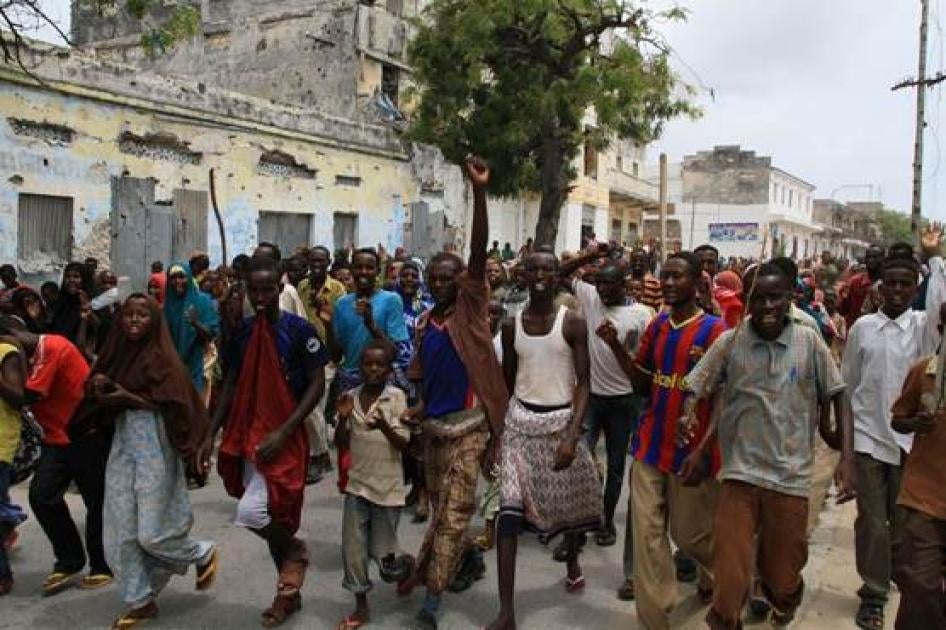
Large crowds of IDPs demonstrate in central Mogadishu against the diversion of food assistance. IDPs have held several demonstrations since the influx into Mogadishu in mid-2011. The government has not been responsive to their complaints, and in some instances has detained protesters. © 2011 Private
Restrictions were also placed on external actors seeking direct access to the IDPs. Nongovernmental organizations described having to get the permission of gatekeepers in order to access the IDP camps. One UN staff member described with frustration how “everywhere you go, the gatekeeper will be there. We have tried to use distraction methods by splitting into groups so that the gatekeeper cannot follow us.”[165]
Several organizations monitoring abuses against IDPs in camps explained that they identified monitors within the IDP population to minimize interference from the gatekeepers and militias running the camps.[166] In early September 2011, the district commissioner’s militia in Badbaado stopped journalists, including a BBC journalist, from interviewing IDPs inside the camps.[167]
IDPs and Humanitarian Assistance under International Law
Internally displaced people are afforded the same rights and protections as all other individuals under international human rights law and international humanitarian law.
The international legal protections due internally displaced people have been set out in the United Nations Guiding Principles on Internal Displacement, which is widely considered an authoritative restatement of existing international law. They draw from relevant standards in both international human rights and humanitarian law and set out the rights of IDPs to receive humanitarian assistance that protects their basic social and economic needs, such as access to food and water, health care, and shelter.[168]
According to the introductory note to the UN Guiding Principles:
The purpose of the Guiding Principles is to address the specific needs of internally displaced persons worldwide by identifying rights and guarantees relevant to their protection. The Principles reflect and are consistent with international human rights law and international humanitarian law.… They apply to the different phases of displacement, providing protection against arbitrary displacement, access to protection and assistance during displacement and guarantees during return or alternative settlement and reintegration.[169]
On December 6, 2012, the African Union Convention for the Protection and Assistance of Internally Displaced Persons in Africa came into force. The Kampala Convention is the first regional instrument aimed specifically at preventing displacement, protecting and assisting the displaced, and identifying durable solutions. The convention provides a comprehensive description of the rights of internally displaced people and the obligations of states to ensure their access to protection and assistance under international humanitarian and human rights law.[170] Somalia has signed but not yet ratified the treaty.[171]
The Kampala Convention incorporates the UN Guiding Principles and other relevant sources of law on internal displacement, setting out the rights and guarantees relevant to the protection of persons from forced displacement and their protection and assistance during displacement, return, and resettlement and reintegration.
Under the UN Guiding Principles, the Somalia government has the “primary duty and responsibility to provide protection and humanitarian assistance to IDPs” and IDPs have the “right to request and receive protection and humanitarian assistance” from the Somali authorities.[172] If the Somali authorities do not provide assistance, then aid agencies:
Have the right to offer their services in support of IDPs [which] … shall be considered in good faith. Consent thereto shall not be arbitrarily withheld, particularly when authorities concerned are unable or unwilling to provide the required humanitarian assistance.… All authorities concerned shall grant and facilitate the free passage of humanitarian assistance and grant persons engaged in the provision of such assistance rapid and unimpeded access to IDPs.[173]
Humanitarian assistance shall not be diverted, particularly for political or military reasons.[174]
International humanitarian organizations providing assistance to IDPs are expected to respect the human rights and protection needs of IDPs, and to adhere to relevant international standards and codes of conduct.[175]
Regarding the type of assistance to which all IDPs are entitled, the UN Guiding Principles make clear that “at a minimum, regardless of the circumstances” they shall receive help to ensure safe access to essential food and potable water; basic shelter and housing; appropriate clothing; and essential medical services and sanitation.[176]
The principles also set out the rights of special groups, such as “children, especially unaccompanied minors, expectant mothers, mothers with young children, female heads of household, persons with disabilities and elderly persons” to receive assistance “required by their condition and to treatment which takes into account their special needs.”[177]
Regarding health care, “special attention should be paid to the health needs of women, including access to female health care providers and services … as well as appropriate counseling for victims of sexual and other abuses.”[178]
Government Response
I know we are soldiers to enforce the law, but the law enforcement doesn’t come from the soldiers, it must come from the top government members and the parliament. They steal our salaries, they give us one month and don’t give two months, so who is responsible for the law enforcement? A hungry soldier can’t enforce a law, instead he takes a bribe and tries to manage his daily life alone.[179]
—Government soldier, Mogadishu, September 2011
The Transitional Federal Government
The Transitional Federal Government of Somalia failed to provide even the most basic services, protection, and security to the displaced population in Mogadishu in the course of the famine.
Apparently more preoccupied with the end of the transitional political process than with providing basic services to the population under its control, the TFG took few limited measures to address the needs of displaced communities. According to the 2012 UN Monitoring Group report, the TFG’s establishment of a series of entities with unclear mandates and roles during the famine heightened confusion for humanitarian actors and undermined transparency and accountability.[180] In August 2011 the TFG set up the Somali National Disaster Management Agency (DMA) to coordinate the drought response. In April 2012, the chairperson of the DMA, prominent civil society activist Abdullahi Mohammed Shirwa, resigned citing government mismanagement and failure to provide the DMA with necessary assistance and funds.[181] According to the Inter-Agency Standing Committee (IASC) Real-Time Evaluation, which assessed the humanitarian response to the drought and famine in the Horn of Africa, the DMA lacked resources and organization.[182]
More positively, the TFG replaced the unpopular commander of Badbaado camp, Captain Jimale, with a Rahanweyn police commander. Several IDPs who had been living in Badbaado since August 2011 said the security situation had improved since Jimale’s removal.[183] This step should be taken as a good practice and as an example for other IDP camps and areas where efforts are being made to strengthen the police presence. However, the district commissioner’s militia, which is believed to have been responsible for a number of the abuses that took place when the camp was initially set up, is still in the vicinity.
In December 2011 a task force on sexual violence was set up by then-Prime Minister Abdiweli Mohamed following pressure by the United Nations, but the task force never met.[184]
More prevalent were the TFG’s failures to address the serious problems facing the IDPs in Mogadishu. Many within the higher ranks of the TFG and local authorities have tried to deny abuses against IDPs, including rape. According to the 2012 UN Monitoring Group report, the TFG generally denied that rape was occurring, or questioned the truth of the allegations.[185] The lack of baseline data on SGBV has also been used by officials as a pretext to question allegations.[186]
Due to significant media attention to abuses against displaced women and girls in the midst of the famine, high-profile members of the TFG, including the president and local and regional administrations, visited Badbaado camp in the second half of 2011. Several displaced people told Human Rights Watch that they had attended meetings with TFG authorities, including the prime minister, the minister of interior, the president, and the mayor, as well as with relevant district commissioners, in order to raise concerns about their situation.[187] IDPs also staged demonstrations outside the mayor’s office and on October 4, 2011, organized a protest outside the Presidential Palace but were thwarted on their way by a suicide explosion. On October 21, 2012, IDPs held another demonstration to raise awareness of their situation.[188] However, most complained that nothing resulted from these meetings. A group of IDPs from Rajo camp described the response of the Wadajir district commissioner to their complaint: “He listened to us and he told us that he will sort out all the problems, but he has never addressed our concerns, Mohamud [head of security at Rajo] and the rest including the district commissioner are connected.”[189]
Despite the public reports of abuses against IDPs by national and international human rights and humanitarian organizations, the UN Monitoring Group, and the media, the TFG largely failed to respond in any substantive manner to these abuses. Transitional government officials failed to take measures to rein in abusive troops, the increasingly powerful district commissioners, or deal with militias.[190]
This culture of cover-up and denial appears to persist among certain local-level authorities. The police commissioner of Hodan district, for example, told Human Rights Watch in October 2012, at a time when certain Somali NGOs monitoring SGBV were reporting an increase in incidents of rape, that he had not heard of any cases of rape in recent months and accused NGOs of making fake claims to attract foreign funding.[191] Similarly, according to a local Somali news outlet, in July 2011, where reports of rape by government affiliated forces in Badbaado were particularly high, the district commissioner of Dharkenley denied the involvement of government soldiers in the abuses.[192] According to a UN official, denial of rape is one of the main obstacles to tackling the culture of impunity surrounding the abuse.[193] Local NGOs and UN agency staff told Human Rights Watch that the police are reluctant to arrest clan militia, particularly those linked to district commissioners.[194] While Human Rights Watch was not able to corroborate this allegation, independent analyses and investigations have shown that it is not unusual that police from majority clans are unwilling to act on allegations brought to them by victims from weaker clans or minorities.[195]
Perpetrators of abuses against IDPs, whatever their status, are rarely prosecuted. In October 2011 the TFG arrested the district commissioners of Hamar Jabjab and Karan and the military court convicted them to 15 and 10 years, respectively, for diversion of aid destined for IDPs. However, the district commissioners, who are civilians, were tried in a military court, and both were released within a month following a presidential pardon in November 2011.[196]
Response of the New Government
The new Somali government has many challenges ahead, but it is crucial that it ensures that basic protection and services are provided to the capital’s sizeable displaced population. In the longer-term it is also vital that Somalia ends the culture of impunity in which abuses against displaced persons occur. In the few months since the government came to power, the signals have been mixed.
In his September 16, 2012 inaugural address the new Somali president, Hassan Sheikh Mohamud, identified security as one of his main priorities.[197] Improving security and equally important, developing professional and accountable security forces, is clearly critical in any effort to protect IDPs—and Somali citizens more broadly. On November 25, 2012, President Hassan Sheikh also publicly committed to hold to account government forces responsible for abuses, including rape, although he said that the death penalty would be applied.[198] A commitment to end impunity is a positive step towards ensuring justice for victims and deterring future abuses, but the new Somali government should place a moratorium on executions with a view to abolishing the death penalty, and instead focus on improving the quality of police response and investigations, as well as the functioning of the judiciary.[199] In February 2013 the prime minister set up a human rights task force reportedly to examine issues of sexual violence and attacks on the media; the exact mandate and role of the task force is unclear.
While the president and some other senior officials seem committed to changing the culture of impunity and ending the denial of abuses by security forces, some parts of the government, particularly the police, appear reluctant to change. The urgent need for wide-ranging and profound police reform is exemplified by the police response to a January 2013 case that gained international notoriety. A 27-year-old displaced woman alleged she was raped in Burdubo camp by five men in uniform, possibly government soldiers, in August 2012. Months later, on January 8, 2013, the woman was interviewed by a freelance journalist, Abdiaziz Abdinur Ibrahim, in the wake of growing reports of sexual violence by security forces in the IDP camps of Mogadishu, including a January 6 article by Al-Jazeera.[200]
Police arrested the woman on January 10 and interrogated her at the Criminal Investigation Department (CID). Using her phone, the authorities telephoned journalists who had either interviewed her or were thought to have been involved in the research for the Al-Jazeera article. Rather than investigating the perpetrators of the alleged rape, the police focused their time and resources on investigating the woman, the journalist Abdiaziz Abdinur, and three other individuals, including the woman’s husband, who eventually spent between 14-19 days in detention without charge. All five were eventually charged on January 29 with a range of crimes, including insulting the government, simulating a criminal offense, and making a false accusation, among others.[201] On February 5, the woman and the journalist were sentenced to one-year imprisonment, convicted of falsely accusing a government body of committing a crime that damages state security. The woman's sentence was later overturned by a court of appeals, while the journalist's sentence was finally quashed by the Supreme Court after he had spent 66 days in detention.
The police conduct in the case—and that of the police commissioner and the minister of the interior, in particular—was a disturbing effort to blame the victim and the media, and divert attention from the very real and alarming prevalence of sexual violence in Mogadishu. It also highlighted serious violations of due process in the police and judicial handling of the case, and raised concerns that the police response could deter victims from reporting sexual violence, as well as chill efforts by media to report on these and other human rights abuses involving security forces.[202]
In January 2013 the government released a draft plan to relocate Mogadishu’s displaced communities from the city center to bigger settlements in districts outside the center. The draft states that by August 20, 2013, the one-year anniversary of the end of the transition, there will be no more IDPs in Mogadishu. Following the release of this draft, a joint UN- Ministry of Interior and National Security chaired task force was established, along with three technical sub-groups to examine specific issues on socio-demographic data of the population, site planning, and communications.
While the government’s decision to tackle the situation of the displaced in Mogadishu is a positive step, key questions remain regarding the protection of the displaced and the provision of basic services. The time frame of the relocation plan is unrealistic and while the government is reported to have expressed flexibility on this question, it should publicly address key concerns about access to protection, the deployment of competent police, and assistance in the new sites before any such relocations start.
To better understand the protection needs of the displaced, the government should carry out a profiling exercise with the assistance of the United Nations to determine people’s needs and to identify the most vulnerable—such as female headed households, unaccompanied children, the elderly, and the disabled. The authorities and humanitarian actors involved will also need to consult with the displaced throughout the process and ensure that they are informed about the reasons for the relocation and the location so as to make free and informed choices.
Donor Governments and Humanitarian Actors
While the Somali government has the primary responsibility to ensure protection and assistance to the internally displaced population in Mogadishu and other areas under its effective control, expecting the Somali government to fulfill this role alone would ignore the political, security, and economic reality on the ground. The donor and humanitarian community also played a key role in Mogadishu at the time of the famine and its aftermath.
The Diplomatic and Donor Community
Throughout the course of the famine and during its immediate aftermath in the last months of the transitional government, the diplomatic community focused primarily on achieving the aims of the political roadmap, often overlooking human rights abuses, questions of impunity, and the complex relationship between aid, armed groups, and rights abuses. Calls for accountability have tended to focus on financial and budgetary accountability rather than accountability for abuses against the population. At the political level, the international community has begun to raise concerns over SGBV. Rape of IDPs has been referenced in numerous UN reports and in UN resolutions on Somalia.[203] The donor community has increased funding to agencies providing assistance to survivors of sexual and gender-based violence.[204] However more needs to be done to address the key contextual factors contributing to abuses against IDPs, including insecurity and impunity. For example, displaced people themselves and human rights and humanitarian actors have repeatedly raised the need to rein in militias as a key way to reduce abuses against IDPs, and doing so should be an immediate priority for the Somali authorities, with support from AMISOM and international donors. Donors should also be making accountability for abuses against the displaced a priority in their discussions with the new government.
The lack of monitoring and accountability of assistance in Mogadishu has been an ongoing concern. During the famine, humanitarian donors tolerated limited monitoring and accountability of assistance, given the need to rapidly scale-up levels of aid. In the post-famine period, donors however should make sure that they encourage and assist agencies and organizations to be transparent and accountable. The fear of losing funding should not undermine transparency and accountability. As one donor pointed out, referring to an agency that is taking several measures to tackle abuse and is as a result being criticized by donors, “the ones that keep quiet, get away with it.” Donors themselves should monitor their assistance to minimize its misuse and increase their outreach to beneficiaries; this responsibility should not be placed purely on their partners.
The Humanitarian Community
The UN Guiding Principles provide that “[i]nternational humanitarian organizations and other appropriate actors when providing assistance should give due regard to the protection needs and human rights of internally displaced people and take appropriate measures in this regard.”[205] Nongovernmental organizations have no formal legal obligations under international human rights and humanitarian law, but many voluntarily adhere to principles on the provision of humanitarian assistance, including independence, impartiality, and neutrality, and operating in a manner that respects human rights.[206]
The humanitarian community faces significant challenges when seeking to provide assistance in Mogadishu in a manner that does not reinforce abusive and exploitative structures and actors. In the course of the famine even the most well-established and experienced humanitarian organizations were under significant pressure to increase their assistance in a context that was not conducive to principled intervention. The imperative, justifiably, was to urgently provide food and other aid, but basic standards and principles on providing humanitarian assistance were often overlooked. As an official 2012 UN Protection Cluster document spells out: “The ‘do no harm’ principle has not always been honoured and poorly planned humanitarian interventions have, at times, put people at greater risk.”[207] Several prominent humanitarian organizations described the arrival of new donors and humanitarian actors with limited experience operating in Somalia as having further undermined their ability to bargain with district officials and adhere to basic principles during and in the aftermath of the famine.[208] However, the end of the famine, the establishment of a new government, and greater access to Mogadishu offers new opportunities in areas of protection, monitoring, and accountability of assistance.
Protection Activities
There is no clear definition of the term “protection” and it is used to refer to a wide variety of activities undertaken by state, military, legal, political, and humanitarian actors. The International Committee of the Red Cross (ICRC), an inter-governmental organization and one of the few humanitarian actors with a legal mandate to provide protection and assistance, states that, “Protection aims to ensure that authorities and other actors respect their obligations and the rights of individuals in order to preserve the safety, physical integrity and dignity of those affected by armed conflict and other situations of violence.”[209] Where the term “protection” is used in this section, it refers to activities by humanitarian agencies aimed at improving the safety and reducing human rights abuses against civilians in the context of humanitarian programs.
UN and NGO humanitarian aid workers in Somali expressed broad concern to Human Rights Watch about inadequate and underfunded protection activities in Somalia. Several agencies and organizations described the UN’s protection cluster as weak, even non-existent during the famine.[210] Several humanitarian workers told Human Rights Watch that protection was not seen as a priority largely as a result of security concerns. A senior humanitarian official described the lack of a presence on the ground, as a result of security concerns, as having undermined the humanitarian community’s ability to invest in protection, while at the same time recognizing that protection was seen as a “secondary” priority.[211]
As in other countries receiving considerable humanitarian assistance, there is a UN-organized “protection cluster,” or meeting of key operational humanitarian agencies in Somalia on protection issues, usually led by the UN High Commissioner for Refugees or the United Nation’s Children Fund (UNICEF), which have mandates to protect refugees and children respectively, with the former leading in the case of Somalia.[212] A protection cluster member was more categorical: “The famine was a failure both of the protection cluster but also of protection at an institutional level. Big agencies should have known better, but no one cared.”[213]
Recognizing this failure, the UN has taken steps to strengthen the protection cluster with new funding and is trying to integrate protection activities into humanitarian operations in over the last year.[214] Under a new head, the cluster has started to revive its work, committing an important part of its activities and projects to dealing with SGBV and using a significant part of the funding allocated to it by the Common Humanitarian Fund (CHF) to fund SGBV programs.[215] But the protection cluster lacks capacity and presence on the ground; the head is based in Nairobi, although he travels throughout the country, and a national focal point has recently been appointed in Mogadishu. The cluster has requested a significant amount of funding under the 2013 Consolidated Appeal Process (CAP) to be able to increase its staff numbers. While the CAP outlines the focus of the cluster’s work in the forthcoming three years, as of this writing the cluster has still not finalized its protection strategy. As of November 7, 2012, the protection cluster had received only 27 percent of funding under the CAP, one of the lowest amounts compared to the initial request.
A new protection mainstreaming officer has been recruited by the protection cluster to integrate protection into work and policies of other clusters that focus on sectoral programs such as health and shelter; similarly the food cluster has hired a protection officer. It remains to be seen whether these steps will convert into concrete changes.
One enormous and longstanding gap that should be urgently filled is the lack of information on abuses. The protection cluster’s public monitoring and reporting mechanism for rights violations is the Protection Monitoring Network (PMN). However while these reports provide a snapshot of incidents, they do not provide trend analysis.
Humanitarian and development agencies have also sought to respond to increasing reports of incidents of rape.
The Humanitarian Community’s Response to Gatekeepers
We are in large part responsible for the creation of gatekeepers: we wanted actors to be able to interface with.[216]
—Senior UN official, Nairobi, October 30, 2012
Providing humanitarian assistance in areas of high insecurity frequently compels humanitarian agencies and organizations to give consideration to the likelihood that some aid will end up with human rights abusers.
Some humanitarian agencies and their local implementing partners have taken measures to circumvent gatekeepers in order to limit the risk of abuse and diversion of aid.[217] One international humanitarian agency distributed ration cards either very early in the morning or late at night when the gatekeepers were absent.[218] A handful of aid agencies have been trying to understand in greater detail who the local and district actors are inside Mogadishu;[219] others questioned both the need and feasibility of such assessments.[220] Some international NGOs described trying to identify abusive gatekeepers, relying on their local staff without having formal assessments, or other mechanisms in place.[221] By contrast, the ICRC carried out a thorough assessment prior to carrying out a large-scale distribution, an almost two-month long assessment of the needs and identities of the displaced community, and also sought to understand the micro-level political dynamics that would affect the distribution.[222]
Some organizations are seeking to make gatekeepers more accountable to beneficiaries by organizing focus group discussions, public meetings, and awareness campaigns between beneficiaries and gatekeepers.[223]
Several aid agencies said that when it came to providing food aid during the famine, they could not be too demanding of those they were forced to work through.[224] A senior UN official said that the lack of governance and of a functioning central government forced humanitarian organizations to rely on what was the closest form of a governance structure: district level administrations and district commissioners.[225] However, another senior humanitarian official pointed to the work of ICRC as evidence that a more ethical distribution could now take place in Mogadishu.[226]
A number of aid officials suggested that without an alternative vision to the current system of providing aid through gatekeepers, it would be difficult to challenge it. One high-level diplomat said bluntly, “You’re not going to get rid of the gatekeeping system.”[227] A senior UN official, on the other hand, saw this attitude as typical of the complacency of the international humanitarian community in Somalia: “Whatever people are inventing for not changing the status quo is unacceptable. We have found the gatekeepers as a wonderful excuse for not changing our own ways.”[228]
The Humanitarian Response to Aid Diversions
If you don’t know where your assistance is going, this is both a protection and an accountability issue.[229]
—Head of International NGO, Nairobi, December 14, 2012
Diversion of aid is not simply a technical problem, nor are gatekeepers the sole source of diversions of assistance. The new government appears to be aware of the problem: the incoming speaker of parliament, Mohamed Osman Jawari, told Human Rights Watch that monitoring aid is essential.[230] Efforts by the new government to tackle mismanagement of aid at all levels will be crucial to transforming the current context in which abuses against IDPs take place, and international donors and humanitarian actors should support efforts to improve accountability.
The United Nations, international, and Somali aid agencies have tried to put in place some monitoring measures to reduce misappropriation of aid at the camp level. Human Rights Watch’s research focused primarily on abuses against IDPs and did not assess humanitarian programming. Such an assessment would be useful but in the short-term some steps are being taken that could be reinforced to improve monitoring and response. These include third-party monitoring and audits,[231] and increasing direct contact between international agencies and beneficiaries, including by setting up telephone hotlines in order to enable IDPs to submit complaints directly.[232]
Some humanitarian aid workers told Human Rights Watch that the lack of any form of IDP profiling system within Mogadishu is a key constraint for better understanding the profile and needs of the displaced population.[233] Certain agencies and organizations are starting to use technological methods to identify and register their beneficiaries and monitor their projects, including biometrics and satellite imagery; but these remain a minority.[234] The former UN deputy humanitarian coordinator, Kilian Kleinschmidt, called for biometric registration and profiling of the whole IDP population, as well as better reporting and coordination of aid in Mogadishu. “We cannot monitor distributions because we have no idea what the inputs [assistance distributed] are,” he told Human Rights Watch.[235]
A key constraint on effective monitoring is the “remote management” strategy that has been the modus operandi for the aid community in Somalia for many years, due to the security situation. Under “remote management” much of the monitoring and evaluation is carried out by local implementing partners, local staff, or contractors rather than international staff, although national Somali staff can also face serious security threats. Over the last 18 months, at least four aid workers have been killed in south-central Somalia during monitoring missions.[236] Over-reliance on local partners can also raise concerns of conflicts of interest, lack of direct control over programming, and potential impacts on monitoring and accountability. Several international aid workers acknowledged that their local implementing partners are part of the same system they are seeking to challenge.[237] As the head of an international NGO said: “The system is not fool-proof. Our key staff have biases, and yet they are the ones responsible for feeding in information.”[238] On the other hand, when international staff conduct site visits they report being unable to talk to beneficiaries without the presence of gatekeepers or fear the visit may be prepared. As a high-level UN officer noted: “Intelligence always reaches people that we are coming.”[239] A senior UN officer described the international community as predictable: “The Somalis know exactly what will be asked of them; we live in a comfort zone of basic requirements that are highly predictable and can easily be circumvented.”[240]
While monitoring the distribution food aid is a particularly complex and potentially dangerous endeavor, the lack of monitoring is a broader problem affecting humanitarian programs across different sectors.[241]
Accountability towards Beneficiaries and of Assistance
The international community is not taking accountability seriously in Somalia. Nobody wants to be accountable.
—Senior UN officer, Nairobi, October 30, 2012
Both donor governments and international humanitarian organizations conceded that they were not doing enough in terms of accountability of aid programming. That is, more needed to be done to ensure that once identified, problems of diversion and abuses by actors involved in distribution of aid were concretely addressed.
In 2010 the then-UN Resident and Humanitarian Coordinator, Mark Bowden, established the UN Risk Management Unit, which maintains a database of implementing partners and contractors and offers agencies risk analysis of their local implementing partners upon request. Currently 11 out of 18 operational UN agencies are using the database, but collaboration with the unit remains voluntary, information sharing is not systematic, and there are questions about the legal responsibility to respond to the unit’s warnings.[242] One head of agency appeared to be reluctant to make the unit’s warnings binding, stating that a partner organization that is bad for one organization might not be for the work of another.[243] The UN Monitoring Group recommended that the UN Resident and Humanitarian Coordinator for Somalia make disclosure of contracts to the Risk Management Unit mandatory for all UN agencies.[244] Most international NGO workers interviewed by Human Rights Watch said that they were not using or sharing information with the unit.[245]
There have been examples of good practice where UN agencies and NGOs have held abusive partners or local actors liable. The Food and Agriculture Organization (FAO) Somalia office requested audits of its local staff and implementing partners after receiving complaints and recently suspended the contracts of four of its local partners following an audit.[246] An NGO working as part of a group of organizations and entities that carried out cash-based humanitarian interventions in Somalia reportedly halted its program in two IDP camps as a result of abusive behavior by the gatekeeper and militia there.[247]
While the issue of monitoring and accountability of assistance has received more attention in recent months due to greater access and the shortcomings of the famine response, more should be done to minimize the risks of poorly designed and implemented humanitarian programs that contribute to abuses. To date responses have often been mixed and depend on the goodwill of an individual agency or organization: a handful of agencies and organizations are proactively seeking to improve accountability but many others admit they are not doing enough or question whether it is feasible to do more.
The humanitarian “system” in Mogadishu needs a major overhaul, but this will need to be coupled with progress on establishing the rule of law and improving governance by the Somali authorities. The new government will have to take responsibility for providing protection, security, and holding all the different armed groups to account. Most of all, what the IDPs of Mogadishu need is a change of attitude among the government officials, donor governments, and international agencies trying to help them. While Somalia is obviously a difficult and challenging environment, this does not mean that the usual rules, standards, and principles do not apply. As a UN official told Human Rights Watch, “Accountability and due diligence is the main problem here. This is not how we operate in other countries.”[248] Somalia may be unique, but Somalis deserve to be treated with respect for international standards.
Recommendations
To Somalia’s National Government
Law Enforcement
- Ensure that the population under effective control, including internally displaced people, is treated in accordance with international human rights and humanitarian law, including the African Union Convention for the Protection and Assistance of Internally Displaced Persons in Africa.
- Take all necessary measures to ensure that sufficient,
competent, and trained police are deployed to protect displaced
communities in Mogadishu, including in new relocation sites, and other
government-controlled areas. Give special attention to the security needs
of women and girls, such as by:
- recruiting more female police officers to act as focal points in police stations;
- training police and other security personnel on responding to sexual violence;
- adopting procedures to protect the confidentiality of persons reporting sexual assault; and
- after the above measures have been adopted, directing the police to conduct public outreach to strengthen trust in the police so that more cases of sexual violence and other crimes will be reported.
- Appropriately discipline or prosecute members of the Somali National Army, Somali Police Force, non-state armed groups, and government officials responsible for serious human rights violations, including abuses committed against displaced people and misappropriation of humanitarian assistance.
- Government and military officials at the highest levels should issue clear public statements to Somali National Army and Somali Police Force that abuses against IDPs will be appropriately punished.
- Establish clear vetting procedures to identify and remove during the recruitment process into the Somali National Army and the Somali National Police Force individuals responsible for serious abuses.
- Ensure that police officers receive appropriate training on human rights, including on the specific rights of displaced people, responding to sexual violence, and other issues of immediate concern.
- Investigate the January 2013 prosecution of the woman alleging rape by security forces and the journalist who interviewed her with the aim of disciplining or prosecuting all officials responsible for abuses.
- The Ministry of Development and Social Affairs, in collaboration with the Office of the Prime Minister, should develop clear and credible government policies and responses to sexual violence.
Humanitarian Assistance
- Initiate, with the assistance of the UN Resident and Humanitarian Coordinator and international agencies, a profiling exercise of the IDP population in Mogadishu to assess protection needs.
- Facilitate unhindered access by humanitarian agencies to civilians at risk and ensure they are able to carry out relief work free of harassment and other interference.
- Ensure that any forthcoming relocation of IDPs in Mogadishu or elsewhere is voluntary and that the IDPs are consulted throughout the process, kept fully informed of the reason for the relocation, and provided necessary security and assistance at the new relocation sites.
- Ensure that Somali humanitarian and human rights organizations are consulted and included in discussions around relocation plans for the displaced population.
Human Rights Compliance
- Support an enlargement of the UN Office of the High Commissioner for Human Rights within the new UN mission with significantly increased capacity to monitor and report on human rights violations.
- Support efforts by UN humanitarian agencies to establish improved systems for monitoring and responding to sexual violence against displaced people and other abuses.
- Extend a standing invitation to all UN special procedures, including the UN Special Rapporteur on the human rights of internally displaced people and the Special Representative of the Secretary-General on Sexual Violence in Conflict, to visit Somalia.
- Support ratification of the Rome Statute of the International Criminal Court; the African Union Convention for the Protection and Assistance of Internally Displaced Persons in Africa; the Convention on the Rights of the Child and its three optional protocols; the Convention on the Elimination of All Forms of Discrimination against Women (CEDAW); and the Protocol to the African Charter on Human and Peoples’ Rights on the Rights of Women in Africa (“Maputo Protocol”).
- Support the establishment of a UN commission of inquiry—or a comparable, appropriate mechanism—to document and map serious international crimes committed in Somalia and recommend measures to improve accountability.
- Impose a moratorium on the use of the death penalty with a view to reviewing the country’s position and moving towards abolition.
To the Somali Parliament and Council of Ministers
- Create a committee to urgently examine and make recommendations for the disarmament and demobilization of militias in Mogadishu and other areas under government control.
- Vote for the ratification of the human rights treaties listed above.
To the Governments of the United States, United Kingdom, and Turkey, and the European Union, the African Union, and the Organization of Islamic Cooperation
- Call on the Somali government to take steps to improve protection of internally displaced people and hold to account members of the security forces and other government officials responsible for abuses against IDPs.
- Support efforts to provide appropriate training to members of the Somali armed forces and police on human rights, including on displaced people and responding to sexual violence. Ensure that the deployment of competent and trained police forces to IDP relocation sites is a priority.
- Support the inclusion of an enlarged OHCHR presence in the new UN mission with sufficient resources, including staff with expertise on sexual violence, and capability to conduct significantly increased human rights monitoring and reporting.
- Urge the Somali government to improve the response of police to sexual and gender-based violence as detailed in the recommendation above.
- Ensure that any future relocations of the displaced in Mogadishu or other government-controlled areas are voluntary and that accountable and competent police forces are deployed at relocation sites.
- Call on the Somalia government, including the Ministry of Development and Social Affairs, in collaboration with the Office of the Prime Minister, to develop clear and credible government policies and responses to sexual violence.
- Encourage UN agencies and grantees to disclose contracts to the UN Risk Management Unit, in line with the recommendations of the UN Monitoring Group on Somalia and Eritrea that information shared should include sub-contracts and details of implementers.
- Support the UN Risk Management Unit to ensure it has the resources required to function effectively.
- Strengthen third-party monitoring of grantees and of assistance to minimize the misappropriation of assistance.
- Support the establishment of clear vetting procedures to identify and remove individuals responsible for serious abuses during recruitment into the Somali National Army and the Somali National Police Force.
- Suspend financial and other assistance to military and police units implicated in serious human rights abuses, including sexual violence.
- Support an appropriate Somali government and UN profiling exercise of the IDP population in Mogadishu to assess protection needs.
- Increase support to the protection sector in Somalia by ensuring that protection cluster funding targets within the forthcoming Consolidated Appeal Process (CAP) are met and adopting other appropriate measures.
- Support improvements to the protection monitoring and reporting system by the protection cluster.
- Publicly support measures to tackle impunity and promote accountability in Somalia, including a UN commission of inquiry—or a comparable, appropriate mechanism—to document serious international crimes committed in Somalia and recommend measures to improve accountability.
To the United Nations High Commissioner for Refugees (UNHCR), UNICEF, and other humanitarian agencies implementing protection activities, and the UN Resident and Humanitarian Coordinator
- Support a government-led profiling exercise of the IDP population in Mogadishu to assess protection needs. The profiling exercise could later be extended to other parts of the country, security permitting.
- Press the Somali authorities to ensure that any future relocations of the displaced are voluntary and that accountable and competent police forces are deployed at relocation sites.
- UNHCR should finalize and implement its protection strategy, and significantly bolster current monitoring efforts by the protection cluster of rights abuses among IDPs and vulnerable groups.
- Expand the staff working for the protection cluster.
- Support the inclusion of an enlarged OHCHR presence in the new UN mission with capability to conduct significantly increased human rights monitoring and reporting.
To the UN Security Council
- Include an enlarged OHCHR presence in the new UN mission with sufficient resources, including staff with expertise on sexual violence, and capability to conduct significantly increased human rights monitoring and reporting.
- Request that the UN secretary-general ensures that all UN agencies and offices in Somalia comply with the Human Rights Due Diligence Policy on UN support to non-UN security forces, and report back on implementation of the policy, and that they disclose all contracts to the Risk Management Unit in line with the recommendations of the UN Monitoring Group that information shared should include sub-contracts and details of implementers.
- Mandate a UN commission of inquiry—or a comparable, appropriate mechanism—to document and map serious international crimes committed in Somalia and recommend measures to improve accountability.
- Ensure that the UN monitoring group on Somalia and Eritrea receives adequate support to fulfill its human rights mandate, and support the recruitment of at least one additional human rights expert to the group.
To the UN Secretary-General
- Request that the UN Security Council include an enlarged OHCHR presence in the new UN mission with sufficient resources, including staff with expertise on sexual violence, and capability to conduct significantly increased human rights monitoring and reporting.
- Support the establishment of a UN commission of inquiry—or a comparable, appropriate mechanism—to document and map serious international crimes committed in Somalia and recommend measures to improve accountability.
To the UN Office of the High Commissioner for Human Rights
- Support the establishment of an enlarged OHCHR presence within the new UN mission, including staff with expertise on sexual violence, and move quickly to expand OHCHR’s presence whenever possible. Ensure that OHCHR’s presence in Somalia expands its monitoring of human rights abuses in south-central Somalia and other parts of Somalia, and that the expanded presence issues frequent reports on the human rights situation.
To the United Nations Development Programme (UNDP)
- Support efforts to provide appropriate training to members of the Somali armed forces and police on human rights, including on the rights of displaced persons, and responding to sexual violence.
To the UN Special Rapporteur on the Human Rights of Internally Displaced Persons
- Request an invitation to carry out a follow-up visit to Somalia.
Acknowledgments
This report was researched and written by Laetitia Bader, researcher in the Africa division, and Ben Rawlence, senior researcher in the Africa Division. The report was edited by Ben Rawlence; Leslie Lefkow, deputy Africa director; Gerry Simpson, senior refugee and advocate; and Liesl Gerntholtz, women’s rights director. James Ross, legal and policy director, and Babatunde Olugboji, deputy program director, provided legal and program reviews, respectively.
Jamie Vernaelde, senior associate in the Africa division, provided production assistance and support. The report was prepared for publication by Grace Choi, publications director; Kathy Mills, publications specialist; Anna Lopriore, creative manager; Ivy Shen, associate in the multimedia division; and Fitzroy Hepkins, administrative manager.
Human Rights Watch would like to thank the many Somali displaced people who shared their experiences, making this report possible. We also wish to thank all those Somalis and others who offered information and their expertise.
[1] See Convention on the Rights of the Child (CRC), adopted November 20, 1989, G.A. Res. 44/25, annex, 44 U.N. GAOR Supp. (No. 49) at 167, U.N. Doc. A/44/49 (1989), entered into force September 2, 1990, art. 1.
[2] “Somalia refugee population in Ethiopia still rising, new camp planned,” UNHCR Briefing Notes, October 19, 2012, http://www.unhcr.org/508142086.html (accessed February 21, 2013).
[3] “2012 UNHCR country operations profile - Somalia, Statistical Snapshot,” http://www.unhcr.org/pages/49e483ad6.html (accessed November 6, 2012).
[4] “Somali refugee population in Horn of Africa passes one million, but exodus slows,” UNHCR Briefing Notes, July 17, 2012, http://www.unhcr.org/50053fcd9.html (accessed November 6, 2012).
[5] “Rebels Ban WFP Aid to Its Territory in Somalia,” Voice of America, February 28, 2010, http://www.voanews.com/content/al-shabab-bans-wfp-85824252/159789.html (accessed January 7, 2013). Inter-Agency Standing Committee, “IASC Real-Time Evaluation of the Humanitarian Response to the Horn of Africa Drought Crisis in Somalia, Ethiopia and Kenya – Synthesis Report, Somalia 2011-2012,” June 30, 2012, http://reliefweb.int/report/somalia/iasc-real-time-evaluation-humanitarian-response-horn-africa-drought-crisis-somalia (accessed December 5, 2012).
[6] Inter-Agency Standing Committee, “IASC Real-Time Evaluation of the Humanitarian Response to the Horn of Africa Drought Crisis in Somalia, Ethiopia and Kenya,” http://reliefweb.int/report/somalia/iasc-real-time-evaluation-humanitarian-response-horn-africa-drought-crisis-somalia; and Ken Menkhaus, “No Access: Critical bottlenecks in the 2011 Somali famine,” Global Food Security, vol. 1, no. 1, December 2012, http://www.sciencedirect.com/science/article/pii/S2211912412000053 (accessed on December 12, 2012).
[7] See for example Immigration and Refugee Board of Canada, “Victims and Vulnerable Groups in Southern Somalia,” May 1, 1995, http://www.unhcr.org/refworld/docid/3ae6a8092.html (accessed December 12, 2012).
[8] For a more detailed description see Human Rights Watch, Shell-Shocked: Civilians Under Siege in Mogadishu, vol. 19, no. 12(A), August 2007, http://www.hrw.org/node/10784; http://www.hrw.org/reports/1992/somalia/.
[9] See for example Africa Watch and Physicians for Human Rights, No Mercy in Mogadishu,; Immigration and Refugee Board of Canada, “Victims and Vulnerable Groups in Southern Somalia,” http://www.unhcr.org/refworld/docid/3ae6a8092.html.
[10] Immigration and Refugee Board of Canada, “Victims and Vulnerable Groups in Southern Somalia,” http://www.unhcr.org/refworld/docid/3ae6a8092.html.
[11] Nisar Majid and Stephen McDowell, “Hidden dimensions of the Somalia famine,” Global Food Security, vol. 1, no. 1, December 2012, http://www.sciencedirect.com/science/article/pii/S2211912412000041 (accessed December 13, 2012), p. 27.
[12] Africa Watch and Physicians for Human Rights, No Mercy in Mogadishu.
[13] Laura Hammond and Hannah Vaughan-Lee, “Humanitarian space in Somalia: a scarce commodity,” Overseas Development Institute, HPG Working Paper, April 2012, http://www.odi.org.uk/publications/6430-humanitarian-space-somalia-aid-workers-principles (accessed March 13, 2013), p. 5.
[14] For a more detailed description, see Human Rights Watch, Shell-Shocked; “So Much to Fear”: War Crimes and the Devastation of Somalia, December 8, 2008, http://www.hrw.org/reports/2008/12/08/so-much-fear-0.
[15] This peace agreement did not include al-Shabaab.
[16] AMISOM deployed in 2007, mandated by the African Union Peace and Security Council and the UN Security Council to provide protection to the Somali transitional institutions. See United Nations Security Council, Resolution 1744 (2007), S/RES/1744 (2007) http://amisom-au.org/wp-content/uploads/2011/09/Resolution%201744%20%282007%29.pdf (accessed January 7, 2013). Since 2009 AMISOM has increasingly taken part in the conflict.
[17] See Human Rights Watch, Harsh War, Harsh Peace: Abuses by al-Shabaab, the Transitional Federal Government and AMISOM in Somalia, April 19, 2010, http://www.hrw.org/reports/2010/04/19/harsh-war-harsh-peace; for background see also Amnesty International, “Somalia: Fatal Insecurity: Attacks on aid workers and rights defenders in Somalia,” I Index: AFR 52/016/2008, November 6, 2008, http://www.amnesty.org/en/library/info/AFR52/016/2008/en, (accessed January 7, 2011).
[18] The Ras Kamboni militia are the principal militia fighting alongside Kenyan forces.
[19] See Human Rights Watch, “You Don’t Know Who to Blame”: War Crimes in Somalia, August 14, 2011, http://www.hrw.org/reports/2011/08/14/you-don-t-know-who-blame.
[20] See “Somalia: Pro-Government Militias Executing Civilians,” Human Rights Watch news release, March 28, 2012, http://www.hrw.org/news/2012/03/28/somalia-pro-government-militias-executing-civilians; “Somalia al-Shabaab militant base of Baidoa captured,” BBC News Online, February 22, 2012, http://www.bbc.co.uk/news/world-africa-17127353 (accessed January 7, 2013).
[21] “Al-Shabaab rebels pull out of key Somali town,” al-Jazeera.com, September 29, 2012, http://www.aljazeera.com/news/africa/2012/09/20129295415328148.html (accessed January 7, 2013); “Somali and African Union troops enter Kismayo,” BBC News Online, October 1, 2012, http://www.bbc.co.uk/news/world-africa-19785316 (accessed January 7, 2013).
[22] See for example United States Agency for International Development (USAID) Famine Early Warning System (FEWS NET), “Somalia Food Security Outlook, October 2010 to March 2011,” http://www.fews.net/docs/Publications/Somalia_OL_10_2010.pdf, (accessed January 7, 2013); FEWS NET, “Somalia Food Security Outlook, January 2011 to June 2011,” http://www.fews.net/docs/Publications/Somalia_OL_01_2011_final.pdf (accessed January 7, 2013).
[23] CARE was banned from operating in al-Shabaab areas in 2009 and WFP was banned in 2010. See Katherine Zimmerman, “Al Shabaab and the Challenges of Providing Humanitarian Assistance in Somalia,” Critical Threats, September 8, 2011, http://www.criticalthreats.org/somalia/zimmerman-shabaab-challenges-humanitarian-assistance-somalia-september-8-2011 (accessed January 7, 2013); “Rebels Ban WFP Aid to Its Territory in Somalia,” Voice of America, http://www.voanews.com/content/al-shabab-bans-wfp-85824252/159789.html.
[24] See for example Inter-Agency Standing Committee, “IASC Real-Time Evaluation of the Humanitarian Response to the Horn of Africa Drought Crisis in Somalia, Ethiopia and Kenya,” http://reliefweb.int/report/somalia/iasc-real-time-evaluation-humanitarian-response-horn-africa-drought-crisis-somalia, p. 11, para. 1.1.1; Ken Menkhaus, “No Access” Global Food Security, http://www.sciencedirect.com/science/article/pii/S2211912412000053.
[25] UN High Commissioner for Refugees (UNHCR), “Somalia: Mogadishu IDP Influx,” December 9, 2011, http://reliefweb.int/map/somalia/somalia-mogadishu-idp-influx-09-december-2011 (accessed March 13, 2013).
[26] See Human Rights Watch, “You Don’t Know Who to Blame”.
[27] “UN Declares Famine in another three areas of Somalia,” UN News Centre, August 3, 2011, http://www.un.org/apps/news/story.asp?NewsID=39225 (accessed December 16, 2012).
[28] United Nations Office for the Coordination of Humanitarian Affairs (OCHA) Somalia, “Somalia: Famine and Drought, Situation Report No. 12,” September 6, 2011, http://reliefweb.int/node/445205 (accessed September 7, 2011); “The UN declares famine in Somalia,” Office of the United Nations Resident and Humanitarian Coordinator for Somalia press release, July 29, 2011, http://reliefweb.int/node/426914 (accessed July 29, 2011).
[29] An October 2011 inter-agency assessment found 184,000 IDPs in Mogadishu, the majority of whom arrived between July-September 2011, OCHA, “Mogadishu – Fact Sheet,” May 2012, http://reliefweb.int/sites/reliefweb.int/files/resources/Somalia_Fact%20Sheet_%20Mogadishu_May%202012.pdf (accessed December 16, 2012). A June 2012 survey by the International Committee of the Red Cross (ICRC) identified 369,288 IDPs in Mogadishu. According to ICRC, 40 percent of the current displaced population in Mogadishu had arrived since 2011 as a result of the famine. ICRC, “Mogadishu IDP Survey,” June 2012, on file with Human Rights Watch.
[30] “UN says Somali famine is over, but warns action is needed to forestall new crisis,” UN News Centre, February 3, 2012, http://www.un.org/apps/news/story.asp?Cr1=famine&NewsID=41133&Cr=somalia (accessed November 6, 2012).
[31] “Al-Shabaab bans 16 aid agencies,” The Independent, November 29, 2011, http://www.independent.co.uk/news/world/africa/alshabaab-bans-16-aid-agencies-6269288.html (accessed December 16, 2012).
[32] “Somalia’s al-Shabaab militants ban Red Cross aid work,” BBC News Online, January 30, 2012, http://www.bbc.co.uk/news/world-africa-16798893 (accessed December 16, 2012).
[33] See for example Sara Pantuliano et al., “Counter-terrorism and humanitarian action: Tensions, impact and ways forward,” Overseas Development Institute, HPG Policy Brief, vol. 43, October 2011, http://www.odi.org.uk/resources/docs/7347.pdf (accessed January 27, 2012). Office of Foreign Assets Control (OFAC), “Somalia: What you need to know about sanctions against persons contributing to the conflict in Somalia,” September 30, 2010, http://www.treasury.gov/resource-center/sanctions/Programs/Documents/somalia.pdf (accessed February 21, 2013); OFAC, “Frequently asked questions and answers,” http://www.treasury.gov/resource-center/faqs/Sanctions/Pages/answer.aspx#som (accessed February 21, 2013).
[34] Alex de Waal, Famine Crimes: Politics and the Disaster Industry in Africa, (James Currey Publishers, 1997); see also,
[35] UN Security Council, “Report of the Monitoring Group on Somalia submitted in accordance with resolution 1853 (2008),” (hereafter UNSEMG 2010), S/2010/91, March 10, 2010,http://www.un.org/ga/search/view_doc.asp?symbol=S/2011/433 (accessed December 18, 2012), p. 60, para. 234.
[36] The report documented how Somali contractors hired by WFP formed a cartel around the distribution of humanitarian assistance that implicated both implementing partners and transporters. It found that one contractor had used its contracts to support an armed opposition group. A WFP internal investigation disputed the amount of aid the UN experts claimed was being diverted.
[37] UN Security Council, “Report of the United Nations Monitoring Group on Somalia and Eritrea, in accordance with the Security Council Resolution 2002 (2011),” (hereafter UNSEMG 2012), S/2012/545, June 2012, http://www.securitycouncilreport.org/un-documents/somalia/ (accessed November 22, 2012), annex 3, p. 312.
[38] Katherine Houreld, “AP Exclusive: How Somalia famine aid went astray,” Associated Press, March 17, 2012, http://news.yahoo.com/ap-exclusive-somalia-famine-aid-went-astray-114402965.html, (accessed March 19, 2012).
[39] Ken Menkhaus, “No Access” Global Food Security, http://www.sciencedirect.com/science/article/pii/S2211912412000053, p. 33.
[40] Each district in Mogadishu is divided into four divisions with a leader for each division. See Erik Bryld and Christine Kamau, “Political Economy Analysis in Mogadishu,” Tana Copenhagen, May 2012, http://tanacopenhagen.com/index.php?page=political-economy-analysis-of-mogadishu (accessed January 7, 2013).
[41] Human Rights Watch interview with Ifrax D., 32-year-old woman, Ufurow camp, Mogadishu, January 6, 2013.
[42] UNSEMG 2012, p. 321.
[43] Human Rights Watch interview with former government official, Mogadishu, October 23, 2012.
[44] For more information on this system see UNSEMG 2012, annex 3, p. 312.
[45] An ICRC survey found that 60 percent of IDP settlements and 55 percent of the population is clustered in three districts: Hodan, Wadajir, and Dharkenley. ICRC, “Mogadishu IDP Survey,” June 2012, on file with Human Rights Watch.
[46] Human Rights Watch telephone interview with aid worker, Nairobi, January 9, 2013; and Human Rights Watch email correspondence with Somali journalist, January 9, 2013.
[47] In the Siliga camp, the main gatekeeper is the wife of Osman Ali Atto, a former warlord and MP. She runs an umbrella organization (the name in Mogadishu for a security network, or clan militia) called “Saredo” and runs many of the camps in Siliga. It is unclear whether this umbrella organization is also running camps in the Tarbuunka area of Hodan district, where the clan of Osman Ali Atto, the Sa’ad, is reportedly dominant, as IDPs regularly referred to the gatekeeper of these camps as Saredo. It appears that this gatekeeper is a different woman, married to a man named Gardhere.
[48] Erik Bryld and Christine Kamau, “Political Economy Analysis in Mogadishu,” Tana Copenhagen, http://tanacopenhagen.com/index.php?page=political-economy-analysis-of-mogadishu, p. 12.
[49] Human Rights Watch telephone interview with aid worker, Nairobi, January 9, 2013; and Human Rights Watch email correspondence with Somali journalist, January 9, 2013.
[50] Ken Menkhaus, “No Access” Global Food Security, http://www.sciencedirect.com/science/article/pii/S2211912412000053, p. 34.
[51] ICRC, “Mogadishu IDP Survey,” June 2012, on file with Human Rights Watch.
[52] See various articles in Global Food Security vol. 1, no. 1, December 2012, http://www.sciencedirect.com/science/journal/22119124/1/1 (accessed December 13, 2012).
[53] For a more detailed description of the social-political dimensions of the famine please see Nisar Majid and Stephen McDowell, “Hidden dimensions of the Somalia famine,” Global Food Security, http://www.sciencedirect.com/science/article/pii/S2211912412000041.
[54] Immigration and Refugee Board of Canada, “Victims and Vulnerable Groups in Southern Somalia,” http://www.unhcr.org/refworld/docid/3ae6a8092.html, p. 6; Nisar Majid and Stephen McDowell, “Hidden dimensions of the Somalia famine,” Global Food Security, http://www.sciencedirect.com/science/article/pii/S2211912412000041, p. 40, para. 8.3.
[55] Immigration and Refugee Board of Canada, “Victims and Vulnerable Groups in Southern Somalia,” http://www.unhcr.org/refworld/docid/3ae6a8092.html; Martin Hill, “No Redress: Somalia’s Forgotten Minorities,” Minority Rights Group International, November 23, 2010, http://www.minorityrights.org/?lid=10370 (accessed December 13, 2012).
[56] Martin Hill, “No Redress: Somalia’s Forgotten Minorities,” Minority Rights Group International, http://www.minorityrights.org/?lid=10370, p. 6.
[57] Ibid., p. 8.
[58] Ibid., p. 9.
[59] For a more detailed discussion regarding xeer responsibilities towards IDPs. See Joakim Gundel, The Predicament of the “Oday”: The Role of Traditional Structures in Security, Rights, Law and Development in Somalia,” Danish Refugee Council and Oxfam, November 2006, http://www.logcluster.org/ops/som/infrastructure-communication-various/Gundel_The%20role%20of%20traditional%20structures.pdf (accessed December 13, 2012). See also Andre LeSage, “Stateless Justice in Somalia: Formal and Informal Rule of Law Initiatives,” Centre for Humanitarian Dialogue, July 2005.
[60] Martin Hill, “No Redress: Somalia’s Forgotten Minorities,” Minority Rights Group International, http://www.minorityrights.org/?lid=10370, p. 21.
[61] See, for example, International Covenant on Civil and Political Rights (ICCPR), adopted December 16, 1966, G.A. Res. 2200A (XXI), 21 U.N. GAOR Supp. (No. 16) at 52, U.N. Doc. A/6316 (1966), 999 U.N.T.S. 171, entered into force March 23, 1976.
[62] Somalia is a party to the four Geneva Conventions of 1949. Article 3 common to the Geneva Conventions, provides for the protection of combatants and civilians in the custody of any party to the conflict. Also applicable is customary international humanitarian law. ICRC, Customary International Humanitarian Law (Cambridge, UK: Cambridge University Press, 2005).
[63] African Union, “African Union Convention for the Protection and Assistance of Internally Displaced Persons in Africa (Kampala Convention),” October 22, 2009, art. 5(1).
[64] See ICRC, Customary International Humanitarian Law, rule 55 and 56.
[65] ICRC, Customary International Humanitarian Law, rule 32, p. 111, citing UN Security Council resolutions and state practice.
[67] Ibid., principle 1.
[68] Ibid., principle 3(1).
[69] Ibid., principle 11(a).
[70] Ibid., principle 14.
[71] Ibid., principle 24(2).
[72] Ibid., principle 25(3).
[73] Kampala Convention.
[74] Under the Kampala Convention, the state must ensure that non-state actors, including armed groups, are held to account for abuses against the displaced. Members of armed groups also have basic obligations towards the displaced including being prohibited from restricting IDPs freedom of movement and impeding humanitarian assistance. The state should also ensure that IDPs are not discriminated against on the basis of their ethnicity. The state is also obliged to refrain from and prevent sexual and gender based violence of all forms against IDPs, including rape and sexual exploitation.
[75] United Nations, Vienna Convention on the Law of Treaties, May 23, 1969, United Nations, Treaty Series, vol. 1155, p. 331, art. 18.
[76]See, for example, UN Human Rights Council, Report of the Special Rapporteur on violence against women, its causes and consequences, Rashida Manjoo, Mission to Somalia, A/HRC/20/16/Add.3, May 14, 2012, http://www.ohchr.org/Documents/HRBodies/HRCouncil/RegularSession/Session20/A-HRC-20-16-Add3_en.pdf, pp. 6-8.
[77] The ICCPR prohibits torture and other cruel, inhuman, or degrading treatment (art. 7) and protects women's right to be free from discrimination based on sex (arts. 2(1) and 26). Convention against Torture and Other Cruel, Inhuman or Degrading Treatment or Punishment (Convention against Torture), adopted December 10, 1984, G.A. res. 39/46, annex, 39 U.N. GAOR Supp. (No. 51) at 197, U.N. Doc. A/39/51 (1984), entered into force June 26, 1987, ratified by Somalia in 1990 (the UN special rapporteur on torture has long characterized rape as torture; UN Commission on Human Rights, Report of the Special Rapporteur on torture and other cruel, inhuman or degrading treatment or punishment, Mr. P. Kooijmans, submitted pursuant to Commission on Human Rights resolution 1985/33, U.N. Doc. E/CN.4/1986/15, February 19, 1986, para. 119;UN Commission on Human Rights, Forty-eighth session, Summary Record of the 21st Meeting, U.N. Doc. E/CN.4/1992/SR.21, February 11, 1992, para. 35; UN Commission on Human Rights, Report of the Special Rapporteur on torture and other cruel, inhuman or degrading treatment or punishment, Nigel Rodley, submitted pursuant to Commission on Human Rights resolution 1992/32, U.N. Doc. E/CN.4/1995/34, January 12, 1995, http://www.unhcr.org/refworld/pdfid/4d3943f72.pdf (accessed March 13, 2013), para 19.); Convention on the Elimination of All Forms of Discrimination against Women (CEDAW), adopted December 18, 1979, G.A. res. 34/180, 34 U.N. GAOR Supp. (No. 46) at 193, U.N. Doc. A/34/46, entered into force September 3, 1981, Somalia has not ratified CEDAW; African [Banjul] Charter on Human and Peoples' Rights, adopted June 27, 1981, OAU Doc. CAB/LEG/67/3 rev. 5, entered into force October 21, 1986, ratified by Somalia in 1985, arts. 2, 5, 18(3).
[78] UN Guiding Principles, principle 11(2); Kampala Convention, art. 9(1)(d).
[79] CRC, signed by Somalia in 2002; African Charter on the Rights and Welfare of the Child, OAU Doc. CAB/LEG/24.9/49 (1990), entered into force November 29, 1999, signed by Somalia in 1991, arts. 16, 27.
[80] Art. 3 common to the four Geneva Conventions of 1949. Protocol II, art. 4(2)(e), explicitly prohibits rape and “any form of indecent assault.”
[81] UN Security Council, “Report of the Secretary-General on Somalia,” S/2013/69, January 31, 2013, para. 42, http://www.un.org/ga/search/view_doc.asp?symbol=S/2013/69 ( last accessed February 21, 2013)
[82] See UN Human Rights Council, “Report of the Secretary-General on the United Nations support to end human rights abuses and combat impunity in Somalia,” A/ HRC/21/36, September 21, 2012, para. 24.
[83] Human Rights Watch interview with 23-year-old IDP woman, Sayidka camp, Mogadishu, (date withheld); Human Rights Watch was not able to corroborate the allegation that one of the perpetrators was arrested.
[84] UN Human Rights Council, “Report of the Secretary-General on the United Nations support to end human rights abuses and combat impunity in Somalia,” para. 24.
[85] Human Rights Watch interview with Somali NGO, Mogadishu, October 21, 2012.
[86] Human Rights Watch interview with UN staff, Nairobi, October 21, 2011.
[87] Human Rights Watch interview with 25-year-old woman, Keysaney Hospital, Mogadishu, October 26, 2011.
[88] Human Rights Watch interview with 30-year-old woman, Mogadishu, October 21, 2012.
[89] Human Rights Watch interview with IDP woman, Mogadishu, October 24, 2012; and Human Rights Watch interview with Somalia NGO, Mogadishu, October 25, 2012; SEMG 2012, para. 325.2.
[90] See for example, UN Human Rights Council, Report of the Special Representative of the Secretary-General on the human rights of internally displaced persons, Walter Kalin, Mission to Somalia, A/ HRC/13/21/Add.2, January 21, 2010, ( last accessed October 6, 2012), para. 42,
[91] Human Rights Watch Interview with 25-year-old woman, Badbaado camp, Mogadishu, September 3, 2011.
[92] Human Rights Watch interview with 48-year-old man, Bisharo Camp, Mogadishu, January 5, 2012; ; Human Rights Watch interview with 40-year-old woman, Bisharo Camp, January 5, 2012; and Human Rights Watch interview with 37-year-old woman, Badbaado camp, Mogadishu, May 24, 2012.
[93] Human Rights Watch interview with 70-year-old woman, Midnimo camp, Mogadishu, January 7, 2012.
[94] Human Rights Watch interview with 14-year-old girl, Mogadishu, October 26, 2011.
[95] Human Rights Watch interview with Somali NGO staff, Nairobi, August 3, 2012.
[96] Human Rights Watch Interview with 51-year-old man, Sayidka camp, Mogadishu, September 25, 2011.
[97] See Human Rights Watch, “Somalia: Woman Alleging Rape, Journalist Convicted,” February 5, 2013, http://www.hrw.org/news/2013/02/05/somalia-woman-alleging-rape-journalist-convicted.
[98] Human Rights Watch interview with UN officer, Mogadishu, October 22, 2012; Human Rights Watch interview with Somali NGO staff, Mogadishu, October 25, 2012; Human Rights Watch interview with UN officer, Nairobi, December 6, 2012.
[99] Human Rights Watch interview with 33-year-old man, Badbaado camp, Mogadishu, September 3, 2011.
[100] Human Rights Watch interview with Somali humanitarian officer, Mogadishu, October 22, 2012; and Human Rights Watch interview with Somali NGO head, Mogadishu, October 23, 2012.
[101] Interview with 27-year-old woman, Saredo camp, Mogadishu, January 6, 2012.
[102] Human Rights Watch interview with 42-year-old man, Rajo camp, Wadajir district, Mogadishu, January 8, 2012.
[103] Elay is a sub-clan of the Rahanweyn but the term is also used as an insult to all Rahanweyn members.
[104] See, for example, Katrina Mason, “ Baidoa emerges from shadow of al-Shabaab,” Financial Times, March 4, 2012, http://www.ft.com/intl/cms/s/0/f500e24e-6608-11e1-acea-00144feabdc0.html#axzz2FOqeGwIy (accessed December 18, 2012); “Al-Shabaab leadership rift widens,” Somalia Report, July 14, 2011, http://www.somaliareport.com/index.php/post/1140/Al-Shabaab_Leadership_Rift_Widens; Toni Weis, “‘The war is changing, no over’: Roland Marchal on Somalia after Afgooye, part two,” post to “Focus on the Horn” (blog), May 30, 2012, http://focusonthehorn.wordpress.com/2012/05/30/the-war-is-changing-not-over-roland-marchal-on-somalia-after-afgooye-part-two/ (accessed December 18, 2012); Roland Marchal, “The Rise of a Jihadi Movement in a country at War,” SciencesPo Paris, March 2011, http://www.sciencespo.fr/ceri/sites/sciencespo.fr.ceri/files/art_RM2.pdf (accessed January 7, 2013).
[105] Human Rights Watch interview with traditional elder, Badbaado camp, Mogadishu, September 3, 2011.
[106] Human Rights Watch interview with 33-year-old man, Badbaado camp, Mogadishu, September 3, 2011.
[107] Human Rights Watch interview with 33-year-old man, Rajo camp, Wadajir district, January 8, 2012.
[108] Human Rights Watch interview with 60-year-old man, Rajo camp, Wadajir district, Mogadishu, January 8, 2012.
[109] Human Rights Watch interview with government soldier, Mogadishu, September 25, 2012.
[110] Meeting with DMA officer, Mogadishu, September 11, 2011; and Human Rights Watch interview with 55-year-old man, Babaado, September 3, 2011.
[111] Human Rights Watch Interview with 66-year-old man, Badbaado camp, Mogadishu, September 3, 2011.
[112] UN Human Rights Council, “Report of the Secretary-General on the United Nations support to end human rights abuses and combat impunity in Somalia,” September 2012, para. 22.
[113] Ibid.
[114] UN Guiding Principles, principle 18.
[115] Ibid., principle 14.
[116] ICCPR, art. 17. The UN Human Rights Committee, an international expert body that monitors compliance with the ICCPR, has stated that “interference with a person's home can only take place ‘in cases envisaged by the law,’” and that the law “should be in accordance with the provisions, aims and objectives of the Covenant and should be, in any event, reasonable in the particular circumstances.” UN Human Rights Committee, General Comment No. 16, Arbitrary or unlawful interference with privacy, family, home or correspondence, Compilation of General Comments and General Recommendations Adopted by Human Rights Treaty Bodies, U.N. Doc. HRI/GEN/1/Rev.1 at 21 (1994).
[117] These safeguards include:
a) an opportunity for genuine consultation with those affected;
b) adequate and reasonable notice for all affected persons prior to the scheduled date of eviction;
c) information on the proposed evictions and, where applicable, on the alternative purpose for which the land or housing is to be used, to be made available in reasonable time to all those affected;
d) government officials or their representatives to be present during an eviction where groups of people are involved;
e) all persons carrying out the eviction to be properly identified.
UN Committee on Economic, Social and Cultural Rights, General Comment No. 7, Forced Evictions and the Right to Adequate Housing, (Sixteenth session, 1997), U.N. Doc. E/1998/22, annex IV at 113 (1997).
[118] Human Rights Watch interview with aid official, Nairobi, May 24, 2012.
[119] Human Rights Watch interview with 45-year-old man, Hodan district, November 14, 2012.
[120] Ibid.
[121] Human Rights Watch interview with 60-year-old woman, Hodan district, November 13, 2012.
[122] UN Guiding Principles, principles 24-27; Kampala Convention, arts. 5(6) and 5(7).
[123] International Covenant on Economic, Social and Cultural Rights (ICESCR), adopted December 16, 1966, G.A. Res. 2200A (XXI), 21 U.N. GAOR Supp. (No. 16) at 49, U.N. Doc. A/6316 (1966), 993 U.N.T.S. 3, entered into force January 3, 1976, art. 11.
[124] ICCPR, art. 12.
[125] UNSEMG 2010 and 2012; Human Rights Watch interviews with international NGOs and donors, Nairobi, 2012.
[126] Human Rights Watch interview with international NGO officer, Nairobi, August 17, 2011.
[127] UN Guiding Principles, principle 25; Kampala Convention, art. 5(6).
[128] Human Rights Watch interview with 30-year-old woman, Kheyr-Qabe camp, Mogadishu, January 5, 2012.
[129] Human Rights Watch interview with 27-year-old woman, Saredo camp, Mogadishu, January 6, 2012.
[130] Human Rights Watch interview with 53-year-old man, Badbaado camp, Mogadishu, September 3, 2011.
[131] Human Rights Watch interview with DMA official, Mogadishu, September 11, 2011; Human Rights Watch interview with 53-year-old man, Badbaado camp, Mogadishu, September 3, 2011; and unpublished UN document, on file with Human Rights Watch.
[132] Human Rights Watch field notes, September 27, 2011, Mogadishu.
[133] Human Rights Watch interview with UN officer, Mogadishu, September 22, 2012; Human Rights Watch email correspondence with UN officer, Nairobi, November 5, 2012.
[134] UNSEMG 2012, para. 317.13.
[135] Human Rights Watch interview with international NGO staff, May 24, 2012, Nairobi.
[136] Human Rights Watch interview with 30-year-old woman from Siliga camp, Mogadishu, October 21, 2012.
[137] Human Rights Watch interview with Somali NGO staff, Nairobi, May 31, 2012.
[138] Human Rights Watch interview with DMA staff, September 2011, Mogadishu.
[139] Human Rights Watch interview with woman gatekeeper, Mogadishu, October 24, 2012.
[140] Human Rights Watch interview with government soldier, Mogadishu, September 25, 2012.
[141] Human Rights Watch interview with 23-year-old woman, Sayidka area, Mogadishu, September 25, 2011.
[142] Human Rights Watch interview with Somali NGO staff, Mogadishu, October 22, 2012.
[143] Human Rights Watch Interview with male aid worker, Mogadishu, September 15, 2011.
[144] Human Rights Watch Interview with aid worker, Mogadishu, September 15, 2011.
[145] Human Rights Watch interview with 40-year-old woman, Bisharo Camp, Tarbuunka area, Mogadishu, January 5, 2012.
[146] Human Rights Watch interview with 32-year-old woman, Ufurow camp, Tarbuunka area, January 5, 2012.
[147] Human Rights Watch interview with 23-year-old woman, Saredo camp, Tarbuunka area, January 6, 2012.
[148] Human Rights Watch interview with 30-year-old woman, Kheyr-Qabe camp, Mogadishu, January 6, 2012.
[149] Human Rights Watch interview with 30-year-old woman, Kheyr-Qabe camp, Mogadishu, January 6, 2012; and Human Rights Watch interview with 28-year-old woman, Saredo camp, Mogadishu, January 6, 2012.
[150] Human Rights Watch interview with 26-years-old woman, Al Huda camp, Mogadishu, January 08, 2012.
[151] Human Rights Watch interview with 40-year-old woman, Bisharo camp, Mogadishu, January 5, 2012.
[152] Human Rights Watch interview with 27-year-old woman, Saredo camp, Mogadishu, January 6, 2012.
[153] According to UNSEMG 2012, primarily Turks distributed tents, para. 316.9.
[154] Human Rights Watch interview with Somali humanitarian officer, Mogadishu, October 22, 2012; Human Rights Watch interview with Somali NGO head, Mogadishu, October 23, 2012.
[155] Human Rights Watch interview with 27-year-old woman, Saredo camp, Tarbuunka, Mogadishu, January 6, 2012.
[156] Human Rights Watch interview with 27-year-old woman, Saredo camp, Mogadishu, January 6, 2012.
[157] Human Rights Watch interview with 40-year-old woman, Bisharo camp, Mogadishu, January 5, 2012.
[158] Human Rights Watch interview with UN officer, Mogadishu, October 22, 2012.
[159] Ibid.
[160] Kampala Convention, art. 5(9). The Guiding Principles in art. 22(1) provide that IDPs, whether or not they are living in camps, shall enjoy the rights to freedom of expression and association.
[161] Human Rights Watch interview with UN international staff, Nairobi, May 17, 2012.
[162] Human Rights Watch interview with 42-year-old man, Rajo camp, Mogadishu, January 8, 2012; and Human Rights Watch interview with 34-year-old man, Rajo camp, Mogadishu, January 8, 2012.
[163] Human Rights Watch interview with 34-year-old man, Rajo camp, Mogadishu, January 8, 2012.
[164] Human Rights Watch interview with traditional elder, Badbaado camp, Mogadishu, September 3, 2011.
[165] Human Rights Watch interview with UN officer, Mogadishu, October 22, 2012.
[166] Human Rights Watch interview with Somali NGO staff, Nairobi, August 8, 2012; Human Rights Watch phone interview with head of Somali NGO, August 7, 2012.
[167] Human Rights Watch interview with 33-year-old man, Badbaado camp, Mogadishu, September 3, 2011.
[169] UN Guiding Principles introductory note, art. 9.
[170] Thirty-seven of Africa’s fifty-three states have signed the convention and sixteen states have currently ratified. Signatory states and states party can be found at http://www.internal-displacement.org/8025708F004BE3B1/(httpInfoFiles)/8DC69364C509E71CC1257AD10038E8A9/$file/list-of-signatories-and-countries-that-have-ratified.pdf.
[171] As a signatory, Somalia is “obliged to refrain from acts which would defeat the object and purpose” of the treaty. See Vienna Convention on the Law of Treaties, art. 18.
[172] UN Guiding Principles, principle 25(1).
[173] Ibid., principle 25(2).
[174] Ibid., principle 24(2).
[175] Ibid., principle 27(1).
[176] UN Guiding Principles, principle 18(2).
[177] Ibid., principle 4(2).
[178] Ibid., principle 19(2).
[179] Human Rights Watch interview with government soldier, Mogadishu, September 25, 2012.
[180] UNSEMG 2012. 315.4.
[181] Human Rights Watch interview with former NSA staff, Mogadishu, October 23, 2012.
[182] Inter-Agency Standing Committee, “IASC Real-Time Evaluation of the Humanitarian Response to the Horn of Africa Drought Crisis in Somalia, Ethiopia and Kenya,” http://reliefweb.int/report/somalia/iasc-real-time-evaluation-humanitarian-response-horn-africa-drought-crisis-somalia, para. 5.3.1.
[183] Human Rights Watch interview with 35-year-old man, Badbaado camp, Mogadishu, May 24, 2012.
[184] Human Rights Watch meetings with UN officers, Nairobi, November-December 2012.
[185] UNSEMG 2012, para. 327.14.
[186] Human Rights Watch interview with Mohamed Ahmed Nur Tarsan, Nairobi, October 15, 2011.
[187] Human Rights Watch Interview with 66-year-old man, Badbaado camp, Mogadishu, (date withheld).
[188] “Somali IDPs march in Mogadishu Streets for Help,” Shabelle News, October 21, 2012, http://shabelle.net/somali-idps-march-in-mogadishu-streets-for-help/ (accessed November 20, 2012); and “ Somalia: IDPs suffer extortion, eviction,” IRINnews, November 1, 2012, http://www.irinnews.org/report/96686/SOMALIA-Mogadishu-IDPs-suffer-extortion-eviction (accessed November 20, 2012).
[189] Human Rights Watch interview with 33-year-old man, Rajo camp, Mogadishu, January 8, 2012; and Human Rights Watch interview with 34-year-old man, Rajo camp, Mogadishu, January 8, 2012;
[190] Human Rights Watch interview with mayor of Mogadishu, Mohamed Ahmed Nur, Nairobi Tarsan, October, 15, 2011.
[191] Human Rights Watch interview with the Hodan district commissioner the police commissioner, Mogadishu, October 25, 2012.
[192] “Government Troops Accused of Raping the Displaced,” Somalia Report, July 18, 2011, http://www.somaliareport.com/index.php/post/1162/Government_Troops_Accused_of_Raping_Displaced (accessed February 2, 2013)
[193] Human Rights Watch interview with UN officer, Nairobi, January 10, 2013.
[194] Human Rights Watch interview with Somali NGO staff, Mogadishu, October 21, 2012; Human Rights Watch interview with UN officer, Nairobi, November 13, 2012.
[195] Martin Hill, “No Redress,” Minority Rights Group International, http://www.minorityrights.org/?lid=10370; Andre LeSage, “Stateless Justice in Somalia.”
[196] “The Roadmap to end the Transition in Somalia:Progress Report, 24 November 2011,” Gedo Online, November 28, 2011, http://gedoonline.com/?p=31828 (accessed December 17, 2012).
[197] “Somalia: New Somali President says his government to focus on security,” Raxanreeb.com, September 18, 2012, http://www.raxanreeb.com/2012/09/somalia-new-somali-president-says-his-government-to-focus-on-security/ (accessed November 14, 2012).
[198] The president’s speech is available online at http://radiomuqdisho.net/wp-content/uploads/2012/11/Riix-Halkan-si-Aad-U-Dhageysato-Khudabadii-Madaxweynuhu-uga-hadlayay-amniga.mp3; translation on file with Human Rights Watch.
[199] Human Rights Watch opposes the death penalty in all circumstances as an inherently irreversible and inhumane punishment. In Africa , 37 of the 54 member countries of the African Union—more than two-thirds of all African countries—have abolished the death penalty in law or in practice. Ten African countries are state parties to the Second Optional Protocol to the International Covenant on Civil and Political Rights (ICCPR-OP2), which aims at the abolition of the death penalty, and 21 are considered abolitionist in practice, as they have not carried out executions for at least 10 years and have an established practice or policy not to do so. In 2008 the African Commission on Human and Peoples’ Rights (African Commission) adopted its second resolution on the death penalty, calling on states parties to the African Charter on Human and Peoples’ Rights to observe a moratorium on the execution of death sentences with a view to abolishing the death penalty and to ratify ICCPR-OP2. In April 2012, the Working Group on the Death Penalty of the African Commission reaffirmed the necessity of the abolition of capital punishment and suggested ways for its achievement. African Commission on Human and Peoples’ Rights, “ Study on the question of the death penalty in Africa,” April 10, 2012, adopted by the African Commission at its 50th Ordinary Session (24 October - 07 November 2011), http://www.achpr.org/files/news/2012/04/d46/study_question_deathpenalty_africa_2012_eng.pdf (accessed February 3, 2013.)
[200] “Free Journalist, Others Linked to Rape Allegation,” Human Rights Watch news release, January 12, 2013, http://www.hrw.org/news/2013/01/12/somalia-free-journalist-others-linked-rape-allegation.
[201] “Alleged Rape Victim Charged,” Human Rights Watch news release, January 29, 2013, http://www.hrw.org/news/2013/01/29/somalia-alleged-rape-victim-charged
[202] Human Rights Watch, Amnesty International, and the Committee to Protect Journalists, “Free Journalist, Others Unlawfully Detained,” January 22, 2013, http://www.hrw.org/news/2013/01/22/somalia-free-journalist-others-unlawfully-detained.
[203] See for example UN Human Rights Council, “Report of the Secretary General on the United Nations support to end human rights abuses and combat impunity in Somalia,” A/ HRC/21/36, September 21, 2012.
[204] Human Rights Watch email correspondence with UN officer, Nairobi, November 15, 2012.
[205] UN Guiding Principles, principle 27.
[206] See, for instance, the “Code of Conduct for the International Red Cross and Red Crescent Movement and NGOs in Disaster Relief,” International Federation of Red Cross and Red Crescent Societies, Geneva, 1995, http://www.ifrc.org/Docs/idrl/I259EN.pdf. The humanitarian community also has industry standards to which many organizations have pledged themselves, including the Sphere Project Standards, http://www.sphereproject.org/handbook/.
[207] Somalia Protection Cluster, OCHA, undated, http://unocha.org/somalia/coordination/clusters/protection (accessed November 15, 2012).
[208] Human Rights Watch meeting with senior international aid official, Nairobi, May 29, 2012.
[209] International Committee of the Red Cross, “Institutional Protection Policy,” September 2008, http://www.icrc.org/eng/assets/files/other/irrc-871-icrc-protection-policy.pdf (accessed March 13, 2013).
[210] Human Rights Watch interviews with international aid officials, Nairobi, 2012.
[211] Human Rights Watch interview with senior humanitarian official Nairobi, January 7, 2013.
[212] The United Nation’s global “cluster system” for IDPs aims to increase UN and NGO inter-agency coordination in responding to IDP’s assistance and protection needs by giving “lead agencies” coordination roles in 11 key sectors: agriculture; camp coordination and camp management; early recovery; educa tion; emergency shelter; emergency telecommunications; health; logistics; nutrition; protection; and water, sanitation, and hygiene. See Humanitarian Response, http://www.humanitarianreform.info.
[213] Human Rights Watch interview with UN officer, Nairobi, December 6, 2012.
[214] Human Rights Watch interview with Mark Bowden, former UN Resident and Humanitarian Coordinator for Somalia, March 14, 2012, Nairobi. In 2012, US$2 million was channeled to the protection cluster by the Common Humanitarian Fund (CHF), a country-wide funding pot, in part as a way of beefing up protection work and encouraging non protection actors to mainstream protection into their activities.
[215] Somalia Protection Cluster, OCHA, http://unocha.org/somalia/coordination/clusters/protection.
[216] Human Rights Watch interview with senior UN official, Nairobi, October 30, 2012.
[217] According to IDPs, in Rajo, Turkish aid agencies reportedly began taking the food directly to each tent.
[218] Human Rights Watch interview with international humanitarian NGO staff, Nairobi, August 14, 2012.
[219] Erik Bryld and Christine Kamau, “Political Economy Analysis in Mogadishu,” Tana Copenhagen, http://tanacopenhagen.com/index.php?page=political-economy-analysis-of-mogadishu.
[220] Human Rights Watch interview with donor, Nairobi, August 29, 2012.
[221] Human Rights Watch interviews with aid officials, Nairobi, 2012.
[222] ICRC, “Mogadishu IDP Survey,” June 2012, on file with Human Rights Watch.
[223] Human Rights Watch interview with senior UN official, Nairobi, October 30, 2012; and Human Rights Watch interview with Somali aid official, Mogadishu, October 22, 2013.
[224] Human Rights Watch interview with senior aid official, Nairobi, May 29, 2012.
[225] Human Rights Watch interview with senior UN official, Nairobi, January 21, 2013.
[226] Human Rights Watch interview with senior humanitarian official, January 7, 2013.
[227] Human Rights Watch interview with donor, Nairobi, August, 29, 2012.
[228] Human Rights Watch interview with senior UN official, Mogadishu, October 21, 2012.
[229] Human Rights Watch interview with international humanitarian NGO head, December 14, 2012.
[230] Human Rights Watch interview with Speaker Mohamed Osman Jawari, Mogadishu, October 25, 2012.
[231] Human Rights Watch interviews with donors and aid officials, Nairobi, August 28, October 30, September 5, 2012.
[232] Human Rights Watch interviews with aid officers, Nairobi .
[233] Human Rights Watch interview with senior UN officials, Nairobi and Mogadishu, October and November 2012.
[234] Human Rights Watch interview with Senior UN officer, Nairobi, October 30, 2012.
[235] Human Rights Watch interview with Senior UN official, Mogadishu, October 22, 2012.
[236] World Food Programme, “ WFP expresses Deep Sadness over Killing of FAO Employee in Somalia,” August 29, 2012, http://www.wfp.org/stories/wfp-expresses-deep-sadness-over-killing-fao-employee-somalia (accessed March 13, 2013); and UNSEMG 2012, p. 303.
[237] Human Rights Watch interview with UN official, Mogadishu, October 22, 2012.
[238] Human Rights Watch interview with Aid official, Nairobi, September 5,2012.
[239] Human Rights Watch interview with senior UN official, Mogadishu, October 22, 2012.
[240] Human Rights Watch interview UN official, Nairobi, October 30, 2012.
[241] Human Rights Watch telephone interview with international aid monitor, December 18, 2012.
[242] Human Rights Watch interview with senior UN official, Nairobi, November 15, 2012.
[243] Human Rights Watch interview with senior UN official, Nairobi, January 21, 2013.
[244] UNSEMG 2012, para. 118.
[245] Human Rights Watch interviews with staff from aid agencies, Nairobi, 2012.
[246] Human Rights Watch interview with senior UN official, Nairobi, October 30, 2012.
[247] Catherine Longley, Sophia Dunn, and Mike Brewin, “Monitoring results of the Somalia cash and voucher transfer programme: Phase I,”, Humanitarian Exchange Magazine, vol. 55, http://www.odihpn.org/humanitarian-exchange-magazine/issue-55/monitoring-results-of-the-somalia-cash-and-voucher-transfer-programme-phase-i (accessed March 13, 2013), para. 5.10.
[248] Human Rights Watch interview with UN officer, Mogadishu, October 22, 2012.