Summary
I want the world to know that here they are executing [juvenile offenders]. No one cares or checks these juvenile cases.… If you don’t have anybody [to help you,] they just execute you, whether you are young or not.
— Qaid Youssef Omar Al-Khadamy, on death row in Sanaa Central Prison for a murder he committed when he says he was 15 years old, March 27, 2012
On the afternoon of December 3, 2012, Hind Ali Abdu al-Barti was taken from her cell in Sanaa Central Prison and executed by a firing squad. Prison authorities only informed Hind’s family that morning of her imminent execution. Hind was sentenced to death for committing murder, and her sentence had been ratified by Yemen’s highest court and confirmed by then-President Ali Abdullah Saleh.Though her family produced a birth certificate showing that she was 15 years old at the time of the alleged crime, and a forensic examination concluded she was no more than 16, courts disregarded this evidence. When the Yemeni government executed her after 4 years in prison, Hind was no more than 20 years old.
International law prohibits, without exception, the execution of individuals for crimes committed before they turn 18. When courts cannot establish conclusively that a defendant was 18 or older at the time of the alleged crime, international law indicates that they cannot impose a death sentence. Yemen has ratified both the International Covenant on Civil and Political Rights (ICCPR) and the Convention on the Rights of the Child (CRC), which specifically prohibit capital punishment of persons under 18 at the time of the offense. Since 1994, Yemen’s penal code has also banned the execution of juvenile offenders and stipulates a maximum penalty of 10 years’ imprisonment for minors who commit capital offenses.
Yet since 2007, Yemen has executed 15 young men and women who claimed to be under 18 at the time of their offense. Prosecutors have demanded death sentences for dozens of additional juvenile offenders. In some cases, defendants lack the documentation to prove they were under age 18 at the time of their alleged crime; in other cases, public prosecutors and judges simply disregard available evidence. At present, the Yemeni government does little to counter either problem.
Yemen has one of the lowest rates of birth registration in the world—between 2000 and 2010, the state registered only 22 percent of all births. Thus, most juvenile offenders lack official birth certificates to prove their age. Yemen’s judiciary lacks impartial and accurate mechanisms to determine the age of youths in criminal proceedings, increasing the risk that juveniles are sentenced to death. Prosecutors ordered forensic examinations in some of the cases reviewed for this report, but these examinations relied on error-prone and outdated methods. In some cases, both prosecutors and defense lawyers ordered age examinations that yielded different results, but courts relied on the prosecution’s examinations that estimated defendants were over 18.
As of January 2013, at least 23 young men and women await execution under death sentences in Yemeni prisons despite having produced evidence indicating they were under 18 at the time of the crimes for which they were convicted. Three of them, Mohammed Taher Sumoom, Walid Hussein Haikal, and Mohammad al-Tawil, could be executed at any moment. They have exhausted all forms of appeal, and Saleh, the former president, signed their execution decrees before he left office. The president’s signature is the final step before carrying out death penalty sentences. In addition to the 23 possible juvenile offenders on death row, Yemen’s public prosecution has called for the death penalty in pending cases of at least 186 other alleged juvenile offenders, according to both the United Nations Children’s Fund (UNICEF) and the Yemeni NGO Coalition on Child Rights Care (YNGOC), a local civil society group monitoring inhumane juvenile sentencing.
All of these alleged juvenile offenders under the death sentence were convicted of murder, a crime some of them admit and others challenge. Many of the stories surrounding these crimes reflect the lack of development common to adolescents, including following adults and older peers into fraught situations, and a quickness of action in the moment without appreciation of the consequences. But it is because of such reasons of lack of maturity and judgment that both international and Yemeni law require judges to consider the age of the defendant as a mitigating factor, and recognize that such individuals are not yet sufficiently responsible for their own actions to deserve the ultimate punishment.
Under Yemeni law, courts may only sentence juveniles convicted of murder to a maximum of 10 years in prison. However, Yemen’s current child protection law, called the Juvenile Welfare Law, only requires courts to refer children 15 years of age and younger to the juvenile court system, leaving many juvenile offenders to defend their cases before adult criminal courts.
Yemen’s judicial system also frequently fails to meet international fair trial standards, meaning that defendants, adults, and juveniles may be sentenced to death after forced confessions or based upon testimony given without having had access to legal counsel. Some juvenile offenders interviewed by Human Rights Watch said that police investigators tortured them to extract confessions and described in detail the methods of torture they had endured. Ibrahim al-Omaisy and Walid Haikal, death row prisoners interviewed for this report, described how police investigators forcibly extracted confessions, interrogating them while or after torturing them. Neither had access to legal counsel until these confessions had been recorded and their cases reached trial.
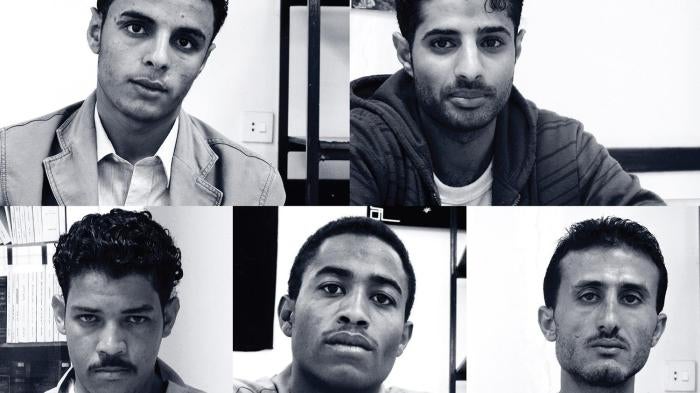
This report documents the stories of young men who have been sentenced to death in Yemen against the backdrop of international conventions and domestic law which prohibit the execution of individuals for crimes committed before they turn 18. In March 2012, Human Rights Watch interviewed five young men at Sanaa Central Prison who had been sentenced to death for crimes committed when they say they were younger than 18. Prison authorities granted us access to the prison, and permission to interview these individuals in a private room outside the presence of prison officials.
Human Rights Watch obtained an additional 18 names of alleged juvenile offenders on death row from UNICEF and YNGOC. YNGOC conducts regular prison monitoring visits and aims to track all juvenile death penalty cases. We subsequently reviewed court rulings, forensic reports, and appeals filed in these cases.
Based upon this research, Human Rights Watch concluded that Yemeni criminal courts sentenced juvenile offenders to death either by disregarding entirely proof of their age at the time of the alleged crime, or using forensic examinations of dubious evidentiary value to determine the defendants’ age.
Human Rights Watch opposes capital punishment in all circumstances. Human rights principles and protections are founded upon respect for the inherent dignity of all human beings and the inviolability of the human person. These principles cannot be reconciled with the death penalty, a form of punishment that is unique in its cruelty and finality.
Yemen’s transitional government has before it an opportunity to reverse one of the country’s most stark human rights violations through a few simple but urgent steps. First, the president should immediately reverse the execution orders of Mohammed Taher Sumoum, Walid Hussein Haikal, and Mohammad Abdu Qassim at-Tawil, juvenile offenders who have exhausted all forms of appeal and risk imminent execution, and refer their cases to courts so that their sentences may be reviewed. If a fair and impartial review of evidence concerning their age at the time of their crime determines they were under 18, they should be commuted under Yemen’s Penal Code, meaning that as all 3 have already served 10 years or more of jail time, the maximum permissible sentence for juveniles convicted of murder, they should be released. Judicial authorities should immediately suspend all executions of individuals who claim to have been under 18 at the time of their alleged crime, at least until the cases are reviewed by an independent committee and their ages are determined in a fair and impartial manner. To provide an impartial age determination process, the Ministry of Justice should establish an independent review committee including trained forensic medical professionals to develop standardized age determination procedures that follow international best practices in this area. Finally, authorities should work to guarantee fair trials and provide appropriate safeguards as required by both the International Covenant on Civil and Political Rights and the Convention on the Rights of the Child, both treaties ratified by Yemen’s government.
The Yemeni government should publish clear procedures outlining how authorities will handle future murder cases involving alleged juvenile defendants. The government should also raise awareness regarding the importance of birth registration through public information campaigns, and ensure that civil registration units equipped to register new births are available across the country and accessible to poor and rural communities. Finally, the government should declare a moratorium on the death penalty in all cases, consistent with the moratorium declared by the United Nations General Assembly in 2007, with a view to abolishing the death penalty at the earliest possible opportunity.
Methodology
In March 2012, two researchers from Human Rights Watch interviewed five young men and one woman at Sanaa Central Prison who had been sentenced to death for crimes committed when, according to them, they were younger than 18. They represented all of the juvenile offenders sentenced to death in the prison at that time. Interviews were conducted in Arabic by researchers who spoke the language, or with the assistance of a translator. Prison authorities granted us access to the prison and permission to interview these individuals in a private room outside the presence of prison officials. They did not enter the room while interviews were in progress.
Human Rights Watch obtained an additional 18 names of alleged juvenile offenders on death row from UNICEF and the Yemeni NGO Coalition on Child Rights Care (YNGOC), a civil society organization that conducts regular prison monitoring visits and works to end inhumane sentences for juvenile offenders in Yemen. YNGOC employs lawyers who focus on juvenile death penalty cases and social workers providing services to juveniles in prison, and aims to track all juvenile death penalty cases.
We also reviewed court rulings, forensic reports, and appeals filed in these cases.
I. Background
Yemen carries out one of the highest numbers of death penalty executions in the world. In 2011, according to data collected by Amnesty International, Yemen carried out at least 47 executions, the 5th highest worldwide after China, Iran, Saudi Arabia, and Iraq.[1] Death sentences are administered for a wide variety of offenses, including drug trafficking and consensual same-sex sexual activity.[2]
In addition, Yemen’s judicial system often fails to provide fair trials, meaning that defendants, adults and juveniles, may be sentenced to death after giving forced confessions or based upon testimony they gave without access to legal counsel. In 2010, the United Nations Committee Against Torture stated that it:
Remain[ed] seriously concerned at the State party’s failure in practice to afford all detainees, including detainees held in State security prisons, with all fundamental legal safeguards from the very outset of their detention. Such safeguards comprise the right to have prompt access to a lawyer and an independent medical examination, to notify a relative, and to be informed of their rights at the time of detention, including about the charges laid against them, and to appear before a judge within a time limit in accordance with international standards.[3]
Some juvenile offenders interviewed for this report said that police investigators tortured them to extract confessions and described in detail the methods of torture and ill-treatment they had faced in police stations, including severe beatings, prolonged suspension, and threats.[4] Human Rights Watch has documented mistreatment in Yemen detention facilities including beatings, insufficient food and water, and prolonged incommunicado detention.[5] A group of eight Yemeni civil society organizations, in a 2009 submission to the Committee against Torture, also documented twelve cases of torture in state custody, including three cases of children who were tortured in prisons during the investigative detention phase.[6] Police officers beat the children with sticks and electric cables, suspended them for long periods of time, and threatened to rape them, according to the report.[7]
Yemen’s failure to implement basic fair trial protections remains problematic in all death penalty cases, but violates the international legal commitments it has made to protect children’s rights to an even higher degree. In the past six years, Yemen has executed at least 16 individuals who claimed to be under 18 at the time of their alleged offense, according to data collected by the United Nations Children’s Fund (UNICEF), Amnesty International, and local civil society groups.
Yemen also has one of the lowest rates of birth registration worldwide. Between 2000 and 2010, according to UNICEF, the country registered only 22 percent of all births.[8] Only 16 percent of births in rural areas were registered, and a mere 5 percent of births among the poorest one-fifth of Yemen’s population.[9] Yemenis interviewed for this report as well as for other Human Rights Watch research placed little importance on knowing their exact age, and many knew at most their birth year, instead of the exact date or month of their birth.
In addition to the 20 juvenile offenders sentenced to death whose cases are included in the appendix, Yemen’s public prosecution has called for the death penalty in pending cases of at least 186 other alleged juvenile offenders, according to the Yemeni National NGO Coalition on Child Rights (YNGOC) which has reviewed their case files and found evidence that they may have been under 18 at the time of their alleged offense.[10]
Though most juvenile offenders lack official birth certificates, Yemen’s judiciary has yet to implement impartial and accurate mechanisms to determine their age in criminal proceedings. Human Rights Watch reviewed five state-ordered forensic reports that allegedly established individuals accused of murder had passed 18 years of age. All five age assessments relied on wrist x-rays, or on arm and wrist x-rays, though assessments based on these tests are known to be unreliable, particularly for children between 16 and 18 years of age. For example, the Netherlands government Committee on Age Determination found that, “The exclusive use of the hand-wrist region means that about 90% of all girls and 50% of all boys reach the physical criterion for exclusion before they reach the age of 18, which means they may be unjustly refused treatment as minors,” while the British Royal College of Pediatrics and Child Health has stated that x-ray tests or “radiological assessment is extremely imprecise and can only give an estimate within two years in either direction.”[11] (See Section III for further details.)
In November 2011, in the 10th month of an uprising seeking his resignation after 33 years of rule, then-President Ali Abdullah Saleh agreed to cede power to his deputy, Abdu Rabu Mansour Hadi. Under the terms of the power transfer, the transition government agreed to convene a Conference on National Dialogue to implement a series of democratic reforms. The promised measures included judicial reform, protection of human rights, and “the adoption of legal and other means to strengthen the protection and rights of vulnerable groups, including children.”[12] Failing to remove juvenile offenders from death row would violate the guiding principles of all three measures.
II. Juvenile Offenders on Death Row in
Sanaa’s Central Prison
Human Rights Watch interviewed five young men on death row in the Sanaa Central Prison, the largest prison in Yemen’s capital city. The cases below represent all cases recorded by local civil society organizations and UNICEF of alleged juvenile offenders on death row in that facility who consented to be included in this report. Hind al-Barti, executed on December 3, 2012, was the sole juvenile offender who asked not to have her account included for fear that the victim’s family would campaign against a pardon, though she too agreed to be interviewed. In each case, Human Rights Watch explained the purpose of our research and the potential results of publication.
In each case, the individual interviewed provided information indicating that his age could have been under 18 at the time of his alleged crime, and that evidence to the contrary remains inconclusive. Two interviewees, Walid Haikal and Ibrahim al-Omaisy, gave credible accounts of beating and torture during their periods of pre-trial detention. None of the young men interviewed had access to a lawyer or other representation before their first trial sessions, in violation of Yemen’s obligation to provide appropriate counsel under the International Covenant on Civil and Political Rights (ICCPR) and the Convention on the Rights of the Child (CRC).[13]
Bashir Mohammed Ahmed Ali Al-Dihar
Bashir Al-Dihar was born in Bani Sa’ad district of Al-Mahwit governorate in 1994, according to both him and a birth registration document (not an official birth certificate) from his village.
When he was approximately 15 year old, on October 25, 2008, according to Bashir, he got into a fight with 3 older males who poked his jambiya, the traditional dagger Yemeni males wear in a belt around their waist. Bashir told Human Rights Watch:
[One of the guys] poked me in my arm and in my jambiya as I was leaving a fast-food restaurant, and they were entering the place. I asked “Why did you poke my jambiya?” Then we grabbed each other, and he slapped me. When we were fighting, I took out my jambiya to defend myself.I was moving my jambiya right and left if anyone approached me.… [One of them, Samy Saleh] raised his hand twice to hit me, and I tried to stab him in the hand, but he bowed a little and the jambiya hit him in the back of his shoulder. He fell on the ground. His friends stepped back. I put my jambiya back in its sheath, and I took him to the hospital along with his friends.[14]
At the hospital, where the victim, Samy Saleh, died, police arrested Bashir and took him to the local police station. He described what had happened, and the police brought him to the district police station. The police held him there for three days before transferring him to the juvenile section of Sanaa’s Central Prison. After 45 days there, he was taken to the prosecutor’s office.
Bashir told Human Rights Watch that the prosecutor asked him some questions but had already prepared a written paper that he told Bashir to sign this with his fingerprint. In trial court, he testified that while it was indeed his fingerprint on the written testimony produced, he had not provided the testimony.[15] The prosecutor charged Bashir with intentionally murdering Samy Saleh.Bashir claimed that he had acted in self-defense, and that he had not intended to kill the victim.
Bashir told Human Rights Watch that he was taken for a forensic examination where his hands were placed into “a device,” and as he remembers it, the doctor told him, “You did not yet start being 16 years old.”[16]
According to Bashir’s court records, at trial, a judge determined that he was in fact a child at the time of the murder.
However, part way through the trial, a different judge took over the proceedings. Bashir said:
The new judge, he only reviewed the file of the case in one trial session and … he said “I sentence him to death.” [My lawyer] brought the judge the forensic doctor’s report that said I was underage. And the judge said, “Even if he was 10 years old, then the punishment for a murderer is death.”[17]
The October 2010 trial court decision states that Bashir was 17 years old at the time of the decision, but affirms that the court sentenced him to death. The decision also orders him to pay 300,000 rials (US$1,400) compensation to the victim’s family. His case is currently under review by an appeals court.
Bashir started school when he was 8 years old, and was in the 7th grade at the time of his arrest. During his three years in prison, he finished the ninth grade and has started the first year of high school studies, concentrating on computers and English.
Reflecting on the attack four years ago, Bashir said:
I was young.… I feel regret for what I did.… We receive the most extreme punishment, and we were children. We should get the discipline and punishment appropriate for our age. This is what we want: that they look at us with a merciful eye.[18]
Qaid Youssef Omar Al-Khadamy
Qaid told Human Rights Watch that he was born in Raymah, Capital governorate in what he believes was 1989.[19] In 2004, when he says he was approximately 15 years old, he and a group of six men from his village were accused of intentionally murdering Fouad Mohsen Rabih by stabbing him in the back with a knife.[20] Qaid says that while one of the co-defendants in the case worked with Rabih’s brother, he had never met Rabih.[21]
According to Qaid’s trial transcript, a group of young men met the day before the murder and agreed to take revenge on Amr Mohsen Rabih, who had fired one of them from his job at a local restaurant. They went to the restaurant, and when Amr Mohsen Rabih left the building, they beat him with sticks. Fouad Mohsen Rabih, Amr’s brother who closely resembled him, was there at the same time, the transcript indicates. It states that the accused (Qaid) stabbed Fouad with a knife, and that a witness took Fouad to a military hospital where he died.
Qaid told Human Rights Watch that on July 31, 2004, while he was living in Sanaa, a group of men from his village took him to a fight:
They came and said, “Come with us, we have a problem.” I didn’t know that they were going to have a fight. I didn’t think. [But I went along] because they were from my same village. I feel regret about what happened.… I hadn’t expected this to happen, because I didn’t even know this person [Fouad Mohsen Rabih] who died. We didn’t have any previous problems. I just went along with people from my village. But me and that person, we didn’t have any personal problems between us.[22]
Tribal and other alternative forms of justice, including revenge attacks, are common in many areas of Yemen and often involve leaders summoning men and boys from a community to take up arms. Qaid’s court records indicate that his lawyer told the court he was examined by a forensic doctor in 2004, shortly after the crime, and that the doctor determined that Qaid was not older than 16. Qaid told Human Rights Watch that this doctor came to the juvenile section of the prison where he was being held.[23] The doctor x-rayed Qaid’s wrists, and according to Qaid, noted that he had not yet grown facial hair. According to the decision published by the appeals court, a second forensic doctor examined Qaid in 2006, 2 years after the crime, and determined that he had been between 18 and 19 years of age at the time of the crime in 2004.[24] The appeals court sentenced Qaid to death.[25]
Qaid says he was jailed for alleged murder when he was just 15 years old. He had finished eighth grade at the time of the crime, and was hoping to start in the ninth grade.[26]
Qaid’s death sentence was confirmed by the appeals court, and as of January 2013 his case had been pending for three years with the Supreme Court.
Mohammed Ahmed Sanhan
Mohammed comes from Tihama district of Hodeidah province. He was working as a street sweeper in Sanaa when on July 6, 2006, he stabbed a fellow guest at a wedding. He said that he was 17 years old at the time of the incident.[27]
Mohammed told Human Rights Watch that the victim, Abdelrahman Saleh Saleh al-Matri, began arguing with him and then started to slap and beat him. At that point, he said, he pulled out his jambiya:
He came to me. I was sitting down. He wanted to fight with me. He was older than me. Then he beat me. And I did not show patience, and I took out my jambiya and we fought.[28]
After stabbing al-Matri in the chest with his jambiya, Mohammed returned home. At 4 a.m. the next day he was taken by the police to their station, where he admitted to carrying out the stabbing. Al-Matrispent a month in the intensive care unit of Sanaa’s al-Thawra hospital but died in September 2005.[29]
Mohammed had his wrists and elbows x-rayed as part of a forensic examination of his age. The forensic report ordered by the public prosecution states that he was at least 19 years of age.[30]
Ibrahim Fouad Mohsen al-Omaisy
Ibrahim Fouad Mohsen al-Omaisy says he was either 15 or 16 years old at the time of the murder for which he was accused. During an interview in March 2012, he told Human Rights Watch that he was 22 years old and had been in prison for 6 years.[31] Ibrahim lived in Sanaa with his family, and worked with his cousin driving a microbus.
He told Human Right Watch that about six years ago, three men hired him to drive them to a neighborhood in Sanaa where they wanted to purchase a car. One of the men had a revolver, not uncommon in Yemen. He said that the men got into a dispute with the seller over the price of the car, began fighting, and that a shot was fired at random, killing one of the men who had hired him. Ibrahim said he saw the men running away, so he left. He stayed at home for two days, but after learning that the police had arrested the two other men who had hired him, he went to a police station in Aden to describe what he had witnessed. He told Human Rights Watch that, “I thought I had nothing to fear, but [the police] insulted me and hit me. At this age, we try to make ourselves older so I had told them I was older than I was.” [32]
Ibrahim said that after he went to the station, the police took him into custody where they continued to abuse him:
They beat me with their hands, sometimes they would electro-shock me until I fell down. At that point if they had asked me, “Did you kill one-thousand?” I would have said, “Yes,” out of fear.[33]
Ibrahim added that he had no legal counsel during his interrogations, and that the first time he saw a lawyer was on his first trial date:
In the trial court, I got a sentence of 10 years and a fine of 5,500,000 rials [US $25,600]. There was a forensic report regarding my age, we produced my mom and dad’s wedding contract, which showed how long they had been married. They proved I was a juvenile, that’s why I got 10 years in the first court.
However, on appeal, Ibrahim was sentenced to the death penalty.
Walid Hussein Haikal
Walid Haikal lived in Sanaa before his arrest. Though he is Yemeni, he was born in Saudi Arabia.[34] Walid told Human Rights Watch that he is now 26 years old, and that he has been in prison for 11 years—since age 15. On February 26, 2005, a trial court sentenced Walid to death, and his sentence was affirmed by all appeals courts. The president’s signature is all that remains for his sentence to be carried out.[35]
Walid told Human Rights Watch that he was arrested for allegedly killing Najib Saleh Jarallah al-Tha’wani, a man in his neighborhood:
I was in the seventh grade. There was a baltajiya [thug] in our neighborhood. He used to drink and fight and bother women. One day, he grabbed me by my lip, so I slapped him. Then, he sliced me with his jambiya on my cheek, and on my shoulder. I ran away and we filed a police report. This happened one week before he was killed.
Walid described his arrest just over a week later:
I was arrested on Friday night. I was lying with my head in my mother’s lap watching a film. The police came and knocked on the door, and said they wanted me only for five minutes. Of course, that was the last time I was home.
Walid told Human Rights Watch that he spent two months at Sanaa’s criminal investigations division, and that police beat and tortured him throughout his time there. He said:
They’d shackle us like a chicken, put metal between our legs and do falaka. This means beating you with a wooden stick on the bottom of your feet. Of course you’d want to confess anything. They also broke my fingers. I felt helpless, I would dream about them at night, and then they would come in the morning. I felt so scared, I thought my heart would burst out of my body. So of course I told them I did it. I told them a lie.
A forensic doctor’s report ordered by Walid’s lawyer and issued on September 1, 2001 states that Walid was 15 when the incident took place. However, in his court decision, the presiding judge argued that because the accused stated that he was 18 years old during his interrogation, the forensic report should not be used to establish his age. Haikal told Human Rights Watch that because he was born in Saudi Arabia, his lawyers have already spent between three and four years trying to obtain official documents proving his age.
Walid said he was a student in the seventh grade at the time of his alleged crime. In prison, he was able to finish secondary school coursework and begin university studies. “I studied on my own, and I would take the exams. I buy books myself,” he said. “There’s a school [in prison,] but people sentenced to the death penalty are not allowed to go.”[36]
III. Forensic Age Assessments:
An Inexact Measure
International law prohibits the death penalty for crimes committed by individuals under age 18.[37] The United Nations Committee on the Rights of the Child (CRC Committee) stated in its General Comment No. 10, on children’s rights in juvenile justice, that, “If there is no proof of age, the child is entitled to a reliable medical or social investigation that may establish his/her age and, in the case of conflict or inconclusive evidence, the child shall have the right to the rule of the benefit of the doubt.”[38]
Addressing age-determination proceedings in the migration and asylum context, the CRC Committee stated in General Comment No. 6 (2005), on the treatment of unaccompanied and separated children outside their country of origin, that:
The assessment must be conducted in a scientific, safe, child and gender-sensitive and fair manner, avoiding any risk of violation of the physical integrity of the child; giving due respect to human dignity; and, in the event of remaining uncertainty, should accord the individual the benefit of the doubt such that if there is a possibility that the individual is a child, she or he should be treated as such.[39]
These standards provide important guidance in juvenile death penalty cases, where a government’s failure to adequately protect children in its justice system has even more severe consequences.
In all five of the forensic age determination reports examined by Human Rights Watch for this report, Yemeni judicial authorities accepted as conclusive age assessments based on wrist x-rays, or on arm and wrist x-rays. However, according to a review of medical and scientific literature, bone-age assessments may be influenced by factors including socio-economic background and nutrition, and that the margin of error, particularly in boys between the ages of 16 and 18, is up to 2 years. [40] Yemen presents a particularly challenging case, with exceptionally high rates of children who are stunted and underweight, making it difficult to accurately assess children’s age based on bone size, using internationally standardized charts. [41]
Age determinations based on wrist x-rays remain controversial, and subject to a wide margin of error in practice. For example, in the Netherlands, the government Committee on Age Determination has criticized age assessments conducted solely on the basis of x-rays of the hand-wrist region because “the exclusive use of the hand-wrist region means that about 90% of all girls and 50% of all boys reach the physical criterion for exclusion before they reach the age of 18, which means they may be unjustly refused treatment as minors. ” [42] Similarly, the Royal College of Pediatrics and Child Health in the United Kingdom, in the context of determining the ages of unaccompanied migrant children, states that x-ray tests or “radiological assessment is extremely imprecise and can only give an estimate within two years in either direction.” [43]
Rather than relying on the inexact conclusions of medical
examinations, the Yemeni government should develop an age-determination
protocol using impartial records and methodology. The government should develop
its protocol based on best practice recommendations from international expert
opinion, including the UN Committee on the Rights of the Child, which has
called for official age verification systems focused on objective evidence such
as birth and school records. Many of the alleged juvenile offenders in this
report were able to produce these documents as part of their defense, though
they lacked official birth certificates. The government should also recognize
the assessment of the UN High Commissioner for Refugee (UNHCR) that, “The
margin of appreciation inherent to all
age-assessment methods needs to be applied in such a manner that, in case of
uncertainty, the individual will be considered a child.”[44]
IV. International and Yemeni Law
The Convention on the Rights of the Child (CRC), an international treaty with 193 member countries—including Yemen—and the International Covenant on Civil and Political Rights (ICCPR), with 161 member countries—also including Yemen—specifically prohibit the death penalty for persons under 18 at the time of the offense.[45]
In 1994 the Human Rights Committee—the international body of experts that interprets the ICCPR—stated that it considered the prohibition against executing children to be part of customary international law, and thus binding on all states.[46]
In its General Comment No. 10, the UN Committee on the Rights of the Child—the international expert body that interprets the CRC—states that within the juvenile justice system, “if there is no proof of age, the child is entitled to a reliable medical or social investigation that may establish his/her age and, in the case of conflict or inconclusive evidence, the child shall have the right to the rule of the benefit of the doubt.”[47] This prescription bears particular weight in death penalty cases, given the absolute prohibition on juvenile executions under the convention.
In 1994 Yemen amended its Penal Code to abolish the death penalty for persons under the age of 18, and stipulated a maximum penalty of 10 years’ imprisonment for those who commit capital offenses.[48] Article 31 of the Penal Code states:
Any person who has not reached the age of 7 is not accountable at the time of the act that constituted the crime. If the crime was perpetrated by a minor who has reached the age of 7, but still has not reached the age of 15, the judge may order any of the arrangements stipulated in the Law of Juveniles in lieu of the normal punishment for the crime. If the perpetrator has reached the age of 15 but not 18, the individual shall be sentenced to a maximum of half the punishment set forth in law. If the sentence was the death penalty, the individual shall be punished by imprisonment for a minimum of 3 years up to a maximum of 10 years. In all cases, imprisonment shall be carried out in special facilities, subject to appropriate treatment of the indicted juveniles. No minor shall bear full criminal responsibility, unless the individual has reached the age of 18 years old at the time of committing the crime. If the age of the defendant is not easily determined, the judge may estimate it with the assistance of an expert’s council.[49]
This law, however, does not clarify how the determinations should be conducted, nor does it require that defendants receive the benefit of the doubt if their age is in question. According to nongovernmental organizations working on juvenile justice in Yemen, the country lacks adequate forensic facilities with staff trained in conducting age determinations.
Yemen retains the death penalty for a wide variety of offenses, among them murder of a Muslim, arson or explosion, endangering transport and communications, apostasy, robbery, prostitution, adultery, and consensual sex between adults of the same sex.[50]
Before the death sentence can be carried out against an individual, the president must ratify the sentence and issue a decree.[51] The president may also issue a decree for an alternative punishment or exempt the sentenced defendant.[52] Once the presidential decree has been issued, the general prosecutor will issue an order confirming that the president has issued the necessary decree, and that the required legal procedures have been fulfilled.[53]
The death sentence can be carried out through beheading by sword, shooting, or stoning.[54]
Yemen’s current child protection law, Law No. 24 of 1991 as amended by Law No. 26 of 1997 (the Juvenile Welfare Law), only requires courts to refer children 15 years of age and younger to the juvenile court system and provides for their detention in juvenile facilities.[55] However, the current parliamentary agenda includes a proposed amendment to the law, including an article that would expand the jurisdiction of Yemen’s juvenile courts to all individuals under 18 years of age, rather than the current law, which limits jurisdiction to children 15 years old and younger. Sending juvenile offenders before child courts should allow them to be sentenced by judges whose mandate would be to sentence juveniles within the bounds of the reduced penalties prescribed by Yemen’s criminal law.
In 2009 Yemen’s human rights record was examined as part of the Universal Periodic Review process at the UN Human Rights Council in Geneva. At the review, the government stated that executions of juvenile offenders “do not exist and have no place in legislation or the judicial system.”[56] Yemen did, however, support a recommendation from Denmark to remove juvenile prisoners from death row,[57] and a recommendation from Austria to raise the legal age of criminal responsibility, develop alternative sentences for juvenile offenders, and ensure that prison for offenders under 18 is used only as a last resort.[58]
Recommendations
To President Abdu Rabu Mansour Hadi
- Immediately reverse the pending execution decrees signed by former president Ali Abdullah Saleh in the cases of Mohammed Taher Somoum, Walid Hussein Haikal, and Mohammad Abdu Qassim al-Tawil, three alleged juvenile offenders at risk of imminent execution.
- Order a review of all death sentences where there is doubt that the individual was at least 18 at the time of the offense, including the 23individuals identified in this report, and commute all sentences when evidence regarding an offender’s age remains inconclusive or in conflict.
- Issue instructions to relevant ministries to increase Yemen’s rate of birth registration by raising public awareness regarding the importance of registration and by improving access to registration in poor and rural communities.
- Impose a moratorium on the death penalty in all cases, with a view towards its prompt abolition.
To the Ministry of Justice and the Supreme Judicial Council
- Immediately implement a moratorium on all executions of persons convicted of crimes committed before age 18.
- Establish an independent review committee (separate from the office of the public prosecutor) that includes trained medical professionals to develop clear procedures and guidelines with immediate as well as retroactive effect to ensure that all juveniles accused of murder and other offenses will have access to an independent impartial age determination process.
- Suspend the executions of all individuals who claim to have been under 18 at the time of their alleged crime, at least until their cases are reviewed by the independent committee described above, and their ages are determined in a fair and impartial manner.
- Review all death sentences where the accused has presented evidence indicating they were under 18 at the time of the alleged crime, including the 23individuals identified by this report. Commute all sentences to custodial or other sentences in conformity with international juvenile justice standards, when evidence regarding an offender’s age remains inconclusive or in conflict.
- Ensure that judicial authorities understand and enforce the ban on the juvenile death penalty, including by providing judges and prosecutors with training on its application.
- Retry all cases in which courts accepted prosecution-ordered forensic examinations as determinative proof of defendant’s ages. Cease using as determinative evidence forensic age assessments based solely on x-ray evidence and upon the assessment of a single doctor. Instruct judges not to issue death sentences in cases where evidence regarding an offender’s age remains inconclusive or in conflict. Develop an impartial age-determination process that relies on more than one expert opinion.
- Direct prosecutors to exclude from evidence all forced or compelled testimony, in particular, admissions or confessions obtained by means of torture, cruel, inhuman, or degrading treatment.
- Ensure that no interrogations are carried out in which the suspect did not have access to legal or other appropriate counsel at the time. Ensure that children in conflict with the law have prompt access to legal assistance, including assistance in proving their age at the time of an alleged offense, and access to family members. Require police and prosecutors to record the ages of children who are brought before them.
- Ensure legal representation of juveniles by a lawyer during all stages of prosecution, including the stage of collecting evidence, during which criminal suspects are questioned by the police.
To the Parliament
- Abolish the death penalty.
- Amend the jurisdiction of Yemen’s Juvenile Care Law (Law No. 24 of 1992, as amended by Law No. 26 of 1997), which refers juvenile defendants to child courts, to include all children below the age of 18.
- Amend Yemen’s minimum age of criminal liability from the age of seven to the age of twelve or higher to be consistent with the internationally accepted standards.
To the United States, the European Union and Member States, and Other Donor Countries
- Raise juvenile death penalty as a matter of priority requiring urgent attention in dialogues with the Yemeni government.
- Call upon the Yemeni government to review the three cases discussed in this report involving juvenile offenders at risk of imminent execution. Urge the government to retry cases in which age-related evidence is weak or inconclusive, or which incorporated forensic exams based on outdated techniques or exams ordered by the prosecution.
- Make public statements stressing the importance of adhering to the international ban on executing juvenile offenders.
Appendix: Other Alleged Juvenile Offenders
on Death Row in Yemen
Ibb Central Prison:
Mohammad Abdu Qassim al-Tawil
- Accused of committing murder on June 7, 1987
- Claims to be 17 years old at the time of the crime
- Death sentenced confirmed by both appeals and high court, could be executed at any time
Mohammed Abdulwahab Faisal
- Accused of committing murder on February 14, 1998
- Claims he was 15 years old at the time of the crime
- Death sentence confirmed by both appeals and high court, court reviewing age information
Mohammed Taher Somoum
- Accused of committing murder on June 8, 1999
- Death sentence confirmed by both appeals and high court and ratified by the president, could be executed at any time
Faisal Naji Said al-Hadi
- Accused of committing murder in 1999
- Claims to be 16 years old at the time of the crime
- Sentenced to death by an appeals court
Tawfiq Mohyub al-Habishi
- Accused of committing murder on May 26, 2002
- Claims to have been 17 years old at the time of the crime
- Death sentence issued by North Ibb trial court on November 18, 2007 and confirmed by appeals court
Muwafiq Muthana Ahmad Hussein al-Madhrahi
- Accused of committing murder in 2004
- Claims to have been 17 years old at the time of the crime
- Death sentence issued by trial court and confirmed by appeals court on March 8, 2010
Samir Naji Ahmad al-Mahdi
- Accused of committing murder on February 27, 2005
- Claims to have been 16 years old at the time of the crime
- Sentenced to death by a trial court
Mohammed Abdullah Mathar al-Washli
- Accused of committing murder in January 2009
- Sentenced to death by an appeals court
Awa’ad Musaed Ahmad Hussein al-Souri
- Accused of committing murder on December 29, 2009
- Claimed to be 17 years old at the time of the crime
- Death sentence issued by trial court on May 29, 2011
Dammar Central Prison:
Nasser Ahmad Ali Hurqidah
- Accused of committing murder on October 17, 2010
- Forensic examination found him to be 16 years old at the time of the crime
- Death sentence issued by trial court
Mohammed Abdu Mohammed A’ajinah
- Accused of committing murder on June 15, 2010
- Forensic examination found him to be 17 years old at the time of the crime
- Death sentence issued by a trial court.
Sanaa Central Prison:
Nadim Hatim al-Aza’azi
- Accused of committing murder
- Claims to have been 15 at the time of the crime, based on three forensic examinations
- Sentenced to death by a trial court
Samir al-Shara’abi,
- Accused of committing murder
- Claims to have been under 18 (either 15 or 16) at the time of the crime
- Sentenced to death by a trial court
Akram Mohammed Abdullah al-Faqih
- Accused of committing murder on February 6, 2002
- Claims to have been 15 at the time of the alleged crime
- Sentenced to death by trial court, case under appeal
Aden Central Prison:
Hani Abdu Qaid
- Accused of committing murder on November 17, 2005
- Claims to have been 17 years old at the time of the crime
- Sentenced to death by the high court
Hodeida Central Prison:
Mariam Yahia Youssef al-Batah
- Accused of committing murder on November 4, 2009
- Claims to have been 16 at the time of the crime
- Sentenced to death by a trial court in Hodeida
Mahweet Central Prison:
Ahmad Bahal Ahmad al-Rasisah
- Accused of committing murder on March 17, 2010
- Birth certificate produced at court makes him 15 years old at the time of the crime
- Sentenced to death by a trial court
Acknowledgments
This report was researched and written by Priyanka Motaparthy and Bede Sheppard, researchers in the Children’s Rights Division of Human Rights Watch. Farida Kalagy and Mariam Kirollos, research assistants in the Middle East and North Africa division, provided valuable assistance.
The report was edited by Zama Coursen-Neff, director of the Children’s Rights Division; Letta Tayler, Yemen and Terrorism/Counterterrorism researcher; Nadim Houry, deputy director of the Middle East and North Africa division; James Ross, legal and policy director; and Babatunde Olugboji, deputy program director.
Noah Beaudette, associate in the Children’s Rights Division provided editing and production assistance. Anna Lopriore, creative manager; Grace Choi, publications director; Kathy Mills, publications specialist; and Fitzroy Hepkins, mail and print manager, provided production assistance.
We wish to thank the UNICEF office in Yemen, the lawyers and social workers from the Yemeni NGO Coalition on Child Rights, and the five individuals on death row who agreed to share their stories for the purpose of this report.
[1] According to Amnesty International data, China executed thousands of individuals (though the exact number is unknown), while Iran had 360+, Saudi Arabia 82+, and Iraq 68+ known executions. Amnesty International, “Death Sentences and Executions in 2011,”2012, http://www.amnesty.org/en/library/asset/ACT50/001/2012/en/241a8301-05b4-41c0-bfd9-2fe72899cda4/act500012012en.pdf (accessed September 14, 2012), p. 7.
[2] US State Department, Bureau of Democracy, Human Rights and Labor, “Country Reports on Human Rights Practices for 2011 - 2011, Yemen,” http://www.state.gov/j/drl/rls/hrrpt/humanrightsreport/index.htm#wrapper (accessed December 1, 2012).
[3] UN Committee Against Torture, “Consideration of Reports Submitted by States Parties under Article 19 of the Convention, Conclusions and recommendations of the Committee against Torture, Yemen,” CAT/C/YEM/CO/2/Rev.1, May 25, 2010, http://daccess-dds-ny.un.org/doc/UNDOC/GEN/G10/426/51/PDF/G1042651.pdf?OpenElement (accessed December 1, 2012), para. 9.
[4] Human Rights Watch interview with Ibrahim al-Omaisy, Sanaa Central Prison, March 27, 2012; Human Rights Watch interview with Walid Hussein Haikal, Sanaa Central Prison, March 27, 2012.
[5] Human Rights Watch, “Report on Human Rights in Yemen,” February 1, 2012, http://www.hrw.org/sites/default/files/related_material/Report%20on%20Human%20Rights%20in%20Yemen.pdf (accessed September 16, 2012).
[6] Yemeni Civil Society Organizations, “The Status of Torture in Yemen, Second Parallel Report by Yemeni Civil Society Organizations on Yemen’s Compliance with the Convention Against Torture and All Forms of Inhuman and Degrading Treatment,” October 12, 2009, http://www2.ohchr.org/english/bodies/cat/docs/ngos/SAF_Yemen43.pdf (accessed September 16, 2012).
[7] Ibid.
[8] UNICEF, “At a glance: Yemen,” total birth registration 2000–2010, measures the percentage of children less than five years of age that were registered at the moment of the survey, http://www.unicef.org/infobycountry/yemen_statistics.html (accessed September 14, 2012).
[9] Ibid.
[10] Human Rights Watch group interview with lawyers and social workers from the Yemeni National NGO Coalition on Child Rights, Sanaa, March 26, 2012.
[11] Royal College of Pediatrics and Child Health, “X-Rays and Asylum-Seeking Children: Policy Statement,” November 19, 2007, http://www.rcpch.ac.uk/sites/default/files/asset_library/Policy%20and%20Standards/X%20rays%20and%20asylum%20seeking%20children%20policy%20statement.pdf (accessed September 2, 2012).
[12] “Implementation Mechanism for the Transition in Yemen Pursuant to the Gulf Cooperation Council Initiative,” November 23, 2011, sections 21(e), 21(f), 21(g), copy on file with Human Rights Watch.
[13] International Covenant on Civil and Political Rights (ICCPR), adopted December 16, 1966, G.A. Res. 2200A (XXI), 21 U.N. GAOR Supp. (No. 16) at 52, U.N. Doc. A/6316 (1966), 999 U.N.T.S. 171, entered into force March 23, 1976, acceded to by the People’s Democratic Republic of Yemen on February 9, 1987, art. 14; Convention on the Rights of the Child (CRC), adopted November 20, 1989, G.A. Res. 44/25, annex, 44 U.N. GAOR Supp. (No. 49) at 167, U.N. Doc. A/44/49 (1989), entered into force September 2, 1990, ratified by the Yemen Arab Republic on May 1, 1991, art. 40.
[14] Human Rights Watch interview with Bashir Mohammed Ahmed Ali Al-Dihar, Sanaa Central Prison, March 27, 2012.
[15] Decision, Bani al-Harith Trial Court, July 10, 2010 (Arabic original on file with Human Rights Watch) .
[16] Human Rights Watch interview with Bashir Mohammed Ahmed Ali Al-Dihar, March 27, 2012.
[17] Ibid.
[18] Ibid.
[19] Human Rights Watch interview with Qaid Youssef Omar al-Khadamy, Sanaa Central Prison, March 27, 2012.
[20] Decision, Shima’al al-Amanah Trial Court, Criminal Case No. 202, July 1, 2006 (Arabic original on file with Human Rights Watch).
[21] Ibid.
[22] Human Rights Watch interview with Qaid Youssef Omar Al-Khadamy, March 27, 2012.
[23] Human Rights Watch interview with Qaid Youssef Omar Al-Khadamy, March 27, 2012.
[24] Decision, Shima’al al-Amanah Trial Court, July 1, 2006.
[25] Ibid.
[26] Human Rights Watch interview with Qaid Youssef Omar Al-Khadamy, March 27, 2012.
[27] Human Rights Watch interview with Mohammed Ahmed Sanhan, Sanaa Central Prison, March 27, 2012.
[28] Ibid.
[29] Decision, Shima’al al-Amanah trial court, Criminal Case No.135, July 15, 2009 (Arabic original on file with Human Rights Watch).
[30] Forensic Determination of Age Report for Mohammed Ahmed Sanhan, August 12, 2006 (Arabic original on file with Human Rights Watch).
[31] Human Rights Watch interview with Ibrahim al-Omaisy, March 27, 2012.
[32] Ibid.
[33] Ibid.
[34] Human Rights Watch interview with Walid Hussein Haikal, Sanaa Central Prison, March 27, 2012.
[35] Procedural complaint filed by Walid’s lawyers, Arabic original on file with Human Rights Watch.
[36] Human Rights Watch interview with Walid Hussein Haikal, March 27, 2012.
[37] ICCPR, art. 6(5); CRC, art. 37(a).
[38] UN Committee on the Rights of the Child (CRC Committee), General comment No. 10 (2007): Children’s Rights in Juvenile Justice, UN Doc. CRC/C/GC/10, para 39.
[39] UN Committee on the Rights of the Child (CRC Committee), General comment No. 6 (2005): Treatment of Unaccompanied and Separated Children Outside Their Country of Origin, CRC/GC/2005/6, para. 31(i).
[40]
Terry Smith and Laura Brownlees, “Age
Assessment Practices: A Literature Review and Annotated Bibliography,”
UNICEF 2011 (New York),
http://www.unicef.org/protection/Age_Assessment_Practices_2010.pdf
(accessed September 2, 2012).
[41] World Bank, “Nutrition at a Glance, Yemen Country Profile,” Based on data from 1995 to 2005, http://siteresources.worldbank.org/NUTRITION/Resources/281846-1271963823772/Yemen.pdf (accessed December 1, 2012).
[42] Ibid, p.18.
[43]
Royal College of Pediatrics and Child
Health, “X-Rays and Asylum-Seeking Children: Policy Statement,”
November 19, 2007,
http://www.rcpch.ac.uk/sites/default/files/asset_library/Policy%20and%20Standards/X%20rays%20and%20asylum%20seeking%20children%20policy%20statement.pdf
(accessed September 2, 2012).
[44] UNHCR, Guidelines on International Protection: Child Asylum Claims under Articles 1(A)2 and 1(F) of the 1951 Convention and/or 1967 Protocol relating to the Status of Refugees, December 22, 2009, U.N. Doc. HCR/GIP/09/08, http://www.unhcr.org/refworld/docid/4b2f4f6d2.html, (accessed February 7, 2013) para. 75.
[45] CRC, art. 37(a) (“Neither capital punishment nor life imprisonment without possibility of release shall be imposed for offences committed by persons below eighteen years of age”); ICCPR, art. 6(5) (“Sentence of death shall not be imposed for crimes committed by persons below eighteen years of age”).
[46] Human Rights Committee, General Comment 24 (1994), General comment on issues relating to reservations made upon ratification or accession to the Covenant or the Optional Protocols thereto, or in relation to declarations under article 41 of the Covenant, U.N. Doc. CCPR/C/21/Rev.1/Add.6 (1994)., para. 8.
[47] UN Committee on the Rights of the Child (CRC Committee), General comment No. 10 (2007): Children’s Rights in Juvenile Justice, UN Doc. CRC/C/GC/10 (2007), para 39.
[48] Yemeni Penal Code, art. 31.
[49] Ibid.
[50] Yemeni Penal Code, arts. 124, 141, 226, 227, 228, 234, 249, 259, 263, 264, 280, 306.
[51] Yemeni Criminal Procedure Code, arts. 479 and 480.
[52] Ibid, art. 480.
[53] Ibid, art. 480.
[54] Ibid, arts. 485 and 487.
[55] Human Rights Council, National Report submitted to the Human Rights Council, Government of Yemen, February 20, 2009, U.N. Doc. A/HRC/WG.6/5/YEM/1, http://lib.ohchr.org/HRBodies/UPR/Documents/Session5/YE/A_HRC_WG6_5_YEM_1_E.pdf (accessed September 14, 2012).
[56] Human Rights Council, Report of the Working Group on the Universal Periodic Review: Yemen, June 5, 2009, U.N. Doc. A/HRC/12/13, para. 53
[57] Ibid, para. 91.
[58] Ibid, para. 91; see CRC, art. 37(b) (“The arrest, detention or imprisonment of a child shall be in conformity with the law and shall be used only as a measure of last resort and for the shortest appropriate period of time”).