Executive Summary
When Enrique Peña Nieto took office on December 1, 2012, he inherited a country reeling from an epidemic of drug violence that had taken the lives of more than 60,000 Mexicans in six years. The “war on drugs” launched by his predecessor, Felipe Calderón, had produced disastrous results. Not only had it failed to rein in the country’s powerful criminal groups, but it had led to a dramatic increase in grave human rights violations committed by the security forces sent to confront them. Rather than strengthening public security, these abuses had exacerbated a climate of violence, lawlessness, and fear.
Throughout most of his presidency, Calderón denied security forces had committed any abuses, despite mounting evidence to the contrary. Only in his final year did he acknowledge that human rights violations had occurred, and take a handful of positive—though very limited—steps to curb some abusive practices. However, he failed to fulfill his fundamental obligation to ensure that the egregious violations committed by members of the military and police were investigated and the perpetrators brought to justice.
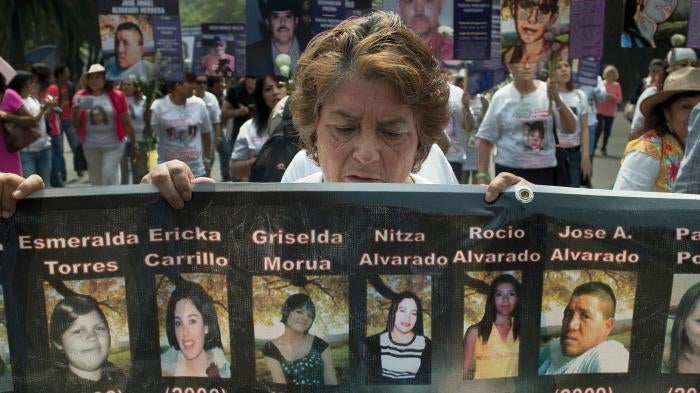
That responsibility now falls to President Peña Nieto. And nowhere is it more urgent than in cases where people have been taken against their will and their fate is still unknown. What sets these crimes apart is that, for as long as the fate of the victim remains unknown, they are ongoing. Each day that passes is another that authorities have failed to find victims, and another day that families continue to suffer the anguish of not knowing what happened to a loved one.
Human Rights Watch has documented nearly 250 such “disappearances” that have occurred since 2007. In more than 140 of these cases, evidence suggests that these were enforced disappearances—meaning that state agents participated directly in the crime, or indirectly through support or acquiescence. These crimes were committed by members of every security force involved in public security operations, sometimes acting in conjunction with organized crime. In the remaining cases, we were not able to determine based on available evidence whether state actors participated in the crime, though they may have.
In nearly all of these cases, authorities failed to promptly and thoroughly search for the victims or investigate the cases. Prosecutors rarely carried out basic investigative steps crucial to finding missing persons, too often opting instead to blame the victims and, reflecting the low priority they place on solving such crimes, telling families to conduct the searches on their own. When prosecutors did investigate, their efforts were undermined by delays, errors, and omissions. Searches and investigations were further hindered by structural problems such as overly narrow laws and the lack of critical tools like a national database of the disappeared.
The inept or altogether absent efforts of authorities to find people who are taken add to the suffering of victims’ families, for whom not knowing what happened to their loved ones is a source of perpetual anguish. Many relatives put aside everything else in their lives to search for the missing, a quest they feel they cannot abandon until they learn the truth. Making matters worse, victims’ families may lose access to basic social services and benefits—such as healthcare and childcare—tied to the victim’s employment, forcing them to fight costly and emotionally-draining battles to restore the benefits.
The nearly 250 cases documented in this report by no means represent all the disappearances that occurred in Mexico during the Calderón administration. Quite the opposite, there is no question that there are thousands more. Officials in Coahuila, for example, told Human Rights Watch that 1,835 people had disappeared in that state alone from December 2006 to April 2012. More alarming still, a provisional list compiled by the Ministry of the Interior and the Federal Prosecutor’s Office—which was leaked in November 2012—contains the names of more than 25,000 people who were disappeared or went missing during the Calderón years, and whose fates remain unknown. While the list’s information is incomplete and its methodology flawed, the number leaves little doubt as to the unprecedented scale of the current wave of disappearances.
During the years the Calderón administration ignored this mounting “disappearance” problem, the country failed to take serious steps to address it. The result was the most severe crisis of enforced disappearances in Latin America in decades. If the Peña Nieto administration repeats this mistake—and fails to set out a comprehensive, effective plan to investigate past disappearances and help prevent them in the future—cases of disappearances will almost certainly continue to mount. And thousands of victims’ families will continue to endure the agony of not knowing what happened to their loved ones.
A different approach is possible. Human Rights Watch witnessed this in the state of Nuevo León, where government officials and prosecutors, responding to pressure from victims’ families and human rights defenders, have broken with a pattern of inaction and incompetence, and begun to seriously investigate a select group of disappearances. Their efforts have helped win back the trust of victims’ relatives and, with it, their collaboration, which has proven critical to identifying new leads and gathering valuable evidence. While at this time results in these investigations remain limited and very few of the disappeared have been found, the approach provides a blueprint for overcoming some of the greatest obstacles to resolving disappearance cases.
Ultimately, the success of this and other state-level efforts will depend in large measure on whether the federal government is willing and able to do its part. This is, after all, a national problem, often involving federal security forces and organized crime groups that operate across state lines. The mass graves discovered in one state may well contain the remains of people disappeared in others. A comprehensive strategy—rooted in nationwide efforts such as the creation of unified, accurate databases of the disappeared and unidentified remains—is critical to give prosecutors, law enforcement officials, and families the tools they need to find the missing and bring those responsible for their disappearances to justice.
Enforced Disappearances
Human Rights Watch has documented 249 disappearances committed in Mexico since December 2006. In 149 of these cases, we found compelling evidence that state actors participated in the crime, either acting on their own or collaborating with criminal groups. Members of every security force engaged in public security operations —the Army and the Navy, the Federal Police, and state and municipal police—are implicated in these 149 cases.
The majority of the likely enforced disappearance cases we documented follow a pattern. Members of security forces arbitrarily detain individuals without arrest orders or probable cause. In many cases, these detentions occur in victims’ homes, in front of family members; in others, they take place at security checkpoints, at workplaces, or in public venues, such as bars. Soldiers and police who carry out these detentions almost always wear uniforms and drive official vehicles. When victims’ relatives inquire about detainees’ whereabouts at the headquarters of security forces and public prosecutors’ offices, they are told that the detentions never took place.
In some instances, evidence suggests that a specific security force carried out multiple disappearances using the same tactics, within a narrow period of time, and in the same geographical area. For example, Human Rights Watch collected witness testimony and photographic and video evidence showing that members of the Navy committed more than 20 abductions in June and July 2011, in the border states of Coahuila, Nuevo León, and Tamaulipas. Almost all of these people were arbitrarily detained by members of the Navy in their homes. The Navy initially denied having taken the men, only to contradict itself later by admitting in news releases that it had come into contact with several of the men before they disappeared. The individuals have not been seen since they were arrested. The common modus operandi in these cases suggests that these crimes may have been planned and coordinated, or at the very least could not have taken place without the knowledge of high-ranking Navy officials.
In cases where state agents work with organized crime in carrying out disappearances, the collaboration may take one of many different forms. Most commonly, security forces arbitrarily detain victims and then hand them over to criminal groups. Police, soldiers, and investigators may also work with criminal groups to extort the families of the victims, or tell those groups when victims’ relatives report disappearances—information that abductors then use to harass and intimidate families. In more than a dozen cases, evidence pointed to state agents taking advantage of information obtained from families to pose as kidnappers and demand ransom from victims’ relatives.
In addition to these enforced disappearance cases, we also documented 100 other cases of disappearances. In these cases, individuals were taken against their will—often by armed men—and their whereabouts remain unknown. We are not aware of evidence of the participation of state actors in these crimes. However, given the widespread involvement of police and military personnel evidenced in other disappearances, in the absence of thorough investigations, it is impossible to rule out the participation of state actors in these cases. In any case, although these “disappearances” carried out purely by private individuals as a criminal act—unlike “enforced disappearances”—do not fall under the definition of the International Convention for the Protection of All Persons from Enforced Disappearances, the state has a responsibility to investigate all disappearances, regardless of the perpetrator. Furthermore, under international law and Mexico’s newly passed Victims’ Law, the government has an obligation to provide victims of crimes with an effective remedy—including justice, truth, and adequate reparations.
Investigative Failures
Our research shows that authorities routinely fail to respond in a timely fashion when victims, their families, or witnesses report abductions while they are taking place. And when victims’ relatives or others report disappearances, prosecutors and law enforcement officials rarely take immediate action to search for the victim or the perpetrators. In spite of requests by families, they do not trace victims’ cell phones, track their bank transactions, obtain security camera footage (which is often automatically deleted at regular intervals), or take other time-sensitive actions. Instead, prosecutors and law enforcement officials regularly misinform families that the law requires a person to have been missing for several days before a formal complaint can be filed, and advise them to search for missing people at police stations and military bases—placing the family at risk; or prosecutors preemptively assert they lack the legal jurisdiction to investigate the case. These groundless delays and omissions result in irreparable losses of information that could potentially have saved the lives of victims and helped locate the people who abducted them.
Making matters worse, when prosecutors, judicial police, and law enforcement officials attend to families of the disappeared, they regularly tell them the victims were likely targeted because they were involved in illicit activities, even when there is no evidence for such assertions. Authorities use this unfounded presumption as a pretext for not opening investigations, and alienate and harass individuals whose cooperation often could have played a critical role in finding the missing person. While it is reasonable for authorities to investigate the background of a victim as a possible lead, Human Rights Watch found that officials repeatedly assumed the criminal guilt of victims before conducting any preliminary investigation, and held onto such views in the face of clear evidence to the contrary.
If and when prosecutors open investigations, they regularly ask victims’ families to take investigative steps, such as interviewing witnesses and tracking down suspects, which should be carried out by officials. It is appropriate and indeed necessary for prosecutors to collaborate with victims’ relatives in investigating disappearances. Yet in case after case, Human Rights Watch found that they relied disproportionately, or even entirely, on families to carry out key investigative tasks. In a vicious cycle, families take on more of the authorities’ duties because they know that investigators will not investigate on their own. And rather than fulfilling their investigative responsibilities, prosecutors and law enforcement officials become more accustomed to passing them off to victims’ relatives. Not only are families not trained for such tasks, but carrying them out can also put them at considerable risk: in several cases, families’ investigative efforts— encouraged by prosecutors—resulted in their being victims of threats and attacks.
In addition to relying excessively on families, prosecutors fail to carry out basic investigative steps. Among the most common lapses documented by Human Rights Watch were: failing to interview the victims’ family members, witnesses, or others who could have provided relevant leads; failing to interview possible suspects; failing to pursue obvious lines of investigation, such as obtaining the names of police officers and soldiers assigned to units implicated in disappearances; and failing to visit the scene of the crime to collect evidence. Even in cases where justice officials carried out basic investigative steps, they often waited so long to complete them that possible leads dissipated.
Prosecutors and law enforcement officers also misplaced key evidence, such as DNA samples of victims’ relatives, and made errors in compiling information critical to the case, such as recording inaccurate details about when or where victims disappeared. In some cases, police and justice officials fabricated evidence—claiming to have carried out interviews that never occurred, for example—while in others they manipulated or destroyed key evidence, suggesting that they may have been working to protect those responsible for the crimes.
Beyond failing to resolve individual cases and exacerbating a general climate of impunity, these investigative failures allow security forces and criminal groups that carry out multiple disappearances to strike again. In several cases, Human Rights Watch found compelling evidence that the same state agents—often in collaboration with criminal groups—carried out multiple disappearances in separate incidents. In these cases, prosecutors and law enforcement officials neglected to pursue evidence that, had it been adequately investigated, may have prevented additional people from being disappeared.
Impact on Victims’ Families
Disappearances have a profound impact on virtually every aspect of the lives of victims’ families. Families described not knowing what happened to their loved ones as a source of perpetual anguish—one deepened by the lackluster efforts of prosecutors to find their relatives. Many described an overriding sense of obligation to set aside the other parts of their lives in order to dedicate themselves fully to searching for their loved ones. Relatives reported suffering serious emotional and psychological effects as a result of their loss—including depression and the constant fear that another loved one would be taken next. Several relatives of the disappeared in the cases documented here, including at least one child, attempted to commit suicide. Disappearances also take a heavy toll on relationships among victims’ surviving relatives, who cope in different and at times conflicting ways, with disputes sometimes arising over sensitive issues such as whether to keep looking for the missing.
Families who do keep searching for the missing, publicly discuss their cases, or press authorities to investigate often are subject to harassment, threats, and attacks. These hostile acts are often aimed at dissuading relatives from pressing for accountability, and play on relatives’ terror of losing another loved one. Furthermore, such hostile acts terrorize not only the people they target, but also other relatives of the disappeared and members of the public, who fear that calling for justice will put them at risk.
In Mexico, disappearances also have devastating financial consequences for victims’ families, with particularly significant impact on vulnerable groups such as children and families living in poverty. The overwhelming majority of disappeared persons in the cases documented by Human Rights Watch were working class men, who were often the sole wage earners in households with several children. In their absence, their spouses and partners were forced to take immediate measures to adapt to the loss of income and provide for their families. This hardship is aggravated by the system of social services in Mexico, whereby the receipt of some services are conditional upon a member of the household being employed. Therefore, a disappearance can lead to the suspension of access to social benefits such as healthcare and childcare. In order to maintain access to these crucial services, relatives were forced to initiate a costly and protracted bureaucratic process to obtain recognition that the disappeared person was missing or dead, which heightened their suffering.
The Special Prosecutor’s Office for Attention to Victims of Crimes (PROVÍCTIMA) was set up in 2011 to assist the families of victims emotionally, economically, and legally, with a special focus on helping the families of the disappeared. Most of the families interviewed by Human Rights Watch had never come into contact with the agency, and had little to no understanding of the services it offered. Meanwhile, more than 30 families of victims who had sought assistance from PROVÍCTIMA told Human Rights Watch that the agency failed to deliver on commitments it had made—such as providing medical aid for relatives’ operations. Furthermore, the overwhelming majority of these families said PROVÍCTIMA pressured relatives to accept that their loved ones were dead, even though no evidence had been uncovered to substantiate that conclusion, exacerbating their suffering.
A New Approach: the Example of Nuevo León
Nuevo León has been one of the states hardest hit by disappearances in recent years, with estimates ranging from over 600 (by official estimates) to more than 1,000 people disappeared (according to local human rights defenders) since the beginning of the Calderón administration. In 2010 and 2011, Human Rights Watch carried out several fact-finding visits to Nuevo León to investigate enforced disappearances and other abuses, and observed a climate of near-total impunity similar to what we had found in several other states of Mexico. Despite clear evidence of enforced disappearances, state prosecutors consistently failed to prosecute the members of the military and police who had committed them. Victims and their families grew deeply disillusioned with authorities, while even well-intentioned prosecutors had little incentive to investigate these crimes. In a vicious cycle of distrust and dysfunction, the less that victims and officials collaborated in solving these crimes, the more entrenched the climate of impunity became.
Then came the shift. Catalyzed by a grassroots victims’ movement and partnered with a local human rights group, families of the disappeared collectively demanded that authorities begin to take the investigations seriously. Under considerable pressure, state officials agreed to work with the families in investigating their cases. At first, both sides were distrustful. However, when prosecutors—motivated by families to investigate and held accountable when they did not—began to genuinely look into the crimes, they gradually began to win back the trust of the victims’ relatives. And families, in turn, began to collaborate more openly with prosecutors. The combination of real efforts by prosecutors and the guiding hand of families gave rise to a new dynamic, which allowed investigations to move forward for the first time in years.
Progress in individual investigations, however small, made it possible to believe that these horrific crimes, many of which appeared to implicate state agents, could be solved. A virtuous cycle started to take the place of a vicious one: the more prosecutors investigated, the more they earned the trust of victims’ families, and the more investigations advanced. For their part, prosecutors took the solid investigative tactics and skills they had learned working on one case or another and applied them to other disappearances on their docket. Over fifty suspects have been charged in seven of the cases tackled through the “working meetings” with families and human rights defenders. Even in those cases in which suspects have not been charged, the investigations have progressed, as prosecutors have pursued long-neglected steps—such as summoning suspects for questioning, canvassing for witnesses, and pressing telephone companies to hand over victims’ cell phone records—with a renewed sense of urgency and purpose.
This qualitative work on individual cases has been coupled with broader institutional and legal reforms aimed at strengthening the capacity of authorities to prosecute these crimes, such as passing legislation that criminalizes enforced disappearances, assigning special judicial police to investigate disappearances, and drafting an investigation manual that lays out fundamental steps that every prosecutor should take when investigating a disappearance.
For all of the progress that has been made in investigating disappearances in Nuevo León, the challenges that remain to effectively investigating disappearances and finding those who have gone missing are daunting. Authorities whose input is critical to advancing investigations often fail to cooperate with the efforts of prosecutors to solve cases—or worse, intentionally obstruct them. Some families, frustrated with the limited progress in their investigations, and understandably skeptical of authorities’ commitment given their previous experiences, have lost faith in the process and stopped cooperating with prosecutors. And state prosecutors have been alarmingly slow to apply the solid investigative practices developed in the “working meetings” to the hundreds of other disappearances that are not directly monitored by families and human rights defenders, in some cases repeating the same chronic investigative errors and omissions in new cases.
Due to these and other serious obstacles, advances in the investigations have been limited. The fate of the overwhelming majority of the disappeared remains unknown. And despite having charged more than 50 suspects in investigations tied to the “working meetings,” prosecutors have yet to obtain a conviction. Nevertheless, the step of breaking through a climate of disillusionment and distrust in select cases is real. In that way, the working process in Nuevo León provides a blueprint for how some of the greatest challenges to investigating not only disappearances, but all human rights violations in Mexico, can be overcome.
Recommendations
To the Federal Executive Branch:
- Present a proposal to Congress to reform the military justice system to ensure that all alleged human rights violations, including enforced disappearances, committed by members of the military against civilians are investigated and prosecuted in the civilian justice system.
- Sign an executive order mandating that all detainees be immediately presented before the public prosecutor’s office and that under no circumstances should detainees be taken to military installations, police stations, or illegal detention facilities for interrogation by members of the military or police.
- Work with federal agencies such as the Institute of Social Security to develop special, expedited processes to ensure that families of the disappeared do not lose access to basic social services as a result of disappearances.
- Request that the Senate recognize the jurisdiction of the Committee on Enforced Disappearances to receive complaints of enforced disappearances submitted by individuals and states (pursuant to articles 31 and 32 of the International Convention for the Protection of All Persons from Enforced Disappearance).
- Issue an invitation for the Committee on Enforced Disappearances to conduct a fact-finding visit to Mexico.
- Establish a national database of the disappeared that includes key information to help identify missing persons, such as genetic information (DNA) from relatives of the victim, evidence of the participation of state actors, and investigations that have been opened into the case. The criteria for and collection of such data should be standardized across prosecutors’ offices, human rights commissions, morgues, and other relevant institutions to ensure the utility of the system.
- Establish a national database of unidentified human remains, including genetic information (DNA) and other distinguishing characteristics. The criteria for and collection of data should be consistent with the data collected for the database of the disappeared.
- Conduct a thorough comparison between the national database of the disappeared and the national database of unidentified human remains to search for matches between disappeared persons and unidentified remains.
To Federal and State Prosecutors:
- Conduct immediate, full investigations into all alleged cases of disappearances, including those documented in this report, with a view to prosecuting all parties responsible for the crime under national and international law.
- Abstain from transferring from civilian to military jurisdiction cases in which a member of the military is accused of being involved in an enforced disappearance or any other human rights violation.
- End the practice of requiring victims’ families to gather evidence relating to the disappearance of relatives, such as evidence of the possible participation of security forces.
- Train teams of experts in the exhumation and identification of remains so that experts can be deployed quickly when mass graves and other unidentified bodies are discovered.
- Develop a national protocol in conjunction with law enforcement officials for promptly and thoroughly searching for persons who have been reported as disappeared. Such efforts should be initiated without delay, and should involve the full range of security forces and other authorities.
To Federal and State Legislators:
- Amend or insert the definition of enforced disappearance in federal and state criminal codes to ensure that it is consistent across jurisdictions and includes all conduct included in the definitions established by the International Convention for the Protection of All Persons from Enforced Disappearance and the Inter-American Convention on Forced Disappearance of Persons. In particular, ensure that the definition includes disappearances committed by organized groups or private individuals acting on behalf of, or with the support (direct or indirect), consent, or acquiescence of state officials.
- Reform the Military Code of Justice to ensure that all alleged human rights violations, including enforced disappearances, committed by members of the military against civilians are investigated and prosecuted in the civilian justice system.
- Modify the definition and the process by which a person is formally declared “absent” (declaración de ausencia) in the Federal Civil Code to prevent the loss of basic social services by families of disappeared persons.
- Modify vague “flagrancy” laws currently used to justify arbitrary arrests and unjustified preventive detention. These laws should be applicable only in exceptional cases when a suspect is caught in the act of committing a crime.
- Recognize the jurisdiction of the Committee on Enforced Disappearances to receive complaints of enforced disappearances submitted by individuals and states.
Methodology
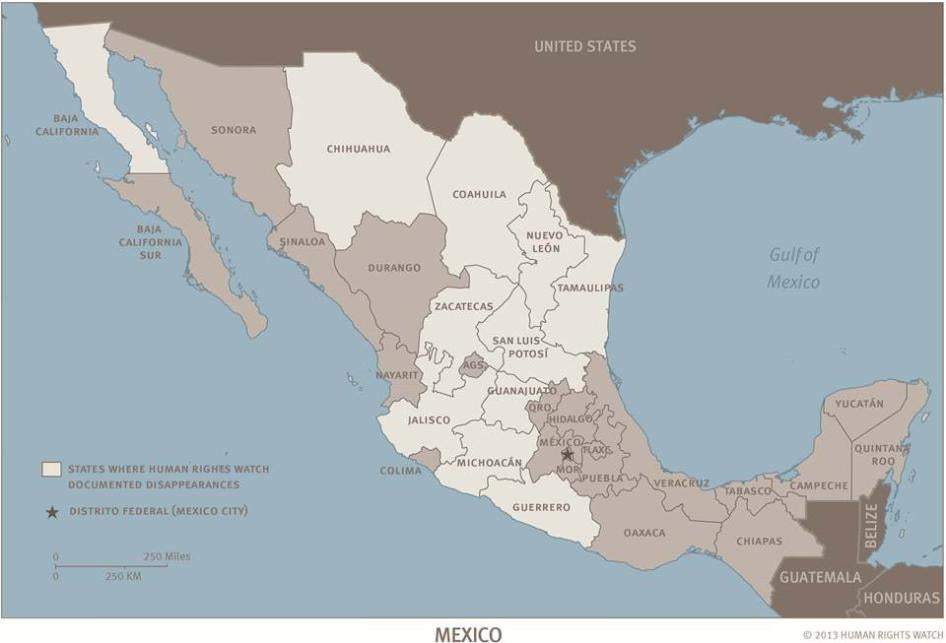
This report is based on in-depth research on disappearances in Mexico conducted between January 2012 and February 2013, including fact-finding investigations in the states of Coahuila, Guanajuato, Nuevo León, San Luis Potosí, and Zacatecas. In the course of these investigations, researchers also met with families whose relatives had disappeared in other states, such as Tamaulipas and Michoacán. The report also draws upon Human Rights Watch’s research on disappearances for the November 2011 report, Neither Rights Nor Security, which documented cases in Baja California, Chihuahua, Guerrero, and Nuevo León. In all, the disappearances detailed in this report took place in 11 states, representing a geographically and politically diverse cross-section of the country.
This report will use “enforced disappearance” and “disappearance” as distinct terms. The term “enforced disappearance,” following the definition set out by treaties such as the International Convention for the Protection of All Persons from Enforced Disappearance, will be applied to cases in which there is compelling evidence of three cumulative elements:
- The deprivation of liberty against the will of the person concerned;
- The involvement of state agents, either directly or indirectly through authorization, support, or acquiescence; and
- The refusal to disclose the fate and whereabouts of the person concerned.[1]
The term “disappearance,” by contrast, will be applied to cases in which there is only evidence of two of the three aforementioned elements: the taking of a person against his or her will, and the failure to disclose his or her fate and whereabouts. The distinction, therefore, is that in a “disappearance” there is not compelling evidence of the involvement of stage agents.
Human Rights Watch documented 249 disappearances committed during the Calderón administration for this report. In 149 of those cases, the evidence strongly suggests they were enforced disappearances—meaning state actors likely participated in the crime. To reach this determination, we relied on a range of official documents such as arrest reports, detention registers, complaints filed by victims’ relatives, witness testimony, investigation case files, press releases by officials, amparos,[2] and reports by government rights commissions.[3] These documents were supplemented by additional sources of evidence which pointed to the participation of state agents in specific cases—much of it gathered by victims’ families, local human rights defenders, and journalists—including: security camera surveillance videos, witness video footage, audio recordings by victims’ families of meetings with officials, photographs of abductions, and maps of the signals emitted by victims’ cell phones or radios. In the remaining 100 of the 249 cases, there was not sufficient evidence to conclude that state actors had participated in the crimes, though they may have.
In certain cases in this report, Human Rights Watch cites official confessions by individuals accused of having participated in enforced disappearances. It is relevant to note that our previous report, Neither Rights Nor Security, documented the systematic use of torture by security forces in five states during the administration of President Felipe Calderón. Oftentimes, these tactics were aimed at extracting forced confessions that not only accepted guilt, but also a posteriori concealed the abuses by security forces leading up to and during coercive interrogations. Given the prevalence of this practice, and the doubt it casts on the truthfulness of confessions obtained by officials, this report only cites confessions of alleged involvement in crimes when such statements are corroborated by and consistent with other credible evidence—such as witness accounts, video footage, or official arrest reports. And each time the report cites such confessions, Human Rights Watch has noted that the widespread use of torture should be taken into account when weighing their evidentiary value.
The report also notes when individuals have been charged in disappearance cases. While being charged with a crime (consignado under Mexican law) requires the authorization of a judge, it is not—nor should it be read as—an indication of guilt.
In the course of the research, Human Rights Watch conducted more than 100 interviews with a wide array of actors. These included attorneys general, prosecutors, law enforcement chiefs, police officers, legislators, national and state human rights officials, victims’ relatives, human rights defenders, and journalists, among others, as well as a range of federal officials. We also drew on official statistics, which we sought through interviews, emails, and public information requests submitted through Mexico’s Federal Institute for Access to Public Information (Instituto Federal de Acceso a la Información y Protección de Datos).
In some of the interviews conducted by Human Rights Watch, victims’ families, friends, and witnesses requested that their names—as well as those of the disappeared—be withheld to protect their identities. Often this request was motivated by the fear that speaking publicly about the case could bring harm to the disappeared person, or even lead to another person being disappeared as retribution for denouncing the crimes of criminal groups or authorities. Others asked that the cases they shared not be included in the report, driven by similar concerns. Several state officials who spoke with Human Rights Watch about disappearances asked that their names be withheld, but permitted us to include the government institutions for which they worked.
Translations from the original
Spanish to English are by Human Rights Watch.
Enforced Disappearances
There is strong evidence that 149 of the 249 abductions Human Rights Watch investigated for this report were enforced disappearances involving public security personnel. Members of all of the security forces participating in public security operations—federal, state, and municipal police, the Army, and the Navy, as well as judicial police—are implicated in the cases. Members of municipal police forces, who in many instances colluded with organized crime, are implicated in more cases than members of other forces.
In the 149 cases, the victims were virtually always seen by eyewitnesses being taken into custody, most often without evident justification, by police or the military. These illegal detentions were virtually never officially registered, nor were detainees handed over to the public prosecutor’s office, as the law requires. The failure to register detentions and promptly hand detainees over to prosecutors has obstructed efforts of families and authorities to search for the missing people. In cases where security forces appeared to act on their own, victims were never seen after their illegal arrests. In other cases, there is evidence that members of the police or military handed over people to criminal groups after illegally detaining them, or joined armed men in carrying out abductions, and then denied participating in the crime. Sometimes the collaboration between authorities came after people were abducted—when state agents helped criminal groups extort the families of the victims.
Human Rights Watch collected a wide range of evidence that ties officials to these 149 cases. In many instances, officials explicitly identified themselves to families and witnesses as police or soldiers when they were carrying out the arbitrary detentions that led to disappearances. Members of security forces often wore uniforms and drove official vehicles used in abductions, and in several cases were captured on video or in photographs. In many instances, the testimonies of family members were confirmed by independent witnesses. Indeed, in several cases, security forces admitted to having taken the individuals in question into custody.
Government officials have at times said that crimes allegedly committed by soldiers or police in uniform were likely carried out by people disguised as members of security forces. While it is true that on a few occasions in recent years criminal groups have employed counterfeit uniforms and vehicles, government officials interviewed for this report were unable to identify a single case in which there was any evidence that criminals had posed as members of a security force to carry out a disappearance. The dearth of examples, coupled with the fact that, as this report shows, criminal groups openly carry out disappearances with near total impunity, casts serious doubt on whether any of the cases documented here were carried out by individuals using counterfeit uniforms and vehicles.
In the 149 cases in which evidence strongly suggests that enforced disappearances were perpetrated by state agents, the facts point to a clear modus operandi on the part of security forces. In some instances, there is evidence that a specific security force carried out multiple disappearances in a limited period of time within the same geographical area, suggesting that some of these crimes may have been planned and coordinated, or at the very least could not have taken place without the knowledge of high-ranking authorities.
Enforced Disappearances by the Navy
Human Rights Watch documented more than 20 cases of enforced disappearances perpetrated by members of the Navy in June and July 2011. The concentration of the cases within a short time period, the similar tactics described by victims’ families and other witnesses, corroborated by photographic and video evidence, and the fact that the abductions were spread across three northern states strongly suggests that these were not isolated cases, but rather points to a clear modus operandi by the Navy. Given the number of members of the Navy that allegedly participated in these operations—at least a dozen official vehicles, according to witness accounts—and the fact that the Navy acknowledged that it detained several of the victims, it is unlikely that such operations took place without the knowledge of ranking officers.
Victims’ families and witnesses described near identical tactics in the raids. In each case, the Navy arrived in a large convoy of more than a dozen vehicles, the majority of which were marked with official insignia, along with two to four unmarked vehicles. They closed off entire streets, using vehicles as barricades. Heavily armed members of the Navy wearing masks then entered homes, often forcibly, without any search or arrest warrants. According to families, the people in Navy uniforms were not looking for individuals by name. Instead, they indiscriminately took young men, telling their families they were being brought in for questioning and would be released if they proved to be innocent.
José Fortino Martínez Martínez, 33, who ran a convenience store in a school with his wife in Nuevo Laredo, Tamaulipas, was sleeping at home with his wife and four children (ages 16, 12, 7, and 3) on June 5, 2011, when they awoke at 1 a.m. to the sound of their front gate being broken open. Martínez’s wife, Oralia Guadalupe Villaseñor Vázquez, told Human Rights Watch she turned on the light to discover seven or eight masked men entering their bedroom.[4] The men were armed with large weapons and wearing bulletproof vests that said “Marina” (“Navy” in Spanish). After the men had searched all of the rooms, one of them approached a man who appeared to be a commanding officer and said, “It is just family.”[5]The officer apologized to Martínez’s wife for breaking down the door of their home. He handed her 200 pesos to cover the damage and said, “They complained that there was something going on here, so that is why we entered like that.”[6]The officer did not specify who had complained.
The members of the Navy then took Martínez outside for questioning. From the entryway, his wife said she counted 14 vehicles marked with Navy insignia—most of them pick-up trucks, several of which had mounted guns in their bays—and four unmarked cars.[7] After several minutes of questioning, the members of the Navy let Martínez go back inside his home. But minutes later they summoned him outside again, saying they needed to check his fingerprints. His wife was told to wait inside the home with their children. Approximately half an hour later, his wife heard the screech of tires. When she went outside, she said, the vehicles in the convoy were driving away. Several neighbors who had gathered outside told Martínez’s wife that they had seen the Navy put him into the back of a car before driving off.
Martínez’s wife immediately got in her car and began driving around Nuevo Laredo in search of the convoy, methodically checking each of the major roadways. She came across the convoy on a highway near the airport, she said, and followed them from a distance as they carried out raids on several other homes. At one of the raids, Martínez’s wife approached an armed, masked man in a vest that said “Navy” (“Marina”). She asked why they had detained her husband and where they were taking him. The man answered that they had not detained anyone.
Martínez’s wife said she saw four men handcuffed in the bay of one of the pick-ups.[8] One had a bag pulled over his head, one was blindfolded, and the other two had their shirts pulled over their heads. As she looked at the detainees, the man she was speaking to warned her to stop following the convoy. If she did not, he warned her, they would shoot at her vehicle. He said they had been authorized to fire their weapons at will, regardless of whether their targets were women and children.[9] She returned to her car.
In spite of the threat, Martínez’s wife told Human Rights Watch she continued to follow the convoy until it arrived at the Motel Santa Monica in downtown Nuevo Laredo. As news spread that the detainees were being held there, more than a dozen friends and relatives of people who had been taken assembled outside of the motel, together with members of the local press. The people gathered near the entrance to the parking lot of the hotel, which was surrounded by a wall. Martínez’s wife, his children, and others waited there for approximately two hours.[10]
The presence of Martínez’s wife and other witnesses outside of the hotel was captured by video footage and photographs from that night provided to Human Rights Watch.[11] The video shows at least four Navy pick-up trucks in the motel parking lot, identifiable by official insignia on their doors.[12] It also shows several dozen armed men, wearing masks and uniforms bearing the name “Navy,” walking back and forth outside the motel. A pick-up truck with the Navy insignia on its door, marked as unit number 600160, is shown in the video at the parking lot entrance.[13] The truck was directed outwards, towards the street where people had gathered.[14] Several photographs show a masked man in a Navy uniform standing in the truck’s cargo bay, manning a mounted gun.[15] At one point, the photographs show, another masked man in a Navy uniform walked into the street next to the motel and began to photograph members of the crowd who had gathered there.[16]
One of Martínez’s sons, age 16, who was also outside the motel, told his mother that he spotted his father through one of the windows of a room on the motel’s second floor.[17] After his father walked by the window, the son said, the curtain was drawn closed swiftly by a man in a Navy uniform. At approximately 6 a.m., after several hours of waiting there, the convoy left the hotel. From videos and pictures taken by victims’ family members as the convoy left the hotel, Human Rights Watch was able to identify the Navy insignia and unit numbers on five of the pick-up trucks, as well as the license plates of several of the non-official vehicles.[18]
Martínez’s wife continued to follow the convoy after it left the motel. She said she observed the vehicles as they stopped outside a location in the Mirador neighborhood of Nuevo Laredo.[19] She said Navy vehicles blocked off two ends of a residential block, just as they had done on her block when they took her husband.
Human Rights Watch separately interviewed the mother of Martín Rico García, 41, who said her son was arbitrarily detained by people in Navy uniforms on the morning of June 5, 2011, also in Nuevo Laredo, Tamaulipas. Rico García’s mother confirmed that the street where Martínez’s wife observed members of the Navy carrying out another raid that morning was her street, lending credibility to both accounts.[20] She also confirmed the raid had occurred at approximately 6 a.m.
Martín Rico García’s family described similar tactics in his arbitrary detention. His mother said armed, masked men in Navy uniforms had come to her door and demanded she open it.[21] When she did, they identified themselves as members of the Navy and said they were carrying out an investigation. She asked if they had a warrant to search the home, but they said they did not need one. They searched the house and detained her son and her grandson. She said that the members of the Navy asked her how old her grandson was.[22]When she told them he was 17, the men let him go. They told Rico García’s mother they were taking her son to their base, leaving her with no record of the detention.
According to Martínez’s wife, after men in Navy uniforms stopped at Rico García’s home, they proceeded to a gas station, where she was able to approach a man in a Navy uniform to ask what would happen to her husband.[23] The man responded, “He will be investigated. If there is nothing on him, he will be set free.” When she told him that her husband had done nothing wrong, he responded, “Many say that they weren’t up to anything. But these guys behave one way at home and another in the streets. They are not all little white doves.” Then, the man warned her that she would be shot if she continued to follow the convoy. Afraid for her children, she stayed in the gas station when the convoy departed. She never saw her husband again.
The Navy provided conflicting accounts as to whether it had any contact with Martínez, Rico García, and at least four other men who were arbitrarily detained on June 4 and 5, 2011. After several press reports that the Navy had arbitrarily detained the men, the Navy issued a press release on June 14 claiming that “[w]ith respect to various news stories disseminated in assorted print media and websites, [the institution] categorically denies that Navy personnel participated in said operations.”[24]Approximately two weeks later, the Navy contradicted its initial assertion in a second press release, stating:
Acting on intelligence that suggested the presence of members of organized crime in various homes in Nuevo Laredo, Tamaulipas, upon inspecting these locations on [June 5], the Navy acknowledges that it had contact with six of the people supposedly detained, of the names José Fortino Martínez, José Cruz Díaz Camarillo, Héctor Rodríguez Vázquez, Martín Rico García, Diego Omar Guillén Martínez and Usiel Gómez Rivera. Up to the present there is no evidence that suggests that Navy personal secured, much less unlawfully deprived these persons of their liberty. Also, it should be pointed out no evidence has been found establishing that these individuals belonged to any criminal cell.[25]
The press release suggested that the six men may have been detained by organized crime after coming into contact with Navy personnel on the same day, “presumably with the aim of fueling allegations that detract from security operations designed to guarantee the safety of the public.”[26] In other words, the Navy implied that the victims may have been disappeared by criminal groups, who wanted to make it appear as though the crimes were committed by the Navy in order to hurt the reputation of the institution.
The Navy changed its narrative of the events a third time in a November 2011 account provided to the federal prosecutor’s office. In it, the Navy said that it had indeed come into contact with the six missing men in Colombia, Nuevo León—a different location from the one it identified in a previous press release.[27]The account also claimed that the six missing men had told the Navy that “they had been forced, under threat, to work for the Zetas criminal group, as a result of which [the six victims] were asked to cooperate [with the Navy] to provide information on the matter; the individuals were offered protection during the duration of Navy forces in that location. Then they were transferred to the town of Miguel Alemán, Tamaulipas, for their safety.”[28]
Among the many contradictions between this and earlier accounts is the fact that, while the Navy’s previous account alleged that the victims had no connection to any organized crime group,[29] the latter account said the victims had been forced to work for the Zetas. It is also unclear why the Navy would allegedly transport the six men to the bus station in Miguel Alemán, Tamaulipas, “for their safety.” None of the victims lived in Miguel Alemán.[30]Moreover, it is a city notorious for being one of the most violent in the state (for example, there were several public shootouts involving the military and armed criminal groups shortly before this incident), and for having a significant presence of organized crime groups, in particular the Zetas.[31]
Human Rights Watch interviewed relatives of two other men who were arbitrarily detained on the same night as Martínez; these relatives corroborated the chronology of detentions, and described similar tactics. Yadira Alejandra Martínez Ramírez, 23, for example, said her husband, Diego Omar Guillén Martínez, 24, was detained late on the night of June 4, 2011, by eight armed, masked men in Navy uniforms who forced their way into his parents’ house and took him without explanation. [32] None of the six men have been seen since that night.
The disappearances carried out on June 4 and 5, 2011, in Nuevo Laredo, Tamaulipas, are similar in important respects to several other disappearances carried out in the neighboring states of Nuevo León and Coahuila during the same month. In those cases, robust evidence from multiple sources also points to the involvement of the Navy, suggesting all of these disappearances may have been part of a regional operation. For example, on June 23, 2011, at approximately 4 p.m., Jesús Víctor Llano Muñoz, 22, a taxi driver in Sabinas Hidalgo, Nuevo León, was stopped at a Navy checkpoint that had been set up outside of a hotel where the taxi company’s dispatch station is located.[33] His father, also a taxi driver, was at the station at the time. When he saw the Navy personnel remove his son from his taxi and load him into a Navy pick-up truck, he approached and asked why they were detaining his son. An official responded, “If he’s not involved in anything, I’ll hand him over to you shortly.” [34] Minutes later, the truck in which his son was being held drove off in a convoy of approximately 20 vehicles. His family filed complaints with the state prosecutor’s office in Sabinas Hidalgo that day, which said it had no information about his case.[35] They also inquired at the Navy base, which said they were not holding him. Llano’s whereabouts remain unknown, and no members of the Navy have been charged in the case.
Less than a week later—on June 28—René Azael Jasso Maldonado, 26, another taxi driver, was arbitrarily detained in the middle of the night at his family’s home in Sabinas Hidalgo, Nuevo León.[36] According to his mother, father, and brother—all of whom were home at the time—10 armed, masked men carried out the raid wearing Navy uniforms. The armed men entered the home without a warrant and first grabbed René’s brother, Oziel Antonio Jasso Maldonado, holding him facedown at gunpoint and yelling, “You are an halcón!”—the name for people who work as lookouts for criminal groups—before another man in Navy uniform entered and said Oziel was not the person they were looking for. They then took René, who was in the next room, and loaded him into an official Navy vehicle.[37] It was the last time they saw him.
Enforced Disappearances by Local Police
The security force most frequently implicated in the enforced disappearances documented by Human Rights Watch is local police. Human Rights Watch found strong evidence in 95 cases that local police participated directly or indirectly in enforced disappearances.[38]
For example, Israel Torres Lazarín, 21, worked at a treatment center for drug addicts in Gómez Palacios, Durango. On June 18, 2009, Torres was traveling together with five of his co-workers to pick up a patient when their car was stopped by municipal police in Matamoros, Coahuila.[39] Torres communicated via radio with the director of the treatment center to notify him that the group had been stopped outside of a Soriana department store (a chain in Mexico) by police, who informed them that it was a “routine check.”[40] The director later told Torres’s mother that when he radioed back to Torres three minutes later, the police were confiscating the detainees’ radio and cellphones. When the director tried communicating by radio a third time, there was no answer. The director immediately traveled to the location and spoke to several people working nearby who said they had seen the police stop the car and place six individuals in a truck marked with the insignia of the municipal police.[41] Torres and his five co-workers were never seen again.
In another case, gold dealers Eduardo Cortés Cortés, 27, José Manuel Cortés Cortés, 21, Carlos Magallón Magallón, 30, and David Magallón Magallón, 28, were abducted after traveling from their homes in the town of Pajacuarán, Michoacan, to buy and sell gold in the state of San Luis Potosí, as they did routinely as part of their trade, according to the father of victims Eduardo and José Manual Cortés Cortés.[42] On the night of September 29, 2009, they arrived in Río Verde, San Luis Potosí, where they checked into a hotel and called their families, according to a preliminary investigation report by the San Luis Potosí state prosecutor’s office.[43]
At 12:45 p.m. on September 30, David Magallón sent a text message to his wife saying that they had been stopped by police in the town of Cardenas, San Luis Potosí. “The police stopped us again anything happens we are in Cardenas San Luis Potosí,” the message read.[44] Shortly thereafter David called his wife and told her that he and the others had been detained and were being taken to the police station in Cardenas.[45] Then the call cut out abruptly. When his wife called back, she was unable to reach him.[46] It was the last contact any of the families had with the four men.
Further evidence points to the involvement of the police in the disappearance. Another gold dealer from Pajacuarán—who was working in Cardenas with his business partner at the time the four men disappeared—told the victims’ families he had seen the victims being questioned by police on September 30. [47] He also said that he and his partner had been robbed by local police the same day the men were “disappeared.” The police officers warned him that they did not like people from Michoacán and told him not to come back, he said. Although the victims’ relatives provided this information to investigators in San Luis Potosí on November 17, 2009, officials made no efforts to track down the alleged witnesses, according to the families. [48] When Human Rights Watch reviewed the investigation case file, there was no record of prosecutors having interviewed—or attempted to find—this potential key witness. Police in Cardenas denied ever having questioned the four men, and no officials have been charged in the case. [49] In October 2011, the head of public security in Cardenas, two police officers, and the chief of a police unit were detained and charged with having worked with the Zetas to carry out robberies, acts of extortion, and kidnappings. [50] Family members of the victims recognized one of the people charged as the police officer who had threatened them when they had traveled to Cardenas in October seeking information on their missing relatives. [51] They reported this to the public prosecutor’s office, but at the time of writing, no officers had been charged in the crime. [52]
Enforced Disappearances by Federal Police
Human Rights Watch found strong evidence that 13 enforced disappearances were carried out by federal police, including that of teenagers Roberto Iván Hernández García and Yudith Yesenia Rueda García, both 17.[53] Hernández and Rueda, boyfriend and girlfriend, were at the home of Rueda’s grandmother on March 11, 2011, in Monterrey, Nuevo León, when at approximately 9 p.m. armed men in masks broke down the door.[54] The eight men were wearing uniforms that said “Federal Police,” according to Rueda’s grandmother and aunt, who were both home at the time, and said they were looking for someone nicknamed “Piña.” When the family said there was no one by that name in the house, the men in police uniforms brought a detainee in handcuffs into the home and walked him over to Hernández and Rueda.[55] One of the uniformed men gestured to Hernández and asked the detainee: “Is it him?” “No,” the man answered. Then one uniformed man said to another, “Well, if you want to, take them.” With that, the officers removed Hernández and Rueda with force from the house—beating Hernández as they went and pulling Rueda by her hair—and loaded them into cars waiting outside.[56] According to Rueda’s grandmother and aunt, there were two pick-up trucks and a third vehicle marked with Federal Police insignia waiting outside, as well as a taxi and an unmarked car. None of the cars had license plates, they said. Rueda’s grandmother said she saw other detainees in the federal police cars.[57]
Within an hour of their arbitrary detention, relatives of Hernández and Rueda went to the federal police station in Monterrey to inquire whether the two were being held there.[58] The police officers who attended to them said, “We don’t know anything about it. Detainees are not brought here. Go to the municipal police.”
Complicity between Security Forces and Organized Crime in Disappearances
In more than 60 cases, Human Rights Watch found compelling evidence of cooperation between security forces and organized crime in disappearances. For example, 19 men[59]who worked for a construction company were abducted in Pesquería, Nuevo León, on May 28, 2011.[60] A neighbor who lived across the street from the small apartment building where the workers were staying while they completed the project saw municipal police arrive at the building immediately before the men were abducted, she told the victims’ relatives.[61] Later, police cars returned to the building carrying several of the workers, the witness said, and the workers loaded valuables from the dormitories into the police cars. Witnesses also reported seeing a large group of workers being held outside of the municipal police station in Pesquería on May 28.[62]
That afternoon, the kidnappers contacted the construction company’s foreman, Julio Rodríguez Torres, who had been staying in a different hotel in Pesquería and was not with the workers when they were abducted. The kidnappers told Rodríguez that if he wanted to negotiate the release of his workers, he would need to meet them the following morning at a bridge on the outskirts of town. An employee who drove him to the location said that a municipal police car and a car without license plates were waiting for him there.[63] Rodríguez got into one of the cars, which then drove away. Neither he nor the 19 workers were ever seen again.
Seventeen police from Pesquería were arrested on June 9, 2011, and placed under arraigo detention[64] the following week for the abduction of the workers and collusion with organized crime. At this writing, nine police officers had been charged in the disappearance, while the investigation remained ongoing.[65]
In another example of collusion between authorities and organized crime, on December 27, 2011, brothers José Carlos and Juan Rogelio Macías Herrera, 39 and 37—who ran a business selling used cars—were driving between the municipalities of Apodaca and Juárez in Nuevo León when they were detained at a police checkpoint.[66] The wife of one of the brothers lived along the road where police had set up the checkpoint. At 4:30 p.m., she said, she saw the two men being driven in the back of a Juárez municipal police car, which was being followed by another police car.[67] She saw the numbers of the two patrol units and wrote them down. When the brothers did not return home within several hours, relatives went to the Juárez municipal police station to ask if they were being held. The police denied any knowledge of their detention, members of the family said.
On January 3, 2012, five men, including three members of the Juárez police, were detained for kidnapping the two men.[68] In statements given by the police officers to prosecutors, they said they had carried out the detention “under orders” of a local crime boss, and handcuffed the brothers “ to part of the holding pen of the police car, and then we took them to a car lot…where they were held for more time until they were transferred to an unknown place.”[69] Five men were charged with illegal detention with the aim of kidnapping, three of whom were also charged with robbery.[70] According to the statements of the accused police officers, the brothers were handed over to a leader of a local cell of the Zetas.[71] Their whereabouts remain unknown.
Police from Juárez were also implicated in collaborating with organized crime in the disappearances of Israel Arenas Durán, 17, Adrián Nava Cid, and brothers Gabriel and Reynaldo García Álvarez—who worked at a plant nursery in Juárez, Nuevo León. The four young men disappeared on the night of June 17, 2011, after going for drinks at a bar after work.[72] Israel called his younger brother, Irving, from the bar to ask him to bring money for the bill.[73] On the drive there, Irving saw his brother’s car pulled over along the shoulder of the road, with a transit police car behind it. As Irving approached, he saw police loading his brother, in handcuffs, into the back of police car, unit 131. Irving asked one of the officers why the man was being detained, and in response the officer asked if Irving knew the man. When Irving answered that he did not (out of fear), the officer told him to go away.
Irving rushed home and told his parents what he had seen, and then the three set out together for the municipal police station in Juárez. The police who attended to them denied that officers had detained anyone named Israel Arenas. Yet while they waited, Irving saw one of the police officers who had detained his brother walk through the station. He also spotted the police car he had seen his brother loaded into—unit 131—parked outside the station. The following morning, the family returned to the police station but police continued to deny any knowledge of Israel’s detention, and recommended they check other police stations in the area. However, the family spotted Israel’s truck in an impounded car lot next to the station, and owners told the family it had been left there by transit police.
When the family returned to the Juárez transit police station a third time, an official in plainclothes who identified himself as a commander attended to them. He said Israel had been detained for crashing into a police vehicle and was being held in the station. He told Israel’s parents that officers were knocking him around a bit, but that he would be released the following afternoon.[74] Before the family left, according to Irving, the plainclothes officer took him aside and said, “You already know what happens to those who speak too much.”[75] Irving took the warning as a threat not to say that he had seen the police detain his brother.
When the family returned the next day, officials told them that—contrary to the information they had been given the day before—Israel had never been detained. Police also said no one with the characteristics of the man they spoke with the day before worked for the police.[76] On June 24, Israel’s father spotted his son’s truck on the road and followed it to a residential address, which he reported to police. The driver turned out to be a former judicial police officer.
Eight men from León, Guanajuato—José Diego Cordero Anguiano, 47; Juan Diego Cordero Valdivia, 22; Ernesto Cordero Anguiano, 37; Alán Josué Bocanegra García, 19; Sergio Sánchez Pérez, 32; Mario Alberto Reyes, 26; José Javier Martínez, 46; Héctor González Cervantes, 37—were illegally detained on December 6, 2011 by local police in the municipality of Joaquín Amaro, Zacatecas, as they returned from a hunting trip.[77] According to two individuals who were part of the group of hunters and managed to escape their captors, the group was detained at approximately 6 p.m. on December 6, as they drove through Joaquín Amaro. Municipal police officers from Joaquín Amaro and Tabasco (another municipality in Zacatecas) took part in their detention, the survivors said.[78] The police confiscated their mobile phones and weapons and took them to the police station, where they blindfolded them, beat them, and accused them of belonging to a criminal group that had come to take over new territory.[79]
At approximately 11 p.m., the
police handed the hunters over to a group of armed men in six SUVs near a gas
station in Fresnillo, Zacatecas.[80]
(One of the abducted hunters escaped, while another—a teenager—was
released.) The handover of the hunters was captured on the gas station’s
security cameras, footage from which shows police handing the abducted men over
to men waiting in other vehicles.[81]
Zacatecas’s attorney general later said that police officers admitted to
prosecutors to having illegally detained the hunters and handing them over to
“organized crime.”[82]
Eight police officers were charged by state prosecutors on January 18, 2011,
for kidnapping compounded with robbery and ties to organized crime. At this
writing, according to local human rights defenders, the police had also been
charged by federal prosecutors with colluding with organized crime and were
awaiting trial.[83]
Investigative Failures
Failure by Authorities to Intervene During and Immediately Following Abductions
In several cases, victims’ families told Human Rights Watch that they sought help from authorities when someone was taken against their will or immediately afterwards, a period critical to obtaining information on the fate of victim, preventing murder, and finding those responsible. In each case, however, authorities either did not respond or turned them away.
For example, on the afternoon of October 26, 2008, approximately five unmarked SUVs blocked off the street where the Vega family lived, Dania Vega (pseudonym) told Human Rights Watch.[84] Masked men armed with large weapons emerged from the cars and forced their way into the home, abducting Dania’s husband and father, ages 33 and 59 respectively. Vega hid in the bathroom with her children and dialed 066—the telephone number used to report emergencies, such as fires and robberies, to authorities—to report the abduction in progress. She explained what was happening as the armed men went from room to room, going through the family’s belongings. When she finished explaining what was happening, the official on the line told her, “If they are already there, we cannot do anything for you.”[85]
As soon as the armed men had left the home, Vega ran toward the center of Matamoros, which was only a few blocks away, and came across a municipal police car. She told the officers that her husband and father had just been abducted, described the SUVs that had just taken them, and asked the police to pursue the vehicles. The officers responded that they were not responsible for what happened in that part of the town and could not leave the location where they had been posted. She said the officers did not even report the crime to other units over their radios.[86]
The family of Iván Baruch Núñez Mendieta, 31, also found authorities unwilling to act in real time when presented with credible evidence of a disappearance.[87] Núñez went to a bar in Torreón, Coahuila, with several friends on August 6, 2011, and called his wife around 3 a.m. to say he was leaving. When he did not arrive home within several hours, his wife called several of his friends. One told her that the bouncers had prevented Núñez from leaving the bar after he had an argument with a waiter.[88]
When Núñez still had not returned by the morning of August 7, several of his relatives went to the bar, but armed guards at the door would not let them go inside. One of the guards told the family, “If you are looking for the one in the Santos jersey”—a soccer jersey Núñez was wearing the night before—“he will show up in two or three days,” implying that they knew who he was and where he had been taken.[89] This comment, together with the guards’ refusal to let the family enter the bar, led them to suspect he might still be inside. As a result, a relative went to look for help and found a patrol unit several blocks away. But when he told the two police officers what had happened, the officers said that they were assigned to a specific location and could not leave their post.[90] Members of the family said that when they went to the police station, officers told them they would first need to obtain a search warrant before going to the bar, which could take days or even weeks. Núñez was never seen again. In April 2012, his relatives told Human Rights Watch that, according to their conversations with investigators assigned to the case, neither police nor prosecutors had ever inspected the bar.
Failure to Immediately Search for Victims or Open Investigations
Human Rights Watch found that prosecutors routinely fail to conduct preliminary inquiries or open investigations immediately after disappearances are reported, a period that the UN Working Group on Enforced or Involuntary Disappearances (hereafter the UN Working Group on Enforced Disappearances) defines as “crucial to obtaining information on the fate of enforced disappearance and preventing murder.”[91] Such delays may result in irrecoverable losses of key evidence, and may discourage families from returning at a later time to report disappearances.
Scores of families said that when they went to report a disappearance, prosecutors and police told them that a person needed to have been missing for 72 hours before a complaint could be filed. State prosecutors in Coahuila told Human Rights Watch that, as recently as 2011, official documents had been circulated to state justice and law enforcement officials instructing them to wait 72 hours before opening investigations into disappearances. [92] While they said such memos are no longer in circulation, they conceded that many prosecutors and police continue this practice when families report disappearances.
In other cases, prosecutors told families the missing person had most likely been detained by security forces, and would eventually be handed over to justice officials or released without charge. In the meantime, prosecutors told families, it was not worth opening an investigation. By law, security forces are required to immediately hand over detainees to prosecutors. In addition, prosecutors have a duty to investigate and prosecute security forces that fail to comply with this requirement, which is critical for respecting detainees’ due process rights.[93]
On December 29, 2009, at approximately 8 p.m., according to witnesses, soldiers detained Nitza Paola Alvarado Espinoza, 31, and José Ángel Alvarado Herrera, 30, as they were driving in Buenaventura, Chihuahua.[94] Around 10 p.m., soldiers forcibly entered the home of Nitza Paola and José Ángel’s cousins and arbitrarily detained Irene Rocío Alvarado Reyes, 18, according to Irene Rocío’s mother.[95] On December 30, Nitza’s sister went to the state judicial police in Casas Grandes to inquire about her missing relatives. Upon arriving, she noticed José Ángel’s car parked in a lot attached to the station. When she asked the judicial police officer attending her why the vehicle was there, he said the report accompanying the vehicle indicated that it had been left there by the Army. The same report, the officer told her, said that the Army had detained Nitza Paola and José Ángel, who had been in the car at the time. (A subsequent letter from the judicial police agent assigned to the investigation confirmed that the victims’ car was on the premises of the police station shortly after the disappearance.[96]) Nitza’s sister asked the officer if he was certain the Army had carried out the detentions, to which he replied he was “pretty sure, because I have a section that lists the names of your relatives.”[97]
From the judicial police station, Nitza’s sister went directly to the state prosecutor’s office in Casas Grandes to file a report.[98] However, when she met with a state prosecutor, he refused to register the case, telling her instead that she had to go to the state prosecutor’s office in the neighboring municipality of Buenaventura. When she arrived there, she was told that there was no prosecutor who could attend to her.[99]
José Ángel’s brother encountered similar resistance convincing authorities to open an investigation into the disappearance. Like Nitza’s sister, he also went to the state prosecutor’s office to file a complaint on November 30, where a judicial police agent told him that the three civilians were being held on the 35th infantry battalion in Nuevo Casas Grandes, Chihuahua. However, according to José Ángel, the agent told him the family should wait several days before taking any action.[100] “Be patient,” the officer said, “we know that the Army detained them.” More than two years later, the fate of the three victims remains unknown. A subsequent investigation by the National Human Rights Commission concluded that they had been “disappeared” by the military.[101]
The failure to immediately search for victims and open investigations was also evidenced in authorities’ response to 20 families in Nuevo Laredo, Tamaulipas, who said their relatives had been arbitrarily detained by members of the Navy on June 4 and 5, 2011. The victims’ families went to the federal prosecutor’s office to report the cases immediately after their relatives were arbitrarily detained.[102] (For a more detailed summary of these cases, see previous chapter, “Enforced Disappearances by the Navy.”) However, federal prosecutors told families they could not register a formal complaint until 72 hours after the victims had gone missing, according to several of the families and a human rights defender who accompanied them to the meetings.[103] Federal prosecutors also refused to accompany families to the neighboring Navy base where many believed their relatives were being held incommunicado.[104] By the time federal prosecutors were willing to attend to the relatives and register their cases on June 7, at least six families who had originally tried to report disappearances did not return to file official complaints.[105] The fact that families did not return suggests that the dilatory measures of the federal prosecutor’s office discouraged victims’ families from filing complaints.
Other prosecutors gave different pretexts for refusing to open investigations or take victims’ testimony. For example, in November 2011, 23 undocumented Central American migrants making their way to the United States were abducted by armed men in Coahuila.[106] According to the testimonies of three migrants who escaped, the armed men stopped a train the victims were riding and then forced the migrants into pick-up trucks. One of the migrants who escaped immediately filed a formal complaint with the federal prosecutor’s office in Saltillo, Coahuila.[107] Weeks later, another of the migrants who had escaped—and who had previously had been too afraid to come forward—decided that he too wanted to file an official complaint. However, when he arrived at the federal prosecutor’s office to give his testimony with a human rights defender, the prosecutor said the defender was not allowed to be present in the meeting.[108] When the defender insisted that he had a right to accompany the migrant, the prosecutor “grew angry that [he] was there and scolded [him].”[109] Then the prosecutor said she no longer wanted to take the migrant’s testimony and turned him and the defender away.[110]
The failure to promptly open investigations into the disappearances of undocumented migrants can be especially harmful when witnesses are fellow migrants, because they are likely to leave the places where abuses have occurred within a short period of time due to their transitory status. They are also more reluctant to speak with authorities, out of fear that authorities will deport them for having entered Mexico without authorization, according to rights defenders in migrant shelters.[111] These investigative shortcomings exacerbate the exposure undocumented migrants already face—people who the UN Working Group on Enforced Disappearances said “are particularly vulnerable to enforced disappearances due to their undocumented status and the lack of financial resources, effective laws, protection schemes, and judicial remedies available to them.”[112]
Blaming the Victim
Prosecutors have an obligation to conduct prompt, thorough, and impartial investigations into every disappearance, which necessitates pursuing various lines of inquiry and exploring a range of motives. Given that cartels have committed serious crimes in Mexico in recent years, including many disappearances, it is reasonable for prosecutors to investigate the possibility that the perpetrators of such crimes are members of criminal groups. It is also reasonable to examine the background of the victim for information relevant to his whereabouts or possible motives for his abduction.
However, according to nearly every family interviewed by Human Rights Watch, law enforcement and prosecutors’ reflexive assumption in disappearance cases is that the victim was targeted for belonging to a criminal group. Authorities repeatedly embraced this theory, and indeed often voiced it to families, before undertaking a preliminary investigation into the case. Furthermore, the presumption of the victim’s criminal ties was often used by prosecutors to justify not investigating a disappearance, under the flawed logic that a victim’s (alleged) criminal involvement relieves the state of its duty to investigate crimes against them. Regardless of the victim’s history, of course, the state has a responsibility to investigate all disappearances. Instead, victims’ families often find themselves with the burden of proving the victim’s innocence in order to persuade prosecutors to investigate.
When the relatives of Iván Baruch Núñez Mendieta went to authorities to report that he had been detained in Torreón, Coahuila, in August 2011, and had not been seen since, judicial police told them, “It’s because he was selling drugs. Don’t look for him.”[113] (For a more detailed summary of Núñez Mendieta’s case, see previous chapter “Failure by Authorities to Intervene During and Immediately Following Abductions.”) According to the family, officials made these comments before the family had provided any of the details of his case—Núñez had gone missing after visiting a bar with friends from work—and in spite of having made no efforts to investigate what had happened.[114] Such statements, according to scores of families interviewed by Human Rights Watch, leave them feeling government officials have a strong bias against their family members, making them fearful and reluctant to collaborate with investigators.
The mother of Hugo Marcelino González Salazar, 24, who disappeared on July 20, 2009, in Torreón, Coahuila, said that when she reported his case, the investigator began his questioning by asking if her son had any “vices.”[115] When his mother said his only vice was smoking cigarettes, the investigator told her that “one vice leads to another” and that her son had probably been a drug addict, which had led to his disappearance. Brothers Gustavo and Fernando Moreno Velarde (pseudonyms)—27 and 21, a mine worker and a repairman, respectively—were abducted from outside their mother’s home in Torreón, Coahuila, on June 14, 2010, by eight armed men.[116] A few hours before their kidnapping, the brothers had a heated argument outside their home with a taxi driver nicknamed “El Doce,” according to their mother, who witnessed the quarrel outside of her home. However, when the mother pressed judicial police to question “El Doce,” the head of the police unit responded, “Get that theory out of your head. This happened because [your sons] were involved in something bad.”[117] When the mother responded that her sons had led “honest, hard-working lives,” the official responded, “Kids in the house are one thing. When they leave the house, they are another.”
The mother of Oscar Germán Herrera Rocha, who disappeared with three other men on a business trip to Coahuila in June 2009, said that when she reported his disappearance to a delegate from the federal prosecutor’s office, his first reaction was, “Nothing happens to common people—only to people who have ties.”[118] Herrera’s mother said the investigator questioned her at length about her son’s business partners, their line of work, and potential criminal ties. At the same time, the investigator asked no questions about the possible involvement of the security forces in his disappearance, despite the fact that Herrera and the other men had called their wives shortly before disappearing to say local police had stopped them.[119] A subsequent investigation by prosecutors—which was driven significantly by Herrera’s mother—later revealed that municipal police had arbitrarily detained him and his co-workers.[120]
Unfounded Presumptions about Victim’s Whereabouts
As another pretext for not opening an investigation, officials sometimes suggest without evidence that the victim has not disappeared. Prosecutors and law enforcement officials in several cases reflexively suggested to spouses and partners that the victim left voluntarily because he or she was probably unhappy in the relationship, or must have run off with another lover, a particularly hurtful form of speculation. For example, Mónica Isabel Esquivel Castillo, 22, a private security guard at a factory in Saltillo, Coahuila with two daughters never returned home from work on September 12, 2011. When her mother reported her missing the following day, judicial police told her, “Don’t worry too much, she is likely off with a lover.”[121] When the mother answered that her daughter always called to let her know when she was going to be late, officials ignored her. An official investigation into Esquivel’s disappearance was not opened until September 20—one week after her mother attempted to file a report—when the victim’s father returned to the prosecutor’s office and demanded they investigate the case.[122] When he inquired about his wife’s complaint, he was told there was none on file. Not only had authorities dismissed the possibility that Esquivel had disappeared, but they also had failed to open an investigation. Sensing that prosecutors were doing nothing to search for her daughter, Esquivel’s mother began to investigate the case herself. One of her daughter’s co-workers eventually confided in her that he had seen Esquivel being forced into a vehicle as she left work on September 12. The co-worker recognized the two men who took her as employees at the factory where he and Esquivel worked as guards. He told the mother that prosecutors had never interviewed him, even though he was working with Esquivel the night she disappeared.[123] Esquivel has not been seen since that day.
The wife of Sebastián Pérez (pseudonym), who disappeared in Coahuila in August 2011, said that when she reported her husband as missing, a judicial police agent asked her how long she had been married. When she answered 10 years, the agent told her that after ten years her husband would no longer have been faithful to her. “He took off with [another] woman,” the agent said. “Give up looking for him.”[124] She said officers reached this conclusion before asking any other questions regarding where he had been before he disappeared, and in spite of the fact several of her husband’s friends had seen him be abducted.
Failure to Promptly Track the Victim’s Cell Phone, Bank Accounts, or Other Immediate Traces
Cell phones, radio signals, and bank records offer a critical tool to help investigators determine the fate of the disappeared, in particular in the immediate aftermath of disappearances. However, Human Rights Watch found that investigators routinely waited weeks, months, or even years before soliciting the cell phone, radio, or banking records of victims, despite evidence that accounts continued to be used and despite persistent requests from families to follow these leads. Investigators also consistently failed to seek footage in a timely fashion from public or private surveillance cameras that may have provided relevant leads. By the time officials requested such footage, it usually had been deleted because so much time had elapsed.
In the majority of cases we documented, victims were carrying cell phones or two-way radios (commonly referred to as Nextels in Mexico, from the name of one of the providers) at the time of their disappearances. Often, these devices continued to receive calls, and in some cases were answered by unidentified individuals, after victims had been abducted. In other cases, families obtained bank records indicating that money was being withdrawn from victims’ bank accounts at regular intervals for weeks after their disappearances. Yet when families reported this information to authorities, they said investigators were slow to act on it, if they acted at all. Rather, it was often victims’ families who sought cell phone records to determine the location of phone and radio signals, as well as ATM locations of withdrawals, which entailed overcoming significant obstacles because many companies are reluctant to provide information to anyone other than the primary account holder. Even when families provided investigators with actionable information such as the location of a victim’s cell phone, authorities routinely failed to act on it.
For example, sisters Perla Liliana Pecina Riojas, 29, and Elsa Judith Pecina Riojas, 27, were abducted from their home in Saltillo, Coahuila, on November 15, 2011, together with Elsa’s husband, Wilfredo Álvarez Valdez, 32, and their two-year-old son.[125] When the victims’ families filed a formal complaint with state prosecutors on November 23, they informed investigators that—at that time—the victims’ cell phones and ATM cards continued to be used.[126] Perla Liliana Pecina’s bank card was used 21 times in the month of December, including six withdrawals between December 4 and 19 at the same ATM location, according to bank records her family showed to Human Rights Watch, and which they had shared with prosecutors.[127] Yet prosecutors and law enforcement officials did not carry out any surveillance on the ATM location, acquire security camera footage from the ATM in a timely manner, or interview people who worked in the area.[128] On December 23, 2011, all use of the victims’ cell phones and bank cards ceased.
Authorities also failed to act for months on information that could have helped find Gonzalo Ribera Moncada, 41, an auto mechanic, and Horacio Sandoval Torres, 40, a construction worker. On February 24, 2011, Ribera’s father was arbitrarily detained from the car repair shop where he worked in Monterrey, Nuevo León. The armed men who took him were wearing state judicial police uniforms, his co-workers later informed his family. [129] Shortly thereafter, Ribera received a call from kidnappers saying that they would release his father in exchange for a car—a deal he accepted. On February 28, the kidnappers instructed Ribera to drive the car to the neighboring city of Guadalupe and then wait for instructions about a specific drop off location. His brother-in-law, Horacio Sandoval Torres, accompanied him on the trip. [130] The men never returned from the journey to hand over the car.
Ribera had been carrying a Nextel on the trip, which emitted a GPS signal that his family began to trace following his disappearance.[131] Tracking the signal over several days, the family noticed that it was most frequently emanating from a one-block radius in Guadalupe, where they suspected Ribera and Sandoval were being held. On March 1, the family handed this information over to Navy officials at a nearby base. They returned days later to provide updated locations emitted from the Nextel, but the Navy officials did nothing to investigate the locations from which the GPS signal was most frequently being emitted.[132] Nor did Navy officials transmit the information provided by the family to the public prosecutor’s office, which is supposed to investigate such cases. In July, discouraged by the lack of action taken by the Navy, the family reported the disappearances to the prosecutor’s office, and provided them with information on the Nextel device, which continued to emit a signal that the family was tracking.[133] By late September 2011, the family said, the Nextel stopped emitting a GPS signal. Prosecutors had never once investigated the locations of Ribera’s Nextel, members of the family said.
The family of Agnolo Pabel Medina Flores, 32, who was abducted by armed men on August 2, 2010, found authorities similarly unresponsive when they provided information that could have led to finding him or the people who took him. Medina, was taken from his home in Guadalupe, Nuevo León, by approximately 20 armed men in camouflage on August 2, 2010, members of his family told Human Rights Watch.[134] He was carrying a Nextel phone at the time, which his captors used to communicate with his family to demand ransom. His family traced the GPS signal of the Nextel and handed the coordinates over to the military, police, and prosecutors, the victim’s mother told Human Rights Watch, yet none of them took action for months. In a complaint with state prosecutors, the victim’s brother said that on one occasion he traveled to the location from which the GPS signal was being emitted, and arrived at a home where he saw one of the pick-up trucks that had participated in his brother’s abduction. As a result, “he contacted the Army and reported the situation, but no authority turned up” to investigate the location—a failure to act on real-time information that he said was repeated many times.[135]
Negligence, Delays, Errors, and Fabrications
In nearly all of the disappearance cases we documented, we found compelling evidence that authorities had failed to carry out basic investigative steps that may have helped locate victims of disappearances or the individuals responsible for them. Among the most common investigative lapses documented by Human Rights Watch were: failing to interview the victims’ family members, eyewitnesses, co-workers, or others who may have provided relevant leads and information; failing to interview possible suspects identified by victims’ families; failing to pursue obvious investigative leads, such as obtaining the names of police or soldiers assigned to units identified by witnesses; and failing to visit the scene of the crime to collect evidence.
Human Rights Watch found that even in those cases where justice officials carried out basic investigative steps, they often waited so long that possible leads were lost. Witnesses moved to different places, families lost trust in prosecutors and no longer wanted to cooperate with investigations, and key evidence vanished. Justice officials also misplaced key evidence, such as DNA samples from victims’ relatives and transcripts of testimony, and in several instances even lost entire case files. In addition, in reviewing official documents provided by victims’ families, Human Rights Watch found evidence of prosecutors making mistakes in recording critical information, such as confusing the chronology of events or the names of victims, which likely further undermined the investigations. In some cases, prosecutors and members of security forces fabricated evidence, such as claiming they had conducted interviews that never occurred.
For example, as detailed below, authorities investigating the disappearances of Isaías Uribe Hernández and Juan Pablo Alvarado Oliveros made a series of errors, including: failing to promptly secure the crime scene, which allowed crucial evidence to be damaged and removed; refusing to open a prompt investigation into the crime; passing the case back and forth between state and federal prosecutors; misplacing key evidence; failing to conduct adequate forensic analysis; and, in one instance, even lying about having conducted an interview or at least mistaking the identity of an interviewee in official records.
Uribe Hernández and Alvarado Oliveros, both age 30, worked at the same veterinary clinic in Torreón, Coahuila. On April 4, 2009, they went out in Alvarado Oliveros’s pick-up truck—which bore the name of the clinic where they worked—at approximately 10:30 p.m., according to Uribe Hernández’s wife. [136] They stopped by the home of Alvarado Oliveros’s friend, Leopoldo Gerardo Villa Sifuentes, to invite him to drinks, but he said he was staying in for the night with his family, according to testimony Villa Sifuentes later gave to state prosecutors. [137] At approximately 2:30 am, Villa Sifuentes heard gunshots outside of his home. Five to ten minutes later, after the shooting stopped, he said, “I leaned out the window and realized that there were numerous soldiers wearing masks walking around the street, and I say that they were soldiers because they were traveling in trucks that were military green and carrying guns three times the size of normal ones…and when one of the masked soldiers spotted me he pointed his flashlight at my face and told me to go inside.” [138]
Uribe Hernández and Alvarado Oliveros did not return home that night, and their families began to search for them the following morning.[139] Their families heard from neighbors that there had been a shootout in the neighborhood during the previous night, so Uribe Hernández’s father-in-law went to the place the shootout had occurred, where he found Alvarado Oliveros’s pick-up riddled with gunshots. Bloodstains marked the passenger seat and two doors.[140] One neighbor told the victims’ families that she had seen soldiers in the street after the shootout carrying an individual out of the pick-up, who was not moving at the time, and escorting another individual at gunpoint. In a later inquiry by the National Human Rights Commission, a neighbor testified to seeing soldiers in the street immediately after the shootout.[141]
The victims’ families reported a litany of investigative lapses by justice officials. To begin with, officials did not secure the crime scene until approximately 12:30 p.m. on April 5, roughly 10 hours after the shootout occurred, despite the fact that it had been reported to authorities by various neighbors while it was occurring.[142] By the time Uribe Hernández’s father-in-law arrived at the scene, neighbors were touching the vehicle and stepping on and removing bullet casings in the street—tampering that disrupts the ability of forensic investigators to collect evidence and reconstruct the incident.
That afternoon, family members went to the state prosecutor’s office to file an official report on the disappearances,[143] but were told that because the case allegedly involved the military, it fell under federal jurisdiction.[144] However, when the families went to the federal prosecutor’s office, they were told that unless witnesses could provide identification numbers for the Army units involved, federal officials could not open an investigation.[145] Federal prosecutors did not open an investigation into the case until April 14, 2009, nine days after the incident occurred.[146]
The investigation was further undermined by federal and state prosecutors transferring responsibility for the case back and forth. For example, federal prosecutors transferred the case to state prosecutors on June 10, 2009.[147] As justification, the federal prosecutors argued that—in spite of witness testimony putting the military at the scene of the crime—“it can be deduced that it is improbable that the Mexican Army was involved in this incident.” Federal prosecutors offered no explanation for how they made this “deduction,” which contradicted the evidence cited. After transferring the investigation between several different sub-units within the state prosecutor’s office, in June 2010 the state prosecutor’s office handed the case back to the federal prosecutor’s office, arguing that the military’s possible involvement placed the case under federal jurisdiction, according to victims’ families and local human rights defenders working on the case.[148]
Investigators also misplaced key evidence in the case. State justice officials collected 39 bullet shells at the scene of the crime on April 5. [149] The inspection of shell casings is relevant to determining the participation of the Army in the incident because certain bullets are used exclusively by the Armed Forces, and thus could help determine whether members of the military participated in the shootout. However, when state prosecutors handed the investigation over to their federal counterparts, they did not hand over the shells found at the crime scene. Furthermore, although the shells were mentioned in the state prosecutors’ case file, federal prosecutors did not realize they were missing. Rather, it was the victims’ families who discovered that they were missing, when they asked to review the federal prosecutors’ case file. Upon realizing that the shells were not there, Uribe Hernández’s wife filed an official complaint demanding state prosecutors hand over the shells to federal investigators. “[Federal prosecutors] have informed me that there are no shells here, and that no official handed over a single shell,” she declared. [150] Months later, federal prosecutors told the families the shell casings had been sent to another state for special tests. [151] When Human Rights Watch met with the victims’ families and local human rights defenders working on the case in April 2012, the shells had still not been returned to the case file, nor had any information come back from the alleged special tests.
Victims’ families repeatedly requested that prosecutors conduct DNA analysis of the blood stains found in the interior of the victims’ pick-up truck in order to determine whether the blood came from one or both of the disappeared men. An examination by state forensic officials confirmed that blood was found in five locations in the car. Yet the analysis only tested whether the blood was human blood—concluding that “all of the stains correspond to human blood”[152]—and did not test whether the blood matched the DNA of the relatives of the disappeared. To date, neither federal nor state officials have conducted these tests on the blood, according to the victims’ families.[153]
Investigators also fabricated evidence, lying about having conducted an interview with one relative that never occurred. An official document in the federal prosecutor’s case file claims that federal judicial police had visited Uribe Hernández’s home in August 2010 and interviewed the victim’s father, Sergio Uribe Loyo.[154] However, Uribe Hernández’s family said this interview never occurred. As proof, members of the family pointed out that while judicial police claimed they interviewed Uribe’s father at his home in Coahuila, Uribe’s father lives in the state of Oaxaca. Furthermore, Uribe’s father was in Oaxaca at the time police claimed the interview took place in Coahuila.[155]
According to the victims’ families, prosecutors also failed to pursue other basic investigative leads, such as interviewing neighbors who lived on the street where the shootout occurred and who may have witnessed the incident or its aftermath. Nor have federal or state prosecutors sought to interview members of the military, despite the fact that the Army admitted to having been in the neighborhood where the shootout occurred in the early hours of April 5.[156] In the military’s account, which was submitted to the Ministry of the Interior in response to a request for information regarding its movements in Torreón at the time the incident occurred, the Army said it dispatched units to the area after receiving reports of gunshots and explosions. The Army said it encountered the bullet-riddled truck, empty, but made no mention of securing the crime scene or notifying justice officials.[157]
Another case where prosecutors failed to carry out basic investigative steps was that of Gerardo Villasana, 21, a welder from Torreón, Coahuila. Villasana went out to a bar with two friends on December 12, 2008, and did not return that night to his parents’ home, where he lived.[158] When Villasana had still not come home by the next morning, his mother began to contact his friends to ask if they knew what had happened to him. She also filed a formal report of his disappearance with the state prosecutor’s office on December 16, but she said prosecutors did next to nothing to investigate.[159] Through her own investigation, she tracked down one of the two friends who had been with Villasana the night he disappeared. He told her that the three had gotten into a fight with another group of men at the bar, and that he had been badly wounded and needed to be taken to a hospital. He did not know what had happened to Villasana, or the third friend who had been with them that night, who was also missing.
Another friend of Villasana’s told his mother that he had gone to the bar where the fight took place to speak with the workers there.[160] One of the bar’s employees told him that Villasana and his friend had been abducted as they left the bar, and forced into black pick-up trucks. The trucks were accompanied by two pick-ups bearing the insignia of the Federal Police, the bar employee said. Villasana’s mother passed along this information to the investigator handling the case and encouraged him to go to the bar. The investigator responded that it was too dangerous for him to go to the neighborhood where the bar was located, let alone visit the bar. He said that if the mother wanted more information, she should go there herself.[161]
In the case of Daniel Cantú Iris, the omissions, errors, and delays stretched over several years and several different prosecutors.[162] Cantú, 23, worked for a mining company in Torreón. At approximately 9 a.m. on February 21, 2007, he set out in a car for a mine in Paredón, Coahuila, with the company’s owner, Héctor Francisco León García, and the owner’s cousin, José Ángel Esparza León. The men never arrived at their destination. Cantú’s father filed an official complaint on February 26, 2007, and members of his family called prosecutors regularly to see what progress had been made.[163]
The first investigator assigned to the case, retired Army lieutenant colonel Aurelio Macías García, claimed the police were conducting a wide range of interviews and had undertaken several raids to search for Cantú and the others, Cantú’s mother told Human Rights Watch. Macías died in July 2008 and the investigation was assigned to a different investigator. Cantú’s relatives assumed prosecutors were still investigating. However, when Cantú’s mother asked—on the recommendation of local human rights defenders—to review the prosecutor’s case file in May 2010, she found that it was virtually empty. During the period Macías was in charge, the only documents assembled in the case file were the family’s initial complaint and 13 pages of requests for Cantú’s cell phone records.[164] When she asked officials whether there were any other documents from this period, they said that Macías’s wife had taken many of his case files after he died, and that she may have taken Cantú’s. Indeed, the only steps investigators took from February 2007 through May 2010 to search for the victims were interviewing a friend of Cantú and issuing bulletins to medical and law enforcement officials to look for the missing people and their stolen vehicle, according to a report prepared by the director of the investigations in Coahuila.[165] She also discovered that the investigations into the disappearance of the three victims had been separated into three separate investigations, each of which was being handled by a different prosecutor, in spite of the clear tie between the cases.[166]
State investigators also misplaced DNA evidence in the case. Cantú’s mother was one of scores of relatives of the disappeared in Coahuila who provided a DNA sample to state authorities in 2009.[167] Yet when she reviewed her son’s case file in May 2010, it did not contain any information about her DNA sample. Asked where it had gone, state prosecutors were unable to provide an explanation.[168] According to local human rights defenders working with families in Coahuila, Cantú’s mother’s DNA sample was one of dozens collected in 2009 that later vanished from case files.[169]
How Failure to Investigate Contributes Directly to More Disappearances
In several cases, Human Rights Watch found evidence suggesting that the same officials—often in collaboration with criminal groups—were responsible for carrying out multiple disappearances in separate incidents. The repeated involvement of the same perpetrators in these crimes highlights one of the consequences of inadequate investigations by justice officials and law enforcement: when prosecutors fail to find those responsible for crimes, they may fail to prevent future crimes from occurring.
Human Rights Watch found strong evidence that authorities’ poor response to a kidnapping and their unwillingness to act on credible information of additional imminent abductions contributed to the disappearance of four people. David Ibarra Ovalle, 56, who owns a transportation company, and his wife, Virginia Buenrostro Romero, 52, were kidnapped by armed men on November 13, 2010, at their ranch in Cadereyta, Nuevo León. [170] The kidnappers were transporting Ibarra and Buenrostro in a car at approximately 2 p.m. on November 15 when they passed an Army convoy, and a firefight broke out. Two of the kidnappers were killed and others escaped. They left behind the husband and wife, blindfolded and handcuffed, in the back of the car.
Rather than free the couple, however, soldiers left their handcuffs on and made them wait roughly five hours while they secured the crime scene. [171] As they sat there, the husband and wife begged the Army to send soldiers to their home. Some of the kidnappers were still hiding out there, they said, and Ibarra and Buenrostro feared that their children might go looking for them and themselves be kidnapped. (The couple had been out of touch with their children for two days—unusual for their family—and suspected their children would go to the ranch.)
However, soldiers told the family they could not go to the ranch in Cadereyta without orders, and instead transported the husband and wife to the prosecutor’s office. [172] Upon arriving there that night, Ibarra and Buenrostro again explained they were victims, and pleaded with federal prosecutors to send police to their home. Prosecutors refused, and would not even allow the husband and wife to call their children. Instead, prosecutors took their testimony and then placed them in a common holding cell with criminal suspects. They were detained from midnight until 1 p.m. the following day. “We were totally desperate, but they would not listen to us,” Ibarra said. [173]
Neither federal prosecutors nor the Army went to check the ranch, despite the couple’s requests. While the husband and wife were held incommunicado at the prosecutor’s office, their daughter, Jocelyn Mabel Ibarra Buenrostro, 27, a teacher; their daughter’s boyfriend, José Ángel Mejía Martínez, 27, a medical student; and Juan Manuel Salas Moreno, 40, who worked at Ibarra’s transport company, all went to the ranch to look for the missing parents.[174] All three were kidnapped by the same kidnappers who had detained Ibarra and Buenrostro. The kidnappers called Ibarra and his wife to demand ransom for their three new captives. David Joab Ibarra Buenrostro—26, Ibarra’s other son—went to deliver ransom money for them three days later. He was disappeared as well. (A member of a criminal gang who was later detained confessed to having abducted and killed the four civilians as revenge for Ibarra and Buenrostro’s escape, according the Nuevo León state prosecutors.[175]) Had security forces gone to the ranch as the parents requested—rather than detaining them for a full 24 hours after they escaped their captors—they might have prevented the subsequent disappearances.
In another case, Víctor Adrían Rodríguez Moreno, Heber Eusebio Reveles Ramos, and José María Plancarte Sagrero—employees of an import business—disappeared in the early hours of May 11, 2009, in Coahuila.[176] Reveles Ramos last spoke with his brother at approximately 1 a.m. to inform him that he and his colleagues were stopping at a gas station in the city of Francisco I. Madero. It was the last contact the relatives had with any of the victims. When the victims’ relatives went to the federal prosecutor’s office in the area to file a report that they were missing, officials told them that the men were not responding because they needed time away from their wives and girlfriends and would reappear soon, according to Rodríguez’s mother.[177] Meanwhile, state prosecutors in Coahuila told Reveles Ramos’s brother that he had to wait until 96 hours had passed before registering a formal complaint, postponing until May 15 the formal registration of their disappearance.[178]
In the weeks after the disappearance, investigators failed to pursue leads that could have led to identifying those responsible for the crime and preventing future crimes. For example, officials neglected to seek the cell phone records of the victims. When they were obtained months later, the records showed that various calls had been made after the victims were abducted, which could have been used to locate those responsible.[179] In addition, on May 26, 2009, the victims’ relatives—who, frustrated by the lackluster efforts of prosecutors and law enforcement officials, were investigating the disappearance themselves—discovered the car that the three men had been driving on the night that they disappeared. They spotted the car parked outside of a home in the town of Compuertas, which is next to Francisco I. Madero—where the victims had been abducted.
However, according to the families, prosecutors waited months before taking the basic step of summoning the people who lived in the home for questioning. And during the lapse of time that investigators neglected to pursue this and other leads, four additional people disappeared at the same gas station in Francisco I. Madero. When prosecutors—months later—finally questioned a young man who lived in the home where the car had been spotted, his testimony helped lead to identifying several other suspects in the case, including police officers.[180] Had investigators promptly and diligently pursued these and other leads, they may have prevented additional disappearances.
Instead, over the weeks following the May 11 abduction of the three men, authorities failed to take basic steps search for them, or to investigate their disappearance. Then, approximately a month after their abduction, another disappearance following a near-identical pattern occurred in the same location. At approximately 5:15 a.m. on June 15, 2009, Oscar Germán Herrera Rocha, Ezequiel Castro Torrecillas, Sergio Arredondo Sicairos, and Octavio del Billar Piña, were stopped by police—also at a gas station in Francisco I. Madero.[181] All four of the men called their wives or partners to report that they were being stopped under unusual circumstances by police. For example, Herrera Rocha called his wife and said hastily, “Write down [police] unit number 962 because they are detaining us under the excuse that our car has a robbery report and it seems suspicious to me.”[182] Then she heard someone tell him to turn off the phone and the call cut out. Arredondo also called his wife and provided the number of another police unit: 8244.
The family members of the victims made repeated trips to Coahuila in the week after their disappearance, filing complaints with state prosecutors in Torreón and Saltillo. They also pressed for a meeting with the state attorney general, Jesús Torres Charles, who received them on June 17 and assured them that the men would show up soon.[183] Throughout these efforts, the families pressed prosecutors to question the police assigned to the car units that two of the disappeared men had identified in their last calls to their relatives.
On July 8, prosecutors detained 35 police from Francisco I. Madero for their alleged participation in the June 15 disappearances,[184] nine of whom were later charged in the crime. According to the testimony of a man who allegedly worked for a cartel and was questioned by state prosecutors in connection with the disappearance, the same police officers had also collaborated with members of the Zetas in disappearing Víctor Adrían Rodríguez Moreno, Heber Eusebio Réveles Ramos, and José María Plancarte Sagrero, at the same gas station in Francisco I. Madero, weeks earlier.[185] Had authorities adequately investigated the initial disappearance of three civilians, they may well have prevented the second one—of four more men. At the time of writing, none of the officers charged in the case had been convicted, according to victims’ families, nor had the remains of any victims been discovered.[186]
Prosecutorial Abdication of Responsibility, Transfers, and Lack of Coordination
Because Mexico is a federal state, legal competency is shared between the federal government and 32 federal entities—31 states and Mexico City (the Federal District). Mexico’s federal government criminalizes enforced disappearances, as do 18 federal entities—all of which use definitions different from one another and from the definition the federal government uses (See chapter, “Inadequate Domestic Legislation to Prevent and Punish Enforced Disappearances.”). The federal government and states also use different procedures for investigating disappearances and for determining whether federal or state prosecutors have jurisdiction to handle the case.
Federal prosecutors are empowered by law to investigate disappearances in which federal officials are alleged to have participated or been involved. They also have jurisdiction to investigate all crimes tied to organized crime (delincuencia organizada), but the definition of such crimes and the process of determining whether the definition has been met are vague and ambiguous. These and other factors, according to the UN Working Group on Enforced Disappearances, “dilute the responsibilities of federal and state authorities” to investigate disappearances.[187]
Human Rights Watch found evidence that federal and state prosecutors take advantage of this dilution of responsibility and the ambiguities regarding jurisdiction to preemptively decline to investigate cases, transferring them instead to counterparts. Such decisions are all too often taken without first conducting a preliminary inquiry into the alleged crime, which is necessary to reach a well-grounded determination of whether they have jurisdiction. Indeed, the swiftness and regularity with which prosecutors unjustifiably claim that a case falls outside of their jurisdiction, and often redirect the investigation to counterparts, suggests that they are more concerned with avoiding adding cases to their docket than fulfilling their obligation to investigate these serious crimes. The impact of such decisions is to delay the investigation of disappearances—a crime in which the first hours, days, and weeks are critical for gathering time-sensitive information.
An example is the case of Gerardo Heath Sánchez, 17. Heath, a high school student from Piedras Negras, Coahuila, was abducted by armed men on March 18, 2011, along with four members of the Saldúa family, as they stood on the lawn outside the Saldúa house.[188] Heath’s grandfather filed a report of his grandson’s disappearance on April 9, 2011, through an online system administered by the executive branch.[189] On April 13, he received a response from the executive branch saying that the case had been passed to the Ministry of Public Security (the federal law enforcement agency) to be investigated.[190] Federal officials provided no explanation as to why the disappearance was initially relegated to public security officials rather than prosecutors, who are the appropriate authority to investigate crimes. On May 5, Garza’s grandfather received another communication from the executive branch informing him that his complaint had also been transferred to the federal prosecutor’s office.[191]
Heath’s grandfather did not receive a response from the Ministry of Public Security until June 13, 2011—two months after he had filed his original report. The letter informed him that his report had been directed to the Office of the Commissioner General of the Federal Police (Oficina del Comisionado General de la Policía Federal), and provided a number to call if he wanted updates on its progress.[192] The communiqué provided no case number or additional information regarding the status of the investigation. When he called the telephone number provided, however, he was told on multiple occasions that the office had no record of his grandson’s case, and that such investigations did not fall within the office’s authority.[193]
On June 22, Heath’s grandfather received a letter from the federal prosecutor’s office stating that, upon review, they had concluded that they did not have legal jurisdiction over the case, and that he should report the disappearance to the state prosecutor’s office.[194] The federal prosecutor’s office reached this conclusion based on the brief complaint Heath’s grandfather had submitted via email, and without having interviewed him or the victim’s parents, or conducted any other preliminary inquiries into the case.[195] In sum, approximately two and a half months after filing his complaint with the federal government, the only information Heath’s grandfather received was that federal prosecutors did not have jurisdiction to investigate the case and that federal police had no record of its having taken place.
Prosecutors’ offices can also abuse jurisdictional ambiguities by repeatedly transferring control over an investigation to other state actors, leading to excessive delays and the loss of key evidence, as is demonstrated in the disappearance of more than a dozen men from Nuevo Laredo, Tamaulipas—allegedly perpetrated by Navy personnel over the span of the first week of June 2011. The investigation into the abductions was passed between at least four federal prosecutors in less than six months, according to a human rights defender representing the families and records of monthly meetings between the government and the victims’ relatives. [196] First assigned to a delegate of the federal prosecutor’s office in Nuevo Laredo, the case was transferred to a federal prosecutor in Mexico City. From there, it was sent back to the federal prosecutor’s office in Nuevo Laredo—but to a different prosecutor from the one initially assigned to the case—and then to a special prosecutor in Reynosa, Tamaulipas. Each time a new chief investigator was assigned the case, the victims’ families and their lawyer said, they had to start from scratch in bringing the official up to speed. [197] The federal prosecutor’s office gave families no explanation for the repeated change in the official leading the investigation, which, according to a recommendation issued in August 2012 by the National Human Rights Commission, is still open. [198]
What’s more, the federal prosecutor’s investigation in the case is one of the three investigations open into the alleged disappearances—by federal, state, and military prosecutors, respectively—according to a December 2011 meeting between victims’ families and various authorities.[199] In none of these investigations have members of the Navy been charged.[200]
It is not uncommon that concurrent investigations into disappearances are opened in multiple jurisdictions. However, attorneys general, prosecutors, and law enforcement officials told Human Rights Watch that, rather than complementing one another, prosecutors from different institutions often fail to cooperate and share critical information, which undermines their ability to effectively investigate cases. For example, the head of the federal prosecutor’s delegation in Saltillo, Coahuila told Human Rights Watch that they collaborated closely with the state prosecutor’s office on cases and shared information fluidly.[201] However, state prosecutors in Coahuila assigned to a special unit tasked with investigating disappearances said that the federal prosecutor’s office almost never shared information, even when they specifically requested data relevant to an investigation.[202] “They are very protective of their information. They don’t share,”[203] one state prosecutor told Human Rights Watch. Coahuila state prosecutors were unaware of how many investigations into disappearances federal prosecutors had opened in the state, or whether any of those cases overlapped with ones they were investigating.[204] (According to the federal prosecutor’s office, they had opened 20 investigations into disappearances in Coahuila—none of which had led to suspects being charged.)
State prosecutors said they encountered particular resistance when they sought relevant information from SIEDO—the Special Federal Prosecutor’s Office for Organized Crime. Then-director of public security in Coahuila, Gerardo Villarreal Ríos, said many local investigations had been hindered by the unwillingness of SIEDO to allow state prosecutors to interview their detainees, who state prosecutors suspected had information relevant to specific cases. “There is a definite problem of lack of coordination between institutions. SIEDO takes detainees off to Mexico City and they don’t share any information with us,” he said.[205] The coordinators of prosecutors from all four regions of the state of Nuevo Leon echoed this criticism. It was especially acute, said one prosecutor, when SIEDO arrested ranking members of organized crime groups who were off limits to questioning by state prosecutors.[206]
Relying on Victims’ Families to Investigate
Victims’ families uniformly said that authorities relied disproportionately, if not entirely, on the relatives of the disappeared to perform the investigative duties of prosecutors and judicial police. Authorities often asked families to take on responsibilities such as interviewing witnesses, checking the site of an abduction, and seeking information from the security forces allegedly responsible for disappearances, all with little concern for the risk such tasks implied. In many cases, investigators told families that the investigation’s progress depended entirely on the efforts of families. While it is appropriate and indeed necessary for investigators to work with victims’ relatives in investigating disappearances, such collaboration must be largely driven by investigators and should not place families at risk.
A mother whose son was abducted outside of her home in March 2011 told Human Rights Watch that whenever she met with the investigator in charge of the case, he began their conversation the same way. “He asks me, ‘What new info do you have for me?’ Well, aren’t [the prosecutors] the ones who are supposed to have the new info?” [207] She said that when she complained of the lack of progress in the investigation, the prosecutor said, “That’s your problem. You have to investigate.” [208] According to Francisco Aldaco Juárez—whose uncle, Antonio Jaime Aldaco Juárez, disappeared in Saltillo, Coahuila, in March 2010—“The prosecutor’s office tells you: ‘You give us leads and we will look into them,’ when in fact they are the ones who are supposed to investigate.” [209] The aunt of José René Luna Ramírez—who disappeared after witnesses saw him picked up by men in federal judicial police uniforms on May 2, 2007—said that when she pressed investigators for updates on the investigation, they told her, “If you don’t have any news, we don’t either.” [210]
In addition, authorities relied on families to perform investigative duties that are the job of officials, in some cases encouraging families to take actions that involved serious risk. Daniel Obregón Hernández was abducted together with more than a dozen men and boys when armed, masked men came to their neighborhood in Monterrey, Nuevo León on July 17, 2010, and started loading young men into their trucks at gunpoint.[211] According to Obregón’s mother—who immediately filed a complaint with the public prosecutor’s office—a man nicknamed “Aciva” was initially rounded up with the other victims, but was set free when one of the abductors said he knew him. Obregón’s mother repeatedly suggested investigators interview Aciva.
Instead, judicial police told Obregón’s mother she should first find information on Aciva for them,[212] as is reflected in a September 15, 2010 judicial police report providing an update on the investigation. In it, officials fault Obregón’s mother for not locating Aciva, implying that it was her responsibility. “Investigators asked [Obregón’s mother] to provide them with the home and full name of the person referred to as ACIVA in her complaint,” the report states, “to which she responded that she did not know where the person lived but that she would try to obtain the requested information as soon as possible, and that as soon as she had it she would immediately inform the agents, which according to the agents has not happened.”[213] Their report made no mention of investigators’ own efforts to locate Aciva, such as canvassing other neighbors who had witnessed the abductions—one of many investigative steps they failed to undertake.
In April 2009, a trucker and 10 of his fellow employees from the transport company “Franjimex” disappeared in Coahuila.[214] The last phone calls from several of the victims were made from a ranch called “El Venado,” near the city of Piedras Negras. In a February 2012 meeting with federal prosecutors, the victims’ families pleaded with them to search the ranch, which state prosecutors had never done in the nearly three years since their abductions.[215] In response to the family’s request, an official told the family that investigators could not go to the ranch because it was located in a remote part of the state, but he encouraged the relatives to visit the ranch themselves and see what they could find.[216] The prosecutor gave this advice despite the fact that evidence suggested the victims may have been disappeared in the same place, implying a serious risk for the family members. According to the family, when they requested a police escort to accompany them to the ranch, the delegate said the most he could do was lend them police dogs.[217]
Prosecutors routinely recommend that victims’ families visit the offices of security forces operating in the area in order to inquire if they are holding the disappeared person—inquiries that should be undertaken by justice officials. Human Rights Watch found this occurs even in cases where initial evidence suggests the participation of security forces in abductions, demonstrating a flagrant disregard for families’ safety. For example, on June 28, 2011, around 4 a.m., approximately 10 men in Navy uniforms entered the home of René Azael Jasso Maldonado, 26, in Sabinas Hidalgo, Nuevo León. [218] His parents and brother, who live next door and whose home was also searched without a warrant, told Human Rights Watch the members of the Navy dragged Jasso Maldonado outside and loaded him into a waiting vehicle. [219] The officers did not show an arrest warrant or provide information as to where they were taking him, the family said. Later that morning, the victims’ parents went to the state prosecutor’s office to report his illegal arrest, but an official there told them they had to wait eight days before filing a formal complaint. The next day, the family tried to file a complaint with the federal prosecutor’s office, but it also refused to accept the complaint. Instead, officials advised the family to go a neighboring Navy base to inquire into his whereabouts, as well as to visit other police stations and Army bases in the area.
Some families followed the advice of prosecutors to visit the offices of security forces, only to find that their inquiries resulted directly in threats and harassment from authorities. Patricio Gutierrez Cruz (pseudonym)—17, a lathe operator—was arbitrarily detained around 6 p.m. by municipal police on his neighborhood on March 13, 2011.[220] He had left his home five minutes earlier to play soccer with friends, his mother said, who had been home at the time.[221] Several neighbors told Gutierrez’s mother they had seen police handcuff him and load him in the back of an unmarked pick-up truck as they conducted a raid on the neighborhood with more than a dozen patrol car units. (Two other men detained in the same raid were also never seen again, their families told Human Rights Watch.)
When Gutierrez’s mother reported the case to the state prosecutor’s office on March 14, they advised her to inquire about his whereabouts at the local police station, which she promptly did.[222] She was taken in to speak with the chief; she told him that her son had been detained by municipal police, and asked where he had been taken. He denied his officers had carried out any operations in her neighborhood. Pointing to a full lot of police cars outside his window, he said, “The way you see all the patrol cars [parked] there—that’s how they were yesterday.” According to the mother, when she pressed the chief about her sons location, he responded in a threatening tone, “No one comes in here and tells me what to do.”
Forced to choose between taking on risk or giving up the search for their loved ones, families interviewed by Human Rights Watch nearly always chose to assume the risk of continuing to look. In a vicious cycle, the families continue to take on more and more of the authorities’ responsibilities because they know that investigators will not do the work themselves. And rather than reclaim their investigative responsibilities, justice officials become more accustomed to passing off their duties to the victims’ relatives.
Corrupt Investigators and the Loss of Families’ Trust
Human Rights Watch found evidence in more than a dozen instances of authorities taking advantage of families who denounced disappearances, using the information provided by victims’ relatives to extort them or sharing such information with the perpetrators of the crimes. For example, four friends—Moises Gamez Almanza, 24, Marco Antonio Coronado Castillo, 24, Julio César Coronado Noriega, 18, and Luis Francisco Medina Rodríguez, 24—were abducted at approximately 12:30 a.m. on October 11, 2009, as they drove to meet a friend in San Luis Potosí.[223] The Gamez family waited a day and a half before reporting the crime, out of hope that the abductors would call for ransom, and then decided to go to the police.
Gamez’s mother filed a complaint at approximately 12:30 p.m. on October 12 at the state prosecutor’s office, providing her cell phone number and home address.[224] Within an hour of going to the police, the victim’s mother received a call on her cell phone demanding she pay 500,000 pesos if she wanted to see her son again.[225] None of the families of the other three victims, or other members of Gamez family, received ransom calls before or after that time, suggesting a link between the ransom call and the fact that she provided her telephone number to the public prosecutor’s office.[226]
Gamez’s mother immediately reported the ransom call to judicial police.[227] While she was at their offices reporting the threat, she received another call from the alleged kidnappers, threatening her for having told authorities about the ransom request. According to her testimony, the person who called her said: “Old cunt, we know that you went to the judicial police. We are going to kill your son. We don’t want your money anymore.”[228]In spite of signs suggesting police could have been involved in the calls, the police adamantly recommended to the family that they pay the ransom—advice that is not mentioned in otherwise detailed reports by justice officials on their investigation into the case.[229]
Besides the suspect timing and targeting of the ransom call, and the aggressive advice of the police that the family should pay the ransom, other irregularities pointed to police involvement in the extortion. On October 14, while the Gamez family was waiting for a follow-up phone call from the alleged kidnappers, judicial police officers arrived unannounced at their home and asked to come in.[230] Minutes later, the kidnappers called again, telling the family to pay the ransom if they did not want their son to be killed. Here again, the ranking police officer on the scene, who had listened in on the call, told the victim’s mother, “My advice to you—as a human being rather than a police officer—is to pay the ransom, because in most of these cases those kidnapped are killed.”[231] She said the police insisted that she go alone to hand over the ransom payment, citing safety concerns, despite her requests that the police follow her. Again, the police’s advice that the family pay the ransom was left out of an otherwise detailed police report regarding the day of the handover.[232]
Furthermore, when the victim’s mother handed over the money, the police made no attempt to pursue the car of the alleged kidnappers or trace their license plates. The victim’s mother provided a description of the man she had handed the ransom over to, which a sketch artist used to make a drawing of the suspect. But she said police did not disseminate the sketch and refused to share it with the victims’ families until two years after the incident.[233] The family never heard from the kidnappers again, and neither Gamez nor his three friends were ever seen again.
Impact on Families of Disappeared Persons
Relatives of the Disappeared: the Right to Truth and the Open-Ended Anguish of Not Knowing
Authorities have a special obligation in cases of enforced disappearance to provide information to the victims' relatives. The right of victims’ families to know the truth in cases of disappearances is guaranteed by international law,[234] and included in both the International Convention for the Protection of All Persons from Enforced Disappearance[235] and the Inter-American Convention on Forced Disappearance of Persons.[236] The International Convention provides: “Each victim has the right to know the truth regarding the circumstances of the enforced disappearance…”[237] In addition, the Committee against Torture has affirmed that the right of victims to obtain “redress”—guaranteed by article 14 of the Convention against Torture[238]—includes the right to the following remedies:
[E]ffective measures aimed at the cessation of continuing violations; verification of the facts and full and public disclosure of the truth to the extent that such disclosure does not cause further harm or threaten the safety and interests of the victim, the victim’s relatives, witnesses, or persons who have intervened to assist the victim or prevent the occurrence of further violations; the search for the whereabouts of the disappeared, for the identities of the children abducted, and for the bodies of those killed, and assistance in the recovery, identification, and reburial of victims’ bodies in accordance with the expressed or presumed wish of the victims or affected families; an official declaration or judicial decision restoring the dignity, the reputation and the rights of the victim and of persons closely connected with the victim; judicial and administrative sanctions against persons liable for the violations; public apologies, including acknowledgement of the facts and acceptance of responsibility; commemorations and tributes to the victims.[239]
The U.N. Human Rights Committee has held that state failure to pursue cases or provide information about the fate of a disappeared person to families can inflict extreme anguish upon relatives of the disappeared, which make them victims of the violation as well. In the case of Quinteros v. Uruguay, which was brought before the UN Human Rights Committee by the mother of a woman who was allegedly disappeared by members of the Uruguayan military, the Committee recognized, “the anguish and stress caused to the mother by the disappearance of her daughter and by the continuing uncertainty concerning her fate and whereabouts. [The mother] has the right to know what has happened to her daughter. In these respects, she too is a victim of the violations of the Covenant suffered by her daughter in particular, of article 7.”[240] For the families, not knowing what happened to a relative is a source of ongoing suffering, and may even amount to torture, according to the UN Working Group on Enforced Disappearance. “The State cannot restrict the right to know the truth about the fate and the whereabouts of the disappeared as such restriction only adds to, and prolongs, the continuous torture inflicted upon the relatives.”[241]
The Inter-American Court of Human Rights has recognized the profound impact disappearances have on the members of victims’ families and their members’ life trajectories. In the November 2009 ruling in the case of Radilla Pacheco v. Mexico, which involved a man who was disappeared by the Mexican military in 1974,[242] the Court observed that:
[A]ccording to the report on the psychosocial effects on the next of kin of Mr. Rosendo Radilla, his disappearance has had a traumatic and differentiated impact on the family as a whole due to the forced restructuring of roles of each one of its members with the evident effects on each of their life projects. Both Mr. Rosendo Radilla Martínez and Mrs. Andrea Radilla Martínez offered statements in that sense. The latter testified that: “[Her] life changed completely, from feeling protected, supported, and at peace, she went on to feeling responsible for [her] mother and her responsibilities, [s]he fe[lt] interrogated, watched, and that everybody turned their back on her, anguish went on to be [her] natural state.”[243]
Emotional and Psychological Impact
Many relatives of the “disappeared” told Human Rights Watch that they feel an overriding obligation to set aside the other parts of their lives until they find out what has happened to their loved ones. They described this feeling as motivated by a range of factors, from hope of finding the missing person alive, to feelings of guilt about returning to their lives while their loved ones’ fate remained unknown. They were also driven by the belief that if they did not take up the search themselves and constantly press authorities to do their job, no one would look for their loved ones—a belief that was reinforced by the lackluster, flawed work of prosecutors.
For relatives, not knowing what has happened to a loved one is a source of perpetual anguish. They describe worrying constantly about whether their relatives are alive and whether they are suffering, and they feel powerlessness to help. The emotional and psychological consequences of this suffering are severe. Relatives reported depression, insomnia, feelings of social isolation, and physical effects like exhaustion. Many also described symptoms consistent with post-traumatic stress disorder, such as fear of leaving home or—in the case of relatives who were present when abductions took place—fear of returning to the locations where they occurred. Disappearances also take a significant toll on the relationships among family members, dividing them over whether to press for investigations or move on and affecting parents’ ability to care for other children.
Many families said they were unable to resume their lives while the whereabouts of their relatives remained unknown, which they described as a never-ending reservoir of suffering. The mother of Claudia Rizada Rodríguez—26, who was disappeared in June 2011—told Human Rights Watch:
It is psychological torture to always be thinking about where your family member is, what happened to her, and what conditions she is in. And it affects your life too, which will never be the same. If you experience a moment of happiness, you feel guilty because you say to yourself, “Here I am enjoying myself, and my loved one? How is she?’”[244]
The mother of Israel Arenas, 17, who disappeared along with three co-workers after being detained by municipal transit police on June 17, 2011, in Monterrey, Nuevo León, said of his absence: “It is a daily torture—not knowing where he is. If they are torturing him. If he has eaten anything yet. Even reminding us of him hurts our hearts.”[245] The mother said her suffering was exacerbated by authorities’ failure to detain officials who had been identified by witnesses as participating in her son’s disappearance. “Who is responsible for this if officials say that it was not the police? This is a source of even greater pain. A sense of powerlessness.”[246]
Many relatives give up everything—leaving behind established careers, uprooting entire families, and abandoning long-standing relationships—to focus entirely on their search for the disappeared. For example, Víctor Manuel Rolon Rodríguez, 51, a US resident, was working for an oil company in Houston, Texas, when he learned that his nephew—Adrián Domínguez Rolon, 33, a federal police officer—had disappeared in Uruapan, Michoacán, on February 17, 2011.[247] Víctor had spoken almost daily with his nephew on the phone, and was devastated by his disappearance.[248] After months of hearing his sister, the victim’s mother, express her frustration with the lackluster efforts of prosecutors and describe potential official complicity in the crime, he left his home to search for his nephew in Michoacán. Originally planning to stay briefly, when he spoke to Human Rights Watch in Mexico in September 2012, he had stayed over a year. He said he had lost nearly everything while searching for his nephew:
I lost 90% of what I had [in Houston]. I lost my job. I lost a car I was paying down. I lost decades of my savings, which I spent my way through. I lost my home because I stopped paying the mortgage...But I left all of those things aside, because for me family is first. With time, I will see what I can do to fix my other problems.[249]
Víctor recognized the serious toll the search had taken on his own life, emotionally and financially. But he said one of the main reasons he could not give up looking was his certainty that, without his pressure and monitoring, authorities would do nothing to search for his nephew. This belief was rooted in his interactions with investigators in the case, which he described as “extremely frustrating,” on account of the litany of missteps and omissions they had made.[250] For example, prosecutors told the family they had to wait 72 hours before opening an investigation, took months to track his nephew’s cell phone (which he had been using the day he disappeared), and failed to recognize significant inconsistencies in the accounts of his Federal Police superiors, which Víctor believed raised questions about their complicity.
Víctor was concerned that his search had placed his hard-earned US residency at risk, through a combination of unfortunate events. He had received a speeding ticket shortly before leaving Houston to search for his nephew, and had been given a date to answer for the infraction in court. But he had failed to return to the US for the date, on account of not wanting to leave Mexico until he had found his nephew. Then, in August 2012, he was assaulted on a bus in Mexico City, and his US resident card and Texas driver’s license were stolen. Having missed a court date, and without his identification cards, he believed that he might not be allowed back into the United States. “After 25 years of building up my good reputation as a citizen there, I may never be able to go back,” he said. [251] But it was a price he was willing to pay to continue the search for his nephew, he said. His nephew—and his nephew’s work partner, federal police officer Miguel Gutiérrez Cruz, who disappeared with him in February 2011—have not been seen since the day they disappeared.
Teresa Hernández Melchor, 40—whose 17-year-old son, Jesús Humberto Cantero Hernández disappeared on March 9, 2010, together with eight other men from San Diego de la Libertad, Guanajuato—said that she had been so consumed by the search for her son that she had “neglected” her other four children.[252] (Cantero and the other men were abducted shortly after leaving their community with a coyote, or smuggler, whom they had paid to transport them to the United States without papers.[253]) While she said she recognized the imbalance, she told Human Rights Watch, “I cannot stop or think about anything else.” She said, “There are times when I say that I can’t go on anymore, but if I don’t look for my son, who will? If I die, everything ends there.”[254]
Oziel Antonio Jasso Maldonado witnessed his brother René—26, a taxi driver—being arbitrarily detained from their family’s home by men in Navy uniforms in June 2011.[255] René never returned. (For a more detailed summary of Jasso’s case, see previous chapter “Enforced Disappearances by the Navy.”) Of the search for his brother, which had led him to file legal appeals, visit countless police and military installations, and press prosecutors for an investigation, Oziel said:
It is an exhausting process, as much in terms of your spirits as psychologically. We have tried to be strong. Very strong. Too strong. Because it feels terrible to come home from work and not see my brother there. To come home and see my mother crying. To come home and see that my father is just sitting in the rocking chair, doing nothing else, without saying a word.[256]
The disappearance of a loved one can also lead to painful disputes among surviving family members, which exacerbate the anguish experienced from a disappearance. Victims’ families are often divided over whether to search for loved ones—which is a source of ongoing suffering and may place them at risk—or to give up the search, which engenders feelings of guilt and grief. For example, Diana Cantú García, 55—whose son Daniel Cantú Iris disappeared in 2007—said her husband and other children told her that her search for her son had taken over her life and advised her to move on.[257] “I told them: ‘Don’t ask me to stop looking. I would have done the same for you. I don’t want you to forget him either,’” Cantú told Human Rights Watch. She said the disagreement over whether to keep searching for her son played a major role in her divorce from her husband two years after her son’s disappearance.[258] The search for her son had become her single defining goal in life, she said, one she would continue “for as long as I am alive.”[259]
Relatives of the missing reported serious emotional and psychological effects in the aftermath of disappearances. Rosario Villanueva Rocha said that after months of searching for her son Oscar Herrera Rocha, 25, who disappeared in June 2009 with three co-workers, she fell into a deep depression.[260] (For a more detailed summary of the case, see previous chapter “How the Failure to Investigate Contributes Directly to More Disappearances.”) “Some nights I said goodbye to my other children before I went to bed, because I didn’t think I was going to wake up again,” Villanueva told Human Rights Watch.[261] She said she was so depressed that she spent over a month in bed, and had to seek psychological treatment.
The mother of Salvador Moya (pseudonym)—21, who was abducted while working for a local bus company in Escobedo, Nuevo León, in April 2011—said that she was so distraught after her son’s disappearance that she could not stop scratching her face, scouring it until it bled.[262] She said that she did not leave her home for two months, abandoning her previously active lifestyle and severing all contact with friends. “I am finished,” she told Human Rights Watch. “I cannot recover.”[263] She said she wakes up every night at 3 a.m., which is the time that men claiming to have kidnapped her son had said they would release him after the family had paid ransom, although he never returned.
Families of victims—particularly those who were present when their relatives were abducted—described living in constant fear that they or another relative would be disappeared next. The mother of Roberto Iván Hernández García—a 17-year-old who was abducted by men in Federal Police uniforms in March 2011—said, “You find yourself in crisis. We are all afraid—even when we are stopped by a traffic cop. You cannot trust any authority.”[264] (For a more detailed summary of the case, see previous chapter “Enforced Disappearances by Federal Police.”)
Psychological Impact on Children
Children suffer acute emotional and psychological effects from disappearances, parents and guardians told Human Rights Watch. They said it was very difficult to explain to children what it means for the fate of a person to be unknown, or that a parent may never return. Parents and caretakers described feeling torn about how much to tell children, especially young children, and how to balance the desire to give them hope with the likelihood that parents would not return.
Surviving parents and guardians of children of “disappeared” individuals said the children manifested chronic fear, depression, lack of motivation in school, social isolation, and separation anxiety when leaving surviving parents and relatives for even brief periods. For example, not long after Agnolo Pabel Medina Flores, 32, disappeared in August 2010, his two children, ages 10 and 8, both began to show signs of depression, members of his family said.[265] (For more detailed summary of the cases, see previous chapter, “Failure to Promptly Track the Victim’s Cell Phone, Bank Accounts, or Other Immediate Traces.”) The older son could not stop crying in school and had difficulty focusing, while the younger boy became introverted and stopped communicating with others. In another case, the nine-year-old nephew of Samuel Álvarez (pseudonym)—27, who worked in the family textile business and was abducted in Monclova, Coahuila, on November 10, 2011—was profoundly affected by his uncle’s disappearance.[266] The boy was very close with his uncle, whom he knew had been abducted by local police. In addition, the boy knew his mother had subsequently been threatened for trying to pursue the case, and feared another relative would be taken next. Whenever his mother was about to separate from him, even for short periods, the boy started to cry and beg her not to leave.He began to urinate in his bed nightly, and was terrified whenever he saw police.[267]
It is not only young children who are affected by disappearances. Héctor Armando Tapia Osollo—46, a civil engineer—was taken from his home by men wearing Federal Police uniforms around 1:45 a.m. on June 19, 2010, according to his wife, Ixchel Teresa Mireles Rodríguez, who was with him at the time.[268] The daughter of Tapia and Mireles, age 17, who was in high school at the time, was profoundly changed by the incident, her mother said. She did not tell anyone that her father had disappeared, out of fear they would assume her father was a criminal (something people presumed when a person was killed or disappeared).[269] She asked her mother not to tell anyone what had happened either, and pressed her to give up her search for her father, which she feared would end in her death. “They kill everyone,” she told her mother. “Why not us?”[270] She feared being separated from her mother, calling her constantly when they were apart to check in.
In several cases documented by Human Rights Watch, disappearances led to children being separated from their siblings, further exacerbating their ongoing emotional hardship. For example, when single mother Mónica Isabel Esquivel Castillo, 22—a private security guard—was abducted in Saltillo, Coahuila, in September 2011, she left behind two children, ages 8 and 2.[271] (For a more detailed summary of the case, see previous chapter, “Unfounded Presumptions about Victims’ Whereabouts.”) Esquivel had previously been separated from her husband, and after her disappearance, her mother and husband fought over custody of the children.[272] Ultimately, the elder daughter went to live with the victim’s husband, while the younger daughter went to live with the victim’s mother. The sisters only see each other once every few weeks, according to their grandmother. In other cases, children were sent to different relatives to distribute the time and cost of raising them among members of the families.
Threats, Harassment, and Attacks Targeting Families of the Disappeared
Victims’ families face harassment and intimidation aimed at discouraging them from reporting disappearances to prosecutors and law enforcement officials. And when families report disappearances, they are subject to threats and attacks, particularly in cases where evidence points to the involvement of members of the military and police. These attacks not only sow fear among the families targeted, but also terrorize other relatives of the disappeared who learn about the attacks and may be dissuaded from taking similar actions out of fear. Mexico has obligations under the International Convention for the Protection of All Persons from Enforced Disappearance to ensure not only the right to report the facts of a disappearance to the competent authorities and a prompt, thorough impartial investigation of the report, but also to take measures to protect anyone—including the complainant—participating in the investigation, from any ill-treatment or intimidation as a consequence of the complaint.[273]
On the night of July 3, 2011—three days after Oralia Guadalupe Villaseñor Vásquez met with federal prosecutors and the Ministry of the Interior to press for investigations into her husband’s disappearance (as well as that of more than a dozen others) by members of the Navy—her house was sprayed with bullets.[274] (For a more detailed summary of the case, see previous chapter, “Enforced Disappearances by the Navy.”) Villaseñor’s husband, José Fortino Martínez Martínez, had been abducted by men wearing Navy uniforms on June 5, 2011, after which she became an outspoken advocate for victims’ families. On the morning of the attack, an interview with Villaseñor and other victims’ relatives had appeared in La Jornada, a well-known national newspaper, critical of the lack of progress of the investigations.[275] Villaseñor, who was not at home at the time of the attack—she was staying with her four children at her mother’s house—later counted more than 40 bullet holes in the exterior of her home. She told Human Rights Watch that, shortly before the attack, a neighbor saw a white car idling on her street accompanied by a truck marked with Navy insignia; the neighbor said it was the white truck that fired on the house.[276] Villaseñor said she believes she was targeted in retaliation for her public criticism of the Navy. After the attack she was afraid to take her children back to their home, and the family spent more and more time at Villaseñor’s mother’s home.
According to Raymundo Ramos Vázquez, a lawyer from the human rights organization that represents Villaseñor and some of the other families whose relatives disappeared in Tamaulipas, the attack had an immediate chilling effect on other families of the missing.[277] Several families of disappeared individuals, he said, subsequently chose to dial back their efforts or gave up their demands for accountability in the cases of their relatives.
Roberto Iván Hernández García and Yudith Yesenia Rueda García, both age 17, were abducted from the home of Rueda’s grandmother in Monterrey, Nuevo León, on March 11, 2011, by men wearing federal police uniforms.[278] (For a more detailed summary of the case, see previous chapter “Enforced Disappearances by Federal Police.”) Several family members witnessed their abduction. In the immediate aftermath, the victims’ relatives searched for them in various official locations, including police stations and prosecutors’ offices.[279] Approximately a week after their abduction, a man in plainclothes came to Hernández’s family’s home, a relative told Human Rights Watch. The relative said that the man, who never identified himself, asked if the family had filed a formal complaint. When the relative said they had not, the man warned, “Don’t file a complaint. Something could happen to you or your children.”[280] Out of fear the family waited months before reporting the disappearance.
In several cases victims’ families told Human Rights Watch they received threats shortly after reporting cases to police or justice officials, suggesting that state actors either shared information with people responsible for carrying out abductions, or were themselves the perpetrators. For example, Antonio Jaime Aldaco Juárez, 40, a construction worker, disappeared on the night of March 27, 2010, after attending a friend’s wedding in Saltillo, Coahuila.[281] In the first week of April 2010, his family went to judicial police to file a formal complaint. However, the chief, Darío de la Rosa, said he was too busy to attend to them and told them to come back another day. Days later, on April 11, the victim’s family received an anonymous call from a man who said, “Stop acting brave or Julio César is next,” referring to a younger brother of Antonio Jaime Aldaco Juárez.[282] A week later the family received another threatening call, saying, “I am not telling you again—you have already been warned. Julio César is next.” The family believed the threats were intended to dissuade them from returning to the prosecutor’s office to file a formal complaint.
On March 1, 2010, Francis Alejandro García Orozco, 32, Lenin Vladimir Pita Barrera, 18, Sergio Menes Landa, 22, Olimpo Hernández Villa, 34, Andrés Antonio Orduña Vázquez, 21, and Zozimo Chacón Jiménez, 22, were abducted from the nightclub in Iguala, Guerrero, where they worked.[283] Strong evidence points to the participation of members of the Army in the crime, including video camera footage showing what appear to be military vehicles participating in the abduction, an eyewitness account and official complaint that put soldiers at the scene of the crime that night, and statements by the military acknowledging that it had contact with the victims that night.[284] A week after the men disappeared, the families put up posters with the victims’ photographs around Iguala that read: “Army: Return our sons to us.” Several days later, one of the families received a telephone call saying, “You are meddling in dangerous things,” and “We know where your sons are.”[285] Days after the families organized a “march against insecurity” on March 22, 2010, a relative of one of the victims received a threatening phone call. A man warned: “Tone down the bravery, you’re kicking up a lot of dust.” In a separate incident, shortly after reporting the disappearances to the National Human Rights Commission and the Army in Mexico City, one of the victims’ relatives was driving along a highway when a white pick-up truck without license plates began to follow him. When he tried to evade the vehicle, it repeatedly crashed into the back of his car and tried to force him off the road.[286]
As a result of these and other attacks, several families abandoned their efforts to press for an investigation and cut off communication with the other victims’ families. Families who have continued to publicly denounce the case have suffered ongoing harassment. Laura Estela García Orozco, the sister of Francis Alejandro García Orozco, has been among the most active in making public calls for soldiers to be investigated. On November 21, 2012, six armed soldiers stopped outside of the business she owns and began to take photos and video with a handheld camera, she said. “I’m very afraid,” she told Human Rights Watch, in an email written while the soldiers were outside. “They are very intimidating.”[287] The soldiers’ visit came only weeks after García Orozco questioned why the military’s investigation into the disappearances had not advanced, despite strong evidence of soldiers’ participation, in a public meeting with Army officials in Acapulco.[288]
In some cases, family members of victims have themselves been accused by authorities of being involved or of hiding information about their relatives. The wife of Isaías Uribe Hernández—who disappeared in Torreón, Coahuila, on April 4, 2009, with his co-worker and friend Juan Pablo Alvarado Oliveros—was visiting her missing husband’s parents in Oaxaca in January 2010 when a military convoy arrived at their home.[289] (For a more detailed summary of the cases, see previous chapter, “Negligence, Delays, Errors, and Fabrications.”) The soldiers said military investigators wanted to speak with her at a base in Torreón the following day, approximately 900 miles to the north. She flew to Torreón the next morning and drove immediately to the base, where soldiers told her she had to report to a different Army base, in Lerdo, Durango.
According to Uribe’s wife, upon arriving at the base in Lerdo, soldiers took her to a windowless room. There a military prosecutor asked her to give a full account of her husband’s disappearance. (At that point, she had already provided several accounts of her husband’s disappearance to federal and state prosecutors.[290]) She said she was very frightened being questioned on a military base, due to the fact that she had publicly denounced the Army for participating in her husband’s disappearance.[291] As she provided her account, she told Human Rights Watch, the military prosecutor constantly interrupted her with aggressive questions, repeatedly asking, “How do I know you're not lying?” and, “Are you sure you don’t know where your husband is?” The interrogation lasted four hours. At the end, she said, the military prosecutor told her, “I am going to summon all the family members and witnesses to make sure you are not lying. If they don’t want to come, I’ll force them to.”[292] The wife never heard from the military prosecutor again, and when she inquired with federal prosecutors three months later about the status of the military’s investigation into the case, she was told that the military prosecutor’s office had never opened an investigation.
Economic Impact
Disappearances have devastating financial consequences for victim’s families, with particularly significant impacts on vulnerable groups such as children and families living in poverty. Not only must families adjust to the abrupt loss of income, but also the potential loss of basic social services that are tied to employment of the disappeared person. In order to maintain access to these services, families are forced to go through a slow, costly process of having their loved one declared absent or deceased, which aggravates their suffering. Despite the requirements of the International Convention for the Protection of All Persons from Enforced Disappearance that appropriate steps are taken to regularize the legal situation of the relatives in fields such as social welfare, families of the disappeared in Mexico face a daunting and expensive bureaucratic route to guarantee continued security in the wake of a relative being disappeared.[293]
The overwhelming majority of persons disappeared in cases documented by Human Rights Watch were working class men with families. These men were commonly the principal wage earners in households with several children. When they went missing, their dependents often had to take immediate measures to adapt to the loss of income and provide for dependents, such as moving in with relatives and taking on new jobs. This economic impact was exacerbated by the suspension of fundamental social services provided by the government, some of which are conditioned on the employment of a member of the household. When people had been missing for weeks or months, their employers often terminated their jobs, putting access to these services in jeopardy. As a result, families not only abruptly lost the income of the disappeared person, but also access to health coverage, childcare, and housing subsidies. In other cases, authorities abruptly stopped providing pensions and social security to the spouses of the disappeared.
Among the social services most commonly jeopardized by the disappearance of the sole working member of a household, according to the families, are those offered by the Mexican Institute of Social Security (Instituto Mexicano del Seguro Social, or IMSS). IMSS provides medical, educational, and childcare services, some of which are contingent on the employment of a parent.[294] Another program, the National Fund for Workers’ Housing (Instituto del Fondo Nacional de la Vivienda para los Trabajadores, or INFONAVIT), which helps working citizens obtain loans to buy homes, uses a system that deducts loan repayments from workers’ wages, effectively requiring that a member of the family who receives the loan be employed.[295]
According to dozens of families interviewed by Human Rights Watch, when the family member upon whose job such services disappeared, families found their access to certain programs at risk. Those who sought exemptions to maintain their access to parts of IMSS, INFONAVIT, and other programs conditional upon employment found themselves confronting an opaque and slow-moving bureaucracy, which often failed to take into account their exceptional circumstances. In order to maintain access to these services, or recover it once it had been cut off, government officials told victims’ families they needed to obtain official recognition that the disappeared person was missing or dead—a process that is costly, protracted, and aggravates the suffering of the family.
The process by which a missing person is formally declared “absent” and subsequently “presumed dead” is ill-suited to formally recognize cases of disappearances and respond to the needs of victims’ families. According to Mexico’s Federal Civil Code, when a person has disappeared and his or her whereabouts remain unknown, a judge summons the missing person (through advertisements in newspapers in the place where he or she was last known to have lived, and in Mexican consulates) to appear within no less than three months and no more than six months.[296] If, at the end of that time, the disappeared person does not appear, the judge appoints a “representative”—often a family member—who may solicit a “declaration of absence” (declaración de ausencia), formally recognizing the person is missing. The request may not be submitted until two years after the representative has been appointed by the judge.[297] The representative’s petition is reviewed by a judge, who, if he finds the claim well-founded, publishes the missing person’s name in newspapers, as well as disseminates it to his last known address and consulates, in order to seek information about the individual’s whereabouts. These efforts are made every fifteen days for three months. If, four months after the last attempted publication, there is still no news of the individual, the judge may declare him “absent.”[298] From the time a person disappears, therefore, according to the steps laid out in the law, obtaining a “declaration of absence” takes a minimum of two years and ten months.
The “presumption of death of the absent person” (presunción de muerte del ausente) may only be solicited six years after a declaration of absence has been granted. It too requires a legal representative to submit an application, and a judge to approve it.[299] Therefore, under normal circumstances, the process of obtaining a certificate of the presumption of death—which many government institutions request of families in order to continue to provide access to key social services tied to the victim’s employment—takes a minimum of eight years and ten months after a person’s disappearance, according to the law.[300] The cost of the lengthy process, which requires families to hire a lawyer, is considerable, especially for poor families.
In addition, obligating a family to request that the government declare a disappeared person dead forces relatives to settle on the fate of a loved one whose whereabouts remain unknown, relatives told Human Rights Watch, which exacerbates their suffering. In effect, families must choose between a fate they do not believe is true and losing access to basic services. According to the UN Working Group, “[a]s a general principle, no victim of enforced disappearance shall be presumed dead over the objections of the family.”[301]
Officials within government institutions whose job it is to assist victims—such as the “Assistance to Victims” (Atención a Víctimas) units in prosecutor’s offices and officials from the newly created Prosecutor’s Office for Assistance to Victims (Procuraduría Social de Atención a las Víctimas de Delito, PROVÍCTIMA)—offered families little assistance in ensuring that fundamental services for families were maintained.[302]
For example, when 20 men who worked for a construction firm disappeared after being detained by municipal police in Pesquería, Nuevo León, on May 28, 2011, their families faced extreme difficulties in maintaining critical social services. The men had been building the foundations for new homes prior to their disappearances. (For a more detailed summary of the case, see previous chapter, “Complicity between Security Forces and Organized Crime in Disappearances.”)
One of the men, 32, lived with his wife, 29, and their four children, ages 10, 4, 3, and 1, in Reynosa, Tamaulipas.[303] According to the wife, her husband’s disappearance put at risk the welfare of their children. She said the construction firm that employed her husband gave her and other families of the disappeared two payments of 800 pesos (approximately $60) after the workers went missing and then terminated their employment.[304] In a meeting with the owner and representatives of the company, the wife said that she and other victims’ families had asked for additional support. “How are our children going to eat?” one mother asked.[305] The owner responded that the families should be grateful for what they had received. “Do what you can to take care of yourselves,” the owner said, according to the wife of another victim, who also attended the meeting.[306] “The law doesn’t require me to do anything.”
The wife said that shortly after her husband’s work was terminated she lost access to services tied to social security (IMSS), including daycare for her young children.[307] She also stopped receiving subsidies from INFONAVIT, she said, which had helped the family make payments on their home—support that was conditional on her husband’s employment. Officials from various government agencies told the wife that if she wanted to regain access to those social services, she needed to seek a “presumption of death” certificate for her husband.[308]
Yet seeking such recognition, she discovered, required enlisting a lawyer to file a petition on her behalf—another expense for which she did not have money. What’s more, requesting this classification meant officially acknowledging that her husband was dead, something that she said was psychologically very painful. She felt it betrayed her hope that he was still alive and would signal to her husband that she had given up on finding him. Nonetheless, she felt she had no other choice. “My children are not going to eat from the hope of finding their father,” she said. “They are at risk. I have to divide up a glass of milk between them.”[309]
The wife said she would have liked to have been able to dedicate more time to searching for her husband and investigating his disappearance—especially given the lackluster efforts of investigators in the case—but she could not afford the expense, nor did she have any free time between caring for her children and trying to make a living to provide for them. She told Human Rights Watch:
I am making miracles every day to get by. People are helping us survive. When my children want a can of juice, even that is difficult, so I have to try to sell something. I earn very little every week. They want to take away our home. My children are almost without food. Now they are going to be without a roof.[310]
She said many of the other wives of the men who disappeared in Pesquería who had small children were suffering the same hardships.
Retired military officer Ernesto Cordero Anguiano, 37, was one of eight men disappeared on December 6, 2010.[311] The men were returning from a hunting trip in Zacatecas when they were detained by municipal police and handed over to members of an organized crime group, according to a man and a child who were abducted with them and escaped. Cordero Anguiano was a military veteran and was receiving a pension at the time he disappeared, which was his family’s primary source of income.[312] Anguiano’s wife, Genny Romero Manrique, 39, said the Army would not allow her to collect her husband’s pension soon after he disappeared.[313] When she requested that the Army continue to provide the pension in light of the fact that her husband had been disappeared, military authorities told her she needed to obtain a “declaration of absence,” she said.[314] She had initiated the legal process of seeking such recognition, but at the time she spoke to Human Rights Watch in September 2012, had not received recognition. When she stopped receiving her husband’s pension, she said, she could no longer afford school tuition and was forced to move her children to different schools.
The wife of a retired public school teacher in Matamoros, Coahuila—whose husband disappeared in October 2008 after armed men abducted him from their home—said that she was unable to obtain payments from his government pension (provided by ISSTE), because they were made out to her husband.[315] She said authorities told her that she needed to obtain a “presumption of death” certificate in order to receive her husband’s pension. However, she did not want to ask for such recognition, which she viewed as a sign of giving up hope that her husband was alive. “How could I ever explain that choice to him if he is found alive one day?” she said.[316]
The families affected were not limited to Mexico. For example, five of the victims of disappearances documented by Human Rights Watch had families in the US who were also significantly impacted by the violence. Geraldo Acosta Rodríguez, 32, a naturalized US citizen from Mexico, ran a warehouse for beauty products in Los Angeles, where he lived with his wife and two daughters, 9 and 7.[317] In August 2009, he returned to his native city of Saltillo, Coahuila, together with his brother—Gualberto Acosta Rodríguez, 33, who also lived in Los Angeles—to visit their sick mother in the hospital. Geraldo and Gualberto were abducted on August 29, 2009, together with a third brother who lived in Saltillo, Esteban Acosta Rodríguez, 34, and Esteban’s 8-year-old son, BrandonEsteban Acosta Herrera.[318] Geraldo’s wife had no experience running his business, which quickly folded after his disappearance. As a result of the loss of his income, his family could no longer make the payments on their home in California, which a bank foreclosed upon.[319]
PROVÍCTIMA’s Shortcomings in Assisting Families
The Special Prosecutor’s Office for Attention to Victims of Crimes (la Procuraduría Social de Atención a las Víctimas de Delitos, PROVÍCTIMA) was created in September 2011 to assist victims of crime and their families, particularly people looking for relatives who have disappeared.[320] The main services that PROVÍCTIMA offers to victims, according to its mandate, are: accompaniment in the search for missing people, medical assistance, psychological assistance, legal advice, and social work.
The mandate of PROVÍCTIMA sets out worthy goals for ensuring the rights and improving the welfare of victims, and its creation in 2011 demonstrated awareness on the part of the government that it needed to improve its performance in these critical areas. According to PROVÍCTIMA, from October 10, 2011 to November 27, 2012, it attended to 1,513 people who reported relatives had disappeared, and “has contributed to the discovery of 135 persons, 72 percent of them alive and 28 percent dead.”[321] (Subsequent reporting cast doubt on whether the alleged victims had been appropriately classified as disappeared, given the circumstances in which they went missing.[322]) The agency also said it had created a protocol of searching for disappeared or missing persons that it had presented to 19 state prosecutor’s offices.[323]
Nonetheless, the majority of the relatives of the disappeared interviewed by Human Rights Watch had not had any contact with PROVÍCTIMA and had limited understanding of the services it offered. Meanwhile, the more than 30 families who had sought the assistance of PROVÍCTIMA uniformly said that its officials failed to fulfill concrete commitments they had made to families—such as medical aid and small business grants. In addition, in several cases, the psychological treatment offered by PROVÍCTIMA exacerbated families’ emotional suffering by pressuring them to accept that the disappeared were dead and that they should stop searching for them, they told Human Rights Watch.
Roberto Oropeza Villa, 24, disappeared along with 11 coworkers from a paint selling company in Piedras Negras, Coahuila, in March 2009.[324] According to his mother, Yolanda Oropeza, 48, her health declined swiftly after her son’s disappearance and she developed serious medical problems. She said officials from PROVÍCTIMA told her they would assist her with the costs of her medicine and an emergency operation to treat her hyperthyroidism.[325] PROVÍCTIMA also promised to assist her in obtaining scholarship funds for her grandchildren—Roberto’s two daughters—who were 8 and 6. But she said agency officials did not deliver on either commitment. “They said they would help us, but it was cruel joke,” she said. “If I had waited for them to help me get the medical treatment I needed, I would be dead by now.”[326]
Pablo Bocanegra López, 57, whose son Alán Josué Bocanegra López, 19, was disappeared along with seven friends on a hunting trip in Zacatecas in December 2010, said that PROVÍCTIMA had offered to provide him with psychological treatment to cope with pain over the loss of his son. [327] (For a more detailed summary of the cases, see previous chapter, “Complicity between Security Forces and Organized Crime in Disappearances.”) He met with a PROVÍCTIMA social worker in Mexico City in early 2012, and months later with another official from the agency in Guanajuato. He said both officials tried to convince him to accept that his son had died and “instead to focus on the sons who were still alive,” an approach that contradicted his desire to keep searching for his missing son. [328] As a result, he stopped attending meetings with PROVÍCTIMA. The families of several of the men who disappeared on the same hunting trip told Human Rights Watch that therapists and social workers from PROVÍCTIMA gave them similar advice. As a result, in May 2012 Pablo and the other relatives of disappeared hunters sent a joint letter to PROVÍCTIMA renouncing all psychological assistance from the agency, they said. [329]
Families of 22 disappeared men from the community of San Luis de la Paz, Guanajuato— who were abducted along with their smuggler in March 2011 as they attempted to travel to the United States—described collective and individual meetings where representatives of PROVÍCTIMA blamed the disappeared for their fate or insulted their families.[330] Many of the families who met with a PROVÍCTIMA psychologist said she told them that the men had likely joined a criminal gang, or started a new one—a conclusion she reached simply from the fact that the victims had disappeared in a group.[331] The psychologist advised the families to accept the fact that their loved ones were dead, even though no remains had been found and the families wanted to continue searching, the families said. PROVÍCTIMA officials also promised to provide several mothers—who became the sole breadwinners in their families after the disappearances of husbands and partners—with small business grants and job opportunities, yet the families told Human Rights Watch that only a few women received help.[332] When, in a subsequent meeting, the wives and mothers of the disappeared expressed frustration about the lack of job opportunities and grants, the PROVÍCTIMA official accused the family members of being too lazy to work and expecting the government to do everything for them.
María Angela Juárez Ramírez, whose husband Valentín Alamilla Camacho was among the disappeared men from San Luis de la Paz, said that an official noticed she was pregnant at a meeting with representatives with PROVÍCTIMA several months after the disappearances.[333] The official commented that it seemed as though the wife had moved on very quickly to a new partner after her husband’s disappearance. The wife responded that she had been pregnant before her husband disappeared, and that in any case it was insulting and inappropriate for the official to pass judgment like that.
A Promising New Approach: the Case of Nuevo León
Nuevo León is one of the states that has registered the greatest number of disappearances in recent years. According to a leaked draft of a federal database of the disappeared, compiled by the Ministry of the Interior and the Federal Prosecutor’s Office, authorities in Nuevo León reported 636 disappearances between August 2006 and February 2012.[334] A local human rights group based in Monterrey, Nuevo León—Citizens in Support of Human Rights (Ciudadanos en Apoyo a los Derechos Humanos, CADHAC)—received reports of 1,007 disappearances in the state from 2009 to the end of 2012.[335]
In 2010 and 2011, Human Rights Watch carried out several fact-finding visits to Nuevo León to investigate abuses committed by security forces. The climate of near-total impunity observed during those visits was similar to what we had found in several other states of Mexico affected by drug violence. Despite clear evidence of widespread abuses, state authorities adamantly denied that such crimes had occurred, and failed to prosecute the members of security forces who had committed them.[336]
As a result, victims and their families grew deeply disillusioned with authorities. Not only was working with investigators unlikely to produce results, but it also could be extremely dangerous, given the criminal ties of many officials. For their part, even the most courageous and well-intentioned prosecutors—operating in an environment of rampant corruption—had almost no incentive to tackle these cases. In a vicious cycle of distrust and dysfunction, the less that victims and authorities collaborated in solving these crimes, the more entrenched the climate of impunity became.
Then came the shift. Families of the disappeared, united by a grassroots victims’ movement and partnered with a local human rights group, collectively demanded that prosecutors begin to take the investigations seriously. Under considerable pressure and media attention, state officials received the families and agreed to work with them in investigating disappearances. At first, both sides were distrustful. However, when prosecutors—motivated by families to investigate and held accountable when they did not—began to genuinely look into the crimes, they gradually began to win back the trust of the victims’ relatives. And families, in turn, began to collaborate more openly with prosecutors. The combination of real efforts by prosecutors and the guiding hand of families gave rise to a new dynamic, which allowed investigations to move forward for the first time in years.
Progress in individual investigations, however small, made it possible to believe that these horrific crimes, many of which appeared to implicate state agents, could be solved. A virtuous cycle started to take the place of a vicious one: the more prosecutors investigated, the more they earned the trust of victims’ families, and the more investigations advanced. And the more investigations advanced, the more other victims came forward. For their part, prosecutors took the solid investigative tactics and skills they learned working on one case or another and applied them to the rest of the disappearances on their docket.
While progress in the investigations has been limited, and very few of the disappeared have been found, the step of breaking through a climate of disillusionment and distrust is real. Indeed, in a decade of documenting flawed and lackluster investigations of human rights violations in Mexico, the subset of cases in Nuevo León represents one of the first times Human Rights Watch has ever seen proper investigations. In that way, the working process in Nuevo León provides a blueprint for how some of the greatest obstacles to investigating not only disappearances, but all human rights violations in Mexico, can be overcome.
This progress, though, is fragile and limited. Only a tiny fraction of disappearances in Nuevo León have received such attention. In addition, even in those investigations in which this unique collaborative method has been applied, families have at times grown disillusioned by the reality that many of their loved ones are still missing, and their fates unknown. Furthermore, because the effort to pair families with prosecutors is an ad hoc arrangement—one fully dependent on the good will of the governor and the state prosecutor’s office—it could easily be eliminated in a political transition, and the good practices and advances lost.
“Working Meetings” between Victims’ Families, Human Rights Defenders, and the State Prosecutor’s Office
The impetus for government officials, human rights defenders, and victims’ families working together on investigating disappearances was sparked by a visit to Monterrey by the Movement for Peace with Justice and Dignity (Movimiento por la Paz con Justicia y Dignidad, hereafter the Movimiento), a grassroots campaign made up of the victims of crimes committed by both security forces and organized crime. The Movimiento organized a “caravan” made up of families of victims that traveled around Mexico in 2011. In each place where the “caravan” stopped, the participants often held public meetings and rallies, where they were joined by local victims and their families. When the “caravan” came to Monterrey on June 7, 2011, approximately 300 people staged a rally outside city hall to demand justice for victims of crimes and human rights violations.
In response, Nuevo León’s governor, Rodrigo Medina de la Cruz, told Attorney General Adrián de la Garza to open the doors of the state prosecutor’s office to receive the people who had gathered for the rally.[337] Javier Sicilia and Emilio Álvarez Icaza, two of the leaders of the Movimiento, and Sister Consuelo Morales, who directs a local human rights group called Citizens in Support of Human Rights (Ciudadanos en Apoyo a los Derechos Humanos, CADHAC)—voiced the frustrations of many of those gathered with the lack of investigation into disappearances and other crimes by local authorities. Then, families of the disappeared began to present their cases to the attorney general. Of all of those present, only 11 families were able to present their cases that night. As a result, the attorney general agreed to meet with the other victims’ families during the following month—together with representatives from CADHAC and the Movimiento—and pledged to attend to their cases.[338]
The first several meetings were collective ones. All of the families and representatives of the Movimiento and CADHAC met with representatives of the prosecutor’s office in a single room, and went through the cases one by one. “First the prosecutor’s office would go over the status of the investigation, and then the family would put forward its questions, critiques and clarifications,” said Morales.[339] “In these first meetings, the families were crying so much they almost could not express their concrete demand for progress in the investigations.” (“Primero exponía el ministerio público el estatus de la averiguación previa, y luego el familiar del caso emitía sus preguntas, reclamos o aclaraciones. En estas primeras reuniones los familiares, lloraban y casi no lograban manifestar su exigencia concreta de avance en las investigaciones.”) In addition, all of the participants recognized that the system was inefficient: in a full day, they could not make it through the majority of the cases, and the families and prosecutors who were not involved in the case being discussed were left to wait around until it was their turn.
As a result, the participants decided to change the approach. The cases were divided up among the state prosecutor’s four coordinators, each of whom directs investigations in a region of the state and oversees the prosecutors who work there. According to the new format, each family would meet individually with the prosecutor (agente del ministerio público) assigned to investigating their case, and the regional coordinator (coordinador) who was overseeing it. A human rights defender from CADHAC would also attend every meeting. During the meetings, the victim’s family, the human rights defender, and prosecutors would come up with a list of tasks to advance the investigation, which the prosecutors would in turn carry out in the subsequent weeks, and then report back on in the next meeting. Often, these investigative tasks entailed pursuing basic lines of inquiry which, prior to the “working meetings,” government officials had ignored, such as interviewing witnesses or visiting crime scenes. Building on the information obtained through these efforts, families and investigators would come up with additional leads, thereby advancing the investigation meeting by meeting.
Overcoming Distrust and Strengthening Investigative Practices
Initially, according to all three groups of participants, there was significant resistance to working together, driven by mutual suspicion and distrust. Attorney General de la Garza described a climate of “coldness” and “antagonism.”[340] According to María del Mar Álvarez, a lawyer at CADHAC:
The authorities were not accustomed to having to account for their efforts, much less letting other people review or question their work. And we at CADHAC constantly distrusted authorities. The anger from the families and CADHAC regarding the negligence and lack of interest with which the investigations had been handled could be felt in the review of every case. And the frustration expressed in the presentations of the prosecutors led to moments of tension.[341]
After four or five meetings, however, distrust and defensiveness on the part of the participants began to dissipate. One of the keys to the breakthrough was that prosecutors actually began to investigate the cases thoroughly and with greater urgency, which earned them greater trust from families and human rights defenders.
Several prosecutors told Human Rights Watch that the shift in the way they approached the cases came out of a new “moral commitment,” which grew out of working side by side with the victims’ relatives.[342] “The commitment springs from being with the families. It makes you work harder, and not just shoot off bureaucratic dispatches like you did in the past,” said coordinator Eduardo Ayala Garza, who oversaw one of the four groups of prosecutors.[343] Another coordinator told Human Rights Watch, “We had to put ourselves in their shoes—to experience the case not only from the point of view of the authority, but also from the perspective of the victim.”[344]
This perspective was critical, human rights defenders said, to prosecutors breaking with the common practice of preemptively blaming the victim. “Before, the case file just had the family’s complaint in it, nothing more,” said coordinator María de la Luz Balderas Rodríguez. “There were no witness testimonies. No evidence. I would just read the cases and file them away.”[345] When the meetings with families began, she said, she looked for the gaps in the investigation, sought new leads, and encouraged investigators she oversaw to fill them in. Prosecutors became more thorough in completing rudimentary steps—from tracing victims’ cell phones to interviewing key witnesses—that had long been overlooked, and uncovered new leads they had previously missed.
Trust was also built through collaboration between prosecutors and human rights defenders. The attorney general gave CADHAC’s staff full access to the victims’ case files, which the organization’s lawyers started to review closely and use to make informed recommendations regarding gaps in the investigations. Here, again, initial resistance on the part of prosecutors gave way to a stronger working rapport. “The prosecutors started to realize that [the review] was not a form of aggression, but rather that we were in search of the truth and trying to find the same people,” said Consuelo Morales of CADHAC.[346] The outcome, according to prosecutors and human rights defenders, was a gradual shift towards more thorough, transparent investigations.
When victims’ families started to see prosecutors making real efforts to find their loved ones, they gained confidence in officials and grew more willing to collaborate with them and provide suggestions for leads, which in turn helped open new leads for investigators. “After we started to work the cases one-by-one, the people began to trust us more. They started to tell us things,” said coordinator Roman Sabino Loredo Esquivel.[347] “The families used to be afraid that we would not investigate if we knew there were criminal ties regarding the victim or those responsible,” said another prosecutor. “Now they see that is not true.”[348] The same was true for members of CADHAC. “The working meetings ceased being a place to fight over power, and instead became a place of a joint search for solutions to shared problems. It became clear that we were all pursuing the same objective,” said Álvarez from CADHAC.[349]
Prosecutors and human rights defenders made other changes to the dialogue process to improve the effectiveness of investigations. They decided to meet collectively at the beginning of each day of “working meetings” to set out group goals, and then at the end of the day to identify chronic challenges and patterns across cases. In addition, prosecutors and human rights defenders eventually started to meet collectively a week before each monthly “working meeting,” in order to review the individual case files. These added meetings helped prosecutors identify possible links between cases, such as disappearances that seemed to implicate the same officials or criminal cells. Furthermore, putting all the coordinators and defenders together allowed them to share best investigative practices and ideas to overcome common obstacles, such as the most effective way to compel telephone companies to provide the cell phone records of victims, coordinators said.[350] Finally, the meetings provided another joint oversight mechanism that helped ensure prosecutors were fulfilling their duties.
Institutional Reforms
The Nuevo León Attorney General’s office also made several important institutional reforms to strengthen prosecutors’ investigative capacity. One was drafting a prosecutor’s manual—a protocolo—for investigating enforced disappearances. At this writing, the manual is still a work in progress. Yet it shows a serious effort on the part of the prosecutor’s office to systematize fundamental steps that should be undertaken in searching for victims and those responsible.
According to the attorney general, the manual was developed in response to a key lesson learned in the “working meetings”: namely, that the period immediately following a disappearance is crucial to the investigation. “What we learned is that if the first inquiries are done well, it helps the investigation considerably,” said Attorney General de la Garza. [351]
The manual is essential to ensuring that the institutional knowledge and good practices that have been developed by the current attorney general, coordinators, and prosecutors are passed along to their successors. As one coordinator said, “There used to be more mistakes by our side. We didn’t ask for the numbers of the victims’ cell phones or register missing vehicles. We didn’t look for security cameras. Now all of that is done by default.”[352]
A second key reform was an amendment to the state’s penal code to criminalize enforced disappearances, which were previously not a crime in Nuevo León. Legislators in Nuevo León’s Congress approved the reform in November 2012—after months of working with the UN Office of the High Commissioner for Human Rights in Mexico, Human Rights Watch, local human rights defenders, and victims’ families—and with the full support of the state prosecutor’s office.[353] The legislation, which was signed into law by Governor Medina in December,[354] resolved inaccuracies and omissions in earlier drafts which would not have been consistent with Mexico’s commitments under international human rights treaties.[355] For example, earlier drafts of the reform did not allow for sanctioning authorities who authorized or contributed to enforced disappearances through complicity or acquiescence; rather, they limited accountability to officials who participated directly in enforced disappearances. Besides failing to comply with international standards, this overly narrow definition would have greatly limited the ability of prosecutors to investigate authorities who had full knowledge that enforced disappearances were taking place and failed to do something. This mistake was corrected in the reform that was signed into law in December.
A third key reform narrowed the overly broad definition of in flagrante delicto detentions in Nuevo León’s criminal procedural code, which helped give rise to conditions in which enforced disappearances are more likely to occur. In flagrante detentions (detención por flagrancia in Mexican law) are allegedly carried out when a perpetrator is caught in the act of committing a crime, and unlike other arrests may be performed without first obtaining a judicial warrant.[356] Until December 2012, Nuevo León’s criminal procedural code allowed individuals to be detained por flagrancia up to 60 hours after a crime had been committed.[357] This definition fit a general pattern in Mexico, whereby authorities use an overly broad—and in many cases manifestly absurd—interpretation of what constitutes the time period “immediately after” a crime to carry out flagrancia arrests. Then, to justify such arrests, officials often point to ambiguous, subjective signs that neither tie suspects to specific crimes nor merit immediate detention.[358] Such definitions give security forces disproportionate discretion that may result in arbitrary arrests, fostering conditions in which enforced disappearances are more likely to occur. In a December 2012, state legislators in Nuevo León reformed the law to remove the provision allowing for flagrancia detentions up to 60 hours after the crime occurred.[359]
A fourth key reform was the attorney general’s appointment in early 2012 of five judicial police to work exclusively on cases of disappearances. Judicial police carry out field investigations for prosecutors through activities such as canvassing for witnesses and visiting crime scenes. Prosecutors told Human Rights Watch in October 2012 that the appointed police had proved much more competent and trustworthy than other judicial police, and that they were developing genuine expertise in investigating disappearances. In November 2012, de la Garza doubled the team to 10 judicial police, and he has said he plans to add more in 2013.
Results from Better Investigations
Improvements in investigative methods and institutional reforms have led to concrete advances in the investigations of cases of disappearances. Since the “working meetings” began, state prosecutors have charged 52 suspects in seven investigations tied to disappearances.[360] Seven cases out of fifty is only a modest proportion of cases with suspects charged, and charging people does not necessarily mean they committed the crime in question or will eventually be found guilty by a judge. Nonetheless, compared to the period prior to the “working meetings”—when prosecutors did little to investigate hundreds of reported disappearances, and not a single disappearance case had resulted in a suspect being charged—this represents a dramatic shift.
Moreover, even in cases incorporated in the “working meetings” in which no suspects have been charged, families told Human Rights Watch that since they began the process, prosecutors had taken real steps to pursue leads and search for their loved ones—something that had never happened before. For these families, seeing prosecutors take basic investigative steps—summoning suspects for questioning, canvassing for witnesses in the places where their loved ones had been abducted, leading raids on suspected “safe houses, or pressing telephone companies to hand over victims’ cell phone records—showed them that investigators were approaching cases with a renewed sense of urgency, purpose, and competence. And for both victims’ families and prosecutors, seeing any results—be it a new lead or a disqualified hypothesis—has been critical to breaking through a climate of disillusionment and inertia—and given them a sense that such cases can actually be solved, and perhaps the missing people found.
For example, Israel Arenas Durán, 17, Adrián Nava Cid, 23, and brothers Gabriel and Reynaldo García Álvarez—who worked at a plant nursery in Juárez, Nuevo León—disappeared on the night of June 17, 2011, after going for drinks at a bar.[361] That night, Israel Arenas had called his brother from the bar and asked him to bring extra money so he could pay a tab. On his drive to the bar, Arenas’s brother saw him being loaded into a police vehicle, unit 131. Arenas’s parents promptly went to the police station, but police denied having detained him.[362] His parents filed a complaint with the state prosecutor’s office on June 20.
The investigation of the disappearance of Arenas and his three friends was initially assigned to a subdivision of the state prosecutor’s office specializing in crimes by officials. Prosecutors detained one police officer assigned to the patrol unit identified by Arenas’s brother. And—after Arenas’s father saw a man driving his son’s missing car and directed police to the individual’s location—prosecutors detained a second suspect (who, it turned out, was formerly a police officer).[363] But when it came to taking initiative to investigate the case, Arenas’s family said, the prosecutors did next to nothing, pursuing only those leads provided by the family. Moreover, the victims’ relatives said, prosecutors made little effort to build cases against the two men they had detained.
When the “working meetings” began, the disappearance of Arenas and his three friends was among the first cases to be incorporated. In October 2011, a new prosecutor was assigned to the case, and a coordinator, Eduardo Ayala, was tasked with overseeing it. In the initial meetings, the victims’ families and human rights defenders from CADHAC provided the prosecutor’s office with concrete suggestions for leads to pursue, most of which had been overlooked by the previous investigators.[364] One of the families’ most insistent demands was that prosecutors question the owner and staff of the bar where Israel and his friends had gone for drinks on the night they were abducted—something the previous investigators assigned to the case had never done, despite repeated requests by the families.
When prosecutors carried out this basic step, they uncovered critical new information. Upon investigating the bar where the four men had been the night they were abducted, the coordinator in charge of the case told Human Rights Watch, investigators found signs that pointed to collaboration between the bar owner and organized crime. Investigators eventually summoned the owner and workers from the bar for questioning, and confirmed that the four victims had been there on the night they disappeared. They also discovered that the victims and the owner had gotten into an argument over the bill, which ended with the four men leaving the bar. This lead, in conjunction with questioning the police officer who Arenas’s brother had seen detain him on the night he disappeared, helped investigators piece together a motive in the case: a dispute between the four men and the bar’s owner had led the owner to call on a criminal group to intervene, and members of that group had told corrupt police to detain the four men as they drove away from the bar and hand them over.[365] The case pointed to a sinister collaboration between a criminal group and local police.
While the remains of the victims have not been found and suspects in the crime are awaiting trial, the case has advanced since prosecutors began to work with the victims’ families. Three suspects have been formally charged in the crime and are awaiting trial, additional suspects have been detained, and investigators have pieced together a credible motive in the crime, which may eventually help determine the fate of the disappeared men. Many of these advances came directly out of investigators working with the victims’ families.
Similarly, in the case of Agnolo Pabel Medina Flores—who was taken from his home in Guadalupe, Nuevo León, by armed men on August 2, 2010—the “working meetings” led to significant advances in an investigation that had previously languished.[366] Medina’s family waited two months to report his disappearance, out of hope of negotiating his release with his captors and fear of reprisals if they spoke with authorities.[367] His mother eventually filed a complaint in October 2010, but she said prosecutors and law enforcement officials did virtually nothing to investigate, and she lost confidence in officials.[368]
In July 2011, Medina’s case was one of the 50 that state prosecutors began to investigate in conjunction with families and CADHAC, and the investigation began to advance.[369] The coordinator overseeing the investigation said that at first the family was distrustful of the prosecutor assigned to the case—given their negative previous experiences—and reluctant to share information.[370] Yet after several “working meetings” in which they observed real efforts by investigators, family members began to share information that opened new leads in the investigation. For example, the family revealed that Medina’s abductors had stolen his Nextel radio, which emits a GPS signal, and that the family had tracked the radio’s location. They handed over a map of the signals to prosecutors.[371]
State investigators also carried out basic steps that previous investigators had neglected, such as interviewing possible witnesses from the night of the detention. One of those interviewed told investigators that she saw police cars from the transit police of the town of Guadalupe outside of Medina’s home when he was abducted.[372] The witness was able to identify one of the police officers who was there based on photographs provided by the prosecutor’s office. The officer was detained by judicial police in September 2012.[373]
The victim’s family also provided information they had previously withheld about friends of Medina’s who were likely involved in the disappearance. As a result of these and other critical pieces of information that emerged as a result of the “working meetings,” prosecutors were eventually able to charge two additional suspects in the disappearance. Medina’s whereabouts remain unknown.[374]
Even in several disappearance cases where prosecutors have not yet charged suspects or determined the fate of the missing people, they have made advances through solid fact-finding work, such as disqualifying certain suspects, identifying others, or determining the last locations where victims were seen or their final phone calls. Human Rights Watch observed meetings between prosecutors, victims’ families, and local human rights defenders in more than a dozen disappearance cases in 2012. In each case, prosecutors reported back to the families on a series of investigative tasks they had been assigned in their previous meeting. Where new leads had emerged, they shared them with the families and agreed on next steps. And where other leads failed to produce new information, they informed families. The tone of the discussion was constructive and allowed the families to ask questions and make suggestions. In the few instances where investigators had failed to complete tasks they had been assigned, or had performed them inadequately, they were held to book by both families and the coordinators.
Remaining Challenges and Shortcomings
For all of the progress that has been made in investigating disappearances in Nuevo León, the challenges that remain to effectively investigating disappearances and finding those who have gone missing are daunting.
One of the most persistent obstacles to the efforts of prosecutors, human rights defenders, and families investigating disappearances is the lack of cooperation, competence, and trustworthiness of other authorities whose input is crucial to investigations. These include corrupt local police who obstruct investigations, federal prosecutors who refuse to provide state investigators with access to federal detainees who may have relevant information to cases, and authorities from neighboring states who fail to fulfill basic information requests.
For instance, a prosecutor told Human Rights Watch that he had repeatedly asked officials from a neighboring municipal police department to provide him with the patrol records (which indicate the officers who were working on a given day) for a night when a disappearance had occurred.[375] Witnesses interviewed by the prosecutor suggested that police had abducted the victims, and the prosecutor wanted to determine which officers had been on duty that night, so that he could call them in for questioning. For two months, despite repeated requests, police officials refused to provide the prosecutor with the patrol records for that night. When he called to insist, they said they would send them along immediately, only to then delay further. Eventually, the attorney general called police to demand the records for the prosecutor—and still police officials failed to send them. When, approximately three months after they were requested, the records were eventually handed over, the prosecutor identified the two officers who had been on duty during the night of the disappearance. However, when he told the police he wanted to question the two officers, he was told that they had quit suddenly, one week earlier.[376] The officers had fled town and the prosecutor has been unable to locate them ever since.
Another challenge in the “working meetings” is that some families have grown frustrated with the limited progress in their investigations and stopped cooperating with prosecutors. Accustomed to incompetent, apathetic efforts by authorities, some families interpret the fact that their relatives have not been found as a result of prosecutors’ lack of effort or shortcomings—rather than a reflection of disappearances being very complex crimes to solve. Investigating the cases is further obstructed by the fact that many of these cases were abandoned by prosecutors for months or even years before the “working meetings” began—a period during which some evidence was irrevocably lost. Given the severe hardship and history of setbacks with authorities endured by families who have lost a loved one, such disillusionment is understandable. Nonetheless, it makes investigating challenging cases even more difficult. Said one prosecutor, “For the families, even if there are people charged in the crime, we know that finding the disappeared is the most important part. It is clear to me that our efforts will never be sufficient so long as I can’t find [their relatives].”[377]
Perhaps the greatest challenge that remains is applying the investigative practices learned through collaborating with families and human rights defenders in the “working meetings” to the hundreds more disappearances in Nuevo León, including new cases that continue to be reported. While the state’s deputy attorney general told Human Rights Watch that all cases of reported disappearances receive the same attention as the working group,[378] our research showed that the quality of investigations for cases incorporated in the “working meetings” was significantly higher than it was for those not included. In part, this is the result of limited resources. At current staffing levels—and with crime rates as high as they are in Nuevo León—it would be impossible for prosecutors to dedicate the same amount of attention to hundreds of additional disappearances.
Even so, in several investigations carried out by state prosecutors since the “working meetings” began, prosecutors and law enforcement officials repeated some of the same chronic and preventable mistakes, such as failing to immediately open investigations in reported cases, neglecting to trace victims’ cell phones in the days after a disappearance, or dispatching families to inquire about their whereabouts with security forces. Human rights defenders from CADHAC confirmed that many of the disappearances they have registered that have not been included in the “working meetings”—approximately 150 cases in all—reveal many of the same flaws and omissions on the part of prosecutors and law enforcement officials. These errors continue to undermine efforts to punish those responsible, find missing persons, and prevent disappearances from occurring. Not surprisingly, some families whose cases have not been included in the “working meetings” have perceived this disparity, and are increasingly frustrated by what they perceive to be a two-tier system, where the cases that receive proper attention are limited to the ones monitored by human rights defenders and coordinators.
An Alternative Approach: the Case of Coahuila
Nuevo León is one of a handful of states where families of the disappeared and civil society groups have successfully pressed authorities to develop new strategies to address the problem of disappearances. In the neighboring state of Coahuila—driven in large part by a coalition of victims’ families called United Efforts for Our Disappeared (Fuerzas Unidas por Nuestros Desaparecidos en Coahuila, FUUNDEC)—the state government has taken steps to develop a plan to search for disappeared persons, investigate their cases, and assist their families. While this report does not evaluate the efforts in Coahuila with the same degree of detail as those in Nuevo León—owing in large measure to the fact that the government’s efforts in the former state are not yet as advanced—distinct strengths and weaknesses have emerged in Coahuila’s approach.
Coahuila’s governor, Rubén Moreira, has publicly recognized the scope of the problem, and the state government’s responsibility to address to it, on multiple occasions. In January 2012, a month after taking office, he acknowledged publicly that more than 1,600 people had disappeared in Coahuila since 2007. [379] In a public event on March 28 of that year with the UN Working Group on Enforced or Involuntary Disappearances, he recognized that “authorities from the Mexican government lack a comprehensive policy to confront the phenomena of enforced disappearances.” [380] And when Human Rights Watch met with a range of state officials in Saltillo, Coahuila in April 2012—including the state attorney general, the head of public security, prosecutors, and the governor—all offered a frank assessment of the challenges they faced and the state failure to address the issue for several years.
The state government has taken steps to address the problem, at times in collaboration with civil society. In January 2012, Governor Moreira created a special prosecutor’s office for the disappeared (Subprocuraduría para la Investigación y Búsqueda de Personas No Localizadas), and put forward a proposal for a statewide plan to tackle the problem. In these endeavors, the state government has collaborated—sometimes enthusiastically, other times reluctantly—with the families of disappeared persons and international organizations. For instance, on April 14, Governor Moreira pledged to implement all of the recommendations falling within the state’s purview that had been issued by the UN Working Group. To oversee that implementation, the state government agreed to create a “working group” (grupo de trabajo) of its own, made up of representatives of the state government, families of the disappeared, local organizations, and the UN, who have since met several times with the aim of jointly designing a strategy to implement those and other key recommendations.
Unfortunately, the Coahuila government has at times fallen short in its implementation of these important pledges. For example, in January 2012, Coahuila state legislators reformed the state criminal code to add the crime of enforced disappearance—a crucial step to effectively prosecute these cases. However, the definition of enforced disappearance included in the criminal code is not consistent with international human rights standards—a consequence, in part, of the failure of local authorities to rely on the text of international treaties that Mexico has signed and ratified.[381]Among its many flaws, the new provision establishes an overly narrow definition of what constitutes an enforced disappearance, failing to include disappearances that are carried out by private persons with the acquiescence of state agents. Nor is the new provision explicit, as international standards stipulate, that enforced disappearances are continuing crimes and any statutes of limitations placed on their prosecution should not begin to run until the crime is complete (i.e., the fate of the disappeared person is resolved), and, even then, should apply only for a duration proportionate to the seriousness of the crime.
In contrast to efforts in the state of Nuevo León, according to families of the disappeared, representatives of FUUNDEC, and some prosecutors from Coahuila assigned to the special prosecutor’s office, investigations into reported disappearances in Coahuila to date have made little progress, and the new initiatives have yet to foster a more constructive working dynamic between investigators and victims’ families.
Failure to Prosecute Enforced Disappearances and Other Serious Abuses Previously Documented by Human Rights Watch
Human Rights Watch presented the findings of its report on abuses that have marred Mexico’s counter-narcotics operations, Neither Rights Nor Security, to President Calderón and key members of his cabinet on November 9, 2011, together with a set of recommendations for how his administration could address the abuses in its final year in power.[382] In response, President Calderón told Human Rights Watch that his administration would review every case documented in the report, as well as the subsequent investigation (or lack thereof) of those cases, to determine whether authorities had committed human rights violations. He also said his administration would review and consider all of the general recommendations in the report. Calderón proposed creating a joint commission with Human Rights Watch to fulfill these commitments, which we accepted.
On November 10, Human Rights Watch met with officials from the Foreign Ministry to discuss the mandate of the commission. We agreed to share full documentation of the individual human rights violations documented in Neither Rights Nor Security with the aim of advancing their investigation, and to advise the government on implementing the report’s general recommendations. The officials said they would invite Human Rights Watch for an initial meeting in December to begin the commission’s work.
In the following months, the Calderón administration sent contradictory messages on human rights. On the one hand, in a December 9 speech, President Calderón announced that he was taking several steps that corresponded directly to recommendations we had made, including: ordering security forces to immediately transfer detainees, including those detained in flagrante, to civilian prosecutors; instructing security forces to make public and, where necessary, establish laws on use of force, detention protocol, and preservation of evidence; and developing an inter-governmental federal database for the “disappeared.”[383]
Approximately a month later, however, the head of the Ministry of the Interior, Secretary Alejandro Poiré, sent a letter to Human Rights Watch attacking the report from which those recommendations came, and the conclusions which Calderón had largely accepted in a meeting with Human Rights Watch. The letter dismissed the conclusions of Neither Rights Nor Security by claiming they were based on “multiple imprecisions and unsubstantiated assertions,”[384] a claim the secretary reiterated in two press conferences later that month. For example, Poiré alleged that the report contained “errors” and that it made “categorical and generalized assertions…that do not reflect the real situation in Mexico”—allegations he said were proved in a letter he had sent to Human Rights Watch.[385]
After a careful review of the letter, we found that none of Poiré’s criticisms of our report withstand scrutiny. In a detailed response Human Rights Watch sent to Poiré (reproduced in annex of this report) on March 1, 2012, we rebutted each of his allegations.[386] For example, Poiré criticized our report’s use of the term “war on drugs,” calling it “an imprecision that gives rise to many others.”[387] However, as we pointed out in our response, the reason we employed the term—always in quotes—was because it was commonly used by the Calderón administration to refer to its counter-narcotics efforts. We cited more than 50 occasions on which President Calderón had directly referred to his public security strategy as a “war” on drug traffickers or organized crime, most of which we accessed on the president’s official website.
Poiré’s letter also objected to our claim that torture was a “systematic” problem in the five states where we conducted our research.[388] However, as detailed in our response, we found evidence that torture occurred in all the states we examined, the perpetrators using the same specific methods (electric shocks, waterboarding, and asphyxiation), under similar circumstances (after the victim had been detained allegedly “in flagrante” or without detention orders), in the same types of venues (military bases and police stations), and for the same purpose (to coerce confessions or obtain information). We had good reason for concluding that the practice was systematic.
In addition, Poiré expressed “lament” that “neither the federal government nor any Mexican authority was even informed of the accusations against them, to say nothing of being given the opportunity to provide their version of the facts.”[389] On the contrary, as we noted in our response, during our investigation we consistently sought meetings with the relevant authorities in order to obtain their versions of events. Representatives of Human Rights Watch met with officials from the Federal Police, Federal Prosecutor’s Office, the Army, the Ministry of Interior—as well as state and municipal officials—to discuss the individual cases and broader patterns of abuse. All of these authorities were duly cited throughout the report. Where official accounts were lacking, we argued, it was due to the fact that some authorities either refused to respond to our queries, or provided incomplete or false information when they did.
These and other unfounded allegations, Human Rights Watch argued, could well be construed as evidence that the Calderón administration was not taking seriously its legal obligation to investigate and punish the human rights violations documented in our report. Nevertheless, in the interest of obtaining justice for the victims whose cases we had documented and helping spur development of a public security strategy that would help reduce such widespread human rights violations, Human Rights Watch expressed its willingness to continue working with the government on the commission. To this end, representatives of Human Rights Watch met twice with Poiré in March and April 2012.
In the March meeting, officials from the Ministry of the Interior and the Federal Prosecutor’s Office representing the government side of the commission demonstrated a failure to grasp basic information about the cases documented in the report. For example, officials presented Human Rights Watch with a list that they said contained every case mentioned in Neither Rights Nor Security, for which they claimed to have assembled up to date information on whether investigations had been opened, and if so, what their status was. However, the list excluded scores of cases from the report, which Human Rights Watch identified for the officials, notably including 57 cases of torture that were not featured on the list.
In addition, for those cases that were included on the list, the supposed “up to date” information on investigations was marked by numerous errors and omissions, such as wrongly identifying where abuses had occurred, which security forces were alleged to have committed them, and whether investigations had been opened. For example, in dozens of cases, ministry officials claimed that no investigations had been opened into cases for which Neither Rights Nor Security had cited investigations by number, date, and investigative body. These included the case of a woman who was allegedly sexually assaulted and tortured by police in Cárdenas, Tabasco, for which Human Rights Watch’s report had cited the investigation case file, the victim’s official testimony before the state prosecutor’s office, arrest orders, official medical reports, and a complaint before the Tabasco State Human Rights Commission.[390]What’s more, nearly four months since the publication of the report, in none of the cases were government officials on the commission able to point to progress in the investigation and prosecution of state actors implicated in the documented abuses.
Subsequent exchanges with officials on the commission reflected a similar lack of due diligence. For example, in May 2012 officials from the Ministry of the Interior sent Human Rights Watch two lists of victims whose cases were documented in Neither Rights Nor Security or provided to officials by Human Rights Watch in later meetings.[391] One was a list, according to officials, of “victims for whom there is no record of an investigation” by military, federal, or state prosecutors, while the other was a list of “victims who are only cited in investigations as the presumed offenders,” rather than as victims.[392]
However, as Human Rights Watch pointed out in a June letter to Poiré, the lists included cases for which—contrary to the government’s claims—investigations had been opened, demonstrating a serious failure to collect accurate information on the part of the ministry. Specifically, the Ministry of the Interior claimed that investigations into alleged human rights violations had not been opened into the cases of 67 victims whose names were included on lists it sent to Human Rights Watch. However, in more than a dozen of those cases, Human Rights Watch had provided information—both in Neither Rights Nor Security and in subsequent meetings with authorities—of open complaints or investigations by federal, state and/or military prosecutors. For instance, the ministry claimed there was no investigation open into the enforced disappearance and extrajudicial killing of four civilians—Juan Carlos Chavira, Dante Castillo, Raúl Navarro, and Felix Vizcarra—by municipal police in Ciudad Juárez, Chihuahua, in March 2011.[393] As noted in Neither Rights Nor Security, and reiterated in March and April meetings with the Ministry of the Interior, three police officers were charged by the Chihuahua state prosecutor’s office in the case. The case had also been covered in the press at that time.[394] Information regarding this and other cases could easily have been obtained by the Ministry of the Interior from public databases or through inquiries by the ministry with relevant justice officials.[395]
The ministry’s May 2012 communiqué also said that, for some of the cases contained in Neither Rights Nor Security, no criminal investigations had been opened by prosecutors. In other words, approximately six months after Human Rights Watch provided federal and state authorities with compelling evidence of serious human rights violations, prosecutors had failed to open investigations into scores of them. This implies a serious lapse on the part of authorities. Either officials from the Calderón administration and the governors of the five states covered by the report—who were provided with copies of the report—failed to fulfill their obligation to pass on credible reports of crimes to prosecutors,[396] or they reported the alleged crimes and prosecutors failed to open investigations into them.
Over the course of Human Rights Watch’s meetings with the commission, representatives of the Ministry of the Interior failed to provide evidence of a single case from more than 230 human rights violations documented in Neither Rights Nor Security in which prosecutors—federal, state, or military—had demonstrated meaningful progress in the investigation and prosecution of the state actors alleged to have committed serious crimes.
Failure of the Federal Government to Develop National Databases of the Disappeared and Unidentified Remains
The Importance of Registries of the Disappeared and Unidentified Bodies to Searches and Investigations
Human Rights Watch has repeatedly called on the federal government to establish a comprehensive national database of the disappeared that includes data to help identify and search for missing persons. It is critical that such a database include all relevant physical information about the victims (such as gender, age, height, scars, tattoos, and DNA from relatives), as well as information that could be useful in determining a person’s whereabouts (such as cell phone numbers and the last place the person was seen).
In addition, we have recommended the government create a searchable registry of unidentified bodies, which would also include all relevant physical information in a standardized, easy-to-use format. Where possible, this registry should include the same informational categories as the database of the disappeared, in order to maximize the ease and utility of comparing the two databases, and to search for matches between missing persons and unidentified remains. For the information contained in both lists to be useful, the criteria for collecting such data should be identical across prosecutors’ offices, human rights commissions, morgues, and other relevant institutions that will have access to the data and input new cases. Similar recommendations have also been made by the UN Working Group on Enforced Disappearances, among other institutions.[397]
A primary reason for establishing a comprehensive, accurate database of the disappeared is that it is a crucial tool for searching for disappeared people at the national level. For example, the names in the database could be checked against the records of hospitals, morgues, prisons, and border crossings around Mexico. At present, when a family member reports a disappearance in a given state, local authorities do not have a system to efficiently transmit the missing person’s information to other authorities and relevant institutions elsewhere. Consequently, most authorities who receive complaints do not share the information at all, while those who do attempt to share it lack a systematic protocol that would help them to determine what information to share and with whom to share it. Instead they take an ad hoc approach, in the best cases having to transmit notices individually to all 32 federal entities and federal institutions—an inefficient process.
Furthermore, if the government were to develop a registry of the disappeared in conjunction with a database of unidentified bodies or remains—and the two databases included uniform, comprehensive, and reliable information that could be used to identify individuals (such as DNA, tattoos, and other physical characteristics)—the registries could be used to match unidentified remains with missing people. Mexico’s National Human Rights Commission registered more than 6,100 unidentified bodies from January 2007 to December 2011.[398] It is reasonable to presume that hundreds if not thousands of these remains belong to individuals whose families have reported them as disappeared, and are currently searching for them. However, while the federal government has proven its capacity to set up national databases of stolen cars and of police officers with criminal records, it has failed to set up similar registries for the disappeared or unidentified bodies.
Due to the lack of these federal registries, families who want to search for their loved ones at a national level are forced to travel from state to state leading their own searches. For example, families go to other state prosecutors’ offices to provide their DNA, in hopes that they can be checked against local registries of unidentified bodies found in mass graves. It is not uncommon for victims’ families to travel to faraway states when new mass graves are discovered, in order to provide their DNA to local prosecutors to be checked against the remains. These relatives make such journeys, they told Human Rights Watch, because prosecutors in their own states have informed them there is no way to transmit genetic data across states. Similarly, families routinely visit hospitals, prisons, and morgues to inquire after their loved ones. Such journeys are costly, time-consuming, and often dangerous, and they exact a high emotional toll on families, whose hopes are raised each time that they might finally find the remains of loved ones.
Flaws and Delays in Efforts by the Calderón Government to Develop National Registries
In spite of clear evidence of mounting disappearances, indications that federal and state governments lack the tools to coordinate investigations at a national level, and the recommendations of monitoring organizations, the Calderón administration for years did not attempt to set up a national database of the disappeared.
Then, on December 9, 2011 President Calderón publicly committed to creating a national database of the disappeared and a searchable registry of unidentified bodies. “It is essential for us to advance the development of many tools that exist, but that must be strengthened,” he said.[399] “The registry of DNA of the dead and the database of missing people… are indispensable instruments for finding them.” He instructed his secretary of the interior to develop the databases as swiftly as possible with the Federal Prosecutor’s Office, PROVÍCTIMA, and the National Human Rights Commission.[400] On February 3, 2012, Calderón repeated this public pledge, and said that the Federal Prosecutor’s Office had asked governors from all of Mexico’s states to cooperate with these efforts.[401] He said the national databases would be finished in the first or second trimester of 2012. In an April meeting with Human Rights Watch, Secretary of the Interior Alejandro Poiré told Human Rights Watch that the databases were “90 percent complete” and would be finished by the end of the month.[402]
In March 2012, Congress passed the Law of the National Registry of Missing or Disappeared Persons (Ley del Registro Nacional de Datos de Personas Extraviadas o Desaparecidas), which entered into force on April 17.[403] The law obligates officials to systematize key data for “missing” and “disappeared” persons—including their age, sex, and place of origin and disappearance—in a single national registry.[404] According to the law, a missing person is defined as someone who, “due to circumstances beyond their control, does not recall their personal information, identity, or address.”[405] Meanwhile, a disappeared person is defined as someone who, “based on credible information provided by family members, close friends or acquaintances, has been reported as missing according to domestic law. This may be related to an international or non-international armed conflict, an internal situation of violence or civil disorder, a natural disaster, or any other circumstance that might require intervention by pertinent public authorities.”[406] The law requires authorities to register all cases of known missing persons and disappearances in the database,[407] and ensure that the database be accessible 24 hours a day, by phone and online, to appropriate officials.[408]
The database’s design suffers from several major flaws. For one, it mixes two very different types of cases—the missing and the disappeared—only the latter of which involves the criminal act of taking a person against his will and subsequently concealing information about his fate. While in some cases two categories may overlap (and some cross-listing may be required if the categories were separated), in many cases they do not overlap. Therefore, combining them without clear delineation undermines the efficacy of the database as an investigative tool, and as a means of identifying patterns that are key to prevention.
Secondly, the definition of “disappeared” used by the database is vague and overly broad, and is inconsistent with international human rights standards. A more accurate definition would define a “disappearance” as a case in which preliminary evidence suggests that a person was taken against his or her will, and that the perpetrators have taken steps to conceal the fate of that person. In the instance that initial evidence makes it difficult to deduce whether a case meets the definition of a suspected “disappearance,” a preliminary investigation should be conducted before classifying the case. Where possible in the database, suspected “disappearances” should also be distinguished from likely “enforced disappearances”—the latter being those instances where signs point to the direct or indirect involvement of state agents.
Thirdly, the collection of DNA from the victim’s relatives, a crucial tool for identifying remains, is not included in the list of key data stipulated by the law.
Jaime López Aranda—the head of the division within the Ministry of the Interior known as the Directorate for the National System of Public Security (Consejo del Sistema Nacional de Seguridad Pública), which was tasked with developing the registry of the disappeared—told Human Rights Watch that the registry set out by the law “is not a well-designed tool,” largely due to these imprecise and overly broad categories.[409] López said that building a unified national registry had been complicated by the fact that, prior to 2012, federal institutions and states all had different systems for registering disappearances (assuming they had a system for registering disappearances at all—many states did not). The Federal Prosecutor’s Office, the Ministry of Public Security, the National Human Rights Commission, and the Army each had a “database,” as did some states, López said. (At the time of writing, many of these databases still exist.[410]) And each database has its own definition of who constitutes a disappeared person, how cases are reported (self-reported versus received by authorities, for example), and what information is gathered for each case. What’s more, according to López, much of the information compiled by federal and state authorities and submitted to the Directorate was incomplete or unreliable.[411] As a result, his unit could not simply insert the data provided into a federal database.[412] The Federal Prosecutor’s Office, working with the Directorate, was assigned to go through the data submitted by the states and remove duplicates and errors, López said.[413]
The consequences of the ambiguous definitions and imprecise reporting by states were evident in several provisional versions of the database of the disappeared compiled by the Directorate and the Federal Prosecutor’s Office, copies of which were obtained by Human Rights Watch. The database-in-progress was first reported on by the Washington Post on November 29, 2012,[414] and a version of it was publicly posted on the Internet on December 20 by a nongovernmental organization, which had received a copy from a journalist at the Los Angeles Times.[415]
The most extensive version of the database—the one made public on the internet—contains 20,851 names, with detailed information. Human Rights Watch was also provided with a second database, which includes over 16,250 names. While smaller and older than the database of 21,000 names released on the Internet, the earlier version contains some information that was redacted from the version that was leaked to the general public. Human Rights Watch also received a chart—dated November 2012 and produced by the Directorate—which contains the number of missing persons reported by each of the 31 states and the Federal District, totaling 25,276 persons.
While these lists and charts were works in progress at the time they were leaked and thus cannot be evaluated as finished products, they nevertheless reveal serious methodological problems, inconsistencies, and informational gaps. For instance—reflecting a major flaw in the law—all versions of the list we have seen mix together cases in which available evidence led authorities to believe victims were abducted with cases in which missing persons appear to have lost contact on their own volition. The inclusion of the latter cases undermines the utility of the database in estimating the scale of disappearances—that is, cases where the victim is deprived of his liberty against his will, and information about his fate withheld by those responsible—and its effectiveness in aiding the search for missing persons.
Furthermore, discrepancies in the numbers of cases reported from individual states raise questions about the comprehensiveness of data contained in the list. For example, the head of a special prosecutor’s office in Coahuila charged with investigating disappearances told Human Rights Watch in April 2012 that 1,835 people had disappeared in the state since December 2006, according to the records of the state prosecutor’s office.[416] However, the chart of reported cases from November 2012—the most recent of any obtained by Human Rights Watch—only includes 212 cases from Coahuila in which the fate of the victim remains unknown.[417]
In spite of these and other issues with the accuracy and scope of information contained in the lists, and its provisional nature, the databases nevertheless reveal some alarming patterns. For example, according to information contained in the version of the database that includes over 16,250 names, in only approximately 7,500 cases has an investigation been opened.[418] Given that a prerequisite for inclusion on the database is that a case have been previously reported to authorities, this suggests that in approximately 8,750 reported cases no investigation has been opened. If true, that would constitute a serious omission on the part of authorities, who have the obligation to open an investigation whenever such a case is reported.
In addition, the database of 16,250 cases contains a category defined as “connection between missing person and any criminal group”—in other words, whether it is suspected that the victim may have been tied to organized crime.[419] Interestingly, in only eight cases out of the more than 16,250 listed is any information included in this subcategory (and even in those eight cases, it is an accusation rather than a proven fact). This is particularly relevant because it seems to show the lack of empirical underpinning for the assertion—made repeatedly by authorities at all levels—that the majority of victims of disappearances are criminals.[420]
The databases are also revealing for what they do not contain, such as evidence that much DNA has been collected from victims’ relatives. The DNA of a victim’s family members can be used to test against unidentified human remains—such as those found in mass graves—to determine whether remains likely correspond to those of a missing person. Yet in only 32 instances in the database of nearly 21,000 cases was collection of such DNA information noted. There also appears to be no standardized collection of information on the location where the victim was last seen (there is no category heading eliciting such information) even though this is obviously an important piece of information for investigations.
The information in the databases is poorly organized, making it hard to search effectively and compile data. For example, the databases in several places have multiple entry headings for closely related concepts. In one category the following entry headings can be found, among many others: “no information,” “not specified,” “they did not provide information,” “did not provide,” “unknown,” and “without specification,” the last of which is spelled five different ways at different points in the chart.
The national database was not completed by the time President Peña Nieto took office on December 1, 2012, and it remains incomplete. Nor has a draft of the reglamento—key regulations for the law—been submitted to Congress. And no national hotline or website has been created to allow citizens to access information the government has collected, as the law mandates. As a result, investigators and families still must rely on an ad hoc, inefficient system for pursuing the disappeared across Mexico’s 32 federal entities, which poses an ongoing obstacle to adequately investigating cases of disappearances and searching for missing persons.
Enforced Disappearances and Mexico’s Obligations under International Law
The Crime of Enforced Disappearance
The prohibition on enforced disappearances is part of customary international law and has roots in both international human rights law and humanitarian law.[421] It is codified in the 1998 Rome Statute of the International Criminal Court and is recognized as part of customary international humanitarian law applicable in both internal and international conflicts.[422] There are also multiple human rights instruments that address enforced disappearances, dating back to the 1978 General Assembly Resolution on Disappeared Persons and the 1992 Declaration on the Protection of all Persons from Enforced Disappearance (the Declaration).[423]
The crime of enforced disappearances has a number of specific and unique features that distinguish it from other international crimes. Although a discrete crime in and of itself, the act of enforced disappearance has also long been recognized as simultaneously violating multiple, non-derogable human rights protections. The 1978 General Assembly resolution recognizes that enforced disappearances constitute violations of the right to life, freedom from torture, and freedom from arbitrary arrest and detention. The Declaration likewise explicitly states that the acts which comprise enforced disappearance constitute a grave and flagrant violation of the prohibitions found in the Universal Declaration of Human Rights, the International Covenant on Civil and Political Rights, and the Convention Against Torture, regarding the right to life, the right to liberty and security of the person, the right not to be subjected to torture and the right to recognition as a person before the law.[424]In line with the Declaration, the UN Human Rights Committee deems an enforced disappearance to constitute a violation of, or great threat to, many of the rights in the International Covenant on Civil and Political Rights: the right to life; to liberty and security; freedom from torture or cruel, inhuman or degrading treatment; and the right of all detained persons to be treated with humanity.[425]
An enforced disappearance is also a "continuing crime"—that is it continues to take place so long as the disappeared person remains missing, and information about his or her fate or whereabouts has not been provided.[426]This unique aspect of the crime—unlike that of torture, rape or extrajudicial killing—means that irrespective of when the initial act of disappearance took place, until the fate of the disappeared person is resolved there is an ongoing violation that is to be treated as such by the criminal justice system. In the words of the Inter-American Court of Human Rights, "[t]he duty to investigate facts of this type continues as long as there is uncertainty about the fate of the person who has disappeared.”[427]
An enforced disappearance also has multiple victims beyond the disappeared person or persons. Victims of an enforced disappearance can include a number of individuals close to the disappeared person who suffer direct harm as a result of the crime. Apart from the immediate loss of a loved one, family and those close to a disappeared person suffer levels of severe anguish from not knowing the fate of the disappeared person, which amount to inhuman and degrading treatment. They may also be further treated in an inhuman and degrading manner by the authorities who fail to investigate or provide information on the whereabouts and fate of the disappeared person. In addition, they may suffer direct material loss in the form of loss of income or loss of social services.
These aspects render disappearances a particularly pernicious form of violation, and highlight the seriousness with which states need to take their obligations to prevent and remedy the crime of enforced disappearance.
The two main treaties that exclusively address states’ obligations in relation to enforced disappearances are the Inter-American Convention on Forced Disappearance of Persons (Inter-American Convention) and the International Convention for the Protection of All Persons from Enforced Disappearance (the International Convention on Disappearances), which came into force in 2010. Mexico is a party to both treaties.[428]
Definition of “Disappearances”
The International Convention on Disappearances defines a disappearance as “the arrest, detention, abduction or any other form of deprivation of liberty by agents of the State or by persons or groups of persons acting with the authorization, support or acquiescence of the State, followed by a refusal to acknowledge the deprivation of liberty or by concealment of the fate or whereabouts of the disappeared person, which place such a person outside the protection of the law.”[429]Each state party is required to ensure that enforced disappearance constitutes an offence under its criminal law, and the criminal responsibility of at least “any person who commits, orders, solicits or induces the commission of, attempts to commit, is an accomplice to or participates in an enforced disappearance” and a superior who:
i. Knew, or consciously disregarded information which clearly indicated, that subordinates under his or her effective authority and control were committing or about to commit a crime of enforced disappearance;
ii. Exercised effective responsibility for and control over activities which were concerned with the crime of enforced disappearance; and
iii. Failed to take all necessary and reasonable measures within his or her power to prevent or repress the commission of an enforced disappearance or to submit the matter to the competent authorities for investigation and prosecution. [430]
For the purposes of the Inter-American Convention, a “forced disappearance” is considered to be the act of depriving a person or persons of his or their freedom, in whatever way, perpetrated by agents of the state or by persons or groups of persons acting with the authorization, support, or acquiescence of the state, followed by an absence of information or a refusal to acknowledge that deprivation of freedom or to give information on the whereabouts of that person….” The state should ensure that enforced disappearances are an offence that attracts an “appropriate punishment commensurate with its extreme gravity.”[431]
Mexico’s domestic legislation—at federal and state levels—falls short of meeting these standards. (See forthcoming section on “Inadequate Domestic Legislation to Prevent and Punish Enforced Disappearances.”)
Obligations to Investigate
The obligation to investigate, prosecute, punish, and remedy violations of human rights is binding upon all states who are party to human rights treaties, on the grounds that the effective protection and prevention of human rights violations requires investigation and punishment of violations that occur.[432] In relation to enforced disappearances, the UN Human Rights Committee has made clear that a state has an obligation to provide an effective remedy, “including a thorough and effective investigation into the disappearance and fate” of the disappeared, “adequate information resulting from its investigation,” and “adequate compensation...for the violations suffered.”[433] The Committee also deemed the state “duty-bound...to prosecute, try and punish those held responsible for such violations” and “to take measures to prevent similar violations in the future.”[434] The International Convention on Disappearances codifies the obligation of states to ensure that, whenever an offense occurs, there is effective investigation and prosecution and a proper remedy for the victim.[435] Article 12 also explicitly places an obligation on the state to ensure the right of individuals to report the fact of enforced disappearance to the competent authorities. The right to complain about cases of enforced disappearance is integrally connected to the obligation to conduct a criminal investigation of enforced disappearances, and states are required to take appropriate steps to ensure that “the complainant, witnesses, relatives of the disappeared person and their defence counsel, as well as persons participating in the investigation, are protected against all ill-treatment or intimidation as a consequence of the complaint or any evidence given.”[436]
Significantly, Article 3 requires states to take appropriate measures to investigate acts of enforced disappearances committed by persons or groups acting without the authorization, support or acquiescence of the state, and to bring those responsible to justice. This is a position under international law endorsed by the UN Working Group on Enforced or Involuntary Disappearances.[437]
Reparations for Victims
The International Convention on Disappearances codifies and articulates the right of each victim to know “the truth regarding the circumstances of the enforced disappearance, the progress and results of the investigation and the fate of the disappeared person.”[438] This includes measures “to search for, locate and release disappeared persons and, in the event of death, to locate, respect and return their remains.”[439] The International Convention on Disappearances also provides that that state shall ensure victims have the right “to obtain reparation and prompt, fair and adequate compensation.” The right to obtain reparation covers material and moral damages and, where appropriate, other forms of reparation such as restitution, rehabilitation, satisfaction (including restoration of dignity and reputation), and guarantees of non-repetition.[440]It also requires that states take the appropriate steps with regard to resolving the legal situation of disappeared persons whose fate has not been clarified, as well as that of their relatives, in fields such as social welfare, financial matters, family law, and property rights.[441]
Inadequate Domestic Legislation to Prevent and Punish Enforced Disappearances
One of the key obligations in both conventions to which Mexico is a party is that it bring its domestic legislation into line with its international commitments by ensuring that enforced disappearances are a crime under its criminal laws.[442]However, Mexico has not properly transposed the definition of “enforced disappearance” into its domestic law. Instead, the various laws—at federal and state levels—contain overly narrow and conflicting definitions which limit efforts to prevent, investigate, and prosecute the crime.
According to Mexico’s federal criminal code, “A public servant who—regardless of whether (s)he has participated in the legal or illegal detention of an individual or various individuals—helps to secure their secret detention or deliberately conceals information about it, commits the offence of an enforced disappearance.”[443]This article therefore only imposes criminal responsibility for enforced disappearances on “public servants” who participate in or are aware of detentions. This article does not, however, impose criminal responsibility on a perpetrator when the enforced disappearance is “committed by organized groups or private individuals acting on behalf of, or with the support, direct or indirect, consent or acquiescence” of the state—a deficiency noted by the UN Working Group on Enforced and Involuntary Disappearances.[444] Consequently, acting on Mexico’s federal definition, prosecutors could claim they have no authority to investigate or prosecute a whole subset of potential enforced disappearance cases recognized under international law. Since taking office, President Peña Nieto has repeatedly pledged to bring the definition of enforced disappearance in Mexico’s federal law into full compliance with international standards.[445]
At the state level, absent or inadequate legislation undercuts authorities’ capacity to effectively prosecute those responsible for the crime, determine the fate of victims, and provide a strong deterrent for such crimes. Seventeen of Mexico’s 32 federal entities have not incorporated the crime of enforced disappearances as an offense in their criminal codes. In these states, according to the UN Working Group on Enforced Disappearances: “[e]nforced disappearances are treated like abuse of authority, unlawful aggravated deprivation of liberty, abuse of public authority, offence against justice, unlawful detention, abduction or a combination of these offences. However, either such offences do not have the necessary scope to encompass enforced disappearances or the severity of the penalty is inappropriate.”[446]
Meanwhile, the 15 states that do include enforced disappearances as a criminal offence in their laws do not use the same definition, or the same definition as the federal law, and most of the state laws are inconsistent with international human rights standards. For example, several state laws on enforced disappearance do not specify how statutes of limitations should apply to the crime, if at all. Because an enforced disappearance is continuous so long as the fate of the victim remains unknown, the clock on the statute of limitations cannot commence unless and until the fate of the victim is resolved. And in the case that a statute of limitations does commence at that stage, the time period must be of a length and duration proportionate to the extreme seriousness of the offence. This is the position taken by the International Convention, the Inter-American Convention, and Mexico’s Supreme Court in a 2004 decision.[447]Many more states fail to provide in law that an enforced disappearance also occurs when non-state actors carry out the offence, with the indirect support, authorization, or acquiescence of state actors. In other instances the UN Working Group had admonished that “[p]enalties vary according to the jurisdiction, and are not necessarily proportionate to the seriousness of the offence when compared with that of other offences such as abduction.”[448]
Furthermore, Mexico’s Military Code of Justice does not criminalize enforced disappearances. Because cases of alleged disappearances perpetrated by the military in Mexico are virtually always investigated in the military justice system, this absence results in a serious gap in relevant legislation.[449]
Misuse of the Military Justice System to Prosecute Enforced Disappearances
Human Rights Watch conducted extensive research prior to Mexico’s Disappeared that documented serious abuses committed by the members of the military against civilians—including two reports, Neither Rights Nor Security[450] (November 2011) and Uniform Impunity[451] (July 2009). One of the main reasons military abuses persist, these reports and subsequent research found, is because soldiers who commit them are virtually never held accountable for their crimes. And one of the main reasons they are not held accountable is because they continue to be investigated and prosecuted in the military justice system, which lacks the independence and impartiality to judge fellow members of the military and has failed in its obligation to provide victims with an effective judicial remedy.
The Mexican Constitution allows for the use of military jurisdiction only in the case of “crimes and faults against military discipline.”[452] It also states, “under no cause and for no circumstance may military courts extend their jurisdiction over persons who are not members of the Armed Forces. When a crime or a fault to military law involves a civilian, the case shall be brought before the competent civil authority.”[453] This provision makes sense and is consistent with international law, but only so long as breaches of military discipline are not defined so broadly that they include serious criminal acts against civilians, such as enforced disappearances. However, the Mexican military claims the right to investigate and prosecute enforced disappearances, torture, killings, and other serious human rights violations committed by the military against civilians, relying on a provision of the Code of Military Justice—Article 57—which establishes a very expansive notion of such offenses that includes “faults under common or federal law…when committed by military personnel in active service or in connection with acts of service.”[454]Federal and state prosecutors in the civilian justice system are complicit in this overly broad interpretation by deferring cases of human rights violations involving members of the Armed Forces to the military justice system, under the rationale that they may result from a breach of military discipline.
The military justice system in Mexico has serious structural flaws that undermine its independence and impartiality. [455] Mexico’s secretary of defense wields both executive and judicial power over the Armed Forces. Military judges have little job security and may reasonably fear that the secretary could remove them or otherwise sideline their careers for issuing decisions that he dislikes. Civilian review of military court decisions is very limited. There is virtually no public scrutiny of, or access to information about, what actually happens during military investigations, prosecutions, and trials, which can take years.
These structural flaws are borne out in practice. The Mexican Ministry of Defense (Secretaría de la Defensa Nacional, SEDENA) limits excessively and without reasonable justification the public’s access to basic information on the status of Army abuse cases still pending before the military justice system, making it extremely difficult to know with certainty to what extent members of the armed forces are, in fact, being held accountable. In many cases, witnesses and victims are reluctant to testify or participate, afraid of the future consequences of speaking about military abuses in front of military officials.
The limited information available demonstrates that the likelihood of obtaining justice in cases of alleged human rights violations in the military justice system is extremely slim. The Military Prosecutor’s Office opened nearly 5,000 investigations into human rights violations by soldiers against civilians from January 2007 to April 2012, according to information obtained through public information requests submitted by Human Rights Watch. [456] The Mexican military found only 38 military personnel guilty of criminal offences since December 2006, according to SEDENA. [457] It is not clear in records provided by the Armed Forces how many of those convicted were fugitives tried and found guilty in absentia, or if any were later exonerated following appeals. In addition, 11 of the military personnel counted among those convicted were convicted of crimes committed before 2007.
Both international courts and Mexico’s Supreme Court have recognized the gravity of this problem, and called on Mexico to reform its military justice system. The Inter-American Court of Human Rights has issued decisions in four cases since 2009 mandating that the military justice system should not be used to investigate or prosecute human rights violations alleged to have been committed by the military and calling on Mexico to revise article 57 of the Code of Military Justice accordingly.[458] In July 2011, in a case derived from the Inter-American Court’s judgment in the enforced disappearance case of Radilla Pacheco v. Mexico, Mexico’s Supreme Court determined that the decisions of the Inter-American Court are binding, and should be taken into consideration in rulings by Mexican judges.[459] (In the Radilla case, the Inter-American Court judgment stated, "Regarding situations that violate the human rights of civilians, military jurisdiction cannot operate under any circumstance."[460])
However, according to Mexico’s legal system, the July 2011 determination of the Supreme Court did not set legally binding precedent for future cases involving alleged military abuse. To set legal precedent for future cases, the Supreme Court either needs to reach a similar ruling in five consecutive cases or issue an interpretation of a law that has been interpreted differently by lower level courts.
In August 2012, Mexico’s Supreme Court ruled in the Bonfilio Villegas case that military jurisdiction could not be used to investigate and prosecute the killing of a civilian by members of the military. Villegas was shot and killed by members of the Army in Guerrero in 2009 when the bus he was riding in drove away from a military checkpoint.[461] The Supreme Court ruled that his killing should be prosecuted in the civilian justice system, and that the use of article 57 of the Code of Military Justice in the case—which is used by military prosecutors to claim jurisdiction over such cases—was unconstitutional.[462] However, this ruling by itself does not establish binding jurisprudence.
Moreover, even if Mexico’s Supreme Court were to establish binding jurisprudence that unequivocally excludes all human rights violations from military jurisdiction, military prosecutors could still open investigations into cases of alleged military abuses, ignoring victim’s rights. Changing this practice requires a reform to Mexico’s Code of Military Justice specifying that no human rights violations fall within the scope of military jurisdiction.
In April 2012, the Mexican Senate’s Justice Commission approved draft legislation that would have required all cases of alleged human rights violations to be transferred to the civilian justice system. However, under pressure from ranking officers in the Army and Navy, party leaders in the Mexican Senate blocked the bill from coming to a vote prior to the end of the relevant legislative period.[463] As a result, the general practice remains unchanged, as do the results: with the full complicity of the civilian Federal Prosecutor’s Office, cases of human rights violations—including enforced disappearances—continue to be sent to the military justice system, where they go unpunished.
Downgrading the Crime of Enforced Disappearance and Lenient Sentences by Military Prosecutors and Judges
Human Rights Watch found strong evidence in several cases that military prosecutors had charged members of the military alleged to have committed enforced disappearances for lesser crimes. In addition, in at least three cases with facts suggesting enforced disappearance crimes by Armed Forces personnel, records provided by the military show that military judges convicted the accused personnel of lesser crimes.
In response to a request filed by Human Rights Watch for records of cases in which members of the military had been convicted by military courts for human rights violations committed against civilians from December 1, 2006 to the present, the military provided a list containing information about two cases in which members of the Armed Forces were convicted for committing crimes consistent with enforced disappearances.[465]
In 2009, a lieutenant colonel (teniente coronel) was convicted in military court for “secretly burying a body and violating the federal law to prevent and punish torture.”[466] The charge suggests the lieutenant colonel tortured a civilian—possibly to death—and then buried the victim’s body to conceal his crime. For these crimes, the lieutenant colonel was given a sentence of two years in prison.
In 2010, seven soldiers were found guilty by a military court of a similar crime: three corporals (cabos) were convicted of “violence against persons causing homicide” and “covering up the crime in the first degree”; and four soldiers (soldados) were convicted of “violence against persons causing homicide and secretly burying bodies.”[467] The charges suggest the accused killed the victims and then buried their bodies to hide what they had done. The military provided conflicting accounts of the sentence given to the members of the military in this case. According to one official document, the three corporals were sentenced to “one year, one day, and 60 days of fines,” whereas the four soldiers were sentenced to “six months, two days, and 45 days of fines.”[468] Yet another official document issued by the military said all seven members of the military had been sentenced with “1 year in prison or a fine of sixty days.”[469] It is unclear why the documents, both issued by the military, provide different sentences.[470]
Both of the cases involve crimes that are consistent with the definition of an enforced disappearance: state actors deprived persons of their liberty and took steps to conceal their fate. Yet none of the members of the military who were found guilty of these crimes were investigated or prosecuted for enforced disappearances. The crime with which several of them were charged—“secretly burying a body” (inhumación clandestina)—does not appear in the Code of Military Justice. These actions raise serious doubts about the independence and impartiality of the prosecutors who investigated and charged the members of the military, as well as the judges who sentenced them.
The military’s downgrading of the crime of enforced disappearance is further evidenced by several cases documented by Mexico’s National Human Rights Commission. For example, on November 14, 2008, Army soldiers entered the home of brothers José Luis and Carlos Guzmán Zúñiga in Ciudad Juárez, Chihuahua, and arbitrarily detained them. The brothers have not been seen since. After conducting an in-depth investigation into the crime, the National Human Rights Commission concluded that "the diverse evidence gathered in the case documents make it possible to prove that the arrest and subsequent disappearance of José Luis and Carlos Guzmán Zúñiga is attributable to Army officials.”[471]However, according to SEDENA, military prosecutors are investigating the case as a crime of “abuse of authority,” which the military defines as “a soldier who treats an inferior in a way that violates legal norms.”[472]More than four years after military prosecutors opened an investigation into the case (on January 14, 2009), no soldiers have been charged, according to SEDENA.[473]
In another enforced disappearance case involving the military, on June 20, 2009, a man went to visit the home of his friend in Los Reyes, Michoacán. Shortly after he arrived, between 5 and 6 p.m., Army soldiers entered the home without a search warrant, saying they had questions about a car parked outside, questioned both civilians, and then detained the man.[474] Following the detention, Army authorities from the 37th Infantry Battalion (37/o Batallón de Infantería) denied having detained the man. His body was discovered on July 8, 2009, in Peribán de Ramos, Michoacán. Upon investigating the case, the National Human Rights Commission concluded that “officers from the Army who participated in the events of June 20, 2009, are responsible for the [man’s] enforced disappearance…that is, the deprivation of freedom by the intervention of state officials and the lack of information regarding the detention or location of the individual.”[475]
Nevertheless, according to SEDENA, military prosecutors investigated the case as a crime of “violence resulting in homicide” and “providing false information in statements,” and not as an enforced disappearance. Five members of the military were charged for the crime in military jurisdiction, two of whom—a sergeant and a corporal—were convicted on January 23, 2012, military records show.[476] While it is unclear from SEDENA’s records the charges on which the two men were ultimately convicted, one of them was granted conditional liberty (libertad bajo caución) on March 17, 2012—after serving less than two months in prison.[477]The granting of conditional liberty in this case appears to run contrary to Mexico’s Code of Military Justice, which prescribes that conditional liberty cannot be granted for many grave crimes (delitos graves),[478]such as the mistreatment of detainees resulting in death.[479]
International law specifies that states should prosecute and punish perpetrators of serious human rights violations with penalties commensurate with the gravity of the offense. The Rome Statute of the International Criminal Court states, “In determining the sentence, the Court shall…take into account such factors as the gravity of the crime and the individual circumstances of the convicted persons.”[480]Furthermore, case law from the International Criminal Tribunals for Rwanda (ICTR) and the former Yugoslavia (ICTY) supports the notion that the penalty should reflect the gravity of the crimes. For example, an ICTR trial chamber indicated that “the penalty must first and foremost be commensurate to the gravity of the offence,” and that “the more heinous the crime, the higher the sentences that should be imposed.”[481] In addition, the International Convention for the Protection of All Persons from Enforced Disappearance states that: “Each State Party shall make the offence of enforced disappearance punishable by appropriate penalties which take into account its extreme seriousness.”[482] Mexico’s federal criminal code, for example, prescribes a sentence between 5 and 40 years in prison for the crime of enforced disappearance.[483] The leniency of sentences imposed in military courts for crimes consistent with enforced disappearances in the aforementioned cases suggests that even in the very rare cases where such crimes are prosecuted, the punishment is inadequate.
Acknowledgments
This report was written by Nik Steinberg, senior researcher for the Americas at Human Rights Watch. The report was edited by Daniel Wilkinson, managing director of the Americas Division, José Miguel Vivanco, executive director of the Americas Division, Joe Saunders, deputy program director, and Aisling Reidy, senior legal advisor. Daniel Wilkinson, emergencies researcher Dan Williams, and Americas researcher Stephanie Morin participated in fact-finding missions for this report. Associates Mariana Dambolena and Sylvie Stein contributed to the logistics and production. Interns Teresa Cantero, Lucy McDonald-Stewart, Ashley Morse, Paula Lekanda, Montserrat Paula López Skoknic, and Carolyn Smalkowski all provided valuable research support. Grace Choi designed the report’s maps and layout, and Fitzroy Hepkins provided production assistance. Brian Root provided assistance with data analysis. Gabriela Haymes translated the report into Spanish.
Human Rights Watch is profoundly grateful to the families of the disappeared who shared their testimonies with us. As this report demonstrates, disappearances inflict deep and lasting suffering on people whose loved ones have been taken—suffering that is exacerbated by the fact that the fate of the victims remains unknown. Recounting such stories is often extremely painful and requires individuals to overcome a well-founded fear of reprisals. Families often journeyed great distances to meet with our researchers, in some cases traveling along the same roads where their loved ones were abducted. It was with great courage that these families spoke to us. Many of them expressed the hope that, by telling their stories, others would be spared the abuses and pain they had suffered.
Many Mexican organizations and individuals collaborated in the research for this report, and we are deeply indebted to them for their contributions. These partners played a critical role in providing expert guidance and advice, as well as assisting with the documentation of both individual cases and broader patterns of abuse. The organizations and individuals include, but are not limited to, the following:
In Mexico City (and in the states where they documented cases): the Miguel Agustín Pro Juárez Human Rights Center (Centro de Derechos Humanos Miguel Augustín Pro Juárez); the Mexican Commission of Defense and Human Rights Promotion (Comisión Mexicana de Defensa y Promoción de los Derechos Humanos); the Foundation for Justice and the Rule of Law (Fundación para la Justicia y el Estado Democrático de Derecho); FUNDAR, Center of Analysis and Research (FUNDAR, Centro de Análisis e Investigación); the Movement for Peace with Justice and Dignity (Movimiento por la Paz con Justicia y Dignidad); United Efforts for Our Disappeared in Mexico (Fuerzas Unidas por Nuestros Desaparecidos (as) en México, FUNDEM); Stephanie Erin Brewer, Ana Paula Hernández, and Paulina Vega.
In Coahuila: United Efforts for Our Disappeared in Coahuila (Fuerzas Unidas por Nuestros Desaparecidos en Coahuila, FUUNDEC); Fray Juan de Larios Human Rights Center (Centro Diocesano de Derechos Humanos “Fray Juan de Larios”); Bishop Raúl Vera López; Casa del Migrante Saltillo; Centro de Derechos Humanos Juan Gerardi A.C.in Torreón.
In Guanajuato: Angel López of the Victoria Diez Human Rights Center (Centro de Derechos Humanos Victoria Diez, A.C.).
In Guerrero: the Tlachinollan Center for Human Rights in the Montaña (Centro de Derechos Humanos de la Montaña Tlachinollan); the Guerrero Coalition of Civilian Human Rights Organizations (Red Guerrerense de Organismos Civiles de Derechos Humanos); and the Workshop of Community Development (Taller de Desarrollo Comunitario, TADECO).
In Nuevo León: Citizens in Support of Human Rights (Ciudadanos en Apoyo de los Derechos Humanos, CADHAC), and Sanjuana Martínez.
In San Luis Potosí: Education and Citizenship (Educación y Ciudadanía, A.C.), Martín Faz Mora, and Ricardo Sánchez García.
In Tamaulipas, the Nuevo Laredo Committee of Human Rights (Comité de Derechos Humanos de Nuevo Laredo).
Human Rights Watch appreciates the willingness of the National Human Rights Commission to provide information for this report (particularly statistics related to disappearances). The UN Office of the High Commissioner for Human Rights in Mexico provided expert analysis on the efforts of the federal and state governments to criminalize enforced disappearances.
Finally, Human Rights Watch would like to thank the government officials who agreed to be interviewed, particularly the state authorities and prosecutor’s offices in Coahuila and Nuevo León for their openness and cooperation, as well as the Ministry of Foreign Affairs for its assistance in setting up several meetings with government officials.
Annex 1: Cases of Disappearances Documented by Human Rights Watch
Methodology for List of Disappearances
The names included in this list are cases in which Human Rights Watch found sufficient evidence to conclude that the individuals were victims of “disappearances.” Cases in which we collected compelling evidence that the disappearance was carried out with the direct or indirect participation of state agents are marked as “enforced disappearances” (for more on the distinction between disappearances and enforced disappearances, see previous section, “Definition of “Disappearances”).
The cases on this list were documented by Human Rights Watch in fact-finding missions from 2009 to the end of 2012. All of the disappearances included were committed during the administration of former president Felipe Calderón, who held office from December 2006 to December 2012.
The victims do not represent all of the disappearances carried out in the states where Human Rights Watch conducted research, nor do they purport to offer a representative sample of the full range of cases of disappearances. Human Rights Watch often learned about these cases because family members of the disappeared person sought the help of local human rights organizations or authorities, through other affected families, or through press accounts. We then sought out the relatives of the disappeared persons, and, when possible, met with them.
Therefore, any disappearance case that was not reported to local organizations, authorities, or the media, or was not known to other families of the disappeared, would likely have been missed in our sample, indicating a selection bias. In addition, there is a selection bias involved with the types of disappearance cases that are reported. There are many factors—such as fear of repercussions or lack of awareness of how to report a disappearance—which could make relatives of a disappeared person more or less likely to report the crime. It is impossible to determine whether the disappearances documented in this report share common characteristics that differentiate them from other disappearance cases which our sample did not identify.
In several instances, the names and other identifying information of the victims have been withheld, out of concern for their safety and that of their families. In some of these cases, victims’ relatives requested this information be withheld; in others, based on our assessment of potential risk to victims and their relatives, Human Rights Watch decided to withhold certain information.
The cases of disappearances have been organized alphabetically by the last name of the victim. Cases for which names have been withheld have been randomly integrated into the list.
Annex 2: Letter from Human
Rights Watch to
Alejandro Poiré Romero, Former Secretary of the Interior,
March 1, 2012
On March 1, 2012, Americas director José Miguel Vivanco delivered the following letter to Mexico’s then-secretary of the interior, Alejandro Poiré Romero, at a meeting between Human Rights Watch and the Ministry of the Interior.
The letter responds to one sent to Human Rights Watch by Secretary Poiré on January 10, 2012, in which the secretary challenged the main findings of Human Rights Watch’s November 2011 report, Neither Rights Nor Security.
Washington D.C., March 1, 2012
Dr. Alejandro Poiré Romero
Secretary of the Interior
Mexico City
Mexico
Dear Secretary Poiré,
I am writing in response to your January 10, 2012 letter concerning our report, “Neither Rights Nor Security: Killings, Torture, and Disappearances in Mexico’s ‘War on Drugs,’” [484] which we released in Mexico City on November 9, 2011.
Due to the seriousness of the issues addressed in our report, we would very much like to take at face value the assurances in your letter that the Mexican government is committed to engaging in a constructive dialogue regarding the issues addressed in the report. Indeed, when we met with President Felipe Calderón in November, we had a very candid and constructive exchange regarding our findings, and we were encouraged by the fact that the president appeared to understand his obligation to address the serious problems we had documented.
We were, therefore, perplexed and disappointed to receive your letter, which—rather than advancing this dialogue—attempts instead to dismiss our conclusions by claiming they are based on “multiple imprecisions and unsubstantiated assertions.” [485] Since that time, you have on several occasions publicly cast doubt on our findings, alleging that the report contains “methodological flaws,” “errors,” and “imprecise information,” [486] and makes “categorical and generalized assertions…that do not reflect the real situation in Mexico” [487] —and claiming that these allegations are proved in your letter.
Human Rights Watch fully welcomes criticisms of our reporting that can help to strengthen our understanding of human rights problems and increase our effectiveness as advocates for the policies needed to make progress in Mexico. We also take very seriously our responsibility to evaluate any shortcomings or inaccuracies that we may have committed in producing our report.
Yet, after a careful review of your letter, we have found that none of the criticisms you make of our report stand up to rigorous scrutiny. And we are concerned that your public statements claiming that your letter disproves our findings serve to misinform the public and undermine efforts to remedy these problems. Indeed, viewed in the context of the scope of the abuses and impunity we documented, the substance and tone of your letter—and your public comments—could well be construed as evidence that the Calderón administration is not taking seriously its legal obligation to investigate and punish these reprehensible human rights violations.
Widespread and Systematic Abuses
A principal finding of our report is that Mexican security forces have committed widespread abuses in the context of counternarcotics operations, including the systematic use of torture in five states. Your letter seeks to dismiss this finding by claiming that the abuses documented in our report “represent a true exception.” [488] We disagree. Our report documents more than 230 cases in which Mexican security forces are implicated in grave abuses—including cases from five different states, and cases involving every type of security force involved in counternarcotics operations (the Army, Navy, and the federal, state, and local police).
As proof that these cases are a “true exception,” you observe that only 90 of the 5,814 complaints received by the National Human Rights Commission (CNDH) against the Army between 2007 and 2011 resulted in recommendations, as if to suggest that the remaining complaints were judged without merit. [489] This argument is based on a false premise: the fact that a complaint does not end in a recommendation does not necessarily mean that there was no human rights violation. In fact, could also mean that the CNDH resolved the complaint through another mechanism, that it is still investigating the allegations, or that it failed to adequately investigate them, as our report shows happened in many cases.
Your letter also objects to our claim that torture is a “systematic” problem in the five states where we conducted our research. Having found evidence that torture occurs in all of the states we examined, using the same specific methods (electric shocks, waterboarding, and asphyxiation), under similar circumstances (when the victim has been detained allegedly “in flagrante” or without detention orders), in the same types of venues (military bases and police stations), and for the same purpose (to coerce confessions or obtain information), we believe there is evidence that the practice is systematic.
Your letter also criticizes the report for attempting “to generalize about the entire Nation” [490] based on research in only five states. Yet the report does not purport to comment on the “entire” country. Rather, it addresses abuses in the context of President Calderón’s “war on drugs” (which has affected some regions of the country significantly more than others), based on findings from five of the states where federal security forces have undertaken some of their largest interventions, and which account for 43 percent of drug-related violence in the country (according to the most recent available official statistics). [491] These five states—Baja California, Chihuahua, Guerrero, Nuevo León, and Tabasco—are located in different regions of the country, governed by different political parties, and account for roughly one-third of the federal government’s large-scale counternarcotics operations. Even if it were somehow possible that the abuses we document were occurring only in these states and in none their neighbors, this would still constitute a problem of national proportions.
Another major claim in your letter is that “…the report adds up cases with minimal evidence and without any details, as a result of which it is not possible to identify the victims, [or] determine the source of the alleged violations.” [492] This is a curious and baseless complaint given that the report itself identifies the victims and specific state entities implicated in the vast majority of cases. [493] Moreover, contrary to your claim, the report does provide detailed descriptions of the cases based on extensive evidence culled from multiple sources—ranging from medical examinations, crime scene photographs, and witness testimony, to judicial rulings, written and oral communications by officials, and videos of court proceedings, among others.
You also “lament” that “neither the federal government nor any Mexican authority was even informed of the accusations against them, to say nothing of being given the opportunity to provide their version of the facts.” [494] In fact, during our two-year investigation, we consistently sought meetings with the relevant authorities in order to obtain their versions of events. Representatives of Human Rights Watch met with officials from the Federal Police, Federal Prosecutor’s Office, Defense Ministry, Ministry of the Interior, Foreign Ministry, and the Federal Judiciary—as well as state and municipal officials including mayors, attorneys general, police chiefs, and state human rights ombudsmen’s offices—to discuss the individual cases, as well as the broader patterns of abuse and impunity that we documented. All of these authorities are duly cited throughout our report.
Where official accounts may be lacking, it is due primarily to the fact that some authorities either refused to respond to our queries, or provided incomplete or patently inaccurate information when they did. For example, when I wrote you in your capacity as national security spokesman requesting information regarding federal investigations of homicide cases, you declined to provide the information, wrongly claiming that it was “strictly classified.” [495] When I pointed out that, in our opinion, the information was not classified under the law and resubmitted the request, unfortunately your office never responded. [496]
Impunity for Abuses
Another principal finding of our report is that virtually none of the soldiers and police responsible for the abuses we document has been held accountable, in large part due to systematic flaws in investigations. Your letter characterizes this finding as “one of the most reckless assertions” [497] of the report, and seeks to dismiss it by claiming that federal officials do investigate all human rights cases brought to their attention. What you do not address, however, is our actual concern, which is not the quantity of investigations but rather their quality.
Our report provides scores of detailed examples of egregious and systematic lapses by authorities investigating human rights cases. These shortcomings include, among others, the failure to conduct ballistics tests or collect evidence at the crime scene after alleged killings by security forces, the failure to perform legally-required medical examinations of torture victims, and negligence in responding in a timely fashion to reports of “disappeared” people.
The report also provides official data demonstrating that investigations of human rights cases rarely lead to convictions. For example, of 3,671 investigations opened from January 2007 through July 2011 in the military justice system into alleged human rights abuses committed by soldiers, [498] only 29 soldiers have been convicted of crimes. [499] Only two officials were convicted of torture by federal courts between 1994 and June 2010 (the most recent date for which such information is available). [500] Moreover, the report refers to the findings of well-respected intergovernmental bodies that have reached similar conclusions—such as the UN Working Group on Enforced or Involuntary Disappearances. Last year, this group concluded that, “[i]mpunity is a chronic and present pattern in cases of enforced disappearances and no sufficient efforts are being carried out neither to determine the fate or whereabouts of persons who disappeared, to punish those responsible nor to provide reparations.”[501]
Regarding your discussion of the quantity of human rights investigations at the federal level, it is worth noting that the statistics you provide in your letter actually refer to the overall number of federal investigations into all crimes, and not necessarily investigations into cases of alleged human rights abuses. [502] Similarly, the only three cases you offer as evidence of the authorities’ commitment to hold accountable those responsible for abuses are not actually cases of human rights abuses, but rather ordinary crimes by non-state actors. [503] And, indeed, the only one of them which has resulted in convictions—involving the students murdered in Villas de Salvárcar [504] —is a textbook example of the sort of abuse and impunity that we document in our report. At least one of the suspects in this case was tortured into confessing to the crime, according to our research, as well as the findings of the National Human Rights Commission. [505] What’s more, when this suspect sought to recant at trial—explaining that he had confessed only after being subject to beatings, asphyxiation, electric shocks, and death threats—the judge dismissed his plea and chose instead to admit his initial confession as valid. [506]
The fact that you would attempt to use the Villas de Salvárcar case to dismiss concerns about the problems of abuse and impunity in Mexico suggests that your office has not paid serious attention either to the content of our report or the findings of the National Human Rights Commission.
A Flawed “War on Drugs”
The main conclusion of our report is that President Calderón’s “war on drugs”—by not addressing the problems of abuse and impunity—has exacerbated a climate of violence, insecurity, and fear in many parts of the country.
Your letter seeks to dismiss this conclusion, in part, by criticizing our use of the term “war on drugs,” calling it “an imprecision which gives rise to many others.” [507] We fully agree that “war” is an inaccurate term for describing Mexico’s current security crisis. And contrary to what you allege in your letter, we never claim or suggest that an actual war (as defined by international norms) is taking place in Mexico today.
The reason we employ the term, always in quotes, is because it is one that is commonly used within Mexico, including by the highest government officials, to refer to the Calderón administration’s counternarcotics efforts. Indeed, on more than 50 occasions President Calderón himself has directly referred to his public security strategy as a “war” on drug traffickers or organized crime, most of which can be easily accessed on the official website of the office of the president. [508] It is odd that you would object so strenuously to our using the label that President Calderón himself has used frequently over the course of his term to describe his counternarcotics policy.
You also seek to dismiss our critical assessment of President Calderón’s public security strategy by attributing to us the absurd view, “that [Mexico] should not have started to fight organized crime without first reforming its institutions.” [509] Our report says nothing of the kind. We have never argued that Mexico had to choose between confronting cartels and strengthening its flawed institutions. On the contrary, we have argued that in order to address the very serious threat posed by organized crime, Mexico needed to address the chronic abuses and impunity of its security forces, as well as support and strengthen justice officials, who play a critical role in dismantling criminal groups. Unfortunately, it is precisely in such efforts to bolster institutions and implement reforms that the government of President Calderón has fallen short.
Moving Forward
Fortunately there is one crucial area of the report where we do apparently share common ground: our recommendations for addressing human rights problems related to Mexico’s public security policy. Your letter acknowledges that “the great majority of [the recommendations] are in the right direction,” and that “the president has ordered that many of them are put into effect immediately.” [510] Indeed, we were pleased when President Calderón announced last December [511] —and reiterated in his February speech to the CNDH [512] —that he was taking several steps to curb abusive practices, including: ordering security forces to immediately transfer detainees, including those detained in flagrante, to civilian prosecutors; instructing security forces to make public and, where necessary, establish laws on use of force, detention protocol, and preservation of evidence; and developing an inter-governmental federal database for the “disappeared.”
Similarly, we are encouraged by the recent public statements of Secretary of Defense Guillermo Galván Galván, who acknowledged that the Armed Forces have committed “mistakes” in their efforts, and that recognizing those mistakes—as well as holding accountable those who have committed them—is a show of loyalty to the institution. [513] And we welcome the General’s statement that “the institutions of the military justice system…have issued pronouncements” in favor of transferring cases involving human rights abuses to the civilian justice system, which is a critical step towards reducing impunity for military abuses. [514]
However, these reform efforts are falling short in critical areas, and these important statements have not yet resulted in changes in practice. Arguably the most glaring example of the former is the Calderón government’s ongoing failure to reform the military justice system. The Inter-American Court of Human Rights (in four recent rulings) and Mexico’s Supreme Court have both issued judgments stating that all cases of human rights violations allegedly committed by the military should be investigated and prosecuted in the civilian justice system, because the military justice system’s proven lack of impartiality and independence in judging these cases. However, rather than comply with the rulings of the Inter-American Court, in October 2010 the president presented an initiative that would only exclude three kinds of violations from military jurisdiction, and would give considerable discretion to military officials in classifying complaints, despite their track record of downgrading serious abuses to lesser offenses (crimes of the very sort that would remain in military jurisdiction under President Calderón’s proposal). [515]
At the same time, the Calderón administration and military authorities continue to speak and act in ways that undermine their commitments to strengthen human rights and the rule of law. For example, President Calderón pledges to put human rights at the center of his security strategy, but at the same time compares suspected criminals to “cockroaches” that must be “cleaned up.” [516] Similarly, while the president urges the Armed Forces to hand over jurisdiction of alleged military abuses to civilian prosecutors, the secretary of defense spearheads a legal appeal that challenges precisely that principle in a landmark case: the extrajudicial execution of Bonfilio Rubio Villegas, who was killed by soldiers in Huamuxtitlán, Guerrero, in 2009. [517] Meanwhile, only three days after President Calderón issues instructions that, “the Military Attorney General’s Office insist on declining military jurisdiction over cases [involving alleged abuses committed by soldiers],” the military attorney general says that military prosecutors cannot transfer cases of alleged abuses to civilian prosecutors until the Military Code of Justice is reformed. [518] Indeed, that is why we were so troubled by your letter and your recent public criticisms of our report, which provide yet another example of the government’s contradictory messages, and call into question your seriousness in addressing these issues.
Nevertheless, we remain willing to collaborate with the government in crafting a public security approach that helps reduce such grave human rights violations and ensures officials who commit them are held accountable. We believe it is critical that the victims whose cases we have documented, as well as countless other victims not named in our report, have a real opportunity for justice. And we believe that a public security policy that respects fundamental rights is more effective in reducing violence and restoring public confidence in democratic institutions, gains that will serve the broader interests of all Mexicans.
In recent months, the government has demonstrated greater openness in the way it talks about human rights, which has the power to impact both the practices of officials and the attitudes of the public. Yet despite these important commitments, much remains to be done. If, contrary to all evidence, the government continues to downplay the prevalence of abuses, or claims that it has taken adequate steps to investigate those that have occurred, it will squander its last opportunity to remedy these serious problems. On the contrary, if it chooses to translate its recent rhetorical commitments into actions—reforming its flawed military justice system or implementing measures directed at reducing the incidence of disappearances, killings, and torture—it will put Mexico on track for a change that is crucial. We sincerely hope it will choose the latter option, and that we can work together in a serious effort to find constructive solutions.
Sincerely,
José Miguel Vivanco
[1] UN Working Group on Enforced or Involuntary Disappearances, General Comment on Article 4 of the Declaration, E/CN.4/1996/38 (1995).
[2] The amparo is a legal remedy designed to protect the rights recognized by the Mexican Constitution, as well as international treaties, when government officials act in violation of these rights. An amparo can challenge laws, acts, or omissions by the government or state officials that violate the rights of an individual or group. The purpose of filing an amparo is to end to the violation of those rights or the unconstitutional application of a law. In the case of failure to act (omission), the amparo seeks to compel the government and its representatives to comply with their legal obligations. An amparo is a federal remedy and must be filed with the appropriate federal court, even if the responsible party is a local or state actor.
[3] Mexico's National Human Rights Commission (Comisión Nacional de los Derechos Humanos, CNDH) was created in 1990 to monitor the human rights practices of government institutions and promote increased respect for fundamental rights in Mexico. Originally created as part of the Ministry of the Interior, the commission became a fully autonomous agency in 1999 through a constitutional reform, which granted it complete independence from the executive branch. Each of Mexico’s 32 federal entities has its own human rights commission. The commissions’ mandate entails investigating and documenting human rights abuses, and then employing a variety of instruments to resolve the cases. The commissions are empowered to receive formal complaints from victims (quejas) and issue recommendations (recomendaciones) directed at state agents—a public document that details human rights violations and identifies steps that government institutions should take to redress them.
[4] Human Rights Watch interview with Oralia Guadalupe Villaseñor Vázquez, wife of José Fortino Martínez Martínez, Monterrey, Nuevo León, June 5, 2012. See also letter from Oralia Guadalupe Villaseñor Vázquez to Felipe Calderón, president of Mexico; Mariano Francisco Saynez Mendoza, admiral of the Navy; Raul Plascencia Villanueva, president of the National Human Rights Commission; Francisco Blake Mora, secretary of the interior, June 6, 2011 (on file with Human Rights Watch).
[5] Human Rights Watch interview with Oralia Guadalupe Villaseñor Vázquez, Monterrey, Nuevo León, June 5, 2012.
[6] Ibid.
[7] Ibid.
[8] Ibid.
[9] Ibid.
[10] Ibid.
[11] Video footage filmed by witness outside of Motel Santa Monica on June 5, 2011, provided to Human Rights Watch on June 5, 2012, by Raymundo Ramos, director of Nuevo Laredo Committee of Human Rights (Comité de Derechos Humanos de Nuevo Laredo), (on file with Human Rights Watch).
[12] Ibid.
[13] Ibid.
[14] Approximately 70 photographs taken by witnesses outside of Motel Santa Monica on June 5, 2011, given to Human Rights Watch on June 5, 2012, by Raymundo Ramos, director of Nuevo Laredo Comité de Derechos Humanos de Nuevo Laredo. Photographs include shots of vehicles as the convoy departs the motel showing five white pick-up trucks with Navy insignia on the driver’s side door and the following official unit numbers: 4259, 101050, 101045, 600159 and 600160 (on file with Human Rights Watch).
[15] Ibid.
[16] Ibid.
[17] Human Rights Watch interview with Oralia Guadalupe Villaseñor Vázquez, Monterrey, Nuevo León, June 5, 2012.
[18] Ibid.
[19] Ibid.
[20] Human Rights Watch interview with Isabel García Acosta, mother of Martín Rico García, Monterrey, Nuevo León, June 5, 2012.
[21] Ibid.
[22] Ibid.
[23] Human Rights Watch interview with Oralia Guadalupe Villaseñor Vázquez, Monterrey, Nuevo León, June 5, 2012.
[24] “The Navy Denies the Capture of Individuals in Nuevo Laredo, Tamaulipas” (La Secretaría de Marina-Armada de México Desmiente Aseguramiento de Personas en Nuevo Laredo, Tamaulipas), Navy (Secretaría de Marina, SEMAR), press release 195/2011, June 14, 2011 (accessed August 27, 2011).
[25] “The Navy Provides Information about the Situation of Individuals Allegedly Detained by Navy Personnel” (La Secretaría de Marina Informa sobre Situación de Personas Presuntamente Privadas de su Libertad por Personal Naval), SEMAR, press release 216/2011, July 1, 2011 (accessed August 27, 2011).
[26] Ibid.
[27] Letter from Lic. Javier Pineda Bruno, Director of the Office of Attention to Recommendations and Amicable Reconciliations in Human Rights (Encargado de Dirección General de Atención a Recomendaciones y Amigables Conciliaciones en Derechos Humanos), Subprosecutor’s Office on Human Rights, Attention to Victims and Services to the Community (Subprocuraduría de Derechos Humanos, Atención a Víctimas y Servicios a la Comunidad), Federal Prosecutor’s Office, DGARACDH/003596/11, to Amnesty International, November 11, 2011.
[28] Ibid.
[29] “The Navy Provides Information about the Situation of Individuals Allegedly Detained by Navy Personnel,” SEMAR, press release 216/2011, July 1, 2011.
[30] Human Rights Watch interview with Raymundo Ramos, director of Nuevo Laredo Comité de Derechos Humanos de Nuevo Laredo, and with the families of four of the victims, Monterrey, Nuevo León, June 5, 2012.
[31] For examples of violent incidents in Miguel Alemán, Tamaulipas, leading up to the Navy’s supposed transfer of the victims to that city “for their security,” see Castillo, Gustavo, “Hitmen and Soldiers Battle in Tamaulipas; 2 Dead and 11 Detained” (Sicarios y militares se enfrentan en Tamaulipas; 2 muertos y 11 detenidos), La Jornada, April 22, 2011, http://www.jornada.unam.mx/2011/04/22/politica/003n1pol (accessed August 28, 2012); “The Army Frees Six Kidnap Victims after Shootout in Tamaulipas” (El Ejército libera a seis personas secuestradas tras tiroteo en Tamaulipas), CNN, May 5, 2011, http://mexico.cnn.com/nacional/2011/05/05/el-ejercito-libera-a-seis-personas-secuestradas-tras-tiroteo-en-tamaulipas (accessed August 28, 2012).
[32] Human Rights Watch interview with Yadira Alejandra Martínez Ramírez, Monterrey, Nuevo León, June 5, 2012.
[33] Human Rights Watch telephone interview with Jesús Víctor Llano Cobos, father of Jesús Víctor Llano Muñoz, Monterrey, Nuevo León, July 8, 2011.
[34] Nuevo León State Prosecutor’s Office, Complaint (Denuncia), Jesús Víctor Llano Cobos, Sabinas Hidalgo, Nuevo León, June 23, 2011 (on file with Human Rights Watch); Amparo filed by Jesús Víctor Llano Cobos, 454/2011, Criminal District Court, Nuevo León (Juzgado de Distrito en Materia Penal en el Estado de Nuevo León), June 2011 (on file with Human Rights Watch).
[35] Ibid.
[36] Human Rights Watch interview with Oziel Antonio Jasso Maldonado and María del Socorro Madonado Lira, brother and mother of René Azael Jasso Maldonado, Monterrey, Nuevo León, October 5, 2011.
[37] Ibid.
[38] For the purposes of this report, “local police” refers to state and municipal police. Each of Mexico’s 32 federal entities (31 states and the Federal District) has its own police force, as do the vast majority of its approximately 2,400 municipalities. State prosecutors’ offices also have their own police force—judicial police, or policías ministeriales—who are also considered “local police.”
[39] Human Rights Watch interview with María Luisa Lazarín Sierra, mother of Israel Torres Lazarín, Torreón, Coahuila, April 24, 2012; Federal Prosecutor’s Office, Testimony of María Luisa Lazarín Sierra (Comparecencia de María Luisa Lazarín Sierra), AP/PGR/COAH/TORR/AG11-111/161/2012, March 26, 2012 (on file with Human Rights Watch).
[40] Ibid.
[41] Federal Prosecutor’s Office , Testimony of María Luisa Lazarín Sierra (Comparecencia de María Luisa Lazarín Sierra), AP/PGR/COAH/TORR/AG11-111/161/2012, March 26, 2012.
[42] Javier Cortés Maravilla, father of victims Eduardo Cortés Cortés and José Manuel Cortés Cortés, Complaint for Disappearance of Person (Asunto: Se Interpone Denuncia por Desaparición de Persona), official complaint filed with San Luis Potosí Prosecutor’s Office, Cardenas, San Luis Potosí, October 5, 2009 (on file with Human Rights Watch). Human Rights Watch interview with Martin Faz Mora and Ricardo Sánchez García, human rights defenders accompanying families in the case, San Luis Potosí, México, September 18, 2012.
[43] San Luis Potosí State Prosecutor’s Office, formal complaint of Alfonso Magallón Cervantes, father of victims David and Carlos Magallón Magallón, as provided to Felipe de Jesús Segura Rodríguez, official in the civilian justice system, division 8 (Agente del Ministerio Publico del Fuero Comun Mesa VIII), October 22, 2009 (on file with Human Rights Watch).
[44] Ibid.; San Luis Potosí State Prosecutor’s Office, Investigation Progress Report (Avance de Investigación), Oficio 237/09, Folio 6202, judicial police agents Juan Carlos Ávila Lara and Javier Guerrero Chávez (agente certificado de la policía ministerial del estado zona media y el encargado de grupo de la policía ministerial del estado zona media), October 29, 2009 (on file with Human Rights Watch).
[45] San Luis Potosí State Prosecutor’s Office, formal complaint of Alfonso Magallón Cervantes, October 22, 2009; Human Rights Watch interview with Martin Faz Mora and Ricardo Sánchez García, San Luis Potosí, México, September 18, 2012.
[46] Javier Cortés Maravilla, Complaint for Disappearance of Person, October 5, 2009.
[47] Testimony of Alfonso Magallón Cervantes and Yolanda Ochoa Cortés, as transcribed by human rights defender Martin Faz Mora and later provided to state prosecutors, San Luis Potosí, September 30, 2011 (on file with Human Rights Watch).
[48] Ibid.
[49] Ibid.
[50] “12 Suspected ‘Zetas’ Detained in San Luis Potosí” (Detienen a 12 presuntos “Zetas” en San Luis Potosí), Notimex, October 27, 2011, http://www.oem.com.mx/elsoldesanluis/notas/n2286232.htm (accessed December 18, 2012).
[51] Human Rights Watch interview with Martin Faz Mora and Ricardo Sánchez García, human rights defenders accompanying families in the case, San Luis Potosí, México, September 18, 2012.
[52] Ibid.
[53] For the purposes of this report, “federal police” refers to officials from the Federal Police (Policía Federal) and federal judicial police. The Policía Federal force was part of the Ministry of Public Security (Secretaría de Seguridad Pública) until the ministry was dissolved in January 2013, at which time the police were placed under the authority of the Ministry of the Interior. Federal judicial police—ministeriales federales—include those who worked for the now defunct Federal Investigation Agency (Agencia Federal de Investigacion, or AFI), which was dissolved in 2009.
[54] Nuevo León State Prosecutor’s Office, Testimony of Claudia Irasema García Rosas (Comparecencia de Claudia Irasema García Rosas), Averiguación Previa 157/2012-I-2, June 1, 2012.
[55] Human Rights Watch interview with family members of victims, Monterrey, Nuevo León, June 5, 2012. The identity of the individuals has been withheld out of concern for their safety.
[56] Ibid.
[57] Ibid.
[58] Ibid.
[59] The 19 are José Alberto Botello Huerta, Felipe González Valdéz, Guadalupe Pineda Damián, Juan Antonio Espinoza Godina, Santos Hernández Asunción, José Maximino Maldonado Muñoz, Daniel Mendieta Martel, Jorge Luis Sánchez, Ciprino Rodríguez, Enrique Arreguin Izaguirre, Bernardo Argotte Rangel, Flavio Olmeda Ibarra, Jorge Armando Roque Arámbula, Ernesto Sanmartín Hernández, Félix Salinas González, Adoniram Vázquez Alanís, Leonardo Rosas Castillo, Adán Ramos Antonio, and Honorio Badillo Gómez.
[60] Human Rights Watch interview with relatives of two of the disappeared workers, Monterrey, Nuevo León, June 3, 2012. The identity of the individuals has been withheld out of concern for their safety.
[61] Ibid; Nuevo León State Prosecutor’s Office, Testimony of C. Evaristo III Martínez López (Comparecencia de C. Evaristo III Martínez López), A.C. No. 145/2011-I-5, Escobedo, Nuevo León, May 30, 2011 (on file with Human Rights Watch).
[62] Human Rights Watch interview with relatives of two of the disappeared workers, Monterrey, Nuevo León, June 3, 2012. The complaint, a copy of which was provided to Human Rights Watch by one of the relatives, was filed on June 6, 2011, with the Nuevo León State Prosecutor’s Office in San Nicolás de Garza. The identity of the complainant and the complaint number have been withheld out of concern for the individual’s safety.
[63] Ibid.
[64]Arraigo allows public prosecutors to hold suspects, with the authorization of a judge, for up to 80 days before they charging them with a crime.
[65] Human Rights Watch email communication with Consuelo Morales, director of human rights organization Citizens in Support of Human Rights (Ciudadanos en Apoyo a los Derechos Humanos, CADHAC), who is assisting several of the victims’ families in the case, January 24, 2013.
[66] Human Rights Watch interview with family members of victims, Monterrey, Nuevo León, June 2, 2012. The identity of the individuals has been withheld out of concern for their safety.
[67] Ibid.
[68] “Six Officials from Nuevo León Indicted for Kidnapping” (Indagan por plagio a 6 agentes de NL), El Norte, January 4, 2012 (on file with Human Rights Watch); “Display of Juárez Police Who Worked for a Criminal Group,” (Presentan a policías de Juárez que trabajaban para grupo delictivo), Milenio, January 3, 2012, http://monterrey.milenio.com/cdb/doc/noticias2011/625a69992a4324d2bab7ec1f7319b513 (accessed July 31, 2012).
[69] Amparo, Nuevo León District Criminal Court (Juez de Distrito en Materia Penal, Nuevo León), submitted by Germán Hernández Bautista and Francisco Martínez Prado, detainees in “Topo Chico” prison (recluidos en el Centro de Reinserción Social “Topo Chico”), March 9, 2011 (on file with Human Rights Watch). The widespread use of torture by authorities in Mexico to extract forced confessions—as documented in previous reports by Human Rights Watch such as Neither Rights Nor Security—should be taken into account when weighing the truthfulness and evidentiary value of these and other admissions of guilt (see previous chapter on “Methodology”).
[70] Nuevo León Judicial Branch (Poder Judicial del Estado de Nuevo León), Judicial Media Unit (Unidad de Medios de Comunicación Judicial), Proceso Penal Número 9/2012, Cadereyta, Nuevo León, March 2, 2012 (on file with Human Rights Watch).
[72] Nuevo León State Prosecutor’s Office, Testimony of C. Luz María Durán Mota, mother of Israel Arenas Durán (Declaración testimonial), Averiguación Previa 125/2011-I, June 20, 2011 (on file with Human Rights Watch).
[73] Human Rights Watch interview with Irving Arenas Duran, Juárez, Nuevo León, October 4, 2011.
[74] Nuevo León State Prosecutor’s Office, Testimony of C. Luz María Durán Mota, June 20, 2011. Human Rights Watch interview with C. Luz María Durán Mota, Juárez, Nuevo León, October 4, 2011.
[75] Nuevo León State Prosecutor’s Office, Testimony of Irving Arenas Durán, Juárez, Nuevo León, June 21, 2011 (on file with Human Rights Watch).
[76] Nuevo León State Prosecutor’s Office, Testimony of C. Luz María Durán Mota, June 20, 2011. Human Rights Watch interview with C. Luz María Durán Mota, Juárez, October 4, 2011.
[77] Human Rights Watch interview with family members of the disappeared hunters: Lourdes Valdivia, mother of Juan Cordero Valdivia and wife of José Diego Cordero Anguiano; Alicia Rocha, wife of José Javier Martínez; José Luz Cordero Anguiano, brother of Ernesto and José Diego Cordero, and uncle of Juan Diego Cordero; Geny Romero Manrique, wife of Ernesto Cordero Anguiano; Pablo Bocanegra García, father of Alán Josué Bocanegra López; and Virginia Barajas, mother of Juan Ricardo Rodríguez Barajas, León, Guanajuato, September 19, 2012.
[78] Zacatecas State Prosecutor’s Office, “Oral Complaint” (Acta de Denuncia Verbal), Mario Cordero Anguiano, León, Guanajuato, December 9, 2010 (copy on file with Human Rights Watch); Zacatecas State Prosecutor’s Office, “Judicial Declaration” (Comparecencia Ministerial), Pablo Bocanegra García, October 3, 2011, Zacatecas, Zacatecas.
[79] Ibid.
[80] Ibid.
[81] Verónica Espinosa, “Video Captures Handover of Hunters to Hitmen in Zacatecas,” (Captan en video entrega de cazadores a sicarios de Zacatecas) Proceso, January 13, 2011, http://www.proceso.com.mx/?p=260823 (accessed November 2, 2012); Edmundo Meza, “On Video, the Handover of Hunters” (En Video, Entrega de Cazadores), Milenio, January 14, 2011 (on file with Human Rights Watch).
[82] Zacatecas State Prosecutor’s Office, “Prosecutor’s Office Confirms the Recovery of the Remains of One of the Hunters from León” (PGJEZ confirma el hallazgo de uno de los cazadores Leóneses), press release 129, September 27, 2011, http://pgje.zacatecas.gob.mx/sitio/ComunicacionSocial/Boletines/Comunicado129.pdf (accessed November 2, 2012). The widespread use of torture by authorities in Mexico to extract forced confessions—as documented in previous reports by Human Rights Watch such as Neither Rights Nor Security—should be taken into account when weighing the truthfulness and evidentiary value of these and other admissions of guilt (see previous chapter on “Methodology”).
In September 2011, the Zacatecas State Prosecutor’s Office said it had matched the DNA in a bone fragment discovered in a barren field in Zacatecas with that of one of the missing hunters, Ernesto Cordero Anguiano. His family told Human Rights Watch that they did not accept the veracity of the DNA matching process.
[83] Human Rights Watch telephone interview with Angeles López, human rights defender from the organization Centro de Derechos Humanos Victoria Diez, León, Guanajuato, who is working with the families of the disappeared hunters, February 15, 2013. According to López, the case file is 02/2011, and the case is before the Sixth Court (El Juzgado Sexto del Ramo Penal de Zacatecas).
[84] Human Rights Watch interview with Dania Vega (pseudonym), Torreón, Coahuila, April 24, 2012. The identity of the individual has been withheld out of concern for her safety.
[85] Ibid.
[86] The victims’ family filed a formal complaint before the Coahuila State Prosecutor’s Office in October 2008, a copy of which is on file with Human Rights Watch, for the disappearances. While the prosecutor’s office formally opened an investigation, no progress was made in finding the victims or those responsible. The date and number of the formal complaint and subsequent investigation have not been recorded here at the request of the family, to maintain their anonymity,
[87] Human Rights Watch interview with family members of Iván Baruch Núñez Mendieta, Torreón, Coahuila, April 24, 2012. The identity of the individuals has been withheld out of concern for their safety; Coahuila State Prosecutors Office, investigation (averiguación previa) 95-2011, Mesa I, Lic. José Juan Morales.
[88] Ibid.
[89] Ibid.
[90] Ibid.
[91] UN Working Group on Enforced or Involuntary Disappearances concludes visit to Mexico,” Office of the High Commissioner for Human Rights, press release, March 31, 2011, http://www.ohchr.org/EN/NewsEvents/Pages/DisplayNews.aspx?NewsID=10907&LangID=E (accessed August 6, 2012).
[92] Human Rights Watch group interview with eight prosecutors from the Coahuila State Prosecutor’s Office, including prosecutors assigned to the special sub-unit tasked with investigating disappearances, Saltillo, Coahuila, April 27, 2012.
[93] Constitution of Mexico (Constitución Política de los Estados Unidos Mexicanos), http://www.diputados.gob.mx/LeyesBiblio/pdf/1.pdf (accessed August 8, 2012), art. 16.
[94] Letter from Center for Women's Human Rights (Centro de Derechos Humanos de las Mujeres, CEDEHM), Center for Human Rights Paso del Norte (Centro de Derechos Humanos Paso del Norte), and Commission for Solidarity and Defense of Human Rights (Comisión de Solidaridad y Defensa de los Derechos Humanos, COSYDDHAC) to Dr. Santiago A. Canton, executive secretary of the Inter-American Commission on Human Rights, February 26, 2010, in which it details the case of the alleged enforced disappearances of Nitza Paola Alvarado Espinoza, Jose Angel Alvarado Herrera, and Irene Rocío Alvarado Reyes (on file with Human Rights Watch).
[95] Chihuahua State Prosecutor’s Office. Testimony of Patricia Reyes Rueda (Acta de Denuncia), mother of Irene Rocío Alvarado Reyes, investigation file (expediente) 124/09, Buenaventura, Chihuahua, December 31, 2009 (on file with Human Rights Watch).
[96] Letter from Oscar Arias Ocampo, judicial police agent (agente de la policía ministerial), Nuevo Casas Grandes, Chihuahua State Judicial Police (Chihuahua Agencia Estatal de Investigación), to Dr. David Martínez Garrido, coordinator of forensic and legal medical services (coordinador de la Oficina Servicios Periciales y Medicina Legal), Nuevo Casas Grandes, file 1654/2010, investigation file (carpeta de investigación) 5326-000124/2009, Nuevo Casas Grandes, Chihuahua, January 5, 2010 (on file with Human Rights Watch). In the letter, the judicial police agent instructs the coordinator to take photographs and gather as much evidence as possible concerning the car found in the lot of the judicial police in order to “help clear up the disappearance of three people.” (“ayudar con el esclarecimiento de la desaparición de las tres personas”.) The letter confirms that the victims’ car was found in the possession of the judicial police a day after they disappeared.
[97] Ibid.
[98] Letter from Center for Women's Human Rights, Center for Human Rights Paso del Norte, and Commission for Solidarity and Defense of Human Rights, to Dr. Santiago A. Canton, executive secretary of the Inter-American Commission on Human Rights, February 26, 2010.
[99] Ibid.
[100] Ibid.
[101] National Human Rights Commission, “Recommendation 043/2011,” http://www.cndh.org.mx/recomen/2011/043.pdf (accessed August 8, 2012).
[102] Human Rights Watch interviews with Raymundo Ramos, director of Comité de Derechos Humanos de Nuevo Laredo, Monterrey, Nuevo León, June 5, 2012. For a more detailed summary of these cases, see previous section “Enforced Disappearances by the Navy.”
[103] Ibid. Human Rights Watch interviews with relatives of José Fortino Martínez Martínez, Martín Rico García, José Cruz Díaz Camarillo, and Diego Omar Guillén Martínez, Monterrey, Nuevo León, June 5, 2012.
[104] Ibid.
[105] Human Rights Watch interview with Raymundo Ramos, June 5, 2012.
[106] Human Rights Watch interview with Javier Martínez Hernández, lawyer for the undocumented migrants, Casa Migrante, Saltillo, Coahuila, April 23, 2012.
[107] Ibid.
[108] Ibid.; Héctor Mejía Alemndarez, written complaint submitted to National Human Rights Commission, Saltillo, Coahuila, December 28, 2011 (on file with Human Rights Watch); National Human Rights Commission, Case: CNDH/6/2012/172/Q, Oficio: QVG/OFRT/343/2012, April 16, 2012 (on file with Human Rights Watch).
[109] Ibid.
[110] Ibid.
[111] Human Rights Watch interview with staff of Casa del Migrante Saltillo, Saltillo, Coahuila, April 23, 2011; Human Rights Watch group interview with migrant defenders from Centro de Derechos Humanos del Migrante (Ciudad Juárez, Chihuahua), Coalición Pro Defensa del Migrante (Tijuana, Baja California), Casa YMCA de Menores Migrantes (Tijuana, Baja California), Casa del Migrante Nazareth (Nuevo Laredo, Tamaulipas), and Centro de Recursos de Migrantes (Agua Prieta, Sonora), Washington, DC, March 28, 2012.
[112] UN Working Group on Enforced or Involuntary Disappearances, Mission to Mexico, Addendum, Report of the Working Group on Enforced or Involuntary Disappearances, A/HRC/19/58/Add.2, December 20, 2011, para. 69, http://ap.ohchr.org/documents/dpage_e.aspx?m=119 (accessed August 8, 2012).
[113] Human Rights Watch interview with relatives of Iván Baruch Núñez Mendieta, Torreón, Coahuila, April 24, 2012. The identity of the individuals has been withheld out of concern for their safety.
[114] Ibid.
[115] Human Rights Watch interview with mother of Hugo Marcelino González Salazar, María Elena Salazar Zamora, Torreón, Coahuila, April 24, 2012.
[116] Human Rights Watch interview with relative of the disappeared brothers, Saltillo, Coahuila, April 25, 2012. The identity of the individuals has been withheld out of concern for his/her safety.
[117] Ibid.
[118] Human Rights Watch telephone interview with Rosario Villanueva Rocha, mother of Oscar Germán Herrera Rocha, August 9, 2012, San Diego.
[119] Ibid.
[120] Coahuila State Prosecutor’s Office, Causa Penal 060/2009, Criminal Trial Court (Juzgado de Primera Instancia en Materia Penal), San Pedro de las Colonias, Coahuila.
[121] Human Rights Watch interview with María Audelia Castillo Ibarra, mother of Mónica Isabel Esquivel Castillo, Saltillo, Coahuila, April 26, 2012.
[122] Ibid. According to the victim’s father, his complaint was taken by Hilda González, from the division of the Coahuila State Prosecutor’s Office dedicated to attention to victims and crime prevention (atención a víctimas y prevención delito), during which meeting commander Darío de la Rosa was present.
[123] Human Rights Watch interview with María Audelia Castillo Ibarra, April 26, 2012.
[124] Human Rights Watch interview with the wife of Sebastián Pérez (pseudonym), Torreón, Coahuila, April 25, 2012. Pérez was disappeared in August 2011. The identity of Pérez and his wife have been withheld out of concern for their safety.
[125] Federal Prosecutor’s Office, Coahuila Delegation (Delegacion Estatal Coahuila), Testimony of Complainant (Declaración del Denunciante), AP/PGR/COAH/SALT-III/18/00/2012, January 14, 2012 (on file with Human Rights Watch). An investigation was also opened by the Coahuila State Prosecutor’s Office, with whom the families registered an official complaint on November 23, 2011, but prosecutors did not provide the victims’ families with copies of their complaints. Coahuila State Prosecutor’s Office, Special Prosecutor’s Office for Investigating Disappeared Persons (Fiscalía Especial para la Investigación de Asuntos de Personas Desaparecidas), APP-0133/2011-B, Oficio 8911/2011, Saltillo, Coahuila, December 8, 2011 (on file with Human Rights Watch). The child of Elsa Judith Pecina Riojas and Wilfredo Álvarez Valdez was found, unharmed, on November 25, 2011—10 days after being abducted—on a park bench in Piedras Negras.
[126] Human Rights Watch interview with relatives of Perla Liliana Pecina Riojas, Elsa Judith Pecina Riojas, and Wilfredo Álvarez Valdez, Saltillo, Coahuila, April 24, 2012. The identities of the individuals have been withheld out of concern for their safety.
[127] Ibid.
[128] The recordings of security cameras are often automatically erased at regular intervals, usually every one to three days, prosecutors told Human Rights Watch. Therefore, waiting a period of weeks or months to request such footage virtually ensures that the relevant recording has already been erased.
[129] Human Rights Watch interview with relative of victim, Monterrey, Nuevo León, June 4, 2012. The identities of the initial kidnapping victim (who was eventually released) and his relative have been withheld out of concern for their safety.
[130] Ibid.
[131] GPS refers to global positioning system, which uses satellite technology to pinpoint a location. Many two-way radios in Mexico provide GPS tracking, which can be used to determine the location of the device.
[132] Ibid.
[133] The families were not given a copy of their complaint. According to relatives, prosecutors informed them that the case file of the investigation opened by the Nuevo León State Prosecutor’s Office is 175/2011-III-3.
[134] Human Rights Watch interview with Blanca Esthela Flores González, mother of Agnolo Pabel Medina Flores, Monterrey, Nuevo León, June 4, 2012.
[135] Nuevo León State Prosecutor’s Office. Testimony of Felipe de Jesús Medina Flores (Comparecencia del Ciudadano Felipe de Jesús Medina Flores), AP/373/2010-I-1, December 8, 2011 (on file with Human Rights Watch).
[136] Human Rights Watch interview with Claudia Janeth Soto Rodríguez, wife of Isaías Uribe Hernández, and her sister, María Esmerelda Soto, Torreón, Coahuila, March 24, 2012.
[137] Coahuila State Prosecutor’s Office, Testimony of Leopoldo Gerardo Villa Sifuentes (Declaración Testimonial de Leopoldo Gerardo Villa Sifuentes), LI-H3-AC.007/2009, April 24, 2009 (on file with Human Rights Watch).
[138] Ibid.
[139] Human Rights Watch interview with Claudia Janeth Soto Rodríguez and María Esmerelda Soto, March 24, 2012.
[140] Ibid.
[141] National Human Rights Commission, Segunda Visitaduría General, Oficio V2/49028, Expediente CNDH/2/2009/1628/Q, October 15, 2009. The letter, which is directed to the family members of the two victims, summarizes the complaint received by the Coahuila State Human Rights Commission and the findings of a brief fact-finding inquiry conducted by the National Human Rights Commission. It also informs the victims’ families of the commission’s decision to close its investigation into the alleged disappearances in spite of compelling evidence collected by its own investigators that merited further inquiry.
[142] Human Rights Watch interview with Claudia Janeth Soto Rodríguez and María Esmerelda Soto, March 24, 2012.
[143] Coahuila State Prosecutor’s Office, Acta Circunstanciada LI-RD-AC-471/2009, Torreón, Coahuila, April 5, 2009.
[144] Ibid.
[145] Human Rights Watch interview with Claudia Janeth Soto Rodríguez and María Esmerelda Soto, March 24, 2012.
[146] Federal Prosecutor’s Office, AP/PGR/COAH/TORR/AGII-I/178/2009, Torreón, Coahuila, investigation initiated on (acuerdo de inicio) April 14, 2009.
[147] Federal Prosecutor’s Office, Agreement of Incompetence (Acuerdo de Consulta de Incompetencia), AP/PGR/COAH/TORR/AGII-I/178/2009, Torreón, Coahuila, June 10, 2009.
[148] Human Rights Watch interview with Claudia Janeth Soto Rodríguez and María Esmerelda Soto, March 24, 2012; Human Rights Watch interview with Blanca Martínez and Alma García, director and social worker for Forces United for Our Disappeared in Coahuila (Fuerzas Unidas por Nuestros Desaparecidos en Coahuila, or FUUNDEC), a coalition of the families of the disappeared in Saltillo, Coahuila, April 23, 2012. On June 12, 2010, the investigator (agente investigador) of the Kidnapping Division of the State Prosecutor’s Office (Coordinación Estatal de Investigación y Combate al Secuestro) transferred investigation AP 005/2009 to the Federal Prosecutor’s Office in Torreón.
[149] For a photograph of the shell cases recovered at the crime scene, see “Bullet-riddled Truck with Traces of Blood Found after Intense Shootout” (Hallan tras intenso tiroteo camioneta baleada y con rastros sanguinolentos), Express (Coahuila), April 6, 2009.
[150] Federal Prosecutor’s Office, Testimony of Claudia Janeth Soto Rodríguez (Comparecencia voluntaria de Claudia Janeth Soto Rodríguez), Torreón, Coahuila, January 18, 2011 (on file with Human Rights Watch).
[151] Human Rights Watch interview with Claudia Janeth Soto Rodríguez and María Esmerelda Soto, March 24, 2012.
[152] Coahuila State Prosecutor’s Office, Regional Office of Expert Forensic Services, Laguna Region (Coordinación Regional de Servicios Periciales, Región Laguna), “Chemical Analysis” (“Dictamen Químico”), Oficio No. 881/2009), April 20, 2009 (on file with Human Rights Watch).
[153] Human Rights Watch interview with Claudia Janeth Soto Rodríguez and María Esmerelda Soto, March 24, 2012.
[154] Federal Prosecutor’s Office, Testimony of Claudia Janeth Soto Rodríguez, January 18, 2011. According to Soto Rodríguez, the document in question was oficio 3692/2010.
[155] Human Rights Watch interview with Claudia Janeth Soto Rodríguez and María Esmerelda Soto, March 24, 2012.
[156] Ministry of Defense, Subsecretariat of Legislative Relations (Subsecretaría de Enlace Legislativo), Num. de Oficio 67684, report regarding operations carried out by the Army on April 5, 2009, in Torreón, Coahuila, sent to Lic. Gonzalo Altamirano Dimas, Subsecretariat of Legislative Relations, Ministry of the Interior (Subsecretario de Enlace Legislativo de la Secretaría de Gobernación), August 16, 2009.
[157] Ibid.
[158] Human Rights Watch interview with María Florencia Hernández García, mother of Gerardo Villasana, April 25, 2012, Torreón, Coahuila.
[159] Coahuila State Prosecutor’s Office (Procuraduría General de Justicia del Estado de Coahuila), “Declaration: María Florencia Hernández García” (Acta Circunstanciada: María Florencia Hernández Garcia), LI-RD-AC-1487/2008, December 16, 2008 (on file with Human Rights Watch) .
[160] Human Rights Watch interview with María Florencia Hernández García, April 25, 2012.
[161] Human Rights Watch interview with María Florencia Hernández García, April 25, 2012.
[162] Human Rights Watch interview with Diana Iris García, mother of Daniel Cantú Iris, Saltillo, Coahuila, April 25, 2012.
[163] Coahuila State Prosecutor’s Office. “Complaint of Mario Cantú Sifuentes” (Denuncia por Comparecencia de Mario Cantú Sifuentes), father of Daniel Cantú Iris, Saltillo, Coahuila, February 26, 2007.
[164] Human Rights Watch interview with Diana Iris García, April 25, 2012.
[165] Communique from Guadalupe Toca Zavala, Director of Investigations, Coahuila State Prosecutor’s Office (Directora General de Averiguaciones Previas de la Fiscalía General del Estado de Coahuila), to Lic. Juan José Yanez Arreola, Prosecutor of Professionalization and Projects (Fiscal Jurídico de Profesionalización y de Proyectos), Oficio No. D.G.A.P. 033/2010, Saltillo, Coahuila, September 22, 2010 (on file with Human Rights Watch).
[166] Ibid.; Human Rights Watch interview with Diana Iris García, April 25, 2012.
[167] Human Rights Watch interview with Blanca Martínez and Alma García, director and social worker for Forces United for Our Disappeared in Coahuila (Fuerzas Unidas por Nuestros Desaparecidos en Coahuila, or FUUNDEC), a coalition of the families of the disappeared in Saltillo, Coahuila, April 23, 2012.
[168] Human Rights Watch interview with Diana Iris García, April 25, 2012.
[169] Human Rights Watch interview with Blanca Martínez and Alma García, Saltillo, Coahuila, April 23, 2012.
[170] Human Rights Watch interview with David Ibarra Ovalle and his wife, Virginia Buenrostro Romero, Monterrey, Nuevo Leon, June 5, 2012.
[171] Ibid; Coahuila State Prosecutor’s Office, Testimony (Declaración), Virginia Buenrostro Romero, AP 93/2011-I-2, Cadereyta, Nuevo León, May 9, 2011 (on file with Human Rights Watch).
[172] Ibid.
[173] Ibid.
[174] Ibid.
[175] Human Rights Watch interview with Eduardo Ayala Garza, coordinator, Nuevo León State Prosecutor’s Office, Monterrey, Nuevo León, October 25, 2012; Coahuila State Prosecutor’s Office, AP 93/2011-I-2, investigation case file, Cadereyta, Nuevo León. The widespread use of torture by authorities in Mexico to extract forced confessions—as documented in previous reports by Human Rights Watch such as Neither Rights Nor Security—should be taken into account when weighing the truthfulness and evidentiary value of these and other admissions of guilt (see previous chapter on “Methodology”).
[176] Human Rights Watch telephone interview with Adriana Moreno Becerril, mother of Víctor Adrían Rodríguez Moreno, Tijuana, Baja California, April 30, 2012.
[177] Federal Prosecutor’s Office, Coahuila Delegation, AP/PGR/COAH/TORR/AGII-III/520/2009, Torreón, Coahuila, October 5, 2009.
[178] Coahuila State Prosecutor’s Office, Declaration of Alfredo Reveles, A.C 39/2009, Francisco I. Madero, Coahuila, May 15, 2009. Coahuila State Human Rights Commission, Averiguación Previa L11-FIM-197/2009.
[179] Human Rights Watch telephone interview with Adriana Moreno Becerril, April 30, 2012. According to Moreno Becerril, calls were made at 3:32 a.m., 3:34 a.m., 3:37 a.m., 3:38 a.m., 1:20 p.m., and 6:09 p.m.—after the victims had been abducted—to numbers in Coahuila and Tamaulipas that could have been used to locate the victims. However, cell phone records were not obtained until after a second round of disappearances had occurred in the same location, and evidence suggests the second round was carried out by the same officials in collaboration with members of an organized crime group.
[180] Coahuila State Prosecutor’s Office, testimony of Omar Delgado García (Declaración de Omar Delgado García), A.C. 039/2009, October 15, 2009 (on file with Human Rights Watch). In his testimony, Delgado García provided the names of police officers who he said had collaborated with members of the Zetas to carry out the disappearances. The widespread use of torture by authorities in Mexico to extract forced confessions—as documented in previous reports by Human Rights Watch such as Neither Rights Nor Security—should be taken into account when weighing the truthfulness and evidentiary value of Delgado García’s testimony, and other alleged admissions of guilt (see previous chapter on “Methodology”).
[181] Human Rights Watch telephone interview with Rosario Villanueva Rocha, mother of Oscar Germán Herrera Rocha, Tijuana, Baja California, May 1, 2012; Coahuila State Prosecutor’s Office, Causa Penal 060/2009, Juzgado de Primera Instancia en Materia Penal, San Pedro de las Colonias, Coahuila.
[182] Ibid.
[183] Ibid.; Human Rights Watch interview with Blanca Martínez and Alma García, director and social worker for FUUNDEC, Saltillo, Coahuila, April 23, 2012
[184] Ibid. ; Federal Prosecutor’s Office, Causa Penal 99/2009, Second District Federal Criminal Court, Nayarit (Juzgado Segundo de Distrito en Materia de Procesos Penales Federales en Estado de Nayarit).
[185] Testimony of Omar Delgado García, A.C. 039/2009, October 15, 2009 (on file with Human Rights Watch).
[186] Human Rights Watch telephone interview with Rosario Villanueva Rocha, San Diego, August 9, 2012.
[187] UN Working Group on Enforced or Involuntary Disappearances, Mission to Mexico, Addendum, Report of the Working Group on Enforced or Involuntary Disappearances, A/HRC/19/58/Add.2, December 20, 2011, para. 12, http://ap.ohchr.org/documents/dpage_e.aspx?m=119 (accessed February 7, 2013).
[188] Human Rights Watch interview Claudia Elena Sánchez González and Gerardo Heath Garza, parents of Gerardo Heath Sánchez, Saltillo, Coahuila, April 25, 2012.
[189] Online complaint filed by Reginaldo Sánchez Garza, grandfather of Gerardo Heath Garza, with Office of the President (Oficina de la Presidencia de la República), Federal Network of Services for the Citizenry (Red Federal de Servicio a la Ciudadanía), April 9, 2011 (on file with Human Rights Watch).
[190] Letter from Juan Manuel Llera Blanco, Federal Network of Services for the Citizenry, Office of the President of Mexico, to Reginaldo Sánchez Garza, Folio 22232723053, April 13, 2011 (on file with Human Rights Watch).
[191] Letter from Juan Manuel Llera Blanco, Federal Network of Services for the Citizenry, Office of the President of Mexico, to Reginaldo Sánchez Garza, Folio 22236460-54, May 6, 2011 (on file with Human Rights Watch).
[192] Letter from Daniel Castro Tello, Ministry of Public Security, Office of the Technical Secretary, to Reginaldo Sánchez Garza, Oficio número SSP/ST/00291/2011, April 15, 2011. Although the letter is dated April 15, 2011, it was not delivered to Reginaldo Sánchez Garza until June 13, 2011.
[193] Human Rights Watch interview with Claudia Elena Sánchez Gonzales and Gerardo Heath Garza, April 25, 2012, Saltillo, Coahuila; notes of Reginaldo Sánchez Garza, grandfather of victim, of written exchanges, telephone calls, and conversations with government officials regarding the investigation into the disappearance, provided to Human Rights Watch by victim’s family (on file with Human Rights Watch).
[194] Letter from Caleb Guadarrama Martínez, Subprosecutor’s Office on Human Rights, Attention to Victims and Services to the Community (Subprocuraduría de Derechos Humanos, Atención a Víctimas y Servicios a la Comunidad), Federal Prosecutor’s Office, Oficio: DGPDSC/DSC/--21-2/2011, No. de Registro: 1001/FJVM/11, June 22, 2011.
[195] Human Rights Watch interview with Claudia Elena Sánchez González and Gerardo Heath Garza, April 25, 2012, Saltillo, Coahuila.
[196] Human Rights Watch interview with Raymundo Ramos, director of Comité de Derechos Humanos de Nuevo Laredo, Monterrey, Nuevo León, June 5, 2012.
[197] Human Rights Watch interview with Oralia Guadalupe Villaseñor Vázquez, wife of José Fortino Martínez Martínez, Monterrey, Nuevo León, June 5, 2012. Human Rights Watch interview with Isabel García Acosta, mother of Martín Rico García, Monterrey, Nuevo León, June 5, 2012.
[198] National Human Rights Commission, Recommendation 39/2012, August 21, 2012, http://www.cndh.org.mx/sites/all/fuentes/documentos/Recomendaciones/2012/039.pdf (accessed September 1, 2012).
[199] “Working Minutes: Follow-up Meeting on the Implementation of Protection Measures for Raymundo Ramos Vázquez and Others” (Minuta de Trabajo: Reunión de Seguimiento a la Implementación de Medidas de Protección a favor de Raymundo Ramos Vázquez y Otros), Nuevo Laredo, Tamaulipas, December 9, 2011. The working minutes and agreements derived from the meeting are signed by representatives of the Ministry of the Interior, the state government of Tamaulipas, the National Human Rights Commission, the Army, the Navy, Raymundo Ramos Vázquez, several victims’ relatives, and others (on file with Human Rights Watch).
[200] National Human Rights Commission, Recommendation 39/2012.
[201] Human Rights Watch interview with Osvaldo Ramírez Zavala and Francisco Gamez Baroza, Federal Prosecutor’s Office, Coahuila Delegation, Saltillo Sub-delegation, April 27, 2012, Saltillo, Coahuila.
[202] Human Rights Watch interview with eight prosecutors from Coahuila State Prosecutor’s Office assigned to special unit investigating disappearances, April 27, 2012, Saltillo, Coahuila. At the request of the prosecutors, their names have been withheld.
[203] Ibid.
[204] Human Rights Watch interview with Osvaldo Ramírez Zavala, April 27, 2012.
[205] Human Rights Watch interview with Gerardo Villarreal Ríos, Minister of Public Security of Coahuila, April 27, 2012, Saltillo, Coahuila.
[206] Human Rights Watch interview with Ricardo Vita, coordinator, Nuevo Leon State Prosecutor’s Office, Monterrey, Nuevo León, October 25, 2012.
[207] Human Rights Watch interview with mother of disappeared person, Saltillo, Coahuila, April 24, 2012. The identities of the mother and the victim have been withheld out of concern for their safety.
[208] Ibid.
[209] Human Rights Watch interview with Francisco Aldaco Juárez, brother of Antonio Jaime Aldaco Juárez, Saltillo, Coahuila, April 24, 2012.
[210] Human Rights Watch interview with María Juliana Ramírez Camacho, aunt of José René Luna Ramírez, Monterrey, Nuevo León, December 11, 2010. According to the aunt, the number of the case file with the state prosecutor’s office is AP 150/2007-II. For a full summary of the case, see Human Rights Watch, Neither Rights Nor Security, “Enforced Disappearances of Two State Police Officers, Santa Catarina, Nuevo León,” November 9, 2011, http://www.hrw.org/reports/2011/11/09/neither-rights-nor-security-0.
[211] Human Rights Watch interview with Juanita Hernández de la Rosa, mother of Daniel Obregón Hernández, Monterrey, Nuevo León, June 2, 2012.
[212] Ibid.
[213] Nuevo León State Prosecutor’s Office, Progress of Investigation (Avance de Investigación), Oficio Número 342-2010, Acta Circunstanciada No. 421-2010-III-1, Detective Jaime Carrizales Palomares, September 15, 2010 (on file with Human Rights Watch).
[214] Human Rights Watch interview with family member of the victim, Saltillo, Coahuila, April 25, 2012. The identities of the individuals have been withheld out of concern for their safety; Coahuila State Prosecutor’s Office, Report: Disappearance of a Person (Acta Circunstanciada: Desaparición de Persona), No SMRD-136/2009, Saltillo, Coahuila, September 8, 2009 (on file with Human Rights Watch).
[215] Ibid. Federal prosecutors did not open an investigation into the case until 2012; the case had previously been handled by state prosecutors. In the approximately three years during which they were in charge of the investigation, state officials had never visited the ranch, the families told Human Rights Watch. According to the families, the federal investigation case file number is AP/PGR/COAH/SALT-I/009/DD/2011.
[216] Ibid.
[217] Ibid.
[218] Human Rights Watch interview Oziel Antonio Jasso Maldonado, brother of René Azael Jasso Maldonado, Monterrey, Nuevo León, October 5, 2011.
[219] Ibid
[220] Coahuila State Prosecutor’s Office, Testimony: Disappearance of a Person (Acta Cincunstanciada Desaparición de Persona), eyewitness testimony by the brother of another man disappeared on the same day, Número de Expediente: A.C. 044/2011, Saltillo, Coahuila, March 14, 2011 (on file with Human Rights Watch). In the testimony, witness testifies to having seen his brother, Gutierrez, and a third victim arbitrarily detained by police and loaded into the back of a pick-up truck during a raid the previous day.
[221] Human Rights Watch interview with the mother of Patricio Gutierrez Cruz (pseudonym), Saltillo, Coahuila, April 24, 2012. The identities of the mother and the victim have been kept anonymous out of concern for their safety.
[222] Ibid.
[223] Human Rights Watch interview with family members of victim Moises Gamez Almanza, including Guillermo Castro (father), María del Carmen Almanza Baruch (mother), and Guillermo Almanza (brother), and with Alfredo Coronado García, father of Marco Antonio Coronado Castillo, San Luis Potosí, Mexico, September 18, 2012.
[224] San Luis Potosí State Prosecutor’s Office, untitled document in which state prosecutors register the disappearances of the four men, Oficio 4849/2009, Expediente CH/PGJE/SLP/C/II/0691/2009, Lic. Maria Teresa García Ahumada, Agencia del Ministerio Público del Fuero Común Mesa II, Investigadora Central, San Luis Potosí, October 12, 2009 (on file with Human Rights Watch).
[225] Human Rights Watch interview with families of Moises Gamez Almanza, Marco Antonio Coronado Castillo, and Julio César Coronado Noriega, San Luis Potosí, Mexico, September 18, 2012.
[226] Ibid.
[227] San Luis Potosí State Prosecutor’s Office, Subject: Investigation Report (Asunto: Se rinde informe de la investigación), Lic. María Teresa García Ahumada, Agencia del Ministerio Público del Fuero Común Mesa II, Investigadora Central, Oficio 055/PME/HURACÁN/2009, Expediente CH/PGJE/SLP/C/II/0691/2009, San Luis Potosí, October 14, 2009 (on file with Human Rights Watch).
[228] Ibid.
[229] Ibid. San Luis Potosí State Prosecutor’s Office, Subject: Transmission of Proceedings (Asunto: Se remiten diligencias), Lic. Sergio Manuel Rodriguez Ramírez, Agencia del Ministerio Público del Fuero Común Mesa II, Investigadora Central, Oficio 4888/2009, Expediente CH/PGJE/SLP/C/II/0691/2009, October 15, 2009 (on file with Human Rights Watch).
[230] Human Rights Watch interview with family of victim Moises Gamez Almanza, San Luis Potosí, Mexico, September 18, 2012.
[231] Ibid.
[232] San Luis Potosí State Prosecutor’s Office, Subject: Report of Investigation (Asunto: Se rinde informe de la investigación), October 14, 2009 (on file with Human Rights Watch).
[233] Ibid.
[234] International Committee of the Red Cross (ICRC), Protocol Additional to the Geneva Conventions of 12 August 1949, and relating to the Protection of Victims of International Armed Conflicts (Protocol I), adopted by the Diplomatic Conference on the Reaffirmation and Development of International Humanitarian Law Applicable in Armed Conflicts in Geneva June 8, 1977, entered into force December 7, 1979, art. 32, “In the implementation of this Section, the activities of the High Contracting Parties, of the Parties to the conflict and of the international humanitarian organizations mentioned in the Conventions and in this Protocol shall be prompted mainly by the right of families to know the fate of their relatives.”
[235] UN General Assembly, International Convention for the Protection of All Persons from Enforced Disappearance, adopted January 12, 2007, G.A. res. 61/177, UN Doc. A/61/177 (2006), entered into force December 23, 2010, ratified by Mexico March 18, 2008.
[236] Inter-American Convention on Forced Disappearance of Persons, 33 I.L.M. 1429 (1994), entered into force March 28, 1996, ratified by Mexico on February 28, 2002.
[237] UN General Assembly, International Convention for the Protection of All Persons from Enforced Disappearance, art. 24.
[238] Convention against Torture and Other Cruel, Inhuman or Degrading Treatment or Punishment (Convention against Torture), adopted December 10, 1984, G.A. res. 39/46, annex, 39 U.N. GAOR Supp. (No. 51) at 197, U.N. Doc. A/39/51 (1984), entered into force June 26, 1987.
[239] UN Committee against Torture, General Comment No. 3, Implementation of Article 14 by States Parties, CAT/C/GC/3 (2012), para. 16.
[240]Quinteros v. Uruguay, UN Human Rights Committee, communication no. 107/1981, July 21, 1983, para. 14. The UN Human Rights Committee concluded that the mother of a disappeared person was entitled to compensation as a victim for the suffering caused by the failure of the state to provide her with information.
[241] UN Working Group on Enforced or Involuntary Disappearances, “General Comment on the Right to the Truth in Relation to Enforced Disappearance,” July 22, 2010, http://www2.ohchr.org/english/issues/disappear/docs/GC-right_to_the_truth.pdf (accessed November 10, 2012).
[242] For a more complete summary of the history of the case, see “The ‘Disappearance’ of Rosendo Radilla,” Human Rights Watch, Uniform Impunity: Mexico's Misuse of Military Justice to Prosecute Abuses in Counternarcotics and Public Security Operations, April 29, 2009, http://www.hrw.org/reports/2009/04/28/uniform-impunity.
[243] Inter-American Court, Radilla Pacheco v. Mexico, Judgment of November 23, 2009, Inter-Am.Ct.H.R., Series C no. 209, para. 171, http://www.corteidh.or.cr/docs/casos/articulos/seriec_209_esp.pdf (accessed September 12, 2012).
[244] Human Rights Watch interview with Silvia Rodríguez Ibarra, mother of Claudia Rizada Rodriguez, Saltillo, Coahuila, April 26, 2012.
[245] Human Rights Watch interview with Luz María Durán Mota, mother of Israel Arenas Durán, Monterrey, Nuevo León, October 4, 2011.
[246] Ibid.
[247] Federal Prosecutor’s Office, Agreement of Opening of Investigation (Acuerdo de Inicio de Averiguación Previa), AP/PGR/MICH/UI/15-/2011, Uruapan, Michoacán, October 31, 2011 (on file with Human Rights Watch).
[248] Human Rights Watch interview with Víctor Manuel Rolon Rodríguez, uncle of Adrián Domínguez Rolon, Mexico City, September 21, 2012.
[249] Ibid.
[250] Ibid.
[251] Ibid.
[252] Human Rights Watch interview with Teresa Hernández Melchor, mother of Jesús Humberto Cantero Hernández, San Luis de la Paz, Guanajuato, September 18, 2012.
[253] Guanajuato State Prosecutor’s Office. Averiguación Previa 58/2010, San Diego de la Unión, Guanajuato March 9, 2010 (on file with Human Rights Watch); National Human Rights Commission, complaint, Informe de San Diego de la Unión, Guanajuato, Expediente: CNDH/5/2011/3256/Q, April 15, 2011 (on file with Human Rights Watch).
[254] Human Rights Watch interview with Teresa Hernández Melchor, September 18, 2012.
[255] Human Rights Watch interview with Oziel Antonio Jasso Maldonado, brother of René Azael Jasso Maldonado, Monterrey, Nuevo León, October 5, 2011.
[256] Ibid.
[257] Human Rights Watch interview with Diana Iris García, mother of Daniel Cantú Iris, Saltillo, Coahuila, April 25, 2012.
[258] Ibid.
[259] Ibid.
[260] Human Rights Watch telephone interview with Rosario Villanueva Rocha, mother of Oscar Germán Herrera Rocha, August 9, 2012, San Diego.
[261] Ibid.
[262] Human Rights Watch interview with mother of Salvador Moya (pseudonym), Monterrey, Nuevo León, June 5, 2012. The identities of the victim and his mother have been withheld out of concern for their safety.
[263] Ibid.
[264] Human Rights Watch interview with mother of victim, Monterrey, Nuevo León, June 4, 2012. The identity of the individual has been withheld out of concern for their safety.
[265] Human Rights Watch interview with Blanca Esthela Flores González, mother of Agnolo Pabel Medina Flores, Monterrey, Nuevo León, June 4, 2012.
[266] Human Rights Watch interview with sister of Samuel Álvarez (pseudonym), and mother of the child, Mexico City, September 21, 2012. The identity of the mother, her child, and her brother have been withheld out of concern for their safety.
[267] Ibid.
[268] Human Rights Watch interview with Ixchel Teresa Mireles Rodríguez, wife of Héctor Armando Tapia Osollo, Torreón, Coahuila, March 24, 2012; Coahuila State Prosecutor’s Office, Acuerdo CEIYCS-17/2010, Lic. Cesar Alejandro Villarreal Serrano, investigator assigned to the state prosecutor’s office for investigating and combating kidnapping (agente del Ministerio Público adscrito a la coordinación estatal de investigación y combate al secuestro de la fiscalía general del estado), October 1, 2010, document in which state prosecutor acknowledges that victim’s wife filed a formal complaint of a disappearance (on file with Human Rights Watch).
[269] Human Rights Watch interview with Ixchel Teresa Mireles Rodríguez, March 24, 2012.
[270] Ibid.
[271] Human Rights Watch interview with María Audelia Castillo Ibarra, mother of Mónica Isabel Esquivel Castillo, Saltillo, Coahuila, April 26, 2012.
[272] Ibid.
[273]International Convention for the Protection of All Persons from Enforced Disappearance, art. 12. (1).
[274] Human Rights Watch interview with Oralia Guadalupe Villaseñor Vásquez, Monterrey, Nuevo León, June 5, 2012.
[275] For an example of Villaseñor’s public comments prior to the attack, see Sanjuana Martínez, “More Complaints against Members of Navy for Kidnapping Civilians” (Más quejas contra marinos por los secuestros de civiles), La Jornada, July 3, 2011, http://www.jornada.unam.mx/2011/07/03/politica/002n1pol (accessed August 29, 2012).
[276] Human Rights Watch interview with Oralia Guadalupe Villaseñor Vásquez, June 5, 2012.
[277] Human Rights Watch interview with Raymundo Ramos Vázquez, director of the Comité de Derechos Humanos de Nuevo Laredo, Monterrey, Nuevo León, June 5, 2012.
[278] Nuevo León State Prosecutor’s Office , Testimony of Claudia Irasema García Rosas (Comparecencia de Claudia Irasema García Rosas), Averiguación Previa 157/2012-I-2, June 1, 2012.
[279] Human Rights Watch interview with family members of victims, Monterrey, Nuevo León, June 5, 2012. The identity of the individuals has been withheld out of concern for their safety.
[280] Ibid.
[281] Human Rights Watch interview with Francisco Aldaco Juárez, uncle of victim, Saltillo, Coahuila, April 24, 2012.
[282] Ibid.
[283] For a complete summary of the case, see Human Rights Watch, Neither Rights Nor Security, “Illegal Arrest and Enforced Disappearance of Six Civilians, Iguala, Guerrero,” November 9, 2011, http://www.hrw.org/reports/2011/11/09/neither-rights-nor-security-0.
[284] Human Rights Watch interview with María Guadalupe Orozco Urdiera, María del Rosario García Orozco, Laura Estela García Orozco, Víctor Eduardo García Orozco, Claudia Orduña Vázquez, and Félix Pita García (relatives of victims), Chilpancingo, Guerrero, September 3, 2010; footage from two security cameras located across the street from the club, March 1, 2010, provided to Human Rights Watch by the victims’ relatives in Chilpancingo, Guerrero, September 3, 2010 (on file with Human Rights Watch).
[285] Ibid.
[286] Ibid.
[287] Email Nov 21.
[288] “The army stopped and checked the six young men disappeared in 2010 in Iguala but did not detain them, military authority admits” (El Ejército revisó a los 6 jóvenes desaparecidos en 2010 en Iguala pero no los detuvo, admite mando military), El Sur, October 24, 2012, http://voxpopulideteloloapan.blogspot.com/2012/10/el-ejercito-reviso-los-6-jovenes.html (accessed October 26, 2012). Email October 25, 2012.
[289] Human Rights Watch interview with Claudia Janeth Soto Rodríguez, wife of Isaías Uribe Hernández, and her sister, María Esmerelda Soto, Torreón, Coahuila, March 24, 2012.
[290] Uribe’s wife and other family members had filed complaints with federal and state prosecutors, and the National Human Rights Commission in 2009. See, for example: Federal Prosecutor’s Office, AP/PGR/COAH/TORR/AGII-I/178/2009, Torreón, Coahuila, initiated on (acuerdo de inicio) April 14, 2009; Coahuila State Prosecutor’s Office, Testimony of Leopoldo Gerardo Villa Sifuentes (Declaracion Testimonial de Leopoldo Gerardo Villa Sifuentes), LI-H3-AC.007/2009, April 24, 2009 (on file with Human Rights Watch).
[291] Human Rights Watch interview with Claudia Janeth Soto Rodríguez, March 24, 2012.
[292] Ibid.
[293]International Convention for the Protection of All Persons from Enforced Disappearance, art. 24 (6).
[294] Mexican Institute of Social Security (Instituto Mexicano de Seguridad Social), “Institutional Programs,” http://www.imss.gob.mx/english/Pages/institutional_programs.aspx (accessed December 15, 2012). For example, one IMSS program offers education and meals to children in childcare centers from the time they are a month old to four years old; children of working mothers, as well as children of fathers who are widowed or divorced and are primary caregivers, are among those eligible. Mexican Institute of Social Security, “Application for Admission and Registration to IMSS Nurseries” (Solicitud de Ingreso e Inscripción a Guarderías del IMSS), http://www.imss.gob.mx/tramites/catalogo/Pages/imss_01_006.aspx (accessed December 15, 2012).
[295] INFONAVIT, “General Requirements You Should Fulfill to Obtain Your Credit” (Requisitos generales que debes cumplir para obtener tu credito), http://portal.infonavit.org.mx/wps/wcm/connect/infonavit/trabajadores/saber+para+decidir/quiero+obtener+un+credito/quiero+obtener+un+credito (accessed December 15, 2012). Among the requirements listed is, “To be a rightful claimant of INFONAVIT with current working relationship.” (“Ser derechohabiente del Infonavit con relación laboral vigente”.)
[296] Federal Civil Code (Código Civil Federal), reformed March 9, 2012, http://www.diputados.gob.mx/LeyesBiblio/pdf/2.pdf (accessed December 28, 2012), article 649.
[297] Federal Civil Code (Código Civil Federal), arts. 669-670.
[298] Federal Civil Code, arts. 674-677.
[299] Federal Civil Code, art. 705.
[300] Ibid. The law does permit an accelerated recognition of “presumption of death” for “individuals who have disappeared taking part in a war, or by being on a ship that wrecks, or in a flood or a similar natural disaster” (“individuos que hayan desaparecido al tomar parte en una guerra, o por encontrarse a bordo de un buque que naufrague, o al verificarse una inundación u otro siniestro semejante”). In these circumstances, the law says, the victim’s family is not required to first seek a “declaration of absence,” and may instead solicit a “presumption of death” as soon as two years after the incident. Although there is no explicit mention of enforced disappearances or disappearances perpetrated by organized crime among the causes that are eligible for this exception, a lawyer could make a case for such crimes to be included. Nevertheless, the determination of whether such cases are eligible would be at the discretion of a judge. Moreover, even by this accelerated process, the speediest recognition of death for the family would be two years after the victim’s disappearance.
[301] UN Working Group on Enforced or Involuntary Disappearances, “General Comment on article 19 of the Declaration,” Report of the Working Group on Enforced or Involuntary Disappearances 1997. Document E/CN.4/1998/43., art. 74 .
[302] For a more comprehensive analysis of PROVÍCTIMA’s failure to assist families of the disappeared, see subsequent chapter, “Shortcomings of PROVÍCTIMA.”
[303] Human Rights Watch interview with wife of one of the victims, Monterrey, Nuevo León, June 3, 2012. The identities of the husband, wife and children have been withheld out of concern for their safety.
[304] Ibid.
[305] Ibid.
[306] Human Rights Watch group interview with wives of two of the victims, Monterrey, Nuevo León, June 3, 2012. The identities of women have been withheld out of concern for their safety.
[307] Human Rights Watch interview with wife of one of the victims, Monterrey, Nuevo León, June 3, 2012.
[308] Ibid.
[309] Ibid.
[310] Ibid.
[311] Human Rights Watch interview with Genny Romero Manrique, wife of Ernesto Cordero Anguiano, León, Guanajuato, September 19, 2012; Zacatecas State Prosecutor’s Office, “Written Complaint” (Acta de Denuncia Verbal), Mario Cordero Anguiano, León, Guanajuato, December 9, 2010 (copy on file with Human Rights Watch).
[312] Instituto de Seguridad Social para las Fuerzas Armadas Mexicanas, identification card (cédula de identificación), Genny Romero Manrique, wife (esposa) of Sbtte. P.M. Ret. Ernesto Cordero Anguiano, No. Reg. ISSFAM R-52369, Date of Issue: November 12, 2009 (on file with Human Rights Watch).
[313] Human Rights Watch interview with Genny Romero Manrique, September 19, 2012.
[314] Ibid.
[315] Human Rights Watch interview with wife of disappeared man, Torreón, Coahuila, April 25, 2012. The identities of the individuals has been withheld out of concern for their safety.
[316] Ibid.
[317] Human Rights Watch telephone interview with Delia Acosta Rojas, wife of Gerardo Acosta Rodríguez, Los Angeles, California, April 28, 2011.
[318] Coahuila State Prosecutor’s Office, Complaint (Denuncia), Lourdes Herrera del Llano, A.P.P. CEYCS-015/2009, Saltillo, Coahuila, August 29, 2009.
[319] Human Rights Watch interview with Lourdes Herrera del Llano, wife of Esteban Acosta Rodríguez and mother of Brandon, Saltillo, Coahuila, April 26, 2012.
[320] Special Prosecutor’s Office for Attention to Victims of Crimes (la Procuraduría Social de Atención a las Víctimas de Delitos, PROVÍCTIMA), History (Antecedentes), http://www.provictima.gob.mx/conoce-provictima/antecedentes/ (accessed November 23, 2012).
[321] “PROVÍCTIMA Contributes to the Discovery of 135 Persons” (PROVÍCTIMA contribuye a la localización de 135 personas), PROVÍCTIMA news release, B064/2012, November 28, 2012, http://www.provictima.gob.mx/2012/11/provictima-contribuye-a-la-localizacion-de-135-personas/ (accessed January 31, 2013).
[322] Investigative reporting by Marcela Turati for Proceso magazine found that—according to information obtained through public information requests—of the first 66 individuals who PROVÍCTIMA claimed to have “found” (encontrada): “24 of them decided to leave their homes without specifying where they were going; 10 got into fights with their families and were staying with other relatives; four were in pre-trial detention and two in hospitals; three were migrants passing through Mexico; three did not have a telephone signal or money to get in touch; one was under arraigo detention, another was in a shelter for victims of trafficking, and for three no information was provided. The other 13 were dead.” (“24 de ellas decidieron salir de su domicilio sin especificar a dónde iban; 10 se pelearon con su familia y eran hospedadas por otros familiares; cuatro estaban en prisión preventiva y dos en hospitales; tres eran migrantes de paso por México; tres no tenían señal de teléfono o dinero para comunicarse; una estaba arraigada, otra en un refugio para víctimas de trata, y de tres no hay datos. Otras 13 estaban muertas”.) Turati, Marcela. “PROVÍCTIMA, the Presidential Charade” (Províctima, la mascarada presidencial), Proceso, October 25, 2012, http://www.proceso.com.mx/?p=323481 (accessed January 31, 2013).
[323] “PROVÍCTIMA Contributes to the Discovery of 135 Persons,” November 28, 2012.
[324] Coahuila State Prosecutor’s Office, complaint by Daniel Rentería Tovar, owner of company, Acta Circunstanciada AC/049/2009, Piedras Negras, Coahuila, March 22, 2009.
[325] Human Rights Watch interview with Yolanda Oropez, mother of Roberto Oropeza Villa, Mexico City, September 21, 2012.
[326] Ibid.
[327] Human Rights Watch interview with Pablo Bocanegra García, father of Alán Josué Bocanegra López, León, Guanajuato, September 19, 2012.
[328] Ibid.
[329] Human Rights Watch interview with family members of the disappeared hunters: Lourdes Valdivia, mother of Juan Cordero Valdivia and wife of José Diego Cordero Anguiano; Alicia Rocha, wife of José Diego Cordero Anguiano; José Luz Cordero Anguiano, brother of Ernesto and José Diego Cordero, and uncle of Juan Diego Cordero; Geny Romero Manrique, wife of Ernesto Cordero Anguiano; Pablo Bocanegra García, father of Alán Josué Bocanegra López; and Virginia Barajas, mother of Juan Ricardo Rodríguez Barajas, León, Guanajuato, September 19, 2012.
[330] Human Rights Watch collective interview with María del Socorro Varela, Patricia Varela Torres, María Dolores López, María Socorro Castañeda, Engracia Aralza Reyes, Julia Ramírez Campos, Candelario Castillo, María Angela Juárez Ramírez, Juana Guerrero López, María de Jesús Guerrero, María del Carmen Pérez Guerrero, Gloria Guerrero López, Verónica Coronilla Martínez, María Consolación González Arellano, María Lidia Morales García, María del Carmen Hernández Guzmán, Minerva Hernández Guzmán, and María Concepción Salazar Álvarez, relatives of the disappeared, San Luis de la Paz, Guanajuato, September 17, 2012.
[331] Ibid.
[332] Ibid.
[333] Human Rights Watch interview with María Angela Juárez Ramírez, wife of Valentín Alamilla Camacho, San Luis de la Paz, Guanajuato, September 17, 2012.
[334] Centro de Investigación y Capacitación Propuesta Cívica por la justicia y memoria de las personas desaparecidas en México. “Database of Missing Persons” (Base de Datos de Personas No Localizadas), http://desaparecidosenmexico.wordpress.com/descargas/ (accessed January 1, 2013). For more comprehensive explanation on the origins and shortcomings of this database, see forthcoming chapter, “Failure of the Calderón Government to Develop National Registries.”
[335] Email communication from Consuelo Morales, director, CADHAC, to Human rights Watch, January 8, 2013.
[336] Human Rights Watch, Neither Rights Nor Security; “Deliver Justice for Killings, Disappearances in Monterrey,” Human Rights Watch news release, February 3, 2011, http://www.hrw.org/news/2011/02/03/mexico-deliver-justice-killings-disappearances-monterrey.
[337] Human Rights Watch interviews with Consuelo Morales, Monterrey, Nuevo León, June 4, 2012, October 23, 2012; Human Rights Watch interview with Adrián de la Garza, Attorney General, Nuevo León State Prosecutor’s Office, Monterrey, Nuevo León, October 25, 2012.
[338] Ibid.
[339] Ibid.
[340] Human Rights Watch interview with Adrián de la Garza, October 25, 2012.
[341] Human Rights Watch email correspondence with María del Mar Álvarez, lawyer at CADHAC, December 5, 2012.
[342] Human Rights Watch interview with Roman Sabino Loredo Esquivel, coordinator, Nuevo León State Prosecutor’s Office, Monterrey, Nuevo León, October 25, 2012.
[343] Human Rights Watch interview with Eduardo Ayala Garza, coordinator, Nuevo León State Prosecutor’s Office, Monterrey, Nuevo León, October 25, 2012.
[344] Human Rights Watch interview with María de la Luz Balderas Rodríguez, coordinator, Nuevo León State Prosecutor’s Office, Monterrey, Nuevo León, October 25, 2012.
[345] Human Rights Watch interview with María de la Luz Balderas Rodríguez, October 25, 2012.
[346] Human Rights Watch email correspondence with Consuelo Morales, director of CADHAC, December 4, 2012.
[347] Human Rights Watch interview with Roman Sabino Loredo Esquivel, October 25, 2012.
[348] Human Rights Watch interview with Eduardo Ayala Garza, October 25, 2012.
[349] Human Rights Watch email correspondence with María del Mar Álvarez, December 5, 2012.
[350] Human Rights Watch interview with Roman Sabino Loredo Esquivel, October 25, 2012.
[351] Human Rights Watch interview with Adrián de la Garza, October 26, 2012.
[352] Human Rights Watch interview with Eduardo Ayala Garza, October 25, 2012.
[353] Mar í a Alejandra Arroyo, “Enforced Disappearance Criminalized in Nuevo León, with Sentences Up to 40 Years” (Tipifican en Nuevo León desaparición forzada, con penas hasta 40 años), November 14, 2012, http://www.jornada.unam.mx/2012/11/14/estados/038n2est (accessed December 28, 2012).
[354] Nuevo León Criminal Code ( Código Penal para El Estado de Nuevo León ) , Nuevo León Official Gazette ( Periódico Oficial de Nuevo León ) , 1990, as amended December 13, 2012,
http://sg.nl.gob.mx/Transparencia_2009/Archivos/AC_0001_0007_00093957_000001.pdf, arts. 432-443 (accessed January 8, 2013).
[355] Letter from José Miguel Vivanco, Americas Director, Human Rights Watch, to Nuevo León Congress on criminalizing enforced disappearances, October 26, 2012, http://www.hrw.org/news/2012/10/26/mexico-letter-nuevo-le-n-congress-criminalizing-enforced-disappearances (accessed November 16, 2012).
[356] Constitution of Mexico (Constitución Política de los Estados Unidos Mexicanos), http://www.diputados.gob.mx/LeyesBiblio/pdf/1.pdf (accessed September 16, 2011), art. 16. Mexico’s constitution requires authorities to obtain a court order before carrying out searches and arrests. For an arrest warrant to be issued, the prosecutor who solicits it must show a judge that evidence of a crime exists, that the suspect is linked to the crime, and that information supports the suspect’s probable culpability.
[357] Nuevo León Criminal Procedural Code ( Código Procesal Penal para e l Estado de Nuevo León ) , Periódico Oficial de Nuevo León, July 5, 2011, http://www.hcnl.gob.mx/trabajo_legislativo/leyes/codigos/codigo_procesal_penal_para_el_estado_de_nuevo_leon/, art. 174 .
[358] Human Rights Watch, Neither Rights Nor Security, “Abuse of the ‘Flagrancia’ Exception”
[359] Nuevo León Criminal Procedural Code ( Código Procesal Penal para e l Estado de Nuevo León ) , Periódico Oficial de Nuevo León, 2011, as amended December 28, 2012, http://www.hcnl.gob.mx/trabajo_legislativo/leyes/codigos/codigo_procesal_penal_para_el_estado_de_nuevo_leon/, art. 174.
[360] Email communication from Consuelo Morales, director, CADHAC, to Human rights Watch, January 8, 2013.
[361] Nuevo León State Prosecutor’s Office, Testimony of C. Luz Maria Duran Mota, mother of Israel Arenas Duran (Declaración testimonial), Averiguacion Previa 125/2011-I, June 20, 2011 (on file with Human Rights Watch).
[362] Nuevo León State Prosecutor’s Office, Testimony of Irving Arenas Durán, Juárez, Nuevo León, June 21, 2011 (on file with Human Rights Watch).
[363] Human Rights Watch correspondence with Eduardo Ayala, coordinator for Nuevo León State Prosecutor’s Office in charge of overseeing the investigation, November 12, 2012.
[364] Nuevo León State Prosecutor’s Office, Testimony of C. Luz María Durán Mota, June 20, 2011. Human Rights Watch interview with C. Luz María Durán Mota, Juárez, October 4, 2011.
[365] Human Rights Watch correspondence with Eduardo Ayala, coordinator for Nuevo León State Prosecutor’s Office, November 12, 2012.
[366] Nuevo León State Prosecutor’s Office. Investigation (Averiguación Previa) AP/373/2010-I-1 (extracts on file with Human Rights Watch).
[367] Human Rights Watch interview with Blanca Esthela Flores González, mother of Agnolo Pabel Medina Flores, Monterrey, Nuevo León, June 4, 2012.
[368] Ibid.
[369] Ibid.
[370] Human Rights Watch interview with Eduardo Ayala, coordinator (coordinador), Nuevo León State Prosecutor’s Office, October 26, 2012, Monterrey, Nuevo León.
[371] Ibid.
[372] Nuevo León State Prosecutor’s Office, testimony of witness from night of abduction, Monterrey, Nuevo León, AP 373/2010-I-1, February 16, 2012 (on file with Human Rights Watch). The identity of the individual has been withheld out of concern for his/her safety.
[373] Human Rights Watch correspondence with Eduardo Ayala, coordinator for Nuevo León State Prosecutor’s Office, November 12, 2012.
[374] Ibid.
[375] Human Rights Watch interview with Ricardo Vita, coordinator, Nuevo León State Prosecutor’s Office, Monterrey, Nuevo León, October 25, 2012.
[376] Ibid.
[377] Human Rights Watch interview with María de la Luz Balderas Rodríguez, coordinator, Nuevo León State Prosecutor’s Office, Monterrey, Nuevo León, October 25, 2012.
[378] Human Rights Watch interview with Javier Flores, deputy attorney general of Nuevo León, Monterrey, Nuevo León, October 25, 2012.
[379]“Estimates of 1,600 Disappeared People in Coahuila” (Estiman que hay mil 600 desaparecidos en Coahuila), Proceso, January 14, 2012, http://www.proceso.com.mx/?p=294920 (accessed February 12, 2013).
[380] Coahuila Governor Rubén Moreira, speech at the presentation of the UN Working Group on Enforced or Involuntary Disappearances Report on Mission to Mexico, Saltillo, Coahuila, March 28, 2012.
[381]Coahuila Criminal Code (Código Penal para el Estado de Coahuila de Zaragoza), Government of Coahuila, 1999, amended May 25, 2012, art. 212 Bis, http://www.coahuila.gob.mx/index.php/leyes/informacion/4 (accessed February 12, 2012). According to the law, a person who carried out an enforced disappearance is defined as a “public servant who, because of or abusing his/her power, detains or intentionally hides one or multiple persons” (al servidor público que con motivo o abusando de sus atribuciones, detenga y mantenga dolosamente oculta a una o varias personas).
[382] On November 8 and 9, 2011, the delegation from Human Rights Watch also presented the findings in separate meetings to ranking members of Calderón’s cabinet, including Attorney General Marisela Morales, Secretary of the Interior Francisco Blake Mora, Foreign Minister Patricia Espinosa, and the Admiral of the Navy Mariano Francisco Saynez Mendoza.
[383] “President Calderón at the Awarding of the 2011 National Human Rights Prize” (El Presidente Calderón en la Entrega del Premio Nacional de Derechos Humanos 2011), speech, December 9, 2011.
[384] Letter from Dr. Alejandro Poiré Romero, secretary of the interior, Ministry of the Interior, to Human Rights Watch, January 10, 2012, p. 3.
[385] Alejandro Poiré Romero, secretary of the interior, Ministry of the Interior, press conference, Mexico City, January 24, 2012.
[386] Letter from Human Rights Watch to Dr. Alejandro Poiré Romero, secretary of the interior, Ministry of the Interior, March 1, 2012.
[387] Letter from Dr. Alejandro Poiré Romero to Human Rights Watch, January 10, 2012, p. 3.
[388] Ibid.
[389] Ibid., p. 2.
[390] Human Rights Watch, Neither Rights Nor Security, pp. 32, 37-39. 72-78.
[391] Email communication from official from Ministry of the Interior, Subsecretariat of Judicial Affairs and Human Rights, to Human Rights Watch, May 29, 2012.
[392] Ibid.
[393] Human Rights Watch, Neither Rights Nor Security, “Arbitrary Detention, Enforced Disappearance, and Extrajudicial Killing of Four Civilians, Ciudad Juárez, Chihuahua,” November 9, 2011, http://www.hrw.org/reports/2011/11/09/neither-rights-nor-security-0, pp. 150-153.
[394] Juan Manuel Cruz, “Three Police Agents Fall in Juárez for the Disappearance of Four Men” (Caen tres agentes en Juárez por desaparición de cuatro hombres), El Universal, April, 9, 2011, http://www.eluniversal.com.mx/estados/80056.html (accessed June 19, 2012). “Teto Orders Investigation of Police Kidnappers” (Ordena Teto indagar a policías plagiarios), El Mexicano, March 31, 2011, http://www.oem.com.mx/elmexicano/notas/n2023615.htm (accessed June 19, 2012). Berenice Gaytán, “Another Year of Pre-Trial Detention Given to Police” (Dan otro año de prisión preventiva a policías), Diario de Juárez, April 4, 2012, “http://www.diario.com.mx/notas.php?f=2012/04/05&id=8dd03c04d856319a7f64ffd53d75e148 (accessed June 19, 2012).
[395] An even more troubling omission was evident in the case of Miriam Isaura López Vargas, who said she was sexually assaulted and tortured by soldiers on a military base in Baja California in February 2011. The Ministry of the Interior claimed the only open inquiry into López’s case was a criminal investigation against her. However, a lawyer representing the ministry was present at a meeting on December 14, 2011, together with PROVÍCTIMA and a human rights organization representing López, in which it was agreed that the victim would present a formal complaint the following day before the Special Prosecutor for Violent Crimes Against Women and Human Trafficking (FEVIMTRA). Indeed, the ministry sent an official letter to the victim’s lawyer corroborating the agreements of the meeting, and an official from the ministry accompanied the victim on December 15 when she made her formal complaint, which led the special prosecutor’s office to open an investigation into the abuses she had suffered. The ministry’s lack of awareness of investigations in which its representatives have directly participated raises doubts about its ability or will to follow up on other cases in which it was not directly involved. See Letter from Carlos Garduño Salinas, Deputy General Director (Director General Adjunto), Subsecretariat for Legal Affairs and Human Rights, Division for the Promotion and Defense of Human Rights, Ministry of the Interior (Subsecretaría de Asuntos Jurídicos y Derechos Humanos, Unidad para la Promoción y Defensa de los Derechos Humanos, Secretaría de Gobernación) to Juan Carlos Gutiérrez Contreras, Director of the Mexican Commission of Defense and Promotion of Human Rights (Director General de la Comisión Mexicana de Defensa y Promoción de los Derechos Humanos), UPDDH/911/6286/2011, December 14, 2011; Miriam Isaura López Vargas, complaint before the Federal Prosecutor’s Office (Procuraduría General de la República), AP/PGR/FEVIMTRA-C/139/2011, on December 15, 2011.
[396] Articles 116 and 117 of the Federal Code of Criminal Procedure (Código Federal de Procedimientos Penales) establishes the obligation of all citizens who learn about crimes—and particularly state officials—to report them to the prosecutor’s office. Additionally, article 4 of the Law of the Federal Prosecutor’s Office (Ley Orgánica de la Procuraduría General de la República) states that when the office is aware of a crime, it shall immediately communicate that information in writing to the competent authority. In cases of torture, according to article 11 of the Federal Law to Prevent and Punish Torture (Ley Federal para Prevenir y Sancionar la Tortura), an official who knows about likely acts of torture and fails to denounce them may be punished with up to three years in prison. These obligations in federal law are underscored by similar requirements in state laws, and mandated by international human rights treaties, which since Mexico’s December 2010 constitutional reform enjoy parity with national laws. Código Federal de Procedimientos Penales, Diario Oficial de la Federación, 1934, http://www.diputados.gob.mx/LeyesBiblio/pdf/7.pdf, arts. 116 and 117; Ley Orgánica de la Procuraduría General de la República, Diario Oficial de la Federación, 2009, http://www.diputados.gob.mx/LeyesBiblio/pdf/LOPGR.pdf, art. 4; Ley Federal para Prevenir y Sancionar la Tortura, Diario Oficial de la Federación, 1991, http://www.diputados.gob.mx/LeyesBiblio/pdf/129.pdf, art. 11.
[397] UN Working Group on Enforced or Involuntary Disappearances. Mission to Mexico, Addendum, Report of the Working Group on Enforced or Involuntary Disappearances, A/HRC/19/58/Add.2, December 20, 2011, para. 103, http://ap.ohchr.org/documents/dpage_e.aspx?m=119 (accessed August 8, 2012). The Working Group recommended the Mexican government ensure the “establishment and regular maintenance of a database of personal information on victims of enforced disappearances nationwide (both for the federal and state courts), including genetic information, primarily DNA and tissue samples obtained from human remains and the relatives of victims, with their prior consent.”
[398] Human Rights Watch interview with Luis Garcia López-Guerrero, Primer Visitador, National Human Rights Commission, September 21, 2012, Mexico City.
[399] “President Calderón at the Awarding of the 2011 National Human Rights Prize” (El Presidente Calderón en la Entrega del Premio Nacional de Derechos Humanos 2011), speech, December 9, 2011.
[400] Ibid.
[401] “President Calderón’s Address during the 2011 Annual Report of the National Human Rights Commission” (El Presidente Calderón durante el Informe de Actividades 2011 de la Comisión Nacional de los Derechos Humanos), speech, February 3, 2012.
[402] Human Rights Watch interview with Alejandro Poiré, secretary of the interior, Ministry of the Interior, Mexico City, April 18, 2012.
[403] Law of the National Registry of Missing or Disappeared Persons (Ley del Registro Nacional de Datos de Personas Extraviadas o Desaparecidas), Diario Oficial de la Federación, April 17, 2012, http://www.diputados.gob.mx/LeyesBiblio/pdf/LRNDPED.pdf (accessed January 2, 2013).
[404] Ibid., art. 3.
[405] Ibid., art. 3.
[406] Ibid.
[407] Ibid., art. 6.
[408] Ibid., art. 8.
[409] Human Rights Watch Skype interview with Jaime López Aranda, head of the Directorate for the National System of Public Security (Consejo del Sistema Nacional de Seguridad Pública), Ministry of the Interior, Mexico City, November 28, 2012.
[410] Federal Prosecutor’s Office, Support Program for Relatives of Missing, Taken, or Absent Persons (Programa de Apoyo a Familiares de Personas Extraviadas, Sustraídas, o Ausentes), Vinculación Ciudadana: Personas Extraviadas, searchable database of reported persons, http://www.pgr.gob.mx/Vinculacion%20Ciudadana/presentacion.asp (accessed December 29, 2012); Ministry of Public Security, Program of Missing Persons (Programa de Personas Extraviadas), http://www.ssp.gob.mx/extraviadosWeb/portals/extraviados.portal (accessed December 29, 2012).
[411] Human Rights Watch interview with Jaime López Aranda, head of the Directorate for the National System of Public Security (Consejo del Sistema Nacional de Seguridad Pública), Ministry of the Interior, Mexico City, April 20, 2012.
[412] Ibid.
[413] Ibid.
[414] Booth, Bill. “Mexico’s Crime Wave Has Left about 25,000 Missing, Government Documents Show,” Washington Post, November 29, 2012, http://articles.washingtonpost.com/2012-11-29/world/35584943_1_mexico-city-mexican-government-human-rights (accessed November 29, 2012).
[415] Centro de Investigación y Capacitación Propuesta Cívica por la justicia y memoria de las personas desaparecidas en México . “Database of Missing Persons” (Base de Datos de Personas No Localizadas), http://desaparecidosenmexico.wordpress.com/descargas/ (accessed January 1, 2013).
[416] Human Rights Watch interview with Juán José Yáñez Arreola, subprosecutor of search and investigation for missing persons (Subprocurador de búsqueda e investigación de personas no localizadas), April 27, 2012, Saltillo, Coahuila.
[417] National System of Public Security (Ejecutivo del Sistema Nacional de Seguridad Pública, SESNSP) “Status of Information Submitted by State” (Estatus de envío de información por estado), unpublished document (on file with Human Rights Watch).
[418] “Base de Desaparecidos” (Database of Disappeared), obtained by Human Rights Watch on November 27, 2012 (on file with Human Rights Watch). Analysis based on number of cases for which information is provided in a column marked “Investigation/Case File” (Averiguación Previa/Carpeta de Investigación).
[419] Ibid.
[420] For example, in a May 2010 interview with CNN, President Calderón was asked about the estimated 23,000 drug-related killings that had been reported from the time he took office to the time of the interview. Calderón responded, “Most of that -- 90 percent of those casualties are of -- are casualties of criminals themselves that are fighting each other. It's very clear for us according -- with our records, that it's possible to understand, for instance, in one particular homicide, what could be the probable reasons for that, and 90 percent of that are criminals linked in one way or another to the gangs…Two percent of that, less than two percent, are innocent civilians, yes, more of less killed by the criminals.” “Interview with Mexican President Felipe Calderon,” The Situation Room, CNN, May 19, 2010, http://transcripts.cnn.com/TRANSCRIPTS/1005/19/sitroom.01.html (accessed January 14, 2013).
[421] Brian Finucane, “Enforced Disappearance as a Crime Under International Law: A Neglected Origin in the Laws of War”, The Yale Journal of International Law, Vol. 35 (2010), p. 171.
[422] Rome Statute of the International Criminal Court (Rome Statute), A/CONF.183/9, July 17, 1998 entered into force July 1, 2002, arts. 7(1)(i) and 7(2)(i); International Committee of the Red Cross (ICRC), Henckaerts & Doswald-Beck, eds., Customary International Humanitarian Law (Cambridge: Cambridge Univ. Press 2005), p. 340-343. Article 7(1)(i) of the 1998 ICC Statute, Rome Statute of the International Criminal Court, July 17, 1998, 2187 U.N.T.S. 90, provides that “[e]nforced disappearance of persons” constitutes a crime against humanity. Article 7(2)(i) defines enforced disappearance as: the arrest, detention or abduction of persons by, or with the authorization, support or acquiescence of, a State or a political organization, followed by a refusal to acknowledge that deprivation of freedom or to give information on the fate or whereabouts of those persons, with the intention of removing them from the protection of the law for a prolonged period of time.
[423]United Nations Declaration on the Protection of All Persons from Enforced Disappearances, adopted December 18, 1992, G.A. res. 47/133, 47 U.N. GAOR Supp. (No. 49) at 207, U.N. Doc. A/47/49 (1992).
[424] Mexico is also a party to the International Covenant on Civil and Political Rights (ICCPR), adopted December 16, 1966, G.A. Res. 2200A (XXI), 21 U.N. GAOR Supp. (No. 16) at 52, U.N. Doc. A/6316 (1966), 999 U.N.T.S. 171, entered into force March 23, 1976, ratified by Mexico on March 23, 1981; Likewise, in the Velásquez Rodríguez case, the Inter-American Court held that a disappearance violated the right to life, liberty and security, personal integrity and freedom from torture, Inter-American Court of Human Rights, Velásquez Rodríguez Case, Judgment of July 29, 1988, Inter-Am.Ct.H.R., (Ser. C) No. 4 (1988), para. 185.
[425] Edriss El Hassy v. The Libyan Arab Jamahiriya , Communication No. 1422/2005, CCPR/C/91/D/1422/2005 (2007) para. 6.6; Sarma v. Sri Lanka, Communication No. 950/2000, CCPR/C/78/D/950/2000 (2003), para. 9.3; and Mojica v. Dominican Republic, Communication No. 449/1991, CCPR/C/51/D/449/1991 (1994), para 6; Communication No. 1196/2003, Boucherf v Algeria, CCPR/C/86/D/1196/2003 (2006), para. 10; Medjnoune v. Algeria, Communication No. 1422/2005, CCPR/C/87/D/1297/2004 (2006), para. 9.
[426] Inter-American Convention on Forced Disappearance of Persons, art. 3; International Convention for the Protection of All Persons from Enforced Disappearance, art. 8(1)(b); UN Working Group on Enforced or Involuntary Disappearances, “General Comment on Enforced Disappearance as a Continuous Crime,” Report of the Working Group on Enforced or Involuntary Disappearances, January 26, 2011, UN Doc. A/HRC/16/48, http://www.ohchr.org/Documents/Issues/Disappearances/GC-EDCC.pdf (accessed February 8, 2013).
[427]Inter-American Court of Human Rights, Velásquez Rodríguez Case, Judgment of July 29, 1988, Inter-Am.Ct.H.R., (Ser. C) No. 4 (1988), para. 181.
[428]Inter-American Convention on Forced Disappearance of Persons, 33 I.L.M. 1429 (1994), entered into force March 28, 1996, ratified by Mexico on February 28, 2002; UN General Assembly, International Convention for the Protection of All Persons from Enforced Disappearance, adopted January 12, 2007, G.A. res. 61/177, UN Doc. A/61/177 (2006), entered into force December 23, 2010, ratified by Mexico March 18, 2008.
[429]International Convention for the Protection of All Persons from Enforced Disappearance, art. 2.
[430] International Convention for the Protection of All Persons from Enforced Disappearance, art. 6 (1).
[431] Inter-American Convention on Forced Disappearance of Persons, art. 3.
[432]International Covenant on Civil and Political Rights (ICCPR), adopted December 16, 1966, G.A. Res. 2200A (XXI), 21 U.N. GAOR Supp. (No. 16) at 52, U.N. Doc. A/6316 (1966), 999 U.N.T.S. 171, entered into force March 23, 1976, ratified by Mexico on March 23, 1981, art. 2(3)(a). The duty to investigate and punish derives from the right to a legal remedy that treaties extend to victims of violations. Under international law, states have an obligation to provide victims of human rights violations with an effective remedy—including justice, truth, and adequate reparations—after they suffer a violation. Under the International Covenant on Civil and Political Rights (ICCPR), states have an obligation "to ensure that any person whose rights or freedoms as herein recognized are violated shall have an effective remedy." At the regional level, the American Convention on Human Rights (ACHR) states that every individual has "the right to simple and prompt recourse, or any other effective recourse, to a competent court or tribunal for protection against acts that violate his fundamental rights recognized by the constitution or laws of the state concerned or by this Convention, even though such violation may have been committed by persons acting in the course of their official duties." The Inter-American Court has held that this right imposes an obligation upon states to provide victims with effective judicial remedies.
[433]Edriss El Hassy v. The Libyan Arab Jamahiriya, para. 8.
[434]Ibid.; Boucherf v. Algeria paras. 9.9 and 11; Medjnoune v. Algeria, para. 10.
[435]International Convention for the Protection of All Persons from Enforced Disappearance, arts. 12 and 24.
[436]International Convention for the Protection of All Persons from Enforced Disappearance, art. 12 (1).
[437]Report of the Working Group on Enforced or Involuntary Disappearances, January 26, 2011, UN Doc. A/HRC/16/48, http://www.ohchr.org/Documents/Issues/Disappearances/GC-EDCC.pdf (accessed February 8, 2013), para. 2.
[438] International Convention for the Protection of All Persons from Enforced Disappearance, art. 24 (2).
[439] International Convention for the Protection of All Persons from Enforced Disappearance, art. 24 (3).
[440]International Convention for the Protection of All Persons from Enforced Disappearance, art. 24 (5).
[441]International Convention for the Protection of All Persons from Enforced Disappearance, art. 24 (6).
[442] International Convention for the Protection of All Persons from Enforced Disappearance, art. 4.
[443] Código Penal Federal (Federal Criminal Code), Diario Oficial de la Federación, 1931, as amended January 25, 2013, http://www.diputados.gob.mx/LeyesBiblio/pdf/9.pdf, (accessed February 1, 2013), art. 215-A.
[444] UN Working Group on Enforced or Involuntary Disappearances. Mission to Mexico, Addendum, Report of the Working Group on Enforced or Involuntary Disappearances, A/HRC/19/58/Add.2, December 20, 2011, http://ap.ohchr.org/documents/dpage_e.aspx?m=119 (accessed August 8, 2012 , para. 13.
[445]President Enrique Peña Nieto, “Second Session of the National Public Security Council” (II Sesión Extraordinaria del Consejo Nacional de Seguridad Pública), December 17, 2012, http://www.presidencia.gob.mx/articulos-prensa/ii-sesion-extraordinaria-del-consejo-nacional-de-seguridad-publica/ (accessed January 21, 2013).
[446]UN Working Group on Enforced or Involuntary Disappearances. Mission to Mexico, Addendum, Report of the Working Group on Enforced or Involuntary Disappearances, A/HRC/19/58/Add.2, December 20, 2011, http://ap.ohchr.org/documents/dpage_e.aspx?m=119 (accessed August 8, 2012), para. 13.
[447] Mexican Supreme Court, Ninth Period (Novena Época), Jurisprudence, Semanario Judicial de la Federación y su Gaceta XX, Septiembre de 2004.
[448] UN Working Group on Enforced or Involuntary Disappearances. Mission to Mexico, Addendum, Report of the Working Group on Enforced or Involuntary Disappearances, A/HRC/19/58/Add.2, December 20, 2011, http://ap.ohchr.org/documents/dpage_e.aspx?m=119 (accessed August 8, 2012), para. 13.
[449]UN Working Group on Enforced or Involuntary Disappearances. Mission to Mexico, Addendum, Report of the Working Group on Enforced or Involuntary Disappearances, A/HRC/19/58/Add.2, December 20, 2011, http://ap.ohchr.org/documents/dpage_e.aspx?m=119 (accessed August 8, 2012), para. 13.
[450]Human Rights Watch, Neither Rights Nor Security: Killings, Torture, and Disappearances in Mexico’s “War on Drugs,” November 9, 2011, http://www.hrw.org/reports/2011/11/09/neither-rights-nor-security-0.
[451] Human Rights Watch, Uniform Impunity: Mexico's Misuse of Military Justice to Prosecute Abuses in Counternarcotics and Public Security Operations, April 29, 2009, http://www.hrw.org/reports/2009/04/28/uniform-impunity.
[452]Constitution of Mexico, http://www.diputados.gob.mx/LeyesBiblio/pdf/1.pdf (accessed Feb 8, 2013), art. 13.
[453]Ibid.
[454]Code of Military Justice, art. 57(II)(a), http://www.diputados.gob.mx/LeyesBiblio/pdf/4.pdf (accessed February 9, 2013).
[455] Human Rights Watch, Uniform Impunity, “Structural Deficiencies,” pp. 16-22.
[456] SEDENA, response to information request submitted via Federal Institute for Access to Public Information (Instituto Federal de Acceso a la Información y Protección de Datos, or IFAI) by Human Rights Watch, 000700066811, June 16, 2011, Oficio No. 00002657; SEDENA, response to information request submitted via Federal Institute for Access to Public Information (Instituto Federal de Acceso a la Información y Protección de Datos, or IFAI) by Human Rights Watch, 000700053712, April 2012, Oficio No: 00001677; SEDENA, response to information request submitted via Federal Institute for Access to Public Information (Instituto Federal de Acceso a la Información y Protección de Datos, or IFAI) by Human Rights Watch, 000700053812, April 2012.
In response to Human Rights Watch’s question of how many investigations had been opened by military prosecutors into alleged human rights violations committed by members of the military against civilians, SEDENA provided the following numbers by year: in 2007, 210 investigations; in 2008, 913 investigations; in 2009, 1,293 investigations; and in 2010, 968 investigations. According to the second response (000700053712), military prosecutors opened 301 investigations from January to April 2012 into alleged crimes by members of the military against civilians. According to the third response (000700053812), military prosecutors opened 1,128 investigations in 2011 into alleged crimes by members of the military against civilians.
[457]SEDENA, “Military Personnel Involved in Illicit Activities Deemed Human Rights Violations, Derived from the 109 Recommendations Issued by the National Human Rights Commission Against this Ministry During the Current Administration” (PERSONAL MILITAR INVOLUCRADO EN CONDUCTAS ILÍCITAS CONSIDERADAS COMO VIOLACIONES A DD.HH., DERIVADAS DE LAS 109 RECOMENDACIONES EMITIDAS POR LA C.N.D.H. EN CONTRA DE ESTA SECRETARÍA DURANTE LA PRESENTE ADMINISTRACIÓN), http://www.sedena.gob.mx/images/stories/archivos/derechos_humanos/quejasyrecom/2012/Octubre/procesados_y_.pdf (accessed February 9, 2013).
[458]Inter-American Court, Case of Radilla Pacheco v. Mexico, ruling, November 23, 2009, Inter-Am.Ct.H.R., Series C No. 209; Inter-American Court, Case of Rosendo Cantú et.al. v. Mexico, ruling, August 31, 2010, Inter-Am.Ct.H.R., Series C No. 216; Inter-American Court, Case of Fernández Ortega et. al. v. Mexico, ruling, August 30, 2010, Inter-Am.Ct.H.R., Series C No. 215; Inter-American Court, Case of Cabrera García and Montiel Flores v. Mexico, ruling, November 26, 2010, Inter-Am.Ct.H.R., Series C No. 220.
[459] Supreme Court (Suprema Corte de Justicia de la Nación), Tribunal Pleno, Sesión Pública Ordinaria del Pleno de la Suprema Corte de Justicia de La Nación, ruling, July 12, 2011.
[460] Radilla Pacheco v. Mexico , November 23, 2009
[461] Human Rights Watch, Neither Rights Nor Security, “Extrajudicial Killing of a Civilian, Huamuxtitlán, Guerrero,” pp. 192-196.
[462]Supreme Court, Tribunal Pleno, Amparo en Revisión 133/2012, ruling, August 21, 2012, http://fueromilitar.scjn.gob.mx/Resoluciones/Amparo_revision_133_2012.pdf (accessed February 11, 2013).
[463]Media accounts source the then-president of the Senate Justice Commission as exposing the pressure applied by the military. See Andrea Becerril and Victor Ballinas, “Military Justice Stuck"“Congelado, el código de justicia castrense,” La Jornada, April 26, 2012. http://www.jornada.unam.mx/2012/04/26/politica/009n2pol (accessed February 10, 2013); Andrea Becerril and Victor Ballinas, “Beltrones and González Morfín Abort Reform to Military Law” (Beltrones y González Morfín abortaron reforma a ley military), La Jornada, May 1, 2012. http://www.jornada.unam.mx/2012/05/01/politica/018n1pol (accessed February 10, 2013).
[464]SEDENA, response to information request submitted via Federal Institute for Access to Public Information (Instituto Federal de Acceso a la Información y Protección de Datos, or IFAI) by Human Rights Watch, 0000700101012, September 19, 2012, Oficio No. 00004434.
[465] Ibid.
[466] Ibid.
[467] Ibid.
[468]Ibid.
[469] SEDENA, response to information request submitted via Federal Institute for Access to Public Information (Instituto Federal de Acceso a la Información y Protección de Datos, or IFAI) by Human Rights Watch, 0000700092011, August 10, 2011, Oficio No. 00003641.
[470] It is also not clear what quantity of money is equivalent of a fine of one day. The issue of assigning fines is not addressed in the Code of Military Justice, which only prescribes three types of punishments: prison (prisión), suspension (suspensión), or firing (destitución). See Code of Military Justice, art. 122.
[471]National Human Rights Commission, Recommendation 44/2009, July 14, 2009, http://www.cndh.org.mx/sites/all/fuentes/documentos/Recomendaciones/2009/044.html (accessed September 20, 2011). This case was featured in Human Rights Watch, Neither Rights Nor Security.
[472]Code of Military Justice, art. 293.
[473]SEDENA, “Military Personnel Involved in Illicit Activities Deemed Human Rights Violations, Derived from the 109 Recommendations Issued by the National Human Rights Commission Against this Ministry During the Current Administration” (PERSONAL MILITAR INVOLUCRADO EN CONDUCTAS ILÍCITAS CONSIDERADAS COMO VIOLACIONES A DD.HH., DERIVADAS DE LAS 109 RECOMENDACIONES EMITIDAS POR LA C.N.D.H. EN CONTRA DE ESTA SECRETARÍA DURANTE LA PRESENTE ADMINISTRACIÓN), http://www.sedena.gob.mx/images/stories/archivos/derechos_humanos/quejasyrecom/2012/Octubre/procesados_y_.pdf (accessed February 9, 2013).
[474]National Human Rights Commission, Recommendation 40/2011, June 30, 2011, http://www.cndh.org.mx/sites/all/fuentes/documentos/Recomendaciones/2011/040.pdf (accessed September 27, 2011). This case was featured in Human Rights Watch, Neither Rights Nor Security.
[475] Ibid.
[476] SEDENA, “Military Personnel Involved in Illicit Activities Deemed Human Rights Violations, Derived from the 109 Recommendations Issued by the National Human Rights Commission Against this Ministry During the Current Administration” (PERSONAL MILITAR INVOLUCRADO EN CONDUCTAS ILÍCITAS CONSIDERADAS COMO VIOLACIONES A DD.HH., DERIVADAS DE LAS 109 RECOMENDACIONES EMITIDAS POR LA C.N.D.H. EN CONTRA DE ESTA SECRETARÍA DURANTE LA PRESENTE ADMINISTRACIÓN), http://www.sedena.gob.mx/images/stories/archivos/derechos_humanos/quejasyrecom/2012/Octubre/procesados_y_.pdf (accessed February 9, 2013).
The aforementioned document of the military erroneously records key information from the case. The official document says that the victim was beaten and detained on June 20, 2009 by members of the Army, and that his body was found on June 8, 2009 (implying his body was found before he was detained). In reality, his body was found on July 8, 2009.
[477] Ibid.; See also National Human Rights Commission, Recommendation 40/2011, June 30, 2011. The military document does not indicate the year when the two military personnel were convicted, stating only that the judgment was issued on January 23. Nonetheless, according to the National Human Rights Commission, at the time it issued its recommendation in the case—on June 30, 2011—the Army denied that any military personnel had participated in the crime. (The recommendation states: “In accordance with the information provided by the Army, personnel within the jurisdiction of the 21st Military Zone, which includes the 37th Infantry Batallion, had not participated in the acts attributed to them.”) (“De acuerdo con la información rendida por la Secretaría de la Defensa Nacional, las unidades en la jurisdicción de la 21/a. Zona Militar no habían participado en los hechos que se les atribuían, entre esas unidades se incluye el 37/o. Batallón de Infantería”.) As a result, it can be deduced that the sentence referred to in the military document was handed down after the Commission’s recommendation was issued— in January of 2012— approximately two months before one member of the military was granted conditional liberty.
[478]Code of Military Justice, art. 799.
[479] Code of Military Justice, art. 324(IV).
[480]Rome Statute, art. 78(1). See also; Statute of the International Criminal Tribunal for the former Yugoslavia (ICTY Statute), S.C. Res. 827, U.N.Doc. S/RES/827 (1993), as amended, Art 24(2): “In imposing the sentences, the Trial Chambers should take into account such factors as the gravity of the offence and the individual circumstances of the convicted person.”
[481]For a listing of a number of cases from the International Criminal Tribunal for the former Yugoslavia that address the importance of gravity of the crime in sentencing, see Human Rights Watch, Genocide, War Crimes and Crimes Against Humanity: A Topical Digest of the Case Law of the International Criminal Tribunal for the Former Yugoslavia, (New York: Human Rights Watch, 2006), http://www.hrw.org/reports/2006/07/26/genocide-war-crimes-and-crimes-against-humanity-0, pp. 544-45.
[482]International Convention for the Protection of All Persons from Enforced Disappearance, art. 7.
[483] Federal Criminal Code, art. 215(B).
[484] Human Rights Watch, Neither Rights Nor Security: Killings, Torture, and Disappearances in Mexico’s ‘War on Drugs,’ November 9, 2011, http://www.hrw.org/reports/2011/11/09/neither-rights-nor-security-0.
[485] Letter from Dr. Alejandro Poiré Romero, minister of the interior (Secretario de Gobernación), Ministry of the Interior (Secretaría de Gobernación), to Human Rights Watch, January 10, 2012, p. 3.
[486] Secretary of the Interior Alejandro Poiré Romero, press conference in Mexico City, Mexico City, January 24, 2012, http://www.segob.gob.mx/es/SEGOB/Sintesis_Informativa?uri=http://www.SEGOB.swb%23swbpress_Content:3425&cat=http://www.SEGOB.swb%23swbpress_Category:2 (accessed January 25, 2012).
[487] “The Ministry of the Interior Responds to the Report Issued by Human Rights Watch” (La Secretaría de Gobernación responde al informe presentado por Human Rights Watch), Ministry of the Interior press release, Mexico City, January 23, 2012, http://www.gobernacion.gob.mx/es/SEGOB/Sintesis_Informativa?uri=http%3A%2F%2Fwww.SEGOB.swb%23swbpress_Content%3A3420&cat=http%3A%2F%2Fwww.SEGOB.swb%23swbpress_Category%3A1 (accessed January 30, 2012).
[488] Letter from Dr. Poiré, January 10, 2012, p. 9.
[489] Ibid., p. 9.
[490]Ibid., p. 6.
[491]Presidency of the Republic of Mexico, “Fatalities Database,” (Base de Datos de Fallecimientos), http://www.presidencia.gob.mx/base-de-datos-de-fallecimientos/ (accessed September 19, 2011).
[492]Letter from Dr. Poiré, January 10, 2012, p. 7.
[493]As noted in our report, Human Rights Watch omitted the identities in exceptional cases where victims, their relatives, and witnesses requested that their names be omitted to protect their identities, out of fear of reprisals.
[494]Letter from Dr. Poiré, January 10, 2012, p. 2.
[495]On June 8, 2011, Human Rights Watch sent a request asking Dr. Poiré—of the approximately 35,000 alleged drug-related homicides from December 2006 to January 2010—how many of these crimes had resulted in criminal sentences. In his July 5 response, Dr. Poiré stated that “the investigation as well as all of the files…that relate to it are strictly classified,” citing as justification the Federal Code of Criminal Procedure (el Código Federal de Procedimientos Penales). However, the information that we requested related to legal proceedings that had ended in criminal sentences, thus nullifying any grounds for reserving the requested information.
[496]Human Rights Watch, Neither Rights Nor Security, p. 25.
[497]Letter from Dr. Poiré, January 10, 2012, p. 13.
[498]Ministry of Defense (SEDENA), response to information request 0000700066911 submitted by Human Rights Watch on April 18, 2011. Human Rights Watch received a partial response on May 3, 2011, for which we submitted a follow-up request on June 27, 2011, and received a response from SEDENA, 0000700203322, on July 5, 2011.
[499]Ibid. According to data provided in response to the aforementioned information request, 15 soldiers were convicted of crimes related to human rights violations from January 2007 through July 2011. An additional 14 members of the military were sentenced on October 28, 2011, according to a press release issued by SEDENA roughly one week before Human Rights Watch released its report. SEDENA, press release, November 3, 2011, Lomas de Sotelo, Mexico City, http://www.sedena.gob.mx/index.php/sala-de-prensa/comunicados-de-prensa/7980-3-de-noviembre-de-2011-lomas-de-sotelo-df.
[500]Federal Prosecutor’s Office (Procuraduría General de la República), Document Number (Oficio No.) SJAI/DGAJ/05383/2010, File (Folio) 0001700097810, September 8, 2010 (on file with Human Rights Watch).
[501]UN Working Group on Enforced or Involuntary Disappearances, “United Nations Working Group on Enforced or Involuntary Disappearances Concludes Visit to Mexico,” press release, March 31, 2011, http://www.ohchr.org/EN/NewsEvents/Pages/DisplayNews.aspx?NewsID=10907&LangID=E (accessed April 1, 2011).
[502]Letter from Dr. Alejandro Poiré Romero to Human Rights Watch, January 10, 2012, p. 15.
[503]Ibid. According to the letter, “On the other hand, events as tragic and complex as the multiple homicides that occurred in San Fernando, Tamaulipas; the killing of a group of young students in Villas de Salvárcar in Ciudad Juárez; or the homicide of multiple people in the Fire [sic] at the Casino Royale in Monterrey were cleared up, to name a few.”
[504]The case refers to the high-profile killing of a group of students at a party during the night of January 30 to 31, 2010, in the Villas de Salvárcar neighborhood of Ciudad Juárez. President Calderón initially said the massacre was the result of a confrontation between rival bands of “gangsters” (pandilleros), and dismissed the victims as gang members. In the face of outcry from the victims’ families, the federal government was subsequently forced to issue a public apology. See for example Rubén Villalpando, “Gómez Mont Offers Apology for Calderón’s Mistaken Words” (Gómez Mont ofrece disculpas por palabras equivocadas de Calderón), La Jornada, February 9, 2010, http://www.jornada.unam.mx/2010/02/09/politica/003n1pol (accessed Oct. 15, 2011).
[505]Human Rights Watch. Neither Rights Nor Security, “Illegal Detention and Torture of a Civilian, Ciudad Juárez, Chihuahua,” pp. 83-89; National Human Rights Commission, Recommendation 49/2011, August 30, 2011, http://www.cndh.org.mx/sites/all/fuentes/documentos/Recomendaciones/2011/049.pdf (accessed September 15, 2011).
[506]DVD recording of arraignment hearing of case (causa penal) 136/2010 against Israel Arzate Meléndez and José Dolores Arroyo Chavarría held in chamber at state prison, Bravos Judicial District (Audiencia de vinculación a proceso dentro de la causa penal 136/2010 en contra de Israel Arzate Meléndez and José Dolores Arroyo Chavarría en el Cereso estatal del Distrito Judicial Bravos), February 11, 2010 (on file with Human Rights Watch).
[507]Letter from Dr. Poiré, January 10, 2012, p. 3.
[508] To cite just a few examples:
“That is what we are doing, my friends, confronting organized crime and defeating it in a war, in a battle that will be a long-term one.” (“Eso es lo que estamos haciendo, amigas y amigos colaboradores, enfrentando a la delincuencia y derrotándola en una guerra, en una batalla que será de muy largo plazo.”) “President Calderón Participates in Session of Congress” (El Presidente Calderón en su participación en la sesión solemne en el Congreso de la Nación), Felipe Calderón, President of Mexico, Mexico City, Mexico, November 25, 2008, http://www.presidencia.gob.mx/2008/11/el-presidente-calderon-en-su-participacion-en-la-sesion-solemne-en-el-congreso-de-la-nacion/ (accessed January 27, 2012).
“We are fighting a head-on battle to comply with the law—an open war against organized crime—and to do it we are using all of the force of the State.” (“Libramos una batalla frontal para cumplir la ley, una guerra frontal contra la delincuencia organizada y, para ello, usamos toda la fuerza del Estado.”) “President Calderón Participates in Session of Congress” (El Presidente Calderón en su participación en la sesión solemne en el Congreso de la Nación), Felipe Calderón, President of Mexico, Mexico City, Mexico, November 25, 2008, http://www.presidencia.gob.mx/2008/11/el-presidente-calderon-en-su-participacion-en-la-sesion-solemne-en-el-congreso-de-la-nacion/ (accessed January 27, 2012).
“That is why from the first days of my administration we initiated a head-on war against gangs and organized crime, a war that continues to be a comprehensive and long-term strategy.” (“Es por ello que desde los primeros días de mi Gobierno dimos inicio a una guerra frontal contra la delincuencia y contra el crimen organizado, una guerra que sigue una estrategia integral y de largo plazo.”) “President Calderón at Event, “Let’s Clean Up México" National Security Strategy (El Presidente Calderón en el evento “Limpiemos México” Estrategia Nacional de Seguridad"), Felipe Calderón, President of Mexico, Monterrey, Mexico, July 2, 2008, http://www.presidencia.gob.mx/2007/07/el-presidente-calderon-en-el-evento-limpiemos-mexico-estrategia-nacional-de-seguridad-programa-en-zona-de-recuperacion (accessed January 27, 2012).
[509]Letter from Dr. Poiré, January 10, 2012, p. 4.
[510]Ibid., pp. 25-26.
[511]“President Calderón at the Awarding of the 2011 National Human Rights Prize” (El Presidente Calderón en la Entrega del Premio Nacional de Derechos Humanos 2011), speech, December 9, 2011, http://www.presidencia.gob.mx/2011/12/el-presidente-calderon-en-la-entrega-del-premio-nacional-de-derechos-humanos-2011/ (accessed December 10, 2011).
[512]“President Calderón during the 2011 Annual Report of the National Human Rights Commission” (El Presidente Calderón durante el informe de actividades de 2011 de la Comisión Nacional de Derechos Humanos), speech, February 3, 2012, http://www.presidencia.gob.mx/2012/02/el-presidente-calderon-durante-el-informe-de-actividades-2011-de-la-comision-nacional-de-los-derechos-humanos/ (accessed February 5, 2012).
[513]“Speech of the Secretary of Defense during Commemorative Ceremony XCIX of the Anniversary of the March of Loyalty” (Discurso del C. General Secretario de la Defensa Nacional, en la Ceremonia Conmemorativa al XCIX Aniversario de la Marcha de la Lealtad), speech, February 9, 2012, http://www.sedena.gob.mx/index.php/sala-de-prensa/discursos (accessed February 12, 2012).
[514]“Speech of the Secretary of Defense during the Day of the Army” (Discurso del C. General Secretario de la Defensa Nacional, en la Ceremonia Conmemorativa al Día del Ejército), speech, February 19, 2012, http://www.sedena.gob.mx/index.php/sala-de-prensa/discursos (accessed February 22, 2012).
[515]For example, Human Rights Watch analyzed 74 cases where the National Human Rights Commission had found the Army had committed torture or cruel, inhuman, or degrading treatment. In roughly two-thirds of the cases—51 out of 74 cases—we found that acts of torture or cruel, inhuman, or degrading treatment documented by the commission were classified by military justice officials as less serious crimes such as “assault” or “abuse of authority.” These kinds of crimes would continue to be investigated and prosecuted in military jurisdiction under Calderón’s 2010 reform proposal. Human Rights Watch, Neither Rights Nor Security, pp. 56-58.
[516]“President Calderón at the End of the Year Breakfast with Navy Personnel” (El Presidente Calderón en el desayuno de fin de año con el personal naval), speech, December 13, 2011, http://www.presidencia.gob.mx/2011/12/el-presidente-calderon-en-el-desayuno-de-fin-de-ano-con-el-personal-naval/ (accessed December 16, 2011).
[517]For a summary of the case of Bonfilio Rubio Villegas, see Human Rights Watch, Neither Rights Nor Security, “Execution of a civilian, Huamuxtitlán, Guerrero,” pp.192-196.
[518]Aranda, Jesús, “Ruling of the IACHR in the Radilla Case Not Binding, Says Military Attorney General” (Sentencia de la CIDH en el caso Radilla, sólo de carácter orientador: procurador castrense), La Jornada, February 7, 2012, http://www.jornada.unam.mx/2012/02/07/politica/012n1pol (accessed February 7, 2012).