Summary
On March 18, 2011, as popular revolts swept the Arab world, tens of thousands of demonstrators in Yemen held a protest that they proclaimed the Friday of Dignity. The biggest rally took place at Change Square, a sprawling protest camp in the capital, Sanaa. As the protesters finished their midday prayer, dozens of men wearing civilian clothes and armed with military assault rifles converged on the rally from the south and opened fire.
“They were shooting at us directly, some from the rooftops,” said Jabir Saad Ali Jabir al-Mandaliq, a protester who was paralyzed from the waist down from one of the bullets. “I thought it was the end. I began praying to Allah, ‘There is no God but God…’ The next thing I knew I was shot.”
The Friday of Dignity massacre proved to be the deadliest attack on demonstrators of Yemen’s yearlong uprising. Over the course of three hours, the gunmen killed at least 45 protesters—most of them university students and three of them children— and wounded 200 while state security forces made no serious effort to stop the carnage. Outrage over the killings added further momentum to the protests, which in February 2012 forced President Ali Abdullah Saleh from office.
But there is no guarantee that justice will be served for these killings. Instead, Yemen’s transition government is basing its prosecution of the case on a deeply flawed investigation by Saleh administration. Rather than bringing the change that protesters died for, the proceedings could perpetuate the impunity of the past.
Human Rights Watch found that several senior former and current government officials appear to have played a role in the massacre but have not been charged. A trial against the alleged killers began in September 2012 but ground to a halt after lawyers for the victims sought top officials’ indictments. In addition, then-President Saleh dismissed Attorney General Abdullah al-Ulofy six weeks after the shootings when al-Ulofy demanded that primary suspects, including government officials, be brought in for questioning.
Of the 78 defendants indicted for the killings, more than half remain at large and are being tried in absentia by the First Instance Court for the Western Capital District of Sanaa. Lawyers for the victims allege that the authorities have made no effort to find them, despite repeated orders to do so by the trial judge. The two alleged masterminds, both sons of a pro-Saleh governor and ranking members of the state security apparatus, are among the fugitives from justice. Even the minister of justice concluded on the first anniversary of the shootings that “the real perpetrators escaped and only their accomplices and supporters are in jail.”
This report is based on more than 60 interviews with witnesses, victims of the shooting, lawyers, government officials, human rights defenders, and journalists. Human Rights Watch also reviewed the court file on the case, as well as more than 20 video clips and dozens of media reports on the killings. We monitored all sessions of the Friday of Dignity trial that had taken place at this writing.
Among Human Rights Watch’s key findings:
- The Central Security Forces, a paramilitary unit led at the time by President Saleh’s nephew, Brig. Gen. Yahya Saleh, received repeated warnings from security officials and residents of an impending bloodbath in the days and hours before the attack, as well as repeated calls for help once the shootings began. Yet the night before the attack, the Central Security Forces withdrew from the streets where the shootings took place. They returned to the scene a half-hour after the attack began, after the worst of the shooting ended, and at that point shielded the gunmen from the protesters.
- Prosecutors for the Public Prosecution’s Northern District, which carried out the investigation, failed to interview, much less charge, several ranking government officials whom witnesses implicated in the attack. They include Brig. Gen. Yahya Saleh—whom President Hadi removed as chief the CSF in December 2012, but without disciplinary proceedings—as well as then-Interior Minister Mutahar al-Masri, and Mahweet Governor Ahmad Ali al-Ahwal, an appointee and political ally of then-President Saleh.
- Forty-three of the 78 suspects whom prosecutors indicted in June 2011 in connection with the attack are listed as fugitives from justice—31 were never apprehended, prosecutors say, and another 12 disappeared after they were provisionally released pending the outcome of the trial. The missing defendants include the sons of Mahweet Governor al-Ahwal—Col. Ali al-Ahwal, who directed the investigations unit of the Central Investigations Division, Yemen’s criminal investigative agency; and Ghazi al-Ahwal, security chief of Aden, Yemen’s busiest port and a center of resistance to the central government.
- Of the eight defendants detained for the shootings, many appear to be peripheral accomplices at most. They include a 65-year-old garbage collector and a visually impaired homeless man. (In addition to the eight detainees and 43 alleged fugitives from justice, 27 defendants were released on bail or their own recognizance; they have continued to appear at trial sessions.)
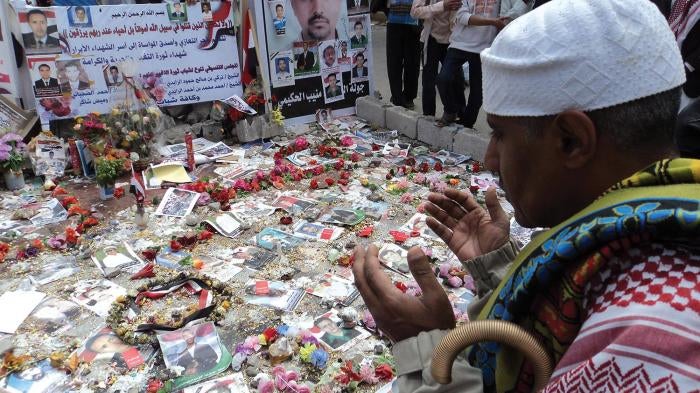
The Friday of Dignity killings marked a turning point in the movement to end the 33-year rule of President Ali Abdullah Saleh, prompting dozens of government officials and diplomats to defect to the side of the demonstrators. The massacre’s brazenness and high death toll made it a symbol of the brutal response to Yemen’s uprising, in which government forces and pro-government assailants, often acting in concert, killed at least 270 protesters and wounded thousands of others in the 12 months before Saleh ceded power. Protesters later named the site of the attack Martyr’s Square and turned it into a shrine, adorned with portraits of the dead.
The massacre appeared to have been planned. In the preceding days, armed gangs and local residents had built several walls at the southern edge of Change Square to keep back the protesters, and amassed sacks of bullets in buildings used for the shootings. As demonstrators were finishing their prayer, the assailants lit a fire along the thickest and tallest wall, trapping the protesters’ main escape route and creating meters-high clouds of smoke that partially obscured the gunmen. Many of the shooters had masked their faces with headscarves in an apparent effort to conceal their identities. All the dead and many of the wounded were shot in the head and upper body, suggesting the gunmen were trained sharpshooters who aimed to kill.
President Hadi has promised sweeping reforms and accountability for the abuses of the past, including those committed during the 2011 uprising.
In an interview with Human Rights Watch, the replacement attorney general, Ali Ahmad Nasser al-Awash, denied any meddling by government officials. Brigadier General Saleh, the former president Saleh’s nephew and at the time of the attack the chief of the Central Security Forces, also denied any wrongdoing by his forces, which have been implicated in numerous assaults on protesters during the uprising. Brigadier General Saleh said his anti-riot forces could not stop the shooting because they were armed only with batons. He, like the former president, accused the protesters of being armed.
Human Rights Watch’s investigation found that protesters were not armed although many hurled rocks at the gunmen who fired on them. Protesters also tore down the wall and stormed Governor al-Ahwal’s home and other buildings from which the gunmen were shooting, even as the gunfire continued. They raided the governor’s home, set it on fire, and brutally beat some of the suspected gunmen.
Those protesters responsible for beating suspected pro-government gunmen also should be investigated.
Efforts to prosecute those responsible for the Friday of Dignity attack are complicated by a sweeping immunity law that the Yemeni parliament passed in January 2012 in exchange for former president Saleh’s resignation. The law grants the former president complete amnesty and all those who served with him immunity from prosecution for all crimes except acts of terrorism committed during his presidency.
In October 2012, lawyers for the Friday of Dignity victims filed a motion in court that asks the trial judge to seek the indictment of at least 11 additional government officials for the shootings, including former president Saleh, former Interior Minister al-Masri, and Brig. Gen. Yahya Saleh. On November 28, the trial judge in the case sent the motion to the constitutional division of the Supreme Court requesting an interpretation of its validity in light of the immunity law. At this writing, the Supreme Court panel had not issued its decision, and until it does the trial is for all practical purposes suspended.
A court challenge in Yemen is one of three paths to prosecution of any officials who may be shielded by the immunity provision. A second route would be for authorities in another country to prosecute any suspects within their jurisdiction. Courts abroad are not bound by amnesties issued in Yemen, and certain serious human rights offenses, such as crimes against humanity, may be subject to universal jurisdiction, meaning they can be tried by courts wherever the domestic law permits.
A third option is for Yemen’s transition government to accept the jurisdiction of the International Criminal Court (ICC) in The Hague for crimes against humanity and war crimes committed during the uprising. Yemen is not a party to the ICC, but it could accept the court’s retroactive jurisdiction through a formal declaration. The United Nations Security Council also has the authority to refer situations to the ICC for consideration.
In September, transition President Hadi ordered the creation of an independent and impartial commission of inquiry to investigate human rights violations during the 2011 uprising, including the Friday of Dignity attack. The commission is to adhere to international standards and recommend measures for accountability and compensation to victims.
Six months earlier, on the eve of the first anniversary of the Friday of Dignity attack, President Hadi had ordered compensation for victims of all attacks during the uprising. A committee overseeing the fund would provide monthly stipends equivalent to a soldier’s salary — about 20,000 Yemeni Rials, or US$93—to those severely disabled and families of those killed, and to pay for medical care for those severely injured, either at home or abroad.
At this writing, the fund had not been created. A group aiding the victims said that the government had separately allocated each of the seriously wounded and the families of the dead between 360,000 and 1 million Yemeni Rials (US$1682 to US$4,672), but at this writing the group had not finished distributing the funds.
While President Hadi’s decrees are important first steps toward truth-finding and redress, a commission of inquiry and compensation should not be seen as substitutes for criminal prosecutions. Survivors and relatives of the victims are entitled to accountability as well.
They include survivors such as Salim al-Harazi, who was only 11 years old when he slipped away from home to join the Friday of Dignity rally and lost both eyes after a bullet struck his face. “The former president said he would protect the protesters,” Salim, who was 13 at this writing, told Human Rights Watch. “So I thought I would be safe.”
They include victims’ relatives such as Zainab Ahmad Muhammad Saleh, whose son Abdullah al-Shurmani joined the Friday of Dignity rally to demand government support for education and a job, and instead received a fatal bullet in his chest. Al-Shurmani’s mother told Human Rights Watch:
They trapped the young people with walls so they could not escape the assassins. And then they killed them, these men in full bloom of youth. We want a fair trial. Compensation is not enough.
Yemeni authorities should reopen the criminal investigation into the Friday of Dignity massacre and ensure that the probe is credible and impartial and meets international standards. They should devote adequate resources and effort to promptly apprehending the defendants listed as fugitives and ensure all those responsible are brought to justice, notwithstanding the immunity law.
Concerned countries, including the United States and member states of the European Union and Gulf Cooperation Council, as well as the UN Security Council, should publicly oppose the immunity law, and impose travel bans and asset freezes on any Yemeni officials responsible for the serious violations associated with the Friday of Dignity attack and other major crimes during the 2011 uprising. They should refuse assistance to any security forces implicated in these crimes until those responsible are removed from the ranks and held to account.
Concerned governments also should support a resolution at the Human Rights Council to create an international investigation into the Friday of Dignity attacks and other serious rights violations during the 2011 Yemeni uprising should Yemeni efforts fall short.
These attacks should not go unpunished if there is to be a genuine
break from the abuses of the past in Yemen.
Recommendations
To the Government of Yemen
- Reopen the Public Prosecution investigation into the Friday of Dignity attack of March 18, 2011 to ensure all those implicated, regardless of position or rank, are arrested and appropriately prosecuted. Ensure that the new investigation is independent, impartial and meets international standards.
- Devote adequate resources and effort to promptly apprehending the 43 defendants in the case who are listed as fugitives from justice. Take appropriate legal action against those obstructing justice by assisting fugitives.
- Promptly create the independent commission ordered through presidential decree in September 2012 to conduct a transparent and independent investigation, in accordance with relevant international standards, into serious human rights violations during the 2011 uprising. The commission’s findings should form the basis for investigations and criminal prosecutions as appropriate.
- Promptly establish a fund for reparations, including compensation and rehabilitation, for the wounded and families of the dead in the Friday of Dignity attack and other attacks during the 2011 uprising in accordance with international standards. Ensure that payments are appropriate to the harm inflicted.
- Comply with international obligations prohibiting immunity from prosecution for those responsible for serious human rights violations.
- Ratify the Rome Statute of the International Criminal Court (ICC). Accept through a formal declaration the jurisdiction of the ICC retroactive to at least January 2011 to allow for the possibility of an investigation into alleged crimes within the jurisdiction of the ICC since the beginning of the protest movement.
- Ensure that when responding to protests security forces act in accordance with the UN Code of Conduct for Law Enforcement Officials and the UN Basic Principles on the Use of Force and Firearms by Law Enforcement Officials, exercising restraint in the use of force and taking measures to prevent the outbreak of violence.
To the UN Security Council, Gulf Cooperation Council, European Union, United States, and Other Concerned Countries
- Publicly oppose immunity for Yemeni officials implicated in serious violations of international human rights law or international humanitarian law. Make clear that such immunity has no effect in jurisdictions outside of Yemen.
- Impose an asset freeze and travel ban on current and former officials implicated in the Friday of Dignity attack and other serious human rights violations until perpetrators are fully and appropriately held to account and victims receive adequate redress.
- To donor countries: Suspend all security assistance, including sales of weapons, ammunition, and equipment, to any Yemeni security units implicated in the Friday of Dignity attack and other serious human rights violations, until officials implicated in those crimes are removed from duty and held to account.
- Support Yemen’s efforts to conduct independent, impartial, and transparent investigations into serious violations of international human rights law and international humanitarian law in Yemen during the 2011 uprising. Should these efforts fail, publicly support an independent international investigation into these violations.
To the UN Human Rights Council
- Maintain monitoring of the Yemeni government’s investigations and prosecutions of serious violations of international human rights law and international humanitarian law by all sides during the 2011 uprising and in previous years.
- Recommend an explicit timeline for the government of Yemen to carry out transparent and independent investigations that adhere to international standards into past violations. Take measures to ensure accountability, including establishing an independent international investigation, should Yemen’s national investigations fail to meet this timeline.
Methodology
This report is based on field research conducted by Human Rights Watch in Yemen between February 2011 and November 2012. It examines violations of human rights during the so-called Friday of Dignity attack that killed at least 45 protesters and wounded some 200 others on March 18, 2011 in Sanaa.
A Human Rights Watch researcher and four consultants interviewed more than 60 people in Sanaa, many on multiple occasions, and carried out dozens of follow-up interviews by email and telephone from Sanaa and New York. Interviewees included participants in the protest, the wounded and relatives of the dead, defendants, medical workers, human rights defenders, lawyers, journalists, political analysts, and government officials.
We contacted witnesses, defendants, survivors, and victims’ relatives through local non-governmental organizations or lawyers for victims or suspects. We carried out interviews in English or in Arabic through Yemeni translators. Most people were interviewed individually. The interviewees were informed of the purpose of our research and were not paid or given other incentives to speak with us.
We reviewed the prosecution’s criminal case against 78 alleged perpetrators, which includes nearly 1,000 pages of testimony and legal motions filed by defense and prosecution lawyers. We also reviewed more than 20 video clips and two documentaries about the shootings, as well as media reports from international and Yemeni sources, including those reflecting the views of the government and the political opposition. We confirmed the identities of the dead, as well as their cause of death, with medical officials.
Human Rights Watch was not granted official visas to Yemen until 11 months after the attack. A Human Rights Watch consultant witnessed the attack. After receiving a visa, a Human Rights Watch researcher visited the scene in order to verify information from witnesses and court documents, such as the locations of the shooters and protesters.
In December 2012, Human Rights Watch sent Yemeni government officials a detailed letter requesting responses to our findings. Despite repeated follow-up queries, we did not receive a reply before the first printing of this report. In February 2013, the Foreign Ministry, Interior Ministry and Public Prosecution gave Human Rights Watch brief written statements that they could not comment on an open court case but that authorities would act “in accordance with the law.”
I. Background
Yemen is among the poorest countries in the world, with more than 40 percent of its 24 million people living below the poverty line.[1] The country is running out of water as well as oil, one of its few sources of foreign exchange and state revenue.[2] Several tribal areas serve as bases for the armed group Al-Qaeda in the Arabian Peninsula.[3]
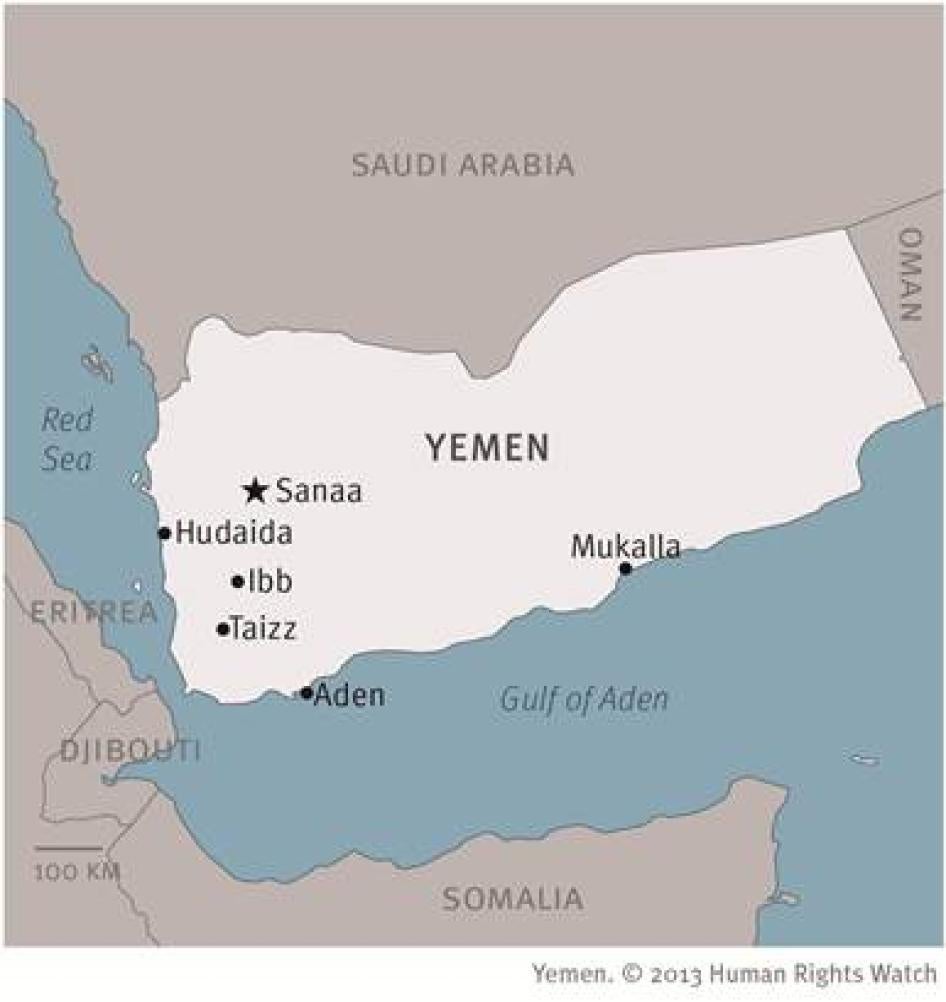
Yemen was two separate countries until 1990. In 1962, an army coup ended centuries of rule by a Zaidi imamate, establishing the Yemen Arab Republic (YAR, or North Yemen). In 1967, the British protectorate known as the Federation of South Arabia achieved independence as the People’s Democratic Republic of Yemen (PDRY, or South Yemen).
The leaders of North and South Yemen declared unity on May 22, 1990. Ali Abdullah Saleh, president of North Yemen since 1978, assumed the presidency of the newly created Republic of Yemen.[4] Political tensions led to a two-month civil war in 1994 that Saleh’s forces won.[5] In 2007, southerners, saying their economic and political grievances remained unaddressed, escalated a campaign for autonomy or separation.[6] From 2004 to 2010 in the northern governorate of Sa’da, government forces fought six rounds of armed conflict with rebels known as Huthis, who accused the government of political and religious discrimination.[7]
Popular discontent, already rising in response to widespread joblessness and rampant government corruption, soared in late 2010 after President Saleh proposed to amend electoral laws and the constitution so he could stand for reelection when his seventh term expired in 2013.[8] In January 2011, inspired by mass protests in Tunisia and Egypt, thousands of Yemenis took to the streets seeking to end President Saleh’s 33-year rule.
By February, the numbers of protesters had swelled to hundreds of thousands. Government forces—primarily the Central Security Forces (CSF) and Republican Guard, run at the time by the president’s nephew and son respectively—and pro-government gangs responded to the largely peaceful protests with excessive and lethal force, particularly in the capital, Sanaa, as well as Aden and Taizz.
Human Rights Watch has confirmed the deaths of 270 protesters and bystanders from February through December 2011 in attacks by Yemeni security forces and pro-government assailants during anti-Saleh demonstrations. Thousands were injured.[9]
Even as the protests remained overwhelmingly peaceful, armed clashes erupted in May 2011 between government forces and the opposition fighters of Yemeni elites vying for power. Those clashes rose to the level of a non-international armed conflict in which scores more civilians were killed, many in what appeared to be indiscriminate attacks in violation of international humanitarian law (the laws of war).[10]
On November 23, amid mounting domestic and international pressure to leave office, Saleh signed an accord brokered by the Gulf Cooperation Council (GCC) and backed in most aspects by the United Nations Security Council, the United States, and the European Union, to transfer power to Vice President Abdu Rabu Mansour Hadi over a three-month period. [11] In exchange, the accord promised Saleh and his aides immunity from prosecution for crimes during his presidency. [12] Membership in a national unity cabinet was split evenly between Saleh’s General People’s Congress (GPC) party and its allies and the political opposition.
On January 21, 2012, Yemen’s parliament granted full immunity to Saleh and immunity from prosecution for any “political” crimes, with the exception of terrorist acts, to “those who worked” with him during his 33 years in office—language that is sweepingly broad. The immunity law violates Yemen’s international legal obligations to prosecute those responsible for serious human rights violations.[13]
On February 21, Yemenis voted to appoint Hadi, the sole candidate, as a two-year interim president.[14]
Under a UN-facilitated “Implementing Mechanism” that serves as a transition blueprint, Hadi’s government is to bring security forces—including those run by former president Saleh’s relatives—under civilian command, pass a transitional justice law, draft a new constitution, reform the electoral and judicial systems, and hold general elections in 2014. The government is also to convene a national dialogue conference to address grievances by groups including the northern Huthi rebels and the southerners.[15]
Loyalists of former president Saleh, who remains in Yemen as head of the GPC, have resisted transition measures, sometimes with violence. In June 2012, the UN Security Council passed Resolution 2051, threatening sanctions against those undermining the transition.[16]
In December 2012, President Hadi removed Brig. Gen. Yahya Saleh, the former president’s nephew, from his position as chief of the Central Security Forces. He also abolished the Republican Guard and removed Brig. Gen. Ahmad Ali Saleh, the former president’s son, as commander of that unit.
At the same time, President Hadi abolished the powerful First Armored Division and removed the division’s commander, Gen. Ali Mohsen al-Ahmar.[17] General al-Ahmar had defected with his troops to the side of the protesters following the March 18, 2011 attack described in this report.He is a longtime rival of Gen. Ahmad Ali Saleh and is closely aligned with the Yemeni Congregation for Reform, the country’s largest opposition party, which is commonly referred to as Islah. However Hadi was expected to offer both Brig. Gen. Ahmad Ali Saleh and Gen. Ali Mohsen al-Ahmar new military positions.[18]
II. Mounting Violence before the Friday of Dignity Attack
The Friday of Dignity attack did not take place in a vacuum. Across Yemen in the weeks and days preceding the massacre, security forces and pro-government gangs repeatedly attacked the fledgling protest movement.[19]
The most violent attacks in Sanaa took place at Change Square, a sprawling tent city that the protesters created in February 2011 outside the gates of Sanaa University, in the west of the capital. Change Square became the center of the movement against President Saleh—a burgeoning city within a city complete with vendors, a stage for speeches and entertainment, a makeshift hospital inside a mosque and volunteer lawyers and security forces. It rapidly expanded south into a mixed residential and commercial area. The expansion created splits in the neighborhood, with many residents and merchants welcoming the protesters and others describing their neighborhood as under siege.
Some residents, including several government officials and security chiefs, formed armed vigilante groups and commissioned the construction of brick walls to cordon off the protest camp. The tallest and thickest of these walls became the scene of the Friday of Dignity attack.
Security Forces Assist Pro-Government Gangs
State security forces carried out several attacks on largely peaceful protests and facilitated other attacks by armed gangs believed to be Saleh loyalists or mercenaries, even driving them to Change Square in military trucks or supplying them with rocks and sticks. [20] Saleh supporters also reportedly paid gang members, whom they sheltered in a rival tent city in Sanaa’s Tahrir Square. [21] The security forces most frequently involved in the attacks were the CSF, a paramilitary unit led by Saleh’s nephew, Brig. Gen. Yahya Saleh, and the elite Republican Guard, led by Saleh’s son, Brig. Gen. Ahmed Ali Saleh. (As previously noted, President Hadi removed both Yahya and Ahmad Saleh from their posts in December 2012). [22]
The attacks turned deadly in mid-February, with security forces and unknown assailants killing six protesters in the flashpoint cities of Aden and Taizz between February 11 and February 18. The attackers wounded more than 100 others during that period, many in Sanaa.[23] Protests in cities across Yemen on February 18, named the Day of Rage, drew an estimated 20,000 people.[24]
In early March in Sanaa, local elders and other residents began meeting to discuss ways to “stop the expansion” of the Change Square protest camp, according to testimony from local university student Nasr al-Bawni:
We decided that each family would guard their section of the neighborhood, especially side streets. However protesters continued to expand their area. … [On March 11, the Friday before the attack] Central Security Force members created a human wall to stop them, and we created a sign asking them to not expand further. [25]
Musa al-Nimrani, a spokesperson for the National Organization for the Defense of Rights and Freedom (HOOD), an Islah-affiliated human rights group that supported the protests, told Yemeni media that day that balatija—a word meaning thugs that Yemenis use to refer to armed men loyal to Saleh—had been gathering on rooftops at al-Qadisiyah intersection, at what was then the southern edge of the protest camp, to prevent its further expansion. “They will do everything they can to remove protesters,” al-Nimrani was quoted as telling the news agency NewsYemen.[26]
Al-Nimrani described Col. Ali Ahmad Ali Mohsen al-Ahwal, the director of investigations at the Ministry of Interior’s Criminal Investigation Division (CID) and the son of the governor of Mahweet, a province northwest of Sanaa, as the balatija ringleader.[27]
During the week before the attack, CSF members openly mingled with balatija in the area where the wall that became the scene of the Friday of Dignity attack was built, reporter Laura Kasinof, who was covering the uprising for The New York Times, told Human Rights Watch.[28]
President Saleh’s vow on March 10 to hold a referendum on early elections and constitutional reforms failed to stem the protests.[29] The following day, tens of thousands of demonstrators held another massive rally they called the “Friday of No Return” and continued to expand the protest camp’s perimeter.[30]
Before dawn on March 12, CSF and the Republican Guard forces surrounded Change Square with armored vehicles and fired live ammunition and teargas to try to stop the camp’s expansion, witnesses told Human Rights Watch.[31] The attack killed four demonstrators including a 15-year-old boy who was shot in the head, according to media reports.[32] The Reuters news agency quoted doctors at the site as saying police blocked medical teams from entering the area.[33]
That night and the following week, the state-run Yemen TV and Saba TV channels broadcast interviews with residents who expressed anger over the expansion of the protest camp. [34]
By then, Change Square extended about a kilometer south from the Sanaa University’s southern gates along the busy thoroughfare of Ring Road, as well as a few hundred meters down nearby side streets. At least 5,000 protesters were living in tents in the camp and their numbers swelled to tens of thousands during Friday protests.
On March 13, at least four gunmen fired live ammunition into Change Square from nearby rooftops.[35] Protesters and armed men threw rocks at each other following the shootings, according to Yemeni bloggers and activists.[36]
Government Officials Help Build Wall
On March 14, elders and other residents of the neighborhood again met to discuss the encroachment of Change Square, according to the testimony of local zone leader and GPC member Aqil al-Bawni.[37]The group met at the home of Abdullah Farwan, then-president of the Judicial Inspection Authority, a powerful agency within the Ministry of Justice. Other ranking officials at the gathering included Ahmad Ahmad Nasser, a district director-general of the Political Security Organization, an intelligence agency that reported directly to President Saleh and whose de-facto head at the time was Saleh’s nephew Ammar Saleh; and Col. Abd al-Rahman al-Dili’l of the Yemen Air Force. Local council member Abd al-Rahman al-Kuhlani also participated, Aqil al-Bawni said.[38]
During the meeting, al-Bawni said, the ranking officials ordered the elders to expand the popular committees to ward off the protesters:
To my surprise, they asked us to create popular committees, everyone guarding his own entrance, to face any problems that might arise. And since I am the local chief I was assigned to assemble the youth in the neighborhood and tell them to protect the area. They asked me to bring the youth to the hall and I did. I also informed members of the General Security [regular police force] in the area . . . and they all came to the meeting.” [39]
Participants in the meeting decided to build a brick wall to block the protest camp’s further growth, the local chief testified.[40] Residents had over the previous two weeks built several brick walls across side roads to keep out protesters, but the one built following the March 14 meeting was the sturdiest and stretched across Ring Road.
Farwan, the head of judicial inspection, contributed 300 bricks to build the wall and Ali al-Ahwal, the son of the governor of Mahweet, provided the cement, al-Bawni said.[41] Ali al-Ahwal later became the leading defendant in the government’s case against the alleged attackers.
Yahya Abdullah al-Amrani, an officer in the CSF, told prosecutors that those who commissioned the wall included the governor of Mahweet, Ahmad Ali al-Ahwal, whose nickname is al-Baidani.[42] In the week before the Friday of Dignity attack on March 18, the witness said, the governor and his guards had “shot in the air” to keep protesters from expanding their camp toward his home. Al-Amrani added: “Al-Baidani swore that the wall will not be destroyed even if it is the end of him.”[43]
Muhammad al-Sanabani, a private security guard who was later charged with helping set fire to the wall after attackers and local residents lined the south side of the wall with tires and doused them with petrol, also testified that Governor al-Ahwal was involved in the construction of the wall and the use of live ammunition to fend off the protesters:
Throughout the week, as residents were meeting to discuss the wall that was built in order to prevent protesters from expanding, the governor of Mahweet, Ahmad Ali Mohsen al-Baidani [al-Ahwal] stated that gunshots should be fired in the direction of the wall to prevent protesters from breaking the wall.[44]
Residents testified that local resident Bashir al-Nimri, a defendant listed as a fugitive, collected money for the wall’s construction and also distributed small payments for qat, a leaf widely chewed as a stimulant in Yemen, to encourage men to join the vigilante groups.
“Some people were getting between 500 and 1,000 Yemeni Rials [US$2.33 to US$6.66] for qat, and this was distributed by Bashir al-Nimri,” al-Sanabani testified to prosecutors.[45]
The wall was about 2.5 meters high. It crossed Ring Road at its intersection with a clinic called the Iranian Medical Center.[46]
On March 14, the Yemeni authorities expelled four freelance journalists writing for major Western media who had reported on attacks by government forces on demonstrators.[47]Combined with a government freeze on most visas for journalists, and mounting attacks by both government security forces and pro-government gangs on Yemeni and regional media, the expulsions decreased the already small international media corps and further isolated Yemen’s uprising from the rest of the world.[48]
On March 15, Yemeni authorities announced a security shuffle in three provinces that included the appointment of Ghazi Ahmad Ali Mohsen al-Ahwal, another son of the Mahweet governor, as director of security for Aden, the strategic southern port city and the seat of a southern separatist movement.[49] Ghazi al-Ahwal later became the second leading defendant in the Friday of Dignity attack and, like his brother Ali, was charged with shooting with intent to kill.
Aden had become a flashpoint in the preceding weeks and months, with state security forces using disproportionate, and at times lethal, force against both anti-Saleh protesters and southern separatists who were starting to coalesce.[50] Ghazi al-Ahwal had previously been the director of security in al-Dali, another restive southern province near Aden.
On March 16, government security forces fired live ammunition and teargas at largely peaceful protests in Sanaa as well in the cities of Taizz and Hudaida, reportedly wounding more than 150.[51]
On March 17, three witnesses told Human Rights Watch, balatija walked freely in the area of the new wall in Sanaa. Some were armed with AK-47 military assault rifles, batons and metal rods, according to Khaled Raja, a cameraman with the opposition Suhail TV channel.[52]
That night, witnesses including security officials testified, tensions were high in the neighborhood near the wall. Yet, as detailed below, instead of taking measures to avert further violence, security forces withdrew from the immediate area.
III. The Attack
The Friday of Dignity massacre, in which gunmen in civilian clothing opened fire with military assault rifles on a largely peaceful protest rally, was the single deadliest attack on demonstrators of Yemen’s 2011 uprising. The attack killed at least 45 protesters—three of them juveniles—and wounded up to 200 others, many of them seriously. It marked a turning point in the movement against President Saleh, prompting the defection of dozens of government officials and diplomats, and assumed symbolic importance within the protest movement because of the brazen character of the shootings and the high death toll.
Hours after the attack, President Saleh declared a 30-day state of emergency.[53] He and Interior Minister al-Masri blamed “armed” protesters for the bloodshed—a charge the president repeated the following week.[54]
Witness testimonies and multiple interviews conducted by Human Rights Watch tell a different story: unarmed protesters were finishing their midday prayer when gunmen opened fire on them from rooftops and nearby streets. After the gunmen shot at them, protesters threw stones at the gunmen, and caught and beat several suspected attackers.
“Protect Your Homes!”
The attack was carefully planned.[55] Gunmen began assembling in the area of the attack after midnight on March 18, 2011. At that time, at least 15 armed men, about 10 of them from Mahweet governorate, entered the Sanaa house of Mahweet’s governor on Ring Road, about 30 meters south of the new wall, according to testimony of one of the governor’s neighbors.[56]
Map of Sanaa Protest Area
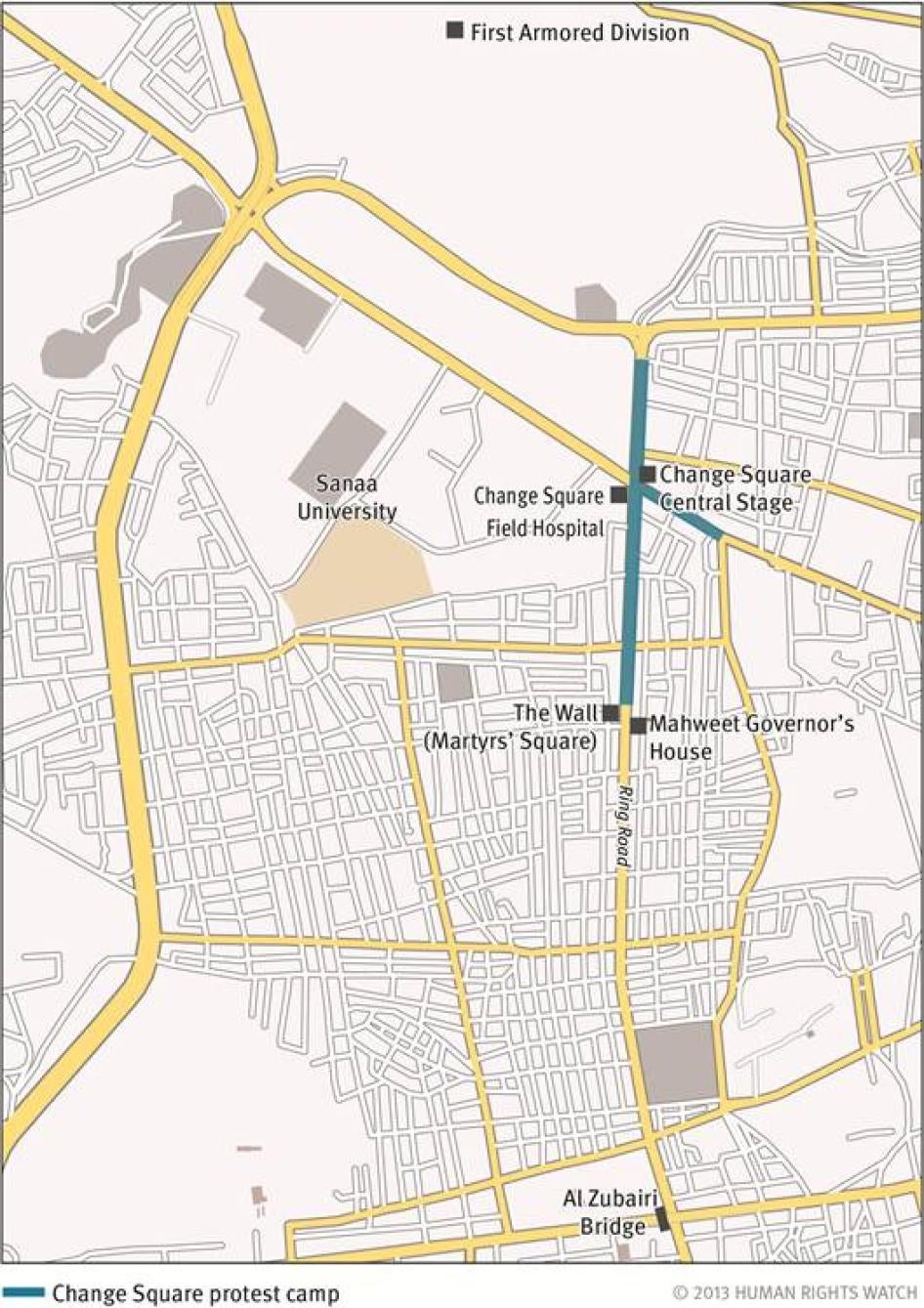
By morning, local residents and balatija had placed tires along the south side of the wall. Abdullah Muhammad al-Judubi, a 24-year-old employee of a printing company, was among several witnesses who described Ali al-Ahwal as playing a leading role in preparing to set fire to the wall:
I passed by my store to check up on things and found a large tire underneath a billboard, and I was worried it would catch fire. So I told Ali Ahmad al-Baidani [al-Ahwal] and the other one beside him to remove it. He said, “Don’t worry, if it gets burned it is my responsibility.”[57]
At approximately 11:30 a.m., a man drove through the neighborhood in a taxi, shouting through a megaphone such warnings as: “People of the neighborhood, protect your homes!”[58] Zone leader Aqil al-Bawni, who gave a similar account, identified the man with the megaphone as neighborhood council member Abd al-Jalil al-Sanabani.[59] Al-Sanabani was subsequently charged connection with the attack and at this writing was listed as fugitive from justice.[60]
At around noon, thousands of protesters gathered for midday prayer, packing Ring Road from the beginning of Change Square to the north side of the wall. On the south side, local residents “were all over the area behind the wall to protect the neighborhoods because they assumed the protesters would try to enter from side streets,” university student Nasr al-Bawni testified.[61]
A helicopter flew over Change Square shortly before the shootings.[62] A Human Rights Watch weapons analyst identified the aircraft in the video as a Soviet-design Mi-17 transport helicopter configured as a gunship, but without weapons. Only the Air Force is known to possess such helicopters in Yemen. At the time of the attack it was commanded by President Saleh’s half-brother, Gen. Muhammad Saleh.[63]
“The helicopter was definitely flying over the square. It was not there by coincidence,” said Kasinof, The New York Times reporter who was at the scene. “We hadn’t seen that happen before.”[64]
At around 12:30 p.m., during the Friday prayer sermon, “the balatija started trying to provoke us by cursing at us and calling us names,” Khaled Raja, a reporter for the opposition Suhail TV, told Human Rights Watch. Scuffles broke out between the two sides on one edge of the prayer area near the wall, he said.[65]
Raja said he saw men armed with guns in trees, on rooftops and behind sandbags near the wall: “They were positioning themselves as if something was going to happen.”[66]
A Shower of Bullets
At approximately 1:15 p.m., as protesters were finishing their prayer, men on the south side of the wall set fire to the tires beside the wall, according to the indictment and witness testimony. Abd al-Karim Saleh Awadh al-Yafii, who worked at a furniture store near the wall, told prosecutors:
Some men in civilian clothes . . . doused the tires with petrol then set them on fire, and threw stones at protesters who were praying behind the wall. After the tires were on fire there was a lot of smoke, approximately three meters high, and the fire was as high as the wall.[67]
Al-Yafii said that the men setting fire to the wall were from the GPC but did not explain how he knew this.
Once they were partially obscured by smoke, gunmen—many with headscarves wrapped around their faces—began firing into the air from rooftops of residential and commercial buildings on Ring Road on the southern side of the wall, according to numerous witnesses.Protesters on the northern side of the wall were chanting “We are peaceful!” But some began throwing stones.[68]
Much of the shooting came from the Mahweet governor’s house.[69] Ali Ismail al-Mutawakel, a carpenter at a furniture store located in front of the governor’s house, said he saw three guards from al-Ahwal’s family on the governor’s rooftop shooting in the air.[70] Witness Abd al-Karim al-Yafii testified that he saw Ali Ahmad al-Ahwal, the CID investigations director and governor’s son, shooting as well:[71]
The son of the governor named Ali Ahmad was carrying an a’ali [assault rifle] and next to him were four of their guards, some were carrying sniper rifles and some were carrying an a’ali. … They were shooting live rounds from the rooftop of the governor’s house that faced the protesters.
Witnesses said they saw three groups of gunmen move toward the wall. One witness, Walid Hussein Hassan al-Nimri, said local residents identified the gunmen as members of three local gangs:
I saw smoke and heard gun shots. Then I saw three groups of armed men covering their faces. Some had small guns, others had AK-47s…They moved toward the wall and started firing at protesters.[72]
The indictment states that “The fact that these three gangs were present at the same time signifies cooperation with Ali Ahmad al-Ahwal in attacking the protesters present on Ring Road.”[73]
A witness also testified that an officer in the First Armored Division, Maj. Abdullah al-Mikhlafi, led a group of gunmen who fired at protesters from atop a honey store near the wall.[74]
Raja, the Suhail TV cameraman, climbed up a utility pole and saw protesters tearing down the wall. At that point, he said, the killings started:
The protesters were chanting, “The people want the downfall of the regime!” … The youths started tearing holes in the wall with their bare hands, and the gunmen started to fire directly at the protesters. There was a shower of bullets. I think I was targeted; whenever I moved from left to right, bullets followed me.
At one point as I moved a man stopped to talk to me and he was hit by a bullet in the chest. I don’t know if he lived. We both fell to the ground. Many people were falling. I didn’t know whether to cry or to keep filming.[75]
Abd al-Rashid al-Faqih, a human rights activist who at the time was a consultant with Human Rights Watch, rushed to the scene from his nearby home and watched the shootings unfold from a doorway about five buildings north of the wall. He told Human Rights Watch:
The bullets were falling on the protesters like a rain shower. I could see them hit walls and doors. In areas where the smoke cleared I could see gunmen on a roof shooting randomly at protesters. A child was walking toward the wall with a relative, perhaps his father. I told the man, “Don’t walk that way.” A short while later I saw him carrying back the child, who had been shot. I saw many people die.[76]
Some protesters began a grim shuttle service, transporting bodies to a clinic at Change Square in blankets and returning with the blankets filled with stones to throw at the gunmen.[77]
Khahil Qaed Muhammad al-Mulaiki, vice-principal of a private school, had been praying near the wall and pressed closer after seeing the wounded being rushed to the clinic. En route, he spotted a friend, Ali al-Salahi, a member of the Change Square security committee, standing near the wall. Al-Mulaiki said:
On the way to the wall I saw him [al-Salahi] alive. On the way back from the wall I saw him dead. It looked like a big machine gun shot him. Later I saw footage from Suhail TV of the pool of blood coming from his body and another protester putting his hands in that blood and putting that blood on his chest. Ali al-Salahi was a newlywed. He had just furnished an apartment for his new family but he never got to live in it.
Time and place lost all meaning. All of us close to the wall we thought we’d be killed at any moment.[78]
Local resident Salim al-Aulaqi reached the wall shortly after protesters had torn it down:
I could see a pool of blood in front of the wall and several spots of blood and the remains of someone’s brain. One of the youths was trying to collect pieces of a martyr’s skull to bring back to the hospital.[79]
Mosque Filled with Dead and Dying
In a span of three hours, the gunmen killed at least 45 protesters and wounded some 200 others, according to medical officials at the scene, victims’ relatives, and lawyers interviewed by Human Rights Watch. Human Rights Watch believes the number of dead could be as high as 52 if those who died over the following days from their injuries are included. The prosecution’s indictment listed 43 protesters killed and another 127 wounded.[80]
All of those killed and at least 40 of the wounded were shot with semi-automatic weapons in the head, chest, or other areas of the upper body, in what medical officials and lawyers for the protesters described as the work of trained marksmen who intended to kill.[81]
At that time, the field hospital at Change Square, located inside a mosque, was little more than a makeshift clinic. Within minutes, medical workers were overwhelmed by the carnage. Within a half-hour of the first victims’ arrivals, the hospital was issuing urgent appeals for blood donations. Doctors conducted 27 surgeries that afternoon, although the hospital was equipped for no more than three at a time, a head nurse at the field hospital told Human Rights Watch.[82]
British freelance journalist Tom Finn described the hospital as “massively under-supplied”:
The whole mosque was filled with the dead and the dying. There were children among the injured. A handful of doctors were moving from case to case, trying to distinguish between people who had been shot so severely they couldn’t be helped and those who could. They had a decrepit old battered ambulance; the wheels were spinning in the mud. You could hear the shooting from inside. It was very loud.[83]
Ibrahim Murfaq, a volunteer paramedic who was driving the ambulance, said his team alone made more than 30 trips between the wounded and the field hospital.[84]
Protesters Beat, Detain Suspected Gunmen
After they tore down the wall, waves of protesters crossed into the area from which the gunmen were shooting and stormed the governor’s home and nearby buildings in search of the attackers, even as the gunfire continued. The protesters raided the governors’ building and set it on fire. They confiscated several assault rifles and bags of ammunition from the buildings, according to witness testimonies and interviews with Human Rights Watch. [85]
The protesters dragged at least 14 suspected gunmen from the buildings and nearby streets, and beat some of them brutally. Sami al-Soofi, a school teacher, described the scene at the Mahweet governor’s house:
The protesters were throwing mattresses, blankets, even doors from the windows. They were enraged. I saw protesters carry out Kalashnikovs [assault rifles] and flour sacks filled with bullets. Then they brought down two balatija. They were beating them hard.[86]
When protesters removed an alleged gunman from the buildings, “they would beat him like it was a zaffa [a boisterous wedding procession],” said al-Faqih, the human rights activist. “Except that instead of clapping they were beating.”[87]
The protesters grabbed one alleged gunman, private security guard Muhammad al-Sanabani, 26, from the front of his house on Ring Road. Al-Sanabani described the beating to Human Rights Watch from a cage inside a Sanaa courtroom while on trial for the attack:
The protesters beat me and put me in a blanket and brought me to Change Square, beating me the whole way there. There were so many people beating me I couldn’t count.[88]
The protesters told media that five of the alleged gunmen were carrying government identity cards.[89]
The protesters brought at least 14 suspected gunmen to Change Square, where they were detained and questioned by lawyers active inside the protest camp. Muhammad Mehdi al-Bakoli, a lawyer with the House of Law Organization (OHL), a group representing several defendants, said the protesters beat some of his clients severely and detained them in squalid bathrooms and unlicensed jails.[90]
Later that afternoon, the Change Square protesters turned the suspected gunmen over to the headquarters of the First Armored Division of the Yemeni army, about a kilometer away. The First Armored Division in turn transferred the suspects to the custody of a military prosecutor.
The number of suspected gunmen detained at that time remains in dispute. Lawyers for the protesters who were wounded or killed in the attack say 14 suspects were brought to the First Armored Division.[91] Documents from the Public Prosecution also refer to 14 suspects as detained, as did the First Armored Division’s media office.[92] The day after the attack, a government spokesman told media that 16 suspects had been arrested.[93]
More recently, lawyers for the OHL asserted that the Change Square protesters brought 28 suspects to the First Armored Division. Of those, the First Armored Division transferred only 16 to a military prosecutor and the whereabouts of the others remain unknown, the OHL lawyers said.[94]
One witness said that CID intelligence chief Ali al-Ahwal, the Mahweet governor’s son and alleged ringleader of the attack, was among the group of alleged gunmen who were transferred to the First Armored Division. Ali al-Ahwal has not been seen since the day of the attack and is listed by the prosecution as a fugitive from justice. The witness, Muhammad Abdullah Daba’a, who was among the defendants transferred to the First Armored Division, testified he saw Ali al-Ahwal around sunset the day of the attack:
They [protesters] were making celebratory noises, saying the son of the governor arrived, the one who shot. They called him a serial killer. I saw him and they referred to him as the son of al-Baidani [Governor Ahmad Ali al-Ahwal] ... We remained handcuffed [with rope] for about one hour, and then we were transferred to the FAD [First Armored Division].[95]
Attorney General Ali Ahmad Nasser al-Awash, an appointee of President Saleh, told Human Rights Watch that Ali al-Ahwal was never detained.[96]
Gen. Ali Mohsen al-Ahmar, the First Armored Division’s commander at the time of the attack, told Human Rights Watch that 14 suspects were brought to the First Armored Division and that all had been turned over to a military prosecutor there. The only suspects who were released, he said in a reference to more than 30 defendants whom the prosecution has listed as fugitives from justice, were let go “on the orders of [then-president] Ali Abdullah Saleh.”[97]
A former Saleh confidant and one of the most powerful officials in Yemen, General al-Ahmar defected to the opposition three days after the Friday of Dignity attack and deployed his troops to protect the demonstrators at Change Square, ostensibly to protest the March 18 shootings.[98] General al-Ahmar is closely aligned with Islah. For more than a year after Saleh agreed in November 2011 to resign, First Armored Division troops guarded the house of President Hadi. Many Yemenis view General al-Ahmar as one of the new president’s closest advisors.[99]
State of Emergency
When President Saleh declared a state of emergency the night of the attack, he also banned the public from carrying weapons in the capital.[100] Parliament five days later approved the state of emergency, which allowed media censorship, barred street protests, and gave security forces sweeping powers to arrest and detain suspects without judicial process.[101]The decree lapsed after 30 days.
The March 18 attack provoked a national and international outcry and added further momentum—as well as elite support—to the protest movement. Tens of thousands of Yemenis turned out for the funerals of slain protesters. In addition to General al-Ahmar, dozens of Yemeni government officials from Saleh’s GCP as well as opposition parties resigned in protest; they included cabinet members, members of parliament, and diplomats including Yemen’s chief envoy to the United Nations.[102] Sadiq al-Ahmar (no relation to Gen. al-Ahmar), the head of the powerful Hashid tribal confederation, also threw his support behind the opposition.[103]
Saleh rejected mounting calls for his resignation, deployed tanks throughout the capital, and on March 20 dissolved his cabinet.[104]
IV. The Victims
Most of the 45 protesters killed in the Friday of Dignity shootings were university students. The youngest was 16 years old—one of three juveniles killed—and the oldest was 50. All of the dead and most of the wounded were male. The dead include Jamal al-Sharaabi, a 35-year-old Yemeni photographer, the first journalist killed in the Yemen uprising.[105]
All of those killed and at least 40 of the 200 wounded—10 of them children—were shot in the head, chest or other areas of the upper body.[106]
Protesters named the area of the shootings Martyr’s Square and turned it into a shine, adorned with portraits of the dead. But that is nearly all the recognition the victims have received. To date, the severely wounded and relatives of the dead have received almost no government assistance, according to the survivors’ lawyers.[107]
The following are brief portraits of two protesters who were killed and two who were wounded in the attack, based on Human Rights Watch interviews with the wounded, witnesses, and relatives.
Salah Abdullah al-Shurmani
The third-floor apartment in Sanaa where Salah Abdullah al-Shurmani lived with his family, located on a trash-strewn street, is reached by a rickety, outdoor stairwell smelling of sewage and lit at night only by a guide’s flashlight.
In contrast to the squalid exterior, the family’s sitting room was a carefully arranged shrine to al-Shurmani’s memory, filled with photos of him as a smiling, seemingly carefree youth. Even the clock on the wall bore his likeness.
Al-Shurmani was 22 when he was killed in the Friday of Dignity attack. He had hoped to attend a university, his relatives said. But the family could not afford to send a potential breadwinner to school, so instead he worked in his father’s tailor shop. When the uprising began, said al-Shurmani’s mother, Zainab Ahmad Muhammad Saleh, her son joined the weekly protests at Change Square:
My son went to protest because the young people are fed up and they wanted change. The people cannot live well. They cannot complete their education. The prices are sky-high. The people are turning into street beggars … In Europe, they care for cats and dogs but here the people eat garbage.[108]
The morning of the Friday of Dignity attack, al-Shurmani told his mother he would be home for lunch, then headed off to Change Square. His mother cooked him a big meal but the food grew cold and hours passed:
I called his brother Muhammad but there was no answer. I stood on the roof and I could see the helicopters circling in the area of Change Square. I was crying and praying to God to protect the young men there. Finally around 5 p.m. Muhammad came home. He was in tears. He said, “It’s Salah. He’s a martyr.”[109]
|
Zainab Ahmad Muhammad Saleh (left) in Sanaa with a poster of her son Salah Abdullah al-Shurmani , who was shot dead in the Friday of Dignity massacre. The Arabic text on the poster gives al-Shurmani’s name, date of death, hometown, and the phrase, “martyr of freedom and change.” It also includes a line from a prayer that begins, "Think not of those who are slain in the cause of Allah as dead.” At right, Salah’s brother Muhammad al-Shurmani. © 2012 Letta Tayler/ Human Right Watch |
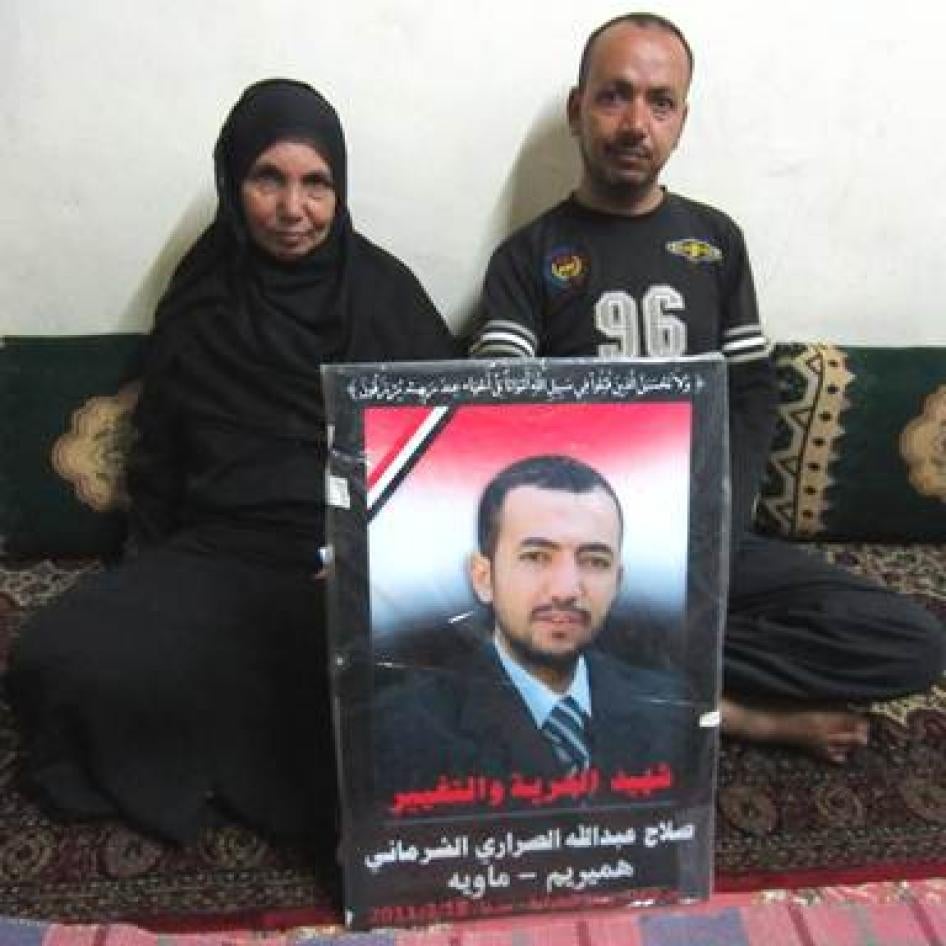
Muhammad al-Shurmani was also at Change Square that day. Sometime after 2 p.m., he said, he got a call from friends who had been with his brother, saying Salah had spotted him in the crowd and was crossing a traffic circle to join him when a bullet pierced his chest. Muhammad ran to the protesters’ field hospital at the mosque in Change Square:
At first I couldn’t get in because the crowds were so big. Finally I entered the courtyard of the mosque and I walked past the wounded. Saleh was not there. So I went inside the prayer hall and I saw many more wounded. Salah still was not there. Finally I looked through the rows of dead, in the area where the imam stands. And Salah was there. He was shot in the right side of the chest.
I walked all the way home [about 5 kilometers]. All I could think was how to tell my father and mother? I did not dare go inside to talk to them. I just stood downstairs. Finally my mother saw me, and she sensed something was wrong. She came down to me and I told her.[110]
Al-Shurmani’s mother said the family wants justice, not just compensation:
They trapped the young people with walls so they could not escape the assassins. And then they killed them, these men in full bloom of youth. And then the parliament gave the members of the former government immunity. … We want a fair trial. Compensation is not enough.[111]
Anwar al-Maeti
When the trial for the 78 defendants in the Friday of Dignity case opened on September 29, 2012, Abd al-Wahed al-Maeti stood in the courthouse, holding aloft a poster of his son Anwar, fashioned from a tattered photo mounted on the back of a cardboard box.
Anwar, 16, was the youngest of those killed in the attack. In the photo, his face is boyish. He wears a white headscarf and an excited grin. The protesters at Change Square named him “Shahid al-Fatih,” the martyr who opens the door.
Anwar was shot dead as he ran toward the house of the Mahweet governor with the first wave of protesters who tore down the wall and tried to catch the gunmen. A bullet struck him as he opened the door to the governor’s house and tried to enter.
The father described his son as the best student in his class, with dreams of becoming a doctor:
He was frustrated. He felt that under the regime it would be impossible for him to go to medical school because that was only for those who were powerful and their friends.[112]
|
Abd al-Wahed al-Maeti holds a photo of his son Anwar al-Maeti, 16, the youngest protester killed in the Friday of Dignity shootings, outside a court hearing in Sanaa on the massacre. The Arabic reads, “Responsibility for our bloodshed rests on your shoulders,” and “Pray for him, he is dead.” Anwar’s photo is also on the sheath of father’s jambiyya, a traditional Yemeni dagger. © 2012 Letta Tayler/ Human Rights Watch |
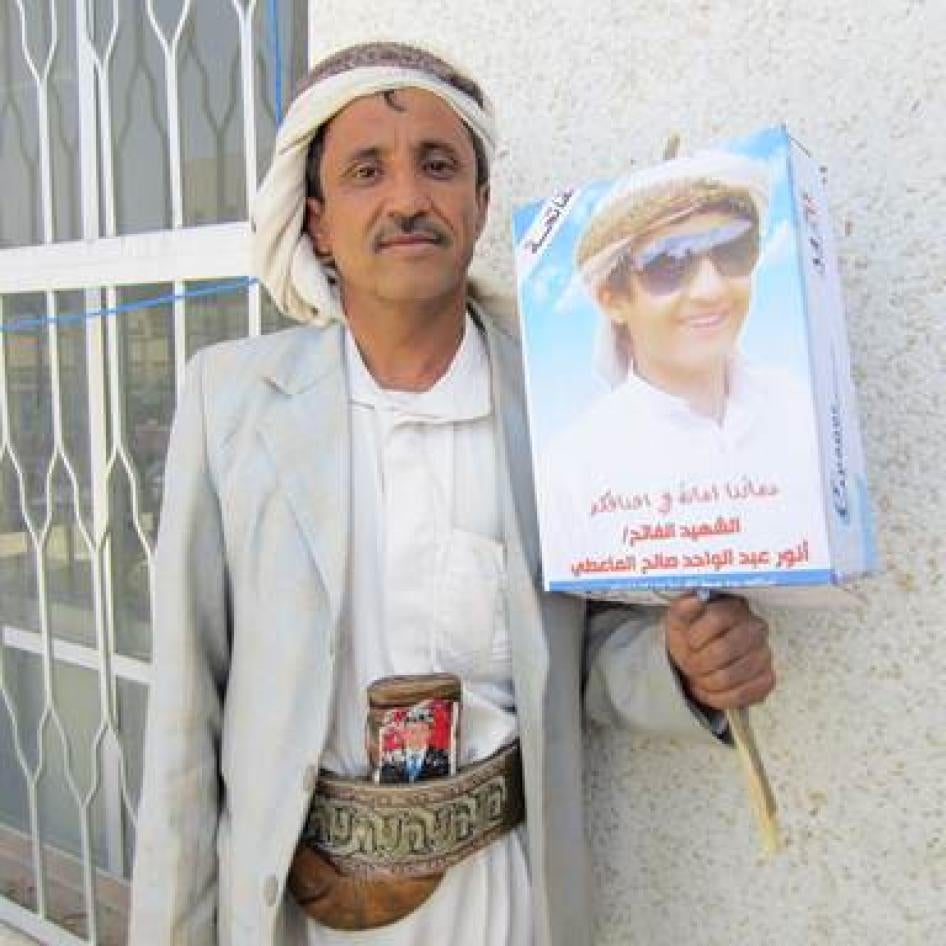
When the uprising began, Anwar continued his studies, but spent afternoons and weekends at Change Square, his father said:
I tried several times to convince my son to stay at home and not go to Change Square because it was dangerous. His answer was, “Father, if you keep me at home and each father keeps his children at home, then who will change our situation?”
Like many other victims’ relatives, al-Maeti said he wanted those responsible prosecuted. Asked about the law that the parliament passed granting immunity to former President Saleh and his aides, he said: “It was given by those who had no right to give to those who did not deserve to receive it.”[113]
Salim al-Harazi
Salim al-Harazi, 13, arrived at an interview with his dark hair carefully combed, his shirt perfectly ironed, and mirrored sunglasses covering the scars where his eyes used to be. He stepped carefully, his hand on the shoulder of his younger brother, Saif, who guided him into the room.
Only 11 at the time he was wounded, Salim said he could not resist joining the protesters at Change Square for the Friday of Dignity rally. He slipped away from home the night before.
“The former president said he would protect the protesters,” he told Human Rights Watch. “So I thought I would be safe.”[114]
Ionia Craig, a freelance journalist, blogged about seeing Salim with two other boys in a tent at Change Square as the bullets began to fly:
Shielded from the brutality of what was happening just a few feet from them by a thin white sheet of material, the boys joked and laughed. Two of them wore plastic [construction] helmets that had been distributed around the protest camp as protection from flying rocks, which had become a common weapon in the street battles of recent days. … It was glaringly obvious that the now partially collapsed tent was going to offer little protection from the AK-47 bullets flying through the air. Unable to express my concern [in Arabic] to the giggling boys I motioned for them to leave the tent, as I was about to. They declined.[115]
Salim did run out shortly after, but not for shelter. “We saw the fire behind the wall. I went to see,” he told Human Rights Watch. “We saw balatija. They threw stones at us and we threw stones back. We saw bullets coming from behind the wall.”[116]
A bullet struck Salim below his nose, then crossed from his right eye to his left eye. When he woke up the next day at the Science and Technology Hospital, a private medical center in Sanaa that was treating wounded protesters, doctors had removed both of his eyes.
|
Salim al-Harazi (left) and his younger brother, Saif, in Sanaa, October 2012. Salim lost both of his eyes from a bullet wound during the Friday of Dignity shootings on March 18, 2011. © 2012 Letta Tayler/Human Rights Watch |
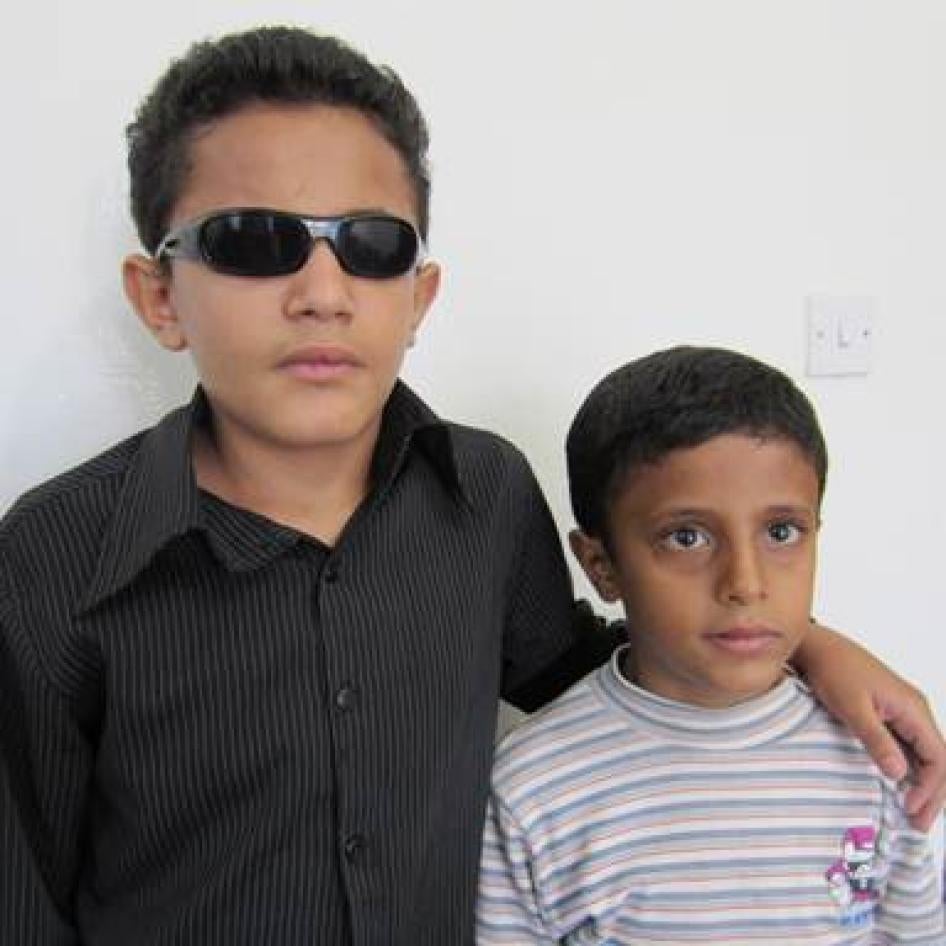
Salim told Human Rights Watch that he wants to be a religious scholar. First, he said he wants to learn to read Braille and to receive cosmetic surgery. The Wafa Organization to Support the Families of the Martyrs and Injured, a group that provides assistance to wounded protesters and families of the those killed, has been helping Salim obtain basic treatment, but neither the clinic nor Salim’s family can afford the cosmetic surgery.
Jabir Saad Ali Jabir al-Mandaliq
Jabir Saad Ali Jabir al-Mandaliq, a 28-year-old religious scholar from Amran, a province directly north of Sanaa, said he joined the Change Square protests because he was unable to find work teaching the Quran.
I came to Change Square to demand our freedom, dignity and rights. The people in my area are illiterate. They can’t even read the Sura al-Fatiha [the opening chapter of the Quran]. But the elite have squandered Yemen’s wealth. That is why I was unemployed.[117]
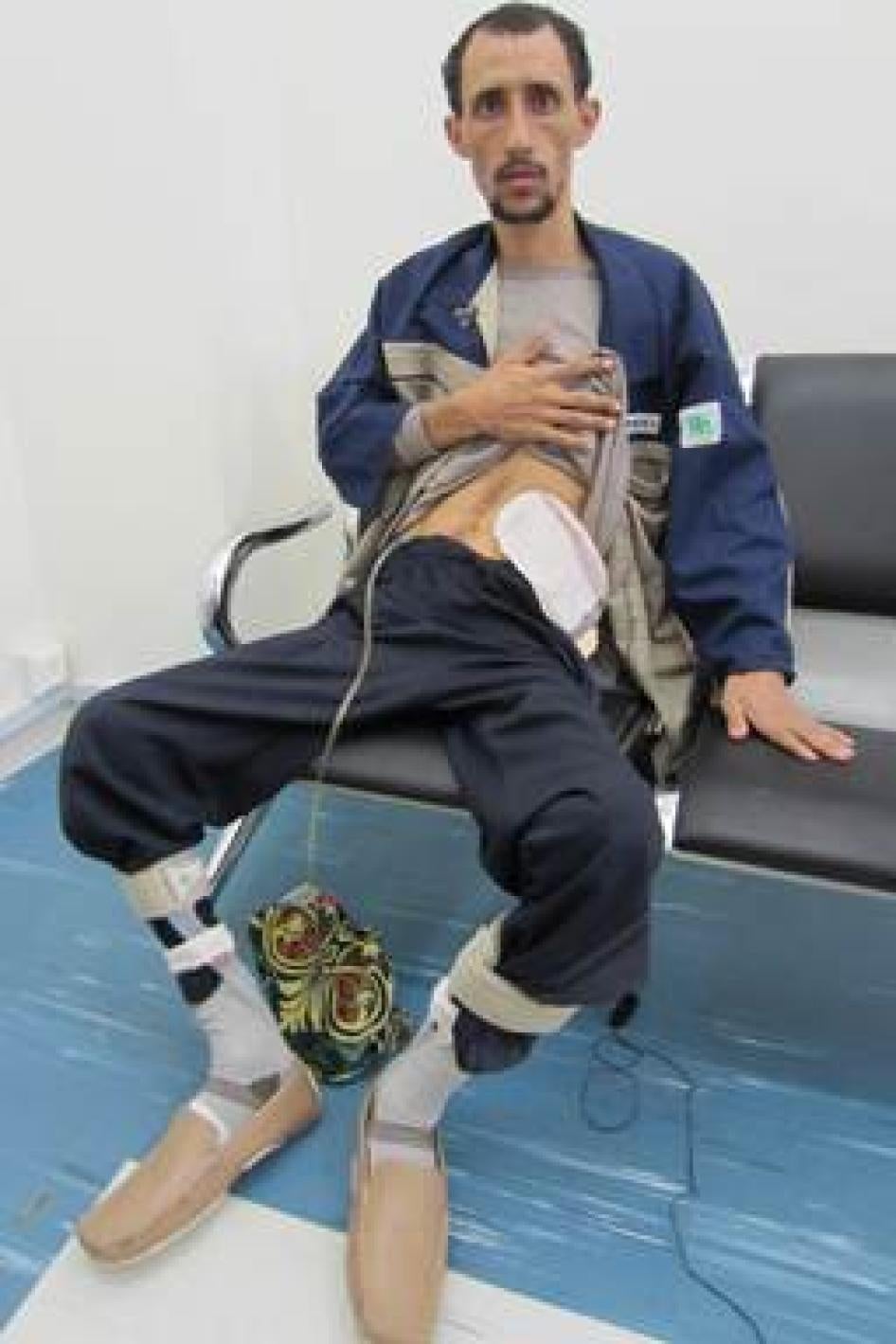
Jabir Saad Ali Jabir al-Mandaliq, Sanaa. © 2012 Letta Tayler/Human Right Watch
The night before the attack, al-Mandaliq told Human Rights Watch, rumors were rife of an impending attack. “My brother came to me and said, ‘Leave, I am afraid you might be killed.’ I said to him, ‘I will never leave. I came on a peaceful mission for change.’”
Al-Mandaliq was shot as he pushed past the remains of the wall:
They were shooting at us directly, some from the rooftops. I thought it was the end. I began praying to Allah, “There is no God but God…” The next thing I knew I was shot. The bullet entered my right side and exited the left. People I didn’t know evacuated me in a blanket. A friend saw me and wept.
The bullet wound left Jabir paralyzed from the waist down. Two pieces of his spinal cord were shattered and doctors removed 50 centimeters of his small intestine. He urinates into a bag attached to his bladder by a tube.
Al-Mandaliq would like to live in Amran, where he has family, but he needs to be in Sanaa for medical care. He said he is in constant pain and despairs of any improvement:
My legs are becoming so much smaller. Some doctors tell me there is still some hope I can walk. But some doctors tell me I can never walk again.[118]
V. State Failure to Protect
Yemeni security forces failed to protect both protesters and local residents during the three-hour Friday of Dignity attack. Testimony and statements from witnesses to Human Rights Watch indicate that this failure was deliberate. Indeed, multiple witnesses said the Central Security Forces (CSF), one of Yemen’s best trained and equipped forces, were responsible for security in the area yet shielded the plainclothes gunmen while they shot at protesters.[119]
Both before and at the time of the attack, ranking authorities—including the interior minister and security chiefs—received repeated warnings of a potential bloodbath from lower-level security officials, protesters and local residents. Rather than send in reinforcements or attempt to defuse the situation, the CSF withdrew from the immediate area the night before the attack.
Once the attack began, CSF anti-riot forces took a half-hour to reach the scene although they were stationed only about a kilometer away. The forces that arrived were new, under-armed recruits who failed to detain gunmen in plain sight. Instead, witnesses said, they turned their water cannon and teargas on the protesters.
Even President Saleh acknowledged that the security forces were not at the scene when the shooting began. Although his aim was undoubtedly to dismiss any police culpability for the shootings, he said during a news conference hours after the massacre, “As for the police, they were not present during this attack at all, and they did not fire one single shot. ”[120]
Yemen’s Legal Obligations to Protect
Under international law, states are required to protect basic human rights. These rights include the right to life and the right to peaceful assembly, enshrined in the International Covenant on Civil and Political Rights (ICCPR).[121]Yemen ratified the ICCPR in 1987.
Even if the gunmen were not acting on behalf of the Yemeni government, the ICCPR still holds a state responsible for responding appropriately and effectively to abuses committed by private actors. According to the Human Rights Committee, the international expert body that monitors compliance with the ICCPR, a state’s failure to ensure rights could violate the Covenant if it were “permitting or failing to take appropriate measures or to exercise due diligence to prevent, punish, investigate or redress the harm caused by such acts by private persons or entities.”[122]
The UN Basic Principles on the Use of Force and Firearms (“Basic Principles”) provide that law enforcement officials “shall, as far as possible, apply non-violent means before resorting to the use of force” and may use force “only if other means remain ineffective.”[123] When the use of force is necessary, law enforcement officials should “exercise restraint in such use and act in proportion to the seriousness of the offense.”[124]
The Basic Principles also place limits on the use of force in dispersing “unlawful assemblies.”[125] They provide that “intentional lethal use of firearms may only be made when strictly unavoidable in order to protect life.”[126]
The Basic Principles call on law enforcement officials to “respect and protect human dignity and maintain and uphold the human rights of all persons.”[127] Failing to take even the most minimal steps to stop gunmen from shooting live ammunition at protesters is contrary to the Basic Principles, which requires that law enforcement officials fulfill their duty by “protecting all persons against illegal acts.”[128]
Yemen’s Law on Organizing Demonstrations and Marches of 2003 requires security forces to protect demonstrators and provide medical care. Security forces must disperse demonstrators when crimes are being committed and in the event of riots.[129]
Central Security Withdraws Early, Returns Late
Brig. Gen. Yahya Saleh, the then-president’s nephew and during the uprising the de-facto chief of the CSF, was fully aware of repeated acts of violence around Change Square in the days preceding the Friday of Dignity. For example, the CSF chief told a news conference the day before the Friday of Dignity:
Residents have been upset about the expansion of the protesters. When the new neighbors saw what the others had suffered, they refused any expansion by the protesters, and clashes emerged between them.[130]
Abd al-Rahman Hanash, then the police chief for Sanaa, told prosecutors after the attack that he had alerted then-Interior Minister Mutahar al-Masri, who ostensibly controlled the CSF and the regular police forces, to the potential for bloodshed the night before the Friday of Dignity as well as to the attack itself. He said al-Masri responded by saying, “ ‘I know,’ but did not give us any orders”:
I informed the minister of interior the night before Friday . . . about the increasing tension and that there was a chance that protesters might march towards Ring Road and attempt to remove the wall and that residents surely will not allow them to do so…. Then I informed him again at approximately 10 a.m. Friday morning, then again when the shooting began.[131]
Abd al-Rahman Hussein Shaiban, a PSO officer who lived near the wall, also testified that he had alerted the PSO in advance to “the wall that was being built and the problems between the neighbors and the protesters.”[132]
Despite these warnings, the CSF anti-riot police left the area of Change Square and the wall around midnight the night before the attack and moved to Zubairy Bridge, an overpass above Kentucky Roundabout, about a kilometer to the south, according to Hanash, the police chief, and other witnesses.[133] Three to four teams of CFS forces withdrew from the area around the wall.[134]
Once the shooting began, security officials again alerted security authorities repeatedly, without results. Abd al-Azim al-Haimi, a staff general of the CSF, testified that he called the CSF commander directly:
I informed Major General Abd al-Malik Tayeb, commander of the Central Security, that there was gunfire and civilians being killed and injured, and he asked, “Where are you, exactly?” I told him I was in City Mart [near the wall]. He said, “Okay,” and he ended the call.[135]
Residents living near the wall also contacted the security forces once the shooting began. A CSF colonel arrived but with no backup forces, according to residentWalid Hussein Hassan al-Nimri, who is a defendant in the case:
We contacted Central Security to request protection and anti-riot police; they responded by telling us that Central Security Forces are on their way to the area. A colonel in a Central Security uniform arrived on an expensive white motorcycle with a police license plate. We asked him, “Where are the Central Security Forces?” He said, “They are on their way.” He remained on the phone. They did not arrive until a half-hour after shooting started.”[136]
The dozens of CSF anti-riot police who finally arrived were armed only with batons, tear gas and water cannons.[137] “They sent two truckloads of new troops without weapons. They were simple soldiers,” Muhammad Hizam al-Radai, a lieutenant colonel in CSF, told prosecutors.[138]
No Action to Stop Shooters
Once they arrived, the CSF contingents took no action against the shooters and in some cases even shielded them as they continued to fire at the protesters.
“Karama Has No Walls,” a documentary about the Friday of Dignity attack, shows a line of CSF anti-riot police blocking Ring Road amid the sound of gunfire. The CSF members are shown spraying protesters with water cannons, while making no attempt to disarm or apprehend a group of gunmen standing close by in a doorway.[139]
Witness statements corroborate the video footage:
“I saw two gunmen shoot and then retreat through the line of security forces,” said rights activist al-Faqih. “There were about 30 to 40 Central Security Force members. They were just standing there with the gunmen nearby.”[140]
Salim al-Aulaqi told Human Rights Watch that he recalled seeing “tens of Central Security forces mixed in with the balatija.”[141]
Yasir Muhammad Muqbil Esa, a wounded protester, testified that:
There were militants in plainclothes firing at us from the vicinity of the Central Security Forces and when we approached them the soldiers made a security belt around them. … They were pointing to the plainclothes militants to come back and fire at us.[142]
Some witnesses said they thought the liquid fired from the water cannon was wastewater. “It must have been sewage water or something,” said Yusef Muhammad Mohsen, a 19-year-old protester. “It smelled very bad.”[143]
Protesters responded by again throwing stones, this time at security forces. Jabir Saad Ali Jabir al-Mandaliq, an unemployed teacher, told Human Rights Watch:
There were security forces on one side of the street and balatija on the other. We started throwing stones at the security forces because they were acting like shields for the killers.[144]
Even as they fired water cannon, security forces made no effort to create an exit to disperse the protesters, as required under Yemen’s law on demonstrations. Many other walls that had been built in the area remained intact and armed men were blocking many side streets, effectively trapping the protesters in a corridor of Ring Road, between the security forces to the south and the tightly-packed mass of thousands of additional protesters that stretched to the center of Change Square to the north.
Hours after the shooting ended, at least seven or eight armed men remained in plain site near the area of the attack, but no security forces were present, reporter Kasinof, who returned the scene at that time, told Human Rights Watch.[145]
Poor Response of Regular Police
The General Security forces, which serve as the regular police and had a precinct house just two blocks south of the wall, also failed to respond to the attack.
Defendant Muhammad Badr, a resident of the area near the wall, testified that the night before the attack, he had warned Ahmad al-Tahiri, the deputy manager of General Security for western Sanaa, that “the situation would require anti-riot forces, but they didn’t take any action.”[146]
When the attack began, Badr said, he “repeatedly called” al-Tahiri to “send more forces.” Rather than send police to the scene, al-Tahiri ordered Badr to come to see him and, in the presence of several plainclothes officers, asked if he knew the identities of the masked gunmen, Badr said. [147]
Badr said he also contacted Muhammad Rifaat, an assistant director of General Security. He said Rifaat replied that the residents should fend for themselves:
I told him [Rifaat], “The gunfire is increasing, so why don’t you send any support?” He said, “We know. And nothing will happen to you. Just take care of your neighborhood.”[148]
Some witnesses said that even the few General Security officers in the area failed to intervene. “We ran to police and told them that there were balatija shooting at us,” protester Ahmad Ahmad told journalist Jeb Boone, who was at the scene. “They told us it wasn't their duty to stop them.”[149]
Shaiban, the PSO officer, testified that he saw three security force officers whom he knew at the scene of the attack as the incident began. But, he said, as soon as they saw protesters with rocks heading in their direction, “the security men ran away.”[150]
When prosecutors asked then-General Security Chief Hanash why he did not dispatch his own forces, he replied that Interior Minister al-Masri had told him that security in that area was “under the jurisdiction of the Central Security.”[151]
“We do not have the means to protect this area,” Hanash testified, and “we have no authority to enter it.”[152]
Central Security Chief Denies Wrongdoing
In an interview with Human Rights Watch, Brigadier General Saleh, at that time the CSF chief and a nephew of then-President Saleh, said that he sent in forces “as soon as we learned about the clashes” but that they were out-armed. He also accused the protesters of shooting live ammunition:
There was no failure here. … The Central Security Forces were doing everything they could do stop the fighting. But when they saw the protesters shooting as well as the [gunmen on the] other side [of the wall], they realized they were the only party without guns and they withdrew.
How can unarmed forces stop gunmen? They had only batons… and water cannon.[153]
He did not explain why he did not send in reinforcements who were better trained or better armed.
VI. Flawed Investigation
The state prosecution’s investigation into the Friday of Dignity massacre was marred by political interference, a failure to follow leads that might have implicated government officials, and factual errors. That investigation became the basis for a trial into the killings that began September 29, 2012, in the First Instance Court for the Western Capital District in Sanaa.
President Saleh dismissed Attorney General Abdullah al-Ulofy shortly after al-Ulofy demanded the arrests of key suspects, including government officials. Prosecutors failed to question—much less charge—top officials whom multiple witnesses implicated in the attack, or security chiefs such as Brig. Gen. Yahya Saleh, until December 2012 the de-facto leader of the CSF, whose anti-riot unit failed to properly respond to the attack.
Of 78 suspects named as defendants in the prosecution’s June 29, 2011 indictment, 34 are listed by the court as fugitives from justice, including all the alleged masterminds. Lawyers for the victims allege that the whereabouts of many of the missing defendants are known and that the authorities have made no serious effort to find them.[154] The victims’ lawyers also allege that nearly all of the eight defendants who are detained were bystanders, peripheral accomplices or even, in one instance, a case of mistaken identity.[155]
The indictment does not specify how many of the defendants are security or government officials, or from which units or agencies. Lawyers for the victims allege the vast majority of those considered fugitives are security or government officials, or members of former president Saleh’s GPC.[156]
Even Justice Minister Mushid al-Arshani said on the first anniversary of the attack that “the real perpetrators escaped and only their accomplices and supporters are in jail.”[157]
In an interview with Human Rights Watch, replacement Attorney General Ali Ahmad Nasser al-Awash, who retained his post under President Hadi, denied that his office or others in the Saleh government interfered in the case. “We moved forward with the investigations as best we could,” al-Awash said.[158]
The attorney general blamed any weakness in the case on “the refusal of witnesses and victims’ relatives to cooperate with the investigation,” and on General al-Ahmar, the commander of the First Armored Division, who he said “may” not have turned over all weapons or other evidence that the protesters confiscated after they tore down the wall.[159] General al-Ahmar, in a separate interview with Human Rights Watch, denied any interference.[160]
Al-Awash acknowledged that the suspects included security force members and government officials but said he did not know how many, telling Human Rights Watch: “As the attorney general I do not go into the details of this case.”[161]
For 18 months, victims’ families boycotted pre-trial hearings to protest flaws in the case.
The families began supporting the proceedings in September 2012, after their lawyers prepared a motion that called on the court to order the Public Prosecution to reopen the investigation and indict top officials including former president Saleh, as described later in this report.
However, that motion had its own flaw: it included as an attachment a memo allegedly from the Interior Ministry implicating top government officials in arming loyalists around the time that armed groups began attacking protesters. However a separate court, the Specialized Media Court, had five months earlier ruled that the memo was fraudulent.[162] The motion did not note the controversy surrounding the document’s authenticity.
The alleged memo, dated February 5, 2011 and purporting to be from Interior Minister al-Masri to Brig. Gen. Tariq Saleh, who at that time commanded the Presidential Guard, asked the Presidential Guard commander to approve a list of people who would be “in charge of distributing weapons” to Saleh loyalists.[163]
Political Interference
President Saleh fired Attorney General al-Ulofy in April 2011 after it became apparent that the attorney general was actively investigating the Friday of Dignity case.
Though regarded as a Saleh loyalist, al-Ulofy had asserted his independence regarding the protests and the investigation into the case in the weeks before his dismissal. On February 24, for example, al-Ulofy called on security forces to protect protesters participating in peaceful rallies.[164]
On March 23, after state-run Yemen TV reported that al-Ulofy accused the political opposition of responsibility for the Friday of Dignity attacks, al-Ulofy in a phone call to Change Square publicly denied the report.[165]
On March 26, the opposition Ain News website posted an undated document bearing President Saleh’s signature and the presidential seal, in which the president barred interrogation of Mahweet Governor Ahmad al-Ahwal, as well as one of his sons and his guards, in connection with the attack.[166] As noted previously, gunmen used al-Ahwal’s house as the key staging area, and the governor’s two sons, both ranking security officials, are the top two defendants in the killings.
The memo, addressed to then-Interior Minister al-Masri, stated:
There will be no interrogation of Ahmad Ali Mohsen al-Ahwal, his son, or his guards. Any orders by the attorney general against them are to be frozen. There is no objection to detaining other suspects in the case and referring them to the prosecution.[167]
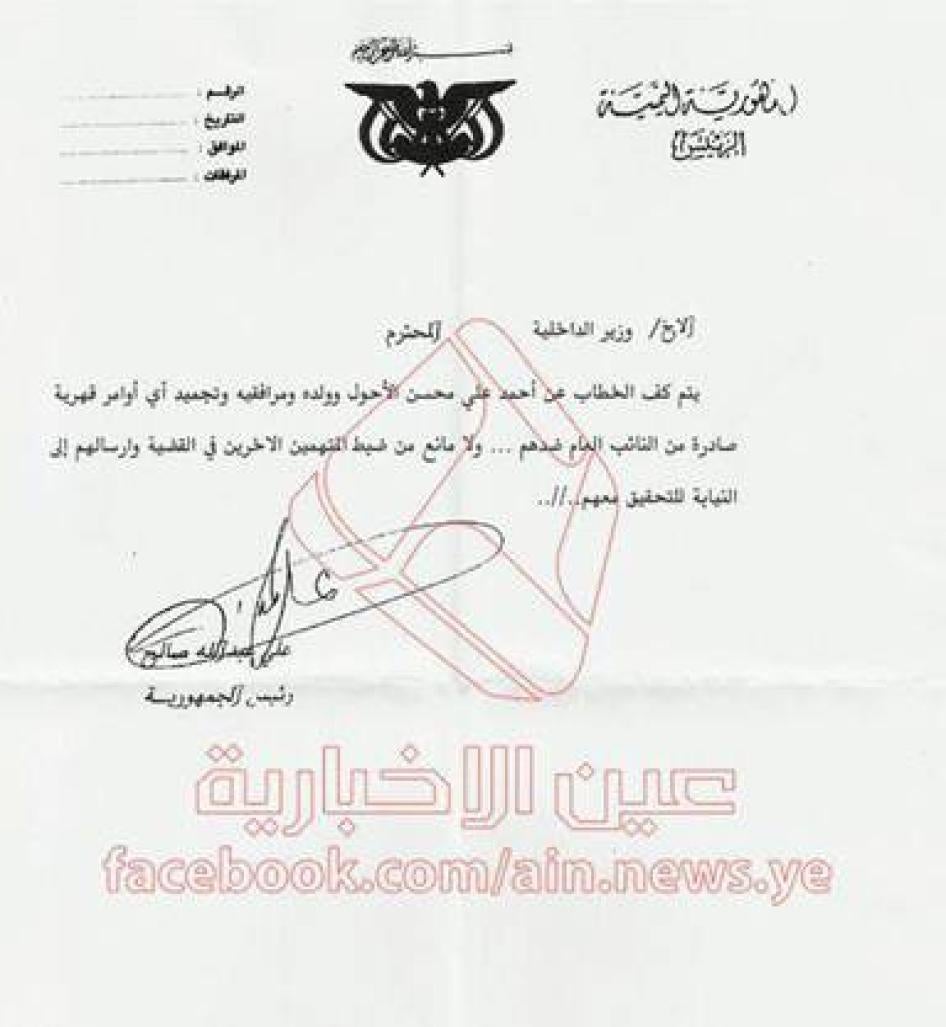
Alleged memo from President Saleh ordering no questioning of the Mahweet Governor Ahmad al-Ahwal, his son, or his bodyguards, that was posed on Ain News.
The Saleh government never denied issuing the memo. A spokesman for the current Yemeni government emailed Human Rights Watch that it was unable to confirm or deny the memo’s authenticity, and added that a national commission of inquiry was “crucial to sort the facts from the lies.”[168]
On April 3, al-Ulofy called the state of emergency that Saleh had declared immediately after the attack “unconstitutional.”[169]
On April 13, al-Ulofy threatened to resign if the Interior Ministry did not question and arrest top suspects, including government officials, according to opposition media and lawyers for the victims.[170]
Two weeks later, on April 28, President Saleh fired al-Ulofy and replaced him with al-Awash.[171]
Allegations of False Testimony
Prosecutors tried in some cases to change testimony or threatened to charge witnesses as suspects if they did not adapt their testimony to the prosecution’s version of events, defendants’ lawyers said.[172]
Elham Sharaf Abu Taleb, the mother of suspect Ayman Yahya Badr, 19, said that when she went to the prosecutor’s office to inquire about her son, an official there asked her to place her fingerprint on a piece of paper to help gain her boy’s release.
“The prosecutor . . . asked me to put my fingerprint on a paper and said this will help free my son, so I did,” she told Human Rights Watch. “I still don’t know what was on that paper because I can’t read or write.”[173]
Later, Taleb said, she learned that the paper was testimony falsely stating that she had seen another suspect, Basem Abd al-Ghani Muhammad Hamoud al-Harethi, a member of a prominent family, heading toward the wall on the day of the attack with a gun.
“I have never seen him holding a weapon,” Taleb said. “He was standing right around the corner with my sons and others near the qat market, that’s all.”[174]
Muhammad al-Bawraki, a defendant released on guarantee—a form of bail in Yemen in which an influential person, such as a relative, tribesman or businessman, takes responsibility for a suspect pending the outcome of a case—told Yemen news media that prosecutors jailed him for refusing to testify against people whom he did not know. The media quoted al-Bawraki as saying that one district attorney “told me I have to testify against those people if I want to be released. When I refused, he sent me to prison for four months.” [175]
Failure to Question Top Officials
As detailed above, the testimony gathered by the prosecution included dozens of eyewitness allegations that security chiefs and other government officials played a role in planning and carrying out the Friday of Dignity killings. Yet the prosecutors did not call in most of the top-ranking government officials named by these witnesses for questioning.
For example, prosecutors did not question Brig. Gen. Yahya Saleh, the former CSF chief-of-staff, or then-interior minister al-Masri, ostensibly his supervisor, about the withdrawal of CSF forces from the area around the wall the night before the attack, and their insufficient response once the shootings began.
Nor did they question Farwan, the head of Judicial Inspection Authority at the time of the attack, and other officials who witnesses said were involved in planning the formation of armed neighborhood committees near the wall.[176]
The prosecutors also did not question al-Ahwal, governor of Mahweet, whose house was the main staging area for gunmen as they fired on protesters and whose sons Ali and Ghazi were indicted for shooting at protesters. Governor al-Ahwal was on the original list of 127 suspects but prosecutors dropped him from the indictment, citing “lack of evidence.”[177]
Mahweet residents protested his continued tenure and the Mahweet governorate council on May 1, 2011 approved a resolution seeking his removal because of his alleged role in the killings.[178] At this writing, the governor remained in his post.
Prosecutors also did not question General al-Ahmar, the commander of the First Armored Division, whom they accuse of failing to deliver all suspects captured on the day of the attack to the prosecution.[179] Nor did they question Major al-Mikhlafi from the First Armored Division, whom prosecutors originally listed as a suspect but never indicted. In testimony to prosecutors, witnesses had alleged al-Mikhlafi led a group of plainclothes gunmen who were firing from the rooftop of a honey store near the wall.[180]
The failure to question key officials was not for lack of time. Prosecutors handed up their indictment after only three months—one-half the six months allowed by law to complete their investigation.
Primary Suspects Remain at Large
Only 8 of the 78 suspects in the Friday of Dignity Massacre were in custody at this writing. Most of the eight were menial workers, security guards, or students.[181] Lawyers for the victims allege that the detained defendants are scapegoats who are either innocent or played at most a peripheral role, and who remain jailed simply because they lack political clout.
The indictment listed 31 defendants, including ranking security officials alleged by prosecutors to have played a key role in the attack, as fugitives from justice who had never been apprehended. Nearly all of those 31 are among 52 suspects indicted on the most serious charge, firing gunshots with intent to kill. Criminal trials conducted in absentia generally violate the right of a defendant to present an adequate defense and to contest the evidence and witnesses. Exceptions would include cases in which the defendant absconded after the proceedings had begun.[182]
Another 39 defendants were freed on their own recognizance or on guarantee.[183] Twelve of those freed defendants also were missing at this writing; despite repeated orders from the trial judge for the authorities to locate all defendants and ensure they attend court proceedings, only 27 of those not being detained appeared at the last session, on November 28, 2012.
The eight jailed defendants have attended most trial hearings, where they are held in a cage as is traditional during Yemeni trials for serious crimes. At the trial opening on September 29, 2012, the detained defendants rattled the bars of their cage and shouted, “Let us out! The innocent are jailed and the guilty are free!”[184]
The jailed defendants included a homeless man with severe vision impairments and a disoriented appearance who insisted his name is Muammar Ali Hussein al-Hout—not Muammar Nagi Ali al-Hout, the name that appears on the indictment. Al-Hout is charged as one of the shooters in the attack.
During a jailhouse interview with Human Rights Watch, al-Hout, who has been detained since July 2011, freely admitted he had been living in a tent in Tahrir Square, the encampment in Sanaa for pro-Saleh protesters. He said he initially had been jailed for drinking and stabbing a man who tried to steal his money and cellphone.[185]
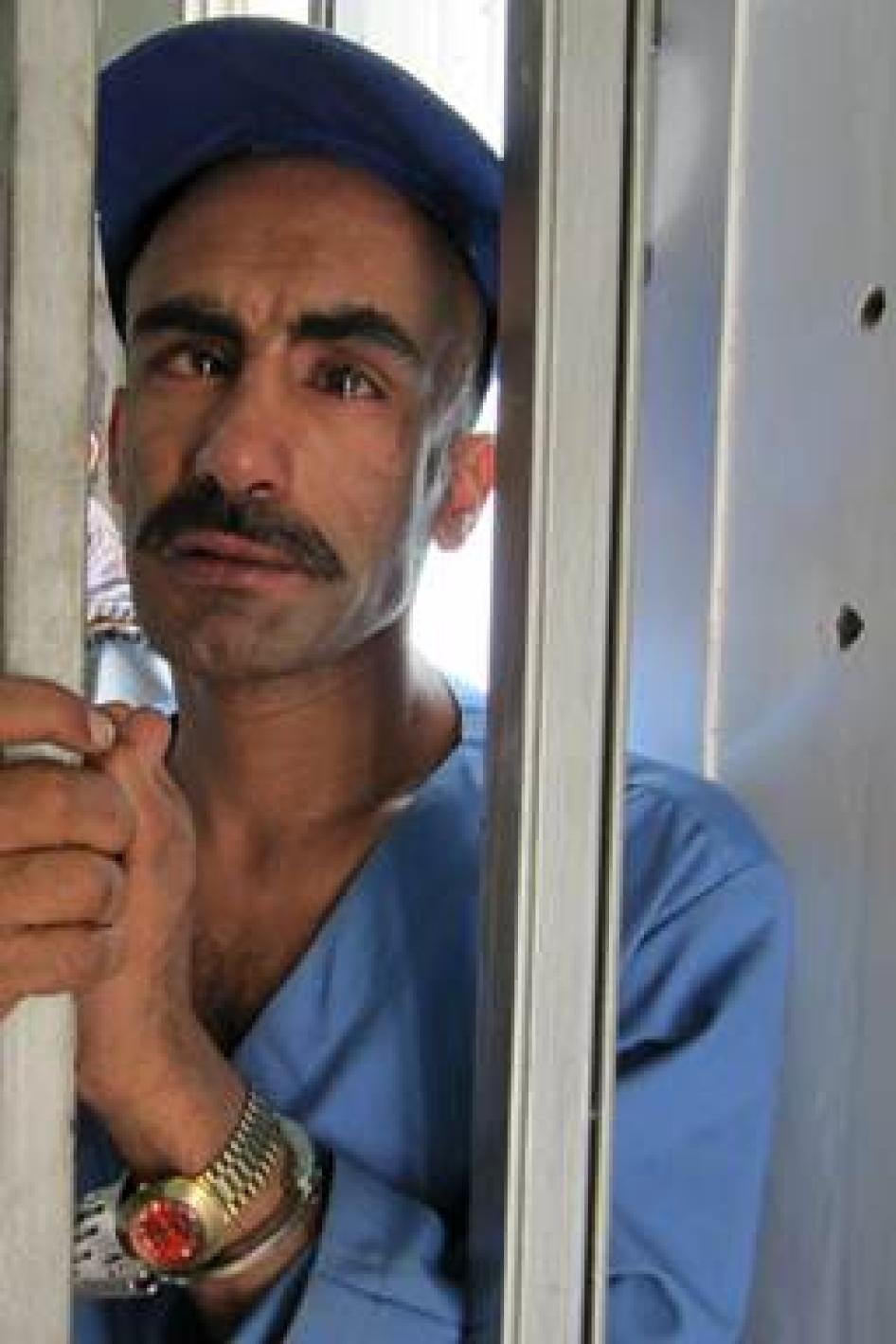
Defendant Muammar Ali al-Hout on September 29, 2012, during a hearing in Sanaa into the Friday of Dignity attack. Al-Hout says his full name is Muammar Ali Hussein al-Hout, not Muammar Nagi Ali al-Hout, the name on the indictment. © 2012 Letta Tayler/Human Right Watch
When al-Hout was brought to court weeks later for what he thought would be a sentence of 80 lashes for that incident, the judge unexpectedly returned him to jail as one of the shooters, al-Hout said. Two lawyers who are representing al-Hout without charge confirmed this version of events to Human Rights Watch. [186]
Al-Hout said he lacks identification papers to prove his identity—a common problem in Yemen:
I have never been to Change Square. I even cried in court and broke down. I was really shocked. I know it is hard to believe that a man like me is innocent because of how I look, but I swear I am a very simple guy and my only problem is drinking. I have never held a gun in my whole life.[187]
In September, a judge ruled that al-Hout could be released if he can prove his identity, but al-Hout said that he is estranged from his family and “I don’t know anybody who can come identify me.”[188]
Another jailed suspect is a detained 65-year-old garbage collector, Khaled Said Ahmad Batarfi, who prosecutors say helped set fire to the wall where the protesters were shot. In two interviews with Human Rights Watch in September 2012, the first in a prison and the second one from his courtroom cage, Batarfi was often incoherent, contradicted himself and appeared disoriented. [189]
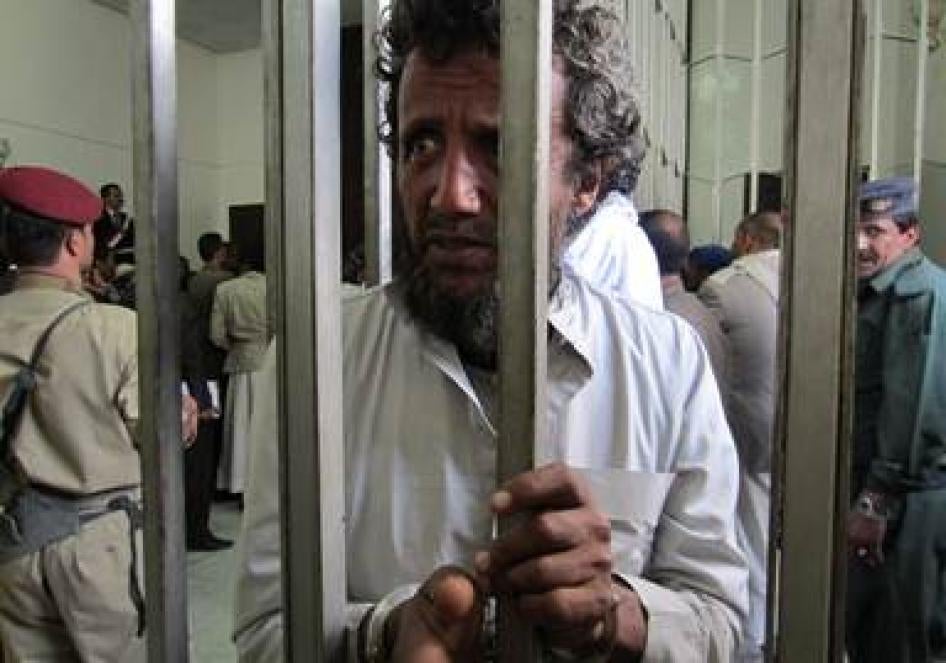
Defendant Khaled Said Ahmad Batarfi, a garbage collector, during a hearing in Sanaa on September 29, 2012, into the Friday of Dignity attack. © 2012 Letta Tayler/Human Right Watch
At this writing, Batarfi was being detained in the military prison although he had no role in the armed forces.
During the September 29 hearing, Judge Abulwali al-Shabani reminded Batarfi that he had granted him release on guarantee in July. “But I can’t find a guarantor!” Batarfi cried. He told Human Rights Watch he had no way to contact his relatives to assist him because the authorities confiscated his cellphone, glasses and identity card during his arrest and never returned them.
One suspect, driver Saleh al-Jibri, testified that neighborhood leader Aqil al-Bawni and local resident Walid Hussein Hassan al-Nimri, who is charged with shooting with intent to kill, paid him 1,000 Yemeni Rials (US$46) to drive them to obtain materials to burn tires at the wall.[190] Al-Jibri was charged as an accomplice, while al-Bawni was not charged at all.
Another detained suspect, Muhammad Ahsan Ali Zait, a 27-year-old accountant, told Human Rights Watch that protesters seized him while he stood in the doorway of a pharmacy where he worked in the Duba commercial center, one of the buildings from which gunmen shot at protesters.
Speaking from the cage in the courtroom, Zait said that he was at the pharmacy and went to the door and began filming with his camera once he heard sounds of the attack:
Protesters grabbed me and stabbed me in the back and legs and they tried to cut my throat with a jambiyya [a traditional Yemeni dagger that men commonly wear in their belts]. I was charged with firing at the protesters with an AK-47. But all I had was a camera and a laptop.[191]
Further Errors in Probe
Human Rights Watch has additional concerns about the authorities’ handling of the case:
- Several defendants were initially questioned as witnesses and subsequently received notice that they had been indicted only on the day they were charged, their lawyers said. The Yemeni legal system requires prosecutors to give suspects an opportunity to rebut charges before they are formally indicted.[192]
- Based on the written testimony that the Public Prosecution filed with the court as part of its indictment, it appears that prosecutors questioned many suspects and witnesses without verifying their identities.
- Prosecutors indicted many suspects on the basis of testimony that they carried weapons, although many men in Yemen own and use guns, including assault rifles such as Kalashnikovs.
- Defendants’ lawyers showed Human Rights Watch numerous factual errors in the indictment files, some of them substantive. Many names of witnesses or suspects are incomplete or incorrect, including the name of one of the top defendants, the Mahweet governor’s son Ghazi Ahmad Ali Mohsen al-Ahwal. Instead, the charge sheet lists a similar name that the defendants’ lawyers say is that of Ghazi al-Ahwal’s 10-year-old son.[193]
- The list of 127 wounded includes at least four people who testified that they were not wounded on that day but during other attacks on protesters. [194] Five other wounded appear to be listed at least twice but with slight variations to their names. [195]
- A motion filed by lawyers for the defendants alleging that the final page of testimony was fraudulently inserted was pending at this writing in a Sanaa appeals court.[196]
VII. Steps Toward Accountability
Yemen has an obligation under international law to investigate and appropriately prosecute serious violations of human rights. The UN Human Rights Committee, the international expert body that monitors compliance with the ICCPR, has stated that where serious rights violations have occurred, governments “must ensure that those responsible are brought to justice. As with failure to investigate, failure to bring to justice perpetrators of such violations could in and of itself give rise to a separate breach of the Covenant.”[197] While there are particular complications involved in providing accountability for the Friday of Dignity attack and other human rights violations in Yemen, legal avenues do exist for bringing those responsible to justice.
One major obstacle to prosecutions is the immunity law that Yemen’s parliament passed in January 2012 in exchange for then-President Saleh’s resignation. The law grants the former president complete immunity and all those who served with him immunity from prosecution for any crimes, except terrorist acts, committed in the course of their duties during his 33-year rule.[198] Even if the court presiding over the trial of those allegedly responsible for the Friday of Dignity attack were to order a new investigation that led to the indictment of additional government officials, these officials would likely seek to use the immunity law to challenge their prosecution.
The grant of immunity runs counter to Yemen’s obligations under international law.[199] The UN secretary-general has opposed amnesties for recognized international crimes.[200] Thus, even though the immunity law contains a clause barring appeal or annulment, the amnesty’s validity could be challenged in Yemeni courts.[201]
The UN Security Council and the UN High Commissioner for Human Rights have both called for comprehensive, independent, and impartial investigations consistent with international standards into alleged human rights violations during Yemen’s 2011 uprising, and for “all those responsible” to be held to account.[202] The UN Human Rights Council also has expressed support for such investigations and has said it will monitor Yemen’s progress in carrying them out.[203]
Indicting Ex-President Saleh and Aides
On October 13, 2012, lawyers for Friday of Dignity victims filed a motion in the First Instance Court for the Western Capital District that they described as a possible first step toward challenging Yemen’s immunity law.[204] The motion seeks the indictment of at least 11 additional defendants for the shootings, including former president Saleh and his nephew Gen. Brig. Yahya Saleh, the former CSF chief.[205]
The motion asks the court to order a new investigation, accusing the Public Prosecution of ignoring the complicity of top government officials in the attack. It also requests an immediate travel ban on the 11 officials it wants indicted.[206]
In addition to former president Saleh and Brig. Gen. Yahya Saleh, the motion seeks the indictments of Tariq Mohammed Abdullah Saleh, another of the former president‘s nephews and at the time of the attack the commander of the Presidential Guard; Maj. Gen. Abd al-Malik Tayeb, the former CSF commander; Mutahar al-Masri, the former interior minister; Abdullah Farwan, the former president of the Judicial Inspection Authority; Mahweet Governor Ahmad Ali al-Ahwal; Abd al-Rahman al-Akwaa, Saleh's brother-in-law and the former mayor of Sanaa; Ahmad Nasser, a district director in the Political Security Organization; Abd al-Rahman al-Kuhlani, a retired army officer and GPC council member; Muhammad Ahmad al-Claiba, an army officer; and the entire leadership of the CSF in Sanaa and of General Security for western Sanaa.[207]
At a trial session on November 28, Judge al-Sanabani said the motion appeared to conflict with the immunity law and sent it to the constitutional division of the Supreme Court for guidance.[208] The lead lawyer on the motion objected that those accused in the motion should first file a response.[209] As of mid-January 2013, Judge al-Sanabani had held no further proceedings in the trial and the Supreme Court had not issued a response to the motion.
International Paths to Justice
Individuals implicated in the Friday of Dignity attack could also be prosecuted in other countries or possibly by the International Criminal Court (ICC). Many countries have universal jurisdiction laws that permit prosecutions of non-nationals for crimes in violation of international law, such as torture and crimes against humanity, that took place in another country. The parliamentary grant of immunity has no legal effect outside of Yemen, as acts of a foreign legislature do not bind another sovereign state.[210]
The International Criminal Court in The Hague is a possible venue for the prosecution of Yemenis who are implicated in crimes against humanity and war crimes.[211] Yemen is not a member state of the Rome Statute, the treaty establishing the ICC.[212] However, Yemen could ratify the treaty, or accept the retroactive jurisdiction of the ICC through a formal declaration even without becoming a state party to the statute.[213]The Rome Statue also empowers the UN Security Council to refer situations to the ICC for consideration.[214]
Push for Inquiries and Compensation
In September 2012, President Hadi signed a decree authorizing the creation of a commission of inquiry to investigate human rights violations during the 2011 uprising, including the Friday of Dignity attack, and to recommend accountability measures such as prosecutions of those responsible or compensation to victims. The decree calls for the commission to be independent and impartial and adhere to international standards, and authorizes it to hold government officials in contempt for refusing to cooperate with investigations.[215]
On the eve of the first anniversary of the Friday of Dignity shootings, President Hadi had issued a separate decree ordering the creation of a compensation fund for victims of all attacks during the uprising. The fund is to disperse monthly stipends equivalent to a soldier’s pay—about 20,000 Yemeni Rials, or US$93— for those severely disabled and for families of those killed as well as medical costs at home or abroad for the severely wounded.[216]
In November 2012, the Administrative Court of First Instance in Sanaa ordered the government to immediately create the fund and begin payments.[217] But at this writing the fund still had not been created.
The government in the meantime has provided one million Yemeni Rials (US$4,672) to relatives of each person killed in the uprising, 500,000 Yemeni Rials (US$2,336) to each disabled person, and 360,000 Yemeni Rials (US$1,682) to each person requiring medical treatment, according to the Wafa Organization, which was distributing the funds. At this writing some victims were still awaiting payment. Wafa said the government gave similar sums to soldiers injured a suicide bombing in Sanaa in May 2012.[218]
If ultimately passed, a transitional justice bill stalled at this writing in Yemen’s parliament also would authorize the creation of a commission to investigate major human rights violations during 2011 and possibly as far back as 1978.[219]
These commissions and funds could provide invaluable functions of truth-finding and redress for victims—part of the range of measures set forth by the UN in its definition of “transitional justice.”[220] However, neither the commission of inquiry nor the transitional justice bill would in and of itself supersede the immunity law. As such, they should be seen as complements to rather than substitutes for prosecutions for serious crimes.
Yemen also has allowed the UN Office of the High Commissioner for Human Rights to open an office in Yemen to provide technical assistance and report back to the commissioner on the human rights situation in the country.[221] While this step could help prevent future rights violations, it is also not a substitute for prosecutions.
Fair prosecutions—whether in domestic, foreign or international proceedings—are also important for reasons beyond a state’s international legal obligations. Holding those responsible to account for serious violations of international human rights law and international humanitarian law may help restore dignity to victims by acknowledging their suffering. Prosecutions also help deter a culture of impunity that encourages future abuses.[222]
Without these steps, the changes that hundreds of Yemenis lost their lives to achieve and that the transition government has promised will remain incomplete.
Acknowledgments
This report was researched and written by Letta Tayler, senior researcher for Human Rights Watch, with research assistance from several consultants .
Joe Stork, deputy director of the Middle East and North Africa division, and Tom Porteous, deputy program director, edited the report. James Ross, Human Rights Watch’s legal and policy director, provided legal review. Balkees Jarrah, counsel for the organization’s International Justice program, reviewed the sections on international justice. Priyanka Motaparthy, a researcher in the Children’s Rights division, also provided review. Amr Khairy, Arabic translation and website coordinator with Human Rights Watch’s Middle East and North Africa division, supervised translation into Arabic. Associate Arwa Abdelmoula provided production assistance. Grace Choi, publications director; Kathy Mills, publications specialist; Anna Lopriore, creative manager; and Fitzroy Hepkins, administrative manager, prepared the report for publication. Former Human Rights Watch intern Waleed Alhariri provided invaluable fact-checking assistance.
Human Rights Watch thanks the many witnesses, wounded, relatives of victims, human rights defenders, medical workers, lawyers, Yemeni government officials, and other individuals whose accounts, insights, or other assistance made this report possible. They include Muhammad Naji Allow, Ahmad Arman, Abdulrahman Barman, Khaled al-Maweri, and Radhia Khairan of the Organization for Defending Rights and Freedoms (HOOD); Ismail al-Dailami of the Hemaya Organization for Human Rights; Muhammad al-Aroosi of the Musawah Center for Development and Human Rights; Hizam al-Moraisi; Faisal Hazza al-Majeedi; Muhammad Mehdi al-Bakoli and Muhammad Muhammad al-Maswari of the House of Law Organization; Shawqi al-Maimooni and the Wafa Organization to Support the Families of the Martyrs and Injured; Sarah Jamal Ali Ahmed; Fahd Alshohary; Abd al-Rashid al-Faqih and Radhia al-Mutawakel of the Hewar (Dialogue) Forum; and youth activist Ibrahim Mothana. Jeb Boone provided valuable details for a map of Change Square and the attack area.
[1]United Nations Development Program (UNDP), “Yemen Country Profile,” http://www.undp.org.ye/y-profile.php (accessed September 10, 2012).
[2]World Bank, “Yemen Country Brief,” http://www.worldbank.org/en/country/yemen/overview (accessed January 2, 2013).
[3] “Al-Qaeda in the Arabian Peninsula (AQAP),” backgrounder, Council on Foreign Relations, May 24, 2012, http://www.cfr.org/yemen/al-qaeda-arabian-peninsula-aqap/p9369 (accessed January 2, 2013).
[4]President Ali Abdullah Saleh’s official website, Government of Yemen, http://www.presidentsaleh.gov.ye/shownews.php?lng=en&_newsctgry=2 (accessed September 9, 2011).
[5]International Crisis Group, “Breaking Point? Yemen’s Southern Question,” October 20, 2011, http://www.crisisgroup.org/en/publication-type/media-releases/2011/mena/breaking-point-yemens-southern-question.aspx (accessed October 25, 2011), chapter 2(b).
[6]See Human Rights Watch, In the Name of Unity: The Yemeni Government's Brutal Response to Southern Movement Protests, December 2009, http://www.hrw.org/en/reports/2009/12/15/name-unity-0.
[7]See Human Rights Watch, All Quiet on the Northern Front? Uninvestigated Laws of War Violations in Yemen’s War with Huthi Rebels, April 2010, www.hrw.org/node/89290.
[8]International Crisis Group, “Popular Protest in North Africa and the Middle East (II): Yemen between Reform and Revolution,” Middle East/North Africa Report N°102, March 10, 2011, http://www.crisisgroup.org/en/regions/middle-east-north-africa/iraq-iran-gulf/yemen/102-popular-protest-in-north-africa-and-the-middle-east-II-yemen-between-reform-and-revolution.aspx (accessed January 25, 2013).
Yemen placed 164 on Transparency International’s Corruption Perceptions Index for 2011, http://www.transparency.org/cpi2011/results (accessed January 2, 2013). Among Arab countries that experienced mass protests and popular uprisings that year, only Libya ranked lower, coming in at number 168.
[9] Human Rights Watch confirmed the deaths of 270 protesters and bystanders from February through December 2011 through victims’ relatives, medical records, or both. The actual number may be significantly higher. Human Rights Watch has extensively documented the government’s use of excessive force against peaceful protesters in news releases since February 2011; see Human Rights Watch’s Yemen page: http://www.hrw.org/middle-eastn-africa/yemen. Hospital officials and dozens of witnesses also have given Human Rights Watch credible accounts of civilian deaths during fighting between armed factions since the protests began. See, for example, “Yemen: Dozens of Civilians Killed in Southern Fighting,” Human Rights Watch news release, July 9, 2011, http://www.hrw.org/news/2011/07/09/yemen-dozens-civilians-killed-southern-fighting.
[10] See, for example, No Safe Places: Yemen’s Crackdown on Protests in Taizz, Human Rights Watch, February 2012, http://www.hrw.org/node/104917/section/3.
[11]The Gulf Cooperation Council consists of Bahrain, Kuwait, Oman, Qatar, Saudi Arabia, and the United Arab Emirates.
[12]Gulf Cooperation Council Initiative to Resolve the Yemeni Crisis, version of May 21/22, 2011, copy on file with Human Rights Watch.
[13] “ Yemen: Amnesty for Saleh and Aides Unlawful,” Human Rights Watch news release, January 23, 2012, http://www.hrw.org/news/2012/01/23/yemen-amnesty-saleh-and-aides-unlawful. Copy of the law on file with Human Rights Watch.
[14] Laura Kasinof, “Yemen Gets New Leader as Struggle Ends Calmly,” The New York Times, February 24, 2012, http://www.nytimes.com/2012/02/25/world/middleeast/yemen-to-get-a-new-president-abed-rabu-mansour-hadi.html?_r=0 (accessed November 24, 2012).
[15] Implementation Mechanism for the Transition in Yemen Pursuant to the GCC Initiative, November 23, 2011, copy on file with Human Rights Watch.
[16] UN Security Council Resolution 2051 (2012), adopted June 12, 2012, https://www.un.org/News/Press/docs/2012/sc10671.doc.htm (accessed November 24, 2012).
[17]“Yemen general may head new unit after army overhaul,” Reuters, December 23, 2012, http://www.reuters.com/article/2012/12/23/us-yemen-military-idUSBRE8BM07E20121223 (accessed January 25, 2013)..
[18]Ibid. Also Human Rights Watch interview with Yemeni government official, December 20, 2012.
[19] See, for example, the Human Rights Watch news releases “Yemen: Don't Use Stun Guns on Peaceful Protesters,” February 13, 2011, http://www.hrw.org/news/2011/02/13/yemen-dont-use-stun-guns-peaceful-protesters, and “Yemen: Crackdowns on Protesters Continue,” February 12, 2011, http://www.hrw.org/news/2011/02/12/yemen-crackdowns-protesters-continue.
[20] Human Rights Watch news releases “Yemen: Pro-Government Forces Attack Demonstrators,” February 12, 2011, http://www.hrw.org/news/2011/02/11/yemen-pro-government-forces-attack-demonstrators, “Yemen: End Deadly Attacks on Protesters,” February 19, 2011, http://www.hrw.org/news/2011/02/18/yemen-end-deadly-attacks-protesters, and “Yemen: Protect Protesters From Attacks by Armed Groups,” February 23, 2011, http://www.hrw.org/news/2011/02/23/yemen-protect-protesters-attacks-armed-groups.
[21] See, for example, Haley Sweetland Edwards, “Among the Thugs of Yemen,” The Atlantic, February 22, 2011, http://www.theatlantic.com/international/archive/2011/02/among-the-thugs-of-yemen/71537/ (accessed November 22, 2012). The encampment for Saleh supporters at Sanaa’s Tahrir (“Freedom”) Square remains active at this writing.
[22]See Background chapter, above.
[23]“Yemen: End Deadly Attacks on Protesters,” Human Rights Watch news release, February 19, 2011, http://www.hrw.org/news/2011/02/18/yemen-end-deadly-attacks-protesters.
[24] “ Yemen Protests: 20,000 Call for President Saleh To Go,"BBC News, January 29, 2011. http://www.bbc.co.uk/news/world-middle-east-12353479 (accessed November 21, 2012).
[25] Testimony of Nasr al-Bawni, March 24, 2011, Interrogation File for Case No. 88 for the Year 2011 (“Prosecution Interrogation File”), First Instance Criminal Court for the Western Capital District, Registered as No. 454 for the Year 2011, Office of the Specialized Appellate Criminal Prosecution for the North of the Capital, June 29, 2011, p. 303. Copy on file with Human Rights Watch.
[26] “Armed men concentrated on rooftops,” NewsYemen, March 11, 2011, re-published in Soutalgnoub.com, http://www.soutalgnoub.com/vb2/showthread.php?t=40948 (accessed September 20, 2012).
[27] Ibid.
[28] Human Rights Watch telephone interview from New York to Washington, DC, with Laura Kasinof, August 2, 2012.
[29] "New constitution promised for Yemen,"Al Jazeera Online, March 10, 2011, http://english.aljazeera.net/news/middleeast/2011/03/201131073622898186.html (accessed March 10, 2011).
[30] “Yemen protests swell on ‘Friday of no return,’ ” Alarabiya.net, March 11, 2011,
http://www.alarabiya.net/articles/2011/03/11/141114.html (accessed March 11, 2011).
[31] “Yemen: Suspend Aid after Attacks on Protesters,” Human Rights Watch news release, March 12, 2011 http://www.hrw.org/news/2011/03/12/yemen-suspend-aid-after-attacks-protesters.
[32] Alan Evans, “Yemen Police Kill Protesters in Crackdown on Dissent,” The Guardian, March 12, 2011, http://www.guardian.co.uk/world/2011/mar/12/yemen-police-kill-protesters-crackdown (accessed November 20, 2012). “Yemen: Suspend Aid After Attacks on Protesters ,” Human Rights Watch news release, March 12, 2011 http://www.hrw.org/news/2011/03/12/yemen-suspend-aid-after-attacks-protesters.
[33] Video report: Yemeni police storm protest camp, March 12, 2011, Reuters, http://www.youtube.com/watch?v=ug9LYSnoe_o&feature=related (accessed March 12, 2011).
[34] See, e.g., “ Statements of the sons of the university district,” YemenTV Online, March 12, 2011, Part 14 (Arabic),
http://www.youtube.com/watch?v=69qebztAUvo (accessed August 3, 2012).
[35] The incident was reported on Yemeni blogs and media and also was captured by a citizen journalist on video. See “Saleh’s Security Thugs (Snipers) Fire at Peaceful Protesters from Roof,” http://www.youtube.com/watch?v=GTfVQrBemkA (accessed August 3, 2012).
[36] See, e.g., blog post (Arabic) by citizen journalists with Ahrar lil Tagheer youth coalition, http://ahrar-tagheer.blogspot.com/2011/03/blog-post_9991.html.
[37] Testimony of Aqil al-Bawni, March 26, 2011, Prosecution Interrogation File, pp. 309-10. Neighorhoods in Yemeni cities are governed by a zone leader known as an “aqil al-harah.” Under President Saleh, the zone leaders routinely were members of Saleh’s GPC party and, according to residents, often acted as undercover security agents.
[38] Ibid.
[39] Ibid.
[40] Ibid.
[41] Ibid.
[42] “Al-Baidani” means “the person from al-Baida,” another governorate in Yemen.
[43] Testimony of Yahya Abdullah al-Amrani, March 19, 2011, Prosecution Interrogation File, p. 13.
[44] Testimony of Muhammad al-Sanabani, March 19, 2011, Prosecution Interrogation File, p. 1.
[45] Ibid., p. 4.
[46]Multiple witness testimonies and video footage. See also List of the Evidence for Case No. 88 for the Year 2011 (“Prosecution List of Evidence”), First Instance Criminal Court for the Western Capital District, Registered as No. 454 for the Year 2011, Office of Specialized Appellate Criminal Prosecution for the North of the Capital, June 29, 2011. Copy on file with Human Rights Watch.
[47] “Yemen expels 4 Western journalists,” Los Angeles Times, March 15, 2012, The three reporters and one photographer were working for publications including Time magazine, the Los Angeles Times, The Wall Street Journal and the Times of London. http://articles.latimes.com/2011/mar/15/world/la-fg-yemen-detention-20110315.
[48] “Yemen: Security Forces, Gangs Attack reporters,” Human Rights Watch news release, February 26, 2011, http://www.hrw.org/news/2011/02/26/yemen-security-forces-gangs-attack-reporters.
[49] “Resignation of a minister and the joining of tribesmen to the protest movement,” Aljazeera (Arabic), March 15, 2012, http://www.aljazeera.net/news/pages/e6461883-a956-4feb-b415-885b6ebd1045 .
[50] Days of Bloodshed in Aden, Human Rights Watch, March 2011, www.hrw.org/reports/2011/03/09/days-bloodshed-aden-0.
[51] Mohamed Sudam and Mohammed Ghobari, “Clashes in Yemen protest wound at least 150,” Reuters, March 16, 2011, http://www.ccun.org/News/2011/March/16%20n/Clashes%20in%20Yemen%20protest%20wound%20at%20least%20150,%20March%2016,%202011.htm (accessed November 21, 2012).
[52] Human Rights Watch interview with witnesses including Suhail TV reporter Khaled Raja, Sanaa, March 22, 2012.
[53]President Saleh did not describe what laws were suspended during the 30-day state of emergency, which he did not renew. See news conference aired on Yemen TV with then-minister of interior Mutahar al-Masri, March 18, 2011 (Arabic), http://www.youtube.com/watch?v=ARoXehecSMU. See also “President announces state of emergency, ban on carrying arms,” Saba Net, March 18, 2011, http://www.sabanews.net/en/news237944.htm (accessed November 12, 2012).
[54] Ibid. See also the interview with former President Saleh on al-Arabiya TV, March 26, 2011, http://www.alarabiya.net/programs/2011/03/27/143142.html.
[55] Prosecution List of Evidence, p. 32.
[56] Testimony of Abdu Rabu Ahmad al-Roqabi, April 18, 2011, Prosecution Interrogation File, p. 592.
[57] Testimony of Abdullah Muhammad al-Judubi, March 23, 2011, Prosecution Interrogation File, pp. 249-50.
[58] See, e.g., testimony of Arif Kabbas, May 23, 2011, Prosecution Interrogation File, p. 769.
[59] Testimony of Aqil al-Bawni, March 26, 2011, Prosecution Interrogation File, p. 312.
[60]Decision of Charges (“Charge Sheet”), Case No. 88 for the year 2011, First Instance Criminal Court for the Western Capital District, Registered as No. 454 for the Year 2011, Office of Specialized Appellate Criminal Prosecution for the North of the Capital, June 29, 2011, p. 2.
[61] Testimony of Nasr al-Bawni, April 3, 2011, Prosecution Interrogation File, p. 303.
[62] See “Deadly crackdown in Yemen,” Aljazeera news video, March 18, 2011, http://www.youtube.com/watch?v=wtzFSUIbX1M&feature=related, at 0:32 seconds, as well as a witness video http://www.youtube.com/watch?v=ZVJmEhQCYe0&feature=related, 1:08 minutes (both videos accessed August 3, 2012).Multiple witnesses also described the helicopter to Human Rights Watch.
[63] Transition President Hadi fired General Mohammed Saleh al-Ahmarr during an attempted military restructuring in April 2012 but the commander resisted removal for weeks; in April air force officers seized Yemen's main airport for a day to protest his dismissal. See Mohammed Ghobari, “Air Force Officers Ground Flights at Sanaa Airport,” April 7, 2012, http://www.reuters.com/article/2012/04/07/us-yemen-airport-idUSBRE83606020120407 (accessed August 3, 2012).
[64]Human Rights Watch telephone interview with Kasinof, August 2, 2012.
[65] Human Rights Watch interview with Khaled Raja, Sanaa, March 22, 2012.
[66] Ibid.
[67] Testimony of Abd al-Karim Saleh Awadh al-Yafii, March 23, 2011, Prosecution Interrogation File, pp. 252-53.
[68] Karama Has No Walls, short documentary, directed by Sara Ishaq, 2012.
[69] The use of the governor’s house is noted throughout the Case Description Document Review Report (“Prosecution Case Description”), Office of Specialized Appellate Criminal Prosecution for the North of the Capital, pp. 1-10, June 29, 2011. Copy on file with Human Rights Watch. See also testimony of Nayef Ali Saleh al-Thabi, March 20, 2011, Prosecution Interrogation File, p. 32.
[70] Testimony of Ali Ismail Mohammed al-Mutawakel, March 23, 2011, Prosecution Interrogation File, p. 333.
[71] Testimony of Abd al-Karim al-Yafii, March 23, 2011, Prosecution Interrogation File, p. 254.
[72]Testimony of Walid Hussein Hassan al-Nimri, April 4, 2011, Prosecution Interrogation File, p. 506. The Prosecution List of Evidence describes the gunmen as gangs called Khaled Shawter, Saleh al-Marani and al-Qaa. Prosecution List of Evidence, p. 32.
[73] Prosecution List of Evidence, p. 32.
[74] Testimony of Abd al-Wahab Rashid, June 6, 2011, Prosecution Interrogation File, p. 825.
[75] Human Rights Watch interview with Raja, Sanaa, March 22, 2012. The slogan “The people want the downfall of the regime” ( الشعب يريد إسقاط النظام ) became a rallying cry for the protests across the Middle East and North Africa in 2011.
[76] Human Rights Watch interview with Abd al-Rashid al-Faqih, Sanaa, March 31, 2012.
[77]Ibid.
[78] Human Rights Watch interview with Khahil Qaed Muhammad al-Mulaiki, Sanaa, March 22, 2012.
[79] Human Rights Watch interview with Salim al-Aulaqi, Sanaa, March 24 , 2012.
[80]Page 4 of the prosecution Charge Sheet lists 43 dead based on the number of forensic examinations before burial. Lawyers for the dead say 52 people died.
[81]Human Rights Watch interviews with Mutahar al-Mokhtar of the Wafa Organization to Support the Families of the Martyrs and Injured, Sanaa, December 22, 2012, and Wala’a al-Guneid, a medic at the Change Square field hospital, June 14, 2012, among others.
[82] Human Rights Watch interview, Sanaa, June 14, 2012. The nurse requested that she be identified only as Um Hashim.
[83] Human Rights Watch interview with Tom Finn, New York, August 31, 2012.
[84] Human Rights Watch interview with Ibrahim Murfaq, Sanaa, June 14, 2012. Seriously wounded protesters were later transferred to local hospitals.
[85]See, e.g., testimony of Muhammad Saif Far’i al-Khilaidi, Prosecution List of Evidence, p. 19, and Musa Muhammad Ahmad Hassan al-Hamadi, Prosecution Interrogation File, p. 431.
[86] Human Rights Watch interview with Sami al-Soofi, March 31, 2012.
[87] Human Rights Watch interview with al-Faqih, March 31, 2012.
[88] HRW interview with Muhammad al-Sanabani from a courtroom where he was caged as a defendant, Sanaa , September 29, 2012.
[89] Tom Finn, “Yemen president fires entire cabinet as protests escalate,” The Guardian, March 20, 2011, http://www.guardian.co.uk/world/2011/mar/20/yemen-funeral-protesters (accessed November 23, 2012).
[90] Human Rights Watch interview with Muhammad Mehdi al-Bakoli, president of the House of Law Organization, Sanaa, April 2, 2012. OHL represents several defendants linked to former president Saleh in other cases. Many lawyers for the victims’ families and the Change Square legal committee are in turn affiliated with the opposition Islah party.
[91] Human Rights Watch interviews with attack victims’ attorneys, Sanaa, June 23 and September 25, 2012.
[92] On April 6, 2011, for example, Abd al-Raqib al-Hamiri, a prosecutor in the case, issued a memo listing 14 detained suspects. His memo is attached to the news report “The FAD publishes names of suspects in the murder of worshipers in Change Square in Sanaa,” Ekhbariya.net, March 19, 2012, http://www.ekhbariyah.com/local-yemen/articles27431.html (accessed September 8, 2012). See also “First Armored Division: We received orders from the attorney general to hand over the suspects to the Public Prosecution Office,” Mareb Press, March 19, 2011, http://marebpress.net/news_details.php?lng=arabic&sid=41710.
[93] Finn, “Yemen president fires entire cabinet as protests escalate,” The Guardian, March 20, 2011, http://www.guardian.co.uk/world/2011/mar/20/yemen-funeral-protesters.
[94] Muhammad Muhammad al-Maswari, secretary-general of the OHL, repeated the allegations November 10, 2012, on the talk show (“We Disagree and Agree”) on Yemen Today, a TV channel owned by former president Saleh’s son Ahmad Ali Saleh, the commander of the Republican Guard. Faisal Hazza al-Majeedi, another lawyer for the victims who appeared with al-Maswari on “Nakhtalif Wa Natafiq,” labeled the accusations “baseless” and “absolute nonsense.” “Nakhtalif Wa Natafiq,” Yemen Today TV channel, November 10, 2012.
[95] Testimony of Mohammed Abdullah Hassan Daba’a, March 19, 2011, Prosecution Interrogation File, p. 7.Another witness testified that a member of the al-Ahwal family whom he named as Ahmad al-Ahwal—the name of the governor—escaped by car from the al-Alwal house near the shootings. However, in the same testimony the witness made clear references to the governor’s son Ali Ahmad al-Ahwal—describing him as a man in his 30s and as the Central Intelligence Division chief—using the name of the governor, making it uncertain if he was referring to the father or the son. See testimony of Abdu Rabu Ahmad al-Roqabi, Prosecution Interrogation File, p. 592.
[96] Human Rights Watch interview with Attorney General Ali Ahmad Nasser al-Awash, Sanaa, March 29, 2012.
[97] Human Rights Watch interview with General Ali Mohsen al-Ahmar, Sanaa, March 28, 2012.
[98] “Top Yemeni general, Ali Mohsen, backs opposition,” BBC News, March 21, 2011, http://www.bbc.co.uk/news/world-middle-east-12804552.
[99] Human Rights Watch interviews with 10 Yemeni political analysts and Western diplomats, Sanaa, February-March 2012 and September-October 2012.
[100] President Saleh’s news conference with Minister of Interior Mutahar al-Masri on Yemen TV, March 18, 2011 (Arabic), http://www.youtube.com/watch?v=ARoXehecSMU. See also “President announces state of emergency, ban on carrying arms,” Saba Net, March 18, 2011, http://www.sabanews.net/en/news237944.htm (accessed November 12, 2012)
[101] “Yemen: Emergency Law Does Not Trump Basic Rights,” Human Rights Watch news release, March 23, 2011, http://www.hrw.org/news/2011/03/23/yemen-emergency-law-does-not-trump-basic-rights.
[102]Ambassador Abdullah M. Alsaidi, the permanent representative of Yemen to the United Nations, resigned two days after the shootings. See “Ambassador Abdullah M. Alsaidi Joins IPI,” International Peace Institute news release, March 30, 2011, http://www.ipacademy.org/news/general-announcement/225-ambassador-abdullah-m-alsaidi-joins-ipi.html (accessed January 18, 2013) See also.“Top Yemeni general, Ali Mohsen, backs opposition,” BBC News, March 21, 2011, http://www.bbc.co.uk/news/world-middle-east-12804552.
[103]“Top Yemeni general, Ali Mohsen, backs opposition,” BBC News, March 21, 2011.
The al-Ahmars are one of Yemen’s most powerful families. Sadiq al-Ahmar’s brother Hamid al-Ahmar, a businessman and key member of the opposition Islah Party, had supported the uprising from the start.
[104] Finn, “Yemen president fires entire cabinet as protests escalate,” The Guardian, March 20, 2011, http://www.guardian.co.uk/world/2011/mar/20/yemen-funeral-protesters (accessed November 23, 2012).
[105] Committee to Protect Journalists, Journalists Killed: Yemen, Jamal al-Sharaabi, March 18, 2011, http://cpj.org/killed/2011/jamal-al-sharaabi.php (accessed November 20, 2012). Al-Sharaabi, who was shot in the face, was a well-known journalist with the opposition newspaper al-Masdar.
[106]Human Rights Watch interview with Mutahar al-Mokhtar of the Wafa Organization to Support the Families of the Martyrs and Injured, Sanaa, December 22, 2012.
[107] Human Rights Watch interview with lawyers including Shawqi al-Maimooni, Sanaa, September 25 and December 9, 2012.
[108] Human Rights Watch interview with Zainab Ahmad Muhammad Saleh, Sanaa, April 1, 2012.
[109] Ibid.
[110] Human Rights watch interview with Muhammad al-Shurmani, Sanaa, April 1, 2012.
[111] Human Rights Watch interview with Zainab Ahmad Muhammad Saleh, April 1, 2012.
[112] Human Rights Watch interview with Abdul al-Maeti, Sanaa, September 29, 2012.
[113] Ibid.
[114] Human Rights Watch interview with Salim al-Harazi, Sanaa, October 1, 2012.
[115] Iona Craig, “No More Tears,” blog posting, August 25, 2012, http://ionacraig.tumblr.com/.
[116] Human Rights Watch interview with al-Harazi, October 1, 2012.
[117] Human Rights Watch interview with Jabir Saad Ali Jabir al-Mandaliq , Sanaa, October 1, 2012.
[118] Ibid.
[119] A 1980 presidential order established Central Security (al-Amn al-Markazi), tasking the agency with responsibilities ranging from ensuring the safety of property and persons to border patrolling and counterterrorism. Central Security has been implicated in using excessive force against largely peaceful protesters in various parts of Yemen including Sanaa and Aden, as well as against members of the Southern Movement, a broad coalition of groups seeking greater autonomy for the former republic of South Yemen. Central Security includes a Counter-Terrorism Unit that has been funded and trained by the US. See Congressional Research Service, “Yemen: Background and U.S. Relations,” November 1, 2012, www.fas.org/sgp/crs/mideast/RL34170.pdf (accessed November 15, 2012) , p. 14.
[120] News conference aired on Yemen TV with then-president Saleh, March 18, 2011, http://www.youtube.com/watch?v=gJ2lqQzUG_E,. See also Laura Kasinof and Robert F. Worth, “Dozens of Protesters are Killed in Yemen,” The New York Times, http://www.nytimes.com/2011/03/19/world/middleeast/19yemen.html?pagewanted=all (both accessed August 2, 2012).
[121] International Covenant on Civil and Political Rights (ICCPR), adopted December 16, 1966, G.A. Res. 2200A (XXI), 21 U.N. GAOR Supp. (No. 16) at 52, U.N. Doc. A/6316 (1966), 999 U.N.T.S. 171, entered into force March 23, 1976, arts. 6 and 21, http://www2.ohchr.org/english/law/ccpr.htm (accessed November 16, 2012).
Regarding peaceful assembly, Article 21 states that: “No restrictions may be placed on the exercise of this right other than those imposed in conformity with the law and which are necessary in a democratic society in the interests of national security or public safety, public order (ordre publique), the protection of public health or morals or the protection of the rights and freedoms of others.” http://www2.ohchr.org/english/law/ccpr.htm (accessed November 16, 2012).
[122]Human Rights Committee, General Comment 31, Nature of the General Legal Obligation on States Parties to the Covenant, U.N. Doc. CCPR/C/21/Rev.1/Add.13 (2004), para. 8.
[123]Basic Principles on the Use of Force and Firearms by Law Enforcement Officials, adopted by the Eighth United Nations Congress on the Prevention of Crime and the Treatment of Offenders, Havana, 27 August to 7 September 1990, U.N. Doc. A/CONF.144/28/Rev.1 at 112 (1990), http://www2.ohchr.org/english/law/codeofconduct.htm (accessed November 16, 2012), principle 4.
[124]Ibid., principle 5(a).
[125]Ibid., principles 12-14.
[126] Ibid., principle 9.
[127] Ibid., principle 2.
[128] Ibid., principle 1.
[129] Republican Decision of Law 29 for the Year 2003, Regarding the Organization of Demonstration sand Marches, arts. 6, 8 and 9.
[130] Speech by Brig. Gen. Yahya Saleh at a conference broadcasted by Nabanews, March 17, 2011. http://www.youtube.com/watch?v=wax_fo4OWoU&feature=related. Brigadier General Saleh was at the time of the attack the chief of staff of the CSF and its de-facto commander. President Hadi appointed a more assertive CSF commander, Major General Fadhl al-Qawsi on May 21, 2012, and removed Gen. Saleh from the CSF in December 2012.
[131] Testimony of Abd al-Rahman Hanash, March 31, 2011, Prosecution Interrogation File, pp. 463-464.
[132] Testimony of Abd al-Rahman Shaiban, April 3, 2011, Prosecution Interrogation File, p. 486.
[133] Testimony of Abd al-Rahman Hanash, March 31, 2011, Prosecution Interrogation File, p. 464.
[134] Testimony of Walid Hussein al-Nimri, Prosecution Interrogation File, p. 510.
[135] Testimony of CSF Staff Gen. Abd al-Azim Ahmad Saleh al-Haimi, March 29, 2011, Prosecution Interrogation File, p. 419.
[136] Testimony of Walid Hussein Hussein al-Nimri, Prosecution Interrogation File, p. 506.
[137] The forces included members of the al-Sai’qah (“Thunderbolt”) rapid response unit, so named for their yellow uniforms.
[138] Testimony of Mohammed Hizam al-Radai Prosecution Interrogation File, pp. 488-489.
[139] Karama Has No Walls. The footage used in the documentary was shot by two Suhail TV cameramen including Raja.
[140] Human Rights Watch interview with al-Faqih, March 31, 2012.
[141] Human Rights Watch interview with Salim al-Aulaqi, Sanaa, March 24, 2012.
[142] Testimony of Yasser Muhammad Moqbil Esa, Prosecution Interrogation File, p. 85. Al-Mutawakel, the carpenter who worked at a store near the wall, testified that he also saw the security forces fail to stop a shooter who would “stand near the security personnel then would go to the front, shoot in the direction of protesters and return to the back:” Prosecution Interrogation File, p. 333.
[143] Human Rights Watch interview with Yusif Muhammad Mohsen, Sanaa, June 14, 2012. Protesters and Yemeni human rights defenders have made repeated allegations to Human Rights Watch of security forces using sewage in water cannons fired at protests during the 2011 uprising. See also UN Office of the High Commissioner on Human Rights, Report of the High Commissioner on OHCHR’s visit to Yemen, A/HRC/ 18/21, September 13, 2011, http://www.unhcr.org/refworld/category,COI,OHCHR,,,4e76ecdb2,0.html (accessed September 8, 2012), p. 7.
[144] Human Rights Watch interview with Jabir Saad Ali Jabir al-Mandaliq, Sanaa, October 1, 2012.
[145] Human Rights Watch interview with Kasinof, August 2, 2012.
[146] Testimony of Muhammad Badr, March 26, 2011,Prosecution Interrogation File, p. 362.
[147] Ibid.
[148] Ibid.
[149] Jeb Boone, “Bloodbath in Yemen as snipers target protesters,” The Independent,
March 19, 2011, http://www.independent.co.uk/news/world/middle-east/bloodbath-in-yemen-as-snipers-target-protesters-2246335.html?afid=af (accessed August 2, 2012).
[150] Testimony of Abdulrahman Shaiban, Prosecution Interrogation File, April 3, 2011, p. 486.
[151] Testimony of Hanash, Prosecution Interrogation File, March 31, 2011, p. 465.
[152] Ibid.
[153] Human Rights Watch interview with Brig. Gen. Yahya Saleh, Sanaa, March 25, 2012.
[154] Human Rights Watch interviews with victims’ lawyers including al-Aroosi, Sanaa, June 23 and June 25, 2012.
[155] Ibid.
[156] Ibid. .
[157] “Law for Transitional Justice, Call for National Reconciliation,” 26 September News, March 29, 2012, copy on file with Human Rights Watch.
[158] Human Rights Watch interview with Attorney General al-Awash, March 29, 2012.
[159] Ibid.
[160] Human Rights Watch interview with General al-Ahmar, Sanaa, March 30 , 2012.
[161] Human Rights Watch interview with Attorney General al-Awash, March 29, 2012.
[162]The Specialized Media Court on May 14, 2012 issued a verdict that the document was fake on May 14, 2012, according to a statement from the OHL lawyers in the Friday of Dignity case. The court has a record of political decision-making but Human Rights Watch did not monitor the proceedings in the case of this memo and cannot comment on the ruling.
[163]Request to Address the Court to File Criminal Charges against Those Not Covered by the Indictment, according to article (32) a. c. (“Motion for Additional Indictments”), submitted October 13, 2012, to Motion for Additional Indictments, p. 27. The opposition newspaper Mareb Press had published the memo in April 2011 but issued a retraction and an apology the following month, saying the Interior Ministry had provided it with an official, unrelated document bearing the same identification number as al-Masri’s alleged memo, but dated March 11, 2011. See “Interior denies the validity of the note . . . and confirms it was a forgery” (Arabic), Marebpress.net, May 5, 2011, http://marebpress.net/news_details.php?sid=33640&lng=arabic (accessed November 24, 2012).
[164] “Attorney General directs to investigate citizens' claims,” Saba News Agency, February 24, 2011, http://www.sabanews.net/en/print236492.htm (accessed July 15, 2012).
[165] “Attorney General denies media broadcast about him,” al-Tagheer. com news website, March 23, 2011. http://www.al-tagheer.com/news.php?id=28032 (accessed November 23, 2012).
[166] A copy of the memo is on file with Human Rights Watch. See also http://damtpress.net/portal/index.php/local-news/34-local-news/2359-2012-04-07-22-02-51 (accessed September 8, 2012).
[167] Ibid.
[168] Email to Human Rights Watch from Yemen government spokesman, September 22, 2012.
[169] “Attorney General announced that Emergency Law is Unconstitutional,” al-Masdar(Arabic), April 3, 2011. http://www.almasdaronline.com/index.php/print.php?news_id=18132 (accessed January 25, 2013).
[170] Human Rights Watch interview with lawyer Muhammad al-Aroosi. Sanaa, June 25, 2012. See also “Attorney General Threatens to Resign if Friday of Dignity Perpetrators are not arrested,” Akhbar al-Yom (Arabic), April 13, 2011, http://www.akhbaralyom.net/news_details.php?lng=arabic&sid=38521, and “YemenAttorney General Fired Before Completion of Probes about Al Karama Friday,” Yemen Post, March 19, 2012, http://www.yemenpost.net/Detail123456789.aspx?ID=3&SubID=4934 (accessed December7, 2012).
[171] Presidential decree No. 17 of April 28, 2011. The firing was reported on media including Al Jazeera TV, http://www.youtube.com/watch?v=3iIpwZiRiqE.
[172] Human Rights Watch telephone interview from New York to Sanaa with al-Bakoli and al-Maswari, August 24, 2012.
[173] Human Rights Watch interview with Elham Sharaf Abu Taleb, Sanaa, September 2, 2012.
[174] Ibid.
[175] “Prosecuting an infamous murder,” Yemen Times,September 10, 2012, http://yementimes.com/en/1606/report/1376/Prosecuting-an-infamous-murder.htm (accessed September 10, 2012).
[176] Victims’ lawyers noted the exclusion of witnesses in theirMotion for Additional Indictments of October 13, 2012, asking the judge to order the Public Prosecution to reopen the investigation.
[177]Prosecution Decision to Temporarily Dismiss Charges for Insufficient Evidence/Lack of Identification Verification (“Decision to Dismiss”), Case no. 88, 2011, First Instance Court for the Western Capital District, registry No. 454 for the year 2011, document of the Court of Appeals of Northern Sanaa, June 29, 2011.
[178] Hamdan al-Aliyee, “Ahmad al-Ahwal, Governor with no legitimacy?” Mareb Press, April 16, 2012, http://marebpress.net/articles.php?print=15124 (accessed November 23, 2012).
[179] Human Rights Watch interview with attorney Muhammad Mehdi al-Bakoli, Sanaa, April 1, 2012.
[180] Testimony of Abd al-Wahab Rashid, June 6, 2011, Prosecution Interrogation File,p.825.
[181]As of January 2013, eight defendants were jailed in Sanaa. The maximum number of known detained defendants was 14; six were subsequently freed on guarantee pending a verdict.
[182]ICCPR, art. 14(3). See Amnesty International, Fair Trials Manual, 1998, p. 110.
[183] International law encourages defendants to be released pending trial except where there is a likelihood that the defendant will abscond, destroy evidence or influence witnesses. See ICCPR, art. 9(3) (“It shall not be the general rule that persons awaiting trial shall be detained in custody, but release may be subject to guarantees to appear for trial.”); see also, Human Rights Committee, General Comment No. 8, Right to Liberty Security of the Person; Human Rights Committee, Hill v. Spain, No. 526/1993, sec. 12.3.
[184] Human Rights Watch attended the trial sessions through November 28, 2012, the last proceeding before this report was published.
[185] Human Rights Watch interview with Muammar Ali al-Hout, Sanaa, September 2, 2012.
[186] Human Rights Watch telephone interviews with al-Bakoli and al-Maswari, August 24, 2012.
[187] Human Rights Watch interview with al-Hout, September 2, 2012.
[188]Ibid.
[189] Human Rights Watch interviews with Khaled Said Ahmad Batarfi, Sanaa, September 2 and September 29, 2012.
[190] Testimony of Saleh Abdullah Saleh al-Jibri, March 30, 2011, Prosecution Interrogation File, p. 443.
[191] Human Rights Watch interview with Muhammad Ahsan Ali Zait, Sanaa, September 29, 2012.
[192] Human Rights Watch telephone interviews with OHL lawyers al-Bakoli and al-Maswari, August 24, 2012.
[193] Charge sheet, p. 1.
[194] Testimony, Prosecution Interrogation File, of Abd al-Ghani Hamid Ahmad al-Adeeb, p. 93; Fawaz Muhammad Hassan al-Fath, March 22, 2011, p. 199; Haneen Ali Muhammad Saleh Abu Ras, March 22, 2011, p. 201; Alaa Abu Bakr Haider Hassan al-Barwi, March 19, 2011, p. 163;. The prosecution listed all four as among the 127 wounded; see Decision to Dismiss, pp. 3-5.
[195] The prosecution lists Muhammad Alawi al-Asfar as wounded nos. 12 and 24;Muhammad Yahya Kahla as wounded nos. 18 and 110;Yasir Khalil Abdullah Mukred as wounded nos. 31 and 103; Wael al-Qulaisi as wounded nos. 34 and 100; and Fawaz Qaid al-Wasabi as wounded nos. 39 and 105, with slight variations of their names. Decision to Dismiss, pp. 3-4.
[196]Court of The Western Capital District, Fraud Complaint in Case No. 454 for the year 2011.Copy on file with Human Rights Watch.
[197] Human Rights Committee, General Comment No. 31, The Nature of the General Legal Obligation Imposed on States Parties to the Covenant, adopted on March 29, 2004, para. 18.
[198] “Yemen grants Saleh immunity to try to end crisis,” Reuters, January 21, 2012, http://www.reuters.com/article/2012/01/21/us-yemen-idUSTRE80K0B120120121?feedType=RSS&feedName=topNews&rpc=71 (accessed November 24, 2012).
[199]The trend in international law is that state amnesty provisions must be considered void if they attempt to amnesty serious crimes in violation of international law, because such provisions are contrary to states’ obligations to combat impunity for serious violations of international human rights and humanitarian law. Many precedents were set in Latin America. For example, the Inter-American Court of Human Rights has held that Peru’s blanket amnesty law, which discouraged investigations and denied any remedies to victims, was invalid. See Inter-American Court, Barrios Altos Case, judgment of March 14, 2001, Inter-Am. Ct. H.R., (Ser. C) No. 75 (2001), paras. 41-44. The Inter-American Court also held that Brazil’s amnesty law is “incompatible with the American Convention [on Human Rights] and void of any legal effects.” See Inter-American Court, Gomes-Lund et al. (Guerrilha do Araguaia) v. Brazil, November 24, 2010,http://www.unhcr.org/refworld/docid/4d469fa92.html. Similarly, the Inter-American Commission on Human Rights has found that amnesty laws in Chile and Argentina do not satisfy a state’s duty to prosecute and are incompatible with the American Convention on Human Rights. See Inter-American Court, Garay Hermosilla Case, Case 10. 843, Report No. 36/96, Inter Am.Ct.H.R.,OEA/Ser.L/V/II.95 Doc. 7 rev. at 156 (1997), October 15, 1996, http://www.unhcr.org/refworld/docid/3ae6b71a4.html; Inter- American Court, Case Nos. 10.147, 10.181, 10.240, 10.262, 10.309, 10.311, Report No. 28/92, Inter-Am.C.H.R., OEA/Ser.L/V/II.83 Doc. 14 at 41 (1993), October 2, 1992, http://www.unhcr.org/refworld/docid/3ae6b6d434.html (all accessed December 30, 2011). Article 4 of Yemen’s immunity law of 2012 bars appeal or annulment.
[200]The UN’s Rule-Of-Law Tools for Post-Conflict States state that “United Nations staff, whether in Headquarters or in field operations, may never condone amnesties that international law and United Nations policy unite in condemning.” See Office of The United Nations High Commissioner for Human Rights, “Rule-Of-Law Tools For Post-Conflict States: Amnesties,” HR/PUB/09/1, 2009,http://www.ohchr.org/Documents/Publications/Amnesties_en.pdf (accessed December 13, 2011).
In 2004, then-Secretary-General Kofi Annan wrote in his report on the rule of law and transitional justice in conflict and post-conflict societies that “United Nations-endorsed peace agreements can never promise amnesties for genocide, war crimes, crimes against humanity or gross violations of human rights.” See Report of the Secretary-General, “The rule of law and transitional justice in conflict and post-conflict societies,” S/2004/616, August 24, 2004, http://www.unrol.org/files/2004%20report.pdf (accessed January 25, 2013), para. 10.
Jamal Benomar, a special advisor to UN Secretary-General Ban Ki-moon, informed all parties of that policy while facilitating President Saleh’s November 23 agreement to transfer power. See First Report of the Secretary-General Pursuant to Security Council Resolution 2014 (2011), November 28, 2011, para. 12 (copy on file with Human Rights Watch).
[201] Yemen’s Constitution authorizes the Supreme Court to rule on the constitutionality of laws. Article 51 says Yemenis can go to court to “protect their rights and lawful interests.” Article 153 of the Constitution empowers the Supreme Court to strike down unconstitutional laws.
[202] “Pillay says Yemen situation ‘dangerous,’ urges all parties to halt abuses,” Office of the High Commissioner for Human Rights news release, September 22, 2011, http://www.ohchr.org/en/NewsEvents/Pages/DisplayNews.aspx?NewsID=11413&LangID=E, (accessed September 25, 2012). See also UN Security Council Resolution 2051 (2012), adopted June 12, 2012, https://www.un.org/News/Press/docs/2012/sc10671.doc.htm (accessed November 24, 2012).
[203] Technical Assistance and Capacity-Building for Yemen in the Field of Human Rights, Human Rights Council resolution 19/29, adopted March 23, 2012, http://www.ohchr.org/Documents/HRBodies/HRCouncil/A_67_53_en.pdf, (and resolution 21/22, adopted on September 27, 2012, http://ap.ohchr.org/documents/E/HRC/d_res_dec/A_HRC_21_L30.doc (accessed January 25, 2013).
[204] Human Rights Watch interviews with Friday of Dignity victims’ lawyers including Hizam al-Moraisi, Sanaa, October 13, 2012.
[205]Motion for Additional Indictments, pp. 1-2. .
[206] Ibid.
[207] Ibid.
[208] The constitutional division consists of seven Supreme Court judges including the chief justice. See UN Development Program, Programme on Governance in the Arab Region - Yemen: Judiciary, http://unpan1.un.org/intradoc/groups/public/documents/un/unpan023187.pdf, Sect. 2.3.
[209] The lawyer was Hizam al-Moraisi. Human Rights Watch attended the November 28, 2012 trial session.
[210]For example, an amnesty passed in the state where the crime was committed has been held not to bind courts in the United Kingdom, which have the discretion not to apply the amnesty law to crimes that, through treaties (such as the Convention against Torture), the UK government has committed itself to prosecuting. See the reasoning of Lords Steyn and Nichols in R v. Bow Street Magistrates Court; ex parte Pinochet (No 1), (25 Nov. 1998), [1998] 4 All ER 897 at 938 (Lord Nicholls) and 946-7 (Lord Steyn). In France, the French Supreme Court held that a foreign amnesty law has effect only in the territory of the state concerned, and that recognizing the applicability of a foreign amnesty law in France would be tantamount to a violation by the French national authorities of their international obligations, and to a negation of the principle and purpose of universal jurisdiction. See Cour de Cassation, decision N° de pourvoi : 02-85379, October 23, 2002, in the case against Mauritanian national Ely Ould Dah, available online at http://www.legifrance.gouv.fr/.
[211]The ICC was established to deliver justice for serious violations of international criminal, such as war crimes and crimes against humanity, where national courts are unwilling or unable genuinely to investigate or prosecute. See Rome Statute, arts. 12-13. The Rome Statute defines crimes against humanity as one of a number of criminal acts, including murder, “when committed as part of a widespread or systematic attack directed against any civilian population, with knowledge of the attack.” Ibid. art. 7.
[212]Yemen signed the Rome Statute on December 28, 2000, but has not ratified the treaty.
[213]See Rome Statute, arts. 11(2), 12(3), http://untreaty.un.org/cod/icc/statute/romefra.htm.
[214]See Rome Statute, arts. 11-13.
[215] “Decree on 2011 human rights violations issued,” Saba News, September 22, 2012, http://www.sabanews.net/en/news281871.htm (accessed September 22, 2012). A copy of the decree, No. 140 of 2012, is on file with Human Rights Watch.
[216] “ President Hadi issues a decree designating victims of the peaceful revolution 'martyrs' and paying them salaries,” al-Masdar (Arabic), March 18, 2012, http://almasdaronline.com/article/29865 (accessed December 10, 2012).
[217] “Court verdict requires government fund injured revolutionaries’ care,” Yemen Times, November 14, 2012, http://yementimes.com/en/1625/news/1611/Court-verdict-requires-government-fund-injured-revolutionaries%E2%80%99-care.htm (accessed December 6, 2012).
[218]Human Rights Watch interviews in Sanaa with Shawqi al- Maimooni, president of the Wafa Organization, December 11, 2012, andAbdu Wasel, executive director of the Wafa Organization, January 23, 2013.
[219]Yemeni cabinet members and members of Parliament are divided over whether the law should apply to violations since the formation of the republic in 1978, the 2011 uprising, or a date in between.See “[Prime Minister Muhammad] Basindwa entrusted with resolving crisis on Transitional Justice Act,” al-Masdar (Arabic), http://almasdaronline.com/article/40244 (accessed January 10, 2013).
[220]Report of the Secretary-General, The rule of law and transitional justice in conflict and post-conflict societies, S/2004/616, August 24, 2004.
[221]Technical Assistance and Capacity-Building for Yemen in the Field of Human Rights, Human Rights Council resolution 19/29, adopted March 23, 2012, http://www.ohchr.org/Documents/HRBodies/HRCouncil/A_67_53_en.pdf, and resolution 21/22, adopted on September 27, 2012, http://ap.ohchr.org/documents/E/HRC/d_res_dec/A_HRC_21_L30.doc.
[222] Human Rights Watch, Selling Justice Short: Why Accountability Matters for Peace, July 9, 2009, www.hrw.org/node/84264.