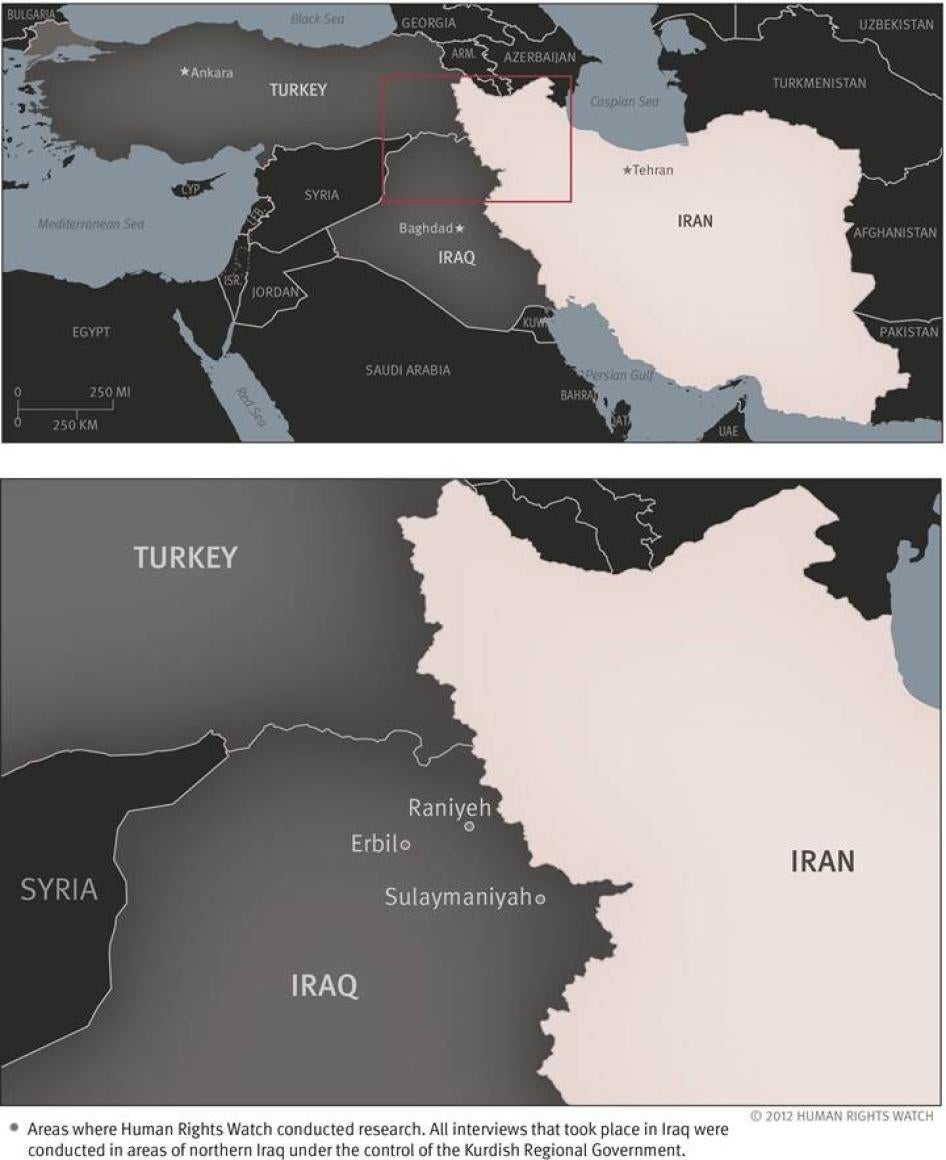
Map of Iran
Summary
Security forces arrested Rebin Rahmani on November 19, 2006, in Kermanshah, the capital of the western Iranian province of the same name. He had been researching the prevalence of drug addiction and HIV infections in Iran’s Kurdish-majority areas. Rahmani spent two months in detention facilities run by the Intelligence Ministry, and was interrogated by intelligence agents in both Kermanshah and Sanandaj, the main city in the adjacent Iranian province of Kurdistan. During his time in detention, he was subjected to several rounds of interrogation accompanied by physical and psychological torture. In January 2007, a revolutionary court sentenced Rahmani to five years in prison on charges of “acting against national security” and “propaganda against the state.” The sentence was handed down after a 15-minute trial during which Rahmani had no access to a lawyer.
Upon his release from prison in the latter part 2008, Rahmani learned that he had been dismissed from university and could no longer continue his education. He became active with a local rights group, but was forced to leave the country in 2011 and apply for refugee status in Iraqi Kurdistan due to mounting pressure against him and his family.
Rahmani is one of scores of journalists, bloggers, human rights activists, and lawyers who have fled Iran since the government embarked on a major campaign of repression following the widespread popular demonstrations against alleged vote-rigging in the June 2009 presidential election, which handed a second term of office to President Mahmoud Ahmadinejad. The government’s repression has involved a range of serious and intensifying human rights violations that include extra-judicial killings, torture, arbitrary arrest and detention, and widespread infringements of Iranians’ rights to freedom of assembly and expression.
This report gathers evidence of this campaign of repression from some of its principal victims: Iranian civil society activists. Because Human Rights Watch is unable to work in Iran, most of documentation presented in the report is based on interviews with activists like Rahmani who fled the country to seek refugee status in neighboring Turkey and Iraqi Kurdistan following the 2009 post-election crackdown. The report focuses on four groups: human rights activists, journalists and bloggers, human rights lawyers, and protesters or persons who volunteered for the presidential campaigns of opposition members Mir Hossein Mousavi and Mehdi Karroubi and were targeted by security and intelligence forces. This report discusses why they left and some of the challenges they face in Turkey and Iraqi Kurdistan as asylum seekers and refugees.
Although most of the hundreds of thousands who took to the streets to protest
the June 2009 presidential election result had not been political or civil
society activists, they nonetheless found themselves targets of security and
intelligence forces. After public protests came to an end, the
authorities continued their relentless assault on all forms of dissent, targeting
civil society groups and activists who had little if any connection to the
protests themselves but whom they deemed to be supporters of a “velvet
revolution” working to undermine the foundations of the Islamic Republic.
Along with members of the political opposition, human rights activists, journalists and bloggers, and rights lawyers bore the brunt of these attacks. Security forces arrested and detained scores of activists, including those advocating on behalf of ethnic minorities, women, and students, and subjected many to trials that did not meet international fair trial standards. Dozens remain in prison on charges of speech crimes such as “acting against the national security,” “propaganda against the state,” or “membership in illegal groups or organizations.”
In addition to the several show trials that authorities convened before television cameras where civil society activists and members of the opposition were indicted for attempting to bring about a “velvet revolution,” one of several landmark events which cast a chilling shadow over Iranian civil society in the months following the June 2009 election was the so called “Iran Proxy” affair. In March 2010, the public prosecutor announced they had arrested 30 or so persons involved in what the authorities said was a plot by the US Central Intelligence Agency (CIA) to destabilize the government. The prosecutor accused those arrested of implementing a plot code-named “Iran Proxy” under the cover of several local non-governmental organizations (NGOs). Revolutionary courts tried, convicted, and sentenced to lengthy prison sentences several of those arrested on national security charged based largely on forced confessions.
The post-2009 crackdown has had a profound impact on civil society in Iran. No truly independent rights organizations can openly operate in the country in the current political climate. Many of the most prominent human rights defenders and journalists are in prison or exile, and other activists are subjected to constant harassment and arbitrary arrest. An indication of the lengths to which the government has gone to stifle civil society and dissent is its targeting of lawyers who have chosen to defend activists and dissidents arrested and charged by the authorities. In recent years, the pressure on rights lawyers defending activists has been unprecedented. Several prominent lawyers, like Nobel Peace Laureate Shirin Ebadi, traveled to European countries and stayed there after it became clear they could not go back without facing harassment, arrest or imprisonment on politically motivated charges.
Others, like Mohammad Mostafaei and Mohammad Olyaeifard, sought refuge abroad. Mostafaei fled Iran after authorities repeatedly summoned him for questioning and detained his wife, father-in-law, and brother-in-law. He is currently residing in Norway. More recently, Olyaeifard, another prominent Iranian lawyer who represented many high profile cases before Iran’s civil and revolutionary courts, was forced to leave the country after serving a one year prison sentence for “propaganda against the state,” imposed by the authorities because he spoke out against the execution of one of his clients during interviews with international media.
The targeting of civil society began well before 2009. The election of Ahmadinejad to his first term as president in 2005 signaled the rise of a populist conservative force, headed by Revolutionary Guards and the associated Basij forces (a paramilitary volunteer militia closely linked with the Revolutionary Guards), with the blessing of Supreme Leader Ayatollah Ali Khamenei and his allies.
Under Ahmadinejad’s presidency, the attitude of the government shifted from the cautious encouragement of NGOs that had characterized the approach under Ahmadinejad’s predecessor, Mohamed Khatami, to one of suspicion and open hostility. The government increasingly applied a “security framework” in its approach to NGOs, often accusing them of being “tools of foreign agendas.” Authorities also suppressed the work of activists by denying permits to NGOs to operate, often refusing to provide written explanations when rejecting applications, as required by Iranian law.
The increased pressures on civil society activists under Ahmadinejad led some to seek refuge abroad. Since 2009, there has been a noticeable increase in the number of civil society activists who have applied for asylum and resettlement to third countries. According to statistics compiled by the UN High Commissioner for Refugees (UNHCR) from 44 industrialized countries that conduct individual asylum procedures, there were 11, 537 new asylum applications from Iranians to these 44 countries in 2009; 15,185 in 2010; and 18,128 in 2011. The largest number of new asylum applications was lodged in neighboring Turkey, which saw a 72 percent increase in the number of Iranian asylum seekers between 2009 and 2011.
The majority of Iranian activists fleeing persecution or the threat of persecution registered refugee claims with the offices of UNHCR in Turkey or Iraqi Kurdistan. The Turkish government has only been willing to provide temporary asylum to Iranian refugees, contingent on UNHCR’s commitment to try to resettle them in third countries. Some activists, especially members of the Kurdish minority, have sought refuge in neighboring Iraqi Kurdistan. Many Iranian refugees there said they did not feel fully secure and were desperate to resettle to a third country as soon as possible.
Human Rights Watch calls on Iran to end its repression of protesters and civil society activists. Iranian activists, government critics, and dissidents should not face the stark choice of risking imprisonment or abandoning their country because they chose to exercise their rights to free speech, peaceful assembly, or association.
Human Rights Watch calls on the Kurdish Regional Government (KRG) to protect the safety and welfare of Iranian refugees and refrain from threats or harassment against those who continue to pursue nonviolent political or rights activities during their time as refugees, and the Turkish government to create conditions that will allow registered refugees and asylum seekers to live and work comfortably while they are waiting for resettlement to a third country. Turkey should also allow Dr. Ahmed Shaheed, the Special Rapporteur on the situation of human rights in Iran, access to the country in his official capacity so that he may meet with Iranian refugees and document cases of rights abuses per his mandate.
Finally, Human Rights Watch calls on countries outside the region to speedily process claims of Iranian refugees who urgently need to leave the region and to offer generous numbers of resettlement places for refugees with no other options for durable asylum.
Recommendations
To the Government of Iran
Arbitrary Arrests and Treatment in Detention
- Release all individuals currently deprived of their liberty for peacefully exercising their rights to free expression, association, and assembly;
- Ensure that all persons deprived of their liberty receive family visits, and inform families about the location and status of their family members in detention;
- Abolish the use of prolonged solitary confinement;
- Investigate and respond promptly to all complaints of torture and ill-treatment;
- Discipline or prosecute as appropriate security, intelligence, judiciary and other officials at all levels who are responsible for the mistreatment of detainees in custody;
- Bring Section 209 of Evin Prison and other detention facilities operated by the Ministry of Intelligence or other agencies under the supervision of the State Prisons and Security Corrective Measures Organization or shut it down.
Legal Reform
- Amend or abolish the vague security laws
under the Islamic Penal Code, entitled Offenses against the National and
International Security of the Country (the Security Laws) and other legislation
under the Islamic Penal Code that permits the government to arbitrarily
suppress and punish individuals for peaceful political expression, in breach of
its international legal obligations, on grounds that “national
security” is being endangered, including but not limited to the following
provisions:
- Article 498 of the Security Laws, which criminalizes the establishment of any group that aims to “disrupt national security”;
- Article 500, which sets a sentence of three months to one year of imprisonment for anyone found guilty of “in any way advertising against the order of the Islamic Republic of Iran or advertising for the benefit of groups or institutions against the order”;
- Article 610, which designates “gathering or colluding against the domestic or international security of the nation or commissioning such acts” as a crime punishable from two to five years of imprisonment;
- Article 618, which criminalizes “disrupting the order and comfort and calm of the general public or preventing people from work” and allows for a sentence of 3 months to one year, and up to 74 lashes;
- Article 513 of the Islamic Penal Code, which criminalizes any “insults” to any of the “Islamic sanctities” or holy figures in Islam and carries a punishment of one to five years, and in some instances may carry a death penalty;
- Article 514, which criminalizes any “insults” directed at the first Leader of the Islamic Republic of Iran, Ayatollah Khomeini, or the current Leader and authorizes punishment ranging from six months to two years in prison.
- Define both “national security” and the breaches against it in narrow terms that do not unduly infringe on internationally guaranteed rights of free expression, association and assembly;
- Excise from the Islamic Penal Code the laws that criminalize “insults” against religious figures and government leaders;
- Change provisions in the Code of Criminal Procedure that allow the right to counsel to be denied in the investigative phase of pre-trial detention. The government should guarantee the right of security detainees to meet in private with legal counsel throughout the period of their detention and trial;
- Take steps to uphold the Citizens Rights Laws, enacted by head of Judiciary Ayatollah Shahroudi on 2004, in Iran’s detention centers. Unlike other laws with a security caveat, the Citizens Rights Laws are intended to be applicable in all circumstances.
To the Government of Turkey
- Allow Dr. Ahmed Shaheed, the Special Rapporteur on the situation of human rights in Iran, access to the country in his official capacity so that he may meet with Iranian refugees and document cases of rights abuses per his mandate;
- Ensure law enforcement and other government officials treat Iranian refugees, asylum seekers, and migrants with dignity and respect for their human rights, without exception;
- Allow registered refugees and asylum seekers freedom of movement and choice of residence, with restrictions only to the extent necessary on a case by case basis for reasons such as public health and national security, and which are applied without discrimination on the grounds of national origin;
- Waive residency permit fees to registered refugees and asylum seekers and refrain from preventing them from exiting the country if they have been unable to pay such fees;
- Allow all registered refugees and asylum seekers to secure work permits without additional fees and other requirements;
- Provide all refugees and asylum seekers access to health services, health insurance, and medication on at least the same basis as other non-citizens lawfully present in the country;
To the Kurdish Regional Government
- Refrain from threatening or harassing refugees who continue peaceful political activities against the Iranian government while in areas controlled by the KRG;
- Do not demand that Iranian refugees and asylum seekers secure guarantees or protection from exiled Iranian political parties or Iraqi Kurdish political parties as a condition of residence or renewal of residence permits;
- Unify residence requirements for registered refugees and asylum seekers and allow them freedom of movement and residence in KRG territory subject only to restrictions on a case by case basis to the extent necessary for reasons such as public health and national security ;
To the Office of the UN High Commissioner for Refugees
- Communicate with Iranian refugees and asylum seekers about their prospects for durable solutions;
- Closely monitor and report on alleged attacks, threats, or intimidation by Iranian security and intelligence against Iranian refugees and asylum seekers in northern Iraq;
To Other Concerned Governments, including EU Member States, Canada, Australia, and the United States
- Streamline security background checks and other regulatory checks in order to ensure reasonable timelines for admission of refugees already accepted for resettlement;
- Recognize that some Iranian Kurdish refugees are not able to integrate locally in northern Iraq, and consider them for resettlement;
- Consider admitting more Iranian asylum seekers, especially those who have left Iran because of persecution in response to their civil society or political activities, outside the UNHCR refugee process;
- Provide student visas to Iranian refugees who have been denied entrance to universities in Iran or prohibited from continuing their education because of their political or social activities.
Methodology
The Iranian government does not allow NGOs such as Human Rights Watch to enter the country to conduct independent investigations into human rights abuses. Many individuals inside Iran are not comfortable carrying out extended conversations on human rights issues via telephone or e-mail, fearing they are subject to government surveillance. The government often accuses critics, including human rights activists, of being agents of foreign states or entities, and prosecutes them under the country’s national security laws.
For this report Human Rights Watch interviewed more than 50 Iranian refugees and asylum seekers. The overwhelming majority where interviewed in in Turkey (April 2010) and Iraqi Kurdistan (October and November 2011). Of those interviewed, approximately 35 were election protesters, journalists and bloggers, rights activists, and lawyers who had left Iran since Mahmoud Ahmadinejad took over Iran’s presidency in June 2005, and especially after the disputed 2009 presidential election. In the interest of brevity and efficiency, however, Human Rights Watch selected only a few of the stories it documented for presentation in this report. Some of the individuals interviewed have since been resettled in third countries.
A handful of individuals whose experiences are reflected in this report communicated with Human Rights Watch via e-mail correspondence. Human Rights Watch has confirmed the validity of their stories by conducting additional research, primarily via secondary sources, and identified the information that was acquired via firsthand interviews and those which were gathered via e-mail communications.
Their stories represent a cross-section of the experiences of civil society activists who have been forced to leave Iran in the past few years.
In preparing the report Human Rights Watch also relied on previous information gathered through firsthand interviews conducted by the organization and used in reports, press releases, and other material published since 2005.
All of the interviews were conducted in Persian (Farsi). Most were conducted one-on-one, although a handful of the interviews took place in small group settings. Human Rights Watch informed all of those interviewed that their stories and identities may be used in reports and other material published by the organization. All agreed to the conditions and informed Human Rights Watch that they had no problem with their identities being reviewed. In a few cases, however, Human Rights Watch chose to hide the identities of those interviewed due to the sensitive nature of the issues discussed.
Human Rights Watch also met with and interviewed representatives of the United Nations High Commissioner for Refugees, and received information from UNHCR offices in both Ankara, Turkey and Erbil, Iraq. Human Rights Watch also communicated via e-mail correspondence with UNHCR Ankara and Erbil several times prior to the publication of the report, provided them with an opportunity to review sections relevant to UNHCR’s operations in Turkey and Iraqi Kurdistan, and integrated their feedback and responses where appropriate.
Where noted, the age of interviewees corresponds to their age at the time the interview was conducted.
I. Background
The Rise of Civil Society in the Khatami Era
Iran’s civil society was a direct beneficiary of the policies instituted during the reformist administration of former President Mohammad Khatami (1997-2005). The country witnessed a dramatic rise in the number of independent newspapers and journals, intensified activity by labor groups and professional associations, and an increase in the number of registered (and unregistered) NGOs, including human rights groups. This opening was facilitated by a simultaneous rise in the number of Iranian internet users, particularly bloggers, which allowed NGO activists to reach out to partners across the country and abroad.[1]
Khatami’s government and his reformist allies in the parliament and civil society soon came into conflict with forces associated with the Supreme Leader, Ayatollah Ali Khamenei. These institutions, which include the Guardian Council,the judiciary, and influential elements within Iran’s military, security and intelligence apparatuses, launched a fierce counter-offensive against reformists and prominent civil society actors.[2]
Factions loyal to Supreme Leader Khamenei also introduced greater restrictions on pro-reform newspapers and publications. The attacks on freedom of the press were primarily led by judicial authorities like Saeed Mortazavi, initially a judge in Tehran’s Press Court and later prosecutor general of Tehran, who ordered the closure of dozens of newspapers and dailies.[3] Editors of banned papers frequently applied for permits from the authorities under a new name, continuing the cycle. Mortazavi also prosecuted journalists and bloggers, and was later implicated in the deaths of one journalist and several protesters following the disputed 2009 presidential election.[4]
Despite the counterattack by conservative factions, at the end of Khatami’s presidency in 2005 there were 6,914 registered NGOs, an unprecedented number.[5] Khatami’s government actively promoted the development of civil society and the formation and activities of NGOs. On July 29, 2004, as a step towards institutionalizing NGOs and facilitating their functioning, the Ministry of Intelligence (MOI) submitted to the government draft executive regulations regarding the establishment and activities of NGOs. The government ratified these in July 2005.[6]
Prior to ratification of the executive regulations, NGOs were required to secure permits from either the Ministry of Interior or local government offices.[7]The new regulations created a three-tiered supervisory board made up of government officials and NGO representatives to review applications for permits.[8]
Article 1 of the regulations established councils on the municipal, provincial, and national levels to oversee and facilitate the formation of NGOs.[9]Members of the municipal-level councils include the mayor, a representative from the city council, and a representative from the NGO community.[10]Members on the provincial level include the governor, a representative from the provincial council, and an NGO representative.[11] On the national level, the council is made up of a deputy from the Ministry of Interior, a representative from the High Council of Provincial Representatives, and a representative of NGOs selected by the organizations themselves.[12] The regulations also established a process for appealing decisions by the supervisory board when NGO applications were rejected.[13]
Among NGOs established during the reform period were organizations dedicated to promoting civil and human rights inside the country. The most well-known was the Center for Human Rights Defenders, founded by Nobel peace laureate Shirin Ebadi and several other prominent lawyers in 2002.[14] That same year Dr. Sohrab Razzaghi, a law and political science professor at Allameh Tabataba’i University in Tehran, founded the Iranian Civil Society Organizations Training and Research Center (ICTRC) to provide capacity-building support for civil society organizations, promote greater access to information, and raise public awareness regarding the situation of human rights in Iran.[15] A year later, in 2003, journalist and rights activist Emad Baghi, a prominent writer and rights activist, launched the Association to Defend Prisoners’ Rights.[16]
During the first year or so of Ahmadinejad’s presidency, several additional prominent civil society and rights groups came into existence. The One Million Signatures Campaign launched a grassroots effort to promote broad awareness on women’s rights issues and collect signatures on petitions to reform gender-biased laws. The Committee of Human Rights Reporters and Human Rights Activists in Iran began their activities a year earlier in 2005.[17]
However, conservative factions were relentless in their efforts to undermine such reforms. Forces loyal to Supreme Leader Khamenei increased the pressure against President Khatami’s reform movement on multiple fronts. They attempted to impeach several of his cabinet ministers. Security forces arrested, and the judiciary tried and convicted, several prominent reformist allies of Khatami such as former Interior Minister Abdollah Nouri, former Tehran mayor Gholamhossein Karbaschi, and reformist cleric Mohsen Kadivar. When those attempts failed to intimidate the reformists, Khamanei loyalists intervened to block the passage of pro-reform policies and legislations.[18]
During Khatami’s second term in office, and the conservatives gradually began to gain the ascendancy in their political struggle with the reformists. Ahead of the 2004 parliamentary elections, the Guardian Council disqualified an unprecedented 3,600 candidates, many of them reformists. Approximately 87 sitting parliament members were among those disqualified.[19]More than 100 members resigned in protest.[20] It was now clear that the reform movement had been checked.
Targeting of Civil Society Activists During Ahmadinejad’s First Term
The election of Mahmoud Ahmadinejad as president signaled the entry of the new populist conservative force, voted in with the support of Revolutionary Guards and the Basijand with the blessing of Khamenei and his allies.[21] Ahmadinejad’s cabinet members included individuals who were believed to be responsible for serious rights abuses, including the serial murders of dissidents in 1998, the closure of newspapers, and attacks against NGOs.[22]
Under Ahmadinejad’s first term as president, the attitude of the government shifted from tolerance and cautious encouragement of NGOs and grassroots movements to suspicion and hostility. The government increasingly applied a “security framework” to its approach to NGOs, often accusing them of being “tools of foreign agendas.” The councils established to approve and regulate NGOs now suppressed the work of activists by denying permits to NGOs to operate, often refusing to provide written explanations for rejecting applications as required by law.[23]
An example of the government’s increasingly hostile attitude toward civil society was its crackdown against the One Million Signatures Campaign. In 2006, after security forces attacked men and women gathered in Tehran to protest discriminatory gender-biased laws, women’s rights activists launched a campaign to oppose discriminatory laws that govern marriage and inheritance, compensation for bodily injury or death, and a woman's right to pass on her nationality to her children. Campaign members initiated a website and held regular workshops in Tehran and other cities in order to educate the public about legal challenges facing women and girls in the country.
Within months of the campaign’s launch, security forces began arresting volunteers who were out in the streets collecting signatures.[24]
Under Iranian law, the courts have the authority to decide whether a registered organization should be closed down.[25] In 2006, Ahmadinejad’s government introduced a draft NGO law intended to further restrict the activities of NGOs. Although this draft has been shelved by the parliament and not yet become law, it demonstrated the hostility of Ahmadinejad’s government to civil society, and there is concern that the new (and more conservative) parliament elected in February 2012 will take it up again. Organizations affected would range from human rights, environmental, and women’s organizations, through charities and organizations for the disabled, to employers’ and professional associations.[26] The bill would establish a Supreme Committee Supervising NGO Activities, chaired by the Ministry of Interior and including representatives from the Ministry of Intelligence, the police, the Basij, the Revolutionary Guards Corps, and the Foreign Ministry, and only a single person representing NGO interests. The committee would be able to issue and revoke all NGO registration permits and have ultimate authority over the composition of their boards of directors.[27]
On March 15, 2007, officers from the Ministry of Intelligence and Iran’s revolutionary courts, operating with a court order, closed down three NGOs: the ICTRC, the Rahi Legal Center (run by rights lawyer Shadi Sadr), and the Non-Governmental Organizations Training Center (managed by civil society and women’s rights activist Mahboubeh Abbasgholizadeh). Revolutionary courts later convicted all three on charges related to national security.[28]
In December 2008 security and intelligence officials shut down Shirin Ebadi’s Center for the Defense of Human Rights without producing a court order. They alleged the center was carrying out illegal activities that endangered national security. Since the closure, the center’s members have been harassed and some convicted and imprisoned.[29]
Crackdown on Protest and Civil Society after the June 2009 Election
During the lead-up to the June 12, 2009 election large demonstrations and rallies for reformist candidates Mir Hossein Mousavi and Mehdi Karroubi led many to believe that Ahmadinejad might be defeated. However on June 13, 2009, Iran’s Ministry of Interior announced that President Ahmadinejad had won the election with 62.6 percent of the popular vote. In response hundreds of thousands of Iranians filled the streets of Tehran and other major cities to protest peacefully against what they believed to be fraudulent election results.
Iranian authorities, initially taken by surprise, quickly declared the protests illegal. When hundreds of thousands of Iranians continued to take to the streets security forces responded with brute force. Anti-riot police, aided by intelligence agents as well as plainclothes and uniformed Basij paramilitary forces beat, arrested, and detained thousands. Excessive force, including the use of live ammunition against unarmed and for the most part non-violent protesters, led to the deaths of several dozen protesters between June and December 2009.[30]
Some protesters lost their lives not in street clashes but in detention facilities, where security forces subjected them to torture and ill-treatment, in some cases including rape and sexual assault. At least five detainees died due to abuses sustained at Kahrizak detention center outside of Tehran.[31] Five students were killed when plainclothes and uniformed security forces carried out a nighttime raid on dorms at Tehran University on June 14, 2009.[32]
Despite widespread repression in the weeks following the election, peaceful protest demonstrations continued. During the fall and winter of 2009, government forces attacked peaceful protestors in response to major demonstrations such as those held on November 4 (the anniversary of the 1979 takeover of the US embassy), December 7 (National Student Day), and in conjunction with the Shia religious holiday of Ashura on December 27. These attacks by security forces and Basij killed at least eight and injured many more.[33]
The government also continued to harass and intimidate activists, including individuals who worked for Mousavi or Karroubi’s campaigns, journalists, and human rights defenders, subjecting more than 100 to trials that were in part televised and did not meet international fair trial standards, and convicting others solely for exercising their right to peaceful dissent.[34]
The nature and size of the crackdown dramatically reduced the space for civil society and independent or critical voices in Iran. Activists, dissidents, and critics of the government faced a stark choice: risk arrest, detention, and conviction, or leave. Many chose the latter option. According the United Nations High Commissioner for Refugees (UNHCR), the number of new Iranian asylum seekers in Turkey and several other countries has steadily increased since the government’s ferocious response to the post-election protest led to a new wave of emigration.[35]
II. Attacks on Civil Society
The “Iran Proxy” Affair and Local Rights Groups
In December 2010, the Iranian authorities started arresting members of a Tehran-based NGO which had been monitoring human rights violations in Iran for nearly five years. These were among the first steps in a government operation which was to culminate in the trial of 30 or more activists for alleged involvement in a foreign plot against Iran under the cover of human rights activism: the so called “Iran Proxy” affair. Along with other trials of opposition figures and alleged plotters such, the “Iran Proxy” trial cast a chilling shadow over Iranian civil society—which the Ahmadinejad government was already subjecting to severe repression.
The NGO in question was the Committee of Human Rights Reporters (CHRR). The security forces arrested two CHRR members, Saeed Kalanaki and Saeed Jalalifar, on December 1, 2009 and detained them in Evin prison. On the evening of December 20, 2009, security forces arrested three more CHRR members, Shiva Nazar Ahari, Koohyar Goudarzi, and Saeed Haeri when they were on a bus about to leave Enqelab Square in Tehran for the city Qom, where they had planned to attend the funeral of Grand Ayatollah Montazeri a prominent opponent of the government.[36]
On January 1, 2010, the Ministry of Intelligence (MOI) contacted Hesam Misaghi, who worked with CHRR, and several of his colleagues by phone and summoned them for interrogation. The MOI agent informed Misaghi that a warrant for his arrest had been issued, and threatened to raid his home if he did not voluntarily report to the MOI office. Later that day, two other CHRR members who had been similarly summoned to the MOI office presented themselves and were promptly arrested.[37]
Misaghi ignored the MOI summons and went into hiding Because of the increasingly tense security situation inside Iran (including at least one threatening phone call from the MOI to Misaghi’s family demanding that he turn himself in), his membership with the CHRR, his Baha’i background, and his work on protection of Iran’s lesbian, gay, bisexual, and transgender community, Misaghi decided to leave the country and entered Turkey with his colleague Sepehr Atefi in January 2010.[38]
On January 2, 2010, the security forces detained two more members of CHRR, Parisa Kakaei and Mehrdad Rahimi, when they responded to a summons to report to the Ministry of Intelligence (MOI) in Tehran. During their detention the seven CHRR detainees faced severe pressure to confess falsely to having links with the banned Mojahedin-e Khalq organization.[39] None of the detainees were initially allowed access to lawyers or were formally charged.
On March 2, 2010, another one of Misaghi’s colleagues, Navid Khanjani, was arrested in Esfahan. The next day, March 3, security agents raided the homes of Misaghi and Atefi and presented their family members with arrest warrants indicating that the two were wanted for the crime of moharebeh, or “enmity against God.” The punishment for this crime is death. The individuals who arrested Khanjani informed him that they knew Misaghi and Atefi had escaped to Turkey, and that they would do everything in their power to bring them back to Iran.[40]
The extent of the government’s operation against NGOs heralded by these arrests became clear on March 13, 2010, a week before the Iranian New Year, when Tehran's Public and Revolutionary Prosecutor’s Office announced that security forces had arrested 30 people they said were involved in a CIA-funded project to destabilize the government with “cyber warfare.” The prosecutor's office maintained that a network of opposition groups implemented a project code-named “Iran Proxy” under the cover of local human rights organizations, including CHRR and two other groups:, the Center for Defense of Human Rights (CDHR), and Human Rights Activists in Iran (HRA).[41]
Less than two weeks after the announcement by the Tehran prosecutor’s office a member of HRA told Human Rights Watch that security forces arrested 15 of its members and attempted to arrest 29 others. Among those arrested was Farideh Rafiee, the sister of the group's former executive director, Keyvan Rafiee, who currently lives outside Iran. HRA maintained that Farideh Rafiee herself was not an HRA member.[42]
The government denounced all three groups publicly and accused the “network” of hacking into state-owned websites; organizing and supporting foreign opposition and terrorist groups, including the banned Mojahedin-e Khalq (MEK); conducting illegal protests; publishing false information; and engaging in “psychological warfare” and espionage. All three groups issued statements denying any involvement with the alleged "Iran Proxy" project and confirmed their financial independence from foreign governments. The Center for Defense of Human Rights, which had been forced to close in December 2008 but maintained its website, called the attacks a "frame job against human rights activists and civil society."[43]
The authorities provided no evidence to support their allegations.[44] Revolutionary courts have nonetheless tried, convicted and sentenced some of those arrested on politically motivated national security charges in separate trials based largely on forced confessions. Others remain out of prison on bail or are awaiting summonses to serve their prison terms. Of the eighteen members of CHRR, three including Shiva Nazar Ahari, Koohyar Goudarzi, and Saeed Jalalifar, recieved lengthy prison terms and are either behind bars, or can be summoned to prison at any time.[45] Five others in the group left Iran for Turkey and have since been resettled in Europe (see below for the story of Hesam Misaghi a CHRR member who fled to Turkey). A few members of the HRA are also serving prison sentences, and at least five CDHR members, including some of the most prominent rights lawyers in the country, have also been arrested in recent years and are currently in prison.[46]
Minority Rights Activists
As well as clamping down on Tehran-based rights groups like CHRR HRA, and CHRD, Ahmedinejad’s government increasingly applied a “security framework” in its approach to NGOs working on minority rights, accusing them, too, of being “tools of foreign agendas.”[47] The NGO councils that had been established under the Khatami government to promote and regulate NGOs were now tasked with suppressing the work of minority rights activists, especially those working on Kurdish, Azeri, and Ahwazi Arab issues, by denying permits to NGOs to operate and often refusing to provide written explanations for rejecting applications as required by law. [48] But even those minority rights organizations that were able to register and obtain permits still faced harassment and worse.
The Human Rights Organization of Kurdistan (HROK) is an example. Founded in 2005 by journalist Sadigh Kaboudvand, the group grew to include 200 local reporters throughout the Kurdish regions of Iran and provided timely reports in the now banned newspaper Payam-e Mardom (Message of the People), of which Kaboudvand was the managing director and editor. Intelligence agents arrested Kaboudvand on July 1, 2007, and took him to Ward 209 of Evin Prison, which is under Ministry of Intelligence control and is used to detain political prisoners. They held him without charge in solitary confinement for nearly six months.[49]
In May 2008, Branch 15 of the Revolutionary Court sentenced Kaboudvand to 10 years in prison for “acting against national security” by establishing the HROK, and another year for "widespread propaganda against the system by disseminating news, opposing Islamic penal laws by publicizing punishments such as stoning and executions, and advocating on behalf of political prisoners.” In October 2008, Branch 54 of the Tehran Appeals Court upheld his sentence.[50] Human Rights Watch has repeatedly called on the Iranian authorities to unconditionally free Kaboudvand and provide him with access to urgent medical care.[51]
Due to geographic proximity, the Iranian authorities’ sensitivity to ethnic rights issues, and cross-border cultural kinship, the majority of the ethnic minority rights activists who fled to Turkey and Iraqi Kurdistan[52] since 2005 are Iranian Kurds.
Women’s Rights Activists
Since Ahmadinejad became president in 2005, the government has also stepped up repressive measures against women’s rights organizations and activists. Security forces and judiciary officials have routinely subjected women’s rights activists to threats, harassment, interrogations, and imprisonment.
In June 2006, after security forces attacked men and women gathered in Tehran to protest discriminatory gender-based laws, women’s rights activists launched the One Million Signatures Campaign, a grassroots effort aimed at collecting signatures in support of a petition opposing Iran’s gender-biased laws, including those that govern marriage and inheritance, compensation for bodily injury or death, and a woman's right to pass on her nationality to her children. Campaign members initiated a website and held regular workshops in Tehran and other cities in order to educate the public about legal challenges facing women and girls in the country.[53]
The campaign both inspired and supported women’s rights activists working outside of Tehran. Many began working with the campaign or adopted its model of grassroots activism to educate the public and promote women’s issues in their hometowns. Local Kurdish women’s rights activists were among those who embraced the campaign’s model.
Within months of the campaign’s launch, security forces began arresting volunteers who were out in the streets collecting signatures. Sussan Tahmasebi, one of the campaign’s cofounders, was charged with spreading propaganda against the state and threatening national security after she organized a protest in support of women’s rights in June 2006. She was tried on March 4, 2007, and sentenced to 2 years in prison, 18 months of which was suspended. Tahmasebi appealed the ruling and was freed on bail pending the appeal, which is ongoing.[54]
On the day of her trial, women’s rights activists held a demonstration outside of the Tehran Revolutionary Court to protest increasing pressure on women activists. Tahmasebi left the court as security forces began to arrest the protesters and was arrested a second time, along with 32 others, and charged with threatening national security, assembly and collusion against national security, and disobeying the orders of police. She was later acquitted of these charges but continued to endure harassment by security forces, who searched her home and subjected her to numerous interrogations. She was banned from traveling on several occasions between December 2006 and January 2009.[55] Tahmasebi left Iran in 2010 and is currently in the United States.
Student Activists
Iran’s universities have increasingly become targets of government efforts to consolidate power and stifle dissent. Since 2005, President Ahmadinejad’s administration has pursued a multi-phased campaign to neutralize dissent at universities and “Islamicize” higher education. This campaign, spearheaded by the Ministry of Education, Science and Technology, and the Ministry of Intelligence, includes imprisoning student activists; barring politically active students and members of Iran’s Baha’i community from higher education; using university disciplinary committees to monitor, suspend, or expel students; increasing the presence on campuses of pro-government student groups affiliated with the Basij; and restricting the activities of student groups.[56]
In 2009, the Ministry of Science, Technology, and Research declared illegal one of Iran’s largest and most important student groups, Tahkim-e Vahdat(the Office for Consolidating Unity).[57] During the crackdown that followed the disputed June 2009 presidential election, security forces attacked Tehran University and killed several students on June 14. In the months that followed authorities arrested more than 200 students, including several high-ranking members of Tahkim. Many of these arrests took place in November and early December 2009.[58]
As of May 2012 there were at least 32 students in prison throughout the country as a result of their political activities or affiliation with banned student groups, according to sources close to Tahkim.[59] Authorities held scores of students incommunicado for weeks before prosecutors filed charges against them and lawyers gained access to them. Many told human rights groups that security and intelligence agents had tortured and forced them to confess to crimes they had not committed. The Judiciary prosecuted the students in closed trials in Iran's revolutionary courts.[60]
Many of the students in prison held leadership positions in well-known student organizations critical of the government, including Tahkim. Majid Tavakoli, an Amir Kabir University student, belonged to the school’s Islamic Student Association and publicly criticized the government. In 2010 a revolutionary court sentenced Tavakoli to eight-and-a-half years in prison on various national security charges including “conspiring against national security,” “propaganda against the state,” and “insulting the Supreme Leader” and president. He is in Tehran’s Evin prison.[61]
On December 30, 2009, authorities arrested Bahareh Hedayat, the first secretary of the Women’s Commission of Tahkim and the first, and so far the only, woman elected to Tahkim’s central committee. They charged her with various national security crimes, including “propaganda against the system,” “participating in illegal gatherings,” and “insulting the president.” In May 2010, a revolutionary court sentenced her to nine-and-a-half years in prison.[62] Security forces arrested Milad Asadi, also a Tahkim central committee member, on November 30, 2009. A judge known as Judge Moghiseh from Branch 28 of the Tehran Revolutionary Court sentenced him to seven years in prison for similar national security-related “crimes.”[63]
Hedayat is serving her sentences in Tehran’s Evin prison, but authorities released Asadi after he and several other political prisoners were granted a pardon by Ayatollah Ali Khamenei in September 2011.
The Ahmadinejad administration also targeted other student organizations and their members, including Advar-e Tahkim-e Vahdat (Tahkim’s alumni group) and the Committee to Defend the Right to Education (CDRE). Several leaders of Advar are in Evin prison, including Ahmad Zeidabadi,Abdollah Momeni, Ali Malihi, Ali Jamali, and Hasan Asadi Zeidabadi. Security forces arrested Zeidabadi and Momeni, the group’s secretary-general and spokesperson respectively, in the aftermath of the election protests in 2009. Zeidabadi, Momeni, and Malihi are each currently serving sentences of 14 years and 11 months on various national security charges such as “participation in illegal gatherings,” “propaganda against the state,” and “insulting the president.”[64]
Zia Nabavi, a co-founder of CDRE, is serving a 10-year sentence in Ahvaz’s Karun prison. Ministry of Intelligence agents arrested Nabavi on June 15, 2009, and prosecutors charged him with various national security related crimes, including links to and cooperation with the banned Mojahedin-e Khalq organization (MEK).[65]Mahdieh Golroo, a student activist and another member of CDRE, was in prison since November 3, 2009, but has since been released. In April 2010, a revolutionary court convicted her of national security crimes and sentenced her to 28 months in prison.[66] Another cofounder of CDRE, Majid Dorri, is serving a six-year prison sentence for his student activities.[67]
Several hundred others have been expelled from campus because of their political activism or religious affiliation. Since 2005, authorities have barred more than 350 students from university education on political and religious grounds, according to a recent report by the UN special rapporteur on the human rights situation in Iran.[68]
Nabavi, Golroo, and Dorri formed CDRE in 2008 after authorities barred them from continuing their university studies. It is one of several student groups that publicized and resisted the government's policy of preventing students from continuing their higher education on political or religious grounds. Another similar group is the Population to Combat Educational Discrimination, which largely addressed the government's official policy of preventing Baha’is admission to or expelling them from universities once it becomes known that they are Baha’is. In 2009, authorities also prevented Ali Qolizadeh and Mohsen Barzegar, two recently arrested members of Tahkim-e Vahdat, from continuing their studies.[69]
According to a recent Tahkim report, since March 2009 there have been 436 arrests, 254 convictions, and 364 cases of deprivation of education against students. Tahkim also alleges that the judiciary summoned at least 144 students for investigations, and that officials have closed down 13 student publications.[70] As a result of these pressures, dozens of student and student activists, many of whom were deprived of continuing their education, left Iran to pursue their education elsewhere.
Journalists and Bloggers
Since President Ahmadinejad took power in 2005, dozens of journalists and bloggers have left the country because of increasing limitations on the press and threats against them. According to Reporters Without Borders, more than 76 journalists were forced into exile in and authorities have shut down at least 55 publications since 2009.[71]According to Reporters Without Borders as of August 2012 there were at least 44 journalists and bloggers in prison, making Iran one of the largest jailer of journalists in the world.[72] The Judiciary imposed harsh sentences on journalists and bloggers based on vague and ill-defined press and security laws such as “acting against the national security,” “propaganda against the state,” “publishing lies,” and insulting the prophets or government officials such as Supreme Leader Ali Khamenei or President Ahmadinejad.[73]
In September 2010, a revolutionary court sentenced Hossein Derakhshan, a prominent Iranian blogger, to 19-and-a-half years in prison for espionage, “propaganda against the state,” and “insulting sanctities.”[74] On January 17, 2012, Iran’s Supreme Court confirmed the death sentence for Saeed Malekpour, a blogger holding Canadian permanent resident status, convicted of “insulting and desecrating Islam” in October 2011. In December 2012 Malekpour’s lawyer announced that his client had repented and the Judiciary had therefore suspended his death sentence.[75] The judiciary has sentenced at least three other individuals, Mehdi Hashempour, Vahid Asghari, and Mehdi Alizadeh, to death on internet-related charges including “running obscene websites.”[76]
The government blocks many websites that carry political news and analysis, slows down internet speeds to hinder web access, and jams foreign satellite broadcasts. In March 2011, authorities announced that they were funding a multi-million-dollar project to build what they called a halal(i.e. permissible according to Islamic law) national internet in Iran to protect the country from socially and morally corrupt content. On January 4, 2012, local newspapers printed new regulations issued by Iran’s new cyber police unit that gave internet cafes 15 days to install security cameras and begin collecting personal information from customers for tracking purposes. Internet users and rights groups are concerned that an increase in recent interruptions to internet connectivity and blocked sites may be evidence that Iran is testing their new national intranet.[77]
On September 21, 2010, a revolutionary court sentenced Emad Baghi, the prominent writer and rights activist who founded the Association to Defend Prisoners’ Rights, to six years in prison for an interview he had conducted in 2007 with dissident cleric Grand Ayatollah Hossein Ali Montazeri, which the BBC had rebroadcast in 2009.[78] An appeals court later overturned five years of Baghi’s sentence and prison officials released him on June 20, 2011.
Human Rights Lawyers
Since 2005, and especially since June 2009, authorities have imprisoned, prosecuted, or harassed dozens of defense lawyers. In August 2011, Nobel Peace Laureate Shirin Ebadi said at least 42 lawyers had faced government persecution since 2009. Several lawyers are currently serving prison sentences on politically motivated charges, while others like Ebadi have effectively been forced into exile, in Ebadi’s case after authorities shut down her Center for Defenders of Human Rights (CDHR) and declared it illegal.[79]
They have also resorted to other methods to prevent lawyers from practicing their profession freely. Such measures include unwarranted tax investigations under which the authorities freeze the lawyers’ bank accounts and other financial assets and which could lead to the disbarring of a lawyer.[80] Authorities have also limited the independence of the Iranian Bar Association by barring lawyers from running for high-level office in the association on discriminatory grounds, including their imputed political opinions and their human rights activities. For example, in 2008, Mohammad Ali Dadkhah, Hadi Esmailzadeh, Farideh Gheyrat, and Abdolfattah Soltani, all members of the Center for Human Rights Defenders, were disqualified by the judiciary from running in the election for the association’s Central Board because of their activities as human rights defenders.[81]
In September 2010, authorities arrested Nasrin Sotoudeh, who represented numerous political prisoners. On, January 9, 2011, Iranian authorities sentenced Sotoudeh to 11 years in jail for charges that included “acting against the national security” and “propaganda against the state.” She was also barred from practicing law and from leaving the country for 20 years. In September 2011, the Judiciary reduced her sentence to six years imprisonment.[82]
High-level Iranian officials denied accusations that Sotoudeh was arrested for her activities as a lawyer. In 2010 Mohammad Javad Larijani, the head of the Human Rights Council of the Judiciary, said that Sotoudeh had engaged “in a very nasty campaign” against the government, referring to interviews with her by foreign Persian-language media outlets in which she spoke in defense of her clients. On January 20, Sadegh Larijani, the head of the Judiciary, repeated the government's warning that lawyers should refrain from giving interviews that “damage our Islamic system of governance.”[83]
Since her arrest Human Rights Watch had other rights groups have repeatedly called on the Iranian authorities to release her unconditionally, and allow her regular visitation rights by her family. In November 2012 the European Parliament awarded Soutoudeh and the Iranian filmmaker, Jafar Panahi, the Sakharov Prize for Freedom of Thought.[84]
In February 2011, a revolutionary court sentenced Mohammad Ali Dadkhah, cofounder and spokesperson for the Center for Defenders of Human Rights, to nine years in prison and banned him from teaching in universities and practicing as a lawyer for 10 years.[85] On April 28, 2012, Dadkhah learned that an appeals court had affirmed the lower court’s ruling. Authorities notified him that he would soon be summoned to serve his prison term.[86] Authorities transferred him to Evin prison on September 30, 2011. In February 2011, another revolutionary court sentenced Khalil Bahramian to 18 months in prison on charges of “propaganda against the state” and “insulting the head of the judiciary,” and imposed a 10-year ban on his practicing law.[87]
On March 4, 2012, Abdolfattah Soltani was convicted and sentenced to 18 years in prison on national security charges after two court sessions. The court’s judgment bars Soltani from practicing law for 20 years after his release because “the accused has used the law as a tool and cover to commit … crimes.” The sentence also requires Soltani, a Tehran resident, to serve his term “in exile” in a prison in the town of Borazjan, more than 600 kilometers south of the capital, in Bushehr province, because “his presence inside a Tehran prison will cause corruption.”[88] Authorities had previously alleged that Soltani, who had earlier spent time in Evin prison, improperly provided legal advice to other prisoners.[89]
Branch 26 of Tehran’s revolutionary court convicted Soltani of several national security charges, including “propaganda against the state,” assembly and collusion against the state, and establishing the CDHRs, the nongovernmental organization that Soltani co-founded with Ebadi in 2003 which the government says is illegal. The court also convicted Soltani of “receiving funds through illegitimate means,” referring to a human rights prize from the German city of Nuremberg which he received in 2009.[90] An appeals court later reduced Soltain’s prison sentence to 13 years but upheld the 20-year ban on practicing law.[91]
At least eight other lawyers, including Ebadi, Mohammad Mostafaei, Mohammad Olyaeifard and Shadi Sadr, have been forced to leave the country as a result of repeated arrests, detention, and harassment. Mohammad Mostafaei fled Iran after authorities repeatedly summoned him for questioning and detained his wife, father-in-law, and brother-in-law.[92]. Mostafaei represented high-profile defendants such as Sakineh Mohammadi Ashtiani, a woman sentenced to death by stoning, and numerous juvenile detainees on death row.[93] He is currently residing in Norway. Another one of Ashtiani's lawyers, Houtan Kian, is also in prison.[94]
More recently, Olyaeifard, another prominent Iranian lawyer who represented many high profile cases before Iran’s civil and revolutionary courts, was forced to leave the country after serving a one year prison sentence for “propaganda against the state,” imposed by the authorities because he spoke out against the execution of one of his clients during interviews with international media.[95]
III. Refugees’ Stories
Protesters
Mohammad-Reza Bigdelifard
Mohammad-Reza Bigdelifard, now a refugee in Turkey, told Human Rights Watch that he, his wife, and his brother-in-law worked as volunteers for a civil society group that supported the presidential campaign Mir Hossein Moussavi.[96] They were in charge of voting research and polling in various neighborhoods in Tehran, and coordinated their work with media outlets such as the official Iran Labor News Agency. In June 2009, Bigdelifard, his wife, and his brother-in-law joined several peaceful demonstrations in Tehran protesting the outcome of the presidential election.[97]
On Wednesday, June 17, Bigdelifard and his wife participated in a large demonstration at Tehran’s Haft-e Tir Square. Bigdelifard told Human Rights Watch that at one point during the demonstration, someone took a picture of the two of them standing behind a large banner that read: “Dust and Trash.”[98] Both Bigdelifard and his wife were wearing masks covering a portion of their faces.
The next day, Thursday, June 18, the picture was published widely in media outlets, including the reformist Iranian daily Etemad-e Melli, Hayat-e No, and websites such as the BBC. About a month later security forces raided Bigdelifard’s home in Tehran. They arrested him and confiscated his personal belongings, including his computer, documents, and CDs. Bigdelifard was handcuffed, taken to a parked car waiting outside, and blindfolded. He was transferred to an unknown location, possibly a secret detention facility, and kept there for approximately 34 days. He said he was blindfolded and cuffed most of the time.
Bigdelifard told Human Rights Watch that his captors routinely subjected him to physical and psychological torture. His captors regularly beat and whipped him, and he endured numerous interrogation sessions during which his interrogators accused him of having links with armed groups working to destabilize the state, as well as with opposition and reformist figures, and dissident sects. Authorities primarily relied on information gathered at his home during the day of the arrest in order to get him to confess to these trumped-up charges. Bigdelifard said that on several occasions authorities threatened him with execution, and carried out mock executions during which he (and several others) had nooses placed around their necks. On at least one occasion, authorities kicked the chair underneath his legs, but he simply fell to the ground.
Bigdelifard also told Human Rights Watch that his captors threatened him with sexual assault if he did not cooperate with interrogators and confess to his “crimes.”
One time my interrogator asked me to write down whatever he wanted me to. “If you don’t do what I say I’ll pull down your pants and fuck you,” he said. I refused. So he pushed me on a desk and pulled down my pants. I began to cry. He called someone else over. I could feel the warmth of someone’s penis against my back. I told him I’d write whatever he wanted. But he said it was too late.[99]
Bigdelifard said his interrogator did not act on the threat, but forced him to write down his confessions with his pants down.
Bigdelifard was eventually released from detention through the efforts of his brother, who bribed an influential member of the Revolutionary Guards. As a condition of his release, he was instructed not to discuss his experiences with anyone, and ordered to leave the country at once. He lived in hiding in a city in northern Iran for approximately eight months prior to escaping to Turkey. His wife and brother-in-law, who had escaped arrest and were in hiding themselves, joined Bigdelifard for the cross-border journey to Turkey.[100]
Shahram Bolouri
Shahram Bolouri, 27, also participated in protests following the disputed 2009 presidential election. He told Human Rights Watch that he documented violence against peaceful protesters by security forces. He disseminated photographs and videos of the post-election violence and provided eyewitness accounts to various media outlets. Prior to his 2009 election activities, Bolouri was a member of the Kurdish Society, an NGO in Tehran, and cooperated with other civil society organizations.
On June 23, 2009, security and intelligence agents raided his home in Tehran and arrested him. They held him in Tehran’s Evin prison for almost 8 months, 45 days of which was in solitary confinement. Bolouri told Human Rights Watch that authorities kept him in wards 209 and 240, controlled by the Ministry of Intelligence, before transferring him to the general ward. Bolouri said interrogators and prison guards subjected him to severe psychological as well as physical ill-treatment and torture.
My solitary cell [in Ward 240] measured 2.5 by 1 meter. It had a toilet and no windows. Prison guards would often come in and order me to stand, sit, and perform odd tasks just because they could. One of them once said to me, “You look like an athlete. Select your sport. Stand up and sit down for me. One hundred times, and make sure you count!” He made me do this several times even though I had a busted leg. I was sweating profusely but they didn’t let me shower. After two weeks the same guy opened the door to my cell and said, “Why does it smell like shit in here?” He ordered me to go take a shower and wash my clothes.[101]
On February 16, 2010, more than six months after he was detained, authorities released Bolouri on bail in the unusually high amount of US$ 200,000 after preventing his family from posting the amount for weeks. Bolouri said that the financial and psychological pressure authorities put on his family was sometimes worse than what he endured in prison. Human Rights Watch has documented numerous other instances where authorities required families to post unusually high bail amounts as part of a systematic strategy to harass detainees and their families.
In October 2010, a revolutionary court in Tehran sentenced Bolouri to four years in prison on charges of “assembly and collusion against the state by participating in protests and communicating with foreign broadcasts and disseminating news.”[102] Bolour appealed, but in June 2011, the Judiciary issued another ruling increasing his sentence to four years and six months. Bolouri decided to leave Iran after increasing pressures and harassment against him and his family following the appeals court ruling. He lodged a refugee claim with the UNHCR field office in Iraq on July 15, 2011, and is now seeking refugee status and resettlement in a third country.[103]
Media Byezid
Media Bayezid, a student activist and blogger previously expelled from Esfahan University after he participated in Student Day protests in 2005, joined Mehdi Karroubi’s presidential campaign in 2008. On the evening of June 12, 2009, Bayezid and others in Karroubi’s campaign were responsible for monitoring the vote count by the Ministry of Interior. He told Human Rights Watch that he and colleagues working for Mousavi’s campaign reported some voting irregularities to authorities. Instead of looking into them, Ministry of Interior officials warned both Karroubi and Mousavi’s campaigns that if there were any “disruptions” they would be held responsible.
Bayezid and others from Karroubi’s campaign went to Tehran to join post-election demonstrators after the official results were announced. He said he returned to Saqqez on November 7, which is when his problems began.
I got a call to meet someone at Payam-e Nur University in Saqqez when I returned who said he wanted to meet me. When I went there I noticed a green car with two persons who approached me. One of them said someone had complained that I was harassing them on the phone and I need to be questioned by [the police.] They put me in car, shoved my head down, and sped away. I later found out they were Ministry of Intelligence agents.[104]
He continued:
We went to the local setad-e khabari[105] of the Ministry of Intelligence. I was blindfolded. The interrogator came into the room and began accusing me of having contacts with Kurdish guerrilla groups. My father was in Koya [Iraqi Kurdistan] and I had crossed the border illegally into Iraqi Kurdistan several times. He accused me of having contacts with PJAK [Kurdish Party for Free Life of Kurdistan] and other banned Kurdish parties. When I refused to admit these contacts he slapped me and said, “This is not your aunt’s house!” Then he said they had been tapping my phone for a while and played recordings of my conversations.[106]
Bayezid said his interrogator questioned him for seven or eight hours. Authorities beat and harassed him several times during the 13 days they kept him at the Ministry of Intelligence detention facility. They eventually released Bayezid, but continued to summon him in for further interrogations until he decided to leave the country.[107]
Minority Rights Activists
Ahmad Mamandi
Hezha (Ahmad) Mamandi, a Kurdish rights activist, was one of the earliest members of the Human Rights Organization of Kurdistan (HROK). The judiciary initially sentenced him to an 11-year prison sentence in Evin prison on various national security-related charges. He told Human Rights Watch that intelligence agents had arrested him numerous times since 2005 because of his activities with HROK and other local rights groups.
I was at Azad University in Mahabad collecting signatures [in 2006] when several intelligence agents arrested me and another colleague, put us in a car, and drove us to the local detention facility. They interrogated me for two weeks. They asked lots of questions about HROK and its relations with America. They beat me several times, but were careful not to hit me in the face. I had no access to a lawyer. After two weeks they sent me and my colleague to a Mahabad revolutionary court. The court session lasted about two to three minutes. When we tried to speak to the judge he kicked us out of the courtroom. They transferred us to the central prison in Mahabad and I found out a bit later that we’d been sentenced to 20 months imprisonment for acting against the national security and disturbing the public.[108]
Mamandi told Human Rights Watch that on appeal the Judiciary decreased his sentence to 10 months and authorities freed him in 2006. Upon release, he continued his underground activities with HROK, but after authorities arrested Kaboudvand and Saman Rasoulpour, two of the group’s leaders, in 2006 and 2007 respectively, the group scaled back its activities.
In 2010, after the execution of Farzad Kamangar and several other Kurdish activists, Mamandi and his colleagues at HROK helped organize a region-wide strike in Iran’s Kurdish areas. Mamandi said the strike was effective and angered the authorities. He discovered that Intelligence agents had identified him and several others as organizers of the strike.
Several days later, on May 22, 2010, Manandi fled to Iraqi Kurdistan.[109]
Amir Babekri
Amir Babekri was a teacher and journalist in Piranshahr, a Kurdish-majority city in West Azerbaijan province. Babekri joined the HROK in 2005 and worked on various rights issues affecting Iran’s Kurds. He told Human Rights Watch that agents from the Revolutionary Guards intelligence unit arrested him at the primary school where he was teaching in December 2007.
Three armed men stuffed me into a Toyota and took me to a local detention facility. There they tried connecting me to Kurdish political parties. I rejected this. They threatened to send me to [the northwestern city of] Orumiyeh if I refused to cooperate. I told them to go ahead and do it. They hit me several times the last night I was there before being transferred to Orumiyeh but I was not tortured.[110]
At the Orumiyeh detention facility, he continued,
There were around 40 people in two separate rooms. The authorities had accused some of them with having ties to PJAK.[111] Every day there were interrogations, and we heard lots of screaming. I was interrogated for a total of 18 days, but they transferred me for questioning to another facility which was about five to six minutes away by car. I was blindfolded. There they subjected me and the others to various forms of ill-treatment. Sometimes they threw us out in the snow. Other times they would handcuff us to a wall and force us to stand on the tips of our toes. They also hit us over the head with batons.[112]
Babekri said his interrogator asked him lots of questions about his contacts at HROK. He said he was finally forced to acknowledge his membership in HROK, but refused to give up names of others who worked in the HROK underground network. Authorities eventually charged Babekri with moharebeh, or enmity against God, membership in an illegal group, and illegally crossing into Iraqi Kurdistan. He told Human Rights Watch that his indictment in a revolutionary court in Orumiyeh lasted two to three minutes. He had no legal representation, and recalled there were several Revolutionary Guards officers present inside the courtroom.
After four months the Judiciary tried him during a 30-minute court session. This time he had a lawyer present.[113]They had dropped the more serious moharebeh charge, but he was convicted on the charge of “propaganda against the state” and membership of HROK. The judge sentenced him to one year three months imprisonment.
As a result of continuing pressure by local authorities and his inability to teach in Piranshahr, Babekri decided to leave Iran and lodged a refugee claim with UNHCR in Iraqi Kurdistan on July 15, 2009.[114]
Rebin Rahmani
Kurdish rights activist Rebin Rahmani told Human Rights Watch that security forces arrested him on November 19, 2006, in Kermanshah, the capital city of the western Iranian province of the same name. At the time he was involved in a project researching the prevalence of drug addiction and HIV infections in Kermanshah province. After his arrest, Rahmani spent approximately two months in detention facilities run by the Ministry of Intelligence, and was interrogated by intelligence agents in both Kermanshah and Sanandaj, the main city in the adjacent Iranian province of Kurdistan. He told Human Rights Watch that during his time in these two facilities there he was subjected to several rounds of interrogation accompanied by physical and psychological torture.
In January 2007, a revolutionary court sentenced Rahmani to five years’ imprisonment on charges of “acting against national security,” and “propaganda against the state.” The sentence was handed down after a 15-minute trial during which Rahmani had no access to a lawyer. In March of that year his sentence was reduced to two years on appeal.
After his appeal Rahmani was primarily kept in Kermanshah’s Dizel Abad prison, but was transferred to detention facilities operated by the Ministry of Intelligence on several occasions for additional interrogations. He told Human Rights Watch that during his interrogations he was again subjected to physical and mental abuse amounting to torture, and kept in solitary confinement for long periods of time in an attempt to force him to falsely confess to links to armed Kurdish separatist groups. Interrogators also threatened to arrest his family members, and eventually arrested his brother in June 2008 in part to put pressure on Rahmani. As a result of these pressures, Rahmani attempted suicide on two occasions. Intelligence authorities were not able to bring any additional charges against him, he said.
Upon his release from prison in the latter part 2008, Rahmani learned that he had been dismissed from university and could no longer continue his education. He told Human Rights Watch that he decided to join the local rights group, Human Rights Activists in Iran (HRA), but used a pseudonym because he was afraid he would be rearrested by authorities. Prior to his eventual escape to Iraqi Kurdistan due to mounting pressure against him and his family, Rahmani interviewed victims and their families and prepared reports for HRA, most of which focused on rights violations perpetrated by the government in Iran’s Kurdish regions. He was also responsible for administering Kurdish-language content of the HRA website.[115]
During the crackdown in March 2010 against rights groups including HRA in Tehran and other major cities (described above), Rahmani escaped arrest because he was not identified as an active member of HRA at the time. But in May 2010, following his participation in a rally against the execution of several Kurdish political prisoners, local authorities put Rahmani under surveillance. In December 2010, security forces raided his house shortly after he attended a gathering outside Sanandaj prison to protest the imminent execution of Habibollah Latifi.[116]
Rahmani felt forced to escape to Iraqi Kurdistan and registered with the UNHCR office in Erbil on March 6, 2011.[117]
Fayegh Roorast
Fayegh Roorast, a Kurdish activist and law student at Orumiyeh University, told Human Rights Watch that prior to his arrest in January 2009 he cooperated with several rights and civil society groups such as HROK, HRA, and the One Million Signatures Campaign. He said Ministry of Intelligence agents began targeting him around the time when the judiciary sentenced Farzad Kamangar to death, in March 2008.[118] Roorast had conducted several interviews with foreign media outlets regarding the arrest of Kamangar, Zainab Bayazidi and other Kurdish rights activists.[119]
On January 25, 2009 intelligence agents attacked Roorast’s father’s shop and arrested his father. A little while later they entered Roorast’s home in Mahabad and seized his personal belongings, but did not arrest him at that time. Two days later Roorast as well as his brother, sister, and aunt were all summoned to the local Ministry of Intelligence office in Mahabad. He said officials accused all of them of working with banned Kurdish opposition groups, including the PJAK. Intelligence officials released the rest of his family but kept Roorast at the detention facility for about 17 days.
At the Mahabad Ministry of Intelligence facility they threatened and harassed me every day. My interrogator played good cop with me to urge cooperation, and bad cop when I refused to do what he wanted. He beat me and threatened to harm, even rape, members of my family. After five days of interrogations and beatings he said to me, “Until now you were only being interrogated. From now on I’m responsible for teaching you lesson.”[120]
Roorast said that he was later transferred to a Ministry of Intelligence detention facility in Orumiyeh.
The authorities held me in solitary confinement for several days. There were three interrogation, or torture, rooms downstairs. I heard lots of horrible sounds coming from there. They took me there about 15 or 16 times. The place reeked of urine and feces. There they subjected me to all types of torture, including hanging me by my wrists on wall so I’d be forced to stand on my toes, applying electric shocks to the tips of my toes and fingers, and beating me up. They asked me why I had kept lists of prisoners’ names and why I’d collected signatures for the One Million Signatures Campaign.[121]
Roorast told Human Rights Watch that he refused to provide names. Authorities released him in early 2010. He left Iran for Iraqi Kurdistan later that summer.
Student Activists
Hesam Misaghi
On January 1, 2010, the Ministry of Intelligence contacted Hesam Misaghi, a student activist and member of the Committee of Human Rights Reporting (CHRR) by phone and summoned him for interrogation. The Ministry of Intelligence agent informed Misaghi that a warrant for his arrest had been issued, and threatened to raid his home if he did not voluntarily report to ministry. Later that day, two other CHRR members who had been similarly summoned to the ministry presented themselves and were promptly arrested.[122]
Altogether at least seven members of CHRR were altogether arrested from 2009-10, some in connection with the so called “Iran Proxy” affair (see above). However, Misaghi ignored the summons and went into hiding. He entered Turkey with his colleague Sepehr Atefi in January 2010.[123]
In addition to his CHRR-related activities, Hesam Misaghi was involved with various student and civil society causes including work on protection of Iran’s lesbian, gay, bisexual, and transgender community. Esfahan’s Sana’i University dismissed Misaghi after he received a letter from the Ministry of Science indicating that they knew he was from a Baha’i family. He became an activist after he was expelled from university in 2007. Several of Misaghi’s Baha’i colleagues who were either members or affiliates of CHRR, including Navid Khanjani and Sepehr Atefi, were similarly expelled from their universities because of their religious faith. The government allowed Khanjani and Atefi to sit for the national exam, but did not allow them to enroll in a university, claiming their files were incomplete. The Ministry of Science and the Supreme Council of the Cultural Revolution summarily dismissed their complaints.[124]
In response to these events, Khanjani, Misaghi and others in 2009 helped found the Population to Combat Educational Discrimination, to bring attention to the problems of the Baha’is and other students denied access to university education because of their religious and political beliefs. In cooperation with other human rights groups—Human Rights Activists in Iran, the Committee of Human Rights Reporters, and the Council to Defend the Right to Education—the students held meetings in various cities across Iran, including Tehran, Shiraz, Sari and Kermanshah, where they openly shared their experiences and shed light on the draconian role played by various government agencies tasked with implementing a secret 1991 directive from the Supreme Council of the Cultural Revolution calling for the government to deal with Bahais “in such a way that their progress and development are blocked.”[125]
Misaghi joined a local human rights NGO and became its spokesperson on the rights of students denied access to higher education for their political and religious beliefs. He was also a founding member of the Population to Combat Educational Discrimination. In 2008, security forces briefly detained Misaghi. Ministry of Science officials threatened him with arrest when he confronted them during his interrogation about the government’s systematic policy of expelling Baha’i students.
The government’s response to the activities of Misaghi and his colleagues was harsh, including pursuing their arrest for advocating on behalf of those seeking a college education. Late on the evening of March 2, members of the Ministry of Intelligence entered Navid Khanjani’s home in the city of Esfahan and arrested him. The next day, they conducted similar raids at the homes of Eeghan Shahidi, Sama Nourani, Hesam Misaghi and Sepehr Atefi. They arrested Shahidi and Nourani, but Misaghi and Atefi had fled to Turkey weeks before.
At the time of Khanjani's arrest, security agents told him that they knew Misaghi, and Atefi were in Turkey and that the authorities would eventually succeed in bringing them back to Iran. Many of the human rights activists with whom these Baha’i students cooperated were also arrested and imprisoned for their activities.[126]
Yaser Goli
Student activist Yaser Goli was secretary of the Kurdish Democratic Student Union. In 2006, Ministry of Intelligence agents arrested him. He received a four-month suspended sentence. University authorities eventually prevented Goli from continuing his graduate studies as punishment for his political activities.[127] In addition to his activities with the Kurdish Democratic Student Union, Goli was involved with various civil society organizations such as One Million Signatures Campaign, the Azarmehr Society of Kurdish Women (a group that organizes capacity-building workshops and sports activities for women in Sanandaj and elsewhere in the province of Kurdistan), and the human rights committee of the Kurdish Democratic Student Union.
In late 2007, after he continued his activities and protested the university’s decision to ban him, security forces arrested Goli and transferred him to a detention facility in Sanandaj administered by the Ministry of Intelligence. During the next three months, Ministry of Intelligence agents repeatedly interrogated Goli, subjected him to physical and psychological torture, and held him in solitary confinement. In November 2008, a revolutionary court convicted Goli of crime of the moharebeh, or “enmity against God,” and sentenced him to 15 years’ imprisonment and “exile” at a prison facility in Kerman province (located in the south of Iran well over 1,000 kilometers from Sanandaj). Government authorities eventually allowed Goli temporary leave to treat a serious heart condition after his family posted bail.[128] Goli escaped Iran to Iraqi Kurdistan with his family in March 2010.[129]
Journalists and Bloggers
Amin Khawala
Journalist Amin Khawala provided information to Human Rights Watch about increasing pressures on reporters in Iran’s Kurdistan province. Khawala worked as a correspondent with the Saqqez News Center (SNC), an important news outlet in Saqqez, a Kurdish-majority city, covering local and regional news of concern to Iran’s Kurdish minority.[130]
Khawala told Human Rights Watch that since SNC began its activities in 2006, authorities pressured the outlet because of the sensitive nature of some of the news it covers, including publishing of the names of dozens of suspected smugglers shot dead by Iranian security and border agents in Kurdistan province, the names of high-ranking local government officials allegedly involved in corruption, and the names of local opposition and rights activists arbitrarily arrested by security forces. Khawala said authorities were also angered by SNC’s coverage of information regarding the results of the 2009 presidential elections in Kurdistan province, which challenged the government’s official position regarding the results.
Khawala told Human Rights Watch that authorities filtered the SNC website in April 2011 and security forces raided the home of Editor-in-Chief Atta Hamedi on January 4, 2011 and confiscated his personal belongings. Khawala added:
I was summoned and warned by the Ministry of Intelligence many times. They threatened me and said I had committed blasphemy as well as accusing me of being involved in criminal and terrorist activities. I had already been convicted and sentenced to a two-year suspended prison term by an Iranian revolutionary court in 2011. They threatened to reopen my file and send me to prison, so I had to escape to Iraqi Kurdistan.[131]
Khawala fled to Iraqi Kurdistan on March 3, 2011. Since then Iranian security forces have repeatedly harassed his family in order to force him to go back to Iran.
Abbas Khorsandi
Abbas Khorsandi, a blogger and political activist, founded the Iran Democratic Party, a small unregistered political party with a handful of members who publish articles on the internet. The group operated openly until agents from the Ministry of Intelligence arrested Khorsandi in January 2005 and accused him of forming an illegal party. Khorsandi told Human Rights Watch that after three months in prison he was released and ordered to dissolve the party. He refused and continued his activities with the group underground.
On September 9, 2007, intelligence agents arrested Khorsandi in Firuzkuh, a small town located approximately 140 km east of Tehran. Authorities held him at Evin prison for approximately three months, without access to his lawyer or family members. He told Human Rights Watch that authorities transferred him to section 209 of Evin prison, which is under the control of the Ministry of Intelligence, soon after his arrest. He said he faced two rounds of interrogations which included severe physical and psychological abuse amounting to torture. He was eventually forced to sign confessions regarding his activities as the secretary-general of the Iran Democratic Party. Based on these confessions, authorities charged him with “acting against the national security” and “forming an illegal organization.”
Prosecutors tried Khorsandi in Branch 15 of Tehran’s Revolutionary Court in March 2008 and sentenced him to eight years in prison on March 17, 2008. Branch 36 of the Tehran Revolutionary Court confirmed Khorsandi’s eight year sentence on appeal on July 12, 2008. He told Human Rights Watch that on May 18, 2009 he received a 10-day medical leave but stayed out of prison until late August 2009, when the Judiciary ordered him to return. In prison he suffered from several serious health ailments including heart disease, internal bleeding, and diabetes and was denied access to proper medical care. In October 2009, Khorsandi was transferred to a hospital where his doctors told him that if he returned to prison his life would be in serious jeopardy.
Khorsandi eventually decided to flee Iran while on medical leave. He entered Iraqi Kurdistan on February 17, 2010. His wife and two children joined him in Iraqi Kurdistan in January 2012.[132]
Others
Fatemeh Goftari
Ministry of Intelligence agents first arrested Fatemeh Goftari in 2002 in Sanandaj, the capital city of the Iranian province of Kurdistan, and charged her with propaganda against the state. A revolutionary court convicted and sentenced her to five years’ imprisonment. Her sentence was later suspended and she served only six months. At the time, she had been a member of Azarmehr Society of Kurdish Women, a co-founder of the Kurdistan Mothers for Peace, and active in the One Million Signatures Campaign.
Ministry of Intelligence agents arrested Goftari again on January 14, 2008 in Sanandaj. A revolutionary court convicted her of acting against the national security because of her civil society activities and sentenced her to 25 months in prison. She spent a portion of this time in solitary confinement in a prison in the town of Birjand, in South Khorasan province, well over 1, 000 kilometers east of her hometown of Sanandaj. After her release from prison she and her husband were repeatedly monitored and summoned to the Ministry of Intelligence office in Sanandaj. Goftari eventually left Iran in March 2010 after refusing to comply with a summons order and escaping an attempted arrest during which she was beaten by security forces.[133]
Mohammad Oliyaeifard
Mohammad Oliyaeifard, a defense lawyer, served a prison sentence imposed for speaking out against the execution of one of his clients during interviews with international media.[134] His client, juvenile offender Behnoud Shojaee, had been hanged for a murder he committed when he was 17 years old.[135] Mohammad Olyaeifard has defended many prisoners of conscience, including independent trade unionists and student activists, as well as juvenile offenders. His lawyer is Nasrin Sotoudeh, herself currently in prison.
Branch 26 of Tehran’s Revolutionary Court convicted and sentenced him to one year in prison in February 2010 for the “propaganda against the Islamic Republic by conducting an interview with Voice of America’s foreign service.” Olyaeifard served his sentence in Ward 350 of Evin prison from March 2010 until April 2011.[136]
Olyaeifard told Human Rights Watch that during the past few years authorities have intensified their pressure against defense lawyers by relying on various provisions of the Islamic Penal Code to silence them and prevent them from effectively representing their clients. In addition to propaganda against the state, authorities have increasingly brought charges against prominent defense lawyers such as “publication of lies in an attempt to create public anxiety” and defamation, and sought to ban lawyers from practicing in addition to imprisonment. For example, Olyaeifard said that authorities from the Ministry of Intelligence and Branch 15 of Tehran’s Revolutionary Court brought a suit against him in May 2009 in Tehran’s criminal court because he publicly complained about the torture of two of his clients, Solman Sima and Majid Asadi, during their solitary confinement in prison. If convicted, Olyaeifard could face a lifetime ban on the practice of law.[137]
Olyeaeifard left Iran in January 2012
Other lawyers forced into exile include Shadi Sadr, who left the country after she was detained for 11 days in July 2009, Ardeshir Amir Arjomand, an advisor to former presidential candidate Mir Hossein Mousavi currently in exile in Paris, and Mohammad Hossein Nayyeri, living in London.
IV. Their Lives as Refugees
According to statistics compiled by UNHCR from 44 industrialized countries that conduct individual asylum procedures, there were 11,537 new asylum applications from Iranians to these 44 countries in 2009; 15,185 in 2010; and 18,128 in 2011.[138] The largest number of new asylum applications was lodged in neighboring Turkey. Since 2005 several hundred Iranians have lodged asylum applications in areas of northern Iraq administered by the Kurdish Regional Government.[139].
Though there has not been a massive exodus of Iranians since 2009 (the numbers worldwide are below 20,000 per year) there have been noticeable increases in the number both of asylum applications and of civil society activists who have left the country since 2009. In the immediate aftermath of the 2009 June protests and the crackdown that followed, several European Union countries such as Germany, Italy, and France provided visas to civil society activists, journalists, political dissidents, and rights activists outside the UNHCR framework. The majority of the rest of those who fled Iran since 2009 have either chosen to cross the Turkish-Greece border illegally and seek asylum in a European Union country or to file for refugee status and third-country resettlement in Turkey, northern Iraq or elsewhere.
Prospects for third-country resettlement in the United States, Europe, Canada, and Australia, the most popular destinations for refugees and asylum seekers, have dimmed over the past few years largely because many European Union countries have essentially shut their doors to Iranian refugees seeking third-country resettlement. Currently the main countries for resettlement of Iranians are the United States, Canada, Australia, Norway, and Finland, according to UNHCR officials.[140]
Turkey
As of April 30, 2012, Iranians constituted 5,736 out of 26,024 (22 percent) of “people of concern” to UNHCR in Turkey.[141] In 2009, Iranians lodged 1,981 new applications for refugee status in Turkey. The numbers for 2010 were 2,881, and 3,414 for 2011, a 45 and 72 percent increase since 2009.
Turkey is a party to the 1951 Refugee Convention; however, it maintains a geographical limitation to its accession to the Convention so that it only recognizes as refugees those who originate from Europe. For non-Europeans, the office of the United Nations High Commissioner for Refugees (UNHCR) and the Turkish government conduct parallel refugee status determination (RSD) interviews.
UNHCR regards as refugees those who meet the international refugee definition of having a well-founded fear of being persecuted for reasons of race, religion, nationality, membership in a particular social group, or political opinion, and conducts the refugee status determination for all non-European applicants. Turkey also undertakes an asylum assessment and grants “temporary asylum seekers” to those who meet the asylum seeker definition as per Ministry of Intelligence 1994 Regulation. These persons can, according to the Regulation, remain in Turkey pending their resettlement in a third country
Sometimes Turkey refuses to issue exit permits for those who did not abide to the existing regulation on residency in a designated city until such time that the person regularizes stay. If their application for temporary asylum seeker status is rejected one final instance, Turkey may order their removal back to their country of origin. Despite these limitations, Turkey has received the largest number of Iranian refugees of any other country because in addition to sharing a border with Iran and being a transit route to continental Europe, visas for Iranian passport holders can be obtained at the border.
In October 2011, the Turkish government issued a directive which gives the Alien’s Police the power to reach during 30 days a first decision on an asylum-seeker’s application in seven selected cities.[142] According to the UNHCR office in Ankara, beginning in January 2012 UNHCR officers began noticing cases where Turkish authorities had rejected Iranians and other asylum seekers before UNHCR had the opportunity to make an assessment of their claims. UNHCR Ankara told Human Rights Watch that they have advised all individuals whose applications have been rejected by Turkish authorities to appeal within the necessary timeframe (15 days). The rejection on first instance does not have any effect on the right of the applicant to remain legally in Turkey provided he submits an appeal.
Although the directive empowered authorities to make first-instance decisions, in the majority of cases the Ministry of Interior still waits for UNHCR to make a final decision upon appeal before issuing their own appellate decision (per standard practice before). Despite this, the increase in first refugee status determination (RSD) rejections made by Turkish authorities casts some doubt on the legal status (i.e., right to stay in Turkey) of asylum seekers who are rejected by the Ministry of Interior, and further complicates the somewhat complex relationship between UNHCR and the Turkish government.[143]
During their time in Turkey, refugees and asylum seekers are expected to follow local regulations restricting what they can and cannot do. For example, all are assigned to a “satellite city” where social services may be available to them.[144]They must sign in at the “foreigners” desk of their local police station once or several times a week.[145]
Turkish law requires that all refugees and asylum seekers pay fees for residency, which were 441 Turkish lira (US$241) for adults and TL 288 (US$125) for children in 2010, and have to be renewed (and paid for again) every six months.[146] They have the right to apply for exemption of residency fees in accordance with article 88 of the Law on Collection of Fees (No. 492). The exemptions were not consistently applied in the past. In March 2010, the Ministry of Interior issued a circular advising local governors to use their authority to waive the fees for asylum seekers and refugees who are unable to pay them, but there is still confusion among refugees about their eligibility and the procedure for the exemption.[147] Those who have applied told Human Rights Watch that it is nearly impossible for them to get the exemption. Most do not have the means to pay the residency fees.[148] Without residency permits it is extremely difficult to gain access to health care, education, social assistance, and employment. In general, refugees and asylum seekers are responsible for their own expenses, including housing.
Turkish law also requires refugees and asylum seekers with six-month residency permits to secure work permits prior to gaining employment, but only allows these to be issued if no Turkish national is qualified to perform the job. These administrative burdens, along with the high cost of residency fees, mean that most refugees cannot secure work permits and therefore work illegally in order to survive, making many vulnerable to exploitation by their Turkish employers.[149]
In addition to the administrative and regulatory barriers that provide challenges to refugees and asylum seekers in Turkey, the biggest complaint registered by Iranian refugees and asylum seekers is the significant wait times associated with RSDs and resettlement.[150] UNHCR officials told Human Rights Watch that in the past year wait times for processing of RSDs have significantly increased. According to officials in 2010-11 UNHCR Turkey was, on average, able to conduct RSDs within two to three months of registration and provide a decision within eight months. In 2011-12, however, the average wait time for an initial interview has increased to 12-13 months. The sharp increase in delay times is attributable to a 75 percent overall increase in all applications lodged with UNHCR Turkey in the past year.[151]
Iraq (Iraqi Kurdistan)
Iraq is not a signatory to the 1951 Refugee Convention and UNHCR is the primary party responsible for processing and managing asylum claims in Iraq and areas in Iraqi Kurdistan[152] managed by the Kurdish Regional Government.[153] The majority of Iranian refugees who have registered with UNHCR’s offices in Iraq have done so in Iraqi Kurdistan, under the authority of the KRG. As of October 2012, there were approximately 9,636 “people of concern” in Iraqi Kurdistan, according to UNHCR.[154] Most of these refugees and asylum seekers are ethnic Kurds, many of whom were recognized as prima facie refugees and have been in Iraq since the 1980s.
An official in the UNHCR office in Erbil told Human Rights Watch that the office prioritized for resettlement to third countries those Iranians who were in danger or had other security issues. She said that resettlement countries, especially in Europe, showed little interest in admitting Iranian Kurds. She cited several reasons for their attitudes, including a concern regarding integration into European communities, a belief that at least some Iranian Kurds had been in Iraqi Kurdistan for years and were well-integrated there, and a general belief that areas controlled by the KRG were safe and that asylum seekers have decent access to basic services.[155] This is especially true for the thousands of Iranian Kurds who have lived as refugees in Iraq since the 1980s and who have neither been resettled in third countries nor gained full legal status as naturalized Iraqi citizens.[156]
The difficulties cited above relate to a general perception by many Iranian Kurdish refugees and asylum seekers that UNHCR is inactive or passive when it comes to resettlement of refugees abroad. One Iranian Kurdish refugee voiced a common complaint when he told Human Rights Watch that he believed UNHCR “feels no sense of responsibility [in Iraqi Kurdistan] because they believe the area is secure and there are opportunities for refugees who come here.”[157] He said many Iranian refugees who come to Iraqi Kurdistan have chosen to move clandestinely to Europe instead of waiting for UNHCR to accept them as refugees and resettle them because “very few” cases had been accepted for resettlement.[158]
Thirty-six Iranian refugees have been resettled from Iraq in the last five years, according to UNHCR’s own figures. UNHCR Iraq informed Human Rights Watch that in the recent past it lacked capacity to process RSDs in a timely manner, and said wait times varied between six months to one year. More recently, however, UNHCR Iraq has increased its RSD capacity and wait times have been reduced to one to three months for newly registered asylum seekers.[159] UNHCR’s statistics indicate that around 500 asylum seekers have registered with UNHCR in Iraqi Kurdistan since 2007, and that as of October 2012 the office receives an average of nine to ten Iranian asylum seekers per week.[160]
UNHCR officials generally have a positive view regarding their working relationship with the KRG, and the government’s treatment of Iranian refugees and asylum seekers. A UNHCR official told Human Rights Watch that they were not aware of any deportations or threats made against Iranian asylum seekers or refugees in KRG, but could not state definitively that this was always the case.[161] Another UNHCR official informed Human Rights Watch that on occasion Iranian asylum seekers have been threatened with deportations if they were found to have “security concerns,” but that UNHCR had intervened in such cases and no one had, in the past five years, been deported to Iran for this reason.[162]
A KRG official echoed UNHCR’s sentiments.[163] But several asylum seekers who spoke to Human Rights Watch alleged they had been warned by KRG security and intelligence officers to refrain from openly criticizing the Iranian government or cease their activities altogether.
An Iranian asylum-seeker who wished to remain anonymous told Human Rights Watch that authorities at the KRG residency office and the Asayish repeatedly warned him to refrain from human rights activities that criticized the Iranian government.[164] He said authorities monitored him and interrogated him about his activities on several occasions. One officer, he said, made it clear that even if an Iranian refugee’s safety is at issue the KRG “will not sacrifice its relations with the Iranians.”[165] Another recounted similar threats by KRG officials because of his human rights activities.[166]
Most asylum seekers interviewed by Human Rights Watch who complained about threats from KRG authorities to cease their human rights or political activities said they also encountered problems with their residency status or freedom of movement in Iraqi Kurdistan. According to the UNHCR official in Erbil, when refugees first enter Iraqi Kurdistan they are required to register with UNHCR and get a letter from UNHCR attesting to their having lodged a claim. They then must present that letter to the local police to obtain a 10-day residency permit. They then need to go to the KRG Directorate of Residency for an interview, and if they receive security clearance they get a residency permit that they need to renew every six months. If there are problems with the security clearance they receive a permit which needs to be renewed every month. The official told Human Rights Watch that a UNHCR registration card should, in general, qualify the refugee for a six month residency card provided he or she gets KRG security clearance.[167]
Human Rights Watch spoke with several Iranian refugees who said they had run into residency problems with the KRG’s security forces and with officials at the Residency Directorate. The vast majority of Iranian refugees Human Rights Watch interviewed in Iraqi Kurdistan said that KRG authorities encourage Iranian asylum seekers to get letters of support from exile Iranian opposition groups operating in Iraqi Kurdistan, or from Iraqi Kurdish political parties such as Jalal Talebani’s Patriotic Union of Kurdistan or Masoud Barzani’s Kurdish Democratic Party.[168] Many civil society activists were uncomfortable doing this because they did not want to be affiliated with any political parties.
Another Iranian Kurdish refugee, said there was lots of pressure from KRG officials to get support from political groups in order to live and continue his political activities:
We are tortured [in Iran] to prove our membership [with opposition groups], but here we have to become members in order to stay. They push us into this. This endangers [the work of] human rights activists.[169]
Several Iranian asylum seekers in Iraqi Kurdistan told Human Rights Watch that it is difficult to acquire a temporary resident permit from KRG authorities if they refuse to receive sponsorship from these groups.[170] In the absence of such sponsorship authorities will sometimes only grant temporary work permits even to those who have registered as asylum seekers with UNHCR. The temporary work permits are usually good for six months and must be renewed thereafter. An asylum seeker who refused sponsorship from KRG groups told Human Rights Watch that when he went to renew his work permit with the KRG authorities in May 2012 they told him he is essentially a migrant worker in Iraqi Kurdistan and should not engage in political activity.[171]
UNHCR staff said they were aware of these additional requirements placed on Iranian refugees by KRG authorities, especially for non-Kurdish Iranian s, and that they were willing to intervene on behalf of Iranians who could not or did not want to get letters of support from Iranian opposition parties to ensure they have no problems with their residency status.[172] But such intervention has not always worked. One Iranian refugee told Human Rights Watch that when he was told by KRG officials to get a letter of support from an Iranian opposition group he went to UNHCR:
UNHCR sent a lawyer with me to the residency office. At first it was OK but then after a while I started having problems because they wanted me to get a letter of support when I was in Sulaimaniya. In fact the Asayish said I must get residency in Sulaimaniya and that the letter I’d received in Erbil does not count. I have not been able to get residency even though I’ve gone more than 20 times now.[173]
Another Iranian refugee told Human Rights Watch that, because of his participation in several demonstrations against both KRG authorities and the Iranian government, authorities have refused to renew his residency permit. He also said authorities had summoned him in for questioning several times and informed him that he is deportable despite the fact that he is a registered asylum-seeker with UNHCR.[174]
Iranian refugees in Iraqi Kurdistan also complained about a sense of insecurity during their time in Iraq due to harassment or intimidation by Iranian security and intelligence officials against their families back in Iran. One Iranian refugee who currently lives in Erbil told Human Rights Watch that Iranian security officials harassed his sister and family members after they found out he had left the country and sought refuge in Iraqi Kurdistan. He said that until a few months ago, one of his interrogators in Iran, a man he knew as “Ghaffari,” would send him text messages and e-mails claiming he knew where he lived. Ghaffari often relayed messages through his relatives back in Iran suggesting that Iranian security forces could kidnap him and take him back to Iran easily.[175] Another refugee told Human Rights Watch in November 2011 that during the past year he has received several calls on his mobile phone from individuals who have threatened him.[176]
Another refugee told Human Rights Watch that although his situation in Iraqi Kurdistan is difficult he continues documenting and reporting rights violations in Iran. After his July 22, 2011 interview with the British newspaper TheGuardian, in which Rahmani commented on the large number of individuals awaiting execution in Dizel Abad prison in Kermanshah, Iranian authorities threatened his family in Iran in order to pressure him to stop speaking about rights abuses taking place in the country, he told Human Rights Watch.[177]
Many refugees expressed the fear that Iranian security and intelligence forces were able to operate freely in Iraqi Kurdistan. Several told Human Rights Watch that Iran maintains intelligence-gathering outposts, kargah-e ramezan, in several cities and towns in Iraqi Kurdistan.[178] These offices, they said, have been used for different purposes in the past, including issuing permits to visit Iran and gathering intelligence on Iraqi Kurdish parties as well as Iranian opposition figures. Human Rights Watch has not been able to independently verify that Iranian agents threaten or target Iranian refugees or asylum seekers in Iraqi Kurdistan.
Acknowledgments
This report was researched and written by Faraz Sanei, researcher for the Middle East and North Africa division of Human Rights Watch. Joe Stork, deputy director of the Middle East and North Africa division, Bill Frelick, director of the refugee policy program edited this report. Emma Sinclair-Webb, senior research with the Europe and Central Asia division and Mariwan R. Hama, Koenig Fellow with the Middle East and North Africa division, provided additional editing assistance. Clive Baldwin, senior legal advisor at Human Rights Watch, and Tom Porteous, deputy program director, reviewed this report. Jillian Slutzker, associate in the Middle East and North Africa division, provided production assistance. Publications Director Grace Choi, Publications Specialist Kathy Mills, Creative Manager Anna Lopriore, and Administrative Manager Fitzroy Hepkins prepared the report for publication.
Human Rights Watch would also like to UNHCR Turkey and Iraq for reviewing drafts of this report, and the dozens of Iranians who agreed to share their stories and experiences for this report.
[1] Arseh Sevom, “Attack on Civil Society in Iran,” 2010, http://www.arsehsevom.net/site/wp-content/uploads/2010/06/Arseh-Sevom_Attacks-on-Civil-Society.pdf, 8.
[2] Arseh Sevom, “Attack on Civil Society in Iran,” 2010, http://www.arsehsevom.net/site/wp-content/uploads/2010/06/Arseh-Sevom_Attacks-on-Civil-Society.pdf, 9-10.
[3] Hadi Ghaemi (Human Rights Watch), “For Iran, the Man is the Message,” commentary, June 28, 2006, http://www.hrw.org/news/2006/06/28/iran-man-message.
[4]“Iran: Prosecutor Torturers, not Bloggers,” Human Rights Watch news release, December 12, 2006, http://www.hrw.org/news/2006/12/11/iran-prosecute-torturers-not-bloggers; See also, “Iran: Prosecute Mortazavi Detention Deaths,” Human Rights Watch news release, January 13, 2010, http://www.hrw.org/news/2010/01/13/iran-prosecute-mortazavi-detention-deaths.
[5]Arseh Sevom, “Attack on Civil Society in Iran,” 2010, http://www.arsehsevom.net/site/wp-content/uploads/2010/06/Arseh-Sevom_Attacks-on-Civil-Society.pdf, 8.
[6] By-laws for the Establishment and Activities of Non-Governmental Organizations, ratified July 19, 2005, art. 138. The ministry cited Article 138 of the constitution, which grants “Council of Ministers or a singleminister” the authority to “to frame procedures for the implementation of laws.”
[7] Executive Regulations Concerning the Formation and Activities of Non-Governmental Organizations, enacted January 15, 2003, art. 12.
[8]See Executive Regulations, art. 5, para. d.
[9] By-laws for the Establishment and Activities of Non-Governmental Organizations, ratified July 19, 2005, art. 1.
[10]Ibid.
[11]Ibid.
[12]Ibid.
[13] Iran constitution, art. 26, http://www.icnl.org/research/journal/vol7iss4/special_2.htm#_ednref8 . Guarantees the right to form “parties, societies, political or professional associations, as well as religious societies, whether Islamic or pertaining to one of the recognized religious minorities.” Constitution of the Islamic Republic of Iran, adopted October 23, 1979, amended July 28, 1989, art. 26
[14]Arseh Sevom, “Attack on Civil Society in Iran,” 2010, http://www.arsehsevom.net/site/wp-content/uploads/2010/06/Arseh-Sevom_Attacks-on-Civil-Society.pdf, 44.
[15]Ibid., 45.
[16]“Iran: Let Prisoners Get Needed Medical Care,” Human Rights Watch news release, June 4, 2008, http://www.hrw.org/news/2008/06/04/iran-let-prisoners-get-needed-medical-care.
[17]Arseh Sevom, “Attack on Civil Society in Iran,” 2010, http://www.arsehsevom.net/site/wp-content/uploads/2010/06/Arseh-Sevom_Attacks-on-Civil-Society.pdf, 44.
[18]Ibid., 9-10. In 2000, for example, Khamenei sent a letter to Iran’s parliament, the Majlis, to halt the consideration and eventual passage of an amended press law that would remove burdensome restrictions on free speech. The Majlis, which was under the control of the reformists, caved in despite arguments by reformist lawmakers that Khamenei’s intervention violated Iran’s constitution. Several other bills introduced by reformists intended to simultaneously enhance presidential powers while limiting those of the unelected Guardian Council, were rejected by that body. Khatami and his allies in the Majlis were eventually forced to withdraw them from consideration.Ibid.
[19]Human Rights Watch, Iran - Access Denied: Iran’s Exclusionary Elections, June 12, 2005, http://www.hrw.org/reports/2005/06/12/access-denied-iran-s-exclusionary-elections, 4.
[20] Nazila Fathi, “One Third of Iranian Parliament Quits in Protest,” New York Times, February 2, 2004, http://www.nytimes.com/2004/02/02/world/one-third-of-iranian-parliament-quits-in-protest.html.
[21]Arseh Sevom, “Attack on Civil Society in Iran,” 2010, http://www.arsehsevom.net/site/wp-content/uploads/2010/06/Arseh-Sevom_Attacks-on-Civil-Society.pdf, 10-13 . In fact 2009 presidential candidate Mehdi Karroubi initially ran in the 2005 election. He came in third, and accused conservative factions, particularly the Guardian Council, Revolutionary Guards and Basij of overtly supporting Ahmadinejad’s presidential campaign; See also, Michael Slackman, “Iran Moderate Says Hardliners Rigged Election,” New York Times, June, 19, 2005, http://www.nytimes.com/2005/06/19/international/middleeast/19iran.html?pagewanted=all.
[22]Human Rights Watch, Iran - Ministers of Murder: Iran’s New Security Cabinet, Dec 15, 2005, http://www.hrw.org/legacy/backgrounder/mena/iran1205/iran1205.pdf. Two prominent cabinet members were Gholam Hossein Mohseni-Ejei and Mostafa PourMohammadi. Ejei, who became Ahmadinejad’s Minister of Intelligence has been a leading figure in prosecuting reformist clerics and politicians, as well as suppressing press freedoms, in his various capacities with the Judiciary. In January 1999, he signaled the judiciary’s offensive against the press that has since resulted in the closure of more than 100 newspapers. Mustafa PourMohammadi, who became Ahmadinejad’s Minister of Interior in 2005 represented the Ministry of Information on a three-person committee in 1988 that ordered the execution of thousands of political prisoners. These systematic killings constitute a crime against humanity under international human rights law. In his role as a deputy and designated acting minister of information in 1998, PourMohammadi is also suspected of ordering the murders of several dissident writers and intellectuals by agents of the Ministry ofIntelligence. While PourMohammadi headed the foreign intelligence section of the Ministry of Information, government agents carried out assassinations of numerous opposition figures abroad.
[23]Human Rights Watch, Iran - Freedom of Expression and Association in the Kurdish Regions, Jan 9, 2009.http://www.hrw.org/sites/default/files/reports/iran0109_web.pdf, 19; See also, By-laws for the Establishment and Activities of Non-Governmental Organization, ratified on July 19, 2005, article 1. It should be noted that due to the restrictive NGO registration regulations in Iran some civil society groups and NGOs did not operate with valid permits from the authorities. For example, Sadigh Kaboudvand did not apply for a permit when he established his Organization for the Defense of Human Rights in Kurdistan. The same is true for Shirin Ebadi’s Center for Human Rights Defenders, who has previously acknowledged that she did not apply for a permit because she did not believe it was legally necessary, and believed the authorities would, in any case, reject the application or fail to respond.
[24]“Fighting for Women’s Rights in Iran,” Human Rights Watch news release, October 31, 2011, http://www.hrw.org/news/2011/10/31/fighting-women-s-rights-iran.
[25]Ibid.
[26]Political parties, trade unions and bar associations are regulated by different laws in Iran.
[27] “Iran: Parliament Ignores Concerns of Independent Civil Society Organisations Over Draft Bill,” Human Rights Watch joint statement, April, 10, 2011, http://www.hrw.org/news/2011/04/10/iran-parliament-ignores-concerns-independent-civil-society-organisations-over-draft- . Other articles of the bill would prohibit all contact with international organizations without prior permission, including membership in international organizations, participating in training sessions or meetings abroad, signing contracts or memoranda of understanding and receiving funds or other aid from international organizations. Another would requires all current NGOs and associations to reapply for official registration within six months or face becoming illegal.
[28]Arseh Sevom, “Attack on Civil Society in Iran,” 2010, http://www.arsehsevom.net/site/wp-content/uploads/2010/06/Arseh-Sevom_Attacks-on-Civil-Society.pdf, 9.
[29]“Iran: End Persecution of Nobel Laureate,” Human Rights Watch news release, December 30, 2008, http://www.hrw.org/news/2008/12/30/iran-end-persecution-nobel-laureate; See also “Iran: Lawyers’ Defence Work Repaid with Loss of Freedom,” Human Rights Watch joint statement, October, 1, 2010, http://www.hrw.org/news/2010/10/01/iran-lawyers-defence-work-repaid-loss-freedom.
[30] Human Rights Watch, Iran – Islamic Republic at 31, February 12, 2010, http://www.hrw.org/reports/2010/02/11/islamic-republic-31-0 . Another three protesters were killed during clashes between demonstrators and armed security forces in February 2011, after opposition leaders Mir Hossein Mousavi and Mehdi Karroubi called for protests in support of popular uprisings in the Arab world and Iran’s Green Movement; “Iran: End Violence Against Protesters,” Human Rights Watch news release, March 3, 2011, http://www.hrw.org/news/2011/03/03/iran-end-violence-against-protesters-0 . In fact the Center was operating with a proper permit from the relevant authorities. CDHR requested a permit from the authorities in February 2004 during former president Khatami’s term. In September 2006, the Ministry of the Interior announced that the authorities had approved the request but never issued a permit to the Center. Despite this, Ebadi and her colleagues continued their activities at the Center until security forces raided and sealed the office. See Open Letter of Shirin Ebadi to President Mahmoud Ahmadinejad, June 7, 2009, available at http://www.humanrights-ir.org/php/view_en.php?objnr=284 .
[31]“Iran: Bring Notorious Abuser to Justice,” Human Rights Watch news release, September 27, 2012, http://www.hrw.org/news/2012/09/27/iran-bring-notorious-abuser-justice ; see also “Iran: Prosecute Mortazavi Detention Deaths,” Human Rights Watch news release, January 13, 2010, http://www.hrw.org/news/2010/01/13/iran-prosecute-mortazavi-detention-deaths.
[32] Saeed Kamali Dehghan, “Death in the dorms: Iranian students recall horror of police invasion,” The Guardian, July 12, 2009, http://www.guardian.co.uk/world/2009/jul/12/iran-tehran-university-students-police .
[33]Human Rights Watch, Iran - Islamic Republic at 31, Febraury 12, 2010, http://www.hrw.org/reports/2010/02/11/islamic-republic-31-0, 8.
[34] “Iran: Show Trial Exposes Arbitrary Detention,” Human Rights Watch news release, August, 4, 2009, http://www.hrw.org/news/2009/08/04/iran-show-trial-exposes-arbitrary-detention.
[35]See, e.g., UNHCR, Asylum Levels and Trends in Industrialized Countries, 2011, http://www.unhcr.org/4e9beaa19.html.
[36]“Iran: End Persecution of Peaceful Activists,” Human Rights Watch news release, January 9, 2010, http://www.hrw.org/news/2010/01/09/iran-end-persecution-peaceful-activists.
[37]Letter of Hesam Misaghi to Human Rights Watch, June 14, 2010.
[38]Ibid.
[39]Ibid.
[40]Ibid.
[41]“Iran: New Coordinated Attack Against Human Rights Groups,” Human Rights Watch news release,” March 24, 2010, http://www.hrw.org/news/2010/03/24/iran-new-coordinated-attack-human-rights-groups.
[42]Ibid.
[43]Ibid.
[44]Ibid.
[45] World Organisation Against Torture, “Iran: Judicial Harassment Faced by Mr. Kouhyar Goudarzi, Mr. Saeed Jalalifar, Ms. Shiva Nazarahari, and Mr. Navid Khanjani,” April 11, 2012, http://www.omct.org/human-rights-defenders/urgent-interventions/iran/2012/04/d21720/.
[46]See “Human Rights Lawyers” section below for more information.
[47]“Iran: Halt Execution of Kurdish Activist,” Human Rights Watch news release, April 30, 2011, http://www.hrw.org/news/2011/04/30/iran-halt-execution-kurdish-activist.
[48] By-laws for the Establishment and Activities of Non-Governmental Organization, ratified on July 19, 2005, art. 1. For the cases of other NGOs covered in this report, the circumstances have varied. Sadegh Kaboudvand did not apply for a permit when he established his Organization for the Defense of Human Rights in Kurdistan. Bahram Valad-Beigi initially succeeded in obtaining a permit for the Cultural Institute of Kurdistan but later faced problems. Student activist Souren Hosseini never received a response from the authorities about his application to form a student organization.
[49] “Iran: Release and Provide Urgent Medical Care to Jailed Activists,” Human Rights Watch news release, July 28, 2010, http://www.hrw.org/news/2010/07/28/iran-release-and-provide-urgent-medical-care-jailed-activist.
[50]Ibid.
[51] “Iran: End Abuse of Imprisoned Journalists,” Human Rights Watch news release, July 13, 2012, http://www.hrw.org/news/2012/07/13/iran-end-abuse-imprisoned-journalists.
[53]“Fighting for Women’s Rights in Iran,” Human Rights Watch news release, October 31, 2011, http://www.hrw.org/news/2011/10/31/fighting-women-s-rights-iran.
[54]“Iran: Release Women’s Rights Advocates,” Human Rights Watch news release, March 7, 2007, http://www.hrw.org/news/2007/03/07/iran-release-womens-rights-advocates.
[55]“Sussan Tahmasebi, Iran,” Human Rights Watch news release, August, 5, 2011, http://www.hrw.org/news/2011/08/05/sussan-tahmasebi-iran.
[56]“Human Rights Issues Regarding the Islamic Republic of Iran,” Human Rights Watch submission to the UN Human Rights Committee, August 29, 2011, http://www.hrw.org/news/2011/08/29/human-rights-issues-regarding-islamic-republic-iran.
[57] Iran: Escalating Repression of University Students,” Human Rights Watch news release,” December 6, 2010, http://www.hrw.org/news/2010/12/06/iran-escalating-repression-university-students ; See also, “ Human Rights Issues Regarding the Islamic Republic of Iran,” Human Rights Watch submission to the UN Human Rights Committee, August 29, 2011, http://www.hrw.org/news/2011/08/29/human-rights-issues-regarding-islamic-republic-iran .
[58]“Iran: Escalating Repression of University Students,” Human Rights Watch news release, December 6, 2010, http://www.hrw.org/news/2010/12/06/iran-escalating-repression-university-students.
[59] Email correspondence with central committee of Tahkim-e Vahdat and Human Rights Watch, March 20/April 28, 2012; see also “Iran: Free Students Jailed for Speaking Out,” Human Rights Watch news release, May 5, 2012, http://www.hrw.org/news/2012/05/05/iran-free-students-jailed-speaking-out.
[60]“Iran: Escalating Repression of University Students,” Human Rights Watch news release, December 6, 2010, http://www.hrw.org/news/2010/12/06/iran-escalating-repression-university-students.
[61]“Iran: Free Students Jailed for Speaking Out,” Human Rights Watch news release, May 5, 2012, http://www.hrw.org/news/2012/05/05/iran-free-students-jailed-speaking-out.
[62]Ibid.
[63]Ibid.
[64]Ibid.
[65]“Iran: Rights Defender Dedicates Award to Women Activists,” Human Rights Watch news release, November 10, 2012, http://www.hrw.org/news/2010/11/10/iran-rights-defender-dedicates-award-women-activists.
[66]“Iran: Free Students Jailed for Speaking Out,” Human Rights Watch news release, May 5, 2012, http://www.hrw.org/news/2012/05/05/iran-free-students-jailed-speaking-out.
[67]Ibid.
[68] UN Human Rights Council, “Report of Special Rapporteur on Iran,” A/HRC/19/66, March 7, 2012, http://persian.iranhumanrights.org/wp-content/uploads/HRC-ICHRI_en.pdf, 17. On March 7, the Special Rapporteur on human rights in Iran, Dr. Ahmed Shaheed, released his second report documenting rights violations in the country. The report, which followed an interim report he submitted on September 23, 2011, documented a “striking pattern of violations” committed by Iranian authorities and outlined the government’s continuing refusal to cooperate with UN bodies. The position of special rapporteur on Iran was created after the Human Rights Council voted for a country mandate on Iran during its March 2011 session.
[69]“Iran: Escalating Repression of University Students,” Human Rights Watch news release, December 6, 2010, http://www.hrw.org/news/2010/12/06/iran-escalating-repression-university-students.
[70]Human Rights Watch received a copy of this report, which was submitted to Dr. Ahmed Shaheed the UN special rapporteur on Iran, on January 23, 2012.
[71]Reporters Without Borders, “Iran,” March 12, 2012, http://en.rsf.org/iran-iran-12-03-2012,42070.html.
[72] Human Rights Watch email correspondence with Reporters Without Borders, August 30, 2012.
[73]According to article 513 of Iran’s penal code insults to the Abrahamic prophets (including Moses, Jesus and Muhammad), the twelve Imams recognized by adherents of the Jafari school of Islam, and the prophet’s daughter (and Imam Ali’s wife) Fatemeh result in one to five years imprisonment or death (if it involves insults to the prophet Muhammad).
[74] International Campaign for Human Rights in Iran, “Iranian Blogger Hossein Derakhshan Sentenced to Over 19 Years in Prison,” September 28, 2010, http://www.iranhumanrights.org/2010/09/iranian-blogger-hossein-derakhshan-receives-19-5-years-in-prison.
[75]Reuters, “Iran Suspends Computer Programmer’s Death Sentence,” December 2, 2012, http://uk.reuters.com/article/2012/12/02/uk-iran-malekpour-idUKBRE8B106720121202.Human Rights Watch has not been able to independently verify the veracity of this report.
[76] Reporters Without Borders, “Iran”, March 12, 2012, http://en.rsf.org/iran-iran-12-03-2012,42070.html.
[77]“Iran: New Assault on Freedom of Information ,” Human Rights Watch news release, January 25, 2012, http://www.hrw.org/news/2012/01/25/iran-new-assault-freedom-information.
[78]Human Rights House of Iran, “Prominent Journalist and Human Rights Activist Emadeddin Baghi Released from Evin,” June 20, 2012, http://www.rahana.org/en/?p=11268.
[79] International Campaign for Human Rights in Iran, “Lacking Independence, Bar Association Remains Silent as Lawyers are Prosecuted,” August 24, 2011,http://www.iranhumanrights.org/2011/08/bar-association-under-attack/. Several of the aforementioned lawyers are colleagues or cofounders of CDHR with Ebadi. On September 27 a revolutionary court in Tehran sentenced Narges Mohammadi, an executive member of the CDHR, to 11 years imprisonment for acting against the national security and membership in an illegal organization. An appeals court reduced the sentence to six years in March 2012, and authorities arrested her a month later. Mohammadi is not a lawyer; “Iran: Quash Convictions and Free Rights Advocates,” Human Rights Watch news release, March 8, 2012, http://www.hrw.org/news/2012/03/08/iran-quash-convictions-and-free-rights-advocates; see also International Campaign for Human Rights in Iran, “Narges Mohammadi in Undisclosed Location,” April 24, 2012, http://www.iranhumanrights.org/2012/04/narges-arrest/.
[80]“Iran: Lawyers’ Defence Work Repaid with Loss of Freedom,” October 1, 2010, Human Rights Watch news joint statement, http://www.hrw.org/news/2010/10/01/iran-lawyers-defence-work-repaid-loss-freedom.
[81]Ibid.
[82]Human Rights Watch, World Report2012 (New York: Human Rights Watch, 2012), Iran chapter, http://www.hrw.org/world-report-2012/world-report-2012-iran.
[83]“Iran: Deepening Crisis on Rights,” Human Rights Watch news release, January 26, 2011, http://www.hrw.org/news/2011/01/26/iran-deepening-crisis-rights.
[84]“Iran: Political Prisoners Denied Visits, Care,” Human Rights Watch news release, October 31, 2012, http://www.hrw.org/news/2012/10/31/iran-political-prisoners-denied-visits-care.
[85]Human Rights Watch, World Report2012, Iran chapter, http://www.hrw.org/world-report-2012/world-report-2012-iran.
[86] International Campaign for Human Rights in Iran, “Prominent Lawyer Mohammad Ali Dadkhah Sentenced to Nine Years,” May 1, 2012, http://www.iranhumanrights.org/2012/05/dadkhah-sentence-2/.
[87] Human Rights Watch, World Report 2012, Iran chapter, http://www.hrw.org/world-report-2012/world-report-2012-iran .
[88]Human Rights Watch has reviewed a copy of Soltani’s conviction and sentencing documents. The Islamic Penal Code in Iran allows judges to sentence individuals charged with particular crimes, such as moharebeh or “enmity against God,” to internal exile which requires them to serve a part or all of their prison sentences in far-flung cities and provinces. See Islamic Penal Code, art. 190.
[89]“Iran: Quash Convictions and Free Rights Advocates,” Human Rights Watch news release, March 8, 2012, http://www.hrw.org/news/2012/03/08/iran-quash-convictions-and-free-rights-advocates.
[90]Ibid.
[91]“Iran: Political Prisoners Denied Visits, Care,” Human Rights Watch news release, October 31, 2012, http://www.hrw.org/news/2012/10/31/iran-political-prisoners-denied-visits-care.
[92]“Iran: End Intimidation and harassment of Lawyer and his Family,” Human Rights Watch news release, July 30, 2010, http://www.hrw.org/news/2010/07/30/iran-end-intimidation-and-harassment-lawyer-and-his-family.
[93]“Iran: Confession, Stoning Sentence a Mockery of Justice,” Human Rights Watch news release, August, 13, 2010, http://www.hrw.org/news/2010/08/13/iran-confession-stoning-sentence-mockery-justice.
[94]“UN: Expose Iran’s Appalling Rights Record,” Human Rights news release, September 21, 2011, Watch, http://www.hrw.org/news/2011/09/21/un-expose-iran-s-appalling-rights-record.
[95]Human Rights Watch email correspondence with Mohammad Olyaeifard, April 28, 2012.
[96] Amir-Hossein Mirabian, Bigdelifard’s brother-in-law told Human Rights Watch that after he and his sister found out that Bigdelifard had been caught by security forces, they went into hiding. They stayed in Tehran for several days and then headed north to a city along the Caspian Sea. They spent the next eight months or so in hiding. Mirabian says that during this time, his parents were under pressure by government authorities who were after them. Bigdelifard was eventually released from detention and joined Mirabian and his sister in northern Iran before all three of them fled the country to Turkey. Mirabian told Human Rights Watch that Bigdelifard endured severe harassment, abuse, and torture at the hands of security forces during his month-long stay in a secret detention facility. Human Rights Watch interview with Mohammad-Reza Bigdelifard, Nigde, Turkey, April 5, 2010.
[97]Human Rights Watch interview with Mohammad-RezaBigdelifard, Nigde, Turkey, April 5, 2010.
[98] This phrase was a sarcastic response to an earlier speech made by President Ahmadinejad in which he dismissed the demonstrations against him and referred to the protesters as “dust and trash” left over after a football match.
[99]Human Rights Watch interview with Mohammad-Reza Bigdelifard, Nigde, Turkey, April 5, 2010.
[100]Ibid.
[101]Human Rights Watch interview with Shahram Bolouri, Sulaimaniya, Iraq, October 30, 2011.
[102]Ibid.
[103]Ibid.
[104]Human Rights Watch interview with Media Byezid, Erbil, Iraq, November 6, 2011.
[105]Setad-i khabari refers to the section of Ministry of Intelligence that is responsible for collecting information and investigating individuals suspected of engaging in dissident activities.
[106]Human Rights Watch interview with Media Byezid, November 6, 2011.
[107]Ibid.
[108]Human Rights Watch interview with Ahmad Mamandi, Raniyeh, Iraq, November 7, 2011.
[109]Ibid.
[110]Human Rights Watch interview with Amir Babekri, Raniyeh, Iraq, November 7, 2011.
[111]PJAK, or the Kurdish Party for Free Life of Kurdistan, is an armed group associated with the PKK (Kurdish Workers Party) which operates primarily in Turkey. PJAK and PKK both openly admit to multiple guerrilla attacks against Turkish or Iranian soldiers in a self-proclaimed struggle for ethnic equality for Kurds in those countries. “Iraqi Kurdistan: Cross Border Attacks Should Spare Iraqi Civilians,” Human Rights Watch news release, September 2, 2011, http://www.hrw.org/news/2011/09/02/iraqi-kurdistan-cross-border-attacks-should-spare-iraqi-civilians.
[112]Human Rights Watch interview with Amir Babekri, Raniyeh, Iraq, November 7, 2011.
[113] Babekri said he met his lawyer once before the court session to sign the retainer.
[114]Human Rights Watch interview with Amir Babekri, Raniyeh, Iraq, November 7, 2011.
[115]Human Rights Watch interview with Rebin Rahmani, Erbil, Iraq, November 5, 2011.
[116]“Iran: Rescind Execution Order Against Kurdish Student,” Human Rights Watch news release, December 26, 2010, http://www.hrw.org/news/2010/12/26/iran-rescind-execution-order-kurdish-student.
[117]Human Rights Watch interview with Rebin Rahmani, November 5, 2011.
[118]“Iran: Executed Dissidents ‘Tortured’ to Confess,” Human Rights Watch news release, May 11, 2010, http://www.hrw.org/news/2010/05/11/iran-executed-dissidents-tortured-confess.
[119]Human Rights Watch interview with Fayegh Roorast , Erbil, Iraq, November 3, 2011.
[120]Ibid.
[121]Ibid.
[122]Human Rights Watch e-mail correspondence with Hesam Misaghi, June 14, 2010.
[123]Ibid.
[124]Human Rights Watch interview with Hesam Misaghi, e-mail correspondence June 14, 2010, and interview, Nigde, Turkey, April, 2010.
[125] With regard to education, the directive noted that Bahai’s "must be expelled from universities, either in the admission process or during the course of their studies, once it becomes known that they are Bahai’s.” The directive remains in effect. Faraz Sanei (Human Rights Watch), “Barring the Bahai’is”, commentary, Independent World Report, April 13, 2010,http://www.hrw.org/news/2010/04/13/barring-bahais; see also “Iran: Allow Baha’i Students Access to Higher Education,” http://www.hrw.org/news/2010/04/13/barring-bahais , September 19, 2007, http://www.hrw.org/news/2007/09/19/iran-allow-baha-i-students-access-higher-education.
[126]Human Rights Watch email correspondence with Hesam Misaghi, June 14, 2010.
[127]Iranian security forces also targeted Goli’s brothers, Amar and Amer. In November 2009, security forces arrested Amer Goli and subjected him to torture, including beatings and lashings for his involvement in demonstrations protesting the execution of Kurdish political dissidents. He was detained in Sanandaj prison for a period of one month and given a six-month sentence. Amar was continuously harassed and monitored by security forces for his role in publicizing various human rights issues in Iranian Kurdistan. Amar and Amer Goli were eventually expelled from their respective universities prior to fleeing Iran with their family in March 2010.
[128]Human Rights Watch email correspondence with Yaser Goli, May 24, 2010 and interview with Yaser Goli and his family, Sulaimaniya, Iraq, October 2011.
[129] Yaser Goli’s family, all of whom are activists, have also been the target of abuse and harassment by the Iranian government. Saleh Goli, Mr. Goli’s father, has similarly been targeted by the Iranian government. On October 31, 2007, Mr. Goli’s father was arrested and detained by Ministry of Intelligence agents after he complained about his son’s arrest and provided several interviews with foreign media outlets. He was charged with acting against the national security. A court in Sanandaj gave him a six-month suspended sentence, but he was later acquitted by an appellate court. Saleh Goli still faces additional national security related charges (in relation to complaints against his son’s arrest and detention) for which he has not been tried. He left Iran along with his family in March 2010. Saleh Goli was previously arrested in 1999 for his role in organizing protests against the government in Sanandaj, but he was eventually acquitted and released.
[130]Human Rights Watch email correspondence with Amin Khawala, November 11, 2011.
[131]Ibid.
[132]Human Rights Watch interview with Abbas Khorsandi, Erbil, Iraq, November 3, 2011.
[133]Human Rights Watch email correspondence with Yaser Goli, May 24, 2010.
[134]“Human Rights Issues Regarding the Islamic Republic of Iran,” Human Rights Watch submission to the UN Human Rights Committee, August 29, 2011, http://www.hrw.org/news/2011/08/29/human-rights-issues-regarding-islamic-republic-iran.
[135]“Iran, Saudi Arabia, Sudan: End Juvenile Death Penalty,” Human Rights Watch news release, October 9, 2010, http://www.hrw.org/news/2010/10/09/iran-saudi-arabia-sudan-end-juvenile-death-penalty.
[136]Human Rights Watch email correspondence with Mohammad Olyaeifard, April 28, 2012.
[137]Ibid. Olyaeifard is also facing the charge of membership in HRA which is considered an unlawful organization by the authorities.
[138]UNHCR, Asylum Levels and Trends in Industrialized Countries, 2011, http://www.unhcr.org/4e9beaa19.html. These figures do not encompass worldwide numbers as there were several notable countries, such as Malaysia, which were not included. Others cite the worldwide figure for applications in 2009 and 2010 at 15,890 and 19,004 respectively. Iranian Refugees’ Alliance, Inc., Statistical Data on Iranian Refugees and Asylum Seekers (Last Updated July 2011), http://www.irainc.org/iranref/statistics.php.
[139]According to UNHCR Iraq, at least “500 asylum seekers were registered with UNHCR since 2007” and “UNHCR [currently] receives an average of 9 to 10 Iranian asylum seekers weekly.” Email correspondence with UNHCR Iraq, October 2, 2012.
[140] Human Rights Watch interview with UNHCR, Ankara, Turkey, May 10, 2012. In 2012 the United States set aside 5,000 slots for resettlement, with a preference for Iranians and Iraqi refugees. According to UNHCR Ankara, however, new regulations requiring additional security checks by the Department of Homeland Security have caused serious delays of up to oneand ahalf years for refugees seeking resettlement in the US. According to the same office, Canada has increased its overall capacity for resettlement of refugees to 900 per year (up from 600 last year). Australia had increased its capacity to 400 slots this year. According to UNHCR Ankara, Australia also had a special fast-track program that allotted 200 spots for individuals with families in Australia. In 2012, Norway had 1,200 resettlement spots for refugees worldwide, including 150 dedicated spots for Iranians in Turkey (and 100 slots for Afghans refugees from Iran). Finland has also been accepted 150 refugees (Iranians, Iraqis and Afghans) from Turkey, according to UNHCR Ankara.
[141]Human Rights Watch interview with UNHCR, Ankara, Turkey, May 10, 2012. This included 2,773 asylum seekers (11%) and 2,963 refugees (11%). According to UNHCR the prospects for third-country resettlement for Iranian refugees is generally good.
[142]The Turkish government has always had the authority to make refugee status determinations independent of UNHCR, but in practice they have usually deferred to the decisions of UNHCR.
[143] UNHCR officials told Human Rights Watch that they were not aware of any refoulement cases against Iranians “in recent years,” and Human Rights Watch did not document any such cases during its investigation. They also highlighted the fact that even if an asylumseeker’s application is rejected they can first appeal the decision to Turkish authorities and UNHCR, and then lodge a further appeal with administrative courts in Turkey. Article 3 of the European Court for Human Rights provides rejected asylum seekers with a final legal opportunity to challenge their ultimate deportation if they risk being subject to torture or inhuman or degrading treatment. Human Rights Watch interview with UNHCR,Ankara, Turkey, May 10, 2012.
[144] As of this writing, there were more than 51 designated satellite cities, mostly in the interior of the country. See United States Committee for Refugees and Immigrants, “World Refugee Survey 2008 - Turkey,” June 19, 2008 in UNHCR Refworld, http://www.unhcr.org/refworld/docid/485f50d776.html (accessed October 15, 2008).
[145] Refugees and asylums seekers may apply for permission to temporarily leave their satellite city, but the decision rests withlocal police officials.
[146]UNHCR in Turkey: Facts and Figures, August 2010, Issue 2, at pg. 15.
[147]Human Rights Watch interview with UNHCR, February 2011.
[148] Refugees and asylum seekers who have not paid their residency fees may be required to do so before being allowed to leave Turkey and resettle in a third country. Human Rights Watch interviewed several Iranian refugees who were not able to pay their residency fees and whose exit from Turkey (usually for resettlement in a third country) was either delayed or prevented. According to UNHCR Ankara, a circular issued by the Turkish government in 2010 states that authorities are not allowed to prevent refugees from leaving Turkey because of their failure to pay back fees. They acknowledged, however, that there needs to be better advertisement of the exemption mechanism in place for individuals who cannot afford to pay their residency fees and more effective application of a zero tolerance policy on preventing refugees from exiting Turkey if they have failed to pay their residency fees. Draft legislation introduced in the Turkish parliament in April 2012 would effectively waive all requirements for refugees and asylum seekers to pay for their residency fees, and would improve their right to access health services, education, and other services. Human Rights Watch interview with UNHCR, Ankara , Turkey, February 2011.
[149]According to UNHCR the Turkish Ministry of Interior has recently initiated a small pilot program in one satellite city to provide a limited number of refugees and asylum seekers with work permits. Human Rights Watch interview with UNHCR, Ankara (Turkey), February 2011.
[150]Unlike asylum seekers who are accorded a certain set of protections under the 1951 refugee convention, refugees do not have a right to resettlement in a third country.
[151]Human Rights Watch interview with UNHCR, Ankara, Turkey. May 10, 2012. UNHCR officials told Human Rights Watch that the increase is partially attributable to the ongoing crisis in Syria, a 117 percent increase in applications by Iraqi asylum seekers in Turkey, and a 100% increase in applications by Afghan asylumseekers in Turkey. They said they are now experiencing a serious capacity shortfall and are in desperate need of more funding if they are to significantly cut down processing time.
[152] See footnote 58 for a description of use of the terms “Iraqi Kurdistan” and Kurdish Regional Government in this report, 2012).
[153] UNHCR Iraq Fact Sheet, July 2012, available at http://www.unhcr.org/4c9084e49.html (accessed December 7).
[154]This includes 2629 Iranian asylum seekers, 855 individually recognized Iranian refugees, and 6,152 prima facie refugees. Email correspondence with UNHCR Iraq, October 2, 2012..
[155] Human Rights Watch interview with UNHCR, Erbil, Iraq, November 7, 2011. According to UNHCR’s own figures, there are approximately 7,000 Iranian Kurdish refugees, mostly in Iraqi Kurdistan, who are currently receiving assistance from UNHCR in Iraq. The majority of them left Iran during the Iran-Iraq war in the 1980s and reside in refugee camps.
[156]Human Rights Watch spoke to several Iranian Kurdish refugees at Barika camp located outside Sulaimaniya on November 11, 2011. The camp houses approximately 1,900 refugees, most of whom left Iran in the 1980s. The residents receive housing, health, employment and educational assistance from UNHCR but complain that the services are not adequate. Although several dozen had managed to repatriate back to Iran during the past few decades most told Human Rights Watch they wished to either resettle in or gain full citizenship rights in Iraq. KRG authorities maintain, however, that although they would like to grant some of these Iranian refugees full-fledged citizenship rights they are powerless to do so because they do not have such authority under the new Iraqi constitution. Human Rights Watch interview with Dindar Zebari (assistant foreign relations director for UN affairs and international organizations), New York, March 1, 2012.
[157]Human Rights Watch interview, Erbil, Iraq, November 2012.
[158]Ibid.
[159]Email correspondence with UNHCR Iraq, October 2, 2012.
[160]Ibid.
[161]Human Rights Watch interview with UNHCR, Erbil, Iraq, November 7, 2011.
[162]Email correspondence with UNHCR Iraq, October 2, 2012
[163]Human Rights Watch meeting with Dindar Zebari (Assistant Head of Department of Foreign Relations for International Organizations), New York, NY, March 1, 2012.
[164]Asayish is the primary security and intelligence agency controlled by Kurdish Regional Government authorities.
[165]Human Rights Watch phone interview May 19, 2012. Human Rights Watch also spoke to a handful of Iranian Kurdish refugees who said they had participated in demonstrations. One told Human Right Watch that KRG security forces dispersed and beat Iranian activists who had gathered in front of the Iranian consulate to protest the Iranian government’s human rights record in 2011. Another said authorities prevented a gathering inside Sulaimaniya by Iranian activist on May 19, 2011 to mark the one year anniversary of the death of Farzad Kamangar, a Kurdish activist and teacher who was executed by Iranian authorities along with four other political dissidents. They did, however, allow a ceremony to take place in the outskirts of town; See also “Iran: Executed Dissidents ‘Tortured’ to Confess,” Human Rights Watch news release May 11, 2010, http://www.hrw.org/news/2010/05/11/iran-executed-dissidents-tortured-confess.
[166]Human Rights Watch interview, Erbil, Iraq, November 2011.
[167] Human Rights Watch interview with UNHCR, Erbil, Iraq, November 7, 2011
[168]The two main Iranian dissident groups operating openly in Iraqi Kurdistan are Komala and the Kurdish Democratic Party of Iran. These parties have several political offices and bases with peshmerga fighters throughout territory controlled by the KRG, but agreed in the early 1990s to cease armed activities against the Iranian government. Iranian authorities have for years outlawed their activities inside the country. Human Rights Watch, Iran - Freedom of Expression and Association in the Kurdish Regions, January 2009, http://www.hrw.org/reports/2009/01/08/iran-freedom-expression-and-association-kurdish-regions-0, pg. 7.
[169]Human Rights Watch interview, Raniyeh, Iraq, November 2012.
[170]The process seems somewhat arbitrary, as Human Rights Watch interviewed some asylum seekers who had refused sponsorship from political parties but had managed to secure temporary residency permits.
[171]Human Rights Watch telephone interview, March 19, 2012.
[172] Human Rights Watch interview with UNHCR, Erbil, Iraq, November 6, 2011.
[173]Human Rights Watch interview, Raniyeh, Iraq, November 2012.
[174]Human Rights Watch interview, Erbil, Iraq, November 2011.
[175]Human Rights Watch interview, Erbil, Iraq, November 2012.
[176]Human Rights Watch interview, Erbil, Iraq, November 2012.
[177]Ibid.
[178]Human Rights Watch interview Erbil, Iraq. November 2012. Kargah-e Ramezan refers to posts run by Iran’s Ministry of Intelligence and Revolutionary Guards on foreign soil.