The Answer is No
Too Little Compassionate Release in US Federal Prisons

A joint report by Human Rights Watch and Families Against Mandatory Minimums
Summary
James Michael BowersJames Michael Bowers was sentenced in 1990 to 30 years in prison for conducting a continuing criminal enterprise and drug distribution.[1] His lengthy sentence also reflected his extensive and serious criminal history, including a plan, which he had later abandoned, to hire a hit man to murder suspected informants. Eleven years later, Bowers was dying of prostate cancer that had spread to multiple organs. Tumors obstructed his urinary tract and bowels, causing Bowers acute and disabling pain. His doctors told him he had no more than six months to live. The prison warden, however, turned down Bowers’ request for compassionate release because even though he was dying, his criminal past included “behaviors [that] could be repeated even in your state of illness; thus, the safety of the public could be jeopardized by your release to the community.”[2] Bowers brought an administrative appeal to the warden, freely admitting he had done “some terrible things”: “I offer no defense to the bad things I did during that terrible time…. I will never harm or wish harm on … anyone. I promise you Warden, that’s not my purpose, and I have no strength or inclination to even think of such things these days. I am a dying man….”[3] The warden denied the appeal, and Bowers died behind bars at age 63 while his appeal to the Bureau of Prisons regional director was pending. |
New circumstances can make the continued incarceration of a prisoner senseless and inhumane. Aggressive cancer may suddenly leave a prisoner facing death behind bars, as James Michael Bowers’ case exemplifies. Old age may so whittle a prisoner’s body and mind that he cannot dress, eat, or bathe by himself. An accident may claim the life of a prisoner’s husband, condemning their young children to foster care when there is no family to look after them.
In 1984, Congress granted federal courts the authority to reduce sentences for just such “extraordinary and compelling” circumstances, after taking into account public safety and the purposes of punishment. It assigned to the United States Sentencing Commission (USSC, Sentencing Commission) the responsibility to describe what those circumstances might be.
Congress authorized what is commonly called “compassionate release” because it recognized the importance of ensuring that justice could be tempered by mercy. A prison sentence that was just when imposed could—because of changed circumstances—become cruel as well as senseless if not altered. The US criminal justice system, even though it prizes the consistency and finality of sentences, makes room for judges to take a second look to assess the ongoing justice of a sentence.
Prisoners cannot seek a sentence reduction for extraordinary and compelling circumstances directly from the courts. By law, only the Federal Bureau of Prisons (BOP, the Bureau) has the authority to file a motion with a court that requests judicial consideration of early release. Although we do not know how many prisoners have asked the BOP to make motions on their behalf—because the BOP does not keep such records—we do know the BOP rarely does so. The federal prison system houses over 218,000 prisoners, yet in 2011, the BOP filed only 30 motions for early release, and between January 1 and November 15, 2012, it filed 37. Since 1992, the annual average number of prisoners who received compassionate release has been less than two dozen. Compassionate release is conspicuous for its absence.
The paucity of BOP motions for sentence reduction for extraordinary and compelling reasons is not happenstance. The BOP insists that it has essentially unbounded discretion with regard to compassionate release, and it has chosen to exercise that discretion to reject compassionate release in all but a few cases.
On the one hand, the BOP has sharply limited the grounds for compassionate release, refusing to seek a sentence reduction except when the prisoner is expected to die within a year or is profoundly and irremediably incapacitated. It has not utilized the broader range of medical and non-medical circumstances that the Sentencing Commission has described as warranting consideration for compassionate release.
On the other hand, the BOP has arrogated to itself discretion to decide whether a prisoner should receive a sentence reduction, even if the prisoner meets its stringent medical criteria. In doing so, the Bureau has usurped the role of the courts. Indeed, it is fair to say the jailers are acting as judges. Congress intended the sentencing judge, not the BOP, to determine whether a prisoner should receive a sentence reduction. The BOP would exercise a limited administrative function, screening prisoner requests for compassionate release to ascertain whether their circumstances might fall within those intended by the statute and later described by the Sentencing Commission. In such cases, it was intended that the BOP should make a motion for sentence reduction to the court. Congress instructed the court considering the motion to give due consideration to the nature of the crime, the likelihood of re-offending, the purposes of punishment, and other relevant factors in making its decision.
But in practice, when reviewing prisoner requests for compassionate release, the BOP makes decisions based on the very factors that Congress directed the courts to consider. For example, the BOP determines whether an otherwise deserving prisoner might re-offend, how a victim or the community might react to early release, and whether the prisoner has been punished enough. BOP officials often conclude a dying prisoner should not be permitted to spend his final months with his family because he is still physically capable of committing a crime if released, however unlikely the prospect that he would do so.
Compassionate release might not be so scarce if the courts were able to review BOP decisions declining to seek early release. But the Department of Justice (DOJ, the Department) has successfully persuaded most courts that they lack the authority to review the BOP’s refusal to bring a motion for sentence reduction, however arbitrary or unfair that decision may be.
When Congress placed compassionate release decisions in the hands of the courts, it honored the basic human rights and due process requirement that criminal justice decisions on the initial and ongoing deprivation of liberty should be made by independent and impartial entities. The BOP cannot accurately be described as either. It is a component of the DOJ, directed and supervised by the deputy attorney general. In recent years, the Department has taken policy positions averse to any but the most restrictive interpretation of compassionate release, favoring finality of sentences over sentence reductions for extraordinary and compelling reasons. Even at the level of individual cases, the DOJ exercises influence: when considering inmate requests, the BOP consults the prosecutor—and in some cases the deputy attorney general—before making a final decision.
The BOP’s compassionate release process also suffers from lack of basic procedures to ensure fair and reasoned decision-making. For example, there is no hearing in which the prisoner or his counsel—if he has one—can present his case for compassionate release, rebut arguments against it, or correct any factual mistakes BOP officials may have made. The BOP does not tell the prisoner what information or concerns it has relied on from DOJ officials or other stakeholders, which denies the prisoner a meaningful opportunity to respond to negative assessments or challenge newly raised arguments. While the prisoner can administratively appeal a warden’s denial, wardens almost never relent. Subsequent appeals up the chain to the Bureau headquarters (referred to as the BOP Central Office) are also doomed; in 2011, for example, the BOP Central Office did not grant any administrative appeals in compassionate release cases.
The DOJ has recently acknowledged that the ever-expanding federal prison population and the budget of almost $6.2 billion that BOP uses to keep federal prisoners locked up are unsustainable. According to the Department’s inspector general, the growing and aging federal prison population consumes an ever-larger portion of the Department’s budget, contributes to overcrowding that jeopardizes the safety of federal prisons and well-being of prisoners, and may force budget cuts to other DOJ components.[4] One of the most readily available, feasible, and sensible steps the BOP can make to reduce federal prison expenditures would be to ensure that compassionate release functions as Congress intended.
Increasing the number of dying or debilitated prisoners who are granted compassionate release would not markedly reduce the total federal prison population, but would free the BOP from the unnecessary security costs of confining prisoners who pose scant risk of harm to anyone and from their medical costs. The per capita cost of caring for a prisoner in one of the BOP’s medical centers was $40,760 in FY 2010, compared to an overall per capita cost of $25,627.[5] Releasing prisoners who are not suffering from grave medical conditions but who face other compelling circumstances—such as those whose children are destined for the foster care system or who are desperately needed at home to care for dying family members—would advance other important societal goals, such as preservation of the family.
Compassionate release also deeply implicates fundamental human rights principles. We recognize that there are members of the public—and public officials as well—who cannot accept the idea of early release for persons who have been convicted of felonies, especially those who have harmed victims and their families. But a criminal justice system that respects human rights does not only ensure accountability for those who commit crimes. It also ensures that sanctions are proportionate to the crime and further the goals of punishment. A prison sentence that constituted a just and proportionate punishment at the time it was imposed may become disproportionately severe in light of changed circumstances, such as grave illness. Keeping a prisoner behind bars when it no longer meaningfully serves any legitimate purpose cannot be squared with human dignity and may be cruel as well as senseless.
Many states have laws permitting early release or parole for medical or other reasons, establishing various procedures and criteria for eligibility. There has been little research on the experience in the different states, although the available information suggests that the laws are greatly underutilized. The experience of the BOP is important because it is the largest prison system in the country. Also, we suspect the Bureau’s resistance to forwarding cases to the courts reflects concerns—such as sufficiency of punishment and likelihood of re-offending—that state decision-makers share as well. We hope that our in-depth analysis of the BOP’s policies and practices will prompt similar inquiries into similar state programs.
Gene BrownDr. Gene Brown (pseudonym), age 63, a physician and medical researcher, was sentenced in 2010 to five years and three months in prison for mail and wire fraud connected to a fraudulent investment scheme.[6] His scheduled release date is in November 2013. He is terminally ill, with prostate cancer that has metastasized into his bones. According to Brown, he is in constant pain, suffers from a variety of other medical conditions, sleeps the greater part of each day, and spends most of his waking hours in medical care. Brown has sought compassionate release. On August 17, 2011, a request submitted by his doctor on his behalf was denied. While recognizing that his prognosis was poor because of the metastasized cancer, the staff committee set up by the warden to review compassionate release requests (the Reduction in Sentence Committee) recommended that his request be denied because of the “severity of your crime [and] the possibility of your ability to reoffend,” and the warden concurred.[7] The memorandum from the warden to Brown detailed the devastating impact his scheme had on the people he defrauded. It noted, for example, that one victim was unable to get a critical stem cell transplant surgery for her husband because of the $175,000 she had given to Brown to invest, none of which she recovered. But the memorandum offers no discussion of whether or why Brown might be likely to re-offend. It only suggests re-offending would be possible, presumably because, in the committee’s judgment, Brown has sufficient physical and mental capacity to commit another crime should he so choose. When Human Rights Watch asked Brown if he filed an appeal to the denial of his request, he said he did not know that appeals were possible. On November 8, 2011, the oncologists at his prison recommended Brown be reconsidered for sentence reduction. Four months later, on March 15, 2012, Brown asked for an update on the possible reconsideration. The staff response stated, “We are aware that your prognosis is poor and you are progressively getting worse. Although the [oncology staff] supports a reconsideration of a [Reduction in Sentence], it is from a medical standpoint only. Please be advised that your denial of a [Reduction in Sentence] was based on your crime and your ability to re-offend. Therefore, the factors which prevented you from receiving a favorable response the first time still remains [sic].”[8] |
Throughout our report, we present the stories of individual prisoners, most of whom were denied compassionate release by the Bureau of Prisons. These stories are of prisoners who, in our opinion, have the requisite “extraordinary and compelling” reasons to seek compassionate release as described by the United States Sentencing Commission. We do not know, of course, whether the courts would have granted early release to any of these prisoners, but we believe the BOP should have forwarded their cases on to the courts so that judges could have made that decision.
Recommendations
Compassionate release has not been a high priority for the Bureau of Prisons. Senior BOP officials have failed to pay appropriate attention to how wardens define and exercise their discretion in some instances, and in others, have nurtured a culture of “no” that influences how wardens respond to prisoner requests. Oversight by the Department of Justice has compounded the problem. Ranging from benign neglect to active resistance to program reform, DOJ oversight has muted the promise of compassion envisioned by Congress.
There are some promising signs of change. The BOP has created an internal working group to look at its compassionate release program and the Office of the Inspector General of the DOJ is conducting an audit of how the Bureau implements its compassionate release authority. The new director of the BOP, Charles Samuels, has told us of his interest in reforming the program. We are encouraged to learn that under his leadership, more people are receiving compassionate release.
To further significant reform, we offer the following recommendations to the BOP, the DOJ, and Congress. These recommendations are designed to ensure that all worthy compassionate release requests receive judicial review, to remove the unnecessary and inappropriate roadblocks the BOP has instituted to compassionate release, and to stop the “jailer” from usurping the role of the judge in deciding who should receive a sentence reduction.
To the Bureau of Prisons
The Bureau of Prisons must reform its process for responding to prisoner requests for sentence reduction consideration to ensure it exercises its responsibilities consistent with federal law and the principle of separation of powers. The BOP should ensure that it responds quickly, fairly, and compassionately to the needs of prisoners in extraordinary and compelling circumstances.
The BOP to date has believed that it has to “recommend” prisoners for compassionate release when it makes a motion to the courts. It has been unwilling to do so unless, in its judgment, the prisoner presents extraordinary and compelling circumstances and the BOP believes early release would not compromise public safety or other criminal justice considerations. But that is not what Congress intended it to do.
We urge the BOP to re-conceptualize its view of compassionate release motions. They should be a vehicle for presenting to the court prisoner requests whose grounds the BOP has verified as indeed extraordinary and compelling. That is, after establishing the validity of the grounds for a prisoner’s request—for example, that the prisoner has a terminal illness—the BOP would send the case to the court with a motion seeking the court’s review.
Specifically, the BOP should:
- Immediately issue a memorandum to executive staff,
to be memorialized as soon as possible in an official program statement and, to
the extent necessary, in new regulations, that provides that:
- The BOP will treat as extraordinary and compelling the reasons described in the USSC section 1B1.13 application notes. Where they exist, the BOP will not base a refusal to make a motion for sentence reduction or to request federal prosecutors to make it based on its views about public safety, sufficiency of punishment, community concerns, or other factors relevant to sentence reduction that have been statutorily assigned to the courts by 18 U.S.C. section 3582(c)(1)(A)(i). If deemed necessary, the government’s attorney may present objections to a sentence reduction on these or other grounds to the sentencing judge;
- Medical staff, social workers, and case managers working for the BOP will take affirmative steps to raise the option of seeking compassionate release to the attention of all prisoners they believe may have extraordinary and compelling reasons for early release;
- Denials of prisoner requests for consideration of sentence reduction by wardens, regional directors, or BOP Central Office staff should be written with specificity and should accurately state the grounds for denial and how different factors were weighed;
- All requests for compassionate release should be processed as quickly as possible. Warden decisions should be made within 15 working days of the request from the prisoner or someone on the prisoner’s behalf, and a final decision by the BOP director should be made no later than 20 working days after a positive recommendation by the warden; and
- In the case of appeals of denials of compassionate release, the prisoner will be deemed to have exhausted his administrative remedies 30 working days after the warden’s denial or the date of a final decision by the BOP Central Office, whichever is sooner.
- Direct facilities to ensure that prisoner handbooks inform prisoners of the availability of compassionate release, provide a non-exhaustive list of examples of the medical and non-medical circumstances that might constitute extraordinary and compelling circumstances, and advise prisoners on how to initiate requests for consideration for compassionate release. The BOP should also ensure the handbooks clearly explain how to administratively appeal a denial.
- Provide trained staff to assist prisoners who are illiterate or too ill or infirm to seek compassionate release or to appeal adverse decisions on their own. This assistance should include help with fashioning appropriate release plans.
- In the event that the US Probation Office has not finalized or approved release plans, but there are extraordinary and compelling reasons for the prisoner’s sentence reduction, the BOP should proceed with a motion to the court, recognizing that the court may not order the release of a prisoner until the release plan has been finalized.
- Establish a process to gather and annually publish statistics
sufficient to ensure transparency with regard to how the BOP handles
compassionate release. The statistics should include annual data regarding:
- The number of requests for compassionate release that are made to wardens, as well as the number considered by more senior BOP staff;
- The category of the “extraordinary and compelling” reasons alleged by prisoners to support their requests for early release (such as terminal illness or family circumstances);
- The grounds for grants and denials by wardens and Central Office staff;
- The number of motions for compassionate release made to sentencing courts;
- The number of prisoners released pursuant to 18 U.S.C. section 3582(c)(1)(A)(i); and
- The number of administrative appeals of compassionate release requests originally denied by a warden, and the number of those appeals that are granted or denied by the different administrative offices that receive the appeal.
To the Department of Justice
The Department of Justice should support congressional initiatives to legislate the recommendations noted below.
In addition, the DOJ should immediately:
-
Work with the
BOP to draft new compassionate release regulations that:
- Establish criteria for motions for sentence reduction consistent with the guidance of the USSC;
- Limit BOP compassionate release discretion to determining whether the circumstances consistent with that guidance exist; and
- Affirm that the BOP is not to deny a request for a motion for sentence reduction on public safety or other criteria that Congress has assigned to the courts for consideration.
- Establish as formal DOJ policy that, until such time as Congress has enacted the legislation recommended below, no DOJ official may object to bringing compassionate release motions on grounds of public safety, sufficiency of punishment, or other considerations that belong within the courts’ purview.
To Congress
While the Bureau of Prisons can and should change its practices immediately, we also urge Congress to enact legislation to ensure judges can order the early release of prisoners for extraordinary and compelling reasons.
Specifically, Congress should:
- Enact legislation that explicitly grants prisoners the right to seek compassionate release from the court after exhausting their administrative remedies. This will enable courts to have final say over whether a sentence reduction is warranted, while providing courts with a developed record and the BOP with an incentive to state on the record its detailed reasons for denial.
- Enact legislation that requires the BOP to publish annual statistics regarding requests for compassionate release. The statistics should address, specifically, the number of requests made and their basis, as well as their disposition by different levels of the BOP and in the courts. They should also include data on the resolutions of administrative appeals of warden and regional director denials of prisoner requests. The data should be sufficient in quantity and specificity to ensure transparency and to enable the public and Congress to understand how compassionate release functions in practice.
- Amend 18 U.S.C. section 3582(c)(1)(A)(i) to clarify
that:
- The BOP is required to make motions to the sentencing courts for a reduction in sentence in all cases that fall within the United States Sentencing Commission Guideline section 1B1.13; and
- While Congress has directed the sentencing courts to consider certain public safety or criminal justice grounds in assessing motions for compassionate release, the BOP is not authorized to assess those grounds and may not rely upon them as a basis for refusing to make a compassionate release motion.
Victoria BlainIn late 2007, Victoria Blain (pseudonym) moved with her husband Jack and their two young children Tina (22 months) and Peter (6 months) to a small Arizona town.[9] In 2008, she was arrested and sent back to Alabama to face old drug charges. Blain readily admitted her role in a drug-related conspiracy and agreed to assist authorities. She was permitted to return to her home in Arizona to await sentencing and then permitted to self-surrender two months after she was sentenced. Because of her cooperation with the authorities, instead of receiving a 120-month sentence, she received a reduced sentence of 75 months. Jack Blain took on the job of single parenthood after his wife reported to the federal prison camp near Phoenix, and for two years, with transportation help from the church community which they had joined, Victoria Blain saw her children on a weekly basis. After serving a quarter of her sentence, she learned in January 2011 that Jack Blain had been diagnosed with an inoperable form of pancreatic cancer, and she requested compassionate release. The warden denied both her request and her subsequent administrative appeal “based on the totality of circumstances involved in this matter, including your current offense….”[10] The Regional Office concurred. “While [your husband’s] prognosis is unfortunate, we do not find extraordinary or compelling reasons to support a reduction in your sentence.”[11] Blain appealed to the BOP Central Office, pointing out that her children would be left without a family member to care for them—a circumstance the Sentencing Commission had contemplated as possible grounds for compassionate release—and asserting that she posed no danger to the community, as evidenced by the fact that the judge had allowed her to remain in her home after arrest, conviction, and sentencing. Jack Blain, who had struggled to care for their children while falling deeper into pain and disability, died on August 12, 2011, with no response from the Central Office of the BOP. The church hastily arranged a temporary home for the children with a family and redoubled their efforts to secure Victoria Blain’s release. The BOP eventually responded to her appeal with a request for information about the circumstances that led to the loss of her parental rights to her first child years earlier, when she was 18. Blain recounted a harrowing story of physical and psychological abuse at the hands of the child’s father, who stalked her and terrorized her family after Child Protective Services (CPS) denied him access to his son. She lost custody of and parental rights over her son when, driven by fear, she eventually allowed his father to have contact with him without CPS’s knowledge. In the same letter explaining how she lost custody of her eldest child, Blain begged the BOP to allow her to parent the two young children, now housed with strangers who had begun to isolate them from her and from the church community that had worked so hard to help the family. Several weeks later, she reiterated her concerns about the guardian’s increasing isolation of the children from her and the church community. On March 1, eight months after the death of Blain’s husband and six months since she had heard anything from the BOP about her request, she was asked again to explain why she lost her parental rights to her first child, and she did so. Finally on April 3, 2012, the Central Office denied Blain’s request, citing the fact that her children were “doing well” and noting that she had accomplished a great deal while incarcerated, attending college, parenting, and drug abuse classes. The denial stated, however, that “Ms. [Blain] engaged in her criminal behavior while her children were very young. Ms. [Blain’s] parental rights were terminated for a son born during a previous relationship. Review of Ms. [Blain’s] past history raises concern as to whether she will be able to sustain the stresses of sole parenting and employment while remaining crime-free.”[12] |
Methodology
This report is based on over five dozen in-person and telephone interviews with current and former Bureau of Prison officials, federal prisoners, family members, lawyers, advocates, and former Department of Justice officials, as well as extensive email and written correspondence with an additional two dozen prisoners. We also reviewed official BOP documents pertaining to the efforts of dozens of individual prisoners to receive compassionate release. In addition, much of the information and perspective reflected in this report comes from the many years Families Against Mandatory Minimums has spent working to secure reform of the Bureau of Prison’s compassionate release practices.
The report contains specific data the Bureau of Prisons provided in response to our questions about its compassionate release program. In addition, the Bureau permitted Jamie Fellner to visit the Federal Medical Facility at Butner, North Carolina to interview prisoners there, as well as the warden and other BOP staff at the facility. The report also includes the results of our research into the legislative history of the statutory provision authorizing sentence reduction for extraordinary and compelling reasons.
I. Background
In 1984, Congress passed the Sentencing Reform Act (SRA), a major overhaul of federal sentencing. It abolished parole for prisoners who committed their offenses after enactment of the SRA, established limited good time credits,[13] eliminated parole, instituted determinate sentencing, and authorized the creation of the United States Sentencing Commission (USSC) to establish sentencing guidelines.[14]
Compassionate Release
Although Congress furthered the goal of finality in sentencing by eliminating parole and limiting the court’s jurisdiction over a case once a conviction has become final, lawmakers recognized that circumstances could arise that would render a final sentence unjust or unfair. They included “safety valves” in the SRA, authorizing federal courts to revisit sentences in a few specific situations and to reduce them if appropriate.
One of those safety valves, colloquially referred to as “compassionate release,” enables the courts to reduce sentences for “extraordinary and compelling” reasons.[15] Codified at 18 U.S.C. section 3582 (c)(1)(A)(i), it provides,
(c) Modification of an Imposed Term of Imprisonment.— The court may not modify a term of imprisonment once it has been imposed except that—
(A) the court, upon motion of the Director of the Bureau of Prisons, may reduce the term of imprisonment (and may impose a term of probation or supervised release with or without conditions that does not exceed the unserved portion of the original term of imprisonment), after considering the factors set forth in section 3553 (a) to the extent that they are applicable, if it finds that—
(i) extraordinary and compelling reasons warrant such a reduction;… and that such a reduction is consistent with applicable policy statements issued by the Sentencing Commission.
The Senate Judiciary Committee’s Report on the Sentencing Reform Act explained the need for this provision as follows:
The first “safety valve” applies, regardless of the length of sentence, to the unusual case in which the defendant’s circumstances are so changed, such as by terminal illness, that it would be inequitable to continue the confinement of the prisoner. In such a case, under Subsection (c)(1)(A), the director of the Bureau of Prisons could petition the court for a reduction in the sentence, and the court could grant a reduction if it found that the reduction was justified by “extraordinary and compelling reasons” and was consistent with applicable policy statements issued by the Sentencing Commission.[16]
Congress recognized that many circumstances might arise that could warrant sentence reduction. Instead of elaborating in the statute the possible circumstances, Congress assigned that task to the USSC. [17] The only limitation placed on the Sentencing Commission was a caution that “rehabilitation alone shall not be considered an extraordinary and compelling reason.” [18]
The Senate Report noted, “The Committee believes that there may be unusual cases in which an eventual reduction in the length of a term of imprisonment is justified by changed circumstances. These would include cases of severe illness, [or] cases in which other extraordinary and compelling circumstances justify a reduction of an unusually long sentence.”[19]
The SRA gave federal judges the central decision-making role in compassionate release. First, courts have the authority to decide whether to grant a sentence reduction, even though the exercise of that authority is triggered by a BOP motion. Second, the statute requires the court to consider the factors enumerated in 18 U.S.C. section 3553(a) when making its decision. Section 3553(a), in turn, enunciates factors the courts are to consider at sentencing, including the severity of the crime, criminal history, and the purposes of punishment.[20]
The legislative history underscores the paramount role of the court in compassionate release decisions. “The [SRA] … provides … for court determination, subject to consideration of Sentencing Commission standards, of the question whether there is justification for reducing a term of imprisonment in situations such as those described.”[21]The Senate Judiciary Committee signaled its views of the court’s role even more directly in a later section of its report:
The value of the forms of “safety valves” contained in this section lies in the fact that they assure the availability of specific review and reduction of a term of imprisonment for “extraordinary and compelling reasons”…. The approach taken keeps the sentencing power in the judiciary where it belongs, yet permits later review of sentences in particularly compelling situations.[22]
A Narrow Interpretation of Compassionate Release
In 1994, the BOP published new regulations for the use of its compassionate release authority.[23] The regulations acknowledge that compassionate release could be based on medical and non-medical circumstances. But in practice, and in internal guidance to staff, the BOP sharply limited the grounds for compassionate release to certain dire medical situations.
The 1994 regulations provide that the BOP may bring a motion to reduce the term of imprisonment under 18 U.S.C. section 3582(c)(1)(a) “in particularly extraordinary or compelling circumstances which could not reasonably have been foreseen by the court at the time of sentencing.” They also delineate the procedures to be followed by the Bureau in responding to prisoner requests for compassionate release. The specified procedures differ according to whether the prisoner presents medical or non-medical grounds for compassionate release. [24]
A July 1994 memorandum from then-BOP Director Kathleen M. Hawk to wardens (Hawk Memo) indicates that in practice, the BOP would not accept non-medical grounds for compassionate release. Instead, it would only seek sentence reductions in end-of-life and certain other grave medical situations:
The Bureau of Prisons has historically taken a conservative approach to filing a motion with the courts for the compassionate release of an inmate.… Until recently, our general guideline was to recommend release of an inmate only in cases of terminal illness when life expectancy was six months or less. Not many months ago, we extended the time limit to a one year life expectancy.… As we have further reviewed this issue, it has come to our attention that there may be other cases that merit consideration for release. These cases still fall within the medical arena, but may not be terminal or lend themselves to a precise prediction of life expectancy. Nevertheless, such cases may be extremely serious and debilitating.[25]
The 1994 regulations do not specify the factors the BOP should take into account in reviewing a prisoner’s request to be considered for compassionate release. The Hawk Memo not only limited compassionate release to medical cases, but it also directed wardens to “consider and balance” in each case a list of factors extraneous to a prisoner’s medical condition, including the nature and circumstances of the offense; criminal and personal history and characteristics of the prisoner; the danger, if any, the prisoner poses to the public if released; and the length of the prisoner’s sentence and the amount of time left to serve.[26] The Hawk Memo made a point of saying these factors were not “criteria” but rather “guidelines,” and even a prisoner who “met a majority of the … factors” might not be appropriate for release. Rather, “staff should rely on their correctional judgment,” documents, and verified information in deciding whether to recommend early release.”[27] It is clear from the Hawk Memo that the BOP considered its job to entail determining whether a prisoner should be given early release—in essence, whether it would recommend that the court order a sentence reduction.
Several of the factors the Hawk Memo assigned for warden consideration mirrored those that Congress had committed to the courts considering a motion from the BOP for compassionate release.[28] For example, courts, consulting 18 U.S.C. section 3553(a), are directed to consider “the nature and circumstances of the offense and the history and characteristics of the defendant.”[29] Courts must also review the “seriousness of the offense” and ensure that the decision provides “just punishment” and “protect[s] the public from further crimes of the defendant.”[30] Congress gave no signal to the BOP that it should use those factors in determining which cases it would present to the courts.
In 1998, the Bureau adopted a compassionate release “Program Statement,” an internal version of the 1994 federal regulations. Like the regulations, the Program Statement focused primarily on the procedures the BOP is to follow, and it establishes different procedures for medical and non-medical cases. The Program Statement also includes a section not included in the 1994 regulations that describes the “program objectives” and “expected results” of compassionate release, including that “[t]he public will be protected from undue risk by careful review of each compassionate release request.”[31] These “objectives” and “results” statements, like the list of factors to consider in the Hawk Memo, reflect the Bureau’s view that it could and should incorporate public safety into its compassionate release decision-making process, even though neither Congress nor the 1994 regulations expressly authorized it to do so.
In 2006, the BOP published for public comment in the Federal Register proposed rules regarding compassionate release, stating that the proposed rules reflected its “current policy.”[32] The proposed rules said that a prisoner could be considered for a reduction in sentence motion only if the prisoner “suffers from a terminal illness with a life expectancy of one year or less, or a profoundly debilitating medical condition that may be physical or cognitive in nature, is irreversible and cannot be remedied through medication or other measures, and has eliminated or severely limited the inmate’s ability to attend to fundamental bodily functions and personal care needs without substantial assistance from others (including personal hygiene and toilet functions, basic nutrition, medical care, and physical safety).”[33]
The BOP explained that new rules were needed because it “has received letters and Administrative Remedy appeals from inmates who mistakenly believe that we will consider circumstances other than the inmate’s medical condition for reducing a sentence. Such is not the Bureau’s practice.”[34] The BOP considered the proposed rules a “clarification that we will only consider inmates with extraordinary and compelling medical conditions for [reduction in sentence] and not inmates in other, non-medical situations which may be characterized as ‘hardships,’ such as a family member’s medical problems, economic difficulties, or the inmate’s claim of an unjust sentence.”[35] The Bureau proposed that the title of the rules be changed from “Compassionate Release” to “Reduction in Sentence for Medical Reasons.”[36]
The BOP received strongly critical comments on the proposed regulations from the National Association of Criminal Defense Lawyers, Families Against Mandatory Minimums (FAMM), the American Bar Association (ABA), and the Federal Public and Community Defenders, among others. The Bureau then attempted to draft less-restrictive regulations, embracing non-medical criteria—such as that outlined in the Sentencing Commission guideline adopted in 2007—that would reflect the comments it had received. By 2008, it had become apparent to the BOP that they were not going to reach a consensus with DOJ on a revised regulation. New regulations have never been adopted because the DOJ has been unwilling to agree to broader rules than those proposed in 2006.[37]
The United States Sentencing Commission Guidelines
Congress assigned to the USSC the responsibility for fleshing out what would be considered “extraordinary and compelling” reasons for a sentence reduction, but the years passed with no action by the Sentencing Commission.[38]Dismayed at the paucity of motions from the BOP,[39] in 2001 criminal justice advocates like FAMM and the ABA began urging the US Sentencing Commission to issue guidelines that would authorize a broad range of medical and non-medical bases for sentence reduction.[40]
In 2006, the USSC called for public comment on a draft guideline and in 2007 it held hearings. Most of the organizations that provided public comment or testified before the Sentencing Commission supported enabling the courts to make mid-course corrections in sentences for a variety of reasons.[41] The ABA, for example, supported reduction of sentences in exceptional circumstances, both medical and non-medical, including old age, disability, changes in the law, exigent family circumstances, heroic acts, or extraordinary suffering.”[42]
The Department of Justice had a very different view. In a 2006 letter signed by Michael Elston, senior counsel to the assistant attorney general, the DOJ warned the Sentencing Commission against adopting any policy inconsistent with the BOP’s narrow interpretation of compassionate release. “At best, such an excess of permissiveness in the policy statement would be dead letter, because the Department will not file motions under 18 U.S.C. 3582(c)(1)(A)(i) outside of the circumstances allowed by its own policies.”[43]
According to a former DOJ official, the 2006 letter “reflected longstanding Department policy with regard to compassionate release.”[44] The letter expressed the Department’s view that prisoners “should serve an actual term of imprisonment close to that imposed by the court in sentencing subject only to very limited qualifications and exceptions.”[45] The DOJ was willing to accept sentence reductions in certain cases of terminal illness or profound and irreversible incapacity because it believed such limited cases would not undermine the principles of certainty and finality in criminal sanctions that are reflected in the Sentencing Reform Act.[46] The Department also warned that broader guidelines “would be an incitement to prisoners to file more suits seeking to compel the Department to exercise its authority under section 3582 (c)(1)(A)(i)—in contravention of its own policies, judgment, and discretion—in order to get them out of prison before they have served their sentences as imposed by the court.”[47]
It continued,
At a minimum this would waste the time and resources of the courts and the Department in dealing with meritless suits of this type, concerning an issue which simply should not be open to litigation. The risk also must be considered that some courts might be misled by such a discrepancy between the policy statement and the Department’s standards and practices into misconstruing the assignment of responsibility under the statute for seeking reductions of sentence, and might then enjoin the Department to seek such reductions under more permissive standards.[48]
The DOJ overstated the tension between compassionate release and ensuring finality of judgments. As FAMM pointed out in its response to the Elston letter,
Crafting a [compassionate release] policy statement consistent with congressional intent will hardly subvert the goals of the SRA. Congress specifically provided for a sentence reduction authority for extraordinary and compelling circumstances in the SRA. It included only one specific limitation: rehabilitation alone would not be sufficient. Had Congress been concerned that sentence reductions for extraordinary and compelling circumstances would undermine the goal of determinate sentencing, it would not have specifically provided for such a broad view of the potential reasons for sentence reduction.[49]
|
In arguing for a strictly limited approach to compassionate release, the Department of Justice’s 2006 letter to the Sentencing Commission displayed a callous pragmatism: Under the usual mortality in a year standard, the inmate’s imprisonment would be terminated by death within a year or less in any event, so the practical reduction of imprisonment under this standard cannot be more than a year. Nor are the sentencing system and its underlying objectives undermined by seeking reductions of sentence in rare cases for prisoners with irreversible, profoundly deliberating medical conditions…. Such an offender carries his prison in his body and mind, and will not in any event be living in freedom in any ordinary sense if released from a correctional hospital facility to be cared for in some other setting.[50] |
In 2007, the USSC issued its guideline for the courts, which essentially restates the statute, with the additional proviso that courts should not release prisoners when to do so would pose a public safety risk.[51] But the real work of the guideline is evident in the application notes that accompany it. Disregarding the exhortations of the DOJ, the USSC recognized a wide range of possible medical and non-medical situations that might constitute extraordinary and compelling reasons for release:
Provided the defendant meets the requirements of subdivision (2), extraordinary and compelling reasons exist under any of the following circumstances:
(i)The defendant is suffering from a terminal illness.
(ii)The defendant is suffering from a permanent physical or medical condition, or is experiencing deteriorating physical or mental health because of the aging process, that substantially diminishes the ability of the defendant to provide self-care within the environment of a correctional facility and for which conventional treatment promises no substantial improvement.
(iii) The death or incapacitation of the defendant's only family member capable of caring for the defendant’s minor child or minor children.
(iv) As determined by the Director of the Bureau of Prisons, there exists in the defendant's case an extraordinary and compelling reason other than, or in combination with, the reasons described in subdivisions (i), (ii), and (iii). [52]
The BOP has never directed its staff to use the USSC guideline as a basis for consideration of prisoner requests for compassionate release. When we asked BOP officials why the agency is unwilling to follow the broader USSC explanation of the kinds of circumstances that might be extraordinary and compelling, they explained that the guidelines are not binding on them. [53] While this may be true as a legal matter, it hardly answers the policy question. They have also noted that the DOJ is unwilling to accept as grounds for compassionate release the breadth of circumstances that the USSC accepts. [54]
II. Compassionate Release in Practice
Compassionate Release Procedures
Procedures may vary somewhat among different Bureau of Prisons facilities, but the basic compassionate release procedure is as follows. The prisoner, or someone on the prisoner’s behalf, makes a request to the warden for compassionate release, asking that the BOP file a motion to reduce his sentence. The governing BOP program statement, Program Statement 5050.46, requires that the prisoner both explain the circumstances he or she believes justify compassionate release and provide proposed release plans that indicate, for example, where the prisoner would reside, where the prisoner would receive medical treatment if needed, and how the prisoner would cover the costs of such treatment.[55] The BOP does not offer or require a special form for the request; ordinarily a prisoner will simply use what is known as the “cop out” form that is commonly used to make any request to staff.
Our communication with current and former prisoners suggests that there is confusion as to the eligibility requirements for compassionate release.[56] The BOP advised us that a copy of Program Statement 5050.46 is available to prisoners via the Electronic Law Library.[57] But that program statement only describes the procedures the BOP will follow; it does not provide any explanation of what the BOP might consider “extraordinary and compelling” reasons for compassionate release. It does not say the Bureau limits motions for sentence reduction to prisoners with terminal illness or other dire medical conditions or that the BOP takes into consideration various extraneous criteria such as public safety, severity of the crime, and community opinion. To the contrary, in the section that directs prisoners to include a release plan with their request for compassionate release, it requires additional information from prisoners whose request is for medical reasons.[58] Prisoners who are directed to the Program Statement can understandably operate under an illusion that the BOP grants compassionate release in non-medical cases.
The prisoner handbooks that each facility provides prisoners with are also of no help to prisoners exploring whether they might qualify for compassionate release consideration. We reviewed handbooks from 10 different randomly selected BOP facilities, and none of them contained any reference to compassionate release.
We asked the BOP if facility staff were responsible for alerting prisoners about compassionate release when they think the prisoner might be eligible. We were told, “staff [are] not tasked with the responsibility for initiating the RIS process. They are tasked with processing the RIS request in accordance with PS 5050.46.”[59] No Bureau staff are responsible for identifying a prisoner or even assisting one who might meet compassionate release criteria—even one who is terminally ill or medically incapacitated and thus unable to do so unaided.[60]
Even getting prison officials to accept a request can be difficult. In one case, a prisoner repeatedly tried to submit a request for compassionate release to the warden when she learned her husband, the only caregiver of their two young children, was dying. She was rebuffed time and time again for a variety of reasons, including that she did not present sufficient reasons, she was lying about her husband’s condition, and she used the wrong form. All in all, it took her 12 attempts made over a month-and-a-half before she was able to get a request to the warden.[61]
Once a request is submitted, the warden reviews the request and makes a decision as to whether it warrants approval. There is no hearing or other required procedure in which the prisoner can orally make a case for release directly to the warden. Although not required by the Program Statement, most federal prison medical centers (which receive the bulk of compassionate release requests) have a multi-disciplinary staff committee appointed by the warden that reviews prisoner requests and then makes a recommendation to the warden. The committee considers the prisoner’s medical or other circumstances prompting the request for sentence reduction, the prisoner’s criminal history and institutional record, and the prisoner’s proposed release plan. It then prepares a memorandum for the warden summarizing this information and providing its recommendation. At some point in the process, the US Probation Office takes steps to make sure the release plans are satisfactory, including sometimes visiting the place to which the prisoner would be released and talking with family. The office may also consult with other stakeholders in the community, such as victims who have asked to be notified.
If the warden decides the prisoner’s request warrants approval, he or she sends a referral packet of information to the appropriate BOP regional director.[62] If the request is approved by the regional director, he or she then sends it to BOP headquarters, where it is reviewed by the Bureau’s general counsel. If the general counsel decides a request is not medically warranted, he or she will deny the request.[63] The general counsel seeks the opinion of the BOP medical director if it is a medical case or that of the assistant director of the Correctional Programs Division if it is a non-medical case.
Although not required by the Program Statement, the general counsel also notifies the office of the US deputy attorney general regarding requests for sentence reduction that do not involve terminal illness and consults with the US attorney in the district in which the prisoner was sentenced to see if there are concerns regarding a sentence reduction. From January 1, 2011 to November 15, 2012, the BOP sent 11 non-terminal cases to the office of the deputy attorney general. A motion was filed for sentence reduction in all 11 cases.[64] The general counsel’s office may also contact other stakeholders it thinks might be concerned about the possible early release of an individual prisoner.
The general counsel sends to the BOP director all requests that he or she recommends be approved. The director makes the final decision on whether to approve the request. If the director agrees to seek a reduction in sentence, the general counsel’s office drafts the motion and asks the US attorney in the district in which the prisoner was sentenced to file it. In 2011, the district courts granted every motion submitted on behalf of the BOP.
When a prisoner’s request is based on a medical condition, staff at all levels are required by regulation “to expedite” the request,[65] but the BOP has not adopted specified time limits for compassionate release decisions. If the warden denies the prisoner’s request, the prisoner may appeal through the standard BOP administrative remedy process.
FMC ButnerHuman Rights Watch visited the Federal Medical Center (FMC) at the Butner Federal Correctional Complex in Butner, North Carolina (FMC Butner), a medical facility for men and the BOP’s oncology center, on July 30, 2012. We talked with prisoners and staff who explained the process by which requests for medical release are handled at the facility. When a prisoner makes a request based on medical grounds (as is usually the case), the prisoner’s primary care physician is asked to make a diagnosis and prognosis (how long the prisoner has to live, in the case of terminal illness). When the prisoner has cancer, the facility’s Tumor Board will make that diagnosis and prognosis. If the Tumor Board determines that the prisoner is medically eligible for sentence reduction (that is, he is within 12 months of death or physically incapacitated), a social worker consults with the prisoner regarding a plan for release. The prisoner’s medical condition and the release plan information are then discussed at a meeting of the seven-person interdisciplinary Reduction in Sentence Committee (RIS Committee) appointed by the warden to review prisoner compassionate release requests. During its review, the RIS Committee not only considers the prisoner’s medical condition but also the nature of the offense, impact on victims, conduct relevant to the offense, length of sentence imposed and served to date, family history, prior criminal history, and institutional adjustment.[66] Neither the committee nor individual members of the committee meet with the prisoner to discuss his past, his time in prison, his possible rehabilitation, or his likelihood of re-offending given his current condition. Nor do they solicit the views of the prisoner in writing or give him an opportunity to rebut or explain any concerns they might have. The committee members discuss whether they think extraordinary and compelling reasons exist to warrant a sentence reduction, and then they vote. Judy Pyant, a social worker at FMC Butner who is also chair of the RIS Committee, told Human Right Watch that the committee members have never had any training or been shown any materials as to what constitute “extraordinary and compelling” reasons for compassionate release. The committee is not given rules or guidance from the warden or other senior BOP officials regarding how to assess the information presented to them or what specific questions they should attempt to answer before reaching a decision. Committee members do not necessarily have any experience in judging public safety risks or likelihood of recidivism, nor do they use a validated risk assessment instrument. They are left to deliberate uncharged and undirected, bringing their own subjective views and concerns to the table. According to Pyant, “extraordinary and compelling” can mean something different to each committee member. Committee members vote by writing down their conclusion and a brief statement of their reasoning on a slip of paper. The majority vote wins and is reported to the warden in a memorandum that summarizes the prisoner’s medical situation, criminal history, and victim impact. It concludes with a sentence or two regarding the reasons the committee believes the prisoner should or should not be recommended for compassionate release. Minority views, if there are any, are not reflected in the memorandum. The warden is not bound by the committee’s vote. Warden Sara Revell told us that she could agree with the committee’s recommendation for the same or completely different reasons from those suggested by the committee, and she did not need to explain her position. Memoranda we have seen denying prisoners’ requests for compassionate release consideration typically are drafted by the committee, and the warden writes “I concur” across the bottom (see appendix for examples of memoranda by the RIS Committee and signed by the warden). According to Warden Revell, she rarely disagreed with the committee when it voted that a prisoner’s request be approved, but she was more likely to do so when it voted against the prisoner’s request. |
Compassionate Release: The Numbers
We do not know how many prisoners seek compassionate release, because the BOP Central Office does not maintain records of requests denied by wardens. It only maintains records of requests that were granted by wardens and hence—pursuant to BOP rules—subsequently reviewed in the Central Office, or of prisoners’ appeals to the Central Office of denials of administrative remedies by the warden or regional director.
The General Accounting Office (GAO) recently concluded that the BOP exercises its authority to seek a judicial reduction of prisoner’s sentence “infrequently.”[67] Between 2000 and 2011, the BOP’s Central Office reviewed 444 requests by prisoners for compassionate release that had been approved by wardens and regional directors and approved 266, or 60 percent.[68] Over 21 years, from 1992 through November 2012, the BOP made only 492 motions for compassionate release, an annual average of about two dozen.
In 2011, the BOP made 30 motions for sentence reduction, out of 38 requests received in the Central Office, filed by 37 prisoners (one filed a second request).[69] Thirty of the requests came from prisoners who were terminally ill; the BOP director approved 25 of them.[70] Five of the requests came from prisoners with medical conditions other than terminal illness, and the director approved all five. There were two cases appealed to the Central Office in which prisoners sought compassionate release for non-medical reasons.
Both were denied.[71] As of November 15, 2012, the BOP had made 37 motions for compassionate release, all on medical grounds.[72]
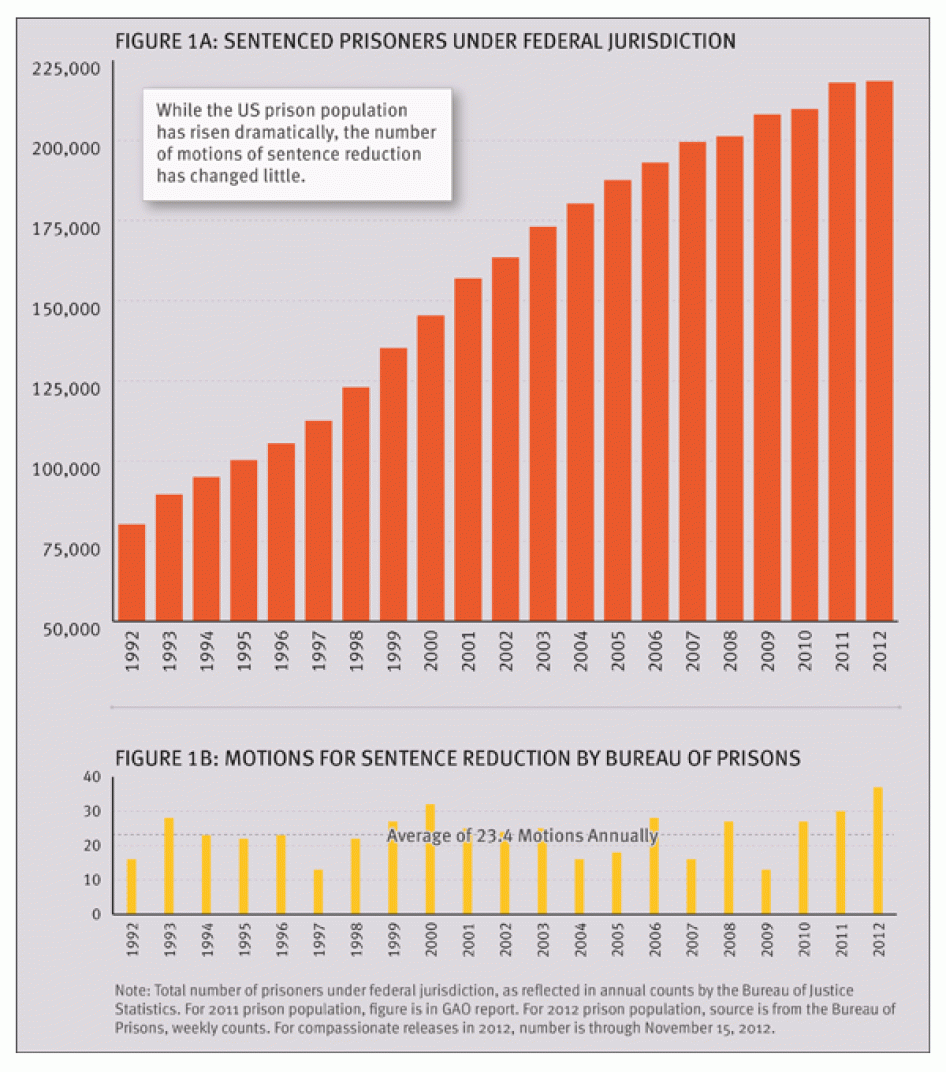
Not only is the number of motions for sentence reduction extraordinarily small given the size of the BOP population, but it has not grown commensurate with the growth in the number of federal prisoners. As shown in Figure 1, in 1994, the BOP housed 95,034 prisoners and made 23 motions for sentence reduction.[73] In 2011, even though the federal prison population had more than doubled to over 218,170, it made only 30 motions.
Figure 2: FMC Butner – Requests for Reduction in Sentence, 2011
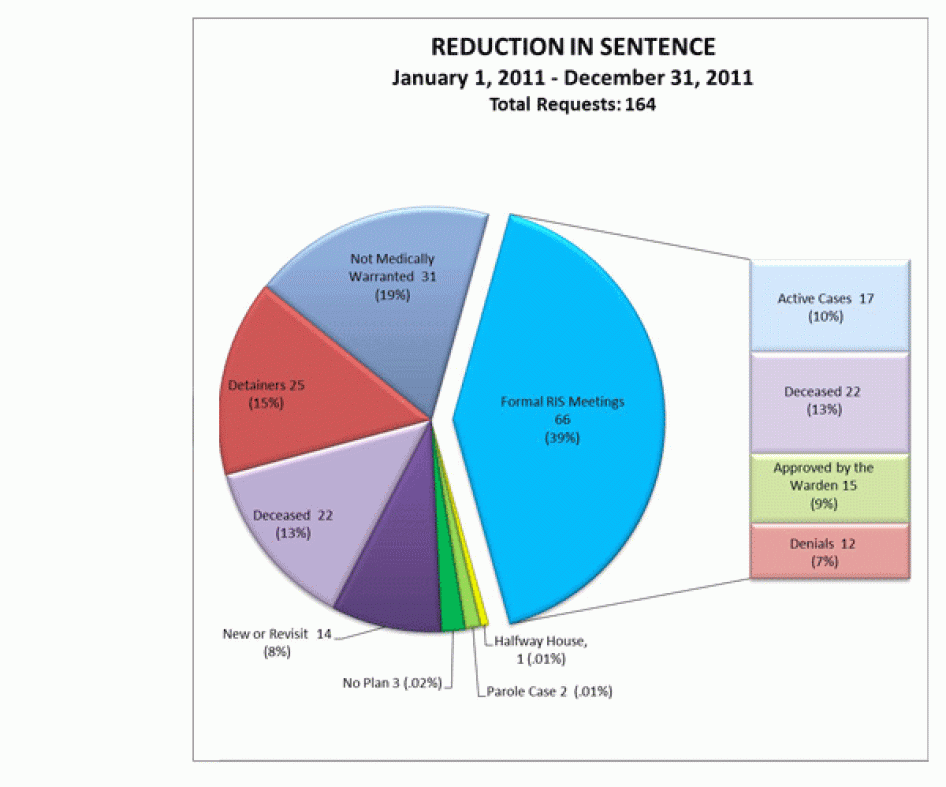
This figure was prepared by the BOP. Data is for prisoners at the federal prison complex at Butner, North Carolina.
The BOP has provided us compassionate release data from 2011 for the federal prison complex at Butner, North Carolina, which includes a large federal medical center. While the Bureau does not track prisoner requests to wardens that are not approved or appealed, the Butner data provided to us included prisoner request numbers. This data highlights the vast difference between the number of prisoners who sought compassionate release and the number whose requests the BOP director ultimately approved.[74]During 2011, 164 prisoners initiated the reduction in sentence process by making a request to the warden. As shown in Figure 2, only 66 of them were considered in meetings by the Reduction in Sentence Committee, which reviews prisoner requests and makes recommendations to the warden; the remaining prisoners were deemed ineligible for consideration because they were “not medically warranted” (meaning they did not have a sufficiently terminal or grave medical condition), had detainers from other jurisdictions (which precludes motions for sentence reduction), or had died before the committee could consider them.
Figure 3: FMC Butner – Warden Decisions on Reduction in Sentence Requests, 2011
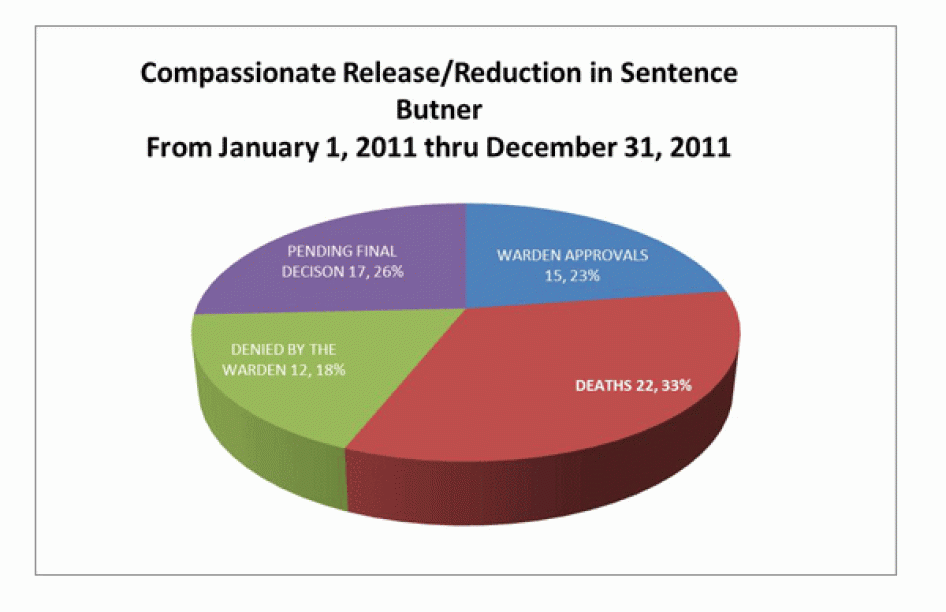
This figure was prepared by the BOP. Data is for prisoners at the federal prison complex at Butner, North Carolina.
As shown in Figure 3, of the 66 cases that were reviewed by the Reduction in Sentence Committee and then sent to the warden, the warden denied 12 on the grounds that early release might jeopardize public safety. The warden approved 15 of the remaining 54 requests and forwarded them to the regional director. Seventeen requests were pending a decision, and 22 prisoners died while awaiting the warden’s decision. [75]
Of the 15 requests the warden sent to the regional director, all were approved. The BOP director subsequently approved 12 of the 15 forwarded by the regional office; two were denied because they were “not medically appropriate for consideration,” and one prisoner was denied because he “posed a risk to the community.”[76]
In short, out of the 147 requests made by prisoners at FMC Butner in 2011 (not including the 17 in which decisions from the warden were still pending at the close of 2011), 12 were ultimately approved by the director as suitable for a motion for sentence reduction, where the prisoner had not died before that approval. Reflecting the gravity of their conditions, 22 prisoners who requested compassionate release in 2011 died while still behind bars.
Victor ElliottVictor Elliott (pseudonym), age 47, entered federal prison on November 9, 2010 to serve a twenty-year mandatory minimum sentence for being part of a heroin distribution conspiracy that resulted in the deaths from overdose of three people. The conspiracy included Elliott, a former heroin addict himself, and two other people whose only connection was that they bought drugs for resale from the same wholesaler.[77] Elliot was directly responsible for the accidental overdose death of one person to whom he provided the drugs; he denies any involvement with the other dealers or the deaths of their clients. Currently confined at FMC Butner, Elliott has an inoperable malignant brain tumor—“the size of a golf ball”—which did not respond to chemotherapy and radiation. According to the Butner oncologist, Elliott has less than a year to live.[78] He also has two ruptured discs in his lower back, is confined to a wheelchair, has problems moving his left arm and leg, and suffers chronic severe headaches. He apparently spends much of the day asleep. He has a sister who is willing to act as his caretaker and who provided plans to ensure he received appropriate medical care. Elliot sought compassionate release at the recommendation of his oncologist. Although he is close to illiterate, and “can’t spell worth a darn,” none of the staff helped him with his application. On January 12, 2012, the Reduction in Sentence Committee reviewed Elliott’s request. The committee’s memorandum recounts information contained in Elliott’s Presentence Investigation Report, including the overdose deaths of people caused by drugs they bought from Elliott’s “co-conspirators.” The committee also cited Elliott’s prior drug and battery convictions and details about other-drug related activities by Elliott. There is no discussion, however, about whether Elliott would be likely to rejoin the drug business given his brain cancer and confinement to a wheelchair or whether his expressed desire to spend his remaining months of life with his family and to make amends with his granddaughter is genuine. Although the committee acknowledged that Elliot had a poor medical prognosis, it concluded that his request should be denied because, “due to the severity of your crime and the fact that you have only served a small portion of your sentence, the committee expressed concerns about the possibility of your ability to re-offend.”[79] The warden concurred with the committee’s recommendation on January 19, 2012.[80] |
III. Federal Policies on Compassionate Release
“I urged more release for older, chronically ill offenders who couldn’t fight their way out of a paper sack, but the Central Office was simply not interested.”
– Joe Bogan, former BOP official who retired in 2000 after 17 years as a federal warden, telephone interview, July 15, 2012
It is unclear why the Bureau of Prisons adopted criteria that guarantee that only a paltry number of motions for sentence reduction will be filed each year. We believe the view that few prisoners should benefit from compassionate release is deeply rooted in the BOP’s history and institutional culture and reflects the preferences of the Department of Justice, of which the BOP is a part. BOP Assistant Director and General Counsel Kathleen Kenney told us the Bureau’s philosophy has long been that compassionate release should be used sparingly, although she could not tell us the origins of that approach.[81]
The BOP has been able to take a restrictive approach to compassionate release because Congress never specified the criteria it should use. The Department of Justice has taken the position that the BOP has unfettered bureaucratic discretion with regard to compassionate release because Congress statutorily committed the task of filing motions for compassionate release in court to the BOP and did not specify in the statute the circumstances under which the BOP should do so. According to the DOJ,
[W]hile “extraordinary and compelling reasons” are a permissible basis for the Director of the Bureau of Prisons to make a motion to reduce the term of imprisonment of an inmate, Congress has not specified what reasons or criteria the Bureau must consider in making this determination. Rather, this determination is within the discretion of the Director.[82]
In practice, the BOP decides for itself what the criteria for compassionate release should be, ignoring the Sentencing Commission’s guidelines, and it takes into consideration any factors it chooses, including those that Congress told the courts to consider.
As a constituent component of the DOJ, under the direction and supervision of the deputy attorney general, the BOP does not adopt or pursue policies inconsistent with those of the DOJ, nor does it promulgate official regulations without going through a DOJ review and approval process.
Deputy Attorney General James Cole declined to meet with us for this report, or to assign other staff from his office to do so. Instead of answering our written questions to him about the Department’s guidance to the BOP with regard to compassionate release policy and its views concerning the role of compassionate release in the federal criminal justice system, he had the BOP send us a letter that offered little insight into the DOJ’s thinking. (Our letter to the deputy attorney general and the response from the BOP on behalf of the deputy attorney general are reproduced in the appendix). Practitioners and others knowledgeable about the Bureau’s recent practice indicate that the DOJ’s approach to compassionate release remains the same as reflected in the 2006 Elston letter.[83]
It is not surprising that the DOJ would want BOP motions for sentence reduction restricted to very few cases. As Glenn Fine, former inspector general for the DOJ told us, “a prosecutorial perspective permeates the institution.”[84] Paul McNulty, former deputy attorney general, agreed that the Department’s institutional culture is one in which a “law enforcement and prosecutorial perspective” tends to predominate.[85] As Rachel Barkow, a law professor who has studied the DOJ, recently wrote,
The dominance of law enforcement interests at the Department is a reflection of the dominance of law enforcement interests in the politics of criminal justice…. [N]ot only do [prosecutors] have an interest in longer sentences and mandatory punishments; they also have an interest in opposing corrections reforms that make the conditions of confinement more relaxed or that result in earlier release times.[86]
In addition to its influence on compassionate release policy, the DOJ can affect BOP decisions in individual cases. When the BOP is reviewing a prisoner’s request for a sentence reduction, it consults with the US attorney in the judicial district in which the prisoner was sentenced. “The Bureau considers the information provided by the United States Attorney’s Office in making a decision regarding a [reduction in sentence] request.”[87] According to BOP Assistant Director and General Counsel Kenney, in most cases the US attorney raises no objection about compassionate release cases.[88] But if there is a conflict, it must be resolved before the BOP director approves a motion. In non-terminal cases for compassionate release—for example, one in which the prisoner has a non-terminal illness or is seeking compassionate release on non-medical grounds—if the BOP director is considering approval of the recommendation, the case will be sent to the office of the deputy attorney general first, before the BOP director makes a final decision.[89] The Bureau was not willing to describe even in general terms deputy attorney general communications to the BOP in such cases.
Determinations regarding medical eligibility, such as whether a prisoner is within twelve months of dying, are made by BOP medical staff. But beyond the confines of medical determinations, there is little guidance, and thus much room for inconsistency, subjectivity, and even arbitrariness in decisions regarding whether to bring motions to the court for compassionate release.[90]
Wardens are the pivotal figures in the compassionate release process because their decisions to not recommend approval of prisoner requests are almost never overturned. Their “no” becomes the BOP’s “no.” On the other hand, senior officials may and do deny cases wardens have recommended. BOP data from 2000 through 2011 indicate that the BOP Central Office denied prisoner requests in 40 percent of the cases the wardens and regional directors recommended for approval.[91]
The BOP provides scant training to wardens on how to exercise their discretion and little oversight of their decision-making. If a warden wants to deny a prisoner’s request for compassionate release consideration because he believes the prisoner’s crime is heinous, there are no BOP instructions or guidance that tell him such beliefs should not play a role in his decision. Our interviews with former and current wardens suggest that while wardens learn from “experience” and familiarity with the BOP institutional culture what prisoner circumstances the Central Office is likely to consider worthy of sentence reduction, their approach to individual cases varies.[92] A former warden, for example, told us he approved every request from a prisoner who met the medical criteria for terminal illness or incapacitation, even if he assumed it would be rejected by his superiors.[93]
Former warden Joe Bogan told us he did not want to “waste his superiors’ time” by sending them cases he knew they would deny.[94] But sometimes the Central Office did reject cases he had recommended. He recounted the case of a young woman serving time for minor drug dealing who developed ovarian cancer. He approved her request for compassionate release and forwarded it up the chain of command. The Central Office turned it down because of the possibility she might re-offend. Bogan thought the decision was “ridiculous.” A few months later, the woman died behind bars.[95]
Michael MahoneyMichael Mahoney was sentenced in 1994 to a mandatory minimum term of 15 years as an “armed career criminal.” The “career criminal” designation derived from three drug sales totaling less than $300 to an undercover agent over a three-week period in the late 1970s.[96] Felons, like Mahoney, may not legally possess firearms. Erroneously believing that enough time had lapsed since his prior convictions to allow him to carry a gun, Mahoney had purchased one to protect himself when making night deposits from his small business. When the gun was stolen, he duly reported it to authorities, his error was discovered, and he was prosecuted.[97] Years later, in 2004, Mahoney was dying in prison from lymphoma and asked for compassionate release. The warden at the Lexington Federal Medical Center thought the BOP should file a motion on his behalf, and the regional director agreed. In late July, BOP Director Harley Lappin denied Mahoney’s request, even though the regional director had approved the request and it was unopposed by the US attorney. Lappin’s decision was based on “the totality of the circumstances” and Mahoney’s “multiple felony convictions.”[98] On July 26, 2004, Judge James D. Todd, who had sentenced Mahoney, hearing of the director’s denial, wrote to Lappin, stating that in 20 years on the bench he had never before written to a corrections official on behalf of a prisoner he had sentenced. Describing the circumstances of Mahoney’s conviction, he said that “Mr. Mahoney’s case has troubled me since I sentenced him in 1994 … [as] one of those cases in which a well-intentioned and sound law resulted in an injustice.” He said he was aware that Mahoney was bedridden, suffering great pain, and considered near death. He suggested “that … a motion [for compassionate release] is the only way to mitigate in a very small way the harshness which [the Armed Career Criminal Act] has caused in this unusual and unfortunate case.”[99]Lappin did not reply. Mahoney died a few days later. |
Medical Conditions
According to the BOP’s medical director, a terminal condition which leads to a motion for a reduction of sentence is usually the result of a particular illness, such as metastasized cancer.[100] A terminal condition may also result from severe co-morbidities, such as a combination of physical problems like congestive heart failure and liver failure, which, taken together, lead to a prognosis of very limited life expectancy.[101] In the category of profound and irremediable debilitation or incapacity, the BOP includes such conditions as Parkinson’s Disease, Amyotrophic Lateral Sclerosis (ALS), Alzheimer’s Disease, and permanent brain injury, paralysis, and ventilator dependency.[102] We learned, for example, of a case in which the BOP moved for the sentence reduction of a woman serving time for minor drug offenses who developed Lou Gehrig’s disease. The woman was able to go home to be with her seven-year-old daughter for the time remaining to her.[103]
Our research reveals that the majority of compassionate release motions brought by the BOP are for prisoners who are terminally ill.[104] Thus, for example, the BOP moved for a sentence reduction for 51-year-old Charles Costanzo, a first-time offender who was serving a 70-month sentence for embezzling from a worker’s compensation fund. In April 2012, three years into his sentence, Constanzo was diagnosed with stage IV stomach cancer that had already spread to his lymph nodes and diaphragm. His condition was clearly and imminently terminal. According to Costanzo, the prosecutor in his case originally balked at the prospect of compassionate release, but later agreed.[105] The BOP moved for a sentence reduction, which the sentencing judge granted.[106] Constanzo was released on July 24, 2012 to his mother’s home, and he died on October 11, 2012.[107]
Calculating life expectancies for terminal illness is not a precise science, but the BOP insists that the prognosis for the life expectancy of terminally ill prisoners be 12 months or less before it will make a motion for sentence reduction. Apparently, even when a condition is terminal and debilitating, if the doctor cannot state a 12-month prognosis, the Bureau will not recommend compassionate release.
Raymond BransonIn early March 2012, Raymond Branson (pseudonym), serving a 48-month fraud sentence, was preparing to enter a halfway house to complete the final six months of the Residential Drug Abuse Program (RDAP).[108] Successful RDAP participants can earn up to one year off their sentences. Branson had already received confirmation of his new release date of September 12, 2012, representing a full year sentence credit. But, just before he was to enter the halfway house to finish the program requirements, Branson was rejected because he had been diagnosed with stage IV gastric cancer. His original release date of September 2013 was reinstated. His attorney wrote to the BOP seeking a reduction in sentence for compassionate release. A month passed before the warden responded, referring the case to the Tumor Board. Branson’s lawyer, concerned by the delay, moved the court to compel the BOP to seek compassionate release, citing the impossible “catch-22” Branson faced: once eligible for immediate release to the halfway house, he was now prevented by his cancer from entering the halfway house. Because he was too sick to complete the halfway house portion of the drug abuse program, he lost the 12-month credit he had been expected to earn. But the BOP was unable to determine with certainty that he would die within the 12 months. The sentencing judge clearly favored Branson’s release. At a hearing on the motion, he said that the government and defense attorney should work together to find a solution. If Branson could secure medical care after release from prison, “[i]t seems to me it’s not in anybody’s best interests, assuming Mr. [Branson] is as sick as is represented, to have him remain in prison. Obviously it would be very difficult for him. It would be a burden on the prison system and also an expense to the government, which it seems to me is not a good idea for anybody.”[109] The court denied the motion pending further information. The BOP was unable to ascertain a prognosis and so set his case off repeatedly for assessment. In September, Branson’s attorney again moved the court, citing the delayed assessment and Branson’s deteriorating medical condition. Certain that Branson would not survive the year, his lawyer wrote, “Mr. [Branson] is being punished because he is dying of cancer – he is being precluded from entering [a halfway house] which he is otherwise eligible for and he is losing jail-time credit even though he already completed RDAP.”[110] Reluctantly, the court denied the motion. “While the Court is sympathetic to Defendant’s condition and, in particular, the fact that, on account of such condition, Defendant has been denied placement in a [halfway house], the Court is without authority to award Defendant the relief sought…,” it said. [111] As of this writing, Branson’s cancer has spread to other organs, the Tumor Board has been unable to determine a date of death, and he remains in prison. |
The BOP does not consider old age and the frailty and declining physical and mental abilities that ordinarily accompany it as sufficient medical grounds for a motion for sentence reduction.[112] For example, Brian Simpson (pseudonym) is an 84-year-old federal prisoner who began serving a 10-year sentence in 2006 for conspiracy to defraud the United States and obstruction of justice.[113] Although doctors do not describe his medical condition as terminal, his daughter insists his medical condition has rapidly deteriorated since his incarceration. He has been hospitalized several times, including once for heart failure; has fluid buildup in his lungs that must periodically be drained; and suffers increasingly from a variety of other physical problems, including diabetes, hypertension, anemia, severe arthritis, and possible renal failure. His mobility is poor and he walks with a cane. He is not allowed to work because of his medical condition. His daughter describes him as “a sad, sick old man with many medical problems.”[114] The BOP has denied his requests for consideration for compassionate release because it does not consider his circumstances to be extraordinary and compelling.[115]
If the BOP were guided by the USSC’s guideline governing compassionate release, the number of motions for early release on medical grounds would doubtless be considerably greater. The guideline recognizes that extraordinary and compelling reasons for a sentence reduction can exist when a prisoner suffers from a terminal illness or when a prisoner’s capacity to care for himself in prison is substantially diminished because of illness.[116]There is more latitude here than under the rigid criteria the BOP uses. For example, the USSC does not mandate a 12-month prognosis of death.
Out of a population of over 218,000 prisoners, there are undoubtedly many more than the 30 cases granted in 2011 for terminal or other medical conditions who might meet the USSC criteria. Hundreds of prisoners die each year from illness, and many of those deaths are no doubt predictable, rendering the prisoners eligible for compassionate release. [117] At FMC Butner alone, over the six-month period between October 1, 2011 and March 31, 2012, 60 prisoners died whose deaths were predictable because of the nature of their illness. [118]
The BOP also has a growing population of elderly prisoners, many of whom will experience diminished physical and mental abilities while in prison.[119] At the end of 2010, there were 7,107 men and women in federal prisons who were age 61 and older, including 74 who were over 80.[120] The commentary to the USSC guideline states that “deteriorating physical or mental health because of the aging process … that substantially diminishes the ability to provide self-care” in prison may constitute extraordinary and compelling circumstances.[121]
Non-Medical Grounds for Compassionate Release
BOP Assistant Director and General Counsel Kathleen M. Kenney has acknowledged that, at least in the last twenty years, the Bureau has not made any motions for compassionate release for prisoners whose extraordinary and compelling reasons were not medical.[122]
The BOP views hardship to families as part of the price of incarceration and hence as insufficiently “extraordinary and compelling” to warrant early release. John Yardley (pseudonym) sought compassionate release in early 2008 because his young daughter was dying of brain cancer. He was serving a sentence of 66 months for conspiracy to possess and distribute methamphetamine and had an extensive criminal record. The warden rejected Yardley’s request: “I cannot find extraordinary or compelling circumstances to warrant recommending approval of your request for compassionate release. I have enormous compassion for your dying daughter. However, your situation is not unlike many other incarcerated prisoners in similar situations.”[123] Upholding the warden’s denial, the administrator for national prisoner appeals in the Central Office noted,
While extreme, your situation is not significantly different than other prisoners whose families experience profound hardship as the result of a loved one’s incarceration. Regrettably, family hardship, even extreme family hardship, is an unfortunate consequence of incarceration, and is not, therefore, extraordinary and compelling in a manner that supports the Bureau’s motioning the sentencing court to release you from the balance of your prison sentence.[124]
Mary SamuelsMary Samuels (pseudonym) was sentenced in 1993 to over 30 years in prison after pleading guilty to participating in a bank robbery and use of a weapon.[125] When she entered prison, she had completed only the third grade, was dependent on drugs and alcohol, and had lost custody of her children. According to the warden, Samuels “participated extensively in programs to better herself and prepare for her release.”[126] She earned her high school diploma, began college courses, and completed a business management certificate from a community college. She also engaged in a variety of self-help and sober programs and has worked for UNICOR industries for 14 years, receiving incentive awards. Between 2002 and mid-2006, while she was incarcerated in a federal prison in Tallahassee, Florida, male prison guards sexually abused Samuels and other female prisoners. Samuels filed a lawsuit against guards and officials, settling some claims and winning an award against one of her abusers for $2.2 million. In 2010, Samuels sought compassionate release, citing the abuse, her diagnosis of post-traumatic stress syndrome, and her inability to secure psychological help for it. Her son was eager to provide her a home and a job. The warden recommended her release: Based on the circumstances of her instant offense, her lack of prior criminal history, has [sic] served over two-thirds of her sentence, has [sic] gained educational and vocational skills and having family support, housing, and employment, prisoner [Samuels] appears to pose low risk to recidivate or a risk to public safety. In addition, her sexual abuse during incarceration was an extraordinary, unforeseen circumstance that could not have been considered by the sentencing court.[127] The regional director rejected the warden’s recommendation, concluding that Samuels’ “circumstance, although unfortunate, does not merit a compassionate release.” [128] The regional director reiterated the rejection when Samuels appealed it, stating “staff did not consider your situation an extraordinary and compelling circumstance to warrant an early release.” [129] The Central Office concurred: You cite the fact that you have served over half you sentence; you have taken advantage of educational opportunities during your incarceration; and you were victimized by staff. All aspects of your circumstances, including criminal history, are taken into consideration … however these factors are not extraordinary enough to warrant a reduction in sentence.”[130] Samuels then sought relief in federal court but was denied because the court did not have jurisdiction to grant her relief. |
Foreseeability
The BOP will consider requests for compassionate release if the “extraordinary and compelling” circumstances “could not reasonably have been foreseen by the court at the time of sentencing.”[131] This language is ambiguous: does the rule require the circumstances to have been foreseeable in theory or that they were actually foreseen by the judge? According to Lorna Glassman, a BOP assistant general counsel, if a person had cancer but it was in remission at the time of sentencing, and the cancer returns during his imprisonment, the Central Office would not necessarily deny his request for sentence reduction because the return of cancer might have been foreseeable.[132] Wardens have, nonetheless, denied prisoner requests for compassionate release consideration on the ground their illness was known at the time of sentencing—even if they were not dying at that time.
For example, Daniel Young was 58 when he was sentenced in 2010 to 51 months of imprisonment after conviction for Medicare fraud. At the time, he had hepatitis C and diabetes, for which he was being treated; he was sick but not dying. Two years later, Young was dying of liver and renal failure. In January 2012, the warden told Young’s wife that Young would not be eligible for compassionate release because his “medical condition is clearly documented in his Presentence Investigation Report.”[133] Young died two months later, still incarcerated.[134]
When Evan Quinones entered prison in 2000 to serve a sentence of 96 months for heroin trafficking, he was HIV positive. Five years later, on September 15, 2005, his mother was informed by letter that he was “seriously ill,” and a month later, she was informed he was “critically ill.”[135] By November of that year, he was expected to live only a few months due to myriad medical problems, including AIDS, Hepatitis C, cirrhosis, pancreatitis and other conditions. He was denied compassionate release, however, because according to the warden, “the Court was aware of [his] medical condition at the time of sentencing.”[136] Quinones died in prison.[137]
IV. Public Safety and Compassionate Release
The general counsel of the Bureau of Prisons recently told us, “As a law enforcement agency, the Bureau’s mission to protect society includes a responsibility to provide for public safety and make decisions with public safety in mind…. [W]e consider it the Bureau’s responsibility to consider public safety when determining whether to pursue a prisoner’s release through a [motion for sentence reduction].”[138] The BOP assesses “public safety concerns” and the “totality of the circumstances” when deciding whether a motion for sentence reduction is warranted.[139] Indeed, public safety and other criminal justice concerns can trump all other factors, even for prisoners who are medically eligible, have an acceptable release plan,[140] and have no detainers from other jurisdictions pending.[141]
Surprisingly scant public attention has been paid to the BOP’s unilateral assumption of authority to assess the public safety implications of prisoners’ early release. This exercise of BOP discretion is troubling because Congress specifically directed the federal judiciary, not the Bureau, to assess the impact on public safety in making sentence reduction decisions. There is no question that the BOP must protect the public by ensuring prisoners under its jurisdiction do not escape, and that it must assess the risk of dangerous behavior when making furlough or halfway house decisions.[142] The BOP is the sole decision-maker in such situations, and the prisoners remain under its jurisdiction. But we can find no support for the proposition that the BOP should take public safety into account in considering whether to move the court to release a prisoner who presents extraordinary and compelling circumstances.
In interviews, neither BOP Director Charles E. Samuels nor Assistant Director and General Counsel Kathleen M. Kenney could explain the statutory or legal source of the Bureau’s asserted authority to refuse to make motions for sentence reduction to otherwise eligible prisoners on public safety grounds.[143] In a written response (reproduced in the appendix) to our question concerning the BOP’s authority to take public safety into account, the BOP stated without elaboration that “[c]ase law and legislative history describe the Director’s discretion to determine whether extraordinary and compelling reasons exist to warrant a reduction in sentence.”[144] The legislative history is in fact silent on whether the BOP should be assessing public safety, and the case law simply acknowledges the BOP’s general discretion in compassionate release decisions and does not address whether the BOP should base its decisions on public safety. The BOP also pointed us to the Hawk Memo, but while that document asserts public safety as a factor for the Bureau to consider, it does not explain the source of the Bureau’s authority to do so.
Tellingly, the Hawk Memo, which describes a set of public safety-related considerations for wardens to evaluate, includes not only factors that were committed by statute to the courts, but ones that the court is already aware of and thus hardly needs the BOP to evaluate and pass on. The sentencing court considering a compassionate release motion would already be well aware of, and better able to evaluate, the impact of the nature and circumstances of the offense; criminal and personal history and characteristics of the prisoner; the danger, if any, the prisoner poses to the public if released; and the length of the prisoner’s sentence and amount of time left to serve. The BOP has no special competence to evaluate such factors in lieu of the court. The only public safety information the BOP might be able to add to the picture would be about the prisoner’s conduct post-sentencing. While the memo commends the public safety considerations to the wardens’ “correctional judgment,” we are hard pressed to see how wardens’ judgment about such matters could ever supplant that of the sentencing judge.
It is significant that in the compassionate release statute, 18 U.S.C. section 3582(c)(1)(a)(i), Congress did not direct the BOP to take into consideration public safety (or any other criminal justice factors) before making a motion for sentence reduction. This silence contrasts notably with another safety valve provision, 18 U.S.C. section 3582(c)(1)(A) (ii), which permits the court to reduce the sentence of certain elderly offenders sentenced to life for serious violent felonies “when a determination has been made by the Director of the Bureau of Prisons that the defendant is not a danger to the safety of any other person or the community.” This “lifer” safety valve was added to section 3582 in 1994. According to a longstanding maxim of statutory interpretation, expressio unius est exclusio alterius, the expression of one thing is the exclusion of another. “Where Congress includes particular language in one section of a statute but omits it in another…, it is generally presumed that Congress acts intentionally and purposely in the disparate inclusion or exclusion.”[145] The express direction to the BOP that it consider public safety before moving the court to reduce a life sentence for certain prisoners, and the lack of any direction to make a public safety determination when considering moving the court to reduce a sentence for compassionate release, strongly implies that Congress did not intend the BOP to rule on public safety in the latter case. This presumption is strengthened because the compassionate release provision had been in place for 10 years before the lifer safety valve was added in 1994. This likely means Congress intentionally added the BOP public safety determination precisely because Congress believed the Bureau was not expected to make such determinations with respect to compassionate release, but it was expected to do so in the lifer cases.
Calculating Public Safety
Former wardens acknowledged to us that predictions of future behavior are uncertain at best. When considering requests for compassionate release, some place heavy emphasis on the nature of the crime that led to the prisoners’ conviction: the more serious the potential new crime, the less likely support for early release. One former warden, Joe Bogan, told us that for public safety reasons, prisoners who had been convicted of violent or sex offenses usually would have to serve more of their sentence than non-violent offenders before he would respond favorably to requests for compassionate release.[146]
On the other hand, Art Beeler, who spent 22 years as a federal warden, told us that he had been more concerned about re-offending by prisoners who had engaged in white collar crimes than those who engaged in violent crimes, on the theory that physically debilitated prisoners might not be able to rob a bank but, given access to computers and telephones, white collar criminals could still engage in fraud.[147] He also pointed out there are no guarantees regarding future human behavior: deciding whether to recommend someone for release entails the difficult balance of being careful but not so risk averse that no case would ever be approved.
We have reviewed dozens of memoranda to prisoners from BOP wardens, regional directors, and the BOP Central Office denying, on public safety grounds, prisoner requests for compassionate release or appeals of the wardens’ denials. Based on that review, it appears that all too often, if a prisoner is considered to have the physical or mental ability to re-offend, the BOP will conclude that he poses a public safety risk. The physical and mental capability to commit a crime is conflated with the likelihood of doing so.
As the memoranda included in the appendix exemplify, the BOP usually does not explain which specific aspects of the prisoner’s history or circumstances lead officials to conclude that he or she remains dangerous. There is no analysis, for example, of whether the prisoner has shown remorse or understanding of the impact of his conduct on victims, a factor that is frequently relevant in sentencing, and there is no discussion of whether prisoners with similar profiles have proven likely to re-offend following early release.
For example, the BOP denied Carl Meecham’s (pseudonym) effort to obtain compassionate release on public safety grounds.[148] In 2006, Meecham was sentenced to 108 months in prison after being convicted of conspiracy to commit mail and wire fraud in connection with a fraudulent telemarketing scheme. He had no prior convictions. The judge explained that she sentenced Meecham to a sentence below the minimum range because of “the nature and circumstances of the offense and the history and characteristics of the defendant” and because at Meecham’s age (he was 65), a sentence “under the guideline range would leave him very little, if any, life to live upon release from imprisonment.”[149]
In June 2011, after serving more than half of his sentence, Meecham was diagnosed with stage IV lung cancer and given a prognosis of less than a year to live. The warden at the Federal Medical Facility at Butner, where he had been sent to receive palliative chemotherapy, denied his request for compassionate release, and the denial was upheld in the administrative appeal process. The memorandum to Meecham from the warden described how he and his partner had defrauded upwards of “1,000 U.S. citizens from 49 states of more than fourteen million dollars” by getting them to invest in a non-existent business. The warden opposed Meecham’s request for compassionate release to die at home because of the severity of his crime and “the possibility of your ability to re-offend.”[150] The warden then denied Meecham’s administrative appeal after considering “the likelihood of your re-offending and assessing potential risks to the public.”[151] In neither memorandum did the warden provide any analysis of why she thought Meecham might re-offend. She did not, for example, discuss whether he showed remorse for his crimes or understood the full impact of what he had done, or whether, on the contrary, she had reason to believe he was contemplating committing more crimes if released.
Although courts almost never grant compassionate release without a motion by the BOP (see Section VII, below), in November 2011, the federal judge who had originally sentenced Meecham granted him compassionate release after a petition from his lawyer. In notable contrast to the public safety concerns of the warden, the judge wrote,
But where the sentencing factors drove my decision in 2006 that Mr. [Meecham], who was in his sixties when he was sentenced, not die in prison, the sentencing factors operate again to support his petition for release to his family now. Specifically, the public will not be harmed; at this sentencing, Mr. [Meecham] demonstrated an understanding—for perhaps the first time—of the full impact of his actions, and it is inconceivable that he would desire to cause further harm. And the nature of his offenses, which call out for a serious sentence, should not trump the Court’s express intention that he outlive his time in custody.[152]
Even if the BOP had concerns regarding a prisoner’s potential public safety risk, it could make a motion for sentence reduction and urge the court to impose specific terms of supervision that would ameliorate the risk. The courts can and do build into their release orders specific conditions to further protect the public, in addition to more generic supervision requirements. For example, in Charles Costanzo’s case (discussed in Section IV, above), the court’s release order instructed Costanzo to have no contact with the government witnesses or the co-defendants in his case.[153]
Retribution, Sufficiency of Punishment, Nature of the Crime, Victims
The BOP takes into consideration a range of criminal justice factors besides the possibility of re-offending when making compassionate release decisions. These subjective, value-laden factors are often hidden under vague and conclusory references to public safety. Wardens consider such things as the nature of the crime, whether the prisoner has been “punished enough” in light of that crime, and what victims or the general public might think if the prisoner were released early.
In Carl Meecham’s (pseudonym) case, noted above, the warden commented at length in the memorandum denying his request on the great harm he had caused the victims of his fraudulent scheme. The harm seemed to weigh heavily in her decision. Former Warden Joe Bogan told us that retributive considerations clearly factored into his decision-making.[154] He explained that, while he received no guidance from his superiors about how to approach the question of whether someone had served long enough, it was something he learned to judge through experience. Compassionate release, in his view, should not be granted if it depreciated the seriousness of the offense. If a prisoner serving a twenty-year sentence became seriously ill after only two years, Bogan was less likely to recommend compassionate release than if the prisoner had already served a great proportion of his sentence. Indeed, he characterized the early release stance of the BOP as “compassionate [if the prisoner] has done enough time.”[155] Another former warden, Art Beeler, also struggled with the time a person had served. He told us, “I tried not to use it as a [criterion], but it was in my mind how long a person had served on his sentence.”[156]
A warden’s subjective response to a crime can also influence the outcome. Art Beeler told us that if a prisoner had committed a particularly terrible crime, he was less likely to recommend him for compassionate release.[157] Joe Bogan also acknowledged to us that there were some prisoners he would never recommend for compassionate release because of the heinousness of their crimes. He specifically cited sex offenders.[158]
Caspar McDonaldCaspar McDonald (pseudonym), 73 years old, has served ten years of a twenty-year federal sentence for sexually touching the child of a neighbor, taking pictures of her genitalia, and possession of child pornography.[159] He has no prior criminal history. Because of severe spinal stenosis, McDonald is permanently paralyzed below his upper chest and is unable to use his arms or legs. He also has hypertension, anemia, diabetes, and hypothyroidism. He cannot bathe, dress, go to the toilet, or move himself without assistance, and because of pain, he cannot sit up or be out of bed for more than brief periods of time. He will remain bedridden and require skilled nursing care for the rest of his life. To call a nurse, he blows into a special tube. The BOP acknowledged that his medical condition was “serious” and made him “an appropriate candidate for reduction in sentence consideration.” [160] Nevertheless, in October 2011, Warden Sara Revell concurred with the recommendation of the Reduction in Sentence Committee that his request should be denied “due to the nature of your offense and the length of sentence imposed.” [161] When McDonald appealed the denial, Warden Revell denied the appeal, stating, “[a]n objective of the reduction in sentence program is each request will be carefully reviewed to protect the public from undue risk. Due to the seriousness of your instant offense, you are still considered a threat to society.” [162] Human Rights Watch met with Warden Revell and asked her why she felt McDonald could be considered a threat to public safety were he released, given his physical condition.[163] Warden Revell acknowledged McDonald was physically incapable of re-offending. Yet she said that it was her responsibility to “put myself in the victim’s role” and to think “how the victim or her family would feel” were McDonald released home before the end of his sentence. She also said that as a warden, she has discretion to consider whether the prisoner’s release would lessen the seriousness of his offense.[164] |
Fear of Bad Publicity
BOP staff members may consider the possibility of bad publicity or adverse public response when making compassionate release decisions in particular cases.[165] As a former warden framed it, “Compassion for a murderer? We knew we had a responsibility not to have a hue and cry from the public.”[166] Former Warden Joe Bogan emphasized that the BOP wanted to avoid bad press and “getting into trouble” over compassionate release decisions. He explained that the Bureau “takes pride in not causing problems” for the DOJ with its compassionate release decisions.[167]
This concern can prompt a conservative approach to requests for early release consideration: the BOP does not want to confront an uproar in the press or political blowback from making a motion for the early release of someone who then commits a horrifying crime. Consideration of public response may also color refusals to grant requests for compassionate release when the prisoners have committed particularly grave or notorious crimes, even if there is little or no chance of their re-offending.[168]
V. Administrative Remedy
A prisoner may appeal denials of his request for a motion to reduce his sentence made by the warden or the regional director through the regular administrative remedy process.[169] The administrative remedy process requires an appeal first to the warden who denied the prisoner’s request; if the warden rejects the administrative remedy, the prisoner may appeal to the regional office; if rejected at the regional office, the prisoner may appeal to the BOP Central Office. No appeals are possible to rejections by the Central Office.[170]
We do not know what proportion of prisoners file an appeal when their requests for compassionate release are denied by the warden. Our sense is that many do not. Some may be too sick to have the physical or emotional energy or even capacity to pursue an appeal. Some prisoners told us they were not aware they could appeal denials of their requests for compassionate release. Others suggested they did not bother because they thought it would be futile.
The belief that appeals are futile is borne out by the statistics. In 2011, there were 41 administrative remedies filed with wardens who had denied prisoner requests for compassionate release consideration; only one was granted. Out of the 40 prisoners whose administrative remedies were denied, 24 then appealed the wardens’ denials to the regional directors, who granted one. All of the prisoners who were denied at the regional director level then appealed to the Central Office, which granted none of them, although it returned one case to a warden for reconsideration.[171] Between January 1, 2009 and August 26, 2012, 127 administrative remedies were appealed to the Central Office; 55 were rejected on procedural grounds (such as not being filed in a timely manner), and none were granted.[172]
The BOP follows the same timetables in cases where compassionate release is being sought as in any other appeal. From the time a request is originally filed until a final decision by the Central Office can take 160 days.[173] There is no provision for expediting the appeals in compassionate release, even when the prisoner has only a few months or less to live and time is of the essence.
The BOP also insists on observance of the smallest bureaucratic requirements, even when dying prisoners submit their administrative appeals. In one recent case, for example, a prisoner with less than six months to live failed to use the correct form when he appealed the warden’s denial. The warden did not mention the improper form but denied his appeal, and the prisoner then appealed to the regional director. After a month, the regional director responded to the prisoner that he had used the wrong form to file his appeal with the warden and that he had to start the appeal process again with the warden, using the right form.[174] In another case, an appeal of a denial was rejected by the Central Office because the prisoner used two pages, and the limit is one page, one-sided.[175]
The responses to prisoners who appeal denials are often as cursory and one-dimensional as the denial of the prisoners’ original requests. The official justification for a denial can be as short and un-illuminating as “the nature of the offense.” It can also be outright incorrect, as in one case when a warden mixed up the role of the prisoner with that of his co-defendant.[176] Wardens’ adverse decisions are almost never overturned, and the ability of a prisoner, particularly one hampered by illness, to effectively challenge them is nil for all intents and purposes.
A Fair Process?
The BOP process for decision-making in compassionate release cases contains numerous levels of bureaucratic review, but scant guarantees of fairness. When the warden initially considers a prisoner’s request, there is no requirement that there be a hearing or even an informal meeting or interview during which the prisoner can respond directly to questions and concerns. As noted above, the rationale for decisions to deny requests for compassionate release are often summary “public safety” conclusions that yield little insight into the evidence supporting them and which therefore deny prisoners the information necessary for them to attempt to overturn the denial.
Lack of transparency continues at the Central Office. What the US attorneys or officials in the Office of the Deputy Attorney General tell the BOP when it consults them, and what influence this has in a particular case, is not revealed to the prisoner. If there were a hearing before a judge, prosecutors would have to lay out publicly any objections they have to early release. But as long as the BOP denies the prisoner’s request, such objections can remain private, because there is no appeal from the director’s decision and, as discussed below, no judicial review of that decision.
Mazen Ali YasinMazen Ali Yasin (pseudonym), a naturalized US citizen born in Iraq, is a 64-year-old small-time merchant who lived in Detroit with his wife and nine children before he began serving a 46-month sentence in March 2011 for violating the International Emergency Economic Powers Act.[177] Until January 2003, he traveled frequently to Iraq, earning money by bringing parcels and money to the families and friends in Iraq of Iraqi nationals in the Detroit area. He also traveled to Turkey to purchase nuts and seeds. The US government claimed that in December 2002, Yasin provided information to the Iraqi Intelligence Service about Iraqis living in the United States and about US troop activity he had witnessed while in Turkey. Yasin insists he was never a terrorist or a spy, but that he provided information to the Iraqi intelligence agents after they contacted him in late 2002 and threatened to prevent him from entering the country again if he did not provide them information. None of the information he supposedly provided to the Iraqis was alleged to have been secret or official information; his lawyer insists it was mostly false or fantasy and harmless. Yasin did not plead guilty to and was not sentenced for providing information to the Iraqis, but the government’s claims were included in his presentencing report. In 2009, Yasin pled guilty and received the lowest possible sentence under the sentencing guidelines, given the charges against him. The sentencing judge stated, “I don’t believe that the public needs to be protected from further crimes of the defendant. I don’t see that he’s likely to reoffend.” [178] Shortly after sentencing, Yasin was diagnosed with stage IV metastatic thymoma. The sentencing judge let him wait two years before entering prison so that he could receive medical care in the community. There is no evidence that he re-offended during this period. [179] In October 2011, Dr. Andre Carden, Yasin’s oncologist, estimated that Yasin had less than six months to live and that his case was medically appropriate for reduction in sentence consideration. [180] On November 30, 2011, the Reduction in Sentence Committee recommended to the warden a denial of Yasin’s request for a reduction in sentence, “due to the nature of your criminal offense and your ability to reoffend,” and the warden concurred on December 2, 2011. [181] There was no indication in the memorandum whether the Committee thought it likely that Yasin would want to re-offend or what sort of offense he could commit. [182] Yasin sought an administrative remedy, but his appeal was denied by the warden on May 3, 2012. On June 8, 2012, Yasin filed a petition for writ of habeas corpus in the US District Court, Eastern District of North Carolina, seeking a judicial determination of whether the BOP had violated his right to due process and the separation of powers because it made decisions based on matters reserved for the judiciary. During a meeting with Warden Sara Revell, Human Rights Watch asked her why she denied Yasin’s request for compassionate release. We noted that it was unlikely he could or would provide information to the Iraqi Intelligence Services again, given that neither the government of Saddam Hussein nor his intelligence services existed any more. Moreover, Yasin had relinquished his passport and was in no physical shape to travel in any event. Warden Revell told us that Yasin’s actions in providing information to the Iraqi government were so serious that he did not warrant a reduction in sentence. She said she gave more weight to what he had done than to the fact that he probably would not re-offend. [183] |
VI. The Lack of Judicial Review
When the Bureau of Prisons refuses to make a motion for sentence reduction, prisoners have no recourse. The government vigorously opposes prisoners’ efforts to obtain relief in the courts, and the courts in turn have been loath to intervene. Judicial review of a BOP refusal to support compassionate release is almost non-existent.
Prisoners have appealed to the courts in several different ways. Some have directly asked the sentencing court to reduce their sentence for extraordinary and compelling reasons, notwithstanding the BOP’s refusal to bring a motion. Others have asked the federal courts to review the Bureau’s refusal as unlawful. Still others have tried to challenge the way the BOP arrived at its regulations and internal program statements.
Seeking Direct Release
With rare exceptions, prisoners who have filed compassionate release motions directly to the courts have been rebuffed. The courts have accepted the government’s argument that they lack authority to intervene because the compassionate release statute gives the BOP sole discretion to bring them the motion for a reduction in sentence for extraordinary and compelling circumstances. That is, Congress has not authorized prisoners to make such motions on their own.[184]
Review of the Failure to Act
Federal courts are sometimes able to review the actions or failures to act of federal agencies to determine if they are consistent with governing statutes and regulations. Some prisoners have sought to convince courts to review the BOP’s refusal to make a compassionate release motion, in hopes the court will find the Bureau acted unlawfully and order it to act. The courts have almost always concluded that they have no basis for overturning the BOP’s decision on the grounds that Congress granted the BOP complete discretion to bring or not bring a motion.[185] Because the Bureau has such broad discretion, the courts have no way to intervene and, even if they did, no standards against which to judge a refusal to make a motion.
As one court explained, “[t]he statute places no limits on the BOP’s authority to seek or not seek a sentence reduction on behalf of a prisoner, nor does it define – or place any limits on – ‘what extraordinary and compelling reasons’ might warrant such a reduction.”[186] The BOP’s unlimited discretion means the agency “has no duty to move for a sentence reduction under any circumstances.”[187]
Only very rarely has a court ventured a deeper examination. On one occasion, a prisoner persuaded the court to examine the BOP’s refusal to bring a motion in light of the requirement that an agency apply—rather than disregard—the relevant statutory and regulatory criteria.”[188] Kyle Dresbach, a federal prisoner, contended that the BOP was operating arbitrarily and unlawfully in violation of its own policies by not considering non-medical cases for compassionate release. Dresbach had been sentenced in 2005 to 58 months imprisonment on charges related to fraud, money laundering, and tax evasion.[189] He had no prior criminal history. At the time of sentencing, his wife had a mild cognitive dysfunction that was subsequently diagnosed as Alzheimer’s. Her condition deteriorated, and by 2010, she required a full-time caregiver. She was also no longer in a position to be able to care for a daughter who lived at home, who had cognitive impairments and a seizure disorder.
Although Dresbach had already served more than half his sentence, the BOP denied his request for consideration for compassionate release so he could take care of his wife and daughter. According to the Bureau’s national prisoner appeals administrator, “[c]learly [a] prisoner’s family experiences anxiety, pain, and hardship when a family member is incarcerated and unavailable to assist other family members. However, family hardship is an unfortunate consequence of incarceration and does not fall within the restricted application of the statute.”[190]
After exhausting his administrative remedies, Dresbach went to court arguing that the BOP had abused its discretion by adopting policies that foreclosed consideration of compassionate release for prisoners who were not terminally ill or seriously debilitated. The court brushed aside the government’s arguments that it lacked authority to hear Dresbach’s complaint and ordered the government to provide proof that the BOP did in fact consider non-medical cases for compassionate release. The government provided the court with three cases in which it had considered non-medical reasons for compassionate release, although it had denied all three. The court ordered the government to explain the apparent conflict between the Bureau’s statements that their policy permitted consideration of non-medical reasons and the language used in specific non-medical cases that seem to limit compassionate release to medical cases.[191] In June 2011, the director of the BOP conducted an unprecedented de novo review of Dresbach’s case, which also concluded with a denial. The director noted that,
[t]hese decisions are always difficult. Dresbach’s family circumstances are indeed serious, and his imprisonment is a hardship for his family…. In my experience, it is not uncommon that families in the community face similar issues.… Therefore, while I find Dresbach’s family situation most unfortunate, and I can empathize with his circumstances, I cannot conclude that his circumstances are so extraordinary and compelling as to warrant a RIS.[192]
The director thought Dresbach’s presumed eligibility for home confinement in six months—in February of 2012—militated against granting compassionate release, rather than indicating that there was little penological purpose in keeping him incarcerated for that short period. The court was satisfied that the BOP had shown it was willing to consider non-medical situations and denied Dresbach’s motion for a reduction in sentence.[193] Dresbach finished serving his sentence and was released from prison on August 8, 2012.
In another case, a court concluded that the BOP reasonably interpreted the compassionate release statute to apply only to prisoners with serious medical conditions: “Where, as here, Congress has enacted a law that does not answer the precise question at issue, all we must decide is whether the Bureau … has filled the statutory gap in a way that is reasonable in light of the legislature’s revealed design.”[194]
Courts have also been asked to look to the BOP’s regulations, which were written by the Bureau, to see if the BOP refusals violate its own rules. But those rules offer no help for prisoners. One district court neatly summed it up: “In § 571.63, the BOP does not give any requirements or procedures that the BOP must follow in determining whether to deny a request for reduction of sentence, leaving it unlimited discretion.”[195] In other words, because the BOP has given itself unlimited discretion, it is free to exercise that discretion without fear that a prisoner will be able to succeed in challenging adverse decisions in federal court.
Challenging the Rules
Still other prisoners have sought to challenge in court the BOP’s “unwritten policy” to restrict motions for sentence reduction to dire medical cases as a “rule that should have been published publicly for notice and comment under the Administrative Procedure Act (APA).”[196] The APA requires that rules that affect rights and obligations must be published for public comment before being adopted. So-called “interpretive rules,” on the other hand, need not be. The courts have ruled against prisoners in these cases, agreeing with the government that the BOP’s policy is a legitimate interpretation of the compassionate release statute not subject to APA requirements.[197]
New Challenges
Recently, some prisoners have brought cases arguing that the BOP has unconstitutionally undermined the statutory scheme Congress laid out by usurping judicial authority when it denied their requests for the Bureau to file a compassionate release motion.
Philip Wayne SmithOn November 13, 2002, Philip Wayne Smith, age 33, pleaded guilty to possession with intent to distribute of a half-ounce of methamphetamine. [198] Because of his prior record of drug offenses, he was sentenced as a career offender to 156 months of imprisonment, to be followed by three years supervised release. After serving nine years, more than half of his prison sentence and three years short of his projected release date of July 20, 2014, assuming good time, Smith was diagnosed in late 2011 with acute myelogenous leukemia (AML), a terminal illness. The BOP denied his first request for consideration for compassionate release, after reviewing his medical conditions and criminal history, concluding that “the most appropriate course of action” was for him to proceed with a bone marrow transplant when the hospital deemed it appropriate and assuming the Central Office approves the transplant. [199] By early 2012, according to Smith’s physician, he had only a few weeks to live. In response to his second request for consideration for compassionate release, the Bioethics Committee at his facility met on February 2, 2012 to again review Smith’s case. The committee concluded he was not appropriate for compassionate release, stating that “while your medical condition is very poor, your criminal history outweighs your medical condition.” [200] The warden of Federal Medical Center Lexington concurred with this denial. [201] On February 23, 2012, Smith filed a lawsuit in federal district court in Oregon, arguing that the BOP was violating the compassionate release statute and due process by failing to apply the compassionate release guidelines established by the US Sentencing Commission and that the Bureau’s refusal to refer his case to the sentencing court violated the separation of powers by usurping the judicial role in sentencing. He argued that the BOP had unlawfully frustrated the court’s well-grounded expectation at the time of sentencing that, should Smith develop extraordinary and compelling circumstances such as those laid out in the Sentencing Commission’s Policy Statement on compassionate release, the BOP would ask the court to exercise its authority to grant early release. The BOP’s refusal to do so, its “defiance of the proper Executive Branch role in executing a sentence,” violated constitutional separation of powers, in part “by usurping the judicial role in sentencing. Rather than serving as a gate-keeper, giving the Court notice when ‘extraordinary and compelling reasons’ exist, the BOP only files a motion when it thinks it should be granted.” [202] The court never ruled on these legal claims, because after two weeks of litigation primarily focused on the authority of the court to entertain Smith’s motion, the BOP reversed course. On March 12, 2012, it made a motion to reduce Smith’s term of imprisonment to time served. The court immediately signed the order, and Smith died at his brother’s home on April 9, 2012. [203] A video about compassionate release by the Oregon public defender’s office, which represented Smith, includes an interview with Smith and his family and is available online. [204] |
On rare occasions, a court has granted relief to prisoners seeking compassionate release, essentially by ignoring the legal obstacles on which other prisoners’ cases have foundered.[205] Prisoners should not have to find undaunted and creative lawyers and judges to obtain meaningful judicial review of their cases. Either the BOP should function as Congress intended—that is, as a screen, not as an intransigent gatekeeper—or Congress should grant prisoners the right to make motions directly in court to seek judicial review of the BOP’s actions.
VII. Human Rights and Compassionate Release
Human rights treaties to which the United States is a party contain no express requirement that compassionate release be available to prisoners. Nevertheless, human rights principles codified in those treaties—for example, that all prisoners be treated with respect for their human dignity and humanity, and that no one should be subjected to cruel, inhuman, or degrading treatment[206]—support fair and robust programs of compassionate release. Unfortunately, compassionate release within the Bureau of Prisons appears to reflect a greater concern with limiting the number of prisoners who receive a sentence reduction than with trying to secure such release when changed circumstances render continued imprisonment senseless, incompatible with human dignity, or cruel. Responsibility also lies with the Department of Justice, which has failed to ensure that the BOP’s application of its statutory authority to move for sentence reductions and its compassionate release decision-making process are consistent with human rights.
Within a human rights framework, imprisonment is an acceptable sanction for crime, assuming that it is imposed through proper legal procedures and that its duration is not disproportionately severe relative to the crime and the legitimate purposes to be furthered by punishment. While a prison term may have been proportionate at the time imposed, circumstances can arise that change the calculus against continued incarceration and in favor of some form of early release, even if under ongoing supervision.[207] To be consistent with human rights, a decision regarding whether a prisoner should remain confined despite, for example, terminal illness or serious incapacitation, should include careful consideration of whether continued imprisonment would be inhumane, degrading, or otherwise inconsistent with human dignity.[208] Key to that analysis is what, if any, legitimate purposes of punishment are furthered by continued incarceration. Decision-makers must consider, for example, whether continued incarceration meaningfully furthers the goals of retribution, incapacitation, rehabilitation, and deterrence.
We do not know, of course, whether federal courts would have granted a sentence reduction to any of the prisoners whose cases are noted in this report. But we are confident the courts would justify a decision one way or another with more careful deliberation and explanation than the summary stance taken by the BOP in its denials. Under the compassionate release statute, federal judges are obliged to review and weigh various factors in deciding whether to re-sentence a prisoner to time served because of “extraordinary and compelling” reasons. They must assess not just the changed circumstances, but also the considerations enumerated in 18 U.S.C. section 3553(a) governing the imposition of a sentence—including the nature and circumstances of the offense, the history and characteristics of the prisoner, and the extent to which early release would be consistent with the requirement that sentences reflect the seriousness of the offense, provide just punishment, and protect the public. The courts are also mindful that a sentence should be sufficient but not greater than necessary to meet those needs.
By placing the decision of whether a prisoner should be granted compassionate release in the hands of federal judges, Congress satisfied the human rights precept that deprivations of liberty in the criminal justice context be determined by competent, independent, and impartial tribunals following procedures that provide basic guarantees of fairness and due process.[209]
Article 14 of the International Covenant on Civil and Political Rights (ICCPR) establishes the basic procedural requirements for criminal proceedings, including the requirement of a fair and public hearing by a competent, independent, and impartial tribunal established by law.[210] As international human rights expert Manfred Nowak has stated, “The primary institutional guarantee of Art. 14 is that rights and obligations in civil suits or criminal charges are not to be heard and decided by political institutions or by administrative authorities subject to directives; rather this is to be accomplished by a competent, independent and impartial tribunal established by law.”[211]
We are not aware of any international treaty bodies or mechanisms that have considered whether—and if so, how—the requirements of article 14 apply to processes by which compassionate release or other re-sentencing decisions are made.[212] Nevertheless, we think its purpose and logic are as applicable to re-sentencing as to the imposition of the original sentence, because ongoing restrictions on the right to liberty are at stake[213]
The relevant principles have been applied in a number of European cases, which suggest that “in cases where the grounds justifying the person’s deprivation of liberty are susceptible to change with the passage of time, the possibility of recourse to a body satisfying the requirements of article 5, section 4 of the Convention is required.”[214] The key consideration is whether the administrative entity making decisions that affect sentencing is impartial as well as independent from the executive and the parties to the case.[215] In a case questioning whether the English parole board satisfied these criteria, the European Court of Human Rights noted that “the functions of the Board do not bring it into contact with officials of the prisons or of the Home Office in such a way as to identify it with the administration of the prison or of the Home Office.”[216] The BOP is the agency charged with administration of prisons in the United States and is a part of the Department of Justice of the federal government, and it would not be able to demonstrate an impartial and independent profile from the executive with regard to its compassionate release decisions.
The compassionate release procedures followed by the BOP also lack important guarantees of fairness and protections against arbitrariness. The European Court of Human Rights has concluded in the context of a case involving the Parole Board in England recalling a convict to prison,
In matters of such crucial importance as the deprivation of liberty and where questions arise involving, for example, an assessment of the applicant’s character or mental state, the Court’s case-law indicates that it may be essential to the fairness of the proceedings that the applicant be present at an oral hearing. In such a case as the present, where [the applicant’s characteristics] are of importance in deciding on his dangerousness, Article 5 §4 requires an oral hearing in the context of an adversarial procedure involving legal representation and the possibility of calling and questioning witnesses.[217]
In contrast, under the BOP’s procedures, the prisoner seeking to have his sentence reduced may make a request, but there are no hearings or even interviews at which he can present his reasons and respond to concerns that might militate against release. Subsequent review of the warden’s decision to deny a request is perfunctory—with a decision to deny almost always upheld. The BOP has failed to provide prisoners with clear guidelines regarding the criteria it uses or the availability of appeal, and there is little transparency: the Bureau may have information from the DOJ concerning the prisoner’s case which is not shared with the prisoner. In short, the process lacks the basic guarantees of procedural and substantive fairness that should be present when a matter as important as individual liberty is at stake.
If the BOP were simply advising a sentencing court as to its views regarding compassionate release, or if prisoners could seek judicial review of its decisions, its lack of independence and inadequate procedural guarantees would be of less concern from a human rights perspective. But the Bureau’s refusal to grant a prisoner’s request that it submit a motion to the courts for the prisoner’s sentence reduction is not ordinarily reviewable by a court or any other impartial, independent body.
To satisfy human rights requirements, prisoners should have access to judicial review or review by a similarly independent, objective tribunal that applies basic due process requirements to decisions regarding the lawfulness of their ongoing detention. The lack of access to the courts deprives prisoners of a remedy against arbitrary, irrational, or even unlawful BOP decisions. To some extent, of course, this is a defect arising from the statute itself, which conditions the ability of the courts to consider compassionate release requests on a motion by the BOP. But this defect is aggravated because the Bureau has interpreted its authority so broadly as to render decisions on the “merits,” as opposed to simply performing a ministerial screening function.
Acknowledgments
This report was researched and written by Jamie Fellner, senior advisor in the US Program of Human Rights Watch, and Mary Price, vice president and general counsel of Families Against Mandatory Minimums.
At Human Rights Watch, this report was edited by Maria McFarland, US Program acting director, and Tom Porteous, deputy program director. Dinah Pokempner, general counsel, provided legal review. At Families Against Mandatory Minimums, it was reviewed by Julie Stewart, president, Molly Gill, legislative affairs counsel, Kate Taylor, research associate, and Kevin Ring, consultant. Editing and production assistance was provided by Elena Vanko, US Program senior associate. Anna Lopriore, creative manager, Grace Choi, publications director, Kathy Mills, publications specialist, and Fitzroy Hepkins, administrative manager, greatly assisted with production.
Human Rights Watch and Families Against Mandatory Minimums are grateful to the many prisoners and their loved ones, advocates, and attorneys who helped us gain an understanding of the compassionate release process and who trusted us with their stories. We note with regret that some prisoners we met or learned about did not succeed in securing compassionate release and died behind bars, separated from their families. Consistent with longstanding practice, in this report we have used pseudonyms for current prisoners.
We also wish to acknowledge our gratitude to the Bureau of Prisons for its cooperation and assistance to us in connection with the research for this report. In particular, we appreciate the openness to this project shown by BOP Director Charles Samuels and the willingness of Kathleen Kenney, BOP assistant director and general counsel, to patiently and forthrightly answer our many questions, to provide statistical data, and to facilitate our visit to the Federal Medical Center at Butner, North Carolina. We also are grateful to the willingness of Sara Revell, then warden at FMC Butner, and her staff in coordinating our visit to the facility and our meetings with staff and prisoners.
We regret that the same cooperation and commitment to transparency was not shown by the office of the deputy attorney general at the Department of Justice, which refused to meet with us. The deputy attorney general also refused to respond directly to the written questions we submitted concerning the Department’s policies about compassionate release and guidance to the BOP.
Finally, we thank the former and current government officials who were willing to speak with us about compassionate release and give us the benefit of their insights and experience, even though almost all preferred to do so off the record.
Families Against Mandatory Minimums would like to express its debt to Pastor Paul Jones, whose unflagging efforts on behalf of his imprisoned parishioner inspired this project, and to the families of James Michael Bowers (1939-2002) and Michael Mahoney (1954-2004), whose efforts to free their loved ones failed, but who compelled us to work to change the culture of “no” at the Bureau of Prisons.
Appendix
Download the full Appendix here »
- Letter from Human Rights Watch to the deputy attorney general, Department of Justice, August 6, 2012. (p. -1-)
- Letter from Kathleen M. Kenney, Assistant Director and General Counsel, Bureau of Prisons, to Human Rights Watch (in response to Human Rights Watch’s letter to the deputy attorney general, above), October 22, 2012. (p. -4-)
- Letter from Human Rights Watch to Kathleen M. Kenney, Assistant Director and General Counsel, Bureau of Prisons, August 3, 2012. (p. -6-)
- Bureau of Prisons, Reponses to Questions Submitted by Human Rights Watch, July 27, 2012. (p. -7-)
- FMC Butner, Responses to Questions Submitted by Human Rights Watch, August 10, 2012. (p. -12-)
- Memorandum from Kathleen M. Hawk, former director, Bureau of Prisons, to executive staff (Hawk Memo), July 22, 1994. (p. -15-)
- “Conversations with Staff About Compassionate Release,” Memorandum from Victoria Blain (pseudonym) to Mary Price, Vice President and General Counsel, Families Against Mandatory Minimums, September 20, 2012 (a detailed chronology of her efforts to submit her request for compassionate release). (p. -17-)
- Bureau of Prisons, Program Statement 5050.46, “Compassionate Release; Procedures for Implementation of 18 U.S.C 3582 (c)(1)(A) & 4205(g),” May 19, 1998. (p. -23-)
- Letter from Michael J. Elston, Senior Counsel to the Assistant Attorney General, to Ricardo H. Hinojosa, Chair, US Sentencing Commission (Elston Letter), July 14, 2006. (p. -30-)
- Response to Request for Reduction in Sentence Consideration, to Philip Smith, February 9, 2012. (p. -39-)
- Memorandum from Sara M. Revell, Complex Warden, FMC Butner, to Caspar McDonald (pseudonym), “Reduction in Sentence,” and other accompanying documents. (p. -40-)
August 6, 2012
To: The Deputy Attorney General, Department of Justice
From: Human Rights Watch
Subject: Motions for a Reduction in Sentence/Compassionate Release
We are submitting the questions below with the hopes of obtaining clarification of the role of the Department of Justice (DOJ) in the Bureau of Prison’s Reduction in Sentence/Compassionate Release program and the DOJ’s views about it. We look forward to receiving your answers or to a meeting, to discuss them should you prefer. Please address your response to Jamie Fellner, at the address on this letterhead.
In the questions below, all references to motions for compassionate release or for reduction in sentence refer to motions for a sentence reduction under 18 USC §3582 (c)(1)(A).
1) Does compassionate release further the Justice Department’s criminal justice goals and if so, how?
2) Does the Justice Department believe more inmates should receive compassionate release and if so, what steps does it believe would facilitate that increase? If not, why not?
3) In light of the concerns expressed in a recent speech by Criminal Division Chief Lanny Breuer to the National District Attorneys Association (http://www.justice.gov/criminal/pr/speeches/2012/crm-speech-120723.html), and in a letter to the United States Sentencing Commission (“USSC”) (http://www.justice.gov/criminal/foia/docs/2012-annual-letter-to-the-us-sentencing-commission.pdf) about the need to contain the costs of incarceration and overcrowding in Bureau of Prison (BOP) facilities , is the Department prepared to reevaluate, or is it currently reevaluating, the BOP’s use of compassionate release motions, as a potential way to lower prison costs and save bed space?
4) To our knowledge, the BOP has never issued any rule, regulation or program statement setting forth what constitutes “extraordinary and compelling circumstances” warranting a motion by the Director for a reduction in sentence. The most recent BOP guidance of which we are aware appears to limit compassionate release to inmates within one year of death or with an “extremely serious or debilitating” medical condition.[218] In 2007, the U.S. Sentencing Commission amended commentary to USSG § 1B1.13 to describe the circumstances that it believes satisfy the requirements of 18 USC §3582 (c)(1)(A). The guidance in USSG § 1B1.13 includes some grounds for release that are different from those traditionally used by the BOP, e.g.: “the death or incapacitation of the defendant’s only family member capable of caring for the defendant’s minor child or minor children.” USSG § 1B1.13, cmt. 1 (A)(iii).
a. Does the Justice Department believe that USSG §1B1.13 describes circumstances that are “extraordinary and compelling” under 18 USC §3582 (c)(1)(A) that might warrant a motion by the BOP?
b. If so, has the BOP made motions for a reduction in sentence when circumstances other than impending death or “severe or incapacitating medical or mental health conditions” are present?
c. If not, what is the Justice Department’s understanding of the types of circumstances that warrant a motion for compassionate release?
d. What guidance has the Justice Department provided to the BOP regarding circumstances that might be considered “extraordinary and compelling?”
5) Under 18 USC §3582(c)(1)(A), the sentencing court, in making a decision with regard to a motion to reduce a sentence, must take into consideration the factors delineated in 18 USC §3553– including the nature and seriousness of the offense and public safety. USSG § 1B1.13 also indicates that the sentencing court should consider public safety. Nevertheless, in declining to make motions for a reduction in sentence, the BOP often explains its decision as due to the inmate’s offense and the risk of re-offending, i.e. on public safety grounds. What law or regulation authorizes the BOP to take into account considerations of public safety in deciding whether to make a motion for a sentence reduction? The Hawk-Sawyer Memo referred to above included a number of considerations the BOP staff should consider and balance when evaluating individual cases for possible recommendation for release, e.g., the nature and circumstances of the offense; the risk of recidivism; criminal history; age; sentence length and how much of the sentence remains, among others. While these are important considerations for a judge to consider, it is not made clear why the BOP should consider them.
a. Does the DOJ believe the factors in the Hawk-Sawyer memo should be considered by the BOP in evaluating whether to bring a motion for a sentence reduction and if so, why?
b. In the opinion of the DOJ, what law or regulation authorizes the BOP to consider such factors in determining whether to bring a motion?
c. Does the DOJ agree that such considerations are best left to the court and if not, why not?
d. If the DOJ believes that these considerations are best left to the BOP, has the DOJ given the BOP any guidance on how to evaluate and weigh these factors when deciding whether a motion is warranted?
6) What criterion does the Deputy Attorney General (DAG) use, and what guidance has the Justice Department provided to the BOP to assess whether a motion for compassionate release should be made? Has the Justice Department provided any guidance to the BOP regarding this? If so, how and to what extent is the BOP advised to take into account such factors as the nature of the offense, the likelihood of re-offending, and the amount of the sentence served to date?
7) What is the role of the Deputy Attorney General’s office (DAG) in the decision-making process by which the BOP decides whether to ask a US Attorney to file a motion on its behalf seeking a reduction in sentence?
8) When is the BOP required or expected to consult with the DAG, or seek its opinion with regard to a possible 18 USC §3582 (c)(1)(A) motion?
9) What criteria or considerations does the DAG use in evaluating possible motions for a reduction in sentence?
10) If the DAG disagrees with the BOP, how is the difference resolved? Does the DAG have final say over whether a motion will be brought?
11) Does the Justice Department expect the BOP to consult with the US Attorney when considering whether a 18 USC §3582 (c)(1)(A) motion should be filed?
12) Does the US Attorney have authority to refuse to file a motion upon request of the BOP?
13) What instructions, training, or guidance has the Justice Department provided to US Attorneys regarding requests for motions for sentence reduction?
14) How many 18 USC §3582 (c)(1)(A) cases did the DAG review or consider in 2011?
a. In how many of those cases did the DAG object to, or counsel against, a motion for reduction in sentence and for what reasons? In how many of those cases did the DAG counsel the BOP to seek the motion?
b. In how many cases did the DAG request that the BOP obtain additional information, and what was the nature of the information sought?
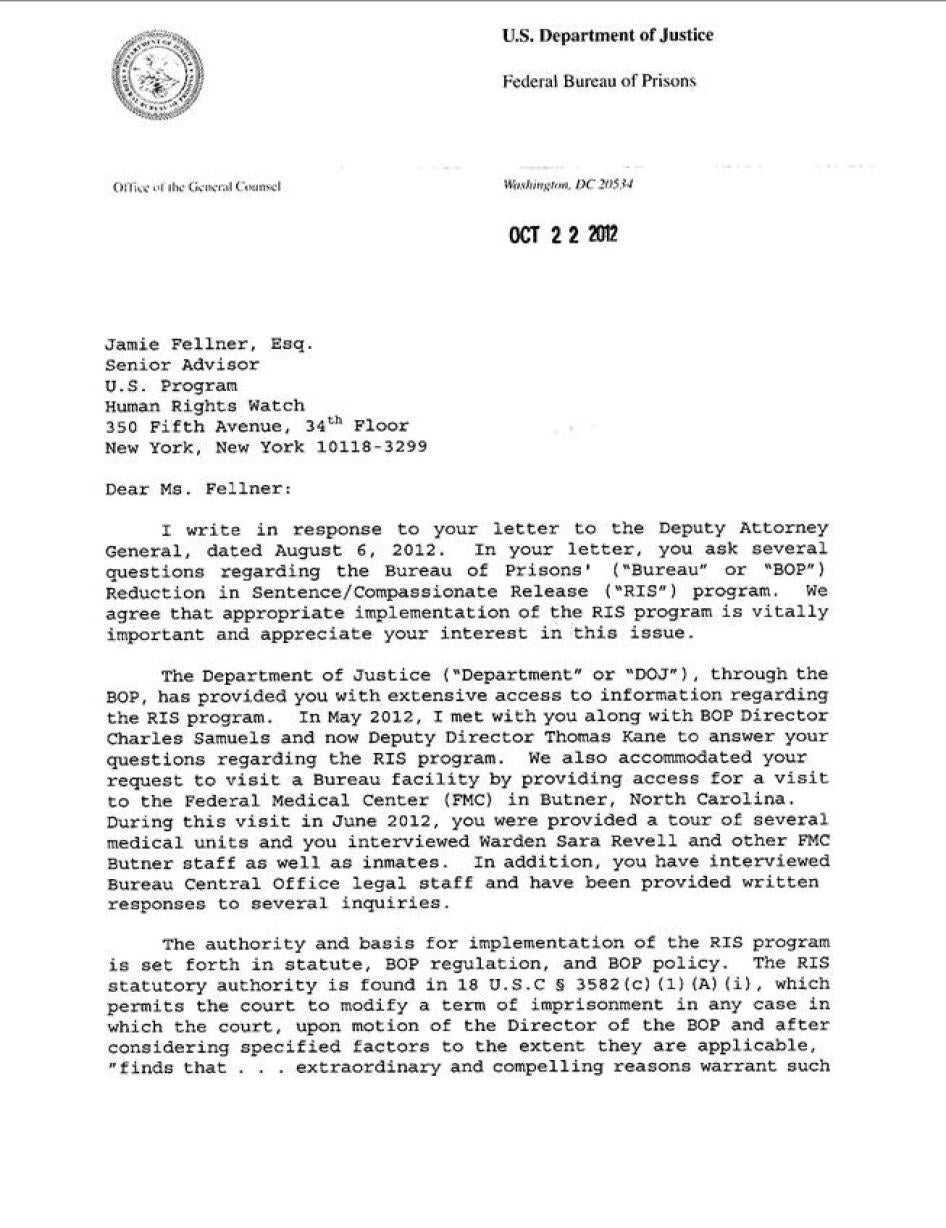
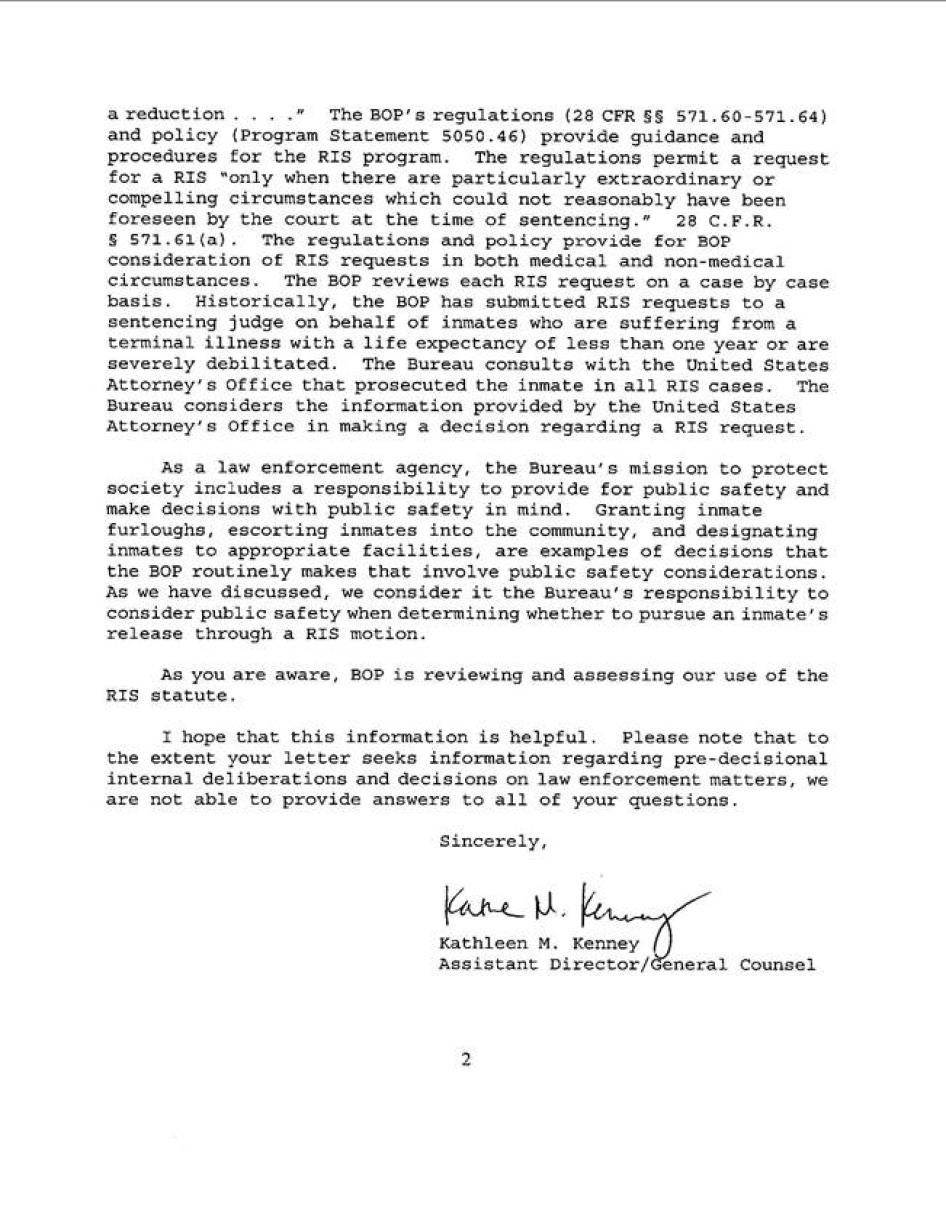
August 3, 2012
Kathleen M. Kenney, Assistant Director/General Counsel
Bureau of Prisons
320 First St., NW
Washington, DC 20534
Via USPS and facsimile at (202) 307 2995
Dear Assistant Director Kenney:
We continue to seek clarification of the nature and scope of the Department of Justice’s role in the Bureau of Prison’s Reduction in Sentence/Compassionate Release program. While the information and perspectives we received from you and Director Samuels were extremely helpful, we understand that you are not in a position to speak for the Justice Department itself.
Since you have been designated the liaison to us for communications with the Justice Department, I hope you will forward the attached questions about Reductions in Sentence/Compassionate Release to the Office of the Deputy Attorney General (DAG). I think the questions lend themselves to a meeting, but if the DAG prefers to answer them in writing, we will of course be grateful for that. I would be extremely grateful if you would also communicate to the DAG that in light of the delays in receiving a response to our repeated requests for a meeting, we hope that the responses to these questions can be expedited.
Many thanks for your continued assistance with this matter.
Sincerely,
Jamie Fellner, Esq. Senior Advisor
US Program
Responses to questions submitted by Human Rights Watch
(July 27, 2012)
I. For calendar year 2011, how many requests for the BOP to file a motion in court to seek reduction of sentence “because of “extraordinary and compelling reasons” (i.e., compassionate release) were reviewed at headquarters having been approved by regional directors.
There were 38 RIS requests received in Central Office filed by 37 inmates (one inmate filed a second request for reconsideration). All of the requests were reviewed.
A. How many were sought by inmates who were terminally ill.
30 cases forwarded to Central Office were cases represented as terminal. In some cases Health Services Division determined that the inmate did not, in fact, meet the medical criteria for terminal and thus, these cases were denied, as not presently appropriate for consideration.
a. Of those, how many were approved by general counsel’s office.
The General Counsel reviews all requests received in Central Office. The General Counsel does not approve the cases, but rather provides recommendations to the Director. If a request is determined not to be medically warranted, the General Counsel will deny the request.
b. Of those approved by general counsel, how many were approved by director.
Of the 30 cases that were represented as terminal, the Director approved 25 of those cases.
c. For those that were denied, how many were denied on medical grounds and how many were denied on other grounds (please identify those grounds).
Of the 5 cases denied:
3 were denied for medical reasons, but 1 was approved upon reconsideration. 2 were denied for non-medical reasons.
d. How many inmates seeking compassionate release whose cases were sent to headquarters died before final decision made by Director?
2
B. How many were sought by inmates with medical conditions other than terminal illness.
5 RIS requests were sought by inmates for medical conditions other than terminal illness.
a. Of those, how many were approved by general counsel’s office.
See response to I.A.a.
b. Of those approved by general counsel, how many were approved by Director.
The Director approved 5 cases.
c. For those that were denied, how many were denied on medical grounds and how many were denied on other grounds (please identify those grounds).
N/A
C. How many were sought by inmates on grounds other than medical conditions/terminal illness.
2
a. Of those, how many were approved by general counsel’s office.
See response to I.A.a.
b. Of those approved by general counsel, how many were approved by Director.
N/A
c. For those that were denied, what were the grounds for the denial.
One was denied because the circumstances were not extraordinary or compelling as expressed in the United States Sentencing Guidelines 1B1.13. The other was denied because the inmate’s history raised concerns about whether the inmate could remain crime-free upon release.
D. In how many of the cases denied by the general counsel or the Director had the office of the Deputy Attorney General or prosecuting attorneys indicated they opposed a motion for reduction of sentence? On what grounds did they oppose sentence reduction?
None
E. How many motions did the BOP file in court to seek sentence reduction because of the existence of “extraordinary and compelling reasons.”
United States Attorneys’ Offices submitted 30 motions on behalf of the Director of the BOP. a. How many motions were granted?
All were granted.
b. May we have copies of the motions and the courts’ decisions?
Due to Privacy Act restrictions, the BOP is not able to release these documents.
c. How many inmates on whose behalf the BOP filed motions for sentence reduction died before the court’s decision was rendered?
None
d. How many inmates for whom courts ordered sentence reduction to time served died before they were actually released from the BOP?
None
II. How many inmates pursued administrative remedies in 2011 because wardens denied their request that BOP file motions with court seeking sentence reduction because of the existence of extraordinary and compelling reasons?
A. How many filed at warden level; how many did the warden grant.
There were approximately 41 administrative remedies (BP-9’s) filed at the institution level. 1 was granted.
B. How many were appealed to regional directors and how many did the regional directors grant.
24 were appealed and 1 was granted.
C. How many inmates appealed to headquarters and how many did headquarters grant?
23 were appealed to Central Office. None were granted. One was returned to the institution for reconsideration.
III. Does the BOP have any written analysis of its authority to consider of public safety in response to requests from inmates to file motions for a sentence reduction on grounds of “extraordinary and compelling reasons.” If so, could that analysis be provided.
Case law and legislative history describe the Director’s discretion to determine whether extraordinary and compelling reasons exist to warrant a reduction in sentence. See also, July 22, 1994, memorandum from the Director to the Executive Staff clarifying the medical criteria and the factors to consider for determining appropriateness of a reduction in sentence (attached.)
IV. Who is responsible for initiating a compassionate release request?
Anyone can initiate a compassionate release request. Ordinarily, the request is made in writing and submitted by the inmate. The Bureau of Prisons processes a request made by another person on behalf of an inmate in the same manner as an inmate's request. Staff refer a request received at the Central Office or at a Regional Office to the Warden of the institution where the inmate is confined. See PS 5050.46, Compassionate Release; Procedures for Implementation of 18 U.S.C. 3582 (c)(1)(A) & 4205(g)(May 19, 1998).
A. If the inmates, what guidance is provided to them
a. to advise them of the availability of compassionate release,
b. to provide them the procedures they and the BOP follow
c. and to explain to them the criteria the BOP uses to evaluate a petition
d. If the guidance is provided in writing, can you provide copies of the materials given to the inmates.
PS 5050.46 provides guidance for the inmates and is available to all inmates via the Electronic Law Library (ELL), and is available to the public at www.BOP.gov.
B. If staff is responsible, what guidance is provided to them, other than the information in the Program Statement from 1998, as to
a. who might be eligible for compassionate release,
b. the procedures to follow, and
c. the criteria to address in making decision on the request.
d. Are there any written materials other than the Program Statement that address these procedures and criteria? If so, may we have copies.
Staff is not tasked with the responsibility for initiating the RIS process. They are tasked with processing the RIS request in accordance with PS 5050.46, which provides guidance. In addition, guidance has been provided in the form of training and training materials (attached). The training and training materials discuss eligibility criteria, procedures, and criteria for analyzing the appropriateness of inmates who meet the initial medical criteria. These training materials incorporate the 1994 memorandum from the Director (previously discussed). Staff may seek the assistance of legal staff, particularly Central Office legal staff who are responsible for administering the program.
V. Are any staff charged with the responsibility as party of their job to identify inmates who might be eligible for compassionate release on grounds of terminal illness or other medical conditions?
No.
A. If so, which staff?
N/A
B. Are such staff instructed to advise the inmates of their potential eligibility and how to make a request to the warden?
N/A
VI. What assistance is provided prisoners who cannot advocate for themselves for compassionate release, e.g., because of illness, mental health status, illiteracy or incapacitation
A. With respect to initial requests for compassionate release to the warden.
Inmates may seek the assistance of family, friends, or attorneys, but staff will provide general guidance. Inmates in Medical Referral Centers may seek general assistance from Staff including Social Workers.
B. With respect to appeals of adverse decisions from the warden.
Program Statement 1330.16, Administrative Remedy Program, also addresses procedures for filing an administrative Remedy. The PS provides in Section 10:
a. An inmate may obtain assistance from another inmate or from institution staff in preparing a Request or an Appeal. An inmate may also obtain assistance from outside sources, such as family members or attorneys. . . .
b. Wardens shall ensure that assistance is available for inmates who are illiterate, disabled, or who are not functionally literate in English. Such assistance includes provision of reasonable accommodation in order for an inmate with a disability to prepare and process a Request or an Appeal.]
For example, Wardens must ensure that staff (ordinarily unit staff) provide assistance in the preparation or submission of an Administrative Remedy or an Appeal upon being contacted by such inmates that they are experiencing a problem.
FMC Butner’s responses to questions submitted by HRW
(August 10, 2012)
1. How many inmates sought compassionate release on medical grounds in calendar year 2011?
164 inmates requested consideration for compassionate release for reasons the inmate described as medical reasons. However, the determination of whether a compassionate release request is medically warranted is determined by the Tumor Board or the inmate's primary physician. Of the 164 cases submitted, 66 were determined to be medically warranted and were reviewed by the institution’s multidisciplinary team. Every inmate who submits a RIS request receives a written response concerning his request.
a. How many did the warden approve and send to the region?
The Warden approved 15. Butner counts the number of inmates in the year the activity (denial or release) was completed, regardless of date the case was initiated, whereas the Central Office counts cases based upon the calendar year the case was received in Central Office, regardless of when the case is completed. Please note, in 2011, in accordance with the Central Office counting system, the Director approved 18 cases from Butner.
b. Of those sent to the region, how many did the regional approve?
The Regional Director approved 15 and all were forwarded them to the Central Office.
i. Of those denied by regional,
what were the grounds for denial.
N/A
c. Of those approved by regional, how many were ultimately approved by BOP director?
The Director approved 12.
i. Of those that were denied by the General Counsel or the Director, what were the grounds for denial. 2 inmates were not medically appropriate for consideration. 1 inmate posed a risk to the community.
2. Among the requests for compassionate release on medical grounds in 2011, how many did the warden deny?
Of the 66 cases that were determined medically warranted for review, the Warden denied 12 requests.
a. Grounds for warden’s denial
How many were denied because the medical condition did not warrant compassionate release.
All 66 cases were determined to be medically appropriate for reviewed by the multidisciplinary team.
How many were denied because release might jeopardize public safety?
12. These were cases that had been considered medically appropriate for review by the multidisciplinary team.
3. Did a multi-disciplinary team of staff review each request for compassionate release made in 2011?
In 2011, the multidisciplinary team reviewed 66 requests that were medically warranted for review.
a. Who was on the team?
The team is generally comprised of the following Institution staff members: Chairperson, Primary Social Worker, Psychologist, Director of Nursing, Attorney, Primary Case Manager, Unit Manager, Primary Physician or Physician’s Assistant or both, and sometimes the Chaplain.
b. What materials did the team review in connection with compassionate release requests.
Materials reviewed included, but were not limited to, central files, Medical staff’s verbal and written summaries, Social Worker’s verbal and written summaries.
c. How many requests, if any, were not reviewed by the team?
The team reviewed 66 cases.
d. Were there any cases in which the team recommended to the warden that the request be granted, but the warden denied the request? If so, how many and what were the reasons for the warden’s decision?
None.
e. Were there any cases in which the team recommended to the warden that the request be denied but the warden granted it? If so, how many and what were the reasons for the warden’s decision?
13. No reason was given by the Warden. Of these 13, the majority of the inmates expired during the process of completing the release planning.
4. How many BOP motions to the court for sentence reduction were made for inmates confined at FMC Butner between January 1, 2011 and June 1, 2012?
During the 17-month time frame identified, the court issued 33 court orders for compassionate release. Central Office indicates approximately 29 court orders were filed during this period because Central Office tracks these cases as described in #1 (a).
Did the courts reduce the sentences in each case to time served?
Yes.
5. How many inmates sought compassionate release in calendar year 2011 on grounds of terminal illness?
91 inmates requested compassionate release, claiming they suffered from a terminal illness. 66 cases were reviewed because they were medically warranted, including cases where the inmates were either terminally ill or severely debilitated.
a. Did the BOP file motions for sentence reduction for any of them?
See answer 1(c)
b. Of those inmates whose requests were denied by the warden, how many subsequently died.
0
c. What was the date of warden’s denial and the date of death.
N/A
6. How many inmates currently in the hospice at FMC have sought compassionate release?
1. This is a small 8-bed unit. At this time there is one inmate in the unit. This number can fluctuate.
7. Among the inmates who died between January 1, 2011 and June 1, 2012, how many had sought compassionate release?
For this 17-month time frame-60 inmates died.
In 2011:
22 inmates died after they were reviewed by the multidisciplinary team.
22 inmates died who were never reviewed by the multidisciplinary team (The reasons they were never reviewed include, but are not limited to, no release plan, unresolved detainers, transfer to Butner when the disease was too advanced, parole cases, etc.).
In 2012:
16 inmates died as of June 2012.
a. From January 1, 2011 through June 1, 2012, how many inmates pursued administrative remedies after the denial of their request for compassionate release?
There were 4 Administrative Remedies filed following the denial of the compassionate release request.
b. How many did the warden grant?
0
c. Of those the warden denied, how many were granted by regional or headquarters?
N/A
[1] This account of the Bowers case was drawn from memorialized conversations and correspondence with his family and his lawyer and from BOP documents on file at Families Against Mandatory Minimums.
[2] Memorandum from Maryellen Thoms, Warden, to James M. Bowers, September 20, 2001.
[3] Request for Administrative Remedy, from James M. Bowers, January 15, 2002.
[4] “Top Management and Performance Challenges in the Department of Justice – 2012,” Memorandum from Michael E. Horowitz, Inspector General, DOJ, to the Attorney General and the Deputy Attorney General, DOJ, November 7, 2012, www.justice.gov/oig/challenges/2012.htm (accessed November 19, 2012). The memorandum also notes that the BOP portion of the DOJ budget exceeds 25 percent.
[5] US Bureau of Prisons, “Federal Prison System Per Capita Costs, FY 2010” January 12, 2011, http://www.bop.gov/foia/fy10_per_capita_costs.pdf (accessed November 1, 2012).
[6]Human Rights Watch interview with Gene Brown (pseudonym), Federal Medical Center, Butner, North Carolina (FMC Butner), July 30, 2012. Information on Brown’s case was also obtained from BOP documents that he provided Human Rights Watch (on file at Human Rights Watch).
[7] Memorandum from Sara M. Revell, Complex Warden, FMC Butner, Re: Reduction in Sentence, August 23, 2011 (on file at Human Rights Watch).
[8] Response to Inmate Request to Staff, from Judy B. Pyant, BOP social worker and chair of the Reduction in Sentence Committee, March 21, 2012 (on file at Human Rights Watch).
[9] This account was drawn from memorialized conversations with Blain’s pastor, correspondence from him and Blain, and BOP and court documents on file at Families Against Mandatory Minimums.
[10] Memorandum from D. Smith, Warden, to Victoria Blain (pseudonym), March 3, 2011
[11] Memorandum from Robert E. McFadden, Regional Director, Bureau of Prisons, May 5, 2011.
[12] Memorandum from Kathleen M. Kenney, Assistant Director and General Counsel, Bureau of Prisons, to D. Smith, Warden, April 3, 2012.
[13] Federal prisoners who maintain good behavior while imprisoned are eligible for a reduction in the amount of time that must be served, of up to 54 days a year for every year served. 18 U.S.C. section 3624.
[14] Title II of the Comprehensive Crime Control Act of 1984, P.L. No. 98-473, 98 Stat. 1987, 1987-88 (codified as amended throughout Titles 18 and 28 of the U.S. Code).
[15] Prior to the SRA, the Parole Commission had the authority to grant or deny parole based on changed circumstances, but a prisoner was required to serve a minimum amount of her sentence before being eligible for parole. 18 U.S.C. section 4205 (1980). Under section 4205(g), the court, upon motion of the BOP, could reduce a prisoner’s minimum sentence, making the prisoner eligible for consideration by the Parole Board earlier than she otherwise would have been. BOP regulations authorized the agency to make motions for sentence reduction to secure early parole in “particularly meritorious or unusual circumstances which could not reasonably have been foreseen by the court at the time of sentencing ... for example, if there is an extraordinary change in an inmate’s personal or family situation or if an inmate becomes severely ill.” 28 C.F.R. section 572.40(a).
[16] US Senate Committee on the Judiciary, “Report on the Comprehensive Crime Control Act of 1983,” 98th Cong., 1st Sess., 1984, S. Rep. No. 225, p. 121.
[17] See Duties of the Commission, 28 U.S.C. section 994(t).
[18] Ibid.
[19] US Senate Committee on the Judiciary, “Report on the Comprehensive Crime Control Act of 1983,” S. Rep. No. 225, p. 55.
[20] 18 U.S.C. section 3553(a) reads in pertinent part:
Factors To Be Considered in Imposing a Sentence.— The court shall impose a sentence sufficient, but not greater than necessary, to comply with the purposes set forth in paragraph (2) of this subsection. The court, in determining the particular sentence to be imposed, shall consider—
(1) the nature and circumstances of the offense and the history and characteristics of the defendant;
(2) the need for the sentence imposed—
(A) to reflect the seriousness of the offense, to promote respect for the law, and to provide just punishment for the
offense;
(B) to afford adequate deterrence to criminal conduct;
(C) to protect the public from further crimes of the defendant; and
(D) to provide the defendant with needed educational or vocational training, medical care, or other correctional
treatment in the most effective manner;
(3) the kinds of sentences available;
(4) the kinds of sentence and the sentencing range established for—
(A) the applicable category of offense committed by the applicable category of defendant as set forth in the
guidelines—
(i) issued by the Sentencing Commission pursuant to section 994(a)(1) of title 28, United States Code, subject to any amendments made to such guidelines by act of Congress (regardless of whether such amendments have yet to be incorporated by the Sentencing Commission into amendments issued under section 994(p) of title 28);
(ii) that, except as provided in section 3742(g), are in effect on the date the defendant is sentenced;
(B) in the case of a violation of probation or supervised release, the applicable guidelines or policy statements issued by the Sentencing Commission pursuant to section 994(a)(3) of title 28, United States Code, taking into account any amendments made to such guidelines or policy statements by act of Congress (regardless of whether such amendments have yet to be incorporated by the Sentencing Commission into amendments issued under section 994(p) of title 28);
(5) any pertinent policy statement—
(A) issued by the Sentencing Commission pursuant to section 994(a)(2) of title 28, United States Code, subject to any amendments made in such policy statements by act of Congress (regardless of whether such amendments have yet to be incorporated by the Sentencing Commission into amendments issued under section 994(p) of title 28); and
(B) that, except as provided in section 3742(g), is in effect on the date the defendant is sentenced.
(6) the need to avoid unwarranted sentence disparities among defendants with similar records who have been found guilty of similar conduct; and
(7) the need to provide restitution to any victims of the offense.
[21]US Senate Committee on the Judiciary, “Report on the Comprehensive Crime Control Act of 1983,” S. Rep. No. 225, p. 55 (emphasis added).
[22] Ibid., p. 121 (emphasis added).
[23] 28 C.F.R. 571 (1994), Subpart G – Compassionate Release (Procedures for the Implementation of 18 U.S.C. 3582(c)(1)(A) and 4205(g)), http://www.gpo.gov/fdsys/search/pagedetails.action;jsessionid=n18JQStpLNjXJSXNP1L94NnmXk42zRvG3m7mVc5PyBChwGpC1WrJ!-874026954!-1164957459?collectionCode=CFR&searchPath=Title+28%2FChapter+V%2FSubchapter+D%2FPart+571%2FSubpart+G&granuleId=CFR-2010-title28-vol2-part571-subpartG&packageId=CFR-2010-title28-vol2&oldPath=Title+28%2FChapter+V%2FSubchapter+D%2FPart+571%2FSubpart+G&fromPageDetails=true&collapse=false&ycord=831 (accessed November 1, 2012).
[24] 28 C.F.R. 571.60 (1994), Subpart G – Compassionate Release (Procedures for the Implementation of 18 U.S.C. 3582(c)(1)(A) and 4205(g)), Section 571.60 – Purpose and Scope. The Bureau did not publish the new regulations in the Federal Register for what is known as public “notice and comment,” explaining that there was no need to do so “because the revised rule imposes no additional burdens or restrictions on prisoners.” 59 Fed. Reg. 1238 (January 7, 1994).
[25] Memorandum from Kathleen M. Hawk, former director, Bureau of Prisons, to executive staff (Hawk Memo), July 22, 1994 (included in appendix). The BOP provided this memorandum to us in response to a request for all documents delineating BOP compassionate release policies, but it is not clear whether current wardens have seen it. At least one warden we interviewed told us she had never seen it. Human Rights Watch interview with Sara Revell, Complex Warden, FMC Butner, North Carolina, July 30, 2012. It was not until 1998 that the BOP actually made motions for sentence reduction for prisoners who were not terminally ill but who had extremely serious medical conditions which resulted in markedly diminished public safety risk and quality of life. “Bureau of Prisons Compassionate Releases 1990-2000,” reproduced in Mary Price, “The Other Safety Valve: Sentence Reduction Motions Under 18 U.S.C. section 3582(c)(1)(A)” (“Other Safety Valve”), 13 Fed. Sent’g Rep. 3-4, 188-191 (2001). Data provided by BOP and on file at Human Rights Watch and Families Against Mandatory Minimums.
[26] Hawk Memo, pp. 1-2.
[27] Hawk Memo, p. 2.
[28] In 18 U.S.C. 3582 (c)(1)(A), Congress authorized courts to modify sentences it if finds that extraordinary and compelling circumstances warrant such a reduction “after considering the factors set forth in section 3553 (a) to the extent that they are applicable…” (emphasis added).
[29] 18 U.S.C. section 3553(a)(1).
[30] 18 U.S.C. section 3553(a)(2)(A),(C).
[31] Bureau of Prisons, Program Statement 5050.46, “Compassionate Release; Procedures for Implementation of 18 U.S.C 3582 (c)(1)(A) & 4205(g),” Change Notice at 2, May 19, 1998, http://www.bop.gov/policy/progstat/5050_046.pdf (accessed November 1, 2012).
[32]“Reduction in Sentence for Medical Reasons,” 71 Fed. Reg. No. 245 at 76619 (December 21, 2006).
[33] Ibid., at 76619-76620.
[34] Ibid., at 76619.
[35] Ibid.
[36] Ibid.
[37] Human Rights Watch and Families Against Mandatory Minimums interview with Kathleen M. Kenney, Assistant Director and General Counsel, Bureau of Prisons, Washington, DC, November 13, 2012. The BOP does not have independent rule-making authority; the Department of Justice must approve its regulations.
[38] Duties of the Commission, 28 U.S.C. section 994(t).
40 Between 1990 and 2000, for example, the BOP filed only 226 motions for sentence reduction for extraordinary and compelling reasons. See Figure 1, in Section II below. At least some USSC members believed the absence of guidelines contributed to the paucity of motions for sentence reduction: “Without the benefit of any codified standards, the Bureau [of Prisons], as turnkey, has understandably chosen to file very few motions under this section.” John Steer and Paula Biderman, “Impact of the Federal Sentencing Guidelines on the President’s Power to Commute Sentences,” 13 Fed. Sent’g Rep. 154-158, 155 (2001).
[40] See, for example, “Other Safety Valve,” p. 190 (proposing compassionate release policy statement language to Sentencing Guidelines); Letter from Julie Stewart and Mary Price, on behalf of FAMM, to Diana Murphy, then chair, US Sentencing Commission, August 1, 2003 (urging the Sentencing Commission to adopt the compassionate release policy statement); Letter from James Felman and Barry Boss, on behalf of the Practitioners’ Advisory Group, to Diana Murphy, then chair, US Sentencing Commission, July 31, 2003, http://www.src-project.org/wp-content/pdfs/public-comment/ussc_publiccomment_20030801/0004047.pdf (accessed November 1, 2012); Letter from Margaret C. Love, on behalf of the American Bar Association, to Diana Murphy, then chair, US Sentencing Commission, August 1, 2003, http://www.src-project.org/wp-content/pdfs/public-comment/ussc_publiccomment_20030801/0004057.pdf (accessed November 1, 2012) (collecting earlier letters from the ABA and the ABA Report to the ABA House of Delegates).
[41] See, for example, US Sentencing Commission, “Public Hearing Agenda,” Washington, DC, March 20, 2007, http://www.ussc.gov/Legislative_and_Public_Affairs/Public_Hearings_and_Meetings/20070320/AGD03_20_07.htm (accessed November 2, 2012).
[42] Statement of Stephen A. Saltzburg, on behalf of the American Bar Association, before the US Sentencing Commission, Washington, DC, March 20, 2007, http://www.ussc.gov/Legislative_and_Public_Affairs/Public_Hearings_and_Meetings/20070320/Saltzburg-testimony.pdf (accessed November 2, 2012).
[43] Letter from Michael J. Elston, Senior Counsel to the Assistant Attorney General, Department of Justice, to Ricardo H. Hinojosa, Chair, US Sentencing Commission (Elston Letter), July 14, 2006, p. 4. See appendix for full text of letter.
[44] Human Rights Watch interview with former Department of Justice official who requested anonymity, September 19, 2012.
[45] Human Rights Watch telephone interview with former Department of Justice official who requested anonymity, September 19, 2012.
[46] Elston Letter, p. 4.
[47] Elsont Letter, p. 4.
[48] Elston Letter, pp. 4-5.
[49] Letter from Julie Stewart, President, and Mary Price, Vice President and General Counsel, Families Against Mandatory Minimums, to Ricardo H. Hinojosa, Chair, US Sentencing Commission, March 19, 2007, http://www.src-project.org/wp-content/pdfs/public-comment/ussc_publiccomment_20070330/0003328.pdf (accessed November 2, 2012).
[50] Elston Letter, p. 4.
[51]US Sentencing Commission, “Guidelines Manual,” Section 1B1.13, November 1, 2006, http://www.ussc.gov/Guidelines/2006_guidelines/Manual/CHAP1.pdf (accessed November 2, 2012), p. 42. Section 1B1.13, subdivision (2) states that the court should only reduce a term of imprisonment if “the defendant is not a danger to the safety of any other person or to the community….”
[52] US Sentencing Commission, “2011 Federal Sentencing Guidelines Manual,” Section 1B1.13, Application Note no. 1, http://www.ussc.gov/Guidelines/2011_Guidelines/Manual_HTML/1b1_13.htm (accessed November 2, 2012).
[53] Human Rights Watch interview with Lorna Glassman, Assistant General Counsel, Bureau of Prisons, Washington, DC, August 15, 2012.
[54] Human Rights Watch and Families Against Mandatory Minimums interview with Kathleen M. Kenney, Assistant Director and General Counsel, Bureau of Prisons, Washington, DC, November 13, 2012.
[55] Bureau of Prisons, Program Statement 5050.46, “Compassionate Release; Procedures for Implementation of 18 U.S.C 3582 (c)(1)(A) & 4205(g),” May 19, 1998, http://www.bop.gov/policy/progstat/5050_046.pdf (accessed November 2, 2012). This overview of the process is drawn from the Program Statement as well as Human Rights Watch and Families Against Mandatory Minimums meetings with current and former BOP staff—including multiple conversations with the current general counsel—and prisoners. The Program Statement is included in the appendix.
[56]Human Rights Watch asked one former prisoner—who had succeeded in getting compassionate release—what the criteria were. His response: you have to be terminally ill, have had good conduct while in prison, and not have been convicted of a violent crime.” Human Rights Watch telephone interview with Charles Costanzo, June 7, 2012.
[57] See Bureau of Prisons, Reponses to Questions Submitted by Human Rights Watch, July 27, 2012, p. 5 (on file at Human Rights Watch and included in the appendix).
[58] The BOP Program Statement directs prisoners to provide information about where they will secure medical care. Bureau of Prisons, Program Statement 5050.46, Section 571.61(a)(2).The Program Statement also provides for different Central Office review procedures for requests depending on whether they are based on medical or non-medical grounds. Bureau of Prisons, Program Statement 5050.46, Section 571.62(a)(3).
[59] Bureau of Prisons, Reponses to Questions Submitted by Human Rights Watch, July 27, 2012, p. 6.
[60] Ibid. Nevertheless, Human Rights Watch did learn of cases in which staff, such as medical personnel or social workers, took the initiative to suggest to a prisoner that she begin the reduction in sentence process and then assisted her in doing so. Staff also may help prisoners pull together the material needed for a release plan.
[61] “Conversations with Staff About Compassionate Release,” Memorandum from Victoria Blain (pseudonym) to Mary Price, Vice President and General Counsel, Families Against Mandatory Minimums, September 20, 2012 (a detailed chronology of her efforts to submit her request for compassionate release) (reproduced in the appendix ).
[62] The warden’s referral should include, among other items, her written recommendation as well as recommendations by staff; copies of the Judgment and Commitment Order, Prisoner Progress Report, pertinent medical records, and Presentence Investigation Report; and confirmation that release plans have been approved by the appropriate US Probation Office. Bureau of Prisons, Program Statement 5050.46.
[63] See Bureau of Prisons, Reponses to Questions Submitted by Human Rights Watch, July 27, 2012, p. 5. The BOP’s responses do not say whether the general counsel may also deny non-medical cases.
[64] Information provided by James C. Wills, Associate General Counsel, Bureau of Prisons, in an email to Human Rights Watch and Families Against Mandatory Minimums, November 16, 2012 (on file at Human Rights Watch and Families Against Mandatory Minimums).
[65] 28 C.F.R. 571.62(c).
[66] Most of this information comes from the Presentence Investigation Report, which is included in the prisoner’s central file. In most federal criminal cases, a US probation officer, governed by Rule 32 of the Federal Rules of Criminal Procedure, conducts an investigation and writes a report that the sentencing judge will consider when imposing a sentence. This Presentence Investigation Report is supposed to draw on both the government’s and the defendant’s version of the offense and contain information on the offender’s family history, education, criminal background, employment record, substance-abuse history, medical condition, and financial status.
[67] US Government Accountability Office, “Bureau of Prisons: Eligibility and Capacity Impact Use of Flexibilities to Reduce Inmates’ Time in Prison,” Report to Congressional Requestors (“GAO February BOP Report”), GAO 12-320, February 2, 2012, http://www.gao.gov/assets/590/588284.pdf (accessed November 2, 2012).
[68] Bureau of Prisons data obtained by Margaret Love, a private attorney, and provided to Human Rights Watch, October 9, 2012 (on file at Human Rights Watch and Families Against Mandatory Minimums).
[69] See Bureau of Prisons, Reponses to Questions Submitted by Human Rights Watch, July 27, 2012, pp. 1-3. The BOP may well file more motions for sentence reduction in 2012 than it did in 2011. Between January 1 and October 11, 2012, it had already filed 30 motions. Email communication from Kathleen M. Kenney, Assistant Director and General Counsel, Bureau of Prisons, US Department of Justice, to Human Rights Watch and Families Against Mandatory Minimums, October 11, 2012.
[70] The information that the BOP provided does not give grounds for denial of these cases.
[71] According to the BOP, one of these two cases was “denied because the circumstances were not extraordinary and compelling as expressed in the United States Sentencing Guidelines [§] 1B1.13.” This reference to the USSC guideline is curious, as we have not seen references to it in other statements by BOP officials denying (much less granting) requests for compassionate release. The other non-medical case was denied because the “prisoner’s history raised concerns about whether the prisoner could remain crime-free upon release.” Bureau of Prisons, Reponses to Questions Submitted by Human Rights Watch, July 27, 2012.
[72] Information provided by James C. Wills, Associate General Counsel, Bureau of Prisons, in an email to Human Rights Watch and Families Against Mandatory Minimums, November 16, 2012 (on file at Human Rights Watch and Families Against Mandatory Minimums).
[73] Total number of federal prisoners obtained from Bureau of Justice Statistics, Federal Justice Statistics Resource Center, http://bjs.ojp.usdoj.gov/fjsrc/var.cfm?ttype=one_variable&agency=BOP&db_type=Prisoners&saf=STK (accessed November 2, 2012).
[74] Information on compassionate release at FMC Butner in 2011 was provided by James C. Wills, Associate General Counsel, Bureau of Prisons, in an email to Human Rights Watch, August 28, 2012 (on file at Human Rights Watch and Families Against Mandatory Minimums).
[75] We did not know the outcome of the requests that were pending as of the end of calendar year 2011.
[76] Email communication from James C. Wills, Associate General Counsel, Bureau of Prisons, to Human Rights Watch, August 28, 2012.
[77] Except as otherwise noted, the information about Victor Elliot came from correspondence between Human Rights Watch and Elliott (on file at Human Rights Watch) and our interview with him at the Federal Medical Center, Butner, North Carolina, July 30, 2012. All of the quotations from Elliot come from the interview.
[78] Human Rights Watch interviewed Dr. Andre Carden, Elliott’s oncologist, at the Federal Medical Center, Butner, North Carolina, July 30, 2012.
[79] Memorandum from Sara M. Revell, Complex Warden, FMC Butner, to Victor Elliot (pseudonym), January 12, 2012 (on file at Human Rights Watch).
[80] Ibid.
[81] Human Rights Watch and Families Against Mandatory Minimums interview with Kathleen M. Kenney, Assistant Director and General Counsel, Bureau of Prisons, Washington, DC, November 13, 2012.
[82] Government’s Response to Defendant’s Motion for a Reduction in Sentence, US v. Dresbach, No. 03-80504 (E.D.M.I.) (filed November 11, 2010), p. 9.
[83] Human Rights Watch telephone interviews with current DOJ official who requested anonymity, August 28, 2012; and with former DOJ officials who requested anonymity, September 19, 2012 and September 21, 2012.
[84] Human Rights Watch telephone interview with Glenn Fine, former Inspector General, US Department of Justice, September 21, 2012.
[85] Human Rights Watch telephone interview with Paul McNulty, former Deputy Attorney General, US Department of Justice, September 18, 2012.
[86] Rachel E. Barkow, “Prosecutorial Administration,” New York University Public Law and Legal Theory Working Papers, Paper 345, August 1, 2012, http://lsr.nellco.org/cgi/viewcontent.cgi?article=1346&context=nyu_plltwp (accessed November 2, 2012), pp. 37-38.
[87] Letter from Kathleen M. Kenney, Assistant Director and General Counsel, Bureau of Prisons, to Human Rights Watch, October 22, 2012.
[88] Human Rights Watch and Families Against Mandatory Minimums interview with Kathleen M. Kenney, November 13, 2012.
[89] Human Rights Watch interview with Kathleen M. Kenney, Assistant Director and General Counsel, Bureau of Prisons, Washington, DC, May 30, 2012; Human Rights Watch and Families Against Mandatory Minimums interview with Kathleen M. Kenney, November 13, 2012.
[90] The Hawk Memo contains a laundry list of factors for staff to consider, but provides no guidance as to how different factors should be weighted or evaluated. Memorandum from Kathleen M. Hawk, former Director, Bureau of Prisons, to executive staff (Hawk Memo), July 22, 1994, p. 2.
[91] Bureau of Prisons data obtained by Margaret Love, a private attorney, and provided to Human Rights Watch, October 9, 2012 (on file at Human Rights Watch and Families Against Mandatory Minimums). For 2011, the information was provided in Bureau of Prisons, Reponses to Questions Submitted by Human Rights Watch, July 27, 2012, p. 5.
[92] Human Rights Watch interview with Sara M. Revell, Complex Warden, FMC Butner, North Carolina, July 31, 2012; Human Rights Watch telephone interviews with former warden Art Beeler, July 15, 2012; with former warden Joe Bogan, July 15, 2012; and with a former warden who requested anonymity, July 17, 2012.
[93] Human Rights Watch telephone interview with a former warden who requested anonymity, July 17, 2012.
[94] Human Rights Watch telephone interview with Joe Bogan, July 15, 2012.
[95] Ibid.
[96] Gary Fields, “‘Career Felons’ Feel the Long Arm of Gun Laws,” Wall Street Journal, July 3, 2001.
[97] Ibid.
[98] Memorandum from Karen L. Dellarocco, Office of Legislative Affairs, Bureau of Prisons, to Scott Keefer, July 27, 2004.
[99] Letter from Judge James D. Todd to Harley G. Lappin, then director, Bureau of Prisons, July 26, 2004.
[100] Human Rights Watch telephone interview with Dr. Newton Kendig, Medical Director, Bureau of Prisons, August 23, 2012.
[101] Ibid.
[102] Ibid.
[103] Human Rights Watch telephone interview with Joe Bogan, July 15, 2012
[104] We do not know if that is because more requests for compassionate release are made by prisoners with terminal illness or because those are the ones the BOP is more likely to grant.
[105] Human Rights Watch telephone interview with Charles Costanzo, June 7, 2012. HRW talked with Costanzo while he was still in BOP custody, but confined in a nursing home which was able to provide the medical care he required following chemotherapy.
[106] Steve McConnell, “Convicted embezzler Charles ‘Chuckie’ Costanzo to be released from federal prison,” The Time-Tribune (Scranton, PA), July 23, 2012, http://thetimes-tribune.com/news/convicted-embezzler-charles-chuckie-costanzo-to-be-released-from-federal-prison-1.1347213 (accessed November 5, 2012).
[107] “Charles ‘Chuckie’ Costanzo Dies,” The Times-Tribune (Scranton, PA), October 12, 2012, http://thetimes-tribune.com/news/charles-chuckie-costanzo-dies-1.1386776 (accessed November 5, 2012).
[108] This account of the Branson case was drawn from conversations and correspondence with his lawyer, pleadings and court documents, and BOP documents on file at Families Against Mandatory Minimums.
[109] Transcript of Motion Hearing, May 31, 2012, p. 2.
[110] Emergency Motion to Reduce Sentence and Provide Other Equitable Relief Pursuant to 28 U.S.C.§ 2255, p.3 (filed September 26, 2012).
[111] Order on Defendant’s Emergency Motion to Reduce Sentence and Provide Other Equitable Relief Pursuant to 28 U.S.C. section 2255 (October 9, 2012).
[112] Human Rights Watch telephone interview with Dr. Newton Kendig, Medical Director, Bureau of Prisons, August 23, 2012.
[113] Information regarding efforts of Brian Simpson (pseudonym) to obtain compassionate release is based on extensive email and telephone communication with his daughter and on review of materials pertinent to his case that she provided to Human Rights Watch (on file at Human Rights Watch).
[114] Letter from Simpson’s daughter to Charles E. Samuels, Director, Bureau of Prisons, September 6, 2012 (on file at Human Rights Watch).
[115] Response to Prisoner Request, by H.L. Hufford, Warden, to Staff Member, January 17, 2012 (on file at Human Rights Watch).
[116] US Sentencing Commission, “2011 Federal Sentencing Guidelines Manual,” Section 1B1.13, Application Note no. 1, http://www.ussc.gov/Guidelines/2011_Guidelines/Manual_HTML/1b1_13.htm (accessed November 2, 2012).
[117] For example, in 2008, the most recent year for which published data is available, 358 federal prisoners died from illness. Bureau of Justice Statistics, “Deaths of prisoners under federal jurisdiction, by cause of death, 1999-2008,” http://bjs.ojp.usdoj.gov/index.cfm?ty=tp&tid=194 (accessed August 22, 2012). However, we do not assume every prisoner who is terminally or gravely ill wants compassionate release. Some, for example, do not have family to care for them or want to stay with the “family” they have made behind bars.
[118] Data on the number and causes of deaths at FMC Butner provided by the Office of the Chief Medical Examiner, North Carolina, to Human Right Watch, May 25, 2012. The listed causes of death were reviewed at our request by Dr. Robert Greifinger to determine which were predictable (for example, metastatic pancreatic cancer) and which may not have been predictable (for example, “blunt force trauma from fall”). Email communication from Dr. Robert Greifinger to Human Rights Watch, May 25, 2012. We do not know how many of those who died during the six-month period had sought compassionate release.
[119] Federal prisons, like state prisons, confine an ever-growing number of elderly prisoners “who cannot readily climb stairs, haul themselves to the top bunk, or walk long distances to meals or the pill line; whose old bones suffer from thin mattresses and winter’s cold; who need wheelchairs, walkers, canes, portable oxygen, and hearing aids; who cannot get dressed, go to the bathroom, or bathe without help; and who are incontinent, forgetful, suffering chronic illnesses, extremely ill, and dying.” Human Rights Watch, Old Behind Bars: The Aging Prison Population in the United States, January 28, 2012, http://www.hrw.org/reports/2012/01/27/old-behind-bars-0.
[120] Data obtained from Bureau of Justice Statistics, Federal Justice Statistics Resource Center, http://bjs.ojp.usdoj.gov/fjsrc/var.cfm?ttype=one_variable&agency=BOP&db_type=Prisoners&saf=STK (accessed October 11, 2012). Analysis conducted October 11, 2012.
[121] US Sentencing Commission, “2011 Federal Sentencing Guidelines Manual,” Section 1B1.13, Application Note no. 1, http://www.ussc.gov/Guidelines/2011_Guidelines/Manual_HTML/1b1_13.htm (accessed November 2, 2012).
[122] Human Rights Watch and Families Against Mandatory Minimums interview with Kathleen M. Kenney, Assistant Director and General Counsel, Bureau of Prisons, Washington, DC, November 13, 2012.
[123] Denial by J.D. Whitehead, Warden, Federal Prison Camp, Yankton, South Dakota, March 19, 2008 (on file at Human Rights Watch). The warden allowed Yardley, under escort, to visit his daughter at her bedside a few times and to make extra phone calls to her.
[124] Response to Administrative Remedy No. 487258-A, signed by Harrell Watts, Administrator, National Prisoner Appeals, Bureau of Prisons, March 27, 2008.
[125] This account was drawn from correspondence and court documents on file at Families Against Mandatory Minimums.
[126] Memorandum from Nicole C. English, Warden, to Michael K. Nalley, Director, North Central Regional Office, Bureau of Prisons (“English Memorandum”), September 2, 2010.
[127] English Memorandum, p. 2.
[128] Memorandum from Michael K. Nalley, Regional Director, to Nicole C. English, Warden, November 2, 2010
[129] Regional Administrative Remedy Appeal, Michael K. Nalley, Regional Director, March 18, 2011.
[130] Administrative Remedy No. 618677-A2, Harrell Watts, Administrator, National Inmate Appeals, Bureau of Prisons, November 17, 2011.
[131] 28 C.F.R. 571.60.
[132] Human Rights Watch interview with Lorna Glassman, Assistant General Counsel, Bureau of Prisons, Washington, DC, August 15, 2012.
[133] Letter from C.V. Rivera, Warden, Federal Correctional Complex, Beaumont, Texas, to Cheryl Young, January 25, 2012.
[134] Information is from Human Rights Watch telephone interview with Cheryl Young, May 10, 2012; and from letters and documents provided to Human Rights Watch by Cheryl Young (on file at Human Rights Watch).
[135] Letters from Robert H. Hazelwood, M.D., Bureau of Prisons, to [name withheld], September 15, 2005 and October 13, 2005.
[136] Letter to Hon. Eliot L. Engle from Robert McFadden, November 16, 2005.
[137] Information from Bureau of Prisons Inmate Locator, http://www.bop.gov/iloc2/InmateFinderServlet?Transaction=NameSearch&needingMoreList=false&FirstName=Evan&Middle=&LastName=Quinones&Race=U&Sex=U&Age=&x=0&y=0 (accessed November 20, 2012).
[138] Letter from Kathleen M. Kenney, Assistant Director and General Counsel, Bureau of Prisons, to Human Rights Watch, October 22, 2012. See also Bureau of Prisons, “Legal Resource Guide to the Federal Bureau of Prisons 2008,” November 25, 2008, http://www.bop.gov/news/PDFs/legal_guide.pdf (accessed November 2, 2012) (“Being mindful of its mission to protect society, the BOP utilizes [compassionate release] sparingly. Historically, motions for Reduction in Sentence … have been filed only on behalf of prisoners suffering from terminal medical conditions, or who are severely and permanently mentally or physically debilitated. Additional facts that are carefully considered include, but are not limited to, the nature of the crime committed, the length of the prisoner’s sentence, the amount of time served, and the prisoner’s ability to continue criminal activity.”).
[139] Letter from Michael J. Elston, Senior Counsel to the Assistant Attorney General, to Ricardo H. Hinojosa, Chair, US Sentencing Commission (Elston Letter), July 14, 2006, p. 5.
[140] The BOP will not make a motion for compassionate release if the prisoner does not have a suitable place to live and access to necessary medical care and the means to pay for it. BOP officials emphasize the difficulty of finding an appropriate place for prisoners as an impediment to greater use of its compassionate release authority. Human Rights Watch interview with Charles Samuels, Director, Bureau of Prisons, Washington, DC, May 30, 2012.
[141] The BOP will not make a motion for sentence reduction for prisoners who have detainers pending—for example, warrants against a prisoner for pending charges, or as yet unserved but already imposed sentences from another jurisdiction.
[142] No doubt wardens’ experience managing prisoners in prison and in making halfway house placements or furlough decisions gives them some experience with judging the likelihood a prisoner might re-offend if released to the community. But wardens do not have, as far as we know, any special expertise to determine if a dying man would be likely to commit a crime in the few months remaining to him.
[143] Human Rights Watch interview with Charles E. Samuels, Director, and Kathleen M. Kenney, Assistant Director and General Counsel, Bureau of Prisons, Washington, DC, May 31, 2012.
[144] Bureau of Prisons, Reponses to Questions Submitted by Human Rights Watch, July 27, 2012. BOP General Counsel Kathleen Kenney also responded to questions Human Rights Watch and Families Against Mandatory Minimums submitted to the deputy attorney general concerning the source of the BOP’s asserted authority to take public safety into consideration. In her response, she simply cites “statute, BOP regulation and BOP policy” as authority for the Bureau reduction in sentence program.
[145] Keene Corp. v. United States, 508 U.S. 200, 208 (1993); Chicago v. Environmental Defense Fund, 511 U.S. 328, 338 (1994).
[146] Human Rights Watch telephone interview with Joe Bogan, July 15, 2012.
[147] Human Rights Watch telephone interview with Art Beeler, July 15, 2012.
[148] This discussion of the efforts of Carl Meecham (pseudonym) to obtain compassionate release is based on review of BOP documents and material provided to Human Rights Watch by Meecham’s lawyer (on file at Human Rights Watch).
[149] United States of America v. [Carl Meecham (pseudonym)], Judgment in a Criminal Case, United States District Court, New Jersey, June 28, 2006.
[150] Memorandum from Sara M. Revell, Complex Warden, to Carl Meecham (pseudonym), Re: Reduction in Sentence, October 6, 2011.
[151] Memorandum from Sara M. Revell, Complex Warden, to Carl Meecham (pseudonym), Re: Reduction in Sentence, December 2, 2011.
[152]United States v. [Carl Meecham (pseudonym)], No. 03-cr-120-02, NJDC (Nov. 18, 2011), “Order for Release,” p. 2.
[153] Order to Reduce Imprisonment to Time Served, United States v. Costanzo, C.R. 08-010, M.D. PA. (filed July 23, 2012).
[154] Human Rights Watch telephone interview with Joe Bogan, July 15, 2012.
[155] Ibid.
[156] Human Rights Watch telephone interview with Art Beeler, July 15, 2012.
[157] Ibid.
[158] Human Right Watch telephone interview with Joe Bogan, July 15, 2012.
[159] Human Rights Watch interview with Caspar McDonald (pseudonym), FMC Butner, North Carolina, July 30, 2012. Information on McDonald’s case is also based on BOP documents addressing his request for compassionate release (on file at Human Rights Watch).
[160] Memorandum from Sara M. Revell, Complex Warden, FMC Butner, to Caspar McDonald (pseudonym), “Reduction in Sentence,” October 4, 2011.
[161] Ibid.
[162] Request for Administrative Remedy, Part B. –n Response, Admin Remedy Number 685439-F1, from Sara M. Revell, Complex Warden, FMC Butner, May 2, 2012.
[163] Human Rights Watch interview with Sarah Revell, Complex Warden, FMC Butner, North Carolina, July 30, 2012.
[164] Ibid.
[165] Confronting a request for compassionate release from a prisoner convicted of methamphetamine distribution who was dying of cardiomyopathy that he had developed as a result of his drug habit, the warden hesitated because he wondered how it would look to the public to give the prisoner “preferential treatment” since he had harmed himself. In the end, however, he did recommend release, it was approved, and the prisoner died at home about three months after release. Human Rights Watch telephone interview with a former warden who requested anonymity, July 17, 2012.
[166] Ibid.
[167] Human Rights Watch telephone interview with Joe Bogan, July 15, 2012.
[168] However, we note that Warden Revell told us that “she could care less” about negative political responses to her decisions. She insisted she made her decisions based on the merits of each case as she saw it. Human Rights Watch interview with Sara Revell, July 30, 2012.
[169] Bureau of Prison procedures are at 28 C.F.R. 542, subpart B.
[170] 28 C.F.R. section 571.63 (d) states, “Because a denial by the General Counsel or Director, Bureau of Prisons, constitutes a final administrative decision, an inmate may not appeal the denial through the Administrative Remedy Procedure.”
[171] Bureau of Prisons, Reponses to Questions Submitted by Human Rights Watch, July 27, 2012. We do not know the ultimate outcome of the appeal that was returned to the warden for reconsideration.
[172] Data provided by James C. Wills, Assistant General Counsel, Bureau of Prisons, in email communications to Human Rights Watch and Families Against Mandatory Minimums, September 26, 2012 and October 10, 2012 (on file at Human Rights Watch and Families Against Mandatory Minimums).
[173] See 28 C.F.R. 542.18 (providing that a warden’s response is to be made within 20 days of receipt of the prisoner’s appeal and can be extended an additional 20 days; a Regional Director’s response should be made within 30 days and may be extended by 30 days; and the Central Office’s response should be received within 40 days and may be extended by 20 days).
[174] Email communication from Lynne Louise Reid, Attorney, to Human Rights Watch, April 30, 2012.
[175] “Rejection notice – Administrative Remedy,” from Administrative Remedy Coordinator, Central Office, Bureau of Prisons, to Brian Simpson (pseudonym), July 24, 2012.
[176]United States v. Shemami, No 07-20160, S.D. MI (2012).
[177] Human Rights Watch interview with Mazen Ali Yasin, FMC Butner, North Carolina, July 30, 2012. Our discussion of Yasin’s case and efforts to obtain medical release also draws on email correspondence with him, conversations with his attorney, legal pleadings, and BOP documents pertaining to his request (on file at Human Rights Watch). In addition, we spoke to the warden at FMC Butner and his BOP physician about his case on July 30, 2012.
[178]United States of America v. [Mazen Ali Yasin]; Sentencing Hearing, US District Court, Eastern District of Michigan, June 9, 2009, hearing transcript p. 17 (on file at Human Rights Watch).
[179] Yasin was out on bond from the time he was arraigned until he self-surrendered to FMC Butner in March 2011.
[180] Earlier efforts by Yasin to be considered for compassionate release failed because medical reviews indicated he seemed to be responding positively to chemotherapy and his condition appeared stable. Response to Request for Administrative Remedy, from Sara M. Revell, Complex Warden, FMC Butner, May3, 2012; Human Rights Watch interview with Dr. Andre Carden, FMC Butner, North Carolina, July 30, 2012.
[181] Reduction in Sentence Memorandum from Sara M. Revell, Complex Warden, to Mazen Ali Yasin (pseudonym), November 30, 2011 (on file at Human Rights Watch).
[182] One of Yasin’s lawyers, Harold Gurewitz, once ran into his former prosecutor, Barbara McQuade. According to Guerwitz, when he told McQuade, now US Attorney, that Yasin’s motion for compassionate release had been denied because of the possibility he might re-offend, McQuade said “that’s ridiculous.” Human Rights Watch telephone interview with Harold Gurewitz, June 4, 2012.
[183] Human Rights Watch interview with Sara M. Revell, Complex Warden, FMC Butner, July 30, 2012.
[184] See, for example, Engle v. United States, 26 F. App’x 394, 397 (6th Cir. 2001) (district courts “lack jurisdiction to sua sponte grant compassionate release….”); United States v. Smart, 129 F.3d 539, 541 (10th Cir. 1997); and Cruz-Pagan v. Warden, 2012 U.S. App. LEXIS 16392, *2 (11th Cir. Aug. 7, 2012) (stating, “without a motion from the Director, a precedential case, an authorizing statute, or an authorizing Rule granting us subject-matter jurisdiction, we cannot modify his sentence).
[185] See Crowe v. United States, 430 F.App’x 484, 485 (6th Cir. 2011); Turner v. United States Parole Commission, 810 F. 2d 612, 615 (7th Cir. 1987); Simmons v. Christensen, 894 F.2d 1041, 1043 (9th Cir. 1990); Fernandez v. United States, 941 F.2d 1488, 1493 (11th Cir. 1991); Taylor v. Hawk-Sawyer, 39 F. App’x 615, 615 (C.A.C.D.C. 2002).
[186]Crowe v. United States, 430 Fed. App’x 484, *2-3 (6th Cir. 2011).
[187]Defeo v. Lapin, No. 08 Civ. 7513, 2009 WL 1788056,(S.D.N.Y.), June 22, 2009.
[188]United States v. Dresbach, 806 F. Supp. 2d 1039, 1042 (E.D. Mich., 2011) (citing Kurt Meister v. U.S. Dept. of Agriculture, 623 F.3d 363, 367 (6th Cir. 2010)).
[189] Information on the case of Kyle Dresbach comes from motions and briefs submitted by Dresbach and by the government in his case challenging BOP denial of his request for compassionate release consideration, as well as BOP documents included as exhibits to those briefs (on file at Human Rights Watch).
[190] Administrative Remedy Number 559947-A2, signed by Harrell Watts, Administrator, National Inmate Appeals, Bureau of Prisons, March 29, 2010 (on file at Human Rights Watch).
[191]United States v. Dresbach, 806 F. Supp. 2d 1039, 1042 (E.D. Mich., 2011).
[192] Denial letter quoted in United States v. Dresbach, p. 1042.
[193] Ibid.
[194]United States v. Maldonado, 138 F. Supp.2d 328, 333 (E.D.N.Y. 2001).
[195]United States v. [Mazen Ali Yasin (pseudonym)], No 07-20160, S.D. MI, “Opinion and Order Denying Defendant’s Motion for Reduction of Sentence,” July 2, 2012.
[196]Williams v. Van Buren, 117 Fed. Appx. 985, 986 (Fifth Cir. 2004).
[197]Williams v. Van Buren, p. 987; see also Hubbs v. Dewalt, 2006 U.S. Dist. LEXIS 27950, *10 (E.D. KY, May 8, 2006).
[198] Information on Phillip Wayne Smith’s case comes from court documents he and the government filed in court in connection with Smith’s effort to obtain a sentence reduction, United States of America v. Phillip Wayne Smith, CR. 02-30045-AA, US District Court, District of Oregon, Emergency Motion to Reduce Sentence and Provide Other Equitable Relief Pursuant to 28 U.S.C. section 2255 5, February 23, 2012.
[199] Response to Request for Reduction in Sentence Consideration, to Phillip Smith, October 28, 2011 (on file at Human Rights Watch).
[200] Response to Request for Reduction in Sentence Consideration, to Philip Smith, February 9, 2012 (on file at Human Rights Watch).
[201] Letter from Bureau of Prisons to US District Court, District of Oregon, March 1, 2012, quoted in United States of America v. Phillip Wayne Smith, C.R. No. 02-33045-AA, Supplement to Emergency Motion to Reduce Sentence and For Other Equitable Relief, filed March 5, 2012.
[202]United States of America v. Phillip Wayne Smith, CR. 02-30045-AA.
[203]United States of America v. Phillip Wayne Smith, CR. 02-30045-AA, US District Court, District of Oregon, Government’s Motion to Reduce Term of Imprisonment to Time Served, March 12, 2012.
[204] “The Broken Promise of Compassionate Release,” video, July 9, 2012, http://www.youtube.com/watch?v=-d-6qfgdW2c (accessed November 5, 2012). See also Ninth Circuit Blog, “Putting the Compassion into ‘Compassionate Release’ with a Little Help from Setser,” March 28, 2012, http://circuit9.blogspot.com/2012/03/putting-compassion-into-compassionate.html (accessed September 22, 2012).
[205]See United States v. Lagonia, 2012 U.S. Dist. LEXIS 21613 *6-7 (D. N.J., Feb. 17, 2012) (discussing and distinguishing grants in U.S. v. Sims, No. CR-486-80 (S.D. Ga., June 28, 2011), and U.S. v. Meyers, No. 03-cr- 120-02 (D.N.J., November 18, 2011)); see also U.S. v. Coster, Order and Opinion, No. 90-cr-276 (N.D. Ohio, October 26, 2006) (granting prisoner’s motion under Fed. R. Civ. P. 60(b)(6) after the government argued the prisoner had failed to exhaust his administrative remedies, but did not challenge the court’s jurisdiction. The court found that exhaustion would have been futile in light of his impending death and the lengthy administrative remedy process, and ordered his release.).
[206] International Covenant on Civil and Political Rights (ICCPR), adopted December 16, 1966, G.A. Res. 2200A (XXI), 21 U.N. GAOR Supp. (No. 16) at 52, U.N. Doc. A/6316 (1966), 999 U.N.T.S. 171, entered into force March 23, 1976, ratified by the United States on June 8, 1992.
[207] For an extended discussion of how age and incapacity affect the purposes of punishment that might be served by continued incarceration, as well as the relevant human rights jurisprudence, see Human Rights Watch, Old Behind Bars: The Aging Prison Population in the United States, January 28, 2012, http://www.hrw.org/reports/2012/01/27/old-behind-bars-0.
[208] If a prison system were not able to provide appropriate conditions of confinement and medical care for someone with a terminal or otherwise serious illness or disability, that would also argue for the necessity of release to satisfy human rights requirements. In Mouisel v. France, the European Court of Human Rights held that the continued incarceration of a sentenced prisoner who was seriously ill and whose medical needs could not be dealt with adequately in prison amounted to inhuman or degrading treatment. Mouisel v. France, European Court of Human Rights, Judgment, November 14, 2002, www.univie.ac.at/bimtor/dateien/ecthr_2003_mouisel_vs_france (accessed November 9, 2012).
[209] ICCPR, art. 14.
[210] Ibid.
[211] Manfred Nowak, U.N. Covenant on Civil and Political Rights: CCPR Commentary (Kehl am Rhein, Germany: N.P. Engel, 1993), p. 244.
[212] The UN Human Rights Committee has addressed the ability of a parole board to “act in judicial fashion as a ‘court’ and determine the lawfulness of continued detention under Article 9, paragraph 4 of the Covenant,” in Rameka v. New Zealand. The Committee noted there was no evidence that the New Zealand parole board was “insufficiently independent, impartial or deficient in procedure for these purposes. The Committee notes, moreover, that the Parole Board’s decision is subject to judicial review….” Rameka et al. v. New Zealand, UN Human Rights Committee, Communication No. 1090/2002, U.N. Doc. CCPR/C/79/D/1090/2002, December 15, 2003, http://www.justice.govt.nz/publications/publications-archived/2002/response-to-the-views-of-the-human-rights-committee-under-the-optional-protocol-to-the-international-convenant-on-civil-and-political-rights-by-messrs-rameka-harris-and-tarawa-communication-no.-1090-2002/documents/communication-un.pdf (accessed November 9, 2012).
[213] The UN Human Rights Committee has noted that article 14 “aims at ensuring the proper administration of justice” and has suggested it applies to the determination of sanctions that, “regardless of their qualification in domestic law, must be regarded as penal because of their purpose, charter or severity.” UN Human Rights Committee, General Comment No. 32, Art. 14: Right to equality before courts and tribunals and to a fair trial, U.N. Doc. CCPR/C/GC/32 (2007), http://www1.umn.edu/humanrts/gencomm/hrcom32.html (accessed November 9, 2012), pp. 1 and 3.
[214]Stafford v. United Kingdom, European Court of Human Rights, Application no. 46295/99, Judgment, April 24, 2002, par. 82. Article 5 of the European Convention on Human Rights, a regional human rights treaty, essentially mirrors article 14 of the ICCPR, setting out basic due process requirements for criminal proceedings.
[215] A series of cases brought before the European Court of Human Rights illuminate the human rights requirement that competent, objective, and independent courts or administrative entities make decisions regarding ongoing detention, whether because the grounds justifying a person’s deprivation of liberty have changed such that release is warranted or in cases in which after serving a fixed term, an individual remains in detention because of the government’s decision that he is not sufficiently rehabilitated or remains dangerous. See Stafford v. United Kingdom, European Court of Human Rights, April 24, 2002; Kafkaris v. Cyprus, European Court of Human Rights, Application no. 21906/04, Judgment, February 12, 2008; Weeks v. United Kingdom, European Court of Human Rights, 10 EHRR 293, Judgment, March 2, 1987; Waite v. United Kingdom, European Court of Human Rights, Application no.53236/99, Judgment, December 10, 2002; and Van Droogenbroek v. Belgium, European Court of Human Rights, Application no. 7906/77, Judgment, June 24, 1982.
[216]Weeks v. United Kingdom, European Court of Human Rights, March 2, 1987, para. 62.
[217] Waite v. United Kingdom, European Court of Human Rights, December 10, 2002, para. 59.
[218] Memorandum from Kathleen Hawk Sawyer, former director of the United States Federal Bureau of Prisons, to Executive Staff, July 22, 1994.