Summary
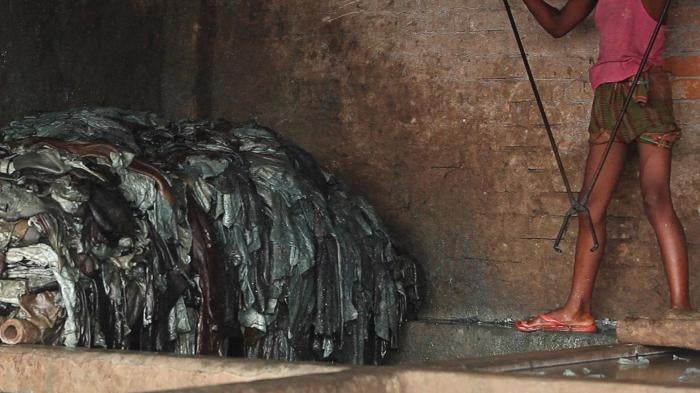
Jahaj, 17, has worked in a factory where animal hides are tanned in Hazaribagh, a combined residential and industrial neighborhood of Dhaka, since he was 12. He works a 10-hour day (with an hour off for lunch) and earns 3,000 taka (US$37) a month. Around 50 other people work in the tannery, including a seven and an eight-year-old, who are employed nailing hides out to dry.
Jahaj told Human Rights Watch that he mostly processes raw hides into the first stage of leather, known as “wet blue,” which exposes him to hazardous chemicals. The tannery pits are four-meter square tanks that hold hides and many of the diluted chemicals used to cure them. Jahaj particularly dislikes working there.
We get inside, take the hides with our hands and throw them outside the pit. We wear gloves and boots but water splashes on our skin and clothes. We don’t wear an apron. The water in the pits has acid, which burns when it touches my skin.
He suffers from rashes and itches; his father and two brothers, also tannery workers, have similar skin diseases. Asked why he performed such hazardous tasks, he said: “When I’m hungry, acid doesn’t matter—I have to eat.”
Jahaj has had various accidents at work: he once stepped on a nail used to pin leather out to dry, has hurt his back lifting heavy hides, and was once trapped inside a large rotating wooden drum used to hold the skins.
I started shouting, ‘Who has turned on the drum?’ After a couple of minutes they turned it off but I was already injured with lots of cuts and bruises on my head, my back, my arms. There are long wooden planks inside the drum that make the skins soft and they hit my body repeatedly.
A major Dhaka hospital diagnosed Jahaj with asthma. “The fumes from the chemicals where I work are really strong,” he said. When Jahaj cannot work because he is ill or injured, he is not paid—also a violation of Bangladesh’s labor laws. Nor, he said, has he seen a government labor inspector during his five years at the tannery.
Human Rights Watch estimates there are some 150 tanneries in Hazaribagh, ranging in size from small operations with just a dozen or so workers to larger ones that employ a few hundred workers. Together, the tanneries employ around 8,000 to 12,000 people (swelling to around 15,00o during the peak processing season for two or three months following the annual festival of Eid-al-Adha).
Hazaribagh is home to between 90 and 95 percent of all tanneries in Bangladesh and, as a result, holds an important place in Bangladesh’s increasingly lucrative leather industry. From June 2011 to July 2012, Bangladesh’s tanneries exported close to $663 million in leather and leather goods—such as shoes, handbags, suitcases, and belts—to some 70 countries worldwide, including China, South Korea, Japan, Italy, Germany, Spain, and the United States. Over the past decade, leather exports have grown by an average of $41 million each year.
This report is based on research conducted in Bangladesh between January and May 2012, and interviews with 134 people, including past and current tannery workers, slum residents, healthcare professionals, workers with nongovernmental organizations (NGOs), trade union and government officials, leather technologists, and chemical suppliers.
This report supports previous reports, studies, surveys, and even government findings dating to the 1990s that have documented a range of human rights abuses and problematic conditions in and around Hazaribagh tanneries. These include unregulated industrial pollution of air, water and soil, illness among local residents, perilous working conditions, and labor of girls and boys (often in hazardous conditions and for menial pay).
This report also finds that public knowledge and records concerning these problems have not led to changes on the ground. The reason is that Hazaribagh tanneries operate in an enforcement-free zone in which they are subject to little or no government oversight with regard to environmental regulations or labor laws, as government officials readily admit. Quazi Sarwar Imtiaz Hashmi, a Department of Environment official put it simply: “There is no monitoring and no enforcement in Hazaribagh.”
As a result of this inaction—which is due to a de facto policy not to implement environmental laws in Hazaribagh, and a labor inspectorate that lacks manpower and prioritizes good relations with management—workers and local residents (many of whom are poor and live in slums) continue to reside and labor in a noxious, foul-smelling environment that damages their health.
Health Problems
Past and present tannery workers described and displayed a range of health conditions including prematurely aged, discolored, itchy, peeling, acid-burned, and rash-covered skin; fingers corroded to stumps; aches, dizziness, and nausea; and disfigured or amputated limbs. Although Human Rights Watch is not aware of any epidemiological studies on cancer among tannery workers in Bangladesh, some anecdotal evidence suggests that cancer rates are indeed elevated among workers dealing with chemicals.
Many common health problems that tannery workers face—such as skin and respiratory diseases—result from repeated exposure to a hazardous cocktail of chemicals when measuring and mixing them, adding them to hides in drums, or manipulating hides saturated in them. Some chemicals can be injurious to health in the short term, such as sulfuric acid and sodium sulfide that can burn tissue, eye membrane, skin, and the respiratory tract. Others, such as formaldehyde, azocolorants, and pentachlorophenol, are confirmed or potential human carcinogens, the health effects of which may only manifest years after exposure.
Workers expressed extreme concern to Human Rights Watch regarding the possible long-term effects of such exposure. Many complained that their tannery did not supply protective equipment such as gloves, masks, boots, and aprons, or if it did, failed to supply sufficient quantities. Other workers told Human Rights Watch they suffered serious accidents working old and poorly maintained tannery machines for which they had scant training. Shongi, in his mid-40s, described an accident with a large hot plate used to press hides, which had occurred nine days before his interview with Human Rights Watch.
I put the hide into the machine but it was a little crumpled and I put my hand inside to fix it. Without pushing the pedal, the plate fell on my hand. It was a malfunction of the machine…. I screamed. The flesh started to come off my hand.
No tannery worker interviewed had a written employment contract. Some tannery managers deny workers legal entitlements such as paid sick leave or compensation when workers become ill or injured.
In Hazaribagh’s tanneries, raw hides often undergo the first stage of tanning in large wooden drums and pits on the ground floor. Larger, multi-story tanneries will then take hides known as “wet blue” upstairs for drying and further processing with heavy machinery; smaller tanneries might transfer the “wet blue” hides to another tannery that will then complete the procedure. Many tanneries are hot and cramped, with loud noise from machines and poor ventilation of chemical fumes.
Human Rights Watch did not seek to interview all tannery owners in Hazaribagh due to time concerns. Government officials, tannery association representatives, trade union officials, and staff of NGOs all said that no Hazaribagh tannery has an effluent treatment plant to treat its waste.
As a result, huge amounts of chemicals flow off the tannery floor, into open gutters in Hazaribagh streets, and then into a stream leading to the Buriganga, one of Dhaka’s main rivers. The government estimates that tanneries release 21,600 cubic meters of untreated effluent each day in Hazaribagh, endangering the health of local residents. Pollutant levels in the wastewater surpass Bangladesh’s permitted limits for tannery effluent, in some cases by many thousands of times the permitted concentrations.
People living in the densely-packed streets and alleys surrounding the tanneries, from which dark effluent spouts and swirls in open gutters, reported an array of health problems—many of them undiagnosed due to the cost of medical attention. These included fevers, diarrhea, respiratory problems, and skin, stomach, and eye conditions. While other factors may play some part in these illnesses, the extent of documented tannery pollution, the results of interviews with residents, and the findings of studies showing a higher prevalence of these illnesses in Hazaribagh compared to neighborhoods with similar socio-economic characteristics, strongly suggest a causal relationship between tannery pollution and poor community health.
Residents also said they were worried that they did not know the extent of environmental contamination since government authorities do not monitor the pollution. Ashor, married with four children, said:
I am worried about the supply water…. The corrugated tin [used in house construction] corrodes in six months. This also worries me. I want to know more but I’ve never been given any information about the water, air, and soil.
Failure to Implement Laws
Department of Environment officials explained there is a de facto policy not to implement environmental laws in Hazaribagh because the government is preparing a site in Savar, some 20 kilometers to Hazaribagh’s west, in which to relocate the tanneries. Officials confirmed that, on the basis of this understanding, they do not regularly monitor water, air, or soil in Hazaribagh, nor do they levy fines or other sanctions against its tannery owners for untreated effluent discharges.
The government’s plan to prepare a relocation site in Savar has suffered chronic delays. Its most recent deadline (at this writing) is for tanneries to move there by the end of 2013. But given the long history of bureaucratic delays, some people familiar with the leather industry believe that relocation is unlikely before 2015, while others suggested it might only happen in 2017. When Human Rights Watch visited Savar in May 2012, no tannery had begun building new facilities at the site.
The country’s two main tannery associations agreed with the government in 2003 that some 150 member-tanneries in Hazaribagh would relocate, and the Bangladeshi government agreed to compensate these tanneries for some of the costs of relocation. However, officials in both tannery associations told Human Rights Watch they were negotiating compensation from the government considerably in excess of the amount previously agreed.
In June 2012, the chairman of the Bangladesh Finished Leather, Leather Goods and Footwear Exporters Association told Human Rights Watch that while the group was “hopeful” that the government will meet its demands, failure to do so would mean “it won’t be possible to shift and this [situation] will be the government’s liability.”
Lack of Oversight
While the Department of Environment operates on an understanding not to implement environmental laws in Hazaribagh, officials in the Ministry of Labour’s Inspection Department admitted that “the Hazaribagh tanneries are barely touched [by us].” They explained that with just 18 inspectors to monitor an estimated 100,000 factories in Dhaka, the department lacks resources to ensure that Hazaribagh tannery employers comply with the law.
Human Rights Watch was told that factory inspectors do visit some tanneries, but that no tannery has been prosecuted in labor courts. Another official explained that inspectors prioritize good relations with managers and give them advance notice before an inspection.
According to a Bangladeshi High Court ruling in 2001, the government should have ensured that the Hazaribagh tanneries installed adequate means to treat their waste over a decade ago. The government ignored that ruling. The High Court then ruled in 2009 that the government should ensure that the Hazaribagh tanneries relocate outside of Dhaka or close them down. The government and the tannery associations sought (and were granted) a number of extensions to that order, and then ignored the order when those extensions lapsed.
The lawyer who represented the tannery associations in one petition to the High Court in February 2010 for an extension was Sheikh Fazle Noor Taposh, who is a member of the government and the lawmaker representing Hazaribagh. He is also Prime Minister Sheikh Hasina’s nephew.
Obligations
International human rights law compels Bangladesh’s government to protect its citizens from abuses, including those connected with business activity. Many of Hazaribagh’s tanneries’ have serious health implications for their workers, including children like Jahaj, and local residents.
The International Covenant on Economic Social and Cultural Rights (ICESCR) requires that states realize the right to the highest attainable standard of health for everyone in their territory. The Committee on Economic Social and Cultural Rights (CESCR), tasked with interpreting the ICESCR, has affirmed states’ obligations to protect the health of its workers.
The CESR has also explained that governments violate the right to the highest attainable standard of health if they fail to regulate the activities of corporations to prevent them from violating the right to health of others. This includes “the failure to enact or enforce laws to prevent the pollution of water, air and soil by extractive and manufacturing industries.” The right to health encompasses the right to healthy natural environments. This right involves the obligation to “prevent threats to health from unsafe and toxic water conditions.”
The government has also failed to implement relevant national laws that could protect its citizens from abuses. As a result, it is not fulfilling its duties to protect the right to health of its citizens as recognized under domestic and international law. Compounding this situation, the government’s failure to respect High Court rulings has deprived residents suffering health problems due to Hazaribagh’s tanneries of an effective judicial remedy.
There is a widespread assumption in government circles that building a planned central effluent treatment plant (CETP) in Savar will resolve the environmental and health issues related to the Hazaribagh tanneries. Human Rights Watch recognizes that a CETP will allow tanneries in Savar to treat their waste. However, there are already well-documented alternative processes and technologies proven to significantly reduce tannery pollution— and which do not require a CETP. Without enforcement of environmental laws by the Bangladeshi government, there is no incentive for the Hazaribagh tanneries to reduce their pollution load by adopting such measures.
A CETP will do nothing to resolve most of the problems identified in this report, such as poor occupational health and safety conditions, hazardous child labor, and the existing industrial pollution of Hazaribagh. Even if the CEPT is built, there is a risk that tanneries might simply refuse to use it in the absence of proper monitoring and enforcement. Simply put, the issues identified in this report cannot be solved by a technical fix.
Regardless of the status of CETP construction, the Bangladeshi government should closely monitor and regulate the Hazaribagh tanneries and rigorously enforce the country’s labor and environmental laws. This will be an important step towards resolving many problems identified in this report, such as poor occupational health and safety conditions, denial of paid sick leave and compensation when injured, and hazardous child labor.
Since each of Hazaribagh’s 150 or so tanneries may have contracts with numerous buyers that vary by facility and over time, the report does not focus on working conditions in specific tanneries, nor on particular international companies that may purchase leather from Hazaribagh tanneries. Human Rights Watch believes that sustained enforcement of Bangladeshi law throughout the Hazaribagh tanneries offers the best hope for remedying the systemic human rights violations identified in this report.
Foreign companies that source leather produced in Hazaribagh have a crucial role to play in ensuring that Hazaribagh residents are no longer exposed to hazardous chemicals and other forms of pollution, and that tannery workers enjoy safe and healthy workplaces. They should immediately take steps to ensure that they are not implicated in unregulated pollution, violations of occupational health and safety laws, or hazardous child labor through their supplier relationships (including through “job work” tanneries sub-contracted to perform part or all of leather processing).
Critics of regulation contend that Bangladesh is a poor country, which can ill-afford to enforce laws that could possibly shut down the tannery industry. However, ensuring compliance of all Hazaribagh tanneries with international standards and Bangladeshi law is an opportunity to establish the industry as a modern sector capable of producing high-value and high-quality leather in an environmentally sound and rights-respecting manner that strengthens, rather than undermines, this growing sector of the nation’s economy.
Recommendations
To the Government of Bangladesh
- Order all Hazaribagh tanneries to immediately begin relocating outside Dhaka city.
- In accordance with Bangladesh’s Environmental Conservation Act (1995) and Environment Conservation Rules (1997), ensure that all tanneries (including relocated ones) have an environmental clearance certificate for industrial units categorized as “red” (i.e. heavily polluting) from the Department of Environment, or close them down.
- Immediately fill all vacancies for inspectors and assistant inspectors in the Ministry of Labour’s Inspection Department. Within two years, significantly increase the number of staff positions and resources (including for salaries) available to the department to enable it to conduct more regular in-field assessments, including unannounced inspections.
- Revise the Labour Act to strengthen
penalties for the following offences:
- Causing death, grievous bodily harm, or any “injury or danger to workers”,
- Employing a child or adolescent in hazardous labor,
- The “catch-all” offence of violating the terms of the act.
- Ratify the International Labour Organization’s Convention 138 On The Minimum Age For Admission To Employment And Work.
To the Ministry of Environment and Forests
- Regardless of the status of the relocation plan, implement the provisions of Bangladesh’s Environmental Conservation Act (1995) and Environment Conservation Rules (1997) that allow for monitoring of all tanneries in Hazaribagh for pollution levels that surpass national standards. Prioritize tanneries that discharge a comparatively large amount of effluent, or discharge effluent with high concentrations of comparatively hazardous chemicals.
- Regardless of the status of the relocation plan, implement the provisions of Bangladesh’s Environmental Conservation Act (1995) and Environment Conservation Rules (1997) that allow for fines on all tanneries in Hazaribagh found to have pollution levels that surpass national standards.
- In accordance with Bangladesh’s Environmental Conservation Act (1995) and Environment Conservation Rules (1997), ensure all tanneries in Bangladesh have an environmental clearance certificate for industrial units categorized as “red” (i.e. heavily polluting). Close tanneries operating without an environmental clearance certificate, if necessary seeking the cooperation of law enforcement agencies and/or utility service providers.
- Design a comprehensive environmental strategy for the Savar relocation site to prevent replicating the environmental damage and hazards to health present in Hazaribagh.
- Devise a comprehensive environmental clean-up strategy for Hazaribagh, prioritizing surface ponds, large dumps of tannery waste, and the main drainage canals. Remove topsoil polluted beyond the risk-based threshold values and replace it with clean soil.
- Actively monitor for Hazaribagh groundwater contamination on an ongoing basis.
- Ensure that residents of Hazaribagh are informed about the extent of environmental contamination in Hazaribagh and possible health consequences of contamination.
- Increase children’s knowledge of environmental health issues by introducing environmental health programs in schools in Hazaribagh.
To the Ministry of Labour and Employment
- Take immediate and sustained action to
enforce compliance by all tanneries in Hazaribagh (and, following relocation,
in Savar) with the Labour Act (2006), including the provisions on:
- Worker health and safety,
- All paid leave including sick leave,
- Compensation for injuries (including occupational diseases),
- Effective disposal of waste and effluent.
- Revise the practice whereby labor inspectors set up advance appointments with factory management. Train and instruct labor inspectors to undertake unannounced inspections.
- Immediately implement an effective removal program for child laborers in tanneries that provides: access to education, including non-formal education and skills development training; alternative income generation opportunities where appropriate; and socio-economic empowerment programs for their families. Prioritize those children performing hazardous labor, including work with chemicals, tannery machinery, and blades for cutting leather. Ensure that the program includes children not reached by previous programs, such as those working full-time, those working with employers who did not want to cooperate with the projects, and those living in tanneries.
- Rigorously enforce existing laws prohibiting hazardous child labor in tanneries, including through proactive monitoring and unannounced on-site inspections, and by imposing effective penalties against employers who violate the law.
- Provide labor inspectors with all the necessary support, including child labor expertise, to enable them to effectively monitor the implementation of labor law standards regarding children in Hazaribagh tanneries.
- Require employers to have, and produce on demand, proof of age of all children working on their premises.
To the Ministry of Health and Family Welfare
- Devise a comprehensive public health strategy to tackle the health problems of residents in Hazaribagh (and, following relocation, to prevent such health problems for residents in Savar).
- Ensure the cancer registry maintained by National Institute of Cancer Research and Hospital collects and makes available data disaggregated by profession and current address at the level of thana/upazila (i.e. sub-district).
To Foreign Companies Sourcing Leather or Leather Goods from Hazaribagh
- Ensure that all leather and/or leather goods
originate from tanneries in compliance with international standards and
Bangladeshi environmental and labor law, through the following mechanisms:
- A social and environmental review of source tanneries (including tanneries that process all or part of the leather from supplier tanneries on a “job work” basis) performed by a credible third party,
- Site visits of source tanneries (including tanneries that process all or part of the leather from supplier tanneries on a “job work” basis).
- Cease all commercial relationships with tanneries that do not operate in compliance with international standards and Bangladeshi environmental and labor law.
To Bangladesh’s Bilateral and Multilateral Donors
- Support a comprehensive environmental clean-up strategy for Hazaribagh, prioritizing surface ponds, large dumps of tannery waste, and the main drainage canals, and the removal and replacement of polluted topsoil.
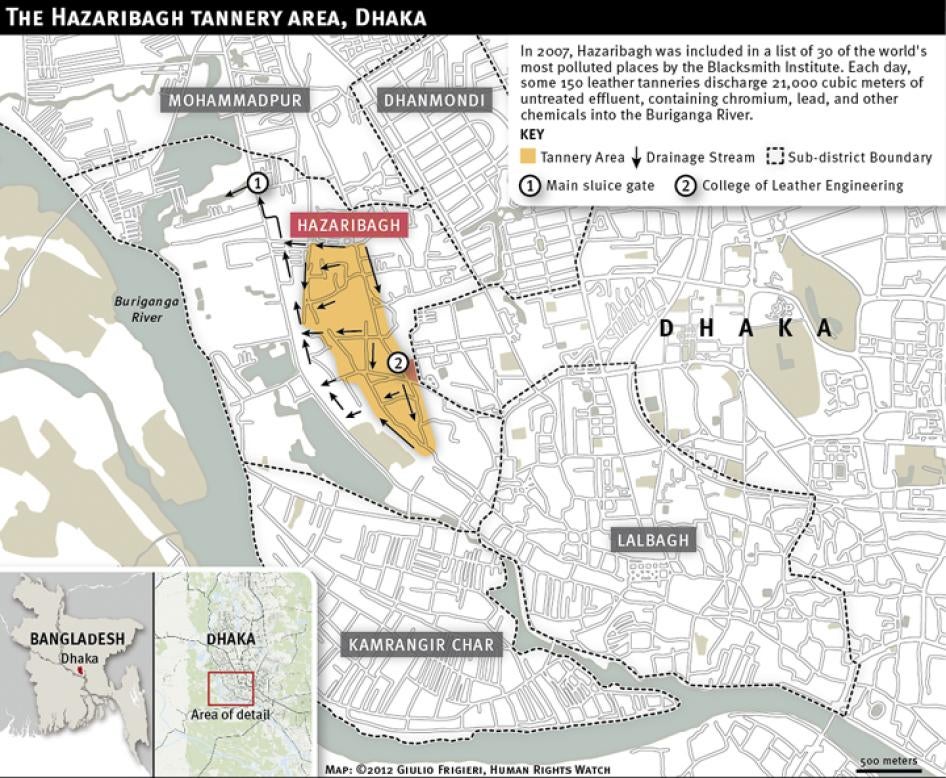
Map of Hazaribagh
Methodology
This report is based on information collected during eight weeks of field research conducted in Bangladesh between January and May 2012. In the course of this research, Human Rights Watch visited eight tanneries.
A senior researcher with Human Rights Watch interviewed 134 people for this report, including 53 people who currently work, or previously had worked, in Hazaribagh tanneries. Of these, 49 were workers currently employed in tanneries and four were former tannery workers. Human Rights Watch also spoke to six people who were currently working in Hazaribagh factories processing tannery waste products (although not involved in directly processing leather). While their evidence was similar to those working in tanneries, it has not been included in this report, which is focused on Hazaribagh’s leather tanneries.
Of the 53 worker interviewees, 9 were adult women and 10 were children (i.e. under the age of 18)—5 of whom were boys and 5 of whom were girls.
Human Rights Watch also spoke to 20 residents of slums in Hazaribagh (5 residents from each of 4 different locations). Of the 20 residents interviewed in the course of this research, 13 were women.
All residents and workers interviewed provided verbal informed consent to participate and were assured that they could end the interview at any time or decline to answer any questions. Interviewees who are residents or workers have been given pseudonyms and in some cases other identifying information has been withheld to protect confidentiality.
Human Rights Watch also spoke to an additional 42 people familiar with the tannery industry in Bangladesh, including healthcare professionals, staff of nongovernmental organizations (NGOs), staff of international organizations, trade union officials, academic researchers, journalists, representatives of tannery associations, leather technologists, and chemical suppliers.
Secondary sources—including academic research, project reports, and media coverage—were reviewed and included to corroborate information from residents or tannery workers. This report includes a number of secondary sources from the 1990s: these were deliberately chosen to show the length of time for which these issues have been publicly discussed. More recent research supports the findings of this earlier research and is also included in this report. Bangladeshi laws and policies were also reviewed.
Human Rights Watch spoke to 13 government officials (4 from the Department of Environment, 4 from the Ministry of Labour and Employment, 2 from the Ministry of Industries, 2 from the government’s National Institute for Cancer Research and Hospital, and the member of parliament for Hazaribagh).
Human Rights Watch did not seek to interview all tannery owners in Hazaribagh due to time concerns. In June 2012, Human Rights Watch requested meetings with the managing directors of two Hazaribagh tanneries. Senior staff at both tanneries replied that a meeting was not possible because the relevant directors were busy and/or travelling.
In July 2012, Human Rights Watch wrote to the minister of environment and forests, the minister of industries, and the minister of labour and employment to request information on the tanneries in Hazaribagh and to solicit response to the issues documented in this report. This correspondence is attached at Annex 1. No reply had been received as this report went to publication.
I. Background
Hazaribagh’s Tanneries
The neighborhood of Hazaribagh lies to the west of Dhaka’s city center, absorbed into the city as Dhaka has expanded. It is surrounded by residential neighborhoods, except to the west where it is bordered by an embankment built in the late 1980s to protect the area from flooding. Beyond the western embankment is a flood plain of the Buriganga, one of Dhaka’s main rivers that lies just one kilometer away.
Like much of Dhaka, Hazaribagh is dense with medium-rise apartment buildings, as well as shops, schools, and mosques. Small businesses like fruit sellers, hairdressers, and tea stalls line the streets. On either side of the western embankment—but mostly on the floodplain—are slums of single-room houses made from concrete, wood, and tin sheets.
Tanneries, some on main streets and others tucked down side alleys, are packed into 50 acres of Hazaribagh. They are often brick-walled factories, with small windows of grills or broken glass. Running beside the factories are open gutters full of opaque blue-grey water, bubbling and swirling. Drains spouting from tannery walls add brown, red or black effluent to the mix. Scraps of discarded leather—thin ribbons or sharp triangles—are everywhere in the streets. There is a strong smell in the air, like rotten eggs.
In between the tanneries are shop fronts stocked with white sacks and plastic blue drums filled with tanning chemicals. Pushcarts with drums lashed to them are constantly on the move through the narrow streets and lanes, as are men pushing bamboo carts piled high with folded leather. Other workers ferry between tanneries balancing a bamboo pole over one shoulder, two square metal tins full of tannery wastewater bouncing on each end: they are recycling wastewater from one tannery for use in another.
Many tanneries in Hazaribagh are multi-story buildings. Raw hides are often processed into “wet blue” leather in large wooden drums and pits on the ground floor, before they are taken upstairs for drying and further processing with heavy machinery.[1] Conditions in these factories are often hot and cramped, with loud noise from machines and poor ventilation of chemical fumes.
How Tanneries Operate
There is considerable variety in how tanneries in Hazaribagh operate. Some tanneries will perform all stages of leather processing, converting raw hides to “wet blue” leather, then to “crust leather,” and finally finished leather. All these stages might be performed under the same roof, or the tannery might have a number of different factory units specialized in each stage scattered throughout Hazaribagh.
In other cases, a single hide will pass through two or three different tanneries before the tanning process is complete. Some tanneries only process raw hides to the “wet blue” stage, or to the “crust leather” stage, before selling on these hides to other tanneries which then complete the process.
Other tanneries rent their factory to leather businessmen who process a batch of hides using that tannery’s premises and heavy machinery, but supplying their own workers, hides and chemicals. The leather businessmen pay the tannery a pre-determined fee based on the number of hides and the stages of processing performed. This way of working, known as “job work,” is common in Hazaribagh. A “job work” tannery might have a dozen or so leather businessmen whose workers all process batches of hides under the same roof at any one time. Those leather businessmen will describe themselves as an independent tannery, even though they rent out the production facilities from another tannery (that may or may not have its own production).
Regular tanneries might process some hides in “job work” tanneries, for instance during peak production periods, or in order to fulfill a large order.
Because of such variety in how tanneries operate, the number of tanneries in Hazaribagh is sometimes given as low as 50 or as high as 350, depending in large part on what is counted as a tannery. Human Rights Watch estimates there are about 150 tanneries in Hazaribagh, considering a tannery as an independent factory unit.[2] A relatively large tannery will employ a few hundred workers, while a medium-sized tannery will employ around a hundred workers, and small tanneries might have just a dozen or so workers.
There are some 8,000 to 12,000 tannery workers, rising to about 15,000 for two or three months following the festival of Eid-al-Adha, the peak season for raw hide processing.[3]
The Hazaribagh tanneries make up between 90 and 95 percent of all tanneries in Bangladesh.[4] There are a handful of tanneries in Bangladesh outside Hazaribagh, located in other areas of Dhaka, as well as Jessore and Chittagong. This report does not address those tanneries.
Around 80 percent of Bangladesh’s total leather production is for export.[5]
Leather (as crust or finished leather), leather footwear, and leather goods (such as suitcases, handbags, and belts) are major export earners for Bangladesh. According to official trade statistics, from June 2011 to July 2012 Bangladesh exported around $663 million worth of leather and leather goods (including leather footwear). This leather was exported to some 70 countries throughout in the world, but principally China, South Korea, Japan, Italy, Germany, Spain, and the United States.[6] In the ten years since 2001-2002, the value of leather exports has grown by an average of $41 million per year.[7]
Bangladesh’s exporters of leather and leather goods enjoy economic incentives from the government, including cash subsidies as a percentage of the value of exports. For example, in 2010-2011, the government reportedly disbursed $22 million to exporters of leather goods.[8] In mid-2012, the government raised the rate of cash subsidy for the export of leather goods to 15 percent (up from 12.50 percent for 2011-2012).[9]
Water, Soil, and Air Pollution
The effluent that pours off tannery floors and into Hazaribagh’s open gutters contains animal flesh, dissolved hair, and fats. It is thick with lime, hydrogen sulfide, chromium sulfate, sulfuric acid, formic acid, bleach, dyes, oils, and numerous heavy metals used in the processing of hides.[10] This effluent flows from the open gutters into a stream that runs through some of Hazaribagh’s slums, and into Dhaka’s main river, the Buriganga.
The tanneries generate a lot of solid and liquid waste.[11] Each day, the tanneries in Hazaribagh create an estimated 75 metric tons of solid waste (mostly salts, bones, as well as leather shavings and trimmings), an amount which may rise to 200 metric tons of solid waste per day in peak production periods.[12] In terms of liquid waste, the government and the two main tannery associations stated in 2003:
About 21,600 cubic meters of environmentally hazardous liquid waste is emitted every day from the tanneries located in Hazaribagh which include hazardous chemicals such as chromium, sulphur, ammonium, salt and other chemicals.….[13] The lives of the people of Hazaribagh are greatly endangered through the damage of the environmental balance in this way, and it is taking a very frightening turn.[14]
Concentrations of chemicals and other contaminants in tannery effluent depend on the location of the wastewater sample, as well as the type of tanning process employed in the tannery, and whether monsoon rains have diluted the wastewater.
Regardless of such variables, previous studies by academic researchers, international projects, and even government investigations have found that the pollution content in Hazaribagh’s wastewater surpasses the limits for tannery effluent established in Bangladesh’s environmental regulations, in some cases by many thousands of times the permitted concentrations.[15]
One detailed study published in 1999 analyzed wastewater samples taken directly from 47 tanneries. The results showed extremely elevated levels of chromium, chloride, lead, sulfates, sulfides, nitrates, and zinc in the effluent. For example, wastewater from one particular tannery had a biochemical oxygen demand (BOD) reading of 3,600 mg/L (against Bangladesh’s quality standard for tannery effluent of 100 mg/L) and a chemical oxygen demand (COD) reading of 9,300 mg/L (against a standard of 200 mg/L). High BOD and COD readings mean there is less oxygen in the water, which causes aquatic life to suffocate and die.[16] This tannery’s wastewater contained concentrations vastly in excess of permitted standards: chromium (4,043 mg/L, against a standard of 2 mg/L), chloride (45,000 mg/L, against a standard of 600 mg/L), lead (1.944 mg/L, against a standard of 0.1 mg/L), and sulfide (145 mg/L, against a standard of 1 mg/L).[17]
Other studies have sampled the water in gutters and streams around Hazaribagh. They also found that the wastewater is thick with chemicals common to the tanning process, far in excess of permitted levels.[18]
One of the rare government studies to measure water quality in Hazaribagh was a 2008 Department of Environment survey on industrial pollution. BOD and COD concentrations found in the Hazaribagh samples were notably higher than those from seven other industrial zones near Dhaka, and revealed that Hazaribagh wastewater vastly exceeds Bangladesh’s permitted standards for tannery effluent.
Tannery effluent also threatens the groundwater under Hazaribagh, although there is no research showing negative effects on human health from this potential route of exposure. However, the issue is particularly significant given that an estimated 95 percent of Dhaka city’s water supply (used for bathing, cooking, and cleaning by an estimated 14 to 15 million people) is derived from various groundwater supplies.[19]
Table: The Department of Environment’s Chemical Analysis of Wastewater[20]
|
Parameter |
Unit |
Bangladeshi Standard for Tannery Industry Effluent [21] |
Hazaribagh Sample 1 |
Hazaribagh Sample 2 |
|
pH [22] |
|
6-9 |
5.017 |
4.987 |
|
Biochemical Oxygen Demand [23] |
mg/L |
100 |
846.7 |
730.0 |
|
Total Suspended Solids [24] |
mg/L |
150 |
17,467 |
15,068 |
|
Total Dissolved Solids [25] |
mg/L |
2,100 |
4,490 |
2,867 |
|
Chromium |
mg/L |
2 |
3,324 |
2,558 |
Most studies of Hazaribagh’s groundwater have focused on the presence of elevated levels of chromium.[26] One widely-cited 2001 study showed an average chromium concentration in Hazaribagh groundwater of 0.036 mg/L, about 10 times higher than the average chromium concentration of water samples from other areas in Dhaka. Samples from two deep tube wells in Hazaribagh surpassed the limit for chromium in drinking water permitted by Bangladeshi environmental regulations (i.e. 0.05 mg/L). The study concluded:
In the absence of any natural source for chromium and the presence of a large number of tanneries in the Hazaribagh area, it appears that chromium from tannery wastewater is contaminating the groundwater in and around Hazaribagh area.[27]
Although the vast majority of chromium detected in the 2001 study on Hazaribagh groundwater was in trivalent form, trace amounts of chromium were detected in hexavalent form.[28] Hexavalent chromium is much more toxic than trivalent chromium: inhaled hexavalent chromium increases risk of lung cancer, while touching certain forms of hexavalent chromium can cause dermatitis and skin ulcers.[29] There is recent data from China associating higher levels of hexavalent chromium in well water with significantly higher rates of death from stomach cancer in humans.[30]
A study in 2006 reported lower concentrations of chromium in Hazaribagh groundwater than the 2001 study.[31] However, it did find that groundwater samples from Hazaribagh were higher in sodium, magnesium, ammonium, chlorine, sulfate, and calcium as well as chromium, copper, lead, aluminum, and sulfur than adjacent areas. It warned that “there is the possibility of contamination of the deeper groundwater in the future if protection of the soil and groundwater environment from untreated tannery wastes is not considered.”[32]
Foul-smelling and noxious gases pollute the air in Hazaribagh. Gas analysis of air samples taken in 2007 found levels of nitric oxide above the permitted Bangladeshi limit for ambient air quality. The study also found alarmingly high levels of benzene gas and hydrogen sulfide, a colorless, poisonous, and flammable gas commonly described as smelling like rotten eggs.[33] A 2000 study of air quality at a Hazaribagh tannery found the air surpassed the standard for suspended particulate matter (such as dust and fumes).[34]
Studies have also shown that tannery waste contaminates Hazaribagh’s topsoil. A 1999 study found contamination by various metals, including lead and cadmium. It concluded:
As a whole, the tannery area soils had the highest concentration of… cadmium, manganese, nickel, lead and zinc which might be due to discharging liquid wastes, flocculated sludge and other solids with excessive heavy metals coming from different tanning processes. The highest level of lead … may constitute direct health hazards too.[35]
Along with many other contaminants, the topsoil in Hazaribagh is heavily polluted with chromium, with some studies measuring the concentration in a range from 15,000 to 33,500 mg/kg dm.[36] Although the vast majority of chromium in the soil in Hazaribagh is trivalent, a small amount of the total chromium in the topsoil is in hexavalent form.[37]
Long-Term ProblemsIn addition to unregulated industrial pollution, studies from as early as the 1990s identified other issues covered by this report. They include: Illnesses among ResidentsA 1997 study compared the self-reported health problems in 112 households in Hazaribagh with those from 100 households in a nearby Dhaka neighborhood (with similar socio-economic characteristics but located further from the tanneries). Respondents in Hazaribagh reported 31 percent more cases of skin diseases, 21 percent more cases of jaundice, 17 percent more cases of kidney-related disease, 15 percent more cases of diarrhea, and 10 percent more cases of fever than the residents in the other neighborhood. [38] A Worker Health and Safety CrisisA study on the health of tannery workers undertaken in 1999 found high morbidity among tannery workers. The report found that 58 percent of the tannery workers suffer from gastrointestinal disease (versus 24 percent for the country as a whole), 31 percent from skin diseases (versus 9 percent), 12 percent from hypertension (versus 0.9 percent), and 19 percent from jaundice (versus 0.07 percent). Thirty-seven percent of workers reported experiencing workplace accidents . [39] Hazardous Child LaborA UNICEF-commissioned survey of child labor published in 1997 documented the hazardous work performed by children in the Hazaribagh tanneries. The report found that “Under-aged children are not supposed to work with dangerous machinery, yet… fairly young individuals do.” The report recommended that tanneries reduce or eliminate child labor . [40] |
A study in 2008 funded by the European Union found the top three meters of soil in Hazaribagh severely contaminated. It noted:
Through percolation of the wastewater, the soil of Hazaribagh has been contaminated with chromium (up to 37000 mg/kg dm), mineral oil, phenols and extractable organohalogen compounds (up to 1200 mg/kg dm). Sulfur concentrations are high as well.[41]
The study found that exposure to chromium via skin contact with the soil and water (while bathing) represented unacceptably high risks to the health of adults and children living in Hazaribagh. It recommended the immediate elimination of direct waste discharges, the removal of surface ponds, large dumps of tannery waste, and the main drainage canals, as well as remedial action to remove and cover the contaminated soil.[42] As of this writing, no such remediation had taken place.
II. Findings
Hazaribagh: Beyond Reach of the Law
We are not doing anything for Hazaribagh. The tannery owners are very rich and politically powerful.
—Mahmood Hasan Khan, director of air quality management, Department of Environment, Dhaka, June 7, 2012[43]
Government officials responsible for ensuring employers protect worker health and safety, as well as environmental monitoring and enforcement, admitted to Human Rights Watch that they do not uphold Bangladesh’s laws with respect to the tanneries in Hazaribagh.[44]
Since 2001, the government has ignored repeated rulings from the High Court Division of the Bangladeshi Supreme Court ordering the government to ensure that the Hazaribagh tanneries install means to treat their effluent and relocate out of Dhaka. The government sought extensions of the High Court order to relocate, and then ignored the order when the extension has passed. The government’s failure to follow the High Court’s orders has left the residents of Hazaribagh without any legal remedy for the skin diseases, fever, diarrhea, stomach problems, and respiratory illnesses caused by tannery pollution.
The government’s plan to prepare an alternative site for the Hazaribagh tanneries in Savar, some 20 km west of Hazaribagh, has suffered from bureaucratic delays for almost two decades. At the same time, the tannery associations have delayed actual relocation while trying to extract additional compensation from the government.
Timeline of Ignored DeadlinesAugust 7, 1986: Government orders 903 polluting factories (including 176 tanneries) to adopt measures to control their pollution within three years. July 15, 2001: High Court of Bangladesh orders polluting factories (including the Hazaribagh tanneries) to adopt adequate measures to control pollution within one year. January 27, 2002: Then-Prime Minister Khaleda Zia announces that the Hazaribagh tanneries will relocate outside Dhaka. The Dhaka Tannery Estate Project (to develop a suitable relocation area in Savar) is scheduled to be completed by December 2005. This deadline is extended until December 2006, then June 2010, then June 2012. September 25, 2008: Government meeting headed by the joint secretary, Ministry of Industries resolves that all tanneries shall shift from Hazaribagh by February 2010. June 23, 2009: High Court of Bangladesh orders that the tanneries relocate from Hazaribagh by February 28, 2010, “failing which [they] shall be shut down.” February 28, 2010: The government and tannery associations ask the High Court to extend the relocation deadline by two years; the High Court extends the deadline for relocation by an additional six months to August 28, 2010. October 30, 2010: The government and tannery associations again ask the High Court to extend the relocation deadline by two years; the High Court extends the deadline by a second period of six months, to April 30, 2011. April 30, 2011: The High Court’s deadline for relocation expires. June 1, 2011: The minister of the environment tells parliament that the Hazaribagh tanneries will be relocated by the end of 2012. December 2011: The Ministry of Industries seeks to extend the Dhaka Tannery Estate Project for three years beyond the June 2012 deadline. March 2012: The minister of industries tells a press conference that he expects the relocation of tanneries will be completed “within 15 to 18 months.” |
An Enforcement-Free Zone
According to Bangladeshi law, two government offices are responsible for addressing the situation in Hazaribagh: the Ministry of Labour’s Inspection Department (with respect to occupational health and safety protections for workers, paid sick leave and injury compensation, prohibitions on hazardous child labor, and adequate treatment of industrial effluent) and the Department of Environment (with respect to environmental monitoring and enforcement).
Government officials from both departments admitted to Human Rights Watch that, in practice, they are not upholding Bangladesh’s laws with respect to Hazaribagh’s tanneries.
Department of Environment officials told Human Rights Watch that the department does not regularly monitor effluent from the tanneries flowing through the neighborhood, seeping into the ground, pooling in stagnant ponds, or making its way into Dhaka’s main river. The same officials explained that the department does not monitor air or soil quality in Hazaribagh or take legal action against tanneries in Hazaribagh for violating environmental laws.[45] One department official put it in stark terms: “There is no monitoring and no enforcement in Hazaribagh.”[46]
Officials explained that there is a de facto policy not to monitor or enforce environmental laws because the Ministry of Industries is preparing a site in Savar for relocation of the tanneries. (The relocation project is discussed in more detail below.) In the words of one official who requested anonymity, “Since the plan to shift [to Savar], the Department of Environment has been inactive [in Hazaribagh].”[47]
The Department of Environment considers the Hazaribagh area to be the responsibility of the Ministry of Industries.[48] In effect, the Department of Environment has suspended its legal powers to monitor and enforce environmental laws in Hazaribagh.[49]
Representatives of the two tannery associations confirmed the Department of Environment’s de facto policy of non-enforcement. The chairman of one of the two main tannery associations explained that, “the Department of Environment and the Government may be a little soft towards us, because it is not possible for us to stop working as we are.” The chairman of the other main tannery association told Human Rights Watch that, “[There is no monitoring or enforcement because] the Department of Environment in our government is kind enough to give us time to relocate to Savar.”[50]
The other government office is the Inspection Department under the Ministry of Labour, which is responsible for monitoring employers’ adherence to the Labour Act.[51]
While labor inspectors claim to inspect a small number of Hazaribagh tanneries each month, the deputy chief inspector responsible for Dhaka admitted to Human Rights Watch that “the Hazaribagh tanneries are barely touched [by us].”[52]
Asked why, officials from the Ministry of Labour’s Inspection Department told Human Rights Watch that the Inspection Department is incapable of fulfilling its statutory obligations because of resource restraints.[53] A factory inspector who works in Hazaribagh explained, “We are not able to make factories comply with some sections of the law because of manpower shortages.”[54]
The deputy chief inspector for Dhaka noted that he had 18 inspectors and assistant inspectors to cover an estimated 100,000 factories in Dhaka—a limitation that means the Inspection Department mainly focuses on monitoring conditions in garment factories:
We are very busy because of garment factories. Our GDP depends on the ready-made garment [sector], so the focus is there. We can’t focus on just one sector like tanneries.[55]
But resource constraints are not the only factor limiting oversight. Officials explained they considered it a priority to maintain good relations with factory managers, which means it is normal practice to give factories advance notice of a visit. A deputy chief inspector explained:
We always try to maintain good relations with management. Usually we give advance notice [of an inspection]. Sometimes we send a letter, sometimes we phone if the number is available.[56]
A factory inspector who works in Hazaribagh explained that he visits about five tanneries each month and that, to his knowledge, no tannery in Hazaribagh has an effluent treatment plant.He told Human Rights Watch that, while the Inspection Department has sent some letters to some tanneries in Hazaribagh regarding their violations of the Labour Act, it has not prosecuted any tanneries for offences under the act.[57] Another government official, who requested anonymity, confirmed to Human Rights Watch there were no cases against Hazaribagh tanneries for any violations of the Labour Act.[58]
The High Court Ignored
The government has repeatedly ignored High Court rulings relating to the Hazaribagh tanneries.
In 2001, the High Court ordered some factories that the Department of Environment had categorized as heavily polluting to install means to treat their effluent within one year. The High Court was referring to a list of 903 factories—including 176 tanneries—that the department had identified in 1986 as heavy polluters.
The High Court based its decision on the Bangladeshi constitution, which orders the government to improve public health and guarantees all citizens the right to life.[59] In essence, the High Court ordered the Department of Environment to enforce existing environmental laws.[60] The government subsequently ignored the decision, as it had the laws the court cited.
In 2009, the Hazaribagh tannery issue was back in the High Court, which found that despite directions being given eight years prior:
[D]uring this period the pollution continued unabated, rather, increased manifolds, especially from the tanneries at Hazaribagh, threatening the civic life of the inhabitants of the city of Dhaka...[61]
In 2009, the High Court again found that the Department of Environment had failed to implement environmental laws and described the conduct of department officials as “highly deplorable.” It repeated its order that heavily polluting factories must treat their effluent. It specifically ordered the Hazaribagh tanneries move out of Hazaribagh by February 28, 2010, “failing which those shall be shut down.”
The 2009 judgment ordered the Department of Environment to “ensure that these directions are complied with to the letter and spirit without any exception.” It also ordered the minister of industries, metropolitan police commissioner (Dhaka) and the inspector general of police (Bangladesh) to cooperate with the Department of Environment to ensure enforcement of the court’s orders.[62]
When the February 28, 2010 deadline approached, the government and tannery associations asked the High Court to extend the relocation deadline by two years (the beginning of 2012). The lawyer who represented the tannery associations in their February 2010 petition to the High Court for a period of time was Sheikh Fazle Noor Taposh—the member of parliament for Hazaribagh who is also Prime Minister Sheikh Hasina’s nephew.[63]
The court responded by extending the deadline for relocation by an additional six months, to August 28, 2010. That deadline came and went. In October 2010, the government again asked the High Court to extend the relocation deadline by two years, and the High Court again extended the deadline by six months, to April 30, 2011. The High Court’s second extension of the deadline expired without the government moving to enforce the orders.
In an interview with Human Rights Watch, Sheikh Fazle Noor Taposh denied that acting as the lawyer for the tannery associations in February 2010 was a conflict of interest:
There was no conflict of interest. The government wants the relocation; the [tannery] industry understands it has to relocate. I acted as a catalyst, to bridge the gap between all parties, to coordinate between [the tannery] industry and the people I represent as a member of parliament.
Presented with the view that the tanneries in Hazaribagh were not relocating to Savar because they were politically well-connected, he replied: “I don’t know what these people [who level that criticism] mean. Everybody’s politically connected in Bangladesh.”[64]
Relocation Delays
Bangladeshi governments have contemplated relocating the Hazaribagh tanneries for almost two decades.[65] One Ministry of Labour official said he had been hearing about such a move since he began working at the ministry in 1993.[66]
In January 2003, then-Prime Minister Khaleda Zia announced a plan to set up a leather industry estate in Savar, to be completed by the end of 2005.[67] That deadline—as with the numerous deadlines that followed—passed without consequence (see text box: Timeline of Ignored Deadlines).
The official government position (as of this writing) is that the tanneries will relocate by the end of 2013, after a central effluent treatment plant is built in Savar. The Savar CETP, intended to significantly reduce the volume and pollution load of a maximum 21,600 cubic meters of tannery effluent a day, underwent an environmental impact assessment in 2005.[68] After numerous tenders for constructing the CETP, and wrangling between tendering companies in the High Court, a Chinese company was finally awarded the tender in March 2012.[69] Ominously, in interviews with Human Rights Watch, government officials were at odds as to when the Savar CETP will be completed: some said June 2013, others said the end of 2013.[70] In March 2012, Bangladeshi media quoted the minister of industries as stating the relocation of the tanneries will be completed by the end of 2013.[71]
Many of the previous delays of the relocation plan are due to the glacial pace of government bureaucracy in Bangladesh—as mentioned in an article that appeared in one Bangladeshi newspaper 12 years ago.
The planned relocation of some 300 tanneries from Hazaribagh area to somewhere outside the capital [city] still remains a far cry, although the entire process of shifting would require only one year’s time. The delay, concerned sources said, is because of unwillingness on the part of some tannery owners, as well as the slow pace of movement of files by the [government] bureaucracy.[72]
Compounding these bureaucratic delays, the tannery associations continue their quest for the most favorable economic terms possible from the government. One Ministry of Industries official described tanneries as “reluctant” to relocate, while a Department of Environment official explained: “We have suggested they move, but there is bargaining.”[73]
In an interview with Human Rights Watch, Sheikh Fazle Noor Taposh, the member of parliament for Hazaribagh, explained that the government had agreed to compensate the tanneries for some relocation costs, and described the government negotiations with the tanneries over compensation for relocation as “settled.” He told Human Rights Watch that “the government’s committee assessed [total] compensation at 2.5 billion taka ($31 million). The tanneries accepted it.”[74]
But officials with the two tannery associations say that is not the case, telling Human Rights Watch that they have recently requested considerably more compensation than 2.5 billion taka ($31 million). In June 2012, the chairman of the Bangladesh Finished Leather, Leather Goods and Footwear Exporters Association said the association is currently demanding three things from the government: more land than the current site in Savar, government assistance for tanneries in Hazaribagh whose land is mortgaged, and more compensation than previously agreed. On the issue of compensation, he explained:
In 2006 we had asked for 10.9 billion taka ($134 million) [in compensation] for the machines, factory, labor and other things related to building new tanneries. At that time, there was a government committee that agreed to 2.5 billion taka ($31 million) of this demand. Now that prices have gone up, the demand is 35 billion taka ($428 million). In proportion with the original offer [2.5 billion taka, or $31 million], if you calculate the percentage increase, the government should give us 8 billion taka ($98 million).
He added:
We’re hopeful that the government will meet our demands. If they don’t, it won’t be possible to shift and this [situation] will be the government’s liability.[75]
The chairman of the other main association of tanneries (the Bangladesh Tanners Association) told Human Rights Watch that the members of his association were ready to move to Savar because of the environmental problems that the tanneries cause. But he explained that the association had requested low-interest loans from the government, as well as 10 billion taka ($122 million) in compensation to cover the costs of relocation. He told Human Rights Watch that he thought relocation would require a further three years while the central effluent treatment plant is built.[76]
Some of those interviewed by Human Rights Watch in the course of this research believe that relocation will not take place until at least 2015.[77] Others associated with the leather tanneries in Hazaribagh, who requested anonymity because they feared retribution for speaking publicly, suggested that relocation would not take place until about 2017.[78]
Human Rights Watch visited the relocation site in Savar in May 2012: it was a large grass-covered area with roads, drains, and electrical wires. Some tanneries reserved plots in the relocation site by means of small concrete signs announcing their names. No tannery had yet commenced constructing new premises.
An Occupational Health and Safety Crisis
Because the Ministry of Labour’s Inspection Department does not routinely monitor the Hazaribagh tanneries, there are no reliable statistics on the number of workplace deaths and serious injuries among tannery workers. However, Bangladeshi newspapers often report deaths of Hazaribagh tannery workers. For example:
- In March 2005, a worker died after a boiler explosion.[79]
- In March 2010, three tannery workers died after inhaling toxic fumes.[80]
- In December 2011, a tannery worker died after collapsing under a load.[81]
- In April 2012, a tannery worker died from electrocution.[82]
While Human Rights Watch did not systematically review news accounts or investigate the circumstances of these particular accidents, such reports indicate how dangerous tannery work can be. Interviews with Hazaribagh tannery workers suggested the same. Balish, a man in his mid-20s, described a horrific workplace accident involving corrosive acid.[83]
In November [2011] in one tannery a man had an accident with acid. The acid fell on his arm and all the flesh came off. You could see the bones. Something happened to his tendons and now he can’t straighten his arm. He’ll never use that arm again.[84]
Many common and obvious health problems of tannery workers—such as skin diseases and respiratory illnesses—are the result of repeated exposure to hazardous chemicals when measuring and mixing chemicals, adding chemicals to hides in drums, or manipulating hides saturated in chemicals.
Chemicals used in tanning can be injurious to human health if proper safety precautions are not taken; some are known to be confirmed or potential human carcinogens, the effects of which can only be observed years after exposure.[85] Despite this, many workers complained that their tannery did not supply protective equipment such as gloves, masks, boots, and aprons, or supplied it in insufficient quantities. Other workers told Human Rights Watch they suffered serious accidents working with tannery machines that are old and poorly maintained, or for which they had little or no training.
None of the tannery workers interviewed during this research had a written employment contract. In their place are a variety of employment arrangements, some of which deny workers legal entitlements such as paid sick leave or compensation when workers become ill or injured because of their work.
Worker Exposure to Chemicals
The doctor said, “If you continue working here, this will never heal.”
—Kolom, a tannery worker in his early 20s describing the rash on his arm, Dhaka, May 4, 2012[86]
Tanneries in Hazaribagh use a vast assortment of chemicals. Leather technologists told Human Rights Watch that each of the three stages of leather processing commonly involves around 20 chemicals.[87] One academic study noted:
[In Hazaribagh] about 2000-3000 metric tons of sodium sulfide and nearly 3000 metric tons of basic chromium sulfate, in addition to other chemicals, are used each year for leather processing and tanning. These other chemicals include non-ionic wetting agents, bactericides, soda ash, calcium oxide, ammonium sulfate, ammonium chloride, enzymes, sodium bisulfate, sodium chlorite, sodium hypochlorite, sodium chloride, sulfuric acid, formic acid, sodium formate, sodium bicarbonate, vegetable tannins, syntans, resins, polyurethane, dyes, fat emulsions, pigments, binders, waxes, lacquers and formaldehyde. Various types of process and finishing solvents and auxiliaries are used as well.[88]
Some workers come in direct contact with chemicals when they touch them without protective gloves, aprons or boots, or inhale them in poorly ventilated spaces without protective masks.
In many cases, such contact is injurious to human health. For example, sodium sulfide, sulfuric acid, and formic acid can corrode or burn tissue and membrane of the eyes, the skin, and the respiratory tract. Inhalation of sulfuric and formic acid vapors can cause lung edema (fluid accumulation in the lungs).[89] Short-term exposure to sodium carbonate irritates the eyes, skin, and respiratory tract, while repeated exposure can result in dermatitis and perforation of the nasal septum.[90] Sodium metabisulfite is severely irritating to gastrointestinal tract and inhalation may cause reactions similar to asthma.[91]
Chemicals that tannery workers must use in the tanning process, particularly at the “wet blue” stage, give off gases such as hydrogen sulfide, sulfur dioxide, and ammonia. Short-term exposure by breathing in hydrogen sulfide may result in unconsciousness, lung edema, and affect the central nervous system. Exposure of high concentrations may result in death.[92] Ammonia gas can corrode tissue and membrane of the eyes, the skin and the respiratory tract. Inhalation of high concentrations may cause lung edema.[93] Repeated or prolonged inhalation of sulfur dioxide may trigger asthma attacks in asthmatics.[94]
Basic chromium sulfate is the mostly commonly used chemical in Hazaribagh.[95] It is irritating to the respiratory tract and should only be handled with protective gloves, safety goggles, and breathing protection.[96] Some studies have found that chronic occupational exposure to trivalent chromium (which can form part of basic chromium sulfate) can lead to a detectable increase in lymphocyte DNA damage, which may increase the risk of cancer.[97] Other reports have noted the risks to tannery worker health when, under certain conditions, trivalent chromium may convert to hexavalent chromium (a known human carcinogen) during the tanning process.[98]
Leather technicians told Human Rights Watch that Hazaribagh tanneries use several chemicals that are confirmed or potential carcinogens.[99] Formaldehyde (used as a re-tanning agent and a preservative) is carcinogenic to humans.[100] Azocolorants (for leather dyeing) can produce aromatic amines considered carcinogenic or potentially carcinogenic.[101] Pentachlorophenol (a preservative) may be carcinogenic in humans and may impact the central nervous system, kidneys, liver, lungs, immune system, and thyroid.[102]
The World Health Organization’s International Agency for Research on Cancer considers leather dust, which is generated when leather impregnated with chemicals undergoes mechanical operations such as buffing, as carcinogenic to humans.[103]
Europe, Chemicals, and LeatherMany chemicals for sale in Hazaribagh are produced in Europe, including Switzerland, Germany, and Italy. The main European countries importing leather from Hazaribagh are Italy, Germany, and Spain. The centerpiece of the European Union’s regulatory system on chemicals is the REACH regulation (2006), which aims to mitigate the impact of dangerous chemicals on human health and the environment .[104] It has been lauded as an important development in European chemicals legislation and is expected to influence industries around the world .[105] Yet its impact on the leather supply chain in Bangladesh remains negligible. Many chemicals often used in leather processing are subject to restrictions and/or strict reporting requirements within Europe. These include, among others, azocolorants, hexavalent chromium compounds, and formaldehyde.[106]For all hazardous chemicals, European chemical manufacturers must provide users with a Safety Data Sheet (SDS) outlining protective measures for workers who use the dangerous substance, as well as environmentally safe waste disposal guidelines.[107]According to a leading industry organization, tanneries within Europe have a legal obligation to implement the safety procedures outlined in SDS.[108] When exporting chemicals outside Europe, European chemical companies must still provide a “REACH-compliant” SDS, but the regulation does not identify any mechanism for ensuring non-EU users implement SDS instructions.[109]Tanneries outside Europe do not have direct obligations under REACH regulations. European importers of leather and leather goods are responsible for checking that the imported leather is in line with REACH regulations. As the European Chemical Agency points out, the extent of this obligation is to ensure the imported goods do not contain certain restricted substances over certain concentrations. European importers may test the leather from Hazaribagh for these substances. [110] The REACH regulation does not require chemical exporters, or leather importers, to seek information on how hazardous chemicals are used in the tanning process—such as whether the tanneries treat wastewater before release, or whether tanneries ensure that workers follow the recommended safety precautions. |
Illnesses and Other Health Problems
Many tannery workers told Human Rights Watch that their work caused them to experience headaches, body aches, dizziness, and nausea.[111] Skin diseases such as fungal infections, contact dermatitis (a skin reaction to irritants or allergens), scabies, and urticaria (a skin rash known as hives) are widely prevalent among tannery workers, according to studies.[112]
Kapor, in his mid-40s, has worked in a large tannery for 10 years. When he spoke with Human Rights Watch, one leg and foot were swollen, and the shin was heavily scarred, with three lacerations that were swollen, pink in color, and apparently infected. He scratched his leg constantly during the interview, in which he told Human Rights Watch that he had suffered from this skin disease for the previous eight months.
Mostly we touch the chemicals when we take the “wet blue” leather out of the drums. I wear gloves and boots but that doesn’t really make a difference. I don’t wear a mask…. There are 15 or 16 of us who work with the drums [in my tannery] and all of us have some sort of skin problems.[113]
Kaath, in his early 20s, works in one of the large “job work” tanneries. He showed Human Rights Watch his arms, which were scarred and covered by small raised spots. Both his palms displayed black and pink discoloration, and skin on the palms was peeling off.
This [skin disease] started two to three months ago, it happened because of “bhushan” [a common name for a bactericide and fungicide chemical]. I take the white powder in a bowl and pour it into the drum machine. I wear gloves but sometimes it gets inside. When it touches my skin it burns, the skin comes off and later it itches.[114]
Baksho, in his late 20s, works in a large tannery. He showed Human Rights Watch his hands, which appeared prematurely aged with heavy wrinkles and thickened skin. He complained that he suffers illnesses such as fever, coughs, and headaches because of his work, which involves measuring out chemicals. He also complained of intense itchiness all over his body.
There are certain kinds of chemicals that cause a lot of damage to us. One of these chemicals is chrome, which is blue in color. I use gloves but the fumes are really bad. Although we wear masks, it doesn’t really protect us from the chemical powders. I have itches on my body all the time. I get a strong itch mostly at night, on my arms. There are 10 or 15 people in my tannery that have the same problems I do.
He added that a doctor he had seen advised him to leave the tannery if he wanted to get better. “But I don’t have any education so I can’t get another job,” Baksho said.[115]
No Cancer SurveillanceSome chemicals used in the Hazaribagh tanneries are human carcinogens. Studies from around the world have investigated the prevalence of particular cancers among tannery workers. One paper in 2007 provided an overview of studies documenting high rates of cancers among tannery workers, including lung cancer, testicular cancer, soft tissue sarcoma, pancreatic cancer, and bladder cancer. [116] The World Health Organization’s International Agency for Research on Cancer considers leather dust, which is generated by mechanical tanning operations such as buffing leather impregnated with chemicals, as carcinogenic to humans. [117] Human Rights Watch is not aware of any epidemiological studies on cancer among tannery workers in Bangladesh. There is some anecdotal evidence for high rates of cancers among workers working with chemicals. For example, a former leather technologist who had worked in tanneries for 30 years told Human Rights Watch: Perhaps 10 of my friends who are leather technologists have died of cancer, mostly lung cancers, liver cancer, and esophagus cancers. We [leather technologists] deal with many cancerous and poisonous chemicals. [118] The National Institute of Cancer Research and Hospital has maintained a cancer registry of patients since 2005. However, when Human Rights Watch asked the director of the National Institute of Cancer Research and Hospital for data on the prevalence of cancer in Hazaribagh and by profession (such as tannery worker) among hospital patients, he said the institute “does not keep this sort of data.” [119] This lack of cancer surveillance is accompanied by a lack of information on the health effects of exposure to tannery chemicals. Purono, in his early 20s, who works daily with chemicals, said: “We’re told nothing about the properties of the chemicals, like which are particularly dangerous.” [120] Workers told Human Rights Watch that they were worried about the potential for occupational cancer. Baksho, who is in his late 20s and works daily with chemicals, told Human Rights Watch: “We don’t know what’s happening inside us, we may have cancer.”[121] Agrahayan, a tannery worker in his mid-20s who works daily with chemicals, said, “I’m worried about my health because I think the people who live in this area will live less than others. I’m sure a lot of people around here have got cancer.” [122] |
Astha is about 20 years old. She worked processing “wet blue” hides in two smaller tanneries for six months, although she resigned from her work in these tanneries four months before Human Rights Watch talked with her because she fell sick. She explained that the tannery pits are filled with the raw hides and lime, acids, and other chemicals that have soaked the hides in the drums.
We had to get inside the pit [to remove the hides]. As soon as the water touched our legs, it would start itching. We had boots but water would get into them. We all tried to finish that work quickly as possible. But it took more than an hour in the pits because there were many hides in the pits, sometimes more than one thousand.[123]
During six months in the tanneries Astha lost weight, she suffered from a swollen hand and developed some form of kidney problem.[124] She explained that “the doctor said I was working with chemicals too much. When my hand became swollen, my husband told me to stop working.” She said she was “lucky” to have stopped working in the tanneries, but added “others work there because they have no choice.”[125]
No Protective Equipment
While some workers told Human Rights Watch that the tannery in which they worked supplied protective equipment such as gloves, masks, boots, and aprons, many others complained that their tannery did not provide protective equipment, or provided it in insufficient quantities. According to studies, the failure of tannery management to provide protective equipment to tannery workers in Hazaribagh is common.[126]
Shada is a worker in her 40s who has been employed by a large tannery for the last five years. She told Human Rights Watch that her work involves rubbing finishing chemicals onto the leather and that the tannery requests that she does this with bare hands.
We’ve asked for gloves but they didn’t give them to us. They say we have to use our hands. I have heart problems because of the rubbing of the hides I have to do. It’s on the left side of my chest, I feel sharp pains here. I’ve never had this problem before in my life, only the last three or four years.[127]
Balish, in his mid-20s, works as a chemical technician for several tanneries. He showed Human Rights Watch a scar on his forearm from where he said that “bangla acid” (a common name in Hazaribagh for sulfuric acid) had fallen and burned his skin two years ago. He described how the tanneries he works with do not provide adequate protective equipment; like other workers Human Rights Watch talked to, he considered that “there’s nothing I can do, I have to work.” Balish said:
Long [arm] gloves cost 70 taka ($0.85). We need four or five gloves a month because they are not very durable. The owners will say they’ve given us gloves but it will be one pair each month. That’s why the work is so dangerous. When we ask for gloves, they say “You don’t need to use gloves for this work” but we know we do.[128]
Poribar is a man in his early 30s who worked in his most recent tannery for eight years. Three months prior to his interview with Human Rights Watch he had quit his job as a foreman in the tannery due to concern for his health. He described how he had four stomach operations over the last decade, explaining, “The doctors said I had breathed in gases and this caused problems in my stomach.”[129] He also complained that the owners of the tannery did not provide him or other workers with masks or gloves.
When the hides are raw there are many acids, lime, and sodium on them. When I touched them with my hands, my hands are affected. If there’s a small cut, it will become much worse. The owner didn’t give us any gloves. The same with masks—we were never given them. If we’d been given them we would use them.[130]
Meru is a man in his early 20s. He showed Human Rights Watch hands that appeared to be those of a very old man. The skin was thick and heavily creased and there was an unnatural white color in the skin creases. Two fingernails of one hand were yellow and corroded away to rough stumps. Meru told Human Rights Watch that his work in the tanneries involves soaking the hides with lime, sodium, and other chemicals and then putting them through machines.
I do have gloves to put the hide into the machine but they are sometimes ripped, the boots too. The company won’t replace them, so whatever condition they’re in I’ll use them. That’s why my hands are like this. A lot of workers have hands like this. I’ve asked for new gloves: they say they’ll give them but they take a lot of time before we get them, maybe 15 days after we ask for them.[131]
Dupur, in his mid-20s, works in a tannery with 150 workers. When he met with Human Rights Watch he complained of an itchy skin rash on his neck and an outbreak of boils on his back, which he said were “very, very painful. They hurt like your finger nail is being pulled off.” Dupur explained that, although his work involved preparing “chromium, lime, sodium acid, a lot of other things,” he was not always given protective gloves.
When I’m making the “wet blue” I’m supposed to use gloves because the chemicals can hurt my skin. The company does not always provide gloves for us. They’re not really concerned about us; they only care about the profit.[132]
Workplace Accidents
There are not many safety measures in the tanneries in Hazaribagh.
—Chador, a worker whose hand was amputated following an accident in a setting machine, Dhaka, May 3, 2012[133]
Tannery machinery includes large revolving drums for soaking hides, fleshing machines, and shaving machines that feed pieces of leather against rotating blades, and plate machines that smooth and emboss leather in a heated hydraulic press. Operating such machinery can be dangerous work.
Alaap has worked for some 50 years in the tanneries. He told Human Rights Watch that he has seen fellow workers lose hands, feet, and arms in tannery machines. He described going to see one worker in a nearby tannery who had lost his arm in a machine.
When we got there, the man was lying down on his back because his arm was cut off and in pieces. They had brought out the pieces from inside the machine and laid them next to him. Some of his flesh was hanging from his arm. Then they took him to the hospital and amputated the rest of his arm. It’s very dangerous work, but what can we do? The only safe work in the tanneries is office work.[134]
In some tanneries, old machinery, poor machinery maintenance, and a lack of training for workers increase the risks of operating such machines. Beguni, about 50, has worked in tanneries for some 30 years on a piecework basis. When Human Rights Watch spoke to him his arm was in a sling due to an accident with a drum machine three weeks earlier.
A belt is supposed to be attached to the drum machine’s cog, but it had fallen off. The motor was off, but when I pulled up the belt the motor suddenly started and my hand was caught between the cog that turns the drum and the belt. It happened in a second: when my hand went in, my arm got twisted. My arm was broken here, on the upper arm: I heard a noise. I could see the bone in my upper arm moving under my skin.[135]
In Beguni’s case, he explained that the motor suddenly turned on because the automatic switch (which is supposed to turn off the machine when there is a power cut) was not working properly; the motor turned on when the electricity current returned. He considered that old, poorly maintained machinery caused many accidents in the Hazaribagh tanneries.
Often there are machines that are broken: the belt will slip off, or the teeth of the cogs will be broken, or the drum will work slowly. The owner will say, “Try to do the work in whatever way you can until I fix it,” or, “Try to do it now, I’ll fix it later.” There’s a lot of negligence from some owners: if they were more responsible, there would be less accidents.[136]
Shongi, in his mid-40s, has worked over 20 years in a large tannery operating a plate machine, which he described as a large hot plate that presses a single hide from above for two-and-a-half seconds. “It works in the same way as an iron does pressing clothes, but it presses the hides,” he explained. When Human Rights Watch spoke to him, one arm was in a sling and his hand was bandaged. He said:
This accident happened nine days ago. I put the hide into the machine but it was a little crumpled and I put my hand inside to fix it. Without pushing the pedal, the plate fell on my hand. It was a malfunction of the machine. Usually I have to press a pedal before it starts working, but it started on its own…. I screamed. The flesh started to come off my hand.[137]
Boitha is a man in his 30s who works in a medium sized tannery. He explained that he had an accident almost two years previously while operating a plate machine. He showed Human Rights Watch his hand, which was unnaturally flat and disfigured by disjointed bones. The skin on his hand was heavily scarred from a burn. He told Human Rights Watch he was unfamiliar with the machine he was required to operate.
I used to work on a splitting machine but the supervisor came and asked me to use the plate machine which I’ve never used before. I was about 5 p.m. and there was no one else to use it. I had never used that machine before. Then I had an accident: I was trying to pull the hide out of the machine and the plate fell on my hand. I screamed it hurt so much. Now I can’t make a fist.[138]
Janala is a woman in her 30s. Following an accident in a machine about a year ago, she required an amputation. As with Boitha, Janala’s accident occurred while she was working at a machine that was unfamiliar to her and for which she had no training.
I was helping the machine operator put the skin into the machine. The piece of hide was small and I lost control of the hide so my hand went into the machine.... They gave me no training on how to use the machine. No one in our factory gets training on how to use the machines.
She added:
Working on the machines is not a woman’s job but sometimes they force us to work on the machines along with the operators. I couldn’t say no to working on the machine because I am a poor woman and I need my job.[139]
Denial of Sick Leave and Compensation
None of the tannery workers interviewed during this research had a written employment contract. Terms of employment are usually determined by the tanneries themselves (in consultation with the tannery workers union, where the tannery is unionized).[140] The result is a series of different employment arrangements, some of which deny workers their legal entitlements under Bangladesh’s Labour Law.
In addition to the violations (discussed below) regarding sick leave or compensation, some tannery workers mentioned in passing a number of employment practices that violate Bangladesh’s 2006 Labour Law. Such practices include, but are not limited to, delayed wages, paying overtime rates below the required amount of twice a worker’s basic hourly rate, and terminating employment without the required period of 120 days for a permanent worker paid monthly (and 60 days for other permanent workers), or 30 days for a temporary worker paid monthly (and 14 days for other temporary workers).[141]
All workers are entitled to sick leave with full wages for fourteen days in a calendar year, and those who suffer a personal injury arising out of their employment are entitled to compensation.[142] However some Hazaribagh tanneries deny sick leave or compensation to workers who become ill or injured. Denying sick leave is not standard across the Hazaribagh tanneries: many larger tanneries do provide paid sick leave to those employees whom they categorize as permanent.[143]
Some tanneries deny sick leave to workers working as seasonal workers, those working on a piecework basis, as well as so-called temporary workers.[144]
Alaap, in his mid-60s, has worked in his most recent tannery for eight years. Despite his experience and extended employment at the tannery, he is paid on a piecework basis calculated on the number of hides he processes each day. Alaap would prefer employment as a permanent worker so he can receive benefits like paid holidays, sick leave, and retirement benefits. Instead he lamented:
If I’m sick and can’t work for 10 or 15 days, they’ll just get someone else to do the work. If I tell them I’m sick, even if it’s work-related, they’ll say, “I can’t help with that.”[145]
Despite the term, temporary workers often work on a daily basis for many years in the same tannery.[146] The employment of long-term temporary workers is a practice in all types of tanneries in Hazaribagh, including some large ones. Neel explained that he has worked in his tannery (which employs some 300 people) on a regular daily basis for two years and hopes to become permanent after seven or eight years’ employment. He told Human Rights Watch that, as a temporary worker, “if we take time off when sick, we don’t get paid.”[147] Jhuki told Human Rights Watch that he had been a temporary worker in his tannery (which employs some 200 workers) on a regular daily basis for five years. He explained:
If [temporary workers] are present we get paid. If I’m absent, even if I’m sick because of work, I won’t get paid.[148]
Kagoj is in his mid-20s. The tannery where he works has some 400 workers, although he explains that his work processing “wet blue” hides in drums and pits is sub-contracted to a company of some fifteen workers. The sub-contractor pays him on a piecework basis, although he has worked in the same tannery on a regular daily basis for six years. When Human Rights Watch interviewed Kagoj, he was sick. He explained that contact with chemicals had caused inflammation of his hands, watery eyes, and fatigue. His company did not pay for sick leave, but simply hired more workers to compensate for the productivity lost when workers are sick.
Last month I took 10 days off because I was sick; this month I took seven days off. Everyone has to take days off because they get ill. I’m not paid when I take days off sick. That’s why they keep extra people on—they keep 15 people on for 10 people’s worth of work.[149]
In some cases, denying sick leave to tannery workers has a devastating impact on workers’ livelihoods. Beguni, around 50 years old, has worked on a piecework basis in tanneries for some 30 years in Hazaribagh and broke his arm in an accident, as described above, with a drum machine when the automatic off switch malfunctioned. Beguni said:
I haven’t worked since the accident and I won’t be able to work for another three to four months. Because I work piecework and our job is just to deliver the products, the tannery owner does not have to pay [sick leave]. My medical treatment cost 38,000 taka ($465) and the owner gave me 20,000 taka ($245) and I paid the rest with money from my brother and loans from other people. Now I have no income.[150]
Without sick leave and forced into debt by medical costs, he plans to stay in his village outside Dhaka for some months because he cannot afford to pay rent in Hazaribagh.
Taroka, in her 30s, worked daily in a large tannery, mostly in the pits for two months, although she had to stop about two months before she spoke with Human Rights Watch because she was bed-ridden with fever, headaches, and a cough. She also had a skin infection on her swollen hands. Widowed and with two children to support, she explained:
I got some money from my sister and my brother, but it is tough to go on. I got nothing from the tannery. When we’re sick, we get no pay. Now I don’t have work.[151]
Female Tannery WorkersThere is no available data on the number of women and girls in the tanneries, although workers mentioned there are generally fewer women than men. During this research, Human Rights Watch talked to nine adult women and five girls (i.e. under 18 years old). Some women tannery workers mentioned that women and girls in the tanneries are paid comparatively less. Shada, 40, has worked in tanneries for 15 years. In her most recent tannery, she is employed for finishing work applying decorative and protective surface coatings to the leather, and earns 4,000 taka ($49) a month. She told Human Rights Watch: The men who do the same work as us women get double what we get. Men are doing the same finishing work as us, no more, and are paid more than us…. When they start, the starting salary is 5,000 taka ($61) and with overtime, they can get 10,000 or 12,000 taka ($122 to $147). Everywhere, the women are paid less. [152] Other women workers mentioned that they are employed for less burdensome work than male tannery workers, but that they often have to perform tasks normally performed by men, in addition to their own work. Boishaakh, married and in her early 20s, has worked in a tannery for a year. She explained: I’m supposed to just fold the skins and cut the fat off. But if we finish our work by 3 p.m., they make us do the soaking work in the pits. We also have to use hooks to bring the skins out of the pits, then we cut the dry skins. We are also used to transport the skins from one place to another by pushcart. These kinds of work are usually done by men but I’m not paid extra… [153] |
Most workers with a serious injury reported that the tannery paid some compensation (regardless of the employment arrangement).[154] For example, Boitha (whose hand was permanently disfigured in an accident in a plate machine, and whose case is discussed above) was compensated with a one-off payment of 25,000 taka ($305).[155]
But some workers observed that—given the profits made by tanneries—this approach was a poor substitute for regular and systematized workplace protections. According to Balish, a worker in his mid-20s:
There’s no protection in this kind of work. What happens is that some tannery owners, when there is a serious accident, pay the victim say 10,000 taka ($122) the following month. But this is just “eyewash” because they make so much profit.[156]
Some workers said they received no compensation or money to cover the medical costs of workplace accidents or injuries. Tilok is a man in his mid-30s who has been unable to work over the last 18 months because of an accident that occurred when he was a temporary worker in a medium-sized tannery. He showed Human Rights Watch a swollen lump on his torso, which was one centimeter wide and two centimeters long. He explained:
I was just pulling the hook that’s used to take the hides out of the pit and it went into my body. It hurt and there was some bleeding. I tied it with cloth but a layer of rust stayed inside my skin. I didn’t take any medicine, not even ointment, because I had trouble with money at the time. I didn’t ask the company to take me to the hospital because they only pay something for the big accidents and I knew they wouldn’t pay for an accident so small. [After this accident] I stopped working and I haven’t worked since.[157]
Janala is a woman in her 30s. Following a serious accident operating an unfamiliar tannery machine for which she was untrained (described previously), she required an amputation. She said she did not receive compensation, and that the tannery owner accused her of being responsible for the accident even though she was working a machine for which she had no training.
The owner of the tannery does not care about our welfare. For a month-and- a-half I had to go for treatment. I got my normal salary during sick leave, but no compensation. One day I met the owner on the street and told him I had an amputation. He said, “You did this to yourself!” I still feel pain even now, but I still have to work because I am a poor person.[158]
Hazardous Child Labor
International law that is binding on Bangladesh prohibits employing children under 18 in harmful or hazardous work.[159] Bangladesh’s National Child Labour Elimination Policy (2010) claims that the government, through the Ministry of Labour’s Inspection Department, “has already taken various steps to eliminate all forms of child labour, particularly all types of hazardous work.”[160]
An inspector of Hazaribagh factories told Human Rights Watch that he was not aware of any children working in Hazaribagh tanneries.[161] However, there have been numerous studies documenting hazardous child labor in tanneries, including some by the government of Bangladesh.[162]
Human Rights Watch interviewed 10 children, some as young as 11, working in Hazaribagh tanneries.[163] Other workers said they worked in tanneries with children as young as seven or eight.[164] Many children work 12 or even 14 hours a day, considerably more than the 5-hour limit for adolescents in factory work established by Bangladeshi law.[165]
Some children work in direct contact with chemicals, handling hides in pits full of chemicals and water. Another common form of child labor in tanneries is cutting hides, sometimes with razor blades. Other children told Human Rights Watch that they work with dangerous machinery without training or supervision.
Many children are working in tanneries because of poverty. Some, although not all, have come to Dhaka from rural areas with their families to work.[166] Others live in tanneries.[167] For some tannery managers, the children represent a cheaper source of labor. “They use them because they can pay them less and because they’re young they will do anything they’re asked to,” Jhuki, a tannery worker in his mid-20s, said of the children working in his tannery.[168]
Choritro is an 11-year-old boy who earns 1,000 taka ($12) a month working with his adolescent brother transporting hides between tanneries. He has never been to school. He described part of his work:
When we take the hides out of the drum with our hands and carry them on our heads, the water touches my hands and my head. The water from the drums in the factory is blue and when it touches my skin it itches.[169]
Biroho, 15, works for a sub-contractor inside a large tannery. He told Human Rights Watch he works twelve hours a day (with a one hour break for lunch), six-and-a-half days a week (with a half-day off on Monday). He said he works alongside other children: a 10-year-old, three children who are 12 or 13 years old, and two others who are 15. He is paid 2,500 taka ($31) a month. He said that the children who are 10 to 13 years old are paid 1,000 or 1,200 taka ($12 to $15) a month and “do the same work I do, but carry fewer hides.”
Biroho suffers from skin diseases as a result of working in the pits; he showed Human Rights Watch spots on his arms and legs and repeatedly scratched his arms and legs during his interview. He described feeling intense itchiness at night, and added, “If I scratch, it bleeds.” He explained:
We work with bare hands and the chemical water and the hides touch my hands, arms, and legs. We stand in water up to the middle of our shins. The water burns my skin. We should have gloves and boots. I don’t know why they don’t give them to us.[170]
Nouka is a 15-year-old girl who has worked in a tannery for four years. She works 12 hours a day and is paid 3,000 taka ($37) a month. She explained that she works directly with chemicals without protective equipment.
There are so many other chemicals that I have to work with. When we mix the chemicals it burns our eyes and gets into our noses and burns our noses. I can feel the fumes come into my nose and enter my body. They make me feel dizzy. We handle a liquid acid that causes skin problems… I’ve asked for things like masks and gloves but they didn’t give it to us.
She added that her exposure to chemicals makes her ill.
I’ve been sick for the last week. Because we work with so many chemicals, it gets into our nose and stomach. I have a lot of stomach pain all the time; I’m sick often. I get itches on my skin often. I had boils recently. I still have black marks on my skin. It happens on my face, hands, and back.[171]
Another common form of child labor in tanneries is cutting hides into more regular shapes with scissors or razor blades.[172] Shuta, 13, folds then cuts dry skins, 12 hours a day (with an hour break for lunch and a half-day off on Monday). She earns 2,400 taka ($29) a month. She said that five other girls her age did the same types of work.
The hides are brought and kept on top of a table, then we cut them with a razor blade. I cut them into a square shape, of all sizes. I don’t like doing this—I’ve cut myself.[173]
Balu, 15, works in a large tannery. He is paid 2,500 taka ($31) a month. In his factory he works finishing leather by applying dyes, then cutting and stitching the leather into finished products like bags and gloves.
Sometimes we use a razor blade, sometimes scissors. When I cut hides with a blade, sometimes I cut myself. I’ve injured myself at work: I’ve pricked myself with the needle, I’ve cut myself on my hands with the razor blade, I’ve also cut my feet. We are barefoot there and sometimes there are blades lying on the floor.[174]
Some child workers reported working with heavy tannery machinery. Choshma said she is “15 or 16 years old.” She is meant to work a nine-hour day, although regularly does 12 and even 14 hours. She is paid 3,000 taka ($37) a month. When Human Rights Watch interviewed her, she had been working in a large tannery for the previous month.
I work with three or four different machines, but they all work in a similar way: you put the hides in one end and they come out the other end. I heard from the co-workers that there’s a man who lost his hand in one of the machines. They didn’t really train me: they just showed me how it’s done, and said “put the hide into the machine and someone else will pull it out.”[175]
Dhaan, 19, began working with the tanneries five years ago and is involved with most stages of tanning, including working with heavy machinery.
I was about 14 when I started working in a tannery. I used to take the raw hides, put them in a drum when we mixed it with acids, sodium, and lime. Then I put it in another machine to color it. Then it went to the setting machine, then another machine for thinning, then we put another layer of color on it. I used to do all this work.[176]
In some cases, tannery machines injure child workers. Jahaj is the 17-year-old boy whose evidence is found in the summary section of this report. He works a 10-hour day (with an hour off for lunch) and gets 3,000 taka ($37) a month. Accidentally trapped inside a large rotating drum used to soften hides, he did not get sick leave despite sustaining injuries.
I was trying to take the skin out of the drum. They didn’t know I was inside and someone accidentally turned it on. I started shouting, “Who has turned on the drum?” After a couple of minutes they turned it off but I was already injured with lots of cuts and bruises on my head, my back, my arms. There are long wooden planks inside the drum that make the skins soft and they hit my body repeatedly… It was painful to go back to work, but what could I do?[177]
Over the last decade, the Ministry of Labour and various NGOs have initiated several projects to combat child labor in Hazaribagh’s tanneries. This report does not seek to evaluate the successes or failures of these projects; however, it is clear from Human Rights Watch’s own research that children are still performing hazardous work in some Hazaribagh tanneries. Research published in 2009 criticized the existing projects for not reaching those children who are most vulnerable, such as those working in tanneries full-time, those working with employers who did not want to cooperate with the projects, and those living in tanneries.[178]
Contamination in the Neighborhood and Illnesses among Residents
We want the government to clean up this place. We don’t want ourselves or our children to get sick anymore.
—Ashor, a married man in his mid-50s who has lived in Hazaribagh for 30 years, Dhaka, April 18, 2012[179]
Many residents of Hazaribagh’s slums told Human Rights Watch that tannery pollution is negatively affecting their health. Residents may come into contact with contaminants in their daily lives—by bathing in polluted water, contact with polluted soil, breathing in tannery gases, or wastewater flooding into houses during the monsoon season from late May to early October.
Some research, discussed above, shows that tannery contaminants have reached groundwater supplies, while other research has found that it has not but that the risk is imminent and that the government needs to monitor water supplies.[180] Despite publication of research identifying health problems among Hazaribagh residents as early as the mid-1990s, the Bangladeshi government does not regularly monitor the neighborhood’s air, soil, and water.
Many Hazaribagh slum residents have just a few years of formal education, or none at all.[181] Their houses are usually single rooms made from wood, tin sheeting, or concrete, with roofs of thatch or tin. Such houses are often located next to ponds or the main stream running through Hazaribagh, and tannery wastewater can flood the floors during monsoon months. Slum residents are extremely poor. Families usually survive on the wages of a single person: the men working as rickshaw riders or day laborers, women caring for their own children or working as maids. A few of the slum residents work in the nearby tanneries.
Pollution in Hazaribagh is physically obvious: tannery effluent runs through the gutters, leather scraps litter the streets, and a strong odor of rotten eggs hangs in the air. Human Rights Watch did not seek to interview all tannery owners in Hazaribagh due to time concerns. Government officials, tannery association representatives, as well as trade union officials, and staff of NGOs all told Human Rights Watch that no Hazaribagh tannery has an effluent treatment plant to treat its waste.[182]
Residents told Human Rights Watch that they had little choice but to live in Hazaribagh, despite the pollution, because they could not afford the rent elsewhere in the city. “The fumes from the tanneries are unbearable but I can’t afford to live in a more expensive house,” Ashin, in her 50s, said.[183]
Slum residents do not use the water in the main stream that flows from the Hazaribagh tanneries to the Buriganga River because they believe that the water and its fumes are dangerous. One resident explained:
No one uses the [main] stream for washing or swimming because if you go near the water then your eyes become affected and the fumes go into your lungs…. The water is so bad that even a snake or an insect will die if it goes in the water.[184]
Nevertheless, due to inconsistent or intermittent supply of municipal water in Hazaribagh, some residents have no choice but to bathe in open water sources in the neighborhood, including ponds. Orna, in her mid-30s, and her four children must sometimes bathe in large ponds of stagnant water due to unreliable water supply in their part of the slum. She told Human Rights Watch she had been sick with “all kinds of illnesses” in the last year, including colds, fevers, headaches, diarrhea, and jaundice.
I bathe in the dirty pond nearby. It’s dirty water, so sometimes I get headaches from bathing in it. Our kids also go to bathe there.[185]
While residents stay away from the main stream, other forms of exposure to tannery pollution—including tannery gases or the polluted soil—are more difficult to avoid.[186] Orna described the fumes and other airborne dusts that cause problems for her family:
The fumes from the factories are so very bad you can’t live here properly. We’ve made these homes from corrugated tin and it corrodes very fast so imagine what it’s doing to us! The gas from the tanneries, the polluted water here and the dust, it all causes problems.[187]
Porda is in her late teens and had had fever and diarrhea four days before her interview with Human Rights Watch. She works as a day laborer, digging and moving soil from one part of Hazaribagh to an area nearby, in order to reclaim the low-lying, waterlogged land.
We have to work in the soil here, in the sand. I take it from one place to another, this is mainly to fill up the land. I have a fever sometimes, [as well as] coughs, skin problems and itching on the skin.[188]
Some residents described how tannery waste mixes with water that floods their homes during the monsoon. Jyoshtho, in his early 50s, said:
When the rains come, it becomes impossible to walk in my hut. The water is very dirty; it’s all water from tanneries and smells very bad. It comes inside. We have to spend most of the time up on the bed.[189]
Slum residents complained to Human Rights Watch of a variety of illnesses such as fevers, skins diseases, respiratory problems, and diarrhea. The extent of documented tannery pollution, the results of interviews with residents, and the findings of studies showing a higher prevalence of these illnesses in Hazaribagh compared to neighborhoods with similar socio-economic characteristics, strongly suggest a causal relationship between tannery pollution and poor community health.
In some cases, residents believe that tannery pollution is the source of the illnesses, although most of these illnesses are without formal diagnosis or treatment as many residents are too poor to pay for a doctor’s visit. For example, in an interview with Human Rights Watch, Ashin said:
There are lots of people in this village who are sick. There is a lot of fever, diarrhea, and jaundice. I have been sick for the last seven days: I have fever, nausea, aches in my body and my stomach, and I vomit. I have diarrhea. I haven’t been to a doctor because I don’t have the money so I’ve no medicines.[190]
Goyenda, in her late teens, has lived in Hazaribagh just over a year. In addition to suffering from fever, stomachaches, and headaches, she said tannery fumes cause eye problems.
Living beside the tanneries is difficult: all the dirty water comes here, the fumes are very bad. I have problems with my eyes. They water a lot and become red. The tannery gas causes this…. I never had the problem before coming to this slum.[191]
Despite such complaints of illnesses, the government has not regularly tested the air, soil, or water quality in Hazaribagh, nor has it shared information with residents about the risks from tannery pollution.[192]
Residents usually draw water for daily needs from communal taps connected to the public water supply, or hand-pumped from tube wells drilled into the ground water below. Many slum residents expressed a desire to know about the extent of contamination in their immediate surroundings, and frustration that the government did not test water or air quality in Hazaribagh.[193] Ashor is in his mid-50s, married, with four children. He said:
You get a smell from the [public] supply water. I am worried about the supply water: I don’t know whether it is safe or not. The corrugated tin corrodes in six months. This also worries me. I want to know more but I’ve never been given any information about the water, air, and soil.[194]
Dorja, in her mid-20s, married, with two children, has lived in Hazaribagh for the last eight years. She complained to Human Rights Watch about the lack of environmental testing.
The smell is horrible because of the fumes from the tanneries, but there’s no testing of the fumes…. No one’s ever told me about the water quality [in Hazaribagh]. There’s no testing of water, I’ve never seen it.[195]
Shaath, in her mid-20s and a mother of three, collects her water daily from a tube well with a manual pump near her house. She said:
I’ve been here (in this house) for years, and I was in this area before that, but I’ve never seen anyone test it. We are drinking the water, my children are drinking it, so I want to know what’s in it.[196]
The Department of Environment has wide powers to collect air, water, and soil samples, but does not, as previously noted, regularly do so in Hazaribagh.[197] Several studies by academics and consultants for international projects have identified negative health consequences of living in such a heavily contaminated area.
A 1997 study compared the self-reported health problems in 112 households in Hazaribagh with those from 100 households in a nearby neighborhood of Dhaka with similar socio-economic characteristics but located further from the tanneries. Respondents in Hazaribagh reported 31 percent more cases of skin diseases, 21 percent more jaundice cases, 17 percent more cases of kidney related disease, 15 percent more cases of diarrhea, and 10 percent more cases of fever (in the month prior to the survey) than respondents in the other neighborhood.[198]
A separate study in 2002 reported skin diseases, fever, diarrhea, stomach problems, and respiratory illnesses among residents of Hazaribagh. It concluded:
The toxic discharge from factories in Hazaribagh had worsened the quality of life in the area and may have a serious effect on public health.[199]
III. The Way Forward
Government officials widely agree that building a central effluent treatment plant at the Savar site is the most important step towards resolving the Hazaribagh issue.[200] As noted, government officials disagree as to when the Savar CETP will be complete, although the minister of industries told Bangladeshi media that it will be finished by June 2013.[201]
But the issues identified in this report cannot be solved by a technical fix. A CETP in Savar is an altogether insufficient step to address the health and human rights issues identified in this report, including poor occupational health and safety conditions, hazardous child labor, and Hazaribagh’s existing industrial pollution.
There is also a very real possibility that relocating Hazaribagh tanneries will increase the rate of environmental pollution in Savar. Media reports already suggest that Savar is suffering from unplanned growth of industries and a lack of enforcement of environmental laws. One media article in 2012 noted:
Over recent years, Savar is experiencing immense pressure of new industrial, commercial and residential establishments…. Besides garments and other industries, Savar accommodates the highest number of conventional brick fields emitting black smoke into the air while the export processing zone and other localised industries still discharge waste water into the nearby waterbodies and low lands.[202]
The article notes that many industries in Savar do not have effluent treatment plants, or those that do turn them off to save on costs. In this regard, the effectiveness of the planned central effluent treatment plant for the Savar leather estate will require that it be actually used, which in turn requires regular and effective monitoring.[203]
Far more important than a CETP is the rigorous application of Bangladeshi law to the tanneries in Hazaribagh (and, following relocation, in Savar). Human Rights Watch recommends the following steps.
Immediate Regulation of Tannery Pollution
The Department of Environment’s de facto policy to suspend environmental monitoring and enforcement until after relocation is not justified. Regardless of the progress of the Savar CETP, it is imperative that the department monitor air, soil, and water in Hazaribagh and issue fines or other penalties to polluting tanneries that exceed national standards.
Even in the absence of effluent treatment, numerous technical studies have detailed how variations of the conventional tanning process can reduce—often by significant amounts— the pollution load from the tanning process. By way of example, one leather technologist explained that a minimal price difference was responsible for tanneries not reducing the pollutants generated by conventional de-liming operations. He explained:
You will reduce hazardous gases by 80 percent if you do ammonia-free de-liming. It’s better to use boric acid, then you don’t have to use ammonium sulfate, ammonium chloride, and metabisulfite. If we leather technologists try to make the tannery owner understand, he won’t agree because the price of the three chemicals will be lower than the boric acid. The change would cost maybe 1 taka ($0.01) more per square foot of hide.[204]
There are other well-documented examples of alternative processes and technologies proven to reduce tannery pollution loads.[205] The United Nations Industrial Development Organization estimates that using such alternative measures could reduce the pollution load by significant amounts: COD and BOD by more than 30 percent, sulfides by 80-90 percent, ammonia nitrogen by 80 percent, chlorides by 70 percent, sulfates by 65 percent and chromium by up to 90 percent.[206] Since February 2009, the European Union has implemented a project with some tanneries in Hazaribagh to pilot various ways to reduce waste.[207]
However, without enforcement of environmental laws by the Bangladeshi government, there is no incentive for tanneries to adopt such alternative processes and technologies throughout Hazaribagh tanneries. Tanneries are unlikely to use less polluting options where the cost of the alternative process may be higher, even fractionally so.
In an interview with Human Rights Watch, a Department of Environment official admitted that enforcement of environmental laws could effectively minimize tannery pollution.
If we go for enforcement they will have to pay for their pollution, then they will see some incentive to go for waste minimization of chemicals. Otherwise they will use chemicals lavishly.[208]
Immediate Regulation of Working Conditions in Tanneries
There is no justification for not rigorously enforcing the Labour Act in Hazaribagh tanneries. The Inspection Department should expand monitoring of worker health and safety conditions in the tanneries, including through unannounced inspections. Labor inspectors who find inadequate treatment of effluent, violations of worker health and safety provisions, denial of sick leave and compensation to injured and sick workers, and hazardous child labor must charge those violations as offences in the Labour Courts, which they should petition to fine or imprison those responsible for infringing the law.
The system of factory inspections needs a general overhaul before it can reliably ensure full compliance by employers with the Labour Act. Priorities for this overhaul include: filling existing vacancies for inspectors and assistant inspectors; strengthening penalties in the Labour Act; and ensuring that many of the inspections are done without notice. It is also necessary to significantly increase the number of staff positions and resources (including for salaries) available to the Ministry of Labour’s Inspection Department to enable it to conduct more regular in-field assessments.
Due Diligence by Buyers
Human Rights Watch has not focused its research on working conditions in specific tanneries, nor on particular international companies that may purchase leather from those tanneries. Given that there are some 150 tanneries in Hazaribagh, and that each tannery may have contracts with several buyers (that vary by tannery and over time), Human Rights Watch believes that systemic action across the Hazaribagh leather tanneries offers the best hope for remedying the health and human rights conditions identified in this report.
Responsibility for addressing the human rights violations identified in this report lies ultimately with the Bangladeshi government.
However, companies that buy leather produced in Hazaribagh should be aware that businesses of all types have a responsibility to respect human rights, including workers’ rights.[209] As elaborated in the “Protect, Respect and Remedy” framework (the UN Framework) and the “Guiding Principles on Business and Human Rights” (the Guiding Principles) for their implementation, which the UN Human Rights Council unanimously endorsed in 2008 and 2011 (respectively), businesses should respect all human rights, avoid complicity in abuses, and cooperate in their remediation if they occur.[210]
The UN Framework and Guiding Principles outline basic steps that businesses should adopt consistent with their human rights responsibilities. This includes undertaking adequate due diligence steps that encompass risk assessments and monitoring, in order to identify and prevent, or effectively mitigate, human rights problems.[211] Of particular relevance to international firms who buy from tanneries in Bangladesh, the Guiding Principles state that human rights due diligence “should cover adverse human rights impacts that the business enterprise may cause or contribute to through its own activities, or which may be directly linked to its operations, products or services by its business relationships.”[212]
In the case of Hazaribagh tanneries, properly conducted due-diligence reviews are clearly relevant in ensuring that a company is not implicated (through its supplier relationships) in unregulated pollution, violations of occupational health and safety laws, and hazardous child labor. Although not specified in the Guiding Principles, it is a best practice among companies, as well as in multi-stakeholder initiatives designed to address business and human rights problems, to require independent third-party audits.
Any foreign or national company sourcing leather from Hazaribagh should urgently examine their supply chains to ensure that violations of Bangladeshi and international law documented in this report are not present in supplier tanneries or those tanneries that process all or part of the leather from supplier tanneries on a “job work” basis.
Cleaning Up Hazaribagh
After eventually relocating the tanneries, the government intends to develop Hazaribagh as a residential area for middle-income housing. A green belt is proposed to protect the embankment, with some areas developed as commercial centers and markets.[213] Despite announcing such plans, the government has yet to recognize the need to clean up the area.
When Human Rights Watch met with the minister of parliament representing Hazaribagh constituency, he explained that, in his opinion, there was no need for environmental remediation. He said:
I don’t find the logic [in the need for remediation] because the leather is treated with chemicals and salt in water and it is washed away into the Buriganga. The drains are very deep. I don’t find it possible for this [industry] to pollute the land.[214]
However, as noted above, a detailed study of Hazaribagh in 2008 found that the main risk to human health from Hazaribagh’s contamination originates with the high concentrations of chromium, mineral oils, and extractable organohalogen compounds detected in the soil.[215] Numerous other studies have confirmed the extreme environmental contamination of Hazaribagh soils.[216]
The 2008 study recommended that remediation should begin with excavating and removing contaminated matter in surface ponds, large dumps of tannery waste, and the main drainage canals. There is also a need, where topsoil is polluted beyond the risk-based threshold values, to remove topsoil and replace it with clean soil. This would significantly reduce the amount of pollution spreading to deeper soil layers. Active monitoring for groundwater contamination is also needed on an ongoing basis.[217]
IV. Bangladesh’s Obligations Related to Human Rights and the Environment
Protecting Human Rights in the Context of Business Activity
Governments are obligated to protect their citizens from human rights abuses, including those connected with business activity. In practical terms, a government’s obligation to protect human rights in the context of business activity “requires taking appropriate steps to prevent, investigate and redress such abuse through effective policies, legislation, regulation and adjudication.”[218] Governments are also obligated to effectively enforce that legal framework once it is in place, to prevent abuse, and to ensure accountability and redress where abuses do occur.[219]
Health
The right to highest attainable standard of health is found in article 25 of the Universal Declaration of Human Rights and in international treaties binding upon Bangladesh, including the International Covenant on Economic Social and Cultural Rights (ICESCR) and the Convention on the Rights of the Child (CRC).[220] The Constitution of Bangladesh states that improving public health is one of the state’s primary duties.[221]
Occupational Health
The ICESCR requires that states, in order to realize the right to the highest attainable standard of health, shall take the steps necessary for the “prevention, treatment and control of… occupational and other diseases.”[222] It also recognizes “the right of everyone to the enjoyment of just and favorable conditions of work” including “safe and healthy working conditions.”[223]
The Committee on Economic Social and Cultural Rights (CESCR), tasked with interpreting the ICESCR, has affirmed states’ obligations to protect the health of its workers. It has noted that the right to health includes an obligation on states to ensure:
[p]reventive measures in respect of occupational accidents and diseases [and]… the minimization, so far as is reasonably practicable, of the causes of health hazards inherent in the working environment.[224]
The CESCR has also noted that the right to health will be violated by the state’s “failure to enforce relevant laws.”[225]
Bagladesh’s Labour Act (2006) requires that factories be clean and well-ventilated.[226] Effective measures must prevent the accumulation of dust and fumes that are “likely to be injurious or offensive to workers.”[227] Factory inspectors have the power to compel employers to improve buildings or machinery that could be dangerous to human life or safety.[228] Dangerous machinery must be fenced and employers must ensure and maintain automatic off-switches.[229]
All workers are entitled to sick leave with full wages for 14 days in a calendar year.[230] All workers who suffer personal injury due to employment are entitled to compensation.[231]
The act grants labor inspectors broad powers to investigate, including the powers to enter premises and inspect records “at any reasonable time.”[232]
The Labour Act (2006) has a number of criminal offences intended to punish those responsible for endangering worker health and safety. A breach of the Labour Act causing death, grievous bodily harm, or any “injury or danger to workers” is punishable by terms of imprisonment and/or fines.[233] It is also an offence to fail to give notice of an accident.[234] There is also a “catch-all” offence that allows “whoever contravenes or fails to comply with any provisions of the Act, or any rules or scheme made under it” to be prosecuted.[235] All criminal prosecutions under the Labour Act must take place in the Labour Courts.[236]
Environmental Health
The ICESCR requires that states, in order to realize the right to the highest attainable standard of health, shall take the steps necessary for “the improvement of all aspects of environmental and industrial hygiene.”[237]
The CESCR, in the General Comment 14 on the Right to Health, has interpreted the ICESCR to include:
[T]he requirement to ensure an adequate supply of safe and potable water and basic sanitation [and] the prevention and reduction of the population’s exposure to harmful substances such as radiation and harmful chemicals or other detrimental environmental conditions that directly or indirectly impact upon human health.[238]
The CESCR has also explained that governments violate the right to the highest attainable standard of health if they fail to regulate the activities of corporations to prevent them from violating the right to health of others. This includes “the failure to enact or enforce laws to prevent the pollution of water, air and soil by extractive and manufacturing industries.”[239]
The right to health encompasses the right to healthy natural environments.[240] This right involves the obligation to “prevent threats to health from unsafe and toxic water conditions.”[241] The CESCR considers “failure to enact or enforce laws to prevent the contamination and inequitable extraction of water” a violation of the right to water.[242]
Bangladesh’s Labour Act (2006) requires that all establishments have effective measures for the disposal of wastes and effluents generated by manufacturing processes.[243]
Bangladesh’s Environmental Conservation Act (1995) prohibits all industrial units from operating without an environmental clearance certificate.[244] The Department of Environment’s director general, or his or her delegate, has wide powers to enter premises, search buildings, collect air, water, and soil samples, and seek the assistance of law enforcement forces or utility providers to ensure compliance with his or her orders.[245]
Environmental and Health Information
The CESCR has stated that a “core obligation” of states under the right to the highest attainable standard of health is:
To provide education and access to information concerning the main health problems in the community, including methods of preventing and controlling them.[246]
Bangladesh’s obligation regarding the right to water and sanitation concern the quality and availability of water, as well as its accessibility. According to the CESCR, accessibility includes the right to “seek, receive and impart information concerning water issues.”[247]
Bangladeshi law protects the right of the public to access existing environmental information.[248] Internationally, it is acknowledged that freedom of information is critical to environmental protection and realizing the right to health. As Fatma Zohra Ksentini, special rapporteur to the sub-commission on prevention of discrimination and protection of minorities, noted as early as 1994:
The Special Rapporteur also considers that the right to information includes the right to be informed, even without a specific request, of any matter having a negative or potentially negative impact on the environment. It is clear to the Special Rapporteur that the right to information imposes a duty on Governments. It is also clear to the Special Rapporteur that the right to information imposes a duty on Governments to collect and disseminate information and to provide due notice of significant environmental hazards.[249]
Health and the Right to an Effective Judicial Remedy
The Constitution of Bangladesh guarantees every citizen the right to protection of the law.[250] However the High Court has repeatedly observed that the government is not implementing Bangladeshi law with respect to the Hazaribagh tanneries. In 2001, the High Court ordered some factories categorized by the Department of Environment as heavily polluting—including 176 tanneries—to install means to treat their effluent within one year. In that decision, the High Court observed:
In spite of the Constitutional commands and the provisions of the [Environmental Conservation] Act and the [Environmental Conservation] Rules, a hiatus remains between the letters of law and the implementation thereof in the field of environmental pollution due to unresponsiveness of the apathetic concerned officials.[251]
In 2009, the High Court repeated its order that heavily polluting factories must treat their effluent and specifically ordered the Hazaribagh tanneries to move out of Hazaribagh. It again noted that the government was not implementing Bangladeshi laws.
In order to save the city and its inhabitants, the government in exercise of its constitutional duties ought to have taken appropriate measures long ago to curb the [tannery] pollution but apparently it did not, leading to the present disastrous situation.[252]
In international law, the right to health also entails the right to an effective remedy for violations of the right. The CESCR considers that:
Any person or group victim of a violation of the right to health should have access to effective judicial or other appropriate remedies at both national and international levels.[253]
By failing to respect the High Court and implement its rulings, the government has deprived people suffering health problems due to Hazaribagh’s tanneries of effective judicial remedy.
Water
In 2003 the CESCR agreed upon General Comment 15 on the right to water. The CESCR states that “the water supply for each person must be sufficient and continuous for personal and domestic uses.” These uses include not only drinking water but also water for personal and household hygiene and food preparation.[254] The CESCR further states that water for each of these uses must be safe, meaning “free from micro-organisms, chemical substances, and radiological hazards that constitute a threat to a person’s health.” Water should also be of “an acceptable colour, odour and taste for each personal or domestic use.”[255]
In July 2010, Bangladesh voted in the UN General Assembly to “[recognize] the right to safe and clean drinking water and sanitation as a human right that is essential for the full enjoyment of life and all human rights.”[256] In September 2012, the UN Human Rights Council affirmed the human right to safe drinking water and sanitation as legally binding and derived from the right to an adequate standard of living.[257]
In addition to its overarching obligations to ensure the realization of the right to water, Bangladesh is also bound to fulfill obligations towards specific vulnerable groups. Through the Convention on the Elimination of All Forms of Discrimination against Women (CEDAW) states parties agreed to “ensure to women the right … to enjoy adequate living conditions, particularly in relation to housing, sanitation, electricity and water supply, transport and communication.”[258] The Convention on the Rights of the Child similarly includes a provision wherein states parties shall “take appropriate measures” to provide to children “adequate nutritious foods and clean drinking water.”[259] The Convention on the Rights of Persons with Disabilities (CRPD) also mentions measures “[t]o ensure equal access by persons with disabilities to clean water service.” Bangladesh is a party to all three conventions.[260]
After a mission to Bangladesh in 2009, the special rapporteur on the human right to safe drinking water and sanitation, Catarina de Albuquerque, expressed several concerns about the availability, quality, and accessibility of water and sanitation in Bangladesh, stating:
I am distressed by the lack of wastewater treatment in Bangladesh. Faeces, urine and industrial waste are polluting the rivers and other surface water of Bangladesh, and threaten the quality of drinking water as well as the overall environment.[261]
She reiterated these concerns in a 2010 report to the Human Rights Council:
The [Bangladeshi] Government also indicated its intention to switch its supply [from groundwater] to surface water; however, surface water is reportedly very polluted and there are very few treatment plants to make water potable.[262]
Among the special rapporteurs’s other concerns was the lack of comprehensive testing of water quality throughout the country.[263]
Bangladesh has made political commitments to fulfill its obligations under the right to water. Bangladesh’s National Water Policy (1998) and the National Sanitation Strategy (2005) recognize water and sanitation as human rights.[264] Bangladesh set itself goals of reaching universal access to safe drinking water by 2011 and universal access to improved sanitation by 2013, but is falling short of these commitments.[265]
Hazardous Child Labor
International law does not prohibit children from carrying out work as such. However, the UN Convention on the Rights of the Child and the ILO Worst Forms of Child Labour Convention, both ratified by Bangladesh in 1990 and 2001 respectively, prohibit employing children under 18 in work that is likely to be hazardous or harmful, or to interfere with the child’s education.[266] Work is prohibited if “by its nature or the circumstances in which it is carried out, is likely to harm the health, safety or morals of children.”[267]
Bangladesh’s Labour Act (2006) considers a child to be under 14 years old.[268] Employing children (i.e. those under 14) is prohibited although “the law allows a child 12-years-old or older to be employed in such light work as not to endanger his health and development or interfere with his education.”[269]
Adolescents (by this law, those 14 or over, but under 18) may work in factories, but not for longer than 5 hours a day and 30 hours a week.[270] Adolescents must be given proper instruction and training and supervision for work involving machines.[271] Employment of a child or adolescent in contravention of the act is punished with a fine of 5,000 taka ($61).[272]
Bangladesh’s National Child Labour Elimination Policy (2010) commits the government to the elimination of hazardous child labor by 2015. It does not list those jobs considered hazardous for children, although it stresses that work is hazardous if (among other criteria) children are working more than five hours a day, if the work creates pressure on physical or psychological health, or if the child works in an unhealthy environment.[273]
Acknowledgements
This report was researched and written by Richard Pearshouse, senior researcher for the Health and Human Rights Division of Human Rights Watch. The report was edited by Joe Amon, director of the Health and Human Rights Division; Clive Baldwin, senior legal advisor; and Danielle Haas, senior editor. Aruna Kashyap, researcher for the Women’s Rights Division; Amanda Klasing, researcher for the Women’s Rights Division; Nisha Varia, senior researcher for the Women’s Rights Division; Christopher Albin-Lackey, senior researcher for the Business and Human Rights Division; Bede Sheppard, senior researcher for the Children’s Rights Division; and Tej Thapa, researcher for the Asia Division, all provided input and comments on portions of the report.
Hana Shams Ahmed provided important interpretation services in Dhaka. Inge Goldstein, an external reviewer, commented on a draft version of the report. Eve Warburton and Alex Gertner, associate in the Health and Human Rights Division, provided significant research support. Alex Gertner provided editing and production assistance. Grace Choi, publications director; Kathy Mills, publications specialist; Anna Lopriore, creative manager; and Fitzroy Hepkins, administrative manager, provided production assistance. Giulio Frigieri produced the map. Arantxa Cedillo took the photos.
Human Rights Watch is deeply grateful to the many individuals who shared their knowledge and experiences with us. Without their testimony this report would not be possible.
Annex 1: Correspondence with the Bangladeshi Government
July 23, 2012
Hon. Hasan Mahmud,
Minister of Environment and Forest,
Government of the People’s Republic of Bangladesh
Building #6, Level # 13,
Bangladesh Secretariat, Dhaka, Bangladesh.
Via fax: +88-02-7160166
Via email: minister@moef.gov.bd
Dear Minister,
Human Rights Watch is an international nongovernmental organization that monitors violations of human rights by states and non-state actors in more than 90 countries around the world.
I am writing to you in reference to research Human Rights Watch is conducting on health and human rights conditions related to the tanneries in Hazaribagh in Dhaka. Our research to date has documented a number of serious concerns related to the tanneries in Dhaka, including:
- None of the tanneries in Hazaribagh have an effluent treatment plant. Studies of tannery effluent in Hazaribagh have found that effluent from tanneries in Hazaribagh contains contaminants in concentrations that exceed the permitted limits for effluent discharged into surface water.
- Residents in Hazaribagh complain of various health problems such as fevers, skins diseases, respiratory problems and diarrhoea that they fear are related to tannery pollution.
- Tannery workers suffer from various health problems, such as skin diseases caused by direct exposure to chemicals used in the tanning process as well as serious accidents caused by dangerous heavy machinery.
- Some tanneries employ children as young as 11 in hazardous labour with chemicals and heavy machinery.
On June 6, 2012 Richard Pearshouse, a senior researcher with the health and human rights division of Human Rights Watch, requested to meet you while in Dhaka. In an email dated June 11, your personal secretary Mr. Rafique Ahammed responded to this request by stating that “that the Ministry of Industry is dealing with the tannery industry in Bangladesh” and suggested that Human Rights Watch seek a meeting with the Minister of Industries instead.
Human Rights Watch is committed to producing material that is well-informed and objective. As many of our findings relate to laws and regulations that the Ministry of Environment and Forests is statutorily required to uphold, Human Rights Watch is writing to you now to ensure that our report properly reflects the views, policies and practices of the Ministry of Environment and Forests and the Government of Bangladesh regarding the tanneries in Hazaribagh. Human Rights Watch is also writing at this time to seek information from the Minister of Industries and the Minister of Labour and Employment.
We hope you or your staff will respond to the attached questions so that your views are accurately reflected in our reporting, In order for us to take your answers into account in our forthcoming report, we would appreciate a written response by August 17, 2012.
In addition to the information below, please include any other materials, statistics, and government actions regarding the Hazaribagh tanneries that you consider would be important to understand the issue.
Thank you in advance for your time in addressing these urgent matters.
Yours sincerely,
Richard Pearshouse
Senior Researcher
Health and Human Rights Division
Human Rights Watch
Background and statistical information
1. Does the Ministry of Environment and Forest maintain a list of tanneries operating in Hazaribagh? If so, please provide us with that list.
2. Does the Ministry of Environment and Forest maintain a list of tanneries operating in Hazaribagh without effluent treatment plants? If so, please provide us with that list.
3. I understand that on August 7, 1986 the Department of the Environment published in the Bangladesh Gazette a determination that 903 industries and factories (including 176 tanneries) were polluters. Did that list contain any Hazaribagh tanneries? If so, please provide the names and addresses of those tanneries.
Monitoring
1. The Ministry of Environment and Forest decision on August 7, 1986 (mentioned above) ordered 903 polluting industries and factories (including 176 tanneries) to adopt measures to control their pollution within three years. Did the Ministry of Environment and Forest take any further steps to monitor whether these polluting factories and industries complied with this order? If so, please detail the steps taken. If not, please detail why no steps were taken.
2. Does the Ministry of Environment and Forest have any data estimating the total volume of liquid and/or solid waste produced by the Hazaribagh tanneries over a specified period of time (e.g. day, week, month, year)? If so, please provide us with the most recent data.
3. Human Rights Watch has a copy of a Department of Environment report titled Survey and Mapping of Environmental Pollution from Industries in Greater Dhaka and Preparation of Strategies for its Mitigation (September 2008). That report includes some information on water quality samples taken from two locations in Hazaribagh. Other than that publication, from 2000-2012 has the Ministry of Environment and Forest undertaken any monitoring of water, air and soil quality in Hazaribagh? If so, specify:
|
Date of sample |
Nature of sample (e.g. water, air, soil) |
Location of sample |
Parameters tested |
Result of test for each parameter |
Relevant Bangladesh standard limit for each parameter |
|
|
|
|
|
|
|
|
|
|
|
|
|
|
|
|
|
|
|
|
|
|
|
|
|
|
|
|
|
|
|
|
|
|
|
|
|
|
|
|
|
|
4. If, from 2000-2012, the Ministry of Environment and Forest has not undertaken monitoring of water, air or soil quality in Hazaribagh, please explain why not.
Enforcement
1. Human Rights Watch understands that no tannery in Hazaribagh has a full effluent treatment plant. From 2000-2012, has the Ministry of the Environment and Forests undertaken any legal actions against any Hazaribagh tanneries for infringing environmental laws or regulations (including for the discharge of effluent in excess of the permitted limits). If so, please specify:
|
Date |
Name and address of tannery |
Type of infringement |
Type of legal action |
Result of the legal action |
Whether infringement is ongoing |
|
|
|
|
|
|
|
|
|
|
|
|
|
|
|
|
|
|
|
|
|
|
|
|
|
|
|
|
2. A Department of Environment report titled Survey and Mapping of Environmental Pollution from Industries in Greater Dhaka and Preparation of Strategies for its Mitigation (September 2008) shows that water quality samples taken from two locations in Hazaribagh were far in excess of permitted levels. Did the Ministry of Environment and Forests take any further action on the basis of this data, including any enforcement action against any Hazaribagh tanneries?
3. Does the Government of Bangladesh have, in law or in fact, a policy to not enforce environmental laws or regulations against any Hazaribagh tannery until the tannery relocation site in Savar is prepared? If so, please explain the date this policy was adopted, the precise terms of this policy, and the rationale for this policy. Please also explain the legal grounds that permit the Government of Bangladesh to adopt such a policy.
4. According to Bangladesh media reports in June 2011, you informed parliament on June 1, 2011 that relocation of the Hazaribagh tanneries to Savar would be completed by the end of 2012. Did you in fact inform parliament that relocation of the Hazaribagh tanneries to Savar would be completed by the end of 2012? If so, please explain why such relocation has not happened yet.
***
July 23, 2012
Hon. Khandker Mosharraf Hossain,
Minister for Labour and Employment,
Government of the People’s Republic of Bangladesh
Via fax: +88(02)7168660
Via email: info@mole.gov.bd
Dear Minister,
Human Rights Watch is an international nongovernmental organization that monitors violations of human rights by states and non-state actors in more than 90 countries around the world.
I am writing to you in reference to research Human Rights Watch is conducting on health and human rights conditions related to the tanneries in Hazaribagh in Dhaka. Our research to date has documented a number of serious concerns related to the tanneries in Dhaka, including:
- None of the tanneries in Hazaribagh have an effluent treatment plant. Studies of tannery effluent in Hazaribagh have found that effluent from tanneries in Hazaribagh contains contaminants in concentrations that exceed the permitted limits for effluent discharged into surface water.
- Residents in Hazaribagh complain of various health problems such as fevers, skins diseases, respiratory problems and diarrhoea that they fear are related to tannery pollution.
- Tannery workers suffer from various health problems, such as skin diseases caused by direct exposure to chemicals used in the tanning process as well as serious accidents caused by dangerous heavy machinery.
- Some tanneries employ children as young as 11 in hazardous labour with chemicals and heavy machinery.
Human Rights Watch is committed to producing material that is well-informed and objective. Human rights Watch is writing to you now to ensure that our report properly reflects the views, policies and practices of the Ministry of Labour and Employment and the Government of Bangladesh regarding the tanneries in Hazaribagh. Human Rights Watch is also writing at this time to seek information from the Minister of Environment and Forest and the Minister of Industries.
We hope you or your staff will respond to the attached questions so that your views are accurately reflected in our reporting, In order for us to take your answers into account in our forthcoming report, we would appreciate a written response by August 17, 2012.
In addition to the information below, please include any other materials, statistics, and government actions regarding the Hazaribagh tanneries that you consider would be important to understand the issue.
Thank you in advance for your time in addressing these urgent matters.
Yours sincerely,
Richard Pearshouse
Senior Researcher
Health and Human Rights Division
Human Rights Watch
Background information
- Does the Ministry of Labour and Employment maintain a list of registered tanneries operating in Hazaribagh? If so, please provide us with that list.
- Does the Ministry of Labour and Employment maintain a list of unregistered tanneries operating in Hazaribagh? If so, please provide us with that list.
- Please specify the current minimum wage for workers in tanneries in Bangladesh.
Monitoring and Enforcement
Please provide details (for 2006-2011 and separately for 2012 – to the present) on:
Questions 2-4 could be answered in the following table:
|
Date |
Name and address of tannery |
Type of infringement |
Type of legal action |
Result of the legal action |
Whether infringement is ongoing |
|
|
|
|
|
|
|
|
|
|
|
|
|
|
|
|
|
|
|
|
|
|
|
|
|
|
|
|
|
|
|
|
|
|
|
***;
July 23, 2012
Hon. Dilip Barua,
Minister of Industries,
Government of the People’s Republic of Bangladesh
Ministry of Industries 91, Motijheel C/A, Dhaka- 1000
Via fax: +88(02)9563564
Via email: dsict@moind.gov.bd / industry@moind.gov.bd
Dear Minister,
Human Rights Watch is an international nongovernmental organization that monitors violations of human rights by states and non-state actors in more than 90 countries around the world.
I am writing to you in reference to research Human Rights Watch is conducting on health and human rights conditions related to the tanneries in Hazaribagh in Dhaka. Our research to date has documented a number of serious concerns related to the tanneries in Dhaka, including:
- None of the tanneries in Hazaribagh have an effluent treatment plant. Studies of tannery effluent in Hazaribagh have found that effluent from tanneries in Hazaribagh contains contaminants in concentrations that exceed the permitted limits for effluent discharged into surface water.
- Residents in Hazaribagh complain of various health problems such as fevers, skins diseases, respiratory problems and diarrhoea that they fear are related to tannery pollution.
- Tannery workers suffer from various health problems, such as skin diseases caused by direct exposure to chemicals used in the tanning process as well as serious accidents caused by dangerous heavy machinery.
- Some tanneries employ children as young as 11 in hazardous labour with chemicals and heavy machinery.
On June 6, 2012 Richard Pearshouse, a senior researcher with the health and human rights division of Human Rights Watch, requested to meet you while in Dhaka. In an email dated June 7, your personal secretary Mr. Md. Ashraf Shammem responded to this request by stating that you were traveling overseas at that time.
Human Rights Watch is committed to producing material that is well-informed and objective. Human Rights Watch is writing to you now to ensure that our report properly reflects the views, policies and practices of the Ministry of Industries and the Government of Bangladesh regarding the tanneries in Hazaribagh. Human Rights Watch is also writing at this time to seek information from the Minister of Environment and Forest and the Minister of Labour and Employment.
We hope you or your staff will respond to the attached questions so that your views are accurately reflected in our reporting, In order for us to take your answers into account in our forthcoming report, we would appreciate a written response by August 17, 2012.
In addition to the information below, please include any other materials, statistics, and government actions regarding the Hazaribagh tanneries that you consider would be important to understand the issue.
Thank you in advance for your time in addressing these urgent matters.
Yours sincerely,
Richard Pearshouse
Senior Researcher
Health and Human Rights Division
Human Rights Watch
Background and statistical information
1. Does the Ministry of Industries maintain a list of tanneries operating in Hazaribagh? If so, please provide us with that list.
Dhaka Tannery Estate Project delays
2. In 2003, the Bangladesh Small and Cottage Industries Corporation (BSCIC)’s Dhaka Tannery Estate Project (to develop a suitable relocation area in Savar) was initially scheduled to be completed by December 2005. I understand that the project was initially extended until December 2006. What was the reason for this extension?
3. I understand that the Dhaka Tannery Estate Project was then extended until June 2010, then again to June 2012. What were the reasons for these extensions?
4. I understand that in December 2011, BSCIC sought to extend the Dhaka Tannery Estate Project for 3 years beyond the June 2012 deadline. Was this request granted? What were the reasons for these extensions?
5. What is the current deadline for completing the Dhaka Tannery Estate Project?
Enforcement
6. Does the Government of Bangladesh have, in law or in fact, a policy to not enforce environmental laws or regulations against any Hazaribagh tannery until the tannery relocation site in Savar is prepared? If so, please explain the date this policy was adopted, the precise terms of this policy, and the rationale for this policy. Please also explain the legal grounds that permit the Government of Bangladesh to adopt such a policy.
Annex 2: Leather Processing
Leather tanning is essentially the conversion of raw animal hides (cows, sheep, goats, buffalo) into leather by a series of chemical reactions that alters the protein structure to preserve the hide. It involves three main stages: the first to produce “wet blue” leather, the second to produce “crust leather,” and the third to produce finished leather.
1. “Wet blue” stage
Hides are first soaked for one or two days in water, wetting agents and bactericides, to remove the salt. They are then treated in pits or drums with lime and sodium sulfide to remove hair and excess flesh, in processes called liming and unhairing. These two stages are particularly polluting, causing the release of hydrogen sulfide and sulfur dioxide gases (which can cause sulfuric acid in the atmosphere) while the effluent contains calcium hydroxide as well as toxic sulfides and large amounts of suspended solids.
After liming, the hides undergo fleshing, either manually or in a fleshing machine, a process which strips the remaining flesh and fat from the hide. De-liming then removes the lime from the hides, often by ammonium sulfate or ammonium chloride as well as sodium metabisulfite. Bating, to soften the leather, uses a protein-digesting enzyme. Pickling then prepares the hide for tanning, often using salt, sulfuric acid, and formic acid.
Tanning can involve chrome tanning, synthetic tanning or vegetable tanning. Vegetable tanning uses tannins that occur naturally in the leaves and bark of certain plants. Chrome tanning, which is common in Hazaribagh, involves treating the hides with chromium sulfate then sodium carbonate or sodium bicarbonate. Some 60 percent of the chromium is normally discharged as solid or liquid waste.[274]
The hide then undergoes pre-crusting operations. Sammying, pressing the hides through heavy rollers, removes water from the hide. The hide may be split horizontally to adjust the thickness of the leather, the upper part being the most valued leather. In shaving, rotating blades of a machine smooth the rough part of the leather, generating a fine dust of leather particles.
Some tanneries will sell the resulting “wet blue” hides to other tanneries, while others continue further processing (crusting, then finishing) themselves.
2. “Crust leather”
The leather can be rechromed in order to increase its density and quality. Chromium sulfate is again used along with sodium carbonate or sodium bicarbonate. Re-tanning spreads tanning agents evenly through the leather. This can involve tanning agents, resin, vegetable tannins and other chemicals. The hide is then ready for dying with acid dyes, alkaline dyes, or various others. Ammonium hydroxide, ammonium chloride, labeling agents, synthetic tanning agents, vegetable extracts, formic acid, and acetic acid are also used.
The hides then undergo fat liquoring, which treats the hides with natural or synthetic oils. The hides then go through a setting machine to remove the wrinkles in the hide, and then drying (by hanging, in a vacuum machine, or toggling in the sun) before being trimmed and plated (or smoothed out under high pressure and heat).
Some tanneries will sell the resulting “crust leather” to other tanneries, while others continue the finishing process themselves.
3. Finishing
Leather can be finished in a variety of ways. In general, the finishing process gives a decorative and protective surface coating to the leather. Buffing in a machine smoothes the leather, often creating a fine dust. A finishing solution is applied by a spray machine or by padding. Dyes, binders, adhesives, fillers, waxes, resins, polymers, modifiers, fixatives, thinners, oils and preservative may be used in this part of the process.
[1] “Wet blue” leather is hide after the first stage of leather processing, which can include chrome tanning. Chromium colors the hides blue and the hides contain a lot of moisture, hence the name. “Crust leather” is hide after the second stage of leather processing, when it has been re-tanned, dyed, and dried. The third stage of leather processing— known as finishing— involves buffing the leather and adding various dyes and agents to give it the desired appearance. For a more detailed explanation of leather processing, see Annex 2.
[2] Human Rights Watch interview with anonymous researcher, May 30, 2012.
[3]Asociación Cluster de Industrias de Medio Ambiente de Euskadi (ACLIMA), “Application of Innovative Technologies for the Reclamation and Environmental Improvement of Derelict Urban Areas in Dhaka City (Bangladesh),” December 2008, p. 5. Copy on file with Human Rights Watch. Eid-al-Adha, or the Muslim festival of sacrifice, occurs around 70 days after the end of the month of Ramadan. It involves the sacrifice of animals such as cows, and the donation of part of the meat to the poor.
[4] The figure of 90 percent is from the report by Society for Environment and Human Development, “Leather Industry: Environmental Pollution and Mitigation Measures,” 1998, citing a 1993 World Bank study. The figure of 95 percent is from a 2004 report, Uniconsult International Limited, “A Draft Report on Census Study on Leather Sector in Bangladesh,” August 19, 2004, p. 19. Copy on file with Human Rights Watch. Local media has claimed that the Hazaribagh tanneries are responsible for processing some 84 percent of Bangladesh’s hide and skin supply: Shahiduzzaman Khan, “Clean technology a must for the Savar tannery complex,” Financial Express, December 3, 2006. Copy on file with Human Rights Watch.
[5] Uniconsult International Limited, “A Draft Report on Census Study on Leather Sector in Bangladesh,” August 19, 2004, p. 51. Copy on file with Human Rights Watch. The study found that about 76 percent of tanneries in Bangladesh are export-oriented, 20 percent are both export and domestic- oriented, while only 4 percent of tanneries in Bangladesh sell their product domestically.
[6] From June 2011 to July 2012 Bangladesh exported $330 million of leather (as crust or finished leather): the main importing countries of this leather were China (mostly via Hong Kong) ($139 million), South Korea ($74 million), Italy ($45 million), Japan ($20 million), and Spain ($15 million). During the same period it exported $234 million worth of leather footwear: Japan ($66 million), Germany ($39 million), Italy ($25 million), and the United States ($20 million). Bangladesh earned a further $99 million exporting leather goods: most were exported to China (mostly via Hong Kong) ($61 million), Italy ($11 million) and Germany ($10 million). Bangladesh Export Promotion Bureau, “Product Wise Export Report, July 2011 to June 2012,” http://www.epb.gov.bd/productexportdatadetails.php?year=2011-2012 (accessed July 27, 2012).
[7] Bangladesh Export Promotion Bureau, “Export Performance Bangladesh Leather Sector 2011,” copy on file with Human Rights Watch.
[8] Cited in Pranav Kumar Gupta et al., “Close Eye or Closed Eye: The Case of Export Misinvoicing in Bangladesh,” International Food and Policy Research Institute, January 2012, p. 12. Copy on file with Human Rights Watch.
[9] At the same time, the government announced it was ending export rebates of 4 percent for finished leather and 3 percent for “crust leather.” Rezaul Karim, “Cash incentives for some export items to go,” Financial Express, July 7, 2012, http://www.thefinancialexpress-bd.com/more.php?news_id=135726&date=2012-07-07 (accessed July 28, 2012).
[10] See, for example, S.M. Imamul Huq, “Critical Environmental Issues Relating to Tanning Industries in Bangladesh,” In Naidu et al. (eds), Towards Better Management Of Soils Contaminated With Tannery waste: Proceedings Of A Workshop Held At The Tamil Nadu Agricultural University, Coimbatore, India, January 31 to February 4, 1998, p. 23.
[11] One study calculated that processing one metric ton of raw hide generates approximately 200 kg of final leather product (containing 3 kg of chromium), 250 kg of non-tanned solid waste, 200 kg of tanned waste (containing 3 kg of chromium), and 50,000 kg of wastewater (containing 5 kg of chromium): S. Hüffer and T. Taeger, “Sustainable leather manufacturing a topic with growing importance,” Journal of the American Leather Chemists Association, 99 (10) 2004, pp. 423–428.
[12]Asociación Cluster de Industrias de Medio Ambiente de Euskadi (ACLIMA), “Application of Innovative Technologies for the Reclamation and Environmental Improvement of Derelict Urban Areas in Dhaka City (Bangladesh),” December 2008, p. 11.
[13] The figure of 21, 600 cubic meters of untreated effluent is derived from an assessment by the United Nations Industrial Development Organization undertaken in the late 1990s: BETS Consulting Services, “Environmental Impact Assessment (EIA) of Central Effluent Treatment Plant (CETP) And Other Industrial Installations in The Proposed Tannery Estate, Dhaka, Final Report,” 2005. Copy on file with Human Rights Watch. The amount of untreated effluent currently discharged by the Hazaribagh tanneries could be lower because some tanneries have closed, or higher because tanneries are producing more intensively.
[14] In 2003, the government and tanning associations signed a memorandum of understanding regarding relocation of the tanneries to a site in Savar, lying some 20 km to the west of Hazaribagh. That memorandum is one of the few official documents to mention the amount of liquid waste generated by the tanneries. Bangladesh Small and Cottage Industries Corporation, the Bangladesh Finished Leather, Leather Goods and Footwear Exporters Association, and Bangladesh Tanners Association, “Memorandum of Understanding,” October 23, 2003. Copy on file with Human Rights Watch.
[15] Bangladesh’s tannery effluent standards are found in The Environment Conservation Rules, 1997, August 27, 1997, schedule 12(I).
[16] Biochemical oxygen demand (or BOD) measures the amount of pollution that can be oxidized biologically, while chemical oxygen demand (or COD) measures the amount of pollution in water that cannot be oxidized biologically. They are both standard measurements of water pollution.
[17] Md. Ashiqur Rahman, “Characteristics of Major Industrial Liquid Pollutants in Bangladesh,” M. Eng. thesis, Department of Civil Engineering, Bangladesh University of Engineering and Technology, 1997, appendix A-2. Copy on file with Human Rights Watch.
[18] For example, a study published in 2000 analyzed the water at the Hazaribagh sluice gate outlet: it had a biochemical oxygen demand reading of 2,450 mg/L (against an effluent quality standard of 100 mg/L) and a chemical oxygen demand reading of 3,575 mg/L (against a standard of 200 mg/L). The concentration of chromium at the Hazaribagh sluice gate outlet was 16.41 mg/L (against an effluent quality standard of 2 mg/L): Bangladesh Engineering and Technological Services, “Environmental Impact Assessment on the Industrial Activities at Hazaribagh Area, Dhaka: Final Report,” November 2000, chapter 6, p. 12. Another study, published in 2001, found excessively high concentrations of chromium, lead, sulfide, chloride, ammonia nitrogen, and iron in Hazaribagh effluent and groundwater samples: Ganesh Chandra Saha and Md. Ashraf Ali, “Groundwater Contamination in Dhaka City From Tannery Waste,” Journal of Civil Engineering, 29(2), 2001, pp. 151- 166.
[19] Asiatic Society of Bangladesh, Banglapedia: the National Encyclopedia of Bangladesh, “Groundwater,” 2006 http://www.banglapedia.org/httpdocs/HT/G_0209.HTM (accessed August 9, 2012.) For one dire prognosis of the interplay between population growth and environmental contamination, see “Dhaka City faces collapse in a decade, say experts,” The Independent (Bangladesh), January 2, 2011, http://www.theindependentbd.com/paper-edition/backpage/132-backpage/26939-dhaka-city-faces-collapse-in-a-decade-say-experts.html (accessed August 22, 2012).
[20] Department of Environment, “Survey and Mapping of Environmental Pollution From Industries In Greater Dhaka And Preparation Of Strategies For Its Mitigation,” September 2008, p. 62. Copy on file with Human Rights Watch.
[21] The Environment Conservation Rules, 1997, August 27, 1997, schedule 12(I).
[22] pH is a measure of hydrogen ion concentrations in a solution. Solutions with a pH less than 7 are said to be acidic and solutions with a pH greater than 7 are alkaline. pH is a logarithmic scale, so a difference of one pH unit indicates a ten-fold difference in hydrogen ion concentration.
[23] As noted above, biochemical oxygen demand measures the amount of pollution that can be oxidized biologically, and a high BOD reading means there is less oxygen in the water, which causes aquatic life to suffocate and die.
[24] Total suspended solids are those solid materials (organic or inorganic) suspended in water that can be trapped by a filter.
[25] Total dissolved solids are the inorganic salts and small amounts of organic matter present in solution in water.
[26] In a 2009 study, Khaled Mahmud Shams et al. consider that high chloride and lead concentrations also pose a risk for the city’s groundwater: Khaled Mahmud Shams et al., “Soil Contamination from Tannery Wastes with Emphasis on the Fate and Distribution of Tri- and Hexavalent Chromium,” Water, Air, Soil Pollution, vol. 199, 2009, pp. 123-137.
[27] Ganesh Chandra Saha and Md. Ashraf Ali, “Groundwater Contamination in Dhaka City From Tannery Waste,” Journal of Civil Engineering, 29(2), 2001, pp. 151- 166. Note also that a study published in 1998 detected chromium in shallow tube wells in Hazaribagh, although not in deep tube wells: Md. Hasan Ali et al., “Chromium Contamination And Its Effect on Human Health,” Journal of Dhaka Medical College, 1998 vol. 7(1), pp. 14-19.
[28] Hexavalent chromium (also referred to as chromium VI or hexchrome) is a chemical compound containing chromium in the +6 oxidation state. For the findings on hexavalent chromium in Hazaribagh groundwater, see Ganesh Chandra Saha and Md. Ashraf Ali, “Groundwater Contamination in Dhaka City From Tannery Waste,” Journal of Civil Engineering, 29(2), 2001, pp. 155.
[29] U.S. Department of Health and Human Services, Agency for Toxic Substances and Disease Registry, “Chromium,” September 2008, http://www.atsdr.cdc.gov/toxfaqs/TF.asp?id=61&tid=17 (accessed August 8, 2012).
[30] See J.J. Beaumont et al., “Cancer mortality in a Chinese population exposed to hexavalent chromium in drinking water,” Epidemiology 2008, vol. 19(1), pp. 12-23. As of 2012, the US Environmental Protection Agency is reviewing its guidance to US state drinking water agencies on hexavalent chromium, given recent studies that indicate a greater health risk to hexavalent chromium than previously thought. See US Environmental Protection Agency, “Guidance for Public Water Systems on Enhanced Monitoring for Chromium-6 (Hexavalent Chromium) in Drinking Water,” January 2011, 2011 http://water.epa.gov/drink/info/chromium/upload/memorandum_2011_petesilva_pws_chromium6guidance.pdf (accessed August 22, 2012).
[31] Anwar Zahid et al, “Evaluation of Aquifer Environment Under Hazaribagh Leather Processing Zone of Dhaka City,” Environmental Geology, vol. 50 2006, pp. 495-504. Also note that Md. Rezaul Karim et al., in a study published in 2012, concluded “The results of the present study indicate that groundwater resources at Hazaribagh area are not polluted by any of the toxic heavy metals accumulated into the Hazaribagh subsoil… Since the soil pollution has already percolated to great depth in certain locations, and continues to percolate as the wastewater is still discharged, there is a potential risk of groundwater contamination in the future, especially of shallow groundwater.” Md. Rezaul Karim et al., “Assessment Of An Urban Contaminated Site From Tannery Industries in Dhaka City, Bangladesh,” Journal of Hazardous, Toxic and Radioactive Waste, 2012, manuscript accepted for publication.
[32] Anwar Zahid et al, “Evaluation of Aquifer Environment Under Hazaribagh Leather Processing Zone of Dhaka City,” Environmental Geology, vol. 50 2006, p. 504.
[33]Asociación Cluster de Industrias de Medio Ambiente de Euskadi (ACLIMA), “Application of Innovative Technologies for the Reclamation and Environmental Improvement of Derelict Urban Areas in Dhaka City (Bangladesh),” December 2008, p. 55. Copy on file with Human Rights Watch.
[34] Bangladesh Engineering and Technological Services, “Environmental Impact Assessment on the Industrial Activities at Hazaribagh Area, Dhaka: Final Report,” November 2000, chapter 6, p. 16.
[35] Md Abdul Kashem and Bal Ram Singh, “Heavy Metal Contamination of Soil and Vegetation in the Vicinity of Industries in Bangladesh,” Air, Water and Soil Pollution, vol. 115 1999, pp. 347-361. A study in 2006 found: “From the composition of heavy metals in top soils, it is obvious that tannery industries were responsible for not only the increase of chromium content in soil which is inherent to the tanning process but also an increase in significant amounts of iron, aluminum, zinc, magnesium, copper, sulfur and lead.” See Anwar Zahid et al, “Evaluation of Aquifer Environment Under Hazaribagh Leather Processing Zone of Dhaka City,” Environmental Geology, vol. 50 2006, pp. 495-504.
[36] See, for example, Shaikh Abdul Latif et al., “Determination of Toxic trace Elements in Foodstuffs, Soils and Sediments of Bangladesh Using Instrumental Neutron Activation Analysis Technique,” Bulletin of Environmental Contamination and Toxicology, vol. 82 2009, pp. 384-388; Bangladesh Engineering and Technological Services, “Environmental Impact Assessment on the Industrial Activities at Hazaribagh Area, Dhaka: Final Report,” November 2000, chapter 8, p. 7; Khaled Mahmud Shams et al., “Soil Contamination from Tannery Wastes with Emphasis on the Fate and Distribution of Tri- and Hexavalent Chromium,” Water, Air, Soil Pollution, vol. 199 2009, pp. 123-137; Ganesh Chandra Saha and Md. Ashraf Ali, “Groundwater Contamination in Dhaka City From Tannery Waste,” Journal of Civil Engineering, 29(2), 2001, pp. 151- 166; Anwar Zahid et al, “Evaluation of Aquifer Environment Under Hazaribagh Leather Processing Zone of Dhaka City,” Environmental Geology, vol. 50 2006, pp. 495-504.
[37] Khaled Mahmud Shams et al., “Soil Contamination from Tannery Wastes with Emphasis on the Fate and Distribution of Tri- and Hexavalent Chromium,” Water, Air, Soil Pollution, vol. 199 2009, pp. 123-137.
[38] A.K.E. Haque et al., “Welfare costs of environmental pollution from the tanning industry in Dhaka: An EIA study,” Paper Presented at the mid-term Review Workshop in Yogyakarta, Indonesia, September 3-8 1997. Copy on file with Human Rights Watch. Subsequent studies have documented high rates of fever, skin diseases, stomach and respiratory illnesses, and eye irritation among residents: Bangladesh Engineering and Technological Services, “Environmental Impact Assessment on the Industrial Activities at Hazaribagh Area, Dhaka: Final Report,” November 2000, chapter 7; A.T.N. Asaduzzaman et al., “Water and soil contamination from tannery waste: potential impact on public health in Hazaribagh and surroundings, Dhaka, Bangladesh,” Atlas of Urban Geology, vol. 14 2002, pp. 415-443.
[39]Philip Gain et al., “Health of the Tannery Workers,” Earth Touch: Journal of the Society for Environment and Human Development, vol. 6 2001, pp. 1-7. Copy on file with Human Rights Watch. Subsequent studies have documented high rates of skin diseases and respiratory illnesses among Hazaribagh tannery workers: Md. Sifuddin Chowdhury, “Knowledge About Self-Protection Among Workers in Selected Tanneries,” dissertation for Masters of Public Health at the National Institute of Preventative and Social Medicine, 2007. Copy on file with Human Rights Watch; Ahmed Hasan, “Occupational Health Risks Among The workers Employed in Tanneries At Hazaribag,” dissertation for Masters of Public Health at the National Institute of Preventative and Social Medicine, 2010. Copy on file with Human Rights Watch; Suraiya Begum, “Skin Problems Among the Workers Employed in Leather Tanneries,” dissertation for Masters of Public Health at the National Institute of Preventative and Social Medicine, 2011. Copy on file with Human Rights Watch.
[40] Bert Pelto, “Daily Lives of Working Children: Case Studies from Bangladesh,” 1997, p. 66. Copy on file with Human Rights Watch. Subsequent studies have documented hazardous child labor in Bangladesh tanneries: Zehadul Karim, “Child Labour Situation in Leather Tannery Industry in Dhaka District,” International Labour Organization, 2005. Copy on file with Human Rights Watch; Bangladesh Bureau of Statistics, “Baseline Survey for Determining Hazardous child Labour Sectors in Bangladesh 2005,” July 2006. Copy on file with Human Rights Watch; Anna Ensing, “Hazardous Child Labour in the Leather Sector of Dhaka, Bangladesh,” Foundation for International Research on Working Children, January 2009 http://www.childlabour.net/documents/worstformsAsiaproject/Ensing_Leather_Bangladesh_2009.pdf (accessed September 29, 2012).
[41] Organohalogens are a group of compounds that contain a halogen atom (fluorine, chlorine, bromine, or iodine) bonded to a carbon atom. Extractable organohalogen compounds (EOX) are a fraction of the total organically bound halogen compounds, and some (particularly the organochlorines) have known toxic effects. They include polychlorinated biphenyls (PCBs), chlorobenzenes and DDT (dichlorodiphenyitrichloroethane).
[42]Asociación Cluster de Industrias de Medio Ambiente de Euskadi (ACLIMA), “Application of Innovative Technologies for the Reclamation and Environmental Improvement of Derelict Urban Areas in Dhaka City (Bangladesh),” December 2008. Copy on file with Human Rights Watch.
[43] Human Rights Watch interview with Mahmood Hasan Khan, director of air quality management, Department of Environment of the Ministry of Environment and Forests, Dhaka, June 7, 2012.
[44] Bangladesh’s legal obligations in Hazaribagh are summarized in section IV: Bangladesh’s Obligations Related to Human Rights and the Environment.
[45] No monitoring of effluent, air or soil: Human Rights Watch interviews with Mahmood Hasan Khan, director of air quality management, Department of Environment of the Ministry of Environment and Forests, Dhaka, June 7, 2012; Md. Abul Monsur, director of Dhaka region, Department of Environment of the Ministry of Environment and Forests, Dhaka, June 11, 2012. No legal action against tanneries in Hazaribagh: Human Rights Watch interviews with Mahmood Hasan Khan, director of air quality management, Department of Environment of the Ministry of Environment and Forests, Dhaka, June 7, 2012; anonymous official, Dhaka, June 17, 2012.
[46] Human Rights Watch interview with Quazi Sarwar Imtiaz Hashmi, director of metropolitan Dhaka, Department of Environment of the Ministry of Environment and Forests, Dhaka, June 11, 2012.
[47] Human Rights Watch interview with anonymous government official, Dhaka, June 17, 2012.
[48] When Human Rights Watch requested a meeting with the minister for the environment and forests to discuss the findings of this report, the minister’s personal secretary suggested that the minister of industries was the appropriate person to meet, explaining that “the Ministry of Industry is dealing with the tannery industry in Bangladesh.” Email from Rafique Ahammed, personal secretary to the Minister for Environment and Forests Hasan Mahmud, to Richard Pearshouse, Human Rights Watch, June 11, 2012. Copy on file with Human Rights Watch. The personal secretary for the Minister for Industries Dilip Barua communicated that the minister was unable to meet with Human Rights Watch in Dhaka because he was abroad. Email from Md. Ashraf Shameem, personal secretary to the Minister for Industries Dilip Barua, to Richard Pearshouse, Human Rights Watch, June 7, 2012. Copy on file with Human Rights Watch. Written correspondence to both ministers was sent in July 2012. No reply had been received as this report went to publication.
[49] Bangladesh’s Environmental Conservation Act (1995) prohibits all industrial units from operating without an environmental clearance certificate: Environmental Conservation Act, art. 12. The Department of Environment’s director general, or his or her delegate, has wide powers to enter premises, search buildings, collect air, water, and soil samples, and seek the assistance of law enforcement forces or utility providers to ensure compliance with his or her orders: Environmental Conservation Act, sects. 4, 4A, 10, and 11.
[50] Human Rights Watch interviews with Haji Md. Belal Hossain, chairman of the Bangladesh Finished Leather, Leather Goods and Footwear Exporters Association, Dhaka, June 9, 2012; Md. Abdul Hai, general secretary of the Bangladesh Tanners Association, Dhaka, June 12, 2012.
[51] The Labour Act (2006) guarantees occupational health and safety protections for workers, paid sick leave and compensation when injured, prohibits hazardous child labor, and requires a factory to ensure adequate treatment before releasing effluent. The act grants labor inspectors broad powers to investigate, including the powers to enter premises and inspect records “at any reasonable time.” Labour Act (2006), section 319.
[52] Human Rights Watch interview with Md. Belayet Hossain, deputy chief inspector, Department of Inspection for Factories and Establishments, Ministry of Labour and Employment, Dhaka, June 13, 2012.
[53] Human Rights Watch interviews with Md. Obaidul Islam, deputy chief inspector, Department of Inspection for Factories and Establishments, Ministry of Labour and Employment, Dhaka, June 11, 2012; Md. Belayet Hossain, deputy chief inspector, Department of Inspection for Factories and Establishments, Ministry of Labour and Employment, Dhaka, June 13, 2012.
[54] Human Rights Watch interview with Md. Mustafizur Rahman, factory inspector, Department of Inspection for Factories and Establishments, Ministry of Labour and Employment, Dhaka, June 13, 2012. Other officials noted that penalties for infringements of the Labour Act were not more than 5,000 taka ($60), amounts which are insufficient to ensure compliance by factories: Human Rights Watch interview with Md. Belayet Hossain, deputy chief inspector, Department of Inspection for Factories and Establishments, Ministry of Labour and Employment, Dhaka, June 13, 2012.
[55] Human Rights Watch interview with Md. Obaidul Islam, deputy chief inspector, Department of Inspection for Factories and Establishments, Ministry of Labour and Employment, Dhaka, June 11, 2012.
[56] Ibid.
[57] Human Rights Watch interview with Md. Mustafizur Rahman, factory inspector, Department of Inspection for Factories and Establishments, Ministry of Labour and Employment, Dhaka, June 13, 2012.
[58] Human Rights Watch interview with an anonymous government official, Dhaka, June 2012.
[59] Constitution of the People’s Republic of Bangladesh, November 4, 1972, arts. 15, 18, and 32.
[60] The High Court found, “The Government, specially the Department of the Environment, which is charged with the duties to make the environment pollution free, failed to execute and perform their duties to the letter of the law; meanwhile the 903 industrial units and factories as identified by the Government… continued to pollute the waters, the rivers, the air and the environment as a whole, recklessly ignoring the constitutional mandates and the legislations on this vital aspect of national importance and interest.” Dr. Mohiuddin Farooque vs. Bangladesh and others, Writ Petition No. 891 of 1994, Judgment, High Court division of Supreme Court of Bangladesh, July 15, 2001, p. 26.
[61] Dr. Mohiuddin Farooque vs. Bangladesh and others, Writ Petition No. 891 of 1994, Order, High Court division of Supreme Court of Bangladesh, June 23, 2009, p. 4.
[62] Ibid., p.5.
[63] “Government, owners get 6 months,” Daily Star, March 1, 2010.
[64] Human Rights Watch interview with Sheikh Fazle Noor Taposh, member of parliament for Hazaribagh, Dhaka, June 10, 2012.
[65] Documents filed in the High Court also reference government meetings in 1993 in which Savar is chosen as a relocation site. According to an affidavit of Syeda Rizwana Hasan, then-director (programmes) of the Bangladesh Environmental Lawyers Association (BELA), “a meeting was held at the office of the Ministry of Industries and Commerce on 20 August, 1998 to discuss the issue of relocation of the tannery units from Hazaribagh. The meeting was informed of a prior decision of 1993 to shift the tanneries of Hazaribagh to Savar for which acquisition of 17.30 acres of land in Savar also started.” Affidavit of Syeda Rizwana Hasan filed in Bangladesh – BELA v. Government of Bangladesh and others (WP of 2003) (Tannery Case) (Original Petition), February 2003. Copy on file with Human Rights Watch.
[66] Human Rights Watch interviews with Md. Mustafizur Rahman, factory inspector, Department of Inspection for Factories and Establishments, Ministry of Labour and Employment, Dhaka, June 13, 2012. A Department of Environment official told Human Rights Watch that he helped select the relocation site in Savar in 1993: Mahmood Hasan Khan, director of air quality management, Department of Environment of the Ministry of Environment and Forests, Dhaka, June 7, 2012.
[67] “Leather Industry Estate at Savar by 2005,” Dhaka Courier, January 31, 2003. Copy on file with Human Rights Watch.
[68] BETS Consulting Services, “Environmental Impact Assessment (EIA) of Central Effluent Treatment Plant (CETP) And Other Industrial Installations in The Proposed Tannery Estate, Dhaka, Final Report,” 2005. Copy on file with Human Rights Watch.
[69] “Tanneries to be relocated in 15 months: Barua,” Daily Sun, March 14, 2012, http://www.daily-sun.com/details_yes_14-03-2012_Tanneries-to-be-relocated-in-15-months:-Barua_84_1_3_1_1.html (accessed July 30, 2012).
[70] By June 2013: Human Rights watch interviews with Sheikh Fazle Noor Taposh, member of parliament for Hazaribagh, Dhaka, June 10, 2012; Md. Abul Monsur, director of Dhaka region, Department of Environment of the Ministry of Environment and Forests, Dhaka, June 11, 2012. By the end of 2013: Human Rights Watch interviews with Mahbubur Rahman, general manager, Bangladesh Small & Cottage Industries Corporation (BSCIC), Ministry of Industries, Dhaka, June 6, 2012; Md. Abu Sadeque, director, Bangladesh Small & Cottage Industries Corporation (BSCIC), Ministry of Industries, Dhaka, June 13, 2012.
[71] Comments by Dilip Barua, minister of industries, quoted in “Tanneries to be relocated in 15 months: Barua,” Daily Sun, March 14, 2012, http://www.daily-sun.com/details_yes_14-03-2012_Tanneries-to-be-relocated-in-15-months:-Barua_84_1_3_1_1.html (accessed July 30, 2012). Note that in June 2011, the minister of environment pledged that the Hazaribagh tanneries would relocate by the end of 2012: “Tanneries to be shifted by 2012,” bdnews24.com, June 1, 2011, http://www.bdnews24.com/details.php?id=197310&cid=4 (accessed August 1, 2012).
[72] Nesar Ahmad, “Shifting Of Tanneries from City Still Uncertain; Non-cooperation By Some Owners,” Bangladesh Observer, August 11, 2000. Copy on file with Human Rights Watch.
[73]Human Rights Watch interview with Mahbubur Rahman, general manager, Bangladesh Small & Cottage Industries Corporation (BSCIC), Ministry of Industries, Dhaka, June 6, 2012; Human Rights Watch interview with Quazi Sarwar Imtiaz Hashmi, director of metropolitan Dhaka, Department of Environment of the Ministry of Environment and Forests, Dhaka, June 11, 2012.
[74] Human Rights Watch interview with Sheikh Fazle Noor Taposh, member of parliament for Hazaribagh, Dhaka, June 10, 2012.
[75] Human Rights Watch interview with Haji Md. Belal Hossain, chairman of the Bangladesh Finished Leather, Leather Goods and Footwear Exporters Association, Dhaka, June 9, 2012.
[76] Human Rights Watch interview with Md. Abdul Hai, general secretary, Bangladesh Tanners Association, Dhaka, June 12, 2012.
[77] Human Rights Watch interviews with Abdul Makel, general secretary of the Tannery Workers Association, Dhaka, June 5, 2012; Philip Gain, executive director of the Society for Environment and Human Development, Dhaka, June 7, 2012; Abdullah Al Mahmood, lecturer in the Leather Technology College, Dhaka, June 7, 2012; Victor Sarker, former leather technician, Dhaka, June 9, 2012.
[78] Human Rights Watch interviews with leather industry employee, Dhaka, June 12 2012; anonymous official, Dhaka, June, 2012.
[79] “1 killed, 4 injured in boiler explosions,” bdnews24.com, March 30, 2005. Copy on file with Human Rights Watch.
[80] “Hazaribagh tannery death caused by carbon monoxide,” bdnews24.com, March 5, 2010, http://www.bdnews24.com/details.php?id=155128&cid=2 (accessed August 1, 2012).
[81] “Heavy load kills worker,” Daily Star, December 4, 2011, http://www.thedailystar.net/newDesign/news-details.php?nid=212746 (accessed August 1, 2012).
[82] “Three unnatural deaths in the city,” Financial Express, April 9, 2012, http://www.thefinancialexpress-bd.com/more.php?page=detail_news&date=2012-04-09&news_id=126101 (accessed August 1, 2012).
[83] Some media reports suggest that acid used in acid attacks in Bangladesh is diverted from the tannery industry (among other sources). See, for example, K.R. Chowdhury, “Advocacy, legal action to curb acid attacks in Bangladesh,” Khabar South Asia, March 28, 2012 http://khabarsouthasia.com/en_GB/articles/apwi/articles/features/2012/03/28/feature-02 (accessed August 23, 2012). Bangladesh’s tannery industry, like all industries in Bangladesh involving the use of acids, is required to abide by the provisions of the Acid Control Act (2002) regulating the import, export, use and waste management of corroding substances.
[84] Human Rights Watch interview with Balish, Dhaka, April 29, 2012.
[85] Chemicals such as formaldehyde, azocolorants, and pentachlorophenol are all carcinogenic or potentially carcinogenic, and are discussed below.
[86] Human Rights Watch interview with Kolom, Dhaka, May 4, 2012.
[87] Human Rights Watch interviews with Victor Sarker, former leather technician, Dhaka, June 9, 2012; Md. Giasuddin Prodania, leather technician, Dhaka, June 6, 2012. Another expert on leather processing in Hazaribagh explained that with different commercial suppliers for these chemicals, as well as chemicals sold for variant tanning processes, chemical merchants in Hazaribagh sell as many as 1,000 different brand-named chemicals. Human Rights Watch interview with Abdullah Al Mahmood, lecturer at Leather Technology College, Dhaka, June 7, 2012.
[88] S.M. Imamul Huq, “Critical Environmental Issues Relating to Tanning Industries in Bangladesh,” In Naidu et al. (eds), Towards Better Management Of Soils Contaminated With Tannery waste: Proceedings Of A Workshop Held At The Tamil Nadu Agricultural University, Coimbatore, India, 31 January to 4 February, 1998, p. 23.
[89] International Programme on Chemical Safety, International Chemical Safety Cards 1047 (sodium sulfide), 362 (sulfuric acid), and 485 (formic acid). Lung (or pulmonary) edema is fluid accumulation in the lungs and can lead to respiratory failure.
[90] Ibid., International Chemical Safety Card 1135.
[91] Ibid., International Chemical Safety Card 1461.
[92] Ibid., International Chemical Safety Card 165.
[93] Ibid., International Chemical Safety Card 414.
[94] Ibid., International Chemical Safety Card 74.
[95]Asociación Cluster de Industrias de Medio Ambiente de Euskadi (ACLIMA), “Application of Innovative Technologies for the Reclamation and Environmental Improvement of Derelict Urban Areas in Dhaka City (Bangladesh),” December 2008, p. 8; S.M. Imamul Huq, “Critical Environmental Issues Relating to Tanning Industries in Bangladesh,” In Naidu et al. (eds), Towards Better Management Of Soils Contaminated With Tannery waste: Proceedings Of A Workshop Held At The Tamil Nadu Agricultural University, Coimbatore, India, January 31 to February 4, 1998, p. 23; Human Rights Watch interview with Victor Sarker, former leather technician, Dhaka, June 9, 2012.
[96] International Programme on Chemical Safety, International Chemical Safety Card 1309.
[97] M.G. Medeiros, et al. “Elevated Levels of DNA-Protein Crosslinks and Micronuclei in Peripheral Lymphocytes of Tannery Workers Exposed to Trivalent Chromium,” Mutagenesis vol. 18(1) 2003, pp. 19–24.
[98] K. Kolomaznick et al., note that “There are some possible sources for the occurrence of hexavalent chromium in the leather-tanning process. Hexavalent chromium may possibly be present as a contaminant in the tanning agent. Fat-liquoring with unsaturated fatty acids and fish oils may, after photo-ageing with UV light or thermal treatment (dry heating over 80 °C), possibly lead to the oxidation of trivalent chromium [to hexavalent chromium]. Storage of fat-liquored leather at a relative humidity above 35% may result in hexavalent chromium formation. Use of alkaline glues in shoe production may also provoke the formation of hexavalent chromium.” K. Kolomaznick et al., “Leather Waste- Potential Threat To Human Health, And A New Technology Of Its Treatment,” Journal of Hazardous Materials, vol. 160 2008, pp. 514-520.
[99] Human Rights Watch interviews with Victor Sarker, former leather technician, Dhaka, June 9, 2012; Md. Giasuddin Prodania, leather technician, Dhaka, June 6, 2012.
[100] International Programme on Chemical Safety, International Chemical Safety Card 275.
[101] Azocolorants are class of synthetic dyes containing one or more azo groups. Some azocolorants can, under certain conditions, reduce to form proven or suspected carcinogenic aromatic amines. EC regulations restrict the marketing and use of those azocolorants that, after reduction, may form one or more of the 22 aromatic amines listed in detected concentrations > 30 mg/kg for each. See Regulation (EC) No 552/2009 amending Annex XVII of REACH Regulation (EC) No 1907/2006.
[102]International Programme on Chemical Safety, International Chemical Safety Card 69.
[103] World Health Organization, International Agency for Research on Cancer, “Arsenic, Metals, Fibres, and Dusts: A Review of Human Carcinogens, vol. 100(c),” 2012, pp. 317-354 http://monographs.iarc.fr/ENG/Monographs/vol100C/mono100C-13.pdf (accessed August 22, 2012).
[104] EC Regulation N°1907/2006 concerning the Registration, Evaluation, Authorization and Restrictions of Chemicals (REACH regulation).
[105] For example, the European Commissioner for the Environment described REACH as “the most advanced chemicals legislation in the world,” with “the potential to influence chemicals policy worldwide.” Stavros Dimas, “Safety within REACH,” Public Service Review: European Union, issue 18, October 17, 2009, http://www.publicservice.co.uk/article.asp?publication=European%20Union&id=402&content_name=Environmental%20protection&article=12923 (accessed August 28, 2012).
[106]Azocolorants are listed under REACH regulation, Annex XVII: Restrictions on the Manufacture, Placing on the Market and Use of Certain Dangerous Substances, Preparations and Articles. This means they are subject to specific restrictions, i.e. textile and leather articles that come into direct contact with human skin or oral cavity may not contain quantities of azocolorants in excess of 30ppm; nor can these chemicals be placed on the market or used in concentrations higher than 0.1% by mass. Chromium compounds such as potassium dichromate and sodium chromate, and formaldehyde are listed under the REACH Candidate List of Substances of Very High Concern. This means there are strict reporting requirements attached to their use, and they are candidates for more stringent restrictions under Annex XIV and Annex XVII of the REACH regulation.
[107] European Chemicals Agency, “Guidance on the compilation of safety data sheets,” Version 1.1 December 2011, p. 7, http://echa.europa.eu/documents/10162/13643/sds_en.pdf (accessed August 1, 2012).
[108] The TEGEWA Association, “The Leather Tanner and REACH: Guidance for the Leather Industry on fulfilling its REACH Obligations,” http://www.tegewa.de/uploads/media/2011_06_Leather_Tanner_REACH_final_Vers.1.1_02.pdf(accessed August 1, 2012).
[109] (EC) Regulation No 689/2008 of 17 June 2008 concerning the export and import of dangerous chemicals, art. 16.
[110] European Chemicals Agency, “Guidance in a Nutshell: Requirements for Substances in Articles,” 2011. http://echa.europa.eu/documents/10162/13632/nutshell_guidance_articles2_en.pdf (accessed August 1, 2012).
[111] In the following interviews, workers told Human Rights Watch that they experienced at least one of these health problems: Biroho, Dhaka, May 1, 2012; Neel, Dhaka, May 1, 2012; Tilok, Dhaka, April 29, 2012; Choshma, Dhaka, May 4, 2012; Khaddro, Dhaka, April 26, 2012; Kagoj, Dhaka, April, 27, 2012; Dhaan, Dhaka, April 27, 2012; Nouka, Dhaka, April 27, 2012; Bhadro, Dhaka, May 2, 2012; Boishaakh, Dhaka, April 29, 2012.
[112] A survey in 2011 of tannery workers found that 77 percent of respondents reported that they were suffering from a skin disease, most often on their hands or feet, and that the most common diseases were fungal infections, contact dermatitis (a skin reaction to irritants or allergens), scabies and urticaria (a kind of skin rash). The study analyzed a sample of 110 tannery workers from two large tanneries in Hazaribagh collected in early 2011. Suraiya Begum, “Skin Problems Among the Workers Employed in Leather Tanneries,” dissertation for Masters of Public Health at the National Institute of Preventative and Social Medicine, 2011. Copy on file with Human Rights Watch. See also Philip Gain et al., “Health of the Tannery Workers,” Earth Touch: Journal of the Society for Environment and Human Development, vol. 6 2001, pp. 1-7. Copy on file with Human Rights Watch; Md. Sifuddin Chowdhury, “Knowledge About Self-Protection Among Workers in Selected Tanneries,” dissertation for Masters of Public Health at the National Institute of Preventative and Social Medicine, 2007. Copy on file with Human Rights Watch; Ahmed Hasan, “Occupational Health Risks Among The workers Employed in Tanneries At Hazaribag,” dissertation for Masters of Public Health at the National Institute of Preventative and Social Medicine, 2010. Copy on file with Human Rights Watch.
[113] Human Rights Watch interview with Kapor, Dhaka, April 28, 2012.
[114] Human Rights Watch interview with Kaath, Dhaka, May 3, 2012.
[115] Human Rights Watch interview with Baksho, Dhaka, May 3, 2012.
[116] S.K. Rastogi et al., “Occupational Cancers In Leather Tanning Industries: A Short Review,” Indian Journal of Occupational and Environmental Medicine, vol. 11(1) 2007, pp. 3-5.
[117] World Health Organization, International Agency for Research on Cancer, “Arsenic, Metals, Fibres, and Dusts: A Review of Human Carcinogens, vol. 100(c),” 2012, pp. 317-354 http://monographs.iarc.fr/ENG/Monographs/vol100C/mono100C-13.pdf (accessed August 22, 2012).
[118] Human Rights Watch interview with Victor Sarker, former leather technician, Dhaka, June 9, 2012.
[119] Human Rights Watch interview with Professor Mollah Obeyedullah Baki, director of the National Institute of Cancer Research and Hospital, Dhaka, May 3, 2012.
[120] Human Rights Watch interview with Purono, Dhaka, May 1, 2012.
[121] Human Rights Watch interview with Baksho, Dhaka, May 3, 2012.
[122] Human Rights Watch interview with Agrahayan, Dhaka, April 28, 2012.
[123] Human Rights Watch interview with Astha, Dhaka, May 1, 2012.
[124] Kidney malfunction was reported by another worker: Human Rights Watch interview with Tilok, Dhaka, April 29, 2012.
[125] Human Rights Watch interview with Astha, Dhaka, May 1, 2012.
[126] A 2007 study analyzed a sample of 152 tannery workers from 3 large tanneries in Hazaribagh. It found that 26% of respondents had no knowledge of protective equipment. Among respondents who did have knowledge about protective equipment, the most common reason given for not using protective equipment was that it was not supplied by tannery management (48 percent of respondents). 17 percent said they did not use protective equipment because they did not feel comfortable using it. Md. Sifuddin Chowdhury, “Knowledge About Self-Protection Among Workers In Selected Tanneries,” dissertation for Masters of Public Health at the National Institute of Preventative and Social Medicine, 2007. Copy on file with Human Rights Watch.
[127] Human Rights Watch interview with Shada, Dhaka, April 28, 2012. Chest pains were reported by other workers: Human Rights Watch interviews with Chaabi, Dhaka, April 25, 2012; Jahaj, Dhaka, April 25, 2012; ; Khaddro, Dhaka, April 26, 2012; Kagoj, Dhaka, April 27, 2012; Dhaan, Dhaka, April 27, 2012.
[128] Human Rights Watch interview with Balish, Dhaka, April 29, 2012.
[129] Stomach pains and illnesses were also reported by other workers: Human Rights Watch interviews with Biroho, Dhaka, May 1, 2012; Taroka, Dhaka, May 4, 2012; Astha, Dhaka, May 1, 2012; Nouka, Dhaka, April 27, 2012.
[130] Human Rights Watch interview with Poribar, Dhaka, April 25, 2012.
[131] Human Rights Watch interview with Meru, Dhaka, April 26, 2012.
[132] Human Rights Watch interview with Dupur, Dhaka, April 25, 2012.
[133] Human Rights Watch interview with Chador, Dhaka, May 3, 2012.
[134] Human Rights Watch interview with Alaap, Dhaka, April 29, 2012.
[135] Human Rights Watch interview with Beguni, Dhaka, April 29, 2012.
[136] Ibid.
[137] Human Rights Watch interview with Shongi, Dhaka, May, 2012.
[138] Human Rights Watch interview with Boitha, Dhaka, May 6, 2012.
[139] Human Rights Watch interview with Janala, Dhaja, May 6, 2012.
[140] While unionization of tanneries appeared to be helpful with respect to the terms of employment of permanent workers , it does not guarantee an abuse-free environment. For example, e ven in unionized tanner ies, workers whom the tannery categorizes as “temporary” (but who have been employed for a number of years as regular workers) spoke of being paid overtime rates below the required amount, and of termination of employment without the required notice period. For example, Human Rights Watch interviews with Neel, Dhaka, May 1, 2012 and Jhuki, Dhaka, May 1, 2012.
[141] The Labour Act (2006) requires payment of wages within seven working days of the wage period: Labour Act (2006), section 123. Some workers told Human Rights Watch that their wages were regularly delayed beyond this period: for example, Human Rights Watch interviews with Astha, Dhaka, May 1, 2012; Jahaj, Dhaka, April 25, 2012. The Labour Act (2006) requires payment for overtime at twice a worker’s basic hourly rate: Labour Act (2006), section 108(1). Some workers told Human Rights Watch that their overtime rate was the same as their normal hourly rate of pay: for example, Human Rights Watch interviews with Neel, Dhaka, May 1, 2012; Jhuki, Dhaka, May 1, 2012; Astha, Dhaka, May 1, 2012. The Labour Act (2006) requires 120 days notification of termination for a permanent worker paid monthly (and 60 days for other permanent workers), and 30 days for a temporary worker paid monthly (and 14 days for other temporary workers): Labour Act (2006), section 26. Some workers told Human Rights Watch that they could be fired without notice: Jhuki, Dhaka, May 1, 2012; Nayok, Dhaka, April 29, 2012.
[142] Labour Act (2006), sections 116 and 150.
[143] Permanent employees in tanneries are long-term employees, usually of large tanneries, who benefit from a stable employment agreement (with relatively better workplace benefits, often because of trade union representation). Human Rights Watch interviews with Groho, Dhaka, April 25, 2012; Shetu, Dhaka, May 2, 2012; Shombaar, Dhaka, May 6, 2012; Kapor, Dhaka, April 28, 2012. The Labour Act has a broader definition of a permanent worker, as one who “is employed in an establishment on a permanent basis or [one who] has satisfactorily completed the period of his probation in the establishment.”Labour Act (2006), section 4(7).
[144] There is no available data on the number of workers categorized as “temporary” or “permanent” in Hazaribagh tanneries. The number of tannery workers increases from around 8,000 to 12,000 people to around 15,000 during the peak processing season for two or three months following the annual festival of Eid-al-Adha.
[145] Human Rights Watch interview with Alaap, Dhaka, April 29, 2012.
[146] Note that the practice of employing long-term workers on a daily basis as “temporary workers” contravenes the Labour Act (2006). The act provides for a category of temporary worker (with a correspondingly shorter period of notice of employment termination than required for a permanent worker) but considers temporary worker those who are “employed in an establishment for work which is essentially of temporary nature, and is likely to be finished within a limited period.” Labour Act (2006), section 4(5).
[147] Human Rights Watch interview with Neel, Dhaka, May 1, 2012.
[148] Human Rights Watch interview with Jhuki, Dhaka, May 1, 2012.
[149] Human Rights Watch interview with Kagoj, Dhaka, April 27, 2012.
[150] Human Rights Watch interview with Beguni, Dhaka, April 29, 2012.
[151] Human Rights Watch interview with Taroka, Dhaka, May 4, 2012.
[152] Human Rights Watch interview with Shada, Dhaka, April 28, 2012.
[153] Human Rights Watch interview with Boishaakh, Dhaka, April 29, 2012.
[154] Human Rights Watch interviews with Boitha, Dhaka, May 6, 2012; Chaabi, Dhaka, April 25, 2012; Groho, Dhaka, April 25, 2012; Shetu, Dhaka, May 2, 2012.
[155] Human Rights Watch interview with Boitha, Dhaka, May 6, 2012.
[156] Human Rights Watch interview with Balish, Dhaka, April 29, 2012.
[157] Human Rights Watch interview with Tilok, Dhaka, April 29, 2012.
[158] Human Rights Watch interview with Janala, Dhaka, May 6, 2012.
[159]The Convention on the Rights of the Child guarantees all children under eighteen the right “to be protected from economic exploitation and from performing any work that is likely to be . . . harmful to the child’s health or physical, mental, spiritual, moral or social development.” Convention on the Rights of the Child (CRC), adopted November 20, 1989, G.A. Res. 44/25, annex, 44 U.N. GAOR Supp. (No. 49) at 167, U.N. Doc. A/44/49 (1989), entered into force September 2, 1990, acceded to by Bangladesh on August 3, 1990 art. 32; ILO Convention No. 182 Concerning the Prohibition and Immediate Action for the Elimination of the Worst Forms of Child Labor (Worst Forms of Child Labor Convention), adopted June 17, 1999, 38 I.L.M. 1207, entered into force November 19, 2000, ratified by Bangladesh on March 12, 2001, art. 3. Bangladesh’s Labour Act (2006) prohibits the employment of children under 14 in factories, although it allows a child 12-years-old or older to be employed “in such light work as not to endanger his health and development or interfere with his education”: Labour Act (2006), sections 34, 44. Adolescents (those 14 or over but under 18) may work in factories, but not longer than five hours a day and 30 hours a week: Labour Act (2006), section 41. Adolescents must be given proper instruction and training and supervision for work involving machines: Labour Act (2006), section 40(1).
[160] Government of Bangladesh, “National Child Labour Elimination Policy,” 2010, p. 10.
[161] Human Rights Watch interview with Md. Mustafizur Rahman, factory inspector, Department of Inspection for Factories and Establishments, Ministry of Labour and Employment, Dhaka, June 13, 2012.
[162] A 1996 survey of hazardous child labor in Bangladesh documented health problems among child tannery workers: Wahidur Rahman, “Hazardous Child Labour in Bangladesh,” Department of Labour, Government of Bangladesh, 1996. A 1997 survey of child labor commissioned by UNICEF found young children in Hazaribagh working with dangerous machines: Bert Pelto,” Daily Lives of Working Children: Case Studies from Bangladesh,” 1997. A 2005 survey of children in Hazaribagh tanneries found that the most common tasks for child workers are soaking raw skins and processing “wet blue” hides: Zehadul Karim, “Child Labour Situation in Leather Tannery Industry in Dhaka District,” International Labour Organization, 2005. A baseline survey on hazardous child labour in Bangladesh published in 2006 estimated some 3,300 children working in tanneries or the manufacturing of leather footwear: Bangladesh Bureau of Statistics, “Baseline Survey for Determining Hazardous child Labour Sectors in Bangladesh 2005,” July 2006, p. 76. See also Anna Ensing, “Hazardous Child Labour in the Leather Sector of Dhaka, Bangladesh,” Foundation for International Research on Working Children, January 2009 http://www.childlabour.net/documents/worstformsAsiaproject/Ensing_Leather_Bangladesh_2009.pdf (accessed September 29, 2012).
[163] Children interviewed by Human Rights Watch self-identified as being a certain age and their stated ages were borne out by their physical appearance.
[164] Human Rights Watch interview with Jahaj, Dhaka, April 25, 2012. Other workers mentioned that they are aware of children working in tanneries: Human Rights Watch interviews with Jhuki, Dhaka, May 1, 2012; Dupur, Dhaka, April 25, 2012; Chaabi, Dhaka, April 25, 2012; Poribar, Dhaka, April 25, 2012; Kagoj, Dhaka, April 27, 2012; Beguni, Dhaka, April 29, 2012.
[165] According to the Bangladesh Labour Act, adolescents (i.e. those over 14 but under 18) should not work in a factory longer than 5 hours a day and 30 hours a week, or 36 hours a week with overtime. Labour Act (2006), section 41.
[166] See Anna Ensing, “Hazardous Child Labour in the Leather Sector of Dhaka, Bangladesh,” Foundation for International Research on Working Children, January 2009, pp. 40-49.
[167] A study published by the Bangladesh Bureau of Statistics in 2006 calculated that 60 percent of children working in tanneries in Bangladesh live at their workplace and a further 10 percent in a house owned by their employer: Bangladesh Bureau of Statistics, “Baseline Survey for Determining Hazardous child Labour Sectors in Bangladesh 2005,” July 2006, p. 232.
[168] Human Rights Watch interview with Jhuki, Dhaka, May 1, 2012.
[169] Human Rights Watch interview with Choritro, Dhaka, April 26, 2012.
[170] Human Rights Watch interview with Biroho, Dhaka, May 1, 2012.
[171] Human Rights Watch interview with Nouka, Dhaka, April 27, 2012.
[172] Human Rights Watch interviews with Choshma, May 4, 2012.
[173] Human Rights Watch interview with Shuta, Dhaka, April 20, 2012.
[174] Human Rights Watch interview with Balu, Dhaka, April 28, 2012.
[175] Human Rights Watch interview with Choshma, Dhaka, May 4, 2012.
[176] Human Rights Watch interview with Dhaan, Dhaka, April 27, 2012.
[177] Human Rights Watch interview with Jahaj, Dhaka, April 25, 2012.
[178] See Anna Ensing, “Hazardous Child Labour in the Leather Sector of Dhaka, Bangladesh,” Foundation for International Research on Working Children, January 2009, pp. 49-51.
[179] Human Rights Watch interview with Ashor, Dhaka, April 18, 2012.
[180] See Ganesh Chandra Saha and Md. Ashraf Ali, “Groundwater Contamination in Dhaka City From Tannery Waste,” Journal of Civil Engineering, 29(2), 2001, pp. 151- 166 and Md. Hasan Al et al., “Chromium Contamination And Its Effect on Human Health,” Journal of Dhaka Medical College, 1998 vol. 7(1), pp. 14-19. See also Anwar Zahid et al, “Evaluation of Aquifer Environment Under Hazaribagh Leather Processing Zone of Dhaka City,” Environmental Geology, vol. 50 2006, pp. 495-504 and Md. Rezaul Karim et al., “Assessment Of An Urban Contaminated Site From Tannery Industries in Dhaka City, Bangladesh,” Journal of Hazardous, Toxic and Radioactive Waste, 2012, manuscript accepted for publication.
[181] The 2011 census lists the total population of the Hazaribagh sub-district as just over 185,000, although there is no reliable data on the number of Hazaribagh slum residents. Bangladesh Bureau of Statistics, “Household, Population, Sex Ratio and Literacy Rate,” 2011, table C-01 http://www.bbs.gov.bd/PageWebMenuContent.aspx?MenuKey=439 (accessed September 29, 2012).
[182] Human Rights Watch interviews with Md. Mustafizur Rahman, factory inspector, Department of Inspection for Factories and Establishments, Ministry of Labour and Employment, Dhaka, June 13, 2012; anonymous government official, Dhaka, May 2012; Haji Md. Belal Hossain, chairmain of the Bangladesh Finished Leather, Leather Goods and Footwear Exporters Association, Dhaka, June 9, 2012; Md. Abdul Hai, general secretary, Bangladesh Tanners Association, Dhaka, June 12, 2012; Md. Giasuddin Prodania, leather technologist, Dhaka, June 12, 2012; Mostafa Kamal, leather technologist, Dhaka, June 23, 2012; Abdul Makel, general secretary of the Tannery Workers Association, Dhaka, June 5, 2012; Abdullah Al Mahmood, lecturer in the Leather Technology College, Dhaka, June 7, 2012; Philip Gain, executive director of the Society for Environment and Human Development, Dhaka, June 7, 2012. A study by the Society for Environment and Human Development on environmental pollution from Hazaribagh tanneries noted that “Only two tannery factories in Bangladesh [both outside Hazaribagh] have liquid waste treatment facility.” See Society for Environment and Human Development, “Leather Industry: Environmental Pollution and Mitigation Measures,” 1998, p. 12. A GTZ study on the leather industry in Bangladesh noted “No tannery in the [Hazaribagh] area has effluent treatment facilities, posing a grave threat to environment.” See GTZ, “Value Chain Assessment of the Leather sector in Bangladesh,” 2006, p. 4.
[183] Human Rights Watch interview with Ashin, Dhaka, April 19, 2012.
[184] Human Rights Watch interview with Shonibar, Dhaka, April 15, 2012.
[185] Human Rights Watch interview with Orna, Dhaka, April 18, 2012.
[186] Many residents complained about the overpowering smell from tannery gases, some noting that gases cause corrosion of metal household appliances and the tin sheets often used in housing: Human Rights Watch interviews with Shonibar, Dhaka, April 15, 2012; Goyenda, Dhaka, April 15, 2012; Dorja, Dhaka, April 15, 2012; Ashaar, Dhaka, April 15, 2012; Laal, Dhaka, April 15, 2012;Orna, Dhaka, April 18, 2012; Mati, Dhaka, April 20, 2012; Jyostho, Dhaka, April 21, 2012. Others mentioned that trees and plants would not grow in the polluted soil around the slums: Human Rights Watch interviews with Orna, Dhaka, April 18, 2012 and Chakri, Dhaka, April 18, 2012.
[187] Human Rights Watch interview with Orna, Dhaka, April 18, 2012.
[188] Human Rights Watch interview with Porda, Dhaka, April 19, 2012.
[189] Human Rights Watch interview with Jyostho, Dhaka, April 21, 2012.
[190] Human Rights Watch interview with Ashin, Dhaka, April 19, 2012.
[191] Human Rights Watch interview with Goyenda, Dhaka, April 15, 2012.
[192] Human Rights Watch is aware of one Department of Environment study that includes data from wastewater samples of Hazaribagh tannery effluent. That study found that Hazaribagh wastewater vastly exceeds Bangladesh’s permitted standards for tannery effluent. Department of Environment, “Survey and Mapping of Environmental Pollution From Industries In Greater Dhaka And Preparation Of Strategies For Its Mitigation,” September 2008, p. 62. Copy on file with Human Rights Watch.
[193] Among residents interviewed during this research, two residents mentioned that the government had performed water testing on water from the water source they use: Human Rights Watch interviews with Daba, Dhaka, April 21, 2012 and Choitro, Dhaka, April 20, 2012.
[194] Human Rights Watch interview with Ashor, Dhaka, April 18, 2012.
[195] Human Rights Watch interview with Dorja, Dhaka, April 15, 2012.
[196] Human Rights Watch interview with Shaath, Dhaka, April 21, 2012.
[197] Environmental Conservation Act, sects. 4, 4A, 10, and 11.
[198] A.K.E. Haque, et al., “Welfare costs of environmental pollution from the tanning industry in Dhaka: An EIA study,” Paper Presented at the mid-term Review Workshop in Yogyakarta, Indonesia, September 3-8, 1997.
[199] The study measured the reports of illness in family members of 200 households in the Hazaribagh area in the year prior to the survey. The most common illnesses were scabies/skin ulcer/dermatitis (30 percent), fever (20 percent), diarrheal diseases (18 percent), abdominal discomfort (16 percent), respiratory/lung diseases/asthma (14.5 percent). Reported in A.T.N. Asaduzzaman et al., “Water and soil contamination from tannery waste: potential impact on public health in Hazaribagh and surroundings, Dhaka, Bangladesh,” Atlas of Urban Geology, vol. 14 2002, pp. 415-443. In 2000 a study of 472 households in Hazaribagh found that many family members suffered reported ailments such as headaches, gastritis, gastroenteritis, allergies, breathing problems, skin problems, nausea, and eye irritation. Only 9 percent of respondents reported that the family had been free of illnesses over the previous year. The report concluded: “Threats to property [from tannery pollution] include premature and rapid rusting and corrosion of metallic substances, e.g. ornaments, household appliance and fixtures. The diseases due to exposure to [tannery] chemicals range from benign skin conditions through acute and chronic conditions of respiratory system [and] urinary system to cancers mostly of lung and urinary bladder.” Bangladesh Engineering and Technological Services, “Environmental Impact Assessment on the Industrial Activities at Hazaribagh Area, Dhaka: Final Report,” November 2000, chapter 7, p. 13.
[200] Human Rights Watch interviews with Md. Mustafizur Rahman, factory inspector, Department of Inspection for Factories and Establishments, Ministry of Labour and Employment, Dhaka, June 13, 2012; Sheikh Fazle Noor Taposh, member of parliament for Hazaribagh, Dhaka, June 10, 2012; Mahbubur Rahman, general manager, Bangladesh Small & Cottage Industries Corporation (BSCIC), Ministry of Industries, Dhaka, June 6, 2012; Md Abu Sadeque, director, Bangladesh Small & Cottage Industries Corporation (BSCIC), Ministry of Industries, Dhaka, June 13, 2012; Mahmood Hasan Khan, director of air quality management, Department of Environment of the Ministry of Environment and Forests, Dhaka, June 7, 2012; Md. Abul Monsur, director of Dhaka region, Department of Environment of the Ministry of Environment and Forests, Dhaka, June 11, 2012; Quazi Sarwar Imtiaz Hashmi, director of metropolitan Dhaka, Department of Environment of the Ministry of Environment and Forests, Dhaka, June 11, 2012.
[201] “Savar CETP installation to be complete by June: Minister,” UNBconnect, July 26, 2012. http://www.unbconnect.com/component/news/task-show/id-83376 (accessed July 30, 2012). In interviews with Human Rights Watch, some officials said the central effluent treatment plant will be completed in June 2013, others that it would be finished by the end of 2013. By June 2013: Human Rights watch interviews with Sheikh Fazle Noor Taposh, member of parliament for Hazaribagh, Dhaka, June 10, 2012; Md. Abul Monsur, director of Dhaka region, Department of Environment of the Ministry of Environment and Forests, Dhaka, June 11, 2012. By the end of 2013: Human Rights Watch interviews with Mahbubur Rahman, general manager, Bangladesh Small & Cottage Industries Corporation (BSCIC), Ministry of Industries, Dhaka, June 6, 2012; Md Abu Sadeque, director, Bangladesh Small & Cottage Industries Corporation (BSCIC), Ministry of Industries, Dhaka, June 13, 2012.
[202] Probir Kumar Sarker, “Save Savar From Further Degradation,” Daily Star, May 26, 2012 http://www.thedailystar.net/newDesign/news-details.php?nid=235694 (accessed August 23, 2012).
[203] There are numerous cases of factories in Bangladesh turning off their effluent treatment plants in order to save money: Human Rights Watch interview with anonymous government official, Dhaka, May 2012. Various media reports also notes examples of factories turning off their effluent treatment plants: see, for example, “DoE fines 2 mills in Ctg,” Daily Star, May 23, 2011 http://www.thedailystar.net/newDesign/news-details.php?nid=186884 (accessed July 30, 2012); “Dyeing unit fined for polluting river,” Daily Star, March 22, 2012 http://www.thedailystar.net/newDesign/news-details.php?nid=227209 (accessed July 30, 2012); “Textile mill fined Tk 71.50 lakh,” Daily Star, August 12, 2011 http://www.thedailystar.net/newDesign/news-details.php?nid=198243 (accessed July 30, 2012).
[204] Human Rights Watch interview with Md. Giasuddin Prodania, leather technologist, Dhaka, June 12, 2012. A UNIDO report also outlines the possibility of ammonia-free de-liming to reduce pollution loads. It noted: “In ammonium sulphate deliming, the main pollutants discharged in effluents are ammonia-nitrogen and sulphates. Ammonia-nitrogen is produced in the order of 2.6-3.9 kg per ton of raw hide [and] sulphates [in the order of] 10 – 26 kg per ton of raw hide. The pollution load can be decreased to 0.2 - 0.4 kg/t of ammonia-nitrogen and 1 - 2 kg/t of sulphates by introducing ammonia-free deliming and bating methods.” United Nations Industrial Development Organization, “The Scope for Decreasing Pollution Load in Leather processing,” US/RAS/92/120/11-51, August 9, 2000, p. 31.
[205] See, for example, Society for Environment and Human Development, “Leather Industry: Environmental Pollution and Mitigation Measures,” 1998; See also United Nations Industrial Development Organization, “The Scope for Decreasing Pollution Load in Leather processing,” US/RAS/92/120/11-51, August 9, 2000.
[206] The methods identified include salt-free raw hides and skins, hair-save liming, ammonia-free de-liming and bating, and advanced chrome management systems. See United Nations Industrial Development Organization, “Introduction To Treatment Of Tannery Effluents: What Every tanner should Know About Effluent Treatment,” 2011, p. 6. Copy on file with Human Rights Watch.
[207] The European Commission’s SWITCH-Asia Programme implements the project “Reduction of Environmental Threats and Increase of Exportability of Bangladeshi Leather Products.” A project description is available at: http://www.switch-asia.eu/switch-projects/project-impact/projects-on-improving-production/improved-leather-production.html (accessed August 1, 2012).
[208] Human Rights Watch interview with anonymous official, Department of Environment of the Ministry of Environment and Forests, Dhaka, June 17, 2012.
[209] This basic principle has achieved wide international recognition and is reflected in various norms and guidelines. The preambles to key human rights treaties recognize that ensuring respect for human rights is a shared responsibility that extends to “every organ of society,” not only to states. In addition, the preambles of both the International Covenant on Civil and Political Rights and International Covenant on Economic, Social and Cultural Rights recognize that “individuals” have human rights responsibilities, a term that can incorporate juridical persons (including businesses) as well as natural persons. The fundamental concept that businesses have human rights responsibilities is also reflected in the decisions of the UN Human Rights Council on business and human rights, discussed further below, as well as in the International Labour Organization’s Tripartite Declaration of Principles, the UN Global Compact, and elsewhere.
[210] See United Nations Human Rights Council (HRC), Resolution 8/7, “Mandate of the Special Representative of the Secretary-General on the issue of human rights and transnational corporations and other business enterprises,” June 18, 2008; and HRC, Resolution A/HRC/17/L.17/Rev.1, “Human rights and transnational corporations and other business enterprises,” June 16,2011.
[211] Special Representative of the Secretary-General on the issue of human rights and transnational corporations and other business enterprises, “Protect, Respect and Remedy: a Framework for Business and Human Rights,” UN document A/HRC/8/5, April 7, 2008; and Special Representative of the Secretary-General on the issue of human rights and transnational corporations and other business enterprises, “Guiding Principles on Business and Human Rights: Implementing the United Nations 'Protect, Respect and Remedy' Framework," UN document A/HRC/17/31, March 21, 2011.
[212] Special Representative of the Secretary-General on the issue of human rights and transnational corporations and other business enterprises, “Guiding Principles on Business and Human Rights: Implementing the United Nations 'Protect, Respect and Remedy' Framework," UN document A/HRC/17/31, March 21, 2011, principle 17(a).
[213] Plans for the area developed by RAJUK (the Rajdhani Unnayan Katripakkha, or Capital Development Authority of Bangladesh), cited in Asociación Cluster de Industrias de Medio Ambiente de Euskadi (ACLIMA), “Application of Innovative Technologies for the Reclamation and Environmental Improvement of Derelict Urban Areas in Dhaka City (Bangladesh),” December 2008.
[214] Human Rights watch interview with Sheikh Fazle Noor Taposh, member of parliament for Hazaribagh, Dhaka, June 10, 2012.
[215] The analysis of soil samples found chromium (up to 37000 mg/kg dm), mineral oil, phenols and extractable organohalogen compounds (up to 1200 mg/kgd m): Asociación Cluster de Industrias de Medio Ambiente de Euskadi (ACLIMA), “Application of Innovative Technologies for the Reclamation and Environmental Improvement of Derelict Urban Areas in Dhaka City (Bangladesh),” December 2008. Organohalogens, are a group of compounds that contain a halogen atom (fluorine, chlorine, bromine, or iodine) bonded to a carbon atom. Extractable organohalogen compounds (EOX) is a faction of the total organically bound halogen compounds and some (particularly the organochlorines) have known toxic effects. They include polychlorinated biphenyls (PCBs), chlorobenzenes and DDT (dichlorodiphenyitrichloroethane).
[216] Md Abdul Kashem and Bal Ram Singh, “Heavy Metal Contamination of Soil and Vegetation in the Vicinity of Industries in Bangladesh,” Air, Water and Soil Pollution, vol. 115 1999, pp. 347-361; Anwar Zahid et al, “Evaluation of Aquifer Environment Under Hazaribagh Leather Processing Zone of Dhaka City,” Environmental Geology, vol. 50 2006, pp. 495-504; Shaikh Abdul Latif et al., “Determination of Toxic trace Elements in Foodstuffs, Soils and Sediments of Bangladesh Using Instrumental Neutron Activation Analysis Technique,” Bulletin of Environmental Contamination and Toxicology, vol. 82 2009, pp. 384-388; Bangladesh Engineering and Technological Services, “Environmental Impact Assessment on the Industrial Activities at Hazaribagh Area, Dhaka: Final Report,” November 2000, chapter 8, p. 7; Khaled Mahmud Shams et al., “Soil Contamination from Tannery Wastes with Emphasis on the Fate and Distribution of Tri- and Hexavalent Chromium,” Water, Air, Soil Pollution, vol. 199 2009, pp. 123-137; Ganesh Chandra Saha and Md. Ashraf Ali, “Groundwater Contamination in Dhaka City From Tannery Waste,” Journal of Civil Engineering, 29(2), 2001, pp. 151- 166; Anwar Zahid et al, “Evaluation of Aquifer Environment Under Hazaribagh Leather Processing Zone of Dhaka City,” Environmental Geology, vol. 50 2006, pp. 495-504.
[217]Asociación Cluster de Industrias de Medio Ambiente de Euskadi (ACLIMA), “Application of Innovative Technologies for the Reclamation and Environmental Improvement of Derelict Urban Areas in Dhaka City (Bangladesh),” December 2008, p. 135.
[218] UN Commission on Human Rights, “Report of the Special Representative of the Secretary-General on the issue of human rights and transnational corporations and other business enterprises, Annex, I.A.1,” A/HRC/17/31, March 2011, http://www.business-humanrights.org/media/documents/ruggie/ruggie-guiding-principles-21-mar-2011.pdf (accessed August 23, 2012).
[219] The Guiding Principles note that states should “Enforce laws that are aimed at, or have the effect of, requiring business enterprises to respect human rights, and periodically assess the adequacy of such laws and address any gaps.” Ibid, B.3.
[220] Universal Declaration of Human Rights (UDHR), adopted December 10, 1948, G.A. Res. 217A(III), U.N. Doc. A/810 at 71 (1948), art. 25; International Covenant on Economic, Social and Cultural Rights (ICESCR), adopted December 16, 1966, G.A. Res. 2200A (XXI), 21 U.N. GAOR Supp. (No. 16) at 49, U.N. Doc. A/6316 (1966), 993 U.N.T.S. 3, entered into force January 3, 1976, acceded to by Bangladesh on October 5, 1998, art 12; Convention on the Rights of the Child (CRC), adopted November 20, 1989, G.A. Res. 44/25, annex, 44 U.N. GAOR Supp. (No 49) at 167, U.N. Doc. A/44/49 (1989), entered into force September 2, 1990, ratified by Bangladesh on August 3, 1990, art. 24.
[221] Constitution of the People’s Republic of Bangladesh, November 4, 1972, art. 18.
[222] ICESCR, art. 12.
[223] Ibid., art. 7.
[224]The Committee on Economic, Social and Cultural Rights is the UN body responsible for monitoring compliance with the ICESCR. U.N. Committee on Economic, Social and Cultural Rights, General Comment No. 14: The right to the highest attainable standard of health, UN Doc. E/C.12/2000/4, adopted August 11, 2000,para. 15.
[225]CESCR General Comment No. 14, para 49.
[226] Labour Act (2006), sections 51, 52.
[227] Ibid., section 53.
[228] Ibid., section 61.
[229] Ibid., sections 63, 65.
[230] Ibid., section 116.
[231] Ibid., section 150.
[232] Ibid., section 319.
[233] Ibid., section 309 (a)-(c).
[234] Ibid., section 290.
[235] Ibid., section 307.
[236] Ibid., section 313(1).
[237] ICESCR, art. 12(b).
[238]The Committee on Economic, Social and Cultural Rights is the U.N. body responsible for monitoring compliance with the ICESCR. UN Committee on Economic, Social and Cultural Rights, General Comment No. 14: The right to the highest attainable standard of health, UN Doc. E/C.12/2000/4, adopted August 11, 2000,para. 15.
[239]CESCR General Comment No. 14, para 51.
[240] ICESCR, art.12; CESCR General Comment No. 14, para. 15.
[241] CESCR General Comment No. 15, para 8; see also CESCR General Comment No. 14, para. 15.
[242] CESCR General Comment No. 15, para 44(b, i).
[243] Labour Act (2006), section 54.
[244] Environmental Conservation Act, art. 12.
[245] Environmental Conservation Act, sects. 4, 4A, 10, and 11.
[246]CESCR General Comment No. 14, para 44(d).
[247] CESCR General Comment No. 15, para 12(c, iv).
[248] The Environment Conservation Rules, 1997, August 27, 1997, art 15(1).
[249] Review of Further Developments in Fields With Which the Sub-Commission Has Been Concerned, Human Rights and the Environment: the Final report prepared by Mrs. Fatma Zohra Ksentini, Special Rapporteur. E/CN.4/Sub.2/1994/9. 6 July 1994 http://www.unhchr.ch/Huridocda/Huridoca.nsf/2848af408d01ec0ac1256609004e770b/549eda2f66b0cccd8025675c005a6562?OpenDocument#2 (accessed July 31, 2012).
[250] Constitution of the People’s Republic of Bangladesh, art. 31.
[251] Dr. Mohiuddin Farooque vs. Bangladesh and others, Writ Petition No. 891 of 1994, Judgment, High Court division of Supreme Court of Bangladesh, July 15, 2001, p. 19.
[252] Dr. Mohiuddin Farooque vs. Bangladesh and others, Writ Petition No. 891 of 1994, Order, High Court division of Supreme Court of Bangladesh, June 23, 2009, p. 5.
[253]CESCR General Comment No. 14, para 59.
[254] U.N. Committee on Economic, Social and Cultural Rights, General Comment No. 15: The Right to Water, UN Doc. E/C.12/2002/11, adopted January 20, 2003,para. 12(a).
[255] CESCR General Comment No. 15, para 12(b).
[256] U.N. General Assembly Resolution, The human right to water and sanitation, UN Doc. A/RES/64/292, July 29, 2010.
[257] U.N. Human Rights Council, Resolution: Human rights and access to safe drinking water and sanitation, UN Doc. A/HRC/RES/15/9, adopted September 30, 2010.
[258]Convention on the Elimination of All Forms of Discrimination Against Women (CEDAW), adopted December 18, 1979, G.A. Resolution 34/180, United Nations, Treaty Series, vol. 1249, p. 13, entered into force September 3, 1981, art. 14(2).
[259] Convention on the Rights of the Child (CRC), adopted November 20, 1989, G.A. Res. 44/25, annex, 44 U.N. GAOR Supp. (No. 49) at 167, U.N. Doc. A/44/49 (1989), entered into force September 2, 1990, art. 24(2).
[260] Convention on the Rights of Persons with Disabilities (CRPD), adopted by the General Assembly, January 24, 2007, U.N. Doc. A/RES/61/106, entered into force May 3, 2008, art. 28(2).
[261] UN Independent Excerpt on Water and Sanitation, Statement on Bangladesh, Dhaka, December 10, 2009, http://www2.ohchr.org/english/issues/water/Iexpert/docs/PressStatement10Dec2009.pdf (accessed August 10, 2012).
[262] UN Human Rights Council, Joint report of the independent expert on the question of human rights and extreme poverty, Magdalena Sepúlveda Cardona, and the independent expert on the issue of human rights obligations related to access to safe drinking water and sanitation, Catarina de Albuquerque Mission to Bangladesh (3–10 December 2009), Doc. No. A/HRC/15/55, July 22, 2010, http://daccess-dds-ny.un.org/doc/UNDOC/GEN/G10/154/51/PDF/G1015451.pdf?OpenElement (accessed August 10, 2012).
[263] Ibid.
[264] Ibid; People’s Republic of Bangladesh, Ministry of Water Resources, National Water Policy, http://wptest.partnersvoorwater.nl/wp-content/uploads/2011/07/WARPO2004_National-Water-Policy.pdf (accessed August 10, 2012); People’s Republic of Bangladesh, Ministry of Local Government, Rural Development and Cooperatives, National Sanitation Strategy, http://www.psu-wss.org/index.php?option=com_content&task=view&id=101&Itemid=170 (accessed August 10, 2012).
[265] See World Bank, Bangladesh World Development Indicators, http://ddp-ext.worldbank.org/ext/ddpreports/ViewSharedReport?REPORT_ID=1336&REQUEST_TYPE=VIEWADVANCED (accessed August 10, 2012).
[266] The Convention on the Rights of the Child guarantees all children under eighteen the right “to be protected from economic exploitation and from performing any work that is likely to be . . . harmful to the child’s health or physical, mental, spiritual, moral or social development. Convention on the Rights of the Child (CRC), adopted November 20, 1989, G.A. Res. 44/25, annex, 44 U.N. GAOR Supp. (No. 49) at 167, U.N. Doc. A/44/49 (1989), entered into force September 2, 1990, acceded to by Bangladesh on August 3, 1990 art. 32; ILO Convention No. 182 concerning the Prohibition and Immediate Action for the Elimination of the Worst Forms of Child Labour (Worst Forms of Child Labour Convention), adopted June 17, 1999, 38 I.L.M. 1207, entered into force November 19, 2000, ratified by Bangladesh on March 12, 2001, art. 3.
[267] Worst Forms of Child Labour Convention, art. 3(d). ILO Recommendation 190, which accompanies Convention 182, suggests that states parties identify the as hazardous labor to be prohibited: work with dangerous machinery, equipment and tools, or which involves the manual handling or transport of heavy loads; [and] work in an unhealthy environment which may expose children to hazardous substances, agents or processes, or to temperatures, noise levels, or vibrations damaging to their health. ILO, R 190, Worst Forms of Child Labor Recommendation, 1999, para. 3, http://www.ilo.org/ilolex/english/convdisp1.htm (Accessed July 30, 2012).
[268] Labour Act (2006), section 2 (LXIII)
[269] Ibid., sections 34, 44.
[270] Labour Act (2006), section 41.
[271] Labour Act (2006), section 40(1).
[272] Labour Act (2006), section 284.
[273] Government of Bangladesh, “National Child Labour Elimination Policy” (2010), p. 11.
[274] K. Kolomaznick et al., “Leather Waste- Potential Threat To Human Health, And A New Technology Of Its Treatment,” Journal of Hazardous Materials, vol. 160 2008, pp. 514.