Time for Justice
Ending Impunity for Killings and Disappearances in 1990s Turkey
Summary
Turkey’s modern history has been marked by impunity for serious human rights abuses highlighted by the state’s systematic failure to hold to account members of the security forces and other public officials for serious violations in the decades following the September 1980 military coup.
In the 1990s, during the armed conflict between the Turkish military and the Kurdistan Workers’ Party (PKK), government military and security forces compelled hundreds of thousands of people to abandon their villages, and carried out enforced disappearances and killings of thousands of civilians. Affected were mainly Kurds in Turkey’s southeastern and eastern provinces. The PKK also committed grave human rights abuses in the course of the conflict. According to official estimates, by 2008 the armed struggle between the military and the PKK had resulted in an estimated 44,000 deaths of military personnel, PKK members, and civilians.
Despite two parliamentary inquiries in the 1990s into the state’s collusion in political assassinations and involvement in lawless activities, no-one in the Turkish state was held accountable during this period for the pattern of gross human rights violations committed by the military and security services. A handful of prosecutions in the domestic courts resulted in the conviction of low level members of the security forces and police, who received nominal, low sentences. But there was no attempt to probe higher level involvement of state officials or to examine whether the violations were a matter of state policy.
There were positive indications of change in 2009, however, when a remarkable trial began in the southeastern city of Diyarbakır of a gendarmerie officer, retired colonel Cemal Temizöz, three former PKK members turned informers, and three members of the “village guard” (local paramilitary forces armed and directed by the gendarmerie). The prosecution accused the defendants of working as a criminal gang involved in the killing and disappearance of twenty people in and around the Cizre district of Şırnak province between 1993 and 1995.
These twenty killings were just a tiny fraction of thousands of unresolved killings and enforced disappearances that took place in the area in this period, as well as many more in other provinces of the region and in some of Turkey’s largest cities. Nonetheless after years of impunity, the investigation and prosecution of these cases marked a significant milestone. Temizöz is the most senior member of the Turkish military ever to stand trial specifically for gross violations of human rights committed in the course of the conflict between the Turkish armed forces and the PKK.
The trial, which started in September 2009, offers an opportunity to examine the obstacles to securing accountability in Turkey’s domestic courts for state-perpetrated killings and disappearances in the mainly Kurdish-populated southeast of the country in the first half of the 1990s. In January 2012, the Commissioner for Human Rights of the Council of Europe described the trial as “a unique opportunity to shed light on a period of systematic human rights abuses in south-east Turkey, which feature prominently in the case-law of the ECtHR [European Court of Human Rights].”
This report examines some of the lessons the Temizöz trial provides about the current obstacles to effective investigation and prosecution of past abuses and highlights some of the reforms required to allow the effective criminal investigation of the hundreds and possibly thousands of similar cases. The report recommends further steps the Turkish government needs to take to combat impunity in Turkey.
Lessons of the Temizöz Trial
The Temizöz trial highlights obstacles to securing justice for victims of human rights abuses in the region in seven key areas:
- Limited scope of investigation: The prosecutor failed to explore possible chain of command involvement in the killings beyond Cemal Temizöz, for example by investigating the command responsibility for the alleged crimes among the higher ranking officers in the region.
- Non application of witness protection: While Turkish courts have widely used orders to conceal the identity of witnesses in organized crime and terrorism trials, there has so far been little application of the Witness Protection Law in trials relating to crimes committed by the security forces. Application of the Witness Protection Law in the Temizöz trial could have significantly increased the willingness of vulnerable witnesses to participate.
- Witnesses retracting their statements: The Temizöz trial has demonstrated how witnesses called to testify because of their “insider” knowledge are liable to retract the initial witness statements they made before prosecutors when they appear before the court. Such witnesses include village guards, former PKK members turned informer, or military personnel and police.
- Attempts to intimidate and direct witnesses: Clear evidence emerged in the course of the trial of attempts to interfere with witnesses.
- Threats to lawyers: A striking aspect of the trial has been the threatening and insulting behavior in court of defendants towards some of the lawyers acting for the families of the victims. Judges in the case have failed to respond adequately to such behavior.
- Length of proceedings: Since the Temizöz trial began in September 2009 there have been 36 hearings (up to June 22, 2012). The excessive duration of trials in Turkey is a long-standing concern. Long trials often lead to excessively prolonged detention for defendants pending verdict, and violations of the right to a fair trial. But lengthy proceedings also have serious implications for witnesses and their protection.
- The village guard system: The continued existence of the village guards system by which civilian villagers are armed and paid by the state to join military and counter-terrorism operations alongside the regular security forces is a further social obstacle to efforts to secure accountability for the killings and enforced disappearances and other egregious violations of human rights in the southeast and eastern provinces of Turkey. The fact of some of the defendants in the Temizöz trial are village guards—in effect an irregular army operating within the local society—has contributed to the continuing fear of witnesses and families of victims.
Momentum for Accountability
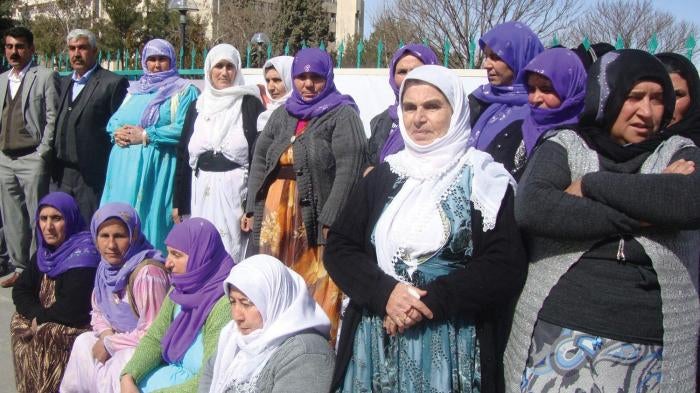
Today there exists some momentum in Turkey to pursue accountability for past abuses. The families of victims of serious human rights abuses in the 1980s and 90s have played an important role in creating momentum to pursue accountability, with such initiatives as the weekly protest in Istanbul of the Saturday Mothers, relatives of victims who campaign for justice for disappearances and killings by suspected state perpetrators. The recent excavations of mass graves in southeast and eastern Turkey has also increased the expectation of justice among families whose relatives disappeared in the 1990s.
This has also arisen in part because of the efforts of the Justice and Development Party (AKP) government to curtail military power in Turkey and to pursue criminal proceedings in the Ergenekon and similar trials against state, military, and criminal networks for alleged collaboration in coup plots.
The trial of the two surviving generals of the 1980 military coup began in April 2012. It, too, has pointed to the need for wider accountability, and may encourage further efforts to prosecute state perpetrators suspected of serious human rights abuses in the wake of the coup and in military operations against the PKK in the southeast during the 1990s.
Another Obstacle to Justice: the Statute of Limitations
This report finds that when it comes to investigating killings committed in the 1980s and early 1990s Turkey’s statute of limitation laws present a potential structural obstacle to accountability.
According to the former Turkish Penal Code (no. 765), which applies to crimes committed before 2005, the statute of limitations for murder is twenty years. If during that period the prosecutor takes steps that could lead to a prosecution, then the statute of limitations applied to the investigation stage is halted and the prosecution and trial together have another ten years to run.
Given that unresolved killings in Turkey peaked during the years 1992 to 1995, and that in almost all cases prosecutors have yet to take any concrete steps toward prosecution, there is the risk that the statute of limitations will prevent the investigation and prosecution of the killings.
However, this report argues that under international law Turkey has a duty to investigate and punish perpetrators of serious human rights abuses, a duty which cannot be displaced by statutes of limitations or other domestic legal obstacles. This duty also stems from Turkey’s obligations under the human rights treaties it has signed, which are part of Turkish law according to the Turkish constitution.
The report further argues that because of the scale, scope, and official tolerance of the killings, enforced disappearances, and other human rights crimes that occurred in the southeast of Turkey, these crimes could be prosecuted as crimes against humanity.
Turkish law also allows the statute of limitations clock to be stopped where obstacles have hindered the initiation of legal proceedings. Repeated judgments of the European Court of Human Rights against Turkey demonstrate such obstacles, including a pattern of violations of the right to life and torture, and a failure to conduct effective investigations resulting in the prosecution of suspected perpetrators, or to provide remedy to victims. This report therefore argues that during much of the past four decades the obstacles to legal proceedings were such that the statute of limitations should be deemed not to have run.
The Turkish authorities need to tackle the abuses of the past and bring justice for victims to show that the state is willing to take steps to provide redress and remedy for violations repeatedly identified in the judgments of the European Court of Human Rights. Coming to terms with the past is also an important element in addressing Turkey’s “Kurdish problem”, requiring not only individual accountability but also a wider examination of the impact of the conflict in southeast Turkey in 1990s, and abuses that took place within it.
There is an historic opportunity today for Turkey to come to terms with its recent past, and to deliver justice for the relatives of the many victims of state violations during the 1980s and 1990s. But doing so will require that the authorities prosecute these crimes in a timely way and ensure that witnesses are protected and lawyers able to do their jobs. In murder cases, the authorities should in particular provide clear legal guidance that the statute of limitations cannot be invoked to prevent perpetrators being brought to justice, on the grounds that during much of the state of emergency in southeast Turkey, meaningful and effective investigations were not and, indeed, could not in practice be conducted.
Key Recommendations
- The Turkish government should ensure, by legislation if necessary, that the statute of limitation for unlawful killings and other serious human rights violations by suspected state perpetrators in Turkey is not a bar to prosecution.
- Prosecutors and courts should ensure that witnesses deemed vulnerable or at risk of reprisals are able to benefit from the provisions of the Witness Protection Law, including testifying in court without their identities revealed to the defendants, while also upholding the right of the defendants and their lawyers to cross-question such witnesses.
- The Higher Board of Judges and Prosecutors should ensure that the investigation of past serious human rights abuses by suspected state perpetrators—including enforced disappearances, killings, and torture—is handled by dedicated prosecutors who are not simultaneously charged with taking on regular criminal investigation on a day-to-day basis.
- Prosecutors and courts should investigate possible chain of command involvement in serious human rights violations or dereliction of duty of senior security personnel for failure to prevent human rights abuses. This must entail examination of local, regional, and national command structures.
- The Turkish government should provide necessary resources to accelerate trials, with more attention to greater pre-trial preparation and more regular hearings, including holding hearings on consecutive days, in order to assist in the protection of witnesses and victims and their families, to strengthen their trust in the justice system, and also to uphold the fair trial rights of defendants.
- The Grand National Assembly of Turkey should establish an independent parliamentary truth commission to investigate disappearances, killings, and other serious human rights violations by suspected state perpetrators in the period since the September 12, 1980 military coup.
Methodology
This report is based on close monitoring by Human Rights Watch of the trial of retired colonel Cemal Temizöz and six other defendants in Diyarbakır’s specially authorized heavy penal court no. 6. A Human Rights Watch researcher attended many of the 36 trial hearings (up to June 2012). At the time the report was completed, on July 2, 2012, the parliament of Turkey had passed a judicial reform bill abolishing specially authorized heavy penal courts for future cases and introducing in their place regional courts authorized under the Anti-Terror Law. Ongoing trials, such as that examined in this report, will continue to be heard in the specially authorized heavy penal courts and a separate network of regional heavy penal courts will hear all future cases. The reform amounts to little more than a change of name and for the foreseeable future there will be two sets of courts operating in parallel. A discussion of the full implications of this measure falls outside the scope of this report.
In December 2009, February and July 2010, and March 2012 Human Rights Watch conducted interviews in Şırnak province, focusing on Cizre and also in some villages nearby and in the towns of Silopi and Şırnak itself. Altogether we interviewed 55 individuals, whose relatives had disappeared or been murdered in the province in the early 1990s. Human Rights Watch also interviewed lawyers acting for the families of victims, non-government organizations, activists working on past abuses, and two prosecutors working on these investigations. Interviews were conducted in Turkish or through an interpreter in Kurdish.
During the course of the research, Human Rights Watch also examined 140 of the complaints to the Şırnak Bar Association and the public prosecutors’ offices in Cizre, Silopi and Şırnak of enforced disappearances and unresolved killings in Şırnak province suspected by victims’ relatives to have been carried out by state perpetrators. The Diyarbakır prosecutor’s investigation of these complaints is ongoing at the time of writing.
I. Building Momentum for Justice
Until 2008, there were no attempts in Turkey to investigate and put on trial members of the security services for their involvement in gross and systematic violations of human rights that took place in the aftermath of the September 12, 1980 military coup and on through the 1990s in the context of the conflict between the Turkish military and the armed Kurdistan Workers’ Party (PKK). The handful of prosecutions that did take place focused on isolated incidents of torture or deaths in custody, without attempting to probe chain of command responsibility and whether human rights abuses were committed as part of a policy or on a scale that demonstrated they were of a systematic nature.
Early Efforts at Accountability
In 1993, the Turkish parliament set up a parliamentary Commission for the Investigation of Political Assassinations and Unresolved Murders to undertake a detailed investigation into the rising incidence of execution-style killings in Turkey in that period. Among other things, the commission probed the allegations that a covert gendarmerie intelligence unit engaged in fighting the PKK had carried out arrests and killings of civilians and other illegal activities. Known by the acronym JİTEM (Jandarma İstihbarat ve Terörle Mücadele, Gendarmerie Intelligence in Combatting Terrorism), there was and is still no available public record of the unit’s existence despite unofficial acknowledgement of its existence on various occasions over the years by some senior members of the security and intelligence services. [1] The commission concluded, among its detailed and extensive 1995 report findings, that:
The state must get rid of those officials within it [the state] who are abusing their positions, and the illegal organizations within which are committing political murders, and bring them to justice; in that way the citizen must be made to believe the line that the state does not commit murder.[2]
At the end of 1996, a second parliamentary commission was established to investigate the same issue of state involvement in criminal activities. The trigger for this investigation was a November 3, 1996 traffic accident near the town of Susurluk in western Turkey involving a police chief, a mafia leader operating under a false ID, and a member of parliament from the True Path Party who were all travelling together in a car which was also carrying arms. Within days of the accident, in which the mafia leader and police chief were killed and which drew huge press attention and public debate, the Turkish parliament took the decision to establish a commission to “throw light on the connections between illegal organizations and the state and the Susurluk accident.”[3]
The parliamentary Susurluk Commission, as it was known, produced a detailed report, as did the Prime Ministry’s Inspectorate, which had set up a separate inquiry into the incident. Both reports on the Susurluk incident included a series of recommendations about the need for institutional and structural reforms of the security services and for criminal investigations.[4] As a result, fourteen members of the police stood trial and were convicted of being part of a criminal gang, two of them leaders of it. However, the trial did not probe deeply: the member of parliament in the car accident and a key minister in the government invoked parliamentary immunity to escape prosecution, and other government members, senior members of the intelligence and security forces, escaped any investigation or scrutiny.[5] More generally, the two Susurluk reports concluded that covert organizations within the state did exist. In reference to the gendarmerie intelligence unit, JİTEM, the parliamentary commission concluded:
Indeed it has not been possible to discover the exact function of JİTEM. But while debating the existence of JİTEM, it emerged that its activities were an un-debatable reality.[6]
While uncovering a lot of information, the report also reflected on the lawless activities of some state officials and the withholding of vital information from the commission:
Some bureaucrats see themselves as the owners of the state and are concealing information from the Grand National Assembly of Turkey [parliament]. During our commission work, several state institutions did not provide the commission with sufficiently enlightening information. In particular, the Chief of Staff’s office responded with a sharp answer in response to the information sought by our commission. The National Intelligence Agency (MIT) did not give our commission information. In such a situation the citizen’s trust in the state is negatively affected.[7]
Both the two Susurluk reports and the report by the Parliamentary Commission for the Investigation of Political Assassinations and Unresolved Murders assembled credible information via interviews and documentation from a wide range of politicians, bureaucrats, public figures, and security personnel about the extent of lawless activities within the state. They also revealed evidence pointing to the involvement of named individuals in the security forces and intelligence services and interior ministry. However, governments between 1995 and 1999, led by Tansu Çiller, Mesut Yılmaz, and Necmettin Erbakan, simply sidelined the findings of the two official parliamentary inquiries and the report of the Prime Ministry’s Inspectorate. Other than the handful of low level prosecutions after the Susurluk affair referred to above, there was no attempt to pursue meaningful further action by taking up the inquiries’ findings and recommendations.
The wholesale failure of prosecutors and courts in Turkey to hold to account state perpetrators, left victims of abuse and their families with little prospect of seeing justice done in Turkey, so some turned to the European Court of Human Rights, which in over 100 cases found that Turkey had violated the right to life and engaged in torture and enforced disappearances. In several cases the European Court of Human Rights considered the evidence documented in the Susurluk report of the failure of the government to follow up on investigations of killings by state agents.[8] In a number of cases the Court made specific mention of the two parliamentary inquiries, quoting at length from their reports and acknowledging the significance of their findings.[9]
Alongside official parliamentary mechanisms that attempted to look into the criminal activities of the state and security forces, human rights groups also extensively documented political killings and disappearances throughout this period. The archives of the Human Rights Association and the Human Rights Foundation of Turkey, two local groups, contain extensive contemporary documentation and reports of violations as do those of international groups like Amnesty International and Human Rights Watch.[10]
In scores of rulings against Turkey from the 1990s onwards, the European Court of Human Rights found repeated violations of the right to life, arbitrary detention, failure to investigate the whereabouts of Kurds who were detained and never seen again, and a pattern of torture of Turkish and Kurdish detainees throughout Turkey in the 1990s.
A 2005 resolution of the Committee of Ministers of the Council of Europe listed 40 cases in which the European Court had ruled there had been a violation of the right to life (article 2 of the European convention), emphasizing that 34 of these had occurred in the southeast of the country in areas governed by state of emergency laws.[11]
The total number of such rulings has substantially risen since 2005, with the court finding article 2 violations in at least double that number since then.[12] Successive Turkish governments paid out compensation when the court found violations but put no effort behind initiating new investigations and bringing members of the security forces to trial.[13]
In its bid for accession to the European Union (EU) in the period up to 2005—though much less since then—Turkey directed reform efforts primarily at forward-looking steps, such as greatly tightening procedures for detention in order to combat torture and revising many of its laws including the penal code and criminal procedure code. This was consistent with the position of the EU, which focused primarily on new laws, with annual European Commission progress reports rarely raising accountability for past abuses in light of the need to implement rulings by the European Court of Human Rights.
The Ergenekon Case
The Ergenekon case, which began in 2008, has provided a possible opening for further efforts to uncover the state’s involvement in the mass violations of the early 1990s.
Since its second term in office (from 2007), the Justice and Development Party (AKP) has pursued a policy of confronting the power of the military in an effort to secure civilian oversight and to end the repeated military interference in political life.[14] Thus the AKP government has not only introduced laws to restrict aspects of military power such as the role of the military courts, it has also vigorously pursued investigations of military personnel and others for alleged involvement in coup attempts against the AKP government.
The Ergenekon case concerns the prosecution of an ultranationalist gang (known as the Ergenekon gang in reference to a mythical homeland of Turks in Central Asia), which allegedly attempted to stage several coup plots against the AKP government in the period 2003 onwards. The case initially consisted of 16 indictments and separate trial processes that by April 2012 had been merged to proceed as one trial.[15]
The Ergenekon case and related proceedings represent a turning point in Turkey’s modern history as the first formal attempt to curb the entrenched system of military tutelage that has operated in Turkey since the foundation of the republic. It sought to investigate alleged criminal activity against the government perpetrated by the military in alliance with elements of the bureaucracy and criminal networks.
While these investigations and trials were important and historic, human rights groups have raised serious concerns about them, including concerns about due process, the widening net of investigation to include individuals against whom there has been scant evidence of involvement in any plot, and prolonged detention of these individuals pending trial.[16]
Human Rights Watch has criticized in particular the prolonged imprisonment and trial of journalists in the course of the investigation including Ahmet Şık and Nedim Şener.[17]
Besides the Ergenekon trial, two other trials known as the Sledgehammer and the Poyrazköy trials also focus on alleged anti-government plots. It is notable that some of the most prominent defendants in all three trials were also named in the two parliamentary commission reports and in the report on Susurluk by the Prime Ministry’s Inspectorate, for their alleged involvement with assassinations of Kurdish politicians, civil servants, and businessmen whom the state suspected of financing the PKK.[18] Many of the central defendants in these trials—senior former and serving military, gendarmerie, and police personnel— were also active in counterterrorism operations in the southeast of Turkey and other regions in the 1990s.
The arrest of particular names among the defendants and start of the main Ergenekon trial in October 2008 thus gave hope to many human rights groups and lawyers, and the families of those who had been forcibly disappeared or arrested and killed in the southeast that further investigation into the involvement of those names in the earlier incidents would follow.
The Şırnak Bar Association undertook an initiative to encourage people in the region to come forward to file new complaints about their murdered relatives whose killers had never been identified or missing persons whose fate were unaccounted for.[19] In the wake of the Ergenekon investigation and trial, there have been a number of deaths of senior military personnel reported as suicides. In some cases these have prompted prosecutor’s investigations and have raised media speculation about whether they were in fact murders committed in order to silence individuals in possession of important information.[20]
Since the start of the Ergenekon trial, some others associated with counterterrorism operations and special police units implicated in abuses, or who served in operations against the PKK in the southeast, have spoken out about illegal activities they participated in or witnessed at the time.[21] This has provided a rich source of new evidence, raising the potential for further investigation of past abuses.
Separately, a former special team police officer, Ayhan Çarkın, made statements to the press about his own and others’ involvement in a series of murders of Kurdish businessmen and civil servants, currently the subject of two ongoing prosecutors’ investigations in Ankara and Istanbul.[22] To date, the police have arrested a number of special team police officers including Çarkın himself and the prosecutor has summoned witnesses to give statements as part of the investigations.[23] One former police chief is a defendant in the Ergenekon trial and under investigation for involvement in several of these murders. Suspects are due to be indicted in the coming months with the completion of the investigation for their role in forming a criminal gang that committed assassinations.
Recently, prosecutors have also begun to conduct investigations into deaths of senior military personnel who died in suspicious circumstances in the early 1990s, especially the string of deaths in 1993 to 1994. At the time, these were investigated as PKK-perpetrated murders or as suicides, whereas new forensic examinations of their remains and witness statements provide evidence that state perpetrators (possibly JİTEM units) may have murdered them in the course of power struggles within the military in that period.[24]
By fully supporting accountability for past abuses committed by the military with the knowledge of governments and state officials of the time, the Justice and Development Party government may overcome the accusation that its focus on the Ergenekon gang’s alleged coup-plotting is a self-interested exercise which ignores the more tangible evidence of some of the same individuals’ earlier involvement in gross human rights violations.
Growing Openness to Accountability?
There are indications that the AKP government is now increasingly prepared to prosecute the serious human rights crimes of the past. Since the Ergenekon investigation began, the government has given signals that it may be ready to probe military abuses dating back as far as the 1970s.
The trial of two retired generals, Kenan Evren and Tahsin Şahinkaya, that began in April 2012, is one of the most significant signs of this trend to date. The two men, the surviving leaders of the September 12, 1980 military coup, are charged with overthrowing parliament and the constitutional order. The indictment examines the military’s role in fomenting political turmoil in the late 1970s to prepare the ground for a military takeover. It includes suspected military involvement in the political assassinations of public figures and massacres against Turkey’s Alevi minority and against leftists in the Anatolian towns of Maraş in 1978, and Çorum in 1980. The indictment also examines the evidence of direct military interference in parliamentary politics and the chronology of the 1980 coup itself.
At least half of the evidence in the indictment focuses on torture and deaths in police custody and in military-controlled prisons following the suspension of democracy in the wake of the coup. Although the two defendants have not yet been charged with these crimes, the trial offers an opportunity to address Turkey’s legacy of torture. The Ankara prosecutor has referred complaints of torture and deaths in custody to chief prosecutors’ offices in 47 towns around the country.[25]
This trial of the surviving leaders of the 1980 military coup, together with the Temizöz case, which is the focus of this report and discussed at length below, the on-going criminal investigations such as the one into Ayhan Çarkın’s allegations of political killings and assassinations in the 1990s, and most recently a criminal investigation into military interference in politics in 1997, all demonstrate that the government appears to be ready to investigate and prosecute past abuses by the military. However, driving this process should be a greater focus on securing justice for victims of human rights abuses.
Parliamentary Support
The conviction that Turkey needs to face the abuses of the past has also been building among opposition parties in parliament, although there is no cross-party consensus on how to achieve this.
A few months before the June 2011 general election, Prime Minister Erdoğan met with the ‘Saturday Mothers’—mothers and their supporters—who have campaigned for an effective investigation into enforced disappearances and unresolved killings, focusing particularly on the peak in killings in the early- to mid-1990s. Following this meeting, the Parliamentary Human Rights Investigative Commission, a permanent cross-party committee dominated by the AKP, took up the case of the disappearance in 1980 of Cemil Kırbayır, who was a political activist from the organization Revolutionary Left. The Commission interviewed witnesses to his arrest and torture, produced a comprehensive report concluding he had died under torture in custody, and referred the case to the prosecutor in the Kars region.[26]
After the new parliament reconvened in October 2011, the commission took up the theme of investigating past abuses by establishing a “sub-commission to investigate violations of the right to life in the context of terrorism and violent incidents.”[27] While the full scope of this sub-commission’s activities and informing principles are not clear, it has begun immediately to collect testimonies from public figures, writers, and families of those who died at the hands of the army and the PKK, and has professed that it will be open to examining different dimensions of politically motivated killings in the recent past.[28]
The AKP member of parliament, who heads the Parliamentary Human Rights Investigative Commission, Ayhan Sefer Üstün, has also indicated that another sub-commission to investigate unresolved killings could be set up. [29] Sub-commissions of the Parliamentary Human Rights Investigative Commission are not bound by limiting time-frames as ad-hoc parliamentary investigative commissions are. However, a sub-commission of the main Parliamentary Human Rights Investigative Commission would not be independent of that commission.
As yet, there is no cross-party consensus on the setting up of an independent commission outside Parliament. In the course of the previous parliament, members of the opposition People’s Republican Party (CHP) pushed for the setting up of an ad hoc parliamentary investigative commission (meclis araştırma komisyonu) to probe politically motivated unresolved killings and later a truth commission to address the events of the past. In November 2011, the CHP tabled an unsuccessful parliamentary motion to investigate politically motivated unresolved killings. [30] The Peace and Democracy Party (BDP) has also pushed unsuccessfully for the setting up of such commissions in the previous parliament.
It should be noted here that according to the parliament’s statute, the life of an ad hoc parliamentary investigative commission is just three months. Parliamentary commissions, other than the permanent special commissions, such as the Parliamentary Human Rights Investigative Commission, are also limited in their authority with a vague provision stating that “state secrets and commercial secrets remain beyond the remit of parliamentary investigation.” [31]
Human Rights Watch recommends that the AKP government works with the opposition parties to set up an exceptional, fully empowered, and independent mechanism which can meaningfully probe the human rights crimes committed on all sides in the recent past. This should begin with violations by the Turkish state against civilians, but be ready also to examine evidence of human rights abuses by the PKK and other actors such as the armed group Hizbullah (operating in southeast Turkey in the 1990s and unrelated to the Lebanese group of the same name). The creation of such a mechanism should not preclude criminal investigation and prosecution of perpetrators of grave human rights violations.
Pressure for Accountability from Relatives of the Dead and Missing
In interviews with Human Rights Watch, relatives of victims of human rights violations underlined the pressing need and their own strong demands for the Turkish state to address the grim legacy of past abuses and secure justice.
Human Rights Watch interviewed 15 relatives of the victims involved in the Temizöz case discussed below, and also 40 relatives of other victims of torture, enforced disappearances, and killings by suspected state perpetrators in the Şırnak region between 1991 and 1996. The overwhelming message was that they strongly supported efforts to discover efforts to discover the truth and to see perpetrators brought to justice.[32]
Twenty individuals named in the Temizöz indictment were abducted or arrested and killed, or simply disappeared sixteen years ago. Their relatives told Human Rights Watch that they welcomed the criminal investigation into those killings and enforced disappearances as a hugely important development. Few of them ever imagined it would happen. The Ergenekon and Temizöz trials have also inspired the relatives of at least 160 other individuals, who were killed or disappeared in Cizre and Şırnak region during the same period, to lodge complaints with the prosecutors’ offices in Cizre, Silopi, and Şırnak. They hope that the investigation will be broadened to include their cases too or that separate prosecutions of other suspected state perpetrators of killings and enforced disappearances in the region will follow.[33]
Harun Padır, who was 17 years old at the time of his father İzzet Padır and uncle Abdullah Özdemir’s disappearance in 1994, expressed a sentiment shared by all the relatives of the victims Human Rights Watch interviewed in this case: “For us compensation means nothing. We just want justice.”
Harun Padır’s cousin, Abit Özmen, the son of Abdullah Özdemir, was just 10 years old at the time his father disappeared, though vividly remembers himself as a young boy watching his father and uncle being detained and taken away from their village in military vehicles never to be seen again. “We couldn’t believe it when this trial started. We didn’t expect anything like this. In our region everyone’s story is like a novel. We want to see this trial through to the end,” reflected Abit Özmen.[34] The two cousins are among those the court has accepted as interested parties and have regularly attended the court hearings since the start of the trial.
Men with walkie-talkies arrested Ramazan Elçi in 1994. They entered his shop and took him away in a white Renault car.[35] Days later his brother Nurettin Elçi heard that Ramazan’s body had been found and identified the body as it was about to be buried in an unmarked grave. His wife Kerime Elçi described how she felt when she first saw seven defendants put on trial for the murder of her husband: “I shook when I saw them in court, but I resolved to myself that I will fight to the end for justice.”[36]
Arafat Aydın, who testified in court that he witnessed the execution in 1994 of his cousin Mustafa and that he himself was tortured by those who killed Mustafa, talked to Human Rights Watch about his belief that perpetrators must be brought to justice:
I am a man returned from the dead. We were stripped naked and half buried, with stones and soil placed on top of us, under the hot sun. We were beaten and given no water. I was released and the others killed, but I have never fully recovered from this incident. I will not retract my statement. What have I to lose?[37]
While adamant about wanting justice, the long period of impunity makes many relatives of the victims understandably skeptical about the commitment of the AKP government and the judicial establishment to accountability for past abuses.
II. The Temizöz Trial
The Temizöz trial was triggered when in late 2008 a convicted prisoner held in Midyat prison in Mardin province wrote a letter to the Midyat public prosecutor’s office.[38] Prisoner Mehmet Nuri Binzet, serving a sentence for unrelated criminal activities (false imprisonment) in Mersin, is one of the younger brothers of Kamil Atağ, a well-known former mayor of Cizre and one of the heads of the so-called ‘temporary village guards’ in the town.[39]
In the letter, Binzet described crimes he claimed to have witnessed as a 13-year-old boy in the early 1990s and offered to testify about his knowledge of Kamil Atağ’s involvement in torture and killings in the early 1990s. Binzet alleged Atağ carried out these acts in collaboration with a major (binbaşı) in the gendarmerie, Cemal Temizöz. In his testimony in court, Binzet said he had fallen out with his family and older brother.
The letter led to the opening of a criminal investigation into murders in the Cizre area of Şırnak province, southeast Turkey in the period 1993 to 1995.[40] The testimonies Binzet and other witnesses provided to two prosecutors were to form the basis of the criminal indictment against Cemal Temizöz, two of Binzet’s brothers (including Kamil Atağ) and one nephew, and three former PKK members turned informers.[41]
The Commissioner for Human Rights of the Council of Europe, in a January 2012 report, described the case as “a unique opportunity to shed light on a period of systematic human rights abuses in southeast Turkey, which feature prominently in the case-law of the ECHR [European Court of Human Rights].”[42] The case is significant not only because it is one of the first credible prosecutions of security officials for serious human rights violations committed in the southeast during the 1990s, and the first of its kind to tackle some of these crimes as the work of an organized gang rather than as individual murders, but also because of the insights and lessons that the trial itself offers those wishing to pursue accountability more broadly in the future.
Following Binzet’s testimonies, the prosecutor called a large number of witnesses to testify. Many of them were relatives of the individuals whose murder or enforced disappearance Binzet had described. Two people implicated in the events, whom the prosecutor in fact indicted, also gave statements as witnesses but were assigned concealed identities as a protective measure. Some public officials and members of the gendarmerie serving in Cizre at the time were also called as witnesses. In this way the Diyarbakır prosecutor was able to prepare an indictment demonstrating considerable overlap and corroboration between the accounts of different witnesses.
On September 11, 2009, after almost a year of investigations, seven defendants were put on trial for the murder or enforced disappearance of 20 individuals during the years 1993 to 1995.[43] All the victims were male and residents of Cizre or surrounding villages. The youngest victim had been just 12 years old and the oldest 48. In 15 cases, the bodies of those who had been detained by the security forces have been found and identified; in four cases the individuals simply disappeared after the security forces detained them. In one case, the identity of a male body bearing a tattoo was never established. Some witnesses also referred in their testimonies to killings of other unidentified individuals. However, the prosecutors did not include these in the indictment as they considered that evidence of the alleged crimes was insufficient.
Available information about the lives and work of the victims, and statements by their families indicate that all the victims were civilians. The 20 enforced disappearances and killings represent a small proportion of the many more reported in the same area during the early 1990s and especially from 1993 to 1996. (During this period there were killings and disappearances throughout Turkey, but they were concentrated in the southeast and in major cities like Istanbul).
The indictment accuses all seven defendants of involvement in an organized gang which apprehended, interrogated, and often executed detainees whom they suspected of having links with the PKK or, in some cases, they may simply have targeted for robbery. Alongside a member of the gendarmerie, the other defendants were all armed and paid to engage in the military’s counter-insurgency operations.
Most significant among them is retired colonel Cemal Temizöz who, in the period of the murders, was commander of the Cizre district gendarmerie holding the rank of captain (yüzbaşı) and then major (binbaşı). Afterwards, he pursued a successful military career, received numerous honors for good service, rose to the rank of colonel, and became commander of the Kayseri Gendarmerie Regiment. He is the most senior member of the Turkish military ever to stand trial specifically for gross violations of human rights committed in the course of the conflict between the Turkish armed forces and the armed Kurdistan Workers’ Party (PKK). He is charged with forming a criminal gang and being the instigator or perpetrator of nine counts of murder, and faces life imprisonment if he is convicted.
Other defendants include Kamil Atağ, one of the heads of the village guards in Cizre, along with his son Temer Atağ and brother Kukel Atağ. Alongside his role as head of the village guards and one of the leading figures in the Tayyan Kerevan tribe, Kamil Atağ enjoyed five years of public office in Cizre when—with the support of Cemal Temizöz—he controversially became the town’s mayor in March 1994 local elections.[44]
Defendants Adem Yakin (known under code names Bedran and Şahin), Fırat Altın (who had changed his name from Abdulhakim Güven, and was also known under code name Ferit) and Hıdır Altuğ (known under code name Tayfun) were former members of the PKK who had turned informers and who had allegedly joined military operations with the security forces against the PKK. They are also on trial for involvement in, or committing, some of the murders. Fırat Altın (Abdulhakim Güven) had testified to the prosecutor as a secret witness under the name Ballpoint Pen, and Hıdır Altuğ as a secret witness under the name Street Lamp. [45]
All defendants except Kukel Atağ were remanded by the court to prison pending trial after their arrest and testimony before the prosecutor.[46] Kukel Atağ was remanded to prison pending trial in January 2010 and released for health reasons in March 2011. Temer Atağ was released from prison pending verdict on June 22, 2012.
The individuals are charged under the previous Turkish Penal Code (law no. 765) with forming a criminal gang (article 313) and each with several counts of murder, or with ordering murder (article 450). Since the case concerns allegations of organized crime, it falls under the jurisdiction of the heavy penal courts authorized under article 250 of the Criminal Procedure Code to hear cases relating to organized crime, terrorism, and crimes against the state.
In court the seven defendants have all rejected the allegations leveled against them. The main argument put up by the defendants, expressed most forcefully and in greatest detail by Cemal Temizöz, Kamil Atağ, and Adem Yakin, has been that they were engaged in a legitimate struggle against an armed separatist group, the PKK, on behalf of the Turkish state to preserve the territorial integrity of Turkey, and that the PKK committed many abuses in this period.
Cemal Temizöz in particular has dwelled at length on the argument that he “saved Cizre” from the PKK and brought to an end its domination of the town, that those he arrested at that time were working for the PKK as city-based militants or were providing aid and logistical support to the armed militants. Throughout the trial all the defendants have expressed anger and incredulity that they could end up in court after what they view as years spent loyally serving the interests of the Turkish state and acting under orders.[47]
A Climate of Fear
Many witnesses in the Temizöz trial have testified to a pervasive fear felt by victims’ relatives at the time of the crimes. İsmet Uykur, who had witnessed his father Ramazan Uykur’s murder in Cizre town in broad daylight in February 1994, described to the court the overwhelming climate of fear that predominated at that time:
At that time fear triumphed in Cizre. In those days we were unable to go and lodge complaints because there were many unresolved killings… there were people who had seen the incidents in the region but at that time they wouldn’t be witnesses because of their fear; in those days we were afraid of the gendarmerie and the village guards.[48]
Several of the relatives in this case explained in the course of their testimonies to the prosecutor and before the court that they had decided to leave Cizre after the disappearance or murder of their close relatives because they were too afraid to remain there and feared for their own lives. Among them was Nurettin Elçi, who left immediately after discovering his brother Ramazan Elçi’s body in the cemetery in an unmarked grave about to be covered over with earth.
I let out a great cry at the shock of seeing my brother’s body before me in the grave. Immediately after that I escaped Cizre and stayed away for many years. We couldn’t even have a wake (taziye) for my brother. No one would have dared come. All the men escaped during that period, sometimes leaving women behind. We returned many years later when the situation there had got better. Many of our relatives fled to northern Iraq as well, and are now in the Mahmur Camp or other places.[49]
In some cases too, the victims’ relatives testified that their property had been appropriated by village guards after the killing of their relatives. Fatim Bayar’s son, Beşir Bayar, had been taken from their home in December 1993 and shot by men Fatim identified as village guards “tied to” Kamil Atağ. Fatim described in court how she had fled her home after this and it had been appropriated and remains to this day in the hands of village guards.[50] Fatim Bayar and Hediye Başkak, Besir Bayar’s widow, were among those who left Cizre, moved to a district of Adana, and have not been able to get back their original home.
Hanım Candoruk, whose taxi-driver husband Ömer Candoruk was arrested, and then killed in custody with three others, described in court how she had felt powerless to lodge any formal complaint at the time, and how after her husband’s death she had seen that his car was in the possession of, and regularly used by, men whom she believed were her husband’s murderers. The Temizöz trial was her first opportunity to register the traumatic events in her life before a court. Hanım Candoruk stated: “My husband committed no sin; if he had committed a crime, they would have handed him over to you; they would have put him in prison. I would have visited him in prison. Not even birds are killed like this.”[51]
In some cases, witnesses told the prosecutor that they had been directly threatened when they attempted to seek news of the fate of their missing or dead relatives.
Sabri Gasyak told the prosecutor and later the court how, directly after the discovery of the bodies of his brother and cousin and two others, Cemal Temizöz had threatened a whole crowd of relatives of the four victims. Their bodies had been found half buried on March 8, 1994, two days after witnesses saw them being arrested at a military checkpoint between Cizre and Silopi and taken away in cars by individuals whom witnesses identified as Fırat Altın (Abdulhakim Güven) and Adem Yakin (code named Bedran). Sabri Gasyak’s younger brother, Adbulaziz Gasyak, then aged 13, and his cousin Süleyman Gasyak had been among those killed. Sabri Gasyak told the court:
… with the gendarmes we brought the deceased to the hospital, and they were put in the hospital morgue. While we were doing the preparations to bury them, Major Cemal came. Outside the hospital were more than 1,000 people who were mainly the relatives of the dead… Major Cemal said, “You won’t ask anything about these people’s deaths. Disperse! Those who meddle in this will have the same fate as them.”[52]
Sabri Gasyak also confirmed that at that time they felt there was nowhere to turn and how many of his family left Turkey and settled over the border in northern Iraq after the murder of his brother and cousin:
We couldn’t have pursued complaints back then or sought justice. I’d have been arrested if I’d pursued the case. In the late 80s, before coming to Cizre our village in Siirt’s Pervari district was burnt down by the state and emptied. We were taken in and tortured; hundreds of our animals were killed. In 1994, after Süleyman and Abdulaziz were killed, many of our family went to Zahko in northern Iraq.[53]
When Nuri Düdük repeatedly visited Cemal Temizöz to inquire about the investigation into the murder of his younger brother, Abdulhamit Düdük, after he had allegedly been abducted on his way back from northern Iraq on July 16, 1994, he reported to the court that on the third visit Temizöz directly threatened him with the words: ‘“You come and go from here. What happened to your brother will happen to you. You have become a curse to us; get out of here.”’[54] Nuri Düdük also alleged to the court that a large sum of money his brother had been paid while conducting business in northern Iraq, and which he was bringing home, went missing when he was abducted.
Most relatives of victims who testified explained that at the time they had felt very afraid to lodge complaints.
Besna Efelti testified in court: “Because I was afraid, I did not apply to the police or gendarmerie or anywhere and didn’t attempt to find out about my husband’s [Abdullah Efelti’s] fate, thinking that the same fate would befall me and my in-laws if we attempted to.” [55]
Those who had persisted described how their complaints had yielded nothing.
Nuri Düdük, who had good connections with the gendarmerie and with state offices, had repeatedly lodged complaints with local authorities and the prosecutor in Cizre, and also took the case to Ankara, writing petitions to the Ministry of Defense, the Chief of Staff’s office, and to the National Intelligence Agency (MİT) about his brother’s murder and identifying the witnesses who had seen his brother arrested.[56]
Tahir Özdemir also described in court how he had attempted to find his missing brother Abdullah Özdemir and cousin İzzet Padır by lodging various complaints over the years with the prosecutor and also with authorities, including the gendarmerie, in the nearby town of Silopi. However, at the time he had felt too fearful to approach the gendarmerie in Cizre where they had last been seen:
We didn’t go to the Cizre district gendarmerie command to ask about their fate because it was not possible: those who went there didn’t come out again. Also, when I was visiting the district gendarmerie commander Hüsam Durmuş at the Silopi district gendarmerie command, Cemal Temizöz was there and said to me, “Why are you doing treacherous things, why are you presenting a petition [i.e. lodging a complaint]?” Given that, it wasn’t possible for us to seek their whereabouts by petitioning the Cizre district gendarmerie command.[57]
While the Cizre prosecutor at the time was required by law automatically to open investigations into all deaths in suspicious circumstances, and did formally do so, the content of these investigations shows them to have been mere token exercises. In practice, the local prosecutor would quickly transfer the file to the prosecutor at the Diyarbakır State Security Court who in fact was tasked with investigating crimes prosecutable under terrorism laws committed by those suspected of association with illegal armed organizations.[58] The implication for the state authorities of transferring the files to the prosecutor at the State Security Court was that murders committed by “unknown perpetrators” were deemed to be the work of the PKK. During that period, it was standard practice after a pro forma investigation into a murder to allege probable involvement of the PKK in the death and to cease any further inquiry into the incident.
Thus in the 2009 criminal investigation into some 20 murders from that period triggered by Mehmet Nuri Binzet’s testimonies, Diyarbakır prosecutor Ergün Tokgöz had to refer back to the criminal investigation records of murders in the 1990s that had for some 15 years gathered dust on the shelves of the same office in which he now worked. Most cases had been simply declared unresolved after no more than a token investigation and lacking even a proper autopsy record.
III. Obstacles to Justice: Lessons from the Temizöz Trial
The Temizöz trial has underscored clear obstacles to justice that are likely to arise in similar trials of state perpetrators suspected of violations of the right to life.
Limited Scope of Investigation
While the trial concerns just seven defendants, important questions remain about the possible involvement of other members of the security forces in the killings. The prosecutor failed to explore possible chain of command involvement in the killings beyond Cemal Temizöz, for example by investigating the command responsibility for the alleged crimes among the higher ranking officers in the region.
The region at the time was governed under state of emergency laws, with a specially assigned governor for the whole region based in Diyarbakır. According to the official chain of command within the gendarmerie, Cemal Temizöz was accountable to the Şırnak Province Gendarmerie Regiment Commander, who in turn reported to the Gendarmerie General Command in Ankara. Cemal Temizöz would also have reported to the Regional Gendarmerie Public Security Commander, based in the regional headquarters in Diyarbakır. The criminal investigation has included neither of these commanders, nor the Gendarmerie General Command in Ankara and during the trial the prosecution failed to call as witnesses those who served in these positions at the time Temizöz was serving in Cizre.
It is essential in cases of this kind that the investigation is broadened to include possible chain of command responsibility. In the Temizöz case therefore it would be appropriate to investigate those holding the positions of State of Emergency Regional Governor, Şırnak Province Gendarmerie Regiment Commander, and Regional Gendarmerie Public Security Commander at the time when Cemal Temizöz was Cizre district gendarmerie commander for their possible collusion in killings, disappearances, and other human rights violations or their failure to prevent abuses by a commander who, according to rank and location, was formally operating under their direct authority and subject to their control.
It should be noted here that a provision in one statutory decree relating to state of emergency powers provides immunity from “criminal, financial, or legal responsibility” for decisions taken under a state of emergency by the Interior Minister, the State of Emergency Governor or provincial governors (article 8, statutory decree no. 430).[59] This provision conflicts with Turkey’s obligations under international law to investigate and prosecute allegations of serious human rights violations. Under article 90 of the Turkish Constitution, in the case of conflicts between international and domestic law, international treaty obligations take precedence.
Witnesses at the trial have mentioned several individuals they alleged were gendarmerie officers who worked closely with Cemal Temizöz and the other defendants and participated in detentions, interrogations, torture, and killings. However, the witnesses only knew these individuals by their code names. The code names the witnesses provided to the court include Yavuz, Cabbar, Tuna, Selim Hoca, Selçuk, and Ramazan Hoca. However, at the time of the investigation in 2009 the police and prosecutor were unable to identify the officers who used those code names and the prosecutor did not therefore include them in the indictment.
To date, only one individual bearing a code name has been identified. In February 2012, some three years after the start of the investigation, it was a lawyer for the victims, rather than the prosecutor, who established that an individual witnesses had mentioned as bearing the code name Yavuz was in fact special sergeant Burhanettin Kıyak. The lawyer had noticed that Burhanettin Kıyak and “Yavuz” had identical signatures on different documents in the case file. Acting on this information, in July 2012 the prosecutor ordered that Burhanettin Kıyak testify before a judge, following which the judge remanded him to prison on suspicion of involvement in a series of murders, acting alongside Cemal Temizöz and others.[60]
While the move to include Kıyak as a suspect in the case is an important one, it should prompt further efforts by the prosecutor to determine the identities of other possible suspects bearing code names. Cooperation on the part of the Ministry of Interior and security forces with prosecutors and courts to determine the identity of these individuals from gendarmerie records and police records is critical. If such co-operation is not forthcoming legislative provisions should be adopted imposing a mandate to co-operate in the course of a criminal investigation.
Non-application of Witness Protection
One of the most troubling aspects of the trial to date has been the climate of intimidation and threats to witnesses. Human Rights Watch considers that this is likely to be a major concern in any similar trials in future.
In any trial adequate protection for vulnerable witnesses is a key factor. In trials for serious organized crimes, where the suspects and defendants are state agents or who have previously benefited from the protection of the state, witness protection is vital to instill confidence in the relatives of victims to pursue criminal complaints.
The rules of procedure for prosecuting the most serious crimes before international war crimes courts include measures such as one to allow a witness to give evidence without public disclosure of the identity of the witness. Experience from cases before such tribunals has also shown that in the absence of such measures it can be impossible to persuade victims to give evidence, and in some cases that the absence of such measures puts witnesses at serious risk.[61]
Turkey has a Witness Protection Law that provides protection measures to be put in place for witnesses in criminal proceedings, their relatives, and those close to them in the event of facing “heavy and serious threats to life, physical integrity or property.”[62]
Witnesses in trials in Turkey, where the defendants face possible prison sentences of over ten years or are on trial for organized crimes or terrorism offenses, can testify with measures to conceal their identities and addresses. In their daily lives, they can be protected with measures such as a bodyguard, a complete change of identity and residence, and even in some cases by being relocated permanently and offered cosmetic surgery.[63]
The use of witnesses, whose identities are concealed from the defendant in terrorism and organized crime trials, does raise concerns as a threat to the principle of “equality of arms” and to the rights of the defendant.[64] To date, there has been no research in Turkey that comprehensively examines the use of protected witnesses in terrorism and organized crime trials, the quality of the evidence they have provided, and the weight given to such evidence in verdicts in light of the concerns raised.
To address concerns that the right to a fair trial for the defendant will be compromised, the Witness Protection Law states that the statement of a witness whose identity has been withheld from the defendant and the public cannot alone secure a conviction.[65]
In practice, while Turkish courts have widely used orders to conceal the identity of witnesses in organized crime and terrorism trials, there has so far been little application of the Witness Protection Law in trials relating to crimes committed by the security forces.
Application of the Witness Protection Law in the Temizöz trial could have had a significant impact on the willingness of witnesses to participate. In the course of the trial, relatives of victims giving evidence and other witnesses were subject to intimidation, threats, and in one case a physical attack in the court-house by relatives of the defendant Kamil Atağ. Witnesses interviewed during the research for this report also told Human Rights Watch confidentially that they received repeated visits from the family and associates of Kamil Atağ asking them not to act as witnesses in the case during the investigation stage and after the start of the trial. None of those interviewed considered it possible that the state could protect them against intimidation or threats. They seemed for the most part unaware that such protection might be available to them or about the existence of the Witness Protection Law.
Mehmet Selim Uykur told Human Rights Watch that the family and associates of Kamil Atağ had threatened him and his cousin İsmet Uykur. Mehmet Selim Uykur and İsmet Uykur are witnesses in the Temizöz trial, and allege that they witnessed Temer and Kukel Atağ kill İsmet Uykur’s father Ramazan Uykur in Cizre in February 1994.
Mehmet Selim Uykur reported to Human Rights Watch that after Kamil, Temer, and Kukel Atağ were indicted, village guards close to Kamil Atağ, associates of the family, relatives, and the leaders of other tribes in the region repeatedly visited him and his cousin and urged them not to be witnesses in the trial.
On October 12, 2009, as he and İsmet Uykur were drinking tea in a municipality garden in Cizre, an imam approached them and urged them to leave the garden because Kamil Atağ’s men had assembled in the Hotel Başak—owned by Atağ—across the road and were armed and ready to attack them. Everyone else had already left the garden. Mehmet Selim Uykur filed a complaint with the prosecutor and told Human Rights Watch that he had not been threatened since.[66] This suggests that if the prosecutor and judge do learn of witness threats, their involvement and the start of a criminal investigation into the complaint can constitute a form of deterrent against further threats.
However, in general witnesses Human Rights Watch interviewed had not lodged official complaints. And in some cases threats to witnesses may have persuaded them not to testify in the trial and to retract their statements.
One such case is that of Asker and Rabia Pokön, a married couple from Cizre who each provided detailed witness statements to the prosecutor to the effect that they had witnessed the killing in January 1994, of their neighbor İbrahim Danış by a group including Cemal Temizöz, Kamil Atağ, Temer Atağ, Adem Yakin, Abdulhakim Güven. They are alleged to have seen Danış being shot and then seated on a mine which was then detonated. When the couple’s allegations received press coverage and their names were made public, the couple handed in a petition to the Cizre prosecutor’s office entirely retracting the statement. They repeated this retraction in court on December 24, 2010.[67]
In court on April 2, 2010, Abdulselam Binzet gave a witness statement in which he raised questions about the possible involvement of defendant Kamil Atağ in the murder of his older brother, Abdulrezzak Binzet, in July 1997, and provided some circumstantial evidence to that effect. An angry exchange between Abdulselam Binzet and Kamil Atağ, who is also his second cousin, followed. When Binzet had finished testifying before the court and left the courtroom, he was immediately attacked by relatives of Kamil Atağ who had been in the spectators’ gallery of the courtroom and had raced out into the corridor after Abdulselam Binzet.[68]
Lawyers reportedly intervened to protect Abdulselam Binzet. Two members of the Atağ family were detained by the police at the court and later released. Binzet gave a statement to the police the same day in which he raised concerns that his life was in danger.[69] To Human Rights Watch’s knowledge there were no charges pressed against members of the Atağ family involved in this physical assault on a witness in the courthouse building.
Where there is clear evidence, as there was in this case, prosecutors should take steps to pursue charges against individuals who assault a witness in this manner as a serious attempt to undermine the administration of justice. Alongside the charge of assault prosecutors should consider charging suspects who attack, threaten, or attempt to direct witnesses with attempting to influence a judicial process (under article 288 of the Turkish Penal Code).
Abdulselam Binzet stated in an interview with Human Rights Watch before this attack that he had been under pressure by the Atağ family not to appear as a witness before the trial started and had been visited countless times by members of the family, though he had not lodged an official complaint to that effect. Commenting on the trial and the difficulties for witnesses, Binzet commented:
We don’t know what will happen in this trial because the state’s work is not clear to us. Those close to the defendants [Atağ family and village guard associates in same tribe] have guns belonging to the state. They threaten the court, they threaten us; they are people who don’t hesitate to kill. If the state can’t stop them, then who can?.… The solution is to punish them. If the defendants get a punishment for the crimes they have committed, then of course it will prevent the others [family and associates] from using their guns.[70]
In none of the examples discussed above did witnesses benefit in practice from the Witness Protection Law. Prosecutors should, at the investigation stage, provide witnesses with information about the Witness Protection Law and the measures available to protect them. Prosecutors should also undertake a full assessment of the possible risks to witnesses at the time they first interview them. The courts should continue to assess the threats to witnesses in the course of a trial and prosecutors should show a readiness to recommend witness protection measures to witnesses threatened in court and to pursue full investigation of acts of intimidation and threats that they witness or that are brought to their attention.
Witnesses Retracting their Statements
The Temizöz trial has also demonstrated how, when they appear before the court, witnesses called to testify because of their “insider” knowledge are also liable to retract the initial witness statements they made before prosecutors. Such witnesses include village guards, former PKK members turned informer, or military personnel and police. In future cases of this kind, prosecutors will have to determine whether such individuals should be considered as witnesses or suspects, but they should be aware that this problem is likely to arise.
As discussed earlier, the primary trigger for the prosecutor’s investigation into the unresolved murders between1993 and 1995 in Cizre was the detailed statement to the prosecutor’s office provided by Mehmet Nuri Binzet, the brother of one of the accused.
When he testified in court, Binzet retracted his earlier statements to prosecutors.[71] When he retracted his statement, the court alerted him verbally to the penalties in law for lying under oath and providing false witness statements.
The first prosecutor before whom Binzet testified, in Midyat, had recorded Binzet’s prolonged testimony on film. This was later made available to the Diyarbakır court and may serve to undermine his claim that he had been pressurized to make his initial statement by a prosecutor constructing an elaborate scenario. [72] The Diyarbakır court also heard evidence in the form of wiretaps of numerous telephone calls made to Binzet in prison by members of his family offering large sums of money to retract. [73]
Two more witnesses retracted their statements when they appeared in court. Both had benefited from the Witness Protection Law as far as being permitted to provide their very detailed statements to the prosecutor under the code names Ballpoint Pen and Street Lamp. Both alleged they had witnessed a series of murders committed by the defendants on the orders of Cemal Temizöz. Their statements are repeatedly mentioned in the indictment. At the same time as including in the indictment the details of their allegations as protected witnesses, the two individuals were indicted and were among the seven defendants in the trial. Their witness statements had not protected them from being defendants on trial for multiple counts of murder and facing possible aggravated life imprisonment.
At the first hearing of the trial, former PKK member turned state informer Abdulhakim Güven (Fırat Altın) handed over a petition to the court stating that he wished to retract the witness statement he had made to the prosecutor under the name of Ballpoint Pen. [74] Hıdır Altu ğ also sought to recant his statement to the prosecutor under the name Street Lamp.
Human Rights Watch is not in a position to reach any definitive conclusions as to why they recanted. However, it is clear that acting as witnesses had brought them no perceivable benefits since they were still counted as defendants facing life sentences and had not been released from prison pending trial.
As one prosecutor working on past abuses pointed out to Human Rights Watch, there is currently no incentive in terms of reduced sentences (or a plea bargaining system) for individuals implicated in serious human rights abuses to offer information which could lead to prosecutions of high ranking members of the security forces. The prosecutor viewed the absence of such a system of incentives as a serious obstacle to efforts to shed light on chain of command responsibility for the pattern of systematic abuses in the southeast region in the early 1990s.[75]
Attempts to Direct and Intimidate Witnesses
Among the witnesses called by the court in the course of the trial were a number of civil servants and public officials who had served in Cizre during the period 1993 to 1995. They included two public prosecutors, two former sub-governors (kaymakam), and members of the gendarmerie and the police force. Mostly, these witnesses professed either not to remember or not to know when questioned about the high incidence of assassination-type murders of civilians in Cizre at that time and the conduct of the security forces, including the use of plain-clothed personnel and unmarked white Toros Renault cars.[76] Some of these witnesses had offered much more relevant detail when they first testified before the prosecutor during the investigation stage in early 2009 than they were prepared to provide in court many months later, as their statements to the court documented in records of hearings demonstrate.
For example, one such witness was retired sergeant Mehmet Aksoy who had served under Temizöz from 1994 to 1996 at the central Cizre gendarmerie station; another was his predecessor Ahmet Öznalbant, who served there from 1992 to 1994. In original statements given to the prosecutor in April 2009, both referred to a plain-clothed “interrogation unit” (sorgu birimi) under the command of Cemal Temizöz. This included code-named individuals such as Yavuz, Cabbar, Tuna, Selim, and Hoca working alongside the informers Abdulhakim Güven and Hıdır Altuğ. They also referred to the use of a white Renault car. Aksoy claimed that this car was not listed on the inventory of the gendarmerie station and that the “interrogation unit” was not listed among the official gendarmerie personnel. Before the court, in February 2011, these two witnesses claimed not to recall most of this detail and claimed instead that the prosecutor had made it up.[77]
One of the clearest attempts to interfere with witnesses came to light during the evidence of Osman Bulgurlu. Bulgurlu, who served as Cizre sub-governor (kaymakam) from October 1993 to August 1994, claimed during his evidence to know nothing about arrests and the torture of detainees, or the high incidence of assassination-type killings, but remembered that the security situation in Cizre had been difficult and that security personnel were unable to walk unprotected on the streets after 4 p.m.
In contrast, he answered in detail a series of questions from the defendants and their lawyers. Did he remember the PKK attack on the governorate and the fire? Did he remember how there was a rocket attack when he was watching a televised Galatasaray football match with local shopkeepers, and that he had had to be rescued in a military panzer? The witness seemed generally uncomfortable throughout cross-examination. Then, when he had finished answering these questions, he handed the main judge a three-page unsigned letter he told the court he had received through a courier before the hearing. The letter directed him precisely on how to answer questions, what to emphasize and what to profess no knowledge of. The issues on which he was directed in the letter bore a striking similarity to the line of questioning taken by the defendants and his vague and generalized responses.
The court decided to attempt to trace the sender of the letter via the courier firm that had delivered it. At the time of writing, the conclusion of this investigation is not known. The letter provides concrete evidence of an attempt to intimidate and direct a witness in the case.
Attempting to influence a judicial process is an offense in the Turkish Penal Code and can be prosecuted with a possible prison sentence of between six months and three years (article 288, Turkish Penal Code). Faced with clear evidence of attempts to interfere with witnesses, prosecutors should be ready to press criminal charges against those who seek to intimidate witnesses or otherwise influence a judicial process.
Threats to Lawyers
Another striking aspect of the trial has been the threatening and insulting behavior in court of defendants towards some of the lawyers for the families of the victims. Throughout hearings there have been sharp exchanges and defendants have made threatening, discrediting, and personalized comments directed in particular at the lawyers from Şırnak province, who are known to some of the defendants because they originate from the same area. [78]
The Diyarbakır Bar Association told Human Rights Watch that, in 2011, associates of Kamil Atağ made direct threats against the family of one lawyer who wished to remain anonymous.
When such incidents occurred, the judge would issue a mild reprimand and the prosecutor in the court room would not seek any sanction against the defendant, such as removal of the defendant from the court room or further measures. While no lawyer has to date lodged a formal complaint with the prosecutor against any individual for these kinds of threats in or out of court, and there is no evidence that it deterred lawyers from acting diligently on behalf of their clients, it would have been appropriate for both the judge and the prosecutor to take a more robust stance when defendants blatantly and publicly engaged in threatening behavior against the victims’ lawyers. The United Nations Human Rights Committee has held that a hostile atmosphere and pressure created in a court can be a violation of the right to a fair trial.[79]
Length of Proceedings
The excessive duration of trials in Turkey is a long-standing concern. Long trials often lead to excessively prolonged detention for defendants pending verdict and violations of the right to a fair trial. But lengthy proceedings also have serious implications for witnesses and their protection.
A January 2012 report by the then-Commissioner for Human Rights of the Council of Europe described the issue as “a chronic dysfunction.” [80] The report notes that the European Court of Human Rights has repeatedly found violations of the European Convention on grounds of excessive length of proceedings in Turkey’s courts and that some 233 judgments against Turkey concerning this matter are pending before the Council of Europe Committee of Ministers.
Reasons for long delays identified by Turkey’s Ministry of Justice as well as by the Council of Europe include the heavy workload of the courts, too few judges and prosecutors, lack of paralegal personnel to assist with preparatory work on cases and administration, deficiencies at the investigation stage, and over-reliance of prosecutors on the police to collect evidence.[81]
Trial hearings do not run on consecutive days but rather at intervals of sometimes several months which means a lack of continuity and focus in proceedings. This is sometimes exacerbated by repeated changes in the make-up of the panel of three judges and the prosecutor, since in the life of a long trial individual judges and prosecutors are likely to be rotated to positions in other provinces or courts.
Since the Temizöz trial began in September 2009, there have been 36 hearings (up to June 22, 2012). While in the first months of the trial they were conducted at intervals of less than a month, the subsequent general pattern has been intervals of one month or more.
The slow pace of proceedings leaves witnesses vulnerable to threats for a longer period of time and may exacerbate the pressure on witnesses not to testify or to retract their statements, as has occurred in the case.
For the relatives of the victims, prolonged proceedings can also be traumatic, giving rise to considerable uncertainty about the outcome and lack of confidence that the justice system will deliver justice in the end. A son of one the victims in this trial told Human Rights Watch: “We don’t know where this trial is going. We don’t know whether to believe in this process. Are they just stringing us along?”[82]
It is of the utmost importance that the justice ministry provides sufficient resources to allow the whole trial to proceed swiftly. The authorities should make maximum efforts to ensure scrupulous pre-trial preparation and advance determination of witnesses to be heard in a way that respects a defendant’s fair trial rights. The court should also make necessary arrangements for witnesses to be able to testify in the language of their choice (in this trial mainly the Kurdish spoken in Şırnak).
The more drawn out the proceedings, the more likelihood that witnesses may be subject to pressure from third parties and that families of the victims will lose confidence in the process. Speeding up proceedings in trials of this kind in recognition of their exceptional nature, provided it is done in a way that is consistent with a defendant’s right to a fair trial, should be a priority for the government and the judicial system.
A Social Obstacle to Justice: the Village Guard System
Village guards are civilian villagers armed and paid by the state to join military and counter-terrorism operations alongside the regular security forces. They are known officially as “temporary village guards” (Geçici Köy Korucular, GKK), though the name is a misnomer since the scheme has been operating for many years in its present form and began with the Turkish government changing the Village Law in 1985.[83] The majority of the guards in the southeast region are Kurdish. The continued existence of the temporary village guard system is a further social obstacle to efforts to secure accountability for the killings and enforced disappearances and other egregious violations of human rights in the southeast and eastern provinces of Turkey.
Complex social relations entailing tribal and communal loyalties in parts of southeast Turkey were accentuated and polarized by the introduction of the village guard system in the late 1980s. Divisions among the population deepened along lines of those joining the system, whom the state regarded as loyal to the state, and those not joining it, whom the state viewed as supportive of the PKK.
The village guards are also implicated in abuse. Human Rights Watch reports in 2002 and 2006 documented abuses committed by guards in provinces of southeast Turkey including Şırnak. Abuses have included murders, rape, and appropriation of property of displaced villagers and those who did not become village guards. The European Court of Human Rights has found that members of the village guard were responsible for violations of the right to life.[84]
The fact that some of the defendants in the Temizöz trial are village guards—in effect an irregular army operating within the local society—has certainly contributed to the continuing fear of witnesses and families of victims. In the course of trial hearings, defendant Kamil Atağ referred repeatedly and threateningly to having “300 armed men” tied to him as village guards of whom he is the head guard (korucubaşı). All belong to one arm of same tribe, the Tayyan Kerevan, which many of them still have registered on their identity cards.
Kamil Atağ’s family members and associates from the same tribe as well as figures from other tribes have attended all trial hearings in much larger numbers than the families of the victims. Some of them were involved in the attack on Abdulselam Binzet in the corridors of the courthouse. At early stages in the trial, the chief judge repeatedly warned them not to react angrily to the proceedings and on one occasion he warned that they would be excluded from hearings if they did not comply. In the course of the trial, two relatives of victims have claimed that their property was appropriated by the Atağ family or their associates and that they were never able to get it back.
Since Human Rights Watch’s research on the village guards in 2006, some individuals have left the village guard system, some have even been prosecuted for aiding the PKK, and in some areas new guards have been recruited. In general, the system remains in place and since May 2007 members of the village guards have been granted rights to pensions, social security, and compensation. There have been no efforts by the government to disarm the village guards or to plan the disbanding of the system as long recommended by domestic and international bodies.[85]
The guards themselves have sometimes argued that disarming them would leave them vulnerable to attacks by the PKK and other reprisals. This concern is a serious one, and highlights the need for a comprehensive plan by the state authorities over how to dismantle the village guard system.
IV. Statute of Limitations: Limiting Wider Accountability?
… [C]riminal investigations into allegations of abuse must be dealt with promptly to avoid impunity resulting from statutory limitations on crimes, bearing also in mind the continuing obligation under the Convention to carry out such investigations.
—Committee of Ministers of the Council of Europe Resolution on Turkey, 2005[86]
One of the key reasons to press for domestic prosecutors and courts to immediately investigate and put on trial perpetrators of suspected state killings is to head off arguments that cases will become time-barred in the future under the statute of limitations for murder.
Charges for crimes committed up till June 2005 in Turkey are brought under the former Turkish Penal Code (law no. 765) in which the statute of limitations for a murder investigation is just twenty years.[87] On-going investigations where no measures towards prosecution have been initiated are timed out after twenty years.
If, however, the prosecutor has taken steps towards prosecution, such as issuing an arrest warrant, calling in a suspect to testify, or indicting an individual, then the statute of limitations applied to the investigation stage is halted and the prosecution and trial together have another ten years to run. In all, any trial for murder must be concluded within thirty years of the suspected crime. Enforced disappearances are not subject to the same time limitation since the crime was not included in Penal Code no. 765. Torture in Penal Code no. 765 is subject to a ten-year statute of limitations.
Given that the highest number of unresolved killings and enforced disappearances in Turkey were recorded over the years 1992 to 1995, it is imperative that prosecutors and courts do not apply the statute of limitations in the penal code no. 765 to prevent the investigation and prosecution of these egregious violations of human rights.
At least two of the human rights treaties to which Turkey is a party, the European Convention on Human Rights (ECHR) and the International Covenant on Civil and Political Rights (ICCPR), impose obligations on party states to investigate and punish perpetrators of serious human rights abuses. [88]
Decisions of the European Court of Human Rights have repeatedly acknowledged the problem of impunity for members of the security forces who have perpetrated human rights abuses in Turkey. The UN, Council of Europe, Committee for the Prevention of Torture, and international and domestic human rights organizations have documented the problem over many years. [89] In the past, the expiry of the statute of the limitations has been one means by which state officials have escaped prosecution for torture, and this too has been a specific point identified in European Court rulings against Turkey. [90] The Committee of Ministers of the Council of Europe noted the problem in a 2005 resolution on actions of the security forces in Turkey:
… criminal investigations into allegations of abuse must be dealt with promptly to avoid impunity resulting from statutory limitations on crimes, bearing also in mind the continuing obligation under the Convention to carry out such investigations. [91]
In order to press for effective measures among Council of Europe member states to combat impunity, in March 2011, the Committee of Ministers issued specific guidelines on eradicating impunity for serious human rights violations. [92]
Most recently in January 2012, the Commissioner for Human Rights of the Council of Europe raised concerns over the continuing problem of statutes of limitations in relation to the prosecution of serious human rights violations in Turkey, terming them “still an obstacle” in view of “ the general problem of excessive length of proceedings in Turkey, as well as the fact that execution of many judgments of the European Court of Human Rights would require the reopening of very old files.” [93]
The major reform of the Turkish Penal Code that occurred in 2004 and 2005 included for the first time, under a category “international crimes”, offences that are not subject to a statute of limitations. [94] These include crimes against humanity, which under the code (article 77) includes the crimes of murder, intentional injury, torture, and sexual assault if they are shown to have been carried out in a systematic manner against a part of the population.
Irrespective of amendments to Turkish domestic law, since 1946, various international instruments have reaffirmed that those responsible for crimes against humanity must be punished and that states should not enact legislative or other measures, such as statutes of limitation, to prevent fulfillment of the international obligation to prosecute persons alleged to have committed crimes against humanity.
Two treaties, the Convention on the Non-Applicability of Statutory Limitations on War Crimes and Crimes Against Humanity (1970) and the European Convention on the Non-Applicability of Statutory Limitations on War Crimes and Crimes Against Humanity (1974), both set out the principle that there is no time limit to prosecute crimes against humanity. This principle is also codified in article 29 of the Rome Statute of the International Criminal Court.
While Turkey has not ratified any international treaty on statutory limitations, these instruments are evidence of state practice and opinio juris that statutes of limitations should not be interpreted to bar prosecution of crimes against humanity.
However, until now, crimes committed in the period assessed in this report have been considered by prosecutors under the previous Turkish Penal Code (law no. 765) in which there is no definition of crimes against humanity or enforced disappearance. So, for example, the killings and disappearances for which Temizöz and his co-defendants stand trial have been counted according to Penal Code 765 as simply murders committed by a criminal gang and the indictment against the defendants invokes these charges.[95]
A strict application of the statute of limitations for murder under the old penal code would mean that, in 2012, any killings carried out before 1992 are time-barred, if the prosecutor has taken no measure to stop the clock, and those carried out before 1995 will soon become so.
The highest number of unresolved killings, as well as enforced disappearances, occurred in the years 1993 and 1994. This means that in cases where a victim’s body was subsequently found prosecutors and courts are likely to argue, on the basis of the previous Penal Code, that the statute of limitations will be exceeded in 2013 and 2014 respectively.
A striking recent case demonstrates that some prosecutors are cognizant of the time constraint upon investigations into crimes resembling those for which Temizöz and his co-defendants are standing trial.
The then head of the Diyarbakır branch of the Peoples’ Labor Party (Halkın Emek Partisi, HEP), Vedat Aydın, was detained from his home in Diyarbakır by plain-clothed individuals carrying walkie-talkies and guns on July 5, 1991. His wife, Şükran Aydın, witnessed his arrest. Vedat Aydın’s body was discovered two days later near Lake Hazar in Elazığ province, some two hours from Diyarbakır, bearing signs of torture and the gunshot wounds from which he died. His murder featured in the Susurluk Report, discussed above, which explored the links between the state apparatus and political killings in southeast Turkey. In the report, an individual who worked with the National Intelligence Organization is alleged to have carried out the murder of Vedat Aydin amongst others.
Exactly 20 years later, on July 5, 2011, the prosecutor took a measure to prevent the investigation of the case becoming time-barred as a murder under the old penal code by accepting from Aydın’s widow, Şükran Aydın, a positive identification of one of the men who had arrested her husband, issuing an arrest warrant for that individual, and calling four individuals to testify as suspects.[96] By taking this step, the expiry of the twenty-year time limitation was narrowly avoided in this important case.[97] The on-going criminal investigation, prosecution, and any future trial now has another ten years to run. Although this case was high profile and featured in the Susurluk report, the prosecution claims it is facing difficulty in making progress in the case due to the current lack of eye-witnesses prepared to testify on the circumstances of Vedat Aydın’s arrest, apart from Şükran Aydın, and the unknown whereabouts of the individual for whom the arrest warrant has been issued.[98]
Both the old and new Turkish penal codes allow the statute of limitations clock to be stopped where other regulations present an obstacle to initiating legal proceedings.[99]
This argument was relied on by Ankara prosecutor Kemal Çetin in the indictment against Kenan Evren and Tahsin Şahinkaya for staging the 1980 military coup and overthrowing the parliament and constitution. The indictment argued that the immunity granted to those involved in the coup by the 1982 Constitution, which was repealed in 2010, meant that during the period from 1982 to 2010 the clock did not run. [100] In accepting the indictment, the Ankara court which is trying the case has accepted the argument, though in the final instance it will be left to Turkey’s top court of appeal, the Court of Cassation, to rule on this point.
Putting on trial the coup leaders became possible after a September 2010 popular referendum had approved a package of constitutional reforms, including repeal of temporary article 15 of the 1982 Constitution which had guaranteed immunity from prosecution for all public officials for a specified period in the wake of the 1980 coup (from September 12, 1980 to December 6, 1983 when parliament was convened once more).
However, with the lifting of the coup leaders’ immunity came the additional issue of whether or not a case against them was time-barred since there is a 20-year statute of limitations in Turkish Penal Code no. 765 for the crimes of which they are accused. The implication of the prosecutor’s argument is that the statute of limitations factor would have been relevant had it not been for the immunity law (temporary article 15 of the 1982 constitution) which meant the suspension of the statute of limitations till the 2010 repeal of that article.
However, prosecutor Kemal Çetin in February 2012, issued another decision which has further implications for the application of the statute of limitations in direct relation to the investigation of serious human rights abuses such as torture and violations of the right to life. After indicting the two surviving leaders of the coup, he issued a decision of non-jurisdiction for many complaints filed in Ankara for cases of torture and deaths in custody which took place in many parts of the country, including in Ankara, in the wake of the coup. Instead, he referred these complaints to prosecutors’ offices in the provinces of Turkey in which the incidents originally occurred and to the relevant Ankara prosecutor for the Ankara cases. Furthermore, he argued his decision of non-jurisdiction the basis of the case-law of the European Court of Human Rights and Turkey’s obligations under the ECHR that torture and violations of the right to life (articles 2 and 3 of the ECHR) were crimes for which the statute of limitations could not apply:
The statute of limitations can never be applied when public officials are the perpetrators of the crimes of violating the right to life, torture and ill-treatment; amnesties may not be applied to such individuals.[101]
The prosecutor’s decision cites a number of European Court rulings focusing in particular on impunity resulting from investigations and trials that become time-barred. [102] Once again, the final decision on this point will rest with the Court of Cassation, but it is a hopeful sign that a prosecutor has made such an argument and is of great relevance to the prosecution of past abuses. Some lawyers indicated that on the basis of the Ankara prosecutor’s decision they would be prepared to file new complaints about technically timed-out cases relating to the prosecution of state officials suspected of torture and killings. [103] In at least one case a local court has already rejected the Ankara prosecutor’s reasoning and ruled that a complaint of torture dating from the 1980 to 1983 period is time-barred because the ten-year statute of limitations is applicable and has expired. [104] However, in Samsun province another local court has accepted the Ankara prosecutor’s reasoning about the non-applicability of the statute of limitations and overturned the Samsun prosecutor’s decision not to investigate a torture complaint from that period. [105]
The Republican People’s Party (CHP) has recently proposed an amendment to the current Turkish Penal Code (no. 5237) to state that the statute of limitations does not apply to the crimes of murder, torture, and sexual abuse of children.[106] Were such an amendment to be made to the current Turkish Penal Code it is unclear how it would affect the time bars on the investigation and prosecution of crimes committed in the past and punishable under the previous Penal Code (no. 765), and in particular whether it would have retrospective effect.
One solution would be to present a strong body of evidence to show that the killings committed by state perpetrators in the early 1990s should not be treated as individual cases of murder. Instead, accompanying a pattern of enforced disappearances, they were part of a planned and systematic policy and therefore must be counted as crimes against humanity, a crime of universal jurisdiction which is now also a crime under Turkish law.
Human Rights Watch considers that there are compelling grounds to argue that through the 1980s and 1990s the investigation and prosecution of serious human rights abuses, in particular violations of the right to life and torture, was simply not possible and that the statute of limitations clock should be deemed not to have run during those periods. In support of such reasoning, the judgments against Turkey by the European Court of Human Rights provide the strongest grounds for arguing that the statute of limitations should not be counted as applicable for cases of murders allegedly perpetrated by state actors in the southeast and eastern provinces of Turkey in the early 1990s.
As noted above, the European Court found repeated violations of articles 2, 3, and 13 for lack of investigation and lack of remedy in Turkey during that period and pointed to a pattern of ineffective investigation. Lack of effective investigation of violations of the right to life led the Court to conclude:
The cases examined by the Convention organs [the European Court and its predecessor the Commission] concerning the region [southeast and eastern Turkey] at this time have produced a series of findings of failure by the authorities to investigate allegations of wrongdoing by the security forces, both in the context of the procedural obligations under Article 2 of the Convention and the requirement of effective remedies imposed by Article 13 of the Convention…. A common feature of these cases is a finding that the public prosecutor failed to pursue complaints by individuals claiming that the security forces were involved in an unlawful act, for example not interviewing or taking statements from implicated members of the security forces, accepting at face value the reports of incidents submitted by members of the security forces, and attributing incidents to the PKK on the basis of minimal or no evidence. [107]
Given that there are scores of European Court rulings against Turkey finding violations of the right to life through lack of effective investigation and in some cases substantively, with many of them relating to cases of disappearances and killing in the southeast of Turkey, Human Rights Watch considers that a strong case can be made for arguing that the existing statute of limitations should not run for at least some of that period.
The Temizöz trial itself provides ample evidence of why investigation and prosecution was not possible at the time of the events and also for many years afterwards. As documented in this report, witnesses and families of victims have repeatedly testified to having been too afraid to pursue complaints following the murder or disappearance of relatives for fear of being punished and further victimized as a consequence.
Human Rights Watch has also interviewed 40 other relatives of victims in Şırnak province, who in the past three years have lodged complaints with prosecutors for the criminal investigation of murders or disappearances of relatives, and who remain in hope that they too will see perpetrators brought to justice. In every case, these individuals emphasized that for many years they had been too afraid to complain, still struggled with their fears and sense of hopelessness about securing justice.[108]
Those who did pursue complaints at the time, including some who repeatedly applied to different authorities for the investigation of the murder or disappearance of relatives, have testified to having failed to secure any serious pursuit of investigations by prosecutors or other authorities, or to secure any remedy either at the time of the incident or for many years afterwards. In some cases there were well-documented and repeated attempts to pursue complaints. The clearest evidence that complaints were unsuccessful can be seen in the striking lack of prosecutions or criminal proceedings at the time.
Many victims’ families testified to having no other option but to relocate after the murder or disappearance to another city in Turkey. This also became an impediment to pursuing a complaint against suspected perpetrators of the murder or disappearance. Other obstacles to justice included the cost of hiring a lawyer for families suffering economic hardship, and difficulties interacting with state authorities and prosecutors in a region with widespread illiteracy. Kurdish speakers who do not speak Turkish faced difficulties, since no interpretation was made available by the state.
Statutes of limitations exist to protect defendants against unjust prosecutions. But the documented failure of the Turkish authorities to provide effective investigation of human rights violations or to put in place concrete measures to tackle a pattern of impunity for state officials should not be reinforced and even legitimized by insisting on the strict application of a 20-year statute of limitations, which means that the prosecution of many cases may soon become time-barred. In such cases statutory limitations risk becoming a further means of denying justice to victims.
For all these reasons, Human Rights Watch argues that the statute of limitations cannot be applied to prevent the possibility of criminal investigation and prosecution of perpetrators of grave human rights abuses.
As far as determining for how long the statute of limitations should be regarded as having been effectively non-applicable, it is important to look at indicators of steps taken towards normalizing governance in the eastern and southeastern provinces. From 1987, the eastern and southeastern provinces were governed under state of emergency laws and, as mentioned earlier, a provision of a decree relating to the state of emergency (article 8, of decree no. 430) actually provided immunity from criminal prosecution to the authorities governing the state of emergency provinces. The state of emergency was finally repealed in all provinces in December 2002. While it is difficult to argue that the region has ever been governed in a way comparable to other provinces in Turkey or that the implementation of laws has not been harsh and discriminatory, the lifting of the state of emergency laws undoubtedly eased restrictions on some fundamental rights.
Human Rights Watch argues that it was not possible to pursue complaints in the southeastern and eastern provinces of Turkey under the state of emergency and that there was no investigation of grave human rights abuses during that period. Failure to investigate crimes was, as the European Court rulings demonstrate, a systemic problem up to at least the end of 2002 and arguably also for much longer than that. The criminal investigation into twenty murders in Cizre began in 2009 and the resulting trial—the Temizöz trial—is the first such trial of its kind in the region. On that basis, one could also convincingly argue that there was in practice no effective investigation of grave and systemic human rights abuses until as recently as 2009.
V. Thousands More Cases to Investigate
During the research for this report, Human Rights Watch conducted 55 interviews in Şırnak province and examined 140 of the complaints that families of victims of killings and disappearances by suspected state perpetrators in 2009 submitted to the Şırnak Bar Association and the Cizre, Şırnak, and Silopi prosecutors’ offices requesting criminal investigation.[109] To date, in all known cases criminal investigations are ongoing and with the exception of the cases in the Temizöz trial there have yet to be prosecutions.[110]
The June 2012 arrest and imprisonment pending trial of former village guard Hamit Yıldırım in connection with the murder in Diyarbakir in September 20, 1992 of Kurdish writer and intellectual Musa Anter may be a major step forward in securing accountability for one of the most notorious political assassinations of the early 1990s.[111]At the time of writing a criminal investigation was on-going.
At the same time, there are on-going efforts to excavate many unregistered burial sites and, in particular, mass graves in the eastern and southeast provinces of Turkey.
As the Temizöz case demonstrates, bodies of civilians killed were sometimes discovered shortly after the victim’s disappearance buried in a shallow grave or, more often, were discovered left in rural areas with no effort at burial. Bodies discovered in this way but not identified or claimed at the time are likely to have been buried in the section of town cemeteries reserved for unknown persons.
In Şırnak province during the 1990s, however, unidentified bodies were reportedly not buried in graves numbered to tally with a record of the particulars of the body (e.g. description of clothing and any identifying features, time and place of discovery, autopsy report, photographs) that might assist in future identification and autopsy. This has been a major obstacle to discovering the remains of people who were disappeared and are presumed dead and also to calculating the overall death toll.
While complete excavation of sections of cemeteries for unknown persons in towns like Cizre and Silopi might well lead to the discovery of the remains of some of the disappeared, such an initiative would need to be well coordinated with families of disappeared people in the region providing DNA samples in advance and systematic scrutiny of existing records of all unidentified persons buried in such cemeteries.[112]
The Human Rights Association has attempted to produce a map of the known or suspected unregistered mass graves and burial sites.[113] These sites potentially offer evidence that could lead to prosecutions for killings in other parts of the southeast during the 1990s.
Prosecutors have begun to excavate some of the sites containing the bodies of armed PKK members killed in armed clashes or in unexplained circumstances in provinces such as Bitlis and Tunceli. [114] Without conclusive DNA tests on the remains, and matches with those of close relatives, it will be difficult to establish the identity of the bodies and to determine who was buried in such mass graves and who among them were civilians who were forcibly disappeared.
Three discoveries of human remains in early 2012 show the need for urgent action by the authorities to investigate serious human rights violations in the southeast and eastern provinces of Turkey in the 1990s and to adopt a comprehensive and systematic approach to dealing with the past and to uncovering the truth.
In January 2012, human remains were discovered in the grounds of an old complex of buildings in Diyarbakır city formerly used as a prison and court-house and including a building widely rumored to have been the interrogation center used by the clandestine gendarmerie unit, J İ TEM. The remains—by mid-February 2012 around 38 skulls and skeletons—were discovered accidentally during historical restoration of the buildings and grounds. They were sent to the Forensic Institute in Istanbul for DNA testing and to examine the cause of death. The institute concluded that the bones were at least 100 years old though the Forensic Medicine Experts’ Association raised concerns that there was insufficient detail in the report to arrive at this conclusion and called for a further investigation. [115]
Even if the remains do originate from an earlier period, as seems likely, the discovery raised great expectations among families of victims who disappeared after being detained in the 1990s, with around 72 individuals applying to the Diyarbakır branch of the Human Rights Association in the hope that the remains might turn out to be those of their missing relatives. [116]
Further expectations were raised in February 2012, when 11 skulls and bones were unearthed near Dargeçit, in Mardin province, where there had been a history of disappearances and killings by suspected state perpetrators. A number of families have applied to the prosecutor’s office in the hope that the remains may be those of their missing relatives, some of whom disappeared as juveniles.[117]
Another January 2012 excavation of human remains sheds light on the June 1993 killing of three men in one incident in a rural area in the Güçlükonak district of Şırnak. The Diyarbakır prosecutor presided over the excavation of a site villagers had identified and discovered the bodies of Mehmet Sait Şen, Beşir Başkak, and Abdullah Güler. Their relatives were able to identify them from the clothes that still remained intact as their remains were dug up. One was identified by his brother from the suit he had married in some days before being killed and had continued to wear up to the time soldiers and village guards from a neighboring village had led him and the other men away from the village; another by a widow who identified her husband’s şalvar (loose trousers). The bodies of two other men, Ahmet Güler and Ömer Çetin, killed in other locations during the same military operation were disinterred from the village cemetery in February 2012. [118]
In 2010, Human Rights Watch interviewed the sole survivor of the killing of the three. Ahmet Güler (bearing the same name as and a relative of the murdered Ahmet Güler and Abdullah Güler mentioned in the previous paragraph) gave a detailed account of how he and the three others had been led from the group of soldiers and village guards, who were conducting a military operation in their village in search of PKK militants, to a location which they suspected was a shelter used by the PKK. Ahmet Güler’s testimony is emblematic of some the gravest human rights violations that took place in Turkey in the 1990s.
A group of soldiers and village guards took us to a place—a kind of pit between some rocks—and told us, “This is a shelter [used by the PKK], isn’t it? If you don’t tell us, we will kill all of you.” What should we have said? We told them three times we didn’t know. It would have made no difference whether we said yes or no. They made us go down into the pit. I went first. They started to shoot at us. I don’t know who was behind me at that moment. Before they died, two were still shouting. I heard a voice say, “Pull out the pin [of a hand grenade] and throw it in.” A fire broke out after the explosion and the plants were burning around us. I waited for about half an hour and then I got out of there. ..
I had bullet wounds to the arm, hand and back, but my legs were okay. I managed to get back to the village resting after every five or 10 steps. It took me five or six hours. The flesh of the dead men was splattered over me. When I put my hand in my pocket, I felt a handful of flesh from the body of one of them.
The villagers took me to Cizre. Then I went to Diyarbakır where I spent 24 days in hospital. After that I stayed in Batman and I have never gone back to my village from that day on. I was so afraid that I didn’t lodge a complaint.[119]
A detailed investigation should now determine which army unit was on duty in that area and village at that time, all the names of those on duty, the command responsibility in the unit, who was operationally responsible, who the senior commanders of the unit were, whether or not they were present, and which village guards were on duty with the army.
The prosecutor working on this case needs to make meaningful efforts to discover witnesses among the villagers, by interviewing all villagers present in the village at that time in a systemic, thorough, and timely way. Almost nineteen years after the killings, no time should be lost in initiating a full investigation with a view to prosecuting those responsible. There can be no question of delaying the criminal investigation and arguing in June 2013 that the case is time-barred. The statute of limitations should not be applicable in this case, as in so many others where there is a pending investigation file gathering dust on a shelf or where there was no effective investigation at the time of the incident and there has been no justice and redress for those who suffered the trauma of state-perpetrated killings and disappearances.
Human Rights Watch considers that the effective prosecution of state officials for serious and widespread human rights abuses that took place in the past would be best served by designated prosecutors in Diyarbakir, Ankara, Istanbul, and Van, with the possibility to extend this as necessary to other courts in regions where there is a need for investigation of a pattern of past abuses.[120] Some designated prosecutors should also be appointed to selected local heavy penal courts in provinces where there were significant numbers of unresolved killings and disappearances and a pattern of other serious human rights abuses in the past. These designated prosecutors should not be simultaneously charged with taking on regular criminal investigation on a day-to-day basis. Instead, they should be given full resources to conduct long-term investigation of human rights violations and the ability to deepen investigations and probe chain of command responsibility through systematic and proactive outreach to witnesses in locations across Turkey. In the case of the investigation of abuses in the southeast, prosecutors should offer those (mostly Kurds) who fled to northern Iraq or to Europe in the 1990s the opportunity to testify as witnesses without risk of prosecution in Turkey.
Most of the work that brought to light the human rights crimes in Cizre district of Şırnak province that have been the focus of this report was carried out by local human rights defenders, lawyers, and the Şırnak Bar Association. It is encouraging to see that in January 2012 the Batman Bar Association issued a report on unresolved killings and disappearances in Batman province, notwithstanding criticisms of the methodology and information included.[121]
While it is to be hoped that other bar associations will follow suit, no such efforts can bring results without clear political will and determination by the government and opposition parties. Both government and opposition parties should seek to address the past and press for accountability through a well formulated strategy, and in recognition that such an initiative is of vital significance for Kurds in Turkey and can only be for the future good of all citizens.
Coming to terms with the past is also an important element of solving Turkey’s Kurdish problem, requiring not only individual accountability but also a wider examination of the impact of the armed conflict in southeast Turkey in 1990s, and abuses that took place during that conflict.
Recommendations
To the Government of Turkey
Statute of Limitations
- The Turkish government should ensure, by legislation if necessary, that the statute of limitations for unlawful killings and other serious human rights violations by suspected state perpetrators in Turkey is not a bar to prosecution.
- The Turkish government should sign and ratify the International Convention on the Prevention of all Persons from Enforced Disappearance.
- The Turkish government should take resolute action to implement the 2011 Guidelines of the Committee of Ministers of the Council of Europe on eradicating impunity for serious human rights violations.
Witness Protection and Victim-Centered Justice
- Prosecutors and courts should ensure that vulnerable witnesses are fully aware of witness protection mechanisms that are available to them in cases concerning the prosecution of state perpetrators for human rights abuses.
- Prosecutors should ensure that witnesses they deem vulnerable are able to benefit from the provisions of the Witness Protection Law and testify in court without their identities revealed publicly in order to protect their security (by methods such as speaking from another room and voice distortion) while also upholding the right of the defendants and their lawyers to cross-question such witnesses.
- Prosecutors should fully investigate reported threats to witnesses and any evidence of witnesses being placed under pressure; alongside strenuous efforts to identify perpetrators, courts should put in place effective mechanisms to protect witnesses who have faced threats.
- Where appropriate, courts should accept the petitions of representatives of relevant human rights NGOs to participate as interested parties in cases concerning serious violations of human rights, as provided under the Criminal Procedure Code (article 237/1).
- The Turkish government should allocate necessary resources to the Ministry of Justice to enable bold steps to speed up trials. This should include greater pre-trial preparation and more regular hearings, including holding hearings on consecutive days, in order to assist in the protection of witnesses and victims and their families, to strengthen their trust in the justice system, and also to uphold the fair trial rights of defendants.
Protection of Lawyers Acting for Victims’ Families
- Prosecutors and courts should investigate all incidents of threats made against lawyers in court and all complaints about threats to lawyers in their daily lives, with a view to taking appropriate but robust sanctions for those who engage in such threats.
Effective Investigations by Designated Prosecutors
- The Higher Board of Judges and Prosecutors should assign the investigation of past serious human rights violations by suspected state perpetrators, including enforced disappearances, killings and torture, to designated prosecutors who are not simultaneously charged with taking on regular criminal investigation on a day-to-day basis.
- The Higher Board of Judges and Prosecutors should initially appoint designated prosecutors to the newly created regional heavy penal courts authorized under the Anti-Terror Law in major cities such as Diyarbakir, Ankara, and Istanbul, and in selected provinces where there were a high number of unresolved killings and disappearances, and other serious human rights abuses. Further, designated prosecutors should be appointed to regions where is a need for investigation of past serious human rights abuses.
- Such prosecutors should be given full resources to conduct long-term investigation of human rights violations and the ability to deepen investigations and probe chain of command responsibility through systematic and proactive outreach to witnesses in locations across Turkey and giving those (mainly Kurds) who fled to northern Iraq and Europe in the 1990s the opportunity to testify as witnesses without risk of prosecution in Turkey.
- Prosecutors and courts should take meaningful steps to determine the true identities of security personnel and informers who witnesses identify by code-names and to determine their whereabouts and ensure that they are brought to testify before prosecutors and courts.
- Prosecutors and courts should take meaningful steps to investigate responsibility based on chain of command for serious human rights violations including the failure of senior security personnel to prevent human rights violations. This should entail examination of local, regional, and national command structures.
Establishment of an independent Truth Commission
- The Grand National Assembly of Turkey (the Turkish parliament) should establish an independent truth commission to investigate serious human rights violations by suspected state perpetrators in the period since the September 12, 1980 military coup, with a focus on the pattern of enforced disappearances and killings mainly in the southeast and eastern provinces of Turkey in the 1990s, and in cities such as Istanbul and Ankara. The commission should be a fully independent special mechanism, properly resourced, and with the necessary powers to conduct an effective investigation.
Pursue a Plan to End the Village Guard System
- The Turkish government should pursue a comprehensive plan to dismantle the village guard system and provide alternative sources of employment for village guards, as repeatedly recommended by bodies such as the Council of Europe, the European Commission and the Representative of the UN Secretary General on the human rights of internally displaced persons.
To the European Union and its Member States, and the United States Government
- The European Union, its member states, and the United States government should promote implementation of the above recommendations and recommendations from international human rights bodies such as the Commissioner for Human Rights of the Council of Europe in dialogues with the government of Turkey. They should emphasize the necessity of combating impunity and how securing accountability for past abuses is an important step to uphold the rule of law in the present and future, and to protect victims’ rights.
To the Council of Europe
- Follow up on the January 2012 report by the Commissioner for Human Rights of the Council of Europe. In particular, pursue the report’s recommendations that prosecutions for serious human rights violations committed by the security forces cannot be statute barred and that in compliance with the judgments of the European Court of Human Rights there should be further measures to combat impunity in the past and present.
Acknowledgements
The report was written by Emma Sinclair-Webb, reviewed by Benjamin Ward, Aisling Reidy, Param-Preet Singh, Tom Porteous at Human Rights Watch. The report was prepared for publication by Anna Lopriore, Ivy Shen, Grace Choi, Kathy Mills, Annkatrin Tritschoks and Fitzroy Hepkins. The Turkish translation was prepared by Özlem Dalkıran and reviewed by Emel Kurma. We thank Abdulcabbar İğdi, Rıdvan Dalmış, Veysel Vesek, Tahir Elçi, Kamil Özdemir, Nuşirevan Elçi, Hülya Üçpınar, Selçuk Kozağaçlı, Bahattin Özdemir, Handan Tangül, Cihan Güçlük, the late Cem Emir, the late Mehmet Ali Dinler, Kemal Göktaş, and the many relatives of victims of killings and enforced disappearances interviewed for this report.
[1] For a detailed account of JİTEM by a retired gendarmerie intelligence officer who strongly opposed its illegal activities, see Neşe Düzel’s July 17, 2010 interview with Hüseyin Oğuz in Taraf daily newspaper: http://www.taraf.com.tr/nese-duzel/makale-huseyin-oguz-oldurup-kelle-vergisi-aldilar.htm (accessed April 17, 2012).
[2] The report was never officially published by parliament but released in book form in 1995 and 2005. See TBMM 19. Dönem Faili Meçhul Sıyası Cinayetleri Araştırma Komisyon Raporu [Report of the Unresolved Political Murders Commission of the 19th Turkish Parliament] (Istanbul: Gizlisaklı Kitap 2005), p.311-12.
[3] The nine-person commission with authority to work on this issue for three months was set up by a decision of the General Assembly of the Turkish parliament on November 12, 1996, published in the Official Gazette, November 15, 1996 (no. 22818).
[4] The parliamentary Susurluk Commission’s report dated April 3, 1997, http://tr.wikisource.org/wiki/TBMM_Susurluk_Ara%C5%9Ft%C4%B1rma_Komisyonu_Raporu (accessed May 10, 2012). The Prime Ministry Inspectorate’s report by Kutlu Savaş was published in January 1998, http://tr.wikisource.org/wiki/Susurluk_Raporu_(Kutlu_Sava%C5%9F) (accessed April 30, 2012).
[5] Twelve special team police officers were convicted to four-year sentences for being part of a criminal gang, two more senior figures, İbrahim Şahin and Korkut Eken, to six-year sentences for being leading members of the gang. Benefitting from laws in place at the time that allowed for the suspension of sentences and release from prison, none served more than two and a half years in prisons and police chief İbrahim Şahin was pardoned on health grounds. On April 16, 2012 the Court of Cassation upheld the five-year prison sentence of Mehmet Ağar, who had been forced to resign as interior minister at the time of the Susurluk incident but subsequently been protected from prosecution by his parliamentary immunity, http://gundem.milliyet.com.tr/mehmet-agar-in-5-yil-hapis-cezasi-onandi/gundem/gundemdetay/16.04.2012/1528760/default.htm (accessed April 17, 2012).
[6] http://tr.wikisource.org/wiki/TBMM_Susurluk_Ara%C5%9Ft%C4%B1rma_Komisyonu_Raporu (accessed May 10, 2012).
[7] Ibid.
[8] See e.g. European Court of Human Rights judgment Özgür Gündem v. Turkey, Application No. 23144/93, Judgment of March 16, 2000, Reports of Judgments and Decisions 2000-III, para. 40 and Ülkü Ekinci v Turkey Application No. 27602/95 and 22947/93, Judgment of July 16, 2002, paras. 138 and 145.
[9] On the report resulting from the Susurluk commission, the court commented: “The report does, however, provide further strong substantiation for allegations, current at the time and since, that “contra-guerrilla” groups involving confessors or terrorist groups were targeting individuals perceived to be acting against State interests, with the acquiescence, and possible assistance, of members of the security forces.” See e.g. European Court of Human Rights judgment Mahmut Kaya v. Turkey, Application No. 22535/93, Judgment of March 28, 2000, Reports of Judgments and Decisions 2000-III, para. 91 and Akkoç v Turkey Application Nos. 22947/93 and 22947/93, Judgment of October 10, 2000, Reports of Judgments and Decisions 2000-X para. 84.
[10] The Human Rights Association’s Diyarbakır branch had by March 2012, on the basis of on-going scrutiny of known cases, arrived at a figure of 3,500 unresolved killings by suspected state perpetrators and had confirmed around 450 cases of disappearances in the southeast region in the early 1990s: Human Rights Watch interview with Diyarbakır IHD board member Nesibe Perinçek, March 21, 2012. Among Human Rights Watch’s reports from that period are the “The Kurds of Turkey: Killings, Disappearances and Torture,” March 1993, http://www.hrw.org/sites/default/files/reports/TURKEY933.PDF and Weapons Transfers and Violations of the Laws of War in Turkey,(Washington, DC: Human Rights Watch, 1995) and the 2000- report, “What is Turkey’s Hizbullah?”, http://www.hrw.org/legacy/english/docs/2000/02/16/turkey3057_txt.htm (all accessed March 12, 2012).
[11]Council of Europe Committee of Ministers interim resolution ResDH(2005)43,
https://wcd.coe.int/ViewDoc.jsp?Ref=ResDH(2005)43&Language=lanEnglish&Site=COE&BackColorInternet=DBDCF2&BackColorIntranet=FDC864&BackColorLogged=FDC864 (accessed January 21, 2012).
[12] The Committee of Ministers of the Council of Europe’s Appendix II to Interim Resolution M/ResDH(2008)69, Aksoy group against Turkey, https://wcd.coe.int/ViewDoc.jsp?id=1344121 (accessed January 21, 2012).
[13] For the most recent statement by the Parliamentary Assembly of the Council of Europe (PACE) on Turkey’s non-implementation of European Court judgments, see the country report by rapporteur Christos Pourgourides, http://assembly.coe.int/Main.asp?link=http://assembly.coe.int/Documents/WorkingDocs/doc10/edoc12455Add.htm#P106_12734 (accessed January 5, 2012).
[14] Turkey had experienced military coups in 1960, 1971 and 1980 and further military interference in 1997. The AKP experienced this interference first hand in 2007. See Human Rights Watch background paper “Human Rights Concerns in the Lead up to July Parliamentary Elections”: July 2007, http://www.unhcr.org/refworld/pdfid/46a764362.pdf (accessed March 10, 2012).
[15] See news report on the merging of the separate trials, http://www.hurriyet.com.tr/gundem/20502588.asp (accessed May 7, 2012).
[16] For a July 2010 report by Human Rights Agenda Association and the Young Civilians, defending the validity of the Ergenekon trials against some critics of the process and evidence, http://ergenekonisourreality.files.wordpress.com/2010/07/ergenekonisourreality-final.pdf; for an August 2009 report by Gareth Jenkins strongly critical of the investigation and trial, http://www.silkroadstudies.org/new/docs/silkroadpapers/0908Ergenekon.pdf . Particular criticism of the Ergenekon-related investigations and trials followed the March 2011 arrest of journalists Nedim Şener and Ahmet Şık under charges of aiding the gang. Şık is the author, with Ertuğrul Mavioğlu, of a two-volume book criticizing the direction of the Ergenekon investigations and trial, Kırk Katır, Kırk Satır, (Istanbul: İthaki Yayınları, April 2010) (all accessed March 10, 2012).
[17]See also Human Rights Watch World Report 2012 chapter on Turkey, http://www.hrw.org/world-report-2012/world-report-2012-turkey (accessed March 10, 2012).
[18] See references in fn. 16.
[19] The Şırnak Bar Association filed a complaint which led to excavations in the Silopi area and the discovery of bones, later claimed by the Forensic Medical Institute to be animal bones, http://yenisafak.com.tr/Gundem/?t=16.12.2008&i=156598 (accessed March 12, 2012). Şırnak Bar Association also attempted unsuccessfully to be accepted by the court hearing the Ergenekon case as an interested party in the trial as a representative of the interests of families of victims in the Şırnak region. All details confirmed by Nuşirevan Elçi, head of Şırnak Bar Association, in a telephone conversation with a representative of Human Rights Watch, April 18, 2012.
[20] http://yenisafak.com.tr/yazarlar/?t=24.12.2009&y=AliBayramoglu (accessed January 5, 2012).
[21] The former PKK member turned informer, Abdulkadir Aygan, now living as a refugee in Sweden, first detailed unlawful killings and disappearances committed by the JİTEM unit he had worked with in a long interview serialized in the pro-Kurdish newspaper, Özgür Gündem, in 2004. The information did not resonate strongly in Turkey until he repeated it again after the beginning of the ongoing Ergenekon trials in serialized interviews with Neşe Düzel in Taraf newspaper in January 2009, http://www.taraf.com.tr/nese-duzel/makale-abdulkadir-aygan-olmedi-hastaneden-alip-yine.htm (accessed January 15, 2012).
[22] In March 2011, Ayhan Çarkın first began to speak openly to the media about his past involvement as a special team police officer in a death squad in the 1990s, although he was previously known as one of the defendants convicted in the Susurluk trial. He was first interviewed in March 2011 by Radikal newspaper, and went on to provide detailed information over the next ten months, http://www.radikal.com.tr/Radikal.aspx?aType=RadikalDetayV3&ArticleID=1043705&CategoryID=77 (accessed January 5, 2012).
[23] Seven special team police officers were arrested and imprisoned for four months pending trial. They were released in December 2011 pending the completion of the Ankara prosecutor’s criminal investigation. Ayhan Carkın and Ercan Ersoy remain in pretrial detention.
[24]There are recently begun ongoing criminal investigations into the deaths of senior military personnel who died in the period 1993-94 and among whom are Colonel Kazım Cillioğlu, Colonel Rıdvan Özden, and General Bahtiyar Aydın. These investigations are covered in numerous news reports in the Turkish press.
[25] Decision of non-jurisdiction issued by office of the Ankara prosecutor authorized with special powers, February 22, 2012, investigation no. 2012/85; decision no. 2012/137.
[26] Full report, http://www.tbmm.gov.tr/komisyon/insanhaklari/docs/2011/cemil_kirbayir_raporu.pdf (accessed November 20, 2011). Kars Prosecutor’s investigation ongoing at time of writing.
[27] The full name of the commission, Terör ve ŞiddetOlaylarıKapsamındanYaşamHakkıİhlallerininİncelenmesi Alt Komisyonu, established October 13, 2011, http://www.tbmm.gov.tr/komisyon/insanhaklari/index.htm (accessed March 10, 2012).
[28]CNN Türk website report, http://www.cnnturk.com/2011/turkiye/11/15/meclis.hem.sehit.hem.de.pkkli.ailesini.dinleyecek/636809.0/index.html (accessed November 20, 2011).
[29] Radikal newspaper news report, http://www.radikal.com.tr/Radikal.aspx?aType=RadikalDetayV3&ArticleID=1071617&CategoryID=77
(accessed December 13, 2011).
[30] Ali Rıza Öztürk, CHP member of parliament for Mersin, referred to the repeated motions to set up such a commission and the AKP rejection of such motions: see Birgün newspaper news report, http://www.birgun.net/actuels_index.php?news_code=1297597113&year=2011&month=02&day=13 (accessed November 20, 2011). The CHP’s latest motion was rejected in November,
http://www.t24.com.tr/haberdetay/179452.aspx (accessed November 20, 2011).
[31] This three-month time limitation on the life of a parliamentary commission, with the possibility of a one-month extension, and the provision excluding ‘state secrets’, is specified in article 105 of the Byelaw of the Grand National Assembly of Turkey (decision no. 583, dated March 5, 1973, Official Gazette, April 13, 1973).
[32] Human Rights Watch interviews conducted in Cizre and surrounding areas, December 2009, February and July 2010.
[33] Complaints to the Cizre prosecutor’s office from 2008 and 2009. On file with Human Rights Watch.
[34] Human Rights Watch interviews with Harun Padır and Abit Özmen, Cizre, December 16, 2009.
[35] Human Rights Watch interview with Nurettin El ç i, February 2010, who described white Renault Toros model cars as “death taxis.” He and several other witnesses in court also mentioned the white Renault Toros model car as the car used by individuals they assumed were members of the security forces when they arrested people in Cizre.
[36] Human Rights Watch interview with Kerime Elçi, February 3, 2010.
[37] Interview with Human Rights Watch, Cizre, February 4, 2010. Details also provided in Arafat Aydın’s March 19, 2009 statement to prosecutor.
[38] Statement of Mehmet Nuri Binzet, record of court hearing no. 15, June 14, 2010.
[39] Temporary village guards are civilian villagers armed and provided with a basic wage by the state to join military and counter-terrorism operations alongside the regular security forces. The scheme to recruit temporary village guards to join counter-insurgency operations “in a village or region where there are serious signs of the emergence of violent movements or for whatever reason there are activities violating the life and property of the village.” It was introduced in 1985 in its present form with an amendment to article 74 of the Village Law (no. 442), which dated from 1924.
[40] The trial in question is underway in Diyarbakır Heavy Penal Court No. 6, case no. 2009/470. The full indictment, http://tr.wikisource.org/wiki/Cizre_davas%C4%B1_iddianamesi (accessed April 30, 2012).
[41] Mehmet Nuri Binzet testified first on January 27 and 30, 2009 to the Midyat public prosecutor, Burhattin Öztürk, and later once again on May 8, 2009. He testified on March 13 and March 19, 2009 to the Diyarbakır public prosecutor, Ergün Tokgöz, after the Midyat public prosecutor had determined that the allegations fell outside the jurisdiction of the local Midyat court and should be handled by the Diyarbakır prosecutor’s office whose remit was organized crime, terrorism, and crimes against the state in the surrounding provinces including Şırnak. The long testimonies he provided to the Midyat prosecutor were additionally recorded on film, and show Binzet talking at length and apparently at ease to the prosecutor about the incidents from the early 1990s. A short extract from the video footage of Mehmet Nuri Binzet’s statement to the Midyat prosecutor can be found posted on YouTube, http://www.youtube.com/watch?v=m7P_nT6hGc8 (accessed September 10, 2011). He also gave statements to the police on various occasions before testifying before the prosecutors.
[42]“Administration of justice and protection of human rights in Turkey,” report following an October 10-14 2011 visit to Turkey by Thomas Hammarberg, then-Commissioner for Human Rights of the Council of Europe, January 10, 2012, para. 47. See https://wcd.coe.int/com.instranet.InstraServlet?command=com.instranet.CmdBlobGet&InstranetImage=2005423&SecMode=1&DocId=1842380&Usage=2 (accessed March 9, 2012).
[43] The seven indictees are Cemal Temizöz, Kamil Atağ, Temer Atağ, Adem Yakın, Fırat Altın, Hıdır Altuğ, and Kukel Atağ.
[44] It was discovered later that he did not possess the primary school diploma necessary to take this office. Several of those who remember the 1994 election have reported that it took place in a climate of threats and intimidation against other candidates: Human Rights Watch interview with the late Mehmet Ali Dinler, a lawyer in Cizre, December 15, 2009. See also interview with former mayor of Cizre, Haşim Haşimi, http://www.radikal.com.tr/Radikal.aspx?aType=RadikalHaberDetayV3&ArticleID=948055&Date=10.10.2011&CategoryID=97 (accessed October 10, 2011). Former Cizre mayor (1989-1994) Haşim Haşimi mentioned in a September 2009 interview that he had been pressurized by both CemalTemizöz and in particular by Selçuk Yarbay to withdraw his candidacy prior to the March 1994 municipal elections. He mentions that he was subjected to threats and assassination attempts.
[45] Alongside defendant Cemal Temizöz, the other defendants face charges of membership of a criminal gang and instigating or committing murders: Kamil Atağ faces seven counts of murder, Temer Atağ two, Adem Yakin seven, Hıdır Altuğ three, Fırat Altın six, and Kukel Atağ one count. All defendants face aggravated life prison sentences, duplicated for each count of murder.
[46] In an interview with a newspaper in May 2012, former Diyarbakır chief public prosecutor Durdu Kavak mentioned the huge pressure placed on the prosecutor’s office after the decision to place suspect Cemal Temizöz in pre-trial detention. Kavak alleged that he had received a telephone call from a then-member of the Higher Board of Judges and Prosecutors in Ankara requesting that Temizöz be released from prison, but that he had not heeded this request. Interview with chief prosecutor Durdu Kavak in Star newspaper, May 6, 2012, http://www.stargazete.com/politika/hukukun-degil-bizim-dedigimizi-yap-haber-442381.htm (accessed June 29, 2012)
[47] Cemal Temizöz has a website containing many documents relating to the trial, including statements in his own defense challenging the evidence provided by witnesses, and arguing that the trial is a conspiracy against him, http://www.cemalTemizöz.com/ (accessed September 11, 2011).
[48] Record of hearing no. 3, page 2, October 9, 2009.
[49] Human Rights Watch interview with Nurettin Elçi, Cizre, Date, February 3, 2010.
[50] Record of hearing no. 5, p. 7, November 6, 2009
[51] Record of hearing no. 5, p. 4, November 6, 2009.
[52] Record of hearing no. 6, page 12, December 4, 2009
[53] Interview with Human Rights Watch, February 3, 2010. The Gasyak family did pursue a case in 2002, which ended with the acquittal of the defendants Abdulhakim Güven and Adem Yakin for the murders. The defendants did not appear during the trial and a key witness failed to identify them from a photograph. The family then applied to the European Court of Human Rights, which in the ruling Gasyak v. Turkey (Application no. 27872/03), October 13, 2009 found a violation of the right to life in terms of lack of effective investigation into the deaths. The new evidence that emerged in the course of the 2009 investigation presented another opportunity to secure justice.
[54] Record of hearing no. 10, page 3, April 2, 2010.
[55] Record of hearing no. 6, page 9, Dec 4, 2009.
[56] Nuri Düdük’s testified before the court on April 2, 2010, at hearing no. 11 of the trial.
[57] Tahir Özdemir, record of hearing no. 20, page 10, October 15, 2010.
[58] This was confirmed by several lawyers working during that period in Cizre, including the late Mehmet Ali Dinler, who mentioned specific cases (such as the abduction and disappearance of Ebubekir Aras) where relatives had pursued complaints with no success (interview with Human Rights Watch, Cizre, December 15, 2009). Lawyer Tahir Elçi described to Human Rights Watch how the Diyarbakır prosecutor’s investigation files into murders during that time consist of little more than a routine correspondence between the prosecutor and the gendarmerie and police, with the prosecutor periodically inquiring about the record of an individual’s detention, with no other efforts to summon witnesses or deepen the inquiry (interview with Human Rights Watch, December 14, 2009).
[59]Statutory decree no. 430, published in the Official Gazette, December 16, 1990, is
Olağanüstü Hal Bölge Valiliği ve Olağanüstü Halin devamı süresince alınacak ilave Tedbirler hakkında Kanun Hükmünde Kararname [Statutory Decree on the State of Emergency Regional Governorate and measures to be taken during State of Emergency].
[60] Burhanettin Kıyak’s July 21, 2012 statement to Diyarbakir No. 3 court authorized under Article 10 of the Anti-Terror Law, Prosecutor’s investigation file no. 1994/3257, on file with Human Rights Watch.
[61] Human Rights Watch has covered the issue of witness protection in several reports, including in the May 2006 report on Kosovo, “Not on the Agenda: the continuing failure to address accountability in Kosovo post March 2004”, http://www.hrw.org/node/11308/section/6; witness protection concerns also discussed in an October 2004 report on accountability for war crimes in the Balkans, “Justice at Risk: War Crimes Trials in Croatia, Bosnia and Herzegovina, and Serbia and Montenegro”, http://www.hrw.org/node/11965/section/8 (accessed April 30, 2012).
[62] The Witness Protection Law (Tanık Koruma Kanunu), law no. 5726, entered into force January 5, 2008, http://mevzuat.basbakanlik.gov.tr/Metin.Aspx?MevzuatKod=1.5.5726&MevzuatIliski=0&sourceXmlSearch=tanık (accessed March 5, 2012).
[63] Ibid, article 5.
[64] The judges and prosecutors’ association, Democratic Judiciary, raised generic concerns about the use of secret witnesses as laying trials open to political manipulation in a report on the problems of the criminal justice system demonstrated in the case of the prosecution of the public prosecutor İlhanCihaner, now a member of parliament for the Republican Peoples’ Party. A copy of the report, Erzincan-Erzurum İnceleme Raporu: Türkiye’nin yargı geleneğinin çöküşü [Erzincan-Erzurum Investigative Report: The collapse of Turkey’s justice tradition], dated March 2, 2010, is on file with Human Rights Watch.
[65] Tanık Koruma Kanunu, ibid., article 9/8.
[66] Human Rights Watch interview with Mehmet Selim Uykur, Cizre, February 3, 2010.
[67] Information about the hearing subsequently provided to Human Rights Watch by lawyers acting for the victims. The observation was also reported in the press coverage of the hearing, http://yenisafak.com.tr/Gundem/?t=25.12.2010&i=294399 (accessed September 13, 2011).
[68] The incident was observed by a Human Rights Watch representative monitoring the trial in the spectator’s gallery, Diyarbakır heavy penal court no. 6, April 2, 2010
[69] Abdulselam Binzet statement to police, April 2, 2010. Copy on file with Human Rights Watch.
[70] Human Rights Watch interview with Abdulselam Binzet, Cizre, February 3 2010.
[71] See for example, record of court hearing, no. 14 June 6, 2010,
[72] Record of hearing, May 28, 2010, Mehmet Nuri Binzet.
[73] The court additionally applied to the prisons where Binzet had been held for records of all visitors he received from the middle of 2008 onwards. Record of court hearing no. 15, June 14, 2010, item 14 in interim ruling, p. 19. The contents of the wiretaps are in the case files and were reported in the press; see “Gizli tanıktan “ifade” pazarlığı…” (Secret witness bargaining over statement), http://arama.hurriyet.com.tr/arsivnews.aspx?id=12516795 (accessed September 10, 2011). Hürriyet newspaper, September 19, 2009.
[74] Reported in Zaman newspaper, http://www.zaman.com.tr/haber.do?haberno=893283&keyfield=54656D697AC3B67A (accessed September 11, 2011).
[75] Interview with prosecutor, June 22, 2012, name and place withheld but known to Human Rights Watch.
[76] Witnesses to arrests referred many times during the trial to the white Toros model Renault, often without a number plate, as the car driven by those who arrested their relatives. Nurettin Elçi, who last saw his brother Ramazan Elçi being arrested by men in a Toros car, described them to Human Rights Watch as “the death taxis” since “those taken away in them never returned, and we were afraid when we saw them.” Human Rights Watch interview with Nurettin Elçi, Cizre, February 4, 2010.
[77] Statements of the two witnesses in the original indictment, http://tr.wikisource.org/wiki/Cizre_davas%C4%B1_iddianamesi/Genel_de%C4%9Ferlendirme (accessed April 30, 2012), as compared with their statements before the court where Mehmet Aksoy testified on February 18, 2011, hearing no. 25, and Ahmet Öznalbant on March 18, 2011, hearing no. 26.
[78] The details can be found in the court records of the hearings and were repeatedly observed by a representative of Human Rights Watch who attending many of the hearings. See for example, record of hearing no. 8, page 18.
[79]The Human Rights Committee has said that the failure by a trial court to control the hostile atmosphere and pressure created by the public in the court room, in so far as it made it impossible for defense counsel to properly cross-examine witnesses and or present adherence, is a violation of the right to a fair trial within the meaning of article 14 of the International Covenant on Civil and Political Rights (ICCPR). Gridin v. Russian Federation, Communication No 770/1997, 20 July 2000, CCPR/C/69/D/770/1997, para. 8.2.
[80] “Administration of justice and protection of human rights in Turkey,” report following an October 10-14 2011 visit to Turkey by Thomas Hammarberg, then-Commissioner for Human Rights of the Council of Europe, January 10, 2012, p. 7, https://wcd.coe.int/com.instranet.InstraServlet?command=com.instranet.CmdBlobGet&InstranetImage=2005423&SecMode=1&DocId=1842380&Usage=2 (accessed March 9, 2012).
[81] Ibid. p. 8.
[82] Human Rights Watch interview, Diyarbakır, November 4, 2011.
[83] It was introduced in 1985 in its present form with an amendment to article 74 of the Village Law (no. 442), which dated from 1924.
[84] See, for example, Avşar v. Turkey Application No. 25657/94, Judgment July 10, 2001, Acar and others v. Turkey, Application No. 36088/97, Judgment May 24 2005.
[85] For example, the United Nations Special Rapporteur on extrajudicial, summary or arbitrary executions said in 2001, "The village guard system, to which a large number of extrajudicial killings have been attributed, should be disarmed and disbanded without delay", http://daccess-dds-ny.un.org/doc/UNDOC/GEN/G01/163/37/PDF/G0116337.pdf?OpenElement; the Representative of the UN Secretary-General on the human rights of internally displaced persons said in 2002, "The Government should take steps to abolish the village guard system and find alternative employment opportunities for existing guards. Until such time as the system is abolished, the process of disarming village guards should be expedited", http://daccess-dds-ny.un.org/doc/UNDOC/GEN/G02/156/77/PDF/G0215677.pdf?OpenElement; the Parliamentary Assembly of the Council of Europe concluded, in 2002, that Turkey should "abolish the village guard system", http://assembly.coe.int/Main.asp?link=/Documents/WorkingDocs/Doc02/EDOC9391.htm (accessed June 29, 2012); Human Rights Watch, http://www.hrw.org/news/2006/06/07/turkey-letter-minister-aksu-calling-abolition-village-guards (all accessed June 29. 2012).
[86] Council of Europe Committee of Ministers interim resolution ResDH(2005)43, https://wcd.coe.int/ViewDoc.jsp?Ref=ResDH(2005)43&Language=lanEnglish&Site=CM&BackColorInternet=9999CC&BackColorIntranet=FFBB55&BackColorLogged=FFAC75 (accessed January 21, 2011).
[87] Article 102/1 of Turkish Penal Code No. 765. The statute of limitations for a particular offense is calculated on the basis of the length of the sentence. Thus, for all crimes where the penalty is life imprisonment, the statute of limitations for investigation is twenty years.
[88] European Convention for the Protection of Human Rights and Fundamental Freedoms (ECHR), 213 U.N.T.S. 222, entered into force September 3, 1953, as amended by Protocols Nos. 3, 5, 8, and 11 which entered into force on September 21, 1970, December 20, 1971, January 1, 1990, and November 1, 1998, respectively; and International Covenant on Civil and Political Rights (ICCPR), adopted December 16, 1966, G.A. Res. 2200A (XXI), 21 U.N. GAOR Supp. (No. 16) at 52, U.N. Doc. A/6316 (1966), 999 U.N.T.S. 171, entered into force March 23, 1976, and ratified by Turkey on August 2, 1988.
[89] See, for example, Amnesty International, “Turkey: The Entrenched Culture of Impunity Must End”, http://www.amnesty.org/en/library/asset/EUR44/008/2007/en/40714f7e-d38d-11dd-a329-2f46302a8cc6/eur440082007en.pdf; Human Rights Watch, “Closing Ranks against Accountability: Barriers to Tackling Police Violence in Turkey”, http://www.hrw.org/sites/default/files/reports/turkey1208webwcover.pdf (both accessed March 12, 2012). See the very comprehensive study by the Human Rights Foundation of Turkey, “İşkenceye Açık Kapılar, Mevzuat ve Uygulama Çerçevesinde Cezasızlık Olgusunun Değerlendirilmesi” (Open Doors to Torture: As assessment of impunity in the legislation and in practice”), Izmir: Türkiye İnsan Hakları Vakfı Yayınları, 2009, and the TESEV report, “Disrupting the Shield of Impunity: Security Officials and Rights Violations in Turkey”, http://www.tesev.org.tr/Upload/Publication/383a90be-6964-47bc-85b8-5a7471d6132c/11714ENGcezasizlik12_03_12Rev1.pdf (accessed July 23, 2012).
[90] See, for example, Batı and others v. Turkey, June 3 2004, Application Nos. 33097/96 and 57834/00.
[91] Council of Europe Committee of Ministers interim resolution ResDH(2005)43, https://wcd.coe.int/ViewDoc.jsp?Ref=ResDH(2005)43&Language=lanEnglish&Site=CM&BackColorInternet=9999CC&BackColorIntranet=FFBB55&BackColorLogged=FFAC75 (accessed January 21, 2011).
[92] https://wcd.coe.int/ViewDoc.jsp?id=1769177 (accessed May 2, 2012).
[93] “Administration of justice and protection of human rights in Turkey,” report following an October 10-14 2011 visit to Turkey by Thomas Hammarberg, then-Commissioner for Human Rights of the Council of Europe, January 10, 2012, para. 48, https://wcd.coe.int/com.instranet.InstraServlet?command=com.instranet.CmdBlobGet&InstranetImage=2005423&SecMode=1&DocId=1842380&Usage=2 (accessed March 9, 2012).
[94] Turkish Penal Code No. 5237 of September 26, 2004 sets out that the crimes of genocide (art. 76), offenses against humanity (art. 77) and forming organized groups or engaging in management of such groups to commit these crimes (art. 78) are not subject to the statute of limitations.
[95] The charges they face include “creating a criminal gang” (article 313), “forming a criminal gang aimed at creating popular fear, concern and panic or acting for political or social reasons or against the public good by intentionally killing or looting or extorting or taking hostages” (313/2), “being an armed criminal gang at large” (313/3), or for “directing such a criminal gang” (313/4), as well as more general provisions punishing every individual who participates in a crime or incites others to commit a crime (article 64). The gang is also charged with “committing planned murders” (art. 450/4).
[96] The individual for whom the arrest warrant was issued is Mahmut Yıldırım (known as “Yeşil”), a notorious figure alleged connected with JİTEM and the National Intelligence Agency and suspected of involvement in many killings and disappearances: see the Prime Ministry Inspectorate’s report by Kutlu Savaş, http://tr.wikisource.org/wiki/Susurluk_Raporu_(Kutlu_Sava%C5%9F), published January 1998 (accessed July 25, 2012). The four individuals called to testify before the prosecutor as suspects were Murat Demir, Halit Çelik, Aytekin Özen, and Hasan Adak.
[97] The prosecutor relied on article 104/1 of the former Penal Code (no. 765).
[98] Human Rights Watch interview with lawyer Mehmet Arif Altunkalem, Diyarbakır, December 7, 2011
[99] Article 107 of the Turkish Penal Code (no. 765), redrafted as article 61/1 in the current Turkish Penal Code (no. 5237), provides that the statute of limitations does not run or is suspended in cases where there are obstacles to initiating legal proceedings, such as it being dependent on “the granting of a permission or a decision, or the resolution of an issue by another authority.”
[100] Indictment of Ahmet Kenan Evren and Ali Tahsin Şahinkaya issued by the Ankara Prosecutor (References: Sor. no. 2011/646; E.2012/2), dated January 3, 2011, http://www.hukukum.com/12-eylul-iddianamesi-tam-metin.html (accessed January 15, 2012).
[101] Decision of non-jurisdiction of the Ankara Public Prosecutor’s office, no. 2012/85, decision no: 2012/137, dated February 22, 2012. Copy on file with Human Rights Watch. See Vatan newspaper reporter Kemal Göktaş’s analysis of the decision, http://kemal-goktas.blogspot.com/2012/03/iskencenin-zamanasimi-olmaz.html (accessed May 10, 2012)
[102] Among the European Court of Human Rights judgments the prosecutor cites are Abdulsamet Yaman v. Turkey, no. 32446/96, November 2, 2004, para. 55; Okkalı v. Turkey, no. 52067/99, October 17, 2005, para.76; Yeşil and Sevim v. Turkey, 34733/04, June 5, 2007, para.38; Erdoğan Yılmaz and others v. Turkey, 19374/03, October 14, 2008, para. 56; Evrim Öktem v. Turkey, 23339/03, January 19, 2010; Baran Tuna v. Turkey, 223399/03, April 19, 2010; Baran and Hun v. Turkey; Musa Yılmaz v. Turkey, 27566/06, November 30, 2010; Alikaj and others v. Italy, 47357/08, March 29, 2011, para. 99. The 2010 ruling on Baran Tuna v. Turkey concerning a death in custody in 1980 is especially relevant for the purposes of considering the non-applicability of statutes of limitations when it comes to the prosecution of serious human rights abuses by state perpetrators.
[103] Human Rights Watch interviews with three Ankara lawyers. April-May 2012.
[104] Gaziantep Heavy Penal Court no. 4 dismissed Duman Bal’s appeal against the decision of the Kahramanmaraş public prosecutor that an investigation into his complaint of torture was time-barred, http://www.aktifhaber.com/12-eylul-iskencesine-zamanasimi-karari-580541h.htm (accessed April 9, 2012).
[105] http://www.radikal.com.tr/Radikal.aspx?aType=RadikalDetayV3&ArticleID=1088035&CategoryID=77 (accessed August 8, 2012).
[106] CHP’s proposal for a legal amendment, http://www2.tbmm.gov.tr/d24/2/2-0209.pdf, dated December 6, 2011. The proposal is currently under consideration by the parliamentary human rights investigative commission and the parliamentary justice commission (ref 2/347, pending).
[107] ECHR judgment in Mahmut Kaya v. Turkey, Application No. 22535/93, Judgment of March 28, 2000, Reports of Judgments and Decisions 2000-III. para, 96.
[108] Interviews conducted by a Human Rights Watch representative in Cizre, Silopi, Şırnak and villages of the region in December 2009, and February and July 2010.
[109] Complaints to Şırnak Bar Association and prosecutors’ offices on file with Human Rights Watch. In many cases copies of complainants’ statements before prosecutors also on file with Human Rights Watch. The 140 complaints examined represent a sample of the cases; the actual number of disappearances and unlawful killings by suspected state perpetrators in Şırnak province is certainly much higher.
[110] The Şırnak Bar Association and lawyers informed Human Rights Watch that criminal investigation of a number of case files which had been sent by the Cizre prosecutor’s office to the Diyarbakır prosecutor’s office and encompassed a large number of individual cases was ongoing as at June 2012.
[111] News reports, including in Sabah, http://www.sabah.com.tr/Gundem/2012/06/29/hamit-yildirim-gozaltinda and an article by writer Orhan Miroğlu who was with Anter at the time of the assassination and narrowly survived with serious gunshot wounds, http://t24.com.tr/haber/orhan-miroglu-devlet-tetikcisini-korudu/207425 (accessed June 30, 2012).
[112] Information supplied to Human Rights Watch by lawyer Tahir Elçi in an interview, March 20, 2012.
[113] Human Rights Association map of graves available at: http://www.ihddiyarbakir.org/Map.aspx (accessed March 12, 2012).
[114] For instance, in the summer of 2011 excavations took place in Çemişgezik in Tunceli province of a mass grave site from which the bones of 15 people were recovered. DNA tests on the remains are being undertaken by the Istanbul Forensic Medicine Institute in an effort to identify the remains, with some results announced in February 2012, http://gundem.milliyet.com.tr/toplu-mezardan-kardesi-cikti/gundem/gundemdetay/21.02.2012/1505657/default.htm (accessed March 12, 2012).
[115] http://atudhaber.blogspot.com/2012/03/kemik-analizi-yeterli-degil-bianet.html (accessed March 12, 2012).
[116] Information supplied by the Diyarbakır branch of the Human Rights Association, March 21, 2012.
[117] http://www.haberturk.com/gundem/haber/719884-dargecit-kazilarinda-bulunan-kafatasi-sayisi-11e-yukseldi (accessed March 12, 2012).
[118] The excavations and discoveries were reported in the press, including in Bugün newspaper, http://gundem.bugun.com.tr/tuyler-urperten-itiraf-181988-haberi.aspx, date January 21, 2012 (accessed January 21, 2012). Details confirmed to Human Rights Watch by lawyer Rıdvan Dalmış, March 7, 2012. Copy of the Cizre prosecutor’s record of the January 19, 2012 excavation on file with Human Rights Watch; Cizre prosecutor’s investigation no. 2009/546.
[119] Human Rights Watch interview with Ahmet Güler, Batman, July 25, 2010.
[120] Currently this has been applied in practice in Diyarbakir, with one prosecutor charged with investigating past abuses.
[121] Batman Bar Association report, http://www.batmanbarosu.org.tr/BaroKitap.pdf (accessed March 12, 2012). The report was criticized by a Batman member of parliament from the Peace and Democracy Party for not including the views of witnesses and families of victims and being reliant on information from state authorities. However, the project represents an important beginning which it is to be hoped can be built upon in future, with sustained and systematic inquiry into cases and efforts to get criminal investigations opened or re-opened.