
Summary
As human beings, we shouldn’t be treated like this…. I am not an animal to be chased with sticks.
—Douglas Kesse, Ghanaian asylum seeker, January 11, 2012
In May 2011, in the days following the murder of a Greek man, Manolis Kantaris, in central Athens, gangs of Greeks, in apparent retaliation for the killing, indiscriminately attacked migrants and asylum seekers, chasing them through the streets, dragging them off buses, beating and stabbing them.
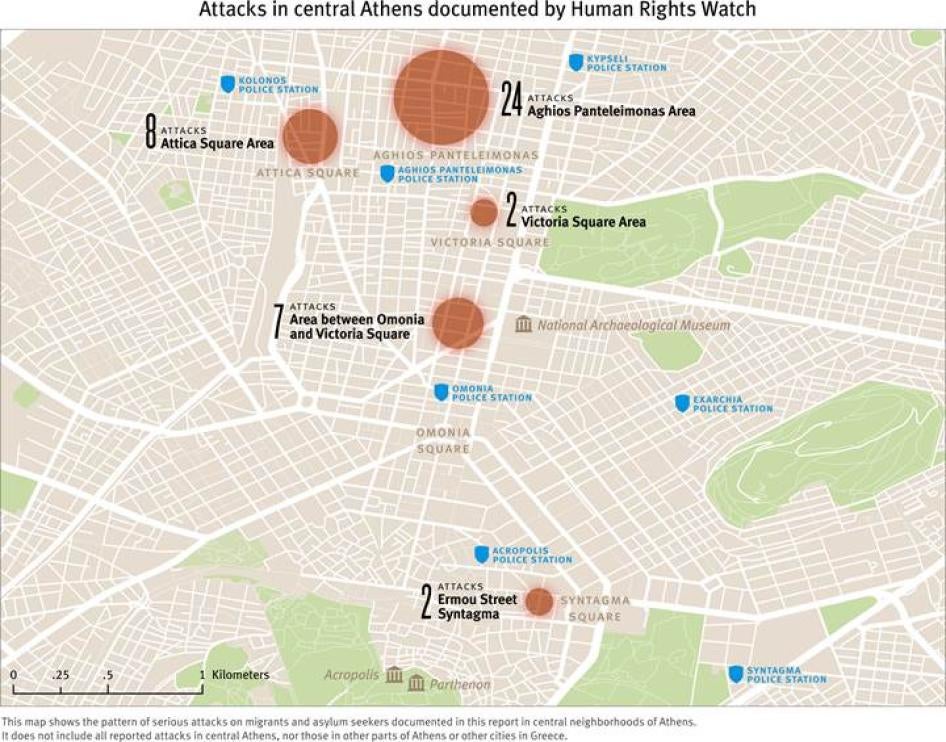
The flare up of anti-immigrant violence was cause for serious concern. However, attacks against migrants and asylum seekers began well before May 2011 and have continued since with frightening regularity both in Athens and elsewhere in Greece. Migrants and asylum seekers spoke to Human Rights Watch of virtual no-go areas in Athens after dark because of fear of attacks by often black-clad groups of Greeks intent on violence. Yunus Mohammadi, the president of an association of Afghans in Greece, told us he started showing newer arrivals a map of Athens with a red line around areas they should avoid. “This is exactly what I used to do in Afghanistan with the Red Cross about places people shouldn’t go because of fighting,” Mohammadi said. “And here I am doing the same thing in a European country.”
A country that prides itself on its hospitality, Greece has become over the past decade a decidedly inhospitable country for many foreigners. While tourists are welcome, migrants and asylum seekers face a hostile environment, where they may be subject to detention in inhuman and degrading conditions, risk destitution, and xenophobic violence.
This report is based on interviews Human Rights Watch conducted with 59 people who experienced or escaped a xenophobic incident, including 51 serious attacks, between August 2009 and May 2012. Victims of serious attacks included migrants and asylum seekers of nine different nationalities and two pregnant women. Patterns emerge from the victim testimonies: most of the attacks take place at night, on or near town squares; attackers, who include women, work in groups, and are often dressed in dark clothing with their faces obscured by cloth or helmets; bare-fisted attacks are not uncommon, but attackers also often wield clubs or beer bottles as weapons; most attacks are accompanied by insults and exhortations to leave Greece, and in some cases the attackers also rob the victims.
Among the migrants and asylum seekers Human Rights Watch interviewed, Ali Rahimi, an Afghan asylum seeker, was stabbed five times in the torso outside an apartment building in Aghios Panteleimonas in September 2011; Mehdi Naderi, an undocumented Afghan migrant, has a prominent scar on his nose from a December 2011 attack in which he was beaten by a mob with sticks and an iron bar near Attica Square; and Afghan refugee Maria N.’s left hand was ripped open in August 2011 when two men on a motorcycle hit her with a wooden club with iron spikes as they drove by.
Since the early 2000s, Greece has become the major gateway into the European Union for undocumented migrants and asylum seekers from Asia and Africa. Years of mismanaged migration and asylum policies and, most recently, the deep economic crisis, have changed the demographic face of the capital city. The center of Athens, in particular, has a large population of foreigners living in extreme poverty, occupying abandoned buildings, town squares and parks. Concerns about rising crime and urban degradation have become a dominant feature of everyday conversations as well as political discourse.
Parties across the ideological spectrum regularly and explicitly link irregular immigration to the city’s ills. Undocumented migration and crime in Athens were high on the agenda in the lead-up to the May and June 2012 national elections. Nationalist, far right-wing parties such as Golden Dawn have in recent years gained strength and popularity largely because of their exploitation of anti-immigrant sentiment. Having gained a seat on the Athens city council in 2010, Golden Dawn secured enough votes in the June 2012 national elections to enter Parliament for the first time in its history. It will have 18 seats.
Exploitation of legitimate concerns about crime, combined with widespread hardship in the economic crisis, appear to have nurtured a climate of intolerance towards migrants and asylum seekers. As one resident of Athens said, “I was never a racist but I’ve become one. Why can’t we send them all home?” So-called “citizens’ groups” (ομάδες πολιτών ) have emerged over the past several years in the city center as self-appointed neighborhood watch units, claiming they have organized to patrol the streets and protect residents by getting rid of migrants. Virulent anti-immigrant posters signed by these groups are on display around the city. Although no known police analysis or court ruling has linked the citizens’ groups with groups carrying out violent attacks on migrants and asylum seekers, there is some evidence to suggest that the perpetrators of the violent attacks are members of or are associated with these groups. Two men and one woman on trial for the stabbing of an Afghan asylum seeker in September 2011 are allegedly members of a citizens’ group, and such groups have signed threatening posters on view in downtown Athens. Local residents credit – or blame – these groups for taking action against migrants, including the closing of the Aghios Panteleimonas square playground because there were too many foreigners.
The true extent of xenophobic violence in Greece is unknown. Government statistics are unreliable due to failures of the criminal justice system, beginning with law enforcement, to adequately identify, investigate and prosecute hate crimes. Underreporting by victims, particularly undocumented migrants, is also a significant problem. In the entire country, the Greek government reported just two hate crimes in 2009, and only one in 2008. In May 2012 the senior Athens prosecutor tasked with collating all information relating to hate crimes told Human Rights Watch there were nine cases in Athens from 2011 under investigation as possible hate crimes.
Non-governmental sources help fill in the gaps. In June 2011, Doctors of the World director Nikitas Kanakis estimated that 300 victims of racist attacks had sought treatment at the organization’s clinic in Athens in the first half of 2011. Tzanetos Antipas, the head of the Greek non-governmental organization (NGO) Praksis, said at the same time that they had treated just over 200 victims in roughly the same period. Finally, a network of NGOs recorded 63 incidents between October and December 2011 in Athens and Patras.
Greece has clear obligations under international human rights law to undertake effective measures to prevent racist and xenophobic violence, to investigate and prosecute perpetrators, and should condemn publicly and unequivocally such violence. These obligations apply whether the perpetrators of the violence are agents of the state or not.
Yet the cases documented in this report demonstrate that migrants and asylum seekers have little chance of seeing justice done. Victims of xenophobic attacks in Athens face many obstacles in reporting crimes and activating a police response to attacks. Prosecutors and the courts have so far failed to aggressively prosecute racist and xenophobic violence for what it is. Preoccupied by the economic crisis and concerned with control of irregular immigration, national authorities—as well as the EU and the international community at large—have largely turned a blind eye.
In theory, the legal tools and police guidelines are in place. In keeping with binding EU law, Greece amended its criminal code in 2008 to make racist motivation an aggravating circumstance for sentencing purposes. A 2006 Ministry of Citizen Protection circular to the Hellenic Police force ordered the police to investigate possible racist motives in the commission of a crime when invoked by victims or witnesses, when this interpretation is substantiated by evidence, when admitted by the perpetrator(s), or when the alleged perpetrator(s) and victim(s) of the crime belong to different racial, religious or social groups or self-identify as such.
In practice, the police appear ill-equipped or ill-disposed to investigate reports of racist violence. There is no specialized, practical training at the police academies, and there are no specialized officers tasked with pursuing or overseeing investigations into possible hate crimes. While responders will provide immediate assistance—calling an ambulance, for example— Human Rights Watch heard repeatedly that police discourage victims from filing official complaints.
Victims we interviewed recounted police officers telling them it was pointless to lodge a complaint if they could not positively identify the perpetrators or that they should simply organize themselves to fight back. Police told Human Rights Watch that it was difficult to investigate crimes involving masked perpetrators. However, the police’s failure to take preventive action or pursue investigations even in areas where violence is predictable and recurring makes this justification ring hollow. Three victims who insisted that they wished to pursue a case were told they would have to pay a 100 Euro fee (US$ 125) instituted in late 2010 to discourage frivolous criminal complaints, even though justice officials told Human Rights Watch that hate crimes would be prosecuted ex officio, with no formal complaint (or fee) required from the victim. Finally, undocumented migrants were told they faced detention if they persisted in seeking to have a criminal investigation opened.
Indeed, fear of detention and deportation emerged from interviews as a principal reason why migrants were reluctant to seek assistance from the police in the aftermath of an attack, although Human Rights Watch did not document any cases where victims were in fact subject to immigration detention or deported from Greece after making complaints.
The response of the judiciary has also been inadequate. As noted above, racist motivation was introduced in 2008 as an aggravating circumstance in the commission of a crime, giving judges the discretion to impose the maximum penalty for any given crime. To our knowledge, racism as an aggravating circumstance has not once been applied in the nearly four years since it was introduced. The Athens public prosecutor’s office has no specialized prosecutors to handle directly or oversee hate crimes, including racist and xenophobic violence.
National authorities have largely tended to downplay the extent of the problem, but positive steps have been taken recently. An inter-ministerial working group met in April 2012 to discuss targeted measures to raise awareness of racist and xenophobic violence amongst the police as well as efforts to improve recording of hate crimes. These include use of a special form by the police and the criminal justice system, and the creation of a centralized database located in the Justice Ministry. Also in April 2012, the Justice Ministry asked the Attorney General to adopt specific guidelines for prosecutors to help them address racist violence. Finally, there is discussion about reforming criminal law to strengthen the scope and application of the aggravating circumstance of racist motivation.
The European Union has an important role to play in ensuring that Greece lives up to its obligations to effectively prevent and prosecute racist violence. Thus far, European institutions have paid little to no attention to increasing anti-immigrant sentiment and incidents of violence against migrants and asylum seekers. Yet it is precisely the pressure on Greece from its European neighbors to take responsibility for a disproportionate number of asylum seekers on the one hand and secure its internal EU and external borders on the other that has contributed to the present untenable situation. The severe budget cuts arising from Greece’s austerity measures have also strained the police force and the provision of services that might help alleviate social tensions that fuel the violence.
However these realities do not relieve Greece of its duty to counter racism and xenophobia. There is no excuse for allowing violent gangs to harm migrants and asylum seekers with impunity. The Greek authorities must take urgent action to crack down on this alarming phenomenon.
Key Recommendations
To the Greek Government
- Publicly and unequivocally condemn, at the highest level, instances of racist and xenophobic violence.
- Urgently address deficiencies in police action to prevent and
investigate reports of racist violence by:
- Moving quickly to institute the special form for recording allegations of racist violence and the centralized database;
- Ensuring obligatory and appropriate training at all levels and in-service training on detecting, preventing, responding to, and investigating hate crimes, including racist and xenophobic violence for all police officers; and
- Disseminating detailed guidelines for police for the investigation of hate crimes, including racist and xenophobic violence.
- Adopt and implement a preventive strategy to counter xenophobic violence, including appropriate deployment of law enforcement in areas with high rates of such violence.
- Ensure, either in law or through binding circulars, that regardless of the nature of the offense, any crime that may be categorized as a hate crime is subject to mandatory state action – investigation and prosecution – without the requirement that victims pay the 100 Euro (US$ 125) fee.
- Improve the response of the judiciary by:
- Reforming the Criminal Code to improve the scope and application of the aggravating circumstance of racist motivation;
- Ensuring appropriate training, including through inclusion of special seminars in continuing professional education courses, for prosecutors and judges in national and European anti-racism legislation; and
- Encouraging the appointment of one or more specialized prosecutors in relevant public prosecutor’s offices including Athens to provide technical expertise to colleagues prosecuting such cases.
To the European Union
- The European Commission’s Directorate General on Justice should assess Greece’s compliance with its human rights obligations with respect to preventing and prosecuting racist and other hate violence, and allocate funding to support initiatives to address the deficiencies in state response to racist and xenophobic violence, as well as public awareness-raising campaigns.
Methodology
This report is based on Human Rights Watch research in Athens in November-December 2011 and January and May 2012. We chose to focus on Athens because background research, including media monitoring and exchanges with NGOs in Greece, indicated that the problem of racist and xenophobic violence was most acute in the capital. While the geographical scope of this research and available data do not allow us to draw any conclusions about the extent of xenophobic violence in the rest of the country, we believe lessons can be drawn for actions on a national scale to arrest increasing xenophobia.
We interviewed 79 migrants, asylum seekers and legal foreign residents of Greece. They came from a variety of countries, including Afghanistan, Bulgaria, Democratic Republic of Congo, Egypt, Ghana, Iran, Morocco, Pakistan, Senegal, Somalia, and Sudan. Fifty-nine interviewees had experienced an attack, including 51 serious attacks, or escaped unharmed from an attempted attack. Twenty interviewees had not experienced incidents relevant to the focus of this report, though four had witnessed attacks.
Two Human Rights Watch staff carried out victim interviews, both jointly and separately. A Greek-speaking staff-member conducted interviews in Greek with interviewees able to express themselves in Greek. Both Human Rights Watch staff conducted interviews in the native language of the interviewee through the help of interpreters. A few victim interviews were conducted in French, a language both researchers speak. Interpreters were paid for their services.
Where noted, we have used a pseudonym to protect the identity of undocumented migrants upon request. In keeping with Human Rights Watch policy, we use pseudonyms followed by an initial for all children. We spoke with one police officer on condition of anonymity. In a few cases, interviewees declined to provide their real names; in all other cases Human Rights Watch has their real names on file. All interviewees were informed of the purpose of the interview, and that their testimony might be used publicly. No incentives were offered or provided to persons interviewed.
We also spoke with over a dozen staff from as many organizations including Aitima, Praksis, the Greek Council for Refugees, the Ecumenical Refugee Program, Doctors without Borders (Médécins sans Frontières), Doctors of the World (Médécins du Monde), and Babel (an NGO providing mental health care for migrants), as well as migrant community associations including the Greek Forum of Migrants and separate Greek Forum of Refugees, the Afghan Community of Greece and the Pakistani Community of Greece. We met with representatives of the United Nations High Commissioner for Refugees in Greece and the former vice-president of the European Court of Human Rights, a Greek national. Finally, we met with His Holiness Archimandrite Father Maximus, Chancellor of the Archdiocese of Athens and priest of the Aghios Panteleimonas church.
We had meetings with eight senior police officers at the Ministry of Citizen Protection, eight prosecutors, one official in the Ministry of Justice, and one elected member of the Athens town council. We also met with the Greek Ombudsperson and her deputy as well as a staff member of the National Commission of Human Rights. Almost all government interviews were conducted in Greek with translation into English, in the presence of a Greek-speaking Human Rights Watch staff member. In some circumstances, the Greek-speaking Human Rights Watch staff member acted as interpreter; in most cases, a professional interpreter was used. Two government interviews were conducted in French.
The Ministry of Citizen Protection denied our request to meet with the ranking officers in the police stations of Aghios Panteleimonas, Omonia, Kypseli and Akropoli.
I. Background
Greece is a country that prides itself on its hospitality. But over the past decade it has become decidedly inhospitable for some foreigners. While tourists are generally welcome, migrants and asylum seekers face an increasingly hostile environment in which they risk detention in inhuman and degrading conditions, destitution, and xenophobic violence.
There has been a dramatic increase of immigration to Greece over the past twenty years. The collapse of communist regimes in the neighborhood in the late 1980s and early 1990s triggered large-scale migration from Balkan countries, in particular Albania. Between 1991 and 2001, the immigrant population more than tripled to 7.3 percent of the total population, with Albanians accounting for the largest national group.[1]
Since the early 2000s, Greece has become the major gateway for undocumented migrants and asylum seekers from Asia and Africa, in part because it shares a land border with Turkey, a major transit route into Europe. The European Union external borders agency Frontex declared at the end of 2010 that Greece accounted for 90% of all irregular border crossings into the EU.[2] In 2011, Frontex recorded 55,000 irregular border crossings at the Greek-Turkish border, a 17 percent increase over the previous year.[3] According to official Greek government data, Afghans comprised by far the largest national group entering Greece in 2011, followed by Pakistanis.[4] Greek authorities estimated in April 2012 that there were as many as one million undocumented migrants living in Greece.[5]
Economic and Humanitarian Crisis
The failure of successive Greek governments to adopt coherent migration policies, chronic mismanagement of the asylum system, and, most recently, the deep economic crisis and resulting austerity have exacerbated what the United Nations High Commissioner for Refugees (UNHCR) described in late 2010 as a “humanitarian crisis.”[6] Countless undocumented migrants and asylum seekers live in deep destitution, occupying abandoned buildings, town squares, parks, and even forests. The ultimate goal for many, whether they are economic migrants or asylum seekers, is to transit through Greece to other countries in the European Union. Hundreds of foreigners congregate in port cities such as Patras and Igoumenitsa looking for a chance to stow away on trucks and ferries heading to Italy, often risking life and limb to do so. Human Rights Watch also spoke with 17 migrants, including ten children, in Patras in late November 2011 who described physical abuse by law enforcement officials in and around the port area.[7]
It is impossible to estimate how many undocumented migrants qualify for international protection because of the risks they face in their countries of origin but are unable or unwilling to apply for asylum in Greece. Despite reforms initiated in late 2010, the Greek asylum system remains largely dysfunctional, with the lowest refugee recognition rate at first instance in Europe (less than 1 percent in 2011) and significant obstacles to submitting asylum applications.[8] At this writing, the Central Police Headquarters in Athens was still accepting asylum claims at the rate of twenty per week. In March 2012, UNHCR criticized the fact that over 100 people, including women and children, sleep overnight outside the police station every Friday in hopes of being among the twenty chosen to register their asylum application on Saturday morning.[9]
Five asylum appeals committees, created in February 2011, and five more created in September 2011, were tackling the heavy backlog of 38,000 cases as of October 2011.[10] In March 2012 the government inaugurated two institutional reforms aimed at fixing its dysfunctional handling of asylum seekers: a new Asylum Service and an Initial Reception Service, which once fully operational should respectively take over all responsibilities for processing asylum applications from the police, and provide asylum seekers adequate reception facilities. Then Minister of Citizen Protection Michalis Chrysochoidis acknowledged in April 2012 that Greece had so far expended only 40 million Euros (US$ 50.2 million) out of the 250 million Euros (US$ 313.9 million) in allocated EU funding for immigration and asylum management.[11]
The European Union’s Dublin II Regulation, which generally assigns responsibility for examining asylum claims to the first EU country in which an asylum seeker sets foot, has significantly increased the burden on Greece.[12] The Regulation allows member states to return asylum seekers to the country where they first entered the EU; given Greece’s location at the EU’s external border and popularity as a transit route into Europe, Dublin II has exacerbated the country’s large backlog of asylum applications and appeals, while adding strains to its overcrowded detention facilities.[13] In 2011, numerous EU member states suspended Dublin transfers to Greece following a January 2011 ruling by the European Court of Human Rights that the return of an Afghan asylum seeker from Belgium to Greece exposed him to cruel, inhuman, and degrading treatment in Greece.[14]
The pressure on Greece to take responsibility for a disproportionate number of asylum seekers, on the one hand, and to prevent third country nationals from traveling irregularly across its internal EU borders on the other, means that many asylum seekers find themselves trapped in what a 2008 Human Rights Watch report called “a revolving door.”[15]
Long-term Greek residents of the center of Athens, in particular, have seen their neighborhoods change dramatically with the influx of migrants and asylum seekers. This has had an impact on attitudes towards such foreigners. One resident of Aghios Panteleimonas, spoke approvingly of Golden Dawn’s work in his neighborhood. The party, he said, “chased away all the blacks, who had flooded [us]…even in my own building…it was full [of blacks]…but they left. Those who were the dirty ones and had all the diseases left, because they had to.”[16]
Concerns about the impact of immigration on the social fabric of local communities are legitimate. And the perceived rise in so-called survival crimes by destitute migrants and asylum seekers, as well as exploitation of these populations by organized crime, has given rise to genuine fears. A survey in May 2011 found that eight out of ten residents of downtown Athens had been the victims of a mugging, theft or burglary, and three-quarters of respondents said they lived in fear of crime.[17] One woman living in the Attica neighborhood interviewed for a documentary after the May 2012 elections, clutched her handbag as she explained she didn’t feel safe walking around as she used to, and no longer wears jewelry to avoid being mugged. She blamed irregular immigrants.[18]
But the persistent linkage of immigrants with criminality combined with increasing hardship caused by the economic crisis appears to have nurtured anti-immigrant sentiment in Athens. As one resident of Athens said, “I was never a racist but I’ve become one. Why can’t we send them all home?”[19] Costis Papaioannou, until recently the head of the National Commission for Human Rights, an independent government advisory board, stated plainly that “Since the [economic] crisis broke out, Greeks have absolutely become more xenophobic…We have large groups of marginalized people, both Greeks and immigrants, and the first group blames the second.”[20]
The Politics of Hate
Immigration issues have become a dominant feature of Greek political debate. Undocumented migration and crime in Athens historic center were high on the agenda in the lead-up to the May and June 2012 national elections, with parties across the ideological spectrum explicitly linking irregular immigration to urban degradation, crime and public health problems. Greeks voted for a second time in June 2012 after political parties were unable to form a majority coalition government following the May elections.
Antonis Samaras, the leader of New Democracy, the party that won the largest share of the vote in the June 2012 elections, campaigned in part on a pledge to reclaim Greek cities from immigrants: "Greece today has become a center for illegal immigrants. We must take back our cities, where the illegal trade in drugs, prostitution, and counterfeit goods is booming. There are many diseases and I am not only speaking about Athens, but elsewhere too.”[21]
In the months before the elections, the government adopted a series of heavy-handed measures to demonstrate its attention to the issues. In February, construction began on a highly touted 12.5 kilometer fence along the border with Turkey in Greece’s Evros region, and in late March the government announced a plan to build 30 new detention centers around the country to house undocumented migrants pending deportation; sweep operations in downtown Athens began immediately. Earlier that same month, the then Minister of Citizen Protection Chrysochoidis, had blamed a ten percent increase in muggings and robberies in 2011 on foreigners: “Greeks are a peaceful people. The main problem is the presence of thousands of people who live here illegally… We have one of the lowest rates of criminality in Europe. What exists is petty crime, linked to foreigners.”[22]
Calling the growing population of undocumented migrants in central Athens “a ticking time bomb for public health,” in April 2011 Chrysochoidis and then Health Minister Andreas Loverdos pushed legislation through Parliament to permit detention of migrants and asylum seekers suspected of representing a danger to public health.[23] Carrying an infectious disease, belonging to a group vulnerable to infectious diseases (an assessment which can be based on country of origin), being an intravenous drug user or sex worker, or living in conditions that do not meet minimum standards of hygiene are all grounds for detention. Such legislative provisions are incompatible with many of Greece’s obligations under international law including the obligations to protect the right to health, not to inflict cruel, inhuman and degrading treatment or punishment, not to permit arbitrary detention, and not to engage in discrimination based on status.
Populist, right-wing parties such as Golden Dawn, have in recent years gained strength and popularity in part because of their exploitation of anti-immigrant sentiment. Golden Dawn secured enough votes in the June 2012 national elections to enter Parliament for the first time in its history. It will have 18 seats.
Golden Dawn is an unabashedly neo-fascist party with a logo reminiscent of the Nazi swastika; its manifesto calls for the creation of a People’s Nationalist State which does “not ignore the law of diversity and difference in nature” and asserts that “[b]y respecting the spiritual, ethnic and racial inequality of human we can build equity and law in society.”[24] The leader of the Golden Dawn, Nikolaos Michaloliakos, won a seat on the Athens municipal town council in local elections in November 2010; he was filmed doing the Nazi salute in the Athens town hall in January 2011.[25]
In an interview with Human Rights Watch before the elections, Michaloliakos explained, “We want Greece to belong to the Greeks. We are proud to be Greek; we want to save our national identity, our thousands-year history. If that means we are racist, then yes we are. We don’t want to share the same fate of the Native Americans. Right now, the immigrants are the cowboys and we are the Apache.”[26] He added that if Golden Dawn were in government they would give everyone asylum “and cheap tickets on Easyjet, because they all want to go elsewhere.”
In a March 2012 press release, the party went further. Calling new detention centers a “pre-election fairy tale,” Golden Dawn proposed laying anti-personnel landmines along the Greece-Turkey border in Evros and placing special forces in the area with a license to shoot at will.[27]
Vigilante Groups
Over the past several years, “citizens’ groups” have formed in Athens neighborhoods like Aghios Panteleimonas and Attiki, in the center of the city, as self-appointed neighborhood watch groups. These groups claim to fill the void left by financially-strapped police forces by patrolling the streets at night to protect residents and rid the streets and parks of migrants. In 2009, a group claiming to be local residents locked the gates of the playground next to the Aghios Panteleimonas church, to keep immigrants out. Graffiti in blue and white letters (the national colors) on the pavement reads “immigrants out of Greece” and “Greece our homeland.”
Virulent anti-immigrant graffiti and posters are on display in Athens. One particularly strident poster in Aghios Panteleimonas showed horrific, bloody, but unexplained photographs (including one of a smiling woman wielding a knife above the head of a bloodied child) with the writing in Greek: “This is Islam. These are the calm people. This is the religion that always seeks to expand. These are the people who steal, rape and kill Greeks. Greeks, Wake up!”[28] Below this is a long text in poor English directed at foreigners (capital letters in the original), including the following:
RETURN TO YOUR COUNTRY NOW…YOU ARE NOT WANTED HERE…We are angry with this government and all politicians that brought you here and support you and defend you AND WE ARE DETERMINED TO PUNISH THEM AND YOU. From now on, we will take every necessary action in order to force you and the TRAITORS-POLITICIANS that help you to GET OUT OF THIS COUNTRY (or what you left of it). YOU HAVE NO FUTURE IN GREECE. GO HOME NOW.
The poster is signed simply “Citizens of Athens.” The full text and a photograph of the poster are in Annex I.
Many observers allege that these “citizens’ groups” are responsible for vigilante violence against migrants and asylum seekers.[29] Christos Rozakis, a former vice-president of the European Court of Human Rights, told us not only does he see no organized effort to address the problem of such groups but that the authorities may be relieved that there are groups dealing with certain problems.[30]
There are also persistent accusations that Golden Dawn has mobilized these groups, and that members of Golden Dawn participate in their violent actions, although Human Rights Watch found no evidence to support the allegations that violent attacks are directed or sanctioned by the party.[31] Golden Dawn party members have been implicated in specific attacks, however.
Themis Skordeli, one of the three people standing trial for the September 2011 stabbing of an Afghan asylum seeker, ran as a candidate in the electoral district encompassing central Athens on the Golden Dawn roster in the May and June 2012 elections. She was not elected. The trial is discussed in Chapter V. Two party members who won parliamentary seats in the May 2012 were detained, along with the daughter of Golden Dawn leader Michaloliakos, and questioned by the police in connection with anti-immigrant violence during a Golden Dawn rally on June 1, 2012. During the rally, a number of participants, who evaded arrest, assaulted a Pakistani man who had to be hospitalized. The party members were released without charge; Golden Dawn denied any involvement in the violence.[32]
One resident of Aghios Panteleimonas complained to a reporter in January 2011,
Initially we had an increase in criminality. Now we also have the Golden Dawners threatening us if we don’t go to their gatherings…We don’t know who to trust and denounce what is happening to us…The problem is not the 15-year-old kids but their instigators, those who appear in the guise of ‘indignant citizens’ and guide them to violence and terror against anyone who does not share their views. Where are the state and the democratic institutions to protect us?[33]
An older woman who has lived in the neighborhood for thirty years told Human Rights Watch it was a combination of Golden Dawn members and local residents creating the problems. “It’s this big group that is here [in the square] and every night at 9 p.m. we almost have heart attacks,” she said. “There is total silence, suddenly they come and throw bottles, bombs to the people.”[34]
Human Rights Watch spoke with a police officer who worked on patrol for two years in a neighborhood in central Athens. When asked who is involved in attacks on migrants and asylum seekers, he said, “Those who beat migrants are Golden Dawners, or Citizens [Groups]. It’s very easy. There are twenty houses with Greeks, and the rest are foreigners [in the sensitive neighborhoods]. They say, ‘We gather here, we do this.’ And if someone knows a Golden Dawner, they call him. It’s not difficult.”[35]
Golden Dawn’s perceived role in cleaning up neighborhoods and protecting residents from crime is often cited as the reason for the party’s success in the 2010 Athens municipal elections, giving party leader Michaloliakos a seat on the city council. In a January 2012 interview, Michaloliakos told Human Rights Watch that while “there is no organic relationship between Golden Dawn and these groups, we support their activities. Not illegal activities, however… Many of their members voted for us, and members of Golden Dawn belong to these groups, but the crimes don’t come from these groups.”[36] He said Golden Dawn members found to be involved in unprovoked violence would be kicked out of the party. Michaloliakos minimized the importance of the citizens’ groups, saying “they don’t really do anything, just some meetings, some announcements. They don’t try to stop foreigners from living there [in their neighborhoods]. Even if they tried, they couldn’t succeed!”[37]
There are also persistent allegations, including statements from high-ranking government officials, of collusion between the police and Golden Dawn members. Numerous interlocutors interviewed by Human Rights Watch, including a police officer, raised the possibility of collusion between the police and extremist elements.[38] Chrysochoidis, appointed Minister of Citizen Protection in March 2012 and who served in the same position between February 1999 and March 2004, as well as October 2009 to September 2010, said in a June 2011 interview that he had launched a purge of police officers with close ties with Golden Dawn when he took power in 2009: “I am not referring to old things. I am talking about two years ago…there were Golden Dawn forces that helped the police do their job.” When asked about the situation in 2011, he said, “I do not know, I do not exclude anything, the phenomenon might have a tail…”[39]
II. Xenophobic Violence in Athens
They say it’s a free country but then they beat me because I’m a migrant … I don’t go outside when it’s dark.
—Qadir Hossaini, Afghan legal migrant, Athens, December 6, 2011
On May 10, 2011, a 44-year-old Greek man, Manolis Kantaris, was fatally stabbed by assailants who stole his video camera as he prepared to take his wife to the hospital to give birth. Just hours later, and before any official announcements were made about the national origin of the attackers, protesters converged on the area where the attack took place shouting “Foreigners Out” and “Greece is for Greeks.”[40] Over the next few days, gangs of Greeks attacked migrants and asylum seekers indiscriminately in central Athens in apparent retaliation for the murder. They chased them through the streets, dragged them off buses, and beat and stabbed them.
The upsurge of anti-immigrant violence was a cause for serious concern. However, attacks against migrants and asylum seekers began well before May 2011, and continue with frightening regularity. Migrants and asylum seekers interviewed by Human Rights Watch spoke of virtual no-go areas in Athens after dark because of fear of attacks by vigilante groups. Yunus Mohammadi, the president of an association of Afghans in Greece, told us he shows newer arrivals a map of Athens with a red line around areas they should avoid. “This is exactly what I used to do in Afghanistan with the Red Cross about places people shouldn’t go because of fighting,” Mohammadi said. “And here I am doing the same thing in a European country.”[41]
The true extent of xenophobic violence in Greece is unknown. Government statistics are unreliable due to failures of the law enforcement agencies and criminal justice system to adequately respond to, identify, investigate, and prosecute hate crimes. Underreporting by victims, particularly undocumented migrants, is also a significant problem. In the entire country the Greek government recorded just two hate crimes in 2009, and only one in 2008.[42] In December 2011 an official at the Ministry of Citizen Protection told Human Rights Watch there were three cases from 2010 and 11 cases from 2011 under investigation as possible hate crimes.[43] In a May 2012 interview, Dimitris Zimianitis, a prosecutor who serves as liaison for the Greek government with the Organization for Security and Co-operation in Europe’s Office for Democratic Institutions and Human Rights, indicated there were nine cases from 2011 under investigation as possible hate crimes in Athens.[44]
To fill the gaps in official data and in the wake of growing evidence of violent attacks on migrants, the National Commission for Human Rights—an independent government advisory body—and the United Nations High Commissioner for Refugees spearheaded the creation, in October 2011, of a network of 18 non-governmental organizations (NGOs) to systematically record racist attacks. The first results of the pilot project were presented in March 2012.
The Network recorded 63 incidents between October and December 2011 in Athens and Patras. Forty-two incidents involved physical injury, including twelve involving serious injury. Eighteen of these incidents involved police officers, while the rest were perpetrated by private citizens.[45] Most victims were undocumented migrants (27) and asylum seekers (23), from Afghanistan (25) and sub-Saharan Africa (21).[46]
Doctors of the World and the Greek NGO Praksis, both members of the recording network, run health clinics in downtown Athens. Both organizations have expressed serious concerns about the increasing number of migrants and asylum seekers seeking medical assistance following what victims described as racist attacks. The two groups only began systematically recording cases of racist violence as part of the Network’s pilot project in October 2011. But in June 2011, Doctors of the World director Nikitas Kanakis estimated that 300 victims of such attacks had sought treatment at the organization’s clinic in the first half of 2011. Tzanetos Antipas, the head of Praksis, said at the same time that they had treated just over 200 victims in roughly the same period.[47]
In the course of our research, Human Rights Watch interviewed victims of 51 serious attacks between August 2009 and May 2012. Victims were from Afghanistan, Somalia, and seven other countries; they included two pregnant women. Patterns emerge from the victim testimonies: most of the attacks take place at night on or near town squares; attackers work in groups, include women, and are often dressed in dark clothing with their faces obscured by cloth or helmets; bare-fisted attacks are not uncommon, but attackers also often wield clubs or beer bottles as weapons; most attacks are accompanied by insults against the migrants and exhortations to leave Greece, and in some cases the assailants also rob their victims.
A number of victims said women actively participated in the assault. Jereer K., a 17-year-old undocumented Somali boy, was attacked by four men and two women on motorcycles near Aghios Panteleimonas Square in November 2011: “They attacked me with sticks and were kicking me,” he said. “One lady hit me, so much. She was around 20 years old, with thick black hair with red in it, dark complexion.”[48] Saadia, a 20-year-old Somali, was eight months pregnant when four men and one woman attacked her in the same area in April 2012. They yelled insults, slapped her and kicked her to the ground. They ran away when she clutched her stomach; she thought they might not have understood she was pregnant until that point because she was wearing a loose dress. Her child was born healthy a few weeks later.[49]
Not included in this figure are eight comparatively minor incidents in which the interviewee was approached menacingly, chased, slapped or otherwise lightly accosted, or spat on.
It is impossible to know how many attacks were thwarted by the intervention of passers-by or because the intended victim was able to escape. We spoke with ten people who told us of their own near misses, and a Human Rights Watch staff member witnessed an attempted attack in front of the Navy Tribunal in Piraeus (the port of Athens) on December 16, 2011, where a large group had gathered in support of 39 members of Hellenic Coast Guard Underwater Missions Unit on trial for chanting in unison racist slogans during the Greek Independence Day Parade on March 25, 2010. A group of black-clad youths surrounded a South-Asian man with apparent intent to harm him, but were ultimately convinced to desist by an older demonstrator. We note also that we learned of four incidents in which the person we interviewed escaped harm but someone else was injured.
May 2011
On May 10, 2011, in downtown Athens, Manolis Kantaris was murdered during the theft of his video camera as he prepared to go to the hospital for the birth of his child. This crime triggered widespread attacks on foreigners on the streets of the city after his killing was attributed to migrants.
The worst of the violence occurred on May 12, when a 21-year-old Bangladeshi man named Alim Adbul Mana was stabbed to death and at least 25 people were hospitalized, according to news reports, with stab wounds or injuries sustained from severe beatings.[50] A reporter from the Associated Press who witnessed the attacks described a horrifying scene on May 12:
Several hundred youths, dressed in black and some wielding bats, were involved in the daytime attacks in an area where thousands of Asian and African immigrants live. Immigrants were chased through narrow streets of the city’s Kato Patisia neighborhood and punched and kicked to the ground by groups of attackers…Thugs in motorcycle helmets beat up immigrants, sending others fleeing for safety amid heavy rush-hour traffic. Similar attacks have occurred over the past two days. The black-clad ultranationalist youths marched through migrant areas… Male and female protesters were seen taking part in the beatings.[51]
Olivier Abdoulai, a 30-year-old Congolese, was out on the streets when he saw the anti-immigrant demonstration on May 12 and changed course.
It was the day they hunted men in Omonia. Two days after the Greek man’s death. They had red flags and bats. They hit people with the bats: blacks, Pakistanis, Arabs…I saw them hitting [people]… and a Greek man said, ‘Be careful, you shouldn’t go that way because they’re hitting people. I didn’t see any police…In the group [of attackers] there were men and women, mixed ages. They were yelling in Greek, I couldn’t understand. They were yelling, they swung their bats, they hunted down foreigners.[52]
Virtually all the migrants and asylum seekers we interviewed who had been in Athens in May 2011 said it was a period of intense fear. One Afghan man who did not want to give a name told us simply, “In May we understood we would be attacked. We only went outside for essential things. Otherwise, we stayed inside. Since then we don’t go out at night. When we go out, someone watches from the window to see if we get attacked.”[53]
Badara Gueye, a 28-year-old Senegalese man, also hid: “We stayed indoors for two days… One day we opened the door to look outside. They saw us and the racists said ‘come here, we’ll kill you.’”[54]Mohammed Idress, a 33-year-old Sudanese man, said he escaped several attempted attacks in this period. “You know I am an athlete in Sudan. I run the Marathon. Nobody caught me. Because of my legs. Three or four times they found me, but they never caught me. Because whenever I see two or three motorcycles or groups, I run.”[55] Modou Ndiaye, a 31-year-old Senegalese, told us he managed to evade an attack by a group of roughly thirty men, dressed in black and armed with bats, in the Omonia neighborhood.[56]
Abuubeker Adam, a 23-year-old Somali man, managed to avoid harm on several occasions during the May violence. On one occasion a few days after the murder of Kantaris, Adam was in an internet café, along with many other Somalis when a group of fifteen people, including one woman, burst in. Adam remembered that the people in the group were dressed in black and wearing helmets, and had with them metal objects, bottles and knives. “They got inside, they counted [us] and then they asked ‘any other people inside?’ We said no, and they left. There was a lot of police in the streets at that time.”[57]
Witnesses to the violence interviewed by Human Rights Watch spoke of vigilante groups forcing people to get off buses, or beating them up when they disembarked at bus stops. Arif Muhammadi, an interpreter Human Rights Watch used for some of the interviews, said he watched the violence from an upstairs window on Chalkokondyli Street: “I saw how the fascists went on the buses and when they saw an Afghan they pulled him off and beat him. I saw this.”[58] Qadir Hossaini, another interpreter who works for the humanitarian NGO Médécins du Monde (Doctors of the World), said he was taken to and from work by his employers during this period because taking the bus was too dangerous.[59] Many others hid indoors, according to migrants interviewed by Human Rights Watch.[60]
Youssef, a 26-year-old Afghan asylum seeker, told us he was attacked when he got off a bus at Aghios Panteleimonas Square.
I saw some people on the road, like 15 or 20 people…They stopped the bus…and five or six men came inside. They had sticks and said ‘down, down, down’ to all the foreigners... This thing had happened in Iran, it reminded me of Iran. There [in Iran], they [the Police] stop the bus, enter inside and choose whoever looks Afghan and send them back to Afghanistan. But this is Europe, I said to myself. This happens in Europe. And not by the police, but by normal citizens. The men said the foreigners had to get off, hitting them. People outside were singing Greece is for Greeks. People getting off were hit. I got off, and got hit on the back. I thought I’d have more trouble if I spoke Greek so I said some German words I knew and I pushed and I escaped. A car almost hit me. I saw others running too, and others ran after them. Someone ran after me too but didn’t catch me.[61]
Youssef said all of the assailants were men, most of them wearing sweatshirts, and some of them hooded. He did not report the attack to the police because he had no faith they would help him.[62]
There are conflicting reports about police behavior during the worst of the violence. Riot police were out in force during and after the demonstration and engaged in “running battles” with attackers, according to some press accounts.[63]Abubeker Adam told us that though he had to insist, the police had responded to his call for help, escorting him and a friend down Tritis Septemvriou Street (where the murder of Kantaris took place), and encircling them to protect them from an angry mob.[64]
At the same time there were allegations of police failing to act to prevent or end the violence, or arrest those responsible. Badara Gueye, who recalled seeing hundreds of people armed with bats, complained that the police “did nothing.”[65]Abduwahab Mohammed, a 23-year-old Somali, told us what happened when a large group attacked a gathering place for the Somali community: “The police came and just stood and the racists ran away… The police told the Somali people to go home…and then the police left.”[66]
On May 16, 2011, Athens mayor Yiorgos Kaminis condemned what he called political violence by extremist groups in some parts of the city and accused the police of inertia in combating right-wing attacks on migrants.[67] A few days later, he complained that “the police are slow to react or are scandalously absent when extreme rightist groups carry out criminal attacks on migrants.”[68]
It does not appear that anyone was ever charged in connection with the 2011 May violence. Although a police statement on May 12, 2011, indicated that 47 people (40 Greeks and 7 foreign nationals) were brought in for questioning that day, Human Rights Watch was unable to learn whether charges were brought or whether anyone was brought to trial and if so what the charges were. In a letter dated May 17, 2012, the Athens prosecutor office informed Human Rights Watch that the events have been “classified in the File of Unknown Perpetrators.” Two Afghan men were arrested for the murder of Manolis Kantaris on May 10, 2011; according to the Athens prosecutor’s office the case is still under investigation.[69]
Continuing Violence
Violent attacks on migrants and asylum seekers in Athens neither began nor ended in May 2011. As noted above, Human Rights Watch documented 51 serious attacks between August 2009 and May 2012.
Although the majority of those interviewed who had experienced an attack were men, we also spoke with seven women who told us about being attacked. Two of these women were pregnant at the time of the attack. Five of the women are Somali while two are Afghan.
Human Rights Watch research and the select testimonies below suggest that large squares in central Athens such as Aghios Panteleimonas Square, Attica Square and Victoria Square are particularly dangerous areas for anyone who does not look Greek.
Aghios Panteleimonas
The repeated attacks on the home of Razia Sharife, an Afghan asylum seeker and single mother of three, illustrate the intensity of anti-immigrant activity in the Aghios Panteleimonas neighborhood. Her street-level apartment next to Aghios Panteleimonas Square has been attacked numerous times, including four times in January 2012 and one time in April 2012. In three incidents in January, individuals threw bottles and rocks at her windows and doors. The fourth incident that month, on January 15, 2012, was more serious: Sharife said someone she recognized as a neighbor first broke the windows then threw tear gas into the apartment. She believes he then sprayed a fire extinguisher into the apartment, causing her to fear that “he wanted to burn us alive.”[70] In April 2012, a large group of men with their faces obscured actually entered her apartment, broke beer bottles all over and destroyed furniture. They then left. None of those in the apartment at the time, who included her three young children (a three-year-old, and eleven-year-old twins), were injured.[71]
Human Rights Watch interviewed Sharife for the first time on January 9, 2012, shortly after individuals had thrown bottles and stones at her windows and front door. Sharife explained:
Every time they pass here this happens. Three days ago, they came and were hitting the door with their legs…today they broke the window and the door. At first they threw bottles and then they broke the glass with stones and threw stones inside and then they started kicking the door… They wear black clothes and…hoods and they do these things… Today when this happened I called the police… They came, they took my statement…and they told me they cannot do anything and that I had to go…file a complaint. Until now I have made three complaints…once in 2010 and two times in 2011. I go there and they say to me they will search…but they have done nothing… Today there were [only] men but often there are also two girls that have dogs. The girls too wear hoods and wear black… Every day they are sitting at the café next to the church… Why can’t they [the police] catch them?[72]
Human Rights Watch observed the broken window and cracks in the door.
When Human Rights Watch researcher visited Sharife’s apartment on January 13, 2012, to conduct interviews with other Afghan victims of attacks, she herself witnessed an attack on the apartment. There were a dozen people in the apartment at the time, including Sharife, her three children, the researcher, and seven Afghan men.
The Human Rights Watch researcher was sitting with an interpreter near the curtained window that looked out onto the street when she heard a loud noise as individuals outside began to hit the door with something she could not identify. “The door is made of thick glass and I could see the cracks appearing and the shadows of people on the other side of the door,” she recalled. Everyone stayed inside for the duration of the attack, roughly three minutes, and the researcher called the police as soon as it ended (9:23 p.m. according to her cell phone records). [73]
The police at the scene took information from Sharife and the Human Rights Watch researcher about the attack, but neither was able to give a description of the assailants because they had both remained inside during the attack. Sharife explained about the previous attacks and told the police about the group that regularly gathers on Aghios Panteleimonas Square. The police left shortly afterwards to search for the attackers; they did not interview anyone else in the apartment or anyone in the Afghan-owned internet café next door, which was open at the time.
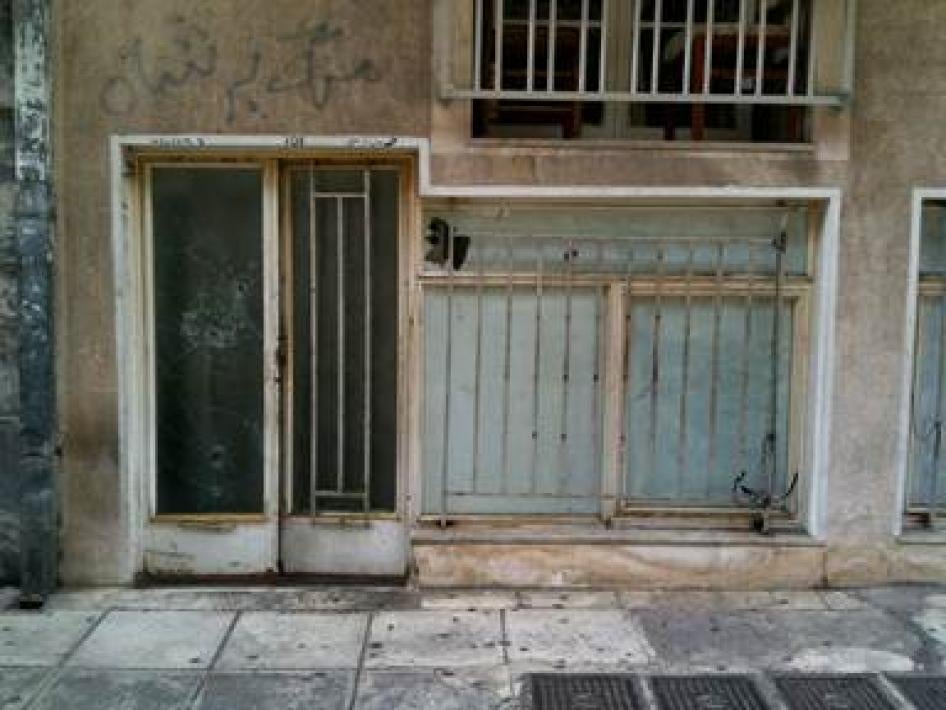
The exterior of Razia Sharife’s house the day after the January 2012 attack. © 2012 Eva Cossé/ Human Rights Watch
After the police had left, the Human Rights Watch researcher spoke with an Afghan man who had witnessed the attack from the café; he said there were five or six men who beat the door with hammers. Said Jafari, the 40-year-old owner of the internet café, and one of his employees told Human Rights Watch the next day that they had seen two or three men attacking the door while others stood on the corner watching. All were dressed in black and wearing hoods, according to Jafari.[74] Outside the apartment door, the researcher observed three big stones as well as a broken bottle of beer.
Sharife says the police returned three times that evening, each time different officers, to ask more questions about the incident. The following morning, officers from the Aliens police also visited: “They asked me for my pink card. I gave it. They said, ‘You are not Afghan, we don’t believe you, prove to us that you are Afghan.’ I had a passport and I showed it to them and they left.”[75]
Accompanied by the same Human Rights Watch researcher and an interpreter, Sharife filed an official complaint at the Aghios Panteleimonas police station on January 14, 2012. The police officer who took Sharife’s statement insisted that there was a mandatory 100 Euro (US$ 125) fee to file the complaint. He said the police are under orders from the prosecutor’s office to not accept complaints without the fee, and that complaints forwarded to the prosecutor without the fee are archived immediately. Ultimately he accepted the statement without the fee, and in an email on March 13, 2012, the Aghios Panteleimonas police station informed Human Rights Watch that the Sharife’s complaint had been forwarded on January 18, 2012 to the Athens Public Prosecutor. The prosecutor reportedly ordered a preliminary investigation on January 31, 2012. The message further stated that “daily foot and car patrols are dispatched from our service for the policing of the area under our responsibility in order to prevent criminal acts against citizens and for the enforcement of existing laws.”[76]
Sharife also called the police after the incident on January 15, 2012, when assailants sprayed tear gas into her apartment, and again after a further attack in April 2012. She said the police came on both occasions, took her statement, and urged her to relocate. She has not heard from them since, nor is she aware of any developments in the investigation, despite the fact that she provided information on the neighbor she suspects of involvement in the January 15 attack.[77]
Said Jafari, the 40-year-old Afghan owner of the internet café next to Sharife’s apartment, told us he has had to change his store-front window three times because of similar attacks. There were two attacks in 2010, and one in August 2011. On that last occasion, someone wrote “Foreigners Out” in blue letters on the store-front shutters. After Jafari reported the incident to the Aghios Panteleimonas police station, the police painted black markings over the words to try to obscure the message, but the writing is still clearly visible. Jafari complained that he was refused a copy of the complaint he filed, and that the police took no action in response to his repeated reports to them linking a group of people who gather at a café on the corner of the square to these attacks.[78]
Human Rights Watch documented 23 other serious attacks that took place in the Aghios Panteleimonas neighborhood between August 2009 and April 2012. Three of these are described below.
Safar Haidari, December 2011
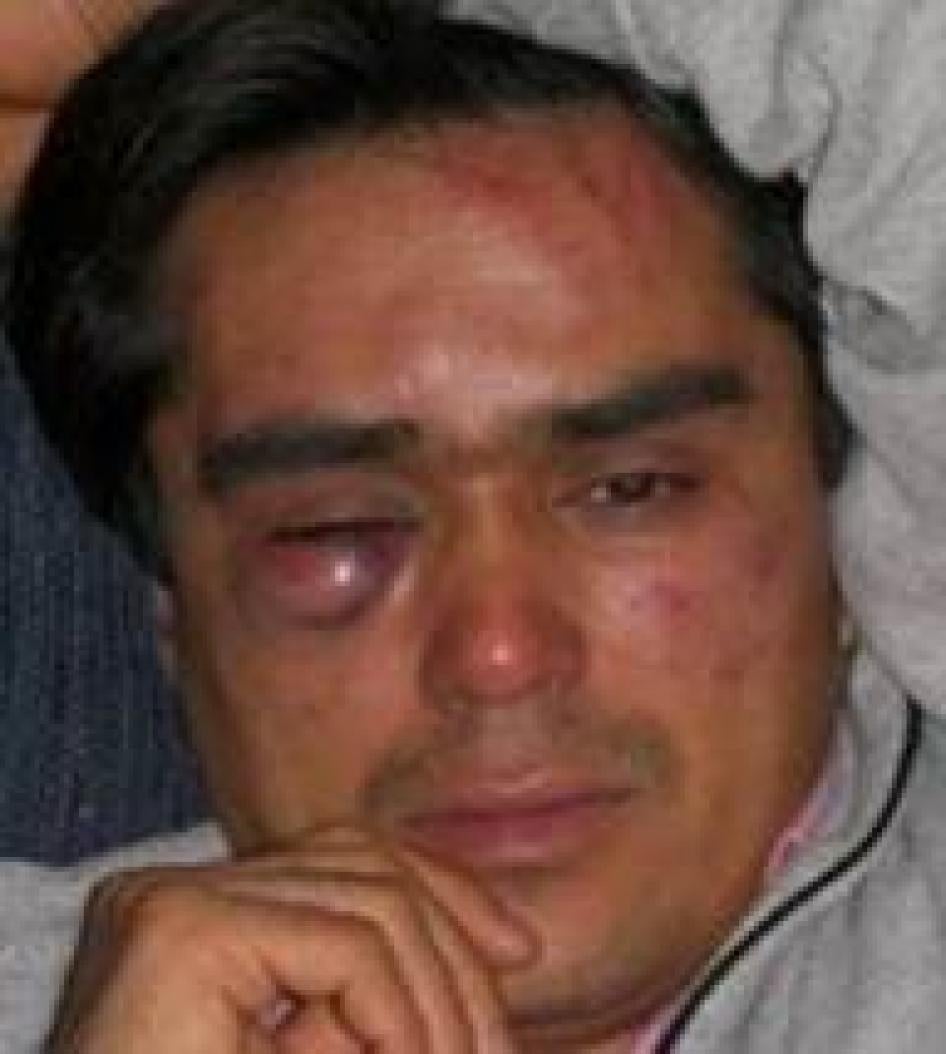
Safar Haidari just after the December 2011 attack. © 2011 Anonymous
Safar Haidari is a 29-year-old asylum seeker from Afghanistan and is the vice-president of a cultural association called Nour. On December 23, around 8 p.m., he was attacked roughly 200 meters from the Aghios Panteleimonas police station. A group of 10-15 men, who all appeared to be around or under 30 years old, wearing helmets or hoods, approached him, asked him where he was from, and then one of them punched him in the right eye. He fell to the ground and then the group began to beat him with sticks and kick him. The assailants stole his mobile phone and cigarettes, and then left.
In front of me there was a store with people…My body was hurting and I couldn’t move too much…I went there. Two or three people in the store saw what happened. I asked in what direction they [the attackers] had gone and they told me that half of them headed towards Acharnon Street and the other half towards Attica Square. I had a second phone with me because I had it in my pocket and they didn’t take it and I called the police. Fifteen to 20 minutes later two police motorcycles came by…I don’t know if they came because I called or they wanted to go somewhere else. I told them what happened. They asked for my papers. At that moment I was in a really bad situation because I couldn’t see well and they asked for my papers. I said, ‘Ok, I have papers but you should leave in order to find those who just left. They must be somewhere close; they must be in Attiki, in Acharnon.’[79]
The patrol officers told him to report the crime at the police station. Haidari did go the station, but left after 20 minutes or so, without filing a complaint, because he was in pain and felt the police were not attending to him. “There were five policemen. My head was hurting because I was hit on the head. I said I cannot wait because I wanted to go the hospital, but the policeman said to me, ‘Now we cannot do anything, we are busy, you should wait.’ But I saw the five policemen in the office drinking coffee and chatting. I made a remark to them. They told me again to wait.”[80]
Haidari returned to the police station on December 27, but again left after waiting for what he felt was too long. “There was also an old Greek man there. They served him immediately. I waited around 20-30 minutes. I asked how much longer I have to wait and they told me that they are very busy and cannot do anything now. Then I left.”[81]
Yasser Abdurraham, December 2011
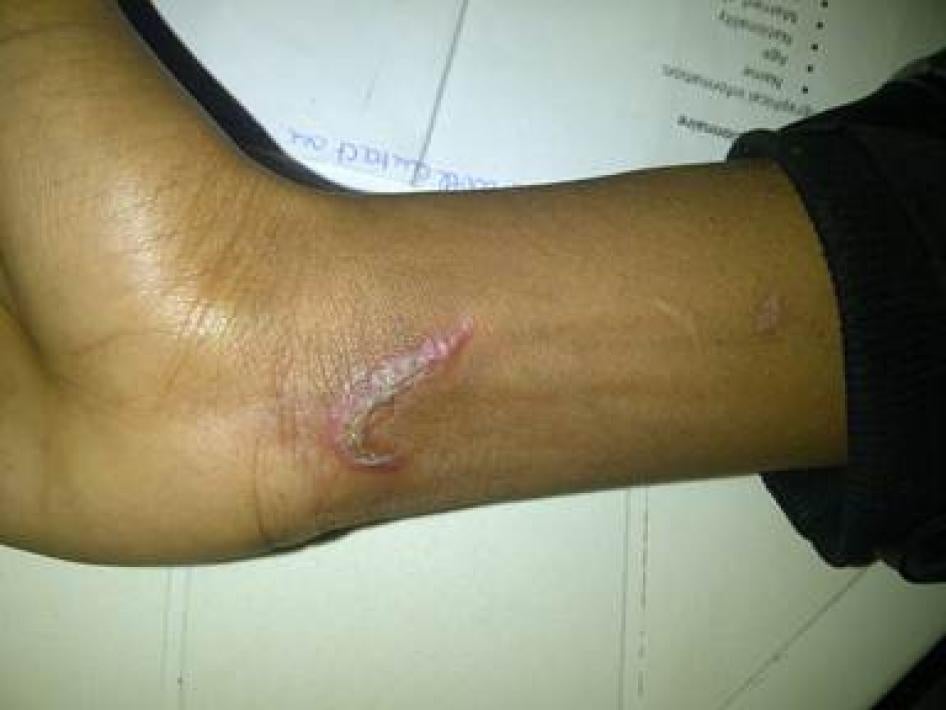
Yasser Abdurraham’s wrist. © 2012 Judith Sunderland/Human Rights Watch
Abdurraham, an 18-year-old Somali, said he was attacked in early December 2011 in front of the Aghios Panteleimonas church by six or seven men on motorcycles.
It was late, around 2 a.m. I was walking home alone. They called to me—‘Come on, come on, Africa, Africa’—and I walked over and they hit me…with a beer bottle. It broke on my head and they slashed my wrist when I held it up [to defend myself]. They punched me in the face, cracked a tooth, and my nose. I don’t know why they did this. They didn’t say anything after they started hitting me. The police came and they ran off on their motorcycles. I showed them [the police] my wrist and I said, ‘Box box’ [to indicate he had been beaten] and they said, ‘Hey Africa’ and made a face and left. I didn’t go back to the police [to report it]. They don’t do anything for people like me.[82]
Mina Ahmad, October 2011
Though she couldn’t remember the exact date, Mina Ahmad, a twenty-year-old Somali woman, told us she was attacked near the end of October 2011, when she was six months pregnant, in the vicinity of the Aghios Panteleimonas church. She was with her infant daughter and was six-months pregnant. Five or six men, all wearing black, approached her as she was about to cross the street.
They asked me first, ‘Where are you from?’ I said Somalia. When I answered they tried to take my daughter away… They hit me on my head with a wooden stick… I fell down bleeding. When I fell down and they saw I was bleeding they ran away. My daughter was crying. I couldn’t see her but I heard her cry behind me… I called some friends. All the people [around at the time of the attack] they were watching but nobody helped me. Friends came to help me. I didn’t go the hospital, I stayed at home… I took coffee and put it on the wound. Now I have a small scar. [At the time] I just thought about the baby inside me. It didn’t matter if I was hurt. I just thought about the baby and my daughter.[83]
Though upset, Ahmad’s daughter was unharmed; Ahmad’s son was born healthy a month later. According to Ahmad, the attackers yelled at her, “Get out of the country!” Ahmad has been in Greece since 2009. Undocumented at the time of the attack and our interview, she has since applied for asylum. She did not report the attack to the police.
Attacks elsewhere in Central Athens
Xenophobic violence is not limited to the Aghios Panteleimonas neighborhood. We documented 19 attacks in other areas of downtown Athens, as well as a five in other neighborhoods of the city. Below are four cases from the Attiki and Victoria neighborhoods in the center of the city.
Douglas Ebenezer Kesse, January 2012
A 32-year-old Ghanaian asylum seeker, Douglas Ebenezer Kesse was assaulted near a big tram depot in the vicinity of Attiki train station on January 9, 2012. He was walking down the street between 8:30 and 9 p.m. when a group of about ten young men dressed in black with three dogs attacked him.
The first thing, one of them asked me, ‘Hey friend where are you from?’ That is the only thing, only words that I could remember. All of a sudden… they rushed on me with sticks. All the people like that. All of them would rush on me and started beating me... I fell down, when I got up, because I was struggling for survival, because many people were beating me up, I got up, I ran again, and the dogs chased me, they brought me down, they beat on me again. The third time I got up I was running, they used their sticks to hit my legs and I fell down again, so for the fourth time, I was able to run just a distance. Some cars were coming like this, towards the direction so they left. I shouted. I’m a Christian so the only words that I know could save me is Jesus Christ. So I begin to shout to call the name of Jesus, ‘Jesus, Jesus!’ There were some people on the street but they were just looking at the action, like a movie… Nobody came to my assistance.[84]
The attackers also stole Kesse’s wallet which he told Human Rights Watch contained a large sum of money he needed to pay his rent. After recovering from the attack at home, Kesse went later that night to the Kypseli police station on Patision Street near America Square, the closest to where he lives. He was told they could do nothing and that he needed to report the attack to the Aghios Panteleimonas police station. Kesse did not do so.
The experience, the only attack in four years of living in Greece, has marked Kesse. He explained,
I feel very bad because, as human beings, we shouldn’t be treated like this. We know that in Europe, these things shouldn’t happen…because it’s not in the jungle. I am so much depressed and so much downhearted to see something like this happen to somebody who is seeking political asylum and a human being also. I am a human being; I am not an animal to be chased with sticks.[85]
Mehdi Naderi, December 2011
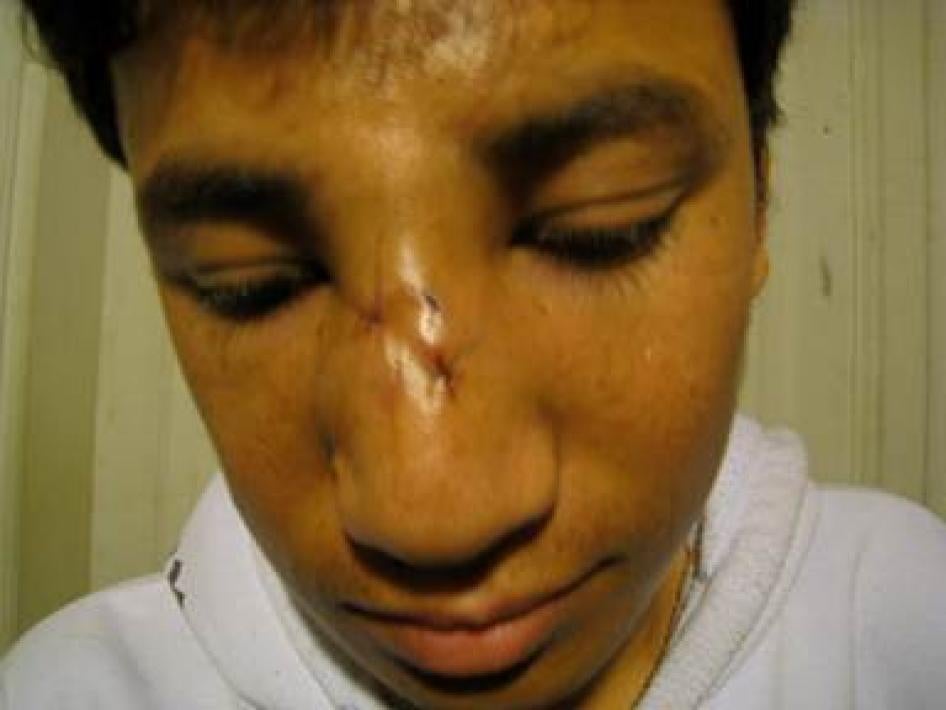
Mehdi Naderi. © 2011 Eva Cossé/Human Rights Watch
Naderi, a twenty-year-old Afghan who arrived in Greece in September 2011, was injured when he and two friends were attacked on a pedestrian street near Attica Square on the night of December 12, 2011. We spoke with all three the following day. Naderi said they were just walking down the street when a group of roughly 15 people attacked them.
They didn’t say anything. Suddenly they attacked, they beat me, and I left. It was around 8:30 or 9 p.m. We were on the street… It was dark and we did not understand what happened. We didn’t see them. Suddenly they attacked. But we realized that those who hit us were men. They suddenly appeared from inside the park, in Attica Square, and started hitting. They were saying something but we didn’t understand. But they had in their hands woods and irons. They have hit me everywhere, and in my body also. It is not only my nose and my head… I started running but there was a lot of blood flowing. Suddenly, I felt dizzy and then I stopped and my friends caught me. They were chasing us for a long time. They were behind us. At the time they attacked, my two friends escaped. I ran a lot.[86]
Naderi and his friends went home, but later, with the help of an Afghan activist, called an ambulance and went to the Korgialeneio Benakeio Athens General Hospital for treatment. Naderi received stitches to his head and nose. According to Naderi and Medhi Sarwari, one of the friends who witnessed the attack and accompanied him to the hospital, there were three other injured migrants and numerous police officers that night at the hospital. It was unclear how the migrants sustained their injuries.[87]
Naderi did not report the attack to the police. “I didn’t think to go the police because I am sure that if I go, the police won’t help me, they will bother me more. That’s what most of the people say. They say they go to the police and the police do nothing and scare them.”[88]
Hassan Mohamed, October 2011
A 25-year-old Somali without papers in Greece, Hassan Mohamed was attacked on October 29 as he returned home from an internet café near Victoria Square.
I was talking on the phone and they came at me from the front. Maybe 20 to 25 people. They beat me. I ran and they beat me. I fell unconscious. The police came and called an ambulance. They told me to come back after the hospital with the papers. I went back, I told them, I am the one you took from the street, this is the paper with everything: blood test, scan, x-rays, I had a broken bone under the right eye.
Mohamed ultimately gave up filing a complaint because he was concerned he would be detained because of his undocumented status.[89]
Mahmoud and Maria, August 2011
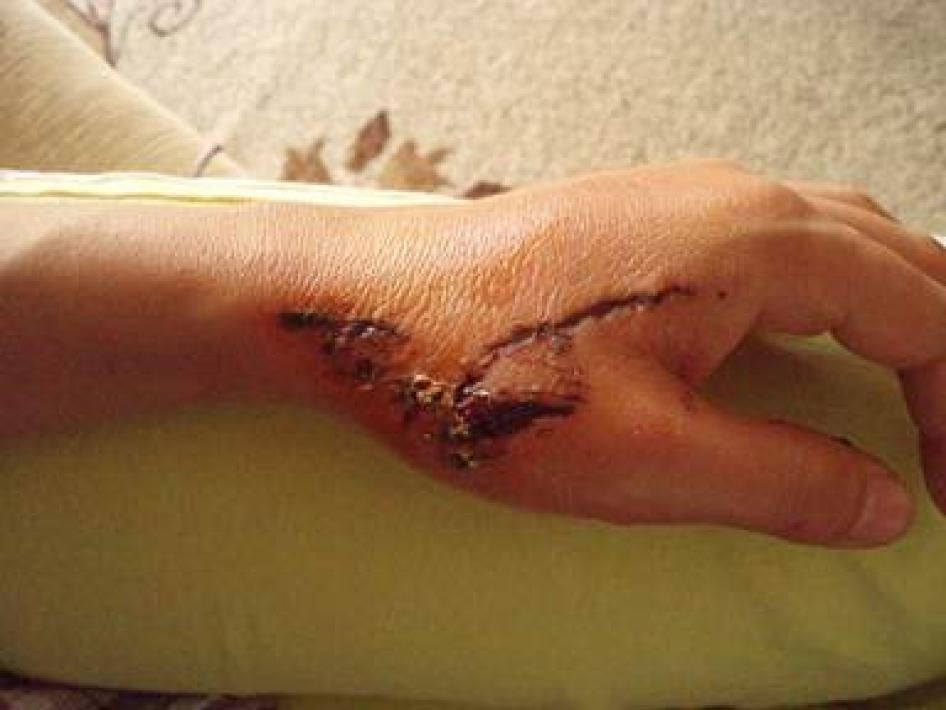
Maria’s scars from the August 2011 attack. © 2011 Mahmoud
Mahmoud and Maria are a couple from Afghanistan with refugee status in Greece. On August 5, 2011, near Attiki train station in broad daylight two men on a motorcycle attacked Maria, leaving her with a prominent scar on her left hand. The two men on a motorcycle swung at them with what Mahmoud described as “something white, maybe wood with nails” as they yelled the word for ‘dirty’ (Βρωμιάρα). Maria remembered,
I held my hand in front of my head when something hit my hand. After that I held my hand, it was something very hard, I didn’t know what it was but it seemed like a saw. My hand was hurt severely here. It was injured so deeply that you could see the bone. [90]
Mahmoud explained to us that he thinks the attackers were aiming at him, but hit Maria when, out of instinct, he ducked. [91]
After the attack, Mahmoud and Maria ran away, and only went to the hospital the following day. Maria told us they did not report the attack to the police because “we had already heard that the police don’t help us in situations like that.”[92] Mahmoud said, “Go to the police? Is that a joke? If you go to the police they tell you to go fight yourself.”[93]
Although better now, Maria was deeply shaken by the attack. “I didn’t want to go out anymore, and my husband had to do all the everyday errands and things I normally did… Now I try to dress more like Greek women; I don’t want to draw any attention to myself.”[94]
III. Violence elsewhere in Greece
While xenophobic violence appears to be most acute in and around Athens, media reports suggest that anti-immigrant sentiment has led to violence in other parts of the country. Human Rights Watch documented attacks in Aspropyrgos, a town roughly 20 kilometers north of Athens, as well as one attack in Corinth, roughly 80 kilometers southwest of the capital. Several incidents have reportedly taken place on the island of Crete, although Human Rights Watch was not able to independently investigate these incidents.
Aspropyrgos, September 2011
A spate of anti-immigrant attacks over a two-day period in mid-September 2011 in Aspropyrgos left a number of Pakistani immigrants injured. The police told a Pakistani community leader that the attacks were triggered by allegations that a Pakistani man had harassed a Greek girl.[95]
It is unclear how many separate incidents occurred and how many people were attacked. The grass-roots organization United Against Racism and the Fascist Threat reported that 25 people were injured in a series of attacks that included mob violence at a suburban train station, an assault on a bus, and attacks in ten different homes, all on September 10, 2011.[96]
Asia Ilieva, whose testimony about an attack on her Pakistani companion’s store is below, confirmed that mobs were specifically targeting Pakistanis:
There was no house that they didn’t enter and beat people. In all houses with Pakistanis, all the guys were beaten. Around 20 guys were at the hospital that night. This started on Saturday [September 10]… they [the attackers] were entering buses and they were beating people and were making them get off. It started on Saturday and continued on Sunday all day long.[97]
Forty-year-old Mahmoud S., a Pakistani national who has been living legally in Greece for 14 years, told us ten hooded men, armed with wooden and iron bars as well as screwdrivers, attacked his home in the Goritsa neighborhood of Aspropyrgos on the night of September 11, 2011. Mahmoud and his five roommates, also Pakistanis, had gone to bed for the night when “they came, broke the door, and entered the house.”
They were shouting, “Μαλάκα, το μάνα σου, το σπίτι σου” [Asshole, fuck your mother, fuck your house]… [T]hey had woods, their legs, irons... They broke everything and beat my roommates and me... They beat me on the head and chest and I was bleeding. I still have a hole in my head. They beat me with iron. The attack lasted 20 minutes. The house had three rooms and two persons were sleeping in each room. They went first to one room, then to other room and that’s why it lasted 20 minutes. In total, they beat five guys as the sixth guy was hidden in the toilet.[98]
All five were taken to a hospital in Magoula by ambulance. Mahmoud required five or six stitches to his head, one of his roommates required nine stitches and another suffered three broken ribs and head injuries.[99] According to Mahmoud, he called the police numerous times after the attack, “but they didn’t come.” The police later interviewed him and his roommates at the hospital, but he has no information about any investigation into the attack.[100] He and his roommates have since moved to another area of Aspropyrgos.
Javet Aslam, the president of an association of Pakistanis living in Greece, witnessed an attack on one home late in the evening of September 11. Earlier in the evening, he had met with the Aspropyrgos chief of police and received his assurances that the police would act against the violence, so when he received a call from someone saying his home was under attack Aslam immediately called the police chief.
He said he didn’t have anyone to send. I insisted, I said just sent one or two, and after an hour he sent two officers. I went with them, there were a lot of people, and the police said they couldn’t do anything…maybe because there were only two of them…and they left. They left us there. There were around 30 people breaking things inside the house. Around 11 p.m. Then the police took one injured person to the hospital. Why didn’t the police prepare to respond better, given the attacks the day before and the meetings of people to organize the attacks? How could they [the police] not know this?[101]
According to Aslam, the Aspropyrgos police said these were not racist attacks because they were sparked by accusations that a Pakistani man had molested a Greek girl. “But I say if that happened, then that one person is a criminal, not everybody,” Aslam said.[102]
Javet Ikbal and Asia Ilieva described an attack on their store in the Goritsa neighborhood of Aspropyrgos around 10 p.m. on the night of September 11, 2011. Ikbal’s brother, Abit Housein, 32 years old, was in the store at the time and suffered head injuries. Ikbal, a 52-year-old originally from Pakistan who acquired Greek nationality, and Asia Ilieva, his 56-year-old companion from Bulgaria, have owned the mini-market since 2003; this is the first time they have experienced such an attack. Ilieva explained,
We left [the store] to put gas [in the car]. We came back and we stopped on the road because I cannot describe how many people were on the street… We’re talking about 200-300 people… Tall kids, beautiful, strong kids... They had nothing covered [i.e. their faces]. And they were dressed with sport clothes. But they were holding wooden bats and had stones. The store was full of stones [after the attack]. They also had hammers. They didn’t have flags or anything.
I turned my head and I saw there was no light in our store. We always leave a light on and it can be seen from outside because his [Ikbal’s] brother sleeps there... We come here [to the store] and what do we see? Nothing has been left in place. All the refrigerators were outside, broken, there was fire... They did it in 15 minutes! And…there was a pool of blood because they broke his [Ikbal’s] brother’s head. The damage in money was 5,000 to 6,000 Euro (US$ 6,278 to 7,534). I threw everything away. We didn’t have insurance in the store.[103]
Three police cars from the Aghios Anargyros police station responded to Ikbal’s call and arrived on the scene minutes later. The couple filed an official complaint, but has since heard no news about the investigation. Ikbal complained that the authorities did nothing to prevent the violence:
The police knew everything. They did nothing. No patrols, nothing. The police usually patrols every day. For three days, we didn’t see even one motorcycle, not even one car from the Aspropyrgos Police. But it’s nobody’s fault, there is no law, there is no state, there is no police, there is no logic.”[104]
Ikbal’s brother, who required stitches on his head in three different places, relocated to Nikaia, a neighborhood on the periphery of Athens and would later leave Greece. Ilieva explained, “we didn’t let him stay here… we were afraid that they [the attackers] would come back and kill him. And we, ourselves, for ten days, we left the store in the situation it was.” She added that many of those who experienced attacks in those days have left the area, while those who remain are scared to go out after dark. As a precautionary measure, Ikbal and Ilieva have removed the Urdu writing from their storefront.[105]
Corinth, February 2012
Two North Africans were seriously injured in an attack near the abandoned train station where they live in Corinth on February 18, 2012. According to testimony Human Rights Watch gathered from Mostafa El Mouzdahir, a Moroccan, and two witnesses, a group of seven Greek nationals came to the train station around 3:30 p.m. claiming two migrants had stolen some money. Hearing calls for help, El Mouzdahir and his friend Isham went outside the wagon they live in and saw a group of men beating a migrant. As more and more migrants arrived on the scene, the Greeks fled but a crowd gathered around an attacker’s car. El Mouzdahir told us he tried to prevent a lynching, but ended up a victim:
He got into his car. Some Algerians followed him and tried to open his door, and I went there…to tell them to stop. I told them to not hit him, to let him leave. And the Greek [man] said thank you…. I speak a little bit of Greek so I…told him ‘no one will hit you, but close your door and leave and there’s no problem’. When he closed his door, he saw people in front of his car. He became insane. He accelerated and hit Saïd the Algerian in the legs and then he went ahead for maybe 200 meters and then accelerated again in reverse and hit me. There were a lot of us but I didn’t manage to get away… I had a big hit on the head and then I forgot everything. My feet, my back, my jaw, my head are still hurting.[106]
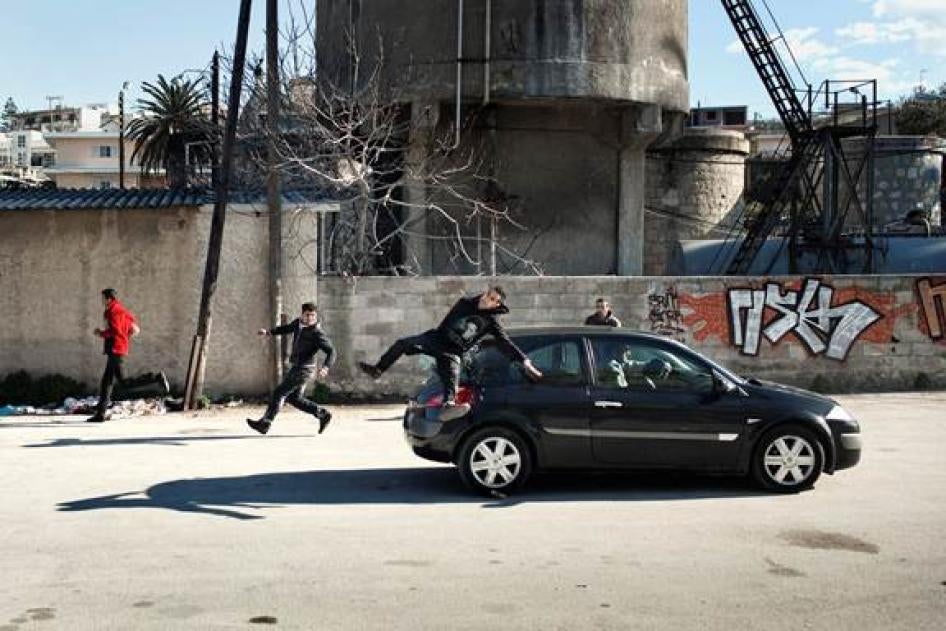
Car reverses into El Mouzdahir. © 2012 Alessandro Penso, Corinth, February 18, 2012.
El Mouzdahir’s friend Isham, as well as two foreign journalists (a Spanish reporter and an Italian news photographer), witnessed the attack.
After the car sped away, the police came quickly and took the journalists, though none of the migrants, to the police station to take their statements. Isham explained that an ambulance came for El Mouzdahir and Saïd much later: “Imagine! We are a five minute walk away [from the hospital] and it took one hour for the ambulance to come. They transferred two persons in the same ambulance. ”[107]
El Mouzdahir and Saïd were hospitalized for five and four days, respectively. El Mouzdahir told Human Rights Watch the police guarded his door the first night, and returned twice to take his statement. He believes it was the police chief who questioned him.
He told me about the press. He said, ‘Because of you and the press, we have a big problem with many countries.’ I didn’t say anything… After that he told me ‘Now I'll give you the Χαρτί [order to leave Greece within 30 days] and I wish you good health. When you get out of here, no police officer will bother you in the street.’ The Police was kind because they heard that photos of me were seen in Spain, Italy, everywhere"[108]
The driver of the car turned himself into the police on February 20, two days after the attack. Panos Damelos, an anti-racism activist in Corinth following the case, said the police had told him that they did not consider the attack to be racially-motivated, but rather the actions of a man with psychological problems. The police, according to Damelos, refused to investigate the car incident in relation to the group attack on migrants in the abandoned train station. None of the undocumented migrants wanted to file an official complaint, and the police argued they had no obligation to investigate ex officio; none of the other assailants have been identified.[109]
El Mouzdahir and Isham told Human Rights Watch this was the second attack they experienced. A large group of young men with motorcycles and on foot attacked the train station near the end of November 2011. They said that at around midnight, a friend of theirs who was outside talking on the phone saw a group of some fifty people begin throwing stones. He rushed inside the train wagon where El Mouzdahir and Isham were and closed the door. El Mouzdahir remembered the volley of stones was “like rain.” He and Isham, interviewed separately, both complained that the police “don’t care” that a group of seven or eight people gather regularly in a nearby park with their dogs and harass migrants. They believed these young men could have been involved in the stone attack. Isham explained that two young police officers arrived on the scene shortly after the incident: “We told them it was the racists and then they left. They don’t care. They didn’t come back to ask us questions or anything.”[110]
Crete, 2011
An Albanian national was hospitalized on May 13, 2011, in Rethymno, on the Greek island of Crete, after suffering multiple injuries in an attack by a group of Greeks.[111] Another Albanian suffered minor injuries in the same attack. Police were reportedly investigating whether the attack was racially-motivated and related to the incidents in Athens only a few days before.[112] On September 11, 2011, police in Lasithi arrested four young men and one 16-year-old boy in connection with the violent beating of a Mauritian immigrant the day before.[113]
On November 19, 2011, three Pakistanis were hospitalized after being attacked in their home in Perama-Mylopotamos in what police are investigating as retaliation after an elderly woman was beaten and strangled to death in a robbery allegedly committed by two Afghan migrants.[114]A few hours later, a car owned by a Pakistani national was engulfed in flames in the same area.[115]
Patras May 2011 and May 2012
In Patras, on May 7, 2011, a few days before the violence in Athens, a Molotov cocktail was thrown into an abandoned house occupied by four homeless Romanians. The newspaper Eleftherotypia reported that the police carried out investigations to identify the perpetrator and were considering the possibility that the attack was racially motivated.[116]The Patras prosecutor replied to a detailed query from Human Rights Watch about this case stating simply that the case is still under investigation, with unknown perpetrators sought on charges of arson posing a risk to human life.[117]
On May 19, 2012, in Patras a 30-year-old Greek man was fatally stabbed by three men believed to be Afghan nationals. According to news articles, police arrested one Afghan man and are looking for two others in connection with the murder.[118] In the days following the murder, large and violent anti-immigrant protests took place in front of an abandoned factory occupied by hundreds of migrants. On May 23, 2012, around 350 people described by the police as “mainly members of Golden Dawn” participated in an anti-immigrant demonstration that led to clashes with the police.[119] According to a police statement, eight officers were injured and hospitalized, and a bus patrol car and two motorcycles were damaged. Officers brought 22 people in for questioning and arrested five of them.
In a call to end the violence in Patras, UNHCR stressed that “the anger generated by the murder, for which a criminal investigation is on-going, should not lead to a cycle of violence, with civilians taking the law into their own hands. It can also not serve as an excuse to target and victimize migrants and refugees in Patras or other regions of Greece.”[120]
Human Rights Watch sent letters on April 12, 2012, to the Prosecutor’s Office of Corinth and on April 21, 2012, to the Prosecutor’s Offices of Lasithi and Rethymno in Crete inquiring about these incidents. The letter to the Corinth office was returned unread on May 25, 2012 and was resent on June 6, 2012. At the time of writing, we had not received an answer to any of the letters.
IV. Greece’s Legal Obligations
Greece is a party to the International Covenant on Civil and Political Rights (ICCPR) , which requires all state parties to ensure to all persons their fundamental rights without distinction of any kind, including race, language, religion, national origin, or other status.[121] The Human Rights Committee, which monitors compliance with the ICCPR, has made clear that states have a positive obligation to prevent and punish human rights abuse by private actors.[122] Greece is also a party to the International Convention on the Elimination of All Forms of Racial Discrimination (ICERD) which obligates states to guarantee everyone “without distinction as to race, color, or national or ethnic origin…security of person and protection by the State against violence or bodily harm, whether inflicted by government officials or by any individual, group or institution.”[123]
The European Convention on Human Rights (ECHR), ratified by Greece in 1974, provides for the equal enjoyment of all Convention rights without distinctions based on race, color, religion, or national or social origin, among other grounds.[124] The Convention also imposes positive obligations on states to protect individuals from attack, assault, or injury by private individuals, in particular when combined with protection of the rights to life and bodily integrity.[125]
The European Court of Human Rights has established in its case law the duty of states to investigate whether a criminal offense was motivated by racist animus. In its 2005 ruling in the case of Nachova and Others v. Bulgaria, the Court argued:
When investigating violent incidents … State authorities have the additional duty to take all reasonable steps to unmask any racist motive and to establish whether or not ethnic hatred or prejudice may have helped play a role in the events. Failing to do so and treating racially induced violence and brutality on an equal footing with cases that do not have racist overtones would be to turn a blind eye to the specific nature of acts that are particularly destructive of fundamental rights.[126]
The court has reiterated the positive obligation to investigate possible racist motivations in many successive cases.[127] In relation to lethal attacks the court has emphasized that,
[W]here that attack is racially motivated, it is particularly important that the investigation is pursued with vigour and impartiality, having regard to the need to reassert continuously society's condemnation of racism and to maintain the confidence of minorities in the ability of the authorities to protect them from the threat of racist violence.[128]
The European Union Council Framework Decision on combating certain forms and expressions of racism and xenophobia by means of criminal law, adopted in November 2008, underlines the obligation of EU states to ensure that racism and xenophobia are punishable by “effective, proportionate and dissuasive” criminal penalties.” [129] A binding legal instrument, the framework decision establishes an obligation to ensure that racist and xenophobic motivation is established under national law as an aggravating circumstance in the commission of crimes or subject to penalty enhancement. [130]
As a member of the Organization for Security and Co-operation in Europe (OSCE), Greece is also bound by the 2009 Ministerial Council decision on “Combating Hate Crimes,” calling on states to take measures to address the problem, including collecting reliable data, tailoring appropriate legislation, assisting victims, and raising awareness. [131]
International and national human rights bodies have expressed concern about Greece’s failure to live up to these obligations. In June 2012, the UN Committee against Torture said Greece should “strongly combat the increasing manifestations of racial discrimination, xenophobia and related violence, including by publicly condemning all such intolerance and motivated violence and sending a clear and unambiguous message that racist or discriminatory acts, including by police and other public officials, are unacceptable, and by prosecuting and punishing the perpetrators of such acts.”[132]
In 2009, the UN Committee on the Elimination of Racial Discrimination had expressed its concern that Greece was not acting diligently to address racially motivated crimes, and urged Greek authorities to “ensure the effective implementation of all legal provisions aimed at eliminating racial discrimination and that racially motivated crimes are effectively prosecuted and punished.”[133] Also in 2009, the European Commission against Racism and Intolerance (ECRI) urged Greek authorities to ensure appropriate and ongoing training for judges and prosecutors on “legislation against racism in general, and in particular the new ones which provide for the racist motivation of a crime to be considered an aggravating circumstance at sentencing.”[134] This provision is discussed in more detail below.
During Greece’s Universal Periodic Review at the UN Human Rights Council, in May 2011, numerous countries raised concerns about discrimination and intolerance, including racist violence, and made a series of recommendations, including through ensuring that racially motivated crimes are effectively prosecuted and punished.[135] Greece accepted these recommendations.
In June 2011, the Greek National Human Rights Commission, an independent government advisory body, expressed its concern about rising racist and xenophobic violence and issued a series of recommendations including improved training of police and the judiciary on racist crimes; the introduction of specific guidelines on investigations of racist crimes and a mandatory registration system using a special form; the creation of liaison police officers and teams specialized in racist crimes; improving police-community relations; and the establishment of a centralized recording system to improve data collection and analysis of racist crimes.[136]
Greece should publicly and unequivocally condemn racist and xenophobic violence, and act on its obligations under international human rights law to undertake effective measures to prevent such violence and to investigate and prosecute perpetrators. These obligations apply whether the perpetrators of the violence are agents of the state or private actors.
V. State Response
Right now the fear is that the state cannot protect us. If the government does not intervene, things will get much worse.
—Ali Rahimi, Afghan asylum seeker, Athens, December 5, 2011
The cases documented in this report demonstrate that migrants and asylum seekers have little chance of seeing justice done. Victims of violent racist and xenophobic attacks in Athens face countless obstacles in reporting crimes and activating police investigations. Undocumented migrants face the threat of detention and deportation if they report a crime. The authorities have thus far failed to aggressively prosecute racist and xenophobic violence for what it is. National authorities—as well as the EU and the international community at large—preoccupied by the economic crisis and concerned with control of irregular immigration, have largely turned a blind eye.
Ministry of Citizen Protection officials and prosecutors alike pointed to low numbers of complaints and cases in court as proof that racist and xenophobic violence is not a serious or growing problem.[137] This analysis ignores underreporting by victims who lack confidence in the police response, or, if they are undocumented migrants, fear detention if they come forward. Above all it ignores the inadequate response of the police and justice system to such attacks.
Inadequate Police Response
Human Rights Watch documented serious failings in police response to incidents and reports of violence against migrants and asylum seekers. Despite Ministry of Citizen Protection circulars, amendments to the Police Code of Ethics, and training courses on human rights issues, the police appear ill-equipped or ill-disposed to investigate reports of racist violence.
Brigadier Georgios Nitsas at the Ministry of Citizen Protection insisted that all cases are diligently investigated:
When we have complaints by migrants, we try to systematize and treat them with sensitivity. We investigate. To date, we have seen individual cases and have not uncovered racist motives. But when there are fights between Greeks and migrants, there is systematic investigation of racist motive… It’s not easy.[138]
In theory, appropriate legal tools and police guidelines are in place. In keeping with the EU Council Framework Decision on combating certain forms and expressions of racism and xenophobia by means of criminal law, Greece amended its criminal code in 2008 to make racist motivation an aggravating circumstance. A 2006 Ministry of Citizen Protection circular to the Hellenic Police force entitled “Addressing racism, xenophobia, bigotry and intolerance through police actions” requires the police to investigate possible racist motive in the commission of a crime when invoked by victims or witnesses, when this interpretation is substantiated by evidence, when admitted by the perpetrator(s), or when the alleged perpetrator(s) and victim(s) of the crime self-identify or belong to different racial, religious or social groups.[139]
Human rights courses, including on racism and xenophobia, are part of the training curriculum for police officers. Outside teachers, usually university professors, are brought in to teach these classes.[140] Anastassia Tsoukala, a scholar and advisor to the Ministry of Citizen Protection on training, said there is awareness that prejudice within the police force remains a problem. “The courses are there, the teachers are okay, and so what isn’t working? Police live in a conservative xenophobic society…and [they] mirror broader societal biases,” she said.[141] A police officer we interviewed on condition of anonymity complained that the courses did not teach concrete techniques for investigating hate crimes. He said, “I would like to learn about human rights in seminars, and in practice. Someone to tell us one, two, three things we have to do. I want him to tell me practical things. The professors are used to a university audience. We are bored in the first three minutes.”[142]
There are no designated officers or divisions specialized in responding to and investigating hate crimes, including racist violence. The police do have special operations related to other types of crime, such as illegal trade and robberies on public transportation.[143]
Police officers in central Athens face numerous challenges and threats in the course of their duties, all of which are exacerbated by the financial crisis and lack of sufficient human and material resources. Ioannis Makris, president of the Athens police union, complained in May 2011 that only one third of police vehicles were in operation and available for patrols due to lack of money. “From boots to bulletproof vests, police resources are ailing in Athens,” he said.[144] The police officer we interviewed on condition of anonymity, who served for two years in a central Athens police station, complained that “there is no money for even the simplest things. At one point we didn’t have paper to send a message asking for paper.”[145]
In spite of such challenges almost all of the victims Human
Rights Watch interviewed who had had some kind of contact with the police
in the aftermath of an attack said they received some kind of immediate
assistance, in particular the securing of medical attention.
However, underreporting of violence is a significant problem. Many undocumented
victims we interviewed said they did not seek assistance from the police for
fear of being detained and deported. Other undocumented migrants who had never
approached the police cited the experience of friends who tried to report
crimes and had been turned away or ill-treated. Finally, many cited prior
negative personal experiences with the police as the reason for their lack of
faith in the institution. As Marianna Tzefarakou of the Greek Council for
Refugees explained, “Even those with papers are afraid or unwilling to go
to the police. In some cases, they’ve gone and the police told them
to go away. So they have no faith.”[146]
Yet those who do report incidents to the police, either as a result of a chance encounter immediately following an attack or due to a conscious effort to file an official complaint, paint an overall picture of police inaction or indifference in stark contrast to government reassurances. The police only act if the victim files an official complaint, even if police have responded to the scene of an attack. Undocumented migrants interviewed by Human Rights Watch were routinely discouraged from filing official complaints. The police told some victims they would have to pay a fee to file a complaint. Finally, police investigations of complaints that are filed are inadequate.
Seven victims we interviewed said the police told them to fight back themselves. Ali Mohammadi, a 25-year-old Afghan asylum seeker, for example, said when he filed a complaint after an attack, a police officer asked him why he had not fought back. “I told him, my friend, if I wanted to hit someone, I wouldn’t have left my country. I came to live like a human being.”[147]
Failure to prevent attacks
The police have a paramount duty to prevent crime, especially violent crime. There is however little evidence that police are pursuing a strategy to prevent violent attacks on migrants, despite repeated attacks in certain areas of the city, notably Aghios Panteleimonas, and a pattern of intense retaliatory violence in the wake of crimes attributed to migrants (the May 2011 wave of attacks in central Athens and the September 2011 violence in Aspropyrgos, for example).
Safar Haidari, whose December 2011 attack is described above, blamed the rise in attacks on the failure of the authorities to address the violence,
In the neighborhoods of Aghios Panteleimonas and Attiki there are a lot of people coming from everywhere. And that’s why the Greeks do not want so many people in the neighborhood. Occasionally they are right but I think it’s the fault of the state. The state should do something… [These are] organized groups. They have sticks in their hands, helmets on their heads, and go in groups of 10-12 persons in one neighborhood. They are organized. This happens very often in Aghios Panteleimonas. Now, at night, I cannot go to the office because I am scared.[148]
A senior official in the Ministry of Citizen Protection assured Human Rights Watch that the 2010-2014 police operational plan to combat crime included attention to racist crime, though the only reference Human Rights Watch could identify on the face of the plan was a commitment to cooperate with local authorities to “develop common collective actions for the security” of vulnerable groups, including “groups with cultural difference.”[149] There is significant police presence in central Athens, yet this does not appear to be linked to any strategic deployment as part of a preventative approach to racist violence.
While there are undoubtedly challenges in investigating crimes with masked perpetrators, who the victims are unable to identify, the failure to take preventive action in areas of repeated violence makes this justification ring hollow, since preventive deployments would be an efficient policing tool that would increase the likelihood that police officers would themselves witness attacks and could catch perpetrators red-handed.
Moreover, it is striking that although the media, average citizens, NGO observers and even government officials explicitly link attacks on migrants to the so-called “citizens’ groups” and/or members of Golden Dawn, the police do not appear to have any strategy for monitoring the activities of these groups with a view to preventing attacks.
Discouraging complaints by undocumented migrants
The police do everything backwards. First, they ask for [your] papers.
—Mohammad Nadeem, Pakistani, Athens, December 7, 2011
Police behavior towards undocumented migrants who are the victims of racist attacks nurtures the lack of faith in the authorities and fear of arrest and deportation that deter so many others from even considering seeking assistance from law enforcement agencies. Hassan Mohammed was told bluntly at the Aghios Panteleimonas police station that he would be arrested if he tried to file an official complaint. He had been assisted by the police right after he was assaulted by a large group of people, leaving him bleeding and unconscious on the street, on October 29, 2011. He went to the police station after receiving medical treatment but was turned away:
I told them, I am the one you took from the street, this is the paper with everything: blood test, scan, x-rays. I had a broken bone under the right eye. I showed them [the police]. They asked me for my papers. I am illegal, and they said we have to put you in prison. I was wounded. I just gave up.[150]
Kazim G.’s experience is also representative. A 17-year-old Afghan, Kazim G. was attacked in September 2011 near Victoria Square by a large group of people who hit him with a bottle and beat his body and legs with a hard implement. He told us that “when the police saw that my order to leave Greece had expired four days before, they said ‘we cannot do anything for you because you are illegal here. So you can just go beat them back.’ I was bleeding from the head from the bottle, and my arm was hurt but…they didn’t help me.”[151]
Jawed Haidari, a19-year-old undocumented Afghan, had a similar experience. He happened upon three police officers as he staggered home after being beaten and kicked by a group of four or five people late at night on January 8, 2011, on Michaïl Voda Street. After ascertaining that Haidari did not have legal papers, the officers took him to the Aghios Panteleimonas Square and left him there. Haidari didn’t understand why they had accompanied him to the square. “I don’t know,” he told us. “I explained what happened…but they didn’t pay attention. They just asked for my papers.”[152]
In another case Human Rights Watch documented, the police encouraged 26-year-old Pakistani Asif Ali to accept an apology after he was attacked along with a friend while at a bus stop in the Rendi neighborhood of Athens in August 2011. The police responded to a call from witnesses and apprehended the assailants. According to Ali, the officers said he could only file a complaint if he had legal papers, and that it would be better for everyone for them to say sorry “and it ends here.”
The guys said sorry. I accepted the apology. I don’t want troubles. This is my second country. I wanted to file a complaint but the problem is I don’t have papers. If I file a complaint, I go to jail and they don’t go. Tomorrow they will let them go and they will keep me in the police station.[153]
Indeed, the majority of undocumented migrants we interviewed did not report an attack to the police. Deeqa Ibrahim, a 19-year-old Somali, explained she did not go to the police “because lots of people get attacked and the police take them to the hospital and then don’t do anything. And they would ask for my papers and put me in jail… The Greek government doesn’t do anything. We are looking for respect. We are looking for a safe place. If I’d known this would happen, I would have stayed in Somalia.”[154] Ibrahim had been attacked one night in October 2011 near Victoria Square by five men who hit her with a bottle. When we asked Saleh Ibrahim, another Somali (unrelated), if he had gone to the police after he was attacked he replied, “Of course not! Because if I go to the police I will bring a lot of problems to myself.”[155] Juma Rizzaie, a 26-year-old Afghan said he didn’t bother reporting his December 2011 attack “because this kind of thing happens many times and the police just tell people to go and do the same thing back, so I know they won’t do anything.”[156]
Human Rights Watch did not hear of any cases in which an undocumented migrant was detained following an attempt to report a crime for the sole reason of being in Greece without legal papers. Yet interviews with one police officer and prosecutors suggested this was a real possibility. The anonymous police officer we interviewed asserted plainly, “If someone comes and doesn’t have papers, I cannot let him go.”[157] A senior prosecutor in Patras argued that the law requires that an undocumented victim of a crime be detained and deported.[158]
First Instance Deputy Prosecutor in Athens George Kaloudis insisted that undocumented migrants who are the victims of crimes would not be penalized. Acknowledging that in most cases, “if the victim doesn’t have papers, the police just tell them to go away,” Kaloudis said the police are obligated to accept an official complaint from an undocumented migrant while at the same time looking into the legal status of the victim. Victims who are already subject to a deportation order can ask for a delay in deportations.[159]
Insistence on a fee to file a complaint
Human Rights Watch knows of three cases in which victims were told they had to pay a fee to file an official complaint. In late 2010, Greece introduced a 100 Euro (US$ 125) fee to file police complaints. Yiannis Ioannidis, state secretary for transparency and human rights at the Ministry of Justice, explained that the fee is designed to discourage frivolous complaints that clog a chronically slow system of justice.[160]
The Greek Code of Criminal Procedure distinguishes between crimes that the state is obligated to prosecute and those in which state action is only triggered by an official victim complaint.[161] The general rule is that when a crime is reported it requires mandatory state action, but if an offense is deemed to cause a limited harm to an individual (rather than a fundamental interest of the state), it will normally require a victim’s complaint for prosecution to go forward. Many serious felonies—punishable by prison terms between five years and life—give rise to mandatory state action, while many misdemeanor offenses—punishable by prison terms up to five years—do not. For example, under Greek law serious bodily harm and simple bodily harm are both misdemeanor offenses; the former gives rise to mandatory state action while the latter requires an official complaint from the victim to trigger prosecution. Similarly, damage to property is a misdemeanor offense requiring an official victim complaint.
It is our understanding that the prosecutor’s office can exercise its ex officio powers to open a prosecution on the basis of direct reports from the police or the victim, media or other sources, and upon receipt of an official complaint. The police are under an obligation to report to the prosecutor’s office, even in the absence of an official victim’s complaint, any crime they learn about that gives rise to mandatory state action. This means that the police should alert the prosecutor’s office if the victim of an attack causing serious bodily harm tells them of the attack, even when the report is made informally on the street or at the police station.
However, even when the crime falls into the category that requires mandatory state action, if the prosecutor is informed by an official complaint to the police, the person making the complaint is required to pay the fee. [162] Nonetheless, senior prosecutors in the Athens prosecutors office told Human Rights Watch that the fee only applied to crimes where the state does not have the obligation to prosecute ex officio, and that in cases of doubt or dispute the prosecutor would decide whether the fee is applicable or not. [163]
Officials in the judiciary and the Ministry of Justice assured Human Rights Watch that crimes where racist motivation is suspected would be prosecuted ex officio. [164] The Code of Criminal Procedure does not, however, explicitly state that all offenses aggravated by racist motivation give rise to mandatory prosecution regardless of the nature of the offense. [165]
The officer we interviewed on condition of anonymity said that in practice he feels obligated to ask all victims to pay.
The theory is good. But in practice, if 20 people come to file a complaint against unknown perpetrators, it is a time-consuming procedure, ten services are occupied with a complaint that has no sense, as it’s against unknown perpetrators and you will never find them. You will send it to the prosecutor, he will put the complaint in a drawer … they will look at it, they will see the 100 Euros weren’t paid, they will say it’s invalid and bye-bye.[166]
A different police officer said virtually the same thing when a Human Rights Watch researcher assisted Razia Sharife, a victim of an attack whose case is detailed above, in filing a complaint. The officer said the police were under orders not to accept complaints without payment of the fee, and warned that prosecutors “immediately archive” such complaints.[167] He did ultimately accept Sharife’s complaint without the fee.
Adams Ziad, a 39-year-old Sudanese who has lived in Greece since 2004, did pay the fee, however, to report his assault by a group of five people in September 2011. The other challenges he faced in filing the complaint are detailed below. In the third case we heard about, the victim decided not to pursue filing a complaint precisely because the police told him it would cost 100 Euros.
Mokhtar Azizi, a 25-year-old Iranian Kurd, is an asylum seeker who has been living in Greece since 2009. He was assaulted by three men near Omonia Square on April 4, 2011. After they kicked and punched him, he managed to catch one of them while the other two escaped. According to Azizi, three police officers who arrived on the scene tried to mediate:
The police asked him [the assailant] to say that he will not hit migrants and refugees any more. The attacker apologized for what he did and said he wouldn’t do it again and the police said, ok, you can go. But I didn’t want an apology to the police; they didn’t ask me if I wanted to forgive him.[168]
The police ended up taking both Azizi and the alleged attacker to the Omonia police station, where he was told he would need to pay 100 Euros to file an official complaint. Although he asked, he was not allowed to call the NGO Doctors of the World, or a lawyer. He told us the police threatened to detain him if he attempted to speak on the phone. Without the money to pay, Azizi gave up.
Inadequate response and investigations
Human Rights Watch spoke with 37 victims of attacks who said they had had some kind of contact with the police in the immediate aftermath of an attack. Only seven of these then tried to file an official complaint, and only five were successful. None of them has seen any progress in the case or indeed been contacted again by the police as part of the investigation.
There are of course real obstacles to investigating cases where the victim cannot identify the attackers or provide detailed descriptions. Talking about a hypothetical situation involving an attack by ten persons whom the victim cannot identity, the anonymous police officer cited above said, “So we send a signal to all the services to “search for ten people” and then nothing will happen. The complaint will be archived.”[169]
Nonetheless, the apparent consistent failure of the police to attempt any kind of diligent investigation suggests a pattern of indifference, at best, and negligence at worst. While the police secured an ambulance for a victim in a number of incidents we documented, in only a handful of cases did the police then go to the hospital to conduct a detailed interview with the victim right after an attack. After the police responded to an attack on two Egyptians and one Palestinian on May 8, 2012, in the Kallithea neighborhood, and all three were transferred to the hospital, the police only went to interview one of them.[170] In Sharife’s case, detailed above, the police never interviewed witnesses of the multiple attacks on her apartment.
Qadir Hossaini, the 33-year-old Afghan interpreter for the NGO Doctors of the World spent a week in the hospital and had to have stitches near his right eye following an attack on September 15, 2010, near the Aghios Panteleimonas church by what witnesses claimed was a group of 25 people. Though he doesn’t remember, Hossaini managed to drag himself to the nearby police station, where officers called for an ambulance. Hossaini told Human Rights Watch:
The police didn’t ask me anything then [that day] but three days later after they saw me on TV, two officers from the central police station came to take my statement. I gave them the names of my friends but the police never contacted them. After about two months they called me to the central police station and asked me about the police behavior. Since then, I haven’t had any contact at all with the police. When they came to the hospital, they asked if I wanted to file a complaint but I said I wouldn’t recognize them [the attackers]. The place where they beat me was very dark. I remember only that they were young, maybe 17 or 18, and all boys.[171]
In some cases, victims described the failure of the police to respond appropriately on the scene even when the alleged attackers were still present. Adams Ziad, mentioned above, was assaulted by a group of four men and one woman around 9 a.m. on September 12, 2011, in the Kallithea neighborhood of Athens, while on his way to work. They shouted insults, beat him on the face and head, and destroyed his belongings.[172]
Ziad managed to escape and found four police officers not far away. He told them what had happened, and also gave them a description of the car the assailants had along with part of the license plate number. While he was talking with the officers, the attackers returned to the scene of the attack. Although one of the officers was apparently willing to go with Ziad to approach the alleged attackers, his colleagues stopped them and insisted that Ziad had to go the local police station to file a report. They did, however, take Ziad’s pink card (proof of his status as an asylum seeker), which he later collected at the Kallithea police station.
Ziad faced further difficulties in reporting the crime. The police at the Kallithea station told him they could not process the complaint without a report from the officers at the scene; Ziad had to go the central Athens police station to obtain a copy. He returned to the Kallithea station the next day, September 13, with the tiny piece of paper he had received as proof of the request submitted at the central station. Ziad said he ultimately refused to sign the report the officer drew up that day because it contained errors. He sought help from a lawyer to draft his own report of the event, which he was able to file on September 14. As noted above, however, he had to pay a 100 Euro (US$ 125) fee. Only upon filing the complaint did Ziad receive a paper to go see a forensic doctor for an examination, two days after the attack. As of the beginning of May 2012, Ziad had not heard anything from the police about the investigation.[173]
Cidiki Kaba, a thirty-six-year-old Senegalese asylum seeker, was attacked on November 26, 2011 in the Aghioi Anarguroi neighborhood of central Athens, around 9 p.m. by one man and two older children. The man hit and kicked him, and then took out a knife. Residents in the area came to Kaba’s aid, caught the two younger assailants, and called the police. The man escaped.[174]
The police took Kaba and the two older children to the police station in Ilion/Aghioi Anarguroi, where there was apparently a big discussion about whether to officially record the incident. “One of the officers said it wasn’t worth it, that they [the two apprehended assailants] were minors and the other got away, but they argued about it and then asked their superior who said that once there is a knife involved they need to do a report.”[175]
Human Rights Watch requested information about this case in a letter to the Athens prosecutor and the Ministry of Citizen Protection on April 4, 2012. At the time of writing, we had not received an answer.
Baktiar Mohammadi was so frustrated by police treatment that he filed an official complaint with the Athens prosecutor’s office. A 23-year-old Afghan asylum seeker who has been in Greece for six years, Mohammadi was attacked on August 6, 2009, in front of the Aghios Panteleimonas church. A group of ten people assaulted him after he refused to change course when a man told him as a Muslim he couldn’t cross in front of the church “They hit me on the face, the head, the lips. I had blood [on my face],” Mohammadi said.[176]
And then I don’t know, I was lying on the ground for thirty minutes and I don’t know where I am. And then slowly, slowly I went to the Police near here [Aghios Panteleimonas station], I told them, “Ten persons beat me in front of the church, can you help me?” and they say, ‘No go first to the doctor and then come here,’ and I said, ‘How can I go, I came here on my four legs like an animal. How can I go to the doctor?’ They said, ‘Take a taxi’. I called a friend and told him to come and take me to the hospital. My friend came and we went to the hospital until four in the morning [from 9 p.m.], then we came back to the police… They told me, ‘What are you doing here? Go and come back at noon.’ I left and I went back at noon and they tell me, ‘Now it’s the lunch, we have to eat, come back in the afternoon.’ I went home and I went back [to the station] in the afternoon they told me that the supervisor is not here and then I said, ‘Are you making fun of me? What are you doing?’[177]
After receiving advice from the Greek Council for Refugees, Mohammadi filed a complaint directly with the Athens prosecutor’s office about the attack and against the police for breach of their duties. Over two years later, Mohammadi received a letter from the prosecutor’s office, dated November 24, 2011, informing him that there was insufficient evidence to substantiate a claim of police negligence, but that the case of injuries caused by unknown perpetrators remained under investigation.[178] A Human Rights Watch letter to the Athens prosecutor’s office dated April 4, 2012 inquiring about developments in this case remained unanswered at this writing.
Failure to Prosecute Attacks as Hate Crimes
The failure of the police to record and take crucial initial steps to investigate violent attacks on migrants and asylum seekers means few cases reach the criminal justice system. Human Rights Watch is aware of only one significant case, detailed below, of an Afghan asylum seeker who was stabbed during a mob attack in September 2011. While prosecutors interviewed by Human Rights Watch insisted that victims can apply directly to the prosecutor’s office, instead of lodging a complaint with the police, most people will not do this either because they are unaware that it is an option or because it may appear too complicated to submit a written document to the prosecutor’s office.
The justice system appears ill-prepared to address effectively those cases that do get reported. A 2008 provision in the Greek Criminal Code creating the aggravating circumstance of racist motivation has to date never been applied. Prosecutors and judges receive no specialized training, and there are no dedicated prosecutors for racist and xenophobic crimes. Recent positive steps, including a request from the Ministry of Justice that guidelines be circulated to all prosecutors with respect to racist and xenophobic violence, suggest that the phenomenon of racist violence is beginning to receive attention.
Criminal prosecutors in Greece have the duty to act, either ex officio or upon receipt of an official complaint by a victim, to oversee police investigations and prosecute, if warranted by the evidence, all criminal acts. As noted above, the type of crime determines whether the prosecutor is obligated to pursue the case even in the absence of a formal victim complaint. While prosecutors are formally tasked with pursuing the truth and pressing criminal charges where appropriate,[179] in practice victims hire lawyers to support their cases at trial. Christos Rozakis, the former vice-president of the European Court of Human Rights, explained that any limitations on the role of the prosecutor at trial is practical rather than institutional, citing lack of time or will.[180] According to Athens Deputy Prosecutor Kaloudis, the key role for the prosecutor comes at the sentencing stage, when he or she will help identify motives that will influence the judge’s decision.[181]
Most files will be handled by a number of different prosecutors throughout the judicial process, with the first prosecutor overseeing the initial investigatory phase, a second prosecutor determining whether to open a prosecution, and a third prosecutor appearing at trial. Every month prosecutors are assigned specific days in the following month when they are “on call” to appear in court; they can access the files of the cases they will act on in court in a timely fashion. Dimitris Zimianitis, a senior Athens prosecutor explained that the overwhelming number of cases per year—300,000 for only 120 prosecutors—makes it impracticable for prosecutors to be assigned files permanently.[182] Rozakis argued that this lack of continuity did not pose a serious problem, and rather may impose on prosecutors the discipline to ensure case files are well-enough assembled to allow others to pick them up.[183]
However, the lack of continuity raises concerns about the quality of the prosecution in complex cases, including ones involving alleged racist motivation, which must be established beyond a reasonable doubt. While there are specialized prosecutors for crimes such as domestic violence, organized crime, and drug trafficking, no such pools of expertise exist for racist and xenophobic crimes. Zimianitis, who is also the government’s liaison with the Organization for Security and Co-operation in Europe’s Office for Democratic Institutions and Human Rights, advocated the appointment of one prosecutor in the Athens office who could serve as an expert resource on such crimes for colleagues.[184]
As noted above, Greece amended its Criminal Code in 2008 to introduce “national, racial, religious hatred” as well as “hatred due to different sexual orientation” as an aggravating circumstance in the commission of a crime.[185] Following the general principle in Greek criminal law, a finding of an aggravating circumstance gives the sentencing judge the discretion to apply the maximum penalty for the crime.
To our knowledge, this aggravating circumstance has not once been applied in the almost four years since its introduction. We spoke with eight senior prosecutors and one official in the Ministry of Justice and none could cite any cases.
A draft law tabled in December 2011 would modify this provision to read: “The perpetration of the act due to hatred against a group or person, identified on the basis of race, color, religion, descent, national or ethnic origin or sexual orientation constitutes an aggravating circumstance.”[186] The bill, whose main provisions improve on and toughen criminal sanctions for dissemination of racist material and incitement to hatred, was withdrawn in mid-January 2012 as it was about to be debated in plenary session, apparently due to objections related to a rider amendment unrelated to the bill’s central issues.[187]
Acknowledging the failure to effectively apply the existing provision, Yiannis Ioannidis, state secretary for transparency and human rights at the Ministry of Justice, said the draft law should help by “improving the provision in the criminal code and serve a pedagogical purpose.”[188]
Zimianitis indicated to Human Rights Watch there were discussions about improving further on the draft law before resubmission to parliament. Notably, he advocated for including the aggravating circumstance of racist motivation in specific articles of the criminal code typifying certain crimes, such as bodily harm and property damage. This approach, he argued, would make the provision far more visible and accessible to prosecutors, making its implementation more likely.[189]
In a positive step, Ioannidis wrote a letter in April 2012 to the Greek Attorney General asking him to develop and circulate guidelines to prosecutors with respect to diligent investigation and prosecution of all reports of possible racist or xenophobic crimes.[190] At this writing, to our knowledge these guidelines had not yet been circulated.
Ali Rahimi: Waiting for Justice
Ali Rahimi in the hospital just after the September 2011 attack. © 2011 Yunus Mohammadi. Ali Rahimi’s search for justice illustrates the vagaries of police behavior and the criminal justice system in Greece. At this writing, the trial of two men and one woman for the September 2011 attack on Rahimi and two of his friends, in which he was stabbed five times in the torso with what he thinks was a knife, had been postponed six times. The trial is now scheduled to take place in September 2012. It remains unclear whether the prosecutor will argue the attack had been motivated by racist or xenophobic sentiment. The three defendants are charged with serious bodily harm, a misdemeanor offense punishable by a minimum of three months to a maximum of five years in prison. Twenty-seven-year-old Rahimi was waiting in front of a building in the Aghios Panteleimonas neighborhood with Reza Mohammed and Mohammadi Mohammad Ali, two fellow Afghans, around 9 p.m. on September 16, 2011, when they were approached by a group of fifteen people. After asking them where they were from, the group “began to swear at us, telling us we are dirty, to leave the country, and suddenly they started attacking us.”[191] Mohammad Ali escaped while Mohammed, who was hit on the head, was able to run up the stairs of the building. A man and a woman chased him up the stairs, but he was able to enter his apartment and escape further harm. Rahimi, however, was caught by at least five assailants who entered the building after him. “They kicked me, punched me and hit me with a beer bottle, and stabbed me one time next to the heart, one time in the chest, and three times on the back.”[192] Responding to a call from a friend who lives in the building, the police arrived quickly and called an ambulance. Rahimi was able at the time to identify for the police the man who had stabbed him, still in front of the building. Mohammed, who witnessed the attack from the stairway, was also able to identify the man who stabbed Rahimi. According to both Rahimi and Mohammed, the man and the woman who chased Mohammed up the stairs were also still in the vicinity, and the victims pointed them out to the police. They were not detained or questioned by the police at that time. While Rahimi was rushed to the hospital, Mohammed and the alleged stabber were taken to the Aghios Panteleimonas police station. There, Mohammed saw from a window the same man and woman standing outside the police station. After he identified them to the police once again, the police brought the two into the station and advised them that Mohammed accused them of attacking him. The man and the woman immediately filed a complaint against Mohammed for false accusation and defamation. All three, as well as the man accused of stabbing Rahimi, were then put in the same jail cell. Mohammed told Human Rights Watch, They [the police] took my fingerprints and then they sent me in the room with the person who stabbed [Rahimi] and five to ten minutes later they also brought the woman and the other man. This woman took pictures of me with her phone and they made a lot of fun of me. She also talked on the phone and said, “I’m here with the pig.” And she was also saying on the phone, “We have no problem, we have no problem, we are Greeks. The Police told us we are Greeks. We are going to leave now.” I stayed four hours with them. They were looking at me wildly. But then they calmed down and the one who stabbed Ali fell asleep and the other two calmed down. [193] |
Failure to Acknowledge Severity of Problem
Some of the positive moves noted above suggest that the Greek authorities are now paying attention to the problem of increasing racist violence. Furthermore a number of senior government officials condemned the May 2011 violence against migrants. Then Minister for Citizen Protection Christos Papoutsis warned that social tension created “a very high risk of hate crimes,” and government spokesman Yiorgos Petalotis said the “spectacle of stabbed immigrants in hospital cannot be accepted by Greek society. Citizens who live in the centre of Athens and in areas with a big (crime) problem are right to be frustrated ... but clearly nobody has the right to take the law into their own hands."[194]
However in many interviews with Human Rights Watch government interlocutors downplayed the extent of racist and xenophobic violence. First Instance Head Athens prosecutor Raikou said, “There are a lot of crimes committed by migrants against Greeks, and also against other migrants…So we observe a phenomenon of different nationalities fighting each other.”[195] Major General Vasileios Kousoutis at the Ministry of Citizen Protection, told us,
In my personal opinion, there is no tendency to have racist violence. We can’t say it doesn’t happen at all. Many times there are different motives. Many Greek are victims every day of robbery by migrants. We can’t say they are racist because they steal from Greeks. There are also migrant-on-migrant attacks. We have not registered an increase in racism or xenophobia. Of course individual attacks exist. All attacks that are reported are investigated, and results are given to the prosecutor.[196]
Furthermore much of the public debate about migration, both in the aftermath of the May 2011 murder of Manolis Kantaris and in the campaigns leading up to the May 2012 national elections, has focused on the general issues of crime and insecurity, with far-right party exponents making an explicit link between increased crime and immigration. Makis Voridis, an elected parliamentarian with New Democracy (at the time in the opposition), called for “the immediate deportation of immigrants” following the murder of Kantaris.[197] A raft of policy measures to address crime in the city center, announced on May 16, 2011, included primarily measures to crack-down on irregular immigration.[198]
As well as contributing to social tensions that underlie the violence and support for extremists, the economic crisis also provides a convenient excuse for inaction. Echoing the sentiment of many observers, Spryos Rizakos of the nongovernmental organization Aitima, called the economic situation “a great excuse for right-wing groups to go after migrants.[199] At the same time, Maria Kouveli, an elected official on the Athens town council, remarked that “the economic crisis is so serious, other things seem less important.”[200] Calliope Spanou, Greece’s Ombudsperson, agreed, observing that xenophobia “is not taken seriously as a political issue, it’s seen more as a luxury issue.”[201]
Recommendations
To the Government of Greece
- Publicly and unequivocally condemn instances of racist and xenophobic violence.
- Develop a national strategy on combating racism and xenophobia that sets out concrete measures and a timetable for implementation, and designates the government institution responsible for monitoring implementation.
To the Ministry of Public Order and Citizen Protection
- Update the 2010-2014 police operational plan to combat crime in Athens to include a preventive strategy on xenophobic violence, and ensure adequate deployment and patrols in areas with high rates of such violence.
- Ensure obligatory training for police officers at all levels, specialized courses, and in-service training on detecting, responding to, and investigating hate crimes, including racist and xenophobic violence.
- Develop and disseminate specific guidelines for police for the investigation of hate crimes, including racist and xenophobic violence.
- Ensure that each police station in central Athens has at least one officer, or a group of officers, with advanced specialized training in hate crimes, including racist and xenophobic violence, as well as experience with investigating extremist activities;
- Ensure that all police officers are aware of their duty to respond diligently to reports of possible hate crimes, and to take positive steps to prevent such acts.
- Adopt a policy and inform all police officers through appropriate channels that reports of all possible hate crimes should be immediately transferred to the competent prosecutor’s office regardless of the nature of the crime and without requiring the 100 Euro fee (US$ 125).
- Adopt and disseminate a clear policy providing that undocumented migrants who are victims of crime will not be subject to detention. A special streamlined procedure should be established to ensure that such victims are informed of and can avail themselves of mechanisms to remain in the country legally, at a minimum for the duration of the judicial process associated with their complaint.
- Launch a public campaign to encourage reporting of hate crimes, including racist and xenophobic violence, particularly among migrants and asylum seekers.
- Ensure, in cooperation with the Ministry of Justice, the swift creation of a data collection system to record all suspected hate crimes, including racist and xenophobic violence, disaggregated by type of crime, victim group, and suspected perpetrators (e.g. if affiliation to an organized group is suspected or verified).
- Extend a request to the Office for Democratic Institutions and Human Rights (ODIHR) of the Organization for Security and Co-operation in Europe for technical assistance in training law enforcement officers in detecting and investigating hate crimes.
To the Ministry of Justice
- Propose amendments to the Criminal Code to improve the scope and application of the aggravating circumstance of racist motivation, including through making it an integral part of articles typifying specific crimes such as bodily harm. Such an approach should not limit application of the aggravating circumstance to only those crimes.
- Ensure, either in law or through binding circulars, that regardless of the nature of the offense, any crime that may be categorized as a hate crime is subject to mandatory state action – investigation and prosecution – without the requirement that victims pay the 100 Euro (US$ 125) fee.
- Ensure appropriate training, including through inclusion of special seminars in continuing professional education courses, for prosecutors and judges in national and European anti-racism legislation, and in particular the aggravating circumstance of racial motivation in the commission of a crime.
- Move swiftly to establish a centralized data collection system, in cooperation with the Ministry of Citizen Protection, to collect and publish on a regular basis statistics on preliminary investigations, pending trials, verdicts, and sentences for racially aggravated crimes.
- Encourage the creation of designated task forces of prosecutors specialized in racist crimes. In an interim phase, at least one expert prosecutor, with specialized training and sensibility, should be appointed to oversee the work of prosecutors with case-files involving alleged racist crimes.
To the European Union
- The European Commission’s Directorate General for Justice should assess Greece’s compliance with its obligations under regional human rights and European Union law, including the Charter for Fundamental Rights and Framework Decision on combating racism and xenophobia, with respect to preventing and prosecuting racist and other hate violence, and report its findings in its annual report on human rights in the European Union.
- The European Commission should allocate funding, including through its Fundamental Rights and Citizenship Funding Programme, to support initiatives to address the deficiencies in the Greek response to racist and xenophobic violence, including specialized training courses for law enforcement and judiciary personnel and a public campaign to encourage reporting of hate crimes, including racist and xenophobic violence, particularly among migrants and asylum seekers.
- The European Parliament’s Committee on Civil Liberties, Justice and Home Affairs (LIBE) should, in the context of its periodic reports on fundamental rights in the European Union as well as through other actions, assess Greece’s compliance with EU law and principles in the field of anti-racism and discrimination. LIBE attention should highlight the problem of racist violence in the European Union more broadly and include recommendations for concrete action to address these concerns.
- The Council Working Group on Fundamental Rights (FREMP) should take up the issue of racist violence in Greece and in the European Union more broadly, and consider concrete steps to effectively address these concerns at an EU level.
- The EU Fundamental Rights Agency should thoroughly investigate racist and xenophobic violence in Greece with a view to providing decision-making institutions such as the European Commission and the European Council with information and analysis relevant to assessing Greece’s compliance with its obligations to counter racist and xenophobic violence.
To the Council of Europe
- The Commissioner for Human Rights should consider conducting a country visit to Greece to assess and highlight the situation with respect to racist and xenophobic violence against migrants and asylum seekers, and recommend appropriate action to address concerns identified.
- The European Commission against Racism and Intolerance (ECRI) should follow up on the concerns raised in its 2009 report and consider a statement about increasing racist and xenophobic violence in Greece, or other immediate steps, without waiting for Greece to come up for review under the five-year cycle.
To the United Nations
- The Special Rapporteur on the human rights of migrants should ensure that his upcoming visit to Greece includes attention to racist and xenophobic violence against migrants and asylum seekers, and leads to recommendations on specific steps to address the concerns identified.
- The High Commissioner for Human Rights and the Special Rapporteur on contemporary forms of racism each should consider conducting a country visit to Greece for the same purpose, and monitor closely and draw attention to the situation, including through urgent action and communications to the government on individual cases.
- Relevant treaty bodies, including the Committee on the Elimination of Racial Discrimination and the Human Rights Committee, should request detailed information from the government of Greece about steps taken to address racist and xenophobic violence in their next reviews of Greece’s compliance with the U.N. Convention on the Elimination of All Forms of Racial Discrimination and Covenant on Civil and Political Rights, and recommend concrete action to address concerns identified.
- Members of the Human Rights Council should question the Greek government about steps taken to address racist and xenophobic violence, including through implementation of the recommendations in this report to improve police and criminal justice response, during Greece’s second cycle review under the Universal Periodic Review in 2016.
Acknowledgements
Judith Sunderland, senior researcher, and Eva Cossé, research assistant, both in the Europe and Central Asia Division of Human Rights Watch, conducted the research for this report. The report was written by Judith Sunderland with input from Eva Cossé, and edited by Benjamin Ward, deputy director of the Europe and Central Asia Division. Veronika Szente-Goldston, advocacy director in the Europe and Central Asia Division, reviewed the report and contributed to the recommendations. Aisling Reidy, senior legal advisor, provided legal review, and Tom Porteous provided program review. Production assistance was provided by Marina Pravdic, associate in the Europe and Central Asia Division; Grace Choi, director of Publications; Kathy Mills, Publications Specialist; and Fitzroy Hepkins, Mail Manager.
Human Rights Watch is deeply grateful to all those who helped us conduct our research in Greece. We give particular thanks to Yunus Mohammadi, Spyros Rizakos, Marianna Tzefarakou, Efthalia Pappa, Tina Stavrinaki, Evgenia Kouniaki, Mubarak Shah and Saleh Ibrahim, as well as the staff of Praksis and Doctors of the World. We are especially grateful to all of the migrants and asylum seekers who spoke to us about their experiences.
Sofia Kalaidopoulou translated this report into Greek. Eva Cossé reviewed the translation.
Annex: Text of an Anti-Immigrant Manifesto, Athens
GET OUT OF GREECE YOU ARE NOT WANTED HERE
You came in Greece uninvited. We Greeks being hospitable and charitable, accepted you with affection, giving you food, clothes, hospital care, shelter. BUT NOT FOR EVER AND NOT FOR ALL THE POPULATION OF YOUR COUNTRIES. You in return, in order to thank us, gave us shop robberies, house robberies, murders of old people for 10 euros, killings for drug dealing, assassinations contracts, rapes of women and our grandmothers, beating of old people, abuse of children, dirt and disease.
You did not respect our hospitality, our principles and customs, insulting all us Greeks, all Greek women, our Christian religion, our civilization, our pride our LIVES.
You live here with OUR MONEY, WITHOUT WORKING, WITHOUT DOING ANYTHING AT ALL, JUST SELLING DRUGS AND PROSTITUTION.
This country has no money TO LIVE US GREEKS. We are forced to accept you in our hospitals that can not serve us, and take your children to our schools that WE PAY.
WE DON’T WANT TO FEED YOU, we do not want to give you not 1 euro.
RETURN TO YOUR COUNTRY NOW, TO FIGHT FOR IT. YOU ARE NOT WANTED HERE. More than 90% of Greek people want you to go away and never come back and is angry with you and hate you for insulting our dignity.
We are angry with this government and all politicians that brought you here and support you and defend you AND WE ARE DETERMINED TO PUNISH THEM AND YOU. From now on, we will take every necessary action in order to force you and the TRAITORS-POLITICIANS that help you to GET OUT OF THIS COUNTRY (or what you left of it).
YOU HAVE NO FUTURE IN GREECE. GO HOME NOW.CITIZENS OF ATHENS
All bolding and capital letters were in the original.
[1] Ioannis Cholezas and Panos Tsakloglou, “The Economic Impact of Immigration in Greece: Taking Stock of the Existing Evidence,” Institute for the Study of Labor Discussion Paper Series, October 2008, http://ftp.iza.org/dp3754.pdf (accessed April 12, 2012), p. 6. The government has not yet published the final data of the 2011 census.
[2] “Current Migratory Situation in Greece,” Frontex Press Release, November 29, 2010, http://www.frontex.europa.eu/rabit_2010/background_information/ (accessed April 4, 2011).
[3] http://frontex.europa.eu/news/greek-turkish-land-border-jo-poseidon-land-siutational-update-january-2012-DWvKc6 (accessed April 12, 2012).
[4] National Hellenic Police, “Illegal Immigration Statistics 2011,” http://www.astynomia.gr/images/stories//2012/photos1012/27012012-mi_nomimoi_ypik.jpg (accessed April 12, 2012). Albanians and Bengalis are in third and fourth place, respectively.
[5] “Chrysochoidis eyes 30 migrant detention centers by 2014,” ekathimerini.com, March 26, 2012, http://www.ekathimerini.com/4dcgi/_w_articles_wsite1_1_26/03/2012_434766 (accessed May 17, 2012).
[6] “UNHCR Says Asylum Situation in Greece ‘A Humanitarian Crisis,” UNHCR Briefing Notes, September 21, 2010, http://www.unhcr.org/4c98a0ac9.html (accessed March 22, 2010).
[7] For a more detailed discussion, see Human Rights Watch Updated Submission to the United Nations Committee against Torture, April 2011, http://www.hrw.org/news/2012/04/25/updated-human-rights-watch-submission-united-nations-committee-against-torture-greec.
[8] Eurostat, “Asylum in the EU 27 – The number of asylum applicants registered in the EU 27 rose to 301,000 in 2011,” news release, March 23, 2012, http://epp.eurostat.ec.europa.eu/cache/ITY_PUBLIC/3-23032012-AP/EN/3-23032012-AP-EN.PDF (accessed May 17, 2012). Out of 8,670 decisions at first instance, 45 claimants were granted refugee status. Eighty-five were granted subsidiary protection, and 45 were granted authorization to stay for humanitarian reasons. The overall recognition rate was 2 percent. A March 2012 progress report on the implementation of Greece’s national action plan on asylum said the overall recognition rate at first instance was between 1-6 percent, with a recognition rate at second instance at 12 percent. “Implementation of the Greek National Action Plan on Migration Management and Asylum Reform (“the Greek Action Plan”) and border management issues, Progress Report, March 2012, http://aditus.org/mt/aditus/Documents/GreekActionPlanProgressReportMarch2012.pdf (accessed May 22, 2012).
[9] UNHCR press release, “Dozens queue every week in Athens to apply for asylum,” March 12, 2012, http://www.unhcr.org/4f6c8b6a6.hmtl (accessed April 17, 2012).
[10] Greek Plan of Action on Asylum and Migration Management, State of Play 27.10.2011, http://www.hcg.gr/sites/default/files/article/attach/%20%CE%A5%CE%9B%CE%9F%CE%A0%CE%9F%CE%99%CE%97%CE%A3%CE%97%CE%A3%20%CE%95%CE%98%CE%9D%CE%99%CE%9A%CE%9F%CE%A5%20%CE%A3%CE%A7%CE%95%CE%94%CE%99%CE%9F%CE%A5%20%CE%94%CE%A1%CE%91%CE%A3%CE%97%CE%A3%2027_10_2011_0.pdf (accessed April 13, 2012).
[11] “Greece wants more EU support to tackle irregular migration but is unable to absorb funds already granted,” Migration News Sheet, May 2012.On file with Human Rights Watch. The name of the Ministry of Citizen Protection was changed to Ministry of Public Order and Citizen Protection in June 2012.
[12] Council Regulation (EC) No 343/2003, February 18, 2003 http://eur-lex.europa.eu/LexUriServ/LexUriServ.do?uri=OJ:L:2003:050:0001:0010:EN:PDF (accessed April 13, 2011) establishing the criteria and mechanisms for determining the member state responsible for examining an asylum application lodged in one of the member states by a third-country national, February 25, 2003. The position for unaccompanied children is different, since it does not require the return of children to a country unless the child has already claimed asylum there. Human Rights Watch analyzed the problems with the Dublin-II Regulation on several occasions before, see: Greece/Turkey – Stuck in a Revolving Door: Iraqis and Other Asylum Seekers and Migrants at the Greece/Turkey Entrance to the European Union, November 2008, http://www.hrw.org/en/node/76211/section/8, p. 22.
[13] Human Rights Council, Mission to Greece Report submitted by the Special Rapporteur on torture and other cruel, inhuman or degrading treatment or punishment, Manfred Nowak, March 4, 2011, A/HRW/16/52/Add.4, http://www.scribd.com/doc/50378215/Human-Rights-Council-Mission-to-Greece (accessed April 3, 2011) (Below: “Mission to Greece Report, March 4, 2011”).
[14] European Court of Human Rights [Grand Chamber], MSS. v. Belgium and Greece, application no. 30696/09, judgment of January 21, 2011, Reports of Judgments and Decisions 2011.
[15] Human Rights Watch, Greece/Turkey – Stuck in a Revolving Door: Iraqis and Other Asylum Seekers and Migrants at the Greece/turkey Entrance to the European Union, November 2008, http://www.hrw.org/en/node/76211.
[16] Stavros Theodorakis, Protagonistes, "Who is Golden Dawn" (Ποιά είναι η Χρύση Αυγή), May 14, 2012, http://www.megatv.com/protagonistes/default.asp?catid=25583&subid=2&pubid=29338279 (accessed June 8, 2012). Resident quoted at minute 16:35.
[17] “Eight in 10 say they are victims of crime,” ekathimerini, May 22, 2011, http://www.ekathimerini.com/4dcgi/_w_articles_wsite1_1_22/05/2011_391741 (accessed June 8, 2012).
[18] Stavros Theodorakis, "Who is Golden Dawn" (Ποιά είναι η Χρύση Αυγή), May 14, 2012, http://www.megatv.com/protagonistes/default.asp?catid=25583&subid=2&pubid=29338279 (accessed June 8, 2012). Resident quoted at minute 3:00.
[19] Niki Kitsantonis, “Violent Crime Soars in Athens,” The New York Times, June 14, 2011, http://www.nytimes.com/2011/06/15/world/europe/15iht-greece15.html?pagewanted=1&_r=2 (accessed April 12, 2012).
[20] Nicholas Paphitis, “Rights groups say racist attacks up in Greece,” Associated Press, March 21, 2012, http://www.todayzaman.com/newsDetail_getNewsByld.action?newsld=275019 (accessed March 22, 2012).
[21] “Samaras claims Greeks must ‘take back’ cities from immigrants,” Athens News, April 19, 2012, http;//www.athensnews.gr/portal/8/55031 (accessed April 20, 2012).
[22] “Grecia achaca a la inmigración el aumento de la delincuencia,” EFE, March 12, 2012, http://www.departamento19.hn/index.php/portada/69-actualidad/4270-grecia-achaca-a-la-inmigracion-el-aumento-de-la-delincuencia.html (accessed April 13, 2012).
[23] “Greece, compulsory health checks for migrants,” ANSAmed, April 2, 2012, http://ansamed.ansa.it/ansamed/en/news/nations/greece/2012/04/02/visualizza_new.html_160444247.html (accessed April 2, 2012).
[24] Golden Dawn manifesto, “Identity – I am a Golden Dawner means,” http://www.xryshaygh.com/index.php/kinima (accessed June 6, 2012).
[25] The video can be viewed at http://www.youtube.com/watch?v=XCKwQMvuM74&noredirect=1 (accessed May 17, 2012).
[26] Human Rights Watch interview with Nikolaos Michaloliakos, Athens, January 12, 2012.
[27] “Right-wing extremists want mines on Evros border,” Athens News, March 28, 2012, http://www.athensnews.gr/portal/1/54405 (accessed April 17, 2012).
[28] Human Rights Watch translation.
[29] Human Rights Watch interviews with Tina Stavrinaki, National Commission for Human Rights, Athens, November29, 2011; Daphne Kapetanaki, UNHCR, Athens, November 29, 2011; Spyros Rizakos, Aitima, Athens, November 28, 2011; anonymous police officer, Greece, January 16, 2012;Maria Kouveli, Athens city council member, Athens, December 9, 2011.
[30] Human Rights Watch interview with Christos Rozakis, Athens, May 11, 2012.
[31] See for example, “Greek Minister Warns of Ne0-Nazi Political Threat,” AFP, March 31, 2o12; Joanna Kakissis, “Fear Dimitra,” Foreign Policy, June 23, 2011, http://www.foreignpolicy.com/articles/2011/06/23/fear_dimitra (accessed April 18, 2012).
[32] Paul Hamilos, “MPs from Greek neo-Nazi party Golden Dawn arrested over racist attack,” The Guardian, June 2, 2012, http://www.guardian.co.uk/world/2012/jun/02/greek-neo-nazi-golden-dawn (accessed June 3, 2012); Makis Papasimakopoulos, “Golden Dawn denies role in migrant attacks,” Athens News, June 2, 2012, http://www.athensnews.gr/portal/9/55993 (accessed June 3, 2012).
[33] Marina Vichou, ”The Golden Dawn ‘blackmails’ residents of Aghios Panteleimonas,” January 19, 2011, http://tvxs.gr/news/ελλάδα/η-χρυσή-αυγή-«φακελώνει»-κατοίκους-του-αγίου-παντελεήμονα , (accessed March 2, 2012).
[34] Human Rights Watch interview with Aghios Panteleimonas resident, Athens, January 14, 2012.
[35] Human Rights Watch interview with anonymous police officer, Greece, January 16, 2012.
[36] Human Rights Watch interview with Michaloliakos, Athens, January 12, 2012.
[37] Ibid.
[38] Human Rights Watch interviews with anonymous police officer, Greece, April 16, 2012.
[39] The interview is available at http://www.youtube.com/watch?v=PKaaCdFnKns (accessed April 13, 2012).
[40] “City murder fuels racial tension,” Kathimerini, May 12, 2011, http://www.ekathimerini.com/4dcgi/_w_articles_wsite1_1_12/05/2011_390629 (accessed May 15, 2011).
[41] Human Rights Watch interview with Yunus Mohammadi, Athens, December 6, 2011.
[42] Office for Democratic Institutions and Human Rights (ODIHR), Organization for Security and Co-operation in Europe, “Hate Crimes in the OSCE Region. Incidents and Responses, Annual Report 2010,” November 2011, p. 26.
[43] Human Rights Watch interview with eight Ministry of Citizen Protection officials, chaired by Major General Vasileios Kousoutis, director, International Police Cooperation Division, Ministry of Citizen Protection, Athens, December 9, 2011.
[44] Human Rights Watch interview, Dimitris Zimianitis, Athens, May 9, 2012. The discrepancy in the figures may be attributable to subsequent analysis of complaint descriptions.
[45] Racist Violence Recording Network, “Presentation of results of pilot phase 1.10.2011-31.12.2011,” press release, March 21, 2012, http://www.nchr.gr/media/deltia_typou/PRESS_21_3_2012.pdf (accessed March 22, 2012).
[46] Ibid. The other victims included 5 legal residents, 1 recognized refugee, 1 person with subsidiary protection, and six victims whose status was unknown. Victims included 4 Bangladeshi and 2 Pakistani nationals.
[47] “Fear covers attacks by racists,” (“Ο φόβος καλύπτει τις επιθέσεις των ρατσιστών”)Eleftherotypia, June 12, 2011, http://www.enet.gr/?i=news.el.ellada&id=283835 (accessed April 19, 2012).
[48] Human Rights Watch interview with Jereer K. (pseudonym), Athens, January 12, 2012.
[49] Human Rights Watch interview with Saadia (pseudonym), Athens, May 10, 2012.
[50] “25 injured during far-right rampage against immigrants in Greece’s capital,” Associated Press, May 12, 2011, http://www.washingtonpost.world/new_clashes_break_out_in_athens_over_demonstrators_injury/2011/05/12/AFEFkHOG_story.html?wprss=rss_homepage (accessed May 15, 2011).
[51] Ibid.
[52] Human Rights Watch interview with Olivier Abdoulai, Athens, January 5, 2012.
[53] Human Rights Watch interview with an Afghan man, Athens, group interview, December 8, 2011.
[54] Human Rights Watch interview with Badara Gueye, Athens, January 4, 2012.
[55] Human Rights Watch interview with Mohammed Idress, Athens, December 9, 2011.
[56] Human Rights Watch interview with Modou Ndiaye, Athens, January 4, 2012.
[57] Human Rights Watch interview with Abuubeker Adam, Athens, December 12, 2011.
[58] Human Rights Watch interview with Arif Muhammadi, Athens, December 2, 2011.
[59] Human Rights Watch interview with Qadir Hossaini, Athens, December 6, 2011.
[60] Human Rights Watch interviews with Abduwahab Mohammed, Athens, December 15, 2011; Modou Ndiaye, Athens, January 4, 2012; Badara Gueye, Athens, January 4, 2012.
[61] Human Rights Watch interview with Youssef (pseudonym), Athens, December 8, 2011.
[62] Youssef had experienced a prior attack in 2009, in which a group of young men surrounded him when he tried to cross Aghios Panteleimonas square. Youssef sought help from nearby police officers, pointing to one of the young men who was walking away. “The police said, ‘don’t point like that, where are you from, you create problems, what are you doing here.’ They checked my papers and then told me to leave immediately.” Ibid.
[63] “25 injured during far-right rampage against immigrants in Greece’s capital,” Associated Press, May 12, 2011, http://www.washingtonpost.world/new_clashes_break_out_in_athens_over_demonstrators_injury/2011/05/12/AFEFkHOG_story.html?wprss=rss_homepage (accessed May 15, 2011).
[64] Human Rights Watch interview with Abuubeker Adam, Athens, December 12, 2011.
[65] Human Rights Watch interview with Badara Gueye, Athens, January 4, 2012.
[66] Human Rights Watch interview with Abduwahab Mohammed, Athens, December 15, 2011.
[67] “G. Kaminis ‘Mixed patrols, stop to foreigners,’” (Γ. Καμίνης: «Μεικτές περιπολίες, στοπ στους αλλοδαπούς»),To Vima, May 16, 2011, http://www.tovima.gr/society/article/?aid=400988 (accessed April 12, 2012).
[68] Kathy Tzilivakis, “Politicians urged to tackle Athens crime,” Athens News, May 21, 2011.
[69] Letter from the Athens prosecutor’s office, dated May 17, 2012. On file with Human Rights Watch.
[70] Human Rights Watch telephone interview with Razia Sharife, Athens, January 25, 2012.
[71] Human Rights Watch interview with Razia Sharife, Athens, May 8, 2012.
[72] Human Rights Watch interview with Razia Sharife, Athens, January 9, 2012.
[73] Description of the incident written by the Human Rights Watch researcher shortly after the incident.
[74] Human Rights Watch interview with Said Jafari and internet café employee (name withheld upon request), Athens, January 14, 2012.
[75] Human Rights Watch interview with Razia Sharife, Athens, January 14, 2012.
[76] Email to Human Rights Watch from Aghios Panteleimonas police station, March 13, 2012. On file at Human Rights Watch.
[77] Human Rights Watch interview with Razia Sharife, Athens, May 8, 2012.
[78] Human Rights Watch interview with Said Jafari, Athens, January 11, 2012.
[79] Human Rights Watch interview with Safar Haidari, Athens, January 3, 2012.
[80] Ibid.
[81] Ibid.
[82] Human Rights Watch interview with Yasser Abdurraham, Athens, January 12, 2012.
[83] Human Rights Watch interview with Mina Ahmad (pseudonym), Athens, December 12, 2011.
[84] Human Rights Watch interview with Douglas Ebenezer Kesse, Athens, January 11, 2012.
[85] Ibid.
[86] Human Rights Watch interview with Mehdi Naderi, Medhi Sarwari, and Zaki Hassani, Athens, December 13, 2011.
[87] Ibid.
[88] Ibid.
[89] Human Rights Watch interview with Hassan Mohamed, Athens, December 9, 2011.
[90] Human Rights Watch interview with Maria (pseudonym), Athens, May 11, 2012.
[91] Human Rights Watch interview with Mahmoud (pseudonym), Athens, December 9, 2011. In our first encounter with the couple, on December 9, 2011, only Mahmoud spoke. Maria was able to speak for herself in our second encounter, on May 11, 2012.
[92] Human Rights Watch interview with Maria, Athens, May 11, 2012.
[93] Human Rights Watch interview with Mahmoud, Athens, December 9, 2011.
[94] Human Rights Watch interview with Maria, Athens, May 11, 2012.
[95] Human Rights Watch interview with Javet Aslam, Athens, January 11, 2012
[96] United against Racism and the Fascist Threat, “Racist pogrom in Aspropyrgos with the protection of the police,” press release, September 11, 2011, http://www.antiracismfascism.org/index.php?option=com_content&view=article&id=327:2011-09-11-17-50-32&catid=38:press-releases-announcements&Itemid=150 (accessed April 10, 2012).
[97] Human Rights Watch interview with Javet Ikbal and Asia Ilieva, Goritsa (Aspropyrgos), January 8, 2012.
[98] Human Rights Watch interview with Mahmoud S., Magoula (Aspropyrgos), January 8, 2012.
[99] A Human Rights Watch staff member felt the scar under Mahmoud’s hair.
[100] Ibid.
[101] Human Rights Watch interview with Javet Aslam, Athens, January 11, 2012.
[102] Ibid.
[103] Human Rights Watch interview with Javet Ikbal and Asia Ilieva, Goritsa (Aspropyrgos), January 8, 2012.
[104] Ibid.
[105] Ibid.
[106] Human Rights Watch telephone interview with Mostafa El Mouzdahir, March 1, 2012.
[107] Human Rights Watch telephone interview with Isham (last name withheld upon request), March 1, 2012.
[108] Human Rights Watch telephone interview with Mostafa El Mouzdahir, March 1, 2012.
[109] Human Rights Watch telephone interview with Panos Damelos, April 13, 2012.
[110] Human Rights Watch telephone interview with Isham, March 1, 2012.
[111] “Two migrants at the hospital after they were beaten,” (Ρέθυμνο - Στονοσοκομείομετά από ξυλοδαρμό δύομετανάστες”), To Vima Rethymnon, May 13, 2011, http://www.tovima.gr/society/article/?aid=400452 (accessed April 20, 2012).
[112] Ibid.
[113] “Six held for migrant attack on Crete,” Kathimerini English Edition, September 11, 2011, http://www.ekathimerini.com/4dcgi/_w_articles_wsite1_1_11/09/2011_405782 (accessed April 20, 2012). The 16-year-old’s father was also detained.
[114] “Unknown persons sent -for revenge- to the hospital three young men,” (“Άγνωστοιέστειλαν-για αντίποινα- στονοσοκομείοτρειςνεαρούς!”), Creta Live electronic edition, November 19, 2011, http://www.cretalive.gr/new/61406/crete/Agnostoi_esteilan_sto_nosokomeio_treis_nearous (accessed April 12, 2012)
[115] “Concerns about the new incident in Perama –car in ‘flames’,” (“Προβληματισμός για τονέοκρούσμα στοΠέραμα- "Λαμπάδιασε" αυτοκίνητο”) Creta Live electronic edition, November 20, 2011, http://www.cretalive.gr/new/61474/crete/Lampadiase_autokinito_sto_Perama (accessed April 20, 2012).
[116] “He tried to burn with Molotov homeless migrants in Patras,” (“Προσπάθησε να κάψειμεμολότοφάστεγουςμετανάστες στηνΠάτρα”), Eleftherotypia electronic edition, 7 May, 2011, http://www.enet.gr/?i=news.el.article&id=273588 (accessed April 12, 2012).
[117] Letter to Human Rights Watch dated April 26, 2012. On file with Human Rights Watch.
[118] “Three Afghans suspected of killing local near Patra port,” Kathimerini English Edition, May 21, 2012, http://www.ekathimerini.com/4dcgi/_w_articles_wsite1_1_21/05/2012_443221 (accessed May 22, 2012).
[119] Hellenic Police, “Announcement of the General Police Directorate of Western Greece Periphery on yesterday’s incidents in Patras, outside the old factory of ‘Peiraïki Patraïki’”, (Ανακοίνωση της Γ.Α.Δ.Π.Δυτικής Ελλάδας σχετικά με χθεσινά επεισόδια στην Πάτρα, έξω από το παλιό εργοστάσιο της "Πειραϊκής Πατραϊκής"), Press Release, May 23, 2012, http://astynomia.gr/index.php?option=ozo_content&perform=view&id=15451&Itemid=912&lang= (accessed May 29, 2012)
[120] UNHCR, “UNHCR calls for an end to the cycle of violence in Patras”, Press Release, May 24, 2012, http://www.unhcr.se/en/media/artikel/c49dc5bafd4ca36f9c122fa2ed3acd4c/unhcr-calls-for-an-end-to-the-cycle.html (accessed May 24, 2012).
[121] ICCPR, G.A. res 2200A (XXI), 21 U.N.GAOR Supp. (No. 16) at 52, U.N. Doc A/6316 (1966), 999 U.N.T.S. 171, entered into force March 23, 1976, article 2(1); see also ibid., article 26 (equal protection under the law). Greece ratified the ICCPR on May 5, 1997.
[122] Human Rights committee, General Comment 31, Nature of the General Legal Obligations on States Parties to the Covenant, U.N. Doc CCPR/C/21/Rev.1/Add.13 (2004): “However the positive obligations on States Parties to ensure Covenant rights will only be fully discharged if individuals are protected by the State, not just against violations of Covenant rights by its agents, but also against acts committed by private persons or entities…There may be circumstances in which a failure to ensure Covenant rights…would give rise to violations by States Parties of those rights, as a result of States Parties’ permitting or failing to take appropriate measures or to exercise due diligence to prevent, punish, investigate or redress the harm caused by such acts by private persons or entities,” para. 8.
[123] ICERD, Adopted and opened for signature and ratification by the General Assembly resolution 2106 (XX) of 21 December 1965, entered into force January 4, 1969, article 5(b). Greece ratified ICERD on June 18, 1970.
[124] European Convention on Human Rights, Council of Europe Treaty Series, No. 5, Rome November 4, 1950, ratified by Greece on November 28, 1974.
[125] ECHR articles 1, 2, and 3. See for example European Court of Human Rights cases A. v. The United Kingdom, judgment September 23, 1998, para. 22: “The Court considers that the obligation on the High Contracting Parties under Article 1 of the Convention to secure to everyone within their jurisdiction the rights and freedoms defined in the Convention, taken together with Article 3, requires States to take measures designed to ensure that individuals within their jurisdiction are not subjected to torture or inhuman or degrading treatment or punishment including such ill-treatment administered by private individuals;” and Osman v. The United Kingdom, judgment of October 28, 1998, Reports of Judgments and Decisions 1998-VII, p. 3159, para 115: “The first sentence of Article 2§1 enjoins the State not only to refrain from the intentional and unlawful taking of life, but also to take appropriate steps to safeguard the lives of those within its jurisdiction…The State’s obligation extends beyond its primary duty to secure the right to life by putting in place effective criminal law provisions to deter the commission of offense against the person backed up by law enforcement machinery for the prevention, suppression and punishment of breaches of such provisions.”
[126] European Court of Human Rights [Grand Chamber], Nachova and Others v. Bulgaria, judgment of July 6, 2005, para. 156-159.
[127] See, for example, Bekos and Koutropoulos v Greece, judgment December 13, 2005 paras. 63 – 65; Zelilof v Greece judgment May 24, 2007, paras. 72 – 74; Secic v. Croatia, judgment of May 31, 2007, para. 66; Cobzaru v Romania, judgment July 26, 2007, paras. 88 – 91; Cakir v. Belgium judgment March 10, 2009 paras. 77 – 78; Beganovic v. Croatia judgment of June 25, 2009, para.93.
[128] See Angelova and Iliev v Bulgaria, judgment of July 26, 2007 and Menson and Others v. the United Kingdom, no. 47916/99, Decision on Admissibility on May 6, 2003, ECHR 2003-V.
[129] Council Framework Decision 2008/913/JHA of 28 November 2008 on combating certain forms and expressions of racism and xenophobia by means of criminal law, Official Journal of the European Union L328, 6 December 2008, http://www.legal-project.org/documents/219.pdf (accessed March 12, 2010), preamble, para (5).
[130] Council Framework Decision 2008/913/JHA, Article 4.
[131] OSCE Ministerial Council, Decision No. 9/09, “Combating Hate Crimes,” Athens, December 2, 2009, MC Dec 9/09, http://www.osce.org/item/41853.html (accessed November 5, 2010).
[132] UN Committee against Torture, Concluding Observations: Greece, CAT/C/GRC/CO/5-6, June 2012, http://www2.ohchr.org/english/bodies/cat/cats48.htm (accessed June 8, 2012).
[133] UN CERD, Concluding Observations: Greece, CERD/C/GCR/CO/19, August 28, 2009, http://www.unhcr.org/refworld/type,CONCOBSERVATIONS,,GRC,4aba17fe2,0.html (accessed April 20, 2012).
[134] ECRI report on Greece (fourth monitoring cycle), CRI (2009) 31, September 15, 2009, p. 13, http://www.coe.int/t/dghl/monitoring/ecri/Country-by-country/Greece/GRC-CbC-IV-2009-031-ENG.pdf (accessed November 2, 2011).
[135] Report of the Working Group on the Universal Periodic Review: Greece, U.N. Doc A/HRC/18/13, July 11, 2011, http://daccess-dds-ny.un.org/doc/UNDOC/GEN/G11/146/11/PDF/G1114611.pdf?OpenElement (accessed April 20, 2012).
[136] National Commission for Human Rights, “Suggestions for tackling racist violence by the police and the judiciary,” press release, June 9, 2011, http://www.nchr.gr/media/gnwmateuseis_eeda/Site_version2/diakriseis/EEDA_RV_AstynDikfinal.pdf (accessed July 12, 2011).
[137] Human Rights Watch interview with eight Ministry of Citizen Protection officials, chaired by Major General Vasileios Kousoutis, director, International Police Cooperation Division, Ministry of Citizen Protection, Athens, December 9, 2011; Human Rights Watch interview with Ioannis Tentes, General Prosecutor, and Athanasios Katsirodis, Deputy Prosecutor, Supreme Court, Athens, December 6, 2011.
[138] Human Rights Watch interview with eight Ministry of Citizen Protection officials, chaired by Major General Vasileios Kousoutis, director, International Police Cooperation Division, Ministry of Citizen Protection, Athens, December 9, 2011.
[139] Cited in Ministry of Citizen Protection letter to the National Commission for Human Rights, signed by Brigadier Ioannis Kalamaras, dated February 25, 2011.On file with Human Rights Watch.
[140] Human Rights Watch interview with eight Ministry of Citizen Protection officials, chaired by Major General Vasileios Kousoutis, director, International Police Cooperation Division, Ministry of Citizen Protection, Athens, December 9, 2011; Human Rights Watch interview with Anastassia Tsoukala, scholar and advisor to the Ministry of Citizen Protection, representative of the Ministry to the National Commission for Human Rights, Athens, December 8, 2011.
[141] Human Rights Watch interview with Anastassia Tsoukala, scholar and advisor to the Ministry of Citizen Protection, representative of the Ministry to the National Commission for Human Rights, Athens, December 8, 2011.
[142] Human Rights Watch interview with anonymous police officer, Greece, April 16, 2012.
[143] Human Rights Watch interview with eight Ministry of Citizen Protection officials, chaired by Major General Vasileios Kousoutis, director, International Police Cooperation Division, Ministry of Citizen Protection, Athens, December 9, 2011.
[144] Anthee Carassava, “Crime casts long shadow over Athens,” Los Angeles Times, May 31, 2011, http://articles.latimtes.com/2011/may/31/world/la-fg-greece-austerity-20110531 (accessed April 4, 2012).
[145] Human Rights Watch interview with police officer, Greece, April 16, 2012.
[146] Human Rights Watch interview with Marianna Tzefarakou, Athens, December 6, 2011.
[147] Human Rights Watch interview with Ali Mohammadi (pseudonym), Athens, January 11, 2012.
[148] Human Rights Watch interview with Safer Haidari, Athens, January 3, 2012. Attiki is the name of the neighborhood that includes Attica Square.
[149] Ministry of Citizen Protection, Hellenic Police Headquarters, “Anti-Crime Policy Programme (2010-2014),” http://www.minocp.gov.gr/images/stories//FILES09/antegklimatiki_politiki_2010-2014.pdf (accessed April 20, 2012).
[150] Human Rights Watch interview with Hassan Mohammed, Athens, December 9, 2011.
[151] Human Rights Watch interview with Kazim G., Athens, December 2, 2011.
[152] Human Rights Watch interview with Jawed Haidari, Athens, January 13, 2012.
[153]Human Rights Watch interview with Asif Ali, Athens, December 7, 2011.
[154] Human Rights Watch interview with Deeqa Ibrahim, Athens, January 12, 2012.
[155] Human Rights Watch interview with Saleh Ibrahim, Athens, December 15, 2011.
[156] Human Rights Watch interview with Juma Rizzaie, Athens, January 11, 2012.
[157] Human Rights Watch interview with anonymous police officer, Greece, April 16, 2012.
[158] Human Rights Watch interview with Dionisia Papdopoulou, senior prosecutor, Patras, December 1, 2011.
[159] Human Rights Watch interview with George Kaloudis, First Instance Deputy Prosecutor, Athens Prosecutor’s Office, Athens, December 8, 2011.
[160] Human Rights Watch interview with Yiannis Ioannidis, state secretary for transparency and human rights, Ministry of Justice, Athens, December 7, 2011.
[161] Greek Code of Criminal Procedure, article 36.
[162] Email communication from Dimitris Zimianitis, a senior Athens prosecutor, June 5, 2012. On file with Human Rights. Exceptions to the requirement to pay the fee were introduced recently by Law 4055/2012; these include victims of domestic violence, sexual exploitation and human trafficking, and public servants who are the victims of crimes in the course of their duties. Victims of other crimes giving rise to mandatory state action with demonstrated need should be able to avail themselves of legal aid. Ibid.
[163] Human Rights Watch interview with Eleni Raikou, Athens First Instance Head Prosecutor, and George Kaloudis, First Instance Deputy Prosecutor, Athens Prosecutor’s Office, Athens, December 8, 2011.
[164] Human Rights Watch interviews with Eleni Raikou, Athens First Instance Head Prosecutor, Athens, December 8, 2011; Human Rights Watch interview with Yiannis Ioannidis, state secretary for transparency and human rights, Ministry of Justice, Athens, December 7, 2011.
[165] Email communication from Dimitris Zimianitis, a senior Athens prosecutor, June 5, 2012. On file with Human Rights. Watch.
[166] Human Rights Watch interview with anonymous police officer, Greece, April 16, 2012.
[167] Police officer at Aghios Panteleimonas police station, January 14, 2012.
[168] Human Rights Watch interview with Mokhtar Azizi, Athens, December 6, 2011.
[169] Human Rights Watch interview with anonymous police officer, Greece, April 16, 2012.
[170] Human Rights Watch interview with Bishoy (last name withheld upon request), victim of the attack, Athens, May 12, 2012.
[171] Human Rights Watch interview with Qadir Hossaini, Athens, December 6, 2011.
[172] Human Rights Watch interview with Adams Ziad, Athens, November 29, 2011.
[173] Human Rights Watch telephone interview with Adams Ziad, Athens, May 9, 2012.
[174] Human Rights Watch interview with Cidiki Kaba (pseudonym), Athens, November 29, 2011.
[175] Ibid.
[176] Human Rights Watch interview with Baktiar Mohammadi, Athens, January 11, 2012.
[177] Ibid.
[178] On file at Human Rights Watch.
[179] Human Rights Watch interviews with Dimitris Zimianitis, senior Athens prosecutor, Athens, May 9, 2012; Christos Rozakis, former vice-president European Court of Human Rights, Athens, May 11, 2012.
[180] Human Rights Watch interview with Christos Rozakis, Athens, May 11, 2012.
[181] Human Rights Watch interview with George Kaloudis, First Instance Deputy Prosecutor, Athens Prosecutor’s Office, Athens, December 8, 2011.
[182] Human Rights Watch interview with Dimitris Zimianitis, Athens, May 9, 2012.
[183] Human Rights Watch interview with Christos Rozakis, Athens, May 11, 2012.
[184] Human Rights Watch interview with Dimitris Zimianitis, Athens, May 9, 2012.
[185] Law no. 3719/2008 (Official Gazette 241/A’/26.11.2008), article 23 (1). It is interesting to note that the Minister of Justice at the time, Sotirios Hatzigakis, accompanied the proposed amendment with an explanatory note stating that the reform responded to repeated recommendations from the European Commission against Racism and Intolerance and though unnecessary was desirable “in order for our country not to give the impression to the Council of Europe that it supposedly falls behind in the protection of human rights and especially the fight against phenomena of racism, xenophobia, and intolerance.” Amendment no. 347/21 tabled by the Minister of Justice Sotirios Hatzigakis to the draft law “Reforms for the family, child, society and other provisions,” October 23, 2008. http://www.hellenicparliament.gr/UserFiles/bbb19498-1ec8-431f-82e6-023bb91713a9/M-SYMBIOSI.347.pdf (accessed May 17, 2012).
[186] Draft Law “On combatting expressions of racism and xenophobia,” article 5, tabled on December 5, 2011. On file with Human Rights Watch.
[187] “Anti-racism bill halted in tracks,” Ekathimerini, January 16, 2012, http://www.ekathimerini.com/4dcgi/_w_articles_wsite1_1_16/01/2012_422986 (accessed January 17, 2012).
[188] Human Rights Watch interview with Yiannis Ioannidis, state secretary for transparency and human rights, Ministry of Justice, Athens, December 7, 2011.
[189] Human Rights Watch interview with Dimitris Zimianitis, Athens, May 8, 2012.
[190] Ibid; “Prosecutors on the lookout for racist incidents,” ekathimerini.com, April 25, 2012 (accessed April 28, 2012).
[191] Human Rights Watch interview with Ali Rahimi, Athens, December 5, 2012.
[192] Ibid.
[193] Human Rights Watch interview with Reza Mohammed, Athens, December 5, 2011.
[194] “Greek officials urge calm after racist attacks,” Athens News, May 13, 2011, http://www.athensnews.gr/portal/9/41536 (accessed March 15, 2012).
[195] Human Rights Watch interview with Eleni Raikou, First Instance Athens head prosecutor, Athens, December 8, 2011.
[196] Human Rights Watch interview with eight Ministry of Citizen Protection officials, chaired by Major General Vasileios Kousoutis, director, International Police Cooperation Division, Ministry of Citizen Protection, Athens, December 9, 2011.
[197] Kathy Tzilivakis, “Politicians urged to tackle Athens crime,” Athens News, May 21, 2011, http://www.athensnews.gr/issue/13444/41896 (accessed March 23, 2012).
[198] Kathy Tzilivakis, “Politicians urged to tackle Athens crime,” Athens News, May 21, 2011, http://www.athensnews.gr/issue/13444/41896 (accessed March 23, 2012).
[199] Human Rights Watch interview with Spyros Rizakos, Athens, November 28, 2011.
[200] Human Rights Watch interview with Maria Kouveli, Athens, December 9, 2011.
[201] Human Rights Watch interview with Calliope Spanou, Ombudsperson, Athens, January 12, 2012.