Map of Bahrain
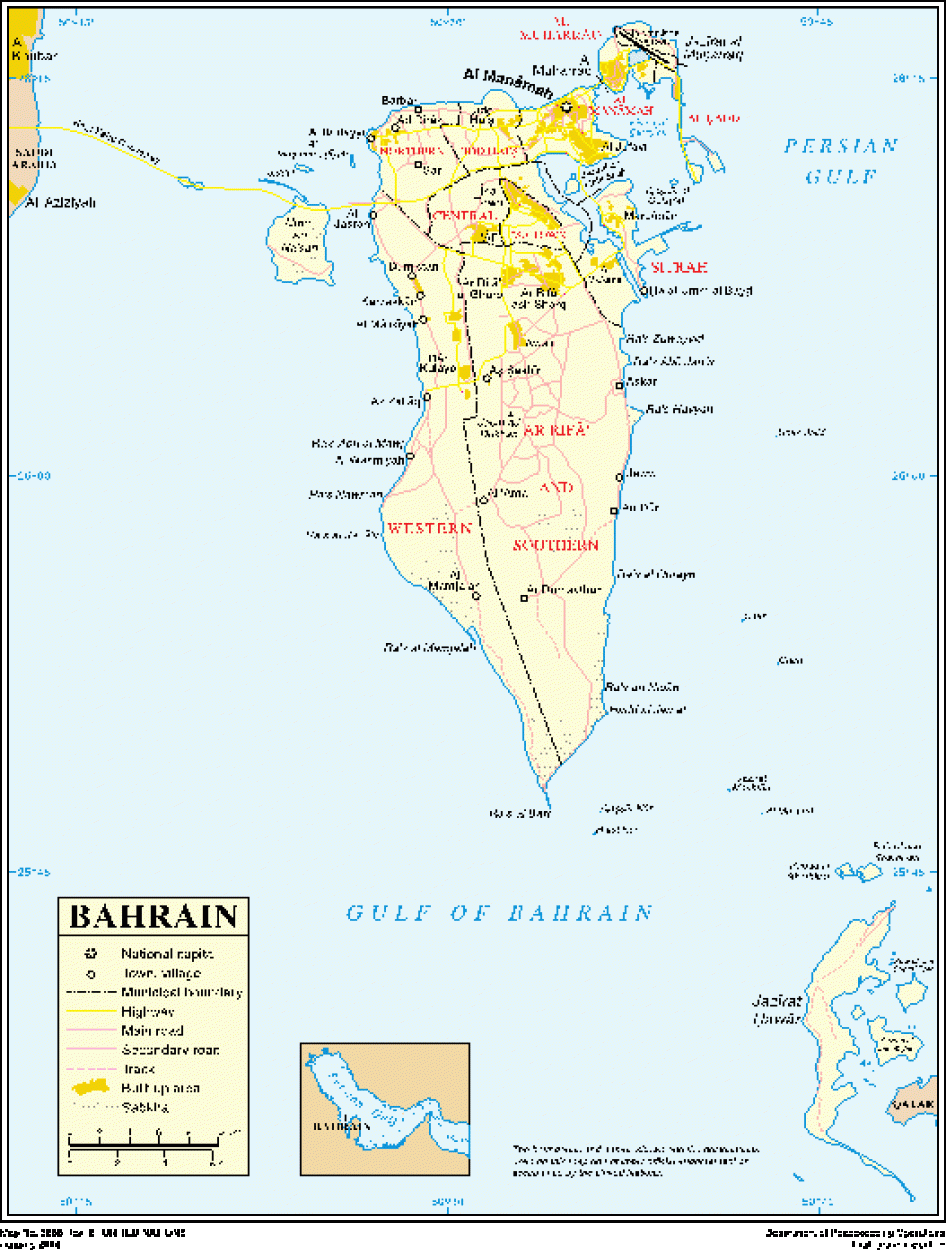
Source: United Nations
Summary
Nearly four weeks of massive pro-democracy demonstrations in Bahrain ended in March 2011 when state security forces under the command of the ruling Al Khalifa family launched a comprehensive crackdown on the protest movement.
A central element of the crackdown was the establishment by royal decree on March 15 of a three-month “State of National Safety,” akin to a state of emergency, in which King Hamad bin Isa Al Khalifa granted wide-ranging authority to the commander-in-chief of the Bahrain Defense Force (BDF), Field Marshal Khalifa bin Ahmad Al Khalifa, to issue sweeping regulations governing public order and to enforce those measures as well as existing laws.
The decree also established special military courts, called National Safety Courts, to investigate and prosecute crimes that “brought about the state of national safety,” crimes committed “defying the procedures” of the decree, and any other crimes that the BDF commander-in-chief might refer to them. Between their establishment on April 4 and their culmination in early October 2011, these military courts tried hundreds of Bahrainis caught up in the “national safety” dragnet. The judicial panels in the courts comprised a presiding judge who was a military officer, and two civilian judges, all appointed by the BDF commander-in-chief. Proceedings took place at the BDF complex in al-Riffa.
Based on scores of interviews with defendants, former detainees, defense lawyers, and observers of the trials, as well as a comprehensive review of available court records, medical documents, and other relevant material, this report finds that the National Safety Courts repeatedly failed to respect and protect basic due process rights. These findings are similar to those in the November 2011 report of the Bahrain Independent Commission of Inquiry (BICI), which comprised five international jurists and human rights experts, and was created by royal order in June 2011.
On June 1, King Hamad lifted the State of National Safety, but the National Safety Courts continued hearing felony cases already referred to them through October 7. Since then it appears that the government has moved all prosecutions and appeals of persons charged in connection with the political unrest of 2011 to the civilian criminal courts. Given that shift, this report also looks in detail at fair-trial issues in several security-related trials carried out in civilian courts in the months prior to the start of protests in February 2011; one of those cases, the “terrorist network” case, involved many of the same individuals later convicted by the National Safety Courts in another group trial.
The report finds that proceedings before the civilian criminal courts prior to February 2011 were marked by a disregard for basic fair-trial protections similar to that in the special military courts, including politically motivated charges that violated the rights to free expression and association, denial of the right to counsel and to present a defense, and torture and ill-treatment during interrogation.
Special Military Courts
International human rights law strongly disfavors military court trials of civilians (which are barred under Bahrain’s constitution absent a state of martial law), and limits their use to where the civilian courts are unable to function and requires that fair trial rights be fully respected. Bahrain’s National Safety Courts flouted basic requirements of international human rights law, as well as many provisions of Bahraini criminal law. The courts demonstrated a lack of competence, impartiality, and independence. Defendants were frequently unable to communicate in a timely manner with counsel, were not able to examine prosecution witnesses or testify in their own defense, and were convicted on the basis of confessions they or others made while in incommunicado detention and subject to physical abuse. In at least one case, the court convicted and sentenced a defendant even though no evidence at all was offered against him. In some cases, including those involving charges for common criminal offenses, such as murder or assault, trials were closed to the public without justification.
Beyond these serious procedural flaws, the National Safety Courts served primarily as a vehicle to convict defendants of alleged crimes stemming from the exercise of fundamental rights of freedom of expression, association, and assembly, in violation of international and Bahraini law. According to the report of the BICI, the special military courts convicted some 300 defendants for what it termed “political crimes.” Even the Bahraini Public Prosecution Office later conceded that more than 340 defendants were convicted of crimes related to their right to free expression.
Among the cases this report examines are two of the most high-profile group trials before the National Safety Courts: the trial of 21 leading opposition activists and the trial of 20 doctors and other medical personnel. One of the defendants in the first trial was Ibrahim Sharif, leader of the National Democratic Action Society (Wa’ad – meaning promise or pledge), an officially recognized political society. The court sentenced Sharif to five years in prison for encouraging assemblies, demonstrations, and sit-ins, “discuss[ing] the demand for a republic,” asserting the existence of “sectarian and tribal discrimination in the country,” and claiming that the system of government “had lost its legitimacy.” Another defendant was Hassan Mushaima, a leader of the unrecognized opposition group Al Haq. Mushaima was accused of advocating “marches, demonstrations and civil disobedience” to call for the “establishment of a democratic republic.” For these “crimes” Mushaima received a life sentence. A third defendant was Abdulhadi al-Khawaja, a leading human rights advocate and political opposition leader. He also received a life sentence for, among other things, “advocat[ing] the overthrow of the regime, a willingness to sacrifice, disobedience, a general strike, and marches.” Prosecutors also charged that al-Khawaja “insulted the army” and “impugned the integrity of the judiciary.”
To the defendants’ arguments that they had merely exercised their rights to freedom of expression, association, and assembly, the judges ruled that provisions in Bahrain’s constitution protecting these rights “are not applicable in themselves,” and that the emergency decree took precedence over other laws. However, Bahrain’s constitution only permits suspension of these protections during martial law, and the king’s decree establishing the State of National Safety expressly stated that it was not declaring a state of martial law. The judges also ignored several statements of Crown Prince Salman bin Hamad Al Khalifa in February and March that the peaceful street demonstrations were permissible and “protected in the constitution.”
The evidence offered against the 21 activists related almost entirely to peaceful political activities and raised serious due process issues as well. Specifically, the evidence consisted of confessions that appeared to have been coerced while the defendants were in incommunicado detention; public political statements such as recorded speeches; media interviews; the defendants’ political writings (including as found on their computers and websites); and the testimony of security officials, largely from the National Security Agency, who testified in extremely general terms about a wide range of alleged actions by the defendants as a group.
Two of the 21 activists were convicted and sentenced to 15-year prison terms without any evidence linking them to a charged (or uncharged) crime. The verdict against well-known blogger Ali Abdulemam, who was tried in absentia, makes no reference to any evidence whatsoever. As to human rights activist Abdul Ghani al-Khanjar, who was also tried in absentia and convicted of joining an illegal group and attempting to overthrow the government, the evidence submitted consisted solely of a personal computer and flash drives that allegedly contained political papers, a “critical review of the constitution and some laws,” and “the names of officers and personnel with the former intelligence agency and investigations.” But the verdict included no reference to any evidence that al-Khanjar had joined any group, let alone an illegal group or had made any effort to effect a coup. Ultimately, the court found all 21 opposition activists guilty, sentencing eight of them to life in prison and the others to prison terms ranging from two to fifteen years—all for exercising their rights to peaceful expression, association, and assembly.
The National Safety Court also heard the well-publicized case of 20 doctors and other medical personnel in connection with March 2011 events at Salmaniya Medical Complex, the country’s largest medical facility. The court convicted all 20 of transparently political offenses, such as joining in “slogans and chants” that expressed “hatred and contempt for the governing regime” and, with reference to interviews some gave to independent media, “broadcast[ing] false and tendentious news.” One defendant was convicted in part because she allegedly stepped on a photograph of Bahrain’s prime minister; another was convicted in part because she allegedly contacted Alex Ferguson, the manager of the Manchester United football club in the United Kingdom, to ask him to observe a moment’s silence before a match.
The trial of the 20 medical personnel was riddled with many fair trial problems as well. The presiding judge reportedly would not allow defense counsel to cross-examine prosecution witnesses, insisting that counsel address the questions to him; the judge then reformulated the questions before allowing the witness to respond, and in some cases simply refused to ask the questions of the witness. The court also prohibited the defendants from testifying.
After an international outcry that followed the conviction of all 20 medical personnel, Bahrain’s Attorney General Ali Al Buainain announced that the cases would be reheard by a civilian appeals court. The Public Prosecution Office later stated that it would not pursue certain charges targeting political expression, but would seek to vindicate convictions based on Penal Code articles that make it a crime to promote “changing the political, social or economic system of the State where … any … illegitimate method is noticed” or to incite “hate or show contempt for a certain faction.” And the Public Prosecution Office is pursuing charges pursuant to these articles based on peaceful political protest.
This report examines other cases as well, including those involving a prominent criminal defense attorney and a former parliamentarian.
Civilian Court Trials
Bahrain’s civilian criminal courts have shown themselves to be little better than the military courts in providing fair trials in highly politicized cases. Eleven of the defendants in the National Safety Court case against the 21 activists had been charged earlier with being part of a “terrorist network” in a civilian trial involving a total of 25 opposition activists that commenced on October 28, 2010. The case was ongoing at the time unrest broke out in the country in mid-February 2011 and, as a concession to protester demands, on February 22 King Hamad freed the 23 of the 25 defendants then in detention (two defendants were being tried in absentia); proceedings in the civilian case never resumed, but 11 of the defendants were arrested again shortly thereafter and charged in the case of the 21 activists.
In the 2010 civilian court “terrorist network” case against the 25 defendants, prosecutors and security officials denied the defendants the right to counsel, including during formal interrogations, denied them access to trial materials, and made prejudicial public statements. Prosecutors and the court also failed to investigate properly the defendants’ allegations of torture and ill-treatment. According to court minutes, all but one of the 23 defendants claimed that security forces had abused them physically and psychologically.
The charges against the “terrorist network” suspects related almost exclusively to their exercise of the rights to freedom of expression and association. The interrogations of defendants, focusing on political opinions—for example, with regard to a boycott of upcoming parliamentary elections—and associations with international organizations, emphasized the politically motivated nature of the proceedings. One suspect, a cleric, was asked about his sermons and “what rights people should have.”
Human Rights Watch interviewed eight defendants following their release in February 2011, all of whom said that they had been subjected to torture and ill-treatment, variously reporting beatings, sleep deprivation, forced prolonged standing, and extended detention in solitary confinement. Human Rights Watch had access to photographs of injuries and medical reports of government doctors that corroborated some of these accounts. Not only did the Public Prosecution Office reject without basis the defendants’ allegations of abuse, it premised its case largely on evidence that “came out of the mouths of the defendants themselves,” indicating that the case was built essentially on confessions.
Human Rights Watch examined two other civilian court trials in which defendants were charged on the basis of coerced confessions that unraveled in the course of trial proceedings. In one case, two defendants confessed to assaulting the editor of a pro-government newspaper, but the victim testified in court that the defendants were not his assailants. After their release from custody, the two men told Human Rights Watch that they had been slapped, punched, and threatened with electric shocks until they falsely confessed.
In another case, prosecutors secured a confession from a young man that he had taken part in a violent protest in August 2010. The court relied on the confession to convict him and sentence him to a year in prison, giving no credence to his complaint that his confession had been coerced and ignoring the fact that his passport showed that he had been in the United Kingdom at the time of the alleged incident.
The egregious violations of fair trial rights in the cases presented in this report do not reflect simply poor practices by individual judicial officers, but also serious, systemic problems with Bahrain’s criminal justice system as a whole and the role of the military and intelligence services in state oppression. For this reason, the government should conduct thorough and impartial investigations into the broad range of human rights violations detailed in this report by implicated ministries and agencies, including the Ministry of Interior, the National Security Agency, the Bahrain Defense Force, the Ministry of Justice and Islamic Affairs, and the Public Prosecution Office. The government should fully prosecute those responsible for serious abuses, regardless of position or rank, and adopt measures to deter future violations.
Key Recommendations
To the Government of Bahrain
- Conduct thorough and impartial investigations into the human rights violations detailed in this report by the Ministry of Interior, the National Security Agency, the Bahrain Defense Force, the Ministry of Justice and Islamic Affairs, and the Public Prosecution Office; prosecute those responsible for serious abuses, regardless of position or rank; and adopt measures to deter future violations.
- Withdraw all charges and expunge all convictions lodged since February 2011 in the National Safety Courts or civilian courts based on the exercise of the rights to freedom of expression, association, and peaceful assembly, and all convictions based solely on confessions.
- Release immediately all individuals, including Ibrahim Sharif, Abdulhadi al-Khawaja, Hassan Mushaima, and the other activists, who have been detained or convicted solely for the exercise of the rights to freedom of expression, association, and peaceful assembly.
- Terminate ongoing prosecutions and do not institute future prosecutions against any individual based solely on the exercise of the rights to freedom of expression, association, and peaceful assembly.
Methodology
Human Rights Watch visited Bahrain in September and December 2010, and in February, March, April, and November 2011, interviewing scores of persons, including defendants in the criminal cases featured in this report, former detainees, opposition figures, and defense counsel, and observing several hearings in civilian criminal courts. Many of those interviewed were involved with groups associated with the opposition movement. During these visits Human Rights Watch requested meetings with officials of the Bahraini government, including the Ministry of Justice and the Public Prosecution Office, to discuss issues related to this report, but none was granted.
Human Rights Watch also interviewed defendants and defense counsel outside of Bahrain at various times in 2011, including during the period from April 20 to November when the Bahraini government barred Human Rights Watch representatives from entering the country. In addition, Human Rights Watch interviewed individuals by telephone or Skype. Human Rights Watch conducted all interviews in English or in Arabic with the assistance of an interpreter.
The report is also based on a wide range of documents generated in connection with criminal cases tried in the special military courts and civilian criminal courts, including court decisions, orders, and minutes; submissions by prosecutors and defense counsel; and records of interrogations. Human Rights Watch also examined medical reports authored by government doctors regarding complaints of ill-treatment by defendants, and photographs of injuries alleged to have resulted from ill-treatment. All of these documents are on file with Human Rights Watch.
The report also draws on published accounts relating to criminal cases, mostly from pro-government media, but also from independent media as well as from Bahraini and international human rights groups. Human Rights Watch further reviewed the report released on November 23, 2011, by the Bahrain Independent Commission of Inquiry (BICI), comprising international jurists and human rights experts appointed by King Hamad to investigate allegations of human rights abuses in the period between February and April 2011.
I. Political Prosecutions in Special Military Courts
On March 15, 2011, King Hamad bin Isa Al Khalifa of Bahrain issued Royal Decree 18/2011, establishing a three-month “State of National Safety.”[1] The decree granted wide-ranging authority to the commander-in-chief of the Bahrain Defense Force (BDF), Field Marshall Khalifa bin Ahmad Al Khalifa, to issue regulations governing all manner of conduct and to enforce those regulations as well as existing laws.
The decree also established special military courts, called National Safety Courts, to investigate and prosecute crimes that “brought about the state of national safety,” crimes committed “defying the procedures” of the decree, and any additional crimes referred to the National Safety Courts by the BDF commander-in-chief.[2] The National Safety Courts comprised the Lower National Safety Courts and the National Safety Court of Appeals, each of which was staffed by three-judge panels appointed by the BDF commander-in-chief.[3] In these courts, the presiding judges were military officers, while the two other judges were civilians, and the chief military prosecutor prosecuted the cases.
The National Safety Courts began hearing cases on April 4, 2011. On June 1, King Hamad lifted the State of National Safety,[4] but under the terms of the decree, the National Safety Courts continued hearing cases that had already been referred to them.[5] As such, prosecutions before the National Safety Courts continued without interruption until June 29, 2011, when King Hamad issued Royal Decree 62/2011, referring all cases still pending before the National Safety Courts to the civilian courts.[6] However, on August 18, 2011, King Hamad issued Royal Decree 28/2011, providing that felony cases pending before the Lower National Safety Courts would be tried to completion there before being referred to civilian courts for appeals.[7] According to government media, the National Safety Courts ceased to operate on October 7, 2011.[8]
The Bahraini government did not permit Human Rights Watch to attend any proceedings in the National Safety Courts.[9] In addition, documents generated through these proceedings are not readily available to the public, and defense lawyers have been reluctant to provide such materials in some instances for fear of reprisal from the government. Nonetheless, on the basis of media reports (largely by government or pro-government media), accounts from individuals who observed proceedings, interviews with defense counsel and defendants, and those court documents that were obtainable, Human Rights Watch has found that the National Safety Courts did not function in accordance with Bahraini or international law with respect to the protection of basic due process rights.
Rather, the National Safety Courts served primarily as a vehicle to convict defendants of alleged crimes arising from their exercise of the rights to freedom of expression, association, and peaceful assembly. Such rights are well established in international law, particularly the International Covenant on Civil and Political Rights (ICCPR),[10] and Bahraini law.[11]
Based on a review of available court documents and media reports, Human Rights Watch found that 204 defendants were convicted in the National Safety Courts of transparently political charges and of these 116 were convicted only of such charges. For example, at least 29 defendants were found guilty of “possessing political publications” or “possessing political leaflets.” Judges convicted at least 200 defendants of “inciting hatred of the ruling system” and “participating in illegal demonstrations.” One defendant was found guilty of “offending a public official.”
One indication of the extent to which authorities withheld information regarding the National Safety Courts as well as the political motivations behind the trials is the conclusion of the Bahrain Independent Commission of Inquiry (BICI)—which reportedly was granted substantial access to government records—that the National Safety Courts had convicted approximately 300 people of political crimes.[12]
Trial of the 21 Leading Activists
One of the most prominent trials before the National Safety Courts involved 21 defendants, including well-known opposition figures and activists. Military prosecutors alleged that many of these defendants had formed or been involved with a group referred to as the Coalition for a Republic, whose purpose was to replace Bahrain’s monarchy with a republican form of government. Prosecutors also asserted that certain defendants broadcast “false and tendentious news and rumors,” such as statements that sectarian discrimination existed in Bahrain and that the BDF was “unpatriotic.” The prosecutors further accused the defendants of acts such as “inciting” people to engage in demonstrations and marches (most of which were in fact peaceful). They alleged that certain defendants had contacts with the Lebanon-based armed political movement Hezbollah, but did not assert that any defendants did anything through such contacts beyond conferring about the situation in Bahrain and means of political protest.[13] None of these activities could legitimately be characterized as criminal, even if the defendants had committed them. Yet the judges convicted each defendant on the basis of nothing more.
Military prosecutors claimed that Abdul Wahab Hussain, a longtime opposition leader and head of Al Wafa’ (fidelity) Islamic Movement, had “confessed” to founding a group (preceding the Coalition for a Republic) that “intended to establish a new democratic constitution,” and to meeting with religious figures, one of whom “confirmed the permissibility and legitimacy of actions by the people of Bahrain and their demands for their rights.” Hussain allegedly “confessed” further that meetings took place in his home, during which he “stressed the need to participate in marches and join the demonstrations organized by political associations” and at which the participants “agreed on the republican system.” Prosecutors alleged that Hussain called for the establishment of a republic during a press conference in Pearl Roundabout, the main center for protest activities. The court found that Hussain had committed these actions and on that basis sentenced him to life imprisonment.[14]
Military prosecutors contended that Hassan Mushaima, also a longtime opposition figure, formed a political group that preceded the Coalition for a Republic and was “founded based on the principle of the legitimacy of truth, not the legitimacy of the law.” Military prosecutors also accused him of giving interviews to satellite channels regarding Bahrain’s internal situation. They further contended that Mushaima went to Pearl Roundabout, and that there he “direct[ed] the youth to hold firm to their position.” While Mushaima was there, prosecutors alleged, the crowd (not Mushaima himself, evidently) offered “chants and written slogans, some of which demanded a constitutional monarchy.” Prosecutors also accused Mushaima of calling on political forces to rally around the “establishment of a democratic republic.” Finally, prosecutors claimed that Mushaima advocated “marches, demonstrations and civil disobedience” as the means to achieve these goals. The court found that Mushaima had engaged in these activities, which are nothing more than classic tools of peaceful protest, and sentenced him to life in prison.[15]
The military prosecutors charged that Ibrahim Sharif, secretary general of the National Democratic Action Society (Wa’ad), met with Hussain and Mushaima “to discuss the demand for a republic”; “supported the teachers’ strike . . . and called for demonstrations”; gave speeches and participated in seminars at “unlicensed demonstrations and in actions at the GCC Roundabout”; and asserted that there was “sectarian and tribal discrimination in the country and that the system of government had lost its legitimacy.” Further, prosecutors alleged that Sharif gave interviews to international media outlets and on the internet in which “he spoke about his political views and the events” and stated that his “means for achieving his outlook included assemblies, demonstrations and sit-ins.” Finally, Sharif purportedly “confessed” to having “described the Bahraini army as unpatriotic.” On the basis of these alleged and entirely non-criminal activities, the court sentenced Sharif to a five-year prison term.[16]
Military prosecutors alleged, and the judges found, that Abdulhadi al-Khawaja, a well-known human rights and political activist, had attended meetings of the Coalition for a Republic, “was involved in communications with the foreign press,” and had been “working to bring down the regime and played an effective role in the assembly at the roundabout.”[17] Moreover, prosecutors alleged that recordings of speeches al-Khawaja gave “established the existence of a foreign enterprise to enable the Shia to take over the government in Bahrain.” Further, it was asserted that al-Khawaja “advocat[ed] the overthrow of the regime, a willingness to sacrifice, disobedience, a general strike, and marches,” and that he “described symbols of the regime in disparaging ways.” The prosecutors contended further that al-Khawaja “insulted the army” and “impugned the integrity of the judiciary.” The court found al-Khawaja “guilty” of these actions and sentenced him to life in prison.[18]
Prosecutors accused the other defendants of taking part in similar protest and political activities that cannot legitimately be characterized as criminal. Nonetheless, the court sentenced a total of eight defendants to life terms, 10 defendants to 15-year terms, two defendants to five-year terms, and one defendant to a two-year term.[19] The National Safety Court of Appeals confirmed all of the convictions and these sentences on September 29, 2011.[20]
In reaching its verdict, the National Safety Court dismissed arguments that the defendants had done no more than exercise their rights to engage in public meetings and assemblies, as provided for by Bahrain’s constitution. According to the court, the constitutional provisions setting forth such rights are “not applicable in and of themselves” and “do not regulate procedures for arrest, detention, and incarceration.” The trial court also concluded that if the decree establishing the State of National Safety did contravene any other laws, the decree would take precedence.[21] In other words, constitutional protections were, in practice, meaningless.
The court’s conclusions on these issues ignored Bahraini law and the true legal effect of the decree, as represented publicly by the Bahraini government. In connection with the issuance of the decree, Bahraini authorities published “An Explanation of ‘The State of National Safety’ in accordance with Article 36 of the Constitution of the Kingdom of Bahrain.”[22] The memorandum states that, pursuant to the decree, Bahrain declared a “State of National Safety” and not a state of martial law.[23] Crucially, Bahrain’s constitution does not permit suspension of any of its provisions except during a period of martial law.[24] It states further that the “public rights and liberties laid down in [the constitution] shall neither be regulated nor defined except by law, or in accordance therewith. Such regulation or definition shall not affect the essence of the right or liberty.”[25]
For these reasons, the decree could not legitimately abrogate any provision of Bahrain’s constitution and the memorandum itself provides that the State of National Safety was to be “consistent with preserving the rights of citizens without being subject to violations that would contravene the Constitution.”[26] Thus, there was no basis for the court to conclude that in effect the decree rendered constitutional protections meaningless.[27]
The judges also did not take into account that Crown Prince Salman bin Hamad Al-Khalifa had represented to Bahrainis and the world that the peaceful protests in Bahrain were permissible. On February 19, 2011, in response to a question posed by CNN as to whether the protesters would be allowed to stay in Pearl Roundabout, Crown Prince Salman said, “Absolutely. We are working to get them a safe place.”[28] In remarks made on March 6 on Bahrain National Television, the crown prince reaffirmed that “this is one of the rights of Bahraini citizens, it is their right to gather and walk in peaceful marches. This is protected in the constitution and we have to support it.” He stated further that he would “protect the right of a citizen to organize a sit-in even if [he] disagree[d] with him in [his] opinions.”[29] Nonetheless, the court convicted the defendants in part for engaging in the very activities that the crown prince had sanctioned.
Trial of 20 Medical Personnel
Military prosecutors charged 20 doctors and other medical personnel with various crimes largely in connection with events at Salmaniya Medical Complex (SMC), the country’s largest medical facility, in the weeks following the February 17 and 18 attacks by security forces on protestors at the Pearl Roundabout.
While military prosecutors and pro-government media contended that the case centered on a forcible occupation of SMC, the court’s verdict actually demonstrated otherwise.[30] The court convicted all 20 defendants of transparently political offenses, including, as to various defendants, “[p]ublicly incit[ing] … hatred and contempt for the governing regime,” “[p]ublicly incit[ing] … hatred and contempt for a certain class of people,” and engaging in illegal assemblies. It also convicted 14 defendants of “broadcast[ing] false and tendentious news … about the number of injured persons and type of injuries.” The court did convict two defendants of weapons possession charges and two other defendants of illegal detention charges. As to the alleged “occupation” of the medical facility, the court convicted 13 of the defendants of this offense.[31]
The National Safety Court, comprising the same military presiding judge and two civilian judges who heard the trial of the 21 activists, found that the defendants had engaged in a range of activities that are plainly protected by international and Bahraini law or otherwise not criminal. For example, the court repeatedly referred to the defendants’ provision of medical services to injured protestors, to statements allegedly made by the defendants seeking the ouster of the minister of health (for allegedly ordering ambulances not to transport injured protestors from Pearl Roundabout), and to the defendants’ alleged calls for a constitutional monarchy or republican system of government. The verdict also referred to allegedly false statements given by certain defendants to media outlets regarding the number of injured people at SMC. It cited alleged attempts by the defendants to secure the intervention of international human rights groups and, in the case of one defendant, to get the attention of Sir Alex Ferguson, the manager of the Manchester United football club in the United Kingdom.[32] In another instance, the court found that a defendant had “corrected some spelling errors” in a political statement.[33]
Nada Saeed Abdulnabi Dhaif, a 39-year-old oral surgeon, is married with two children; her brother is a judge. She did not work at SMC, but rather at her own private clinic.[34] The court found that Dhaif had “confessed” during interrogation to participating in a sit-in at SMC; demanding the removal of the minister of health; taking part in a march to the Pearl Roundabout on International Women’s Day; and “devot[ing] her efforts to supporting” a medical tent established at the Pearl Roundabout. The court found further that Dhaif had “confessed” that “politicians and public figures came to the [medical] tent and gave speeches hostile to the regime in Bahrain,” including by calling for a constitutional monarchy or republic. Finally, Dhaif “confessed” to “support[ing] some of these politicians” and chanting in support of their demands. The court also cited testimony from an officer with the Ministry of Interior’s Criminal Investigation Directorate to the effect that Dhaif had “materially and psychologically” supported the medical tent.[35]
Dhaif told Human Rights Watch that security officials had inflicted a range of abuses on her while she was in custody, including beatings, and her lawyer told the court that she had been coerced into confessing, as discussed below.[36] Even if Dhaif’s admissions had been true, however, they would have established only that she engaged in peaceful political protest and undertook lawful activities at the medical tent. Nonetheless, the court found Dhaif guilty of six different “crimes,” including “incit[ing] … hatred and contempt for the governing regime,” “broadcast[ing] false and tendentious news and statements about the number of injured persons,” and participating in “marches without notifying the competent body.” Furthermore, the court convicted her of attempting to “occupy a public building by force,” even though the only conduct she was found to have engaged in at SMC was participation in an evidently peaceful sit-in. The court sentenced Dhaif to a term of 15 years’ imprisonment.[37]
Military prosecutors accused Deya Ibrahim Ja’far, a nurse at SMC, of participating in shifts at the Pearl Roundabout medical tent, taking part in marches and sit-ins, and destroying state property. According to the court, Ja’far admitted to interrogators that she had removed a photograph of Prime Minister Khalifa bin Salman Al-Khalifa from the wall of SMC’s intensive care unit, thrown it down, and “stomped” on it, “while repeating inappropriate phrases (‘death to Al Khalifa’), knowing she was being filmed by television cameras.” Also, she allegedly “confessed” to working at the Pearl Roundabout medical tent and taking a respirator there without an official permit, and to participating in marches and sit-ins.[38] The one other piece of evidence relating to Ja’far was testimony from a hospital administrator who said that he had seen her break the prime minister’s portrait.[39]
The court found Ja’far—who contended that her statements to investigators had been coerced—guilty of “incit[ing] … hatred and contempt for the governing regime” and participating in illegal assemblies. Also, based apparently on the alleged destruction of the prime minister’s photograph, the court found Ja’far guilty of “destroy[ing] movable property owned by Salmaniya Medical Complex … in furtherance of a terrorist purpose.” The court sentenced her to five years’ imprisonment.[40]
Najah Khalil Hassan, a widow with five children, was the deputy chief of medical services for primary care at SMC.[41] According to the court, Hassan “confessed” to supplying various medications and other unidentified medical supplies to the medical tent at Pearl Roundabout. Hassan was said to have further “confessed” to participating in a sit-in at SMC and two marches. According to Hassan’s supposed confession, the sit-ins and the marches had the objective of overthrowing the government and involved “slogans and chants demanding this.”[42]
Hassan asserted that she had confessed under duress. But even if her statements to interrogators had been accurate, they would have reflected nothing more than that she engaged in political protest protected under international and Bahraini law, and provided medical supplies consistent with medical ethics. Nonetheless, the court convicted Hassan of “incit[ing] … hatred and contempt for the governing regime” and participating in illegal assemblies, and sentenced her to five years’ imprisonment.[43]
Defense attorneys for the doctors and other health professionals argued that the use of the National Safety Courts was unconstitutional and that their clients were being prosecuted for exercising their right to freedom of expression. The court rejected this argument, finding that the decree fell “within the purview of the unrestricted, absolute prerogatives of the King” and that any challenge to the decree was “impermissible under the law.”[44] Thus, as in the case of the 21 activists discussed above, the court, consisting of the same judges, concluded that the king can take actions in a state of national safety that would otherwise be unconstitutional.[45]
As to freedom of expression, the court stated that speech is acceptable “if the intent is to reform state systems,” but illegal if “the intent is to incite hatred of the governing regime or show contempt for it … by throwing people into turmoil.”[46] Such reasoning gives Bahraini authorities unfettered discretion to prosecute people for all manner of speech critical of the government, contrary to Bahrain’s constitution.
Underscoring the political nature of the convictions in this case, and following international condemnation of the guilty verdicts, Bahrain’s attorney general, Ali Al Buainain, announced that the case would be reheard in a civilian appeals court, as reported on October 5, 2011.[47] A Public Prosecution Office official subsequently announced that the prosecution would no longer pursue some of the political charges (“instigating hatred against the ruling system,” “incitement to overthrow the regime,” and “spreading false news”), stating that “[t]hese are theoretical crimes which are based on disclosure and expression; they may overlap or allegedly overlap with freedom of opinion and expression, and are among those crimes that depend on evaluating the expression and the vocabularies that are uttered by the offender and the intention.”[48]
While the Public Prosecution Office dropped these misdemeanor charges based on peaceful political speech, it is pursuing other charges based solely on peaceful political activities protected under international law. Specifically, the Public Prosecution Office is attempting to vindicate the National Safety Court convictions pursuant to articles 160, 172, and 178 of the penal code.[49]
Article 160 makes it a crime to promote “changing the political, social or economic system of the State where … any … illegitimate method is noticed.”[50] Article 172 criminalizes inciting “to hate or show contempt for a certain faction.”[51] Article 178 makes demonstrations involving five or more persons criminal under a variety of circumstances, including when the demonstration is “aimed at undermining public security, even though for the realization of a legitimate objective.”[52] As such, the Public Prosecution Office is attempting to uphold the guilty verdicts against defendants, including those described above, who were not accused of doing anything more than engaging in peaceful political protest.
The Public Prosecution Office also introduced new evidence against the defendants in the civilian appeals court in a highly prejudicial manner. During a November 28 appeals court session, prosecutors presented an array of weapons, from assault rifles to chains, which allegedly had been in the possession of certain of the defendants.[53] However, as discussed, two defendants were charged with and convicted of weapons offenses and therefore the prosecutors’ display had no apparent relevance to the other 18 defendants.[54] As of this writing, the appeals process is ongoing in this case.[55]
Other Proceedings before the Special Military Courts
Mohamed al-Tajer
Military prosecutors brought a case against Mohamed al-Tajer, a well-known lawyer who had acted as defense counsel in many earlier political and state security cases and, as discussed below, who at the time of his arrest was lead counsel in a case before the National Safety Courts that initially resulted in four death sentences. According to the military prosecutor, al-Tajer incited hatred toward the regime, broadcast false and tendentious news, and engaged in illegal protests at the Pearl Roundabout.[56]
As to the charge of inciting hatred toward the regime, the military prosecutor alleged that al-Tajer gave a speech in which he complained that the government hired foreigners for the security forces, that it unfairly accused his clients of terrorism, and that it used torture to extract confessions. According to the prosecutor, al-Tajer also claimed that Bahrain was not secure. Al-Tajer’s lawyers questioned whether al-Tajer had actually made these statements and also cited a range of evidence to support the veracity of al-Tajer’s alleged remarks.[57] Of course, regardless of whether the remarks were made and accurately cited, they are protected expression, and should never have been the subject of a criminal prosecution.
As to the charge of broadcasting false and tendentious news, military prosecutors alleged that al-Tajer had made claims regarding the government’s “naturalization” of foreigners and illegal seizure of land, as well as official corruption.[58] Defense lawyers questioned whether the prosecutors had established that al-Tajer had made such statements, and also cited evidence supporting the veracity of any statements al-Tajer had made, including expressions of concern by the king and government commissions regarding the same issues.[59] Regardless of the resolution of these factual issues, prosecuting an individual for allegedly making the cited comments amounts to a ban on criticism of the government. Similarly illegitimate is the notion, reflected in the third charge against al-Tajer, that it was criminal for him to attend peaceful protests at the Pearl Roundabout.[60]
Matar Ibrahim Matar
Matar Ibrahim Matar was a member of parliament from Bahrain’s largest legal opposition group, Al Wifaq Islamic Society. He and the 17 other Wifaq parliamentarians resigned on February 17, 2011, to protest the government crackdown. Authorities arrested him in early May 2011 and charged him with “intentionally disseminat[ing] false and tendentious news and rumors, and broadcast[ing] inflammatory propaganda liable to upset public security, sow panic among the people, and harm the general welfare.”[61] The military prosecutor alleged that during a speech at a funeral procession in February 2011, Matar “ask[ed] that Bahrain be a constitutional monarchy” and “[c]ondemned actions by the security apparatus against protestors.”[62] Prosecutors also contended that during a March 22 interview with Al Alam, an Iranian TV network, Matar asked the Bahraini government to “avoid solutions involving violence and force, and [to] turn to political solutions to resolve the Bahraini problem.”[63] Advocating for a constitutional monarchy, condemning violence, and supporting political solutions are clearly not criminal actions, yet military prosecutors contended otherwise.[64]
The charges and evidence put forward by the government in these cases highlight the political nature of the proceedings in the National Safety Courts. The judicial panels did nothing to assuage these concerns, repeatedly handing down guilty verdicts and long sentences against defendants for exercising the rights to freedom of expression, association, and assembly protected under Bahrain’s constitution and international law.
Even the government has effectively conceded this point. Following the issuance of the BICI report, which found that approximately 300 individuals had been convicted of political crimes, the Public Prosecution Office announced that it would drop charges relating to protected speech that had resulted in the convictions of 343 individuals in 43 trials before the National Safety Courts.[65] The announced action will be significant should the Public Prosecution Office drop all of the political charges against all defendants. But it will have little effect if the Public Prosecution Office takes the same approach that it did in the case of the 20 medical personnel. There, it dropped some political charges, but not others, and is attempting to uphold the convictions of individuals accused of nothing more than engaging in peaceful protest.
II. Fair-Trial Violations in Special Military Courts
Under international and Bahraini law, all defendants have a fundamental right to a trial before a competent, independent, and impartial tribunal.[66] The UN Human Rights Committee has stressed that this requirement is “an absolute right that is not subject to any exception.”[67] Military judges, like all judges, should enjoy statutory independence, which requires that they be autonomous of their superiors in their judicial capacity. Neither the military hierarchy nor the executive branch should be able to interfere in a military court’s proceedings.[68]
The National Safety Courts did not meet these requirements. They had a strong executive branch presence, as they were established by the king, not parliament. The commander-in-chief of the BDF appointed military as well as civilian judges to hear cases. Critically, the decree did not affirm the independence of judges appointed to the National Safety Courts, nor did it offer judges any protection from adverse action in the event of rulings not in keeping with the wishes of the ruling family or the BDF commander-in-chief.
The National Safety Courts also violated Bahraini and international laws that govern the jurisdiction of military courts. Bahrain’s constitution provides that the jurisdiction of military courts “shall be confined to military offences committed by members of the Defense Force, the National Guard, and the Security Forces.”[69] Moreover, the jurisdiction of military courts “does not extend to other persons except when martial law is declared.”[70]
International law severely restricts the circumstances under which civilians may be tried before special courts or military courts.[71] Regional courts, such as the European Court of Human Rights and the Inter-American Court of Human Rights, have largely banned trials of civilians before military courts.[72] The ICCPR requires that military trials for civilians be in full conformity with article 14, which guarantees the right to a fair trial (discussed below), and that they be exceptional, “i.e., limited to cases where the State party can show that resorting to such trials is necessary and justified by objective and serious reasons, and where with regard to the specific class of individuals and offences at issue the regular civilian courts are unable to undertake the trials.”[73]
The lines of authority and composition of the National Safety Courts establish that these special courts were military tribunals. Most, if not all, cases were heard before three-judge panels composed of a presiding military judge and two civilian judges, all of whom were appointed by the commander-in-chief of the BDF, whose office also decided which cases to refer to the National Safety Courts.[74] Military prosecutors brought charges and conducted the prosecution of National Safety Courts trials.[75] The courts were physically located in the BDF compound in al-Riffa.
As a matter of domestic law, the Bahraini government did not declare martial law, with the result that Bahrain’s constitution precluded the trial of civilians in military courts. Under international law, the National Safety Courts fell short of the ICCPR’s standard with respect to military trials—that they are permissible when “necessary and justified by objective and serious reasons.” The decree establishing the National Safety Courts offered no explanation as to why they were “necessary and justified.” Civilian courts continued to function in Bahrain while the State of National Safety was in effect, and all misdemeanor cases initiated but not completed in the National Safety Courts prior to June 29, 2011, were transferred to the civilian courts. And circumstances in Bahrain, as characterized by Bahraini officials at the highest levels, provide no justification. For example, in his March 6 interview on Bahrain National Television, Crown Prince Salman stated that “we have thousands protesting in the roundabout and with complete freedom and ease they are expressing their opinions.” He added that “the majority in Bahrain want peaceful sit-ins and peaceful marches,” and that the state was not weakened by the protests.[76]
Right to Fair Trial
International and Bahraini law provide for the right to a fair trial and require that certain standards be met. Military tribunals should not be used to compromise the right to a fair trial and, more broadly, there is no justification for derogating from fair trial principles even during a state of emergency.[77] The decree creating the National Safety Courts does not on its face violate any of the procedural guarantees contemplated by international or Bahraini law. However, reports and other information on the conduct of trials in the National Safety Courts raise serious questions in this regard.
The summary nature of these proceedings was evident by the reliance of the courts on very few prosecution witnesses in what were presumably complex trials involving numerous defendants. In the case against the 21 activists, prosecutors relied heavily on one witness, National Security Agency Major Isa Sultan al-Sulayti, who testified as to the alleged actions of all 21 defendants in various countries and during various decades, even though he appeared to have no personal knowledge regarding the subjects of his testimony.[78] In the case against the 20 medical personnel, military prosecutors offered as a witness Lt. Col. Mubarak bin Huwayl, who testified about a wide range of alleged actions by the defendants in various locations and at various times without providing the basis for his purported knowledge.[79] In another case, a National Security Agency officer reportedly testified in a single court session about the role of all 32 defendants who stood charged with damaging farms, based on his “extensive investigations,” but without claiming to have any first-hand knowledge.[80]
i. Public Hearings
International law requires that in criminal trials, hearings be open to the general public, including members of the media, other than in exceptional circumstances.[81] The Bahraini government stated that civil society institutions, human rights organizations, and media representatives were allowed to attend the trials.[82] Parties sympathetic to the ruling family, such as the Bahrain Human Rights Watch Society and the Gulf European Centre for Human Rights, apparently had frequent access to the National Safety Courts.[83] Representatives of the independent Bahrain Human Rights Society attended a number of sessions.
However, crucial information that should have been made public was withheld by the authorities. The government reportedly commenced proceedings against many defendants in the National Safety Courts without publicly disclosing their names or any other identifying information.[84] Further, the first case to come before the National Safety Courts, in which seven defendants faced capital charges, was reportedly held behind closed doors.[85] Bahraini authorities also denied access to representatives of some independent human rights organizations, including Human Rights Watch, without explanation.[86]
ii. Presumption of Innocence
A fundamental procedural guarantee under international and Bahraini law is the presumption of innocence.[87] This means that a defendant must be treated as innocent unless and until he or she is convicted of a crime in accordance with fair trial standards. In a criminal trial, the presumption of innocence manifests itself by the burden of proof, whereby the prosecutor has to prove the defendant’s guilt of the charges beyond a reasonable doubt.[88] In a number of prominent cases, Bahrain’s National Safety Courts convicted defendants even though prosecutors failed to put forward any evidence whatsoever of a defendant’s guilt of a crime, let alone evidence proving guilt beyond a reasonable doubt.
As discussed, the evidence offered against the defendants in the trial of the 21 leading activists related almost exclusively to peaceful political activities, calling into question all of the convictions in that case. However, regarding at least one defendant, prosecutors presented no evidence at all. Ali Abdulemam, well known for operating Bahrain Online, a pioneering blog, was tried in absentia and sentenced to a 15-year prison term. The court’s verdict, which addresses the evidence against the defendants, makes a single mention of Abdulemam: that in February 2011 he had been released from prison in connection with the civilian court “terrorist network” case. Otherwise, the verdict does not reference any activity at all involving Abdulemam. Nonetheless, and without explanation, the court found Abdulemam guilty of joining a “group established in violation of the law” and attempting “by force to overthrow” the government.[89]
Another defendant in the case, Abdul Ghani al-Khanjar, a longtime human rights activist, was tried and convicted in absentia, evidently without any relevant evidence put forward. Al-Khanjar was charged with joining a “group established in violation of the law” and attempting “by force to overthrow” the government. Prosecutors submitted as evidence a personal computer and two flash drives that a security officer said he found in al-Khanjar’s residence.[90] The verdict described the computer and flash drives as “contain[ing] political papers, including a file that contained a critical review of the constitution and some laws and another that contained ... the names of officers and personnel with the former intelligence agency and investigations.”[91] But there was nothing that appeared to link these materials to the charged crimes or any unlawful activity.[92] Al-Khanjar received a 15-year sentence, but remains at large.
In reaching its verdict, the court concluded that it was “not obliged to follow the defendants through the course of their substantive defense and examine every particular [one].” In this way, the court effectively avoided having to find specific proof of each defendant’s guilt, stating that “[t]he crimes attributed to each defendant were a systematic part of a single criminal plan ... such that they constitute a whole singular criminal unit” and “must be considered as one crime.”[93] Convicting an individual without showing that he or she engaged in the conduct in question is a denial of the presumption of innocence.
iii. Access to Counsel to Prepare a Defense
International and Bahraini law require that criminal suspects have adequate time and facilities to prepare a defense, including the ability to communicate with counsel.[94] Defendants in Bahrain’s National Safety Courts generally had limited or no access to attorneys in preparing their cases.[95]
According to the commissioners of the BICI, who unlike Human Rights Watch were able to meet with detainees in National Safety Court cases, many detainees were held for weeks or months with limited or no access to the outside world. Many detainees told the commissioners they were denied access to lawyers for long periods and sometimes even until the day their trials began.[96]
In the first case to come before the National Safety Courts, which involved capital charges, the lead defense counsel, Mohamed al-Tajer, was arrested the day before the first hearing, and other defense lawyers were reportedly denied access to their clients until after the trial opened.[97] According to his wife, al-Tajer himself had limited access to counsel in the prosecution against him: his attorneys were not informed at all of his first trial session, which al-Tajer was forced to attend alone, precluding his communicating with counsel in preparation for trial.[98]
In the case against the 20 medical personnel, one defense attorney told Human Rights Watch that she was able to confer with the doctor she represented for the first time only 10 minutes before the first court session on June 6, even though, beginning just after the doctor’s March arrest, her co-counsel had sent multiple written requests for access to military prosecutors, the Public Prosecution Office, and the Ministry of Interior.[99] Defendant Nada Dhaif, the oral surgeon, told Human Rights Watch that, several weeks after being released from detention, a law enforcement official gave her a summons indicating that her trial was to begin three days later; the trial was then adjourned for an additional day.[100] As a result, Dhaif, who had not been aware previously that she was even facing prosecution, did not have adequate time to prepare a defense with her counsel.
Also in the trial of the 20 medical personnel, counsel for nine defendants contended that authorities had interrogated their clients without counsel, contrary to Bahraini law.[101] In response the court found that these defendants did not have counsel during their interrogations, but dismissed this complaint because the defendants had not formally filed the names of their counsel. The court said that this had to have been done through the Court Clerk Office, without explaining how individuals in military custody could make such a declaration, or why the failure to make the declaration obviated the requirement under Bahraini law for criminal defendants to have counsel present during interrogations.[102]
In another case, the court appointed a defense lawyer at a hearing on May 3 for a defendant charged with the attempted murder of a policeman, with final pleadings scheduled for May 8.[103] A guilty verdict and 15-year sentence were issued on May 12.[104] According to a local human rights group, in a different case the defendant had no lawyer to represent him in a case that commenced on May 9 and culminated in a guilty verdict three days later, on May 12.[105]
Prosecutors defended these practices, contending in one case that the first hearing in a proceeding was merely to determine whether the defendant had an attorney and that the defendant would be allowed to consult with counsel thereafter.[106] This position is in direct contravention of the right of defendants under international and Bahraini law to meet promptly with counsel upon being detained, and is especially problematic because the first sessions of many proceedings in the National Safety Courts were, to some extent at least, substantive trial sessions.
iv. Right to Call and Examine Witnesses
The right to a fair trial under international law includes the principle of “equality of arms,” which requires that both parties have a similar opportunity to make their case.[107] Under both international and Bahraini law, the defendant has the right to cross-examine prosecution witnesses, and to call defense witnesses under the same conditions as prosecution witnesses.[108] In the National Safety Courts, however, the defense was frequently denied these rights.
A person who attended the trial of the 20 medical personnel told Human Rights Watch that defense counsel during their cross-examination of prosecution witnesses had to address questions to the presiding military judge, who reformulated the questions before allowing the witnesses to answer.[109] The judge also refused to ask certain questions pertaining to the alleged possession of live ammunition submitted by defense counsel, despite this issue being highly relevant to one of the charges against two defendants.[110]
According to another person who attended a hearing for a related misdemeanor case against 28 doctors and nurses, the court refused to compel the attendance of witnesses whose testimony from the felony trial the prosecution appears to have introduced in the misdemeanor case.The judge in the misdemeanor case asserted that the witnesses’ testimony would be similar to that they had given in the felony trial—even though the trials involved different defendants and charges.[111] The misdemeanor defendants were thus denied the opportunity to cross-examine these prosecution witnesses.
The National Safety Courts also made broad use of testimony by investigators who recounted what witnesses had supposedly reported to them during investigations. These second-hand statements were often quite vague, making general references to what unidentified groups of people supposedly did, frequently employing the pronoun “they” rather than naming any individual defendants.
In the case against the 20 medical personnel, the court’s verdict relied, in part, on statements by nine doctors who prosecutors contended had witnessed the alleged crimes at issue. However, according to the verdict, six of these doctors did not appear in court; instead, prosecutors offered the statements they had allegedly made to investigators.[112] This precluded defense lawyers from questioning these witnesses.
For instance, a doctor at SMC supposedly told government officials during the preliminary investigation that on February 21, 2011, “she found lawbreakers and others assembled, all of them Shia, in the [SMC] parking lot, the emergency ward, and in wings inside the hospital.” Given that there were often hundreds of protesters in the parking lot, it strains credulity that the doctor could have known that every person she saw there and in other areas of the hospital was Shia. Yet this and other similar statements were accepted into evidence (and relied upon by the court) without the defense being able to cross-examine the witness.[113]
In several cases, prosecutors presented the testimony of police officials,who in turn relied on unidentified confidential informants or other unidentified police officials; in some instances this appears to have been the only testimony offered by prosecutors.[114] As discussed, in the trial of the 21 leading activists, Major al-Sulayti testified regarding the alleged actions of many defendants in different countries and in different years.[115] Defense counsel complained about their inability to challenge the factual assertions made by this witness and other police and intelligence officials who testified similarly. The court dismissed these concerns, finding it was proper to accept the testimony of such officials without requiring disclosure to the defendant of the identity of the informants or other officers who supposedly supplied the facts to which the witness testified.[116]
Prosecutors offered similar testimony from a police officer in the felony case against the 20 medical personnel, which was credited by the court. There, Lt. Col. Mubarak bin Huwayl, speaking of the defendants generally, testified that “[t]hey organized themselves,” “[t]hey prepared a statement” and “[t]hey called for the ouster of the minister of health,” without making any mention of his sources for this information.[117]
In a case involving an alleged attack on a Pakistani muezzin, prosecutors produced two key witnesses in court who did not speak Arabic, but the court did not provide interpreters, making it impossible for defense counsel to cross-examine the witnesses. Each of the 10 defendants in that case was sentenced to 15 years’ imprisonment.[118]
Given the practices referenced in this section, the National Safety Courts denied the defendants in these key trials the right to cross-examine prosecution witnesses meaningfully.
Another fundamental element of a fair trial is the right to defend oneself in person.[119] In certain cases, including the prosecution of the 20 medical personnel, the court did not permit the defendants themselves to testify.[120]
v. Torture and Self-Incrimination
International law guarantees to accused persons the right not to be compelled to testify against themselves or confess guilt.[121] Statements, including confessions, obtained through coercion are inadmissible in court.[122] All credible allegations that a defendant has been tortured or ill-treated should be promptly and impartially investigated.[123] Bahraini law provides similar guarantees.[124]
Many suspects tried before the National Safety Courts were reportedly tortured or otherwise ill-treated in custody.[125] Human Rights Watch documented four cases of persons who died in custody as a result of torture and denial of medical care.[126] According to the BICI report, five individuals died in custody or shortly after being released due to torture.[127] In addition, the BICI found that security forces subjected a large number of detainees to a “systematic practice of physical and psychological mistreatment, which in many cases amounted to torture,” often to extract confessions or for purposes of punishment and retribution.[128] The BICI found that the most common techniques used included blindfolding; enforced standing for prolonged periods; beatings, including with rubber hoses, cables, whips, and planks; electric shock; sleep deprivation; exposure to extreme temperatures; threats of rape; and verbal abuse.[129] In a statement issued on January 11, 2012, the government stated that as of that date “the public prosecutor [was] pursuing 107 cases of deaths, torture and mistreatment of civilians … involving 48 officers.”[130]
There is no evidence that the National Safety Courts properly addressed serious issues of abuse. The problems of detainee mistreatment were exacerbated because prosecutors relied on confessions as the primary evidence in a number of cases, including those of the 21 leading activists and the 20 medical personnel.[131]
In one such case, military prosecutors charged 15 defendants with premeditated murder, assault, destroying property, and unlawful assembly in connection with an alleged plot to “kill Asians” that left one man dead and another seriously injured from beatings. Prosecutors presented confessions made by seven of the defendants during interrogations that inculpated those seven and all but one of the other defendants as well. Beyond these confessions, prosecutors offered no evidence making specific reference to any defendant.[132]
Counsel for the seven confessing defendants asserted that their clients’ statements resulted from what the court’s verdict termed “physical duress.” Moreover, medical reports demonstrated that five of these seven defendants suffered from “discolorations” on their skin, suggesting ill-treatment.
The court dismissed one of these medical reports, which found that the injuries on the defendant differed from the “type left by shackles,” though without seeking to determine the cause of the injuries. The court noted that the other four medical reports did not date the diagnosed injuries and for that reason alone the court decided there was no “link between these injuries and the confessions of these defendants.” On this basis and a finding that the defendants’ statements had been “detailed,” the court found the confessions to be “free of the taint of coercion.”[133] The court apparently did not question the defendants as to their claims of coercion or question those who had interrogated them. Nor did the court seek an additional medical opinion. It did, however, convict 14 of the defendants.[134] An appeal in the Supreme Criminal Appeals Court is pending.[135]
During a hearing in the case against the 20 medical staff charged with felonies in connection with events at SMC, three defendants attempted to complain to the court that they had been tortured.[136] The judges not only disregarded their statements, but unjustifiably removed one of the defendants from the courtroom, despite the presence of US government officials.[137]
In addition, counsel for six defendants, including Nada Dhaif, Deya Ibrahim Ja’far, and Najah Khalil Hassan, discussed above, contended that authorities had subjected their clients to what the court’s verdict characterized as “duress” during interrogations. In response, the court found simply that “the documents contained no evidence that any defendant was subjected to torture or duress.”[138] The Public Prosecution Office nevertheless announced on October 23 that it would not rely on confessions in the civilian court appeal in this case.[139] However, at a January 9, 2012 appeals session, the Public Prosecution Office declined to confirm in front of the court that it would not introduce the defendants’ confessions.[140]
III. Civilian Courts: the “Terrorist Network” Trial
While the discontinuation of the National Safety Courts was a positive development, Bahrain’s civilian criminal courts have also failed to provide impartial justice, including in well-publicized national security and political cases. In 2010—prior to the events addressed in the first two chapters of this report—Bahrain’s civilian criminal courts heard several high-profile cases involving alleged national security offenses, including one case that involved 11 of the defendants later convicted in the 2011 National Safety Court trial of the 21 leading activists. Human Rights Watch documented systematic procedural and substantive violations of due process by Bahrain’s criminal courts in these cases.
On August 13, 2010, Abdul-Jalil al-Singace, a professor of engineering at the University of Bahrain and a leading member of the Haq Movement, an opposition group without legal recognition, was arrested at Bahrain’s international airport on his return from the United Kingdom. There, he had criticized the Bahraini government’s human rights record at a public event in the House of Lords. Authorities seized al-Singace’s laptop computer and other property at the time of arrest.[141]
Bahraini authorities quickly arrested an additional 22 individuals who it alleged were, with al-Singace, part of a “sophisticated terrorist network operating with international support.”[142] Among those taken into custody were other high-profile opposition figures, including clerics, a well-known blogger, and several human rights activists. Through state media and newspapers close to the government, authorities asserted in the most ominous terms that these individuals had been planning a campaign of violence designed to overthrow the government.[143]
As detailed below, Bahraini officials violated the rights of the defendants under international human rights law in this case. In particular, the government denied the 23 defendants the right to access counsel and the right to prepare a legal defense by prohibiting them from meeting privately with counsel and, in a number of instances, by not allowing counsel to attend interrogations. The government also denied counsel the opportunity to review investigative materials before the start of trial. Further, officials provided to the media highly inflammatory allegations regarding the 23 defendants, undermining their right to the presumption of innocence. All of these abuses also appear to have violated Bahraini law.
The prosecution’s criminal investigation appeared more concerned with obtaining information on the political views of the defendants and their connections to domestic and international organizations than with pursuing a criminal prosecution. Prosecutors questioned some of the 23 defendants regarding their political beliefs and opinions, including on subjects such as the boycott of Bahraini parliamentary elections (a stance promoted by some opposition groups) and constitutional reform. They also inquired about the sermons of cleric Abd al-Hadi Abdullah Mahdi Hassan Juma’a, referred to often as al-Mukhaudar, and the platforms, membership, and manner of operation of political societies such as Al Wifaq (which is legally recognized) and the Haq Movement (which is not). Prosecutors further inquired as to the defendants’ alleged contacts with various international nongovernmental organizations, including Human Rights Watch, the International Center for Transitional Justice, and Amnesty International.[144]
In addition, concerns regarding the physical and psychological mistreatment of these defendants were raised when a judicial panel convened in the Third Greater Criminal Court on October 28, 2010, for the first time in the case. During that session all but one of the 23 defendants alleged that security forces had subjected them to physical and psychological abuse.[145] Photographic and documentary evidence, including government medical reports, subsequently emerged that provided corroboration for certain allegations of torture.
On February 22, 2011, following the eruption of massive street demonstrations that began on February 14, King Hamad ordered the release of the 23 defendants, effectively ending the prosecution.[146] As such, there was no official resolution regarding the accounts of torture offered by the 23 defendants or the many procedural violations discussed below. Human Rights Watch spoke with eight of the defendants about the conduct of the trial and their ill-treatment in detention, following their release in the early morning of February 23. Notably, 11 of the defendants were shortly thereafter arrested and named as defendants in the National Safety Court trial of the 21 activists.
Denial of Due Process Rights
i. Right of Access to Counsel
As addressed in detail above, international and Bahraini laws guarantee criminal defendants access to counsel; Bahraini law provides that a criminal accused has the right “always” to contact the attorney defending him without the presence of a third-party.[147]
Defense lawyers told Human Rights Watch that none of the 23 defendants was able to initiate contact with an attorney following his arrest. Defense counsel also said they were unable to meet privately with any of the 23 defendants prior to the first trial session on October 28, when the court allowed a 30-minute meeting of defendants and counsel in the courtroom. The only time any of the 23 defendants saw an attorney at all before October 28 was during some, but not all, of the formal interrogations conducted by the Public Prosecution Office.[148] Documentary evidence and court statements by government attorneys support these assertions.[149]
A September 7, 2010 letter from defense counsel to the Public Prosecution Office complained that counsel had not been permitted access to their clients. The letter stated that on those occasions when defense counsel had been present for interrogations by prosecutors, officials denied their requests for private client meetings, claiming to rely on article 134 of the Bahrain code of criminal procedure, which prevents defense lawyers from speaking during interrogations unless allowed by a prosecutor.[150] The matter of speaking during interrogations is of course a different matter from counsel’s being able to meet in private with clients. Defense counsel asserted that there was no response to this letter.
On September 12, 2010, defense counsel initiated a case with the Court of Urgent Matters, asserting that they were being denied access to their clients in violation of Bahrain law.[151] In an October 10 response, the attorney general referred several times to a “decision by the Public Prosecution to refrain from issuing the permission” for attorney-client visits, indicating that the prosecutor had made a formal decision to deny such requests. The attorney general argued that the Court of Urgent Matters had no jurisdiction to issue an order regarding a “judicial” decision of the Public Prosecution Office.[152] Ultimately, the Court of Urgent Matters, accepting the government’s arguments, found it had no jurisdiction and did not rule on defense counsel’s request for access.[153]
At the October 28 trial session, defense lawyer Hassan Radhi told the court that counsel had not been allowed to meet with the defendants and asked that the defense lawyers immediately be given time to consult with their clients. The judge ordered a 30-minute adjournment to allow for an attorney-client meeting in the courtroom, which was cleared of everyone except defense counsel and the defendants.[154] At the conclusion of that day’s session, the court ordered that defense counsel “be allowed to visit the defendants” in detention, rejecting an argument by prosecutors that Bahraini law does not require private meetings between defendants and defense counsel, and that allowing such meetings is entirely at the discretion of prosecutors.[155]
Defense counsel told Human Rights Watch that this order did not suffice to persuade the Public Prosecution Office to permit meetings, and counsel had to make repeated requests in writing, and again seek the court’s intervention, before they were able to have meetings on November 6, limited to 10 minutes, with each of the 23 defendants.[156]
ii. Right to Be Represented during Interrogation
International law provides that everyone facing a criminal charge has the right to the assistance of legal counsel at all stages of the proceedings, including during interrogations.[157] Bahraini law also provides that the accused and his or her attorney shall be entitled to attend all investigation procedures and that prosecutors shall give the accused and counsel notice of the date on which any interrogation by the Public Prosecution Office is to occur.[158] Moreover, prosecutors are not permitted to question the accused without inviting counsel to appear, with limited exceptions.[159] Finally, Bahraini law provides that in all cases the accused “shall not be separated” from his or her lawyer during the course of questioning.[160]
In their September 12 petition to the Court of Urgent Matters , defense attorneys raised concerns about not being given adequate notice to attend interrogations. They asserted that the Public Prosecution Office had violated Bahraini law by giving them notice of interrogations only a few hours in advance in many instances, less than three hours in advance in others, once only 15 minutes in advance, and not at all in other instances.[161] At the October 28 trial session, a defense lawyer asserted that 11 of the 23 defendants had been interrogated without counsel.[162] Other documentation provided to Human Rights Watch by defense counsel suggests that nine individuals were questioned without attorneys.[163]
The government, in its arguments to the Court of Urgent Matters and during the October 28 trial session, did not dispute as a factual matter that prosecutors gave extremely short notice of interrogations and interrogated some of the 23 defendants without counsel.[164] Independent information also indicates that interrogations took place without defense counsel. For example, a September 5, 2010 report by the official Bahrain News Agency (BNA) noted that one of the 23 defendants, Ali Abdulemam, the well-known blogger and administrator of the Bahrain Online Website, had been arrested the day before and “presented to the Director of Public Prosecution.”[165] A September 9 BNA report stated that Abdulemam had confessed during his Public Prosecution Office interrogation that Saeed Shehabi—one of the two defendants who was being prosecuted in absentia —funded his blog.[166] Abdulemam was not represented by counsel during the interrogation and he told the court on October 28 that he had requested counsel before being interrogated, to no avail.[167]
The prosecution took other actions that appeared to limit or otherwise interfere with the defendants’ right to have representation during interrogations. Defense counsel told Human Rights Watch that prosecutors frequently made counsel sit behind rather than next to their clients during interrogations, contrary to common practice.[168] In their September 12 petition to the Court of Urgent Matters, defense counsel said they could think of no purpose to such an arrangement other than putting “awe and fear in a defendant’s heart.”[169] In response the government did not deny that prosecutors had employed this practice.[170]
Defense counsel also told Human Rights Watch that the Public Prosecution Office held some interrogations of the 23 defendants during irregular hours, including in some instances, from the evening until the early morning. They said prosecutors do not typically conduct interrogations at such hours.[171]
While Bahraini law does not appear to explicitly prohibit these practices, it does prohibit “undignified treatment”[172] and the use of “threats ... in order to induce a person to confess to an offense.”[173] Bahraini law also requires that interrogations by prosecutors be conducted in the presence of the accused’s lawyer.[174] Tactics such as keeping defendants from being able to see their attorneys during questioning and interrogating defendants in the middle of the night appear to be designed to interfere with the right to counsel.
iii. Right to Trial Information
International law provides that defendants have the right to “adequate facilities” to present their defense.[175] The Human Rights Committee has explained that “adequate facilities” includes access to all materials that the prosecution plans to offer in court against the accused.”[176] Bahraini law provides that in the course of an investigation, the accused shall be entitled to request, at his or her expense, “copies of the documents of whatever kind unless the investigation takes place without [the accused’s] attendance.”[177] The accused’s attorney also is entitled to examine such materials at least one day prior to the interrogation of a client by prosecutors.[178]
Defense counsel told Human Rights Watch that the Public Prosecution Office provided the lawyers no investigation materials prior to the formal interrogations of any of the 23 defendants or at any time prior to the first court session.[179] Defense counsel raised this matter in their petition to the Court of Urgent Matters on September 12.[180] Similarly, during the October 28 trial session, counsel asked the court to order the production of investigation materials that prosecutors had turned over to the court, but not to defense counsel.[181]
The government did not contend in their written or oral statements to either court that it had provided investigation materials to defense counsel.[182] The court at the October 28 trial session ordered that the defense be “granted a copy of the case documents.”[183] Defense counsel eventually received a copy of the documents.
iv. Presumption of Innocence
As discussed above, international and Bahraini law provide for the presumption of innocence. One element of this fair trial right is that prosecutors, in accordance with the United Nations Guidelines on the Role of Prosecutors, “[c]arry out their functions impartially … act with objectivity” and “[k]eep matters in their possession confidential, unless the performance of duty or the needs of justice require otherwise.”[184] Bahraini law likewise establishes that investigation procedures and their results are confidential, specifically prohibits the Public Prosecution Office from disclosing such results, and provides for imprisonment of anyone who violates this mandate.[185]
In the “terrorist network” case the government undermined the presumption of innocence and thus the right to a fair trial by attacking the defendants in the media. In disregard of Bahraini law, Bahraini authorities prior to trial provided the media information that sought to demonstrate the guilt of the 23 defendants. Local newspapers, almost all of them close to the government and ruling family, announced on September 4 that a government television channel, Bahrain TV, would air a program that evening regarding the discovery of “the terrorist plot,” including “details of the plot, its methods of action, and the terrorist elements involved in it.”[186] Defense counsel immediately filed a petition with the Court of Urgent Matters, seeking to block the airing of the program, and a hearing was scheduled for 4 p.m. that afternoon.[187] Bahrain TV proceeded to broadcast a portion of the program at 3 p.m. that day. At the 4 p.m. hearing, the Court of Urgent Matters ruled it had no jurisdiction to hear the case and Bahrain TV broadcast the full program at 8 p.m.[188]
The next day, the Gulf Daily News, a pro-government daily, reported that “Bahrain’s Public Prosecutors yesterday released details of the charges being brought against 23 suspects relating to planning and executing a campaign of violence, intimidation and subversion in the Kingdom.” According to the article, “[p]rosecutors described the group as a sophisticated terrorist network operating with international support.” The article also reported that prosecutors had revealed that alleged leaders of the “network” were accused of planning and instigating violence, including for the purpose of overthrowing the government, and that prosecutors had identified specific individuals as members of this network. The Gulf Daily News proceeded to name the individuals and published their photographs under various headings such as “Instigators of Violence and Terrorism” and “Terror Finance.”[189]
Defense counsel, in addition to raising these issues before the Court of Urgent Matters in their September 4 petition relating to the Bahrain TV program, sought relief in their September 12 petition to the Court of Urgent Matters.[190] In response, the government did not dispute that prosecutors had violated Bahraini law, but contended that the court had no jurisdiction, an argument the court accepted.[191] When defense counsel raised this issue during the October 28 trial session, the prosecutor likewise offered no factual rebuttal.[192]
Human Rights Watch is not aware of any effort to investigate those members of the Public Prosecution Office who may have violated Bahraini law in this manner.[193] Ironically, at the very time that the Public Prosecution Office was supplying the pro-government media with information supposedly showing the guilt of the defendants, the attorney general was issuing a gag order to the media—apparently to prevent independent parties from disclosing information on the case that might contest the official line. Attorney General Al Buainain issued a statement on August 27, 2010, prohibiting the press from publishing any news related to the case of the 23 defendants. The statement, which was reported widely in Bahraini media, said that “ongoing investigations require secrecy in order to uncover the truth and preserve public order” and noted that violators of the ban could face a year in prison.[194] On October 27, Bahraini media reported that the High Criminal Court had extended this gag order.[195] While reporting restrictions on cases during trial are common in some countries, the prior broad-based imposition of sanctions, including criminal sanctions, to a particular case without a demonstrated showing of the threat to public order, violates the right to freedom of expression.
Torture and Ill-Treatment in Detention
International and Bahraini law prohibit torture and cruel, inhuman, and degrading treatment.[196] In its 2005 Concluding Observations to Bahrain, the Committee Against Torture, which monitors state compliance with the Convention against Torture, criticized the government for its “apparent failure to investigate promptly, impartially and fully the numerous allegations of torture and ill-treatment and to prosecute alleged offenders, and in particular the pattern of impunity for torture and other ill-treatment committed by law enforcement personnel.”[197] In addition, Human Rights Watch documented numerous cases of alleged torture and ill-treatment in 2009 and 2010, as discussed.[198]
At the first court session in the case of the 23 defendants, on October 28, 2010, all but one defendant told the court that security officials had subjected them to physical and psychological abuse. Human Rights Watch was able to meet with eight of the defendants after King Hamad ordered the release of the 23 defendants on February 22, 2011. These eight individuals described to Human Rights Watch their interrogation sessions, which had been accompanied by both physical and psychological abuse, some amounting to torture. Psychological abuse included threats, harassment, and extended detention in solitary confinement. Physical abuse included regular beatings to the head, chest, and other sensitive areas with fists and kicks, beatings on the soles of the feet with sticks or hoses (falaka[199]), sleep deprivation, forced standing, denying access to the bathroom, and electric shocks. The eight told Human Rights Watch that their mistreatment was worse during the interrogation phase of their detention. In addition to these accounts, Human Rights Watch has secured independent evidence, including photographs and medical reports by government doctors, that relate to and corroborate the accounts of a number of the 23 defendants.
Bahraini authorities initially were adamant that the 23 defendants had been arrested on the basis of evidence gathered before arrests were made, rather than on the basis of statements made to interrogators. In early September 2010, the Ministry of the Interior said that the defendants had been apprehended because evidence “emerged” that they were “in a structured network aimed at compromising national security.”[200] On September 5, 2010, the Gulf Daily News, relying on government sources, reported that the alleged network members had been arrested “[f]ollowing an extensive intelligence gathering operation by Bahrain’s National Security Agency.”[201] Also on September 5, a Ministry of Interior statement regarding the arrest of the blogger Ali Abdulemam asserted that the arrest followed an investigation from which “compelling evidence emerged.”[202]
However, the Public Prosecution Office told the court on October 28 that charges against the 23 defendants were based on “clear, untainted evidence” and that “this proof came out of the mouths of the defendants themselves.”[203] This acknowledgement that the prosecution’s case was based mainly on confessions makes the allegations of mistreatment of the 23 defendants particularly significant.
Accounts of Abuse
The court minutes, authored by the presiding judge, Ibrahim Sultan al-Zayid, from the October 28, 2010 proceedings reflect the reports of abuse made by 22 of the 23 defendants, although not fully, according to defense counsel.[204] Counsel told Human Rights Watch that the presiding judge directed those defendants who spoke later in the proceedings to address torture issues briefly and simply refer to the remarks made by defendants who had spoken earlier.[205] As such, the court minutes reflect a number of defendants saying that they “endorsed” the allegations of torture made earlier by their “colleagues.”[206] Set forth below are summaries of the allegations made by ten of the 23 defendants to the court in October 2010 and in certain cases to Human Rights Watch in February and March 2011 as well as a discussion of corroborating evidence.
Abdul-Jalil al-Singace
Abdul-Jalil al-Singace, a leader of the opposition Haq Movement who was arrested in mid-August 2010, told the court that security officials had beaten him, particularly on his left ear. As a result, he said, his eardrum was punctured and he had received treatment at a military hospital. Al-Singace, who has limited use of one leg and no use of the other due to childhood polio, also stated that his crutches had been taken from him and that he had been forced to stand without them. He told the court that officials had threatened to harm his family and have his employment as a University of Bahrain professor terminated; the government ultimately terminated his employment.[207]
According to the court minutes, al-Singace alleged that he had been told that if he denied the charges against him he would be “worked over.” He nonetheless denied the accusations during his first interrogation by a prosecutor. Before his second interrogation, he told the court, a policeman grabbed him and said, “Don’t you dare repeat yesterday’s drama or it will be your end.” Al-Singace said he was denied sleep that night and forced to stand from the morning until going back to the Public Prosecution Office. When he fell, security personnel stood him up and hit him. He said that eventually he was forced to sign three statements without reading them at the Ministry of Interior’s Criminal Investigation Directorate.[208]
Doctors from the Bahrain Defense Force Royal Medical Services examined al-Singace on September 22, 2010, and stated in a report dated September 26 that he had a 20 percent perforation and hearing loss in his left ear. While the doctors drew no conclusions about the cause of these injuries, their diagnosis appears to be consistent with al-Singace’s allegation that security forces beat his left ear.[209]
Sheikh Muhammad Habib al-Saffaf (al-Moqdad)
Shaikh Muhammad Habib al-Saffaf (known as al-Moqdad), an activist, told the court that he had been tortured, including by electro-shocks while blindfolded with his hands tied behind his back. He reported that his jailers had denied him sleep for days and forced him to stand until he fell unconscious from exhaustion. Al-Moqdad also said that he had been suspended “like a sheep” and “beaten brutally,” leaving marks on his body. According to al-Moqdad, he was referred to the medical examiner in the Public Prosecution Office and a Dr. Amal at a military hospital. Dr. Amal had told him that his ear was punctured, he told the court. Al-Moqdad said that he “remained in this state” until he signed a statement that a National Security Agency investigator would not let him see.[210]
Human Rights Watch reviewed photographs credible sources said were of al-Moqdad’s stomach and wrist taken around the time of the October 28 court session.[211] The photographs reveal a circular abrasion on the stomach and a bruise on the wrist. These injuries appear to be consistent with al-Moqdad’s allegations of being subjected to an electro-shock device and being suspended. A report by a physician with the Public Prosecution Office noted that al-Moqdad had bruises on his stomach and forearm. The doctor concluded that the injuries resulted from “a clash or pressure of a hard mass.”[212] In February 2011 Human Rights Watch observed circular abrasions on al-Moqdad’s stomach, upper legs, and other parts of his body.[213]
Abd al-Amir Yusif Ali Malullah
Abd al-Amir Yusif Ali Malullah told the court that his toenails had been ripped during beatings and that one was later removed at a hospital. He reported that a second toenail still had marks and, according to the court minutes, he raised his legs to the court and pointed to his toes. Malullah also told the court that he had been threatened while being transported to the Public Prosecution Office and that he had not met with any attorney before the October 28 trial session.[214] A photograph of toes credibly said to be Malullah’s taken around the time of this testimony shows a significant portion of the nail on the big toe of the left foot is missing and that the nail on the big toe of the right foot is severely bruised. A medical report noted that Malullah had required surgery to remove one of his toenails (without specifying which foot) and that a toenail on his right foot had been treated medically, but not removed.[215]
Muhammad Said Musa al-Sahlawi
Muhammad Said Musa al-Sahlawi, a dentist and board member of the Bahrain Center for Human Rights, told the court that just after being brought to the Ministry of Interior’s Criminal Investigation Directorate, he was stripped of his clothing and told, “We can do what we want with you, including sexual assault,” according to the court minutes. Al-Sahlawi said that he was slapped, kicked in the ear, and beaten on his feet. According to al-Sahlawi, a doctor observed bruises on him, but said simply that they would go away. Al-Sahlawi said that he reported having chest pain as a result of beatings and requested an x-ray. The doctor did not act upon this request.[216]
Human Rights Watch interviewed al-Sahlawi in February 2011. He said then that his interrogators had subjected him to repeated beatings in the head, some of which were so hard they knocked him to the ground. He also reported that interrogators had beaten the soles of his feet with what he believed was a rubber hose, causing severe swelling and bleeding. At one point the beating was so severe that he began screaming, he said, but his interrogator ordered one of the guards to shove a shoe in his mouth to shut him up. Al-Sahlawi told Human Rights Watch that his interrogators also had threatened him with sexual assault, and reminded him that he was a “dignified” doctor and that he should not compel them to treat him “like the others.”[217]
Al-Sahlawi told Human Rights Watch that most of this abuse was administered in connection with interrogators’ efforts to elicit a confession from him regarding alleged relationships between the Bahrain Center for Human Rights, and opposition figures and international human rights organizations, like Human Rights Watch.[218]
Al-Hurr Yusif Muhammad Sabikh
Al-Hurr Yusif Muhammad Sabikh told the court that he signed two statements, one of which he did not read. He told the court that he had been hanged by his feet at one point after refusing to confess.[219] Human Rights Watch reviewed a photograph credibly reported to be of Sabikh taken around the time of these statements. The photograph appears to depict a sizeable injury just above Sabikh’s ankle that is consistent with Sabikh’s allegation that he was suspended by his feet. A defense lawyer recorded in notes from a meeting with Sabikh personal observations of this injury.[220] Further, a report by a Public Prosecution Office doctor found that Sabikh had injuries (with scabs and pus) on the front of his ankles, behind his right ankle, and on the “lateral side of the left ankle,” in addition to a bruise on one of his toenails. The doctor concluded that the ankle injuries “agree with and emerged from the iron cuffs” and that the injury to the toe was “possible from a traumatic clash with a hard mass, whatever its type was.”[221]
Salman Naji Salman
Salman Naji Salman told the court that he had been tortured, pointing to his hands and legs to indicate the injuries he suffered. According to court minutes, Salman then “endorsed” the accounts of torture offered by his “colleagues.”[222] A medical examiner in the Public Prosecution Office observed discoloration on Salman’s right wrist and right ankle, and concluded that these marks were similar to those that would be caused by the scraping of an iron shackle. The medical examiner’s report also noted that Salman had been diagnosed by a Bahrain Defense Force doctor on October 18, 2010 with swelling of his right wrist and “pain in the right wrist joint and muscles.”[223] Similarly, defense counsel reported observing an obvious injury on Salman’s wrist shortly after the medical examiner had seen Salman.[224]
Human Rights Watch interviewed Salman in February 2011. He said that interrogators had stripped him naked on several occasions and subjected him to severe beatings, including on the soles of his feet. He said these beatings sometimes lasted more than two hours, and that on a few occasions his jailors threatened to rape him with a stick while he was stripped naked. Salman told Human Rights Watch that his interrogators had also used an electro-shock device on his genitals, head, and hands when he was naked. Some of the electro-shocks were administered while he was suspended, he said. Salman said he felt his arms were being ripped apart as he was hanging and he asked for mercy. He also told Human Rights Watch that a forensic doctor examined him and took pictures of his wounds.[225]
Abd al-Hadi al-Saffar
Abd al-Hadi al-Saffar told the court that he had been tortured, beaten on his feet, and hanged in the falaka position. Al-Saffar asked the court to provide a safeguard against further abuse.[226] Human Rights Watch reviewed a photograph reliably said to be of al-Saffar’s ankles taken close to the time of this testimony. The photograph reveals pronounced red abrasions on the ankles, consistent with a complaint of being suspended. Also, defense counsel reported to Human Rights Watch having observed clear signs of injury on al-Saffar’s ankle that al-Saffar attributed to having been suspended.[227] A report by a doctor from the Public Prosecution Office indicated that al-Saffar had bruises on his ankles that were the “result of the occurrence of pressure and contact with the iron shackles.”[228]
Ibrahim Taher Muhammad al-Shaikh
Ibrahim Taher Muhammad al-Shaikh told the court that he had been tortured. According to the court minutes, al-Shaikh “pointed at his legs and said that he could not walk.”[229] Photographs credibly reported to be of al-Shaikh taken around the time of this testimony show pronounced red bruises and scars around his ankle and lower leg that appear to be the result of some violent action. Defense counsel also reported observing obvious injuries on al-Shaikh’s ankle and leg.[230] A report by the medical examiner found that al-Shaikh had wounds on his ankle that could have been caused by “a traumatic clash with a hard mass, whatever its type was.”[231]
Ahmad Jawad al-Firdan and Ali Jawad al-Firdan
Ahmad Jawad al-Firdan told the court that he had been subjected to torture similar to that reported by defendants who had spoken before him; he was among those the court had directed to keep their statements brief.[232] A photograph reliably reported to be of Ahmad Jawad al-Firdan’s ankle and shin that Human Rights Watch reviewed shows an obvious and significant scar on the ankle and a somewhat less pronounced scar on the shin, which appear to be the result of a violent trauma.
Ali Jawad al-Firdan also told the court, by reference to the accounts of other defendants, that he had been tortured.[233] Human Rights Watch reviewed a photograph credibly said to be of Ali Jawad al-Firdan’s right ankle that shows a sizeable scar. In addition, a Public Prosecution Office doctor found that he had bruises on his ankles that were “the result of pressure and a violent clash.”[234]
Access to Independent Medical Examinations
International law obliges states to provide adequate medical care to all prisoners.[235] Access to doctors, including those provided by the detainee or the detainee’s family, is important to prevent the occurrence of torture and ill-treatment in detention.[236] In 2005 the Committee Against Torture concluded that the government of Bahrain provided detainees “inadequate access … to medical assistance … thereby reducing the safeguards available to detainees.”[237]
Defense counsel requested that the court refer those individuals who had alleged torture to impartial medical examinations conducted by doctors other than the Public Prosecution Office’s medical examiner.[238] The Public Prosecution Office argued that only its own doctors could properly conduct any medical assessments, describing the medical examiner as the “sole body with the technical expertise necessary to identify injuries, if any, and to determine their consistency with the conditions and circumstances alleged by the defendant.” Prosecutors also told the court that any of the 23 defendants who had alleged abuse had already been appropriately examined by the medical examiner.[239]
Human Rights Watch found that reports generated in connection with examinations by the medical examiner were inadequate on their face. For instance, prosecutors referred the court to an examination of Abd al-Hadi Abdullah Mahdi Hassan Juma’a (al-Mukhaudar) by the medical examiner as an example of an appropriate examination; prosecutors had referred al-Mukhaudar to the medical examiner based on his allegations of abuse and their observations of an injury.[240] However, the medical examiner’s report, based on an examination conducted on September 8, 2010, states that there were no signs of injury at all to al-Mukhaudar, contrary to what prosecutors themselves had reported.[241]
Many reports by the medical examiner also fail to address adequately causation issues. After Salman Naji Salman complained of physical abuse, the medical examiner diagnosed injuries to Salman’s wrist and leg. While indicating that the wrist injuries were consistent with scraping by iron shackles, the medical examiner concluded that it was “technically not possible to determine the nature, cause, date or implement used to produce the visible marks on the legs, or whether they result from some illness or injury.”[242] Other reports, as described above, also lack definitive conclusions as to whether diagnosed injuries were actually caused in the manner alleged by the defendants.
Human Rights Watch found similar problems in reports by the medical examiner in other national security cases. In almost all instances, the medical examiner professed an inability to draw any conclusion regarding the cause of diagnosed injuries. For example, in the al-Hujaira case from December 2008—which involved allegations that an illegal group had been formed to undermine Bahrain’s constitution—the medical examiner evaluated Hassan Jassim Muhammad, finding “old healing injury signs.” The medical examiner concluded, however, that “[d]ue to the lack of attached medical documentation, it was technically impossible to determine the injuries, the date of infliction, or its nature.”[243] The medical examiner found a scar on the back of another defendant, Qasim Ali Hassan Jasim, but noted that “[t]he mentioned subject has no previous medical reports and this scar is healed, and took place a few days ago and we are not able to detect the time of the injury precisely or its relation to the alleged incident.”[244]
In contrast, government doctors from the Ministry of Health in the past have reached at least tentative conclusions regarding causation when courts have ordered them to examine defendants. For example, Health Ministry doctors testified in court regarding the results of their examinations of defendants in the Jidhafs case from December 2007, which arose from clashes between protesters and security forces. The doctors had found “rings” or scars around the wrists of certain defendants, which they believed resulted from the tightening of an item around the wrists (not handcuffs used in the normal course of detention or restraint). The doctors also found irregularities in the shoulders and clavicle joints of certain defendants. According to the doctors, it was “probable” that these defendants had been “suspended from the ceiling.” The doctors, when asked how they explained the “pains, burns and scars in the same places over all the suspects’ bodies,” testified that the cause could be “their exposure to hanging, beating, torture or handcuffs.”[245]
Similarly, Health Ministry doctors were able to draw conclusions regarding the treatment of 28 suspects in the Karzakan case from March 2008, which involved an alleged arson attack on the farm of a ruling family member. The doctors found that 17 of these suspects had scars, bruises, or both. Five of the suspects had scars or bruises on their wrists that, according to the doctors, were caused by “handcuffing this area or being hung from the ceiling as most suspects testify.” The doctors further concluded that the other scars and bruises could have “resulted from beatings.”[246] Cases such as these undermine the claims of the Public Prosecution Office that only the medical examiner had the sole “technical expertise” to conduct examinations of the detainees and reach conclusions about causation.
Nevertheless, the court, without a written explanation, rejected the request for independent medical examinations and instead ordered medical exams for only three defendants, with two of those examinations to be conducted by the medical examiner. As to the third defendant, the court ordered an examination by an ear, nose, and throat specialist.[247]
While this decision suggested a certain indifference to the torture allegations, the court’s recording of those allegations did so as well. Specifically, the court minutes, as dictated by the presiding judge, reflect that certain defendants attempted to show injuries to the court, but make no mention of any injuries themselves. For example, court minutes note that Abd al-Amir Yusif Ali Malullah “raised his legs to the court pointing to his toes.” The minutes say nothing about any observed injuries even though, as discussed, a photograph of Malullah’s feet showed that one of his toenails was partially removed and the other was almost entirely blackened.[248]
Similarly, court minutes describe Ibrahim Taher Muhammad al-Shaikh as “pointing to his legs” in the context of alleging he had been tortured. The minutes say nothing about al-Shaikh’s condition, however, despite photographs showing pronounced red bruises and scars around al-Shaikh’s ankle and lower leg.[249] Indeed, there is not a single mention in the court minutes of any injury to any of the 23 defendants.[250]
IV. Civilian Courts: Other National Security Cases
The case against the 23 defendants was not the only national-security case prosecuted in 2010, the year prior to the outbreak of massive pro-democracy demonstrations in Bahrain. In the two cases discussed below, security forces coerced defendants into falsely confessing to crimes, and prosecutors appear to have knowingly colluded in securing those confessions.
The Zaitoon Case
On September 23, 2010, the Public Prosecution Office brought terrorism and other charges against Ahmad Ja’far Nasir Juma’a and Hassan Ali Mahdi Ramadan Muhammad in connection with an alleged August 25 assault against Muhanad Abu Zaitoon, the editor of Al-Watan, a pro-government newspaper. Prosecutors alleged that both defendants had assaulted Zaitoon in an unspecified manner, that Juma’a had attacked Zaitoon with a sharp object, and that Juma’a had set Zaitoon’s car on fire.[251]
Even prior to the prosecution’s bringing formal charges, the government had publicly pronounced the two defendants guilty. Five days after the alleged assault, Abd al-Rahman al-Sayed of the attorney general’s office stated that “the Public Prosecution Office interrogated the two at which time they confessed in detail that they had committed the incident and agreed to attack the victim and burn his car.” Al-Sayed said also that prosecutors had taken the defendants to the crime scene where they reenacted the crime and “came to agreement on their admissions.” According to al-Sayed, Juma’a and Muhammad had intended to intimidate Zaitoon into changing his “journalistic opinions.”[252]
The prosecutors’ referral order to the court alleged that “the two defendants confessed to committing the incident during questioning by the Public Prosecution.” Moreover, it said that “forensic photographs of the scene of the incidents confirmed that the defendants committed the crime as is consistent with their confessions during questioning.” The prosecutors appended a CD containing the defendants’ reenactment of the crime.[253]
The prosecution’s case was unexpectedly derailed by Zaitoon, the victim of the alleged assault. On December 12 he testified in court at some length regarding the assault. He described his primary attacker as being approximately six-feet tall with a medium but strong build. At the end of his testimony, Zaitoon was asked if he had anything to add. “I wish to tell the court that this is the first time I have seen the defendants [Juma’a and Muhammad],” he replied. “The body of the defendant I fought with was more filled-out than the defendants here, and the person I fought with is taller than the defendants, about my height.”[254]
On the basis of this testimony, the court released the defendants from custody, although it remanded them to house arrest.[255] In January 2011, the court acquitted the defendants of all charges.
Shortly after their release from jail in mid-December 2010, Juma’a and Muhammad described to Human Rights Watch their arrest and detention. Both men are of below-average height and physique, not resembling the tall man with a strong build described by Zaitoon as his attacker. Muhammad, at the time an unemployed 21 year old, said that security forces came to his house on August 29, 2010, to arrest him. Not finding him, they detained his 15-year-old brother, essentially to hold the brother as a hostage until Muhammad turned himself in. Upon learning of his brother’s detention, Muhammad presented himself at the Isa Town police station in the hope that his brother would be released.
Muhammad told Human Rights Watch that security officers took him to an empty room, blindfolded him, and began questioning him. Each time Muhammad said he did not know the answer to a question, an officer slapped him in the face or on the back. Eventually, Muhammad said, officers took him to a different room with an electrical cable hanging from the ceiling and said they would electrocute him. They told him that he had tried to assassinate Zaitoon and asked for the names of any co-conspirators, specifically mentioning Juma’a. Muhammad denied that he played any role in the incident, but the officers insisted that he had.
Officers then took Muhammad in a car to Juma’a’s house, where they arrested Juma’a, before returning to the police station. There, Muhammad saw his 15-year-old brother still in custody. Muhammad told Human Rights Watch that he was then taken to a room, where his interrogation continued, and he named for Human Rights Watch the lieutenant and captain involved in the interrogation. Officers asked Muhammad how he had beaten Zaitoon and who else had been involved in the attack. Muhammad again denied any involvement.
After a short break, the interrogation resumed with officers slapping Muhammad on the head and back, and punching him in the stomach. Muhammad said he then decided to confess falsely. He told his interrogators that he had beaten Zaitoon. He also said, as directed by interrogators, that Juma’a had burned Zaitoon’s car. The interrogators told him that he had to make the same confession at the Public Prosecution Office.
Muhammad told Human Rights Watch he decided to confess because he was worried about damage that his ear might suffer from beatings, especially because he had had medical issues with one of his ears in the past. He also was concerned that security officers would continue to detain and possibly abuse his younger brother, and that he (Muhammad) would be asked to implicate other people as well. Finally, he told Human Rights Watch that he had been arrested before and in his experience, “If you don’t confess the prosecutor gives you a week’s detention and they torture you until you confess.”
Muhammad said that he was not subjected to any abuse following his confession and that he was taken to the Public Prosecution Office that day. There, he said, a prosecutor told him, “If you don’t confess, I will show something you have never seen in your life.” Muhammad made the same confession to the prosecutor as he had to security officials.[256]
At the time of the incident, Juma’a, then 27, worked for Al Wasat, Bahrain’s only independent newspaper. He told Human Rights Watch that security officers arrested him at his home on August 29, 2010. He said that after they put him in a car, a security officer told him he would be raped. While driving to the Isa Town police station, the car passed the offices of Al Watan, where Zaitoon was the editor. “These are your charges,” one of the officers told Juma’a, pointing at the offices.
Juma’a told Human Rights Watch that at the Isa Town police station, officers took him into a small room, where one of them said, “You should confess to save your dignity and get out of here.” When Juma’a asked to what he should confess, the officer said, “Don’t pretend. You know.” Then one security officer kicked him in the legs, ordering him to talk. Another pulled Juma’a’s shirt over his head and Juma’a felt a blow to his stomach. Officers then moved Juma’a to another room, slapping him on the neck and back as they did.
In the second room, Juma’a said, his interrogators made him stand against a wall and put an object of some sort against his back. One said that he would be given electro-shocks. Juma’a told the interrogators that he would confess. According to Juma’a, he decided to confess falsely because “sooner or later they will get what they want, so it’s better to confess before they break everything.”
An interrogator then described to Juma’a how the attack on Zaitoon allegedly transpired, saying that Juma’a should confess to assaulting Zaitoon and that Muhammad had burned Zaitoon’s car. Juma’a indicated his assent to each piece of information. Then he was presented with a statement that he signed without reading.
That evening officers took Juma’a to the Public Prosecution Office, where one said, “Repeat what you told us or you will spend the night with the National Security Apparatus. Nothing has happened to you yet, but you will see real things if you don’t confess.” A prosecutor asked Juma’a questions evidently based on the statement Juma’a had signed. At one point, the prosecutor asked what Zaitoon had been wearing at the time of the attack. Juma’a guessed that it was a business suit and the prosecutor corrected him, saying it was a T-shirt. Similarly, Juma’a guessed incorrectly when the prosecutor asked for the color of Zaitoon’s car, prompting the prosecutor to supply the correct information.
Juma’a told Human Rights Watch that the prosecutor and security officers then took him and Muhammad to the crime scene for a reenactment before a video camera. When Juma’a and Muhammad were asked where Zaitoon’s car had been parked, they had to plead ignorance, and a security officer pointed out the location. At one point, a prosecutor gave Muhammad a pen to demonstrate how he, Muhammad, had attacked Zaitoon. This surprised Juma’a, who had been told that he had attacked Zaitoon and had already so confessed.[257]
The “Passport” Case
In September 2010, prosecutors charged Husain Ali Salman with participating in an illegal and violent assembly on August 8, 2010. In the same charging instrument, prosecutors alleged that Muhammad Hassan Mushaima, the son of Hassan Mushaima, a prominent opposition figure, had participated with Salman in the August 8 unrest by providing “slingshots for use in the assembly and rioting.” Prosecutors also charged the two with possessing and transmitting images “liable to harm the reputation of the Kingdom of Bahrain,” and Mushaima with possessing an axe “without a license from the competent authorities.”[258]
According to the minutes of Salman’s interrogation by prosecutors, he confessed to engaging in the illegal assembly on August 8, aided by Mushaima.[259] For his part, Mushaima confessed to having been involved in sending photographs of incidents in Bahrain to his father, who was then in London.[260] In court, the defendants alleged that they had given their statements as a result of duress.[261] Nonetheless, the court relied largely on these statements in finding both defendants guilty and sentencing them each to one year in prison.[262]
This conviction was notable because the passport of Mushaima showed definitively that he had left Bahrain for the United Kingdom on June 29, 2010, and had not returned to Bahrain until August 20, nearly two weeks after he allegedly aided the August 8 assembly.[263] The passport had been presented to the court, but evidently this submission did not affect the court’s verdict. Similarly, it appears that the court made no attempt to reconcile that Salman had “confessed” to being aided by Mushaima on a date when Mushaima was thousands of miles away.[264]
V. Recommendations
To the Government of Bahrain
- Conduct thorough and impartial investigations into the human rights violations detailed in this report by the Ministry of Interior, the National Security Agency, the Bahrain Defense Force, the Ministry of Justice and Islamic Affairs, and the Public Prosecution Office; prosecute those responsible for serious abuses, regardless of position or rank; and adopt measures to deter future violations.
- Withdraw all charges and expunge all convictions lodged since February 2011 in the National Safety Courts or civilian courts based on the exercise of the rights to freedom of expression, association, and peaceful assembly, and all convictions based solely on confessions.
- Release immediately all individuals, including Ibrahim Sharif, Abdulhadi al-Khawaja, Hassan Mushaima, and the other activists, who have been detained or convicted solely for the exercise of the rights to freedom of expression, association, and peaceful assembly.
- Terminate ongoing prosecutions and do not institute future prosecutions against any individual based solely on the exercise of the rights to freedom of expression, association, and peaceful assembly.
- Amend or revoke Bahrain Penal Code articles that have been or can be used to prosecute individuals for the exercise of the rights to freedom of expression, association, and peaceful assembly, so that such articles comply with international law.
- Ensure that authorities provide all criminal defendants with prompt and full access to counsel, as prescribed by Bahraini and international law, including in connection with interrogations and in preparation for trials, and hold accountable any officials who fail to meet this requirement.
- Amend the Bahrain Code of Criminal Procedure to require explicitly that defense counsel be given adequate notice of any interrogation of a client.
- Amend the Bahrain Code of Criminal Procedure to require a medical examination by a physician in addition to the Public Prosecution Office’s medical examiner of any criminal suspect who claims to have been subjected to torture or ill-treatment while in custody and who requests such an independent examination.
- Appoint an independent commission to investigate and report publicly on the Public Prosecution Office’s unlawful use of evidence obtained through torture or ill-treatment in the indictments and legal proceedings examined in this report, in violation of article 19(d) of Bahrain’s Constitution and international law.
- Conduct independent and impartial criminal investigations of prosecutors and other law enforcement officials who, in the trials examined in this report, colluded in obtaining evidence through torture and ill-treatment or failed to report allegations that evidence had been obtained through torture or ill-treatment, and prosecute those found responsible.
- For officials found responsible for subjecting detainees to torture and ill-treatment, or condoning such practices, in addition to possible criminal prosecution, impose disciplinary measures commensurate with the seriousness of the offenses, including dismissal.
- Ensure that all criminal trials are open to the public, including civil society organizations, except to the extent that restrictions on access are permitted by international law.
- Ensure that criminal defendants are permitted to call defense witnesses and cross-examine prosecution witnesses under the same conditions as the prosecution, consistent with the principle of “equality of arms” under international law.
- Amend the Bahrain Code of Criminal Procedure to bar the prosecution from submitting as evidence at trial any investigation materials that have not been provided in a timely manner to the defense, as required by Bahraini law.
- Repudiate the use of military courts to try civilians other than as narrowly prescribed by Bahrain’s constitution and allowed under international law.
- Ensure that the presumption of innocence, as established in international law, is not violated by the public disclosure of prejudicial information regarding criminal defendants.
- Establish a law reform commission to review the Bahrain Penal Code and Code of Criminal Procedure, and other principal legal instruments, and recommend amendments to those articles to ensure compliance with international standards.
- Request a formal debate at the March 2012 regular session of the UN Human Rights Council on the conclusions and recommendations of the Bahrain Independent Commission of Inquiry and on the report of the assessment mission conducted by the Office of the High Commissioner for Human Rights.
- Extend a standing invitation to the Special Procedures of the UN Human Rights Council, respond positively to the visit request of the Special Rapporteur on the rights to freedom of peaceful assembly and of association, and facilitate in a timely manner a visit by the Special Rapporteur on the independence of judges and lawyers.
To the Member States of the UN Human Rights Council
- Request a formal debate on the conclusions and recommendations of the Bahrain Independent Commission of Inquiry and the report of the assessment mission conducted by the Office of the High Commissioner for Human Rights at the Human Rights Council’s March 2012 regular session.
To the Office of the High Commissioner for Human Rights
- Request the government of Bahrain to extend a standing invitation to the Special Procedures of the UN Human Rights Council, in particular the Special Rapporteur on the independence of judges and lawyers, and to respond positively to the visit request of the Special Rapporteur on the rights to freedom of peaceful assembly and of association.
To the Special Rapporteur on the independence of judges and lawyers
- Request the government of Bahrain to extend an invitation to visit the country.
To the United States and the member states of the European Union, the Arab League, and the Gulf Cooperation Council
- Urge the government of Bahrain to implement the recommendations in this report.
- Urge the government of Bahrain to request a formal debate at the March 2012 regular session of the UN Human Rights Council on the conclusions and recommendations of the Bahrain Independent Commission of Inquiry and the report of the assessment mission conducted by the Office of the High Commissioner for Human Rights.
- Urge the government of Bahrain to extend a standing invitation to the Special Procedures of the UN Human Rights Council, respond positively to the visit request of the Special Rapporteur on the rights to freedom of peaceful assembly and of association, and facilitate in a timely manner a visit by the Special Rapporteur on the independence of judges and lawyers.
- Suspend all sales and provision of military and security-related items and assistance to Bahrain until the government adopts measures to end serious human rights violations such as those resulting from the suppression of peaceful demonstrations and from the holding of unfair trials in special military courts.
Acknowledgements
Joshua Colangelo-Bryan, a consultant with Human Rights Watch and senior attorney in the New York office of Dorsey & Whitney LLP, researched and wrote this report, with assistance from Joe Stork, deputy director of Human Rights Watch’s Middle East and North Africa Division, and Jennifer Hassemer, Ben Hellerstein, Jamie Benson, and Jessica Mikhailevich at Dorsey & Whitney LLP. Joe Stork and Tom Porteous, deputy program director at Human Rights Watch, edited the report, and James Ross, Legal and Policy director, provided legal review. Faraz Sanei and Mariwan Hama-Saeed, researchers with Human Rights Watch’s Middle East and North Africa division, and Adam Coogle, associate of the division, also provided research assistance, as did Cortni Kerr and Hebah Albiti, interns with the division. Amr Khairy, Arabic translation and website coordinator with the Middle East and North Africa division, arranged the translation of Arabic documents into English and supervised translation of this report into Arabic. Adam Coogle, Grace Choi, publications director, and Fitzroy Hepkins, mail manager, prepared the report for publication.
Human Rights Watch extends special thanks to Dorsey & Whitney LLP for making it possible for Joshua Colangelo-Bryan and his colleagues to work with us on a pro-bono basis.
Human Rights Watch also thanks attorneys Jalila Sayed, Abdullah Shamlawi, Mohamed Ahmed, Jalil Aradi, Hassan Radhi, and Mohamed al-Tajer, Abdullah Dirazi, former secretary-general of the Bahrain Human Rights Society, Nabeel Rajab and Sayed Yusif al-Muhafadah of the Bahrain Center for Human Rights, and Mohammed al-Maskati, president of the Bahrain Youth Society for Human Rights.
Appendix I: Letter to Attorney General, November 4, 2010
November 4, 2010
Dr. Ali Fadhul Al Buainain
Attorney General
Kingdom of Bahrain
Dear Dr. Al Buainain,
We regret that we were not able to meet during our recent visits to Bahrain in late September and early October. We hope that your office will be able to respond to the various points of inquiry below. We would also be prepared to come to Manama to meet with you and your staff to discuss these issues.
We write at this time with respect to the 21 individuals detained, beginning in August, by Bahraini authorities in connection with an alleged “terrorist plot” (to avoid confusion, this group includes Abdul-Jalil al Singace and Abdul-Ghani al Khanjar), as well as Ali Abd-al-Imam, who operated Bahrainonline. For ease of reference we will refer herein to these individuals as “the 22 detainees.” We understand that the 22 detainees are among the 25 persons whose trial on charges brought under the 2006 counterterrorism law began as to preliminary matters at least on October 28.
Article 61 of the Law of Criminal Procedure
Article 61 of the Law of Criminal Procedure provides that every person who is arrested has the right to seek the aid of an attorney. It appears that none of the 22 detainees has initiated contact with an attorney since his arrest. We understand that some of these individuals had attorneys present at interrogations conducted by your office, but those attorneys were present due to the efforts of family members. We also know that there were defense attorneys present at the October 28 court proceedings.
- Has any of the 22 detainees in fact been given the opportunity to initiate contact with an attorney other than during the October 28 court proceedings?
- If yes, could you please inform us which detainee(s) have been allowed to initiate contact with an attorney and when?
- If any of the 22 detainees has been allowed to initiate contact with an attorney, did any of them actually initiate contact with an attorney and, if so, which detainee(s) and when, excluding any contact that may have occurred during the October 28 court proceedings?
- Again excluding any contact that may have occurred during the October 28 court proceedings, has any of the 22 detainees not been permitted to initiate contact with an attorney? If so, could you tell us why such initiation of contact has not been allowed?
- Could you please let us know how you determined whether or not, or to what extent, members of your staff allowed detainees to initiate contact with their attorneys?
Article 146 of the Law of Criminal Procedure
Article 146 of the Law of Criminal Procedure provides that every accused person has the right always to contact the attorney defending him without the presence of a third party. According to our information, none of the 22 detainees has been permitted to see his attorney other than during interrogations conducted by your office at which third parties were present, or during the October 28 court proceedings.
- Other than during the October 28 court proceedings, has any of the 22 detainees been given the opportunity to meet with his attorney without the presence of a third party?
- If yes, could you please tell us which detainee(s) has been allowed to meet with his attorney without the presence of a third party and when?
- Other than during the October 28 court proceedings, has each of the 22 detainees been permitted to meet with his attorney without the presence of a third party?
- If each of the 22 detainees has been given the opportunity to meet with his attorney without the presence of a third party, can you tell us which, if any, of the 22 detainees, declined to do so prior to October 28?
- If any of the 22 detainees has not been permitted to meet with his attorney without the presence of a third party other than during the October 28 court proceedings, could you please tell us why?
- Could you please let us know how you determined whether or not members of your staff permitted detainees to meet with their attorneys?
Articles 84, 134, and 135 of the Law of Criminal Procedure
Article 84 of the Law of Criminal Procedure provides that the accused and his attorney shall be entitled to attend all investigation procedures. Further, according to article 84, a Public Prosecution Office member shall give the accused and his attorney notice of the date on which the investigation procedures are to take place. Similarly, article 134 of the Law of Criminal Procedure provides that, with limited exceptions, a Public Prosecution Office member shall not question the accused without inviting his lawyer to appear. Finally, article 135 of the Law of Criminal Procedure provides that in all cases the accused shall not be separated from his lawyer during the course of questioning and that the accused’s attorney shall be entitled to examine investigation materials at least one day prior to the interrogation of his client by your office.
We understand that, as of late September, fewer than half of the 22 detainees had had their attorneys present during interrogations by your office, despite the fact that all 22 detainees had been interrogated by your office.
- For each interrogation conducted by your office of the 22 detainees, did your office invite the attorney for the relevant detainee to appear at the interrogation at least one day before the interrogation? If not, could you please tell us why?
- If yes, has an attorney attended each interrogation conducted by your office of the 22 detainees?
- If no attorney was invited to be present at each interrogation conducted by your office of the 22 detainees, could you please tell us the reason and also inform us as to which of the 22 detainees has been interrogated by your office without an attorney?
- Could you please let us know how you determined whether or not the 22 detainees were accompanied by their attorneys at interrogation sessions?
Article 87 of the Law of Criminal Procedure
Article 87 of the Law of Criminal Procedure provides that in the course of an investigation, the accused shall be entitled to request, at his expense, copies of documents of whatever kind unless the investigation takes place without his attendance. We understand that some of the attorneys representing the 22 detainees have requested copies of the minutes created by your office during the interrogation(s) of their clients, but that in no case had your office provided these documents, at least not prior to October 28.
- Has any attorney for any of the 22 detainees requested from your office the minutes of his client’s interrogation by your office?
- Prior to October 28, had your office provided such minutes upon request? If not, can you please inform us of the reason?
- If yes, to which attorneys were minutes provided and in relation to the interrogation(s) of which detainee(s), and when were said minutes provided?
- Prior to October 28, had any attorney for any of the 22 detainees been provided with materials relating to the investigation of his client other than minutes of interrogations? If not, can you please inform us of the reason?
- If yes, to which attorneys have said materials been provided and in relation to which detainee(s), and when were said materials provided?
Article 83 of the Law of Criminal Procedure
Article 83 of the Law of Criminal Procedure provides that investigation procedures and their results are confidential. It prohibits specifically Public Prosecution Office members from disclosing such results and provides for incarceration of those who violate the provision, as does article 246 of the Penal Code. However, a Bahraini News Agency article dated September 9, 2010, reported that your office had interrogated Ali Abd al-Imam and that during the course of this interrogation, Abd al-Imam had made certain specific admissions, including as to the alleged sources of funding for his website.
- Has your office undertaken any investigations to determine if members of your office violated Bahraini law with respect to the media report described above, or otherwise?
- If yes, could you please inform us who conducted such investigations and what results there have been to date?
- If no, could you please tell us why there has been no investigation of these issues?
Conduct of Interrogations
We recognize that Bahraini law grants authority to your office to question criminal suspects with respect to potential criminal activity. However, according to information we have received, members of your office have asked certain of the 22 detainees questions regarding their political beliefs and opinions as well as about their alleged contacts with organizations such as the Bahrain Center for Human Rights and the al-Wifaq Islamic Political Society, with individuals such as Nabeel Rajab, and with international human rights organizations such as Human Rights Watch and the International Center for Transitional Justice.
- Could you please inform us if members of your office questioned any of the 22 detainees about their political opinions, or about their contacts with these groups and individuals and, if so, what potential criminal activities are implicated by such questions?
- Could you please let us know how you determined whether or not, or to what extent, members of your staff raised such questions during the interrogations?
We understand that those defense attorneys who have attended interrogations conducted by your office of the 22 detainees have been made to sit behind rather than next to their clients.
- Could you please tell us if this practice was employed during any interrogation of any of the 22 detainees?
- If yes, could you please tell us if this practice is employed as a matter of course during interrogations conducted by your office with suspects other than the 22 detainees?
We understand that interrogations of the 22 detainees were often conducted during irregular hours, including in some instances, beginning in the evening and lasting until the early morning hours.
- Could you please tell us if this practice has been employed during any interrogation of any of the 22 detainees and, if so, why?
- If yes, could you also please tell us if these are the normal hours during which your office conducts interrogations? If no, could you please tell us why the 22 detainees were interrogated during these unusual hours?
Arrest Warrants
Bahraini law provides that, with few exceptions, such as flagrante delicto, arrests may be effected only upon the issuance of a warrant.
- Did your office issue arrest warrants for the 22 detainees prior to their arrests?
- Were any of the 22 detainees arrested in the absence of warrants issued by your office?
- If warrants were issued by your office, could you tell us if copies of the warrants were provided to the individuals arrested and their attorneys, and could you provide copies of said warrants to us?
- If your office did not issue warrants for the arrest of any person among the 22 detainees, please state the legal basis (with reference to specific provisions of the Law of Criminal Procedure) for the arrest of said individual.
- Could you please let us know how you determined whether or not each detainee and his attorney had been provided with a copy of the arrest warrant?
Allegations of Abuse
According to information we have received, many of the 22 detainees, at the time of their interrogations by your office, complained that they had been subjected to torture or ill-treatment in detention. It is our understanding that a member of your office conducting an interrogation is obliged to report instances of suspected torture or ill-treatment by security personnel (or otherwise).
- Could you please tell us if members of your office at any time observed any indicia at all of physical injuries with respect to any of the 22 detainees, including, but not limited to, scars on the wrist[s] of Jaffar al-Hassabi, injuries to the ankle and leg of Sheik Aqil Musawi, an injury to the wrist of Abdul-Jalil al-Singace, or bruises on the wrist(s) and abdomen of Sheik Mohammed Habib Mansour Moqdad?
- If yes, could you please inform us of the name of the detainee(s) on whom such injuries were observed and the nature of the injuries?
- · If no, could you tell us if it is the position of your office that members of your office observed no indicia at all of any physical injuries at any time with respect to any of the 22 detainees?
- Has any of the 22 detainees reported any torture or ill-treatment by security personnel to members of your office at any time? If yes, could you please inform us of the name of the detainee(s) who reported torture or ill-treatment and the nature of the torture or ill-treatment reported?
- Could you please let us know how you determined whether or not any of the detainees reported any torture or ill-treatment to members of your office?
- Has your office conducted any investigations into the possible torture or ill-treatment of any of the 22 detainees? If yes, could you please inform us of the name of the detainee(s) with respect to whom such investigations are being undertaken, and the results of said investigations to date?
- Prior to October 28, had your office referred any of the 22 detainees to a medical examination in connection with alleged torture or ill-treatment? If yes, could you please tell us for whom and by whom such examinations were conducted, and what the results were? If yes, could you please tell us if medical examinations of any of the 22 detainees have been or will be conducted by Ministry of Health doctors and, if not, why?
According to information we have received, the government has claimed that certain of the 22 detainees suffered injuries while attempting to escape from detention.
- Is it the position of your office that certain of the 22 detainees suffered injuries in this fashion, and, if yes, could you please tell us which detainees attempted to escape, when, from where, and what injuries were suffered as a result?
Law No. 58 of 2006 With Respect to Protection of the Community Against Terrorist Acts
It is our understanding that at least some of the 22 detainees have been detained pursuant to Law No. 58 of 2006 With Respect to Protection of the Community Against Terrorist Acts.
- Could you please tell us how many of the 22 detainees were subject to 60-day detention orders pursuant to Law No. 58 of 2006 prior to October 28?
- Could you please tell us how many persons, if any, are currently being detained in connection with security-related crimes but not pursuant to Law No. 58 of 2006?
- Could you please tell us how many persons are currently being detained pursuant to Law No. 58 of 2006?
- Could you please tell us how many individuals have been detained since August 13, 2010, pursuant to Law No. 58 of 2006, and how many individuals have been detained since August 13, 2010, in connection with security-related crimes, but not pursuant to Law No. 58 of 2006?
We thank you in advance for your attention to this request, and we look forward to your response. In order to be able to reflect the government’s positions in the report we are preparing, we would appreciate having your response no later than November 24, 2010. As we mentioned at the outset, we would be happy to come to Bahrain at a mutually convenient time within this period in order to discuss these matters in person with you and your staff.
Sincerely,
Joe Stork
Deputy Director
Middle East and North Africa Division
Joshua Colangelo-Bryan
Consultant
Middle East and North Africa Division
Appendix II: Letter to BDF Commander-in-Chief, April 5, 2011
April 5, 2011
Sheikh Khalifa bin Ahmed Al Khalifa
Commander-in-Chief
Bahrain Defense Force
Kingdom of Bahrain
Your Excellency:
Human Rights Watch is a nongovernmental organization that monitors human rights in more than 80 countries around the world. We have reported on the human rights situation in Bahrain since the mid-1990s, including the current period of political unrest.
We are extremely concerned about recent human rights developments in the kingdom. Of particular concern is the role of the military in law enforcement and detention following the March 15 declaration of national safety.
We would appreciate it very much if your office could respond to the following questions. A prompt response would allow us to reflect the viewpoint of the Bahraini government in any public document we produce about current detention issues in the country.
1. By what legal authority does the military hold and investigate civilians in custody?
2. How quickly may detainees communicate with a lawyer of their choice? With their family members?
3. Is there are registry of detainees? How can family members access it?
4. What measures has the government taken to prevent torture and other ill-treatment of detainees? How many military personnel and/or police have been investigated, prosecuted and convicted for detainee abuse?
5. Is there an investigation under way in the handling and death of Hassan Jassim Mohammed Maki, who was detained on March 28 and reportedly died in custody on April 3?
If it would be possible for me or one of my colleagues to meet with you or other relevant officials to discuss these matters, we would be most happy to do so.
Thank you for your attention to this matter.
Sincerely,
Joe Stork
Deputy Director
Middle East and North Africa Division
cc :
Her Excellency Houda Ezra Ebrahim Nonoo
Ambassador of the Kingdom of Bahrain to the United States
Fax: +1-202-362-2192
His Excellency Lieutenant General-Sheikh Rashid Bin Abdullah Al Khalifa
Minister of Interior
Fax: +973-17-232-661
His Excellency Sheikh Khalid bin Ali bin Abdulla Al Khalifa
Minister of Justice and Islamic Affairs
Kingdom of Bahrain
Fax: +973-17-536-343
Her Excellency Dr. Fatima Mohamed Baluchi
Minister of Social Development
Fax: +973- 17 - 682 - 700
Appendix III: Response of Bahraini Government to April 5, 2011 Letter to BDF Commander-in-Chief
(Translation by Human Rights Watch)
A Note of Response to Human Rights Watch’s Inquiry
In reference to the letter to His Excellency Field Marshal Shaikh Khalifa Bin Ahmed Al Khalifa, Commander in Chief of the Bahrain Defense Force, from Mr. Joe Stork, Deputy Director of the Middle East and North Africa Division at Human Rights Watch, an organization concerned with human rights, dated April 5, 2011, and regarding the recent incidents in the Kingdom, we would like to clarify the following:
- The Legal Basis for Investigations by the Military Prosecution:
The Military Prosecution is conducting investigations into the crimes that occurred during the unrest witnessed in the Kingdom of Bahrain and the period leading to it based on the provisions of Royal Decree 18/2011 on the declaration of the state of national safety.
The royal decree was issued according to provisions in the constitution that permit taking exceptional measures to confront exigent circumstances the country may face, the way that constitutions of many countries around the world regulate executive and judicial measures for the purpose of confronting emergencies and catastrophes the state may experience where such conditions require limited exceptional measures until such time as the dangers associated with these conditions abate. The decree was also compatible with Article 4 of the International Covenant on Civil and Political Rights, to which Bahrain acceded in 2007, which upholds the right of states to take appropriate measures to address such circumstances, stating, “In time of public emergency which threatens the life of the nation and the existence of which is officially proclaimed, the States Parties to the present Covenant may take measures derogating from their obligations under the present Covenant to the extent strictly required by the exigencies of the situation, provided that such measures are not inconsistent with their other obligations under international law…”
The constitution of the Kingdom of Bahrain contains a similar provision in Article 36/b. Yet, to ensure that the measures taken are proportional to the magnitude and severity of the emergency conditions, and in its keenness to avoid exceptional measures exceeding the desired limit, the constitution adopts two means: the first is characterized by a marked expansion of measures and is known as martial law, while the second, which involves simpler measures than the first, is known in the constitution as a state of national safety.
During the circumstances experienced recently in the Kingdom of Bahrain, chaos and unrest spread due to illegitimate practices in the midst of which various, numerous crimes were committed, such as murder, abduction, arson, the occupation of government buildings and the obstruction of their operations, the usurpation of public monies, the cutting of roads, and other crimes against persons and property that infringe on the safety and security of the country. This so terrorized citizens and residents that they were compelled to abstain from their daily, normal lives, and it prevented them from exercising their right to work and move freely. It also entailed economic losses, both in the official and private sectors, and the emergence of sectarian strife. The Kingdom took action to deal with the practices that led to this situation with exceptional measures, choosing to declare a state of national safety as the constitutional means that is less oppressive and restrictive than martial law.
The royal decree announcing the state of national safety made the Military Prosecution responsible for investigations into the crimes noted above, mandating compliance with procedural statutes and rules in force in the Kingdom of Bahrain. Thus, the guarantees provided to accused persons by the Code of Criminal Procedure and other ordinary laws are observed from the first presumptive measures taken against them. As such:
- No person may be arrested except in the cases provided by the law or the royal decree on the declaration of a state of national safety.
- Every arrestee is immediately informed of the reasons for his arrest.
- Accused persons may contact their families immediately upon their arrest and inform them of the action taken against them.
- The lawyer for the accused is to be notified immediately upon appointment or determination by the accused and informed of his arrest.
- The investigating body assiduously contacts lawyers and notifies them of hearing dates as soon as they are known; they may attend the interrogation of accused persons and register all of their requests.
- The accused is questioned in a place outfitted for this purpose, in conditions that allow him to give his deposition with full freedom, free of the influence of anyone; any person before whom the accused may be uncomfortable making a statement is prohibited from attendance.
- Accused persons make their statements with full freedom in the presence of their lawyers. They may express their complaints or note any harm caused by any ill-treatment, and an investigation is carried out in accordance with the law, by questioning those named in the complaint and by assigning a forensic doctor if necessary. One aspect of the freedom to make a statement includes refraining from breaching the right of the accused to remain silent and refuse to answer questions during the interrogation; this right is not to be held as evidence against him.
- The accused is entitled to attend interrogations conducted in connection with the charges against him, and he may access such proceedings conducted in his absence if he was not present for a reason of his own or because the investigating body deemed it necessary to bring the truth to light, and this in order to enable him to prepare his defense.
- A lawyer charged with defending the accused or an expert retained by him to submit a technical opinion in support of his defense is not permitted to possess documents and papers that the accused may submit to them related to the incident he is alleged to have committed.
- The defendant is to receive necessary medical and health care, even if it requires treatment in hospitals and specialized medical centers outside his place of detention.
- The accused may practice religious rites freely, and he shall be provided with the appropriate atmosphere for this.
In addition, the private civil rights of the accused remain intact throughout the investigation, trial, and remand pending investigation or in implementation of a court order. In the intervening period, he may engage in all legitimate activities, including disbursing his assets unless they are the subject of the crime or under investigation.
Moreover, he may complete his studies and take his exams, and exercise other civil rights that are unrelated to the crime and investigations into it.
2 - Documentation procedures:
The Military Prosecution maintains a system to document all the procedures taken and arrests made in the context of investigations. The families of those arrested may refer to the prosecution to obtain any data or information within the bounds of the law.
3 - Procedures Related to the Prevention of Torture and Ill-treatment:
The legislation of the Kingdom of Bahrain criminalizes torture and mandates appropriate penalties, as follows:
Article 208 of the Penal Code promulgated by Law 15/1976 states, “ Any public servant who uses torture, force, or threat, himself or through another, with an accused person, a witness, or an expert to induce him to confess to a crime, or make a statement or provide information about it, shall be punished with imprisonment; the penalty shall be life imprisonment if the torture leads to death.”
At the same time, the Bahraini legislator in Article 232 of the same law addressed the crime of torture when committed for the same purposes by an ordinary person who is not a public servant: “Any person who uses torture, force, or threat, himself or through another, with an accused person, a witness, or an expert to induce him to confess to a crime, or make a statement or provide information about it, shall be punished with a term of imprisonment no less than six months if the torture or force entails a bodily infringement. The penalty shall be imprisonment if the use or torture or force leads to death.”
It is clear from the two texts set out above that national legislation has addressed the crime of torture in a framework that is not restricted to official actions and is not limited by the functional status of the offender. This is consistent with the definition of torture contained in Article 1 of the Convention against Torture and Other Cruel, Inhuman or Degrading Treatment and Punishment. Moreover, the Bahraini legislators’ understanding of compulsion to confess or make a statement extended to simply the use of force, without specifying the extent of the force or the expected danger arising from it. As such, leaving the formulation unspecified means that it accommodates any perceived form or degree of force, thereby exceeding the definition of physical torture adopted by the convention, which stopped at the limit of “an action resulting in severe pain or suffering.” In addition, the term “threat” contained in the national text—a means used by the offender to achieve his purposes–parallels the meaning of “intimidation” as used in the convention’s definition.
The Military Prosecution and all auxiliary security bodies carry out their tasks in light of the provisions of the constitution and the law, which are consistent with provisions in the International Declaration for Human Rights issued in 1948 and the International Covenant on Civil and Political Rights on the neutrality of the judiciary and the individual’s exercise of his civil and legal rights, as well as the relevant inalienable rights of the individual mandated in other international instruments when defendants are faced with criminal charges. All the tools and legal means to ensure accountability and the punishment of any state official who violates the law are also in force in the Kingdom, regulated with guarantees for the accused and his right to humane treatment.
4 - What are the measures taken by the Government to prevent torture and other forms of ill-treatment of detainees? How many military personnel have been investigated and prosecuted for these abuses?
The Kingdom of Bahrain is keen to take all measures to protect and strengthen human rights and basic human liberties, including the rights of detained persons. Article 19, paragraph (d) of the constitution of the Kingdom of Bahrain states, “No person shall be subjected to physical or psychological torture, inducement, or demeaning treatment, and the penalty for such acts shall be determined by law. Any statement or confession proved to have been made under torture or inducement or such treatment or threat thereof shall be void.”
Article 20, paragraph (d) of the constitution states, “It is prohibited to harm an accused person physically or psychologically.”
The Bahraini Code of Criminal Procedure also upholds the right of the accused, his lawyer, or a member of his family to submit any complaint about a violation of his rights under Article 64, which states, “Every prisoner has the right to submit a written or oral complaint to the prison warden.”
In addition, complaints on human rights-related issues can be submitted to the National Foundation for Human Rights pursuant to Royal Decree 46/2009 on the establishment of the National Foundation for Human Rights. Article 3 paragraph (f) of the law defines the jurisdiction of the institution as “Receiving complaints related to human rights, studying them, and referring them as deemed fit by the institution to the competent bodies while engaging in active follow-up, or educating stakeholders about procedures to be followed or helping them to implement such procedures, and assisting in resolving such issues with the parties concerned. ”
It should be noted that a Complaints and Human Rights Directorate exists within the Interior Ministry. This directorate specializes in considering complaints related to human rights issues in general, and the Legal Affairs Directorate considers any complaints it receives in this regard.
Moreover, the Ministry of Interior has issued a guide to arrest and provisional detention procedures with the aim of unifying the standards applied at detention facilities and following rules consistent with international standards on the treatment of detainees, taking into consideration the Standard Minimum Rules for the Treatment of Prisoners, to ensure the rights of detainees to proper treatment, maintain their dignity, and prevent any type of torture.
The Ministry strives to educate its staff of officers, personnel, and civilians, and in furtherance of this, a human rights course was added to the education curriculum at the Royal Police Academy as a core course, and training courses are organized to improve their competence in the field of human rights.
- With regard to the number of military personnel who have been investigated and referred to military courts as a result of ill-treatment:
Twenty (20) cases have been investigated by the Legal Affairs Directorate of the Ministry of Interior regarding complaints and allegations against police officers for ill-treatment and the physical assault of others. Four (4) cases were referred to criminal court, and 12 cases are still under investigation, awaiting the receipt of the forensic doctor’s report or because the victim has not appeared for questioning; 5 cases were closed and no criminal prosecution was pursued due to the absence of a crime, the falsity of the allegation, or insufficient evidence.
The Military Courts Directorate (the Military Prosecution at the Interior Ministry) investigated the death of a person in custody that occurred in April 2011. Security guards and officials at the detention center were questioned, and the investigations concluded that there was evidence that two security guards on the detention bloc where the deceased was held were responsible for irregularities in their treatment of him, and three others violated the law by refraining from informing their subordinates about the incident; they were referred to criminal courts.
An investigation was also conducted into the deaths of two other detainees. The preliminary medical reports concluded that one of them died due to an illness (diabetes), and investigations into both cases are still underway. In addition, investigations into the death that occurred during the recent events are still underway in preparation for further action.
We would like to note that the Ministry is committed to the application of the principle of accountability against those found to have committed any abuses, and it does not hesitate to confront and investigate any reports of infringement of these principles.
5 – Is there any investigation pending into the death of Hassan Jassim Mohammed Makki, who was arrested on March 28 and whose death in custody was announced on April 3?
According to the Ministry of Interior, Hassan Jassim Mohammed Makki passed away on the morning of April 3 in the detention center. Preliminary investigations established that he suffered from diabetes. At exactly 9 am on Sunday, April 3, the competent physician signed off on a regular medical examination of the deceased, prescribing the necessary medication for diabetes, but at approximately 10:30, the colleagues of the deceased saw him fall to the ground unconscious. An ambulance was immediately called to take him to the hospital, where it became clear that he had died. The incident is still under investigation.
6 – The leadership expresses its readiness to communicate with human rights organizations and to respond to their inquiries about incidents and persons subject to its procedures.
Appendix IV: Letter to Minister of Justice and Islamic Affairs, December 27, 2011
December 27, 2011
His Excellency Shaikh Khalid Bin Ali Bin Abdulla Al Khalifa
Minister of Justice and Islamic Affairs
Ministry of Justice and Islamic Affairs
By fax: +973-17531284
Your Excellency,
I am writing on behalf of Human Rights Watch to request information from the Ministry of Justice regarding our inquiries below with respect to the prosecutions before the special military courts, the National Safety Courts, established by King Hamad bin Isa Al Khalifa pursuant to Royal Decree 18/2011 (the “Decree”). We understand that hundreds of civilians were tried before the National Safety Courts, and the Public Prosecution Office recently announced that it will examine the cases of nearly 350 of those defendants.
Human Rights Watch is preparing a report regarding the operation of the National Safety Courts under Bahraini and international law. We would like to reflect the government’s perspective on these issues in our report. For this reason we would appreciate it if you could provide us with your response no later than January 20, 2012.
I. Articles 36(b) and 105(b) of the Constitution
Article 36(b) of the constitution permits the proclamation of either a state of national safety or martial law. In an official document entitled An Explanation of “The State of National Safety” in accordance with Article 36 of the Constitution of the Kingdom of Bahrain, the government stated that the Decree declared a “State of National Safety” and emphatically not a state of martial law.
Article 105(b) of the constitution provides that the jurisdiction of military courts shall be confined to military offenses committed by members of the Defense Force, the National Guard, and the Security Forces. Furthermore, the jurisdiction of military courts does not extend to other persons except when martial law is declared.
1) What is the legal basis for using military courts to try civilians during a state of national safety?
2) How many civilians were tried before the National Safety Courts?
3) How many civilians were convicted by the National Safety Courts?
4) How many civilians were acquitted in full by the National Safety Courts?
II. Article 123 of the Constitution
Article 123 of the constitution prohibits the suspension of any constitutional provision except after the proclamation of martial law. In its verdict in Case No. 124/2011, involving the prosecution of 21 opposition figures and activists, including Hassan Mushaima, Abdul Wahab Hussain, Ibrahim Sharif, and Abdulhadi al-Khawaja, the National Safety Courts trial court ruled that if the Decree contravened the terms of any other laws, the Decree would take precedence.
1) Does the government contend that the Decree superseded the constitution? If so, please provide us with the legal basis for your conclusion.
III. Political Charges
We are aware of at least 13 provisions of the Penal Code that have been used to prosecute defendants before the National Safety Courts for political activities related to freedom of expression and peaceful assembly or could be so used. We are referring to articles 160, 161, 162, 165, 168, 169, 172, 174, 178, 179, 215, 216, and 222 of the Penal Code.
1) How many defendants before the National Safety Courts were charged with offenses under article 160 of the Penal Code? How many of those defendants were convicted of such offenses?
2) How many defendants before the National Safety Courts were charged with offenses under article 161 of the Penal Code? How many of those defendants were convicted of such offenses?
3) How many defendants before the National Safety Courts were charged with offenses under article 162 of the Penal Code? How many of those defendants were convicted of such offenses?
4) How many defendants before the National Safety Courts were charged with offenses under article 165 of the Penal Code? How many of those defendants were convicted of such offenses?
5) How many defendants before the National Safety Courts were charged with offenses under article 168 of the Penal Code? How many of those defendants were convicted of such offenses?
6) How many defendants before the National Safety Courts were charged with offenses under article 169 of the Penal Code? How many of those defendants were convicted of such offenses?
7) How many defendants before the National Safety Courts were charged with offenses under article 172 of the Penal Code? How many of those defendants were convicted of such offenses?
8) How many defendants before the National Safety Courts were charged with offenses under article 174 of the Penal Code? How many of those defendants were convicted of such offenses?
9) How many defendants before the National Safety Courts were charged with offenses under article 178 of the Penal Code? How many of those defendants were convicted of such offenses?
10) How many defendants before the National Safety Courts were charged with offenses under article 179 of the Penal Code? How many of those defendants were convicted of such offenses?
11) How many defendants before the National Safety Courts were charged with offenses under article 215 of the Penal Code? How many of those defendants were convicted of such offenses?
12) How many defendants before the National Safety Courts were charged with offenses under article 216 of the Penal Code? How many of those defendants were convicted of such offenses?
13) How many defendants before the National Safety Courts were charged with offenses under article 222 of the Penal Code? How many of those defendants were convicted of such offenses?
IV. Sentence Reductions
According to a Fact Sheet for Hearing of 23 October 2011, published by the Public Prosecution Office, the government will no longer pursue charges for violations of articles 165, 168, and 173 of the Penal Code against the 20 medical personnel who were convicted of various crimes in the National Safety Courts.
1) Will the Public Prosecution Office withdraw the charges against defendants in the case of the 20 medical personnel that were based on protected expression and association activities, regardless of whether those activities were characterized as violations of articles 165, 168, and 173 of the Penal Code, or as violations of other articles of the Penal Code? If not, why not?
2) Will the Public Prosecution Office be withdrawing or dismissing charges against individuals convicted in other National Safety Court cases for violations of articles 165, 168, and 173? If yes, when will those charges be withdrawn or dismissed and by what legal procedure? If not, why not?
3) Will the Public Prosecution Office be withdrawing or dismissing charges against individuals convicted in other National Safety Courts for activities protected by Bahraini and international law, regardless of whether those activities were characterized of violations of articles 165, 168, and 173 of the Penal Code or as violations of other provisions of the Penal Code by the National Safety Courts? If yes, when will those charges be withdrawn or dismissed and by what legal procedure? If not, why not?
V. Article 105(c) of the Constitution
Article 105(c) of the constitution provides that court hearings shall be held in public except in exceptional circumstances prescribed by law.
1) Were there any restrictions at all on public access to proceedings before the National Safety Courts? If so, please describe the nature of those restrictions and the legal basis for them.
VI. Article 20(c) of the Constitution; Articles 61 and 146 of the Law of Criminal Procedure
Article 20(c) of the constitution grants an accused the right of defense at all stages of a criminal investigation. Similarly, article 61 of the Law of Criminal Procedure guarantees criminal defendants the right to seek the aid of an attorney, and article 146 of the Law of Criminal Procedure grants every criminal defendant the right to “always” contact the attorney defending him without the presence of a third party.
1) Were there any instances in which the right to an attorney was not observed with respect to those defendants who were tried before the National Safety Courts, including but not limited to the prosecutions of Mohammed al-Tajer, Dr. Ali al-Ekri, Rula Saffar, Nada Dhaif, Hassan Mushaima, and Ibrahim Sharif? If so, please describe the manner in which these rights were not observed and the legal basis for not observing these rights.
VII. Articles 220 and 221 of the Law of Criminal Procedure
Article 220 of the Law of Criminal Procedure grants the accused the right to cross-examine Public Prosecution witnesses, and article 221 of the Law of Criminal Procedure grants the accused the right to present defense witnesses under the same terms as prosecution witnesses.
1) Were there any instances in which the rights to cross-examine and present witnesses were not observed with respect to any defendants tried before the National Safety Courts, including but not limited to the prosecutions of Dr. Sadiq Jaffar, Dr. Jalila al Aali, Abdulhadi al-Khawaja, Sami Ahmed Ali Makki Moftah, and Abd al-Hadi Ibrahim Khalil Ibrahim?
VIII. Article 20(d) of the Constitution; Article 61 of the Law of Criminal Procedure; Articles 208 and 232 of the Penal Code
Article 20(d) of the constitution provides that it is forbidden to harm an accused person mentally or physically. Article 61 of the Law of Criminal Procedure provides that a defendant shall be treated in a manner so as to maintain his human dignity and shall not be subjected to any bodily or psychological harm. Moreover, article 208 of the Penal Code states that every civil servant or officer who uses torture, force, or threats against an accused person to force him to admit having committed a crime or give statements or information in respect thereof shall be punished with imprisonment. Article 232 of the Penal Code applies this same rule to any person who uses torture, force, or threats against an accused person to extract a confession or give statements or information in respect thereof.
1) In any case, did the National Safety Courts order medical exams of any defendants that were conducted by a doctor other than the Public Prosecution Office’s medical staff? If yes, please inform us of the name of the defendant(s) on whom such examination was ordered and the nature of the findings of the medical exam.
2) Were there any cases in which the National Safety Courts invalidated a confession due to concerns about actual or potential coercion, abuse, torture, force, or threats? If yes, please inform us of the name of the defendant(s) whose confession was invalidated and the reasons why the confession was invalidated.
IX. Death Penalty
The International Covenant on Civil and Political Rights, to which Bahrain is party, and other international law, imposes sharp limitations on the use of the death penalty. The United Nations Human Rights Committee, which monitors state compliance with the Covenant, has noted that “[i]n cases of trials leading to the imposition of the death penalty scrupulous respect of the guarantees of fair trial is particularly important” but that trials of civilians in military courts “may raise serious problems as far as the equitable, impartial and independent administration of justice is concerned.” The National Safety Courts imposed death sentences on five civilians, two of which were overturned on appeal.
1) What is the legal basis for the imposition of the death penalty against civilians in the National Safety Courts?
We thank you in advance for your attention to this request, and we look forward to your response. Please email or fax your response to my associate, Adam Coogle, at cooglea@hrw.org or +1 202-612-4363.
As noted, in order to be able to reflect the government’s positions in a report we are preparing, we would appreciate having your response no later than January 20, 2012.
Sincerely,
Sarah Leah Whitson
Executive Director
Middle East and North Africa Division
CC:
Her Excellency Houda Ezra Ebrahim Nonoo
Ambassador, Embassy of the Kingdom of Bahrain
Washington, DC
Saeed Mohamed Al-Faihani
Undersecretary of Human Rights
Ministry of Human Rights and Social Development
[1] “HM King Hamad Declares State of National Safety,” Bahrain News Agency, March 15, 2011, http://www.bna.bh/portal/en/news/449960 (accessed February 14, 2012).
[2] Royal Decree 18/2011, art. 7.
[3] Ibid., arts. 8 and 9.
[4] “HM King Hamad Issues Decree on Lifting State of National Safety,” Bahrain News Agency, May 8, 2011, http://www.bna.bh/portal/en/news/455725 (accessed February 15, 2012); “The State of National Safety is Lifted,” Gulf Daily News, June 1, 2011, http://www.gulf-daily-news.com/NewsDetails.aspx?storyid=306986 (accessed February 14, 2012).
[5] Royal Decree 18/2011, art. 13; “Military Prosecutor’s Statement on National Safety Cases,” Bahrain News Agency, June 28, 2011, http://www.bna.bh/portal/en/news/462821 (accessed February 14, 2012) (“The National Safety Courts will continue hearing the cases referred to it [sic] before the lifting of the State of National Safety on June 1 until final verdicts are issued, as indicated by Article (13) of [the decree]”).
[6] “HM King Hamad Issues Royal Decree Referring Cases to Civil Courts,” Bahrain News Agency, June 29, 2011, http://bna.bh/portal/en/news/462966 (accessed February 14, 2012).
[7] “National Safety Court Decree Protects ‘Right to Appeal,’” Gulf Daily News, August 23, 2011, http://www.gulf-daily-news.com/NewsDetails.aspx?storyid=312293 (accessed February 14, 2012); “Bahrain: Military Tribunals Back Again,” Bahrain Youth Society for Human Rights, August 23, 2011, http://byshr.org/?p=704 (accessed February 14, 2012).
[8] “Human Rights and Social Development Ministry/Statement,” Bahrain News Agency, October 5, 2011, http://bna.bh/portal/en/news/475505 (accessed February 14, 2012).
[9] Human Rights Watch requested that it be permitted to observe National Safety Court proceedings in a letter dated April 30, 2011 to Bahrain’s Ministry of Justice and Islamic Affairs. The government of Bahrain did not respond to this letter and denied Human Rights Watch’s observer entry to the country on May 4, 2011. The authorities denied entry again to a Human Rights Watch researcher who arrived on July 29, 2011. The government of Bahrain denied Human Rights Watch access to the country entirely between April 20, 2011 and November 2011.
[10] The ICCPR, to which Bahrain is party, provides that “[e]veryone shall have the right to freedom of expression,” including “freedom to seek, receive and impart information and ideas of all kinds, regardless of frontiers, either orally, in writing or in print, in the form of art, or through any other media of his choice.” ICCPR, adopted December 16, 1966, G.A. Res. 2200A (XXI), 21 U.N. GAOR Supp. (No. 16) at 52, U.N. Doc. A/6316 (1966), 999 U.N.T.S. 171, entered into force March 23, 1976, art. 19(2). Bahrain acceded to the ICCPR on September 20, 2006. The ICCPR also guarantees “the right of peaceful assembly.” ICCPR, art. 21.
[11] Bahrain’s constitution states that “freedom of conscience is absolute” and “freedom of opinion … is guaranteed,” and recognizes the rights to assembly and to form associations. Bahrain Constitution, arts. 22, 23, 27, and 28.
[12] Report of the Bahrain Independent Commission of Inquiry, November 23, 2011, paras. 1279-1290. As noted below, after the issuance of the BICI report, the Public Prosecution Office conceded that over 340 defendants had been convicted of crimes relating to the exercise of their right to freedom of expression. “Public Prosecution/Statement,” Bahrain News Agency, December 24, 2011, http://www.bna.bh/portal/en/news/486221 (accessed February 14, 2012).
[13] Verdict in National Security Courts, Case No. 124/2011, June 22, 2011. Prosecutors alleged (and it appears the court found) that due to purportedly “fiery speeches and talks” by certain unnamed defendants, “a class of people ... harboring hate and treachery in their hearts” engaged in violence against “security personnel and residents.” Ibid. However, generalized allegations regarding unidentified people taking actions against unidentified victims at unidentified times on the basis of unspecified speeches by unidentified defendants hardly suffice as legitimate allegations that any of the defendants was complicit in violence. The same could be said with respect to the prosecution’s offering of a witness who testified regarding attacks of an unspecified type by unspecified defendants at unspecified “Sunni houses of worship.” Ibid.
[14] Ibid.
[15] Ibid. Mushaima, who had been in London for medical treatment and also to avoid arrest in connection with the “terrorist network” civilian court case (see Chapter 3 in this report) returned to Bahrain in February 2011 after Bahraini officials had stated that he would not be taken into custody.
[16] Ibid.
[17] Al-Khawaja was a founder of the independent Bahrain Center for Human Rights (BCHR) and its president until 2008. In August 2008 he became Middle East field coordinator for Frontline, a Dublin-based international organization dedicated to the protection of human rights defenders. He resigned from Frontline in mid-February 2011 to engage fully in the political protests in Bahrain.
[18] Verdict in National Security Courts, Case No. 124/2011, June 22, 2011.
[19] Ibid.
[20] “National Safety Court of Appeals issues verdicts,” Bahrain News Agency, http://bna.bh/portal/en/news/474496?date=2011-09-28 (accessed February 16, 2012).
[21] Verdict in National Security Courts, Case No. 124/2011, June 22, 2011.
[22] The Explanatory Memorandum is on file at Human Rights Watch.
[23] Article 36(b) of Bahrain’s constitution authorizes the declaration of a state of national safety by a “decree.”
[24] Bahrain Constitution, art. 123.
[25] Ibid., art. 31.
[26] Explanatory Memorandum.
[27] In a late January 2012 ruling, the Constitutional Court found that the king had acted constitutionally in issuing the decree and declaring the State of National Safety. “Emergency Lawful,” Gulf Daily News, January 26, 2012, http://www.gulf-daily-news.com/NewsDetails.aspx?storyid=322405 (accessed February 14, 2012).
[28] Nic Robertson, “Robertson Speaks to Crown Prince of Bahrain,” CNN, February 19, 2011, http://cnnpressroom.blogs.cnn.com/2011/02/19/robertson-speaks-to-crown-prince-of-bahrain/ (accessed February 14, 2012).
[29] Interview with His Highness Crown Prince Salman on Bahrain TV (in Arabic), March 6, 2011, available at http://www.youtube.com/watch?v=8J3NvT9wpmQ (accessed February 14, 2012).
[30] “Retrial of Medics Ordered,” Gulf Daily News, October 5, 2011, http://www.gulf-daily-news.com/source/XXXIV/200/pdf/page14.pdf (accessed February 14, 2012) (“contrary to allegations that they were tried for treating patients, the charges included possessing unlicensed weapons” and “taking over specific SMC sections,” among other things); “Public Prosecutor’s Statement on Medical Staff Trials,” Bahrain News Agency, October 2, 2011, http://www.bna.bh/portal/en/news/475057 (accessed February 14, 2012) (describing a post-trial statement by military prosecutors regarding the “violent” occupation of SMC).
[31] Verdict in National Security Courts, Case No. 191/2011, September 29, 2011.
[32] The court found that the defendant had contacted Ferguson and asked him to stand for a moment of silence because a child had been wearing one of the club’s shirts when killed by police. Verdict in National Security Courts, Case No. 191/2011, September 29, 2011.
[33] Verdict in National Security Courts, Case No. 191/2011, September 29, 2011.
[34] Human Rights Watch interview with Nada Saeed Abdulnabi Dhaif, Beirut, Lebanon, December 18, 2011.
[35] Verdict in National Security Courts, Case No. 191/2011, September 29, 2011.
[36] Human Rights Watch interview with Nada Saeed Abdulnabi Dhaif, Beirut, Lebanon, December 18, 2011.
[37] Verdict in National Security Courts, Case No. 191/2011, September 29, 2011.
[38] Ibid. The court also found that Ja’far confessed to having knowledge of the detention of two individuals in an ambulance, efforts to fake injuries, unnecessary surgeries performed for the media’s benefit, and the location of weapons. Prosecutors did not level any charges against Ja’far in connection with these assertions, even though most defendants were charged with not disclosing to authorities their knowledge regarding the alleged commission of crimes. As such, this alleged conduct was not relevant to the court’s disposition of the charges asserted against Ja’far.
[39] Ibid.
[40] Ibid.
[41] Human Rights Watch interview with Nada Saeed Abdulnabi Dhaif, Beirut, December 18, 2011.
[42] Verdict in National Security Courts, Case No. 191/2011, September 29, 2011. The court found that the referenced medical supplies were the Ministry of Health’s property, but Hassan was neither charged with nor convicted of any crimes relating to the unauthorized use of government property.
[43] Ibid.
[44] Ibid.
[45] As addressed, Bahrain’s Constitutional Court found that the king had acted constitutionally in issuing the decree. “Emergency Lawful,” Gulf Daily News, January 26, 2012, http://www.gulf-daily-news.com/NewsDetails.aspx?storyid=322405 (accessed February 14, 2012).
[46] Verdict in National Security Courts, Case No. 191/2011, September 29, 2011.
[47] Simeon Kerr, “Bahrain Orders Retrial for Medics,” Financial Times, October 5, 2011, http://www.ft.com/intl/cms/s/0/fe4ccafe-ef78-11e0-941e-00144feab49a.html (accessed February 14, 2012).
[48] According to the Public Prosecution Office, these charges had been brought pursuant to articles 165, 168 and 173 of the penal code. “The Prosecution Drops Three Misdemeanor Charges Against a Group of Medics,” Al-Ayam, November 1, 2011; Public Prosecution Office, Fact Sheet for Hearing of 23 October 2011.
[49] Verdict in National Security Courts, Case No. 191/2011, September 29, 2011 (which contains reference to all of the charges on which the defendants were convicted).
[50] Bahrain Penal Code, art. 160.
[51] Ibid., art. 172.
[52] Ibid., art. 178.
[53] Human Rights Watch was able to attend this session after being permitted to enter Bahrain for the release of the BICI report.
[54] Verdict in National Security Courts, Case No. 191/2011, September 29, 2011.
[55] Noor Zahra, “Panel to Probe Medics’ Role in Unrest,” Gulf Daily News, January 31, 2012, http://www.gulf-daily-news.com/NewsDetails.aspx?storyid=322731 (accessed February 8, 2012).
[56] Closing Argument in the Case of Mohamed al-Tajer, National Safety Court of the First Instance, Case No. 591/2011, June 23, 2011, Part I.
[57] Ibid., Part I.B.
[58] The political opposition in Bahrain has long claimed that the authorities have recruited and provided Bahraini citizenship to tens of thousands of Sunni Arabs from outside Bahrain for the purpose of changing the country’s demographic composition and lessening the demographic weight of the Shia population, who make up the largest share of the opposition.
[59] Closing Argument in the Case of Mohamed al-Tajer, National Safety Court of the First Instance, Case No. 591/2011, June 23, 2011, Part I.B.
[60] The al-Tajer case did not reach a verdict prior to the king’s directive that prosecutions be transferred from the National Safety Courts to civilian courts. That proceeding is pending before a civilian court. “Lawyer’s Unrest Trial Adjourned,” Gulf Daily News, February 8, 2012, http://www.gulf-daily-news.com/NewsDetails.aspx?storyid=323277 (accessed February 8, 2012).
[61] Office of the Military Public Prosecutor, Record of the Investigation, May 23, 2011.
[62] Office of the Military Public Prosecutor, Order For Apprehension and Arrest, May 2, 2011.
[63] Ibid.
[64] This case was transferred to a civilian court in which prosecutors reportedly dropped certain charges, but attempted to convict Matar for seeking to overthrow the regime and taking part in illegal gatherings. “Some Charges Are Dropped Against ex-MP,” Gulf Daily News, January 19, 2012, http://www.gulf-daily-news.com/NewsDetails.aspx?storyid=321941 (accessed February 14, 2012). On February 20, 2012, the civilian court found Matar innocent (Human Rights Watch email correspondence with Matar, February 21, 2012).
[65] “Public Prosecution/Statement,” Bahrain News Agency, December 24, 2011, http://www.bna.bh/portal/en/news/486221 (accessed February 14, 2012).
[66] ICCPR, art. 14(1); Arab Charter on Human Rights, adopted by the Council of the League of Arab States on May 22, 2004, U.N. Doc. CHR/NONE/2004/40/Rev.1, entered into force March 15, 2008, art. 13(1); Basic Principles on the Independence of the Judiciary, Seventh United Nations Congress on the Prevention of Crime and the Treatment of Offenders, Milan, 26 August to 6 September 1985, U.N. Doc. A/CONF.121/22/Rev.1 (“Basic Principles on the Independence of the Judiciary”), Recitals 1, 2. The Bahraini Constitution in article 104 states:
a. The honour of the judiciary, and the probity and impartiality of judges, is the basis of government and the guarantee of rights and freedoms.
b. No authority shall prevail over the judgment of a judge, and under no circumstances may the course of justice be interfered with. The law guarantees the independence of the judiciary, and the law shall lay down the guarantees of judges and the provisions pertaining to them.
[67] United Nations Human Rights Committee, General Comment No. 32, Article 14: “Right to Equality before Courts and Tribunals and to a Fair Trial,” U.N. Doc. CCPR/C/GC/32 (August 23, 2007) (“UN Human Rights Committee, General Comment No. 32”), para. 19.
[68] UN Human Rights Committee, General Comment No. 32, para. 22 (“The provisions of article 14 [of the ICCPR] apply to all courts and tribunals within the scope of that article whether ordinary or specialized, civilian or military.”); see also United Nations Human Rights Commission, Report of the Special Rapporteur of the Sub-Commission on the Promotion and Protection of Human Rights, Emmanuel Decaux, Draft Principles Governing the Administration of Justice Through Military Tribunals, U.N. Doc E/CN.4/2006/58 (January 13, 2006) (“Decaux Principles”), paras. 46, 14.
[69] Bahrain Constitution, art. 105(b).
[70] Ibid. In a June 30, 2011 response to an April 5 letter from Human Rights Watch, Field Marshal Shaikh Khalifa Bin Ahmed Al Khalifa asserted that the national safety decree was permitted by Bahrain’s Constitution and was “compatible with article 4” of the ICCPR, but he offered no information to support this claim and his characterization of the treatment of detainees during investigations as proper is at odds with the findings of this report as well as the BICI report (see appendix for copies of this and other Human Rights Watch correspondence with Bahraini authorities).
[71] See United Nations Commission on Human Rights, Working Group on Arbitrary Detention, “Question of the Human Rights of All Persons Subjected to Any Form of Detention or Imprisonment,” U.N. Doc. E/CN.4/1996/40 (December 15, 1995), para. 107 (“[O]ne of the most serious causes of arbitrary detention is the existence of special courts, military or otherwise…. [V]irtually none of them respects the guarantees of the right to a fair trial enshrined” in international law); Basic Principles on the Independence of the Judiciary, principle 5 (everyone shall have the right to be tried by ordinary courts using established legal procedures).
[72] See the jurisprudence of the European Court of Human Rights, the Inter-American Court of Human Rights, the Inter-American Commission on Human Rights, and the African Commission on Human and Peoples’ Rights. For instance, the Inter-American Commission in 1993 stated that placing civilians under the jurisdiction of military courts was contrary to the right to a fair trial under the Inter-American Convention and that military courts should only be used to try members of the security forces. Inter-American Commission on Human Rights, Annual Report of the Inter-American Commission on Human Rights 1993, OEA/Ser.L/V/II.85 doc. 9 rev. 11 (1994), p. 507.
[73] UN Human Rights Committee, General Comment No. 32, para. 22. The Human Rights Committee has in any case called on specific states, for example Lebanon in 1997, to transfer military court trials of civilians to ordinary courts.
[74] BICI Report, paras. 130 and 1701.
[75] Royal Decree 18/2011, art. 7.
[76] Interview with His Highness Crown Prince Salman on Bahrain TV (in Arabic), March 6, 2011, available at http://www.youtube.com/watch?v=8J3NvT9wpmQ (accessed February 14, 2012).
[77] According to the UN Human Rights Committee, “[T]he principles of legality and the rule of law require that fundamental requirements of fair trial must be respected during a state of emergency. Only a court of law may try and convict a person for a criminal offence. The presumption of innocence must be respected. In order to protect non-derogable rights, the right to take proceedings before a court to enable the court to decide without delay on the lawfulness of detention, must not be diminished by a State party’s decision to derogate from the Covenant.” UN Human Rights Committee, General Comment No. 29 on States of Emergency (Article 4), CCPR/C/21/Rev.1/Add.11 (August 31, 2001), para. 16.
[78] Major al-Sulayti testified regarding: one of the defendants acting to “create” an illegal group called the Coalition for a Republic; the actions of numerous defendants as “leaders” of that group, including actions taken outside Bahrain; discussions at the homes of certain defendants; the presence of certain defendants at various protests; the fact that the defendants acted to benefit Iran; and political movements in Bahrain during the 1980s and 1990s. Verdict in National Security Courts, Case No. 124/2011, June 22, 2011.
[79] Verdict in National Security Courts, Case No. 191/2011, September 29, 2011.
[80] Mohammed Al A’ali, “Hate Campaign ‘Orchestrated,’” Gulf Daily News, June 29, 2011, http://www.gulf-daily-news.com/NewsDetails.aspx?storyid=308844 (accessed February 15, 2012); Mohammed Al A’ali, “Farms ‘Attacked by Armed Mob,’” Gulf Daily News, June 16, 2011, http://www.gulf-daily-news.com/NewsDetails.aspx?storyid=308029 (accessed February 15, 2012). The court convicted each of the 32 defendants and imposed jail terms of 15 years on all. Mohammed Al A’ali, “Farms Attack 32 Are Jailed,” Gulf Daily News, September 27, 2011, http://www.gulf-daily-news.com/NewsDetails.aspx?storyid=314174 (accessed February 15, 2012).
[81] ICCPR, art. 14 (courts can exclude the public and media, but only “for reasons of morals, public order … or national security,” in the interests of justice, or “to the extent strictly necessary ... in special circumstances where publicity would prejudice the interests of justice.”); Arab Charter on Human Rights, art. 13; UN Human Rights Committee, General Comment No. 32, para. 25; see also UN Human Rights Committee, Polay Campos v. Peru, Communication No. 577/1994, CCPR/C/61/D/577/1994 (January 9, 1997), para. 8.8 (terrorism trial by anonymous judges in a remote prison inaccessible to the public breached ICCPR, art. 14). Similarly, Bahrain’s constitution provides that court hearings “shall be held in public except in exceptional circumstances prescribed by law.” Bahrain Constitution, art. 105(c); see also Bahrain Code of Criminal Procedure, art, 214.
[82] “Torture and Unfair Trial of Protestors in Bahrain,” Human Rights First press release, May 12, 2011, http://www.humanrightsfirst.org/2011/05/12/when-he-was-recovering-from-the-operation-they-tortured-him-again-torture-and-unfair-trial-of-protesters-in-bahrain (accessed February 15, 2012).
[83] “Two Protesters Sentenced to Death and Five Given Life Imprisonment,” Bahrain Center for Human Rights press release, May 2, 2011, http://bahrainrights.hopto.org/en/node/3983 (accessed February 15, 2012).
[84] “Bahrain: Trials on Charges of Target Policemen and the Military Prosecutor Demanded the Maximum Punishment,” Bahrain Youth Society for Human Rights, April 30, 2011, http://byshr.org/?p=406 (accessed February 15, 2012) (a case against ten unidentified people accused of kidnapping a policeman); “Bahraini Authorities Announced Charges against the Medical Staff,” Bahrain Youth Society for Human Rights, May 3, 2011, http://byshr.org/?p=410 (accessed February 15, 2012) (the government charged 47 doctors and nurses without identifying them); “Bahrain: Health Professionals Held Incommunicado,” Amnesty International Appeal for Action, AI Index MDE 11/022/2011, April 26, 2011, http://www.amnesty.org/en/library/info/MDE11/022/2011/en (accessed February 15, 2012) (the 47 doctors and nurses were all arrested in mid-March and were not charged until early May).
[85] “ Bahrain Sentences Protesters to Death–Military Court Sentences Four Men to Death over Killing of Police during Unrest, State Media Says,” Al Jazeera.net, April 28, 2011, http://english.aljazeera.net/news/middleeast/2011/04/201142881322769709.html (accessed February 15, 2012). Mohamed al-Tajer was the lead defense counsel in this case prior to his arrest (see above).
[86] Human Rights Watch was not permitted entry to Bahrain between April 20, 2011 – shortly after the trials began – and November 2011, after the trials had ended. Further, representatives of the Bahrain Center for Human Rights were not granted access to the trials. See a lso “Torture and Unfair Trial of Protestors in Bahrain,” Human Rights First press release, May 12, 2011, http://www.humanrightsfirst.org/2011/05/12/when-he-was-recovering-from-the-operation-they-tortured-him-again-torture-and-unfair-trial-of-protesters-in-bahrain (accessed February 15, 2012).
[87] Universal Declaration of Human Rights, G.A. res. 217A, at 71, U.N. Doc A/810 at 71 (December 12, 1948), art. 11; ICCPR, art. 14(2); Arab Charter on Human Rights, art. 16; Bahrain Constitution, art. 20(c).
[88] UN Human Rights Committee, General Comment No. 32, para. 30; see also Bahrain Code of Criminal Procedure, art. 255.
[89] Verdict in National Security Courts, Case No. 124/2011, June 22, 2011.
[90] The officer, Badr al-Ghaith of the National Security Agency, was implicated in the use of coercive interrogation techniques as documented in a 2010 Human Rights Watch report. Human Rights Watch, Torture Redux: The Revival of Physical Coercion during Interrogations in Bahrain, February 2010, http://www.hrw.org/reports/2010/02/08/torture-redux-0. Al-Ghaith’s father, Ibrahim, is inspector-general for the Ministry of the Interior. It appears that since the publication of Torture Redux, Badr al-Ghaith was promoted from lieutenant to captain – in the verdict in the case of the 21 activists he is referred to as captain.
[91] As reflected in the Acknowledgments section of Torture Redux, al-Khanjar provided assistance to Human Rights Watch in preparing that report, which included details regarding a number of specific security personnel. The possibility that al-Khanjar had information on his computer relating to these issues as addressed in Torture Redux cannot be dismissed.
[92] Verdict in National Security Courts, Case No. 124/2011, June 22, 2011.
[93] Ibid.
[94] ICCPR, art. 14(3)(b); Arab Charter on Human Rights, art. 16(2). The right to communicate with counsel requires prompt access and the ability to meet in private to protect the confidentiality of communications. UN Human Rights Committee, General Comment No. 32, para. 34; UN Human Rights Committee, Kelly v. Jamaica, Communication No. 537/1993, U.N. Doc. CCPR/C/57/D/537/1993 (July 26, 1996), para. 9.2 (the five-day period during which police ignored the arrestee’s request to speak to his lawyer violated the ICCPR). Bahraini law also explicitly guarantees criminal defendants the right to seek the aid of an attorney. Bahrain Code of Criminal Procedure, art. 61; see also Bahrain Constitution, art. 20(c) (an accused has the right of defense at all stages of a criminal investigation). In addition, Bahraini law grants every criminal defendant the right “always” to contact the attorney defending him without the presence of a third-party. Bahrain Code of Criminal Procedure, art. 146.
[95] See “Unfair Trial and Refusal to Investigate Alleged Torture and Attempted Sexual Assault of Mr. Abdulhadi Alkhawaja,” Front Line Defenders press release, May 19, 2011, http://www.frontlinedefenders.org/node/15099 (accessed February 15, 2012) (defendant was denied access to his lawyer for his initial 20 days in detention and had limited access thereafter); Roy Gutman, “Bahrain’s Abuse of Dissenters: Four Detailed Cases,” Christian Science Monitor, May 26, 2011, http://www.csmonitor.com/World/Middle-East/2011/0526/Bahrain-s-abuse-of-dissenters-four-detailed-cases (accessed February 15, 2012) (Jawad Fairooz’s attorney was prevented from attending his client’s questioning by prosecution); “Nurse and Active Member of the Bahrain Nursing Society Facing Four Charges,” Bahrain Youth Society for Human Rights, May 10, 2011, http://byshr.org/?p=437 (accessed February 15, 2012) (defendant was arrested March 24 and attended his first hearing on May 9 without a lawyer).
[96] BICI Report, para. 1195.
[97] Roy Gutman, “Bahrain Sentences Two Protesters to Death, but Frees Newspaper Columnist,” McClatchy Newspapers, May 22, 2011, http://www.mcclatchydc.com/2011/05/22/114550/bahrain-sentences-two-protesters.html (accessed February 15, 2012).
[98] Human Rights Watch telephone interview with Dr. Huda Jufairi, June 23, 2011.
[99] Human Rights Watch email correspondence with Jalila Sayeed, October 16, 2011.
[100] Human Rights Watch interview with Nada Saeed Abdulnabi Dhaif, Beirut, Lebanon, December 18, 2011.
[101] Bahraini law provides that an accused and his attorney shall be entitled to attend all investigation procedures and that prosecutors shall give the accused and his attorney notice of the date on which any interrogation by the Public Prosecution Office is to occur. Bahrain Code of Criminal Procedure, art. 84. Bahraini law also provides that in all cases the accused shall not be separated from his lawyer during the course of questioning. Bahrain Code of Criminal Procedure, art. 135. These rights should have been observed even in the context of a military prosecution because the State of National Safety Decree provided that other laws remained in effect unless contradicted by the decree and the decree did not address these issues. Royal Decree 18/2011, art. 15.
[102] Verdict in National Security Courts, Case No. 191/2011, September 29, 2011.
[103] “Trials Held Today May 3, 2011,” Bahrain Youth Society for Human Rights, May 3, 2011, http://byshr.org/?p=413 (accessed February 15, 2012).
[104] Mohammed Al A’ali, “15 Years for Bid to Kill Policeman,” Gulf Daily News, May 13, 2011, http://www.gulf-daily-news.com/NewsDetails.aspx?storyid=305828 (accessed February 15, 2012).
[105] “Nurse and Active Member of the Bahrain Nursing Society Facing Four Charges,” Bahrain Youth Society for Human Rights, May 10, 2011, http://byshr.org/?p=437 (accessed February 15, 2012); “First Nurse Is Sentenced since February 14 Unrest,” Bahrain Youth Society for Human Rights, May 12, 2011, http://byshr.org/?p=458 (accessed February 15, 2012).
[106] Erika Solomon, “Dozens of Bahrainis Face Court, 7 Already Convicted,” Reuters, June 12, 2011, http://af.reuters.com/article/worldNews/idAFTRE75B1MV20110612 (accessed February 15, 2012).
[107] According to the Human Rights Committee, “equality of arms” means that “the same procedural rights are to be provided to all the parties unless distinctions are based on law and can be justified on objective and reasonable grounds, not entailing actual disadvantage or other unfairness to the defendant.” UN Human Rights Committee, General Comment No. 32, para. 13.
[108] ICCPR, art. 14(3)(e); Arab Charter on Human Rights, art. 16(5); Bahrain Code of Criminal Procedure, arts. 220, 221; UN Human Rights Committee, Grant v. Jamaica, Communication No. 353/1988, U.N. Doc. CCPR/C/50/D/353/1988 (April 4, 1994), para. 8.5 (refusal of the court to subpoena witness at defendant’s request in a death penalty case violated ICCPR art. 14(3)(e)). According to the Human Rights Committee, the ICCPR provides for:
the right of accused persons to examine, or have examined, the witnesses against them and to obtain the attendance and examination of witnesses on their behalf under the same conditions as witnesses against them. As an application of the principle of equality of arms, this guarantee is important for ensuring an effective defence by the accused and their counsel and thus guarantees the accused the same legal powers of compelling the attendance of witnesses and of examining or cross-examining any witnesses as are available to the prosecution.
UN Human Rights Committee, General Comment No. 32, para. 39.
[109] Human Rights Watch Skype interview with person who attended trial but who asked not to be named, June 21, 2011.
[110] Ibid.
[111] Human Rights Watch Skype interview with person who attended trial but who asked not to be named, June 29, 2011.
[112] Verdict in National Security Courts, Case No. 191/2011, September 29, 2011.
[113] Ibid. The court also accepted statements without cross-examination from an SMC doctor who testified in the preliminary investigation that one defendant was “constantly” with another defendant, and from another doctor who had told investigators that he had observed several defendants make statements to the media for the “purpose” of “inflam[ing] sectarian tension.”
[114] See, for example, “Severe Punishment Demanded in Al Mrissi’s Murder Case,” Bahrain News Agency, June 15, 2011, http://www.bna.bh/portal/en/news/460946 (accessed February 15, 2012) (in the Bahrain Teachers’ Society case, the prosecution’s sole witness was a detective); “National Safety Court Hears Seven Criminal Cases,” Bahrain News Agency, June 21, 2011, http://www.bna.bh/portal/en/news/461819 (accessed February 15, 2012) (in case against 13 individuals accused of kidnapping a security officer, the prosecution’s sole witness was a detective who testified as to the intent of certain defendants).
[115] Verdict in National Security Courts, Case No. 124/2011, June 22, 2011.
[116] Ibid.
[117] Verdict in National Security Courts, Case No. 191/2011, September 29, 2011.
[118] Mohammed Al A’ali, “Muezzin Assault 10 are Jailed,” Gulf Daily News, September 26, 2011, http://gulf-daily-news.com/NewsDetails.aspx?storyid=314143 (accessed February 15, 2012).
[119] ICCPR, art. 14(3)(d) (everyone tried for a criminal offense has the right “[t]o be tried in his presence, and to defend himself in person”).
[120] Statement by the Lawyers of the Bahraini Medics Regarding the Start of the Hearings before the Criminal High Court of Appeal, October 23, 2011; Human Rights Watch interview with Nada Saeed Abdulnabi Dhaif, Beirut, Lebanon, December 18, 2011.
[121] ICCPR, art. 14(3)(g); Arab Charter on Human Rights, art. 16(6). According to the Human Rights Committee, this right contemplates the “absence of any direct or indirect physical or undue psychological pressure from the investigating authorities on the accused, with a view to obtaining a confession of guilt.” UN Human Rights Committee, General Comment No. 32, para. 41.
[122] Convention against Torture and Other Cruel, Inhuman or Degrading Treatment or Punishment, adopted December 10, 1984, G.A. res. 39/46, annex, 39 U.N. GAOR Supp. (No. 51) at 197, U.N. Doc. A/39/51 (December 10, 1984), entered into force June 26, 1987 (“Convention against Torture”), art. 15; see also UN Human Rights Committee, General Comment No. 32, para. 6.
[123] Convention against Torture, arts. 12, 13 and 16.
[124] Bahrain’s constitution provides that “[n]o person shall be subjected to physical or mental torture, or inducement, or undignified treatment, and … [a]ny statement or confession proved to have been made under torture, inducement, or such treatment, or the threat thereof, shall be null and void.” Bahrain Constitution, art. 19(d). Bahrain’s penal code criminalizes the use of “torture, force or threats, either personally or through a third party, against an accused person, witness or expert” in order to induce a person to confess to an offense or to offer statements or related information. Bahrain Penal Code, arts. 208, 232. Bahrain’s criminal procedure code provides that anyone arrested or detained must be treated “in such a manner as to maintain his human dignity and shall not be subjected to any bodily or psychological harm.” Bahrain Code of Criminal Procedure, art. 61.
[125] Simon Santow, “Bahrain Accused of Torturing Detained Protesters,” ABC News, May 14, 2011, http://www.abc.net.au/news/stories/2011/05/14/3216934.htm (accessed February 15, 2012); Talea Miller, “Doctors Detained in Bahrain Face Accusations of Medical Abuses,” PBS: The Rundown, May 18, 2011, http://www.pbs.org/newshour/rundown/2011/05/detained-doctors-in-bahrain-face-accusations-of-medical-abuses.html (accessed February 15, 2012); Ali Khalil, “Bahraini Female Doctors Recount Detention ‘Horror,’” Agence France-Presse, May 29, 2011, http://www.google.com/hostednews/afp/article/ALeqM5jojcZ8GM-0J_0gTLt5KsY12IiiJQ (accessed February 15, 2012). Moreover, Human Rights Watch has documented the Bahraini government’s use of torture during interrogations in recent years. See Torture Redux.
[126] See “Bahrain: Suspicious Deaths in Custody,” Human Rights Watch news release, April 13, 2011 http://www.hrw.org/en/news/2011/04/13/bahrain-suspicious-deaths-custody (accessed February 15, 2012); “Bahrain’s Human Rights Crisis,” Human Rights Watch news release, July 5, 2011, http://www.hrw.org/node/100668 (accessed February 15, 2012).
[127] Report of the Bahrain Independent Commission of Inquiry, November 23, 2011, para. 873.
[128] Ibid., para. 1298.
[129] Ibid., para. 1234.
[130] “Executive Actions Taken by National Committee to Implement the Recommendations of the BICI Report,” sent by fax from the Permanent Mission of the Kingdom of Bahrain in Geneva to Human Rights Watch, January 11, 2012. The government has provided, in this and in other statements, little information about the ranks of those being investigated or the specific offenses under investigation.
[131] See also “Man ‘Stole Weapon from Policeman,’” Gulf Daily News, May 11, 2011, http://www.gulf-daily-news.com/NewsDetails.aspx?storyid=305692 (accessed February 15, 2012); “Terror Deaths Appeal Heard,” Gulf Daily News, May 16, 2011, http://www.gulf-daily-news.com/NewsDetails.aspx?storyid=306029 (accessed February 15, 2012); “National Safety Court Hears Seven Criminal Cases,” Bahrain News Agency, June 21, 2011, http://www.bna.bh/portal/en/news/461819 (accessed February 15, 2012); “Bahrain Teachers’ Case Adjourned to June 15,” Bahrain News Agency, June 6, 2011, http://www.bna.bh/portal/en/news/459866 (accessed February 15, 2012); “Lower National Safety Court Adjourns 6 Cases,” Bahrain News Agency, June 8, 2011, http://www.bna.bh/portal/en/news/460027 (accessed February 15, 2012).
[132] The other evidence offered consisted of testimony from the surviving victim who did not identify any defendant, testimony from a police official who spoke in terms of what the defendants generally did without identifying any individual defendant, and a coroner’s report. Verdict in National Security Courts, Case No. 65/2011, October 3, 2011.
[133] The court’s assertion that the confessions were detailed is not evident in the verdict. For example, the first defendant allegedly admitted that in some unspecified way, every single defendant “agreed and resolved to beat Asians” and that all 15 defendants beat the victims. Similar statements are attributed to the other confessing defendants, who were often said to have described actions “they” took, without reference to any specific defendant. Verdict in National Security Courts, Case No. 65/2011, October 3, 2011.
[134] The court acquitted one defendant as to whom no specific evidence at all was offered. Verdict in National Security Courts, Case No. 65/2011, October 3, 2011.
[135] Noor Zahra, “Murder Convicts’ Plea Adjourned,” Gulf Daily News, January 9, 2012, http://www.gulf-daily-news.com/NewsDetails.aspx?storyid=321213 (accessed February 8, 2012).
[136] Mohammed Al A’ali, “Trial of Hospital Staff Opens,” Gulf Daily News, June 15, 2011, http://www.gulf-daily-news.com/NewsDetails.aspx?storyid=307917 (accessed February 15, 2012).
[137] Ibid.; see also Roy Gutman, “Bahrain’s Government Tries Dissidents While Calling for Dialogue,” McClatchy Newspapers, June 14, 2011, http://www.mcclatchydc.com/2011/06/13/115727/bahrains-government-tries-dissidents.html (accessed February 15, 2012). The court allowed a fourth defendant to be medically examined after his defense counsel reported injuries the defendant sustained while in detention. Jeremy Laurance, “Judge Allows Bahraini Medics to Be Examined for Torture Evidence,” The Independent (U.K.), June 14, 2011, http://www.independent.co.uk/news/world/middle-east/judge-allows-bahraini-medics-to-be-examined-for-torture-evidence-2297098.html (accessed February 15, 2012).
[138] Verdict in National Security Courts, Case No. 191/2011, September 29, 2011.
[139] Public Prosecution Office, Fact Sheet for Hearing of 23 October 2011.
[140] “Bahrain: Rights Activist Attacked,” Human Rights Watch news release, January 13, 2012, http://www.hrw.org/news/2012/01/13/bahrain-rights-activist-attacked.
[141] “Bahraini Authorities Arrest an Opponent,” al-Wasat, August 13, 2010, http://www.alwasatnews.com/elections/page/465569.html (accessed February 16, 2012).
[142] “Terrorism Network is Broken,” Gulf Daily News, September 5, 2010, http://www.gulf-daily-news.com/source/XXXIII/169/pdf/PAGE02.pdf (accessed February 16, 2012). Two additional defendants were named in the charging instrument eventually presented to the court, but were out of the country and thus tried in absentia. Referral Order, Public Prosecution Case No. 1026/2010, October 13, 2010.
[143] “Terrorism Network is Broken,” Gulf Daily News, September 5, 2010, http://www.gulf-daily-news.com/source/XXXIII/169/pdf/PAGE02.pdf (accessed February 16, 2012).
[144] Minutes of the prosectuor’s interrogation of Abd al-Hadi Abdullah Mahdi Hassan Juma’a, often referred to as al-Mukhaudar, contain questions about sermons al-Mukhaudar gave in which he asked whether justice was “applied” in Bahrain and discussed corruption by public officials. Prosecutors asked if al-Mukhaudar had any “particular political sympathies” and about what “real reform [is] in [his] view and what rights the people should have.” They asked about the members and goals of the Wafa’ and Haq movements, both opposition groups that have called for a change of government. They also asked whether al-Mukhaudar advocated boycotting elections. Public Prosecution Office, untitled report regarding Abd al-Hadi Abdullah Mahdi Hassan Juma’a, known as Abdulhadi al-Mukhaudar, August 31, 2010.
[145] Court Minutes, Case No. 9078/2010/07, October 28, 2010.
[146] Barbara Surk and Hadeel Al-Shalchi, “Bahrain King Orders Release of Political Prisoners,” Associated Press, February 22, 2011, http://www.washingtontimes.com/news/2011/feb/22/bahrain-king-orders-release-political-prisoners/?page=all (accessed February 16, 2012).
[147] Bahrain Code of Criminal Procedure, art. 146.
[148] Human Rights Watch interview with Abdulla al-Shamlawi, Manama, September 25, 2010; Human Rights Watch interview with Muhammad al-Tajer, Manama, September 23, 2010; Human Rights Watch interview with Muhammad Ahmed, Manama, September 23, 2010. We understand that a few of the 23 defendants met with their attorneys during short breaks from interrogation sessions, but always with security personnel close at hand.
[149] Human Rights Watch reviewed written requests from defense counsel to the Public Prosecution Office seeking meetings with some of the 23 defendants in August and September 2010. These requests are on file with Human Rights Watch.
[150] Correspondence from defense counsel to the Public Prosecution Office, dated September 7, 2010, on file with Human Rights Watch.
[151] Court of Urgent Matters Petition, Case No. 2010/01426/9, filed on behalf of Abdul-Jalil al-Singace and others, September 12, 2010.
[152] Response of Attorney General to Court of Urgent Matters Petition, Case No. 2010/01426/9, October 10, 2010.
[153] Court of Urgent Matters Judgment, Case No. 2010/01462/9, October 17, 2010.
[154] Court Minutes, Case No. 9078/2010/07, October 28, 2010. One of the defense lawyers said that meeting with clients under such circumstances was reminiscent of proceedings in Bahrain’s widely criticized and now-defunct State Security Court. Human Rights Watch telephone interview with Jalila Sayeed, November 1, 2010. On the State Security Courts, see Human Rights Watch, Routine Abuse, Routine Denial: Civil Rights and the Political Crisis in Bahrain (New York, 1997), chapter 5.
[155] Court Minutes, Case No. 9078/2010/07, October 28, 2010. In a letter dated November 4, 2010, Human Rights Watch asked Attorney General Al Buainain whether any of the 23 defendants had been allowed to initiate contact with defense counsel or meet privately with counsel before the October 28 court session. As of this writing we have received no response.
[156] Human Rights Watch telephone interview with Jalila Sayeed, November 11, 2010; Human Rights Watch interview with Jalil Aradi, Manama, December 22, 2010. Human Rights Watch has reviewed correspondence from defense counsel to the Public Prosecution Office dated October 31, 2010, November 2, 2010, and November 3, 2010 requesting client access.
[157] See Basic Principles on the Role of Lawyers, Eighth United Nations Congress on the Prevention of Crime and the Treatment of Offenders, Havana, 27 August to 7 September 1990, U.N. Doc. A/CONF.144/28/Rev.1 at 118 (1990), principle 1. The UN Human Rights Committee has stated that “all persons arrested must have immediate access to counsel.” Human Rights Committee, Concluding Observations: Georgia, U.N. Doc. CCPR/C/79/Add.74, April 9, 1997, para. 28; see also UN Human Rights Committee, General Comment No. 32, para. 34 (“lawyers should be able to advise and to represent persons charged with a criminal offence in accordance with generally recognised professional ethics without restrictions, influence, pressure or undue interference from any quarter.”).
[158] Bahrain Code of Criminal Procedure, art. 84.
[159] Ibid., art. 134.
[160] Ibid., art. 135.
[161] Court of Urgent Matters Petition, Case No. 2010/01426/9, filed on behalf of Abdul-Jalil al-Singace and others, September 12, 2010.
[162] Court Minutes, Case No. 9078/2010/07, October 28, 2010.
[163] List compiled by defense counsel and provided to Human Rights Watch by Jalila Sayeed on November 29, 2010.
[164] Response of Attorney General to Court of Urgent Matters Petition, Case No. 2010/01426/9, October 10, 2010; Court minutes, Case No. 9078/2010/07, October 28, 2010.
[165] “Statement on Arrest of Ali Abdulemam,” Bahrain News Agency, September 5, 2010, http://www.bna.bh/portal/en/news/443478 (accessed February 16, 2012).
[166] “The Public Prosecution Started Questioning Abdulemam,” Bahrain News Agency, September 9, 2010, http://www.bna.bh/portal/en/news/443539 (accessed February 16, 2012).
[167] Human Rights Watch telephone interview with Jalila Sayeed, November 11, 2010; Court Minutes, Case No. 9078/2010/07, October 28, 2010. Human Rights Watch, in its letter dated November 4, 2010 to Attorney General Al Buainain, asked whether prosecutors had informed defense counsel of interrogation sessions in advance and whether defense counsel had attended the interrogations of the 23 defendants. As of this writing, we have received no response.
[168] Human Rights Watch interview with Abdulla al-Shamlawi, Manama, September 25, 2010; Human Rights Watch interview with Mohamed Ahmed, Manama, September 23, 2010.
[169] Court of Urgent Matters Petition, Case No. 2010/01426/9, filed on behalf of Abdul-Jalil al-Singace and others, September 12, 2010.
[170] Response of Attorney General to Court of Urgent Matters Petition, Case No. 2010/01426/9, October 10, 2010.
[171] Human Rights Watch interview with Abdulla al-Shamlawi, Manama, September 25, 2010; Human Rights Watch interview with Muhammad al-Tajer, Manama, September 23, 2010; Human Rights Watch interview with Muhammad Ahmed, Manama, September 23, 2010.
[172] Bahrain Constitution, art. 19(d).
[173] Bahrain Penal Code, arts. 208, 232.
[174] Bahrain Code of Criminal Procedure, arts. 133-35.
[175] ICCPR, art. 14(3)(b).
[176] UN Human Rights Committee, General Comment No. 32, para. 33.
[177] Bahrain Code of Criminal Procedure, art. 87.
[178] Ibid., art. 135.
[179] Human Rights Watch interview with Abdulla al-Shamlawi, Manama, September 25, 2010; Human Rights Watch interview with Muhammad Ahmed, Manama, September 23, 2010.
[180] Court of Urgent Matters Petition, Case No. 2010/01426/9, filed on behalf of Abdul-Jalil al-Singace and others, September 12, 2010.
[181] Court Minutes, Case No. 9078/2010/07, October 28, 2010.
[182] Response of Attorney General to Court of Urgent Matters Petition, Case No. 2010/01426/9, October 10, 2010; Court Minutes, Case No. 9078/2010/07, October 28, 2010.
[183] Court Minutes, Case No. 9078/2010/07, October 28, 2010. Human Rights Watch asked the Public Prosecution Office about this issue in its letter of November 4, 2010, but has received no response.
[184] Guidelines on the Role of Prosecutors, Eighth United Nations Congress on the Prevention of Crime and the Treatment of Offenders, Havana, 27 August to 7 September 1990, U.N. Doc. A/CONF.144/28/Rev.1 at 189, para. 13 (1990).
[185] Bahrain Code of Criminal Procedure, art. 83; Bahrain Penal Code, art. 246.
[186] Court of Urgent Matters Petition, September 4, 2010 (attaching a newspaper report).
[187] Ibid.; Human Rights Watch telephone interview with Jalila Sayeed, November 1, 2010.
[188] Human Rights Watch telephone interview with Jalila Sayeed, November 1, 2010.
[189] “Terrorism Network is Broken,” Gulf Daily News, September 5, 2010, http://www.gulf-daily-news.com/source/XXXIII/169/pdf/PAGE02.pdf (accessed February 16, 2012). The article also identified as members of the “network” individuals who were never arrested and included their photographs. Those identified but never arrested included human rights defender Nabeel Rajab, a member of the Human Rights Watch Middle East and North Africa Division Advisory Committee.
[190] Court of Urgent Matters Petition, Case No. 2010/01426/9, filed on behalf of Abdul-Jalil al-Singace and others, September 12, 2010.
[191] Response of Attorney General to Court of Urgent Matters Petition, Case No. 2010/01426/9, October 10, 2010; Court of Urgent Matters Judgment, Case No. 2010/01462/9, October 17, 2010.
[192] Court Minutes, Case No. 9078/2010/07, October 28, 2010.
[193] Human Rights Watch requested information regarding any such investigation or prosecution in its November 4, 2010 letter to the Bahraini attorney general, but has received no response.
[194] “Bahrain Bans Reporting on Held Shiite Activists,” Associated Press, August 27, 2010, http://news.yahoo.com/bahrain-bans-reporting-held-shiite.html (accessed February 16, 2012).
[195] “Public Hearings Start Tomorrow; the Continuation of a Gag Order in the Terrorism Case,” Al-Ayam, October 27, 2010, (accessed February 17, 2012).
[196] Convention against Torture, arts. 1(1), 2(1); ICCPR, art. 7; Arab Charter on Human Rights, art. 8(1). Bahrain’s constitution provides that “[n]o person shall be subjected to physical or mental torture, or inducement, or undignified treatment.” Bahrain Constitution, art. 19(d). Bahrain’s penal code criminalizes the use of “torture, force or threats, either personally or through a third party, against an accused person, witness or expert” in order to induce a person to confess to an offense or to offer statements or related information. Bahrain Penal Code, arts. 208, 232. Bahrain’s criminal procedure code provides that anyone arrested or detained must be treated “in such a manner as to maintain his human dignity and shall not be subjected to any bodily or psychological harm.” Bahrain Code of Criminal Procedure, art. 61
[197] United Nations, Committee Against Torture, Concluding Observations/Comments, CAT/C/CR/34/BHR, June 21, 2005, para. 6(f).
[198] See Torture Redux.
[199] The term “falaka” is often used in Bahrain to refer to being suspended by a bar or pole that is affixed under the knees and then set on supports; it is otherwise more typically understood to entail the beating of the soles of the feet, sometimes with the ankles affixed to a pole. See Darius M. Rejali, Torture and Democracy (Princeton: Princeton University Press, 2007), pp. 273-74.
[200] Ministry of Interior correspondence with Human Rights Watch, September 2, 2010.
[201] “Terrorism Network is Broken,” Gulf Daily News, September 5, 2010, http://www.gulf-daily-news.com/source/XXXIII/169/pdf/PAGE02.pdf (accessed February 16, 2012).
[202] “Statement on Arrest of Ali Abdulemam,” Bahrain News Agency, September 5, 2010, http://www.bna.bh/portal/en/news/443478 (accessed February 16, 2012).
[203] Court Minutes, Case No. 9078/2010/07, October 28, 2010.
[204] Ibid.; Human Rights Watch telephone interview with Jalila Sayeed, November 1, 2010.
[205] Human Rights Watch telephone interview with Jalila Sayeed, November 1, 2010.
[206] Court Minutes, Case No. 9078/2010/07, October 28, 2010.
[207] Ibid.
[208] Court Minutes, Case No. 9078/2010/07, October 28, 2010. For background on the Ministry of Interior’s Criminal Investigation Directorate’s record of torture and ill-treatment, see Torture Redux.
[209] Bahrain Defense Force Royal Medical Services, Medical Report on Abdul-Jalil al-Singace, September 26, 2010.
[210] Court Minutes, Case No. 9078/2010/07, October 28, 2010.
[211] Defense counsel reported to Human Rights Watch that no photographs were taken during Public Prosecution Office interrogations, even if a defendant had obvious injuries, and that prosecutors did not permit defense counsel to take photographs of clients. Human Rights Watch interview with Mohamed al-Tajer, Manama, September 23, 2010. However, Human Rights Watch has obtained photographs of certain of the 23 defendants taken in October 2010; we reviewed electronic copies of these photographs to confirm the date when they were taken. In addition, we showed the photographs to defense counsel who had observed personally injuries to those defendants shown in the photographs, and counsel confirmed that the photographs depict accurately the condition of the defendants shown. Human Rights Watch interview with Muhammad al-Tajer, Manama, December 21, 2010; Human Rights Watch interview with Muhammad Ahmed, Manama, December 22, 2010; Human Rights Watch interview with Jalil Aradi, Manama, December 22, 2010; Human Rights Watch interview with Jalila Sayeed, Manama, December 21, 2010. In addition, Human Rights Watch has viewed the location at which the photographs were reportedly taken and has confirmed that this location is as it appears in the photographs.
[212] Public Prosecution, General Directorate of Forensic Science Evidence, Forensic Medical Report regarding Mohammed Habib al-Saffaf, September 7, 2010.
[213] Human Rights Watch interview with Sheikh Muhammad Habib al-Saffaf, Manama, February 23, 2011.
[214] Court Minutes, Case No. 9078/2010/07, October 28, 2010.
[215] Public Prosecution, General Directorate of Forensic Science Evidence, Forensic Medical Report regarding Abd al-Amir Yusif Ali Malullah, September 19, 2010. According to the report, Malullah told the medical examiner that he suffered these injuries during a fall in the bathroom.
[216] Court Minutes, Case No. 9078/2010/07, October 28, 2010.
[217] Human Rights Watch interview with Muhammad Said Musa al-Sahlawi, Manama, February 26, 2011.
[218] Ibid.
[219] Court Minutes, Case No. 9078/2010/07, October 28, 2010.
[220] Defense counsel’s interview notes from a November 6, 2010 client meeting.
[221] Public Prosecution, General Directorate of Forensic Science Evidence, Forensic Medical Report regarding Al-Hurr Yusif Muhammad Sabikh, September 16, 2010.
[222] Court Minutes, Case No. 9078/2010/07, October 28, 2010.
[223] Public Prosecution, General Directorate of Forensic Science Evidence, Forensic Medical Report regarding Salman Naji Salman, November 1, 2010.
[224] Defense counsel’s interview notes from a November 6, 2010 client meeting.
[225] Human Rights Watch interview with Salman Naji Salman, Manama, February 28, 2011.
[226] Court Minutes, Case No. 9078/2010/07, October 28, 2010.
[227] Defense counsel’s interview notes from a November 6, 2010 client meeting.
[228] Public Prosecution, General Directorate of Forensic Science Evidence, Forensic Medical Report regarding Abd al-Hadi Abdullah Ali al-Saffar, September 15, 2010. This report referenced an earlier medical report (of which Human Rights Watch does not have a copy), which noted that al-Saffar had bruises on his knees and ankles.
[229] Court Minutes, Case No. 9078/2010/07, October 28, 2010.
[230] Defense counsel’s interview notes from a November 6, 2010 client meeting.
[231] Forensic Medical Report by First Forensic Doctor of the Prosecution regarding Ibrahim Taher Muhammed al-Shaikh, September 16, 2010.
[232] Court Minutes, Case No. 9078/2010/07, October 28, 2010.
[233] Court Minutes, Case No. 9078/2010/07, October 28, 2010.
[234] Public Prosecution, General Directorate of Forensic Science Evidence, Forensic Medical Report regarding Ali Jawad Ahmad Jawad al-Firdan, September 9, 2010.
[235] Basic Principles for the Treatment of Prisoners, G.A. res. 45/111, annex, 45 U.N. GAOR Supp. (No. 49A) at 200, U.N. Doc. A/45/49 (1990), principle 9; Standard Minimum Rules for the Treatment of Prisoners, adopted Aug. 30, 1955 by the First United Nations Congress on the Prevention of Crime and the Treatment of Offenders, U.N. Doc. A/CONF/611, annex I, E.S.C. res. 663C, 24 U.N. ESCOR Supp. (No. 1) at 11, U.N. Doc. E/3048 (1957), amended E.S.C. res. 2076, 62 U.N. ESCOR Supp. (No. 1) at 35, U.N. Doc. E/5988 (1977), rules 22-26.
[236] See UN Human Rights Committee, General Comment No. 20: concerning prohibition of torture and cruel treatment or punishment (Art. 7), October 3, 1992 (“The protection of the detainee also requires that prompt and regular access be given to doctors and lawyers and, under appropriate supervision when the investigation so requires, to family members.”), para. 11.
[237] United Nations Committee Against Torture, Concluding Observations/Comments, CAT/C/CR/34/BHR, June 21, 2005, para. 6(e).
[238] Court Minutes, Case No. 9078/2010/07, October 28, 2010. In this vein, defense counsel had complained in their September 12 petition to the Court of Urgent Matters that prosecutors’ minutes of interrogations had not adequately reflected allegations and signs of abuse. Court of Urgent Matters Petition, Case No. 2010/01426/9, filed on behalf of Abdul-Jalil al-Singace and others, September 12, 2010.
[239] Court Minutes, Case No. 9078/2010/07, October 28, 2010.
[240] Court Minutes, Case No. 9078/2010/07, November 11, 2010; Public Prosecution Office, untitled report regarding Abd al-Hadi Abdullah Mahdi Hassan Juma’a, known as Abdulhadi al-Mukhaudar, August 31, 2010.
[241] Public Prosecution Office, General Directorate of Forensic Science Evidence, untitled report regarding Abd al-Hadi Abdullah Mahdi Hassan Juma’a al-Mukhaudar, September 9, 2010.
[242] Public Prosecution, General Directorate of Forensic Science Evidence, Forensic Medical Report regarding Salman Naji Salman, November 1, 2010.
[243] Public Prosecution Office, General Directorate of Forensic Science Evidence [official translation], Undated Forensic Report regarding Hasan Jassem Muhammad.
[244] Public Prosecution Office, General Directorate of Forensic Science Evidence [official translation], Forensic Report regarding Qasim Ali Hasan Jasim, February 25, 2009. See alsoPublic Prosecution Office, General Directorate of Forensic Science Evidence [official translation], Forensic Report regarding Hussein Ali Abdullah Ibrahim, February 25, 2009 (finding a “small scar on lateral aspect of left thigh,” and stating that “due to absence of previous medical reports, we cannot relate now this scar to alleged incident...”); Public Prosecution Office, General Directorate of Forensic Science Evidence [official translation], Forensic Report regarding Ibrahim Saleh Ga'far, May 8, 2008 (“coloring under the arms does not enable us to identify the cause or the time it occurred.”).
[245] Ministry of Justice and Islamic Affairs, Courts’ Administration, Case No. 7/2008/797, May 11, 2008.
[246] Ministry of Health, Report to Minister of Health from Committee Assigned to Examine Suspects Upon Court Order (First Supreme Criminal Court), September 1, 2008.
[247] Court Minutes, Case No. 9078/2010/07, October 28, 2010.
[248] Ibid.
[249] Ibid.
[250] Ibid.
[251] Referral Order, Public Prosecution Case No. 1009/2010, September 23, 2010.
[252] “Public Prosecutor: The Two Charged with Assaulting Abu Zaitoon Confessed,” Manama Voice, August 30, 2010, http://manamavoice.com/news-news_read-4665-0.html (accessed February 16, 2012).
[253] Referral Order, Public Prosecution Case No. 1009/2010, September 23, 2010. Other evidence submitted by the prosecution included Zaitoon’s testimony regarding the attack, including his supposition that he had been assaulted due to “Al-Watan’s counterterrorism editorial policy.” The prosecutors also cited a Ministry of Interior lieutenant as saying that “confirmed, trustworthy confidential sources indicated … that the two defendants committed the incident, targeting the victim due to his policy against acts of sabotage and terrorism.”
[254] Court Minutes, Case No. 07/2010/8229, December 12, 2010.
[255] Ibid.
[256] Human Rights Watch interview with Hassan Ali Mahdi Ramadan Mohammed, Manama, December 21, 2010.
[257] Human Rights Watch interview with Ahmad Ja’far Nasir Juma’a, Manama, December 22, 2010.
[258] Public Prosecution Office, untitled charging instrument against Muhammad Hassan Mushaima and Husain Ali Salman, September 22, 2010.
[259] Public Prosecution Office, untitled minutes of interrogation of Husain Ali Salman; Human Rights Watch interview with Muhammad al-Tajer, Manama, December 21, 2010.
[260] Human Rights Watch interview with Mohamed al-Tajer, Manama, December 21, 2010.
[261] Court Minutes, Case No. 8481/2010/7, October 11, 2010; Human Rights Watch interview with Muhammad al-Tajer, Manama, December 21, 2010.
[262] Human Rights Watch interview with Mohamed al-Tajer, Manama, December 21, 2010.
[263] The passport with visa stamps is on file with Human Rights Watch.
[264] Human Rights Watch interview with Mohamed al-Tajer, Manama, December 21, 2010.