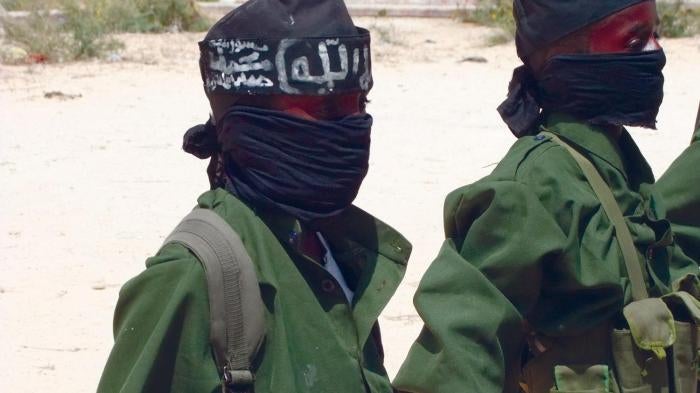
No Place for Children
Child Recruitment, Forced Marriage, and Attacks on Schools in Somalia
Summary
I was with al-Shabaab for three months in 2010…. They wanted to train us to fight and I was afraid. I didn’t want to kill people. I wanted to go back to school and learn.
—Amare A. (not his real name), 10-year-old boy from Mogadishu, living in Kenya, June 2, 2011
Children in war-torn Somalia face horrific abuses, including forced recruitment as soldiers, forced marriage and rape, and attacks on their schools by the parties to the conflict. Those responsible are never held to account.
Children, defined as anyone under age 18, have suffered disproportionately from the ongoing conflict. Fighting between the Transitional Federal Government (TFG), the African Union Mission in Somalia (AMISOM), and TFG-aligned militias on one hand and al-Shabaab, the Islamist armed group that now controls much of the country, on the other, intensified in the capital, Mogadishu, and other parts of south-central Somalia in mid-2010 and early 2011. In October 2011 the conflict in the southern regions escalated further with the incursion of Kenyan armed forces against al-Shabaab, followed shortly after by the arrival of Ethiopian forces.
Children are often the main victims of the indiscriminate artillery and small arms fire that has long characterized the fighting in Mogadishu. They are also the most affected by the ongoing humanitarian crisis, which is underpinned by a UN-declared famine through the south-central region of Somalia as well as the ongoing conflict between al Shabaab and the TFG.
This report documents al-Shabaab’s targeting of children for recruitment as soldiers, forced marriage, and rape, with a focus on abuses in 2010 and 2011. In addition, it documents how the group has targeted students, teachers, and school buildings for attack. Al-Shabaab fighters have also used schools as firing positions, and the students inside as “human shields,” placing children at risk of injury or death from indiscriminate or disproportionate return fire from TFG or AMISOM forces.
Children have served within TFG forces and TFG-aligned militias, although Human Rights Watch has not been able to independently confirm how widespread children’s participation is.
For this report, Human Rights Watch interviewed 164 newly arrived Somali refugees in the Dadaab refugee camps and in Nairobi in May and June 2011. Interviewees included more than 81 girls and boys who were under age 18 at the time. Human Rights Watch also interviewed TFG officials, officials of United Nations (UN) agencies and the African Union, members of nongovernmental organizations, and members of the diplomatic community.
While the presence of children in fighting forces in the 21-year-long Somali conflict is not a new phenomenon, there has been an unprecedented upsurge of al-Shabaab forced recruitment of children since mid-2010; attacks on students, teachers, and schools have also been prevalent in the last two years.
Although al-Shaabab has long relied on spreading extremist propaganda and material rewards to coerce children to join, since mid-2010 it has increasingly recruited children forcibly to replenish its dwindling ranks.
Children have nowhere to hide. Al-Shabaab has abducted them wherever they congregate: schools, playgrounds, football fields, and homes. Schools in particular have been attractive targets—14 of the 21 child escapees from al-Shabaab whom Human Rights Watch interviewed were taken from schools or on their way to school.
Life for children in al-Shabaab training camps is harsh: boys undergo grueling physical combat training, weapons training, and religious and political teaching during which some describe being forced to watch videos of suicide bombings. Boys also described witnessing brutal physical punishments and executions of those accused of spying for the TFG, and those attempting to escape or merely failing to obey orders.
Al-Shabaab militants send children to the front lines, often with little training. Several witnesses spoke of children serving effectively as “human shields” for more experienced fighters during some of the most intense fighting in Mogadishu. Others, including children too young to carry military weapons, were aggressively coerced and threatened into serving as suicide bombers. Besides participating in active combat, al-Shabaab uses children in a multitude of support roles, including carrying ammunition, water, milk, and food to the front lines; removing the wounded and killed; and working as spies, guards, and porters.
Abducted girls are assigned cooking, cleaning, and other domestic duties in the camps. Al-Shabaab uses girls and young women not only for support for combat operations, but also for rape and forced marriage to fighters.
Children, their families, and their teachers who try to prevent recruitment and abduction or who attempt to escape face severe consequences. Al-Shabaab has killed or injured parents who intervened to protect their children although, on occasion, parents and community leaders have successfully negotiated the release of abducted children with local al-Shabaab leaders.
When children “defect” or escape from al-Shabaab into the hands of the TFG or AMISOM, or are captured on the battlefield, they face interrogation by the TFG security services, detention, and an uncertain future instead of being protected as children.
While the available information suggests that the TFG itself does not forcibly recruit children, children have found their way into its ranks, often by volunteering for TFG forces or those of aligned militias, manning checkpoints, and taking part in combat.
The TFG has to date failed to ensure that stringent and systematic age screening procedures and standards are in place to screen all its recruits and forces. Recruits who have not attended a training funded by the European Union (EU) in Uganda and have been directly recruited from militias are particularly likely to escape screening. Human Rights Watch is not aware of any member of the TFG forces being held to account for the recruitment and use of children.
Schools have featured heavily in al-Shabaab’s combat operations as well as its efforts to control Somalis’ everyday lives. Many Somali children are no longer in or have never been to school. Somalia has one of the lowest rates of enrollment in the world; however, children and young people who have persisted in attending school have found themselves, their teachers, and their school buildings intentionally targeted for attack by al-Shabaab.
Al-Shabaab forces have turned schools into battlegrounds, firing at TFG and AMISOM forces from functioning school buildings and compounds, deliberately placing students and teachers in harm’s way from often indiscriminate return fire by TFG and AMISOM forces. Al-Shabaab has in some cases bombed school buildings, killing students, teachers, and bystanders. The group has used schools to recruit students as fighters and to abduct girls and young women for rape and forced marriage.
Al-Shabaab has imposed their harsh interpretation of Islam on schools in areas that they control, prohibiting English, the sciences, and other subjects deemed improper, and enforcing severe restrictions on girls’ dress and interactions with male students. They have threatened and even killed teachers who resist their methods, lectured students on jihad and war as a recruitment tool, and placed their own teachers in schools. Lessons have been left devoid of substance, teachers have fled, and, where schools have not shut down entirely, children, deprived of any meaningful education and afraid for their safety, have dropped out in large numbers. Girls have dropped out disproportionately.
There remains no accountability in Somalia for violations of international human rights and humanitarian law. The TFG and AMISOM have not taken action against commanders responsible for laws-of-war violations or the conscription of children. Al-Shabaab has to date been impervious to all calls to end human rights abuses. Governments supporting the TFG and AMISOM have largely failed to recognize that al-Shabaab atrocities are counterproductive and no excuse for abuses by the Somali government.
The TFG initially denied the presence of children within its forces but has more recently publicly acknowledged the need for action to be taken to end their presence and use. In November 2011 the TFG reiterated a commitment to enter into a formal UN action plan to end its use of child soldiers. To date this commitment has not translated into necessary changes and concrete measures on the ground, notably ensuring stringent and systematic screening of all TFG recruits to prevent child recruitment and holding accountable those responsible for the recruitment and use of children in its forces. For the planned integration of militia groups into the TFG forces, effective vetting measures are essential.
The TFG has come under too little pressure to improve its record on children’s rights, or human rights more generally, by key international actors who, by offering political and financial support to Somalia, are in a position to demandprogress. These include the UN, the United States (US), and the EU. The “Roadmap” signed in September 2011 under the auspices of the UN Political Office for Somalia (UNPOS), which is seen by international partners of the TFG as the main instrument through which to hold the TFG to account, vaguely refers to ending recruitment of children but fails to include clear benchmarks that would enable monitoring compliance. While the UN and US have recently called on the TFG to end the use and recruitment of children, to date they have not sought to condition support to TFG forces on this basis.
There is no easy solution to the dire reality facing Somali children, many of whom have known nothing but war. But parties to the conflict and other key actors involved in Somalia should begin to prioritize the issue of children’s rights, child protection, and education on the political and security agenda. The risks of continuing to fail to protect and provide safe and accessible education to Somalia’s children will result in yet another generation lost to conflict, with few options for the future.
Human Rights Watch urges all warring parties in Somalia to immediately end violations of the laws of war, in particular indiscriminate attacks against civilians. On children specifically, we call upon al-Shabaab, the TFG, and TFG-aligned militias to end the recruitment and use of children within their ranks. Al-Shabaab should publicly order its commanders to end the recruitment and use of children, and immediately hand over children within its forces to a civilian protection body, cooperating with the United Nations Children’s Fund (UNICEF) and child protection actors to ensure their safe release. It should also immediately end targeted attacks on students, teachers, and schools.
The TFG with international assistance should immediately ensure that stringent and systematic age screening procedures and standards are put in place for all its recruits. It should also hold to account those responsible for violations of child’s rights, including the recruitment and use of children and unlawful attacks on schools. It should also ensure that captured children alleged to have been formerly associated with al-Shabaab are promptly transferred to civilian rehabilitation and reintegration programs. Children should not be detained solely for their association with armed opposition groups.
International partners of the TFG should press the TFG to fulfill its commitments to develop and implement a national action plan to end the recruitment and use of children during the remaining transitional period. And they should impose concrete consequences on the TFG for failing to do so. The TFG’s partners, notably the US, should also ensure that the TFG meets international standards regarding the treatment of children formerly associated with al-Shabaab.
Monitoring and reporting on human rights violations, notably violations of children’s rights, should be reinforced. To this end, donors should politically support and fund the Office of the High Commissioner for Human Rights (OHCHR) to reinforce its capacity to carry out its human rights monitoring and reporting mandate on Somalia and appoint a child rights expert within the OHCHR Somalia structure. The UN Security Council should enhance the capacity of the UN Monitoring Group on Somalia and Eritrea to enable it to fulfill its extended human rights mandate.
AMISOM and the TFG should, where feasible, map key civilian infrastructure, including schools, and use this map to identify and protect schools in areas of AMISOM and TFG military operations.
International support for child protection activities, including the provision of medical and psycho-social support for survivors of sexual violence, education, and vocational training activities should be significantly increased both inside Somalia and in refugee receiving countries, namely Kenya and Ethiopia.
Finally, addressing the human rights crisis that underpins the conflict in Somalia also means tackling longstanding impunity. The TFG and its international partners should call for the establishment of a UN Commission of Inquiry—or a comparable, appropriate mechanism—by the UN to document serious international crimes committed in Somalia and recommend measures to improve accountability.
Key Recommendations
To the Transitional Federal Government of Somalia, and Transitional Federal Institutions
- End all recruitment and use of children under age 18 by TFG forces and aligned militias by developing and adopting a national action plan that establishes rigorous and systematic screening procedures, and by holding to account anyone found to be conscripting or using children, consistent with widely accepted international standards.
- Develop procedures to transfer captured children promptly to civilian rehabilitation and reintegration programs. Children should not be detained solely for their association with armed forces and groups.
- Map key civilian infrastructure, including schools, with the assistance of relevant agencies including the Education Cluster. Use this map to identify and protect schools in areas of TFG military operations.
- Ensure that all credible allegations of violations of international human rights and humanitarian law by TFG forces and aligned armed groups are promptly, impartially, and transparently investigated, and that those responsible for serious abuses, regardless of rank, are held to account.
To al-Shabaab
- Immediately cease recruitment of children under 18 years old and release all children currently in al-Shabaab forces who are under 18.
- Immediately end the abduction of girls and women, and release all girls and women abducted for forced marriage or other purposes.
- Ensure that schools are identified and protected and that students, teachers, and school administrators are able to safely leave school buildings during military operations where they may be at risk.
To Foreign Parties to the Conflict: AMISOM and the African Union, Kenya, and Ethiopia
- Map out key civilian infrastructure, including schools, with the assistance of relevant agencies, including the Education Cluster, in order to ensure that schools in areas of military operations are identified and protected.
To All States and the Donor Community in Somalia
- Provide the TFG with the necessary support and capacity to systematically and effectively screen all its recruits by age in order to prevent the recruitment and use of children within its forces.
- Ensure that trainings provided to the TFG forces and personnel include appropriate training in international humanitarian law, including the protection of civilians and civilian objects and protection of children’s rights.
- Support and fund an increase in the capacity of the Office of the High Commissioner for Human Rights (OHCHR) to monitor rights violations.
To the UN Security Council and the UN Human Rights Council
- Intensify pressure on the TFG to immediately adopt and promptly implement a time-bound UN action plan to end the recruitment and use of children, one that includes screening procedures to ensure that children are not recruited into the TFG or included in aligned militias that are integrated into the TFG armed forces.
To the United Nations Children’s Fund (UNICEF) and Other Child Protection Agencies in Somalia and Kenya
- Greatly expand demobilization, rehabilitation, and reintegration programs for children formerly associated with fighting forces and children recruited for forced marriage.
Methodology
This report documents violations of international human rights and humanitarian law affecting children by all parties to the conflict in south-central Somalia in 2010 and 2011. Violations include the recruitment and use of children by the parties to the conflict, rape and forced marriage of children, and attacks on education, namely the targeting of students, teachers, and schools. While children are among the most vulnerable groups of conflict-affected populations, for both protection and health reasons, throughout 2010 and 2011 increasing anecdotal reports that children were being specifically targeted began to emerge from those fleeing the fighting in Somalia.
This report is based in large part on interviews with Somali refugees in Kenya. In May and June 2011, three Human Rights Watch researchers interviewed more than 164 Somali refugees in the Dadaab refugee camps and in Nairobi. Interviewees included more than 81 boys and girls and who were under age 18 at the time. We also interviewed young adults who had experienced abuses in 2010 and 2011 while under age 18 or who had recently studied in primary and secondary classes as over-age students and had information about abuses against children in schools during this period, as well as parents of child victims, and teachers. Many of those interviewed arrived in Kenya from Somalia’s capital, Mogadishu, in mid-2010 or later when fighting became particularly intense. Two Human Rights Watch researchers previously interviewed 82 Somali refugees—men, women, and children—in November 2010 following al-Shabaab’s “Ramadan offensive” of 2010.
Relying primarily on the accounts of individuals who were able to flee Somalia made it easier for them to speak more freely but also skewed the reporting towards people of certain backgrounds and from certain geographic areas. For example, despite secondary reports of significant recruitment of children by al-Shabaab in the Bay and Bakool areas, many of the children interviewed were from Mogadishu and had more often than not been able to draw on some sort of family or clan support in Mogadishu to assist their flight.
Human Rights Watch also carried out interviews between August 2011 and January 2012 documenting abuses against IDPs in Mogadishu.
For security reasons, Human Rights Watch was not able to visit any of the camps and detention facilities in Mogadishu where the TFG has been holding children formerly associated with its own forces or with al-Shabaab.
Refugees and asylum seekers identified as recent arrivals to Kenya participated in voluntary, open-ended interviews. Interviewees were asked to relate events that they personally experienced or witnessed. Interviews with refugees were conducted in Somali with the assistance of interpreters. All of the interviews were conducted on a one-on-one basis, unless otherwise indicated in the footnotes. The names of interviewees and all victims of abuses have been changed and the exact location of interviews omitted for security reasons. Many requested anonymity, indicating their deep and persistent fear of al-Shabaab and others, even within Kenya. Other identifying details of the interviewees have, in some cases, also been withheld to preserve anonymity. Given the lack of birth registration in Somalia and the fact children and young adults are not always aware of their age, Human Rights Watch researchers asked a range of questions to seek to confirm the age of the interviewees and asked parents when they were available.
Human Rights Watch also spoke in person and by phone with TFG officials; officials of UN agencies and the African Union; members of Somali and international nongovernmental organizations working on human rights, child protection, and education; and members of the diplomatic community. These interviews were conducted through December 2011, in order to ensure the most up-to-date information prior to publication.
In this report “child” and “children” are used to refer to anyone under the age of 18, consistent with usage under international law.
I. Background
Civilians, including children, have borne the brunt of the ongoing civil armed conflict in Somalia. Children have suffered both from the conflict generally and because they have been specifically targeted for recruitment, rape, forced marriage, and other grave violations of international law by the parties to the conflict. In addition, Somalia currently faces one of the world’s worst humanitarian crises as a result of ongoing fighting, drought, and the blocking of humanitarian assistance by al-Shabaab forces. From July 2011 to February 2012, famine was declared by the UN in six regions of south-central Somalia, a number later reduced to three. As statistics demonstrate, children are most affected by famine.
Brief Summary of Somalia’s Conflict
The current armed conflict in Somalia began with the fall of the Siad Barre regime in 1991 and intensified following the overthrow of the Islamic Courts Union (ICU), which was an alliance of sharia courts that aligned itself to rival the administration of Somalia’s Transitional Federal Government (TFG) in December 2006. The ICU gained control of Mogadishu and other parts of south-central Somalia in mid-2006 and brought a temporary semblance of stability to Mogadishu but was seen as a security threat by Ethiopia, which subsequently intervened militarily, driving out the ICU in late 2008.[1]
For two years following the Ethiopian intervention in December 2006, Ethiopia and the weak TFG of Somalia (set up in 2004)[2] were involved in intense fighting against Islamist armed groups, including al-Shabaab.[3] The fighting focused on Mogadishu, where Ethiopian forces with TFG support were responsible for frequent indiscriminate artillery attacks causing high civilian casualties in violation of the laws of war. These forces and Islamist armed groups were also responsible for unnecessarily placing civilians at risk, unlawful killings, rape, torture, and looting.[4] None of the warring parties made any effort to hold those responsible for war crimes to account. Nor did the international backers of the TFG and Ethiopian forces, namely the US, the UN, and the EU, acknowledge the level of abuses or take action to end them.
In January 2009 the Ethiopian armed forces withdrew following the UN-led Djibouti peace agreement.[5] This agreement also yielded a new and expanded Somali administration and led to the election of Sheikh Sharif Sheikh Ahmed, the former head of the ICU, as the new TFG president.
Many ordinary Somalis were optimistic that the conflict and massive rights abuses that had become part of their daily lives would end with the Ethiopian withdrawal. However, within months they once again faced open warfare, this time between the TFG, now backed by the African Union Mission in Somalia (AMISOM), and Islamist armed groups, including the increasingly powerful al-Shabaab. This fighting was once again characterized by indiscriminate attacks and abuses committed with complete impunity. While mandated by the UN Security Council to protect TFG institutions, AMISOM increasingly became seen as a party to the conflict, as they began to actively engage in running battles with al-Shabaab fighters.
Fighting intensified in May 2010 with laws-of-war violations being committed by all warring parties.[6] During the Islamic holy month of Ramadan in August and September 2010, al-Shabaab called for a final offensive to topple the TFG, and fighting escalated. In response, in September the TFG launched an offensive, with AMISOM’s support, to reclaim areas of Mogadishu under al-Shabaab control. Serious violations of the laws of war were committed by both sides during these offensives, including the indiscriminate shelling of civilian areas and infrastructure with rocket and mortar fire that resulted in high civilian casualties and the displacement of tens of thousands of people.[7]
Between February and April 2011 the TFG, again supported by AMISOM, launched a series of offensives in Mogadishu and further afield against al-Shabaab forces,[8] capturing several parts of the capital. The TFG and pro-TFG militias, including Ahlu Sunna Wal Jama’a (ASWJ) and Raskamboni, primarily supported by Ethiopia and Kenya respectively, also gained control of small areas in the Gedo and Lower Juba region, along Somalia’s Kenyan and Ethiopian borders.
In August 2011 the TFG and AMISOM launched a new offensive against al-Shabaab in Mogadishu, reportedly to preempt another possible Ramadan offensive. On August 6, al-Shaabab declared that it was pulling out its forces from Mogadishu. On October 16, Kenyan military forces entered border areas in Somalia and indiscriminately bombed several towns in which al-Shabaab forces were allegedly deployed. Despite its withdrawal from Mogadishu, at the time of writing, al-Shabaab continues to control more of southern Somalia’s territory than any other faction and retains the ability to carry out attacks in Mogadishu.
The ability of the TFG to stabilize zones that have come under the government’s control has been hampered by the longstanding political crisis between President Sheikh Sharif and the speaker of the parliament, Sharif Hassan Sheikh Aden, who has presidential ambitions.
In June 2011 the TFG extended its mandate and the transitional period, scheduled to end in August 2011, for another year. The “Kampala Accord,” signed on June 9, 2011, by President Sheikh Sharif and Speaker Sharif Hassan, called for the resignation of the popular prime minister, Mohammed Abdullahi Mohammed, and postponed elections to 2012. It also called for the development of a “roadmap” with clear benchmarks to guide the implementation of priority transitional tasks: the constitution, a security and stabilization plan, and reconciliation and anti-corruption efforts.
Major Parties to the Conflict
The following is an overview of the major parties to the armed conflict in Somalia as of late 2011.[9]
Transitional Federal Government (TFG)
Somalia’s Transitional Federal Government (TFG), set-up in 2004, is recognized by the UN and almost all key foreign governments (with the notable exception of Eritrea) as the legitimate government of Somalia. Until 2011, it controlled only a small section of southern Mogadishu, but extended its control over several areas of the city in the course of 2011. The embattled TFG depends on the African Union Mission in Somalia (AMISOM) for its survival and security, and on donor funds. It has proved unable to assert political control, build key government sectors, or provide the essential services that would build its credibility. Infighting between different factions and components of the Transitional Federal Institutions (TFIs), of which the TFG is a component, has significantly hampered political developments.
Al-Shabaab
Al-Shabaab is a militant Islamist group that began as part of the armed wing of the Islamic Courts Union (ICU) when the courts rose to power in Mogadishu in 2006. Al-Shabaab is not a monolithic entity but rather an alliance of factions that initially rallied under its banner with the aim of forcing the Ethiopian troops to leave Somalia. These groups retain a limited common agenda of defeating AMISOM and the TFG and extending its extreme interpretation of Sharia (Islamic law) across Somalia. Al-Shabaab currently controls more territory in southern Somalia than any other faction and became the largest armed insurgent group in December 2010 following its merger with Hizbul Islam, another Islamist armed group led by former ICU member Hassan Dahir Aweys. Al-Shabaab withdrew from Mogadishu in August 2011 but continues to carry out attacks in the war-torn capital.
Ahlu Sunna Wal Jama’a
Ahlu Sunna Wal Jama’a (ASWJ) is a moderate Sufi Islamist group that has on paper been officially affiliated with the TFG since March 2010. The group exists primarily in central Somalia, where it has managed to maintain control over large swathes of territory, predominantly in Galgadud and Hiraan regions of central Somalia. It has more recently captured small areas of territory in the Gedo region along the Ethiopian border from al-Shabaab. It receives financial and military support from Ethiopia.
African Union Mission in Somalia (AMISOM)
Initially deployed to Mogadishu in 2007, AMISOM is mandated by the African Union Peace and Security Council and the UN Security Council to provide protection to the Somali transitional institutions, including the TFG and Parliament. However, since 2009, and especially since coming under attack from al-Shabaab, it has increasingly taken part in the conflict.[10] AMISOM has as yet not approached its authorized troop strength of 12,000; its current contingent at least 10,000 Burundian, Ugandan, and more recently Djiboutian forces.[11]
Drought, Famine, and al-Shabaab’s Restrictions on Humanitarian Access
Compounding the dire effect of ongoing fighting on civilians is unrelenting drought, famine, al-Shabaab’s severe restrictions on humanitarian aid and ongoing diversion of aid in TFG-controlled areas.
Severe drought in south-central Somalia worsened from October 2010 onwards. By August 2011, the UN had declared six regions—primarily in southern Somalia—to be in a state of famine. An estimated four million people, more than half of the Somali population, were in crisis as of that month, around three million of whom were in the south in predominantly al-Shabaab-controlled areas.[12] As of January 2012, according to the UN, four million Somalis remain in need of humanitarian assistance.[13] The Somali population of internally displaced persons and refugees—already one of the largest in the world—has further escalated: one-quarter of Somalia’s estimated population of 7.5 million was either internally displaced or lived outside the country as refugees as of December 2011.[14]
Aid agencies have been limited not only by conflict and insecurity but also by al-Shabaab, which has restricted some agencies’ work. The group has imposed a ban on over a dozen individual agencies since 2009, placed significant financial and logistical burdens on organizations that are working in areas under their control, and threatened and attacked humanitarian workers. In early July 2011 al-Shabaab declared that it was lifting the ban it had imposed on certain foreign aid agencies in areas under its control as long as the distribution of aid was their only objective.[15] But the ban has yet to be lifted and by November al-Shabaab had proclaimed a fresh ban on 16 aid organizations, including UN agencies.[16] Al-Shabaab also continues to severely restrict the freedom of movement of those seeking access to humanitarian assistance in areas under its control.
Access to humanitarian assistance in areas under TFG control has also been hampered by diversion and looting of humanitarian aid.[17] Media reports in August 2011 suggested that food aid diversion in Mogadishu was occurring on a large scale.[18]
Counterterrorism legislation, and most notably the US Office of Foreign Assets Control (OFAC) sanctions that seek to prevent support reaching designated terrorist organizations, have also negatively impacted humanitarian operations in Somalia, resulting both in a significant decrease in US funding of humanitarian organizations since 2008 and the imposition of burdensome measures on those receiving US support. [19]
Children in the Somali Conflict
Children continue to be killed or maimed as a result of indiscriminate shelling, gunfire, widespread insecurity, and the targeting of schools. The International Committee of the Red Cross (ICRC) reported that in 2010, 43 percent of patients admitted to the two main referral hospitals in Mogadishu with war-related injuries were women and children.[20]
The difficulties that humanitarian agencies face trying to access south-central Somalia further aggravates the situation of children, who are particularly vulnerable to food insecurity and disease. Severe acute malnutrition rates among children doubled between March and July 2011.[21] By August the number of children suffering from acute malnutrition was estimated to be in the hundreds of thousands.[22] Half of the tens of thousands of individuals who have died as a result of the famine are reported to be children.[23]
The destruction of livelihoods, traditional protection structures, and separation or destruction of families as a result of the length of the conflict, the humanitarian crisis, the number of civilian casualties, and repeated displacement of a significant proportion of the population has left children particularly vulnerable. The numbers of abandoned, orphaned, or separated children and children living and working in the streets has skyrocketed over the course of the last four years. While child labor has long been a part of Somali culture, children are now often the sole source of income to their families or siblings.
Children are also among the most vulnerable groups of internally displaced persons and refugees for both protection and health reasons. The number of unaccompanied minors and child-headed households among the displaced person and refugee population has increased over the course of the conflict, particularly since 2007. [24]
Children’s Access to Education in Somalia
Children’s right to education in Somalia is severely restricted.[25] According to UNICEF, Somalia has one of the lowest rates of school enrollment in the world, with a net primary school enrollment rate of around 23 percent in 2010.[26] Disparity between levels of enrollment between girls and boys even at the lower levels of primary school is alarming: according to the latest available data, the gross primary enrollment ratio was only 23 percent of girls, compared with 42 percent of boys.[27] Enrollment in secondary schools is minimal: gross secondary enrollment was only 11 percent for boys and 5 percent for girls in the late 2000s.[28] School dropout rates reportedly reached 50 percent following the Ramadan offensive in 2010 and 38 percent in the first four months of 2011.[29]
There are only five government-run schools in all of south-central Somalia, all located in Mogadishu. Other schools are financed primarily by parents, communities, or private individuals either in Somalia or in the diaspora, or by national or international donor and development organizations. While the total number of schools in south-central Somalia is unknown, agencies involved in the Education Cluster—the UNICEF- and Save the Children-led entity that coordinates organizations and agencies working in the education sector—funds 4,822 schools in these regions.[30] Secondary schools are scarce and found mainly in Mogadishu.
While not clearly standardized, there are generally four categories of schools in Somalia: primary and secondary schools employing Arabic, Somali, or Kenyan curriculum, as well as non-formal duqsi (Quranic schools). There is no unified national curriculum.
Despite the dire situation of the education system in south-central Somalia, the sector remains inadequately funded. As of November 2011, of the US$29 million requested under the Consolidated Appeals Process (CAP) for the education sector, only $18 million—62 percent—had been funded, in large part via UNICEF funding.[31] It is within this already terribly restricted environment that children are struggling to go to school.
II. Recruitment and Use of Children as Soldiers
The recruitment and use of children in the Somali civil war is not a new phenomenon: children have been used throughout the conflict by clan and warlord militias for the defense of the home and the clan. However, the level of recruitment and involvement of children in the conflict has substantially increased since early 2007 when recruitment became more widespread and targeted.[32] All the current Somali parties to the conflict in Somalia—including the TFG forces, al-Shabaab, Hizbul Islam, and Ahlu Sunna Wal Jama’a—have recruited or used children for military service.
Human Rights Watch interviews with Somalis who have fled Somalia since early 2010 indicate that forced recruitment and abductions have intensified in line with an upsurge in fighting. A significant proportion of children interviewed said they were forcibly taken from their schools, though many others recounted being abducted from playgrounds, football (soccer) fields, markets, and homes, primarily by al-Shabaab militants. Girls and boys have both been targeted, with girls taken primarily for domestic duties and boys taken to be trained for combat or other work on the front lines. The ever-present reality of forced recruitment and abduction has caused children to leave school, often fleeing the country with their families.
Children are afforded multiple special protections under the international human rights and humanitarian law framework.[33] All parties to the conflict in Somalia have an obligation to afford special protection to children and to ensure that children do not take part in hostilities.[34]
Human Rights Watch spoke with 19 boys and 4 girls who had been recruited by armed groups, and almost 50 parents, relatives, and others who were witnesses to child recruitment. With one or two exceptions, all of the recruited boys and girls with whom Human Rights Watch spoke said they had been recruited by al-Shabaab. Our research also found that children continue to be associated with the TFG and TFG-aligned militias, largely as a result of a lack of stringent age screening procedures.
Al-Shabaab
I tried to refuse but I couldn’t. I just had to go with them [al-Shabaab]. If you refuse, maybe sometimes they come and kill you or harm you, so I just went with them. One of my friends who was older than me, they came and started with him the same as they did to me and he refused, and they left him but another day they found him on the street and shot him.
—14-year-old boy, Kenya, May 29, 2011
Former child recruits and child and adult witnesses described to Human Rights Watch how al-Shabaab forces took children to their training camps throughout 2010 and 2011. Most of the children were reportedly between ages 15 and 18 but some were as young as 10 years old. From the camps they were sent to the front lines or forced to act as porters, spies, and suicide bombers. Children have been injured, maimed, and killed.
Al-Shabaab’s recruitment of children has been widely reported.[35] Forced recruitment of children became common practice in 2009, but by April 2010 anecdotal reports indicated that child recruitment increased significantly and has shown no signs of reducing. While exact numbers of children recruited by al-Shabaab is unknown, in April 2011 a report from the UN secretary-general cited military sources stating that al-Shabaab abducted an estimated 2,000 children for military training in 2010.[36]
Fourteen of the twenty-three children whom Human Rights Watch interviewed who were recruited said that al-Shabaab recruited them from school or while they were traveling to and from school. The other children recruited by al-Shabaab said that al-Shabaab took them from parks and playing fields, or even in their own homes. For example, Galaal Y., a 14-year-old boy from Hamar Weyne district in Mogadishu, described how in December 2010 two of his primary school classmates lured him to a field to play football where he was ultimately taken by al-Shabaab and forced to become a fighter:
Two of my classmates, who I later realized were working with al-Shabaab, ages 16 and 18, had written our names down on a list to form a football team. The next day we went along to a field to play, thinking that another team would come along, but when we arrived at the field, al-Shabaab arrived instead. They came in a vehicle and were wearing khamis and headscarves.[37] They were armed with AK-47’s [military assault rifles] and told us that playing football was not helpful and they would turn us into jihadis [Islamic fighters]. They took 16 of us between the ages of 10 and 16.[38]
Children said that al-Shabaab regularly uses children as intelligence gatherers or intermediaries to identify other children of fighting age, and then uses these children to pressure or force their peers to join al-Shabaab. A 16-year-old boy from Mogadishu told Human Rights Watch how he was approached and forced to join al-Shabaab in the mosque while attending evening prayers:
I was a student and al-Shabaab forced me to fight against the TFG…. They came to the mosque when we went for prayers. They pretend they are an imam [preacher] and use Islamic teaching to try and make you join. If you refuse to join they will kill you.
The guy who spoke to me had staff all around him. They were merged into the crowd of the mosque. He spoke to me directly. They were approaching everyone, even teenagers…. He used the words of the Quran and said the government was not concerned with religion.
They tell you to join, and if not, the boys around him (the ones in the crowd) who were 13 and 14 years old will come and kill you. They had guns with them and a grenade attached to the side of their pants.[39]
Despite some territorial gains by TFG and AMSIOM forces in late 2010 and early 2011 in Mogadishu, as of July 2011 al-Shabaab still controlled eight of the sixteen districts of the capital.[40] In al-Shabaab-controlled areas, there was virtually nowhere that children could be assured of their safety. While families sought shelter in their homes during periods of intense fighting between al-Shabaab and AMISOM forces, homes offered no protection from the ongoing forced recruitments by al-Shabaab.[41] Children told Human Rights Watch how al-Shabaab approached homes where families were known to have boys considered old enough to fight and demanded that families hand them over to join their forces.
Several children told Human Rights Watch that they were recruited by their own family members—fathers, brothers, and cousins—who had joined al-Shabaab. A mother described how her husband took their 10-year-old son to battle:
My husband was in al-Shabaab. He came and said to my eldest son [who was 10 years old], “You must also join.” He overpowered me and took my son. Later I heard my son died in the war. I went to where my husband was, Horera mosque, and I said, “I heard my son died.” He said, “I am pleased to inform you that our son died a martyr. He went straight to paradise.” He showed me footage he took of my son being killed in the war. His blood. His body. I cried.[42]
While almost all of the 23 children interviewed by Human Rights Watch were forcibly recruited, there were also reports of some children who joined al-Shabaab “voluntarily,” particularly after intensive campaigns of recruitment. The very notion of voluntariness of any child’s decision, particularly in a context of extreme poverty, hunger, and al-Shabaab’s well-known violence against those who refuse, to join an armed group is questionable.[43]
Al-Shabaab has put various forms of pressure on children to join their forces. Children spoke of multiple tactics to entice them to join, including offering cash and mobile phones and forcing children to study religious propaganda as part of their schooling. Baashi M. described how his 12-year-old brother joined al-Shabaab:
They gave him $100 and convinced him at school that if he became a martyr he would go to paradise. They also bought him clothes. He never told my parents he was going, he just disappeared. He wanted to be a driver and al-Shabaab said they would send him to driving school.[44]
Other children were offered cash incentives to recruit other children, as one 15-year-old witness recounted:
Many of my friends were given incentives—money to enroll others. Depending on how many you enroll you would be given more or less money. Many boys enrolled. If you refused to enroll you were forced to.[45]
A teacher explained how effective these incentives are: “80 percent [of my students] are so poor. They have no money so when they give them money they will join…. A whole generation—95 percent—they join the armed groups because of hunger. There is nowhere to go, just to get a gun and fight. Daily they get money. If they don’t join, they don’t get food.”[46]
Several children told Human Rights Watch that al-Shabaab brought their members into schools to teach subjects such as “jihad,” where children were lectured on their duty to join the jihad and promises of “entry into paradise” if a child died as a martyr. The classes, which ranged from daily to weekly classes, were also used as a way for al-Shabaab to gain entry into the school and recruit children. Children described being lectured on the virtues of jihad, shown Islamist propaganda videos, and given weapons demonstrations. Sometimes these methods convinced girls and boys to join. One young woman said that about 15 of her 40 to 45 classmates—5 girls and 10 boys—decided to join after a jihad class.[47] Other children also described a mix of propaganda and force that led them and their classmates to join. For example, Iskinder P., age 15, said he decided to join both because he was “being forced” and “because the majority of my teachers were al-Shabaab and they used to lecture us and tell us ‘Al-Shabaab is good, let’s defend our country. These are foreigners who are fighting our country.’”[48]
Baashi M., a 27-year-old student who was attending the Juba Primary School in the southern port city of Kismayo, described how al-Shabaab would come into the school and use the classes as a precursor to forcibly taking students to fight:
Al-Shabaab used to come to my school often, sometimes they would come two to three times a day. They came and picked up kids between 12 and 20 years old and would take them to a building in the school and play DVDs of jihadis on the battlefield on a laptop. They would also preach about religion. They took me there in February 2010.[49]
Similarly, an over-age student in primary school from Suuqa Xoola, Mogadishu, said: “Initially they preached ideology, but when they realized that they were not recruiting they decided to recruit forcefully. This is what made me flee.”[50]
Retaliation against Children and Families Who Refuse
Al-Shabaab said to my elder brother, “Come with us.” He refused and they beheaded him. He was 16. They took him and put his head in front of our house.
—Deka R. (not her real name), 13-year-old girl whose brother was killed in El Ashabiya, Somalia, around Ramadan 2010, June 5, 2011
Children repeatedly told Human Rights Watch that they felt powerless to resist recruitment by al-Shabaab. Witnesses spoke of “children who had refused recruitment having their hands cut off” or in some instances beheaded.[51] Knowing that refusal would mean being taken by force or possibly killed, children recounted the fear they felt as al-Shabaab fighters entered their schools and homes and the desperate measures they would take to escape detection. One witness said that at his school, children would “stampede” and “scramble out of windows,” jumping from second and third floor windows and landing on top of each other in desperate bids to escape.[52]
Parents other family members regularly attempt to protect both girls and boys from being recruited by al-Shabaab, according to witnesses. Al-Shabaab has killed and injured relatives, and in some cases school teachers, who get in their way. Human Rights Watch documented half a dozen such cases. In two cases mothers said they personally intervened to prevent their children from being recruited.[53]
One mother told Human Rights Watch how she tried to defend her four youngest children from recruitment. After she pled and physically tried to prevent the children from being taken, her husband, an al-Shabaab member, shot her in the ankle.[54] In another incident, in December 2009, al-Shabaab entered the Shabelle Primary School in Mogadishu and forced parents to sign an agreement allowing their children to join al-Shabaab. An eyewitness told Human Rights Watch:
Two fathers who refused to sign were threatened in the meeting and told they would not survive this. They were shot a day later in the Bakara market with letters pinned on their bodies saying this is what would happen to any parent who refused to allow their children to join al-Shabaab.[55]
Abuses in Training Camps
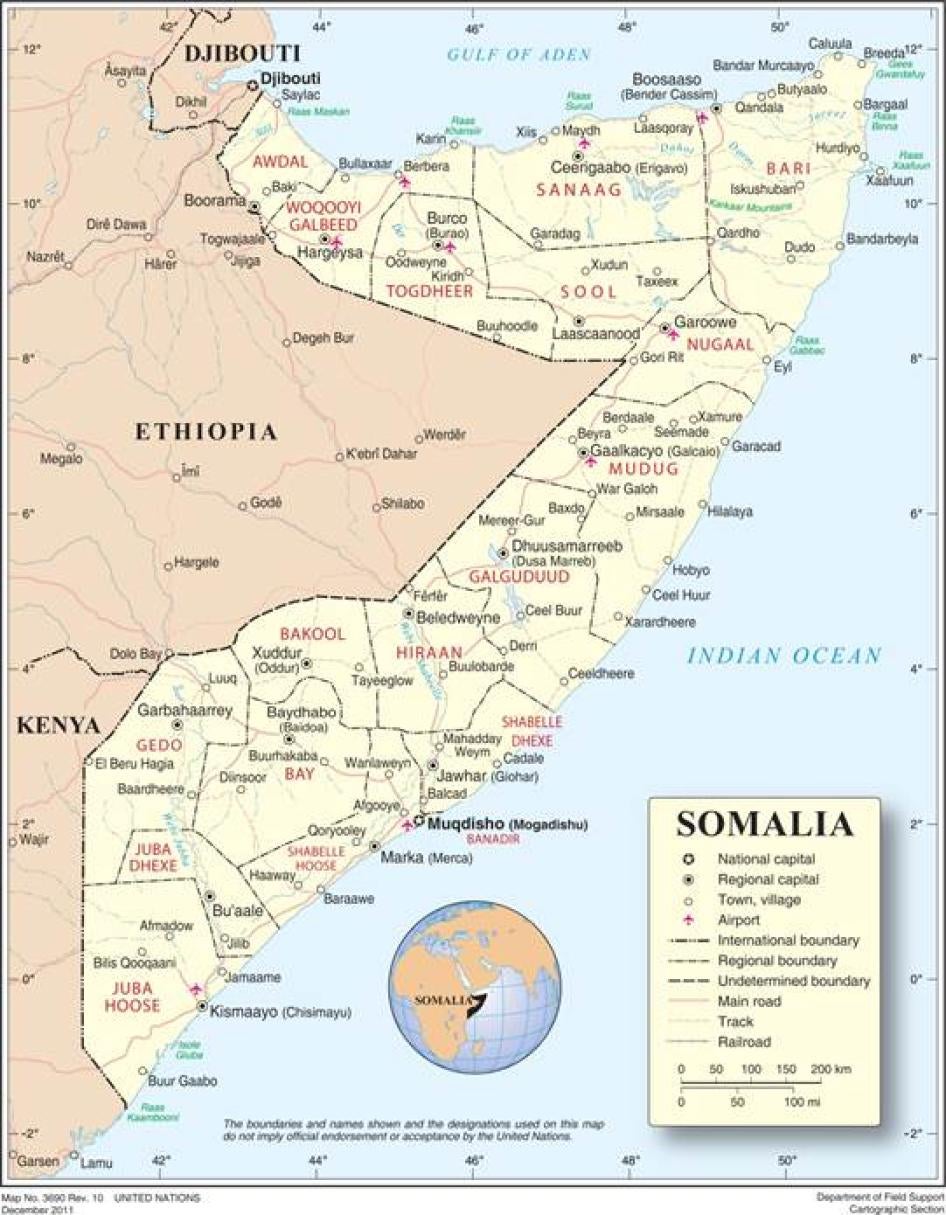
Once recruited, children are typically taken to an al-Shabaab training camp.[56] Almost all of the children Human Rights Watch interviewed whom al-Shabaab had recruited said that they had spent time in a training camp for durations ranging from several weeks to three years before they escaped.[57] In many instances they were unable to give the exact locations, often because they were blindfolded on the way, but most said they were held somewhere around the outskirts of Mogadishu. Others said they were held in and around former government installations in al-Shabaab-controlled areas in the city, surrounding Kismayo, and in and around the southern Shabelle regions.
Camps varied in their descriptions, ranging from physical structures, including former government buildings, where children were detained in cells with minimal food and poor sanitary conditions, to open, camp-like settings with children sleeping on open ground. Omar A., 17, described the training camp on the outskirts of Mogadishu where he was held for two months:
The place looked like the bush, and there were tents and vehicles. There were many people there, maybe 300. There were adults and children but we didn’t speak much to them. Al-Shabaab said, “You will work with us, you will fight, and we will train you.” You can’t say you don’t want to because they force you and they have weapons and if you refuse they will kill you.[58]
A 17-year-old boy who was kept in one such facility told Human Rights Watch:
There was no good food. Sometimes they beat me. I couldn’t see anyone. Sometimes they threatened to slaughter me. They tied my hands and legs. They threatened that if I identified their place and they released me they will get me again and cut me to pieces. Sometimes they took me outside the room and put cold water on my body….. I was in the dark the whole time. I couldn’t see anyone, seated there, no sleep, they come and tell you they’ll slaughter you.[59]
Girls were reportedly brought to some of the camps to clean, cook, and serve food. They were also forced to marry fighters and raped (see below).
The training camps prepared boys to fight. There were consistent reports from inside the camps of children being trained for combat as well as being given a variety of other domestic and logistical tasks. Training, they said, lasted from one week to several months.[60] At minimum, children told us that training included basic physical and light weapons training with AK-47 assault rifles and pistols. The training followed a regular routine. A 13-year-old boy from Mogadishu explained:
In the morning they told us we were going for training. They told us to jump in holes, climb over piles of trees. It was a hectic training and difficult for my age. At times they told us to crawl or roll on the ground or crawl between metal poles without touching them. It was difficult. We had to do push-ups, walk in a funny style. It was so difficult. After two weeks training, they gave us pistols and a card, made us mark it, put it at a distance, and told us to shoot that mark.[61]
Children described harsh physical conditions, including being forced to sleep in the open, given little food to eat, and forced to undertake grueling physical training schedules to prepare them for combat. If children refused, they said they received harsh physical punishments. As one 14-year-old boy told us: “We trained until 1 p.m. They made us to do sit-ups and walk on our knees. I was saying, ‘I am exhausted, I can’t do anymore,’ and they cut me with a big knife. A big knife that you use to slaughter animals.”[62] Another boy showed a four- to five-inch scar on his upper arm he said he had gotten from being whipped, recounting: “On the first day I shot [an AK-47] three or four times but they found me shaking. When they saw me trembling they encouraged me and said, “You are doing this for religion and you must carry it.”[63]
A majority of children interviewed by Human Rights Watch also reported being given religious education that stressed the importance of participating in the jihad. This sometimes included watching video footage of jihadist groups fighting in other countries.[64] The children also said they conducted regular prayer and religious practice.
Punishment and Executions
Anyone found escaping will be killed. Even at night when we were sleeping and in the morning they would cane us. They wouldn’t tell us why, they would just beat us.
—Amare A. (not his real name), 10-year-old boy previously held in an al-Shabaab training camp, Kenya, June 2, 2011
Several children said they witnessed brutal physical punishments and executions at the
camps, sometimes involving other children. The reasons for execution varied from not obeying orders and attempting to escape to accusations of being a TFG spy.
A 16-year-old boy described how he and other children were forced to watch executions of “enemies of al-Shabaab”:
I was made to watch an execution of a group of people who were considered to be al-Shabaab enemies, as they were accused of supporting the TFG or rejecting al-Shabaab. About 20 people were killed that day. I did not see any children being killed. It was the older recruits who were around 25 and up who were made to execute the people.[65]
In another example, an eyewitness said that he and his classmates were taken to a camp from their Mogadishu primary school, and those who refused to participate in training were executed in front of their peers:
Out of the fifteen abducted, five died in training school. The five never agreed to join al-Shabaab and hid. They [al-Shabaab] brought them and paraded them in front of us and shot them. They were 10, 14, 15, 16, and 17 years old.[66]
Children also said they were forced to hand out violent punishments to people found to be breaching al-Shabaab’s rules. Human Rights Watch interviewed seven children who had been forced to take whips and patrol the town looking for businesses that remained open during prayer time, women wearing clothes al-Shabaab deemed inappropriate, or young people listening to music on their telephones. A 15-year-old boy from Middle Juba explained:
I was given two jobs, to whip women and to punish boys who had music on their mobile phones. I would make them swallow the memory card. I made 20 youth swallow the cards and I must have whipped 50 women. I would go with older men backing me up. They were about 30 years old and there were five of them. They would stand with me and force me. I felt bad to whip someone my mother’s age. Other children were given similar jobs.[67]
Some children said they were sent to patrol towns under al-Shabaab control and identify to catch adults and children who had escaped from training camps. Iskinder, age 15, told us:
Some people escaped with vehicles and I had to catch them. We would shoot the vehicles’ tires so they couldn’t move and take them back. We used to identify the people who escaped. I didn’t want to do it but we were forced many times. We were told to go and stand on the street and identify escapees. We used to beat them and take them to jail. I had a cane and a weapon.[68]
Fighting on the Battlefield
Children, mostly boys, said they were sent to the front lines from the training camps, often with minimal training. There, witnesses said, al-Shabaab uses children for a range of activities, from supplying fighters to serving as “human shields” to protect more experienced fighters.
Fighting between al-Shabaab and the TFG and AMISOM intensified in August 2010, during what was referred to as the “Ramadan Offensive 2010.”[69] During this period and the months to follow, al-Shabaab was engaged in sustained clashes with government forces and African Union (AU) troops in Mogadishu.
A witness told Human Rights Watch that children of all ages could be seen on the front lines during these intense periods of fighting.[70] Children too small to carry large firearms, such as AK-47s, were given pistols and smaller weapons, as well as grenades to throw.[71] A 21-year-old fighter described such a scene: “We would fight early in the morning. I saw small kids, maybe 10 or 11 years old, with pistols, and those who could carry got AK-47s, and a lot of kids between 10 and 18 years old were given whips.”[72]
Before going into battle children were often lectured and encouraged to fight to the death. Al-Shabaab continued to use the promise of martyrdom, as was described to Human Rights Watch by 14-year-old Ali F.:
I participated in a fight. They told me that if I died there, I was going to become a martyr. We were lectured for four to five hours on religion and told not be cowards. There were about a hundred of us in the camp and 20 of us were under 18. The youngest was between eight and ten years old. The smaller ones were taught how to use a pistol and how to throw grenades. They also used them as suicide bombers. They said, “If you participate in suicide bombings you will become a martyr.” They said, “A martyr is rewarded by going to paradise.”[73]
Omar A., 18, described what happened when he was sent to the front lines at age 17:
In the camp there were some previous trainees and they took them to fight in battle and only half came back…. They told us, “You will go and fight for two days and then come back to the camp”…. The place was just before [outside of] Mogadishu, just on the outskirts. They gave us automatic weapons [AK-47s]. As we were driving in, the fighting started. They dropped us and started to fight. We could not see them. There were 15 of us and immediately 10 of us were shot. I dropped my gun and I ran. The ones who were shot were 15, 18, and 19 years old. They were all injured. Al-Shabaab leaves the wounded and they leave and they continue fighting.[74]
Media reports also describe children’s bodies being seen on the battlefields.[75]
A number of children explained to Human Rights Watch that they were sent to the front lines with experienced al-Shabaab fighters behind them using the children as a kind of “human shield.”[76]
Abdikarim K., 15, told Human Rights Watch:
Then they took us to fight. It was between al-Shabaab and the TFG. The fighting started at about 5 a.m. All the young children were taken to the first row of the fighting. I was there. We were defeated. Several of the young children there were killed, including several of my classmates. Out of all my classmates—about 100 boys—only two of us escaped, the rest were killed. Other children were also there on the front lines, about 300. The children were cleaned off. The children all died and the bigger soldiers ran away.[77]
Another 15-year-old boy, Iskinder P., said:
When the two months of training were over, there was a fight between al-Shabaab and the Marehan Clan. Al-Shabaab said it needed 300 fighters and I was among them. We were on the front lines. The heads always stayed behind us. Sometimes when I was firing the gun I would avoid shooting people and the person behind me would hit me.
I have seen someone shot in the head. His brain went all over. I was really shocked, mentally upset. They saw me turning my gun off and on, very upset. Someone said, “This boy is not normal,” and helped me into a vehicle. They took the gun from me. I was shocked and crying.[78]
Besides actually fighting, children, including girls, are also used to serve in a multitude of support roles during combat, including carrying bullets, water, milk, and food to the front lines, and bodies and wounded fighters from the battlefield.[79] Some of these activities, such as carrying ammunition during battle, would be considered direct participation in hostilities under international humanitarian law, making them liable to attack.[80]
A 14-year-old boy described his experience:
You go in a “technical” [a civilian vehicle mounted with anti-aircraft gun] when they take you to war. We were just helping to carry bullets. They show you your partner who carries the weapon and you go with him. We were trained how to carry bullets, how to be on the front lines. You stay with them; you sleep with them … up to five days, but usually two days. I used to see wounds and even I had seen someone shot. Sometimes boys were wounded and killed.
Sometimes when they pulled back we would run and give them water. When the fighting would start we would run back and we would pull the wounded and dead bodies to the vehicle. We used to carry and wash the bodies and help bury them.[81]
Ridwan R., 10, also said he supported fighters on the battlefield:
Strong children were asked to carry injured fighters. I went with them.… Sometimes I was collecting the wounded, sometimes serving food…. I saw some 7-year-olds. When I talked to them they told me they were used as a shield. They had bullet wounds and metal in their body.[82]
Suicide Bombers
The youngest [in the camp] was between eight and ten years old. The smaller ones were taught how to use pistols and how to throw grenades. Al-Shabaab also used them as suicide bombers. I saw these kids hurling grenades. I heard them talking about suicide bombings. They said, “If you participate in suicide bombings you will become a martyr.” We were told not to discuss this issue with adults as they would discourage us. The ones who talked to us about it had their faces covered. They said, “A martyr is rewarded by going to paradise.”
—Yusuuf J. (not his real name), 16-year-old boy forcibly recruited in Mogadishu in 2010, June 3, 2011
In addition to using children in its more conventional combat operations, al-Shabaab has also used children as suicide bombers. Al-Shabaab’s use of suicide bombers to target TFG ministers and installations as well as AU peacekeepers has been documented in various media reports.[83] Human Rights Watch interviewed one young man who was used in an attempted suicide bombing near an AMISOM base in February 2011 when he was 17 years old, and a teacher who witnessed the killing of eight students when an eleven-year-old suicide bomber disguised as a food vendor detonated explosives on the school grounds in October 2009.[84]
Al-Shabaab seeks out children for use in suicide missions in training camps, and in primary schools. Four children told Human Rights Watch that they saw other children, being prepared and sometimes taken from the training camps to become suicide bombers.[85] This fear of being forced to carry out suicide bombings drove some to make dangerous and often life-threatening attempts to escape. The consequences for failing to carry out a suicide bombing or trying to escape, however, were grave.
Feysal M., who was 12 when al-Shabaab took him with his classmates from school in early 2011, said that al-Shabaab executed some of the boys because they refused to become suicide bombers: “Some of the boys had parents in the TFG so al-Shabaab wanted to use them as suicide bombers. So they gave them a choice to be killed or explode themselves. So they said, ‘Either way we die so just kill us so we don’t kill others.’” Feysal said he was with the boys when al-Shabaab gave them the choice: “I saw them with their hands bound, taken to the bush.” He said he was ordered to watch the execution but he refused: “One was my close cousin…. I didn’t want to see my cousin and my friends butchered. So they started whipping me with a shamut [whip]. Later I was forced to see the bodies. I ran out of words I was so shocked and terrified…. When I remember it, it’s hell.”[86]
The Story of an Escaped Child Suicide BomberA 17-year-old boy, fleeing from a suicide bombing mission in Mogadishu, told Human Rights Watch: In February 2011, I was in Dhobley [near the Kenyan Border]. I was recruited by al-Shabaab and taken back to Medina. The job I was given was a suicide bomber or to place bombs. There were eight of us selected for suicide bombings. I was so scared. I knew I was going to take my life. The eight of us were divided into four groups of two. Each day two would go and bomb. The others were between 18 and 20 years old. They trained us how to drive and gave other training for 10 days. The trainer was Pakistani, but his face was covered. The first group of two was taken to the livestock market, to a TFG office, and six remained. Next were me and Ali [not his real name], who was 19 years old. We were sent to a place called Kilometer 4 near the AMISOM base. We were given a Toyota Prado [automobile]. There were other vehicles sent to follow us to see that we did the job. We parked and decided to disappear and flee. We didn’t know al-Shabaab were following us. We were meant to take a specific route but we turned off on a side road. Then there were four vehicles which barricaded us in. They asked why we turned off and then started to beat us with the butt of their guns. There were six al-Shabaab beating us. We were arrested by al-Shabaab and taken to a cell in Medina, Bulaqaraa. It was where the top officials were who would decide our fate. It is the place that in 2008 AMISOM was hosted. They had discussions for four or five days. On the sixth day an official said that we had betrayed al-Shabaab and that we were TFG spies and that we should be killed. We were told that tomorrow at 8 a.m. we would be taken from our cell and would face the knife. We were given cell phones to call our parents and say that we will be killed the following day. My partner’s father was with the TFG, but he was not from Medina, but I knew everyone in Medina. My colleague was given a phone and called his father and explained. It was a short conversation. He handed the phone to me and I didn’t know who to call … my mother, father, or brother. My mother was in Medina at the time, so I phoned my brother. Al-Shabaab arrested him twice. My brother went to the clan elders. The elders came and pleaded with al-Shabaab to release us but they refused. It was on the second day of talks that a guy said we had four hours left and then we would be taken to the killing area. We pleaded and explained we had not done anything. This man showed us the way out. I listened to his instructions and the other boy didn’t believe it was true—he thought it was a trap. For me it was do or die, so I tried to escape. My friend stayed behind. I thought the worst case was we will both be dead … but best case, I escape. I followed the escape route. I was lucky. —Tahlil D. (not his real name), Kenya, June 2, 2011 |
Role of Girls
Al-Shabaab has frequently taken girls for cooking, cleaning, and other support roles, as well as for rape and forced marriage. Girls and other eyewitnesses told Human Rights Watch that al-Shabaab has targeted girls on the street, at schools, and en route to school, and taken them directly from their homes. This section addresses al-Shabaab’s use of girls to provide support for the fighters. Rape and forced marriage are discussed in a later section.
As described in interviews, the girls and young women targeted ranged in age from around 11 to the early 20s.[87] Girls were often abducted in the same sweeps as boys. A 10-year-old boy from Mogadishu taken by al-Shabaab in late 2010 described how he was abducted along with a group of schoolmates that included girls, en route from school:
We were coming from school with our friends. Al-Shabaab pulled up and dragged us to their vehicle. They had covered heads and faces but they weren’t in uniform. Many children were taken, even girls. They said, “The girls will cook for us, the small boys we’ll send to the markets and the bigger boys will fight.” They took us to a place that looked like the bush. They took the girls to a different place and we didn’t see them after that.”[88]
Similarly, girls are taken from school. A 15-year-old boy from Al Abadir primary school in Mogadishu recounted one incident during Ramadan 2010: “They [al-Shabaab] moved from class to class and took students aged 14, 16, 18, both boys and girls. They took eight girls and fifteen boys. The girls were to cook and carry water to fighters.”[89]
Human Rights Watch interviewed five girls between the ages of 11 and 22 who described the differing roles girls were forced to play in the training camps. These included “being made to clean, cook, and wash their [al-Shabaab’s] clothes.”[90]
Boys and men who had been in training camps said that they regularly saw girls brought to the camps. A 10-year-old boy held at a training camp on the outskirts of Mogadishu described girls in the camp cooking and serving food to fighters.[91] Similarly, a 20-year-old student recalled an incident in which he witnessed the arrival of a group of girls into the training camp where he was being he held. He said, “There were six girls. They had been taken from houses. They were locked in different rooms and we could hear them crying.”[92]
The girls we interviewed also described being kept locked in rooms or houses and only allowed out to work. While the girls we interviewed who were taken for domestic duties said they were not sexually assaulted at the camps, Human Rights Watch received several reports of violence against girls during their detention. As Farax K., 17, told Human Rights Watch:
We would wash their clothes and cook for them. They were not harassing us sexually, but they were beating us. They gave us only one set of clothes and it was very heavy. We used to cook and sometimes the girls would shed tears remembering their freedom. That’s when they would beat us with guns. One day they hit me so hard I fell on the ground.[93]
Girls who were taken to perform domestic duties often said they were kept for shorter periods of time than children recruited for combat training. The girls we interviewed told Human Rights Watch that they were taken for periods ranging from two days to two weeks, and then were released or escaped.[94]
Aamina M., 13, told Human Rights Watch how she and her friends escaped in 2010 after being held for three days by al-Shabaab:
Al-Shabaab went to eat and the girls forced the lock [on the door]. We pushed and pushed and then when it opened we ran away. When we ran, they saw us and opened fire. Four girls were caught by al-Shabaab and another 10 who had been fired upon, we think they got shot. One girl out of the four of us who [successfully] escaped knew the route well and she got us to Medina.[95]
Fear of Re-Recruitment
If children manage to escape from al-Shabaab forces, they remain at risk. Children told us they feared re-recruitment and would hide in remote areas or other towns waiting to flee to Kenya.[96] Other children who escaped from al-Shabaab and managed to return home said they were too fearful to go outside. As 16-year-old Maahir D. explained after his escape from a training camp: “I was scared to be recaptured as the trainers in the camp told us we would be killed if we tried to escape…. I stayed home for 15 days, never leaving the house, and then I travelled to Dhobley.”[97] Another 14-year-old boy described a similar experience of confining himself to his home for three months in order to protect himself from re-recruitment.[98]
The risk of reprisal for escaping was genuine and not only limited to the children themselves. In several cases children’s family members who had remained behind in Somalia were threatened and some killed as al-Shabaab forced the family to inform them of the whereabouts of the child who escaped.
Ibrahim K. of Baidoa, northwest of Mogadishu, told Human Rights Watch that after hiding from al-Shabaab, he returned home to see his family to find that al-Shabaab had gone there to look for him:
They went to my house to my parents and said, “We want your child.” My parents refused. They killed my parents, my four brothers, and three of my four sisters. The girls were crying and then the other boys tried to defend my parents. Only my 10-year-old sister and I survived. I wasn’t there. I came and found my sister crying and the bodies only. My sister was crying and saying, “Go away. They will kill you and I can’t live alone if they kill you.” I just got my sister and fled…. We left the bodies and my sister and I ran away.[99]
Similarly, a 13-year-old boy who was recruited by al-Shabaab in 2011 described how, following his escape from the training camp, al-Shabaab came looking for him: “Al-Shabaab came looking for us at home. My father was asked to bring me. He said he didn’t know where I was. There was a scuffle and they shot my father dead.… With that I decided to go to Kenya. It’s painful that my father died.”[100]
Al-Shabaab’s relentless campaign against children has contributed to many families and children on their own seeking refuge in neighboring Kenya or in other towns across Somalia. Many children and their relatives told Human Rights Watch that fears of recruitment or re-recruitment were one of the primary reasons they fled. Children described being “afraid” and “haunted” by what al-Shabaab had done and found leaving Somalia their only remaining option.[101]
However, even escape to Kenya does not end the children’s fear of re-recruitment or abduction.[102] In Kenya both parents and children described daily fear of the children being seen and taken by al-Shabaab. Parents and children told Human Rights Watch that they felt al-Shabaab had the ability to continue to look for them.[103] A number of interviewees said that al-Shabaab continued to have a presence in Kenya and in the camps in Dadaab.[104] Iskinder P., 15, said: “I am relieved [to be in Kenya] but I am afraid they might come for me here and return me there.”[105] Other children described bumping into al-Shabaab members they had met in their trainings in Kenya and feared direct recruitment upon being recognized, only compounding the constant sense of fear which sometimes stopped them from moving freely.
Children in TFG Forces and in TFG Custody
The TFG officially does not recruit children under the age of 18 into its security forces. However, boys have continued to be found in TFG forces and those of TFG-affiliated militias. While the TFG is not known to forcibly recruit children, it lacks systematic and stringent screening procedures and standards to determine the age of all its recruits and thus ensure children are excluded. The TFG security forces continue to lack formal command and control mechanisms and are, instead, made up of an array of groups, including allied militia and militia linked to TFG officials that are recruited and integrated in different ways. While recruits for TFG forces who undergo EU-funded training in Uganda are formally screened for age by several actors, recruits who are not trained in Uganda or who have been directly recruited from militias typically have not been. Somalia’s Transitional Federal Charter 128 of February 2004 contains an explicit prohibition on the use of children under 18 years of age for military service.[106] In meeting its obligations under international law, the TFG has a positive duty to ensure that all its military units or militias under its control prohibit the recruitment and use of children in fighting forces under the age of 15. To avoid complicity in violations, the TFG cannot allow allied militias to use children under 15.
Use of Children by the TFG and TFG-aligned Militias
The presence of children within the TFG forces, TFG militias, and its allied militias continues to be reported. The UN secretary-general in his April 2011 annual report to the Security Council on children and armed conflict listed the TFG as responsible for the recruitment and use of child soldiers.[107] While Human Rights Watch interviewed only one child who had himself been recruited and served under the TFG, we spoke to several people with firsthand knowledge of children joining TFG forces in 2010. For example, one former Hizbul Islam fighter whose militia group later joined the TFG said he saw children as young as 13 in TFG forces in 2010: “There are children in the TFG, aged 13 to 15 years. There were 80 to 90 in my group of 300 who were between 13 and 16 years old.”[108]
Similarly, Yusri A., a 21-year-old man from Mogadishu, said two of his friends, aged 16, joined the TFG: “I have many friends who have joined the TFG and many of them were under 18. Some are soldiers guarding the presidential palace and some participate in the fighting.”[109]
Neither children nor their families interviewed expressed concerns about forced recruitment of children by the TFG. “I have never heard of the TFG [forcibly] recruiting children,” said an 18-year-old young man from Suuqa Xoola in Mogadishu who knew several boys who had voluntarily joined the TFG forces.[110]
Instead, enlisting by children into the TFG forces appears to be a means of survival. Interviewees spoke to Human Rights Watch of children—classmates, friends, or relatives—joining the TFG in order to earn money and provide for their families. The desire to seek revenge against al-Shabaab for abuses committed against their families also influenced children’s decision to enlist. More vulnerable groups of children who are without care and protection, such as orphans, appear particularly likely to join the TFG. For example, the 21-year-old above said of his underage friends: “They were hungry and were orphans so they joined the TFG. Others who joined were just angry against al-Shabaab. I spoke to them and they told me they have nowhere else to go. The TFG supported them.”[111]
A 15-year-old from El Ashabiya described how boys also joined the TFG in order to escape recruitment from al-Shabaab:
I have friends who joined the TFG because al-Shabaab was threatening them to get them to join. Some didn’t like al-Shabaab so they joined the TFG. I have two classmates, ages 15 and 16, who joined the TFG.[112]
However, the one child Human Rights Watch spoke to who had been recruited by the TFG told a different story. Jaman K., a 16-year-old boy from Mogadishu, described being forcibly taken from his home by seven men dressed in military uniform in late 2010. He was taken to a TFG camp near the seaport where he was trained for 8 months before being sent to Bakara market to fight during Ramadan 2011:
I was given an AK-47 and sent to Baraka market. It was around Ramadan [2011]. They just told me to fire. We fought for six days. Then I was wounded in my leg. Some soldiers bandaged up my leg and then forced me to go back and fight. That night I escaped.[113]
Human Rights Watch spoke to one 15-year-old boy from Wardigley in Mogadishu whom ASWJ forcibly recruited from his home in 2010 and used both as an informant and for fighting on the front line in late 2010 and in early 2011.[114] We also received credible reports from local and international contacts of children within TFG-affiliated militias, including ASWJ and clan militias.[115] The UN secretary-general reported on the presence of children in ASWJ forces in 2011.[116] Similarly, in late 2009, Human Rights Watch reported on the recruitment of ethnic-Somali Kenyan and Somali refugee boys from Dadaab and other areas of northeastern Kenya to fight in a militia backed by Kenya in southern Somalia. [117]
Children associated with the TFG are often used to man checkpoints. A high-level TFG government official told Human Rights Watch that he and his colleagues regularly see children manning TFG checkpoints.[118]
Witnesses also described children fighting for the TFG in 2010. A man who escaped from Mogadishu following the 2010 Ramadan offensive described seeing children on all sides during the offensive both at checkpoints and fighting:
Ramadan witnessed heavier fighting between the groups. I left because I have small children and I was scared. I saw so many children fighting with both sides. The difference is al-Shabaab boys are controlled by their seniors. The TFG children can decide if they want to kill you. I saw children at checkpoints in Afgooye with Hizbul Islam and at the Medina base with the TFG.[119]
Similarly, Xarid M., an 18-year-old student from Suuqa Xoola, described his classmates, including boys under age 18, fighting with the TFG forces:
Some of my classmates joined the TFG. Many were killed or lost limbs fighting al-Shabaab. I know five boys who joined the TFG in July 2010. One was 10 and the others 15, 20, and two were 18. They were angry as all of their parents had been killed. The 10-year-old buys food and lives at the Presidential Palace. He is an orphan. Both his parents were killed by al-Shabaab so he went to the TFG. Anger drove him. He is my cousin. I spoke to him by phone but he refused to come with me to Kenya.[120]
Human Rights Watch also received credible reports of the presence of children on the front lines in Mogadishu with TFG-affiliated militias during fighting in 2011.[121] Lokhman, the 15-year-old boy recruited by ASWJ mentioned above, said he was sent twice to the front lines, first in Wardigley in late 2010 and two months later near Bakara Market. “After months of training I was given an AK-47 and sent to fight. There were many other children. Around 20 children died in the fighting around Bakara market.” The boy also described being used as an informant and sent into al-Shabaab controlled areas to gather information for ASWJ on at least three occasions.[122]
TFG Commitments to End Recruitment and Use of Children
The TFG has on several occasions publicly committed to ending the use of children by its forces but has to date not sufficiently acted on all these commitments.
In November 2010, then-Prime Minister Mohamed Abdullahi Mohamed committed to developing a plan of action to eradicate child soldiering in Somalia and to designate a focal person to work on this plan with the UN.[123] A State Minister for Child Protection and Human Rights was appointed by then-Prime Minister Mohamed Abdullahi in December 2010, but this position was not renewed within the new Cabinet in September 2011. During the Universal Periodic Review session at the UN Human Rights Council in May 2011, the TFG delegation committed again to eradicating the practice of child soldiering.[124] On November 23, 2011 the TFG president and the new prime minister, Abdiweli Mohamed Ali, reiterated previous commitments to adopt and implement an action plan when they met with the special representative of the secretary-general for children and armed Conflict in Mogadishu.[125]
Furthermore, on July 15, 2011, the TFG military chief of staff, Gen. Abdulkadir Sheikh Ali Dini, issued a general order to all TFG commanders calling on them to identify cases of human rights abuses, including the recruitment and deployment of child soldiers, and bring the perpetrators to account either through disciplinary action or, if necessary, court martial.[126]
The TFG has taken some concrete measures to address the problem. According to a UN source, a number of underage recruits were identified and separated during a recruitment drive following the release of General Dini’s order, but the exact numbers and fate of these children is not known.[127] A focal point on child protection has reportedly recently been appointed within the Ministry of Defense.[128]
However, as of December 2011, the TFG had not developed an action plan for the prevention of child recruitment, despite its public commitments and pressure by international actors and partners of the TFG, most notably the US and the UN, to do so.[129] The development and implementation of such a plan will determine whether the TFG and its allied militias can be de-listed from the UN secretary-general’s list of all parties responsible for the recruitment and use of child soldiers. Furthermore, Human Rights Watch is not aware of any member of the TFG forces being held to account to date for the recruitment and use of children.[130]
Lack of Stringent Screening and Demobilization of Children
Stringent and standardized age screenings are crucial for removing children from the TFG’s ranks and preventing new recruitment. Human Rights Watch received several reports of underage recruits enrolling with the TFG merely by lying about their age. A young man told Human Rights Watch: “I know eight schoolmates who joined the TFG in 2010. The TFG asks if you are over 18 but my friends just lied.”[131]
Although the TFG officially requires recruits to be 18, and while some level of screening is reported to have taken place (particulary since the issuance of the July 2011 general order), a significant proportion of TFG forces are, to date, not known to have been formally screened, leaving significant gaps. The TFG’s backers, including the UN and the US, have often called on the TFG to screen its recruits.[132]
The only formalized age screening process of TFG recruits that Human Rights Watch identified were for recruits being trained outside of Somalia in Bihanga, Uganda, at a training that is funded by the EU. TFG recruits sent to Bihanga for training reportedly undergo several screenings, including age screening by AMISOM, more recently with the assistance of Intergovernmental Authority for Development (IGAD) representatives, and the EU.[133] In Mogadishu, AMISOM/IGAD first carry-out a medical and fitness screening. As of 2011 the EU started to carry out a second medical screen in Bihanga, Uganda, which in that year identified at least 46 children among the recruits.[134]
It is critical that this increased vigilance is applied to all recruitments, including past recruits who have, to date, not been formally screened. Most soldiers who currently make up the TFG forces, including TFG soldiers being paid stipends by the US and Italian governments, have not gone through the Uganda-based training and therefore were not subjected to the same screening standards.[135] According to one report, only 1,900 of the current 10,000-strong TFG forces have undergone training at Bihanga.[136] Diplomats involved in the Uganda training and in capacity building of the TFG forces confirmed that recruits integrated into TFG forces from militia groups or who otherwise have not undergone the EU training are less likely to be subjected to stringent screening.[137]
More recently, informal measures have reportedly been taken by actors involved in one way or another with the TFG forces to identify and separate children. Those involved in the distribution of monthly stipends to the TFG forces in Mogadishu are reportedly seeking to identify children during the distribution. Similarly, actors involved in the inclusion of TFG soldiers onto a biometric database system are reportedly seeking to identify children.[138]
However, the identification of children among the recruits sent to Uganda in early 2011, despite the fact that the TFG is expected to request at least three references and dates of birth from each recruit for these trainings,[139] suggests that additional efforts are required by the TFG itself during the first stages of recruitment to strengthen its age screening measures. This includes ensuring that all its recruits—including those recruited directly from clan militias and those posted outside of Mogadishu—face the same screening standards and processes as new recruits sent to Bihanga, and to ensure that all children are removed from its ranks.
The ongoing lack of a clear and consolidated command structure within the TFG forces is clearly a challenge to ensuring stringent screening. Other difficulties include the lack of TFG control over clan militias,[140] as well as the complexity of age screening in Somalia, given the lack of birth certificates and the impact of malnutrition on children’s growth. However, these challenges do not negate the need for formal and systematic screening standards and procedures. Governments and others have attempted to address these complexities in other contexts, with Nepal cited as a relevant example.[141] Especially in light of ongoing calls for integration of TFG-aligned militias into the TFG forces, putting in place systematic screening procedures before further recruitment or integration of militia forces is crucial if the use of child soldiers is to cease.
TFG Treatment of Children who are Former al-Shabaab
Children from al-Shabaab who escape to or who are captured by TFG or AMISOM forces have had few options for protection or rehabilitation. As Somalia is a signatory to the Convention on the Rights of the Child (CRC) and CRC Optional Protocol on children in armed conflict, the TFG should refrain from acts that would defeat these treaties’ object and purpose.[142] It should provide for the “rehabilitation and social reintegration” of child soldiers who come into their control,[143] and ensure that they “are demobilized or otherwise released from service.”[144] The TFG should also refrain from detaining or imprisoning children except in conformity with the law and only as a measure of last resort, for the shortest appropriate time, and separately from adults.[145] Other international standards provide that the release and reintegration of children remains a priority, that children are handed over to “an appropriate, mandated, independent civilian process,” and that all appropriate measures be taken to promote the physical and psychological recovery and social reintegration of the child and to ensure and reestablish family unity.[146]
Child “Escapees” and Captured Children
In 2011 the TFG began to report instances of individuals, including children, either escaping from al-Shabaab to the TFG and AMISOM or being captured by the TFG or AMISOM on the battlefield.[147] Some of these children reportedly escaped or handed themselves over to AMISOM while others had been taken from al-Shabaab during or following fighting by AMISOM. AMISOM reportedly handed over such children to the TFG. As of late November 2011, there was no standard procedure in place to regulate the treatment of children handed over to TFG custody.[148]
Some, if not most, of the children who escape or are captured from al-Shabaab are initially interrogated and screened by the TFG’s National Security Agency (NSA).[149] The NSA carries out a security screening. Human Rights Watch spoke to only one child who had been detained by the TFG and undergone such a process. The child, a 14-year-old boy from Bardhere, told Human Rights Watch that the TFG picked him up in late 2010 when it took over the al-Shabaab training camp to which he was forcibly recruited. He described how TFG forces took him and other captured children to Villa Somalia, the TFG government compound in Mogadishu, for interrogation and then released him:
We were taken in vehicles to the presidential palace in Mogadishu after an eight-hour drive. I knew the presidential palace. AMISOM was there. We were taken inside the palace—taken to a room with bedding—but we could walk around the compound. We had a lot of freedom. We spent eight days there. I was interrogated by the TFG on three occasions. They took me to a separate room. It was soldiers who interrogated me—they were wearing military uniforms but they were not armed. I was not scared when I was being asked questions as I knew I was in the hands of the right people. I was asked questions about the food I had received and the training I had undergone. After this they located my parents who came to pick me up. I was taken home and stayed indoors for three months.[150]
Key actors, including agencies involved in child protection, have limited information on the process or even access to the children. Reports suggest that a proportion of escaped and captured children are sent to different TFG camps and detention facilities that fail to meet basic international standards. This has raised concerns as to whether the TFG is taking into account the best interests of the children, including how to rehabilitate and reintegrate them into society.
One example concerns a group of al-Shabaab “escapees” who have been held at a TFG training facility known as Marino camp. According to UN staff, as of May 2011, the TFG was holding 136 escapees from al-Shabaab, of whom 40 percent were reported to be children, in this camp.[151] Initially detained by the TFG in cramped facilities at the Villa Somalia compound, these children were moved in June to Marino camp.[152] Human Rights Watch was not able to confirm the exact numbers of children held at the camp, as movement into the camp is reportedly fluid. Despite reported claims by the TFG authorities that basic protection measures, including the separation of adults and children in the camp, were being taken, both child protection agencies and diplomats expressed concerns to Human Rights Watch about the appropriateness of this facility for children and whether basic standards would be met.[153] Human Rights Watch also received several reports that the children in the camp were being used as sources of military intelligence and had been given cell phones in order to collect information for the TFG.[154]
Informal commitments made in June 2011 by then TFG officials regarding the transfer of children to civilian-controlled facilities have not taken place as of November 2011.[155]
In comparison to the reported large number of children recruited by al-Shabaab, the number of child “escapees” held by the TFG in Mogadishu is few. AMISOM staff and Somali civil society activists told Human Rights Watch that the general lack of trust in the TFG is an important reason why many who escape do not turn to the TFG for protection.[156]
The TFG has reportedly sent a number of captured children who were allegedly linked to al-Shabaab to Mogadishu Central Prison.[157] According to a Somali nongovernmental organization, these children have not been convicted and the detention conditions are dire: some children are malnourished and others are held alongside adults.[158] Unconfirmed reports suggest that captured children are also held in other TFG facilities, including the NSA detention facility near Villa Somalia.[159]
However, the number of children held in TFG detention facilities is unknown, in part due to limited access and lack of independent monitoring of the prisons. Human Rights Watch has knowledge of only one Somali organization that has been given clearance to access Mogadishu Central Prison. Access to the NSA detention facilities is severely restricted and media reports point to the presence of the US Central Intelligence Agency (CIA) within NSA facilities.[160] To date there has been no formal or regular international access to monitor and assess the protection-related issues associated with the detention of children captured by AMISOM or TFG forces.
Similarly, while Human Rights Watch was unable to speak to any child who had been detained by TFG-affiliated militias, in March 2011 UNICEF expressed concern about the detention of children at an unknown location by TFG-affiliated militias in the town of Belet Hawa following fighting in Gedo region.[161] In light of the intensified fighting between the TFG and TFG-affiliated militias against al-Shabaab in areas outside of Mogadishu since late 2011, unlawful secret detention of children captured from al-Shabaab could increase if regular independent monitoring does not take place.
The TFG has legitimate security concerns regarding captured al-Shabaab fighters, including those who are children. However, it should seek to ensure that its response makes the children’s protection and longer-term rehabilitation and reintegration a priority. Both the TFG and relevant child protection agencies should ensure that appropriate and adequate civilian rehabilitation and reintegration programs are in place, and that captured children are promptly transferred to such programs. Captured children should not be detained solely for their association with al-Shabaab.
Limited Child Protection Programs
Child protection programs are available in Mogadishu for children formerly associated with fighting forces. However, individuals familiar with these programs say they have been limited due to operational and security constraints. Given the significant number of children who are reported to have been associated in one way or another with al-Shabaab, the TFG, or TFG-aligned militias, and the ongoing vulnerability of children to recruitment, this poses a challenge both to the successful protection and demobilization of children.[162]
Furthermore, such programs do not always respond to the needs of these groups of children. They provide limited financial support to the children involved and lack medium and longer-term opportunities. According to NGOs that met with the children held at Jazeera camp following their return from the Bihanga training, a significant number of the children wanted to remain with the TFG forces primarily for financial reasons rather than sign up for the vocational trainings organized by local Somali NGOs.[163] While recognizing the significant challenges facing child protection and education programs in Somalia, such responses will also be crucial to the success of any effective screening procedures.
III. Forced Marriage and Rape of Girls by al-Shabaab
In addition to recruiting girls and young women to provide domestic work and other forms of direct support for its fighters in camps and on the front lines, al-Shabaab has also targeted them for rape and forced marriage.[164] Al-Shabaab members have assaulted girls and young women in schools, public spaces, and their homes. Because perpetrators of rape and other violence in Somalia enjoy almost total impunity, the victims and their families often have very little power to resist, and those who do face great risks. Victims of rape and their families rarely have anywhere to turn to for support and are at times stigmatized and ostracized within their own communities. Flight is often the only form of protection that remains: many refugee families told Human Rights Watch that one of the main reasons they left Somalia was fear of forced marriage.
Rape by al-Shabaab occurs both within the context of such forced marriages and outside. Sexual and gender-based violence in Somalia is believed to be widespread but significantly underreported and committed both by combatants and civilians.[165]
International human rights law places significant obligations on states to specify the minimum age of marriage and to prevent child marriage.[166] Human Rights Watch opposes all non-consensual, or forced, marriages of women and girls, and calls on states to set the minimum legal age of marriage at 18.[167] International humanitarian law and international human rights law both prohibit rape and other sexual violence.[168] When crimes of sexual violence are committed as part of armed conflict, they can be prosecuted as war crimes.[169]
Forced and Early Marriage by al-Shabaab
Al-Shabaab has imposed forced and early marriage as part of the group’s effort to impose its harsh version of Sharia on every aspect of the personal lives of women and girls. The practices described to Human Rights Watch were not simply the actions of individual fighters taking advantage of impunity to impose marriage on individual girls. Rather, both girls who were targeted and other eyewitnesses consistently described a more organized practice in which al-Shabaab preached marriage with fighters to girls still in school (see below), and abducted and detained girls under the group’s auspices for this purpose. Human Rights Watch did not interview any girls forced to marry fighters in 2010 and 2011, but did interview eyewitnesses, girls who had been repeatedly threatened by al-Shabaab with forced marriage, and a young woman who escaped after being abducted but before being forcibly married. According to the children interviewed, escape from al-Shabaab is difficult, and likely more so once married. The forced marriage of girls and young women to al-Shabaab fighters has also been widely reported by others.[170]
The Story of a Girl Taken by al-ShabaabIt was around 8 a.m. in January 2011. It was the opening of school and it happened just after the first lesson. Several men came to the school by car and asked all ladies and boys to assemble and took all the older boys 17 plus and all the girls who could be wives (were considered mature). They had two vehicles. They had one for the ladies with closed doors and they took us to the camp. We were taken and paraded in front of old al-Shabaab men who were masked. One old man said, “Welcome.” We were taken to a room and given water to sprinkle around the compound to cool it down. Once we finished that we were taken back to our house. They put a padlock on the door, but it was not strong. And when al-Shabaab went to eat, the girls forced the lock. We pushed and pushed and then when it opened we ran away. When we ran, they saw us and opened fire. Four girls were caught by al-Shabaab and ten who were fired at, we think, got shot. One girl out of the four of us who escaped knew the route well and she got us to Medina. I was the youngest; the other girls were all older. After several hours I got home. But al-Shabaab came the next day and said they wanted me back. My father said no, so they took my father and my five-year-old brother. My other siblings and I were at the market, they took the ones that they found. —Aamina M. (not her real name), 13-year-old girl, Kenya, June 1, 2011 |
The difference between forced marriages by al-Shabaab and marriages that might have been somewhat more voluntary in nature were not always clear, particularly in witness accounts. However, the context under which these marriages are taking place—under al-Shabaab’s brutal repression and often direct threats—and the involvement of children under 18 makes the very notion of voluntariness questionable. As a 17-year-old boy from Mogadishu pointed out: “Usually they [al-Shabaab] were in town and when they would see girls from school they would find one, confront her, say they want to marry her. Sometimes they would go to the parents but if the parents refuse they just take her. I saw it all the time. If she accepts, good. If she refuses, she’s kidnapped. Either way, it’s better to take the option of agreeing.”[171]
Al-Shabaab abducted girls from school, en route, in public places, and from their homes, often through threats and violence against them and their family members. A teacher, 46, from Mogadishu described how al-Shabaab rounded-up girls from his school in January 2010:
It was tea break, exactly at 10 a.m. The girls and boys were separated [by al-Shabaab] at break and they were not allowed to play. They asked the girls to stand and paraded them. They looked and picked 15- and 16-year-old girls, one was 17 years old. They took 12 girls in total. These girls were taken to be wives. They were told they should join. They said … the girls were to become al-Shabaab wives. After this incident all the girls over age 15 ran away or dropped out of school. One hundred fifty girls dropped out of school.[172]
The mother of a young woman from Hawlwadaq in Mogadishu said that four al-Shabaab fighters approached her one evening in early 2010 at her tea kiosk and told her that they wanted to marry off her daughter, who was 17-years-old at the time: “They told the girl that they had fallen in love with her. I complained that she was too young. But they said, ‘If you don’t accept our demand, we will slaughter you in front of her.’ We locked the kiosk and fled to Afgooye right then.”[173]
A 19-year-old student from Bakara in Mogadishu described how girls were taken from his school:
They came and took many girls from my school. If they refused they were taken by force. I saw three girls taken by force. They were around 14 or 15 [years old] and it was on the seventh day of Ramadan 2010 [when there was heavy fighting]. Girls were taken at gunpoint and forced to become wives of combatants. One parent who protested was killed. One girl said she could not go and al-Shabaab shot her in the forehead in front of my class. When the school asked why they did that, al-Shabaab said that she was a spy for the government. She was 19 years old.[174]
Girls may be targeted both by unknown al-Shabaab fighters as well as by people very close to them. The wife of an al-Shabaab fighter described the anxiety of seeing her son taken away to fight by her husband and then facing attempts by her husband to marry-off their 14-year-old daughter to an al-Shabaab member:
Then he started talking about marrying off my daughter. I pleaded with him, telling him he had taken my son, at least leave me and spare my daughter. She was 14 years old. One day he brought a man back to the house. He was 30 and Somali. I think he was part of the group who had come to my house when they took [my son]. My daughter was there when he came. The man then left. A few days later two men came inside the house and one came inside the house and started hitting me with a rifle butt and told me to go to the bedroom. But I refused. Then they left. I left the following day with six of my children.[175]
The risk of repercussions for girls or their families who resist marriage is serious and very real. An 18-year-old woman from Karan, Mogadishu, described how, shortly before Ramadan in 2010, her brother was stabbed in the eye when he tried to stop three al-Shabaab fighters from taking her from their home, saying they wanted to marry her off. She fled Mogadishu the following day, leaving her brother, who was still in the hospital, behind. [176]
The 46-year-old teacher from Mogadishu quoted above described the fate of one girl they took from the school who resisted a forced marriage:
She was given to a commander. He was an old man. She was taken to El Ashabiya. He told his men to kill her and they filmed it and sent it to mobile phones. My students saw it. They saw the mutilation. They brought back her head to the school and assembled all of the girls and said, “This is an example of what will happen if you misbehave.” The girl was 16 years old.[177]
While Human Rights Watch primarily heard cases of girls 15 and above taken by al-Shabaab for marriage, a 17-year-old boy from Jilib described how the wife of a local al-Shabaab leader in Jilib, Middle Juba, prepared his friend, a 13-year-old girl, to become the wife of a combatant:
There is a new district commissioner now and he is an al-Shabaab boss. His wife has a big building and girls are brought there and they learn about jihad. They go there and then learn about jihad and are married to fighters. There are girls as young as 15 years old. They go every Friday to her house. Salima [not her real name] went, she is 13 and she told me.[178]
Human Rights Watch received several reports of girls and young women being prepared for or already married off to al-Shabaab fighters being kept in al-Shabaab camps or houses of combatants. Several boys recruited by al-Shabaab spoke of the presence of girls and young women married to combatants in the camps. Girls are also kept in specific houses for combatants. A 17-year-old boy from Wardigley in Mogadishu explained how al-Shabaab buys houses and furnishes them and then combatants use them: “If one combatant dies another uses it.”[179]
A 16-year-old girl from Bondhere, Mogadishu, who was to be forcibly married off to an al-Shabaab fighter, described her ordeal and being locked up:
In mid-2010 al-Shabaab took me from my house. They were controlling the entire neighborhood and locked me in a house. They told me, “We will marry you to our leader.” I was in that house for a month. I was crying day and night. Then I said they should go and ask my father. My father said, “I will discuss it with my daughter, let her come to me first.” They released me. I told my mother I didn’t want it. After that I went to live with my grandmother in a different neighborhood controlled by the TFG, Hamer Wayne. After that when they came to our house, they took my two brothers.[180]
Girls and their families have very limited means of protection against abduction for forced marriage. Some girls drop out of school and are often then confined to the home. Girls also move, although generally temporarily, to their extended family or acquaintances in the TFG controlled areas.
Fleeing to Kenya or another part of Somalia is often the only choice families have to protect their daughters. Human Rights Watch spoke to 12 parents and children who said they fled Somalia either out of fear of seeing their daughters or sisters forcibly married or after al-Shabaab visited their homes threatening to do so.
A 48-year-old mother from Yaqshiid, Mogadishu, for example, explained why her family fled Mogadishu in November 2010: “Al-Shabaab came directly to my husband and said, ‘You bring your two boys to fight for us and the two girls to marry fighters and bring two machine guns.’ My husband is a businessman and is wealthy. Because of this scenario we ran. Up until now we have been running. How can I give my girls?” [181]
Rape by al-Shabaab
The issue of rape in Somalia is taboo. There is profound stigma associated with sexual violence and, therefore, victims and their families rarely speak out. Human Rights Watch interviewed one girl and one young woman in the course of this research who described their rape by al-Shabaab members, the former the victim of a gang rape, the latter in the context of a planned forced marriage. A handful of Somali refugees also spoke to us about other incidents of rape perpetuated by al-Shabaab forces, and Human Rights Watch and others have documented sexual violence by TFG forces and TFG-affiliated militias.[182] Our individual interviews, as well as secondary evidence, raise grave concerns that sexual and gender-based violence in Somalia is widespread and perpetuated not only by combatants but also by civilians.[183]
A 17-year-old girl from Mogadishu described to Human Rights Watch how al-Shabaab fighters raped her one evening as she went to buy food:
My younger sister and I were sent one night to go to the store to buy things. Then al-Shabaab appeared in front of us. There were very many. They caught us. They beat us but my sister managed to escape from them. They told me, “You will be taken to the station. Why are you walking around at this hour? We will arrest you.” But they didn’t take me to the station. They raped me. I got pregnant and have this small baby. There were six but I went unconscious after two so I don’t know if all six raped me. They used the butt of the gun to pierce my eye [indicating her left eye which was obviously damaged and which she said was blind]. Then they just left me.[184]
The girl became pregnant from the attack and her 16-year-old sister, who was severely beaten, became mentally unstable. Both girls dropped out of school after that.[185]
A 16-year-old boy from Yaaqshiid, Mogadishu, who was forcibly recruited and sent to an al-Shabaab training camp, described seeing fighters rape girls who came into the camp in search of food:
There were ladies in the camp. Al-Shabaab fighters raped them. They were teenagers, they don’t like older ladies. I saw it when I was in the camp. There were girls who went to the camp to look for food, and they are kept there and then released. I saw 20 girls that this happened to. I was providing food to them. The girls I saw were all between 15 and 20 years old.[186]
Given the situation of widespread violence and impunity in which rape takes place, girls, young women, and their families often have very little power and means, notably in al-Shabaab controlled areas, to resist rape or to speak out against the violation. One woman from Bakara, Mogadishu, for example, described attending the funeral of a girl who had been shot dead by an al-Shabaab fighter after he tried to rape her and she resisted.[187]
Victims of rape and, at times, their families may also face severe stigma and repercussions in their communities. The mother of the 17-year-old victim of rape told Human Rights Watch how she was attacked after speaking out about the rape of her daughter:
Women who sympathized with al-Shabaab threatened me and said, “We will beat you for saying that al-Shabaab raped your daughter.” They cut me with a knife. They even told me that if I didn’t leave they would kill me for saying al-Shabaab raped my daughter.[188]
The girl herself spoke of the stigma that she faced after becoming pregnant as a result of the rape:
I was going to a private school, class 1 [before the rape]. I stopped after that when people heard my story. I had many problems with the community. Some people told me to abort the child and I feared for my life. Some were laughing at me and I said that it was not my fault. That it had happened accidentally and I didn’t wish to get pregnant. After I delivered the baby I was hiding so I didn’t go to school.[189]
Facing stigma, insecurity, and lack of access to the necessary health facilities, flight is often the only option. The girl left Mogadishu and fled to Kenya as a result:
I came to Kenya six months ago with the baby. The baby was sick and also because of the stigma and discrimination in the community. And seeing al-Shabaab made me even more traumatized.[190]
IV. Al-Shabaab Attacks on Schools , Teachers, and Students
Schools have featured heavily in al-Shabaab’s combat operations as well their attempt to control Somalis’ everyday activities. The group has literally turned schools into battlegrounds, using them as places from which to fire on AMISOM and TFG forces, intentionally placing students and teachers in harm’s way from return fire, and in some cases directly attacking students and education buildings. It has used schools to recruit students and teachers as fighters and to abduct girls for rape and forced marriage. It has aggressively interfered with teaching, prohibiting English and other subjects deemed contrary to their version of Islam, threatening and at times killing teachers, using classroom lectures on jihad to recruit students into their forces, replacing teachers with their own members, and imposing harsh and unwelcome Islamic restrictions on girls’ dress and interactions with male students. Classes have been left bereft of educational content, teachers have fled, and, where schools have not shut down entirely, children—deprived of any meaningful education and afraid for their safety—have dropped out in large numbers.
Many schools in Mogadishu have been destroyed or closed. A handful of schools—along with teachers and a number of pupils—have relocated, for example to El Ashabiya, in order to escape the fighting in Mogadishu, but even there have come under threat. The teaching profession has been decimated as many teachers have fled the country. This section focuses on attacks on students, teacher, and schools in 2010 and 2011.
Under international humanitarian law (the laws of war), all civilians, including students and teachers, are protected from attack.[191] Acts or threats of violence whose primary purpose is to spread terror among the civilian population are prohibited.[192] The laws of war also forbid attacks directed at civilian objects, including schools, except and only for such time as they are being used by warring parties for military purposes.[193] Using students and teachers as “human shields”—the deliberate use of civilians to protect one’s forces against attacks—is a war crime.[194] Return fire in such situations may violate the prohibitions against indiscriminate attacks or attacks that cause disproportionate civilian harm.[195]
The Story of a Teacher Forced to Flee Somalia“Al-Shabaab has killed teachers, threatened teachers, and taken students,” a geography, mathematics, and Arabic teacher from Medina, Mogadishu, told Human Rights Watch.[196] In December 2009, six al-Shabaab fighters came to this teacher’s class: I was teaching … a geography lesson and they told me, “We warned you not to teach these subjects.” They took a bayonet and stabbed me in the right upper lip…. They did it in front of the students.… They picked a female teacher as she was not wearing a hijab [headscarf]. They came to her class and said, “Why don’t you have a hijab and veil?” They took her in a Toyota vehicle and her body was found … near the mosque. The teacher changed schools after that, but things did not improve. He said that in the first months of 2010, “I had students who were killed for practicing English as they were walking home. They were between 10 and 17 years old. An al-Shabaab fighter asked, ‘Are you speaking English…. You don’t want to be Muslim?’ He then shot them.” In late 2010, al-Shabaab “came to the school and picked 20 students between 15 and 17 years…. They took 3 girls—a 12-year-old and two 14-year-olds. No one tried to stop them … it was impossible.” They continued coming to the school after that, he said: When al-Shabaab came into the school, children would start jumping from windows. Some would end up with broken arms and legs and teeth as a result. The windows were high and they would scramble over the lockers to try and jump out, others would pull others down trying to escape. One day al-Shabaab stopped a child from jumping by pulling his legs and he fell and lost all of his front teeth…he was nine, unconscious. At that time, al-Shabaab started “to influence the curriculum. They said English could not be taught. They said besides Arabic and religious subjects everything else was banned.” By that point, he said, “I always wondered if I would come home at the end of the day.” The teacher arrived as a refugee in Kenya in May 2011. “What forced me to leave was that the deputy and headmaster were shot. They were killed because they refused to follow instructions and stop teaching certain subjects. This is what forced me to flee.” |
Laws-of-War Violations Involving Schools
Al-Shabaab has deliberately attacked students, teachers, and education buildings.[197] It has also has used school grounds to launch artillery attacks on opposing forces, sometimes with students and teachers still inside, drawing return fire from TFG and AMISOM forces. Such attacks have resulted in the damage and destruction of school buildings, the death of students in or near school compounds, and the closure of schools. In some instances, al-Shabaab has used schools for weapons training and weapons’ storage and has taken over school buildings after their closure.
On October 4, 2011, a car bomb exploded outside a compound housing several government ministries, including the Ministry of Education, at the strategic junction of Km4 (Kilometer 4) in Mogadishu. At least 100 people died and 90 were wounded. Many of the casualties were students and their parents awaiting exam results and students seeking scholarships abroad.[198] Al-Shabaab spokesman Ali Mohamed Raghe claimed responsibility for the attack, warned civilians to stay away from TFG institutions, and threatened further attacks. Bashar Abdullahi Nur, the suicide bomber, taped an interview before the attack that was later aired on a militant-run radio station. “Now those who live abroad are taken to a college and never think about the hereafter. They never think about the harassed Muslims," he said. "He wakes up in the morning, goes to college and studies and accepts what the infidels tell him, while infidels are massacring Muslims."[199] The attack echoed al-Shabaab’s suicide bombing of a medical school graduation ceremony in Mogadishu that killed at least 19 people in 2009.
Several students told Human Rights Watch that al-Shabaab deliberately attacked their school buildings in 2010 and 2011.
Ibrahim K., 14, said that in late 2010 he was on his way to school in Baidoa, in south-central Somalia, when he saw al-Shabaab fighters driving towards the school. “I ran to my class and told people to run,” he told Human Rights Watch. “There were many [fighters], planning to come to classes and take away teachers and students. When students shouted and some ran away, then al-Shabaab shelled [the school with four shells] … from the vehicle.” Ibrahim said he “saw the bodies of his teachers.”[200]
Khorfa S., 16, said that al-Shabaab shelled his school in Mogadishu during the 2010 Ramadan offensive. “I think they were targeting my school,” he explained. “Why else would they continually attack the school? In one incident one of the neighboring classrooms was shelled…. Sometimes you would hear reprisals from the TFG but they would fire beyond the school.”[201]
Daahir J., 15, told Human Rights Watch that he believed a suicide bomber detonated explosives inside his primary school around the same time:
There was a big explosion in one classroom in my school. The explosion killed my 13-year-old brother…. I think it was a suicide bomber. Not only there was no sound before the explosion and generally when something is launched you hear some sort of movement and whistling but also it affected just one room, which is not always the case with artillery fire…. We don’t know who detonated the bomb as everyone in the classroom died.[202]
Another 14-year-old boy said that al-Shabaab “placed mines at the school gate” after the school refused to allow the group to recruit there, including just before Ramadan in 2009, when TFG forces were expected to pass. It was not clear whether the mines were directed at the TFG or the school but, either way, a mine exploded while “students were exiting the school at break time.” Sixteen students died from the explosion, he said, including four of his classmates, ranging in age from 10 to 21.[203]
It was not possible to corroborate these accounts as there is no systematic monitoring and reporting of attacks on schools in Mogadishu. But direct attacks aside, equally terrifying and more common in witness accounts is al-Shabaab’s practice of trapping students and teachers as human shields inside schools and firing on TFG/AMISOM forces from within or from just behind schools, while frightened children and adults held in the school await return fire. “They use the school as a shield,” said one Mogadishu teacher. “They stand outside the school and fire, and then the fighters just melt into the school as students.”[204]
An older student described what happened at his primary school:
In November 2010 on a Sunday at around 4 p.m., my school was hit one day after fighting broke out. Al-Shabaab started firing from just behind my school compound—just behind the back of the classes. They were firing I think towards Villa Somalia. There had been sporadic fighting in the area for some time. Al-Shabaab were firing artillery that seemed to be rockets. Often foreign fighters are manning these weapons. I was in class when I started hearing the fighting and firing from al-Shabaab. I ran outside. After al-Shabaab fires, we generally run away as we know that AMISOM replies….
AMISOM/TFG started responding…. The school was hit by a weapon that sounded like a thunder when coming and then made a big explosion. The reprisal hit an empty classroom. A lot of the pupils were outside of the classrooms. The debris and shrapnel from the explosion hit some children who were outside in the compound fetching water. Three children were killed in this incident and six were injured….
My school was shut down after this. [Another] school was also shut down soon after, after it was hit in fighting.[205]
An 18-year-old student from Hawlwadag, Mogadishu, related another incident from October 2010:
One day al-Shabaab entered the school and went up to the first floor. They were shooting big guns from the school…. 15 to 20 al-Shabaab entered the first floor and fired. They closed the door and we stayed in the class. We were locked in from 10 or 11 a.m. to 6 p.m.—there was continuous fighting. We heard return fire but it did not hit the school, it hit all around us.[206]
Another Mogadishu student, age 18, described what happened in his school during Ramadan 2010:
Al-Shabaab came into the compound of the school and told us to stay in class. It was noon and they set up a Hobiye [a surface to air rocket launcher] and they started launching from inside the school compound. They set it up in the “playing” area…. Some students tried to get out of the compound but they were turned back by al-Shabaab. We were trapped for two hours and they were firing in the direction of K-4 [TFG/AMISOM-held territory]. There was incoming fire coming back at our direction. There were five rockets hitting around the school compound. One landed as we were released and it killed eight students who were walking home. They came in a series of four rockets. The students killed were 17, 16, 18, and 19 years old.[207]
Another student said al-Shabaab held him and his classmates in the school compound in Al Baraka, Mogadishu, for a whole day during Ramadan 2010: “We were told to sit. We were there from 7 a.m. to 6 p.m. They were firing rockets at the TFG. The TFG returned fire and it landed outside the school compound…. We found limbs and blood in the school compound after. There were about 200 al-Shabaab fighters in the compound. This happened several times. The school was only separated by a road from AMISOM.”[208]
A teacher from Mogadishu said that at his school, al-Shabaab forces:
would make a shelter when the students were inside. When they would fire a mortar, they would get retaliated against.
One time they brought a big gun into the school. I tried to tell them not to fire their mortar from here because the reply will kill us. They refused. I asked them to let the students go. They accepted and we ran away. They launched as we were running away. They fired five or six mortars, took their gun and left. There was a reply. Two classes were damaged, burned by the response. The tables and chairs were burned and the walls destroyed.[209]
Other students described similar incidents in 2010 and 2009.[210] According to the UN secretary-general’s report on Somalia, attacks on school buildings have increased since late 2008.[211]
Several other students who spoke to Human Rights Watch said that their schools were damaged and students and teachers were wounded or killed from artillery and small arms fire.[212]
Two students said that al-Shabaab raised the group’s white flag over their schools,[213] and others said the group stored weapons there, which were used among other things for training students,[214] effectively making the school a military target that puts students at grave risk. One student said that at his school al-Shabaab “had hand grenades, guns, and pistols. The school had a big compound and they hid things in bushes and trees and behind books and lockers. Teachers knew but could not say anything.”[215]
When al-Shabaab use of schools and generalized fighting have shut schools down, al-Shabaab has on occasion taken over the buildings, making it impossible for school to resume there and placing the structures at further risk of being damaged or destroyed. The older student whose primary school was shut down (in addition to other schools) after being hit in November 2010, said: “Al-Shabaab took several of these schools as bases afterwards, including Imman Shafiiri and Somalia Youth League school.”[216] A boy who dropped out in August 2010 said by January 2011, al-Shabaab had occupied the school: “When I came back I went to the school to see it and it was an al-Shabaab zone. I saw their vehicles—technicals—there. There was no more learning. I saw my classmate there who had become part of al-Shabaab. I saw him outside the school and he told me they were staying the school compound day and night.”[217] The UN secretary-general reported that armed groups occupied at least 34 schools from early 2008 to early 2010.[218]
While it is not a violation of the laws of war for military forces to occupy buildings in a manner that does not put civilians at risk, the prolonged closure of schools without adequate alternative facilities is a violation of the students’ right to education under international human rights law.[219]
Recruitment of Children from Schools
I was always worried when they were at school. You always worried when the day ended to see if your boy was recruited or your girl was kidnapped. Every day you get your child back at the end you are thankful. Every day there were incidents reported from the school.
—Maandiq R. (not her real name), mother whose 17-year-old daughter was taken by al-Shabaab during a school tea break in Bakara, Mogadishu
Al-Shabaab has used schools to recruit boys and girls, both by subjecting them to organizational propaganda and by force, as detailed above. “They target schools as they see them as recruiting grounds, but also because they see school and education as a waste of time,” said 16-year-old Khorfa. “‘Why go to school when you could be fighting?’ is their view.”[220] Of the 23 children Human Rights Watch interviewed who were recruited or abducted by al-Shabaab in 2010 and 2011, 14 were taken from their schools or en route. Twenty-four other students told us that al-Shabaab took children from their schools or on the way during this same time period.
The methodical manner in which al-Shabaab has used schools as recruiting grounds was recounted with meticulous detail by many of the students interviewed. They reported that al-Shabaab regularly visited schools and forcibly removed children individually, often at gunpoint, from classrooms. On other occasions, they lined up students and faculty en masse in the school compound and selected children they deem fit to serve as fighters, suicide bombers, wives, or for domestic duties who they then take back to their training camps. Witnesses to these sweeps on schools said that the students had little to no chance of refusing without the risk of being beaten or killed.
Xarid M.’s description of how al-Shabaab took children from school was typical:
We would see al-Shabaab coming and try and save ourselves. We would disappear through any opening in the classroom. Once it caused a stampede. Some children would fall from the windows and others would jump and fall on others. There were many injuries from those trying to escape.
They would come to class and look at the ones who were the right age to fight.... They would beat and whip the students and force them to go. They came in looking angry and saying, “You think this is the last battle? Why are you youth sitting in class and not trying to help?”
No one could challenge them. They brought BMs, RPGs [rocket propelled grenades], and AK-47s and demonstrated them.[221]
Deka R., 13, told Human Rights Watch what happened at her primary school in Hamar Jabjab, Mogadishu:
I was in class three. Al-Shabaab came with a vehicle and they knocked at the door and we opened and they came in. They said, “We want this boy, this girl.” The teacher just kept quiet. The children followed them. There were two men with wrapped heads, uniforms, different colors but a lot of green. They took two boys and three girls who never came back....
The next day I didn’t go to school because I was afraid of al-Shabaab. I never went back to school after that.[222]
Like Deka, many other children said they dropped out because al-Shabaab was forcibly recruiting students from school. “When the recruitment started in school, the classes shrunk,” said 15-year-old Waberi B. of his school in El Ashabiya. “In my class there were 40 students, and when I left there were only 13 and no girls. There were no girls in the whole school by December 2010.[223]
Abuses against Teachers
Al-Shabaab has forcibly recruited teachers, and threatened and killed those who try to dissuade children from joining the group or who teach English and other prohibited subjects. Women teachers have faced additional threats and violence to stop them from teaching as part of al-Shabaab’s efforts to ban women from working in public places.
Teachers have faced intense pressure to join al-Shabaab. Faaid J., who taught English and mathematics at secondary schools in Mogadishu and then in El Ashabiya, said that al-Shabaab singled out teachers: “For us teachers they were calling us to join, especially on Friday. On Friday they would say, ‘You teachers have to join.’ Many times they talked with me personally. I felt very afraid—I was afraid of assassination.” Faaid said he believed he would be killed because he had already seen “several people killed after al-Shabaab came several times and called them to join them.”[224] Faaid fled to Kenya in January 2011.
Al-Shabaab tried to recruit Lebna M. in Kismayo throughout 2010. When he refused, he said al-Shabaab sent him a message through a relative that if he did not work with them, he would “pay with his life.” “They started intimidating me on the phone every day,” he told us. In December 2010, al-Shabaab members arrested him at his school and detained him. They accused him of being “an infidel who refuses to fight for Islam” and an informer, placing a knife at his neck and threatening to behead him, and interrogated him while plunging him in and out of the sea. After 25 days captivity he was able to escape and flee to Kenya.[225]
Wehliye D. said al-Shabaab forcibly recruited him with all the students in his duqsi in Buale in October 2010. Al-Shabaab members whipped him in front of his students, he said, and assigned him to cook in a training camp. After some 80 days, he escaped. Wehliye showed us scars on his neck consistent with whipping.[226]
Abdu A., a secondary school teacher, said that in December 2009, al-Shabaab fighters who were “very young boys” stopped and threatened him multiple times in Baidoa. “Leave English, stop working with foreign organizations, join our cause,” one ordered him. “From that day I decided to stop my job in the school and planned how to leave.”[227]
Human Rights Watch also interviewed five students who said al-Shabaab had recruited teachers by force from their schools.[228] Two girls said they witnessed al-Shabaab members with wrapped faces, dressed in black “Pakistani clothes” take all of their teachers—approximately 10 men—from their school in 2010.[229] Dawo G. described what she saw and heard:
Al-Shabaab came in a full vehicle. They came upstairs and called everyone down.... They said, “Come and be part of jihad.” They told the teachers, “We will take the students or we will take you.” The teachers said, “Instead of taking the Somali children, it is better you take us.”... Then they took the teachers and the school was closed.[230]
In addition to their own recruitment, teachers who try to protect their students have faced threats and violence. A visibly traumatized secondary school teacher from Mogadishu told Human Rights Watch that in September 2009 al-Shabaab shot his wife because he urged students not to join them and to stay in school. “I saw that day after day I was losing one, two, three students,” he said.
I told my students not to join these fucking groups. I said, “You are a student.” Then those guys called me and said I had to stop telling these children not to go to jihad. I said, “I don’t interfere with private lives. I just tell my students not to go.” They gave me a last warning, I refused. They tried to kill me and shot my pregnant wife. She delivered the baby dead after 15 days. She died.[231]
Waberi B. said he saw his Arabic and science teacher shot for trying to stop al-Shabaab from taking a classmate in 2010:
My 13-year-old friend was in my class. When al-Shabaab tried to take him to the camp, he said he was the only son of his mother. They said he would be killed before he could even explain. They hit him with a gun butt and forced him out of the class. The teacher intervened and al-Shabaab said he was the one telling the kids not to come. They then shot him in front of our class.[232]
Teachers have also been threatened and killed for teaching subjects that al-Shabaab objects to. Labaan M., 12, told us al-Shabaab killed his father in mid-2010 for teaching English: “English is just a normal language and they just killed him. He complained several times that he was threatened to stop teaching English.... He was killed at the school gate, just as he walked out.”[233]
Salaal M. said an al-Shabaab commander in Mogadishu threatened him in February 2010 for teaching culture and music to primary level students, subjects the commander said were “not important.” The commander said, “If you continue to teach, then don’t blame me if there are consequences.” Salaal told us that al-Shabaab also ordered the school management and other teachers to stop teaching certain subjects, including physical education. But al-Shabaab took the science teacher and “beheaded him.” According to the teacher, “They brought the head back to the neighborhood and put it in the street so people could see.”[234]
Although fewer women than men were teaching in Somalia even before the rise of al-Shabaab, al-Shabaab has specifically targeted female teachers in order to stop them from working. Ummi N., who, as mentioned below, al-Shabaab whipped for teaching biology, explained that al-Shabaab said “there could be no female teachers.” She said that at her school in 2009, “there were seven female teachers and six of them ran away.”[235] She, and another teacher, Qamar R., also said al-Shabaab threatened them and told them to stop teaching.[236]
Ishaar C., who attended primary school in Mogadishu until he left in March 2011, said that he had female teachers before 2010 but then al-Shabaab came to the school: “They said, ‘You are supposed to be in your house, not teaching, so don’t come here again.’ Al-Shabaab came for two days and said that, and then they [the female teachers] stopped.”[237] Ishaar said simply, “there were no female teachers because it was not allowed.”[238] Ibitsaam, 17, told us that al-Shabaab took all three female teachers from her school to cook for them in late 2010.[239]
Human Rights Watch spoke to a woman from Mogadishu who persisted in teaching until October of 2011. She said she taught first aid part time, and in February 2010, four armed al-Shabaab members came to her house and told her to stop teaching. “They said a woman should not come out and be teaching.... I said I would leave and they left.” However, she did not stop and they returned in October. “I was sitting outside my house cooking,” she explained.
They entered my compound and said, “Are you the person who was meant to stop teaching?” Then one started to kick me in my back, and another kicked the fire where I was cooking. I screamed and cried. They kicked a pot of boiling water, and it splashed and burned me. My husband came running out from the house. They shot him.... I ran…. I left him bleeding. I ran away and hid in a bush and then I went into labor because of the stress. My mother came looking for me and found me…. [and helped me] deliver.[240]
Taliso R. said she fled to Kenya in March 2011 “because I got a threat, an anonymous call. They said I was the only female teacher. In Islam I was not meant to work. They said, ‘If you continue you will see the consequences.’ They said they would kill me, so I came with my daughter.”[241]
Control of Curriculum and Restrictions on Girls
Al-Shabaab has aggressively interfered with the content of the education provided in the schools in areas under its control, banning English and certain other subjects, replacing courses with lectures on jihad, war, and weapons handling to promote recruitment, and imposing arduous and unwelcome restrictions on girls’ dress and interactions with male students. Al-Shabaab’s interference in the schools beyond its more direct assaults on students and teachers has deprived children of their right to education.
In accordance with its strict interpretation of Islam, al-Shabaab has banned English in schools, both language instruction and subjects taught in English, associating the language with “foreigners,” “the West,” and “the enemy.” As related above, al-Shabaab has threatened and killed teachers of English and other “Western” subjects for politically motivated reasons.
A secondary school teacher told us he “faced problems from al-Shabaab” because he taught English: “They said, ‘You have to stop the children from learning English. This is a Western language, and you have to encourage the children to do jihad, to fight’…. Finally I said, ‘I cannot do this,’ and I went to a safe place [Kenya].”[242] Another teacher told us that after al-Shabaab repeatedly threatened his life at school for teaching English: “With a few teachers, we went to the al-Shabaab administrative offices—the sort of district office—in Belet Weyne to protest. But they told us that the decision had come from the head of al-Shabaab.”[243]
Many of the students who spoke to Human Rights Watch said that al-Shabaab banned English in their schools; many of these said the group regularly monitored their classrooms to ensure it was not taught.[244]
Forbidding English carries a greater cost to students in Somalia than simply losing the opportunity to study the language: many schools use an English-based curriculum, alternate books are in short supply, and students may not understand and speak Arabic well enough to make an abrupt switch. The secondary school teacher explained why banning English “has a huge impact on children’s education”: “Most books we have are written in English. We use the Kenyan curriculum because we don’t have a Somali curriculum.”[245] Many of the students we interviewed said that their education was now limited to Arabic, religious studies, and, in some instances, mathematics.[246]
A teacher from al-Shabaab-controlled Kismayo said:
Mostly this generation has been taught in the Kenyan system. Some can’t write Arabic or Somali, only English…. [W]hen they told me to change to Arabic, I found it difficult because I don’t know how to translate to Arabic…. When we were using English books, I lectured from memory. Then if the students asked a question, I’d check the book and immediately hide it.[247]
Iskinder P., 15, said al-Shabaab stopped English from being taught at his school in 2010: “By the time I left, we only studied Arabic and religion.... We were confused because without English everything we were learning was stopped and we were learning only Arabic. We couldn’t cope with the lessons.”[248]
Some students and teachers said that al-Shabaab banned science entirely, either because it was taught in English or to prevent discussion of the human body. “I taught science and biology and that was forbidden,” Ummi N., a teacher, explained. “I was drawing ovaries and the reproductive system and talking about twins and they told me to kneel and they whipped me.”[249] A young man from Mogadishu who studied as an older student in primary school said that, “Al-Shabaab stopped us learning science because it was about reproductive health. They said it was unreligious, no male or female organs. School was useless, not to learn English or science.”[250]
Others said they were allowed to continue some aspects of science but, according to a teacher from Mogadishu, “Nothing on the human body…. So, no reproductive health. You had to miss those chapters and they said it was indecent.”[251]
In the place of banned subjects, al-Shabaab, in some schools in areas under their control, introduced their version of religious teaching, with an emphasis on jihad and even weapons training, sometimes bringing in their own instructors. Two students who spoke to Human Rights Watch said that al-Shabaab fighters gave them weapons training at school. Baashi M., who was an over-age student in class five, said that al-Shabaab regularly required children ages 12 to over 20 to attend such classes at school:
They asked teachers to go to the staff room and not to interfere. We were given a strip of black cloth to tie around our heads and then shown the videos. They also brought weapons and explosives. They would come with weapons and powder and give demonstrations on how to make explosives and how many people they could kill. They were Arabs and Pakistanis and Iraqis and Kenyans. They spoke some Arabic and some Swahili, and there was a Somali interpreter.[252]
Various other students and teachers described al-Shabaab coming into their classrooms and preaching about jihad as described above.
Al-Shabaab has placed harsh, religion-based restrictions on schoolgirls. Where they have not ordered them to stay home altogether, al-Shabaab has determined their dress, in some cases even beating girls for wearing the school uniform, and urged them to marry fighters. Although girls and boys already typically sat separately in the classroom, al-Shabaab has also forced some schools to establish separate classes for girls, further stressing already overstretched schools.[253]
Some students and teachers told Human Rights Watch that al-Shabaab told the girls in their schools not to attend school at all. Farxiyo A. said that in 2010, masked, armed al-Shabaab fighters came to her school in Mogadishu three days in a row: “[They] said that what we were learning was not based on religion and that girls should not be learning with boys…. They warned us that the girls should not be seen in the school again and wrote down our names.”[254] Abrihet N., 15, said that groups of around 30 al-Shabaab members came regularly to her primary school in Mogadishu: “They would round up the girls in the school—from ages 14 to 20—and tell us that we should not be in school.” She said that in January 2011, “They spoke to the girls in the school and told us, ‘You are now big girls so you are not supposed to be in school anymore. We will marry you off.’”[255]
Many students and teachers said that al-Shabaab ordered girl students to wear thick, uncomfortable clothing and beat them when they did not. A 17-year-old former student from Lower Juba said he saw al-Shabaab beat his classmates: “Al-Shabaab came to school and beat the ones who wore the school uniform. They beat them with sticks.”[256] Two teachers and other students, including a 13-year-old girl, also said that al-Shabaab forced girls to wear thick, heavy clothes.[257] Al-Shabaab “assembled all the girls in front of everyone and female teachers as well,” said one teacher. “They were searching with a stick to see if they had bras. If they found a bra, they would cut it with a pair of scissors and humiliate the women and girls.”[258] A few boys also said that boys were threatened or whipped for having long hair or wearing long pants.[259]
Impact of Attacks on Students and Teachers
Many students dropped out [because of al-Shabaab recruitment]. Others dropped out because the subjects were cut. At the time I left there were no girls attending the school…. Al-Shabaab were coming to school and taking the boys.... My grandmother said, “You should not go to school.” Because many children in my neighborhood were taken and she was afraid.... I stopped school six months before I came here.
—Erasto M. (not his real name), 14-year-old boy who said his hope for the future was “not to go back to Somalia,” June 2, 2011
The various forms of attacks targeting students, teachers, and schools in Somalia have severely damaged children’s ability to get an education. Although it is not possible to isolate the effect of targeted attacks from the general violence and conflict that deeply impairs education in Somalia, students and teachers often point to targeted attacks as the primary reason they left school, with girls and women often leaving more quickly but all deeply affected. Schools themselves have been displaced or closed. For students who struggle to continue, the quality of their education is severely eroded. The lingering effects of traumatic experiences can continue to hurt children’s ability to get an education even when they reach relative safety outside Somalia, when they associate schools with violence or simply fear leaving their homes.
Teachers, parents, and students all told Human Rights Watch that teachers fled following recruitment, threats, and targeted killings. For example, a young man who attended primary school in Mogadishu until September 2010 said that most of his teachers left after al-Shabaab threatened them, recruited students at the school, and launched a military attack from school grounds: “We only had Arabic and Somali and Islamic religion at the end. The teachers for English and science left.”[260] Baashi M. said that at his school in Baidoa, “Around January or February 2010, all the teachers ran away. We were left with one teacher who could just give one lesson.”[261]
Students and teachers described dramatic drops in attendance. For example:
- A primary school in Mogadishu dropped from 800 students in December 2009 to 200 students in February 2010, following the presence of al-Shabaab at the school.[262]
- Another school in Mogadishu dropped from around 550 students in early 2010 to around 20 to 30 students in November 2010, when the school closed after being hit by AMISOM/TFG return fire.[263]
- A school in Jamaame, Lower Juba, dropped from 100 to 200 students per grade to 25 to 35 students per grade, following al-Shabaab’s forced recruitment of boys and interference with the curriculum.[264]
Children who spoke to Human Rights Watch said that girls typically dropped out more quickly than boys when al-Shabaab became active in schools, even when girls were not specifically targeted for recruitment, rape, or forced marriage. Hakim A., from Jamaame, Lower Juba, said that he dropped out around Ramadan 2010 when al-Shabaab tried to recruit him, but his sister dropped out at least a year earlier, “immediately after al-Shabaab started coming to school in 2009. My mother said she should stop. When I left Somalia there were no girls left in my school.”[265] Older girls dropped out of their schools all at once following abductions and recruitment.[266] Atirsa T. said that she and all the other girls in her class dropped out around Ramadan 2010 when al-Shabaab took some 20 of her 60 classmates—girls and boys.[267] Other children and parents described similar scenarios of girls dropping out.[268]
Many of the students and teachers we interviewed said that they were still deeply affected by their experiences in Somalia, including attacks on schools. Labaan M., 12, who lost classmates when his school was bombed and whose father was killed for teaching English, told Human Rights Watch: “I felt so afraid from the situation. Even now I’m being haunted by what happened.... My father was killed by al-Shabaab. My mother refused to come to Kenya.... I miss my mother and I’m thinking of my colleagues who were killed in the school. Life is so horrible.”[269]
Some Somali refugee children in Kenya told Human Rights Watch that they were still afraid to go to school because they associated schools with attacks. Others remained in hiding, afraid that al-Shabaab might recruit them even in Kenya if they ventured out to school. Girmer S., 18, who saw his teacher beheaded by al-Shabaab in his Mogadishu school compound in 2008 for challenging the group’s attempt to recruit students, told us:
I never went back to school again after this as I was afraid of school.... I am not going to school in Kenya either as I fear school. The main reason why my parents encouraged me to come here was that they hoped it would help me forget what I had seen. I am living with a relative here; she is encouraging me to go to school but I don’t want to. I don’t have the heart to go to school. I cannot explain my fear, but I just keep remembering the teacher whom I loved so much.[270]
Sixteen-year-old Khorfa S., who said his school in Suuqa Xoola, Mogadishu, was shelled and that al-Shabaab shot and killed several students while trying to recruit them, said: “I do not feel safe here in Dadaab [refugee camp in Kenya], and I am scared to go to school. I fear schools because of what happened in my school.”[271]
Recruitment, killings, and the flight of teachers and students have contributed to schools shutting down altogether. A young man whose 13- and 14-year-old brothers were taken by al-Shabaab in July 2010 from the school where they all studied told Human Rights Watch: “The secondary school closed because teachers were killed and many children kidnapped. Most parents sent their children to Kenya.”[272] According to a 15-year-old boy who attended a private school in El Ashabiya before fleeing to Kenya in early 2011: “As the number of children being recruited increased, school enrolment was greatly affected, and so the school was closed.”[273] And the mother of three school-age girls told us: “In Medina [Mogadishu] … before 2009 there were 50 duqsis but now all of them have closed and all of the teachers have run away.... We were afraid al-Shabaab would take our children so we stopped sending them.”[274] According to the UN secretary-general’s report, 52 schools were closed in Mogadishu as of March 2010.[275]
When children manage to stay in school, fewer teachers, fewer subjects, and psychological stress damage the quality of education they receive; this, in turn, can cause students and their parents to calculate that the security risk is not worth the benefit of attending. For example, Baashi M. said by the time his school closed in April 2010, fewer than 40 students were attending, “and even those didn’t come every day,” so the teachers combined all the students, regardless of level, into a single class.[276]
This obviously has an impact on students’ achievement. Amadayo D. explained why he had only reached class four by age 16:
I kept failing the exam so I repeated several classes. The main factor was the teacher. For the whole term there was only one teacher. Most teachers ran away so we couldn’t complete the syllabus in full but we were tested on all. Even teachers are human beings and they had to leave to come to Kenya. Considering the situation, you don’t have a guarantee that the teacher will be there.[277]
V. Role of International Actors
Key international actors, including the UN, the US, the EU, and, more recently, Turkey and members of the Organization of Islamic Countries (OIC), have continued their support for the Transition Federal Government despite significant internal political wrangling since late 2010. Priority transitional tasks for the government have not been achieved, which affects the overall human rights situation.
There are many challenges to ensuring that parties to the Somali conflict act in accordance with international law, not least the fact al-Shabaab is an armed movement that largely rejects foreign influence and criticism of its human rights abuses. But even where key international actors have leverage, such as with the TFG, its partners and funders have largely failed to put sufficient pressure on the TFG to improve its human rights record. Where discussions of potential consequences of failing to achieve basic political and transitional tasks have been initiated among the TFG’s international partners, these have not sufficiently addressed human rights issues.
The “Roadmap” adopted under the auspices of the UN Political Office for Somalia (UNPOS) in September 2011 is seen by the TFG’s international partners as the main instrument for holding the TFG to account during the final year of the transition period. However, it contains limited reference to human rights issues. The Roadmap refers to ending the recruitment of children but fails to include clear and concrete benchmarks to monitor compliance, vaguely refers to compliance with international human rights and humanitarian law, again with no clear benchmarks, and does not examine wider abuses and related issues.
On violations of children’s rights more specifically, UNICEF, the UN special representative of the secretary-general for children and armed conflict, and more recently the UN Security Council, as well as the US, have called on the TFG to end the use and recruitment of children through the implementation of an action plan. However, these calls and the failure to comply have not been accompanied by concrete consequences for the TFG, for example, by the imposition of targeted sanctions or withholding of military assistance. And calls for accountability for serious violations of international humanitarian and human rights law, including grave abuses of child’s rights, have been perfunctory.
In July 2011 the UN Security Council passed a resolution that expanded the criteria for sanctionable offenses in Somalia to include grave violations against children, including the recruitment or use of child soldiers, killing and maiming, sexual and gender-based violence, attacks on schools, and abduction. The Security Council affirmed that targeted sanctions, including travel bans and asset freezes, can be applied to both individuals and entities for such violations.[278] While it also extended the mandate of the UN Monitoring Group on Somalia and Eritrea to include monitoring and reporting on grave violations of children’s rights, including the recruitment of children and attacks on schools, the Security Council did not increase staff or resources of the monitoring group, raising doubts as to the effectiveness of the measure. Furthermore, while channels for reporting on grave violations of children’s rights in Somalia by all warring parties exist, monitoring mechanisms lack capacity. The Human Rights Unit within UNPOS, for example, has to date failed to appoint a full-time child rights expert.
The policies of key donors, including the EU and the US, have continued to focus on institutional capacity-building and TFG governance. Key sectors including protection and education have often been sidelined. For example, funds required under the 2011 Consolidated Appeals Process for Somalia for both the education and protection sectors were insufficient: only 62 percent of requested funds for the former and only 18 percent for the latter were met.[279]
The US Child Soldiers Prevention Act of 2008 prohibits certain categories of military assistance to governments involved in recruiting or using child soldiers. In June 2011 the US State Department identified Somalia as one of six governments implicated in such use. Although State Department-requested assistance for Somalia in fiscal year 2012 included $51 million in peacekeeping assistance for militaries participating in AMISOM, this assistance was not one of the categories prohibited under the Child Soldiers Prevention Act. Pending legislation would amend the law to explicitly prohibit peacekeeping assistance to governments using child soldiers.
The UN and donors should be more robust in their engagement with the TFG and in particular ensure that key human rights benchmarks are achieved in the final year of the transition period. The drafting, adoption, and implementation of an action plan to end child recruitment that includes the establishment of stringent, systematic age screening should be among these benchmarks.
VI. International Legal Standards
International humanitarian law (the “laws of war”) imposes upon all parties to an armed conflict the legal obligations to reduce unnecessary suffering and to protect civilians and other non-combatants. It is applicable to all situations of armed conflict, without regard to whether those fighting are regular armies, such as the TFG and AU troops in Somalia, or non-state armed groups, including al-Shabaab, Ahlu Sunna Wal Jama’a, and other irregular militias.
Individuals who commit serious violations of international humanitarian law with criminal intent can be prosecuted in domestic or international courts for war crimes. States have an obligation to investigate alleged war crimes committed by their nationals, including members of the armed forces, and prosecute those responsible.[280] While AMISOM’s mandate asserts that it is not a party to the conflict, such a determination and resulting legal obligations are derived instead from an objective assessment of its participation in military operations.[281]Non-state armed groups also have a legal obligation to respect the laws of war, and thus a responsibility to ensure that its commanders and combatants abide by its requirements.[282]
A fundamental principle of the laws of war is that parties to the conflict must at all times distinguish between civilians and military objectives. Attacks may only be directed at military objectives.[283] Civilians are only military objectives when and for such time as they are directly participating in hostilities. Where there is doubt as to whether a person is a civilian or a combatant, that person must be considered a civilian.[284]
Civilian objects, including schools, are not subject to attack unless they are being used for military purposes.[285] Attacks on valid military targets must be neither indiscriminate nor disproportionate. An indiscriminate attack is one in which the attack is not directed at a specific military objective or the methods or means used cannot differentiate between combatants and civilians. A disproportionate attack is one in which the expected loss of civilian life and property is excessive compared to the anticipated military gain of the attack.[286]
A school is normally protected from deliberate attack, unless, for instance, armed forces are occupying it as a base from which to deploy for military operations. When military forces use a school, it becomes a legitimate target. Thus a school that serves as a military base or an ammunition depot becomes subject to attack. A party to the conflict must endeavor to remove civilians under their control from the vicinity of military objectives. It would be unlawful to use a school simultaneously as an armed stronghold and an education center, since it places children, teachers, education personnel, and other civilians at unnecessary risk. In such instances, military forces occupying a school have an obligation to take all feasible precautions to protect civilians from attack and to remove them from the vicinity.[287]
International humanitarian law also provides that children are entitled to special respect and attention.[288] This is reflected in the Convention on the Rights of the Child, which requires states to “take all feasible measures to ensure protection and care of children who are affected by an armed conflict.”[289]
Child Recruitment
International humanitarian law prohibits any recruitment of children under the age of 15 or their participation in hostilities by national armed forces and non-state armed groups.[290] Such recruitment or use is also considered a war crime.[291]
During its Universal Periodic Review session at the UN Human Rights Council in 2011, the Transitional Federal Government committed to ratifying the Convention on the Rights of the Child (CRC) and the Optional Protocol to the Convention on the Rights of the Child on the involvement of children in armed conflict (CRC Optional Protocol). Somalia has signed both treaties, but has yet to ratify them.[292] The CRC defines a child as a person under the age of 18. The CRC Optional Protocol prohibits any forced recruitment or conscription of children under 18 by government forces, and the participation of children under 18 in active hostilities by any party. It also places obligations upon non-state armed groups, which include insurgent and militia groups. Article 4 of the CRC Optional Protocol states that "armed groups that are distinct from the armed forces of a state should not, under any circumstances, recruit or use in hostilities persons under the age of eighteen."[293]
The African Charter on the Rights and Welfare of the Child, which Somalia signed in 1991 but has not ratified, also provides that states parties “shall take all necessary measures to ensure that no child shall take a direct part in hostilities and refrain in particular, from recruiting any child.”[294] The Charter defines children as all persons under the age of 18.
The Principles and Guidelines on Children Associated with Armed Forces or Armed Groups (the “Paris Principles”), a set of international guidelines, sets forth a wide range of principles relating to the protection of children from recruitment or use in armed conflict, their release, and their successful reintegration into civilian life. The principles also address the need for long-term prevention strategies in order to definitively end child involvement with armed groups.[295] In particular, the Paris Principles, to ensure greater protection, broaden the definition of child combatant to include “any person below 18 years of age who is or who has been recruited or used by an armed force or armed group in any capacity, including but not limited to children, boys, and girls used as fighters, cooks, porters, messengers, spies or for sexual purposes. It does not only refer to a child who is taking or has taken a direct part in hostilities.”[296] The Paris Principles also call for a child’s right to release from armed forces or armed groups.[297]
Beyond the international legal frameworks, Somalia also has obligations to prevent the involvement of children in its fighting forces as outlined in Somalia’s Transitional Federal Charter 128 of February 2004, which contains an explicit article forbidding the use of children under 18 years of age for military service.[298]
Treatment of Captured Children
The CRC Optional Protocol calls on states to provide appropriate assistance for the physical and psychological recovery and social reintegration for children who have been recruited or used in armed conflict contrary to the protocol.[299]
The Paris Principles also provide relevant guidance for release, protection, and reintegration of children who have been associated with armed forces or groups. Release and rehabilitation measures should be carried out without any conditions. During release, children should be handed over to “an appropriate, mandated, independent civilian process,” and the majority of children should be returned to their family and community or a family and community environment as soon as possible after their release.[300] Any prosecution of children for criminal acts should be conducted with the objective of rehabilitating the child and promoting the child’s reintegration and assumption of a constructive role in society.[301]
Forced Marriage and Rape
Forced marriage includes situations in which women and girls must marry without their consent, face threats or violence, are abducted, or are traded through informal dispute mechanisms, such as to settle a rape case.
While CRC does not explicitly address child marriage, child marriage is viewed as incompatible with a number of the articles in the convention. Under CRC, a child has the right to express her views freely in all matters affecting her in accordance with age and maturity, the right to be protected from all measures of violence and abuse, including sexual abuse, and the rights to education and health, all of which are violated by early or forced marriage. [302]
The Convention on the Elimination of all Forms of Discrimination against Women (CEDAW), which the TFG has publicly committed to ratifying,[303] states that marriages of children have “no legal effect” and calls for state to take all necessary action, including legislation, to specify a minimum age for marriage.[304] The committees that monitor the implementation of the CEDAW and CRC have both taken the position that the minimum age should be 18.[305]
The African Charter on Rights and Welfare of the Child is more explicit—it prohibits child marriage and calls for effective action, including legislation, to be taken to specify the minimum age of marriage to be 18 years and make registration of all marriages in an official registry compulsory. [306]
Human Rights Watch opposes all non-consensual—that is, forced—marriages of women and girls and also calls on states to set the minimum legal age of marriage at 18.
Rape
International humanitarian law and international human rights law prohibit acts of sexual violence. International humanitarian law prohibits both states and non-state armed groups from committing rape and other forms of sexual violence.[307]
International human rights law also contains protections from rape and other forms of sexual abuse through its prohibitions on torture and other ill-treatment, slavery, forced prostitution, and discrimination based on sex.[308] The CRC and the African Charter on the Rights and Welfare of the Child contain additional protections for children. [309]
Right to Education
As discussed above, students, teachers, and school buildings are protected under international humanitarian law. [310]Although there is no ban in international humanitarian law on the use of school buildings as military bases or for other deployments, a UN treaty body, the Committee on the Rights of the Child, and the UN Security Council have on several occasions raised concerns about such use.
The UN Security Council has called on armed forces to refrain from using schools for
military operations because of the impact it can have on children’s access to education. The UN Security Council said in April 2009: “The Security Council … urges parties to armed conflict to refrain from actions that impede children’s access to education, in particular … the use of schools for military operations.”[311] Although presidential statements are not legally binding, they require a consensus to be adopted, and they are thus persuasive indicators of the views of the membership of UN’s principle body for the maintenance of peace and security. In July 2011, in a resolution on children and armed conflict, the council again urged “parties to armed conflict to refrain from actions that impede children’s access to education … services” and asked the UN Secretary General to “to continue to monitor and report, inter alia, on the military use of schools in contravention of international humanitarian law."[312]
Furthermore, international humanitarian law provides a fundamental guarantee that children should continue to have access to education. [313]
The use of school buildings for military purposes and occupation of schools, when it affects children’s ability to receive education, may also be violating children’s right to education guaranteed under international human rights law.[314] The right to education is enshrined in the International Covenant on Economic, Social and Cultural Rights and the CRC.[315] The Committee on Economic, Cultural and Civil Rights in its general comment on the right to education notes the need for education curricula at all levels to be acceptable to the students, meaning relevant, culturally appropriate, and of good quality.[316] When considering the appropriate application of these essential features, the best interests of the student shall be a primary consideration.[317] Although al-Shabaab and other non-state armed groups are not bound by international human rights treaties, in areas where they have effective control or authority over the population, they should not interfere with the enjoyment of these rights.[318]
Recommendations
To the Transitional Federal Government:
Regarding the Presence of Children within TFG Forces and TFG-Aligned Militias
- Hold appropriately accountable all individuals found to be conscripting or using children under age 18 in its armed forces, consistent with widely accepted international standards. Continue to issue clear public statements to TFG force commanders and soldiers prohibiting the forced recruitment and use of children under age 18. End all recruitment and use of children under age 18 by TFG-aligned militias.
- Enact legislation that makes the forced recruitment and use of children under 18 in armed forces (and any recruitment and use by armed groups) a criminal offense.
- Develop and adopt a national action plan to end the
recruitment and use of children within the TFG forces. Include clear and
concrete steps to be achieved within a limited timeframe including:
- A halt to all child recruitment;
- Access to bases, camps, training facilities, recruitment centers, and other relevant installations for ongoing monitoring and verification of compliance;
- Provision of verifiable information regarding measures taken to ensure the accountability of perpetrators; and
- Implementation of an agreed prevention strategy to address violations.
- Establish rigorous and systematic screening procedures and standards to ensure that no children under the age of 18 are conscripted into TFG armed forces, and that all recruits are screened according to the same high level of standards. Do not recruit individuals where there is reasonable doubt that they are not of the lawful recruitment age. Allow independent monitors to take part in the recruitment process, to monitor age during salary disbursements, and to visit TFG facilities to identify underage recruits.
- Cooperate with UNICEF and other child protection agencies to demobilize children within TFG forces and TFG-aligned militias and transfer them to appropriate civilian rehabilitation and reintegration programs that include educational and vocational training as well as counseling, in accordance with the Principles and Guidelines on Children Associated with Armed Forces or Armed Groups (“Paris Principles”) of 2007.
- Make the absence of children within militia forces a precondition for integrating these militias into the TFG forces and police.
Regarding the Capture of Child Soldiers by the TFG or TFG-Affiliates
- Ensure that standard procedures are developed to transfer captured and “escaped” children promptly to civilian rehabilitation and reintegration programs. Children should not be detained solely for their association with armed forces.
- Any children accused of crimes under international or national law allegedly committed while associated with armed groups should be treated in accordance with international juvenile justice standards—notably that detention is used only as a measure of last resort, that children are detained separate from adults, that they have access to legal counsel and that the best interest of the child is the primary consideration. Provide education and other reintegration and rehabilitation services.
- Allow independent and unhindered monitoring notably by specialized child protection services of all TFG detention facilities, including high-security sites.
Regarding Schools and Military Operations
- Cease all attacks that do not discriminate between combatants and civilians, and take all feasible precautions in the choice of means and methods of attack against military objectives to avoid or minimize harm to civilians and civilian objects, including schools.
- Map key civilian infrastructure, including schools, with the assistance of relevant agencies, including the Education Cluster. Use this map to identify and protect schools in areas of TFG military operations.
- Fully investigate all attacks damaging schools in areas under TFG control, where feasible, in order to identify and prosecute those responsible for war crimes.
- Ratify the Rome Statute of the International Criminal Court, which, among other things, prohibits as a war crime intentionally directing attacks against buildings dedicated to education, provided they are not military objectives, during armed conflicts.
Other Recommendations to the TFG
- Ensure that all credible allegations of violations of international human rights and humanitarian law by TFG forces and aligned armed groups are promptly, impartially, and transparently investigated, and that those responsible for serious abuses, regardless of rank, are held to account.
- Reinstate the post of State Minister on Child Protection and Human Rights within the TFG.
- Ratify the Convention on the Rights of the Child (CRC) and its three optional protocols, the Convention on the Elimination of All Forms of Discrimination against Women (CEDAW), and the Protocol to the African Charter on Human and Peoples’ Rights on the Rights of Women in Africa (“Maputo Protocol”).
- Ensure that trainings for the TFG forces and personnel include appropriate and effective training on international humanitarian law, including regarding the protection of civilians and civilian objects and protection of children’s rights.
- Call for the establishment of a UN Commission of Inquiry—or a comparable, appropriate mechanism—by the UN to document serious international crimes committed in Somalia and recommend measures to improve accountability.
To al-Shabaab
- Immediately cease recruitment of children under 18 years old and release all children currently in al-Shabaab forces who are under 18, consistent with widely accepted international standards.
- Cooperate with UNICEF and other child protection agencies to hand over children in al-Shabaab forces to appropriate civilian demobilization, rehabilitation, and reintegration programs.
- Ensure that any commander found to be recruiting children or using children for other purposes in training camps and on the front lines is appropriately held to account.
- Immediately end the abduction of girls and women and release all girls and women abducted for forced marriage or other purposes.
- Ensure that schools are identified and protected and that students, teachers, and school administrators are able to safely leave school buildings during military operations where they may be at risk.
- Cease all attacks that do not discriminate between combatants and civilians, and take all feasible precautions in the choice of means and methods of attack against military objectives to avoid or minimize harm to civilians and civilian objects, including schools.
- Immediately cease all occupation or use of schools and school compounds where students and teachers are present. Cease using schools to provide military training and as weapons caches, or to engage in military operations.
- Immediately issue a public order directing all commanders and forces to cease attacks on schools, teachers, and students, and stating that those responsible for such attacks will be held to account.
- Uphold the right to education by ceasing to improperly interfere in the curriculum of schools or engaging in classroom activities designed to encourage the recruitment of children into al-Shabaab forces.
- Halt all measures that discriminate against women and girls, including restrictions on their work, travel, and attire.
- Appropriately hold to account all al-Shabaab members and local administrators, regardless of rank, who commit serious violations of international humanitarian law and human rights abuses.
To TFG-Affiliated Militias
- Issue clear public statements to all commanders and forces ordering the immediate end of all recruitment and use of children under 18 in its forces.
- Cooperate with UNICEF and other child protection agencies in order to urgently identify and demobilize children under age 18 and transfer them to appropriate civilian rehabilitation and reintegration programs.
- Ensure that any commander found to be recruiting children or using children for other purposes in training camps and on the front lines is appropriately held to account.
- Take all feasible precautions to protect civilians from attacks and otherwise minimize harm to the civilian population.
- Ensure that schools are identified and protected during military operations and, to the extent that is feasible, seek to ensure that students and teachers are able to safely leave school buildings during military operations where they may be at risk.
- Appropriately hold to account all commanders and other personnel, regardless of rank, who commit serious violations of international humanitarian law.
To Foreign Parties to the Conflict: AMISOM and the African Union, Kenya, and Ethiopia
- Cooperate with UNICEF and other child protection agencies to transfer all captured children to civilian rehabilitation and reintegration programs.
- Cease all attacks that do not discriminate between combatants and civilians or are anticipated to cause disproportionate civilian harm, and take all feasible precautions in attacks against military objectives to avoid or minimize harm to civilians and civilian objects, including schools.
- Map out key civilian infrastructure, including schools, with the assistance of relevant agencies, including the Education Cluster, in order to ensure that schools in areas of military operations are identified and protected.
- Make efforts to ensure that students and teachers are able to safely leave school buildings during military operations where they may be at risk.
- Ensure that all credible allegations of human rights and humanitarian law violations by armed forces are promptly, impartially, and transparently investigated and that those responsible for serious abuses, regardless of rank, are held to account. In particular, fully investigate all attacks that damage schools in areas of AMISOM military operations, where feasible, in order to identify and prosecute those responsible for war crimes.
- Ensure that all deployed personnel receive adequate and appropriate training in international humanitarian law, including the protection of civilians and civilian objects and the special protections afforded to children during armed conflict.
To All States and the Donor Community in Somalia
- Call on all parties to immediately end the recruitment and use of children as soldiers in Somalia, rape and forced marriage, and attacks on students, teachers, and schools.
- Make clear that the development and implementation of a national action plan to end the recruitment and use of children within TFG forces is a priority for the remainder of the transitional period.
- Provide the TFG with the necessary support and capacity to systematically and effectively vet its recruits by age in order to prevent the recruitment and use of children within its forces.
- Offer the necessary support to appropriate child protection activities and demobilization, rehabilitation, and reintegration programs that include vocational training programs, education programs, and medical and psycho-social counseling activities including for survivors of sexual violence, both inside of Somalia, including in IDP camps, and in refugee camps in neighboring countries.
- Assist the TFG in ensuring that the detention of children complies with international standards—notably that detention is used only as a measure of last resort, that children are detained separately from adults, that they have access to legal counsel, and that rehabilitation and reintegration and the best interests of the child are prioritized.
- Call on the TFG to allow independent and unhindered monitoring by specialized child protection services of all TFG detention facilities, including high-security sites.
- Increase support to the education and protection sectors in Somalia by ensuring that education and protection funding targets within the forthcoming Consolidated Appeal Process (CAP) are met.
- Ensure that trainings provided to the TFG forces and personnel include appropriate and effective training in international humanitarian law, including the protection of civilians and civilian objects and protection of children’s rights.
- Support and fund an increase in the capacity of the Office of the High Commissioner for Human Rights (OHCHR) to monitor rights violations.
- Support and fund a UN Commission of Inquiry—or a comparable, appropriate mechanism—by the UN to document serious international crimes committed in Somalia and recommend measures to improve accountability.
To the UN Security Council and the UN Human Rights Council
- Intensify pressure on the TFG to immediately adopt and promptly implement a time-bound UN action plan to end the recruitment and use of children, including by establishing effective screening procedures to ensure that children are not recruited into the TFG or included in aligned militia that are integrated into the TFG armed forces.
- Through its sanctions committee on Somalia and Eritrea, impose targeted sanctions, including asset freezes and travel bans, on individuals and entities responsible for violations against children, including the recruitment and use of children, killing and maiming, sexual and gender-based violence, and attacks on schools, in accordance with Security Council Resolution 2002 (2011).
- Request systematic reporting on attacks on schools, students, and teachers and actions by parties to the conflict that impede children’s access to education, including the military use of schools, through the UN-led monitoring and reporting mechanism on children and armed conflict.
- Support an increase in the capacity of the OHCHR to monitor rights violations and to appoint a full-time child rights expert.
- Support and fund a UN Commission of Inquiry—or a comparable, appropriate mechanism—by the UN to document serious international crimes committed in Somalia and recommend measures to improve accountability.
- Ensure that the UN monitoring group on Somalia and Eritrea receives adequate support to fulfill its new expanded mandate, notably by allowing the recruitment of at least two additional human rights experts on the group.
To the Somalia Country Task Team of the UN-led Monitoring and Reporting Mechanism on Children and Armed Conflict in Somalia
- Increase monitoring of attacks on schools, students, and teachers and actions by parties to the conflict that impede children’s access to education, including the military use of schools, and other grave violations committed against children in the context of the conflict, as requested by the Security Council in Resolution 1998 of July 2011. Ensure that the information gathered is fed into relevant channels, including the Security Council working group on children and armed conflict and program development.
- Collect information regarding specific individuals and entities responsible for violations against children that may be subject to targeted sanctions under Security Council Resolution 2002 (2011) and make this information available to the Sanctions Committee on Somalia and Eritrea.
To the United Nations Children’s Fund (UNICEF) and Other Child Protection Agencies in Somalia and Kenya
- Greatly expand demobilization, rehabilitation, and reintegration programs for children formerly associated with fighting forces and children recruited for forced marriage, including education and vocational training programs, alternative livelihood programs, and medical and psychosocial support both, to the extent possible, inside Somalia and in refugee receiving countries.
- Hire staff with the expertise to identify and support children who have fled al-Shabaab and other militia groups and in Somalia and Kenya (Dadaab and Eastleigh).
- Work with donors in Kenya to secure more dedicated resources to develop urban child protection programs that support children formerly associated with armed groups to obtain safe housing, education, and other skills.
- Work with the United Nations High Commissioner for Refugees (UNHCR) in Kenya to develop an outreach campaign to improve the access of children, especially those who are unaccompanied, to UNHCR registration and to psycho-social and education programs.
To the UN Political Office for Somalia and the UN Office of the High Commissioner for Human Rights
- Increase the number of human rights officers monitoring and publicly reporting on human rights abuses in Somalia, both within Somalia and in refugee camps in neighboring countries. Create a full-time position focusing on child’s rights violations and call on donors to ensure adequate funding.
- Increase collaboration with the Monitoring Group on Somalia and Eritrea in order to ensure that information regarding grave violations of child’s rights is systematically gathered and that the sanctions committee holds to account responsible parties.
- Initiate a historical documentation exercise on Somalia to map and document serious international crimes, and recommend measures to improve accountability.
To the UN Special Representative of the Secretary-General for Children and Armed Conflict
- Continue to call on the TFG to fulfill its commitment to develop a national action plan to end the recruitment and use of children within the TFG forces, with clear and concrete steps to be achieved within a limited timeframe.
- Request that donors develop practical responses to support children who have escaped from fighting forces in Somalia.
- Call on the UN Security Council to significantly enhance the resources and capacity available to the UN Monitoring Group on Somalia and Eritrea.
To the EU, UNHCR, and UNICEF in Uganda
- Ensure that any children identified at the EU-financed Bihanga training program are offered the opportunity to seek asylum in Uganda.
To the United States Congress
- Amend the Child Soldiers Prevention Act of 2008 in order to include peacekeeping assistance under categories of US military assistance prohibited to governments using children as soldiers.
To UNHCR, UNICEF, and Other UN Agencies Working in Kenya and Ethiopia
- Ensure that mechanisms are in place to identify children formerly associated with armed groups upon arrival in refugee receiving countries. Ensure that children formerly associated with fighting forces are engaged in appropriate education and child protection programs alongside other vulnerable children and children from the community.
- Develop more clinical mental health programs for children within refugee camps who require more intensive support than those offered in general community-based psycho-social programs.
- Significantly increase education and vocational training activities in refugee camps, including by constructing more schools and employing more teachers.
Acknowledgements
This report was researched and written by Laetitia Bader, Africa researcher at Human Rights Watch; Zama Coursen-Neff, deputy director of the children’s rights division; and Tirana Hassan, emergencies researcher. The report was reviewed by Ben Rawlence, Bede Sheppard, Jo Becker, Agnes Odhiambo, Chris Albin-Lackey, and Philippe Bolopion. James Ross, legal and policy director, provided legal review. Babatunde Olugboji, deputy program director, provided program review.
Vikram Shah and Noah Beaudette provided production assistance and support. Grace Choi, publications manager, Kathy Mills, publications specialist, Ivy Shen, communications assistant, and Fitzroy Hepkins, mail manager, provided production support.
Human Rights Watch would like to thank donors from the 2011 Tokyo Dinner for their support for this project.
Human Rights Watch wishes to thank the children and other Somali refugees who shared their experiences, making this report possible. We also wish to thank the many other individuals who offered information and expertise. Finally we would like to thank those who offered key support in facilitating this research and reviewing sections of the report.
[1] From 2006 to 2008 Ethiopian troops held a military presence in south-central Somalia in an effort to push out the ICU. The presence of Ethiopian troops was supported by the then president of Somalia, Abdullahi Youssef.
[2] The Transitional Federal Institutions (TFIs), of which the Transitional Federal Government is a component, were established in 2004 as part of a Kenya-brokered agreement following failure of a first transitional government. The TFIs also include a Transitional Federal Charter that serves, to date, as an interim constitution and a Transitional Federal Parliament.
[3] Harakat al Mujahadeen al-Shabaab controls much of south-central Somalia and was the radical youth wing of the Islamic Courts Union.
[4]For a more detailed account of this recent history see: Human Rights Watch, Shell-Shocked: Civilians Under Siege in Mogadishu, vol. 19, no. 12(A), August 2007, http://www.hrw.org/reports/2007/08/12/shell-shocked-0; Human Rights Watch, “So Much to Fear”: War Crimes and the Devastation of Somalia, December 2008, http://www.hrw.org/reports/2008/12/08/so-much-fear-0; Human Rights Watch, Harsh War, Harsh Peace: Abuses by Al-Shabaab, The Transitional Federal Government and AMISOM in Somalia, April 2010, http://www.hrw.org/node/89646.
[5] For a discussion of the Djibouti peace process, see Human Rights Watch, “So Much to Fear,” pp. 20-21.
[6] For a more detailed assessment of the human rights and international humanitarian law impact of these offensives, see Human Rights Watch, “You Don’t Know Who to Blame”: War Crimes in Somalia, August 2011, http://www.hrw.org/reports/2011/08/14/you-don-t-know-who-blame.
[7] “Somalia: Stop war crimes in Mogadishu,” Human Rights Watch news release, February 14, 2011, http://www.hrw.org/news/2011/02/14/somalia-stop-war-crimes-mogadishu.
[8] Human Rights Watch, “You Don’t Know Who to Blame.”
[9] For a more detailed description of the main actors involved in the conflict, see Human Rights Watch, Harsh War, Harsh Peace, pp. 14-19.
[10] United Nations Security Council, Resolution 1744, S/RES/1744 (2007), para. 4.
[11] On January 5, 2012, the Peace and Security Council of the African Union called for the number of UN-sponsored AMISOM forces to be increased from 12,000 to 17,731, and to include a Djiboutian contingent, the re-hatted Kenyan troops, as well as an AMISOM police component. See, Peace and Security Council, “Communique of the 306th PSC meeting on the Situation in Somalia,” PSC/PR/COMM.(CCCVI), January 6, 2012, http://amisom-au.org/2012/01/commuique-of-the-306th-psc-meeting-on-the-situation-in-somalia/ (accessed January 31, 2012). The UN Security Council had not responded to this request at the time of writing.
[12] UN Office for the Coordination of Humanitarian Affairs (OCHA) Somalia, “Somalia: Famine and Drought, Situation Report No. 12,” September 6, 2011, http://reliefweb.int/node/445205 (accessed September 7, 2011); “The UN declares famine in Somalia,” Office of the UN Resident and Humanitarian Coordinator for Somalia press release, July 29, 2011, http://reliefweb.int/node/426914 (accessed July 29, 2011).
[13] OCHA, “Horn of Africa Crisis, Situation Report No. 30,” January 13, 2012, http://www.reliefweb.int/sites/reliefweb.int/files/resources/F_R_537.pdf (accessed January 26, 2012)
[14] UNHCR, “Somali Refugees in the Region,” December 21, 2011, http://data.unhcr.org/horn-of-africa/somalia.php (accessed January, 26, 2012).
[15] “Somalia Islamists lift aid ban to help drought victims,” BBC News Online, July 6, 2011, http://www.bbc.co.uk/news/world-africa-14046267 (accessed September 18, 2011).
[16] The banned agencies and organizations include: UN High Commissioner for Refugees (UNHCR), World Health Organization (WHO), UN Children’s Fund (UNICEF), UN Population Fund (UNFPA), UN Office for Project Services (UNOPS), and Food Security and Nutrition Analysis Unit (FSNAU), Norwegian Refugee Council (NRC), Danish Refugee Council (DRC), Concern, Norwegian Church Aid (NCA), German Agency For Technical Co-operation (GTZ), Action Contre la Faim (ACF), Solidarity, Saacid, Swedish African Welfare Alliance (SAWA), and Cooperazione Internazionale (COOPI).
[17] Human Rights Watch unpublished interviews with internally displaced persons, Mogadishu, August to December 2011.
[18] Katharine Houreld, “Somalia Famine: Food Aid Stolen,” Associated Press, August 8, 2011, http://www.huffingtonpost.com/2011/08/15/somalia-famine-aid-stolen_n_927126.html, (accessed January 27, 2012).
[19] See, for example, Overseas Development Institute, “Counter-terrorism and humanitarian action. Tensions, impact and ways forward,” HPG Policy Brief 43, October 2011, http://www.odi.org.uk/resources/docs/7347.pdf (accessed January 27, 2012).
[20] “Somalia: ever higher numbers of war-wounded in Mogadishu hospitals,” International Committee of the Red Cross (ICRC) news release, January 27, 2011, http://www.icrc.org/eng/resources/documents/news-release/2011/somalia-news-2011-01-27.htm, (accessed August 1, 2011).
[21] “Malnutrition brings children to the brink of death,” ICRC news release, July 13, 2011, http://www.icrc.org/eng/resources/documents/news-release/2011/somalia-news-2011-07-13.htm (accessed July 20, 2011).
[22] According to the UN Food Security and Nutrition Analysis Unit (FSNAU), as of August 2011, 450,000 children in Somalia were malnourished, 190,000 of who suffered from severe acute malnutrition (see OCHA, “Horn of Africa Drought Crisis, Situation Report No. 7,” July 29, 2011, http://reliefweb.int/node/438038 (accessed September 18, 2011). Some figures suggest the number to be much higher. According to UNICEF, as of July 29, 2011, an estimated 1.25 million children throughout southern Somalia were in need of life-saving interventions and 640,000 children were acutely malnourished. See “Famine spreads into Bay region; 750,000 people face imminent starvation,” Food Security and Nutrition Analysis Unit (FSNAU) press release, September 5, 2011, http://www.fsnau.org/downloads/FSNAU_FEWSNET_050911_press_release.pdf, (accessed September 11, 2011).
[23] “Famine spreads into Bay region; 750,000 people face imminent starvation,” Food Security and Nutrition Analysis Unit (FSNAU) press release, September 5, 2011, http://www.fsnau.org/downloads/FSNAU_FEWSNET_050911_press_release.pdf, (accessed September 11, 2011).
[24] Amnesty International, “In the line of fire: Somalia’s children under attack,” Index: AFR 52/001/2011, July 2011, http://www.amnesty.org/en/library/info/AFR52/001/2011/en, (accessed December 12, 2011), p. 52
[25] The Transitional Federal Charter of Somalia that serves as the basis for a future constitution in Somalia recognizes education as a basic right for all Somali citizens and states that all citizens shall have a right to free primary and secondary education. Transitional Federal Charter of the Republic of Somalia, 2004, http://www.so.undp.org/docs/Transitional%20Federal%20charter-feb%202004-English.pdf (accessed September 20, 2011), arts. 24(1) and 24(2).
[26] UNICEF, “Somalia, Statistics,” http://www.unicef.org/infobycountry/somalia_statistics.html#77 (accessed October 19, 2011). Statistics on education in south-central Somalia are rare and unreliable as a result both of the lack of a functioning state and the limited presence of humanitarian actors on the ground able to ensure systematic reporting.
[27] UNICEF, “State of the World’s Children, Adolescence. An age of opportunity,” February 2011, http://www.unicef.org/publications/files/SOWC_2011_Main_Report_EN_02242011.pdf (accessed August 2, 2011), p. 106.
[28] Ibid., p. 106 (figures from the most recent year available from 2005 to 2009).
[29] Human Rights Watch email correspondence with UN staff, Nairobi, August 11, 2011.
[30] Human Rights Watch interview with UNICEF Education Cluster coordinator, Nairobi, June 7, 2011.
[31] The Consolidated Appeals Process (CAP) is an advocacy tool for humanitarian financing, in which projects managed by the United Nations, NGOs, and other stakeholders coordinate to approach the donor community in funding program activities in multiple sectors. Financial Tracking Service, Consolidated Appeal: Somalia 2011, November 6, 2011, http://fts.unocha.org/reports/daily/ocha_R32sum_A927___6_November_2011_(02_05).pdf (accessed November 6, 2011).
[32] Ibid., para. 22.
[33] International humanitarian law prohibits any recruitment of children under the age of 15 or their participation in hostilities by national armed forces and non-state armed groups. See International Committee of the Red Cross (ICRC), Customary International Humanitarian Law (Cambridge, UK: Cambridge University Press, 2005), rule 136, citing Protocol Additional to the 1949 Geneva Conventions relating the Protection of Victims of Non-International Armed Conflicts (Protocol II), art. 4(3). The Optional Protocol to the Convention on the Rights of the Child (CRC) on children in armed conflict, to which Somalia is a signatory but not a party, prohibits any recruitment by non-state armed groups of children under the age of 18; any forced recruitment or conscription of children under 18 by government forces; and the participation of children under 18 in active hostilities by any party. Optional Protocol to the Convention on the Rights of the Child on the involvement of children in armed conflicts (CRC Optional Protocol), G.A. Res. 54/263, Annex I, 54 U.N. GAOR Supp. (No. 49) at 7, U.N. Doc. A/54/49, Vol. III (2000), entered into force February 12, 2002, arts. 1-4.
[34] ICRC, Customary International Humanitarian Law, rule 137, citing Protocol II, art. 4(3)(c).
[35] See for example, UN General Assembly and Security Council, “Report of the Secretary-General on children and armed conflict,” A/65/820–S/2011/250, April 23, 2011, http://www.un.org/children/conflict/_documents/S2011250.pdf (accessed September 22, 2011).
[36] Ibid., para. 130.
[37] A khamis is a traditional, long, loose-fitting robe worn by Muslim men.
[38] Human Rights Watch interview with Galaal Y. (not his real name), 14-year-old boy from Mogadishu, Kenya, June 6, 2011.
[39] Human Rights Watch interview with Hassan M. (not his real name), 16-year-old boy from Mogadishu, Kenya, May 29, 2011.
[40] Roundtable on “Enhancing Respect for International Humanitarian Law (IHL) in the Implementation of the African Union Mission in Somalia (AMISOM) Mandate,” Kigali, Rwanda, July 6-8, 2011, attended by a Human Rights Watch researcher. For a general overview of al-Shabaab controlled areas during mid-2010, see Katherine Zimmerman, “Mogadishu Map: Al-Shabaab’s Ramadan offensive,” Critical Threats, September 23, 2010, http://www.criticalthreats.org/sites/default/files/Mogadishu_20110309.pdf (accessed September 22, 2011).
[41] For full discussion on the fighting in Mogadishu in 2010, see Human Rights Watch, “You Don’t Know Who to Blame.”
[42] Human Rights Watch interview with Nadifa K. (not her real name), mother, Kenya, June 1, 2011.
[43] In her landmark report, “Impact of Armed Conflict on Children,” the UN secretary-general’s former expert on armed conflict and children, Graça Machel, wrote: “In addition to being forcibly recruited, youth also present themselves for service. It is misleading, however, to consider this voluntary. While young people may appear to choose military service, the choice is not exercised freely. They may be driven by any of several forces, including cultural, social, economic or political pressures.” Report of the Expert of the Secretary-General submitted pursuant to General Assembly Resolution 48/157, A/ 51/306, August 26, 1996, http://www.unhchr.ch/huridocda/huridoca.nsf/(Symbol)/A.51.306.En?Opendocument (accessed January 31, 2012), para. 38.
[44] Human Rights Watch interview with Baashi M. (not his real name), 27-year-old man from Kismayo, Kenya, June 4, 2011.
[45] Human Rights Watch interview with Mansuur K. (not his real name), 15-year-old boy, Kenya, June 5, 2011.
[46] Human Rights Watch interview with Dayax Y. (not his real name), male teacher, Kenya, June 6, 2011.
[47] Human Rights Watch interview with Ayan Y. (not her real name), 20-year-old former student, Kenya, June 5, 2011.
[48] Human Rights Watch interview with Iskinder P. (not his real name), 15-year-old boy, Kenya, June 2, 2011. When Iskinder, whose older brother died fighting for al-Shabaab, told his mother he had decided to join, she immediately took him and fled to Kenya in February 2011.
[49] Human Rights Watch interview with Baashi M., June 4, 2011.
[50] Human Rights Watch interview with Bashiir M. (not his real name), 20-year-old former student, Kenya, June 5, 2011.
[51] Human Rights Watch interview with Labaan M. (not his real name), 12-year-old boy, Kenya, June 1, 2011; Human Rights Watch interview with Deka R. (not her real name), 13-year-old girl, Kenya, June 1, 2011.
[52] Human Rights Watch interview with Xarid M. (not his real name), 18-year-old young man who was 16 at the time of the incident, Kenya, June 5, 2011.
[53] Human Rights Watch interview with Quman M. (not her real name), mother, Kenya, June 1, 2011; Human Rights Watch interview with 30-year-old mother, Kenya, June 1, 2011.
[54] Human Rights Watch interview with Quman M., June 1, 2011.
[55] Human Rights Watch interview with Odawa J. (not his real name), 21-year-old man, Kenya, June 6, 2011.
[56] The use of training camps by al-Shabaab has been widely documented. See, for example, Chris Harnisch, “The Terror Threat From Somalia: The Internationalization of al Shabaab,” Critical Threats, February 12, 2010, http://www.criticalthreats.org/somalia/terror-threat-somalia-internationalization-al-shabaab-feb-12-2010 (accessed September 18, 2011). Al-Shabaab has also posted a variety of videos of alleged training camps on You Tube, such as http://www.youtube.com/watch?v=E57E1S7nGpo(accessed September 18, 2011).
[57] Human Rights Watch interview with Kaariye S. (not his real name), 15-year-old boy, Kenya, June 2, 2011.
[58] Human Rights Watch interview with Omar A. (not his real name), 18-year-old boy, Kenya, May 29, 2011.
[59] Human Rights Watch interview with Demissie H. (not his real name), 17-year-old boy, Kenya, May 30, 2011.
[60] Human Rights Watch interview with UN staff, Kenya, November 29, 2010.
[61] Human Rights Watch interview with Feysal M. (not his real name), 13-year-old boy, Kenya, June 1, 2011.
[62] Human Rights Watch interview with Ibrahim K. (not his real name), 14-year-old boy, Kenya, June 2, 2011.
[63] Human Rights Watch interview with Feysal M., June 1, 2011.
[64] Human Rights Watch interview with Kaariye S., June 2, 2011.
[65] Human Rights Watch interview with Khorfa S. (not his real name), 16-year-old boy, Kenya, June 2, 2011.
[66] Human Rights Watch interview with Kaariye S., June 2, 2011.
[67] Ibid.
[68] Human Rights Watch interview with Iskinder P., June 2, 2011.
[69] See “Somalia: Stop War Crimes in Mogadishu,” Human Rights Watch news release, February 14, 2011, http://www.hrw.org/news/2011/02/14/somalia-stop-war-crimes-mogadishu
[70] Human Rights Watch interview with man, Kenya, November 29, 2010.
[71] Human Rights Watch interview with Inshaar C. (not his real name), Kenya, June 3, 2011.
[72] Human Rights Watch interview with Hussein S. (not his real name), 21-year-old man, Kenya, June 2, 2011.
[73] Human Rights Watch interview with Ali F. (not his real name), 14-year-old boy, Kenya, June 2, 2011.
[74] Human Rights Watch interview with Omar A., May 29, 2011.
[75] See Cathy Majtenyi, “Aid Workers Say Child Soldiers Involved in Escalating Somali Violence,” Voice Of America, April 25, 2011, http://www.voanews.com/english/news/Aid-Workers-Say-Child-Soldiers-Involved-In-Escalating-Violence-120595459.html(accessed January 9, 2011); JD, “Al-Shabaab Pushes School Kids to Frontline” Somalia Report,December 7,2011, http://www.somaliareport.com/index.php/post/2232 (accessed January 9, 2011).
[76] International humanitarian law prohibits the deliberate use of civilians or other protected persons to render military forces immune from attack. ICRC, Customary International Humanitarian Law, rule 97, citing Third Geneva Convention, art. 23; Protocol I, art. 51(7); see also Protocol II, art. 13(1). It would be a war crime to use children in this manner only if they were not directly participating in hostilities, such as by actively carrying weapons.
[77] Human Rights Watch interview with Abdikarim K. (not his real name), 15-year-old boy, Kenya, June 3, 2011.
[78] Human Rights Watch interview with Iskinder P., June 2, 2011.
[79] In addition to prohibitions on the participation of children in hostilities, the use of children in support roles such as porters or runners contravenes international standards. The Paris Principles and Guidelines on Children Associated with Armed Forces or Armed Groups, endorsed by 76 UN member states, broaden the traditional definition of child combatant to ensure protection includes “any person below 18 years of age who is, or who has been, recruited or used by an armed force or armed group in any capacity, including but not limited to children, boys and girls, used as fighters, cooks, porters, spies or for sexual purposes. It does not only refer to a child who is taking, or has taken, a direct part in hostilities.” The Paris Principles: Principles and Guidelines on Children Associated with Armed Forces or Armed Groups (“The Paris Principles”), January 30, 2007, http://www.unicef.org/protection/files/ParisPrinciples310107English.pdf (accessed September 10, 2011), para. 2.1.
[80] See ICRC, Customary International Humanitarian Law, rule 6, citing Protocol II, art. 13(3).
[81] Human Rights Watch interview with Ali F., June 2, 2011.
[82] Human Rights Watch interview with Ridwan R. (not his real name), 10-year-old boy, Kenya, June 2, 2011.
[83] Muyhadin Ahmed Robel, “Confessions of a Would-Be Suicide Bomber,” Somalia Report, June 21, 2011, http://www.somaliareport.com/index.php/post/964/Confessions_of_a_Would-Be_Suicide_Bomber (accessed September 18, 2011); Chris Welch, “FBI investigating reported Somali-American suicide bomber,” CNN Online, June 2, 2011, http://articles.cnn.com/2011-06-02/world/somalia.us.suicide.bomber_1_shabaab-suicide-bomber-somali-american (accessed September 18, 2011); “Somalia MP’s killed in suicide bomb attack on Mogadishu hotel,” The Telegraph, August 24, 2010, http://www.telegraph.co.uk/news/worldnews/africaandindianocean/somalia/7961482/Somali-MPs-killed-in-suicide-bomb-attack-on-Mogadishu-hotel.html (accessed September 18, 2011); “2 AU Troops Die in Suicide Bomb Raid,” ABC News, August 1, 2011, http://abcnews.go.com/International/wireStory?id=14204580 (accessed September 18, 2011).
[84] Human Rights Watch interview with Tahlil D. (not his real name), 18-year-old man, Kenya, June 2, 2011; Human Rights Watch interview with Qamar R. (not her real name), 46-year-old school teacher, Kenya, May 31, 2011.
[85] Human Rights Watch interview with Zahi J. (not his real name), 16-year-old boy, Kenya, May 31, 2011; Human Rights Watch interview with Tahlil D., June 2, 2011; Human Rights Watch interview with Yusuuf J. (not his real name), 16-year-old boy, Kenya, June 3, 2011; Human Rights Watch interview with Abdikarim K., Kenya, June 3, 2011.
[86] Human Rights Watch interview with Feysal M., June 1, 2011.
[87] Human Rights Watch interview with Atirsa T. (not her real name), 20-year-old woman, Kenya, June 4, 2011; Human Rights Watch interview with Dawo G. (not her real name), 16-year-old girl, Kenya, June 5, 2011.
[88] Human Rights Watch interview with Amare A., June 2, 2011.
[89] Human Rights Watch interview with Gacir D. (not his real name), 15-year-old boy, Kenya, June 5, 2011.
[90] Human Rights Watch interview with Safiyo Y. (not her real name), mother of three daughters taken by al-Shabaab, Kenya, May 30, 2011.
[91] Human Rights Watch interview with Amare A., June 2, 2011.
[92] Human Rights Watch interview with Cabaas G. (not his real name), 20-year-old man, Kenya, June 3, 2011.
[93] Human Rights Watch interview with Farax K. (not her real name), 17-year-old girl, Kenya June 3, 2011.
[94] Human Rights Watch interviews with Safiyo Y., May 30, 2011; Human Rights Watch interview with Mariam K. (not her real name), 17-year-old girl abducted by al-Shabaab, Kenya, June 3, 2011; Human Rights Watch interview with Aamun G. (not her real name), mother whose daughter was abducted and temporarily held, May 31, 2011; Human Rights Watch interview with Kaafi B. (not his real name), 14-year-old boy, Kenya, June 2, 2011.
[95] Human Rights Watch interview with Aamina M. (note her real name), 13-year-old girl, Kenya, June 1, 2011.
[96] Human Rights Watch interview with Ridwan R., June 2, 2011.
[97] Human Rights Watch interview with Maahir D. (not his real name), 16-year-old boy, Kenya, May 30, 2011.
[98] Human Rights Watch interview with Galaal Y., June 6, 2011.
[99] Human Rights Watch interview with Ibrahim K., June 2, 2011.
[100] Human Rights Watch interview with Feysal M., June 1, 2011.
[101] Human Rights Watch interview with Labaan M., June 1, 2011.
[102] Ibid.
[103] Human Rights Watch interview with Aadil K. (not his real name), 19-year-old man, Kenya, June 1, 2011; Human Rights Watch interview with Taban S. (not his real name), 16-year-old boy, May 29, 2011.
[104] Recent media reports following a spate of attacks in Dadaab since October 2011 also make reference to al-Shabaab in the Dadaab camps in Kenya, see for example, “Kenya-Somalia: Refugee Leaders Flee after Killings, Threats,” IRIN, January 9, 2012, http://www.irinnews.org/report.aspx?ReportId=94596 (accessed January 26, 2012).
[105] Human Rights Watch interview with Iskinder P., June 2, 2011.
[106] Transitional Federal Charter of the Republic of Somalia, 2004, http://www.so.undp.org/docs/Transitional%20Federal%20charter-feb%202004-English.pdf (accessed October 31, 2011), ch. IV, art. 26 (d), (“Forced labour or military service for children under 18 years shall not be permitted”).
[107] UN Security Council, “Report of the Secretary-General on Children and Armed Conflict,” annex I.
[108] Human Rights Watch interview with Abshir S. (not his real name), young man, Kenya, November 29, 2010.
[109] Human Rights Watch interview with Yusri A. (not his real name), 21-year-old man, Kenya, June 5, 2011.
[110] Human Rights Watch interview with Xarid M., June 5, 2011.
[111] Human Rights Watch interview with Yusri A. (not his real name), 21-year-old man, Kenya, June 5, 2011.
[112] Human Rights Watch interview with Waberi B. (not his real name), 15-year-old boy, Kenya, June 5, 2011.
[113] Human Rights Watch interview with Jaman K. (not his real name), 16-year-old boy, Kenya, February 8, 2012.
[114] Human Rights Watch interview with Lokhman M. (not his real name), 15-year-old boy, Kenya, February 8, 2012.
[115] Human Rights Watch interview with UN staff, Nairobi, August, 18, 2011; Human Rights Watch interview with diplomatic mission, Nairobi, June 31, 2011; See also UN General Assembly and Security Council, “Report of the Secretary-General on Children and Armed Conflict,” para. 131.
[116] UN General Assembly and Security Council, “Report of the Secretary-General on Children and Armed Conflict,” para. 131.
[117] “Kenya: Stop Recruitment of Somalis in Refugee Camps,” Human Rights Watch news release, October 22, 2009, http://www.hrw.org/news/2009/10/22/kenya-stop-recruitment-somalis-refugee-camps.
[118] Human Rights Watch interview with TFG official, Kigali, July 8, 2011.
[119] Human Rights Watch interview with Aasim T. (not his real name), father, Kenya, November 28, 2011.
[120] Human Rights Watch interview with Xarid M., Kenya, June 5, 2011.
[121] Human Rights Watch interview with diplomatic staff, Nairobi, Kenya, June, 29, 2011.
[122] Human Rights Watch interview with Lokhman M., Kenya, February 8, 2012.
[123] “New Somali Prime Minister pledges to work towards ‘action plan’ to end recruitment and use of child soldiers,” Office of the UN Special Representative of the Secretary General on children and armed conflict press release, OSRSG/201110-18, November 3, 2010,http://www.un.org/children/conflict/english/pr/2010-11-03247.html (accessed August 26, 2011).
[124] UN General Assembly and Human Rights Council, Draft report of the working group on the Universal Periodic Review on Somalia, A/HRC/WG.6/11/L.4, May 6, 2011, para. 24; Human Rights Watch notes, Universal Periodic Review session on Somalia, Geneva, May 3, 2011.
[125]“New Somali Government commits to ending child recruitment,” UN Office of the Special Representative for the Secretary-General on Children and Armed Conflict press release, November 23, 2011, http://www.un.org/children/conflict/english/pr/2011-11-23277.html(accessed December 6, 2011).
[126] Joint Chief of Staff of Somali National Armed Forces, SAFFAR 17/11, July 15, 2011, on file with Human Rights Watch.
[127] Human Rights Watch email correspondence with UN staff, November 29, 2011.
[128] Human Rights Watch interview with Gen. Abdulkadir Sheikh Ali Dini, Nairobi, December 16, 2011.
[129] Human Rights Watch interviews with UN staff, Nairobi, August 18, 2011; Human Rights Watch interview with diplomatic staff, Nairobi, June 1, 2011.
[130] Human Rights Watch interview with Gen. Abdulkadir Sheikh Ali Dini, Nairobi, December 16, 2011.
[131] Human Rights Watch interview with Yusri A., June 5, 2011. The TFG military chief of staff, General Dini, acknowledged that children might lie about their age to join TFG forces. Human Rights Watch interview with Gen. Abdulkadir Sheikh Ali Dini, Nairobi, Kenya, December 16, 2011.
[132] Joint Security Committee communique, Djibouti, January 20, 2011, on file with Human Rights Watch.
[133] Human Rights Watch interview with diplomatic staff, Nairobi, June 29, 2011, and June 30, 2011. In April 2011 the EU identified 46 children among the TFG soldiers that had been sent to Bihanga as part of cohort 4; the children were sent back to Mogadishu. They were held at the Jazeera camp, an AMISOM training camp. As of November 2011, some of the children had joined a vocational training program while others have reportedly returned home. Human Rights Watch interview with UN staff, Nairobi, August 18, 2011; Human Rights Watch email correspondence with Somali NGO, August 21, 2011. Over the summer, an additional group of children were identified at Bihanga from among the same cohort and sent to Jazeera camp. Human Rights Watch interview with UN staff, Nairobi, August 18, 2011; Human Rights Watch telephone interview with diplomatic staff, August 26, 2011.
[134] Human Rights Watch interviews with diplomatic staff, Nairobi, June, August, and October 2011.
[135] Human Rights Watch interview with diplomatic staff, Nairobi, June 31, 2011.
[136] Human Rights Watch telephone interview with diplomatic staff, November 3, 2011. Only one cohort, known as cohort four, of nine hundred individuals, completed its training in 2011; in November 2011 a new cohort was sent out to Bihanga.
[138] Human Rights Watch interviews with diplomatic staff, Nairobi, December 2011.
[139] Human Rights Watch email correspondence with diplomatic staff, August 28, 2011.
[140] Ibid.
[141]Human Rights Watch email correspondence with UNICEF staff, January 31, 2012. Lessons can also be drawn from age screening conducted for asylum screening and juvenile justice proceedings for groups with low birth registration. See Terry Smith and Laura Brownlees, UNICEF, "Age assessment practices: a literature review & annotated bibliography,”2011, http://www.unicef.org/protection/Age_Assessment_Practices_2010.pdf (accessed February 9, 2012).
[142] See Vienna Convention on the Law of Treaties, 1969, entered into force January 27, 1980, UNTS, vol. 1155, p. 331, art. 18.
[143] CRC Optional Protocol, art. 7(1).
[144] CRC Optional Protocol, art. 6.
[145] CRC, art. 37(b-c).
[146] The Paris Principles, paras. 3.11, 7.6, and 7.21.
[147] This group of children is sometimes termed “defectors.” Human Rights Watch has avoided this term because it implies a certain level of choice in the initial recruitment, which does not appropriately apply to children associated with armed forces.
[148] Human Rights Watch email correspondence with UN staff, November 29, 2011.
[149] Human Rights Watch interview with UN staff, Nairobi, June 28, 2011; Human Rights Watch with diplomatic staff, Nairobi, June 31, 2011.
[150] Human Rights Watch interview with Galaay Y., June 5, 2011.
[151] Human Rights Watch interview with UN staff, Nairobi, May 31, 2011.
[152] Human Rights Watch interview with AMISOM Civil Military Cooperation staff, Nairobi, June 8, 2011.
[153] Human Rights Watch interview with UN staff, Nairobi, June 28, 2011; Human Rights Watch interview with AMISOM Civil Military Cooperation staff, Nairobi, Kenya, June 8, 2011.
[154] Human Rights Watch interview with UN staff, Kenya, June 28, 2011; Human Rights Watch interview with UN staff, Nairobi, Kenya, October 21, 2011.
[155] Human Rights Watch interview with UN staff, Nairobi, June 28, 2011; Human Rights Watch email correspondence with Somali NGO, August 21, 2011; Human Rights Watch email correspondence with UN staff, Nairobi, Kenya, November 29, 2011.
[156] Human Rights Watch interview with Somali civil society activist, Nairobi, Kenya, June 10, 2011; Human Rights Watch interview with diplomatic staff, June, 31, 2011.
[157] Human Rights Watch email correspondence with Somali NGO, July 17, 2011; UN General Assembly and Security Council, “Report of the Secretary-General on Children and Armed Conflict,” para. 133.
[158] Human Rights Watch email correspondence with Somali NGO, July 17, 2011.
[159] Human Rights Watch interview with Somali civil society activist, Nairobi, Kenya, June 10, 2011; Human Rights Watch interview with diplomatic staff, Nairobi, December 16, 2011.
[160] See for example, Jeremy Scahill, “The CIA’s Secret Sites in Somalia,” The Nation, July 12, 2011, http://www.thenation.com/article/161936/cias-secret-sites-somalia (accessed August 22, 2011).
[161] “Ongoing Somalia crisis is a children’s crisis says UNICEF,” UNICEF news release, March 11, 2011, http://www.unicef.org/somalia/media.html (accessed August 22, 2011).
[162] Human Rights Watch interviews with diplomatic staff, Nairobi, June, August, and November 2011; Human Rights Watch interview with UN staff, Nairobi, August 19, 2011.
[163] Human Rights Watch interviews with Somali civil society activist, Nairobi, June 10, 2011; Human Rights Watch interview with Somali civil society activist, Nairobi, July 4, 2011.
[164] The recruitment of girls and young women for forced marriage to al-Shabaab fighters has been reported by others, including by the UN secretary-general in his April 2011 report on children and armed conflict in Somalia. UN General Assembly and Security Council, “Report of the Secretary-General on children in armed conflict in Somalia,” para. 130.
[165] UN General Assembly and Security Council, “Report of the Secretary-General on Children and Armed Conflict,” section c, para. 43; Human Rights Watch unpublished interviews with internally displaced persons, Mogadishu, August/September 2011.
[166] Convention on the Elimination of All Forms of Discrimination against Women (CEDAW), adopted December 18, 1979, G.A. res. 34/180, 34 UN. GAOR Supp. (No. 46) at 193, UN. Doc. A/34/46, entered into force September 3, 1981, http://www.un.org/womenwatch/daw/cedaw/text/econvention.htm (accessed August 28, 2011), art. 16(2); African Charter on the Rights and Welfare of the Child, OAU Doc. CAB/LEG/24.9/49 (1990), entered into force November 29, 1999, art. 21(2).
[167] Human Rights Watch recognizes however that in exceptional cases children ages 16 and 17 may be permitted to enter into marriage. To the extent that national systems provide for such an exception, the law should require prior authorization by an independent officer established by law, if and only if, upon application by the couple wishing to marry, she or he reaches a determination that both intended spouses have given informed, full, and free consent to the marriage and that the marriage would be in the best interests of the child or children.
[168] See ICRC, Customary International Humanitarian Law, citing article 3 common to the four Geneva Conventions of 1949, and Protocol II, art, 4(2)(e) (explicitly prohibiting rape and "any form of indecent assault"). International human rights law prohibits rape as a form of torture and other cruel, inhuman, or degrading treatment. International Covenant on Civil and Political Rights (ICCPR), adopted December 16, 1966, G.A. Res. 2200A (XXI), 21 U.N. GAOR Supp. (No. 16) at 52, U.N. Doc. A/6316 (1966), 999 U.N.T.S. 171, entered into force March 23, 1976, art. 7; Convention against Torture and Other Cruel, Inhuman or Degrading Treatment or Punishment (Convention against Torture), adopted December 10, 1984, G.A. res. 39/46, annex, 39 U.N. GAOR Supp. (No. 51) at 197, U.N. Doc. A/39/51 (1984), entered into force June 26, 1987. The UN Human Rights Committee, which monitors compliance with the ICCPR, has stated that: “Women are particularly vulnerable in times of internal or international armed conflicts. States parties should inform the Committee of all measures taken during these situations to protect women from rape, abduction and other forms of gender-based violence.” UN Human Rights Committee, General Comment No. 28, Equality of rights between men and women, CCPR/C/21/Rev.1/Add.10 (2000), para. 8.
[169] See, for example, Rome Statute of the International Criminal Court (Rome Statute), A/CONF.183/9, July 17, 1998, entered into force July 1, 2002, art. 8(2)(e)(vi).
[170] See, for example, UN General Assembly and Security Council, “Report of the Secretary-General on Children and Armed Conflict,” para. 130; Geffrey Gettleman, “For Somali Women, Pain of Being a Spoil of War,” New York Times, December 27, 2011.
[171] Human Rights Watch interview with Baashi M. (not his real name), 17-year-old boy, Kenya, June 4, 2011.
[172] Human Rights Watch interview with Qamar R., May 31, 2011.
[173] Human Rights Watch interview with Amina G. (not her real name), mother, Kenya, June 1, 2011.
[174] Human Rights Watch interview with Dahnay K., June 3, 2011.
[175] Human Rights Watch interview with Ifrax D. (not her real name), mother, Kenya, June 1, 2011.
[176] Human Rights Watch interview with Farxiyo A. (not her real name), 18-year-old woman, Kenya, June 4, 2011.
[177] Human Rights Watch interview with Qamar R., May, 31, 2011.
[178] Human Rights Watch interview with Khadafi J. (not his real name), 17-year-old boy, Kenya, June 5, 2011.
[179] Human Rights Watch interview with Baashi M., June 4, 2011.
[180] Human Rights Watch interview with Dawo G., June 5, 2011.
[181]Human Rights Watch interview with Aziza D., mother, Kenya, November 29, 2010.
[182] See, for example, Human Rights Watch, “So Much to Fear”; Human Rights Watch unpublished interviews with internally displaced persons, Mogadishu, August and September 2011.
[183] See, for example, UN General Assembly and Security Council, “Report of the Secretary-General on Children and Armed Conflict,” paras. 42, 43, and 135.
[184] Human Rights Watch with Amal D. (not her real name), 17-year-old girl, Kenya, June 2, 2011.
[185] Ibid.; Human Rights Watch interview with Nafiso D. (not her real name), the girls’ mother, Kenya, June 2, 2011.
[186] Human Rights Watch with Rifaci S. (not his real name), 16-year-old boy, Kenya, May 30, 2011.
[187] Human Rights Watch interview with Maandiq R. (not her real name), 35-year-old mother, Kenya, May 31, 2011.
[188] Human Rights Watch interview with Nafiso D., June 2, 2011.
[189] Human Rights Watch interview with Amal D., June 2, 2011.
[190] Ibid.
[191] ICRC, Customary International Humanitarian Law, rules 7 and 9, citing various treaties and other evidence of state practice. See also Human Rights Watch, Schools and Armed Conflict: A Global Survey of Domestic Laws and State Practice Protecting Schools from Attack and Military Use, July 2011, http://www.hrw.org/reports/2011/07/20/schools-and-armed-conflict.
[192]ICRC, Customary International Humanitarian Law, rule 2, citing Protocol II, art. 13(2).
[193]Ibid., chapters 1 and 2, citing, for example, Protocol II, art. 13. See also Protocol I, art. 52(3) on the general protection of civilian objects (“In case of doubt whether an object which is normally dedicated to civilian purposes, such as a place of worship, a house or other dwelling or a school, is being used to make an effective contribution to military action, it shall be presumed not to be so used.”).
[194] Ibid., rule 97, citing Fourth Geneva Convention, art. 28; Protocol I, art. 51(7).
[195] Ibid., chapters 3 and 4.
[196] Human Rights Watch interview with Sadiq M. (not his real name), teacher, Kenya, June 4, 2011.
[197] The UN secretary-general also found that from May 31, 2008, to March 31, 2010, there were “many instances of parties to the conflict directly targeting schools, in some cases in retaliation for attacks against them by opposing forces, resulting in the killing or wounding of teachers and students.” “Report of the Secretary-General on children in armed conflict in Somalia,” para. 46.
[198] “Somalia: Al-Shabaab Attack Indefensible,” Human Rights Watch news release, October 5, 2011, http://www.hrw.org/news/2011/10/05/somalia-al-shabaab-attack-indefensible.
[199] Abdi Guled, “Somali Bomber Who Killed 100 Slammed Education,” Associated Press, October 6, 2011, http://news.yahoo.com/somali-bomber-killed-100-slammed-education-124338489.html (accessed October 7, 2011).
[200] Human Rights Watch interview with Ibrahim K., June 2, 2011.
[201] Human Rights Watch interview with Khorfa S., June 2, 2011.
[202] Human Rights Watch interview with Daahir J. (not his real name), 15-year-old boy, Kenya, June 2, 2011.
[203] Human Rights Watch interview with Dalil O. (not his real name), 14-year-old boy, Kenya, June 2, 2011. The boy said he continued to attend until a rocket hit the school grounds while class was in session in September 2010.
[204] Human Rights Watch interview with Qamar R., May 31, 2011. In late November 2009, she said, a “mortar round fell on a class. All but two students survived, the rest were salvaged from the rubble. It was one of the two students who died who lost half of his head.”
[205] Human Rights Watch interview with Bashiir M., Kenya, June 5, 2011.
[206] Human Rights Watch interview with Omar A., May 29, 2011.
[207] Human Rights Watch interview with Xarid M., Kenya, June 5, 2011.
[208] Human Rights Watch interview with Dahnay K., June 3, 2011.
[209] Human Rights Watch interview with Dayax Y., June 6, 2011.
[210] Human Rights Watch interviews with Farah T. (not his real name), 14-year-old boy, Kenya, June 6, 2011; Aseefa D. (not his real name), 24-year-old former student, Kenya, June 4, 2011 (stating that 12 students were wounded from return fire in February 2009); Salal M. (not his real name), male teacher, Kenya, June 6, 2011 (stating that six students were wounded from return fire in August 2010); Odawa J., June 6, 2011 (stating that two children ages eight and nine were killed by return fire at his school).
[211] “Report of the Secretary-General on children in armed conflict in Somalia,” para. 45.
[212] Human Rights Watch interviews with Labaan M., June 1, 2011 (stating that a large part of his school was destroyed and many of his classmates, include two of his best friends, killed when his school was hit in 2010); Mohammed J. (not his real name), 16-year-old boy, Kenya, June 2, 2011 (stating that he stopped going to school after it was hit by a mortar round and students were killed in 2010); Ibitsaam L. (not her real name), 17-year-old girl, Kenya, June 1, 2011 (stating that stray bullets killed some of her friends while they were all in school); Faaid J. (not his real name), male secondary school teacher, Kenya, May 31, 2011 (stating that a six- or seven-year-old girl was shot in the leg through the window of his school in 2010 and that another day a mortar round took off the school’s roof).
[213] Human Rights Watch interview with Negasa A. (not her real name), 10-year-old girl, Kenya, June 5, 2011; Human Rights Watch interview with Gacir D., June 5, 2011.
[214] Human Rights Watch interview with Dahnay K., June 3, 2011.
[215] Human Rights Watch interview with Sacid D. (not his real name), 20-year-old former student, Kenya, May 31, 2011.
[216] Human Rights Watch interview with Bashiir M., June 5, 2011.
[217] Human Rights Watch interview with Iskinder P., June 2, 2011.
[218] “Report of the Secretary-General on children in armed conflict in Somalia,” para. 45.
[219] See Human Rights Watch, Schools and Armed Conflict.
[220] Human Rights Watch interview with Khorfa S., June 2, 2011.
[221] Human Rights Watch interview with Xarid M., June 5, 2011.
[222] Human Rights Watch interview with Deka R., June 5, 2011.
[223] Human Rights Watch interview with Waberi B., June 5, 2011.
[224] Human Rights Watch interview with Faaid J., May 31, 2011.
[225] Human Rights Watch interview with Lebna M. (not his real name), male teacher, Kenya, June 4, 2011.
[226] Human Rights Watch interview with Wehliye D. (not his real name), male teacher, Kenya, June 4, 2011.
[227] Human Rights Watch interview with Abdu A. (not his real name), male teacher, Kenya, June 4, 2011.
[228] Human Rights Watch interviews with Ibitsaam L., June 1, 2011; Cabdalle M. (not his real name), 13-year-old boy, Kenya, June 3, 2011; Yenee S. (not her real name), 11-year-old girl, Kenya, June 5, 2011; Tenagne K. (not her real name), 15-year-old girl, Kenya, June 5, 2011; and Dawo G., June 5, 2011.
[229] Human Rights Watch interview with Tenagne K., June 5, 2011; Human Rights Watch interview with Dawo G., June 5, 2011.
[230] Human Rights Watch interview with Dawo G., June 5, 2011.
[231] Human Rights Watch interview with Dayax Y., June 6, 2011.
[232] Human Rights Watch interview with Waberi B., June 5, 2011.
[233] Human Rights Watch interview with Labaan M., June 1, 2011.
[234] Human Rights Watch interview with Salal M., June 6, 2011.
[235] Human Rights Watch interview with Ummi N. (not her real name), female teacher, Kenya, June 6, 2011.
[236] Human Rights Watch interview with Qamar R., May 31, 2011.
[237] Human Rights Watch interview with Ishaar C. (not his real name), 20-year-old former student, Kenya, June 3, 2011.
[238] Human Rights Watch interview with Abdikarim K., June 3, 2011.
[239] Human Rights Watch interview with Ibitsaam L., June 1, 2011.
[240] Human Rights Watch interview with Taliso R. (not her real name), female teacher, Kenya, June 6, 2011.
[241] Ibid.
[242] Human Rights Watch interview with Faaid J., May 31, 2011.
[243] Human Rights Watch interview with Khadar N. (not his real name), male teacher, Kenya, May 31, 2011.
[244] Human Rights Watch interviews with Nadif M. (not his real name), 15-year-old boy, Kenya, June 1, 2011; Ayan Y., June 5, 2011; Odawa J., June 6, 2011; Bashiir M., June 5, 2011; Waberi B., June 5, 2011; Erasto M. (not his real name), 14-year-old boy, Kenya, June 2, 2011; Abdikarim K., June 3, 2011; Hakim K. (not his real name), 17-year-old boy, Kenya, June 5, 2011; Berhun D. (not his real name), 19 year-old former student, Kenya, June 5, 2011; Deka R., June 5, 2011; Tenagne K., June 5, 2011; Abrihet N. (not her real name), 15-year-old girl, Kenya, June 1, 2010; Dabir K. (not his real name), 15-year-old boy, Kenya, May 29, 2011; Ridwan R., June 2, 2011; Yusuuf J., June 3, 2011; and Mahdi H. (not his real name), 12-year-old boy, Kenya, June 6, 2011.
[245] Human Rights Watch interview with Faaid J., May 31, 2011.
[246] Human Rights Watch interviews with Hakim A., June 5, 2011; Berhun D., June 5, 2011; Yusuuf J., June 3, 2011; Baashi M., June 4, 2011.
[247] Human Rights Watch interview with Lebna M., June 4, 2011.
[248] Human Rights Watch interview with Iskinder P., June 2, 2011.
[249] Human Rights Watch interview with Ummi N., June 6, 2011.
[250] Human Rights Watch interview with Bekele Y. (not his real name), 19-year-old boy, Kenya, June 2, 2011.
[251] Human Rights Watch interview with Qamar R., Kenya, May 31, 2011.
[252] Human Rights Watch interview with Baashi M., June 4, 2011. Baashi said al-Shabaab took him from school in February 2011 and that his 12-year-old brother also joined. Similarly, Hussein S., whom al-Shabaab took from school in 2009, described what happened in his class:
They came and taught jihad Islam at school. It was a one-hour class and was taught by Somali al-Shabaab once a week. They told us about religious war, light weapons, explosives, and suicide bombs, and how to disobey parents. They would come with weapons into the school and display them. They keep weapons in a special room for demonstrations. Human Rights Watch interview with Hussein S., June 2, 2011.
[253] See, for example, Human Rights Watch interview with Assad D. (not his real name), 22-year-old former student, Kenya, June 4, 2011; Human Rights Watch interview with Bashiir M., June 5, 2011; Human Rights Watch interview with Lebna M., June 4, 2011.
[254] Human Rights Watch interview with Farxiyo A., June 4, 2011.
[255] Human Rights Watch interview with Abrihet N., June 1, 2011.
[256] Human Rights Watch interview with Hakim A., June 5, 2011.
[257] Human Rights Watch interview with Deka R., June 5, 2011; Human Rights Watch interview with Faaid J., May 31, 2011.
[258] Human Rights Watch interview with Qamar R., May 31, 2011.
[259] Human Rights Watch interview with Odawa J., June 6, 2011.
[260] Human Rights Watch interview with Dahnay K., June 3, 2011.
[261] Human Rights Watch interview with Baashi M., June 4, 2011.
[262] Human Rights Watch interview with Salal M., June 6, 2011.
[263] Human Rights Watch interview with Bashiir M., June 5, 2011.
[264] Human Rights Watch interview with Hakim A., June 5, 2011.
[265] Ibid.
[266] A teacher told us that after al-Shabaab took 12 girls ages 15 to 17 from the school grounds: “All the girls over 15 ran away or dropped out of school.” Human Rights Watch interview with Salax R. (not her real name), female teacher, Kenya, May 31, 2011. A 15-year-old girl said that after al-Shabaab twice took around 10 girls from her school, “many of the older girls left the school because they were scared of recruitment. As a result, most of the pupils left in the school were under the age of 13.” Human Rights Watch interview with Abrihet N., June 1, 2010.
[267] Human Rights Watch interview with Atirsa T., June 4, 2011.
[268] Human Rights Watch interviews with Ibitsaam L., June 1, 2011; 18-year-old former student, Kenya, June 6, 2011; Waardi M. (not his real name), 16-year-old boy, Kenya, June 2, 2011; Erasto M., June 6, 2011; and Xarid M., June 5, 2011.
[269] Human Rights Watch interview with Labaan M., June 1, 2011.
[270] Human Rights Watch interview with Girmer S. (not his real name), 18-year-old former student, Kenya, June 6, 2011.
[271] Human Rights Watch interview with Khorfa S., June 2, 2011.
[272] Human Rights Watch interview with Dalmar J. (not his real name), 20-year-old former student, Kenya, June 6, 2011.
[273] Human Rights Watch interview with Mansuur K., June 5, 2011.
[274] Human Rights Watch interview with Nuuro M. (not her real name), mother, age 26, Kenya, May 30, 2011.
[275] “Report of the Secretary-General on children in armed conflict in Somalia,” para. 45.
[276] Human Rights Watch interview with Baashi M., June 4, 2011. Similarly, a teacher from Hiran, who left in late 2010 after al-Shabaab threatened him for teaching English, explained what happened at his school: “There were 40 teachers in 2009 and today there are 20. As a result teachers have to teach subjects that are not theirs.” Human Rights Watch interview with Khadar N., May 31, 2011.
[277] Human Rights Watch interview with Amadayo D. (not his real name), 16-year-old boy, Kenya, June 6, 2011.
[278] UN Security Council, Resolution 2002 (2011), S/RES/2002 (2011), http://daccess-dds-ny.un.org/doc/UNDOC/GEN/N11/439/03/PDF/N1143903.pdf?OpenElement (accessed February 9, 2012).
[279] Financial Tracking Service, “Consolidated Appeal: Somalia 2011,” February 12, 2012, http://fts.unocha.org/reports/daily/ocha_R32sum_A927___12_February_2012_(02_05).pdf (accessed February 12, 2012).
[280] See ICRC, Customary International Humanitarian Law, rule 158, citing the 1949 Geneva Conventions, including Convention (I) for the Amelioration of the Condition of the Wounded and Sick in Armed Forces in the Field, art. 49; Convention (II) for the Amelioration of the Condition of Wounded, Sick and Shipwrecked Members of Armed Forces at Sea, art. 50; Convention (III) relative to the Treatment of Prisoners of War, art. 129; Convention (IV) relative to the Protection of Civilian Persons in Time of War, art. 146. See also the preamble to the Rome Statute of the International Criminal Court (recalling “the duty of every State to exercise its criminal jurisdiction over those responsible for international crimes”).
[281] See Article 2 common to the four Geneva Conventions of 1949 on the “Application of the Convention” (“[T]he present Convention shall apply to all cases of declared war or of any other armed conflict which may arise between two or more of the High Contracting Parties, even if the state of war is not recognized by one of them” [emphasis added]); see also ICRC, Commentary on the Geneva Conventions of 12 August 1949 (Geneva: ICRC, 1952), vol. 1, p. 32. With respect to the application of the laws of war to UN forces, see generally the statement by the UN secretary-general, “Observance by United Nations forces of international humanitarian law,” United Nations Secretary-General's Bulletin, ST/SGB/1999/13, August 6, 1999, http://www.icrc.org/eng/resources/documents/misc/57jq7l.htm (accessed February 12, 2012).
[282] See ICRC, Customary International Humanitarian Law, rules 139 and 149.
[283] Ibid., rule 1, citing Protocol I, arts. 48 and 51(2); Protocol II, art. 13(2).
[284] Ibid., rule 16 ("Each party to the conflict must do everything feasible to verify that targets are military objectives"), citing Protocol I, art. 57(2)(a). See also Protocol I, art. 52(3) on the general protection of civilian objects: “In case of doubt whether an object which is normally dedicated to civilian purposes, such as a place of worship, a house or other dwelling or a school, is being used to make an effective contribution to military action, it shall be presumed not to be so used.”
[285] Ibid., rule 7, citing Protocol I, arts. 48 and 52(2).
[286] Ibid., rules 11, 12, and 14, citing Protocol I (1977), arts. 51(4)-(5).
[287] Ibid., rule 22, citing Protocol I, art. 58(c); and rule 24, citing Protocol I, art. 58(a).
[288] Ibid., rule 135, citing Protocol II, art. 4(3).
[289] CRC, art. 38.
[290]See Protocol II, art. 4(3)(c). Although Somalia is a not a party to Protocol II, this provision, art. 77(2) of Protocol I concerning international armed conflicts, and article 38 of the Convention on the Rights of the Child, are considered reflective of customary international humanitarian law. See ICRC, Customary International Humanitarian Law, rule 138. The Rome Statute of the International Criminal Court lists “conscripting or enlisting children under the age of 15 years” into “armed forces or groups” or “using them to participate actively in hostilities” as war crimes (arts. 8(2)(b)(xxvi) and 8(2) (e) (vii). It also prohibits children’s active participation not only in combat but also in scouting, spying, and direct support functions. Rome Statute. Several UN Security Council resolutions condemn the recruitment and use of children in hostilities, including Resolutions 1261 (1999), 1314 (2000) 1379 (2001), 1460 (2003), 1539 (2004), 1612 (2005), 1882 (2009), and 1998 (2011) on children and armed conflict. See United Nations Office of the Special Representative of the Secretary-General for Children and Armed Conflict, “Resolutions by the Security Council on Children and Armed Conflict,” undated, http://www.un.org/children/conflict/english/resolutions.html (accessed September 11, 2011).
[291] See ICRC, Customary International Humanitarian Law, rule 156.
[292] Government of Somalia, National report submitted in accordance with paragraph15 (a) of the annex to Human Rights Council resolution, A/HRC/WG.6/11/SOM/1, April 11, 2011, para. 46; CRC, arts. 1, 12, 19, 24, and 28.
[293] Somalia signed the CRC on May 9, 2002, but has not ratified it. The Optional Protocol to the Convention on the Rights of the Child on the involvement of children in armed conflict raised the standards set in the CRC by establishing 18 as the minimum age for any conscription, forced recruitment, or direct participation in hostilities. Optional Protocol to the Convention on the Rights of the Child on the involvement of children in armed conflict, adopted May 25, 2000, G.A. Resolution 54/263, Annex I, 54 U.N. GAOR Supp. (no. 49) at 7, U.N. Doc. A/54/49, vol. III (2000), entered into force February 12, 2002. Somalia signed the Optional Protocol in 2005.
[294] The African Charter on the Rights and Welfare of the Child provides that states parties “shall take all necessary measures to ensure that no child shall take a direct part in hostilities and refrain in particular, from recruiting any child.” African Charter on the Rights and Welfare of the Child, arts. 2 and 22(2). Somalia signed the Charter in 1991.
[295] Paris Principles.
[296] Paris Principles, para. 2.1.
[297]Ibid., paras. 3.11, 3.12, and 3.13.
[298] Transitional Federal Charter of the Republic of Somalia, ch. IV, art. 26(d).
[299] CRC Optional Protocol, art. 6(3).
[300] Paris Principles, paras. 3.11, 7.21, 7.45, 8.7, 8.8, and 8.9.
[301] CRC, art. 40 (1).
[302] CRC, arts. 12, 19, 24, 28, and 29.
[303] Government of Somalia, National report submitted in accordance with paragraph 15(a) of the annex to Human Rights Council resolution, A/HRC/WG.6/11/SOM/1, April 11, 2011, para. 46.
[304] CEDAW.
[305]Committee on the Elimination of Discrimination against Women, General Recommendation No. 21, Equality in Marriage and Family Relations, (Thirteenth Session, 1994, para. 36; UN Committee on the Rights of the Child, General Comment No. 4, Adolescent Health and Development in the Context of the Convention on the Rights of the Child, (Thirty-third session, 2003), para. 20.
[306] African Charter on the Rights and Welfare of the Child, art. 21(2); Protocol to the African Charter on Human and Peoples' Rights on the Rights of Women in Africa, adopted by the 2nd Ordinary Session of the Assembly of the Union, Maputo, September 13, 2000, CAB/LEG/66.6, entered into force November 25, 2005, article 6 (b), http://www.achpr.org/english/women/protocolwomen.pdf ( accessed January 11, 2012).
[307] Art. 3, common to the four Geneva Conventions of 1949. Protocol II, art. 4(2)(e), explicitly prohibits rape and “any form of indecent assault.”
[308] The ICCPR prohibits torture and other cruel, inhuman, or degrading treatment (art. 7) and protects women's right to be free from discrimination based on sex (arts. 2(1) and 26). ICCPR; Convention against Torture (The UN special rapporteur on torture has long characterized rape as torture; UN Docs E/CN.4/1986.15, para 119; E/CN.4/1992/SR.21, para 35; E/CN.4/1995/34, para 19.); CEDAW; African [Banjul] Charter on Human and Peoples' Rights, adopted June 27, 1981, OAU Doc. CAB/LEG/67/3 rev. 5, entered into force October 21, 1986, ratified by Somalia in 1985, arts. 2, 5, and 18(3).
[309] CRC, arts. 2, 34, 37, and 43; African Charter on the Rights and Welfare of the Child, arts. 16 and 27.
[310] ICRC, Customary International Humanitarian Law, chapters 1 and 2, citing, for example, Protocol II, art. 13.
[311] Statement by the President of the Security Council, 6114th meeting of the Security Council, S/PRST/2009/9, April 29, 2009.
[312] UN Security Council, Resolution 1998 (2011), S/Res/1998 (2011), para. 4.
[313] See Optional Protocol II, art, 4(3) (a) stating that children “shall receive an education, including religious and moral education, in keeping with the wishes of their parents, or in the absence of parents, of those responsible for their care.”
[314] See CRC, art. 28(a); International Covenant onEconomic, Social, and Cultural Rights (ICESCR), adopted December 6, 1966, G.A. Res. 2200A (XXI), 21 U.N. GAOR Supp. (No. 16) at 49, U.N. doc. A/6316 (1966), 993 U.N.T.S. 3, entered into force January 3 1976. See also See African Charter on Human and Peoples’ Rights, art. 17; and African Charter on the Rights and Welfare of the Child, art. 11.
[315] ICESCR, art. 13; CRC, art. 28.
[316] Committee on Economic, Social and Cultural Rights, General Comment 13, The right to education (Twenty-first session, 1999), U.N. Doc. E/C.12/1999/10 (1999), reprinted in Compilation of General Comments and General Recommendations Adopted by Human Rights Treaty Bodies, U.N. Doc. HRI/GEN/1/Rev.6 at 70 (2003), para. 6.
[317] Ibid., para. 7.
[318] Annyssa Bellal et al. suggest that, “The content of the [non-state armed group’s] obligation would be determined by the level of control of the armed group. For example, in determining [non-state armed group’s] scope of obligations it could be argued that, as a minimum, the armed group should refrain from interfering directly or indirectly with the enjoyment of rights by every individual under its control (obligation to respect). Thus, the Taliban [in Afghanistan], depending on their level of control of territory, would be obliged to respect the right to education of children and not discriminate against women. The scope of obligations would be proportionate to the [non-state armed group’s] actual level of control, thus not excluding the obligation to ensure or secure human rights, although it might be questionable as to whether such an entity would have any responsibility to deliver education or enact legislation on gender equality. Annyssa Bellal, Gilles Giacca, and Stuart Casey-Maslen, “International law and armed non-state actors in Afghanistan,” International Review of the Red Cross, March 2011, pp. 25-26.