Summary
Increased fighting since late 2010 in southern Somalia between forces allied to the Transitional Federal Government (TFG) and the Islamist armed group al-Shabaab has resulted in more than 4,000 civilian casualties, including over 1,000 deaths, and numerous abuses against the civilian population. Tens of thousands of Somalis have been displaced from their homes, including over 87,000 who have crossed into Kenya in the first seven months of 2011 where they live in camps now officially sheltering almost 390,000 people. This upsurge in fighting, some of the most intense since 2006, took place against the backdrop of one of the worst droughts in recent years, compounding Somalia’s humanitarian crisis. In July the United Nations declared a famine in two districts of southern Somalia. Ongoing fighting, insecurity, and al-Shabaab’s prohibitions on humanitarian aid, including restrictions on aid agencies’ work and threats and attacks on humanitarian workers, have contributed to the present catastrophe.
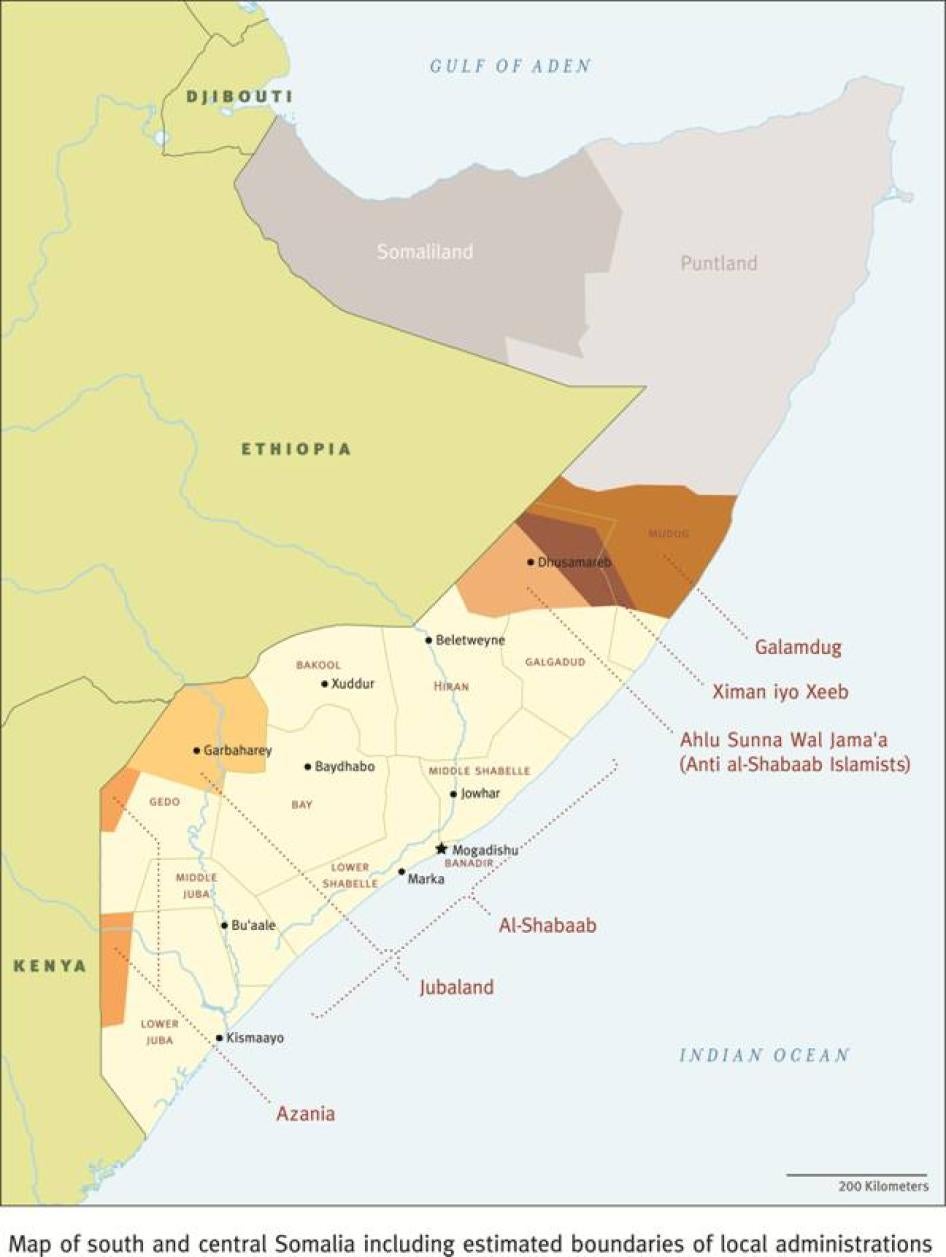
A TFG military offensive launched in February 2011, supported by the African Union Mission in Somalia (AMISOM), Kenyan and Ethiopian armed forces, and Somali militias, including those organized in Kenya and Ethiopia, has resulted in the capture of territory previously under al-Shabaab control in Mogadishu and in the south of the country near the borders with Ethiopia and Kenya. In particular, Kenya aims to make a strip of Somali land adjacent to its border, referred to as “Jubaland,” into a buffer zone between Kenya and al-Shabaab controlled areas.
Civilians have borne the brunt of the fighting between the many parties to the Somali conflict: the TFG, al-Shabaab, AMISOM, the Ethiopian-supported pro-TFG militias Ahlu Sunna Wal Jama’a and Ras Kamboni, and Kenyan-supported militias. There have been serious violations of international humanitarian law (the laws of war) by the parties to the conflict, including indiscriminate shelling of civilian areas and infrastructure, arbitrary arrests and detentions, and summary killings. The conflict has had an unquantifiable impact on the ability of civilians fleeing drought-affected areas to find assistance across the border in Ethiopia and Kenya either by blocking their way out or, in the case of al-Shabaab, the deliberate prevention of people from leaving.
Somalis fleeing from al-Shabaab-controlled areas reported widespread human rights abuses. Al-Shabaab continues to carry out public beheadings and floggings; forcibly recruits both adults and children into its forces; imposes onerous regulations on nearly every aspect of human behavior and social life, and deprives inhabitants under its rule of badly needed humanitarian assistance, including food and water.
The population in areas controlled by the Transitional Federal Government and its allies has also been subjected to violations of international human rights and humanitarian law. These include arbitrary arrest and detention, restrictions on free speech and assembly, and indiscriminate attacks harming civilians.
Somalis seeking safety in Kenya contend with police harassment, arbitrary arrests, and deportation back to Somalia. Somali refugees en route to the sprawling complex of refugee camps at Dadaab, Kenya, take hazardous back roads to avoid the Kenyan police and the official border post that until recently remained closed. They are then at the mercy of well-organized networks of bandits who engage in robbery and rape.
Human rights monitoring and reporting on Somalia by the international community remains inadequate, and yet ensuring systematic documentation of ongoing violations is key to ensuring eventual accountability for these violations. This report therefore highlights the range of ongoing human rights and international humanitarian law violations facing the civilian population in south and central Somalia.
The United Nations and major donors to the Transitional Federal Government, particularly the European Union and the United States, have condemned human rights abuses in Somalia and violations of international humanitarian law that caused civilian casualties. However, their military support for the TFG and AMISOM places greater responsibility on them to play an active role in improving the conduct of the TFG and its allied forces. Where these forces have taken over territory previously under the control of al-Shabaab, the UN and major donors will also need to press for respect for basic human rights and more closely monitor the support they provide. Support and policies that fail to achieve these basic objectives should be reconsidered. To date the TFG has been ineffectual in providing security and human rights protections in the limited areas under its control; broadening those areas is only likely to exacerbate existing problems.
In this report Human Rights Watch urges all parties to the conflict in Somalia to take concrete steps to protect civilians and prevent and punish those responsible for serious abuses. The TFG and AMISOM should adopt measures to reduce the likelihood of harm to civilians during attacks, especially by ending all attacks that do not discriminate between enemy forces and the civilian population. All the warring parties should facilitate rather than thwart humanitarian access and the humanitarian effort currently underway to deal with the drought.
Al-Shabaab should likewise take all feasible steps to avoid deploying in and launching attacks from densely populated areas. It should immediately cease using civilians as “shields,” that is deliberately placing civilians between its forces and those of an attacker. In areas under al-Shabaab control, local officials should respect the basic rights of the population, including the right to freedom of movement by permitting civilians to leave for other areas and countries. Such movement in light of the current drought is vital. Al-Shabaab should also immediately allow humanitarian aid agencies access to all areas under its control in order to provide urgent humanitarian assistance.
The United Nations (UN), United States, African Union (AU), and European Union (EU), which support the TFG financially and militarily, should set out clear benchmarks for improving respect for international human rights and humanitarian law and enhanced accountability. They should call on the TFG to urgently design and implement a strategy for improving security conditions and ensuring respect for human rights in areas under its control. With this in mind, they should encourage the TFG to ensure that the roadmap planned in the Kampala Accords includes clear human rights benchmarks. The TFG and its international supporters should further seek the establishment of a UN commission of inquiry by the UN Security Council to document serious violations of international human rights and humanitarian law since the conflict began in 1991.
Kenya clearly faces huge challenges in assisting and protecting almost 700,000 refugees in Kenya. But these challenges do not excuse police abuses—including rape, arbitrary arrests, and unlawful deportation—against asylum seekers. Nor do they excuse the police’s failure to protect asylum seekers from bandits active in the border areas. Officers responsible for abuses should be promptly and thoroughly investigated. More generally, to help ensure that Somali asylum seekers can safely travel from the border to the camps and be registered for assistance as quickly as possible, the Kenyan authorities should reopen a screening center in Liboi on the Kenya-Somalia border and allow the United Nations and private bus companies to transport asylum seekers to the camps.
The drought in Somalia has sent the numbers of refugees crossing into Kenya and Ethiopia skyrocketing. But arrival figures were already very high in early 2011 due to the upsurge in fighting in Somalia, not least because of the Kenyan-supported efforts to push al-Shabaab out of Jubaland. Human Rights Watch is concerned by statements from Kenyan government ministers and officials encouraging the setting up of internally displaced persons (IDP) camps in Somalia, presumably in the buffer zone of Jubaland. Jubaland was until very recently an active conflict zone. It is a narrow strip: al-Shabaab positions are only 80 kilometers from the border of Kenya. Creating an artificial distinction between those fleeing conflict and those fleeing drought, as the Kenyan government has tried to do, is disingenuous. Famine always has complex political as well as environmental causes. Recent statements by Kenyan government officials raise concerns that Kenya may attempt to return some of the recently arrived refugees and possibly earlier arrivals to Somalia if new camps are established inside Somalia.
At present Kenya is the closest safe haven for Somali refugees and the international community’s plan to deal with the refugees should proceed on that basis. Kenya faces a considerable burden and claims that building more camps is unsustainable. However, at present there is little realistic alternative. With nearly 400,000 refugees crammed into space meant for 90,000 and with well over 1,000 refugees arriving in the camps every day as of late July, the authorities should immediately allow refugees to settle in the still empty Ifo II camp and sign an agreement with the UN refugee agency for additional land for new camps to help decongest the old ones.
Key Recommendations
To the UN Security Council
- Establish a commission of inquiry for Somalia to investigate and map serious crimes in violation of international law, and recommend measures to improve accountability for violations of international human rights and humanitarian law.
To the UN Political Office for Somalia (UNPOS) and the UN Office of the High Commissioner for Human Rights (OHCHR)
- Increase the number of human rights officers monitoring and publicly reporting on human rights abuses in Somalia.
To the Transitional Federal Government of Somalia (TFG)
- Take all necessary steps to ensure that TFG security forces and allied armed groups comply with international humanitarian and human rights law.
- Ensure that all credible allegations of human rights and humanitarian law violations by TFG forces and allied armed groups are promptly, impartially, and transparently investigated, and that those responsible for serious abuses, regardless of rank, are held to account.
- Ensure that the roadmap to be developed as per the “Kampala Accord” includes clear human rights benchmarks.
- Allow an increase in the number of international agency staff monitoring and reporting on human rights abuses in Somalia, and lift the ban on officials from the OHCHR and on human rights officers within the UNPOS.
- Facilitate access to humanitarian aid in areas under TFG control.
To the African Union Mission in Somalia (AMISOM)
- Ensure that all credible allegations of human rights and humanitarian law violations by AMISOM forces are promptly, impartially, and transparently investigated by AMISOM or force contributors, and that those responsible for serious abuses, regardless of rank, are held to account.
To All Armed Groups, including al-Shabaab
- Immediately take all necessary steps to end violations of international humanitarian law.
- Immediately allow humanitarian agencies, including the United Nations, access to areas under their control for the delivery of humanitarian assistance.
- Respect the rights of the civilian population to freedom of movement, especially the right to seek asylum in neighboring countries.
- Take all feasible precautions to protect civilians from the effects of attacks and otherwise minimize harm to the civilian population, including by avoiding deploying in densely populated areas. Cease the use of civilians as “human shields.”
- End all forced recruitment of adults and any recruitment of children under the age of 18.
To the United States, European Union, African Union, United Nations, and Other Donors
- Ensure that the roadmap for the transition to be developed in collaboration with the international community as stipulated in the “Kampala Accord” includes clear human rights benchmarks.
- Condition future financial and military support to the TFG on clear benchmarks for the respect of international humanitarian and human rights law and accountability for serious abuses.
To the Governments of Kenya and Ethiopia
- Ensure that any Kenyan and Ethiopian forces engaged in military operations within Somalia abide by international humanitarian law; law enforcement officials operating in Somalia should abide by international human rights law.
To the Government of Kenya
- Take all necessary measures to end police abuses in the border areas against Somali asylum seekers and refugees—including rape, extortion and arbitrary arrest and detention—and hold those responsible to account.
- End all refoulement—unlawful forced return—of Somali asylum seekers from Kenya and release those in detention on charges of “unlawful entry.”
- Immediately allow the office of the UN High Commissioner for Refugees (UNHCR) to transfer refugees into Ifo II camp.
- Urgently facilitate the granting of more land for 300,000 refugees in order to help decongest the existing camps and to respond to the ongoing influx.
- Publicly confirm that any camps or centers established in Jubaland are not a substitute for Kenya’s responsibility to host Somali refugees, and that Somalis have the right to seek asylum in Kenya both under Kenyan and international law regardless of administrative changes in Somalia.
Methodology
In April 2011 Human Rights Watch interviewed 26 recently arrived refugees and asylum seekers in the three refugee camps—Ifo, Dagahaley, and Hagadera—in Dadaab in northeastern Kenya, approximately 70 kilometers from the Somali border. Human Rights Watch also interviewed Kenyan police and officials of the Department of Refugee Affairs, officials of the office of the UN High Commissioner for Refugees, and representatives of Kenyan and international nongovernmental organizations and conducted follow-up interviews with the same during May and June. During the follow-up research, Human Rights Watch also interviewed representatives of the Transitional Federal Government and of Somali civil society organizations by telephone or in Nairobi or Kigali. This research additionally built on approximately 35 interviews conducted during November and December 2010 in Dadaab following the so-called “Ramadan offensive” in Mogadishu.
Refugees and asylum seekers identified as recent arrivals participated in voluntary, open-ended interviews. The primary purpose of the research was to identify violations of international humanitarian law and international human rights law by all parties to the conflict in Somalia. Refugees and asylum seekers were asked to describe the reasons why they had fled Somalia; the human rights situation in their area of provenance; and their experiences of armed conflict. They were also asked to report any difficulties they encountered en route from their areas of origin to Dadaab in order to assess the extent to which groups controlling territory in Somalia, as well as the Kenyan authorities, allowed for freedom of movement. Human Rights Watch was unable to conduct research within Somalia, due to security concerns, and within areas in southern Ethiopia, due to the Ethiopian government’s restrictions on human rights research; therefore, all primary research was conducted within Kenya. This report uses the testimonies of refugees and asylum seekers alongside secondary reporting on the conflict to describe the human rights and humanitarian context in which the current drought and famine is unfolding.
Interviews with refugees and asylum seekers were conducted in Somali with the assistance of interpreters. Most of the interviews were conducted on a one-on-one basis, while others were done in small groups. The names of all refugees and asylum seekers have been changed or omitted for security reasons.
I. Background
Somalia has remained in a civil war and without a functioning government since the fall of the Siad Barre regime in 1991. A conflict between clan-based militias struggling for political power came to an uneasy truce in 2006 with the rise to power of the militia-backed Islamic Courts Union (ICU).[1] But outside powers such as Ethiopia, the United States, and the European Union feared that the ICU and its radical armed youth wing, al-Shabaab, would create an Islamist bastion in Somalia.[2] The same year, Ethiopia militarily intervened in Somalia at the request of the ousted Transitional Federal Government, routed the ICU militias, and for two years fought al-Shabaab as it emerged as the main armed opposition group in the south and central parts of the country, especially in Mogadishu, the capital.
Ethiopia withdrew in 2009 as the Djibouti peace talks yielded a new administration, a revamped TFG. Almost immediately, the various armed groups, of which the TFG was but one, returned to open conflict. Throughout 2009 and 2010 fighting continued in Mogadishu and in isolated pockets while al-Shabaab consolidated its control over most of the capital and the country’s southern and central area. Al-Shabaab sought to impose its extreme version of Sharia (Islamic law) on areas under its control and committed widespread human rights abuses, including punishments such as beheadings, amputations, stoning and beatings, restrictions on dress and freedom of movement, enforced contributions, and forcible recruitment into the militia.[3] Al-Shabaab and other armed opposition groups regularly threaten journalists, civil society activists, and humanitarian workers. Al-Shabaab admits to the recruitment of children, who are represented among many recent deaths and defections in their forces.
The TFG has struggled to hold Somali territory since its inception, existing as a government in name only and in effective control of only a small portion of Mogadishu. Since 2009 the TFG has been supported by troops from the African Union Mission in Somalia.[4] Besides al-Shabaab, other significant armed groups are Hizbul Islam, Ahlu Sunna Wal Jama’a, and Ras Kamboni.[5] Ahlu Sunna Wal Jama’a, which receives military support from Ethiopia, and Ras Kamboni, are allied to the TFG. Hizbul Islam has on several occasions fought alongside al-Shabaab against the TFG and officially merged with al-Shabaab in December 2010. Both al-Shabaab and Hizbul Islam have received military, financial, and political support from Eritrea.[6]
The Transitional Federal Government’s own record on human rights has been dismal. Its forces have been repeatedly implicated in indiscriminate attacks on civilians, arbitrary arrests, and repression of civil and political rights.[7] It has recently restricted the ability of the UN Office of the High Commissioner for Human Rights (OHCHR) to monitor alleged abuses in areas under its control through the expulsion of two of its staff.[8] The TFG has also restricted the rights to freedom of expression, association, and peaceful assembly.[9]
The TFG recently extended its mandate and the transitional period, which was to end in August 2011, for another year. The “Kampala Accord” signed on June 9, 2011 under the leadership of Ugandan President Yoweri Museveni—which bought an end to months of political wrangling between Somali President Sheikh Sharif Sheikh Ahmed and speaker of Parliament Sharif Hassan Sheikh Aden—postpones elections until August 2012 and grants the TFG an additional year to implement priority transitional tasks. These are the tasks deemed necessary preparations for the establishment of a democratic government. The Kampala Accord stipulates that a roadmap with clear benchmarks, timelines, and a compliance mechanism will be established before August 2011. The UN Security Council welcomed the agreement.
International donors, on whom the TFG is entirely dependent to function, have publicly stated that continued support would depend on completion over the next 12 months of priority transitional tasks as outlined in the Djibouti Peace Accord of 2008 and the Transitional Charter, but have not set clear benchmarks for improvements in human rights.
International donors provide significant political, military, and economic support to the TFG and AMISOM. In October 2010 the African Union appointed Ghanaian statesman Jerry Rawlings as Special Envoy to Somalia. In March the UN Security Council, at a conference chaired by China, concluded that the United Nations presence should be increased and better coordinated. The European Union pledged US$92 million in new funding for AMISOM, bringing the total EU contribution to $291 million; while the United States will reportedly provide an extra $45 million worth of military equipment to AMISOM troops.[10] Germany pledged an additional $4.9 million to AMISOM for equipment. The East African Community (EAC) has petitioned for more contributions from the European Union and United States.[11]
The AMISOM force strength remains at 9,000, far below the AU’s estimate of 20,000 troops needed to protect TFG institutions, an amount authorized by the UN Security Council. Burundi and Uganda have pledged 4,000 additional troops for AMISOM.[12] Uganda’s Defense Ministry is currently petitioning its country’s parliament for 4,000 more troops.[13] About 1,000 Burundian troops recently arrived in Somalia. Guinea, Sierra Leone, and Djibouti have also pledged a total of 4,000 additional troops. Despite the willingness of donor countries to contribute, funding and political will among donors continues to be an obstacle.[14]
The September 2010 and February 2011 Offensives
In September 2010 the TFG began a military offensive aimed at reclaiming more of Mogadishu from al-Shabaab. Both sides committed serious violations of the laws of war against the civilian population and there were no significant military gains.[15] In early 2011 the TFG renewed its offensive, this time with more coordinated support from AMISOM. Ahlu Sunna Wal Jama’a, and other militias trained by Kenya and Ethiopia and deployed in southern Somalia across the Kenyan and Ethiopian borders, joined the operation, which was aimed at retaking parts of the country back from al-Shabaab control.
Fighting took place across different parts of the country, notably in the Bay, Bakool, Hiran, and Gedo provinces, with serious clashes reported near the towns of Bula Hawo, Bulaweyne, Dolo, Dhobley, and Garbaharey.[16] Most of those areas are near the borders with Kenya and Ethiopia and the fighting was linked to the Kenyan government strategy of creating a strip or buffer zone inside Somalia to keep al-Shabaab at bay (see below).
TFG troops, backed by allied militias, were able to sustain some gains outside Mogadishu, although the frontline in the capital remains the site of ongoing clashes.[17] AMISOM now claims that pro-government forces control eight of sixteen districts in the capital, with 80 percent of the population under their control.[18] However, al-Shabaab recently reinforced its positions with up to 500 fighters from Lower Shabelle, Bay, and Bakool provinces.[19] A recent ongoing offensive to reclaim Mogadishu’s infamous Bakara Market, an al-Shabaab stronghold and source of revenue, could influence the broader situation, although at great cost to the civilian population.
The forces involved in the offensive against al-Shabaab are a mix of regular TFG troops and different allied militias. In the Gedo province, TFG forces together with Ahlu Sunna Wal Jama’a and other local militias, backed by Ethiopian armed forces, have taken control of large areas (see map) including the provincial capital, Garbaharey, meeting little resistance.[20] In Lower Juba, Kenyan-trained militias and TFG forces backed by Kenyan artillery have confronted al-Shabaab in fierce fighting around Dhobley and Bula Hawo.
The “Jubaland Initiative”
One of the main arenas of the current offensive was the border area of Kenya and Ethiopia, an area called “Jubaland.” Jubaland is the newest of the semi-autonomous regions throughout the country that have been formed due to the lack of central state authority—10 have been formed to date.[21] Also known as Azania, Jubaland is a proposed new semi-autonomous region comprising three regions on the Kenyan border, conceived principally by Kenya as a buffer zone against al-Shabaab and to potentially serve as a temporary home for the large number of people fleeing conflict elsewhere in the country.[22] At present it amounts to one relatively small parcel of land near Dolo on the Ethiopian border and a strip of land along the Kenyan border, approximately 60 to 80 kilometers wide, at the time of writing.
Human Rights Watch reported in 2009 on the recruitment of young ethnic Somalis of Kenyan and Somali citizenship in Dadaab camps and northern Kenya with false promises of high wages and UN backing for the force.[23] Over the intervening two years the militia has been languishing in Archer’s Post military camp near Isiolo in Kenya awaiting deployment. With the offensive from the north Kenya appears to have deployed that militia in support of the Jubaland idea and put the troops under the command of Prof. Mohammed Abdi Mohammed (Gandhi), a former TFG minister of defense.[24] Jubaland notionally comprises the present Somali provinces of Lower Juba, Middle Juba, and Gedo. Even after the recent offensives, however, in May 2011 only a very small part of Gedo and Lower Juba was under the control of Abdi and his Kenyan-trained militia.[25]
Kenya has for 20 years faced an increasingly heavy burden as refugees have fled conflict in Somalia, even as Kenya has itself contributed to that conflict by supporting the anti-al-Shabaab forces in the recent offensive to create “Jubaland.” Nonetheless, creating an area free of al-Shabaab controlled by friendly militias on the Somali side of the border allows Kenyan officials to make the argument that Somali refugees could stay there instead of coming into Kenya. And they have been arguing in recent months that recent arrivals are fleeing drought and not conflict and thus might not be considered asylum seekers under international law and who could then safely return to Jubaland, which the Kenyan government claims is safe.[26]
The Kenyan government accurately contends that the refugee camps at Dadaab are full, and have been for years, with new arrivals housed among the existing community or in temporary structures outside the camps. However, the people fleeing Somalia are a mixed caseload in that they are fleeing a complex humanitarian emergency in which conflict and human rights abuses play an intricate part in creating and complicating the need for and delivery of humanitarian assistance. They maintain their internationally protected right to seek asylum in a third country.
II. International Humanitarian Law Violations
All forces involved in the recent fighting in Mogadishu—al-Shabaab and Transitional Federal Government-aligned forces, including the African Union peacekeeping mission, AMISOM—have been responsible for serious violations of international humanitarian law (the laws of war). These abuses include indiscriminate attacks, extrajudicial killings, arbitrary arrests and detention, and unlawful forced recruitment.
International humanitarian law imposes upon parties to an armed conflict the legal obligations to reduce unnecessary suffering and to protect civilians and other non-combatants. It is applicable to all situations of armed conflict, without regard to whether those fighting are regular armies or non-state armed groups, including al-Shabaab, Ahlu Sunna Wal Jama’a, and other irregular militias. All armed groups involved in a conflict must abide by international humanitarian law, and any individuals who violate humanitarian law with criminal intent can be prosecuted in domestic or international courts for war crimes. The same law applies to international forces such as AMISOM, which, according to its mandate, is not a party to the conflict but which nonetheless carries out military activity within Somalia.
The suffering of civilians as a result of the hostilities has been compounded by one of the worst droughts in recent history in Somalia, especially across southern parts of the country. Unnecessary restrictions on humanitarian access, theft of humanitarian aid, and, in the case of al-Shabaab, a blanket ban on all delivery of assistance, have heightened the suffering and swelled the numbers of people fleeing the area. Al-Shabaab has also prevented people from leaving for other places inside or outside Somalia.
Indiscriminate Attacks on Civilians
News from Mogadishu and information gathered by Human Rights Watch over the last year have reported regular clashes between AMISOM and TFG forces against al-Shabaab that nearly always result in civilian casualties. For example, in May, mortar rounds struck Bakara Market, the site of repeated shelling, reportedly killing 15 people and wounding 80 more.[27] One recent arrival from the capital, H.P., from Wardhiigley area, told Human Rights Watch that during recent fighting in Mogadishu, “There are several places where schools and health centers were destroyed by heavy weapons from both sides. It’s difficult to know if this is intentional. Both sides are using the public for shielding them.”[28]
Reliable figures are hard to come by in Somalia, but as of June 1, according to the World Health Organization (WHO), 3,900 injured civilians had been admitted to hospitals in Mogadishu since the beginning of 2011 as a result of the fighting.[29] In May, the fiercest month of fighting this year between AMISOM and al-Shabaab, almost half of the 1,590 admitted were children under the age of five.[30] With the fighting spreading to other parts of the country as a result of the TFG offensive, the abuses that have become the reality of daily life in Mogadishu are now being experienced by civilians in other regions.
The laws of war prohibit deliberate attacks on civilians as well as attacks that are indiscriminate or could be expected to cause disproportionate civilian loss. Only military objectives are subject to attack. The laws of war also require parties to a conflict to take all feasible precautions to protect civilians under their control against the effects of war. This includes avoiding locating military objectives within or near densely populated areas, and endeavoring to remove civilians from the vicinity of military objectives. When armed forces deliberately use civilians to render military forces immune from attack they are committing “human shielding,” a war crime.[31]
Al-Shabaab
Al-Shabaab has frequently conducted mortar attacks in Mogadishu in violation of the laws of war. As Human Rights Watch has reported previously, al-Shabaab forces deployed in densely populated neighborhoods will fire mortar shells indiscriminately towards TFG/AMISOM positions. No effort is generally made to remove the civilian population from the firing area; instead, after rounds are fired, the al-Shabaab fighters flee the area to avoid counter-battery fire from TFG and AMISOM forces, which often results in high civilian casualties. This tactic unnecessarily places civilians at risk and may amount to shielding. It may also be intended to generate popular resentment towards the TFG.[32]
A recent arrival from Mogadishu via Kismayo, O.L., told Human Rights Watch that al-Shabaab provided civilians no advance notice that they would be firing mortar shells from their neighborhood or permit them to flee to safer areas: “Al-Shabaab doesn’t let people go when an attack is coming, because they want to be with them and use them as a human shield.”[33]
AMISOM
As reported by Human Rights Watch in 2010 and 2011, civilians continue to report indiscriminate shelling by the AU Mission in Somalia.[34] Numerous cases of indiscriminate and, in some cases what appears to be disproportionate, AMISOM shelling were documented by Human Rights Watch from August to September 2010 during what was known as the “Ramadan offensive,” in which al-Shabaab conquered a significant amount of territory in Mogadishu, while the AU peacekeeping mission shelled al-Shabaab-controlled areas in an attempt to push back.[35]
In 2011, such cases appear to have diminished, indicating possible efforts on the part of AMISOM to improve its targeting and reduce indiscriminate fire, notably through the identification of no-fire zones.[36]
However, news reports continue to indicate a number of indiscriminate attacks, most notably on Mogadishu’s Bakara Market, an area of the town which remains heavily populated, and the center of civilian life.[37] In reference to the repeated shelling, a Benadir Administration (Mogadishu district) official morbidly called Bakara Market the “People’s Butcher.”[38] Similarly a March update from the International Crisis Group described AMISOM mortar rounds hitting camps for internally displaced persons, wounding dozens in February.[39]
AMISOM has admitted responsibility for a limited number of unlawful attacks on civilians. On November 23, 2010, troops opened fire on civilians at a busy intersection near Aden Adde airport. AMISOM acknowledged wrongdoing, apprehended six soldiers, and launched an inquiry. This represented the first instance of AMISOM admission of responsibility for civilian deaths.[40] In January AMISOM troops fired on a crowd rushing to aid a boy hit by a bus.[41] To date three AMISOM soldiers have been sentenced to two-year prison terms to be carried out in their home countries, in these cases Uganda. They were found guilty of “anti-civilian activities” in separate incidents.[42]
In a February 5 letter to Human Rights Watch, AMISOM force commander Maj. Gen. Nathan Mugisha acknowledged two incidents in which soldiers had, he said, erroneously fired on civilians, but he did not acknowledge AMISOM’s indiscriminate shelling of Bakara Market and other civilian sites in Mogadishu.[43]
While al-Shabaab’s practice of firing artillery from densely populated neighborhoods poses a difficult problem for AMISOM, such unlawful tactics do not release AMISOM from its obligation under the laws of war to ensure that attacks on military targets are not indiscriminate and do not cause disproportionate civilian casualties and loss of property.[44]
In May AMISOM announced that it had designated Bakara Market a “no-fire zone.”[45] Nonetheless, much damage had already been done, not least to AMISOM’s reputation. As C.E., from Hodan Village in Mogadishu, explained:
Both sides don’t spare the public. A lot of my neighbors were killed. Sometimes it happens that the person you had breakfast with in the morning is killed by mortars in the afternoon. This has happened to me. Sometimes you know who killed people, because the groups are located on different sides, firing mortars. AMISOM are the ones who are killing people a lot. But all of them are the same.
Al-Shabaab is fond of firing weapons from residential areas, knowing very clearly that the other side is going to return fire to the same place. Then al-Shabaab runs away. Al-Shabaab uses this as a propaganda war. They know it’s good for them when people blame the TFG. And the TFG and AMISOM don’t care whether there are civilians or not in the places they fire on.
You don’t know whom to blame—do you blame al-Shabaab for hiding among the public, or the government for hitting back at the same place from where they were fired on? [46]
Transitional Federal Government
Security forces of the Transitional Federal Government have been implicated in indiscriminate attacks causing civilian casualties and other laws of war violations. Other serious abuses, including the unnecessary use of lethal force, have occurred during situations that might more accurately be considered law enforcement operations, in which there is a higher threshold for the use of force.[47]
In late January TFG forces reportedly fired on civilians in Mogadishu killing from 12 to 20 people and wounding at least 30 others.[48] On February 15 in preparation for a renewed offensive, then-Prime Minister Mohamed Abdullahi Mohamed (Farmajo) urged troops to avoid civilian killings.
Between February 15 and 21 there were four separate incidents in which TFG forces fired upon civilians. On February 15, TFG troops shot at civilians marching in protest against al-Shabaab, killing up to four and wounding between six and ten people. No reasons for the shootings were reported.[49] On February 17 a TFG soldier shot at a civilian bus that failed to stop when ordered, causing one death and two injuries.[50] On February 18, Shabelle Media Network reported that two civilians were killed and another two wounded after TFG soldiers opened fire on a food distribution line in Mogadishu.[51] On February 21, TFG soldiers fired on a crowd that had gathered at the Villa Somalia, the presidential palace, and was hurling stones to protest the arrest of former Mogadishu mayor Mohammed Omar Habeb; no deaths or injuries were reported.[52] These incidents prompted public statements of concern from AMISOM, TFG officials, and local elders.[53]
The TFG made several arrests in connection with these killings. In March the TFG Military Court tried five TFG soldiers on charges related to civilian killings; each was convicted and received prison terms of two to five years. Following the convictions the Military Court issued a stern warning against the killing of civilians.[54]
TFG forces continued to respond to al-Shabaab artillery fire from densely populated neighborhoods in Mogadishu with often indiscriminate counter-battery fire. Given the usual al-Shabaab practice of firing mortars and quickly vacating the area, the result of the TFG shelling is frequently just civilian casualties.
One woman from Tawfiiq in Mogadishu described the pattern of attack and counter-attack: “Al-Shabaab would hide among us during the fighting, and they were firing weapons from near our house. The government returned fire to the exact position they were attacked from but did not hit al-Shabaab, but they hit people’s houses. A lot of people were injured, others killed.” Her own house was destroyed by mortar shells; she did not know from which side.[55]
Such patterns of attacks appear to have occurred elsewhere as the fighting has moved beyond Mogadishu. T.S., who lost her husband and her eight-year-old son while fleeing from combat in Baardheere, Gedo province, said, “Many homes were destroyed by both sides. Nobody was bothering to try to avoid hitting civilians.”[56]
During heavy fighting in the town of Dhobley in March, TFG forces and al-Shabaab shelled civilian homes and infrastructure. According to D.I., “The two groups were using heavy weapons. The members of the public could not bear it, and fled, taking any route. Most of the houses were destroyed.”[57] A community hospital was severely damaged in the shelling, which appear to have involved Kenyan forces, as discussed below.
Ethiopian and Kenyan Armed Forces
Units of the Ethiopian and Kenyan armed forces have been deployed in support of operations in southern Somalia since the beginning of 2011. Both governments have provided military assistance to pro-government armed groups there, which could make them complicit in abuses committed by these groups.
Informants in Dadaab and others have reported the presence of Ethiopian and Kenyan soldiers, military advisers, and equipment in Somalia during this most recent phase of armed conflict.[58] Shabelle Media Network reported Ethiopian troops and advisers meeting with Ahlu Sunna Wal Jama’a in Balanbal in January.[59] Ethiopian forces deployed alongside Ahlu Sunna Wal Jama’a were reportedly shelling the town of Bula Hawo in March.[60] And in March TFG President Sheikh Sharif Sheikh Ahmed and Prime Minister Farmajo stated that Ethiopian forces had assisted in retaking Bula Hawo from al-Shabaab.[61] A Somali refugee in Dadaab and a Kenyan journalist also reported the presence of Kenyan troops and military equipment in Bula Hawo.[62]
Few abuses were directly attributed to these national armies in interviews conducted by Human Rights Watch. However, one refugee in Dadaab who fled from Bula Hawo in January 2011 said that Ethiopian forces were firing heavy weapons from near the border town of Dolo during the fighting in Bula Hawo. He told Human Rights Watch: “They were firing weapons from very far and not sparing anyone. Sometimes it lands on soldiers, sometimes it lands on houses, sometimes it lands on animals, sometimes on civilians.”[63] He said that no warning was given to civilians before the fighting started. Running from the artillery attacks coming from both sides, he became separated from his father and 12-year-old brother and has not seen them since. Another resident of Bula Hawo said that Kenyan forces were responsible for the destruction of the town: “What destroyed Bula Hawo were the weapons that the Kenyans were firing, using tanks.”[64]
In the border town of Dhobley a community hospital was seriously damaged by possible deliberate or indiscriminate shelling from Kenyan tanks and artillery. According to witnesses and hospital staff Kenyan tanks were located on the border and firing into Dhobley. In an email to Human Rights Watch, a hospital staff member explained that the shelling of Dhobley from the Kenyan side of the border started on March 6 and continued on March 16, 25, and 31:
A few weeks of continuous clashes between the al-Shabaab and the anti-al-Shabaab forces gradually increased in intensity with a major battle for the town on April 1. Heavy shelling of the town [120mm mortars] was followed by a coordinated offensive of the anti-al-Shabaab forces [Kenyan trained troops and Ras Kamboni group forces]. The Kenyan army was actively involved in the fighting [heavy artillery].[65]
On April 4 the Kenyan army shelled the town for the final time during the day and severely damaged the hospital. According to the same hospital staff member, “The hospital was not being used by the military forces of one side or another for military purposes at the time of the attack and any time before that day.”[66]
Unlawful Killings
Al-Shabaab has carried out extrajudicial killings of suspected informers or enemy sympathizers. In al-Shabaab-controlled areas, executions are imposed as a judicial punishment with little or no legal due process even for minor infractions of al-Shabaab’s strict interpretation of Sharia. TFG-aligned forces have committed extrajudicial killings of alleged al-Shabaab members.
Al-Shabaab
Al-Shabaab continues to carry out executions as punishment for alleged crimes, often with little or no legal process. In many cases, the executions take place in public.
In Afmadow district in early April al-Shabaab executed two mentally ill people whom the group suspected of being spies. According to O.L., an asylum seeker from the area, the two may have come under suspicion because they were among the only people who had not fled the town after al-Shabaab stopped allowing humanitarian agencies to provide food aid. O.L. told Human Rights Watch, “Everyone knows those two are mentally ill… [but] al-Shabaab thinks they are giving reports to people outside, and only pretending to be mad people… They were showered with bullets.”[67]
In Bula Hawo several people suspected by al-Shabaab of working with the TFG were executed.[68] One such case involved a man named Hassan Gase, who was executed in Bula Hawo in January on suspicion of working for the TFG.[69]
The public nature of many of the executions subjects the populace to an extraordinary level of violence. One woman from Jilb told Human Rights Watch, “I’ve witnessed this with my own eyes—people being beheaded, hands chopped off. They’re put on a chair and their heads are chopped off, in public. If they refuse to join jihad they are killed.”[70]
TFG-Aligned Militias
Human Rights Watch received several reports of extrajudicial killings of suspected al-Shabaab supporters by the Ahlu Sunna Wal Jama’a militia, which is allied to the TFG. According to witnesses after the TFG captured Bula Hawo town from al-Shabaab in March 2011, Ahlu Sunna Wal Jama’a, which controls the town, apprehended and executed three civilians.[71]
One of those executed was a 17-year-old boy who had been forcibly recruited by al-Shabaab and had left the force after his mother successfully pleaded with al-Shabaab for his release. According to a family friend, the boy was arrested while running home from school. She told Human Rights Watch:
When they arrested him, his father was informed. His father came to these officials and pleaded for his son to be released. He was told “We will also arrest you if you keep asking that question.”
They shot [the boy]. They emptied a whole cartridge into his body. They refused to allow the body to be collected. They kept it for three days and it decomposed before they buried it.[72]
A herder and another resident of Bula Hawo were also executed on suspicion of spying for al-Shabaab, according to one resident.[73]
Ahlu Sunna Wal Jama’a has defended the detentions and killings as security operations.[74] The militia’s spokesman, Sheikh Mohamed Hussein Al Qadi, told the media that it is the policy of the group to execute anyone accused of spying for al-Shabaab, including its own troops and children.[75]
Mistreatment in Custody
Human Rights Watch received reports of arbitrary arrest and mistreatment of civilians by al-Shabaab and TFG-aligned groups after taking control of areas from other armed groups.
Al-Shabaab
Al-Shabaab routinely mistreats persons in areas under its control.[76] A former al-Shabaab child soldier told Human Rights Watch about the arrests he recently helped carry out:
We worked in shifts, some at day, some at night. Some people were sent into town to arrest those who were drinking, smoking, chewing qat [a commonly used stimulant], and gossiping. I was among those who arrested people. They are blindfolded, their shirts are removed, and they are slashed with canes and kicked. A person is beaten until he becomes unconscious, then he’s taken to a cell.[77]
Torture and other ill-treatment previously documented appear to continue unabated. Al-Shabaab’s strict interpretation of Sharia is the basis for much mistreatment. Women are caned or arbitrarily detained for greeting men, including relatives, in public.[78] Al-Shabaab bans most recreational activities, including watching and playing football, and singing. Those who violate these prohibitions also risk beatings. One woman, who had made her living as a singer in Kismayo said, “It was suicidal to continue.”[79] Both women and men are subjected to conservative dress codes (such as covering of female heads and limbs, wearing black) and are punished if they do not comply; for instance, D.S., a man, was beaten for wearing trousers that were considered too long.[80]
TFG-Aligned Militias
In at least one area captured from al-Shabaab, TFG-aligned forces allegedly arbitrarily detained suspected members of al-Shabaab.
A.D., a woman who had fled from Bula Hawo to Kenya, returned to Bula Hawo after the fighting ended, and then fled once more, complaining of intimidation by TFG forces: “The officials from the TFG talked to us and said ‘Al-Shabaab has been causing lots of problems here. We called you back, but we want you to stay here peacefully. But if anyone tries to cause any problems, if anyone creates any insecurity, you will all be punished.’ Because of that we decided to leave.”[81]
Her husband, T.A., said his mistreatment by Ahlu Sunna Wal Jama’a drove him and his family from Bula Hawo, even after the town seemingly returned to peace. He explained:
I myself was arrested and robbed by [Ahlu Sunna Wal Jama’a] officials. I was sitting somewhere in the town center in Bula Hawo, and an explosion took place. A TFG government vehicle was destroyed by a mine. Immediately, the soldiers [from Ahlu Sunna Wal Jama’a] entered the town and started shooting carelessly. All of us were rounded up and taken to the police station. While I was being taken to the cell, the soldiers robbed my cell phone and 7,000 Kenyan shillings.
Five hundred of us were arrested. We were kept in a compound. Some were in a cell. Women were also arrested and were held separately. Some were carrying small children. The women and children were released the same day, but the men stayed in detention for two days.
After we were released, there was a public rally by the TFG government. They told us to do one of three things: either go to Kenya or Ethiopia, or go join those al-Shabaab people. [A district official] said, “If something happens again here, you will be held responsible and we will kill you.”
The day after the public rally we saw there was going to be no life there. We decided to take off.[82]
A.D. continued:
The TFG was also beating people. There were a lot of women who were put in the cell. They were arresting people and not even letting people take food to them. When I left, a lot of these people were still in the cell. I knew one lady among them... I don’t know if she’s been released. She was accused of being al-Shabaab because her brother was a member of al-Shabaab who was killed in the fighting. They were arresting people ages 15 and up whom they suspected of looking like al-Shabaab or dressing like al-Shabaab.[83]
This account aligns with what Ahlu Sunna Wal Jama’a spokesman Shariff Abduwahid told IRIN News in March:
We don’t want to kill brainwashed teenagers who were used by people who don’t favor the interest of the country and the Somalis; so those we have here we feel were misled; our intention is to keep them in prison, to orientate and clear their brainwashed minds.[84]
TFG
The Transitional Federal Government maintains a number of detention sites in Mogadishu where alleged al-Shabaab members and others are detained. Conditions in these detention facilities are dire and arbitrary detention is the norm. Access to the National Security Agency (NSA) detention facility is severely restricted; Human Rights Watch was unable to identify a single independent monitor that has recently had access to NSA facilities in order to assess the condition of detainees. Reports point to the presence of children in the NSA detention facility. Independent monitoring by the United Nations and civil society organizations is necessary in order to ensure human rights protections for detainees in TFG custody.
Recruitment of Child Soldiers and Forced Recruitment
During recent military operations, particularly the “Ramadan offensive,” reports of recruitment of children by al-Shabaab increased dramatically. The United Nations Children’s Fund (UNICEF) has condemned increased recruitment, as well as the alleged detention of child combatants by TFG forces, and called for an international body to have access to all detained children alleged to have participated in conflict.[85] Local nongovernmental organizations also alleged that several parties to the conflict have used child soldiers.[86]
International humanitarian law prohibits any recruitment of children under the age of 15 or their participation in hostilities by national armed forces and non-state armed groups. Somalia has signed, but has yet to ratify, the Optional Protocol to the Convention on the Rights of the Child on the involvement of children in armed conflict. The Optional Protocol prohibits any recruitment by non-state armed groups of children under the age of 18; any forced recruitment or conscription of children under 18 by government forces; and the participation of children under 18 in active hostilities by any party.[87]
Al-Shabaab
Al-Shabaab has been responsible for the widespread recruitment of boys and girls into its forces and the forced recruitment of adults, including older men. Human Rights Watch has previously reported on forced recruitment by al-Shabaab.[88]
O.L. told Human Rights Watch: “Al-Shabaab was forcibly recruiting. If someone has four boys, they are telling them they must donate three. They like to take children from 12 to 16 years, because they don’t know so much. One of my nephews was taken. He was 11-years-old. The last I heard he was in Baydhaba. I don’t know whether he’s dead or alive.”[89]
Forced recruitment of children also took place in Bula Hawo. According to K.F., “Teenagers were forced to either join them or leave the town.”[90] A 15-year-old from Bula Hawo also said children his age were recently being recruited.[91] In Jilb, J.K. told Human Rights Watch, “From the time al-Shabaab came, children stopped learning. Children of nine, ten, eleven years were recruited—some could not even carry a gun. All of the schools were closed.”[92]
All recruitment of underage children is a violation of international humanitarian law whether allegedly voluntary or not.
B.E. was taken to Elesha Biya, south of Mogadishu, and was trained in the use of several kinds of firearms.[93] He participated in combat on one occasion, shooting and killing one TFG fighter. He ran away after four of his friends, also children, were executed and dumped in the sea for attempting to escape. Despite the risk in attempting an escape himself, he said he could no longer bear the brutality of life within al-Shabaab.[94]
Al-Shabaab also forcibly conscripts adults. J.K. explained that “men loitering in the town” were often forcibly conscripted, causing many men to restrict their own movements and spend most of the time in their fields.[95] Older adults have been among those forcibly recruited. One 50-year old man who fled from Afmadow district said, “They tried to recruit me, but I ran away. They threatened me that if I don’t cooperate, I will be jailed for not following orders. They are not sparing even men of 50 years from recruitment.”[96]
TFG and Aligned Militias
Human Rights Watch documented recruitment under false pretenses by Kenya and the TFG during 2009 in its effort to put together the militia for the Jubaland initiative.[97] Some of those recruited under false pretenses may be among the militia deployed in Jubaland. Human Rights Watch has received credible secondary accounts that describe the presence of children among TFG and TFG-aligned militias.[98]
Restrictions on Access to Humanitarian Aid
The humanitarian situation across Somalia remains dire and has been exacerbated both by a spike in fighting from February to May and by extremely severe drought conditions. The effects of conflict and drought have pushed humanitarian and medical services beyond capacity. As of July 29, according to the UN, 2.2 million Somalis were in need of humanitarian assistance in al-Shabaab-controlled areas.[99] The UN also reported continuing prohibitions of people fleeing al-Shabaab controlled areas.[100] Many deaths associated with drought have been reported.[101] One in four children in Somalia is malnourished—one of the highest rates in the world—a situation exacerbated by the current drought.[102]
International humanitarian law requires that all parties to a conflict allow and facilitate the provision of humanitarian assistance to populations in need. Consent for the provision of assistance may not be withheld for arbitrary reasons.[103]
The delivery of humanitarian assistance to south-central Somalia has been partially blocked by insecurity as well as measures imposed by armed groups that specifically target foreign humanitarian agencies. Roadblocks, landmines, and improvised explosive devices (IEDs) inhibit the flow of food and medical supplies in a region with insufficient transportation infrastructure. Food prices have skyrocketed in some regions.
Al-Shabaab has violated international humanitarian law by prohibiting food aid to many areas under its control. It has banned about 20 humanitarian organizations, whom it accuses of pursuing religious or ideological motives.[104]
TFG troops have also been implicated in blocking the distribution of food aid. Ibrahim Nur Habeb, the chairman of the TFG’s Drought Commission, told Shabelle Media Network: “The soldiers stopped us from delivering aid food to about 600 families in Mogadishu.”[105] Theft and blockage of food has exacerbated food insecurity in an already tense, drought-affected, and increasingly resource-scarce environment. As a result some agencies had to cancel or suspend their operations. Organizations that continue to operate are either overwhelmed beyond capacity or hindered by continued violence or intentional disruptions.
Al-Shabaab
On July 6, al-Shabaab announced that it was lifting a longstanding ban on humanitarian food aid that had been imposed in areas under its control since 2009 following the flight of thousands of Somalis from al-Shabaab-controlled areas due to drought.[106] The move was welcomed by humanitarian organizations, but they called for al-Shabaab to provide guarantees for aid workers’ security.[107] Al-Shabaab subsequently backtracked, claiming that the proscribed aid agencies remained banned.[108]
The impact of al-Shabaab’s total prohibitions on food aid in areas under its control has been devastating for affected communities. Nearly all the asylum seekers who spoke to Human Rights Watch coming from al-Shabaab-controlled areas described a blanket prohibition on humanitarian aid.[109] The severe drought that has struck Somalia over the last six months had compounded the severity of this ban.
Refugees who arrived in Dadaab in April 2011 from the al-Shabaab-controlled district of Sakoh appeared to be severely malnourished. One refugee from Sakoh district lamented, “I think they wanted the people to die.”[110] A woman risked fleeing when she was nine-months pregnant, giving birth in the bush along the way, rather than staying in Sakoh.[111] Elders in Luq, Gedo province, reportedly called on al-Shabaab to lift its blockage of assistance, warning that people would die of starvation without food aid.[112] Those warnings have come to pass.
T.F., from Bay province, said he fled to Kenya after a year under al-Shabaab. He told Human Rights Watch: “[Al-Shabaab] has stopped agencies from bringing food and water to people, so it’s causing a lot of hunger, and people are just running away. This has been going on for almost a year. They were telling people to just depend on God and forget about depending on the agencies.” He left Somalia after nearly all of his 40 goats and 20 cattle had died of starvation, leaving him with no options but to depend on the aid that had ceased to arrive.[113]
D.S. of Afmadow district said, “No humanitarian aid is accepted by those guys. They say, ‘These are infidels who are distributing food, and we don’t want anything from them’”[114]
A.P., interviewed by Human Rights Watch on the day he arrived from Sakoh, said, “All our animals died. There are no camels anymore, no goats, no cattle, and even people started dying. There was no food because al-Shabaab would not allow the aid agencies to bring food. They say, ‘We don’t want the food of disbelievers.’”[115]
Al-Shabaab Attempts to Halt Emigration
International law protects the right to freedom of movement, including the right to leave one’s country.[116] Civilians during wartime are similarly protected against arbitrary restraints on their liberty.[117] Any prohibitions on movement imposed by a party to the conflict should be short-term measures for specified reasons to protect civilians from the effects of attack.[118]
Recently arrived asylum seekers in Kenya told Human Rights Watch that al-Shabaab attempted to prevent some Somalis from fleeing the country, including by blocking roads primarily around Dhobley, stopping buses, arresting and detaining some individuals—although generally temporarily.[119] In July the UN Office for the Coordination of Humanitarian Affairs (OCHA) was still reporting al-Shabaab prohibitions on people leaving areas under their control.[120]
K.F., 20, told Human Rights Watch that he was in a group that fled from Bula Hawo to Dhobley and then to Kenya in April 2011:
On the way we were arrested several times by al-Shabaab and they were refusing that we cross into Kenya. They told us ‘As teenagers you cannot leave the country. Who is going to defend the country?’ We pretended we were going back to Bula Hawo, and then took panya [back] routes.[121]
According to J.K., “Al-Shabaab was preventing people from leaving, so we came through hiding. Any vehicle that they see carrying people, they’ll arrest.”[122]
Some who attempted to flee did not make it past al-Shabaab forces. U.W. fled Dinsor for Bula Hawo in September 2010 because of drought and al-Shabaab demands for money. He then crossed into Kenya when fighting started in Bula Hawo in January. According to U.W., “I asked my family to come from Dinsor but they were returned to Dinsor by al-Shabaab on the way. They were told ‘We know you’re going to Kenya,’ and were forcibly returned. They were forced to return home by al-Shabaab three times. They have not arrived [in Kenya] up to now.”[123]
Apparently, to frighten those who had fled its areas into returning, al-Shabaab threatened to attack Kenya if asylum seekers who had fled from Bula Hawo to Mandera in Kenya remained abroad. The group posted tracts throughout Mandera advertising this threat. Several asylum seekers returned to Somalia out of fear of an attack on Mandera.[124]
III. Other Rights Abuses
Criminal Offenses by TFG Soldiers
Several interviewees reported that Transitional Federal Government soldiers committed robberies and other common crimes against the population. Such offenses were not necessarily sanctioned by TFG leadership, but the TFG failed to prevent such activity or take adequate measures to discipline its troops in spite of repeated reports about abuses by its soldiers.
A young man who fled Mogadishu in April told Human Rights Watch he knew of TFG troops stealing cellphones from civilians.[125] One woman accused some TFG soldiers of theft: “Last October they looted my house, and took my gold and other things. They came in uniform. About five came, with rifles. We lost everything.”[126]
T.S., from Baardheere, said that her town had changed hands between al-Shabaab and the TFG several times in the last year. She said, “Whoever is in control of the town beats people and loots properties.”[127]
Taxation and Confiscation of Livestock by al-Shabaab
Al-Shabaab has set up predatory “taxing” structures in the areas that it controls. Claiming to act on the basis of the Quran, the group demands zakah—a Muslim religious duty to purify the soul through giving alms—from families. Many asylum seekers told Human Rights Watch that in the name of zakah, al-Shabaab confiscated so much money and livestock that they were no longer able to survive.[128] As D.S., an asylum seeker from Afmadow, put it: “If you have goats, they take your goats. Whenever the corn is ready, they come.”[129]
The economic burden on families is rendered more difficult by al-Shabaab’s prohibition on work by women. The ban, which al-Shabaab claims is based in the Quran, is in some areas little more than another form of extortion. One female market vendor who had recently arrived in Kenya from Jilb in Middle Juba province told Human Rights Watch, “They were preventing us from working as women. If you wanted to work, you had to bribe them.”[130]
In at least one location in Sakoh, men were stopped from working as well. According to two young men from Sakoh, they were forced to spend a large segment of the workday in courses that one of them described as teaching “how to go and fight the holy war.” His friend added, “You are told not even to work, because God provides, yours is to learn, food will come with the grace of God.”[131]
Persecution of Political Opponents by al-Shabaab
Those who expressly support political groups other than al-Shabaab do so at grave risk. One recently arrived asylum seeker from Lower Juba province, O.L., told Human Rights Watch that he had been a local official for Hizbul Islam, a competing Islamist militant group that signed a peace agreement with al-Shabaab in December 2010 and merged with it. In early 2010, prior to the agreement, al-Shabaab burned down all of his properties, and he fled into hiding. Even after the reconciliation al-Shabaab continued seeking O.L. He said his brother was tortured in an attempt to force him to reveal his whereabouts. O.L. subsequently fled to Kenya.[132]
A woman from Mogadishu said that her husband, an active TFG supporter, was abducted by al-Shabaab in Bakara Market in August 2010:
They called me themselves and said, “We are in possession of your husband, who is also an infidel, isn’t he?” I said “My husband is a Muslim.” They said “He is an infidel and we will slaughter him.” Two days after he was arrested they called me again. They told me we were infidels, our children were infidels, and to beware.… Their threats are still ringing in my ears.
She fled to Kenya in March, with no idea whether her husband was dead or alive.[133]
Attacks on Journalists and Human Rights Defenders
Somalia remains one of Africa’s most dangerous countries to be a journalist. Since 2005, 23 journalists have been killed. In November 2010 journalist Hassan Mohamed Abikar narrowly escaped an assassination attempt. Fifty-nine Somali journalists are in exile, the world’s second largest source of exiled journalists. At least 16 journalists fled in 2010 alone.[134] Both TFG and opposition forces have harassed the dwindling number of journalists still struggling to operate in Somalia. Some journalists who fled the country still receive threats.[135] Journalists who remain are subjected to arbitrary arrest and harassment.
In March TFG security forces summoned Abdi Mohamed Ismail, the editor of Shabelle Media Network, one of the few Somali media sources with international reach, and detained him for three days. Ismail was interrogated about the accuracy of his network’s reporting, and a particular news item that the TFG deemed critical of President Ahmed. Concern among local elders, the National Union of Somali Journalists (NUSOJ), and members of the Transitional Federal Parliament hastened his release. The TFG Ministry of Information has used false allegations to prompt the attorney general to interfere with meetings of the NUSOJ, and to attempt the arrest of the organizations’ leaders. In May, unknown gunmen stormed the offices of NUSOJ, stealing computers and documents, and threatening NUSOJ staff.[136]
The majority of human rights defenders fled the country in past years amid increasing threats. The TFG has banned two UN human rights officials: Scott Campbell, director of Africa field operations of the UN Office of the High Commissioner for Human Rights, and Sandra Beidas of the UN Political Office for Somalia.[137]
IV. Abuse of Refugees and Displaced Persons
As of January 2011 there were 375,000 internally displaced persons in and around Mogadishu, and 1.4 million nationwide.[138] This population has swelled in recent months. Between mid-May 2011 and mid-July, 100,000 new IDPs, displaced as a result of the drought, arrived in and around Mogadishu, 70,000 of whom arrived in July alone.[139]
As the drought persisted in certain regions of south and central Somalia, 20,000 Somali refugees arrived in Kenya within the space of two weeks in June.[140] On July 20, the UN declared famine conditions in South Bakool and Lower Shabelle provinces.
By mid-July the total number of registered Somali refugees and asylum seekers in the countries bordering Somalia had reached 811,176,[141] though hundreds of thousands more who wish to avoid the appalling living conditions in the Dadaab refugee camps are known to live in Kenya’s major cities such as Nairobi and Mombasa.[142] Over half of registered Somali refugees in the region are in Kenya, which has repeatedly and unlawfully deported dozens, and at times hundreds, of Somalis back to their war-torn country.[143]
Ethiopia has also experienced an influx of Somali refugees. Between January and mid-July almost 78,000 Somalis crossed into Ethiopia, bringing the total number in Ethiopia to over 159,000.[144] A significant proportion of the recent arrivals have sought refuge in the country’s eastern Somali region, with the office of the UN High Commissioner for Refugees setting up a fourth camp in the Dollo Ado region to respond to the influx.[145]
Continued Arrests, Deportations, and Extortion by Kenyan Police Officers
Human Rights Watch has reported extensively on police and other abuses Somali asylum seekers face as they try to reach Kenya’s refugee camps as well as abuses and other violations they face in the camps and in the town of Garissa.[146] Following meetings between Human Rights Watch and the Kenyan government in 2010, the government set up an independent team to investigate. The team visited the camps in September 2010 but the government has still not published its findings. The abuses described below all took place since the fact-finding team was set up.
Kenyan police continue to arrest, deport and occasionally extort money from Somali asylum seekers, in violation of Kenya’s Refugee Act of 2006.
The flight of thousands of Somalis from Bula Hawo to the northeastern Kenyan town of Mandera in March 2011 is a case in point. The local community in Mandera initially welcomed the Somalis, who were fleeing fighting between al-Shabaab and the Transitional Federal Government. The refugees were initially housed in a sports stadium, and then moved to a temporary refugee camp managed by the Kenya Red Cross. However, after several days, the district commissioner ordered the police to forcibly return them to Somalia.[147]
N.Y. was among those who were forcibly returned to Bula Hawo, and who then re-entered Kenya further south to reach the Dadaab camps. She described her ordeal to Human Rights Watch:
When the fighting started again, in March, we had to flee. In Mandera, I stayed with relatives for some days… [then] I went to the camp in Mandera and I stayed there for five days. Then the Kenyan government officials, with askaris [soldiers], came and told us to leave. These people were armed and in uniform. There were two trucks full of askaris. A lot of refugees were beaten by the Kenyan askaris in the process of leaving the camp.
We were told to go back to our country because it is peaceful now. They were threatening us, telling us “If you don’t move, all of you will be put to the ground. We will flatten you and walk on you.” They were just standing on the vehicle and shouting this—they did not have a megaphone. They were driving around from place to place and informing people. It was daytime, around 10 a.m. By noon, everyone left.[148]
While in November 2010 UNHCR had publicly called on the Kenyan authorities to halt the refoulement of Somali refugees from Mandera.[149] Both the Kenyan government and UNHCR have denied that refoulement took place at Mandera in March 2011, suggesting the return to Bula Hawo was voluntary and that those who wished to do so were permitted to stay in Kenya.[150] According to K.F., “After the TFG captured Bula Hawo, the camps were closed and we were told ‘Your government is now in control of Bula Hawo. Go back to your country.’”[151]
Other refugees, who stayed in Mandera with families or friends rather than moving to the camps also faced police abuse. K.F. told Human Rights Watch:
The Kenyan police would ask us for ID and said that if you don’t have it, you have to pay a bribe or you are put in a cell. I was arrested, but I called people and I was released before I was taken to the main police station. The people brought about 5,000 Kenyan shillings—US$55 [to pay the policeman who arrested me]. This happened to everyone who doesn’t have an ID card—it’s a business that is very common with the Kenyan police.[152]
Human Rights Watch has repeatedly reported on how the January 2007 border and Liboi refugee reception center closure has directly encouraged Kenyan police to intercept, extort money from, arrest, detain, and deport large numbers of Somali asylum seekers trying to reach the Dadaab camps 90 kilometers from the Kenya-Somalia border.[153] According to the Refugee Consortium of Kenya (RCK), a Kenyan refugee rights organization, the police deported over 100 Somalis during a two-week period in April 2011[154] and sometimes carried out deportations at night.[155]
According to Human Rights Watch’s previous research and recent interviews with the RCK, which continues to monitor the courts in the town of Garissa near the camps, when asylum seekers are taken to court on charges of unlawful entry or presence in Kenya, the magistrates only sometimes protect their right to seek asylum and order them to be released and taken to the camps, though they have been detained for days in often overcrowded Kenyan police cells.[156]
The RCK trains both police and courts on asylum seeker and refugee rights under refugee law. But they say they only get mixed results, in part because of pressure on local police officers by Nairobi-based police officials to arrest and detain asylum seekers. One RCK lawyer involved in training the police told Human Rights Watch:
In the evaluation forms at the end of trainings, the police say “We want you people to target our bosses,” because they know refugees have rights but they are getting orders from higher up. They are evaluated on the number of arrests they make—the police told me this. The [administration police] say, “Our work is to arrest; it’s the work of the courts to release people.”[157]
Kenya’s Refugee Act provides that asylum seekers have 30 days from the moment they enter the country to register as refugees with the authorities at the nearest office of the Kenyan Refugee Commissioner.[158] They may not be refused entry into or expelled from Kenya if such refusal or expulsion would return them to a country in which “the person’s life, physical integrity or liberty would be threatened on account of… events seriously disturbing public order in part or the whole of that country.”[159] International and African regional law prohibit the forcible return of refugees and asylum seekers to persecution, torture, and situations of generalized violence that seriously disturb public order.
UNHCR has advised governments not to return Somali civilians to south-central Somalia because of the “risk of serious harm that civilians may face there due to widespread violations of the laws of war and large-scale human rights violations. Although the Kenyan government may lawfully prevent those reasonably regarded as a threat to its national security from entering Kenya, it may not close its borders to asylum seekers and is obligated under the 1951 Refugee Convention to screen them for refugee status before determining whether to return them.[160]
Exposure to Criminality and Rape B etween the Border and the Dadaab Camps
Somali asylum seekers’ fear of arrest and deportation continue to force them to use smugglers to drive them from the border to the refugee camps along small bush roads where they are frequently targeted by police and bandits.[161]
Despite reports that several hundred asylum seekers had been deported from Kenya in recent months, UNHCR told Human Rights Watch that this figure should be assessed in light of the 10,000 other refugees who were allowed into Kenya each month and made their way to the camps.[162]
Of the 26 recently arrived Somali refugees and asylum seekers interviewed by Human Rights Watch at Dadaab in April 2011, 10 had been targeted by criminals between the border and the camps. All of them said that to avoid the Kenyan police, notorious in Somalia for arresting, detaining, or deporting Somalis as they arrive in Kenya, they paid smugglers to help them stay clear of the main road to the camps and instead took the more dangerous “panya [back] routes,” which are known to be targeted by bandits. The robberies took place in daylight as well as at night, raising questions about the ability and willingness of the Kenyan police to patrol the area and prevent such crimes.[163]
The interviewees said that the criminals beat and robbed them of their few belongings. There were many reports of women being raped.
Bandits twice stopped the vehicle in which D.I. travelled from Dhobley to the camps in March 2011. She told Human Rights Watch:
Three days ago I left Dhobley. We were in two matatus [public service minivans]. We were robbed on the way. There were armed people on both sides of the road. They started shooting at us. They told us to lie down on the ground. There were about 40 of us, and there were 10 men who came with their rifles and put them on our necks, and another 10 in the bush.
Men and women were separated and we were told to give them mobile phones, money, whatever we had. Some of the girls were raped—about six of them. For me, they just put a gun to my neck and took my money and mobile phone, but I am an old person so I was not subjected to rape.
They released us and we started driving our vehicle. After a few kilometers we were trapped by criminals again. The vehicle got stuck and we could not move it. We had to come by foot. The second group of criminals also raped people. We were hearing the girls crying. The criminals were carrying knives and saying “If you don’t come, we will kill you.”[164]
After the second attack, D.I. walked for 48 hours to reach Dadaab.
Criminals also stopped K.F., who traveled to Kenya in mid-April. He was robbed and beaten, and, like D.I., was forced to walk to Dadaab on foot, adding, “There were some women with us and they took them to the bush, and the women said later that they were raped by the criminals.”[165]
In another incident in February D.S.’s vehicle was stopped in broad daylight by six or seven men with guns. He said that three women were taken into the bush and raped.[166] He explained, “We took the bush route because if the cars go straight [on the road from Dhobley to Liboi] they are stopped by the police and arrested. The people will have to stay at the police station without enough food and water.”[167]
Victims expressed doubt that the Kenyan police would act if they reported the attacks. A.M. said “I don’t want to report it because I don’t think the Kenyan police will do anything.”[168] This sentiment was echoed by every victim of criminal attacks interviewed by Human Rights Watch.
I.B. said that the van in which she was traveling to Dadaab in October 2010 was held up by bandits: “On the way, after that, we met the Kenyan police and told them our problems, but they refused to go there.”[169]
Rape by Kenyan Police
In 2010 Human Rights Watch interviewed two women who were raped by police near Dadaab.[170] Despite promises from the police that they would conduct investigations into allegations of rape and other police abuses, none of the officers implicated in the rapes were ever prosecuted.
In January 2011 Human Rights Watch received allegations of Kenyan police raping a newly arrived asylum seeker. According to a journalist who interviewed the victim shortly after the incident, the victim was raped by three police officers from Dadaab police station.[171] UNHCR staff confirmed that they had received the rape report.[172] Police told Human Rights Watch they were aware of the case, but claimed that their investigations did not enable them to identify the perpetrators. No one was prosecuted for the crime; instead, the police response was to transfer the implicated police officers from Dadaab to other stations.[173]
Inhuman Living Conditions in Dadaab
The Dadaab refugee camps currently face a humanitarian disaster long in the making.
Each of Dadaab’s three camps was originally designed to house 30,000 refugees.[174] As of July 29, 2011, the camps, now at breaking point,[175] sheltered almost 390,000, with a significant number of refugees settled in improvised settlements outside of the official camp confines.[176] Since 2008 UNHCR has repeatedly appealed to the Kenyan government for more land to expand the camps and it was only in 2010 that it was given the go-ahead to construct a small extension to one of the camps, Ifo II.[177] Yet when Ifo II was ready to shelter refugees, in November 2010, the Kenyan authorities refused to give the go-ahead. Finally, on July 14, 2011, Kenyan Prime Minister Raila Odinga announced that UNHCR could relocate refugees to the extension, but as of this writing on July 29, relocations to Ifo II have still not been allowed to begin.[178]
Water, health, sanitation, education, and other facilities are stretched to breaking points. In August 2008 UNHCR handed out the last available plot of land in the camps. Since then new arrivals have been forced to squat with refugees already in the camps, leading to appalling overcrowding.
At the current rate of influx there will soon be 500,000 refugees in and around the Dadaab camps. Existing old camps can house approximately 150,000 (60,000 above their intended limit). If Ifo II can house 80,000, even though it is designed for 40,000, that will still leave a balance of 270,000 people who need accommodation. And unless conditions in Somalia drastically improve, more refugees are likely to add to this figure. Ultimately, Kenya will need to provide more land for camps or allow for freedom of movement for Somali refugees within Kenya, instead of forcing them to stay within Dadaab.
J.K. told Human Rights Watch that since her arrival four months ago she has been staying outside the perimeter of Ifo camp in the house of a woman who had been evacuated to the hospital. She does not know what she will do if the house’s tenant returns.[179] As another refugee put it stoically, “I haven’t had problems since arriving in Kenya; it’s just that we don’t have houses.” He squeezed into a makeshift hut on the outskirts of Hagadera camp with several people from his town of origin.[180]
Camps in Jubaland: a Solution?
For several years the Kenyan government has delayed over opening Ifo II and providing more land for camps at Dadaab. While hosting the lion’s share of Somali refugees, the government has made clear it is tired of the burden and the tensions it creates with the presence of al-Shabaab members in the camps and amidst the Somali community in Nairobi. There has long been opposition from the host community in North Eastern province too, and this is repeatedly cited as an obstacle to the granting of more land for more camps.[181] The Kenyan government also informed UNHCR in 2011 that it intended to reopen the reception center at Liboi, but this has not occurred at the time of writing.[182]
For years the Kenyan government has pursued restrictive policies towards Somali asylum seekers and refugees. This includes the January 2007 decision to close the border with Somalia; the related decision to shut down the refugee reception office in Liboi—which made the journey to the Dadaab camps almost 100 kilometers away more dangerous and expensive; the refusal until July 2011 to allow refugees to be moved to Ifo II to help decongest the old camps; and the continued prohibition on freedom of movement for all camp-based refugees. It has also failed to rein in its abusive police force which, since the border closure, has intercepted, extorted, abused, arbitrarily detained, and deported Somali asylum seekers by the thousands.
Kenya’s response to the current emergency in Somalia, including its recruitment and training of a Somali militia over the past two years and its military support for the Jubaland initiative, appears linked to the objective of creating a “safe haven” inside Somalia.
During the last two years Kenya’s security concerns with al-Shabaab forces near the border and its fatigue with the Somali refugee burden have seemed to coalesce in the Kenyan government’s support for the “Jubaland Initiative,” mentioned above. Creating a notionally stable buffer zone against al-Shabaab also allows Kenyan officials and ministers to argue that refugees should be accommodated in Jubaland instead of in Kenya.
For example the internal security assistant minister, Orwa Ojodeh, told Human Rights Watch in June that given that “fighting in Somalia has ended,” the international community should consider setting up IDP camps inside of Somalia near the Kenyan border, and offer services to Somalis there in order to reduce the number of refugees entering Kenya.[183] His remarks were echoed by Aden Duale, the member of parliament for Garissa, the nearest city to Dadaab, who told Human Rights Watch, “The best solution is to build camps in Jubaland. Kenya and Ethiopia can play a role in protecting them.”[184]
The head of the Kenyan Department for Refugee Affairs, Omar Dhadho, said in an interview, “As a country, we have hosted enough—we have enough refugees in the country. So the other countries must also come in to assist.”[185] Dhadho added that the original decision not to allow the occupation of the Ifo extension had been taken “at the highest level” of government.[186] And on July 24 the minister for special program, Esther Murugi, told the media that refugee camps should be built in Somalia and that Somali refugees should “stay in their country.”[187]
On July 21 the Kenyan government issued a statement about the refugee situation in the country and the drought which contained a series of worrying assertions that relate to the Jubaland initiative. The statement asserts that “the current influx of refugees into Kenya is of Somalis seeking food and not people running away from violence.”[188] This is not the case. Famine is a result of complex environmental and political factors, not least the disruption of grazing patterns caused by the war in Somalia and al-Shabaab’s prohibitions on humanitarian aid and people’s liberty to flee. Creating such a distinction appears to raise the possibility that Kenya might not recognize the right to seek asylum for those fleeing drought rather than conflict.
The statement also says that “It would be better and more humane to open feeding centers inside Somali[a] where the security is assured by the Somali Transitional Government and AMISOM.”[189] While establishing feeding centers inside Somalia might be a useful temporary measure, such structures should not be used as a reason for denying Somalis asylum in Kenya. It is unlikely that the unstable security situation anywhere within south-central Somalia would allow for long-term humanitarian operations on the necessary scale anytime soon.
Finally, the statement says, “The current flow of refugees is not tenable and it may get to a point where the burden will be too great to bear. A more viable solution that really assists the drought driven refugees needs to be arrived at. Building more camps will not solve the problem.”[190] Kenya’s refusal to build more camps denies the reality of the current and future refugee situation. Any decision to decongest the Dadaab camps by relocating refugees to Jubaland, including on the grounds that those fleeing the famine do not qualify as refugees, would violate Kenya’s obligations under international law against refoulement and should be resisted by international donors and agencies.
The Kenyan government is reportedly discussing opening feeding centers inside Somalia with the donor community in Nairobi. As these plans go forward, the long-term safety and security of the refugees as well as their right to freedom of movement and their right to seek asylum in a third country must be upheld.
International law prohibits the forcible return of refugees to persecution, torture or situations of generalized violence. Although Kenya is entitled to prevent certain people from entering or remaining in Kenya—including those reasonably regarded as a threat to its national security, such as al-Shabaab fighters—it may not close its borders to asylum seekers. International law also forbids the authorities from deporting asylum seekers back to Somalia without first allowing them to apply for asylum.
V. Role of the United States, European Union, African Union, United Nations on Somalia
The Transitional Federal Government mandate was to end in August 2011, with the elections of a new government. However, the Kampala Accord, signed on June 9, 2011 by Somali President Sheikh Sharif Sheikh Ahmed and Speaker of Parliament Sharif Hassan Sheikh Aden, extends the transitional period for an extra year and postpones elections until August 2012 at the latest. The UN Security Council has welcomed the Kampala Accord while emphasizing the need to complete key transitional tasks.[191] Donors have promised an additional year of financial support to the TFG, and key donors such as the European Union have stated that future support to the transitional federal institutions, including stipends for parliamentarians, should be contingent on progress on reform and delivery of the transitional tasks.[192] These tasks are considered to be the basis for a new political arrangement in Somalia and include: setting up regional and district administrative units, drafting a federal constitution, creating independent government institutions, and holding an election, a census, and a referendum on the constitution.
The United Nations and third parties are in a difficult situation: they are stuck with the significant limitations of a corrupt and divided partner in the TFG. If they are going to work with the TFG, they should take stronger action to encourage considerable improvements in its conduct. Meanwhile al-Shabaab has resisted any foreign influence.
There is no easy route to ensuring that the TFG or the other parties to the conflict can be pressed to act in accordance with international law. One concrete step would be to set up an international commission of inquiry. This would be a process of documenting all major rights violations in a mapping exercise, to set down the scale and severity of the conflict, and to provide an impartial record of Somalia’s history from 1991 onwards. Any attempts to seek truth or justice in the future would draw on such a commission and its very existence could serve as a deterrent to would-be war criminals. International donors to the TFG and AMISOM should seek such a commission and the TFG should request the UN Security Council to establish one.
The United Nations and donors to the TFG should also be more robust in their engagement with the TFG. Tacitly accepting the status quo, including endemic corruption and the lack of accountability for rights abuses, will simply encourage the TFG’s continuation of past practices towards the civilian population. Financial and military support for the TFG should be conditioned on meeting clear benchmarks linked to the TFG’s respect for international human rights and humanitarian law, including by all TFG-aligned militias.
The United Nations has established sanctions against Eritrea for supporting al-Shabaab in Somalia.[193] Equally, the United States, the European Union, and United Nations should be tough with Ethiopia and Kenya on accountability for rights violations by forces supported directly or indirectly by them and continue to press those countries to respect the rights of all refugees fleeing Somalia to seek asylum and protection regardless of the current rapid escalation of the numbers crossing the border.
More broadly, support for the Transitional Federal Government should be premised on the expectation that it is able to govern and guarantee the safety and security of populations living under its authority. At this critical phase, when territory has been captured from al-Shabaab, essential tasks such as the reinforcing of policing capacity, basic services, and the delivery of humanitarian aid require intense collaboration between the TFG and international donors and agencies. The TFG’s military strategy needs to be backed by a political strategy that will improve respect for the rights of Somalia’s long-suffering people.
Recommendations
To the UN Security Council
- Establish a commission of inquiry for Somalia to investigate and map serious crimes in violation of international law, and recommend measures to improve accountability for violations of international human rights and humanitarian law.
To the UN Political Office for Somalia (UNPOS) and the UN Office of the High Commissioner for Human Rights (OHCHR)
- Increase the number of human rights officers monitoring and publicly reporting on human rights abuses in Somalia.
To the Transitional Federal Government of Somalia (TFG)
- Take all necessary steps to ensure that TFG security forces and allied armed groups comply with international humanitarian and human rights law.
- Halt all firing of mortars into populated areas of Mogadishu unless measures are implemented to ensure that their use complies with the principles of distinction and proportionality under international humanitarian law.
- Ensure that all credible allegations of human rights and humanitarian law violations by TFG forces and allied armed groups are promptly, impartially, and transparently investigated, and that those responsible for serious abuses, regardless of rank, are held to account.
- Ensure that the roadmap to be developed in collaboration with the international community as stipulated in the “Kampala Accord” includes clear human rights benchmarks notably relating to enhancing the rule of law.
- Allow an increase in the number of international agency staff monitoring and reporting on human rights abuses in Somalia, and lift the ban on officials from OHCHR and on human rights officers within the UNPOS.
- Conduct rigorous screening and take other active measures to ensure that no children under the age of 18 remain or are recruited into TFG armed forces.
- Request that the UN Security Council establish a commission of inquiry to investigate and map serious crimes in violation of international law and recommend measures to improve accountability for violations of international human rights and humanitarian law in Somalia, and fully cooperate with that commission once it is established.
- Facilitate access to humanitarian aid in areas under TFG control.
To the African Union Mission in Somalia (AMISOM)
- Ensure that all credible allegations of human rights and humanitarian law violations by AMISOM forces are promptly, impartially, and transparently investigated by AMISOM or force contributors and that those responsible for serious abuses, regardless of rank, are held to account.
- Halt all firing of mortars in populated areas of Mogadishu unless measures are implemented to ensure that their use complies with the principles of distinction and proportionality under international humanitarian law.
- Ensure that AMISOM personnel receive appropriate training in international humanitarian law.
- Consider implementing a system of meaningful compensation payments for civilian loss of life, injury, and property damage. This system should not be limited to compensation for violations of the laws of war but should also include so-called condolence or ex-gratia payments for losses stemming from AMISOM troop activities in which there is no assumption of liability.
To All Armed Groups , including al-Shabaab
- Immediately take all necessary steps to end violations of international humanitarian law.
- Take all feasible precautions to protect civilians from the effects of attacks and otherwise minimize harm to the civilian population, including by avoiding deploying in densely populated areas.
- Halt all firing of mortars into populated areas of Mogadishu unless measures are implemented to ensure that their use complies with the principles of distinction and proportionality under international law.
- Facilitate the departure of civilians to safer areas during military operations.
- Halt death threats and targeted killings of civilians.
- End all forced recruitment of adults and any recruitment of children under the age of 18.
- Urgently demobilize all children under 18 and permit former child soldiers to demobilize.
- Appropriately hold to account all personnel, regardless of rank, who commit serious violations of international humanitarian law.
To al-Shabaab and Local Authorities in al-Shabaab-Controlled Areas
- Take all necessary steps to comply with the principles of international human rights law.
- Immediately allow humanitarian agencies, including the United Nations, access to areas under its control for the delivery of humanitarian assistance.
- Respect the rights of the civilian population to freedom of movement, especially the right to seek asylum in neighboring countries.
- Lift all formal or informal bans on the rights to freedom of expression, association, peaceful assembly, and religion. These include measures that prevent groups from gathering or speaking openly; that impose criminal sanctions for failing to pray or for public activity during prayer times; and that attempt to censor public education.
- Halt all measures that discriminate against women, including restrictions on their work, travel, and attire.
- End cruel, inhuman, and degrading punishments, including death sentences, amputations, and flogging as a form of punishment.
- Halt arbitrary interference in the rights to privacy, home, family, and expression, including punishing people whose dress or appearance do not conform to codes imposed by al-Shabaab or local authorities.
- Ensure that all criminal sanctions are imposed only through legal proceedings that respect the due process and fair trial rights of the accused.
- Hold to account al-Shabaab members and local administrators who commit human rights abuses.
To the United States, European Union, African Union, United Nations, and Other Donors
- Ensure that the roadmap to be developed in collaboration with the international community as stipulated in the Kampala Accord includes clear human rights benchmarks notably relating to enhancing the rule of law.
- Condition future financial and military support to the TFG on clear benchmarks for the respect of international humanitarian and human rights law and accountability for serious abuses.
- Urge members of the UN Security Council to establish a commission of inquiry on Somalia.
- Press Kenya to open the border at Liboi, proceed with the opening of the Ifo II camp extension, and grant extra land for new camps to respond to the ongoing influx of refugees.
To the Government of Ethiopia
- Ensure that all Ethiopian military forces conducting operations in Somalia respect international humanitarian law.
- Investigate allegations of humanitarian law violations by Ethiopian forces, including by conducting indiscriminate attacks during recent operations, and take all necessary steps to hold those responsible to account.
- Condition support to TFG-aligned armed groups on their respect for international humanitarian law.
To the Government of Kenya
- Investigate the indiscriminate shelling of Dhobley by Kenyan forces and hold those responsible to account.
- Ensure that any Kenyan forces engaged in military operations within Somalia abide by international humanitarian law, and that law enforcement officials operating in Somalia should abide by international human rights law.
- Provide all Kenyan-supported armed groups with appropriate training in international humanitarian law.
- Immediately open the border at Liboi and set up a new refugee screening center to facilitate the safe registration and onward transport of Somali asylum seekers from the border to the refugee camps.
- End all refoulement of Somalis from Kenya and release those in detention on charges of “unlawful entry” or “unlawful presence,” and investigate and prosecute all officials found involved in refoulement, including in the mass refoulement of refugees from Mandera to Somalia in March 2011.
- Take all necessary measures to end police abuses in the border areas against Somali asylum seekers and refugees—including rape, extortion, and arbitrary arrest and detention, and hold those responsible to account.
- Immediately allow UNHCR to transfer refugees into Ifo II camp.
- Urgently facilitate the granting of more land for 300,000 refugees in order to help decongest the existing camps and to respond to the ongoing influx.
- Publicly confirm that any camps or centers established in Jubaland are not a substitute for Kenya’s responsibility to host Somali refugees, and that Somalis have the right to seek asylum in Kenya both under Kenyan law and international law regardless of administrative changes in Somalia.
[1] Human Rights Watch has documented these previous stages of the conflict, see: Human Rights Watch, Somalia – Shell-Shocked: Civilians Under Siege in Mogadishu, vol. 19, no. 12(A), August 2007, http://www.hrw.org/node/10784; “So Much to Fear”: War Crimes and the Devastation of Somalia , December 2008, http://www.hrw.org/node/76419; Harsh War, Harsh Peace: Abuses by Al-Shabaab, The Transitional Federal Government and AMISOM in Somalia , April 2010, http://www.hrw.org/node/89646.
[2] For a useful discussion of the alleged regional threat posed by the ICU, see International Crisis Group, “Somalia’s Islamists,”Africa Report No. 100, December 12, 2005, http://www.crisisgroup.org/en/regions/africa/horn-of-africa/somalia/100-somalias-islamists.aspx (accessed May 16, 2011).
[3] See Human Rights Watch, Harsh War, Harsh Peace.
[4] AMISOM was set up in 2007 with the mandate of providing protection to the Transitional Federal Institutions. From 2009 it was tasked with ensuring security in areas from which the Ethiopian troops had withdrawn.
[5] For a discussion of these groups and their role in the conflict, see Human Rights Watch, Harsh War, Harsh Peace, and International Crisis Group, “Somalia: To Move Beyond a Failed State,”Africa Report No. 147, December 23, 2008, http://www.crisisgroup.org/en/regions/africa/horn-of-africa/somalia/147-somalia-to-move-beyond-the-failed-state.aspx (accessed May 22, 2011).
[6] UN Security Council, “Report of the Monitoring Group on Somalia pursuant to Security Council resolution 1853 (2008),” S/2010/91, March 2010, http://www.un.org/ga/search/view_doc.asp?symbol=S/2010/91, pp. 21-25 (accessed August 2, 2011).
[7] See Human Rights Watch, Harsh War, Harsh Peace; International Crisis Group, “Somalia: The Transitional Government on Life Support,” Africa Report No. 170, February 21, 2011, http://www.crisisgroup.org/en/regions/africa/horn-of-africa/somalia/170-somalia-the-transitional-government-on-life-support.aspx (accessed May 22, 2011); United Nations Human Rights Council, Working Group on the Universal Periodic Review, Eleventh Session, Somalia, A/HRC/WG.6/11/SOM/2, February 21, 2011, p.6 http://daccess-dds-ny.un.org/doc/UNDOC/GEN/G11/109/50/PDF/G1110950.pdf?OpenElement (accessed May 22, 2011), p. 6. The United Nations Human Rights Council found that the TFG had demonstrated “ blatant disregard for the tenets of international humanitarian law in relation to the protection of civilians.”
[8] Jacfar Yare, “Somalia banned two officials working with the UN High Commissioner for Human Rights” Diirad, April 2, 2011, http://www.diirad.com/news-in-english/2724-somalia-banned-wo-officials-working-with-the-un-high-commissioner-for-human-rights.html (accessed August 2, 2011).
[9] Abdalle Ahmed, “Somalia: Interior Ministry bans un-permitted demos and political meetings from the capital,” RBC Radio, April 18, 2011, http://www.raxanreeb.com/?p=92498 (accessed August 2, 2011).
[10] Argaw Ashine, “EU donates $92 million to Somali peacekeepers,” Africa Review, May 29, 2011, http://www.africareview.com/News/EU+donates+to+Somali+peacekeepers/-/979180/1135052/-/58byla/-/index.html (accessed August 2, 2011)
[11] East African Community, “Communiqué of the 9th Extraordinary Summit of the EAC,” 1(17), April 19, 2011 http://www.eac.int/about-eac/eacnews/625-communique-9th-extraordinary-summit.html (accessed August 2, 2011).
[12] Michael Onyiego, “Uganda, Burundi Pledge an Additional 4,000 Troops in Somalia,” Voice of America, March 28, 2011, http://www.voanews.com/english/news/africa/Uganda-Burundi-Pledge-Additional-4000-Troops-in-Somalia-118769484.html (accessed August 2, 2011).
[13] Isaac Imaka, “Uganda to send more troops to Somalia” Daily Monitor, April 23, 2011, http://www.monitor.co.ug/News/National/-/688334/1149292/-/c2mq3lz/-/index.html (accessed August 2, 2011).
[14] African Union Peace and Security Council, 273 Meeting, “Report to the Chairperson of the Commission on the Situation in Somalia,” Addis Ababa, April 21, 2011, http://reliefweb.int/sites/reliefweb.int/files/resources/Full_Report_344.pdf (accessed August 2, 2011).
[15] “Somalia: Stop War Crimes in Mogadishu,” Human Rights Watch news release, February 14, 2011, http://www.hrw.org/en/news/2011/02/14/somalia-stop-war-crimes-mogadishu.
[16] UN Security Council, “Report of the Secretary General on Somalia,” S/2011/277, April 28, 2011, http://www.un.org/wcm/webdav/site/undpa/shared/undpa/pdf/N1130412.pdf (accessed August 2, 2011); see also Sim Tack, “Short-winded Offensives in Somalia,” The Geopolitical and Conflict Report, May 6, 2011, http://gcreport.com/index.php/analysis/189-short-winded-offensives-in-somalia (accessed August 2, 2011).
[17] Tack, “Short-winded Offensives in Somalia,” The Geopolitical and Conflict Report, http://gcreport.com/index.php/analysis/189-short-winded-offensives-in-somalia.
[18] Roundtable on “Enhancing Respect for International Humanitarian Law (IHL) in the Implementation of the African Union Mission in Somalia (AMISOM) Mandate,” Kigali, Rwanda, July 6-8, 2011, attended by a Human Rights Watch researcher.
[19] Rashid Nuune, “Al Shabaab reinforces Mogadishu,” Somalia Report, May 19, 2011, http://www.somaliareport.com/index.php/post/792/Al-Shabaab_Reinforces_Mogadishu?PHPSESSID=fdb9d256ede740a53c439ec68425cfd4 (accessed August 2, 2011).
[20] In a counter-attack, al-Shabaab reportedly killed the most senior commander of Ahlu Sunna Wal Jama’a, Sheikh Hassan Sheikh Ahmed, see “Somalia: Al Shabaab says Ahlu Sunna’s Chairman of Gedo Region Killed,” Shabelle Media Network, May 5, 2011, http://allafrica.com/stories/201105051013.html (accessed August 2, 2011).
[21] Mohamed Yusuf, “Fears Over New States Grow,” Somalia Report, April 30, 2011, http://www.somaliareport.com/index.php/post/626/Fears_Over_New_States_Grow?PHPSESSID=b7ab39f2dbb91ca612655485399a5af6 (accessed August 2, 2011).
[22] Derek Flood, “The Jubaland Initiative: Is Kenya Creating a Buffer State in Southern Somalia?” Terrorism Monitor, Vol. 9, No. 17, April 28, 2011, http://www.jamestown.org/single/?no_cache=1&tx_ttnews[tt_news]=37857 (accessed May 22, 2011); Human Rights Watch interview with Somalia analyst, Nairobi, Kenya, June 2011; and Alex Thurston, “The creation of Jubaland/Azania was driven by the need to fight the Al Qaeda-linked militant group, Al Shabab, but it's unclear whether the new region will be able to do that effectively,” Somalia Online (blog), April 6, 2011, http://hornofafrica-abdikarim.blogspot.com/2011/04/creation-of-jubalandazania-was-driven.html, (accessed August 2, 2011).
[23] “Kenya: Stop Recruitment of Somalis in Refugee Camps,” Human Rights Watch news release, October 22, 2009, http://www.hrw.org/en/news/2009/10/22/kenya-stop-recruitment-somalis-refugee-camps.
[24] Human Rights Watch telephone interview with a Kenyan journalist, February 26, 2011.
[25] Tack, “Short-winded Offensives in Somalia,” The Geopolitical and Conflict Report, May 6, 2011, http://gcreport.com/index.php/analysis/189-short-winded-offensives-in-somalia.
[26] See section below, “Camps in Jubaland: a Solution?”
[27] “15 killed, 80 Hurt in Mogadishu Shelling,” Shabelle Media Network, May 19, 2011, http://allafrica.com/stories/201105190081.html (accessed May 19, 2011).
[28] Human Rights Watch interview with H.P., Ifo refugee camp, April 21, 2011.
[29] World Health Organization, “High numbers of wounded children in Somalia's latest outbreak of violence,” May 31, 2011, http://www.who.int/hac/crises/som/en/ (accessed July 25, 2011).
[30] Ibid. The number of children under five admitted to Mogadishu’s hospitals in May was 735, according to the World Health Organization.
[31] International Committee of the Red Cross (ICRC), Customary International Humanitarian Law , (Cambridge, UK: Cambridge University Press, 2005), rule 22, citing Protocol I, art. 58(c); rule 23, citing Protocol I, art. 58(b); rule 24, citing Protocol I, art. 58(a); and rule 97, citing Protocol I, art. 51(7). See Human Rights Watch, So Much to Fear, pp. 28-29, 64-66; and Harsh War, Harsh Peace, p. 39.
[32] Human Rights Watch, Harsh War, Harsh Peace, p. 39.
[33] Human Rights Watch interview with O.L., Ifo refugee camp, April 20, 2011.
[34] “Somalia: Stop War Crimes in Mogadishu,” Human Rights Watch news release, February 14, 2011, http://www.hrw.org/en/news/2011/02/14/somalia-stop-war-crimes-mogadishu.
[35] Human Rights Watch interviews, Dadaab, Kenya, November 2010.
[36] Human Rights Watch interviews with civil society organizations in Mogadishu and Nairobi, June 2011.
[37] See “Dozens Die, Others Injured in Mogadishu Clashes,” Garowe Online, March 16, 2011, http://allafrica.com/stories/201103171037.html (accessed June 21, 2011); and “Mogadishu Clashes Leave 15 Dead,” Garowe Online, March 21, 2011, http://allafrica.com/stories/201103220020.html (accessed June 21, 2011; and “Mortars Kill 10 in Mogadishu,” Garowe Online, March 24, 2011, http://allafrica.com/stories/201103250346.html (accessed June 21, 2011).
[38] “Benadir Administration – Bakaara Market is People’s Butcher,” Shabelle Media Network, March 27, 2011, http://allafrica.com/stories/201103280211.html (accessed August 2, 2011) .
[39] International Crisis Group, “Somalia: Crisis Update,” March 1, 2011, http://www.crisisgroup.org/en/publication-type/crisiswatch/crisiswatch-database.aspx?CountryIDs={05B5BDAB-4083-4968-830D-08EB00590DD0}#results (accessed May 20, 2011).
[40] The AMISOM Board of Inquiry found that civilians were wounded, but no civilians died in the November 23 and January 25 incidents, “Under the terms of reference for Troop Contributing Countries within AMISOM, soldiers are disciplined by their own military operational laws.” Three soldiers were charged with “carelessness” under the Ugandan People’s Defense Force Act (2005) and they are each serving two-year prison sentences in Uganda.
[41] “AU Forces Shoot And Wound Civilians in Mogadishu,” Shabelle Media Network, January 25, 2011, http://allafrica.com/stories/201101250672.html (accessed August 2, 2011).
[42] African Union Mission in Somalia, “AMISOM Disciplinary Hearings,” AMISOM News, March 15, 2011, http://www.amisom-au.org/read-Press-Statement-AMISOM-DISCIPLINARY-HEARINGS.pdf (accessed June 21, 2011); and “Ugandan AMISOM soldiers jailed for shooting Somalis,” BBC, March 16, 2011, http://www.bbc.co.uk/news/world-africa-12764412 (accessed August 2, 2011).
[43] Letter from Colonel Nathan Mugisha, Force Commander, African Union Mission in Somalia (AMISOM), to Human Rights Watch, February 5, 2011. Mugisha wrote, “it is on record that in the past eighteen months there have been only two instances where our soldiers, under a perceived threat and with ill-judgment, fired on people who were later on, regrettably found to be civilians… the soldiers involved were arrested and are facing legal due process.”
[44] ICRC, Customary International Humanitarian Law , rule 140 (“respect for international humanitarian law does not depend on reciprocity”).
[45] “AU Force Says it Will Not Bomb Key Mogadishu Market,” AFP, May 20, 2011, http://www.google.com/hostednews/afp/article/ALeqM5iY7du0trGxkBDWkTPPV7ITR_POqQ?docId=CNG.34fd6b84d49890cb836bc148afa6ad47.741 (accessed May 20, 2011) .
[46] Human Rights Watch interview with C.E., Hagadera refugee camp, April 22, 2011.
[47] Basic Principles on the Use of Force and Firearms by Law Enforcement Officials, adopted by the Eighth United Nations Congress on the Prevention of Crime and the Treatment of Offenders, Havana, 27 August to 7 September 1990, U.N. Doc. A/CONF.144/28/Rev.1 at 112 (1990).
[48] “Nearly 15 People Killed in Soldiers Clash in Mogadishu,” Shabelle Media Network, January 31, 2011, http://allafrica.com/stories/201102010178.html (accessed August 2, 2011); and “20 Killed in Mogadishu as TFG Soldiers Open Fire Indiscriminately,” Garowe Online, January 31, 2011, http://allafrica.com/stories/201102010049.html (accessed August 2, 2011).
[49] “Somali Soldiers Fire [on] Demonstrators in Mogadishu,” Shabelle Media Network, February 15, 2011, http://allafrica.com/stories/201102150851.html (August 2, 2011).
[50] “Soldier Shoots a Civilian Bus, Killing One,” Shabelle Media Network, February 17, 2011, http://allafrica.com/stories/201102180014.html (accessed August 2, 2011).
[51] “Soldier Shoots IDPs, Killing Two People in Mogadishu,” Shabelle Media Network, February 18, 2011, http://allafrica.com/stories/201102210156.html (August 2, 2011).
[52] “Violent Demonstrations Start in Mogadishu,” Shabelle Media Network, February 21, 2011, http://www.shabelle.net/article.php?id=3654 (August 2, 2011).
[53] “AMISOM – We are Sorry for the Civilian Casualties Committed by TFG Soldiers,” Shabelle Media Newtork, February 18, 2011, http://allafrica.com/stories/201102180838.html; “Mogadishu Elders Lambaste Civilian Casualties by TFG,” Shabelle Media Network, February 15, 2011, http://allafrica.com/stories/201102160023.html (accessed August 2, 2011); and “ Govt Seizes Persons Linked to Mogadishu Demonstrators’ Deadly [sic], ” February 17, 2011, http://allafrica.com/stories/201102170764.html (accessed August 2, 2011).
[54] “Military Court warns Somali Soldiers,” Shabelle Media Network, March 21, 2011, http://www.shabelle.net/article.php?id=4770 (accessed August 2, 2011).
[55] Human Rights Watch interview with K.R., Hagadera refugee camp, April 22, 2011.
[56] Human Rights Watch interview with T.S., Hagadera refugee camp, April 22, 2011.
[57] Human Rights Watch interview with D.I., Dagahaley refugee camp, April 20, 2011.
[58] Human Rights Watch interviews with K.F., J.I., and T.A., Hagadera and Ifo refugee camps, April 22 and April 23, 2011. According to K.F., in Bula Hawo during and after the fighting there in March, “The Ethiopians were everywhere.”
[59] “Ethiopian Military Meet With Ahlu Sunna in Balanbal,” Shabelle Media Network, January 29, 2011, http://allafrica.com/stories/201101290073.html (accessed August 2, 2011)
[60] Human Rights Watch interview with a Kenyan journalist, April 23, 2011. See also “Kenya-Somalia: Thousands Displaced in Offensive Against Militants,” IRIN, March 1, 2011, http://www.irinnews.org/report.aspx?ReportID=92070 (accessed May 20, 2011).
[61] “President Admits They Retook Bula Hawo with Ethiopian Help,” Shabelle Media Network, March 5, 2011, http://allafrica.com/stories/201103060013.html (accessed August 2, 2011).
[62] Human Rights Watch interview with T.A., Ifo refugee camp, April 23, 2011, and with a Kenyan journalist, April 2011.
[63] Human Rights Watch interview with J.I., Hagadera refugee camp, April 22, 2011.
[64] Human Rights Watch interview with T.A., Hagadera refugee camp, April 23, 2011.
[65] Email communication from Dhobley Community Hospital to Human Rights Watch, May 1, 2011.
[66] Ibid.
[67] Human Rights Watch interview with O.L., Ifo refugee camp, April 20, 2011.
[68] Human Rights Watch interview with L.C., Hagadera refugee camp, April 22, 2011, and with N.Y. and T.A., Hagadera refugee camp, April 23, 2011.
[69] Human Rights Watch interview with L.C., Hagadera refugee camp, April 22, 2011.
[70] Human Rights Watch interview with J.K., outskirts of Ifo refugee camp, April 20, 2011.
[71] See also, “Elders Accused Ahlu Sunna of Killings Against Civilians,” Shabelle Media Network, March 26, 2011, http://allafrica.com/stories/201103281476.html (accessed August 2, 2011).
[72] Human Rights Watch interview with N.Y., Hagadera refugee camp, April 23, 2011.
[73] Human Rights Watch interview with T.A., Hagadera refugee camp, April 23, 2011.
[74] “Ahlu Sunna Says the Operation is to Assure Security,” Shabelle Media Network, March 26, 2011, http://allafrica.com/stories/201103281469.html (accessed August 2, 2011).
[75] “Ahlu Sunna – ‘We Will Execute Anyone Spy[i]ng for Al Shabaab’,” Shabelle Media Network, May 18, 2011, http://allafrica.com/stories/201105180737.html (accessed August 2, 2011).
[76] For a full history of such conduct, see Human Rights Watch, Harsh War, Harsh Peace.
[77] Human Rights Watch interview with B.E., Ifo refugee camp, April 21, 2011.
[78] Human Rights Watch interview with J.K., outskirts of Ifo refugee camp, April 20, 2011.
[79] Human Rights Watch interviews with H.P., Ifo refugee camp, April 21, 2011 and with I.B., Hagadera refugee camp, April 22, 2011.
[80] Human Rights Watch interview with D.S., Dagahaley refugee camp, April 21, 2011.
[81] Human Rights Watch interview with A.D., Ifo refugee camp, April 23, 2011.
[82] Human Rights Watch interview with T.A., Hagadera refugee camp, April 23, 2011.
[83] Human Rights Watch interview with A.D., Ifo refugee camp, April 23, 2011.
[84] “Kenya-Somalia: Aid critical as calm returns to border region,” IRIN, March 11, 2011, http://www.irinnews.org/Report.aspx?ReportID=92159 (accessed August 2, 2011).
[85] United Nations Children’s Fund (UNICEF), “Ongoing Somalia crisis is a children's crisis says UNICEF - recent child casualties and detentions,” March 11, 2011, http://reliefweb.int/node/392060 (accessed August 2, 2011).
[86] “Somalia: Recruitment of Child Soldiers on the Increase,” IRIN, March 17, 2011, http://allafrica.com/stories/201103220058.html (accessed August 2, 2011).
[87] See Protocol Additional to the Geneva Conventions of 12 August 1949, and Relating to the Protection of Victims of Non-International Armed Conflicts (Protocol II), 1125 U.N.T.S. 609, entered into force December 7, 1978, art. 4(3)(c). Although Somalia is a not a party to Protocol II, the provisions, art. 77(2) of Protocol I, concerning international armed conflicts and article 38 of the Convention on the Rights of the Child, are considered reflective of customary international humanitarian law. See ICRC, Customary International Humanitarian Law , rule 138. See also Rome Statute of the International Criminal Court (Rome Statute), U.N. Doc. A/CONF.183/9, July 17, 1998, entered into force July 1, 2002. The Rome Statute lists “conscripting or enlisting children under the age of 15 years” into “armed forces or groups” or “using them to participate actively in hostilities” as war crimes (arts. 8(2)(b)(xxvi) and 8(2) (e) (vii)). It prohibits children’s active participation not only in combat but also in scouting, spying, and direct support functions. Several UN Security Council Resolutions condemn the recruitment and use of children in hostilities, including Resolutions 1261 (1999), 1314 (2000) 1379 (2001), 1460 (2003), 1539 (2004), 1612 (2005), and 1882 (2009) on children and armed conflict. See United Nations Office of the Special Representative of the Secretary-General for Children and Armed Conflict, “Resolutions by the Security Council on Children and Armed Conflict,” undated, . The Optional Protocol to the Convention on the Rights of the Child on the involvement of children in armed conflict raised the standards set in the Convention on the Rights of the Child by establishing 18 as the minimum age for any conscription, forced recruitment or direct participation in hostilities. Article 4 states that “armed groups that are distinct from the armed forces of a state should not, under any circumstances, recruit or use in hostilities persons under the age of eighteen.” See Optional Protocol to the Convention on the Rights of the Child on the involvement of children in armed conflict, adopted May 25, 2000, G.A. Res. 54/263, Annex I, 54 U.N. GAOR Supp. (no. 49) at 7, U.N. Doc. A/54/49, vol. III (2000), entered into force February 12, 2002. Somalia signed the Optional Protocol in 2005. The African Charter on the Rights and Welfare of the Child, OAU Doc. CAB/LEG/24.9/49 (1990), entered into force November 29, 1999, arts. 2 and 22(2), provides that state parties “shall take all necessary measures to ensure that no child shall take a direct part in hostilities and refrain in particular, from recruiting any child.” Somalia signed the Charter in 1991 but has not ratified it.
[88] See Human Rights Watch, Harsh War, Harsh Peace, pp. 52-54.
[89] Human Rights Watch interview with O.L., Ifo refugee camp, April 20, 2011.
[90] Human Rights Watch interview with K.F., Ifo refugee camp, April 21, 2011.
[91] Human Rights Watch interview with J.I., Hagadera refugee camp, April 23, 2011. According to J.I., children were taken to Dhuusamarreeb for military training.
[92] Human Rights Watch interview with J.K., outskirts of Ifo refugee camp, April 20, 2011.
[93] Elesha Biya, a Somali term meaning “borehole,” is also occasionally spelled Elesha Biyaha or Al-Ashabya.
[94] Human Rights Watch interview with B.E., Ifo refugee camp, April 21, 2011.
[95] Human Rights Watch interview with J.K., outskirts of Ifo refugee camp, April 20, 2011.
[96] Human Rights Watch interview with D.S., Dagahaley refugee camp, April 21, 2011.
[97] “Kenya: Stop Recruitment in Refugee Camps,” Human Rights Watch News Release, http://www.hrw.org/en/news/2009/10/22/kenya-stop-recruitment-somalis-refugee-camps.
[98] Human Rights Watch interviews with refugees, Dadaab, June 2011; interviews with Somali civil society organizations, Nairobi, June 2011; interview with TFG Official, Kigali, July 2011.
[99] UN Office for the Coordination of Humanitarian Assistance (OCHA), “Protection Cluster Update,” July 29, 2011, http://ochaonline.un.org/somalia/Clusters/Protection/tabid/2832/language/en-US/Default.aspx (accessed July 29, 2011).
[100] Ibid.
[101] “Somalia: Worst drought in a lifetime,” IRIN, April 20, 2011, http://www.irinnews.org/Report.aspx?ReportID=92536 (accessed August 2, 2011).
[102] Danish Refugee Council, “Somalia: Drought leaves one in four children malnourished," May 6, 2011, http://www.trust.org/alertnet/news/somalia-drought-leaves-one-in-four-children-malnourished/ (accessed August 2, 2011).
[103] Protocol II, which is widely viewed as reflective of customary international law during non-international armed conflicts, provides in article 18(2) that, “If the civilian population is suffering undue hardship owing to a lack of the supplies essential for its survival, such as food-stuffs and medical supplies, relief actions for the civilian population which are of an exclusively humanitarian and impartial nature and which are conducted without any adverse distinction shall be undertaken subject to the consent of the High Contracting Party concerned.” See ICRC, Customary International Humanitarian Law, rule 55.
[104] Abdi Hajji Hussein, “Somali Rights Group Condemns Al Shabaab’s Humanitarian Aid Ban,” All Headline News, September 18, 2010, http://www.dbune.com/news/world/1135-somali-rights-group-condemns-al-shabaabs-humanitarian-aid-ban.html (accessed August 2, 2011); and Marc Dubois, “UK undermines its own Somalia aid with a political agenda,” Medecins Sans Frontieres, March 10, 2011, http://www.msf.org/msf/articles/2011/03/uk-undermines-its-own-somalia-aid-with-a-political-agenda.cfm (accessed August 2, 2011).
[105] “Drought Committee Complains of Soldiers,” Shabelle Media Network, February 26, 2011, http://allafrica.com/stories/201102281526.html (accessed August 2, 2011).
[106] “Somalia Islamists lift aid ban to help drought victims,” BBC, July 6, 2011, http://www.bbc.co.uk/news/world-africa-14046267 (accessed August 2, 2011).
[107] Office of the United Nations Resident and Humanitarian Coordinator for Somalia, “The Humanitarian Community welcomes Al Shabaab’s announcement to allow resumption of operations in southern Somalia, but needs guarantees,” July 7, 2011, http://reliefweb.int/node/424296 (accessed August 2, 2011).
[108] “Somali Islamist maintain aid ban and deny famine,” BBC, July, 22 2011, http://www.bbc.co.uk/news/world-africa-14246764 (accessed August 2, 2011).
[109] Human Rights Watch interviews, Dadaab, April 2011.
[110] Human Rights Watch interview with G.V., Dagahaley refugee camp, April 21, 2011.
[111] Human Rights Watch interview with asylum seekers from Sakoh, Dagahaley refugee camp, April 21, 2011
[112] “Food price is high as Al Shabaab Isolate Parts of Gedo Region,” Shabelle Media Network, April 9, 2011, http://allafrica.com/stories/201104120195.html (accessed August 2, 2011).
[113] Human Rights Watch interview with T.F., Ifo refugee camp, April 20, 2011.
[114] Human Rights Watch interview with D.S., Dagahaley refugee camp, April 21, 2011.
[115] Human Rights Watch interview with A.P., Dagahaley refugee camp, April 21, 2011.
[116] See Universal Declaration of Human Rights (UDHR), adopted December 10, 1948, G.A. Res. 217A(III), U.N. Doc. A/810 at 71 (1948), art. 13; and International Covenant on Civil and Political Rights ( ICCPR), adopted December 16, 1966, G.A. Res. 2200A (XXI), 21 U.N. GAOR Supp. (No. 16) at 52, U.N. Doc. A/6316, 99 U.N.T.S. 171, entered into force March 23, 1976, art. 12(2).
[117] International humanitarian law prohibits the arbitrary deprivation of liberty of civilians and the holding of any persons as hostages. See Common Article 3 to the Geneva Conventions relating to non-international armed conflict.
[118] See ICRC, Customary International Humanitarian Law, rule 22.
[119] Human Rights Watch interview with G.V., Dagahaley refugee camp, April 21, 2011.
[120] OCHA, “Protection Cluster Update,” http://ochaonline.un.org/somalia/Clusters/Protection/tabid/2832/language/en-US/Default.aspx.
[121] Human Rights interview with K.F., Ifo refugee camp, April 21, 2011.
[122] Human Rights Watch interview with J.K., outskirts of Ifo refugee camp, April 20, 2011.
[123] Human Rights Watch interview with U.W., Hagadera refugee camp, April 22, 2011.
[124] Human Rights Watch interviews with L.C. and with U.W., Hagadera refugee camp, April 22, 2011.
[125] Human Rights Watch interview with H.P., Ifo refugee camp, April 21, 2011.
[126] Human Rights Watch interview with K.R., Hagadera refugee camp, April 22, 2011.
[127] Human Rights Watch interview with T.S., Hagadera refugee camp, April 22. 2011.
[128] Human Rights Watch interviews with O.L., Ifo refugee camp, April 20, 2011.
[129] Human Rights Watch interview with D.S., Dagahaley refugee camp, April 21, 2011.
[130] Human Rights Watch interview with J.K., outskirts of Ifo refugee camp, April 20, 2011.
[131] Human Rights Watch interview with H.N. and P.Y., Hagadera refugee camp, April 22, 2011.
[132] Human Rights Watch interview with O.L., Ifo refugee camp, April 20, 2011.
[133] Human Rights Watch interview with A.B., April 2011 (location and date withheld).
[134] Committee to Protect Journalists, “Attacks on the Press 2010: Somalia,” February 15, 2011, http://www.cpj.org/2011/02/attacks-on-the-press-2010-somalia.php (accessed August 2, 2011).
[135] “Exiled Somali Journalists threatened by hardliners,” AFP, May 6, 2010, http://www.google.com/hostednews/afp/article/ALeqM5jUG5Ti2FZ4-3NtLjJkZv952QNtPQ (accessed August 2, 2011).
[136] International Federation of Journalists, “IFJ Condemns Robbery at Union’s Office in Somalia,” May 24, 2011 http://www.nusoj.org/index.cfm?zone=/unionactive/view_article.cfm&HomeID=206545 (accessed August 2, 2011).
[137] “Somalia banned two officials working with the UN High Commissioner for Human Rights,” Diirad, April 2, 2011, http://www.diirad.com/news-in-english/2724-somalia-banned-wo-officials-working-with-the-un-high-commissioner-for-human-rights.html (accessed August 2, 2011).
[138] “Number of Somali refugees grows sharply in 2011,” UNHCR Briefing Notes, April 29, 2011, http://www.unhcr.org/4dba949d9.html (accessed August 2, 2011).
[139] “Number of famine-displaced Somalis seeking aid in Mogadishu swells to 100,000,” UN News Centre, July 26 2011, http://www.un.org/apps/news/story.asp?NewsID=39146&Cr=Somali&Cr1 (accessed August 2, 2011).
[140] “Kenya sees 20,000 Somali refugees arriving in just two weeks,” UNHCR Briefing Notes, June 24, 2011, http://www.unhcr.org/4e0475f69.html (accessed July 3, 2011); “Two refugees killed during rioting at Kenya camp: UN,” AFP, July 1, 2011, http://kbc.co.ke/news.asp?nid=71096 (accessed July 9, 2011).
[141] UN High Commissioner for Refugees (UNHCR), “East and Horn of Africa Update: Somali Displacement Crisis at a Glance,” July 20, 2011, http://www.unhcr.org/4e26e63c6.html (accessed August 2, 2011).
[142] See Human Rights Watch, Welcome to Kenya: Police Abuse of Somali Refugees, June 2010, http://www.hrw.org/reports/2010/06/17, p. 18.
[143] See “Kenya: Stop Deporting Somalis Fleeing Conflict,” Human Rights Watch news release, March 31, 2011, http://www.hrw.org/en/news/2011/03/31/kenya-stop-deporting-somalis-fleeing-conflict .
[144] UNHCR, “East and Horn of Africa Update: Somali Displacement Crisis at a Glance,” http://www.unhcr.org/4e26e63c6.html.
[145] UNHCR, “2011 UNHCR country operations profile – Ethiopia,” http://www.unhcr.org/cgi-bin/texis/vtx/page?page=49e483986 (accessed August 2, 2011).
[146] See Human Rights Watch, From Horror to Hopelessness: Kenya’s Forgotten Somali Refugee Crisis, March 2009, http://www.hrw.org/node/81794; and Welcome to Kenya.
[147] See Abdilatif Maalim, “Mandera camp for 10,000 refugees shut,” Nairobi Star, March 24, 2011, http://www.nairobistar.com/local/northeastern/18416--refugee-camp-in-mandera-shut-down (accessed June 21, 2011); and “Kenya: Stop Deporting Somalis Fleeing Conflict,” Human Rights Watch news release, http://www.hrw.org/en/news/2011/03/31/kenya-stop-deporting-somalis-fleeing-conflict.
[148] Human Rights Watch interview with N.Y., Hagadera refugee camp, April 23, 2011.
[149] UNHCR, “UNHCR issues urgent appeal to Kenya to halt refoulement of Somali refugees,” November 3, 2010, http://reliefweb.int/node/373378 (accessed July 27, 2011).
[150] Human Rights Watch telephone interview with James Seriani, Provincial Commissioner of Northeastern Province, March 29, 2011, and with Elike Segbor, UNHCR Representative, Nairobi, April 13, 2011.
[151] Human Rights Watch interview with K.F., Ifo refugee camp, April 21, 2011.
[152] Human Rights Watch interview with K.F., Ifo refugee camp, April 21, 2011.
[153] See Human Rights Watch, From Horror to Hopelessness , pp. 20-25; and Welcome to Kenya , pp 22-42.
[154] Human Rights Watch interview with the Refugee Consortium of Kenya, Nairobi, April 5, 2011, and Dadaab, April 22, 2011.
[155] Human Rights Watch interview with the Refugee Consortium of Kenya, Nairobi, April 5, 2011.
[156] See Human Rights Watch, Welcome to Kenya, pp. 22-42.
[157] Human Rights Watch interview with Refugee Consortium of Kenya, Dadaab, April 22, 2011.
[158] The Refugee Act 2006 [Kenya] (Refugee Act, 2006), No. 13 of 2006, 30 December 2006, art. 11.
[159] Refugee Act, 2006, art. 18(b).
[160] Convention relating to the Status of Refugees (1951 Refugee Convention), 189 U.N.T.S. 150, entered into force April 22, 1954, and its Protocol Relating to the Status of Refugees, 606 U.N.T.S. 267, entered into force October 4, 1967. Kenya ratified the 1951 Refugee Convention in May 1996.
[161] See also Human Rights Watch, Welcome to Kenya.
[162] Human Rights Watch interview with a UNHCR representative, Nairobi, April 13, 2011.
[163] Human Rights Watch interview with H.P., Ifo refugee camp, April 21, 2011. H.P.’s vehicle was held up between 4 p.m. and 5 p.m.
[164] Human Rights Watch interview with D.I., Dagahaley refugee camp, April 20, 2011.
[165] Human Rights Watch interview with K.F., Ifo refugee camp, April 21, 2011.
[166] Human Rights Watch interview with D.S., Dagahaley refugee camp, April 21, 2011.
[167] Ibid.
[168] Human Rights Watch interview with A.M., Dagahaley refugee camp, April 20, 2011.
[169] Human Rights Watch interview with I.B., Hagadera refugee camp, April 22, 2011.
[170] Human Rights Watch, Welcome to Kenya, pp. 25-27.
[171] Human Rights Watch telephone interview with a Kenyan journalist, May 31, 2011.
[172] Human Rights Watch interviews with UNHCR officials, Nairobi, January 28, 2011, and Dadaab, April 19, 2011.
[173] Human Rights Watch interview with Provincial Police Officer Leo Nyongesa, Garissa, April 19, 2011.
[174] See the maps in Human Rights Watch, Welcome to Kenya, p. 1.
[175] “Somalia: Endless Stream of Refugees,” IRIN, May 17, 2011, http://www.irinnews.org/Report.aspx?ReportID=92740 (accessed August 2, 2011).
[176] Statistics received by Human Rights Watch from UNHCR on July 25, 2011.
[177] See Human Rights Watch, From Horror to Hopelessness; and Human Rights Watch interviews with UNHCR officials April, 2011.
[178] Medecins Sans Frontieres-Spain pulled out of Ifo refugee camp in Dadaab in March 2011 to protest the lack of progress on the extension, but resumed operations two months later. Email communication from Medecins Sans Frontieres to Human Rights Watch, March 17, 2011.
[179] Human Rights Watch interview with J.K., outskirts of Ifo refugee camp, April 20, 2011.
[180] Human Rights Watch interview with U.W., Hagadera refugee camp, April 22, 2011.
[181] Human Rights Watch interview with Aden Duale MP, ODM representing Garissa, Nairobi, May 3, 2011.
[182] Human Rights Watch communication with UNHCR officials, via email, May 23, 2011.
[183] Human Rights Watch telephone interview with Assistant Minister Orwa Ojodeh, London, July 20, 2011.
[184] Human Rights Watch interview with Aden Duale MP, ODM representing Garissa, Nairobi, May 3, 2011.
[185] Cathy Majtenyi, “ Refugee camp in Kenya swells to crisis point,” Voice of America, http://reliefweb.int/node/405063 (accessed August 2, 2011).
[186]Ibid.
[187] “Stop Entry of Refugees, Says Murugi,” Daily Nation, July 24, 2011, http://allafrica.com/stories/201107260033.html (accessed August 2, 2011).
[188] Government of Kenya, “Briefing on the refugee and drought situation in the country,” July 21, 2011, http://reliefweb.int/node/435254 (accessed, July 22, 2011).
[189] Ibid.
[190] Government of Kenya, “Briefing on the refugee and drought situation in the country,” July 21, 2011, http://reliefweb.int/node/435254 (accessed, July 22, 2011).
[191] UN Security Council, “Statement by the President on the Situation in Somalia,” June 24, 2011, S/PRST/2011/13, http://reliefweb.int/node/422278 (accessed August 2, 2011); Halima Abdallah, “Reform Or Forget Funding, EU Warns Somalia Government,” The East African, July 3, 2011, http://allafrica.com/stories/201107041347.html (accessed August 2, 2011).
[193] “Eritrea hit with sanctions for ‘aiding insurgents,’” BBC, December 23, 2009, http://news.bbc.co.uk/1/hi/8428881.stm (accessed August 2, 2011).