Always on the Run
The Vicious Cycle of Displacement in Eastern Congo
Map of the Democratic Republic of Congo
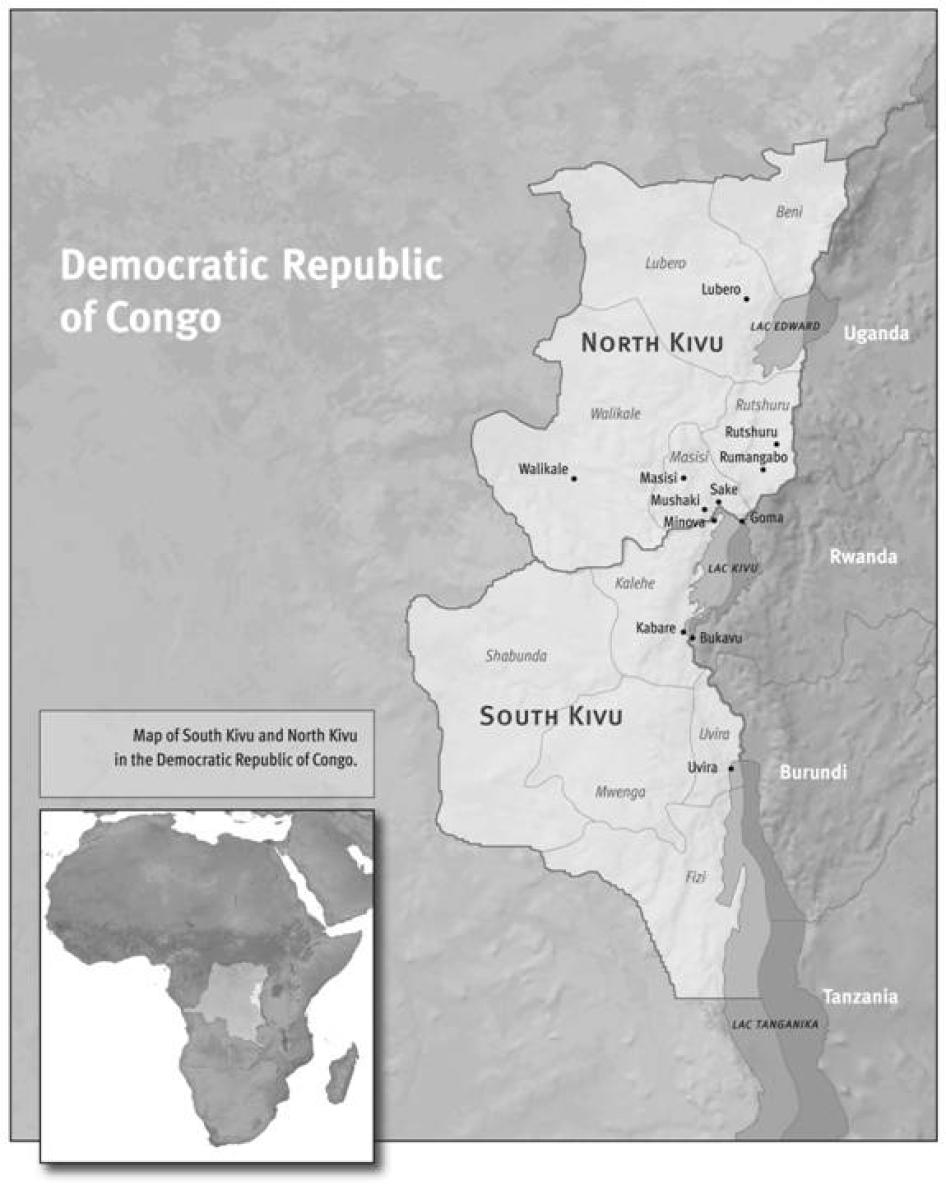
© 2009 Human Rights Watch
Glossary of Acronyms
CCCM Camp Coordination and Camp Management
CNDP National Congress for the Defense of the People (Congrès national pour la défense du peuple)
CPM Commission for Population Movements
DRC Democratic Republic of Congo
FARDC Congolese Armed Forces (Forces armées de la République démocratique du Congo)
FDLR Democratic Forces for the Liberation of Rwanda (Forces démocratiques de libérartion du Rwanda)
IDP Internally displaced person
IRC International Rescue Committee
JPT Joint Protection Team
MONUC United Nations Peacekeeping Mission in Congo
MONUSCO United Nations Organization Stabilization Mission in the Democratic Republic of Congo
MSF Doctors Without Borders (Médecins Sans Frontières)
NFI Non-food item
NGO Nongovernmental organization
NRC Norwegian Refugee Council
OCHA United Nations Office for the Coordination of Humanitarian Affairs
PARECO Coalition of Congolese Patriotic Resistance
PEAR Program of Expanded Assistance to Returnees
RRC Return and Reintegration Cluster
RRM Rapid Response Mechanism
RRMP Rapid Response to the Movement of Populations
UN United Nations
UNHCR Office of the United Nations High Commissioner for Refugees
UNICEF United Nations Children’s Fund
UNOPS United Nations Office for Project Services
WASH Water, Sanitation, and Hygiene
WFP World Food Program
Who’s Who
Congolese Armed Forces (Forces armées de la République démocratique du Congo, FARDC): The Congolese national army, created in 2003, has an estimated strengthof 120,000 soldiers, many from former rebel groups that incorporated followingvarious peace deals. About half of the Congolese army is deployed in eastern Congo.Since 2006 the government has twice attempted, and failed, to integrate the 6,000-strong rebelCNDP. In early 2009 a third attempt was made to incorporate theCNDP and remaining rebel groups in a process known as “fast track acceleratedintegration.” However, many of those who agreed to integrate remained loyal to former rebelcommanders, raising serious doubts about the sustainability of the process.
National Congress for the Defense of the People (Congrès national pour la défense du peuple, CNDP): The CNDP is a Rwandan-backed rebel group launched in July 2006 by the renegade Tutsi general, Laurent Nkunda, to defend, protect, and ensure political representation for the several hundred thousand Congolese Tutsi living in eastern Congo and some 44,000 Congolese refugees, most of them Tutsi, living in Rwanda. It has an estimated 6,000 combatants, including a significant number recruited in Rwanda. Many of its officers are Tutsi. On January 5, 2009, Nkunda was ousted as leader by his military chief of staff, Bosco Ntaganda, and subsequently detained in Rwanda. Ntaganda, wanted on an arrest warrant from the International Criminal Court, abandoned the three-year insurgency and integrated the CNDP’s troops into the government army. On April 26, 2009, the CNDP established itself as a political party.
Democratic Forces for the Liberation of Rwanda (Forces démocratiques de liberation du Rwanda, FDLR): The FDLR is a predominantly Rwandan Hutu militia group based in eastern Congo, some ofthe leaders of which participated in the genocide in Rwanda in 1994. It seeks to overthrow the Rwandan government and promote greater political representation of Hutus. Despite successive military operations against the group in 2009 and into 2010, the FDLR still has an estimated 3,200 combatants and controls significant areas of North and South Kivu, including some key mining areas. The FDLR’s president andsupreme commander, Ignace Murwanashyaka, based in Germany, was arrested by German authorities onNovember 17, 2009, on charges of war crimes and crimes against humanity. The group’smilitary commander in eastern Congo is General Sylvester Mudacumura. The Congolesegovernment often supported, or tolerated, the FDLR until early2009, when its policy changed and the government launched military operations againstthe armed group.
Mai Mai militia: The Mai Mai militia groups are local defense groups often organized on an ethnic basis. They have traditionally fought alongside the government army against “foreign invaders,” including the CNDP and other Rwandan-backed rebel groups. In 2009 there were over 22 Mai Mai groups, ranging in size and effectiveness, in both North and South Kivu. Some joined the Congolese army as part of the rapid integration process in early 2009, while others refused, angry at the perceived preferential treatment given to the CNDP and unwilling to join the army unless they were able to stay in their communities. The various Mai Mai groups are estimated to have some 8,000 to 12,000 combatants.
Coalition of Congolese Patriotic Resistance (Coalition des patriotes résistants congolais, PARECO): PARECO is the largest Mai Mai group, created in March 2007 by the joining of various ethnic-based Mai Mai militias, including from Congolese Hutu, Hunde, and Nande ethnic groups. Throughout 2007 and 2008 PARECO collaborated closely with the FDLR and received substantial support from the Congolese army, especially in its battles against the CNDP. In 2009 many PARECO combatants, particularly the Hutu, joined the Congolese army. Its military commander, Mugabu Baguma, was made a colonel. The Nande PARECO commander, La Fontaine, remained outside the integration process, along with most Nande combatants, until February 28, 2010, when he committed to integrate with 10 of his cadres. A breakaway, largely Hunde PARECO faction, led by General Janvier Buingo Karairi and known as the Patriotic Alliance for a Free and Sovereign Congo (Alliance des patriotes pour un Congo libre et souverain, APCLS), remains outside the integration process. The APCLS is allied with the FDLR and refuses to integrate into the Congolese army without guarantees it will be deployed in its home region and that newly integrated CNDP soldiers will leave.
Summary
The scale of internal displacement in eastern Congo, and the disruption and dislocation it causes to people’s lives, is colossal. As of April 2010 at least 1.8 million people were displaced—the fourth largest internal displacement in the world—1.4 million of whom were in the volatile provinces of North and South Kivu bordering Rwanda. As people have fled, they have lost possessions, homes, land, and livelihoods; as well as family, friends, neighbors, and the economic and social support associated with them. Internally displaced persons (IDPs) have been the victims of deliberate attacks perpetrated by virtually all warring factions in the area—government forces and armed groups alike. Moreoever, IDPs are often among the civilians most vulnerable to further abuse, hunger, and disease, yet they have limited access to services such as health care and education. Many have been displaced two or three times, sometimes more. For some, the years since 1993 can be characterized as being “always on the run.”
This report mainly focuses on the displacement from late 2008 through mid-2010 and especially the first half of 2009. At least 1.2 million IDPs were forced to flee their homes during three successive military operations that began in January 2009; others had fled during earlier waves of displacement. At the same time, over 1.1 million others returned—or tried to return—to their homes between January 2009 and March 2010. Despite these attempts, over 1.4 million people remained displaced in North and South Kivu by April 2010.
This report does not provide a comprehensive history of displacement. Rather, focusing on North and South Kivu, it documents how warring parties have abused IDPs in all phases of displacement: during the attacks that uprooted them, following displacement, and after authorities decided it was time they return home. It outlines the causes of dislocation, including punishment for suspected collaboration with enemy groups and retaliation for military losses, and details the search for refuge that many IDPs undertake in forests, official camps, spontaneous sites, and host families—which are themselves often stretched to capacity. Throughout, IDPs face assault, robbery, forced labor, and rape: for example, witnesses told Human Rights Watch of women being raped in their own houses and in forests; of villagers—including children as young as six—being killed with machetes and hoes and burned to death when soldiers torched houses; and of civilians being beaten and killed for refusing to carry soldiers’ belongings.
Many IDPs try to stay as close as possible to their homes and farms so they can continue to work the land, gather food, and reassert ownership of their property if the situation improves. This report examines the dangerous return trips that many IDPs make to look for food or tend their fields and the barriers that exist to their more permanent return, including the seizure or destruction of their land by armed groups or locals. It also highlights two particular instances when authorities—the government and now-allied CNDP—were so interested in clearing IDPs from camps for political reasons that they compromised the safety of at least some of the tens of thousands of people whose homes, fields, and villages had been appropriated by locals or armed groups or whose return home otherwise remained perilous. Finally, the report outlines the official steps that have been taken to protect IDPs in Eastern Congo, including a recent initiative to combine existing displacement-focused and return-focused programs with a new emergency response strategy that instead focuses on the needs of the most vulnerable.
It notes that while the new response strategy is theoretically more flexible and adapted to the needs of eastern Congo, more assistance needs to reach the estimated one million IDPs living, as of March 2010, with host families throughout North and South Kivu. Until it does, IDPs will continue to return to insecure home areas to find food; live in dire conditions in their places of displacement; and take other risks, including fleeing their villages at the last possible moment.
Political and Military Context
The newest phase of displacement in eastern Congo began in late 2008, coinciding with a dramatic regional shift in alliances.
In December 2008 the previously antagonistic neighboring countries of Rwanda and Congo announced a joint military operation against the Democratic Forces for the Liberation of Rwanda (Les Forces démocratiques de libération du Rwanda, FDLR), a predominantly Rwandan Hutu armed group operating in eastern DRC, and its allies. Shortly after, the Rwandan-backed Congolese-Tutsi armed group, the National Congress for the Defense of the People (Congrès national pour la défense du peuple, CNDP), announced its integration into the Congolese army, following the arrest of the group’s leader, Laurent Nkunda, in Rwanda. Other smaller rebel groups quickly followed suit. New CNDP leader Bosco Ntaganda, wanted on an arrest warrant by the International Criminal Court (ICC), was made a general and the de factodeputy commander of the Congolese army’s military operations in the east. This heralded a series of three military operations pitting the Congolese army against the FDLR: the first, in conjunction with the Rwandese, starting in January 2009; the second, starting in March 2009, together with the UN Peacekeeping Mission in Congo (MONUC); and the third, and most recent, also backed by UN peacekeepers, starting in January 2010, was ongoing at time of writing.
Government and rebel forces carried out widespread and vicious attacks on civilians during these operations, triggering renewed and massive displacement. In December 2009, Human Rights Watch reported that at least 1,400 civilians were killed between January and September 2009 and over 7,000 women and girls raped—numbers that no doubt represent only a fraction of the actual total. Government forces and FDLR also abducted and pressed thousands of civilians into forced labor, including carrying weapons and supplies, as they moved about. Since January 2010, following a new round of military operations against the FDLR, civilians in many parts of North and South Kivu continue to endure forced labor, arbitrary arrests, illegal taxation, looting, sexual violence, and excessive restrictions on movement.
Improved Security since 2009?
Although military operations continue, Congolese government officials and UN planners have begun to plan and implement stabilization and post-conflict reconstruction programs. The government is ultimately responsible for providing protection for its citizens, including those who are internally displaced. It has stated repeatedly that the security situation in eastern Congo has vastly improved and it wishes to see displaced populations return home. Officials have incorporated displacement concerns in the rebuilding program for eastern Congo, the Stabilization and Reconstruction Plan for Areas Emerging from Armed Conflict (STAREC), to be jointly implemented by the government, the UN, and international donors.
The Congolese government’s view that civilian protection in eastern Congo is much improved has been challenged by Congolese civil society groups, national and provincial parliamentarians, and human rights and humanitarian groups. For example, in 2010 South Kivu members of Congo’s National Assembly wrote a letter of protest to the prime minister, Adolphe Muzito, saying, “We find it sadistic and irresponsible that your government declares without embarrassment that there is peace throughout [Congo] with only a few residual pockets of resistance in our province…. In nearly all territories [of South Kivu] insecurity continues.” The authors questioned whether the prime minister “lives in the same country as us” and called for UN peacekeepers to stay until the security situation improved.
One challenge in building a professional army and enhancing security for Congo’s IDPs and other citizens is integrating the numerous armed groups that previously fought the government and repeatedly targeted civilians. For example, after the CNDP agreed to integrate with the army, it was effectively allowed to maintain a parallel chain of command and to retain considerable control over areas it occupied. CNDP officers were awarded senior ranks in the army and the CNDP was given a leading role in the joint Congolese-Rwandan military operation—Umoja Wetu (“Our Unity” in Kiswahili) — launched against the FDLR in January 2009. The operation was marred by serious abuses against civilians by all sides, prompting renewed internal displacement.
In February 2009 Rwandan army soldiers officially withdrew from eastern Congo after five weeks of military operations. The FDLR militias had been forced from some of their military bases in North Kivu province and some had been disarmed, but they had not been defeated.
In March 2009 the Congolese army supported by MONUC peacekeepers launched a second military campaign in North and South Kivu against the FDLR. Operation Kimia II (“Quiet” in Kiswahili) produced a human rights and humanitarian catastrophe as tens of thousands of civilians fled their homes, sometimes for displacement camps around Goma, the capital of North Kivu province. By September 2009 Congolese authorities deemed that some areas of North Kivu, where it claimed to have removed the FDLR militia, were safe for the population to return. Five official IDP camps around Goma, housing some 60,000 IDPs, were closed and emptied almost overnight in what UN officials, diplomats, and others welcomed as a “spontaneous return.”
The reality was more complex. IDPs were put under official pressure to leave as the authorities sought to demonstrate that the Kimia II had created security conditions conducive to return—for both IDPs and Congolese refugees who had been in Rwanda since 1996. As people were leaving, armed police and bandits of youth raided the camps, looting belongings left behind, destroying latrines and other camp structures, and wounding numerous IDPs who had not yet packed up and left. It remains unclear how many IDPs actually returned home and were able to stay or instead joined the vast majority of their displaced compatriots staying with host families or in informal IDP settlements.
In late December 2009 Kimia II was suspended amid criticism of its disastrous humanitarian and human rights consequences. It was followed in January 201o by Amani Leo (“Peace Today” in Kiswahili), a MONUC-supported military operation. Unlike Kimia II, this aimed to target FDLR command bases, rather than broad-based operations. MONUC officials attempted to ensure that the Congolese army units it backed respected international humanitarian law and were not commanded by known human rights abusers. Still, many of the most abusive military officers continue to play important roles in eastern Congo, even if they are not directly involved in operations supported by UN peacekeepers. At least 115,000 more people fled their homes in the first three months of 2010 due to military operations and insecurity in the Kivus.
Protecting and Assisting the Displaced
The UN Guiding Principles on Internal Displacement set out rights and guarantees relevant to protecting and assisting IDPs during displacement, return, resettlement, and reintegration.
However, Congolese authorities have often proved unable, or unwilling, to follow these principles and have a poor track record when it comes to protecting IDPs. Since January 2009 specifically, the often-abusive behavior of Congolese army units has seriously hindered the government and the army’s abilities to effectively protect the population. Moreover, in the absence of state institutions and resources to assist eastern Congo’s war-ravaged population, the government has often relied on UN agencies and international and national humanitarian organizations for humanitarian assistance. These include the UN Organization Stabilization Mission in the Democratic Republic of the Congo (MONUSCO)—previously known as MONUC—a 20,000-strong force with a strong UN Security Council mandate to protect civilians “under imminent threat of physical violence” and to “assist in the voluntary return of … internally displaced persons.”
Focused in eastern Congo, MONUSCO has developed some innovative ways to enhance civilian protection, such as the development of a civilian protection strategy and the deployment of Joint Protection Teams (JPTs) to mediate disputes between non-integrated armed groups and the Congolese army or local population and to separate children from armed groups. However, like other organizations, MONUSCO suffers financial, security, and logistical constraints of its own, especially given Congo’s vast size and the shifting alliances of numerous armed factions. Other initiatives to help IDPs have also faced difficulties. In early 2009 international donors and UN agencies agreed that IDPs and their host families should receive assistance if needed. However, it has proved hard to ensure aid reaches most people in this situation. As a result, the challenge of protecting citizens remains immense.
Until September 2009 much assistance was channeled to UN agencies and NGOs working in the seven official IDP camps in Goma and the four official camps in Masisi. Some also went to agencies working with the estimated 135,000 IDPs living (as of late January 2010) in spontaneous sites. With five of the seven official camps in Goma now closed, aid is set to increase to IDPs in spontaneous sites; UNHCR’s camp management strategy has formalized management of and assistance to such locations. Keen to see the UN peacekeeping mission in Congo shrink in size and refocus on reconstruction, stabilization, and peace building, Congolese government officials, together with UN planners, have also begun to plan and implement stabilization and post-conflict reconstruction programs—even as military operations continue. This includes the Stabilization and Reconstruction Plan for Areas Emerging from Armed Conflict (STAREC)—the rebuilding program for eastern Congo that the UN, government, and international donors are due to implement jointly.
Protecting civilians, including IDPs, must remain of paramount concern in the coming months, as the government seeks to emphasize stabilization and reconstruction. The government must take all necessary measures to ensure that its security forces help protect IDPs fleeing to safety and are not themselves part of the problem. The UN and donors need to be vigilant that MONUSCO’s protection role does not diminish over time in the absence of credible alternatives. Moreover, IDPs should only be encouraged to return when they can return voluntarily in safety and dignity. However, as long as ongoing security problems continue to drive civilians from their homes, it is crucial that UN agencies, NGOs, and donors ensure that emergency humanitarian assistance programs are prioritized and receive sufficient resources and that assistance programs in return areas do not contribute to pushing IDPs home before it is safe for them to go.
Recommendations
To the Government of the Democratic Republic of Congo
- Immediately halt forced returns of IDPs and ensure that all returns are voluntary and fully comply with the UN Guiding Principles on Internal Displacement.
- Take all measures necessary to end Congolese army abuses against IDPs at every stage of their displacement. Ensure the “zero tolerance” policy is fully applied when government soldiers commit human rights abuses.
- Ensure the Congolese army provides protection to IDPs, particularly when they are in insecure areas and seeking safety. Engage with UNHCR, OCHA, other UN agencies, and nongovernmental organizations willing to develop the government’s capacity to assist and protect IDPs under the UN’s protection policy.
- Ensure that IDP protection needs are a central part of the STAREC program and that the program is adequately financed and staffed.
To the UN High Commissioner for Refugees (UNHCR)
- Ensure full implementation of the UN System-Wide Strategy for the Protection of Civilians in the Democratic Republic of Congo, launched in January 2010 and co-led by UNHCR.
- Ensure that newly and previously displaced IDPs, returning refugees and IDPs, and communities hosting IDPs receive assistance based on vulnerability; ensure that assistance programs in return areas do not manipulate or force displaced people to return to home villages before it is safe; improve monitoring and analysis of the push and pull factors that keep IDPs in their site of displacement or encourage them to return home (or go elsewhere), so that the return process can be planned and managed in a way that ensures returnees receive the greatest protection possible.
- Improve monitoring of where displaced people go after they leave camps and other displacement sites to better understand whether they have returned to their home villages, other durable return areas, or secondary displacement sites.
- Improve the quality of the protection work of the UNHCR-chaired North Kivu Protection Cluster by:
- Urgently deploying a new Senior Protection Officer dedicated exclusively to coordinating the work of the Protection Cluster;
- Identifying more focused protection priorities on a regular basis;
- Expanding recent initiatives in North Kivu that follow the Congolese NGO-driven protection information system used in South Kivu, to ensure local residents provide agencies with a continuous flow of protection-related information;
- Producing quarterly reports that draw on NRC’s flash protection reports and other documents analyzing protection challenges that identify patterns of armed group activity leading to protection threats and that set out good and bad “lessons learned” guidance on agency responses to protection threats; and
- Ensuring that the protection cluster’s monitoring reports not only advocate for MONUSCO presence or specific actions in certain areas, but also request that humanitarian agencies undertake specific actions to strengthen protection.
To MONUSCO
- Help IDPs move to areas where they feel more secure and can access humanitarian assistance.
- Ensure full implementation of the UN System-Wide Strategy for the Protection of Civilians in the Democratic Republic of Congo, in particular, that MONUSCO addresses the specific protection needs and vulnerabilities of IDPs, including IDPs living in host families.
- Ensure that MONUSCO field base commanders maintain regular contact with displaced person representatives to ensure that IDP protection needs are identified and addressed.
- Ensure that MONUSCO peacekeepers carry out regular foot and vehicle patrols in the areas most at risk in their area of responsibility and provide escorts for civilians and, in particular, displaced persons fleeing violence or returning to home villages along roads or paths where they may face attack.
- Ensure all illegal roadblocks are removed in their area of responsibility.
- Ensure that Joint Protection Teams (JPTs) monitor areas to which IDPs are returning and make recommendations as to how MONUSCO can best help secure such areas.
To International Donors
- Ensure emergency humanitarian assistance programs receive sufficient resources and priority; urgently fill the UN’s funding gap for humanitarian programs; install a funding channel, reporting structure, and prioritization strategy that is independent of Congolese-government-led development and stabilization programs in eastern Congo.
- Ensure that assistance for newly and previously displaced IDPs, returning refugees and IDPs, and communities hosting IDPs, is based on vulnerability and that assistance programs in return areas—or encouragement by donors for agencies to launch programs in return areas—do not contribute to manipulating or forcing displaced people to return to their villages of origin before it is safe for them to do so.
- Significantly increase support for IDPs living with host families by funding agencies assisting IDPs in host communities, as well as their hosts.
- Fund shelter assistance for IDPs staying with host families to help minimize the need for IDPs to create spontaneous sites or to flee to official camps.
Methodology
This report is based primarily on research conducted in eastern Congo from April through mid-May 2009, with follow-up research carried out from June 2009 through April 2010.
Human Rights Watch conducted in-depth interviews with 146 internally displaced persons (IDPs) (71 women and 75 men) living with host families, in spontaneous sites, and in official camps in North and South Kivu. The vast majority had fled their homes during the previous 12 months and had been previously displaced an average of three to four times over many years.
Two researchers identified interviewees by explaining to representatives of internally displaced communities the broad type of information they were seeking. Locations were selected according to a number of criteria, including places that had recently seen an influx of IDPs and places where IDPs had lived in camps or host communities for some time.
In Goma, the center for humanitarian operations in the region, Human Rights Watch conducted a further 57 interviews with staff from United Nations agencies, national and international nongovernmental organizations (NGOs), donors, and local administrative authorities.
Where individuals or agencies requested that their interviews not be attributed to them, Human Rights Watch has withheld identifying those individuals or their agencies. For their safety, Human Rights Watch has also not published the names of any internally displaced persons or the people hosting them.
I. Conflict and Displacement in Eastern Congo
Our family fled our village in 2004, and we haven’t been able to go back since. We have lived in Kiwanja, but in three different places. For two years we were in a church because there was no assistance anywhere else. Then we moved to a camp for two years, but the CNDP came and destroyed it. Then we fled to live outside the MONUC camp. Now the local people want to close the camp, so then where should we go?
–A displaced woman, 33, Kiwanja, May 13, 2009
Recent Conflict in Eastern DRC
Buffeted by war, for the past 15 years the people of eastern Congo have endured widespread human rights abuses and the recurring displacement of millions of civilians. In recent years, the main fighting protagonists have been the Congolese army (Forces armées de la République démocratique du Congo, FARDC) and two rebel armed groups: a predominately Rwandan Hutu militia called the Democratic Forces for the Liberation of Rwanda (Forces démocratiques de libération du Rwanda, FDLR), and the Congolese Tutsi-led National Congress for the Defense of the People (Congrès national pour la défense du peuple, CNDP). Many smaller groups have also been involved in a maze of shifting alliances. At different times, both major armed groups have been either allies or enemies of the Congolese government, depending on the state of relations between the Congolese and Rwandan governments.
The FDLR—which the UN estimated in early 2010 to be about 3,200-strong— claims to be seeking greater political representation for ethnic Hutus in Rwanda.[1] The CNDP is the most recent of three different Rwanda-backed Congolese rebel groups (and sometimes splinter factions) that have agreed to fight the FDLR and other Rwandan Hutu militias, but which have all also sought to overthrow the Congolese government in Kinshasa.Until January 2009 the CNDP was led by a former Congolese Tutsi general, Laurent Nkunda, whose 4,000 to 7,000 fighters controlled large swathes of North Kivu.[2]
Throughout 2008 hundreds of thousands of people were displaced by clashes between the CNDP and a loose coalition comprising the Congolese army, the FDLR, the Coalition of Congolese Patriotic Resistance (Coalition des patriotes résistants congolais, PARECO), and other Mai Mai militia groups. By October 2008 the CNDP had taken over almost a third of North Kivu, killing and raping civilians as they advanced.[3]
In a dramatic shift of alliances, the Congolese and Rwandan governments on December 5, 2008, announced the start of joint military operations against the FDLR. One month later, Bosco Ntaganda, the CNDP’s chief of staff, removed Nkunda as leader. The International Criminal Court (ICC) has issued an arrest warrant for Ntaganda for crimes he is alleged to have committed in Ituri, northeastern Congo, between 2002 and 2004. Shortly after Rwandan authorities removed and detained Nkunda in Gisenyi, Rwanda, Ntaganda signed a cessation of hostilities agreement together with nine other senior CNDP officers, integrating the CNDP into the Congolese army to join operations against the FDLR.[4] Ntaganda was made a general in the Congolese army and served as de factodeputy military operations commander in the east.
On January 20, 2009, at least 4,000 Rwandan troops crossed the border into eastern Congo to fight the FDLR, the start of Operation Umoja Wetu (“Our Unity” in Kiswahili). The Rwandan troops, sometimes together with former CNDP troops, attacked a main FDLR base at Kibua, in Masisi territory (North Kivu), and other FDLR positions around Nyamilima, Nyabiondo, Pinga, and Ntoto (North Kivu). While there were some military confrontations, FDLR combatants often retreated into the surrounding hills and forests. On February 25, 2009, after 35 days of operations, the Rwandan army withdrew from Congo, in what was likely an agreed timeframe between Presidents Joseph Kabila of the DRC and Paul Kagame of Rwanda.[5] The military campaign was marred by serious abuses against civilians by all parties.[6]
Government representatives from both Rwanda and Congo emphasized that the mission was not complete and pressed MONUC to join forces with the Congolese army to conclusively defeat the FDLR. On March 2, 2009, the Congolese army, with the support of MONUC peacekeepers, launched the second phase of military operations, operation Kimia II (“Quiet” in Kiswahili).[7] While MONUC officials emphasized that Kimia II operations should respect international humanitarian and human rights law, it was not clear how this could be ensured or under what circumstances MONUC would withdraw its support if violations occurred. It was only in June 2009 that a policy establishing conditions for support began to be developed and it took until November 2009 to suspend support to one abusive Congolese unit. Congolese army officers allegedly responsible for war crimes and other serious international humanitarian law violations remained in positions of command.[8]
The Congolese government and MONUC announced the end of Kimia II in late December 2009, following heavy criticism of the operation’s disastrous humanitarian and human rights consequences. A new MONUC-supported Congolese army operation, Amani Leo (“Peace Today” in Kiswahili), was launched in January 2010. MONUC made an important effort to implement a new conditionality policy and to ensure that known human rights abusers do not command Congolese army units participating in jointly planned military operations. Nevertheless, many of the most abusive senior military officers have remained in operational command in North and South Kivu, even if they may not be involved directly in the MONUC-supported operations. Many operations have been carried out “unilaterally” by Congolese army units that do not get MONUC (or, as of July 1, MONUSCO) support.
Congolese armed forces continue to engage in serious abuses, including rape, summary executions, forced labor, and arbitrary arrests. As in previous military operations, soldiers have targeted and arbitrarily arrested civilians they accused of collaborating or sympathizing with the enemy. Civilians have also been forced to carry soldiers’ belongings; those who refused have been beaten or even killed.
The fighting and rampant abuses forced large numbers of civilians to flee their homes. In July 2009 the UN’s department for humanitarian operations concluded that “the humanitarian situation in North Kivu has continued to deteriorate since the beginning of 2009” as a result of Congolese army operations against the FDLR that were “causing massive displacement.”[9] The trend continued in the second half of the year. In January 2010 the UN concluded that the security situation in the east “remains very volatile and the humanitarian situation has deteriorated.”[10] During a visit to the DRC in late April 2010, John Holmes, United Nations Under-Secretary-General for Humanitarian Affairs and Emergency Relief Coordinator, expressed his grave concern about the lack of protection of civilians and emphasized the continuing strong need for humanitarian assistance and humanitarian access. “Civilians continue to suffer enormously and disproportionately in this armed conflict,” he said after visiting IDPs in Mwenga, South Kivu. “While some have been able to return home, others are still being displaced, and armed groups are in many cases still preventing any return to normality.”[11]
Although the CNDP is now officially militarily and politically integrated, it maintains parallel military and administrative structures in much of the area it controlled as a rebel force, and there are continued reports of abuses by former CNDP combatants integrated into the Congolese army. This contributes to ongoing displacement and fear of returning to what are effectively CNDP-controlled areas. Civilians also continue to endure attacks from other elements of the Congolese army, as well as from a number of armed groups that have not yet integrated or have abandoned the integration process and some newly formed armed groups.
All parties to the conflict are bound by international humanitarian law (the laws of war). Both national armed forces and non-state armed groups are obligated to abide by article 3 common to the four Geneva Conventions of 1949, the Second Additional Protocol of 1977 to the Geneva Conventions (Protocol II), and relevant customary international law.[12]
International humanitarian law requires the humane treatment of civilians and other persons no longer taking part in the hostilities, including wounded or captured combatants. It prohibits summary executions, torture and other ill-treatment, rape, and the recruitment of children as soldiers.
Humanitarian law also provides rules on the conduct of hostilities to minimize unnecessary civilian casualties and destruction of property. This includes prohibiting attacks directed at civilians that do not discriminate between civilians and military targets—and that cause civilian harm disproportionate to the expected military gain—or deploying forces that place civilians at unnecessary risk. There are also requirements relating to humanitarian access to provide relief to civilians.
Displacement in North and South Kivu
Since 1994 several provinces in eastern Congo have seen widespread displacement of civilians, who have fled dozens of armed groups spreading terror as they seek to extend economic, political, and military control over territory and resources. By mid-1994 there were about 500,000 IDPs in eastern Congo. That figure dropped to around 100,000 by the end of 1997, only to reach an all-time high of around 3.4 million IDPs in 2003, following five years of conflict. In 2006 this number fell to just over 1.5 million.[13] Throughout 2007 and 2008 clashes between the Congolese army, the CNDP, and other armed groups kept the number of IDPs—most of whom were in the Kivus—at about this same level.[14]
In the last few months of 2008 an estimated 250,000 people were displaced during fighting between the CNDP and the Congolese army.[15] Military operations in 2009 displaced another 1.1 million people in North and South Kivu.[16] In the first three months of 2010 a further 115,000 people fled their homes in the Kivus due to military operations and insecurity.[17] By April 2010 OCHA estimated that more than 1.1 million IDPs had returned—or tried to return—to their homes between January 2009 and March 2010.[18] Despite these attempted returns, over 1.4 million people remained displaced in North and South Kivu provinces by April 2010.[19]
Although these numbers broadly indicate the extent of displacement, they are estimates. The Congolese authorities and international agencies have been unable to collect reliable IDP statistics.[20] Registration challenges are greatest for IDPs living with host families.
Sanctuary
The UN estimates that of as May 25, 2010, 86 percent of IDPs in North Kivu lived with host families (often friends or relatives, but also strangers).[21] This figure is broadly consistent with general estimates of the percentage of IDPs in eastern Congo who live with hosts.[22]
Until 2007 almost all IDPs lived with host families and only a small number sought refuge in what aid agencies call “spontaneous sites” (locations where IDPs spontaneously settle such as churches, mosques, schools, or open fields near towns, villages, or MONUC bases). In mid-2007 increased fighting and longer-term territorial gains by armed groups put new pressures on host families and led more IDPs to seek refuge in spontaneous sites where, access permitting, aid agencies were able to provide some assistance.[23]
Starting in mid-2007, UNHCR brought some spontaneous sites within its Camp Coordination and Camp Management (CCCM) strategy, turning some into official displaced person camps and setting up new camps in anticipation of new IDP arrivals.[24] By late July 2009 seven official camps near Goma sheltered 67,480 IDPs (down from around 100,000 in January 2009).[25] In September 2009 five of the Goma camps were closed after UNHCR announced that all but a few of the tens of thousands of IDPs still living there in August had decided to return home (see below).[26] As of early February 2010 four camps in Masisi and Lushebere towns (70 kilometers from Goma), recognized as official camps since early 2008, continued to shelter 7,562 IDPs.[27]
In June 2009 UNHCR began the process of bringing more spontaneous sites within its IDP camp coordination response. Before June 2009, registration of assistance for IDPs in such sites was sporadic and limited. By March 2010 UNHCR had registered 117,051 IDPs in 46 spontaneous sites in North Kivu and 17,409 IDPs in camps and sites in South Kivu but had not yet extended its activities to cover them.[28]
Patterns of Displacement
In many conflict situations around the world, IDPs flee their homes and seek refuge in one location—including IDP camps where they can receive assistance for years—and then return home when fighting ends.[29] However, this is not the case in eastern Congo. As a result, national authorities and international agencies face huge protection and assistance challenges as they grapple with at least four main patterns of IDP displacement: remaining close to home; moving back and forth between villages and displacement sites; returning home for significant periods when violence subsides, only to flee again when it flares; and occupying abandoned property.
First, many IDPs in eastern Congo are anxious to remain near their homes so they can cultivate their fields. As a result, many risk their lives and properties by staying for weeks and even months in nearby forests or with host families in towns and villages– unsafe areas that lie beyond the reach of humanitarian agencies.[30]
Second, the need to find food and the desire to check on property drive many IDPs to move back and forth—sometimes even daily— between their displacement site and unsafe home villages. Nights may be spent, for example, in one place (usually a town or village), while the day is spent somewhere else (usually in fields near their homes). Aid agencies have struggled to devise effective protection and assistance in the face of such movement.[31]
Third, lulls in violence have allowed civilians to return home for months or even years before they have to flee again. In addition, once displaced, many IDPs move from one displacement site to the next, or even back and forth between different displacement sites, usually in a bid to escape insecurity or because limited or absent assistance leads them to try their luck elsewhere.[32] This multiple displacement also creates huge challenges for agencies that naturally find it easier to provide assistance to IDPs who stay over time in one location.[33]
Fourth, in some locations, IDPs seek refuge in previously abandoned villages and occupy land and houses, leading to inevitable tensions and to renewed displacement—either for the new occupiers or for the previous owners when the latter return home. The same happens when returning IDPs find their property occupied by fellow villagers who never left.[34] Often such land occupation flows from long-running land disputes and causes new disputes.[35]
The Particular Experience of IDPs
Eastern DRC’s conflict has affected the entire civilian population. For years Congolese and international agencies, including Human Rights Watch, have reported appalling levels of international human rights and humanitarian law violations against displaced and non-displaced civilians alike. These include killings, sexual violence, torture, beatings, abductions, and looting.[36]
However, IDPs in eastern DRC are often in circumstances that can make them especially vulnerable to rights abuses and create specific protection and assistance needs. These circumstances include complete isolation while displaced in the forest; encounters with armed groups while on the move, or in spontaneous sites and camps; and prolonged periods without livelihoods, shelter, and humanitarian aid, while displaced and after returning to insecure villages with limited state presence and rule of law.
In July 2008 the UN Secretary-General noted that victims of rape in North Kivu between March and June 2008 were “primarily” IDPs, while in January 2010 the UN highlighted the specific risks IDPs—especially displaced children— face in spontaneous IDP settlements and official camps.[37]An International Rescue Committee (IRC) study on mortality in the DRC found that between August 1998 and April 2007, 5.4 million people in Congo died from preventable and treatable conditions (such as malaria, diarrhea, pneumonia, and malnutrition) arising from “social and economic disturbances caused by conflict, including … displacement.”[38]
In addition, the Congolese army has in many areas been a source of insecurity for civilians, including IDPs, by attacking them instead of providing protection. Human Rights Watch previously reported how the UN peacekeeping mission in Congo, MONUC, struggled to implement its broad civilian protection mandate.[39] Its most recent civilian protection initiatives have focused primarily on preventing attacks on civilians in general, rather than IDPs in particular. This makes sense in a context where only a small proportion of IDPs live in settlements distinct from the wider population.
Despite the tens of millions of dollars that international donors have given programs assisting IDPs, little aid has reached the vast majority of IDPs who live with host families. These host families themselves have often been displaced in the past and live in poverty and constant fear. Much of the assistance has been channeled to agencies working in the seven official IDP camps in Goma that opened in late 2007 (until five of them closed in September 2009) and the four official camps in Masisi. Some has also gone to agencies working with IDPs in spontaneous sites, which, as of June 2009, started to be recognized as official IDP camps.
II. Abuses against IDPs
Causes of Displacement
Before the January 2009 launch of joint Congolese-Rwandan military operations against them, FDLR members lived and mixed with the Congolese population in numerous towns and villages across North and South Kivu. While relative harmony prevailed in some locations, the relationship was more violent in other areas, where the FDLR abused civilians as control of the zones by various warring parties moved back and forth.
One woman told Human Rights Watch, for example, that she fled her village in September 2008 because the FDLR soldiers were raping women in the fields during the day and in the houses at night. She fled from place to place, escaping the shifting front line:
My older sister was raped in her house that month [September 2008]. We fled to the fields, but the FDLR followed us there and so we fled to Kirumba. We went back in November but the same thing happened again and we fled again in January, to Bingi. We tried to go back in March [2009] but then we heard the Congolese army was coming and we were afraid the FDLR would punish us so we fled again, back to Kirumba.[40]
The rapprochement between Rwanda and Congo, realignment of military alliances, and subsequent military operations changed previously peaceful relationships between the FDLR and local Congolese communities. A significant cause of displacement in early 2009 was an FDLR strategy of unlawful retaliatory attacks against the civilian population to punish people for the government’s new policy and their perceived “betrayal.”[41] According to one man, when the FDLR learned that the Congolese-Rwandan forces were nearing Tembo village in March 2009, the rebels turned on the villagers and accused them of having called “the Tutsi” to attack the FDLR. The victims included four of the man’s children, aged between 12 and 18, whom the FDLR killed in broad daylight with machetes and hoes.[42]
Local authorities and health workers who had lived near FDLR positions for many years and knew the group well told Human Rights Watch they believed FDLR attacks on civilians may have been intended to cause a humanitarian disaster—including large-scale displacement—so that the Congolese government would be forced to call off military operations. This belief appears to be supported by a number of FDLR combatants who have left the group since January 2009 and entered the UN’s demobilization program.[43] The fighters told UN officials they were ordered to create a humanitarian catastrophe to press the international community to call off its support for the military operations against them.[44]
Human Rights Watch spoke to numerous IDPs in North Kivu who said they had fled from February to April 2009, when the FDLR burned down all or part of their villages before the imminent arrival of Congolese and Rwandan forces. A 46-year-old woman said,
At the end of March [2009], we heard the FDLR had burnt Biriko, Bongu, Katoyi, Katahunda, Kipopo, Nyakabasa, and Rambo villages and told the villagers it was because the Congolese army was coming, so we fled into the forest. On April 1 they [the FDLR] came and burned many houses in our village, including mine. My family had nothing left and we fled to the forest and then to Minova.[45]
In some cases, local Mai Mai fighters fought against the FDLR during the Congolese-Rwandan advance. When the FDLR returned, they took revenge against suspected Mai Mai. A 24-year-old man said,
After the army had left, the FDLR came back and accused us of being Mai Mai fighters, burned some of the village, and looted the remaining houses. We fled to the forest for a few days to see if things would calm down, but they came back three days later and burned more houses, so we fled to Minova.[46]
In June 2009 the FDLR were continuing to punish civilians for alleged “collaboration” with the Congolese army against the FDLR in North Kivu, including in southwest Masisi and Walikale territories and in South Kivu.[47]
Human Rights Watch also received reports that the FLDR prevented civilians from leaving their villages, as Congolese and Rwandan troops advanced, in order to use them as “human shields.”[48] For example, in early February 2009 the FDLR blocked people from fleeing Oninga village in northern Walikale territory. A displaced person from Oninga who managed to escape described what happened:
After the operations in Fatua, the FDLR came back to Oninga. But they knew the Congolese soldiers would come to chase them out, so they blocked all the paths into the village to keep the villagers there as human shields. The lucky ones managed to escape, but the majority of the population couldn’t leave.[49]
In April 2009 MONUC reported that territorial administrators and local NGOs had confirmed that the FDLR had surrounded villages and was holding civilians as human shields in Chibinda village (Kalonge area, Kalehe territory), Kasinda village (Ninja area, Kabare territory), and in Idunga village (Mumbili area, Shabunda territory).[50]
Attacks by the FDLR and other armed groups, sometimes allied with the FDLR, continued in 2010 after the launch of Amani Leo military operations, causing further civilian displacement in North and South Kivu. In early May 2010, armed elements attacked and killed seven people in Omate, Walikale territory, forcing the population to flee towards the towns of Mubi and Ndjingala.[51] Also, in early May 2010, FDLR combatants burned approximately 50 houses in Lubero Territory, North Kivu.[52]
The Congolese army and its allies have also perpetrated attacks on civilians resulting in displacement. Between January and September 2009, as newly integrated CNDP troops moved into territory previously controlled by the FDLR, many civilians fled their villages to escape serious abuses by Congolese and Rwandan soldiers accusing them of having supported the FDLR.[53] Such abuses by Congolese forces violate fundamental protections of international human rights and humanitarian law.[54] They also violate the DRC’s obligation under the African Union Convention for the Protection and Assistance of Internally Displaced Persons to “ensure respect for … international law, including human rights and humanitarian law, so as to prevent and avoid conditions that might lead to arbitrary displacement.”[55]
Government soldiers and their allies destroyed homes and villages as they advanced, not only rendering vast numbers homeless, but killing or traumatizing them as well. A woman from Lukweti, whom Congolese army soldiers burned out of her home in March 2009, told Human Rights Watch that her six-year-old child was burned to death, and that she witnessed other civilians from her village being shot as they tried to flee. “The soldiers set fire to our house, and my son burned to death inside. They burned four other houses, and another baby boy burned to death inside one of them as well.”[56]
On February 14, 2009, coalition soldiers, retreating from a frontline position and reportedly angry that they had failed to find FDLR members, attacked the three neighboring villages of Lushoa, Mashuta, and Numoo, near the border of Walikale and Lubero territories, to “punish” the civilian population for having collaborated or lived with the FDLR. They burned 97 houses and a health center in Lushoa, 63 houses and three classrooms in Mashuta, and 13 houses in Numoo.[57] The next day, on February 15, coalition soldiers burned another 170 houses, a health center, two classrooms, and a school office in Bushalingwa village and 135 houses in neighboring Kishonja village.[58] The destruction of health facilities and schools violates laws of war prohibitions on the destruction of civilian objects, has increased the health risks to the population, and sharply curtailed children’s education.[59]
In March 2009 MONUC reported that IDPs had fled their villages in south Lubero territory, North Kivu, to escape the Congolese army’s so-called “Fast Integrated Brigades,” made up of former CNDP and PARECO forces.[60] Human Rights Watch spoke to numerous IDPs who had lived for years in areas under FDLR control who said they fled because Congolese and Rwandan forces treated them as if they were either active FDLR members or collaborators with the group. A 40-year-old man who fled his village after the Congolese army burned it down said, “They told us our daughters had married FDLR soldiers and that all of us were FDLR accomplices and had to be punished.”[61]
A man who had lived for many years in a village under FDLR control said that his village changed hands several times between January and March 2009 during fighting between the Congolese army and the FDLR. On March 8, Congolese soldiers burned down his village in retaliation for their losses at the hands of the FDLR:
The next day Congolese soldiers came to the forest and told me they had burned our village because the FDLR had killed a senior Congolese army officer and because the villagers supported the FDLR. I fled with my family to Kanyabayonga.[62]
Congolese army attacks on civilians, accompanied by horrific human rights abuses, have been a major cause of displacement, even where homes and properties have not been destroyed. For example, a Human Rights Watch researcher traveling along a 10-kilometer stretch of road between Nyabiondo and Lwibo in Masisi territory in October 2009, found all the villages between these towns completely deserted. This followed the Congolese army killing at least 83 civilians and raping numerous women and girls in the same area.[63]
In 2010 civilians continued to flee their homes following the launch of a new round of military operations against the FDLR and other armed groups, known as Amani Leo. As in previous military operations, soldiers have targeted and arbitrarily arrested civilians they accused of collaborating or sympathizing with the enemy. Civilians have also been forced to carry soldiers’ belongings and have been beaten or killed for refusing. On May 4, 2010, for example, Congolese army soldiers burned more than 20 houses on the road between Bunyatenge and Fatua, in the western part of Lubero Territory, North Kivu, reportedly because civilians in the area had refused to transport their military assets.[64]
Abuses during Flight
The Congolese army stopped us on the road near NyabIondo and said, “Why are you fleeing? We are coming to save you.” Then they stole all our things.
—A 30-year-old woman who lost everything as she fled her village in April 2009
IDPs remain seriously at risk when in flight. As in previous years, all parties have attacked IDPs as they fled, although often the exact identities of the perpetrators have not been clear to the victims. For example, around January 27, 2009, uniformed soldiers, who may have been Congolese coalition or Rwandan army soldiers, beat to death a 25-year-old man and his four-year-old daughter from Masiza village, near Bibwe, as they fled fighting. A witness said,
We were fleeing... we saw the soldiers just ahead of us. They told us to stop. I ran immediately into the forest. It was a big group of soldiers. They were wearing tache tache [camouflage] uniforms with little flags. The soldiers had radios with big antennas. We were a group of five civilians. My friend and his daughter were captured by the soldiers ... They asked my friend, “Where are the FDLR?” He replied that they had already fled. Then another soldier said, “No, this one here is an FDLR. We should kill him.” So they killed my friend and his daughter by beating them to death with a large stick covered with nails.[65]
Human Rights Watch also spoke with a number of people who witnessed the FDLR killing IDPs and raping women as they fled their villages.A woman whose relatives were killed, and who was raped while fleeing an attack in Manje village in July 2009, told Human Rights Watch what happened:
It was night when the bullets were flying in our village. We fled to the forest, but the FDLR found us on the path and accused us of being Mai Mai. Then they killed my father and my two brothers and raped me and my mother. My mother cried and then they shot her in the vagina and she died. They continued to rape me, and then they shot in the air and left.[66]
A woman interviewed by Human Rights Watch was raped and abducted by the FDLR while trying to flee an FDLR attack on Manje village (Walikale) in July 2009. She lost her mother, father, grandmother, and cousin during the attack, as well as 15 of her neighbors. She said,
They attacked at night, locked people in their houses, and then burned them with their homes. The bandits [FDLR] spoke Kinyarwanda and wore uniforms and found me while I was trying to flee and took me and other women into the forest to rape us. I was raped by at least four men, but then I lost consciousness and couldn't count them. I got pregnant because of the rape. They held me and nine other women and girls in the forest for one week.[67]
An 85-year-old woman was raped by five FDLR combatants in Bunje (Ufumandu) on July 2, 2009. Talking to a rape counselor, she said,
They found us on the path while we were running away from the bullets. We said we were fleeing and were tired and asked them to pardon us. Then one of them told me to put down everything I had and get on the ground. I said, “I'm like your grandmother, how can you do this?” They responded, “Our grandmothers stayed in Rwanda.” Then they beat me, dragged me to the forest by my legs and started to rape me, all five of them. Then they left and some of the passers-by helped me.[68]
Meanwhile, many IDPs told Human Rights Watch that the Congolese army had forcibly stopped their flight and forced them to carry soldiers’ belongings. For example, a 23-year-old woman who fled her village three times in nine months explained what happened during the third displacement in March 2009:
The Congolese army stopped us very close to Kasiki village. They said, “You are the Mai Mai who fought with the FDLR against us. Come with us and carry our bags.” Then they forced my husband and two other men to carry their bags. None of us have seen our husbands since.[69]
A 35-year-old man told Human Rights Watch that he fled his village on February 8, 2009, when he heard the Congolese army was on its way to fight the FDLR. The army stopped him and others on the way to Luofu village. Those able to pay a bribe were allowed to continue, but others, like him, who had no money, were forced to carry the soldiers’ belongings.[70]
Robbery of IDPs in flight has been extensive, perpetrated by the Congolese army, its allies, and the FDLR.[71] Dozens of IDPs told Human Rights Watch they fled their villages for safer places by going through the forest to avoid meeting Congolese soldiers on the main roads. Those who did flee on main roads often lost everything. For example, a 36-year-old man explained how, in April 2009, Congolese soldiers stopped his fleeing group, questioned their loyalty, and then robbed them:
Just before we reached Kanyabayonga a few days ago, the Congolese army stopped my family and many others and asked us for our electoral cards. When they saw we came from Walikale they said we were with the FDLR. We said we were citizens of Congo and that we were there before the FDLR came to the area. Then the soldiers told all the men to take all their clothes off, except for their trousers, to put all our belongings on the ground, and leave.[72]
IDP representatives in Kanyabayonga said that only months earlier in January 2009, the Congolese army had similarly, and systematically, robbed hundreds of fleeing families.[73]
On April 13, 2009, four FLDR combatants stopped a group of villagers from Kalevia (southern Lubero) as they fled combat in their villages towards Luofu. One villager said,
After we fled for the second time, we met the FDLR on the road to Luofu. They stopped us and said, “Where are you going? Who told you to leave? How do you know the enemy is coming? Are you in communication with them?” Then they told us to leave all of our baggage and give them all our money. They said they would kill anyone who didn't have money. So we gave them our baggage and money, and those of us who didn't have money asked for credit from a neighbor. We were a very large group: men, women, children, and old people.[74]
Meanwhile, Congolese army troops in the area were behaving similarly. One man, 47, told Human Rights Watch that Congolese soldiers stopped him and others as they fled, shot in the air, and stole all their belongings. Two days later, the same soldiers sold the stolen goods back to them in the market in Luofu village.[75]
III. The Search for Refuge
The FDLR came to the forest and raped some of the women, but I stayed because I was afraid to leave my field. I knew it would be hard to find food if I left my field.
–A 35-year-old woman fleeing her home in February 2009
The Protocol on the Protection and Assistance to Internally Displaced Persons, endorsed by the governments of the Great Lakes region, commits the Congolese government to ensuring that IDPs can remain in “safe locations away from armed conflict and danger.”[76] However, in reality most IDPs in eastern DRC face constant insecurity wherever they flee, whether they go to forests near their villages, host families in nearby towns, or far-flung camps.
Many IDPs brave significant risks to stay in their homes for as long as possible before fleeing. Some told Human Rights Watch they did so because they knew from past experience, or from previously displaced relatives, that they were unlikely to receive any food or other assistance once displaced. One 40-year-old man from Miriki told Human Rights Watch,
When the Congolese army came, the FDLR told us to leave, but we stayed. We were afraid of the fighting, but we also feared hunger and sickness if we left our fields and village. We knew how hard it is to get help when you leave your village. It’s only when the FLDR started beating us with sticks that we fled.[77]
A 35-year-old woman from Nyabiondo explained how she had risked attacks to avoid leaving her village:
The Congolese army came in early February [2009], and the FDLR fled. Other villagers who went to the fields nearby told me the FARDC and FDLR raped women there. I was afraid and wanted to leave, but I was displaced in 2003 and did not get help. I knew life would be tough, so I stayed at home for as long as I could. When my food ran out I had no choice, and I left the village.[78]
A 37-year-old man explained to Human Rights Watch that his decision to stay in the forest near his fields was because of a long history of hunger and inadequate humanitarian assistance for IDPs:
When I went back for a few days to find food I spoke to villagers who had stayed in the forest near our village and didn’t flee to Kanyabayonga like the rest of us. They told me they remembered their suffering between 1999 and 2004 when they fled the FDLR and came to Kanyabayonga but received no help from the government or organizations. They said it was better to stay near the fields than risk hunger and illness again.[79]
The Forest
Many IDPs have found themselves constantly on the move after fleeing, trying to avoid the shifting front line while staying as close as possible to homes and livelihoods. Most told Human Rights Watch they first took refuge in surrounding fields or forests—even though they risked attack and life-threatening conditions there—because they were close to home and food sources. Some said they were forced to stay in the forest because it was too dangerous to use the roads between their village and the next place of relative safety.
Entire villages have often been forced to survive for days or weeks in the forest. During the first week of February 2009, for example, 90 percent of the 10,000 people living in the Oninga area, 150-kilometers west of Pinga in Walikale territory, fled to the forest after clashes between the Congolese army and the FDLR.[80] In March 2009 MONUC reported that much of the population of Miriki village in south Lubero, including children, fled to the forest where they spent days trying to survive in dire conditions after Congolese army soldiers burned down 150 houses in their village.[81]
Many IDPs said that attacks or threats eventually forced them to flee further afield. A 21-year-old woman with two children and a baby, who fled to the forest in early March 2009 to escape FDLR forces, said,
We heard life in Luofu [on the other side of the front line] was bad for people who had fled there, with lots of hunger and sickness, so we stayed in the forest close to our field. We only fled when the FDLR followed us to the forest.[82]
A 54-year-old man in Kirumba related what happened to his daughter, who fled to the forest in February 2009 when the Congolese army came:
She wanted to be close to her field and feared her children would not eat if they left. But after three weeks, two of her children fell sick and died. One was about 18-months-old and the other about six-months-old.[83]
Refuge with Host Families, in Spontaneous Sites, and in Official Camps
During fighting in 2009, displaced persons fleeing their villages or the forest sought shelter in three kinds of locations: host families, spontaneous sites, and official camps.[84]
IDPs have generally preferred to live with host families close to their villages because they can regularly return to their fields and check on property, as previously described. They also often feel more physically and emotionally protected with host families than in sites or camps, even though host families are themselves often impoverished after years of conflict.[85] In south Lubero territory the average family said it had hosted IDPs on three or four occasions, each time for around three months, and that the number of people in the house almost doubled (from around 8 to 14 persons) during such periods.[86] In some locations, host families have hosted up to six IDP families for months at a time.[87] In many cases, the most vulnerable IDPs, especially the elderly, flee no farther than 10 to 15 kilometers from home.[88] Some IDPs told Human Rights Watch they preferred to live with host families because they had heard that children were not safe in the camps.[89]
However, in 2007, when the conflict in North Kivu intensified and armed groups held territory for longer periods, many IDPs were forced to seek refuge further from home. Brief home visits became more difficult or impossible. The extended stays of IDPs living with families sometimes caused tensions with their hosts. Consequently, many IDPs told Human Rights Watch they left for spontaneous sites or official camps. New IDPs began to go directly to spontaneous sites or camps as host families reached saturation.
Tensions between IDPs and host families often arise due to lack of resources and services, such as firewood, water, and sanitation facilities.[90] Sometimes the source of tension is even more basic—too many mouths to feed. A 51-year-old woman living in one Masisi camp said,
I fled with ten children—my own and my sisters’—and lived in a small room for one month. My hand was injured during our escape so I could not work in the fields. The family looking after us didn’t have enough food for all of us, so we argued. We had no choice and went to live in one of the camps.[91]
A large number of IDPs live in appalling circumstances, often in small ramshackle huts made of sticks that provide no shelter from the rain.[92] Many told Human Rights Watch that they lived and slept in extremely cramped conditions due to lack of space in the host family’s home. A 42-year-old man from Mahanga said,
For three months I have lived with my wife and 11 children in a single room, and we can hardly sleep because we don’t have the room to all lie down.[93]
A 45-year-old married man with five children from Nyabiondo reported,
When we arrived in Masisi we lived with a host family, but they complained about the pressure, so we left after three weeks. We wanted to go to the camps but the NGOs said they had no plastic sheeting, so I found some land and built a small hut which lets the rain through. My children are always sick and the land owner is trying to chase me away.[94]
Because of the burdens of hosting, host families often become just as economically vulnerable as their IDP guests.[95] A 45-year-old man from Lushoa with 10 members in his immediate family said,
For two months I have also looked after the families of two of my daughters, so we are now 18 people. Even before they came to live with us we were struggling to eat enough, but now all of us, including my children, eat less and even miss meals so we can all manage.[96]
A parish priest from Kaina said that in a culture in which visitors always eat first, followed by the host families’ adults and then children, many host family children often end up with no food.[97]
A 40-year-old man hosting different groups of displaced people in Minova since March 2008 said that he has received no help, despite hosting IDP families for weeks or months at a time:
It is bad. All we have now is a little manioc [staple food], which I use to feed my wife and six children. When we have food, our [IDP] guests eat. When we don’t, they don’t, and we all go to sleep hungry.[98]
Many IDPs who would try to survive without host families cannot do so because of an absence of material support. In 2009 local authorities in Masisi and Lushebere said that many IDPs had first sought refuge in the camps and had only opted for host families when they found no space or assistance there.[99] IDPs living with host families in Masisi and Lushebere confirmed this, saying they wanted to move to the camps but could not because agencies told them there was no plastic sheeting for new shelters.[100] Some aid agencies report that because of an absence of non-food-item (NFI) assistance—including plastic sheeting for hut roofing—IDPs who want, but cannot afford, to build their own shelter are forced to move in with host families.[101] In mid-2009 many IDPs in Minova, 40 kilometers west of Goma in South Kivu, were building temporary shelters in villages close to the camps while they waited for space to become available, rather than living with host families.[102]
A number of other factors influence IDPs’ decisions about where to live. Many IDPs “follow” others, so that when key people such as community leaders head for camps or create spontaneous sites, hundreds and sometimes thousands of others will follow.[103] In other cases, increased awareness of a predictable and consistent flow of aid in UNHCR-coordinated camps—in contrast to unpredictable or completely absent assistance in other locations—has led some IDPs to choose camps over other options.[104] Finally, in Masisi and Lushebere towns, an ethnic dimension has affected IDPs choices: as of May 2009 Hutus were seeking to live in camps while people from the Hunde ethnic group were choosing to live with host families, the vast majority of whom were also Hunde.[105]
In 2010 the vast majority of new IDPs again chose to live with host families. By May 25, 2010, about 86 percent of IDPs in North Kivu lived with host families. Twelve percent lived in camps, while the others lived in spontaneous sites. The most commonly cited cause of displacement in 2010 was armed attacks. In May 2010 OCHA estimated that 78 percent of the IDPs in North Kivu fled because of armed attacks, while others fled preventatively or for unknown reasons.[106]
IDPs Spontaneously Settling Next to MONUC Bases
In a number of places in North Kivu, including Kiwanja, Nyabiondo, Tongo, and Ngungu towns, IDPs have sought refuge right next to MONUC bases.
In one striking example, approximately 10,000 IDPs sought refuge in early November 2008 outside the MONUC base in Kiwanja after the CNDP (then still fighting the government) destroyed six IDP camps and public sites sheltering 27,000 IDPs in a crude attempt to destroy perceived pockets of opposition and to assert that CNDP-controlled territory was safe for IDPs to return home.[107] IDPs who fled to the MONUC base included those who had been in camps destroyed by the CNDP and who could not afford to pay rent to host families in Kiwanja.[108] They also included families from among the approximately 25,000 IDPs already living with host families whose houses had been attacked by the CNDP.[109] As of early February 2010 the site housed 3,330 IDPs, down from 12,000 when the camp was first formed in late October 2008.[110] In Nyabiondo, Masisi territory, many IDPs living with host families in March and April 2009 were so afraid of nocturnal Congolese army attacks and looting they began sleeping next to the MONUC base under the open sky.[111]
Temporary IDP Transit Sites
Many IDPs told Human Rights Watch they had left their first displacement site and moved closer to their villages for brief periods due to lack of assistance or because there were indications that security had improved in their home areas. In March and April 2009, for example, hundreds of IDP families left official IDP camps in Masisi and Lushebere due to a lack of help. However, continued insecurity meant they could not return home, and so they chose to instead live in small towns, such as Muheto, Nyakariba, and Nyamitaba, where they said they felt there was at least a minimum of security.[112] Around the same time, many IDPs facing assistance problems in the town of Kiwanja ended up displaced again in villages or towns such as Busanza and Jomba or on main roads near their original villages that remained inaccessible due to insecurity.[113]
The Risky Search for Food
We are like thieves in our own fields.
—Displaced man, Luofu, April 16, 2009.
According to IDP testimony and surveys carried out by aid agencies, many IDPs who receive no assistance are compelled to eat less and sometimes not at all—often for days at a time.[114] A 44-year-old woman living with 13 relatives in a host family said that everyone ate only once a day and that her children were constantly sick with diarrhea.[115] A 46-year-old woman with two children said,
I have been in Luofu for two months and received no help. When I am lucky I work for a full day in a local person’s field and get two handfuls of sweet potatoes for me and my children. But if I can’t find work, we don’t eat.[116]
The limited assistance available to most IDPs leads them to take desperate measures to survive. Many told Human Rights Watch that the lack of food meant they had little choice but to return for days or weeks to unsafe villages or forests near their fields. Some IDPs said they were so desperate they still went to such areas, despite specific threats against them. Many said they spent nights in the forest and briefly went to their fields by day, braving the constant threat of discovery by armed groups. Many humanitarian agencies also report that most IDPs’ main source of food and income is their own fields in insecure areas.[117]
In April 2009 IDPs and their representatives in Masisi and Lushebere towns and camps, Masisi territory, told Human Rights Watch that IDPs were returning to insecure villages, such as Butare, Kahira, Kanzenze, Muheto, and Nyamitaba, where many CNDP fighters had refused to integrate into the Congolese army because they had received no assistance for months and were desperate for food.[118] This was occurring even though local authorities said they were “not authorizing or encouraging” such returns because of ongoing insecurity in IDPs’ home villages.[119] IDPs and aid agencies reported the same practice elsewhere.[120]
Desperate to feed her six children, a pregnant 34-year-old woman told Human Rights Watch in April 2009 how she went back and forth to her village as the tide of fighting shifted:
In the last two months I fled my village twice. In February we fled to Luofu to escape the Congolese army fighting the FDLR. But life in Luofu was too difficult. I had almost no food. After five weeks I went back home for two weeks, even though the FDLR had come back and the Congolese army were close by. I fled again when I heard the army was coming back to the village.[121]
A 30-year-old man from Kinyana said he returned despite his fear of the CNDP:
I went back to my village in April [2009] for three days to find food. I saw others who had come back and slept at night in the forest. They said they feared the integrated CNDP who they said came at night to the village and stole peoples’ food, beat them, and accused them of collaborating with the government because they had fled to government towns. But the villagers said they preferred to sleep in the forest, looking for food by day and risking problems with the CNDP rather than starving in the camps in Masisi.[122]
IDPs returning to insecure home areas are at serious risk of abuse by armed groups. Human Rights Watch has documented numerous incidents, including rape, beatings, forced labor, and looting. For example, in March and April 2009, displaced women living in Kayna, south Lubero territory, went home to harvest standing crops and were raped by armed men in their fields.[123] A 25-year-old woman was attacked when trying to collect food:
My children were starving so I went with three women to a town close to our homes. Our village is too dangerous because of the FDLR. We tried to reach our fields, but as soon as we got near the FDLR saw us. Two of us escaped but they caught the other two and raped them. I came back here. Now we are starving again.[124]
Former CNDP soldiers integrated into the Congolese army beat and abused a 35-year-old man from Mahanga when he returned to his village to find food:
At the end of February [2009] I fled my village, but life here is so hard I have been going back to find food. I went back last week, but five CNDP soldiers now in the Congolese army came to my house in the evening of April 29. They forced me to take off all my clothes. Then they beat me on my ribs and on my back with a wooden stick and the butt of their gun, kicked me in my ribs, and then cut my right wrist with a knife. They said I was a friend of the FDLR and I should take them to meet the FDLR. Then they forced me to carry a sack of flour for six hours to their base. We arrived at 2 a.m., and they let me go.[125]
PARECO soldiers integrated into the Congolese army forced a 28-year-old man into portering:
Here in Masisi we can’t find enough food so I have gone back to my field four times. Each time, I meet integrated PARECO soldiers in Ndete and Kasinga who force me to give them money or food or to carry their bags or cut wood for them. Then they let me pass.[126]
There are many reports of looting by both the FDLR and the Congolese army. A 58-year-old woman told Human Rights Watch,
Whenever I go back to my field to find food and return, the FDLR stop me and take some of the food. Sometimes I am unlucky and I also meet the Congolese army on the road near Kiribi village, and they take the rest.[127]
A 53-year-old man from Kasiki said,
Since our whole village fled to Luofu in February [2009], we organize ourselves in groups of 10 to try and go back to our fields to find food. Sometimes on the way back we meet Congolese army soldiers who shoot in the air. We drop our food and run. Then the soldiers bring our food to Luofu and sell it back to us at the market.[128]
These examples underline the significance of effective and appropriate IDP humanitarian assistance. Congolese and international agencies have agreed that IDPs living with host families (and hosts as well) often need access to aid. In January 2010 aid agencies installed a new system aimed at rationalizing the way that agencies and their funders provide emergency response to displacement. The system focuses on meeting the needs of the most vulnerable—whether newly displaced IDPs, IDPs returning to safe or unsafe areas, or host communities looking after IDPs—and so avoids automatically providing assistance for long periods to large groups of people simply because they are IDPs or returnees to home villages.
Shifting Lines, Changing Security
As described, many IDPs have found themselves repeatedly exposed to risk and abuse by the ebb and flow of military operations and the shifting of alliances. A place may be relatively safe one day and less so another. Throughout 2009 and into early 2010 IDPs—living in the forest, with host families, and sometimes in camps— have found themselves under attack once more.
On May 15, 2009, FDLR forces attacked Mihanda village, in the Ziralo area of Kalehe territory (South Kivu), killing seven civilians who had sought safety in the forest. According to one witness,
The FDLR attacked when the FARDC [Congolese armed forces] had left the village to attack an FDLR position. They killed seven civilians who were hiding in the forest, including two women, two girls, a man, and two baby boys. Another civilian was wounded. Three of the women and girls were raped before being killed by machete. I buried them all in a mass grave two days after they were killed.[129]
A 42-year-old woman who had been living in the forest for one month with her four children to be near her field said, “At the end of that month two FDLR men with guns raped me…. When it was over they took my two pigs and money and just left.”[130]
A woman in her mid-thirties from Chirundo (Ufumandu), who was raped in late January 2009 by six former CNDP soldiers, told a rape counselor that she had been hiding in the forest after fleeing fighting in her village. She said that the soldiers killed her husband and two children in the forest, hit her with rocks, and then raped her. They then took her into the forest for three months, after which she fled.[131]
Other IDPs spoke of being beaten by combatants while living in the forest. In one case, a 21-year-old woman said that she had been living in the forest for about two weeks in March 2009 when she encountered FDLR soldiers:
I knew the FDLR was in the area, but I also knew it would be hard to find food if I left. FDLR soldiers often stopped me and asked for money. Once they stole my clothes. Twice, for no reason, they beat me with sticks and kicked me.[132]
Others spoke of losing all their possessions to combatants. A 40-year-old man said that his family fled to the forest with whatever they could carry when the Congolese army arrived. A few days later the army followed them to the forest and stole what they could find. The family was forced to flee again.[133]
Meanwhile, armed groups have also targeted tens of thousands of IDPs housed by host families. Newly-arrived families—coming with possessions—are an easy target. Often, soldiers have preyed on both IDPs and their host families, exacerbating the sometimes strained relationship between the two. For example, in late 2008 and early 2009, the Congolese army pillaged entire communities in south Lubero territory. In the second week of November 2008 the looting was so intense that Kanyabayonga’s entire community of approximately 45,000 people, and the estimated 20,000 IDPs it was hosting, fled the town.[134] They returned a few days later having lost all their possessions.[135]
In February 2009 in Kashugo, south Lubero territory, around 5,000 IDPs had almost no food because insecurity prevented host families from reaching their fields.[136] In April 2009 five months of Congolese army looting in Masisi and Lushebere towns meant host families struggled to find enough food for themselves, let alone for the IDPs living with them.[137]
Also in April 2009, about 80,000 IDPs hosted by the local population in Kanyabayonga, Kayna, and Kirumba in south Lubero territory, were unable to go more than a few kilometers beyond the edges of their towns for fear of FDLR attacks and Congolese army looting, leading to increased food insecurity for both the local residents and IDPs.[138]
Numerous IDPs living with host families said they had lost belongings to armed groups looting their hosts’ homes, often forcing them to leave again.[139] Some said that when new IDPs arrive in a village, armed groups specifically target the homes of their hosts. A 54-year-old man who fled to Luofu to stay with a host family said that on the night of their arrival the “FDLR attacked the house and stole everything we had. The next morning we fled again.”[140]
A 35-year-old man hosting eight IDPs said,
The Congolese army is always in our town, and they know when new [displaced] people arrive with their belongings and where they stay. Often, soon after they have arrived, the Congolese army comes at night and loots the host family’s house.[141]
Spontaneous IDP settlements have also proved vulnerable to attack or looting.[142] Many are located in remote and insecure areas. In many locations aid agencies and MONUC are completely absent or have only a minimal presence (which has led to a reporting gap about the specific vulnerabilities the IDPs face). In other areas, spontaneous sites are in larger, more accessible towns and sometimes next to MONUC bases (such as in Kiwanja, Ngungu, and Tongo). In March 2010 an estimated 118,377 IDPs were living in camps and sites in North Kivu, while 16,909 IDPs were living in camps and sites in South Kivu.[143] About 117,550 of these IDPs fell under UNHCR’s camp management strategy.[144]
Before the CNDP formally disbanded and integrated into the Congolese army in early 2009, the UN and international NGOs recorded numerous incidents of the CNDP forcibly recruiting boys and men from inside Goma’s official IDP camps, which sheltered around 70,000 IDPs.[145] In November 2008 CNDP forces repeatedly threatened IDPs living in the spontaneous site outside the MONUC base in Kiwanja, and in April 2009 locals entered the same site and destroyed 300 huts, accusing IDPs of creating insecurity in the town.[146]
According to UN reports, in January 2010 spontaneous IDP sites in North and South Kivu endured a series of attacks, including at Muhanga in North Kivu’s Masisi territory, where government soldiers stole two vehicles belonging to an international NGO, attacked the IDP camp, and threatened to kill UN peacekeepers providing a humanitarian escort if they did not leave. After the MONUC escort left, the soldiers beat, threatened, and robbed IDPs in the camp, injuring some. The soldiers also threatened and extorted money from humanitarian staff.[147]
Also in January 2010, FDLR combatants attacked an IDP camp at Nyange, in Masisi territory, North Kivu. Three people were killed and several others wounded. According to OCHA, IDPs said the FDLR carried out the attack to forcibly recruit men.[148]
By mid-2010 armed incursions had become a regular occurrence in many of the other camps in North Kivu. At the camp in Kashuga, Masisi territory, for example, IDPs reported to MONUC in May 2010 that they were exposed to constant attacks by Congolese army soldiers, mostly at night. Men were not spending Sunday nights in the camp in order to avoid being conscripted into forced labor, known as “salongo.”[149] Also in Kashuga, unidentified armed men attacked the IDP camp on April 10, 2010, injuring three civilians and killing a 9-year-old girl.[150] In Mweso, IDPs reported to MONUC in May 2010 that Congolese army soldiers frequently came to drink beer in the camp and then proceed to rape women and abduct young people for forced labor.[151] IDPs in the Kalonge I and II camps near Kalembe also reported that they were frequently subjected to forced labor by Congolese army soldiers. Those who did not take part were forced to pay a fine or imprisoned in an underground prison at the FARDC base in Kalembe.[152]
IV. Return
In our homes there is neither war nor peace.
—Displaced woman, Murimbi I camp, Minova, May 8, 2009
Just over one million displaced persons returned to their home areas in North and South Kivu in 2009, according to UN estimates. Another 120,000 returned during the first three months of 2010.[153] On the one hand, this reflects genuinely improving security in some areas. According to protection monitoring teams and local NGOs working in Rutshuru territory in North Kivu, where most returns took place in 2009, the greatest stability was seen in villages located on a small number of main roads.[154] Levels of insecurity increased with the distance between those roads and more remote villages.[155] For example, in May 2009, a number of villages on the Rutshuru–Ishasha road saw improved security (Buganza, Katwiguru, Kisequru, Kisharu, and Ishasha), but more remote villages on both sides of the road faced ongoing insecurity, making returns especially dangerous.[156]
In some cases, IDPs returned home to areas that seemed relatively secure, but military operations or attacks by a armed groups or soldiers forced them to flee again soon after arrival. In Lubero territory, for example, IDPs who had recently returned to Mbwavinwa, Kanyatsi, and Bunytenge localities were soon forced to flee again in late April 2010, due to looting by various armed groups and the burning of homes.[157]
However, improving security is not the only factor behind IDP return in eastern Congo. IDPs are also vulnerable to various forms of pressure. This report has already described the desperation that drives many to stay close to their fields and to risk returning to plant or harvest even when the political or military situation remains dangerous. It has given examples of the abuses meted out to returnees by all warring parties in this context.
Two significant incidents affecting tens of thousands of IDPs demonstrate that IDPs are vulnerable to political (and security) imperatives to return as well, irrespective of whether the conditions allowing voluntary, safe, and dignified return actually exist. These are the CNDP’s forcible closure of spontaneous camps in Kiwanja after it took control in 2008 and the government’s closure of five official camps outside Goma in 2009. In these cases, the obligation of those in authority to protect IDPs was compromised by other considerations. As the authorities and the UN begin to plan for post-conflict reconstruction and stabilization, the imperative of protection needs to be strongly reinforced.
Forcible Closure of the Kiwanja and Rutshuru Camps
In October 2008 the CNDP captured the towns of Kiwanja and Rutshuru in North Kivu. While the following events occurred outside the main time period considered by this report, they remain highly pertinent to the protection of IDPs in eastern Congo, since the CNDP still maintains parallel military and administrative structures in much of the area it previously controlled. Also, as described in previous chapters, abuses by former CNDP combatants have continued, leading to ongoing displacement, as well as fear of return to what effectively remain CNDP-controlled areas.
Before the takeover, some 27,000 displaced people were registered in camps for displaced people and in unofficial sites, such as schools, churches, or mosques in and around Rutshuru and Kiwanja. More than 25,000 other displaced people were living with host families.[158] Many of these displaced people fled the area ahead of the CNDP advance.
On October 29 the newly arrived CNDP officials announced that they would not permit displaced people’s camps in their territory, that all displaced people must return home, and that the camps would be destroyed.[159] CNDP combatants went directly to the Kasasa and Nyongera camps and instructed Kiwanja residents to dismantle them and keep the spoils (plastic sheeting, wooden frames, and any belongings left behind by the displaced people).[160] According to witnesses, CNDP combatants either participated in the destruction or stood by and watched.[161] Some witnesses said that CNDP forces burned shelters at Nyongera, Kasasa, and at camps and other sites in Rutshuru where many shelters were made of grass.[162] Satellite images of the Rutshuru and Kiwanja area taken on November 4, 2008, confirm the total destruction of the camps.[163]
One man who lived at Nyongera camp in Kiwanja told a Human Rights Watch researcher what happened. He said,
I decided not to run when the CNDP came as I did not know where to run to. There were only a few of us left in the camp and then the CNDP soldiers surrounded the area. They told the local people to help them destroy the camp. I heard it myself. The soldiers started some fires. I didn’t know what to do. Where were we supposed to go? We decided to seek shelter at a school, but I didn’t feel safe there so we moved to the area outside the MONUC base. We were there for days with nothing, sleeping out in the open. I feel like we are no better than animals who are herded from one place to another.[164]
CNDP soldiers and officials used threats and intimidation to attempt to force displaced people to return home, even though many did not believe it was safe to do so. On November 9, then-CNDP leader, Laurent Nkunda, told a public rally at Rutshuru stadium that he did not want camps in areas that he controlled because they could provide cover for bandits.[165]
In addition to this supposed security rationale, it appears the CNDP also wanted to send the message that areas under its control were safe and secure—despite plenty of IDP experience to the contrary—and that it was now in charge. In early November CNDP combatants and local authorities told people at the make-shift camp outside the MONUC base in Kiwanja to leave on at least three occasions and that neither the government nor MONUC would protect them.[166] At one of those meetings on November 11, the Chef de Cité made good on his threats by destroying two shelters with a machete. The CNDP gave the displaced people until 10 a.m. the next day to return to their homes, warning that they would feel the CNDP’s “pressure” if they did not comply.[167] The next day almost all the displaced people had abandoned the camp. But many had no place to go, and within days thousands had returned to the MONUC base. By November 30 some 12,000 people were at the base, many of whom had received little, if any, assistance.[168]
International humanitarian law prohibits deliberate attacks on civilian objects, such as homes, shelters, schools, and religious centers, unless they are being used for military purposes at the time.[169]
Closure of Official IDP Camps around Goma
In mid-September 2009, five official IDP camps outside the provincial capital Goma, housing some 60,000 people, emptied almost overnight in one of the quickest camp exoduses ever seen by humanitarian workers. Armed police and bands of youth raided the camps, looting belongings, destroying latrines and other camp structures, and wounding numerous IDPs who had not yet left.
The sight of tens of thousands of IDPs returning home and the closure of the sprawling, squalid, and overcrowded camps just on the outskirts of Goma had important symbolic impact. The camps had become an almost obligatory stop on diplomatic or other high-level visits to eastern Congo and a continuous embarrassment for President Joseph Kabila, eager to show that his government had brought peace to the east. US Secretary of State Hillary Clinton’s visit to Goma in August 2009, which included a stop in the Goma IDP camps, is seen by many as the final impetus that pushed the government to close the camps.
After the camps closed in September, UN officials, diplomats, and others welcomed the “spontaneous return” of IDPs to their “villages of origin.”[170] Some officials described the closures as an indication that Kimia II, the UN-backed Congolese army military operation against the FDLR, had been successful and had created peace and security enabling tens of thousands of IDPs to return home.[171]
The reality was more complex and disturbing. No monitoring was done to track where camp residents went after they left the camps. While some did return to their villages of origin, it remains unclear how many others settled in Goma and the nearby town of Sake or moved on to other displacement sites when they realized that peace had not yet returned to their villages or that their land was now occupied by others. There was also little understanding at the time of why IDPs left the camps when they did and how they decided where to go.
Most humanitarian actors working in eastern Congo now recognize that several factors converged to place IDPs under such pressure that many felt they had no choice but to leave the camps. One of the most important factors was pressure from government authorities eager to show that the Congolese army’s military operations had brought peace to eastern Congo and that it was now safe for both IDPs and also Congolese refugees in Rwanda to return home. Meanwhile, humanitarian actors announced that assistance for IDPs in the camps would be reduced due to changes in vulnerability criteria and targeting, as well as a reduction in WFP’s food pipeline. At the same time, assistance incentives in return areas were being offered to those who chose to leave the camps.
Government Pressure on IDPs and the Link to Refugee Returns
From 2007 through 2008 the sprawling IDP camps outside of Goma were seen by many people as a kind of human shield to help block a CNDP rebel advance on the provincial capital. Government officials had an interest in maintaining them, and some reportedly used police to prevent IDPs from leaving.[172] This changed in early 2009 when the CNDP joined the government and effectively solidified their control over military and administrative structures in Rutshuru, most of Masisi, much of Walikale, and parts of southern Lubero territory. It then became a key goal of the government, including the newly integrated CNDP political cadre, to encourage IDPs to leave the camps and return to their areas of origin.
The return of IDPs in North Kivu is closely linked to the return of Congolese refugees from Rwanda and Uganda, which has long been a key demand of Rwandaphones in the Petit Nord and the CNDP in particular.[173] The presence of large numbers of IDPs in North Kivu—many of whom have fled the same areas as the refugees—suggests that conditions are not yet safe enough for refugees to return to Congo. Closing the most visible IDP camps was therefore an important step towards creating the impression of safe conditions for their return.
The government and the CNDP agreed in the March 23, 2009 peace agreement that the rapid return of displaced persons and refugees was imperative and pledged to work to “encourage and facilitate the return of internally displaced persons.” The government committed itself to reviving the Tripartite commissions on Congolese refugees in neighboring countries as soon as possible and to launching rehabilitation initiatives for their reintegration.[174] Tripartite agreements between concerned governments and UNHCR are designed to send a signal that things are “ready” for return and to sort out practical issues, such as the types of identification that would be recognized and measures to ensure that returnees are able to cross borders without problems. An informal timetable annexed to the March 23, 2009 agreement called for IDP returns to begin within 30 days and refugee returns within 90 days.
There are 74,895 Congolese refugees in Uganda, mostly Hutu from Rutshuru territory, according to UNHCR estimates.[175] Meanwhile, an estimated 52,000 Congolese refugees live in official camps in Rwanda, and 2,000 others—mostly Tutsi from Masisi— live in urban areas.[176] In addition, there are likely to be many “unregistered” refugees living throughout Rwanda.[177] From 1992 to 1993 thousands died during ethnic clashes between the Hutu, Hunde, and Tutsi ethnic groups in Masisi, largely about control over land. Many Tutsi fled the area to seek refuge in other parts of Congo, eventually moving to Rwanda following the arrival in Congo of a large number of Hutu refugees and those responsible for the genocide in Rwanda in 1994. Given the demographic, economic, and land pressures in Rwanda, Congolese refugees are likely to return, along with a significant number of Rwandan immigrants.
Upon arriving in Congo most will seek to reclaim the considerable swathes of land that were sold or abandoned when they fled over 15 years ago, solidifying the Rwandaphone’s economic, political, and cultural dominance in the Petit Nord in the process. Any Rwandan immigrants coming to Congo for the first time are likely to face serious resistance from the local population. But identifying who really has a land title is far from clear, even for refugees with legitimate ties to land they occupied before fleeing to Rwanda. In the early 1990s many people who are now refugees rushed to sell their land cheaply before fleeing to escape persecution; they now want to re-claim the land or at least buy it back. It is further complicated because many Congolese Tutsi refugees from Masisi were relatively recent arrivals in Congo whose families came from Rwanda in the 1950s and 1960s. When they now come back to Congo again after some 16 years in Rwanda, those contesting their land may claim that ownership dates to the original pre-1950s owners. With no functioning system to adjudicate these disputes, those with military backing are likely to win control over the land.
Although a tripartite agreement between UNHCR and the Rwandan and DRC governments was not signed until February 2010, significant, if poorly monitored, refugee returns began as early as April 2009. While exact numbers are unknown, several thousand Congolese refugees—and possibly Rwandan immigrants—crossed the border between April and November 2009, often escorted by former CNDP combatants who are thought to have encouraged them to return with promises of peace, security, land, and educational opportunities.[178]
During the same period in 2009 government officials and CNDP members began actively encouraging IDPs living in the camps near Goma to return home. Pressure for them to do so was a clear part of the Congolese government’s overall strategy to show that peace and security had returned to eastern Congo. The return of IDPs displaced from Masisi and Rutshuru is seen by many to be a prerequisite for an officially recognized return of the Congolese refugees living in Rwanda and Uganda.[179] According to NGO workers, UN agency officials, and IDPs living in the camps, numerous government delegations visited the camps around Goma in mid-2009 and encouraged IDPs to go home, telling them their villages were peaceful and sometimes warning that returning refugees or other IDPs would seize their land if they did not return.[180] According to one UN official, “The CNDP think that camps aren’t easy to control. It’s better for the people to be under their control, but living in host families. What the CNDP did was very effective and subtle.”[181]
A displaced person in Buhimba camp told Human Rights Watch about a meeting with government officials from Kinshasa who came to the camp in May:
They said they had spoken to the president and that the president said he had gone everywhere in North Kivu—to Rutshuru, Masisi, and even Walikale—and he could assure us that peace reigns everywhere and that to help us return the government will provide transport.[182]
President Kabila himself came to the camps in August, around the time that US Secretary of State Clinton visited Goma, and gave an informal speech encouraging IDPs to go home.[183] One UN agency official told Human Rights Watch,
I don’t see any political will by the government—at the provincial and even less the national level—to touch the fiction that there is peace in the Kivus. They want to retain a smokescreen of pacification…It’s much easier for the government to live with the fact that the camps are gone. It’s a visibility issue. Now the places where we have camps are so far away, so no one actually comes and visits or sees them.[184]
Changes in Assistance in the Camps and Incentives to Return
Government pressure to encourage returns was supplemented by the humanitarian community announcing technical changes in assistance policy. Since early 2009 UNHCR had faced significant pressure from NGOs and others to change the criteria for assistance targeting so that it would not privilege camp residents and would give priority assistance to the most vulnerable—regardless of whether they were IDPs in camps, in host families, host families themselves, returnees, or other vulnerable community members. In mid-2009 UN agencies and NGOs held a vulnerability workshop and organized focus group discussions and consultations with IDPs in the camps about who they thought was most vulnerable.[185]
Once new criteria were agreed, IDPs in the camps around Goma were told that regular assistance would end in September, and that only specific categories of vulnerable people—the elderly, the mentally ill and physically handicapped, children in charge of families and separated from parents, registered chronically sick people, and other special cases involving high levels of vulnerability, excluding pregnant and lactating women—would receive assistance in one consolidated camp (Mugunga III).[186]
A man who had been living in Goma’s Bulengo IDP camp told Human Rights Watch about a meeting between IDPs, representatives from the North Kivu governor’s office, and humanitarian agencies that took place several weeks before the camp was closed:
It was a big meeting. They told us, “If you stay here you won’t have any food assistance. Those who have difficulties will be responsible for taking care of themselves. Only the vulnerable—the old and handicapped—will be taken to Mugunga III [an IDP camp on the outskirts of Goma] where they will still get assistance. Whoever else wants to stay, we won’t be responsible for you anymore.”[187]
Humanitarian agencies informed IDPs that those who left the camps would receive special return assistance packages, which included three months of full food rations, seeds and tools, and other non-food items (compared to the half rations they had been receiving in the camps since May 2009).[188] In a process that many IDPs said they did not understand, humanitarian workers photographed them and gave them documents stating their desire to leave the camps and voluntarily return home.[189] Out of 60,000 IDPs, 56,500 said they wanted to go home. It was only after the attestations of voluntary return were given out that NGOs belatedly distributed a communiqué explaining the nuances of the attestations and what it meant to make this declaration of voluntary return.[190]
The entire process was marred by an overall lack of coordination and planning. As one IDP leader explained,
Different messages were given by the different [NGO and UN] offices in the camps. Sometimes the messages were contradictory. Some NGO offices told us, “No, you don’t have to go.” Others said, “Whether you want to or not, you’re returning.” Only the [Congolese] human rights NGOs working in the camps told us that if there’s no peace we didn’t have to go back to our home villages yet.[191]
Physical Closure of the Goma Camps
We’ve never seen this in the history of IDP camps. It’s impossible that 15,000 people could go home voluntarily in one night.
—International NGO Official, Goma, March 24, 2010
In mid-September five camps around Goma almost completely emptied within days.[192] Humanitarian actors were caught off-guard and were unprepared for the loss of control and the ensuing disregard for the camp’s civilian character. As one humanitarian actor described it, “Armed police came in, shots were fired, and some IDPs were injured. There was complete lawlessness. The local population came in and ripped down all the assets installed in the camps. It became very anarchic, certainly not a place where people could stay without fear.”[193]
According to another humanitarian worker,
One camp emptied out in one night, Mugunga 1. We’ve never seen this in the history of IDP camps. It’s impossible that 15,000 people could go home voluntarily in one night. Buhimba emptied out, then Bulengo, and then there was a domino effect on the others. Then the youth came in to loot everything in the camp. Some things just weren’t well managed; no one had the capacity to stop it from happening or to control the situation. We had under-evaluated certain factors, and then several factors all came together at the same moment. There were so many people passing messages, and not all in the same way, so extreme elements were able to profit from the situation.[194]
Humanitarian agencies later realized there was no exit strategy, no clear information about when IDPs would leave and where they would go, and no parameters set to determine how they should respond to such an uncontrollable movement.[195] The humanitarian coordination clusters on NFIs, water and sanitation, education, and child protection had also not discussed plans for dealing with rapid closure of the camps.[196]
Where Did the IDPs Go?
Once the IDPs left the camps, some returned to their home villages. Others settled in Goma and the nearby town of Sake, largely for economic reasons. Others moved on to secondary displacement sites—either in other camps or with host families—when they realized that their villages were still insecure or that others now occupied their land.[197] As of December 2009 many IDPs from the Goma camps had not returned to their home villages.
Almost all IDPs who left the Goma camps managed to pick up their return packages at various distribution points, often dozens of kilometers away from the IDPs’ actual home villages. Those receiving the assistance were not asked questions about whether they had actually been able to return home or whether they were still displaced and living with a host family or in a spontaneous IDP site. Nonetheless, they were all officially counted as “returnees.”[198] There was no monitoring to track whether IDPs who picked up their return packages had actually found a “durable return” solution or were instead re-displaced.[199]
One humanitarian worker told Human Rights Watch,
After [the camps closed], there was no monitoring of what happened to the IDPs. We don’t know. We can assume that some wanted to return because others from their village were returning, but then they found their land wasn’t accessible. Or they had worked on farms [as day laborers/renters], and the owner is no longer letting them live on the land. We don’t know how many, but a good number of the IDPs who were in the Goma camps are now displaced again.[200]
Some IDPs who knew their home villages were still unsafe, or that their farms were occupied by others, did not know where to go. As one IDP said, “They … told us there wouldn’t be any more assistance in the camps, so we had no choice but to leave and either go home or go somewhere else.”[201] Some IDPs from the Goma camps turned up later in Masisi and registered in the camps there because they could not go back to their homes in Kashebere, Lukweti, or Nyabiondo, where the situation remains insecure.[202]
According to an international NGO that worked in the Goma camps, most of the estimated 60,000 IDPs who left the Goma camps in September are now living on “private property,” but it is unknown how many of them are living in their own former homes in their village of origin, new homes somewhere else, or with host families in secondary displacement sites. This NGO estimates that about 1,800 IDPs left the Goma camps only to settle in another official IDP camp. Others passed through camps in transit on their way home or elsewhere.[203]
Six months after the events a UNHCR official also told Human Rights Watch that the information available remains incomplete:
Our weakness at this stage is that we have no more numbers. In the camps we can do it, but we’re very weak at the quantitative monitoring beyond general impressions. I would be surprised if more than 10 percent didn’t actually go home, but we don’t have any actual numbers to prove this.[204]
Some IDPs in the Goma camps were from the Ufumandu area of southwestern Masisi territory, where the Congolese army and the FDLR carried out some of the worst attacks on civilians in 2009. Many of them tried to go home when the Goma camps closed, but they were forced to return to Minova or Sake, towns close to Goma, after FDLR forces attacked them near Ngungu. One woman was wounded during the attack.[205]
An IDP leader from Bulengo camp settled in Sake after the camps closed because he feared ongoing forced recruitment by the CNDP:
I have some relatives who stayed in Kilolirwe. When I went back they said, “You fled recruitment, but now they’re recruiting again. Have you come back so you can be recruited?” When I got there my older brother’s son had just been taken. He was 20-years-old, and he was forcibly taken by the local CNDP commander. That happened on around November 15 [2009]. I was scared, so I left.[206]
Human Rights Watch spoke with a man from Murambi in Masisi territory who took his family to Sake, near Goma, after the Goma camps closed in September. He said,
I left the camp with my family on September 15. I can’t go back [home] because it is not safe there. My whole family is here in Sake. No one has come from UNHCR or other NGOs to register me as someone who didn’t really go home. I left the camp just to come here and be displaced again.[207]
Another IDP, who had settled in Sake after failing to return to his still-insecure village in Kamarunzo area to the north of Sake, told Human Rights Watch,
We have been here [Sake] three months, and nobody has come to find out what has happened to us, where we have gone, where we are living. They don’t ask any questions when they give us the assistance. For most of us, the life we had in the camp has continued here. We live under plastic sheeting, we get assistance … Nothing has changed.[208]
Principle 28(1) of the UN Guiding Principles on internal displacement provides that:
Competent authorities have the primary duty and responsibility to establish conditions, as well as provide the means, which allow internally displaced persons to return voluntarily, in safety and with dignity, to their homes or places of habitual residence, or to resettle voluntarily in another part of the country. Such authorities shall endeavour to facilitate the reintegration of returned or resettled internally displaced persons.[209]
The Kiwanja and Goma episodes are recent examples of situations when authorities fell far short of their obligations, effectively treating IDPs as pawns in the face of other considerations. Furthermore, the Goma camp closures demonstrate how protecting IDPs requires a comprehensive approach that includes the modalities and consequences of humanitarian assistance. While humanitarian actors did not explicitly force IDPs to leave, logical technical changes in assistance and vulnerability targeting gave authorities, motivated by other considerations, an opening to exert pressure on IDPs to return home.[210]
Since the Goma camps closed, humanitarian agencies have taken some steps to ensure that IDPs are not pressured into leaving camps before they feel it is safe to do so. In the 11 camps around Nyanzale (Masisi territory), for example, UNHCR received information in early April 2010 that an estimated 20,000 IDPs—about 80 percent of the camp population—wanted to return to their areas of origin. Local authorities had apparently visited the camps, telling IDPs there was peace in their return areas and it was time to go home. Conscious of not repeating the mistakes made during the Goma camp closures, UNHCR made a concerted effort to share information with other humanitarian actors about this potential large-scale upcoming return, held sessions in the camps on freedom of movement, and deployed protection monitoring teams to help better understand the push and pull factors for return movement.[211]
V. Barriers to Return
Although tens of thousands of IDPs returned home in 2009, at the end of January 2010, 1.35 million people remained displaced in North and South Kivu, afraid, unable, or unwilling to return to their villages. A UN survey conducted a year earlier, in February and March 2009, found that IDPs feared going home for three main reasons: generalized insecurity (42.6 percent); damaged or destroyed housing (29.6 percent); and difficulties accessing food (14.5 percent).[212]
For many IDPs the scale and longevity of displacement means they have nowhere to go.[213] For example, some have told aid agencies that their entire villages are now destroyed or occupied by others.[214] For these IDPs, return may be impossible and alternative solutions, such as local integration in their most recent host communities, the only option. The March 23, 2009 agreement between the Congolese government and the CNDP failed to address this.[215]
Dozens of IDPs told Human Rights Watch that they fear abuses and threats by the FDLR, the Congolese army, and former CNDP and PARECO combatants, including those newly integrated into the Congolese army. For example, in April and May 2009, IDPs told Human Rights Watch they would not return home until the FDLR still controlling their villages had left. A 27-year-old woman said that she went back to her village in mid-April 2009 but that “women in the village told me the FDLR was in the fields nearby raping women, so I went straight back to Loashi.”[216] A 43-year-old woman who fled her home in February 2009 when the Congolese army and Rwandan soldiers arrived said,
Other villagers later told me that when the soldiers left the FDLR came back and now force villagers to work for them and to bring them food in the forest near the village. They threaten them, saying if they stop bringing them food they will kill them.[217]
Integrating the CNDP into the Congolese army, and the subsequent offensives against the FDLR, were officially intended to end the CNDP rebellion, remove the FDLR threat, restore state authority, and establish peace and security in eastern Congo. Yet many IDPs paint a bleak and complex picture of the risks confronting them if they return to areas that the government now ostensibly controls. As described, the reality of “integration” in many CNDP-held areas has meant little more than the CNDP rank and file changing hats; they retain their positions, continue to pursue their political agendas, and perpetuate abusive practices—only now under the cover of the name of the state. Many commanders who played or play leading roles in operations Kimia II and Amani Leo are former CNDP commanders.
Numerous IDPs told Human Rights Watch that they feared returning home because the same CNDP soldiers were still in the villages. For example, a 36-year-old woman said that when she went back to her village in mid-March 2009 she saw that the same CNDP combatants who had killed her husband in January 2008 were still there: “They had guns and beat villagers with wooden sticks and demanded money and stole people’s harvest. I came straight back here and have not gone back.”[218]
Similarly, a 40-year-old man from Muheto who also tried to go home in March 2009 said,
They are the same people who attacked us in October 2007, and they still control our village and fields. In April [2009], they killed a man who had fled for a long time and returned to his field. Now we are afraid to go back.[219]
In some areas, combatants, including commanders from the CNDP and allied smaller groups, refused to integrate and retained their weapons and varying degrees of structure and organization. For example, IDPs interviewed by Human Rights Watch in the Minova camps said they could not go home because a particular CNDP colonel had refused to integrate into the Congolese army and still controlled many villages.[220] A number of people said they were afraid he would eventually create a new militia to protect his own commercial interests.[221]
Many IDPs said they had been deterred from even trying to go home by ill-disciplined soldiers “taxing” them on the journey.[222] A 28-year-old woman told Human Rights Watch about checkpoints where soldiers demand money and food:
Our fields are empty and we have no tools to work in the fields. But even worse, other villagers who tried to go home told me the Congolese army stops people on the way to the market at checkpoints and demands taxes. They ask for Fr 500 (US$0.65) for a small bag and Fr 1000 (US$1.30) for a big bag. If you don’t have the money you pay with food. Before we go back, we need to know that if we start growing food again the soldiers won’t steal it.[223]
IDPs told Human Rights Watch they were afraid of returning home because combatants were looting the harvest in their villages. A 40-year-old woman said that people from her village, who had left a Goma IDP camp to move closer to their homes and plant and harvest in their fields, had told her that former CNDP combatants now in the Congolese army “stop them on the way back at check points and demand money or take half their harvest.” She added, “those with big fields can pay, but I have only a small field so I cannot go back.”[224]
IDP representatives in Masisi and Lushebere told Human Rights Watch that PARECO and CNDP combatants who had refused integration into the Congolese army had threatened and robbed many IDPs trying to return home.[225] Many IDPs in Minova who attempted to do so said that non-integrated PARECO combatants came to their houses at night and asked, “Why did you flee and go to the camps? Give us your riches,” then stole everything they had.[226] Others said that non-integrated CNDP and PARECO had compelled them to perform forced labor or pay “taxes.” A 30-year-old man who tried to go home in February 2009 said,
I can’t go home because there are PARECO soldiers there who refused to integrate into the Congolese army. They tax people coming home and force them to grow crops, build houses, get water, and cook food for them. I went back but when I refused to work or pay they imprisoned me in a hole in the ground until someone paid. Then I fled again.[227]
A 50-year-old local administrative leader from Mahanga said,
When I tried to return home in April [2009], integrated CNDP soldiers stopped me at Kasopo. I said who I was. They said, “The chief does not exist here now.” Then they took my shoes and said, “Leave now you son of a bitch.”[228]
Indeed, many IDPs said what was most needed was a reliable police force to control ill-disciplined CNDP or PARECO fighters still in their villages, as well as to control civilians who were using their contacts among newly integrated combatants to settle old disputes or take over other villagers’ land and property.[229] Under the March 23, 2009 agreement between the Congolese government and the CNDP, a new “special police force”—comprised partly of former CNDP police units—was given responsibility for “security of refugees and displaced people returning home.”[230] The agreement effectively hands responsibility for law and order to the very people guilty of widespread abuses that caused some civilians to flee their homes in the first place.
In some cases IDPs fear being targeted as collaborators, accused of supporting another faction simply because they initially fled or because they spent time in areas controlled by rival groups. A 36-year-old woman living in an IDP camp in Lushebere said,
The CNDP still controls our village. Their cows are in our fields and eat our crops. They say, “You have lived with the PARECO, you stole our cows, you will pay the price.” They blame us because we fled to [government-controlled] Lushebere. They don’t like that because PARECO, who stole the CNDP’s cows during the fighting, fought against the CNDP with the government.[231]
A 27-year-old man who tried returning to his home in Kanzinze in March 2009 said,
After two weeks, non-integrated CNDP soldiers who were herding cows near our village came to other villagers’ houses at night and stole everything. The villagers told me they were targeting people who were coming back from the camps in Masisi and that the people looting were calling them “government spies,” so we were afraid and fled back to Masisi.[232]
A 35-year-old man related his own experience soon after the agreement:
The government said there was peace in my village so I went back with my family in April [2009]. But when we arrived we saw many armed PARECO fighters who had not integrated into the army, working with the police. A few nights after we had returned, four men—two in police uniform and two who I knew had joined PARECO—entered my house at 3 a.m. and hit me in the face. They said I should give them all the assistance I had received in Minova and then they just took everything in the house. We fled again that night.[233]
Land Occupation
Disputes over land title and occupation of land from which people have fled are significant barriers to return (as well as a factor in people being forced from their homes).
For example, Rutshuru territory in North Kivu has seen land title disputes between Tutsi cattle herders and Hutu settled farmers for decades. With increased CNDP control over much of the territory since 2007—including over customary leaders ready to make deals with the Tutsi-dominated CNDP—many Hutu farmers fled their villages.[234] Tutsi herders, including those recently returning as refugees from Rwanda, were given privileges over the fields left behind, where they gave free rein to their cattle that destroyed fields.[235] In early 2009 this led to tension when farmers tried to return to areas still controlled by integrated or non-integrated CNDP forces, who were either occupying the land themselves or supporting locals doing so in exchange for their loyalty.[236]
One of the most powerful examples of these dynamics took place between Nyabiondo and Pinga in North Kivu where, according to several dozen witnesses interviewed by Human Rights Watch, former CNDP combatants who were integrated into the Congolese army deliberately killed at least 270 civilians between March 5 and September 2, 2009.[237]
Several local authorities, Congolese army commanders, local analysts, victims of human rights abuses, and witnesses to those abuses told Human Rights Watch the attacks were motivated by desire to control the land and the return of Congolese Tutsi refugees from Rwanda. One former CNDP officer, now integrated into the Congolese army, told Human Rights Watch that the operations in the area were intended to “kill civilians and terrorize the Hunde and Hutu population” so that the land would be cleared for the return of Congolese Tutsi refugees.[238]
Over the years, the CNDP has allowed Rwandan cattle herders to bring cattle across the border to graze in Rutshuru territory. In April 2009 an international NGO working in areas controlled by integrated CNDP forces confirmed that the CNDP was permitting Tutsi herders to graze their animals in fields belonging to returning IDPs. Because the integrated CNDP was not regulating—and was possibly even encouraging—herders’ presence, agencies reported that returning IDPs feared they would be targeted if they went to authorities. As a result, they stayed silent or were displaced again.[239]
During the first few months of 2009, many IDP leaders in Goma’s camps confirmed that they and other IDPs feared returning to their villages in Masisi and Rutshuru territories because they believed the entrenched CNDP was using its power to occupy peoples’ land. Some Goma camp IDPs said they would not return until a higher percentage of the local authorities and police were drawn from non-CNDP groups.[240]
According to UNICEF, land occupation is one of the major obstacles to IDP return in Masisi territory.[241] IDPs from Masisi territory told Human Rights Watch how the same CNDP combatants who caused them to flee in 2007 and 2008 were controlling land access and that fellow villagers who had remained behind had appropriated their land and now enjoyed the protection of CNDP-installed local leaders. According to one 34-year-old would-be returnee,
Last week I went home to cultivate my field, but the Tutsi cow herders came with their cows to graze next to my field. We lived peacefully together until the CNDP came in October 2007 and many of them joined the CNDP. They have returned to herding cows but still have guns. I asked why they were next to my field. They said, “You don’t have any fields. We fought here. This is our land. If you are not careful you will lose your head in your field.”[242]
A 43-year-old man said that land problems—and his displacement—began in March 2008 when the CNDP seized his village and forced him to sign over the title to his land:
They took my field, made me sign a piece of paper saying I didn’t own any land, and took all my animals. Then they let me go, and I fled. I tried to go back in early April [2009], but other villagers who met me in a nearby town said the same CNDP soldiers were still there and that villagers who had taken the land threatened to kill the original owners if they came back.[243]
International agencies are working to better understand how the role of traditional local leaders, their use of customary law, and the extent to which they are susceptible to corruptioncan be reconciled with the role of state authorities and their application of statutory land law.[244] A March 2009 UN report examining the situation in eastern DRC concluded that recent demographic changes in eastern DRC have contributed to:
[T]remendous competition over scarce resources, in particular agricultural land and grazing areas, thus creating an environment that is prone to the manipulation of ethnic cleavages. Many land conflicts result from competing claims based on formal titles of customary law; tensions between returnees and those who stayed further complicate the situation.[245]
Assistance in Return Areas
IDPs in eastern DRC almost always go home in so-called “spontaneous” return movements and not through returns organized by the government or aid agencies.[246] Most IDPs return to villages where houses have been pillaged or burned to the ground and to fields that have been destroyed, looted, or fallen into disuse. Usually they return without food and virtually no belongings and face months before their fields can yield crops. At the end of 2008, IDPs who had gone home were found to be in greater need of food than the rest of the conflict-affected population in eastern DRC.[247] It takes approximately one-and-a-half years for IDPs who have been displaced for longer than just brief periods to reestablish their lives.[248]
For a number of years, agencies in DRC have used a system called “PEAR”—or “Program of Expanded Assistance to Returnees”—to provide assistance to IDPs returning to areas deemed safe for the purpose of “durable return.”[249] Under this system, UNICEF’s partner NGOs survey return areas and give each area a safety ranking according to a scoring system.[250] If a given area receives a sufficiently high score, the Return and Reintegration Cluster (RRC), which brings together aid agencies working in return areas, officially declares it safe for durable returns. In January 2010 the PEAR system was integrated into a new rapid humanitarian response mechanism that retains the PEAR system’s distinction between IDPs returning to unsafe areas—where return cannot be officially promoted—and those returning to safe areas—where returns can be facilitated and returnees helped to reintegrate.[251]
VI. Protecting IDPs in Eastern Congo
Under international human rights and humanitarian law, governments have a responsibility to ensure protection and assistance to populations under their effective control.[252] This includes those internally displaced as a result of armed conflict.[253] The UN Guiding Principles on Internal Displacement set out the rights and guarantees relevant to the protection of persons from forced displacement and their protection and assistance during displacement, return, and/or resettlement and reintegration.
The Congolese government is ultimately responsible for protecting its population and finding solutions to the widespread displacement in eastern Congo. It has made some attempts to incorporate displacement issues in its rebuilding program for eastern Congo, notably in its “Stabilization and Reconstruction Plan” for Areas Emerging from Armed Conflict (STAREC), launched in June 2009, which seeks to improve security and restore state authority in former conflict zones, while facilitating the return and reintegration of IDPs and refugees.[254] This plan commits the government, together with UN agencies and international partners, to “support durable solutions for IDPs and receiving population by providing an integrated package of humanitarian, rehabilitation and recovery assistance (using a participatory approach, especially in the areas of Health and Nutrition, Water and Sanitation, Education and Child Protection.)”[255] The International Security and Stabilization Support Strategy (ISSSS) for the eastern Congo is the internationally supported part of the STAREC plan.
The government has also taken steps to address the high levels of sexual violence in eastern Congo, including introducing a progressive and far-reaching law on the issue, accepting the UN’s Comprehensive Strategy on Combating Sexual Violence in DRC, launching an awareness-raising campaign, and adopting a road map to fight sexual violence.[256]
However, as this report has described, the government still lacks effective capacity to protect IDPs from human rights abuses in many parts of eastern DRC. Over the past decade, successive governments have been unable or unwilling to protect and assist the millions of civilians displaced by fighting. In this context, MONUC’s civilian protection capacity, including its ability to help protect the IDP population, faces significant demands. At the same time, UN agencies charged with developing coordinated protection strategies for vulnerable civilians, including IDPs, have struggled to prioritize the seemingly endless flow of protection issues and so had difficulty installing effective protection programs.
Also, as this report shows, coalition military success against the FDLR does not guarantee respect for human rights or conditions conducive to the dignified and safe return of IDPs. The Congolese government must ensure that all forces under its command abide by international standards and that the administration and policing of all areas upholds and protects human rights. The lack of adequate state institutions to ensure IDPs and other civilians are protected means it is essential that MONUC retain an effective protection mandate and capacity.
In humanitarian crises worldwide, the term “protection” is broadly used to refer to two kinds of activity. The first is ensuring security through military or police action—usually by authorities or peacekeeping forces such as MONUC—where force (or its threat) is used to deter or limit attacks against civilians.[257] The second refers to activities that help protect individuals’ human rights, whether economic and social (such as access to adequate food and health care) or civil and political (such as the right to physical integrity, including freedom from assault, rape, or torture, and freedom of movement).[258] Most humanitarian projects contribute to achieving the former, for example, by building clinics in a camp that help realize the right to the highest attainable standard of health. Likewise, agencies seek to protect the right to physical integrity, for example, by involving women in projects designed to minimize the risk of exposure to sexual violence and by monitoring, reporting, and advocating on serious human rights abuses.[259]As the problematic closure of the Goma camps illustrates, a comprehensive strategic approach to the protection of IDPs in eastern DRC requires that assistance and protection activities reinforce each other.
In practical terms, the breadth of the definition of protection does not always help identify priorities. Agencies have generally sought conceptual guidance by applying the so-called “Egg” protection model. Initially developed by the ICRC, this identifies three overlapping spheres of activity that are largely defined by their degree of urgency: responsive action, remedial action, and environment building. Responsive action is undertaken in connection with an emerging or established pattern of violation and aims at ending or alleviating its immediate effects. Remedial action is longer term activity aimed at restoring dignity and ensuring adequate living conditions. Environment building aims at creating or consolidating an environment conducive to fully respecting the rights of the individual.[260]
In eastern DRC, UN agencies and NGOs work in a highly complex environment where different types of activity are needed at different times. For example, in 2009, IDPs in some areas needed immediate, urgent protection and assistance, while others were able to return home with remedial support. Eastern DRC is especially difficult for UN agencies and NGOs (and Congolese civilians themselves) because shifting alliances and new military operations can render once-safe areas precarious overnight. International protection and wider assistance has struggled to keep up with events.
UN System-Wide Strategy on Protection of Civilians
In early 2010 the UN took an important step towards creating greater coherence for the protection response by adopting the first comprehensive UN system-wide strategy on civilian protection. Overseen by MONUC and UNHCR, this plan articulates overall protection goals in DRC for the first time and outlines which actors are responsible for which key protection tasks. If fully implemented and adequately resourced, the strategy could significantly enhance the UN’s capacity to protect civilians.
The strategy builds on existing strategies, including the DRC government’s STAREC program, the ISSSS, and the UN Comprehensive Strategy on Combating Sexual Violence in DRC. It aims to significantly improve access to humanitarian aid, address the special protection requirements of vulnerable groups including IDPs, create an environment conducive to sustainable return of displaced persons, and reduce the total number of IDPs.[261]
Key measures involve streamlining data collection and analysis to better determine protection activities and more efficiently identify locations where MONUC and others should prioritize their work (“priority protection areas”) and identifying “protection focused areas [including] IDP sites where [civilians] would be … secured by MONUC.”[262]
Specific objectives and tasks for UN actors related to displacement and outlined in the “UN Protection Strategy Matrix” include:
- Prevent, mitigate, and anticipate protection risks to civilians including IDPs. Ensure that at-risk IDPs and populations have access to basic assistance and services based on needs assessment, that assistance is fair and adequate, and that the needs of the host communities are included when planning assistance.[263]
- Regular updating of contingency plans, mobilization of emergency actors, and continued dialogue with parties to the conflict, MONUC, and UNDSS to ensure humanitarian access at all times.[264]
- Coordination between UNHCR, the Protection Cluster (see below) and other protection partners, local authorities, communities, FARDC, and PNC, to ensure IDPs live in a protective environment, that the civilian character of IDP sites is respected, and that MONUC conducts patrols outside IDP sites and ensures their overall security.[265]
- Establish consultation structures with IDPs and host families and facilitate sensitization sessions with a view to identifying and reducing discrimination against IDPs and develop guidelines, mechanisms, and training packages to ensure that assistance interventions benefit both displaced and receiving families, do not fuel local tensions, and are based on identified needs and specific vulnerabilities.[266]
- Promote implementation of durable solutions by reinforcing the link between protection monitoring and identifying durable solutions in return, (re)integration, and relocalization areas; mapping high-risk areas and working with national authorities to minimize political interventions in the process; and supporting state authorities and civil society in managing peaceful resolution of local land conflicts.[267]
The strategy also refers to a “Framework for Durable Solutions,” which provides direction for achieving durable solutions for displacement. This approach will guide the UN response to IDPs and returnees’ needs, as will regular assessments conducted through UNHCR’s protection monitoring and the system established by UNICEF and its partners to measure whether returns meet minimum standard criteria. The program will assist IDP returns “if they are voluntary, safe and dignified, according to internationally recognized guidelines and frameworks agreed upon at national level.”[268] The “Framework for Durable Solutions” also calls on actors to identify obstacles to realizing durable solutions for IDPs and for protection actors to work toward declaring an end to displacement in certain stabilized areas, based on agreed-upon benchmarks and in collaboration with national authorities.[269]
The strategy calls on protection actors to support and advocate for the adoption of key legislative reforms aimed at ensuring a protective environment for civilians in accordance with international standards and treaties, including the International Conference on the Great Lakes Region (IC/GLR) and the AU Convention on IDPs.[270]
The strategy represents a comprehensive and informed contribution to protection that, if implemented together with STAREC and the Comprehensive Strategy on Combating Sexual Violence in DRC, should contribute significantly to IDP protection. The proof, however, will be the impact of its implementation. There is also concern among some humanitarian actors that there has been little to no local Congolese buy-in for these strategies and that Kinshasa-based architects have developed the plans without sufficient consultation and input from civilians and IDPs in eastern Congo.[271]
Many humanitarian NGOs and some UN agencies are also concerned that humanitarians are losing independence, particularly given a move by some actors to put development and humanitarian assistance together under the STAREC umbrella. This may make effective protection more difficult and could mean humanitarians are less able to ensure that IDPs are not forced or manipulated into leaving their displacement site before they feel it is safe to do so. Government representatives play a role in all aspects of the stabilization program, and some agencies believe it is inappropriate to integrate humanitarian assistance into a highly politicized and easily manipulated government-led program.[272] There is also a danger that priorities will be chosen primarily through a stabilization lens, while ignoring or sidelining the vulnerability, protection, or emergency needs perspective.[273] The track record of political factors playing a key role in influencing governmental decisions on IDP return, most dramatically seen in the Goma IDP camp closures of 2009, raises serious doubt that obligations to prevent violations and protect will be uppermost in relation to IDPs.
It is essential that humanitarian actors can respond as quickly and efficiently as possible to humanitarian needs, while maintaining their neutrality and independence. This may be difficult if all emergency humanitarian assistance programs are funded through government-led and politicized STAREC structures.
MONUC’s Role in Protecting IDPs
As previously described, the mandate of MONUC (and MONUSCO) is to focus on the “protection of civilians ... under imminent threat of physical violence.”[274] The new mandate, agreed to by the UN Security Council in May 2010, refers specifically to IDPs and states. MONUSCO is authorized to “support the Government’s efforts, along with international partners and neighboring countries, to create an environment conducive to the voluntary, safe and dignified return of internally displaced persons and refugees, or voluntary local integration or resettlement.”[275] This IDP focus is explicit under the broader protection-of-civilians’ section of the mandate, which the council emphasized must be MONSUCO’s priority.
Human Rights Watch and humanitarian actors have criticized MONUC for doing too little to fulfill its civilian protection mandate; doing little or nothing when civilians were at risk outside their bases; and delaying the development of a protection strategy or articulating the responsibilities of MONUC peacekeepers and civilian staff to adequately protect civilians.
In 2009 some important protection initiatives were developed and implemented. One is the deployment of “Joint Protection Teams” (JPTs) to MONUC field bases for up to five days at a time. These teams—consisting of members of MONUC’s civil affairs, human rights, political affairs, and child protection divisions—have a mandate to develop a greater understanding of local dynamics in the area, create links between MONUC and the local population, and act as an early warning mechanism by seeking to predict threats and suggest courses of action to MONUC leadership.In some cases, JPTs also work to mediate disputes between non-integrated armed groups and the Congolese army or the local population, separate children from armed groups and the Congolese army, provide protection advice for MONUC military officers at their bases, and discuss possible protection responses in the event of an attack.Between February 2009 and February 2010 MONUC said it had organized 62 JPTs in North and South Kivu.[276]
JPTs have been limited in their effectiveness because of their short stays in the field, as well as a shortage of civilian staff members who can be deployed and even fewer qualified protection specialists. Some weaknesses will hopefully be addressed by the reassignment of 29 MONUC staff members to participate in JPTs, following a November 2009 internal assessment by MONUC of the JPT missions. Some 49 community liaison interpreters were also slated for deployments to MONUC bases to improve relations between military personnel and communities, even when JPTs are not present.[277]
Another new protection initiative in North Kivu in 2009 was the development of regular meetings with MONUC military and civilian officials and the North Kivu Protection Cluster, an official grouping of UN agencies (including UNHCR) and other humanitarian and human rights actors who seek to coordinate action on the protection of civilians. These monthly meetings, known as “priority protection planning meetings” (see below), are used to decide where MONUC peacekeepers are most urgently needed and what action is possible, given the often-competing demands for MONUC’s limited resources. The participants analyze information they have received on threats to civilians and categorize the threats into three protection categories: (i) “Must protect” areas where MONUC troops should be physically present with a base deployed to the area; (ii) “Should protect” areas where MONUC should be physically present if resources are available. If not, MONUC troops should at least do regular patrols to the area; and (iii) “Could protect” areas where MONUC troops should carry out patrols.[278]
This methodology and the action it has produced—especially more bases and controls in areas where civilians are in danger—have helped enhance civilian protection. By March 2010 MONUC had developed a database with information from the JPT missions and the Protection Cluster that is used to help identify “must protect” areas.[279] Also, in March 2010, an interdepartmental UN assessment mission reported that MONUC’s military deployment corresponded to 88 percent of the “must protect” areas in North Kivu.[280] However, the system has been ineffective in a number of cases, often because it took too long to establish a base in a “must protect” area. While some delays were due to logistical constraints, some were the result of inefficient decision-making and internal bureaucracy.[281]
In June 2009 MONUC and the DRC Protection Cluster developed a “Protection in Practice” booklet for MONUC peacekeepers. This includes definitions of protection terms and actors; key principles of international humanitarian law; and “Dos” and “Don’ts” checklists for MONUC peacekeepers relating to the deployment and planning phase; collective protection of civilians and IDPs; child protection; sexual and gender-based violence; and human rights.[282] However, there is no mechanism for monitoring and evaluating whether and how these guidelines are followed and nothing in the Memoranda of Understanding, rules of engagement, or force directives instructing troops to follow them in the first place.[283]
Another new protection initiative was the development of a “Surveillance Center” at MONUC’s company operating base in Kiwanja. MONUC peacekeepers in Kiwanja have worked to develop a functioning early warning system to allow peacekeepers to effectively respond to threats before it is too late, using 24-hour a day open lines of communication and active outreach with community representatives. Attempts have since been made to replicate the model at other MONUC bases.[284]
In March 2010 an interdepartmental UN technical assessment mission was sent to Congo to conduct a strategic review of the situation in DRC and MONUC’s progress toward achieving its mandate, as called for in UN Security Council Resolution 1906.[285]
The team issued several recommendations, including:
- That a standing capacity be established for JPTs, with support from community liaison interpreters, and that the MONUC Joint Human Rights Office and joint investigation teams systematically follow-up on JPTs when allegations of human rights violations are made.
- That these protection mechanisms be adequately staffed with appropriate logistical support, including vehicles, communications equipment, and access to air transportation.
- That the analytical, early warning, and decision-making capacity of MONUC is strengthened, including bolstering the mission’s Rapid Response and Early Warning Cell and the MONUC Senior Management Group on Protection, which includes OCHA and UNHCR as the Protection Cluster lead.[286]
- That MONUC and the United Nations country team strengthen their joint analysis capacity regarding civilian protection, “while ensuring that the specific role of the JPTs remain distinct from that of the UN and non-governmental protection agencies.”[287]
UNHCR and the Protection Cluster
Globally, protection is identified as an area of humanitarian activity to be coordinated under the cluster approach to addressing gaps and strengthening the effectiveness of humanitarian response.[288] Humanitarian agencies in North and South Kivu meet bi-monthly within the UNHCR-chaired provincial Protection Clusters to discuss protection problems faced by IDPs and to identify responses.[289]
While UNHCR has a dedicated team for the Protection Cluster at the national level, it does not have senior staff in Goma dedicated full-time to leading the cluster’s work at the field level.[290] In June 2010 UNHCR said it had recently submitted a proposal for further donor support for Protection Cluster activities, but no additional staff had been deployed at time of writing.[291]
As a result, some agencies see the Protection Cluster leadership in eastern Congo as weak.[292] UNHCR itself recognizes it has faced “major problems in conceptualizing and operationalizing IDP protection,” which has led to a “lack of analysis and lack of operational intervention” on protection issues.[293] A 2009 report reviewing the Protection Cluster’s performance by the NGO Oxfam concluded that it had struggled to “identify common priorities adequately” and had “so far failed to mount a collective approach capable of addressing the worst abuses” because it lacked “adequate mapping data on protection threats and … a clear sense of what needs to be done most urgently...”[294]
The field level Protection Cluster in North Kivu has developed its own protection strategy and action plan within the framework of the comprehensive DRC civilian protection strategy for UN humanitarian agencies and NGOs that was adopted in January 2010. Intended as a living document, it identifies two overarching aims: to “reinforce protection of the civilian population,” and to “assist and protect IDPs and their host communities and returnees.”[295] Agencies have also committed to streamlining data collection to better prioritize their protection activities, “preventing, reducing and anticipating protection risks faced by [conflict-affected] populations,” improving “victims’ access to assistance and justice,” and promoting durable solutions for IDPs (return home, integration into place of displacement, or resettlement to another part of DRC).[296]The cluster has adopted a detailed action plan, setting out how the above objectives are to be achieved.[297]
In North Kivu, UNHCR supports the Norwegian Refugee Council’s (NRC) production of “Flash Protection Reports” on the province. While protection agencies in Goma discuss and use these reports to integrate protection concerns into general humanitarian programming, the reports do not analyze longer term protection challenges or identify patterns of armed group activity leading to protection threats. Other criticisms of the current reporting system include: simple listing of events and limited “snap shot” analysis that is soon dated; lack of periodic (ideally quarterly) reports that identify patterns over time; reporting based on short visits to specific locations; rare follow-up reporting; gaps in reporting on locations with limited or no aid agency presence; lack of good and bad “lessons learned” practice examples to improve agency response to protection challenges; and too little opportunity for agencies to discuss the reports and plan collective responses to their findings.[298]
Since late 2009 UNHCR in North Kivu has taken steps to improve protection reporting and response in parts of the province. Together with NRC, it has tasked Congolese NGOs with producing weekly reports covering four territories (Beni, Lubero, Masisi and Rutshuru), recording individual protection cases, and recommending immediate responses by agencies and government officials.[299] The reports are shared with aid agencies in Goma. A database, due to be operational in July 2010, aims to collect snapshot protection reports from across the province to help UNHCR and agencies in the Protection Cluster better identify trends and analyze protection information to help improve agencies’ protection work.[300]
In North Kivu, UNHCR says it has received limited funds from donors for protection work.[301] The 2009 Oxfam report on the Protection Cluster’s performance concluded that the cluster’s failure to identify clear priorities meant it had been “unable to make the case for more resources to meet those priorities.”[302] At the end of 2009 the proportion of funds raised in relation to the total sought was only 12 percent.[303] In late 2009 UNHCR in North Kivu—recognizing its need to improve its ability to internally assess impact and explain to donors the value of its protection work—shared with donors its draft protection strategy for 2010 before they made their first contributions to the Pooled Fund that year.[304] For 2010, agencies have requested almost $88 million—the same as in 2009— to fund protection work.[305]
Developments in Humanitarian Assistance Policy
Faced with a disparity between needs and available resources, recently adopted humanitarian policies focus assistance on especially vulnerable segments of the civilian population. One aim is to move away from “status-based” assistance towards assistance based on actual vulnerability—a step supported by UNHCR and WFP research covering camps and other areas hosting IDPs in North Kivu. In 2008 and 2009 this research found that after three months of displacement, IDPs in official Goma camps “begin to integrate and put in place coping strategies … work[ing] as day laborers, small-scale traders or they find work in Goma town.”[306] Surveys in early 2009 also found that 70 percent of IDPs in Goma’s camps sold their food aid to pay for health care and school fees. WFP concluded the findings suggested that most camp-based IDPs did not require food aid per se, and that agencies needed to better understand IDPs’ needs.[307]
Accordingly, in mid-2009 WFP initiated a food assistance policy that focused less on IDPs and more on the most “vulnerable” conflict-affected populations. This includes, but is not limited to, the newly displaced and the most vulnerable IDPs who have been displaced for longer periods of time.[308] Agencies identify which civilians—displaced or not—are particularly food vulnerable and assess whether a person can or should be able to find food or income to buy food.[309] Those deemed able to find or buy food do not receive food aid.
In June 2009 UNHCR adopted a new camp management strategy consistent with this, involving a shift from providing full-scale assistance to around 100,000 IDPs in the 11 camps, to encouraging IDPs to return home, and refocusing aid to IDPs in spontaneous sites and host families. Based on UNHCR’s global camp management strategy—“Camp Coordination and Camp Management” (CCCM)—the new strategy is called “CCCM-light,” and has two broadly stated aims.[310] The first is to “promote assistance and protection in return areas and to facilitate help to those choosing to [leave camps and] go home.” The second is to “coordinate, in an orderly manner, the reduction or closure of certain camps by putting in place an exit or consolidation strategy…[and to] continue to help IDPs staying in camps, in spontaneous sites, or in host families, bearing in mind vulnerability levels.”
Instead of providing all IDPs with continuous assistance, as happened in the Goma camps for almost two years, UNHCR’s new strategy provides individual households suffering from “levels of vulnerability” with “targeted assistance.” This policy automatically covers all new IDPs during the first three months of their displacement. After that time, IDPs are assumed to be able to “self target”—look for work or sign up for training in exchange for food.[311] Consequently, WFP distributes three months of food rations to all new IDPs in spontaneous sites managed under the CCCM-light strategy, followed by three months of half rations if the household remains vulnerable.[312] The final decision on which newly displaced IDPs receive assistance is taken in the Goma-based “Food Security Cluster” (which brings together aid agencies working to enhance the population’s food security).[313]
As the Goma camp closures in September 2009 demonstrated, UN agencies and NGOs need to stay vigilant so that implementation strategies that are technically appropriate do not inadvertently expose IDPs and others to abuse. In particular, this means ensuring agencies work closely with the authorities and IDPs so that protection remains the primary consideration in practical decisions involving IDPs and that time-limits on rations do not leave IDPs vulnerable to authorities coercing them to return to unsafe situations.
Rapid Response to the Movement of Populations (RRMP)
In January 2010 the Humanitarian Coordinator’s Office launched a new emergency response mechanism for eastern Congo, the Rapid Response to the Movement of Populations (Réponse rapide aux mouvementes de population, RRMP). The new mechanism, run by UNICEF and OCHA, rationalizes the basis that agencies use to decide where, when, and how to rapidly respond to people affected by displacement. By focusing on the needs of the most vulnerable, it addresses flaws in the previous system that artificially categorized people into two main groups (newly displaced people or IDPs returning home), and entirely ignored the needs of host communities looking after new and returning IDPs.[314]
Agencies working under the RRMP use “Multi-Sectoral Assessments” to determine which communities and their members are most vulnerable and should be prioritized for a limited period of time in the sectors of water, sanitation, and hygiene (WASH), education, and delivery of non-food items. It covers “people who are made vulnerable as a result of population movement [which can involve either initial displacement or return home] caused by armed conflict or natural disaster” and identifies three categories of people likely to be vulnerable:
- Displaced people or people who have returned home for less than three months, or who have been accessible to agencies for less than three months.
- Host communities living in an area affected by population movement.
- IDPs who have returned to their homes in the previous 12 months and who are particularly vulnerable as returnees.[315]
The mechanism recognizes that these people are likely to be in one of four types of areas: ones where there are only IDPs; “mixed” areas with newly displaced IDPs, IDPs returning home, and host families looking after both groups; unstable return areas; and stable return areas. If agencies assist returning IDPs in unstable return areas, the agencies make clear to the IDPs (and thereby to the donors to the RRMP) that their assistance does not mean the agencies think that return to those areas is a good idea.[316] The RRMP is meant to reinforce, not replace, other sources of humanitarian response to new displacement, especially by NGOs already present in an area with new IDPs.
The new emergency response strategy tries to address potential negative consequences and easy manipulation of “status-based” assistance targeting, whereby all IDPs or all returnees receive assistance. It merges the previous RRM (displacement-focused) and PEAR (return-focused) programs, meaning that a humanitarian agency working in a particular community can cover the needs of both the most vulnerable IDPs and the most vulnerable returnees and community members, instead of having to support either IDPs or returnees and ignoring the rest of the community.[317] This is theoretically more flexible and adapted to the realities of eastern Congo.[318]
However, a key remaining challenge is the relationship between the UNICEF-led RRMP program and the UNHCR-led CCCM-Light camp management system. Arguing that all IDPs are inherently vulnerable, UNHCR does not use the same vulnerability criteria as the RRMP program and provides assistance for a fixed time period. It also provides all returnees leaving the camps with a “return package” in their area of return. This can be challenging when IDPs from the camps return to areas with an ongoing RRMP program. UNHCR will still give returnees return packages, but it says it will inform the RRMP agencies about where assisted IDPs are heading so they will not get double assistance from UNHCR and UNICEF-led programs.[319]
Acknowledgments
This report was researched and written by Gerry Simpson, senior refugee researcher and advocate at Human Rights Watch. Additional research was conducted by Ida Sawyer, Human Rights Watch’s Congo researcher based in Goma. The report was edited by Bill Frelick, director of the Refugee Program; Rona Peligal, deputy director of the Africa Division; Anneke van Woudenberg, senior Congo researcher in the Africa Division; and Ida Sawyer.
It was reviewed by James Ross, legal and policy director; Andrew Mawson, deputy program director; and Danielle Haas, consultant to the Program Office. Additional editorial assistance was provided by Valerie Kirkpatrick and Eleanor Taylor-Nicholson of the Refugee Program. Grace Choi, Anna Lopriore, and Fitzroy Hepkins provided production and photo assistance.
Human Rights Watch is grateful to all the IDPs who agreed to be interviewed for this report, as well as our NGO colleagues and partners in eastern Congo for their valuable assistance and support.
We would also like to thank all interviewees from agencies working in North and South Kivu who gave generously of their time.
This report was made possible by the generous support of Stichting Vluchteling.
[1]See UN Security Council, “Thirty-first report of the Secretary-General on the United Nations Organization Mission in the Democratic Republic of the Congo,” S/2010/164, March 30, 2010, http://www.un.org/en/peacekeeping/missions/monuc/reports.shtml (accessed June 24, 2010). In 2009, 1,564 Rwandan FDLR combatants were repatriated back to Rwanda. New recruitment by the FDLR is likely to have off-set some of the demobilization. Ibid., p. 13.
[2]Human Rights Watch, “You Will Be Punished”: Attacks on Civilians in Eastern Congo, ISBN: 1-56432-582-2, December 2009, http://www.hrw.org/node/87151, pp. 30-31.
[3] Human Rights Watch, Killings in Kiwanja: The UN’s Inability to Protect Civilians, ISBN: 1-56432-422-2, December 2008, http://www.hrw.org/node/77005; and Human Rights Watch, “You Will Be Punished”, p. 39.
[4] “Déclaration de fin de guerre,” Bwisa, January 16, 2009, on file with Human Rights Watch. “Congo Tutsi rebel commanders say ending hostilities (Update 2),” Reuters, January 16, 2009.The declaration was signed by the following CNDP commanders: Gen. Bosco Ntaganda, Col. Sultani Makenga, Col. Muhindo Faustin, Colonel Ruhorimbere, Col. Claude Mucho, Colonel Munyakazi, Col. Baudouin Ngaruye, Lieutenant Colonel Mulomba, and Lieutenant Colonel Wilson.
[5]Human Rights Watch, “You Will Be Punished”,pp. 42-43.
[6]Ibid.
[7]Ibid., pp. 43-44.
[8]Ibid.
[9] OCHA DRC, “Population Movements in Eastern DR Congo: April – June 2009,” July 2009, http://rdc-humanitaire.net/IMG/pdf/April_-_June_2009_OCHA-DRC_IDPs_Report_July_2009.pdf (accessed August 17, 2010).
[10] OCHA, “Humanitarian Action Plan 2010: Democratic Republic of the Congo (Short Version),” January 21, 2010, http://www.reliefweb.int/rw/RWFiles2010.nsf/FilesByRWDocUnidFilename/ASHU-7ZYSTV-full_report.pdf/$File/full_report.pdf (accessed June 24, 2010).
[11] OCHA, “South Kivu: Protecting Civilians at the Heart of Humanitarian Operations,” April 30, 2010, http://www.reliefweb.int/rw/rwb.nsf/db900sid/MUMA-8522Y3?OpenDocument (accessed June 24, 2010).
[12] The laws of war applicable to the fighting in eastern Congo include the four Geneva Conventions of 12 August 1949, entered into force October 21, 1950; Protocol Additional to the Geneva Conventions of 12 August 1949, and Relating to the Protection of Victims of Non-International Armed Conflicts (Protocol II), 1125 U.N.T.S. 609, entered into force December 7, 1978; and customary international humanitarian law, International Committee of the Red Cross (ICRC), Customary International Humanitarian Law (Cambridge: Cambridge Univ. Press, 2005).
[13] Internal Displacement Monitoring Centre (IDMC), “Democratic Republic of the Congo: 1.9 million IDPs in the context of deteriorating humanitarian conditions,” http://www.internal-displacement.org/8025708F004CE90B/(httpCountries)/554559DA500C8588802570A7004A96C7?OpenDocument&expand=2.1&link=15.2.1&count=10000#15.2.1 (accessed July 22, 2009).
[14] Ibid. Orientale province also saw significant levels of displacement.
[15] Human Rights Watch, Killings in Kiwanja.
[16] In South Kivu in 2009, 560,259 people were newly displaced, while 594,968 were newly displaced in North Kivu, bringing the total to 1,115,227 newly displaced in the two Kivus. OCHA, “Données du déplacement au Nord Kivu, RD Congo - De janvier 2009 à mars 2010,” March 25, 2010, on file with Human Rights Watch; OCHA, “Données du déplacement au Sud-Kivu, RD Congo - De janvier 2009 à mars 2010,” April 9, 2010, on file with Human Rights Watch.
[17] In North Kivu from January through March 2010, 71,810 people were newly displaced, while 43,261 people were newly displaced in South Kivu from January through March 2010. OCHA, “Données du déplacement au Nord Kivu, RD Congo - De janvier 2009 à mars 2010”; OCHA, “Données du déplacement au Sud-Kivu, RD Congo - De janvier 2009 à mars 2010.”
[18] In North Kivu, there were 643,399 returns in 2009 and 73,725 returns from January through March 2010, bringing the total to 717,124 returns in North Kivu from January 2009 through March 2010. In South Kivu, there were 574,374,531 returns in 2009 and 46,896 returns from January through March 2010, bringing the total to 420,896 returns in South Kivu from January 2009 through March 2010. For North and South Kivu, the total number of returns during this period was 1,138,020. OCHA, “Données du déplacement au Nord Kivu, RD Congo - De janvier 2009 à mars 2010”; OCHA, “Données du déplacement au Sud-Kivu, RD Congo - De janvier 2009 à mars 2010.”
[19] A total of 814,744 people were displaced in North Kivu in April 2010, while 603,520 people were displaced in South Kivu, bringing the total to 1,418,264 people displaced in North and South Kivu provinces. OCHA, “Données du déplacement au Nord Kivu, RD Congo - De janvier 2009 à mars 2010”; OCHA, “Données du déplacement au Sud-Kivu, RD Congo - De janvier 2009 à mars 2010.”
[20] The UN stated that increasing dispersion of IDPs and the regularity of multiple displacement “makes it difficult to estimate a reliable total figure” of IDPs. OCHA DRC, “Population Movements in Eastern DR Congo, April – June 2009.”
[21]OCHA, “Nord Kivu, RD Congo, Rapport Humanitaire Mensuel, Mai 2010,” on file with Human Rights Watch.
[22] In 2009, aid agencies generally estimated that 70 percent of IDPs lived with host families, 20 percent lived in spontaneous sites, and 10 percent lived in official camps. See, for example, Oxfam, Out of Site: Building better responses to displacement in the Democratic Republic of the Congo by helping host families, September 2008, http://www.oxfam.org/en/policy/out-of-site-drc (accessed August 17, 2010), p. 5.
[23]Ibid., p. 17.
[24]Ibid, p. 16; and UNHCR “coordinates” all CCCM camps, although different agencies may “manage” them.
[25] UNHCR statistics on the Goma camps, on file with Human Rights Watch.
[26] A camp called Mugunga III was left open to shelter the most vulnerable of the IDPs from the other six Goma camps that were unable to operate without aid agency assistance. As of early February 2010, Mugunga III sheltered 1,963 IDPs. UNHCR and UNOPS Data Center for IDP Population, “Statistiques des sites couverts par l’enregistrement: ongoing updates and verifications,” March 17, 2010, on file with Human Rights Watch.
[27] UNHCR and UNOPs, “Statistiques des sites couverts par l’ enregistrement”; Human Rights Watch email correspondence, Goma, February 8, 2010.
[28]UNHCR and UNOPS, “Statistiques des Sites des deplaces couverts par l’enregistrement.”
[29] Years of assistance to hundreds of thousands of IDPs in camps in the Darfur region of Sudan is a high-profile example of the first stage, while the post-conflict return movement in northern Uganda is a strong example of the return stage.
[30]IDPs are generally believed to flee to host families in areas located on average between 15-30 kilometres from their villages. Working Group for the Coordination of Host Communities and the Displaced (CCHD), “Draft Assistance Strategy for Host Families and Communities,” July 8, 2009, on file with Human Rights Watch.
[31]OCHA, “Humanitarian Action Plan 2009: Democratic Republic of Congo,” http://www.rdc-humanitaire.net/IMG/pdf/2009_DRC_HAP_EN_FINAL_-2.pdf (accessed July 30, 2009), p. 41; and OCHA, “Protection of civilian populations in the DRC Snapshot report,” January 28, 2010, http://www.reliefweb.int/rw/rwb.nsf/db900sid/VVOS-829QCX/$File/full_report.pdf (accessed February 2, 2010).
[32]In April 2009, UNHCR told Human Rights Watch that IDPs from Masisi arriving in Goma’s camps in February and March 2009 would almost certainly have not come to Goma had they received adequate assistance in Masisi itself. Human Rights Watch interview with UNHCR, Goma, April 7, 2009.
[33]OCHA, “Situation Report: North Kivu,” May 12-16, 2008, on file with Human Rights Watch.
[34] This phenomenon was documented in 2008 in Ituri province where different ethnic groups lay claim to the same land and thereby made IDP returns difficult or impossible. Unpublished assessment report on humanitarian response in eastern DRC, January 2009. On file with Human Rights Watch.
[35]United Nations, “Combined report of seven thematic special procedures on technical assistance to the Government of the Democratic Republic of the Congo and urgent examination of the situation in the east of the country,” A/HRC/10/59, March 5, 2009, http://www2.ohchr.org/english/bodies/hrcouncil/docs/10session/A.HRC.10.59.pdf (accessed July 22, 2009).
[36]See, for example, Human Rights Watch, “You Will Be Punished”; Human Rights Watch, Soldiers Who Rape, Commanders Who Condone: Sexual Violence and Military Reform in the Democratic Republic of Congo, ISBN: 1-56432-510-5, July 2009, http://www.hrw.org/node/84369; Human Rights Watch, The Christmas Massacres, LRA Attacks on Civilians in Northern Congo, ISBN: 1-56432-438-9, February 2009, http://www.hrw.org/node/80773; Human Rights Watch, Killings in Kiwanja; and Human Rights Watch, Renewed Crisis in North Kivu, vol. 19, no. 17(A), October 2007, http://www.hrw.org/node/10626.
[37] UN Security Council, “Twenty-sixth report of the Secretary-General on the United Nations Organization Mission in the Democratic Republic of the Congo,” July 3, 2008, S/2008/433, http://www.securitycouncilreport.org/atf/cf/%7B65BFCF9B-6D27-4E9C-8CD3-CF6E4FF96FF9%7D/DRC%20S2008433.pdf (accessed August 17, 2010), para. 65; and OCHA, “Protection of civilian populations in the DRC Snapshot report, January 28, 2010,” on file with Human Rights Watch (“Spontaneous settlements are crowded and chaotic environments without basic social services, leading to a breakdown in protective mechanisms for children. Children are more vulnerable to sexual violence, abuse and exploitation, recruitment into armed groups, abduction, social exclusion and emotional distress…. In the majority of IDP sites, the extensive presence of armed elements inside and around the sites continues to put IDPs at risk. Not only does this presence of armed elements defy the civilian character of IDP sites, it exposes the IDPs to severe exactions including harassment, rape and looting.”).
[38]International Rescue Committee, “Mortality in the Democratic Republic of Congo: An Ongoing Crisis,” 2008, http://www.ircuk.org/fileadmin/user_upload/Reports/2006-7_congomortalitysurvey.pdf (accessed February 5, 2010). IRC’s methodology and 5.4 million excess mortality figure has been challenged by the Human Security Report (HSR). However, in lodging the criticism, HSR observed, “The survey data leave no doubt that mortality levels in much of the eastern part of the DRC are very high.” HSR rejects IRC’s findings from its 2000 and 2001 surveys, and calculates the data differently for the May 2001 to April 2007 period with an estimate of 860,000 excess deaths in contrast to IRC’s figure of 2.83 million. See Human Security Report Project, 2010, “The Shrinking Costs of War,” Part II of the Human Security Report 2009, http://www.hsrgroup.org/human-security-reports/2009/overview.aspx (accessed June 24, 2010), pp. 42-43.
[39] See, for example, Human Rights Watch, “You Will Be Punished”; “DR Congo: Massive Increase in Attacks on Civilians,” Human Rights Watch news release, July 2, 2009, http://www.hrw.org/node/84241; and Human Rights Watch, Killings in Kiwanja.
[40] Human Rights Watch interview, Kirumba, April 18, 2009.
[41] Human Rights Watch, “You Will Be Punished”, p. 51.
[42]Human Rights Watch interview, Mubimbi II IDP camp, Minova, May 10, 2009.
[43] The UN’s Disarmament, Demobilization, Repatriation, Resettlement and Reintegration (DDRRR) program is tasked with facilitating the return of foreign combatants to their home countries.
[44] Human Rights Watch, “You Will Be Punished”, p. 53. The UN Group of Experts has collected information from FDLR “signalers” who pass oncommands from the FDLR military command, under General Mudacumura’s authority, toindividual FDLR units. A directive delivered in March 2009, at the start of operation Kimia II,was particularly telling. According to the “signaler” who passed on the message, laterinterviewed by the Group, General Mudacumura ordered all FDLR units in North and SouthKivu to “attack population centers in order to create a humanitarian catastrophe” with the aim of forcing the international community to react by “forcing the Rwandan government to negotiate with the FDLR.” Ibid., p. 82.
[45] Human Rights Watch interview, Murimibi I camp, Minova, May 8, 2009.
[46] Human Rights Watch interview, Lushebere, May 1, 2009.
[47] OCHA, “Monthly Humanitarian Report, North Kivu, June 2009,” on file with Human Rights Watch.
[48] The prohibition on the use of human shields under international law is defined as deliberately using the presence or movements of civilians to render military forces or certain areas immune from attack. For example, see ICRC, Customary International Humanitarian Law, pp. 339-40.
[49] Human Rights Watch interview with displaced people from Oninga, Kirumba, April 18, 2009.
[50] MONUC, South Kivu daily report, April 13, 2009, on file with Human Rights Watch.
[51] Humanitarian Information Group (HIG) and OCHA, “Humanitarian Action in the Democratic Republic of Congo (DRC), Weekly Bulletin,” May 7, 2010.
[52] Ibid.
[53] Human Rights Watch, “You Will Be Punished”, p. 84.
[54] See, for example, International Covenant on Civil and Political Rights (ICCPR), G.A. res. 2200A (XXI), 21 U.N. GAOR Supp. (No. 16) at 52, U.N. Doc. A/6316 (1966), 999 U.N.T.S. 171, entered into forceMarch 23, 1976, art. 7 (“No one shall be arbitrarily deprived of his life.”); and Protocol II, art. 4(2) (prohibiting “[v]iolence to the life, health and physical or mental well-being of persons, in particular murder as well as cruel treatment such as torture, mutilation or any form of corporal punishment”).
[55] African Union Convention for the Protection and Assistance of Internally Displaced Persons in Africa (Kampala Convention), adopted October 22, 2009, http://www.reliefweb.int/rw/lib.nsf/db900sid/SNAA-7X73KL/$file/au_oct2009.pdf?openelement (accessed February 10, 2010), art. 4(1).
[56] Human Rights Watch interview with displaced person from Lukweti, Lushebere, May 1, 2009.
[57] Human Rights Watch interview with displaced local authority, Kanyabayonga, April 14, 2009.
[58] Human Rights Watch interview with civil society and IDP representatives, Kanyabayonga, April 13, 2009.
[59] Human Rights Watch, “You Will Be Punished”, p. 93.
[60] Confidential internal MONUC report, March 10–14, 2009, on file with Human Rights Watch.
[61] Human Rights Watch interview, Kanyabayonga, April 14, 2009.
[62] Ibid.
[63] Human Rights Watch, “You Will Be Punished”, p. 100.
[64] HIG and OCHA, “Humanitarian Action in the Democratic Republic of Congo (DRC), Weekly Bulletin,” May 14, 2010.
[65] Human Rights Watch interview with displaced person from Pinga locality, Lushebere, May 1, 2009.
[66] Human Rights Watch interview with displaced person from Manje, Minova, August 9, 2009.
[67] Human Rights Watch interview with victim, Minova, August 9, 2009.
[68] Human Rights Watch interview with rape counselor, Minova, August 9, 2009.
[69] Human Rights Watch interview, Mubimbi I IDP camp, Minova, May 10, 2009.
[70] Human Rights Watch interview, Luofu, April 15, 2009.
[71] Human Rights Watch has documented the Congolese army’s widespread pillage and looting of North and South Kivu’s civilian population elsewhere. See Human Rights Watch, “DR Congo: Massive Increase in Attacks on Civilians.”
[72] Human Rights Watch interview, Kanyabayonga, April 16, 2009.
[73] Human Rights Watch interview, Kanyabayonga, April 14, 2009.
[74] Human Rights Watch interview with displaced person from Kalevia, Luofu, April 17, 2009.
[75] Human Rights Watch interview, Luofu, April 14, 2009.
[76]Protocol on the Protection and Assistance to Internally Displaced Persons, adopted on November 30, 2006, at the International Conference on the Great Lakes Region, http://www.icglr.org/key-documents/humanitarian-social-environ/Protocol%20on%20the%20Protection%20and%20Assitance%20to%20Internally%20Displaced%20Persons.pdf (accessed July 31, 2009), art. 4(1)(f). The DRC signed the African Union Convention for the Protection and Assistance of Internally Displaced Persons in Africa (Kampala Convention) on February 2, 2010, which will not enter into force until ratified by 15 countries. Article 9 of the Kampala Convention establishes a binding obligation on states parties to take necessary measures “to ensure that internally displaced persons are received without discrimination of any kind and live in satisfactory conditions of safety, dignity and security.”
[77] Human Rights Watch interview, Kanyabayonga, April 14, 2009.
[78] Human Rights Watch interview, Loashi, April 30, 2009.
[79] Human Rights Watch interview, Kanyabayonga, April 14, 2009.
[80] MONUC, “Summary note on Protection Cluster Meeting to update Priority Protection Locations in NK,” March 10, 2009, on file with Human Rights Watch.
[81] Confidential internal MONUC Report, March 10-14, 2009, on file with Human Rights Watch.
[82] Human Rights Watch interview, Luofu, April 15, 2009.
[83] Human Rights Watch interview, Kirumba, April 17, 2009.
[84]Three recent studies have helped identify factors IDPs take into account when choosing among these options: Oxfam, Out of Site; Oxfam, “Study on food security, livelihoods and relations among host families and IDPs in Sud Lubero, North Kivu, Democratic Republic of the Congo,” May 2008, p. 8, on file with Human Rights Watch; and UNICEF DRC and CARE DRC, “Internal Displacement in North Kivu: Hosting, Camps, and Coping Mechanism,” April 27, 2008, http://www.internal-displacement.org/8025708F004CE90B/(httpDocuments)/AAAB29100043CC15C12574CC0071F90B/$file/Internal+Displacement+in+North+Kivu-Hosting+Camps+and+Coping+_2_.pdf (accessed April 27, 2009).
[85] One study concluded that in order of importance, IDPs in many locations choose their place of displacement according to the following criteria: security, presence of relatives or friends and access to land. Oxfam, Out of Site. See also Katharine Haver, “Out of site, out of mind? Reflections on responding to displacement in DRC,” Humanitarian Exchange Magazine, issue 43, June 2009, http://www.odihpn.org/report.asp?id=3014 (accessed July 22, 2009).
[86] Oxfam, “Study on food security,” p. 8.
[87] Solidarité, “Multi-sectoral Assessment RRM Report for Kanyabayonga, Kayna, Luofu, Mighobwe, Kikuvo, Kamandi, Kaseghe and Kirumba, March 10-19, 2009,” on file with Human Rights Watch.
[88] PEAR, “Quarterly Analytical Report: Humanitarian Situation in IDP Return Areas,” April- June 2008, on file with Human Rights Watch.
[89] Human Rights Watch interview, Kiwanja, May 13, 2009.
[90] UNOPS, UNHCR, WFP, “Enquête de vulnérabilité des déplaces et population hôtes dans le Nord et le Sud Kivu,” April 2009, p. 34, on file with Human Rights Watch.
[91] Human Rights Watch interview, Mubimbi II IDP camp, Minova, May 10, 2009.
[92] Solidarité, “Multi-Sectoral Assessment RRM Report, March 10-19, 2009.”
[93] Human Rights Watch interview, Masisi, May 1, 2009.
[94]Human Rights Watch interview, Masisi, May 1, 2009.
[95]Human Rights Watch interview with UNICEF, April 8, 2009; and Oxfam, Out of Site, pp. 25-26.
[96]Human Rights Watch interview, Kaina, April 17, 2009.
[97]Human Rights Watch interview with parish priest, Kaina, April 17, 2009.
[98] Human Rights Watch interview, Minova, May 11, 2009.
[99]Human Rights Watch interview with local authorities, Masisi, April 28, 2009.
[100]Human Rights Watch interviews, Masisi and Lushebere, April 29-May 1, 2009.
[101] International Rescue Committee (IRC), “Multi-Sectoral Assessment RRM Report for Butare-Mokoto, April 27-30, 2009,” on file with Human Rights Watch.
[102]Human Rights Watch interview with IDP leaders in Murimbi I camp, Minova, May 8, 2009.
[103]Oxfam, Out of Site.
[104]Ibid.
[105]Human Rights Watch interviews with IDPs in Masisi and Lushebere, April 29-May 1, 2009; and with NRC, Masisi, April 30, 2009.
[106] UN OCHA, “Rapport Humanitaire Mensuel,” May 2010.
[107]Human Rights Watch, Killings in Kiwanja.
[108] Human Rights Watch interview, Kiwanja, May 13, 2009.
[109] Ibid.
[110] UNHCR, “STATISTIQUES des Sites couverts par l'enregistrement: ongoing updates and verifications,” February 3, 2010, on file with Human Rights Watch; and Human Rights Watch, Killings in Kiwanja, p. 15.
[111] Human Rights Watch interview, Masisi, April 29, 2009.
[112] Human Rights Watch interview with international NGO staff and IDP representatives, Lushebere, April 30, 2009.
[113] Human Rights Watch interview with local NGO, May 13, 2009.
[114]“Enquête de vulnérabilité,” p. 33.
[115] Human Rights Watch interview, Mubimbi II IDP camp, Minova, May 11, 2009.
[116] Human Rights Watch interview, Luofu, April 17, 2009.
[117]Working Group for the Coordination of Host Communities and the Displaced (CCHD), “Draft Assistance Strategy for Host Families and Communities,” July 8, 2009, p. 4. For an example of agencies reporting on IDPs returning home to insecure areas due to a lack of food assistance in late 2008 and early 2009, see IRC, “Rapport RRM de L’Assessment Multisectoriel, Ngungu et Kasake, February 17 – 20, 2009,” on file with Human Rights Watch.
[118] Human Rights Watch interviews with IDPs in Lushebere, April 29, 2009. IDPs throughout eastern DRC select their own representatives, although there is no uniform selection procedure.
[119]Human Rights Watch interview with local administrator, Masisi, April 28, 2009.
[120] For example, in March and April 2009, IDPs without food who were living with host families in Kayna, south Lubero territory regularly returned to insecure villages to the west. Sleeping in the forest at night, they tried to tend their fields by day. Human Rights Watch interview with international aid agency, Kayna, April 14, 2009.
[121] Human Rights Watch interview, Luofu, April 17, 2009.
[122] Human Rights Watch interview, Lushebere, May 1, 2009.
[123] Human Rights Watch interview, Kaina, April 14, 2009.
[124] Human Rights Watch interview, Loashi, April 30, 2009.
[125] Human Rights Watch interview, Masisi, May 1, 2009.
[126] Ibid.
[127] Human Rights Watch interview, Luofu, April 15, 2009.
[128] Human Rights Watch interview, Luofu, April 15, 2009.
[129] Human Rights Watch interview with displaced person from Mihanda, Minova, August 9, 2009.
[130] Human Rights Watch interview, Kukya, April 18, 2009.
[131] Human Rights Watch interview with rape counselor, Minova, June 2, 2009.
[132] Human Rights Watch interview, Luofu, April 15, 2009.
[133] Human Rights Watch interview, Luofu, April 15, 2009.
[134] Confidential protection assessment, South Lubero, December 2008, on file with Human Rights Watch. Solidarités, “Intervention Report, RRM – Solidarites EDUC, E.P Kasuka/Kasugho, December 8-21, 2008,” on file with Human Rights Watch.
[135] Human Rights Watch interview with IDP representatives, Kanyabayonga, April 14, 2009.
[136] Confidential internal MONUC Report, February 24-26, 2009, on file with Human Rights Watch.
[137] Human Rights Watch interview with international aid agency, Masisi, April 28, 2009.
[138]Human Rights Watch interviews with IDP representatives in Kanyabayonga, Kaina and Kirumba, April 14-16, 2009. See also “DR Congo: 100,000 Civilians at Risk of Attack,” Human Rights Watch news release, April 29, 2009, http://www.hrw.org/node/82769.
[139]For example, Human Rights Watch interview, Luofu, April 15, 2009.
[140] Human Rights Watch interview, Kirumba, April 17, 2009.
[141]Human Rights Watch interview, Luofu, April 15, 2009.
[142]In 2009, the worst single incident documented by Human Rights Watch in the Kivus was an attack by Congolese army soldiers on Rwandan Hutu refugees living in makeshift refugee camps in the neighboring hills of Shalio, Marok, and Bunyarwanda in Walikale territory (North Kivu), from April 27 to 30, 2009. While there were FDLR combatants deployed in the area, all witnesses interviewed by Human Rights Watch reported that the FDLR combatants had fled in advance of the attacks and were not present in any of the camps targeted by the Congolese army. At Shalio Hill, Congolese army soldiers killed at least 50 refugees as they tried to flee. After the attack, one group of soldiers took 50 refugees from Shalio to Biriko, where the soldiers beat them to death with wooden clubs and shot three refugees who tried to escape. Only one person survived. A second group of soldiers took 40 refugees, all women and girls, from Shalio to a nearby Congolese army position where they were kept as sexual slaves, gang-raped and mutilated by the soldiers. Ten of the women managed to escape, but the fate of the others is unknown. One who was later interviewed by Human Rights Watch bore the marks of her mutilation: her attackers had cut off chunks from her breast and stomach.
[143] OCHA, “Données du déplacement au Nord Kivu, RD Congo - De janvier 2009 à mars 2010,” March 25, 2010, on file with Human Rights Watch; OCHA, “Données du déplacement au Sud-Kivu, RD Congo - De janvier 2009 à mars 2010,” April 9, 2010, on file with Human Rights Watch.
[144] UNHCR and UNOPS Data Center for IDP Population, “Statistiques des Sites des deplaces couverts par l’enregistrement : ongoing updates and verifications,” March 17, 2010, on file with Human Rights Watch.
[145] UN Security Council, Annual Report of the UN Secretary-General on Children and Armed Conflict, December 21, 2007, A/62/609-S/2007/757, http://www.un.org/Docs/sc/sgrep07.htm (accessed August 5, 2009); and confidential reports, on file with Human Rights Watch.
[146]Human Rights Watch, Killings in Kiwanja; and Human Rights Watch interview with UNHCR, Kiwanja, May 13, 2009.
[147] “DR Congo: UN sounds alarm over armed attacks against camps for displaced,” UN News Centre, February 5, 2010, http://www.un.org/apps/news/story.asp?NewsID=33686 (accessed August 18, 2010); and United Nations Joint Human Rights Office, monthly report, January 2010, on file with Human Rights Watch.
[148] “DR Congo: UN sounds alarm over armed attacks against camps for displaced,” UN News Centre.
[149] Confidential internal MONUC report, May 19-22, 2010, on file with Human Rights Watch.
[150] Ibid.
[151] Ibid.
[152] Ibid.
[153]In North Kivu, there were 643,399 returns in 2009 and 73,725 returns from January through March 2010, bringing the total to 717,124 returns in North Kivu from January 2009 through March 2010. In South Kivu, there were about 374,500 returns in 2009 and 47,000 returns from January through March 2010, bringing the total to approximately 421,500returns in South Kivu from January 2009 through March 2010. For North and South Kivu, the total number of returns during this period was 1,138,020. OCHA, “Données du déplacement au Nord Kivu, RD Congo - De janvier 2009 à mars 2010,” March 25, 2010, on file with Human Rights Watch; and OCHA, “Données du déplacement au Sud-Kivu, RD Congo - De janvier 2009 à mars 2010,” April 9, 2010, on file with Human Rights Watch.
[154]According to the Commission for Population Movements (CPM) in North Kivu, as of late January 2010 returns in North Kivu were spread between three territories: 35 percent of returnees returned to Masisi, 33 percent returned to Lubero, and 31 percent returned to Rutshuru. CPM, “Minutes of February 1, 2010 meeting,” on file with Human Rights Watch.
[155]Human Rights Watch interview, Goma, April 8, 2009.
[156]Human Rights Watch interview, Kiwanja, May 13, 2009.
[157]OCHA, “Nord Kivu, RD Congo, Rapport Humanitaire Mensuel,” May 2010.
[158]In October 2008, UNHCR managed six official camps for displaced people in and around Rutshuru and Kiwanja with the following camp populations: Dumez (2,855), Ngwenda (3,123), Kasasa (5,143), Nyongera (3,447), Kinyandoni Anglican camp (5,317), Kinyandoni Catholic camp (3,244). UNHCR statistics, on file with Human Rights Watch. OCHA had registered an additional 3,345 IDPs living in unofficial public sites (2,190 in Rutshuru and 1,225 in Kiwanja). UNHCR estimates that the total number of IDPs living in unofficial sites was much higher—nearly 25,000—though these are only estimates. In August 2008, OCHA had registered 25,300 displaced people living in host families in the towns of Rutshuru and Kiwanja (12,450 in Rutshuru and 12,850 in Kiwanja). Tens of thousands of others were living in host families in neighboring villages. It is unclear how many of the displaced people living in host families fled after the CNDP’s takeover of the area. Human Rights Watch interview with the United Nations High Commissioner for Refugees (UNHCR), Goma, December 4, 2008; UNHCR, “DRC: Reports of burning and looting of IDP camps; HC's appeal; arrivals in Uganda and Rwanda,” October 31, 2008, http://www.reliefweb.int/rw/rwb.nsf/db900SID/PANA-7KXHVY?OpenDocument; Human Rights Watch interviews with OCHA, Goma, November 6 and December 9, 2008; and Human Rights Watch, Killings in Kiwanja.
[159]Human Rights Watch interviews with Kiwanja and Rutshuru residents and displaced people, Goma, November 6 and 7,
2008; Kibati, November 25, 2008; and Kiwanja, November 29, 2008.
[160]Human Rights Watch interview with witnesses, Goma, November 6 and 7, 2008; Kibati, November 25, 2008; and Kiwanja, November 29, 2008.
[161]Human Rights Watch interviews with internally displaced people, Kiwanja, November 29, 2008. UNHCR interviewed CNDP officials in Rutshuru on November 4, 2008, who confirmed that they had invited local residents to dismantle the camps.
[162]Human Rights Watch interviews with witnesses, Goma, Kibati and Kiwanja, November 6, 8, 24, 25, 29 and 30, 2008.
[163] Human Rights Watch, Killings in Kiwanja.
[164]Human Rights Watch interview with displaced person from Nyongera camp, Kiwanja, November 29, 2008.
[165]Human Rights Watch interviews with Kiwanja and Rutshuru residents who were at the rally, Kiwanja, November 29 and 30,
2008.
[166]Human Rights Watch interviews with internally displaced people, Kibati, November 24 and 25, 2008; and Kiwanja,
November 26, 29, and 30, 2008.
[167]Human Rights Watch interview with Kiwanja NGO staff, Goma, November 13, 2008.
[168] On November 30 the camp had only nine latrines and one water point. No food distribution had taken place for two weeks.
[169]See ICRC, Customary International Humanitarian Law, rule 10.
[170] “Des retours spontanés commencent à Goma, RDC,” UNHCR press release, September 18, 2009.Human Rights Watch interviews with European diplomats, Goma, September 23, 2009.
[171]Human Rights Watch interviews with European diplomats, Goma, September 23, 2009.
[172]Human Rights Watch interview with UNHCR, Goma, March 22, 2010.
[173] The term “Rwandaphone” generally refers to ethnic Tutsi and Hutu people living in Congo who speak Kinyarwanda, the language of Rwanda. The southern part of North Kivu province, including Rutshuru, Masisi, and Nyiragongo territories, as well as the provincial capital of Goma, and to a lesser extent, the northern part of South Kivu on the western shore of Lake Kivu, is often referred to as the “Petit Nord,” while the geographically larger northern territories of North Kivu—Lubero, Butembo, and Beni—are referred to as the “Grand Nord.” Historically, Rwandan and Rwandaphone influence has been stronger in the Petit Nord, while the Ugandans have had greater influence in the Grand Nord.
[174]“Peace agreement between the Government and the CNDP,” Goma, March 23, 2009, art. 6.
[175]UNHCR, “DRC Fact Sheet,” May 28, 2010, on file with Human Rights Watch.
[176]Ibid.; and Human Rights Watch interview with diplomat, Goma, April 16, 2010.
[177] Human Rights Watch interview with diplomat, Goma, April 16, 2010; and Human Rights Watch interview with international analyst, Goma, April 17, 2010.
[178]Human Rights Watch interviews with UNHCR officials, Goma, November 12, 2009; with diplomats, Goma, November 24, 2009; with Tutsi leader, Goma, November 23, 2009; and with Congolese Drivers’ Association representatives in Kibumba and Kitchanga, November 16-17, 2009.
[179] In the peace agreement signed by the government and the CNDP on March 23, 2009, the parties agreed that the rapid return of displaced persons and refugees was an imperative and that both parties would work to “encourage and facilitate the return of internally displaced persons.” An informal timetable annexed to the March 23, 2009 agreement called for the return of IDPs to begin within 30 days and the return of refugees to begin within 90 days. “Peace agreement between the Government and the CNDP,” Goma, March 23, 2009, art. 6.
[180] Human Rights Watch interviews with IDPs from the camps, Sake, November 28, 2009; with UNHCR, Goma, March 22, 2010; with international NGO, Goma, March 22, 2010; and with international NGO, Goma, March 24, 2010.
[181] Human Rights Watch interview with UNHCR, Goma, March 22, 2010.
[182] Human Rights Watch interview with displaced person, Sake, November 28, 2009.
[183] Human Rights Watch interviews with UNHCR, Goma, March 22, 2010; and with international NGO, Goma, March 24, 2010.
[184] Human Rights Watch interview with UNHCR, Goma, March 22, 2010.
[185] Human Rights Watch interview with international NGO, Goma, March 22, 2010.
[186] Joint public message from UNHCR, UNOPS, WFP, and the CCCM to IDPs living in Goma’s IDP camps, undated, received by Human Rights Watch on September 23, 2009.
[187] Human Rights Watch interview with displaced person, Sake, November 28, 2009.
[188] Human Rights Watch interviews with international and Congolese NGOs, Goma, September 22, 2009; and with displaced people from the camps, Sake, November 28, 2009.
[189] Human Rights Watch interviews with displaced people from the camps, Sake, November 28, 2009.
[190] Human Rights Watch interview with international NGO, Goma, March 22, 2010.
[191] Human Rights Watch interview with displaced person, Sake, November 28, 2009.
[192] “Des retours spontanés commencent à Goma, RDC,” UNHCR press release, September 18, 2009.
[193] Human Rights Watch interview with international NGO, Goma, March 22, 2010.
[194] Human Rights Watch interview with international NGO, Goma, March 24, 2010.
[195] Ibid.
[196] Human Rights Watch interview with UNICEF, Goma, April 2, 2010.
[197] Human Rights Watch interview with UNICEF, Goma, April 2, 2010.
[198]Human Rights Watch interviews with displaced people from the camps, Sake, November 28, 2009; Human Rights Watch communication with UNHCR official, Goma, February 8, 2010; and Human Rights Watch interview with International NGO, Goma, February 10, 2010.
[199] Human Rights Watch interview with donor, Goma, April 2, 2010.
[200]Human Rights Watch interview with international NGO, Goma, March 24, 2010.
[201] Human Rights Watch interview with displaced person, Sake, November 28, 2009.
[202] Human Rights Watch interview with international NGO, Goma, March 22, 2010.
[203] Human Rights Watch interview with international NGO, Goma, March 24, 2010.
[204] Human Rights Watch interview with UNHCR, Goma, March 22, 2010.
[205] Human Rights Watch interviews with IDPs from Ufumandu, Sake, November 28, 2009.
[206] Human Rights Watch interview with IDP representative, Sake, November 28, 2009.
[207] Human Rights Watch interview with displaced person, Sake, November 28, 2009.
[208] Ibid.
[209]Guiding Principles on Internal Displacement (Guiding Principles), E/CN.4/1998/53/Add.2, adopted by the UN General Assembly September 1998, http://www2.ohchr.org/english/issues/idp/standards.htm (accessed August 18, 2010).
[210] Human Rights Watch interview with international NGO, Goma, March 24, 2010.
[211] Human Rights Watch email communication with diplomat, Goma, April 10, 2010.
[212]“Enquête de vulnérabilité,” p. 15.
[213]Human Rights Watch interviews with aid agencies in Goma, April 8 and 9, 2009.
[214] Ibid.
[215] Peace Agreement between the Government and Congrès national pour la défense du peuple (CNDP), March 23, 2009, on file with Human Rights Watch.
[216] Human Rights Watch interview, Loashi, April 30, 2009.
[217] Human Rights Watch interview, Kiwanja, May 12, 2009.
[218] Human Rights Watch interview, Lushebere, April 29, 2009.
[219] Ibid.
[220]IDPs from the towns and villages of Bitonga, Irunyana, Kabalekasha, Kalambahiro, Kamananga, Mutetebwa, Nyamatovu, Nyondu, Rusirantaka and Sunzu.
[221] Human Rights Watch group interview with IDPs in Murimbi I camp, Minova, May 8, 2009.
[222]Human Rights Watch has reported on how Congolese army soldiers deployed on operations against the FDLR in 2009 systematically pillaged villages, extorted illegal “taxes” from civilians, and robbed their goods as they fled combat or traveled to and from the market. The problem of extortion and robbery was compounded by the failure to pay soldiers or when salaries were months delayed. Even when salaries were paid, the current wage of $45 per month for a foot soldier is not enough to feed him and his family, making pillage and extortion of civilians during military operations almost inevitable. Human Rights Watch, “You Will Be Punished”, pp. 110 -11.
[223] Human Rights Watch interviews, Bulengo IDP camp, Goma, April 11 and May 12, 2009.
[224] Human Rights Watch interview, Bulengo IDP camp, Goma, April 11, 2009.
[225] Human Rights Watch interview with IDP representative, Masisi, April 29, 2009.
[226]IDPs from the towns and villages of Bitonga, Irunyana, Kabalekasha, Kamananga, Kalambahiro, Mutetebwa, Nyamatovu, Nyondu, Rusirantaka and Sunzu. Human Rights Watch group interview with IDPs, Murimbi I camp, Minova, May 8, 2009.
[227] Human Rights Watch interview, Lushebere, April 29, 2009.
[228] Human Rights Watch interview, Masisi, May 1, 2009.
[229] For example, Human Rights Watch interviews, Murimbi II IDP camp, Minova, May 11, 2009; and Lushebere, May 1, 2009.
[230] Peace Agreement between the Government and the CNDP, sec. 5.
[231] Human Rights Watch interview, Lushebere, April 29, 2009.
[232] Human Rights Watch interview with IDP, Bihito IDP camp, Lushebere, April 29, 2009.
[233] Human Rights Watch interview, Mumbimbi II IDP camp, Minova, May 11, 2009.
[234] According to UN-HABITAT, in many parts of North and South Kivu, customary leaders have become “compromised,” increasingly granting land to Tutsi over the past few years and thereby losing the trust of the people on whose behalf they are guarding common land. Human Rights Watch interview, Geneva, January 21, 2009.
[235] Norwegian Refugee Council, “Note de synthèse: La problématqiue foncière au Nord Kivu et le retour des déplacés et des refugiés,” July 27, 2009, p. 13, on file with Human Rights Watch.
[236] Human Rights Watch interview, Kiwanja, May 12, 2009.
[237]“You Will Be Punished”, p. 97.
[238]Ibid., p. 102. Several thousand Tutsi civilians lived in the mountainous area between Nyabiondo and Pingaincluding many Tutsi who came to Congo from Rwanda following ethnic pogroms there in 1959.In 1992-93, ethnic clashes erupted between Hutu, Hunde and Tutsi ethnic groups who lived in this area and in other towns and villages in Masisi. The clashes, which were largely about control over land, left thousands dead. Many Tutsi fled the area to seek refuge in other parts of Congo and eventually fled to Rwanda following the arrival into Congo of a large number of Hutu refugees and those responsible for the genocide in Rwanda.
[239]Human Rights Watch interview with international NGO working in CNDP areas, April 8, 2009.
[240]Human Rights Watch interview with UNICEF, April 8, 2009.
[241]Human Rights Watch interview with UNICEF, April 8, 2009.
[242] Human Rights Watch interview, Lushebere, May 1, 2009.
[243]Human Rights Watch interview, Minova, May 10, 2009.
[244] UN-HABITAT and the Norwegian Refugee Council are the two main agencies working on land and property issues in eastern Congo. In 2008, the North Kivu Protection Cluster (see below, Chapter VI) established a Working Group on Land, Housing and Property issues. UN-HABITAT recently began the process of mapping land disputes in North Kivu and has so far identified 25 different types of conflict, all requiring a nuanced understanding in order to begin the process of proposing possible solutions. Human Rights Watch interview with UN-HABITAT, Geneva, January 21, 2009; A recent report on North and South Kivu concluded that customary leaders, tasked with protecting communities’ common land, are often manipulated by powerful individuals seeking to appropriate land, leaving impoverished farmers with no land and no procedures to challenge unlawful expropriation. IFRI, “Le Kivu, charniere entre l’Atlantique et l’océan Indien,” March 2009, http://www.voltairenet.org/IMG/pdf/Kivu.pdf (accessed July 28, 2009), p. 7; Unpublished assessment report on humanitarian response in eastern DRC.
[245]UN Human Rights Council, “Combined report of seven thematic special procedures on technical assistance to the Government of the Democratic Republic of the Congo and urgent examination of the situation in the East of the country,” A/HRC/10/59, March 5, 2009, http://www.unhcr.org/refworld/docid/49d357fb2.html (accessed 20 August 2010), p. 21.
[246] Programme of Expanded Assistance to Returnees (PEAR), “Quarterly Analytical Report: Humanitarian Situation in IDP Return Areas,” April-June 2008, http://www.rdc-humanitaire.net/IMG/pdf/PEAR_Quarterly_Analysis_April_to_June_2008.pdf (accessed August 4, 2009).
[247] PEAR, “Quarterly Analytical Report: Humanitarian Situation in IDP Return Areas,” October-December 2008, http://www.pear.cd/contenu/pdfs/PEAR_Quarterly_Analytical_Report_Dec08.pdf (accessed August 4, 2009).
[248] PEAR, “Quarterly Analytical Report: Humanitarian Situation in IDP Return Areas,” April-June 2008.
[249]The Interagency Standing Committee (IASC) has recently updated its guidance on what is required for a displaced person to find a “durable solution” to his or her situation of displacement. IASC, “Framework on Durable Solutions for Internally Displaced Persons: Quick reference Guide,” December 2009, http://www.icva.ch/doc00000175.html (accessed February 9, 2010). The PEAR system is run by UNICEF, working with the Norwegian Refugee Council in North Kivu and with the Association of International Volunteers (AVSI) in South Kivu. Under the UN Support to Strategy on Stabilization and Security (UNSSSS), UNICEF is the lead agency for IDP returns (UNHCR is the lead agency for refugee return). UNHCR also undertakes activities relating to IDP return, focusing on providing information to IDPs in camps about the conditions in their home areas, carrying out protection monitoring in return areas, assessing socio-economic conditions in return areas to help agencies develop assistance responses and facilitating the provision of food and NFI kits in return areas. UNHCR, “Updated CCCM Strategy 2009.” For an overview of the UNSSSS, see UN, “Towards Peace and Stability: An Overview of the UN Stability Support Strategy for Eastern Democratic Republic of Congo,” undated, on file with Human Rights Watch.
[250] The criteria are: degree of stability of administrative structures, status of relations between armed groups, status of relations between armed groups and civilians, degree of threat of major military operations, level of physical violence, degree to which civilians forced to act against their will, degree of tension between different civilian groups and the degree of respect for property rights. “NRC scoring system,” on file with Human Rights Watch.
[251] In contrast to the PEAR framework, which provides emergency assistance to newly returned IDPs, the PEAR-Plus framework manages aid agencies’ longer term rehabilitation of basic social services in stable villages to which IDPs have returned and where they have started to rebuild their lives. UNICEF, “Programme of Expanded Assistance to Returnees (PEAR) Plus: UNICEF integrated Internally Displaced Persons (IDP) Return Programme in support of the UN Security and Stabilisation Support Strategy (UNSSSS) for Eastern DRC,” October 2009, on file with Human Rights Watch.
[252] See, for example, ICCPR, art. 6 (right to life); International Covenant on Economic, Social and Cultural Rights (ICESCR), adopted December 16, 1966, G.A. Res. 2200A (XXI), 21 U.N. GAOR Supp. (No. 16) at 49, U.N. Doc. A/6316 (1966), 993 U.N.T.S. 3, entered into force January 3, 1976. art. 11 (right to an adequate standard of living) and art. 12 (right to the highest attainable standard of health); Protocol II, art. 13 (“the civilian population and individual civilians shall enjoy general protection against the dangers arising from military operations”) and art. 14 (on the protection of objects indispensable to the survival of the civilian population).
[253]See, generally, Guiding Principles, which “reflect and are consistent with international human rights and international humanitarian law.” See also, Protocol II, art. 17(1) (in the event of displacement of the civilian population, “all possible measures shall be taken in order that the civilian population may be received under satisfactory conditions of shelter, hygiene, health, safety and nutrition). Under the Protocol on the Protection and Assistance to Internally Displaced Persons in article 4(1)(a), the Congo as a Great Lakes Region member state undertakes to “[a]dhere to the principles of international humanitarian law and human rights applicable to the protection of internally displaced person in general and as reflected in the Guiding Principles [on Internal Displacement] in particular.”
[254] UN, “Stabilisation and recovery in Eastern DRC: Overview of Current Initiatives, Support Mechanisms and Critical Gaps,” October 10, 2009, on file with Human Rights Watch.
[255] “UN System-Wide Strategy for the Protection of Civilians in the Democratic Republic of the Congo,” Kinshasa, January 2010, para. 46, on file with Human Rights Watch.
[256]Human Rights Watch, Soldiers Who Rape, Commanders Who Condone, pp. 35-36.
[257]UN Department of Peacekeeping Operations and OCHA, “Protecting Civilians in the Context of UN Peacekeeping Operations: Successes, Setbacks and Remaining Challenges,” November 2009, http://www.peacekeepingbestpractices.unlb.org/PBPS/Library/FINAL%20Protecting%20Civilians%20in%20the%20Context%20of%20UN%20PKO.pdf (accessed February 4, 2010).
[258] ICRC, Strengthening protection in war: A search for professional standards (Geneva: ICRC, 2001). Since 2001, the term “protection” has been the subject of intense debate among humanitarian agencies, leading to a steady stream of manuals setting out agencies’ detailed understanding of what practically speaking they can do to enhance their contribution to the “protection” of their beneficiaries. For example, Inter-Agency Standing Committee, “Handbook for the Protection of IDPs,” June 2010, http://www.unhcr.org/refworld/docid/4790cbc02.html (accessed August 20, 2010).
[259] Humanitarian agencies commonly call such initiatives “mainstreaming protection,” referring to the fact that the principles involved (for example ensuring an assistance project reduces the risk of physical attack) should be taken into account in the design and execution of all assistance activities. Once set up, ideally this kind of protection work can be maintained and developed by staff with limited or even no protection expertise. Humanitarian agencies commonly call such initiatives “standalone protection” activities, whose main aim is not the provision of assistance, but the protection of civil and political rights requiring continual input from a protection specialist.
[260] ICRC, Strengthening protection in war.
[261] UN, “UN System-Wide Strategy,” p. 6.
[262]Ibid, p. 7. “As far as possible, the planning phase must identify, in consultation with protection actors and populations- locations for “protection focused areas” (typically urban centers and/or IDP sites) where non-combatants would be isolated from the actual fighting and secured by MONUC, as appropriate. The mission will take the lead in negotiating with the parties and establishing safety zones and localities, organized so as to protect from the effects of war, vulnerable civilians, and conclude agreements on mutual recognition of the zones and localities created.” The overall aim of the Strategy is to enable the Congolese government, with the support of MONUC and the international community, to progressively and effectively “ensuring the safety and physical integrity of the civilian populations under its jurisdiction, particularly children, women, and other vulnerable groups, including IDPs; preventing the perpetration of war crimes and other deliberated acts of violence against civilians, including by its own armed security forces; securing humanitarian access; and ensuring full respect for the rights of the individual, in accordance with relevant national and international bodies of law, i.e. human rights law and international humanitarian law” [emphasis added].
[263] “UN Protection Strategy Matrix,” December 2009, objectives 2.7, 2.7a, 2.7b, on file with Human Rights Watch.
[264] Ibid., objectives 2.7c and 2.7d.
[265] Ibid., objectives 2.8, 2.8a, and 2.8c.
[266] Ibid., objectives 3.5, 3.5.1, 3.5.2. and 3.5.3.
[267] Ibid., objectives 4.1, 4.1a, 4.1b, 4.1c, 4.1d, 4.1e, 4.1f, 4.1g, 4.3, 4.3a, and 4.3b.
[268] “UN System-Wide Strategy for the Protection of Civilians in the Democratic Republic of the Congo,” Kinshasa, January 2010, para. 47, on file with Human Rights Watch.
[269] Ibid., para. 52.
[270] Ibid., para. 53.
[271] Human Rights Watch interview with UN agency official, Goma, April 2, 2010.
[272] Ibid.
[273] Ibid.
[274]UN Security Council, Resolution 1856 (2008), S/RES/1856 (2008), http://www.un.org/ga/search/view_doc.asp?symbol=S/RES/1856(2008) (accessed August 20, 2010); and UN Security Council, Resolution 1925 (2010), S/RES/1925, http://www.un.org/ga/search/view_doc.asp?symbol=S/RES/1925(2010) (accessed August 20, 2010), para. 3(a). In December 2009, the UN Security Council extended MONUC’s mandate until May 31, 2010, stating that MONUC shall “ensure the effective protection of civilians, humanitarian personnel and United Nations personnel and facilities, in accordance with paragraph 3 (a) to (e) and 4 (c) of resolution 1856 (2008)…”. UN Security Council, Resolution 1906 (2009), S/RES/1906, http://www.un.org/ga/search/view_doc.asp?symbol=S/RES/1906(2009) (accessed August 20, 2010), para. 5.
[275]UNSC, Resolution 1925.
[276]47 in North Kivu and 15 in South Kivu. Human Rights Watch email correspondence with MONUC official, Goma, February 8, 2010.
[277]UN Security Council, “Thirty-first report of the Secretary-General on the United Nations Organization Mission in the Democratic Republic of Congo,” para. 70.
[278] Human Rights Watch, “You Will Be Punished”, p. 149.
[279] “Thirty-first report of the Secretary-General,” para. 71.
[280] Ibid.
[281] See Human Rights Watch, “You Will Be Punished”, pp. 144-47.
[282] MONUC/Protection Cluster, Protection in Practice: Practical Protection Handbook for Peacekeepers, June 2009, on file with Human Rights Watch.
[283] Human Rights Watch interview with MONUC official, Goma, October 28, 2009.
[284] “Thirty-first report of the Secretary-General,” para. 70.
[285] UN Security Council, Resolution 1906 (2009), para. 2.
[286] “Thirty-first report of the Secretary-General,” para. 71.
[287] Ibid., para. 71.
[288] The UN’s global “cluster system” for IDPs aims to increase UN and NGO inter-agency coordination in responding to IDP’s assistance and protection needs by giving “lead agencies” coordination roles in 11 key sectors: Agriculture, Camp Coordination and Camp Management; Early Recovery; Education; Emergency Shelter; Emergency Telecommunications; Health; Logistics; Nutrition; Protection; and Water, Sanitation and Hygiene. http://www.humanitarianreform.org/humanitarianreform/Default.aspx?tabid=70 (accessed June 5, 2009). Under its global cluster lead role in eastern DRC, UNHCR chairs clusters on Protection, Camp Management, and (jointly with UNDP) Return/Reintegration of IDPs.
[289]“The Provincial Protection Cluster: Standard Terms of Reference,” Protection Cluster, September 2009, on file with Human Rights Watch.
[290]UNHCR says that this is in part due to a lack of donor funding for improved Cluster leadership. It also says that as of March 2010 a new Associate Protection Officer will work solely on reporting and follow-up issues related to the Protection Cluster’s work and that UNHCR is encouraging international NGOs to support UNHCR in its cluster lead role. Human Rights Watch email correspondence with UNHCR, February 24, 2010.
[291]Human Rights Watch email correspondence with UNHCR officials, June 15, 2010.
[292]Human Rights Watch interview, Goma, April 20 and 21, 2009.
[293]Human Rights Watch interview with UNHCR, Goma, April 7, 2009.
[294]Oxfam, “On what basis? Measuring and responding to humanitarian needs in the Democratic Republic of Congo,” March 2009, pp. 2 and 12, on file with Human Rights Watch.
[295] “Draft Strategie du Cluster Protection, Nord Kivu,” January 25, 2010, on file with Human Rights Watch.
[296]Ibid.
[297]“Plan d’Action Cluster Protection 2010,” annexed to “Draft Strategie du Cluster Protection, Nord Kivu,” January 25, 2010, on file with Human Rights Watch.
[298]Human Rights Watch interviews with agencies in Goma, April 20 and 21, 2009. Oxfam, “On what basis?,” p. 10. OCHA produces monthly reports listing events that only touch on protection issues. OCHA does not have a protection mandate and its reports contain little or no protection analysis that might help inform creative protection programming.
[299]This approach is in line with aid agencies’ protection response in South Kivu under which agencies select civilians across the province to provide agencies with a continual flow of protection-related information. Human Rights Watch interviews with several aid agencies, Goma, April 2009.
[300]Human Rights Watch email correspondence with UNHCR, February 24, 2010.
[301]Human Rights Watch interview with UNHCR, Goma, April 7, 2009.
[302]Oxfam, “On what basis?,” p. 2.
[303] OCHA, “Humanitarian Action Plan 2010: Democratic Republic of Congo (Short Version),” p. 11. In 2009, agencies asked for $89, 179,167 for protection activities, almost four times the amount requested in 2008. UN, “Humanitarian Action Plan, 2009,” p. 51.
[304]Human Rights Watch email correspondence with UNHCR, February 24, 2010. The DRC’s “Pooled Fund” is a funding mechanism for humanitarian activities in the DRC which intends to give the UN Humanitarian Coordinator “greater ability to target funds to the most critical humanitarian needs, encourage early donor contributions and enable a rapid response to unforeseen circumstances.” http://www.undp.org/mdtf/dem-rep-congo/overview.shtml (accessed July 30, 2009).
[305] OCHA, “Humanitarian Action Plan 2010,” p. 40.
[306] “Enquête de vulnérabilité,” p. 9. In May 2009, the Food Security Cluster adopted the study’s conclusions. Human Rights Watch telephone interview with agency, Goma, July 21, 2009.
[307] Human Rights Watch interview with WFP, Goma, May 14, 2009.
[308] “Enquête de vulnérabilité,” p. 38.
[309]Human Rights Watch interviews, Goma, May 12, 2009; and with WFP, Goma, May 14, 2009.
[310] “Mise à jour de la Stratégie CCCM,” June 2009, approved by the Provincial Interagency Committee (CPIA) in June 2009, Goma, on file with Human Rights Watch.
[311] “Mise à jour de la Stratégie CCCM.”
[312]Because of the speed with which many IDPs return home, it is often hard to conclude whether a given group of IDPs will in fact remain displaced for three months or more. When combined with the delay in reaching many new groups of IDPs, this means that the three months will begin from the time when agencies can access the newly displaced and/or the moment in which those agencies decide that the IDP population is likely to remain displaced for at least three months. Human Rights Watch interview with WFP, Goma, May 14, 2009.
[313]Ibid.
[314] Under the previous system, the Rapid Response Mechanism (RRM) responded to new displacement while the Program of Expanded Assistance to Returnees (PEAR) mechanism responded to the urgent needs of newly returned IDPs. In April and May 2009, Human Rights Watch spoke with a number of agencies who were concerned that international donors were using the two different frameworks and their distinct funding bases to encourage aid agencies to focus their attention on assisting IDPs spontaneously returning to their homes—even if those homes were in insecure areas not appropriate for safe and durable return—at the expense of assisting newly displaced IDPs. The new mechanism avoids the politicization of aid in this way. Human Rights Watch interviews with aid agencies, Goma, April and May 2009.
[315] “La fusion du RRM (Rapid Response Mechanism) et du PEAR (Programme Elargi d’Assistance aux Retournés) en 2010: La Réponse Rapide aux Mouvements de Population (RRMP),” January 2010, on file with Human Rights Watch.
[316] An area is declared stable or unstable according to the scoring system used under the PEAR scoring system (see above) that has been integrated into the RRMP. This classification is to ensure that IDPs and donors to the RRMP are clear when agencies think a given area is ready for safe and durable return (and to which IDPs should therefore be encouraged to return through the provision of longer-term recovery aid) and when agencies think an area remains unsafe (and to which IDPs should therefore not be encouraged to return). Human Rights Watch telephone interview with aid agency, Goma, February 10, 2010.
[317] Human Rights Watch interview with UNICEF, Goma, April 2, 2010.
[318] Ibid.
[319] Ibid.