From the Tiger to the Crocodile
Abuse of Migrant Workers in Thailand
Summary
I am Burmese and a migrant worker that is why the police don’t care about this case.... [M]y husband and I are only migrant workers and we have no rights here.
—Aye Aye Ma, from Burma, who was raped by two unknown Thai assailants after they shot and killed her husband on November 5, 2007, in Phang Nga province
As “Thailand” means the “land of the free,” it is our Government’s policy to ensure that migrants can enjoy their freedom and social welfare in Thailand while their human rights are duly respected.... [M]igrant workers, regardless of their legal status, can seek justice in Thailand’s court system for any violent abuses to which they have been subjected, and which are covered by these laws.
—Prime Minister Abhisit Vejjajiva, on October 5, 2009, Bangkok
The thousands of migrant workers from Burma, Cambodia, and Laos who cross the border into Thailand each year trade near-certain poverty at home for the possibility of relative prosperity abroad. While most of these bids for a better life do not end as tragically as that of Aye Aye Ma, almost all play out in an atmosphere circumscribed by fear, violence, abuse, corruption, intimidation, and an acute awareness of the many dangers posed by not belonging to Thai society.
From the moment they arrive in Thailand, many migrants face an existence straight out of a Thai proverb—escaping from the tiger, but then meeting the crocodile—that is commonly used to describe fleeing from one difficult or deadly situation into another that is equally bad, or sometimes worse. Migrant workers are effectively bonded to their employers and at risk of rights violations from government authorities. In many cases, police, military, and immigration officers, and other government officials threaten, physically harm, and extort migrant workers with impunity. Those detained face beatings and other abuses. And whether documented or undocumented, migrants in Thailand are especially vulnerable to abusive employers and common crime, which the Thai authorities are very reluctant to investigate and sometimes are complicit in.
In interviews in Thailand from August 2008 to May 2009 and in follow-up research through January 2010, we found evidence of widespread violations of the rights of migrant workers from Burma, Cambodia, and Laos. The violations are not limited to one or two areas but range the entire length of the country from the Thai-Lao border gateway towns in Ubon Ratchathani to the seaports on the Gulf of Thailand to remote crossroads in areas on the Thai-Burma border. Many types of abuses are either embedded in laws and local regulations, such as restrictions on freedom of movement, or are perpetrated by officials, such as extortion by the police.
Human rights violations inflicted on migrants by police and local officials are exacerbated by the pervasive climate of impunity in Thailand. Migrants suffer silently and rarely complain because they fear retribution, are not proficient enough in the Thai language to protest, or lack faith in Thai institutions that too often turn a blind eye to their plight.
An in-depth interview with a long-time police informant, a Burmese migrant named Saw Htoo, provided alarming insight into the workings of the Thai police. Saw Htoo described beatings of migrant workers in detention, sexual harassment, and extortion. Saw Htoo told Human Rights Watch, “When they are doing the beating, usually the police use their hands. They like to slap the cheeks of the people. Mostly they hit with hands and kick. They don’t use weapons in the beatings. When the migrant who is arrested talks to the police, he needs to keep his head down when talking—because if a migrant looks at the police’s face while talking, the police will hit him.”
Beyond threats of ill-treatment, extended detention, and deportation, migrants constantly fear extortion by the police. Nearly all migrants held in police custody that we interviewed said that police had demanded money or valuables from them or their relatives in exchange for their release. Migrants reported paying substantial bribes depending on the area, the circumstances of the arrest, and the attitudes of the police officers involved. It is not uncommon for a migrant to lose the equivalent of one to several months’ pay in one extortion incident. And if they do not possess enough money to be released, frequently the arresting officers ask whether they have relatives or friends willing to pay to secure their release.
Migrants’ daily lives are restricted in many other ways as well. Migrant workers are prohibited from forming associations and trade unions, taking part in peaceful assemblies, and face restricted freedom of movement. Often they cannot leave the area where their work is located without written permission from employers and district officials. The government prohibits migrants from obtaining driver’s licenses. Governmental decrees in the provinces of Phang Nga, Phuket, Surat Thani, Ranong, and Rayong sharply curtail basic rights of migrants, including by prohibiting migrants from registering motor vehicles, owning mobile phones, or being outside their work or living premises after designated curfew hours. In December 2009, the Department of Land Transport made an important decision to permit registered migrant workers to apply for and receive motorcycle ownership documents, but the Thai government has yet to rule on the legal relationship of this new policy and the restrictions in the provincial decrees.
As a result, migrants find themselves arbitrarily stopped by police—or police imposters—searched, and relieved of their motorcycles, cell phones, and other valuables. As Burmese worker Say Sorn said, “It feels like I’m caged here. I have gone to Bangkok on a few trips ... but I am worried that if I am stopped by a police checkpoint ... I will be arrested because I am not Thai.”
Thai police often fail to actively investigate ordinary crimes against migrants as well as human rights violations by authorities. Migrants’ lack of trust in police is underscored by the frequent number of instances, several documented in this report, in which Thais who have committed beatings or other physical abuses against migrants have then called the police to arrest and detain the migrant.
Migrant workers from Burma, Cambodia, and Laos make up a significant portion of the workforce in Thailand, with estimates ranging from 1.8 million to as many as 3 million workers and accompanying family members, roughly equivalent to 5 to 10 percent of the workforce. Partly due to the vagaries of registration, there are more undocumented than documented migrant workers in Thailand. But documented workers said they too are vulnerable to arbitrary arrest, financial shakedowns for release, and physical abuse. Employers often hold migrants’ worker ID cards, the keys to their legal presence in the country. They also retain the power to sign—or not sign—the crucial transfer forms that allow migrants to change jobs and retain their legal status.
Human Rights Watch found many serious abuses of migrants’ rights in the workplace. Workers who sought to organize and collectively assert their rights were subject to intimidation and threats by their employers, and retaliation if they filed grievances with Thai authorities. Both registered and unregistered migrant workers complained of physical and verbal abuse, forced overtime and lack of holiday time off, poor wages and dangerous working conditions, and unexplained and illegal deductions from their salary. When migrant workers miss a day or more of work, they often forfeit whatever outstanding wages are owed them. And migrant workers who might complain of mistreatment must always be on guard against employers who would take advantage of their lack of citizenship by calling in immigration officials, police, and even well-connected local thugs who act with impunity.
Police commonly extort money and valuables from migrants, either when they are stopped by police or while the migrant is in police detention. Migrants reported paying bribes ranging from 200 to 8000 baht or more, depending on the area, the circumstances of the arrest, and the attitudes of the police officers involved. For detained migrants who do not possess enough money to be released, frequently the arresting officers asked whether they had relatives or friends willing to pay to secure their release.
The Thai Constitution of 2007 guarantees basic human rights. And Thailand is a party to the major human rights treaties, which provide that non-citizens are entitled to the same rights as citizens, except for political rights such as voting or running for office. Unfortunately, the Thai government has done little to ensure basic rights are extended to migrant workers and their families.
Thai government policies on migrant worker registration and residence are complex and frustrating for many migrants and their advocates. The requirements, conditions, and costs to migrants of remaining in Thailand legally have undergone significant changes since 1996. New formal migration channels have so far been underutilized due to the complexities and slowness of procedures, and higher costs involved.
A policy announced in 2008 requires registered migrant workers to verify their nationality with officials of their own government. This means more than one million registered Burmese migrant workers must apply before February 28, 2010 to return to Burma and seek the approval of the Burmese military government to receive a temporary passport, and complete the process before February 28, 2012. To date very few have applied, with many justifiably citing fears of possible criminal sanction in Burma for originally leaving the country illegally. A crackdown on undocumented migrant workers, and those registered workers who fail to enter the nationality verification process, may begin in March 2010. In preparation, on December 29, 2009, Deputy Prime Minister Sanan Kachornprasart issued an order that established a high-level inter-agency committee led by the police who will lead efforts to arrest and prosecute migrants.
Thai government policy towards migrant workers has been largely shaped by national security concerns, as reflected in the language used in the five provincial decrees analyzed in this report and provisions of the Alien Employment Act of 2008. Government officials often regard migrant workers from neighboring countries as a potential danger to Thai communities, the interests of Thai workers, and national sovereignty. Public statements by senior Thai military and police officials, provincial decrees severely restricting migrants’ rights, and provisions of law all reflect this policy orientation, which manifests itself most concretely in the nearly absolute control that the Thai migration registration system grants to employers over migrant workers.
Corruption and criminal behavior by local police and other officials fuels a system of impunity in which rights violations by the authorities and common crimes against migrants frequently are either not investigated or fail to receive proper follow-up.
In the case of Aye Aye Ma, the woman quoted at the start of this report who was raped and whose husband was killed, for example, the police launched an investigation but the case has languished. Despite the discovery of semen at the crime scene that could be submitted for DNA testing and a police report that identified a Thai man from the area as a suspect, the case apparently never advanced beyond the initial stage. Aye Aye Ma, migrant advocates working on her case, and her Thai employer all told Human Rights Watch they believe her migrant status is the primary reason for the lack of police follow-through on the case.
Aye Aye Ma’s experience with law enforcement is not uncommon. While it is possible for migrant workers to achieve a measure of justice in certain high profile cases, the norm is one in which police discretion is paramount, and impunity for abuses against migrants is pervasive.
As the quotation of the Prime Minister on October 5, 2009, shows, the Thai government at the highest levels has been vociferous in asserting its commitment to upholding human rights for migrant workers. At the UN Human Rights Council in Geneva in June 2009, the Thai government declared its support for migrant worker rights, responding to an intervention by Human Rights Watch by stating “The Thai Government stands ready, ... to cooperate with all stakeholders in guaranteeing the basic rights of migrant workers, including, but not limited to, the NGOs and international mechanisms such as the [UN Special Rapporteur on the Human Rights of Migrants].”
Human Rights Watch welcomes this commitment and looks forward to engaging with the Thai government on its treatment of its migrant population. But our research shows that the Thai government is violating the civil and economic rights of migrant workers set forth in the core human rights treaties to which Thailand is party.
The Thai government is reforming its policies towards migrants by adopting nationality verification procedures and revamping the use of government-to-government recruitment schemes. But so far only a small percentage of registered migrant workers have gone through nationality verification, and even fewer have entered Thailand through the formal recruitment channel set out in each bilateral agreement between Thailand and its three neighbors—Burma, Cambodia, and Laos. Serious difficulties with the nationality verification policy may make it hard for employers to legally maintain their migrant workforces in the near future.
Our research found government sanctioned discrimination and denial of status to migrants creates the conditions for flourishing corruption and extortion by local police and other officials which remain all too easily hidden from national authorities. Neither employers nor their migrant workers benefit from a situation in which corrupt officials have greater leeway to extort money in exchange for ignoring undocumented workers. But decisions on migration policies remain strongly influenced by national security agencies and their focus on maintaining structures and rules that permit close and continuous control of migrants, and effectively discourage migrants’ rights to freedom of assembly, association, expression, and movement. How the Thai government resolves the relationship between migrants’ human rights and security concerns will determine the course of its policies.
Key Recommendations
To address the human rights violations faced by migrants, the Royal Thai government should promptly:
- Establish a special commission to independently and impartially investigate allegations of systematic violations of the basic rights of migrants by police and other Thai authorities across the country. The commission should have the power to subpoena witnesses and compel provision of documentary evidence, and produce a public report. It should be empowered to make recommendations for criminal investigations in specific cases and for changes in laws, regulations, and policies that adversely affect the human rights of migrants.
- Immediately revoke provincial decrees restricting migrant worker’s rights in Phang Nga, Phuket, Ranong, Rayong, and Surat Thani provinces, and institute all necessary measures to ensure that the governors of all Thai provinces respect the fundamental rights of both documented and undocumented migrants.
- Take all necessary measures to end torture and ill-treatment of migrants in custody. Ensure that all allegations of mistreatment are promptly and thoroughly investigated and that all those responsible are appropriately prosecuted.
- Amend articles 88 and 100 of the Labor Relations Act of 1975 to allow for persons of all nationalities to apply to establish a trade union and serve as a legally recognized trade union officer, and ensure that the revised Labor Relations Act is fully in compliance with the standards set out in International Labor Organization Convention No. 87 (Freedom of Association).
Maps
|
© 2010 Giulio Frigieri/Human Rights Watch |

Northern Thailand
© 2010 Giulio Frigieri/Human Rights Watch |

Ubon Ratchathani
© 2010 Giulio Frigieri/Human Rights Watch |

Rayong and Eastern Seaboard
© 2010 Giulio Frigieri/Human Rights Watch |

Southern Thailand
© 2010 Giulio Frigieri/Human Rights Watch |

Bangkok and Surrounding Areas
|

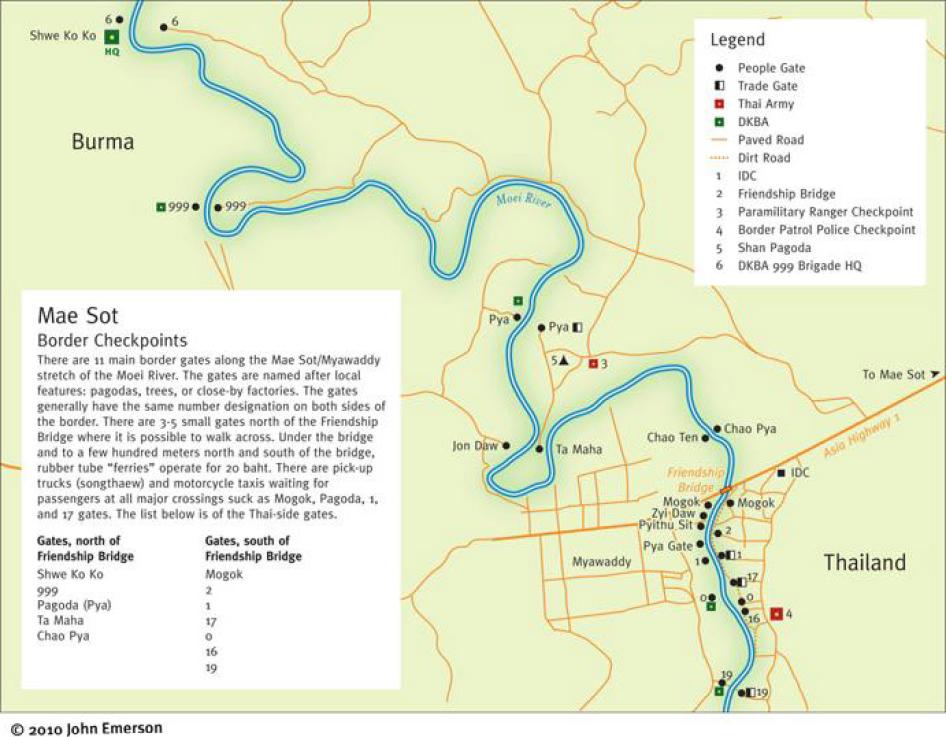
Mae Sot and Myawaddy
© 2010 Giulio Frigieri/Human Rights Watch |

Mae Sot Border Checkpoints
|
|
The ease in crossing the Thai-Burma border is demonstrated by Burmese migrants wading across the Moei River approximately 500 meters south of the Friendship Bridge connecting Mae Sot in Thailand and Myawaddy in Burma. © 2009 Human Rights Watch |

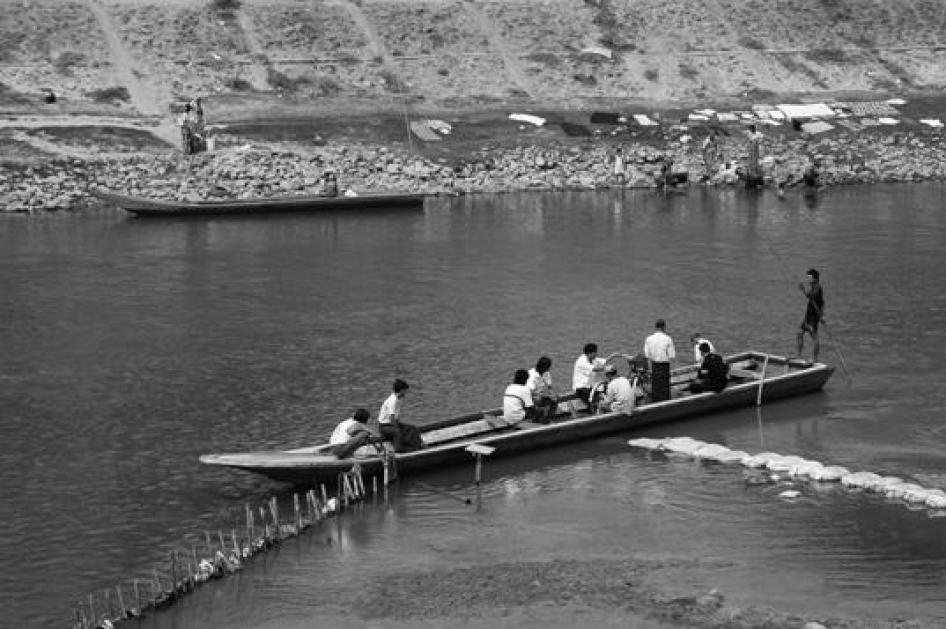
|
Burmese boatmen ferry passengers back and forth across the Moei river border between Thailand and Burma in Mae Sot, with crossings costing little and proceeding without travel documents. © 2009 Human Rights Watch |
Methodology
This report is based on interviews conducted between August 2008 and May 2009 by a team of researchers from Human Rights Watch, MAP Foundation, and the Yaung Chi Oo Workers Association (YCOWA). A total of 82 detailed individual interviews were conducted with migrants residing in Thailand, comprising 67 Burmese, 8 Laotian, and 7 Cambodian migrants. This work was supplemented by additional research and follow-up telephone interviews with migrant workers, NGO advocates, and government officials through January 2010.
We conducted interviews in Bangkok and in 10 different provinces so that our findings would reflect the different areas where migrants live and work across the country and the varying government policies in effect. Provincial government decrees in the provinces of Phang Nga, Phuket, Surat Thani, Ranong, and Rayong severely limit migrant workers’ rights. The provinces of Tak, Trad, and Ubon Ratchathani are major gateway provinces where migrants enter Thailand from Burma, Cambodia, and Laos. Samut Sakhon province is a major migrant-receiving province in the central plains of Thailand, subject to increased controls because of its close proximity to the capital city of Bangkok. Chiang Mai province has a significant influx of ethnic Shan from Burma, and has experienced high-profile police crackdowns on migrant worker use of motorcycles. The abuses described in this report reflect events that took place after December 1, 2006, when the major provincial decrees restricting migrant workers came into effect.
Wherever possible and in most cases, the interviews were held in private, but several were in the presence of relatives and friends of the interviewee. Human Rights Watch also conducted four group interviews with migrant workers in Chiang Mai, Phang Nga, Ubon Ratchathani, and Samut Sakhon. Interviews were generally conducted in the migrants’ language, sometimes with translation into Thai or English. All interviews used a questionnaire jointly developed in July 2008 by the research team, which is included as an appendix to this report. Researchers selected migrants for interview according to their knowledge of local migrant communities and their experience of human rights violations. Many were referred to us by local migrant organizations and other NGOs.
We have disguised the identity of all migrants we interviewed with pseudonyms and in some cases have withheld certain other identifying information to protect their privacy and safety.
Human Rights Watch and its research partners ensured that all interviewees were informed of the purpose of the interview, its voluntary nature, and the ways in which the data would be collected and used. All orally consented to be interviewed and all were told that they could decline to answer questions or could end the interview at any time.
To supplement formal interviews with migrants, we also conducted interviews with around two dozen NGO staff members working with migrant workers, lawyers and legal advocates, United Nations officials, and Royal Thai government officials, including those from the National Human Rights Commission, Ministry of Labor, Ministry of Social Development and Human Security, and Ministry of Interior. Contacts with the Royal Thai police took place in Bangkok, Pattani, Ranong, and Songkhla provinces but were deliberately limited because of security concerns.
In preparing this report, Human Rights Watch also closely reviewed Thai government documents and laws regarding migration and we consulted reports written by UN and intergovernmental agencies, NGOs, and migrant worker associations.
I. Failures of Thai Migration Policy
Labor Migration to Thailand
Migrant workers from Burma, Cambodia, and Laos make up a significant portion of the workforce in Thailand, with estimates ranging from 1.8 million to as many as 3 million workers and their family members, roughly equivalent to five to ten percent of Thailand’s workforce, plus their families.[1]
Long porous borders, ubiquitous networks of brokers and people smugglers, and the promise of high wages attract many Burmese, Cambodians, and Laotians to migrate to Thailand. In areas along Burma’s eastern border, Burmese ethnic minority migrants are fleeing human rights abuses by the Burmese government and armed forces and ethnic minority armies, as well as the economic hardship endemic to the region.[2]
Significant wage differences between Thailand and migrants’ home communities are factors encouraging migration. Migrants find they can earn more in Thailand, even when employers pay sub-minimum wages in violation of Thailand’s Labor Protection Act of 1998 (LPA).[3] Youth unemployment and underemployment in Burma, Cambodia, and Laos remain higher than in Thailand, as do current birth rates and the numbers of youth as a percentage of overall population.[4] Migration to Thailand has increasingly become an economic survival strategy for numerous rural families in neighboring countries.[5]
Thai employers complain it is becoming harder to find and recruit Thais into low-wage, labor-intensive work. Yet rather than upgrading workplace safety and improving wages, working conditions, and management practices, these same Thai employers turn to migrant workers who offer a fully flexible and cheaper workforce willing to do dirty, difficult, and dangerous jobs. Given the poverty that many migrants are fleeing and lack of protection offered by Thai authorities, employers frequently compel migrants to work long, exploitative hours, including through the night and on holidays. Employers find them easier to control because they either do not know of or are too intimidated to assert their rights under Thai labor laws.[6] They can be fired at will, and are less likely to organize a union or association to contest employer prerogatives. Employers often force migrants to accept daily wages and overtime rates below the legal minimum wage or intimidate and cheat them out of wages.[7]
Numerous Thai industries such as fishing and seafood processing, construction, agriculture and animal husbandry, and manufacturing (garment, textiles, and footwear) have essentially become dependent on documented and undocumented migrant workers as the core of their workforce. These low-cost workers in turn help maintain Thai export competitiveness.[8]
Regulatory Gaps and Failures
The majority of Burmese, Cambodian, and Laotian migrants to Thailand are undocumented, heightening the risk of abuse while compromising their access to legal protections and redress mechanisms. Undocumented migration is abetted by a weak migrant registration system in Thailand and ineffective or poorly implemented bilateral migration management schemes between Thailand and each of its three neighbors, defined in written memorandums of understanding (MOUs) on employment. Securing official travel documents is typically difficult, time-consuming, and expensive and most migrants do not obtain such documents.[9] A symbiotic relationship between people smugglers and corrupt government officials facilitates movement of migrants and placement in jobs, and, in some cases, contributes to human trafficking.[10]
While recognizing the continued importance of migrant workers to the Thai economy and the right of Thailand to regulate its workforce, Thai government policy continues to be dominated by national security concerns with little regard to workers’ basic rights. Provisions of the Alien Employment Act of 2008 illustrate clearly this undue emphasis on national security considerations. The act determines what work can be done by non-Thai workers and requires the location and duration of that work be determined in ministerial regulations that must explicitly take into consideration concerns of national security.[11] It provides broad discretion for investigators to conduct searches without court warrants if they believe there are undocumented workers on the premises.[12] The law imposes stiff criminal penalties, including imprisonment up to five years, on undocumented workers.[13]
Particularly worrisome are regulations accompanying the law that provide payments to informers for providing information or assistance in locating and leading to the arrest of undocumented migrant workers. NGO advocates continue to raise concern about this provision as providing an avenue for vigilantism against migrant workers.[14] The law also provides authority for an alien worker levy that is designed to discourage the use of migrant workers, though this legal provision has not yet been implemented. Reflecting the government’s insistence that migrant workers are temporary, the Alien Employment Act also requires employers to make deductions from migrant workers’ pay into a government-controlled fund to cover the costs of deporting migrant workers.[15]
In principle, migrant workers are accorded the same rights under Thai labor laws as Thai nationals except for specific exclusions on the right to establish and lead a labor union. In each of the bilateral MOUs on employment of migrant workers between Thailand and its three neighbors, there is a specific provision guaranteeing that migrant workers will be protected in accordance with all laws of the receiving state.[16]
A new Thai migration policy requires that by February 28, 2010, all documented migrant workers in Thailand must formally apply to go through a nationality verification process with officials of their own government. All workers who do not apply will become undocumented from March 1, 2010, onwards.[17] After verification, migrants will receive a temporary passport from their own government in which a visa issued directly by Thai Immigration will be placed, thereby legalizing their entry into Thailand. Migrants with a temporary passport and visa will be permitted to travel throughout Thailand without restriction, which is a positive development for migrants’ rights. Unlike arrangements with Cambodia and Laos in which verification is done by consular officials of those countries in Thailand, the State Peace and Development Council (SPDC) government in Burma insists that all Burmese migrants must return to one of three border towns in Burma—at Kawthaung, Myawaddy, or Tachilek—to apply for nationality verification. By September 25, 2009, 118,916 migrant workers had completed the nationality verification process—57,609 Cambodians and 58,430 Lao, but only 2,877 Burmese.[18]
Nationality verification for Burmese started on July 15, 2009,[19] but since verification is determined by the SPDC, the procedures exclude ethnic Rohingya, a Muslim minority population in Burma that has long been denied citizenship by the Burmese government.[20] Burmese migrant workers report they are gravely afraid of being forced to reveal information to the SPDC about their relatives and family in Burma, subjecting them to possible reprisals or extortion.[21] Many long-term migrants, especially those from the Shan and Karen ethnic groups whose political leadership has been involved in long-term insurgencies against the Burmese military government, also expect they will not be included on SPDC citizenship registration lists. Finally, migrants express fear that they could face retaliation for returning to Burma without a passport or other appropriate document, which is a violation of Burma’s Immigration Act of 1947 (Emergency Provisions) and can involve penalties of six months to five years in prison, and a fine.[22]
A coalition of Thai trade unions and NGOs filed a complaint with the UN special rapporteur on the human rights of migrants concerning the Thai government’s failure to provide accurate information about nationality verification or to rein in illegitimate brokers who defraud and overcharge workers.[23] Refugee advocates have expressed concerns about mixed flows of migrant workers and persons fleeing persecution from Burma who are shut out from asylum procedures because of the Thai government’s unwillingness to allow screening of migrants for refugee status, including the more than 200,000 ethnic Shan long excluded from consideration as refugees as a matter of Thai policy.[24]
Both nationality verification and the opening of new, formal migration channels have far underperformed expectations, raising fundamental concern about whether these mechanisms are able to effectively replace the current migrant registration scheme. Efforts to persuade new migrant workers to enter Thailand through formal channels set out in bilateral MOUs also have foundered because of higher costs, longer delays in placement than the informal migration processes, weak implementation, and disagreements on issues related to recruitment and use of agencies. By the end of December 2007, just 14,151 migrant workers (7,977 Cambodians, 6,174 Laotians, but no Burmese) had traveled through formal government-to-government migration channels to be placed in jobs in Thailand.[25]
The Thai government’s national security concerns appear to extend to migrant children and newborns. Gen. Sonthi Boonyaratglin, the deputy prime minister who led the 2006 military coup d’etat, reportedly said on a visit to Samut Sakhon in November 14, 2007, that Thailand would solve the problem of migrant children by arranging for deportation of all pregnant migrant women and that Thailand’s National Security Council (NSC) would take the lead in this initiative. General Sonthi, who at the time was also the head of Internal Security Operations Command (ISOC), stated:
There have been many problems concerning high birthrates, disease control, conflicts with Thai people and among themselves along with social issues, which will all become long-standing problems. They [the migrants] may demand more and more for their rights. These problems may become unsolvable one day.[26]
NGOs, mainstream media, lawyers, and other groups strongly condemned the proposal, which was quietly allowed to lapse when Prime Minister Gen. Surayudt Chulanont’s military-appointed government stepped down in December 2007.[27] But the initial proposal reaffirmed the perception among registered migrant workers that Thai government policy is discriminatory, and government officials cannot be trusted to ensure that their basic rights are respected. Even though Gen. Sonthi was unable to implement his proposed policy, there was a chilling effect on pregnant migrant women’s willingness to seek medical assistance.[28]
In a positive move made in October 2009, the Thai government began permitting registration of children of registered migrant workers holding work permits. However, in some cases, local officials insist on onerous documentation requirements that effectively frustrate this benefit.[29]
Migrants Rights under International Law
Thailand is party to the major international human rights treaties, including the International Covenant on Civil and Political Rights (ICCPR),[30] the International Covenant on Economic, Social and Cultural Rights (ICESCR),[31] the International Convention on the Elimination of all Forms of Racial Discrimination (ICERD),[32] and the Convention against Torture and Other Cruel, Inhuman or Degrading Treatment or Punishment (Convention against Torture).[33] Thailand has also ratified many, but not all, of the major labor rights conventions of the International Labor Organization (ILO).
International human rights law protects the rights of non-citizens as well as citizens. Under the ICCPR, a state is obligated to respect and ensure the human rights of “all individuals within its territory.”[34] Non-citizens who have entered and reside in a state are entitled to all rights under the ICCPR except political rights, such as the right to vote and run for office.[35] Thus while article 25 of the ICCPR limits political rights to “[e]very citizen,” article 26 ensures that “All persons are equal before the law and are entitled without any discrimination to the equal protection of the law”[36]
These protections for migrants extend to economic, social, and cultural rights. According to the Committee on Economic, Social and Cultural Rights in its General Comment No. 20 on non-discrimination, “The ground of nationality should not bar access to Covenant rights.... The Covenant rights apply to everyone including non-nationals, such as refugees, asylum-seekers, stateless persons, migrant workers and victims of international trafficking, regardless of legal status and documentation.”[37]
While the convention against racial discrimination, ICERD, provides for the possibility of differentiating between citizens and non-citizens,[38]the Committee on the Elimination of Racial Discrimination (CERD) in its General Recommendation on discrimination against non-citizens, noted that this provision “must be construed so as to avoid undermining the basic prohibition of discrimination” as set out in other human rights treaties, such as the ICCPR and the ICESCR.[39]Thus while some political rights may be confined to citizens, states are under an obligation to guarantee equality between citizens and non-citizens as recognized under international law.[40]Therefore, “differential treatment based on citizenship or immigration status will constitute discrimination if the criteria for such differentiation, judged in the light of the objectives and purposes of the [ICERD], are not applied pursuant to a legitimate aim, and are not proportional to the achievement of this aim.”[41]
Of particular relevance to the administration of justice in Thailand, the CERD recommends that states “[e]nsure that non-citizens enjoy equal protection and recognition before the law and ... ensure the access of victims to effective legal remedies and the right to seek just and adequate reparation for any damage suffered as a result of [discriminatory] violence.”[42]The CERD also calls for states to “[c]ombat ill-treatment of and discrimination against non-citizens by police and other law enforcement agencies and civil servants by strictly applying relevant legislation and regulations providing for sanctions and by ensuring that all officials dealing with non-citizens receive special training, including training in human rights.”[43]Claims of discrimination brought by non-citizens should be “investigated thoroughly,” and those against officials should have “independent and effective scrutiny.”[44]
The CERD also urges states to remove obstacles that prevent the enjoyment of economic, social, and cultural rights by non-citizens, notably in the areas of education, housing, employment, and health.[45]States should also “[t]ake measures to eliminate discrimination against non-citizens in relation to working conditions and work requirements, including employment rules and practices with discriminatory purposes or effects,”[46] and “to prevent and redress the serious problems commonly faced by non-citizen workers, in particular by non-citizen domestic workers, including debt bondage, passport retention, illegal confinement, rape and physical assault.”[47]The CERD noted that while states may refuse to offer jobs to non-citizens who lack a work permit, all individuals working are entitled to the enjoyment of labour and employment rights, including the freedom of assembly and association.[48]
II. Provincial Decrees—Controls on Migrant Workers
The overwhelming emphasis on presumed national security considerations in Thai government policy on migrant workers is also demonstrated by draconian decrees restricting migrants’ rights in five provinces (Phang Nga, Phuket, Ranong, Rayong, and Surat Thani).[49] All five provinces host significant numbers of migrant workers. Anusit Kunnagorn, a representative of the National Security Council (NSC), testified to the National Human Rights Commission (NHRC) that the NSC and Ministry of Defense believed it necessary to extend these decrees to all the other provinces because of problems with the existing migrant registration system.[50]
Three of the five provincial decrees cite concerns for “national security,” “security of society,” or “safety of life and assets” as a rationale for the measures, while the Rayong decree declares that certain groups of migrants “engage in behavior that make them a danger to society or will cause harm to public order and peace, and the lives and property of the citizenry.” The provincial decrees require employers to closely monitor and control their migrant workers. Some make employers financially responsible for any damages caused by the migrant workers they have registered, creating an incentive for employers to confine workers to their workplace. Others decree that failure to control migrant workers will result in the loss of hiring privileges for the employer and deportation of the workers concerned.
The provincial decrees violate basic rights due all persons under international law. Among the key provisions of the provincial decrees are restrictions on migrant worker gatherings and curfews and severe restrictions on migrants’ use of mobile phones, motorcycles, and cars.
Even in provinces without specific provincial decrees, Human Rights Watch found restrictions on rights to freedom of movement, association, assembly, and ownership of property, though such restrictions were not formally promulgated in government decrees.
In Samut Sakhon province in central Thailand, a major receiving area for migrant workers from Burma, the provincial governor, Wirayuth Euamampa, took steps short of a provincial decree. The governor’s October 26, 2007 letter to the provincial Department of Employment and to employers stressed the need to control migrant workers more closely. The letter posited that “Burmese migrants give rise to many problems, such as those involving public health, stateless children, as well as problems of crime and lawlessness.” Furthermore, the letter continued, “currently there is the spreading of migrants’ culture through festivals and other various events and this is not appropriate and should not be supported because it will give rise to the feeling of community belonging and ownership which could cause national security problems and are against the Government’s objective of allowing migrant workers to reside temporarily to work only.” The letter concluded by stating employers would be held accountable for ensuring proper, lawful behavior of their migrant employees, including through charges and court action if needed.[51]
A backlash from migrant worker representatives and NGOs criticizing Governor Wirayuth of racial bias and lack of cultural sensitivity[52] compelled him to issue a clarifying letter on November 28, 2007. This letter informed employers that they could let migrant employees arrange cultural activities as long as they did not jeopardize Thai national security or have a negative impact on Thai diplomatic relations with other countries—essentially banning migrants’ political protests against their home governments.[53] The NHRC has called for the provincial government of Samut Sakhon to revoke these two letters, but it has failed to do so.[54]
Migrant workers residing in provinces with these decrees told Human Rights Watch that since the promulgation of the decrees, police harassment and extortion has increased, particularly in connection with the seizure of migrants’ mobile phones and motorcycles. Besides the personal inconvenience, migrants who are denied mobile phones face greater difficulties calling for rapid assistance in emergencies. NGOs and migrant worker groups say that some migrant workers, such as live-in domestic workers, face higher risks of abuse because of inability to own and use a mobile phone.[55]
Deprived of motorized transport, migrants stated they find it more difficult to escape violence and access health care in emergencies. They have fewer options for conducting daily tasks like purchasing food at the market, sending children to migrant learning centers, or taking classes after work. For those working in remote agricultural work settings the restrictions are particularly onerous.[56]
Restrictions on Freedom of Association and Assembly
Various restrictions limit the basic rights of migrant workers in violation of international law. In Phang Nga, Phuket, and Ranong, a gathering of five or more migrant workers requires advance written permission from the government district chief. In Rayong and Surat Thani, any migrant gathering is prohibited, unless it is cultural or religious.
However, in Surat Thani, even religious activities are shut down if they have any political characteristics. A Burmese migrant worker reported the severe reaction of local police from the Muang district station in Surat Thani province when a local Burmese migrant worker association organized a religious merit-making event at a Buddhist temple on June 19, 2008, to honor the 63rd birthday of detained Burmese democracy leader Aung San Suu Kyi.[57] With the support of the temple’s abbot, approximately 150 migrants came offering gifts to Thai monks resident at the temple. Some migrants wore shirts or other pieces of clothing with Suu Kyi’s visage and the migrants held a short procession inside the temple grounds holding several signs and two large photos of Suu Kyi.
Following a tip-off that the police were coming, the migrants stopped the procession and everyone retreated inside the templeand waited. Within minutes, the police district commander, accompanied by 12 policemen in eight vehicles, arrived and demanded to know where the protest was taking place. A test of wills between the abbot and the police commander ensued: the commander’s insistence that a protest had taken place was met with denials, while the abbot refused permission for the police to enter the wiharn[58] to arrest migrants. The police finally agreed that they would only check a number of migrants selected by the abbot who volunteered to come out of the wiharn but then seized the migrant worker ID cards of five migrants for further inspection at the police station.[59]
The association later surreptitiously distributed copies of a video of the procession taken by migrants. The migrant worker told Human Rights Watch:
People kept asking me “Wow did you do that?” It is so hard to do any sort of group activity like that because the police are always looking out. I know that our association will have a problem with the police in the future.... They have asked many questions about the association because they worry we are going to organize the migrants...They always look at these issues from the security view.[60]
A PowerPoint presentation created by provincial Ranong police identifies political activities by migrant workers that the police are seeking to prevent. A video of a protest held by Burmese monks and exiles in Mae Sot on May 24, 2009, was displayed in a slide entitled “Guarding against Burmese Buddhist monks entering to perform political activities as in Mae Sot district, Tak province, leading the Burmese people to demand the release of Aung San Suu Kyi.”[61]
Restrictions on Freedom of Expression
Whenever we are walking and talking on the street, if the police see us using the phone they will stop us and take it. If you want to talk to me about these kinds of cases, you will not be able to finish the interview today....It happens every day.
—U Win, a migrant worker from Burma in Surat Thani, August 27, 2008.
While migrants with money can easily secure a mobile phone and phone number in Thailand through a prepaid SIM card, their ability to use their phones is heavily restricted.
In Phang Nga and Ranong, decrees forbid migrants from using mobile phones and explicitly authorize government authorities to seize such phones on sight, while Phuket requires mobile phone usage to comply with an unspecified provincial “security policy.”[62] In Rayong and Surat Thani provinces, the provincial announcements use identical language stating that migrant workers are not permitted to use mobile phones because a mobile phone is not considered “a tool for work but instead is a tool that can convey information easily and quickly, which can impact national security.”[63]
According to migrants, both government officials and private citizens seize migrants’ mobile phones in these provinces. Even in remote villages, like the one in Phang Nga where Burmese migrant worker Soe Myo lives, the village chief has ordered migrants not to use phones. Soe Myo told Human Rights Watch, “I sneakily use it [mobile phone], I don’t let them know or see that I use phone, and when I walk on the street I turn off my phone and put it in my underwear.”[64] Soe Myo added that either the village chief or ordinary Thai villagers will confiscate his phone if they see it. U Ko Nai, from Burma, confirmed he also takes these precautions but on July 18, 2008, officers from the Highway Police Division stopped him on a road near his house in Kuraburi district. They extorted 2600 baht (roughly US$78)[65] and confiscated his mobile phone despite his pleas that he needed it for work. U Ko Nai said, “The next time I saw that policeman he smiled at me ... I saw that he carried my phone and used it.... It’s normal for the police, if they see a good phone they will take it.”[66]
Restrictions on Freedom of Movement
There are many dangers for workers who work at night. For example, when the workers meet Thai teenager gangs, they are robbed and beaten....The danger we face is invisible. If we were able to have mobile phones and motorcycles, we might manage to escape from the danger.[67]
—U Win, migrant worker from Burma, Muang district, Surat Thani province
All five provinces with provincial decrees on migrants impose nighttime curfews restricting migrant workers to their workplaces or residences. The curfew start times vary from 8 p.m. to 10 p.m. All of the decrees state that migrant workers may not move within the province without express written permission from the provincial Department of Employment.
Under all the provincial decrees, migrants are prohibited from using motorcycles or cars. Thais are not allowed to let migrant workers drive their vehicles either. When migrant workers are caught with a motorcycle, the police are likely to make them pay a hefty bribe, lose their motorcycle, or both. Zaw Zaw, a registered migrant worker from Burma in the construction industry in Surat Thani described how local police at a checkpoint on June 11, 2008, first took 4500 baht from his wallet, and then confiscated his motorcycle.[68] In some cases, local authorities allow the use of motorcycles provided the migrant is prepared to pay a regular bribe. Kyaw Win, also from Burma, said where he lives in Surat Thani migrants must pay 500 baht a month to the nearest local police post or their motorcycle will be seized.[69]
In remote areas, such as rubber plantations, provincial restrictions on migrants’ use of phones and motorized transport can cause major difficulties in cases of medical emergencies, such as accidents, poisonous snake bites, pregnancy and birth, and severe illnesses. Purchasing food and other daily necessities are made more difficult and expensive by migrants’ inability to drive motorized vehicles.
Without the ability to communicate or move about by motorcycle, migrants are more vulnerable to common dangers such as assaults and extortion by criminal gangs and persons posing as police or other authorities.
Several other provinces, including Chiang Mai and Chumpon, considered issuing similar decrees but finally abandoned their plans in the face of intensifying opposition from human rights groups and the media. Yet restrictions similar to those in the provincial decrees, particularly against migrants using motorcycles and mobile phones, are enforced by local police in many places. For instance, in Surat Thani, a documented Burmese worker, Ko Shwe, told Human Rights Watch how two police arrested him around 11 a.m. one day in July 2007, searched him, found his mobile phone, and confiscated it. He said, “The police told me ‘We are allowing you to work in Thailand—not to be happy, and go around, like you are on a picnic.’”[70]
Article 41 of the Thai Constitution of 2007 provides all persons with the right to own property and the Vehicle Act B.E. 2522 (1979) contains specific provisions regarding non-nationals’ vehicle registration for registered migrant workers. Throughout the duration of the research for this report, vehicle registration was effectively denied to migrant workers.[71] But on December 13, 2009, an important step forward was taken when the Department of Land Transport issued a decision that allows registered migrant workers to apply for and receive ownership documents for a motorcycle.[72] However, vehicle ownership is still denied to undocumented migrants, and no final decision has been made on permitting migrant workers from Burma, Cambodia, and Laos to apply for and receive a driving license. Furthermore, restrictions on migrants using motor transport under the five provincial decrees have yet to be rescinded or altered.
Complications involved in ownership and registration of motorcycles put migrants seeking to own motorcycles at risk. Mi Mi, a migrant from Burma, said police jailed her husband for receiving stolen property when a Burmese broker working for a Thai policeman sold him the policeman’s motorcycle and then failed to give the money to the policeman. Mi Mi said that even though her husband knew nothing about the arrangements with the policeman, it was her husband and not the broker who was jailed for two years.[73]
In 2008 Thailand’s National Human Rights Commission ruled that the provincial decrees violate several core articles of the Thai Constitution of 2007.[74] The NHRC declared that the decrees contravene article 30, which provides “All persons shall be equal before the law and shall enjoy equal protection under it....Unjust discrimination against a person on grounds of difference in origin, race, language, sex, age, physical conditions or health, economic or social status....shall not be permitted.” The NHRC also determined that bans on use of mobile phones in the decrees violate article 36 of the Constitution where it is determined that “A person shall enjoy the liberty to communicate with one another by lawful means.” And it found that the curfews and restrictions on gatherings of more than five migrants are contrary to article 63 of the Constitution, which states: “A person shall enjoy the liberty of peaceful and unarmed assembly.”[75] However, the provincial governors and Ministry of Interior have so far ignored the NHRC’s ruling, which the NHRC lacks the legal authority to enforce.
III. Human Rights Abuses against Migrants
If you pay money [to the police], you can do anything in our region. If you want, you can kill people ... I have seen dead bodies many times by the side of the road ... Our area is like a fighting zone ... when the police hear the sounds of gunshots, they will not come ... [later] the police will come ask what happened, and write down the information and then they go away, and that is all that happens.
—Saw Htoo, Burmese migrant worker who provided information to the Thai police, Mae Sot district, Tak province
Both documented and undocumented migrants in Thailand are vulnerable to arbitrary acts of violence, intimidation, and extortion from state authorities including police, military, and immigration officers as well as private individuals. These abuses include killings, beatings, sexual harassment and rape, forced labor, abductions and other forms of arbitrary detention, death threats and other forms of intimidation, and various types of extortion and theft.
Killings, Torture, and Physical Abuses against Migrants
When I saw this [killing], I felt that we Burmese people always have to be humble and have to be afraid of the Thai police. I feel that there is no security for our Burmese people [in Thailand] or for myself.[76]
—Su Su, Burmese migrant worker, August 24, 2008, Ranong province
Migrant workers and their families in Thailand are at particular risk of human rights violations by members of the security forces. Because of their precarious legal status, they also have far less effective avenues for redress in the event of killings, torture, and other ill-treatment in custody, or other abuses by the security forces. This fosters an environment of impunity and fear that exacerbates the tenuous circumstances in which migrants live.
In many cases, migrants have reported common crimes to the authorities only to have the police fail to conduct a genuine investigation, treat the matter with far less seriousness than they do comparable crimes committed against Thai nationals, or simply refuse to arrest alleged perpetrators despite detailed information from eyewitnesses. In other cases, migrants express grave fears that if they report a crime to the police, particularly when the police are involved, they themselves may be subject to retaliatory violence.
Killings by Security Forces
Su Su told Human Rights Watch that she witnessed the beating death of a Burmese migrant worker from Rangoon whom she estimated to be only 16 or 17 years old. She said he had traveled to the Thai port of Ranong to work on a fishing boat during a school break in order to earn his school fees. She told Human Rights Watch what happened near her home in early 2007:
He was coming out of the shop. There were two police officers on a motorcycle who stopped him and asked him if he had a work permit. But he could not speak Thai and so he did not reply....Those two police started to beat him and they kicked him in the chest until he died there. Many Burmese were watching and nobody went and helped because all of the people were afraid of those police, so nobody said anything about this killing, and nobody informed the police station. When the two police saw that the boy died, they went away on their motorcycle. I saw the next morning that the rescue foundation came and took the boy’s dead body and no police officer was with them ... I really wanted to help but I am afraid of those police.[77]
While violence against migrants is most prevalent among local police, a wide variety of police and paramilitary forces operate in Thailand, especially in the border areas. Often migrants cannot differentiate between them.
Maung Cho, a supervisor at a textile factory in Mae Sot close to the Thaungyinn River bordering Burma, told Human Rights Watch that “soldiers” were involved in the drowning death of his friend and co-worker, Ye Htun, on August 21, 2008. It is not clear whether these were Thai Army soldiers or members of another armed force under the Thai government but it is clear that they were present to try to break up a migrant worker rally.
As Maung Cho described the situation, a labor dispute had escalated when a factory manager called in soldiers from a nearby village checkpoint to deal with striking workers. The soldiers arrived armed with a shotgun and pistols. The workers outside the factory immediately fled, and soldiers fired in the air and yelled for them to stop—which produced the exact opposite effect. Many of the workers panicked and jumped into the swift-running Thaungyinn River to escape by swimming across the river to Burma. Maung Cho, who swam across the river, described Ye Htun’s death by drowning:
I turned around and could see Ye Htun struggling and he was trying to keep his face above the water ... He was maybe about 20 meters from the Thai side. There were about 10 workers who were already on the other river bank with me but we did not dare to go back and rescue him because the Thai soldiers were standing on the bank, looking at us, and pointing their guns at us. They were also walking back and forth on the riverbank near where Ye Htun was swimming and they pointed their guns at him. I could not hear what they were saying to him, but they were saying something—but it looked to me like they did not want him to come back to the Thai side.... Some of the workers who did not cross the river told me later that when Ye Htun’s head was going under water, one of the Thai soldiers said “Give him the bamboo,” meaning to use a piece of bamboo to help him. But the Thai soldiers did not help and by that time, Ye Htun’s head had gone underwater.
Maung Cho said Ye Htun’s body was never recovered. [78]
Torture and Ill-Treatment by Thai Authorities
Police torture of suspects in pre-trial detention in Thailand is well documented.[79] Migrant workers detained at police stations report similar practices, including frequent beatings and other forms of ill-treatment during pre-trial detention. The police use violence against detained migrants when they seek a confession of guilt or other information from a suspect or as a form of punishment, such as if a detainee looks directly at a police officer or fails to speak or comprehend Thai.
Sai Tao, from Burma, told Human Rights Watch that officers at the Saraphee district police station in Chiang Mai severely beat his brother Sai Aye after arresting him in December 2007 on suspicion of theft. A police officer called Sai Tao and told him to come to the police station to meet his brother. When Sai Tao arrived, the police immediately arrested and searched him, and confiscated his motorcycle.
During the initial questioning by police, Sai Tao said he stood close to his brother and was able to speak to him. His brother denied any involvement in theft and said the visible bruise behind his ear was from a beating inflicted by the police at the station. The police then took them both on a search of his brother’s room, but turned up no evidence of larceny.[80] Soon thereafter, Sai Tao was released, but his brother was held for further investigation. Sai Tao requested that the police call him when his brother was released so that he could pick him up.
Around 4 p.m. the next day, Sai Tao received a phone call from the police station saying they released his brother the previous night, but that he then stole something else, and while he was being chased, he fell off an apartment building. Sai Tao’s desperate search of hospitals led him to his brother at Maharaj Nakorn Hospital in the Suan Dok area. He was suffering severe head trauma and was unable to speak. His injuries required two operations and over 50 days of hospitalization. To this day Sao Tao’s brother remains severely disabled, unable to speak or walk by himself. Sai Tao believes the police were directly responsible:
I am sure that the police physically beat and abused my brother and made up the story of the apartment. I told them to call me if they released my brother and it makes no sense that they released him that same night after me.... My brother has never been involved in any criminal activity.... The story they told is just a lie, a cover story for what they did to my brother... I would like to take a case against the police, to hold them responsible....[81]
Aung Aung, a registered Burmese migrant worker, was traveling by train from Chiang Mai to Bangkok on the evening of August 2, 2009, when a railway policeman inspected his ID card and forced him to get off the train at the Lamphun province train station. When Aung Aung protested that his card was in order with the correct authorization and signatures, the railway policeman punched him in the face, and then repeatedly kicked Aung Aung until he collapsed on the ground.[82] The railway policeman and a colleague took Aung Aung back to the Chiang Mai railway police station, searched him, then “fined” him 1200 baht. On August 4, with support from MAP, Aung Aung filed a complaint against the police with the Chiang Mai provincial governor’s office. Since the case was filed, Aung Aung learned from neighbors in his old neighborhood in Sankampaeng district that the railway police have searched for him multiple times. Aung Aung now fears for his life and his case was taken up by the National Human Rights Commission of Thailand.[83]
Migrant workers who attempt to flee arrest are often beaten by the police. On August 5, 2008, Border Patrol Police (BPP) arrested Maung Kyi, an undocumented Burmese day laborer in Mae Sot, close to the village where he worked. According to Maung Kyi, he then jumped off the moving BPP pickup truck in an attempt to escape. Four BPP officers chased and caught him, repeatedly kicked him, and beat him severely on his legs with their batons. They dragged him back to the truck and another BPP officer kicked him in the chest, making it hard, Maung Kyi said, for him to breathe. The BPP released him part way between Mae Sot and his village, but he could not work for days because of his injuries. Twenty days later he still had bruises and scars from the beating he suffered.[84]
Oem Borey, a fisherman from Cambodia, told Human Rights Watch how his physical altercation with a Thai fishing boat captain resulted in his being further severely ill-treated by Thai police. Oem Borey described a fight that he had on board a boat in the Gulf of Thailand off the coast of Trad province on August 25, 2008. He says the captain accused him of disobedience, hit him with a metal pipe, and, when he fought back, the captain radioed other boat captains for assistance, who then arrived and beat him severely. When the boat returned to dock at Klong Makam in Trad province, the captain called the police and told them Oem Borey was drunk and had tried to steal the boat. Police from the nearby Klong Yai district station arrived, and Oem Borey says police beat him at the pier at least four more times on the back using their wooden batons until he lost consciousness.[85]
Oem Borey suffered a deep gash on the head, a broken nose, possible broken ribs, and other injuries, but he said the Klong Yai police refused to send him to the hospital. Instead, they held him without medical treatment in the police station lock-up for 13 days.[86] Oem Borey reported that during his detention, the police interrogated him once and accused him of attempting to steal the fishing boat. He said he was too scared to respond so he said nothing. The following day, the police forced him to fingerprint a Thai language document that he could not read. He received no explanation from the police about the content or purpose of the document. His sister negotiated a 2000 baht payment to the police for his release, plus an additional 300 baht to compensate the police for agreeing to help him find a new job.
Thailand’s ratification of the Convention against Torture in October 2007 has not resulted in more energetic efforts to combat torture and ill-treatment or to revise Thailand’s laws to conform to the requirements of the treaty. [87] And although the Thai Constitution of 2007 prohibits torture,[88] Thailand lacks a specific law on torture, which complicates efforts by migrants (and advocates for migrants) who undertake to raise a complaint of torture against a government official.[89]
Police Abuses: An Insider’s Account
Saw Htoo is an ethnic Karen migrant worker who worked closely for some 10 years as a member of a gang led by a police sergeant[90] in the area of Kilometer 48 village in Pop Phra district, Mae Sot province. Originally self-employed, Saw Htoo became vulnerable when police confiscated his legitimate passport in 2003, claiming it was fake. With no documentation, and as his overseas business partners had left the area, he progressively fell into working for the police sergeant. His duties as a gang member included providing information, collecting money from enterprises for the gang leader, and acting on the orders of the sergeant, who employs gang members to intimidate and extort migrant workers. In exchange, senior gang members like Saw Htoo had the opportunity to run profitable enterprises—in his case, operating an illegal lottery and managing the beer and wine shop at the sergeant’s compound and snooker hall—and receiving a percentage of the proceeds. Gang members frequently serve as intermediaries between migrants and police, negotiating payments for release of migrants from detention.
Saw Htoo performed all these functions and more. By his own admission, he physically beat migrants, served as a middleman for police to extort money from migrant families, and joined raids to detain migrant workers who were then brought to the police sergeant’s compound for interrogation. While he claims not to have killed anyone or witnessed any killings, he believes that they occur.
Gang membership offers police protection for some migrants and their families, power within the migrant community, and impunity for illegal acts and abuses. Saw Htoo said:
Many migrants in this area want to become [sergeant’s name withheld] luk nong [follower or employee] because this would make them free from being arrested because he will protect them. Also, when there are fights between the migrants, it is the police luk nong that have the upper hand and everyone is scared of them.[91]
However, with membership come dangers if a migrant gang member knows too much about his boss’ business, or if he crosses the boss. In May 2009, the police sergeant repeatedly beat Saw Htoo in different public locations in the Kilometer 48 area and conducted a mock execution.[92] Saw Htoo is now in hiding on the Thai-Burma border.
As a gang member, Saw Htoo said he saw and in some cases participated in police abuses against migrants, including beatings and torture while in detention, rape, sexual harassment, forced labor, and systematic looting of migrant workers’ money and valuables.
Saw Htoo said that the police in the area physically abused migrants on a regular basis. Interrogations at the house of the police sergeant heading the gang and the police post at 48 Kilometer village routinely included slapping, punching, and kicking the suspects. Saw Htoo said:
I saw it so many times when the migrants were arrested, they would be beaten by the police at the police station. Usually the arrested migrants didn’t understand what the policeman was saying because they did not speak good Thai—and so the policeman would kick the migrants.... I saw often the police use their hands to slap the faces of the migrants.... If any migrant looks up at the police while they are being beaten, that’s it—they will definitely be hit again.
The area is also a major transit route for workers moving from Burma into Thailand. Saw Htoo said that the police sergeant and his gang members detained and beat migrants and their guides who allegedly had not paid police bribes to transit the area. Beatings of migrants occurred at the sergeant’s compound[93] every two or three days. Saw Htoo recounted the severe beating that he, the sergeant, and two other gang members inflicted on three migrant workers in April 2009.
Saw Htoo believes the primary reason for these beatings is to force migrants to pay money to gain their release, “Really, he [the police sergeant] is just interested in extorting money from the migrants and he knows he can do this by catching them and beating them.”
Saw Htoo said he regularly saw migrant women coerced to sleep with police officers outside the station in exchange for their freedom, and spoke to women who had been raped in 48 kilometer police post. He stated that “If there is a young, good-looking woman, especially if the police think that she might be a virgin, she will be taken to sleep with the police.” Over the course of 10 years working with police at Kilometer 48, he said he knew of more than 20 instances during which migrant women were raped by police in a back room in the police post. He said, “I am the one who the relatives will send with the money to get the woman out of jail.... After they are released, those women are crying and telling me the story of what happened to them. Usually, the girls will be raped in the police station. In the 48 Kilometer police station, there is a small, narrow room with a bed that is used for this. They are just taking the girls out of the lock-up, and raping them in that room.”
Saw Htoo said that often the women are released after the police rape them, but in other instances, the policeman will pressure the woman to become his mistress.
Saw Htoo said police regularly steal valuables from migrant workers if they find them, and extort money from migrants and their families to release arrested migrants. He said, “I have seen police take money, and they also like to steal gold necklaces and other gold jewelry.... If a migrant worker does not have a migrant worker ID, the police will sometimes take that person’s mobile phone too.” Saw Htoo said he played the role of an intermediary between police and the families of arrested migrants. Police compelled migrants to call their relatives or friends to bring money for their release, and the families used Saw Htoo to serve as a negotiator because they were too afraid to talk directly with the police. He said:
At the police station, the police demand 3000, 4000, or even 5000 baht from each of the migrants.... If police ask for 3000 baht and the family of the migrant cannot afford that, they might propose to pay 2000 baht instead, and I have to help with this bargaining. If the money is paid, then the migrant will be let go.
Saw Htoo also described the use of forced labor over the course of approximately 20 days in March 2009. Each day the police sergeant arbitrarily apprehended Burmese migrants and forced them to dig a fish pond in his compound. Saw Htoo witnessed the sergeant accosting three migrants walking past the compound on their way to market, threatening them, and forcing a man to work for the day. He said the sergeant told the man’s wife, “You can go now and do what you want, come back at 5 p.m. and I will release him then.” He did not pay the man for his day’s work.
Saw Htoo’s detailed accounts shed light from an “insider’s” perspective on what migrant workers from Burma, Cambodia, and Laos have told Human Rights Watch about abusive treatment they receive from corrupt police in places in other areas of Thailand, and the impunity with which police are able to take advantage of migrants.[94]
Failure to Investigate Crimes against Migrants
The Thai police often fail to actively investigate ordinary crimes as well as human rights violations by the authorities against migrants. Migrants’ lack of trust in police is underscored by the frequent number of instances in which Thai’s who have committed beatings or other physical abuses against migrants have then called the police to arrest and detain the migrant.
This was evident in the case of Aye Aye Ma, a registered migrant worker from Burma, and her husband, Cho, in Phang Nga. According to Aye Aye Ma, around 3 a.m. on November 5, 2007, two men armed with hunting rifles, wearing masks and head flashlights[95] appeared where they were working in a rubber plantation and demanded money. Aye Aye Ma told Human Rights Watch:
My husband looked at me. Then that man who was talking shot my husband in the head, and I saw him fall ... I couldn’t believe it, I was shocked.... I started crying and yelled to my husband but I was also so afraid that I could not run to my husband ... And then those two men came over and grabbed me, and they ripped off my clothes. I think that they killed my husband because they wanted to rape me ... I kept yelling “Please don’t kill me! Please don’t kill me!” ... The whole rape took maybe 10 minutes, one raped me and then the other raped me. When they were finished raping me, they just walked away like nothing happened. They also stole our head flashlights and the rubber tree tapping knives from me and my husband.[96]
After the assailants left, Aye Aye Ma called friends for assistance, and they in turn contacted the Thai Muang district police and the Migrant Assistance Program (MAP). The police came to the crime scene, took photographs, and collected two used condoms with semen inside as evidence, and later interviewed Aye Aye Ma at the police station. A commanding officer, police Lt. Col. Kittichet Kittiratanasombat, ordered in the investigation report dated November 9, 2007, that a DNA test should be performed on the semen,[97] in line with standard police procedure that such tests should be done within three days of the collection of the evidence. But when MAP staff later went to inquire about the test, officers at the police station said the test had not been carried out because of budgetary constraints.[98] No results of any DNA test were ever shared by the police, who later admitted to MAP that one division in the police ordered the DNA test but then never provided any further information about the test to the police actually in charge of the investigation. At an interview at Thai Muang district two weeks after the crime, police showed two grainy photocopies of photographs in a police file to Aye Aye Ma, but she could not identify them because the men had worn masks and it was dark. As a result, the police investigators told MAP representatives that after one year they decided to suspend the case until new evidence is found.[99]
Besides the real possibility that police did not conduct a DNA test as ordered by their superior officer, Thai Muang police apparently did not pursue a suspect whose name and address were in the police report as one of the probable perpetrators.[100] Aye Aye Ma believes the police know who the perpetrators are because they may be individuals who have been implicated in the area for serious crimes in the past. For instance, her employer, a former sub-district chief, after hearing Aye Aye Ma’s description of the assailants, told her that those responsible could have been two men from a nearby village suspected in previous similar offenses.
Said Aye Aye Ma:
If the police really want to arrest the men that did it [murder], then they can do it. But they do not want to do it.... I am Burmese and a migrant worker that is why the police don’t care about this case ... I feel very bad about all of this, that the police have done nothing for me.... Really they know that I can’t do anything.... My husband and I are only migrant workers and we have no rights here.[101]
Since the last interview with the police two weeks after the murder and rape, police investigators have not contacted Aye Aye Ma or representatives of MAP, who accompanied her to file her case and who she designated as her official representatives. A follow-up letter from MAP to the police commander of Thai Muang district station did not receive a reply.[102]
U Win, from Burma, told Human Rights Watch that he and his co-workers witnessed the murder of his friend Thwar Sin in a vegetable field in Donsak district, Surat Thani province, on December 11, 2007, and that the police did not investigate the crime. For reasons they do not know (they were aware of no prior provocation), their Thai employer’s nephew hit Thwar Sin in the left shoulder and then in the head with a long-handled scythe. His fellow workers rushed Thwar Sin to Donsak Hospital, and then Surat Thani Provincial Hospital, where he died of his injuries. While U Win and several migrant workers were at the hospital, the local village headman and two policemen arrived and informed them the employer’s nephew was under arrest. However, on December 13, Thai villagers in the area told U Win that the police had released the assailant without filing any charges. No police officer ever contacted U Win or any of the other Burmese workers in the field who witnessed the attack, or the family of Thwar Sin, to investigate the murder. U Win said that without a sympathetic Thai to accompany them, they were too afraid to file a complaint with the police. He and the other migrant workers hoped that their employer would take responsibility, but the man did not take any action against his nephew. No compensation was paid to Thwar Sin’s wife, who was living in Thailand and pregnant at the time, and caring for her four-year-old son. U Win said:
I have no experience in filing a complaint with the police and I can face problems with the police if I do that. We are Burmese staying in Thailand. We should not go to the Thai police station—really, we do not believe that they will do anything for us ... We, in our conscience, wanted Thai authorities to take care of this case correctly. Though we come and work here as alien workers, we want to be treated with equally and justice before law. This is normal when Burmese workers are killed. The Thais never take any action and most of the cases disappear like this.[103]
Myo Myo, a Burmese migrant, told Human Rights Watch that she witnessed the killing of a newly arrived Burmese migrant worker in November 2007 by a Thai shop owner in Paknam sub-district in the Muang district of Ranong. She saw a dispute erupt between the shop owner and the Burmese man. The shop owner hit the Burmese man with a large piece of wood on his back and head, and he collapsed and died. His body lay on the ground for several hours until one of the Thai rescue foundations[104] retrieved the corpse. Myo Myo said that the police never came to investigate the killing. No one in the Burmese community reported the incident to the police because they were worried about having problems with the shop owner, who she believes has influence with the local police. She told Human Rights Watch:
Many Burmese saw this incident but nobody dared to say anything ... or inform the police. All of the Burmese people are afraid of him [the shop owner]. Sometimes I see the police come and talk to him and visit him, so I think he might work together with police. I have seen the police eat with him several times, and sometimes they drink beer in his shop. Sometimes there are two or three police who come and drink with him and their police car is parked right out front.[105]
Van Bourey, a Cambodian in Trad, told Human Rights Watch that on September 13, 2008, after he had a dispute with another Cambodian migrant, two local Thai motorcycle-taxi drivers who he knew by their nicknames severely beat him. One accosted and struck him four times with a heavy piece of wood, causing severe injuries to his left arm, side, and head. This assailant then left the scene, leaving the second man to guard the injured Van Bourey until police from the local Klong Jak police post arrived, which was approximately 15 minutes later. The attack took place in front of numerous people at Van Bourey’s dormitory, but Van Bourey did not see the police question any potential eyewitnesses, even after he immediately told the police the assailant’s name. Van Bourey said that instead the police handcuffed him behind his back, causing excruciating pain in his injured arm, and took him to the Klong Yai district hospital. The doctor’s examination found he had suffered a bruised skull. The next day, doctors agreed to release him and he left before the police returned. Inquiries to Klong Jak police by a local NGO found that the police intended to arrest Van Bourey on an immigration offense following his release from the hospital.[106]
Van Bourey told Human Rights Watch why he did not file a case against the assailant:
Even though I think that I could win the case, I am not brave enough to raise a complaint against [name withheld] because I am scared to have a problem with him. He knows a lot of people, including police, and I am worried that if I have a problem with him he could accuse me of doing something else, and I could be arrested at any time because I do not have an ID card.... They could accuse me of whatever else they wanted and I could not defend myself...
Most of the time when Thais beat Cambodians the Thais will later call the Thai police to arrest us. The Thais know that most Cambodians here do not have migrant ID cards and they also know that we will not be brave enough to call the Thai police to catch them for beating us ... So it is like the Thais can beat us for free.[107]
This broader impunity for mistreatment of migrants manifests itself in physical abuse by Thais in connection with workplace disputes. Invariably the migrant workers are reluctant to bring such abuse to the attention of the authorities for fear of further mistreatment.
U Ko Nai, an experienced Burmese construction supervisor and leader of Burmese workers, told Human Rights Watch that a Thai supervisor beat him so severely on April 4, 2008, that he lost consciousness.[108] Ko Shwe, a Burmese migrant worker, said that on August 26, 2008, at the food and drink shop where he worked in Surat Thani, a Thai worker punched him three times in the face, then knocked him to the floor and choked him. But when Ko Shwe went to the Muang district police station, he was met with indifference by police investigators. After checking Ko Shwe’s migrant ID card, the policeman told him that he “must bring the Thai man who beat you to the police station, or you need to bring his ID, or his photo to the police station.”[109] Ko Shwe told Human Rights Watch:
How can I take a Thai to the police station? It is impossible. The policeman just listened to me, he did not write anything down. I think that the police did not want to take any sort of serious action in my case.... I have the ID issued by the Thai government, but it is worthless—we [migrants] are afraid of everybody.[110]
Common criminals frequently target migrant workers for robbery and other offenses because it is common knowledge that migrants are less likely to approach police to file criminal complaints and insist on an effective police investigation. Hun Pee, a Cambodian food vendor in Muang district, Rayong, recalled the early morning attack she faced in July 2007. Her assailants stole 8000 baht and her gold ring before racing away on their motorcycle. Despite being in Thailand legally, she said she did not dare file a complaint with the police because of her concerns about the criminals, who might retaliate against her, and the police, whom she did not trust either to protect her or apprehend those responsible.[111]
Under international law, states have a positive obligation to prevent, investigate, and appropriately prosecute violations of human rights by state authorities and their agents, but also acts by private individuals harming the rights of others. According to the UN Human Rights Committee, the expert body that monitors compliance with the ICCPR, states must ensure that:
Individuals are protected by the State, not just against violations of Covenant rights by its agents, but also against acts committed by private persons or entities that would impair the enjoyment of Covenant rights in so far as they are amenable to application between private persons or entities. There may be circumstances in which a failure to ensure Covenant rights ... would give rise to violations by States Parties of those rights, as a result of States Parties’ permitting or failing to take appropriate measures or to exercise due diligence to prevent, punish, investigate or redress the harm caused by such acts by private persons or entities. ... [For example] States Parties have to take positive measures to ensure that private persons or entities do not inflict torture or cruel, inhuman or degrading treatment or punishment on others within their power.[112]
IV. Forced Labor and Human Trafficking
All the other girls were crying all the time but I just kept quiet because I thought to myself that if I cry they can kill me and if I don’t cry they can also kill me, so why should I cry? So I just prepared my heart to face whatever was going to happen, because I did not want to cry. I thought I was going to die.[113]
—Bee Komjamwong, migrant worker from Laos who was trafficked into sex work.[114]
Undocumented migrant workers are also highly vulnerable to deception by labor brokers, typically from their own countries, who deliver them into the hands of Thai employers who then compel them to work at jobs through use of threats, force, and physical confinement. Human Rights Watch found workers who were forced to work in factories, commercial sex establishments, fishing boats, and domestic service. Some were compelled to labor on community projects or held for ransom on the Thai-Malaysia border. Forced labor and trafficking[115] violate Thai national law[116] and the Thai government’s commitments under various ILO and other human rights treaties.[117]
Forced labor of migrant workers in Thailand has been broadly reported. The US State Department noted in its 2008 human rights country report on Thailand that “there continued to be reports of sweatshops or abusive treatment in livestock farms, seagoing trawlers, animal feed factories, and seafood processing factories in which employers prevented workers, primarily foreign migrants, from leaving the premises.” The ILO has reported that forced labor occurs in maritime fishing, seafood processing, and other light manufacturing, low-end garment production, agriculture, and domestic work.[118] Thai government officials, accompanied by NGO staffers, led a raid on March 10, 2008, on the Anoma seafood factory in Mahachai district of Samut Sakhon. A total of 72 undocumented migrant workers were freed from forced labor, including 20 children and 10 adults identified as trafficking victims.[119]
These workers often move from their countries of origin to workplaces in Thailand in travel arranged by networks of Thai and migrant brokers. Many workers are unable to pay the costs in advance. With varying degrees of knowledge about the terms and conditions of the arrangement, migrants frequently enter into debt repayment arrangements where the costs of movement and job placement are deducted from migrant workers’ future pay. However, brokers usually immediately recover these costs from the workplace, leaving the employer as the collector of the migrants’ debt. Employers’ interest in recovering these recruitment costs through pay deductions often leads them to exert unreasonable controls over their migrant employees, including withheld wages and restrictions on movement. In some cases they may charge extra pay deductions for food, accommodation, or spurious penalties, leaving migrants in situations where they cannot repay the escalating debt. In the worst cases, migrants become trapped in situations of debt bondage, other forms of forced labor, and human trafficking.[120]
Undocumented migrants are particularly vulnerable to trafficking due to unregistered, unscrupulous brokers, lack of valid travel documents, fear of authorities, and limited information about their rights and how to get help. The case of 16-year-old Bee Komjamwong from Pakse, Laos, is commonplace. She told Human Rights Watch she had just finished 10th grade when she was offered work selling food in Samut Prakan by a broker from Bangkok who was visiting her village. In late May 2008 she arrived at Mor Chit bus station in Bangkok, but the broker failed to appear. Bee believes the broker likely set her up, because a man singled her out and approached her, duped her into a van offering a free ride, and held her at gunpoint with eight other Burmese and Lao women. The two men holding them repeatedly slapped and kicked the women to intimidate them and keep them quiet. The van drove the entire day without being stopped at any checkpoints. The traffickers refused to feed the women, yelling at them “Why do you need to eat? It will make you less beautiful!” Hungry, fearful, and disoriented, Bee and the others could not discern where they were when the van stopped in the early evening. The men herded them onto a waiting boat; the overnight voyage ended on an island where Bee said she thought she was no longer in Thailand because none of the road signs were in Thai. The traffickers locked them in a room and continued to deny them food. The next day, they were delivered to a karaoke bar where the owner immediately took Bee to a room and raped her. She told Human Rights Watch, “All of the girls had to sleep with the customers, no one had a choice—there were so many customers, and we had to sleep with them any time of day or night.”
After a week, on a particularly quiet night with few customers, she said she and another Lao woman were able to flee, running into the jungle and moving constantly to evade any pursuers. Finally, they reached a flower farm run by an elderly couple who spoke southern Thai dialect. The couple regularly sent deliveries of flowers to Lat Prao, Bangkok, and several days later transported the two women back to Thailand, allowing Bee to successfully reunite with her mother working in Samut Prakan. Bee says her mother had filed a case with local police at Samrong sub-district in the Muang district of Samut Prakan province, when her daughter disappeared. She said that the police claimed they conducted an investigation into the gang at Mor Chit, but did not find anything.[121]
Migrant children even younger than Bee are also vulnerable. Three Lao girls aged 10, 11, and 15 from related families in Ban Pak Huay Der, located in Laos across the Mekong River from Ubon Ratchathani province, and were promised 1500-baht-per-month jobs as domestic workers in Thailand’s Rayong province. The offer came from a Thai woman named Ouan working in rubber plantations who knew a woman from the girls’ village. The girls went with the agreement of their parents, but as soon as they arrived in late April 2007 at Jae Hoong’s[122] isolated house in Rayong province, they learned Ouan had sold them for 10,500 baht to Jae Hoong. The youngest girl, who we call Sai Wan, said that within three days, Jae Hoong sold her to another house owner, Jae Ku, who took her away to her house. Meanwhile, Jae Hoong brought brokers to the house to consider the eldest, whom we will call Dakkadan, and the middle child, whom we will call Lamyai. The first, a male broker, looked over the two and told Jae Hoong “those girls are too young still, wait for them to grow a bit more.” Next a woman broker came and Jae Hoong was prepared to sell them, but the girls resisted. Dakkadan explained: “We would not go.... and so they hit us on the back, our legs and our arms. We did not know who this woman was and what sort of work she would take us to do.... and we did not want to be split up.... They tried to pull us to make us go.... they hit us, and we cried and cried—but we still refused to go—so finally they left us.” Jae Hoong promised to send money to the parents of the two girls for their work, but according to the girls’ parents, no money was ever sent.
According to the girls, members of Jae Hoong’s family hit Dakkadan and Lamyai daily. The only thing that prevented Dakkadan and Lamyai from running away was their fear they would lose Sai Wan forever because they did not know where she had been taken or how to contact her. The two girls said that they surreptitiously called their parents who launched an effort to get their children back, but they had to pay Jae Hoong 10,500 baht per child, a relative fortune for poor Lao villagers, before the three girls were allowed to return home. [123]
Ko Oo, a migrant worker from Burma, told Human Rights Watch how a migrant labor broker passed him at the Thai-Burma border to an armed man who claimed to be a Thai policeman. Ko Oo said the Thai man drove him five hours to the Gulf of Thailand and delivered him to a fishing boat. When Ko Oo protested because he received no pay for the first two months of work, he learned from the crew chief that he had been sold to the fishing boat and would have to work without pay for at least another five to six months. He said, “I felt very sad when I heard that—I came to Thailand to make money but now I was working as a slave laborer.” He started planning to flee, and spoke with the other 12 fishermen on board, but they were too afraid to join him. Ko Oo said he escaped on the night of August 22, 2008, by slipping overboard and swimming ashore while the captain slept. He said he walked through the night to reach Surat Thani town, where he received assistance from the Burmese migrant community. Reflecting on his experience, he said “We want fair wages and to be treated as human beings. Though we work very hard at our workplace, we get nothing, so our lives are like as slaves.... That means that our lives are good for nothing.”[124]
Kam Noi, an ethnic minority man from southern Laos, told Human Rights Watch that a labor broker in Laos approached him in 2007 and promised him work on a farm in Thailand. But instead the broker sent Kam Noi on a truck whose driver delivered him into forced labor on a small fishing boat in Prachuab Khiri Khan operating in the Gulf of Thailand. Kam Noi had never been at sea and could not swim, and lacked any experience with heavy fishing work. The fishing boat owner never paid him for the work he did. Kam Noi told Human Rights Watch, “It was really hard work and I was worried that I could not continue to do it, and that I will not survive. I was scared about so many things. I was scared of the sea because I cannot swim ... I was scared the boat would sink or that there would be a problem.” When he snuck away from the boat in Pranburi port in Prachuab Khiri Khan province, one of the relatives of the boat owner caught him. He said that she yelled at him for not paying back the money for the trip to Thailand: “She threatened me, and told me that if I try to run away again, she will call the police.” Several hours later, Kam Noi ran away again, this time successfully.[125] While returning to the Thai-Lao border in Ubon Ratchathani, Kam Noi said he escaped an attempt to abduct him at Hua Lamphong train station by a taxi cab driver who he believes would have sold him to human traffickers.[126]
Aye Maung, a migrant worker from Burma, told Human Rights Watch that he was compelled to transfer money in April 2008 to a human trafficking gang at the Thai-Malaysia border holding his two cousins after they were deported from Malaysia to Thailand. He said his cousins called using the traffickers’ phone. He said, “They said to me you can only talk to us about money. Will you pay or will you not? If you talk about other things, we will be beaten.” He added that “If I didn’t send the money, I think that they would have been beaten, and then sent on a fishing boat to Indonesia.”[127] Aye Maung borrowed funds from friends in order to raise the money within two days and meet the traffickers’ deadline. For each of his cousins, he transferred 18,000 baht to the traffickers’ bank account, and when they received the money the traffickers transported his cousins to Mahachai and released them.[128]
In some instances, migrants said that government officials seized or otherwise took control of migrants and forced them to perform labor with the threat of physical harm or other retaliatory actions if they refused. Soe Myo told Human Rights Watch that he and fellow migrants were compelled by the village chief in their village in Thai Muang district of Phang Nga province to do unpaid, forced labor, including cleaning the village and roads and making cement blocks. The assistant to the village chief supervised the work, and the migrants were fearful of opposing the order. Soe Myo said “We never refuse, we don’t know what will happen to us if we refuse, but I think that he [the village chief] will threaten us or not allow us to stay and work in his village.” Unregistered migrants had to report to the village chief with their employers to fill out forms, which they needed to submit with two photos and 300 baht. In April 2008, Soe Myo reported that the village chief forced all the migrant workers to buy t-shirts from him at an exorbitant price (250 baht), threatening that “for the ones who don’t buy my shirt I will record it and I will not allow him or her to stay in my village ... and we will ask the police to come arrest you all.”[129]
Article 38 of the Constitution of Thailand (2007) prohibits forced labor. Forced labor is also prohibited under the ICCPR,[130] the ICESCR,[131] and the Convention on the Rights of the Child.[132] Thailand has ratified ILO Convention No. 29 on Forced Labor and is obligated “to suppress the use of forced or compulsory labour in all its forms within the shortest possible period.”[133] Thailand has also ratified ILO Convention No. 182, the Prohibition and Immediate Action for the Elimination of the Worst Forms of Child Labour.[134] The Thai government signed, but has not yet ratified, the Protocol to Prevent, Suppress and Punish Trafficking in Persons, Especially Women and Children.[135] With the passage of the Anti-Trafficking in Persons Act B.E. 2551 (2008), Thailand took an important step to brings its law and practices into compliance with UN standards but weak enforcement of the law remains a major problem.[136]
V. Extortion of Migrants by Local Authorities
The police will charge us whatever they can get or think they can get from us to be released. It’s all about taking the money, they know that they can just take from us and no one dares to complain—the migrants will just continue to keep quiet as they steal everything from us.[137]
—Kyaw Lwin, migrant worker from Burma living in Surat Thani, January 29, 2009, Bangkok
Systems of Extortion by Police and Local Officials
Accompanying the threats of violence and abuse, sexual harassment of women, and extended detention and deportation, migrants often face ruinous extortion of money and valuables, particularly by police. It is not uncommon for a migrant to lose the equivalent of one to several months’ pay in one extortion incident.
Extortion of money and valuables from migrants by police is a widespread problem. Virtually all migrants held in police custody that Human Rights Watch interviewed attested that police demanded money from them or their relatives in exchange for their release. Migrants reported paying bribes ranging from 200 to 8000 baht or more, depending on the area, the circumstances of the arrest, and the attitudes of the police officers involved. For detained migrants who do not possess enough money to be released, frequently the arresting officers asked whether they had relatives or friends willing to pay to secure their release.
Migrants indicate that an informal hierarchy of payments exists. Release at the point of arrest requires less money, but if the police transfer the migrant in custody to the police station, then the amount of the bribe required for release rises. Kyaw Lwin, a long-time Burmese migrant worker in Surat Thani, estimated that the cost of releasing a migrant ranges between 4000 to 5000 baht at the roadside, but if the migrant is taken to the police station, the bribe expected for the person’s release rises to 8000 baht. He stated that it is common in Surat Thani that arresting officers allow detained migrants to use officers’ cell phones to call friends or relatives to raise money for release.[138]
Undocumented migrant workers are the primary targets of these abuses. But documented migrant workers also report being required to pay either because their employer is holding the worker’s original registration document or their official migrant worker ID card has not yet arrived from the Ministry of Interior.

A Thai police officer searches a Burmese migrant at a police checkpoint in Mae Sot. Migrants allege that many Thai police are involved in extortion of Burmese migrants living and working in Thailand. © 2006 Nic Dunlop/Panos Pictures
Workers with migrant worker ID cards said police give different justifications for refusing their documents and demanding money. Migrants said that frequently police allege that the documents are fake or that the migrant is outside the permitted travel area. Sometimes, police refuse to accept a photocopy of a document provided to the worker by the employer who is retaining the original document. In some instances, no reason is offered by the police—they simply force migrant workers to turn out their pockets, and seize whatever they wish. Virtually every migrant interviewed by Human Rights Watch, both documented and undocumented, reported that police regularly steal money, gold chains and jewelry, mobile phones, and other valuables from them in the course of routine stops and checks.
In Mae Sot district, Tak province, migrant workers with ID cards traveling with other migrants who are undocumented face arrest simply because they are found in proximity with undocumented migrants.[139] The Mae Sot police’s rationale is that the documented migrants are “traffickers” promoting illegal migration in violation of article 64 of the Immigration Act of 2522.[140] According to the YCOWA, bribes demanded by Mae Sot police to release a migrant so charged are significantly higher than normal levels.[141]
Even migrants who legally enter Thailand are susceptible to extortion by police in Mae Sot. On February 9, 2009, nine migrant workers entered Thailand with legally issued Burmese government border passes and were admitted by Thai Immigration at the Mae Sot-Myawaddy Friendship Bridge. The workers had previously worked for a small apparel factory in Mae Sot. They had returned to Burma temporarily, and were back in Thailand to go to the YCOWA office to file a complaint against their employer for non-payment of wages. On the way, two police on a motorcycle stopped the migrants near the Mae Sot central fresh food market and took them to a nearby police holding cell. The police accused one of the women of being a “trafficker,” arranging transport of migrants to Bangkok. Finally, the police forced the group to pay a total of 8000 baht in exchange for their freedom. Following their release, the police continued to follow the group when they went to YCOWA, and asked YCOWA staff about the group, what they were doing, and where they were staying in Mae Sot.[142]
Roadside Arrest and Extortion
Saw Htoo, the migrant worker from Burma profiled above who collaborated with police, described how police seize migrants’ motorcycles in the 48 Kilometer area in Tak province, saying police claim the migrant is driving without a license or is not allowed to drive there. Police take the motorcycle to the police station and it must be ransomed back at a heavy price. Saw Htoo noted that payments could be as much as 7000 baht to secure the return of a motorcycle valued at 10,000 baht, or 50 percent of the value of a more expensive motorcycle. He said, “Sometimes one police seizes the motorcycle and the owner pays to get it back, and then soon after, another police will come and confiscate the motorcycle again. It can be very expensive, so many bribes to pay.” [143]
Khai Moe, Nang Mar, and Thi Myo, three Burmese women working at the Thai Union Frozen Products factory in Mahachai district, Samut Sakhon, were registered migrant workers whose original migrant registration documents were held by their employer. In late November 2008, they were on their way to the Talad Goong fresh market when they say they were stopped by two policemen, one in uniform, sitting in a parked car. The policemen ordered them into the back seat of the car, telling them the details of their migrant worker IDs must be checked at the police station. The women say they saw the policemen’s guns on the dashboard so they did not dare run away. When the car went past a police station, and then did not stop at the police post at Khom Ku, the women became very frightened. Khai Moe, who speaks some Thai, asked “Where are you going? We passed the police station.” The police did not answer.
The policemen took them to a very isolated area near Ban Pla and conducted an invasive body search. The police found and stole 5300 baht from Nang Mar and Thi Myo, then left them in front of an abandoned factory. The women said they were too scared to file a complaint with the Thai authorities themselves.[144]
Ma Myo, a migrant worker from Burma, said she was stopped, harassed, and extorted by police several times over the course of a year in Mae Sot despite having a migrant worker ID. Since her employer held the original ID card and only provided a photocopy for her use, police claimed each time that her ID was fake, she said. The first time, in February 2007, the police seized 500 baht from her wallet. Ma Myo said:
Normally, I don’t yell, I try to speak gently and wai [traditional Thai cultural greeting] when talking with the Thais, but I was so angry.... But there was nothing I could do, and if I said anything more it could just get worse for me.... I felt very disappointed and angry because I have paid a lot of money for the migrant ID but the police still take money from me.
In April 2008, she said she was stopped on her bicycle and detained at a police checkpoint for more than three hours. The police refused to let her call her employer to verify her legal registration status, and when she protested, she was verbally threatened by the Burmese police interpreter.[145]
Police extortion occurs even during emergency situations, when migrants are seeking medical assistance for themselves or their families. Police at a roadblock near the Democratic Karen Buddhist Army (DKBA) 999 gate prevented Mon Mon Shwe from Burma from taking her son, who was sick with a high fever, to the Mae Tao Clinic[146] on August 22, 2008. When she produced her Mae Tao clinic card, she said, the policeman threw it away, accused her of lying about her son’s illness, and demanded a bribe to release her and her son. The policeman compelled Mon Mon Shwe to hand over all the money she had (200 baht) and prevented her from continuing her journey. She had to walk home, carrying her son on her back, she said.[147]
Migrants are vulnerable to having their money and valuables stolen by a diverse array of other armed Thai authorities, but often have difficulty distinguishing the perpetrators. For example, in March 2008, two armed men in camouflage uniforms stopped Burmese migrant worker Naing Ko and a friend near the Mae Sot central market, and demanded to see their IDs. When Naing Ko pulled out his wallet to show his ID card, he said, the men grabbed his wallet and stole 300 baht, claimed the card was fake and searched the two migrants, seizing his mobile phone. The only identification Naing Ko can assign to the two men is “militia.”[148]
At Police Stations
Migrants caught up in police raids or more formal police actions and sent to police posts or full district police stations face even greater pressure to pay for their release. These arrests play out differently, depending on the location, circumstances of the arrest, and disposition of the police.
Kyaw Oo, from Arakan state in Burma, said police arrested him three different times in a two-month period in Mahachai district, Samut Sakhon province. At the time, Kyaw Oo was recovering from a grievous work accident that severed four fingers on his right hand. On his first arrest, police handcuffed him, put him in a police car, and drove him around while negotiating the amount he had to pay for his release, he said. During his second arrest, in September 2008, the two officers handcuffed his still bandaged hand behind his back and forced him to ride pillion on a motorcycle to a local police outpost, causing him excruciating pain. He said, “When I was arrested, I felt awful, I was hurting, I was fearful, and whatever money and resources I had I would have to give to the police to get out.” A month later, police officers arrested him at his room after considering and rejecting his offered bribe of 2000 baht. At the police station he said he used the last of his injury compensation payment from his employer to pay 3500 baht for his release.[149]
The ability of police to extract money from migrants apparently has few limits. Myo Lwin, an active member of a Burmese migrant worker welfare group, assisted Ko Swe, an undocumented migrant worker from Burma arrested by two police on August 26, 2008, in downtown Surat Thani. According to Myo Lwin, when police stopped Ko Swe, they searched him and confiscated 6000 baht and his mobile phone, then demanded that he contact his brother to bring 6500 baht to the police station to secure his release. But after his brother came and made the payment, the police presented an additional condition: a replacement detainee must be located for Ko Swe or he could not go free. Ko Swe’s brother finally found another policeman and paid him an additional 8500 baht to get Ko Swe out of jail—bringing the family’s total losses for the day to 21,000 baht.[150] Myo Lwin said that “If we don’t have a work permit, I admit that the police have the right to arrest us—but they should not take our hand phones, or our motorbikes, or money. They should operate under the law.”[151]
Local police in Ban Phe sub-district in the Muang district of Rayong province arrested Mom Channary, from Cambodia, her husband, and her two children as undocumented migrants in November 2008. She said, “I was so scared because I knew that I did not have the money in my pocket to give to the police.... I was worried that they would keep us in jail because I did not have the money to pay the fine.”[152] She told how in the police lock-up a policewoman told her to call someone who could pay for her release and handed over her mobile phone to make the phone call. The family had to borrow money to pay 2000 baht per person for their release, a debt which took the family two months to earn back. She said, “There was no sort of receipt from the police for this payment. I am not sure where they money ended up but I think it was in the hands of the police.”[153]
Police Protection Rackets and Payments
Throughout the country, migrant workers told Human Rights Watch that Thai police are directly involved in extorting money from employers of migrant workers on a monthly payment-per-head basis at the workplace, and demanding money to release migrant workers they have detained.
According to Ma Myo, a Burmese supervisor who has worked in several textile factories in Mae Sot district, Tak province:
I have seen the local police come many times to the factories where I have worked ... [O]ften the police will go to the office.... to ask whether the factories have hired any newcomers or not. If the factory pays the bribe money to the police in advance, then the police will not go visit those factories. But for the factories which have not paid the bribe money, they will check and inspect and then they will negotiate in the office ... and threaten to make arrests if a payment is not made.[154]
Usually local police demand a certain amount per month from the factory or establishment for each undocumented migrant worker. In exchange police agree not to raid the workplace and arrest the workers and to give warning to the enterprise if local police learn in advance that authorities from outside the area are coming to check the factory. However, these arrangements do not typically provide any guarantees, and if police from outside the area come without informing the local police, then the employers are on their own. Ma Myo described the arrangements in Mae Sot:
I have seen them come and arrest undocumented workers at the factory, and then negotiate the bribe with the manager.... [T]he factories in Mae Sot have to pay 300 baht a month to the police per undocumented worker. But for the really big factories, which have many workers, those factories only have to pay 100 baht per worker.[155]
Aik Neng said he was working at a knitting factory in Nakhon Pathom province when Om Noi district police raided the factory on August 25, 2008, seeking to arrest him and the other 300 or more undocumented Burmese migrant workers he estimated were employed there. Most workers ran so only three were arrested, he said. But following the raid, the manager told Aik Neng and the others that the police came because protection fees were not paid to them. The next day, the manager began deducting 500 baht per month from the pay of each undocumented migrant worker.[156]
Ten Bangkok-based police officers arrested Pla Pasai along with seven other Lao women without warning when they raided the Namthip karaoke bar where she worked in remote Khemmarat district, on the Thai-Lao border in Ubon Ratchathani province. She said that the owner of the karaoke bar has to pay money to the police to be allowed to continue operating and added that “if the Khemmarat police know that police from outside are coming, they will inform us in advance.” She had to appear before the court in the provincial capital and, after she paid a heavy fine, the police were supposed to have deported her—instead, they released her and the other women. The Khemmarat police picked up all the women in front of the court and then transported them back to the karaoke shop in police vehicles. At times when local Khemmarat police tipped off the karaoke owner that police from other areas were coming, Pla and her co-workers were sent into the nearby jungle area where they had to stay in tents for several days until the police left the area, she said.[157]
For smaller worksites, migrant worker supervisors manage the relationship between the undocumented workers and the local police. Zaw Zaw, a Burmese construction supervisor leading a crew of 15 migrant workers in Surat Thani, said he collects and delivers 500 baht per month to the police for each undocumented migrant worker on his site. He said that “whenever a new worker starts working, I have to take him and show [him] to the police. Then the police ask for money and tell him [the new migrant] not to go anywhere.” Zaw Zaw also serves as the point of contact for local police calls. He said “If Bangkok police and Immigration officers will come to arrest the illegal workers, the local police will inform me in advance. Then I will call the workers and prepare the hiding place.”[158]
Police also compel employers to pay for the release of their employees. When an undocumented migrant worker is arrested, migrant workers told Human Rights Watch, the police first commonly demand to know the name of the worker’s employer. Then the police call that employer to come and pay for the worker’s release. Employers holding the original registration documents of a migrant worker must go themselves or send a representative to the police station to seek the release of their worker. Since the payment for release of a worker can equal that worker’s monthly wages, employers have a financial incentive to keep tight controls over the movements of migrant employees.
Extortion by Police Impersonators
Migrant workers often have great difficulty differentiating between real police and local persons impersonating police in order to extort money from migrants. Police regulations do not require police, especially those assigned to investigation duties, to wear their uniforms at all times. While police have badges, those dressed in plain clothes do not display them and migrant workers told Human Rights Watch police are reluctant to show them. Many migrants are thus left guessing about the veracity of a person’s claims to be police officer, and use clues like the types of shoes and attire worn by the person, possession of weapons and walkie-talkies, and other visual and verbal indicators.
Migrants’ fear of police is so pervasive that Thai criminals have come to realize that impersonating police is lucrative and relatively risk-free. Sixteen-year-old Lao migrant worker Pin Mukdahan said she was accosted midday by a man on a motorcycle in June 2008 in downtown Chong Mek, close to the Thai-Lao border in Ubon Ratchathani. The man pulled out a machete and ordered her to get on his motorcycle. When she complied, he drove to a remote area at the beginning of a smugglers’ trail across the border. There he delivered her to another armed man in plainclothes who she believes was a policeman, but she is still not completely sure. The man demanded money and threatened to take her to the police station or deport her if she did not pay. She said “I was shaking with fear. He was sitting on the motorcycle and I was in a squat position ... and not brave enough to look him in the face.” She said she finally paid 500 baht and was allowed to leave. Since the second man might have been a policeman, she said she was afraid to file a complaint.[159]
Sai Htoon said he and his wife, who are ethnic Shan from Burma, were riding his motorcycle in April 2008 when two men claiming to be police from the police station near the Chiang Mai airport stopped them. Sai Htoon said he had a current work registration but his wife’s was in the extension period and she had not received the official document yet—meaning that she had no ID card on her person. The two Thais were not in uniform, but one displayed what Sai Htoon believes was an Immigration Department card. The men seized Sai Htoon’s motorcycle keys and mobile phone, and demanded payment of 8000 baht (6000 baht for the motorcycle, 2000 baht for driving without a license). When Sai Htoon protested that he did not have the money, the men pulled guns on the migrants and took their two gold necklaces as a deposit for the 8000 baht they insisted must be paid. They released Sai Htoon, his wife, and their motorcycle and gave them a phone number to call when they collected the money. But when Sai Htoon called an hour later, he said, the number was unavailable and when he drove back to the site where the incident took place, there was no one there.[160]
Two men accosted Aye Maung while he was riding his bicycle in the Saphan Ta Chin area of Samut Sakhon province during the first week of August 2008, blocking him with their motorcycle. Neither of the Thais wore a uniform but Aye Maung said he thought one of the men looked like a policeman. When they realized from his accent he was Burmese, one of the men demanded to see his migrant ID card. When he pulled out his wallet, the man grabbed it, looked for money, and then searched Aye Maung and stole his mobile phone. Aye Maung said “When I thought they were police, I thought there would be no trouble—but then when they grabbed me, I knew they were nak leng [thugs] and I was afraid because they must have weapons too.” After taking his phone, he said the men rode off on their motorcycle, which had no license plate.[161]
Extortion During Deportations at the Thai-Burma Border
Extortion of migrant workers by authorities also happens when migrants are being deported. According to immigration officers in Ranong, the government of Burma refuses to allow official deportations at the Ranong-Kawthaung checkpoint, so many Burmese migrants are sent to the Immigration Detention Center (IDC) in Bangkok and then to Mae Sot for deportation. Yet the twice weekly schedule of official deportations from Mae Sot to Myawaddy is insufficient to manage the numbers of deportees. Informal systems have since developed between Thai officials and a border militia, the Democratic Karen Buddhist Army (DKBA), which is allied with the Burmese Army, in which migrants are sent by Thai Immigration Department trucks to the Tamahar checkpoint, and deported across the Moei River to an area controlled by DKBA Battalion 999. Human Rights Watch spoke to half a dozen migrant workers who described being deported by boat across the Moei River and met by brokers and armed DKBA troops who then expected payments in exchange for their release.[162] In several instances, NGO activists working in Mae Sot were asked by friends or relatives of detained deportees to assist in arranging financial transfers to bank accounts in Mae Sot controlled by the above-mentioned brokers, in exchange for the release of the deportees.[163]
Migrant workers advocates in Mae Sot said migrant workers are processed for deportation and lists of deportees are prepared at the Mae Sot IDC. According to those NGOs, the brokers have advance information of the name of each migrant and from where they have been sent (e.g., Bangkok, Chiang Mai) to Mae Sot. Held under guard in the DKBA-controlled area, each deportee must then call friends or relatives to arrange payments for their release.[164] Activists told Human Rights Watch they suspect that information lists are provided by Thai officials, and that the proceeds of the ransoms collected are shared between the brokers, DKBA, and Thai officials.[165]
According to Burmese migrant Min Myo, local police in Mae Sot arrested him on December 12, 2008, and detained him at the Mae Sot police station. At 10 a.m. on December 14, officials first sent him to the Immigration Department holding center close to the Mae Sot-Myawaddy Friendship Bridge, and then, later that day, sent him by Immigration Department truck to the Ta Maha checkpoint. Immigration officers delivered the group directly to waiting boats, which crossed the river to the Burmese side where they were met by armed DKBA soldiers and brokers. Min Myo said those receiving them already knew which persons had been deported from Bangkok because they had a list, and brokers told him they paid 300 baht to Immigration Department officers for the name of each person who had been deported from Bangkok. Migrants from Bangkok are apparently targeted since they are presumed to be either carrying more money or are able to access financial resources to be released. But since the brokers knew Min Myo was arrested in Mae Sot, they assumed he did not have much money and did not force him to pay for his release, further supporting activists’ claims that the racket is organized between Thai immigration officials and brokers. This was Min Myo’s third deportation through the Ta Maha checkpoint. On the two previous times (in 2003 and 2005), he said, armed DKBA soldiers met him and the other deportees, segregated out those sent back from Bangkok, and sent them to be held by the brokers. Brokers ordered each migrant deported from Bangkok to pay 1500 baht for their release. DKBA soldiers and the brokers punched and kicked those migrants claiming to have no money. The first time he was held, Min Myo escaped after five days, while the second time, his wife in Mae Sot arranged payment and he was let go. Min Myo said:
I think the DKBA sends the brokers to buy the people from immigration. I think the DKBA is doing this like a business. The brokers have the connections with the DKBA, some are Burmans, and some are Mons. The brokers are not armed—but they threatened us that if you don’t pay us, we will hand you over to the DKBA.[166]
Police arrested Ma Swe Swe on January 21, 2009, near the sewing factory where she worked on the outskirts of Bangkok. Immigration officers sent her to Mae Sot and she was deported with 107 other migrants to the DKBA 999 gate on January 29. She recalled that a group of over 10 ethnic Mon and Karen brokers met them and each one took control of a group of deportees and transported them by motorcycle taxis to a holding area. The broker holding Ma Swe Swe told her she must pay a total of 1600 baht to be released from his custody. She was frightened by the potential consequences of not complying. She told Human Rights Watch: “If I don’t pay, I would end up in a Burmese [prison] cell. I feared that I might get sent back to Burmese immigration.” Ma Swe Swe’s sister paid for her release, and after the broker confirmed the bank transfer into his account in Mae Sot, she was sent back across the river to Thailand. Ma Swe Swe said:
I don’t know why I had to pay the money. I just know it is their [DKBA] area. If we don’t pay, I don’t know what would happen.... I was so afraid.... When the truck left the IDC [in Mae Sot] a car followed us the whole way to the gate. They were DKBA. The IDC, DKBA, and pway-za [traffickers] work together. Money makes everything.[167]
Thai officials sent Burmese worker Wai Lei to Mae Sot on October 20, 2008, after holding him in detention in Bangkok for almost two months on an illegal entry charge. The next day, officials sent him with 200 deportees to DKBA Gate 10, where armed DKBA soldiers demanded he pay 1300 baht for his release. Wai Lei told Human Rights Watch that brokers compelled each of the deportees to call relatives or friends to secure the ransom for their release.[168]
VI. Rights Violations in the Migration Registration System
I don’t know about the situation with the registration and the Ministry of Labor because the civil servants only talk to the employers—they never send the cards or documents to us workers.
—Ma Myo, migrant worker from Burma, December 15, 2008, Mae Sot district, Tak province
On May 26, 2009, the Thai Cabinet passed a resolution to reopen migrant worker registration to new workers and to those who had previously registered and dropped out of the system because of job termination or for other reasons. Registration was permitted for work in a limited number of industries requiring unskilled labor—fishing, agriculture and livestock raising, construction, industries connected to seafood processing, domestic work, and other specified industries. This constituted the seventh round of temporary, short-term migrant worker registration since 1996.[169] The Minister of Labor proclaimed this exercise the “final registration.” According to Ministry of Labor statistics, a total of 1,054,261 migrants (785,017 Burmese, 120,824 Lao, and 148,420 Cambodians) registered for legal status in 2009.[170]
The Department of Local Administration (DLA) of the Ministry of Interior is responsible for the formal registration (history, photo, fingerprints) of each migrant and issuance of the TR 38/1 document that serves as proof of registration.
The DLA then issues a migrant worker ID card. Dependents and children of migrant workers are not covered by the TR 38/1 registration or work permit, but must go through a difficult supplemental registration process once their parent has registered and received a work permit.
After the migrant worker ID card is issued, then the Department of Employment (DOE) of the Ministry of Labor is responsible for receiving applications from the worker and prospective employer and issuing a work permit. Invariably, the number of workers applying for and receiving a work permit is less than the number who register in the first step of the process. Among migrants who registered during the so-called “final registration,” a total of 792,175 migrants applied for and received work permits, and another 382,541 migrants who had registered earlier renewed their permits. All 1,174,716 migrant work permit holders must apply to go through the nationality verification process before February 28, 2010[171]
Employers must report on the status of their migrant employees to the DOE every three months and inform DOE within seven days if the worker leaves the job or is terminated. Employers also must arrange housing for their migrant employees where government officials can easily inspect them. Employers are also strictly forbidden from hiring migrant workers who have left other employers without permission. The total fees for registration and health insurance for one year is 3800 baht.[172]
Critically, the migrant registration process allows temporary stays, but does not change the formal legal status of migrant workers. The Thai Cabinet authorizes registrations and instructs the Ministry of Interior to issue an announcement covering specific groups of migrants who are granted the right to stay and work under the authority of article 17 of the Immigration Act of 1979.[173] However, registered migrant workers from Burma, Cambodia, and Laos are still considered to have entered the country in violation of the Immigration Act of 1979 so their legal status is considered as “temporary, pending deportation.”
One consequence of classifying migrant workers this way is that it makes them ineligible for an array of legal protections, a form of discrimination that violates Thailand’s obligation to nondiscrimination under the ICERD. For example, the government has denied such workers access to compensation under the Workmen’s Compensation Act of 1994 (WCA). Nang Noom Mai Seng, a legally registered Shan migrant worker, was paralyzed from the waist down in a construction accident in Chiang Mai on December 4, 2006. Officials overseeing the Social Security Office’s Workmen’s Compensation Fund (WCF) decided she was not eligible to receive direct assistance from the fund. The ruling required her to show a passport showing legal entry or a standard work permit to access the fund.[174] The tribunal judged Nang Noom’s work permit to be temporary and therefore ineligible for compensation.
A November 2007 National Human Rights Commission decision on Nang Noom’s case found that the ruling “constitute[s] discrimination and place[s] an obstruction in the way of migrant workers being able to avail themselves of rights provided by the WCF.”[175] The State Enterprise Worker Relations Confederation filed a complaint against the Thai government for violating its obligations as a ratifying state of ILO Convention No. 19 on Equality of Treatment (Accident Compensation). Convention No. 19 requires that a ratifying state must provide the same treatment in providing worker’s compensation to foreign nationals of a state that has also ratified the convention as it does to its own nationals.[176]
The migrant registration system directly facilitates employer control by severely restricting migrant workers’ right to change employers. Registered migrant workers can request to change the type of work or location of work, but must remain working for the employer that registered them. Under the system, registered migrant workers can only change employers if an employer has gone bankrupt, has violated the worker’s rights according to the labor law, or the employer agrees to terminate the worker and sign a transfer form allowing him to go to another employer. In the case of rights violations, the worker must prove the violations to the satisfaction of a labor inspector from the Department of Labor Protection and Welfare. In case of termination, the rules provide a migrant worker only seven days to transfer—making it virtually impossible for workers to transfer unless they have the active cooperation of their former employer.
In order for a migrant worker to change employers, the existing employer must sign a bai jaeng awk (termination and employer transfer form). In Mahachai district of Samut Sakhon province, migrants report employers’ representatives commonly demand money—3000 to 4000 baht—to sign this form, and if they are not given the money, they will not authorize the transfer. Without a signed form, workers must abandon their legal status and registration. This happened to Zar Ni, who remarked that, “I get angry that where I want to go I am not allowed to go. It makes me feel that I must work for them forever.”[177] Another worker, Naing Ko, confirmed that “there are always difficulties about work transfer letters.... If the former employer does not give the transfer letter, we cannot continue our migrant ID and we become the illegal workers.”[178]
This system gives employers enormous leverage over migrant workers, who live in constant fear that they will be terminated, lose their legal status, and become subject to immediate arrest and deportation. Many employers exploit their position of power by demanding migrants work long hours for little pay, withholding wages, and failing to meet other minimum protections in Thailand’s labor law. Intimidation is compounded by employers’ common practice of seizing original migrant worker documents, such as migrant worker ID cards.
Comprehensive research by the ILO found employers engaged in widespread confiscation and holding of workers’ ID cards, with these practices affecting 39 percent of fishing sector workers, almost 50 percent of domestic workers, and more than 33 percent of manufacturing employees and agriculture workers.[179]
When migrant workers change employers, they find themselves in a risky legal status as they wait for the transfer to be finalized. In some instances, police arrest migrant workers during this period. Sai Saw said local police apprehended him in Chiang Mai in August 2008 at the construction site of his new employer. He told police he was in the process of changing his registration but his card still listed him as attached to his previous employer. The police refused to believe his explanation and detained him at the Chang Phuak sub-district police station overnight. The next day, the Chiang Mai court fined him 1000 baht. He said he evaded deportation by bribing a well-connected broker 3000 baht to be set free in front of Chiang Mai city hall instead of being taken back to the Chang Phuak police lock-up.[180]
Mistreatment of Migrants by Employers, Brokers, and Authorities in the Migrant Worker Registration System
The highly complicated migrant registration system is daunting to many migrant workers who lack both the detailed understanding of the bureaucratic steps and the requisite skill in written and spoken Thai to successfully navigate the process. Most migrant workers either hire brokers or rely on their employer to make their applications. As a result, they are frequently overcharged, paying more than the official 3800 baht for registration and medical insurance. Brokers cheat unsuspecting migrant workers by offering to handle the workers’ registration application and then simply taking their money.
Some employers take advantage of restrictions on workers’ ability to change employers to charge excessive fees. Aik Neng described how he paid his employer at a knitwear factory in Om Noi district in Nakhon Pathom province 4000 baht before the registration process had even started, and was expected to pay an additional 4000 baht after the registration was completed.[181]
Even more skilled migrants pay inflated fees. Ma Myo, a line supervisor at a garment factory in Mae Sot, said that “I had to pay 4300 baht this year to get my work registration. Really, I know that it is only supposed to cost 3800 baht, but my employer said that she has to pay 500 baht for what she calls ‘employers fees.’”[182]
In some cases, brokers are willing to serve as a migrant’s employer of record or locate a Thai who has previously received permission to hire migrant workers and is willing to file an application for migrant registration in return for fees. Say Sorn, an ethnic Mon migrant worker who is fluent in Thai, explained that even he had to pay a broker 5000 baht for his re-registration, “because I did not know the law.”[183] His factory would not register him, so he relied on the broker to find a “paper” employer. He added, “The employer listed as my employer is not my real employer, but someone at that factory who the broker found to say that he is my employer.”[184]
The failure of the migrant registration system also spawns informal, substitute provincial systems for registration of migrant workers. In Rayong, Pattani, and Ranong, provincial governors launched systems to attempt to identify the numbers of migrant workers in the province and set out systems of control. As a result, in these three provinces, there are systems to issue local ID cards with unclear standing in law.
In Ban Phe sub-district in the Muang district of Rayong, migrant workers pay 200 to 300 baht per month for a card that will help prevent them from being arrested by the local police. However, migrants report that if police come from other sub-districts or the provincial level police offices, the monthly card will not protect them from arrest.[185] Copies of the monthly card seen in Ban Phe in January 2009 list the migrant worker’s name and nationality, the name of the fishing boat to which the migrant is attached, the workers’ photo, and a stamp of the Rayong branch of the Thai Fisheries Association (TFA). NGO workers in the area told Human Rights Watch that monthly fees from fishermen and their shore-based family members are sent to the TFA.[186]
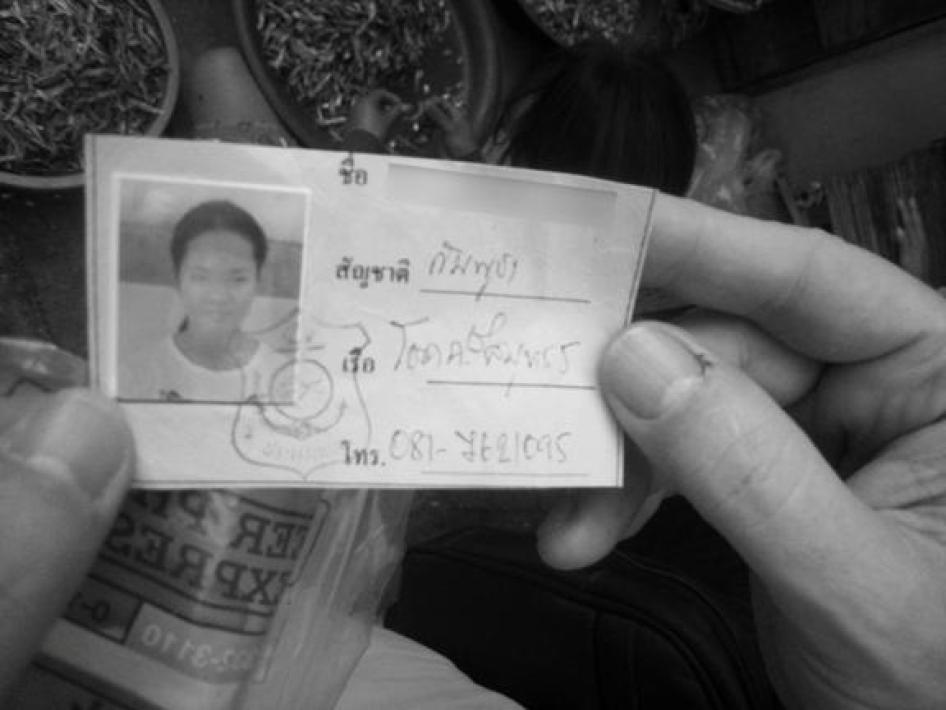
A researcher holds a “Rayong ID card” issued to a Cambodian migrant worker in Rayong’s Muang district. The card has the stamp of the provincial chapter of the Thai Fisheries Association and is intended to prevent the bearer from being arrested by local police for immigration violations. The card contains the name of the worker, nationality, name of the fishing boat to which she or he is attached, and the phone number of the boat owner or captain. The cost of the card varies between 200 to 300 baht (US$ 6 to 9) per month to renew. © 2009 Human Rights Watch
In Pattani, the production of ID cards is done by the provincial chapter of the Thai Fisheries Association. Migrant workers told Human Rights Watch that the card protects them from arrest by local police in areas near the Pattani fishing port. The card costs 500 baht for three months. The provincial Department of Employment chief insists that the association card does not have legal status but that he is largely powerless to prevent its distribution because it is a private arrangement between the migrant workers, the TFA Pattani chapter, and the police.[187]
Ranong province previously issued a local migrant worker ID card offering protection from arrest by local police in certain areas of Ranong. The degree of the card’s coverage and protection is subject to the discretion of local police and army officers intercepting migrants. Su Su described the police arrest of her husband and sister on November 20, 2007, as they traveled from their workplace at Ranong National Park to see Su Su’s sick father in Ranong Hospital. She said that
Usually the police don’t accept this [as an ID] and always ask for bribes. He [the policeman] said [to my husband] “Your card is already out of date and you are not allowed to come here ... This temporary card does not allow you to go out at night.”
Su Su had to enlist the help of a Thai to travel to the local police post where her relatives were held, and negotiate the price of release from 6000 baht down to 3000 baht.[188]
VII. Labor Rights Abuses
The Ministry of Labor publicly asserts that all migrants are officially protected by the labor laws—such as the Labor Relations Act of 1975 (LRA) and the Labor Protection Act of 1998 (LPA), and bilateral MOUs on migrant employment between Thailand and its neighbors Burma, Cambodia, and Laos—and that all labor laws apply equally to migrant workers. However, the labor law excludes domestic workers, one of the major sectors for employment for female migrants.
Furthermore, as we have seen, the migrant registration scheme compels workers to remain with the employer who legally registered them. Migrant workers who lose their jobs, or are found to be working for an employer for whom they are not registered, become liable to immediate arrest and deportation.[189] Often, the mere threat of firing, or calling the police to the factory, is sufficient to cause migrant workers to withdraw their demands for protection under Thai labor laws and the various international human rights instruments on labor ratified by Thailand.[190]
Human Rights Watch found many serious abuses of migrants’ rights at work, including intimidation and threats, especially in cases when workers seek to organize and collectively assert their rights, and cases of retaliation when workers filed grievances with Thai authorities against their employers. Both registered and unregistered migrant workers complain they face physical and verbal abuse, forced overtime and lack of holidays, poor wages and dangerous working conditions, and unexplained and illegal deductions from their salary.[191] Migrant children work in situations of serious labor exploitation, and in many cases are involved in the worst forms of child labor.[192] Unauthorized departure from work also frequently means the migrant worker forfeits whatever outstanding wages are owed to him. Throughout the process, the migrant must be on guard against employers’ use of immigration officials and police, or sometimes local thugs or supervisors to retaliate against the migrant worker.
No Freedom to Organize and Collectively Bargain
Most migrant workers we interviewed had little understanding of their internationally recognized right to organize to collectively assert their rights. Many said they feared punishment, including grievous bodily harm, from their employer or local officials and police if it was learned they were organizing their fellow workers. Virtually all those interviewed assert this fear is well justified because employers target and retaliate against migrant workers who seek to assert their rights in the workplace.[193]
The rights of migrant workers to establish and register a trade union are clearly restricted in Thai law, in violation of ILO Convention No. 87 (Freedom of Association). While Thailand has not ratified this convention, it is bound as a member of the ILO to comply with ILO Declaration on Fundamental Principles and Rights at Work.[194] Article 88 of the Labor Relations Act of 1975 (LRA 1975) limits the right to establish a trade union to those having Thai nationality. Similarly, article 100 provides that only persons with Thai nationality can be members of the union executive committee and sub-committees set out as the legal leadership of the union.[195] As a result, migrant workers may be regular members of a trade union, but the union must be founded and led by Thais.
Phoe Zaw, a Burmese factory worker in Mae Sot, told Human Rights Watch that on August 11, 2008, a security guard attacked him without provocation at the knitting factory where he worked. His left hand and arm were broken fending off the blow of the guard’s nightstick. The guard reported that he thought Phoe Zaw was a banned worker, a claim that Phoe Zaw and his fellow workers rejected. Phoe Zaw instead believes he was attacked because of his labor rights activities.
Phoe Zaw said, “I think ... I was attacked because of my actions in leading the workers when we were unhappy about having to work on Sundays. The manager always wanted us to work seven days a week ... the workers were scared to organize a group to do anything about this.”[196] Two weeks before, on July 27, Phoe Zaw led a spontaneous work stoppage at the factory seeking higher pay, time off on Sunday, and better quality rice and water from the management. The workers ignored the orders of the infuriated Thai manager to return to work or face dismissal, prompting the factory owner to come and negotiate in an open meeting with the workers. Following this incident, Phoe Zaw told Human Rights Watch that his co-workers frequently invited him to discussions and recognized him as a leader, and work supervisors intensified their scrutiny of his work and actions.
After the attack on Phoe Zaw, workers saw the manager with his arm around the security guard, who was employed by a security contractor firm that removed the guard from the factory the next day.
Even the suspicion of being involved in organizing or coordinating group activities by workers brings migrants under potentially hostile suspicion from managers. Mon Mon Shwe said she attended a meeting of a labor rights organization operating in Mae Sot. It made her manager suspicious—so she lied and told him the topic of the gathering was family planning. “I think if they [management] found out they would be aggressive.... The employer does not want us to know about rights or more salary. When we are working here we are working under fear,” she said.[197]
Despite assertions by the Ministry of Labor that all migrant workers are covered by Thailand’s labor laws, in practice those laws’ protections are seldom implemented in the case of migrant workers. In 2008, the Labor Rights Subcommittee of the NHRC stated in its summary report on its six years of work that:
From our investigations, it was found that when migrant workers appointed a representative to bargain about wages or welfare, the employers harassed them, discretely arranged for physical attacks against them, had them arrested and charged with criminal offenses, and as we always found when there was bargaining taking place or a dispute within the factory, called in the police to inspect the workplace. Those workers with migrant worker IDs would be quickly terminated, making them equivalent to persons who entered the country illegally, and the police quickly arrested and deported them—even though they have filed complaints that are in the process of being investigated or are in the courts.”[198]
Intimidation and False Allegations against Workers
Employers use bullying tactics and fraudulent accusations to keep migrant workers in fear and under their control, correctly believing that most migrant workers will not risk potential retaliation or arrest by police in order to file a complaint.
Yos Rangseay, from Cambodia, told Human Rights Watch that he supervised 25 Cambodian workers for an abusive Thai employer at a fish packaging factory[199] for five months in Rayong province in 2007. Rangseay said he faced intense verbal abuse and regular threats of physical violence every time the workers made mistakes in the production process. Rangseay recalled meetings when his manager said to them, “If you do work like this, and [are] not well.... I can shoot you any time that I want, and throw you like a dog by the side of a road.” The employer allegedly reinforced his threats by displaying a gun when meeting with Rangseay and the workers. Rangseay said:
[The employer] put a gun on his desk where we could all see it, and [then] calls the meeting around the desk.... He did this when he was angry.... [it] was a revolver. He said these kinds of things to me, right in front of the workers.
According to Yos Rangseay, the employer frequently acted as if he was going to hit workers in addition to verbally abusing them. When Yos Rangseay and his wife decided to quit, the employer berated them at the factory, refused to let them leave, and ordered other workers not to enter the factory. Yos Rangseay credits his survival solely to the presence of another Thai man in the meeting. He was finally allowed to quit on the condition that he not claim the wages he had earned in the previous week. Yos Rangseay said that the Cambodian migrant workers believe the employer has a close relationship with the Ban Phe sub-district police and added this is the major reason that Cambodian migrant workers fear him.[200] The factory frequently violated the labor law by paying wages late, and threatening or severely penalizing workers who sought to take leave by docking their pay.[201]
Other employers use a less direct but equally effective route to intimidate workers when attempts are made to assert rights, receive back-pay, or change employers. Human Rights Watch found many cases where an employer made false allegations about their workers and then called the police to come arrest them.
In October 2008, Koy Mala, an 18-year-old Mon from Burma, said she informed her Thai employer in Samut Sakhon province that she was quitting work because she could no longer physically withstand the 18 to 20 hour workdays at the restaurant. The restaurant owner held Kao’s original migrant registration card and refused to let her quit, she said. After failing to persuade Koy to change her mind, she said her employer falsely accused her of stealing from another worker[202] and called two police officers from the Muang district police station.
Koy Mala told Human Rights Watch: “My employer said to the police, ‘You take care of her any way that you want’ and, ‘You can do anything you want with her.’ And I thought to myself, what does that mean...? Are they going to beat me? Are they going to rape me?”[203]
The officers and the owner then cajoled and threatened Kao to stay at work or she would be arrested. When Koy refused to be dissuaded, the owner alleged Koy was undocumented and demanded she be arrested. The police took her away, ignoring the pleas of Koy and her mother (who arrived to take her home) that she had a migrant worker ID card.[204] Koy said that she was in shock and fearful on the way to the Muang district police station:
I was so worried ... I thought they can take me anywhere they want, maybe they would take me somewhere and do things to me—and I knew that I could not resist.... because I am a woman.[205]
The police held Koy in the police station lock-up for six days until the Labor Rights Promotion Network (LPN) engineered her release by finding a new employer to hire her.[206]
Retaliation against Workers Filing Labor Complaints
For those migrant workers raising complaints of unfair treatment to the Department of Labor Protection and Welfare (DLPW), the risk of retaliation from their employers is real.[207] On October 7, 2008, Saw Lei, a construction worker from Burma, filed a complaint with the Mae Sot DLPW office when his employer refused to pay him back wages of 2250 baht taken in unauthorized daily deductions from his salary.[208] The next day, Saw Lei went with the DLPW officer to his employer’s house to negotiate a settlement. During the discussions, his employer’s wife took multiple close-up photos of Saw Lei in an intimidating manner. The three Thais did not permit Saw Lei to sit at the table with them, so instead he squatted on the floor at their feet while they discussed his settlement. When he disagreed with the employer’s proposal of a delayed payment, his employer erupted in front of the DLPW officer, kicked Saw Lei in the shoulder, causing him to cry out and topple over in pain, and then stormed out of the room, ending the negotiations.
The real role of the DLPW became clear when the officer returned to his office with Saw Lei, drafted a report in Thai (which Saw Lei told the officer he could not read), and ordered him to sign it. Saw Lei refused. The same evening the DLPW officer tried again by visiting him at the Yaung Chi Oo Workers Association (YCOWA) office. A YCOWA translator reviewed the document and found it stated that Saw Lei did not want to sue his employer and did not want his money back.[209] The employer then mounted a campaign to intimidate Saw Lei to drop the matter. According to Saw Lei’s brother, who is still at the worksite, the employer has asked other workers at the worksite “who is related to him [Saw Lei]? I will find them” and demanded to know about Saw Lei’s movements and whereabouts. Saw Lei sent his family back to Burma for safety and his brother pleaded with him to drop the case.[210]
Aung Zaw, a Burmese migrant worker, told Human Rights Watch about the beating he suffered when he sought to collect his back pay from a knitting factory in Mae Pa sub-district, Mae Sot district, Tak province. He said that as he approached the manager’s office at the factory on the evening of the June 15, 2008, the manager and four other staff came out of the room and assaulted him. Two of the men stabbed Aung Zaw with screwdrivers in the forehead, temple, and back of the head. Describing his injuries, he said that “my head was bleeding and my eye was hurt. I felt very dizzy, I could not see clearly, and I fell down on the floor.” The manager then took Aung Zaw to a construction site and abandoned him there, leaving him to sleep in the construction yard with his injuries still untreated.[211]
Khin Moe is an unregistered construction worker from Burma in Mae Sot. In October 2007, he and the other workers on his crew faced problems with their Thai manager, who paid them only about a third of the back wages they were owed. Khin Moe told Human Rights Watch that he led an effort to file a complaint with the DLPW office in Mae Sot. DLPW officers called his employer to the office to negotiate, and the employer agreed to pay the owed back wages. But as Khin Moe biked from the DLPW office home, he said his manager rode up on his motorcycle with a policeman (whom Khin Moe saw at the DLPW office) sitting behind him. The policeman arrested Khin Moe for not having a migrant ID card, sent him to prison for 13 days, and confiscated his bicycle.[212]
Labor Exploitation
Migrant workers regularly work more hours than is legally permitted by Thai labor laws, get paid sub-minimum wages, work in unsafe conditions, and face illegal deductions from their pay. In some cases, migrant workers are cheated out of all their wages by unscrupulous employers, sub-contractors, or supervisors, leaving them with a difficult choice to continue to protest (and face possible retaliation) or abandon their pay claims, shift employers, and hope for better treatment next time. The inordinate control that employers have over a migrant’s ability to transfer employment means that many migrants face the choice of enduring exploitative work conditions or leaving abusive conditions without their employer’s consent and thereby losing their documented status.
Comprehensive research by the ILO in 2005 found migrants working extremely long hours for less than the minimum wage. For example, 62 percent of fishing boat workers, 39 percent of fish processing workers, and 82 percent of domestic workers were working more than 12 hours per day, yet few were paid the minimum wage, and even fewer received correct wages with overtime factored in to their pay packet. Even manufacturing workers working between 9 to 12 hours per day are effectively cheated out of the legal overtime payments they are owed.[213] Another ILO report published in 2006 found that 83 percent of child workers surveyed in Mae Sot were working 11 to 12 hours per day, and 49 percent were not permitted to take any days off during the course of a month—yet employers paid these child workers only one-third to one-fifth as much as the legal minimum wage.[214]
Mom Channary, a Cambodian construction worker, faced difficulties in September 2008 with a Thai construction sub-contractor who paid her first two days on the job but then failed to pay for the rest of the month’s work. She said her boss threatened her and six other Cambodian workers with arrest by the police if they complained. Meanwhile, Thai citizens from Surin province who were also on the work crew took the matter to the construction contractor who had hired the sub-contractor. The Thais secured payment of their back-wages but when the Cambodian workers went to seek the same remedy, they were told the money was all gone. She said:
I was so angry, I wanted to yell and I wanted to scream—but I was not brave enough because that person threatened that if anyone raised an issue he would file a police complaint and have the police arrest us.... I am certain the police would come, because if it is a Thai who files the complaint, then they will definitely come. But for me [if I filed a complaint], I don’t know if they would come.... I am too scared to even call the police station.[215]
When they are changing employers, migrant workers are often cheated out of wages owed to them. Ma Myo, a Burmese line supervisor at a garment factory in Mae Sot, said she told her manager she was quitting during the first week of April 2008. The manager told her to come get her final pay (2800 baht) after the Buddhist New Year.[216] But when she went on April 16, the manager presented her with a sheet of specious deductions for damaging clothes in production and demands for payment of water and electricity bills. The owner’s computation claimed Ma Myo owed the factory 3500 baht. Ma Myo filed a complaint with the DLPW, but she said that many migrant workers either do not have the knowledge or the courage to do this. Meanwhile, the employer held and never returned her migrant worker ID, making her vulnerable to arrest and extortion by local authorities.[217]
Cheating of wages happens even on Thai government projects. Sai Ti, an ethnic Shan from Burma who is a legally registered migrant worker, told Human Rights Watch that he was cheated out of five months of wages by a contactor constructing a bridge at a Royal Thai Army base in Mae Rim district, Chiang Mai province. The contractor owed each worker more than 15,000 baht, but he never paid them anything.[218]
Even when applying for poorly paid wage work, migrant workers must pay. Interviews with workers in Samut Sakhon found undocumented migrants are frequently required to pay informal application “fees” to get jobs in factories. For example, Mi Mi, an undocumented migrant from Burma with two dependent children whose husband is in jail, finds the application fees are a tremendous barrier to seeking gainful employment. She said:
I have to pay a lot of baht to apply and get a job. I don’t know why I need to pay this money, but it’s like a system—whoever has some money can find a job. They [the employer representatives] say to me, well if you don’t want to give to me, you don’t have to work here.
She stated that for legally registered migrants seeking to transfer, the usual fee is between 2000 to 2500 baht while undocumented migrants must pay more.[219] Another Burmese worker in Mahachai, Zar Ni, said that he had to pay 2500 baht to a supervisor to obtain a job. Ultimately, he said, the workplace cheated him—he held his job for only a short time before being terminated because he was not a legally registered worker.[220]
Seizure of Migrant Worker Documents
In 2008, the US State Department reported that in Thailand, “Employers routinely kept possession of migrant workers’ registration and travel documents, which restricted their travel outside of the work premises.”[221] Without their original documents in hand, migrant workers are highly vulnerable to local officials’ discretion on whether to accept the documents as legitimate. As noted in several cases above, police and other authorities often use the fact that workers are carrying photocopies rather than original documents as a pretext for temporary detention and extortion.
In her experience in Mae Sot, Burmese migrant Ma Myo said employers justify holding the original registration documents of migrant workers by claiming they are required to keep track of the workers they register. Without their original documents, registered workers are often detained by police who then call their employers to send representatives to take those workers out of detention and pay any fees (legal or otherwise) for their release. In this way, the onus for monitoring migrant workers is transferred from government to the workers’ employer. This arrangement serves the employers’ interests in limiting the ability of workers to change employers while also supporting the government’s underlying national security rationale in investing employers with full control over the workers. Ma Myo said:
Most of the employers do not allow us to hold the original worker ID card because they say they granted us the work permit, they had to go to sign for it, and that if we go to some other place, or go to work for someone else and then cause trouble, then the employer who signed for the work permit might get in trouble.[222]
Mi Mi said that her migrant worker ID card is held by the management of the textile factory in Samut Sakhon where she works. Normally, she is only able to carry a photocopy of the card although she added that she could ask for her original card in case she needed it for a specific purpose. She said “I thought that they [factory management] were worried that I might try to move to another factory and leave that area. They would lose and so they.... make sure that we [migrant workers] can’t leave.”[223]
The practice of employers holding migrant workers documents is an informal yet effective form of travel restriction, but it is supplemented by formal travel controls. Migrant registration IDs are issued with the restriction that migrant workers remain within the province where their workplace is located. They must request and receive written permission from the district chief (an appointed officer of the Ministry of Interior) if they wish to travel outside the province. The application procedures reinforce employers’ control over their migrant employees because unless the employer or his representatives signs the application, the district chief will usually refuse to grant permission. As a consequence, it is quite difficult for migrant workers to obtain approval for travel outside their designated province.[224] Registered migrants who travel beyond their province without written authorization are often arrested and are subject to deportation.
Ko Shwe, an ethnic Mon migrant worker from Burma who works in Muang district, Surat Thani province, said that district officials refused permission for him to travel to tend to a severely ill relative: “I stay in Thailand, I made the migrant worker ID and I paid for it—but I do not feel free.... Freedom of movement is something that is only on paper for us migrant workers.”[225]
VIII. Impunity for Abuses against Migrants
Both documented and undocumented migrants repeatedly expressed the view that complaining about the abuses they face is dangerous because both Thai authorities and private individuals can retaliate against them with relative impunity.
The language barrier, especially for migrants from Burma and Cambodia who lack spoken proficiency in Thai, makes it easier for government officials and private Thai individuals to identify and target migrants. Even in provinces like Samut Sakhon, Samut Prakan, Rayong, Ranong, and Sangkhlaburi, with large populations of migrant workers, the vast majority of Thai government offices do not have interpreters available to help migrants and must rely on NGOs to make an interpreter available when the migrant is bringing forward their case.
Many migrant workers are also largely unaware of their rights, reflecting weaknesses in human rights education in their countries of origin, the dearth of Thai government information in migrants’ languages about migrants’ rights under law, under-resourced efforts of NGOs and civil society groups trying to help migrants, and the vested interest of employers and local officials in keeping migrants ignorant.
Since many migrants lack legal status, local connections to influential persons, and the backing of a social network or local community, they feel powerless to resist such intimidation. Many migrants told Human Rights Watch they do not trust the Thai justice system since the Thai police would be the ones with whom they need to file criminal complaints, are the group most responsible for extortion and abuses against migrants. Even in the most grievous cases of human rights abuse, relatively few migrants are willing to bring formal complaints to Thai authorities unless they can secure assistance from NGOs who will help provide protection and financial support to the migrants as their case progresses through the legal process.
Only occasionally do exceptions to impunity arise, and these are usually only in particularly egregious cases of abuses that garner international attention, such as the suffocation death of 54 migrant workers smuggled in a truck in Ranong province on April 10, 2008.[226] Even in that case, Ranong police refused to treat the incident as a human rights case deserving special attention, and instead quickly sent to the court illegal entry charges against the 67 surviving migrants. Only six lower-level gang members were indicted on charges of providing shelter to illegal migrants and recklessness resulting in death.[227] Many observers decried the failure to locate the gang leaders and prominently raised suspicions of local police involvement in the smuggling operation.[228]
Other exceptions have occurred when a case involves individuals that the police have apparently targeted for their own reasons. The case of Saengroj Kanchana, son of a prominent political family in Surat Thani, is a well-known example. Saengroj was arrested, along with a police accomplice, and convicted in 2006 for detaining and repeatedly raping two Burmese women he lured with the offer of a job as domestic workers. Representatives of the Migrant Workers Department of the Federation of Trade Unions-Burma (FTUB) who were directly involved in assisting the victims told Human Rights Watch that the Surat Thani police had been after Saengroj for quite some time because of continuous trouble he caused in the area. The police told the FTUB that they believed Saengroj had previously raped a number of Thai and Burmese women in the area but that they had not successfully persuaded any of the prior victims to testify against him.[229]
Occasional and inconsistent enforcement of the law does not threaten the continuity of Thailand’s manifestly unjust system; spikes of publicity and action are followed by a quiet return to the status quo. Extreme cases that have the persistent advocacy and attention of NGO and trade union advocates, diplomats, or journalists[230] are used by Thai authorities for great photo opportunities to make lofty promises to protect migrants’ rights and improve regulatory systems. However, as soon as public attention shifts elsewhere, impunity for the continuing mistreatment and exploitation of migrant workers returns.
Other than NGOs, migrants in Thailand have few allies in their effort to seek justice. Migrants do not frequently turn to their embassies in Bangkok, either because they are fearful of facing problems for having left their countries of origin illegally or because the embassies are not seen as willing to help. Even in cases of grievous abuse, such as that suffered by Aye Aye Ma, who was raped and her husband killed, migrant workers often avoid their embassies. As Aye Aye Ma put it, “our Burmese government does not care about this and does not care about us. I did not even bother to contact the Burma embassy in Bangkok because I know that they will not help me at all.”[231] Lao migrants also are reluctant to reach out to their embassy because they fear they could get in trouble if they left Laos illegally. Local Lao government officials reportedly continue to levy fines against Lao workers who left the country without a passport and an exit visa, despite central directives from the Lao PDR government to end these penalties.[232]
IX. Recommendations
To the Office of the Prime Minister
- Establish a special commission to independently and impartially investigate the allegations of systematic human rights violations perpetrated by the Royal Thai Police and immigration officers against migrant workers in Thailand. This should include the failure of the police to properly investigate crimes against migrants and corrupt practices against migrants in border areas. The commission should be composed of competent and respected representatives of government, nongovernmental organizations including migrant worker groups and trade unions, and academia. The commission should have an adequate budget, the power to subpoena witnesses and compel provision of documentary evidence, and produce a public report. It should be empowered to make recommendations for criminal investigations in specific cases and for changes in laws, regulations, and policies adversely impacting the human rights of migrants.
- Ensure that the National Commissioner of the Royal Thai Police immediately takes all necessary measures to end the torture and ill-treatment of migrants by the police. All reports of torture should be promptly, effectively, and impartially investigated. Those implicated in abuses should be disciplined or prosecuted as appropriate, regardless of rank. Particular attention should be given to investigating abuses committed against migrants on a systematic basis.
- Ensure that the Royal Thai Police and the Department of Corrections bring conditions for migrant detainees in police lock-ups and immigration detention centers into compliance with international standards, such as the UN Standard Minimum Rules for the Treatment of Prisoners.
- Establish an independent and impartial national level ombudsman office to receive complaints from migrants regarding human rights violations committed by the police and other authorities, as well as abuses by employers and other private individuals. The ombudsman’s office should be empowered to compel production of evidence and appearance of witnesses during investigations and make recommendations for criminal investigations. Such offices should be staffed with translators in the main languages spoken by migrants.
- Ensure that the national police devote resources and energy to the investigation of alleged criminal offenses against citizens and non-citizens without discrimination.
To the Ministry of Interior
- Immediately revoke the provincial decrees restricting migrant workers’ rights in Phang Nga, Phuket, Ranong, Rayong, and Surat Thani provinces.
- Order the governor of Samut Sakhon to revoke the restrictive policies against migrants.
- Provide effective oversight to ensure that the governors of all Thai provinces respect the fundamental rights of migrants—including the rights to freedom of movement, assembly, and association and protection from arbitrary interference with privacy, family, home, or correspondence—in line with Thailand’s obligations under international law.
- Give priority to investigating high-profile incidents in which migrants were victims to establish the principle that the authorities will treat crimes against migrants as seriously as those against Thai citizens. For instance, the ministry should order the governor of Phang Nga to conduct a thorough review of the investigation of the killing of migrant worker Cho and the rape of his wife, Aye Aye Ma, on November 5, 2007, in Thai Muang district of Phang Nga, and ensure that the case is fully and properly investigated. The ministry should also order the governor of Tak province to conduct a full and immediate investigation of the alleged criminal actions of police in the Kilometer 48 area of Pop Phra district, Tak province. It should also do the same with similar cases in other provinces.
To the Ministry of Labor
- Immediately reform the migrant registration system so that employment-based visas are not specific to particular employers. Ensure that workers can change employers without losing legal status and without having to obtain their first employer’s permission.The time period allowed for terminated migrant workers to find a new employer should be increased from the current seven days, which is manifestly inadequate, to no less than 60 days in line with recommendations of migrant advocates.
- Amend articles 88 and 100 of the Labor Relations Act of 1975 to allow for persons of all nationalities to apply to establish a trade union and to serve as a legally recognized trade union officer, and ensure that the revised Labor Relations Act is fully in compliance with the standards set out in ILO Convention No. 87 (Freedom of Association).
- Provide adequate budgetary resources and personnel, and political commitment, to give priority to labor inspections of workplaces with migrant workers, protect migrant workers’ rights, and ensure effective enforcement of all Thai labor laws. Provincial Ministry of Labor offices should be provided resources and authority to hire dedicated interpreters to ensure that information about labor laws, regulations, inspections, and complaints procedures are widely distributed to migrant workers in their own languages, and grievances by migrant workers can be received by the Ministry of Labor offices in migrants’ own languages. Labor inspectors should actively seek the cooperation of NGOs working with local migrant communities.
- Extend labor protections to domestic workers and establish accessible complaints mechanisms such as hotlines staffed by personnel conversant in migrants’ languages.
- Immediately develop an administrative process to ensure that stateless persons from the region, such as ethnic Rohingya from Burma, can be registered to work and reside in Thailand as migrant workers.
- Take the following steps to reform the process of nationality verification of migrant workers from Burma, Cambodia, and Laos:
- Ensure all Burmese workers traveling to the border for nationality verification are able to move freely, without harassment by police or other local officials;
- Launch an intensive education campaign to inform migrant workers in their own languages about the specific details and steps of the nationality verification process;
- Set clear regulations to control the activities and levels of fees charged by private sector brokers offering services to facilitate nationality verification procedures, including strong penalties to deter cheating and abuses;
- Keep channels open for nationality verification for as long as needed to allow all migrant workers to enter the process, and ensure that migrant workers eligible for nationality verification are not deported;
- Include representatives of NGOs, trade unions, and migrant worker associations in policy forums setting out steps to reform the nationality verification system.
- Publicly call for the establishment and institutionalization of bipartite committees in all workplaces where migrant workers are present, in compliance with Thai labor laws, and ensure opportunities for migrant workers to serve on those committees. Conduct proactive monitoring and extension of protection against retaliation to those migrant workers serving on the committees.
- In provinces and districts where there are major concentrations of migrant workers working in industrial settings, the MOL and the DLPW should support NGO efforts to provide information and support to migrant workers seeking assistance with the labor law.
- Coordinate with the Ministry of Interior to end restrictions on the rights to freedom of movement for registered migrant workers, in line with Thailand’s obligations under the ICCPR. Registered migrant workers should be allowed to cross provincial borders freely, and reside where they wish, providing updated information to the migrant registrar.
- Issue official documents, such as migrant worker ID cards and work permits, directly to the worker rather than to the employer. Since seizure of migrant worker documents violates government regulations requiring migrant workers to hold their own documents, the ministries should reform, coordinate, and enforce regulations to appropriately penalize employers who seize and hold migrant workers’ original registration documents. The government should undertake a public “no tolerance” campaign against all employers, including individuals who hire domestic workers, who seize and hold migrants’ original documents.
To the Ministry of Social Development and Human Security
- Coordinate with all relevant government agencies to ensure they dedicate adequate resources and personnel to combat forced labor and human trafficking in all its forms. This includes the thorough investigation, prosecution, and punishment of those involved in forced labor and human trafficking, especially police and other government officials directly involved.
To the Ministry of Justice
- Immediately take action to “develop realistic and effective cooperation in the criminal justice system to remove impunity for traffickers and provide justice for victims” as part of Thailand’s commitments under the Coordinated Mekong Ministerial Initiative against Trafficking (COMMIT) process.
To the Ministry of Foreign Affairs
- Immediately accelerate and coordinate the efforts of the Thai government to complete its initial report as a ratifying state of the International Convention on the Elimination of All Forms of Racial Discrimination (ICERD), due in 2004, which has still not been submitted to the Committee on the Elimination of Racial Discrimination.
- Increase cooperation regarding regulation and oversight of brokers/middlemen who recruit workers to come to Thailand, and collaborate on information campaigns to raise awareness among migrants about their rights.
To the Royal Thai Government
- Ratify the International Convention on the Protection of All Migrant Workers and Members of Their Families.
- Ratify core ILO Convention No. 87 (Freedom of Association) and Convention No. 98 (Right to Organize and Collectively Bargain). Ensure that national labor laws fully conform to these standards, and initiate programs to educate migrant workers (in their own language) about these core trade union rights.
- Ratify ILO Convention No. 97 (Migration for Employment) and Convention No. 143 (Migrant Workers, Supplementary Provisions) without delay.
- Promote Thailand’s full compliance with the ICERD. Convene a consultative process with Thai civil society organizations, migrant workers advocates, and representatives of migrant workers, to provide inputs to Thailand’s overdue initial report, and second and third periodic reports, to the Committee on the Elimination of Racial Discrimination.
- Adopt policies and legislation as appropriate to ensure the progressive realization of the rights of migrant workers in accordance with the International Covenant on Economic, Social and Cultural Rights to fair wages and equal remuneration for work of equal value, a decent living for them and their families; safe and healthy working conditions; and provision of rest, especially a reasonable limitation of working hours, and periodic holidays.
- Ratify the Protocol to Prevent, Suppress And Punish Trafficking in Persons, Especially Women And Children, Supplementing the United Nations Convention Against Transnational Organized Crime.
- Promptly ensure that Thailand is fulfilling its obligations under the Convention Against Torture and Other Cruel, Inhuman, or Degrading Treatment or Punishment, in particular by ensuring a legal prohibition against torture using the definition of torture under article 1 of the convention. Penalties for torture should appropriately take into account their grave nature, in compliance with article 4. Given the significant fears that migrants express about potential retaliation for raising complaints about mistreatment while in custody, the government should also agree to be bound by articles 21 and 22 of the convention, which allows for individual complaints to be raised with the Committee against Torture.
To the National Human Rights Commission of Thailand (NHRCT)
- The NHRCT’s Subcommittee on Labor Rights should proactively engage relevant government agencies, Thai civil society organizations, and migrant worker associations to uncover and investigate human rights abuses against migrant workers, including those described in this report, and make recommendations for actions to stop such abuses against migrant workers and to hold accountable those responsible.
To the Association of Southeast Asian Nations (ASEAN)
- ASEAN should promote Thailand’s compliance with the ASEAN Declaration on the Protection and Promotion of the Rights of Migrant Workers, especially to “take into account the fundamental rights and dignity of migrant workers and family members already residing with them” and, as a labor receiving state, to “intensify efforts to protect fundamental human rights, promote the welfare and uphold the human dignity of migrant workers.”
- The ASEAN Intergovernmental Commission on Human Rights (AICHR) should play a leadership role in engaging with Thailand to better protect migrant worker rights, and urge Thailand as a labor receiving state to act in accordance with the declaration on migrant workers to “promote fair and appropriate protection, payment of wages, and adequate access to decent working and living conditions for migrant workers” and “provide migrant workers, who may be victims of discrimination, abuse, exploitation, violence with adequate access to the legal and judicial system of the receiving state.” AICHR should act under its mandate to request information from ASEAN member states and conduct studies on thematic issues of human rights to expand its attention to the plight of migrant workers in Thailand.
- ASEAN, in line with its commitment in the ASEAN Charter to encourage full participation in policy-making by the peoples of ASEAN, should endorse and promote an approach of involving migrant workers associations, NGOs, trade unions, and other civil society organizations in the work of the inter-governmental ASEAN Committee on Migrant Workers (ACMW). ASEAN should press Thailand, as one of the four core members of the Drafting Subcommittee of the ACMW (along with Indonesia, Malaysia, and the Philippines), to include civil society representatives as the ACMW drafts an ASEAN-wide agreement on protection of migrant worker rights in accordance with article 22 of the ASEAN Declaration on the Protection and Promotion of the Rights of Migrant Workers.
To the International Labor Organization
- Develop effective, grass-roots based programs to expand education on trade union rights and human rights for migrant workers from Burma, Cambodia, and Laos in Thailand that will build greater understanding among migrant workers on effective measures to address workplace grievances and other violations of fundamental rights.
- Support greater capacity building and effective monitoring of performance within the Ministry of Labor to publicize labor rights under Thai law, to conduct inspections of workplace conditions, create accessible complaints mechanisms, and respond effectively and in a time-bound manner to such complaints.
- Provide technical assistance to the Ministry of Labor on expanding labor protections to domestic workers.
To the Governments of Burma, Laos, and Cambodia
- Establish an effective migrant labor liaison office, located within the embassies in Bangkok, with a clear mandate for protection of the human and labor rights of their nationals who have migrated to work in Thailand. Ensure that these migrant labor liaison offices should have a clear policy commitment to help, and not punish migrants from their countries, and provide personnel and resources to effectively reach out to migrants, receive complaints over the phone and in person, provide support for access to legal redress, and effectively assist migrant workers’ with grievances against authorities and employers. These offices should also actively liaise with the Department of Labor Protection and Welfare to ensure that labor inspectors are informed about and take action against workplaces employing migrant workers that fail to follow the Labor Protection Act of 1998, the Labor Relations Act of 1975, and all other labor laws and regulations.
- Drastically improve formal recruitment procedures set out in bilateral agreements with Thailand, especially providing full disclosure of recruitment fees and providing pre-departure education on labor and human rights.
- Demand effective Thai government efforts to ensure compliance with provisions of bilateral agreements that call for extending full protection of Thai labor laws to migrants recruited through these agreements.
To the United States, European Union Members States, Australia, Canada, and Other Bilateral Donors
- Instruct embassies in Bangkok to closely monitor cases of migrant worker abuse and publicly and consistently call upon the Thai government to take concrete actions to hold responsible those perpetrating the abuses.
- Press the Thai government to ensure that the rights of migrant workers and their families are protected in line with obligations set out in ILO core conventions and international human rights instruments.
- Provide greater assistance to local NGOs and migrant associations working to protect the rights of migrant workers and their families in Thailand. This includes expanding support and training for caseworkers and lawyers to pursue cases of abuse against migrant workers.
Appendix I: Questionnaire
Questions
(1) Please give me the following personal details about you -- name (pseudonym), gender, ethnicity, age, place of origin (state/division), when was the first time you came to Thailand, how long you have been in Thailand this time, what languages do you speak (and especially, do you speak good Thai).
(2) Are you registered to work in Thailand now? Have you ever been registered to work in Thailand?
(3) Do you now have an identity document, and if so, what is it? (For example, migrant worker card, national ID, passport, etc.) Are you able to hold in your hand the original document? If not, who has your document now (for example, government officials (police), supervisor/employer, broker, others)? If do not have the original of your document with you, do you have a photocopy of the document? Can you get the original document from the person who has it, and if so, under what circumstances?
(4) Have you ever faced harassment and abuse by Thai officials (local, sub-district, district, or provincial)? (And tell me about your worst experience with Thai officials?) If so, please explain.
Ø Types of harassment (for use by interviewer to check...) – and ask in each case, how many times did these things happen?
i. Confiscation of property during raids or spot-checks
ii. Robberies and theft, extortion
iii. Threats and/or verbal abuse
iv. Violence/beatings
v. Sexual harassment/rape
vi. Arrest/detention
vii. Involvement in delivering workers into situations of exploitative labour and/or trafficking
viii. Killings of migrant workers
ix. Others, please specify
Ø Please give the specifics of each incident of harassment or abuse, such as date, time, specific group(s) of officials involved, place, presence of witnesses, etc.
(5) Do you have to pay any sort of protection fees to any person so that you are not arrested? If so, how much do you pay and who do you pay it to? Do you have to perform other work or activities, or purchase goods, in order to be protected from arrest? Please explain, and do you feel safe as a result?
(6) Have you faced harassment or abuse at work by your employer or supervisors? (For example, physical beatings, verbal harassment and abuses, intimidation, held against your will/not allowed to leave the workplace?)
Ø Did you discuss this with other workers? Did you try to work together to solve problem and if so, how? What happened?
(7) In the past two years, have you changed your employer? If so, how did you do it? Did you face any problems or difficulties in changing your employer? Please explain.
(8) Restrictions on freedom of association
Ø What has been your experience with trying to organize workers (such as holding meetings, trying to improve the situation at work)? Please explain.
Ø Have you ever been involved in trying to establish a workers’ group, association, or union? Please explain what happened.
Ø Have you ever been involved in trying to present demands to your employer or government authorities about the situation at your work? What happened?
Ø If your employer or a government official found out about your involvement in the workers’ group, association or union – what happened? (For example -- threats, retaliation, firing from job, violence, etc.)
(9) When and where do you meet other migrants when you are not at work? Do you have any problems gathering with other migrants at those places?
Ø Have you faced any restrictions on freedom of assembly, such as attending community gatherings, sports activities, religious ceremonies, or other events involving social or cultural life and practice of your beliefs?
Ø Do you face any curfew restrictions from the authorities or employers? If so, please explain.
(10) What kind of restrictions do you face on communications using land-line phones, mobile phones, regular mail and any other form of communication (computers, internet)? If so, please explain in detail.
(11) Freedom to travel/mobility -- How did you go from the border to your place of work? Have you traveled in Thailand (outside the province) and why? Where did you go, how much did you pay to go there – and please give details of any bad experiences? Have you ever wanted to travel outside the province but were prevented from doing so? What or who stopped you from traveling?
(12) How do you travel locally? Are you allowed to drive a bicycle, motorcycle or a car?
Ø If you are not allowed to drive a motorcycle or a car, what impact does this have on your life and freedom of movement?
Ø Have you ever experienced any problems from the authorities about using a bicycle, motorcycle, or car? Please describe.
(13) In cases of abuse and harassment that you have faced, what did you do and who did you call/talk to? Describe any cases that have happened to you.
Ø By employers?
Ø By authorities?
Ø By Thai people who are not authorities?
Ø By other members of the migrant community?
Ø By others?
Ø Was the problem(s) resolved? If so, how?
Ø If you reported the case to the Thai authorities, what did they do?
(14) Do you know about or have you ever witnessed retaliation or attacks against organizations supporting migrants?
(15) Have you personally seen or witnessed physical violence/attacks against another migrant worker or workers? If so, please explain.
(16) Do you have any questions that you would like to ask the interviewer? Do you have any additional things that you want to share? Do you have any suggestions or recommendations for this research?
Additional question, if time is available – for registered migrant workers:
(17) If you are registered, did you pay yourself for your migrant worker card? If you did not pay yourself, are you free to leave your work before you pay back the money?
(18) Did you face any other problems or abuses in registering?
Appendix II: Letter to Prime Minister Abhisit Vejjajiva from Human Rights Watch
January 29, 2010
H.E. Abhisit Vejjajiva
Prime Minister
Royal Thai Government
Government House Pitsanulok Road, Dusit Bangkok 10300 Thailand
Dear Prime Minister Abhisit,
Human Rights Watch is preparing a report regarding the situation of migrant workers from Burma, Cambodia, and Laos who are living and working in Thailand. Our report explores restrictions placed on the rights of migrants in law and policy, violence perpetrated against migrants by both state and non-state actors, forced labor and trafficking of migrants, extortion of migrants by state officials, and violations of labor rights.
We are writing to ensure that our report properly reflects the views, policies, and practices of the Royal Thai Government regarding treatment of migrant workers in Thailand.
Human Rights Watch is committed to producing material that is well informed and objective. We hope you or your staff will respond to the attached questions so that your views are accurately reflected in our reporting. In order for us to take your answers into account in our forthcoming report, we would appreciate a written response by February 13, 2010.
Please do not hesitate to include any other materials, statistics, laws or policies, or information on government actions regarding migrant workers from Burma, Cambodia, and Laos in Thailand that you think might be relevant.
Thank you in advance for your time in addressing these urgent matters.
Sincerely,
Brad Adams
Director, Asia division
cc:
H.E. Kasit Piromya, Minister of Foreign Affairs
H.E. Chaovarat Chanweerakul, Minister of Interior
H.E. Phaitoon Kaeothong, Minister of Labor
Pol. Gen. Patheep Tanprasert, Acting National Police Chief
Questions
Provincial decrees:
1.) What is the current policy of the Thai government towards the provincial government decrees adopted in 2006 and 2007 in Phuket, Phang Nga, Surat Thani, Rayong, and Ranong[233] that establish restrictions on the rights of migrant workers, including night-time curfews, limitations on assembly, restrictions on movement, prohibitions on ownership of mobile phones, and bans on use on driving motor vehicles?
- Are these decrees still in effect?
- Does the Thai government have any plans to revoke or alter these decrees?
2.) What is the Thai government’s policy response to the conclusions of the National Human Rights Commission of Thailand’s (NHRCT) in case 404/2551 on “Human Rights: The Case of the Provinces Issuing Provincial Decrees that Violate the Rights of Migrant Workers”?
- In that decision, the NHRCT found that “the decrees contravene article 30 [of the 2007 Thai Constitution] which provides ‘All persons shall be equal before the law and shall enjoy equal protection under it....Unjust discrimination against a person on grounds of difference in origin, race, language, sex, age, physical conditions or health, economic or social status....shall not be permitted.’” The NHRCT also determined that bans on use of mobile phones in the decrees violate article 36 of the Constitution where it is stated that, “A person shall enjoy the liberty to communicate with one another by lawful means.” Finally, the NHRCT ruled the curfews and restrictions on gatherings of more than five migrants are contrary to article 63 of the Constitution, which states: “A person shall enjoy the liberty of peaceful and unarmed assembly.”
3.) What is the legal status of orders issued by Samut Sakhon Governor Wirayuth Euamampa in memorandum no. SK 0017.2/Wor 3634 to the provincial Department of Employment and employers on October 26, 2007 and no. SK 0017.2/Wor 13723 to the provincial Department of Employment and employers November 28, 2007?
- These orders found that migrant workers should not be allowed to hold cultural events or activities and required employers to maintain strict controls over their migrant workers or face legal punishment. What is the policy of the Thai government regarding these orders?
Migrant registration and nationality verification:
1.) The Thai government has publicly stated that all registered migrant workers from Burma, Cambodia, and Laos who do not apply to enter the nationality verification system before February 28, 2010 will be subject to immediate deportation.
- On what date will this deportation operation begin?
- Has the Thai government issued orders or guidelines to Thai police, immigration officers, and other relevant state officials on how to conduct this operation in a way that respects the human rights of migrant workers?
- Can you please provide Human Rights Watch with the details of these instructions?
- Has the Thai government developed a monitoring plan to effectively ensure violations of human rights do not occur during this deportation operation?
2.) What is the policy of the Thai government regarding employment for migrant workers in Thailand, such as ethnic Rohingya from Burma, who are not likely to receive nationality verification from the Burmese government?
3.) What is the policy of the Thai government regarding deportation from Thailand of stateless persons?
Abuses against migrant workers:
1.) What actions are being taken by the Thai government to prevent beatings, sexual harassment, and other human rights abuses against migrants in detention?
- What is the Thai government doing to hold accountable officials who are responsible for such abuses?
2.) What actions are being taken by the Thai government to prevent bribe-taking and other forms of extortion by law enforcement, immigration, and other officials in their dealings with migrants?
- What is the Thai government doing to hold accountable officials who are responsible for such abuses?
3.) What actions are being taken by the Thai government to prosecute crimes committed against migrant workers?
- When the victim of a crime is a migrant, what principles must Thai police abide by during the investigation, evidence collection and analysis, and enforcement against criminal suspects?
4.) What legal and other measures has the Thai government established to prevent the practice of employers seizing and holding the original identity documents (such as migrant worker ID cards and passports) of migrant workers?
- Can the Thai government provided statistics on the number of cases where legal action has been taken against employers for seizing and holding the original identity documents of migrant workers?
5.) In a speech that you made during the global launch of the UNDP Human Development Report 2009 held at the Vithes Samosorn room at the Ministry of Foreign Affairs, on October 5, 2009 you stated, “It is our Government’s policy to ensure that migrants can enjoy their freedom and social welfare in Thailand while their human rights are duly respected...migrant workers, regardless of their legal status, can seek justice in Thailand’s court system for any violent abuses to which they have been subjected, and which are covered by these laws.”
- What concrete steps has the Thai government taken to inform migrant workers of these rights, provide free legal assistance for migrant workers wishing to file complaints, provide interpretation/translation assistance for migrants who cannot speak or read Thai, and ensure migrant workers do not face retaliation from state officials and non-state actors named as defendants in legal cases?
6.) Is the Thai government aware of allegations of possible collusion between immigration officials in Mae Sot to provide information on deportees to brokers connected with the Democratic Karen Buddhist Army (DKBA) in Burma?
- Human Rights Watch has learned that migrant workers who are deported to DKBA controlled territory in Burma face extortion demands by brokers and/or DKBA soldiers and migrants who cannot pay ransom are physically abused, forced to labor in Burma, or sold to human traffickers in Thailand. Therefore, what is the justification for deporting migrant workers to areas directly under the control of the DKBA?
7.) Why does the Thai government continue to deny non-Thai nationals the right to establish labor unions and the right to serve as executive committee members of a legally registered union?
- Does the Thai government plan to amend discriminatory provisions in article 88 and 100 of the Labor Relations Act of 1975?
8.) What is the legal justification behind the policy denying driver’s licenses to migrant workers from Burma, Cambodia and Laos?
- Does the Thai government plan to revise this policy to grant migrant workers the right to apply for and receive a driver’s license?
International human rights treaties and standards:
1.) Does the Thai government intend to ratify the Protocol to Prevent, Suppress and Punish Trafficking in Persons, Especially Women and Children, Supplementing the United Nations Convention Against Transnational Organized Crime?
2.) Does the Thai government intend to ratify ILO Conventions 87 (Freedom of Association) and 98 (Right to Organize and Collectively Bargain)? If so, what is the concrete timetable for these ratifications?
3.) Does the Thai government intend to ratify the International Convention on the Protection of All Migrant Workers and Members of Their Families?
- If so, when will the Thai government make this ratification?
- If not, why not?
4.) Thailand ratified the International Convention on the Elimination of all Forms of Racial Discrimination (ICERD) in 2003, and its first report to the Committee on the Elimination of Racial Discrimination was due five years ago, in 2004. What is the timetable for the Thai government to submit its required report?
Acknowledgements
This report was written by Phil Robertson, consultant with the Asia division of Human Rights Watch. It was edited by Lisa Anderson, consultant with the Asia division; Sunai Phasuk, Thailand researcher in the Asia division; Elaine Pearson, deputy director of the Asia division; Bill Frelick, Director of the Refugee Policy division; Bede Sheppard, researcher in the Children’s Rights division; Nisha Varia, senior researcher in the Women’s Rights division; James Ross, legal and policy director; and Joseph Saunders, deputy director in the program office of Human Rights Watch.
Production assistance was provided by Diana Parker, associate in the Asia division; Grace Choi, publications director; Fitzroy Hopkins, production manager; and Anna Lopriore, photo editor, who assisted with the photo feature.
Human Rights Watch would like to thank the MAP Foundation and Yaung Chi Oo Workers Association for their assistance. Human Rights Watch would also like to thank all the migrant workers from Burma, Cambodia, and Laos we interviewed who made this report possible, as well as others who took risks to make information available to us.
[1] Philip Martin, The contribution of migrant workers to Thailand: Towards policy development (Bangkok: International Labour Office, 2007), p. xi.
[2] Between 70 to 80 percent of the migrant workers originate from Burma, where human rights abuses, economic mismanagement, and political repression by the Burmese government, the State Peace and Development Council (SPDC), and the armed forces prompt migrants to cross borders to seek refuge and economic survival. Burmese migrants interviewed in Thailand cited the following among their reasons for leaving Burma: forced labor, extortion, arbitrary taxation, confiscation of land and property, and movement restrictions that negatively impact villagers’ agricultural work. Sending one or several members of the family to seek work in Thailand and send back remittances is thus best understood as a survival strategy for many Burmese families.
[3] Pungpond Rukumnuay Kit, A Synthesis Report on Labour Migration Policies, Management and Immigration Pressure in Thailand, (Bangkok: International Labour Office, 2009), pp. 3-4.
[4] According to the International Organization for Migration (IOM), the growth rate of the population aged 15-39 years between years 2005-2010 is estimated at 2.97 percent for Laos, 2.93 percent for Cambodia, 0.596 percent for Burma, and negative 0.61 percent for Thailand. Federico Soda, regional program development officer, IOM, “Migration in the Greater Mekong Subregion: A Background Paper for the 4th Greater Mekong Subregion Development Dialogue,” Beijing, May 5, 2009, http://www.adb.org/Documents/Events/2009/WGHRD-9/Background-Paper.pdf (accessed January 16, 2010). The UNDP reported in 2001 that under-15-year-olds comprised the following percentages of population: 44.6 percent for Cambodia, 43 percent for Laos, 33.5 percent for Burma, and 27 percent for Thailand. United Nations Development Programme (UNDP), World Development Report 2001: Making New Technologies Work for Human Development, (New York, 2001), p. 154-157.
[5] Jerry W. Huguet, Thailand’s Policy Approach to Irregular Migration, (International Labour Office and Singapore Management University, 2007).
[6] Chomaiporn Sintubrasit, director of working group to protect against and solve problems of labor protection, Department of Labor Protection and Welfare, Ministry of Labor, “Benefits and Obstacles for Foreign Workers in Thailand,” and Human Rights and Development Foundation (HRDF), “Project Narrative Report on Seminar: Managing and Understanding Labour Migration through Social Dialogue at the Provincial Level,” PowerPoint presentations at conference Managing and Understanding Labour Migration through Social Dialogue at the Provincial Level, Hang Dong district, Chiang Mai province, October 26-28, 2009.
[7] Amnesty International, “Thailand: The Plight of Burmese Migrant Workers,” AI Index:ASA 39/001/2005, June 7, 2005, pp. 6, 10, and 20, http://www.amnesty.org/en/library/info/ASA39/001/2005 (accessed February 7, 2010).
[8] Elaine Pearson, The Mekong Challenge – Underpaid, Overworked, and Overlooked: The realities of young migrant workers in Thailand (Volume One), (Bangkok: International Labour Office, 2006), p. 26.
[9] Rosalia Sciortino and Sureeporn Punpuing, International Organization for Migration (IOM), International Migration in Thailand 2009, (Bangkok: IOM, 2009), p. 55.
[10] Pearson, The Mekong Challenge – Underpaid, Overworked, and Overlooked, pp. 67-80.
[11] Alien Employment Act of B.E. 2551 (2008), Royal Gazette, No. 125/27K, February 22, 2008, art. 7 (“Alien Employment Act”).
[12] The law provides for unrestricted searches without warrants during daylight hours. Alien Employment Act, art. 48.
[13] See Penchan Charoensuthipan, “Alien Working Act a breach of human rights, say critics,” Bangkok Post, June 17, 2008, p. 2; see also Alien Employment Act.
[14] Thailand Department of Employment, “Regulations of the Department of Employment on the Principles, Methods and Conditions for Paying Informant Fees, Rewards and Expenses in Implementing Work under the Alien Employment Act”, issued 2009, copy on file with Human Rights Watch.
[15] Kit, A Synthesis Report on Labour Migration Policies, p. 11.
[16] Vitit Muntarbhorn, The Mekong Challenge: Employment and Protection of Migrant Workers in Thailand: National Laws/Practices versus International Labour Standards?, (Bangkok: International Labour Office, 2006), pp. 58-62, 70-78.
[17] Hseng Khio Fah, “Deadline to apply for junta issued passports set,” Shan Herald Agency for News (SHAN), September 17, 2009, http://www.shanland.org/index.php?option=com_content&view=article&id=2733:deadline-to-apply-for-junta-issued-passports-set-&catid=87:human-rights&Itemid=285 (accessed September 22, 2009).
[18] International Organization for Migration (IOM), “Migrant Information Note: Registration and Nationality Verification 2009 at a Glance,” November 2009, http://203.155.51.51/pubs/LMP/MIGRANT%20INFORMATION%20NOTE%20Issue3%2018%2011%2009.pdf (accessed February 7, 2010).
[19] “Major boost for officials tackling illegal labour,” Bangkok Post, July 12, 2009, http://www.bangkokpost.com/news/local/20091/major-boost-for-officials-tackling-illegal-labour, (accessed July 12, 2009).
[20] Francis Wade, “Rohingya excluded from Thai migrant worker permits,” Democratic Voice of Burma (DVB), July 13, 2009, http://english.dvb.no/news.php?id=2710 (accessed on July 15, 2009).
[21] The SPDC government form issued to migrant workers for applying for nationality verification requires detailed information about the applicant, his or her father, mother, spouse, and children (including citizenship card number, race/religion, citizenship status, occupation, and address in Burma), photo, and thumbprint; copy on file with Human Rights Watch.
[22] The Burma Immigration (Emergency Provisions) Act of 1947, arts. 3(2) and 13(1), and Law Amending the Burma Immigration (Emergency Provisions) Act, 1947 (State Law and Order Restoration Council Law No. 2/90).
[23] Letter to Jorge Bustamante, UN special rapporteur on the human rights of migrants, from Savit Keawan, general secretary, State Enterprise Labor Relations Confederation, Somchai Homla-or, secretary-general, Human Rights and Development Foundation, and Wilaiwan Sae-tia, president, Thai Labor Solidarity Committee, September 16, 2009.
[24] US Committee for Refugees and Immigrations (USCRI), World Refugee Survey 2008, http://www.refugees.org/countryreports.aspx?id=2174 (accessed on November 23, 2009).
[25] Sciortino and Punpuing, International Migration in Thailand 2009, pp. 59-60.
[26] See “Sonthi alarmed at migrant birth rate,” The Nation, November 15, 2007; see also Asian Human Rights Commission, “THAILAND: Denial of rights to most vulnerable will rebound onto all”, AS-276-2007, November 23, 2007, http://www.ahrchk.net/statements/mainfile.php/2007statements/1283/, (accessed on May 1, 2009).
[27] “Migrant Workers Deserve Better,” The Nation, November 16, 2007, http://www.nationmultimedia.com/2007/11/16/opinion/opinion_30056292.php (accessed on July 25, 2009) and Sanitsuda Ekachai, “Gen Sonthi hits out at pregnant women,” Bangkok Post, November 22, 2007, http://www.statelessperson.com/www/?q=node/2113, (accessed on July 25, 2009).
[28] Shah Paung, “Pregnant Migrant Workers Fear Repatriation From Thailand,” The Irrawaddy, November 26, 2007, http://www.irrawaddy.org/print_article.php?art_id=9422 (accessed on July 26, 2009). An NGO worker from the Labour Rights Promotion Network in Samut Sakhon told Human Rights Watch about an incident that occurred when she accompanied a registered woman migrant who had been gang-raped repeatedly by six men to a local hospital. During the examination, the admitting nurse told the NGO worker that if the victim was found to be pregnant, she must be deported, and she referred to Gen. Sonthi’s policy. Human Rights Watch interview with official of Labor Rights Promotion Network, Mahachai district, Samut Sakhon province, August 19, 2008.
[29] Federation of Trade Unions – Burma (FTUB), “Problems in Registration Procedures for Migrant Children in Mae Sot District, Tak Province,”December 2009, unpublished report; Human Rights Watch telephone interview with FTUB official, December 15, 2009.
[30] International Covenant on Civil and Political Rights (ICCPR), adopted December 16, 1966, G.A. Res. 2200A (XXI), 21 U.N. GAOR Supp. (No. 16) at 52, U.N. Doc. A/6316 (1966), 999 U.N.T.S. 171, entered into force March 23, 1976.
[31]International Covenant on Economic, Social and Cultural Rights (ICESCR), adopted December 16, 1966, G.A. Res. 2200A (XXI), 21 U.N. GAOR Supp. (No. 16) at 49, U.N. Doc. A/6316 (1966), 993 U.N.T.S. 3, entered into force January 3, 1976.
[32]International Convention on the Elimination of All Forms of Racial Discrimination (ICERD), adopted December 21, 1965, G.A. Res. 2106 (XX), annex, 20 U.N. GAOR Supp. (No. 14) at 47, U.N. Doc. A/6014 (1966), 660 U.N.T.S. 195, entered into force January 4, 1969.
[33] Convention against Torture and Other Cruel, Inhuman or Degrading Treatment or Punishment (Convention against Torture), adopted December 10, 1984, G.A. res. 39/46, annex, 39 U.N. GAOR Supp. (No. 51) at 197, U.N. Doc. A/39/51 (1984), entered into force June 26, 1987.
[34] ICCPR, art. 2(1).
[35] ICCPR, arts. 25 & 26. Non-citizens, unlike citizens, may however be subject to deportation. Ibid., art. 12.
[36] Ibid. art. 26 (emphasis added). See also Human Rights Committee, General Comment No. 15 (Position of Aliens), July 22, 1986, paras. 2, 7, & 9. This view was reaffirmed by the Human Rights Committee in its General Comment No. 31 (Nature of the General Legal Obligation Imposed on States Parties to the Covenant) May 26, 2004, CCPR/C/21/Rev.1/Add.13, para. 10.
[37] Committee on Economic, Social and Cultural Rights (ESC Committee) General Comment No. 20 (2009), para. 30. The ESC Committee expressed this opinion with full recognition of article 2(3) of the ICESCR (“Developing countries, with due regard to human rights and their national economy, may determine to what extent they would guarantee the economic rights recognized in the present Covenant to non-nationals.”).
[38] ICERD, art. 1(2).
[39]CERD, General Recommendation No.30: Discrimination Against Non Citizens, October 1, 2004, para. 2.
[40] Ibid., para. 3.
[41] Ibid., para. 4.
[42] Ibid., para. 18.
[43] Ibid., para. 21.
[44] Ibid., para. 23.
[45] Ibid., para. 29
[46] Ibid., para. 33.
[47] Ibid., para. 34.
[48] Ibid., para. 35.
[49] Memorandum from Nirand Kalayanmitr, Governor of Phuket Province, “Announcement of the Province of Phuket on Setting the System to Control Alien Workers,” (ประกาศจังหวัดภูเก็ตเรื่องการจัดระบบในการควบคุมแรงงานต่างด้าว), December 19, 2006; Memorandum from Vinai Buabradit, Governor of Phang Nga Province, “Announcement of the Province of Phang Nga on Determining the Administrative Measures to Control Illegal Alien Workers,” (ประกาศจังหวัดพังงาเรื่องการกำหนดมาตรการเพื่อจัดระเบียบแรงงานต่างด้าวหลบหนีเข้าเมือง), June 9, 2007; Memorandum from Kanjanapa Keemun, Governor of Ranong Province, “Announcement of the Province of Ranong on Determining Measures for Specific Migrants,” (ประกาศจังหวัดระนองเรื่องกำหนดมาตรการจัดระเบียบคนต่างด้าวบางจำพวก), February 23, 2007, and Memorandum from Polwat Chayanuwat, Governor of Rayong Province, “Announcement of the Province of Rayong on Determining the Measures to Control Illegal Alien Workers,” (ประกาศจังหวัดระยองเรื่องการกำหนดมาตรการควบคุมแรงงานต่างด้าวหลบหนีเข้าเมือง), February 16, 2007; and Memorandum “Announcement of the Province of Surat Thani on Determining the Measures to Control Illegal Alien Workers,” (ประกาศจังหวัดสุราษฎร์ธานีเรื่องการกำหนดมาตรการควบคุมแรงงานต่างด้าว), January 2007.
[50] National Human Rights Commission of Thailand, “Human Rights: The Case of the Provinces Issuing Provincial Decrees that Violate the Rights of Migrant Workers” (สิทธิแรงงาน กรณีจังหวัดออกประกาศจังหวัดโดยละเมิดสิทธิมนุษยชนของแรงงานข้ามชาติ), case 404/2551. In that NHRC hearing, representatives from Rayong province also indicated Royal Thai Army region 4 and ISOC region 4 also issued order 2/2550 to control alien persons and communities in Ranong and Chumpon on February 19, 2007, and their representatives were involved in developing procedures for implementation in Ranong. Those representatives allegedly expressed support for extending the provincial decrees to all the remaining provinces in the south of Thailand, and identified people smuggling/human trafficking and illegal money remittances as the practices that threatened Thai national security and required a ban on mobile phone use by migrants.
[51] Letter/memorandum no. SK 0017.2/Wor 3634, “Control of Alien Labor,” from Wirayuth Euamampa, governor, Samut Sakhon province, to the provincial office of Department of Employment and all employers in Samut Sakhon, October 26, 2007.
[52] Pennapa Hongthong, “Governor accused of race bias”, The Nation, November 7, 2007.
[53] Letter/memorandum no. SK 0017.2/Wor 13723, “Control of Alien Labor (Additional)”, from Wirayuth Euamampa, governor, Samut Sakhon province, to the provincial office of Department of Employment and all employers in Samut Sakhon, November 28, 2007.
[54] National Human Rights Commission of Thailand, “Human Rights: The Case of the Provinces Issuing Provincial Decrees that Violate the Rights of Migrant Workers.”
[55] Human Rights Watch discussions with NGO representatives assisting migrants in Phang Nga (MAP), Ranong (World Vision Federation of Thailand), and Surat Thani (Raks Thai Foundation), December 2008, January and March 2009.
[56] Grassroots Human Rights Education and Development (GHRE), “Specific Cases against Migrants Resulting from The New Decree in Phang Nga Province,” revised July 24, 2007, www.ghre.org (accessed October 31, 2007); Asian Migrant Centre (AMC), “AMC statement against Implementation of Provincial Decrees”, August 30, 2007, www.asian-migrants.org (accessed August 15, 2008).
[57] Human Rights Watch interview in Bangkok with Kyaw Win, migrant worker from Burma living in Surat Thani, January 29, 2009.
[58] The wiharn is the area of the Buddhist temple housing the primary Buddha image in the temple complex.
[59] The next day, when a representative of the migrants went to retrieve the ID cards of the five migrant workers at the Muang district Surat Thani police station, he was required to purchase and hand over two bottles of Regency Brandy as a bribe to the officers to get the ID cards returned. Human Rights Watch interview in Bangkok with Kyaw Lwin, migrant worker from Burma living in Surat Thani, January 29, 2009.
[60] Human Rights Watch interview with Kyaw Lwin, January 29, 2009, Bangkok.
[61] “The Ranong Phu Torn Police Welcome the Delegation Visiting Us” (ตำรวจภูธรจังหวัดระนองยินดีต้อนรับคณะผู้มาเยือนเรา), PowerPoint presentation by police at a meeting at the Ranong provincial police headquarters, June 18, 2009, attended by a researcher from Human Rights Watch.
[62] Both Phang Nga and Phuket provinces provide exemptions to the mobile phone ban if the employer of the migrant workers draws up a written list of migrant workers (with their phone numbers) that he authorizes to use phones, and submits this to the district officer or other appropriate local government official.
[63] Sutthida Malikaew, “Restrictions Make Life Tough on Migrant Workers”, Inter Press Service News Agency,August 17, 2007, http://ipsnews.net/print.asp?idnews=38929 (accessed on July 1, 2009).
[64] Human Rights Watch interview with Soe Myo, migrant worker from Burma, Thai Muang district, Phang Nga province, August 12, 2008.
[65] As of October 2009, the US dollar was worth 33 Thai baht.
[66] Human Rights Watch interview with U Ko Nai, migrant worker from Burma, Kuraburi district, Phang Nga province, August 13, 2008.
[67] Human Rights Watch interview with U Win, migrant worker from Burma, Muang district, Surat Thani province, August 27, 2008.
[68] Human Rights Watch interview with Zaw Zaw, migrant worker from Burma, Muang district, Surat Thani province, August 24, 2008.
[69] Human Rights Watch interview with Kyaw Win, Aye Maung, and Zar Ni, ethnic Burman migrant workers from Burma, Mahachai district, Samut Sakhon province, August 18, 2008.
[70] Human Rights Watch interview with Ko Swe, Surat Thani province, August 26, 2008.
[71] For more information on the problems faced by migrants to register motorcycles, see Human Rights and Development Foundation (HRDF), “Migrants and Motorbikes: Unlawful Police Practices and Systematic Discrimination in Northern Thailand,” February 2009.
[72] Legal Office, Department of Land Transport, decision no. Kor Kor 0408/Wor 244, “Procedures for Registration of Vehicles of Aliens Who Have Entered the Country Unofficially,” October 13, 2009. Specifically, migrants must present Thai government-issued identity documents (such as their alien registration card and/or work permit) and documents showing their place of residence in Thailand (house registration documents or migrant worker history [Tor Ror 38/1] document).
[73] Human Rights Watch interview with Mi Mi, ethnic Tavoyan migrant worker from Burma, Mahachai district, Samut Sakhon province, August 19, 2008.
[74] National Human Rights Commission of Thailand, “Human Rights: The Case of the Provinces Issuing Provincial Decrees that Violate the Rights of Migrant Workers.”
[75] Constitution of the Kingdom of Thailand (2007), unofficial English translation by IFES and the US Embassy, Bangkok, www.ifes.org (accessed July 1, 2009).
[76] Human Rights Watch interview with Su Su, migrant worker from Burma, Ranong National Park and Hotspring, Ranong province, August 24, 2008.
[77] Ibid.
[78] Human Rights Watch interview with Maung Cho, migrant worker from Burma, Mae Sot district, Tak province, December 16, 2008.
[79] See Amnesty International, “Thailand: Widespread abuses in the administration of justice,” AI Index: ASA 39/003/2002, June 10, 2002, http://www.amnesty.org/en/library/asset/ASA39/003/2002/en/1fac94bf-d850-11dd-9df8-936c90684588/asa390032002en.html (accessed July 12, 2009); US Department of State, Bureau of Democracy, Human Rights and Labor, “Country Reports on Human Rights Practices – 2008: Thailand,” February 25, 2009, http://www.state.gov/g/drl/rls/hrrpt/2008/eap/119058.htm (accessed June 15, 2009).
[80] Sai Aye maintains this search was done without a search warrant or other legal authority. Human Rights Watch interview with Sai Aye and Sai Kemarat, ethnic Shan workers from Burma, Muang district, Chiang Mai province, December 25, 2008.
[81] Human Rights Watch interview with Sai Tao and Sai Kemarat, ethnic Shan workers from Burma, Muang district, Chiang Mai province, December 25, 2008.
[82] When Aung Aung went to the Maharaj Nakorn Chiang Mai hospital on August 10, 2009, eight days after the incident, the inspecting doctor still found severe bruising on his body where police struck him. Doctor’s certificate no. 8518/28, issued by Dr. Petchpailin Boriboon, August 10, 2009, copy on file with Human Rights Watch.
[83] Letter from Aung Aung to the National Human Rights Commission of Thailand, September 4, 2009, and reply from Suvutti Sukitjagorn, Sor Mor 0003/859, NHRCT to Aung Aung, September 11, 2009.
[84] Human Rights Watch interview with Maung Kyi, migrant worker from Burma, Mae Sot district, Tak province, August 25, 2008.
[85] Human Rights Watch interview with Oem Borey, Klong Yai district, Trad province, September 16, 2008.
[86] The only medication he was given was basic pain-killing medication, likely paracetamol. Oem Borey’s family had to give money to the police to purchase the medication.
[87] Under the Convention against Torture, art. 2(1), Thailand is obliged to “take effective legislative, administrative, judicial or other measures to prevent acts of torture.”
[88]Constitution of the Kingdom of Thailand B.E. 2550 (2007), Foreign Law Bureau Office of the Council Of State, www.lawreform.go.th, www.krisdika.go.th, art. 32.
[89] Puttanee Kangkan, Working Group on Justice and Peace, “Understanding and Practice of Torture in the Thai Context,” June 2008, http://wgjp.org/wp-content/uploads/2009/02/torture_aea_eng.pdf (accessed July 7, 2009).
[90] Name withheld for security reasons by Human Rights Watch.
[91] Human Rights Watch interview with Saw Htoo and his wife, Oolah, Mae Sot district, Tak province. All quotations from Saw Htoo in this section of the report are taken from this interview, May 18, 2009.
[92]Saw Htoo described how the sergeant arrested and handcuffed him in front of his wife and family, and then publicly beat him in front of other gang members and migrant workers:
He [the sergeant] yelled, “You see, this is my luk nong, see what happens when someone does not follow my order! I have arrested him now and I am going to send him to jail.” Then he slapped me twice in the face, and then I tried to wai [perform a formal Thai greeting], and he kicked me in the stomach and I fell backwards. Then he kicked me again in the back.
Over the course of several hours, Saw Htoo was severely beaten in several different public areas. Finally, he was taken to an area and told by the police sergeant:
“You have to sign this paper, if you don’t sign the paper you have to stay here.” What he meant was that I would be killed and my body would stay in that area. So I pleaded with him, “Please don’t do me like that boss, I have a small daughter! If I made a mistake, please forgive me—I will do whatever you say.” I hugged his feet to ask for forgiveness, but [the police sergeant] stood up and kicked me in the chest. I tried to roll on the ground to avoid him, but as I was rolling, he kicked me two or three more times. Then he pulled out his gun, and he cocked it—and put the barrel of the gun to my temple—and pulled the trigger. There was a “ka-chik” from the gun, but there was no bullet. I was so shocked, I could not believe it.
According to Saw Htoo, the police sergeant forced him to fingerprint a Thai language document he could not read, but which he says had the Garuda symbol of the Royal Thai government. In exchange for his release, Saw Htoo said he agreed to pay 30,000 baht to the police sergeant. The sergeant again beat Saw Htoo, and finally let him go after Saw Htoo’s wife made an initial payment of 6000 baht. Saw Htoo said:
I know if I run away, two things can happen to me—either I will be arrested or I will be killed. So I have decided to confess … I can go to jail and in that way I cannot be killed. I have done many things for [the police sergeant] … I don’t want to stay with this [sergeant] anymore, I don’t want to even hear his name … I have done so many things for him and look what happens—I will not disappear like that…. He has treated me so badly.
[93] Saw Htoo described the compound as being surrounded by a two-meter wall topped with barbed wire, complete with worker housing, a snooker hall, and a beer and food shop. The sergeant also maintained a house in the compound.
[94] Human Rights Documentation Unit (HRDU) of National Coalition Government of the Union of Burma (NCGUB), “Above the Law: Systematic Human Rights Violations by Thai Government Officers against Burmese Migrant Workers in Tak Province,” undated and unpublished report documenting cases in Mae Sot that occurred between January 2001 and April 2003, copy on file with Human Rights Watch.
[95] Rubber tappers and hunters use lights mounted on a hat or helmet to navigate the pitch dark of the rubber plantations in the early hours of the morning, in part to avoid poisonous snakes and other hazards present.
[96] Human Rights Watch Interview with Aye Aye Ma, migrant worker from Burma, Mahachai district, Samut Sakhon province, May 24, 2009.
[97] Memorandum from Police Sergeant Upakit Jina, investigating officer from Thai Muang police station, to unnamed director of case investigations, Thai Muang police, June 9, 2009. Copy of document on file with Human Rights Watch.
[98] Email communication from Jackie Pollock of MAP to Human Rights Watch, February 2, 2010, 1:11 p.m., copy on file with Human Rights Watch.
[99] Email communication from Jackie Pollock of MAP to Human Rights Watch, February 2, 2010, 3:23 p.m., copy on file with Human Rights Watch.
[100] Memorandum from Police Sergeant Upakit Jina, investigating officer from Thai Muang police station, to unnamed director of case investigations, Thai Muang police, June 9, 2009. Copy of document on file with Human Rights Watch.
[101] Human Rights Watch Interview with Aye Aye Ma, May 24, 2009.
[102] Letter AAA 47/2551 from MAP Foundation for the Health and Knowledge of Ethnic Labour, to Commander of Thai Muang district police station, April 23, 2008; and email communication from MAP representative (name withheld) to Human Rights Watch, July 2, 2009, noting that the MAP letter did not receive a response. Copy on file with Human Rights Watch.
[103] Human Rights Watch Interview with U Win, August 27,2008.
[104] In Thailand, there are two voluntary, nongovernmental rescue foundations (Ruam Kantanyu and Por Teck Tung) that collect bodies for disposal.
[105] Human Rights Watch interview with Myo Myo, migrant worker from Burma, Muang District, Ranong province, August 24, 2008.
[106] Human Rights Watch conversation with representatives of Legal Support for Children and Women (LSCW), Trad province, September 16, 2008.
[107] Human Rights Watch interview with Van Bourey, migrant worker from Cambodia, Klong Yai district, Trad province, September 16, 2008.
[108] Human Rights Watch interview with U Ko Nai, August 13, 2008.
[109] Human Rights Watch interview with Ko Shwe, Muang district, Surat Thani province, August 26, 2008.
[110] Ibid.
[111] Human Rights Watch interview with Hun Pee, Muang district, Rayong province, January 15, 2009.
[112]UN Human Rights Committee, General Comment 31, Nature of the General Legal Obligation on States Parties to the Covenant (Eightieth session, 2004), U.N. Doc. CCPR/C/21/Rev.1/Add.13 (2004), para. 8.
[113] Human Rights Watch interview with Bee Komjamwong, migrant worker from Lao PDR, Kong Jiem district, Ubon Ratchathani province, August 21, 2008.
[114] According to her account, Bee’s case clearly constitutes trafficking because it fulfills all three areas of the international definition of human trafficking. She was transported and transferred, there was clear use of force, and she was delivered into a situation of exploitation for prostitution.
[115] According to the 2001 UN convention against trafficking, “`Trafficking in persons’ shall mean the recruitment, transportation, transfer, harboring or receipt of persons, by means of the threat or use of force or other forms of coercion, of abduction, of fraud, of deception, of the abuse of power or of a position of vulnerability or of the giving or receiving of payments or benefits to achieve the consent of a person having control over another person, for the purpose of exploitation. Exploitation shall include, at a minimum, the exploitation of the prostitution of others or other forms of sexual exploitation, forced labour or services, slavery or practices similar to slavery, servitude or the removal of organs.” Protocol to Prevent, Suppress and Punish Trafficking in Persons, Especially Women and Children, Supplementing the United Nations Convention on Transnational Organized Crime (Trafficking Protocol), adopted November 15, 2000, G.A. Res. 55/25, annex II, 55 U.N. GAOR Supp. (No. 49) at 60, U.N. Doc. A/45/49 (Vol.I) (2001), entered into force December 25, 2003, art. 3(a).
[116] See, e.g., Anti-Trafficking in Persons Act B.E. 2551 (2008).
[117] See, e.g., ILO Convention No. 29 concerning Forced or Compulsory Labour (Forced Labour Convention), adopted June 28, 1930, 39 U.N.T.S. 55, entered into force May 1, 1932; ICCPR, art. 8.
[118] Pearson, The Mekong Challenge – Underpaid, Overworked, and Overlooked,pp. 29-37; Federation of Trade Unions – Burma (FTUB) Migrants Section and Philip S. Robertson Jr., The Mekong Challenge – Working Day and Night: The Plight of Migrant Child Workers in Mae Sot, Thailand (Bangkok, International Labour Office, 2006), pp. 41-42, 50-53, 59-60.
[119] The Anoma factory raid occurred before the new Anti-Trafficking in Persons Act B.E. 2551 (2008) came into effect on June 5, 2008. Prior to the new law’s enactment, males who were 18 years or older could not legally be considered as victims of human trafficking in Thailand. Most of the remaining migrant workers freed at Anoma would have been likely classified as trafficking victims, say NGOs directly involved in the raid. Human Rights Watch discussion with Sompong Srakaew, director, Labor Rights Promotion Network (LPN), Mahachai district, Samut Sakhon province, May 25, 2009. The US State Department’s 2008 report on human rights abuses in Thailand noted that 72 persons were held against their will at the factory, including 10 who were later screened and determined to be trafficking victims by the Thai government, US Department of State, “Country Reports on Human Rights Practices – 2008: Thailand.”
[120] United Nations Inter-agency Project on Human Trafficking (UNIAP), From Facilitation to Trafficking – Brokers and Agents in Samut Sakhon, Thailand, SIREN Field Report TH-01, June 26, 2007, http://www.no-trafficking.org/reports_docs/siren/SIREN%20TH-01%20Samut%20Sakhon%20brokers%20and%20agents.pdf (accessed May 20, 2009).
[121] Human Rights Watch interview with Bee Komjamwong, August 21, 2008.
[122] “Jae” signifies an older, usually ethnic Chinese woman. The girls never knew the full name of the woman who was their employer.
[123] Human Rights interviews with two girls, Lamyai and Sai Wan, and three parents (mother of Sai Wan, mother of Lamyai, and father of Dakkadan), Bak La Village, Chong Mek district, Ubon Ratchathani province, August 23, 2008.
[124] Human Rights Watch interview with Ko Oo, migrant worker from Burma, Muang district, Surat Thani province, August 25, 2008.
[125] Human Rights Watch interview with Kam Noi, migrant worker from Lao PDR, Chong Mek town, Chong Mek sub-district, Sirinthorn district, Ubon Ratchathani province, August 22, 2008.
[126] According to research by The Mirror Foundation, there are gangs involved with deceiving or seizing men from major transport terminals in Bangkok and delivering them into situations of forced labor on fishing boats. The Mirror Foundation, “Labour Exploitation Situation in the Fishing Industry: Mahachai, Songkhla, Ranong and Pattani,” March 25, 2009 and “Five Favorite Spots of Traffickers Identified,” The Nation, December 19, 2008. An anti-trafficking police officer corroborated that such gangs exist and are active. Human Rights Watch interview with lieutenant colonel, Anti-Trafficking Police, Bangkok, November 24, 2009.
[127] Human Rights Watch interview with Kyaw Win, Aye Maung, and Zar Ni, August 18, 2008.
[128] Similar cases were reported in research conducted by the US Senate’s Committee on Foreign Relations. US Senate Committee on Foreign Relations, “Trafficking, Extortion and Acts of Violence Targeting Burmese Migrants in Malaysia and Southern Thailand,” 111th Congress, 1st Session, April 3, 2009.
[129] Human Rights Watch interview with Soe Myo, Burman migrant worker from Burma, Na Fak village, Phang Nga province, August 12, 2008.
[130] ICCPR, art. 8.
[131] ICESCR, art. 7.
[132] Convention on the Rights of the Child (CRC), adopted November 20, 1989, G.A. Res. 44/25, annex, 44 U.N. GAOR Supp. (No. 49) at 167, U.N. Doc. A/44/49 (1989), entered into force September 2, 1990, acceded to by Thailand March 27, 1992, arts. 9(1), 11, 32(1), 34, and 35.
[133] Forced Labour Convention, art. 1.
[134] ILO Convention No. 182 concerning the Prohibition and Immediate Action for the Elimination of the Worst Forms of Child Labour (Worst Forms of Child Labour Convention), adopted June 17, 1999, 38 I.L.M. 1207 (entered into force November 19, 2000), ratified by Thailand February 16, 2001, art. 3: “For the purposes of this Convention, the term the worst forms of child labor comprises: (a) all forms of slavery or practices similar to slavery, such as the sale and trafficking of children, debt bondage and serfdom and forced or compulsory labor, including forced or compulsory recruitment of children for use in armed conflict; (b) the use, procuring or offering of a child for prostitution, for the production of pornography or for pornographic performances; (c) the use, procuring or offering of a child for illicit activities, in particular for the production and trafficking of drugs as defined in the relevant international treaties; (d) work which, by its nature or the circumstances in which it is carried out, is likely to harm the health, safety or morals of children.” See also ILO Recommendation concerning the Prohibition and Immediate Action for the Elimination of the Worst Forms of Child Labour, June 17, 1999, ILO No. R190, art. 3.
[135] Trafficking Protocol.
[136] The Anti-Trafficking in Persons Act B.E. 2551 (2008) in section 6(1) defines trafficking as “procuring, buying, selling, vending, bringing from or sending to, detaining or confining, harboring, or receiving any person, by means of the threat or use of force, abduction, fraud, deception, abuse of power, or of the giving money or benefits to achieve the consent of a person having control over another person in allowing the offender to exploit the person under his control.” Section 4 of the law defines “exploitation” as “seeking benefits from the prostitution, production or distribution of pornographic materials, other forms of sexual exploitation, slavery, causing another person to be a beggar, forced labour or service, coerced removal of organs for the purpose of trade, or any other similar practices resulting in forced extortion, regardless of such person’s consent.” Section 4 of the law also defines “forced labour or service” as “compelling the other person to work or provide service by putting such person in fear of injury to life, body, liberty, reputation or property, of such person or another person, by means of intimidation, use of force, or any other means causing such person to be in a state of being unable to resist.”
[137] Human Rights Watch interview in Bangkok with Kyaw Lwin, January 29, 2009
[138] Ibid.
[139] Memorandum “Appeal to Send Suspect to Mae Sot Provincial Court” (Case # For 1147/2551), from Pol. Lt. Chairat Nangas, Investigations Officer, Mae Sot district police station, December 13, 2008.
[140] Article 64 of the Immigration Act of B.E. 2522 (1979) reads: “Whoever know of any alien entering into the Kingdom in contravention of this Act, and harbors, hides or in any manner assists said alien to evade arrest, shall be punishable by imprisonment not exceeding 5 years and a fine not exceeding 50,000 baht. Whoever allows an alien entering into the Kingdom in contravention of this Act to stay with him, it is first presumed that said person is aware that the alien concerned entered the Kingdom in contravention of this Act, unless it can be proved that he does not know, even though proper caution has been exercised.” Immigration Act, B.E. 2522 (1979), Ministry of Interior, May 30, 1979, http://www.unhcr.org/refworld/docid/46b2f9f42.html (accessed 28 July 2009), art. 64.
[141] Human Rights Watch conversation with officers of YCOWA, Mae Sot district, Tak province, December 15, 2008. At the time, one of the YCOWA’s officers had been arrested on the charge and YCOWA was in the process of negotiating for his release.
[142] Human Rights Watch interview with Burmese migrant worker La Mee Lei, Mae Sot district, Tak province; February 12, 2009; and Human Rights Watch discussion with YCOWA staff who witnessed events, November 23, 2009.
[143] Human Rights Watch interview with Saw Htoo, migrant worker from Burma, Mae Sot district, Tak province, May 18, 2009.
[144] Human Rights Watch interview with Khai Moe, Nang Mar, and Thi Myo, migrant workers from Burma, Mahachai, Samut Sakhon province, December 6, 2008.
[145] Human Rights Watch Interviews with Ma Myo, migrant worker from Burma, Mae Sot district, Tak province, September 4 and December 15, 2008. Mae Sot-based NGOs told Human Rights Watch that holding workers for long periods at a checkpoint is a common police tactic in the area, designed to frustrate workers into agreeing to pay bribes to be released.
[146] The Mae Tao Clinic is a non-profit clinic operated by Dr. Cynthia Maung that provides free medical services to migrant workers. The clinic is popular with migrant workers since they can receive support and services from Burmese providers.
[147] Human Rights Watch interview with Mon Mon Shwe, female migrant worker from Burma, Mae Sot district, Tak province, August 25, 2008.
[148] Human Rights Watch interview with Naing Ko, migrant worker from Burma, Mae Sot district, Tak province, September 3, 2008.
[149] Human Rights Watch interview with Kyaw Oo, migrant worker from Burma, Mahachai district, Samut Sakhon province, January 21, 2009.
[150] The Surat Thani provincial minimum wage is 155 baht/day, meaning the fine is equivalent to approximately 135 days’ pay, more than four months of work. However, most undocumented migrant workers do not even receive the legal minimum wage. “Announced minimum wage rate since 1 June 2008,” http://eng.mol.go.th/statistic_01.html.
[151] Human Rights Watch interview with Myo Lwin, Muang district, Surat Thani province, August 27, 2008.
[152] Human Rights Watch interview with Mom Channary, January 16, 2009.
[153] Ibid.
[154] Human Rights Watch interview with Ma Myo, September 4 and December 15, 2008.
[155] Ibid.
[156] Human Rights Watch interview with Aik Neng, ethnic Palaung migrant worker from Burma, Muang district, Chiang Mai province, December 27, 2008.
[157] Human Rights Watch interview with Pla Pasai, migrant worker from Laos, Chong Mek town, Chong Mek sub-district, Sirinthorn district, Ubon Ratchathani province, August 22, 2008.
[158] Human Rights Watch interview with Zaw Zaw, August 24, 2008.
[159] Human Rights interview with Pin Mukdahan, migrant worker from Lao PDR, Chong Mek town, Chong Mek sub-district, Sirinthorn district, Ubon Ratchathani province, August 22, 2008.
[160] Human Rights Watch interview with Sai Htoon, ethnic Shan migrant worker from Burma, Muang district, Chiang Mai, August 17, 2008.
[161] Human Rights Watch interview with Kyaw Win, Aye Maung, and Zar Ni, August 18, 2008.
[162] USCRI, World Refugee Survey 2008.
[163] Human Rights Watch discussions with Burmese NGO activists in Mae Sot district, Tak province, December 2008 and January 2009.
[164] Marwaan Macan-Markar, “For Pro-Junta Militia, Migrant Workers are Useful Cash Cows,” Inter-Press Service News Agency, August, 2, 2007.
[165] Human Rights Watch interview with NGO activists, December 15, 2008, Mae Sot district, Tak province; see also Ian MacKinnon, “Porous Border between Poverty and Hope Fuels Rich Trade in Migrant Misery,” The Guardian, July 31, 2007.
[166] Human Rights Watch interview with Min Myo, migrant worker from Burma, Mae Sot district, Tak province, December 16, 2008.
[167] Human Rights Watch interview with Ma Swe Swe, migrant worker from Burma, Mae Sot district, Tak province, February 12, 2009.
[168] Human Rights Watch interview with Wai Lei, migrant worker from Burma, Mae Sot district, Tak province, October 25, 2008.
[169] Sciortino and Punpuing, International Migration in Thailand 2009, p. 56-57.
[170] International Organization for Migration (IOM), “Migration Statistics in Thailand: 2004-2009,” undated, produced with information from Ministry of Labor, Thailand.
[171] International Organization for Migration (IOM), “Migration Statistics in Thailand: 2004-2009,” produced with information from Ministry of Labor, Thailand.
[172] Thailand Department of Employment, “Procedures for Registration and Hiring and Requesting Permission to Work for Alien Migrant Workers from Burma, Cambodia and Lao PDR, 2009,” June 2009.
[173] Article 17 states “In certain special cases, the Minister, by the Cabinet approval, may permit any alien or any group of aliens to stay in the Kingdom under certain conditions….or may consider exemption from being [in] conformity with this Act.” Immigration Act, B.E. 2522 (1979).
[174] The requirement that she have such documents is set forth in Ministry of Labor, Social Security Office circular RS 0711/W 751, October 25, 2001, copy on file with Human Rights Watch.
[175] Human Rights and Development Foundation, “Thailand’s Systematic Discrimination Against Migrant Work-Related Accident Victims: Learning from the ‘Nang Noom’ Test Case,” submitted to the ILO, September 2008; Royal Thai Government Social Security Office Memorandum RS 0711/W 751 “Providing Protection for Migrant Workers Who Incur Work Related Accidents or Illnesses,” signed by Anuphort Bunnak, Deputy Director General acting on behalf of the Secretary General of the Social Security Office to provincial Governors of all provinces, October 25, 2001.
[176] International Labor Organization, Convention 19 concerning Equality of Treatment for National and Foreign Workers as regards Workmen's Compensation for Accidents, adopted June 5, 1925, seventh session of the ILO Conference, Geneva, Switzerland, entered into force September 8, 1926.
[177] Human Rights Watch interview with Kyaw Win, Aye Maung, and Zar Ni, August 18, 2008.
[178] Human Rights Watch interview with Naing Ko, migrant worker from Burma, Mae Sot district, Tak province, September 3, 2008.
[179] Pearson, The Mekong Challenge – Underpaid, Overworked, and Overlooked, pp. 84, 90, 96, and 101.
[180] Human Rights Watch interview with Sai Saw, ethnic Shan migrant worker from Burma, Muang district, Chiang Mai province., January 16, 2009.
[181] Human Rights Watch interview with Aik Neng, ethnic Palaung migrant worker from Burma, Muang district, Chiang Mai province, December 27, 2008.
[182] Human Rights Watch interview with Ma Myo, September 4 and December 15, 2008.
[183] Human Rights Watch interview with Say Sorn, ethnic Mon migrant worker from Burma resident in Thailand since the age of four, Mahachai district, Samut Sakhon province, August 17, 2008.
[184] Ibid.
[185] Human Rights Watch interview with Yos Rangseay, migrant worker from Cambodia, Ban Phe district, Rayong province, January 16, 2009.
[186] Human Rights Watch discussions with local NGO representatives, Muang and Ban Phe districts, Rayong province, January 15-16, 2009.
[187] Human Rights Watch interview with Arun Matlaem, Provincial Director, Department of Employment, January 15, 2009, Muang district, Pattani province, January 15, 2009.
[188] Human Rights Watch interview with Su Su, August 24, 2008.
[189] A worker is permitted to change employers if the worker can find a new employer within seven days and can persuade the old employer to sign a form releasing the worker from their employ, or can prove to a DLPW labor inspector that the worker left the employer because the worker’s rights under the labor law were being violated. In both instances, the onus is on the worker to either convince the employer to let the worker go, or to raise a complaint (which presumes the worker has the knowledge, Thai language capacity, and time to prepare said complaint) and prove to a government official that there were labor rights violations. In practice, most such cases filed are done so only with the assistance of a labor rights support NGO. See section on migrant registration policies for more details.
[190] See Amnesty International, “Thailand: The Plight of Burmese Migrant Workers,” pp. 14-15.
[191] See American Center for International Labor Solidarity, The Struggle for Worker Rights in Thailand (Washington: American Center for International Labor Solidarity, 2007), p. 79.
[192] The worst forms of child labor are defined in ILO Convention No. 182, Worst Forms of Child Labour Convention.
[193] American Center for International Labor Solidarity, The Struggle for Worker Rights in Thailand, pp. 80-81.
[194] ILO Declaration on Fundamental Principles and Rights at Work, adopted June 19, 1998, 86th Session of the International Labour Conference, Geneva, Switzerland. Article 2 of the declaration states that “all Members, even if they have not ratified the Conventions in question, have an obligation arising from the very fact of membership in the Organization to respect, to promote and to realize, in good faith and in accordance with the Constitution, the principles concerning the fundamental rights which are the subject of those Conventions, namely: (a) freedom of association and the effective recognition of the right to collective bargaining.”
[195] Labour Relations Act B.E. 2518 (1975), Department of Labor Protection and Welfare, No. 45/2547, Legal Affairs Division, Department of Labour Protection and Welfare, Ministry of Labour.
[196] Human Rights Watch interview with Phoe Zaw, Mae Sot district, Tak province, August 18 and December 15, 2008.
[197] Human Rights Watch interview with Mon Mon Shwe, August 25, 2008.
[198] National Human Rights Commission of Thailand, “Situation of Violation of Labor Rights and Lessons Learned from Six Years of the Subcommittee on Labor Rights” (Thai translation), Bangkok, 2008, p. 194.
[199] Yos Rangseay stated he did not want to provide Human Rights Watch with the full name of the factory owner or the name of the factory because he feared possible retaliation against him if the owner came to know he was speaking out about his experiences there.
[200] Human Rights Watch interview with Yos Rangseay, January 16, 2009.
[201] The owner allegedly levied fines of three times the daily wage for each day of leave taken by a worker. Article 28 of the Labor Protection Act of 1998 provides that all employers must provide a weekly holiday of not less than one day per week. Article 76 of the same law sets out the five categories of legal deductions from wages. None of the categories allows punitive deductions for taking leave.
[202] The Lao migrant girl who recently arrived to work at the restaurant and was the alleged victim immediately told Kao nothing was stolen.
[203] Human Rights Watch interview with Koy Mala, Mon ethnic migrant worker from Burma, Mahachai district, Samut Sakhon province, December 7, 2008.
[204] The Royal Thai government has created an online database of migrant worker registration information that allows Thai police and other authorized officials to use the 13-digit code on the migrant worker ID card to check the particulars of a registration. Throughout the period of her arrest, and despite Kao Mala’s repeated assertions that she was a registered migrant, it does not appear that Samut Sakhon police ever ran such a check.
[205] Human Rights Watch interview with Koy Mala, December 7, 2008.
[206] LPN staff helped Koy file a complaint for more than 80,000 baht in back-pay (for unpaid overtime and sub-minimum wages) against Koy’s employer, and demanded return of Koy’s personal possessions left at the restaurant when she was arrested.
[207] Muntarbhorn, The Mekong Challenge: Employment and Protection of Migrant Workers in Thailand, pp. 12, 17. Also, International Trade Union Confederation, Annual Survey of Violations of Trade Union Rights 2007 (Brussels, Belgium: ITUC, 2008), pp 280-281.
[208] Saw Lei reports being paid 150 baht per day, from which the employer deducted an additional 50 baht per day with the promise to pay the accrued amount at the end of a workers’ service. This arrangement violates article 90 (minimum wage) and article 76 (legally permissible deductions from pay) of the LPA 1998.
[209] Human Rights Watch discussion with YCOWA staff and translator, Mae Sot district, Tak province, December 16, 2008.
[210] Human Rights Watch interview with Saw Lei, migrant worker from Burma, Mae Sot district, Tak province, October 15, 2008.
[211] Human Rights interview with Aung Zaw, migrant worker from Burma, Mae Sot district, Tak province, August 17, 2008.
[212] Human Rights Watch interview with Khin Moe, migrant worker from Burma, Mae Sot district, Tak province, August 23, 2008.
[213] Pearson, The Mekong Challenge – Underpaid, Overworked, and Overlooked, pp. 85-86, 91-92, and 97-98.
[214] FTUB Migrants Section and Robertson, The Mekong Challenge – Working Day and Night, pp. 44-47, and 49-51.
[215] Human Rights Watch interview with Mom Channary, migrant worker from Cambodia, Ban Phe sub-district, Muang district, Rayong province, January 16, 2009.
[216] Buddhist New Year in Thailand always falls on April 13-15.
[217] Human Rights Watch interview with Ma Myo, September 4 and December 15, 2008.
[218] Human Rights Watch interview with Sai Ti, ethnic Shan migrant worker from Burma, Chiang Mai, August 29, 2008.
[219] Human Rights Watch interview with Mi Mi, August 19, 2008.
[220] Human Rights Watch interview with Kyaw Win, Aye Maung, and Zar Ni, August 18, 2008.
[221] US Department of State, “Country Reports on Human Rights Practices – 2008: Thailand,”p. 17.
[222] Human Rights Watch interview with Ma Myo, September 4 and December 15, 2008.
[223] Human Rights Watch interview with Mi Mi, August 19, 2008.
[224] If granted, the permission permits migrant workers to be outside the district where they are registered for up to 15 days. The application cost is 300 baht.
[225] Human rights Watch interview with Ko Shwe, August 26, 2008.
[226] On April 10, 2008, people smugglers jammed 121 migrant workers from Burma into an airtight seafood container (measuring 6 meters long by 2.2 meters wide) loaded on a truck headed to Phuket. During the trip, the air conditioning in the container failed and the driver ignored the banging of the confined migrants and efforts to call him on his mobile phone. After approximately 90 minutes, the driver stopped and opened the container – and found 54 migrants (37 women and 17 men) had suffocated to death. The driver fled the scene, and local Thai villagers called the police to the scene. The 67 survivors were arrested and jailed by police for illegal entry.
[227] “Still no prosecution in tragic death of 54 Myanmar migrants,” MCOT English News, December 11, 2008, http://enews.mcot.net/view.php?id=7655&t=3 (accessed on August 3, 2009).
[228] Sanitsuda Ekachai, “Justice Avoided”, Bangkok Post, April 24, 2008, http://ratchasima.net/2008/04/23/54-dead-in-truck-not-trafficked-or-not-human/ (accessed August 15, 2009).
[229] Memorandum from Federation of Trade Unions – Burma (FTUB), “Burmese Migrant Girls raped and beaten by local man in Surat Thani province”, February 2006, copy on file with Human Rights Watch; Human Rights Watch interview with Tin Tun Aung, secretary, Migrant Workers Department, Bangkok, July 15, 2009.
[230] Other examples of this include some of the following: (1) the gunning down of four migrant workers, including a locally prominent Mon migrant leader, Khaing Ten, in Surat Thani province, on February 4, 2008, in a case which received immediate intervention by the Law Society of Thailand and the Federation of Trade Unions – Burma (FTUB), and the Thai media, since there was a survivor of the massacre able to testify; (2) the raid of the Ranya Paew seafood factory in September 2006 in Samut Sakhon, based on research and coordination led by the Labor Rights Promotion Network (LPN); and (3) the brutal burning to death of the maid Ma Suu by her employer in Lopburi in July 2002, which again required the support of the Law Society of Thailand and the FTUB for a conviction to be secured.
[231] Human Rights Watch interview with Aye Aye Ma, May 24, 2009.
[232] National Statistics Center – National Human Development Reporting Project, “Labour migration – two sides of the medal,” May 22, 2007 , copy on file with Human Rights Watch.
[233] Decree from Nirand Kalayanmitr, Governor of Phuket Province, “Announcement of the Province of Phuket on Setting the System to Control Alien Workers,” December 19, 2006; Decree from Vinai Buabradit, Governor of Phang Nga Province, “Announcement of the Province of Phang Nga on Determining the Administrative Measures to Control Illegal Alien Workers”, June 9, 2007; Decree from Kanjanapa Keemun, Governor of Ranong Province, “Announcement of the Province of Ranong on Determining Measures for Specific Migrants,” February 23, 2007; Decree from Polwat Chayanuwat, Governor of Rayong Province, “Announcement of the Province of Rayong on Determining the Measures to Control Illegal Alien Workers,” February 16, 2007; and Decree on “Announcement of the Province of Surat Thani on Determining the Measures to Control Illegal Alien Workers,” January 2007.