“We Have the Promises of the World”
Women’s Rights in Afghanistan
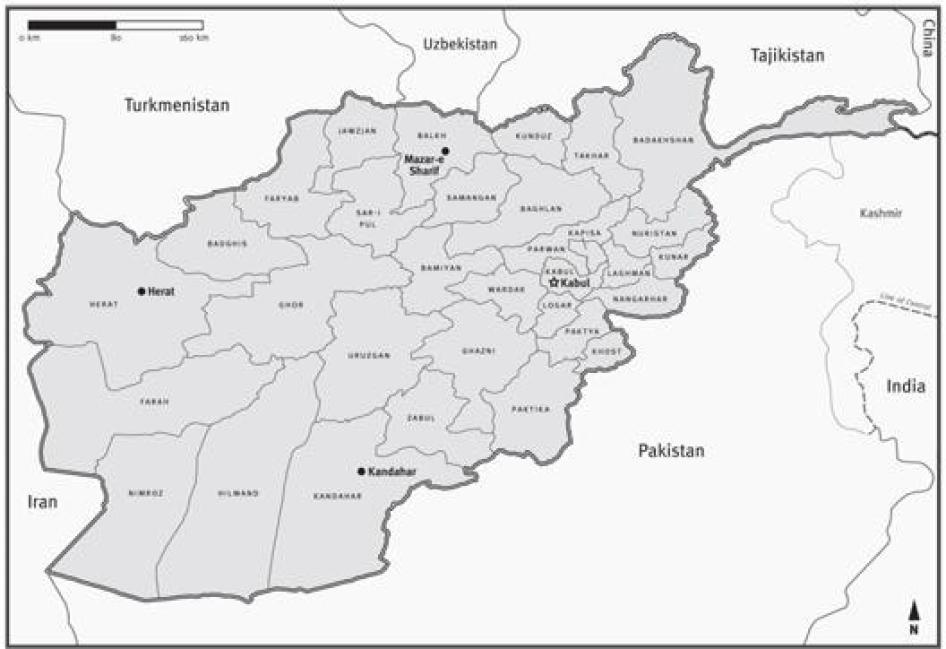
Map of Afghanistan
I. Summary
After the fall of the Taliban everyone wanted to come and work for women’s rights, they were proud to say they were here to help Afghan women. Slowly, slowly this disappeared. Maybe the international community saw that we had two or three women in the cabinet, and thought, it’s ok, now they have their rights. But we have lost everything, from those cabinet positions to the donor attention. Women are not a priority for our own government or the international community. We’ve been forgotten.
—Shinkai Karokhail, member of parliament, Kabul, June 4, 2009
Women’s issues are off the radar. Interventions are cosmetic, and don’t really deal with how conservative Afghanistan is. The nice statistics are misleading. Thousands of teachers are trained, schools are built, so what? Can the teachers actually teach? Will a family send girls to school if they don’t see the employment benefits? Or if you haven’t tackled the employment constraints, like mixed work places? Women’s development begins and ends at the level of compassion–it’s not being translated into good policies.
—Susana Paklar, former country director, Medica Mondiale, Kabul, May 3, 2009
We welcomed [the international community’s] words on the Shia law–really–they said many beautiful things, as they did in 2001. We have the promises of the world. But still we wait to see what more they will do.
—Wazhma Frogh, activist, Global Rights, Kabul, April 14 2009
The US and its allies cited the defense of women's rights as one of the primary reasons, after the need to root out al Qaeda and defeat the Taliban, for their 2001 invasion and subsequent commitment to rehabilitate Afghanistan. Eight years after the fall of the Taliban, and the establishment of the Karzai government, Afghan women continue to be among the worst off in the world. Their situation is dismal in every area, including in health, education, employment, freedom from violence, equality before the law, and political participation.
Despite the rhetorical commitment to women’s rights and women’s empowerment, and despite the millions already spent on women’s rights and development projects, women have not been a central priority for the government or for international donors, whose focus is primarily on the armed conflict rather than the broader concept of civilian security and rule of law.
The diminishing status of women’s rights in Afghanistan came back into focus in March 2009 when the Shia Personal Status law, which was riddled with Taliban style misogyny, was passed by parliament and signed by President Hamid Karzai. The law regulates the personal affairs of Shia Muslims, including divorce, inheritance, and minimum age of marriage, but, as detailed below, severely restricts women’s basic freedoms. US President Obama called the law “abhorrent,” and leaders from the United Kingdom, Canada, France, and NATO all joined the condemnation and reaffirmed the importance of respect for women’s rights.
Afghan women’s rights activists were galvanized and mounted a successful campaign to force the president to revise the law, aided by the outspokenness of countries like the US, Canada, and various European nations. Unfortunately, the final outcome fell far short of expectations, apparently because President Karzai was intent on maintaining the electoral support of Shia fundamentalists. A month before the presidential election he issued by decree an amended version of the law which still includes articles that impose drastic restrictions upon Shia women, including the requirement that wives seek their husbands’ permission before leaving home except for unspecified “reasonable legal reasons.” The law also gives child custody rights to fathers and grandfathers, not mothers or grandmothers, and allows a husband to cease maintenance to his wife if she does not meet her marital duties, including sexual duties.
The furor over the Shia law highlighted the fragility of the gains made by Afghan women, human rights activists, and reform-minded politicians. The dominant political factions of Afghanistan remain ideologically hostile to many of the rights that many women have started to enjoy since the fall of the Taliban, such as freedom of movement, freedom to work, and the right to education. Many of the women interviewed for this report observed that the space for them to work as activists for change has diminished over the past few years, as the government has come to increasingly rely on conservative factions to maintain political control.
In the wake of the Shia law controversy, with the world looking closely again at the status of women in Afghanistan, many inside and outside the country are becoming aware again of just how few and fragile the gains have been and how steep the challenges remain. Whereas the trend had clearly been positive for women’s rights from 2001-2005, the trend is now negative in many areas. This is not a commentary on the many courageous women and men who risk their lives through acts big and small—such as teaching at a girls’ school or running as an independent woman for parliament. Rather, it is a reflection of the power of conservative leaders who want to deny women their basic rights. The Shia law, in which the previously moderate Karzai traded women’s rights for political support for his re-election, is only the most visible example of this trend. With the prospect of deals with the Taliban and other insurgent groups firmly on the political agenda, fundamentalist actors may be able to expand their influence in coming years.
In this report, we focus on five key areas of concern:
- Attacks on women in public life;
- Violence against women;
- Child and forced marriage;
- Access to justice;
- Girls’ access to secondary education.
We chose these five areas as exemplars of the wider situation of women, though we know that a strong case could be made to examine other subjects such as access to primary education, maternal mortality, threats to women human rights defenders, and domestic violence. By detailing emblematic cases of ongoing rights’ violations in the five areas, this report highlights the failure of the government in recent years to advance the basic rights of women and girls, and identifies some of the shortcomings in donor priorities and assistance that have contributed to the backsliding.
Attacks on Women in Public Life
The murder on April 12, 2009 of Sitara Achakzai, an outspoken human rights defender and local councilor in Kandahar, was another warning to all women who are active in public life, whether as politicians at the parliamentary or provincial level, or as human rights activists, teachers, health workers, or journalists. She had been receiving threats for weeks or months before her death, and had informed government officials, friends, and colleagues of the risk she knew she was facing. The Taliban claimed responsibility for her death, but friends and colleagues have questioned whether this might have also been a political assassination. No one has been prosecuted for her murder.
Every time a woman in public life is assassinated, her death has a multiplier effect: women in her region or profession will think twice about their public activities. A female police officer interviewed for this report has been in hiding after receiving limited support from her superiors in response to threats from two insurgent groups. She fears she will meet the same fate as Malalai Kakar—the former Police Commander in Kandahar whose murder in September 2008 went unpunished. The government’s repeated failure to bring the perpetrators of these crimes to justice compounds the fear that women feel.
The risk is that the gains that women have made in their representation in public life will start to unravel. The most significant of these gains is that over a quarter of MPs in the lower house are female. But where quotas were not imposed—for instance the number of cabinet seats or deputy minister or civil service positions—these improvements already seem to be in decline. Over the last few years the number of women in the civil service has actually decreased, as has the number of women in the cabinet. There is only one female cabinet minister, who represents the Ministry of Women’s Affairs. All of the women members of parliament interviewed for this report had experienced some kind of threat or intimidation. Most felt that the state could not or would not protect them. So long as attacks against women continue to go unpunished, the culture of fear and impunity will be a strong deterrent to women who consider entering public life.
In the 2009 provincial and parliamentary elections the security of women candidates and voters was addressed as a distinct issue late in the process. It was only through the last minute efforts of women parliamentarians and activists—offering their own cars or financial support—that enough women were persuaded in the closing days of nominations to put their names forward. In some places, such as Kandahar, the security situation was so bad that fewer women ran for office than the number of places that had been set aside for women by law. All of the women candidates in Kandahar campaigned from outside the province. The failure to adequately address women’s security, including last-minute provision of female security checkers for female polling stations, added to electoral fraud in the south and southeast.
Without a strong platform in government and society from which to lobby for their rights, women’s advancement in Afghanistan will grind to a halt. The current political class is riddled with corruption and nepotism. Elections are not fought on the basis of principle or policy, but won through deals and compromises. Power flows through patron-client relationships as much as it does through public institutions. This is a system that is stacked against women. As one woman MP told us:
We are not commanders, we don’t have guns, we don’t have bags of money from whatever places. So we are not the ones whose interests they want to protect.[1]
Violence against Women
Violence against women in Afghanistan is endemic. A nationwide survey of 4,700 women, published in 2008, found that 87.2 percent had experienced at least one form of physical, sexual, or psychological violence or forced marriage in their lifetimes.[2] The forms of violence include rape, physical violence, forced marriage, and “honor killings.” Too often the attitudes of those in government and the police reflect the misogynous views, rooted in cultural traditions—but increasingly rejected by younger generations of Afghans—that underlie some of the violence against women. As Dr. Soraya Sobhrang, Women’s Protection and Development Commissioner of the Afghanistan Independent Human Rights Commission (AIHRC), told us, “Police and judges see violence against women as legitimate, so they do not prosecute cases.”[3]
In the vast majority of cases women will not seek help because of their fears of police abuse or corruption, or their fears of retaliation by perpetrators of violence. Low social status and social stigmas deter women from going against their families to pursue justice, particularly in cases of domestic abuse. For a woman even to approach the police or courts requires her to overcome the public opprobrium that often still attaches to women who leave their houses without a male guardian, let alone women who seek protection from public authorities. In a 2008 study by the Women and Children Legal Research Foundation (WCLRF), only 15 percent thought that a woman disabled by violence should seek police help. For those who do seek help, many encounter lack of concern, if not outright hostility or abuse.
Rape is not a crime in the Afghan Penal Code. Under the code, rapists can only be charged with “forced” zina, or adultery, which sometimes results in women also being prosecuted for zina. In a major achievement for civil society groups and women’s rights activists, the president issued the Elimination of Violence Against Women law, which makes rape a crime. At the time of writing the law is being considered by parliament. Although the law can be strengthened and clarified, if it is not watered down by the parliament it will serve as a significant foundation stone for changes in the way gender based violence is treated by the state and private citizens.
In this report we highlight three cases of rape where the perpetrators’ power and influence helped them to evade justice, sometimes with the highest sanction of government. Politics was behind a presidential pardon in the summer of 2008 that saw two gang-rapists released after serving just 2 years of an 11-year sentence. In May 2009 the husband of the rape victim was shot dead, just two weeks after the man who ordered the rape was finally imprisoned. In a second case, when the son of a member of parliament who raped a 13-year-old girl was imprisoned, members of his powerful family went to great lengths to try to have him released from prison, efforts which have so far been unsuccessful. They put the victims’ family under pressure to accept a “traditional” settlement, including giving a female member of the perpetrator’s family to the victim’s family in marriage (a practice known as baad, where a woman is given as “compensation” or “retribution” for a crime). In the third case a young girl was raped and forced into prostitution: at the time of writing no one had been prosecuted for the crimes against her, probably because of the fears of retaliation among those who might have pushed for prosecution. As Fauwzia Kufi, a woman MP, told us:
There is a culture of impunity towards perpetrators of rape from the government’s side, because the government doesn’t want to weaken their coalition of supporters by imposing the law. So women’s rights are the first things to go. Politics is everything.[4]
Child and Forced Marriage
Fifty-seven percent of all marriages that take place in Afghanistan are classified as child marriages by UNIFEM (under the legal age of 16), and 70 to 80 percent as forced marriages.[5] These practices underlie many of the problems faced by women and girls, with a correlation between domestic violence and child/forced marriage. Early marriages often contribute to girls dropping out of school and to early childbearing, with the attendant risks of health complications or maternal death.
Prevailing attitudes in rural areas tend to condone the marriage of girls soon after reaching puberty. Bride prices and poor economic conditions increase the prevalence of child marriage. Girls and boys often have little choice within families about their marriage age and partner, with less autonomy for girls, and often less importance placed on their continued education. The response of families and communities to attempts to escape forced marriages can often be harsh, including honor killings.
Although the pending Elimination of Violence Against Women law in its current form addresses some of these issues, including criminalizing child marriage, women’s rights organizations in Afghanistan recognize that changes in the law may lead to only modest improvements. Changing attitudes is paramount, but this will take a long term commitment from government officials, tribal leaders and other influential figures, NGOs, and donors who support civil society organizations involved in this work.
Access to Justice
An underlying problem is women’s access to justice. Police training involves little or no training in gender based violence or women’s rights, particularly as training has been increasingly focused on counter-insurgency and security skills rather than crime prevention, crime solving and community policing. Deeply entrenched cultural prejudices prevent many women accessing the police or the courts because of the fear of being stigmatized a “bad woman.” Women face discrimination and prejudice in police stations and the courts from officials who often do not know the law but penalize women according to customary law, which places great emphasis on notions of female “honor” and chastity. The majority of women in jail are charged with extramarital sex (zina) or with “running away”—something that is not a crime in Afghan law or Sharia but often reflects a conservative cultural view that sees women as property of fathers or husbands.
One widely welcomed policy response to this was the creation of female-staffed “Family Response Units” (FRUs) in police stations. But, as detailed in this report, there are serious problems with the implementation of FRUs, including insufficient numbers of women police officers and inadequate training, mentoring, and facilities.
Girls’ Access to Secondary Education
After the decimation of girl’s schools by the Taliban, it is not surprising that girl’s education has become the most symbolic element of the international donor effort in Afghanistan. Despite significant gains—this year more than six million students enrolled in primary and secondary school—stark gender disparities remain. The majority of girls still do not attend primary school, and a dismal 11 percent of secondary-school-age girls are enrolled in grades 7-9. Only 4 percent enroll in grades 10-12. While the number of both boys and girls attending school drops dramatically at the secondary school level, the decline is much more pronounced for girls.
These bleak numbers bode poorly for girls’ futures in many ways—since enrolling and retaining girls in schools will have a wide impact—from cultivating the next generation of women leaders to reducing infant mortality. Education of girls often reduces the prevalence of child marriage, early childbearing, and the risk of dying due to pregnancy-related causes. Women’s literacy is also linked to increased nutrition among children. Afghanistan’s progress in tackling teacher shortages, improving health indicators, and developing sustainable livelihoods hinges on cultivating a new generation of female teachers, health care providers, skilled workers, and leaders.
Human Rights Watch research shows that a lack of girls’ schools, security, transportation alternatives, female teachers, and adequate government planning all contribute to putting education out of girls’ reach. National surveys have reinforced the finding that many Afghan families wish to educate their daughters, but they must first have the means to do so practically and safely.
In southern and eastern Afghanistan, general insecurity and attacks on schools, teachers, and students remain the primary barriers, with a disproportionate effect on girls. According to data from the Ministry of Education, in the first five months of the Afghan year 1388 (April to August 2009), 102 schools were attacked using explosives or arson and 105 school students and teachers were killed by insurgent attacks (though it is not clear that these were necessarily targeted killings). Although these attacks were against both male and female teachers and students, several poison attacks in 2009 were clearly directed at girls, with 200 students poisoned this year, of whom 196 were female.[6]
In other parts of the country, distance to the closest school is a major barrier. The distribution of secondary schools is concentrated in provincial capitals, and there are large areas without a school. This shortage of schools affects girls disproportionately—there are more boys’ schools than girls’ schools, and the long distances to reach the nearest school often pose heightened safety and security challenges for girls. Human Rights Watch interviewed girls who make journeys to school that require up to six hours of walking a day. While families are concerned about every child’s security, they are especially reluctant to send teenage girls who may be targeted for sexual violence or harassment. Only 19 percent of schools are designated as girls’ schools, with no girls’ schools in 29 percent of all educational districts.[7]
* * *
The plight of women is directly connected to far deeper problems in the Afghan political system. This includes the growing weakness of the government, which has led to an over-reliance on fundamentalist and conservative factions to maintain political support and fight the Taliban, and a correspondingly weakening commitment to providing leadership on women’s rights. The widespread corruption in ministries, where positions are often used for self-enrichment rather than public service, also means that reform efforts across-the-board, including rights-protective policies for women, are not likely to be on the agenda of those in power. Civil servants often see little to gain in pushing for women’s empowerment and development, particularly if doing so risks resistance or worse from powerful factions. The dominance of the executive and absence of political parties tends to further engender a patronage system rather than one where values such as women’s rights are promoted.
This is a critical moment for Afghan women and girls. The worsening security situation places women in public life under increasing pressure. The March 2009 passage of the Shia Personal Status Law demonstrated how vulnerable the hard fought post-Taliban freedoms for women remain. Violence against women remains endemic, and women’s access to justice is severely limited. With fundamentalist factions gathering strength and reconciliation with some elements of the Taliban firmly on the agenda of the government and its main backers, the political climate could become more hostile to women’s rights.
At the same time, some gains are being made. As already noted, the Elimination of Violence Against Women law was drafted by women’s rights activists and officials, and is a source of great pride to many women’s rights activists. The creation of a “5 Million Women Campaign” to encourage women to run as candidates and to vote in the 2009 elections was a positive development. The very fact that women defy their culture through pockets of resistance to everyday brutality —from the demonstrations against the Shia law to the prayer gatherings of thousands of women in the heart of Kandahar— is remarkable. The fearless work of many women activists and human rights defenders is the most encouraging prospect for the future of Afghan women and girls. Their work and their safety must be much more assiduously protected. The Afghan government and its main supporters—the US, UK, EU, and NATO—must make the promotion and protection of women’s rights a key priority, not one to be traded off for short term political gain.
Key Recommendations
- The government and donors should make the promotion and protection of women’s rights a main priority of the country’s reconstruction and a central pillar of their political, economic, and security strategies.
- Parliament should improve the Elimination of Violence Against Women law to ensure that it meets international standards and is drafted in a clear and understandable manner.
- The government, with the support of donors, should embark on a large-scale awareness campaign to ensure that rape is understood to be a crime by law enforcement agencies, judges, parliament, civil servants, and the Afghan public. The campaign should also aim to reduce the stigmatization of victims of rape.
- The government should make marriage registration more widely available and compulsory.
- The President should order the release of, and offer an apology and compensation to, all women and girls wrongfully detained on the charge of “running away from home.”
- The government, with the support of donors, should strengthen Legal Aid Referral Centers for Women and Family Response Units in the police, including by recruiting more women police officers. Police training should include discussions of gender based violence and relevant Afghan and international law.
- The government, with the support of donors, should increase the number and geographic coverage of girls’ secondary classes by building more girls’ secondary schools, converting some boys’ schools into co-ed schools, introducing morning and afternoon shifts, and adding secondary level classes to existing primary schools, and ensure the recruitment and training of female teachers is accelerated.
- The government, with the support of the UN and other donors, should prioritize security for women candidates and voters in planning for the 2010 parliamentary elections.
- International donors and the United Nations, in conjunction with the Ministry of Women’s Affairs, should conduct a full gender audit of all spending in Afghanistan.
II. Methodology
Most of the information in this report is based on more than 120 interviews Human Rights Watch conducted between March 2009 and June 2009 in Kabul, Nangahar, Balkh, Samangan, and Herat provinces. (Our findings on girls’ education are based on separate Human Rights Watch research, as detailed below.) We spoke with victims of abuse (including victims of physical violence), family members, NGO workers, women’s rights and human rights activists, lawyers, UN staff, international donors, and government officials. Many of the interviews were conducted in Dari or Pashto through the use of interpreters. We visited three safe houses and one women’s prison, holding group discussions in one of the safe houses and in the prison. We also held a group discussion with police.
Such research carries risks for the interviewees. Because of the taboos around sexual violence and the fear of reprisals including honor killings, we have disguised the identity of many interviewees with pseudonyms. In some cases certain other identifying information has been withheld to protect interviewees’ privacy and safety. For the same reason, in some instances we actively sought the testimony of professionals working with women and girls, such as lawyers and shelter personnel, rather than relying solely on first person testimony. The names of some of these professionals have also been withheld to protect them from possible repercussions. Those who offered critiques of government officials and donors sometimes requested anonymity for fear of compromising their funding or professional relationships.
All those interviewed were informed of the purpose of the interview, its voluntary nature, and the ways in which the data would be used, and orally consented to be interviewed. All were told that they could decline to answer questions or could end the interview at any time. Participants did not receive any material compensation.
The information on education in this report is the product of ongoing research by the Women’s Rights Division of Human Rights Watch into girls’ secondary education in Afghanistan. It is based on Human Rights Watch field research in central Afghanistan from April to May 2008, as well as ongoing research in 2009 by in-person and telephone interviews, and email. In Afghanistan we visited Bamiyan, Shebar, Koh-i-Band, Mahmud Raqi, Charikar, Bagram, Farza, and Shar-e-Naw districts in the provinces of Kabul, Kapisa, Parwan, and Bamiyan. For the research on education, we interviewed 110 individuals, including girls, their parents, teachers, principals, NGOs, Afghan government officials, and international donors working on education. The education section also draws upon our 2006 report, Lessons in Terror: Attacks on Education in Afghanistan.
(http://www.hrw.org/en/reports/2006/07/10/lessons-terror).
III. Attacks on Women in Public Life
I had threatening phone calls and SMS messages. It was horrible. Once they said that in one week they would kidnap me. That was the scariest part, though probably they were just trying to demoralize me.... They said, “A woman like you is a black mark on our country’s forehead. You are [a] Christian, you are [an] infidel.” They think that women who talk about human rights are infidels.[8]
—Female parliamentarian (name withheld), Kabul, June 2009
While the Taliban denied women the right to participate in public affairs, women have long participated in public life in Afghanistan, though always at the margins. Women first received the right to vote and stand in elections in 1964, during the “decade of democracy”’ of King Zahir Shah. The 1964 Constitution guaranteed equal rights for men and women. In the mid-1960s, four women entered the House of Representatives, one woman was appointed as a minister, and several others were made deputy ministers.[9] During the communist era a handful of women were promoted to positions of power, with several women appointed to the Revolutionary Council during the presidency of Babrak Karmal. Several other women were appointed as senior officials in key government offices, the army, and police.[10] The UNDP Human Development Report states that there were seven female parliamentarians in the 1990 parliament (3.7 percent of the total).[11]
Under the Taliban government women were completely excluded from all forms of public life, including as teachers, civil servants, and journalists.
In December 2001, a month after the fall of the Taliban, Sima Samar became the deputy prime minister and the first minister of women’s affairs in Afghanistan. President George Bush hailed her appointment during his State of the Union Address in January 2002.[12] By June she had resigned after death threats against her.[13]
In the first few months of the new government in 2004, women won their battle to obtain a legal quota of 25 percent of seats in parliament. For a short time three women sat in President Karzai’s cabinet: the Ministry of Women’s Affairs, the Ministry of Martyrs and Disabled, and the Ministry of Youth.[14] All are considered to be second-tier cabinet positions. As of the time of writing, there was only one woman in the cabinet—the Minister for Women’s Affairs.
In 2006 women represented 31 percent of the civil service, a huge gain from the Taliban period. However, by 2009 that figure had dropped to 21.4 percent. Most women in the civil service are employed in the ministries of women’s affairs, public health, education, social affairs and labor, and the Civil Service Commission. Other ministries have as few as 4 percent female employees. The number of women in middle management positions in the civil service is 9 percent, with a disproportionate number of those in the Ministry of Women’s Affairs.[15]
Women in Public Life in Afghanistan[16]
Male |
Female |
|
Judges |
95.8% |
4.2% |
Members of the Supreme Court Council |
100% |
0% |
Prosecutors |
93.6% |
6.4% |
Attorneys |
93.9% |
6.1% |
Police employees |
99.6% |
0.4% |
Army employees |
99.4% |
0.6% |
Community Development Councils |
76% |
24% |
Source: UNIFEM Afghanistan Fact Sheet 2008 “The Situation of Women in Afghanistan”
Killings and Threats against Women in Public Life
Improved respect for women’s rights requires that women are able to publicly advocate for their rights, whether in politics, law, journalism, and education, or on a myriad of social issues. Yet Afghan women who dare to speak up for their rights or the rights of women in general put their lives at risk. Those who take on public roles outside Kabul or major urban centers—whether as provincial councilors, reporters, parliamentarians, police officers, or lawyers—are particularly vulnerable.
Women are regularly attacked for being visible outside the home, traveling without a mahram (chaperone), having connections to foreigners, or traveling out of the country. Some of the threats are related to insurgents; others come from conservative or religious political factions not directly connected to the insurgency. Threats even may come from family members who feel that the woman is bringing shame upon the family through her public role, though this is also sometimes used as an excuse by the authorities not to take action.[17]
Women who are vocal in defense of their rights are regularly abused as “infidels” or “Christians,” accusations often combined with sexual insults. These are dangerous slurs in Afghanistan. They serve both as threats and as a means to shut down substantive debate about the role of women.
Religious conservatives often portray women activists as questioning Sharia, a domain in which women are told they have no right to voice an opinion. For example, when a women’s rights campaigner raised marital rape with a group of government officials in 2007, she was later telephoned by a member of the Supreme Court, who told her, “Little girl, your noises are ok, but when it comes to religion you need to be careful. If they put you in jail I can’t help you.”[18] The same activist was told in 2008 that her name was on a Taliban assassination list:
A man from a nearby province came to me and told me that he had seen a list of women who were going to be killed by the Taliban and my name was on the list. So where should I go? Who do I go and see? I told no one, I did nothing. But Malalai Kakar’s name was also on the list [police commander assassinated by the Taliban, see below]. Soon after I got this information she was killed. So then I left the country for a while, but I can’t stay away forever.[19]
Several organizations have begun to collect data on the extent of attacks on women in public life, but comprehensive documentation of the numbers of attacks and threats against women remains limited. In its monitoring of 17 of Afghanistan’s 34 provinces, UNIFEM recorded 10 murders of women in public positions in 2008, including teachers, lawyers, journalists, and politicians.[20]
Fear: The Multiplier Effect
Although men are also subject to threats and attacks, there is a greater multiplier effect when a well-known woman is assassinated or attacked, as it can shake the confidence of women and their families in an entire profession or geographical area.
Women mourned the death of Sitara Achakzai all over the country. Her death had particularly far-reaching ramifications in the south. Theresa de Langis, Manager of the Women, Peace and Governance unit of UNIFEM in Afghanistan, commented:
Six months ago we (UNIFEM) were planning to go to Kandahar to work with women human rights defenders to support their efforts. But Sitara has been murdered, and the others have fled or gone underground. So, it’s not just that one assassination; it’s an attack on the entire women’s human rights community. The murder of women in power sends a chilling message, and it makes it even less likely for other women to start participating.[21]
Fauwzia Kufi, a member of parliament subjected to threats on several occasions, told Human Rights Watch:
When you are outspoken, and involved in political and social life you are bound to be the victim of attacks. Look at the assassinations—a very high proportion are women. Sitara, Malalai Kakar, Zakia Zaki, Shaima Rezayee.
The publicity after each assassination increases the resolve of some women activists, but deters many other women from participating in public life.
Lack of Protection
When women are threatened, the response of the government is generally weak. Several women interviewed by Human Rights Watch say they do not approach Afghan security services for help because they doubt that they would be taken seriously. According to interviewees, the government response is sometimes to tell them that they are responsible for their own problems because they are too outspoken. One female member of parliament who has received threats against herself and her children told Human Rights Watch:
I’ve had so many threats. I report them sometimes, but the authorities tell me not to make enemies, to keep quiet. But how can I stop talking about women’s rights and human rights?[22]
One senior lawyer, who asked not to be named, told Human Rights Watch that she receives regular death threats:
I get warnings all the time, they’ve take my car number plate, they follow me, they have found out my home address—they warn me of these things—and they say soon they will come and kill me. But I’ve never been to the police. What for? They would do nothing.[23]
Many women complain that government security is provided as a “grace and favor” to local police chiefs and governors. One female parliamentarian said:
Security in the districts and provinces is all about favor. So if you are an honest woman and you didn’t help a corrupt governor or police man to get hired then you won’t get favored. And you won’t get the security cars and personal bodyguards.[24]
Another female parliamentarian, who has faced regular threats, often relating to women’s rights issues on which she has been outspoken, told Human Rights Watch:
Fahim has 250 personal bodyguards, paid for by the government, and he’s not even a minister. But the government can find no one to protect women who are threatened with death.[25]
Another MP told us she received a series of threatening phone calls during the time that a contentious piece of legislation was being debated in parliament. She received some additional protection from the Ministry of Interior, which she described as helpful. However, she attributes the help she received, at least in part, to her connections with the international community.
The fear induced by the murder of high-profile women is often compounded by government failure to bring the perpetrators to justice. When Zakia Zaki, a radio journalist and women’s rights campaigner, was assassinated in June 2007 in her home, women journalists all over the country were afraid. Zaki had been an outspoken radio presenter and pundit who frequently aired stories about human rights, war crimes, and corruption.[26] Farida Nekzad, from Pajhwok news agency, a friend of Zaki’s and fellow journalist said: “The governor and chief of police both told her to stop talking about women’s issues and criminal groups on the radio. She didn’t keep quiet.”[27]
The effect of the murder of well-known female reporters has made many women journalists think again about their profession. Kathreen Wida, editor of Cheragh Daily, said:
Women journalists have been murdered, like Zakia Zaki and Shakiba Sanga Amaaj, so of course I worry that the same thing will happen to me... I worry for my children.[28]
Hardly any of the women interviewed have been satisfied with the government’s response. Hassina (not her real name) is a police officer, and one of the few women working in an area that has considerable levels of insurgent activity.[29] She received death threats from two insurgent groups, Hezb-e Islami and the Taliban, that have recently forced her into hiding. Hassina told Human Rights Watch:
Both the Taliban and Hezb-e Islami want to kill me... I have a letter from the chief of military of Hezb-e Islami, another from the Taliban, and a joint letter from both. Because my area has lots of Hezb-e Islami people they told the Taliban that they would take responsibility. They said they will do it—they will kill me.[30]
She received three letters in April and May, 2009. She said she received little help or advice from senior police officers:
I asked him [name removed], “What can you do for me—how can you protect me?” He said, “I don’t know.” He just ignored me, and said he didn’t know what was happening. That upset me—I wasn’t given any advice about where to stay or how to travel. Should I change where I live, should I change my travel? Nothing.[31]
Since receiving the letters Hassina and her children have been moving locations. She said:
The police should protect me, but they did nothing. And I’m a police officer! But the police don’t care about me because I’m only a woman. I don’t have powerful family or friends to protect me.
After approaching national and international human rights organizations Hassina is now receiving some support, including some assistance from the Ministry of Interior.[32] However, she says she’s very uncertain about the future. She told Human Rights Watch:
I am really afraid for my children because they told me that they will kill my daughters. Every minute I’m afraid. [Any] minute they can kill me. I can never go home, the government cannot protect me there. My old life is over.[33]
Dr. Soraya Sobhrang, Women’s Protection and Development Commissioner of the Afghanistan Independent Human Rights Commission (AIHRC), says that the murder of the Malalai Kakar, former Kandahar female police chief (see above), was a warning to all women police officers, and potential police officers. She said, “We need more women in the police, but how will that happen when these things happen so often? See what is happening to (Hassina), how can we forget Malalai Kakar when we hear what (Hassina) faces?”[34]
Attacks on Women Parliamentarians
A quarter of the seats in the lower house of parliament is reserved for women. Among the members is a small but active group of outspoken female MPs. One diplomat who has worked closely with a number of them told Human Rights Watch: “These female parliamentarians are far more active than most of the men.” Many have suffered threats and attacks. Fauwzia Kufi is MP for Badakhshan:
You have women parliamentarians who receive hundreds of threats and warnings. Even if they don’t kill them they threaten them to silence them.[35]
Another parliamentarian who is outspoken on women’s rights told Human Rights Watch:
They have said that they will kill my children. This is what keeps me awake at night. My life does not matter, I am used to the threats. But I cannot allow threats against my children.[36]
Sometimes the threats come from fellow parliamentarians. The most high profile example of this was the attack on Malalai Joya, MP for Farah province. On May 21, 2007, Joya was expelled from the legislature for insulting her fellow parliamentarians. Joya’s expulsion occurred after she appeared in a television interview comparing the parliament to an animal stable. Joya told Human Rights Watch that her remarks were edited out of context. She said that her statement divided parliamentarians into two groups: one working to uphold democratic principles, the other working to undermine them, thereby, she said, serving the Afghan population even less than animals in a stable. Joya has since received numerous death threats by phone and “night letters” (warning letters delivered to her home). She now lives in hiding. She says she receives no security protection from parliament or the government. Joya told Human Rights Watch that the threats intensified on her leaving parliament:
After I was expelled from parliament, my life became even more dangerous and I received numerous death threats. Even a member of parliament said in front of all on the day when they voted against me that he will eliminate me if I will not be silent.[37]
When the Shia Personal Status Law was debated in parliament, as well as during the subsequent months of campaigning to get the law reformed, women MPs and others who spoke out against the law came under threats and pressure. One MP told Human Rights Watch on the condition of anonymity:
After the Shia law I got threats, phone calls, death threats. There are places that I don’t go to now, where they would try to kill me, because I’m a woman, because I speak about these things.[38]
In addition to the outspoken female members of parliament, women representing more unstable provinces are regularly targeted. Roshan Wardak from Wardak province told Human Rights Watch she has received SMS threats since 2008 from people she believes are local Taliban. The messages are along the following lines: “Don’t work with the occupiers. If you continue to work in parliament we will attack your car and we kill you.”[39] Although similar threats are often received by male politicians, because women are so few in number, they appear to receive a disproportionate amount. The threats are often accompanied by graphic gender related and sexual insults.
Fatima Aziz, MP for Kunduz province, told Human Rights Watch that when she was campaigning for parliament in 2005 she received a threat by letter:
I received a night letter that said if you love your life and your children you must remove yourself from politics, it is not right for you, you are a woman.[40]
Aziz says that in June 2009, a family member received a phone call telling her to stop her work, and that in May 2009, her car was chased on the Kabul-Kunduz road. She says she reported the incidents to security officials but received little response. Aziz feels that members of parliament who receive threats, particularly women, should be provided with bodyguards.
Rahima Jami is MP for Herat province in the West. In the spring of 2008, she says that she received a telephone threat: “You are working for foreign people and ambassadors and if you do not stop working for them we will kidnap or kill you.”[41] She says that when she reported this to security officials, they told her that they believed that the phone belonged to a Taliban member in Zabul province, but took no action, such as offering her safety advice, protection, requesting the communications provider to block his telephone number, or passing on the information to the local law enforcement agencies in Zabul.
Nasima Niazai is a member of parliament for Helmand province in the south, much of which is under Taliban control. She has received telephone death threats warning her to leave parliament from someone she believes to be a Taliban member in Maiwand district of Kandahar province.[42] She told Human Rights Watch that she was informed by intelligence officials around February 2009 that there was a report that her son was to be kidnapped, after which she left Helmand province.
We have a lot of problems with the security officials in Helmand. The British and American military in Helmand also will not help me. If I want to travel between Helmand and Kabul no one offers me security. They don’t let me go by plane. The road is all Taliban and it is very dangerous, particularly for women.
Niazi says she will not stand again for election in 2010 because of security problems:
Every day when I leave home to go to parliament, I fear that they might blow me up, so I say goodbye to my daughters, and give them advice, and leave them some money just in case I don’t come back.
Unless female parliamentarians are given more support, and perpetrators of threats are denounced and prosecuted, these threats will continue and women will be deterred from political participation. Already there are clear signs of self-censorship among women parliamentarians. If the vocal few are silenced there will be even less challenge to any future misogynist legislation, such as the Shia Personal Status Law.
Women’s Participation in the 2009 Elections
While there were some signs of progress for women in the 2009 elections, women’s participation was disappointing in many respects, leaving many women feeling that they had been let down by their government and international supporters.
On the positive side, as Palwasha Hassan, Afghanistan country director of Rights and Democracy, a Canadian NGO, observed: “We had two female candidates running for the Presidency and none of the main religious authorities or figures questioned it. That is change.”[43] There were also an increased number of women candidates for the provincial council elections.
For women voters, however, the elections left much to be desired, particularly because women’s security was an afterthought in preparations for the elections. Lack of security meant that women’s participation was lower than it might have been and likely contributed to electoral fraud, with many districts where women’s turnout was low nevertheless reporting high levels of women’s votes. This should have been foreseen, not least because these problems were evident in the 2004 and 2005 elections. Almost all of the election observer missions of 2004 and 2005 made recommendations to address the problem of women’s participation and the potential for female voter card fraud.[44] These recommendations were ignored and not followed up.
Flaws in the Process
There were deep flaws in the 2009 voter registration process, with implausibly high levels of registration of women in some of the most conservative provinces such as Logar (72 percent of new voters registered were women), Paktia (64 percent were women) and Khost (65 percent were women).[45] This is far higher than much more liberal areas like Kabul (where less than half of new voters registering in 2009 were women). Analysts have concluded these high rates to be a sign of proxy voting for fraudulent purposes.[46]
Security arrangements for women candidates were disorganized and ineffective. It was not until halfway through the campaign period that the Ministry of Interior offered bodyguards to women candidates. In some parts of the country bodyguards were provided, but in other areas where they were requested, they did not materialize. Several police chiefs were reportedly unaware that the Ministry of Interior had promised such protection.[47] The AIHRC says that at least 13 out of 342 female candidates dropped out, some citing security reasons.[48]
Women’s security was largely absent from discussions about election security involving the Ministry of Interior, Ministry of Defense, and NATO, according to Human Rights Watch interviews. The UN body most involved in the elections—UNDP’s Enhancing Legal and Electoral Capacity for Tomorrow (ELECT)—did not employ a gender advisor until June 2009, just two months before the election.
More problematic, the Independent Election Commission (IEC) only began to recruit the 1,400 women needed to do security checks on women voters at polling stations in mid-July, just weeks before the elections. Male and female voters have separate polling stations with separate electoral officials and security checkers. The IEC also failed to recruit sufficient female staff to manage the polling stations, which disproportionately affected the conservative and insecure areas of the south and southeast. The Free and Fair Election Foundation of Afghanistan reported that around 3,504 polling stations for women were managed by men, most of them in Paktia, Paktika, Khost, and Ghazni provinces (southeastern region), Ghor province (western region), and in Nangarhar (eastern region), and also in the southern region.[49] Not surprisingly, many women were turned away from polling stations because there were no female workers.[50]The “5 Million Women” campaign, which promoted female participation in the elections, said that the shortage of female police officers or security guards in many districts “caused a lot of fear so women didn’t go to vote as the security of the centers were not satisfactory to them.”[51]
According to the Independent Election Commission, 38.75 percent of actual voters in the 2009 elections were female, based on the numbers of votes returned from male polling stations and female polling stations. However, this number is unreliable because it fails to take account of the high levels of fraud using women’s voting cards and polling stations.
A number of provinces where the actual female turnout was reported to be very low nonetheless officially recorded high female turnout, raising allegations of fraud. This was particularly true in parts of the southeast such as Paktia province, where more women are recorded as having voted than men (50.3 percent versus 47.7 percent, with the remaining votes coming from ethnic Kuchis).[52] This is highly unlikely, as very few women were observed voting in the district centers, and almost none in rural areas.[53] As one international election official told Human Rights Watch, the reported number of female voters is “essentially meaningless” because it clearly includes so many fraudulently cast female votes.[54]
IV. Sexual Violence
There are so many disputes between families and tribes, and too often they take personal revenge using the easiest victim— a child, a woman. It’s easy access, and there is usually no punishment from the government. The first thing we need is equality before the law. Whether it is a minister or a farmer who rapes a woman they must receive equal treatment by the law.
— Fauwzia Kufi, member of parliament, Kabul, June 7, 2009
Violence against women and girls in Afghanistan, including domestic violence, sexual harassment,and rape, is endemic. Despite growing awareness about these issues, the Afghan government has failed to take proactive measures to prevent gender-based violence, investigate crimes, prosecute perpetrators, and ensure victims’ safety and access to services.
Results from a 2008 nationwide survey of 4,700 women by Global Rights concluded that 87 percent of female respondents had experienced forced marriage or at least one form of physical, sexual or psychological violence.[55] Fifty-two percent reported experiencing physical violence and 17 percent reported sexual violence.[56] Investigations by the AIHRC into domestic violence have suggested that at least 50 percent of women interviewed have suffered beatings.[57]
Because of social and legal obstacles to redress, including the lack of accessible complaints mechanisms, the perceived futility of seeking justice, strong social stigma, and the risk of retaliation and their own prosecution, few women and girls report violence. These barriers are particularly formidable in rape cases.[58]
The Afghan Penal Code does not criminalize rape and instead defines the offences of zina (extramarital sex, or adultery), pederasty (sexual relationships between men and boys), and violations of honor.[59] Consequently, victims of rape can themselves be prosecuted for the “crime” of adultery. Although the crime of rape is contained in the new Elimination of Violence Against Women law, the language of “zina” remains, though there is greater clarity between forced and consensual zina.
Although there are examples of prosecutions of rapists (for the crime of forced zina), investigations are often not carried out, indictments are not consistently made, and even when compelling evidence has been presented in court, this may not be enough to secure a conviction. This stems in part from a presumption which appears to be commonly made by prosecutors and judges that the female victim is at fault and has in some way invited the sexual violence, rather than treating her as a victim of a crime.[60] Some judges have incorrectly demanded the Sharia requirement of four adult male witnesses to prove adultery instead of the requirements of Article 37 of the Afghan Criminal Procedure Code, which allows other types of evidence as proof.[61]
Courts have regularly viewed a woman's allegations of rape as an admission of the crime of extramarital sex, exposing sexual assault victims susceptible to prosecution and imprisonment themselves.[62] In a study on arbitrary detention by the UN carried out between 2006-2008, research in 30 of 34 provinces nationwide found that in almost every case investigated, a rape victim appeared to have been charged with zina. This included a 15-year-old girl in Nangahar who was abducted and raped by two men. They were later released on bail, while she was charged with zina. In another case, a 20-year-old in Nangahar was sentenced to two years in prison after complaining to the local authorities that she was raped by her uncle.[63]
Although there is no statistical evidence to confirm it, both government representatives and lawyers have told Human Rights Watch that the number of instances of victims of rape being prosecuted with zina is declining. This is explained by growing awareness that women are victims of rape among prosecutors and judges, an understanding that has been engendered by women’s rights groups, the Ministry of Women’s Affairs, the media, and donor-funded training programs.[64]
Women who tell their families that they have been raped are also be at risk of being killed in so-called “honor killings.” In conservative and tribal areas women and girls who have been victims of sexual violence are often perceived to have brought “shame” upon their own families.[65] There is little data available on the extent of honor killings, but the incidence of these murders is thought to be higher in the south and east of the country and in conservative, mostly rural areas.[66] The AIHRC recorded 96 cases of so-called honor killings in 2008, and 35 cases in the first 6 months of 2009. The actual number is likely to be significantly higher since these are only the cases that have been referred to the AIHRC. Many more of these crimes go unreported.[67] In addition to being at risk of murder, girls and women who make allegations of sexual assault are also at risk of other forms of violence. In January 2009, it was widely reported in the media that a young woman was subjected to a violent and dangerous forced abortion by her family after she had been raped.[68]
So called “honor killings” are not treated as seriously as other murders under Afghan law. Article 398 of the penal code stipulates two years’ imprisonment as the maximum punishment for perpetrators who kill female relatives alleged to have committed adultery; the code stipulates higher penalties for other types of murder. [69] The low sentence and few prosecutions provide little or no deterrence to “honor killings,” demonstrating how the lives of women are considered less valuable than other lives under Afghan law. The removal of loopholes in the law for so called “honor killings” was recommended as long ago as 1992 by the CEDAW Committee, which in its General Recommendation 19 recommended that “the defense of honor be removed in regard to assault or murder of a female family member.”[70]
Rape is also dealt with by what is sometimes referred to as “informal justice mechanisms”—jirgas (councils) where the men of both families make appeals to tribal elders. Women are not permitted to take part in jirgas. It is not unusual for a victim of rape to be forced to marry the perpetrator (see case study of “The Politician’s Son” below; see also “Traditional Injustice” below for a discussion of traditional dispute resolution mechanisms), and sometimes there are reports of married women who have been raped being lashed or murdered by their husbands or families in the name of “honor.”[71]
Women’s rights groups have documented cases of rape victims being abused or further traumatized by the authorities, including through intrusive medical tests, and in some cases through sexual harassment or rape by the police.[72] Dr. Soraya Sobrang, the Women’s Protection and Development Commissioner for the AIHRC, told Human Rights Watch:
Women are often treated like criminals by the police and by the doctors. One woman who was raped was made to take off her clothes in a hospital ward in front of many people—including men—for a medical test. Afterwards she set fire to herself.[73]
An entire report could be written on rape in Afghanistan. The following three cases provide a glimpse into the problem and continuing failures in the government’s response.
A Presidential Pardon for Gang Rape
In May 2008 President Karzai pardoned two gang rapists who had served only 2 years of an 11-year prison sentence. After a national and international outcry, officials suggested that the presidential decree had been forged. However, the victim’s family says the release was the result of the political connections of the rapists, including one family’s connections to the Office of the President. The rapists are still free.
For the victim, however, the story only gets worse. Prior to the rape, her son had been abducted by the man who allegedly ordered her rape; he has not been seen since. In May 2009, two weeks after the jailing of the man who allegedly ordered the rapes, the victim’s husband was murdered.
The woman who suffered this particularly brutal rape was Sara, who like many Afghans only uses one name. Sara lives in the village of Ruyi Du Ab in Samangan province. Sara told Human Rights Watch that the rape was ordered by a powerful local figure, known as Commander Karim, in September 2005.[74] The motivation for the rape is contested—Sara says it followed pressure on her son, Islamuddin, to join Karim’s campaign in the 2005 parliamentary elections. A local source says that the rape was a revenge attack because of an alleged relationship between Islamuddin and a female family member of Karim.[75] The rape came days after Islamuddin was taken by Karim’s men.[76]
Sara has publicly named the men who raped her as Noor Mohammad, Kher Mohammad, and Samad. Unusual for a victim of such a crime, Sara and her husband spoke out, telling reporters that they could suffer no further shame.[77] Sara told Human Rights Watch:
These men raped me. Not once, but three times I was raped. Everyone in the village knew what had happened to me. We went several times to the government to complain afterwards, but they did nothing. For a long time they did nothing. They ignored us.[78]
One local human rights official, who has assisted Sara and her family, described the rape:
On September 6, 2005, at 8 a.m. in the morning Commander Karim sent his men to get Sara. They took her to a house. At the house they stripped her clothes off and raped her, three of them. Commander Karim was present. Not only did they rape her, they used a bayonet and raped her with the bayonet. She’s bleeding everywhere, and then they send her out on to the street and back to her house, so that everyone will see. People are present on the street. They put her underclothes on the street in front of people.[79]
Commander Karim was allied to a local strongman, Mauwlawi Islam, who died in 2008. Mauwlawi Islam’s son, Abdul, has inherited his father’s power in the area. Local officials say the district chief of police, district judge, and district governor are connected to Abdul, and by extension Commander Karim.[80] Sara told Human Rights Watch:
Our enemies, the people who did this to me, they are the government. The district judge, the district governor, they are against us. When we go to them they say we are lying.
Sara’s husband, Dilawar, lobbied the government for over a year to ensure that the case was heard in the provincial capital. On June 13, 2006, three men, Noor Mohammad, Kher Mohammad, and Samad, were found guilty of forced zina, and sentenced to 11 years each. An arrest warrant was issued for Commander Karim, who was accused of ordering the rape, but he was never detained. Local human rights officials say that he and his supporters are too powerful for the local police to want to challenge him.
The verdict and sentences were upheld by the Court of Appeal in Samangan and confirmed by the Afghan Supreme Court. One of the three who was jailed, Samad, died in custody of natural causes. In May 2008, the other two rapists were released by presidential decree after serving less than two years of their sentences.[81] Sara told Human Rights Watch:
When the president released the men who raped me I was so sad. It was hard to believe. They are powerful people and we are just poor people.[82]
The Office of the President initially denied issuing the release order. A local political analyst gave Human Rights Watch the following explanation:
It’s politics. It’s because of his strong connections with Abdul [son of Mawlawi Islam] that they got released. The president wants to keep the people in the district happy. The district has 80,000 people, so the president can get votes from there.[83]
After strong criticism by national human rights organizations, the UN and some international media, an investigation into the circumstances of the presidential decree was ordered by Karzai. He ordered the investigation to be carried out by the Office of the Attorney General. In September 2008, a delegation from the Attorney General’s Office went to Samangan and declared that the gang rape had never taken place.[84]
Yet it appears that the high-level political interest had a salutary effect. In February 2009 the attorney general ordered the re-arrest of Noor Mohammad and Kher Mohammad, and the arrest of Commander Karim.[85]
In April 2009, the Samangan police arrested Commander Karim in connection with the rape and with the disappearance of the son of Sara and Dilwar.[86] Tragically, perhaps in retaliation, on May 4, 2009, Sara’s husband Dilawar was shot dead, at around 7 p.m., after leaving the mosque for evening prayers.
Since her husband was killed, Sara understandably again feels under threat, and has left her home village to seek protection. She said:
I have lost my son, my honor, and now my husband. But I am just a poor woman, so who will listen to me?[87]
The Politician’s Son
The case of Najibullah offers an example of how far powerful families will go to evade justice for rape.[88]
Seema K. (not her real name) was raped by Najibullah Khan and two employees of Najibullah’s family on February 18, 2008 in the north of Saripul province. Najibullah Khan is the son of MP Haji Mohammad Payunda Khan, an influential local politician and former Junbish commander in Saripul in northern Afghanistan.[89]
The father of the victim, Said Noorullah, told Human Rights Watch that he was ignored by the police when he reported the crime, and that he was threatened with death and threatened with losing his local government job if he continued to pursue the case.[90] Undeterred, Seema K.’s family appealed to the Supreme Court to have the case heard in Kabul rather than their district court, where they said they would not get justice. The family won an agreement from the Supreme Court in March 2008 that the case could be heard in Kabul.[91]
To keep up the pressure, on July 18, 2008 Seema K. and Noorullah appeared on television to demand justice. [92] The following week another family, also from Saripul, decided to make a television appeal, also from Saripul. Both families met with President Karzai, prompting the president to declare on a news conference on August 11, 2008 that rapists should face the “most severe punishment.”[93] Five police officials were fired for negligence in the two cases.[94] (Local observers told Human Rights Watch these sackings may have been partly motivated by previous political issues with appointments in Saripul).[95] The television appearance and presidential attention appeared to help. The family succeeded in blocking Najibullah’s attempt to be tried as a juvenile, with a ruling by the Office of the Attorney General that he was over 18.[96]
Sources told Human Rights Watch that Haji Moahmmad Payenda Khan attempted to bribe the doctor who carried out the medical examination.[97] One human rights activist described the scene of the forensic exam:
He came like the son of a king, not like a prisoner. He was with the police, but also with his father, who had two cars full of guns and militiamen. It was then that we saw his father’s power. The doctor was intimidated. We women were there with our purses and our pens. They had six men with guns.[98]
Najibullah’s family also made concerted efforts to persuade Seema K’s family to accept a “traditional” settlement. Soon after the crime took place, efforts began to arrange a baad exchange (giving a girl for marriage as retribution or compensation for a crime). Seema K. told human rights officers that her family had come under pressure from local elders supporting Najibullah’s family to marry the man who raped her.[99]
Yet in a victory for Seema K. and Afghan justice, in November 2008, Najibullah and the 2 other men were sentenced by the 4th district primary court in Kabul to 20 years in jail for “forced zina.”[100] Najibullah was sentenced to serve his term in Pul-e-Charki prison in Kabul.[101]
However, police sources have told Human Rights Watch that while serving his sentence Najibullah was effectively free, only returning to prison when inspectors were expected. They said that his father paid large bribes to allow him to serve his sentence outside the prison.[102]
But the perversion of justice did not end there. Human Rights Watch learned that a jirga took place early in 2009 which resulted in a female member of Najibullah’s family being married to the victim’s brother.[103] Allegations have been made by people with knowledge of the case that the government had given 700,000 Afghanis (approximately $US14,000) to the victim’s family.[104] Human Rights Watch has been told by two sources that Najibullah was freed as part of the deal.[105] Other international human rights investigators say that this was confirmed to them by a senior government official in April 2009.[106] Human rights officials and a local journalist told Human Rights Watch that Najibullah’s brother, Kamal Khan, who had been in prison for assault since 2008, was also given early release as part of this same deal.[107]
Under the Afghan Criminal Procedure Code, a jirga cannot overturn the decision of a primary court, even if all parties consent to it. A primary court decision can only be overturned by the decision of an appellate court or the Supreme Court. The only legal way for Najibullah to be released would be through a successful appeal in the court system. No such appeal has taken place.
Subsequent attempts to confirm these accounts with the government and with the AIHRC have suggested that at the time of writing Najibullah was in prison.[108] Whether he was ever released or whether he was released and then returned to prison, is not clear. It is possible that inquiries by human rights officials about his possible release led to a reversal of a previous decision to release him. One government official told Human Rights Watch that the case is “too sensitive” to provide information.[109]
Despite her bravery in coming forward after the crime, Seema K. remains in a desperate position, with her family fearing that she will never be able to marry or live a normal life as a result of this crime and being considered as “damaged goods.” Now just 14 years old, her father fears that Seema will never get married, telling Human Rights Watch:
She has no future, her fate is still not clear.[110]
Seema K’s case illustrates the urgent need for more work by civil society groups, the media and the government to shift public attitudes on rape and to reduce the devastating social stigmatization of victims of sexual violence.
Rape and Forced Prostitution of a Child
Farida (not her real name) spent many years in Iran with her family. On their return to Afghanistan, in 2003, when she was 12, her father divorced her mother and remarried. A turbulent time ensued for Farida, as she was subjected to abuse from her new step-mother.[111] Farida said, “She was always abusing me, calling me names, and she didn’t give me any food. She wanted me to marry her cousin.”[112]
Farida ran away in 2004 and sought help at the shrine of Hazrat Ali in Mazar-e-Sharif. There she met a woman who promised to help her find her mother in Kabul. The woman brought Farida to live with her for a time in Mazar-e-Sharif. The sister of the woman who offered her refuge was in a relationship with someone that Farida describes as a big commander. The commander and his “soldiers” (it’s not clear if these were militia or Afghan National Security Forces) were often present at the house. Farida told Human Rights Watch:
One day everyone went to the bazaar, except one of these soldiers. They said he was a guest and asked me to stay with him. They all left. He locked the door after them. And then he raped me.
This happened many times, not just once. There were many different men, many times, soldiers of this commander. Everyone knew, but they did nothing.
Farida said she was trapped in this situation for a year. Finally, someone warned her that she was going to be killed.
After the rapes started they all decided they were going to kill me. I know because this girl told me. She helped me to escape.
One of the human rights workers involved in the case who has spent considerable time talking to Farida surmised that the woman who befriended Farida and took her in was a pimp.[113]
After escaping, Farida found her way to her father’s house. She was then 13 years old. She stayed for a time with her father and stepmother, but they tried to force her to marry a cousin. Instead she sought help from the police, who took her and her father to a local elder. She said, “My father said I was not his daughter, and said ‘Do what you want with her.’”
The elder arranged a marriage for her. Farida says: “I agreed, but I had no choice—there was no other option for me.” The marriage was not a success. “I lived with this man for three years. I had no clothes, no water or food. He had no money, and he was a bad man.”
Two of the people interviewed by Human Rights Watch about this case have said that the identity of the commander involved is not known, because Farida could not remember the address of the house. Other interviewees have told Human Rights Watch that the identity of the perpetrator was known. One interviewee told Human Rights Watch that the perpetrator is a member of the security forces, but would go no further. “The person coordinating this was meant to enforce laws on other people. At night he was gang raping.”[114]
Local human rights officials say that there has been no criminal investigation of the case to date, but Human Rights Watch was told that local security forces must know of the case because they are aware of all cases at the safe house.[115]
When the local police headquarters were contacted by Human Rights Watch they said they had no knowledge of the crime.[116] There appeared to be a level of fear among those interviewed about this case, suggesting that the perpetrator is a well-connected or powerful figure in the area.
Farida’s husband agreed to a divorce, and Farida is now living in a safe house. She said, “This isn’t just a problem that I face—there are many girls who face these problems, I expected more help from the government. They should have done more for me, and for the other girls who have suffered like me.”
The Politics of Sexual Violence
Women’s low social status exacerbates the problems that most ordinary Afghans face trying to access justice. In many cases, political intervention or connections allow perpetrators of sexual violence to evade justice. Perversely, impunity for perpetrators is more common than prosecution. A recent analysis of rape cases by UN human rights field officers found that in 39 percent of the cases the rapists were known to be “directly linked to power brokers who are effectively above the law and enjoy immunity from arrest as well as immunity from social condemnation.”[117]
Fauwzia Kufi is a member of parliament for the northern province of Badakhshan. Referring to Sara’s case, she told Human Rights Watch:
Everything is about politics. When political games start women and children are sacrificed.... We had a case in 2007, where a woman was gang raped by a commander and his men in my province in Badakhshan. She met with the president—he personally promised on television that the perpetrators would be brought to justice. Three months ago they were released.... If this culture of impunity continues these people cannot be stopped. The government shows them again and again how easy it is to escape justice.[118]
High-level political intervention can at times lead to support for victims, but it is hard to know whether this is motivated by a desire for justice and the rule of law, or by political expediency and gain. For example, President Karzai personally intervened on the side of a 12-year-old rape survivor in Saripul in July 2008, which took place soon after the case of Seema K., above (see ‘The Politician’s Son’). Five armed men associated with a local warlord had raped the girl. Her family traveled to Kabul to see the president, complaining about the police’s refusal to investigate. There was considerable national press attention to the case, heightened because the young girl gave a television interview about what had happened to her, an unusual and courageous step for a rape survivor in Afghanistan. One week later Karzai removed the provincial police chief of Saripul and four other officials for failing to bring the perpetrators of the rape to justice.[119] A senior human rights official interviewed by Human Rights Watch was cynical about the motivations for the intervention:
Karzai is happy to use these cases when it suits him. He wanted to remove the people in this district from power anyway. This case came just after the release of convicted rapists under amnesty for no reason.[120] The only consistency is that he does what suits him.[121]
Law Reform
At a gathering of over 500 women from all over the country in December 2008, two messages were delivered to President Karzai. The first was not to negotiate away women’s rights in deals with the Taliban. The second was to punish rapists, no matter how powerful.
Karzai and other Afghan political leaders can demonstrate their commitment by ensuring that existing laws to protect women from violence are enforced and new laws are promulgated to strengthen these protections. In July 2009, the president adopted the Elimination of Violence Against Women (EVAW) law by decree, which was published in the official gazette on August 1, 2009.[122] Having been passed by decree the law still requires approval by both houses of parliament. At the time of writing, a parliamentary committee was scrutinizing the law.[123] Prominent conservative figures in parliament such as Abdul Rasul Sayyaf, chair of the international relations committee and a notorious warlord, have already expressed opposition to articles in the law. Sayyaf proposed that articles criminalizing assault should be removed from the law, while articles on child marriage and forced marriage should be brought into line with his interpretation of Sharia, which he believes permits child marriage once a girl begins menstruation or has no legal guardian, and allows for a husband or father to use violence (qahr, or “anger”) against his wife or daughter as a form of discipline.[124]
The very fact that a piece of legislation has been promulgated that exclusively addresses violence against women is an achievement.[125] The law establishes a wide range of acts of violence against women that are crimes. It strengthens other laws that can be used to protect women. Perhaps most significant is that the legislation makes rape a crime under Afghan law for the first time. It also criminalizes child marriage, broadens the range of people who can be punished for the crime of baad (forcing women into marriage as compensation for crime), introduces specific penalties for chemical attacks on women, introduces the crime of forcing a woman to self-immolate or commit suicide by other means, and introduces punishments for those who deny women their right to education, work, and health care.[126]
Several provisions in the law are vague. The definition of rape still uses the term zina (extramarital sex, or adultery). In article 3.3, rape is defined as: “Perpetrating adultery or pederasty with an adult or underage woman under duress or attack to the chastity and honor of a woman.”[127] This section perpetuates a lack of clarity between adultery and rape, and may not prevent victims of rape from being prosecuted for adultery. Afghan civil society groups have tried but so far failed to remove the concept of “adultery” from the definition of rape. The primary obstacle is strong opposition from conservative sectors in parliament, the Supreme Court, and the Ministry of Justice to anything that could introduce the crime of rape within marriage. These same groups have also thus far rejected attempts by civil society groups to increase the punishments for so-called “honor killings,” a subject that is not addressed in the Elimination of Violence Against Women law.[128] At the time of writing parliamentarians and representatives of the Ministry of Women’s Affairs were attempting to include amendments to strengthen provisions on honor killings, but were again being blocked by religious conservative factions.[129]
There are also aspects of the EVAW law that contradict the Penal Code and which may lead to confusion in practice. Because the Penal Code is held in such high regard by Afghan law enforcement officials, there is a real risk that in practice it will still take precedence over a new and stand alone piece of legislation. In order to make its provisions operative in practice, the Penal Code should be consistent with the EVAW legislation.
The law places a duty on the Ministry of Public Health to provide services for all victims of violence, without specifying what care is required in particular cases. At present the ministry does not have the capacity to offer such services, particularly counseling and psychiatric care. Afghanistan has one mental health hospital, based in Kabul, serving a population of approximately 30 million people. [130] The Ministry of Public Health has announced plans to increase provision, beginning with an initial plan to provide 16 psycho-social centers (14 of them in Kabul, 2 in Herat).[131] Given the levels of mental health problems in the country and limited numbers of professionals, this initiative will take a long time to extend around the country and meet the needs of women and girls.
In order to provide adequate care for victims of rape, there is a need to recruit and train many more specialist, female mental health workers, and work towards making them more widely available. The Ministry of Women’s Affairs, supported by UNIFEM, supports Women’s Development Centers in several cities which offer counseling services.[132] Medica Mondiale offers counseling in six districts of Kabul, and also carries out training in state health institutions to try to encourage a trauma and gender sensitive approach among health care staff.[133] There are also some counseling services available for women in shelters, mostly run by NGOs, as well as some small initiatives by Afghan NGOs such as Women for Afghan Women and the Afghan Women’s Educational Center.[134]
The EVAW law in either its current or a strengthened form, represents a significant achievement for women’s rights in Afghanistan. An even greater test will be whether adequate resources are provided for its implementation, the country’s police, prosecutors, and judges implement it, and whether it presages a shift in popular views about the rights of women.
The government should recognize violence against women, particularly sexual violence, as an urgent problem. There is an enormous amount that the government at the national and local level can do to raise awareness, uphold existing laws, and treat rape as a serious crime.
V. Forced and Child Marriage
Too often we see that as soon as a girl starts menstruation she is married. That can be as young as 11 or 12. Physically and mentally she is not complete, it is dangerous for her. We meet girls who are 13 years old with 3 children already, looking like 30-year-old women.
—Hassina Safi, executive director, Afghan Women’s Education Center, Kabul, March 13, 2009
So many of the cases we deal with have child marriage or marriage by force at the heart of them—cases of violence, running away, self-immolation and other suicide attempts.
—Mandana Hendessi, country director, Medica Mondiale, Kabul, May 4, 2009
Forced and child marriage in Afghanistan remain widespread and socially accepted. Though the data on prevalence varies, all surveys indicate that well over half of all marriages are forced or involve girls under age 16. Forced marriage includes situations in which women and girls must marry without their consent, face threats or violence, are kidnapped, or are traded through informal dispute mechanisms, such as to settle a rape case, and when they are 15 or younger. [135]
The AIHRC estimates that between 60-80 percent of all marriages are forced.[136] A June 2009 report from the Women and Children Legal Research Foundation (WCLRF) found that of 550 women surveyed, 59 percent were married against their will. Of these, for 330 women, the exact nature of the coercion was broken down as follows: 100 as the result of badal (a marriage exchange which generally involves a brother and sister of one family marrying the sister and brother of another family, which can remove the need for the payment of dowries or “bride prices”), 57 through baad (marriage as “compensation” for a crime), 64 forced marriages (excluding the other motivations listed), 55 marriages to pay a debt, and 54 “forced marriages with parental consent” where the woman or girl was not allowed to express her opinion on an arranged marriage, including cases where a woman wanted to marry someone else but feared that she would be punished for saying so.[137]
In a nationwide Global Rights survey that sampled 4,700 women, the results were strikingly similar. Fifty-nine percent of women described themselves as being in forced marriages. The incidence of forced marriage was higher in the south and east, though there were wide variations by province. The lowest was 20.5 percent in Daikundi (central region) and the highest in Khost (southeast), where 91.6 percent of respondents said their marriage had been forced.[138]
The AIHRC and UNIFEM estimate that 57 percent of girls are married before the legal age of 16.[139] In contrast, the WCLRF survey found that 38 percent reported being married between the age of 11 and 15 years. The reason for the disparity is not clear, though there is a wide margin of error in a society where the recording of births and ages is uncommon.
The practice of child and forced marriage violates the rights of women and girls and can have a profoundly detrimental impact on their physical and mental well-being.[140] In 2006 the UN special rapporteur on violence against women, Yakin Ertürk, concluded that in Afghanistan “the practice of child and forced marriages is at the root of most violence that takes place in the household.”[141]
In the Global Rights national survey, forced marriage was found to be strongly associated with other forms of violence: 63.8 percent of women who were forced to marry reported physical violence, compared to 36.5 percent who were not in forced marriages; 21.6 percent of women in forced marriages reported sexual violence, compared to 10.6 percent in voluntary marriages.[142]
In a July 2009 report on violence against women in Afghanistan the UN noted that “[e]arly and forced marriages are ... particularly conducive to marital rape, including of very young girls.”[143]
For young girls the correlation between marriage and violence is strongest. Global Rights found that married girls aged 10-14 were more likely to experience all forms of violence than married girls and women age 15 and above: 33.3 percent of the 10-14 age group reported sexual violence, double the incidence for females age 15 and above. Sixty-two percent reported physical (non-sexual) violence, compared to 52.3 percent for girls and women age 15 and above.[144]
Sexual activity and pregnancy can be extremely dangerous and unhealthy for young girls, especially in Afghanistan where access to healthcare is extremely poor. Afghanistan has the second highest rate of maternal mortality in the world, with 1,700 women or girls dying per 100,000 live births.[145] Where early marriage leads to early pregnancy, girls are at greater risk of premature labor, complications during delivery, and dying in childbirth.
According to the UN Population Fund, girls who give birth before age 15 are five times more likely to die in childbirth than women in their 20s, and a child born to a girl under 18 has a 60 percent greater chance of dying in the first year of life than one born to a woman aged 19 and older.[146] These consequences are due in part to lack of prenatal and obstetric care and education, as well as physical immaturity. Where the pelvis and birth canal are not fully developed, girls often experience very prolonged labor, which can result in vesico-vaginal fistula (VVF).[147]
Girls’ access to education is seriously limited after marriage. Drop-out rates for married girls are much higher than those for unmarried girls.[148] Even where husbands or families allow married girls to continue their education, pregnancy and child-rearing is likely to interrupt or end their studies.
Women and girls who wish to contest the legality of their marriages face both social and legal obstacles. Girls or women who approach the police seeking to escape from forced or child marriage can find themselves arrested for having “run away from home,” although this is not a crime under Afghan criminal law or sharia. Local police and prosecutors often display limited awareness of Afghan law, and instead enforce the norms of customary law or traditions. Women and girls may even find themselves accused of the crime of zina, even if there is no evidence of extramarital sex. Even if women or girls do challenge their marriages in courts, they often find the legal system stacked against them.
As with sexual violence, an entire report could be devoted to the issue of forced and child marriage in Afghanistan. We present two cases below that are illustrative of the problems associated with this scourge.
Trading a 13-year-old Daughter for a New Wife
Rangina’s mother died when she was 12. [149] In 2003, at the age of 13 she was forcibly married in a badaal (exchange) marriage as her father wanted to acquire a new wife. According to Rangina, the man that she was forced to marry had mental health problems.[150]
I was my father’s only daughter, so when my mother died and he wanted a new wife he gave me away in exchange. The man he gave me to was mentally ill. I did not want to marry him, but I had no choice. My father did not listen, and my mother was dead. My father thought only about his new marriage, not about me, his daughter.[151]
Rangina says that her in-laws verbally and physically abused her:
All the family members were beating me, and calling me names. I was so miserable. My husband couldn’t speak properly, so I didn’t understand what he was saying. My mother-in-law would always say to me, “You are worthless—see how little your father cared about you—he married you to my son, and he is like this, he is mentally ill.”[152]
After one year, Rangina ran away. Despite coming from a remote and highly conservative area of eastern Afghanistan,[153] she managed to journey to the capital, a perilous trip for a young woman to make alone. She made contact with the Ministry of Women’s Affairs, who arranged for her to stay in a shelter. Her husband’s family found out, and came to Kabul to demand her return. She told us,
They came and asked for me to come back. I said no, they kept coming. I always say no. I don’t want to go back. I can’t go back. They want to kill me.[154]
An official who wishes to remain anonymous told Human Rights Watch that the family discovered the location of the shelter and made threats against her and her staff.[155] The family enlisted the support of various powerful regional political figures to pressure the government to return Rangina to them. A delegation of elders from her province, with the backing of various senators and members of parliament, called on the Ministry of Women’s Affairs to return her. The Ministry of Interior also supported their efforts, despite the illegality of her marriage under Afghan law.[156]
The case was even debated in parliament, where a majority of MPs who spoke did so in favor of Rangina being returned to her husband’s family. Some MPs also called for the Ministry of Women’s Affairs to be closed because it was encouraging girls to run away from home. The director of the shelter says that the debate became very personalized:
In parliament they named me, they said I was hiding her, and that I wasn’t Muslim, I was Western, I was working for foreigners, for foreign ideas. They got 500 signatures against shelters, against me, against the Ministry of Women’s Affairs, and took it to the president.[157]
The lobbying attempts of the husband’s family culminated in a meeting that included representatives from the Office of the President, the Ministry of Interior, the Supreme Court, parliamentary representatives, and the Ministry of Women’s Affairs.
President Karzai became directly involved. Instead of ensuring protection for Rangina and enforcement of Afghanistan’s marriage law, he urged Rangina to trust her husband’s family when they promised they would not harm her. Rangina refused and said:
I told Karzai that if he was so confident then he could send his wife or daughter to my village instead of me.[158]
The cousin of Rangina’s husband, Haji Munowar Khan, led the campaign to have her returned. He told a BBC reporter that Rangina would not be returned to her husband against her will, and she could instead be given to one of his brothers:
We don’t want our woman to be in Kabul, we can’t allow her to have another husband. We’re not foreigners–we’re not Russians–we’re not unbelievers, we’re Muslims, and we are Pashtuns, and for Pashtuns three things matter–our religion, our women, and our country. To defend these three things we will give up our lives. We’ve promised we won’t do anything to her, and if she comes back to our village we’ll promise again, we won’t harm her at all.[159]
Rangina has now been living in a shelter for five years. Her attempts to gain a legal separation from her husband, which began in 2007, have so far been unsuccessful. Rangina’s husband has repeatedly failed to appear in court, which under the civil code can be grounds for granting a woman a separation. However, there has still been no resolution.
In August 2007, the Supreme Court accepted a request to have the case heard by the Family Court in Kabul on the grounds that her life could be endangered if she traveled to her home province.[160] However, the Family Court demanded witnesses to prove that she suffered abuse and that her husband was mentally ill. Nobody from her home province agreed to testify on her behalf, because of fear of retribution from the husband’s family in the region.[161] No witness protection program exists. Rangina said:
I don’t like the courts or the judges. Whenever I go there they say, “Why did you run away? Why did you do this, why you do that?” And now they ask for evidence even though they know I cannot give it to them. It is too dangerous.[162]
According to a human rights worker connected to the case, the Family Court wants to delay a decision and wait for a presidential intervention:
The judges are supportive, but they are too afraid to take responsibility because they have no security. There will be danger for the judge if she takes a decision.[163]
The head of the Family Court is Qazi Rahima Razayee. She denied that she is afraid to act. Instead, she said that the problem was that nobody wants to testify on Rangina’s behalf:
Nobody wants to come to support her. They are saying that her husband is a good man, and he gave her clothes, food, medicine. They say she’s a bad lady to leave her home, she’s not a good lady.[164]
When asked why the court could not provide a separation on the grounds that the marriage had been illegal in the first place, since Rangina was underage and forced to marry, the judge said:
She was 13 when she married this person. This was against our law. But if she didn’t want to marry her husband then she should have come to us at that time and made her objections. Instead she stayed with him for two years and she was happy with that, and only when she’s 15 does she come to us and complain, so then we can’t do anything.[165]
Faced with pressure from the president, hostility from powerful MPs, and extralegal arguments by the head of the Family Court, women and girls in situations such as Rangina have little reason to trust the state or government to protect them.
The Danger of Defying an Arranged Marriage
Fahima (not her real name) was forced by her family to marry. She was 22 years old at the time. She told Human Rights Watch,
I loved someone, a boy, but I was forced to marry someone else. My family didn’t ask my opinion, didn’t listen to me when I said I loved someone. They called me names, they threatened me. I know they would have hurt me if I didn’t agree.[166]
Though she had never met the man she was to marry and he lived in Iran, eventually she felt she had no choice. She believes her parents were financially motivated:
My three older sisters are all married to older men—I think my parents married them for money. So I think they just wanted money for my engagement too.[167]
After her engagement, Fahima’s fiancé remained in Iran, and she continued to live with her parents. She received regular visits from her fiancé’s family:
As soon as I got engaged my mother and brother-in-law started to behave very badly. They would come to my house and start telling what I could and couldn’t wear, where I could go. They wanted to control me.[168]
After seven months of the engagement, she still had not met her fiancé. She ran away to Kabul with the man that she wanted to marry.
We went to the mosque, and we were married. But we only had 20 days together. It was too short a time.[169]
Under Afghan civil law, Fahima has the right to break off the engagement and marry someone else. But her brothers came to Kabul and demanded her return. On August 4, 2007, they took her to the police station in District 13 of Kabul.[170] As Fahima tells it:
First of all the police saw my marriage certificate and heard my story and said I’d committed no crime. But they sent us to court. The court said I had a choice—go with my brothers, or go to jail. I chose to go to jail because I knew that if I went to my brothers I would be killed.[171]
On October 4, 2007, Fahima and her husband were sentenced to seven years’ imprisonment by the primary court in Dawlat Abad District of Balkh province. They were charged with the crime of zina (adultery) and “running away,” even though they were married. They were not represented by a lawyer. After Fahima had served one year in prison, President Karzai issued an order to allow her to stay in a safe house until her appeals process concluded. On April 29, 2009, her case was heard by the appeals court. Fahima said:
The court said again I had a choice—I could go to my brothers or I could go to my fiancé. I want to be with my husband, but I chose to stay in the safe house because I’m afraid that my brothers will kill me.[172]
It is important to note that there is no crime of “running away” in Afghan law or in Sharia, despite the widespread actions of police and judges to the contrary. Women activists describe the use of this charge by law enforcement officials as driven primarily by the deep-seated customary view that young women and girls should not challenge cultural norms by asserting their independence and daring to voice complaints about their treatment in the home. Judges and prosecutors tend to justify using the charge by citing article 130 of the constitution that allows Sharia to be used for crimes not covered in Afghan criminal law. The application of Sharia in Afghanistan can be used as a channel for applying traditional or customary practices even when there is no direct connection to Sharia.[173]
The manager of the safe house said that Fahima’s family gathered witnesses to say that she had also married her fiancé during the engagement ceremony.[174] He said, “They got 300,000 Afghanis [6000USD] for her, that’s why they don’t want to allow her to escape the engagement.”[175] Fahima says she feels trapped.
I didn’t do anything wrong, but I’m a woman so what can I do? How can I find a way out of these problems? Who will listen to me? I can’t leave the safe house because the police will arrest me again. The safe house is like a prison for me, except that my brothers can’t kill me here. If I go back to prison my brothers will find me, and this time they will kill me. My brothers are Pashtun, they’ve got a bad reputation, that’s why I’m scared of them. They will definitely kill me when they have the chance.[176]
Legal Standards
Afghan Law on Forced Marriage
Forced marriage is a crime under Afghan law, though the law only covers widows and women under 18. Article 517 of the Penal Code states that someone who forces a girl or widow into marriage “contrary to her will or consent” shall be given a short-term prison sentence, the duration of which is not specified but is unlikely to be more than one year.[177]
Afghan lawyers say that the law is rarely enforced. The language implies that the perpetrator of the crime is the one who “gives” a woman or girl in marriage by force, but is usually interpreted to mean the family of the girl or the family of her husband when she is widowed.
National Law on Child Marriage
Currently child marriage is not a crime in Afghan law, but is prohibited under the Civil Code. Article 70 states that marriage is permissible when a girl is 16 and a boy is 18, while article 71 states that the marriage of a girl under 15 is prohibited. If a girl is between 15 and 16 and she wishes to marry, her father or a court has the right to consent to her marriage. However, there are no punishments stipulated for those who violate these laws, so the law has little or no impact on marriage practices.
In March 2008, the AIHRC and the Ministry of Women’s Affairs succeeded in persuading the Supreme Court to accept a new marriage registration certificate that includes a signature or sign of consent from both bride and groom and some form of proof that they are old enough to marry. Since hardly any birth certificates are issued in Afghanistan, proof of age is still difficult to provide. This is a useful step to begin to reduce the prevalence of child and forced marriage, though it is at present not compulsory, charges are made for the certificate which may act as a deterrent, birth certificates (to prove age) are rare, and awareness and take up still very low.[178]
International Law
The right of all people to enter into marriage only with their full and free consent is well established in international law in the International Covenant on Civil and Political Rights (ICCPR), article 23(3), and the International Covenant on Economic, Social and Cultural Rights (ICESCR), article 10(1).[179] The Convention for the Elimination of all Forms of Discrimination against Women (CEDAW), which Afghanistan ratified in 2003, ensures the equality of men and women in issues relating to marriage, including the right to “free and full consent” in entering marriage and the right to “freely choose a spouse.”[180] The Supplementary Convention on the Abolition of Slavery, the Slave Trade, and Institutions and Practices Similar to Slavery, article 1(c), prohibits the practice of promising or giving a woman in marriage, without the right to refuse, in exchange for money or payment in kind.[181]
CEDAW further stipulates that marriages of children have no legal effect. It also calls for state parties to establish official and compulsory marriage registries.[182]
Afghanistan is also party to the Convention of the Rights of the Child (CRC), which defines a child as a person under the age of 18. It provides that the best interests of the child must be the primary consideration in all actions concerning children. Under the CRC, a child has the right to express her views freely in all matters affecting her in accordance with age and maturity, the right to be protected from all measures of violence and abuse, and the rights to education and health, all of which are implicated by early or forced marriage.
Elimination of Violence Against Women Law
The Elimination of Violence Against Women law signed by President Karzai in August 2009, strengthens several of these areas. Article 26 of the law on forced marriage stipulates a minimum sentence of two years’ imprisonment.[183] Under article 28, the perpetrator (undefined) of a child marriage also faces a minimum sentence of two years’ imprisonment. Further, the marriage contract may be cancelled “at the request of the woman.”[184]
Given the widespread acceptance of child marriage, even if a new law is passed significant work will be required to change attitudes among police, prosecutors, and judges so that it is broadly enforced. Fauwzia Amini, head of the Ministry of Women’s Affairs Legal Department, says that it is only through changing attitudes that the practice will be reduced.
The problem is in our culture—this can’t be solved quickly. Even with EVAW we won’t end the practice of forced marriages in a year or two.[185]
However, it is important for the government to understand that law reform is an important part of changing attitudes, as it sets public acceptable norms and will pressure the courts and government agencies to put an end to illegal practices.
The new law also includes new punishments for accomplices to the crime of forcing a baad marriage (where women or girls are given in marriage as “compensation” for crimes). At present the perpetrator of a baad marriage can receive a prison sentence of no more than two years. The new EVAW law contains stronger clauses that state that the person who marries a woman against her will in this way may receive up to ten years’ imprisonment. It also extends culpability so that the nakih (bridegroom), the witnesses, the attorney, the aqid (one who weds the couple) and others shall be considered accomplices and each, in view of the circumstances, shall be sentenced to a medium imprisonment.”[186]
VI. Guilty on Arrival: Women’s Access to Justice
How can Afghan people allow their daughters to complain to the police? Is it in Islam?
—Afghan police officer speaking at a police training observed by Human Rights Watch, May 21, 2009
There is no law to protect women. When a woman tells the police about her problems they say, “Why are you talking to me? I can’t do anything for you. Keep it to yourself as a secret.”
—Afghan police officer at the same training
Very few police see their role as preserving law and order. Most see themselves as those preserving the existing political order. Women seeking protection are by default seen as de-stabilizing agents and thus are treated as guilty on arrival.
—Tonita Murray, Advisor to Ministry of Justice, Kabul, June 1, 2009
Many obstacles impede women’s access to the police, including mistrust, fear of harassment or violence from the police, weak legal protections, the threat of retaliation, and inaccessibility of police stations due to distance and transport costs. Civil society groups have received many reports of police treating women and girls who seek help with hostility and violence.[187] Negative attitudes, poor understanding of the law, corruption, and a presumption of guilt when a woman approaches the police can result in women being prosecuted for crimes they did not commit when they seek help.[188]
Many police have limited awareness of the dynamics of gender-based violence, recommended protocols, or existing legal protections. Police officers’ attitudes often reflect those of broader society. For instance, many perceive domestic violence as a private matter that should not be shared with outsiders. A police officer participating in a human rights training session observed by Human Rights Watch said, “Whatever happens in the house must stay in the house. It should not be taken out. To preserve the family honor women should keep these things to themselves.”[189]
One NGO worker told Human Rights Watch about the experiences of some women who approach the police:
[They] are sent back to their families, saying that a good woman should tolerate these things and keep whatever happens in her house... There have been cases when the police, even police women, left the women open to risk or abused them themselves. If they were trained in human rights why do these things keep happening?”[190]
Police Abuse of Women
Although there is no reliable data on the number of cases where the police have been the perpetrators of abuse against women, anecdotal evidence suggests it is significant. Human Rights Watch learned of numerous cases where women have been abused by the police either when arbitrarily detained or when they turned to the police for assistance.
A 2007 UNODC survey of female prisoners in Pul-e-Charki prison did not ask a specific question about police abuse, but 8 of the 56 women interviewed volunteered information that the police beat them. One alleged sexual abuse.[191]
Conservative cultural beliefs about women remain as prevalent in the police force as in broader society. Attitudes of male police officers towards women who approach them without a male chaperone, or mahram, often reflect the most negative cultural norms. One policeman openly told Human Rights Watch, “When a woman comes to the police they don’t care about her problems, they care about her body.”[192]
Women have few protections against abuse and corruption. A lawyer told Human Rights Watch that police threaten women’s reputations in order to extort money:
In our area we have a problem with a police department where girls and women who are detained, whatever crime they are suspected of—they were sent to a forensic department for checking. If the forensic [department] says no adultery, the police ask for a bribe. Sometimes they force the doctor to change the result of the medical test. If the woman doesn’t pay the bribe they arrest her, and say she did zina. We’ve raised this problem, but one of the men who was doing this is still working with the criminal investigation department.[193]
A lawyer from Mazar-e-Sharif told Human Rights Watch that women are particularly vulnerable to abuse when they have been accused of zina:
We have two main problems when a girl is arrested for adultery or zina. When in police detention, police sexually harass them. When the girl or women tries to stop this, they try to rape them. If this doesn’t happen, they prepare a statement for the girl, admitting zina, without the agreement of the suspect, and send a false statement to the prosecution without reading the statement to the girl.[194]
A lawyer working in the Kabul region gave another example:
We worked with a girl who had run away from home. She had terrible problems with her family, and she went to police. The police immediately accused her of having committed zina. She said she hadn’t, but they insisted on performing an examination. Three of them put her on the table and made her take off her clothes, and touched her, calling it a medical examination, and claiming to be doctors. She was terrified. What could she do? Nothing ever happened to these men.[195]
Forced gynecological examinations are themselves a form of degrading sexual abuse, with particularly far reaching implications in a society with such deep taboos about women’s chastity and sexuality.
The ICCPR and the Convention Against Torture and Other Cruel, Inhuman or Degrading Treatment or Punishment protect individuals from cruel, inhuman, and degrading treatment; ensure the right to bodily integrity; and require states parties to protect these rights without discrimination of any kind.[196] Under the Afghan Constitution the “state has the duty to respect and protect the liberty and dignity of the individual....Imposing punishment incompatible with human dignity is not permissible.”
The head of the Criminal Intelligence Department of the Police, General Yarmand, told Human Rights Watch that he was aware of cases where police officers had raped or assaulted women or misused gynecological examinations:
It is true—I agree—I don’t claim that the police aren’t doing that. The police still aren’t professional.... We committed to make a better police force, but we need support for police training.
Family Response Units and the Role of Women Police
Family Response UnitsAn initiative to create Family Response Units (FRUs) within police stations was designed to address many of these problems.[197] FRUs have a mandate to provide initial intake and registration of cases of family violence, including sexual violence and forced and child marriages. Each FRU is meant to be entirely staffed by women. There are some indications that FRUs can improve the way cases of violence against women are handled.[198] However serious institutional limitations remain, primarily a shortage of women police officers, inadequate training and mentoring, a lack of separate access points for women to the FRUs, and poor awareness of the program among the potential users and relevant local agencies. FRUs receive guaranteed funding for staffing costs and are entitled to a space in police compounds. Government officials and international contractors implementing the program were unable to give an accurate number of how many such units currently exist. Perhaps the most reliable estimate as of January 2009 came from a Ministry of Interior advisor who says that there are 83 “nominally functioning” FRUs throughout Afghanistan, one in each of the 33 provincial police headquarters and one in each of 50 large police precincts.[199] At the time of writing at least 13 of the 83 FRUs exist in name only, since they have no women police officers. In many places this is due to insecurity.[200]Another reason is a lack of commitment from provincial officials. For instance in Nangahar two units are currently suspended because the governor recruited the women police officers who had staffed the units to work for him.[201] |
Female Police
There are approximately 550 female police officers in the country, of whom 166 are employed in the FRUs.[202] The total number of police on the payroll is 78,500, though the UN estimates that the real number is closer to 57,000.[203]
Recruiting women into the police force has been a challenging process, particularly because of the stigma attached to women police officers and because of the risks involved—Afghan police are often targeted for attack by insurgents and have a much higher casualty rate then the army. One human rights worker told Human Rights Watch:
Of course they can’t find good women to join the police. I am a trained policewoman, but I can’t work in the police. Who will protect me? And also my son keeps telling me not to say that I have police training, he is afraid that people will think that I am a bad woman. Only bad women who have nothing to lose will serve in the police.[204]
The basic literacy rate of all police recruits is low, at approximately 29 percent.[205]In order to increase the number of women in the police, the Ministry of Interior lowered entry standards and reduced the amount of training that women receive. Tonita Murray, an advisor to the Ministry of Justice, has claimed that women have been promoted to ranks for which they do not have the educational qualifications, training, or experience.[206]One women’s rights advocate commented, “The majority of the FRU staff are not trained, some of them don’t even have a twelfth grade [education]. How could they protect women? It’s not easy.”[207]
While the motivations behind this positive discrimination are understandable, illiterate and inexperienced women need additional training, education and mentoring in order to be able to prove themselves able in what remains a hostile environment.
Staffing FRUs with women is not sufficient to ensure women who approach the police will get better treatment. Tonita Murray told Human Rights Watch, “There really should be no expectation that policewomen will treat complaining women different than policemen. There is a need for an attitude change in the way policing is delivered.”[208]
Given the low levels of experience and training of policewomen, and the level of institutional prejudice they face, mentoring can provide crucial support and skills. Mentors guide female police officers to develop basic protection and investigation techniques.[209]They also ensure that the FRU staff are aware of the existing and evolving legislation.[210]However, only a few FRUs have mentors supporting their work.[211]A US State Department official told Human Rights Watch that US contractors provide 11 mentors who work in 29 FRUs in 7 provinces. The rest of the units appear to function without any external mentoring.
One official with knowledge of the capacity-building and mentoring programs told Human Rights Watch more training and mentoring is urgently required, saying, “Most of the people in the FRUs don’t know the law. They don’t know any protocols, they don’t have any standard operating procedures.”[212]
The official said that lack of coordination, confusion of the sub-contractor system and a high turnover of contractors has contributed to the delay in meeting the needs of the units.
The head of the Criminal Intelligence Department, General Yarmand, says that he was personally involved in setting up the initiative. He says been disappointed by the level of support from donors.
They have given us some support, but not enough. We have started this journey, but sustainability is also important.
There are no dedicated resources allocated to improve skills of policewomen, or to develop the necessary infrastructure for FRUs such as separate offices, bathrooms, and separate entrances.
A Failure to Protect
A legal aid NGO worker who wished to remain unnamed said:
FRUs are not working the way they were envisioned to. They are becoming more of an obstacle than a help. Their current reputation is a deterrent for women to approach them; in this regard they are no better then the previous structures.[213]
Human Rights Watch has been told about instances where FRUs fail to protect the rights of women. In some cases, staff at FRUs have sent women and girls back to abusive domestic settings. There are also examples of staff at FRUs detaining women for running away from home when the women sought protection from the units, and of staff failing to protect the privacy of victims of violence.[214]
A UN report on arbitrary detention also found instances where women and girls at risk were encouraged to return to their families where the abuse was taking place, rather than being offered protection through the FRU.[215]
Some FRUs in police stations have separate offices to conduct private interviews, but most FRUs have to share a room in the main police building. An NGO delivering counseling services for women said: “How could they work with women there? They don’t have a private room to talk, other police staff around them, they are taking calls, or walking around, or drinking tea—how could a woman share her problems?”[216]
While the units are an entry point for women and family members to file grievances about domestic abuse and other crimes against women, they have limited responsibilities, if any, to investigate and follow up on cases.[217]This division of powers is not unique to FRUs, since police department rules allow only Criminal Investigation Units to conduct investigations. Prosecutors in the Attorney General’s Office do much of the investigatory work.
Human Rights Watch interviews also showed limited awareness of the existence and role of FRUs among relevant government agencies and civil society organizations. Even in the areas where mentors working with FRUs had told Human Rights Watch that the FRUs were effective, it was not uncommon for both government representatives and local civil society organizations in those areas not to be aware of their existence. This was true for all four provinces where Human Rights Watch did field work, though there was much greater awareness in Kabul city. One government official said: “We don’t have a unit in the police department protecting women’s rights, we have only a unit dealing with women’s crimes.”[218]
Given the limited awareness among officials and practitioners, it is likely that public awareness of FRUs is even lower. There are some outreach efforts underway by Afghan NGOs to advertise the FRUs among the population, such as distributing fliers and making radio announcements. As well as improved awareness, better coordination between the FRUs, other government agencies, and civil society organizations is needed. As one human rights workers said:
We have too many coordination committees and yet no coordination. Our individual efforts are like water drops —one here, another there—we are not forming one strong stream. We need more training and guidance in how to deal with these issues, we need a clear strategy and clear mechanisms—who is responsible for what?[219]
Imprisoning Women for “moral crimes”
A sample of 70 female defendants in prison surveyed by the Women and Children Legal Research Foundation (WCLRF) in 2008 found that most women were imprisoned for “moral crimes,” primarily zina or running away.[220] According to the survey, convictions were for:
- Adultery: 30 percent
- Running away: 24 percent
- Murder: 17 percent
- Burglary: 14 percent
- Other: 9 percent
- Kidnapping: 7 percent
A 2007 UNODC report based on interviews with 56 women in Pul-e-Charki prison contained similar results. Half of those questioned had been charged with “moral crimes,” including zina andrunning away.[221] One detainee who was jailed for “running away” and attempted adultery accused the police of coercing her to sign a false confession:
Did they [the police] listen to me when I was sitting there? No. They just kept writing something on that paper. When they were done they asked me to put my thumbprint on it. I didn’t know what was there. I am illiterate. When I saw the judge he said that I am an adulteress and need to be put in jail because I don’t have shame and because I say so in my letter of confession.[222]
The UNODC report found that out of ten women who had signed statements, seven were illiterate, and five of the ten had not had the statements read to them.[223]
One of the reasons why women fail to receive justice in the courts is a shortage of legal aid lawyers who can provide them advice and representation. The Ministry of Women’s Affairs receives far more requests for assistance than it has the capacity to address. In association with the Afghan Women Judges Association, UNIFEM, and the international NGO Medica Mondiale, in 2007 the ministry began piloting a series of “Legal Aid Referral Centers for Women.”[224] These centers provide legal advice, paralegal services, and support for women suffering domestic violence, seeking divorce, or facing problems such as land disputes. The centers are designed to be open 24 hours per day and staffed and utilized only by women.[225] So far the centers have been well received in Jalalabad and Parwan provinces, with centers also being developed in Bamiyan and Faryab. Deputy Women’s Minister Mojgan Mostafavi told Human Rights Watch, “We need these centers in every province in the country.”[226]
The Courts
While it is beyond the scope of this short report to address the role of the court system in protecting women’s rights in any detail, courts clearly have a critical role to play. On the whole, the family courts are seen as being more sympathetic to women and girls, as are courts in urban centers such as Kabul and Mazar-e-Sharif. However, women we interviewed complained about severe delays, corruption, abuse of power, and hostile attitudes towards them in most courts. Lawyers and human rights workers echoed these complaints, saying they regularly observed the kinds of prejudicial attitudes among judges that we found among police, as described above.
When a case reaches court, bribery, intimidation, and nepotism are all too common. For women these obstacles are magnified by their low status and lack of economic independence. When women and girls act against the wishes of their families they often face threats and intimidation. Some find that it is impossible to proceed with petitions for divorce, legal separation, or other court actions because, without family support, they cannot provide the requisite witnesses. Judges have shown themselves to be inflexible in responding to the difficulties that women can face in finding witnesses in such circumstances.[227]
In many parts of the country it is still difficult for women to physically travel to court without the support of a male relative. Stigma is also a powerful deterrent to women who might want to go to court, just as it deters women from going to the police.
Judges still often allow customary law to take precedence over criminal or civil law, as evidenced by the high numbers of women and girls in prison on the charge of “running away.” Some women face abuse or hostility in the courts by judges and prosecutors. A lawyer from Herat told Human Rights Watch:
Often in court they take a position against a woman before the prosecutor has even presented evidence. The behavior of judges isn’t acceptable. They are often so rude to women, they call them bad names, and the women leave the courtroom in tears.[228]
Traditional injustice?
The vast majority of crimes and disputes are still resolved through so-called “traditional justice” mechanisms, including jirgas or councils that adjudicate disputes based on customary and religious law. The UNODC estimates that as many as 80 percent of cases may be settled through these mechanisms.[229] Many Afghans do not yet understand or value what a formal court system has to offer, not least because the state courts are not accessible to many in rural areas. Those who have experienced the state system often find it tarnished by corruption and patronage.[230]
While traditional dispute resolution mechanisms may work in some cases, they are unlikely to be approached by women trying to escape violent marriages or trying to assert rights to child custody or property.[231] Women’s access to jirgas is generally limited (other marginalized groups, such as those who are tribally or ethnically weak in their region, can also find the process discriminatory). Given the absence of any accountability mechanisms, local strongmen, former warlords or militia leaders can unduly influence the decisions of jirgas. While this is also true of the state courts in many areas, there are no accountability mechanisms in the informal system. There are also indirect costs involved, which can be a deterrent for many regardless of their sex.[232]
Women are typically excluded from the decision-making process and can only approach a jirga when represented by a male member of their family. MP Fauwzia Kufi said:
The jirga and traditional systems are much stronger than the state system, and they all exclude women. All the decisions are favoring [men]. Most of these people in jirga aren’t educated in Islam—most are barely literate. It is easy for them to punish women, to stone them, to execute them, because women are without any power or rights in the traditional system.[233]
Outcomes are geared against women, who are treated as the property of men, and can be used as commodities to settle disputes. The most egregious manifestation of this is baad—the practice of giving women or girls in marriage as restitution for a crime or dispute. Sexual violence against women, such as rape, tends to be treated as an assault upon the honor of a family, rather than a crime against the woman herself.[234] As one women’s rights advocate noted:
Not enough attention to justice reform has been given by the government or the international donors. Even less attention has been given to the jirgas where women rarely receive justice. Some donors are now talking about working with “traditional justice.” But even the phrase is wrong. This is traditional conflict resolution. For women there is no justice in the traditional system.[235]
Traditional dispute resolution mechanisms are getting increasing attention from national and international bodies, with programs of reform likely to draw considerable funds.[236] A draft regulation proposes that jirga decisions should be recognized by the state, where they do not contravene national law or international human rights standards. The proposal also seeks to introduce more accountability and improve the links between the state and non-state systems.
While increased donor attention to these traditional dispute mechanisms could have a positive impact by ending practices such as baad, many fear that the jirgas will be given unwarranted credibility and authority. Such concerns have been expressed by the Ministry of Women’s Affairs and the AIHRC, and have led to a change in the vocabulary used for the traditional mechanisms from “Traditional Justice” to “Traditional Dispute Resolution.” Rights activists stress that the jirgas do not apply the standards of justice used by courts and there should be no implication that they do so. The AIHRC has also won a commitment from the Ministry of Justice to engage in wide consultation before the draft regulation is brought into force. Sima Samar, the Chair of the AIHRC, told Human Rights Watch that, “If we want to build a new Afghanistan based on the rule of law then we do not have to support and spend our time on this issue. We need to support the Judiciary system, we should not spend our time energy and resources on this issue.”[237] One international political officer observed: “Concern for human rights and women’s rights does not appear to be a primary concern [with respect to this regulation].”[238]
A pilot project run by the Tribal Liaison Office, supported by the United States Institute for Peace and the US State Department, is working on a new model of jirga-based conflict resolution. The pilot has created a “Commission for Conflict Mediation” (CCM) in Khost and Paktia provinces, made up of tribal elders and based in the provincial capital, which takes cases from the governor, thus situating itself between the village shuras and the local government. The program manager, Abdul Rahim Khurram, says that although efforts are made to avoid the use of practices that violate women’s rights, ultimately, “We have to play by their rules.” Khurram says that there have been cases where baad has been successfully replaced by compensation through money, weapons or land, but that there are cases where the CCM has used baad.[239]Orzala Ashraf Nemat, from the Afghan Women’s Network, is concerned:
It’s very much based on the assumption that this country is an extremely tribal and backwards country full of wild people who only understand these systems of revenge and blood. If you legitimize customary laws it takes us backwards. It closes opportunities for change, for those who are pushing for change, because instead of us thinking that we can develop modern systems even the modernizers will be forced to go back to the past.[240]
VIII. Girls’ Secondary School Education
I studied through the sixth grade here in my village. Afterwards I screamed and kicked to have my parents let me go to school but it didn’t work, they said there is no [secondary] school here to send me.... I am sad when I see my brothers go to school.
—Samira D., 13-year-old girl not attending school, Koh-i-Band district, Kapisa, April 24, 2008
People here will send their girls to school if we had schools for them. We recently had a male parliamentarian from our area push to have this addition [for] the boys’ school built. But they just don’t care about building one for the girls.
—Abdul K., Farza district, May 2, 2008
Improving access to education for girls has been a cornerstone of the reconstruction and development process in Afghanistan following the fall of the Taliban in 2002. There has been significant progress: in 2002, fewer than one million children were enrolled in formal education,[241] and by the 2008-2009 school year, this number had surpassed six million, more than at any other point in Afghanistan’s history.[242] However, the greatest gains have largely been confined to primary school, with dramatic a drop in participation, especially pronounced for girls, in secondary school.
Despite their commitments, the Afghan government and international donors have failed to ensure the right to education is progressively realized on a basis of equality between boys and girls. While boys’ primary school enrollment targets set out in the Afghanistan Compact and the Afghan National Development Strategy are close to being met, girls’ primary enrollment rates remain far short of the original goal. This gender difference exists despite the fact that the target for girls, 60 percent net enrollment, was already modified downward from the boys’ target of 75 percent.[243]
At the secondary level, the number of enrolled girls drops by half from 200,523 in grade six to 97,310 in grade seven.[244] Eleven percent of Afghanistan’s secondary school-age girls are enrolled in lower secondary school (grades 7-9) and only 4 percent in higher secondary school (grades 10-12). Although the net enrollment rate of boys drops as well, girls’ participation drops off more sharply: from comprising 37 percent of students in primary school, female students are only 27 percent of students in lower secondary school.[245] Despite this pattern, there is little systematic monitoring by the Ministry of Education and district-level officials on the rates of and reasons for girls’ discontinuation of school or gender-specific retention strategies.
The Importance of Girls’ Education
Education has profound implications for the intellectual and social development of girls and young women and their ability to exercise and enjoy a range of human rights. Secondary education is key to overcoming entrenched and historical discrimination. Adolescence is a critical period in which the pressure to adhere to traditional gender roles becomes much stronger, a tendency made more pronounced by early marriage, segregation, responsibility for household work, and childbearing.
Extensive research demonstrates that girls’ education, and particularly secondary schooling, is linked to patterns of delaying marriage and childbearing and greater use of reliable family planning methods. Both child and maternal survival rates increase as education rates increase. These benefits are of crucial importance in Afghanistan, where health indicators are among the lowest in the world. In addition to the effect on health practices, girls’ education facilitates and strengthens their participation in the workforce as skilled personnel who can contribute to Afghanistan’s economy and governance. Educated young women can also begin to fill urgent needs for more female teachers and female health workers across the country. As a female government official in Kabul said:
We can’t hire women in civil service cadres if they don’t receive higher education. They couldn’t even get there without secondary education. Until girls are educated, we can’t help women advance.[246]
Major Barriers to Girls’ Education
There are a range of factors that impede girls’ access to secondary education, from security threats and cultural barriers to the much higher numbers of boys’ schools. Early marriage, shortages of qualified female teachers especially in rural areas, and poor school infrastructure are also barriers to girls’ secondary education.
In the southern and southeastern parts of Afghanistan, continuing armed conflict and targeted attacks against schools, teachers, and students have arrested progress in education. According to data from the Ministry of Education, in the first five months of the Afghan year 1388 (April to August 2009),102 schools were attacked using explosives or arson. One hundred and five school students and teachers were killed by insurgent attacks (though it is not clear that these were necessarily targeted killings). Although these attacks were against both male and female teachers and students, several poison attacks in 2009 were clearly directed at girls, with 200 students poisoned this year, of whom 196 were female.[247]
But girls’ secondary schooling has faltered even in parts of the country that have been relatively free from armed conflict and that should have, in the last seven years, been able to focus more fully on rehabilitation and development initiatives. This section addresses girls’ and young women’s access to secondary education in central Afghanistan, where armed conflict is not the primary obstacle and where, despite the significant expansion of education initiatives in recent years, deep disparities exist between girls’ and boys’ school enrollment rates.
Contrary to common assumptions that many Afghan parents do not support girls’ education, national surveys and Human Rights Watch research in the country since 2002 indicate that a majority of families want their daughters to attend school. However, parents are often willing to educate their daughters only if it meets certain conditions that satisfy cultural sensitivities and practical concerns, for example, having sex-segregated classrooms and female or trusted male teachers, being located a reasonable and safe distance from their home, being affordable, and offering a minimum quality of education.
No Nearby Girls’ schools: Further to Walk than Boys
Insecurity and long distances to schools, and often the relationship between the two, are leading factors affecting girls’ ability to attend secondary school. The distribution of secondary schools is concentrated in provincial capitals, and there are large areas without a school. Where schools do exist, they often involve long journeys. In six of the eight districts in central Afghanistan where Human Rights Watch conducted research, girls who wanted to go to secondary school had to walk at least one hour and as much as six hours a day to attend the nearest school. As Abdul K., said:
People here will send their girls to school if we had schools for them. We recently had a male parliamentarian from our area push to have this addition [for] the boys’ school built. But they just don’t care about building one for the girls.[248]
Overall UNIFEM estimated in 2008 that only 19 percent of schools are designated as girls’ schools.[249] According to an education ministry official, of 11,000 schools in the country, approximately half are co-ed, most of which are at the primary level. Of the remaining schools, boys’ schools outnumber girls’ schools nearly three to one (4,095 to 1,622). The proportion is similarly skewed at the secondary level, where there are 1,846 co-ed schools, 1,583 boys’ schools, and only 609 girls’ schools.
In 2008, Human Rights Watch spoke with 25 girls and young women in central Afghanistan who were not attending school because there was no school within reasonable traveling distance. Twenty-year-old Nilab B., in Kapisa province, said that she had family support to attend school and had studied until the seventh grade. She discontinued her schooling, citing distance as the major barrier. She said, “The boys’ school is about 1.5 to 2 kilometers from here, it is not very far. I would go to school if the girls’ secondary school was closer.”[250]
In Mirza Mir in Kapisa province, the nearest boys’ school, which serves first through twelfth grades, is a 20-30 minute walk on a paved road. Wafa H., age 14, who had to stop school after the sixth grade said, “We want the same for us girls.”[251] The closest girls’ school is an hour-and-a-half hike up a steep mountainside and has classes for girls only from first through eighth grade. Maihan M., age 18, also said she had no way to continue her education because of this.[252] Also in Kapisa province Fariba K., the mother of two daughters, told us, “We have asked the district for a secondary school, but nothing [has happened] yet. I would let my daughters go if the school were closer—like the boys’ school.”[253]
Roya H., age 18 and in twelfth grade in a Bamiyan district school, told us, “When I first started walking to school, it would take me almost three hours each way. It was so far that my feet would blister and swell up. I could barely put my shoes back on in the morning.... The other girls who used to walk with me dropped out years ago because the school is too far.”[254] Nazanin F., age 15, and Parwana L., age 14, leave home in Atta Khan Sofla village in Kapisa province at 7 a.m. and walk for an hour-and-a-half to reach the school where they attend the eighth and seventh grades respectively. Nazanin said of their long walk, “Some areas are all rock and very steep. I stop along the road and sit on the rocks when I get tired. When I get to the top of the mountain I can see the whole valley—that is how high I walk up.... I am not sure how much longer my parents will let me go to school.”[255]
Fears of Kidnapping, Harassment, and Social Stigma
The issue of long distances is compounded by general insecurity or perceptions of insecurity. Most girls we spoke to who were not in school said one of the reasons they did not go or their families did not allow them to attend was fear of their being kidnapped along the way. Almost all of the schoolgirls we talked to refused to walk to school alone for fear of being harassed.Rahim A., a teacher in Shebar district, Bamiyan, said:
At the sixth and seventh grades I start to see girls starting to miss class more and more. There are many reasons for this, but mainly the distances that were okay for them to walk as younger girls become more difficult for them from a security standpoint as older girls. Families fear that they will be kidnapped or harassed. There is a pretty typical pattern. Girls get older, their families fear that they will run off or be kidnapped at school or on the way to school.[256]
While families are concerned about every child’s security, in some cases parents have different standards for distances they find safe and culturally acceptable to send their daughters for education in comparison to their sons. Shaima N., age 13, noted that her parents allowed her brother to attend a co-ed school a few miles from their village in Parwan province, but that they felt it was too far away for girls.[257]
Sexual harassment of schoolgirls in Afghanistan is an extremely sensitive issue that many families feel affects a girls’ reputation and her eligibility for marriage. Communities sometimes blame girls for provoking harassment, and in many cases the situation is seen as one of public shame or dishonor for the family. In such situations, families can feel so embarrassed and anxious that they withdraw the girl from school. Consequently, even absent a specific incident, parents worry about the social stigma that may attach to girls walking to school. Latifa R., a 14-year-old girl in Kapisa province said, “My family wants me to finish twelfth grade.... There are girls in our village who do not go to school...they used to go but then stopped, because their fathers, brothers, or other relatives don’t want them to walk all the way where they can be seen.”[258]
Ahmad K., a grandfather from Mirza Mir village in Kapisa, said he never had the opportunity to go to school but knows how valuable education is today. However, although he allowed his granddaughters to attend primary school located in their village, he will not allow them to go to secondary school:
The closest girls’ high school is three hours away and the route is winding and has some very shaded and secluded areas. This route is very dangerous for my granddaughters. Local strongmen and commanders will kidnap young girls they see and like. They see the routes to school as the perfect opportunity to take our girls. Because of this we won’t let them travel very far... If the school was closer to us, I could walk them to school and back, but I won’t allow them to travel three hours each way without an adult with them.[259]
Shortcomings in Government and Donors’ Approaches to Girls’ Education
The Afghan government and international donors have made tremendous strides in school enrollment and beginning the long process of rehabilitating educational infrastructure, but the primary emphasis has been on primary school and higher education. There is a surprising gap for secondary school, the time when girls are most likely to leave school and when gender-competent strategies are especially critical given heightened pressure to marry and heightened fears of sexual harassment. As an education provider in Kabul said:
Stakeholders are caught up in primary education....We are doing a disservice to the kids in this country by taking them halfway there and then leaving them behind.[260]
The Ministry of Education has missed key opportunities to make formal education more accessible to adolescent girls, including creating larger numbers of small, community-based schools instead of large schools in cities; emphasizing retention programs for girls; and implementing action plans for safe routes to schools.
Furthermore, the education sector, similar to many other branches of the Afghan government, struggles with an onerous government procurement process and weak coordination between the Ministry of Education, the United Nations, donors, and NGOs.[261] The Afghan government has direct control over 62 percent of education funds, and the rest is delivered through external channels, primarily private contractors and NGOs.[262] Many donors interested in Afghanistan want to fund education projects for women and girls. However, without the Afghan government directing this funding into planned programs, such as ensuring girls’ integration into the formal education system at the secondary level, much of this funding has been devoted to community-based schools at the primary level and non-formal literacy programs. While such initiatives are an important strategy especially in areas of conflict or areas with strong cultural sensitivities, in other places they divert girls into informal programs with little opportunity to transition into higher levels of formal education and obtain the accompanying credentials.
For example, USAID funded a large education project entitled the Afghanistan Primary Education Program (APEP) (2003-2007), which set up elementary education classes in homes, mosques, schools, and other community venues with the intention of quickly raising the educational levels of older students who had not attended school and moving them into Afghanistan’s public school system at the appropriate grade level. Many education ministry officials considered the US$89 million project a successful program.[263] Some 170,000 students were enrolled in the program, which ended in 2006, of whom some 150,000 completed the program.[264]
This program clearly met a pressing need after the ouster of the Taliban, when a generation of children had been denied the right to school. However, upon completion of the accelerated course, students in many cases were offered no transition to formal schooling. Monitoring and evaluation of the program addressed issues such as competency levels of students, but not how many students were able to meet the initial goal of continuing on to secondary school.[265]
The Ministry of Education issued guidelines in March 2008 under the National Education Strategic Plan which ordered the gradual integration of community-based schools, teachers, and students into the government system. The government has already begun the process of assessing and improving the professional qualifications of teachers in community-based schools, and taking over responsibility for paying their salaries. The government also says that it will increase the recognition of qualifications of students in community-based schools so that they can progress to secondary and further education.[266] Other NGOs have begun handing schools over to the control of the government, or building schools that the government then staffs with teachers. Despite this step toward synchronization, greater efforts are required to ensure that male and female students have equal access to all levels of education and formal credentials, without losing any of the potential security benefits that community-based schools may have afforded.
The Right to Education Under National and International Law
Afghanistan’s constitution, adopted in 2004, includes a right to education, stating that the state must “devise and implement effective programs for a balanced expansion of education all over Afghanistan, provide compulsory intermediate level education,” and “adopt necessary measures for promotion of education in all levels.”[267] The state must also “devise and implement effective programs for balancing and promoting education for women.”[268] Afghanistan’s Education Law, adopted in 2008, makes basic education (comprising grades 1-9) compulsory and provides that education be provided without discrimination.[269]
Education is a fundamental human right enshrined in numerous international human rights instruments, which Afghanistan has ratified.[270] The ICESCR and the Convention on the Rights of the Child each specifies that primary education must be "compulsory and available free to all." Secondary education, including vocational education, must be "available and accessible to every child," with the progressive introduction of free secondary education.[271]The Convention on the Rights of the Child also specifies that states must “take measures to encourage regular attendance and the reduction of [school] drop-out rates.”[272]
Fundamental to the right to education is the state's obligation to provide it in a non-discriminatory manner.[273] For example, Afghanistan’s obligations under CEDAW require it to take all appropriate measures to eliminate discrimination against women in order to ensure equal rights in education.[274]
The Committee on Economic, Social and Cultural Rights, the expert body responsible for monitoring compliance with the International Covenant on Economic, Social and Cultural Rights, has stated, “The prohibition against discrimination enshrined in article 2(2) of the Covenant is subject to neither progressive realization nor the availability of resources; it applies fully and immediately to all aspects of education and encompasses all internationally prohibited grounds of discrimination.”[275]
IX. Government and Donor Commitments and Actions on Women’s Rights
Promoting gender equality has been framed as a central component of all state-building efforts since the Bonn Agreement in 2002. It is a major component in both the Interim 2006 Afghanistan National Development Strategy and the 2008 Afghanistan National Development Strategy (ANDS).[276] The Afghan government and its international partners have ostensibly taken the ANDS as the roadmap for all reconstruction and development efforts across all sectors. However, despite an explicit effort by the government and donors to incorporate women’s rights and to mainstream gender concerns into all major policy documents, many commitments have not been fulfilled, many lack timetables, and the programs that have been implemented are often poorly monitored.
There are three main pillars in the ANDS: i) security, ii) governance, rule of law, justice and human rights, and iii) economic and social development. Gender is one of six “cross-cutting” issues.[277] The “ANDS Cross-Cutting Gender Equity Strategy”(GES)[278] lays out benchmarks for gender equality, and targets for gender mainstreaming across all the pillars of ANDS. The Cross-Cutting Gender Equity Strategy is to be overseen by the Ministry of Women’s Affairs, in a program that is laid out in the “Strategy of Ministry of Women’s Affairs for The Afghanistan National Development Strategy.”[279]
Finally, the National Action Plan for the Women of Afghanistan (NAPWA)[280] sets out a 10-year plan that is intended to be the seminal policy document for gender mainstreaming. The NAPWA was drafted in 2005-2006 and approved by the cabinet in May 2008.[281] The product of lengthy consultation at the national and sub-national levels, it delineates the challenges to gender mainstreaming activities, establishes guiding policies and timelines, and identifies responsible government partners for implementation. Its extensive scope attempts to address a wide swath of issues, from legal reform to health care and domestic violence.
To help implement the NAPWA and gender component of ANDS, there has been a growth in “gender units,” “gender focal points,” “gender working groups” and “gender consultants” in ministries. This is a welcome sign of commitment, though their roles are not always clearly defined. Although some interviewees have suggested that many of these groups and individuals have been sidelined, it is beyond the scope of this report to assess their usefulness.
The Ministry of Finance has a Gender Budgeting Unit, established in 2007. The effectiveness of the unit is at this stage hard to determine, but some analysts interviewed believe it may have significant potential as an accountability mechanism since the ministry plays such a powerful role in allocating funds across all other ministries.[282] The unit was set up with the help of the German development corporation, GTZ, and is designed to institutionalize mechanisms to monitor and account for government-wide spending on men and women.[283]
Although the NAPWA and ANDS gender mainstreaming commitments constitute an ambitious political effort to bring gender mainstreaming into the heart of policy discussions, there is a wide perception that these are policy documents drawn up in Washington and imposed on Afghanistan. Ministries sometimes appear to have limited awareness of their responsibilities under the NAPWA or GES. The policies are based on international standards for gender mainstreaming theory, which is laudable, but do not always provide a useful roadmap to get from Afghan reality to international standards.
Some analysts have pointed out that the mainstreaming approach may not have been the ideal mechanism for Afghanistan since it is dependent upon there being functioning institutions, which Afghanistan lacks.[284] Furthermore, without able champions in ministries, women’s issues tend to be sidelined, perhaps because success in promoting policies within Afghanistan’s ministries tends to depend on individuals with strong personal authority or a patronage network, rather than policy documents.[285] Some ministries are more sympathetic to the gender mainstreaming aims of ANDS, such as the Ministry of Public Health and the Ministry of Education, but even in these ministries that commitment is limited. An absence of female ministers in any ministry except the MoWA, and very small numbers of female junior ministers, combined with falling numbers of women civil servants, clearly has an impact on the priority given to adequate gender policies.[286]
Somewhat at odds with the mainstreaming approach, there is also emphasis on MoWA taking the lead for ANDS and NAPWA. This also presents challenges, since MoWA at present lacks the capacity and clout to persuade other ministries to fulfill their obligations. Various donors are working with MoWA to improve its capacity, but it remains one of the most poorly funded ministries. MoWA has also been under repeated attack in parliament and the cabinet to justify its existence, an indication of the negative climate in which women’s rights are being promoted.[287]
As other observers have written in more depth, the ANDS processes and approach to pursuing gender equality correctly identify the major obstacles to the improvement of women’s livelihoods, but provide less in the way of concrete, attainable steps to promote the necessary changes.[288] They also fail to tackle the social dynamics that exclude women from power and employment in a culture where patronage and connections are so important. Many of the more practical strategies remain focused on structural changes to government institutions and staffing, and in heightening women’s political participation, but do less to address discrimination against women in everyday private and public life.
Although gender is meant to be a “cross cutting issue” that should be woven into most government and donor spending, there has been limited monitoring and evaluation of this spending from a gender perspective. Too often gender is treated as an “add-on.” Rachel Wareham of the Urgent Action Fund for Women’s Rights, who has worked in Afghanistan for many years on gender issues, said:
The donors all have policies about supporting women’s rights and gender mainstreaming. But you need a gender budget for development. This often comes down to budgets, and who writes them.[289]
The urgent need for more attention to the rights and development of Afghan women is clear. The US is playing a leading role in providing resources. This needs to be matched by firm support from other international donors for long term support. Coordination between donors can be improved, with greater trust in Afghans to set their own priorities. But donors can play an equally important role by making a consistent commitment to women’s rights at the highest level—through public statements and private diplomacy by presidents and prime ministers, backed up by principled diplomacy and effective aid on the ground.
Serious and sustained progress will only come with underlying political reforms that will confront warlordism and impunity and reverse the growing and disproportionate strength of fundamentalist factions. Afghanistan’s international supporters can provide greater political support for the imperative of having more women in leadership positions in government and civil service. They can act now to strengthen women’s security and increase their participation in crucial parliamentary elections scheduled for 2010. They can support programs to strengthen women’s access to justice, such as better training for police and judges, as well as long term support for Family Response Units and Legal Aid Referral Centers for Women. They can prioritize efforts to encourage girls’ retention in school at the secondary school level. And they can listen to and support Afghan women’s NGOs and civil society groups engaging in long term efforts to shift attitudes on critical issues for women around the country on child and forced marriage and gender-based violence.
X. Recommendations
Regarding Attacks on Women in Public Life
Human Rights Watch urges the Afghan Government to:
- Publicly condemn all attacks against women in public life.
- Ensure that all cases of harassment, threats, and intimidation of women in public life are recorded, monitored, investigated, and prosecuted by officials from the Ministry of Interior or Office of the Attorney General.
- Review current responses to threats and attacks on women in public life. Work with women in public life to devise and implement reforms necessary to strengthen the government’s response to such threats and attacks.
- Ensure that security is provided for women who are under threat.
- Ensure that the abuse of state security resources through patronage networks ends and that security resources (including police escort and vehicles) are allocated on the basis of need rather than political favor.
- Prioritize investigations into assassinations of women in public life and identify preventive measures.
- Ensure that women are appointed to high profile political roles, including as ministers and deputy ministers.
- Reverse the decline in employment of women in the civil service.
- Ensure that the security of women candidates and voters is addressed from the very start of preparations for the 2010 parliamentary elections.
Human Rights Watch Urges International Donors to:
- Continue to support long term mechanisms that offer protection for women in public life.
- Speak out against the failure of the government to select women for high profile roles, including ministerial positions.
- Provide long-term support for programs to encourage women to enter and remain in public life, including capacity-building programs and assistance with local networking initiatives.
Regarding Sexual Violence
Human Rights Watch Urges the Afghan Government to:
- Investigate and prosecute crimes of sexual violence.
- Treat sexual violence as a crime and not a private matter. Prevent informal conflict resolution mechanisms (jirgas and shuras) from addressing the crime of rape through customary norms that violate women’s rights. Ensure that traditional conflict resolution mechanisms do not result in violence or discrimination against women.
- Release from detention any women or girls charged with the non-existent crime of “running away from home” and issue an apology and compensation for their wrongful arrest.
- Ensure that no perpetrator of a crime receives preferential treatment or immunity by virtue of his or her connections, social status or any other ground. Investigate cases of political interference in criminal investigations and court processes and hold accountable anyone found guilty of interference.
- Ensure the creation of complaint mechanisms that allow women to safely report cases of sexual violence, including access to safe houses where appropriate.
- Ensure that the Elimination of Violence Against Women law is amended with the rights-protective amendments outlined in this report and is fully implemented. Include timelines within the legislation and allocate sufficient resources through the budget to ensure effective implementation.
- Ensure that women and girls who have been subject to gender based violence have access to services, including medical care and shelters.
- Ensure that judges, police, and prosecutors receive clear guidance on the distinction between coercive and consensual zina and that no woman who has been raped is prosecuted for “consensual” zina.
- Ensure that rape is a serious crime under the Elimination of Violence Against Women law and that awareness of the crime is subsequently increased in relevant government ministries (Ministry of Interior, Justice, Public Health, Office of the Attorney General, Supreme Court), in parliament, and among religious leaders.
- Provide adequate training for law enforcement officials on the provisions of the Elimination of Violence Against Women law to ensure that they are able to implement the provisions of the law.
- Enact measures to ensure that the media respect and promote respect for women when reporting on gender based and sexual violence. Run extensive awareness-raising campaigns on TV and Radio about gender-based violence in order to increase public understanding of women’s rights and the legal sanctions against crimes of violence against women. Ensure that there is a sufficient budget allocated to carry out this awareness raising.
- Run specific campaigns to increase understanding of rape as a crime and attempt to reduce the re-victimization of rape victims by their families, communities, and government authorities.
- Ensure that Ministry of Public Health and the Ministry of Women’s Affairs continue to work towards offering services to victims of rape, including access to medical help, and counseling with a trained female counselor. Prioritize the recruitment and training of female counsellors.
- Compile and publish statistics annually on the nature and extent of violence against women.
Human Rights Watch Urges the National Assembly to:
- Strengthen the EVAW law through consultation with women parliamentarians and civil society groups.
- Ensure that the legislation contains a clear definition of rape as a serious crime, one distinct from zina or adultery.
- Ensure that the legislation contains a clear sanction against “honor killings” with the same punishments as other kinds of murder.
- Ensure that the EVAW legislation contains adequate funding mechanisms to ensure that all articles are enforced within a firm timeframe.
- Remove the death penalty as a potential sanction for any crime under the EVAW.
Human Rights Watch Urges International Donors to:
- Press the government to investigate and prosecute crimes of sexual violence.
- Press the government to treat sexual violence as a crime and not a private matter. Prevent informal conflict resolution mechanisms (jirgas and shuras) from addressing the crime of rape through customary norms that violate women’s rights. Insist that traditional conflict resolution mechanisms do not result in violence or discrimination against women. Push for existing laws are enforced regarding violence against women, forced marriage, and child marriage.
- Support efforts to train police to treat violence against women as a crime.
- Speak out against clear cases of political interference in cases of violence against women.
- Provide technical support where necessary for implementation of the EVAW law.
- Provide funds to assist long term support of awareness-raising campaigns about violence against women.
- Support research on violence against women to improve understanding of the problem.
- Support Afghan NGOs and civil society groups to work on awareness raising in local communities, in families, and with religious leaders.
Regarding Forced and Child Marriage
Human Rights Watch Urges the Afghan Government to:
- Continue efforts to ensure all newborn babies have a birth certificate, and retroactively register past births.
- Adopt and implement legislation to make registration of marriages obligatory. Consider making the registration certificates free so that the charges do not act as a deterrent.
- Review the registration process with a view to making every district have a public official who can record births, deaths, and marriages.
- Consider mechanisms to allow marriage registration to take place in wedding halls and/or mosques by qualified officials or religious leaders who have received training.
- Ensure that the EVAW law is amended and clarified with the rights-protective amendments outlined in this report and ensure that all law enforcement bodies receive training in recognizing, investigating, and prosecuting cases of child or forced marriage.
- Enforce the existing law that penalizes forced marriages, and the new EVAW legislation on forced marriage.
- Consider amending the criminal law to include punishments for those who are accomplices in child and forced marriages, potentially including the bridegroom (if he is an adult), witnesses, attorneys, the aqid (the one who weds the couple) and others.
- Ensure that the EVAW legislation includes protections for girls subjected to child, forced, and baad marriages so that they are not left in a financially vulnerable position after a marriage is invalidated.
Human Rights Watch Urges the Ministry of Interior and Office of the Attorney General to:
- Ensure that all new and existing police officers and prosecutors receive training in recognizing, investigating, and prosecuting cases of forced marriage.
- Ensure that, if the EVAW legislation criminalizes child marriage, all new and existing police officers and prosecutors receive training in recognizing, investigating, and prosecuting cases of child marriage.
- Ensure that women or girls who try to escape forced or child marriages are referred to the Ministry of Women’s Affairs and never criminalized on bogus charges of “running away from home.”
Human Rights Watch Urges International Donors to:
- Support Afghan NGOs and civil society organizations to help raise awareness of the consequences of child and forced marriage.
- Support awareness-raising campaigns about child and forced marriage.
Regarding Access to Justice
Human Rights Watch Urges the Minister of Interior and Attorney General to:
- Provide additional training on women’s rights, gender discrimination, and violence against women for all new recruits to the police force and Office of the Attorney General and provide continuous assessment and training for existing police officers and prosecutors.
- Ensure that all reported crimes against women are recorded and investigated.
- Reduce corruption and nepotism in the state court system and ensure that those responsible are investigated and brought to justice.
- Ensure that traditional dispute resolution mechanisms do not result in violence or discrimination against women.
- Prioritize recruitment of women police officers, and ensure that there are sufficient women to staff Family Response Units (FRUs).
- Provide specialist training for all FRU staff.
- Fund awareness-raising and community outreach programs to increase awareness of FRUs and their mandate among the population.
- Equip all FRUs with facilities including separate offices and bathrooms, and provide separate buildings or entrances to reduce stigmatization of women accessing the units.
- Provide additional training for female recruits to ensure basic literacy requirements are met.
- Ensure that Family Response Units are themselves protected and secure and that any threats against women police officers are taken seriously with investigations carried out and action taken against perpetrators of threats or attacks.
- Monitor the work of FRUs for potential abuses and misconduct.
- Ensure that any medical examinations of women who have been victims of violence or are accused of zina are carried out only by qualified female doctors.
Human Rights Watch Urges the Supreme Court to:
- Provide training for new and existing judges about women’s rights, gender discrimination, and violence against women and girls.
- Clarify the difference for all judges between coerced and consensual zina under existing laws, and the meaning of the crime of rape under the new Elimination of Violence Against women law.
- Ensure that all judges understand that rape is a crime that the Supreme Court takes seriously and that women and girls who have been raped should not be punished.
- Clarify the law to all judges so that the women and girls are never charged for “running away from home.”
- Consider witness protection schemes for cases of violence against women.
- Review the obstacles to women seeking justice in the court system, including inflexible requirements for witnesses.
Human Rights Watch Urges International Donors to:
- Prioritize long term support for strengthening the court system with particular attention to increasing access for women.
- Ensure that any programs working with traditional dispute resolution mechanisms help to eradicate practices which condone violence and discrimination against women and girls and do not fund initiatives which continue to employ rights abusing practices including the use of baad.
- Urgently address shortcomings in training of staff in FRUs, and provide mentoring for each FRU.
- Strengthen sessions on gender-based violence and laws regarding women’s rights in police training programs.
- Provide long term support for Legal Aid Referral Centers for Women and promote the training of more women to ensure that they can continue to be staffed by qualified women.
Regarding Girls Secondary School Education
Human Rights Watch Urges the Afghan Government to:
- Work on retention strategies for girls enrolled in primary school so they continue their education.
- Collect information on why students fail to enroll or drop out and use this information to develop gender-sensitive enrollment and retention strategies.
- Increase the number and geographic coverage of
girls’ secondary classes by:
- Building more girls’ secondary schools
- Converting boys’ schools into co-ed schools, including by introducing morning and afternoon shifts, and adding secondary level classes to existing primary schools.
- When building new schools, involve women and girls in the decisions about their location.
- Allocate funds to provide transportation for female students.
- Condition the creation of new schools on equal access for girls in each area.
- Monitor the location and condition of girls’, boys’, and co-ed schools in order to plan strategically for expanded coverage and equal access for boys and girls.
- Prioritize work in geographical areas with low participation by girls in education
- Ensure that sufficient numbers of women teachers are being recruited and trained, with greater flexibility in training capacity in rural areas.
Human Rights Watch Urges the Ministry of Interior, the Ministry of Defense, the National Directorate of Security, and the Attorney General’s Office to:
- Prioritize the protection of educational facilities and staff.
- Investigate all attacks on schools, teachers, and students, and ensure that those responsible are held to account.
- Work with local communities to ensure that they assist in the protection of their schools and are aware of the commitment of the government to preventing attacks on girls’ schools.
Human Rights Watch Urges the Taliban, Hezb-e Islami, and Other Armed Groups to:
- Immediately stop all attacks on education, including teachers, students, and their schools.
- Cease all threats against teachers and students, such as through the use of night letters.
- Publicly declare an end to such attacks and threats.
Human Rights Watch Urges International Donors to:
- Increase support for construction of secondary schools for girls.
- Increase support for teacher training institutes for women in rural areas.
- Prioritize programs in areas where girls’ enrollment or attendance is low.
- Support community owned transportation alternatives for students, with a priority on girls’ access to education.
- Support the construction of school perimeter walls, buildings, and girls’ bathroom facilities where communities believe that this will encourage the retention of teenage girls.
XI. Acknowledgements
This report is based on research conducted by Rachel Reid, Afghanistan researcher for the Asia division at Human Rights Watch, and was written by Rachel Reid. Anastasiya Hozyainova contributed to research and writing of the section on Family Response Units and the police. The section on girls’ access to secondary education was written by Halima Stojanovic, Nisha Varia, senior researcher for the Women’s Rights division, and Liesl Gerntholtz, director for the Women’s Rights division at Human Rights Watch. The report was edited by Brad Adams, director of the Asia division at Human Rights Watch; Elaine Pearson, deputy director of the Asia division; and Joe Saunders, Human Rights Watch deputy program director. Aisling Reidy, senior Legal advisor, provided legal review. Zama Coursen-Neff, deputy director of the Children’s Rights division, and Nisha Varia and Liesl Gerntholtz, also provided review. Production and technical assistance was provided by Pema Abrahams, associate in the Asia division, and Andrea Cottom, senior associate in the Asia division. Grace Choi, publications director, prepared the report for publication. Additional production assistance was provided by Anna Lopriore, Rafael Jimenez, Fitzroy Hopkins and Jose Martinez. Human Rights Watch thankfully acknowledges the support of Mary and Michael E. Gellert.
[1] Human Rights Watch interview with Member of Parliament Shinkai Karokhail , Kabul, June 4, 2009.
[2] Global Rights, “Living with Violence: A National Report on Domestic Abuse in Afghanistan,” March 2008, http://www.globalrights.org/site/DocServer/final_DVR_JUNE_16.pdf?docID=9803 (accessed November 11, 2009), p. 1.
[3] Human Rights Watch interview with Dr. Soraya Sobhrang, Kabul, May 3, 2009.
[4] Human Rights Watch interview with Member of Parliament, Fauwzia Kufi, Kabul, June 7, 2009.
[5] UNIFEM Afghanistan, “The Situation of Women in Afghanistan,” UNIFEM Afghanistan Fact Sheet, 2008, http://afghanistan.unifem.org/media/pubs/08/factsheet.html (accessed November 4, 2009).
[6] Data provided orally to Human Rights Watch by the Ministry of Education, September 15, 2009.
[7] UNIFEM Afghanistan, “The Situation of Women in Afghanistan,” UNIFEM Afghanistan Fact Sheet, 2008, http://afghanistan.unifem.org/media/pubs/08/factsheet.html (accessed November 12, 2009).
[8]The term “Christian” is often used as a term of abuse by religious conservatives against other Afghan Muslims.
[9] Rosemarie Skaine, The Women of Afghanistan Under the Taliban (Jefferson: McFarland & Co., 2002).
[10] Hafizullah Emadi, Repression, Resistance, and Women in Afghanistan (Westport: Praeger Publishers, 2002), p. 106.
[11] United Nations Development Programme (UNDP), Human Development Report 2009: Afghanistan, (New York: United Nations Development Programme, 2009), Section K: Gender empowerment measure and its components, http://hdrstats.undp.org/en/countries/data_sheets/cty_ds_AFG.html (accessed November 19, 2009).
[12] “Bush State of the Union address,” CNN.com, January 29, 2002, http://transcripts.cnn.com/2002/ALLPOLITICS/01/29/bush.speech.txt/ (accessed November 12, 2009).
[13] “Afghanistan President Names New Women’s Affairs Minister,” Ms. Magazine, June 24, 2002, http://www.msmagazine.com/news/uswirestory.asp?id=6642 (accessed November 12, 2009).
[14] “Karzai administration 2004-2006,” Afghanland online, http://www.afghanland.com/history/cabinetkarzai.html (accessed November 10, 2009); and “Afghanistan's New Cabinet Includes Three Women,” Feminist Majority Newswire, January 11, 2005, http://www.feminist.org/news/newsbyte/uswirestory.asp?id=8832 (accessed November 10, 2009).
[15] Human Rights Watch telephone interview with member of the Civil Service Commission, June 8, 2009.
[16] UNIFEM Afghanistan, “The Situation of Women in Afghanistan,” UNIFEM Afghanistan Fact Sheet, 2008, http://afghanistan.unifem.org/media/pubs/08/factsheet.html (accessed November 4, 2009).
[17] Human Rights Watch interviews with women parliamentarians, journalists, and activists, May to October 2009; UN Assistance Mission in Afghanistan (UNAMA) and Office of the High Commissioner for Human Rights (OHCHR), “Silence is violence: End the abuse of women in Afghanistan,” July 8, 2009, http://unama.unmissions.org/Portals/UNAMA/vaw-english.pdf (accessed November 12, 2009).
[18]Human Rights Watch interview with activist, London, November 4, 2009.
[19] Ibid.
[20] Email communication from UNIFEM to Human Rights Watch, June 3, 2009.
[21] Human Rights Watch interview with Theresa de Langis, director, Women, Peace and Governance Unit, UNIFEM, Kabul, June 3, 2009.
[22] Human Rights Watch interview with parliamentarian, May 10, 2009.
[23]Human Rights Watch interview with judge who requested anonymity, June 2009.
[24] Human Rights Watch interview with female politician, 2009.
[25] Human Rights Watch interview with female parliamentarian, June 2009. Fahim is a former Northern Alliance commander, and former Minister of Defense. At the time this statement was made, Fahim was not a minister. Fahim was elected Vice-President in the 2009 elections.
[26] Human Rights Watch interviews with family members, colleagues, and human rights workers, May and June 2008.
[27] Human Rights Watch interview with Farida Nekzad, journalist, Pajhwok, Kabul, April 27, 2008.
[28] Human Rights Watch interview with Kathreen Wida, editor, Cheragh Daily, Kabul, May 6, 2008.
[29] The officer’s real name and the name of the province have been withheld for security reasons.
[30] Human Rights Watch interview with Hassina, Kabul, May 6, 2009. Human Rights Watch has a copy of the death threats on file.
[31] Human Rights Watch interview with Hassina, Kabul, May 6, 2009.
[32] Human Rights Watch interviews with human rights and women’s rights organizations, Kabul, May and June 2009.
[33] Human Rights Watch interview with Hassina, Kabul, May 6, 2009.
[34] Human Rights Watch interview with Dr. Soraya Sobhrang, Kabul, May 6, 2009.
[35] Human Rights Watch interview with Member of Parliament Fauwzia Kufi, Kabul, June 7, 2009.
[36] Human rights watch interview with parliamentarian, Kabul, March 23, 2009.
[37] Human Rights Watch interview with Malalai Joya, Kabul, May 2008. See also: “Afghanistan: Reinstate Malalai Joya in Parliament,” Human Rights Watch news release, May 21, 2008, http://www.hrw.org/en/news/2008/05/21/afghanistan-reinstate-malalai-joya-parliament.
[38] Human Rights Watch interview with parliamentarian, Kabul, June 2009.
[39] Human Rights Watch telephone interview with Member of Parliament Roshan Wardak, September 30, 2009.
[40] Human Rights Watch telephone interview with Member of Parliament Fatima Aziz, September 29, 2009.
[41] Human Rights Watch telephone interview with Member of Parliament Rahima Jami, September 29, 2009.
[42] Human Rights Watch telephone interview with Member of Parliament Nsamia Niazai, September 30, 2009.
[43]Palwasha Hassan, contribution to panel discussion “What’s next? Perspectives from Afghan Civil Society,” Woodrow Wilson Center, October 1, 2009, Attended by Human Rights Watch researcher.
[44]European Union, “Election Monitoring Mission 2005: Final Report,” September 18, 2009, http://www.eueomafg.org/Final%20Report.%2010-12-2005.pdf (accessed November 12, 2009), p. 39-40; Grant Kippen, “Elections in 2009 and 2010: Technical and Contextual Challenges to Building Democracy in Afghanistan,” Afghanistan Research and Evaluation Unit, November 2008, http://www.areu.org.af/ (accessed November 12, 2009), p. 18; Organization for Security and Co-operation in Europe (OSCE), “Election SupportTeam to Afghanistan: Recommendations on 2005 Parliamentary Elections,” October 6, 2005, http://www.osce.org/documents/odihr/2005/10/16553_en.pdf (accessed November 12, 2009), p. 4, 5, 7, 8.
[45] European Union, “Election Monitoring Mission 2009: Presidential and Provincial Council Elections 2009, Preliminary Report,” August 22, 2009, http://www.eueom-afghanistan.org/EN/PDF/Preliminary/EU_EOM_Afghanistan_2009_Preliminary_Statement_ENG.pdf (accessed November 11, 2009), p. 7.
[46] 120,000 out of 300,000 of those registered in 2009 were female. International Crisis Group, “Afghanistan’s Election Challenges,” Report N°171, June 24, 2009, http://www.crisisgroup.org/home/index.cfm?id=6176 (accessed November 12, 2009), p. 21. See also National Democratic Institute, “Preliminary Statement of the NDO Election Observer Delegation to Afghanistan’s 2009 Presidential and Provincial Council Elections,” August 22, 2009, http://www.ndi.org/files/Afghanistan_EOM_Preliminary_Statement.pdf (accessed November 11, 2009), p. 13: “the turnout of women for this election was notably low. In certain polling stations in the south and southeast, almost no women voted.”
[47] Human Rights Watch interview with Orzala Ashraf Nemat, Afghan Women’s Network, September 6, 2009.
[48] Human Rights Watch interview with Ahmed Zia Langari, Afghanistan Independent Human Rights Commission, Brussels, September 10, 2009.
[49] Afghanistan Independent Human Rights Commission and United Nations Assistance Mission in Afghanistan, “AIHRC-UNAMA Joint Monitoring of Political Rights Presidential and Provincial Council Elections Third Report, 1 August – 5 October 2009,” http://www.aihrc.org.af/English/Eng_pages/Reports_eng/PRV_2009/PRV_2009_Oct_19.pdf (accessed November 6 2009), p. 5.
[50] Afghan Women’s Network, “The Declaration of Five Million Afghan Women Campaign-3rd August 2009,” Press Statement, August 3, 2009, http://www.afghanwomensnetwork.org/advocacyDetail.php?resId=75 (accessed November 11, 2009).
[51] Statement from the Five Million Women Campaign on the election, September 3, 2009, received in email communication with Vic Getz, founder, Afghan Gender Café, September 3, 2009.
[52] Data seen by Human Rights Watch from the Independent Electoral Commission, September 2009.
[53] Reports from observers seen by Human Rights Watch. See also Thomas Ruttig, “AAN Election Blog No. 12: Impressions from P2K (1): Flying with Both Hands,” post to Afghanistan Analysts Network, August 17, 2009, http://www.aan-afghanistan.org/index.asp?id=22 (accessed November 11, 2009).
[54] Email communication from official to Human Rights Watch, September 4 2009.
[55] Global Rights, “Living with Violence: A National Report on Domestic Abuse in Afghanistan,” March 2008, http://www.globalrights.org/site/DocServer/final_DVR_JUNE_16.pdf?docID=9803 (accessed November 11, 2009), p. 1.
[56] Ibid.
[57] Afghanistan Independent Human Rights Commission (AIHRC), Research on violence against women (Kabul: AIHRC, Aqrab 1383), p. 14.
[58] United Nation Office on Drugs and Crime (UNODC), Afghanistan: Female prisoners and their social reintegration (Vienna: UNODC, 2007), http://www.unodc.org/pdf/criminal_justice/Afghan_women_prison_web.pdf (accessed June 11, 2009), p. 13; and Amnesty International, Women still under attack- a systematic failure to protect (London: Amnesty International, 2005).
[59]Penal Code of Afghanistan, 1976, arts. 426-9. Article 429 states that a person who “through violence, threat or deceit violates the chastity of another, or initiates the act, shall be sentenced to long imprisonment, not exceeding seven years.”
[60] UN Assistance Mission in Afghanistan (UNAMA), Arbitrary Detention in Afghanistan: A Call For Action, Volume II - A Practical Guide to Understanding and Combating Arbitrary Detention Practices in Afghanistan, January 2009, http://www.unhcr.org/refworld/docid/49d07fc42.html (accessed November 12, 2009), p. 25.
[61] Article 37.3 of the Criminal Procedure Code states that the following can be used as evidence: Witnesses , Confrontations, Line up procedures, Inspections, Searches, Seizure , Expert exams and evaluations, Interrogations.
[62]Global Rights, “Living with Violence: A National Report on Domestic Abuse in Afghanistan,” March 2008, http://www.globalrights.org/site/DocServer/final_DVR_JUNE_16.pdf?docID=9803 (accessed November 11, 2009); United Nations Office on Drugs and Crime (UNODC), “Afghanistan: Female prisoners and their social reintegration,” March 2007, http://www.unodc.org/pdf/criminal_justice/Afghan_women_prison_web.pdf (accessed June 11, 2009), Part I, Chapter IV; and Human Rights Watch interviews with lawyers working in Mazar-e-Sharif, Kabul, and Herat, May 11, 2009.
[63] UN Assistance Mission in Afghanistan (UNAMA), Arbitrary Detention in Afghanistan: A Call For Action, Volume I - Overview and Recommendations, January 2009, http://www.unhcr.org/refworld/docid/49d07f272.html (accessed November 12, 2009), p. 7.
[64] Human Rights Watch interviews with Fauwzia Amini, head, Legal Section, Ministry of Women’s Affairs, Kabul, May 10, 2009 and Sharifa Serhabi, lawyer, Herat, May 11, 2009. Amini told us, “Before we used to see cases where women who had been raped were prosecuted for zina. This happens less so now. MoWA and the media have put a lot of pressure on these issues.”
[65]Human Rights Watch interview with Dr. Soraya Sobrang, AIHRC, Kabul, May 4, 2009, and Suzana Paklar, Medica Mondiale, May 3, 2009.
[66]Human Rights Watch interview with Dr. Soraya Sobrang, women’s rights commissioner, AIHRC, Kabul, May 4, 2009.
[67] Data provided to Human Rights Watch by the Afghanistan Independent Human Rights Commission women’s rights department, July 2009.
[68]Ben Farmer, “Family of Afghan rape victim cut her open and removed foetus without anesthetic,” The Daily Telegraph, January 9, 2009, http://www.telegraph.co.uk/news/worldnews/asia/afghanistan/4178029/Family-of-Afghan-rape-victim-cut-her-open-and-removed-foetus-without-anaesthetic.html (accessed November 11, 2009).
[69]Article 398 of the Penal Code states that: “A person, defending his honor, who sees his spouse, or another of his close relations, in the act of committing adultery or being in the same bed together and immediately kills or injures one or both of them shall be exempted from punishment of laceration and murder but shall be imprisoned for a period not exceeding two years.” Murder excluding “honor killings” is punishable by death in Afghanistan. Human Rights Watch opposes the death penalty. However, the punishment for honor killings should be brought into line with other types of murder, without resort to death penalty.
[70]Convention on the Elimination of All Forms of Discrimination against Women (CEDAW), G.A. res. 34/180, UN. Doc. A/34/46, entered into force September 3, 1981, ratified by Afghanistan on March 5, 2003.CEDAW General Recommendation No. 19 (llth session, 1992) art. 24, r (11), UN. Doc. A/47/38, January 29, 1992.
[71]United Nations Office on Drugs and Crime (UNODC), “Afghanistan: Female prisoners and their social reintegration,” March 2007, http://www.unodc.org/pdf/criminal_justice/Afghan_women_prison_web.pdf (accessed June 11, 2009), p. 16; and ‘The Customary Law of Afghanistan’ International Legal Foundation, September 2004, pg 25, 26, 55, 56, 57. http://www.theilf.org/reports/ILF_Customary_Laws_of_Afghanistan.pdf.
[72]Human rights watch interviews with various lawyers and officials working in shelters in Kabul, Jalalabd, Mazar-e-Sharif, and Herat province, April, May, and June 2009.
[73] Human Rights Watch interview with Dr. Soraya Sobrang, women’s rights commissioner, AIHRC, Kabul, May 4, 2009.
[74]Human Rights Watch interview with Sara, Kabul, May 20, 2009.
[75] Human Rights Watch interviews with local officials, Mazar-e-Sharif, May 2009.
[76] Human Rights Watch interviews with Sara and other family members, local human rights and police officials, May 2009.
[77] Kate Clark, “Afghan President pardons men convicted of bayonet gang rape,” Independent, August 24, 2008.
[78]Human Rights Watch interview with Sara, Kabul, May 20, 2009.
[79] Human Rights Watch interview with human rights official, northern region, May 2009.
[80] Human Rights Watch interviews with regional local experts and officials, who wish to remain anonymous, May and June 2009.
[81] Kate Clark, “Afghan President pardons men convicted of bayonet gang rape,” Independent, August 24, 2008; “Chief Human Rights Officer Norah Niland on release of prisoners convicted for gang rape,” UNAMA press release, August 26, 2008, http://unama.unmissions.org/Default.aspx?ctl=Details&tabid=1762&mid=1920&ItemID=2984 (accessed August 26, 2008); and Sayed Yaqub Ibrahimi “Rape surrounded by impunity and silence,” Institute for War & Peace Reporting (IWPR), August 27, 2008, http://www.iwpr.net/?p=arr&s=f&o=346438&apc_state=hENfarr346440 (accessed November 11, 2009).
[82] Human Rights Watch interview with Sara, Kabul, May 20, 2009.
[83] Human Rights Watch interview with political analyst, May 2009.
[84] Human Rights Watch interview with local human rights officials, May 2009.
[85] Human Rights Watch interviews with human rights officials, June 2009.
[86] Human Rights Watch interview with Samangan Police Chief, May 20, 2009.
[87] Human Rights Watch interview with Sara, Kabul, May 20, 2009.
[88] UNAMA and OHCHR, “Silence is violence: End the abuse of women in Afghanistan,” July 8, 2009, http://unama.unmissions.org/Portals/UNAMA/vaw-english.pdf (accessed November 12, 2009), p.24.
[89] Junbish-e Milli (Junbish) is a political party representing northern ethnic Uzbeks and Turkmen founded by Abdul Rashid Dostum, formerly a powerful warlord and deputy defense minister. (The spelling of the name “Payenda” varies, including Painda, Payinda, and Paunda).
[90]Human Rights Watch telephone interview with Said Noorulah, the father of the victim, June 2, 2009.
[91]Human Rights Watch interviews with human rights officials, Kabul and Mazar-e-Sharif, May and June 2009.
[92]Human Rights Watch telephone interview with Said Noorulah, the father of the victim, June 2, 2009.
[93] “Rape becomes a topic in Afghanistan,” New York Times, August 12, 2008, http://www.nytimes.com/2008/08/12/world/asia/12iht-rape.1.15199078.html(accessed November 12, 2009).
[94]Ibid.
[95]Human Rights Watch interview with national and international officials, Mazar-e-Sharif, May 2009.
[96]Human Rights Watch interview with lawyer working on the case, Kabul, June 3, 2009.
[97]Human Rights Watch interviews with human rights officials and journalists working in Kabul, May and June 2009.
[98] Human Rights Watch interview with women’s rights activist who wished to remain anonymous, Kabul, May 17, 2009.
[99] Human Rights Watch interview with human rights workers who assisted the victim, Kabul, June 2009.
[100] Human Rights Watch interviews and email communication with diplomatic and human rights officials, Kabul, May and June 2009.
[101] Human Rights Watch interviews with human rights officials, May and June 2009, and with the Office of the Attorney General, June 3, 2009.
[102] Human Rights Watch interviews with police sources, Kabul, June 2009.
[103] Human Rights Watch telephone interviews with individuals involved in the jirga, June 2009.
[104] One source said that the money had been paid by the Office of the President, while another referred to money being paid by the National Reconciliation and Peace and Stability Commission, Hazrat Sebghatullah Mujaddidi, which was reported to be involved in the deal, rather than the direct involvement of the Office of the President.
[105] Human Rights Watch interviews in person and by telephone, June 2009.
[106] Human Rights Watch interviews with three human rights officials in Balkh and Kabul, May, June, and July 2009.
[107] Human Rights Watch interviews with local human rights officials and journalists, Mazar-e-Sharif and Kabul, who preferred to be anonymous, May and June 2009. Kamal Khan was detained for shooting Ishaqzai tribe members, with whom the “Arab factions” that Kamal Khan and Haji Payunda lead have a long standing land dispute.
[108] Human Rights Watch communications with prison official at Pul-e-Charki, and the northern region Office of the Attorney General, August 20, 2009. And Human Rights Watch email exchange Nader Nadery, Commissioner, Afghanistan Independent Human Rights Commission, June 24 2009.
[109] Human Rights Watch phone calls to Office of the Attorney General, June and July 2009.
[110] Human Rights Watch interviews with the father of the victim, October 15and October 19, 2009.
[111] Human Rights Watch interview with Farida (name changed to protect her identity), and details confirmed with staff working with her, May 2009.
[112] Human Rights Watch interview with Farida, May 2009.
[113] Human Rights Watch interview with human rights worker who requested anonymity, May 2009.
[114] Human Rights Watch interview with human rights worker who requested anonymity, May 2009.
[115] Human Rights Watch interview and email exchange with local human rights official, May and August 2009.
[116] Human Rights Watch telephone interview, May 2009.
[117] UNAMA and OHCHR, “Silence is violence: End the abuse of women in Afghanistan,” July 8, 2009, http://unama.unmissions.org/Portals/UNAMA/vaw-english.pdf (accessed November 12, 2009), p. 2.
[118] Human Rights Watch interview with Member of Parliament Fauwzia Kufi, Kabul, June 7, 2009.
[119] Sayed Yaqub Ibrahimi “Rape surrounded by impunity and silence,” Institute for War & Peace Reporting (IWPR), August 27, 2008, http://www.iwpr.net/?p=arr&s=f&o=346438&apc_state=hENfarr346440 (accessed November 11, 2009), and
“Sackings over Afghan ‘child rape,’” BBC Online, July 28, 2008, http://news.bbc.co.uk/2/hi/south_asia/7528331.stm (accessed November 12, 2009).
[120] Referring to the case of Sara, see above.
[121] Human Rights Watch interview with local human rights worker who requested anonymity, Mazar-e-Sharif, May
2009.
[122]As published on the Ministry of Justice website, accessed here by Human Rights Watch on November 4, 2009: http://www.moj.gov.af/OGs/OfficialGazette/0901/OG_0989.pdf.
[123]Article Seventy-Nine of the Afghan constitution states that: During the recess of the House of Representatives, the Government shall, in case of an immediate need, issue legislative decrees, except in matters related to budget and financial affairs. Legislative decrees, after endorsement by the President, shall acquire the force of law. Legislative decrees shall be presented to the National Assembly within thirty days of convening its first session, and if rejected by the National Assembly, they become void.
[124] At the time of writing, the Joint Committee had rejected Sayyaf’s proposed amendments, though he may try to reintroduce them in a plenary session of parliament. Human Rights Watch interview with two parliamentarians on the Joint Committee, Kabul, November 7 and 9, 2009.
[125] The new law excludes men and boys from the definition of various crimes. This is problematic in any society, but is of particular concern in Afghanistan where there is a cultural tradition in some regions of sexual crimes against young men and boys. The practice is sometimes referred to as ‘bacha bazi’ or ‘boy play’. Radhika Coomaraswamy, the UN Secretary-General’s Special Representative for Children and Armed Conflict, drew attention to the abuse in a press conference on July 3, 2008. See “Ongoing violence taking heavy toll on Afghanistan’s children, says UN envoy,” United Nations Press Release, July 3, 2008,http://www.un.org/apps/news/story.asp?NewsID=27254&Cr=Afghan&Cr1 (accessed November 4, 2009). The Penal Code arguably provides protection for boys, since male victims are not excluded. The Penal Code also includes a range of aggravated circumstances which could apply to attacks on boys, such as sexual violence against minors, or by people in positions of authority or influence over a victim. Chapter 8 of the Penal Code deals with Adultery, Pederasty, and Violation of Honour. Article 427 states that (1) A person who commits adultery or pederasty shall be sentenced to long imprisonment. (2) In one of the following cases commitment of the acts, specified above {Adultery, Pederasty and Violation of Honour} is considered to be aggravating conditions: a. In the case where the person against whom the crime has been committed is not yet eighteen years old. b. In the case where the person against whom the crime has been committed is a third degree relative of the offender. C. In the case where the offender is a tutor, teacher, or servant of the person against whom the crime has been committed or the latter has, one way or another, authority or influence over the former.
[126] Translated copy of the law received from the United Nations in September 2009 and on file with Human Rights Watch.
[127] The main provision on rape is article 17:
(1) If a person commits rape on an adult woman he shall be sentenced to life imprisonment in accordance with the provision of Article (426) of Penal Code, and if the act results in death of the victim, the perpetrator shall be sentenced to death penalty.
(2) If a person commits rape on an underage woman, he shall be sentenced to life imprisonment according to the provision of Article (426) of Penal Code, and if the act results in death of the victim, the perpetrator shall be sentenced to death penalty.
(3) In the above two cases under paragraphs (1, 2) of this Article, the perpetrator shall be convicted to pay the equivalent amount of dowry as compensation to the victim.
(4) If a person violates chastity of a woman, but his violation does not result in adultery or pederasty (committing touching etc…), he shall, depending on the circumstance, be sentenced to long term imprisonment of not more than 7 years.
(5) If the victim under paragraph 4 of this Article has not reached age 18 or the perpetrator of the crime is a close relative up to third degree, teacher, employee, or physician of the victim or the perpetrator has influence and authority over the victim, the perpetrator shall be sentenced to long term imprisonment of not more than 10 years considering the circumstances.
[128] Human Rights Watch interviews with lawyers working on the civil society amendments to the EVAW bill, May and June 2009.
[129] Human Rights Watch telephone conversations with parliamentarian Mir Ahmed Joyenda, November 22 2009, and Human Rights Watch email exchange with UN staff, November 22 2009.
[130] “Middle aged and mentally ill in Kabul,” IRIN news, October 18, 2009, http://www.irinnews.org/Report.aspx?ReportId=86599 (accessed November 12, 2009).
[131] Ministry of Public Health, Islamic Republic of Afghanistan, “World Mental Health celebration shows that improvement of mental health status of Afghans are top priority of Ministry of Public Health,” October 11, 2009, http://moph.gov.af/en/events.php?id=21 (accessed November 10, 2009).
[132] “Women’s centers in Afghanistan,” UNIFEM, https://www.unifem-usnc.org/progafghanwomen (accessed November 12, 2009).
[133] “Creating a Future for Afghan Women,” Medica Mondiale, http://www.medicamondiale.org/index.php?id=108&L=1 (accessed November 12, 2009).
[134] “What we do,” Afghan Women’s Educational Center (AWEC), http://www.awec.info/index.php?view=article&catid=41%3Aprogram&id=50%3Aprograms&option=com_content&Itemid=62 (accessed November 12, 2009). See also Women for Afghan Women, http://www.womenforafghanwomen.org/ (accessed November 12, 2009).
[135] Forced marriage is distinct from arranged marriages entered into voluntarily by both parties.
[136]“Afghanistan: Desperate women choose suicide,” IRIN, November 29, 2006, http://www.alertnet.org/thenews/newsdesk/IRIN/c6e122daf6af099c9c5ed72e1d302814.htm (accessed November 12, 2009).
[137]“Violence against women in Afghanistan,” Women and Children Legal Research Foundation, June 8, 2009, http://www.wclrf.org.af/English/eng_pages/Researches/violence/violance-E.pdf (accessed November 12, 2009).
[138]Global Rights, “Living with Violence: A National Report on Domestic Abuse in Afghanistan,” March 2008, http://www.globalrights.org/site/DocServer/final_DVR_JUNE_16.pdf?docID=9803 (accessed November 12, 2009).
[139]”Evaluation report on general situation of women in Afghanistan,” Afghanistan Independent Human Rights Commission (AIHRC), undated, http://www.aihrc.org.af/rep_eng_wom_situation_8_march.htm, p. 6; UN Commission on Human Rights, Yakin Ertürk, Report of the Special Rapporteur on violence against women, its causes and consequences, Mission to Afghanistan, E/CN.4/2006/61/Add.5, February 15, 2006, http://daccess-dds-ny.un.org/doc/UNDOC/GEN/G06/108/06/PDF/G0610806.pdf?OpenElement (accessed November 12, 2009), p. 7; and “Progress for Women is Progress for All,” UNIFEM Fact Sheet, http://afghanistan.unifem.org/docs/pubs/08/UNIFEM_factsheet_08_EN.pdf (accessed November 12, 2009).
[140]See CEDAW, article 16; International Covenant on Civil and Political Rights (ICCPR), G.A. res. 2200A (XXI), UN. Doc. A/6316 (1966), entered into force March 23, 1976, acceded to by Afghanistan on January 24, 1983, article 23; International Covenant on Economic, Social and Cultural Rights (IESCR), G.A. res. 2200A (XXI), UN. Doc. A/6316 (1966), entered into force January 3, 1976, acceded to by Afghanistan on January 24, 1983, article 10(1). See also CEDAW, General Comment No. 21, Equality in Marriage and Family Relations, February 4, 1994.
[141]UN Commission on Human Rights, Yakin Ertürk, Report of the Special Rapporteur on violence against women, its causes and consequences, Mission to Afghanistan, E/CN.4/2006/61/Add.5, February 15, 2006, http://daccess-dds-ny.un.org/doc/UNDOC/GEN/G06/108/06/PDF/G0610806.pdf?OpenElement (accessed November 12, 2009), para. 23.
[142]Global Rights, “Living with Violence: A National Report on Domestic Abuse in Afghanistan,” March 2008, http://www.globalrights.org/site/DocServer/final_DVR_JUNE_16.pdf?docID=9803 (accessed November 11, 2009).
[143]UNAMA and OHCHR, “Silence is violence: End the abuse of women in Afghanistan,” July 8, 2009, http://unama.unmissions.org/Portals/UNAMA/vaw-english.pdf (accessed November 12, 2009), p. 22.
[144]Global Rights, “Living with Violence: A National Report on Domestic Abuse in Afghanistan,” March 2008, http://www.globalrights.org/site/DocServer/final_DVR_JUNE_16.pdf?docID=9803 (accessed November 11, 2009).
[145] “Afghanistan: maternal health factors improve, but high death rate continues – UN report” UN News Center, January 26 2009 http://www.un.org/apps/news/story.asp?NewsID=29663&Cr=maternal&Cr1 (accessed November 12, 2009).
[146] “Afghanistan: maternal health factors improve, but high death rate continues – UN report,” UN News Center, January 26, 2009, http://www.un.org/apps/news/story.asp?NewsID=29663&Cr=maternal&Cr1 (accessed November 12, 2009).
[147] UNICEF, Innocenti Research Center, “Early Marriage, Child Spouses,” Innocenti Digest, No 7, March 2001, http://www.unicef-irc.org/publications/pdf/digest7e.pdf (accessed November 12, 2009), p. 11.
[148] Data given to Human Rights Watch by the Ministry of Education in July 2009 in a paper entitled “1386 (2007) School Survey—Summary Report – January 2008” shows that approximately 11% of boys and 5% of girls enrolled in primary school continue on to grade 12 while almost 82% of boys and 63% of girls reach grade six.
[149] Name changed to protect identity.
[150] Human Rights Watch interview with Rangina, May 6, 2009. Confirmed by Human Rights Watch interviews with Ministry of Women’s Affairs officials, May 10, 2009, and women working at the shelter, April and May 2009.
[151] Human Rights Watch interview with Rangina, May 6, 2009.
[152] Human Rights Watch interview with Rangina, May 6, 2009.
[153] Location not mentioned to protect identity.
[154] Human Rights Watch interview with Rangina, May 6, 2009.
[155] Human Rights Watch interview with official who requested anonymity, April 2009.
[156]Human Rights Watch interviews with government officials and a lawyer working on the case, April 2009.
[157] Human Rights Watch interview with shelter manager who requested anonymity, Kabul, May 17, 2009.
[158] Human Rights Watch interview with Rangina, May 6, 2009.
[159] Transcripts of BBC World Service interview with Haji Munowar Khan in March 2008 seen by Human Rights Watch.
[160] Interviews with shelter staff and legal representatives who have requested anonymity, Kabul, May 17, 2009.
[161] Human Rights Watch interview with human rights official who wishes to remain anonymous, Kabul, May 2009.
[162] Human Rights Watch interview with Rangina, May 6, 2009.
[163] Human Rights Watch interview with human rights official who wishes to remain anonymous, Kabul, May 2009.
[164] Human Rights Watch interview with Qazi Ramini Razayee, Kabul, June 4, 2009.
[165] Human Rights Watch interview with Qazi Ramini Razayee, judge, Kabul, June 4, 2009.
[166] Human Rights Watch interview with Fahima, Mazar-e-Sharif, May 13, 2009.
[167] Human Rights Watch interview with Fahima, Mazar-e-Sharif, May 13, 2009.
[168] Human Rights Watch interview with Fahima, Mazar-e-Sharif, May 13, 2009.
[169] Human Rights Watch interview with Fahima, Mazar-e-Sharif, May 13, 2009.
[170] Email communication from official at a safehouse to Human Rights Watch, May 2009.
[171] Human Rights Watch interview with Fahima, Mazar-e-Sharif, May 13, 2009.
[172] Human Rights Watch interview with Fahima, Mazar-e-Sharif, May 13, 2009.
[173] Human Rights Watch interview with Zia Moballegh, legal advisor, Rights and Democracy, Kabul, May 19, 2009.
[174] Human Rights Watch interview with safehouse manager, Mazar-e-Sharif, May 13, 2009.
[175] Human Rights Watch interview with safehouse manager, Mazar-e-Sharif, May 13, 2009.
[176] Human Rights Watch interview with Fahima, Mazar-e-Sharif, May 13, 2009.
[177]Afghan penal code of 1976 translated by the Electoral knowledge network, http://aceproject.org/ero-en/regions/asia/AF/Penal percent20Code percent20Eng.pdf/view.
[178]Human Rights Watch interview with Afghanistan Independent Human Rights Commissioner Dr. Soraya Sobhrang, Kabul, May 3, 2009 and Mojgan Mostafavi, Deputy Minister Women’s Affairs, Kabul, May 9 2009.
[179] ICCPR, UN. Doc. A/6316 (1966), acceded to by Afghanistan on January 24, 1983, IESCR, UN. Doc. A/6316 (1966), acceded to by Afghanistan on January 24, 1983.
[180]CEDAW, art. 16. See also CEDAW, General Comment No. 21, Equality in Marriage and Family Relations, February 4, 1994.
[181]Supplementary Convention on the Abolition of Slavery, the Slave Trade, and Institutions and Practices Similar to Slavery, 226U.N.T.S. 3, entered into force April 30, 1957, acceded to by Afghanistan on November 16, 1966.
[182] Convention on the Elimination of All Forms of Discrimination against Women (CEDAW), adopted December 18, 1979, G.A. res. 34/180, 34 UN. GAOR Supp. (No. 46) at 193, UN. Doc. A/34/46, entered into force September 3, 1981, art 16, http://www.un.org/womenwatch/daw/cedaw/text/econvention.htm.
[183]Article 26: “If a person gets a woman engaged or married who has reached the legal marriage age without her consent, the perpetrator shall, depending on the circumstances, be sentenced to medium-term imprisonment not less than 2 year, and the engagement and marriage is invalid, according to the provision of the law.”
[184] Article 28 “If a person marries a woman who has not reached the legal marriage age, without considering the provision of Article 71 of Civil Code, the offender shall, depending on the circumstances, be sentenced to mid- term imprisonment of not less than 2 years and the marriage contract shall be cancelled at the request of the woman.”
[185] Human Rights Watch interview with Fauwzia Amini, MoWA, Kabul , May 13, 2009.
[186]Article 25: 1. If a person gives or takes a woman for marriage in retribution for a baad, the perpetrator shall, depending on the circumstances, be sentenced to long- term imprisonment not exceeding 10 years. 2. In such case under paragraph (1) of this Article, the involved persons (witnesses, counsel, mediator and solemnizer of marriage) shall, depending on the circumstance, be sentenced to a medium-term imprisonment, and the marriage contract shall be considered invalid at the request of the woman, according to the provisions of law.
[187] Human Rights Watch interviews with lawyers and human rights officials, Kabul, Mazar and Jalalabad, May-June 2009.
[188]UNAMA, Arbitrary Detention in Afghanistan: A Call For Action, Volume I - Overview and Recommendations, January 2009, http://www.unhcr.org/refworld/docid/49d07f272.html (accessed November 12, 2009).
[189] A policeman during a discussion in a police training session on human rights, conducted by Afghanistan Independent Human Rights Commission on May 21, 2009.
[190]Human Rights Watch interview with a legal aid NGO worker, May 27, 2009.
[191]UNODC, “Afghanistan: Female prisoners and their social reintegration,” March 2007, http://www.unodc.org/pdf/criminal_justice/Afghan_women_prison_web.pdf.
[192]A policeman who wished to remain anonymous during a discussion in a police training session on human rights, conducted by Afghanistan Independent Human Rights Commission on May 21, 2009.
[193]Human Rights Watch interview with a provincial lawyer who wishes to remain nameless, interviewed in Kabul, May 4 2009.
[194]Human Rights Watch interview with a lawyer from Mazar-e-Sharif, who wishes to remain nameless, interviewed in Kabul, May 4, 2009.
[195]Human Rights Watch interview with Masiah Fayez, lawyer, Medica Mondiale, Kabul, May 4, 2009.
[196]Articles 7 and 10 of the ICCPR, Convention against Torture and Other Cruel, Inhuman or Degrading Treatment or Punishment (CAT), G.A. res. 39/46, UN. Doc. A/39/51 (1984), entered into force June 26, 1987 ratified by Afghanistan on April 1, 1987.
[197]The first FRU was created in 2005 as a grassroots initiative in one of the Kabul’s police precincts. It was staffed by policewomen to facilitate access to justice for victims of domestic violence or women forced into marriage. It was seen to be a moderate success and in the following years the FRUs were extended throughout the country. In 2007 they became an integral part of the Ministry of Interior (MoI) structure and were to be created in all provincial police headquarters and in other large police precincts.
[198]Human Rights Watch interview with international human rights official, Kabul, June 8, 2009.
[199]Tonita Murray, “The darkest hour before the dawn? A case study of the status of women in Afghan National Police 2009,” MoI, June 2009. Tonita Murray, a former Canadian police officer who has spent five years working in the Ministry of Interior on gender and policing issues.
[200]11 provinces have no female police officers: Daikundi, Uruzgan, Zabul, Paktika, Khost, Wardak, Logar, Kapisa, Panshir, Nuristan, Kunar. According to “The darkest hour before the dawn? A case study of the status of women in Afghan National Police 2009,” MoI, June 2009.
[201]Human Rights Watch Interviews with human rights officials, Nangahar, May 2009.
[202]Human Rights Watch interview with Tonita Murray, advisor, ministry of justice, Kabul, June 1, 2009.
[203]“Policing in Afghanistan; still searching for a strategy,” International Crisis Group, December 2008.
[204]Human Rights Watch interview with a female Human Rights worker, May 20 2009.
[205]Tonita Murray, “The darkest hour before the dawn? A casestudy of the status of women in Afghan National Police 2009,” MoI, June 2009.
[206]Ibid.
[207]Human Rights Watch interview with a female human rights worker, Herat, May 27, 2009.
[208]A Human Rights Watch interview with Tonita Murray, Kabul, June 1, 2009.
[209]Tonita Murray, “Evaluation Of The Family Response Unit, District 10 Police Station Kabul,” MoI, Spring 2006.
[210]Human Rights Watch interview with State Department official who asked to remain nameless, May 28, 2009.
[211] Human Rights Watch interview with State Department official who asked to remain nameless, May 28 2009.
[212] Human rights watch interview with international official, Kabul, June 2009.
[213] Human Rights Watch interview with a legal aid NGO worker who wished to remain unnamed, May 27, 2009. Similar views were shared by other NGOs working on women’s rights.
[214]Human Rights Watch interview with a legal aid NGO worker, May 27, 2009.
[215]UN Assistance Mission in Afghanistan (UNAMA), Arbitrary Detention in Afghanistan: A Call For Action, Volume I - Overview and Recommendations, January 2009, http://www.unhcr.org/refworld/country,,UNAMA,,AFG,4562d8cf2,49d07f272,0.html (accessed November 29, 2009).
[216]Human Rights Watch interview with a women’s rights NGO worker, May 27, 2009.
[217]Tonita Murray, “Evaluation Of The Family Response Unit, District 10 Police Station Kabul,” MoI, Spring 2006.
[218] Human Rights Watch interview with a government official working on women’s issues who wished to remain anonymous, Herat, May 27, 2009.
[219] Human Rights Watch interview with a female human rights worker who wished to remain anonymous, Herat, May 27, 2009.
[220]Women and Children Legal Research Foundation, “Women’s Access to Justice – Problems and Challenges,”2008, p. 33.
[221]Article 130 states that ‘If there is no provision in the Constitution or other laws about a case, the courts shall, in pursuance of Hanafi jurisprudence, and, within the limits set by this Constitution, rule in a way that attains justice in the best manner.’
[221]UNODC, “Afghanistan: Female prisoners and their social reintegration,” March 2007, http://www.unodc.org/pdf/criminal_justice/Afghan_women_prison_web.pdf.
[222] Interview with a female prisoner in Jalalabad, May 21, 2009.
[223] UNODC, “Afghanistan: Female prisoners and their social reintegration,” March 2007, http://www.unodc.org/pdf/criminal_justice/Afghan_women_prison_web.pdf.
[224] Human Rights Watch interview with Mojgan Mostafavi, Deputy Minister Women’s Affairs, Kabul, May 9, 2009.
[225] “Legal Aid Referral Centers,” Gender and Justice, Afghanistan, UNIFEM, http://afghanistan.unifem.org/prog/GJ/justice/centers.html#report (accessed November 19, 2009).
[226] Human Rights Watch interview with Mojgan Mostafavi, Deputy Minister Women’s Affairs, Kabul, May 9, 2009.
[227] Human rights watch interview with judges, Kabul, May and June 2009.
[228] Human Rights Watch interview with Lawyer working in Herat, who wished to remain anonymous, Kabul, May 11 2009
[229] UNODC, “Afghanistan: Female prisoners and their social reintegration,” March 2007 http://www.unodc.org/pdf/criminal_justice/Afghan_women_prison_web.pdf.
[230] Human Rights Watch interview with lawyer with experience in both systems, Kabul, May 14, 2009.
[231] Human Rights Watch interviews with Mary Akrami, Women’s Skills and Development Center, Washington DC, September 30, 2009.
[232] Human Rights Watch interview with Abdul Rrahim Khurram of the tribal liason office, who says that “complainants are expected to provide hospitality to the jirga members for the duration of the jirga, and give gifts such as watches or turbans.” Kabul, September 7, 2009.
[233] Human Rights Watch interview with Member of Parliament Fauwzia Kufi, Kabul, June 7, 2009.
[234] UNODC, “Afghanistan: Female prisoners and their social reintegration,” March 2007, http://www.unodc.org/pdf/criminal_justice/Afghan_women_prison_web.pdf.
[235] Human Rights Watch interview with director of an international organization working on women’s rights issues, Kabul, April 2009.
[236] The Criminal Law Reform Working Group, including the UN’s Office of Drugs and Crime, the US State Department, and the ministry of justice, are working on proposals, including the draft law. UNIFEM has been consulted.
[237] Human Rights Watch email exchange with Sima Samar, September 23, 2009.
[238] Human Rights Watch telephone interview, September 21, 2009.
[239] Human Rights Watch interview with Abdul Rahim Khurram, Kabul, September 7, 2009.
[240] Human Rights Watch interview with Orzala Ashraf Nemat, Afghan Women’s Network, Kabul September 2, 2009.
[241] Afghanistan National Development Secretariat, “Afghanistan National Development Strategy Volume 1,” p. 114.
[242] Human Rights Watch email correspondence with Abdul Raouf, Head, EMIS, Ministry of Education, April 11, 2009.
[243] Working Groups, supported by the JCMB Secretariat, “Benchmark Status Report: March-2007 to March-2008,” April 2008, pp. 39-40.
[244] Ministry of Education, 1386 School Survey – Summary Report, p. 18.
[245] Ministry of Education, 1386 School Survey – Summary Report, p. 18.
[246] Human Rights Watch interview with female government official, Kabul, May 1, 2008.
[247] Data received by Human Rights Watch from the Ministry of Education, September 15, 2009.
[248]Human Rights Watch interview with Abdul K., Farza district, May 2, 2008.
[249] UNIFEM Afghansitan Fact Sheet 2008, “The situation of Women in Afghanistan.”
(http://afghanistan.unifem.org/media/pubs/08/factsheet.html)
[250] Human Rights Watch interview Nilab B., Kapisa province, April 24, 2008.
[251]Human Rights Watch interview with Wafa H., Mirza Mir, Kapisa province, April 24, 2008.
[252] Human Rights Watch interview with Maihan M., Mirza Mir, Kapisa province, April 24, 2008.
[253] Human Rights Watch interview with Fariba K., Kapisa, April 24, 2008.
[254] Human Rights Watch interview with Roya H., Saidabad school, Bamiyan district, Bamiyan province, April 29, 2008.
[255]Human Rights Watch interview with Nazanin F., Kapisa province, April 24, 2008.
[256] Human Rights Watch interview with Rahim A., teacher, Shebar district, Bamiyan province, April 28, 2008.
[257] Human Rights Watch interview with Shaima N., Charikar district, Parwan province, May 2, 2008. Riada K., also age 13 and living in the same village, said her parents felt the same way. Human Rights Watch interview with Riada K., Charikar district, Parwan province, May 2, 2008.
[258] Human Rights Watch interview with Latifa R., Kapisa province, April 2008.
[259]Human Rights Watch interview with Ahmad K., Kapisa province, April 24, 2008.
[260] Human Rights Watch interview with an education provider, Kabul, May 2008.
[261]Human Rights Watch interview with Abdul Basir, Ministry of Education, April 22, 2008. Afghanistan National Development Secretariat, Afghanistan National Development Strategy Consultative Group 4 - Education, January 2008, p. 3.
[262] Oxfam International, “Free, Quality Education for Every Afghan Child,” November 2006, p. 5.
[263] Human Rights Watch interview with Abdul Basir, Ministry of Education, April 22, 2008.
[264] Human Rights Watch interview with official, Kabul, April 2008.
[265] Human Rights Watch interviewed several girls who said they stopped attending school at the sixth grade because their schools were funded by the USAID APEP project and they had no viable options for continuing their education. Human Rights Watch interviews, Kabul, Kapisa, Bamiyan provinces, April and May 2008.USAID presently funds the Basic Education Program/Building Education Support Systems for Teachers (ABEP/BESST) (2006-2011), which aims to improve the quality of education, teacher performance, and education management. This program focuses on quality and not on increasing the number of teachers, http://www.equip123.net/JEID/articles/2/Afghanistan.pdf.
[266] ‘Background paper prepared for the Education for All Global Monitoring Report 2009,’ UNESCO, 2009/ED/EFA/MRT/PI/11.
[267] Ibid., arts. 43 and 17.
[268] Ibid., art. 44.
[269] Afghan Education Law, arts. 3-4.
[270] International Covenant on Economic, Social and Cultural Rights (ICESCR), art. 13; Convention on the Rights of the Child, Convention on the Rights of the Child, G.A. res. 44/25, UN. Doc. A/44/49 (1989), entered into force September 2 1990, ratified by Afghanistan on March 28, 1994. art. 28; Convention on the Elimination of Discrimination Against Women (CEDAW), art. 10. See also the Universal Declaration of Human Rights, UN. Doc A/810 (adopted December 10, 1948), art. 26..
[271]Convention on the Rights of the Child, art. 28(1); ICESCR, art. 13(2); see UDHR, art. 26(1).
[272] Convention on the Rights of the Child, art. 28(1)(e).
[273] Convention on the Rights of the Child, art. 2; ICESCR, arts. 2, 3.
[274] CEDAW, arts. 2, 10.
[275]General Comment 13, The Right to Education, Committee on Economic, Social and Cultural Rights, E/C.12/1999/10December 8, 1999, para. 31.
[276]The ANDS strategy is premised on the Afghanistan Compact[276] and the national Millennium Development Goals (MDGs). It acts as the government’s Poverty Reduction Strategy Paper, with the interim document serving as the guiding framework until the final document was ratified in 2008.
[277] The cross cutting issues are i) capacity building, ii) gender equality, iii) regional cooperation, iv) counter-narcotics, v) anti-corruption and vi) environmental management.
[278]The Islamic Republic of Afghanistan, Afghanistan National Development Strategy – Gender Equity Strategy, (Kabul: IRA, 2008).
[279]The Islamic Republic of Afghanistan, Strategy of the Ministry of Women’s Affairs for the Afghanistan National Development Strategy, (Kabul: IRA, 2007).
[280]Islamic Republic of Afghanistan, Ministry of Women’s Affairs, National Action for Women of Afghanistan (Kabul: IRA, 2008).
[281]Human Rights Watch interview with Deputy Minister for Women’s Affairs, Mojgan Mostafavi, Kabul, May 9, 2009.
[282] Human Rights Watch telephone interview with parliamentarian, June 4, 2009.
[283] ‘First gender budgeting unit opens in Afghanistan,’ UNIFEM press release, March 4, 2007.
[284] Anne Larson, ‘A mandate to mainstream,’ Afghanistan Research and Evaluation Unit, November 2008, p. 35.
[285] Human Rights watch interviews with ministry advisors, May and June 2009.
[286] Human Rights Watch phone interview with Rahelah, Civil Service Commission, Kabul, June 9, 2009.
[287] Kim Barker, “Afghanistan’s efforts to boost women falter - Ministry created to right wrongs has upped awareness, but achieved little else,” Chicago Tribune, January 16, 2007.
[288]Afghanistan Research and Evaluation Unit (AREU), “Moving to the Mainstream: Integrating Gender in Afghanistan’s National Policy,” (Kabul: AREU, 2008); Afghanistan Research and Evaluation Unit (AREU), “A Mandate to Mainstream: Promoting Gender Equality in Afghanistan,” (Kabul: AREU) 2008.
[289]Human Rights Watch interview with Rachel Wareham, Kabul, June 5, 2009.