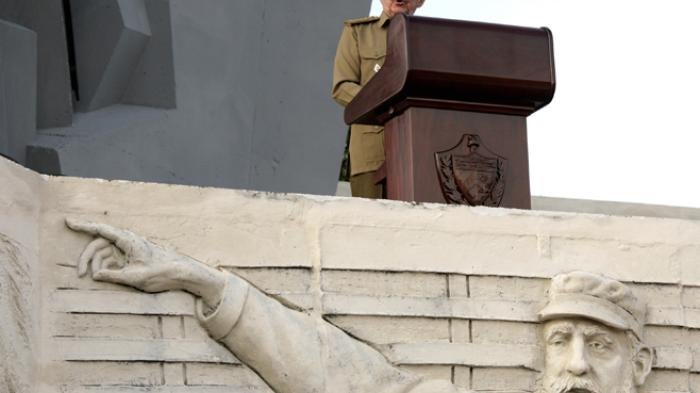
New Castro, Same Cuba
Political Prisoners in the Post-Fidel Era
I. Executive Summary
In July 2006, Fidel Castro handed control of the Cuban government over to his brother Raúl Castro. As the new head of state, Raúl Castro inherited a system of abusive laws and institutions, as well as responsibility for hundreds of political prisoners arrested during his brother’s rule. Rather than dismantle this repressive machinery, Raúl Castro has kept it firmly in place and fully active. Scores of political prisoners arrested under Fidel Castro continue to languish in Cuba’s prisons. And Raúl Castro’s government has used draconian laws and sham trials to incarcerate scores more who have dared to exercise their fundamental freedoms.
Raúl Castro’s government has relied in particular on a provision of the Cuban Criminal Code that allows the state to imprison individuals before they have committed a crime, on the suspicion that they might commit an offense in the future. This “dangerousness” provision is overtly political, defining as “dangerous” any behavior that contradicts socialist norms. The most Orwellian of Cuba’s laws, it captures the essence of the Cuban government’s repressive mindset, which views anyone who acts out of step with the government as a potential threat and thus worthy of punishment.
Despite significant obstacles to research, Human Rights Watch documented more than 40 cases in which Cuba has imprisoned individuals for “dangerousness” under Raúl Castro because they tried to exercise their fundamental rights. We believe there are many more. The “dangerous” activities in these cases have included handing out copies of the Universal Declaration of Human Rights, staging peaceful marches, writing news articles critical of the government, and attempting to organize independent unions.
The Raúl Castro government has applied the “dangerousness” law not only to dissenters and critics of the government, but to a broad range of people who choose not to cooperate with the state. We found that failing to attend pro-government rallies, not belonging to official party organizations, and being unemployed are all considered signs of “antisocial” behavior, and may lead to “official warnings” and even incarceration in Raúl Castro’s Cuba. In a January 2009 campaign called “Operation Victory,” dozens of individuals in eastern Cuba—most of them youth—were charged with “dangerousness” for being unemployed. So was a man from Sancti Spíritus who could not work because of health problems, and was sentenced to two years’ imprisonment in August 2008 for being unemployed.
In addition to “dangerousness,” Cuba has a wide range of other laws that criminalize the exercise of fundamental freedoms, including laws penalizing contempt, insubordination, and acts against the independence of the state. Indeed, article 62 of the Cuban constitution prohibits the exercise of any basic right that runs contrary to “the ends of the socialist state.” Together with a judicial system that lacks independence and systematically violates due process rights, Raúl Castro’s government has employed such laws to imprison scores of peaceful dissidents.
Imprisonment is only one of the many tactics the Cuban government uses to repress fundamental freedoms. Dissidents who try to express their views are often beaten, arbitrarily arrested, and subjected to public acts of repudiation. The government monitors, intimidates, and threatens those it perceives as its enemies. It isolates them from their friends and neighbors and discriminates against their families.
Cuba attempts to justify this repression as a legitimate response to a US policy aimed at toppling the Castro government. It is true that the United States has a long history of intervention on the island, and its current policy explicitly aims to support a change in Cuba’s government. However, in the scores of cases Human Rights Watch examined for this report, this argument falls flat.
The reason that human rights advocate Ramón Velásquez Toranzo set out on a peaceful march across Cuba and journalist Raymundo Perdigón Brito wrote articles critical of the Castro government was not because they were agents of the US government, but rather because they saw problems with their own. Yet because these dissidents expressed their opinions openly, both were imprisoned by Raúl Castro’s government, like scores of others. Rather than being a legitimate defense against a threat to national security, these and other cases reveal a state that uses repression to enforce conformity with its political agenda.
It is important to note that the term “dissidents” in the Cuban context does not refer to a homogenous group of people who share a single ideology, affiliation, or common objective. Rather, it refers to anyone who—like Velásquez and Perdigón—engages in activities the government deems contrary to its political agenda. Some dissidents may advocate for democratic change or reform of the socialist system from within; while others may be apolitical, focusing instead on a single issue such as the right to practice their religion or organize a trade union.
Dissidents are a small and significantly isolated segment of the population. However, their marginalization is evidence not of the lack of dissent in Cuba, but rather of the state’s ruthless efficiency in suppressing it. Fear permeates all aspects of dissidents’ lives. Some stop voicing their opinions and abandon their activities altogether; others continue to exercise their rights, but live in constant dread of being punished. Many more never express dissent to avoid reprisals. As human rights defender Rodolfo Bartelemí Coba told Human Rights Watch in March 2009, “We live 24 hours a day ready to be detained.” Ten days after making that statement, Bartelemí was arrested and taken to prison without trial, where he remains today.
While this report documents a systematic pattern of repression, it does not intend to suggest that there are no outlets for dissent whatsoever in Cuba. The last three years have, for example, witnessed the emergence of an independent Cuban blogosphere, critical lyrics by musicians, and most recently a series of government-organized public meetings to reflect on Cuban socialism.
Upon closer examination, however, these examples show just how circumscribed spaces of dissent are and, as a result, how incredibly limited their impact is on society on the whole. While some bloggers speak to problems in Cuba, they must publish their work through back channels—saving documents on memory sticks and uploading entries through illegal connections. Because an hour of internet use costs one-third of Cubans’ monthly wages and is available exclusively in a few government-run centers, only a tiny fraction of Cubans have the chance to read such blogs—including, ironically, bloggers themselves. Some bands perform lyrics that criticize the government, but their songs are banned from the airwaves, their performances shut down, and their members harassed and arbitrarily detained. And while it is true that Raúl Castro’s government organized meetings recently to reflect on Cuban socialism, the agenda for these discussions explicitly prohibited any talk of reforming the single-party system.
Cuba has made important advances in the progressive realization of some economic, social, and cultural rights such as education and healthcare. For example, UNESCO has concluded that there is near-universal literacy on the island and UNICEF has projected that the country is on track to achieve most of the Millennium Development Goals. However, the stark reality is that this progress has not been matched in respect for civil and political rights.
The Raúl Castro government has at times signaled a willingness to reconsider its long-standing disregard for human rights norms. In February 2008, Cuba signed the International Covenant on Civil and Political Rights (ICCPR) and the International Covenant on Economic, Social and Cultural Rights (ICESCR), and commuted the death sentences of all prisoners except for three individuals charged with terrorism. Yet the Castro government has yet to ratify the ICCPR and ICESCR, and continues to flout many of the treaties’ core principles. And Cuban law still allows individuals who undermine the independence of the state to be sentenced to death.
The Cuban government has for years refused to recognize the legitimacy of independent human rights monitoring and has adamantly refused to allow international monitors, such as the International Committee of the Red Cross and international nongovernmental organizations like Human Rights Watch, to visit the island and investigate human rights conditions. In researching this report, Human Rights Watch made repeated written requests to the Raúl Castro government for meetings with authorities and formal authorization to conduct a fact-finding mission to the island. As in the past, the Cuban government did not respond to any of our requests.
As a result, Human Rights Watch decided to conduct a fact-finding mission to Cuba without official permission in June and July 2009. During this trip, Human Rights Watch researchers conducted extensive interviews in seven of the island’s fourteen provinces. We also conducted numerous interviews via telephone from New York City. In total, we carried out more than 60 in-depth interviews with human rights defenders, journalists, former political prisoners, family members of current political prisoners, members of the clergy, trade unionists, and other Cuban citizens.
Those interviews, together with extensive research from January to November 2009, are the basis of the following findings:
The Legal Foundation of Repression in Cuba
Cuba’s laws empower the state to criminalize virtually all forms of dissent. Article 62 of the Cuban constitution explicitly prohibits Cubans from exercising their basic rights against the “ends of the socialist state.” Cubans who dare to criticize the government are subject to draconian criminal and “pre-criminal” charges, such as “dangerousness.” They are exempted from due process guarantees. They are denied meaningful judicial protection. And they are left without recourse to international human rights mechanisms.
A person is considered to be in a state of dangerousness due to antisocial behavior if the person... lives, like a social parasite, off the work of others.
—Article 73 of the Criminal Code, on one kind of “antisocial behavior” that constitutes “dangerousness.”
Political Prisoners
Raúl Castro’s government has imprisoned scores of political prisoners using laws criminalizing dissent. In particular, Cuba has relied on a “dangerousness” provision that allows authorities to imprison individuals for exercising their fundamental freedoms, on the grounds that their activities contradict “socialist morality.” The provision has more broadly been applied to non-dissident Cubans who choose not to work for the government, and are thus viewed as a threat. Meanwhile, Raúl Castro continues to imprison scores of dissidents unjustly sentenced for exercising their fundamental freedoms under Fidel Castro, including 53 human rights defenders, journalists, civil society leaders, and other dissenters arrested in a massive 2003 crackdown.
The authorities were always threatening me, saying that if I did not distance myself from ‘the opposition’—if I did not change my behavior—I was going to be arrested. I told them, “You have to prove I committed a crime, but I haven’t done anything.”
—William Reyes Mir, who belonged to an unofficial political group in Banes. Reyes was arrested in September 2007 and sentenced to two years of forced labor for “dangerousness.”
Due Process Violations
Cuba systematically violates the due process rights of dissenters from the moment they are arrested through their sham trials. Political detainees are routinely denied access to legal counsel and family visits, held in inhumane and dangerous conditions, and subjected to forced interrogations. Neither detainees nor their families are adequately informed about the charges against them, and political detainees may be held for months or years without ever being formally tried for a crime. Nearly all trials of political detainees are closed hearings lasting less than one hour, during which dissidents are subjected to politically motivated rulings and even falsification of evidence by security officials and prosecutors. Human Rights Watch was unable to document a single case under the Raúl Castro government where a court acquitted a political detainee.
[The police] picked me up at 5:50 am while I was at home sleeping, and by 8:30 that morning they were already reading me my sentence... They detained me on July 5 but the ruling they gave me had been written on July 3. They didn’t allow me to have a lawyer, and the hearing was conducted behind closed doors, without my family. The trial lasted 15 or 20 minutes.
—Alexander Santos Hernández, a political activist from Gibara, on his July 2006 arrest and summary trial. Santos was sentenced to four years for “dangerousness.”
Inhumane Prisons
Cuba’s prison officials, like the Cuban government as a whole, punish dissent. Conditions for political prisoners and common prisoners alike are overcrowded, unhygienic, and unhealthy, leading to extensive malnutrition and illness. Political prisoners who criticize the government, refuse to participate in ideological “re-education,” or engage in hunger strikes or other forms of protest are routinely subjected to extended solitary confinement, beatings, restrictions of visits, and the denial of medical care. Prisoners have no effective complaint mechanism to seek redress, granting prison authorities total impunity. Taken together, these forms of cruel, inhuman, and degrading treatment may rise to the level of torture.
The cells are one meter or one-and-a-half meters wide by two meters long. You sleep during the day on a concrete platform and at night you get a mattress, which is removed at daybreak. You are not allowed to have any belongings, and the food is terrible... Some cells have a little window, others none. Some cells have light, others don’t.
—Víctor Yunier Fernández Martínez describes the conditions in solitary confinement, where he was sent repeatedly during his imprisonment for “dangerousness” from 2006 to 2009. Fernández, a political activist, was incarcerated in the prisons of Canaleta and 1580.
Everyday Forms of Repression
Dissenters are punished daily in nearly every aspect of their lives. The Cuban government routinely uses short-term arrests to harass dissidents or prevent them from participating in groups or activities considered “counterrevolutionary.” Dissidents are beaten, publicly humiliated, and threatened by security officers and groups of civilians tied to the state. They are denied work, fired from jobs, and fined, placing significant financial strain on their families. They are prevented from exercising their right to travel within and outside of the island. And they are subjected to invasive surveillance, which violates their privacy and gathers information that can later be used to imprison them. These tactics of repression are consistently visited on the families of dissenters as well.
The rapid response brigade was waiting for us, carrying wooden bats and metal rods, as though they were ready to beat us. They insulted us, saying we were worms, the scum of society. They called my mother and me whores and sluts.
—Rufina Velásquez González describing one of the groups that harassed her and her parents when they set out on a peaceful march across Cuba in December 2006 calling for the release of all political prisoners.
State of Fear
Cuba’s systematic repression has created a pervasive climate of fear among dissidents and, when it comes to expression of political views, in Cuban society as a whole. This climate hinders the exercise of basic rights, pressuring Cubans to show their allegiance to the state, while discouraging any form of criticism. Dissidents feel as though they are constantly being watched—a sense that fosters distrust among peers and self-censorship. They fear they will be arrested at any moment, and have no confidence in the willingness of the government to protect their rights or give them a fair trial. This climate of fear has led to the near-complete isolation of dissidents from their communities, friends, and sometimes even families, which together with other forms of repression has had profound emotional consequences, including depression and signs of trauma.
No one is allowed to talk to me. People who come to my house are immediately called by state security and reprimanded. Then these people—for fear of losing their jobs, for fear that [the authorities] will take it out on someone in their family—simply stop talking to me.
—Former political prisoner Eduardo Pacheco Ortíz, who was imprisoned for “dangerousness” in January 2008, describes his treatment by neighbors in Matanzas since his release.
Recommendations
Given the effectiveness of Cuba’s repressive machinery and the Castro government’s firm grip on power, the pressure needed to bring progress on human rights cannot come solely from within Cuba. In order to succeed, it must be supported by effective pressure on the part of the international community. Currently, this effective pressure—whether from Latin American countries, the United States, Canada, or Europe—is lacking.
Efforts by the US government to press for change by imposing a sweeping economic embargo have proven to be a costly and misguided failure. The embargo imposes indiscriminate hardship on the Cuban population as a whole, and has done nothing to improve the situation of human rights in Cuba. Rather than isolating Cuba, the policy has isolated the United States, enabling the Castro government to garner sympathy abroad while simultaneously alienating Washington’s potential allies.
There is no question: the Cuban government bears full and exclusive responsibility for the abuses it commits. However, so long as the embargo remains in place, the Castro government will continue to manipulate US policy to cast itself as a Latin American David standing up to the US Goliath, a role it exploits skillfully.
Just as the US embargo policy has proved counterproductive, so have the policies of the European Union and Canada failed to exert effective pressure on Cuba. The EU’s Common Position sets clear human rights benchmarks for economic cooperation with Cuba, but the cost of noncompliance has been insufficient to compel change by the Castro government. Canada lacks such benchmarks, promoting significant investment in the island at the same time as it decries the Cuban government’s abuses.
Worse still, Latin American governments across the political spectrum have been reluctant to criticize Cuba, and in some cases have openly embraced the Castro government, despite its dismal human rights record. Countries like Venezuela, Bolivia, and Ecuador hold Cuba up as a model, while others quietly admit its abuses even as they enthusiastically push for Cuba’s reintegration into regional bodies such as the Organization of American States (OAS). The silence of the Latin governments condones Cuba’s abusive behavior, and perpetuates a climate of impunity that allows repression to continue. This is particularly troubling coming from a region in which many countries have learned firsthand the high cost of international indifference to state-sponsored repression.
Not only have all of these policies—US, European, Canadian, and Latin American—failed individually to improve human rights in Cuba, but their divided and even contradictory nature has allowed the Cuban government to evade effective pressure and deflect criticism of its practices.
To remedy this continuing failure, the US must end its failed embargo policy. It should shift the goal of its Cuba strategy away from regime change and toward promoting human rights. In particular, it should replace its sweeping bans on travel and trade with Cuba with more effective forms of pressure.
This move would fundamentally shift the balance in the Cuban government’s relationship with its own people and the international community. No longer would Cuba be able to manipulate the embargo as a pretext for repressing its own people. Nor would other countries be able to blame the US policy for their own failures to hold Cuba accountable for its abuses.
However, ending the current embargo policy by itself will not bring an end to Cuba’s repression. Only a multilateral approach will have the political power and moral authority to press the Cuban government to end its repressive practices. Therefore, before changing its policy, the US should work to secure commitments from the EU, Canada, and Latin American allies that they will join together to pressure Cuba to meet a single, concrete demand: the immediate and unconditional release of all political prisoners.
In order to enforce this demand, the multilateral coalition should establish a clear definition of who constitutes a political prisoner—one that includes all Cubans imprisoned for exercising their fundamental rights, including those incarcerated for the pre-criminal offense of “dangerousness” and the 53 dissidents still in prison from the 2003 crackdown. It should also set a firm deadline for compliance, granting the Raúl Castro government six months to meet this demand.
Most important, the members of the coalition should commit themselves to holding the Cuban government accountable should it fail to release its political prisoners. The penalties should be significant enough that they bear real consequences for the Cuban government. And they should be focused enough to target the Cuban leadership, rather than the Cuban population on the whole. Options include adopting targeted sanctions on the government officials, such as travel bans and asset freezes; and withholding any new forms of foreign investment until Cuba meets the demand.
During the six-month period, Latin American countries, Canada, the EU, and the US should be able to choose individually whether or not to impose their own restrictions on Cuba. Some may enact targeted sanctions on Cuba’s leadership immediately, while others may put no restrictions on Cuba during that time.
Regardless, if the Castro government is still holding political prisoners at the end of six months, Cuba must be held accountable. All of the countries must honor their agreement and impose joint punitive measures on Cuba that will effectively pressure the Castro government to release its political prisoners.
On the other hand, if the Cuban government releases all political prisoners—whether before or after the six month period is complete—these punitive measures should be lifted. Then, the multilateral coalition should devise a sustained, incremental strategy to push the Raúl Castro government to improve its human rights record. This strategy should focus on pressuring Cuba to reform its laws criminalizing dissent, dismantle the repressive institutions that enforce them, and end abuses of basic rights. And the impact of the strategy should be monitored regularly to ensure it is not creating more repression than it curbs.
Ultimately, it is the Raúl Castro government that bears responsibility for such abuses—and has the power to address them. Yet as the last three years of Raúl Castro’s rule show, Cuba will not improve its human rights record unless it is pressured to do so.
II. Illustrative Cases
Ramón Velásquez Toranzo[1]
Ramón Velásquez Toranzo set out on his march on December 10, 2006—International Human Rights Day. With him were his wife, Bárbara, and their 18-year-old daughter, Rufina. Each of them carried a sign. The signs read: “respect for human rights,” “freedom for political prisoners,” and “no more repression against the peaceful opposition.” Their goal was to walk the entire length of the island of Cuba, from east to west.
They marched silently. At night, they slept on the sides of roads, in bus stops, or in the homes of people who took them in. After a few days, security officers began trailing them. On the outskirts of Holguín, a group affiliated with the government known as a “rapid response brigade” surrounded them with bats and metal rods. They called Velásquez and his family “mercenaries” and “whores,” and threatened to rape Bárbara and Rufina. Police looked on and did nothing.
Security officials arrested the family as they walked through Holguín. Velásquez was thrown in jail, while his wife and daughter were forcibly returned to their home in Las Tunas. When Velásquez was released four days later, they continued to march west. Twice, cars tried to run them over, and they had to dive off the road to avoid being hit. More brigades taunted them. Security officers threatened them. Still, they kept marching.
They reached Camagüey on January 19, 2007, and were arrested again. Velásquez was held for four days and then taken to a municipal court. That he had not committed a crime did not matter; under Cuba’s “dangerousness” law, individuals can be imprisoned simply when courts determine they are likely to commit a crime in the future.
The state’s only evidence against him was a series of “official warnings” (advertencias oficiales) for being unemployed—issued while he was on his march—which he had never seen before. His lawyer, whom he met five minutes before the trial, defended him vigorously at the outset of the hearing. Then, the judge called a recess and invited the defense lawyer to his quarters. When the lawyer returned, she stopped defending Velásquez and did not speak for the rest of the trial.
The trial lasted less than an hour, and the judge sentenced Velásquez to three years in jail. He was bused to a prison, stripped down to his underwear, and thrown into a solitary confinement cell. The tiny space had no bed—only a concrete floor that flooded with water every time it rained. When his family brought him food to supplement the meager prison rations, guards repeatedly left it outside his cell to rot.
His wife, Bárbara, fell into a deep depression following his incarceration, not leaving her bed for weeks, while his son, René, was fired from his job without warning. His daughter Rufina, who continued to monitor human rights and report on abuses, was subjected to constant surveillance. Authorities warned her that she would suffer the same fate as her father if she did not change her behavior. She eventually fled to the United States, where she lives today.
As of November 2009, Velásquez was still serving out his sentence.
Alexander Santos Hernández[2]
Alexander Santos Hernández was first put on trial for his political activities in November 2004. He was working on the Varela Project, a peaceful campaign to gather signatures from Cuban citizens calling for democratic change, and had hosted open meetings in his home in Gibara, Holguín, to discuss the project. One day, as he was leaving a gathering, a police officer told him to come by the station for questioning. When he failed to report to the station, he was sentenced to six months of forced labor for “disobedience to authority.” He was 29 years old.
When Santos completed his sentence, he resumed his participation in nonviolent political activities. He joined two small political groups not recognized by the government (and thus illegal)—the Cuban Liberal Movement and the Eastern Democratic Alliance. Both were dedicated to promoting political change and respect for basic rights in Cuba. He attended meetings, voiced criticism of the government, and documented abuses by government officials.
As a result, Santos was subject to myriad forms of repression. In 2005, his boss fired him from his job as a martial arts instructor. When Santos went to the state employment center, an official there told him that “worms do not deserve employment.” Santos was the target of six public acts of repudiation from 2005 to 2006. Groups of pro-government civilians gathered outside his home and insulted him, calling him a “mercenary” and a “traitor.” More than once, they broke down his door and ransacked a collection of books on democracy and other “subversive” topics that he maintained as a free library.
In June 2006, Santos was attacked in the street by a “rapid response brigade,” a group designed to protect the government against threats from “counterrevolutionaries.” Without provocation, eight men from the brigade beat Santos severely, he later told Human Rights Watch. The group was led by a major in the police force, whom Santos knew from having been detained several times. The major told Santos that the next time he saw him riding his motorcycle, he was going to run him over.
On July 5, 2006, police arrested Santos in his home. According to Santos, “[The police] picked me up at 5:50AM while I was at home sleeping, and by 8:30 that morning they were already reading me my sentence.” He was taken to the Municipal Court of Gibara, where he was charged with “dangerousness.”
Santos was not appointed a lawyer, and his family was not notified of the hearing. The trial, which lasted between 15 and 20 minutes, was completely closed to the public. According to Santos, the prosecutor’s only argument was that he was a “dissident,” which constituted a danger to society. The judge sentenced him to four years in prison for “dangerousness.” Santos said the sentence itself, which he was allowed to read, was dated July 3, 2006—two days before his trial. Santos’s family was notified about the decision after it had been issued. His mother hired a lawyer to appeal his case, but the Provincial Court of Holguín upheld Santos’s sentence.
Santos was sent to Cuba Sí! prison in Holguín, where he said was put in a cell with dozens of prisoners convicted of violent crimes. His cellmates were serving between 20 and 60 years, while Santos was serving four. The food he was given was inadequate and rotten, and he quickly developed health problems, including serious stomach ailments and painful pustules on his face. Despite his repeated requests, authorities would not allow him to see a doctor. As a result, he went on hunger strike to demand medical attention. He did not eat for 23 days, until he was finally granted a doctor’s visit.
Santos witnessed beatings of fellow political prisoners in prison. The most severe was in February 2007, when journalist Víctor Rolando Arroyo Carmona—one of 75 individuals arrested in a massive crackdown in 2003—tried to carry some of his leftover lunch out of the dining hall. Arroyo, who was 55 at the time, was suffering digestive problems and had been given permission by authorities to finish eating his food in his cell. Santos watched a prison guard stop Arroyo and ask him where he was going with the food. When Arroyo answered and kept walking, the guard punched him in the back of the head, knocking him to the ground, and beat him while he was on the floor. Santos said the officer punched Arroyo several times in the face and the body, shattering his glasses.
In 2008, renowned Cuban singer Silvio Rodríguez gave a series of concerts in Cuba’s prisons. In the days before he came to Cuba Sí! prison, Santos said, officials rounded up all of the political prisoners and gay prisoners and moved them to another facility.
Santos was released on parole in December 2008. He said a plainclothes police officer was permanently stationed outside of his house, and anyone who visited him was threatened. Authorities told one of Santos’s oldest friends that if she continued to visit him, they would expel her daughter from school. She has since stopped coming to see him.
Santos was given a short contract as a bricklayer when he was released, but he told Human Rights Watch that he since had difficulty finding a job because of his reputation as a dissident. He worried the authorities would revoke his parole for being unemployed, which is considered a form of “antisocial behavior” under the “dangerousness” provision.
“Jorge Barrera Alonso”[3]
Jorge Barrera Alonso had been working in a comedor obrero, or state-run workplace cafeteria, when one day his boss fired him with no advance warning, saying he was “not suited” for the job. Shortly before his dismissal, Barrera had started attending the meetings of an unauthorized political group that is critical of the Cuban government. He spent weeks looking for a new job, but was repeatedly turned away. Unable to find work, he took a job working for a vegetable seller who lacked official government authorization, and thus was considered illegal.
Barrera continued to attend meetings of the unofficial group and began participating in public activities raising awareness about political rights. In 2006, he and a friend were distributing copies of the Universal Declaration of Human Rights on the street. Police arrived, arresting Barrera. His friend managed to escape and called Barrera’s wife, “Hilda Galán,”[4] to tell her about his arrest. Galán went to every police station in the city looking for her husband, but all of the officials she spoke to alleged they had not heard of him. Galán then went to file a report with a municipal complaints office that her husband had disappeared after being arrested by the police. She later received a call from one of the stations she had visited, saying that Barrera was in their custody.
Barrera spent five days in police detention, during which he was allowed one 30-minute visit with his wife and their two-year-old daughter. An officer stood by throughout their visit and explicitly warned Barrera and his wife not to discuss anything related to his arrest or detention, threatening to cut short their meeting if they did.
In the time leading up to his trial, Barrera was denied access to a lawyer and held in a small cell with prisoners who had been sentenced for violent crimes. The police informed Barrera of his trial only three hours before it was to take place. He was allowed to call his wife, who barely made it to court in time for his hearing. Before the trial began, Barrera asked if he could appoint his own lawyer, but authorities responded that they could not delay the trial and the state-appointed lawyers would serve the same function.
The trial, in which the state prosecutor accused Barrera of “dangerousness,” lasted less than an hour. His wife described the process as follows:
The trial was crazy. First of all, they didn’t let him speak. The prosecutor spoke of things that I had never heard of—that [my husband] would associate with dangerous people, delinquents; that they were going to punish him in order to prevent him from doing something against other people’s property; that he did not work; that he did not study; that he was not a part of the revolutionary process. And he is not like that.[5]
The state offered no proof and presented no witnesses to support its accusations, and Barrera’s state-assigned lawyer made no counter-arguments to refute the charges. The judge denied Barrera the right to speak in his own defense, despite his expressed wish to do so. Barrera was sentenced to four years in prison.
Over the subsequent two-and-a-half years, Barrera was moved to three different prisons, all of which were located a considerable distance from his home, making it difficult for his wife to visit him. In each prison, he was subjected to solitary confinement and other punishments for refusing to wear a prisoner’s uniform or partake in mandatory “re-education.”
To mark Human Rights Day on December 10, 2008, Barrera began to read aloud to his cellmates from a book his wife had brought him called Your Rights (Tus Derechos), which includes the text of the Universal Declaration of Human Rights. According to his wife, whom Barrera later told about the incident:
An official arrived, roughed him up, and told him that he had to eat the book. [Barrera] said that he wasn’t going to eat the book, that he wasn’t some animal that eats books, and that there was nothing wrong with the book.[6]
Authorities confiscated the book and threw Barrera in solitary confinement.
Following days of solitary confinement, Barrera later told his wife, he was taken to a municipal court where he was tried for contempt for authority (desacato). He was denied the right to choose his own lawyer, the proceedings were closed to the public and conducted in summary fashion, and no evidence was presented against him except the accusations of the prison officials. His wife was not even informed that the trial was taking place. Barrera told his wife he had been sentenced to six additional years, bringing his combined sentence to ten years. He never received a copy of his sentence, nor any record that the hearing had taken place.
After Barrera was sentenced, his wife gave an interview to the foreign press denouncing his mistreatment and closed-door trial. In the aftermath, she said, prison officials cut off her visitation rights and phone calls with her husband.
Juan Luís Rodríguez Desdín[7]
Juan Luís Rodríguez Desdín, a 35-year-old dissident from Banes, Holguín, received several official warnings for “dangerousness” in 2006. The warnings accused him of “antisocial behavior,” he said, and advised him to abandon his “counterrevolutionary” activities. Rodríguez said his “antisocial behavior” was rooted in his participation in a pair of unofficial civil society groups, which documented human rights abuses and promoted political change. He attended gatherings and spoke openly about democratic change in Cuba.
On July 6, 2006, four policemen came to Rodríguez’s house and arrested him. He was taken to a police station, where he was held incommunicado for four days. He had no access to a lawyer and was not allowed to receive any family visits. Rodríguez was brought before a judge in a provincial court on July 10 and charged with “dangerousness.” He said the prosecutor accused him of being “disaffected with the government,” “opposed to the revolutionary system,” and therefore “not suited to live in society.” He was sentenced to four years in prison. He did not bother to appeal, he said, because “when they sentence you for this crime, it’s not worth appealing.” He was sent to Cuba Sí! prison.
Rodríguez’s problems with prison authorities began as soon as he arrived. He did not want to participate in mandatory “re-education” classes, which he said were dedicated to political indoctrination. As a result, he was placed in solitary confinement for 17 days. The cell had an open toilet in the middle of the floor, a cement platform for a bed, and, for a blanket, the leaves of a plantain tree.
When not in solitary confinement, Rodríguez was held in overcrowded cells of 80 to 100 prisoners convicted of violent crimes. He said that he and the other political prisoners were moved to different cells every few months—a strategy that he said left them more vulnerable to attacks by common prisoners, who were hostile to newcomers. He was also repeatedly punished for using his telephone calls to report abuses to human rights defenders outside of the prison. He said he was denied meals, medical attention, and access to the outdoors, and that there was no one to report the abuses to inside the prison.
Rodríguez was released on parole in July 2008, and resumed his participation in monitoring human rights and attending unsanctioned meetings. He lived under constant surveillance, he said, and was detained several times, during which authorities threatened to re-arrest him if he did not abandon his “antisocial behavior.”
His family also suffered constant harassment. An official visited Rodríguez’s wife, telling her that she would save herself trouble by divorcing her husband. His mother was issued citations and threatened by officials, and police conducted an investigation into his father’s activities as well.
Human Rights Watch last spoke to Rodríguez in April 2009. According to human rights defenders in Cuba, the following month he was arrested again, and sentenced to two years for “public disorder” in a closed, summary trial.[8]
III. Methodology
Lack of Cooperation by the Cuban Government
The Cuban government aggressively works to prevent Cubans from documenting human rights abuses and sharing information with the international community. Nearly all dissidents’ trials are closed to independent observers, journalists, human rights defenders, and foreign diplomats. The individuals detained, prosecuted, imprisoned, or subject to any other disciplinary action are consistently denied documentation of their cases.
In the rare instances that dissidents or their family members are allowed access to trials, official documents, or other information about repression, they face considerable obstacles and risks in trying to disseminate it. Cubans lack basic access to mediums of communication such as the internet, fax machines, and sometimes even phones—and the channels that are available are under constant surveillance by the government. Moreover, individuals who do share such information with international human rights organizations, foreign media outlets, or multilateral institutions are subject to harassment, loss of employment, beatings, and imprisonment under laws that explicitly criminalize the dissemination of such information.
Human Rights Watch repeatedly requested meetings with the Cuban government to discuss the issues raised in this report, directing requests to the Cuban Interests Section in Washington, D.C. and the Permanent Mission of Cuba to the United Nations New York. We also requested permission to visit Cuba, in hopes that the government would break with its practice of denying international human rights delegations access to the island. Unfortunately, Cuban officials never responded to any of these requests (See Appendix 2: Human Rights Watch Letters to the Cuban Government).
This overall lack of transparency underscores the central finding of this report: not only does the Cuban government abuse fundamental freedoms, but it even punishes the documentation of such repression.
Sources and Research
In spite of these obstacles, Human Rights Watch was able to conduct more than 60 extensive interviews with human rights defenders, journalists, former political prisoners, family members of current political prisoners, members of the clergy, independent trade unionists, members of unauthorized political groups, and other Cuban citizens between December 2008 and September 2009. The interviews were conducted over the phone and during a fact-finding mission to Cuba in June and July 2009, during which we conducted interviews in seven of the country’s fourteen provinces. These testimonies, drawn from a range of civil society members from across Cuba, establish a clear pattern of repression, from the tactics used to the types of individuals targeted.
Human Rights Watch was able to obtain copies of nearly twenty documents, including indictments of political prisoners, official warnings for “dangerousness,” refusals of parole and permission to travel, and other legal documents. These documents, which were acquired from family members of political prisoners, unofficial civil society groups, and local human rights defenders, affirm the patterns of abuse established by the testimonies. In addition, we conducted an in-depth review of Cuba’s laws, which provide the legal underpinning for criminalizing dissent. Finally, we extensively researched press accounts— both from Cuba’s government-run papers and from the island’s independent (and thus illegal) press—as well as reports produced by local groups and international bodies such as the UN.
These sources of information are as diverse as any that can be assembled in examining a country whose government fails to cooperate with international human rights monitoring. Together, they allowed Human Rights Watch to establish the systematic pattern of abuse by Raúl Castro’s government documented in this report.
Who Is a “Dissident”?
This report will use the term “dissident” to refer to any individual who expresses dissent toward the government. This includes a broad range of nonviolent actors in Cuba, including human rights defenders, journalists, and trade unionists, as well as members of political groups, religious organizations, and other civil society groups not recognized by the Cuban government, and thus considered illegal. It also consists of people unaffiliated with any group who criticize the government or who abstain from cooperating with the state in some way. These diverse individuals do not share a single ideology, affiliation, or objective.
It is not uncommon for dissidents in Cuba to exercise their dissent through more than one medium. A person, for example, may belong to an unauthorized political group and simultaneously monitor human rights abuses. We consider this individual a human rights defender, a political activist, and a dissident. At points in this report we will refer to such individuals solely using the umbrella term of “dissident.” The Cuban government, however, does not differentiate between these individuals or their forms of expression, branding all dissent as “counterrevolutionary” activity and thus worthy of punishment.
Anonymity and Security
Because of the risk for Cubans in speaking to outside organizations, Human Rights Watch took several precautionary steps to protect the security of its interviewees. All individuals with whom we spoke were given the option to remain anonymous in the report, to exclude information that might reveal their identities, or to leave their stories out of the report altogether.
In preparation for its fact-finding mission to Cuba, Human Rights Watch did not inform contacts of the pending visit so as not to attract surveillance or put individuals at risk. When conducting research on the island, we limited interviews to roughly an hour and did not stay for longer than necessary in any one location. Where interviews in Cuba are cited in the report, some names, dates, and locations of sources have been omitted. In spite of these precautions, some individuals interviewed for this report suffered reprisal after speaking to Human Rights Watch.
IV. The Legal Foundation of Repression in Cuba
Cuban law empowers the state to criminalize virtually all forms of dissent. While it includes broad statements affirming fundamental rights, Cuban law also grants officials extraordinary authority to penalize individuals who attempt to exercise their rights. All rights are conditional on compliance with the government. Article 62 of the constitution explicitly states that no rights may be exercised against the state and makes punishable any failure to respect this subordination of rights.
Cubans who dare to criticize the government are subject to draconian criminal and “pre-criminal” charges. These include the Orwellian “dangerousness” provision, which can be used to punish individuals who have not yet committed a crime, on the suspicion that they will commit one in the future; as well as the National Protection Law, which is so broad that it renders any criticism of the government prosecutable as a form of collaboration with the US embargo and thus treason.
Cuba’s judiciary lacks independence, denying dissidents meaningful judicial protection and ensuring that those tried will not receive a fair trial. The constitution states that the judiciary is “subordinated hierarchically” to the executive and legislative branches, which have the power to remove judges at any time. And the Cuban government denies victims of abuse virtually all external protections by refusing to allow monitoring by independent domestic groups, international human rights organizations, and groups such as the International Committee of the Red Cross (ICRC).
Criminalizing Dissent
The Cuban Criminal Code lies at the core of Cuba's repressive machinery, granting Cuban authorities extraordinary power to silence dissent. Numerous Cuban criminal provisions explicitly penalize the exercise of fundamental freedoms, while others are so vaguely defined as to offer Cuban officials broad discretion in repressing critics.
Cuban authorities routinely characterize peaceful government opponents as “counterrevolutionaries,” “mercenaries,” and “traitors,” and then use these classifications to sentence them under laws protecting Cuban sovereignty.
Cuba’s invocation of state security interests to control nonviolent dissent—for acts as innocuous as publishing articles critical of the government, handing out copies of human rights treaties, or holding peaceful marches—represents a clear abuse of authority. Under the Universal Declaration of Human Rights, restrictions of fundamental rights are only permissible:
for the purpose of securing due recognition and respect for the rights and freedoms of others and of meeting the just requirements of morality, public order and the general welfare in a democratic society.[9]
Cuba’s efforts to silence critics fall far outside of these limits.
The Johannesburg Principles on National Security, Freedom of Expression and Access to Information specify certain types of expression that should always be protected, including expression that:
- “advocates non-violent change of government policy or the government itself”;
- “constitutes criticism of, or insult to, the nation, the state or its symbols, the government, its agencies, or public officials”; and
- “is directed at communicating information about alleged violations of international human rights standards or international humanitarian law.”[10]
All of these forms of expression are punishable under Cuban law.
Contempt
Cuba penalizes anyone who “threatens, libels or slanders, defames, affronts or in any other way insults or offends, with the spoken word or in writing, the dignity or decorum of an authority, public functionary, or his agents or auxiliaries.”[11] Such expressions of contempt for authority (desacato) are punishable by three months to one year in prison, plus a fine. If the person demonstrates contempt for the president of the Council of the State, the president of the National Assembly, or other high ranking officials—the sanction is imprisonment for one to three years.[12]
Contempt or “insult” laws, which criminalize expressions deemed to offend the honor of public officials and institutions, directly contravene international human rights norms.[13] The Inter-American and European human rights systems both consider contempt and insult laws incompatible with the free debate essential to democratic society. In a landmark 1995 report, the Inter-American Commission on Human Rights (IACHR) concluded that these laws are incompatible with article 13 of the American Convention on Human Rights, which protects the right to freedom of thought and expression. The commission noted that “the fear of criminal sanctions necessarily discourages people from voicing their opinions on issues of public concern particularly when the legislation fails to distinguish between facts and value judgments.”[14]
Similarly the European Court of Human Rights has stressed that the protection of freedom of expression must extend not only to information or ideas that are widely accepted, but also to those that “offend, shock or disturb.” As the European Court noted in a case involving a politician accused of insulting the government of Spain, “Such are the demands of that pluralism, tolerance and broadmindedness without which there is no democratic society.”[15] In a joint declaration, the special rapporteurs on freedom of expression of the United Nations, the Organization for Security and Cooperation in Europe, and the Organization of American States recommended in 2000 that "laws which provide special protection for public figures, such as desacato laws, should be repealed."[16]
Insubordination
The Cuban Criminal Code outlaws a range of forms of insubordination to authorities, including “disobedience,” “resistance,” and “attacks” on government officials. Someone who “disobeys the decisions of the authorities or public functionaries”—an act of desobedencia—may be punished with imprisonment of three months to one year.[17] An individual who “resists an authority, public functionary, or his agents or auxiliaries in the exercise of his functions”—an act of resistencia—may be punished with imprisonment of three months to one year. If the resistance occurs while the authority is carrying out an arrest, the prison sentence may rise to five years.[18] And an individual who “employs violence or intimidation against an authority, public functionary or his agents and auxiliaries”—an act of atentado—may incur a sanction of one to eight years, depending on the nature of the attack.[19]
The UN Committee against Torture raised concern about these “nebulous offences, namely ‘disrespect’, ‘resisting authority’ and ‘enemy propaganda’,” in a 1998 report on Cuba, noting that such laws posed a risk “because of the uncertainty of their constituent elements and the room they provide for misuse and abuse.”[20]
It is appropriate to criminalize physical attacks on officials and there are limited circumstances in which even acts of disobedience and resistance to officials may be properly outlawed, as with suspects resisting arrest. But, as a number of cases documented here illustrate, Cuba uses these overly broad provisions to punish individuals who engage in peaceful activities, including forming independent unions and attending unsanctioned meetings.
Collaboration with the United States
The Law for the Protection of Cuban National Independence and the Economy[21] (Ley de Protección de la Independencia Nacional y la Economía de Cuba, hereafter the National Protection Law), which took effect in March 1999, creates harsh penalties for actions that could be interpreted as supporting or collaborating with the objectives of the US Helms-Burton Act.
Helms-Burton, which became US law in March 1996, tightened the US economic embargo on Cuba and set out a plan to assist Cuba once it began a transition to democracy.[22] In response, Cuban authorities passed the National Protection Law, which prohibits:
those actions designed to support, facilitate, or collaborate with the objectives of the “Helms-Burton” Law, the blockade, and the economic war against our people, leading toward the destruction of internal order, the destabilization of the country and the liquidation of the socialist state and the independence of Cuba.[23]
The National Protection Law is often used in conjunction with article 91 of the Cuban Criminal Code (hereafter article 91), which punishes any act made “for the purpose of undermining the independence of the Cuban state or the integrity of its territory” with ten to twenty years in prison or the death penalty.[24]
While the preamble to the National Protection Law provides that it will not infringe upon the “fundamental guarantees” afforded by the Cuban constitution,[25] most of the specific provisions of the law target dissemination of opinions or exchanges of information—activities that should be protected rather than penalized. The law’s overly broad definition of proscribed activities grants officials extraordinary authority to punish government opponents for exercising dissent.
For example, the law criminalizes the accumulation, reproduction, or distribution of “material with a subversive character” with three to eight years of imprisonment.[26] Cubans risk two to five years in prison for ”collaborating in any way with radio or television stations ... or other foreign media” deemed to be advancing Helms-Burton and related objectives.[27]
The law also creates seven- to twenty-year penalties for persons who commit “any act designed to impede or prejudice the economic relations of the Cuban state or the economic relations of any industrial, commercial, or financial institution or any other type of institution.” Those whose actions influence the US government to take measures against foreign investors in Cuba face the longest sanctions under this provision.[28]
Association
Although Cuban law guarantees the rights of association and assembly, it also empowers the state to deny these rights to groups that are critical of the government.[29] Cuba’s Associations Law (Ley de Asociaciones) entrusts the Justice Ministry with reviewing all aspiring associations. According to the law, the ministry must refuse legal status to groups:
- “whose activities could prove damaging to social interests”;
- “whose applications demonstrate the impossibility of attaining their proposed objectives and activities”; and
- “whose objectives or denomination is similar or identical to another registered [association],” among other qualifications.[30]
These regulations condition the right to associate upon cooperation with the “social interests” of the state and other arbitrary guidelines, effectively allowing the government to deny recognition to any group critical of its actions.
Even associations that are granted legal status are subject to constant review by the state, and may have their recognition revoked at any time. The Regulations for the Associations Law (Reglamento de la Ley de Asociaciones)empowers government officials to disband any association “whose activities become damaging to the social welfare.”[31]
The government has consistently refused to recognize associations that are critical of its policies and practices. Human Rights Watch was unable to document a single local civil society organization that expresses dissent—including alternative political parties, human rights groups, independent labor unions, journalist associations, and other groups—that has received approval from the state to operate.
Not only is recognition denied to such groups, but individuals who participate in “illicit” groups, meetings, or demonstrations without state authorization are subject to harassment, discrimination, and even criminal sanctions. According to the Criminal Code, belonging to an “illicit” association may be punished with imprisonment for three months to a year, as well as fines; while attending an unapproved meeting or demonstration may result in fines and a sentence of one to three months.[32]
“Dangerousness”
The most Orwellian of all of Cuba’s laws is the “pre-criminal” offense of “dangerousness.” A law which has been in existence for some time, it allows individuals deemed “dangerous” to be imprisoned before they have committed or planned any crime, merely on the suspicion that they are likely to offend in the future.[33] Not only is the law completely arbitrary and subjective, but it is also explicitly political. Human Rights Watch opposes the unlawful use of preventative and pre-emptive detention—in particular for the purpose of social control and when it circumvents minimum procedural guarantees—irrespective of the context or the government implementing it for this reason.[34]
The Criminal Code defines “dangerousness” as “the special proclivity of a person to commit crimes, demonstrated by conduct that is observed to be in manifest contradiction with the norms of socialist morality.”[35] In other words, “dangerousness” is a pre-criminal state in which a person’s behavior suggests that he or she is of the type likely to commit a crime in the future. This behavior may manifest itself in habitual drunkenness, drug addiction, or “antisocial behavior.”[36] When “dangerousness” is applied to persons who voice dissent, it is most commonly for exhibiting “antisocial behavior.”[37]
A person engaged in “antisocial behavior” is one who:
habitually breaks the rules of social coexistence by committing acts of violence, or by other provocative acts, violates the rights of others or by his or her general behavior breaks the rules of coexistence or disturbs the order of the community or lives, like a social parasite, off the work of others or exploits or practices socially reprehensible vices.[38]
The Cuban Criminal Code states that the government may punish “antisocial behavior” through “pre-criminal measures” (medidas predelectivas), which are preventive measures applied before a crime is committed.[39]
The law assigns two types of “pre-criminal measures” for “antisocial behavior.” One is “re-education,” which is ostensibly carried out in specialized work or study centers, or in work collectives (colectivos de trabajo),[40] for a duration of one to four years.[41] The other is “orientation and control of conduct” by the National Revolutionary Police, which is applied for the same duration.[42]
The concept of “re-education” contravenes international standards protecting freedom of thought. And as the subsequent chapters of this report show, dissidents sentenced under the “dangerousness” provision are routinely sent not to special work centers, but to regular prisons, where they are held alongside prisoners convicted of violent offenses. These individuals are effectively imprisoned for crimes that were never committed.
All cases of “dangerousness” are to be processed “summarily,”[43] with judges determining the duration and type of punishment based on the person’s level of dangerousness.[44] Judges may modify the sentence at any time, either on their own initiative or at the suggestion of the officials responsible for “re-educating” or “orienting” the individuals sentenced.[45]
The law also states that an individual who is at risk of being charged with “dangerousness” should receive an official warning in writing, “to prevent the individual from pursuing socially dangerous or criminal activities.”[46] Such warnings are in theory designed to inform individuals why they are at risk of being charged with “dangerousness” so that they can modify their behavior. They are also supposed to offer the accused an opportunity to provide their own account of their behavior, which, according to the law, is supposed to be included in the written warning.[47]
An individual may even receive an “official warning” for having ties to people who are considered dangerous. The law states that as a result of “an individual’s ties or relations with persons who are potentially dangerous to society ... that individual may become prone to crime.”[48] By this reasoning, being connected to someone likely to commit a crime translates into a kind of “dangerousness” by proximity.
The “dangerousness” law is essentially a status law—criminalizing individuals for who they are or for a proclivity rather than for criminal acts. As such, it violates the basic principle that criminal law should target specific conduct accompanied by the requisite intent.[49] As the Inter-American Court has ruled, “crimes must be classified and described in precise and unambiguous language that narrowly defines the punishable offense.”[50] Human rights standards and the rule of law require that the law be foreseeable and predictable, obligating states to define precisely and in a foreseeable manner all criminal offences.[51] The law also undermines basic due process and fair trial rights, such as the presumption of innocence, in that it punishes individuals on the presumption that they may commit an offense.
Finally, the “dangerousness” law offends against basic human rights standards, as it seeks to criminalize lawful behavior protected by human rights law—that is, the exercise of freedom of opinion, expression, and association, and the right not to be deprived of liberty and security without due process of law.
Restricting Rights
The Cuban constitution contains a broad range of guarantees of fundamental rights. Yet it conditions those rights on conformity to the government and its socialist project.[52]
The constitution pledges "the full freedom and dignity of men, [and] the enjoyment of their rights..."[53] These include the freedom of expression and press,[54] the right to a competent tribunal and legal defense,[55] the right to assemble, protest, and associate,[56] and freedom of conscience and religion,[57] among others.
However, the constitution explicitly states that none of these rights can be exercised against the state. Article 62 states that:
None of the rights recognized for citizens may be exercised against that which is established in the Constitution and the laws, nor against the existence and the ends of the socialist state, nor against the decision of the Cuban people to construct socialism and communism.[58]
Because the constitution explicitly recognizes the Cuban Communist Party as “the superior leading force of society and the State,”[59] by extension no fundamental freedoms can be exercised if they run contrary to the Communist Party.
The constitution also deems the failure to subordinate basic freedoms to the goals of the state “punishable,” according to article 62, meaning that any judge, prosecutor, or government official who upholds such rights may him or herself be criminally sanctioned.[60] And it broadly empowers Cuban citizens to fight against anyone who opposes the state, granting them the right, “to combat in all forms, including through armed struggle, when another option is not available, against anyone who tries to overthrow the political, social, or economic order established by this Constitution.”[61]
Beyond the ideological conformity and conditionality of rights created by the provisions detailed above, several constitutional articles restrict the very rights they claim to ensure. Freedom of speech and the press, for example, exist ”in accordance with the goals of the socialist society.”[62] In its contradictory logic, the constitution claims to ensure free speech and a free press by mandating that “press, radio, television, films, and other mass media are state or social property, and may in no instance be the object of private ownership.”[63]
While Cuba’s constitution also provides that state officials who commit abuses will face consequences and victims will receive restitution, in practice authorities do not enforce these rights. The most vigorous provision on accountability provides that:
Any person who suffers damage or injury wrongfully caused by State officials or agents, in connection with the discharge of the duties inherent in their positions, is entitled to demand and obtain the pertinent reparation or compensation in the manner stipulated by law.[64]
The constitution directs that state officials responsible for coercing statements “shall incur the penalties established by law.”[65] Another provision grants every citizen the right “to address complaints and petitions to the authorities,” and to receive a response “within a suitable period of time, according to law.”[66]
Cuba’s utter lack of judicial and prosecutorial independence ensures that when officials commit abuses, they are not held accountable by the courts and their actions are not taken into account when considering the culpability of dissidents.
Denying Judicial Protection
The Cuban judiciary is not an independent branch of government, but is subordinate to the legislative branch and ultimately to the head of state.
Although the Cuban constitution states that judges are “independent, and owe obedience solely to the law,”[67] it also explicitly establishes that courts are “subordinated hierarchically to the National Assembly and the Council of State.”[68] Furthermore, the Law of the Popular Tribunals (Ley 82 de los Tribunales Populares) states that the courts “are obligated to comply with... the instructions of a general nature originating from the Council of State.”[69] The Council of State is Cuba’s 31-member executive body, which is presided over by President Raúl Castro.
The constitution grants the National Assembly of People’s Power (hereafter, National Assembly)—Cuba’s highest legislative body—the authority to appoint and dismiss members of the Supreme Court (Tribunal Supremo Popular), the attorney general, and all deputy attorneys general.[70] These judges and prosecutors must report at least once a year to the National Assembly,[71] which retains the authority to remove them at any time.[72] Similarly, judges in Cuba’s municipal and provincial courts are appointed and are subject to dismissal by municipal and provincial assemblies.[73] Like the National Assembly, these lower assemblies are empowered to receive reports from the respective judiciaries and remove judges at any time.[74] The process by which judges are appointed and removed undermines the security of tenure, a key element of judicial independence.
The lack of judicial independence in Cuba is inextricably linked to the lack of legislative independence. In theory, the composition of the 614 member[75] National Assembly is determined by direct elections held every five years through a “free, direct, and secret” vote.[76] The constitution states that all Cuban citizens over the age of 18 have the right to be elected to the assembly.[77] But in reality, the selection of candidates is a highly controlled political process. A 1992 Electoral Law requires that the number of candidates on the ballot for the National Assembly equal the number of open positions.[78] To determine the candidates, a short list is drawn up by a national commission made up of representatives from all of the major official mass organizations, such as the Cuban Workers Federation. That short list is then passed along to another state-run commission, which selects a single candidate for each position.[79] As a result, the only way for voters to register dissent is to write in candidates or leave ballots blank.
Real power in the Cuban government is vested not in the National Assembly, but in the Council of State, which the constitution calls “supreme representation of the Cuban State.”[80] The 31-member council carries out all legislative functions when the assembly is not in session, which is most of the year.[81] Though by law the National Assembly elects the Council of State and may override its decrees,[82] in practice it is the council that controls the composition and agenda of the National Assembly, and by extension Cuba’s judiciary. The council can appoint ministers and other high level officials, issue decrees with the force of law, declare war, and ratify treaties, among other powers.[83]
The Council of State is headed by a president, who is also the president of the Council of Ministers, Cuba’s main executive body. It is a staggering and disproportionate concentration of power in a single position: this head of state essentially wields power over the executive, legislative, and judicial branches of government.
Judicial independence is further weakened by the involvement of lay judges (jueces legos) in proceedings, who serve alongside professional judges on both the municipal and provincial courts. In these courts, lay judges occupy two of the three seats on the judges’ panel—a majority.[84] Lay judges lack the formal legal training of professional judges and are elected by local assemblies whose composition is completely controlled by the Cuban Communist Party.[85] The law states that these judges must “maintain a good attitude before the work or the activity of social interest which they carry out,” and that they “possess ... good moral conditions and enjoy high standing in public opinion,”[86] qualifications which in the Cuban context are used to ensure ideological allegiance, and which call into question judges’ impartiality.[87]
The Inter-American Commission on Human Rights has emphasized the essential link between judicial independence and democratic rule of law:
The observance of rights and freedoms in a democracy requires a legal and institutional order in which the laws prevail over the will of the rulers, and in which there is judicial review of the constitutionality and legality of the acts of public power, i.e., it presupposes respect for the rule of law. Judiciaries are established to ensure compliance with laws; they are clearly the fundamental organs for preventing the abuse of power and protecting human rights. To fulfill this function, they must be independent and impartial.[88]
In addition to the Inter-American Charter, other human rights treaties—including the International Covenant on Civil and Political Rights (ICCPR) and the American Convention on Human Rights—require states to protect the independence and impartiality of the judiciary.[89] The United Nations Human Rights Committee, the body that monitors the implementation of the ICCPR, has ruled that for a tribunal to be “independent and impartial,”[90] the executive must not be able to control or direct the judiciary,[91] judges “must not harbor preconceptions about the matter put before them, and ... must not act in ways that promote the interests of one of the parties.”[92]
The practical safeguards that this obligation entails are set forth in a series of “basic principles” on the independence of the judiciary endorsed by the United Nations General Assembly. These principles include:
- The judiciary shall decide matters before them impartially, on the basis of facts and in accordance with the law, without any restrictions, improper influences, inducements, pressures, threats, or interferences, direct or indirect, from any quarter or for any reason.
- Persons selected for judicial office shall be individuals of integrity and ability with appropriate training or qualifications in law.
- The term of office of judges, their independence, security, adequate remuneration, conditions of service, pensions, and the age of retirement shall be adequately secured by law.[93]
As this chapter demonstrates, Cuba has flouted all of these principles, severely undermining the rights of its citizens.
Denying External Protections
Cuba is almost entirely closed to human rights monitoring. It is the only country in the hemisphere that does not allow the International Committee of the Red Cross access to its prisons. International human rights organizations, including Human Rights Watch, are prohibited from carrying out human rights fact-finding missions. Cuba refused to engage in dialogue or allow a visit from the Personal Representative of the UN High Commissioner for Human Rights, Christine Chanet, during her mandate from 2002 to 2007.[94]
In several instances Cuba has failed to fulfill its reporting requirements with the treaty bodies of international human rights treaties it has ratified. It has not submitted reports to the Committee on the Rights of the Child since 1995; to the Committee on the Elimination of Racial Discrimination since 1997; and to Committee against Torture since 1996. It has also not responded to requests for visits by the UN Special Rapporteur on the right to freedom of opinion and expression and the UN Special Rapporteur on freedom of religion, in 2003 and 2006 respectively. It received a visit from the UN Special Rapporteurs on the right to food (in 2007) and violence against women (in 1999); and an invitation has been issued to the UN Special Rapporteur on torture.[95]
Cuba has an obligation to respect, protect, and fulfill the rights guaranteed under customary international law and numerous international treaties it has ratified. It also has an obligation to refrain from acts which would defeat the object and purpose of treaties, or take regressive measures with respect to rights protected by them, which it has signed pending ratification.
The core provisions of Universal Declaration of Human Rights (UDHR) are broadly recognized as customary international law and an authoritative interpretation of the human rights provisions in the UN Charter. Cuba has repeatedly stated that its domestic laws respect the rights contained in the UDHR.[96]
In addition, Cuba has ratified several key international human rights treaties, which impose on it the obligation to comply with the treaties’ provisions and incorporate their protections into domestic legislation.[97] Cuba signed the International Covenant on Civil and Political Rights (ICCPR) and the International Covenant on Economic, Social and Cultural Rights (ICESCR) in February 2008. As a result, according to the Vienna Convention on the Law of Treaties, Cuba is obliged to refrain from acts that would defeat the object and purpose of the two covenants until they come into force.[98]The Cuban government has also publicly asserted its compliance with the provisions of the United Nations Standard Minimum Rules for the Treatment of Prisoners.[99]
Despite Cuba’s ratification or signing of key treaties, and its stated willingness to abide by international standards including those set out in the UDHR, Cuban laws, institutions, and practices continue to directly contravene the human rights of the Cuban people.
V. Political Prisoners
During the nearly five decades of Fidel Castro’s rule, Cuba repressed virtually all forms of dissent using a wide range of abusive tactics, including imprisonment. While the denial of fundamental freedoms throughout that time was unrelenting, Fidel Castro’s rule was also marked by periods of heightened repression, such as the 2003 crackdown on 75 human rights defenders, journalists, trade unionists, and other critics of the government. Accused of being “mercenaries” of the US government, the individuals were summarily tried in closed hearings. Fifty-three of those 75 prisoners continue to languish in Cuba’s prisons under Raúl Castro.
Since taking over for his brother in July 2006, Raúl Castro has added scores of additional political prisoners to the hundreds of dissidents in Cuba’s abusive prisons. To sentence these individuals, Raúl Castro’s government has relied on many of the same laws that were used routinely during Fidel Castro’s rule, including those punishing contempt and insubordination. In addition, Raúl Castro has increasingly relied on the law criminalizing “dangerousness.”
Human Rights Watch has documented more than 40 cases of dissidents who have been sentenced for “dangerousness” under Raúl Castro. We believe there are many more. In particular, the Cuban government has relied heavily on language in the provision that classifies unemployment as a form of “antisocial behavior.” In a classic catch-22, critics of the government are denied work because of their political beliefs, and then imprisoned for not having work. Raúl Castro’s government not only applies the “dangerousness” provision to dissidents, but to all Cubans who are unemployed or illegally self-employed—demonstrating the extent to which any form of noncooperation with the Cuban government is a punishable offense.
Repression under Fidel Castro
Fidel Castro came to power in 1959 after leading a revolution that toppled the government of Fulgencio Batista and ruled by decree until 1976, when a new constitution—one whose drafting he oversaw—reformed the structure of the government. From that time until he transferred power to Raúl Castro in July 2006, Fidel Castro held all three of the most powerful positions in Cuba’s government: president of the Council of State, president of the Council of Ministers, and first secretary of the Cuban Communist Party.
Under Fidel Castro, Cuba repressed virtually all forms of dissent. His government used a wide range of abusive tactics to enforce political conformity, including long-term imprisonment, beatings, threats, and surveillance.[100] The repression was codified in law, carried out by security forces and groups of civilian sympathizers tied to the state, and prosecuted by a judiciary that lacked independence. As a result, thousands of Cubans were incarcerated in abysmal prisons, thousands more were harassed and intimidated, and entire generations were denied basic rights.
While the denial of fundamental freedoms during Fidel Castro’s rule was unrelenting, the Cuban government carried out periodic waves of heightened repression, marked by an increase in arbitrary arrests of dissenters. One such wave was in March 2003.
2003 Crackdown
In March 2003, the Cuban government arrested 75 peaceful dissidents across the island in a widespread crackdown. Those detained included journalists, human rights defenders, members of unauthorized (and thus illegal) political groups and labor unions, and other activists drawn from all fourteen of Cuba’s provinces.[101] All 75 were tried and convicted in summary hearings. None were acquitted. They were sentenced to six to twenty-eight years in prison, with an average sentence of 19 years.[102]
The raids took place in the context of rising tension between the United States and Cuba, and a bold public campaign by citizens within Cuba challenging their system of government. In 1996, the US Congress passed the Helms-Burton Act, an act to “plan for support of transition” of the Cuban government, which further tightened the decades-long embargo on Cuba. Cuba responded in 1999 by passing the Law for the Protection of Cuban National Independence and the Economy (the National Protection Law), which punishes any act that “supports, facilitates, or collaborates with the objective of the Helms-Burton Act, the blockade and the economic war against our people.”[103]
The administration of George W. Bush hardened its policy toward Cuba in the aftermath of the September 11, 2001 attacks on the United States. In a May 2002 lecture, then US Under Secretary of State for Arms Control and International Security John Bolton said that the United States believed Cuba had “at least a limited offensive biological warfare research-and-development effort” and had provided the technology to “rogue states.”[104] These comments carried significant weight in the aftermath of the 9-11 attacks, when US national security strategy embraced the use of preemptive force to protect the United States against imminent threats[105]—a justification used in the invasion of Iraq.[106] And in September 2002, newly-appointed chief of the US Interests Section,[107] James Cason, arrived in Havana, adopting a more aggressive stance toward the Cuban government. Cason organized workshops and meetings for dissidents at the Interests Section, traveled across the island meeting with critics of the government (often distributing free books and shortwave radios), and offered more outspoken criticism of Cuba’s human rights record than his predecessors.[108]
Meanwhile, within Cuba, a broad-based campaign fostered the public expression of dissent toward the Castro government. Founded in 1998 by political activist Oswaldo Payá, the Varela Project aimed to promote reflection on the political system and collect signatures from Cuban citizens calling for democratic reform, respect for human rights, freedom for all political prisoners, and private enterprise, among other reforms.[109] The project made use of an article in the Cuban constitution which states that if more than 10,000 voters support a proposition, it should be put to a referendum.[110] The organizers submitted more than 11,000 signatures to the National Assembly in May 2002. The Cuban government responded by organizing a national referendum of its own in June 2002, which declared the state’s socialist system “irrevocable,”[111] allegedly with 99 percent of Cubans in favor.[112] Although the referendum called for by the Varela Project was not held, its organizers continued to hold meetings and gather signatures.
In the massive crackdown of 2003, nearly all of the 75 individuals arrested had participated in the Varela Project. In a press conference following their trials, Cuban Foreign Minister Felipe Pérez Roque said:
The Varela Project is part of a strategy of subversion against Cuba that has been conceived, financed, and directed from abroad with the active participation of the US Interests Section in Havana. It is part of the same subversive design and has no basis whatsoever in Cuban law. It is a crude manipulation of Cuba’s laws and constitution.[113]
Of the 75 people arrested, 35 were charged under the National Protection Law, marking the first time it had been used to punish dissent. The rest of the 75 were charged with violating article 91 of the Criminal Code, which broadly punishes any act against the independence or territorial integrity of the state.[114]
Cuban authorities justified the imprisonment of the 75 by claiming that they acted as “mercenaries” in the pay of the US government. In an April 9, 2003 press conference following the summary trials of the 75, Pérez Roque said the arrests had been precipitated by the aggressive US policy aimed at toppling the Castro government. He accused the individuals of receiving funds and materials from the US government; having contact with organizations and individuals actively opposed to the Cuban government, in particular the US Interests Section and Cuban exile groups in the United States; and producing “distorted” information that supported the US embargo.[115]
As evidence of such “mercenary” activities, Pérez Roque pointed to funding that the Cubans had received from organizations funded by the US Agency for International Development (USAID), Cuban exile groups, or other foreign sources such as news organizations. For example, Pérez Roque cited the fact that journalist Oscar Espinosa Chepe had received US$7,154 from CubaNet—a website that received funding from USAID—as evidence of his working for the US government.[116] Chepe’s sentencing documents accused him of writing articles and providing “distorted and falsified” information about the Cuban government to “subversive and counterrevolutionary magazines.”[117] Similarly, Pérez Roque accused Alfonso Valdés, president of the unofficial Liberal Democratic Party, of receiving US$400 from Cuban Democratic Action, a Miami-based organization that also received USAID funding. Pérez Roque also noted other evidence of “mercenary” activities, such as Oscar Elías Biscet and Héctor Palacios Ruiz possessing open access passes to the US Interests Section in Havana.
Cuba has the right to protect national security by regulating and setting restrictions on certain civil society activity, including regulating funding. Yet in order to comply with protections under international law, any regulation must be proportionate, necessary for democratic society, and must pursue a legitimate aim. Cuba’s punishment of the dissidents’ non-violent activities did not fall within these parameters. The crackdown contravened their rights to opinion and expression, peaceful assembly and association, and political participation. It also flouted the principles set out in the 1998 UN Declaration on Human Rights Defenders that “everyone has the right, individually and in association with others, to solicit, receive and utilize resources for the express purpose of promoting and protecting human rights and fundamental freedoms through peaceful means.”[118] While the Cuban government claimed dissidents acted as agents of the United States, the evidence provided by Pérez Roque and reported in trial documents do not substantiate the allegation.
Several respected international and regional bodies and experts have concurred that the sentencing of the 75 prisoners was unjust and that they should be released. These include the Inter-American Commission for Human Rights, which found that the Cuban government had violated their rights to life, liberty, and personal security; equality before the law; freedom of opinion, expression, and dissemination; a fair trial; assembly and association; and due process of law, among others.[119] The Commission called for the immediate release of the prisoners and the repeal of the National Protection Law and article 91, as well as reform of Cuba’s constitution to ensure judicial independence. The UN Working Group on Arbitrary Detention found that those arrested in the 2003 crackdown were arbitrarily detained,[120] concluding that:
Independently of whether domestic law has or has not been respected, the Working Group considers that the legislation applied contravened the provisions of articles 19, 20 and 21 of the Universal Declaration of Human Rights, in that it limits the free exercise of the rights of opinion and expression, not to be harassed for holding opinions, to research and receive information and opinions, and to disseminate them, without limitation by national borders, by any means of expression, as well as the right of peaceful assembly and association and the right to participate directly in the government of the country.[121]
In addition, the former UN Commission on Human Rights issued a resolution in 2004 condemning the crackdown, stating:
...the Government of Cuba, like those of all other sovereign States, irrespective of the current exceptional international circumstances which have obliged many States to step up security measures, should refrain from adopting measures which could jeopardize the fundamental rights, the freedom of expression and the right to due process of its citizens, and in that regard, deplores the events which occurred [during March and April 2003] in Cuba involving verdicts pronounced against certain political dissidents and journalists.[122]
The European Union Council also called for the immediate release of the prisoners.[123]
Fifty-three of the prisoners sentenced in 2003 remain in prison under Raúl Castro, where they continue to endure cruel, inhuman, and degrading treatment in Cuba’s prisons (a full list of the 53 and their sentences can be found in the appendix). Those prisoners who have been released have been freed on parole (licensia extrapenal), rather than being released unconditionally, which leaves them vulnerable to being returned to prison to serve out their sentences at any time.
The 53 come from varied professions and have participated in a range of unofficial civil society groups throughout Cuba. Cases of dissidents who remain incarcerated include journalists, such as Víctor Rolando Arroyo Carmona, who directed the unofficial Union of Independent Cuban Journalists and Writers,[124] and Juan Adolfo Fernández Sainz, a journalist from Havana.[125] Both published articles in foreign outlets that documented abuses by the Cuban government, and since their incarceration have reportedly been subjected to solitary confinement. They each have participated in hunger strikes to protest the conditions of their imprisonment.[126]
Human rights defenders also remain in prison for their criticism of the government, including Havana doctor Marcelo Cano Rodríguez, a member of the unrecognized human rights group, the Cuban Commission for Human Rights and National Reconciliation (Comisión Cubana de Derechos Humanos y Reconciliación Nacional or CCDHRN), who was sentenced to 18 years in prison under article 91 and the National Protection Law.[127] In the case against him, prosecutors emphasized that Rodríguez visited prisoners and their families on behalf of the CCDHRN and maintained ties with the international organization Doctors without Borders.[128]Fidel Suárez Cruz, a farmer and member of the Pro Human Rights Party in Pinar del Río, was sentenced to 20 years under the National Protection Law.[129] As a human rights activist and manager of a private library, Suárez wasoutspoken in his criticism of government authorities.[130] In November 2005, Suárez was reportedly transferred to a closed cell measuring one square meter.[131]Dr. Alfredo Pulido López, a dentist from Camagüey who was stripped of his job in 1998 for participating in an unofficial religious group, was sentenced to 14 years under article 91.[132] Pulido was accused of calling international attention to human rights abuses.[133] During his incarceration, his wife said, Pulido has been beaten and forcibly paraded naked through the prison by guards. His health has deteriorated so significantly that, at 49 years old, he can hardly walk.[134]
Cubans who tried to organize alternative labor groups outside of the state-run Workers’ Central of Cuba (CTC) also continue to serve lengthy prison sentences. They include Nelson Molinet Espino, who led the unofficial Cuban Confederation of Democratic Workers, sentenced to 20 years under article 91.[135] Prior to his arrest, Molinet had been constantly harassed for his trade union activities, and his 2003 sentence notes that he published articles about labor abuses in the international press.[136] Lester Gonzales Pentón, who was the Santa Clara delegate for the same labor confederation, was also sentenced to 20 years in prison.[137] Despite being the youngest of the 75 individuals arrested in March 2003, Pentón’s health severely worsened in prison.[138]
Members of a diverse range of unauthorized civil society groups critical of the regime were also arrested in 2003 and remain in prison. They include Efren Fernández Fernández, secretary of the Christian Liberation Movement and principal leader of Varela Project in Havana, who was sentenced to 12 years under article 91 of the penal code.[139] Brothers Ariel and Guido Sigler Amaya, founders of the unofficial Independent Alternative Option Movement in Matanzas (Movimiento Independiente Opción Alternativa), were sentenced to 20 years under the National Protection Law.[140] Before their arrests, the Sigler brothers were harassed, subjected to numerous acts of public repudiation, and threatened for their nonviolent activities. Having been moved between at least four different prisons and two military hospitals, at 47 years old Arielcan no longer walk and is confined to a wheelchair.[141]
Repression under Raúl Castro
Since taking over in July 2006, Raúl Castro’s government has continued to lock up dissidents using many of the same laws employed during Fidel Castro’s rule. These include laws criminalizing contempt, association, disobedience, resistance, and attacks on public officials. The Raúl Castro government has also increasingly relied on a “dangerousness” provision to imprison individuals who have not committed any crime. This provision has been applied both to dissenters and to ordinary Cubans who are unemployed or illegally self-employed.
Applying the “Dangerousness” Provision
In researching this report, Human Rights Watch documented more than 40 cases of dissidents sentenced under the “dangerousness” law by Raúl Castro’s government. Scores more report receiving official warnings that exercising their fundamental rights constitutes a form of “dangerous” behavior.
The cases are spread across Cuba’s 14 provinces and affect individuals from a range of professions. Some belong to unofficial organizations, such as unions and youth groups, while others are unaffiliated. They include journalists, members of religious groups, doctors, students, and human rights defenders. The group includes individuals such as a bicycle taxi-driver who attempted to organize his fellow bicitaxistas into an independent union; a journalist who created an independent press agency; and a human rights advocate who tried to walk across Cuba to call attention to abuses and political prisoners.
The indictment of political activist Digzan Saavedra Prat offers insight into the kinds of activities that the state considers dangerous. A member of an unofficial human rights group in Banes, Holguín province, Saavedra collected information about abuses and attended unsanctioned gatherings. His indictment accused him of, among other forms of “antisocial behavior”:
being tied to persons of bad moral and social conduct, thinking he is handsome, ...demonstrating against the revolutionary process and people belonging to political organizations that live in his area of residence. He has been cited in four official warnings and two educational letters... setting a bad example for the new generation.[142]
Saavedra said the prosecutor presented no witnesses, “official warnings,” or any other evidence during his closed, summary trial in January 2008. When Saavedra told his defense lawyer that his rights were being violated, his lawyer told him that unless he wanted to receive a harsher sentence, it was better not to speak of rights in court. Saavedra was sentenced to a year of “re-education” and was immediately taken to prison.[143]
Targeting the Unemployed and Illegally Self-Employed
The Cuban government also applies the “dangerousness” provision to non-dissidents who are unemployed or illegally self-employed. Under the “dangerousness” provision, those who “live, like a social parasite, off the work of others” are engaging in a form of “antisocial behavior,” and may be punished.[144] The imprisonment of individuals because they do not take part in the state-controlled labor system shows that any form of non-cooperation with the Cuban government may be viewed as dangerous behavior.
Self-employment (cuentapropismo) is strictly regulated by the Cuban government, and permission to run a private business is granted on a case-by-case basis.[145] To operate or work for a business without government authorization is illegal.
Non-dissidents and dissidents alike told Human Rights Watch that it was difficult to survive on wages from a full-time official job and government rations. The workers we spoke with said that monthly wages ranged from 250 to 400 Cuban pesos, or US$9.50 to $15.20. Enyor Díaz Allen said a month’s wages were not enough to buy a pair of shoes. Rafael Meneses Cuco said he could not afford a toothbrush. “Gerardo Domínguez” said that without finding a second form of income, he and his retired mother would not have enough to eat.[146]
In 2008, natural and man-made disasters deepened the economic hardship experienced by most Cubans. A series of three devastating hurricanes struck the island, causing approximately US$10 billion worth of damage, and the global financial crisis dramatically slowed Cuba’s economic growth.[147] In response, the Cuban government introduced a set of austerity measures in 2009, such as a 50 percent reduction in lunch portions at workplaces, which affected all Cubans.[148] Meanwhile, sanctions from the decades-long US embargo continue to hurt all sectors of the Cuban population.
In the face of such economic hardship, some Cubans said they had chosen to work in unofficial businesses because, in spite of the risk, they were able to earn better wages. Others said they chose not to take government jobs because they were not interested in the work they were offered, which was often in construction or agricultural labor. Human rights defenders and journalists in Havana, Sancti Spíritus, Holguín, Santiago, and Guantanamo said that Cubans who were unemployed or illegally self-employed were routinely prosecuted for “dangerousness.”
“Gerardo Domínguez,” a 28-year-old in Havana who does not belong to any unofficial political groups or movement, told Human Rights Watch that more than ten of his friends had been warned or imprisoned for not working, or for operating unauthorized side businesses. One of his friends was caught selling car parts without official permission in 2008, and was charged with “dangerousness.”[149] “Michel Labrada,” another Havana resident, said police went door to door in his neighborhood in June 2009, creating a list by household of who was employed and who was not. The unemployed were given a short-term work assignment, and told that they would receive a warning for “antisocial behavior” if they did not report to work.[150] According to human rights defender Ana Margarita Perdigón Brito, “Luis Acosta,” a resident of Sancti Spíritus who could not work because of spinal injuries, chronic asthma, and other ailments, was sentenced to two years for “dangerousness” for being unemployed. Acosta said that his ailments and the fact he received disability support from the government were not taken into account during his closed, summary trial.[151] Gabriel Díaz Sánchez, a human rights defender, described an identical effort in Bayamó, Granma province, at the beginning of 2009. He said that while the government was carrying out a household census, officials also asked who was unemployed, and assigned them new jobs. Those who did not report to their new jobs, Díaz said, were brought before the courts and charged with “dangerousness.”[152]
The government launched a campaign targeting the unemployed in eastern Cuba in 2009 called Operation Victory (Operación Victoria). According to several human rights defenders in Guantanamo province, the campaign consisted of issuing official warnings to the unemployed, especially young people, and subjecting them to police surveillance. Those who did not find a job within a few weeks of their warnings were sentenced for “dangerousness.”[153] Beginning in January 2009, news of the operation was broadcast on official state TV and radio stations and disseminated during meetings of the “committees for the defense of the revolution” (comités de defensa de la revolución,or CDRs),[154] according to five sources in the region.
Approximately 80 people, most of them youths, were given official warnings in Guantanamo for being unemployed on January 12, 2009, according to journalist LuísFelipe Rojas, who reported on the operation. Rojas was only able to publish his articles about the operation—like all of his work containing criticism of the actions of the Cuban government—on websites based outside of Cuba, especially CubaEncuentro. According to Rojas, those who received warnings were told that they had 15 days to find work before facing charges in court.[155] Rojas told Human Rights Watch that 35 of the 80 were charged in February 2009 with “dangerousness,” and given sentences ranging from a year of forced labor to four years in jail. He said Operation Victory “had as its objective to grab people who do not work, but they ended up grabbing people who were self-employed in order to survive, reselling objects, doing manual labor, filling tires, mobile vendors, and so forth.”[156]
In addition to punishing those who are unemployed, the government has also launched a propaganda campaign to cast people without jobs as social parasites, and to stoke collective resentment against those who operate unauthorized businesses.
In March 2009, a young man referred to as “Gustavo” in an article in Granma, the official government newspaper, was tried for “dangerousness” before an audience of onlookers in a public park in Las Tunas. According to the article, the event was “called to elevate the judicial culture and the conscience of the population.”[157] Gustavo was charged with operating an illegal currency exchange[158] and, the article reported, the disdain of the community was displayed in the “facial expressions which mix worry with rejection of improper attitudes when it is youths who are the ‘sad protagonists’ of such distortions.”[159] The article closed with a call for self-reflection and a change in behavior by the public:
Hopefully the discomfort reflected in [Gustavo’s] expression is embarrassment, repentance, gratitude for the skilful defense by the lawyer.... Hopefully the repercussions of this and other cases evaluated for their degree of dangerousness will lead all of us (“crooked and straight,” family and community, institutions and society) to determine to be more preventive and inflexible when confronted with such wrongs and to do a better job in what each of us is supposed to do.
People we spoke with in other provinces said “dangerousness” trials like Gustavo’s were broadcast on state television to provide warnings to the public.
The Catch-22: Unemployed Dissidents and “Dangerousness”
Under Raúl Castro’s government, dissidents are routinely denied work due to their political opinions. Because anyone who is unemployed may be accused of “living off of the work of others” and thus guilty of “antisocial behavior,” the “dangerousness” provision provides a tailor-made system for punishing dissent. Dissidents cannot get jobs because they are considered dangerous, and they are considered dangerous because they do not have jobs.
As Ana Margarita Perdigón Brito, a human rights defender in Sancti Spíritus and sister of a journalist sentenced for “dangerousness,” explained the catch-22: “My brother worked for the government and they let him go for not being trustworthy, for being a human rights defender. No one would employ him and then, when they charged him, they prosecuted him because they said he was not working.”[160] Her brother Raymundo Perdigón Brito was sentenced to four years in prison for “dangerousness” in December 2006.
Alexander Santos Hernández, a member of the unofficial Cuban Liberal Movement in Holguín, was fired in 2005 from his job as a martial arts instructor. When he went to the State employment center to seek a new job, he said, a government official told him, “worms don’t deserve employment.” After months of unsuccessfully applying for jobs, he was sentenced to four years for “dangerousness” in 2006. The primary argument of the state prosecutor in his trial, Santos said, was that he was unemployed.[161]
Hugo Damián Prieto Blanco, a political activist who gathered signatures for the Varela Project, was granted parole in February 2008 after completing three-and-a-half years of a four year sentence for “dangerousness.” But according to his wife, once released, he could not find a job. One employer after another told him he was not “suitable” or “trustworthy,” or that they did not hire “counterrevolutionaries.” His conditional freedom was revoked in August 2008 on the grounds that he was unemployed, and he was sent back to prison, where he served out the rest of his sentence until May 2009. “In court, the judge told us that he couldn’t find work,” said his wife. “But the thing is that they won’t employ him.”[162]
As noted at the start of this report, Ramón Velásquez Toranzo was sentenced to three years’ imprisonment for “dangerousness” in January 2007 for attempting to march across Cuba to call attention to human rights. According to his daughter, the primary argument presented by the state prosecutor in his trial was that he was unemployed. The government said it had sent three official warnings to Velásquez’s home in the weeks preceding his arrest, informing him that his joblessness constituted “antisocial behavior.” But he had not been home to receive the warnings because he was on his march.[163]
Other Forms of Criminalizing Dissent
In addition to the “dangerousness” law, Raúl Castro’s government has employed many of the same laws criminalizing dissent as were used during Fidel Castro’s rule. Relevant cases include those of Rigoberto Zamora Rodríguez and Yoandri Gutiérrez Vargas, each sentenced to two years in prison for acting in contempt of the head of state (desacato al jefe de estado) for chanting anti-government slogans in public in Bayamo, Granma province, in January 2008.[164] The prosecutor’s indictment, a copy of which was obtained by Human Rights Watch, said that two ex-members of “counterrevolutionary groups” had “demonstrated against our revolutionary process” in the street. Zamora and Gutiérrez, it went on, had encouraged people:
not to take part in the unified vote that strengthens our political and social system, and used offensive phrases directed against the character of our Commander in Chief, among which were “this old man is killing us with hunger,” “down with Fidel,” “down with the old,” “down with communism”....[165]
The indictment also noted that Zamora was unemployed, “does not perform socially useful activity,” and “associates with counterrevolutionary persons”; and that Gutiérrez, in addition to being unemployed and linked to counterrevolutionaries, “does not belong to any organization of the masses.”[166]
Enyor Díaz Allen, member of the unauthorized political group Youth for Democracy (Jóvenes por la Democracia) in Guantanamo, was sentenced to a year in prison for contempt (desacato) in March 2009 when he participated in a small protest criticizing the government and demanding respect for human rights.[167] Authorities had detained Díaz three times before his arrest for participating in peaceful activities and had warned him that he would be imprisoned if he did not change his behavior. Pro-democracy activist Maikel Bencomo Rojas said he was repeatedly harassed by security officials because he had a tattoo on his back that read “Down with Fidel.” He was arrested on his way to an unauthorized meeting in Havana and was sentenced to two years of imprisonment in February 2008. He was charged with carrying out an attack on authority (atentado) and contempt.[168] In another case, Alejandro Jiménez Blanco was charged with resisting authority (resistencia) for having yelled anti-government and pro-democracy slogans in a public park in Guantanamo in March 2009; he was sentenced to two years in prison.[169]
VI. Due Process Violations
Cuba systematically violates the due process rights of dissenters from the moment they are arrested through their sham trials. Prior to their trials, political detainees[170] are routinely denied access to legal counsel and family visits, often meeting their attorneys just minutes before their hearings. Political detainees are also routinely held in inhumane and dangerous conditions, and are subjected to abusive interrogations. Neither detainees nor their families are adequately informed about the charges against them, and detainees may languish for months or years in prison without ever being formally tried for a crime. This system of due process violations, entrenched during the rule of Fidel Castro, remains active under Raúl Castro.
Nearly all trials of political detainees are closed hearings lasting less than an hour. During trials, judges and prosecutors impede dissidents’ right to a fair trial by arbitrary actions such as falsifying evidence and denying defendants the right to speak in their defense. Political prisoners who are granted parole may have their conditional freedom revoked any time they are deemed to have engaged in “counterrevolutionary” activities. Human Rights Watch was unable to document a single case under the Raúl Castro government where a court acquitted a political detainee.
Failure to Provide Information to Detainees and Families
Cuban law dictates that, upon arresting someone, authorities are immediately supposed produce a written act documenting the time, date, and motive for the arrest, signed by the relevant officer and the detainee.[171] The law also stipulates that police should inform the detainee’s family of the arrest and facilitate contact between the detainee and his or her family.[172] Prosecutorial investigators (instructores) are required to inform detainees of why they are being detained and the charges against them.[173]
Yet from the time of their arrest through pre-trial detention period, dissidents say, authorities fail to inform them of the reason for their confinement. When political activist William Reyes Mir was arrested and taken to a police station in September 2007, he asked several times why he had been detained, but officers ignored him. According to Reyes, “They detained me for five days of punishment without telling me why I was there, nor what they were going to do to me.”[174]
Families are routinely kept in the dark regarding the imprisonment of relatives who are political detainees. In dozens of cases investigated by Human Rights Watch, authorities prohibited dissidents from contacting family members after their arrest, and failed to notify families that their relatives had been detained. We documented a half-dozen cases in which authorities withheld information from inquiring relatives or even deliberately misled them by providing false information regarding detainees’ whereabouts and legal status.
A member of an unofficial pro-democratic political party, “Jorge Barrera Alonso” was detained in 2006 while handing out copies of the Universal Declaration of Human Rights. As recounted above, when his wife heard from his friend that he had been detained, she went to various police stations to find out where he was being held. Every station denied having Barrera in custody and claimed to have no information regarding his arrest. It was not until several days later, after Barrera’s wife had filed a formal complaint at a government office, that she received a call from an officer at one of the stations she had visited acknowledging that they were detaining her husband.[175]
Restrictions of Family Visits
Even when families determine where a loved one is being held, they are routinely denied the opportunity to visit him or her before trial, or only allowed to meet for extremely short periods of time. International law states that authorities should allow detainees to receive visits from family members while in detention.[176] Former detainees and their relatives also told Human Rights Watch that, when allowed, short visits were openly monitored by guards, who prohibited any discussion of the detainee’s arrest, trial, or any issue of a political nature.
Juan Luís Rodríguez Desdín, who was arrested in July 2006, said he had no contact with his family in the week between his arrest and his trial. A human rights defender and member of an unofficial political group, Rodríguez was later charged with “dangerousness.”[177] Authorities did not allow Gertrudis Ojeda Suave to receive visits from her mother or daughter during the eight days between her arrest and the trial in 2002. Also charged with “dangerousness,” she said the time apart had been especially traumatizing for her three-year-old daughter.[178]
Rufina Velásquez González was allowed to visit her father—who had been arrested while marching peacefully across Cuba to demand respect for human rights—in the days before his trial in January 2007. But she said when they began to discuss the reason for his arrest, guards intervened. According to Velásquez, “They cut off our conversation because we were talking about what constitutes injustice. And then they pulled me by the arm and took me out. They said, ‘The visit is over. You can’t be talking about these things with your father.’” When she tried to visit her father days later, she was turned away without explanation.[179]
Lack of Access to Legal Counsel
The Cuban constitution states that citizens have the right to a defense,[180] and the Criminal Procedural Law grants detainees the right to meet privately with their attorneys.[181] Yet in practice, political detainees are systematically denied the chance to meet confidentially with defense lawyers during pre-trial detention.
Dozens of former political prisoners and family members of current prisoners told Human Rights Watch that detainees are not allowed to meet with their lawyers until the day of their trials, when they are given just a few minutes to introduce themselves. In the rare instances when political detainees are allowed to meet with their lawyers during pre-trial detention, the visits are limited to a few minutes and monitored by guards, infringing on defendants’ right to confidential meetings with their legal counsel.[182] Lawyers’ lack of access to their clients significantly hinders their ability to prepare an adequate legal defense.
Across Cuba, human rights defenders report a pattern of systematic denial of access to their legal counsel. When Juan Luís Rodríguez Desdín was arrested in July 2006, his wife quickly contracted a lawyer to defend him. But the lawyer was not allowed to visit Rodríguez before his trial, he said, and the state prosecutor would not inform the lawyer with what crime he would be charged. Rodríguez did not meet his lawyer until the day of his trial.[183] In the ten days between when he was arrested and brought to trial in January 2008, political and human rights activist Eduardo Pacheco Ortízwas not allowed to meet with a lawyer, despite repeated requests to do so.[184]
State prosecutors provide additional obstacles by obscuring or withholding information regarding the charges and evidence against detainees, and by giving minimal notice as to the timing of pending trials. This obfuscation is permitted by the Criminal Procedural Law, which allows prosecutors to withhold charges and evidence from the defense in exceptional circumstances “for reasons of state security.”[185] As detailed below, this disparity in information sets the stage for an imbalanced trial.
Family members of political detainees often have a difficult time finding lawyers to take on their cases, either because of the risk lawyers perceive in defending persons branded as “counterrevolutionaries,” or because lawyers see the outcome of such cases as predetermined and thus not worth contesting.
Human Rights Watch documented three cases in which state officials reportedly advised defense lawyers not to take on cases of dissidents. The lawyer defending Nelson Curbelo Rodríguez, a member of an unofficial political group, was warned by a state prosecutor before the trial not to take Curbelo’s case, according to a human rights defender who spoke with the lawyer. “Do you know who you are going to defend?" a prosecutor reportedly asked Curbelo's lawyer. "This guy is a dissident. Be careful of getting involved with dissidents.”[186]
Miriam Leiva—the wife of journalist Óscar Espinosa Chepe, who was detained in 2003—told Human Rights Watch:
I talked to a lawyer who refused to represent Oscar because he knew that all the sentences had already been decided and said he was not going to waste his time performing an act of theater.... Two defense lawyers [were] talking nearby. I heard them say, “Can you imagine? They made me defend this guy, a dissident. Why would I get myself into trouble for that?”[187]
Forced Interrogations
Political detainees also are subjected to forced interrogations by state security officers. This practice directly violates Cuban law, which explicitly states: “Neither violence nor coercion of any sort will be used to force people to testify.”[188]
Former political detainees held at many different detention facilities told Human Rights Watch that interrogation sessions were aimed at eliciting confessions and collecting information about dissident activities. They said that security officers repeatedly threatened them with harsher sentences if they did not confess and used tactics including sleep deprivation, solitary confinement, abrupt changes in temperature, and incessant bright lights and loud music.
Raymundo Perdigón Brito—a journalist who was arrested in Sancti Spíritus in November 2006 and charged with “dangerousness”—was held for over a week before his trial. According to his sister, whom he later told of his experience:
During these days he found himself detained in punishment cells, where there exist methods to soften prisoners. He left very confused, wasting away mentally. They used various psychological methods to torment and intimidate him there. They would wake him up at any hour, they would turn on the water at three or four in the morning, they would interrogate him in total darkness. They accused him falsely, and told him that he would receive a longer sentence than the one he had.[189]
Pedro Pablo Álvarez Ramos—a trade unionist who tried to form an alternative to the official government union—described similar tactics by authorities during his pre-trial detention in Havana. For nearly five weeks, he said, he was moved back and forth between a small cell he shared with prisoners convicted of violent crimes and a solitary confinement cell. Bright lights in solitary confinement were left on 24 hours a day, and he was subjected to repeated interrogations:
It was harsh, aggressive, threatening. They told me that they were seeking a life sentence, a firing squad. They called me a traitor, trying to suggest that we were actually agents of the [US] empire. It was a grotesque and very intense thing. They call you to do an interrogation at two in the morning. You lose track of time when it isn’t mealtime. You live in great psychological tension.... Always with the threatening attitude: “you are going to rot in jail.”[190]
Abusive Pre-Trial Detention Conditions
Political detainees are subjected to abusive detention conditions prior to their trials. Among other abuses, political detainees are routinely given insufficient and contaminated food and water; deprived of bedding and the facilities needed to maintain basic hygiene; and denied medical attention in cases of need. These conditions violate international law.[191] International law also requires that untried detainees be kept in separate facilities from convicted prisoners.[192] As already noted, Human Rights Watch found that Cuba consistently violates this provision, forcing political detainees to share overcrowded cells with persons convicted of violent offenses.
“Juan Alfonso,” a member of an unrecognized pro-democracy group, was detained in Holguín in October 2008. He said he was taken to a police station and placed in a cell with two convicted prisoners that was barely large enough to accommodate the three men lying down. He was not provided with a mattress or a blanket, and spent his nights sleeping on the exposed cement floor. The only water he had access to dripped from a small tap protruding from one of the cell walls. He and other prisoners shared a single container to eat, drink, and wash themselves. In the center of the cell was an uncovered squat toilet, which filled the small, poorly ventilated space with a nauseating smell. Authorities did not allow Alfonso to go outside during his four days of pre-trial detention, during which he said he contracted a staph infection in his genitals from the unhygienic conditions. Neither his family nor a lawyer was allowed to visit him.[193]
Manuel Vázquez Portal, an independent journalist who was arrested in the March 2003 crackdown, described his pre-trial detention as follows:
They locked me in a cell that was one-and-a-half meters by two meters with three other detainees. It is torture to be with three men in a cell meant for one person, with the light on 24 hours a day. It has a steel door that makes a terrible noise when it is opened and closed, and they slam the door constantly to prevent you from sleeping at night or during the day. In the cell it is very hot and when they transfer you to the interrogation office the temperature is much lower and it is very cold.... They interrogated me four times in private offices of the Political Police. From the moment you arrive they treat you as though you’re guilty.[194]
Indefinite Detention
Some political detainees may be held for years without ever being charged with a crime, languishing in a pre-trial investigatory phase that can be extended indefinitely. Cuba’s Criminal Procedural Law states that the period of investigation to prepare criminal charges should not exceed 60 days, but may be extended to a “maximum term” of six months. However, the law leaves a loophole for exceptional cases in which high-ranking officials may grant further extensions of the investigatory period.[195]
Human rights defender René Gómez Manzano, a lawyer by trade whose license was not renewed after he became active in unofficial groups critical of the government, was arrested on July 22, 2005, shortly after participating in a small, peaceful protest in Havana urging the European Union to take a tougher stance toward Cuba. Although he was never formally charged with a crime, Gómez was held for more than a year and a half in prison with convicted prisoners until he was released on February 8, 2007. Over the course of his detention, his brother filed three separate acts of habeas corpus on his behalf, all of which were dismissed.[196] At the time of his release, Gómez had never been charged with a crime.[197]
Vladimir Alejo Miranda, a human rights defender in Havana, was detained in December 2007 after carrying a sign in public demanding the release of political prisoners.[198] At the time of this report, he had yet to be tried for a crime, and was being held with convicted prisoners in Agüica prison in Matanzas.
Dr. Darsi Ferrer Ramírez, who ran an unofficial medical clinic and human rights center in Havana, was arbitrarily detained on July 9, 2009—the same day he had planned to hold an unofficial public gathering in Havana where people could come and “share their common dreams” for the future of the island, he said.[199] He was released at the end of the day after the planned time had passed, only to be arrested again on July 21 and sent to Valle Grande prison in Havana. Ferrer has been in prison since his arrest, but at the time of publication, had yet to stand trial.
Summary Trials
When political detainees are brought to trial, they are almost always tried in summary proceedings that violate their right to a fair trial. While summary judgments are permitted by Cuban law, such proceedings are only supposed to be allowed in “exceptional circumstances.”[200] Yet scores of cases reviewed by Human Rights Watch suggest that summary trials in political cases are the rule, rather than the exception.[201] Nearly every former prisoner and relative of a current political prisoner interviewed for this report alleged that the trials of dissidents lasted less than an hour, with most taking between 10 and 30 minutes.
Summary trials provide less time to question witnesses, review evidence, and mount a comprehensive defense.[202] They also exacerbate the inequalities produced in the pre-trial period, when prosecutors enjoy full access to the accused, are informed of the charges, and can review the evidence, whereas defense attorneys are denied most, if not all, of the same information.
Alexander Santos Hernández, a political activist in Holguín, described the swiftness of his arrest and sentencing in July 2006 as follows, “[The police] picked me up at 5:50 am while I was at home sleeping, and by 8:30 that morning they were already reading me my sentence. From there to the jail cells of Holguín, and straight to prison.”[203]
Víctor Yunier Fernández Martínez, who belonged to an unsanctioned political group that advocated for human rights and democracy, was tried for “dangerousness” in 2006. He said his trial lasted less than ten minutes. The legal proceedings consisted of the prosecutor reading his indictment and the judge accepting the recommendation to sentence him to three years in prison. According to Fernández, the judge did not allow him to speak during the proceedings; no witnesses testified against him; and his lawyer, whom he met for the first time minutes before the trial, made no effort to defend him.[204]
Closed Trials
Access to the trials of political defendants is highly restricted, violating their right to a public trial.[205] The Criminal Procedural Law grants judges broad authority to close trials at any stage for reasons of state security, morality, or public order.[206] If construed in a sufficiently narrow fashion, each of these reasons could serve as a legitimate justification for barring the public from trials in certain circumstances. However, the Cuban judiciary’s widespread and systematic use of closed trials appears designed to prevent transparency and provide cover for the contravention of basic due process rights. The law bars everyone related to the defendant except his lawyer from attending closed trials.[207]
Even when trials are not officially closed, authorities consistently fail to notify family members of political detainees about trials, or deliberately mislead relatives about when and where hearings will be held. In other cases, authorities inform families such a short time before trials start so as to make it impossible for them to attend. These tactics have the effect of creating de facto closed trials even when they are not officially mandated by judges. Independent observers, including human rights defenders and journalists, are consistently barred from attending hearings.
On August 31, 2008, Niover García Fournier heard from friends that his brother, political activist Yordis García Fournier, had been detained. Niover went directly to the police station, where police said Yordis would be fined and released the following day, yet offered no additional details. When Niover returned the next day, police said the state prosecutor had decided to review Yordis’s case for possible criminal charges. Niover returned to the station several times, but authorities would not give him any additional information about his brother’s status. On September 3, 2008, police told Niover the state prosecutor had decided to try his brother for contempt (desacato). Niover rushed to the prosecutor’s office, where he was informed that his brother would be put on trial that day. By the time Niover made it to the court, his brother had already been sentenced to a year in prison in a hearing that took less than an hour. The state had not notified any of Yordis’s family members of his trial. His family did not even know the reason he had been arrested.[208]
Ana Margarita Perdigón Britosaid dozens of neighbors, extended family members, human rights defenders and political activists attempted to observe the trial of her brother, Raymundo, in December 2006. But security officers would not allow any of them to attend the trial. Raymundo, a journalist, had been charged with “dangerousness.” He was sentenced in a closed trial that only his immediate family members were allowed to attend.[209]
Cubans from a range of different provinces told Human Rights Watch that authorities often detain government critics to prevent them from attending the trials of other dissidents. According to Rodolfo Bartelemí Coba, a human rights defender in Guantanamo:
As opponents [of the government], several of us have been detained on various occasions so that we couldn’t be present at the trials. At times, they have told us “you cannot leave your house until 4 o’clock in the afternoon,” and they put an official or a police officer on the corner or in front of your house to keep an eye on you.[210]
Further undermining transparency of the judicial process, Cuban authorities routinely fail to provide copies of sentences to political prisoners or their families. International law states that all judgments should be made public, even in closed trials.[211]
Arbitrary Actions by Prosecutors and Judges
The prosecution of dissidents in closed, summary trials, in a system designed to criminalize dissent, leaves them vulnerable to rampant abuses during judicial proceedings. Dissidents interviewed by Human Rights Watch reported grossly arbitrary actions by prosecutors, judges, and defenders in their cases, which further violated their right to a fair trial.
In six cases investigated by Human Rights Watch, former political prisoners and the families of current prisoners said that prosecutors fabricated confessions or other pieces of evidence.
One such case was that of William Reyes Mir, a political activist from Holguín, who was charged with “dangerousness” in September 2007. Reyes said authorities forged his signature on several official warnings for “antisocial behavior.”[212] He said the warnings were the main evidence used against him in his trial, which lasted less than 15 minutes. According to Reyes:
I met [my] lawyer the moment I stood in front of the Court. At that moment, he called me over and asked, “Are these ‘official warnings’ yours? Why did you sign them?”
I told him, “Let me read them, because I’ve never seen them.” I took them and read them and said, “These warnings are not mine. They have never been read to me, nor have I been told to sign a warning that has these things.”
So I said, “I’ll sign my name, even with my eyes closed it comes out the same, because I sign in only one way.”
Then I did it, I showed him that [the signature on the warnings] was not my signature. He even saw my ID and saw my real signature and saw that truly the other was not mine.... There in court you cannot get upset, you cannot argue. You must be quiet because the more you defend yourself and the more you complain, the worse the trial comes out.[213]
Reyeswas sentenced to two years of forced labor for “dangerousness.”
Former political prisoners routinely said judges would not allow their lawyers to present evidence in support of their innocence.[214] When Eduardo Pacheco Ortíz—a political and human rights activist from Matanzas—was charged with “dangerousness” in January 2008, his wife collected over 20 letters from neighbors declaring that he was an upstanding community member. Pacheco said the letters disproved the prosecutor’s allegation that he was a drunk who posed a threat to his neighbors. But the judge refused to even admit the letters, Pacheco said. He was sentenced to three years in prison for “dangerousness.”[215]
In four cases, dissidents told Human Rights Watch that judges forbade them from speaking at any point during their trials. What’s more, former prisoners and family members of current prisoners routinely said state-appointed defenders failed to provide an adequate legal defense. Víctor Yunier Fernández Martinez said his lawyer made no attempts to counter the prosecutor’s arguments during his 2006 trial for “dangerousness.” As noted above, journalist Ramon Velásquez Toranzo’sdefense lawyer offered a vigorous defense at the beginning of his hearing for “dangerousness.” But after being called into the judge’s quarters during a recess the lawyer stayed quiet for the rest of the trial.[216]
Almost a dozen former prisoners said their lawyers explicitly warned them not to challenge the charges against them and to forsake their right to appeal to avoid longer sentences. For example, Rafael Meneses Cuco—a farmer who publicly criticized elections and was sentenced for “dangerousness” in January 2008—said his state-appointed lawyer warned him that if he appealed he would receive a harsher sentence. As a result, he said he decided not to appeal his sentence of two years’ forced labor on a sugar plantation.
Parole and the Threat of Retraction
The Cuban Criminal Code gives judges the power to grant parole (licencia extrapenal) in cases when “it is deemed necessary,”[217] and states that parole can be revoked if the prisoner does not engage in “good conduct.”[218] Both provisions are vague, leaving judges and other officials a great deal of discretion and few safeguards to prevent dissidents being denied parole for political reasons or having it revoked once it has been granted. Determinations about parole and decisions to revoke it should follow due process standards, as they determine whether someone shall continue to be deprived of his or her liberty.
Released political prisoners repeatedly told Human Rights Watch that when parole was granted, authorities warned them that any exercise of dissent would result in their being returned to prison. Such warnings, dissidents said, were intended to dissuade them from engaging in work that could be seen as critical of the government.
Journalist Óscar Espinosa Chepe was released on medical grounds on November 29, 2004, after having been arrested in the 2003 crackdown. He told Human Rights Watch that his release document reads: “Parole for the term that is deemed necessary or until he recovers his health.” Chepe, who continues to live in Havana, has returned to his work as a journalist, publishing articles critical of the government in foreign outlets. As a result, he said he has received several warnings from government officials threatening to rescind his parole, including a telephone call in 2006 from the judge who had granted the parole. The judge told Chepe that his freedom “could be revoked at any moment,” if the judge chose.[219]
The case of dissident Hugo Damián Prieto Blanco, recounted above,shows how swiftly authorities can revoke parole for those who voice dissent. Prieto had completed three years and five months of a four-year sentence when he was granted conditional release in February 2008. Upon release, he resumed his participation in unofficial political groups, which had led to his being charged with “dangerousness” in 2004. He was arrested again in August 2008 and returned to prison. When authorities arrested Prieto, they said he was being returned to prison for engaging in “counterrevolutionary activities.”[220]
In February 2008, the Cuban government released four political prisoners—Pedro Pablo Álvarez Ramos, Omar Pernet Hernández, José Gabriel Ramón Castillo, and Alejandro González Raga—on the condition that they accept forced exile to Spain. The prisoners, all of whom were arrested in the 2003 crackdown, were forced to choose between freedom in Spain and continued imprisonment in Cuba. Authorities explicitly told them they would not be able to return to Cuba once they had gone to Spain, said Álvarez.[221]
VII. Inhumane Prisons
Cuba fails to meet basic international standards regarding the treatment of prisoners. Conditions are abysmal for common and political prisoners alike, with overcrowded cells, unhygienic and insufficient food and water, and inadequate medical treatment.
Under international human rights law, prisoners retain their human rights and fundamental freedoms, except for restrictions on rights that are required by incarceration, and the conditions of detention should not aggravate the suffering inherent in imprisonment.[222] But in Cuba, prisoners who attempt to exercise their rights are severely reprimanded. Political prisoners who criticize the government, document abuses, report violations, or engage in any activity deemed “counterrevolutionary” suffer consequences that are harmful to their physical and psychological health.
Political prisoners who speak out are routinely subjected to extended periods of solitary confinement, harassment, and beatings. They are denied access to medical treatment in spite of chronic health problems rooted in, and exacerbated by, abysmal prison conditions. Family visits and other forms of communication are arbitrarily refused. Human Rights Watch documented three cases in which political prisoners were deliberately moved to close quarters with prisoners infected with tuberculosis, despite the fact that they themselves were not infected. Compounding these widespread and systematic abuses is the fact that prisoners have no effective complaint mechanism through which to seek redress, creating an environment of total impunity.
Cuba ratified the Convention against Torture and Other Cruel, Inhuman or Degrading Treatment or Punishment on May 17, 1995, which states that no circumstances may be used to justify the use of torture, or cruel, inhuman, or degrading treatment, and requires member states to take steps to prevent it. The convention obligates states to take measures to allow for complaints in cases of torture and cruel, inhuman, and degrading punishment, and to hold accountable those who carry out such acts.[223]
Restricted Visits and Correspondence
Prison authorities arbitrarily suspend visits from family and friends, ban phone calls, and intercept letters to political prisoners who express political views or challenge prison conditions. Cuban law states that prisoners have the right to receive visits and maintain correspondence with non-prisoners,[224] privileges also provided for by international human rights standards.[225] Yet political prisoners informed Human Rights Watch that these rights were routinely suspended when prisoners exercised dissent, such as participating in hunger strikes, reporting abuses by guards, chanting pro-human rights or anti-government slogans, or refusing to wear prison uniforms. When authorities cancel visits, they not only deny prisoners critical emotional support, but also deprive them of food and medicine, as family members are allowed to bring provisions to supplement the inadequate rations and medicine provided by prison officials.
Political activist and human right defender Alexander Santos Hernández said authorities repeatedly denied him family visits during the two years he spent in Cuba Sí! prison in Holguín from 2006 to 2008. When Santos, who was serving time for “dangerousness,” asked prison officials for a reason:
They said that you had to be on your best behavior—salute the military, dress as a prisoner, go to [pro-government] events in the prison, go to “rehabilitation” classes—that visits were like a bonus and would require the signature of the rehabilitation department. Since we weren’t doing any of these things, they wouldn’t allow us visitors.[226]
Lázara Bárbara Sendiña Recardesaid authorities repeatedly cancelled her visits with her husband, political prisoner Hugo Damián Prieto Blanco when he was being held in Combinado del Este prison in Havana in 2008 and 2009.[227] Prieto had been held in at least two other prisons (Canaleta and Morón), his wife said, including both of which had arbitrarily suspended visits. René Velásquez González, the son of political prisoner Ramón Velásquez Toranzo, said prison authorities would only allow him to visit his father in 2007 on the condition that he try to convince him to abandon a hunger strike.[228]
Family members of political prisoners said authorities routinely failed to notify them when visits had been cancelled. Because the journey to prisons is often a long and costly one for relatives, due to transportation costs and food purchases for inmates, the practice places an unnecessary burden on family members. Lázara Bárbara Sendiña Recarde told Human Rights Watch that on several occasions authorities did not notify her that her visits with her husband had been cancelled until she arrived at the prison.[229]
Arbitrary Prison Transfers
Under Fidel Castro, Cuban authorities consistently sent political prisoners to prisons far from their families, despite the existence of prisons significantly closer to their homes. After the March 2003 crackdown, for example, Manuel Vázquez Portal—a journalist from Havana who was sentenced to 18 years in prison—was imprisoned more than 750 km east of his home, in Santiago de Cuba’s Boniato prison. Meanwhile, Jesús Mustafá Felipe—one of the organizers of the Varela Project from Santiago, who was sentenced to 25 years in the same crackdown—was sent roughly 750 km in the other direction, to Havana’s Combinado del Este prison. This tactic seemed designed to deliberately increase hardship for prisoners and their families, making visits more costly and difficult, and consequently less frequent. The practice contravenes international standards, which state that prisoners should be kept reasonably close to their places of residence.[230]
Under Raúl Castro, the government has reduced its use of this tactic, imprisoning new political prisoners in facilities closer to their families, and moving some of the prisoners who were jailed in the 2003 crackdown closer to their homes.[231] Interviews with a range of political prisoners arrested under Raúl Castro, however, suggest the use of a new tactic: moving prisoners between different units within prisons. Five prisoners sentenced since July 2006 said they were subject to frequent, arbitrary moves from one prison unit to another, increasing their risk of being attacked in large cells by individuals convicted of violent crimes, they said.
Human rights defender Juan Luís Rodríguez Desdín said he was moved to seven different “companies” (companías)—groups of 80 to 100 prisoners—from 2006 to 2008, when he was imprisoned for “dangerousness.”[232] Political activist Digzan Saavedra Prat said he was transferred to five different units during the year he was in prison (2008).[233] Both men told Human Rights Watch that political prisoners were the only ones who were transferred between units, suggesting the strategy was specifically designed to target those serving time for expressing dissent.
Exposure to Tuberculosis
In three separate instances—each of which occurred in a different prison at a different time—political prisoners said officials moved them in close proximity to prisoners with tuberculosis. In all three incidents, political prisoners were moved out of cells where they were not exposed to TB, and were given no explanation for their transfer. The cases suggest a deliberate effort on the part of authorities to expose political prisoners to a highly contagious and potentially deadly disease. They also contravene international standards, which call for medical officers to see to the segregation of prisoners with infectious and contagious conditions.[234]
The World Health Organization (WHO) has stated that overcrowding, poor nutrition, poor ventilation, and limited access to insufficient healthcare make prisons breeding grounds and incubators for TB.[235] The TB-incidence rate in prisons can be more than 30 times higher than that outside prisons. Prisoners with serious health problems, such as those endemic to Cuban prisons, are more susceptible to TB and suffer more adverse health effects, including death. The mortality rate for TB in prisons can be five times higher in prisons than outside.[236]
In 2008, dissident Eduardo Pacheco Ortízwas serving a two-year sentence for “dangerousness” in Canaleta prison in Ciego de Ávila, when he said he was suddenly transferred to a different unit.
I was very surprised because the prisoners told me when I arrived there, “Here they don’t bring in or take out anyone because we’re in quarantine here.” And I asked, “for illness?” And they said, “For tuberculosis.” It was very suspicious that they put me in that place where there were 70-something cases of tuberculosis.[237]
Pacheco said the unit to which he was transferred consisted of roughly 75 prisoners, who shared an overcrowded, single cell with poor ventilation and two squat toilets—conditions that are ideal for spreading the virus. To his knowledge, he was the only person in the unit who was not infected with tuberculosis.
Two members of the group of 75 political prisoners arrested in 2003—both of whom were already suffering from serious medical ailments—said that they were transferred to cells with prisoners infected with TB. Dr. Alfredo Pulido López told his wife he was transferred into a TB-quarantined cell in Kilo 7 prison in Camagüey in 2007.[238] And in 2005, Normando Hernández Gonzalezsaid he was assigned to a cell in Kilo 5½ prison in Pinar del Río with a prisoner who had TB.[239] Neither political prisoner had been diagnosed with TB before his move, and they were given no explanation for the transfers. Because Pulido and Hernández were suffering from severe and chronic health problems at the time of their exposure, both were at particular risk of being infected.
As a result of their exposure, both Pulido and Hernández had to be given extended medical treatment for TB, consisting of an aggressive regimen of antibiotics, which aggravated some of their existing health problems. As Hernández wrote about his treatment in an open letter from prison in September 2005:
The two pills I took from Monday to Friday for six months worsened my gastrointestinal diseases, my gastritis became a chronic gastroduodenitis, my small intestine inflammation also became chronic, and I began to experience problems in my colon, diagnosed by the specialist in gastroenterology Miraida.[240]
Unhygienic Conditions
Across Cuba’s wide range of prisons, conditions routinely fail to meet requirements set by Cuban law and international standards.[241] Cuban law says the state is required to provide those deprived of liberty with “articles of basic necessity” and “promote better prison conditions.”[242] However, former prisoners and family members of current prisoners uniformly said that food was insufficient and unhygienic, and water was contaminated; that cells were overcrowded, lacked proper ventilation, and were infested with rodents, mosquitoes, and other insects; and that bedding was virtually non-existent, with prisoners routinely sleeping on the floor. These poor conditions affect all prisoners.
Dozens of prisoners and their family members said it was not uncommon for as many as 100 inmates to share a single cell with only one toilet. International standards state that different categories of prisoners should be held in separate jails or at least in different quarters,[243] but, as already noted, political prisoners said authorities routinely flouted this norm. Overcrowding often leads to or exacerbates other problems, including unhygienic living conditions, poor health, and a lack of privacy. The European Committee for the Prevention of Torture and Inhuman or Degrading Treatment or Punishment (CPT) has found that:
All of the services and activities within a prison will be adversely affected if it is required to [hold] more prisoners than it was designated to accommodate; the overall quality of life in the establishment will be lowered, perhaps significantly. Moreover, the level of overcrowding in a prison, or in a particular part of it, might be such as to be in itself inhuman or degrading from a physical standpoint.[244]
Eduardo Pacheco Ortíz described the conditions in Canaleta prison in Ciego de Ávila, where he was a political prisoner for “dangerousness”: “Each cell should fit 60 people, but in most cases there are 80 people, and there are times that there aren’t even two toilets. The toilets are... spaces with a hole to put your feet; there is not even any disinfectant.”[245] In a March 2009 telephone conversation from prison with a local human rights defender, political prisoner Hugo Damián Prieto Blanco said that in January 2009—when he was being held in Combinado del Este prison in Havana—the prison had no water for an entire week. As a result, prison officials had to ration water. “We were thirsty, and we did not have water to bathe ourselves or flush the toilets,” Prieto said.[246]
Iván HernándezCarrillo, a journalist who has been serving a 25-year sentence since 2003 and currently is being held in Guanajal prison in Villa Clara, told his mother during visits that the food he was provided was scarce and in a state of decomposition, and that eating it gave him severe stomach pains. He also said the prison’s water supply was contaminated, and that he had repeatedly contracted parasites. Hernández was one of many prisoners in his cell unit of 50 prisoners who was suffering from a staph infection and skin rashes, a problem he attributed to the unclean conditions and all of the cellmates sharing a single toilet.[247] Víctor Yunier Fernández Martínez, a political activist who was moved to three prisons during three years of a “dangerousness” sentence, said the food and water in all of the prisons gave him parasites and bacterial infections.[248]
Unhygienic conditions can contribute to heightened rates of disease and death in prison, and have been found to violate protections against cruel, inhuman, or degrading treatment, as well as rights to life, health, and dignity.[249]
Health Problems and Inadequate Medical Treatment
The Cuban Criminal Code guarantees all detainees the right to medical care in cases of need,[250] but political prisoners said they were routinely denied treatment for serious medical problems, many of which emerged over the course of prolonged imprisonment. They also said that poor prison conditions—which produced and then exacerbated such health problems—were neither monitored nor remedied, as international standards demand.[251] In particular, political prisoners said they were refused medical treatment as punishment for their previous “counterrevolutionary” activities or for voicing dissent within prison.
Under international human rights law prisoners, like all other persons, enjoy the right to the highest attainable standard of health, which means that prison authorities should take practical measures to protect the physical integrity and the health of persons who have been deprived of their liberty. Failure to provide adequate health care or medical treatment to a detainee in prison may contribute to conditions amounting to inhuman or degrading treatment.
States have an obligation to ensure access to health facilities, goods, and services to all persons, including prisoners, without discrimination on the basis of their political or other status. Governments also have obligations to “refrain from denying or limiting equal access for all persons, including prisoners or detainees to preventive, curative, and palliative health services,” and to abstain from “enforcing discriminatory practices as state policy.”[252]
Every former political prisoner and family member of a current prisoner we spoke with said that detainees suffered serious health ailments as a result of the substandard conditions, and that medical treatment was inadequate or nonexistent. Dr. Alfredo Pulido López was a healthy 43-year-old man when he was arrested in the March 2003 crackdown and sentenced to 14 years in prison for writing articles that were critical of the Cuban government. By August 2004, his wife Rebeca Rodríguez Souto said, he started experiencing stomach ailments and manifested the early signs of osteoporosis. In the following months, he experienced his first migraines, a significant loss of weight, hypoglycemia, and anxiety problems. With time, the problems mounted. Pulido had earned his title as a dentist, but by the second year of his detention, due to poor nutrition and lack of dental care, he started losing teeth. Medical check-ups were rare and inadequate, his wife said, the doctors repeatedly failing to prescribe any effective treatments for his ailments. Then came the onset of liver problems, insomnia, and the rapid deterioration of Pulido’s vision, Rodríguez said. As of October 2009, Pulido was still being held in Kilo 7 prison in Camagüey, where he was suffering from 17 different chronic health problems.[253]
Dozens of former political prisoners and family members of current political prisoners say that medical check-ups are not provided, even when prisoners manifest serious illnesses. Alexander Santos Hernández, a political activist and human rights defender from Holguín, said that shortly after being sent to Cuba Sí! prison in Holguín in 2006 for “dangerousness,” his face filled with painful pustules. It was an ailment he had never experienced before, and one he attributed to the unsanitary conditions, contaminated water, and poor hygiene in the prison. He said he repeatedly asked to see a doctor, but that prison officials ignored his requests. Left with no other options and experiencing serious pain, he undertook a hunger strike to demand a medical exam. Prison authorities waited until he had fasted for 23 days before they allowed him to see a doctor, Santos said.[254]
Julio Antonio Valdez Guevara, one of the 75 political prisoners arrested in 2003, said he suffered the onset of serious kidney problems within months of being imprisoned. He told Human Rights Watch that in January 2004 he experienced a severely adverse reaction to an injection he was given in Matanzas’s Canaleta prison:
I was convulsing, and a doctor said to the head [of the prison], “He is very ill, his heart is dilated and his blood pressure is at 200 and something, his life is at risk. He must go to a hospital.” And the prison head said, “You know that he is not an ordinary prisoner. Until I have authorization from Havana, I cannot move him.”[255]
Valdez Guevara said that, in spite of his critical condition and the advice of the prison’s doctor, he was returned to his cell, where his condition worsened and he suffered considerable pain.
Such failures to provide timely medical attention may constitute inhuman or degrading treatment, as they unnecessarily exacerbate the suffering of prisoners.[256]
Despite signs that prison conditions aggravate the illnesses of all prisoners, doctors and prison officials consistently fail to ensure that harmful conditions are improved, or to move sick prisoners to facilities less likely to exacerbate their illnesses. This lack of oversight falls foul of international standards requiring that prison medical officials report cases in which prisoners’ health will be harmed by continued imprisonment; that medical officials regularly inspect prisons and alert prison officials to substandard conditions; and that prison officials take action to remedy the shortcomings.[257] The combination of lack of treatment and unchanged conditions described in testimonies collected by Human Rights Watch suggests a deliberate disregard for the health of prisoners.
International standards state that records of prisoners’ medical examinations should be kept and that prisoners should have access to their records,[258] yet political prisoners and their families said that they were repeatedly denied access to information about their health. Although such records should not be shared with family members without patients’ prior consent, our interviews confirmed that the issue was not one of consent. Political prisoners said they repeatedly requested medical information for themselves and for their families, only to be denied. The lack of information adds to the emotional hardship of family members, who find themselves uninformed and powerless as they witness the decline in health of a loved one.
A boxer and physical fitness instructor, Ariel Sigler Amaya was in excellent shape when he was arrested in the March 2003 crackdown. The leader of an unofficial political group, he was sentenced along with his brother, Guido Sigler Amaya, to 20 years in prison for “acts against the independence or territorial integrity of the state.”[259] By 2009, he said, his illnesses included “chronic gastritis, pulmonary emphysema, chronic pharyngitis, a bacterium, and gallbladder stones.”[260] Having been moved between at least four different prisons and two military hospitals, at 47 years old Arielcan no longer walk, and is now confined to a wheelchair. “He already lost feeling in his legs—they are so thin that you can see the bones,” said his brother, Juan Francisco Sigler Amaya, following a February 2009 visit to the military hospital where Ariel was being held. “He doesn’t have mobility in his shoulders and arms. He has lost more than 100 pounds.... He is unrecognizable.”[261]
In spite of Ariel’s deteriorating condition, his family members said they have consistently been denied information about his health. They have not been allowed to meet with doctors or see any of his medical records, his brother said. As a result, Ariel’s family and a small group of supporters held a peaceful protest on February 18, 2009, outside of the hospital where he was being treated to demand that he be given a full medical examination and that he and his family be informed of the results. According to his brother, the protest was forcibly broken up by State Security agents, who beat Ariel’s wife and 15-year-old son without provocation.[262]
Harassment and Beatings
Human Rights Watch documented dozens of cases in which prison officials physically abused, harassed, and humiliated political prisoners in jails. Such attacks often were compounded by prison authorities’ subsequent denial of medical treatment to the victims. This treatment directly violates Cuban law, which states that, “The suspended individual cannot be subjected to corporal punishment, nor is it permissible to use any measure against him which signifies humiliation or would infringe upon his dignity.”[263] It also contravenes the Universal Declaration of Human Rights and other international standards prohibiting the use of cruel, inhuman, or degrading treatment or punishment.
Political prisoner Normando Hernández Gonzáleztold his wife that in March 2006, without provocation, the “re-educator” in prison Kilo 5½ in Pinar del Río twisted his arms behind his back, hit him on the backs of his legs, and threw him down a flight of stairs. Hernández said he was then placed in solitary confinement for seven days and denied medical care for the injuries he sustained in the fall.[264] Hernández, a journalist,is serving a 25-year sentence for “acts against the independence or territorial integrity of the state.”
Raymundo Perdigón Brito, another journalist, was beaten repeatedly by guards in January and February 2008 for complaining about conditions in Nieves Morejón prison in Sancti Spíritus, according to his sister. Perdigón was sentenced to four years in prison for “dangerousness” in December 2006. In one of the incidents, his sister told Human Rights Watch, “[the guards] brought him with his hands shackled to a place known as the ‘tunnel’ and savagely beat him. He fell unconscious and was taken to a punishment cell for ten days.”[265] In 2006, prison authorities in Villa Clara’s Guanajal prison beat dissident Iván Hernández Carrillo and called him a “black monkey” (Hernández is Afro-Cuban). Two years later, the internal prison director (jefe del interior) of the same prison told Hernández that he controlled all of the common prisoners, and that they would do whatever he told them to do, including attacking Hernández.[266]
Abuse is not limited to physical attacks. Several political prisoners spoke of being forced to commit degrading acts, as well as of suffering verbal and psychological abuse. Journalist Alfredo Pulido López said that, in 2008, guards in Kilo 7 prison in Camagüey stripped off his clothes and forced him to walk down the corridor between prisoners’ cells naked, while authorities made lewd jokes about his wife.[267]
Solitary Confinement
Prison authorities routinely subject political prisoners to solitary confinement, either arbitrarily imposing it on political prisoners or using it as a means of reprimanding dissent within the prison system.
International standards state that “punishment by placing [the prisoner] in a dark cell, and all cruel, inhuman or degrading punishments shall be completely prohibited,”[268] and experts have concluded that prolonged solitary confinement may rise to the level of cruel, inhuman, and degrading treatment or torture.[269] Solitary confinement is detrimental to mental and physical health, and therefore international standards require that it “be used only in exceptional circumstances or when absolutely necessary,” and that it last for the shortest amount of time possible.[270]
However, nearly all of the political prisoners interviewed by Human Rights Watch said they were subjected to solitary confinement at some point in their detention. They described cramped, squalid cells without bedding—some in total darkness, others with permanent bright lights—where they were deprived of all human contact. They said they were repeatedly denied visits by medical professionals, a further contravention of international standards, and provided with rotting, inadequate food at irregular intervals.[271]
From 2006 to 2009, political activist Víctor Yunier Fernández Martínez was imprisoned in 1580 prison in Havana and Canaleta prison in Ciego de Ávila, where he said authorities repeatedly placed him in solitary confinement for days, weeks, and even months at a time as punishment for his acts of dissent, which included voicing criticism of the Cuban government and engaging in hunger strikes. He told Human Rights Watch:
The cells are one meter or one-and-a-half meters wide by two meters long. You sleep during the day on a concrete platform and at night you get a mattress, which is removed at daybreak. You are not allowed to have any belongings, and the food is terrible.... Some cells have a little window, others none. Some cells have light, others don’t.[272]
In January 2007, journalist Ramón Velásquez Toranzo was sentenced to three years for “dangerousness” and was sent to El Típico provincial prison in Las Tunas. According to his daughter, he was immediately placed in solitary confinement for refusing to eat. She said he was stripped of his clothes and placed in a tiny cell, which flooded with water when it rained and had no bedding. In another case, Yordis García Fournier spent three consecutive months in solitary confinement since he was sentenced in September 2008 for refusing to cooperate with prison authorities, according to his brother.[273]
Political prisoner Manuel Vázquez Portal said he was immediately placed in solitary confinement when he arrived at Boniato prison in Santiago de Cuba in 2003. As he described the conditions:
Punishment cells are one by two meters long, with a bunk made of corrugated slats with a wooden plank of pressed sugar cane chuff, a dirty and old cotton wool mattress. They didn’t give us sheets, towels.... There wasn’t water, just a “Turkish” toilet with a sickening odor. There was a window with bars an inch in diameter. Everything got in—rain, insects, rodents, rats. It was a filthy cell.... I remained there from April 25, 2003, to September 1st, when I began my first hunger strike. There was no access to doctors.... We all got lung and skin diseases.[274]
According to Vázquez, six other political prisoners who arrived at Boniato prison at the same time—men who were also sentenced in the 2003 crackdown—were immediately placed in similar solitary confinement. One of them was Pedro Pablo Álvarez Ramos—a trade unionist who led an unrecognized, small union— who described conditions identical to those recounted by Vázquez Portal.[275]
Lack of Adequate Monitoring and Complaint Mechanisms
The Cuban prison system lacks adequate oversight mechanisms and fails to provide effective means for prisoners to voice complaints. Officials do not remedy abuses that are brought to their attention, allowing abysmal conditions to persist while those responsible benefit from total impunity. Such failings violate Cuba’s international obligations— particularly as Cuba is a party to the Convention against Torture—to offer effective and confidential remedies to victims of human rights abuses.[276]
Nevertheless, the Cuban government publicly maintains that its prisons have an effective monitoring and complaint system, informing the UN in March 2009:
Inmates are entitled to submit complaints and requests to the authorities and to receive a proper response within a reasonable period, in accordance with the relevant legislation. Violence and mistreatment, physical or psychological, are totally prohibited and are crimes under Cuban law. All prisons are subject to a system of inspection that is independent of the authority responsible for running them.[277]
Former prisoners and the family members of current prisoners expressed uncertainty about who was responsible for monitoring conditions and investigating complaints inside prisons, and repeatedly said that oversight was neither independent nor effective. Prisoners said they were not informed of their right to complain nor how to register abuses.
The dissidents we spoke with said that complaints of abuse are routinely met with inadequate investigations, indifference, or even reprisals. Alexander Santos Hernández, who was imprisoned in Cuba Sí! prison in Holguín from 2006 to 2008, said of the officer who was supposedly in charge of receiving complaints: “It is as if [the complaint] were never made, because whatever it is, the officers are always right. The internal monitor never disciplines or calls attention to an officer for any violation.”[278] Digzan Saavedra Prat, a political activist who was also imprisoned in Cuba Sí! in 2008 for “dangerousness,” said he went to the internal prison overseer to seek help when a common prisoner threatened him. In response, the official told him it was not his problem.[279]
In three cases, former political prisoners said that the very individuals responsible for monitoring abuses were themselves the perpetrators of beatings and harassment. Former political prisoner Víctor Yunier Fernández Martínez said that the internal overseer in prison 1580 in Havana—where he was imprisoned on a “dangerousness” charge—“was one of the ones who threatened me and even ordered several officers to assault me on September 27, 2006.”[280]
Left with no other remedy for abuses, political prisoners routinely undertake hunger strikes and other drastic measures to call attention to their treatment. However, these actions are often met with further reprisals by prison officials. For example, Yordis García Fournier went on hunger strike for more than a month in 2008 to protest his unjust treatment by prison authorities. As punishment for his not eating, prison officials cut off García’s family visits and placed him in a solitary confinement cell.[281]
VIII. Everyday Forms of Repression
Daily acts of repression punish dissenters and their families in every aspect of their lives. The government uses short-term detentions to reprimand dissidents for exercising their fundamental freedoms and prevent them from participating in “counterrevolutionary” activities such as unofficial meetings. Dissidents are verbally assaulted, harassed, and beaten by security officers and groups of civilians tied to the state, while organized public “acts of repudiation” target their homes, subjecting them and their families to humiliation and even mob attacks.
Government officials repeatedly threaten dissidents with imprisonment if they do not abandon their activities. They are fired from jobs, denied work, and fined, placing a significant financial strain on their families. The government also routinely prohibits its critics from exercising their right to travel within and outside of the island. Finally, dissidents are subjected to constant and invasive surveillance, the information from which is often subsequently used against them in sham trials.
Short-term Detention
Security forces routinely carry out short-term detentions to punish dissidents or prevent them from participating in events seen as “counterrevolutionary.” Dozens of dissidents who were victims of such arbitrary arrests told Human Rights Watch that they were provided with no explanation for their detention, and held with convicted prisoners in inhuman conditions for hours or even days—practices that contravene the Cuban constitution[282] and international standards governing the treatment of prisoners.[283]
Since Raúl Castro took over for Fidel Castro in 2006, the number of arbitrary detentions has increased significantly. The Cuban Commission for Human Rights and National Reconciliation (CCDHRN), a well-respected human rights organization in Cuba, documented 325 arbitrary detentions by security forces in 2007.[284] In the first half of 2009, it documented 532.[285] Such detentions are routinely timed to prevent individuals from exercising their right to assemble peacefully.
The widespread use of arbitrary detention is codified in Cuban law, which empowers and in some instances obligates government officials to make arrests. According to the Criminal Procedural Law, authorities and police must detain anyone who commits a “crime against national security,” whose acts “have produced fear or... are committed frequently in the municipality’s territory,” or against whom “enough evidence exists to reasonably predict that the accused intends to evade the pursuit of justice.”[286] These subjective definitions allow officers to interpret a wide range of actions as grounds for detention.
In December 2008, the Cuban government preemptively arrested more than 30 people in the days leading up to International Human Rights Day (December 10). Most were arrested as they attempted to travel to Havana to participate in small meetings of unofficial groups or dissident activities planned for the day, which marked the 60th anniversary of the signing of the Universal Declaration of Human Rights.[287]
Among those targeted were dissidents Belinda Salas, Lázaro Joaquín Alonso Román, Marlene Bermúdez, and Roberto Marrero de la Rosa, who were attacked on December 9, 2008, in Havana after using computers to check email at the US Interest Section. Salas is a leader of an unofficial women’s organization, Cuba’s Latin American Federation of Rural Women, and her husband, Alonso, a former political prisoner. According to Bermudez and Marrero—human rights defenders from Camagüey—eight security officers assaulted the dissidents and beat them severely with no apparent justification. Alonso was hit repeatedly in the groin, face, and head until he was knocked unconscious. Officers tore the shirts off of Bermúdez and Salas, leaving them partially naked. Alonso, Bermudez, and Marrero were all detained, only to be released after December 10, with no charge.[288]
Marta Díaz Rondon, a human rights defender, said she had been detained a half dozen times in recent years in advance of planned meetings and gatherings with fellow dissidents. Díaz said, “Every day that there is going to be an activity, such as a peaceful march, they take repressive actions. They don’t allow us to see each other or to travel.”[289] In March 2009, she said she had been detained when trying to visit Jorge Luís García Pérez—also known as Antúnez—who was staging a hunger strike in his home to call for an end to abuses of political prisoners.
Three dissidents in eastern Cuba said they were the victims of a practice they called kidnappings (secuestros), in which plainclothes agents arrested them, took them to undisclosed locations, interrogated them, and then released them. Marco Antonio Lima Dalmau, a journalist and human rights defender from Holguín who was the victim of one of these “kidnappings” in 2009, said he never even knew to which part of Cuba’s security forces his captors belonged, and was given no record of his detention.[290]
Beatings and Excessive Use of Force
Dissidents engaged in acts seen as “counterrevolutionary” are routinely subjected to assaults, beatings, and excessive use of force by security officers. The attacks are carried out both by government officials and members of groups of sympathetic civilians tied to the government, such as “committees for the defense of the revolution” (CDRs) and “rapid response brigades.”[291]
On February 24, 2008, journalist and human rights defender Ana Margarita Perdigón Brito, together with her father and brother, participated in a small, peaceful demonstration in Sancti Spíritus to mark the anniversary of a 1996 incident in which the Cuban government shot down two planes from a Miami-based organization.[292] She said security officers disrupted the rally, “savagely beat” the participants, and took her, her father, and her brother to a police station. There, police officers threw her father against a wall and put her in a stranglehold until she lost consciousness.[293]
Alexander Santos Hernández, a dissident in Holguín, said he was assaulted in June 2006 by eight members of a “rapid response brigade”—a group of civilian sympathizers tied to the government. The group, which was led by a ranking officer in the local police department, attacked him in the street without any provocation, telling him he would be imprisoned or killed if he did not abandon his “counterrevolutionary” activities.[294]
In four separate instances in Matanzas, Holguín, and Las Tunas, dissidents told Human Rights Watch that they narrowly escaped being hit by cars that deliberately tried to run them over. The intended victims said that the drivers or passengers yelled comments during or after the attacks that suggested they were targeted because of their political activities.
Juan Francisco Sigler Amaya, a human rights defender and brother of two political prisoners, said a car tried to run him over in January 2006 when he was riding his bike to the sugar plantation where he was working in Matanzas province:[295]
The car was coming from behind while I was riding my bike. It had its lights on, but I felt it was accelerating and when they had sped up they shut off the lights at great speed. My survival instinct kicked in and I managed to make a hard turn, which saved my life. I almost cut my belly with the machete I was carrying, since I rolled three times while on the bike.
[The people in the car] shouted, two men and a woman, saying horrible things like "Counterrevolutionary, we are going to kill you!" Then they disappeared.[296]
Dissidents also reported a pattern of excessive force by police and state security officers in the course of arrests. On August 31, 2008, two members of the unofficial political group, Youth for Democracy (Jovenes por la Democracia), Yordis García Fournier and Isael Poveda Silva, went to a police station in Guantanamo to visit Enyor Díaz Allen, a fellow member who had been arbitrarily detained the day before.[297] When the police would not permit the visit, García and Poveda stood outside the station and began shouting pro-human rights and anti-Castro slogans. Without warning—as they would later tell family members—police fired teargas at them and stormed out of the station, punching and kicking them repeatedly even though they did not fight back.[298] García and Poveda were later sentenced to one year and one year and four months in prison, respectively, for acting in contempt of authority.
Dissidents and family members who tried to attend trials of political detainees say they were routinely harassed, threatened, and, in at least four cases, physically attacked. Simply attempting to observe the administration of justice put them in danger.
When journalist Raymundo Perdigón Brito was sentenced in December 2006 for “dangerousness,” his family attended the trial. When Perdigón’sfamily left the court in Sancti Spíritus, members of a “rapid response brigade” swarmed around them, beating them while police looked on, his sister said.[299]
In September 2008, human rights defender Ramona Sánchez Ramírez tried to attend the appeal of a pair of dissidents in Guantanamo. The dissidents had been sentenced with contempt for chanting anti-government slogans in public. Sánchez said that when authorities would not let her into the trial, she joined a peaceful protest outside the courthouse with dissidents and friends of the accused. Without warning or provocation, a mob of security officers, uniformed court officials, and members of a “rapid response brigade” attacked the demonstrators with sticks and other weapons. She said they were beaten even though they offered no resistance.[300]
Public Acts of Repudiation
Acts of repudiation (actos de repudio) are public protests held outside the homes of dissidents. Like other attacks, the acts are intended to humiliate and intimidate individuals who voice dissent, and have repeatedly resulted in mob violence. Supposedly planned by civilians, the accounts of victims suggest that government officials collaborate with “committees for the defense of the revolution” in carrying out the acts.
Acts of repudiation last anywhere from several hours to a full day. According to the victims, the participants’ tactics include yelling insults and verbal threats, banging on pots and pans to create noise, throwing stones at homes and defacing them with insulting graffiti, illegally invading homes, and physically assaulting the inhabitants.
While the acts are supposedly carried out by neighbors, every victim of acts of repudiation pointed to evidence that suggested the government’s orchestrating role. Many said the participants were bused to their homes in state-owned vehicles, such as military trucks or public buses. The victims also said they had never met the participants before, who therefore had no way of knowing about their activities, let alone justification for denouncing them. In addition, victims said they observed certain participants wearing military fatigues or other government uniforms, suggesting they worked for the state.
Roberto Marrero la Rosa, a human rights defender from Camagüey, said he and his family had been the targets of six acts of repudiation in the past several years.[301] He said the agitators, who were bused in from other neighborhoods, threw stones at his house and yelled insults for hours, calling him a “mercenary” of the United States and a “worm.” The repeated acts were so frightening that Marrero la Rosa’s daughter decided to move out of the house with her child. Marco Antonio Lima Dalmau said that when he and his family tried to leave their home in Holguín during one such act of repudiation in 2008, they were beaten severely by a mob.[302]
Yet despite the violations produced by such acts, not one of the eight victims of acts of repudiation we interviewed said police had intervened to protect them. Nor were any of the people participating in such acts detained, even when they committed acts that violated the law, such as illegally entering homes or attacking residents, and even when their behavior clearly “produced alarm”[303]— one of the broad categories under which Cuban authorities are required to detain people.
Threats and Warnings
In addition to the implicit threat posed by a legal system designed to criminalize dissent, the government explicitly threatens dissidents with imprisonment, physical violence, and other punishments. In the case of “dangerousness,” these warnings are built into the law itself. The Criminal Code states that individuals engaged in “antisocial behavior” should receive official warnings informing them of their “dangerousness.” These warnings are designed to bring about a change in behavior to “prevent socially dangerous activities.”[304] For dissidents, the warnings signal imminent imprisonment if “counterrevolutionary” activities are not abandoned.
Marco Antonio Lima Dalmau, a dissident from Holguín, said he had been given more than a dozen official warnings for “dangerousness” since 2007, all for engaging in peaceful activities such as marches, and knew he could be arrested at any time.[305] Gabriel Díaz Sánchez, a human rights defender in Bayamo, told Human Rights Watch that security officials had come to his home several times to tell his family members that he would be charged with “dangerousness” if he did not give up his activities.[306]
Dissidents told Human Rights Watch they were also warned for being unemployed, which is considered a form of “antisocial behavior.” As discussed above, dissidents are systematically denied jobs because of their political views and then charged with “dangerousness” for being unemployed. For example, Enyor Díaz Allen, a dissident in Guantanamo, said he was issued three official warnings from January to March 2009 for being unemployed. In the second instance, he said, a police captain told him that if he did not find a job he would be charged with “dangerousness” and sentenced to four years in prison.[307]
Journalist Juan Carlos Hernández said he had received roughly 15 citations and warnings since 2005.
Whenever they feel like it they give you [an official warning]. It’s a mechanism they have so that at any given moment, for that number of warnings, they can say, “Enough, we won’t warn you any more, we’ve already told you several times and now we’re going to do it.” And they take you out of circulation for at least four years. That’s how it works.[308]
Official warnings are not the only way dissidents are intimidated. In some instances, government officials and citizen groups tied to the state threaten dissidents with assault, rape, and even death.
Rufina Velásquez González said that when she attempted to walk with her parents—Ramón and Bárbara—from Santiago to Havana in 2007 to raise awareness about human rights violations and political prisoners, her family was confronted in Holguín and Camagüey by “rapid response brigades.” The brigade participants threatened them with wooden bats, stones, and metal rods wrapped in newspaper, telling the marchers that they would be beaten if they did not turn back. Rufina and her mother were threatened with rape, and called “sluts” and “whores.” Security officers who were present at several of these confrontations made no effort to restrain or disarm the brigade participants.[309]
Four dissidents said government officials explicitly threatened to kill them for their political activities. Alexander Santos Hernández said a major in the police force told him that the next time he saw him on his motorcycle, he was going run him over with his car. The officer said he would use his connections within the government to hide evidence of the killing.[310]
Three dissidents who told Human Rights Watch that they were constantly being threatened with imprisonment were indeed arrested and sentenced after speaking with us. Juan Luís Rodríguez Desdín, Rodolfo Bartelemí Coba, and Enyor Díaz Allen were imprisoned within months of speaking with Human Rights Watch.
Rodolfo Bartelemí Coba, a human rights defender, told Human Rights Watch in March 2009 that he had been given six official warnings for “dangerousness” in the past year. His most recent one had come for trying to attend a meeting in Guantanamo of the Citizens’ Committee Against Mistreatment (Comité ciudadano contra los malos tratos), an unofficial group that assembles to share information about violations in the region.[311] During his interview, he said he feared he could be arrested at any time. Ten days later, he was arrested and taken to prison to complete a sentence dating back to 1994, for which he had been paroled years earlier.[312]
Juan Luís Rodríguez Desdín—a former political prisoner who had served two years for “dangerousness”—told Human Rights Watch in March 2009 that he had been subject to repeated threats by authorities.[313] Despite the warnings, Rodríguez did not abandon his human rights work. In May 2009, he was arrested and sentenced to two more years in prison for “public disorder.”
Because such warnings and threats often presage real attacks and imprisonment, they are a source of significant fear and intimidation in the dissident community, and help create an environment where dissenters worry they could be assaulted or arrested at any moment.
Invasive Surveillance
Dissidents and non-dissidents suspected of “counterrevolutionary” tendencies are subjected to constant, multifaceted surveillance at the hands of the government and groups of civilian sympathizers tied to the state. The government uses various methods to monitor the activities and communications of dissidents, including tapping phones; hacking into email accounts; planting hidden listening devices; observing, photographing, and filming meetings of civil society groups; clandestinely searching homes; and assigning security officers to track their every move.
Surveillance is carried out by security officers and by civilian groups tied to the government—who may work together or independently. Dozens of dissidents said security officers were permanently situated outside of their homes and followed them wherever they went; while “committees for the defense of the revolution”—civilian groups that are located in every neighborhood and whose function is to protect the revolution against all threats— constantly watched their neighbors for suspicious behavior and reported to state security officials.
Dissidents said that once they had been “marked” as suspicious, they were constantly watched by these groups. Dissident Rufina Velásquez González said that when she traveled from her home in Las Tunas to meetings of unofficial groups that sought alternatives to the government:
The state was always pursuing me wherever I traveled. They knew in which houses I would stay. That makes one feel watched. I would arrive at a station to reserve a ticket to go to another province and they would tell me that the State Security had been asking about me, what I had been doing, where I was going.[314]
Roberto Marrero la Rosa said that of the eight households located on his street in Camagüey, six had members who held official positions in the CDR, ranging from the president to the head of propaganda, and that all were monitoring his behavior.[315] Rodolfo Bartelemí Coba, a human rights defender in Guantanamo, said he was followed every time he left his home.[316]
The Cuban government has also used informants posing as dissidents to spy on the activities of unofficial groups that are critical of the state. In the trials of the 75 dissidents in 2003, state prosecutors relied on the testimony of infiltrators who had posed as opponents of the government to testify to the counterrevolutionary activities of their former colleagues.[317] Several of the informants had been working clandestinely alongside dissidents for decades and had earned their utmost confidence. In the trials of ten dissidents in April 2004, a man who had been posing as a journalist revealed himself as a government agent and testified against other nonviolent political activists.[318]
Denial of Employment and Financial Hardship
The Cuban constitution gives the government the power to organize, manage, and control all economic activity, and to allocate workers according to the “requirements of the economy and society.”[319] The state directs virtually all sources of employment, membership in the lone official union—the Workers’ Central of Cuba (Central de Trabajadores de Cuba, or CTC)—and access to worker’s training programs.[320]
Government officials routinely use this control to deny employment to those who do not share its ideological views. Dissenters across Cuba said it was difficult to get a job without joining the CTC, which some did not wish to join on principle as it is directly controlled by the government. Dissidents and non-dissidents also told Human Rights Watch that employers contacted “committees for the defense of the revolution” and police to check on potential employees’ political views and loyalty to the government before hiring them.
Dissidents reported dozens of cases in which they had been fired because of their opinions or participation in unauthorized civil society groups. Eduardo Pacheco Ortíz—a former political prisoner who served two years on a “dangerousness” charge, and who monitors human rights in Matanzas—said that since his release in August 2008 he had been fired from one job after another. He said every time employers learn of his political views, he is fired.[321]
Víctor Yunier Fernández Martínez—who had also been sentenced to “dangerousness” for belonging to an unauthoritzed political group in Havana, and was released in February 2009—said he had been fired from two jobs as an auto mechanic because he was seen as a “counterrevolutionary.”[322] Fernández said that when he was fired from the second job, his boss told him he had no choice: employing a member of the “opposition” created problems for his business. In the time since, Fernández said, he had been turned away from several jobs, with bosses explicitly telling him they would not hire him for political reasons.
Dissidents said that the denial of employment places a significant economic strain on their families. Fernández said that, without a job, he had to rely on the support of his extended family to eat. Gertrudis Ojeda Suave—a former political activist imprisoned for “dangerousness” and single mother of three children—said that being labeled a dissident keeps her from finding a job. When she applied for a job cleaning floors at a state hospital, she was told she was not trustworthy because of her political views. Without a regular source of income, she said, she regularly has to put her three children to bed without dinner.[323]
As seen above, the government routinely uses unemployment as justification for sentencing dissidents under the social “dangerousness” provision—making the denial of work not only harmful to families, but dangerous as well.
Fines
In addition to effectively blacklisting dissidents, the government imposes further financial hardship on them by routinely meting out heavy fines. Dissidents said they were fined for exercising basic civil and political rights, as well as for setting up their own small businesses without government authorization.
The Cuban Criminal Code assigns a range of possible fines for specific violations, giving judges a great deal of discretion to set the amount.[324] Cuban law states that judges should take into account the earning potential of the offender when setting an amount, “taking care not to affect, as much as possible, the portion of his/her resources set aside for his/her own needs and the needs of his/her dependents.”[325] Those who cannot pay fines are to be locked up for a period of time that will allow them to repay their debt, the law says.[326]
However, the fines assigned to dissidents are often so huge that, when repaying them, they find it difficult to afford basic necessities. René Velásquez Gonzales said he was fined 750 pesos for selling pizza and soda without a permit in Las Tunas—more than two times his monthly wage. He said he had to work three jobs to pay the fine in time and avoid going to prison, leaving only a few hours a night to sleep.[327] Ramona Sánchez Ramírez said that in the aftermath of the hurricanes of 2008, several dissidents in Guantanamo were singled out for “hoarding” (acaparamiento), because they possessed basic foodstuffs such as tomatoes or cabbage.[328] She said they were fined between 500 and 3,000 pesos—the latter nearly a year’s wages.
Reprisals against Families
The Cuban government punishes entire families for the dissenting activities of one of their members. Family members of political prisoners and dissidents endure threats, loss of work, denial of basic social services, and public humiliation, among other forms of discrimination and abuse.
Shortly after her husband was imprisoned in 2003 for working as an independent journalist, Rebeca Rodríguez Souto was expelled from an adult education center where she had been taking classes. When she asked a school administrator why, he said that government officials had ordered her expulsion because she was the wife of a “mercenary,” and because she had “ideas against the government.”[329] Rodríguez said she had never expressed her political views at school.
Dissidents in Sancti Spíritus, Matanzas, Guantanamo, and Holguín said their children were expelled from school or humiliated by teachers because of their parents’ activities or political opinions. According to Eduardo Pacheco Ortíz, his daughter was kicked out of school with no explanation after he was imprisoned for “dangerousness” in 2008.[330] Ramona Sánchez Ramírez said her daughter was barred from continuing her university studies and her grandson was mocked by his teacher in front of his entire class as a result of Sánchez’s human rights work.[331]
Dozens of family members of political prisoners and dissidents said they had been fired from their jobs or denied work because of their relation to individuals branded as “counterrevolutionaries.” After dissident Yordis García Fournier was sentenced for contempt (desacato) in September 2008, three of his siblings were fired from their jobs. Two of them were explicitly told they were being punished because of their relation to a political prisoner.[332] As has been noted elsewhere, the loss of income places significant financial strain on families, and leaves the jobless at risk of being charged with “dangerousness.”
Travel Restrictions
The Cuban government also discriminates against dissidents in the awarding of travel visas. The Cuban government forbids the country's citizens from leaving or returning to Cuba without first obtaining official permission. Unauthorized travel can result in criminal prosecution. As Human Rights Watch found in its report, Families Torn Apart: The High Cost of US and Cuban Travel Restrictions, these travel restrictions provide the Cuban government with a powerful tool for punishing defectors and silencing critics.[333]
In May 2008 blogger Yoani Sánchez was awarded a Spanish journalism prize. The government initially issued an exit visa to Sánchez, but before she was scheduled to leave the visa was put on hold without explanation, and she was unable to accept the award in person.[334] In October 2009, Sánchez was again denied permission to leave the country to accept a different award from Columbia University in New York.[335] In February 2008, four political prisoners who had been arrested in the 2003 crackdown were released on the condition that they leave immediately for Spain. Pedro Pablo Álvarez Ramos—one of the four prisoners released—said they were explicitly told that in exchange for their freedom they would never be allowed to return to Cuba.[336]
On November 21, 2008, the rapper Bian Oscar Rodríguez Galá—a member of the group los Aldeanos (the Villagers), whose lyrics have been overtly critical of the Castro government—was denied permission to leave Cuba for the second consecutive year to participate in an annual international music competition. Rodríguez, who had qualified by winning a rap competition in Cuba, was refused an exit visa despite having provided all of the required documents.[337]
Juan Juan Almeida García has been denied the right to leave Cuba to receive medical treatment for a rare degenerative illness since 2003.[338] Forty-four-year-old Almeida, who suffers from Ankylosing Spondylitis, was allowed to travel to Belgium in the nineties to receive treatment, which is not available in Cuba. He has applied several times per year for permission to leave Cuba to be treated by doctors abroad, but all of his requests have been denied without explanation. On his most recent visit to an immigration office, an officer told him that the refusal of permission in his case came from the “high command” of the government. As a result of his lack of treatment for more than six years, Almeida’s daughter told Human Rights Watch, his health has declined considerably. He has to sleep sitting in a chair, because the pain in his joints and bones prevents him from sleeping lying down, and he cannot walk without assistance. His daughter arranged for free medical treatment in August 2009 in California, but Almeida was again denied an exit visa.[339]
The government has also clamped down on the movement of citizens within Cuba by more aggressively enforcing a 1997 law known as Decree 217. Designed to limit migration to Havana, the decree requires Cubans to obtain government permission before moving to the country's capital.[340] According to one Cuban official, the police forcibly removed people from Havana in approximately 20,000 instances from 2006 to August 2008.[341] Dissidents said they were routinely detained arbitrarily or prohibited from leaving their home province, particularly in advance of gatherings of unauthorized civil society groups distrusted by the government.
IX. State of Fear
The repressive practices of the Raúl Castro government documented in this report have generated a climate of fear that has a profound impact on dissidents and Cuban society as a whole. Fear of repression shapes behavior, pressuring Cubans to participate in pro-government activities and discouraging them from voicing dissent or participating in activities that may be perceived as “counterrevolutionary.” Individuals who express unpopular political views live in constant fear of being harassed, beaten, or arrested.
The Cuban government’s widespread use of surveillance and infiltrators creates an atmosphere where Cubans feel they are constantly being watched. Surveillance is not only a source of anxiety in itself, but it also fosters distrust and suspicion within the dissident community. This distrust extends to the laws and institutions entrusted with protecting Cubans’ rights. Dissidents have no confidence in the ability of the courts to give them a fair trial.
Fear is a central part of the Cuban government’s strategy of isolation, which pressures friends and family members to sever ties with dissidents. This isolation, together with other forms of harassment, takes a significant emotional and psychological toll on dissidents and their families. It may lead to depression or lasting psychological problems.
Self-Censorship and Coerced Allegiance
Fear pressures individuals to participate in pro-government activities and show their allegiance to the party. Having a job, belonging to the local “committee in defense of the revolution” and the state-sponsored union, attending pro-government rallies—all are seen as ways of proving one’s loyalty to the “revolutionary” project. To not participate is to mark oneself as suspicious, or even dangerous.
In the words of human rights advocate Ramona Sánchez Ramírez, “Everything works through fear.... People know they have to go to revolutionary activities, because if not, they’re looking for trouble.”[342] “Gerardo Domínguez,” a youth in Havana, told Human Rights Watch that his local committee for the defense of the revolution took attendance at meetings and government-sponsored events, and passed along the names of those who did not attend to security officials.[343]
Fear also discourages individuals from voicing dissent or from participating in any activity that may be perceived as “counterrevolutionary.” Non-dissidents and dissidents alike repeatedly said that any form of dissent could lead to repression—be it an arrest, a beating, imprisonment, or some other measure. As former political prisoner and leader of an unauthorized labor union Pedro Pablo Álvarez Ramos described the system:
In Cuba everyone has a file. If you are not in line with the system or are unwilling to carry out the tasks they assign, if you do not want to adopt that attitude or be part of the party, or of the committee—then you’re marginalized.... Those are the ones regarded as likely to commit crimes. In Cuba, one has to be a revolutionary for everything.[344]
Human rights defender Rodolfo Bartelemí Coba told Human Rights Watch, “We live 24 hours a day ready to be arrested at any moment.... Sometimes they enforce [the punishment] at this moment, sometimes later, but they always enforce it when they see fit.”[345] Alexander Santos Hernández described the threat of repression as ever present, calling Cuba “a system already designed to prosecute you.” He said this was especially true with the “dangerousness” provision, which he described as, “a law that’s prepared so they can accuse you [of breaking it] at any moment. It’s like a trap for a mouse with its mouth open: they just have to wave it in front of you and in just one day you’re in prison.”[346] Of the “dangerousness” law, Eduardo Pacheco Ortíz said, “They’re always instilling fear with this law. Every opponent has been suppressed by fear.”[347]
Several individuals said they had deliberately scaled back their participation in activities that could be considered critical of the government to avoid being arrested. William Reyes Mir used to be an active member of a small, unofficial political group that aims to make Cuba into a multiparty system. But he said that since completing two years of forced labor for “dangerousness,” he had not participated in any of the organization’s activities, out of fear of being arrested.[348] During interviews Human Rights Watch conducted in Cuba, interviewees said that even speaking to outsiders was likely to arouse the suspicion of the neighborhood “revolutionary” committee, and that talking about human rights could lead to their imprisonment.
Local Cuban blogs provide a window into the way fear permeates Cuban society on the whole. In his blog “From Here,” former journalist-turned-blogger Reinaldo Escobar wrote:
You can be certain that the vast majority of the people living in Cuba have never felt repression by the government on their own flesh. A few have been taken to Villa Marista [prison], and many have even been visited [by authorities] and warned not to misbehave. Most people have not been dismissed from their jobs or expelled from school because of their political views....
Why then does an index finger cross the lips, eyes widen, or a look of horror appear on the faces of my friends when at their houses I commit the indiscretion of making a political comment within earshot of the neighbors? We already know where those who fight in the face of fear are ... and the paralyzed are all around us, waiting to see what the brave ones do.[349]
Yoani Sánchez, who writes the blog “Generation Y,” wrote:
Soon, very soon— [the neighbors] warn me—I could hear a knock at my door very early one morning. In anticipation of this, I would like to point out that I do not keep weapons under the bed. However, I have committed an unfailing and heinous offence: I have believed myself to be free....
But don’t fool yourself; I’m not entirely innocent. I carry with me a mountain of misdeeds; I have routinely bought on the black market, I have commented in a low voice—and in critical terms—about those who govern us, I have nicknamed politicians and joined in the pessimism. To top it off, I have committed the abominable offense of believing in a future without “them” and in a version of history different from that which they have taught me. I repeated the slogans without conviction, washed the dirty laundry in full view and—the greatest transgression—I have joined words and phrases together without permission.[350]
Although some point to the emergence of such blogs as proof that Raúl Castro’s government tolerates dissent, many of the blogs are blocked within Cuba. Moreover, access to the internet is limited to a few government-run centers and tourist hotels, where it costs approximately US$5 per hour, or one-third of Cubans’ monthly wages. Private internet connections require special permission from the government, and are rarely granted.
As a result, bloggers often write their posts on home computers, save them on memory sticks, and upload them through illegal connections. Ironically, bloggers rarely have the opportunity to see their own blogs. In an August 2009 post, blogger Luis Felipe Rojas wrote: “I write without being able to answer those who support or rebut my poor arguments. Never have I been able to see this blog online.”[351] Furthermore, as novelist Ángel Santiesteben wrote on his blog, individuals who write critically risk “the loss of friends, some of whom distance themselves out of fear of repression,” as well as threats and physical attacks by government officials.[352] Blogger Rojas was the subject of an arbitrary arrest and interrogation because of his writing.[353]
Surveillance and Suspicion
Constant government surveillance makes dissidents feel as though their every move is being watched, while the use of infiltrators fosters distrust and suspicion among groups.
Dissidents repeatedly said that their phones were tapped and their conversations recorded by security officers, citing as evidence the fact that authorities later repeated back to them parts of phone conversations or people with whom they had spoken. Víctor Yunier Fernández Martínez told Human Rights Watch that he could be punished for saying anything critical about the government over the phone:
These words I'm saying to you could cost me my life. They may lead to my summoning. They could come here to look for me right now in a car, because here all the phone lines are governmental, they’re bugged.[354]
The day after a telephone interview with Human Rights Watch, dissident Eduardo Pacheco Ortíz said he was arrested while walking down the street. In a later call, Pacheco said, “They did not tell me anything about the call because they don’t want to give themselves away. But I know that it is because of the call.”[355]
Dozens of times during Human Rights Watch’s phone interviews with dissidents, calls were abruptly cut off, and in several cases dissidents’ phone lines were suspended for hours or days after interviews. Dissidents attributed these phenomena to interference by censors.
Dissidents said government officials deliberately revealed their surveillance capabilities as a form of intimidation. Marco Antonio Lima Dalmau said that during previous interrogations government officials had mentioned information that they would have known only if they had planted microphones in his home.[356] “Joaquín Durán,” a member of the clergy, said that when he was brought in for questioning by State Security, officers ran down a list of every political activity and gathering that he had attended in recent months.[357]
Dissidents told Human Rights Watch that the government used infiltrators to collect information. As evidence, they pointed to preemptive arrests before planned gatherings and security officers’ knowledge of issues discussed in small groups. René Velásquez González—the son of a political prisoner who has attended meetings of unauthorized political groups—said that, even when among dissidents, he was very careful when voicing criticism of the government, because there was no way of being sure that everyone was trustworthy.[358]
Distrust of the Courts
Dissidents say that Cuba’s judicial system works hand in glove with security forces to repress dissent. In the words of dissident Rufina Velásquez González, “In Cuba, judges and juries are basically another arm of the state security forces. They are there so that the laws of the revolution are followed, not justice and legal parameters.”[359]
Dissidents routinely told Human Rights Watch that they had no faith in the ability of the courts to reach just decisions or fulfill their duty to safeguard fundamental freedoms. Dissidents called their trials “theatre” and “a show,” and said their sentences were “pre-written” and “pre-decided.” According to Enyor Díaz Allen, “In Cuba, there are no rights. When they want, they put you in prison.”[360] Other dissidents said the legal system was used to shield government officials who committed abuses. Ana Margarita Perdigón Brito, a dissident who suffered numerous beatings at the hands of security officers, said, “The authorities are authorized with impunity. Whether they break the law or not—nothing happens to them.”[361]
René Gómez Manzano described the way the various branches of the Cuban government work in concert to repress dissent:
This works like a sugar processing factory, where first you put in the cane, then it goes through a mill, and the process continues until the bag of sugar comes out the other end. The police grab you and go to the district attorney saying, “Look, we detained this individual.” Then the district attorney accuses you. And if the district attorney accuses you then the initial court immediately punishes you. You appeal and when it reaches the superior court, the superior court ratifies the action and that’s it. A reversal of the initial court’s decision is practically unthinkable. There’s no other way to do things there.[362]
Former political prisoners and family members of current prisoners said courtrooms were filled with uniformed and plainclothes officers and members of “rapid response brigades,” creating a threatening atmosphere. “The room was full of armed men,” said Yaraí Reyes Marín, the wife of journalist and political prisoner Normando Hernández González, describing his show trial in 2003. She said the armed officers, who greatly outnumbered Hernández’s immediate family, made her feel frightened and isolated.[363]
Dissidents’ lack of faith in the independence of the courts has real consequences for their conduct in legal proceedings. As seen above, dissidents repeatedly choose not to appeal their decisions or even contest the charges against them because of the perception that any challenge—no matter how well-founded—would result in a harsher sentence.
For example, William Reyes Mir did not appeal his sentence of two years’ forced labor for “dangerousness,” despite the fact that the state prosecutor falsified charges against him. He told Human Rights Watch, “Here people almost never appeal because appeals are dangerous. [The lawyers] threaten that if you appeal, it could end up badly.... People appeal and end up with harsher sentences.”[364]
Emotional and Psychological Impact
Everyday acts of repression, inhuman imprisonment, and fear take a significant emotional and psychological toll on dissidents. Former political prisoner Víctor Yunier Fernández Martínez told Human Rights Watch that since his release from jail in February 2009, he was afraid to leave his home:
At this moment I feel tense, I feel stressed, because they’ve already condemned me.... I'm not even going out, I'm here in my house. I'm afraid of walking, I'm afraid they’ll take me back to prison. I fear it because I already suffered, my whole family suffered. I fear for what might happen to me.[365]
The emotional and psychological repercussions often extend to the families of dissidents. Journalist Juan Carlos Hernández said that, as a result of his frequent arrests, his wife began to suffer anxiety attacks and chronic nightmares about him being arrested. As a result, she had to seek psychiatric treatment. He described the atmosphere produced by this intimidation:
Yes, I'm afraid. Not just me—my family. We live in constant confinement. If they knock on the door, we don’t want to know who it is, our hearts pound so hard it feels like they’ll burst.... When you analyze this series of actions, they practically have it designed to throw your nerves out of balance.[366]
Wives and children of political prisoners said they experienced periods of depression as a result of their husbands’ or fathers’ confinement. When her husband was charged with “dangerousness” in January 2007, Bárbara González Cruz was unable to leave her bed for several weeks, her son said. She stopped eating and would not speak to anyone.[367]
Rebeca Rodríguez Souto’s son was a teenager when his father—journalist Dr. Alfredo Pulido—was sentenced to 14 years in prison in 2003. Rodríguez Souto said that after his father’s detention, his behavior changed dramatically. He became reserved, did not want to go to school, and withdrew into isolation. She said she regularly found him taking his father’s clothes out and laying them on his bed, where he would stare at them.[368]
Juan Francisco Sigler Amaya said public acts of repudiation, which had been repeatedly staged outside of his home, had terrified his four children. He said they had suffered lasting trauma from the siege of their homes—replete with menacing chants, insults, stone-throwing, and threats—telling Human Rights Watch: “[The acts] stay etched in their minds for a lifetime. They traumatize them and they will carry this psychological burden. From this horror, they get frightened by anything, and don’t allow anyone to enter the house.”[369]
Former political prisoners described lasting pain from the cruel, inhuman, and degrading conditions they endured in Cuban prisons. Manuel Vázquez Portal, who was released in 2004, was subjected to sustained periods of solitary confinement, and engaged in hunger strikes to call attention to the abysmal conditions in which he and other prisoners were held. He said that five years after his release he continued to suffer “periods of irritability and depression,” as well as recurrent nightmares about solitary confinement, for which he has sought psychological treatment.[370] Pedro Pablo Álvarez Ramos, a political prisoner who was released in February 2008, said:
I had never suffered from depression, and now every once in a while it happens to me. Sometimes I wake up very early in the morning and think that I'm still in prison. No one is spared. One lives so much horror—it’s such a difficult experience, being isolated—especially when one hasn’t done anything.[371]
A Strategy of Isolation
Fear is a critical component in the government’s strategy to isolate dissidents from their neighbors, coworkers, friends, and loved ones. Authorities use what clergy member “Enrique Jiménez” described as a system of “rewards and punishments” to cut off those it sees as its enemies: ongoing contact with those labeled “counterrevolutionary” may lead to punishment, while informing on them or isolating them is rewarded.[372]
In eight cases, dissidents said that authorities pressured their family members and friends to sever ties with them. Dissident Alexander Santos Hernández, from Holguín, said that his childhood friend—a woman who has never been involved in dissident activities—was told by authorities that her daughter would be expelled from school if she maintained her friendship with Santos.[373]
Sometimes, pressure by government officials can cause family members to end relationships with dissidents. Enyor Díaz Allen, a dissident in Guantanamo, said that his mother had stopped talking to him because of pressure from police.[374] Digzan Saavedra Prat, a dissident from Holguín and former political prisoner, said his brother cut off all contact with him when authorities warned him that continued contact with his “mercenary” brother would cost him his job.[375]
Roberto Marrero la Rosa, a human rights advocate in Camagüey, has a daughter-in-law who used to work in the public prosecutor’s office. According to Marrero, government officials approached her and said that if she wanted to keep her job, she would have to divorce her husband (Marrero’s son) and put their child up for adoption. When she refused, she was fired, Marrero said.[376]
Former political prisoner Eduardo Pacheco Ortíz described the effect of such isolation on his family’s social network in Matanzas:
In the city, no one is allowed to talk to me. People who come to my house are immediately called by state security and reprimanded. Then these people—for fear of losing their jobs, for fear that [the authorities] will take it out on someone in their family—simply stop talking to me.[377]
Rufina Velásquez Gonzales—daughter of political prisoner Ramón Velásquez Toranzo—said security officers approached several of her friends and asked them to report secretly on her activities.[378] She said the harassment she received in public was a major factor in her decision to leave Cuba for the United States—a decision made harder by the knowledge she was leaving a father in prison and a brother and mother who had been shunned by much of their community.
Rufina’s brother, René Velásquez Gonzales, who remained in Las Tunas with his mother, told Human Rights Watch that authorities questioned everyone who spent time with him, asking why they were spending time with a known “worm.” One day, after having a soda with a friend, security officers accused Velásquez of trying to indoctrinate the friend with “counterrevolutionary ideas.” Following the incident, Velásquez decided to stop hanging around with his closest friends to avoid getting them in trouble. His co-workers stopped talking to him, and his girlfriend left him. He described the feeling of isolation as asphyxiating. “It’s like having someone plant a boot right in the middle of my chest, and applying so much pressure I can hardly breathe. Just when I think I am going to suffocate, a little air makes it through. And then the pressure is back again.”[379]
Acknowledgements
This report was researched and written by Nik Steinberg, researcher in Human Rights Watch’s Americas Division. Daniel Wilkinson, deputy director of the Americas Division, Joe Saunders, deputy program director, Aisling Reidy, senior legal advisor, José Miguel Vivanco, director of the Americas Division, and Rebecca Schleiffer, advocacy director of the Health and Human Rights Division edited the report. Americas Division associates Paola Adriazola, Eva Fortes, and Kavita Shah contributed to logistics, production, and translation. Americas Division interns Natalia Escruceria, Cesar Francia, Sergio Garciduenas-Sease, Cecilia Garza, Viviana Gomez, Carly Graber, Hannah Kim, Alexandra de Mesones, Alana Roth, Max Schoening, Alison Silveira, and Sophia Veltfort provided invaluable research support.
Human Rights Watch is deeply grateful to the Cubans who shared their testimonies with us. As this report documents, Cubans take a considerable risk in discussing human rights with outside organizations. Nevertheless, scores of Cubans agreed to speak with us about the repression they endured. Three of those individuals—Rodolfo Bartelemí Coba, Enyor Díaz Allen, and Juan Luís Rodríguez Desdín—were arrested after speaking with us. Others were harassed, threatened, or detained. Human Rights Watch also thanks the individuals who provided guidance in the research and planning of the fact-finding mission to Cuba, who have asked not to be named so as not to compromise their access to the island.
Appendix 1: List of the 53 Political Prisoners Arrested in the 2003 Crackdown Who Remain in Prison under Raúl Castro
| Name | Sentence |
| 1. Alexis Rodríguez Fernández | 15 years |
| 2. Alfredo Felipe Fuentes | 26 years |
| 3. Alfredo Manuel Pulido López | 14 years |
| 4. Alfredo Rodolfo Domínguez Batista | 14 years |
| 5. Ángel Juan Moya Acosta | 20 years |
| 6. Antonio Augusto Villareal Acosta | 15 years |
| 7. Antonio Ramón Díaz Sánchez | 20 years |
| 8. Ariel Sigler Amaya | 20 years |
| 9. Arnaldo Ramos Lauzerique | 18 years |
| 10. Arturo Pérez de Alejo Rodríguez | 20 years |
| 11. Blas Giraldo Reyes Rodríguez | 25 years |
| 12. Claro Sánchez Altarriba | 15 years |
| 13. Diosdado González Marrero | 20 years |
| 14. Eduardo Díaz Fleitas | 21 years |
| 15. Efrén Fernández Fernández | 12 years |
| 16. Fabio Prieto Llorente | 20 years |
| 17. Félix Navarro Rodríguez | 25 years |
| 18. Fidel Suárez Cruz | 20 years |
| 19. Guido Sigler Amaya | 20 years |
| 20. Héctor Fernando Maseda Gutierrez | 20 years |
| 21. Héctor Raúl Valle Hernández | 12 years |
| 22. Horacio Julio Piña Borrego | 20 years |
| 23. Iván Hernández Carrillo | 25 years |
| 24. Jesús Miguel Mustafa Felipe | 25 years |
| 25. Jorge Luis González Tanquero | 20 years |
| 26. José Daniel Ferrer García | 25 years |
| 27. José Luis García Paneque | 24 years |
| 28. José Miguel Martínez Hernández | 13 years |
| 29. José Ubaldo Izquierdo Hernández | 16 years |
| 30. Juan Adolfo Fernández Sainz | 15 years |
| 31. Juan Carlos Herrera Acosta | 20 years |
| 32. Julio César Gálvez Rodríguez | 15 years |
| 33. Leonel Grave de Peralta Almenares | 20 years |
| 34. Léster González Pentón | 20 years |
| 35. Librado Ricardo Linares García | 20 years |
| 36. Luis Enrique Ferrer García | 28 years |
| 37. Luis Milán Fernández | 13 years |
| 38. Manuel Ubals González | 20 years |
| 39. Marcelo Cano Rodríguez | 18 years |
| 40. Miguel Galván Gutierrez | 26 years |
| 41. Mijail Barzaga Lugo | 15 years |
| 42. Nelson Moliné Espino | 20 years |
| 43. Normando Hernández González | 25 years |
| 44. Omar Moisés Ruiz Hernández | 18 years |
| 45. Omar Rodríguez Saludes | 27 years |
| 46. Oscar Elías Biscet González | 25 years |
| 47. Pablo Pacheco Avila | 20 years |
| 48. Pedro Argüelles Morán | 20 years |
| 49. Próspero Gaínza Agüero | 25 years |
| 50. Regis Iglesias Ramírez | 18 years |
| 51. Ricardo Severino Gonzales Alfonso | 20 years |
| 52. Ricardo Silva Gual | 10 years |
| 53. Víctor Rolando Arroyo Carmona | 26 years |
Appendix 2: Human Rights Watch Letters to the Cuban Government Requesting Meetings and Permission to Visit Cuba
Human Rights Watch sent four letters to then Cuban Ambassador to the United Nations, Abelardo Moreno Fernández, and the head of the Cuban Interests Section in Washington, D.C., Jorge Bolaños Suarez.
The letters requested an audience with Ambassadors Moreno and Bolaños to discuss human rights issues in Cuba and asked for permission for Human Rights Watch to conduct a fact-finding mission to Cuba.
The requests were sent via fax to both officials on March 30, April 7, April 28, and July 15, 2009. The receipt of these faxes was confirmed through follow-up telephone calls by Human Rights Watch to the Cuban Mission to the UN and the Cuban Interests Section.
Human Rights Watch received no response from the Cuban government to any of our requests, two of which have been reproduced below, both in the original Spanish and translated into English.
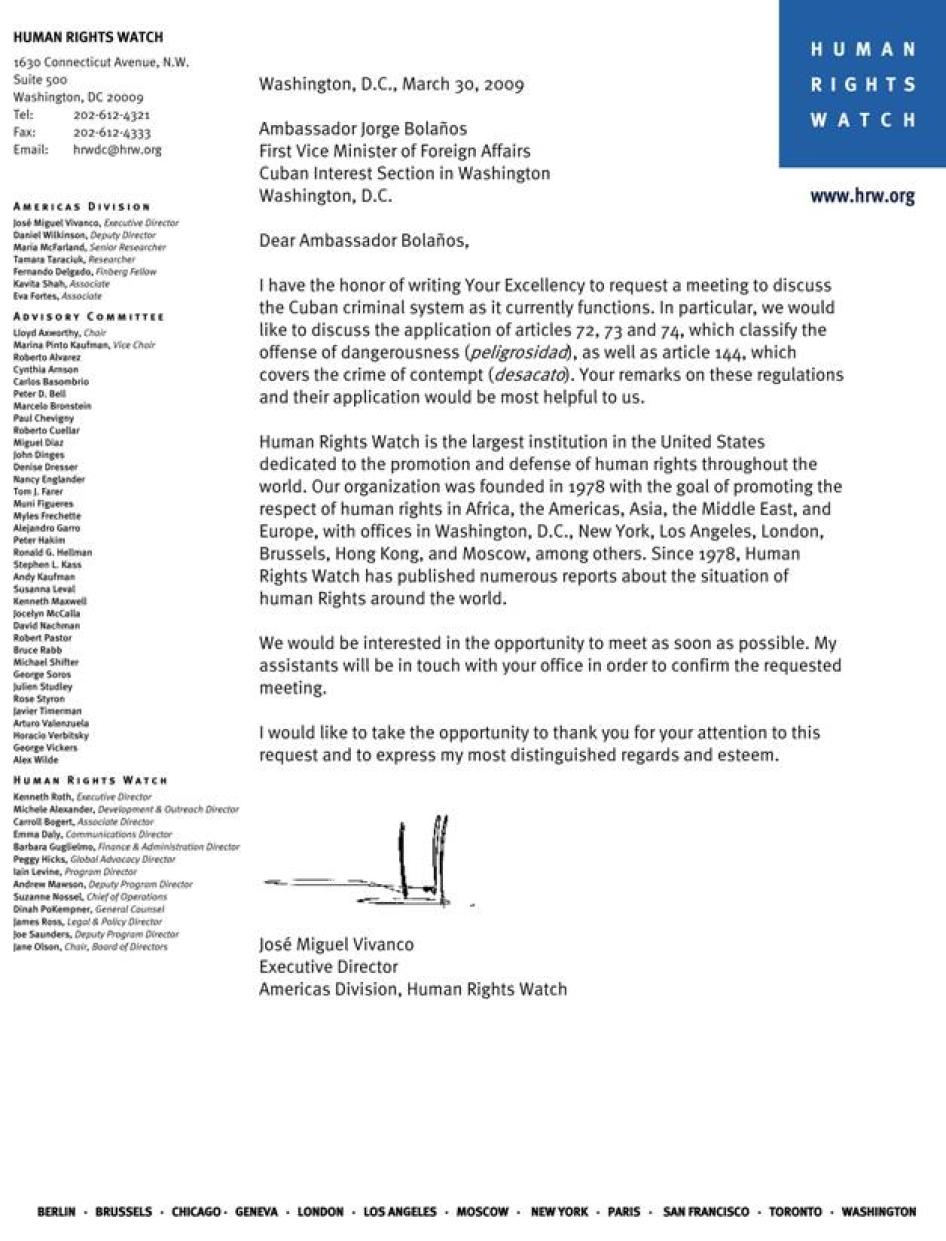
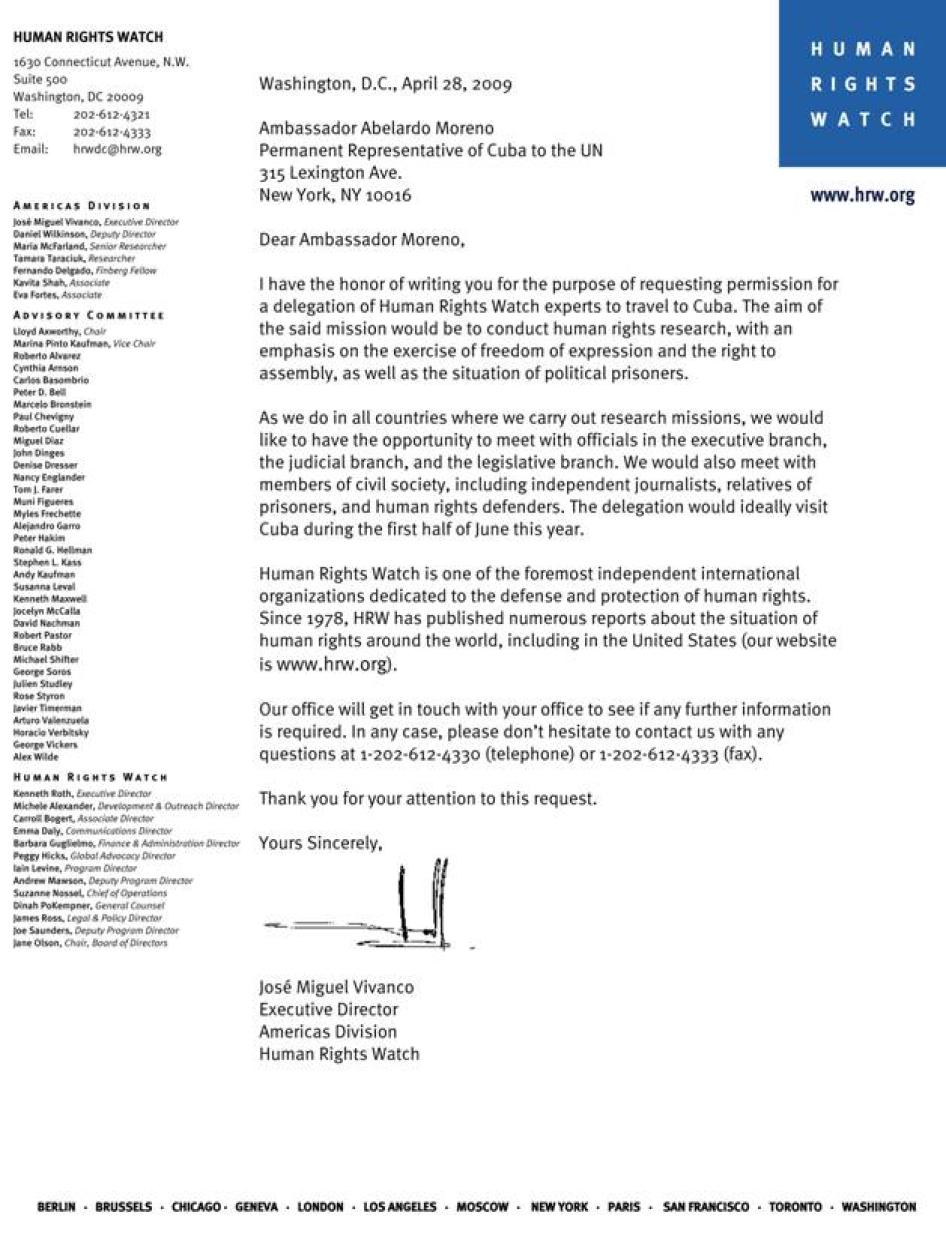
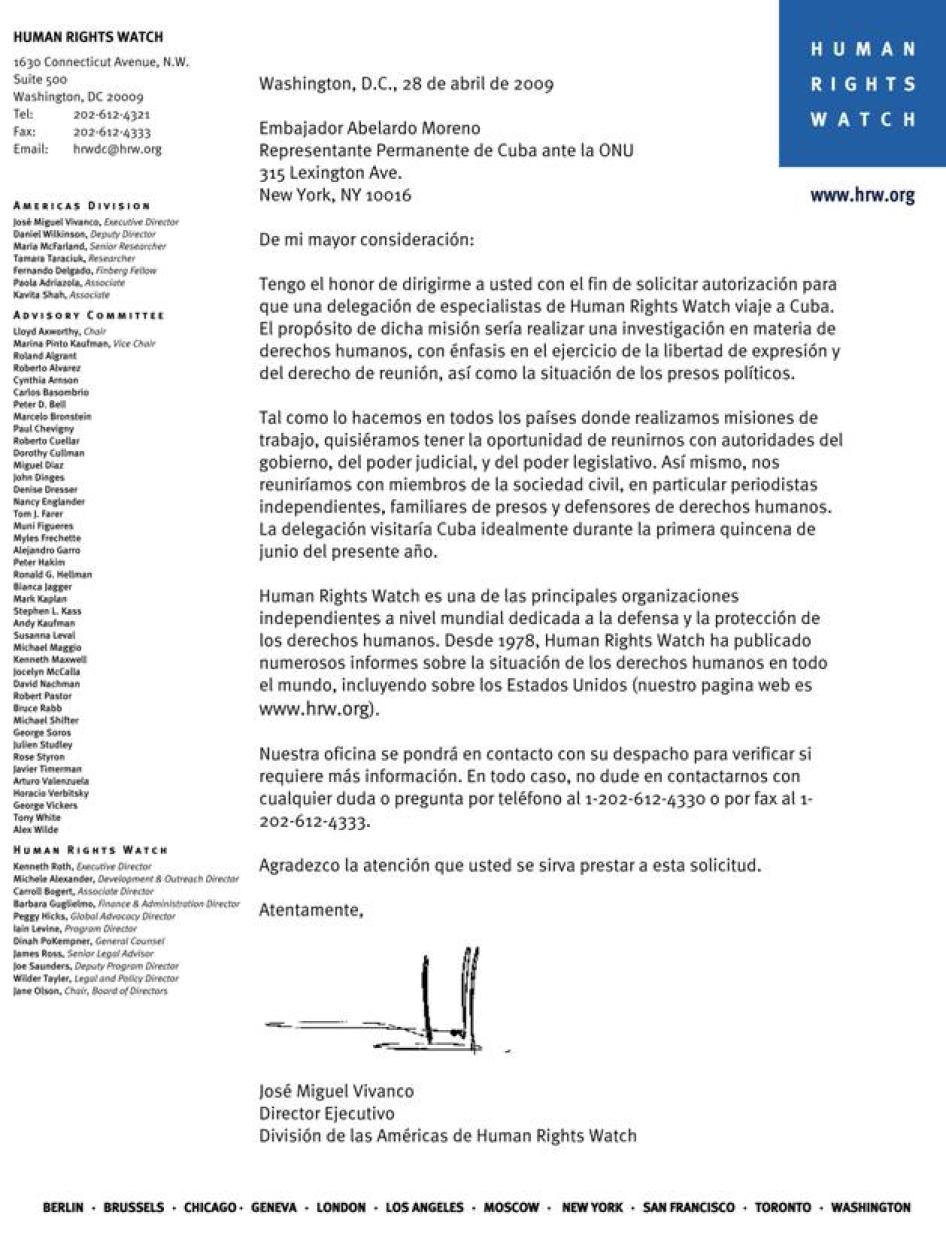
Appendix 3: The “Dangerousness” Law, Excerpt from the Cuban Criminal Code[380]
TITLE XI
THE STATE OF DANGEROUSNESS AND SECURITY MEASURES
Chapter 1
The State of Dangerousness
Article 72. A state of dangerousness is considered to be the special propensity of a person to commit crimes, as demonstrated by conduct observed in manifest contradiction to the norms of socialist morality.
Article 73.
1. The state of dangerousness is seen when any of the following hazardous indicators occur concurrently in the individual:
a) habitual drunkenness and dipsomania;
b) drug addiction;
c) antisocial behavior
2. A person is considered to be in a state of dangerousness due to antisocial behavior if the person routinely breaks the rules of social coexistence by committing acts of violence, or by other provocative acts, violates the rights of others or by his or her general behavior weakens the rules of coexistence or disturbs the order of the community or lives, like a social parasite, off the work of others or exploits or practices socially reprehensible vices.
Article 74. Mentally ill persons and persons of delayed mental development are also considered to be in a state of dangerousness, if, because of [their mental condition], they do not have the ability to comprehend the scope of their actions nor to control their conduct, provided that these represent a threat to the security of others or to the social order.
Chapter 2
The Official Warning
Article 75.
1. Anyone who, without falling under [the categories of] any of the states of dangerousness referred to in Article 73, by his or her ties or relations with persons who are potentially dangerous to society, to other individuals and to the social, economic and political order of the socialist state, may as a result develop a propensity to commit crime, will be given a warning by the competent police authority, to prevent the individual from pursuing socially dangerous or criminal activities.
2. The warning will be executed, in any case, by means of a written document that states the causes that establish the [state of dangerousness] and the information provided by the warned person, signed by the latter and by the acting [officer].
Chapter 3
Security Measures
FIRST SECTION: General Regulations
Article 76.
1. Security measures can be ordered to prevent the commission of crimes or as a result of their having been committed. In the first case they are called pre-criminal security measures; and in the second, post-criminal security measures.
2. Security measures are applied when the individual displays any of the dangerousness indicators referred to in Articles 73 and 74.
Article 77.
1. Post-criminal security measures, as a general rule, are applied after the termination of the imposed sanction.
2. If during the implementation of a security measure applied to a convicted person, a penalty of imprisonment is imposed on said person, the execution of the security measure will be suspended, to be renewed once the penalty has been served.
3. If, in the case mentioned in the previous section, the sanctioned person is conditionally released, the safety measure will be terminated on completion of probation as long as the probation has not been revoked.
SECOND SECTION: Pre-criminal Security Measures
Article 78. Once a person has been declared to be in a state of dangerousness by the corresponding process, the most adequate of the following pre-criminal security measures may be applied:
a) therapeutic;
b) re-educational;
c) oversight by the agencies of the National Revolutionary Police.
Article 79.
1. The therapeutic measures are:
a) internment in a welfare, psychiatric or detoxification institution;
b) appointment to specialized educational center, with or without internment;
c) outside medical treatment.
2. The therapeutic measures are applied to mentally ill persons and persons of delayed mental development in a state of dangerousness, to dipsomaniacs and to drug addicts.
3. The implementation of these measures shall last until the state of dangerousness disappears in the individual.
Article 80.
1. The re-educational measures are:
a) internment in a specialized institution for work or study;
b) surrender to a labor collective, for the control and orientation of the conduct of an individual in a state of dangerousness.
2. Re-educational measures are applied to antisocial individuals
3. The term of these measures is at least one year and at most four years.
Article 81.
1. The monitoring by agencies of the National Revolutionary Police consists of orientation and control of the conduct of an individual in a state of dangerousness by officials of these agencies.
2. This measure is applicable to dipsomaniacs, drug addicts and antisocial individuals.
3. The term of these measures is at least one year and at most four years.
Article 82. The court may impose the appropriate type of pre-criminal security measure according to its respective degree, and will establish its extension within the set limits of each case, choosing those which are of detentive or not detentive character, depending on the severity of the individual’s state of dangerousness and the possibilities for his or her rehabilitation.
Article 83. The court, at any time during the execution of the pre-criminal security measure may change its category or duration, or suspend it at the request of the agency in charge of its implementation or by the court’s discretion. In the latter case, the court will ask for the executing agency’s report.
Article 84. The court will inform the prevention agencies of the National Revolutionary Police of the decided pre-criminal security measures which should be carried out under conditional liberty, for the purposes of their execution.
[1] This account is based on Human Rights Watch telephone interviews with Ramon Velásquez Toranzo’s wife, Bárbara González Cruz, in Cuba, on March 3 and April 23, 2009; and Human Rights Watch telephone interviews with Ramon Velásquez Toranzo’s daughter, Rufina Velásquez González, in Miami, on April 28 and May 14, 2009.
[2] This account is based on a Human Rights Watch telephone interview with Alexander Santos Hernandez, Cuba, March 16, 2009.
[3]This account is based on Human Rights Watch telephone interview with “Hilda Galán” on February 24, 2009, regarding the case of her husband, political prisoner “Jorge Barrera Alonso.” Galán asked that her name and her husband’s be changed to avoid reprisals while her husband is still in prison.
[4] Ibid.
[5] Ibid.
[6] Ibid.
[7] This account is based on Human Rights Watch telephone interviews with Juan Luís Rodríguez Desdín on March 16 and 19, 2009.
[8] “Report on the Human Rights Situation in Cuba, August 2009,” post to “Council of Human Rights Reporters of Cuba” (Consejo de Relatores de Derechos Humanos de Cuba), (blog), September 8, 2009, http://derechoshumanoscuba.blogspot.com/2009/10/informe-agosto-de-2009.html (accessed September 10, 2009).
[9]Universal Declaration of Human Rights (UDHR), adopted December 10, 1948, G.A. Res. 217A(III), UN Doc. A/810 at 71 (1948), art. 29(2).
[10] The Johannesburg Principles on National Security, Freedom of Expression and Access to Information (Johannesburg Principles), E/CN.4/1996/39(1996), Principles 2(a), 7(a)i, 7(a)ii, and 7(a)iv. An authoritative set of guidelines regarding permissible limitations which may be placed on freedom of expression, adopted in 1996—were drafted by an international team of legal scholars, diplomats, and United Nations human rights specialists meeting in Johannesburg.
The Johannesburg Principles also distinguish between legitimate and illegitimate invocations of national security interests. Legitimate reasons to invoke national security interests are to: “protect a country’s existence or its territorial integrity against the use or threat of force, or its capacity to respond to the threat or use of force, whether from an external source, such as a military threat, or an internal source, such as incitement to violent overthrow of the government.” In contrast, illegitimate justifications for invoking national security interests include acting to: “protect the government from embarrassment or exposure of wrongdoing, or to entrench a particular ideology, or to conceal information about the functioning of its public institutions, or to suppress industrial action.”
[11]Código Penal (Criminal Code), Asamblea Nacional del Poder Popular, No. 62, 2001, http://www.gacetaoficial.cu/html/codigo_penal.html (accessed January 12, 2009), art. 144. The National Assembly is Cuba’s highest legislative body, while the Council of State is its highest executive body. The structure of the Cuban government is discussed in greater detail in the section Denying Judicial Protection.
[12] Ibid.
[13] Insult laws are “a class of legislation that criminalizes expression which offends, insults, or threatens a public functionary in the performance of his or her official duties.” Inter-American Commission on Human Rights (IACHR), “Report on the Compatibility of Desacato Laws with the American Convention on Human Rights,” Annual Report of the Inter-American Commission on Human Rights 1994, OEA/Ser/.L/V/11.88, 1995, http://www.cidh.org/annualrep/94eng/chap.5.htm (accessed September 15, 2009). The offense does not necessarily involve a false assertion; for this reason proving its truth is generally no defense. Moreover, it is usually classified not only as a detriment to the honor of the public official in question but also to his or her office. By extension it is often considered an offense against public order.
[14] The commission wrote, “[t]he special protection desacato laws afford public functionaries from insulting or offensive language is not congruent with the objective of a democratic society to foster public debate.” It also noted that in democratic societies, political and public figures must be more, not less, open to public scrutiny and criticism. “Since these persons are at the center of public debate, they knowingly expose themselves to public scrutiny and thus must display a greater degree of tolerance for criticism.” IACHR, Report on the Compatibility of Desacato Laws, 1994.
More recently, in Palamara Iribarne v. Chile (2005), the Inter-American Court of Human Rights held that “in the case of public officials, individuals who perform public services, politicians, and government institutions a different threshold of protection should be applied, which is not based on the specific individual, but on the fact that the activities or conduct of a certain individual is of public interest.” Inter-American Court, Palamara Iribarne Case, Judgment of November 22, 2005, Inter-Am Ct. H.R. (Ser. C) No. 35 (2005), http://www.corteidh.or.cr/docs/casos/articulos/seriec_135_ing.pdf (accessed September 15, 2009), para. 88.
[15] European Court of Human Rights, Castells v. Spain, Judgment of 23 April, 1992, Series A no. 236, p. 22, available at www.echr.coe.int, para. 42.
[16] “Joint declaration issued by Abid Hussain, UN Special Rapporteur on Freedom of Opinion and Expression; Freimut Duve, OSCE Representative on Freedom of the Media; and Santiago Cantón, OAS Special Rapporteur on Freedom of Expression,” United Nations press release, December 1, 2000, http://www.unhchr.ch/huricane/huricane.nsf/view01/EFE58839B169CC09C12569AB002D02C0?opendocument (accessed September 15, 2009).
[17] Criminal Code, art. 147.
[18] Criminal Code, art. 143.
[19] Criminal Code, art. 142.
[20] UN Committee against Torture (CAT), “Report of the Committee against Torture: Conclusions and Recommendations, Cuba,” CAT/C/SR.314, March 27, 1998, Section D, para. 4.
[21] Ley de protección de la independencia nacional y la economía de Cuba (The Law for the Protection of Cuban National Independence and the Economy), Gaceta Oficial de la República de Cuba, No. 88, 1999, http://www.cubavsbloqueo.cu/Default.aspx?tabid=248 (accessed March 13, 2009) (“National Protection Law”).
[22] Cuban Liberty and Democratic Solidarity (LIBERTAD) Act of 1996, 104thCongress of the United States, Public Law 104-114, http://frwebgate.access.gpo.gov/cgi-bin/getdoc.cgi?dbname=104_cong_public_laws&docid=f:publ114.104.pdf (accessed March 14, 2009).
[23] The National Protection Law, art. 1.
[24] “Anyone who, in the interest of a foreign state, commits an act with the aim of undermining the independence of the Cuban state or the integrity of its territory shall be punished by imprisonment of ten to twenty years or death” (“El que, en interés de un Estado extranjero, ejecute un hecho con el objeto de que sufra detrimento la independencia del Estado cubano o la integridad de su territorio, incurre en sanción de privación de libertad de diez a veinte años o muerte”). Criminal Code, art. 91.
[25] The National Protection Law, Preamble.
[26] The National Protection Law, art. 6(1).
[27] The National Protection Law, arts. 4(1) and 4(2).
[28] The National Protection Law, arts. 9(1) and 9(2).
[29] Constitución de la República de Cuba (Cuban constitution), 2002, http://www.gacetaoficial.cu/html/constitucion_de_la_republica.html (accessed January 11, 2009), art. 54.
[30] Ley de Asociaciones (Associations Law), Asamblea Nacional del Poder Popular, No. 54, 1985, http://www.asanac.gov.cu/espanol/leyes/Ley%20N%BA%2054%20Asociaciones.html, arts. 8(c), 8(ch), 8(d).
[31] Reglamento de la Ley de Asociaciones (Regulations for the Associations Law), Asamblea Nacional del Poder Popular, No. 56, 1986, art. 79(b).
[32] Criminal Code, arts. 208 and 209.
[33] This law is not to be confused with the offenses of conspiracy or attempt under which a person can be arrested and prosecuted before a crime has been committed or completed, but where a decision to commit a specific crime has been reached. Conspiracy is when a person has made an agreement with at least one other person to commit a specific criminal offense. Generally, in law, to prove conspiracy it is necessary to show that such an agreement—formal or informal—exists, and that at least one overt act in the furtherance of the agreed crime has taken place. Attempt is when a person, either alone or with others, makes a substantial but unsuccessful effort to commit a crime. Generally, in law, to prove attempt there must be intent to commit the crime, an overt act beyond mere preparation, and an apparent ability to complete the crime.
[34] This does not include cases of legitimate pre-trial detention of persons held on criminal charges, provided for in international law.
[35] Criminal Code, art. 72.
[36] Criminal Code, art. 73(1).
[37]The United Kingdom and Ireland also have legislation which renders “anti-social behavior” subject to sanction by way of a civil order from a court. See the UK Anti-social Behaviour Act of 2003 and Irish Criminal Justice Act of 2006, parts 11 and 13. Anti-social Behaviour Bill, The House of Commons of the United Kingdom, 2003, http://www.publications.parliament.uk/pa/cm200203/cmbills/083/2003083.pdf (accessed September 5, 2009); Criminal Justice Act of 2006, The Houses of the Oireachtas of Ireland, No. 26 of 2006, http://www.oireachtas.ie/documents/bills28/acts/2006/A2606.pdf (accessed September 5, 2009), parts 11 and 13.
Anti-social behavior is generally defined as that which causes harassment, significant or persistent alarm, distress, fear, or intimidation to someone who is not from the same household as the offender. The order directs the offender not to engage in specific conduct such as vandalism or begging, and failure to comply with the order may result in a fine or detention. While these anti-social behavior orders are civil not criminal measures and are subject to specific conditions, they have still been very controversial and widely criticized by human rights organizations and bodies. Council of Europe: Commissioner for Human Rights, “Report by Mr. Alvaro Gil-Robles on his visit to the United Kingdom, 4th November to 12th November 2004,” CommDH(2005) 6, Strasbourg, June 8, 2005, paras. 108 - 120; Council of Europe: Commissioner for Human Rights,” Memorandum by Mr. Thomas Hammarberg, Council of Europe Commissioner for Human Rights, following his visits to the United Kingdom 5-8 February and 31 March-2 April 2009,” CommDH (2008) 27, Strasbourg, October 17, 2008, paras. 29 - 30; United Nations Human Rights Committee, Concluding Observations on the United Kingdom, CCPR/C/GBR/CO/6, July 30, 2008, para. 20.; United Nations Committee on the Rights of the Child, Concluding Observations on the United Kingdom, CRC/C/GBR/CO/4, October 4, 2008 para. 79 – 80.
[38] Criminal Code, art. 73(2).
[39] Criminal Code, art. 80.
[40] Criminal Code, art. 80(1).
[41] Criminal Code, art. 81(3).
[42] Criminal Code, arts. 80 and 81.
[43] “Summarily” is defined by 12 provisions laid out in article 415. Ley de Procedimiento Penal (Criminal Procedural Law), Gaceta Oficial de la República de Cuba, No. 5, 1977, art. 415.
[44] Criminal Code, art. 82.
[45] This modification can be made according to the court’s discretion (de oficio) or at the request of the “agency in charge of its execution” (organo encargado de su ejecución). Criminal Code, art. 83(1).
[46] Criminal Code, art. 75(1).
[47] Criminal Code, art. 75(2).
[48] Criminal Code, art. 75(1).
[49] The legal maxim, nulla poena sine lege (no penalty without a law), is the basis for requiring clarity in the law.
[50] Inter-American Court, Castillo Petruzzi et al. Case, Judgment of May 30, 1999, Inter-Am. Ct. H.R., (Ser. C) No. 52 (1999), http://www.corteidh.or.cr/docs/casos/articulos/seriec_52_esp.pdf (accessed September 15, 2009), para. 121.
[51] The doctrine and rationale were set out by the Inter-American Court in a case against Peru, when it explained, “crimes must be classified and described in precise and unambiguous language that narrowly defines the punishable offense.” Inter-American Court, Castillo Petruzzi et al. Case, Judgment of May 30, 1999, Inter-Am. Ct. H.R., (Ser. C) No. 52 (1999), http://www.corteidh.or.cr/docs/casos/articulos/seriec_52_esp.pdf (accessed August 20, 2009), para. 121.
The requirement of “clarity” of the law is to be found in two aspects of human rights law. Firstly, it is required when defining proscribed criminal behavior in penal statutes –a doctrine often referred to as the “void for vagueness” doctrine enshrined in article 15 of the ICCPR and article 9 of the ACHR. And secondly, it is required in the limitations on the enjoyment of certain fundamental rights, which must be prescribed by, established by, or in accordance with “law” (such as those enshrined in articles 17 – 22 of the ICCPR or articles 12 – 13, 15 – 17 of the ACHR). Manfred Nowak, UN Covenant on Civil and Political Rights: CCPR Commentary, 2nd rev. ed,. (Kehl am Rhein: Engel, 2005), p.361.
[52] Parts of this section are drawn from Human Rights Watch, Cuba’s Repressive Machinery (New York: Human Rights Watch, 1999), http://www.hrw.org/legacy/reports/1999/cuba/ pp. 27-68. The legal and institutional underpinnings of Cuba’s repression have changed little since publication of that report.
[53] Cuban constitution, art. 9A.
[54] Ibid., art. 53.
[55] Ibid., art. 59.
[56] Ibid., art. 54.
[57] Ibid., art. 55.
[58] Ibid., art. 62.
[59] Ibid., art. 5.
[60] Ibid., art. 62.
[61] Ibid., art. 3.
[62] Ibid., art. 53.
[63] Ibid.
[64] Ibid., art. 26.
[65] Ibid., art. 59.
[66] Ibid., art. 64.
[67] Ibid., art. 122.
[68]Ibid., art. 121.
[69]Ley de los tribunales populares (Law of the Popular Tribunals), Gaceta Oficial de la República de Cuba, No. 82, 1997, http://www.gacetaoficial.cu/html/tribunalespopulares.html (accessed April 7, 2009), art. 5 (“Law 82”).
[70] According to the Cuban constitution, the Attorney General is “the body of the State concerned with control and preservation of legality as fundamental objectives.” Cuban constitution, art. 75 (m) and (n); Criminal Procedural Law, art. 45.
[71] Cuban constitution, art. 130.
[72] Ibid., art. 129.
[73] The Cuban government lists 171 municipal courts, one for each municipality; and 15 provincial courts for the 14 provinces and la Isla de Juventud. Ibid., art. 105(h); Supreme Court, (Tribunal Supremo Popular), mapa de los Tribunales Provinciales Populares, http://www.tsp.cu/Archivos/Principal_TPP.asp (accessed September 22, 2009); Supreme Court, (Tribunal Supremo Popular), “Tribunales Municipales Populares,” http://www.tsp.cu/Archivos/tribunales_municipales.asp (accessed September 22, 2009).
[74] Cuban constitution, arts. 128 and 129. See also Law 82, art. 46.
[75] The exact number of delegates is determined by the size and proportional distribution of the Cuban population. Cuban constitution, art. 135.
[76] Ibid.
[77] Ibid., art. 133.
[78]Jorge I. Domínguez, “Government and Politics,” in Cuba: A Country Study , ed. Rex A. Hudson (Washington: US Government Printing Office, 2002), http://www.people.fas.harvard.edu/~jidoming/images/jid_government.pdf (accessed September 22, 2009), p. 234.
[79] Ibid., 234. Other organizations include: Cuban Workers Federation (CTC), Federation of Cuban Women (FMC), Committee for the Defense of the Revolution (CDR), National Association of Small Farmers (ANAP), Federation of University Students, and Federation of Secondary School Students (FEEM).
[80] Cuban constitution, art. 89.
[81] Ibid. The National Assembly only meets for two or three sessions of a few days each year.
[82] Cuban constitution, art. 75(n).
[83] Domínguez, “Government and Politics,” p. 235; Cuban constitution, art. 90.
[84] Law 82, arts. 35 and 38.
[85] Law 82, art. 49.
[86] Law 82, art. 43.
[87] “The judiciary shall decide matters before them impartially, on the basis of facts and in accordance with the law, without any restrictions, improper influences, inducements, pressures, threats, or interferences, direct or indirect, from any quarter or for any reason.” Basic Principles on the Independence of the Judiciary, adopted by the Seventh United Nations Congress on the Prevention of Crime and the Treatment of Offenders, Milan, 26 August to 6 September 1985, U.N. Doc. A/CONF. 121/22/Rev. 1 at 59 (1985), art. 2.
[88] IACHR, “Report on the Situation of Human Rights in Venezuela,” OEA/Ser.L/V/II.118, December 29, 2003, http://www.cidh.org/countryrep/venezuela2003eng/toc.htm (accessed September 3, 2009), paras. 150-151.
[89] The American Convention on Human Rights provides that: “Every person has the right to a hearing, with due guarantees and within a reasonable time, by a competent, independent, and impartial tribunal, previously established by law, in the substantiation of any accusation of a criminal nature made against him or for the determination of his rights and obligations of (. . .) any other nature” (emphasis added). American Convention on Human Rights (“Pact of San José, Costa Rica”), adopted November 22, 1969, O.A.S. Treaty Series No. 36, 1144 U.N.T.S. 123, entered into force July 18, 1978.
The International Covenant on Civil and Political Rights (ICCPR) also imposes an obligation to guarantee the independence of the judiciary in article 14 (1): “All persons shall be equal before the courts and tribunals. In the determination of any criminal charge against him, or of his rights and obligations in a suit at law, everyone shall be entitled to a fair and public hearing by a competent, independent and impartial tribunal established by law…” (emphasis added). International Covenant on Civil and Political Rights, adopted December 16, 1966, General Assembly Resolution 2200 A (XXI), entered into force March 23, 1976, signed by Cuba on February 28, 2008.
[90] ICCPR, art. 14 (1).
[91] UN Human Rights Committee, Decision: Bahamonde v. Equatorial Guinea, Communication No. 468/1991, October 20, 1993, CCPR/C/49/D/468/1991, para. 9.4.
[92] UN Human Rights Committee, Decision: Karttunen v. Finland, Communication No. 387/1989, October 23, 1992, CCPR/C/46/D/387/1989, para. 7.2.
[93] Basic Principles on the Independence of the Judiciary, adopted by the Seventh United Nations Congress on the Prevention of Crime and the Treatment of Offenders, Milan, 26 August to 6 September 1985, U.N. Doc. A/CONF. 121/22/Rev.1 at 59 (1985), arts, 2, 10, and 11.
[94]UN Human Rights Council, Report of the Personal Representative of the High Commissioner for Human Rights, Christine Chanet, on the Situation of Human Rights in Cuba, A/HRC/4/12, June 12, 2007.
[95] UN Human Rights Council, Working Group on the Universal Periodic Review, “Compilation Prepared by the Office of the High Commissioner for Human Rights [on Government of Cuba],” A/HRC/WG.6/4/CUB/2, December 18, 2008.
[96] In its 2008 report to the UN’s Universal Periodic Review, Cuba stated, “Chapter VII of the Constitution, on ‘Fundamental rights, duties and guarantees,’ basically sets forth the principles and guarantees of human rights and fundamental freedoms, which are in line with the rights contained in the Universal Declaration of Human Rights and the other international human rights instruments. These are complemented by other chapters of the Constitution and the provisions of ordinary law.” Government of Cuba, Periodic Report to the Universal Periodic Review of the Human Rights Council, A/HRC/WG.6/4/CUB/1, November 4, 2008.
[97] The key international human rights and labor agreements ratified by Cuba include the Convention against Torture and Other Cruel, Inhuman or Degrading Treatment or Punishment, ratified in May 1995; the Convention on the Rights of the Child (CRC), ratified in August 1991; the Convention on the Elimination of All Forms of Racial Discrimination (CERD); the Convention on the Elimination of All Forms of Discrimination against Women (CEDAW), ratified in June 1980; and various International Labor Organization conventions, including Convention 87, the Freedom of Association and Protection of the Right to Organize, ratified in June 1952; Convention 98, the Right to Organize and Collective Bargaining Convention, ratified April 1952; Convention 105, the Abolition of Forced Labour Convention, ratified June 1958; and Convention 141, the Rural Workers' Organizations, ratified in April 1977.
[98]By signing, a country “has expressed its consent to be bound by the treaty, pending the entry into force of the treaty and provided that such entry into force is not unduly delayed.” Vienna Convention on the Law of Treaties, concluded May 23, 1969, UN Doc. A/CONF.39/28, 1155 UNT.S. 331 (entered into force Jan. 27, 1980), art. 18.
In February 2009, Cuba’s Minister of Justice affirmed Cuba’s commitment to complying with the ICCPR and ICESCR, stating before the UN Working Group on the Universal Periodic Review that: “We signed the international covenants on human rights as a demonstration of our will and commitment to the postulates of both of these instruments.”
[99] Government of Cuba, “Cuba is complying with the precepts of the International Standard Minimum Rules for the Treatment of Prisoners,” Statement by the Minister of Justice of the Republic of Cuba, María Esther Reus, Presentation of the National Report to the Human Rights Council, Geneva, February 5, 2009, http://america.cubaminrex.cu/DiscursosIntervenciones/Articulos/Otros/2009/2009-02-06-Ruas_ING.html (accessed April 19, 2009).
[100] Americas Watch (now Human Rights Watch/Americas), Cuba: Attacks Against Independent Associations March 1990- February 1991 (New York: Human Rights Watch, 1991), http://www.hrw.org/en/reports/1991/02/25/cuba; Human Rights Watch, Cuba’s Repressive Machinery: Human Rights Forty Years After the Revolution (New York: Human Rights Watch, 1999), http://www.hrw.org/en/reports/1999/06/01/cubas-repressive-machinery; Human Rights Watch, Families Torn Apart: The High Cost of US and Cuban Travel Restrictions, vol. 17, no. 5 (B), October 2005, http://www.hrw.org/en/reports/2005/10/18/families-torn-apart.
[101] “Cuba: One Year After the Crackdown,” Human Rights Watch news release, March 17, 2004, http://www.hrw.org/en/news/2004/03/17/cuba-one-year-after-crackdown.
[102] For a complete list of sentencing documents, see Rule of Law in Cuba, “Sentencing Documents,” http://www.ruleoflawandcuba.fsu.edu/documents.cfm (accessed October 16, 2009).
[103] The National Protection Law, art. 1.
[104] The Honorable John R. Bolton, “Beyond the Axis of Evil: Additional Threats from Weapons of Mass Destruction,” lecture at The Heritage Foundation, May 6, 2002, http://www.heritage.org/research/publicdiplomacy/hl743.cfm (accessed August 3, 2009). A later assessment by the Bush Admin in September 2004 concluded that “it is no longer clear that Cuba has an active, offensive bio-weapons program.” Steven R. Weisman, “In Stricter Study, US Scales Back Claim on Cuba Arms,” The New York Times, September 18, 2004, http://www.nytimes.com/2004/09/18/international/americas/18intel.html?_r=2 (accessed August 3, 2009).
[105] “Given the goals of rogue states and terrorists, the United States can no longer solely rely on a reactive posture as we have in the past. The inability to deter a potential attacker, the immediacy of today’s threats, and the magnitude of potential harm that could be caused by our adversaries’ choice of weapons, do not permit that option. We cannot let our enemies strike first.” The National Security Strategy of the United States of America, September 2002, http://georgewbush-whitehouse.archives.gov/nsc/nss/2002/ (accessed September 2, 2009). For further analysis of the 2002 US national security strategy,: Memorandum from Ivo H. Daalder, senior fellow, Council on Foreign Relations, “Policy Implications of the Bush Doctrine on Preemption,”to Members of the CFR/ASIL Roundtable on Old Rules/New Threats, November 16, 2002, http://www.cfr.org/publication.html?id=5251 (accessed August 14, 2009).
[106] Government of the United States, Statement by Secretary of State Colin Powell to the UN Security Council on the US Case Against Iraq, February 6, 2003, transcript by CNN, http://www.cnn.com/2003/US/02/05/sprj.irq.powell.transcript/ (accessed March 3, 2009).
[107] The US Interests Section is the highest US office in Cuba. The United States does not have an embassy in Cuba. Cuba also maintains a Cuban Interests Section in Washington, D.C.
[108] Daniel P. Erikson, The Cuba Wars: Fidel Castro, the United States, and the Next Revolution (New York: Bloomsbury Press, 2008), pp. 41-43.
[109] Oswaldo Payá, Proyecto Varela (Varela Project), http://www.oswaldopaya.org/es/proyecto-varela/ (accessed June 22, 2009).
[110] Cuban constitution, art. 88(g).
[111] According to the constitution, the referendum “expressly set forth the irrevocable character of socialism and of the revolutionary political and social system set out by [the constitution]” (“dejar expresamente consignado el carácter irrevocable del socialismo y del sistema político y social revolucionario por ella diseñado”). Cuban constitution, Note.
[112] Daniel Schweimler, “Cuba votes to entrench socialism,” BBC News, June 19, 2002, http://news.bbc.co.uk/2/hi/americas/2053060.stm (accessed February 28, 2009).
[113] Felipe Pérez Roque, Foreign Minister of the Republic of Cuba, “Press Conference on the mercenaries at the service of the empire who stood trial on April 3,4,5 and 7, 2003,” Havana, April 9, 2003, http://www.granma.cu/documento/ingles03/012.html and http://www.cubaminrex.cu/Archivo/Canciller/2003/FPR_conferencia%20sobre%20mercenarios%20090403.htm (accessed February 28, 2009).
[114] Criminal Code, art. 91.
[115] Felipe Pérez Roque , Press Conference, para. 1.
[116] USAID, “USAID Grants to Promote Transition in Cuba – 2003 Report,” http://www.usaid.gov/regions/lac/cu/upd-cub.htm (link no longer functional, available at http://www.ciponline.org/cuba/humanrights/USfunding.htm#usaid) (accessed March 1, 2009).
[117] Sentence 6/2003, Tribunal Provincial Popular de Ciudad de la Habana (People's Provincial Court of Havana), Case No. 11/2003, Judgment, 6 April 2003, http://www.ruleoflawandcuba.fsu.edu/documents-havana-6s.cfm.
[118] United Nations Declaration on the Right and Responsibility of Individuals, Groups and Organs of Society to Promote and Protect Universally Recognized Human Rights and Fundamental Freedoms, adopted December 9, 1998, G.A. res. 53/144, annex, 53 UN GAOR Supp., UN Doc. A/RES/53/144 (1999), http://www.unhchr.ch/huridocda/huridoca.nsf/(Symbol)/A.RES.53.144.En (accessed June 19, 2009).
[119] IACHR, Report No. 67/06, October 21, 2006, http://www.cidh.org/annualrep/2006eng/CUBA.12476eng.htm (accessed April 2, 2009).
[120] UN Working Group on Arbitrary Detention, Decision: Nelson Aguiar Ramírez et. al. v. Cuba, UN Doc. E/CN.4/2004/3/Add.1 at 47, 2003, http://humanrights.law.monash.edu.au/wgad/9-2003.html (accessed August 7, 2009).
[121] Ibid., para. 25.
[122] UN Commission on Human Rights, “Situation on Human Rights in Cuba,” Resolution 2004/11, E/CN.4/RES/2004/11, http://ap.ohchr.org/documents/sdpage_e.aspx?b=1&c=47&t=11.
[123]”The Council urges the Cuban Government to release unconditionally all political prisoners, including those who were detained and sentenced in 2003.” European Union Council (EU Council), “EU Council Conclusions on the EU Common Position on Cuba,” CL09-141EN, June 15, 2009, http://www.eu-un.europa.eu/articles/fr/article_8787_fr.htm (accessed September 17, 2009), para. 4.
[124] Sentence 1/2003, Tribunal Provincial Popular de Pinar del Río (People’s Provincial Court of Pinar del Río), Case No. 2/2003, Judgment, 5 April 2003, http://www.ruleoflawandcuba.fsu.edu/documents-pinar-del-rio-1s.cfm.
[125] Sentence 7/2003, Tribunal Provincial Popular de Ciudad de la Habana (People’s Provincial Court of Havana), Case No. 12/2003, Judgment, 4 April 2003, http://www.ruleoflawandcuba.fsu.edu/documents-havana-7s.cfm.
[126] Inter-American Commission on Human Rights, Oscar Elias Biscet et al. Case 12.476, Report No. 67/06, Inter-Am. C.H.R., OEA/Ser.L/V/II.127 Doc. 4 rev. 1 (2007), October 21, 2006, paras. 54 and 67 respectively.
[127] Sentence 6/2003, Tribunal Provincial Popular de Ciudad de la Habana (People’s Provincial Court of Havana).
[128] Ibid.
[129] Sentence 1/2003, Tribunal Provincial Popular de Pinar del Río (People’s Provincial Court of Pinar del Río).
[130] Ibid.
[131] Inter-American Commission on Human Rights, Oscar Elias Biscet et al. Case 12.476, Report No. 67/06, Inter-Am. C.H.R., OEA/Ser.L/V/II.127 Doc. 4 rev. 1 (2007), October 21, 2006,,para. 120.
[132] Sentence 1/2003, Tribunal Provincial Popular de Camagüey (People’s Provincial Court of Camagüey), Case No. 2/2003, Judgment, 4 April 2003, http://www.ruleoflawandcuba.fsu.edu/documents-camaguey-1s.cfm.
[133] Ibid.
[134] Human Rights Watch telephone interview with Rebeca Rodríguez Souto, wife of Pulido, Cuba, February 10, 2009.
[135] Sentence 7/2003, Tribunal Provincial Popular de Ciudad de la Habana (People’s Provincial Court of Havana), Case No. 12/2003, Judgment, 4 April 2003, http://www.ruleoflawandcuba.fsu.edu/documents-havana-7s.cfm.
[136] Ibid.
[137]Sentence 3/2003, Tribunal Provincial Popular de Villa Clara (People's Provincial Court of Villa Clara), Case No. 1/2003,Judgment, 7 April 2003 (case 1/2003), as cited in http://www.amnesty.org/en/library/asset/AMR25/017/2003/en/47840d82-d6f9-11dd-b0cc-1f0860013475/amr250172003en.html.
[138] Inter-American Commission on Human Rights, Oscar Elias Biscet et al. Case 12.476, Report No. 67/06, Inter-Am. C.H.R., OEA/Ser.L/V/II.127 Doc. 4 rev. 1 (2007), October 21, 2006,para. 78.
[139] Sentence 8/2003, Tribunal Provincial Popular de Ciudad de la Habana (People’s Provincial Court of Havana), Case No. 16/2003, Judgment, 5 April 2003, http://www.ruleoflawandcuba.fsu.edu/documents-havana-8s.cfm.
[140] Sentence 9/2003, Tribunal Provincial Popular de Matanzas (People’s Provincial Court of Matanzas), Case No. 7/2003, Judgment, 5 April 2003, http://www.ruleoflawandcuba.fsu.edu/documents-matanzas-9s.cfm.
[141] Human Rights Watch telephone interviews with Miguel Sigler Amaya, Miami, United States, February 11, 2009; and Juan Francisco Sigler Amaya, Cuba, February 12 and 20, 2009. Miguel Sigler Amaya and Juan Francisco Sigler Amaya are the brothers of Ariel Sigler Amaya and Guido Sigler Amaya.
[142] Nereyas Figueredo Ricardo, fiscal municipal de Banes. “Expediente de índice de peligrosidad no. 1 de 2008, estación de la Policía Revolucionario Nacional de Banes.” January 17, 2008. Indictment of Digzan Saavedra Prat.
[143] Human Rights Watch interview with Digzan Saavedra Prat, Cuba, March 17, 2009.,
[144] Criminal Code, art. 73(2).
[145]Joint Resolution No. 1 of the Ministry of Labor and Social Security and the Ministry of Finances and Prices, which led to the development of Legislative Decree No. 141, dated Sept. 8, 1993 and passed in June 1996. As cited in Jesús R. Mercader Uguina, Reality of Labor in Cuba and the Social Responsibility of Foreign Investors (Valencia: Tirant Lo Blanch, 2006), p. 106.
[146] Human Rights Watch interview with “Gerardo Domínguez,” Cuba, July 2009. Domínguez’ name has been changed for his protection.
[147] “Cuba’s economy: Ill winds,” The Economist, December 30, 2008, http://www.economist.com/world/americas/displaystory.cfm?story_id=12851246 (accessed September 17, 2009); BBC Caribbean News in Brief, “2008 Cuba’s worst hurricane season,” BBC News, November 14, 2008, http://www.bbc.co.uk/caribbean/news/story/2008/11/081114_newsbriefspm.shtml (accessed September 17, 2009).
[148] Marc Frank, “Cubans face hardship under new austerity measures,” Reuters, June 1, 2009, http://www.reuters.com/article/worldNews/idUSN0140188020090601 (accessed July 17, 2009).
[149] Human Rights Watch interview with “Gerardo Domínguez,” Cuba, July 2009.
[150]Human Rights Watch interview with “Michel Labrada,” Cuba, June 2009. Labrada asked that his name be changed for his protection.
[151]Human Rights Watch telephone interview with Ana Margarita Perdigón Brito, Cuba, June 8, 2009. “Luis Acosta’s” name has been changed for his protection.
[152] Human Rights Watch telephone interview with Gabriel Díaz Sánchez, Cuba, February 25, 2009.
[153] Human Rights Watch telephone interview with Enyor Díaz Allen, Cuba, March 14, 2009.
[154] The Cuban government created “committees for the defense of the revolution” (comités de defensa de la revolución) in 1960, according to Fidel Castro, to “serve in defense of the Revolution”; to assist in “the shaping of a political and revolutionary conscience in the broad masses”; and “in the constant mobilization of the masses,” among other functions. “Discurso Pronunicado por Fidel Castro Ruz, Presidente de la República de Cuba, en el Acto Central Nacional por el Vigesimo Aniversario de la Constitución de los Comités de Defensa de la Revolución,” September 27, 1980, http://www.cuba.cu/gobierno/discursos/1980/esp/f270980e.html (accessed September 20, 2009).
To this day, CDRs continue to exist on virtually every block in every neighborhood, where their primary responsibility is to monitor “counterrevolutionary” activity and defend the state against all threats. CDRs play a central role in suppressing dissent through carrying out surveillance, reporting on fellow citizens, organizing acts of repudiation, and harassing critics of the government, among other forms of collaboration with the Cuba’s repressive security forces. By the end of the 1990s, CDRs counted roughly 7.5 million Cuban citizens on their membership roles, roughly three-fourths of the population. Domínguez, “Government and Politics,” pp. 257-259.
[155] Luis Felipe Rojas, “El Ministerio del Interior amenaza a 80 jóvenes desempleados en Guantánamo,” CubaEncuentro, January 21, 2009, http://www.cubaencuentro.com/es/cuba/noticias/el-ministerio-del-interior-amenaza-a-80-jovenes-desempleados-en-guantanamo-149514 (accessed June 3, 2009).
[156] Human Rights Watch telephone interview with Luis Felipe Rojas, Cuba, May 5, 2009.
[157] Pastor Batista Valdés, “Justicia y enseñanza, enhorabuena,” Diario Granma, March 13, 2009, http://www.granma.cubaweb.cu/2009/03/13/nacional/artic04.html (accessed April 29, 2009).
[158] Roger Cohen, “The End of the End of the Revolution,” The New York Times, December 5, 2008, http://travel.nytimes.com/2008/12/07/magazine/07cuba-t.html?sq=Cuba%20CUC&st=cse&scp=1&pagewanted=all (accessed April 7, 2009).
Cuba has two currencies, the convertible peso (CUC) and the peso, known as moneda nacional. Foreign tourists in Cuba use the CUC, while Cubans are paid in pesos. As of October 2009, one CUC was valued at approximately 28 pesos. Some products in Cuba are available only in CUCs, which some Cubans have attacked as a form of economic apartheid. Carol J. Williams, “Cuba’s two-currency system adds up to a social divide,” The Los Angeles Times, May 8, 2008, http://articles.latimes.com/2008/may/08/world/fg-peso8 (accessed April 7, 2009).
[159] Batista Valdés, “Justicia y enseñanza, enhorabuena.”
[160] Human Rights Watch telephone interview with Ana Margarita Perdigón Brito, Cuba, June 8, 2009.
[161] Human Rights Watch telephone interview with Alexander Santos Hernández, Cuba, March 16, 2009.
[162] Human Rights Watch telephone interview with Lazara Bárbara Sendiña Recarde, Cuba, March 6, 2009.
[163] Human Rights Watch telephone interview with Rufina Velásquez González, Miami, United States, April 28, 2009.
[164] Human Rights Watch telephone interview with Gabriel Díaz Sánchez, Cuba, February 25, 2009.
[165] Rigoberto Zamora Rodríguez and Yoandri Gutiérrez Vargas Case, Al Tribunal Municipal Popular de Bayamo, Oswaldo Rivero Almarales, fiscal. Bayamo, Indictment of Rigoberto Zamora Rodríguez and Yoandri Gutiérrez Vargas, February 28, 2008
[166] Ibid.
[167] Human Rights Watch telephone interviews with Ramona Sánchez Ramírez, Cuba, March 13 and 14, 2009.
[168] Human Rights Watch telephone interview with Juan Carlos González Leiva, Cuba, March 13, 2009.
[169] Human Rights Watch telephone interview with Elizardo Sánchez, Cuba, March 19, 2009.
[170] Throughout this chapter, the term political detainee will be used to refer to individuals who have been arrested for exercising fundamental rights, such as the right to freedom of expression or assembly.
[171] Criminal Procedural Law, art. 247.
[172] Ibid.
[173] Criminal Procedural Law, art. 162.
[174] Human Rights Watch telephone interview with William Reyes Mir, Cuba, March 31, 2009.
[175] Human Rights Watch telephone interview with “Hilda Galán,” the wife of “Jorge Barrera Alonso,” Cuba, February 24, 2009. The wife of Barrera asked that her name and that of her husband be kept anonymous, out of fear that her husband would be punished for her testimony. Barrera remains in prison to this day.
[176] ”A detained or imprisoned person shall have the right to be visited by and to correspond with, in particular, members of his family…” Body of Principles for the Protection of All Persons under Any Form of Detention or Imprisonment (Body of Principles), adopted December 9, 1988, G.A. Res. 43/173, annex, 43 UN GAOR Supp. (No. 49) at 298, UN Doc. A/43/49 (1988), no. 19.
“Prisoners shall be allowed under necessary supervision to communicate with their family and reputable friends at regular intervals, both by correspondence and by receiving visits.” United Nations Standard Minimum Rules for the Treatment of Prisoners (Standard Minimum Rules), adopted by the First United Nations Congress on the Prevention of Crime and the Treatment of Offenders, held at Geneva in 1955, and approved by the Economic and Social Council by its resolution 663 C (XXIV) of July 31, 1957, and 2076 (LXII) of May 13, 1977, art. 37.
[177] Human Rights Watch telephone interview with Juan Luis Rodríguez Desdin, Cuba, March 16, 2009.
[178] Human Rights Watch telephone interview with Gertrudis Ojeda Suave, Cuba, March 31, 2009.
[179] Human Rights Watch telephone interview with Rufina Velásquez González, daughter of political prisoner Juan Velásquez Toranzo, Miami, United States, April 28, 2009.
[180] Cuban constitution, art. 59.
[181] Criminal Procedural Law, art. 249(1).
[182] UN Standard Minimum Rules; Basic Principles for the Treatment of Prisoners, adopted December 14, 1990, G.A. Res. 45/111, annex, 45 UN GAOR Supp. (No. 49A) at 200, UN Doc. A/45/49 (1990); UN Body of Principles, articles 10-26, 91.Standard Minimum Rules, art. 93.
[183] Rodríguez’s wife was also not allowed to visit him. Human Rights Watch telephone interview with Juan Luis Rodríguez Desdin, Cuba, March 16, 2009.
[184] Human Rights Watch telephone interview with Eduardo Pacheco Ortíz, Cuba, March 19, 2009.
[185] Criminal Procedural Law, art. 247.
[186] Human Rights Watch telephone interview with Eduardo Pacheco Ortíz, Cuba, March 19, 2009. Pacheco, a human rights defender and fellow member of the Movimiento Independiente Opción Alternativa with Curbelo, had been in contact with Curbelo’s lawyer.
[187] Human Rights Watch telephone interview with Miriam Leiva, Cuba, February 20, 2009.
[188] Criminal Procedural Law, art. 166.
[189] Human Rights Watch telephone interview with Ana Margarita Perdigón Brito, Raymundo Brito’s sister, Cuba, March 4, 2009.
[190] Human Rights Watch telephone interview with Pedro Pablo Álvarez Ramos, Miami, United States, April 14, 2009.
[191] International Covenant on Civil and Political Rights (ICCPR), adopted December 16, 1966, G.A. Res. 2200 A (XXI), 21 UN GAOR Supp. (No. 16) at 52, UN Doc. A/6316 (1966), 999 U.N.T.S. 171, entered into force March 23, 1976, signed by Cuba on February 28, 2008, art. 10(1).
“Every individual who has been deprived of his liberty … also has the right to humane treatment during the time he is in custody.” UN Standard Minimum Rules; Basic Principles for the Treatment of Prisoners, adopted December 14, 1990, G.A. Res. 45/111, annex, 45 UN GAOR Supp. (No. 49A) at 200, UN Doc. A/45/49 (1990); UN Body of Principles, articles 10-26, 91.
American Declaration of the Rights and Duties of Man, O.A.S. Res. 30, adopted by the Ninth International Conference of American States (1948), art. 25; American Convention on Human Rights (“Pact of San José, Costa Rica”), adopted November 22, 1969, O.A.S.Treaty Series No. 36, 1144 U.N.T.S. 123, entered into force July 18, 1978, reprinted in Basic Documents Pertaining to Human Rights in the Inter-American System, OEA/Ser.LV/11.82 doc. 6 rev .1 at 25 (1992),art. 5.
[192] ICCPR, art. 10(2); UN Standard Minimum Rules, arts. 8-9, 85(1), 86; Basic Principles for the Treatment of Prisoners, Principle 8.
[193] Human Rights Watch interview with “Juan Alfonso,” Holguín, Cuba, June 2009. Alfonso’s name has been changed for his protection.
[194] Human Rights Watch telephone interview with Manuel Vázquez Portal, Miami, United States, February 9, 2009.
[195] While article 107 decrees that the initial investigation should not exceed six months, it leaves room for indefinite extension in exceptional cases, pending approval by authorities. Criminal Procedural Law, art. 107.
[196] According to the law, a detainee or any other person on his/her behalf may submit a petition for habeas corpus in cases where unlawful detention is alleged. Criminal Procedural Law, art. 467.
[197] Human Rights Watch telephone interview with René Gómez Manzano, Cuba, May 5, 2009.
[198] Human Rights Watch telephone interview with Elizardo Sánchez, Cuba, March 19, 2009.
[199] Letter from Darsi Ferrer to Coronel Walkiria, Chief of the National Office Civilian Affairs of the Interior Ministry (Oficina Nacional de Atención a la Ciudadanía del Ministerio del Interior), August 10, 2009, http://www.miscelaneasdecuba.net/web/article.asp?artID=22320 (accessed on September 10, 2009).
[200] Criminal Procedural Law, art. 479.
[201]General Comment 32 warns against the abuse of emergency clauses to restrict the right to a fair trial: “States derogating from normal procedures required under article 14 in circumstances of a public emergency should ensure that such derogations do not exceed those strictly required by the exigencies of the actual situation. The guarantees of fair trial may never be made subject to measures of derogation that would circumvent the protection of nonderogable rights.” UN Human Rights Committee, General Comment No. 32, The Right to Equality before Courts and Tribunals and to a Fair Trial, UN Doc. CCPR/C/GC/32 (2007), para. 6.
[202] Criminal Procedural Law, art. 480.
[203]Human Rights Watch telephone interview with Alexander Santos Hernández, Cuba, March 16, 2009. Santos’s family was never notified about the trial, and so could not attend. He was sentenced to four years in prison for “dangerousness.”
[204] Human Rights Watch telephone interview with Víctor Yunier Fernández Martínez, Cuba, March 11, 2009. Fernández was arrested in February 2006.
[205] “Everyone shall be entitled to a fair and public hearing by a competent, independent and impartial tribunal established by law. The press and the public may be excluded from all or part of a trial for reasons of morals, public order or national security in a democratic society, or when the interest of the private lives of the parties so requires, or to the extent strictly necessary in the opinion of the court in special circumstances where publicity would prejudice the interests of justice.” International Covenant on Civil and Political Rights (ICCPR), art. 14(1). “Everyone is entitled in full equality to a fair and public hearing by an independent and impartial tribunal, in the determination of his rights and obligations and of any criminal charge against him.” Universal Declaration of Human Rights, art. 10.
General Comment No. 32 suggests that the right to a public trials translates into a duty for the courts to “make information regarding the time and venue of the oral hearings available to the public” and provide space to accommodate them—one the courts in Cuba consistently do not fulfill. UN Human Rights Committee, General Comment No. 32, The Right to Equality before Courts and Tribunals and to a Fair Trial, UN Doc. CCPR/C/GC/32 (2007), para. 6.
“Every person accused of an offense has the right to be given an impartial and public hearing, and to be tried by courts previously established in accordance with pre-existing laws, and not to receive cruel, infamous or unusual punishment.” The American Declaration of the Rights and Duties of Man, art. 26
[206] Criminal Procedural Law, art. 305.
[207] Criminal Procedural Law, art. 305.
[208] Human Rights Watch telephone interview with Niover Garcia Fournier, Cuba, March 14, 2009.
[209] Human Rights Watch telephone interview with Ana Margarita Perdigón Brito, Cuba, March 4, 2009.
[210] Human Rights Watch telephone interview with Rodolfo Bartelemí Coba, March 13, 2009.
[211] ICCPR, art. 14(1): “…any judgment rendered in a criminal case or in a suit at law shall be made public except where the interest of juvenile persons otherwise requires or the proceedings concern matrimonial disputes or the guardianship of children.” UN Human Rights Committee, General Comment 32:“the essential findings, evidence and legal reasoning must be made public” even in closed trials.
[212] “Official warnings” (advertencias oficiales) are written citations used to warn individuals that they are participating in dangerous activities and advise them to abstain from doing so in the future. They are supposed to be presented to the recipient and signed to acknowledge culpability. When signed, they function as a virtual confession that one has partaken in the activity noted in the warning, and are therefore a very damning piece of evidence. See “Dangerousness” in “The Legal Foundation of Repression in Cuba” above.
[213] Human Rights Watch telephone interview with William Reyes Mir, Cuba, March 31, 2009.
[214] Defendants have the right “to examine, or have examined, the witnesses against him and to obtain the attendance and examination of witnesses on his behalf under the same conditions as witnesses against him.” ICCPR, art. 14(3)e.
[215] Human Rights Watch telephone interview with Eduardo Pacheco Ortíz, Cuba, February 23, 2009.
[216] Human Rights Watch telephone interviews with Rufina Velásquez González, Miami, United States, April 28 and May 14, 2009.
[217] Criminal Code, art. 31 (2).
[218] In cases of “dangerousness,” the courts have the power to change the nature or duration of “re-education” on the recommendation of the authorities responsible for carrying it out. Criminal Code, arts. 31 (4) and 83.
[219] Human Rights Watch telephone interview with Óscar Espinosa Chepe, Cuba, February 5, 2009.
[220] Human Rights Watch telephone interview with Lázara Bárbara Sendiña Recarde, Cuba, March 6, 2009.
[221] Human Rights Watch telephone interview with Pedro Pablo Álvarez Ramos, Miami, United States, April 14, 2009.
[222] UN Standard Minimum Rules, paras. 57-58; United Nations Human Rights Committee, General Comment 21, Article 10, Humane Treatment of Persons Deprived of Liberty (Forty-fourth session, 1992), Compilation of General Comments and General Recommendations Adopted by Human Rights Treaty Bodies, UN Doc. HRI/GEN/1/Rev.7 (1994), para. 3.
[223] Convention against Torture and Other Cruel, Inhuman or Degrading Treatment or Punishment, adopted and opened for signature, ratification and accession by G.A. Res. 39/46, entered into force June 16, 1995, ratified by Cuba on May 17, 1995.. Article 16 (1) provides that, just as with torture, each state party is required to prevent other acts of cruel, inhuman or degrading treatment or punishment which do not amount to torture as defined in article 1 of the convention, when such acts are committed by, at the instigation of, or with the consent or acquiescence of a public official or other person acting in an official capacity. Article 16 explicitly states that the obligations contained in articles 10, 11, 12, and 13 shall apply with the substitution for references to torture or references to other forms of cruel, inhuman or degrading treatment or punishment. Article 10 relates to the training of relevant personnel who may be involved in the custody, interrogation, or treatment of any individual subjected to any form of arrest, detention or imprisonment. Article 11 ensures interrogation rules, instructions, methods, and practices—as well as arrangements for the custody and treatment of persons subjected to any form of arrest, detention, or imprisonment in any territory under its jurisdiction—are designed to preventing any cases of ill-treatment. Article 12 requires each state party proceed to a prompt and impartial investigation, wherever there is reasonable ground to believe that an act of ill treatment has been committed. And article 13 requires that each state party shall ensure that any individual who alleges he/she has been subjected to ill treatment has the right to complain to, and to have his case promptly and impartially examined by, its competent authorities.
[224] Criminal Code, art. 31(1)f.
[225] UN Body of Principles, No. 19; UN Standard Minimum Rules, art. 37.
[226] Human Rights Watch telephone interview with Alexander Santos Hernández, Cuba, March 16, 2009.
[227] Human Rights Watch telephone interview with Lázara Bárbara Sendiña Recarde, Cuba, March 6, 2009.
[228] Human Rights Watch telephone interview with René Velásquez Gonzáles, Cuba, June 27, 2009.
[229] Human Rights Watch telephone interview with Lazara Bárbara Sendiña Recarde, Cuba, March 6, 2009.
[230] UN Body of Principles, No. 20.
[231] It should be noted that, even for families who are located relatively close to family members, the visit still constitutes a significant journey, both in terms of the cost and the difficulty. Ground transportation to prisons is often arduous. Families must expend precious resources on the journey. And even prisons that are relatively close can necessitate a journey of several days.
[232] Human Rights Watch telephone interview with Juan Luis Rodriguez Desdín, Cuba, March 16, 2009.
[233] Human Rights Watch telephone interview with Digzan Saavedra Prat, Cuba, March 17, 2009.
[234] UN Standard Minimum Rules, art. 24.
[235] World Health Organization Regional Office for Europe, “Status Paper on Prisons and Tuberculosis,” 2007, http://www.euro.who.int/document/e89906.pdf, (accessed October 16, 2009).
[236] World Health Organization Regional Office for Europe, “Tuberculosis and prisons,” EU/TB/FS10, September 3, 2007, http://www.euro.who.int/document/TUB/fs10e_tbprisons.pdf (accessed October 16, 2009).
[237] Human Rights Watch telephone interview with Eduardo Pacheco Ortíz, Cuba, March 19, 2009.
[238] Human Rights Watch telephone interview with Rebeca Rodríguez Souto, wife of Dr. Alfredo Pulido López, Cuba, February 10, 2009.
[239] Human Rights Watch telephone interview with Yaraí Reyes Marín, wife of Normando Hernández González, Cuba, February 12, 2009.
[240] Normando Hernández González, “Open letter from a Cuban prisoner of conscience” (Carta abierta de prisionero de conciencia cubano), September 19, 2005, http://www.payolibre.com/PRESO-%20Normando%20Hernandez.htm#Carta_A (accessed October 2, 2009).
[241] Criminal Code, arts. 31.1 (b) and 31.1(f).
[242] ICCPR, art. 10(1); UN Standard Minimum Rules, art. 20.
[243] UN Standard Minimum Rules, arts. 8 and 9(2).
[244] European Committee for the Prevention of Torture and Inhuman or Degrading Treatment or Punishment (CPT), “The CPT Standards: Substantive Sections of the CPT’s General Reports,” CPT/Inf/E (2002) 1-Rev. 2006, Strasbourg, October 2006, http://www.cpt.coe.int/EN/documents/eng-standards.pdf (accessed October 16, 2009), p. 17, para. 46.
[245] Human Rights Watch telephone interview with Eduardo Pacheco Ortíz, Cuba, March 19, 2009.
[246] Juan Carlos González Leiva, “En total rebeldía,” interview with Hugo Damián Prieto, prisoner of conscience, Cubanet, March 10, 2009, http://www.cubanet.org/CNews/y09/marzo09/10_C_4.html (accessed October 16, 2009).
[247] Human Rights Watch telephone interview with Asunción Carrillo, mother of prisoner Iván Hernández Carrillo, Cuba, February 20, 2009.
[248] Human Rights Watch telephone interview with Víctor Yunier Fernandez Martinez, Cuba, March 5, 2009.
[249] Inter-American Court of Human Rights, Winston Caesar Case, Judgment of March 11, 2005, Inter-Am.Ct.H.R., (Ser. C) No. 123 (2005), para. 50(p); U.N. Human Rights Committee, Paul Kelly v. Jamaica, U.N. Doc. CCPR/C/41/D/253/1987, April 2, 1991, para. 5.7; Other cases cited in Rick Lines, “The right to health of prisoners in international human rights law,” International Journal of Prisoner Health, vol. 4(1), March 2008, p. 25.
[250] Criminal Code, art. 31(1) section “ch”.
[251] UN Standard Minimum Rules, art. 26.
[252] UN Committee on Economic, Social and Cultural Rights, “Substantive Issues Arising in the Implementation of the International Covenant on Economic, Social and Cultural Rights,” General Comment No. 14, The Right to the Highest Attainable Standard of Health, E/C.12/2000/4 (2000), http://www.unhchr.ch/tbs/doc.nsf/(Symbol)/40d009901358b0e2c1256915005090be?Opendocument (accessed August 15, 2009), para. 34.
[253] Human Rights Watch telephone interview with Rebeca Rodríguez Souto, Cuba, February 10, 2009.
[254] Human Rights Watch telephone interview with Alexander Santos Hernández, Cuba, March 16, 2009.
[255] Human Rights Watch telephone interview with Julio Antonio Valdez Guevara, Miami, United States, February 27, 2009.
[256] Rick Lines, “The right to health of prisoners in international human rights law,” International Journal of Prisoner Health, vol. 4, no.1, March 2008, pp. 22-24.
[257] UN Standard Minimum Rules, arts. 24(1) and 25(2).
[258] UN Body of Principles, No. 26.
[259] Sentence 9/2003, Tribunal Provincial Popular de Matanzas (People’s Provincial Court of Matanzas), Case No. 7/2003, Judgment, 5 April 2003, http://www.ruleoflawandcuba.fsu.edu/documents-matanzas-9s.cfm.
[260]Juan Carlos González Leiva, “Interview with prisoner of conscience Ariel Sigler Amaya” (Entrevista al prisionero de conciencia Ariel Sigler Amaya),August 5, 2009, http://www.payolibre.com/PRESO-%20Ariel%20Sigler%20Amaya.htm#Entrevista (accessed August 15, 2009).
[261] Human Rights Watch telephone interview with Juan Francisco Sigler Amaya, Cuba, February 12, 2009.
[262] Human Rights Watch telephone interview with Juan Francisco Sigler Amaya, Cuba, April 13, 2009.
[263] Criminal Code, art. 30.1(8).
[264] Human Rights Watch telephone interview with Yaraí Reyes Marín, Cuba, February 12, 2009.
[265] Human Rights Watch telephone interview with Ana Margarita Perdigón Brito, Cuba, March 4, 2009.
[266] Human Rights Watch telephone interview with Asunción Carrillo, Cuba, February 20, 2009.
[267] Human Rights Watch telephone interview with Rebeca Rodríguez Souto, Cuba, February 12, 2009.
[268] UN Standard Minimum Rules, art. 31.
[269] United Nations Human Rights Committee, General Comment 20, (Forty-fourth session, 1992), Compilation of General Comments and General Recommendations Adopted by Human Rights Treaty Bodies, U.N. Doc. HRI/GEN/1/Rev.1 at 30 (1994), art. 6.
[270] “The practice [of solitary confinement] has a clearly documented negative impact on mental health, and therefore should be used only in exceptional circumstances or when absolutely necessary for criminal investigation purposes. In all cases, solitary confinement should be used for the shortest period of time.” United Nations General Assembly, Interim Report of the Special Rapporteur on torture and other cruel, inhuman or degrading treatment or punishment, UN Doc. A/63/175, July 28, 2008, p. 2.
“It is generally acknowledged that all forms of solitary confinement without appropriate mental and physical stimulation are likely, in the long-term, to have damaging effects resulting in deterioration of mental faculties and social abilities.” The European Committee for the Prevention of Torture and Inhuman or Degrading Treatment or Punishment (CPT), “Report to the Finnish Government on the Visit to Finland carried out by the European Committee for the Prevention of Torture and Inhuman or Degrading Treatment or Punishment (CPT) from 10 to 20 May 1992,” CPT/Inf (93) 8, Strasbourg, April 1, 1993, p. 26.
“The principle of proportionality calls for a balance to be struck between the requirement of the situation and the imposition of a solitary confinement-type regime, which can have very harmful consequences for the person concerned. Solitary confinement can in certain circumstances amount to inhuman and degrading treatment; in any event, all forms of solitary confinement should last for as short a time as possible.” CPT, “Report to the Icelandic Government on the Visit to Iceland carried out by the CPT from 6 to 12 July 1993,” CPT/Inf (94) 8, Strasbourg, June 28, 1994, p. 26.
[271] UN Standard Minimum Rules, art. 32(3).
[272] Human Rights Watch telephone interview with VíctorYúnier Fernández Martínez, Cuba, March 5, 2009.
[273] Human Rights Watch telephone interview with Niover García Fournier, Cuba, March 14, 2009.
[274] Human Rights Watch telephone interview with Manuel Vázquez Portal, Miami, United States, February 9, 2009.
[275] Human Rights Watch telephone interview with Pedro Pablo Álvarez Ramos, Miami, United States, April 14, 2009.
[276] "Every prisoner shall be allowed to make a request or complaint, without censorship as to substance but in proper form, to the central prison administration, the judicial authority or other proper authorities through approved channels." UN Standard Minimum Rules, art. 36, para. 3.
Universal Declaration of Human Rights (UDHR), art. 8 and the Convention against Torture, arts. 2(1) and 4(1), obligate Cuba to provide an effective remedy for the violations of fundamental rights. The UDHR states that, "Everyone has the right to an effective remedy by the competent national tribunal for acts violating the fundamental rights granted him by the constitution or by law."
[277]United Nations General Assembly, “Universal Periodic Review: Report of the Working Group on the Universal Periodic Review: Cuba,” A/HRC/11/22, March 3, 2009, http://lib.ohchr.org/HRBodies/UPR/Documents/Session4/CU/A_HRC_11_22_CUB_E.pdf (accessed August 6, 2009), para. 124.
[278] Human Rights Watch telephone interview with Alexander Santos Hernández, Cuba, March 16, 2009.
[279] Human Rights Watch telephone interview with Digzan Saavedra Prat, Cuba, March 17, 2009.
[280] Human Rights Watch telephone interview with VíctorYúnier Fernández Martínez, Cuba, March 5, 2009.
[281] Human Rights Watch telephone interview with Niover García Fournier, Cuba, March 14, 2009.
[282] Cuban constitution, art. 58.
[283] UDHR, art. 9.
[284] Cuban Commission for Human Rights and National Reconciliation (CCDHRN), “El Gobierno de Cuba Continúa Violando el Derecho de los Ciudadanos a las Libertades Civiles, Políticas y Económicas,” 2008, http://www.cubasource.org/pdf/elizardo_informe_08.pdf (accessed February 12, 2009).
[285] CCDHRN, “The Human Rights Situation in Cuba After Three Years of Changes in the Highest Levels of the Government,” August 10, 2009, http://www.lexingtoninstitute.org/library/resources/documents/cuba/otherresources/CubaCCHRNRReportISemester2009.pdf (accessed February 12, 2009).
[286] Criminal Procedural Law, art. 243.
[287] “Cuba: Free Dissidents Now,” Human Rights Watch news release, December 11, 2008, http://www.hrw.org/en/news/2008/12/11/cuba-free-dissidents-now; Sara Miller Llana, “Cuban activists say they were beaten on eve of 60th human rights anniversary,” The Christian Science Monitor, December 11, 2008, http://www.csmonitor.com/2008/1211/p25s02-woam.html (accessed May 4, 2009).
[288] Human Rights Watch interview with Roberto Marrero la Rosa, Cuba, June 2009.
[289] Human Rights Watch telephone interview with Marta Díaz Rondón, Cuba, March 17, 2009.
[290] Human Rights Watch interview with Marco Antonio Lima Dalmau, Cuba, June 2009.
[291] “Rapid response brigades” (brigadas de respuesta rápida) were formed in advance of the 1991 Pan American Games, in order to provide the Cuban government with a fast response force to counteract any demonstrations by critics of the government in the presence of international media. See Benigno E. Aguirre, “Social Control in Cuba,” Latin American Politics and Society, vol. 44, no. 2, Summer 2002, pp. 78-79.
[292] On February 24, 1996, the Cuban Air Force shot down two civilian planes from the Miami-based group, Brothers to the Rescue. Four Cuban Americans on board were killed. The group had worked to rescue Cubans adrift in the Straits of Florida (the body of water between Cuba and the Florida Keys) while trying to make the journey by water to the United States, and had also staged protest flights over the island, such as one dropping copies of the Universal Declaration of Human Rights and condemning Fidel Castro. The group claimed they were attacked over international waters; Cuba said they were not. Larry Rohter, “Cuba Blames US in Downing of Planes,” The New York Times, February 27, 1996, http://www.nytimes.com/1996/02/27/world/cuba-blames-us-in-downing-of-planes.html (accessed July 17, 2009); Bárbara Crossette, “US Says Cubans Knew They Fired on Civilian Planes,” The New York Times, February 28, 1996, http://www.nytimes.com/1996/02/28/world/us-says-cubans-knew-they-fired-on-civilian-planes.html (accessed July 17, 2009).
[293] Human Rights Watch telephone interview with Ana Margarita Perdigón Brito, Cuba, March 4, 2009.
[294] Human Rights Watch telephone interview with Alexander Santos Hernandez, Cuba, March 16, 2009.
[295] Human Rights Watch telephone interview with Juan Francisco Sigler Amaya, Cuba, February 12, 2009. Juan Francisco was a licensed economist until he was fired from his job for his economic ideas, which he said his superiors deemed “Gorbachev-esque” (Gorbachista), and was assigned to work on a sugar plantation, a field in which he had no previous experience.
[296] Ibid.
[297] Human Rights Watch telephone interview with Enyor Díaz Allen, Cuba, March 14, 2009. Enyor Díaz Allen, a member of Youth for Democracy (Jóvenes por la Democracia), was arrested on August 30, 2008, in a public park in Guantánamo, where he was publicly voicing criticisms of the Cuban government.
[298] Human Rights Watch telephone interview with Niover García Fournier, the brother of Yordis, Cuba, March 14, 2009. García Fournier and Poveda Silva were sentenced on September 4, 2008 to one year, and one year and four months, respectively, both for the charge of desacato.
[299] Human Rights Watch telephone interview with Ana Margarita Perdigón Brito, sister of Raymundo, Cuba, March 4, 2009. Perdigón’s father had to be taken to a medical clinic for treatment for injuries he sustained in the attack. Ana Margarita and her father were attacked a second time as they left the clinic.
[300] Human Rights Watch telephone interviews with Ramona Sánchez Ramírez, Cuba, March 13 and 14, 2009. The attack on Sánchez and other peaceful protestors took place during the appeal of Yordis García Fournier and Isael Poveda Silva. The incident was confirmed in a Human Rights Watch telephone interview with Niover García Fournier, brother of Yordis García Fournier, in Cuba, on March 14, 2009 who was also part of the peaceful gathering that was attacked.
[301] Human Rights Watch interview with Roberto Marrero la Rosa, Cuba, June 2009.
[302] Human Rights Watch interview with Marco Antonio Lima Dalmau, Cuba, June 2009.
[303] Criminal Procedural Law, art. 243. See “Arbitrary Detention,” in “The Legal Foundation of Repression in Cuba” above.
[304] Criminal Code, art. 75(1).
[305] Human Rights Watch interview with Marco Antonio Lima Dalmau, Cuba, June 2009.
[306] Human Rights Watch telephone interview with Gabriel Díaz Sánchez, Cuba, February 25, 2009.
[307] Human Rights Watch telephone interview with Enyor Díaz Allen, Cuba, March 14, 2009.
[308] Human Rights Watch telephone interview with Juan Carlos González Leiva, Cuba, March 13, 2009.
[309] Human Rights Watch telephone interviews with Bárbara González Cruz, Cuba, April 23, 2009, and Rufina Velásquez González, Miami, United States, April 28, 2009.
[310] Human Rights Watch telephone interview with Alexander Santos Hernández, Cuba, March 16, 2009.
[311] Human Rights Watch telephone interview with Rodolfo Bartelemí Coba, Cuba, March 13, 2009.
[312] CCDHRN, “The Human Rights Situation in Cuba after Three Years of Changes in the Highest Levels of the Government,” August 10, 2009.
[313] Human Rights Watch telephone interviews with Juan Luís Rodríguez Desdín, Cuba, March 16 and 19, 2009.
[314] Human Rights Watch telephone interview with Rufina Velásquez González, Miami, United States, April 28, 2009.
[315] Human Rights Watch interview with Roberto Marrero la Rosa, Cuba, June 2009.
[316] Human Rights Watch telephone interview Rodolfo Bartelemí Coba, Cuba, March 13, 2009.
[317] Daniel P. Erikson, The Cuba Wars: Fidel Castro, the United States, and the Next Revolution (New York: Bloomsbury Press, 2008), pp. 66-67.
[318] “Cuba: Release Political Dissidents,” Human Rights Watch news release, April 26, 2004, http://www.hrw.org/en/news/2004/04/26/cuba-release-political-dissidents.
[319] Cuban constitution, arts. 16 and 44. As cited in Jesús R. Mercader Uguina, Reality of Labor in Cuba and the Social Responsibility of Foreign Investors (Valencia: Tirant Lo Blanch, 2006), p. 106.
[320] Jesús R. Mercader Uguina, Reality of Labor in Cuba and the Social Responsibility of Foreign Investors (Valencia: Tirant Lo Blanch, 2006), pp. 110-112.
[321] Human Rights Watch telephone interview with Eduardo Pacheco Ortíz, Cuba, February 23, 2009.
[322] Human Rights Watch telephone interview with Víctor Yunier Fernandez Martinez, Cuba, March 5, 2009.
[323] Human Rights Watch telephone interview with Gertrudis Ojeda Suave, Cuba, March 31, 2009.
[324] Fines (multas) for individual violations are generally given a range in shares (cuotas) that may be assigned. Shares are the unit of fines, and they may range from 50 cents to 20 pesos. It is up to the tribunal to determine the number of shares and the share value for each fine. For example, resistance (resistencia) may carry a fine of 100 to 300 shares. That means the fine assigned could range from 50 pesos to 6,000 pesos, depending on the determination of the judge.
[325]Criminal Code, art. 35(4).
[326] Ibid., art. 35(5).
[327] Human Rights Watch interview with René Velásquez Gonzáles, Cuba, June 2009.
[328] Hoarding, an offense that carries a penalty of three months to a year in prison, a fine of 300 shares, or both—may be applied to anyone in possession of an amount of a product, “unjustifiably exceeding the requirements for his/her normal necessities,” a vague and ill-defined quantity. Criminal Code, art. 230.
[329] Human Rights Watch telephone interview with Rebeca Rodríguez Souto, Cuba, February 10, 2009.
[330] Human Rights Watch telephone interview with Eduardo Pacheco Ortíz, Cuba, February 23, 2009.
[331] Human Rights Watch telephone interviews with Ramona Sánchez Ramírez, Cuba, March 13 and 14, 2009.
[332] Human Rights Watch telephone interview with Niover García Fournier, the brother of Yordis, Cuba, March 14, 2009.
[333] Human Rights Watch, Families Torn Apart: The High Cost of U.S. and Cuban Travel Restrictions, October 18, 2005, http://www.hrw.org/en/reports/2005/10/18/families-torn-apart..
[334] Yoani Sánchez, “No, ‘for the moment,’” post to “Generation Y” (Generación Y), (blog), May 30, 2008, http://www.desdecuba.com/generationy/?p=157 and http://desdecuba.com/generaciony/wp-content/uploads/2008/05/negativa_viaje.pdf (accessed August 11, 2009).
[335] Larry Rohter, “Yoani Sánchez: Virtually Outspoken in Cuba,” New York Times, October 17, 2009; Yoani Sánchez, “Speaking my mind,” post to “Generation Y” (Generación Y), (blog), October 17, 2009, http://www.desdecuba.com/generationy/?p=1058 (accessed October 18, 2009).
[336] Human Rights Watch telephone interview with Pedro Pablo Álvarez Ramos, Miami, United States, April 14, 2009.
[337] “B Denied His Exit Visa for the International Competition of the ‘Battle of the Roosters’ hosted by Red Bull,” Los Aldeanos, press announcement, November 21, 2008, http://losaldeanos.wordpress.com/2009/03/13/el-b-negado-su-permiso-de-salida-para-la-competencia-internacional-de-“la-batalla-de-los-gallos”-de-red-bull/, (accessed September 15, 2009).
[338] Almieda is the son of the Cuban revolutionary commander and Vice President Juan Almeida Bosque, who died on September 11, 2009.
[339] Human Rights Watch telephone interview with Indira Quesada, daughter of Juan Juan Almeida García, Miami, United States, on October 15, 2009.
[340]Decreto Ley de Regulaciones Migratorias Internas para Ciudad de la Habana (Decree on Internal Migratory Regulations for the City of Havana), Gaceta Oficial de la República de Cuba, No. 217, 1997, http://www.gacetaoficial.cu/html/regulacionesmigratoriasparaC.H.html (accessed April 23, 2009).
[341]Yallin Orta and Dora Pérez, “La Habana sumergida,” Juventud Rebelde, August 3, 2008, http://www.juventudrebelde.cu/cuba/2008-08-03/la-habana-sumergida/ (accessed September 7, 2008).
[342] Human Rights Watch telephone interview with Ramona Sánchez Ramírez, Cuba, March 14, 2009.
[343] Human Rights Watch interview with “Gerardo Domínguez” Cuba, July 2009.
[344] Human Rights Watch telephone interview with Pedro Pablo Álvarez Ramos, Miami, United States, April 14, 2009.
[345] Human Rights Watch telephone interview with Rodolfo Bartelemí Coba, Cuba, March 13, 2009.
[346] Human Rights Watch telephone interview with Alexander Santos Hernández, Cuba, March 16, 2009.
[347] Human Rights Watch telephone interview with Eduardo Pacheco Ortíz, Cuba, March 19, 2009.
[348] Human Rights Watch telephone interview with William Reyes Mir, Cuba, March 31, 2009.
[349] Reinaldo Escobar. “A Nation Difficult to Govern,” post to “From Here” (Desde Aquí ), (blog), January 26, 2008, http://vocescubanas.com/desdeaqui/2008/01/26/el-mismo-viejo-miedo/, (accessed September 4, 2009)
[350] Yoani Sánchez. “Denunciation, Plea, Confession.” post to “Generation Y” (Generación Y ), (blog), May 16, 2008, http://www.desdecuba.com/generaciony/?p=265, (accessed September 4, 2009).
[351] Luis Felipe Rojas. “My drunkenness” post to “Animal of the Sewers” (Animal de Alcantarilla), (blog), August 14, 2009, http://www.cubaencuentro.com/luis-felipe-rojas/blogs/animal-de-alcantarilla/mea-curda (accessed October 10, 2009).
[352] Ángel Santiesteben, “The Fourth Circle,” from “The Children Who Nobody Wanted” (Los hijos que nadie quiso), (blog), October 9, 2009, http://www.cubaencuentro.com/angel-santiesteban/blogs/los-hijos-que-nadie-quiso/el-cuarto-circulo (accessed October 12, 2009).
[353] Luis Felipe Rojas. “An Interrogation (I),” post to “Animal of the Sewers” (Animal de Alcantarilla), (blog), September 5, 2009, http://www.cubaencuentro.com/luis-felipe-rojas/blogs/animal-de-alcantarilla/un-interrogatorio-i (accessed October 10, 2009).
[354] Human Rights Watch telephone interview with VíctorYúnier Fernández Martínez, Cuba, March 5, 2009.
[355] Human Rights Watch telephone interview with Eduardo Pacheco Ortíz, Cuba, March 19, 2009.
[356] Human Rights Watch telephone interview with Marco Antonio Lima Dalmau, Cuba, June 28, 2009.
[357] Human Rights Watch interview with “Joaquín Durán,” Cuba,July 2009. Durán’s name has been changed for his protection.
[358] Human Rights Watch interview with René Velásquez Gonzáles, Cuba, June 2009.
[359] Human Rights Watch telephone interview with Rufina Velásquez González, Miami, United States, April 28, 2009.
[360] Human Rights Watch telephone interview with Enyor Díaz Allen, Cuba, March 14, 2009.
[361] Human Rights Watch telephone interview with Ana Margarita Perdigón Brito, Cuba, March 18, 2009.
[362] Human Rights Watch telephone interview with René Gómez Manzano, Cuba, May 5, 2009.
[363] Human Rights Watch telephone interview with Yaraí Reyes Marin, Cuba, February 12, 2009.
[364] Human Rights Watch telephone interview with William Reyes Mir, Cuba, March 31, 2009.
[365] Human Rights Watch telephone interview with VíctorYúnier Fernández Martínez, Cuba, March 5, 2009.
[366] Human Rights Watch telephone interview with Juan Carlos Hernández Cuba, April 28, 2009.
[367] Human Rights Watch telephone interview with René Gómez Manzano, Cuba, May 5, 2009.
[368] Human Rights Watch telephone interview with Rebeca Rodríguez Souto, Cuba, February 10, 2009.
[369] Human Rights Watch telephone interview with Juan Francisco Sigler Amaya, Cuba, February 12, 2009.
[370] Human Rights Watch telephone interview with Manuel Vázquez Portal, Miami, United States, February 9, 2009.
[371] Human Rights Watch telephone interview with Pedro Pablo Álvarez Ramos, Miami, United States, April 14, 2009.
[372] Human Rights Watch interview with “Enrique Jiménez,” Cuba, July 2009. Jiménez’s name has been changed for his protection.
[373] Human Rights Watch telephone interview with Alexander Santos Hernández, Cuba, March 16, 2009.
[374] Human Rights Watch telephone interview with Enyor Díaz Allen, Cuba, March 14, 2009.
[375] Human Rights Watch telephone interview with Digzan Saavedra Prat, Cuba, March 17, 2009.
[376] Human Rights Watch interview with Roberto Marrero la Rosa and his wife, Marlenes Bermudez Sardinas, Cuba, June 2009. His daughter-in-law has since been unable to find work, despite having applied for several jobs. She has repeatedly been told that she was not suitable (idónea).
[377] Human Rights Watch telephone interview with Eduardo Pacheco Ortíz, Cuba, March 19, 2009.
[378] Human Rights Watch telephone interview with Rufina Velásquez González, Miami, United States, April 28, 2009.
[379] Human Rights Watch interview with René Velásquez Gonzáles, Cuba, June 27, 2009.
[380] The translation of this law into English was carried out by Human Rights Watch.