"An Alleyway in Hell"
China's Abusive "Black Jails"
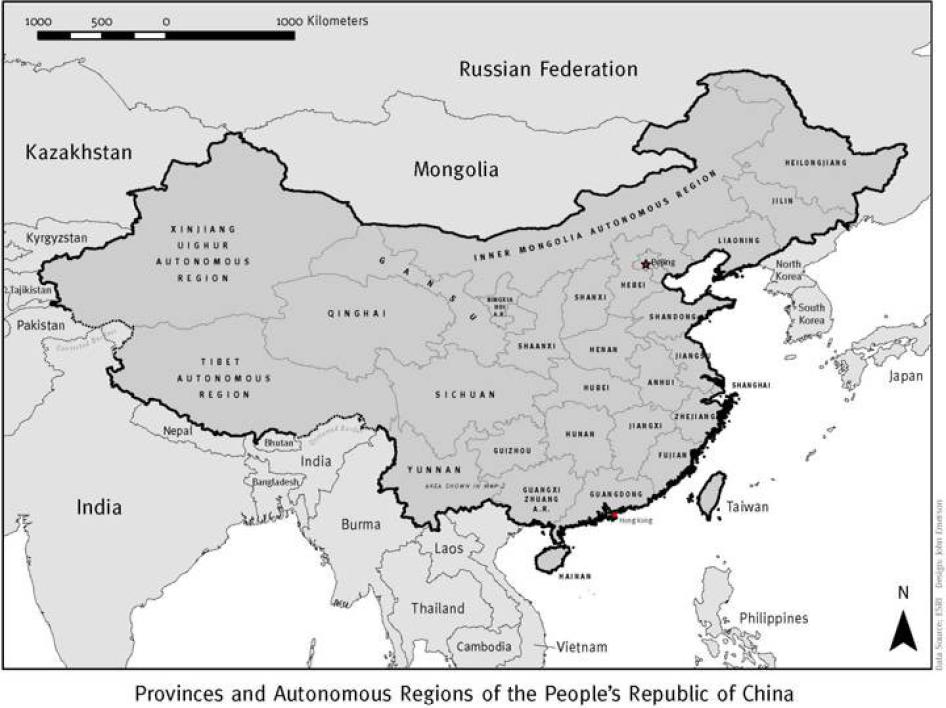
Map of China
I. Summary
Since 2003, large numbers of Chinese citizens have been held incommunicado for days or months in secret, unlawful detention facilities. These facilities, known informally as "black jails" (黑监狱) or "black houses" (黑房屋),[1] are created and used primarily by local and provincial officials to detain petitioners who come to Beijing and provincial capitals seeking redress for complaints that are not resolved at lower levels of government. Public security officials in Beijing and other cities have not intervened to close the jails and, in at least some instances, have directly assisted black jail operators. This report, drawing on dozens of face-to-face interviews with former detainees in Beijing and other cities, details what happens to individuals once inside. Detainees are often physically and psychologically abused. Many are deprived of food, sleep, and medical care, and they are subject to theft and extortion by their guards. They have no access to family members or to legal counsel or to courts. The makeshift jails are found in state-owned hostels, hotels, nursing homes, and mental hospitals, among other locations. Some Chinese researchers and civil society activists suggest that the number of individuals detained in black jails each year reaches into the thousands.
The Chinese government denies the existence of black jails. In the "Outcome Report" issued by the UN Human Rights Council at the conclusion of its "Universal Period Review" of China's human rights record in June 2009, the Chinese government asserted: "There are no black jails in the country." China's Ministry of Foreign Affairs likewise denied the existence of black jails in response to a question from an Al Jazeera correspondent at an April 27, 2009, ministry press briefing in Beijing.
These denials persist despite reports by Chinese and foreign journalists who have visited black jails and despite academic research into the subject by well-regarded Chinese scholars. Some foreign journalists and at least one Chinese legal scholar who have investigated black jails have themselves been physically abused and/or temporarily detained by guards at such facilities.
The existence of the black jails directly contradicts Chinese government rhetoric about its commitment to rule of law and its respect for the rights and freedoms of its people. In 2004, the Chinese government amended the constitution to read that, "The state respects and preserves human rights." On December 12, 2008, Chinese President Hu Jintao marked the 60th anniversary of the Universal Declaration of Human Rights (UDHR) by affirming a "people first" policy in promoting the development of human rights. Most recently, on April 13, 2009, the Chinese government issued its first ever National Human Rights Action Plan (2009-2010), which states that, "The Chinese government unswervingly pushes forward the cause of human rights in China."
The majority of black jail detainees are petitioners-citizens from rural areas who come to Beijing and provincial capitals seeking redress for abuses ranging from illegal land grabs and corruption to police torture. Petitioners, as citizens who have done nothing wrong-in fact, who are exercising their legal right to complain of being wronged themselves-are often persecuted by government officials, who employ security forces and plainclothes thugs known as retrievers or jiefang renyuan, to abduct them, often violently, and then detain them in black jails. Plainclothes thugs often actively assist black jail operators and numerous analysts believe that they do so at the behest of, or at least with the blessing of, municipal police.
Human rights abuses related to China's black jails bear a striking similarity to those of the official compulsory custody-and-repatriation, or shourong qiansong, system, which the government abruptly abolished in June 2003. Shourong, a vagrancy detention system, legally allowed police to detain "undesirables"-mostly petitioners, but also including beggars and any individuals who lacked official identification papers-and to transfer them to official "relief and repatriation" centers where they were held for a short period of time before being returned to their home districts. Researchers reported that extralegal black jails began operating within months of the abolition of the vagrancy detention system.
Black jails symbolize the failure of China's petitioning, or letters-and-visits system, a lawful practice dating back to the Qing dynasty (1644-1911) in which citizens bring their appeals for justice to the attention of the central government in Beijing. The petitioning system remains enshrined in Chinese law, with new regulations on "protecting the lawful rights and interests" of petitioners issued as recently as January 2005. However, the petitioning system is at odds with an official civil service evaluation system in which government officials at county, municipal, and provincial levels are subject to financial and career advancement penalties if large numbers of citizens from their areas are discovered in Beijing seeking legal redress through petitioning.
Faced with financial incentives to keep petitioners out of sight in Beijing, but no longer armed with a legal means for doing so, provincial and municipal-level officials have developed an extrajudicial system to intercept, abduct, and detain petitioners in black jails. Such officials make daily cash payments to the institutions which host the black jails of 150 yuan (US$22) to300 yuan (US$44) per person.
Inside China's black jails, detainees are denied access to legal counsel and in most cases contact with family and friends. Detainees are kept under constant surveillance, and subject to often arbitrary physical and psychological abuse including beatings, sexual violence, threats, and intimidation. In some black jail facilities, guards deprive detainees of food and sleep as mechanisms to punish, control, or elicit information from detainees. Black jail conditions are uniformly harsh. Detainees endure crowded sleeping quarters, unsanitary conditions, poor quality food in insufficient quantities, and violent reprisals for complaints about such conditions.
The guards at black jails routinely deny detainees access to needed medical care, even in cases of injuries from beatings. One former black jail detainee resorted to a three-day hunger strike to compel her captors to allow her access to a doctor. Former black jail detainees report that guards often steal detainees' personal belongings, including petitioning documents, demand payment for food or lodging at the black jail facilities, and demand large lump sum payments as high as 15,000 yuan (US$2,205) as a condition of release.
Minors under the age of 18 have been detained at black jails, a blatant violation of China's commitments to the rights and welfare of children. One former detainee we interviewed was a 15-year-old girl, abducted from the streets of Beijing while petitioning on behalf of her disabled father. She said she had been locked up in a nursing home in Gansu province for more than two months and subjected to severe beatings.
Key Recommendations
The Chinese government should:
- Admit the existence of black jails; close them and set detainees at liberty; and punish any person who abducts and detains another unlawfully or who operates or facilitates the operation of a black jail.
- Initiate a mass public education campaign about the legal rights of petitioners, the criminality of efforts to abduct, detain, and abuse them in black jails, and the due process rights of all criminal suspects under Chinese law and international instruments.
- Establish an independent commission to investigate and publicly report on the existence of black jails and government efforts to eradicate them.
Governments and international bodies funding Chinese legal reform or concern with human rights in China, including the United States, the European Union, the World Bank, and the Asian Development Bank should take an active interest in China's ongoing legal reform progress, and to that end should:
- Express strong concern to Chinese officials about the existence of black jails and violations of the rights of detainees, emphasizing that the jails violate both Chinese and international law.
- Demand that such abuses stop, that perpetrators be punished, and that victims be provided with reasonable compensation.
A more comprehensive set of recommendations is set forth at the end of this report.
II. Methodology
Human Rights Watch conducted research for this report in Beijing and several other Chinese cities between April and May 2009. We spoke with 38 former black jail detainees from the Chinese provinces of Anhui, Gansu, Guangdong, Heilongjiang, Hubei, Jiangsu, Jilin, Liaoning, Ningxia, Shandong, Sichuan, Yunnan, and Zhejiang, and from the municipality of Chongqing. The detainees included men, women, and children, and individuals of varying socio-economic backgrounds. The report also draws on Chinese academic research, studies by domestic Chinese human rights organizations, and published accounts in both Chinese domestic and international media.
In conducting the research, our objective was to identify and speak with as many individuals as possible who had been detained in black jails, not solely petitioners. All those we interviewed, however, were petitioners and they reported that the people they had been detained with were also petitioners. While this suggests that black jails are used primarily against petitioners, it is possible that other such facilities exist and are used to house other categories of detainees. It is a question that merits further research.
The Chinese government strictly limits the activities of civil society and nongovernmental organizations on a variety of subjects, particularly those related to the operations of the nation's security forces. Our research thus required a high level of sensitivity to the security of both researchers and interviewees. The interviews took place in circumstances in which they could be conducted without surveillance and possible harassment by government officials or security forces. All those interviewed were informed of the purpose of the interview, its voluntary nature, and the ways in which the data would be used, and orally consented to be interviewed. All were told that they could decline to answer questions or could end the interview at any time. Participants did not receive any material compensation.
Because of the real possibility of reprisals, we have withheld the names of all of the former black jail detainees we spoke with.
The findings of this report are consistent with research by Chinese human rights organizations, including investigative reports by Chinese Human Rights Defenders, a Chinese and international group that focuses on exposing human rights abuses and promoting human rights capacity-building and advocacy, and a second Chinese human rights group which has expressly requested that its name be withheld.
II. Background
The petition system seems to have maintained hope for disadvantaged people who have suffered injustices, but as a matter of fact, it is like drinking poison to quench a thirst.
-Peking University law professor He Weifang [2]
China's Broken Petitioning System
The recent appearance of black jails is the product of systemic failures in China's "letters and visits," or petitioning, system.
The petitioning system is a modern version of an imperial tradition which legally permits Chinese citizens to report local official abuses or local legal decisions to higher levels of government.[3] Because local courts regularly refuse to accept cases against local officials, and because pursuing legal redress through the court system can be prohibitively expensive, particularly for rural Chinese, petitioning has become one of the only accessible means of legal redress.
Petitioners typically begin their pursuit of legal redress at local-level petitioner complaint offices, which are located in courthouses or in township-level government offices. If they are not satisfied, they can move up the government hierarchy to provincial level offices and, at the highest level, the State Bureau for Letters and Visits in Beijing.[4]
The Chinese government has over the past five years reiterated its support for the petitioning system, describing it as an indispensable means to ease the frustrations of citizens who are unable for whatever reason to resolve their legal problems at the local level. In March 2009, Premier Wen Jiabao praised the petitioning system as a "mechanism to resolve social conflicts, and guide the public to express their requests and interests through legal channels."[5] Yu Lingyu, director of the Supreme Court's Bureau of Implementation, in July 2009 described the petitioning system as "work which is done to allay the anxiety and relieve the difficulties of the masses and the basic work of establishing a socialist and harmonious society."[6]
The State Bureau for Letters and Visits has reported a steady increase in petitions since 1993, saying the numbers are "straining the national (petitioning) system."[7] Official Chinese government statistics indicate that petition offices annually handled around 10 million inquiries and complaints from petitioners from 2003 to 2007.[8] Despite its longevity and political support, the petitioning system has never functioned effectively, in large part because it is chronically overwhelmed by the number of people seeking redress.[9] In a 2004 Chinese Academy of Social Sciences survey of a sample of 632 petitioners in Beijing by Yu Jianrong, "信访制度批判" (Critique of the Petition System), revealed that only 0.2 percent of them successfully resolved their problems through the petition system.[10]
Petitioners who have petitioned several years to tens of years are not rare. One reason is due to government departments who are evasive and prolong matters; another is because the petitioning system inherently has limitations to its power. The channels for petitioning are obstructed; the problems of petitioners are transferred, not handled, the rate of effectiveness is very low.[11]
As a result, large numbers of petitioners who come to Beijing remain there for long periods of time, hoping their grievances will be resolved. But their very presence collides with central government directives that local governments reduce the flow of petitioners to Beijing.
An academic article by Yu Jianrong suggests that the central government, fearing petitioners' potential to instigate unrest and disliking "undesirables" on the capital's streets, has made controlling the flow of petitioners to the capital one of the basic metrics of the effectiveness of regional and local officials.[12] Penalties for exceeding those limits range from private reprimands to humiliating and potentially career-ending public criticisms.[13]
The Chinese government has never publicly circulated details of this system of bureaucratic reprisals against local government officials deemed responsible for allowing petitioners to reach or remain in Beijing. However, Chinese Human Rights Defenders has obtained several internal county-level government documents which make clear that penalties are levied against local officials who fail to take decisive action when petitioners from their geographical area seek legal redress in provincial capitals and Beijing. The extent of the penalties hinge upon a "point deduction" system used in official performance evaluations of local officials.[14] One document is a 2007 directive from Hunan province's Shimen County specifying the obligation of county officials to retrieve local petitioners who go to Hunan's capital or Beijing:
Regarding those who go to petition at the provincial capital or to Beijing and those who persistently petition unreasonably, if they are returned to the county and sent to law learning classes in a timely manner...add two points [to the evaluation of the relevant official]. Failure to implement this, deduct half-a-point.[15]
According to one legal expert in Beijing, "Petitioners are bad for [local] government officials [because] officials' positions, career prospects and salaries are all linked to the number of petitioners coming to Beijing, so they want to control them."[16]
The result is that petitioners to Beijing are routinely intercepted, harassed, and detained by government officials and security forces from their home areas intent on ensuring that petitioners are not detected seeking legal redress in Beijing or other major cities. Such abuses constitute serious violations of guarantees of freedoms of expression and association embodied in both international and Chinese law.[17] The mouthpiece of the Chinese Communist Party, the People's Daily, has itself reported the occurrence of "local governments using violent means to intercept petitioners from reaching higher levels of government."[18] Beijing University of Posts and Telecommunications law professor Xu Zhiyong has compared the plight of China's petitioners to "...an alleyway in hell; with so much naked savagery and violence. It gives us a concentrated glimpse of all the sicknesses in Chinese society."[19] In an academic paper published in April 2009, Yu Jianrong described the relationship between petitioners and their local governments as inherently conflicted:
[L]ocal governments are not resolving problems but instead are intercepting petitioners, de-registering petitions, detaining people, charging fines, employing re-education through labor and criminal punishments, punishing family members, and using other control tactics to suppress petitioners.[20]
In August 2009, the Chinese government announced regulatory moves aimed to prevent any petitioners who have already initiated legal proceedings for redress in local courts from also petitioning in Beijing, an initiative which will likely intensify extrajudicial measures to abduct and detain petitioners who come to Beijing regardless. On August 6, 2009, Zhou Benshun, secretary general of the Political and Legislative Affairs Committee (PLAC) of the Communist Party's Central Committee, urged local governments to redouble their efforts to address petitioners' concerns at the county and village levels as a means to ensure that "[Petitioners'] problems can be solved without coming to Beijing."[21] On August 19, 2009, the PLAC reiterated that message by announcing that the yet-to-be-published regulations are designed to ensure that petitioners should "not seek solutions by visiting Beijing" and task local government officials with weekly and monthly meetings with petitioners at the grassroots level to resolve petitioners' grievances.[22]
The Abolition of Legal "custody and repatriation" and the Emergence of China's Black Jails
There are convincing indications that a key reason for the emergence of China's extrajudicial system of black jails was the abolition of the compulsory custody-and-repatriation, or shourong qiansong, system in 2003. Shourong, a form of vagrancy detention enacted by the State Council in 1982, gave municipal police wide powers to arbitrarily arrest and detain any "undesirables" on city streets, particularly homeless people and beggars who had come from the rural countryside.[23] Under these regulations, police could detain any citizen who lacked an urban household registration certificate, or hukou, which by definition included any petitioners from the countryside.[24] The shourong vagrancy detention system involved a nationwide network of 700 official detention centers where police could arbitrarily detain any "undesirables" and then repatriate them to their home provinces.[25]
The lack of due process within this vagrancy detention system led to detainee abuse and human rights violations. In March 2003, Sun Zhigang, a migrant worker detained by police in Guangzhou for not carrying his temporary urban residence certificate, was beaten to death in a shourong center. Intense domestic public dismay followed,[26] and in June 2003 the government unexpectedly announced the abolition of the vagrancy detention system. Facilities were closed, and the police no longer had the power to arbitrarily detain "undesirables."[27] The Chinese government officially replaced the vagrancy detention system with the Measures on Aid and Management for Urban Homeless and Beggars (MAMUHB) on August 1, 2003.[28] The Chinese government described the MAMUHB as a system designed to "provide temporary shelter for the homeless in a bid to maintain social order in cities."[29] That system hinges on specially-built shelters in which urban homeless can seek, on a strictly voluntary basis, temporary shelter for a maximum of ten days.[30]
Some Chinese police accustomed to the wide powers of detention granted by the former vagrancy detentionsystem expressed concern in the wake of its abolition. "In the past, we had more power and that made our work easier. The custody and repatriation system (was) a very good measure for big cities," a police officer in the southern city of Guangzhou told the South China Morning Post in October, 2003.[31]
But vagrancy detention-era abuses did not end with the abolition of shourong. Instead, such abuses have been driven underground into new extrajudicial "black jails" in Beijing and other cities. Local government officials, security forces, and the thugs they hire use such facilities to keep individuals officially deemed as "undesirables," such as petitioners, off the streets of Beijing and in many cases back to their home provinces to spare local officials bureaucratic punishment for allowing petitioners to come to the capital.
China's Black Jails System
The Chinese government has a history of extralegal detention. During the Cultural Revolution (1966-1976), government officials and security forces routinely detained individuals suspected of anti-government sentiments in facilities described as "study classes," or xuexi ban, without formal arrest, trial, or due process of law.[32] The Chinese government also has a record of targeting "whistleblowers and exposers of official corruption, persistent complainants and petitioners" for extralegal detention in mental institutions.[33] Since the 1980s, extralegal detention measures by government officials and security forces have targeted violators of China's official one-child policy as well as followers of the outlawed Falungong movement.[34]
China's police also have legal powers to routinely impose administrative detention via "re-education through labor," or laojiao, and house arrest, or ruanjin. Re-education through labor allows the police to unilaterally impose custodial sentences of up to three years while depriving detainees of any due process of law and judicial oversight.[35] House arrest, which Chinese police can impose completely arbitrarily and outside of any legal procedure, results in detention at home, with restricted and monitored internet and phone communications, and 24-hour surveillance by unidentified and often aggressive security forces.[36]
Chinese legal scholars and academics who have researched black jails say that their emergence since 2003 constitutes one of the most serious and widespread uses of extralegal detention in China's recent history. A Chinese legal expert who has extensively researched the issue of black jails estimates that the number of incidents in which citizens are illegally detained each year in black jails in Beijing alone is as high as 10,000, though that number includes individuals who are detained on multiple occasions.[37] Various non-governmental sources have estimated the number of black jails at between 7[38] and 50.[39] Tracking black jails is difficult due to the secretive nature of their operations and the fact that many appear to operate on a temporary, "as needed" basis in response to abductions. An Al Jazeera television correspondent visited a Beijing black jail facility in April 2009 with a former detainee, only to find the location empty and unguarded for reasons unknown.[40]
Xu Zhiyong, the Beijing University of Posts and Telecommunications law professor quoted above, is one of a small number of local activists seeking to expose and abolish the black jail system. He described his impressions of the Beijing facility he visited in September 2008:
It is not an exaggeration to call it a black jail. There were several scores of petitioners imprisoned here. The government had hired thugs as guards. Thedifference between this [black jail] and a regular prison is that the petitioners in this prison are completely innocent. They were brought here without any legal process to be locked up when they went to the complaints departments such as at the Bureau of Letters and Visits or the Supreme Court in order to conduct regular petitioning.[41]
Local government officials often employ those agents, plainclothes thugs commonly known as retrievers, or jiefang renyuan, to locate and abduct petitioners in Beijing and other cities. Experienced retrievers are paid well for their services, including bounties as high as U$250 per person.[42]
Retrievers often recognize their province's most dogged petitioners on sight. Since petitioners are paid only to bring back people from their own provinces, a common tactic is to ask petitioners where they're from. Even if they lie, their accents will probably give them away. Sometimes retrievers don shabby clothes and pose as petitioners. Retrievers often bribe [petitioning office] clerks...to prevent petitioners' gripes from being processed.[43]
Black jail operators themselves extract substantial financial rewards from local governments in return for providing the facilities to detain petitioners from their respective areas. "[A black jail operator] charges the respective local governments or their liaison offices in Beijing 300 yuan (US$44) per petitioner to 200 yuan (US$29) for each day of detention plus other miscellaneous fees like medical fees."[44] Xu Zhiyong has uncovered a sliding scale of payments by local governments to black jail operators in Beijing. "If a city petitioner is locked up for one day, the local government pays 200 yuan (US$29), for rural petitioners one day (costs) 150 yuan (US$22)."[45]
Investigative reporting by both local and foreign correspondents indicate that some black jail operators are also requiring detainees to pay for their release and/or the costs of their own detention. A China Youth Daily reporter interviewed a former black jail detainee from Jiangsu province who said his chief jailer told him, "Give a 10,000 yuan (US$1,470) deposit, write an affidavit that you won't petition again then (add to that) a food fee of 200 yuan (US$29) per day. Then you can go!"[46] In September 2007, a Reuters correspondent stumbled upon a black jail in Beijing operated by officials from Henan province's Nanyang municipality, which had become a de facto detention outsourcing center for local governments from other parts of China.[47]
The novelty of the Nanyang operation appears to be turning detention into a commercial service, with other local governments paying it to catch and hold protesting residents. The eight petitioners from east and northeast China separately said they had been lured or dragged from streets, government offices and a state-run detention center to the jail. Petitioners said they believed from guards' comments that the jail charged other local governments from 200 yuan (US$29) to 300 yuan (US$44) a day to hold them until they were taken home, sometimes released on the spot, or dumped outside the city.[48]
There have been numerous reports by both foreign media and domestic human rights organizations of large numbers of petitioners routinely detained in the Beijing Financial Assistance Management Center.[49] This facility, commonly referred to as Majialou, is in the city's southern Fengtai district, near numerous central government petitioning offices including that of the Supreme Court of China. Majialou is one of Beijing's four official homeless relief centers established by the post-vagrancy detention system, as set forth in Measures on Aid and Management for Urban Homeless and Beggars described above.[50] But according to research conducted by Chinese Human Rights Defenders, it has become a location where petitioners "...are registered and detained before officials there notify interceptors from their local areas, who then take the petitioners away and forcibly escort them back to their home provinces."[51]
Secret Facilities, Spartan Conditions
Black jail facilities are often temporary; the number in operation at any given time is dependent on the number of detained petitioners. Former black jail detainees interviewed by Human Rights Watch have described black jails in government ministry buildings, hotels, hostels, nursing homes, mental hospitals, drug rehabilitation centers, and residential buildings, among others. Black jails are unmarked and their purpose usually undetectable to passers-by. One detainee told us, "[The black jail] was in a simple bungalow, which from the outside wouldn't raise an eyebrow and people wouldn't notice [as distinct in any way]."[52]
The facilities share several key characteristics: they are organized to severely restrict detainees' freedom of movement, association, and expression through locked doors, locked and barred windows, restrictions on access to phones and other communications, and 24-hour surveillance by guards armed with weapons, including clubs and guns.[53] A local human rights group has described the facilities in detail:
A Black house will often be located behind, under or in an operating hotel, inn, or hostel and as part of a city's or province's petition office in Beijing. The Black house, managed by Letters and Visits officials [from the provinces] working in Beijing, will then hire people to work as guards, and pay the hotel, hostel or inn a small price for the use of the specific part of the establishment. A part of the location will consist of a prison area; using rooms as holding cells, often equipped with iron bars and doors, and will sometimes also have a fenced-in outdoor area. A second part [of the facility] will hold offices for the guards and retrievers, and sometimes an area where newly-arrived inmates will be stripped of their ID cards, cell phones, etc. In the vast majority of cases, a black jail will handle petitioners from one specific location, such as a city or province. This is due to the fact that black jails are operated and paid for by the Letters and Visits office of that particular location. Hence, the petition offices in provincial capital X will, to ensure that petitioners do not "escape" from the provincial chain of petitioning by going to Beijing, set up an "office" in Beijing. This office, a black jail, will then send 'retrievers' out to watch train stations, petition offices, shelters and other areas known to be frequented by petitioners. When a petitioner from their locality is found, he or she will be apprehended and brought back to the black jail for detention.[54]
The majority of former black jail detainees interviewed by Human Rights Watch described conditions in those facilities as akin to a prison in terms of security measures and denial of freedom of movement. "[There were] locked steel doors and windows. We never left our rooms to eat, [instead] we were given our meals through a small window space," said a 53-year-old petitioner from Heilongjiang province who was abducted while petitioning in Beijing and was subsequently detained in a black jail facility in a government building in his home town for the month of October 2007.[55]
Sleeping facilities range from separate, locked hotel rooms for each individual detainee[56] to cramped conditions in which petitioners share rooms of up to eight bunk beds.[57] One petitioner spent eight days in a Beijing black jail located in a Jilin provincial government facility devoid of furniture, where detainees had to sit and sleep on the bare floors.[58]
Police Complicity
The Beijing municipal police have played an active role in abuses against petitioners in the capital, including "turning a blind eye to the retaliatory violence" meted out to petitioners by plainclothes thugs who appear to operate at official behest.[59] Two of the 38 former black jail detainees interviewed by Human Rights Watch said that Beijing police, in one incident in plainclothes[60] and in the second incident in uniform,[61] assisted provincial-level security forces in abducting and detaining the petitioners in Beijing.
Such police indifference to the plight of black jail detainees is common, according to a Beijing-based legal expert who has researched the problem of black jails.
Local police don't help. Local government officials often have relationships with the Beijing police, so Beijing police don't interfere [in black jail operations]. Police see petitioners as "disrupting stability" and also [refuse to act] due to jurisdictional issues; they leave [petitioners in black jails] to the local government officials.[62]
A former detainee from Jiangsu province told Human Rights Watch that municipal police showed up at the black jail facility located in a Beijing hotel where he was held and "made a report," but then departed without explanation and without freeing him from custody.[63] Another former detainee said that Beijing police did not respond to his "110" calls for assistance after he was detained by Heilongjiang petitioning officials in a black jail facility in a central Beijing building.[64] A woman from Heilongjiang province detained in a Ministry of Social Affairs building in her home province said that when she contacted police for assistance, they candidly explained that they had no power to intervene in cases of black jail detentions.
[Your detention] is the desire of upper levels [of government], and if you have opinions about that when this is over, consult the city government authorities or the mayor to solve. Anything that happens inside [black jails] we can't go to investigate and [we] can't solve any of your problems.[65]
There is also evidence that Beijing police work closely with retrievers ahead of important dates on the Chinese Communist Party's calendar, such as the run-up to annual meetings of China's parliament.[66] At those times, police in the provinces prioritize preventing petitioners from reaching Beijing,[67] while the Ministry of Public Security urges Beijing municipal police to "mobilize all of their resources" to prevent petitioners already in the city from reaching central government offices.[68] The Chinese government explicitly linked an initiative announced in August 2009 to improve resolution of petitioners' grievances at the village and county levels to efforts to prevent petitioners from coming to Beijing where they might disturb "social harmony and stability ahead of China's National Day celebration in October (2009)."[69]
Black Jails as "Study Classes"
The local and provincial government officials and members of the security forces who operate black jails have in some cases described what goes on in the facilities as "study classes" devoted to educating petitioners about their alleged wrongdoing. Zhang Jianping, a Jiangsu human rights activist, described this justification as emblematic of the lack of rule of law in China. "These black jails are clearly against the law. But local officials call them legal study classes, and that shows how they treat the law as just a tool for abusing rights," Zhang said.[70]
A March 2009 investigative report in the China Youth Daily uncovered how government officials and security forces from Jiangsu province's Xiang Shui County had abducted local petitioners in Beijing, returned them under guard to Xiang Shui, and imprisoned them in a black jail which the county's Civil Affairs Bureau described as a "Petitioning Study Class."[71] The report revealed that at least ten local petitioners had been detained in the facility, located within an abandoned primary school, and subjected to threats, intimidation, and physical violence until they paid a 10,000 yuan (US$1,471) "deposit" and a "food fee" of 200 yuan (US$29) per day. They were prevented from leaving until they signed an affidavit stating that they would never petition again.[72]
Three former black jail detainees interviewed by Human Rights Watch said that their abductors had justified detaining them on the basis of an alleged legal obligation to undertake petitioning-related "study classes," while ten others said that their captors described their black jail as a "study class" facility only after their arrival at the facility. Several interviewees dismissed the "study class" label as a cynical veneer of legitimacy. A female petitioner from Jiangsu province detained in a black jail for 36 days in July-August 2008 said the "study class" label her guards used to refer to the facility was an attempt to ensure the black jail "wouldn't look illegal."[73]
Another woman detained in a self-styled "study class" in Heilongjiang province described her experience: "They said it was a petitioning school, but I never saw a teacher there, all I ever saw were police and flies."[74] Several other former detainees interviewed by Human Rights Watch said that they were forced to sign affidavits upon release from black jail facilities which stated that they had not been detained, but had instead participated in a "study class" of their own free will.[75] Other former detainees described attempts by their black jail guards to lead "study classes" which consisted of anti-petitioning propaganda sessions.
They called it "legal education"...to allow petitioners to be regarded as criminals. There was no class...it was a joke. However, they sometimes did ideology work with petitioners and urged them not to come back to Beijing to petition, [but instead] go back home to seek out their local government to solve their problems.[76]
III. Human Rights Abuses in Black Jails
[The guards] entered without a word, grabbed me... kneed me in the chest and pounded my lower belly with their fists until I passed out. After it was over I was in pain, but they hadn't left a mark on my body.
-A 45-year-old male petitioner from Anhui province detained in a Beijing black jail from February 22-29, 2009[77]
The individuals detained in black jails are often physically and psychologically abused. Many are deprived of food, sleep, and medical care, and are subject to theft and extortion by their guards. They have no access to family members or to legal counsel or courts.
Illegal Abductions
32 of the 38 former black jail detainees interviewed by Human Rights Watch reported having been abducted by individuals whom they recognized as government officials and/or security forces from their home provinces, often in plainclothes. As one detainee said: "[Police and petitioning officials from my hometown] who weren't in uniform and who never showed me their official identification detained me."[78]
Petitioners, of course, have broken no law by simply being present in Beijing to carry out lawful petitioning activity. But even if they had broken some law, their abduction would violate both Chinese and international law governing arrests and detentions. The Universal Declaration of Human Rights prohibits "arbitrary arrest (and) detention"[79] and guarantees "full equality to a fair and public hearing by an independent impartial tribunal."[80] Article 37 of the Constitution of the People's Republic of China stipulates arrests must be conducted "with the approval or by decision of a people's procuratorate or by decision of a people's court and arrests must be made by a public security organ."
The majority of the former black jail detainees interviewed by Human Rights Watch said that their abductors, who commonly worked in groups of up to 20 individuals,[81] provided no legal justification for detention or any information about detainees' eventual destination or possible length of detention. One 52-year-old petitioner from Liaoning province detained in Beijing on April 16, 2009, said her abductors, who escorted her back to a month-long stay in a black jail located in her home province of Liaoning, were a complete mystery to her.
I was detained by retrievers from [my home province of] Liaoning who were in plainclothes and never showed me any identification. I doubt they had any [official] identification. They never told me the reason why they detained me; they never even spoke to me and didn't tell me how long they were going to detain me for.[82]
The majority of former black jail detainees interviewed by Human Rights Watch reported being abducted off the streets of Beijing or other cities. One 43-year-old petitioner from Jiangsu province, who said she was seeking redress for illegal eviction and the demolition of her home, was detained while disembarking in Jiangsu from a train from Beijing by four men in plainclothes who did not identify themselves.[83] "They said I had to cooperate with their work, but they never told me what that work was, but I knew [my detention] was because of my petitioning."[84] She subsequently spent 36 days confined to a black jail in Jiangsu.[85] One petitioner from Heilongjiang province said she had been abducted and detained in black jails in Beijing and Heilongjiang four times since June 2006 related to her efforts for redress over a land dispute. The second time she was detained, on October 26, 2006, she was pulled from a petition application line at the Public Security Bureau petitioning office in Beijing by government officials from her hometown. She subsequently spent 70 days in black jails in Beijing and Heilongjiang.[86]
Those who were given reasons for their detention said the allegations ranged from "disrupting social order"[87] and "illegal petitioning" [88] to concerns that their petitioning efforts would disrupt preparations for high profile events in Beijing including the 2008 Olympic Games[89] and annual meetings of China's parliament, the National People's Congress.[90] Few resisted these abductions, recognizing that their abductors were government officials and/or members of the security forces. One woman spent 22 days in a black jail facility in a government building in southern Beijing before being released in Beijing without explanation. As she told Human Rights Watch: "I didn't resist. I was a lone woman. How could I have resisted them? If I resisted, I would just have been beaten, so I didn't bother."[91]
The majority of former black jail detainees interviewed by Human Rights Watch said that their guards held them incommunicado by confiscating their mobile phones and preventing them from contacting either legal counsel or family and friends. Those procedures prevented a 54-year-old woman from Jiangsu province from contacting anyone outside of the black jail facility in a Beijing hotel where she was detained from September 23, 2008, to November 13, 2008.
At the [hotel] entrance I was subjected to a body search and my mobile phone, wallet and other personal items were confiscated without any explanation; [the guards] said that they would temporarily take care of me. I didn't want to be taken care of, but they grabbed me.[92]
In three cases, interviewees told Human Rights Watch that government officials or security forces had deceived them in order to detain them. Two of those former detainees said that they were tricked into custody by individuals who claimed to be journalists seeking interviews about their reasons for petitioning. "A retriever from our [home] county pretended to be a journalist from Radio Free Asia [and] said he wanted to interview me [but] it turned out that when I went [to be interviewed], I got locked up," a 34-year-old former detainee from Hubei told Human Rights Watch.[93] A 40-year-old former detainee from Hubei province told Human Rights Watch that he was the victim of a similar deception by a local government official who abducted him by initially "pretending to be a journalist" who wanted to interview him.[94] In the third case, police convinced a Heilongjiang woman to accompany them from her home on the basis that the local county chief wanted to meet her to "solve the [petitioning] problem."[95] The police instead escorted her to a recently-constructed government building, where she was confined for 55 days. Her captors described this black jail as a "petitioners' school."[96]
Physical Violence against Detainees
Violence and its constant threat defined the experience of more than half the former black jail detainees interviewed by Human Rights Watch. Many petitioners bound for detention in black jail facilities are beaten and in some cases forcibly restrained in order to evoke compliance with their captors. A guard at the Beijing Financial Assistance Management Center,[97] better known as Majialou, has alleged that petitioners who resist transfer are "beaten and sometimes they have their bones broken."[98]
One former black jail interviewee we interviewed said that she was the victim of a threat of sexual violence, while in August 2009 there were media reports of a rape of a femail petitioner at a Beijing black jail. Due to deep social stigma around sexual violence and limited prospects of redress, such cases are likely underreported. On August 3, 2009, a 20-year-old student from Anhui province detained in a Beijing black jail was reportedly raped by one of her guards.[99]
The guard fled after the rape, witnesses said. About 50 detainees, including the student, broke through the wooden door and ran away Tuesday morning (August 4, 2009), taking two bloody sheets with them as evidence of the assault. About 10 (of the detainees) went to the local police station to report the rape, but say they were ignored.[100]
A 46-year-old former detainee from Jiangsu province who was abducted off of a Beijing street and forcibly returned to Jiangsu to spend 37 days in a black jail cried with fear and frustration as she recalled her abduction during an interview with Human Rights Watch.
[The abductors] are inhuman. Their car drove up to that place [where I was] and two people dragged me by the hair and put me into the car. My two hands were tied up and I couldn't move. Then [after arriving back in Jiangsu] they put me inside a room where there were two women who stripped me of my clothes... [and] beat my head [and] used their feet to stomp my body.[101]
Once petitioners are detained inside black jails, they are at the mercy of government officials, security forces and their agents. According to one Chinese legal expert who has extensively researched black jails, "Physical abuse [within black jails] is widespread and often very serious."[102] Such abuse is at odds with both international and Chinese law regarding the treatment of detainees.
The Chinese government already has a poor record of ensuring the rights and safety of detainees in official detention centers for criminal suspects in which due process and government supervision should be guaranteed. Official Chinese government statistics indicate that in the first four months of 2009 alone, a total of 15 detainees died "unnatural deaths" in official detention centers.[103] Official concerns about allegations of brutality and torture in official criminal suspect detention centers have prompted a government decision to equip all such facilities with closed circuit television security monitors by the end of September 2009.[104] But black jails offer no such protections or official oversight. Even the official Chinese state media has reported severe physical abuse at such facilities including the use of electric cattle prods to torture and abuse detainees.[105]
Two-thirds of the former black jail detainees interviewed by Human Rights Watch reported being physically abused by their captors either at the time of their abduction, during the period of their abduction, or both: "There were absolutely no human rights, we were at the mercy of the guards [and] verbal abuse and beatings were [the black jail's] home-cooked food."[106] A 53-year-old woman in Liaoning province's Shenyang city suffered a dislocated hip on March 7, 2007, while attempting to resist attempts of Shenyang police to force her into a car and transport her to a black jail.[107] The woman said her abductors said they were preventing her from going to Beijing to petition during the annual meeting of China's parliament, the National People's Congress.[108] She was held for nine days in a local state-owned hotel, where she was denied access to medical care for her hip.[109] One former detainee told Human Rights Watch that she was the victim of a knife attack by one of her guards during her eight-day detention in a Beijing black jail in February, 2009. She told us that the guards "violently beat me and slashed my face with a knife, requiring 15 stitches."[110]
Former black jail detainees told Human Rights Watch that their captors demanded absolute obedience and would respond to any perceived acts of defiance with at times severe physical violence. "I was beaten [by guards] every three days...they said I didn't respect their work. I couldn't endure it and several times considered suicide," a 42-year-old former detainee from Sichuan told Human Rights Watch, describing her September 25, 2008, abduction and subsequent 55 day detention in a black jail in Chengdu, Sichuan province.[111]
In one case, a detainee's request for something as simple as toilet paper was the pretext for a "brutal beating," according to a woman who witnessed the beating while being detained in a black jail in a government building in Heilongjiang province from August 22, 2008, to September 24, 2008.[112] Another detainee said the constant physical violence and its threat created an atmosphere of "terror" in the black jail in Hubei province where he was detained for more than 14 months in 2007-2008.[113]
Several former black jail detainees told Human Rights Watch that queries about the legal basis of their detention also prompted violent reactions from their guards. One Heilongjiang petitioner, detained for 12 days in a local black jail, said her inquiries about the reasons for her detention sparked a beating by her guards which left her unable to stand or walk.[114] The petitioner said her injuries prompted her guards to seek her release for fear that she would die while in custody at the black jail.[115] She was released to seek medical treatment outside the facility. A former detainee from Chongqing municipality detained in a black jail facility located in a Chongqing nursing home was also punished by his guards for questioning the legality of his incarceration.
I asked why they were detaining me, and as a group [the guards] came in and punched and kicked me and said they wanted to kill me. I loudly cried for help and they stopped, but from then on, I didn't dare [risk another beating].[116]
Two of the former black jail detainees interviewed by Human Rights Watch said their captors explicitly told them that physical mistreatment of detainees was acceptable to their superiors. A 54-year-old former detainee from Zhejiang province who endured several beatings during 16 days in a black jail facility in the basement of a Beijing hotel in July 2007 said, "[The guards] said that we come to Beijing to petition once, then they'll detain us once, beat us once and then we won't try to come back to Beijing again."[117] Another former detainee from Jiangsu province who spent almost two months in a black jail located in a Beijing hotel, reported that her captors had explicit instructions on the degree of physical violence they could inflict on detainees. "They said that their boss had instructed them that they could beat as long as they didn't break any bones."[118]
Foreign correspondents who have visited black jails have also been beaten and detained. Reuters senior correspondent Chris Buckley's September 10, 2007, visit to a Henan province black jail facility in suburban Beijing ended with him being tackled by a group of men who refused to identify themselves, but whom Buckley suspects were plainclothes police due to their clothing and demeanor.[119] The men kicked and punched Buckley, confiscated his notes, detained him for two hours, denied his requests to contact his employer and his embassy, and threatened him with serious physical injury when he protested his detention.[120] Uniformed police officers who later arrived on the scene facilitated Buckley's release, but took no legal action against the men who had detained him and injured his upper body.[121]
Plainclothes guards at the same black jail accosted a television news crew from the United Kingdom's Channel 4 who visited the facility on September 14, 2007. The guards tried to smash the team's video camera and subsequently detained them at the facility for six hours.[122] The correspondents' detention ended only after police arrived and read a list of alleged "offenses" committed by the journalists, including "filming a government building without permission" and confiscated a videotape which police believed held footage shot of the black jail facility.[123]
Xu Zhiyong, a Beijing University of Post and Telecommunications law professor and activist against black jails in Beijing, has also been the target of violence for his involvement with petitioners imprisoned in such facilities. In a November 2008 interview with China's Economic Observer newspaper, Xu described being assaulted by plainclothes thugs apparently operating at the behest of a Beijing black jail where Xu was attempting to secure the release of detainees.
Shortly after [my arrival at the black jail], a minibus suddenly came. Three people jumped out and violently attacked the petitioners. Almost at the same time, my neck, chest and face were punched. The bare-armed guard fiercely kicked me in the knees from behind, trying to knock me down.[124]
Denial of Detainees' Access to Medical Treatment
The chronic violence and crowded, often unsanitary conditions in black jails lead to injuries and illness for many detainees. Several former detainees said that facilities lacked medical practitioners and several others said that authorities who operated the black jails were unwilling to allow sick detainees to seek medical treatment at outside medical facilities.
This denial of access to medical care is a serious violation of Chinese and international law governing the health of detainees. Both the Body of Principles for the Protection of All Persons under Any Form of Detention or Imprisonment and the United Nations Standard Minimum Rules for the Treatment of Prisoners stipulate minimum benchmarks for detention facilities to ensure the health and wellbeing of detainees. Article 45 of the Constitution of the People's Republic of China guarantees Chinese citizens "the right to material assistance...when they are ill." The Prison Law of the People's Republic of China also stipulates that prison authorities are obliged to provide medical examinations for all new detainees[125] and allows those authorities to grant parole to "seriously ill" prisoners who require medical treatment.[126]
Detainees with existing medical conditions upon "admission" to black jails reported that their guards were unresponsive to their pleas for medical attention. A 40-year-old man from Hubei province detained for 9 days in March 2009 in a black jail located in a Beijing government building said that authorities provided no medical treatment for detainees. "Who was there to take care of us? I think I could have died and they wouldn't have cared. They didn't take care of people who were seriously ill."[127] Other former detainees reported that black jail guards routinely dismissed their requests for medical attention with threats and insults. "The worse off we were, the happier our guards were."[128]
There was no medical treatment. I'm not very healthy and combined with the disgusting conditions inside, I was sick every day, but they wouldn't give me medical treatment and wouldn't let me go to see a doctor. [A guard] said, "You don't want to die here because your life isn't worth one cent. If I want you dead, you can die as easily as an ant."[129]
In at least two instances, black jail guards also rebuffed the efforts of detainees who tried to seek medical help for other sick detainees. A former detainee from Heilongjiang province, detained in a black jail located in a Beijing hotel from March 28, 2007, to April 1, 2007, said that her guards ignored her entreaties to provide medical treatment for a fellow detainee who "had convulsions and was spitting up blood."[130] "There was one female petitioner who had blood in her urine, so we told the guards and they said that even if we died [in detention], they didn't care."[131]
Several former detainees reported that their black jail captors also refused to provide medical treatment for injuries sustained in beatings by their guards. For one former detainee, a 70-year-old petitioner from Hubei province detained in local black jails on three separate occasions for a total of around 115 days, the denial of needed medical treatment by her black jail guards prompted desperate measures.
When I was detained I had diarrhea, cough, a cold and aches in my legs, but there was no medical treatment. I was faced with a total lack of human sympathy for my suffering... [so] I decided to starve myself to death. Three days later, they sent me to a hospital.[132]
A former detainee from Heilongjiang province detained from August 22, 2008, to September 24, 2008, in a Heilongjiang Ministry of Social Affairs facility which had been "completely transformed" into a full-time black jail, said that her captors denied her medical treatment for a broken toe on her right foot. The former detainee told Human Rights Watch that the injury was the result of a beating by guards on August 28, 2008.[133] A 35-year-old former detainee from Hubei province who had spent a total of 183 days during three separate periods of detention in local black jails from May 2007 to August 2008 also reported denial of medical treatment for injuries sustained through physical abuse by her guards. "I was beaten every day and had to slowly recover on my own. They don't give you medical treatment and don't let you go to a doctor."[134]
Food and Sleep Deprivation
Human Rights Watch research indicates that most black jails have a simple daily routine: detainees are confined to their rooms or kept in locked and guarded common areas of the facility where their days revolve around eating and sleeping.[135] Ten former black jail detainees reported that they were victims of deliberate food and/or sleep deprivation at the hands of their captors during their detention. The former detainees said that the black jail authorities implemented food and/or sleep deprivation for reasons including punishment, to instill discipline or docility, and, in one case, as a deliberate torture method.
In September 2007, a group of 30 farmers from Sichuan province went to petition in Beijing regarding a land dispute. They claimed they had been abducted from Beijing on September 26, 2007, and taken to a military base on Chengdu's Phoenix Mountain where they were alternately "tortured, threatened and starved" until their release on December 1, 2007.[136] The abuse reportedly prompted one of the petitioners to attempt suicide "because [the black jail guards] didn't allow me to sleep or eat in order to force me to write self-criticisms."[137]
The conditions of a black jail located in a Beijing hotel compound operated by Henan province's Nanyang city reflects the privations that detainees typically endure. Chris Buckley of Reuters reported, "Former detainees said they had been confined there unwashed for days or weeks on a diet of rice gruel, steamed bread and restaurant scraps, with beatings dealt out by teenage guards."[138]
Former black jail detainees uniformly criticized the food provided as nutritionally inadequate. The 35-year-old former detainee from Hubei province mentioned above who was detained in local black jails for a total of 183 days told Human Rights Watch, "Most petitioner black jails are the same. The food is extremely bad, you don't get enough to eat [and] they often intentionally don't feed you or provide drinking water."[139] Another Hubei former detainee, the 70-year-old woman mentioned above who had been detained in local black jails for a total of around 115 days, echoed those sentiments. "The food was very poor. Every day a mouthful of rice, and a few vegetables. This is how [the guards] tormented me, to weaken the state of my health."[140]Another said, "The food was bad, and there was just enough so that people didn't starve."[141]
A 54-year-old former detainee from Gansu province detained in a black jail located in Beijing's Fengtai district from June 25, 2008, to July 4, 2008, interpreted the routine food deprivation she endured while a detainee as a deliberate form of abuse by the facility's guards. "[The guards'] attitude was disgusting. The slightest lack of cooperation and they wouldn't feed us...they basically didn't consider petitioners as normal human beings. This was an extremely serious form of psychological abuse."[142] A 42-year-old former detainee from Shandong province said the routine food deprivation he suffered severely harmed his health while detained in a local black jail from November 20, 2008, to January 7, 2009. "Regularly on Wednesday and Friday we weren't fed and even drinking water wasn't available. My body started to break down.[143]
Two other former black jail detainees described food and sleep deprivation as a characteristic of the "study class" which their guards claimed was the facility's purpose. "This study class ...was about not providing food, not allowing sleep, not allowing contact with family, not allowing contact with the outside and restricting our freedom," a 43-year-old former detainee from Jiangsu province detained in a local black jail for 36 days in July and August 2008 explained.[144] Another Jiangsu former detainee, a 46-year-old woman who has been detained in local black jails on two separate occasions for a total of 61 days since October 2008, said the "study class" regimen of food and sleep deprivation was difficult to endure.
They said they were going to make me "study well" and give me "class." Every day I could only sleep three hours and they would at any time wake me in order so that I couldn't run away. They treated me that way...I was hungry every day, but couldn't get enough to eat. The second time I was detained for 37 days...I lost 20 kilograms.[145]
A 42-year-old woman from Jiangsu province detained in a local black jail from December 3, 2008, to January 16, 2009, said that her captors used sleep deprivation as an "extremely inhuman" alternative to physical abuse during her period of detention.[146] The most disturbing case of intentional sleep deprivation by black jail authorities we learned of was reported by a 53-year-old woman from Zhejiang province detained from July 16, 2008, to October 14, 2008, in black jail facilities in both Beijing and Zhejiang. The former detainee said that guards in Zhejiang used extended sleep deprivation to torture a male detainee whose wife was still at large petitioning. "His wife was petitioning, but hadn't been caught, so they picked up her husband and for four days and four nights they wouldn't let him sleep to force him to turn over his wife to them. It was despicable."[147]
Child Detainees
There is compelling evidence that Chinese government authorities are complicit in the abduction and detention of children-people under age 18[148]-in black jail facilities across the country. Some children are abducted and detained with a parent, while others are abducted and detained in the absence of their parents or official guardians. This abuse was first noted in September 2007 by a Reuters correspondent. He noted that "a boy aged about three" was one of the detainees at a Beijing black jail facility in the compound of a Beijing hotel operated by Henan province's Nanyang municipal government.[149] "The father of the young boy yelled out that the two had been held there for months."[150]
Detention of children in black jail facilities entails numerous rights violations, including arbitrary deprivation of liberty, putting children at risk by detaining them with adults who are not their parents or guardians, deprivation of education, denial of adequate nutrition and healthcare, and risk of maltreatment or even torture. These rights are protected by many international and Chinese laws.[151]
Three former black jail detainees interviewed by Human Rights Watch also reported that their fellow detainees had included children. A 33-year-old former detainee from Hubei province said that she was detained from August 4, 2008, to September 28, 2008, in her own private room in a Beijing hotel along with her six-year-old daughter.[152] A 52-year-old petitioner from Liaoning province said that one of her fellow detainees at a government building in Liaoning's Shenyang city, where she was detained from March 4 to April 4, 2006, included "one old woman who had with her a boy of around 10 years of age."[153] A 36-year-old from Gansu province, detained in a local hotel from September 3, 2008, to September 14, 2008, noted that the facility also detained "many children, boys and girls."[154] This former black jail detainee did not specify the children's ages or their length of detention, but said that they were also compelled to attend the facility's "study class." In those sessions, guards warned participants to stop petitioning the local county government, and cautioned that their release hinged on signing a guarantee that they would cease their petitioning efforts.[155]
Another case of child detention in a black jail facility uncovered by Human Rights Watch concerned a 15-year-old former detainee from Gansu province. She was detained from July 10, 2008, to September 13, 2008, while petitioning in Beijing on behalf of her father, who was allegedly disabled due to a beating by a local government official.[156] The girl reported that plainclothes government officials and police, whom she recognized from her home county in Gansu, abducted her off of a Beijing street, and returned her to Gansu. She was held incommunicado for almost two months in government facilities including a hospital, a home for the disabled, and finally in a nursing home. The facilities were spartan and her fellow detainees in the nursing home facility consisted only of five unidentified elderly individuals. The girl told us:
[My abductors] said that our case had been circulated on the Internet and had had a bad effect on them. They never told me how long I would be detained. I resisted, I didn't want them to detain me, but I was beaten and was squeezed into their car. I wasn't carrying anything with me but my petitioning materials...which they didn't return to me after they searched me. Every day there was nothing to do but sleep and eat. There was no television or newspapers or things like that. There were no shower facilities and it was impossible to wash clothes.
Her age did not protect her from violent abuse by her guards: on September 11, 2008, guards beat her so severely that they knocked out one of her teeth. Her guards released her without explanation on September 13, 2008, due to what she suspects was the end of the security operation for the 2008 Beijing Olympic Games, which had focused on clearing the streets of Beijing of "undesirables" including petitioners.[157]
Threats to Petitioners
Almost half of the former black jail detainees interviewed by Human Rights Watch reported having been threatened with violence or extended incarceration during their detention, to discourage future petitioning efforts. One example of a very specific threat was related to us by a 36-year-old former detainee from Chongqing municipality, held from April 18, 2008, to October 23, 2008, in a black jail facility located in a local nursing home. "Upon my release, [the guards] said if I didn't sign a 'no petitioning' guarantee, they'd put me in a nursing home until I died, cremate my remains and not let anyone know [what happened to me]"[158] A 54-year-old former detainee from Jiangsu province, held from September 23, 2008, to November 12, 2008, in a black jail located in a Beijing hotel compound, said: "I was forced to write a [no petitioning] guarantee certificate. [My captors] said 'If you petition in the future, according to the guarantee certificate, we can break your legs.'"[159]
Even if the individuals had been lawfully detained, which was not the case here, such threats would violate both Chinese and international standards. The United Nations' Body of Principles for the Protection of All Persons under Any Form of Detention or Imprisonment protects detainees from "violence, threats or methods of interrogation which impair his capacity of decision or his judgment."[160] And the Chinese government's National Human Rights Action Plan (2008-2010) prioritizes the development of measures to prohibit "corporal punishment, abuses, insult of detainees or extraction of confessions by torture[161] and obligates police and prison authorities to undertake effective measures to prohibit "abuse (and) insult of detainees."[162]
A 42-year-old female former detainee from Sichuan province, held from September 25, 2008, to November 20, 2008, in a Chengdu municipality black jail located in a government building, was the target of an explicit threat of sexual violence to discourage any escape attempt. "They threatened me [that if I escaped, they'd take me to the male prison and let (the inmates) take turns raping [me]."[163]
Several former detainees interviewed by Human Rights Watch reported that the guards also threatened violence against the former detainees' family members. One said that upon release her guards warned her that if detained for petitioning again, she would face imprisonment of eight to ten years, and that the authorities would also undertake unspecified "retaliation" against her family members.[164] Another former detainee recounted much more specific in their threats to her family. "When they released me, those [guards]...said if I petitioned again, I'd be responsible for the death of a family member."[165] Her guards did not elaborate on that threat.
Four former detainees described black jail guards threatening them with longer periods of incarceration under China's "re-education-through-labor" (RTL) system. RTL, which the United Nations' Special Rapporteur on Torture has recommended abolishing,[166] allows the police to unilaterally impose custodial sentences of up to three years while depriving detainees of any due process of law and judicial oversight.[167] "The study class [guard] said 'Don't do it again. Petition again and you'll be locked up for three years,'" said a 54 year-old former detainee from Heilongjiang province detained from March 28, 2007, to April 1, 2007, in a black jail located in a Beijing hotel complex.[168]
Theft and Extortion
Nine former black jail detainees reported that they were victims of theft and extortion at the hands of their guards. A 46-year-old former detainee from Anhui province detained for 24 hours in January 2009 in a black jail facility located in a Beijing hotel compound said the guards there stole the entirety of her personal belongings. "They took everything I had on me, such as money, my petitioning materials, identification, etc., and didn't return any of it."[169] International and Chinese standards for the care of detainees explicitly prohibit such behavior.[170]
Former back jail detainees said their guards particularly targeted for confiscation detainees' petitioning materials, which can include land title deeds, copies of local court judgments, and medical reports that constitute crucial evidence to support petitioners' quest for legal redress. Six former detainees interviewed by Human Rights Watch said that their petitioner materials were not returned to them upon their release. "After we were detained, [my] mobile phone, money and petitioner materials were confiscated. When we were released, my money and mobile phone were returned, but my petitioner materials were not returned," said a 40-year-old former detainee from Hubei province detained for nine days in March 2009 in a black jail located in a government building in Beijing.[171]
Several former detainees also complained of guards extorting cash "fines" for alleged infractions and daily food costs during the course of their detention, and of guards demanding cash payments as a condition of release.
Two former detainees told Human Rights Watch that their captors demanded a 100 yuan (US$15) daily charge for meals, which one of them said consisted of a meager "two buns and cabbage soup without a drop of oil."[172] A 50 year-old former detainee from Zhejiang province said that during her March 10, 2008, to August 19, 2008, captivity in a black jail located in the basement of a Beijing hotel, her guards imposed cash fines for failure to comply with a daily five-hour involuntary sitting exercise. "They forced us to sit on a wooden bench, in the morning and afternoon for 2.5 hours [each time]. If we didn't comply, everyone would be fined and the [involuntary] sitting time extended."[173]
A 42-year-old former detainee from Sichuan discovered that her release from 55 days of captivity in a Chengdu black jail hinged on a 15,000 yuan (US$2,205) cash payment, allegedly to pay the "retriever" who originally abducted and detained her.[174] Her family eventually secured her release with a 5,000 yuan ($735) payment.[175] "When I was leaving, one of [the guards] said 'You won't petition again [because] this is the cost of petitioning."[176]
Some black jail authorities also appear to be paid a fee for each person they capture. A New York Times reporter who responded to a call for help in March 2009 from a petitioner from Zhejiang province detained in a black jail located in a Beijing hotel, found his rescue attempt complicated by the jailers' concerns about getting paid: "Confounded by the presence of foreign journalists, the men seemed unable to prevent Ms. Wu from escaping, although they begged her to stay, saying that she could not leave until a local county official arrived with their reward money."[177]
Duration of Detention and Release
Black jail detentions are in some cases temporary, ranging from several hours to several days, until local government officials escort petitioners back to black jail facilities in their home provinces.[178] Once back in their home province, the detention can extend much longer, up to 14 months in one case Human Rights Watch documented.
Detainees' release from black jails is usually arbitrary and unexplained. A report by Chinese Human Rights Defenders on the black jails system, based on interviews with former detainees, describes the process for release as follows:
[Detainees] can only be released if (1) their local governments, notified by those running the detention facilities, send officials to escort them home or to local (judicial) detention centers or (2) the local governments do not want to pay for their detention and agree to monitor them and make sure they stop petitioning the government or (3) the detainees sign a paper promising to stop petitioning, generally under duress.[179]
Human Rights Watch interviews with former detainees indicated that standards for release are not universal in black jail facilities. A total of 8 of the 38 former black jail detainees Human Rights Watch interviewed said that their captors provided no reason for their release. Another five former detainees said that their guards explicitly linked their release to the elapse of what the government considered "sensitive" calendar dates, such as the 2008 Beijing Olympic Games.
VI. Relevant International and Domestic Legal Standards
The detention of petitioners is unlawful whether regarded through the lens of the international right to peacefully express grievances to government[180] or China's own law on Letters and Visits. The Chinese government's immediate obligation is to ensure that all individuals detained for lawful petitioning activities are released immediately.
Even if some persons detained in black jails have violated some local or national law, detaining them without legal authority or legal process is a serious human rights violation. Extralegal, unacknowledged abduction and detention by agents of the state can also constitute the crime of enforced disappearance.
The treatment of black jail detainees in many instances also violates the prohibition on torture and cruel, inhuman, and degrading treatment, and the affirmative obligation of officials to provide humane conditions of detention, access to family and legal counsel, access to medical treatment, and protection of minors.
Petitioning is Protected
The targeting of petitioners for abduction and detention in illegal black jails violates China's Regulations on Letters and Visits implemented in 2005 to protect petitioners' interests. Those regulations protect petitioners' rights from infringement "due to overstepping or abuse of power"[181] and classify retaliation against a petitioner as a criminal act.[182] Although not specifically linked to the right to petition, the Chinese government's National Human Rights Action Plan (2009-2010) prioritizes an end to illegal, wrongful or prolonged detention, rehabilitation of victims of such forms of detention, and punishment of the perpetrators:
The state prohibits illegal detention by law enforcement personnel. Taking a suspect into custody, changing the place of custody or extending the term of detention must be done in accordance with the law. Wrongful or prolonged detention must be prevented. The state will improve the measures of providing economic compensation, legal remedies and rehabilitation to victims. Those who are responsible for illegal, wrongful or prolonged detention shall be subject to inquiry and punished if found culpable.[183]
Prohibition of Secret Detention
The International Convention for the Protection of All Persons from Enforced Disappearance ("Disappearances" Convention) prohibits secret detention by government authorities and requires that enforced disappearance be investigated and prosecuted as a serious international crime; indeed, when "widespread and systematic" it constitutes a crime against humanity under the convention and the Rome Statute of the International Criminal Court.[184] China has signed neither the Rome Statute nor the "Disappearances" Convention, which has yet to enter into force.
However, many of the principles that the convention seeks to establish as binding law were first set out by a declaration adopted by consensus of the UN General Assembly in a session with China's participation. The Declaration on the Protection of all Persons from Enforced Disappearance[185]describes and bans enforced disappearance in terms quite similar to the convention, stating the declaration should be "a body of principles for all States"[186] and establishes enforced disappearance as a norm without derogation.[187]The UN Working Group on Enforced or Involuntary Disappearances has already received documentation on enforced disappearances in China,[188] reinforcing the importance of the Chinese government eventually signing and ratifying the "Disappearances" Convention. The UN's Standard Minimum Rules for the Treatment of Prisoners stipulates that those rules apply equally to "persons arrested or imprisoned without charge."[189]
Chinese law also strictly defines and delimits the operations of prisons under the Prison Law of the People's Republic of China. The Prison Law requires the establishment of a prison to be "subject to approval of the department of judicial administration under the State Council"[190] and defines a prison as "an organ of the state for executing criminal punishments."[191] China's prisons are dedicated to "supervision and control over prisoners according to law."[192]
Due Process of Law
Due process of law requires that government officials or security forces who arrest someone identify themselves and provide the legal basis for arrest. Detainees are entitled to know the charges against them and to a speedy, predictable, and transparent process in which a court of law rules on the merits of their arrest and detention. The Universal Declaration of Human Rights prohibits "arbitrary arrest (and) detention"[193] and guarantees "full equality to a fair and public hearing by an independent impartial tribunal."[194]
The International Covenant on Civil and Political Rights (ICCPR) likewise prohibits arbitrary arrest[195] and requires that arrest and detention be "in accordance with such procedure as are established by law."[196] The ICCPR also requires that any individuals arrested or detained by police or security forces have access "without delay" to a court hearing to determine legality of detention and to order release of any detainee if detention is ruled unlawful.[197] The UN Human Rights Committee, which documents ICCPR compliance, has interpreted this provision to apply "to all deprivations of liberty, whether in criminal cases or in other cases such as, for example, mental illness, vagrancy, drug addiction, educational purposes, immigration control, etc."[198]
The necessity of due process for detainees is echoed in the United Nations' Body of Principles for the Protection of All Persons under Any Form of Detention or Imprisonment.[199] The United Nations' Standard Minimum Rules for the Treatment of Prisoners stipulates a formal and transparent registration process for detainees including recording of the individual's identity, reason for detention, and date/time of admission and release.[200]
The abduction and detention of Chinese citizens in extrajudicial detention facilities such as black jails are illegal under Chinese law. Article 37 of the Constitution of the People's Republic of China stipulates arrests must be conducted "with the approval or by decision of a people's procuratorate or by decision of a people's court and arrests must be made by a public security organ." Article 38 of the Constitution prohibits "false charge or frame-up" of any Chinese citizens. The People's Police Law of the People's Republic of China limits police powers of interrogation and detention strictly to those suspected of criminal offences.[201] Police powers of detention and arrest are tightly circumscribed by the Criminal Procedure Law of the People's Republic of China, which requires approval for arrests from the People's Procuratorate or a public court[202] as well as an arrest warrant which the police must display at the time of arrest.[203] Police detention cannot exceed a two-month investigation period without approval by the People's Procuratorate.[204]
Police tolerance and complicity in the illegal abduction and detention of petitioners violates provisions of the People's Police Law of the People's Republic of China as well as the Law of the People's Republic of China on Administrative Penalty. The Police Law obligates Chinese police to "prevent, stop and investigate illegal and criminal activities."[205] Police who fail to do so are guilty of "dereliction of duty" and liable for administrative sanctions and/or criminal prosecution.[206]
Access to Legal Counsel and Family Members
Detainees' right of access to legal counsel and to contact family members are also key components of the detainee rights stipulated in international law and instruments. The ICCPR requires authorities to allow detainees "to communicate with counsel of his own choosing."[207]The United Nations' Body of Principles for the Protection of All Persons under Any Form of Detention or Imprisonment requires judicial authorities to ensure detainees have assistance of legal counsel[208] as well as the ability and adequate time to "communicate and consult"[209]with counsel without restriction barring "exceptional circumstances."[210] Detainees can not be denied access to either family members or legal counsel "for more than a matter of days"[211]and detainees are also entitled to communicate with and be visited by family members within "reasonable conditions and restrictions."[212]The United Nations Standard Minimum Rules for the Treatment of Prisoners also stipulates the right of detainees to "communicate with their family and reputable friends" at regular intervals.[213]
This willful obstruction of detainees' ability to contact legal counsel and friends and family is in direct violation of the Criminal Procedure Law of the People's Republic of China, the People's Police Law of the People's Republic of China, and the Prison Law of the People's Republic of China. The Criminal Procedure Law stipulates that a detainees' family or work unit must be notified of the reasons for detention and place of custody within 24 hours of detention.[214] The Police Law requires the immediate notification of a detainee's family members if detention is extended beyond 24 hours from the initial incarceration.[215] The Prison Law specifies that detainees maintain their "rights to defense, petition, complaint and accusation"[216]
Minimum Standards for Detention Facilities
Both the Body of Principles for the Protection of All Persons under Any Form of Detention or Imprisonment and the United Nations Standard Minimum Rules for the Treatment of Prisoners stipulate minimum benchmarks for detention facilities to ensure the health and wellbeing of detainees. The Standard Minimum Rules outline a comprehensive list of guidelines which operators of detention centers should follow, including standards for sleeping quarters,[217] lighting,[218] sanitary conditions,[219] food provision,[220] and access to medical care.[221] The Body of Principles for the Protection of All Persons under Any Form of Detention or Imprisonment specifies the obligation of detention facilities to ensure adequate medical treatment to detainees.[222]
The denial of medical care to black jail detainees violates Chinese domestic law as well as international laws and instruments. Article 45 of the Constitution of the People's Republic of China guarantees Chinese citizens "the right to material assistance...when they are ill." The Prison Law of the People's Republic of China also stipulates that prison authorities are obliged to provide medical examinations for all new detainees[223] and allows those authorities to grant parole to "seriously ill" detainees who require medical treatment.[224]
Prohibition of Corporal Punishment and Torture of Detainees
The UDHR stipulates that "No one should be subjected to torture or to cruel, inhuman or degrading treatment,"[225] while the ICCPR prohibits "torture or...cruel, inhuman or degrading treatment or punishment."[226]The Body of Principles for the Protection of All Persons under Any Form of Detention or Imprisonment protects detainees from "violence, threats or methods of interrogation which impair his capacity of decision or his judgment."[227] The United Nations' Standard Minimum Rules for the Treatment of Prisoners prohibits "corporal punishment...and all cruel inhuman or degrading punishments."[228] The Convention against Torture and Other Cruel, Inhuman or Degrading Treatment or Punishment likewise requires all UN member states to "take effective legislative, administrative, judicial or other measures to prevent acts of torture in any territory under its jurisdiction."[229]
Black jail detainees are routinely subjected to physical and psychological abuse, and there are reports of sexual violence. These may be severe enough to meet the definition of torture under the UN Convention against Torture and Other Cruel, inhuman or Degrading Treatment or Punishment, to which China has been party since 1988. Under this treaty;
The term torture means any act by which severe pain or suffering, whether physical or mental, is intentionally inflicted on a person for such purposes as obtaining from him or a third person information or a confession, punishing him for an act he or a third person has committed or is suspected of having committed, or intimidating or coercing him or a third person, or for any reason based on discrimination of any kind, when such pain or suffering is inflicted by or at the instigation of or with the consent or acquiescence of a public official or other person acting in an official capacity.[230]
The Convention against Torture also prohibits states from inflicting "cruel, inhuman or degrading treatment."[231]
Physical abuse of detainees also violates the Constitution of the People's Republic of China, the Prison Law of the People's Republic of China, and the People's Police Law of the People's Republic of China. Article 38 of the Constitution guarantees "the personal dignity of citizens." The Police Law obligates all Chinese police to "exercise their functions and powers respectively in accordance with the provisions of relevant laws and administrative rules and regulations.[232] The Prison Law stipulates that guards cannot humiliate detainees or violate their personal safety,[233] use torture or corporal punishment,[234] "beat or connive at others to beat a prisoner,"[235] or "humiliate the human dignity of a prisoner."[236] The Chinese government's National Human Rights Action Plan (2008-2010) prioritizes the development of measures to prohibit "corporal punishment, abuses, insult of detainees or extraction of confessions by torture[237] and obligates police and prison authorities to undertake effective measures to prohibit "abuse (and) insult of detainees."[238]
VII. Recommendations
To The Government of the People's Republic of China
- Admit the existence of black jails; close them and set
detainees at liberty; and punish any person who abducts and detains
another unlawfully or who operates or facilitates the operation of a black
jail.
- The Chinese government's denial of the existence of black jails only ensures that abuses will continue and those who operate the jails will continue to go unpunished. Elimination of black jails should be a high priority for the country's leaders, who should allow the problem to be exposed through the national media to magnify deterrence, and who should announce swift and decisive measures to identify and locate black jails, liberate the detainees, and prosecute any individuals complicit in the abduction, detention, and abuse of persons in secret black jail facilities.
- Because Public Security Bureau personnel have been complicit in the operation of black jails in Beijing and other cities, the Ministry of Public Security should consider creating an independent investigatory taskforce with the necessary manpower and legal heft to hold perpetrators to account.
- Officials should also permit and seek input and assistance on the eradication of black jails from the United Nations' Committee against Torture and the United Nations' Working Group on Arbitrary Detention.
- Initiate a mass public education campaign about the legal
rights of petitioners, the criminality of efforts to abduct, detain, and
abuse them in black jails, and the due process rights of all criminal
suspects under Chinese law and international instruments.
- Chinese authorities should ensure that all officials and members of the security forces are aware of the legal rights of petitioners and the illegality of extrajudicial abduction, detention, and abuse of detainees in black jails.
- The government should remind officials and security forces of their obligations to protect the legal rights of all citizens, including petitioners, and the potentially severe legal penalties that abuse of those rights entails.
- Establish an independent commission to investigate and
publicly report on the existence of black jails and government efforts to
eradicate them.
- The commission should investigate the failure of the Chinese government at central, regional and local levels to enforce existing laws that outlaw black jails. The commission should be given unfettered access to any government records on black jails, as well as the authority to hold public hearings to collect testimony from former black jail detainees, government officials, and members of the security forces or plainclothes thugs operating at official behest who are suspected of involvement in the abduction, detention, and abuse of petitioners in black jail facilities.
- The commission should invite the participation of domestic and international organizations, including the United Nations' Committee against Torture and the United Nations' Working Group on Arbitrary Detention, with knowledge and expertise pertinent to investigating and eradicating black jails.
- Establish a fund to compensate former black jail detainees who have suffered physical, sexual, and psychological abuse by their captors. This fund should also be used to assist former detainees in pursuing criminal and civil claims against their former captors.
- Establish a new nationwide unit within the Public Security
Bureau dedicated to investigating criminal abuses against petitioners.
- This special police unit should be given legal authority to respond to reports of abuses of the rights of petitioners as well as the authority to enter premises which they have probable cause to believe are being used to house a black jail. This special police unit should include a rapid reaction squad available 24 hours a day. The government should also create a special 24-hour telephone hotline for petitioners to report any abuses to the new police unit.
- Eliminate the linkage between local and regional government
officials' performance evaluations and the numbers of petitioners seeking
legal redress in Beijing and other cities.
- The current civil service evaluation system effectively punishes local and regional government officials for the presence of petitioners from their areas in Beijing. This system encourages the use of extrajudicial methods such as black jails to detain petitioners found in Beijing and is incompatible with the Chinese government's frequent assertions of the primacy of human rights and rule of law.
- Establish an independent commission to examine and
evaluate the adequacy of the petitioning system in effectively identifying
and addressing citizens' grievances.
- The inadequacy of China's petitioning system contributes to China's black jail problem. The Chinese government should establish an independent commission to determine whether the petitioning system is capable of addressing the grievances of its citizens given China's rapid modernization and unprecedented social and economic change. The commission should consider the abolition of the petitioning system, but only if urgently needed legal reforms are enacted and implemented to enable Chinese citizens to fairly and efficiently pursue legal redress through local courts.
To Governments and International Bodies Funding Chinese Legal Reform or Concerned with Human Rights in China, including the United States, the European Union, the World Bank, and the Asian Development Bank
- Express strong concern to Chinese authorities about the existence of black jails and violations of the rights of detainees, emphasizing that the jails violate both Chinese and international laws and standards.
- Demand that such abuses stop, that the perpetrators be punished, and that victims be provided with reasonable compensation.
- Mobilize the United Nations' Committee against Torture to make the abolition of black jails a priority in all future interactions with the Chinese government.
- Mobilize the United Nations' Working Group on Arbitrary Detention to initiate its "urgent action" procedure for detainees in China's black jails and to undertake a field mission to China to engage with Chinese government officials and former black jail detainees on the problem of black jails.
- In all initiatives-including educational programs-aimed at contributing to the reform of China's legal system and training of its security services, make abolition of black jails a priority and raise the issue directly with Chinese officials.
VI. Acknowledgements
This report was edited by Sophie Richardson, Asia advocacy director at Human Rights Watch, and reviewed by Joseph Saunders, deputy program director, and Dinah PoKempner, general counsel.
Pema Abrahams and Andrea Cottom, associates in the Asia Division, provided administrative and technical assistance. Production assistance was provided by Grace Choi, Anna Lopriore, Rafael Jimenez, Fitzroy Hepkins, and Jose Martinez.
Human Rights Watch wishes to thank several donors for their support including David A. Jones, Jr., Mary and Michael E. Gellert, James H. Ottaway, Jr., Anita and David Keller, and The Silicon Valley Community Foundation, as well as a very generous anonymous donor.
Above all, thanks go to the many former black jail detainees who made this report possible by agreeing to meet and share their experiences with us at length, often at considerable personal risk.
[1] The term "black" (黑) in contemporary Chinese language usage denotes Illegal or unethical issues or activities.
[2] "Judicial independence should come first," Beijing Review, November 15, 2005, http://www.chinadaily.com.cn/english/doc/2005-11/15/content_494790.htm (accessed August 11, 2009).
[3] According to one official survey, 40 percent were about actions of the police, courts, and prosecutors' offices, 33 percent about the Chinese government, 13 percent about official corruption, and 11 percent about alleged injustice. See "Amendment to regulation on petitions passed in principle," Xinhua News Agency, January 6, 2005, http://english.people.com.cn/200501/06/print20050106_169769.html (accessed July 8, 2009).
[4] Li Li, "Life in a Struggle," Beijing Review, May 4, 2005, http://www.bjreview.cn/EN/En-2005/05-45-e/china-1.htm; and Jonathan K. Ocko, "I'll take it all the way to Beijing: Capital appeals in the Qing," Journal of Asian Studies, vol. 47.2 (May 1988), p.294.
[5] "Wen tells leaders to handle petitioners personally," South China Morning Post (Hong Kong), March 6, 2009.
[6]"执行信访案件居高不下最高法出台意见力克顽疾," 法制日报("Carrying out petitioning cases at the higher level – the SPC issues opinions to overcome the chronic disease," Legal Daily), (Beijing) July 27, 2009, http://www.legaldaily.com.cn/2007shyf/2009-07/27/content_1129078.htm (accessed August 10, 2009).
[7] Li Li, "Life in a Struggle," Beijing Review.
[8] Li Huizi and Zhou Erjie, "China's public complaint department busiest office in Beijing," Xinhua News Agency, September 2, 2007, http://www.chinadaily.com.cn/china/2007-09/02/content_6142475.htm (accessed August 11, 2009).
[9] The petitioning system collapsed in the Qing Dynasty period. The volume of petitioners overwhelmed the government's capacity to effectively resolve their problems. Carl F. Minzner, "Xinfang: An Alternative to the Formal Chinese Legal System," Stanford Journal of International Law, vol. 42:1 (2006).
[10] Li Li, "Life in a Struggle," Beijing Review.
[11]杜文娟, "新信访务烈通信访路," 人民日报(Du Wenjuan, "New Petition Regulations Clear the Road to Petition," People's Daily), (Beijing), January 26, 2005, http://legal.people.com.cn/GB/42731/3145068.html (accessed July 10, 2009).
[12]于建嵘, "信访悖论"及其出路, 新华月报(Yu Jianrong, " The 'Petitioners' Dilemma' and the Way Out," Xinhua Monthly ), (Beijing),April 9, 2009, http://cn.qikan.com/Article/xhyt/xhyt200905/xhyt20090506.html (accessed August 10, 2009).
[13] 于建嵘,"谁在承受截访的成本?" 凤凰周刊(Yu Jianrong, "Who bears the cost of intercepting petitioners?" Phoenix Weekly), (Beijing), July 15, 2008, http://blog.ifeng.com/article/1578646.html (accessed on August 9, 2009).
[14] Chinese Human Rights Defenders, "Silencing Complaints: Human Rights Abuses against Petitioners in China," CHRD Index 1009, March 14, 2008, http://www.crd-net.org/Article/Class9/Class11/200803/20080314221750_8056_4.html (accessed on October 17, 2009).
[15] Ibid.
[16] Human Rights Watch interview with a Beijing-based legal expert (name withheld), Beijing, April 2009.
[17]The right of Chinese citizens to petition their government for legal redress is embodied in both international law and several key Chinese legal documents. The Universal Declaration of Human Rights (UDHR), which China pledges to support by virtue of its UN membership, protects many of the rights entailed in petitioning, including freedom of opinion and expression, and freedom of peaceful assembly and association, rights also protected by International Covenant on Civil and Political Rights, which China has signed. The Constitution of the People's Republic of China's article 35 guarantees "freedom of speech…of association, of procession and demonstration," while article 41 of the Constitution guarantees the rights of Chinese citizens "to make to relevant state organs complaints and charges." The rights of petitioners are explicitly addressed in the Regulations on Letters and Visits implemented on May 1, 2005. Article 1 of those regulations explicitly allow "citizens, legal persons or other organizations (to) give information, make comments or suggestions or lodge complaintsto the people's governments at all levels and the relevant departments of the people's government at or above the county level through correspondence, E-mails, faxes, phone calls, visits and so on which are dealt with the relevant administrative departments according to law." The first National Human Rights Action Plan of China (2009-2010), issued on April 13, 2009, reiterates the Chinese government's commitment to the petitioning system and petitioners' rights and moots new measures for petitioners to access government officials including special telephone lines and online complaint mechanisms "so as to safeguard the people's legitimate rights and interests."
[18]杜文娟, "新信访务烈通信访路," 人民日报(Du Wenjuan, "New Petition Regulations Clear the Road to Petition,"People's Daily), (Beijing) January 26, 2005, http://legal.people.com.cn/GB/42731/3145068.html (accessed July 10, 2009).
[19] Jamil Anderlini, "Punished Supplicants," Financial Times, March 5, 2009.
[20]于建嵘, "信访悖论"及其出路, 新华月报(Yu Jianrong, "The 'Petitioners' Dilemma' and the Way Out," Xinhua Monthly), (Beijing),April 9, 2009, http://cn.qikan.com/Article/xhyt/xhyt200905/xhyt20090506.html (accessed August 10, 2009).
[21] "Official urges careful handling of public complaints at grass roots," Xinhua News Agency, August 6, 2009.
[22] Loretta Chao, "Beijing puts limits on petitioners," Wall Street Journal Asia (Beijing), August 25, 2009.
[23] "Four shelters open but receive few homeless on first day," Xinhua News Agency, August 1, 2003.
[24] The hukou system, which remains in force, has traditionally imposed stringent controls on the movements of rural residents to urban areas, and continues to constitute a discriminatory barrier to rural residents' access to employment opportunities and social welfare granted to those in possession of an urban hukou. International Labor Organization, Equality at Work: Tackling the Challenges. Global Report under the Follow-up of the ILO Declaration of Fundamental Principles and Rights at Work (Geneva: ILO 2007), www.ilo.org/wcmsp5/groups/public/---dgreports/--dcomm/--webdev/documents/publication/wcms_082607.pdf, pp 34-35.
[25] Phillip P. Pan, "In China, Editor Triumphs, and Fails," The Washington Post, August 3, 2004.
[26] "Kinder China to provide shelter for vagrants," Reuters, June 23, 2003.
[27] "Beijing Builds Shelters for Homeless," People's Daily, (Beijing), August 1, 2003, http://english.people.com.cn/200308/01/eng20030801_121458.shtml (accessed on October 18, 2009).
[28] Ibid.
[29] Ibid.
[30] Ibid.
[31] Leu Siew Ying, "Guangzhou police rue passive role on migrants," South China Morning Post (Hong Kong), October 8, 2009.
[32] Human Rights Watch interview with a Beijing-based legal expert (name withheld), Beijing, April 2009.
[33] Robin Munro, China's Psychiatric Institution: Dissent, Psychiatry and the Law in Post-1949 China," (London: Wildy, Simmonds & Hill Publishing), 2006, p.17.
[34] Human Rights Watch interview with a Beijing-based legal expert (name withheld), Beijing, April 2009.
[35] "China: Freedom of Thought, Conscience, Religion and Belief," Human Rights Watch news release, July 20, 2005, http://www.hrw.org/en/news/2005/07/20/freedom-thought-conscience-religion-and-belief.
[36] Brad Adams (Human Rights Watch), "Hard Facts on 'Soft Arrests" in China," commentary, The Wall Street Journal Asia, May 24, 2007, http://www.hrw.org/en/news/2007/05/24/hard-facts-soft-arrests-china.
[37] Human Rights Watch interview with a Beijing-based legal expert (name withheld), Beijing, April 2009.
[38] Chinese Human Rights Defenders, "Black Jails" in the host city of the "Open Olympics," CHRD Index: 607, September 21, 2007, http://www.crd-net.org/Article/Class9/Class11/200709/20070921161949_5739.html (accessed August 12, 2009).
[39] Human Rights Watch interview with a Beijing-based legal expert (name withheld), Beijing, April 2009.
[40] Melissa Chan, "Screams for help at China's black jails," video report, Al Jazeera English, April 27, 2009, http://www.youtube.com/watch?v=NxN4-A1G5zc (accessed August 11, 2009).
[41]许志永, "探访京城黑监狱"(二)(Xu Zhiyong , "Vistiting a Beijing Black Jail II"), post to 许志永的博客 (Xu Zhiyong's blog), Sept 25, 2008, http://blog.yam.com/xuzhiyong/article/23138994 (accessed on August 1, 2009).
[42] Mark Magnier, "Justice seekers must evade capture," Los Angeles Times, May 28, 2007.
[43] Ibid.
[44] Chinese Human Rights Defenders, "Black Jails" in the host city of the "Open Olympics," CHRD Index: 607, September 21, 2007, http://www.crd-net.org/Article/Class9/Class11/200709/20070921161949_5739.html (accessed August 12, 2009).
[45]许志永, "探访京城黑监狱"(5) (Xu Zhiyong, "Visiting a Beijing Black Jail V"), post to 许志永的博客 (Xu Zhiyong's blog), November 2, 2008, http://blog.yam.com/xuzhiyong/article/23138994 (accessed on August 1, 2009).
[46]李润文, "上访者被强行抓进学习班," 中国青年报(Li Runwen, "Petitioners forcibly arrested and entered into study classes, "China Youth Daily), (Beijing), March 30, 2009, http://news.china.com/zh_cn/social/1007/20090330/15405268.html (accessed August 8, 2009).
[47] Chris Buckley, "EXCLUSIVE – Secret Chinese jail makes silencing protest a business," Reuters, September 10, 2007.
[48] Ibid.
[49] Bill Allan, "Beijing's hidden dissenters." Sunday Herald (Edinburgh), August 2, 2008.
[50] "Four shelters open but receive few homeless on first day," Xinhua News Agency, August 1, 2003.
[51] Chinese Human Rights Defenders, "Black Jails" in the host city of the "Open Olympics," CHRD Index: 607, September 21, 2007, http://www.crd-net.org/Article/Class9/Class11/200709/20070921161949_5739.html (accessed August 12, 2009).
[52] Human Rights Watch interview with a former black jail detainee (name and details withheld by Human Rights Watch), Jilin province, April 29, 2009.
[53] Human Rights Watch interview with a former black jail detainee (name and details withheld by Human Rights Watch), Anhui province, April 26, 2009.
[54] (A Chinese human rights group, name withheld at its request), "A Briefing on 'Black Houses," January 30, 2009.
[55] Human Rights Watch interview with a former black jail detainee (name and details withheld by Human Rights Watch), Heilongjiang province, April 26, 2009.
[56] Human Rights Watch interview with a former black jail detainee (name and details withheld by Human Rights Watch), Hubei province, April 24, 2009.
[57] Human Rights Watch interview with a former black jail detainee (name and details withheld by Human Rights Watch), Heilongjiang province, April 23, 2009.
[58] Human Rights Watch interview with a former black jail detainee (name and details withheld by Human Rights Watch), Jilin province, April 29, 2009.
[59] Human Rights Watch, "We Could Disappear at Any Time: Retaliation and Abuses against Chinese Petitioners," vol. 17, no.11, December 2005, http://www.hrw.org/reports/2005/china1205/ (accessed August 28, 2009).
[60] Human Rights Watch interview with a former black jail detainee (name and details withheld by Human Rights Watch), Hubei province, April 23, 2009.
[61] Human Rights Watch interview with a former black jail detainee (name and details withheld by Human Rights Watch), Zhejiang province, April 24, 2009.
[62] Human Rights Watch interview with a Beijing-based legal expert (name and details withheld by Human Rights Watch), Beijing, April 2009. (tb)
[63] Human Rights Watch interview with a former black jail detainee (name and details withheld by Human Rights Watch), Jiangsu province, April 26, 2009.
[64] Human Rights Watch interview with a former black jail detainee (name and details withheld by Human Rights Watch), Heilongjiang province, April 20, 2009.
[65] Human Rights Watch interview with a former black jail detainee (name and details withheld by Human Rights Watch), Heilongjiang province, April 29, 2009.
[66] Mark Magnier, "Justice seekers must evade capture," Los Angeles Times, May 28, 2007.
[67] Ivan Zhai, "Hard road to Beijing for NPC petitioners," South China Morning Post (Hong Kong), March 5, 2009.
[68] Minnie Chan, "Crackdown to fuel resentment," South China Morning Post (Hong Kong), August 17, 2007.
[69] "把解决问题放在首位实现信访形势明显好转,"法制日报 ("Prioritizing a solution to the problem of petitioners has resulted in noticeable improvements in the situation,"Legal Daily) (Beijing), August 7, 2009, http://www.legaldaily.com.cn/bm/2009-08/07/content_1134667.htm (accessed August 28, 2009).
[70] Chris Buckley, "China human rights record stirs struggle at home," Reuters, February 8, 2009.
[71]李润文, "上访者被强行抓进学习班," 中国青年报(Li Runwen, "Petitioners forcibly arrested and entered into study classes," China Youth Daily), (Beijing), March 30, 2009, http://news.china.com/zh_cn/social/1007/20090330/15405268.html (accessed August 8, 2009).
[72] Ibid.
[73] Human Rights Watch interview with a former black jail detainee (name and details withheld by Human Rights Watch), Jiangsu province, April 2009.
[74] Human Rights Watch interview with a former black jail detainee (name and details withheld by Human Rights Watch), Heilongjiang province, April 23, 2009.
[75] Human Rights Watch interview with a former black jail detainee (name and details withheld by Human Rights Watch), Sichuan province, April 28, 2009.
[76] Human Rights Watch interview with a former black jail detainee (name and details withheld by Human Rights Watch), Jilin province, April 29, 2009.
[77] Human Rights Watch interview with a former black jail detainee (name and details withheld by Human Rights Watch), Anhui province, April 26, 2009.
[78] Human Rights Watch interview with a former black jail detainee (name and details withheld by Human Rights Watch), Heilongjiang province, April 29, 2009.
[79] UDHR, art 9.
[80] Ibid., art 10.
[81] Human Rights Watch interview with a former black jail detainee (name and details withheld by Human Rights Watch), Zhejiang province, April 13, 2009.
[82] Human Rights Watch interview with a former black jail detainee (name and details withheld by Human Rights Watch), Liaoning province, April 16, 2009.
[83] Human Rights Watch interview with a former black jail detainee (name and details withheld by Human Rights Watch), Jiangsu province, April 2009.
[84] Ibid.
[85] Ibid.
[86] Human Rights Watch interview with a former black jail detainee (name and details withheld by Human Rights Watch), Heilongjiang province, April 29, 2009.
[87] Human Rights Watch interview with a former black jail detainee (name and details withheld by Human Rights Watch), Anhui province, April 26, 2009.
[88] Human Rights Watch interview with a former black jail detainee (name and details withheld by Human Rights Watch), Gansu province, May 2, 2009.
[89] Human Rights Watch interview with a former black jail detainee (name and details withheld by Human Rights Watch), Ningxia province, April 12, 2009.
[90] Human Rights Watch interview with a former black jail detainee (name and details withheld by Human Rights Watch), Hubei province, April 13, 2009.
[91] Human Rights Watch interview with a former black jail detainee (name and details withheld by Human Rights Watch), Hubei province, May 2, 2009.
[92] Human Rights Watch interview with a former black jail detainee (name and details withheld by Human Rights Watch), Jiangsu province, April 26, 2009.
[93] Human Rights Watch interview with a former black jail detainee (name and details withheld by Human Rights Watch), Hubei province, April 24, 2009.
[94] Human Rights Watch Interview with a former black jail detainee (name and details withheld by Human Rights Watch), Hubei province, May 2, 2009.
[95] Human Rights Watch interview with a former black jail detainee (name and details withheld by Human Rights Watch), Heilongjiang province, April 23, 2009
[96] Ibid.
[97] Bill Allan, "Beijing's hidden dissenters." Sunday Herald (Edinburgh), August 2, 2008.
[98] Jamil Anderlini, "Punished Supplicants," Financial Times (London), March 5, 2009.
[99] Alexa Olesen, "A rape claim puts focus on Beijing's 'black jails,'" Associated Press, August 10, 2009.
[100] Ibid.
[101] Human Rights Watch interview with a former black jail detainee (name and details withheld by Human Rights Watch), Jiangsu province, April 22, 2009.
[102] Human Rights Watch interview with a Beijing-based legal expert (name and details withheld by Human Rights Watch), Beijing, April 2009.
[103] "Close Watch on Brutality," China Daily, (Beijing), April 22, 2009, http://www.chinadaily.com.cn/opinion/2009-04/22/content_7702162.htm# (accessed July 7, 2009).
[104] Ibid.
[105] Li Hongwei, "Road to Petition," Global Times (Beijing), April 29, 2009, http://special .globaltimes.cn/2009-05/428588.html (accessed August 12, 2009).
[106] Human Rights Watch interview with a former black jail detainee (name and details withheld by Human Rights Watch), Heilongjiang province, April 20, 2009.
[107] A dislocated hip is a severe injury and an indication of severe trauma. It is often associated with pelvic fractures. Treating a dislocated hip typically requires painful relocation of the femur accompanied by muscle relaxants and pain medicine (or sedation) or surgery.
[108] Human Rights Watch interview with a former black jail detainee (name and details withheld by Human Rights Watch), Liaoning province, April 13, 2009.
[109] Ibid.
[110] Human Rights Watch interview with a former black jail detainee (name and details withheld by Human Rights Watch), Jilin province, April 29, 2009.
[111] Human Rights Watch interview with a former black jail detainee (name and details withheld by Human Rights Watch), Sichuan province, April 28, 2009.
[112] Human Rights Watch interview with a former black jail detainee (name and details withheld by Human Rights Watch), Heilongjiang province, April 29, 2009.
[113] Human Rights Watch interview with a former black jail detainee (name and details withheld by Human Rights Watch), Hubei province, April 28, 2009.
[114] Human Rights Watch interview with a former black jail detainee (name and details withheld by Human Rights Watch), Heilongjiang province, April 27, 2009.
[115] Ibid.
[116] Human Rights Watch interview with a former black jail detainee (name and details withheld by Human Rights Watch), Chongqing municipality, April 29, 2009. (36)
[117] Human Rights Watch interview with a former black jail detainee (name and details withheld by Human Rights Watch), Zhejiang province, April 13, 2009.
[118] Human Rights Watch interview with a former black jail detainee (name and details withheld by Human Rights Watch), Jiangsu province, April 26, 2009.
[119] Human Rights Watch interview with Chris Buckley, Reuters senior China correspondent (Beijing), March 23, 2008.
[120] Ibid.
[121] Ibid.
[122] Human Rights Watch interview with Andrew Carter, Channel 4 correspondent, Beijing, September 17, 2008.
[123] Ibid.
[124] 刘溜, "行侠仗义许志永," 经济观察报(Li Liu, "The heroic generosity of Xu Zhiyong," Economic Observer), (Beijing), November 13, 2008.
[125] Prison Law, art. 17.
[126] Ibid., art. 17 (1).
[127] Human Rights Watch interview with a former black jail detainee (name and details withheld by Human Rights Watch), Hubei province, May 2, 2009.
[128] Human Rights Watch interview with a former black jail detainee (name and details withheld by Human Rights Watch), Zhejiang province, April 13, 2009.
[129] Human Rights Watch interview with a former black jail detainee (name and details withheld by Human Rights Watch), Jiangsu province, April 2009.
[130] Human Rights Watch interview with a former black jail detainee (name and details withheld by Human Rights Watch), Heilongjiang, April 24, 2009.
[131] Human Rights Watch interview with a former black jail detainee (name and details withheld by Human Rights Watch), Zhejiang province, April 13, 2009.
[132] Human Rights Watch interview with a former black jail detainee (name and details withheld by Human Rights Watch), Hubei province, April 25, 2009.
[133] Human Rights Watch interview with a former black jail detainee (name and details withheld by Human Rights Watch), Heilongjiang province, April 29, 2009.
[134] Human Rights Watch interview with a former black jail detainee (name and details withheld by Human Rights Watch), Hubei province, April 12, 2009.
[135] Human Rights Watch interview with a former black jail detainee (name and details withheld by Human Rights Watch), Hubei province, April 24, 2009.
[136] Minnie Chan, "Displaced farmers 'jailed, tortured,'" South China Morning Post (Hong Kong), December 20, 2009.
[137] Ibid.
[138] Chris Buckley, "EXCLUSIVE- Secret Chinese jail makes silencing protest a business," Reuters.
[139] Human Rights Watch interview with a former black jail detainee (name and details withheld by Human Rights Watch), Hubei province, April 12, 2009.
[140] Human Rights Watch interview with a former black jail detainee (name and details withheld by Human Rights Watch), Hubei province, April 25, 2009.
[141] Human Rights Watch interview with a former black jail detainee (name and details withheld by Human Rights Watch), Heilongjiang province, April 29, 2009.
[142] Human Rights Watch interview with a former black jail detainee (name and details withheld by Human Rights Watch), Gansu province, May 2, 2009.
[143] Human Rights Watch interview with a former black jail detainee (name and details withheld by Human Rights Watch), Shandong province, April 26, 2009.
[144] Human Rights Watch interview with a former black jail detainee (name and details withheld by Human Rights Watch), Jiangsu province, April 2009.
[145] Human Rights Watch interview with a former black jail detainee (name and details withheld by Human Rights Watch), Jiangsu province, April 22, 2009.
[146] Human Rights Watch interview with a former black jail detainee (name and details withheld by Human Rights Watch), Jiangsu province, April 27, 2009.
[147] Human Rights Watch interview with a former black jail detainee (name and details withheld by Human Rights Watch), Zhejiang province, April 24, 2009.
[148]Convention on the Rights of the Child (CRC), adopted November 20, 1989, G.A. res. 44.25, 44 U.N. GAOR Supp. (No. 49) at 167, U.N. Doc. A/44/49 (1989) entered into force September 2, 1990, art. 1.
[149] Chris Buckley, "EXCLUSIVE- Secret Chinese jail makes silencing protest a business," Reuters.
[150] Ibid.
[151] UDHR, arts. 25, 26 and ICCPR, art. 10(2b),International standards for the detention of children are part of the United Nations' Convention on the Rights of the Child (CRC), which China signed in 1990 and ratified two years later. CRC, arts 3(1), 3(2), 3(3), 9(1), 16(1), 19(1), 20(1), 28(1) , 37(a), 37(b), 37(c), 37(d), 40(1), 40(2). The practice of detaining children in black jail facilities also violates key articles of the Law of the People's Republic of China on Protection of Minors, including guarantees of the protection of their personal dignity, the separation of minors from adults in detention, and the punishment of judicial personnel who "subject imprisoned minors to corporal punishment or maltreatment."
[152] Human Rights Watch interview with a former black jail detainee (name and details withheld by Human Rights Watch), Hubei province, April 24, 2009.
[153] Human Rights Watch interview with a former black jail detainee (name and details withheld by Human Rights Watch), Liaoning province, April 16, 2009.
[154] Human Rights Watch interview with a former black jail detainee (name and details withheld by Human Rights Watch), Gansu province, April 23, 2009.
[155] Ibid.
[156] The following account is based on Human Rights Watch interview with a former black jail detainee (name and details withheld by Human Rights Watch), Gansu province, April 22, 2009.
[157] "China: Olympics Harm Key Human Rights," Human Rights Watch news release, August 4, 2008, http://www.hrw.org/en/news/2008/08/04/china-olympics-harm-key-human-rights.
[158] Human Rights Watch interview with a former black jail detainee (name and details withheld by Human Rights Watch), Chongqing municipality, April 24, 2009.
[159] Human Rights Watch interview with a former black jail detainee (name and details withheld by Human Rights Watch), Jiangsu province, April 26, 2009.
[160] Body of Principles, principle 21 (2).
[161] National Human Rights Action Plan of China (2008-2010), April 13 2009, http://news.xinhuanet.com/english/2009-04/13/content_11177126_1.htm (accessed April 13, 2009).
[162] National Human Rights Action Plan of China (2008-2010), April 13 2009, http://news.xinhuanet.com/english/2009-04/13/content_11177126_1.htm (accessed April 13, 2009).
[163] Human Rights Watch interview with a former black jail detainee (name and details withheld by Human Rights Watch), Sichuan province, April 28, 2009.
[164] Human Rights Watch interview with a former black jail detainee (name and details withheld by Human Rights Watch), Gansu province, April 23, 2009.
[165] Human Rights Watch interview with a former black jail detainee (name and details withheld by Human Rights Watch), Jiangsu province, April 2009.
[166] The United Nations' Special Rapporteur on Torture has recommended the abolition of RTL because it meets the criteria for inhuman or degrading treatment, if not mental torture.
[167] "China: Freedom of Thought, Conscience, Religion and Belief," Human Rights Watch news release, July 20, 2005, http://www.hrw.org/en/news/2005/07/20/freedom-thought-conscience-religion-and-belief.
[168] Human Rights Watch interview with a former black jail detainee (name and details withheld by Human Rights Watch), Heilongjiang province, April 24, 2009.
[169] Human Rights Watch interview with a former black jail detainee (name and details withheld by Human Rights Watch), Anhui province, April 22, 2009.
[170] Principle 43 (1) of the United Nations Standard Minimum Rules for the Treatment of Prisoners require detention facilities to safely retain "all money, valuables, clothing and other effects belonging to a prisoner" during the period of detention and to return those items to the detainee upon release. That international standard is echoed by article 14 (1) of the Prison Law of the People's Republic of China, which prohibits detention center personnel from committing offences including "to demand, accept or seize money or goods from prisoners or their relatives."
[171] Human Rights Watch interview with a former black jail detainee (name and details withheld by Human Rights Watch), Hubei province, May 2, 2009.
[172] Human Rights Watch interview with a former black jail detainee (name and details withheld by Human Rights Watch), Heilongjiang province, April 23, 2009.
[173] Human Rights Watch interview with a former black jail detainee (name and details withheld by Human Rights Watch), Zhejiang province, April 24, 2009. (25).
[174] Human Rights Watch interview with a former black jail detainee (name and details withheld by Human Rights Watch), Sichuan province, April 28, 2009. (28).
[175] Ibid.
[176]Ibid.
[177] Andrew Jacobs, "Seeking Justice, Chinese Land in Secret Jails," New York Times, March 9, 2009.
[178] Chinese Human Rights Defenders, "Black Jails" in the host city of the "Open Olympics," CHRD Index: 607, September 21, 2007, http://www.crd-net.org/Article/Class9/Class11/200709/20070921161949_5739.html (accessed August 12, 2009).
[179] Ibid.
[180] See UDHR arts. 3, 5, 9, 19, 20(1); ICCPR arts. 7, 9(1), 19(2),
[181] Regulations of the People's Republic of China on Letters and Visits, 2005, art. 40 (1).
[182] Ibid., art. 46.
[183] National Human Rights Action Plan of China (2008-2010), April 13 2009, http://news.xinhuanet.com/english/2009-04/13/content_11177126_1.htm (accessed April 13, 2009).
[184] International Convention for the Protection of All Persons from Enforced Disappearance, adopted by the UN General Assembly on December 20, 2006, opened for signature on February 6, 2007. The treaty will enter into force 30 days after 20 states have ratified it in accordance with article 39.
[185] United Nations Declaration on the Protection of All Persons from Enforced Disappearances, adopted December 18, 1992, G.A. res 47/133, 47 U.N. GAOR Supp. (No. 49) at 2007, U.N. Doc. A/47/49 (1992).
[186] Ibid., Preamble.
[187] Ibid., art. 71.
[188] "UN Working Group on Enforced or Involuntary Disappearances Concludes 87th Session," UN press release, March 13, 2009, http://www.unhchr.ch/huricane/huricane.nsf/view01/F2169E414F6AFE5FC125757800591E13?opendocument (accessed August 19, 2009).
[189] Standard Minimum Rules, Part E.
[190] Prison Law of the People's Republic of China, adopted on December 29, 1994 and effective on December 29, 1994, art. 11.
[191] Ibid., art. 2.
[192] Ibid., art. 4.
[193] UDHR, art 9.
[194] Ibid., art 10.
[195] ICCPR, art 9 (1).
[196] Ibid., art 9 (2.)
[197] Ibid., art 9 (4).
[198] UN Human Rights Committee, General Comment 8, (Sixteenth session, 1982), Compilation of General Comments and General Recommendations Adopted by Human Rights Treaty Bodies; U.N. Doc HRI/GEN/1/Rev.1 (8), 1994, art. 9.
[199]Body of Principles for the Protection of All Persons under Any Form of Detention or Imprisonment(Body of Principles), adopted December 9, 1988, G.A. Res. 43/173, annex, 43 U.N. GAOR Supp. (No. 49) at 298, U.N. Doc. A/43/49 (1988) http://www1.umn.edu/humanrts/instree/g3bpppdi.htm (accessed August 19, 2009).
[200] United Nations Standard Minimum Rules for the Treatment of Prisoners (Standard Minimum Rules), adopted by the First United Nations Congress on the Prevention of Crime and the Treatment of Offenders, held at Geneva in 1955, and approved by the Economic and Social Council by its resolution 663 C (XXIV) of July 31, 1957, and 2076 (LXII) of May 13, 1977, art.7.
[201] People's Police law of the People's Republic of China, adopted on February 28, 1995 and effective on February 28, 1995, art. 9.
[202] Criminal Procedure Law of the People's Republic of China, adopted on July 1, 1979 and effective on January 1, 1980, art. 59.
[203] Ibid., art.64.
[204] Ibid., art. 124.
[205] People's Police law of the People's Republic of China, adopted on February 28, 1995 and effective on February 28, 1995, art. 6 (1).
[206] Law of the People's Republic of China on Administrative Penalty, adopted on March 17, 1996 and effective on October 1, 1996, art. 62.
[207] ICCPR, art 3 (b) (d).
[208] Body of Principles, principle 17.
[209] Ibid., principle 18 (1, 2).
[210] Ibid., principle 18 (3).
[211] Ibid., principle 15.
[212] Ibid., principle 19.
[213] Standard Minimum Rules, 37.
[214] Criminal Procedure Law, art. 64.
[215] People's Police law, art. 9.
[216] Prison Law, art. 7.
[217] Ibid., principles 9, 10.
[218] Ibid., principle 11.
[219] Ibid., principle 14.
[220] Ibid., principle 20.
[221] Ibid., principle 25.
[222] Body of Principles, principle 24.
[223] Prison Law, art. 17.
[224] Ibid., art. 17 (1).
[225] UDHR, art 5.
[226] ICCPR, art 7.
[227] Body of Principles, principle 21 (2).
[228] Standard Minimum Rules, 31.
[229] Convention against Torture and Other Cruel, Inhuman or Degrading Treatment or Punishment (CAT), adopted December 10, 1984, G.A. Res. 39/46 [annex 39, U.N. GAOR Supp. (No. 51) at 197, U.N. Doc A/39/51 (1984) entered into force June 26, 1987, art 2 (1)..
[230] Convention Against Torture, art. 1 (1).
[231] Convention against Torture, art. 16.
[232] Police Law, art. 18.
[233] Prison Law, art. 7.
[234] Ibid., art. 3.
[235] Ibid., art 5.
[236] Ibid., art. 14 (4).
[237] National Human Rights Action Plan of China (2008-2010), April 13 2009, http://news.xinhuanet.com/english/2009-04/13/content_11177126_1.htm (accessed April 13, 2009).
[238] National Human Rights Action Plan of China (2008-2010), April 13 2009, http://news.xinhuanet.com/english/2009-04/13/content_11177126_1.htm (accessed April 13, 2009).