On Vulnerable Ground
Violence against Minority Communities in Nineveh Province’s Disputed Territories
Summary
A longstanding territorial conflict in northern Iraq between the Arab-dominated central government in Baghdad and the Kurdistan Regional Government, mostly invisible to the outside world, threatens to erupt again. It risks creating another full-blown human rights catastrophe for the small minority communities who have lived there throughout the ages.
At issue is the status of the disputed territories immediately south of the semi-autonomous Kurdistan Regional Government (KRG) region. Previous Iraqi governments “arabized” this large area of northern Iraq, expelling hundreds of thousands of Kurds and other minorities from their homes and replacing them with ethnic Arabs. After more than three decades of forced expulsions, and in the aftermath of the overthrow of the government of Saddam Hussein, an emboldened KRG leadership insists it is entitled to claim this land as part of the territory that Kurds have historically lived in, which stretches from the western villages of Sinjar near the Syrian border all the way to Khanaqin near the Iranian border in the east.
While Kurds and Arabs alike have claimed these contested lands, the reality on the ground differs from the ethnically exclusive narratives portrayed by their leaders. The disputed territories are historically one of the most ethnically, culturally, and religiously diverse regions of Iraq, and have for centuries been inhabited by Turkmens, Assyrian and Chaldean Christians, Yazidis, Shabaks, and other minorities, as well as Kurds and Arabs.
Iraq’s Kurds deserve redress for the crimes committed against them by successive Iraqi governments, including genocide and the displacement of hundreds of thousands. The victims of Saddam Hussein’s arabization campaign deserve to be able to return to, and rebuild, their historic communities. But the issue of redress for past wrongs should be separate from the current struggle for political control over the disputed territories, and does not justify exclusive control of the region by one ethnic group. The competing efforts to resolve deep disputes over the future of northern Iraq have left the minority communities who live there in a precarious position, bearing the brunt of the conflict and coming under intense pressure to declare their loyalty to one side or the other, or face the consequences. They have been victimized by Kurdish authorities’ heavy handed tactics, including arbitrary arrests and detentions, and intimidation, directed at anyone resistant to Kurdish expansionist plans. The Kurdish push into the area has created an opening for Sunni Arab extremists, who continue their campaign of killing minorities, especially religious minorities.
Conflict in the North
After the US-led invasion of Iraq in 2003, Kurdish authorities, close allies of the US-led coalition forces, seized, with the blessing of the United States, effective control of much of the disputed area south of the Green Line—the de facto boundary that had separated the Kurdistan region from the rest of Iraq after 1991. As Kurdish forces (known as peshmerga) moved south in tandem with US and coalition troops, thousands of Arab beneficiaries of the “arabization” campaign, many of whom had lived in the area for up to three decades, quickly fled northern Iraq. Many of them remain displaced.
By 2006, a vicious conflict between Shia and Sunni Arabs engulfed central and southern Iraq. While violent sectarianism raged, the Kurdish leadership quietly consolidated its military and political hold on the disputed territories in northern Iraq, moving its security forces into the area while building Kurdish political and administrative structures to control it. In 2009 the sectarian conflict has quieted, and Arab politicians of both sects have woken up to the reality that while they fought each other, the Kurdish leadership had established itself in control over much of the disputed territories. Fears that the KRG will annex these lands now unite Sunni and Shia Arabs in the central government against this perceived common threat.
The six-year US-led occupation of Iraq failed to resolve the tensions over the disputed territories in northern Iraq, or to provide redress for the victims of the arabization policies. The US-led coalition paid scant attention to the tensions there, and a drawn-out UN mediation effort has done little to bridge the gap between Arabs and Kurds. Many of the impoverished, mostly Kurdish, victims of the arabization policies have not been able to return to their historic homes, providing a powerful rallying cry for Kurdish grievances. With a full US withdrawal from Iraq accelerating under the Obama administration, tensions long ignored by the United States threaten to blow up into full-scale conflict, destabilizing Iraq once again.
For its part, the KRG is adamantly demanding implementation of a constitutionally-mandated referendum on the future of the disputed territories—a referendum that Kurdish officials, with their political and security presence in the area, will make every effort to ensure goes their way. The stakes are considerable: Iraq’s central government stands to lose to the KRG direct control of about 10 per cent of the entire territory of Iraq, and this would close to double the territorial size of semiautonomous Iraqi Kurdistan. What lies under these lands also makes them lucrative: more than half of Iraq’s large oil reserves are located in northern Iraq, much of them in this disputed area, and they contain the highest-quality oil in the country. The establishment of an enlarged autonomous Kurdistan with access to oil fields worries neighboring Turkey, Syria, and Iran, themselves home to large Kurdish populations with nationalist aspirations.
The Battle for Nineveh
While most of the international attention over the conflict between Kurds and Arabs in the disputed territories has focused on the oil-rich city of Kirkuk, one of the main battlefronts in this conflict is Nineveh, Iraq’s second most populous province with a unique concentration of historic minority groups. Although Nineveh is constitutionally under the jurisdiction of Iraq’s central government, Kurdish authorities have been reshaping the reality in Nineveh province, whose ethnically mixed communities lie mainly just north and east of the provincial capital, Mosul, in an area known as the Nineveh Plains. A drive in the vicinity of Mosul through the Nineveh Plains reveals how pervasive the Kurdish military and political presence has become: Security offices and checkpoints manned by well-armed Kurdish peshmerga have proliferated across the landscape, securing village after village; the Kurdistan Democratic Party, one of the two main parties of the Kurdish semiautonomous government, has offices in even the smallest towns (and many towns and villages also have offices of the second Kurdish party, the Patriotic Union of Kurdistan). The Kurdish flag flutters in the wind from rooftops, while the flag of the central Iraqi state is nowhere to be seen.
Kurdish authorities in Nineveh have faced stiff resistance from local Sunni Arabs and minority communities nervous about the new hegemony from the north. Accustomed to positions of privilege and power under previous governments, many Sunni Arabs chose not to engage in the political process after the fall of Saddam Hussein, opting instead to join or back the insurgency, or to remain on the sidelines. By default, Kurds dominated Nineveh’s provincial assembly after elections in 2005, giving them almost exclusive political as well as military dominance in this province in which they are a minority. These Kurdish gains further alienated Sunni Arabs, turning Mosul into a hotbed of the Iraqi insurgency.
Extremist elements among the insurgents have viciously attacked the Chaldo-Assyrian, Yazidi, and Shabak communities, labeling them crusaders, devil-worshipers, and infidels, respectively. Simultaneous truck bombings in Nineveh in August 2007, presumably by armed Islamists, killed more than 300 Yazidis and wounded more than 700 in the single worst attack against civilians since the start of the war. In late 2008 a systematic and orchestrated campaign of targeted killings and violence by insurgents left 40 Chaldo-Assyrians dead and more than 12,000 displaced from their homes in Mosul.
The January 2009 provincial elections shook up power arrangements in the province again, with a nationalist Sunni party, al-Hadba, routing the Kurdish coalition (Nineveh Fraternal List) after campaigning on an anti-KRG platform. Since the elections, the Fraternal List has boycotted Nineveh’s provincial council after al-Hadba froze the Kurdish coalition out of all senior positions in the new administration.
Nineveh’s Embattled Minorities
None of these developments bode well for members of the minority communities who find themselves caught between two larger ethnic rivals with decades of animosity between them. Many of these minorities—weary after generations of subjugation at the hands of Arabs—now fear being subjugated by the Kurds, who ironically share a common history of oppression by previous Iraqi governments.
To consolidate their grip on Nineveh and to facilitate its incorporation into the Kurdistan Region, Kurdish authorities have embarked on a two-pronged strategy: they have offered minorities inducements while simultaneously wielding repression in order to keep them in tow. The goal of these tactics is to push Shabak and Yazidi communities to identify as ethnic Kurds, and for Christians to abide by the Kurdish government’s plan of securing a Kurdish victory in any referendum concerning the future of the disputed territories. Kurdish authorities have tried to win favor with the minority communities by spending millions of Iraqi dinars to build a pro-Kurdish system of patronage in minority communities, financing alternative civil society organizations to compete with, undermine, and challenge the authority of established groups, many of which oppose Kurdish rule. The KRG also funds private militias created ostensibly to protect minority communities from outside violence, but which in reality serve to entrench Kurdish influence. Finally, the Kurdish leadership has enriched the coffers of some minority religious leaders, and paid for expensive new places of worship in order to win over minority religious establishments.
This policy exacerbated rifts within each community. Many have welcomed the cash influx—the disputed territories of Nineveh comprise one of Iraq’s poorest, most ignored, and most undeveloped areas, lacking many basic services and job prospects; for many impoverished families in northern Iraq, Kurdish patronage is often the only support available to families.
At the same time, Kurdish authorities have resorted to harsh tactics in response to dissidents in these minority communities who challenge KRG control. Kurdish forces have mostly relied on intimidation, threats, arbitrary arrests, and detentions to coerce the support of minority communities for the KRG plan regarding the disputed territories. In some extreme cases, Human Rights Watch found, they resorted to violence, including torture. These threats, coupled with the financial support, have so far kept many minorities compliant, according to minority community members who spoke with Human Rights Watch. KRG officials, for their part, have adamantly denied allegations that they have been responsible for acts of intimidation and violence, blaming the problem entirely on Sunni Arab extremist groups.
Some minority representatives and Arab officials have also claimed Kurdish authorities were directly involved or complicit in the mass bombing attacks against Nineveh’s minorities and the 2008 campaign that saw about 40 Christians killed during a roughly three-week period. Human Rights Watch did not find any evidence linking Kurdish authorities to these spectacular and brutal attacks. The perpetrators may instead have been Sunni Arab extremist groups, which appear to have escalated their attacks in August 2009 with renewed bombings against Shabaks and Yazidis.
The situation in Nineveh and other disputed territories over control of land hovers at the edge of open conflict. Kurdish officials demand the incorporation of these lands into the semiautonomous Kurdish region through a referendum, while Sunni Arabs and Iraq’s central government insist that Kurdish security forces withdraw from what they consider Iraqi lands. Most Kurdish and Arabic politicians refuse to even consider the idea of sharing power in Nineveh. But the disputed Nineveh Plains are neither fully Kurdish nor fully Arab: they are richly multicultural, multi-ethnic, and multi-religious, and any solution to the future of this territory should recognize that diversity and the right of individuals to live in security and dignity, including choosing their identity and which language, religion, and culture they will choose to practice.
Human Rights Watch calls on the Kurdistan Regional Government to initiate independent and impartial investigations of individuals, including Kurdish security forces, alleged to be responsible for carrying out killings, beatings, and torture against minorities. The KRG should also immediately cease arbitrarily detaining minority activists and cease repression of political and civil society organizations that oppose Kurdish policies in the disputed territories. The Iraqi government at all levels, including regional and local administrations, should protect minorities, and the central government should also create an independent inquiry to determine responsibility for the orchestrated campaign of targeted killings that left 40 Chaldo-Assyrian Christians dead and another 12,000 displaced. The United States should press the KRG and government of Iraq to investigate allegations of human rights abuses of minorities by Kurdish and Arab officials.
Methodology
The report is based on a three-week fact-finding mission in the northern Iraqi cities of Arbil, Sulaymaniyah, and the towns or villages of Qaraqosh, Tal Usquf, al-Qosh, Bashiqa, and Bartalah in February and March 2009 to investigate abuses against minority groups in the disputed territories of the Nineveh Plains. For security reasons Human Rights Watch did not visit the cities of Mosul or Sinjar.
Human Rights Watch interviewed 57 men and women of the Chaldo-Assyrian, Yazidi, and Shabak communities, both privately and in group settings. Interviews were conducted mainly in Arabic, with a translator, persons having been identified for interview largely with the assistance of Iraqi and international nongovernmental organizations serving minority groups. In addition, Human Rights Watch conducted follow-up telephone interviews and consulted official documents provided by minority representatives. All of these interviewees were informed of the purpose of the interview, its voluntary nature, and the ways in which the data would be collected and used, and verbally consented to be interviewed. The names and other identifying information of many of them have been withheld in the interests of their personal security.
The report also draws on meetings in Arbil with senior Kurdish officials, including Khasro Goran, the former deputy governor of Nineveh; Karim Sinjari, KRG minister of interior; Adnan Mufti, speaker of the KRG parliament; Yusif Muhammad Aziz, KRG minister for human rights; Muhammad Ihsan, the KRG minister for extra-regional affairs and representative of Kurdistan region in the Article 140 Implementation Committee; and Sadi Ahmed Pire, head of public relations for the Patriotic Union of Kurdistan. Those meetings provided the opportunity for the Kurdistan Regional Government to respond to Human Rights Watch’s preliminary findings, and their views are reflected in this report. Human Rights Watch also interviewed Nineveh Provincial Council elected representatives Qusay Abbass and Khudeda Khalef Edoo, who in the 2009 provincial elections won the Shabak and Yazidi minority quota seats, respectively.
Map: Disputed Territories Claimed by the Kurdistan Regional Government
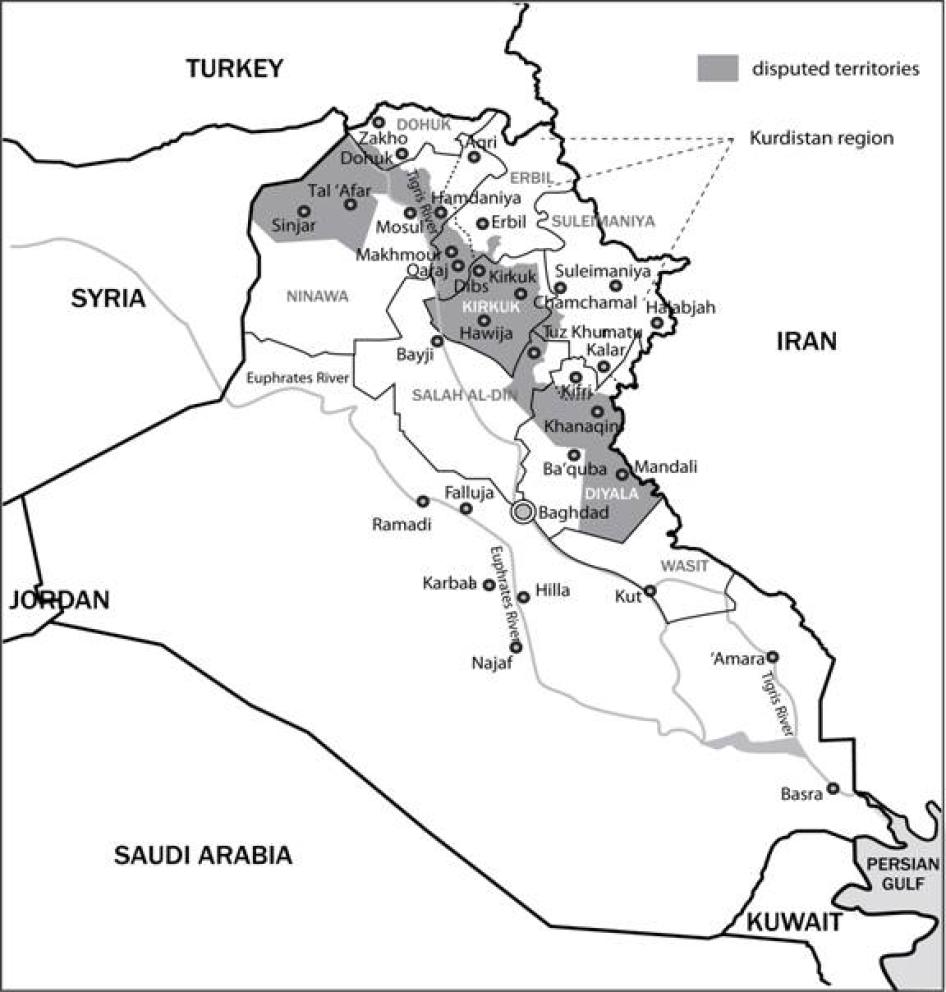
Courtesy of the International Crisis Group
I. Relevant Legal Standards
International Standards Protecting Minority Rights
Iraq made a declaration, on gaining independence and joining the League of Nations in 1932, that it would protect the rights of minorities—the first non-European state to so declare. With the formation of the United Nations after the Second World War, the international community recognized the particular vulnerability of minorities around the world to human rights abuses. In December 1948 the UN General Assembly adopted the Convention on the Prevention and Punishment of the Crime of Genocide.[1] The Convention was followed by others firmly establishing the rights of minorities in international law. In 1971, Iraq was one of the first countries in the world to ratify the International Covenant on Civil and Political Rights.[2] Article 26 of the Covenant prohibits discrimination on grounds of race, religion, and language, and article 27 is specifically dedicated to the rights of minorities: “In those States in which ethnic, religious or linguistic minorities exist, persons belonging to such minorities shall not be denied the right, in community with the other members of their group, to enjoy their own culture, to profess and practice their own religion, or to use their own language.”
Iraq has assumed the obligation to take action to protect minority rights through other notable UN conventions, such as the International Convention on the Elimination of All Forms of Racial Discrimination,[3]and the Convention on the Rights of the Child.[4]The latter specifically requires the education of a child to be directed to the “development of ... his or her own cultural identity, language and values” and gives a child of a religious minority the right “to enjoy his or her own culture, [and] to profess and practise his or her own religion.”[5]
Additionally, the United Nations General Assembly (UNGA) has passed declarations that articulate best practices and human rights standards for the protection of minorities. In the UNGA Declaration on the Elimination of All Forms of Intolerance and of Discrimination Based on Religion or Belief (1981), the “freedom to have a religion ... and freedom ... to manifest his religion or belief in worship, observance, practice and teaching” is protected, and “coercion which would impair [t]his freedom” is prohibited.[6] More specifically, assembly for worship, observance of religious holidays, maintaining and erecting buildings for worship, acquiring items for use in religious rituals, religious teaching and appointment of religious leaders, fundraising for religion, and communication with coreligionists are activities that fall within the protection of freedom of religion.[7] According to the UNGA’s Declaration on the Rights of Persons Belonging to National or Ethnic, Religious or Linguistic Minorities (1993), states are obliged to protect minorities by taking “measures to create favourable conditions to enable persons belonging to minorities to express their characteristics and to develop their culture, language, religion, traditions and customs.”[8] The declaration also says that states must protect the identity of minorities within their respective territories by encouraging “conditions for the promotion of that identity” and measures allowing minority members to “participate fully in the economic progress and development in their country.”[9] It states that minorities have the right to establish and maintain their own associations. Minorities also have “the right to participate effectively in decisions on the national and, where appropriate, regional level concerning the minority.”[10]
The protection of minority rights is further incorporated into international law through regional instruments, such as the Council of Europe’s Framework Convention for the Protection of National Minorities and the European Charter for Minority Languages, and the Arab Charter on Human Rights.[11] The Arab Charter, adopted by the Council of the League of Arab States in 2004, states that “minorities shall not be deprived of their right to enjoy their culture or to follow the teachings of their religions.”[12] Further, the Arab Charter prohibits denying an individual’s rights because of his or her “race, colour, sex, language, religion, political opinion, national or social origin, property, birth or other status and without any discrimination between men and women.”[13] Iraq is a founding member of the League of Arab States.
National Standards Protecting Minority Rights
Iraq’s constitution, adopted in October 2005 by popular referendum, has various provisions guaranteeing the rights of minority groups. The constitution specifically “guarantees the full religious rights to freedom of religious belief and practice of all individuals such as Christians, Yazidis, and Mandean Sabeans.”[14] Article 3 explicitly recognizes that Iraq is a country of multiple nationalities, religions, and sects.[15] Article 4 guarantees the right to educate children in their mother tongue (such as Turkmen, Syriac, and Armenian).[16] According to article 14, all Iraqis are “equal before the law without discrimination based on gender, race, ethnicity, nationality, origin, color, religion, sect, belief or opinion, or economic or social status.”[17]
Iraq’s Constitution and the Disputed Territories
Additionally, the constitution stipulates a national law must be passed to “guarantee the administrative, political, cultural, and educational rights of the various nationalities, such as Turkmen, Chaldeans, Assyrians, and all other constituents.”[18]
The constitution takes up the language of article 58 of its predecessor, the Transitional Administrative Law, which specified steps the government must take to “remedy the injustice caused by the previous regime’s practices in altering the demographic character of certain regions, including Kirkuk, by deporting and expelling individuals from their places of residence, forcing migration in and out of the region, settling individuals alien to the region, depriving the inhabitants of work, and correcting nationality.” These steps, now required by article 140 of the constitution, include the following:[19]
- Restore expelled and deported residents to their homes and property, or, where this is unfeasible, provide just compensation;[20]
- Promote employment opportunities for persons who were previously deprived of employment or other means of support in order to force their migration out of the regions;[21]
- Repeal all decrees relevant to “nationality correction” and permit affected persons the right to determine their own ethnic affiliation free from coercion and duress;[22]
- Appoint a neutral arbitrator to make recommendations concerning the administrative boundaries that were modified by the previous regime;[23] and
- Conduct a fair and transparent census followed by a referendum in Kirkuk and other disputed territories “to determine the will of their citizens” by a date not later than December 31, 2007.[24] (As is discussed in chapter II, the referendum mentioned in the last point has yet to take place.)
II. Background
Inhabited by Arabs, Kurds, Assyrians, Yazidis, and Shabaks for centuries, Nineveh province is a communal mosaic. The plethora of ancient temples, churches, and mosques in close proximity to each other in neighboring villages in the plains north and east of Mosul (the provincial capital) testify to the province’s rich ethnic and religious diversity.
A note on identities[25]Close to two-thirds of Iraqi Christians are Chaldeans (an Eastern rite of the Catholic Church), and close to one-third are Assyrians (Church of the East).[26] Chaldeans broke away from the Assyrian church as a result of long-running dynastic conflicts.[27] Chaldo-Assyrians are descendants of ancient Mesopotamian peoples, speak Aramaic, and live mainly in northern Iraq where they tend to be professionals and businesspeople or independent farmers. Yazidis practice a 4,000-year-old religion that centers on Maluk Ta’us, the Peacock Angel. The Yazidis are by and large impoverished cultivators and herdsmen who tend to maintain a closed community. Historically, they have been subject to sharp persecution owing to their beliefs and practices, which have been misconstrued as satanic.
Shabaks are an ethnic and cultural minority located in Mosul and a few villages east of the city in the Nineveh Plains. Their language is a mix of Turkish, Farsi, Kurdish, and Arabic. About 70 percent of the group is Shia and the rest Sunni. Shabaks have been in Iraq since the beginning of the 16th century, and today are mainly farmers. They have been recognized as a distinct ethnic group in Iraq since 1952. |
Arabization
Since the 1930s, and particularly in the 1970s, 80s, and 90s, Iraqi central governments have attempted to change the ethnic composition of northern Iraq by expelling hundreds of thousands of Kurds and other minorities from their homes, and repopulating the areas with Arabs transferred from central and southern Iraq.[28] The government policy, known as “arabization” (ta'rib), intensified in the second half of the 1970s with the aim of reducing minority populations whom authorities considered to be of questionable loyalty in this strategic area. The government responded to Kurdish insurgencies by mounting a concerted campaign to alter the demographic makeup of northern Iraq, especially in areas bordering Turkey and Iran (see map). The government used military force and intimidation as the primary methods. These policies completely depopulated entire non-Arab villages that authorities then bulldozed. By the late 1970s the Iraqi government had forcibly evacuated as least a quarter of a million Kurds and other non-Arabs.
The government followed up these brutal expulsions with legal decrees aimed at consolidating the displacement. First, the government invalidated property titles of the displaced non-Arabs, most frequently with nominal or no compensation. The government nationalized agricultural lands, making them the property of the Iraqi state. The government then embarked on a massive campaign to resettle the formerly non-Arab areas with Arab farmers and their families from elsewhere in Iraq, completing the arabization process. Finding recruits for the settlement was not difficult: southwest of Mosul is the large al-Jazira desert, then home to hundreds of thousands of nomadic Sunni Arab tribespeople who largely supported the government. The al-Jazira tribespeople, enticed with free, irrigated land, and encouraged by their tribal sheikhs, abandoned their difficult lives in the desert and moved north en masse. Although the land was declared government property, it was leased on annual contracts only to the new Arab farmers.
Anfal Campaign
In the late 1980s, near the end of Iraq’s eight-year war with Iran, Iraqi forces launched their infamous Anfal campaign against a Kurdish insurgency—an operation that reached genocidal proportions.[29] The campaign included the use of aerial bombardment, ground offensives, destruction of villages, mass deportation, and chemical weapon attacks. Anfal resulted in the “disappearance” of about 100,000 Kurds; since the overthrow of the former government, many of their bodies have begun to be recovered from mass graves in different areas in Iraq. The Anfal operation, which was declared over by a September 1988 amnesty, devastated Iraqi Kurdistan. A large proportion of the population was displaced, with survivors not allowed to return to their destroyed villages.
After the amnesty, some minority members who had fled alongside Kurds surrendered to Iraq forces only to be “disappeared”—presumably sharing the same fate as those bused out during Anfal to remote desert sites, executed en masse, and buried in mass graves.[30] Iraqi officials considered them to be traitors who were “worse than Kurds”—not only did they act like Kurds but they also refused to accept the government’s attempts to designate their ethnicity as “Arab.”[31]
Continuing Arabization post-1991, including Nationality “Correction”
With the majority Kurdish areas of northern Iraq effectively beyond Baghdad’s control from the end of the first Gulf War in 1991, arabization continued south of the unofficial line of demarcation known as the Green Line: the government of Iraq expelled about 120,000 persons from Kirkuk and other areas under Iraqi government control during the 1990s. The policy continued up to the fall of Saddam Hussein’s government in April 2003.
Another of the pillars of arabization was a Baath Party policy, formally introduced in 1997, whereby the government pressured Kurds and other non-Arabs living in government-controlled areas in Kirkuk, Khaniqin, Makhmour, Sinjar, Tuz Khormatu, and other districts to “correct” their ethnicity by registering as “Arabs” on so-called nationality correction forms distributed by the government. The Iraqi government also refused to register newborns with Kurdish or other non-Arabic ethnic names.[32] Those who “corrected” their nationality were also forced to engage in loyalist activities, such as volunteering for paramilitary forces. For families who resisted the government’s demands, officials simply issued expulsion orders requiring them to leave their homes for the Kurdish-controlled areas.
Enduring Legacy of Displacement
The families expelled under the arabization policies and displaced by the Anfal campaign and other acts of violence mostly ended up living in squalid poverty in overcrowded camps in what is now the KRG region. The plight of the displaced Kurdish families, many of whom continue to hope to return to their ancestral villages, remains a powerful symbol of the injustices suffered by the Kurds during the previous Iraqi regimes, and a nationalist rallying point to reclaim the lands they lost.[33] The failure of the Iraqi, Kurdish, and international authorities to address the aspirations and grievances of these thousands of displaced Kurds has greatly added to the tensions in northern Iraq.
Invasion and Civil War
Following the US-led invasion of Iraq in 2003, Kurdish fighters (known as peshmerga), in tandem with US forces,moved into Nineveh province, south of the Green Line.[34] Most Arabs who had moved to the area as part of the “arabization” campaign quickly fled their homes, leading to thousands displaced. In villages where Sunni Arabs stayed (including villages where they had traditionally lived), ethnic tensions flared.
A brutal civil war soon broke out in central and southern Iraq, mainly in the form of a sectarian conflict between Sunni and Shia. At the same time, the Kurdish leadership quietly strengthened its military, political, and cultural hold on the disputed territories in northern Iraq, using peshmerga forces to provide security and building Kurdish political and administrative structures in the area (the KRG’s courting of minorities with patronage is discussed below).
With a reduction of sectarian violence across Iraq after 2007, Sunni and Shia leaders realized that while they were battling each other, the Kurdish leadership had established itself in control over much of the disputed territories, including Nineveh province. An emboldened Kurdish leadership seeks to take much of Nineveh into the semiautonomous region of Kurdistan in the referendum mandated by article 140 of the constitution (see chapter I).[35] The December 31, 2007, deadline for the article 140 referendum has long passed. The Kurdish leadership, with its formidable political and security presence in the area, believes it is poised to win such a referendum, and is growing increasingly impatient given that there are no plans on the horizon for holding it.[36] Sunni Arabs see Kurdish claims and initiatives as expansionist and illegitimate, and a threat to a unitary Iraq state.[37] The struggle has also fueled the insurgency in the north, where groups like al Qaeda in Mesopotamia as well as Iraqi insurgents seek to exploit Sunni Arab anger and find recruits among the Arabs displaced by the reversal of arabization.
Political Developments and the Situation in Nineveh
In the first years after the overthrow of the Saddam Hussein government, many of the previously dominant Sunni Arabs refrained from engaging with the new political system, with many opting instead to support the insurgency or remain on the sidelines. By default, Kurds acquired political and security dominance in Nineveh, where they are a minority: Sunni Arabs and minorities mainly boycotted the 2005 provincial elections in Nineveh, and a large Kurdish turnout allowed the Kurdish list to win. Kurdish authorities then used this leverage to consolidate Kurdish control there.
The balance of formal political power changed dramatically as a result of Nineveh’s provincial council elections in January 2009. Riding a wave of resentment against the Kurds, the Sunni Arab nationalist party, al-Hadba (named after the leaning minaretthat is Mosul’s landmark), won 19 of the governorate’s 37 seats. The Kurdish (and pro-KRG) coalition, the Nineveh Fraternal List, took 12 seats; the Sunni Iraqi Islamic Party won three. As required under election law quotas, Christian, Shabak, and Yazidi candidates received one seat each.
Al-Hadba’s victory in the polls led to a dangerous stand-off in Mosul. The Nineveh Fraternal List boycotted the provincial council after al-Hadba froze Fraternal List officials out of all key positions in Nineveh’s new administration. Kurdish officials have tried to portray al-Hadba as being a front for terrorists and Baathists, and have threatened to resort to military force to annex Kurdish-majority areas in Nineveh unless they are offered senior posts.[38] Sunni Arab leaders have stated that they will not negotiate until the Kurds recognize Nineveh’s administrative borders and pull their security forces north of the Green Line.[39]
Kurdish authorities have blocked Arab officials from carrying out their duties in Kurdish-controlled areas of Nineveh province, and they pressured districts under their control to boycott the new Arab governor.[40] Sixteen disputed towns and districts under Kurdish control have severed contact with the provincial government and announced plans to form their own administration to run local affairs.[41]
On June 24, 2009, the KRG parliament further raised the stakes in the conflict after passing a draft regional constitution in which it laid claim to areas within Nineveh and other disputed territories, and asserted the KRG’s right to deploy peshmerga outside of the region (the constitution is subject to ratification by popular referendum—see below).[42] The move provoked outrage from minority groups[43] and the central government, and further united Sunni and Shia politicians. In the days that followed, 50 Iraqi MPs from different political parties signed a petition criticizing the new regional constitution.
The move also increased the wedge between the KRG and Prime Minister Nuri al-Maliki, who has demanded that Kurdish fighters withdraw from areas outside the KRG’s borders.[44] Al-Maliki has called for amendments to the Iraqi constitution to concentrate more power with the central government.[45] His previous efforts to strengthen Baghdad’s hand at the expense of the country’s 18 provinces has alarmed the KRG leadership, who have benefited from the decentralization that they helped negotiate into Iraq’s 2005 constitution.[46] Tensions calmed between the two sides only after al-Maliki made a rare visit to the Kurdish region in August. However, the situation remains precarious, with neither side apparently having much appetite for compromise.
After initially paying scant attention to the tensions in northern Iraq, US officials are now wary of becoming immersed in a new armed conflict in Iraq, this time between the Kurds and Arabs. The deteriorating security situation in Nineveh in August 2009 forced Washington to step up its engagement on the issue of the disputed territories. The commanding general of US forces in Iraq, Gen. Ray Odierno, met separately with KRG president Massoud Barzani and Iraqi Prime Minister al-Maliki after three massive bombings within a week killed over 90 people (see chapter III) to propose reintroducing US troops in Nineveh’s disputed territories.[47] The proposal is to deploy US troops among fixed formations of Iraqi troops and peshmerga. After the KRG parliament passed the draft constitution in June, US Vice-President Joe Biden rushed to Baghdad and helped persuade the KRG to defer a referendum on the new constitution that had been due to go to voters at the end of July.[48]
The United Nations has also tried to help the parties navigate a path out of the dispute after Iraq failed to meet its December 2007 constitutional deadline to implement article 140.[49] UN Security Council Resolution 1770 (August 2007) gave the United Nations Assistance Mission in Iraq (UNAMI) a mandate to “advise, support and assist” the central government to resolve the internal boundary question.[50] The UN reports, which are not public, were delivered to Prime Minister al-Maliki and the Presidency Council, and to KRG President Barzani in April 2009. The result of more than a year’s work by a 15-member team of diplomats, academics, negotiators, and constitutional experts, the reports included separate studies of 15 disputed districts in which UNAMI recommended local confidence-building measures on issues such as security and development.
Kurdish Patronage and Control
Losing the 2009 provincial elections in Nineveh was a significant setback for the KRG, which had flooded minority communities in the Nineveh Plains—long neglected by the central government—with money to win their support. The KRG finance minister, Sarkis Aghajan, himself a Chaldean Catholic, reportedly spent millions of dollars in the disputed territories.[51] The cash infusion has left its mark on villages across the plains in the form of new housing construction, refurbished churches, aid distribution, and newly formed youth sports clubs and cultural associations. Aid is distributed through the local “Christian Affairs Committee,” a network established by Aghajan.[52]
“Before 2005, no one cared about our communities or churches and then overnight we started to receive funding,” a priest in the town of Qaraqosh told Human Rights Watch.[53] “The Kurds have a hidden agenda and are using money to co-opt Christians—it’s not because they want to help our people ... I believe that anyone who disagrees with their agenda puts their life at risk.” Other Christian representatives in Arbil and Tal Usquf told Human Rights Watch that they too are wary because they know the money comes with strings attached. They accuse the KRG of buying the allegiances of tribal leaders through a patronage system that fosters political divisions within minority communities by creating and funding alternative civil society organizations that favor Kurdish rule, while blocking those that do not. They also complained about the bankrolling of clergy and religious sites in order to buy the support of minority religious establishments.[54]
Christian churches and aid organizations have complained that the KRG denied them funding for assistance programs geared to internally displaced persons because they have not pledged support to the KDP. A Christian advocacy organization also reported that the KDP has been pressuring Christians to sign forms pledging their support for the Nineveh Plains area to be annexed to Kurdish areas and placed under KRG rule.[55]
Muhammad Ihsan, the KRG minister for extra-regional affairs, acknowledged to Human Rights Watch that KRG policy was to use the region’s finances strategically to win favor among minority groups in the disputed territories. “We are not angels, we are politicians, and this is politics,” he said. “‘Join with me and I will give you this and that.’” However he denied the KRG had engaged in pressure tactics or threats.[56] When Human Rights Watch asked KRG Minister of the Interior Karim Sinjari about the financial support provided by Aghajan to Christian communities, Sinjari replied, “This isn’t Aghajan’s money, but KRG money ... [he] didn’t build anything by himself, he did it through the KRG. The [Kurdish] prime minister ordered him to do so.”[57]
Sheikh George Kako, a pro-Kurdish Christian leader, told Human Rights Watch that the KRG is trying to “overwhelm” the Chaldo-Assyrians with money to keep them on their side. “I wish the area remains disputed for 100 years because we will continue to receive support from both sides. Let them both nurture us.”[58]
The Kurds have also invested significantly in the cultural and religious activities of Yazidis, and pay the salaries of the employees of the Lalish Cultural Center, which has branches in most Yazidi towns.[59]
In a move that disturbingly echoes the “nationality correction” policy of the former Baathist government, minority groups have reported that their members were forced to not identify themselves as a member of a minority community (the two registration options given are Kurd or Arab), in order to get access to education or healthcare.[60] “During the former regime, the census had only two categories: Arab and Kurd. Shabaks were not recognized as a separate ethnicity. We were the victims of arabization,” Qusay Abbass, the elected member of the Shabak quota seat on the Nineveh provincial council, told Human Rights Watch.[61] “After 2003, we have been subjected to another injustice, this time at the hands of Kurds through their Kurdisization policy. The KRG has a right to form an independent state but not at the expense of other communities.” For the Yazidis, instead of fostering a greater sense of Kurdish identity, the patronage system has increased discontent with Kurdish rule: many reportedly feel the money has come at the expense of independent Yazidi political groups.
Some Christian representatives said that KRG money also finances private militias in villages under the pretext of providing protection, but in reality extends Kurdish influence by creating a local armed group that is ultimately loyal to its paymaster.[62] Critics argue that the militias are another means of KRG control on the region. At the entrance of each Christian village that Human Rights Watch drove by in the Nineveh Plains, Christian militiamen, knows as the “Churches’ Guardians,” guarded checkpoints. The militia, funded by Aghajan, has 1,200 members deployed in Qaraqosh and surrounding villages.[63] Kurdish authorities insist that if there were no Christian militia and Kurdish peshmerga forces to secure Nineveh’s disputed territories, Sunni Arab armed groups would have an easier time launching devastating attacks against minorities. KRG Interior Minister Sinjari noted that the peshmerga initially entered Nineveh at the request of the US Army and Iraqi central government, who needed help securing the area in 2004.[64] The KRG-funded militias do not play a police role besides offering the communities protection, he said, also remarking: “The reality is the people living in the disputed areas want to be with the KRG and they have asked for our protection. If they choose, they can have their autonomy inside the Kurdish region.”[65]
Bassem Bello, the Christian mayor of Tel Kaif, a mixed Sunni Arab-Christian town near Mosul, and other community leaders see the KRG-funded Christian militia as illegitimate since it falls outside the structure of official Iraqi government security forces. Such a group, they say, is more likely to support certain political parties and their KRG paymaster rather than uphold the rule of law.[66] Bello and other representatives of minorities also say that peshmerga forces and asayesh (agents of the primary Kurdish intelligence agency operating in the Kurdistan region) should not be allowed to operate in the Nineveh Plains because of their role in intimidating political opponents, restricting access to services, and engaging in extrajudicial detentions.[67] “They detain people without any arrest warrant or judicial proceeding,” Bello said. “Why are the asayeshandpeshmerga even here in Iraqi territory? There’s no reason for it. They want to show they have power and control of our areas.... The security forces that the Kurdish authorities now have in place get their orders from the KRG, not the central government.”[68] (Incidents of abuses in which peshmerga are implicated are discussed in chapters III and IV.)
III. Targeting Nineveh’s Minorities for Murder
A Recipe for Violence
Shortly after US-led forces invaded Iraq in 2003, the Coalition Provisional Authority disbanded Iraq’s entire military and security apparatus, with the exception of the Kurdish peshmerga. Taking advantage of this security vacuum, and with thousands of battle-hardened, disgruntled, and unemployed Iraqi security personnel as well as many Arabs displaced by the reversal of the “arabization” process to recruit from, Sunni extremist groups sowed mayhem throughout the country, igniting a sectarian conflict. As the conflict spread, an increasing number of Sunni and Shia men were drawn into the fighting.[69] While Iraqis from all ethnic and religious denominations suffered from the overwhelming violence in the years that followed the occupation, the smaller minority communities have been particularly vulnerable.
Sectarian violence peaked in mid-2006 with an unprecedented number of murders, enforced disappearances, abductions, torture, and attacks on religious sites, including Shia and Sunni mosques, and churches.[70] In August 2006, Sunni tribal leaders in Anbar province cut ties with al Qaeda in Mesopotamia, alienated by the group’s brutal tactics and extremist ideology. The US military embraced the resulting Awakening movement and paid Sunni tribesmen, dubbed “Sons of Iraq,” about $300 each a month to end their attacks on US convoys and troops and to protect checkpoints and buildings.[71]
Despite security gains in most of Iraq by early 2008, Nineveh remained one of the most dangerous and unstable parts of the country. Even a major military offensive in the spring of 2009, when 4,000 US and more than 25,000 Iraqi security personnel swept through each of Mosul’s neighborhoods, did little to quell bloody attacks in the city or Nineveh province.[72]
As US forces largely withdrew from cities to their bases on June 30, 2009, as part of a security agreement with the government of Iraq, attacks in Nineveh, particularly against minority groups, increased dramatically, and at this writing show no sign of abating. In the six weeks after the withdrawal, attacks against minority groups in four different locations killed more than 137 and injured almost 500 from the Yazidi, Shabak, and Turkmen communities. On July 9, 2009, suicide bombers killed at least 45 people and wounded 65 more in Tal Afar, a mainly Turkmen city west of Mosul.[73]
On August 7 a truck packed with explosives detonated outside a Shia Turkmen mosque filled with people attending a funeral service on the northern fringes of Mosul in Shirakhan. The bombing killed at least 37 and wounded 276.[74] August 11 saw one of the deadliest attacks against the Shabak community since 2003: Two massive truck bombings killed at least 35, wounded more than 110, and flattened 30 houses in the Shabak village of al-Khazna in the Nineveh Plains.[75] Two days later, on August 13, two suicide bombers targeted Yazidis in a crowded café in the city of Sinjar, killing at least 21 and wounding more than 30.(The latter two incidents are described in more detail below.)
While other cities have made gains in eradicating the activities of armed Islamist groups, the reverse is true for Mosul, which experiences bombings and shootings on an almost daily basis.[76] The city has become a strategic stronghold for remaining Sunni insurgent groups partly because of Sunni fears about the growing Kurdish hegemony in the region and the widespread displacement of Arabs as a consequence of the reversal of arabization. Continuing Sunni Arab disillusionment has allowed the creation of safe havens for extremists to operate in their neighborhoods and to persecute minorities with a free hand.
Attacks have struck directly at the social infrastructure of minority communities, leaving victims and others fearful to carry on with their everyday lives. Although there are political divisions within each minority group, between those who want a closer union with the KRG and others who would prefer to remain under the authority of the central government, members of every minority Human Rights Watch interviewed agreed that the situation for minorities had become dire.
“Before we understood that we had a totalitarian government and therefore abuses happened. But now we are supposed to be free and democratic. This democracy is killing us,”said a 70-year-old Assyrian community elder in the town of Tal Usquf.[77] “We’re not minorities, we’re the oldest people in Iraq—we are the indigenous people of this country, like the Native Americans.”
Killings of Chaldo-Assyrians
Since 2003, armed groups opposed to communities of different faiths living in their vicinity, especially ones with perceived ties to the supposedly Christian West (and, by association, with the multinational forces in Iraq—they are perceived as accounting for a high proportion of the translators working for US forces, for example) have repeatedly attacked the Chaldo-Assyrian community. The perceived Christian support for the KRG’s claim to the disputed territories, and the wealth of some Christians are also factors.
Under the previous Baathist government, only Christians and Yazidis, whose religions do not prohibit alcohol use, were permitted to sell liquor, making them easily identifiable as members of minority groups because of their trade, which religious Muslims frown upon. Extremists have bombed, looted, and defaced liquor stores in Mosul and elsewhere.[78] Organized criminals also sometimes fake a jihadist identity to mask a real motive of extortion and thievery. They regard Christians as rich and without protection, since they traditionally have not had any tribal or militia links.[79] Christians active in the jewelry and gold trade have been particularly targeted for kidnappings for ransom and killings.
One of the most notorious incidents targeting the Chaldo-Asyrian community occurred on February 29, 2008, when assailants kidnapped Chaldean Archbishop Paulus Faraj Rahho in Mosul as he was leaving the Holy Spirit Church. They shot his driver and bodyguards; the archbishop’s body turned up 10 days later.[80] The accused leader of the kidnappers, Ahmed Ali Ahmed (known as Abu Omar), was captured by Iraqi officials, who described him as an al Qaeda leader. In a rare prosecution, Ahmed was tried for the murder and convicted in May 2008 and sentenced to death.[81] The archbishop was the third senior Christian religious figure to be killed in Mosul since 2006. On November 30, 2006, assailants kidnapped Friar Mundhir Al-Dayr of the Protestant Church in Mosul and killed him with a bullet shot to his head. Friar Ragheed Ganni and three deacons were gunned down in their car on June 3, 2007.[82] Like most of the attacks against minority communities, those killings remain unresolved but fit the pattern of violence predominantly used by Sunni Arab Islamist groups.
Beginning in September 2008 a series of killings by armed assailants shook the Christian community in Mosul, leading to a mass exodus of thousands of Christians from the city. (Even before the attack, Christians had been fleeing Iraq at much higher rates than other groups; their number in Iraq fell to about 675,000 in 2008, from one million in 2003,[83] and almost 20 percent of Iraqi refugees in neighboring countries are thought to be Christians.[84]) Assailants, most likely from Sunni Arab extremist groups, targeted Christians in their homes, in their work, and in places of worship.
This wave of killings targeting Christians began shortly after the community lobbied the Iraqi parliament to pass a law that would set aside a greater number of seats for minorities in the January 2009 provincial elections.[85] The killings escalated after September 28, shortly after Christians held demonstrations in Nineveh and Baghdad in response to parliament’s decision (later amended) to drop a provision in an earlier version of the provincial elections law ensuring political representation for minorities (protesters reportedly held up signs demanding the creation of a separate province governed by Christians).[86]
The attacks that followed left 40 Christians dead and displaced more than 12,000 from their homes within a matter of weeks.[87] The killings were accompanied by the bombing of Christian dwellings in Mosul, as well as threatening graffiti in Christian neighborhoods with messages such as “get out or die,” and anti-Christian messages disseminated by loudspeakers mounted on cars, threatening Christians if they did not leave.[88]
Representatives from the various communities have traded accusations of responsibility and motives. Some Arab and Christian representatives have pointed the finger at KRG responsibility or at least complicity, pointing out that Kurdish-dominated security forces were in charge of security in the area the attacks took place, and suggesting that the murder campaign was designed to undermine confidence in the central government’s security forces.[89] From this perspective, the attacks created an opportunity for the KRG to appear benevolent before the Christian community and the world by subsequently providing shelter, security, and financial assistance to those who fled the attacks into Kurdistan, strengthening the Kurdish hand in any upcoming referendum or election: After the Iraqi central government promised the equivalent of about US$127 to each displaced family, KRG Finance Minister Aghajan offered each family $212.[90] Aghajan also created an extensive refugee housing program throughout the Christian areas. In Karamlesh, he purchased land from the local Chaldean church and erected prefabricated housing units.
As evidence of Kurdish involvement, proponents of this theory point to the fact that the attacks happened in the part of Mosul relatively free from insurgent activity and controlled by the Iraqi army, which was dominated by a high percentage of Kurdish officers in that area. Some of the killings happened in areas secured by Iraqi army checkpoints and, in some cases, in close proximity to them, leading some to believe that Kurdish officers or their proxies had a hand in the attacks.[91] Kurdish authorities have rejected these assertions and accused Sunni Arab groups of having carried out the attacks to sow intercommunal tensions.[92] In a rare disavowal, the Islamic State of Iraq, an umbrella organization comprising a number of insurgent groups including al Qaeda in Mesopotamia, has denied responsibility for the killings.[93] More recently, Kurdish MP Mahmoud Othman blamed militias loyal to Prime Minister al-Maliki for being behind the violence.[94] None of these allegations has been backed up by clear and convincing evidence.
What is clear, however, is that the attacks were systematic and widespread. Human Rights Watch interviewed family members of seven Christian victims murdered between late August and early October 2008. While other Christians have since returned to Mosul, these families remained in Christian villages in the Nineveh Plains, too fearful to return to their homes in the city. Some witnessed the murders themselves; others spoke to witnesses who saw the perpetrators kill their loved ones. Their accounts suggest an orchestrated and targeted campaign of violence intended to have maximum impact in devastating the community.
Based on these interviews, Human Rights Watch found no evidence suggesting that Kurds were directly involved in that campaign of violence against Christians. According to the witnesses, the gunmen spoke fluent Iraqi Arabic, which appeared to be their mother tongue (in contrast to Kurds, whose native language is Kurdish, but speak Arabic as a second language). The assailants had an Arab appearance and dress, and made it clear that they were attacking Christians on religious grounds. For example, one of the victims, mechanic Afnan Daoud Saeb al-Hadad, answered his door at 10:30 a.m. on September 28 in Mosul. A masked man demanded that al-Hadad show him his identification. When al-Hadad asked who the person was, the masked man responded in Arabic, with a Mosul accent, “Don’t be afraid, Ummu [uncle], I am with the secret police.” After checking his identification, the masked man asked al-Hadad whether he was a Christian, to which al-Hadad said yes. The perpetrator said, “Then I must kill you because you are a Christian.” The perpetrator then fired several shots from an Iraqi-made 9mm Tariq pistol into al-Hadad’s lower body, killing him. His family remained in Mosul for a week, until the funeral, and then fled to Qaraqosh.[95]
In a second case, on October 7, assailants armed with AK-47s approached Amjad Hadi Petrous, a builder, at a construction site where he was working in Mosul. They asked him, “Are you a Christian?” He responded, “Yes, what is it that you want?” The gunmen shot Petrous, killing him instantly. The perpetrators then fatally shot his 20-year-old son, Wusam, also working at the site, with two bullets to his neck and cheek. The family had received no direct threats or warning prior to the incident, although a few days earlier two men acting suspiciously fled his Christian neighborhood after a neighbor fired off warning shots.[96]
A few weeks earlier, on August 28, Siham Alhad’s husband, Nafa’t Basheer Mikha, 63, left home for his shop; it was the last time she would see him alive. Three nights later his body was found in a trash heap with four bullet wounds in his head and neck. Similar to the other families Human Rights Watch spoke with, they had not received any direct warnings or threats prior to the murder, although the family said that other Christians in the neighborhood had received threatening cellphone text messages and bullets in envelopes left on doorsteps. Mikha had no outstanding debts and he was a well-respected member of his community. The family believes he was killed because he was a Christian. Less than two weeks later, at about 8 a.m. on September 10, an assailant killed the couple’s son, Rayan, at his bicycle repair shop in Mosul. The shop’s location—between two security checkpoints—made it difficult for the perpetrator to gain access to the shop without passing through a checkpoint. Although the family said there are witnesses, no one has dared to speak, out of fear. The rest of the family fled to Qaraqosh and have no plans to return to Mosul. Siham Alkhad said, “Our friends used to advise us, ‘Why don’t you leave, things are getting unsafe—why don’t you go somewhere else?’ and we used to reply, ‘We don’t have any disputes with anyone, so why should we leave?’”[97]
In another incident, an assailant killed a 46-year-old Christian man (name withheld at his family’s request) in his garment shop in Mosul on October 4 at 1:45 p.m. As customers browsed in his small shop in the Sarray market, an unmasked bearded man stood at the doorway, said nothing, and shot the shopkeeper as he sat at his desk. After shooting him six times, the perpetrator calmly strolled away. His wife and four children fled Mosul after his funeral, four days later, for Qaraqosh.[98]
In early September, kidnappers who appeared to be Arab abducted Tariq Qattam, 66, from his mechanic shop. After two or three days the kidnappers called, speaking in a non-Mosul but local Arabic accent, and asked the family for a $200,000 ransom in order to release Qattam unharmed. After negotiations, the amount was dropped a week later to $20,000. The family delivered the money to the kidnappers, who promised to release Qattam in an hour or two.[99] His dead body was discovered the next day.
During the campaign of violence against Christians in Mosul, the Kurdish-dominated security forces controlling the area seemed unable to prevent or stop the attacks.[100] After the spate of killings, Prime Minister al-Maliki replaced Kurdish-dominated army units in Mosul with Arab units and sent in non-Kurdish police forces from Baghdad.[101]
In October Iraq’s Ministry of Human Rights created a committee to investigate the attacks against Christians in Mosul and their subsequent displacement.[102] The committee visited the affected areas and interviewed survivors. The unpublished report drew no conclusions as to who was behind the attacks, or whether Iraqi security forces could have prevented them, but did state that the evidence indicated that the campaign was “targeted” “systematic” and “pre-arranged.” The report stated that the “killings, targeting and threats were practiced in the eastern side (left) of the city, which was previously the safe side where security forces could move freely and smoothly as opposed to the west side (right) which is considered by the people of Mosul as the domicile of armed groups.”[103]
By mid-November 2008 about 80 percent of displaced Christians were reported to have returned to their homes in and around Mosul, in part because security had improved (although on November 11 unknown gunmen killed two Christian sisters in Mosul), but mainly out of concern for their job security, or for their children’s education.[104]
Killings of Shabaks
Killings of Shabaks have occurred since the start of the US occupation. Since 2004, Shabak groups have reported to the UN that more than 750 of their community have perished in armed attacks.[105] Unlike attacks against Christians, these have generally gone unnoticed by media outside of the country because of the community’s obscurity and lack of an influential diaspora. Shabaks number between 200,000 and 500,000, and live mainly in the Nineveh Plains.[106] Insurgent groups have targeted them because about 70 percent of Shabaks adhere to the Shia sect of Islam, which many Sunni extremists regard as heretical (Sunni insurgents have targeted Shia throughout Iraq, and not just Shia who are members of minority groups): for example the Islamic State of Iraq, an insurgent group then allied to al Qaeda in Mesopotamia, distributed a flyer dated October 16, 2007, in Mosul that described Shabaks as “rejectors” of Islam and asserted that it is “an obligation to kill them and to displace them with no mercy.”[107] Sunni groups have also targeted Shabaks because some Shabaks identify themselves as Kurds, and because insurgents view them as pro-Kurdish. However, recent attacks on Shabak community leaders appear to have a different provenance.
In one of the worst attacks in the Nineveh Plains since 2003, on August 11, 2009, two large flatbed trucks packed with bombs exploded simultaneously at around 5 a.m. in the Shabak village of al-Khazna, which is under the control of Kurdish peshmerga forces. The force of the blast destroyed the town, leaving 65 houses in heaps of rubble mixed with bed frames, mattresses, furniture, and bloodstained pillows. Most villagers were asleep at the time, many of them on their rooftops to escape the summer heat. The final casualty toll was at least 35 killed and almost 200 wounded.[108]
Although no group claimed responsibility, the attack bore similarities to previous attacks by insurgent groups and al Qaeda in Mesopotamia. Avas Mohammed Jabar, 55, a farmer in al-Khazna, said he believed both Iraqi and Kurdish officials would use the incident to further their political goals and claim to protect the minorities: “Everyone will start showing their muscles and saying they want to protect us. But everyone is willing to sacrifice us for their goals. We blame the al-Maliki government and the Kurdish government for all the mass killing we face with no mercy.”[109]
His prediction was accurate: in the days that followed, Kurds, Arabs, and minorities traded accusations as to who was behind the attack, with both Kurds and Arabs claiming to be the true protectors of the minorities. Abd al-Wahed Abdullah, a KDP official, accused the al-Hadba coalition of masterminding the al-Khazna attack. He was quoted as saying, “They wanted to kill two birds with one stone: kill Shi`ites and have Kurds blamed.”[110] Meanwhile, Sunni Arab lawmaker Aiz Aldin al-Dawla was quoted as suggesting that the Kurdish government might have covertly carried out this attack and others to convince minority groups in the disputed territories that they are better off under Kurdistan’s mantle: “If not the Kurds, who? Who else has the power, the weapons and the desire to control these areas?”[111] Such accusations are routinely made without evidence to back them up, aggravating an already tense situation.
Shortly after the attack, the Nineveh provincial government called on Prime Minister al-Maliki to send military forces to the area and evict peshmerga from the province. The statement said the attack happened because the provincial and central governments were not fully in control of the province.[112] Shabaks proposed establishing their own community police force of 500 men to protect their villages, but a local Kurdish official dismissed a written request to this effect by Shabaks that had been approved by Prime Minister al-Maliki.[113](Although under international law there is no right for minorities to set up their own security force, the authorities have a duty to provide reasonable protection without discrimination.)
Hunain al-Qaddo, an Iraqi member of parliament representing the Shabaks, told Human Rights Watch that, in his view, the peshmerga have no genuine interest in protecting his community. He said he believes that Kurdish security forces are more interested in controlling Shabaks and their leaders than protecting them. “We are suffering at the hands of the peshmerga,” he said. “Although the [al-Khazna] attack was most likely done by the al Qaeda organization, the Kurdish government is still responsible because they refuse to let the Iraq armed forces protect us and have rejected the idea of allowing us to establish our own Shabak police force to protect our people.”[114]
For their part, Kurdish authorities have refused to recognize Shabaks as a minority, and consider them as a community of Kurdish ethnicity.[115] Those Shabaks who reject this identity pose a direct threat to the Kurdish authorities’ claim that Shabak territory belongs in Kurdistan.
Since 2008, Shabak leaders have increasingly been targeted for attack, with Kurdish forces implicated in some of the incidents. On July 12, 2008, a gunman killed the prominent Mullah Khadim Abbas, leader of the Shabak Democratic Gathering, a group that opposes the incorporation of Shabak villages into the territory of the KRG. As reported by the United Nations, that afternoon Abbas was driving to his home in the town of Barima after a meeting with other community leaders in Bashiqa village. On a desolate highway surrounded by agricultural lands, a vehicle approached his car from behind and opened fire through Abbas’s rear windshield, only 150 meters away from one of the many peshmergaoutposts guarding the area. Three of the seven bullets hit Abbas, killing him instantly. The assailants escaped, without being pursued by the peshmerga. According to Shabak Democratic Gathering members, peshmergaat the outpost claimed to have seen nothing, despite their close proximity to the scene of the murder.[116] In spite of repeated calls by UN officials to bring the killers to justice, no one has been held accountable for the murder.[117] In the days leading up to the murder, a rival Shabak political organization supportive of Kurdish annexation plans phoned Abbas several times with death threats, according to Abbas’s family. Abbas reported the death threats to Kurdish police, who failed to take any action. According to Abbas’s family and members of the Shabak Democratic Gathering, Abbas had infuriated Kurdish authorities by publicly criticizing fellow Shabaks working for the Kurdish agenda and denouncing Kurdish policies that in his view undermined the fabric of the community’s identity.[118]
On January 7, 2009, Shabak lawmaker al-Qaddo said that had he survived an assassination attempt that day in the town of Ali Rish in the Nineveh Plains.[119] He was on his way with other Shabaks to participate in the Shia religious festival of Ashura when his convoy came under fire and his car was hit four times. He escaped injury and others helped him out from his vehicle. “We saw men, some wearing Kurdish security uniforms, shooting at us,” he told Human Rights Watch. “The Kurdish government sees me as an obstacle to their interests. If they manage to get rid of me, the Shabak will lose another leader and the Kurdish government will have an easier time imposing their will on the Shabak and obtaining their lands. That is their objective.”[120]
Qusay Abbass, the Shabak Democratic Party candidate who ultimately won the Shabak quota seat on Nineveh’s provincial council in the January 2009 elections, told Human Rights Watch that the asayesh indicated to him that they were tracking his every move and they could easily harm him if they chose to.[121] When Human Rights Watch met Abbass in Bartella several weeks after the election, he expressed concern about his well-being and that of his family. He said he received a warning from Iraq’s Ministry of Interior that his life was still in danger. His building was packed with an entourage of armed guards and supporters. “The Kurds are disappointed with the election results,” he told us. “I am obviously a target and they will try to liquidate me.”
Months later, on August 16, 2009, an improvised explosive device targeted Abbass’s convoy as he drove to Mosul, lightly injuring him and two of his bodyguards. Abbass told Human Rights Watch that he did not know who was behind the attack and did not want to accuse anyone without further evidence.[122]
On December 17, 2008, unknown assailants kidnapped and killed Shabak leader Haj Asa’ad Issa Abbas in Mosul. [123]
Shabak community leaders have complained about impunity for killings.[124] In one incident, a skirmish between a Shabak farmer and a Kurdish shepherd accused of trespassing escalated into an armed attack bypeshmerga and other Kurds that killed two Shabak brothers, Wazir Ghazi Khalil and Sameer Ghazi Khalil, at the family farm near al-Khazna.[125] According to the family, on May 11, 2007, an argument ensued between the brothers’ uncle and a Kurdish shepherd who refused to leave the farmer’s property; the argument escalated into a fight, which caught the attention of Kurdish passersby. The altercation was the latest in a series of conflicts between Shabaks and internally displaced Kurds living at an abandoned military camp two kilometers away. The Kurds at the camp, after receiving a telephone call about the incident, armed themselves and rushed to the scene. According to relatives of the victims, peshmergabasedat a militaryoutpost 200 meters from the farm assisted in the attack and the group fired multiple shots at the Shabak family from different positions. The gun shots killed the two brothers and injured their mother. The Shabak family could not identify the killers but filed a formal complaint to the police. KDP officials told the family shortly after the attack that they would form an investigative committee to review the incident, but the family has heard nothing since.[126]
Killings of Yazidis
The plight of the Yazidis, similar to that of the Shabaks, has gone largely unnoticed despite devastating attacks. Numbering between 550,000 and 800,000, Yazidis have deep roots in the Nineveh area, living mainly around Sinjar and with smaller communities in the Sheikhan region and in the Kurdish cities of Arbil, Dohuk and Sulaymaniyah.[127] Radical and even moderate Muslims view the Yazidis as “devil-worshippers” because the Peacock Angel, a key figure of piety in their religion, is by some outside interpretations synonymous with the devil of Muslim and Judeo-Christian theology.[128]
In the worst attacks against civilians anywhere in Iraq since 2003, on the evening of August 14, 2007, four simultaneous truck bombings killed more than 300 Yazidis and wounded more than 700 in the Sinjar district communities of Qahtaniya, Jazira, and Azair, and destroyed nearly 400 homes. The explosions were so huge that no trace could be found of dozens of people closest to the explosions who were blown to fragments. Subsequent to the attacks, Kurdish forces moved in and started to control access to Qahtaniya and other Yazidi villages. Surrounding the villages with earthen berms, Kurdish security forces set up checkpoints and created an effective barrier between the Yazidi areas and the Arab villages to the south.[129]
Although there has been no government investigation into the bombings, it is generally accepted that the attack, which resembled similar large-scale bombing attacks elsewhere in the country, was the work of Sunni Arab extremists. In the months before the bombings, relations between Sunnis and Yazidis had soured dramatically, in part because of an April 7, 2007 incident in Bashiqa in which Yazidi men stoned to death a girl from their community, Doaa Khalil Aswad, after she was accused of dating a Sunni man and converting to Islam. The brutal killing of was captured on cellphone videos and quickly spread across the internet.[130] In apparent retaliation for the killing, the Islamic State of Iraq group urged its followers to kill Yazidis wherever they found them.[131] Two weeks after the stoning, on April 22, armed men stopped a bus travelling from the Mosul Textile Factory to Bashiqa. They checked passengers’ ID cards, ordered non-Yazidis off, then drove the hijacked bus with its remaining 23 Yazidi passengers back to Mosul, where they lined the Yazidis up against a wall and shot them dead, execution style.[132]
Yazidis continue to be targeted for killing in Nineveh. On December 7, 2008, gunmen killed two Yazidis inside their liquor store in northern Mosul.[133] On December 14 a group of armed men entered a house at night in Sinjar and started shooting, killing seven members of a Yazidi family.[134]
On August 13, 2009, two suicide bombers detonated vests packed with explosives in a popular café in the Kalaa neighborhood of Sinjar city that was crowded with young people drinking tea and playing dominoes. The blasts, which came after a series of attacks in the span of a few weeks against other minorities (see above), killed at least 21 people and injured 32.[135] The attack on Sinjar further frightened members of the Yazidi community. In a desperate attempt to protect themselves, Yazidi residents surrounded five of their Nineveh villages with sand barriers after the latest attacks.[136]
IV. Intimidation by Kurdish authorities
During the arabization and Anfalcampaigns, minority groups sufferedalongside the Kurds and were similarly forced to “correct” their nationality to identify asArabs or risk expulsion from their home communities. Today, minority members speak of their fear of being forcibly assimilated once again, thistime by the Kurds. Many Yazidis, fearful from continued attacks by Sunni Arab extremists, have agreed to support KRG annexation, under the assumption that they will be better protected, while those who remain recalcitrant are dealt with harshly.
The root of the problem is the near-universal perception among Kurdish leaders that minority groups are, in fact, Kurds. None of the senior Kurdish leaders whom Human Rights Watch spoke with acknowledged that either the Yazidis or Shabaks were a distinct ethnic minority group or entitled to be treated as such. They saw the Yazidis as “original Kurds” and referred to Shabaks simply as “Shabak Kurds.”
“Yazidis and Shabaks are Kurds; 90 percent of them agree with this,” Khasro Goran, Nineveh’s former deputy governor, told Human Rights Watch.[137] “Yazidis are the real Kurds because they never converted to Islam, but we did. They are the original Kurds. The only important issue for every nation is language—the only language they speak is Kurdish.”
Goran insisted that the language of the Shabaks is Kurdish as well. “I know why [the Shabak] are telling you they are not Kurds—they are under a lot of pressure since they live so close to Mosul. If they say they are Kurds, then they are attacked.”
The Kurdish constitution passed by the KRG on June 24, 2009, explicitly lists Kurds, Turkmens, Arabs, Chaldeans, Assyrians, Ashourians, and Armenians as citizens of the Kurdistan regions. Notably absent from the list as distinct ethnic groups are the Yazidis and Shabaks.[138]
Intimidation through Violence
Kurdish authorities have sometimes dealt harshly with Yazidi and Shabak members who resist attempts to impose on them a Kurdish identity. In one incident, Kurdish intelligence officers arrested two Yazidi activists, Khalil Rashu Alias and Wageed Mendo Hamoo, in May 2007. The two told Human Rights Watch that Kurdish authorities imprisoned the pair for almost six months and tortured them for resisting what they called the Kurdish colonization of their territory in Sinjar.[139]
According to Hamoo, on May 1, 2007 at 4:30 a.m., Kurdish intelligence officers broke down the door to his home in Sinjar and stormed in. They told him that the intelligence unit’s central command had ordered his detention without further explanation. The officers arrested Hamoo, an active member of the Yazidi Movement for Progress and Reform (YMPR) who had been arrested twice before for political activities, and placed his wife and children in the corner of a room while they searched his house.[140] The officers then proceeded to the house of Alias, head of the YMPR’s central committee, and arrested him as well.
At a military camp in Sinjar, the intelligence officers interrogated the two separately. During these interrogation sessions their captors gave Alias and Hamoo two options: accept that they were Kurds and denounce the YMPR, or confess that they were “terrorists.” The pair described how their guards bound them hand and foot and hooded them, and took turns interrogating and beating them separately with fists, shoes, shovels, and cables for a period of about five hours. As a result of the ordeal, for more than a month Alias was unable to stand unassisted. He said his arms turned black from the bruising he sustained. Alias also said his captors initially refused to allow any treatment for his diabetic condition.
Four days after detaining them, Kurdish officials transferred the pair to a military camp, Kesik, between Mosul and Sinjar. After 17 days, Kurdish officials separately interrogated the two again with their hands tied and eyes blindfolded. His Kurdish interrogator asked Hamoo, “What is your language?” When Hamoo replied, “Yazidi,” the interrogating officer responded, “No, Yazidis have no language! Yazidis speak Kurdish.” Hamoo said he replied, “Even if you kill me a hundred times I won’t say that I’m Kurdish.” The Kurdish officer told the guards to take him out to “teach him some manners.” Outside the guards placed what felt like a piece of metal, maybe a knife, at the back of his neck. They ordered him to say a phrase prohibited by the Yazidi religion. If he failed to comply, he was told, “We’re going to behead you just like the terrorists do with your people.” When he refused, numerous guards severely beat him, he said. They took him back to his cell and told him, “If you want to live you have to confess to either being Kurdish or a terrorist.” When he refused both, the beatings resumed; Hamoo said he lost count of how many officers beat and kicked him, breaking one of his ribs. At 4 a.m. the beating stopped and he was thrown back into his cell.
Alias told Human Rights Watch that in another cell four Kurdish officers beat and interrogated him, accusing him of being a “terrorist” responsible for attacks against police as well as Iraqi and US forces. The interrogating officer told him that if he quit the Yazidi reform movement and denounced its principles and agenda, he would be released. After he refused, he said, they laid him on the floor and beat him relentlessly on the soles of his feet and his stomach, shoulders, and chest.
On May 18, Kurdish authorities transferred the two back to the military camp in Sinjar, from where they were moved again the next day to the Lefoog al-Bogag prison. After an Iraqi judge reviewed the case, he ordered them released, but the two remained in various prisons until October 28, 2007. There has been no investigation of their alleged torture.
The details of the case are similar to the detention and beating of Murad Kashtu al Asi, whom Kurdish forces arrested three times and accused of being a terrorist and a member of a Sunni Arab political party, as reported in the press. During the last detention in November 2008, Kurdish forces hit him in the face with the butts of their guns and told him, “If you leave alive this time, then work with us or we will kill you.” [141]
The UN has reported how on December 13, 2008, a group of asayesh disguised as police raided the house of Hussein Majeed, a Shabak, in Bartella and took him to al-Kalak sub-district in Kurdistan where they tortured him. After he managed to escape, he was threatened with death if he reported the incident.[142]
Intimidation through Threats and Detentions
KRG authorities have relied on intimidation, threats, and arbitrary arrests and detentions, more than actual violence, in their efforts to secure support of minority communities for their agenda regarding the disputed territories. A flyer distributed in Sinjar illustrates the coercion that minorities have faced in Nineveh’s disputed territories: “Shengal [Sinjar] is a cemetery for those who want it to be dismembered from Kurdistan.”[143]
In December 2008, peshmerga reportedly arrested more than 50 Yazidis and prevented them from participating in peaceful political activities, according to the United Nation’s human rights office in Baghdad.[144] In 2008 the UN also received reports alleging verbal abuse and harassment of Shabaks by peshmerga forces for their presumed lack of loyalty to Kurdistan and for insulting Kurdish leadership. A representative of the Chaldo-Assyrian community described the Kurdish campaign to Human Rights Watch as “the overarching, omnipresent reach of a highly effective and authoritarian regime that has much of the population under control through fear.” [145]
Intimidation ahead of the 2009 Provincial Elections
According to the UN, allegations of Kurdish intimidation of minorities in the Nineveh Plains increased toward the end of 2008 as provincial elections approached. The electoral support of minority communities was crucial to Kurdish hopes of winning the provincial elections and thereby boosting their territorial claims in Nineveh. The UN has reported that it received reports of death threats being used to warn people off voting in favor of Qusay Abbas, the Shabak Democratic Party candidate who was running against the KDP[146] (for threats and violence directed at Abbas himself, see chapter III). A Shabak construction worker told Human Rights Watch that a KDP official and two armed men wearing peshmerga uniforms detained him in Qarataba, Bashiqa district on December 23, 2008, on suspicion of knocking down Kurdish flags and a poster of KRG President Barzani during a soccer match.[147] He said the KDP official told him, “You, the Shabaks, are Kurds, if you don’t elect our list, we’re going to kill you inside your villages.” They drove him to an unpaved side road and pointed to a deserted area, and the KDP official said, “We can kill you right now and nobody would ever know.”
In Qaraqosh, Human Rights Watch spoke with members of an Assyrian militia financed by the KRG. They said that representatives from the Kurdish list told them they would lose their jobs and face eviction from their subsidized housing complex if they did not vote for the Kurdish alliance.[148] Kurdish officials also instructed them to inform other displaced Christians living in the complex that they would also face eviction if they did not vote for the Kurdish list.
Other minority members complained of restrictions on freedom of movement leading up to the January 2009 provincial elections: non-Kurdish list candidates were not allowed to move freely, and minority communities were prevented from attending campaign rallies.[149] For example, Khudeda Khalef Edoo, a YMPR candidate for the 2009 provincial election from Sinjar, won the Yazidi quota seat on the council even though he faced much better financed opponents bankrolled by the Kurdish list. Using threats of imprisonment, Kurdish authorities prevented him from campaigning in many areas, including Sheikhan and Bashiqa. The authorities also threatened his staff, he said.[150]
While the Iraqi High Electoral Commission received a number of complaints of election irregularities—including allegations from Yazidi and Christian parliamentarians that Kurdish parties tried to intimidate minorities in Nineveh from attending campaign rallies or voting for candidates from the non-Kurdish lists—it did not find these complaints sufficient to call into question the result for the Kurdish List.[151]
Recommendations
To the Kurdistan Regional Government
- Modify the Kurdish constitution to accord legal recognition to Shabaks and Yazidis as distinct ethnic groups.
- Cease repression of political and civil society organizations that oppose Kurdish policies in the disputed territories. Allow such organizations to open offices and to operate freely.
- Ensure that minorities can fully participate in public affairs without fear of retribution for their political views. Cease arbitrarily detaining minority activists.
- Initiate independent and impartial investigations of individuals, including Kurdish security forces, alleged to be responsible for carrying out killings, beatings and torture against minorities. Make the results public and discipline or prosecute, as appropriate, officials who authorized or used excessive force.
- Cease funding private militias to carry out public security responsibilities in minority villages.
- Consult with minority representatives to put in place policies for protection of their communities, and allow municipalities to hire police officers from among their communities, in accordance with existing procedures set out by Iraq’s Ministry of Interior.
- Allow independent Iraqi human rights organizations to work unfettered in the Nineveh Plains.
- Invite the UN independent expert on minority issues to provide an impartial assessment of the situation of Nineveh’s minority communities.
To the Government of Iraq
- Protect minorities at all levels of government, including regional and local administrations.
- Create an independent inquiry to determine responsibility for the killings of 40 Chaldo-Assyrian Christians in 2008 and the subsequent displacement of 12,000 Chaldo-Assyrians. The inquiry should not only identify the killers, but also examine the failures of the security services in preventing the attacks.
- Initiate independent and impartial investigations of all killings, beatings, and torture against minorities.
To the United States
- Urge the government of Iraq and the Kurdistan Regional Government to investigate allegations of human rights abuses of minorities by Kurdish and Arab officials.
- Emphasize to the Iraqi government the need for a thorough and independent inquiry into the killings of 40 Christians in Mosul in late 2008.
Acknowledgments
Samer Muscati, researcher in the Middle East and North Africa (MENA) Division of Human Rights Watch, and Peter Bouckaert, director of the Emergencies Program, authored this report based on research they conducted in northern Iraq in February and March 2009. Joe Stork, deputy director of the Middle East and North Africa Division, and Ian Gorvin, senior program officer in the Program Office, edited the report. Clive Baldwin, senior legal advisor, provided legal review. Amr Khairy, Arabic language website and translation coordinator, provided assistance with translation into Arabic. Rana Rizk and Bassier Ali, interns for the MENA Division and the Emergencies Program, respectively, assisted with research. Brent Giannotta, MENA Division associate, prepared this report for publication. Additional production assistance was provided by Grace Choi, publications director, and Fitzroy Hepkins, mail manager.
[1]Genocide Convention, adopted by Resolution 260(III)A of the United Nations General Assembly, December 9, 1948, G.A. Res. 260 (III) A, entered into force January 12, 1951.
[2]International Covenant on Civil and Political Rights (ICCPR), adopted December 16, 1966, GA. Res. 2200A (XXI), 21 U.N. GAOR Supp. (No. 16) at 52, U.N. Doc. A/6316 (1966), 999 U.N.T.S. 171, entered into force March 23, 1976, ratified by Iraq on January 25, 1971.
[3]International Covenant on the Elimination of All Forms of Racial Discrimination (ICERD), adopted December 21, 1965, G.A. Res. 2106 (xx), annex, 20, U.N. GAOR Supp. (No. 14) at 47, U.N. Doc. A/6014 (1966), 660 U.N.T.S. 195, entered into force January 4, 1969, ratified by Iraq on January 14, 1970.
[4]Convention on the Rights of the Child (CRC), adopted November 20, 1989, G.A. Res. 44/25, annex, 44 U.N. GAOR Supp. (No. 49) at 167 U.N. Doc. A/44/49 (1989), entered into force September 2, 1980. Iraq acceded to the Convention on June 15, 1994.
[5]Ibid., arts. 29 and 30.
[6]Declaration on the Elimination of All Forms of Intolerance and of Discrimination Based on Religion or Belief, G.A. res. 36/55, 36 U.N. GAOR Supp. (N0. 51) at 171, U.N. Doc. A/36/684 (1981), art. 1.
[7]Ibid., art. 6.
[8]Declaration of the Rights of Persons Belonging to National or Ethnic, Religious or Linguistic Minorities, G.A. res. 47/135, annex, 47 U.N. GAOR Supp. (No. 49) at 210, U.N. Doc. A/47/49 (1993), art. 4.
[9]Ibid., arts. 1 and 5.
[10]Ibid., art. 2.
[11]Framework Convention for the Protection of National Minorities, adopted February 1, 1995, ETS No. 157, entered into force February 1, 1998; European Charter for Regional or Minority Languages, adopted May 11, 1992, CETS No. 148, entered into force January 3, 1998; Revised Arab Charter on Human Rights, May 22, 2004, reprinted in 12 Int'l Hum. Rts. Rep. 893 (2005), entered into force March 15, 2008.
[12]Arab Charter, art. 25.
[13]Ibid., art. 2.
[14]Constitution of the Republic of Iraq (Dustur Jumhuriyyat al-'Iraq), 2005, art. 2(2). The identity of Chaldean-Assyrian Christians and Yazidis, as well as Shabaks, is explained in Chapter II. Mandean Sabeans worship John the Baptist as their central prophet and belong to one of the oldest surviving Gnostic religions in the world, dating back to the Mesopotamian civilization.
[15]Constitution of the Republic of Iraq (Dustur Jumhuriyyat al-'Iraq), art. 3.
[16]Ibid., art. 4.
[17]Ibid., art. 14.
[18]Ibid., art. 125.
[19]Ibid., art. 140; Law of Administration for the State of Iraq for the Transitional Period (TAL), March 2004, art. 58.
[20]TAL, art. 58(a)(1).
[21]Ibid., art. 58(a)(3).
[22]Ibid., art. 58(a)(4). Saddam Hussein’s government policy of Arabization, which continued right up to April 2003, forced many Kurds and other non-Arabs in parts of northern Iraq to change their declared ethnic identity (commonly referred to as “nationality correction”) to Arab or face expulsion from their homes. See chapter II.
[23]TAL, art. 58(b).
[24]“Normalization” refers to the removal of Arab settlers and the return of Kurds expelled from the region by former regimes as part of their Arabization policy. Constitution, art. 140 (2).
[25]Chris Chapman and Preti Taneja, Minority Rights Group International, “Uncertain Refuge, Dangerous Return: Iraq’s Uprooted Minorities,” September 24, 2009, http://www.minorityrights.org/8132/reports/uncertain-refuge-dangerous-return-iraqs-uprooted-minorities.html (accessed September 25, 2009); Minority Rights Group International, “World Directory of Minorities and Indigenous Peoples – Iraq Overview,” April 2008, http://www.minorityrights.org/5726/iraq/iraq-overview.html (accessed September 22, 2009); US Department of State, “International Religious Freedom Report 2008,” http://www.state.gov/g/drl/rls/irf/2008/108483.htm (accessed September 22, 2009).
[26]The remainder of Iraq Christians variously follow the Syriac (Eastern Orthodox), Armenian Apostolic or Armenian Catholic, Anglican, or other Protestant faiths.
[27]US Department of State, “International Religious Freedom Report 2008,”http://www.state.gov/g/drl/rls/irf/2008/108483.htm. Christian identity in Iraq is somewhat fluid, with even different members of a single family identifying themselves with different branches.
[28]Information in this section is largely summarized from a series of reports produced by Human Rights Watch focusing on the plight of minorities in northern Iraq. See Human Rights Watch, Claims in Conflict: Reversing Ethnic Cleansing in Northern Iraq, vol. 16, no. 4(E), August 2004, http://www.hrw.org/sites/default/files/reports/iraq0804.pdf; Iraq – Forcible Expulsion of Ethnic Minorities, vol. 15, no. 3 (E), March 2003, http://www.hrw.org/sites/default/files/reports/Kirkuk0303.pdf; and Genocide in Iraq: The Anfal Campaign Against the Kurds (New York: Human Rights Watch, 1993), http://www.hrw.org/legacy/reports/1993/iraqanfal/.
[29]Anfal (“the spoils”), derived from the eighth sura of the Koran, was the official codename used by the government for a series of military operations from February 23 to September 6, 1988.
[30]Human Rights Watch, Genocide in Iraq: The Anfal Campaign Against the Kurds, pp. 315-317.
[31]Ibid., p.317.
[32]In an April 2002 communication to the UN special rapporteur on Iraq, the Iraqi government justified its practice of refusing to register newborns with “foreign names”: “Some parents give their children foreign names that are alien to the heritage of Iraqi society, thereby forcing the bearer of the name to face the astonishment and persistent and embarrassing questions of those around them as to the meaning of their socially unusual names. For this reason, a decision has been taken that names must be either Iraqi, Arab or Islamic.” See Human Rights Watch, Iraq – Forcible Expulsion of Ethnic Minorities, pp. 16-17.
[33] Sam Dagher, “Uprooted for Decades, Iraqi Kurds Long for Home,” New York Times, September 3, 2009, http://www.nytimes.com/2009/05/18/world/middleeast/18nineveh.html?ref=middleeast (accessed September 22, 2009).
[34]Peshmerga fighters have exercised control in these areas with US approval since crossing into Iraqi-held territory in April 2003 and have helped the United States fight insurgent groups. In the words of the KRG peshmerga minister, “we liberated some areas in 2003 and stayed there, and we have assisted American and Iraqi forces in capturing terrorists.” See International Crisis Group (ICG), “Iraq and the Kurds: Trouble Along the Trigger Line,” Middle East Report No. 88, July 8, 2009, http://www.tepav.org.tr/eng/admin/dosyabul/upload/iraq_and_the_kurds_trouble_along_the_trigger_line.pdf (accessed September 25, 2009), p. 10.
[35]Human Rights Watch interview with Khasro Goran, former deputy governor of Nineveh, Arbil, February 23, 2009; and with Muhammad Ihsan, KRG minister for extra-regional affairs, Arbil, February 27, 2009.
[36]Human Rights Watch interview with KRG Minister for Extra-Regional Affairs Muhammad Ihsan, Arbil, February 27, 2009. Sam Dagher, “New Kurdish Leader Asserts Agenda,” July 28, 2009, New York Times http://www.nytimes.com/2009/07/29/world/middleeast/29kurds.html (accessed August 17, 2009).
[37]Corey Flintoff, “Shift in Power Heightens Tensions in Iraqi City,” NPR, February 27, 2009, http://www.npr.org/templates/story/story.php?storyId=101248555 (accessed September 22, 2009).
[38]Sam Dagher, “Tensions Stoked Between Iraqi Kurds and Sunnis,” New York Times, May 17, 2009, http://www.nytimes.com/2009/05/18/world/middleeast/18nineveh.html?ref=middleeast (accessed August 17, 2009); “Mosul teeters on brink of conflict,” UPI, August 17, 2009, http://www.upi.com/Emerging_Threats/2009/08/17/Mosul-teeters-on-brink-of-conflict/UPI-49091250544442/ (accessed August 17, 2009); Ned Parker and Usama Redha, “Arabs, Kurds take their fight to the polls,” Los Angeles Times, January 25, 2009, http://articles.latimes.com/2009/jan/25/world/fg-iraq-mosul25 (accessed August 17, 2009).
[39]Dagher, “Tensions Stoked Between Iraqi Kurds and Sunnis,” New York Times.
[40]On May 8, Kurdish forces, reportedly under KRG instructions, blocked Athil al-Nujaifi, the Sunni Arab governor of Nineveh, from entering Bashiqa, a Kurdish-controlled town northeast of Mosul. A few days later hundreds of armed Kurds stopped the Nineveh police chief, a Sunni Arab, and his convoy of Iraqi soldiers and police officers from crossing a bridge into a disputed area under Kurdish control. Dagher, “Tensions Stoked Between Iraqi Kurds and Sunnis,” New York Times; Nada Bakri, “Dispute Over Land Simmering in Northern Iraq,” Washington Post, May 18, 2009, http://www.washingtonpost.com/wp-dyn/content/article/2009/05/17/AR2009051702210.html (accessed August 17, 2009); T. Christian Miller ,“In Nineveh, tensions between Iraqi Kurds and Arabs simmer,” Los Angeles Times, June 23, 2009, http://www.latimes.com/news/nationworld/world/la-fg-iraq-kurds23-2009jun23,0,3375847.story (accessed August 17, 2009).
[41] “Looming U.S troop withdrawal creates alarm in Mosul”, Kurdish Globe (Erbil), June 14, 2009,http://www.kurdishglobe.net/displayPrintableArticle.jsp?id=4AFCC243889260A2CBF073509560064C (accessed August 17, 2009).
[42]Article (2)(1) states, “Kurdistan-Iraq is a historical and geographic entity that includes … the districts of Aqra, Al-Shaykhan, Sinjar, Tall Kayf, Qarqosh; and the subdistricts of Zammar, Ba'shiqah, Aski Kalak from the Governorate of Nineveh …”
[43]In a joint statement issued on July 10, 2009, four groups representing Shabaks, Yazidis, Chaldo-Assyrians, and Turkmen contended that the Kurdish constitution opens the door to further conflict and “will destabilize the Middle East for centuries and result in disastrous outcomes.”
[44]“Yes, they are crossing the green line and other things they are doing are unconstitutional. There are a lot of other differences, like circumventing the central government authority,” al-Maliki said. “Of course, these are provocations and this will damage relations.… [W]e are upset that they are crossing the Green Line but we are not worried because there is a constitution and we can tell them they are violating it.” “Transcript: Iraq’s Maliki on the Kurds,” Wall Street Journal, July 9, 2009, http://online.wsj.com/article/SB124715056156618319.html?mod=googlenews_wsj (accessed August 17, 2009). See also Ali Al Windawi and Ned Parker,“Iraq bombing kills 70, injures 182,” Los Angeles Times, June 21, 2009, http://www.latimes.com/news/nationworld/world/la-fg-iraq-bombing21-2009jun21,0,1042986.story (accessed August 17, 2009).
[45]“Iraq PM wants stronger central govt powers,” Agence France-Presse, July 11, 2009, http://www.google.com/hostednews/afp/article/ALeqM5hhgdYIp44Y1rZJ-o4-EfnEWwJsIA (accessed August 17, 2009).
[46]Rania Abouzeid, “Arab-Kurd Tensions Could Threaten Iraq’s Peace,” TIME, March 24, 2009, http://www.time.com/time/world/article/0,8599,1887189,00.html (accessed August 17, 2009).
[47]Rod Nordland, “More Troops Are Sought for Iraq’s Restive North,” New York Times, August 17, 2009, http://www.nytimes.com/2009/08/18/world/middleeast/18iraq.html?hp (accessed August 17, 2009).
[48]Jonathan Steele, “Conflict looms in Kurdistan,” Guardian (London), July 15, 2009, http://www.guardian.co.uk/commentisfree/2009/jul/15/kurdistan-conflict-kurds-iraq-obama (accessed August 17, 2009).
[49]ICG, “Iraq and the Kurds: Trouble Along the Trigger Line,”http://www.tepav.org.tr/eng/admin/dosyabul/upload/iraq_and_the_kurds_trouble_along_the_trigger_line.pdf, pp. 7-10.
[50] United Nations Security Council, Resolution 1770 (2007) S/RES/1770 (2007), http://www.unhcr.org/refworld/docid/46c3faf92.html (accessed 2 October 2009).
[51]Human Rights Watch interviews with Christian community leaders (names withheld), Erbil, Qalqosh, and Al-Qosh, February 20, 22, and 27, 2009, respectively; Sam Dagher, “Iraqi Christians cling to last, waning refuges,” Christian Science Monitor, March 6, 2008, http://www.csmonitor.com/2008/0306/p01s05-wogn.html?page=1 (accessed August 17, 2009); Leila Fadel, “Kurdish expansion squeezes northern Iraq's minorities,” McClatchy, November 11, 2008, http://www.mcclatchydc.com/iraq/story/55711.html (accessed August 17, 2009).
[52]“Christians Face Extinction in Northern Iraq,” Newsmax.com, April 24, 2008, http://www.newsmax.com/timmerman/christians_mosul_iraq/2008/04/24/90555.html (accessed August 17, 2009).
[53]Human Rights Watch interview with a priest (name withheld), Qaraqosh, February 22, 2009.
[54]Human Rights Watch interviews with Christian community leaders (names withheld), Arbil and Tal Usquf, February 20 and 24, 2009, respectively.
[55]US Commission on International Religious Freedom, “Iraq Report 2008,” http://www.uscirf.gov/index.php?option=com_content&task=view&id=2331 (accessed September 25, 2009).
[56]Human Rights Watch interview with Muhammad Ihsan, February 27, 2009.
[57]Human Rights Watch interview with Karim Sinjari, KRG minister of the interior, Arbil, February 25, 2009.
[58]Human Rights Watch interview with George Kako, Erbil, February 26, 2009.
[59]Middle East Institute, “Social Change Amidst Terror and Discrimination: Yezidis in the New Iraq,” no. 18, August 2008, http://www.mei.edu/Portals/0/Publications/Yezidis-in-the-New-Iraq.pdf (accessed October 2, 2009).
[60]UN Assistance Mission for Iraq, “Human Rights Report: 1 January – 30 June 2008,” pp. 19-21.
[61]Human Rights Watch interview with Nineveh Provincial Council member Qusay Abbass, Bartalah, March 1, 2009.
[62]Human Rights Watch interviews with Christian community leaders (names withheld), Arbil and Tal Usquf, February 20 and 24, 2009, respectively.
[63]Ernesto Londoño, “In Iraq's North, Ethnic Strife Flares as Vote Draws Closer,” Washington Post, January 28, 2009, http://www.washingtonpost.com/wp-dyn/content/article/2009/01/27/AR2009012703436_pf.html (accessed August 17, 2009).
[64]Human Rights Watch interview with Karim Sinjari, February 25, 2009.During the height of the sectarian conflict in Iraq, with the Iraqi army and police disbanded and security reorganization efforts in shambles, central Iraqi leaders and the US occupation authorities requested the Kurdish leadership to send peshmerga forces—at the time, virtually the only disciplined Iraqi security force—to provide security south of the Green Line. A May 2003 memorandum signed by two US generals and representatives from the KDP and PUK specified peshmerga force levels below the Green Line. US Department of Defense, “Repositioning of Peshmerga Forces (101200May 03) Change 3”, memorandum for KDP/PUK leadership, AFVB-CG, May 17, 2003, referenced in ICG, “Iraq and the Kurds: Trouble Along the Trigger Line,” http://www.tepav.org.tr/eng/admin/dosyabul/upload/iraq_and_the_kurds_trouble_along_the_trigger_line.pdf, p. 11.
[65]Human Rights Watch interview with Karim Sinjari, February 25, 2009.
[66]Human Rights Watch interviews with Bassem Bello, Tal Usquf, February 24, and Al-Qosh, February 27, 2009.
[67]Human Rights Watch interviews with Christian community leaders (names withheld), Arbil and Tal Usquf, February 20 and 24, 2009, respectively, and telephone interview with Hunain al-Qaddo, Iraqi member of parliament, August 19, 2009.
[68]Human Rights Watch interviews with Bassem Bello, Tal Usquf, February 24, and Al-Qosh, February 27, 2009.
[69]Thomas Wagner, “Wall to Divide Shi`a and Sunnis in Baghdad,” Associated Press, April 20, 2007.
[70]“Gunmen Blow Up Mosques,” Reuters, June 20, 2007.
[71]“Awakening Movement in Iraq,” New York Times, September 22, 2008, http://topics.nytimes.com/top/news/international/countriesandterritories/iraq/awakening_movement/index.html (accessed August 17, 2009).
[72]Steven Lee Myers and Campbell Robertson, “Insurgency Remains Tenacious in North Iraq,” New York Times, July 9, 2009, http://www.nytimes.com/2009/07/10/world/middleeast/10iraq.html (accessed August 17, 2009).
[73]United Nations Office for the Coordination of Humanitarian Affairs, “Situational Report no. 5 on Sinjar City,” August 14, 2009.
[74]Sam Dagher, “Attacks on Shiites Kill Scores in Iraq,” New York Times, August 7, 2009, http://www.nytimes.com/2009/08/08/world/middleeast/08iraq.html?_r=1&hp (accessed August 17, 2009).
[75]The motives for the deadly attacks against Turkmen and Shabak villages remain unclear, as they took place around the same time as a series of attacks against Shia sites during the pilgrimage marking the fifteenth night of of Shaban, and could thus have been part of a nationwide pattern of anti-Shia attacks rather than attacks focused on minorities.
[76]“Al Qaeda shows resilience in N.Iraq-US commander,” Reuters, August 11, 2009,
http://www.reuters.com/article/featuredCrisis/idUSN11532842 (accessed August 17, 2009).
[77]Human Rights Watch interview with Christian community elder (name withheld), Tal Usquf, February 24, 2009.
[78]According to the Christian and Other Religions Endowment Bureau in Iraq, approximately 95 percent of the country’s alcohol shops have closed following attacks and threats by Islamic extremists. See Preti Taneja, Minority Rights Group International, “Assimilation, Exodus, Eradication: Iraq’s minority communities since 2003,” February 11, 2007, http://www.minorityrights.org/2802/reports/assimilation-exodus-eradication-iraqs-minority-communities-since-2003-arabic-edition.html (accessed August 17, 2009).
[79]Ibid.
[80]UN Assistance Mission for Iraq, “Human Rights Report: 1 January – 30 June 2008,” pp. 19-21. Reports are inconsistent as to the cause of his death.
[81]“Death penalty over Iraq killing,” BBC News Online, May 18, 2008, http://news.bbc.co.uk/2/hi/middle_east/7407489.stm (accessed August 17, 2009).
[82]UN Assistance Mission for Iraq, “Human Rights Report: 1 January – 30 June 2008.”
[83]US Department of State, “International Religious Freedom Report 2008,” http://www.state.gov/g/drl/rls/irf/2008/108483.htm. Other reports place the number of Christians remaining in Iraq even lower, at about 250,000 people. See “Iraq: Is it really coming right?” Economist (London), November 27, 2008, http://www.economist.com/displayStory.cfm?story_id=12678343 (accessed August 17, 2009).
[84]Frances Harrison, “Christians besieged in Iraq,” BBC News Online, March 13, 2008, http://news.bbc.co.uk/2/hi/middle_east/7295145.stm (accessed August 17, 2009); and Andrew Harper, “Iraq’s Refugees, Ignored and Unwanted,” International Review of the Red Cross, March 2008, http://www.icrc.org/Web/eng/siteeng0.nsf/htmlall/review-869-p169/$File/irrc-869_Harper.pdf (accessed August 17, 2009).
[85]“Terrified Christian Families Flee Iraq's Mosul,” FoxNews.com, October 11, 2008, http://www.foxnews.com/story/0,2933,436481,00.html (accessed August 17, 2009).
[86]Erica Goode, “Violence in Mosul Forces Iraqi Christians to Flee,” New York Times, October 10, 2008, http://www.nytimes.com/2008/10/11/world/middleeast/11iraq.html (accessed August 17, 2009).
[87]UN Assistance Mission for Iraq, “Human Rights Report: 1 July – 31 December 2008.”
[88]UN Security Council, Report of the Secretary-General pursuant to paragraph 6 of resolution 1830 (2008), November 6, 2008, http://www.uniraq.org/FileLib/misc/SG_Report_S_2008_688_EN.pdf (accessed August 17, 2009), p. 11; Corey Flintoff, “Some Displaced Iraqi Christians Ponder Kurds’ Role,” NPR, October 28, 2008, http://www.npr.org/templates/story/story.php?storyId=96103301 (accessed August 17, 2009).
[89]Human Rights Watch interviews with Christian community leaders (names withheld), Arbil and Tal Usquf, February 20 and 24, 2009, respectively.
[90]Fadel, “Kurdish expansion squeezes northern Iraq's minorities,” McClatchy, http://www.mcclatchydc.com/iraq/story/55711.html.
[91]Human Rights Watch interviews with Christian community leaders (names withheld), Arbil and Tal Usquf, February 20 and 24, 2009, respectively.
[92]ICG, “Iraq’s Provincial Elections: The Stakes,” Middle East Report No. 82, January 27, 2009, http://www.crisisgroup.org/home/index.cfm?id=5883 (accessed September 25, 2009).
[93]“Iraq: Al-Qaeda denies Christian murders in north,” Adnkronos International, October 13, 2008, http://www.adnkronos.com/AKI/English/Security/?id=3.0.2579084505 (accessed October 2, 2009).
[94]“MP blames Pro-Maliki Militia in Mosul attacks,” IRAQSlogger.com, June 23, 2009,http://www.iraqslogger.com/index.php/post/7811/MP_Blames_Pro-Maliki_Militia_in_Mosul_Attacks (accessed August 17, 2009); “Kurds demand deputy of Ninewa governor,” Kurdish Globe, June 27, 2009, http://www.kurdishglobe.net/displayArticle.jsp?id=30B04A644C8C4FE27F23662A22DB095A (accessed August 17, 2009).
[95]Human Rights Watch interview with family members of al-Hadad (names withheld), Qaraqosh, February 23, 2009.
[96]Human Rights Watch interview with Petrous’s family members, Tal Usquf, February 24, 2009.
[97]Human Rights Watch interview with Siham Alhad and daughter-in-law, Qaraqosh, February 22, 2009.
[98]Human Rights Watch interview with family members of the Christian man who was killed (names withheld), Qaraqosh, February 24, 2009.
[99]Human Rights Watch interview with Christian (name withheld) in Tal Usquf, February 24, 2009
[100]The UN made a similar observation—see UN Assistance Mission for Iraq, “Human Rights Report: 1 July – 31 December 2008,” pp. 15-16.
[101]ICG, “Iraq’s Provincial Elections: The Stakes,” http://www.crisisgroup.org/home/index.cfm?id=5883, p. 4.
[102]Administrative order no. A/15178 dated October 14, 2008.
[103]Iraq Ministry of Human Rights Fact-Finding Committee, “Report on Displacement of Christian Families in Nineveh Governorate,” undated, copy obtained and on file with Human Rights Watch.
[104]UNHCR, “Iraq: Displaced Christians return to Mosul,” November 11, 2008, http://www.reliefweb.int/rw/rwb.nsf/db900sid/SHIG-7LAGWG?OpenDocument&rc=3&cc=irq (accessed August 17, 2009).
[105]UN Assistance Mission for Iraq, “Human Rights Report: 1 July – 31 December 2008,” pp. 15-16.
[106]US Department of State, “International Religious Freedom Report 2008,” http://www.state.gov/g/drl/rls/irf/2008/108483.htm.
[107]According to UN officials who have seen the flyer, as brought to the attention of Human Rights Watch.
[108]Sam Dagher, “Minorities Trapped in Northern Iraq’s Maelstrom,” New York Times, August 15, 2009, http://www.nytimes.com/2009/08/16/world/middleeast/16khazna.html (accessed August 17, 2009). Ernesto Londoño and Dlovan Brwari, “Blasts Kill at Least 53 in Iraq,” Washington Post, August 11, 2009, http://www.washingtonpost.com/wp-dyn/content/article/2009/08/10/AR2009081000333.html?hpid=topnews (accessed August 17, 2009).
[109] Londoño and Brwari, “Blasts Kill at Least 53 in Iraq,” Washington Post.
[110]Dagher, “Minorities Trapped in Northern Iraq’s Maelstrom,” New York Times.
[111]Londoño and Brwari “Blasts Kill at Least 53 in Iraq,” Washington Post.
[112]Sam Dagher, “Sectarian Bombings Pulverize a Village in Iraq,” New York Times, August 10, 2009, http://www.nytimes.com/2009/08/11/world/middleeast/11iraq.html?hp (accessed August 17, 2009).
[113]Dagher, “Minorities Trapped in Northern Iraq’s Maelstrom,” New York Times.
[114]Human Rights Watch telephone interview with Hunain al-Qaddo, Iraqi member of parliament, August 19, 2009.
[115] Human Rights Watch interviews with Khasro Goran, February 23; with Karim Sinjari, February 25; and with Muhammad Ihsan, February 27, 2009.
[116]Human Rights Watch interviews with Abbas’s family and leaders of the Shabak Democratic Gathering (names withheld), Bartalah, March 1, 2009.
[117]UN Assistance Mission for Iraq, “Human Rights Report: 1 July – 31 December 2008,” pp. 15-16.
[118]Human Rights Watch interviews with Abbas’s family and leaders of the Shabak Democratic Gathering (names withheld), March 1, 2009.
[119]Human Rights Watch telephone interview with Hunain al-Qaddo, August 19, 2009. See also Daniel W. Smith, “Security Forces Fire at MP’s Vehicle in Ninewa,” IRAQSlogger.com, January 8, 2009, http://www.iraqslogger.com/index.php/post/6962/Security_Forces_Fire_at_MPs_Vehicle_in_Ninewa (accessed August 17, 2009).
[120]Ibid.
[121]Human Rights Watch interview with Nineveh Provincial Council member Qusay Abbass, Bartalah, March 1, 2009
[122]Human Rights Watch telephone interview with Qusay Abbass, August 20, 2009.
[123]UN Assistance Mission for Iraq, “Human Rights Report: 1 July – 31 December 2008,” pp. 15-16.
[124]Human Rights Watch interviews with leaders of the Shabak Democratic Gathering (names withheld), Qaraqosh and Bartalah, February 23 and March 1, 2009, respectively.
[125]Human Rights Watch interview with eyewitnesses Emir Ghazi Khalil and Ihsan Shanar Jafar, who are related to the victims, Bartalah, March 1, 2009.
[126]Ibid.
[127]Minority Rights Group International, World Directory of Minorities (London: Minority Rights Group, 1997), p. 387.
[128] Human Rights Watch interview with five Yazidis (names withheld), Toronto, Canada, February 13, 2007.
[129]Campbell Robertson, “Followers of Ancient Faith Caught in Iraq’s Fault Lines,” New York Times, October 13, 2008, http://www.nytimes.com/2008/10/14/world/middleeast/14yazidi.html (accessed August 17, 2009).
[130]Tim Butcher, “Iraq blast: desperate hunt for survivors in bomb rubble,” Daily Telegraph (London), August 15, 2007, http://www.telegraph.co.uk/news/worldnews/1560390/Iraq-blast-desperate-hunt-for-survivors-in-bomb-rubble.html (accessed August 17, 2009); Leila Fadel and Yasseen Taha, “Death toll from Iraq bombings likely to be worst of war,” McClatchy, August 15, 2007, http://www.mcclatchydc.com/homepage/story/18959.html (accessed August 17, 2009).
[131]Minority Rights Group International, “World Directory of Minorities and Indigenous Peoples – Iraq Overview,” April 2008, http://www.minorityrights.org/5726/iraq/iraq-overview.html; Alissa J. Rubin, “Persecuted Sect in Iraq Avoids Its Shrine,” New York Times, October 14, 2007, http://www.nytimes.com/2007/10/14/world/middleeast/14iraq.html (accessed August 17, 2009); and Borzou Daragahi, “Yazidi sect has long been a target of persecution,” Los Angeles Times, August 16, 2007, http://articles.latimes.com/2007/aug/16/world/fg-yazidi16 (accessed August 17, 2009).
[132]“Gunmen kill 23 members of Yazidi minority in Iraq,” New York Times, April 22, 2007, http://www.nytimes.com/2007/04/22/world/africa/22iht-web-iraq22.5391913.html (accessed August 17, 2009).
[133]“2 Yazidis running liquor store killed in Mosul,” VOI, December 8, 2008, http://www.iraqupdates.com/p_articles.php/article/41294 (accessed August 17, 2009).
[134]“Seven Yazidis Killed in Iraq Attack,” Agence France-Presse, December 15, 2008, http://www.google.com/hostednews/afp/article/ALeqM5jeUgA1KalLO9lXBsarQzUcqhhDAw (accessed August 17, 2009).
[135]Sameer N. Yacoub, “Double suicide bombing kills more than 20 in Iraq,” Associated Press, August 13, 2009, http://www.google.com/hostednews/ap/article/ALeqM5hwK_CSpBxsNuVUEaDuOwmSSCiqGwD9A24LU00 (accessed August 17, 2009). Mujahid Mohammed, “Twenty-one killed in Iraq suicide bombing,” Agence France-Presse, August 13, 2009, http://www.google.com/hostednews/afp/article/ALeqM5heyhKhE3cqsbEzYfqb0lyAArnGrQ (accessed August 17, 2009).
[136]“Yazidi villagers build sand barriers to guard against attacks,” Aswat al-Iraq, August 17, 2009, http://en.aswataliraq.info/?p=117617 (accessed October 2, 2009).
[137]Human Rights Watch interview with Khasro Goran, February 23, 2009.
[138]However, the KRG constitution does recognize a distinct Yazidi religion.
[139]Human Rights Watch interviews with Khalil Rashu Alias and Wageed Mendo Hamoo, Bashiqa, February 28, 2009.
[140]This was Alias’s third arrest for political activism. On one of the previous occasions, in 2005, he was detained in Shiekhan at an asayesh checkpoint for five days. He was asked why he was a member of the reform movement and why he was visiting the district from Sinjar. He was told that political parties were not allowed to practice in these areas. On the fifth day he was interrogated all night and instructed, “Don’t say that you are a Yazidi, say that you are a Kurd!”
[141]Fadel, “Kurdish expansion squeezes northern Iraq's minorities,” McClatchy, http://www.mcclatchydc.com/homepage/story/55711.html.
[142]UN Assistance Mission for Iraq, “Human Rights Report: 1 July – 31 December 2008,” pp. 15-16.
[143]Internal UN document shared with Human Rights Watch, undated.
[144]UN Assistance Mission for Iraq, “Human Rights Report: 1 July – 31 December 2008,” pp. 15-16.
[145]Email communication from a representative of the Chaldo-Assyrian community to Human Rights Watch, February 27, 2009.
[146]Ibid.
[147]Human Rights Watch interview with a Shabak man who requested anonymity, Bartalah, March 1, 2009.
[148]Human Rights Watch interview with four members of a Christian militia group (names withheld), Qaraqosh, February 22, 2009.
[149]Human Rights Watch interviews with Provincial Council members Khudeda Khalef Edoo, Bashiqa, February 28, 2009, and Qusay Abbass, Bartalah, March 1, 2009.
[150]Human Rights Watch interview with Provincial Council member Khudeda Khalef Edoo, Bashiqa, February 28, 2009.
[151]United States Commission on International Religious Freedom, “USCIRF Annual Report 2009 - Countries of Particular Concern: Iraq,” May 1, 2009, http://www.unhcr.org/refworld/docid/4a4f2735c.html (accessed August 17, 2009).