Map of the Xinjiang Uighur Autonomous Region
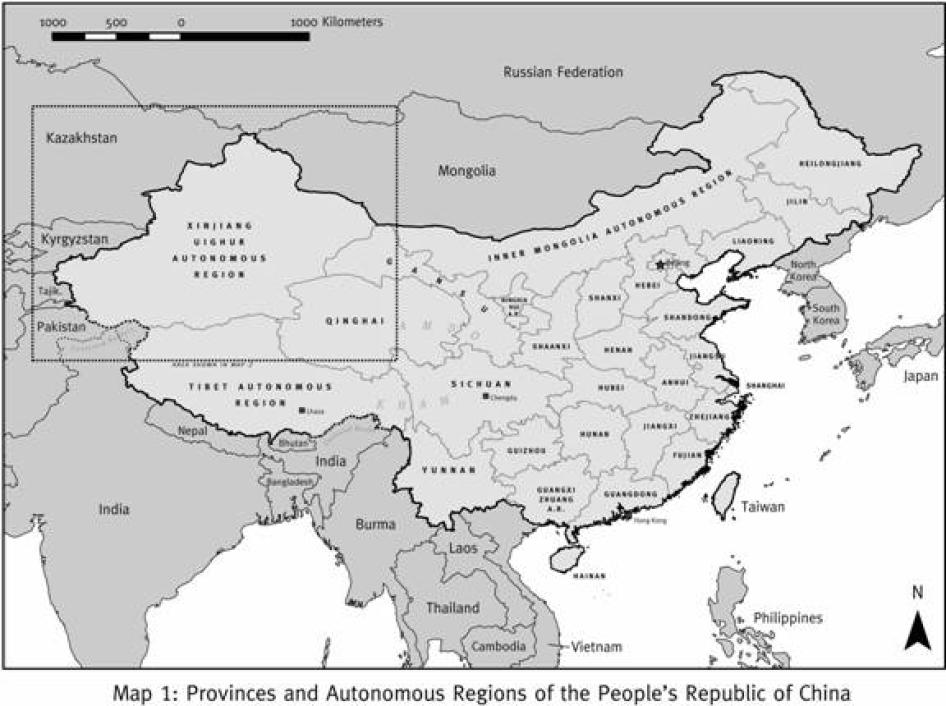
© 2005 John Emerson
Map of Urumqi
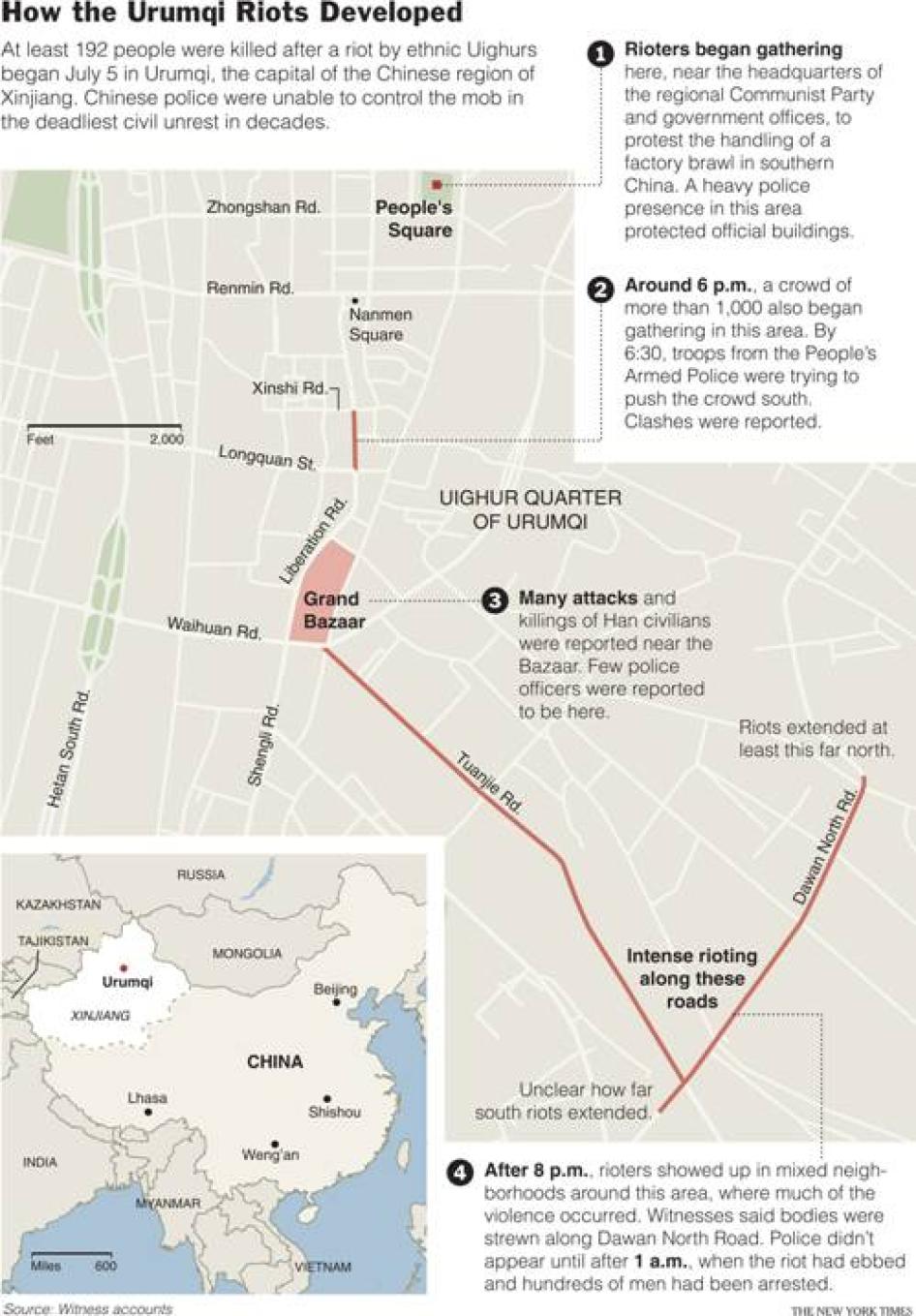
© 2009 The New York Times
Summary
We will follow the constitution, pay compensations to the victims, respect equality before the law, severely handle cases according to law, and do a good work of preparing [the work of] prosecution and of approving rapidly the Public Security requests for detention.
—Statement by the Urumqi Procuratorate regarding the investigation into the July 5-7 protests in Urumqi
That day, a large group of armed police arrived at our neighborhood and took many Uighur men away. They went after every young man they could catch—those who lived there, and those who just happened to be there. I saw how they were taken away—the police loaded a full bus of these young men. I think they took some from the street and others from their home; I was inside myself, but could see [from the window] the police loading the men into their bus.
Their families and we, the neighbors, could not do or even say anything—we all were too scared to come out, fearing they would take us away as well. I don’t know where the men were taken, and their relatives don’t know either. I have not heard of anyone being released after that.
—Gulmira G., a witness to a July 6, 2009 raid in one of the Uighur neighborhoods in Urumqi
In the aftermath of the July 2009 protests in western Xinjiang region, Chinese security forces detained hundreds of people on suspicion of participation in the unrest. Dozens of these detainees, and possibly many more, have since “disappeared” without a trace.
The protests of July 5-7, 2009, in Urumqi, the capital of Xinjiang, were one of the worst episodes of ethnic violence in China in decades. Information about the Xinjiang protests and their aftermath remains fragmentary. On July 5, protests by Uighurs, an ethnic minority group, against the killing of Uighur workers at the Guangdong toy factory appear to have begun peacefully. It remains unclear how the protest turned violent, with Uighur sources blaming the riot police for the excessive use of force against the protestors.
Chinese authorities were quick to accuse a variety of external forces of masterminding and sponsoring the unrest. They specifically blamed Rebiya Kadeer, a former political prisoner in Xinjiang and a prominent Uighur rights activist living in exile in the United States, for planning and organizing the protests. No evidence, however, has been provided to support those claims, and many analysts believe that the root causes of the protests were largely related to China’s longstanding discriminatory policies toward the Uighur minority.
By the evening of July 5, large groups of Uighur youths launched brutal attacks against Han Chinese residents in southern parts of Urumqi, leaving scores dead or injured, and setting dozens of buildings and cars on fire. Security forces did not reestablish control until the morning of July 6. On July 7, they attempted to prevent retaliatory assaults by Han Chinese residents of Urumqi, although at least some Uighurs fell victim to these attacks.
The latest official figures put the death toll from the protests at 197 people, the majority of them Han. More than 1,600 were injured. Uighur groups continue to question the official death toll, saying it underestimates the number of Uighur victims.
In contrast to the complete block on information after the 2008 protests in Tibet, in Urumqi the authorities allowed access for foreign journalists and even took measures to facilitate their work. However, the authorities prevented the journalists from documenting the arrests that followed the protests and other potential violations by the security forces. Indeed, some reporters were detained and escorted out of Uighur areas.
Chinese authorities also blocked the channels of uncensored information, including the internet, international phone lines, and text messaging for all but accredited foreign reporters; more than 50 internet Uighur forums and online discussion groups have been blocked since the protests. At the same time, the Chinese government used both the official media and other means of mass propaganda to promote its version of events domestically and internationally.
In the wake of the Urumqi protests, Chinese authorities declared they would deal decisively with perpetrators of the violence. Immediately after the protests and in the following two months, they released a number of contradictory statements regarding the number of people detained by the security forces in connection with the unrest, which seemed to have reached well over a thousand people. On October 12, 2009, China pronounced the first sentences in protest-related cases: six Uighur men were sentenced to death and one to life imprisonment.
This report is based on Human Rights Watch research conducted in the aftermath of the July protests. It documents the enforced disappearances of at least 43 Uighur men and teenage boys who were detained by Chinese security forces in the wake of the protests. The actual number of “disappeared“ persons is likely significantly higher than the number of cases documented by Human Rights Watch, as our ability to collect information was limited. Out of fear of retaliation, few witnesses or family members were willing to come forward with their stories.
The Chinese authorities have the duty to thoroughly investigate incidents of violence and the right to punish the perpetrators in accordance with international law. However, our research indicates that instead of launching an impartial investigation in accordance with international and domestic standards, Chinese law enforcement agencies carried out a massive campaign of unlawful arrests in the Uighur areas of Urumqi, many of which resulted in “disappearances” of the detainees.
Enforced disappearances are serious violations of international human rights law. An enforced disappearance occurs when state authorities detain a person and then refuse to acknowledge the deprivation of liberty or the person’s whereabouts, placing the person outside the protection of the law and increasing the likelihood of other abuses, such as torture and extrajudicial execution. The practice of “disappearances” and unlawful arrests also violates various provisions of Chinese criminal and procedural law.
While the Chinese legal system is anything but transparent, and criminal suspects are often held in incommunicado detention for prolonged periods of time, such cases do not necessarily constitute “disappearances” as long as the detention is acknowledged and at least some information about the detainee and his or her whereabouts is available. The cases described in this report, however, qualify as enforced disappearances because following arrest, the authorities have either denied the fact of detention or refused to provide any information about the detainees’ whereabouts or fate despite requests from relatives.
On July 6-7, 2009, Chinese police, armed police, and the military conducted numerous large-scale sweep operations in two predominantly Uighur areas of Urumqi—Erdaoqiao and Saimachang. The operations, on a lesser scale, continued at least through the end of July.
According to witnesses, the security forces sealed off entire neighborhoods, searching for young Uighur men. In some cases, they first separated the men from other residents, pushed them to their knees or flat on the ground, and, at least in some cases, beat the men while questioning them about their participation in the protests. Those who had wounds or bruises on their bodies, or had not been at their homes during the protests, were then taken away. In other cases, the security forces simply went after every young man they could catch and packed them into their trucks by the dozens.
In addition to large-scale sweeps, the security forces also detained an unknown number of people in the course of targeted raids, usually involving smaller groups of police officers or soldiers who took Uighur men from their homes, places of work, hospitals, or the street. In some cases, the security forces seemed to act on leads received from previously detained individuals. These raids continued at least through mid-August.
The victims of “disappearances” documented by Human Rights Watch were young Uighur men—most in their 20s, although the youngest victim was 14 years old, and some witnesses reported that the police had detained boys as young as 12 during the raids.
In most cases documented by Human Rights Watch, the men and boys detained in the course of these sweeps and raids have been missing since the security forces took them away. Their families’ attempts to inquire about the relatives at local police stations or with other law enforcement agencies proved futile—the authorities either said they had no knowledge of the arrests, or claimed the inquiry was still ongoing without admitting the fact of detention, or simply chased the families away.
In the absence of proper legal representation, local human rights groups, independent reporters, and channels of communication with the outside world, the families of the “disappeared” have nowhere to turn for help or to report the cases.
Chinese authorities did not respond to Human Rights Watch’s request for information about the numbers, legal status, or ethnic breakdown of the detainees.
China has an appalling record of unacknowledged detentions following mass protests. Previous incidents of unrest in Xinjiang, as well the 2008 mass protests in Tibet, were followed by hundreds of unaccounted-for detentions, summary trials that did not meet basic due process standards, and credible reports of torture and ill-treatment in custody.
Key Recommendations
Human Rights Watch urges the Chinese government to:
· Immediately end the practice of enforced disappearances;
· Account for every person held in official or unofficial places of detention;
· Release those against whom no charges have been filed;
· Ensure that all arrests are carried out in accordance with international law;
· Allow all detainees contact with family and unhindered access to legal counsel of their choice;
· Discipline and prosecute as appropriate security forces responsible for “disappearances,” unlawful arrests, or mistreatment of detainees; and
· Allow independent international investigations into the Urumqi unrest and its aftermath.
Human Rights Watch urges the United Nations Office of the High Commissioner for Human Rights to take the lead on an international investigation into the events in Xinjiang, and calls on China’s international partners, including the United States and the European Union, to extend full and active support to such an investigation.
Methodology
This report is based on information collected by Human Rights Watch researchers in the aftermath of the July protests. The researchers spoke to many dozens of Urumqi residents, both Han Chinese and Uighur, as well as to others who happened to be in the city during the protests and witnessed the incidents of violence. The interviews were conducted with the help of Uighur and Chinese translators.
In Urumqi, there are no local human rights groups or other organizations where the victims’ families could turn for help and register their cases. Thus, cases documented in this report were collected through random interviews. Virtually every Uighur with whom HRW spoke had knowledge of young men—often their relatives, acquaintances, neighbors, or local vendors and business owners they knew—who “disappeared” after security forces had taken them away.
However, only a limited number of witnesses agreed to provide detailed accounts of the “disappearances” that could be included in this report. All of the witnesses were scared. Many said they were afraid to discuss the circumstances of the arrests even with their neighbors. Interviewees spoke about plain-clothes or uniformed patrols, as well as CCTV cameras monitoring them. None of the witnesses seemed hopeful to ever find any information about the missing, which also affected their willingness to talk about the incidents.
In order to protect witnesses and victims, all names in this report have been changed and the exact dates and locations of interviews withheld.
On August 24, 2009, Human Rights Watch sent a request for information to the Chinese embassy in the United States, asking Chinese authorities to provide information about the number, procedural status, and ethnic breakdown of the detainees as well as other details about them. The request remains unanswered. A copy of the letter can be found in the Appendix to this report.
I. Background
Root Causes of the Xinjiang Protests
The Xinjiang Uighur Autonomous Region is China’s largest provincial unit, accounting for one sixth of the Chinese territory. Xinjiang is also a strategically crucial territory that borders Russia, Mongolia, Kazakhstan, Kyrgyzstan, Tajikistan, Afghanistan, Pakistan, and India. The region has abundant oil reserves and is China’s largest natural gas and oil-producing region. It is the only region after the Tibet Autonomous Region in which ethnic Han Chinese are still a minority. The very name of the region, which translates as “New Dominion” (xin-jiang), reflects its late incorporation into the Chinese Empire in the 18th century, under the Manchu rulers of the Qing dynasty.
Uighurs constitute the numerically dominant ethnic group in Xinjiang,[1] yet over the past 50 years the Han Chinese population has grown from 6 to 40 percent as a result of state-encouraged and spontaneous migration from other parts of China.
Although China’s sovereignty over the region is not in dispute at an international level, many Uighurs have never fully accepted Chinese rule, and tend to view the Chinese expansion in Xinjiang as an oppressive process of assimilation. Others think that the Chinese state has made a genuine effort of accommodation by raising economic standards but insist that that the government should sanction pervasive socioeconomic discrimination, implement autonomy laws that in theory guarantee a greater say in policy-making and control over economic riches, and relax control of religious activities. Some Uighurs have chosen to join the ranks of the local bureaucracy, including the police and the army, even though all positions of real power are generally in the hands of Han cadres.
In the past decade, Xinjiang’s economy has developed rapidly, spurred by a combination of massive subsidies from Beijing; revenues from natural resources, including oil and gas;[2] and rapid urbanization. Yet Uighurs were mostly left out of the rising tide of greater prosperity. Official statistics reflect higher unemployment and poverty rates. The average life expectancy of Uighurs is about 10 years shorter than the Han segment of the population.[3] Competition for scarce land and water resources in the countryside, as well as job discrimination and mutually negative stereotypes in the urban areas have led to increased conflict and resentment. According to official Xinjiang statistics, the income gap between Han-dominated urban and Uighur-dominated rural areas widened from 2.1 times in 1980 to 3.24 times in 2007.[4]
The government’s response to the growing tensions has been to tighten already sharp limits on religious and cultural expression and suppress any sign of dissent, which it equates with “separatism,” a capital offense under Chinese law. The February 1997 uprising in the city of Yining and isolated acts of anti-state violence in 1998, which included the assassination of Uighur “collaborators,” attacks against police stations and the explosion of two bombs on Urumqi buses in February 1998, triggered a massive security crackdown against Uighurs across Xinjiang.
After the September 11, 2001 attacks in the United States, China began to portray its security campaigns in Xinjiang as a contribution to the global war on terror. There is no dispute that clandestine Uighur groups have from time to time carried out violent attacks. The massive propaganda offensive about the threat of “East Turkestan” terrorism further drove Chinese public opinion against the Uighurs, who in turn felt increasingly ostracized and discriminated against because of their distinct ethnicity and Muslim faith.
The Chinese government’s accelerated attempt over the past few years to forcibly refashion Uighur identity has also fueled growing resentment. Following Xinjiang Party Secretary Wang Lequan’s declaration in 2002 that the Uighur language was “out of step with the 21st century,” the government started to shift the entire education system to Mandarin. Control over religion was extended in 2008 to prohibit traditional customs such as religious weddings, burials, or pilgrimages to the tombs of local saints.
In preparation for the 2008 Olympics, Beijing launched a new year-long security campaign against “the three evil forces”—“terrorism, religious extremism, and separatism”—which resulted in even more drastic restrictions on the religious, cultural, and political rights of Uighurs. For example, in February 2008, the government adopted new regulations prohibiting “23 types of illegal religious activities,” including praying in public or at wedding ceremonies. In March 2008 the authorities put down a large, peaceful protest against government policies in the town of Khotan (Chinese: Hetian).[5] Most recently, in early 2009, the Chinese government started razing the old city of Kashgar, the centuries-old cultural center of the Uighur civilization, and forced 50,000 families out of their old homes and into newly constructed buildings in the periphery of the city.[6]
The July 5-7 Protests in Urumqi
While the protests seemed to be sparked by a clash in late June 2009 between Han Chinese and Uighur workers at a toy factory in Guangdong province in southern China, which left at least two Uighurs dead, the root causes lie in the longstanding discriminatory policies of the Chinese government in the region and egregious restrictions on religious, political, educational, linguistic, and economic rights of the Uighurs.[7] Shortly thereafter, graphic footage was posted on the internet depicting Uighur factory workers allegedly being beaten to death by Chinese co-workers.[8] Many Uighurs in Xinjiang saw the footage as emblematic of the discrimination they suffer within China, and of the government’s unwillingness to protect them.
While many questions about the protests remain unanswered to date, most accounts seem to agree on the following outline of events.[9]
On the afternoon of July 5, 2009, hundreds of Uighurs launched an apparently peaceful protest at People’s Square in the center of Urumqi. The protesters demanded an investigation into the killing of the Uighur workers at the Guangdong toy factory.[10]
Riot police moved in to disperse the protest. Official reports indicate that 70 demonstrators were arrested on the spot.[11]Some reports suggest that the police used batons to beat the demonstrators.[12]The protest then moved southward into predominantly Uighur areas, including the Grand Bazaar, a large shopping center. Within hours, the crowd abandoned its peaceful approach and instead launched into a spree of savage vandalism and killings of Han Chinese residents of Urumqi. It remains unclear what triggered the shift to violence. Chinese sources claim it was a premeditated attack, while Uighur sources blame excessive use of force by the police that enraged the protestors.
There is little doubt, however, that in the evening hours of July 5, large groups of Uighur youth, armed with clubs, knives, and stones, launched brutal attacks in parts of the Uighur quarter and in poor mixed areas of south Urumqi. They randomly attacked Han Chinese residents, including women, children, and elderly, leaving scores dead or injured. The attackers also set dozens of houses, businesses, buses, and cars on fire, and ransacked shops.
The security forces seemed slow in their response to the wave of violence—witness accounts suggest that in some neighborhoods, forces only arrived hours after the attacks.[13] In others, they were apparently outnumbered by the attackers. The authorities did not reestablish control until the early hours of July 6, when an additional 20,000 security forces, including police, paramilitary armed police, and the military, flooded the city.
Despite the heavy security presence, on July 7, 2009, Han Chinese started mobilizing for retaliatory attacks, and marched, armed with knives, hammers and wooden clubs, toward the Uighur areas of the city. The security forces seemed to have managed to stop most of the crowds, yet some Uighurs fell victim to these attacks.[14]
The latest casualty figures released by the Chinese authorities in August 2009 put the death toll from the protests at 197 people. The authorities said that 156 of the victims were “civilians,” including 134 Han Chinese, 11 from the Hui ethnic group, 10 Uighurs, and one from the Manchu ethnic group.[15]Twelve others were reportedly shot by the security forces “while committing violence or criminal activities,” and the identities of the remainder had yet to be determined. More than 1,600 were injured.[16]
Overseas Uighur advocates, however, continue to question the official death toll, saying it underestimates the number of Uighurs killed both by paramilitary police and during retaliatory attacks by the Han. In a number of public statements, Uighur leader Rebiya Kadeer claimed that 400 Uighurs had been killed in Urumqi, and a further 100 in Kashgar.[17] In a statement released on July 7, the World Uyghur Congress alleged that Chinese paramilitary forces “killed an estimated number of 800 young Uyghurs.”[18] Human Rights Watch was unable to collect sufficient information on the killings to verify these claims.
Chinese authorities were quick to accuse a variety of external forces, ranging from al Qaeda to the United States Congress, of masterminding and sponsoring the unrest. In particular, they focused on blaming Rebiya Kadeer, a former political prisoner in Xinjiang and now a prominent Uighur rights activist in the United States, for planning and organizing the protests.[19] No evidence has been provided to support those claims, which Kadeer denied.
China’s Record of Unaccounted-for Detentions and Due Process Violations
Concern for the fate of hundreds of people detained in the aftermath of the Urumqi protests is aggravated by China’s appalling record with respect to unaccounted-for detentions, summary trials without the benefit of due process, and reports of torture and ill-treatment in custody.
These abuses characterized the previous incidents of unrest in Xinjiang, such as the February 1997 uprising in Yining, a city 300 kilometers west of Urumqi,[20] as well as the 2008 mass protests in Tibet.
The crackdown after the 1997 Yining incident led to thousands of arrests. Operating on the principle of “the two basics”—which stipulated that only “basic truth” and “basic evidence” was required to process the case—law enforcement agencies and courts widely used procedures that fell far short of internationally accepted standards of due process.[21]
Several years of “anti-separatism” campaigns that followed the 1997 protests resulted in close to 200 executions.[22] Facilities of the Xinjiang Reeducation-Through-Labor system—which allows for imprisonment for up to three years without judicial processes—overflowed with new detainees,[23] and several dozen people arrested for alleged separatist activities between 1997 and 2000 reportedly are still missing.[24]
In 2008, following demonstrations in Tibet in March, the Chinese government pledged to deal with any illegal activity in a manner consistent with the rule of law. Yet within months Human Rights Watch had documented hundreds of arbitrary arrests and dozens of cases related to those protests summarily pushed through the legal system, with minimal access to defense counsel and other due process violations.[25]
Human Rights Watch research showed that the number of arrests following the Tibet protests was considerably higher than the government acknowledged and many arrests were disguised as “voluntary surrenders” (using legal technicalities that count suspects who confess crimes before they are formally arrested as voluntary surrenders). Security forces deliberately failed to notify relatives of the whereabouts of the detainees, and the courts, mostly in closed trials, sentenced protesters under state security charges for nonviolent acts such as waving the Tibetan flag and throwing pamphlets on the street.[26] To date the government has not provided a full accounting of all those detained, released, tried, and sentenced in the aftermath of the 2008 protests.
After the 2008 Tibet demonstrations, six United Nations special procedures mandate holders issued an urgent appeal calling on the government of China to ensure “complete compliance with due process and fair trial rights according to international standards for those detained or charged with crimes, including provision of each person’s name, the charges against them, and the facility where they are detained or imprisoned, as well as ensuring access to legal defense.”[27]
Yet these appeals, as well as the calls from Human Rights Watch, other international organizations, and China’s international counterparts, remained unanswered, and credible reports of torture and “disappearances” of Tibetans have continued to emerge to date.
Government Control of Information in the Aftermath of the Xinjiang Protests
In the aftermath of the Urumqi protests, Chinese authorities sought to tightly control the flow of information out of the region.
Within hours of the protests, internet access was cut across Xinjiang;[28] incoming and outgoing international telephone calls were blocked; and within 48 hours text messaging services were also suspended.
Real-time reports from Urumqi posted on the web were removed in a matter of minutes, according to people who were monitoring the situation on the web at the time of the unrest. The web publishers had to exercise painstaking self-censorship in their reporting on the events, knowing that otherwise their entire websites would be blocked.[29]
Reporters Sans Frontieres (RSF) condemned the blocking of more than 50 online Uighur forums and online discussion groups, including Uyghur Online, as well as social networking sites such as Facebook, Twitter, YouTube, and MSN messenger.[30] While the authorities claimed the move was necessary to prevent communication between the rioters, it mainly served to eliminate alternative sources of information.
In contrast to the Tibet protests in 2008, however, the authorities allowed foreign journalists access to Urumqi, set up a press center to facilitate their work, and held regular news briefings with local authorities. In an effort to demonstrate their commitment to transparency, the national and provincial propaganda officials announced that they have “resolutely implemented the central authorities’ demand for open and orderly newsgathering by overseas reporters and strived to provide service and exercise supervision according to the law.”[31]
Foreign journalists were able to conduct interviews with victims and witnesses of the violence, but they had limited access to other information, in particular, about the arrests that followed the protests. Those who sought information beyond what the government was willing to share were stopped, and, in some cases, detained and escorted out of the region.
For example, a reporter for Radio Free Asia was detained when she tried to take photos of police detaining Uighurs near the Urumqi Grand Bazaar.[32] Another group of foreign journalists were detained while they were covering the Uighur protest on July 10, 2009, when the government refused to open mosques in Urumqi for Friday prayers.[33] Journalists who tried to visit Kashgar, another town where Uighur protests reportedly had taken place, were promptly detained, escorted to the airport and ordered to leave.[34]
Official Chinese publications repeatedly accused Western media of biased and misguided reporting on the protests, expressing particular outrage with reports that linked the long-term grievances of the Uighur minority in Xinjiang to the outbreak of violence.[35] At the same time, Chinese authorities used both the official media and other means of mass propaganda to promote the government version of events and downplay the ethnic nature of the protests. CCTV, Xinhua News Agency, and other Chinese media carried numerous reports of Uighur violence along with commentary suggesting that the violence was instigated from abroad.
Within days of the unrest, the streets of Urumqi were covered in red banners calling for ethnic unity, condemning separatism, and encouraging residents to report those suspected of engaging in violence. The same messages were constantly transmitted through loudspeakers installed on numerous military trucks and police vehicles patrolling the city.
II. Official Data on Arrests and Due Process Concerns
In the wake of the Urumqi protests, Chinese authorities immediately declared their resolve to deal decisively with the perpetrators, emphasizing that “every suspect, without any exception, will be arrested and punished according to the law to root out any hidden danger.“[36] But confusing data on arrests and prosecutions, combined with high-level instructions to “punish heavily and quickly” (cong zhong cong kuai),[37] raise serious due process concerns.
Official statements regarding the number of people detained and formally arrested have been contradictory. Ultimately, the authorities seem to admit detaining more than 1,000 people.
The highest number—1,434 detainees—was announced less than 24 hours after the protests,[38] and the later announcements regarding the numbers—253 detainees,[39] 319 detainees,[40] 718 detainees[41]—did not make it clear whether any of the initially detained had been released. The Financial Times’ Kathrin Hille reported on July 19 that a source, briefed at a Party meeting discussing the crackdown, had told her that “more than 4,000 Uighurs had been arrested since July 5,” and that new detainees were detained in ad hoc facilities—PLA warehouses—because prisons in Urumqi were already full.[42]
The information on formal arrests and prosecutions has been similarly inconsistent. For example, on August 26, the director of the Xinjiang Government Information Office, Hou Hanmin, put the number of formally arrested at 83 suspects,[43] yet less than a week later Xinhua News Agency reported that the authorities in Xinjiang “issued arrest warrants to 196 suspects and prosecuted 51 of them for their involvement in the July 5 riot in Urumqi,” while the police requested the approval of another 239 arrests. The same report said that another 825 suspects were held in detention.[44]
Chinese authorities suggested that they have been investigating not only the attacks perpetrated by the Uighurs, but also the retaliatory attacks by the Han, and emphasized that “anyone who has violated the law should be severely punished.”[45] Yet without an ethnic breakdown of those detained and arrested, it is difficult to ascertain whether, how many, or on what charges Han have been pursued.
Following the instructions from the Party leadership, the Xinjiang People’s Procuratorate has been streamlining the review of the protest-related cases, operating under the “three fast” principle (san kuai yuanze): “fast review, fast arrest and fast prosecution.” Two weeks after the protests, state media reported that the state prosecution had screened “several thousand cases of criminal suspects from the July 5 incident.”[46] And on September 4, the Xinjiang state prosecution announced that they would further “accelerate” approval of arrests and prosecutions.[47]
On October 12, 2009, China pronounced first sentences in protest-related cases. Six Uighur men were sentenced to death and one to life imprisonment for murder, arson, and robbery.[48]
There are also serious concerns that the trials of the protest cases, which have begun as this report went to print, will be neither independent nor fair. Along with the prosecutors, the judges in Xinjiang had already received direct instructions from Party authorities regarding the handling of the July 5 cases, including a “Propaganda Education Manual on the Truth about the July 5th Incident in Urumqi.”[49] Judicial personnel assigned to handle the trials have been carefully selected according to political criteria, further undermining the right of the suspects to be judged by an “independent and impartial tribunal” as set by international law.[50]
Public comments by Xinjiang authorities suggest that their investigations would not focus exclusively on evidence of wrong-doing, but on social class as well. On August 13, Xinjiang Party Secretary Wang Lequan declared:
The hardcore elements who participated to the July 5 incident are mostly concentrated in the social dregs [shehui zhazi] of the key sensitive areas of the greater Urumqi area. For many years the domestic separatist forces have clustered there, and have become a great hidden danger for the social stability of Urumqi and the entire Xinjiang.[51]
Wang also noted that:
The Autonomous Region has already taken a succession of measures, to carry out rectification in these key areas, with manifest results.... All local departments have ...taken strong measures, to root out this hidden danger, and defend against possible trouble.[52]
III. Enforced Disappearances and Unlawful Arrests
Human Rights Watch recognizes that the Chinese authorities have the right and duty to thoroughly investigate the incidents of violence during the July protests, and to arrest and prosecute the perpetrators according to the law.
However, Human Rights Watch research indicates that instead of launching an impartial investigation in accordance with international and domestic standards, Chinese law enforcement agencies carried out a widespread campaign of unlawful arrests in the Uighur areas of Urumqi; at least dozens, and possibly many more, detainees have “disappeared” without a trace.
Human Rights Watch documented enforced disappearances of at least 43 men and teenage boys,[53] which took place between July 6 and the beginning of August 2009.[54] The actual number of the “disappeared” is likely to be significantly higher than the number of cases documented by Human Rights Watch, as our ability to collect information was limited.[55]
Human Rights Watch also received reports of arrests that took place in other parts of Xinjiang—for example, the town of Kashgar—yet was not able to collect sufficient information from these areas.
Under international law, an enforced disappearance occurs when state authorities or others acting at official behest detain a person and then refuse to acknowledge the deprivation of liberty or the person’s whereabouts, placing the person outside the protection of the law. Enforced disappearance greatly increases the likelihood of the victim suffering other crimes such as torture and extrajudicial execution, and the practice violates the right to liberty and security of the person and the right to a fair and public trial.[56] The “disappearances” also cause ongoing anguish to the families who live in fear and uncertainty about the fate of their loved ones.
The practice of enforced disappearances also directly violates Chinese law, which requires judicial or prosecutorial approval of arrests; limits the period of detention without charge; guarantees the right of detainees to retain a lawyer; and requires law enforcement agencies to notify the detainee’s family of the reasons for detention and place of custody. Unlawful detention as well as torture and maltreatment of detainees are punishable offenses under China’s criminal law.[57]
The “disappearances” in Urumqi occurred as a result of large-scale sweep operations as well as targeted raids carried out by Chinese security forces in the predominantly Uighur districts of the city.
In cases documented by Human Rights Watch, the victims were young Uighur men—most in their 20s, although the youngest victim was 14 years old, and some witnesses reported that the police had arrested boys as young as 12 during the raids.
It is possible that some Han Chinese also became victims of “disappearances” and unlawful arrests. However, none of the more than two dozen Han Chinese residents of Urumqi interviewed by Human Rights Watch provided any information about such cases.
The mass arrests started on July 6, 2009, when Chinese security forces conducted numerous large-scale sweep operations in two predominantly Uighur areas of Urumqi— Erdaoqiao and Saimachang. The operations, on a lesser scale, continued at least through the end of July.
According to witnesses from these areas, in the immediate aftermath of the protests, especially in the early hours of July 6, security forces—police, People’s armed police,[58] and the military—rounded up dozens of young Uighur men and drove them away in buses, trucks, and jeeps. More than 20 witnesses independently described seeing the security forces “packing” Uighur men one on top of the other into their jeeps and trucks. The witnesses could not tell precisely how many detainees were in each car but some said the security forces packed the detainees in their vehicles by the dozens.
For example, one of the witnesses, Gulmira G., described a raid that took place in her neighborhood on July 6:
That day, a large group of armed police arrived to our neighborhood and took many Uighur men away. They went after every young man they could catch—those who lived there, and those who just happened to be there. I saw how they were taken away—the police loaded a full bus of these young men. I think they took some from the street and others from their home; I was inside myself, but could see [from the window] the police loading the men into their bus.
Their families and we, the neighbors, could not do or even say anything—we all were too scared to come out, fearing they would take us away as well. I don’t know where the men were taken, and their relatives don’t know either. I have not heard of anyone being released after that.[59]
In some neighborhoods, the security forces[60] sealed off entire streets and ordered all residents to come out. They then separated young men, pushed them to their knees or flat on the ground, and, at least in some cases, beat the men while questioning them about their participation in the protests. Dozens of the young men were then put in military trucks and driven away. In some cases, the security forces seemed to select those who had wounds or bruises on their bodies, or were not at their homes during the protests, while in other cases the criteria for selection was not clear.
Despite the relatives’ pleas, the security forces did not say where they were from or where they were taking the detainees. In some cases they said they would return the men “after an inquiry.”
As of the end of August 2009, all 43 men and boys remain missing—only in one case has Human Rights Watch received information that one of the detainees had been released and immediately left town. Human Rights Watch has been unable to get updated information on their fate.
In addition to large-scale sweep operations, Chinese security forces also arrested an unknown number of people in the course of targeted raids, usually involving smaller groups of police officers or soldiers. In cases documented by Human Rights Watch, the detainees were taken away from their homes, places of work, doctors’ offices, or from the street. In some cases, the security forces seem to have acted on information allegedly received from previously detained individuals.
Some of these targeted arrests took place immediately after the protests, on July 6-7, but continued at least until mid-August. For example, in addition to cases described in detail below, Human Rights Watch documented at least seven arrests that took place on August 17, 2009: one man, 20-year-old local cook “Mirzokarim M.,” was taken away from his place of work in [street name withheld] street in Erdaoqiao,[61] and another six young men were taken away from Saimachang area.[62] On August 18, 2009, at about 9 a.m., Human Rights Watch received a report of the detention of another young man—a witness said a group of security personnel in grey camouflage uniforms were walking him away in handcuffs, and the neighbors explained that he had been picked up from his house just several minutes before that.
The above-mentioned cases cannot be qualified as “disappearances,” as the information was collected shortly after the arrests, and Human Rights Watch does not have sufficient details to determine whether the arrests were lawful or not. However, these continued arrests do suggest that any “final” numbers on the detainees released by the Chinese authorities may not be accurate as the arrests of young Uighur men have clearly continued long after the initial wave of post-protest detentions.
Witness testimonies suggest that arrests have been conducted in violation of Chinese and international law—the security forces did not introduce themselves and did not explain the reasons for arrest, and failed to inform the families of the location where the detainees have been taken.
Human Rights Watch is concerned that in all likelihood the detainees have not had access to lawyers of their choice, especially since Chinese authorities explicitly warned lawyers against taking the protest-related cases.[63]
In most cases documented by Human Rights Watch the victims’ families tried to inquire about their relatives at local police stations or at the military and armed police posts established in their neighborhoods after the protests. However, in none of the cases were they able to get any information about the fate or whereabouts of the missing—the police and other security forces either said they had no knowledge of the arrests, claimed the inquiry was still ongoing without admitting the fact of detention, or simply told the families to go away.
Information on “disappearances” collected by Human Rights Watch, combined with the confusing official data on the detainees and China’s appalling record with respect to unacknowledged detentions following mass protests, raises grave concern for the fate of hundreds of people detained after the Urumqi protests.
Enforced Disappearance of Makhmud M., Age 25, Abdurakhman A., Age 31, and 16 Other Men
Two witnesses, Muhabbat M. and Aysanam A. from [street name withheld] street in Saimachang, said that at around 7 p.m. on July 6, a group of some 150 uniformed police and military sealed off the main street in their neighborhood. After that smaller groups of about 15 fully armed men searched adjacent side streets, house by house, ordering all inhabitants to come out. Aysanam said:
They told everybody to get out of the houses. Women and elderly were told to stand aside, and all men, 12 to 45 years old, were all lined up against the wall. Some men were pushed on their knees, with hands tied around wooden sticks behind their backs; others were forced on the ground with hands on their heads. The soldiers pulled the men’s T-shirts or shirts over their heads so that they couldn’t see.
Police and the military were examining the men to see if they had any bruises or wounds. They also asked where they had been on July 5 and 6. They beat the men randomly, even the older ones—our 70-year-old neighbor was punched and kicked several times. We couldn’t do anything to stop it—they weren’t listening to us.[64]
The two women said that altogether the security forces lined up some 50-60 men—every man from the four houses on their small side street. Out of those, they selected 17 (five from the house where Aysanam and Muhabbat live) whom they put in their trucks parked on the main street and drove away. Muhabbat’s husband, 25-year-old Makhmud M., was among them. She has not heard anything about her husband’s fate since then.[65]
Muhabbat said she did not go to the police station herself, but the relatives of the other 16 men who went there told her that the police had not given them any information— “they said they would conduct an inquiry and if everything is fine they would bring the men back,” she explained.[66]
Aysanam also said that during the same sweep operation, the security forces took away her 31-year-old nephew, Abdurakhman A., from a neighboring side street. She did not know whether any other men had been taken away along with Abdurakhman, but said the family has not received any information about him despite several inquiries with the local police.[67]
Enforced Disappearance of Ziyad-Ahun Z., Age 24 and Shakir Sh., Age 24
Another witness, Humorgul H., described a similar sweep operation that took place on the evening of July 6 in the Erdaoqiao area where she lives. She said that on that day about 20 armed men (two or three police officers and others in military uniforms) came to their side street. They dragged several dozen men out of their houses, pushed them onto their knees, and pulled their T-shirts over their heads.
Humorgul said the soldiers eventually selected two men—her husband, 24-year-old market vendor Ziyad-Ahun Z., and their neighbor, 24-year-old Shakir Sh. They did not provide any explanations, but walked the two men to the main street where the soldiers had their vehicles waiting. Humorgul believed her husband might have been picked up because he wasn’t home on July 5 and returned only on July 6 in the afternoon.
The young woman said that neither she nor Shakir’s family has been able to find any information about the two men’s whereabouts since then.
Enforced Disappearance of Nuriddin N., Age 20
20-year-old Nuriddin N., “disappeared” after Chinese security forces detained him during another large-scale sweep operation that took place in Saimachang on July 7, 2009.
Nuriddin’s father, Azamat, told Human Rights Watch that at about 8 p.m. a joint group of about eight or ten police and military personnel arrived on their small side street in a truck and started asking the residents about young men who live in the neighborhood. Shortly thereafter, they broke into Azamat’s house. The old man said:
They kicked the door open and burst in. I asked why they came and they said my son, Nuriddin, participated in the protests along with his friends, and that these friends had mentioned his name. The men did not introduce themselves and did not say where they were from but said they would bring my son back the next day.
I did not believe them, especially after seeing how they broke into our house. My wife started screaming that she wouldn’t let him go—he is our only child. But three of the policemen just twisted his arms and started dragging him out. My wife ran after them, grabbing their arms, but they did not stop—just dragged her along to the exit.
I followed them outside. I saw how they threw my son face down into their truck. I noticed there were other eight or ten young men on the floor of the truck. They were lying face down with hands behind their heads, surrounded by the soldiers.[68]
Azamat said that after the security forces drove his son and the other young men away, he waited for two days, but Nuriddindid not come back. On the third day, he went to the Dawan police station. He said that he saw some 150 families there, all looking for their relatives, some as young as 12 years old. According to Azamat, nobody came out to talk to the relatives, and when later on he inquired at a small police post in his neighborhood, the police officers also refused to give him any information about his son.[69]
Enforced Disappearance of Karim-Ahun K., Age 16, Fazliddin F., Age 18, and 14 Other Men
In the aftermath of the Urumqi protests, security forces detained 17 young men from three apartment buildings in the same courtyard on [street name withheld] street in Erdaoqiao area. Most of the men were taken away on July 6 and 7, 2009, and at least one, 18-year old Fazliddin F., on July 28.
Fazliddin’s mother, Zuhrufa Z., told Human Rights Watch that the security forces took 12 young men altogether from her four-story apartment building, and another 3 men from a neighboring house, most of them in the course of the raids they conducted in the neighborhood on July 6 and 7. According to Zuhrufa, on July 28, 2009, the security forces came back—three men in civilian clothes, two Chinese and one Uighur, who said they were from the police.[70] She said:
They asked for my son and said they would take him for an inquiry because many people from our neighborhood had participated in the protests. They said they would bring him back in a couple of days, but it’s been more than three weeks and I have no idea where he is and whether he is still alive.
I went to the local police station twice—they did not say whether he was there or not, but said the inquiry was still ongoing.[71]
Zuhrufa said that only one out of the 12 men detained from her apartment building had been released and had immediately left town, and that the relatives of the others have not received any information about the fate and whereabouts of the young men.[72]
Nazira N., from the third apartment building in the same courtyard, said that on July 6, 2008, a joint group of military and police took away her 16-year-old son Karim-Ahun K. and another young man. The whereabouts of the two men remain unknown, despite the relatives’ efforts to locate them. Nazira said:
They said that my son had taken part in the protests. I asked when they would bring him back, but they just said they would inquire and return him. I went to the local police station more than 10 times, but every time they said that they would inquire and if he is innocent they would bring him back. They say the same thing every time, but so far he hasn’t come back, and I have no idea where he is.[73]
Enforced Disappearance of Two Brothers, Jalal-Ahun J., Age 24, and Jamshid J., Age 25, and Two Other Men
In the evening of August 6, 2009, a joint group of military and police detained four young men from [street name withheld] street near a local market in Saimachang area. Kamalutdin K., the father of two of the “disappeared”—24-year-old Jalal-Ahun J. and 25-year-old Jamshid J. —related the circumstances of the “disappearance” to Human Rights Watch. He said:
It was late in the evening, and we were just getting ready to go to bed. Three men in black police uniforms and another four in military camouflage uniforms came to our house. They said my sons have been involved in the attacks against Chinese, but did not show any documents or video footage.[74] They did not say where they were from and where they were taking my boys. They just twisted their arms and led them away.
Two days later, I went to the Dawan police station to inquire about my sons, but the police told me to go away. Then I asked the soldiers at the military post in the entrance to our neighborhood. The soldiers said my sons were fine and were in Kashgar—our family is from there, we came to Urumqi two years ago. But when we contacted our relatives in Kashgar, they said nobody has seen my sons there.[75]
Kamalutdin said his neighbors, the relatives of the two other young men who had been taken away along with Jalal-Ahun and Jamshid, have not received any information on their fate or whereabouts either.[76]
Enforced Disappearance of Sharafutdin Sh., Age 14
14-year-old Sharafutdin Sh. from Erdaoqiao area left his home in the afternoon of August 7, 2009, and went to his father’s shop where he used to help out. He did not reach his destination. According to his sister, Madina M., who also worked in the shop, shortly after Sharafutdin was supposed to arrive, some people came to the shop and informed Sharafutdin’s father that his son had been wounded in the street and that soldiers were taking him away along with other young men.
Sharafutdin’s father then ran out to the street and saw the soldiers carrying his son, who was wounded in the leg, away. He followed the soldiers who took Sharafutdin and several other young men who had been wounded to a nearby hospital. Madina said that her father later told the family that the soldiers were waiting in the hospital while the doctors assisted the wounded. After basic medical aid was provided, the soldiers loaded all of the wounded men into their truck and drove them away. Sharafutdin has been missing since then.
Madina said that her father went to the local police station five or six times, but with no results. The police said that Sharafutdin was not on their list of detainees and denied having him in detention. They said they would inform the father should his son “show up.”[77]
Enforced Disappearance of Anvar-Ahun A., Age 35
35-year-old Anvar-Ahun A., a vendor from Saimachang, “disappeared” after the soldiers detained him on August 3, 2009.
Anvar-Ahun’s wife, Nishangul N., told Human Rights Watch that the security forces might have targeted her husband because he was not at home on July 5-7, 2009, and thus might have taken part in the protests. She herself was away in Kashgar until August 10 and found out about her husband’ arrest only after she came back.[78]
Maymana M., a neighbor, told Human Rights Watch that on the afternoon of August 3, 2009, the soldiers at the military post in the entrance to the neighborhood arrested Anvar-Ahun as he was returning home.[79]
Since then, neither the family nor the neighbors have received any information of Anvar-Ahun’s fate or whereabouts. His wife said that she decided not to go to the police, having learnt from her neighbors, who were also looking for their missing relatives, that the police had not provided them with any information, and simply told them to go away.[80]
Possible Enforced Disappearance of Umar-Ahun U., Age 24
On July 27, 2009, a group of security personnel in police and military uniforms detained 24-year-old Umar-Ahun U., a carpenter, from Erdaoqiao area.
Halima H., a friend and neighbor of Umar-Ahun and his wife, said that Umar-Ahun has not been seen since then. According to the witness, Umar-Ahun’s wife went to the local police station several times but did not manage to get any information about her husband. Shortly thereafter, the wife’s parents took her back to Kashgar where the family is from, fearing for her safety.[81]
Possible Enforced Disappearance of Muhammadamin M., Age 25
Muhammadamin M., a 25-year old doctor, came to Urumqi from Kashgar several months ago. He resided on [street name withheld] street in Erdaoqiao area where he also had a small clinic.
Two eyewitnesses told Human Rights Watch that at about 4 p.m. on August 11, 2009, two men in military uniforms and two men in civilian clothes came to Muhammadamin’s clinic.
The witnesses heard the soldiers telling Muhammadamin that some of the people they had arrested earlier mentioned that Muhammadamin had also participated in the protests. After that, they led Muhammadamin out of his clinic, put him in their car and drove him away.[82]
Muhammadamin did not have family in Urumqi and thus it is impossible to verify whether any inquiries have been made with the police on his behalf. More than a week after his arrest, however, the witnesses said that Muhammadamin has not come back and his clinic remained closed.[83]
Possible Enforced Disappearance of Abdurahim A., Age 18
On August 11, 2009, a group of security personnel detained 18-year-old Abdurahim A. from [street name withheld] street in Erdaoqiao area. Previously, on August 6, 2009, security forces “disappeared” two other young men from the same house in the course of a large-scale sweep operation in the area.[84]
A witness, Abdurahim’s neighbor, said at the time of the sweep operation Abdurahim was not at home and returned several days after the protests. She believed that was why the security forces came back for him later.[85]
The witness said Abdurahim has not returned home and his relatives were unable to obtain any information about his fate or whereabouts.
IV. Legal Standards
China’s Obligations under International Law
An enforced disappearance is defined in international law as the “arrest, detention, abduction or any other form of deprivation of liberty by agents of the State or by persons or groups of persons acting with the authorization, support or acquiescence of the State, followed by a refusal to acknowledge the deprivation of liberty or by concealment of the fate or whereabouts of the disappeared person, which place such a person outside the protection of the law.”[86]
The practice of enforced disappearance is outlawed in the new International Convention for the Protection of all Persons from Enforced Disappearance. China has not signed the Convention on Enforced Disappearances, which has yet to come into force.[87]
However, China was present when the United Nations General Assembly adopted by consensus the Declaration on the Protection of all Persons from Enforced Disappearance upon which the Convention is based.[88] The Declaration specifically enjoins states to take proactive measures to eradicate the practice and enjoins states from committing or tolerating enforced disappearances.
Although the law on enforced disappearances is relatively new, neither the practice nor the human rights principles that undergird the ban in international law are the least bit novel. The Declaration describes enforced disappearances as “a denial of the purposes of the Charter of the United Nations and as a grave and flagrant violation of the human rights and fundamental freedoms proclaimed in the Universal Declaration of Human Rights and reaffirmed and developed in international instruments in this field.”[89]
Enforced disappearances often constitute “a multiple human rights violation.”[90] Among the rights an enforced disappearance violate are the right to liberty and security of the person, the right to recognition as a person before the law, the right to a fair and public trial, the prohibition on torture and cruel, inhuman, and degrading treatment; it also often constitutes a violation of, or a grave threat to the right to life. China recognizes all these rights in its domestic law (see below).
These rights are further set forth in the Universal Declaration of Human Rights, which China, as a member of the United Nations, is deemed to accept and which, as a member of the United Nations Human Rights Council, it applies in assessing the human rights performance of member states.
Furthermore, the Chinese government has signed but not yet ratified the International Covenant on Civil and Political Rights (ICCPR), and ratified the Convention against Torture and Other Cruel, Inhuman or Degrading Treatment or Punishment (Convention against Torture), which also protect these rights.[91]
The UN Declaration on Enforced Disappearances contains numerous specific injunctions on preventing “disappearances,” including stipulations that detainees must be held in officially recognized places of detention, of which their families must be promptly informed; that they must have access to a lawyer; and that each detention facility must maintain an official up-to-date register of all persons deprived of their liberty.[92]
The practice of enforced disappearances is often directly linked to the practice of arbitrary and unlawful arrests. In this respect, ICCPR requires that a state specify the legal basis on which individuals may be deprived of their liberty and the procedures to be used for arrests and detentions.[93] Only arrests and detentions conducted in accordance with such rules are considered lawful, thus restricting the discretion of individual arresting officers. The prohibition against arbitrary arrest or detention also means that deprivation of liberty, even if provided for by law, must be necessary and reasonable, predictable, and proportional to the reasons for arrest.
The ICCPR also requires an arresting authority to promptly communicate to detainees any charges against them. If a person is detained on suspicion of a crime he or she must be charged within a reasonable time. In addition, international law grants a detainee the right to challenge the lawfulness of his or her detention by petitioning an appropriate judicial authority to review whether the grounds for detention are lawful, reasonable, and necessary.
The responsibility of the competent authorities to inform families of the whereabouts of those detained and provide for communication of the detainee with a counsel is further emphasized by the Body of Principles for the Protection of All Persons under Any Form of Detention or Imprisonment—an authoritative United Nations standard summarizing international human rights principles in relation to detention.[94]
The Convention on the Rights of the Child, to which China is a party, contains further safeguards with respect to the deprivation of liberty of anyone under the age of 18, including the right to prompt access to legal and other appropriate assistance as well as the obligation of the authorities to provide family members with essential information on the child’s whereabouts and well-being.[95]
As a general principle of law, the Chinese government has a duty to investigate serious violations of human rights and to punish the perpetrators. There is little doubt that the many human rights violations that enforced disappearance entail are serious, and demand investigation and prosecution.[96]
The Declaration on Enforced Disappearances emphasizes that it is the state’s obligation to ensure that persons having knowledge of an enforced disappearance have the right “to complain to a competent and independent State authority and to have that complaint promptly, thoroughly and impartially investigated by that authority.” Even in the absence of a formal complaint, the state should promptly refer the matter to the appropriate authority for investigation whenever there are reasonable grounds to believe that an enforced disappearance has been committed. When the facts disclosed by an official investigation so warrant, any person alleged to have perpetrated an act of enforced disappearance is to be brought before competent civil authorities for the purpose of prosecution and trial.[97]
China’s National Law
In addition to obligations under international human rights law, the practice of enforced disappearances directly violates China’s domestic law.
The Chinese Constitution contains a safeguard against arbitrary arrests stipulating that arrests must be conducted “with the approval or by decision of a people’s procuratorate or by decision of a people’s court and arrests must be made by a public security organ.”[98]
The rights of criminal defendants and suspects and the corresponding obligations of the law enforcement agencies are further specified in the Criminal Procedure Law and People’s Police Law.
The Criminal Procedure Law requires approval for arrests from the people’s procuratorate or a public court as well as an arrest warrant which the police must display at the time of arrest.[99] While in certain cases the Criminal Procedure Law permits initial detention without an arrest warrant,[100] a request for an arrest must be submitted to the people’s procuratorate for approval within three days of detention.[101] Police detention cannot exceed a two month investigation period without approval by the people’s procuratorate.[102]
A criminal suspect has the right to retain a lawyer after his first interrogation by the investigative organs or from the day the detention starts.[103]
Failure to notify the detainee’s family of reasons for detention and place of custody constitutes a violation of both the Criminal Procedure Law and the Police Law (in case the detention is carried out by a police officer). The Criminal Procedure Law stipulates that a detainee’s family or work unit must be notified of the reasons for detention and place of custody within 24 hours of detention.[104] The Police Law requires the immediate notification of a detainee’s family members if detention is extended beyond an initial 24 hours from initial incarceration.[105]
Unlawful detention as well as torture and maltreatment of detainees are punishable offenses under China’s criminal law. Unlawful detention or deprivation of personal freedom carries a sentence up to 10 years’ imprisonment (depending on the nature of the harm caused to the victim), and a “heavier punishment” if the crime is perpetrated by “a functionary of a State... by taking advantage of his functions and powers.”[106] The law further criminalizes custodial beatings and maltreatment, as well as extortion of confessions and witness testimonies by torture or violence.[107]
With respect to police officers, the Police Law stipulates the prohibition to “unlawfully deprive other people of, or restrict, their freedom of the person.”[108] Police officers who violate these provisions may be subjected to administrative sanctions and criminal responsibility.[109] The victims have the right “to make exposure of or accusation against a people’s policeman’s violation”[110] and are entitled to a compensation in case a “policeman in performing duties infringes upon” their lawful rights.[111]
The practice of enforced disappearances and illegal arrests is also in direct contravention to Chinese government’s National Human Rights Action Plan (2009-2010), issued on April 13, 2009, which prioritizes ending extrajudicial detention. The Plan also emphasizes a commitment to accountability and providing redress for the victims:
The state prohibits illegal detention by law enforcement personnel. Taking a suspect into custody, changing the place of custody or extending the term of detention must be done in accordance with the law. Wrongful or prolonged detention must be prevented. The state will improve the measures of providing economic compensation, legal remedies and rehabilitation to victims. Those who are responsible for illegal, wrongful or prolonged detention shall be subject to inquiry and punished if found culpable.[112]
V. Recommendations
To the Chinese Government
- Release accurate information on all those detained, released, and formally arrested in the aftermath of the protests in Xinjiang Uighur Autonomous Region;
- Release those against whom no charges have been brought;
- Immediately stop the practice
of enforced disappearances. Ensure that all arrests are carried out in
accordance with both national and international law and promote transparency
on detention. To this end:
- Ensure that all persons detained by security forces are held at recognized places of detention, and that arresting officers identify themselves and present official identification;
- All places of detention should be required to maintain records regarding every detainee, including the date, time, and location of arrest, the name of the detainee, the reason for detention, and the specific unit or agency responsible for the detention. The records should be available to detainees’ families, counsel, and other legitimately interested persons. All transfers of detainees should be reflected in the records;
- In accordance with international and national law, detainees should promptly be brought before a judge and informed of the reasons for arrest and any charges against them. The family should be informed promptly of the arrest and location of the detainee. Any persons detained by the security forces must be allowed contact with family and unhindered access to legal counsel of their choice;
- Sign and ratify the International Convention for the Protection of All Persons from Enforced Disappearance and enact national legislation that gives force to its provisions;
- Investigate all cases of enforced disappearances and unlawful arrests in the aftermath of the Urumqi protests. Discipline or prosecute as appropriate all those implicated in these violations;
- Ensure that all prosecutions in connection with the Urumqi protests are conducted in strict compliance with international due process standards;
- Sign and ratify the International Convention for the Protection of All Persons from Enforced Disappearance and enact national legislation that gives force to its provisions;
- Allow independent international investigation into the circumstances of the Xinjiang protests of July 5-7, 2009 and their aftermath;
- Ratify the International Covenant on Civil and Political Rights;
- Issue invitations to United Nations special mechanisms, including the Working Group on Enforced and Involuntary Disappearances, special rapporteurs on the Freedom of Opinion and Expression, on Religion or Belief, on Minority Issues, on Protecting Human Rights While Countering Terrorism, and Torture.
To the United Nations Office of the High Commissioner for Human Rights (UNOHCHR)
- The United Nations High Commissioner for Human Rights should accept the earlier extended invitation of the Chinese authorities for a visit and specifically request to visit Xinjiang;
- Offer to send a team from the Office of the High Commissioner for Human Rights to conduct an investigation into what happened in Urumqi during and after the protests.
To the United Nations Children’s Fund (UNICEF)
- Urge the Chinese government to release accurate information on children detained after the protests and to release those against whom no charges have been brought;
- Insist that relevant international standards, including the Convention on the Rights of the Child, be applied to the detained children.
To China’s International Partners
- Urge the government of China to put an end to the practice of “disappearances” and unlawful detentions; to account for every person detained in connection with the Urumqi protests; to vigorously investigate the “disappearances,” and to discipline or prosecute the perpetrators;
- Extend full and active support to the international investigation into the Urumqi events under the auspices of the United Nations Office of the High Commissioner for Human Rights;
- Urge the Chinese government to review the official policies and practices in Xinjiang which contributed to unrest;
- When seeking cooperation with China on counterterrorism efforts, stress that the threat of terrorism cannot be an excuse to persecute specific ethnic groups.
VI. Acknowledgments
This report was researched, written, edited, reviewed, and produced by Human Rights Watch staff members.
Human Rights Watch would like to thank many witnesses to human rights abuses who risked danger to themselves and their families by sharing their knowledge and experiences with us.
VII. Appendix
Human Rights Watch letter to Zhou Wenzhong, Ambassador of the People’s Republic of China in the United States of America
Ambassador Zhou Wenzhong
Embassy of the People’s Republic of China in the United States of America
3505 International Place, N.W.
Washington, D.C. 20008
Via Fascimile: +1-202-495-2113
Re: Recent unrest in Xinjiang
Your Excellency,
Human Rights Watch is one of the world’s leading organizations dedicated to defending and protecting human rights. The organization, which works in more than 70 countries around the world, is known for its rigorous, objective investigations and research.
In an effort to accurately reflect the Chinese government’s position on the recent unrest in Xinjiang, we would appreciate answers to the following questions.
- What is the total number of deaths stemming from the unrest on and after July 5, 2009 in Urumqi, Kashgar, and other parts of Xinjiang?
- What is the ethnic breakdown of those deaths?
- How many individuals in total have been arrested in connection with the unrest?
- How many of the individuals arrested have been charged?
- How many of the individuals arrested were released without charge?
- How many of the individuals have been convicted?
- How many of the individuals have been acquitted?
- How many of the arrested individuals were minors?
- What is the ethnic breakdown of those arrested, convicted, acquitted, and released?
- Which agencies are involved in the investigation of the detainees’ cases and their treatment?
- Where are detainees and those convicted being held?
- Do detainees have access to defense counsel of their own choosing?
- Do detainees’ relatives have access to information about the detainees, such as their whereabouts?
- Have all those put on trial had access to defense counsel of their own choosing?
- What is the date of the most recent arrests?
We appreciate any official reply you can provide.
Sincerely,
Brad Adams
Asia Director
Human Rights Watch
[1]The Uighur population in Xinjiang currently stands at about 9 million. Over 40 other officially designated ethnic groups, of which the Kazakh are the most numerous, account for another 1.5 million. The Han Chinese population officially stands at 8.5 million.
[2]Xinjiang has the largest oil, coal, and natural gas reserves in the country, accounting for 30 percent, 40 percent, and 35 percent, respectively, of the nation’s total. See “Xinjiang, A Natural Reserve Bonanza,” China.org.cn, March 12, 2005. Since 2007 Xinjiang has become China’s top oil and gas producer among all provinces, and plays a key role in reducing China’s energy dependence on imports to fuel its economic boom—a national strategic goal. See “Xinjiang leads China in oil, gas production in 2007,” Xinhua News Agency, January 4, 2008.
[3]Brenda L. Schuster, “Disparities in the Xinjiang Uyghur Autonomous Region of China,” China Quarterly, vol. 198, June 2009, pp. f1-f6. The article establishes that “[i]n life expectancy, infant mortality, maternal mortality and morbidity Uyghur people are much worse off than Han.”
[4]Kathrin Hille and Richard McGregor, “Trouble at the margin,” Financial Times, July 10, 2009.
[5]Edward Wong, “Wary of Islam, China Tightens a Vise of Rules,” New York Times, October 18, 2008; and “China’s Muslim west sees prayers, sparks of unrest,” Reuters, April 5, 2009.
[6] Michael Wines, “To Protect an Ancient City, China Moves to Raze It,” New York Times, May 27, 2009.
[7]See, for example, Human Rights Watch, Devastating Blows: Religious Repression of Uighurs in Xinjiang, ISBN: C1702, April 2005, http://www.hrw.org/en/reports/2005/04/11/devastating-blows-0.
[8]Edward Wong, “Violence Dashes Uighurs’ Dreams: Leaving Farms To Seek Prosperity, They Say They Find Only Discrimination,” New York Times, July 14, 2009.
[9]This description is based primarily on Chinese and foreign media reports from Urumqi, as well as Human Rights Watch’s own research.
[10] On October 10, 2009, China announced that one man had been sentenced to death and another to life in prison for their roles in the toy factory brawl. Nine other people had been sentenced to prison terms ranging from five to eight years for participation in the fights. Out of those, three were Uighur, and the rest were Han Chinese. See David Barboza, “China Sets Sentences in Brawl Tied to Riot,” New York Times, October 12, 2009.
[11]“暴行实录:回顾那个恐怖之夜,” 中国国际广播电台, 2009-07-07 [“A true record of the violence: Reviewing this night of terror,” China Radio International, July 7, 2009], http://gb.cri.cn/27824/2009/07/07/1965s2556186.htm (accessed October 19, 2009). Another official account also indicates that riot police started to “disperse” non-violent demonstrators on the square. See “Account of how officers and soldiers from the People’s Armed Police forces stationed in Xinjiang handled the Urumqi July 5th incident,” Legal Daily, August 9, 2009 [“武警驻疆部队官兵处置乌鲁木齐“7•5”事件纪实”, 法制日报, 2009-08-09.]
[12] See, for example, Choi Chi-Yuk and Shi Jiangtao, “Urumqi Lockdown after 156 Die,” South China Morning Post, July 11, 2009.
[13]Human Rights Watch interviews, dates and locations withheld to protect the witnesses.
[14] See, for example, Wong, “Violence Dashes Uighurs’ Dreams: Leaving Farms to Seek Prosperity, They Say They Find Only Discrimination,” New York Times.
[15]“Innocent civilians make up 156 in Urumqi riot death toll,” Xinhua News Agency, August 5, 2009.
[16]Ibid.
[17]See, for example, Peter Foster, “China Mounts Massive Security Operation to Contain Ethnic Violence,” Telegraph, July 8, 2009.
[18]“World Uyghur Congress’ Statement on July 5th Urumqi Incident,” July 7, 2009, http://www.uyghurcongress.org/En/PressRelease.asp?ItemID=-1553700856&mid=1096144499 (accessed October 13, 2009).
[19]See, for example, “Civilians, Officer Killed in Urumqi Unrest,” Xinhua News Agency, July 6, 2009.
[20] Amnesty International, “China: Gross violations of human rights in the Xinjiang Uighur Autonomous region,” AI Index: ASA 17/036/1999, September 30, 1999, http://www.amnesty.org/en/library/info/ASA17/036/1999/en (accessed October 13, 2009).
[21]According to instructions given by Xinjiang Party Secretary Wang Lequan at the outset of the 2001 campaign of arrests and prosecutions, “As long as the basic truth is clear and as long as the basic evidence is verified, prompt approval of arrest, prosecution, and court decisions are required.” See Human Rights Watch, Devastating Blows: Religious Repression of Uighurs in Xinjiang.
[22]Amnesty International, “China: Gross violations of human rights in the Xinjiang Uighur Autonomous region.”
[23]Human Rights Watch, Devastating Blows: Religious Repression of Uighurs in Xinjiang.
[24]Michael Sheridan, “Beijing’s ‘war on terror’ hides brutal crackdown on Muslims,” Sunday Times, July 22, 2007.
[25]“China: Hundreds of Tibetan Detainees and Prisoners Unaccounted for,” Human Rights Watch news release, March 9, 2009, http://www.hrw.org/en/news/2009/03/09/china-hundreds-tibetan-detainees-and-prisoners-unaccounted.
[26] Human Rights Watch research was based on the analysis of several dozen court reports, statements by leading officials, local judicial statistics, and official Chinese press reports related to the crackdown. See “China: Hundreds of Tibetan Detainees and Prisoners Unaccounted for,” Human Rights Watch news release.
[27]“UN human rights experts call for restraint and transparency as mass arrests are reported in the Tibet Autonomous Region and surrounding areas in China,” United Nations press release, April 10, 2008, http://www.unhchr.ch/huricane/huricane.nsf/view01/04E93C974F48F850C1257427002D7EAD?opendocument (accessed October 13, 2009). The statement was issued by the Working Group on Arbitrary Detention; the special rapporteur on extrajudicial, summary or arbitrary executions, Mr. Philip Alston; the special rapporteur for the promotion and protection of the right to freedom of opinion and expression, Mr. Ambeyi Ligabo; the special rapporteur on freedom of religion or belief, Ms. Asma Jahangir; the special representative of the secretary-general onhuman rights defenders, Ms. Hina Jilani; the Independent Expert on minority issues, Ms. Gay McDougall; and the special rapporteur on the question of torture, Mr. Manfred Nowak.
[28] Internet access was provided for accredited journalists in the government-run press-center set up in the Hoi Tak hotel in Urumqi.
[29]Radio Free Asia cited one of these publishers who removed sensitive information about the protests from his site as saying, “They just tell us that anything concerning opposition to the government won’t be tolerated…. What happens if you don’t take them off is that they will turn off the site at the server at the service center.” See “Media Strategy in Xinjiang,” Radio Free Asia, July 16, 2009.
[30]“Concern about harsh crackdown following Xinjiang rioting,” Reporters Sans Frontieres press release, July 8, 2009, http://www.rsf.org/spip.php?page=article&id_article=33757 (accessed October 13, 2009).
[31]“Foreign Public Opinion Work Forum in Connection With the ‘5 July’ Urumqi Incident in Xinjiang Calls for Upholding the Principle of Timeliness, Accuracy, Openness, and Transparency in Strengthening Guidance Over Public Opinion,” Xinhua News Agency, August 1, 2009.
[32]The journalist was held in detention for two nights, first at the police station and then in her hotel room, and her cell phone, laptop, and camera were confiscated and returned on the morning of her release (which came after she signed a “self-criticism” statement), but without the memory card from her camera. The reporter said she saw at least two other foreign journalists detained at the police station. “Media Strategy In Xinjiang,” Radio Free Asia, July 16, 2009.
[33]William Foreman and Gillian Wong, “Riot-Hit Western China Ignores Orders To Cancel Friday Prayers,” Associated Press, July 10, 2009.
[34]“Xinjiang reporters detained; Beijing commentator missing,” Committee to Protect Journalists press release, July 13, 2009, http://cpj.org/2009/07/journalists-detained-in-xinjiang-commentator-missi.php (accessed October 13, 2009).
[35]See, for example, Xiong Lei, “Half-Truths Full Of Threats,” China Daily, July 17, 2009; and Shi Ren, “Western Media Openly Invent False News Stories, Encounter Strong Protests From Chinese Citizens,” Zhongguo Tongxun She, July 15, 2009.
[36] Notice by public security departments of Xinjiang and Urumqi, cited in “Urumqi Police Detain another 319 People in Riot Probe,” Xinhua News Agency, August 2, 2009.
[37] “周永康:对“7·5”事件触犯刑律的 要从重从快严处”, 新华网, 2009-7-13 [“Zhou Yongkang: Offenders from the July 5 Incident Will Be Punished Heavily and Quickly,” Xinhua News Agency, July 13, 2009].
[38] “Police Arrests 1,434 Suspects In Connection With Xinjiang Riot,” Xinhua News Agency, July 6, 2009, citing Li Yi, head of the publicity department of the Communist Party of China (CPC) Xinjiang regional committee.
[39] “Urumqi Police Detain 253 More Riot Suspects,” Xinhua News Agency, July 29, 2009.
[40] “Urumqi Police Detain another 319 People in Riot Probe,” Xinhua News Agency, August 2, 2009, citing the Urumqi Public Security Bureau.
[41] “Police Detain 718 Suspects in Connection with Urumqi Riot,” Xinhua News Agency, August 4, 2009, citing Chen Zhuangwei, head of the Public Security Department of Urumqi.
[42] Kathrin Hille, “Xinjiang widens crackdown on Uighurs,” Financial Times, July 19, 2009; and Human Rights Watch telephone interview with Kathrin Hille, September 2009.
[43] Cited in Ivan Zhai, “Hu in First Visit to Xinjiang since Deadly Rioting: President Claims Victory against ‘Separatism, Terrorism, Extremism’,” South China Morning Post, August 26, 2009.
[44] “51 to Be Prosecuted in Wake of Urumqi Riot,” Xinhua News Agency, September 3, 2009.
[45] Statement by Wu Shimin, vice-minister in charge of the state ethnic affairs commission, cited in “Han Chinese Revenge Attackers Should Be Punished, Says Beijing Official,” Guardian, July 22, 2009.
[46] “乌鲁木齐7.5事件疑犯甄别结束”, 人民网, 2009-07-18 [“The Screening of Criminal Suspects from the July 5 Incident Is Over,” People’s Daily Online, July 18, 2009].
[47]“新疆检察机关要求办理7.5 案件宽严相济依法办案”, 新疆日报, 2009-09-04 [Xinjiang Procuratorate Organs Request that Leniency and Severity in the July 5 Cases Be Decided According to Law”, Xinjiang Daily, September 4, 2008].
[48] Kathrin Hille, “Six Sentenced to Death over Xinjiang Riots,” Financial Times, October 12, 2009.
[49] “新疆法院有效维护团结稳定大局”, 人民法院报, 2009-8-03 [“Xinjiang Courts Effective in Protecting Ethnic Unity and the Stability of the General Situation,” People’s Court Daily, August 3, 2009].
[50] “新疆高院成立审理“7-5”案件领导小组,” 法制网, 2009-7-16 [“Xinjiang establishes a task force to conduct the July 5th trials,” China Law News, July 16, 2009]. Both the state prosecution (the People’s Procuratorate) and the tribunals (the People’s Court) have reported in publications operated by the Ministry of Justice that they had specifically “selected politically qualified personnel drawn from the entire region” to work on July 5 cases: “The court has already, in the shortest time , selected 105 politically reliable and professionally proficient ethnic minority judges from all levels of courts across Xinjiang to participate to the work of July 5th prosecutions,” the President of the Xinjiang’s Higher People’s Court stated on July 16.
[51] “王乐泉在自治区电视电话会议上强调抓好稳控措施不放松确保社会大局稳定”, 新疆日报, 2009-08-14 [“Wang Lequan stresses the adoption of stabilization measures to guarantee overall social stability at a teleconference of the Autonomous Region,” Xinjiang Daily, August 14, 2009].
[52]Ibid.
[53]The “disappearances” of 11 of these men are described in detail below in this report, along with three other cases of possible “disappearances.” In those latter three cases, Human Rights Watch did not have sufficient information to qualify the case as a “disappearance” since it was not clear to what extent efforts have been made to locate the victim.
[54] The latest arrests documented by Human Rights Watch took place on August 18, 2009.
[55]See above chapter on methodology.
[56] For a detailed discussion of applicable international law, see Chapter VI on legal standards.
[57] For a detailed discussion of applicable Chinese law, see Chapter VI on legal standards.
[58] The People’s Armed Police is a paramilitary force primarily responsible for civilian policing and fire rescue duties in China.
[59] Human Rights Watch interview, date and location withheld.
[60] The witnesses could not always clearly identify which security forces were involved, but mentioned the police, People’s Armed Police, and the military.
[61] Human Rights Watch interview, date and location withheld.
[62] Human Rights Watch interviews, dates and locations withheld.
[63] The Bureau for Legal Affairs of Beijing issued a notice which provided its own interpretation of the Urumqi events, and asked “that all the city’s lawyers and law firms clearly recognize the nature of this incident, and firmly stand by the position of protecting the unity of the country.” The notice further urged lawyers to exercise caution while answering inquiries about legal advice and representation in cases related to the protests, and instructed partners at law firms to report such cases immediately and “positively accept monitoring and guidance from legal authorities and lawyers’ associations.” The notice also banned lawyers from making comments to the media or on the Internet. Cited in Audra Ang, “Beijing Warns Lawyers Away From Taking Cases Related To Xinjiang Violence,” Canadian Press, July 13, 2009.
[64] Human Rights Watch interviews, dates and locations withheld.
[65] Ibid.
[66]Ibid.
[67]Ibid.
[68] Human Rights Watch interview, date and location withheld.
[69] Ibid.
[70] Human Rights Watch interview, date and location withheld.
[71] Ibid.
[72] Ibid.
[73] Human Rights Watch interview, date and location withheld.
[74]Security forces have been identifying the participants of the protests by using the video footage from CCTV cameras and videos taken by the police during the protests.
[75] Human Rights Watch interview, date and location withheld.
[76] Ibid.
[77] Human Rights Watch interview, date and location withheld.
[78]Human Rights Watch interview, date and location withheld.
[79]Human Rights Watch interview, date and location withheld.
[80]Human Rights Watch interview, date and location withheld.
[81]Human Rights Watch interview, date and location withheld.
[82] Human Rights Watch interviews, dates and locations withheld.
[83]Ibid.
[84] See above section, “Enforced Disappearance of Karim-Ahun K., 16, Fazliddin F., 18, and 14 Other Men.”
[85] Human Rights Watch interview, date and location withheld.
[86]International Convention for the Protection of All Persons from Enforced Disappearance (Convention against Enforced Disappearances), adopted September 23, 2005, E/CN.4/2005/WG.22/WP.1/Rev.4 (2005), art. 2. See also United Nations Declaration on the Protection of All Persons from Enforced Disappearances (Declaration against Enforced Disappearances), adopted December 18, 1992, G.A. res. 47/133, 47 U.N. GAOR Supp. (No. 49) at 207, U.N. Doc. A/47/49 (1992), preamble.
[87]Convention against Enforced Disappearances was open for signature on December 20, 2006, requires 20 state ratifications to come into force and needs five more as of October 2009.
[88]Declaration against Enforced Disappearances.
[89]Declaration against Enforced Disappearances, art. 1.
[90]United Nations Commission on Human Rights, “Report submitted January 8, 2002, by Mr. Manfred Nowak, independent expert charged with examining the existing international criminal and human rights framework for the protection of persons from enforced or involuntary disappearance, pursuant to paragraph 11 of Commission Resolution 2001/46,” (New York: United Nations, 2002), E/CN.4/2002/71, 36.
[91] International Covenant on Civil and Political Rights (ICCPR), G.A. res. 2200A (XXI), U.N. Doc. A/6316 (1966), entered into force March 23, 1976. Convention against Torture and Other Cruel, Inhuman or Degrading Treatment or Punishment (Convention against Torture), G.A. Res. 39/46, U.N. Doc. A/39/51, entered into force June 26, 1987. China ratified the Convention against Torture in 1988. China signed the ICCPR in 1988 but has not yet ratified it.
[92]Declaration against Enforced Disappearances, art. 10. These provisions are further reinforced in article 17 of the Convention against Enforced Disappearances.
[93]ICCPR, art. 6.
[94]Body of Principles for the Protection of All Persons under Any Form of Detention or Imprisonment (Body of Principles), adopted December 9, 1988, G.A. Res. 43/173, annex, 43 U.N. GAOR Supp. (No. 49) at 298, U.N. Doc. A/43/49 (1988), principle 16(1).
[95]Convention on the Rights of the Child (CRC), adopted November 20, 1989, G.A. Res. 44/25, annex, 44 U.N. GAOR Supp. (No. 49) at 167, U.N. Doc. A/44/49 (1989), entered into force September 2, 1990, arts. 9 and 37.
[96]The duty to try and punish those responsible for grave violations of human rights has its legal basis, inter alia, in the ICCPR (art. 2) and the Convention against Torture (Arts. 4, 5, and 7). See also United Nations Commission on Human Rights, “Report submitted January 8, 2002, by Mr. Manfred Nowak, independent expert charged with examining the existing international criminal and human rights framework for the protection of persons from enforced or involuntary disappearance, pursuant to paragraph 11 of Commission resolution 2001/46” (New York: United Nations, 2002), E/CN.4/2002/71.
[97]Declaration against Enforced Disappearances, arts. 13 and 14. These provisions are reinforced in arts. 4, 6, and 12 of the Convention against Enforced Disappearances.
[98]Constitution of the People’s Republic of China, art. 37.
[99] Criminal Procedure Law of the People’s Republic of China, adopted on July 1, 1979 and effective on January 1, 1980, arts. 59 and 64.
[100] Criminal Procedure Law, art. 61.
[101]Criminal Procedure Law, art. 69. The article further stipulates that “under a special circumstance, the time limit for submitting the request for approval may be extended by one to four days,” and “with regard to major suspects committing crimes from one place to another, repeatedly committing crimes or committing gang crime, the time limit for submitting requests for approval may be extended to 30 days.” A people's procuratorate has seven days after receiving a request to approve or disapprove the arrest.
[102] Criminal Procedure Law, art. 124.
[103] Criminal Procedure Law, art. 96.
[104]Criminal Procedure Law, art. 64.
[105]People’s Police Law of the People’s Republic of China, adopted on February 28, 1995 and effective on February 28, 1995, art. 9.
[106]Criminal Law of the People’s Republic of China, adopted on July 1, 1979 and amended on March 14, 1997, art. 238.
[107]Criminal Law of the People’s Republic of China, arts. 248 and 247.
[108]People’s Police Law, art. 22.5.
[109]Ibid., art. 48.
[110]Ibid., art. 46.
[111]Ibid., art. 50.
[112] National Human Rights Action Plan of China (2009-2010), April 13 2009, http://news.xinhuanet.com/english/2009-04/13/content_11177126_1.htm (accessed August 26, 2009).