The Resistance of the Monks
Buddhism and Activism in Burma
Map of Burma
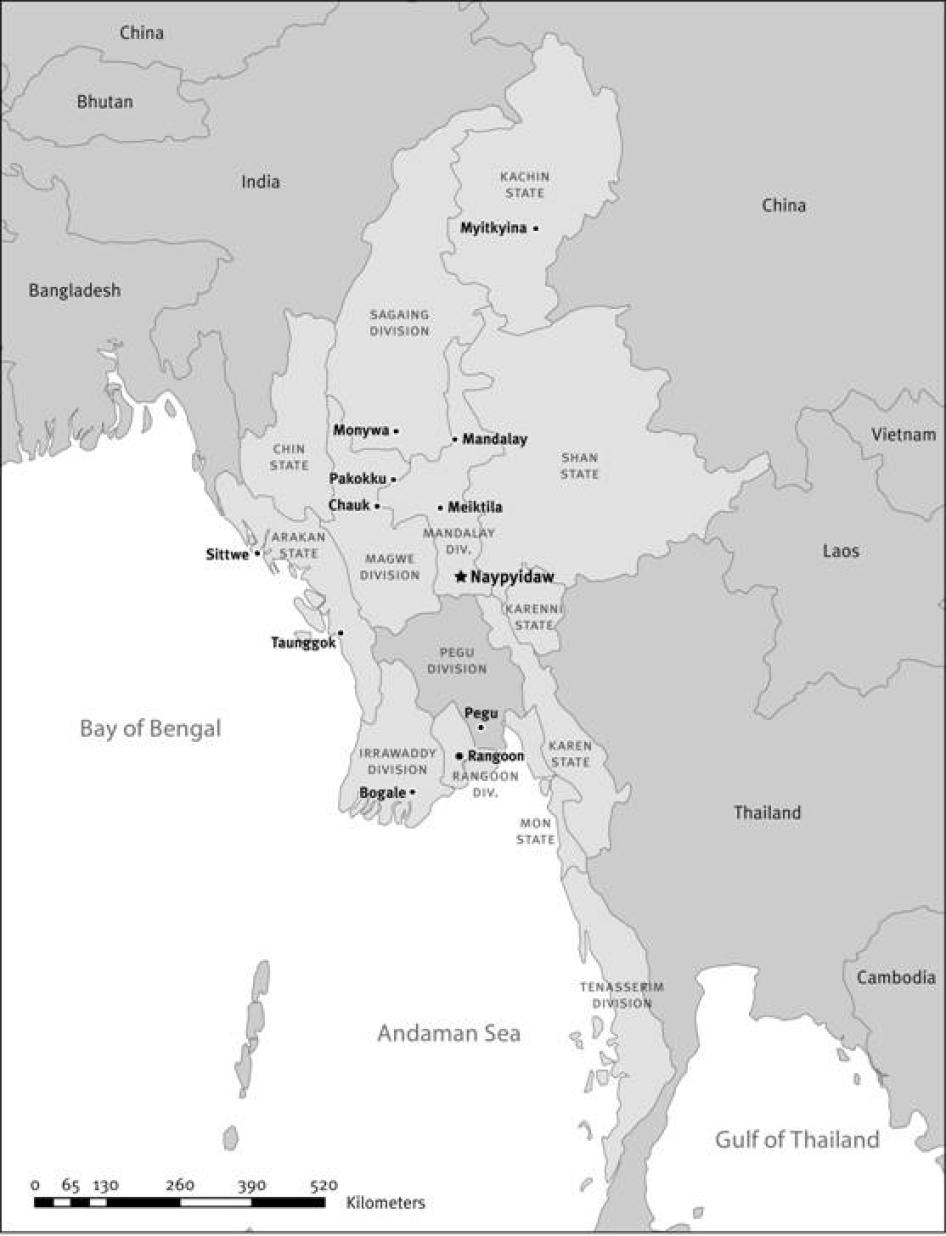
© 2009 John Emerson
I. Summary
The regime’s use of mass arrests, murder, torture, and imprisonment has failed to extinguish our desire for the freedom that was stolen from us. We have taken their best punch. Now it is the generals who must fear the consequences of their actions. We adhere to nonviolence, but our spine is made of steel. There is no turning back. It matters little if my life or the lives of colleagues should be sacrificed on this journey. Others will fill our sandals, and more will join and follow.
—Buddhist monk and protest leader U Gambira, November 2007.
I’m being watched all the time. I am considered an organizer. Between noon and 2 p.m. I am allowed to go out of the monastery. But then I’m followed. I had to shake off my tail to come to this meeting today. I’m not afraid, not for myself. I’m not afraid to tell foreign journalists what happened. And I’m prepared to march again when the opportunity arises. We don’t want this junta. And that’s what everyone at my monastery thinks as well.
—Buddhist monk, U Manita, Burma, July 2008.
[S]omething was achieved [in September 2007]. A whole new generation of monks has been politicized. We’re educating them. We’re still boycotting the military. We are not accepting gifts and offerings from them. One of the reasons why the regime will fall is globalization. No country can be isolated like before. Look at Indonesia, that regime fell. Now it’s a democracy. We want the UN’s Security Council to take up the Burma issue, that the UN investigates what really happened.... But China and Russia can use their veto. Please tell the world what’s happening in our country!
—Buddhist monk U Igara, Burma, July 2008.
Since the Burmese army’s brutal military crackdown on Buddhist monks and other peaceful protestors in September 2007, a constant refrain has been, “What happened to the monks?”
This report attempts to answer that question. It tells the story of many among hundreds of monks who were arrested and beaten, and the more than 250 monks and nuns who remain in prison today, often with decades remaining on their sentences. It tells the story of large numbers of monks who left their monasteries, returning to their villages or seeking refuge in other countries. And it tells the story of monks who remained, many of whom live under constant surveillance. Nearly all share the conviction that a time will soon come when Burmese monks again will be called on to serve as a public voice of conscience.
Many of the stories are sad or disturbing, but they exemplify the behavior of Burma’s military government as it clings to power through violence, fear, and repression.
What happened to a monk named Ashin Pannasiri provides a stark illustration. At the age of 18, he joined the Sangha, or monkhood, Burma’s most revered institution. Ten years later he was being kicked and beaten in custody by Special Branch police for his involvement in demonstrations against military rule in September 2007. “When I could not endure any more torture, I head-butted the table in front of me, trying to knock myself unconscious,” he told Human Rights Watch. “A police officer sitting beside me held me and said, ‘Please don't do like that, my reverend. We are acting under the command of higher authority.’”
Ashin Pannasiri was later transferred to an isolated labor camp near Burma’s western border with India. “There, I was chained on both legs and, like the other prisoners, had to break stones and dig ditches. I and about 140 other prisoners worked seven days a week, from dawn to dusk, without any break.”
After weeks of hard labor his interrogators returned to ask him more questions. “It seems that they had got some information about me from monks and other activists who had been arrested and interrogated. I was beaten again; they punched me in my chest and head. I was interrogated from nine in the morning to six in the evening, and I was not allowed to eat or drink anything. I realized that I would be killed if they took me to another place.” The now 28-year-old monk managed to escape from the camp, and walked through the jungle and mountains to India, where Human Rights Watch interviewed him and where he still resides.
Ashin Pannasiri’s ordeal exemplifies the Burmese military government’s repression of members of the Buddhist monkhood who dared to take to the streets in 2007. In September of that year, thousands of crimson-robed monks began marching in Burma’s former capital and largest city, calling on the ruling State Peace and Development Council (SPDC) to address declining living standards for an already poor population and begin a genuine dialogue with the country’s political opposition. In the end, weeks of gradually growing demonstrations were violently dispersed by security forces, a crackdown transmitted across the world’s television screens thanks to internet and cell phone technology. Hundreds of monks and nuns were arrested, detained, interrogated, and tortured. Many more were ordered or threatened to disrobe by the authorities and sent back to their home villages.
In one sense, this was nothing new. Burmese monks have played an important role at many critical historical junctures and, in response, the authorities have often cracked down hard. Monks have long been seen as a political and social threat to military rule in particular and, since 1962, successive military governments have gone to great lengths to sideline the Sangha from the country’s political life.
In another sense, however, the protests and the government response were unprecedented. The events of September 2007 were the worst ever assault on the Sangha, worse than anything that happened to the Sangha during the British colonial period, the 1962-1988 military-led avowedly socialist regime, or crackdowns on political activities in 1988, 1990, 1996, and 2003. The crackdown on monks in 2007 meant that the government lost whatever shred of legitimacy it may have had in the eyes of many, if not most, Burmese. These events also discredited the State Sangha Maha Nayaka Committee, the official leadership body of the Sangha, which lined up in support of the military government.
It is unclear how the monks will react in the future to continued repression. The crackdown, massive prison sentences for many monks and nuns, the exile of many, and the constant surveillance of many of those remaining suggest that political activism by monks could be sharply curtailed. Ahead of the second anniversary of the 2007 crackdown, surveillance of monasteries and intimidation and restrictions on movements of monks has increased to deter any repeat of the 2007 demonstrations.
Yet, given Burma’s history, it is unlikely that the challenge from the Sangha is over. As one monk defiantly told Human Rights Watch:
We don’t have any organization any more. We have no way of keeping in touch with each other. Before, both monks and laymen could communicate with each other. Now everything is crushed. We have no contact. Many have disappeared, or they have been arrested, or moved to other monasteries outside Rangoon. We can just wait and see. We are still not accepting offerings from the military. We’re waiting to go out and protest again.
* * *
Burma’s Buddhist clergy is huge. Of a population of 54 million, there are an estimated 300,000 to 400,000 monks in approximately 45,000 registered monasteries. There are no official figures of the number of nuns, though estimates suggest 50,000. More than 90 percent of people living in Burma are Buddhist, with the remainder mostly Christian and Muslim. Not many aspects of everyday life in Burma are untouched by Buddhism or the Sangha’s role in providing spiritual guidance and pivotal social mediation. Monks, far from the common Western view of being almost other-worldly, depend on community support for their day-to-day survival. In a symbiotic relationship, the Sangha provides spiritual guidance and comfort and maintains safe spaces for worship and basic social services, while the lay people around them provide material support and funding.
The clergy has often been at the forefront of social protest movements. Under British colonialism, monks were key leaders in agitating for independence and calling for political, educational, and social reforms by representing the broader population against capricious foreign rule. In particular, the “shoe question” in the early twentieth century was a spark for anti-British activities. In Buddhist pagodas it is a serious affront to wear shoes of any kind, etiquette that British soldiers and officials refused to observe. This issue became the focus for a host of other grievances that colonialism generated. In particular, monks were appalled that the forcible exile of Burma’s monarchy had also removed their key agent of patronage: Burmese kings bestowed money, titles, land, and pagodas on the Sangha in return for religious legitimacy, a celestial endorsement. The British had broken a centuries-old link between church and state, making average people the monks’ only source of support.
Following Burma’s independence in 1948, the monks were once again courted by politicians. The democracy period in Burma between 1948-1962 was also marked by attempts by elites to turn the Sangha to the service of the state, and in one ill-fated move the democratically elected prime minister U Nu tried to make Buddhism the state religion. Successive military regimes since 1962 have attempted to control and co-opt Buddhism and the loyalty of the monks to their own political and security agendas by bestowing religious titles and extending financial support and patronage, so that monks will be compliant and neutral. Attempts by politicians and other leaders to use the patronage of the Sangha for political gain have been a tactic of successive elites, including opposition leader Daw Aung San Suu Kyi.
Monks were at the forefront of major anti-government demonstrations in 1974, 1988, and in 2007. U Pannacara, a 27-year-old monk, explained to Human Rights Watch why monks get involved in political, not just spiritual, acts:
Traditionally, we monks are not supposed to be politically active. The military has ruled our country for more than 40 years, and they don’t care about the welfare of the people, they care only for themselves and their relatives, and how to remain in power forever. That was why the people rose up against them. There are three powerful groups in Burma: the sit-tha (sons of war), that’s the military, the kyaung-tha (sons of the school), the students, and the paya-tha (sons of the Buddha). That’s us, the monks.
The 2007 Crackdown
The September 2007 protests were sparked by the violent beating of a monk by local officials in the northern town of Pakokku, following a small march by monks protesting poor living standards. This incident, although isolated, shocked many Burmese and was the catalyst for a sweeping, nationwide movement. An underground monk organization formed, based on longstanding semi-political activities many monks were engaged in: literary clubs, English language classes, occasional anti-government activities.
The All Burma Monks Alliance (ABMA) was created and on September 9, 2007, issued a warning to the military government to start listening to the people or soldiers and officers would face religious excommunication. The SPDC’s failure to respond to the ABMA’s demands by the deadline of September 18 led to monks joining popular street protests that had spread that month in Rangoon and several smaller towns. While Rangoon was the focus, the “saffron revolution” was not just an ethnic Burman affair. Ethnic Shan monks and monks from Arakan State in Burma’s west, now and traditionally some of the best organized and perhaps politically most active in the country, also participated. Many monks also marched in the Mon State capital of Moulmein.
The military government tried to paint the protests as being fuelled by “bogus monks” supported by exiled pro-democracy activists in Thailand and elsewhere. But Human Rights Watch’s research shows that although such exile support existed, the 2007 protests were the result of spontaneous local reactions to longstanding grievances. Many monks interviewed by Human Rights Watch stated unequivocally that their involvement in the demonstrations was motivated by widespread public frustration over declining living standards and denial of basic freedoms. Anger had long simmered due to close government monitoring of neighborhoods, workplaces, and monasteries for signs of dissent. Standards of education, health care, and basic services had declined dramatically over the preceding several years and corruption was rampant.
The government’s violent responses to the demonstrations indicate how seriously the SPDC took the threat to its rule. Monks were publicly beaten, shot, and violently arrested around iconic sites of worship such as the Shwedagon Pagoda in Rangoon. The security forces raided monasteries at night, dragging away hundreds of monks to abusive interrogations and arbitrary detention. The leaders of the ABMA were either arrested, fled the country, or went underground.
The government’s crackdown on the monks continues to this day, with oppressive surveillance, continued arrests of monks suspected of involvement in political activities, and many monks undergoing secret and unfair trials and receiving draconian sentences. In late 2008, the authorities sentenced scores of monks and nuns to long prison terms for their involvement in the 2007 demonstrations. Many monks who were arrested in the raid on Rangoon’s Artharwaddy Monastic School in September 2007 received sentences with hard labor. A leader of the ABMA, 28-year-old U Gambira, was arrested in November 2007 after several weeks in hiding from the authorities. In November 2008, he was sentenced to 68 years in prison for a range of offenses related to unlawful association and forming illegal organizations (later reduced to 63 years). By August 2009, 237 monks remained in Burmese prisons, as well as several nuns arrested in connection with the 2007 demonstrations.
Cyclone Nargis
On May 2, 2008, Burma was struck by its worst natural disaster in modern history. Cyclone Nargis tore into Burma’s Irrawaddy Delta, the country’s rice bowl and the home of millions of people, mostly small farmers. No one knows exactly how many people died, but many estimates claim nearly 150,000 people perished. According to a joint assessment by the Association of Southeast Asian Nations (ASEAN), the UN, and the Burmese government, some 2.4 million people were severely affected by the cyclone, out of an estimated 7.4 million living in the affected townships.
The official response by the SPDC was to control, for its own purposes, all domestic and international efforts to send relief aid to the affected areas of the Irrawaddy Delta and around Rangoon. Foreign supplies were delayed, and relief goods on US, British, and French warships off the coast of Burma were refused. When UN and multilateral aid supplies arrived in Burma the security services tried to control their distribution.
Buddhist monks were prominent in trying to fill the vacuum in the government’s response at the local level. In the near absence of government services, Burmese civil society scrambled to help, either as private donors, family networks, religious organizations, or as Burmese employees of international agencies. Buddhist monks provided crucial logistical guidance for the distribution of aid supplies and offered monasteries and pagodas as shelter for survivors (often the sturdy monasteries were the only buildings left standing in devastated villages).
The monks proved once again the pivotal role they play in Burmese society. A byproduct of their response was the enhancement of their reputation in comparison to that of the military and SPDC-controlled civil society organizations, which were either nowhere to be seen or busy pursuing their own agendas. Gradually, the SPDC asserted control over the haphazard efforts and started to take credit for the relief operation, sidelining the religious networks, Burmese civil society organizations, and local and international relief agencies that did most of the work. As in the past, the monks had responded admirably to a crisis, only to be pushed aside by the military.
Many monks were forced to curtail or conceal their relief activities. Some of the monks, such as U Eitthariya, who had been involved in the 2007 demonstrations, attracted the attention of the authorities and were forced to flee to neighboring countries. The repression that intensified against the Sangha following the crackdown continued in the aftermath of the cyclone, as all community activities by monks were seen as political challenges by the SPDC. Health and education activities in some monasteries were forced to close if the military junta perceived them as being too closely linked to opposition figures. The monks were once again forced to show fealty to the ruling generals or remain silent and inactive.
Monks and the Future of Burma
There are limits to what a monks’ movement can achieve in Burma. Monks can be catalysts for change, but they cannot be the leaders of a pro-democracy movement. Their religious vows and the nature of the Sangha do not allow it. The long-term impact of the monks’ challenging the authoritarian state may well be the symbolism of members of Burma’s most revered institution being violently crushed by the military. These are images the people of Burma will never forget. They have also had a major impact on perceptions of the Burmese military government around the world. That the monks were trying to impress upon the generals that people throughout the country were suffering from declining living standards, repression of fundamental freedoms, and political marginalization made their protests even more powerful. The socially active Sangha succeeded in raising the stakes of Burma’s political deadlock by clearly stating their opposition to military rule, and in increasing international awareness to a level not achieved by anyone other than Nobel Peace Prize laureate Daw Aung San Suu Kyi.
The junta’s mishandling of the Cyclone Nargis disaster exacerbated the already grave situation in the country. While the “shoe issue” marked the beginning of the end of colonial rule in Burma, it remains to be seen what impact the events of 2007-2008 will have on Burma’s future. If they spell the beginning of the end of military rule in Burma, history will show that monks were at the forefront of that long awaited change.
Key Recommendations to the Government of Burma
- Respect freedom of religion for all religious communities in Burma.
- Immediately exonerate and release all monks and nuns arbitrarily detained or sentenced to prison for engaging in peaceful political activities, including those arrested for their involvement in the 2007 pro-democracy demonstrations.
- Punish those responsible for torture and ill treatment of monks in custody and members of the security services who used excessive force during the 2007 demonstrations and in raids on monasteries.
- Rescind the ban on independent monastic organizations such as the ABMA and other social welfare and education associations organized by the Sangha.
- Ensure freedom of movement, assembly, and of expression for members of religious orders throughout Burma.
- Grant voting rights to members of religious orders before the 2010 elections.
- Encourage monks to participate in civil society work without having to go through government authority, and encourage monasteries to continue to be active in local development initiatives.
Key Recommendations to Concerned States of the International Community
- Pressure the Burmese military government to respect fundamental freedoms for members of religious orders in Burma.
- Make the release of all political prisoners, including Buddhist monks and nuns, a precondition to any official political, diplomatic, or trade meeting with Burmese government officials.
- Support stronger measures in the United Nations Security Council to ensure religious freedom and basic freedoms of Burmese citizens ahead of planned elections in 2010.
Methodology
Conducting on-site research into human rights abuses in Burma is an especially difficult task, not least because of the security risks to victims of abuses, witnesses to the events, and ordinary Burmese with whom one comes into contact. While the ruling SPDC does not bar foreign tourists or approved humanitarian organizations, it does restrict the activities of human rights researchers and journalists. Following the 2007 crackdown, many monasteries and Buddhist temples in Burma were under close surveillance by security agents, making research on human rights violations extremely dangerous for Buddhist monks and nuns providing information to Human Rights Watch researchers.
Human Rights Watch interviewed approximately 30 Buddhist monks and nuns from various parts of Burma in preparing this report. Human Rights Watch interviews with Burmese monks were conducted in several locations inside Burma. Further interviews were conducted by Human Rights Watch in several locations in Thailand, Malaysia, Sri Lanka, the United Kingdom, and the United States, where in-depth interviews could be conducted with far fewer security concerns.
Interviews were conducted in English and Burmese. As many interviewees continue to lack protection and may be subject to reprisals, Human Rights Watch has withheld most of their names and identifying information. Some are now living in other countries and consented to their real names being used. Wherever possible and in a majority of cases, interviews were conducted on a one-on-one basis. All those interviewed were informed of the purpose of the interview, its voluntary nature, and the ways in which the information would be used, and orally consented to be interviewed. All were told that they could decline to answer questions or could end the interview at any time. None received compensation.
II. Burma: A Long Tradition of Buddhist Activism
In contrast with the popular image of Buddhist monks as men aloof from worldly affairs who devote themselves almost entirely to tranquil meditation in monasteries, Burma’s monks have come to play a decisive role in the country’s pro-democracy movement. But this is not a new phenomenon. Burma’s politicized, and sometimes even militant, form of Buddhism dates back to the end of the 19th century. Following the British conquest of upper Burma, and the removal of King Thibaw from his palace in Mandalay in 1885, Buddhist monks dressed in their yellow and crimson robes led bands of armed rebels against the colonial power. As Donald Eugene Smith wrote in his study Religion and Politics in Burma: “In the anti-colonial struggle, the pongyis (monks) were the first nationalists.”[1]
Smith described how in pre-colonial Burma, the king was the promoter and protector of the Buddhist faith, the Burmese language was strongly influenced by Pali, the canonic language of Buddhism, and the monks were the teachers of the youth in virtually every Burmese village. The Buddhist monastery was the center of not only religious but also social activities in rural Burma. Education, the yearly cycle of festivals, merit-making,[2] the monks’ retreat during the rainy season, the ordination of young boys to become novices—and any other communal activity in the village—circled around the monastery.[3]
But the central role of the Buddhist Sangha (order of monks) was eroded under colonial rule, which was established in stages through three Anglo-Burmese Wars. During the first, from 1824-1826, the British conquered the western Arakan (Rakhine) region and the southeastern Tenasserim area. In the second, in 1852, the British established hegemony over southern Burma, including the new capital Rangoon. During the third, in 1885, northern Burma and the then royal capital of Mandalay came under British rule. There was no place for the old-style pongyi in the new, western-oriented social hierarchy. According to Smith:
His [the monks] educational function were assumed by other agencies, an unknown foreign language prevented him from understanding what was going on, and westernized Burmese laymen increasingly regarded him as irrelevant to modern life. Of all sections of Burmese society, the pongyis had the strongest reason for hating the British and became almost uncompromising nationalists.[4]
Although the colonial power made no deliberate effort to disrupt the Buddhist religion in Burma, political and religious authority was separated. As scholar Jan Becka writes: “The British government departed from the cosmic prototypes with which the traditional Burmese government, the king and the court, had linked the social order and the state.”[5] Many Burmese perceived this as the beginning of the decline of Buddhism as a religion in their country. According to Becka:
Initially, the antipathy towards the British administration stemmed from the fact that it was a non-Buddhist authority and this argument was even more important than foreign domination. It was within this context that Buddhism began to play an important role as a symbol of subject Burmese nationality and as a factor in the nationalist movement in Burma, particularly in the period prior to the 1930s.[6]
At the same time, many Western-educated Burmese realized that it would be futile to oppose the colonial power with the ‘traditional’ response to the new order that the British had brought in and that there was no way the old Buddhist, Burmese kingdom would be revived.[7]But even to these “modern Burmese,” Buddhism was important and, in 1906, a group of laymen organized the Young Men’s Buddhist Association (YMBA). It was modeled on the YMBA in Ceylon (now Sri Lanka), which had been set up in 1898 by C.S. Dissanayake, a convert from Roman Catholicism, who, in turn, had modeled his organization on the Young Men’s Christian Association (YMCA).
The Burmese YMBA strived to preserve the country’s Buddhist heritage in the modern world. In the beginning, it was not a political organization, although it fought issues such as the segregation of the railways, which provided compartments only for Europeans. Its members concentrated mainly on religious, social, and cultural issues and activities. All that, however, changed when many ordinary Burmese began to show their anger at the practice of Westerners in Burma wearing their shoes inside pagoda premises. Buddhists always remove their footwear before entering a pagoda or other holy place, but the British apparently thought they were above such taboos. To Buddhist Burmese, it seemed their traditional values were under attack.
People turned to the YMBA—still the only nationalist organization at the time—and, in 1916, a meeting was held in the Jubilee Hall in the capital Rangoon. A statement was sent to the colonial authorities demanding that the customary rule against the use of footwear in the pagodas should be made into law. The British ignored the request, and the “shoe issue” became the first major source of public anger that galvanized almost the entire Burmese nation against the British colonial rulers. In 1919, a group of Europeans wearing shoes at the Eindawya Pagoda in Mandalay was attacked by angry monks. Four monks were arrested and brought to court for the assault. Their leader, U Kettaya, was convicted of “attempted murder” and sentenced to life imprisonment.[8]
The “shoe issue” became a point of convergence for both modernists and traditionalists to challenge British rule, and to do so in a way that supported the dignity of Buddhism and recognized its central importance to Burmese life.[9] The movement gradually gained momentum. The next challenge to the colonial authorities came in December 1920 when hundreds of young urban intellectuals launched a strike against a proposed law that would provide Burma with its first resident university, replacing the two colleges that had previously been subordinate to the University of Calcutta.[10] Students and other nationalists had reservations about the bill, including matriculation requirements and tuition costs, but British lieutenant-governor Sir Reginald Craddock turned a deaf ear to the protests. Five hundred out of a total of six hundred students in Rangoon began to strike against the colonial authorities. This was followed by strikes by high school students in Rangoon, Mandalay, and other towns.
The students camped at the foot of the Shwedagon Pagoda, Burma’s holiest shrine, showing the importance of Buddhism to political movements, even one addressing an issue such as education reform. Much later, one of the student activists, U Le Pe Win, reminisced:
These propaganda campaigns as well as constant contacts made by our comrade boycotters with members of the Buddhist Bhikkhu Sangha everywhere throughout the length and breadth of our country brought about peculiarly prompt political awakening amongst the monks of both upper and lower Burma and even in the Mon area, Arakan, and Shan States. Very soon afterwards, by the beginning of the year 1922, a little over two years after we had launched our University Boycott, pongyi political parties, known in Pali and also popularly, as Sangha Sammeggi, sprang up, sprayingly, like mushrooms.[11]
Out of the YMBA grew the General Council of Buddhist Associations, a broader nationalist organization. In 1920, it became the General Council of Burmese Associations (GCBA), which sought to widen support for the movement even further beyond the relatively Westernized leadership of previous organizations. The GCBA cooperated closely with the General Council of Sangha Sammeggi (GCSS), which brought together radical monks, subsequently known as “political pongyis.”[12]
At the same time, a prominent monk from the Arakan (Rakhine) region of western Burma had returned from India. He was born as Paw Tun Aung, but became known under his monastic name, U Ottama. In India, he had been close to the Indian National Congress and Mahatma Gandhi, and he had also visited France and Egypt. In a Gandhian way, he transformed a basically political issue—nationalism and independence for Burma—into a religious one which appealed even to those who had not received a British education. A fiery speaker and agitator, U Ottama attracted a large following of mainly Buddhist monks, who organized demonstrations and meetings. The British government responded fiercely, bringing in the military police to break up these gatherings.
U Ottama’s activities led to the emergence of a militant, anti-colonial movement that propagated a combination of nationalism, Buddhism and, in its later stages, socialism. This mix of political and religious beliefs was adhered to in varying degrees by most nationalist politicians in colonial Burma—and little changed in this regard after the country’s independence in 1948. U Ottama, faithful to his Gandhian ideals, did not advocate the use of violence in the anti-colonial struggle. Nevertheless, during the 1920s, there were several violent incidents involving militant monks agitating against colonial rule.[13]
U Ottama was arrested in 1921 for one of his nationalist speeches—the first monk in British Burma to be imprisoned specifically for speaking out against the colonial authorities. His offense was to call upon Sir Reginald Dorman-Smith, the lieutenant-governor, to return to Britain. From 1921 to 1927, U Ottama spent more time in prison than outside. In the 1930s, he was imprisoned again and, to protest his detention, went on a hunger strike. The British ignored U Ottama’s non-violent protest against colonial rule, and he died in prison in 1939.
U Ottama was the first of many monks in Burma who stood up against British colonial rule. He is considered by many to be the father of the country’s independence movement. His old monastery in Sittwe in what is now Arakan State, the Shwe Zedi, continues to be an important focal point for political and anti-government activities. The monks’ movement of August and September 2007 began with a march by monks from the Shwe Zedi monastery to the prison in Sittwe demanding the release of an imprisoned activist.
The second most important nationalist monk in the 1920s was U Wisara, who also was imprisoned several times for delivering anti-colonial speeches. He died in jail in 1929 after being on hunger strike for 163 days. The Irrawaddy magazine noted in its October 2007 cover story about the most recent monk-led demonstrations in Burma: “Both monks [U Ottama and U Wisara] became an inspiration to activists and student activists involved in the independence movement. Scholar Michael Mendelson wrote in his Sangha and State in Burma, ‘that all politically active monks tended to be labeled by the colonial authorities as political agitators in the yellow robes. Interestingly, a similar term is used by Burma’s current leaders to describe protesting monks.’”[14]
In the 1930s, an ex-monk and former member of the GCBA called Saya San deviated from the non-violent struggle of the 1920s and staged an armed rebellion against colonial rule. His followers, known as galons, after a powerful bird in Hindu mythology (garuda in Sanskrit), believed that their tattoos and amulets would make them invulnerable to British bullets. The rebellion was eventually crushed, though its impact was tremendous. Saya San was the traditional minlaung (pretender) to the throne—a figure that often emerges in Burma in times of crisis. He wanted a return to the old Buddhist kingdom of pre-British days, but the young nationalists—who by then were organizing themselves at Rangoon University—did not miss the point that most of his followers were young monks and impoverished farmers, and the Saya San rebellion had clearly demonstrated their political potential.[15]
In the early 1930s, the Burmese nationalists led by the charismatic Aung San, a young student leader in Rangoon (and the father of Daw Aung San Suu Kyi), formed the Dohbama Asiayone, or “We Burmans Society,” which became the vanguard of the struggle for independence. Its ideology was basically secular Marxism and Aung San emphasized its secular orientation, repeatedly stating that the movement was “the only non-racial, non-religious, and impersonal movement that has ever existed in Burma.”[16] But, even so, Buddhism was always close to the hearts of many Burmese nationalists, before and after independence. U Ba Swe, the leader of the Burma Socialist Party in the early 1950s, wrote in his pamphlet The Burmese Revolution that “Marxist theory is not antagonistic to Buddhist philosophy. The two are, frankly speaking, not merely similar. In fact, they are the same in concept.”[17] In another pamphlet, Ba Yin, an education minister in independent Burma, took this theme a step further: “Marx must directly or indirectly have been influenced by Buddha.”[18] And some members of the Dohbama, despite the supposedly secular policies of the organization, asserted that socialism would free people from poverty, thus enabling them to build monasteries and do charitable work.
Nonetheless, some of the young nationalists did not hesitate to criticize the Sangha. In 1935, a satirical novel called Tet Pongyi (“The Modern Monk”) by Thein Pe Myint, a leftist intellectual, criticized the traditional monastic hierarchy in Burma and even attacked breaches of discipline and highlighted acts of immorality among the Buddhist clergy, including sexual misconduct.[19] The book shocked many devout Burmese Buddhists, and Thein Pe Myint received death threats. Tet Pongyi was eventually banned by the government and the author was forced to make a public apology to the Sangha.
During the period of the Japanese occupation of Burma, 1942-45, Aung San’s ideal of a secular state gained the support of most Burmese nationalists. Although they were Marxists, they had sided with the Japanese in the hope of being able to establish an independent Burmese republic. When the Burmese nationalists began to turn against the Japanese in 1944, secular ideals became even stronger. In August 1945, Aung San and his comrades formed the Anti-Fascist People’s Freedom League (AFPFL), which stated in its first manifesto: “Freedom of conscience should be established. The state should remain neutral in religious questions. Religion should not be used as a means to exploit the masses.”[20]
But even Aung San could not ignore the importance of Buddhism in Burmese life and society, albeit with some reservations. In an address delivered at the opening of the AFPFL’s first congress on January 20, 1946, Aung San stated:
Speaking of Buddhism particularly, which is the religion professed by the bulk of our people, I can say without prejudice to other religions that it is more than a religion itself and has several indications of its becoming possibly the greatest philosophy in the world, if we can help remove the trash and travesties which antiquity must have doubtless imposed on this religion. I wish, therefore, to address a special appeal to the Buddhist priesthood and say to them: Reverend Sanghas! You are the inheritors of a great religion in the world. Purify it and broadcast it to all the world so that all mankind might be able to listen to its timeless message of Love and Brotherhood till eternity...go amongst our people, preach the doctrine of unity and love...freedom to religious worship, freedom to preach...freedom from fear, ignorance [and] superstition.[21]
Buddhism in Independent Burma During the Parliamentary Period
During World War Two, Burma was occupied by Japan with the active cooperation of the Burmese nationalists. But in March 1945, the nationalists allied themselves with the United Kingdom and took up arms against Japan. British rule was restored in August 1945. The nationalists, led by Aung San, pressed for independence. In January 1947, Aung San and British Prime Minister Clement Attlee agreed on independence for Burma. The plan was for a secular state, which was opposed by many traditionalists within the AFPFL, a broad front that included rightists, centrists as well as communists. They pressed for the constitutional recognition of Buddhism as the state religion of an independent Burma.
On July 19, 1947, before Burma gained independence, Aung San was assassinated. Five other members of pre-independent Burma’s interim government, a Shan leader, a government official and a bodyguard were also killed. Burma was thrown into turmoil even before it had become independent. The alliance with the powerful Communist Party of Burma broke down and the fragile alliance that Aung San had managed to form with some of Burma’s ethnic minorities at a meeting in Panglong, Shan State, in February 1947 was in jeopardy. The ethnic Karen, whose leaders were predominantly Christian and staunchly pro-British, did not take part in the preparations for Burma’s independence. During the Japanese occupation, they had sided with the British and staged guerilla warfare against the Japanese. The Karen wanted their own independent state, as did representatives of some of the smaller minorities such as the Karenni (Kayah) and the Mon.
Aung San and the others had been assassinated by gunmen sent by U Saw, a conservative politician who was subsequently arrested and hanged. The AFPFL’s vice president, U Nu, a former student leader, took over as prime minister and, on January 4, 1948, declared Burma’s independence. While he led the republic’s first government, the presidency was given to Sao Shwe Thaike, the Shan sawbwa, or prince, of Yawnghwe and one of the most prominent leaders of Burma’s many ethnic minorities. But such attempts at forging national unity did not prevent the Karen and some other minority peoples from taking up arms against the government of the new republic—even though it was federal in character and included provisions for autonomy for the various nationalities of the Union.
The Communist Party of Burma also went underground, and for a while it seemed that the government in Rangoon controlled little more than the capital and surrounding areas. But help came from U Nu’s close Indian counterpart, Jawaharlal Nehru, and, by the mid-1950s, the insurgents had been driven into remote and hilly areas surrounding Burma proper, and in pockets in the Irrawaddy delta region, the Pegu Yoma mountains north of Rangoon, and a few other places.
If Buddhism had been made the state religion, its ethnic problems would most probably have been exacerbated, as Christian missionaries during the colonial period had converted many of the hill peoples. The Kachin and the Chin were predominantly Christian, as were many—although not a majority— of the Karen. The first Constitution of the Union of Burma did nonetheless give recognition that most Burmans, the majority ethnic group in the country, were Buddhists:
All persons are equally entitled to freedom of conscience and the right to freely profess and practice religion subject to public order, morality or health... [but] The State recognizes the special position of Buddhism as the faith professed by the great majority of the citizens of the Union...The State also recognizes Islam, Christianity, Hinduism and Animism as some of the religions existing in the Union.[22]
U Nu remained prime minister for most of the years preceding the military takeover in March 1962, and many Western scholars have attributed his efforts to promote Buddhism to his deep religious conviction. But, as Burma scholar Becka has pointed out, “U Nu’s main speeches of the 1940s made little mention of religion and the initial policy of his government was not dominated by religious issues.”[23]
Under U Nu, the Sangha was given its pre-British prominence in society. The establishment of a Ministry of Religious Affairs in 1950 marked the beginning of a new era of Sangha reform. The government also tried to introduce a system of registration of Buddhist monks, but it failed as the monks at a meeting in Rangoon declared that the Lord Buddha had laid down 227 rules of discipline, to which none more could be added. The monks said that the government had no right to introduce new rules for the Sangha.
In May 1954, U Nu managed to raise his Buddhist profile in the region by convening the Sixth Buddhist Synod in Rangoon, which was attended by 2,500 Burmese and foreign monks and scholars.[24] The sessions lasted for two years and resulted in the establishment of the International Institute for Advanced Buddhist Studies, which was located on the premises of the Kaba Aye (World Peace) Pagoda in Rangoon.
During this period, Buddhism became an ideological and moral barrier against communism, which, at that time, was strong in the country and the entire region. In 1950 U Nu expressed the view that the Buddhist Sasana Council—a national body of monks—should counteract “Marxist materialism.”[25] The Burmese monk and philosopher U Kelatha emphasized that Marxism, with its materialistic contempt for the overcoming of Impermanence, was a continuous threat to Buddhism.[26]
In the late 1950s, the Psychological Warfare Department of Burma’s Armed Forces produced a booklet entitled Dhammantaraya, or “Buddhism in Danger,” in which communism was portrayed as the gravest threat against Buddhism.[27] Overall, nearly one million copies of the booklet were distributed. Issues were also published in Mon, Shan, and Pa-O—the languages of the largest non-Burman Buddhist ethnic groups in the country. Meetings were also held all over the country to denounce communism as anti-religious.
Political turmoil in the country in 1958 forced U Nu to hand over power to a military caretaker government headed by the army chief, General Ne Win, who even more vigorously tried to establish government control over the Sangha. His Sasana Purification Association supported the move to have the monks registered and the general was determined to push it through. According to Smith:
An appeal was made for the cooperation of the monks, and the pongyis of the Yahanpyu Aphwe (Young Monks’ Association) complied in a few districts. When 250 monks of Myaungmya registered, this event was considered a newsworthy item. But protest meetings were staged by the Central Committee Against the Registration of Sanghas, and the attempt finally had to be abandoned.[28]
The Yahanpyu monks drew their strongest support from monasteries in Mandalay. They were staunchly anti-communist and, at least until the mid-1950s, their organization was allegedly subsidized by the US-government funded Asia Foundation.[29] One of its most outspoken leaders, U Kethaya, was even nicknamed the “American pongyi.”[30]
One of the demands of the Yahanpyu Aphwe was to make Buddhism the state religion of Burma. As a result of the pressure from the Yahanpyu Aphwe and other Buddhist groups—and perhaps because U Nu himself supported the idea—two bills dealing with Buddhism as the state religion were published in the Burmese press on August 1, 1961. U Nu had returned to power after a general election in February-March 1960, and was eager to consolidate his new grip on the nation in a political landscape that was becoming increasingly fragmented with new parties and factions breaking the previous near-monopoly on power by the AFPFL. According to Smith, “U Nu now appeared before the electorate as the personification of certain traditional values—the devout Buddhist ruler, the Defender of the Faith.”[31]
One of the bills that were published in 1961 said that Buddhism, being the religion of the majority of the people of Burma, “shall be the state religion,” while the other described the government’s duties in the field of religion. The government shall, “promote and maintain Buddhism for its welfare and advancement in three aspects, namely...study of the teachings of the Buddha...practice of the teachings, and...enlightenment.”[32]
The bills met with stiff opposition from Christian groups, and the issue of a state religion was one of the reasons why the predominantly Christian Kachin rose in rebellion in 1961. Led by three brothers, Zau Seng, Zau Tu and Zau Dan, the Kachin Independence Army (KIA) quickly wrested control over Kachin-inhabited areas of northeastern Shan State as well as territory within Kachin State itself.
The possibility of violent clashes between Buddhists and non-Buddhists in Rangoon prompted the government to mobilize 1,500 armed police officers when the bills were going to be discussed in the Chamber of Deputies in August 1961. A group of Christians and Muslims appealed to the Supreme Court, arguing that the move violated the spirit of the constitution. They argued that while the national flag, the national anthem and the state bank belonged to all the citizens of the Union, Buddhism, if made the state religion, would not belong to, at that time, some five million people.[33]
The Supreme Court dismissed the appeal. The bills were passed, but before they could be implemented, the military stepped in and seized power. On March 2, 1962, General Ne Win staged a coup d’etat, ousted U Nu, and abolished the constitution. The issue of a state religion was not the reason for the coup—introducing an entirely new political and economic system was—but it meant that the effort to make Buddhism the state religion failed to become a reality.
Buddhism and the State After the 1962 Military Takeover
On April 30, 1962, Ne Win’s Revolutionary Council announced its new policies in a statement titled “The Burmese Way to Socialism.” The 10-page document mentioned religion in only one sentence: “The Revolutionary Council recognizes the right of everyone freely to profess and practice his religion.”[34] This document was followed by a longer policy declaration, The System of Correlation of Man and His Environment, which was meant to provide philosophical underpinnings for the new military government. The party formed by the military, the Burma Socialist Program Party (BSPP), became the only legally permitted political organization in the country.
On the one hand, Ne Win’s government reasserted the principle of separation of religion from politics and the state. On the other, The System of Correlation of Man and His Environment was a hodgepodge of Marxism, Buddhist thinking, and humanism which reflected an attempt by the military government to be seen as belonging to Burma’s specific political traditions. But more importantly, with all political parties banned except for the BSPP, Ne Win and the military realized that the Sangha could pose a threat to the new order and, therefore, had to be brought under state control.
And it was not only the mainstream Burman Sangha that posed a threat to the government in Rangoon. The monks of the Arakan region of western Burma had a long tradition of militancy and, as a separatist movement among the Shan began to emerge in the late 1950s, young Shan students met secretly at the Rangoon monastery of U Na King, a revered Shan monk from Möng Nawng who had been in the capital for a number of years. The Shan had organized their own movement to revive their distinct identity and U Na King was the undisputed leader of monks as well as students from that ethnic minority.
One night shortly after Ne Win’s 1962 coup d’etat, 40 young Shan met at U Na King’s monastery to swear an oath. They cut their wrists, dripped the blood into a glass, mixed it with rice liquor and drank it. The young Shan pledged to fight for an independent Shan State and declared themselves ready to sacrifice their lives if necessary. U Na King bestowed on the young radicals noms de guerre, all beginning with hsö—“tiger” in Shan—to demonstrate their bravery and determination. The tiger was also a Shan national symbol.
The fledgling Shan rebellion was especially worrisome for the government as the Shan are more closely related to the Thais than to the mainly Tibeto-Burman peoples of Burma. Thailand, Burma’s historical enemy, shares a long border. For ethnic and historical reasons, the Shan monkshave also always been closer to the Thai Sangha than the Burmese monastic order.[35]
Ne Win was not wrong in assuming that the monks would oppose his military government. In October 1963, the “American pongyi,” U Kethaya, launched a one-man campaign against Ne Win’s government. U Kethaya was no longer young—he was then 83—but was still a fiery speaker who attracted tens of thousands of people whenever he addressed the public in Mandalay. He predicted that Ne Win, just like Aung San, would be assassinated. However, despite speeches like those, U Kethaya was not arrested. Ne Win probably realized that sending an old revered sayadaw to jail would crystallize opposition to the military regime, which was not yet firmly entrenched in power.[36]
It was not until General Sein Lwin—later known as the “Butcher of Rangoon” for his role in suppressing the 1988 pro-democracy uprising—became chief of Mandalay Division in the late 1960s that the Yahanpyu movement was suppressed. By then, it appears that it no longer received any US-government support; it was simply an anti-military force that posed a threat to Ne Win’s new order.
Intermittent labor and student unrest shook Burma in the late 1960s and early 1970s. But it was not until 1974 that the monks came out in force again. U Thant, the secretary-general of the United Nations, had died in New York on November 25. He was internationally the best-known and most respected Burmese citizen. Because of the long-standing animosity between the statesman U Thant and the general who ruled at home, Ne Win, the Burmese government sent no official delegation to receive the coffin. When U Thant’s body was flown back to Rangoon, the authorities planned to bury it in an obscure cemetery on the outskirts of the capital. The students, almost inevitably, seized the opportunity to launch large-scale anti-government demonstrations.
The students snatched the coffin and carried it away to the campus of Rangoon University. Buddhist monks joined in and gave U Thant the rites for someone who had achieved distinction, and the students buried him on the old site of the Rangoon University Students’ Union building—which the military had blown up months after it had seized power in 1962, demonstrations in which an estimated 130 student protesters were killed.
Andrew Selth, a former Australian diplomat and Burma scholar, witnessed the events in Rangoon in 1974:
Despite official travel restrictions, thousands of Burmese arrived from places as far away as Mergui in the south and Mandalay in the north. They were of all ages and included a large number of pongyis. Sometimes queuing up for 15 minutes to go through the student security checkpoints, the crowds moved slowly through the main gates, down Chancellor Road past the new mausoleum, the new central quadrangle. There, on the steps of the Convocation Hall and often surrounded by pongyis, speakers addressed the throngs on the lawns below them.[37]
The military government’s response was predictable. It sent in troops to recover U Thant’s remains, which were reburied near the Shwedagon Pagoda. The military’s violence and subsequent arrests of students provoked more demonstrations all over Rangoon. Martial law was declared on December 11, and the troops opened fire on the students and the monks. The official casualty toll was ludicrously low: 9 killed, 74 wounded and 1,800 arrested. Students who participated in the demonstrations claim that 300-400 of their comrades were gunned down that day in Rangoon. According to Burma scholar Gustaaf Houtman; “During the arrangement for U Thant’s funeral in 1974, several monks were bayoneted and 600 were arrested.”[38]
The outburst of anti-government sentiments in the mid-1970s was not only because the public admired personalities such as U Thant. A decade of military rule had devastated the Burmese economy. The “Burmese Way to Socialism” basically meant that everything in sight was nationalized and handed over to a number of military-run state corporations. These were not competent to run the economy, and the outcome was an acute shortage of goods, high unemployment, and falling living standards.
Resentment with the military regime ran high, and the monks had shown during the events of December 1974 that they were a force to be reckoned with. Consequently, they had to be brought under state control. The idea of making Buddhism the state religion had been abandoned by the post-1962 military government, and the new constitution that was promulgated in 1974, following a sham referendum, simply said: “The national races shall enjoy the freedom to profess their religion, use and develop their language, literature and culture, follow their cherished traditions and customs, provided that the enjoyment of any such freedom does not offend the laws or the public interest.”[39] Buddhism was no longer granted “the special positions” of the 1947 constitution, but the authorities nevertheless paid more attention to Buddhists than to practitioners of other faiths.
In 1980-81, Burmese army general Sein Lwin—feared for his leading role in the Rangoon University Student Union massacre in July 1962—served as the Minister of Home and Religious Affairs, and was responsible for reining in the Sangha. In May 1980, he convened in Rangoon the First Congregation of All Orders for the Purification, Perpetuation and Propagation of Sasana. A number of monks were purged and forced to disrobe from the monkhood. To control the rest, the 47-member State Sangha Maha Nayaka Committee was formed, a governing body for all Buddhist monks in the country, and monks were finally forced to register and get their own ID cards.[40]
A constitution for the Sangha was drawn up, resembling that of a state. According to Burma scholar Robert Taylor:
Committees of leading monks are organized from the village-tract and ward level upwards to a state central working committee which manages the sects in its area and which, through its executive committee, ensures that monks behave according to the Vinaya, the Buddhist code of behavior. Failure to do so results in the relevant executive committee of the monkhood reporting violations to the township People’s Council, which is empowered to take action against an individual or entire monastery found to be misbehaving.[41]
From the ruling military’s point of view, “misbehaving,” or not following the Vinaya, naturally meant being involved in politics or refusing to cooperate fully with the authorities. Burma scholar Houtman wrote in his study, Mental Culture in Burmese Crisis Politics:
In 1976, the regime sought to discredit La Ba, a monk critical of the regime who it accused of murder and cannibalism. In 1978, more monks and novices were arrested, disrobed, and imprisoned. Monasteries were closed and their property seized. Also in that year a senior monk, Sayadaw U Nayaka, died in jail after being tortured.[42]
Even the well-respected and internationally renowned teacher of Vipassana meditation, Mahasi Sayadaw, was targeted in the campaign. The regime distributed leaflets accusing him of talking to nat (spirits).[43] The Tipitaka Mingun Sayadaw, Burma’s top Buddhist scholar, was accused of having been involved in some unsavory incident after entering the monkhood.
Both sayadaws had shown reluctance to cooperate with the newly established State Sangha Maha Nayaka Committee, the official Sangha organization controlled and directed by the military government, and which is the object of widespread suspicion among many monks Human Rights Watch interviewed.[44] The 47-member Committee body consists of a chairman, six vice chairmen, one secretary general, six joint general secretaries and 33 other members. In the beginning, appointments were organized every five years—1980, 1985, and 1995—but in more recent years a quarter of the positions change every three years, rotating among senior monks.[45] The committee occasionally issues decrees and orders that have to be obeyed by all monks in the country. These decrees and orders are sent to senior monks on state/divisional level as well as township and ward level, and then announced locally. Monks who fail to abide by these decrees and orders are expelled from the monasteries and disrobed.
The monastic census of 1984-85 counted over 300,000 monks in Burma: 125,000 fully ordained pongyi and 185,000 novices in 47,980 registered monasteries.[46] (During interviews with monks during 2007-2008, Human Rights Watch was told by various monks that there were approximately 400,000 monks in Burma).[47] By the late 1980s, the state thought it had brought the Sangha under its control and quelled all dissent within the ranks of the monks. But the events of 1988 were to show that dissent was still strong in monastic circles, and that the government and the State Sangha Maha Nayaka Committee—despite the new, draconian rules which had been introduced in 1980—were unable to completely control the country’s hundreds of thousands of monks.
III. The Role of the Sangha in the 1988 Uprising and After the 1990 Election
On August 8, 1988, massive demonstrations shook Rangoon and almost every town across the country. Millions of people from all walks of life—including monks—took to the streets to vent decades of pent-up frustrations with a regime that had turned what once was one of Asia’s most prosperous countries into an economic and political wreck. The ruling BSPP government responded as it had always done: by sending out the military. But this time the military’s brutality was more intense than ever—an estimated 3,000 protesters were gunned down in Rangoon and elsewhere after the army went into action.
According to a medical volunteer who at that time was at Rangoon General Hospital (RGH):
The worst day was Wednesday the 10th. Army trucks dumped both dead and wounded from all over Rangoon outside the hospital. Some kids had a bullet-wound in their arms or legs—and then a bayonet gash in their throats or chests. Some were also totally disfigured by bayonet cuts. Several corpses were male and stark naked with shaven heads. Those were the monks whom the soldiers had stripped of their robes before dumping their corpses outside the RGH.[48]
But the killings did not stop the demonstrations. A general strike was proclaimed by the protesters and the military withdrew from the streets, at least temporarily. General Sein Lwin, who had been appointed president on July 26—and who had ordered and overseen the killings—stepped down on August 12. He had by then earned the nickname “The Butcher,” while his successor, Dr. Maung Maung, became known as “The Puppet.” Maung Maung had some army background, but was basically an academic and writer who had remained immensely loyal to Ne Win and the military.
On August 26, Aung San’s daughter, Aung San Suu Kyi, appeared in public for the first time at a mass rally outside the Shwedagon Pagoda. She became the leader of the pro-democracy movement. But in the absence of any functioning administration, strike committees, which had been set up all over the country, took over local governments. Local citizen committees were also formed in almost every neighborhood in major towns, usually consisting of monks, community elders and students.
In Mandalay, the Yahanpyu movement, which Sein Lwin had forced underground in the 1970s, resurfaced. Its monks organized day-to-day affairs like rubbish collection, made sure the water supply was working and, according to some reports, even acted as traffic police. The maintenance of law and order was also in the hands of the monks—and the criminals who were caught were often given rather unorthodox sentences. One visitor to Mandalay in August 1988 saw a man chained to a lamppost outside the railway station who shouted all day: “I’m a thief! I’m a thief! I’m a thief!”[49] In South Okkalapa, Rangoon, the Ngwe Kyar Yan monastery was transformed into a virtual fortress and a bastion of the pro-democracy struggle.
The Mandalay monks played an especially important role in the 1988 uprising. According to Ward Keeler, an American anthropologist who was in Mandalay at the time:
It’s the monks’ role in all this that’s truly remarkable. They have taken it upon themselves to fill the void created by the removal of all other forms of authority in the city. The government simply doesn’t exist anymore here: every township office in the city is shut tight, and a fair number of big wigs of the Party-cum-government (the BSPP) are probably in hiding. What one sees instead is sometimes quite hilarious. I would love to take a picture of one of the traffic police gazebos full of monks standing there with long sticks in their hands and whistles in their mouths. The cross road at the clock tower [a Mandalay landmark, located in front of the central market, Zeigyo] is now controlled by monks who brook far fewer infractions of traffic laws than the traffic police used to: no right turn on red in Mandalay’s traffic theocracy. More improbably still are the monk commandos careening around town. Jeeps, trucks, private cars all are filled with monks traveling about town looking important, and usually with a couple of monks hanging on the side or sitting on the roof blowing their whistles furiously so that everyone will get out of their way. Demonstrations are usually policed in part by monks, who stride alongside the demonstrators maintaining the lines. Public security has also been taken up as the monks’ charge. That means that the equivalent of police stations have been set up in different parts of the city.[50]
Finally, on September 18, after more than a month of daily protests, the army stepped in again. Trucks full of troops and armored cars with machine-guns rolled into Rangoon. This time, the forces were impeccably organized and the operation was carried out with cold-blooded efficiency. Any crowd in sight was mowed down systematically as the army vehicles rumbled down the streets in perfect formation.
The carnage continued for two days, while the State Law and Order Restoration Council (SLORC), a new junta headed by army chief General Saw Maung, announced that it had to “prevent the disintegration of the Union”—and that no more than 15 demonstrators were killed. Diplomatic sources in Rangoon thought otherwise: they reported back to their capitals that at least 1,000 people had been killed. According to eyewitness accounts, even some of the wounded were carted away in trucks to be disposed of and buried in mass graves or cremated while they were still alive.[51]
However, to the surprise of many, the SLORC abolished the old one-party system and promised to hold general elections once “order had been restored.” Subsequently, scores of political parties were formed. The biggest party was the National League for Democracy (NLD), which was established on September 24 by Aung San Suu Kyi and her colleagues, among them Tin U, a former army chief who had been purged by Ne Win in the mid-1970s.
Suu Kyi traveled across the country. Tens of thousands of people showed up wherever she went. The military apparently could not tolerate the attention she was receiving, and on July 20, 1989, she and Tin U were placed under house arrest in their respective homes in Rangoon. Hundreds of NLD activists were jailed as the army moved to consolidate its grip on the nation.
But the monks continued their opposition to the military government, and on November 16, 1989, a group called the Radical Buddhist Monks United Front (RBMUF) was set up in Mandalay, led by U Zawana from the town’s Phayagyi monastery. The leadership included other monks from Mandalay, and from Moulmein and Tavoy in the southeast. According to a statement issued at the time, the aims of the RBMUF were to establish a democratic order, to “wipe out political and religious persecution, and build a prosperous Burma.”[52]
It is impossible to say how much impact the RBMUF had, but it nevertheless kept resistance alive in some monasteries in Burma even after the July 1989 crackdown. The NLD was also able to function, but under severe restrictions—which proved to be futile and perhaps even counterproductive.
When the election was eventually held on May 27, 1990, the outcome was an unexpectedly decisive victory for the NLD. It captured 61 percent of the popular vote and 392 of the 485 seats in the 492-member assembly. Elections were not held in seven constituencies for security reasons. The rest went to NLD allies from the various minority areas, while the military-backed National Unity Party (NUP), the new name for the BSPP after September 26, 1988, captured a mere 10 seats.
The SLORC was totally unprepared for an NLD victory of this magnitude. The NLD won even in Rangoon’s Dagon township, which includes the capital’s cantonment area and the SLORC’s headquarters. The leader of the NUP, Tha Kyaw, a former BSPP minister, was also defeated by the NLD in his constituency in Hmawbi, near a major army camp and air force base.
Then, on July 27, came a surprising announcement by Major-General Khin Nyunt, the chief of Burma’s intelligence apparatus. In a speech to the nation, he claimed, contrary to everything that had been said or understood about the election previously:
It should not be necessary to explain that a political organization does not automatically obtain the three sovereign powers of the legislative, administrative and judicial powers by the emergence of a Pyithu Hluttaw [Parliament]...only the SLORC has the right to legislative power...drafting an interim constitution to obtain state power and to form a government will not be accepted in any way, and if it is done effective action will be taken according to law.[53]
The statement was a clear retraction of earlier promises made by Khin Nyunt and others such as General Saw Maung. At a meeting with foreign military attachés in Rangoon on July 22, 1988, shortly after the formation of the SLORC, he had declared that “elections will be held as soon as law and order have been restored and the tatmadaw will then hand over state power to the party which wins.”[54] On January 9, 1990, General Saw Maung had stated: “We have spoken about the matter of State Power. As soon as the election is held, form a government according to law and then take power. An election has to be held to bring forth a government. That is our responsibility. But the actual work of forming a legal government after the election is not the duty of the tatmadaw. We are saying it very clearly and candidly right now.”[55] In a speech on May 10—two weeks prior to the election—General Saw Maung went on to explain what the political process was all about: “A dignitary who was once an attorney-general talked about the importance of the constitution. As our current aim is to hold the election as scheduled we cannot as yet concern ourselves with the constitution as mentioned by that person. Furthermore it is not our concern. A new constitution can be drafted. An old constitution can also be used after some amendments.”[56]
When it became clear that those promises had been broken, NLD members met on July 28 at the Gandhi Hall in Rangoon’s Kyauktada township and adopted a resolution calling on the SLORC to stand down and hand over power to a democratically elected government. Predictably, the SLORC ignored the request and when it became obvious that it was not going to respect the outcome of the election—and that the NLD and the ordinary people were in no position to alter the military’s stance—the Sangha took the initiative.
The Mandalay Monks Uprising of 1990
On August 8, 1990, the second anniversary of the 1988 uprising, thousands of monks marched through the streets of Mandalay. It was not officially a demonstration—the monks were out on their morning alms round—but the choice of the date and the vast number of monks who took part in the ceremony made their intentions obvious enough. Tens of thousands of people showed up in the streets to offer food to the monks, while nervous soldiers looked on. At one point along the route, some students hoisted a peacock flag, the symbol of Burmese nationalism, and now also of the NLD and the pro-democracy movement.
Some soldiers apparently overreacted. They opened fire with their automatic G-3 rifles and bullets ripped through the crowd. Shi Ah Sein Na, a 17-year-old novice from Mogaung monastery in Mandalay, was wounded and bullets punctured one of his lungs and shattered his shoulder. He fell to the ground, bleeding profusely.
Nine more monks and at least two onlookers were also hit. Alms bowls broken by bullets lay in the street while the soldiers charged the crowd. Fourteen monks were badly beaten and at least five were arrested. Several of the wounded went missing after the incident. Some were presumed dead.
Box: Monks Who Were Wounded on August 8, 1990, in Mandalay | |
Shin Ah Sein Na |
from Mogaung monastery; wounded on left shoulder with punctured lung and shattered shoulder |
U San Di Mar |
from Phayagyi monastery; wounded on right knee |
Shin Zawana |
from Phayagyi monastery; wounded on right shoulder |
U Tay Za Ni Ya |
from Taung Taman monastery; gunshot wound on head |
Bhin Kay Tha Wa |
from Taung Taman monastery; gunshot wound below knee |
U Thuriya |
from Pagan monastery; gunshot wound on shin |
No name given |
from Nyaung Kan monastery; gunshot wound |
Shin Thuriya |
from Pagan monastery; gunshot wound on arm |
No name given |
from Phayagyi monastery, alms bowl broken by bullets |
Shin Thondara |
from South Htilin monastery, gunshot wound on arm, arrested but later released |
Monks Who Were Beaten | |
Shin Wizaya |
from Nandi Thaynar Rama monastery; beaten on shin and calves |
U Kawithara |
from Phayagyi monastery; beaten on arms and head |
U Pyin Nya Wara |
from Phayagyi monastery; beaten and arrested |
Shin Sarana |
from Phayagyi monastery; serious injuries on arms and head |
Shin Theik Kha |
from Phayagyi monastery; beaten while on then ground |
U Zanaka |
from Nyaung Kan monastery; beaten |
Shin Egga |
from Nyaung Kan monastery; beaten |
U Kay Thaya |
from New Ma Soe Yein monastery; beaten |
U Nan Taw Batha |
from New Ma Soe Yein monastery; beaten twice on cheek |
Shin Pyin Nya Thiri |
monastery unknown; beaten on head |
U Kokkhana |
from New Ma Soe Yein monastery; beaten on left arm |
U Thiri Kinzana |
from Padetha monastery; beaten on head |
No name given |
from Myin Wun monastery; beaten on arms |
U Kuthala |
from New Ma Soe Yein monastery; kneed on chest and stamped with boots |
Monks Who Were Arrested | |
Shin Weseiktha |
from Old Ma Soe Yein monastery |
Shin Yarzeinda |
from Old Ma Soe Yein monastery |
U Kokkana |
from New Ma Soe Yein monastery |
U Pyin Nya Wuntha |
from West Htilin monastery |
Shin Thondara |
from South Htilin monastery |
Source: List compiled by Mandalay monks after the incident, on file with Human Rights Watch.
The brutality against the monks appalled everyone. The government’s response was to flatly deny that any shooting had occurred in Mandalay on August 8. The state-run radio claimed that the students and the monks had attacked the security forces and that one novice had been slightly injured in the commotion.[57]
The official whitewash of the incident was not accepted by the monks in Mandalay. On August 27, more than 7,000 monks gathered in the city. They decided to refuse to accept offerings from soldiers and their families, or to perform religious rites for them, in effect excommunicating anyone associated with the military. The boycott soon spread all over Mandalay, the home of some 80,000 monks, and to other towns in upper Burma, including Sagaing, Monywa, Pakokku, Myingyan, Meiktila, Shwebo, and Ye-U.
In Rangoon, 2,000 monks met at the Buddhist study center of Ngar Htat Gyi to join the campaign against the military. On September 27, an open letter was sent to General Saw Maung, “to inform that the Sanghas within Rangoon City Development Area boycott the military government and support the decision taken by the Sanghas of Mandalay to undertake a pahtani kozana-kan (excommunication, in proper Pali “patta nikkujjana kamma”) on the military government.”[58] According to this practice, the monks turn their bowls upside down to show that they are on strike. The Sangha had only invoked this act once in modern history: against the Burmese Communist Party in 1950.
The significance of this act cannot be underestimated. The Vinaya, the monastic code of conduct, expressly prohibits monks from engaging in worldly affairs, including political acts such as marching in protest against government policies or actions. According to Buddhism scholar Ingrid Jordt, writing of the significance of the 2007 patta nikkujjana kamma protest:
One exception is allowed however. This can occur when some person or persons are seen as acting in ways that threaten the Sasana—the teachings of the Buddha, or for our purposes, the Buddhist religion. In such a case the sangha is permitted to issue what is regarded as the ultimate moral rebuke: refusing to accept donations...To refuse to accept someone’s donation is to deny that person the opportunity to earn merit. By refusing to function as the “merit fields” in which the military can sow their future prosperity, the monks effectively removed the spiritual condition sustaining the regime’s power.[59]
The SLORC decided to use force to quell the opposition. More than 65 MPs-elect were arrested. On October 20, General Saw Maung ordered the dissolution of all Buddhist organizations involved in anti-government activities. “Those who refuse will not be allowed to remain monks,” he stated.[60] Local military commanders were also vested with martial law powers, enabling them to disrobe monks and have them imprisoned or executed if they did not comply with the government order.
Two days later, leaflets ordering the monks to give up the boycott were dropped from army helicopters over several Mandalay monasteries. The army moved into action. Heavily armed troops raided 133 monasteries and arrested scores of monks. General Saw Maung, who had traveled to Mandalay to direct the action against the monks, returned to Rangoon on October 24 after the end of the operation. Among those arrested were some of Burma’s most-respected senior abbots, including U Thumingala, head of a renowned teaching monastery in Rangoon.
In many ways, the last hope for the democratic opposition had been pinned on the monks. When the army demonstrated that it would not hesitate to move against even the most respected segment of Burmese society, most people lost heart. The pro-democracy movement crumbled and all overt opposition to the SLORC ceased.
On October 31, the government enacted a new law relating to the Sangha, the State Law and Order Restoration Council (SLORC) Declaration 20/90, which stipulated that, “there shall be only one Sangha Organization in the Union of Myanmar ...[and] no one shall organize, agitate, deliver speeches or distribute writings in order to disintegrate the Sangha Organizations at different levels.” Any monk or novice found violating the new law would be subject to imprisonment from a minimum of six months to a maximum of three years.[61]
The exact number of monks who were arrested during the sweeps in late 1990 and early 1991 is not known, but it is believed to be in the hundreds. The Assistance Association for Political Prisoners (Burma) reported that it was as many as 3,115, although this figure has not been independently confirmed. The organization stated, “These monks were forced to disrobe, sent to hard labor camps and used as porters at the front-lines of the civil war in the ethnic border states.”[62]
Ashin Pyinnya Jota was a 30-year-old monk caught up in these events in 1990. He wrote:
The first time I was arrested, soldiers raided my monastery. They took me to a detention center in downtown Rangoon.[63]
The officials tried to get a senior abbot to formally disrobe the young monk, but the abbot refused:
In Buddhism, a monk cannot simply be disrobed by the authorities. Unless a monk chooses to leave the monastic order or is found guilty of a serious offense against his precepts, he should remain in his robes.[64]
The military intelligence agents then took him to an interrogation facility where they punched him repeatedly:
I did not believe that monks could be beaten like this in Burma, a Buddhist country. Everyone in Burma respects monks, I thought. But I was wrong to expect our country’s evil rulers to treat monks with respect. It saddened me to learn that this was possible in a Buddhist land.[65]
A government booklet, published in June 1991, has pictures and bio-data of 77 monks and novices who had been arrested, ranging in age from 15 to 63. They were accused of “causing disturbances,” and “anti-government leaflets” had been found on some of them. One, U Zotika, was arrested because he had written “two anti-government poems” in his diary.[66]
During the months following the crushing of the monks’ uprising, the state-controlled media showed SLORC leaders and other senior army officers visiting monasteries, donating cars and television sets to abbots. A cartoon in the government paper the Working People’s Daily promoted the military as the true upholders of the Buddhist faith. Unruly civilian politicians were depicted arguing over “this-ism” and “that-ism,” while a soldier said, “I have only one ‘ism,’ and that’s Buddhism.”[67]
The ruling junta was clearly realizing the political potential of Buddhism and did its utmost to control the Sangha and its followers. On January 3, 1991, the then commander of the Rangoon military division, Major-General Myo Nyunt, addressed school headmasters “to discuss measures for conducting Buddhist culture courses at schools beginning from [the] 1991-92 academic year.”[68]
At the same time, the SLORC handed out Agga Maha Pandita titles to 49 Burmese and 14 foreign Buddhist monks. That title had until then been used sparingly with only a few very senior monks being so honored annually. A number of leading clergy were also replaced by monks believed to be more favorable to the SLORC, leading to the expression “SLORC monks” by their critics. International Buddhist figures reacted badly, according to Martin Smith:
In early 1991 the SLORC invited a number of leading international Buddhist dignitaries, including the Thai Supreme Patriarch, Bhannanta Nanasamvara, to Rangoon to receive Burma’s highest Buddhist awards (the Agga Maha Pandita), apparently to curry favor—and hence legitimacy from abroad. Most of these invitations were turned down and in September 1991, amid considerable diplomatic embarrassment, Lieutenant-General Phone Myint, the Home and Religious Affairs Minister, was rebuffed after he flew to Bangkok to try to personally confer the titles in Thailand. In Buddhist communities around the world deep unease has persisted over reports of the alleged ill-treatment of monks in jail, and these fears were confirmed by a number of monks who, on their release, complained that they had been forcibly disrobed in prison and prevented from performing their religious offices.[69]
Since August 1991, the Working People’s Daily (which was renamed TheNew Light of Myanmar in 1993) has run a Buddhist slogan across the top of each front page, such as “Nibbanasacchikiriya ca, to realize the Nibbana [Nirvana]; this is the way to auspiciousness,” or “Virati papa, to refrain from sin; this is the way to auspiciousness.”
IV. Aung San Suu Kyi and Buddhism
After crushing the 1990 monks’ movement, the SLORC—which in November 1997 renamed itself the State Peace and Development Council (SPDC)—became even more firmly entrenched in power than it had been at any time since 1988. General Saw Maung was replaced by his deputy, General Than Shwe, in April 1992, and Than Shwe turned out to be even more of a hardliner than his predecessor.
Aung San Suu Kyi was released from house arrest in July 1995 and began touring the country again, propagating for democracy. During her six years under house arrest she had become a devout Buddhist; perhaps like U Nu before her, she also saw Buddhism as a powerful political tool to unite the people.
One of the few senior monks who had successfully resisted being coopted by the military after the 1990 crackdown was the Thamanya Sayadaw, one of Burma’s most revered monks. Formally known as Bhaddanta Vinaya, the venerable teacher or sayadaw, he had been meditating and leading the life of a hermit monk for dozens of years in central Karen State, east of Hpa-an, at a mountain called Thamanya.[70] His national reputation and widespread veneration made him extremely influential.[71] He repeatedly declined invitations to come to Rangoon to accept a new prestigious religious title that the junta wanted to give him, causing the authorities to finally come to his temple in eastern Burma to present the award.[72]
Although the Thamanya Sayadaw passed away in November 2003 at the age of 93, he remains revered. The hundreds of families that live around the monastery must still obey the rules of non-violence and vegetarianism that he had introduced. There are also two schools in the vicinity where 375 children are taught by 13 teachers, without books and other basic resources.[73] Thamanya Sayadaw’s body was mysteriously stolen from its tomb at the monastery in April 2008, in what many people believe was a gruesome exercise in a yadaya chae (reversing ill fortune) ritual.[74]
Suu Kyi expressed her admiration for the Thamanya Sayadaw in several of her “Letters from Burma,” which were published in the Mainichi Daily in 1995-96. She wrote:
Whenever the Sayadaw himself goes through his domain people sink down on their knees in obeisance, their faces bright with joy. Young and old alike run out of their homes as soon as they spot his car coming, anxious not to miss the opportunity of receiving his blessing. [75]
She saw in Thamana Sayadaw and religious belief a source of strength for her political activity:
Some have questioned the appropriateness of talking about such matters as metta (loving-kindness) and thissa (truth) in the political context. But politics is about people and what we have seen in Thamanya proved that love and truth can move people more strongly than any form of coercion.[76]
In another of her “Letters from Burma,” she elaborated on the correlation of religion and politics:
In my political work I have been helped and strengthened by the teachings of members of the Sangha. During my very first campaign trip across Burma, I received invaluable advice from monks in different parts of the country. In Prome a Sayadaw told me to keep in mind the hermit Sumedha, who sacrificed the possibility of early liberation for himself alone and underwent many lives of striving that he might save others from suffering. So must you be prepared to strive for as long as might be necessary to achieve good and justice, exhorted the venerable Sayadaw...Of the words of wisdom I gathered during that journey across Burma, those of a ninety-one-year old Sayadaw of Sagaing are particularly memorable He sketched out for me tersely how it would be to work for democracy in Burma. “You will be attacked and reviled for engaging in honest politics,” pronounced the Sayadaw, “but you must persevere. Lay down an investment in dukkha [suffering] and you will gain sukha [bliss].”[77]
This highly spiritual approach to politics and social development marked a major departure from her earlier writings, which had been far more down-to-earth and worldly. Before 1988 the main theme of her studies had been Burma’s unfinished renaissance, how Burma—unlike India—had fallen short of achieving an East-West, new-old synthesis at the intellectual level. Now, she never mentioned the immaturity of Burma’s political system and the shortcomings and weaknesses of Burmese social and intellectual structures. On the contrary, she began to use ancient Buddhist concepts and practices—“byama-so taya, metta, karuna, parami, sati, vipassana, nibbana, yahanda,bodhi”—in the fight for democracy.[78]
According to Houtman, whose studies of Suu Kyi and Burma’s “mental culture” stand out as some of the most valuable contributions to the understanding of Burmese life, society, and politics that have been produced in recent years:
[These practices] inevitably lead to a personality cult from which she finds it difficult to extract herself. As the gap increasingly widens between the dirt and corruption represented by a repressive military regime and the purity and power of the heroic democracy fighters, so also the impersonal continuity of political organizations demanded by a truly democratic system is increasingly at risk.[79]
Houtman also argues that it was the many informal—and mostly mythical—stories of Suu Kyi’s meetings with the Thamanya Sayadaw that played a role in her gaining heroic, even saint-like qualities among many Burmese. According to one such story, which is widely believed in Burma, intelligence chief Khin Nyunt visited the Sayadaw, but when he tried to start his car as he was leaving, he could not. He had to go back to the Sayadaw and ask for help. The revered monk told the intelligence chief that when he stopped “being angry,” his car would start. Finally, he was able to start his car. No such incident occurred when Suu Kyi visited the Sayadaw.[80]
Suu Kyi has perhaps unwittingly risked becoming a conservative cultural force, the “female Bodhisattva” (a woman on the path to enlightenment) that the people believe is going to deliver them from evil. This has no doubt made Suu Kyi even more popular with the public at large—or, rather, revered by them, as she is perceived by some as somebody divine and sacred, a person who is much more than an ordinary human being. But some critics in pro-democracy circles fear that her religious turn will not help Burma modernize and become a nation with rights-respecting democratic institutions, which is what her father had propagated in his address before the AFPFL’s congress in 1946.
Suu Kyi denies that she has any non-worldly qualities or that she is an “extraordinary person” or, for that matter, a “female Bodhisattva:”
Do not think that I will be able to give you democracy. I will tell you frankly, I am not a magician. I do not possess any special power that will allow me to bring you democracy. I can say frankly that democracy will be achieved only by you, by all of you. By the will, perseverance, discipline, and courage of the people. As long as you possess these qualities, democracy will be achieved by you. I can only show you the path to democracy. That I can explain to you, from my experience learned from abroad and through research of my father’s works done during his day.[81]
Although Suu Kyi has often referred to her father, for many observers her policies and methods—especially after her release from house arrest in 1995—have differed considerably from those of Aung San, a student radical, one-time Marxist, and the Bogyoke (or general) who founded the Burmese army. Suu Kyi’s quest appears to have become mainly spiritual. By contrast, the father she never knew was a practical man, an orator and a statesman who never mixed politics and religion. Suu Kyi has actually not carried his policies forward; instead, her speeches, writings and teachings have been filled with Buddhist philosophy and Burmese popular beliefs. On the other hand, Suu Kyi has managed to mobilize the people of Burma against the military government, and through her many speeches across the country, she has taught them about freedom and democracy. But her devotion to spiritualism is harder for many to reconcile with.
This is a very different Suu Kyi from the person who in her 1987 study Burma and India—Some Aspects of Intellectual Life under Colonialism, described the limitations of Buddhist influence on life and society in Burma:
Traditional Burmese education did not encourage speculation. This was largely due to the view, so universally accepted that it appears to be part of the racial psyche of the Burmese, that Buddhism represents the perfected philosophy. It therefore follows that there was no need either to develop it further or to consider other philosophies...In India, besides the presence of a large minority of Muslims, Hinduism presented a far more diversified picture than Buddhism in Burma...the Hindu world with all its rigid taboos was strangely flexible. It was in part this heritage of flexibility, which enabled the Indian Renaissance thinkers to meet the challenge of British rule in intellectual and philosophical terms.[82]
In the late 1990s and down to the present Suu Kyi’s Buddhist beliefs would continue to influence her approach, and that of her party, the NLD, in their continuing political struggle with military rule.[83]
V. The SPDC and Buddhism
Following the 1990 crackdown on the monks’ movement and the government’s efforts to show its Buddhist credentials, Buddhism became a central theme in many aspects of governance and social control. On a hill on the northern outskirts of Rangoon, the grandest pagoda to be built in years in Rangoon began to take shape. Private citizens were asked to make massive donations for the project. Called the Sweltaw Myat, or the Tooth Relic Pagoda, it was being built to honor one of the four teeth of the Buddha which are believed to have been plucked from his cremation pyre after his death in India in 483 B.C.[84]
Two of the teeth were much later taken to Sri Lanka, one to China, and the fourth disappeared in India.[85] It was the tooth from China that the SPDC wanted to borrow to show the public. China, the SPDC’s main foreign backer, agreed to loan it to bolster its relations with Burma. It was not the first time China had played “tooth-relic diplomacy” with countries in Southeast Asia. In 1955, when the Sixth Buddhist Synod was being held in Rangoon, the tooth was sent together with a delegation to Burma, where it was received by the then president, U Ba U, and Prime Minister U Nu and then taken on a procession through the streets of Rangoon and worshipped by an enthusiastic crowd. U Ba U thanked Chinese Communist Party Chairman Mao Zedong, Zhou Enlai and “the Chinese people” for the gesture. The Communist government of China was atheistic, but realized the importance of the tooth in fostering good relations with non-Communist governments in the region. Three years later, the Chinese sent the tooth to Sri Lanka for the same purpose, although this second mission was not as successful as the first one to Burma.[86]
In early 1994, the tooth left China for Burma for a second time, now on board a special Air China flight and accompanied by a delegation of eight Mahayana and four Yunnanese Theravada monks, three Tibetan lamas, and eleven lay persons including the Deputy Director of China’s Bureau of Religious Affairs, Luo San Chinai, the Burmese Minister of Religious Affairs and Chairman of the Buddha Tooth Relic Conveyance Work Committee, Lieutenant-General Myo Nyunt, and the head of Burma’s powerful intelligence apparatus, Lieutenant-General Khin Nyunt.[87]
Thousands of soldiers, civil servants, and actors in costumes of devas (celestial beings) welcomed the tooth at Rangoon’s airport, and ordinary citizens lined the streets to watch the procession. It was sent to the Maha Pasana Cave at Kaba Aye Pagoda, which had been built during the tooth’s first visit in 1955, where it was enshrined and placed on public display around-the-clock.[88]
The tooth was later returned to China, but Beijing agreed to lend the tooth to Burma periodically. Meanwhile, construction of the new tooth pagoda continued, and by July 1995 the equivalent of US$ 1.6 million had been collected from the public and foreign investors who wanted to demonstrate their commitment to the Burmese government by helping to underwrite what the New York Times called the junta’s “showcase religious project.”[89]
The tooth returned to Burma in late 1996. On December 25, while it was on the site near Kaba Aye Pagoda, two bombs went off, killing five people and injuring 17. The circumstances surrounding the bombings have never been satisfactorily explained, but the government accused “ABSDF [All-Burma Students Democratic Front] terrorists and cohorts” of being behind the incident.[90] The ABSDF, a group of students who fled the country in the wake of the 1988 massacres, denied any involvement, and no evidence has ever been produced implicating the group.
Whoever was responsible for the attack, it was now evident that the SLORC/SPDC was using Buddhism and Buddhist symbols in its repression of the opposition, just as the governments of the 1950s had done to isolate the Communists. The problem for the government this time, however, was that many monks were already part of the pro-democracy movement, so the accusations appeared to have little resonance with the public.
The military leadership has continued to utilize Buddhism as a legitimizing tool. This includes constructing a massive new pagoda in the new capitol at Naypyidaw in central Burma, called the Uppatasanti Pagoda (peace pagoda), a replica of Rangoon’s famous Shwedagon Pagoda. It reportedly houses a tooth relic of the Buddha donated by the family of President Than Shwe, who opened the pagoda in a lavish ceremony in March 2009.[91] Senior military leaders continue to sponsor pagoda renovations throughout Burma and bestow gifts to prominent monks, all of which are ostentatiously displayed in the state controlled media.
The patronage has not always been effective. The collapse of the 2,300 year-old Danok Pagoda near Rangoon in late May 2009 was seen by many Burmese as a terrible omen against the military government: the pagoda fell just a few weeks after its renovation was blessed by Daw Kyaing Kyaing, the wife of Than Shwe.[92]
The power of rumors in Burma (kaw-la-ha-la) and prophecy (dabaung), mixed with military repression and Buddhism produces a widespread suspicion amongst Burmese towards the sincerity of the regime’s religious good deeds.[93] A popular old joke inside Burma is that of a customer who believes his newly purchased television is defective: “All I ever see is green and yellow!” The joke refers to the fact that on state television there are prominent, almost nonstop displays of Burmese army generals (in green uniforms) touring the country, or granting gifts and titles to Buddhist monks (in yellow, or crimson, robes).[94]
But wielding religion as a weapon was effective in the campaign against some of the ethnic insurgent groups in the country’s border areas. In late 1994, the Karen National Union (KNU)—one of Burma’s oldest rebel groups—split along religious lines. The top leadership of the KNU had always been dominated by Christians, representing the educated Karen elite, while the majority of the rank-and-file were either Buddhist or Animist hilltribe people from the Thai border areas. Religion had never been a huge problem, but in 1994 the Buddhists broke away to form the Democratic Karen Buddhist Army (DKBA)—which immediately allied itself with the government. With DKBA defectors acting as guides, regular Burmese forces moved in on the KNU’s headquarters at Manerplaw near the Thai border. Outnumbered and outgunned, the KNU burnt its own camp on January 26, 1995, before withdrawing into the surrounding mountains or fleeing across the border to Thailand. In the weeks that followed, more KNU camps fell, and the DKBA began attacking and burning refugee camps on Thai soil. Burmese government troops always accompanied the DKBA on those raids, but the official version was always that it was “infighting between rival Karen factions.”[95]
An unintended outcome of the SPDC’s propagation of Buddhism was tension between Buddhist and non-Buddhist communities in parts of Burma not affected by the civil war—conflicts which, in the end, backfired on the government. In March 1997, Buddhist mobs, including monks, went on a rampage in Mandalay, sacking mosques in response to the alleged rape of a Buddhist girl by a Muslim. Riot police opened fire and at least one novice died from gunshot wounds.[96] The unrest spread to Moulmein, Pyinmana, Taungoo and Prome, where a curfew was imposed. Troops were also posted in Rangoon, but there was little unrest there, although the mosque where Indonesian diplomats worshipped was attacked. In a statement after the riots, the All-Burma Muslim Union, a group of Burmese Muslims in exile in Thailand, accused the government of being behind the riots and said it had “systematically caused trouble for Muslims.”[97] Many of the monks were rumored to be “imposter monks” (singang woot), undercover soldiers spreading dissension between Buddhist and Muslim communities.
In October 2003, there were more clashes between Buddhists and Muslims in Kyaukse, the hometown of SPDC chairman General Than Shwe. Five monks were arrested. Each was sentenced to 25 years in prison. A few days after that incident, a senior monk, Wiseitta Biwuntha, known as Wirathu, was also arrested in Mandalay. When 600 monks showed up to inquire about the arrest, the military blocked their way and used tear gas and fired guns. Three monks died on the spot.[98] The unrest spread to other cities as well, and 20 monks were arrested. The incident led to another “overturning of the bowl,” but the boycott was not as widespread as in 1990, or the massive monk-led demonstrations that were to take place in September 2007.
VI. The Reemergence of Buddhist Political Activism in Burma
The demonstrations in August and September 2007 were the largest popular protests against military rule in Burma in nearly 20 years. Human Rights Watch documented the demonstrations and the brutal crackdown by security forces, interviewing more than 100 eyewitnesses to the events. Our report, Crackdown: Repression of the 2007 Popular Protests in Burma,[99] and an investigation by then United Nations special rapporteur for human rights in Burma, Paulo Sergio Pinheiro,[100] demonstrated that SPDC security forces killed, beat, tortured, and violently dispersed peaceful protesters, including monks. Unsurprisingly, the SPDC has not conducted its own investigation; disappointingly, neither the United Nations, regional bodies, nor governments have mounted any further investigation or pressed for perpetrators of abuses to be brought to justice.
The demonstrations in 2007 were fuelled by widespread social frustration over declining living standards, a fuel price increase, and denial of basic freedoms. Monks, far from the common view of them as being almost other-worldly, depend on community support for their lives: this is a symbiotic relationship whereby the Sangha provide spiritual guidance and comfort and maintain safe spaces for worship and basic social services, while lay people provide them with material support. Monks thus were well aware of the hardships most Burmese were facing and themselves directly felt the impact of Burma’s economic stagnation. Many young monks in particular were vocally critical of the government’s role in producing increasingly desperate living conditions.
Against this backdrop, monks had begun to organize themselves even before the first demonstrations by laypeople in August 2007. In June, monks led by U Nat Zaw, (aka U Pyin Nya Zaw Ta or Pannajota), formed the All-Burma Young Monks’ Union, the first independent monks’ organization since the movement of 1990. U Nat Zaw came from Meggin monastery in Thinganyunt township in Rangoon which was famous for offering shelter to HIV-sufferers. He had taken part in the protests in 1990 and was arrested on December 10 of that year. He spent three years in jail and was rearrested in January 1998. He was sentenced to 14 years’ imprisonment for “attempts to form the young monks union for a second time.”[101] When U Nat Zaw was released in November 2004, he and other monks began establishing ties to one another. Thanks to donations from overseas Burmese, many monasteries now had computers and monks in various parts of the country communicated by e-mail.[102]
The attack on the monks in Pakokku on September 5 prompted the monks to form a broader organization, the All-Burma Monks Alliance (ABMA), which was formally established on September 9. According to a leading senior monk, this is the process of events leading to the formation of the movement:
But on September 5 when the Pakokku monks came out to chant the peaceful prayers of the ‘Metta Sutta,’ —the sutra of loving kindness to radiate the spirit of love to all beings—in sympathy with the suffering public, the local government militia brutally attacked the monks and tied them to electric poles, beat them with rifle butts, and arrested them. News of these actions spread quickly, and the next day unrest broke out and cars were burnt in Pakokku. Burmese monks from all over the country felt compelled to respond to such shocking violence against revered Buddhist monks who were marching peacefully. When the monks gathered on September 9 as previously agreed, the meeting was forced to move to a new location for fear of detection by the authorities. Finally, monks at the meeting unanimously decided to boycott the military if the government failed to comply with the following demands by a given deadline. The monks demanded that the State Peace and Development Council (SPDC):The ensuing united monks' organization was named the ‘All Burma Monks’ Alliance’ (ABMA) and the monks decided to proceed with boycotting the military on September 18, 2007 after the regime failed to meet the demands before the deadline. The members of the All Burma Monks’ Alliance include:
- Apologize to the Pakokku monks, by midnight of September 17;
- Reduce the prices of fuel oil and basic commodities;
- Unconditionally release Aung San Suu Kyi and all other political prisoners;
- Hold dialogue with the democratic political opposition representatives in order to begin a national reconciliation process.
The announcement of the above formation of the ABMA was handwritten, photographed, and published via email media sent from a handheld camera, since computer communications were disrupted or unavailable.[103]
- All Burma Young Monks' Union
- Federation of All Burma Monks' Union
- Rangoon Young Monks' Union
- Sangha Duta Council of Burma
According to a detailed and, in many ways, surprisingly accurate government account of events published in the state media a month after the demonstrations:
After the occurrence of monk protests in Sittway (Sittwe) and Pakokku due to the incitement of All-Myanmar (Burma) Young Monks Union (Association), other groups such as Sangha Sammeggi in Mandalay and Sotujana Bhikkhu in Pakokku came into being. All-Myanmar Monks United Front (All-Burma Monks Alliance) was founded on 9-9-2007 to ensure a single command. The intention of forming the front was to organize all members of the Sangha to participate in its activities and to systematically control all activities. Sangha Representatives Steering Committee was formed with 15 monks. Of the 15, U Ghosita was assigned duty to Thinganyunt area, U Kovida (Nan Oo monastery) to Mingala Taungnyunt area, U Nandasiri (Pwinbyu-Ngwe Kyar Yan monastery) to South Okkalapa area, and U Candasiri(a) [“a” denotes alias] Payit to Shwethein Dhamma Theingi monastery to start all Sangha protests at the same time... The main instigators of the incident in Sittway (Sittwe) were U Kovida of Takkasila Pariyatti monastery in Dagon Myothit (East) and U Komala(a), Kyaw Sein(a), Judo Kyaw Sein of Adithan monastery in Sittway (Sittwe), U Pannajota(a), Nat Zaw, and U Gambira(a), U Candobhasa(a), Hlaing Bwa(a), Nyi Nyi Lwin of All Myanmar Young Monks Union visited Mandalay and neighboring areas in upper Myanmar to spread the disturbances to all parts of the union. Secretary of the Union U Visuddasara made contacts with monasteries inside and outside the country and media through telephone and e-mail.[104]
This report, which was delivered by the Minister for Religious Affairs, Brigadier-General Thura Myint Maung and published in The New Lightof Myanmar on October 25, 2007, revealed the extent of the government’s intelligence network, and how closely watched the monks must have been. Most details are accurate—apart from accusations of the monks’ having weapons and bombs hidden in their monasteries and the suggestion that their goals were negative (“systematic control” and spreading “disturbances.” The minister went on to say that U Gambira had visited Mae Sot in Thailand in July 2005, where he “met with AAPP (Assistance Association for Political Prisoners-Burma) in-charge Bo Kyi and also attended a community organizer course there...clandestine supporters of U Gambira were Ko Nyein Chan (chairman of political defiance committee), Min Naing (internal liaison in-charge of Forum for Democracy in Burma-FDB), and Kyaw Htet (vice chairman of FDB).”[105]
But the Burmese intelligence service had overlooked some important aspects of support and encouragement for the monks’ movement: monks from Sri Lanka had visited Burma at the time of the marches, and support had also come from Burmese Buddhist monasteries in Penang, Malaysia, and Singapore. So rather than being a plot hatched from Mae Sot and the Thai border, a regional network of socially engaged Buddhists offered support for the monks of Burma.[106] The groups on the Thai border did little more than disseminate information from inside Burma to the outside world.
U Eitthariya, a 32-year-old monk in 2007, explained to Human Rights Watch his decision to become more politically active:
There are two main reasons. Most of the Sangha have families, so they see the social problems. All monks have feelings for their families, and we didn’t have an opportunity to express this. Low living standards of the people affect the monks because we depend on the people to support us. Especially in Pakokku and Mandalay, there are lots of monks who cannot be supported. Everyone knows the justice system doesn’t work and that you need money and contacts with the authorities. This makes the economic hardships even worse. Secondly, there was bloodshed against the monks in Pakokku. Even under the British we were not treated like this.[107]
“U Agga Pyindaya” (not his real name), a 29-year-old monk, heard from the people around him how much the fuel price increases had affected living standards in Rangoon. He told Human Rights Watch:
I heard people say in their house or on the bus that they had difficulties for the livelihoods. We got less food day by day after the price increase. People had more difficulties after the price increase. We heard the voice of the people. They complained about bus fares. Also, the commodity prices had gone up.[108]
“U Pannacara” (not his real name) is a 27-year-old monk who echoes the view that social problems prompted the monks to take action:
Traditionally, we monks are not supposed to be politically active. But the political and economic situation in the country was so bad that we couldn’t keep quiet. We could not stand to see the suffering of the people, that was why we decided to show them our support and sympathy. The military has ruled our country for more than 40 years, and they don’t care about the welfare of the people, they care only for themselves and their relatives, and how to remain in power forever. That was why the people rose up against them. There are three powerful groups in Burma: the sit-tha (sons of war), that’s the military. The kyaung-tha (sons of the school), the students. The paya-tha (sons of the Buddha). That’s us, the monks.[109]
“U Kosalla” says he became politically active because he began to think about the political and social situation in Burma:
Why are there so many poor people when the country is rich in resources? Why is the educational system so bad? I read many books about history, I talked to monks and others about what happened in 1988, and even earlier in our country’s history. I came to the conclusion that the main problem the country is facing is the policy of the junta. I’m an activist and the junta knows that.[110]
U Gawsita was born in Pegu Division in Burma in 1979. He was ordained as a novice at the age of 12 and studied Buddhism in Pegu before going to Rangoon, where he stayed at the Maggin monastery, where people with HIV and AIDS were received and comforted. He was only a child during the 1988 uprising and has only vague memories of that time. But he reacted against the continuing repression in Burma and the hardships the people were facing, and, like many other monks from Maggin, he became involved in the 2007 movement at an early stage:
We decided to take to the streets because of two main issues: higher fuel prices and the government’s action against the monks in Pakokku and Sittwe. Monks from our monastery began marching on September 18. Then we demanded the release of all political prisoners and asked for talks between the government and the pro-democracy movement as well. We also demanded an apology for the violence against the monks in Pakokku, and, if such an apology was not forthcoming, we would stage a patta nikkujjana kamma. The fact that we began marching on September 18 had actually nothing to do with the anniversary of the 1988 coup. It was just a coincidence.[111]
Day by day, the marches became bigger and, according to U Gawsita, more than 50,000 monks and nuns participated before the crackdown began. Maggin was one of the first monasteries in Rangoon to be targeted by the military. Soldiers entered it late at night on September 25. The following morning, U Gawsita and other monks tried to march to downtown Rangoon:
But soldiers were blocking our way. There was a confrontation near the Shwedagon Pagoda. Soldiers started beating the monks. Smoke bombs were fired and we couldn’t see the Shwedagon for all the smoke. I was beaten on my head and I believe four monks were killed. Both the army and the Lon Htein [riot police] took part in the beatings. The laypeople couldn’t stand seeing the monks being beaten, but there was nothing they could do. They were beaten, too.[112]
On September 27, troops surrounded monasteries all over Rangoon:
This continued into the night. Army trucks crashed through the gates of several monasteries. It happened after midnight, so no laymen could witness it because of the curfew that the authorities had imposed. Because I was wounded, I stayed in a room beside the main building at Meggin. From where I was staying, I first saw civilians from the USDA [mass-based social movement organized and controlled by the SPDC] come up to the monastery. They claimed that they had come to check the night attendance at the monastery, so the monks opened the gates. But as soon as the gates were open, about 50 soldiers stormed in and began arresting the novices. They made them lie down on the floor with guns at their heads, demanding: “Where are the senior monks?” The young novices cried and said that they didn’t know. But the soldiers found them. The first senior monk to be arrested was in his 80s. Four other senior monks were also arrested. Two of them were later released, but we don’t know what happened to the other two.[113]
According to U Gawsita, several laypeople were arrested as well:
They were HIV patients. Those who were not arrested were driven out of the monastery. We have no idea where they are today.[114]
Maggin was raided several times before the authorities shut it down on September 29. At the same time, the Ngwe Kyar Yan monastery in South Okkalapa, which had a long history of resistance to the military government, was raided and occupied by the army. Ngwe Kyar Yan had played a central role not only in the events of 2007 but also in the 1988 uprising, as described above in Chapter III of this report.[115] U Pyinnya Jota, who had been a monk at Maggin monastery since 2005, experienced the raids:
Raiding monasteries is like raping Buddhism. This is an unspeakable offense against the religion, and it is also inexcusable from the point of view of social ethics. Even the British colonialists did not storm monasteries, beating and arresting monks and forcibly closing these sacred places to the public.[116]
Following the closure of Maggin, villagers told U Gawsita that the older monks returned to their villages in the countryside. “There, they were still under surveillance,” said U Gawsita. “The villagers were told that they would be arrested if they went to see the monks from Maggin.”
U Gawsita, with his head wound, managed to escape from Rangoon and went back to his native village near Nyaunglebin. Soldiers came looking for him, but none of the villagers told them anything:
Young novices came to see me and told me what was happening. Some men in civilian clothes, probably military intelligence agents or people from the USDA, also came on motorcycles looking for me. I could no longer stay in the village, so I slept in the forest. In the morning, families came and offered me food. But I realized I had to flee and asked my friends to help me. It took a few days to collect some money. A family went to the nearest town and sold some jewelry. I thanked them, saying that if I don’t die, we’ll meet again.[117]
U Gawsita then walked to Nyaunglebin town 15 kilometers away, in robes but with civilian clothes in a bag so he could change whenever necessary. On December 3, he reached the outskirts of Nyaunglebin. It was four o’clock in the morning, and he slept under a bridge over a small creek, where he had a bath and then changed to civilian clothes and walked into the town. In Nyaunglebin, he caught a bus to Pegu, and then headed for Myawaddy on the Thai border, also by bus. The last part of the journey was extremely difficult:
We had to pass several checkpoints before reaching Myawaddy. Soldiers came on the bus to check tickets and people’s ID cards. If passengers were wearing nice clothes, their cards were taken and then they were asked to pay 1,000 kyats before they got the cards back. The soldiers didn’t bother much with poor people who had nothing to offer them. I mingled with the bus people, helped the driver fix the tires and so on. I think the driver must have known that I was a monk trying to escape to Thailand, but he didn’t say anything. I pretended to be a busboy and sat beside the driver. In that way, I wasn’t checked, the soldiers thought I was not a passenger but worked for the bus company.[118]
U Gawsita arrived in Myawaddy on December 5, a public holiday in Thailand (the King’s birthday), so the border bridge on the Moei river was closed. Because U Gawsita knew it was not safe to stay in Myawaddy, he floated on a rubber inner-tube across the Moei river to the Thai side. There, he was briefly detained by the Thai police. “But it was not a serious arrest,” U Gawsita said. In March 2008, he left Myawaddy and went to the United States, where he was granted political asylum and now works for the International Burmese Monks Organization (IBMO) in New York.
U Nat Zaw, age 48, also from Maggin monastery and one of the main organizers of the 2007 monks’ movement, also managed to escape to Thailand despite being hunted by the military authorities—and despite the extensive intelligence file that they had on him which was evident in the account of his activities published in The New Light of Myanmar on October 25, 2007. As one of the founders of the All-Burma Young Monks’ Union in mid-2007 and having also spent several years in prison on two earlier occasions for political activities, U Nat Zaw was one of the main targets after the crackdown. He went into hiding after the closure of Maggin monastery on September 29. He changed his robes for layperson’s clothes, hid in private safe houses and in the forest, and, eventually, on January 10, 2008, reached Mae Sot in Thailand, where he spoke to Human Rights Watch:
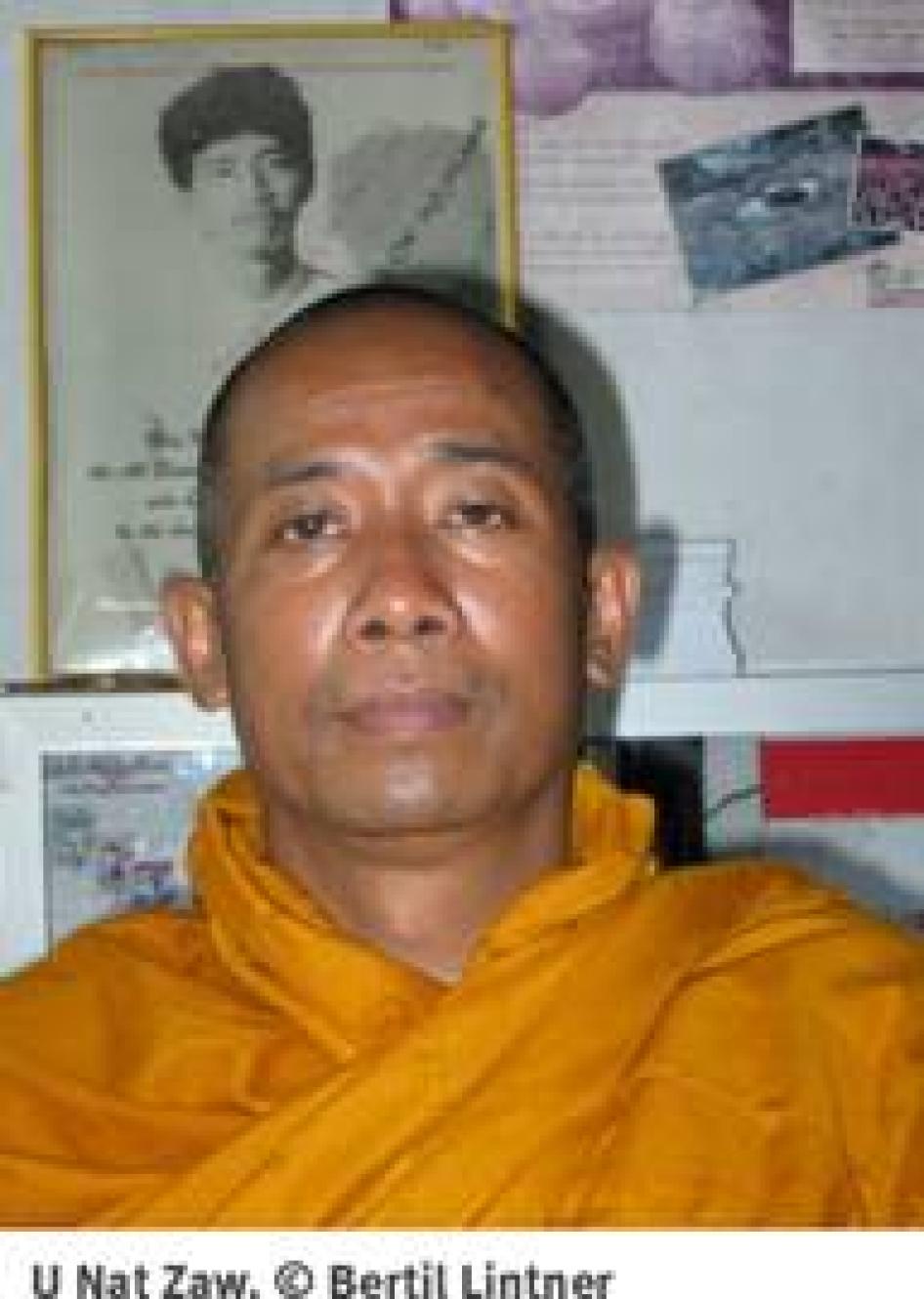
I managed to get away and the movement has been suppressed. But if the regime doesn’t change its ways and continue to oppress the people, monks, and students, it will face more demonstrations in the future.[119]
“U Rakhine Tun” (not his real name), age 39, has been a monk for 17 years, who traveled to Rangoon from Arakan state to join the demonstrations on September 22, 2007. He marched with monks from other monasteries, and was badly injured at the brutal incident at the East Gate of the Shwedagon Pagoda on September 26:
When the shooting started I began running, the whole crowd began running. I was shot in the foot as I was running. I fell down, and then felt pain in my head, I don’t know if I was hit by a truncheon or someone threw a stone at my head. I wasn’t aware what happened after that, I was dizzy and just walked away. I wasn’t arrested, I just walked back to my monastery. Three of my toes were shot off. One of the laypersons at my monastery cleaned and wrapped it (my foot) for me. Because of my wound I decided not to stay in the monastery because we feared it would be raided. There were monks sleeping in the trees, to hide in case the soldiers came. I spent the night in a cemetery, hiding. In the morning I went to the bus station to go back to Arakan state. I was in so much pain. The bus took 20 hours (to reach my monastery), I couldn’t sleep, it (the bus) was bouncing the whole way. I was bleeding everywhere, but people were too afraid to help me, even though they knew I was a monk. I had a stick, ready to attack anyone who came close to me. I was ready to fight back.[120]
After more than a year of laying low in his monastery to avoid the authorities, and failing to seek proper medical attention for his foot wound, “U Rakhine Tun” had his leg amputated in 2009, where Human Rights Watch interviewed him soon after.
Some monks escaped to India, West of Burma. Ashin Pannasiri, a 28-year-old-monk who, like U Gawsita and U Nat Zaw, played a leading role in the 2007 movement, became a novice at the age of 18, stayed in a monastery in Mandalay, and became active in the ABMA in mid-2007. A meeting was held in his monastery, where activists from a group of young monks in Mandalay were also present. He traveled to Rangoon to liaise with other monks and to discuss the direction of the movement that was emerging at that time.
Back in Mandalay, he and his fellow activists soon attracted the attention of the security services, and they were watched wherever they went:
We moved from monastery to monastery and were not caught. But when the army began to crack down more severely on the monks’ movement, I had to go into hiding. Agents had come several times to my monastery asking for me. The other monks told me to run. I went to Sagaing town, but it was not easy to hide there. Sometimes I had to sleep in the forest. Then I went to Monywa, a small town to the north, where I went to an internet cafe to check the net and e-mail. I learnt more about what was happening in the country at the time. But there, in the internet cafe, I was arrested on October 18 last year [2007].[121]
Ashin Pannasiri was taken to a police station in Monywa, where he was disrobed, beaten, and interrogated:
I was also slapped and punched in the face. My interrogators stepped on my toes with their army boots. They demanded to know what organizations I was in touch with and who I had contacted.[122]
Ashin Pannasiri’s experience illustrates the Burmese security services’ routine use of torture and intimidation in custody. He told Human Rights Watch:
The worst persons during torture were MAS [Military Affairs Security] officials Ko Ko Aung and U San Win. They kicked my chest with their combat boots and stomped on my face with my hands handcuffed behind me. Every question was accompanied by kicks and punches to my head and body. I was almost unconscious. I fell on the table in front of me when they kicked me from the back. At last I could not endure anymore such torture. They twisted my arms and tried to break them, which affected the nervous system in my hand. They pressed between my rib bones. They slapped me on my temple and pulled my earlobes violently. They stepped on my shins which left me with severe pain until I was sentenced to prison term. I could not walk well. They interrogated me by all means available to them. My little toes were swollen.
In a twisted display of respect for his ordinarily privileged status in Burmese society, the interrogators tried to reason with him not to react to his mistreatment:
When I could not endure any more torture, I head-butted the table in front of me, trying to knock myself unconscious. Police officer U Aung Win, sitting beside me, held me and said: “Please don't do like that, my reverend. We are acting under the command of higher authority.”[123]
Ashin Pannasiri spent three months in Monywa prison. On January 18, 2008, he was sentenced to three years of imprisonment on the basis of various accusations, including that of illegally possessing foreign currency. In May 2008, he was transferred to another prison in Kalaymyo in Sagaing Division. Two weeks later, he was sent to a labor camp at Lantalang, 30 kilometers west of Tiddim in Chin State:
There, I was chained on both legs and, like the other prisoners, had to break stones and dig ditches. I and about 140 other prisoners worked seven days a week, from dawn to dusk, without any break. We had to ask permission for everything, including going to the toilet. Sometimes we were allowed to go to the toilet, sometimes not.[124]
On September 15, 2008, two Special Branch officers came to the camp and Ashin Pannasiri was interrogated again:
It seems that they had got some information about me from monks and other activists who had been arrested and interrogated. I was beaten again; they punched me in my chest and head. I was interrogated from nine in the morning to six in the evening, and I was not allowed to eat or drink anything. I realized that I would be killed if they took me to another place, which I think they intended to do. So I made up my mind. I had to escape. There was no choice if I wanted to survive.[125]
At about 1 a.m. on September 16, Ashin Pannasiri took advantage of the fact that the guards were sleeping and climbed the two rows of barbed wire that surrounded the camp and fled:
I was covered in blood from the spikes. But I didn’t care. I cared only about my life. I ran alone through the night. I came to a road which I understood would lead to India. But I didn’t dare to walk on the road. There would be police stations and soldiers along it as it was close to the border. I walked through deep forest, my hands and face were cut from thorns. I drank water from the streams and ate a kind of gooseberry, which in Burmese is called pyuchuwee. That was the only food I had.[126]
Ashin Pannasiri spent two days and two nights walking through the forests and over the mountains of Chin State before reaching the Indian border. He crossed into safety in the Indian state of Mizoram on September 18, and later made it to New Delhi, where he was able to put on robes and become a monk again. He says that he intends to continue “the struggle for freedom and peace in Burma.”[127]
“U Manita” is in his forties and has been a monk throughout his adult life. He was educated at prestigious monastic institutions. He was also one of the organizers of the protests:
For me and my monastery, the protest began on September 16. It began with the problems in Pakokku. We discussed the situation, whether we should refuse to accept offerings from the military government. On September 18, we and monks from many other monasteries in Rangoon started to march in the streets. We wanted the government to apologize for what happened in Pakokku. And we wanted the junta to have a better policy considering the hardships people had to face. We wanted them to have a dialogue with the people.
We marched every day in Rangoon. Especially on the 22nd, the 23rd, and the 24th there were big demonstrations near the Shwedagon and the Sule Pagodas. Many ordinary people also began to march with us—around us as shields. They gave us water, food, support, and protection. But it was we who led the marches. We were so many that the police couldn’t stop us. At least not in the beginning. They were perhaps not prepared to deal with that many people marching? But they, the military intelligence, rode around on their motorbikes, observing us. Other spies filmed us and took photographs. And the junta waited before they decided to strike against us.[128]
The crackdown began in earnest on September 26. “U Manita” was among the monks who dared to go out in the streets that day:
I joined the demonstrations with a group of monks from my monastery a bit later than the other monks, who were already out in the streets. There were soldiers and police everywhere blocking our way. In front of the Shwedagon, they began beating, arresting, tying, and shooting monks and demonstrators. Several people I knew were killed that day. I didn’t see it with my own eyes, but I knew it happened. Other monks were arrested and tortured. Some of them were later released.[129]
“U Gotipala” (not his real name), age 35, is a chief monk at a teaching monastery in Mandalay with more than 1,300 pupils, novices studying Pali and the Buddhist scriptures:
All my pupils marched during the protests last September. To be honest, it was a political rather than a religious gesture to protest in that way. But it was right to do it! We wanted the government to apologize for their treatment of the monks in Pakokku. We wanted to mediate between the government and the people, so the government would accept a more democratic policy.
As a chief monk, I could not take part in the marches myself. I have my responsibilities, but without directly encouraging my pupils to take part in the protest movement, I let them know that they could march if they wanted to. And they wanted to march! Our most senior monk was against it, but they didn’t listen to him. I think he supported us anyway, but couldn’t say that openly. He had great responsibilities, especially for the young monks.[130]
U Gotipala did not communicate with monks in other monasteries in Mandalay, but he knew from listening to the radio that monks all over the country were marching against the government. And his monastery was surrounded by troops when the crackdown began. Afterwards, many monks and novices returned to their home villages:
In the end, there were only about 200 of us left in our monastery. Some began to come back after five-six months or so. But we are still fewer than we were before September last year. I know that many leading monks, who organized the protests, have fled to other countries. They would be apprehended if they returned. The State Sangha Maha Nayaka Committee has no will of its own. They only obey the government. We don’t care about them anymore. They have no power over the monks in Burma.[131]
Some of the older monks were reluctant to take part in the marches. “U Pannananda” (not his real name), a 62-year-old monk in a monastery on the outskirts of Rangoon, belongs to a committee that is one step below the State Sangha Maha Nayaka Committee:
There were different opinions in our committee. Some wanted to cooperate with the junta, while others were opposed to that. But most of the monks in the committee obeyed orders from above. Because I was a committee member I could not actively support the protesting monks. But I understood them. And I was very sad to learn about the crackdown, that monks had been killed. That is a crime.[132]
“U Kusalasami” (not his real name), a 68-year-old monk in Rangoon whose abbot was abroad when the protests began, also did not take part directly in the protests:
Our abbot decided that no monks from our monastery should participate in the marches. Many younger novices were upset, they wanted to march, but they obeyed the abbot’s orders. He supported the protests but was worried that the monks and the novices could get hurt or even be killed. So we lent passive support to the protests. Some argue that monks should concern themselves only with religion and not get involved in politics. That’s correct, in a way. At the same time, it’s the duty of the monks to help the people whenever they can. There’s no contradiction here. To go out in the streets and recite the Metta Sutta, or to boycott the regime, is not politics. Politics is to overthrow the government, and that was not what we were trying to do. We can only meditate, pray and make appeals. That’s the way of religion. We boycott the regime and don’t accept offerings from them. But we can’t do more than that.
We were distraught when the soldiers opened fire on the monks and beat them. But what could we do? We had no guns. As monks we cannot fight. We follow the path of the Buddha. But we’ll never forget what the junta did to the monks and the people. This regime has been in power since 1962. Since that time, many have demonstrated and protested against the regime, but nothing has changed. September 2007 was just one of many such protests. But it’s not over yet.[133]
When “U Manita” came back to his monastery, he found it surrounded by police and soldiers. But they let him in. A warrant officer asked the monks to have their daily meal early, not at 11 a.m. as usual. Then the arrests began:
A lot of trucks were parked outside the monastery. I and other monks were forced onto those trucks. There were no benches, nothing to sit on. We were so many monks that there was hardly any place for all of us. We were forced to sit down with our hands on our heads. I saw several monks being beaten with batons and iron rods. They were beaten both by soldiers and some kind of militia. A friend of mine was very badly beaten. They aimed their pistols and rifles at us, shouting: “Don’t move!” We didn’t move. But we began to recite the Metta Sutta, about loving kindness. Then they shouted: “You’re not allowed to chant or talk!”[134]
Soon after, the trucks arrived at a technical college in a northern suburb. “U Manita” told Human Rights Watch what he observed:
There were hundreds of people, and not only monks. I saw women and children, some as young as 12. There were also monks in their seventies and eighties. All the rooms were packed with people. I was placed in a room with a hundred other monks. The guards were not wearing uniforms. They had civilian clothes and came from one of the junta’s special forces and organizations, but I’m not sure which one. We were interrogated one by one by security personnel. They asked us: “Who are your leaders?” “Who were the monks from your monastery who demonstrated?” “What are your plans?” We had to stay there for 12 days and were given very little food and water. When we had to go to the toilet, we were escorted by guards with pistols and batons. After 12 days, they told me and some others that we could return to our monastery. We were forced onto trucks again.[135]
But it was all a bluff, as “U Manita” soon discovered:
Instead of driving us back to our monastery, we were taken to Insein Jail [in Rangoon division]. There, we were forced to take off our robes. We were forced to strip naked and leave all our belongings outside the prison. Then we were given prison uniforms. There were many monks in the cells. The cells were so crowded it was impossible to lie down and sleep. We had to sleep in a sitting position, which was difficult. We were given food and water only once a day in the morning. A bit of rice, egg, and cabbage. But we got toothbrushes and blankets. All the monks who had been arrested were photographed by the security services. And then we were interrogated again. And again. After three days we were sent back. There was not enough space for all the prisoners! One prison guard said to me: “Politics is for the military, religion for the monks. I don’t want to see your face in the streets again.”[136]
“U Sovanna” (not his real name), age 37, has been a monk for 17 years. He says that the fuel price hike and the events in Pakokku were only pretexts for the protests:
The actual reason was that we don’t want this military government. We don’t want systematic repression and corruption. We don’t want the government to arrest or kill our senior monks! The people don’t want this government either. I want it to be a revolution here in Burma, but a peaceful revolution.[137]
U Sovanna participated in the demonstrations in Mandalay:
We demonstrated for a couple of days and nothing happened. We marched in rows of five. Our abbot told us not to demonstrate and that it was forbidden to leave the monastery. Actually, he supported the protests but he was worried that the young monks would be hurt or even killed. I and many others did not obey him.
We went out and asked a police chief if we could demonstrate here or there. He said we could demonstrate neither here nor there. But we went to another place and demonstrated, a place where he had not explicitly forbidden us to demonstrate. Then, some soldiers appeared and said: “We’ve got our orders. If you move your foot we’ll shoot you in the foot. If you move your head, we’ll shoot you in the head.” So we went back to the monastery. What else could we do? It was too dangerous. And then it became impossible to demonstrate because soldiers and police surrounded several monasteries, including ours. We saw helicopters in the sky above us. Our monastery was raided in 1990 as well, because we supported the democratic cause.[138]
For six days, U Sovanna and the other monks could not leave their monastery. They stayed indoors listening to the BBC, and were afraid:
We didn’t sleep. We didn’t study. We were just worried that the soldiers would come inside the monastery. But they didn’t do that. When the military allowed us to leave the monastery, I went to my home village and stayed there for several months. I had to lie low. Then I came back.[139]
VII. The September 2007 Crackdown
Since the crackdown, many have wondered, “What happened to the monks?” Several hundred monks, possibly more than 1,000, were arrested, and 237 remain in prison as of August 2009.[140] Some fled overseas, but more went back to life as laypeople. Many monasteries in Rangoon and elsewhere now have less than half as many monks as they had in September 2007. Ahead of the second anniversary of the crackdown, many monasteries inside Burma have been the subject of increased surveillance, visits by security personnel to check on monks suspected of activism, and curbs on movements and even public sermons by monks.[141] The government’s fears of resumed protests led by the monks remains well founded.
Beginning in late 2008, Burmese courts summarily tried and sentenced hundreds of political activists to lengthy prison terms. Some were sentenced to as much as 65 years.[142] Many were Buddhist monks and nuns. Some had been arrested during protests on the streets, while others were rounded up during brutal nighttime raids on monasteries and religious schools in Rangoon in September and October.
During the late 2008 sentencing wave of more than 250 political activists, 46 monks and four nuns were sentenced to prison, many with hard labor. Five monks from the Ngwe Kyar Yan monastery, which suffered a bloody and brutal raid on the night of September 26, were sentenced to six-and-a-half years in prison. The nuns imprisoned include 84-year-old Daw Ponnami (who was eventually released in February 2009), 70-year-old Daw Htay Yi, and 64-year-old Daw Pyinyar Theingyi, each from Rangoon’s Thitsa Tharaphu School and each sentenced to four years of hard labor. Also sentenced at the same trial were senior abbots of the Artharwaddy Monastic School, such as 65-year old U Yevada. His school was brutally raided on the night of September 26 as security forces were searching for activist monks. All seven monks and nuns were charged under sections 295 and 295(a) of the Penal Code, which prohibit insulting a group’s religion by harming or defiling a place of worship, or committing deliberate and malicious acts to outrage religious feelings by insulting a group’s religion or religious beliefs.
In some specific cases, U Kaylartha, a monk from Mandalay, received 35 years’ imprisonment; U Sandar Wara was sentenced to eight-and-a-half years; and Abbot U San Dimar of Kyar Monastary in Rangoon’s Pazundaung township received eight years and is facing additional charges that could add to his sentence. A young monk, U Thaddama from Garna Puli monastery, was sentenced to 19 years of imprisonment.
Perhaps the most emblematic of the monks was 28-year-old U Gambira (a pseudonym for U Sandawbartha). He was one of the most visible and outspoken young monks leading the demonstrations, a key organizer, switching his time between Rangoon and Mandalay to avoid the authorities. He went underground following the crackdown but was hunted down and arrested in Burma’s northwestern Sagaing Division on November 4, 2007. His father was arrested on the day U Gambira was caught and held for one month in Mandalay prison. On the day of his arrest, the Washington Post published an article by U Gambira in which he said:
The regime’s use of mass arrests, murder, torture, and imprisonment has failed to extinguish our desire for the freedom that was stolen from us. We have taken their best punch. Now it is the generals who must fear the consequences of their actions. We adhere to nonviolence, but our spine is made of steel. There is no turning back. It matters little if my life or the lives of colleagues should be sacrificed on this journey. Others will fill our sandals, and more will join and follow.[143]
Following his arrest, U Gambira was badly tortured and stripped of his monk’s robes. As a result of his torture, he is reported to be in poor health. On March 14, 2008, U Gambira, who refused to accept that he had been disrobed, was placed in solitary confinement, apparently as a punishment for his role in instigating the chanting of Buddhist suttas while inside Insein prison.[144]
On October 1, 2008, U Gambira’s lawyer, Aung Thein, resigned from the case, saying that the military government had not allowed him to prepare a proper defense. U Gambira went on trial that day, charged with nine separate criminal offenses.[145] He was sentenced in November to 68 years in prison and soon transferred to a labor camp in Burma’s western Sagaing Division. His sentence was reduced by five years in early 2009, to a total of 63 years.
U Gambira’s mother, Daw Yay, visited her son in the remote prison in early 2009, soon after he began a hunger strike. She said he was resolute in his commitment to change in Burma, telling her:

If one wants [to follow] the way of the Buddha, one must practice Buddhism. If one wants independence, one must practice the way towards independence.[146]
Daw Yay also spoke of the impact of the arrests on her and her family. She told Radio Free Asia:
My life, and my family’s life, is just clockwork now. We eat and sleep like robots. There is no life in our bodies. The ordeal we are going through—it’s a punishment for our entire family.
The Thailand-based Assistance Association for Political Prisoners (Burma) (AAPPB) reported that at least seven monks who had been detained after the crackdown were in poor health, including U Gambira.[147]
Conditions for monks who were not arrested but who remained inside Burma after the crackdown became extremely difficult. “U Vicitta” (not his real name), a middle-aged monk at a monastery in Rangoon, told Human Rights Watch what happened to him:
I come from Moulmein but I have been a monk in Rangoon for a long time. I participated in the protests in September [2007]. Right now my monastery is being watched all the time, by people in and out of uniform. There are no bogus monks in the monastery, but there could be some infiltrators. Before September 2007, there were 500 monks in my monastery. Today only 200 remain. Everyone in our monastery supported the demonstrations against the junta.[148]
According to U Vicitta, among the other monasteries in Rangoon that have been under especially strict surveillance after the crackdown are Shwe Na Pan in Thinganyunt township in Rangoon, the Kyaiuk Ka San Veda and Brahma Vihaya monasteries in Rangoon, Ngwe Kyar Yan in South Okkalapa, Moe Kyang monastery in Moe Kyang township, and the Ma Soe Yin monastery in Mandalay.
U Viccita said that the monks who were not arrested “went underground to evade arrest.” He continued:
For us, it was not politics, but a question of religion. We just went out into the streets to recite metta sutta, loving kindness. We did not advocate violence to overthrow the government, but we wanted an apology for what happened in Pakokku. We wanted the government to have a better policy for the people. So we decided to boycott the junta with our bowls turned upside-down. That’s called patta nikkujjana kamma. We did not accept food, medicines or anything from the authorities. That’s the only way we can fight for our rights. This has nothing to do with politics. The same thing happened during the time of the Buddha when there was a bad king, an evil king, who hurt the monks and the people. At that time, the monks also protested. But then the king had to apologize, and it was all over. But this junta refused to apologize. That was why we continued our protests. And they are continuing—we are still opposed to the junta, but we can’t fight against men with guns. We’re biding our time. But we are not afraid to protest again.[149]
After the crackdown, many monks and novices returned to their villages, some voluntarily, some forced to do so. But U Manita, whose experiences during the protests were described above, decided to return to his monastery in Rangoon:
I’m being watched all the time. I am considered an organizer. Between noon and 2 p.m. I am allowed to go out of the monastery. But then I’m followed. I had to shake off my tail to come to this meeting today. I’m not afraid, not for myself. I’m not afraid to tell foreign journalists what happened. And I’m prepared to march again when the opportunity arises. We don’t want this junta. And that’s what everyone at my monastery thinks as well. We don’t have any organization any more. We have no way of keeping in touch with each other. Before, both monks and laymen could communicate with each other. Now everything is crushed. We have no contact. Many have disappeared, or they have been arrested, or moved to other monasteries outside Rangoon. We can just wait and see. We are still not accepting offerings from the military. We’re waiting to go out and protest again.[150]
He says that plainclothes agents can be seen outside the monastery. According to U Manita:
They’re easily recognizable because they have walkie-talkies tucked in their longyis (Burmese sarongs). There are also policemen. But no soldiers inside the temple gates.[151]
U Manita was upset because the junta in its propaganda claimed that the monks who marched were “bogus monks.” “I know it was not like that,” he said. “The monks who marched were real monks.”[152]
Ma Soe Yin monastery in Mandalay was a center of the demonstrations in 1990, and again in 2007. According to “U Sunanda” (not his real name), a senior monk in his sixties at Ma Soe Yin:
All the monks here supported the protests in September [2007]. We gave our tacit approval to the novices to go out and join the marches. But we did not outright encourage them to do so. That we could not do as senior monks. After a few days, the soldiers shot in the air, and also fired off smoke bombs. Two or three monks were arrested, then released.
Outside these temple walls, there is dictatorship. But inside the Ma Soe Yin monastery, there is democracy. We say whatever we want. We’re not afraid. Here are 30 senior monks and 600 monk students and novices. It is a Pali university, and we were also active in the 1988-90 democracy movement. We’re inspired by Mahatma Gandhi and his struggle against British colonialism. We’re also well aware of our own traditions, the role of Buddhist monks in Burma’s political and social history.
We had contacts with other sympathetic monasteries and we communicated in code. We’ve got mobile phones, but we don’t know how to use the internet. We sent messages mainly by personal couriers, and then verbal messages. Nothing in writing. It was safer that way. But now we’re keeping a low profile and we don’t communicate with other monasteries because we are under surveillance. There are secret organizations made up of monks who are opposed to the government. But it’s better for us not to know how they work and who are active in those organizations. That way we can’t say anything if we are arrested, tortured and interrogated.[153]
He is also aware of the strengths as well as weaknesses of the 2007 movement:
There was no national plan for the protests last September. We believe the protests broke out spontaneously all over the country. Monks also heard about the protests on the BBC, VOA, and DVB. The problem last September was that not enough laymen marched together with us. It was not like 1988, when the whole country rose up, which at least led to free elections. The 2007 uprising was too small so it could be crushed very quickly. But even so we believe the regime will fall in a couple of years. Because something was achieved last September. A whole new generation of monks has been politicized. We’re educating them. We’re still boycotting the military. We are not accepting gifts and offerings from them. One of the reasons why the regime will fall is globalization. No country can be isolated like before. Look at Indonesia, that regime fell. Now it’s a democracy. We want the UN’s Security Council to take up the Burma issue, that the UN investigates what really happened last September. But China and Russia can use their veto. Please tell the world what’s happening in our country![154]
“U Igara” (not his real name) is 27-years-old and comes from Sagaing Division. His parents were farmers but he was an outstanding pupil when he was a child. One of his brothers is a professional in Singapore, another in South Africa. U Igara chose to become a monk after finishing high school:
I’m a senior monk, but the youngest of the senior monks [in my monastery]. I’m responsible for students who’re studying Pali. I also speak some English and Hindi. I did not take part in the marches [last September] but many of my students did.[155]
“U Kosalla” (not his real name) is a senior monk in Mandalay. He was closely allied with U Gambira, one of the most prominent leaders of the 2007 demonstrations:
I have been a monk for more than 20 years, a senior monk for five years. I’ve studied Pali extensively but I’m also known for my political activism. My students, the junta, everyone knows that I am opposed to the regime. Emotions were quite inflamed after the price hikes and the events in Pakokku last year. Some wanted to use violence, but I said: “Go out and demonstrate. But don’t be violent. Be careful.”
During the protests last September, virtually all the Pali students here in Mandalay joined the marches. But I stayed in the background, organizing things. I communicated with other monks in Mandalay sometimes by mobile phone, but more often by personal messengers. If we used phones, we also used codes. We knew that our phones were monitored. Most senior monks have mobile phones. So we were able to coordinate the marches. But everything was quieter here in Mandalay than in Rangoon. Some laymen also joined in here in Mandalay, but not as many as in Rangoon. Perhaps that was the reason why they [the military] didn’t crack down as hard here as in Rangoon? They fired smoke bombs, shot in the air, and ordered the monks and novices to return to their monasteries. But they didn’t fire into the crowds. A couple of monks were arrested and interrogated, but they were released after a day or so.[156]
Our monastery joined the boycott against the military and we refused to accept offerings from them. According to our scriptures, if someone does something really bad to Buddhism, the monks and the people have the right to boycott him or them.
However, some monasteries in Mandalay were surrounded by the military and other security forces:
That led to an end to the protests. And when people here heard what had happened in Rangoon, many parents came to collect their children and took them back to their villages. Perhaps as many as 70 or 80 percent of the monks and novices in Mandalay went home.
They wanted to arrest me, but I went underground and spent nine months in a monastery in the countryside. Meanwhile, military intelligence agents went to my home village and asked where I was. They interrogated my family. I was able to keep out of sight, but many others were apprehended in their home villages and taken into custody. There, they were interrogated. Some were beaten. But they were released after a few days.[157]
U Kosalla returned to Mandalay, but the authorities were watching him and his movements:
Our monastery is also under surveillance. There are military intelligence agents outside, and they watch everyone who goes in and out of the gates. A man from the security services comes every morning and evening to check who of the monks are here, then he leaves. It’s a routine control, but I’m also convinced that some monks report what’s going on here to the authorities.[158]
“U Agga Swe” (not his real name), a young monk who has since fled to Sri Lanka, also experienced intense surveillance on the Sangha after the crackdown. It was one of the reasons he fled:
Many monks stay inside their monasteries, where they feel safe. Laymen have warned them that, “if you go outside, you’ll be arrested.” They go out only on pindapata [alms seeking], not otherwise. Monks venturing out alone, especially in afternoons and evenings, are checked and harassed by the MI [Military Intelligence, OMAS]. We don’t know how many have been arrested, and the monks inside Burma are afraid to use mobile phones and e-mail because MI are monitoring all communication in and out of Burma. Monks inside Burma don’t dare to go to Internet cafes because MI is watching those as well. MI agents follow those who go into Internet cafés and then check what they do there, who they contact and what websites they access.[159]
“U Pannacara” (not his real name) told Human Rights Watch about the SPDC authorities’ use of draconian household registration practices to monitor the movements of monks. According to him, monks are subject to surprise raids by authorities to make sure all the registered monks at a certain monastery are there. No visitors are allowed without prior permission by local authorities. He said:
Our school is being watched, and major monasteries are also under strict surveillance. Agents come at midnight to check if the monks who are registered at a particular monastery are there. They even break up boxes and chests belonging to the monks to look for anti-government literature, or phone numbers to foreign countries.[160]
U Kosalla refers to an underground organization of monks called Sangha Sameggi, or the Sangha Association, which is also the name of an old Buddhist organization in Burma,
It was founded in Rangoon four or five years ago. It is very secretive, underground. I’m not a member, but the junta may think I am. But their [Sangha Sameggi] aim and ours is the same: justice. We want all political prisoners to be released, including Aung San Suu Kyi and the monks who were arrested after last September. We also want official negotiations, a dialogue, between the NLD, dissident monks, and the military government. We don’t want to have a conflict with the military government, which we could never win. We are only monks and they’ve got guns. We want peace. But the long-term goal is, of course, democracy and an end to the junta’s power. I know that some monks say that we should not get involved in politics, and this is politics, not a religious matter. But I disagree with them. The monks must take the lead. We must be good examples, examples the people can follow. But we should not use violence.
There are many politically active monks here. We’re just waiting for the next opportunity to protest again. But next time we must get the public at large more involved. Only then, if more people join us, will this regime be forced to give in. I know that there are people even within the police and the military who don’t like the regime. The junta must be forced to negotiate with us. And I want the outside world to put pressure on China because the Chinese support the junta in our country.[161]
Like many other dissident monks, U Kosalla does not have much good to say about the State Sangha Maha Nayaka Committee during the demonstrations and in the aftermath:
I and the monks here don’t like the State Sangha Maha Nayaka Committee. When monks were killed in 2007, they kept silent. They should have issued a statement saying that it’s unacceptable to kill or hurt monks. But they did nothing. When they at last said something on the radio and TV, they said we should not oppose the junta. Their statement was sent to all senior monks in Mandalay. They [the members of the State Maha Sangha Nayaka Committee] are just puppets of the regime. Even if they know something about old scriptures they haven’t got a clue how people live. They know nothing about the country in which they live. Here in our monastery we say that we respect them. But we don’t. We respect only the Buddha. Not a committee made up of puppets of the military.
My young students don’t know much about 1988 and what happened at that time, or the history of resistance against the government. But, besides teaching them Pali, I tell then what the junta is doing, and how to resist repression. But I tell only students I consider receptive to such ideas.[162]
U Sovanna’s thoughts about the State Sangha Maha Nayaka Committee are similar to those of other monks: “I don’t like them at all. They should have said: ‘Stop shooting and beating monks!’ But they didn’t say anything like that. They obey the regime. Personally, I would like to overthrow that committee. No monks have any confidence in them anymore.”[163]
BOX: Chronology of Events, August-September 2007August 15: The government increases prices for petrol by 100 percent and for CNG (Compressed Natural Gas) by 500 percent. August 19: A group of people led by the “88 Generation Students Group” (veterans of the 1988 uprising) stage a peaceful march in Rangoon. Housewives join the protests. August 21: Thirteen leaders of the “88 Generation Students Group” are arrested, among them Min Ko Naing, Ko Ko Gyi and Phone Cho, who had played prominent roles in the 1988 uprising and subsequently spent years in jail. August 22: Small demonstrations are held in various parts of Rangoon. Members of the pro-government USDA, backed by police, break up the demonstrations. Over 100 people are arrested, mainly from the “88 Generation Students Group” and NLD Youth. August 25: Htin Kyaw, a prominent NLD activist, is arrested after a protest in Rangoon’s Theingyi market. August 28: 200 monks march through Sittwe in Arakan (Rakhine) State in protest against the poor economic state of the nation. The government warns the monks not to join the protests. September 3: About 1,000 people demonstrate in Labutta, Irrawaddy Division. September 4: About 1,000 people demonstrate in Taunggok, Arakan (Rakhine) State, demanding the release of two activists arrested on August 31 for protesting against the rise in fuel prices. September 5: Several hundred monks stage a demonstration in Pakokku. Security forces confront the monks and, according to some sources, fire warning shots in the air. Other sources claim laymen as well as monks were severely beaten by the security forces and that one monk was killed. At last three monks are reportedly arrested. September 6: A group of 20 government officials are detained by the monks in a monastery in Pakokku to secure the release of the monks who were arrested in September 5. One car is burnt and a government building attacked by monks. September 9: A group called the All-Burma Monks Alliance (ABMA) distributes a leaflet stating that the peaceful demonstration against the rise in fuel prices was brutally suppressed. The group issues an ultimatum, demanding an apology for the treatment of the monks in Pakokku, by September 17. The group also demands a reduction of the prices of various commodities, the release of all political prisoners, and that the government should enter into a dialog with the pro-democracy movement. September 11: A meeting takes place in Pakokku between the Minister for Religious Affairs, Brigadier-General Thura Myint Maung, and local abbots. The minister offers money as compensation to those monks who were beaten and disrobed after the September 5 demonstration. September 14: The ABMA announces that they will refuse alms from SPDC officials beginning September 17 (the ultimatum deadline). September 17: The ultimatum deadline passes with no apology; monks all over Burma prepare to march against the government. September 18: Three hundred mostly young monks march in Rangoon, from the Shwedagon to the Botataung Pagoda, on the 19th anniversary of the September 18, 1988 coup. The monks say they will begin boycotting alms from army personnel and their associates. September 19: Tens of thousands of monks march in Rangoon, Prome, Pegu, Mandalay, and Kalaymyo (in Sagaing Division). Laypeople offer them drinking water and cheer them on. Thousands of laypeople in Rangoon form a protective circle around the monks. September 20: More monks march in Rangoon and in Monywa, Mandalay Division. Monks from Pegu try to reach the capital, but are stopped on the way by security forces. September 21: Heavy rain falls in Rangoon, but the monks continue their marches. The ABMA issues a statement condemning the “evil military dictatorship” and proclaims that it will “banish the common enemy evil regime from Burmese soil forever.” September 22: The monks’ movement spreads to Myitkyina and Bhamo in Kachin State (many Buddhist Shan and Burmese live in the towns of this predominantly Christian state). A group of hundreds of monks in Rangoon walk up to Daw Aung San Suu Kyi’s house on University Avenue in Rangoon. She comes to the gate to greet them as they chant the Metta Sutta, and talks briefly to one of the monks.
September 23: The police block the street leading to Suu Kyi’s house. Buddhist nuns join the marches in Rangoon. Students and artists also join the monks. September 24: Tens of thousands of monks, nuns, and laymen march in Rangoon. Similar marches are also held in Mandalay, Pegu, Sagaing, Magwe, and Kawthaung (in Tenasserim Division). Well-known actors and other civilians start offering food to the monks as they start the marches. September 25: Monks march in towns all over Burma. In Sittwe, Arakan State, 100,000 people take part in the protests. Truckloads of troops begin to arrive in Rangoon. A 9 p.m. to 5 a.m. curfew is imposed in Rangoon. Gatherings of more than five people are banned. Ngwe Kyar Yan monastery in South Okkalapa, and Meggin monastery, Thingangyun, are raided. About 80 monks are arrested and the monastery looted. September 26: The marches continue, more troops arrive in Rangoon. The crackdown begins. Police and soldiers open fire on the demonstrators. Troops surround several monasteries in Rangoon to prevent the monks from marching. Several monasteries are raided during the night. NLD spokespersons U Myint Thein and U Hla Pa are arrested. September 27: Soldiers and police charge demonstrators, who are mainly civilians. Few monks are seen in downtown Rangoon. Shots and smoke bombs are fired, scores of demonstrators are arrested. The Association of Southeast Asian Nations, ASEAN, issues a surprisingly blunt statement through Singapore (as ASEAN chair), expressing its “revulsion” at reports that peaceful demonstrations in Rangoon were being violently crushed by the security forces. Kenji Nagai, a Japanese photographer, is shot and killed by a Burmese soldier. The government holds a press conference in the new capital Naypyidaw blaming “internal and external destructive elements” for the “disturbances.” September 28: Demonstrators gather in front of the Traders Hotel, where several international agencies have their offices. The violent crackdown continues, with heavy military presence all over Rangoon. Ngwe Kyar Yan monastery is occupied by the army. Almost 3,000 people are arrested, of whom 1,000 are reported to be Buddhist monks and novices. An eerie calm returns to Rangoon. In Mandalay, troops from the 33rd Light Infantry Division reportedly refuse to shoot protesting monks. Marches continue there and in Kyaukpadaung (near the ancient temple city of Pagan). September 29: Internet is cut off, mobile phone access to and from Burma is severely restricted. Last small demonstrations peter out, arrests and raids continue throughout Rangoon. |
VIII. Cyclone Nargis and Its Aftermath
On May 2, 2008, Burma was struck by its worst natural disaster in modern history. On that day, Cyclone Nargis tore into Burma’s Irrawaddy delta, the country’s rice bowl and the home of millions of people, mostly small-scale farmers.[164] Nearly 150,000 people died or remain missing. According to a joint assessment by the Association of Southeast Asian Nations (ASEAN), the UN, and the Burmese government, some 2.4 million people were severely affected by the cyclone, out of an estimated 7.35 million living in the affected townships.[165]
More than 40 percent of those affected were children—in a region where young people already suffered from malnutrition. Drinking water was in short supply as most sources had been contaminated by decomposing corpses. Entire villages were wiped out with hardly a building standing—except for the Buddhist temples and monasteries, usually built from stronger material than ordinary, wooden houses. Crops were destroyed by salt water seeping into the fields, which many at the time feared could have a devastating long-term impact on the country’s food supply.
While deaths mounted, Burma’s ruling generals were slow to react and flatly refused to accept foreign aid. In the beginning, almost all aid efforts came from Buddhist groups and organizations; Buddhist monks were the first to clear roads that had been blocked by fallen trees, to take care of the victims and offer the homeless shelter in monasteries.[166] In Rangoon, a group of artists and entertainers—led by the famous comedian and social activist Maung Thura, who is better known under his stage name, Zargana—collected money, food, and supplies, and headed down to the delta in convoys of trucks that had been made available by private businessmen. More than 400 volunteers took care of the distribution of supplies to the cyclone victims. One of them was Ma Thida, a woman in her early forties:
We met at a Buddhist monastery in Rangoon every Saturday to organize the relief effort. Some volunteers had been sent down to the delta to look into the needs of the people and Zargana told us what to buy. It could be food, medicines, tents and building supplies. We made three trips down to the delta, on May 17, May 24, and June 2. On May 25, our five trucks were stopped by government soldiers and taken away. But we managed to get quite a lot through, and in the villages, the Buddhist monks helped us distribute the supplies fairly and equally. The homeless were staying in temples and monasteries. The government was nowhere to be seen.[167]
Buddhist communities all over the world supported Zargana’s effort, and the IBMO was especially active in North America and Europe. Its Spiritual Director, U Pannya Vamsa, said in a statement issued in July 2008:
The role of the monasteries and monastics in Burma has always been essential. Besides spiritual support and teachings, they have run schools, orphanages, provided health care, and many other vital services over the years. Now they are leading the relief efforts for victims of Cyclone Nargis...IBMO has many brother-monks and nuns working both inside and outside of Burma, and particularly young energetic monks based in more than 20 countries in [the] spirit of Dharma. They are working to defend the freedom of faith, and bring peace and justice to Burma, which has been denied more than half a century.[168]
One of the first volunteers to make it into the delta reported on May 10:
I can only feel utter disgust and despair and loathe a government that lets its people suffer and lets them die deliberately...On the way to Labutta [a town in the delta], private donors and NGOs are forced by soldiers to hand them half of the rice bags or other donations which are meant for the survivors of the cyclone only...Christian churches and Buddhist monks are trying hard to fill the gap which is left by the ruthless junta and its local authorities. But they cannot cope with the magnitude of this disaster; Buddhist monasteries and Christian churches are directly discouraged by the authorities to help the survivors and to give them shelter.[169]
The monks who had been active in the September 2007 movement now also joined the relief efforts. According to U Kosalla in Mandalay:
Together with other monasteries, we collected money for the Nargis victims. Some of the senior monks made several trips down to the delta. Among other things, we collected money for tractors [small, Chinese-made hand tractors called to-la-che]. The soldiers didn’t try to stop them, but he heard that many homeless were driven back to their inundated villages.[170]
U Igara told Human Rights Watch about his efforts:
We supported the Nargis victims. Our monastery collected 40 million kyats and sent supplies to villages in the affected areas. We had no problem doing this, because we went through local village chiefs and abbots.[171]
U Eitthariya, who had been in hiding since the 2007 crackdown, told Human Rights Watch about the devastation to his home village near Rangoon:
I had to organize the cremation of 150 bodies. It was a problem of disease, but also the sight made people depressed. People seemed depressed and helpless, just eating wild rice. I tried to encourage people to work, to clear the roads so that cars with aid could come. It was a bad situation; crime had risen because no one had food. We had to stop that by feeding people. We started to organize temporary shelters as well.[172]
U Eitthariya took the lead in organizing emergency relief supplies, in the near absence of government assistance:
I went back to Rangoon to find donors. I was lucky I found a good independent donor who started to send food to the village. We also got donations from Burmese monks in other countries to help with school fees [for the children and the newly reconstructed school]. The government and USDA didn’t do anything, so we 15 monks [in the village] and the community did it ourselves. There was nothing from the government. Nothing.[173]
For several weeks after the cyclone had struck, the US amphibious assault ship USS Essex was moored 60 nautical miles off Burma’s southern coast, while the French naval vessel ship Le Mistral waited in the same waters. These ships sailed to the area on a humanitarian mission. Tens of thousands of gallons of drinking water, ambulances, heavy trucks and medical teams could have reached Burma within hours by helicopters and landing craft from the Essex. Le Mistral carried a cargo of 1,000 tons of food, enough to feed at least 100,000 people for two weeks, as well as thousands of shelters for the homeless.
But the Burmese authorities refused to let them in, and, eventually, the Essex and Le Mistral returned to Thailand. On June 4, Special Branch police apprehended Zargana and confiscated his computer and money that had been donated for the cyclone victims.[174] No private—or foreign—aid efforts were tolerated and only later did the government give in and allow some outside help to reach the survivors in the delta.
The Burmese generals’ refusal to accept foreign aid in the face of international outrage was not, as many at the time believed, prompted primarily by xenophobia or misunderstandings about relief aid. Burma’s partners in ASEAN—who were the first to be allowed to send in medical teams—were seen as no threat. Rather the government feared that if foreign troops from the US or Europe—which would have to oversee local distribution of the supplies from those countries if such direct assistance was permitted—were to enter Burma, it could have potentially triggered another anti-government uprising.[175] Ordinary Burmese were already angered because of the brutal crackdown on the monks’ movement about half a year earlier. Some in the regime may have believed there was a possibility that a foreign humanitarian intervention could have triggered a broader anti-SPDC uprising, counting on the support of foreign troops on Burmese soil.[176]
Sympathy for Burma’s military junta had dwindled even further in the wake of the cyclone, and the generals must have been fully aware of this. Hence, even the presence of small numbers of soldiers from countries critical of the government’s human rights record had to be kept out of the country at all cost, no matter how much food and medicine they could have been able to supply.
From the government’s perspective, the Buddhist clergy also had to be prevented from participating in the relief efforts out of fear of a renewed alliance between the monks and the population at large. Social activism by monks was seen as a threat to the government, and had to be curtailed. As a result, monasteries all over the country were kept under strict surveillance to make sure that there was no repetition of what happened in September 2007. Yet the good works of the Sangha during the crisis increased their prestige among lay people, especially the emerging civil society networks inside Burma that responded so well with humanitarian relief aid. According to one Burmese relief worker:
We worked through the monks and the monasteries to deliver aid. We did so because Buddhist monasteries are very influential in every place. Through them you can control your work and get good assessments to organize distribution. Our base was always the monastery and we communicated through them. Our relationships with the Buddhist monks have been strengthened as a result of Cyclone Nargis.[177]
IX. International Networks
After the crackdown, 54 Burmese monks in exile in Asia, Europe, and North America met in Los Angeles on October 27, 2007. Under the leadership of U Kovida, the 80-year-old former abbot of the Ma Soe Yin monastery in Mandalay, and U Pannya Vamsa, the 79-year-old abbot of the Burmese monastery in Penang, they formed the Sasana Moli, or the International Burmese Monks Organization (IBMO).
U Kovida had not been involved in the 1988 uprising, but when, in August 1990, the monks took to the streets in Mandalay, many of them came from the Ma Soe Yin monastery. When the army opened fire on the monks, several novices from Ma Soe Yin were among the casualties (see section above: Mandalay Monks Uprising of 1990). Afterwards, they went to U Kovida and showed him their bloody wounds, This is when he got involved in the monks’ movement. U Kovida says that as a general rule monks should not get involved in politics, but, “If the government hurts the people and the monks, we have to be political.”[178]
The government subsequently accused U Kovida of being one of the instigators of the 1990 monks’ boycott, and arrested him. He was sentenced to three years’ imprisonment with hard labor. U Kovida later recounted his experiences:
The government tried to imprison me as the instigator of that boycott, and I was sentenced to three years with hard labor, even though they could find no evidence against me. I spent 22 months meditating in a Mandalay prison. In the beginning, I was allowed to wear robes, but then I was asked to take my robes off. But according to the Vinaya, this doesn’t matter because a monk can never be disrobed as long as he keeps his precepts. Because I was a high ranking abbot of a monastery, this was the kind of treatment that I received. If I were a young novice or a junior monk, I would have been sent to a prison labor camp to be chained and shackled. The chances of returning from that kind of camp are very low because of malaria. In those years the monks were sent to prison camps and starved and died, and the world did not know much about it. But this past September [2007], the monks were murdered in front of the media and the television. That is much worse than what happened in the 90s.[179]
After 22 months in prison, U Kovida was released and he went back to the Ma Soe Yin monastery in Mandalay. He returned to teaching, now back in his robes.
According to U Kovida:
In 2001, I came on a visitor’s visa to the US. In 2002, the Buddhist Friendship Association invited me to do sasana work in the US. In 2003, a monastery was founded in New York and so that is where I settled. Every year I went back to Burma. But since September 2007, I cannot go there. If I go back, I will land in jail.[180]
U Kovida never returned to Burma; he passed away in New York on April 29, 2008. His funeral attracted Buddhists and other sympathizers from all over North America.
U Pannya Vamsa, the revered abbot of the Burmese monastery in Penang, Malaysia, has since been the main spiritual director of the IBMO. He was born in 1928 and became a novice at age 14 and a monk in 1948. In 1957, he was sent abroad to the Makutarama monastery in Sri Lanka, which has a long tradition of exchanges with monasteries in Burma. In 1970, he went to Penang and became chief monk of the Buddhist monastery there in 1972. He also traveled abroad and helped set up Buddhist monasteries in Los Angeles, Toronto, Singapore, Hong Kong, and Auckland, New Zealand. He founded the International Burmese Buddhist Sangha Organization in 1985 and continues to serve as chief monk of the Penang monastery.
He explained his involvement with IBMO:
The nationwide movement was very great. Ordinary people and monks were united, and, after the crackdown, we formed the IBMO to prevent further evil actions by the military regime. We wanted people to be free from fear. But in Burma monks were beaten, tortured, arrested, and some were wounded. This happened in many monasteries.[181]
The Ministry of Religious Affairs in Burma sent a fax to U Pannya Vamsa the day after the formation of the IBMO on October 27, 2007 saying, rather curiously, that “on September 27, 2007 we heard the sad news that the Burmese monks in the United States have formed a Sangha Regency.” Whether Burma’s intelligence knew of the Los Angeles meeting in advance or mistakenly wrote the founding month as September instead of October, it shows how closely the government watches the monks—even those in exile in North America. The fax had an ID line to “Myanmar Chevalier Limited,” which U Pannya Vamsa said was a cover often used by Burma’s military intelligence apparatus. No official from the ministry signed the fax, suggesting that no one wanted to take direct responsibility for sending a letter challenging the actions of a revered sayadaw like U Pannya Vamsa.[182]
Burmese Monks in Sri Lanka
Ties between the Burmese and the Sri Lanka Sanghas have always been very strong, and Burma came under the influence of political Buddhism as early as 1906, when the Young Men’s Buddhist Association (YMBA) was set up in Rangoon, modeled on the YMBA in Sri Lanka (then Ceylon). For decades, many Burmese monks have gone to Sri Lanka for higher studies, while some have also gone to India. Historically, there are almost no links with the Sanghas in Thailand, Laos, and Cambodia, the other Therevada Buddhist countries in the region (with the exception of the Shan Sangha, which always has had closer ties with the Thai monastic orders).
In 1924, a Burmese monk, the Venerable Sayadaw U Vinayalankara, founded a monastery in Colombo called Makutarama but known locally as “the Burmese monastery.” The Penang sayadaw, U Pannya Vamsa, stayed at Makutarama from 1957 to 1960, before he went to the Burmese monastery at Port Blair in the Andaman Islands.
Today, there are about 300 Burmese monks in Sri Lanka, including long term residents and recent arrivals, of whom 50 are staying at Makutarama, which has become a center for the monks’ resistance in exile. When Human Rights Watch visited this monastery in Colombo in November 2008, pictures of IBMO founders U Kovita and U Pannya Vamsa hang on the walls which are also full of photographs from the September 2007 demonstrations in Rangoon. Already on September 16, 2007—as the demonstrations were gathering momentum in Rangoon—Burmese monks in Sri Lanka set up the Myanmar Students’ Monks Association (MSMA), the first organization of Burmese monks outside the country.
On October 3, 2007, Sri Lankan Christian, Buddhist, and Muslim clergy joined the Burmese monks in a demonstration outside the Burmese embassy in Colombo. The Venerable Baddegama Samitha Thero, one of Sri Lanka’s best-known monks, addressed the rally in front of the embassy’s closed gates, but no one from the embassy came out to receive an open letter to the Burmese leadership that he wanted to deliver. The statement was also signed by Father Rohan Silva, a Roman Catholic, and other Buddhist and Christian leaders.
The website Catholic Online quoted Nanda Udatawa, a 55-year-old Buddhist protester working in a Catholic organization, as saying: “As we are Buddhists, we are deeply disturbed by this violence in a Buddhist country. It is time to unite with our brothers and appeal for protection of democratic rights.”[183]
The Venerable Baddegama Samitha Thero was the first Sri Lankan monk to be elected to parliament. On December 6, 2001, he became an MP representing a constituency in the southern district of Galle. Although his term has expired, he remains a strong supporter of the Burmese monks’ movement.
The growing international links between Burmese monk organizations was bolstered by the tragedy of the September 2007 demonstrations and Cyclone Nargis. Exiled monk organizations have significant influence within Burma’s massive diaspora of migrant workers in Thailand, Malaysia, Singapore, and East Asia, as well as in Western countries. These monks are finding a great deal of overseas support—financially, materially, and for social services—to aid their international political and human rights advocacy. Should the monks in Burma rise again, they will be supported by a much larger and sophisticated international organization and millions more supporters.
X. Conclusion
The ruling State Peace and Development Council was fearful of the social influence of monks and the power of Buddhism when the country’s long-awaited new constitution was put to a referendum in May 2008. Monks have traditionally been excluded from the formal political process in Burma, denied the right to vote, and prohibited from joining political parties, including from the 1947 constitution. The 1974 constitution made no special reference to Buddhism, but in the SPDC’s new charter, the wording of the 1947 constitution—which did include such a reference, was revived. Chapter VIII on “Citizenship, Fundamental Rights and Duties of Citizens” states:
361. The Union recognizes special position of Buddhism as the faith professed by the great majority of the citizens of the Union.
362. The Union also recognizes Christianity, Islam, Hinduism, and Animism as the religions existing in the Union at the day of the coming into operation of this Constitution.
363. The Union may assist and protect the religions it recognizes to its utmost.
364. The abuse of religion for political purposes is forbidden. Moreover, any act which is intended or is likely to promote feelings of hatred, enmity or discord between racial or religious communities or sects is contrary to this Constitution. A law may be promulgated to punish such activity.[184]
The full text of the constitution—which had taken a military-appointed assembly more than 10 years to draft—was released to the public just a month before the referendum was held on May 10, 2008.[185] Despite international criticism, the government went ahead with the vote even though Cyclone Nargis had hit only eight days earlier, huge areas in the Irrawaddy Delta were still underwater, and more than 130,000 people were dead or missing; the referendum was postponed only in the worst-affected areas of Irrawaddy and Rangoon Divisions. On May 15, the government announced that the turnout had been 99 percent and that 92.4 per cent of voters had approved the constitution. A second round of voting was held in the cyclone-devastated areas on May 24, giving a total approval rate of 92.48 percent.[186]
Apart from renewing constitutionally the importance of Buddhism, the new charter was designed to ensure the perpetuation of military rule. Chapter I, “Basic Principles of the Union,” states that the Burmese army, or Tatmadaw, will continue its central role in national politics: “enabling the Defense Services to be able to participate in the National political leadership role of the State.”[187]
The new constitution grants the military the right to appoint personnel from its ranks at all levels of the government and reserves one quarter of parliamentary seats for serving military officers.[188] It grants the chief of the defense services sweeping emergency powers:
If there arises or if there is sufficient reason for a state of emergency to arise that may disintegrate the Union or disintegrate national solidarity or that may cause the loss of sovereignty, due to acts or attempts to take over the sovereignty of the Union by insurgency, violence and wrongful forcible means, the President may, after co-coordinating with the National Defense and Security Council, promulgate an ordinance and declare a state of emergency. In the said ordinance, it shall be stated that the area where the state of emergency in operation is the entire Nation and the specified duration is one year from the day of promulgation.[189]
Such overbroad and ambiguous provisions for declaring a state of emergency provide the military an easy avenue for reasserting “lawful” control over any government of which it disapproves, effectively allowing coups.
It is unclear how the monks will react in the future to continued repression. The crackdown on the 2007 protests, massive prison sentences for many monks and nuns, the exile of others, and the constant surveillance of still others suggests that political activism by monks could be sharply curtailed. But given Burma’s history, it is unlikely that the challenge from the Sangha is over.
In the wake of political upheavals and natural disasters, a new breed of monk has emerged, represented by people like Ashin Nyanissara, better known as the Sitagu Sayadaw. In May 2008, the Sitagu International Buddhist Missionary Center, which he founded in 1980, began sending in emergency supplies to the affected areas in the delta by truck and on boats. Aid was also delivered to 1,344 monasteries in the delta to help them repair and rebuild what had been destroyed during the cyclone. The Wall Street Journal described him as someone who has eschewed “traditional asceticism in favor of tactics more familiar to televangelism. Wherever he goes, a camera crew follows, recording video material of him that is available on the streets of major cities.”[190] The New York Times quoted the sayadaw as saying: “Meditation cannot remove this disaster. Material support is very important now. In our country, spiritual and material support are very unbalanced.”[191]
The Sitagu Sayadaw took part in the 1988 pro-democracy uprising and openly criticized the military government. After the uprising was crushed, he fled to Nashville, Tennessee, where he studied world religions. He returned to Burma in the mid-1990s to set up a Buddhist academy in Sagaing. Since then, he has navigated a careful path between the pro-democracy movement and the military government. He has also reached out to Christian communities in Burma. The Wall Street Journal quoted a Burmese academic living in Thailand as saying: “If he ran for an election today, he would win.”[192]
Even if he is not political, the Sitagu Sayadaw has sought to deprive the junta of its self-professed monopoly on moral authority—and that is a serious challenge in military-ruled Burma. The military can control the activities of the NLD and similar political organizations. But the monks are likely to remain the most serious challenge to military rule in Burma because no government has ever been able to fully control them—as has been demonstrated time and again since independence in 1948. According to Kyaw Yin Hlaing, a native of Burma and Assistant Professor of Asian and International Studies at the City University of Hong Kong:
The political behavior of Buddhist monks has been fundamentally shaped by the socio-political character of the dajaka, or lay disciples, with whom they are associated. That a monk might support the current military regime does not mean that he does not understand the intensity of the nation’s discontent. A monk is likely to be an opponent of the state if most of his disciples are individuals with strong anti-state sentiments or citizens who are politically and economically worse off under the existing political system. Similarly, if a monk has senior government officials and supporters of the government as his lay disciples, he is more likely to act like a supporter of the state. The monk who has major dajaka both in the state and non-state sectors tries to appease both sides by participating in state-sponsored religious ceremonies and by expressing his support for democracy through private interaction with dajakas from the non-state sector.[193]
Even if the 2007 movement was crushed, U Kosalla believes that it had an impact on how many people think, and how the rest of the world perceives Burma:
The whole world got to know what the junta is prepared to do. And I think the protests have created a new generation of activists, both monks and laypeople. New political activists are needed, not just the 88-generation [students group]. We need a young generation that’s brave and politically conscious. Only then can there be a regime change. But I don’t know how! How should we continue our struggle? Now everything is quiet, but I think something is bound to happen before 2010.[194]
XI. Recommendations
To the State Peace and Development Council (SPDC)
- Respect freedom of religion for all religious communities in Burma.
- Ensure that Buddhist monks and nuns have all the rights due to citizens of Burma, and do not punish them for asserting those rights.
- Immediately exonerate and release all monks and nuns arbitrarily detained or sentenced to prison for engaging in peaceful political activities, including those arrested for their involvement in the 2007 pro-democracy demonstrations.
- Investigate allegations of torture, mistreatment of detainees, and excessive use of force against protesters by security forces during September 2007 and afterwards.
- Rescind the ban on independent monastic organizations such as the ABMA and other social welfare and education associations organized by the Sangha.
- Ensure freedom of movement, assembly, and expression for members of religious orders throughout Burma.
- Do not repeat efforts made after the crackdown to discourage monastery-based palliative care and health services for people living with HIV/AIDS and other medical conditions, particularly at the Maggin monastery closed in 2007.
- Grant voting rights to members of religious orders before the 2010 elections.
To the State Sangha Maha Nayaka Committee
- Provide assistance to members of the monastic orders who face politically motivated actions from state officials, including threats, violence, arbitrary arrest and detention, unfair trials, and mistreatment in custody.
- End government controlled appointments to the State Sangha Maha Nayaka Committee.
- Permit religious orders to choose their own leaders.
- Encourage monks and monasteries to participate freely in social work such as education, health, and local development initiatives outside the control of local and national authorities.
- Permit free discussions in monasteries about the Sangha’s social and political role in Burmese society.
- Call on the SPDC to investigate allegations of raids and arrests of monks and nuns in monasteries and religious institutions, and end the use of household registration laws to monitor monks’ movements.
To Key International Actors, including the United States, China, India, Japan, the European Union (and its member states), ASEAN (and its member states), and the United Nations (and its agencies)
- Make the release of all political prisoners, including monks, a core priority of engagement in all dealings with Burma.
- Ensure that conditions of Buddhist monks and other political prisoners in prison are a core concern. Demand access to prisons and prisoners.
- Press for the 2010 elections to be fair and inclusive, including the participation of Buddhist monks and members of religious orders if they wish to participate.
- Press for an investigation, either in the UN Human Rights Council or the UN Security Council for a full inquiry into the 2007 crackdown on peaceful protests led by the monks.
- Grant full opportunities to local Buddhist monks and monastic orders to participate in relief and humanitarian work, either as aid recipients or local partner organizations. UN and other humanitarian agencies should also recognize that partnering with local Buddhist groups can provide a measure of protection from arbitrary harassment from local Burmese officials towards ‘private’ Burmese relief operations.
- Provide political asylum to members of the Sangha escaping persecution in Burma.
Acknowledgments
This report was written by Bertil Lintner, consultant with the Asia division of Human Rights Watch. It was edited by David Mathieson, Burma researcher in the Asia division; Brad Adams, Asia director; James Ross, Legal and Policy director; and Joseph Saunders, deputy director in the Program office of Human Rights Watch.
Production assistance was provided by Dominique Chambless, consultant in the Asia division; Grace Choi, publications director; Fitzroy Hepkins, production manager; Rafael Jiménez, graphic design; and Anna Lopriore, creative manager, assisted with the design.
Human Rights Watch would like to thank all the Buddhist monks from Burma we interviewed who made this report possible, as well as all others who took risks to make information available.
Appendix I: Terminology and Abbreviations
AAPP |
Assistance Association for Political Prisoners |
ABMA |
All-Burma Monks Alliance |
ABSDF |
All-Burma Students Democratic Front |
AFPL |
Anti-Fascist People’s Freedom League |
ASEAN |
Association of Southeast Asian Nations |
Bhikkhu |
Pali term for Buddhist monk |
Bhikkhuni |
Pali term for an ordained Buddhist nun |
BSPP |
Burma Socialist Program Party |
CPB |
Communist Party of Burma |
DKBA |
Democratic Karen Buddhist Army |
GCBA |
General Council of Buddhist Associations (later General Council of Burmese Associations) |
GCSS |
General Council of Sangha Sammeggi |
IBMO |
International Burmese Monks Organization (also referred to by its Burmese name, Sasana Moli) |
KIA |
Kachin Independence Army |
KNU |
Karen National Union |
Lon Htein |
Burmese riot police |
Nat |
spirit, the belief in which is common in Burmese popular Buddhism |
NLD |
National League for Democracy |
Pali |
the canonical language of Buddhism, derived from Sanskrit, an older language |
Patta nikkujjana kamma |
excommunication, “overturning of the arms bowls.” |
Pongyi |
Buddhist monk (see also bhikkhu) |
Sangha |
the Buddhist order of monks |
Sasana |
belief, religion |
Sayadaw |
“great teacher,” an honorific for senior Buddhist monks |
Singang woot |
imposter monk |
SLORC |
State Law and Order Restoration Council |
SPDC |
State Peace and Development Council |
Swan Arr Shin |
People’s Masters of Force, a paramilitary group associated with the USDA, and raised and controlled by local officials to intimidate |
Tatmadaw |
Burma’s armed forces |
USDA |
Union Solidarity and Development Association |
Yahanpyu Aphwe |
Young Monks’ Association |
YMBA |
Young Men’s Buddhist Association |
RBMUF |
Radical Buddhist Monks United Front |
Appendix II: Letter to the Penang Sayadaw U Bhaddantapannyavamsa from the Burmese Foreign Ministry, October 27, 2007[195]
With respect we address you Penang Sayadaw,
First, we would like to ask your permission to talk to you as we respect your morals, dignity, and knowledge.
You are extremely famous for your missionary work inside the country as well as abroad, and you are also a Sayadaw that we have to rely on for the perpetuation of the religion. The monks and the people in Myanmar (Burma) are endlessly proud of you since a Theravada Buddhist monk can do exceptional missionary work in the world like this. Your work such as establishing Myanmar (Burmese) Buddhist monasteries in the big cities of the world and teaching dhamma to foreigners in foreign languages will last forever in the history of religion.
Please allow us to talk about the recent uprising in Myanmar (Burma). Politicians tried to stir up the monks, who were practicing Ganta Dhura and Vipassana Dhura, to participate in the demonstrations, the act which is not in accordance with their code of conduct. That was their attempt to use the monks to create a situation like the one in 1988 for their political interest. We are just telling the Myanmar (Burmese) monks abroad not to misunderstand the actions of the State Sangha Maha Nayaka Committee. The perpetuation and propagation of the religion depends upon the monks’ conduct. Politics and religion have basically different goals and different ways of doing things and, therefore, should not be mixed together. Through various eras, monks who have participated in politics have not been accepted by governments and people. The State Sangha Maha Nayaka Committee, born out of a convention of various Sangha sects in 1980, is based on the unity of various sects of the Sangha, and is not involved in politics but solely carries out religious affairs. That is why the State Sangha Maha Nayaka Committee still exists today and will continue to exist in the future. The activities of the Sangha organization have been delayed due to the uprising in September, but now the teaching monasteries and meditating monasteries are operating as usual and are now peacefully teaching and meditating. The government and the people who respect Buddhism are still charitably donating four things such as monasteries, robes, food, and medicines and still carrying out religious affairs.
On September 28, 2007, we heard the sad news that the Myanmar (Burmese) monks in the United States have formed a Sangha Regency. We understand that the motto—Unity of the Sangha—is for peace and prosperity. Now, forming a parallel Sangha organization abroad is likely to create divisions in the Sangha and the religion will decline. We would like to request powerful Sayadaws to prevent creation of various sects among the Sangha. The Sayadaws from the State Sangha Maha Nayaka have been elected from among the Sangha, and that is why they are able to carry out religious duties in this manner, and they are also moral and dignified Sayadaws. It is only appropriate to take care of the religion through dhamma. We would like to request the monks to continue to take care of religion only through dhamma without any involvement in politics or the economy of the country.
Ministry of Religion
Appendix III: Statement by Sasana Moli, the International Burmese Monks Organization, May 2008
Burmese monks from all around the world established the International Burmese Monks Organization (IBMO) in October 2007 under the leadership of two prominent Burmese Buddhist monks, the late Venerable U Kovida and Venerable U Pannya Vamsa. Following the September 2007 street protests in Burma, many Buddhist monks were arrested, disappeared, beaten and even killed. During the crackdown, monks and nuns inside Burma asked monks living outside of the country to continue to their struggle. They asked the IBMO to raise international awareness about Burma’s political struggles. Inside Burma, there is no freedom of speech. To speak out against human rights abuses, to speak out against dictatorship, or to speak out for common human decency, as the Buddhist faith demands, is to invite attack at the hands of the military junta. The IBMO travels the globe in order to provide a voice for our monks and nuns inside Burma who are denied this right. We try to teach others about both the beauty and the harsh realities of military control inside the closed country.
Monks are not politicians but is their duty to help relieve the suffering of all the people of Burma. The Buddha gave ten rules for kings to ensure that kings did not harm their subjects. Burma’s generals violate all of these rules every day. According to IBMO Chairman, the Venerable U Pannya Vamsa, the roots of Burma’s crisis are in the military's refusal to hand over power in 1990 to leaders elected in general elections. The IBMO works alongside the Burma democracy movement to lobby international governments to pressure the junta to commence a real dialogue with democratic opposition leaders including the Nobel Peace Laureate, Daw Aung San Suu Kyi. Additionally, IBMO partners with the Burmese Diaspora, grassroots advocacy groups, and ecumenical and peace organizations to support direct advocacy efforts on behalf of the Burmese people, such as media interviews, lectures, and testifying before legislators.
The IBMO also supports the courageous work of monks and nuns inside Burma. Throughout Burmese history, monks have played a significant role in maintaining peace in our society. The Burmese military dictatorship has total disregard for the welfare of its people. The junta provides no proper education, health care or other public services. People are forced to turn to the monasteries for help. Monks witness the desperate needs of the people every day and in September, they rose up together to answer these needs. Today, monks inside Burma are working desperately to feed and clothe Cyclone Nargis victims taking shelter in monasteries throughout Southern Burma. The IBMO raises funds to send directly to these monks inside Burma to buy rice, medicine, and other much-needed relief supplies.
Throughout this year, the monks will continue their global tour meeting with the public, testifying before members of Parliament and ministers, and garnering global support for the cause of the Burmese people.
“If a country has peace, all the neighbors will have peace. This is not just Burma’s problem; you must look at it as a human problem.”
—Venerable U Uttara, Irrawaddy Magazine, January 16, 2008.
“So long as the junta is in power, the Burmese people will never be liberated from suppression.”
—Venerable U Pyinya Zawta, Irrawaddy Magazine, March 18, 2008.
[1] Donald Eugene Smith, Religion and Politics in Burma, (Princeton, New Jersey: Princeton University Press, 1965), p. 85.
[2] Merit-making is the act of making offerings to monks that will improve the layperson’s karma and thus his or her standing in this and future lives.
[3] For an overview of Buddhist religious practice in Burma, see Roger Bischoff, Buddhism in Myanmar, A Short History, (Kandy, Buddhist Publication Society, 1995); Ingrid Jordt, Burma’s Mass Lay Meditation Movement. Buddhism and the Cultural Construction of Power, Ohio University Center for International Studies, 2008; and Winston King, A Thousand Lives Away. Buddhism in Contemporary Burma, Harvard University Press, 1964.
[4] Smith, Religion and Politics in Burma, p. 93.
[5] Jan Becka, “Buddhist Revival in Post-Independence Burma: A Study of Interaction of Religion and Politics,” in Stanislava Vavrouskova (ed.); Religion and Society inIndia and Burma, (Prague: The Oriental Institute of the Czechoslovak Academy of Sciences, 1991), pp. 10-11.
[6] Ibid., p. 11.
[7] C.B. Tipton, “Monks, Monasteries and Western Education in Colonial Burma, 1865-1930,” Journal of Educational Administration and History, vol.37, no.2, November 2005.
[8] Smith, Religion and Politics in Burma, p. 88.
[9] F.S.V. Donnison, Burma, (London: Ernst Benn Limited, 1970), p.104.
[10] Aye Kyaw, The Voice of Young Burma, Cornell University Southeast Asia Program, 1993, pp. 20-30.
[11] U Le Pe Win, History of the 1920 University Boycott, (Rangoon: Student Press, 1970), pp. 29-30.
[12] Jan Becka, Historical Dictionary of Myanmar, (Metuchen, N.J. & London: The Scarecrow Press, 1995), pp. 90-91, 163.
[13] Guenter Lewy, “Militant Buddhist Nationalism. The Case of Burma,” Journal of Church and State, vol.14, no.1, Winter, 1972, pp.27-34.
[14] Aung Zaw, “The Power Behind the Robe,” The Irrawaddy, vol.15, no.10, October 2007, p. 25.
[15] Patricia Herbert, The Hsaya San Rebellion in Burma (1930-1932) reappraised, (Monash University, Center for Asian Studies, 1981); Maitrii Aung-Thwin, “Structuring revolt: Communities of interpretation in the historiography of the Saya San rebellion,” Journal of Southeast Asian Studies, vol.39, no.2, June 2008, pp.297-319.
[16] Donald Eugene Smith, Religion and Politics in Burma, (Princeton, New Jersey: Princeton University Press, 1965), p. 115.
[17] U Ba Swe, The Burmese Revolution, Rangoon: Information Department, Union of Burma, 1952, p. 7.
[18] Bertil Lintner, “An Army of Monks,” FarEastern Economic Review, September 29, 1988.
[19] Thein Pe Myint, Tet Pongyi (The Modern Monk), (Rangoon: New Light of Burma Press, 1935 and 1937); See also Smith, Religion and Politics in Burma, p. 208.
[20] Jan Becka, “Buddhist Revival in Post-Independence Burma: A Study of Interaction of Religion and Politics,” in Stanislava Vavrouskova (ed.); Religion and Society inIndia and Burma, (Prague: The Oriental Institute of the Czechoslovak Academy of Sciences, 1991), p. 13.
[21] Aung San, Burma’s Challenge, (Rangoon: Tathetta Sarpay Taik, second printing 1968 (first in 1947)), pp. 64-65. It is noteworthy that his reference to “freedom from fear” later became a main theme in speeches and writings by his daughter; Aung San Suu Kyi, Freedom From Fear And Other Writings, (London: Penguin Books, 1991).
[22]The Constitution of the Union of Burma, Rangoon: Government. Printing and Stationery, Burma, 1947, p. 4.
[23] Jan Becka, “Buddhist Revival in Post-Independence Burma: A Study of Interaction of Religion and Politics,” in Stanislava Vavrouskova (ed.); Religion and Society inIndia and Burma, (Prague: The Oriental Institute of the Czechoslovak Academy of Sciences, 1991), p. 15.
[24] The Fifth “Great Buddhist Council” was convened in 1871 in Mandalay and presided over by King Mindon.
[25] E. Sarkisyanz, Buddhist Backgrounds of the Burmese Revolution, (The Hague: Martinus Nijhoff, 1965), p. 220.
[26] Ibid., p. 202.
[27] Fred Von Der Mehden, “Burma’s Religious Campaign Against Communism,” in Pacific Affairs, 33:3, September 1960, p. 291. Similar booklets were also published identifying Communism as the gravest threats against Islam and Christianity. The latter was published in in Sgaw-Karen, Pwo-Karen, Chin, Kachin, and English, the main languages of Burma’s Christian minorities.
[28] Smith, Religion and Politics in Burma, p. 217.
[29] Becka, Buddhist Revival, p. 24, quoting Melford E. Spiro; Buddhism and Society: AGreat Tradition and Its Burmese Vicissitudes, London 1970 (second edition: Berkeley: University of California Press, 1982), p. 387.
[30] Ibid., p. 24.
[31] Smith, Religion and Politics in Burma, p. 236.
[32] Ibid., p. 253.
[33] Ibid., p. 262.
[34] In The System of Correlation of Man and His Environment, (Rangoon: Burma Socialist Program Party, 1964), p. 50.
[35] U Na King eventually went into exile in Thailand, where he died in the 1990s. He was interviewed several times by the author in Bangkok in the late 1980s. See Bertil Lintner, Burma in Revolt. Opium and Insurgency since 1948, (Chiang Mai: Silkworm Books, 2003), p.187.
[36] Donald Eugene Smith, Religion and Politics in Burma, (Princeton, New Jersey: Princeton University Press, 1965), pp. 301-302.
[37] Andrew Selth, Death of a Hero: The U Thant Disturbances in Burma, December1974, (Nathan, Queensland: Griffith University, 1989), p. 15; See also the recollections from U Thant’s grandson, Thant Myint U, The River of Lost Footsteps: A Personal History of Burma, (New York, Faber and Faber, 2007).
[38] Gustaaf Houtman, Mental Culture in Burmese Crisis Politics: Aung San Suu Kyi and the National League for Democracy, (Tokyo: Institute for the Study of Languages and Cultures of Asia and Africa, Tokyo University, 1999), p. 220.
[39]The Constitution of the Socialist Republic of the Union of Burma, Rangoon: Printing and Publishing Corporation, 1974, p. 6 (Article 21).
[40] See Appendix I.
[41] Robert Taylor, The State in Burma, (London: Hurst & Company, 1987), p. 358.
[42] Gustaaf Houtman, Mental Culture in Burmese Crisis Politics: Aung San Suu Kyi and the National League for Democracy, (Tokyo: Institute for the Study of Languages and Cultures of Asia and Africa, Tokyo University, 1999), p. 220.
[43]Nat is Burmese for spirit, and nat worship stems from old, pre-Buddhist animistic beliefs. Worship of 37 famous nats continues to be an important part of folk Buddhism in Burma.
[44] Aung Zaw, “The Power Behind the Robe,” The Irrawaddy, vol.15, no.10, October 2007.
[45] For a background of official government attempts to control the Sangha, see Tin Maung Maung Than, “Sangha Reforms and Renewal of Sasana in Myanmar: Historical Trends and Contemporary Practice,” in Trevor Ling (ed), Buddhist Trends in Southeast Asia, (Singapore: Institute of Southeast Asian Studies, 1993).
[46] Bruce Matthews, “Buddhism Under a Military Regime: The Iron Heel in Burma,” Asian Survey, vol.33, no.4, April 1993, p. 410.
[47] Human Rights Watch interviews with Buddhist monks, Burma and Thailand, October 2007-November 2008.
[48] Interview by Bertil Lintner, Bangkok, September 1988. See Bertil Lintner, Outrage: Burma’sStruggle for Democracy, (London and Bangkok: White Lotus, 1990), p. 103.
[49] Ibid., pp. 119-120.
[50]Ward Keeler, “Fighting for Democracy on a Heap of Jewels,” Working Paper No. 102, Center of Southeast Asian Studies, Monash University, Clayton, Victoria, Australia, 1997, p. 14.
[51] Bertil Lintner, Burma in Revolt: Opium and Insurgency Since 1948, (Chiang Mai: Silkworm Books, 1999), p. 352. The quote from Saw Maung comes from an interview with him in Asiaweek, January 27, 1989.
[52] Statement issued by the RBMUF on November 16, 1989. On file with Human Rights Watch.
[53] British Broadcasting Corporation, Summary of World Broadcasts (SWB), Rangoon Home Service, July 27, 1990 (FE/0829B/July 30, 1990).
[54] BBC, Summary of World Broadcasts (SWB), Rangoon Home Service, September 22, 1988 (FE/0265B/September 24, 1988).
[55]State Law and Order Restoration Council Chairman Commander-in-Chief of the Defense Services General Saw Maung’s Addresses (Rangoon: Government Publishing, 1990), p. 323.
[56]Working People’s Daily, May 11, 1990. “That person” was former Attorney-General U Hla Aung, who was close to the NLD and, at the time, researching constitutional issues for the pro-democracy movement. The same speech was published in full in Address Delivered by State Law and Order Restoration Council Council, Chairman Commander-in-Chief of The Defense Services Senior General Saw Maung at the Meeting held between the SLORC and State/Division LORC, May 9-10, 1990, (Rangoon: Government Publishing, 1990), pp. 87-91.
[57] BBC, Summary of World Broadcasts (SWB), Rangoon Home Service, August 8, 1990 (FE/0839B/1, August 10, 1990).
[58] Copy of the letter on file with Human Rights Watch.
[59] Ingrid Jordt, “Turning Over the Bowl in Burma,” Religion in the News, vol.10, no.3, Winter 2008.
[60] “Burmese anti-government monks told to disband,” Bangkok Post, October 21, 1990.
[61]Working People’s Daily, November 1, 1990, Martin Smith, State of Fear. Censorship in Burma (Myanmar), (London: Article 19, December 1991), pp.62-66.
[62] Assistance Association for Political Prisoners (Burma), Burma: A Land Where Buddhist Monks Are Disrobed and Detained in Dungeons, Mae Sot, November 2004, p. 42.
[63] Wai Moe, “A Monks Tale,” The Irrawaddy, vol.16, no.4, April 2008, pp.14-15.
[64] Ibid.
[65] Ibid.
[66]Web of Complicated Stories of Treacherous Machinations and Intrigues of BCP UG, DAB, And Some NLD Leaders to Seize State Power, Rangoon: Ministry of Information, June 1991.
[67] Martin Smith, State of Fear: Censorship in Burma (Myanmar), (London: Article 19, December 1991), p. 65.
[68]Working People’s Daily, January 4, 1991.
[69] Ibid., pp. 65-66.
[70] Thamanya is a mountain in Karen State, some 150 kilometers east of Rangoon and “the Thamanya sayadaw” thus means the abbot of the monastery on Thamanya mountain.
[71] Guillaume Rozenberg, “How Living Sanctifies: The Birthday of the Thamanya Hsayadaw in Burma,” Journal of the Royal Anthropological Institute, vol.10, no.3, 2004, pp.495-515.
[72] Aung Zaw, “Suu Kyi’s Pilgrimage,” Irrawaddy Online, June 18, 2002.
[73] Gustaaf Houtman, “Sacralizing or Demonizing Democracy? Aung San Suu Kyi’s ‘Personality Cult,’” in Monique Skidmore (ed.); Burma at the Turn of the 21st Century, (Honolulu: University of Hawaii Press, 2005), p. 148.
[74] Amy Gold May, “Will Thamanya Sayadaw’s Body Ever Rest in Peace?” The Irrawaddy, vol.16, no.6, June 2008.
[75] Aung San Suu Kyi, Letters from Burma, (London and New York: Penguin Books, 1997), p. 13.
[76] Ibid., p. 17.
[77] Ibid., pp. 160-161.
[78]Houtman, Mental Culture, p. 282. In many ways, Suu Kyi’s “new” message came to resemble the philosophy of the former king of Bhutan, King Jigme Singye Wangchuk, whose private tutor her late husband Michael Aris had been in the 1970s. Rather than using the growth of his country’s Gross National Product to measure progress, he introduced the concept of “Gross National Happiness,” thus stating that spirituality is more important than economic growth. It is an open question to what extent this unusual approach to a nation’s development has inspired Suu Kyi to preach similar concepts, but it is not inconceivable given the fact that also she spent several years in Bhutan in the 1970s.
[79] Ibid., p. 282.
[80] Houtman, “Sacralizing or Demonizing Democracy,” p. 149. Many taxi drivers in Burma have photographs of the Thamanya Sayadaw in their cabs for protection against accidents. Suu Kyi has done, or said, nothing to enlighten the taxi drivers and others who believe in the supernatural powers of the sayadaw and, by extension, to her as well. While this has made people rally behind her—and prove to the public that she is truly Burmese and not a “Mother of the West,” because of her marriage to an Englishman, as the junta has claimed—it has hardly led to a more modern approach to politics in a country where superstition has always played a central role among leaders no less than among the general population.
[81] Aung San Suu Kyi, The Voice of Hope: Conversations With Alan Clements, (London: Penguin Books, 1997), pp. 212-213.
[82] Aung San Suu Kyi, Burma and India—Some Aspects of Intellectual Life underColonialism, (New Delhi: Allied Publishers Pvt. Ltd., 1990), p. 27.
[83]Stephen McCarthy, “The Buddhist Political Rhetoric of Aung San Suu Kyi,” Contemporary Buddhism, vol.5, no.2, 2004, pp. 67-81; Juliane Schober, “Buddhist Visions of Moral Authority and Modernity in Burma,” in Monique Skidmore (ed.); Burma at the Turn of the 21st Century, (Honolulu: University of Hawaii Press, 2005), pp.113-32.
[84] Philip Shenon, “Raising a Pagoda for Statecraft and Buddha’s Tooth,” The New YorkTimes, July 31, 1995.
[85]Long housed in a 13-story pagoda in Beijing, the tooth was temporarily lost when the temple was damaged by the Western expeditionary forces dispatched to crush the Boxer Rebellion at the beginning of the 20th century. Afterward, it was reportedly rediscovered by some Buddhist monks in the temple's ruins. It is of course impossible to verify whether this is actually one of the Buddha’s teeth.
[86] John Kieschnick, The Impact of Buddhism on Chinese Material Culture, (Princeton, New Jersey: Princeton University Press, 2003), p. 43.
[87] Juliane Schober, “Buddhist Just Rule And Burmese National Culture: State Patronage of The Chinese Tooth Relic in Myanma,” History of Religions, Vol. 36, No. 3, February 1997, pp. 226-227; and J. Philip and D. Mercer, “Commodification of Buddhism in Contemporary Burma,” Annals of Tourism Research, vol.26, no.1, January 1999, pp.21-54.
[88] Ibid., p. 227.
[89] Philip Shannon, “Yangon Journal: Raising a Pagoda for Statecraft and Buddha’s Tooth,” The New York Times, July 31, 1995.
[90] “SLORC changes itinerary of Buddhist relic,” Reuters World Service, January 5, 1997.
[91] “Uppatasanti Pagoda in Nay Pyi Taw hosts a grand religious ceremony,” New Light of Myanmar, March 8, 2009, p.4. According to Burmese scholar Aung Myoe, the ‘Uppatasanti’ is a Buddhist sutra composed in the 16th century, designed to ward off crisis especially during fears of a foreign invasion. See Maung Aung Myoe, “The Road to Naypyitaw: Making Sense of of the Myanmar Government’s Decision to Move its Capitol,” (Singapore, Asia Research Institute, Working Paper no.79, November 2006), p.14.
[92] Seth Mydans, “Many Burmese See Pagoda Collapse as an Omen for the Junta,” The New York Times, June 7, 2009.
[93] Keiko Tosa, “The Chicken and the Scorpion: Rumor, Counternarratives, and the Political Uses of Buddhism,” in Monique Skidmore (ed.); Burma at the Turn of the 21st Century, (Honolulu: University of Hawaii Press, 2005), pp.154-73.
[94] Christina Fink, Living Silence in Burma. Surviving Under Military Rule, (London: Zed Books, 2009), pp.226-46.
[95] Bertil Lintner, “It’s Rangoon, not Rebels,” Far Eastern Economic Review, May 18, 1995.
[96] Patrick MacDowell, “Monk killed in Burma unrest,” Associated Press (Rangoon), March 19, 1997; Agence France-Presse, “Monks raid mosque in Rangoon,” Bangkok Post, March 23, 1997.
[97] “Burmese Increasing Security in Capital After Mosque Attack,” The New York Times, March 24, 1997.
[98] AAPPB, Burma: A Land Where Buddhist Monks Are Disrobed and Detained in Dungeons, November 2008, pp. 20-21.
[99] Human Rights Watch, Crackdown. Repression of the 2007 Popular Protests in Burma, vol.19, no.18(C), December 2007.
[100] Human Rights Council, “Report of the Special Rapporteur on the situation of human rights in Myanmar, Paulo Sérgio Pinheiro,” A/HRC/6/14, December 7, 2007. For other perspectives on the events see, Human Rights Documentation Unit, Bullets in the Alms Bowl. An Analysis of the Brutal SPDC Suppression of the September 2007 Saffron Revolution, National Coalition Government of the Union of Burma, March 2008; International Crisis Group, “Burma/Myanmar: After the crackdown,” ICG Asia Report No.28, Bangkok/Brussels, January 31, 2008; Kyaw Yin Hlaing, “Challenging the Authoritarian State: Buddhist Monks and Peaceful Protests in Burma,” Fletcher Forum of World Affairs, vol.32, no.1, Winter 2008, pp.125-44; Andrew Selth, “Burma’s ‘saffron revolution’ and the limits of international influence,” Australian Journal of International Affairs, vol.62, no.3, September 2008, pp.281-97; and Pankaj Mishra, “The Revolt of the Monks,” New York Review of Books, February 14, 2008, pp.36-38.
[101] “Minister supplicates on religious affairs to State Sangha Maha Nayaka Committee Sayadaws. A group of unscrupulous destructive elements tried to taint noble clear waters of Sasana,” The New Light of Myanmar, October 25, 2007, pp.3-5.
[102] Human Rights Watch interview with U Nat Zaw, Mae Sot, Thailand, June 24, 2008.
[103]U Pyinya Zawta, “Leading saffron monk’s memoirs,” Mizzima News, January 2, 2009. See also the series of memoirs written by a monk involved in the organization of the protests, in three parts published in Mizzima, Ko Maw, “Pre-saffron revolution experiences,” Mizzima News, part 1, February 19, part 2, March7, part 3, March 31, 2009.
[104] “Minister supplicates on religious affairs,” The New Light of Myanmar, October 25, 2008, p.3.
[105] “Minister supplicates on religious affairs,” The New Light of Myanmar, October 25, 2008, p.4.
[106] Human Rights Watch interview with Ashin Nayaka, New York, July 17, 2008.
[107] Human Rights Watch interview with U Eitthariya, Mae Sot, October 28, 2008.
[108] Human Rights Watch interview with U Agga Pyindaya, Mae Sot, November 15, 2007.
[109] Human Rights Watch interview with “U Pannacara,” Colombo, Sri Lanka, October 29, 2008.
[110] Human Rights Watch interview with “U Kosalla,” Burma, July 2008.
[111] Human Rights Watch interview with U Gawsita, New York, July 17, 2008.
[112] Human Rights Watch interview with U Gawsita, New York, July 17, 2008. A picture of U Gawsita with blood streaming down his face later appeared in newspapers all over the world. He does not know who took that picture, but he recognized himself when he saw the picture reproduced in newspapers.
[113] Human Rights Watch Interview with U Gawsita, New York, July 17, 2008.
[114] Ibid.
[115] See Crackdown, pp.92-94.
[116] Wai Moe, “A Monks Tale,” The Irrawaddy, vol.16, no.4, April 2008, pp.14-15.
[117] Human Rights Watch interview with U Gawsita, New York, July 17, 2008.
[118] Ibid.
[119] Human Rights Watch interview with U Nat Zaw, Mae Sot, June 24, 2008.
[120] Human Rights Watch interview with “U Rakhine Tun,” (location withheld), August 22, 2009.
[121] Human Rights Watch telephone interview with Ashin Pannasiri, New Delhi, October 19, 2008.
[122] Ibid.
[123] Myint Maung and Haui Pi, “Labor camp escapee tells of harrowing tale,” Mizzima News, October 27, 2008.
[124] Human Rights Watch telephone interview with Ashin Pannasiri, New Delhi, October 19, 2008.
[125] Ibid.
[126] Ibid.
[127] Ibid.
[128] Human Rights Watch interview with “U Manita,” Burma, July 2008.
[129] Ibid.
[130] Human Rights Watch interview with “U Gotipala,” Burma, July 2008.
[131] Ibid.
[132] Human Rights Watch interview with “U Pannananda,” Burma, July 2008.
[133] Human Rights Watch interview with “U Kusalasami,” Burma, July 2008.
[134] Ibid.
[135] Ibid.
[136] Ibid.
[137] Human Rights Watch interview with “U Sovanna,” Mandalay, July 2008.
[138] Ibid.
[139] Ibid.
[140] See figures contained in AAPPB, “Summary of current situation,” August 2009, on file with Human Rights Watch.
[141] Lawi Weng, “Security Tight on Anniversary of Monk-led Uprising,” The Irrawaddy, September 5, 2009, http://www.irrawaddy.org/article.php?art_id=16726 (accessed September 5, 2009).
Arkar Moe, “Junta Warns Buddhist Monks Online,” The Irrawaddy, August 26, 2009, http://www.irrawaddy.org/article.php?art_id=16642 (accessed August 30, 2009).
[142] Human Rights Watch news release, “Burma: Free Activists Sentenced by Unfair Courts,” November 11, 2008, http://www.hrw.org/en/content/burma-free-activists-sentenced-unfair-courts. For a full list of those sentenced see Assistance Association for Political Prisoners-Burma at http://www.aappb.org.
[143] U Gambira, “What Burma’s Junta Must Fear,” Washington Post, November 4, 2007, p. B07.
[144] For a profile of U Gambira, see www.fbppn.net/wp-content/uploads/2008/07/u-gambira_eng.pdf. See also Ko Maw, “Head held high, Ashin Gambira will never bow to junta,” Mizzima News, November 15, 2008.
[145] These included violations of sections 505(a) and (b) of the State Offense Act (threatening the stability of the government); Immigration Act 13/1 (reportedly a reference to his visit to Mae Sot, Thailand, in July 2005); Illegal Organization Act 17/1; Electronic Act 303 A; and Organization Act 6.
[146] “Burma Monks’ Leader Urges Resistance,”Radio Free Asia, March 18, 2009, http://www.rfa.org/english/news/burma/burmamonkleader-03182009112622.html (accessed March 19, 2009) .
[147]Assistance Association for Political Prisoners-Burma, Burma’s prisons and labour camps: silent killing fields, (Mae Sot: AAPPB, May 11, 2009).
[148] Human Rights Watch interview with “U Viccita,” Rangoon, July 2008.
[149] Ibid.
[150] Human Rights Watch interview with “U Manita,” Burma, July 2008.
[151] Ibid.
[152] Ibid.
[153] Human Rights Watch interview with “U Sunanda,” Burma, July 2008.
[154] Ibid. The British Broadcasting Corporation (BBC), Voice of America (VOA), and the Democratic Voice of Burma (DVB, a Norway-based broadcasting station run by the pro-democracy movement) all have popular Burmese-language programs.
[155] Human Rights Watch interview with “U Igara,” Burma, July 2008.
[156] Human Rights Watch interview with “U Kosalla,” Burma, July 2008.
[157] Ibid.
[158] Ibid.
[159] Human Rights Watch interview with “U Agga Swe,” Colombo, October 29, 2008.
[160] Human Rights Watch interview with “U Pannacara,” Colombo, October 29, 2008.
[161] Human Rights Watch interview with “U Kosalla,” Burma, July 2008.
[162] Human Rights Watch interview with “U Kosalla,” Burma, July 2008.
[163] Human Rights watch interview with “U Sovanna,” Mandalay, July 2008.
[164] “Nargis” is Urdu for “daffodil.” Names of cyclones in the region are contributed in alphabetical order by the nine countries whose coastlines border the north Indian Ocean—Bangladesh, India, the Maldives, Myanmar (Burma), Oman, Pakistan, Sri Lanka and Thailand—and each name is used only once. The name Nargis was contributed by Pakistan.
[165] “Post-Nargis Joint Assessment, A Report Prepared by the Tripartite Core Group comprised of the Government of the Union of Burma, the Association of Southeast Asian Nations and the United Nations with the Support of the Humanitarian and Development Community,” July 2008, p. 1.
[166] “Monks Succeed in Cyclone Relief as Junta Falters,” The New York Times, May 31, 2008.
[167] Human Rights Watch interview with Ma Thida, Bangkok, July 2, 2008.
[168] “Disaster and Despair: Report on the Humanitarian Crisis in Burma,” International Burmese Monks Organization (IBMO), New York, July 2008.
[169] E-mail from Burmese humanitarian volunteer, May 10, 2008. On file with Human Rights Watch.
[170] Human Rights Watch interview with “U Kosalla,” Mandalay, July 2008.
[171] Human Rights Watch interview with “U Igara,” Burma, July 2008.
[172] Human Rights Watch interview with U Eitthariya, Mae Sot, October 28, 2008.
[173] Ibid.
[174] “Burma: Free Celebrity Activist Critical of Aid Response,” Human Rights Watch news release, June 12, 2008 (http://www.hrw.org/en/news/2008/06/12/burma-free-celebrity-activist-critical-aid-response).
[175] Andrew Selth, “Even Paranoids Have Enemies: Cyclone Nargis and Myanmar’s Fears of Invasion,” Contemporary Southeast Asia, vol.30, no.3, (2008), pp.379-402.
[176] Bertil Lintner, “Crisis and Response—Part II,” YaleGlobal Online, May 21, 2008, and Bertil Lintner, “Winds of Change in Cyclone’s Wake?” India and GlobalAffairs (IGA) Magazine, July-September 2008.
[177] Centre for Peace and Conflict Studies, Listening to Voices From Inside: Myanmar Civil Society Response to Cyclone Nargis, Phnom Penh: CPCS, April 2009, pp.170-71.
[178] Human Rights Watch interviews with monks who were close to U Kovida, New York, July 17, 2008.
[179] Maia Duerr and Hozan Alan Sanauke, “Conversation with Sayadaw U Kovida,” Turning Wheel, Spring 2008: http://www.bpf.org/html/turning_wheel/archive/2008/kovida.html (accessed September 14, 2008).
[180] Ibid.
[181] Human Rights Watch interview with U Pannya Vamsa, New York, July 17, 2008. The Lon Htein are Burma’s riot police; USDA is the Union Solidarity and Development Association, the ruling military’s mass organization; the Swan Arr Shin are a militia recruited and supported by the government to attack pro-democracy activists.
[182] For a full text of the letter in English translation, see Appendix II.
[183]Catholic Online, http://www.catholic.org/international/international_story.php?id=25604.
[184]Constitution of the Republic of the Union of Myanmar, Ministry of Information, Naypyidaw, September 2008, arts. 361-64. Copy on file with Human Rights Watch. For an analysis of the constitution see International Crisis Group, Myanmar: Towards the Elections, Asia Report no.174, August 20, 2009.
[185] Human Rights Watch, Vote to Nowhere. The May 2008 Constitutional Referendum in Burma, April 30, 2008 (http://www.hrw.org/en/reports/2008/04/30/vote-nowhere-0).
[186] “Myanmar ratifies and promulgates Constitution,” State Peace and Development Council Announcement No.7/2008, May 30, 2008.
[187] Constitution of Myanmar 2008, paragraph 6(f), p.3.
[188] Constitution of Myanmar 2008, paras. 109(b) and 141(b), pp.39 and 52.
[189] Constitution of Myanmar 2008, Chapter XI Provisions on State of Emergency, para 417, pp.167-68.
[190] “A New Breed of Monk Rises in Myanmar,” Wall Street Journal, August 19, 2008.
[191] “Monks Succeed in Cyclone Relief as Junta Falters,” The New York Times, May 31, 2008.
[192] “A New Breed of Monk Rises in Myanmar,” Wall Street Journal, 2008.
[193] Kyaw Yin Hlaing, “Challenging the Authoritarian State: Buddhist monks and Peaceful Protests in Burma,” Fletcher Forum of World Affairs, vol. 32, no.1, Winter 2008.
[194] Human Rights Watch interview with “U Kosalla,” Burma, July 2008.
[195] Copy of the letter on file with Human Rights Watch.