Map of Burma
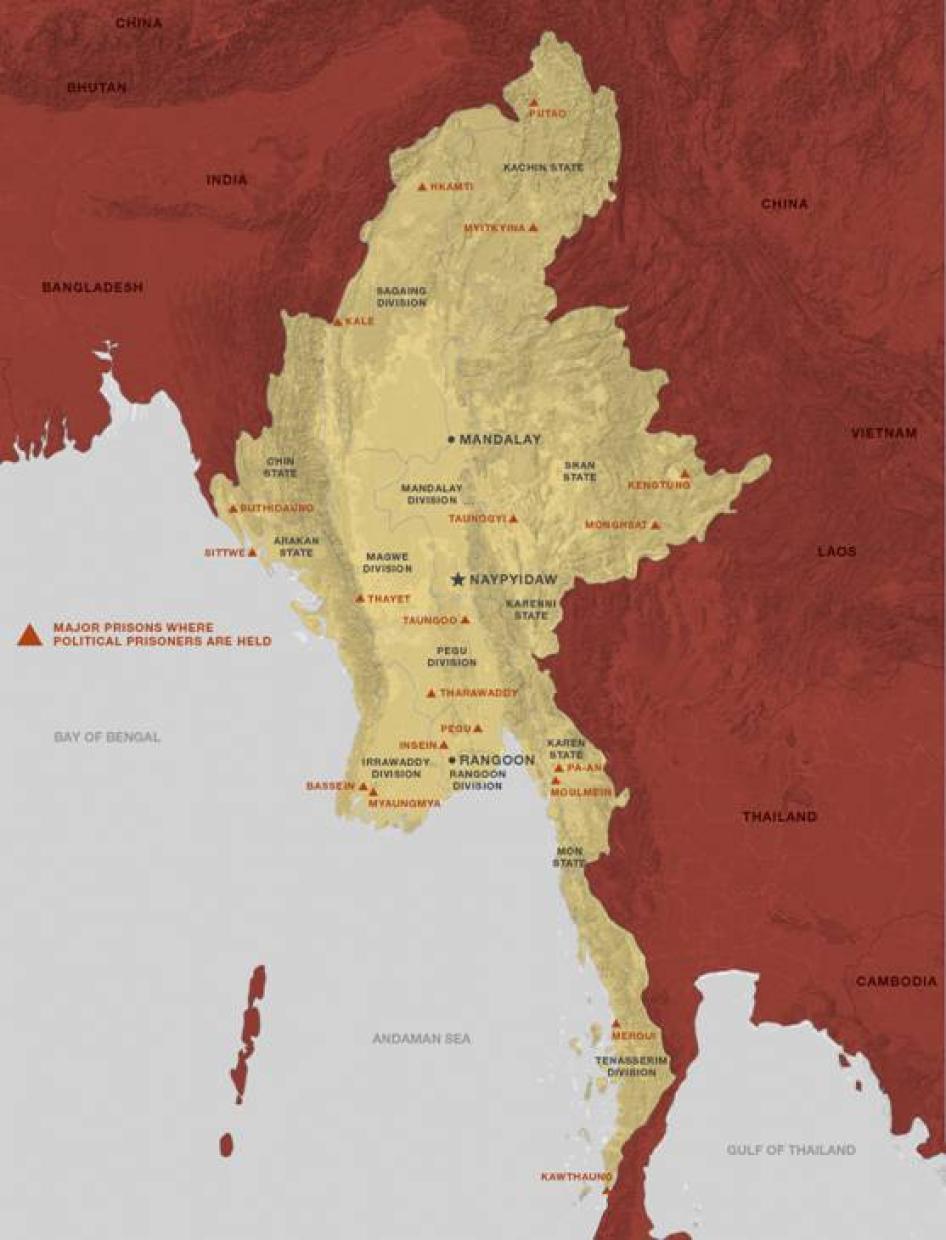
© 2009 Human Rights Watch
Key facts about Burma’s Political Prisoners
- Activists and anyone outspoken against military rule have been routinely locked up in Burma’s prisons for years.
- There are 43 prisons holding political activists in Burma, and over 50 labor camps where prisoners are forced into hard labor projects.
- Beginning in late 2008, closed courts and courts inside prisons sentenced more than 300 activists including political figures, human rights defenders, labor activists, artists, journalists, internet bloggers, and Buddhist monks and nuns to lengthy prison terms. Some prison terms handed down were in excess of one hundred years.
- The activists were mainly charged under provisions from Burma’s archaic Penal Code that criminalizes free expression, peaceful demonstrations, and forming organizations.
- The sentencing was the second phase of a larger crackdown that began with the brutal suppression of peaceful protests in August and September 2007. The authorities arrested many of the activists during and in the immediate aftermath of the 2007 protests or in raids that swept Rangoon and other cities in Burma in late 2007 and 2008.
- More than 20 prominent activists and journalists, including Burma’s most famous comedian, Zargana, were arrested for having spoken out about obstacles to humanitarian relief following Cyclone Nargis, which struck Burma in May 2008.
- There are now more than 2,100 political prisoners in Burma—more than double the number in early 2007.
Secret trials of political prisoners in late 2008
Burma remains one of the most repressive and closed societies in the world. A shadowy clique of generals, who call themselves the State Peace and Development Council (SPDC), have ruled the country in one incarnation or another since 1962.
Imprisoning people for their political beliefs is nothing new. Burma’s most famous dissident and prisoner, Nobel Peace Prize winner Aung San Suu Kyi , has spent most of the years since 1989 under house arrest in Rangoon.
In May 2009, authorities arrested Aung San Suu Kyi and transferred her to Insein Prison related to the unwanted intrusion by an American man who allegedly swam across a lake to her house. Authorities charged her with breaching conditions of her house arrest order under section 22 of the 1975 State Protection Act. On August 11, 2009, a criminal court inside Insein prison sentenced her to three years of imprisonment, with the sentence reduced to 18 months, to be served under house arrest.
One of Aung San Suu Kyi’s deputies, U Tin Oo, had his house arrest order extended for another year on February 12, 2009. He has been under total house arrest, like Suu Kyi, since 2003, when pro-military thugs tried to kill both of them during an attack in northern Burma. In 2005, activists including Hkun Tun Oo and his colleagues in the Shan Nationalities League for Democracy, a political party, were sentenced to over 96 years in prison, the first time such outrageously long terms have been handed down to opposition political activists.
While the detention of Suu Kyi has rightly been the subject of great interest and concern, far less attention has been given to the whole generation of activists who are paying for their courage with long prison sentences in brutal conditions.
Zargana, one of Burma’s most famous comedians and actors, is a long-time opponent of military rule who has in recent years become a high-profile activist and relief worker, assisting many sick and impoverished Burmese who have been further marginalized by the military’s self-serving development policies.
U Gambira is a young Buddhist monk who played a key role in the 2007 demonstrations, emblematic of widespread discontent among young people over declining living standards and repressive military rule.
Su Su Nway, a woman from Burma’s rural heartland, challenged Burmese authorities in 2005 when she protested being forced to build a road in her town and was thrown in prison for it. She has since become one of the most bold and outspoken labor activists in the country.
Min Ko Naing, one of the leaders of the 1988 student-led demonstrations, spent the years between 1989 to 2004 in prison, mostly in solitary confinement. Upon his release, he and many other long-term activists formed the “88 Generation Students,” a group who has chosen to stay inside Burma and engage in peaceful protest against military rule to initiate dialogue for political, economic, and social reform.
These four prominent people represent diverse strands of defiance to military rule and remain in prison today.
In the past few years, repression inside Burma has increased in step with long-orchestrated moves to entrench military rule through nominal political reforms and creation of a civilian apparatus loyal to the army.
During the September 2007 crackdown, Burmese security forces beat, arbitrarily arrested, detained, and shot monks and other protesters in the streets of Rangoon. Police and plain-clothes paramilitary members arrested thousands of peaceful participants in the protests in nighttime raids on monasteries and their homes. At least 31 were killed. In the following days, hundreds more were beaten, arbitrarily arrested, and detained at makeshift detention facilities, police stations, and jails.
In May 2008, despite Cyclone Nargis, which devastated a large part of the country days earlier, the SPDC went ahead with a constitutional referendum widely denounced by the international community as a sham. Human Rights Watch reported on the government’s tightening of already far-reaching restrictions on freedom of assembly, association, and the media in the run-up to the referendum.
The referendum was a further step in the military government’s process of “disciplined democracy,” underway since multiparty elections in 1990 delivered a resounding defeat to the military and its favored party. Since then, the SPDC has carefully orchestrated its so-called democratic process to ensure that political activists and human rights defenders will be excluded; either by imprisoning them, intimidating them, or forcing them into exile. The process aims to convince the international community that real change is taking place, when all the military is planning is continued repressive rule with a tightly controlled civilian façade.
In September 2008, the SPDC released over 9,000 prisoners from Burma’s jails to divert attention from the one-year anniversary of the 2007 crackdown. But of the 9,000, only eight were political prisoners, and one of them was rearrested the next day and detained again for another two months. One of the eight was Burma’s oldest political prisoner and one of its longest serving, 78-year-old U Win Tin, a journalist and political activist, imprisoned at notorious Insein prison in Rangoon from July 1989 until September 2008.
In February 2009, the SPDC released more than 6,000 prisoners to demonstrate their cooperation with the visiting United Nations special rapporteur on the situation of human rights in Myanmar, Tomas Ojea Quintana. Only an estimated 31 of them were political activists, many of whom had been in prison before the 2007 demonstrations.
From early October 2008, the military government started punishing a broad cross-section of Burmese dissidents and civil society actors. The SPDC stepped up secret trials of hundreds of activists, Buddhist clergy, and human rights defenders in prisons, in closed court proceedings across the country. The rule of law has been grossly disfigured by military manipulation.
Trials are manifestly unfair in Burma for those who oppose the military government. There is no judicial independence: judges in Burma serve at the whim of the SPDC and must follow the directives of the military. Defense lawyers of political activists are provided little or no time or opportunity to present a defense. Frequently they are not permitted to examine government evidence, and at times evidence used against political detainees is fabricated. Defense lawyers have tightly controlled access to their clients, and have been jailed for requesting that trials meet basic standards of fairness and justice.
Families of prisoners are often not permitted to attend trials. Even if they do find out where their family members are being tried and can travel there, officials have been barring members of the public from entering the courtrooms.
The military government uses vaguely worded archaic laws that criminalize free expression, peaceful demonstration, and forming organizations. Burma’s colonial-era penal code has not fundamentally changed since 1861, nor have many other old, repressive laws from Burma’s past.
Before the trial starts, the client and defense lawyer meet to discuss the case so that the client can instruct his or her lawyer. These meetings usually happen at police custody centers, where political prisoners are transferred when they are due to appear in court. Police officers and members of Special Branch are present and watch these meetings, so there is no privacy for the client and the lawyer to discuss the case. Once the trial starts, the judge, the prosecution lawyers, the prosecuting officers, and prosecution witnesses follow SPDC instructions.
—Saw Kyaw Kyaw Min, lawyer representing political activists, was charged with contempt of court and fled Burma in December 2008.
Many activists have been charged under section 505(b) of the Penal Code which prohibits making, publishing, or circulating “any statement, rumor, or report...likely to cause fear or alarm to the public or to any section of the public whereby any person may be induced to commit an offense against the State or against public tranquility.” Other commonly used charges include damaging or defiling a place of worship with intent to insult the religion, libel against foreign powers, statements causing public mischief, unlawful association, and holding foreign currency without permission.
The government has charged numerous activists, journalists, monks, and students with being “terrorists” and accused them of stockpiling explosives and weapons in monasteries.
For a current list of political prisoners and charges please see: http://www.aappb.org/prisoners1.html.
Harsh prison conditions
Since early 2006, the International Committee of the Red Cross (ICRC) has suspended its independent and confidential visits to Burma’s prisons. The military government insisted that government officials be in attendance during interviews with prisoners in direct contravention of the ICRC’s operating procedures. Since then, there have been only two visits to prominent political activists by international officials. The former UN special rapporteur on the situation of human rights in Myanmar, Paulo Pinheiro, visited Insein prison in November 2007 and had brief access to several high profile prisoners such as Su Su Nway. Pinheiro’s successor, Tomas Ojeo Quintana, also briefly visited Insein prison in August 2008 and met Win Tin, U Gambira, and two other prisoners. During his second visit to the prison in February 2009, Quintana could only meet five lesser known and government-screened political prisoners.
Conditions in Burmese jails are dreadful. For political prisoners, ill-treatment and torture are commonplace. Punishments include being put into stress positions, beatings, and isolation in cramped and dark cells, otherwise known as “dog cells.” Food and medical treatment are often poor or nonexistent, and in many cases prisoners have to pay for it themselves.
Some of those sentenced in late 2008 have been transferred to isolated prisons in rugged inhospitable areas. Activists are transferred to rural facilities to make it more difficult for families to visit, for lawyers to represent them, and for information on their welfare to get out to the international community.
Getting detailed information out of Burma’s prisons is extremely difficult and dangerous. In late December 2008, a court sentenced Zaw Naing Htwe, the brother of imprisoned ‘88 Generation Students (a prominent dissident group) leader Kyaw Kyaw Htwe, to nine years in prison for receiving a letter from his brother smuggled out of Insein prison weeks earlier. Three prison guards were also arrested and charged.
For political activists, time in prison does not only represent physical and mental punishment and estrangement from their loved ones. It comes with the knowledge that through long jail terms the military is trying to make them, their friends, and their peaceful movement for democracy and human rights irrelevant to Burma and forgotten by the outside world.
Zargana
Zargana (also known as Zarganar, whose real name is Maung Thura) is Burma’s most famous social satirist and activist. A former dentist (hence his stage name Zargana, “pliers” in Burmese), he became famous in the late 1980s as a stage and TV comedian, especially for his “Beggar” stage shows in which he and his comedic troupe poked fun at the corruption of Burmese military leaders, deteriorating living standards, and the lack of basic freedoms in Burma.
Many of these shows used Burmese wordplay, the art of double entendre for which the tonal Burmese language is ripe. Zargana calls these calibrated jokes, in Burmese ha tha, “under the table” and “behind the curtain” humor, a uniquely Burmese blend of humor part Jon Stewart, part Benny Hill, fueled by irreverent anti-government sentiment.
One of Zargana’s most popular jokes centered on the efficiency of the generals in the late 1980s: “Every country has a success story to tell. Some like to boast about a citizen with no hands who can still write, or another with no legs who can still run. But there is no other country like Burma. Here we have generals able to rule a country for 40 years with no brains!” Playing on Burmese tones, Zargana would shi-kho, the respectful gesture of putting ones hands together and gently bowing, and say the names of Burmese military leaders but twist the pronunciation of kho, which in another tone means ‘stealing’.
During the 1988 uprising, Burmese authorities arrested Zargana for leading other artists in support of the anti-government demonstrations. He was tortured in jail. Following his release in 1989, he spoke out again while campaigning for his mother, who was running for parliament in the lead-up to the 1990 elections. For this he was thrown back in prison for four years. In 1991, during this period of incarceration, he won a Human Rights Watch/Hellman-Hammett grant for persecuted writers.
While in prison the authorities banned Zargana from writing, but he still managed to record his jokes and poems secretly, one of which was collected in the 1996 PEN Anthology of Imprisoned Writers volume “This Prison where I Live”:
I send my thoughts beyond these walls
Day in, day out, from dawn to night
I dream the endless daydream
Dream the endless journey
Through the night, fretting
Champing at the bit
The one I call for does not come
The one I wait for never appears
Ah, if only I could stop the
Thinking, seeing, hearing, dreaming
I wouldn’t feel a thing.
After his release in 1993, Zargana continued to act in plays and some films and was a vocal advocate supporting people living with HIV/AIDS. But his outspoken criticism of military rule meant that he was often blacklisted from appearing in public.
He made several films in the past decade. His 2006 film “Running Out of Patience” was banned, possibly because he made public criticisms of tightening government restrictions on the annual Thingyan water festival. Authorities criticized his public talks as “inciting public unrest and violence.”
After the lavish 2006 wedding video of President Than Shwe’s daughter was leaked to the general public, sparking widespread resentment, Zargana quipped about what everyone else in the country suspected: that the wedding was arranged because the president’s daughter, Thandar Shwe, was already near giving birth, having been made pregnant by a man other than the army officer, favored by her father, whom she married. “In other countries, instant noodles and instant coffee are popular. Only in Burma are there instant babies,” Zargana joked.
Zargana became one of the most prominent artists to raise private donations and organize social relief programs around health issues for Rangoon’s poor. He was often joined by the actor Kyaw Thu who runs the popular non-profit Free Funeral Service Society, which provides funerals to those in the community who cannot afford it. Zargana refused caution from family and friends to tone down his statements and avoid arrest, saying, “How can I run? I have a big bald head; the police can find me anytime!”
During the 2007 demonstrations, Zargana and other artists publicly supported the monks, handing out alms (food and water) to monks before a major demonstration. The publicity around this act, and his frequent interviews with the foreign media, got Zargana arrested again in September 2007. For a month, the SPDC moved him between several detention and interrogation facilities. Conditions in detention were dire. Yet, on his release, with characteristic sardonic humor, he told Human Rights Watch what happened to him in prison:
I was held in the dog cells in solitary confinement for eight days and was not allowed to bathe for three days. I had to relieve myself on a tray. When it became full, I tried to urinate under the door but the dogs tried to bite me.
—Zargana, describing his time served in a “Military Dog Cell” to Human Rights Watch, October 2007.
Following his October 2007 release, Zargana continued to be politically active. After the cyclone struck Burma in May 2008, he mobilized a network of more than 400 supporters to drive supplies down to affected areas daily and to raise money for urgently needed food, water, and shelter.
Despite Zargana’s heroic relief efforts, his outspoken criticism of the military government’s ineffectual response landed him in jail again. Days before his arrest on June 4, 2008, he gave interviews to foreign news outlets in which he reminded the international community about the continuing desperate state of cyclone-affected communities and the poor government response. He told the exile Irrawaddy magazine:
I want to save my own people. That’s why we go with any donations we can get. But the government doesn't like our work. It is not interested in helping people. It just wants to tell the world and the rest of the country that everything is under control and that it has already saved its people.
—Zargana, two days before his arrest in Rangoon, June 2008.
Zargana’s trial began in August 2008 in closed proceedings at Insein prison. The charges included “insulting... either [through] spoken or written [means]... another religion” (section 295(a) of the Penal Code) making statements causing public mischief (section 505(b)) and sections 32(b) and 36 of the Television and Video Law, sections 22(a) and 38 of the Electronic Transactions Law, and section 17(2) of the Unlawful Associations Act. These provisions criminalize what should be protected forms of expression and association, including giving interviews to members of the foreign media and possessing video footage or photographs of government abuses.
Among items seized from his house in the police raid and used as evidence against him were copies of the movie Rambo 4, which is set in Burma, and video and still images of the cyclone-affected areas and of the 2007 demonstrations.
On November 21, 2008, the prison court sentenced him to 59 years in prison. His sentence was reduced by 24 years in February 2009, to 35 years.
Following his trial, Zargana was transferred to a prison in Myitkyina, Kachin State, in northern Burma, known for its bitterly cold winter. Members of his family made the long trip north to visit him in December, where they reported he was in fine spirits and “enjoying the cold.” His mother, the prominent writer and political activist Daw Kyi Oo, died on March 20, 2009.
I feel the same way as other mothers whose sons also face the same fate. Now I am numb. What my son did was for the sake of the country. I don't mind how many cases they charged my son with.
—Writer Kyi Oo, Zargana's mother, August 18, 2008.
U Gambira
Perhaps the most emblematic of the monks is 28-year-old U Gambira (real name U Sandawbartha). U Gambira is one of the main leaders of the All Burma Monks Alliance, which instituted the patta nikkujjana kamma (overturning the bowls) in September 2007, a gesture effectively signaling that members of the military had been excommunicated by the Buddhist clergy. He is one of the most visible and outspoken young monks who led the demonstrations and a key organizer, switching his time between Rangoon and Mandalay to avoid the authorities. Following the crackdown, he went underground.
After more than a month in hiding, U Gambira was arrested in Mandalay on November 4, 2007. The authorities had arrested his brother Aung Kyaw Kyaw a few weeks earlier to force U Gambira to surrender, a form of collective punishment. They then arrested his father for the same purpose on the day U Gambira was caught. Authorities held his father for one month in Mandalay prison before releasing him.
The regime’s use of mass arrests, murder, torture, and imprisonment has failed to extinguish our desire for the freedom that was stolen from us. We have taken their best punch. Now it is the generals who must fear the consequences of their actions. We adhere to nonviolence, but our spine is made of steel. There is no turning back. It matters little if my life or the lives of colleagues should be sacrificed on this journey. Others will fill our sandals, and more will join and follow.
—U Gambira, writing in the Washington Post on the day of his arrest, November 4, 2007.
The young monk was charged with ten offenses for his role in leading the monk’s alliance, including violations of section 6 of the Law Relating to the Forming of Organizations, and sections of the Penal Code on unlawful assembly (section 145), rioting (section 147), insulting another religion (section 295(a)), and making statements that intend to cause military officials to mutiny or disregard their duties (Section 505(a)).
In November 2008, a court sentenced U Gambira to 68 years in prison, 12 of them with hard labor. His brother Aung Ko Ko Lwin received 20 years in prison for hiding him and was sent to Kyaukpyu prison in Arakan state, and his brother-in-law Moe Htet Hlyan was also jailed for helping him while on the run, and is now in Moulmein prison in Mon state.
While he was detained at Hkamti prison in Sagaing Division in western Burma, his mother Daw Yay made an uncomfortable three day journey by boat to visit him. She told Radio Free Asia: “The trip from Mandalay to [Hkamti] prison was like being sent to hell alive. My life, and my family’s life, is just clockwork now. We eat and sleep like robots. There is no life in our bodies. The ordeal we are going through—it’s a punishment for our entire family.”
In May 2009, U Gambira was transferred to an even more remote facility at Kale in Sagaing Division. He is said to be in deteriorating health. The authorities have refused family members permission to visit him. His 68-year sentence was reduced by five years in June 2009.
Ma Su Su Nway
One of the most stalwart activists working to end forced labor in Burma is 35-year-old Ma Su Su Nway. In 2005, she won an historic victory against local officials in her village in Thanlyin township near Rangoon who had forced her and other villagers to build a road. The local officials responsible went to prison for eight months, but Su Su Nway herself was also sentenced to 18 months in Insein prison—for allegedly defaming the village chairman.
Following international pressure, notably from the International Labour Organization (ILO), the authorities released her in June 2006. Su Su Nway has since continued to challenge the government and has been frequently arrested. In 2007, the ILO and the SPDC agreed on a mechanism to end the practice of punishing people like Su Su Nway who merely complain about forced labor, a clear indication of how deplorable the human rights situation is in Burma.
On August 28, 2007, Su Su Nway staged a dramatic small protest in downtown Rangoon where she yelled out: “Lower fuel prices! Lower commodity prices!” Thugs from the government-backed Union Solidarity and Development Association and Swan Arr Shin, directed by members of the Special Branch of the Burmese police, attacked her even as some of her supporters linked their arms around her to protect her. The thugs struck Su Su Nway, knocking her down, but she managed to escape. In hiding she gave many interviews to the press. In one interview she articulated why she continued to challenge the military government:
Because we are in hiding does not mean that we are in retreat, but we worry that there will be nobody left to stand up for the people and to speak out if we all go to jail. We know we are water in their [the regime's] hands, and we cannot escape for long, but before we get arrested we want to say what we should say during the time we are in hiding.
We held the demonstrations not only for us, but for all people, including those who beat us and tried to arrest us, including the police. Those abusing us are also facing difficult daily lives. They have been used by the military regime because their lives are under military rule.
—Ma Su Su Nway, interviewed in hiding, October 2007.
Su Su Nway stayed in hiding until November, 2007, when she travelled with colleague Bo Bo Wing Hlaing to the hotel where the visiting UN special rapporteur on the situation of human rights in Myanmar, Paulo Pinheiro, was staying. She raised a banner criticizing the SPDC, using language that mockingly echoed the SPDC’s own crude propaganda slogans, the sign read: “Oppose those relying on China, acting as thieves, holding murderous views.” Authorities immediately arrested her.
In November 2008 a special court inside Insein prison sentenced Ma Su Su Nway to 12-and-a-half years in prison on charges including sedition (section 124(a)) and making statements that cause fear or alarm to the public or induce others to commit offenses against the state or public tranquility (section 505(b)). This sentence was later reduced to eight-and-a-half years.
Ma Su Su Nway has significant health concerns, including a serious heart condition and hypertension. According to the AAPPB, prison authorities have not provided her with adequate medical care, and she has difficulty walking. In November 2008, authorities transferred her to Oo-Bo prison in Mandalay, and soon after to Kale prison in Sagaing Division.
Min Ko Naing
Min Ko Naing (whose name literally means “conqueror of kings”) is a 46-year-old activist who has spent 17 of the past 20 years in prison for his political beliefs, most of it in solitary confinement. On his release in late 2004, he vowed to stay inside Burma and continue his struggle for basic freedoms. As the 88 Generation Students increased their activities of peaceful defiance against military rule, Min Ko Naing articulated his approach for peaceful change in an interview with the exiled media:
Our door remains open for reconciliation. While we are the oppressed who have been struggling against injustice in the country, we continue to open our door because we usually find the answer to a problem is based on the principle of national reconciliation. The issue is the status of the government’s door. We will continue to knock so that we can give them the message that we need to work together in making a nation instead of annihilating each other.
—Min Ko Naing prior to the demonstrations, April 2007.
In mid-2008, authorities charged Min Ko Naing and other leaders of the 88 Generation Students—Ko Ko Gyi, Htay Kywe, Pyone Cho, Min Zaya, and others—with 22 offenses for their involvement in the demonstrations.
We initiated these peaceful marches not only to protest against the hike in fuel prices, but to bring attention to the immense suffering of the people of Burma. Our goal has always been, and will remain, peaceful transition to a democratic society and national reconciliation.
—Htay Kywe, in a letter sent to the United Nations Security Council while in hiding, September 2007.
Min Ko Naing and Ko Ko Gyi are currently being held in Kengtung prison in Burma’s northeastern Shan State. According to family members, Min Ko Naing’s eyesight is failing, he has a serious heart condition, and he has not received any medical care from the authorities. When family members managed to see him in late December 2008, while the weather in Burma’s far northeast is cold, he said that being held in solitary confinement was “like living in a refrigerator.”
The September 2007 Crackdown
In August 2007, the SPDC raised fuel prices in Burma without warning, increasing the burden on Burma’s struggling impoverished majority. The fuel price rise sparked bolder public protests by Burma’s increasingly assertive civil society. Even during the first half of 2007, groups of activists had begun organizing against haphazard electricity supplies, rising food prices, low education standards, lack of access to health care, and a host of other daily complaints against military rule.
Members of the 88 Generation Students, a political organization composed of former students active during Burma’s 1988 uprising, many of whom had spent time in prison, were at the forefront of the demonstrations. In peaceful marches through the streets of Rangoon, the 88 Generation Students and their supporters called on the military government to begin peaceful dialogue on political and economic reforms. The SPDC responded swiftly and, by late August 2007, had arrested most of them.
Then, in early September, local authorities attacked Buddhist monks marching in the northern town of Pakokku, Magwe Division, making demands similar to those of the dissidents in Rangoon. This sparked a nationwide Buddhist protest movement. By late September monks were staging peaceful marches through the streets of Rangoon involving tens of thousands of monks and nuns.
In one incident, almost impossible to imagine, hundreds of monks marched down University Avenue in Rangoon to the home of Burma’s most famous political prisoner, Aung San Suu Kyi. There the monks chanted and prayed for her while she looked on from her gate. The monks then peacefully walked away.
The sense of hope arising from the steadily growing processions did not last. On September 26, Burmese riot police backed up by regular army units and government-backed militias called Swan Arr Shin (Masters of Force) began clearing the streets of Rangoon. During two days of violence, security forces shot into crowds of protesters, beat and clubbed monks and civilian protesters, and arrested thousands of people. Monasteries and homes were raided numerous times by Burmese security forces looking for suspects. The United Nations estimated that security forces killed at least 31 people, although the true figure is likely much higher. In the full glare of international attention, the SPDC used violence to restore an uneasy calm.
The Cyclone
In early May 2008 Cyclone Nargis struck lower Burma, leaving more than 150,000 people dead or missing. The overwhelming storm and the massive tidal surges devastated coastal regions, villages, towns, and the former capital Rangoon, directly affecting over 2.4 million people.
The military government’s initial response was to block and delay aid delivery to the affected Irrawaddy Delta during the crucial first weeks after the cyclone. An untold number of people died and suffered needlessly as the SPDC treated the cyclone as a national security problem instead of a natural disaster, demonstrating the shocking disregard they hold for the welfare of their own people. This was partly explained by the SPDC’s pushing ahead with its constitutional referendum, brutally prepared through intimidation and vote rigging for months, and held in most parts of the country only a week after the cyclone. The government claimed a 98 percent turnout and said that more than 92 percent had voted in favor of the new constitution.
In the crucial first weeks following the disaster, international assistance and technological expertise built up in Rangoon and neighboring Thailand, but were only slowly released following the visit of UN Secretary-General Ban Ki-moon in late May.
In the absence of government assistance and responsibility, Burmese civil society stepped in. In the thousands, individuals and communities raised money, collected supplies, and traveled to affected parts of the delta and the Rangoon area, helping shattered villages. Burmese community aid workers, private organizations, and citizens working for international organizations helped their people, often against roadblocks, obstructions, and impediments erected by the authorities.
Some observers suggested that the resurgence of civil society in the wake of the cyclone showed an opening of humanitarian space inside Burma. Yet for Burmese who attempted relief efforts independent of the authorities or spoke openly about their frustrations with the government, the threat of arrest or intimidation was all too real and has continued to the present.
In June 2008 alone, Human Rights Watch believes that 22 people were arrested for activities related to assisting victims of the cyclone, in many cases because they reached out to the international community or publicly criticized the SPDC’s performance. The most prominent of these is renowned Burmese comedian and activist Zargana, but many others, including former political prisoners, used the brief opening of freedom to help their countrymen.
Police arrested journalists Eine Khaing Oo, a 24-year-old reporter for Eco Vision Journal, and Kyaw Kyaw Thein, a former editor of Weekly Journal, after bringing cyclone survivors to Rangoon and interpreting for them at meetings with the ICRC and the United Nations Development Program (UNDP). Eine Khaing Oo will spend two years in prison and Kyaw Kyaw Thein received a seven-year prison term for trying to bring the voices of cyclone victims to the international community.
In a bizarre public relations exercise, the SPDC tried to tell the world that Burmese people “are not beggars,” and therefore did not need handouts. In one infamous line, the state-run media claimed that the Burmese didn’t need “foreign chocolate bars” to survive and that “large edible frogs are abundant” for survivors to eat. Burma’s military ruler, General Than Shwe, toured makeshift camps of survivors handing out DVD players to those without electricity, even as the government bargained with the international community over the costs of flying rights for helicopters, and while British, US, and French military vessels loaded with supplies waited in vain off Burma’s coast.
U Nay Win and Phyo Phyo Aung
UNay Win, a doctor who was imprisoned from 1989 to 2005 for his political activities, was arrested with his daughter Phyo Phyo Aung on June 14, 2008, for organizing to collect bodies of cyclone victims for burial. Father and daughter had started an organization called The Group that Buries the Dead. The SPDC threw both father and daughter, who had already spent 16 years of their lives apart, in prison. They were charged in early February 2009 under provisions contained in the Unlawful Associations Act that bans any “organizations that attempt, instigate, incite, abet, or commit acts that may in any way disrupt law and order, peace and tranquility, or safe and secure communications...or...that attempt, instigate, incite, abet or commit acts that may effect or disrupt the regularity of state machinery.” Phyo Phyo Aung was also charged under 505(b) of the Penal Code for making statements causing public mischief.
The 88 Generation Students
The most prominent opponents of military rule in Burma, after internationally known Nobel Peace Prize laureate Aung San Suu Kyi, are a group of former student leaders from the 1988 uprising who spent most of the years from 1989 to 2004 in prison. Soon after their release, they formed a group called the “88 Generation Students” in 2005.
The 88 Generation Students has staged some innovative and effective campaigns emphasizing non-violent resistance, calling for dialogue with the military government, and involving Burmese civil society. The group has staged prayer meetings for the release of Aung San Suu Kyi and all political prisoners called the “Sunday White campaign,” and in 2007 started a letter writing campaign called “Open Heart” to encourage ordinary Burmese to write to President Than Shwe detailing their daily struggles and aspirations. The group said it started the campaign “to show our respect to the people who boldly asserted political, social and economic grievances such as abuses of power, human rights violations, and injustices done by the authorities.”
Thirteen members of the group involved in organizing the peaceful protests in 2007 were arrested on August 22 of that year. Most of the thirteen were held without charge for several months. Another 22 were arrested over the course of the following months.
The authorities tried to convince the total of 26 male and nine female activists in prison to endorse publicly the SPDC’s political reform process in exchange for their release. All declined and remained in prison. In the middle of 2008, the secret trials of many of the group’s members began.
By December 2008, all of the 88 Generation Students on trial had each received sentences of 65 years, with still more charges pending against them.
The charges against them include libel against foreign powers, statements causing public mischief, and unlawful association:
Laws Frequently Used Against Political Activists
|
Trials were held in secret inside Insein prison in Rangoon, before the 88 Generation Students were all sent to far flung prisons across Burma in late November 2008. The trials of some continued in secret at these remote prisons, while others were periodically transported back to Rangoon to resume proceedings.
Just 65 years?
—Min Zaya to the judge when his sentence was announced in court, November 2008.
88 Generation Student leader Pyone Cho is currently being held in Kawthaung Prison on the southernmost tip of Burma.
Officials sent Aung Thu to Putao prison in the far north, close to the Chinese border.
Min Zaya, was transferred to Lashio prison in Burma’s eastern Shan State.
Htay Kywe is in Buthidaung prison in western Burma’s Arakan State, and is often kept in an isolation cell.
Nilar Thein
Nilar Thein,age 35, is one of the most prominent women activists in Burma, one of more than 190 women in prison for their political activities. She is part of the so-called “96 Generation” of student activists who staged bold demonstrations against military rule in December 1996. She spent eight years in prison from 1996 to 2003. Just before the 2007 demonstrations began, she gave birth to her first child.
When police arrested members of the 88 Generation Students in late August 2007, Nilar Thein went underground, leaving her four-month-old daughter with relatives. In several interviews while in hiding after the August-September protests, Nilar said that her greatest concern was the arrests of her friends and colleagues, many of whom had been in prison several times before. Given their prominent activism, Nilar knew that ill-treatment was waiting for them in custody.
“Now, when people they [security services] are urgently trying to find, including Htay Kywe ... and Mie Mie, are arrested like this, I am extremely concerned for their safety. I’m really sad thinking what kind of torture they must be undergoing. We, the Burmese women, interested in politics and taking part in politics, are facing violence and torture and being killed.”
Nilar Thein managed to avoid the security services hunting her for more than a year, before they arrested her on September 10, 2008, when she was trying to contact her sick mother.
I am so choked up with feeling when I had to leave my daughter with my mother-in-law. It will not be wrong to say it was the worst day of my life... [yet] I don't regret it at all. I don't because just like my daughter I see many faces of children in my country who lack a future. With that I encourage myself to continue this journey.
—Nilar Thein, interviewed by Burmese exiled media while in hiding, March 2008.
Nilar Thein was charged with the same list of 22 offenses as the 88 Generation Student activists. A court sentenced her to 65 years in prison. The authorities transferred her to Thayet prison in Magwe Division in central Burma.
Mie Mie
Mie Mie (whose real name is Ma Thin Thin Aye), age 35, is one of the most visible and outspoken activists who demonstrated in 2007. Active in anti-government activities since she was a high school student in 1989, she was arrested and imprisoned that year for several months. In 1996, her involvement in student protests provoked another arrest and prison term until 2001. A zoology graduate and mother of two children, she is one of the younger activists within the 88 Generation Students, and her husband is also an avtivist with the NLD. Following her leading role in the August 2007 demonstrations, she went into hiding in late August and authorities arrested her on October 14, 2007.
At her trial in Insein prison along with other 88 Generation Student leaders, Mie Mie received 65 years in prison.
We will never be frightened!
—The words Mie Mie allegedly yelled to judges at her sentencing in November 2008.
Her health, due to long spells in prison, has been worsening during 2008 and 2009.
Monks and Nuns
Many of the detainees convicted and sentenced in 2008 are Buddhist monks and nuns. Some had been arrested during protests on the streets, but others were rounded up during brutal nighttime raids on monasteries and religious schools in Rangoon in September and October 2007. An estimated 220 Buddhist monks are in Burmese prisons.
In late 2008, courts sentenced 46 monks and four nuns to prison, many of them with hard labor on charges including “injuring or defiling a place of worship (Section 295 of the Penal Code), insulting... either [through] spoken or written [means]... another religion” (section 295(a)) unlawful assembly, and possession of explosives, allegedly hidden in monasteries. Included in the 46 are five monks from the Ngwe Kyar Yan monastery, which suffered a bloody and brutal raid by security forces looking for monk leaders on the night of September 26, 2007. The five were sentenced to six-and-a-half years in prison.
The convicted nuns include Daw Ponnami, age 84, Daw Htay Yi, age 70, and Daw Pyinyar Theingyi, age 64, from Rangoon’s Thitsa Tharaphu School, all of them sentenced to four years hard labor. When the UN Special Rapporteur on the situation of human rights in Myanmar visited Insein prison in February 2009, he reported that Daw Ponnami “did not know the reason for her arrest [and] was frail and had difficulty in standing and walking.” After one-and-a-half years in prison, the 84-year-old nun was released in March 2009.
Also tried were senior abbots of the Artharwaddy Monastic School, such as 65-year-old U Yevada. Security forcesbrutally raided hisschool searching for activist monks on the night of September 26, 2007. Seven monks and nuns from the monastic school were charged with defiling a place of worship and insulting another religion (Sections 295 and 295(a) of the Penal Code).
In 2008 courts sentenced:
U Kaylartha, a monk from Mandalay, to 35 years in prison.
U Sandar Wara toeight-and-a-half years in prison.
U Thaddama, a young monk from Garna Puli monastery, to 19 years in prison.
Abbot U San Dimar of Kyar Monastery in Rangoon’s Pazundaung township, to eight years in prison under the Unlawful Association Act. He still faces charges under the Explosives Act.
U Ahnanda, a 62-year-old monk arrested in January 2008, to four-and-a-half years in prison in October 2008. He died of a stroke in Insein prison on January 22, 2009. Fifteen other monks and nuns imprisoned alongside him are suffering from malnutrition due to insufficient rations, and the prison authorities refuse to allow family members to visit them.
Journalists, Bloggers, and Artists
According to the Committee to Protect Journalists (CPJ), there are now 14 Burmese journalists in prison for their activities. A number have been arrested and convicted of crimes related to their coverage of the 2007 crackdown and the May 2008 cyclone.
Those imprisoned include well-known journalists Thet Zin and Sein Win Aung, both arrested on February 18, 2008, and charged with possessing what were deemed unlawful items, including video footage of the 2007 crackdown and a copy of the report on the 2007 crackdown by the UN special rapporteur on human rights in Myanmar. On November 28, 2008, a different court sentenced the two to seven years in prison.
Journalists imprisoned for reporting on the cyclone, or simply sending information or footage regarding the cyclone to foreign media outlets, include Aung Kyaw San, Kyaw Kyaw Thant, and Eine Khin Oo.
Zaw Thet Htwe was helping Zargana provide cyclone relief supplies but was arrested for compiling information on the government’s slow response and the magnitude of the devastation. A court sentenced him to 19 years in prison. Zaw Thet Htwe is a prominent journalist critical of the government who ran the popular First Eleven sports newspaper. In 2003, a court had sentenced him to death for exposing a story on a corruption in football (soccer) funding involving government officials, but he had been released in 2004 following an international outcry.
Blogger Nay Phone Latt, age 28,rose to fame during the 2007 crackdown when his website became pivotal in providing information both inside Burma and to the outside world. In January 2008, police arrested him alongside fellow blogger Thin July Kyaw. They were eventually charged with using electronic transactions technology to harm national security or aid the commission of such offense (sections 33 (a) and 38 of the Electronic Transactions Law), unlawful distribution of videotapes (section 32(b) and section 36 of the Television and Video Law), and making statements causing public mischief (section 505(b) of the Penal Code). In November 2008, a court sentenced Nay Phone Latt to 20 years in prison and transferred him to Kawthaung prison on the southern-most tip of Burma.
Popular musicians and artists have not escaped arrest and heavy sentences. In November 2008, a court sentenced famous rapper Win Maw of the Shwe Thanzin (Golden Melody) band to seven years in prison for videotaping the 2007 demonstrations and then distributing CDs of government brutality. On March 5, 2009, his sentence was extended by another ten years to 17 years in total. In November 2008, hip hop star Zay Yar Thaw, a member of “Generation Wave,” was sentenced to seven-and-a-half years in prison for attending a birthday party for Aung San Suu Kyi, in her absence, at NLD party headquarters on June 19, 2008. Generation Wave was formed by young Burmese activists following the 2007 crackdown, and includes hip hop artists such as Zay Yar Thaw, and young activists such as Arkar Bo, Aung Zay Phyo, Thiha Win Tin, Yan Naing Thu, and Wai Lwin Phyo.
Poets Saw Wai and Min Han were also sentenced in November 2008: Saw Wai received two years in prison for publishing a poem critical of President Than Shwe early in 2008, while Min Han received 11 years in prison for a range of charges related to comments he made criticizing the military government.
NLD activists
For years the military government has targeted members of the opposition National League for Democracy (NLD), the party led by Aung San Suu Kyi which won national elections in 1990 (the first that had been held since 1960) by a landslide. Intimidation, duress, and threats by the authorities have forced thousands of party members to resign, and more than 450 are in prison. Tactics of coercion ranging from spurious legal action to direct military orders have shut down scores of NLD offices throughout the country.
In the last few years, the NLD youth wing has been most visible—comprised of bold and innovative activists who often work in conjunction with other emerging groups such as the 88 Generation Students and Generation Wave.
Courts sentenced an estimated 90 members of the NLD in late 2008 for their activities in 2007 and 2008. Eleven are members of the youth wing who were charged regarding their involvement in a small demonstration on May 15, 2007 in Rangoon, calling for Aung San Suu Kyi’s release from house arrest. Authorities charged them with instigating public unrest among other charges. The judge charged the 11 accused and their two lawyers with contempt of court because some of the defendants literally turned their backs on the judge to protest the unfair way the defendants were being questioned by the prosecution. All 11 NLD members were sentenced to seven-and-a-half years in prison.
Six other members of the NLD from Kyauktada township arrested during the 2007 crackdown received lengthy sentences: Kyi Kyi War, 11 years; Kyaw Zin Win, 16 years; Kyaw Kyaw Lin, 10 years; Aung Kyaw Oo, 5 years; Nay Zar Myo Win, 5 years; and Kyin Hlaing, 4 years.
Win Mya Mya, a prominent NLD activist from Mandalay and a survivor of the 2003 Depayin attack, was sentenced in October 2008 to twelve years in prison for her activities during the September 2007 demonstrations. She was transferred to the isolated Putao prison in far north Burma in March 2009. She managed to tell her brother before she left, “I am being sent to where I deserve for my works. You live one day, you die one day. I don’t care if they send me to the moon.”
In February 2009, two NLD members elected to parliament during the 1990 elections were sentenced to 15 years in prison. Nyi Bu and Tin Min Htut were arrested in August 2008 after releasing a letter criticizing the SPDC’s political reforms. They were sentenced following a secret trial in Insein prison which their family members and legal representatives were not permitted to attend.
Human Rights and Defenders Network
The Human Rights Defenders and Promoters Network (HRDP) promotes citizen’s rights in Burma by providing public seminars and trainings on the Universal Declaration of Human Rights and doing human rights documentation work. Its grassroots activities have attracted the attention of the authorities for the past several years. In April 2007, two of its members were brutally attacked by government-backed USDA thugs as they conducted trainings for villagers on the Universal Declaration of Human Rights in rural areas near Rangoon.
U Myint Aye, a founder of the group, has been active in dissident politics since the 1974 demonstrations in Burma. Authorities arrested him on August 8, 2008, when he was staging a solo protest at his home commemorating the 20th anniversary of the 1988 uprising. Along with four of his colleagues from the HRDP, he is charged with bombing the office of a USDA building in Rangoon in 2008. An estimated 43 members of the group are in prison.
The 2007 demonstrations and the cyclone response brought many different people together, young and old, who spoke out against government actions. Police arrested 25-year-old law student Honey Oo, a member of the banned All Burma Federation of Students Union in early October 2007 for organizing demonstrations. She received nine-and-a-half years in prison.
U Ohn Than, age 61, a former government employee, has been staging solo protests against government policies since 1988 when he is not in prison. He was in prison from 1988 to 1995, and upon his release resumed solo protests. In 1996, the authorities rearrested him and held him in various prisons until 2003. From then until 2007, he was arrested several times for his stoic one-man protests against political repression and rising commodity prices. He would stand outside United Nations offices, government buildings, and opposition political offices, making his case, mostly in silent defiance until officials dragged him away.
On August 23, 2007, U Ohn Than stood outside the US embassy in Rangoon wearing a prison uniform and holding a large placard calling for international assistance and national reforms in Burma, as well as criticizing military rule and China’s and Russia’s veto of a UN Security Council resolution on Burma in January 2007. As embassy officials looked on, plainclothes security agents bundled him into a van and took him to a police station.
A court sentenced him on April 2, 2008, to life imprisonment for sedition under section 124(a) of the Penal Code. U Ohn Than is now suffering from cerebral malaria, but has refused all medical assistance from prison authorities and his family. His daughter managed to visit Hkamti prison, Sagaing Division, but he refused to take any medicine.
Form a Government that Represents the People Listen and Act On What People Want End Military Ruling, Now China and Russia's Vetoes—Go To Hell!
—Slogans on some of the placards U Ohn Than held outside the US embassy in Rangoon, August 23, 2007, just before his arrest by plainclothes police.
Lawyers
In a new twist on the SPDC’s broad sweep against peaceful political activists in Burma, the military government has begun targeting activists’ lawyers. In October 2008, a judge charged Saw Kyaw Kyaw Min and Nyi Nyi Htwe, two of the lawyers representing the 11 NLD activists (see above NLD), with contempt of court because they would not instruct their clients to turn and face the judge. Both were sentenced to six months in prison. Days later, two more lawyers, U Aung Thein and U Khin Maung Shein, asked to withdraw their representation because the trials were unfair and they could not do their jobs properly. The judge charged them with contempt and sentenced them to four-to-six months in prison.
Saw Kyaw Kyaw Min learned of the charges in advance and went underground. He arrived in Thailand in mid-December 2008. Nyi Nyi Htwe was released from prison in April 2009.
In late January 2009, the SPDC issued arrest warrants for six more lawyers representing NLD activists. Currently, 11 lawyers are in prison for their attempts to assist their clients.
About Burmese Names
Burmese names can be difficult to pronounce for the uninitiated, but they are actually quite easy to understand. There are no family names in Burmese, a person’s name is just his or her name, although sometimes people adopt part of their parents’ name. The father of Aung San Suu Kyi, the Nobel Peace Prize laureate, was General Aung San, the hero of Burma’s Independence movement of the 1940s, and she incorporated part of his name into her own name from birth.
Burmese is a tonal language with three possible tones, giving one word three slightly different pronunciations with often widely different meanings. Pronouncing Burmese names is easy if you remember a few basic things. ‘Su’ is soo, ‘Kyi’ is pronounced chee, ‘Aung’ is ong, Gyi is gee, ‘Kyaw’ is jaw, ‘Eine’ is ine, ‘Phyo’ is pyo, ‘Mie’ is me, and Htwe is tway (the ‘H’ is aspirated).
Therefore, Aung San Suu Kyi is pronounced “ong san soo chee,”
and Kyaw Kyaw Htwe is pronounced “jaw jaw t-way.”
Nicknames, or pen names, are often used, so it is not unlikely that someone you know by one name actually has another. Zargana, which means “pliers,” or as some people say “tweezers,” is the popular name for Maung Thura, the famous comedian. He is a trained dentist, so it is an apt stage name for his comedic endeavors. Monks and nuns often have ancient Pali names, religious order names the clergy and the lay community calls them, even though their family still calls them by their birth names.
The Burmese language also has a straightforward category of honorifics, words you place before a person’s name to signify their social standing. “U” (pronounced “Oo”) means uncle, a term of respect for the elderly or someone who has achieved a position of prominence or respect (like “sir”). “Daw” means aunt. Many people refer to Aung San Suu Kyi as “Daw Suu.” “Maung” means older brother, and “Ma” is older sister, as in Ma Su Su Nway, and “Ko”means younger brother.
Names in other ethnic languages in Burma are generally easy to discern from Burmese, especially Kachin, Shan, Karen, Mon, and other major dialects.
What can the international community do?
International pressure can be extremely effective in securing the release of political prisoners. It is crucial that Burma’s international partners use their influence to support human rights and make calls for the release of wrongfully detained human rights defenders, journalists, and activists.
Concerned governments, regional bodies, and international institutions should press the Burmese authorities to immediately and unconditionally release all political prisoners. When visiting Burma, foreign officials should insist on meeting individually with Burmese political activists in prison to solicit their views and show support for their courageous and important work.
The Burmese government needs to demonstrate a commitment to human rights by allowing civil society to function. In pursuing any dialogue with the Burmese authorities, whether on post-cyclone relief assistance, humanitarian aid, political developments leading up to the 2010 elections, or more generally on human rights, concerned governments, regional bodies, and international institutions should consult with civil society activists, particularly with Burmese human rights defenders, on a continual basis, to ensure that policies reflect and address their concerns. The release of political prisoners should be a precondition to engaging with the SPDC on political reforms. Human Rights Watch strongly believes that the release of political prisoners should be a benchmark in the lifting of targeted financial sanctions by countries against Burma. Advocacy with states that continue to engage with the military government, including China, Russia, India, and the countries of Southeast Asia, is especially important if sanctions are to be effective.
China, Russia, India, and the countries of Southeast Asia should make clear to the Burmese military authorities that a genuine political reform process must include the active participation of broader society. Burma’s military rulers have been trying to stifle the activities of a whole range of people: human rights defenders, independent journalists, members of the Buddhist clergy, humanitarian activists, and members of the political opposition. Release of political prisoners should be a core component of all bilateral dialogues, trade, and energy deals for any states dealing with the Burmese government.
What can you do?
Human Rights Watch will never forget the thousands of political activists in Burma’s prisons and neither should you. People around the world can do their bit to secure the release of these brave and principled individuals by keeping them in the spotlight. Through spreading information in your community you can help reach policymakers and influence them to do the right thing. Some of the ways to do this is to:
- Give a face and name to people inside Burma’s prisons by making a prisoner’s case your cause. Some examples:
- Call on trade unions to use their influence to publicize the plight of Burmese activists, especially labor activists like Su Su Nway.
- Ask comedians to develop jokes and sketches honoring Burma’s imprisoned comedian, Zargana.
- Ask religious orders to raise the plight of monks like U Gambira and nuns imprisoned in Burma during religious ceremonies and events.
- Ask high school and university student groups on campus to organize events to raise awareness about Burma’s political prisoners, especially former student leaders like Min Ko Naing.
- Make local and national politicians aware of the fate of political prisoners. Write letters, emails, and petitions to government officials and leaders of countries that support the Burmese military such as China, Russia, and India. Urge them to seek the release of all the political prisoners in Burma.
- Write to UN Secretary-General Ban Ki-moon, asking him to pressure Burma’s military government on the release of all Burmese political prisoners.
- Write opinion pieces for your local newspaper on the plight of political prisoners in Burma and call up radio stations raising the plight of individual prisoners like Zargana, Su Su Nway, U Gambira, and Min Ko Naing.
- Disseminate information and support human rights in Burma through social networking and online activism via social media such as AVAAZ, Twitter, and Facebook.
- Write to companies working in Burma, urging them to lobby the State Peace and Development Council in order to secure the release of all Burmese political prisoners and an end to secret and unfair trials.
- Publicize the plight of people jailed for their peaceful activities by speaking out at community events on the absence of freedom of expression in Burma.
- Distribute information brochures (like the one you’re reading now).
- Help the families of political prisoners by donating to organizations that support them, such as the Assistance Association for Political Prisoners in Burma (AAPPB). Such organizations keep thousands of people fed, housed, and at school. You can also help fund research on the plight of Burma’s prisoners by donating to Human Rights Watch.
- And best of all, inform yourself and others, even just a few.
These simple but powerful acts are routinely denied the people of Burma. The people profiled in this report were imprisoned for trying to do just that in their own country.
For more information please visit: http://www.hrw.org/free-burmas-prisoners.
Acknowledgements
This report was written by David Mathieson, researcher in the Asia division, and edited by Brad Adams, Asia director; Elaine Pearson, deputy Asia director; James Ross, Legal and Policy director; and Joseph Saunders, deputy director in the Program office of Human Rights Watch. Production assistance was provided by Dominique Chambless, consultant in the Asia division; Grace Choi, publications director; Fitzroy Hepkins, production manager; and Anna Lopriore, creative manager, who assisted with the design. Human Rights Watch is deeply grateful to the Assistance Association for Political Prisoners in Burma and the friends and relatives of political prisoners in Burma who helped make this report possible.