Maps
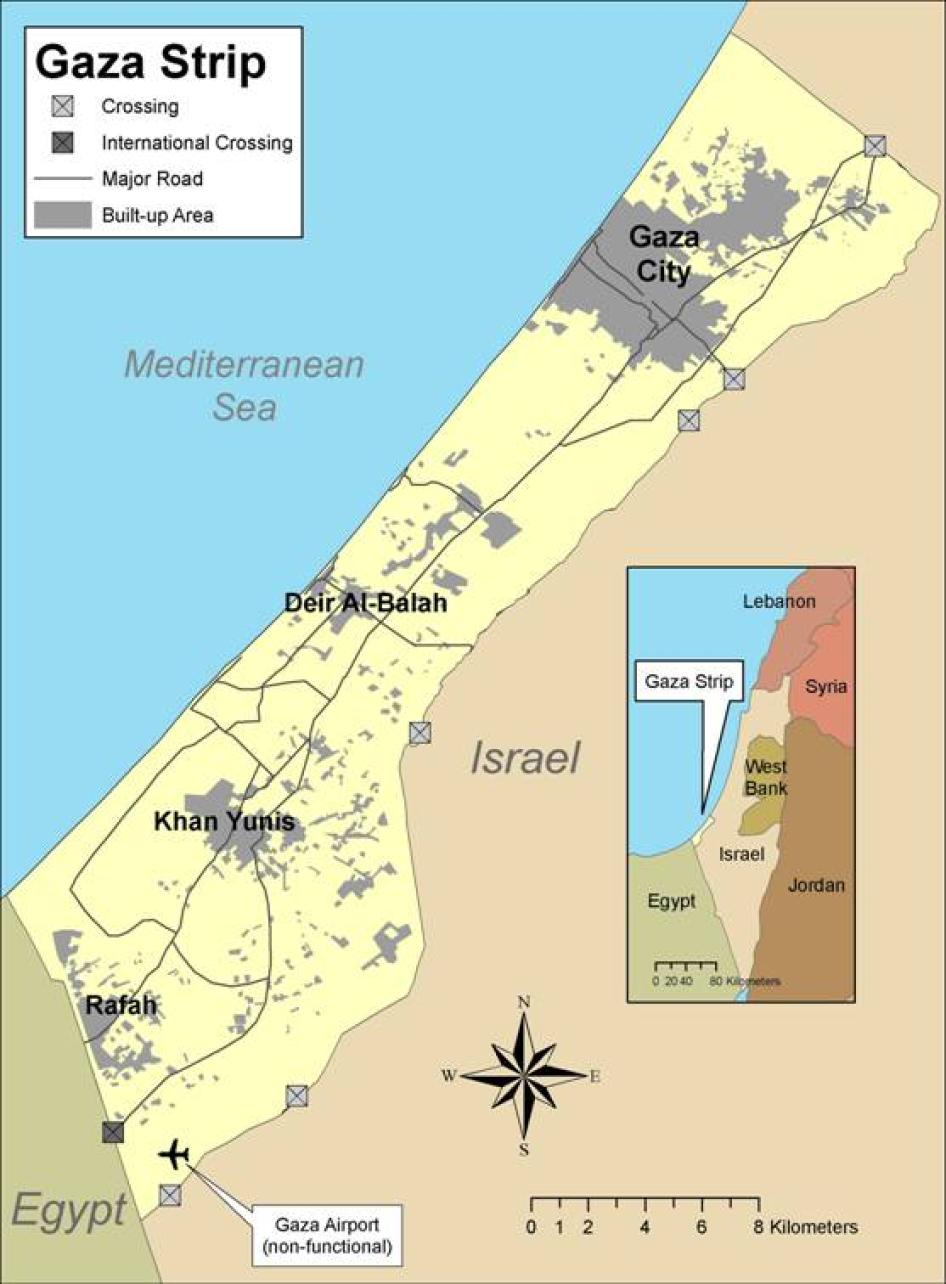
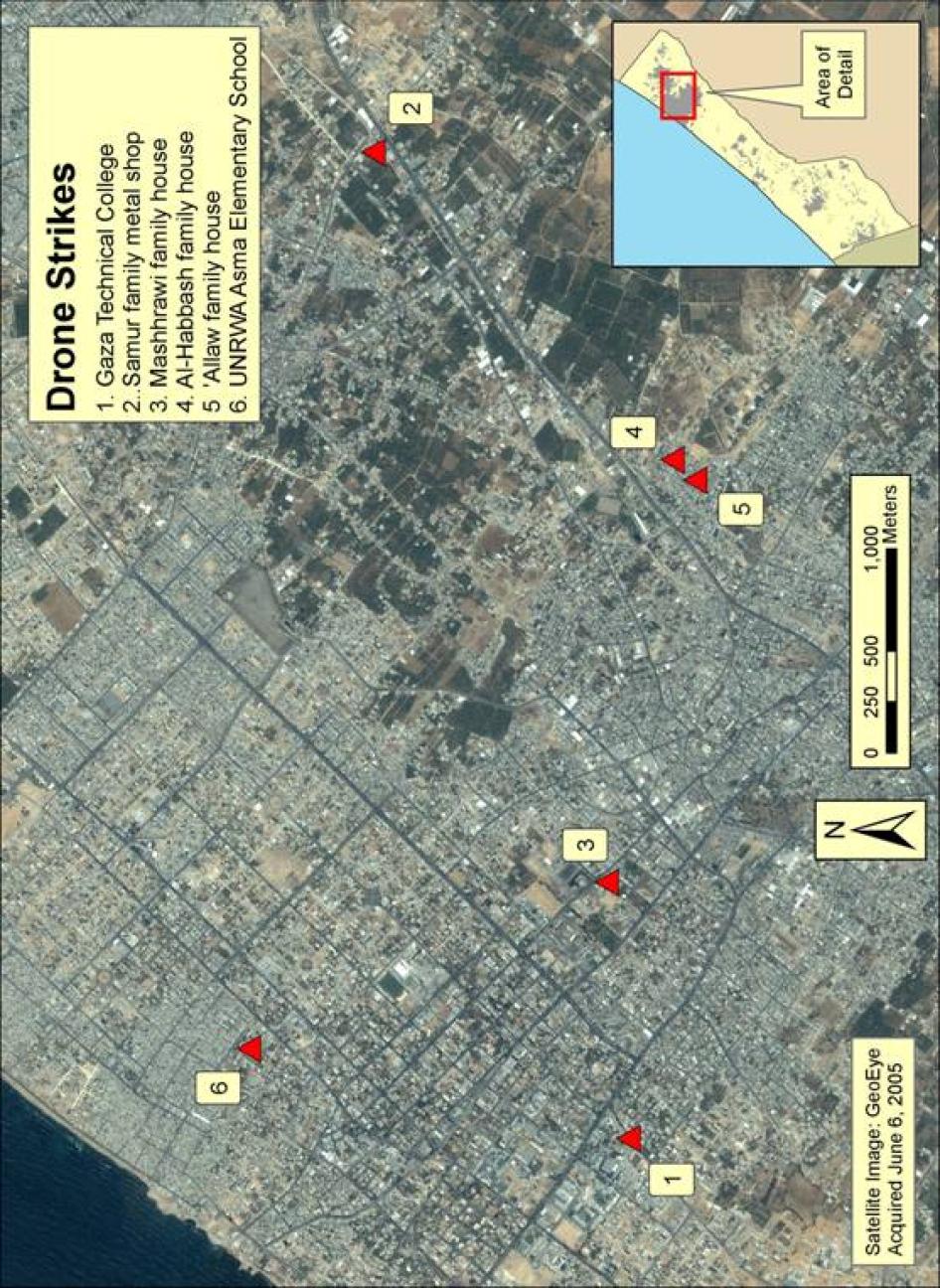
© 2009 Human Rights Watch
I. Overview
During the recent fighting in Gaza from December 27, 2008, to January 18, 2009, the Israel Defense Forces (IDF) killed dozens of Palestinian civilians with one of the most precise weapons in its arsenal: missiles launched from an unmanned combat aerial vehicle (UCAV)-the latter more commonly known as a drone. Alongside weapons that affect large areas, such as high explosive artillery and artillery-fired white phosphorous, Israeli forces in Gaza used drones in precisely targeted attacks that killed and wounded civilians.
Military experts around the world have extolled drone-launched missiles as weapons with pinpoint accuracy, which can minimize civilian casualties. Their use is rapidly expanding, for example by the United States in Afghanistan and Pakistan, in part because the use of drones places no friendly military personnel directly at risk.
But as Human Rights Watch's investigation in Gaza demonstrates, drones, much like sniper rifles, are only as good at sparing civilians as the care taken by the people who operate them. The accuracy and concentrated blast radius of the missile can reduce civilian casualties, but in Gaza, Israel's targeting choices led to the loss of many civilian lives.
The total number of Gazan civilians killed by drone-launched missiles remains unclear. Israeli and Palestinian human rights organizations-B'Tselem, the Palestinian Centre for Human Rights, and the Al-Mezan Center for Human Rights-together reported 42 drone attacks that killed 87 civilians.[1] Amnesty International told the media that it documented 48 civilian deaths from drones, and this does not represent the full number.[2]
This report focuses on six Israeli drone strikes, which in total killed 29 civilians, eight of them children. It is based on interviews with victims and witnesses, investigations of the attack sites, IDF and media reports on the fighting, and in one case IDF video footage of the attack. Human Rights Watch determined that in all of these attacks the Israeli military directed their strikes on individuals who were all found to be civilians. In none of the cases did Human Rights Watch find evidence that Palestinian fighters were present in the immediate area of the attack at the time. None of the targets were moving quickly or leaving the area, so the drone operators would have had time to determine whether they were observing civilians or combatants, and to hold fire if they were not able to tell the difference.
In the incidents investigated by Human Rights Watch, Israeli forces either failed to take all feasible precautions to verify that the targets were combatants, apparently setting an unacceptably low threshold for conducting attacks, or they failed to distinguish between combatants and civilians and to target only the former. As a result, these attacks violated international humanitarian law (the laws of war).
The technological capabilities of drones and drone-launched missiles make the violations even more egregious. Israeli drones are equipped with high-resolution cameras and advanced sensors, which allow drone operators to view objects on the ground in detail during both day and night. One Israeli drone operator who flew missions in Gaza during the recent fighting told an Israeli military journal that he was able to discern clothing colors, a large radio, and a weapon. In addition, the missile launched from a drone carries its own cameras that allow the operator to observe the target from the moment of firing to impact. If doubts arise about a target after a missile has been launched, the drone operator can remotely divert the weapon elsewhere. With these advanced visual capabilities, drone operators who exercised the proper degree of care should have been able to tell the difference between legitimate targets and civilians.
Typically in modern militaries, drones have at least one ground-based pilot to fly the aircraft and an operator who uses the sensors to scan for targets. Military lawyers may be consulted to help determine whether targets are legitimate. Because of the slow speed of the drones and their long flight time (up to 24 hours), they can loiter over the battlefield for hours at a time with no danger to the pilot or operator, allowing for targeting decisions based more on observation from a distance. Although Human Rights Watch does not know the IDF's exact procedures, these are generally accepted best practices.
Despite these technological capabilities, the six cases documented here indicate that the IDF repeatedly failed to verify that its targets constituted military objectives. Although drone-launched missiles are known to have killed Palestinian fighters in other attacks (sometimes along with high numbers of civilians), the attacks investigated here were all far from areas where fighting between Israeli and Palestinian forces was taking place, and multiple witnesses said that no Palestinian fighters were in the vicinity at the time.[3] As such, the drone operator would have had time to assess the legitimacy of the target without placing Israeli soldiers on the ground at greater risk.
In one daytime attack on December 27, the first day of the Israeli offensive, an IDF drone-launched missile hit a group of students who were waiting for a bus in central Gaza City, across the street from the headquarters of the United Nations Relief and Works Agency for Palestine Refugees in the Near East (UNRWA), killing nine students, two of them women, and three other civilians. The IDF has failed to explain why it targeted the group on a crowded central street with no known military activity in the area at the time.
Two days later, a drone-launched missile struck a truck outside a metal shop east of Jabalya refugee camp in northern Gaza, killing nine civilians, three of them children. The IDF promptly distributed video footage of the attack (probably taken by a camera on the drone) and claimed that the men were loading Grad rockets onto the truck. The IDF video raises doubts that the target constituted a military objective-doubts that should have guided the drone operator to hold fire. Specifically, the video shows men loading onto the open-backed truck cylindrical objects that were significantly shorter than Grad rockets (which, at nearly three meters, are taller than a man and longer than the width of the Mercedes-Benz 410 truck onto which the cylinders were loaded crossways). On-site research revealed that the objects were actually oxygen tanks. The IDF eventually conceded this fact, but said that four of the eight men killed were "Hamas operatives"-a claim not borne out by the evidence.
In another case, on the night of January 5, a drone-launched missile hit the Asma elementary school in Gaza City run by the UN, which at the time was housing about 400 displaced persons. The missile killed three young men from the Sultan family while they were using the school's bathroom, with no evidence of military activity in the area at the time. The school had lighted signs, and the UN had provided the IDF with the GPS coordinates of all its schools and facilities.
The remaining three attacks detailed in this report hit children, ranging in age from eight to sixteen, who were playing on rooftops in residential neighborhoods, killing six and wounding six. Human Rights Watch found no evidence that the children were participating in hostilities, such as by acting as artillery spotters for Hamas, relaying IDF troop locations for attack, or trying to launch a rocket from the roof. Instead, these three attacks all took place in the first days of the IDF's ground operation, before Israeli forces approached Gaza City's central neighborhoods, so spotters to direct fire would not have been required. Human Rights Watch also found no evidence of militant activity in these areas, including rooftop rocket fire, at the time of the attacks. Again, the visual capabilities of the drones and missiles should have made clear the absence of weapons on the roofs and that the targets were playing children. Absent a legitimate military target, the drone operator should not have fired.
Human Rights Watch inspected all the attack sites covered in this report. In all cases, the impact mark of the missile and the fragmentation pattern were consistent with the Israeli-produced Spike missile, which has a concentrated blast and spreads tiny cube-shaped fragments up to 20 meters away.[4] Other commonly used weapons, such as anti-tank Hellfire and TOW missiles fired from attack helicopters, do not leave such a pattern. Human Rights Watch also found circuit boards and other missile parts consistent with the Spike. Some of the wounded civilians showed impact marks from the cubic fragments, and in one case x-rays showed metal cubes lodged in the leg and chest of a victim. Victims and witnesses also spoke of hearing the distinctive buzz of the overhead drone-what Palestinians call a zannana-prior to an attack.
All six of the attacks happened in densely populated areas, including in central Gaza City. Five of the attacks took place during the day, when civilians were shopping, returning from school, or engaged in other ordinary activities, which they most likely would not have done had Palestinian fighters been in the area at the time, either shooting rockets into Israel or engaging Israeli forces.
This report does not examine the drone attack with the highest number of casualties during the Israeli offensive: the December 27 strike on the police headquarters in Gaza City that killed about 40 people, including several dozen police cadets at their graduation ceremony. Human Rights Watch's limited time in Gaza prevented a full investigation to determine how many of those killed were policemen performing civil functions, and therefore not valid military targets, and how many were involved in military operations, or whether the police academy served a military function that rendered it a legitimate military target.[5]
On March 12, 2009, Human Rights Watch submitted to the IDF a list of detailed questions about Israel's use of drones and drone-launched missiles, including specific questions about the cases in this report. As of June 3, the IDF had not replied. The questions to the IDF are provided as an appendix to the report. The IDF also repeatedly declined to meet Human Rights Watch to discuss the cases in this report, as well as other matters related to the conduct of both Israeli and Hamas forces during the offensive, which the IDF named Operation Cast Lead.
In public statements, Israeli officials have countered allegations of unlawful civilian deaths by claiming that the IDF had warned Gaza's civilian population in advance by dropping leaflets, making telephone calls, and breaking into local radio and television broadcasts.[6] International humanitarian law encourages armed forces to provide advance warnings of an attack when circumstances permit, but the warnings must be "effective." In Gaza, the IDF's warnings were too vague, often addressed generally to the "inhabitants of the area." Leaflets were dropped from high altitudes and scattered over wide areas; many Gaza residents told Human Rights Watch that they disregarded the leaflets because they were so common and widely dispersed. In addition, the warnings often did not instruct civilians on what steps to take or where to find safety after fleeing their homes. With the beginning of the ground offensive on January 3, the IDF warned residents to "move to city centers," but then some city centers, such as in Gaza City, Beit Layiha, and Jabalya, came under attack, as two of the incidents documented in this report show. Ultimately, Gaza residents had no safe place to flee, given the closure of Gaza's borders, enforced mostly by Israel but also by Egypt in the south. Finally, even after warnings have been issued, international humanitarian law requires attacking forces to take all feasible precautions to avoid loss of civilian life and property. Just because an attacking force has issued an effective warning does not mean it can disregard its obligations to civilians; attacking forces may not assume that all persons remaining in an area after a warning has been issued are legitimate targets for attack.
The Israeli government is obligated under international law to investigate serious violations of the laws of war. Individuals who have committed violations of the laws of war with criminal intent-that is, intentionally or recklessly-are responsible for war crimes. The laws of war governing unmanned aerial drones such as those used by the IDF treat them the same as other weapons systems. Military or civilian personnel found responsible for committing or ordering unlawful drone attacks should be disciplined or prosecuted as appropriate.
In addition, given the repeated civilian casualties from drone-launched missiles during the recent fighting, the IDF should conduct a more general investigation into the weapon's use and take all necessary measures to ensure that factors specifically related to the drones or missiles deployed are not contributing to civilian casualties or laws-of-war violations. Taking into account the weapon's highly discriminate nature, the inquiry should investigate every mission involving drone-launched missiles in which civilians were wounded or killed, including a review and analysis of the gun-camera video of each attack.
So far, the IDF has shown no willingness to examine objectively its actions during Operation Cast Lead. On April 22, it released the results of an internal investigation, which concluded that IDF forces "operated in accordance with international law" throughout the fighting and that "a very small number" of "unavoidable" incidents occurred due to "intelligence or operational errors."
Because of the repeated failure by Israel and Hamas to investigate impartially alleged violations of the laws of war by their own forces, Human Rights Watch called for an independent and impartial international investigation into violations by both sides during the fighting in Gaza and southern Israel. On January 12, the United Nations Human Rights Council voted to investigate violations only by Israel against Palestinians-a decision Human Rights Watch criticized as one-sided.[7] But subsequent negotiations created a highly respected investigation team with a balanced mandate "to investigate all violations of International Human Rights Law and International Humanitarian Law that might have been committed at any time in the context of the military operations that were conducted in Gaza during the period 27 December 2008 to 18 January 2009, whether before, during or after."[8] The investigation is headed by Justice Richard Goldstone from South Africa, former chief prosecutor of the international war crimes tribunals for the former Yugoslavia and Rwanda. Israel has said that it will not cooperate with Justice Goldstone's investigation because it considers the Human Rights Council biased against Israel. Hamas has said that it will cooperate.
Both Israel and Hamas should cooperate fully with the Goldstone commission. Regarding drone-launched missiles, Israel should provide the video footage and other documentation of its attacks in which civilians were wounded or died. Both the Israeli-manufactured Hermes and Heron drones that Israel used in Gaza have devices that record everything viewed by the drone operator and would shed light on IDF compliance with the laws of war in the attacks that resulted in civilian deaths.
Methodology
During major military operations in Gaza from December 27, 2008, to January 18, 2009, Israel banned access to Gaza for all media and human rights monitors. Access via Rafah on the Egypt-Gaza border was also blocked by Egypt. Unable to enter Gaza, Human Rights Watch researchers spent time on the Israeli side of the 1948 armistice line with northern Gaza. On January 9, 10, and 15, researchers observed IDF drones deployed over northern Gaza.
Human Rights Watch researchers entered Gaza via the Rafah border crossing on January 21 and spent the next 14 days investigating the conduct of the conflict by both sides, and the resultant harm to civilians and civilian objects. During this period, in addition to other research, they documented the six separate missile strikes by IDF drones reported here, which altogether killed 29 civilians. Human Rights Watch researchers conducted 25 interviews with surviving victims and witnesses of these attacks, as well as with doctors who treated victims.
Whenever possible, Human Rights Watch interviewed Palestinian victims and witnesses privately and individually, collecting detailed information to corroborate their claims. Information was cross-checked with accounts of the fighting made available by the IDF or reported in the media. Names of victims were also checked against a published list of deaths from Hamas's Al-Qassam Brigades to help determine whether any of those killed were combatants rather than civilians.[9]
II. What are Drones?
Drones, or Unmanned Aerial Vehicles (UAVs) in military parlance, are unpiloted aircraft controlled remotely. Equipped with sophisticated sensors, they are used for reconnaissance and attack. When armed, drones are referred to as Unmanned Combat Aerial Vehicles (UCAVs).
Drones provide numerous benefits to militaries over manned aircraft. Most obviously, UAVs do not place a pilot in danger. In addition, drones have much longer flying times, or "loiter" time, than manned aircraft; some are able to operate continuously for more than 24 hours. This loiter time provides militaries with "persistent look"-the ability to observe the battlefield continuously. Such extended observation allows a military to distinguish better between the movements and patterns of civilians versus combatants.
Due to drones' small size relative to manned aircraft, and therefore limited payload, they typically carry small missiles.[10] These munitions have smaller warheads with limited collateral effects. For example, where a 500-pound bomb would destroy a house, a drone-launched missile can limit destruction to a specific room. Recent advances in drone-launched missiles have reduced the damage further by replacing the missile's anti-tank warhead with a fragmentation sleeve meant to destroy targets in the open, such as personnel or soft-skinned vehicles, while limiting collateral damage. Judging from the blast patterns and missile fragments found at the six attack scenes in this report, all of the missiles had an anti-personnel fragmentation sleeve.
The drone-launched missiles detonate above the ground, which creates a narrow, relatively shallow crater from missile parts not involved in fragmentation hitting the ground. The detonation of the warhead inside the fragmentation sleeve creates an expanding sphere of fragments that fly out. The fragments are composed of tungsten, a dense inert metal, and their heavy weight and small size (3 mm cubes) create a rapid drop-off in kinetic energy that keeps the area of effect relatively small-approximately 20 meters in diameter. The hundreds of pieces of cubic tungsten fragments in the missile's fragmentation sleeve provide the killing power, literally shredding their targets while puncturing thin metal and cinder block.
Drones carry an array of sensors, often combining radars, electro-optical cameras, infrared cameras, and lasers. These advanced sensors can provide a clear image in real time of individuals on the ground, with the ability to distinguish between children and adults. According to the United States Customs and Border Protection Border Patrol, which purchased Israeli-manufactured Hermes drones in 2004, the sensors can enable a drone operator to read a license plate number and determine whether a person on the ground is armed.[11] Infrared sensors provide imaging by day and night.
One Israeli drone operator who flew missions in Gaza during the recent fighting spoke about the sensors' visual capabilities. He told the Israeli online military journal Shavuz that he was able to detect clothing colors, a large radio, and a weapon:
We identified a terrorist that looked like an Israeli soldier. Our camera enabled us to see him very clearly. He was wearing a green parka jacket and he was walking with a huge radio that looked just like an army radio. We saw that he was not wearing an army helmet and he was hunching down with a weapon, close to the wall wearing black trousers. It was very clear to us that he was not a soldier.
We saw him leaving an explosive device at a distance of 100 meters from the [Israeli] forces along with a dummy. These kinds of cases make it clear for me that I must help my friends that are fighting on the ground.[12]
Israel's primary armed drones are the Hermes, produced by the Israeli company Elbit Systems Ltd., and the Heron, produced by Israeli Aerospace Industries. The Hermes can stay aloft for up to 24 hours at altitudes of up to 18,000 feet and has an array of optical, infrared, and laser sensors that allow the operator to identify and track targets as well as to guide munitions in flight. The Hermes carries two Spike-MR (medium range) missiles, sometimes called the "Gil" in Israel, produced by the Israeli firm Rafael Advanced Defense Systems Ltd. The Heron drone, which can fly for up to 40 hours at 30,000 feet, has similar optics to the Hermes and can carry four Spike missiles.[13] In Gaza, Israel used both the Hermes and Heron drones armed with the Spike, though it may have also used other missiles.[14]
Israel's drone-launched missiles are incredibly precise. In addition to the high-resolution cameras and other sensors on the drones themselves, the missile fired from a drone has its own cameras that allow the operator to observe the target from the moment of firing. The optics on both the drone and missiles include imaging infrared cameras that allow operators to see individuals at night as well as during the day. With these visual capabilities, drone operators should have been able to tell the difference between fighters and others directly participating in hostilities, who are legitimate targets, and civilians, who are immune from attack, and to hold fire if that determination could not be made. If a last-second doubt arises about a target, the drone operator can use the missile's remote guidance system to divert the fired missile, steering the missile away from the target with a joystick.
Circuit boards and missile pieces found by Human Rights Watch at attack sites were consistent with a small missile such as the Spike. The missile pieces were inconsistent with either the anti-tank versions of the Hellfire or TOW missiles, both of which Israel also used during Operation Cast Lead, fired from Apache and Cobra helicopters. During the fighting, Human Rights Watch observed Israeli Apache helicopters carrying Hellfire missiles and Cobra helicopters carrying TOW missiles from the Gaza-Israel armistice line, and inside Gaza researchers found numerous Hellfire and TOW missiles and their parts, but Human Rights Watch did not observe any Israeli helicopters carrying Spike missiles. Some missile debris and missile components that Human Rights Watch found contained labels from Motorola, based in the United States, and MCB Industrie of France.
In addition, blast and fragmentation patterns at strikes investigated by Human Rights Watch strongly indicate the use of the Spike: typically a shallow crater with cubic holes peppered throughout a radius up to 20 meters and cubic tungsten fragments lodged in many of the holes. During the 2006 armed conflict in Lebanon between Israel and Hezbollah, Human Rights Watch found similar missile pieces and blast and fragmentation marks at the site of an attack on two Lebanese Red Cross ambulances, which wounded six medical workers and three patients.[15]
The fragments that Human Rights Watch found at four of the sites investigated in this report, and fragments taken by doctors from the bodies of those wounded and killed, were all tiny metal cubes, approximately 3 mm on each side. Human Rights Watch took samples of the cubes and missile parts from two of the attack sites and sent them for analysis to the Institute for Energy Technology (IFE) in Oslo, Norway. The IFE reported that the cube was a metal alloy consisting primarily of tungsten, along with traces of nickel and iron.[16] A weapons expert from the Norwegian Defence Research Establishment (Forsvarets forskningsinstitutt, FFI), Ove Dullum, also analyzed the samples and reviewed the IFE test results. He concluded, "The weapon used in the attacks was a guided anti-tank missile with sensors and other equipment to precisely hit its target, and was most likely a Spike missile."[17]
Hermes and Heron drones both have video recording devices so that everything viewed by the drone operator is recorded. As such, each and every Israeli missile strike during Operation Cast Lead would be registered on video.
III. Drone-launched Attacks on Civilians in Gaza
Human Rights Watch investigated the following six drone attacks that killed and wounded civilians: two of them on urban streets, one on a UN-run school, and three on apartment rooftops in residential neighborhoods.
Gaza Technical College, Gaza City
Around 1:30 p.m. on December 27, 2008, the first day of the IDF offensive, an IDF drone launched a missile at a group of young men and women standing across the street from the UNRWA-sponsored Gaza Technical College in downtown Gaza City [GPS 31.51162/034.44336] killing 12. Nine of the dead were college students, two of them young women; all were waiting for a UN bus to take them to their homes in Rafah and Khan Yunis in the southern Gaza strip. The three other civilians killed were bystanders. The missile struck 25 meters from UNRWA's Gaza headquarters, in the Rimal neighborhood of central Gaza City, which is frequented by UN staff and international aid workers.
According to nine witnesses interviewed by Human Rights Watch, including three international UN staff, no Palestinian fighters were active on the street or in the immediate area just prior to or at the time of the attack. Fighters from Hamas and the other Palestinian factions were rarely seen in the Rimal neighborhood where the attack took place, witnesses as well as Palestinian journalists and human rights activists based in Gaza said. This was one of the first airstrikes of Operation Cast Lead, and the street was crowded at the time of the attack as civilians went about their normal business.
To Human Rights Watch's knowledge, Israel has not commented publicly on the intended target of the strike. The IDF has also not responded to Human Rights Watch's questions about the attack (see Appendix).
Three eyewitnesses provided Human Rights Watch detailed accounts. The owner of a small grocery store directly in front of the UN bus stop and about three meters from the blast, Adib Munthir al-Rayyis, 27, was wounded in the attack. He told Human Rights Watch during an interview alone in his shop that at the time of the blast he had just entered the store from the normally busy street, closed the door behind him, and was walking to the counter when he heard and felt an explosion outside the door. He said,
I heard drones outside but didn't think anything about it. I went into my store and was thrown to the ground by an explosion. It was so sudden. I rushed outside and saw many bodies. I didn't know I was hurt until someone said I was bleeding-I had many small bloody holes in me. I went to Shifa [hospital] and the doctors say I am fine but I need surgery to remove the pieces still in me.[18]
Al-Rayyis showed Human Rights Watch an x-ray of his leg, with tiny black squares where the cubic tungsten fragments from the missile had lodged near the bone. He also has fragments embedded in his chest and torso, he said.
On January 21 Human Rights Watch inspected the impact crater in the asphalt of the missile blast, about 120 centimeters wide and 80 centimeters deep, in front of al-Rayyis's grocery store and across from the UNRWA headquarters. Cubic fragments, apparently from the Spike missile, were embedded in some of the dozens of tiny square holes in the shop door, a lamppost 5 meters away, and the UN compound wall 20 meters away.
Ibrahim Nehru al-Rayyis, age 19, a cousin of Adib Munthir al-Rayyis and a student at al-Azhar University in Gaza City, said he was in a nearby store when the missile struck. Interviewed with his father and a neighbor present in his father's shop five meters from the UN bus stop, he said that he rushed outside after hearing the explosion to find two of his brothers, Hisham, 24, and `Allam, 18, as well as his cousin 'Abdallah, 20, lying on the ground. "We heard a buzzing noise in the air before the explosion," he explained. "When I went out to see what happened, Hisham and `Allam were lying on the ground, blood gushing from their wounds."[19] According to Ibrahim, he rushed his brother 'Allam to Shifa hospital in Gaza City, but `Allam died along the way.
Human Rights Watch also interviewed Ibrahim's father, Nehru al-Rayyis, in his 50s, who was distraught when he said that he went to the scene immediately from a nearby gas station where he was working at the time and took his son Hisham to the hospital, where Hisham also died. "They called me at work to tell me that Hisham was hurt," he said. "I rushed to the scene … There were little holes everywhere in his body."[20]
Nehru al-Rayyis said that at the hospital he learned that `Allam had been brought there as well, but then heard that `Allam had also died and his body had been moved to the hospital morgue. "That's when I stumbled upon my nephew 'Abdallah, by chance," Nehru al-Rayzyis said. He explained,
His ['Abdallah's] body was on the floor outside the morgue. The freezers in the morgue were full and they had something like 150 bodies lying about. I asked for `Allam but was told that his body had already been taken away. So I decided to check on Hisham again. As I climbed the stairs to find Hisham, I passed a body being brought down on a stretcher. When I reached the next floor, someone asked me where I was going. I replied that I was looking for my son Hisham. The person said, "No, you just passed him being brought down the stairs. Look behind you." I turned and ran after the body I had just passed. I saw it was Hisham and said, "May God have mercy on him."
Human Rights Watch altogether interviewed nine witnesses to the attack, three of them in a group and the rest individually. All gave corroborative details of the attack, which lent credibility to their claims. No fighters from Hamas or other Palestinian armed groups were in the area of the Gaza Technical College at the time of the attack, they all said. An UNRWA security guard who witnessed the attack told Human Rights Watch, "There wasn't anybody else around-no police, army, or Hamas."[21]
Although Palestinian armed groups did at times fire locally made rockets into Israel from populated areas in Gaza, none of the witnesses said that rockets had been fired from the Rimal neighborhood of Gaza City at that time, or at any other time during Operation Cast Lead. The three international staff from the UN confirmed that Hamas and other groups did not operate in the area due to the prevalence of international workers and the distance of Rimal from the armistice line, making it unsuitable for Qassam or Grad rocket fire.
The nine students killed in the attack were:
- Ahmad Samih Shehadeh al-Halabi, 19, Rafah
- Baha Samir Abu Zuhri, 19, Rafah
- Adham Hamdi al-'Adani, 19, Deir al-Balah
- Yousef Taysir Sha'ban, 19, Rafah
- Shaban 'Adil Hunaif, 17, Rafah
- Ne'ma Ali al-Mughari, 18, Rafah (female)
- Wafa Marwan al-Dasuqi, 18, Khan Yunis (female)
- Mahmud Majed Abu Tyour, 18, Rafah
- Ali Marwan Abu Rabi', 18, Gaza City
The other three civilians killed were:
- Hisham Nahru Tal'at al-Rayyis, 24
- 'Allam Nahru Tal'at al-Rayyis, 18
- 'Abdallah Munzer Jawdat al-Rayyis, 20
The IDF has provided no public explanation for the attack. The best that could be said for the drone operators is that they considered the students at the bus stop to be fighters, but nothing the students are known to have been doing or carrying supports such a conclusion. Nor does other available evidence suggest that the students were combatants: the street was crowded, students were leaving the Gaza Technical College, and the area was frequented by UN staff and international aid workers. The visual capabilities of the drones should have allowed the operator to distinguish between fighters and civilians.
Samur family metal shop, Jabalya
On December 29, 2008, at approximately 6 p.m., an IDF drone launched a missile that struck a flat-bed truck outside a metal shop in Jabalya. The shop was located 130 meters south of the Salahaddin and Al-Quds Street intersection [GPS 31.3119/034.2940], also known as Zimmo junction. In a press statement later that day, the IDF claimed that it had "struck a Hamas vehicle loaded with dozens of Grad type missiles." Furthermore,"according to IDF assessments, the missiles were being transferred by Hamas to a hiding location, fearing that the previous location was being targeted by the IDF, or were on route to missile launching sites."[22]
To support its statement, the IDF released video footage of the attack, made available online, probably taken by the drone that launched the missile. It showed a group of at least one dozen men casually loading cylindrical objects crossways onto an open truck immediately before the missile struck. At least five more men are seen standing around the vehicle.[23]
The IDF video does not show any secondary explosions, which would have indicated the presence of weapons-grade explosives or propellants at the site. Nor was the destruction at the site consistent with the presence of rockets. Had the truck been carrying Grad rockets with warheads, the truck and adjacent buildings would have been destroyed. Even without warheads, the propellant in the rockets would have destroyed the truck.
Credible doubts about the attack arose on December 31, when the Israeli human rights group B'Tselem released an interview with the owner of the truck, Ahmad Samur, who said that he was transporting oxygen canisters used for welding, and not Grad rockets. According to Samur, his family was trying to move the canisters from the metal workshop he owns to protect them from looters. He denied any connection to Hamas or any other Palestinian armed group. Eight civilians died in the attack, Samur said, including three children and Samur's son 'Imad, age 32. Two others were severely wounded.[24]
B'Tselem took photos of the site that showed burned oxygen canisters on the ground. Visible in the photographs are the telltale cubic fragmentation holes in the truck, which indicate a drone-launched Spike missile. The photographs show no indication of Grads or other rockets at the site.
The IDF continued to defend the attack. "We know there were Grad rockets being loaded onto the truck at the time," an Israeli military spokesman, Capt. Elie Isaacson, told the media.[25]
Research by Human Rights Watch in Gaza after the fighting supports Ahmad Samur's account. Two members of the Samur family, interviewed separately, said that they had gone to the family's metal shop around 4 p.m. to check on the building and equipment after learning that the IDF had bombed the adjacent building, which was the home of a Hamas member. They decided to move the oxygen canisters from the shop, they said, because the rear wall had been destroyed and they feared looters.
"We went there in order to save the equipment because we were afraid that it would be stolen," said Ahmad Samur's nephew, Muhammad Sa'di Ghabayen, 18. Muhammad told Human Rights Watch that he and the other men started to load drills, oxygen canisters, and other equipment from the shop onto the truck. When he returned to the shop for another canister there was an explosion. "I saw horrible scenes. Three canisters were already on the truck and five gallons of benzene," he said. "The oxygen and the benzene burned and also burned the bodies of the dead."[26]
Basil Nabil Ghabayen, 18, told Human Rights Watch that he was in the shop getting equipment to load onto the truck when the missile hit. "I heard the sound of the drones flying overhead but I did not pay much attention to them," he said. "I went out to see what happened, I found my brother and four of my cousins and their friends burnt and lying in a pool of blood and flesh."[27]
The family showed Human Rights Watch some of the oxygen canisters that it said it had moved that day before the Israeli strike. The canisters measured 1.62 meters long-shorter than the average adult man-and 20 cm in diameter. Grad rockets are 2.87 meters long, nearly twice the length.
Jabalya is in the northern Gaza Strip, which has been the origin of many of the Palestinian rocket attacks into Israel. Whatever suspicions that raised, however, the drone's advanced imaging equipment should have enabled the drone operator to determine the nature of the objects under surveillance. The video posted online by the IDF indicates that this was the case: two of the cylindrical objects the men were loading onto the truck are visible, and both are clearly shorter than Grad rockets, which, at nearly three meters are taller than any grown man and longer than the width of the Mercedes-Benz 410 flatbed truck onto which the cylinders were being loaded crossways. The Russian-designed Grad rocket is a known weapon in the Hamas arsenal, and consequently recognizable to IDF personnel. As such, given the visual evidence, the drone operator should have considered the likelihood that these were not Grad rockets. In addition, according to the IDF video of the attack, the truck was under surveillance for more than two minutes, and possibly longer because the truck was not moving, so the operator should have had time to consult with superior officers on whether the truck could be considered a legitimate target.
Those killed in the attack were:[28]
- 'Imad Ahmad Muhammad Samur, 32
- Ashraf Sayed Khamis al-Dabbagh, 28
- Ahmad Ibrahim Kheleh, 18
- Muhammad Majid Ibrahim Ka'bar, 17
- Rami Sa'di Dib Ghabayen, 23
- Bilal Suhail Dib Ghabayen, 19 (died later from his wounds on January 2, 2009)
- Mahmud Nabil Dib Ghabayen, 13
- Wissam Akram Rabi' 'Eid, 13
- Muhammad Basil Mahmoud Madi, 17
On April 22 the IDF announced the results of its internal investigation into the conduct of its forces in Gaza, concluding that "throughout the fighting in Gaza, the IDF operated in accordance with international law."[29] The report looked at a number of cases, including the December 29, 2008 drone strike on the truck in Jabalya. The IDF admitted that its forces had not fired on Grad rockets:
The truck was targeted after the accumulation of information which indicated convincingly that it was carrying rockets between a known Hamas rocket manufacturing facility to a known rocket launching site. The attack was carried out near a known Hamas rocket manufacturing site and after a launch. It was only later discovered that the truck was carrying oxygen tanks (similar in appearance to Grad Missiles) and not rockets. The strike killed four Hamas operatives and four uninvolved civilians. It is important to note that the oxygen tanks being carried in the truck were likely to be used by Hamas for rocket manufacturing.[30]
The IDF has not elaborated on its claim that the strike killed four Hamas "operatives," or provided the names of those men. Ahmad Samur, Muhammad Sa'di Ghabayen and Basil Nabil Ghabayen all denied that any of the victims from the attack had been members of Hamas, fighters or otherwise. Human Rights Watch also inspected a list of 171 Al-Qassam Brigade members whom Hamas said were killed in December 2008 and January 2009, and found none of the victims' names, although the list may not be complete.[31]
The after-the-fact assertion that the oxygen tanks constituted a legitimate military target because they were "likely to be used by Hamas for rocket manufacturing" is contrary to the laws-of-war requirement that an object can only be subject to attack when it makes an "effective contribution to military action" and when its destruction "in the circumstances ruling at the time" offers a "definite military advantage."[32] A possible future military use of an at-worst dual-use object (moreover, a use suggested after the initial justification for the attack was debunked) fails to meet that requirement and to justify an attack; such objects are presumed to be civilian.[33]
Masharawi family house, Gaza City
On January 4, 2009, the second day of Israel's ground offensive, at around 10:30 a.m., an IDF drone launched a missile at two boys playing on the rooftop of a two-story home in downtown Gaza City [GPS 31.51243/034.45655]. According to residents, the site was at least five kilometers from any fighting at the time between the IDF and Palestinian armed groups. IDF statements and media reports also report no fighting in that area at that time; Israeli forces did not enter central Gaza City until later in the ground offensive. Because the house is surrounded by taller buildings in the center of Gaza City, it is a highly unlikely site for firing rockets, and it would be a poor location for artillery spotting or reconnaissance.
Those killed were:
- Mahmud Khaled 'Alayyan al- Masharawi, 12
- Ahmad Khader Diyab Subayh, 17
"Our neighborhood was very calm at that time," Mahmud's brother, Ashraf Mashhrawi, 30, a freelance television cameraman who runs an independent news agency, told Human Rights Watch. "The tanks were more than five kilometers away to the northeast." According to Mashhrawi, many members of his extended family had sought refuge in his home because they believed the area was relatively safe. He said that various family members had gone to the roof that morning to play, but only Mahmud and Ahmad were up there when the missile struck.[34]
Ashraf 'Issawi, a neighbor who was in the doorway of the house when the missile hit and was the first to reach the victims on the roof, told Human Rights Watch about the attack. "I had heard drones overhead and then there was an explosion and everyone was screaming," he said. "I ran up to the roof and found the boys' bodies. Ahmad's leg was next to Mahmud who was still alive."[35]
Human Rights Watch researchers examined the rooftop of the building and found small cubic fragments, circuit boards, and blast patterns that were consistent with drone-launched missiles. They also examined fragments of clothing that the family said the children were wearing at the time of the attack. The clothes were perforated with dozens of tiny holes. Photos and a video of the children taken by Ashraf 'Issawi at the time of the attack show that the bodies were also perforated with dozens of tiny square wounds.[36] The incident was filmed by Ashraf's cameraman and later used in a documentary produced by the Norwegian Broadcasting Corporation.[37]
Human Rights Watch has uncovered no evidence that the two boys on the roof were fighters or that they were otherwise directly participating in the hostilities. Given the optical capacity of the drones, the young age of the boys should have been apparent to the operator. And the location of the roof, deep in the center of Gaza City, was a poor location for engagement or artillery spotting. The absence of IDF ground forces in Gaza City as of that date, January 4, further undermines any military justifications for the attack.
Al-Habbash family house, al-Sha'f, Gaza City
On January 4, at around 3 p.m., an IDF drone launched a missile at six children playing on the roof of the al-Habbash family home in the al-Sha'f area of Gaza City [GPS 31.50928/034.47826]. The missile killed two girl cousins, ages 10 and 12, and injured three other children, two of whom lost their legs.
Those killed were:
- Shaza al-'Abd Muhammad al-Habbash, 10
- Isra Qusai Muhammad al-Habbash, 12
Those wounded were:
- Jamila al-'Abd al-Habbash, 14, legs amputated
- Mahmud 'Amr al-Habbash, 15, legs amputated
- Muhammad 'Amr al-Habbash, 16
Human Rights Watch interviewed Muhammad al-Habbash, 16, one of those injured in the attack. "We were playing as we used to do every day, running around. There were drones flying overhead," he said. "We stood near the edge of the roof looking down to the street…. I was thrown into the air and ran to the stairway amid the smoke."[38]
Muhammad al-Habbash, the father of one of the dead girls, Shaza, and a science teacher at an UNRWA school, was downstairs when the missile struck. "We keep chickens on the roof and the kids were feeding them and playing," he told Human Rights Watch. "We heard the drone above, but it was always flying around."[39]
Blast patterns on the roof of the house, perforations in the victims' clothes, and photographs of their injuries were all consistent with the cubic fragments of a drone-launched missile.
The father and two lightly wounded sons, interviewed separately, told Human Rights Watch that there was no fighting in the area at the time of the attack. "There were no Israelis in the area; it was the second day of ground fighting," Muhammad al-Habbash said. "And if there had been fighters nearby we would have left. It was a normal busy day, and if there had been fighting the children would not have been playing on the roof." Human Rights Watch inspected the roof of the al-Habbash home, and from that vantage point one has a view of the surrounding streets; the family probably would have known if Palestinian fighters were active in the area. Even if Palestinian fighters had been in the area, it remains unclear why the IDF targeted the al-Habbashs' roof, when the video surveillance on the drones should have allowed the drone operator to identify six children who were playing.
'Allaw family house, Al-Sha'f, Gaza City
On January 5, around noon, an IDF drone launched a missile at members of the 'Allaw family who were on the roof of their home [GPS 31.50828/034.47721], three blocks from the al-Habbash house, which was struck the day before. The missile killed a young boy and injured his brother and sister.
The individual killed was Mu'min Mahmoud Talal 'Allaw, 10.
Those injured were:
- Muhammad 'Allaw, 13
- Iman 'Allaw, 8.
Human Rights Watch separately interviewed three family members who were on the roof when the missile struck. Mu'min's mother Nahla 'Allaw told Human Rights Watch,
We were just sitting on the roof. It was cool and there was good weather. After five minutes I told my son I will just sit in the sun and went to the other end of the roof and sat down. Suddenly there was a powerful explosion. The roof was covered in white dust and smoke. I saw Mu'min on the bicycle. His legs were crushed, his chest had tiny small holes in it and blood poured from them. I carried him, crying. I ran to the stairway. He was breathing his last breath. I talked to him, saying, "It's alright my dear."[40]
Muhammad 'Allaw, the injured boy, told Human Rights Watch, "It [the drone] buzzed like bees around me. There was lots of smoke. There had been a drone overhead."[41]
The family knew of no Palestinian fighters nearby. If there had been any fighting in the area, they said, then they would not have been on the roof.
Human Rights Watch investigated the site of the blast and fragments from the missile. The site had the same fragmentation patterns as the other sites and the missile fragments were consistent with the other Spike attacks.
UNRWA Asma Elementary School, Gaza City
On the afternoon of January 5, 2009, the Sultan family from Beit Lahiya along with about 400 other people fled their homes due to fighting in the area and sought protection at the UNRWA Asma Elementary Co-educational "A" School in the center of Gaza City, which the UN had opened earlier that day as a shelter. The displaced families stayed in classrooms and used two bathrooms inside the main building. UNRWA officials registered 406 people in the school. According to UNRWA regulations, every individual who entered the school was subject to search, especially for weapons.[42]
The school was well marked as a UN facility. The IDF was reportedly not informed of its use as a shelter until January 6, but civilians lining up outside the school and inside the school compound would have been clearly visible by aerial surveillance.[43] According to the UN, it had also provided the IDF with the GPS coordinates of all its Gaza installations prior to the outbreak of major hostilities.[44] According to local residents and UN officials, no ground fighting took place in or near the school at any time during Operation Cast Lead; indeed, the IDF never claimed that it had deployed ground forces there.
After dinner, around 10 p.m., three young men from the al-Sultan family wanted to use the bathroom but the facilities in the school's main building were occupied, so they left the building to use the bathrooms in the courtyard. While there, a single Israeli missile directly struck the bathroom, killing all three. The hole in the bathroom wall and surrounding fragment marks, as shown by CNN and the BBC, are fully consistent with impact from a drone-launched Spike missile.
Those killed were:
- Rawhi Jamal al-Sultan, 24, unemployed
- Hussein Mahmud al-Sultan, 23, farmer
- Abed Samir al-Sultan, 19, student
Human Rights Watch separately interviewed two members of the al-Sultan family who were in the Asma school at the time of the attack. Hamada al-Sultan, an unemployed 21-year-old, interviewed in a tent in Beit Lahiya because his home was destroyed, described how his brother Abed and his two cousins were killed:
About 9:30 p.m. we were sitting in the classrooms of the Asma school without covers or mattresses because it was the first night for us there. Everyone was awake but all of us were inside the school. It was not allowed [by UN school security] for us to go outside to the yard or the bathrooms except with a pressing need.
My brother was sitting with us in our room with the cousins. After they had dinner, they went outside to the yard to go to the bathrooms because the two bathrooms inside the building were busy around the clock. I don't know if they went immediately to the bathrooms outside or they spent some time with our neighbors [who were also in the school].
When the rest of my family and I were in the classroom, suddenly we heard the sound of a very powerful explosion that seemed to be close. We thought the explosion was outside the school. We went outside from the classroom but we were all locked in the building. The guards did not allow us to go outside to the yard. The guards said that it is forbidden to go out and the hallways between the classes were overcrowded because all the families went out from the classrooms.
After nearly seven minutes we heard the sound of ambulances coming to the area, but we were shocked when we saw that the ambulances entered the school. At this point, we realized that the three guys were missing. In the beginning, we did not expect that they had been the target because, as I told you, we thought the strike was outside the school.
We searched for them [in the classrooms] inside the school but we did not find them. We thought they might have succeeded to convince the guards to let them out of the building to help. I tried to go outside but the guards prevented all of us. They told us that three people were hurt in the attack and that they were from the people who had moved into the school.
After a long argument with the guards, they let me out at 10:45 p.m. and I wanted to go to the hospital. There was no transportation at that time so I walked to Shifa hospital.In the hospital, I was told that they were dead so I went to the morgue. It was difficult for me to recognize them because they were burned and badly injured. I could identify them from parts of their clothes and one of them [Hussein] was a redhead, so I could recognize him.[45]
Recalling the moment of the attack, Hamada al-Sultan said,
We heard the sound of one explosion. It was by drones, because if it was an Apache [helicopter gunship] it would have caused wide destruction. This missile only destroyed the human beings. In the morning I saw their blood and small pieces of flesh on the walls at the entrance of the toilet rooms.
Before the attack happened, things were so quiet in the area because the incursion was far away. We were in the middle of Gaza City, we thought this is one of the safest places.
The father of Hussein al-Sultan, Mahmud al-Sultan, a 48-year-old employee of the Beit Lahiya municipality, interviewed separately, provided a similar account. He told Human Rights Watch,
At 9 p.m., we had dinner with Hussein. At nearly 10 he went downstairs, saying he had to go to the bathroom. When we were still sitting in the room, we were rocked by a big blast. We thought it had targeted a mosque that was some tens of meters away from the school. It was 10:30 when we heard the explosion. We did not think our sons were hit.
About 10 minutes later, we heard the sirens of the ambulances and I saw them from the window entering the school. I realized the strike was inside the school so I took all the children to the corridors to protect them in case more rockets fell.
I looked for my sons. I found Ashraf and Anis with me. I asked them, "Where is your brother Hussein?" They said he might be on another floor. We did not expect that they had been hit because we thought they had returned from the bathroom a half-hour before.
I asked them to search for Hussein and I was very annoyed and worried. In the meantime, some old men from my family came to my room and when I saw them I was sure that Hussein was harmed. Instead of relieving me, they were crying. Among them were the fathers of Hussein's two cousins.
We were not allowed to go outside. But the next day, at 8:30 a.m., we went to the hospital and took them for burial.
The situation was normal when the attack happened. In the silence of the night, we could hear the sound of firing and shootings but it was so far away.
I saw their blood on the external wall of the bathrooms. The missile fell on the gate of the toilet complex, and spread shrapnel on the ground and the wall, small circles of holes.[46]
Human Rights Watch saw two videos of the bathroom wall that the missile hit, taken shortly after the attack, one from CNN and the other from the BBC.[47] Both videos show a hole approximately one meter in diameter and fragmentation patterns on the nearby walls that are consistent with the impact marks of a Spike missile.
The BBC video includes an interview with another witness, presented as Tamir, whose short statement is consistent with the accounts of Hamada and Mahmud al-Sultan. "We were in room number six and we were surprised that three young men from my cousins went to the toilet and the drone hit them, thinking they were fighters, when in fact they were not," he told the journalist. "As you see, the rocket landed here and one of them was here ... you see his blood here and the shoes."[48]
The United Nations promptly condemned the attack, stressing that the IDF knew the location of the Asma school. "Well before the current fighting, the UN had given to the Israeli authorities the GPS co-ordinates of all its installations in Gaza, including the UNRWA school which was struck," said Maxwell Gaylard, head of the UN's Office for the Coordination of Humanitarian Affairs (OCHA) for the Occupied Palestinian Territories. "These tragic incidents need to be investigated, and if international humanitarian law has been contravened, those responsible must be held accountable."[49]
UNRWA Gaza Director John Ging, expressing concern that "[t]here's no place in Gaza safe for the ordinary people here, and they are terrorized by the fact that they can be next," told the BBC that, in addition to the UN having given the IDF the GPS coordinates of all its Gaza facilities, the Asma school was clearly marked with UN insignia, flags, and lights shining on the flags at night.[50]
In February 2009, the UN secretary-general appointed a Board of Inquiry to look at attacks during Operation Cast Lead on UN facilities and personnel. The Board looked at nine incidents, including the January 5 attack on the Asma school. According to a summary of the Board's report, released by the secretary-general on May 4, an UNRWA guard at the school had let the three young men go outside to the bathroom just after 11 p.m. At approximately 11:15, the missile struck within the school compound near the bathroom, killing the three men and damaging the school premises. The UN Board considered whether the men might have been involved in military activity and concluded that "it is more probable that they were going out to use the toilets in the school compound in the normal course, and were not preparing to engage in military activity." The Board noted that no weapons or ammunition were found in the school and that "it was difficult to accept that a weapon was smuggled into the compound before the incident and out of the compound afterwards."[51]
It is possible that before or after using the bathroom the three young men became subject to attack because they took actions that indicated to the drone operator that they were directly participating in the hostilities. Human Rights Watch uncovered no evidence to support such a conclusion. The IDF has not made such a claim or provided any evidence to that effect.
IV. International Legal Standards
The armed conflict between Israel and Hamas from December 27, 2008, to January 18, 2009, was regulated by international humanitarian law (the laws of war). International humanitarian law imposes upon warring parties legal obligations to reduce unnecessary suffering and to protect civilians and other non-combatants. It is applicable to all situations of armed conflict, without regard to whether the conflict itself is legal or illegal under international law (i.e., whether a given party is an aggressor or a defender), and whether those fighting are regular armies or non-state armed groups. Individuals who willfully commit serious violations of international humanitarian law can be prosecuted for war crimes before national or international courts.[52]
The fundamental tenets of international humanitarian law are "civilian immunity" and "distinction." Parties to a conflict are required to distinguish at all times between combatants and civilians, and to direct attacks only against combatants and other military objectives. Deliberate attacks on civilians and civilian objects are strictly prohibited.
Military objectives include persons taking a direct part in hostilities, and "those objects which by their nature, location, or purpose make an effective contribution to military action and whose total or partial destruction, capture or neutralization, in the circumstances ruling at the time, offers a definite military advantage."[53]
Civilians are protected from attack unless and for such time as they take a direct or active part in the hostilities. For example, civilians firing weapons or loading ammunition during a firefight, or actively serving as spotters for artillery, may be attacked. However, civilians who for example merely observe belligerent forces or who remain in a combat zone are not lawful targets of attack.
In the conduct of military operations, warring parties must take constant care to spare the civilian population and civilian objects from the effects of hostilities, and are required to take precautionary measures with a view to avoiding, and in any event minimizing, incidental loss of civilian life, injury to civilians, and damage to civilian objects. These precautions include:
- Doing everything feasible to verify that the objects to be attacked are military objectives and not civilians or civilian objects.[54]
- Taking all feasible precautions in the choice of means and methods of warfare to minimize loss of civilian life.[55]
- Doing everything feasible to assess whether the attack will cause loss of civilians and civilian objects disproportionate to the direct and concrete military advantage anticipated.[56]
- Doing everything feasible to cancel or suspend an attack if it becomes apparent that a target is not a military objective or would result in disproportionate civilian loss.[57]
- When circumstances permit, giving effective warning of attacks that may affect the civilian population.[58]
International humanitarian law does not prohibit fighting in urban or residential areas, although the presence of civilians places greater obligations on warring parties to take steps to minimize harm to civilians. These include: avoiding locating military objectives within or near densely populated areas; endeavoring to remove the civilian population from the vicinity of military objectives; and not deliberately seeking to prevent attacks on one's forces by mingling with civilians or using them as "human shields."[59]
Individuals who plan, order, or commit deliberate attacks on civilians, or attacks that willfully – that is, deliberately or recklessly -- fail to discriminate between combatants and civilians, are responsible for war crimes. Israel, like all parties to an armed conflict, is obligated under international law to investigate alleged war crimes, and prosecute those responsible.[60]
Unmanned aerial drones, such as those used by the IDF, are covered by the same rules grounded in the laws of war as other weapons systems. Personnel who operate drones are no less legally responsible for the use of drones in combat than are other soldiers operating other weapons and weapons systems.
V. Recommendations
To the Government of Israel
Appoint an independent board of inquiry, with military and civilian participants, to examine the use of unmanned combat aerial vehicles (UCAVs, or drones) during the fighting in Gaza in December 2008 and January 2009. The commission should investigate missions involving drone-launched missiles that resulted in civilian injuries or deaths, including a review and analysis of the gun-camera videos of those attacks. The commission should recommend measures to minimize civilian casualties by armed drones in accordance with international humanitarian law.
As part of a broader inquiry into the conduct of IDF forces during the conflict, appoint an independent board of inquiry to investigate allegations of serious violations of international humanitarian law by Israeli forces in Gaza, including the alleged use of drones to target civilians. The investigation's findings should be made public and should include recommendations for disciplinary measures or criminal prosecutions, as appropriate.
Make public the gun-camera video of all drone attacks documented in this report to clarify IDF targeting choices in these cases involving civilian deaths.
Fully cooperate with the commission of inquiry appointed by the United Nations Human Rights Council and headed by Justice Richard Goldstone, including by providing the gun-camera video of drone-launched missile attacks in which civilians were wounded or killed.
Acknowledgments
This report was researched and written by Marc Garlasco, senior military analyst in the Emergencies Program of Human Rights Watch, Fred Abrahams, senior researcher in the Emergencies Program, Bill van Esveld, researcher in the Middle East and North Africa Division, Fares Akram, research consultant, and Darryl Li, consultant. It was edited by Joe Stork, deputy director of the Middle East and North Africa Division, James Ross, legal and policy director, and Ian Gorvin, senior program officer. Matthew McKinzie created the maps and satellite imagery graphics and Digital Globe provided the satellite images.
Human Rights Watch thanks all the victims and witnesses who provided information for the report. Thanks also to the Palestinian and Israeli human rights organizations that provided assistance, in particular the Al-Mezan Center for Human Rights, Breaking the Silence, B'Tselem, the Palestinian Centre for Human Rights, and Physicians for Human Rights-Israel.
Human Rights Watch also thanks the Norwegian Broadcasting Corporation for arranging the testing of samples taken by Human Rights Watch in Gaza, as well as the Institute for Energy Technology (IFE) in Oslo, Norway, which performed the tests, and Ove Dullum of the Norwegian Defence Research Establishment (FFI).
Appendix: Human Rights Watch Letter to the Israel Defense Forces
IDF Spokesperson Unit International Organization Desk Phone: 03 569 1842 Fax: 03 569 3971
March 12, 2009
Dear General Benayahu,
Human Rights Watch is very hopeful that it will be possible to meet with the IDF legal department on March 25, as requested in our letter sent earlier today.
In addition, we would very much appreciate it if your office could provide us with responses to the questions listed below, which relate to the IDF's use of UCAVs (unmanned combat aerial vehicles or drones) during "Operation Cast Lead."
We would appreciate it very much if you could provide us with a reply by March 30, 2009.
For what purposes did the IDF employ UCAVs during Operation Cast Lead?
What UCAVs (unmanned combat aerial vehicles) did Israel use in Gaza during the conflict? What other UAVs were used for reconnaissance or other purposes?
What is the standard armament of IDF UCAVs? Was this the armament deployed during Operation Cast Lead?
How precise are the electro-optical sensors on IDF UAVs or other ISAR (intelligence surveillance and reconnaissance) platforms?
At what NIIRS (National Image Interpretability Rating Scales) do the sensors on IDF UAVs provide images?
Did the IDF perform a collateral damage estimate for attacks involving UCAVs?
Did members of the JAG corps participate in UCAV attack evaluations?
Are IDF UCAV operators rated pilots?
Could you please provide an overall figure for the number of drone attacks during Operation Cast Lead? Could you also please share with us the casualty rates resulting from those attacks?
What was the military objective of the drone missile attack at about 1:30 p.m. in the afternoon of December 27, the first day of the IDF offensive, that struck a group of young men standing near the entrance of the Gaza Technical College [GPS 31.51162/034.44336]?
What was the military objective of the drone missile attack at around 4:30 p.m. on December 29, 2008 on Zimmo Street east of Jabalya town, striking a truck owned by the Sammour family? The IDF subsequently released a video of this attack, viewable at http://www.youtube.com/watch?v=qG0CzM_Frvc&feature=channel_page
What was the military objective of the drone missile attack at around 10:30 a.m. on January 4, 2009, that struck the rooftop of the Mashhrawi family home in Gaza City [GPS 31.51243/034.45655]?
What was the military objective of the drone missile attack at around 3 p.m. on January 4, 2009 that struck the roof of the Habbash family home in the Sha'f neighborhood of Gaza City [GPS 31.50928/034.47826]?
What was the military objective of the drone missile attack at around noon on January 5, 2009 that struck the roof of the `Allaw family home, also in the Sha'f neighborhood of Gaza City [GPS 31.50828/034.47721]?
What was the military objective of the drone missile attack at around 2:15 p.m. on January 9, 2009 that struck persons in the street near the al-`Amda Restaurant in Khan Tunis?
Could you please provide us with the opportunity to view video recordings of IDF drone attacks on Gaza City on December 27, 2008, January 4, 2009, January 5, 2009, and January 9, 2009?
Thank you very much for your response to these questions.
Sincerely,
Joe Stork
Deputy Director, Middle East and North Africa division
[1]See the websites of B'Tselem (http://www.btselem.org/English/), the Palestinian Centre for Human Rights (http://www.pchrgaza.org/), and Al-Mezan Center for Human Rights (http://www.mezan.org/en/).
[2]Amnesty International was cited in a video produced by the Guardian. See "Cut to Pieces: the Family Drinking Tea in a Compound," http://www.guardian.co.uk/world/series/gaza-war-crimes-investigation (accessed April 26, 2009). Amnesty International also published a blog entry on Israel's use of drone-launched missiles. See Amnesty International Livewire, "Faulty Intelligence, Wanton Recklessness, or a Combination of the Two," February 1, 2009, http://livewire.amnesty.org/2009/02/02/faulty-intelligence-wanton-recklessness-or-a-combination-of-the-two/ (accessed April 29, 2009). Amnesty International subsequently sent Human Rights Watch the names of 58 civilians whom it believes had been killed by drones.
[3] In one case researched by Human Rights Watch, a drone-launched missile hit the Ibrahim al-Maqadema Mosque in Jabalya during afternoon prayer on January 3, killing two members of Hamas's armed wing and 13 civilians, four of them children. At least 25 civilians were wounded.
[4] The IDF possibly used the Nimrod missile or AGM-114K2A "Hellfire 2" missile; however, unless radically modified, the Nimrod is too heavy for some of Israel's drones. Also, Human Rights Watch found no Hellfire debris at any of the sites investigated for this report.
[5] Under the laws of war, police and police stations are presumptively civilian unless the police are regular fighters or taking a direct part in the hostilities, or the police station was being used for military purposes, such as storing combat weapons. To date, Israel has not provided any evidence to justify the attack.
[6]To view and listen to the various warnings issued by the IDF, see the Israel Ministry of Foreign Affairs website, http://www.mfa.gov.il/MFA/Government/Communiques/2009/IDF_warns_Gaza_population_7-Jan-2009.htm (accessed April 6, 2009).
[7] Human Rights Watch, "UN Human Rights Council Approves Gaza Inquiry," January 13, 2009, http://www.hrw.org/en/news/2009/01/13/un-human-rights-council-approves-gaza-inquiry.
[8] United Nations Fact Finding Mission on the Gaza Conflict, "Public Advance Notice," May 25, 2009, http://www2.ohchr.org/english/bodies/hrcouncil/specialsession/9/docs/Public_Advance_Notice.pdf (accessed May 31, 2009).
[9] The list of dead from the Al-Qassam Brigades is at http://www.alqassam.ps/arabic/statistics2.php?id=2009-01 (accessed May 14, 2009).
[10]This changed in 2008 when the United States fielded the MQ-9 "Reaper" UCAV. The "Reaper" is a larger version of the Predator. It can carry GBU-12 500-pound bombs and soon will carry GBU-38 500-pound bombs.
[11]"Unmanned aerial vehicles support border security," Customs and Border Protection Today (Washington, DC), July/August 2004, http://www.cbp.gov/xp/CustomsToday/2004/Aug/other/aerial_vehicles.xml (accessed April 27, 2009).
[12] The magazine is shown and quoted in "Cut to Pieces: the Family Drinking Tea in a Compound," www.guardian.co.uk/world/series/gaza-war-crimes-investigation. The original article, published on February 4, 2009, is available at: http://www.shavuz.co.il/magazine/article.asp?artid=3365&secid=2027 (accessed April 27, 2009).
[13]Amos Harel, "IAF gets new drone for offensive operations," Haaretz (Tel Aviv), March 8, 2007, http://www.haaretz.com/hasen/spages/834542.html (accessed April 1, 2009). See also Peter la Franchi, "Israel Fields Armed UAVs in Lebanon," Flightglobal, http://www.flightglobal.com/articles/2006/08/08/208315/israel-fields-armed-uavs-in-lebanon.html (accessed April 1, 2009).
[14] Human Rights Watch e-mail from Norwegian Broadcasting Corporation quoting a Jane's Defence Weekly staffer, April 27, 2009.
[15] See Human Rights Watch, Why They Died: Civilian Casualties in Lebanon during the 2006 War, vol. 19, no. 5(E), September 2007, http://www.hrw.org/en/node/10734/section/12.
[16] Institute for Energy Technology, "Memo 20e/2009," March 30, 2009.
[17] Human Rights Watch e-mail correspondence with Ove Dullum, chief scientist, Norwegian Defence Research Establishment (FFI), March 16, 2009. FFI is subordinate to the Norwegian Ministry of Defence and is Norway's primary institution for defense-related research.
[18]Human Rights Watch interview with Adib Munthir al-Rayyis, Gaza City, January 21, 2009.
[19] Human Rights Watch interview with Ibrahim Nehru al-Rayyis, Gaza City, January 29, 2009.
[20] Human Rights Watch interview with Nehru al-Rayyis, Gaza City, January 29, 2009.
[21]Human Rights Watch interview with UNRWA security guard, name withheld on request, Gaza City, January 29, 2009.
[22] "Operation Cast Lead Continues: IAF and IN Forces Strike Hamas," Israel Defense Forces press release, December 29, 2008, http://dover.idf.il/IDF/English/News/the_Front/08/12/2901.htm (accessed April 27, 2009).
[23]In addition to being online with the press statement, the video is at "Israeli Air Force Strikes Rockets in Transit 28 Dec. 2008," IDF video, available at http://www.youtube.com/watch?v=qG0CzM_Frvc&feature=channel_page (accessed April 27, 2009).
[24] B'Tselem, "Suspicion: Bombed Truck Carried Oxygen Tanks and Not Grad Rockets," December 31, 2008, http://www.btselem.org/english/gaza_strip/20081231_army_bombs_metal_workshop_in_gaza.asp (accessed April 27, 2009).
[25]Dion Nissenbaum, "Israeli Missile Hits Target, but What Was It?" McClatchy, January 2, 2009, http://www.mcclatchydc.com/homepage/story/58901.html (accessed April 2, 2009).
[26]Human Rights Watch interview with Muhammad Sa'di Ghabayen, Gaza City, March 14, 2009.
[27] Human Rights Watch interview with Basil Nabil Ghabayen, Gaza City, March 14, 2009.
[28] Some of the ages differ slightly from the B'Tselem account.
[29]"IDF: Conclusions of Investigations into Central Claims and Issues in Operation Cast Lead," Israeli Government communique, April 22, 2009, http://www.mfa.gov.il/MFA/Terrorism-+Obstacle+to+Peace/Hamas+war+against+Israel/IDF_Conclusion_of_investigations_Operation_Cast_Lead_22-Apr-2009.htm.htm (accessed April 27, 2009).
[30] Ibid., Annex C: Claims Regarding Incidents in which Many Uninvolved Civilians Were Harmed, April 22, 2009.
[31]"Statistics of Al-Qassam Martyrs," http://www.alqassam.ps/arabic/statistics2.php?id=2009-01 (accessed April 29, 2009).
[32] See First Additional Protocol of 1977 to the Geneva Conventions of 1949 (Protocol I), 1125 U.N.T.S. 3, entered into force December 7, 1978, art. 52(2).
[33]Ibid., art. 52(3).
[34] Human Rights Watch interview with Ashraf Mashhrawi, Gaza City, January 29, 2009.
[35] Human Rights Watch interview with Ashraf `Issawi, Gaza City, January 21, 2009.
[36] Video of the incident is available from the Norwegian Broadcasting Company at http://www1.nrk.no/nett-tv/klipp/464816(accessed April 3, 2009).
[37] Ibid.
[38] Human Rights Watch interview with Mahmud al-Habbash, Gaza City, January 29, 2009.
[39]Human Rights Watch interview with Muhammad al-Habbash, Gaza City, January 29, 2009.
[40]Human Rights Watch interview with Nahla `Allaw, Gaza City, January 29, 2009.
[41] Human Rights Watch interview with Muhammad `Allaw, Gaza City, January 29, 2009.
[42]Secretary-General's Summary of the Report of the United Nations Headquarters Board of Inquiry into Certain Incidents in the Gaza Strip Between 27 December 2008 and 19 January 2009, May 4, 2009. The Board noted that some individuals were searched and others were not searched because the guards believed they were carrying little or nothing.
[43]Secretary-General's Summary of the Report of the United Nations Headquarters Board of Inquiry.
[44] "Direct Hit on UNRWA School Kills Three in Gaza," United Nations press release, January 6, 2009, http://www.un.org/unrwa/news/releases/pr-2009/jer_6jan09.html (accessed March 19, 2009).
[45]Human Rights Watch interview with Hamada al-Sultan, Beit Lahiya, March 13, 2009.
[46]Human Rights Watch interview with Mahmud al-Sultan, Beit Lahiya, March 13, 2009.
[47]"Israel: Hamas Mortars Prompted Attack Near UN School," CNN.com, January 6, 2009, http://edition.cnn.com/2009/WORLD/meast/01/06/israel.gaza/index.html#cnnSTCVideo (accessed March 16, 2009); and "Inside a Gaza Refugee Camp," BBC News Online, January 6, 2009, http://news.bbc.co.uk/2/hi/middle_east/7814412.stm (accessed March 16, 2009).
[48]"Inside a Gaza Refugee Camp" BBC News Online, http://news.bbc.co.uk/2/hi/middle_east/7814412.stm.
[49]"Statement of the UN Humanitarian Coordinator for the occupied Palestinian territory Mr. Maxwell Gaylard," United Nations news room, January 6, 2009, http://www.un.org/unrwa/news/statements/gaza_crisis/maxwell_gaza_crisis.html (accessed March 16, 2009).
[50]John Ging's interview with the BBC is available at http://www.youtube.com/watch?v=Lf6OJwqXEi4&feature=related (accessed March 16, 2009).
[51]Secretary-General's Summary of the Report of the United Nations Headquarters Board of Inquiry.
[52] See generally, the First Additional Protocol of 1977 to the Geneva Conventions of 1949 (Protocol I). Although Protocol I is not directly applicable to the fighting in Gaza, many provisions of Protocol I have been recognized by states, including Israel, to be reflective of customary international law. Thus the legal analysis applied in this report cites Protocol I as an important codification of customary law rather than as a treaty obligation. Customary humanitarian law as it relates to the fundamental principles concerning the conduct of hostilities is now recognized as largely the same whether it is applied to an international or a non-international armed conflict.
[53]Protocol I, arts. 48, 51(2), and 52(2).
[54] Ibid., art. 57(2)(a).
[55] Ibid.
[56] Ibid., art. 57(2)(a).
[57] Ibid., art. 57(2)(b).
[58]Ibid., art. 57(2)(c).
[59] Ibid., arts. 57, 58.
[60]See International Committee of the Red Cross, Customary International Humanitarian Law (Cambridge: Cambridge University Press, 2005), rule 158.