“What Did I Do Wrong?”
Abuses by Indonesian Special Forces against Papuans in Merauke
I. Summary
In recent years, the armed forces of key allies of Indonesia, including the United Kingdom, Australia, and the United States, have sought improved ties with Indonesia’s elite military special forces, Komando Pasukan Khusus, known as Kopassus. While Kopassus was once scorned by such countries because of its long history of human rights violations, it has come to be seen as an important partner on a range of issues, particularly counterterrorism. Australia has resumed regular trainings with Kopassus, and the United Kingdom plans to commence training. US military leaders, once prohibited by Congress from allowing Kopassus personnel to join certain training programs, have had increased contact with Kopassus commanders. One justification for the intensified contact is that it would contribute to the reform of Kopassus, leading to an improved human rights record. The armed forces of countries like Thailand, South Korea, Singapore, and Malaysia all have contact with Kopassus forces.
This report presents new evidence that Kopassus’ abusive activities continue with impunity. While Human Rights Watch was conducting research in the vicinity of Merauke, a town in the southeast corner of Indonesia’s Papua province, numerous residents reported Kopassus abuses. From March to May 2009, Human Rights Watch researchers conducted more than 20 interviews with victims of Kopassus abuses, their relatives, and eyewitnesses. What emerged is a picture of frequent brutality against ordinary Papuans.
Residents of the Kelapa Lima neighborhood in Merauke told us that Kopassus soldiers pick Papuans off the streets or from their homes without legal authority. The soldiers typically do not wear uniforms and have no formal role in policing, but act on their own or in response to complaints of public disturbances. Those taken back to the Kopassus barracks in town are likely to be ill-treated, including by beatings with a rubber hose or by being forced to chew very hot raw chilies. Many ethnic Papuans chew betel nut, which opens scratches in the mouth that makes chili-eating intolerable.
One former detainee of Kopassus told Human Rights Watch: “They stripped us down to just our underwear. They immediately beat us, without saying anything. They used a water hose. They beat us till we bled and had cuts. Then they asked us to go to the tennis court. They forced us to face the sun and chew chilies ... We were not allowed to spit. It was very hot.” Another victim said, “They kicked me in the chest with their boots on... an officer shouted at me, ‘You Papuans, one single Kopassus soldier can kill you like chickens.’”
The cases of abuse documented in this report do not involve politically motivated violence against suspected Papuan separatists, for which Kopassus forces have often been alleged responsible, but ordinary law and order matters, which are not in the force’s authority. Local residents say that their complaints against Kopassus soldiers go unheeded by the police. Local police have no jurisdiction over Kopassus soldiers. Local police do not refer cases to military police, being simply too afraid of retaliation to take any action. The Kopassus command structure has not made a serious effort to uphold military discipline or hold soldiers accountable for abuses.
The long history of political tensions and abuses by the Indonesian security forces in Papua have created a climate of fear in the province. The role Kopassus is playing in Merauke deepens that fear. An elderly man in Merauke told Human Rights Watch, “It happens so often, almost every week, that, finally, we consider abuse to be normal. The police are helpless. Kopassus acts like they are the policemen in Merauke.”
The cases in this report illustrate how violence thrives when a culture of impunity persists in the heart of what is supposed to be one of Indonesia’s best trained fighting units.
Detailed recommendations to the Indonesian government and concerned foreign governments are provided at the end of the report. Human Rights Watch urges the Indonesian government to conduct independent and impartial investigations into alleged human rights violations by Kopassus in Papua, including arbitrary arrest and detention, torture and other ill-treatment, and discipline or prosecute perpetrators and responsible commanding officers as appropriate.
Human Rights Watch also calls upon the United States, the United Kingdom, Australia and other concerned governments to withhold training for Kopassus personnel until serious efforts are made to investigate and hold accountable Kopassus members, regardless of rank, for past serious rights violations, including the incidents in Merauke reported here.
II. Kopassus: A History of Abuse
Komando Pasukan Khusus, or Kopassus, was formed in 1952 to fight armed insurgencies in Java,[1] and has participated in many of the country’s high-profile military campaigns, from “Confrontation” with Malaysia in the early 1960s to armed conflict and covert operations in East Timor and Aceh. There are now approximately 6,000 Kopassus soldiers. They are divided into five groups.
Group 1 and 2 are Para Commando, meaning they are trained to work in extreme conditions behind enemy lines. They are specialists in airborne operations and trained to drop by parachute. Group 3 is Sandi Yudha, especially trained and mobilized to conduct covert operations, gathering intelligence and “conditioning” or spearheading low-intensity conflict.[2] These three groups have between 1,200 and 1,500 soldiers each. Kopassus has a training facility in Batujajar, West Java. It also has the 81st Anti-Terror Unit, with two battalions, headquartered in Cijantung, Jakarta.
Kopassus is currently headed by Maj.- Gen. Pramono Edhie Wibowo, brother-in-law of President Susilo Bambang Yudhoyono and the son of the late Lt.-Gen. Sarwo Edhie Wibowo, who commanded the special forces in the 1960s[3]. Major-General Pramono officially reports to the chief of staff of the Indonesian army, Gen. Agustadi Sasongko.
Kopassus has a long record of human rights violations in its operations across Indonesia, particularly during the 1970s in East Timor, Aceh, Papua, and Jakarta. In 1974-75, Kopassus infiltrated then Portuguese Timor (now East Timor), allegedly involved in the killing of five international journalists in the border town of Balibo in October 1975. The sixth, Roger East, went to East Timor to investigate the murder and was shot to death in Dili, allegedly on the orders of a former Kopassus commander, in December 1975.[4]
In 1998, a military court found 11 Kopassus officers guilty in the kidnapping and torturing of student activists in Java. Kopassus Maj. Bambang Kristiono admitted that he and his men abducted the activists, though he denied killing them (seven of 22 remain missing to this day). He and his immediate superiors—Col. Chairawan, Maj.- Gen. Muchdi Purwopranjono, and Lt.-Gen. Prabowo Subianto—were dismissed from their posts in Kopassus as a result, but they were never tried. Muchdi later became a deputy director of Indonesia’s State Intelligence Agency (BIN). In December 2008, in a controversial decision, the South Jakarta court acquitted Muchdi of manslaughter for the 2004 murder of prominent human rights activist Munir Thalib. Prabowo is now a candidate for vice-president of Indonesia.
Kopassus has a long history in Papua, stemming back to when Papua was still under Dutch rule.[5] In 1962, Kopassus was involved in a covert operation to infiltrate Merauke, which was then under Dutch authority. Capt. Benny Moerdani led a unit that parachuted behind enemy lines into a swamp near Merauke to attack the Dutch military.[6]
After the Dutch withdrew later that year, Kopassus continued to be involved in the often bloody campaign of intimidation that ensued, culminating in the UN-sponsored “Act of Free Choice” in 1969, in which just 1,054 Papuans, hand-picked by Jakarta, voted unanimously to join Indonesia, an event viewed by many Papuans today as a fraudulent basis for Indonesian annexation of the territory. Estimates of the number of Papuans killed during the period are unknown because United Nations officials faced tight restrictions inside Papua from Indonesian commander Maj.-Gen. Sarwo Edhie Wibowo,[7]
Impunity remains a huge problem for the Indonesian military across the country and continues to mar the reputation of Kopassus in Papua. While Papuans allege widespread violations by Kopassus in remote locations, even prominent Papuans in the capital, Jayapura, have been targeted. In a notable case that many Papuans still cite, Kopassus soldiers arrested and tortured anthropologist-cum-musician Arnold Ap of Cenderawasih University in Jayapura in November 1983.[8] On April 25, 1984, after his escape from a Jayapura police station, he was killed by a gunshot to his stomach.
In November 2001, Kopassus soldiers kidnapped and killed Papuan separatist leader Theys Eluay in Jayapura. Eluay had attended a Kopassus celebration on the eve of his death. Initially, Kopassus denied involvement in the murder. But international outrage prompted the Indonesian police to investigate. In 2003, a court in Surabaya found seven Kopassus soldiers and low-level officers, including Lieutenant – Colonel Hartomo, guilty of mistreatment and battery leading to Eluay’s death, but crucially not of murder. Sentences served by the seven ranged from two to three-and-a-half years. The controversial murder also prompted then President Megawati Sukarnoputri to order Kopassus to leave Papua that year, but the army chief of staff, Gen. Ryamizard Ryacudu, hailed the convicted men as “Indonesian heroes” for the killing of a “rebel.” No further investigations have been undertaken into who ordered the killing and no senior officer has been held accountable.
In another case, on October 17, 2007, a Kopassus soldier working undercover as a driver to a local Papuan government official beat Charles Tafor, the district head of Arso in Keerom, Papua, over a traffic incident.[9] The beating prompted Arso residents to demand the withdrawal of Kopassus from Keerom. Lt.-Col. Isak Pangemanan, the Kopassus commander in Jayapura, apologized publicly. However, there has been no public disclosure of any punishment or action taken against the Kopassus soldier responsible for the beating.
III. Kopassus Beatings and Abuses in Merauke
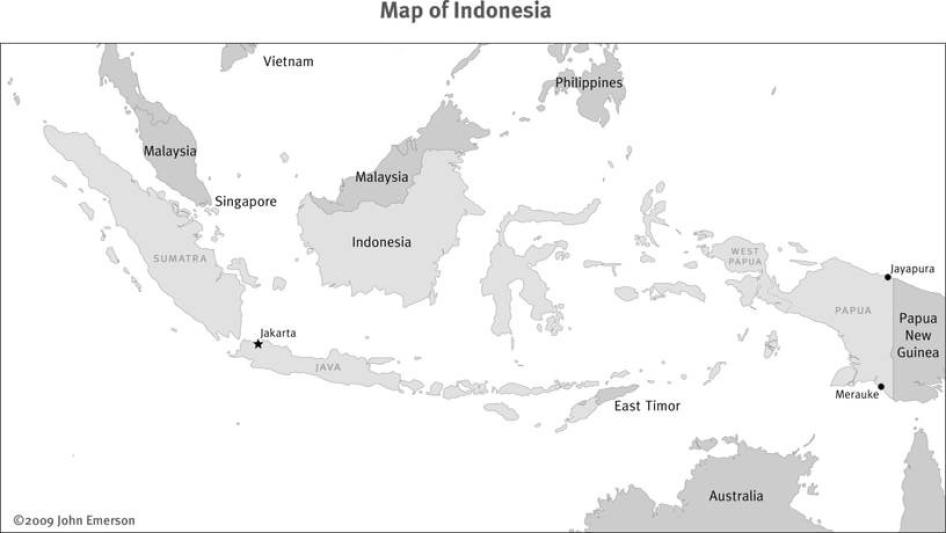
Merauke is a city on the southern coast of Papuan province, close to the border of Papua New Guinea. Many transmigrants from Java have settled there. The Kelapa Lima neighborhood of Merauke is a quiet and leafy area. Kopassus personnel have been stationed in Kelapa Lima since 2006. Local residents report a sign on the wall of the local barracks that says “Kopassus Mess.” Over time, the size of the Kopassus unit has increased. In 2006, Kopassus rented one building; at present it reportedly uses about six attached flats inside a compound.
On April 17, 2009, Indonesian Defense Minister Juwono Sudarsono told Human Rights Watch that there are only about 50 Kopassus soldiers throughout Papua and West Papua, organized in groups of 10 to 20. However, an estimated 30 Kopassus soldiers operate in Kelapa Lima, Merauke alone, and Kopassus also reportedly has a presence in Jayapura, Wamena, Asikie, Timika, Keroom, Manokwari, Nabire, Puncak Jaya, and Sorong, suggesting a much higher number of troops.
Officially Kopassus operates in Papua to monitor and to suppress the Papuan separatist movement which has been leading an armed struggle against the Indonesian government since the 1960s.[10] A Timika journalist told Human Rights Watch, “They are very mobile, moving from one regency to another. They think that they are ‘taming’ the Papuans.”[11]
The following six incidents took place between August 2007 and May 2009 in Merauke. The names of those detained and other information has been withheld to protect the security of those with whom Human Rights Watch spoke.
Case One: Benjamin[12]
On a Friday night in May 2009, Benjamin, age 23, was drinking sopi, a traditional alcoholic drink, with three friends inside his house in Kelapa Lima, when a woman started screaming. Suspecting a rape attempt, he and his friend Abner, went looking for the source of the scream.
At a street junction, they ran into five Kopassus soldiers with flashlights and a Papuan man who were also trying to find out who was screaming. Benjamin knew the Papuan man and they talked briefly before the soldiers left. About 15 minutes later, the five soldiers unexpectedly returned and stopped Benjamin and Abner.
Benjamin said the soldiers asked them to come with them. When he asked, “What did I do wrong?” one soldier slapped him on the face five times. The soldiers kept asking him about his friends and the screaming woman, about which he said he knew nothing. When Abner broke from the group and ran away, the soldiers didn’t bother to chase him.
The soldiers took Benjamin inside the Kopassus mess hall, where they slapped him, beat him on the head and chest, and kicked him in the stomach. He said the beating continued for around one hour until around 11 p.m. when a police truck arrived. The Kopassus soldiers released Benjamin into the custody of the police[13].
Case Two: Antonius
Around 9 p.m. one evening in September 2008, Antonius, 21, attended a street party in Kelapa Lima close to the Kopassus mess where he had a couple of drinks and joined in the dancing. Suddenly, a van pulled up and out came six men holding rifles, who wore black jackets and balaclavas that covered their faces. Without questioning anyone, they started beating the young men there. Many tried to run away. Antonius told Human Rights Watch:
I reached an intersection, a waterway. I fell down. They [the armed men] came and grabbed me and pulled me in through the sliding door of the van. They brought me to the [Kopassus] barracks and beat me. They put me into a room; they handcuffed my hands around my back, and asked me to kneel down on the floor. They hit me on the face. I fell down. I could not protect my head, so my head hit the floor.[14]
The soldiers hit Antonius on the face repeatedly, and beat him with a water hose while he was lying on the floor. They later asked him to sit on a chair. Every Kopassus soldier who entered the room—ultimately 12 of them—hit him. Antonius said the soldiers kicked him from night until morning. He told Human Rights Watch:
They beat me on my face repeatedly. My face was bleeding. My eyes were also swollen. Once one soldier held my chest and another one kicked my stomach. I asked them, “What did I do wrong?”[15]
Several soldiers pulled Antonius into a corner and kicked him with their boots until he was bleeding from the mouth and vomited blood. Early the next morning, the soldiers forced him to eat about 10 hot chilies. Then they took him outside into the compound and threw him into the muddy drainage pond. Then they told him to clean up the garden. He said:
I could not eat the whole day because of the chili. They beat me here on my jaw and the inside of my mouth was bleeding. For one week afterward I just ate noodle soup. I told my parents, but they could do nothing. “What can we do? Even if we want to be angry, they are Kopassus!”
It was mistreatment, they hurt me, but we are so scared of Kopassus. I did not see a doctor but I took antibiotics. I did not report it to the police or anyone else. I just told my friends, “If you are drunk don’t walk around the Kopassus mess.”[16]
Case Three: Nicolaas, Andrew and Bert[17]
At around 8 a.m. one morning in April 2008, five Kopassus soldiers surrounded the house of Nicolaas, 27. He had had a party with his friends the night before. The soldiers took Nicolaas and two of his friends, Andrew, 25, and Bert, 26, to the Kopassus mess hall. His parents watched as he was taken away, but were too scared to try to intervene. Nicolaas described to Human Rights Watch what happened at the mess:
They stripped us down to just our underwear. They immediately beat us, without saying anything. They used a water hose. They beat us till we bled and had cuts. Then they asked us to go to the tennis court. They forced us to face the sun and chew chilies... We were not allowed to spit. It was very hot. After eating the chilies, knowing that most people in Merauke are Catholics, they asked us to say “The Lord’s Prayer (Our Father in Heaven)” and “Hail Mary.” But I refused, saying that it is not a holy place, not a place to pray. My two other friends did pray. The Kopassus soldiers kicked me. They stripped Andrew totally naked. A Kopassus soldier took his picture with a cell phone camera. Many people saw us being tortured in the compound. One elderly Papuan lady cried when she saw us, helplessly, being tortured by Kopassus soldiers.[18]
Nicolaas said the mistreatment lasted about two hours. From the tennis court, the soldiers took the three men back inside the office. The soldiers asked them to take a shower and offered to treat the cuts with a lotion, but they refused. They were then sent home. Nicolaas said:
Now Papuan young men do not want to stay in the vicinity of the Kopassus mess. The soldiers like to look for drunken kids; they even come inside their own houses. Prior to Kopassus’ arrival, the Kelapa Lima neighborhood was a nice area. Now we don’t feel secure any more.[19]
Case Four: Yehezkiel
One afternoon in March 2008, Yehezkiel, 19, walked past the Kopassus mess hall while drunk. A plainclothes Kopassus soldier, whom he knew only as “Acong,” an ethnic Batak, pulled him inside the mess and started asking him questions about one of his friends.
According to Yehezkiel, when he said he did not know where his friend was, Acong began to beat him. When Yehezkiel fell to the floor unconscious, Acong threw water on him to wake him up. Yehezkiel estimates that the beating lasted more than one hour.
Some youth on the street heard Yehezkiel screaming and told his relatives, one of whom went to the Kopassus mess. Yehezkiel said he begged him, “Please help me, he [the soldier] is going to kill me.”[20]The relative persuaded the Acong to let Yehezkiel go.
Another relative told Human Rights Watch:
Yehezkiel said he was beaten all over, especially in the stomach with a water pipe this big [about 7 centimeters in diameter]. There was no bleeding, and no visible bruising, but it is hard to see as his skin is so dark. He did not want to go to the hospital. He refused, but we were worried he might have some internal bleeding. But our cousin is a doctor and he treated him at home.[21]
Case Five: Nathan and Patrick
One morning in January 2008, Nathan, 22, was taking a walk with his brother, Patrick, 24, and their friend when a soldier on a motorcycle passed by. Nathan’s friend stopped the soldier and asked for a cigarette. The two brothers kept on walking. A moment later the friend returned with the cigarette. Suddenly, two Kopassus soldiers started chasing them, shouting and firing a warning shot into the air. They all ran away. But the soldiers chased them, demanding that they stop.
Nathan and Patrick hid in a house but the Kopassus soldiers found them. According to Nathan, they beat him until he was bleeding. They brought both of them to the Kopassus mess hall. Inside, the soldiers chained Patrick’s hands with a dog chain. Nathan told Human Rights Watch:
We were ordered to put our hands behind our backs and kneel down. They began to beat us. They repeatedly beat us on the face, blood was everywhere. I do not know the reason. I assumed they didn’t like Patrick’s friend asking for a cigarette from the soldier.[22]
According to Nathan, six Kopassus soldiers beat the brothers from 8 to 9 a.m. The soldiers asked a carpenter working near the barracks to beat Nathan and Patrick, and he did so. Later the soldiers ordered the brothers to eat raw chilies and then continued to beat them. Nathan said many neighbors witnessed the beating, as they could see into the compound through an opening in the fence from the street, but they kept quiet.
The soldiers then called the Merauke police, who picked up the brothers from the mess, taking them to the Merauke police precinct. The police later released them without charge.
Case Six: Petrus
Around 4 p.m. one late afternoon in August 2007, a fight broke about among young people partying and drinking at a house in Kelapa Lima. Petrus, 41, who had been drinking nearby, went to see what was happening. When five plainclothes Kopassus soldiers arrived at the house on motorbikes, the youth ran away. According to Petrus, who was standing across the street, the soldiers approached him. He told them he was not involved in the fighting, but they handcuffed him and took him by motorbike to the Kopassus mess hall.
Inside the mess, the soldiers told Petrus to squat on the floor, hit him repeatedly with a water hose, and kicked him in the chest with their boots. Petrus told Human Rights Watch that he recognized the one who kicked him as a Kopassus officer. Another officer shouted at him: “You Papuans, one single Kopassus soldier can kill you like chickens!”[23] Petrus told Human Rights Watch:
I had my head down and I could not see, but I estimated about 10 people took part. Later I had blue bruises on my chest—it was very painful. Up till now [18 months later] I still feel pain. It is difficult for me to lift weights. I had bruises on my back—long black marks with the skin peeled off.[24]
Petrus said the beating lasted around 15 to 30 minutes, until a relative of his arrived, at which point the soldiers stopped beating him and called the police. The police took Petrus from the Kopassus mess, put him in a cell for a night, and then released him the next day without charge.
Petrus tried to report the beating to the police, but the police said it was dangerous for them to do anything and that Kopassus troops were not under their authority. Petrus asked whether he could report the case to the military police, but the police discouraged him from doing so, saying that the military police are afraid of Kopassus.
IV. Recommendations
As the cases in this report demonstrate, violations of human rights by Kopassus forces are committed not only against those labeled as Papuan “rebels” or “separatists,” but against ordinary members of the population. To our knowledge, no soldiers have been investigated or punished in any way for any of the beatings described above.
To the Indonesian Government
- Independently and impartially investigate allegations of human rights violations by Kopassus forces in Papua, including ill-treatment, torture, and arbitrary arrest and detention.
- Discipline or prosecute as appropriate perpetrators of abuses. Investigate and hold accountable superior officers for command responsibility if they knew or should have known of abuses and failed to prevent them or take action against those responsible.
- Take all necessary measures to protect victims and witnesses from retaliation by members of Kopassus or others.
- Ensure that Kopassus troops are not involved in law enforcement activities, which are the responsibility of the police. Publicly list the duties of Kopassus in Papua.
- Provide greater transparency about the number of Kopassus soldiers deployed in Papua, their location, and their responsibilities.
- End restrictions on access to Papua for independent observers, including diplomats, foreign journalists, and human rights organizations, so that they can visit Papua without need for specific permission or approval.
To the United States, United Kingdom, Australia and other concerned countries
- Withhold training for Kopassus personnel until serious efforts are made to investigate and hold accountable Kopassus members, regardless of rank, responsible for past serious rights violations, including the incidents in Merauke reported here. Indonesia values its military-to-military relationships, in particular training for its personnel, and targeted sanctions on the Indonesian military can provide important pressure to help end the climate of impunity long enjoyed by the security forces.
- Urge the Indonesian government to investigate allegations of human rights violations by Kopassus personnel in Papua and hold accountable those responsible, regardless of rank.
- Provide greater assistance to local nongovernmental organizations in Papua and Indonesia to monitor human rights abuses, provide human rights education to government agencies and civilians, and assist victims of abuses to obtain legal and medical services.
- Support comprehensive police training in Papua to build police capacity to respond effectively to criminal complaints while respecting human rights.
- Publicly press the government to end restrictions on access to Papua for independent observers, including diplomats, international journalists, and human rights organizations.
V. Acknowledgments
This report was written and edited by the Asia division, based on research conducted by the authors from March – May 2009.
James Ross, legal and policy director for Human Rights Watch, provided legal review, and Program review was done by Joseph Saunders, deputy program director of Human Rights Watch. Administrative and technical assistance was provided by Pema Abrahams and Andrea Cottom, associates in the Asia division, and Fitzroy Hepkins and Grace Choi provided production assistance for the report.
[1]Indonesian special forces have gone by different names since their establishment in 1952, from KKAD [Korps Komando Angkatan Darat or Army Commando Corps] to RPKAD [Resimen Pasukan Komando Angkatan Darat or Army Commando Force Regiment] to Kopassadha [Komando Pasukan Sandi Yudha or Secret War Commando Force] to Kopassus. To simplify, we refer to Kopassus throughout this report. Ken Conboy, Kopassus: Inside Indonesia’s Special Forces (Jakarta: Equinox Publishing, 2003). Kopassus, “Sejarah Singkat Kopassus,” http://www.kopassus.mil.id/single/home/21/Sejarah+Kopassus.html (accessed June 5, 2009).
[2]In Sanskrit, the words “sandi yudha” literally mean “secret war.” The Sandi Yudha unit was officially established “to condition” or “to spearhead” military operations. Sometimes it is also referred “to condition” a conflict. The Kopassus website describes Group 3/Sandi Yudha “… biasanya digerakkan/ditugaskan jauh sebelum pertempuran dimulai untuk merintis jalan gerakan berikutnya guna menggarap sasaran dalam rangka menciptakan dan mematangkan kondisi yang dikehendaki.” It literary means, “… usually mobilized long before a battle to prepare the next movement … and to create the expected conditions.” Kopassus website, “Penjelasan Dhuaja Grup-3 Kopassus.” http://www.kopassus.mil.id/single/home/68/Dhuaja+Grup-3+Kopassus.html (accessed June 1, 2009).
[3] Pramono became the Kopassus commander on October 30, 2008. “Brigjen TNI Pramono Edhie Wibowo Danjen Kopassus Baru,” Kopassus, October 30, 2008, http://www.kopassus.mil.id/dynamic/home/8/Berita/26/Brigjen+TNI+Pramono+Edhie+Wibowo+Danjen+Kopassus+Baru.html (accessed June 19, 2009).
[4]Jill Jollifee, Cover-up: the Inside Story of the Balibo Five (Melbourne: Scribe Publications, 2001); Tony Maniaty, Shooting Balibo: Blood and Memory in East Timor (Sydney: Penguin, 2009).
[5]The Indonesian territory of Papua occupies the western half of the island of New Guinea. Originally one province in the republic, in 2003 it was controversially divided into two new provinces. The new province of West Papua now occupies the western part of the region with a new provincial capital of Manokwari. The new province in the eastern half is still called Papua, with Jayapura still serving as the provincial capital.
[6]Benny Moerdani later became the Indonesian Armed Forces commander in 1983-1988. Julius Pour, Benny Moerdani: Profile of a Soldier Statesman (Jakarta: Yayasan Kejuangan Panglima Besar Sudirman, 1993), pp. 161-191. According to Benny Moerdani, he took the initiative to infiltrate Merauke because of the slogan, “From Sabang to Merauke” (Sabang is the western-most town in Aceh, Sumatra, while Merauke is the eastern-most town in the Indonesian archipelago). The slogan is a well known battle cry in Indonesia to unite the six thousand kilometer long archipelago. Moerdani thought that controlling Merauke would have a psychological impact on President Soekarno’s campaign to take over Papua from the Dutch. Soekarno used the phrase when calling for a military invasion of Papua.
[7]John Saltford, The United Nations and the Indonesian Takeover of West Papua, 1962-1969 (London: Routledge Curzon, 2003).
[8]Robin Osborne, Indonesia’s Secret War: The Guerilla Struggle in Irian Jaya (Sydney: Allen & Unwin, 1986) pp. 149-154. Anne Marie Feith, We don’t want bullets.... We can do this through talk: A Human Rights Response to Indonesian Rule in West Papua (Melbourne: RMIT University, School of Social Science & Planning, June 2005). Diana Glazebrook, “Teaching Performance Art is Like Sharpening the Blade of a Knife,” The Asia Pacific Journal of Anthropology, Vol. 5, No. 1, April 2004, pp. 1-14.
[9]“TNI di Perbatasan Papua Jangan Teror Warga,”Voice of Human Rights, VHR media, October 24, 2007, http://www.vhrmedia.com/vhr-news/berita,TNI-di-Perbatasan-Papua-Jangan-Teror-Warga-903.html (accessed June 19, 2009).
[10] The armed wing of the separatist movement is the Organisasi Papua Merdeka (OPM, known in English as the Free Papua Movement). The separatist insurgency in the province has resulted in a large military presence and a climate of mutual suspicion and fear. Pro-independence guerrillas have conducted repeated low-level armed attacks against Indonesian security forces, while Indonesian security forces, fearful of a repeat of the successful movement for independence in East Timor, have conducted regular sweeping operations to search for OPM guerillas or their supporters. All too often Papuans not involved in the armed insurgency are caught up in anti-separatist sweeps or arrested as trouble makers for peacefully expressing their political views, a right protected by basic international free speech guarantees. See also Human Rights Watch, Indonesia - Out of Sight: Endemic Abuse and Impunity in Papua’s Central Highlands, July 4, 2007, http://www.hrw.org/en/reports/2007/07/04/out-sight-0. Human Rights Watch, Indonesia - Protest and Punishment: Political Prisoners in Papua, February 20, 2007, http://www.hrw.org/en/reports/2007/02/20/protest-and-punishment, (accessed June 19, 2009).
[11] Human Rights Watch interview (name withheld), Timika, April 2009.
[12] Human Rights Watch separate interviews with “Benjamin” and Benjamin’s relative (name withheld), Merauke, June 2009.
[13] Police were unable to locate the screaming woman.
[14] Human Rights Watch interview with “Antonius,” Merauke, March 2009.
[15] Ibid.
[16] Ibid.
[17]Human Rights Watch joint interview with “Nicolaas” and “Andrew” Merauke, March 2009.
[18]Ibid.
[19] Ibid.
[20]Human Rights Watch interview with “Yehezkiel,” Merauke, March, 2009.
[21]Human Rights Watch interview with a relative of “Yehezkiel” (name withheld), Merauke, March 2009. Human Rights Watch also verified her statement with two neighbors.
[22] Human Rights Watch interview with “Nathan,” Merauke, March 2009.
[23]Human Rights Watch interview with “Petrus,” Merauke, March 2009.
[24]Ibid.