The Risk of Return
Repatriating the Displaced in the Context of Conflict in Eastern Chad
I. Maps
Eastern Chad
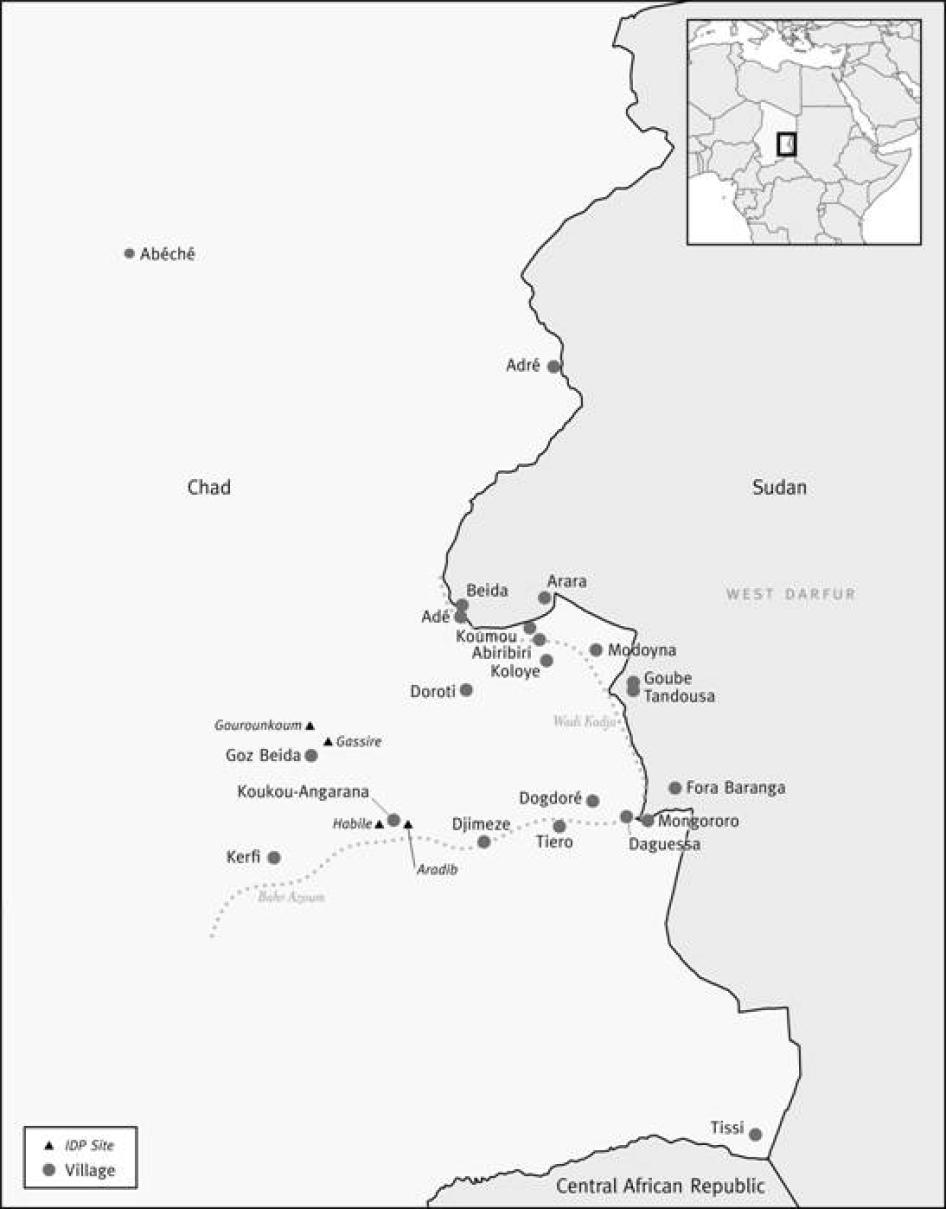
© 2009 John Emerson
Cantons and Sous-Préfectures of Dar Sila
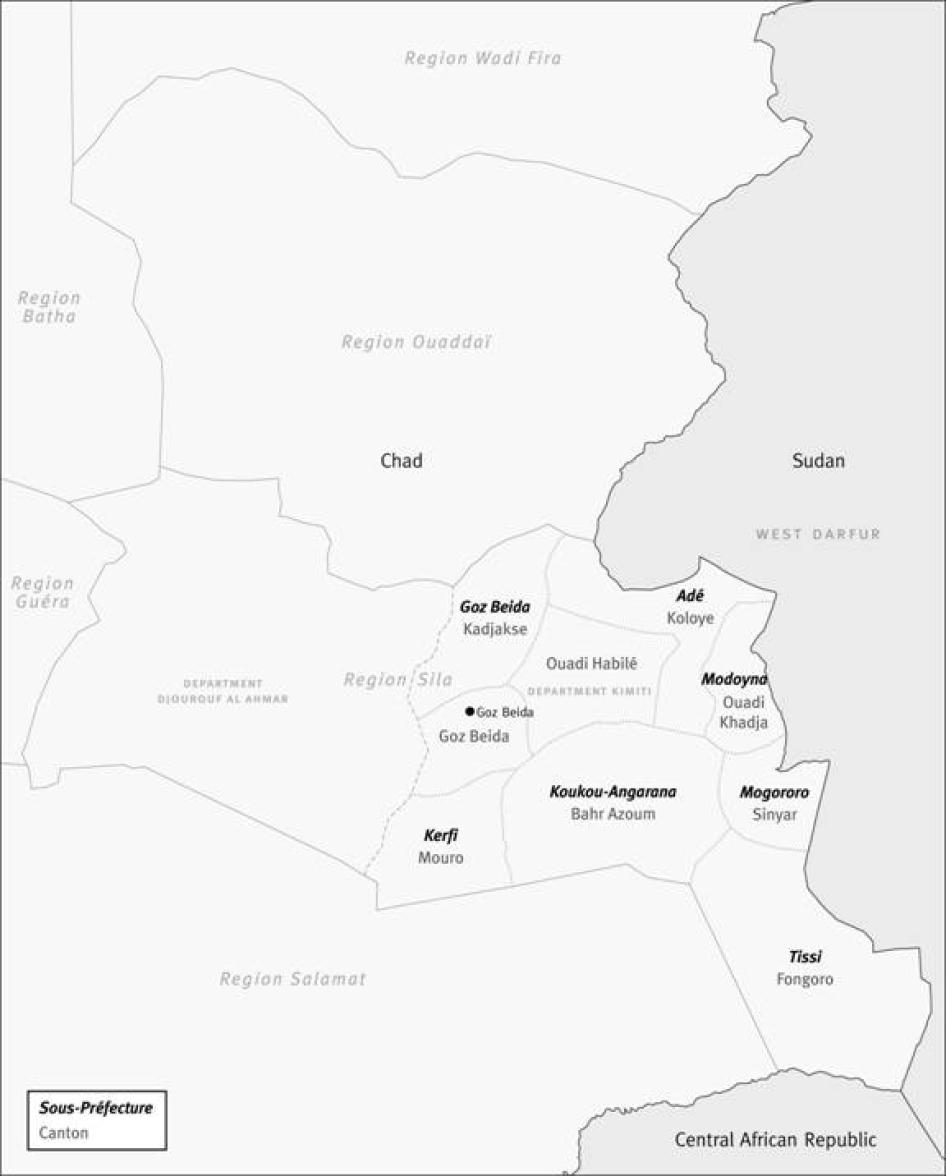
© 2009 John Emerson
II. Glossaries
Terms
ANT |
Chadian National Army (Armée Nationale Tchadienne), Chad’s regular army. |
Arabization |
A process of acquiring Arab identity, especially through intermarriage. |
Autochtones |
Local community with secure land tenure. |
Chadian Janjaweed |
As used in this report, an irregular group drawing support from Chadian community-based militias, Sudanese Janjaweed, and Chadian rebel groups. |
Chef de canton |
Non-Arab traditional leader responsible for conflict resolution, tax collection, and land tenure decisions in rural areas. |
Chef de ferik |
Nomadic authority who negotiates access to pasture with farm communities. |
Chef de tribu |
Arab traditional leader. |
CONAFIT |
National Assistance Coordination for the International Force in Eastern Chad (Coordination Nationale d’Appui à la Force Internationale à l’Est du Tchad), Chadian government body established to act as a liaison with MINURCAT. |
Damre |
A permanent nomadic settlement. |
Dia |
Blood money those responsible for serious crimes are required to pay the family of the victim. |
DIS |
Integrated Security Detachment (Détachement Intégré de Sécurité), Chadian police component of the UN Mission in Chad. |
Dormant faction |
Rebel group that continues to exist after its leadership figures have left insurgency under the terms of peace agreements. |
EUFOR |
European Union military force, also known as EUFOR Tchad/RCA. |
Ferik |
A temporary nomadic settlement. |
GNNT |
National and Nomadic Guard of Chad Chad (Garde Nationale et Nomade du Tchad), branch of the security services responsible for rural areas. |
IDP |
Internally displaced person, a person obliged to leave his or her place of habitual residence who has not crossed an internationally recognized border. |
Janjaweed |
Proxy forces typically recruited among landless Sudanese and Chadian Arabs by the Sudanese government to conduct counterinsurgency operations against Sudanese rebels in Darfur. |
JEM |
Justice and Equality Movement, Sudanese rebel group supported by the Chadian government. |
MINURCAT |
The United Nations Mission in the Central African Republic and Chad. |
Nazim |
Chadian Arabic for internally displaced person, sometimes used as a pejorative. |
SAF |
Sudanese Armed Forces, Sudan’s regular army. |
Sahel |
Climatological zone that stretches from east to west across Africa south of the Sahara Desert. |
SLA |
Sudanese Liberation Army, Sudanese rebel group. |
Tora Bora |
In eastern Chad, refers to community-based self-defense militias. In Darfur the term refers to Sudanese rebel groups. |
UNHCR |
United Nations High Commissioner for Refugees. |
Ethnic Groups
There are more than 200 ethnic groups in Chad. Listed below are those relevant to this report. Distinctions between Arabs and non-Arabs gloss a far more nuanced reality.
Arab
Arab |
As used in this report, Arabized, Arabic-speaking nomadic and semi-nomadic ethnic groups. |
Beni Halba |
Nomadic and semi-nomadic group found in eastern Chad and West Darfur. Associated with Janjaweed militias in Darfur. Historically allied with Ouaddaïen and Hemat tribes in Chad. |
Hemat |
Eastern Chad tribe historically allied with the Salamat and Beni Halba Arabs. Known as the Ta’aisha in Darfur. |
Mahamid |
Nomadic and semi-nomadic tribe associated with Chadian rebels and Janjaweed groups in Chad and Sudan. |
Mahariya |
Nomadic and semi-nomadic tribe associated with Janjaweed groups in Chad and Sudan. |
Nowaybe |
Semi-nomadic group in eastern Chaddivided into two sections, the Samra, characterized as rouge, and the Djamoul, characterized as noire, with the latter descended from an Arabized group. Associated with Janjaweed groups in Chad and Sudan. |
Salamat |
Semi-sedentary Arabized tribe concentrated in Salamat region of southeastern Chad. Largest Chadian migrant group in West Darfur. Associated with Janjaweed groups in Chad and Sudan and Chadian rebel groups. |
Non-Arab
Bideyat |
Zaghawa sub-clan of Chadian President Idriss Déby Itno. Prominent in both Chadian and Sudanese rebel groups. |
Dajo |
Sedentary farmers, original settlers of Dar Sila. Associated with Tora Bora militias and the GNNT in Dar Sila. |
Goran |
Mostly nomadic tribe from northern Chad associated with Chadian UFDD rebels. |
Kobe |
Zaghawa sub-clan from Iriba and Tine in eastern Chad, and to a lesser extent Tine, Sudan. Predominant ethnic group in the Sudanese JEM rebels. |
Masalit |
Sedentary farmers from eastern Chad and West Darfur, associated with the SLA Sudanese rebels. |
Mimi |
Sedentary farmers from northern Ouaddaï region and West Darfur associated with Chadian Janjaweed. |
Non-Arab |
As used in this report, refers to Dajo, Massalit, Mouro, Sinyar, Kadjeske, Moubi, Kibet, Dagal, and other non-Arab sedentary farming groups in Dar Sila. |
Ouaddaїen |
Geographic term that describes sedentary farmers originating in Ouaddaï region who speak the Maba language, primarily from the Khosta ethnic group. Also present in Darfur, where they are known as the Bergo. Associated with Janjaweed groups in Chad and various Chadian rebel groups. |
Tama |
Sedentary farmers from Wadi Fira region of eastern Chad and parts of West Darfur. Associated with Janjaweed groups in Chad and Sudan and Chadian FUC rebels. |
Zaghawa |
A generic term encompassing more than 100 nomadic and semi-nomadic clans in eastern Chad and North Darfur. Ruling clan in Chadian government, prominent in both Chadian and Sudanese rebel groups. |
Chadian Rebel Groups
There are numerous Chadian rebel groups. Listed below are those relevant to this report.
CNT |
Concorde Nationale du Tchad (Chadian National Concord) Majority Arab rebel alliance formed in October 2005 in Khartoum by Hassan Saleh Al-Djinnédi, a Hemat Arab. Joined the FUC umbrella in December 2005, broke away in June 2006. |
FUC |
Front Uni pour le Changement (United Front for Change) Umbrella group formed on December 28, 2005 led by Mahamat Nour Abdelkerim. |
UFCD |
Union des Forces pour le Changement et la Démocratie (Union of Forces for Change and Democracy) Predominantly Ouaddaïen UFDD splinter founded in March 2008 by Adouma Hassaballah Djadalrab, a half-Arab, half-Ouaddaïen former Chadian army commander. |
UFDD |
Union des Forces pour la Démocratie et le Développement (Union of Forces for Democracy and Development) Majority Goran group founded in October 2006 by Chad’s former ambassador to Saudi Arabia, Mahamat Nouri, a Goran from the Anakaza sub-clan. |
UFDD-F |
Union des Forces pour la Démocratie et le Développement Fondamental (Fundamental Union of Forces for Democracy and Development) Majority Arab UFDD splinter founded in May 2007 by Acheikh Ibn Oumar and Abdelwahid Aboud Makaye. |
UFR |
Union des Forces de la Résistance (Union of Forces for the Resistance) Coalition of eight rebel groups established on January 19, 2009. Led by Timan Erdimi, Chadian president Idriss Déby’s nephew and his former cabinet director. |
III. Summary
There is no army, and all the men from our village are dead. All the men are dead, and the children are too young to fight. We decided to go back to our village to plant crops, but it was not safe, and now there is no one left there. There are only the trees.
—Internally displaced woman who fled Faradjani village in the Dar Sila region of eastern Chad following a December 2005 militia attack. Interviewed at the Kaloma internal displacement site, June 11, 2008.
Fighting between Chadian rebels and government forces in eastern Chad in early May 2009 underlines how the intertwined wars in Chad and Sudan are creating conditions in which farmers and nomads alike continue to be at risk of displacement. The vast majority of the 167,000 internally displaced persons (IDPs) already in camps in eastern Chad are unable to return home in safety and dignity. A cocktail of armed groups—Chadian and Sudanese rebel factions, community-based militias, and loosely organized criminal gangs—represent an ongoing risk to IDPs who venture back to their areas of origin, especially in the southeastern area of Dar Sila. Meanwhile, disputes over land access and tenure remain a combustible factor underlying much of the violence, both currently and in the past.
Fighting between government and rebel forces erupted again near Koukou-Angarana in early May 2009, forcing the evacuation of aid agency personnel. Koukou-Angarana hosts approximately 40,000 IDPs and 20,000 Sudanese refugees, yet is an area in which the United Nations Mission in the Central African Republic and Chad (MINURCAT), dispatched to eastern Chad by the Security Council in 2007 to protect civilians and facilitate the delivery of humanitarian aid, had no permanent presence until shortly after the fighting between government forces and rebel troops in the area had subsided.
The vast majority of IDPs in eastern Chad currently prefer to stay in their displacement sites for fear of violence and insecurity. Yet as the planting season begins many displaced persons who are unable to find land close to camps will return to their areas of origin to plant and harvest crops to supplement agency-supplied rations and to reassert their rights over land, even though information about security conditions outside camps is scarce and difficult for IDPs to assess. Although most of the eastern border is volatile and precarious, levels of insecurity vary from canton to canton. For many IDPs, return will be explicitly temporary—the return of some members of the family to cultivate, leaving others in the greater safety of IDP camps.
Many of the 40,000 IDPs who returned home in 2008, nearly half of them on a temporary basis, found schools and health centers in ruins. However, safe conditions for dignified return are not merely an issue of services and infrastructure. In many areas IDPs also encountered a complete absence of the rule of law, which is essential for safe and dignified IDP return and for putting an end to human rights abuse. If humanitarian support in areas of return outstrips the provision of real security it can become a pull factor leading people into danger. These are fundamental issues that need to be addressed as government, the UN, the EU, and key donor governments consider potential durable solutions for Chadian IDPs. The Chadian government, supported by MINURCAT and UN agencies, should strengthen police and judicial institutions in order to promote the rule of law, including by holding those responsible for gross abuses of human rights accountable for their crimes.
The continuing military conflicts in Chad and Sudan mean that the idea of substantial IDP return looks unlikely, and as yet there is no talk of a UN and EU-supported governmental policy of promoting organized return. It remains a reality that humanitarian access to both IDPs and returnees is constrained by insecurity—and that conditions on the ground can change rapidly from week to week, as the fighting around Koukou-Angarana in early May demonstrated.
However, neither government, the UN, nor the EU is keen to support long-term displacement and, where conditions allow, localized return is an option for IDPs, authorities, and agencies. Indeed, supporting the creation of conditions for voluntary, secure, and sustainable IDP return is central to MINURCAT’s mission. The European Commission is already funding projects to resettle IDPs in areas of origin. Meanwhile, the governor of Dar Sila, recognizing that the majority of IDPs come from insecure areas, is preparing to relocate IDPs to new displacement sites where the government can better provide security.
The protection of civilians, including IDPs, along with the provision of humanitarian assistance, is the primary duty and responsibility of Chad’s national authorities. Integral to protection is ensuring that IDPs have the capacity to make choices—they have the same rights as any other citizen—and are not coerced into remaining in or moving to locations that are unsafe, or forced to live in undignified conditions. In appropriate areas, a government-led, UN-supported process of staggered and deliberate return could support spontaneous returns while at the same time continuing assistance to those who decide to remain in their displacement sites or wish to relocate to safer areas of the country.
The bottom line, however, is that displaced persons should not be encouraged to return to their homes until they feel it is safe. They need to be provided with accurate information about security conditions in their home areas, but also with the means to reach their own conclusions about risks (for example, by facilitating on-the-spot assessment by trusted members of the community). Similarly, they need to have the possibility of integration or relocation in safer areas of the country. Any relocation initiative must ensure the full participation of both the displaced and members of non-displaced local communities.
The root causes of recent violence in Dar Sila are complex, but prominent among them are differences between historically privileged groups seeking to defend their primacy within traditional systems of land tenure and marginalized groups seeking to secure rights to land, including tenure. Reconciliation efforts sponsored by traditional leaders, the government, and the UN are doing little to address tenure and associated issues. While issues around land rights are immensely complex and are rendered even more difficult as conflict alters the contours of nomadic ranges and areas under cultivation for many different communities, effective mechanisms should be put in place to deal with disputes that may arise when displaced persons return to their homes of origin and find their property occupied. Certain families, such as woman and child-headed households, are likely to be particularly vulnerable if disputes break out, and interventions to ensure their rights are protected will be necessary.
Meanwhile, new resentment has emerged between communities in Dar Sila over perceived bias in access to aid, brought about by differential access to humanitarian assistance caused by logistical and security constraints. While these constraints are deep-rooted, humanitarian assistance programs should be reviewed to ensure that they benefit those civilians in greatest need, and as far as possible measures should be taken to prevent differential access to aid from aggravating tensions between communities.
MINURCAT has an essential civilian protection role to play, in liaison with Chad’s army, gendarmerie, and police force, as part of its mandate to contribute to the creation of a secure environment conducive to the safe return of IDPs and refugees. MINURCAT, however, is thin on the ground, with less than half its mandated complement of 5,200 troops yet deployed.
Widespread militia attacks in eastern Chad that began in late 2005 left hundreds of civilians dead and forced at least 180,000 into camps for internally displaced persons, mostly in the southeastern border region of Dar Sila. Government security forces allowed the violence to continue virtually unchecked.
In response to widespread rights violations in eastern Chad, the UN Security Council approved MINURCAT in September 2007. A European Union bridging force (EUFOR) appears to have deterred a resumption of mass killings, but it was largely unable to fill the security vacuum left by the lack of government presence in the east. In January 2009, the UN Security Council replaced EUFOR with UN peacekeeping troops, and established a set of benchmarks to evaluate the success of the mission that included the return of IDPs to their areas of origin. In March 2009, the UN took control of the military component of the mission from EUFOR.
IV. Recommendations
To the Government of Chad
- Re-occupy all garrisons in Dar Sila and renew regular patrols to ensure the protection of civilians.
- Continue assistance to IDPs who choose to integrate into displacement sites.
- Distribute arable land to IDPs who wish to cultivate crops near their displacement sites, and ensure that local populations are consulted in all land distribution efforts and that their rights are preserved.
- Investigate and prosecute those responsible for violations of international humanitarian law or human rights law.
- Instruct the National Land Observatory to 1) advise local and national government officials on land rights in Dar Sila, and 2) identify the displaced owners of abandoned land.
- Support and validate traditional conflict-resolution structures while avoiding partisan and inappropriate interference.
- Ensure that senior civilian and military officials serving multi-ethnic communities are genuinely sensitive to the concerns of all communities and have the ability, including necessary language skills, to do their job effectively.
- Develop and publish a detailed, time-bound plan to provide displaced civilians with water, sanitation, and access to health care and education.
- Provide protection for displaced persons returning temporarily to their homes during agricultural season.
To MINURCAT
- Monitor and report on security conditions in Dar Sila and other insecure areas and identify where further assessment is needed to evaluate risks to IDPs who may return to their homes.
- Partner with Chadian police and security forces in combating impunity, with an emphasis on arrests and prosecutions.
- Conduct human rights monitoring of all government initiatives to return or relocate IDPs.
- Support the establishment of a standing body of traditional leaders to link protection and assistance efforts with reconciliation and return processes, in coordination with the Association of Traditional Chiefs of Chad (Association de Chefs Traditionnels du Tchad, ACTT).
- Assess the appropriateness of establishing safe corridors for IDPs temporarily returning to their homes during agricultural seasons—and, if appropriate, provide them.
To the Special Representative of the Secretary General
- Highlight the need for assistance programs to support spontaneous returns only so long as a local capacity to sustain security is in place, and urge governmental and non-governmental actors to present IDPs with safe and voluntary alternatives to return, such as integration or resettlement in other parts of the country.
- Highlight the need for both MINURCAT and the Chadian government to help create conditions allowing safe, dignified, and permanent return of displaced persons to their homes and to patrol seasonal return corridors and temporary returnee sites, particularly during agricultural periods, within means and capabilities.
To the United Nations Security Council
- Mandate MINURCAT to support the Chadian government in the investigation and prosecution of violations of international humanitarian law or human rights law, and request that MINURCAT and the Chadian government cooperate in the apprehension of alleged perpetrators of serious human rights violations in Dar Sila.
- Place Hamid Dawai, Abdullah Ahmad Shinebad, Hassan Saleh Al Gadam al-Djinnedi, Mahamat Tahir Nouradine, and other individuals responsible for attacks against civilians on the list of persons subject to sanctions by the UN Sanctions Committee.
To the UN Office for the Coordination of Humanitarian Aid
- Ensure that food assistance continues to displaced persons whose home villages are situated in unsafe areas.
- Develop a set of definitive criteria for use in distinguishing temporary and permanent returns.
- Conduct a comprehensive survey of internal displacement in eastern Chad, including, if sufficiently secure, areas not previously surveyed due to insecurity in the sous-préfectures of Adé, Koloye, and Mongororo.
- Review and monitor humanitarian policy and practice with a view to minimizing tensions related to differential access to humanitarian assistance.
To the European Union
- Provide maximum financial support to the MINURCAT voluntary trust fund for Quick Impact Projects.
To Non-Governmental Organizations
- Monitor MINURCAT efforts to provide security in return areas and assess the extent to which those efforts create the conditions for long-term returns.
- Extend operations into rural areas to the greatest extent possible within means and capabilities.
- Ensure that formal charges are filed with Chadian authorities following attacks and abuses against humanitarian personnel, and request that MINURCAT’s rule of law unit track the progress of each complaint through the Chadian justice system.
V. Methodology
This report is based on Human Rights Watch research in southeast Chad, including fact-findings from missions to Koukou-Angarana and environs in February 2009, to Goz Beida and environs in June 2008 and to rural areas between Dogdoré and Tiero-Marena in July/August 2007.
This report is based on several hundred interviews with eyewitnesses, victims of violence, internally displaced persons, returnees, community and tribal leaders, government officials, and members of armed groups. Human Rights Watch research materials from prior years have been used to provide background to more recent developments, including findings from missions to southeast Chad in January 2006, March/April 2006, and October/November 2006.
To the extent possible, interviews with sources were conducted in private, with only the Human Rights Watch researcher, the interviewee, and (when necessary) an interpreter present. Interviews were conducted in French or English with translation from Arabic or local languages. Interviewees were asked only to relate events that they personally experienced and witnessed. In most cases the names of individuals interviewed have been withheld to protect their privacy and ensure their safety.
Human Rights Watch’s assessment of the treatment of displaced persons in this report is based on the UN Guiding Principles on Internal Displacement.
VI. Background
Factional Politics in Chad
Since independence from France in 1960, a succession of corrupt, abusive, and unaccountable governments have undermined the rights of Chad’s citizens to freely choose their leaders.[1] In Chad’s violent and faction-ridden political culture, opposition concerns often find expression in the form of anti-government insurgent groups, usually organized along ethnic lines.[2]
Since Chadian President Idriss Déby Itno came to power in a 1990 coup d’état, he has frequently used presidential patronage to purchase support from the warlords and clan leaders that constitute the building blocks of political power in Chad. In March 2007 the Defense Ministry was awarded to Chadian rebel leader Mahamat Nour Abdelkerim less than a year after his United Front for Change (Front Uni pour le Changement, FUC) was fighting government troops on the streets of the capital. Patronage often takes the form of a cash payout, known colloquially as “l’enveloppe.” For example, in December 2006, public funds totaling 60,000 CFA (13,000 USD) were offered to each of the 19 Arab nomad chefs de tribu in the sous-préfecture of Abougoudam, southwest of Abéché, following a recruitment visit by Sudanese paramilitary leaders. One of the chefs de tribu said: “The military situation may be calm, but la guerre des enveloppes always continues, and this is a war that is very difficult to fight.”[3] With immediate family members leading the rebellion against him, President Déby has invested heavily in buying loyalty from members of his own Zaghawa ethnic group.[4]
A spoils system that rewards both loyalty and treachery perpetuates conflict in Chad, while ethnic-based alliances that cross borders help destabilize Darfur as well. The Chadian government supports Sudanese rebel groups such as the Justice and Equality Movement (JEM), a Zaghawa-dominated faction that has come to play a central role in Chad’s national defense. Chadian Minister of Defense Mahamat Ali Abdullah, a Zaghawa from the same Kobe sub-clan that dominates the JEM, supplied the JEM with vehicles that were used in a May 2008 raid that reached the suburbs of Khartoum.[5]
The Sudanese government in turn supports Chadian rebel groups that include many Chadian nationals that were recruited into Janjaweed militias in Darfur.[6] Opportunism accounts for some of this fluidity between armed groups, but agendas related to land are common to both Chadian rebel groups and Janjaweed militias. Chadian Arab rebels formed the backbone of the Arab Gathering and the Islamic Legion, Libyan-backed paramilitary groups based in Darfur that focused on the establishment of land rights for Arabs in the 1970s and 1980s.[7] CNT rebels established the Association of Chadian Arabs for Literacy, Sedentarization and Solidarity (Association des Arabes Tchadiens pour l’Alphabétisation, la Sédentarisation et la Solidarité, AATASS) to support the permanent settlement of Arab nomads, in the interest of improved access to health and education.
“La Guerre Ethnique” in Dar Sila, 2005 to 2007
Dar Sila, an administrative district in southeast Chad,[8] was the scene of widespread paramilitary violence between 2005 and 2007 that left hundreds of civilians dead, an outbreak of bloodletting known locally as “La Guerre Ethnique.”[9] The proximate cause of violence was not so much ethnic animus as a confluence of interests between Sudanese Janjaweed militias, Chadian rebel groups, and communities in Dar Sila with exploitable grievances.
Due to the fact that the region has rich soil and plentiful ground water that allows some farmers to harvest two crops each growing season, Dar Sila attracted IDPs in the mid-1980s when a severe drought forced 10 percent of Chad’s population to flee their homes.[10]Chefs de canton, traditional leaders responsible for tax collection and dispute resolution, directed drought victims to parcels of farmland and pasture in accordance with customary laws that reserved land ownership rights for members of local communities, known as autochthones.[11]
Mass livestock die-offs during the drought years forced many Arab nomads arriving in Dar Sila to turn to agriculture in order to survive, making access to land with security of tenure a particularly pointed issue.[12] Ouaddaïens, a non-Arab farming tribe that arrived in Dar Sila in large numbers during the drought years, attempted to challenge the customary land system that prevented them from securing property rights in Dar Sila. In 1993, Ouaddaïen drought migrants pursued an administrative scheme that would have transferred the land rights they would have enjoyed in their areas of origin to Dar Sila. As a Dajo chef de village told Human Rights Watch, the plan was vigorously rejected by local Dajo:
Up until 1993 we lived together with no problems. But then the Ouaddaïens said, ‘Now, Dar Sila—it would be better to call it Dar Ouaddaï. It should no longer be called Dar Sila.’ This was a provocation.[13]
The status of Ouaddaïens in Dar Sila deteriorated further when they began to remit tax payments on their land concessions directly to the sultan, the highest customary authority in Dar Sila, bypassing local chefs de canton as a form of protest.[14] A 54-year-old Ouaddaïen farmer who fled drought conditions in Abéché for Dar Sila in 1985 recalled:
The Dajo came to us and said, ‘Why did you come here?’ We told them, ‘Because of the drought.’ The Dajo said, ‘Your belly is full now. It’s time for you to go back where you came from.’ We came here and cleared the brush and cultivated the land more than 20 years ago, and then the Dajo tell us it’s time for us to go home? We cannot accept this.[15]
Tensions between drought migrants and autochtones over access to land in the 1980s and 1990s were unraveling Dar Sila’s social fabric, a situation that was exploited in the early years of this century for recruitment purposes by an alliance of armed actors from both sides of the Chad-Sudan border. One of the keys to cross-border paramilitary alliances was Mahamat Tahir Nouradine, a Nowaybe Arab leader from Modoyna who led Nowaybe settlers to the outskirts of the town of Goube in the Wadi Saleh district of West Darfur in 2004.[16] At the time, Goube was a base of operations for Janjaweed commander Abdullah Ahmad Shinebad, a Beni Halba Arab, as well as Chadian rebel leader Hassan Saleh Al Gadam al-Djinnedi, a Hemat Arab who cantoned elements of his Chadian National Concord Movement(Concorde Nationale du Tchad, CNT) between Goube and the nearby town of Tandousa.[17]
From Goube, Nowaybe Arabs led by Mahamat Tahir Nouradine conducted recruitment in Dar Sila for the militia groups that would come to be known as the Chadian Janjaweed, issuing a call to arms that resonated with landless groups including Arab nomads, Ouaddaïens, and other members of non-Arab ethnic groups that migrated to Dar Sila during the drought years, such as the Mimi.[18]With weapons provided by Hassan al-Djinnedi,[19] the Chadian Janjaweed were poised to lay waste to eastern Chad.[20] Cross-border militia attacks against civilians in Chad began immediately after a September 25, 2005 raid near the town of Modoyna that has been linked to Hassan al-Djinnedi, and which resulted in the deaths of at least 60 civilians.[21] The militia led by Mahamat Tahir Nouradine has been linked to attacks against civilians in the immediate border area in late 2005, including raids in September in the villages of Khadera, Agnata, Am Deguel, and Djerena and November raids in Taroura, Tireya, Koumou, and Abiribiri.[22] Operations by rebel groups often coincided with Chadian Janjaweed militia attacks against civilians, especially those led by Mahamat Nour Abdelkerim.[23]
Retaliatory attacks by local “Tora Bora” militias (community-based self defense groups receiving varying levels of support from the Chadian government) targeted Arab and Ouaddaïen civilians suspected of complicity with the Janjaweed attacks. Government soldiers did little to protect civilians from these exactions, and in many cases were themselves responsible for abuses. In August 2007, Human Rights Watch researchers received 43 separate reports of unlawful killings, torture, and arbitrary arrest by Chadian National Army (ANT, Armée Nationale Tchadienne) soldiers and allied paramilitary groups conducting operations against Chadian Arab rebels with the CNT in Dar Sila.[24]
The UN Mission in Chad
At the height of militia violence in eastern Chad in December 2006, Kofi Annan, then-Secretary General of the United Nations, presented the outlines of a civilian protection force capable of promoting human rights in eastern Chad and supporting peace talks in Chad and the wider region.[25] President Déby was firmly opposed to a peacemaking role for the UN, however, a position that found support from France on the Security Council.[26] Libyan leader Mu`ammar al-Qadhafi was altogether uneasy about the deployment of UN troops to the region. Accordingly, UN Security Council resolution 1778, approved in September 2007, established a multinational presence in Chad that did not include peacekeepers and was not given a political mandate. The United Nations Mission in the Central African Republic and Chad (MINURCAT) included human rights monitors and judicial advisors to promote the rule of law, a civil and political affairs section to promote local reconciliation, and a corrections unit to help professionalize the prison system, but no combat troops. In lieu of blue helmets, the European Union Military Operation in Eastern Chad and North Eastern Central African Republic (EUFOR Tchad/RCA) comprised the force’s military arm.[27]
In September 2008, Security Council resolution 1834 extended MINURCAT’s mandate by six months.[28]In January 2009, UN Security Council resolution 1861 replaced EUFOR’s 3,400 soldiers in Chad with 5,200 UN peackeepers and extended the force’s mandate by one year, to March 15, 2010.[29]
Nature and Scope of Internal Displacement
The UN Office for the Coordination of Humanitarian Aid (OCHA) reports that 166,718 civilians were internally displaced in eastern Chad as of April 2009, though the true number is likely to be higher, considering that only a handful of villages in the sous-préfectures of Adé, Modoyna, and Mongororo have been surveyed due to insecurity.[30]
Militia attacks on civilians in Dar Sila have produced two distinct patterns of internal displacement. Dajo, Massalit, and other non-Arab IDPs generally fled to the periphery of large towns where government soldiers and humanitarian workers maintain an active presence. At least 110,000 IDPs are concentrated in and around the towns of Goz Beida, Koukou-Angarana, and Dogdoré, the vast majority of them non-Arab.[31] Fearing retaliation, Arabs, Ouaddaïens, and other groups associated with the Chadian Janjaweed have tended to seek refuge in rural and remote areas, leaving many outside the reach of humanitarian agencies. Members of this group are sometimes referred to by aid workers as the “unofficial” or “invisible” displaced.[32]
VII. Failure to Protect the Internally Displaced
As set forth in the UN Guiding Principles on internal displacement, the protection and assistance of internally displaced persons is the primary responsibility of the government.[33]The Chadian government’s commitment to fulfilling this responsibility has been weak. Meanwhile, the threat to civilians posed by insecurity in eastern Chad and Darfur was recognized in UN Security Council resolution 1778, which mandates MINURCAT to help create the security conditions conducive to a voluntary, secure, and sustainable return of refugees and displaced persons. Resolution 1778 authorizes the operation, acting under Chapter VII of the UN Charter, to use all necessary means (in other words, up to and including the use of force) to contribute to protecting civilians in danger, particularly refugees and internally displaced persons.[34]
The Chadian Government
The Chadian government’s decision to withdraw army units from border positions in Dar Sila in late 2005 allowed militia violence to proceed virtually unchecked, resulting in numerous preventable civilian deaths and injuries.[35] The departure of 35 ANT soldiers from the town of Koloye, northeast of Goz Beida, left a single 22-year-old gendarme in charge of protecting an estimated 10,000 IDPs. When the town came under attack by Chadian Janjaweed militias on November 11, 2006, at least 67 civilians were killed.[36]
Civilians responded to the security vacuum by organizing Tora Bora self-defense groups that received varying levels of support from the authorities and in many cases participated in joint operations with ANT units. Arab and Ouaddaïen civilians in Dar Sila complained of numerous abuses at the hands of a Tora Bora unit based in the adjacent villages of Tiero and Marena, kilometers east of Goz Beida, including during joint operations with the ANT.[37]A Tora Bora unit was responsible for protecting an estimated 6,000 IDPs in the adjacent towns of Marena and Tiero when Chadian rebels and Chadian Janjaweed militias attacked on March 31, 2007, leaving at least 200 dead. A Chadian Arab tribal leader told Human Rights Watch the Tora Bora unit based in Tiero was the target of the attack because it had committed abuses against Arab civilians. He said: “We were not going to just stand with our arms crossed.”[38]
The massacres at Koloye and Tiero-Marena in 2006 and 2007 represent failures by the government to protect IDPs that were directly related to policy decisions, either to reduce protection for vulnerable communities or to delegate protection to community-based militias. Government security forces continue to demonstrate limited commitment to civilian protection. The border town of Daguessa fell into the hands of an otherwise dormant rebel group in September 2008, shortly after the ANT unit stationed there redeployed to Modoyna; while the ex-rebels used death threats to extort money from the town’s inhabitants, including 600 IDPs, nearly four months passed before the ANT returned to restore state authority.[39]
The Chadian government’s plan to stabilize Dar Sila, announced in early 2008, appears to amount to the establishment of a national police post in Koukou-Angarana.[40] Though MINURCAT deployed 120 troops to Koukou-Angarana in May 2009, the government has yet to follow through on its promise.[41] The government’s commitment to fulfilling its responsibilities is far from adequate.In addition to restoring security to the border zone, the government must discipline and reform local civil and military officials who in many cases constitute a threat to civilians they should be protecting. International humanitarian workers have told Human Rights Watch, for example, that basic administrative tasks such as hiring and firing have occasioned threats and acts of violence by local government officials seeking to influence the decision. One humanitarian worker said:
The [local government official] wanted me to rehire someone I had just fired. I told him that I couldn’t do that. That was when he told me that he could no longer guarantee my safety.[42]
The aid worker’s compound was subsequently subjected to violent attack.[43] The impunity that prevails in eastern Chad functions as patronage by allowing officials to feed off the humanitarian aid agencies and the local population. A series of attacks on the offices of Médecins Sans Frontières (Doctors Without Borders, MSF) in Koukou-Angarana is reported to have been the work of the resident sous-préfet, Mahamat Mousa, an ethnic Zaghawa who is reportedly related to senior government officials.[44] ANT soldiers were responsible for simultaneous raids on MSF compounds in Adé and Goz Beida on December 4, 2008, according to international aid workers and local sources.[45]
Due to the fear of retaliation at the hands of government officials, many aid workers are reluctant to file official complaints with Chadian authorities following threats and attacks. Ironically, by feeding impunity, such accommodation helps entrench the system of predation that puts humanitarians at risk.
Impunity remains one of the greatest obstacles to improving the protection of IDPs. The government should take steps to hold those responsible for committing gross abuses of human rights accountable for their crimes, and must do more to ensure that justice and law enforcement systems are in place to hold those who commit lesser crimes accountable. Despite allegations of serious crimes against civilians in Dar Sila, Chadian rebel leader Hassan al-Djinnedi was named Chad’sSecretary of State for National Defense in Charge of War Veterans and Victims following a December 2007 peace agreement with the Chadian government.
The United Nations Mission in Chad
EUFOR began to deploy troops to Chad in February 2008, seven months behind schedule but well ahead of MINURCAT, which did not reach operational capability until late in the year.[46]
EUFOR’s deployment may have had deterred a continuation of militia violence in Dar Sila. A Chadian Arab leader with family links to Janjaweed groups in both Chad and Sudan told Human Rights Watch that attacks against civilians that would have taken place in late 2007 became impossible with the mission’s pending arrival. He said: “La Guerre Ethnique is over.”[47]In Dar Sila, EUFOR patrols brought a generalized sense of security to large towns such as Goz Beida and Koukou-Angarana.[48]
However, EUFOR was unable to fill the security vacuum left by the lack of a functioning state security apparatus. Indeed, according to IDPs, EUFOR patrolling in agricultural areas compared unfavorably to the protection provided by FUC rebels after they joined forces with the Chadian government in late 2006. One IDP in Gassire said:
The UN should patrol out where we’re working. If they don’t come close enough, it doesn’t help. Some fields are far from the road, and what happens away from the road, no one will ever hear about.[49]
In 2008 EUFOR officials told Human Rights Watch that their civilian protection efforts were constrained by resources, specifically a shortage of personnel.[50] The mission was also constrained by concessions made to the Chadian government by the UN over the area of operations, which were deemed necessary to secure President Déby’s approval of the deployment.[51]The August 10, 2007 report of Secretary-General Bank Ki-Moon, which was a blueprint for the UN mission in Chad, stated that the force would not have any “direct involvement” in the Chad-Sudan border area,[52] a revised concept for the mission’s area of operations to that originally proposed.[53] IDPs frequently move back and forth across the Chad-Sudan border in attempts to escape shifting insecurity, however, and vulnerable civilians were consequently left outside of EUFOR’s area of operations.[54]
UN Security Council resolution 1861, passed in January 2009, allows for more leeway in the protection of civilians in border areas,[55] but it remains difficult for international forces to operate in the border area. On February 9, 2009 GNNT units fired on a EUFOR patrol near Birak, in the Ouadi Fira region northeast of Abéché, forcing it to turn back from conducting patrols along the border. Two days later, soldiers with the National and Nomadic Guard of Chad (Garde Nationale et Nomade du Tchad, GNNT) fired warning shots at a EUFOR patrol in the Dogdoré area east of Goz Beida, also preventing it from approaching the border.[56]
During a June 14, 2008 Chadian rebel attack on Goz Beida, EUFOR took up a defensive position around refugee and IDP camps and evacuated 250 humanitarian workers,[57] but EUFOR did not attempt to prevent retaliatory violence against the citizens of Goz Beida. Rebels who entered the town shot Aboubakar Mahamat, 30, in the stomach, suspecting him of being a government soldier because of his black restaurant uniform.[58] Two sisters, 15-year-old Habi Sharif and 17-year-old Zene Baissa, were shot when they tried to prevent a boy from joining the rebels.[59] The attack also exposed serious intelligence shortcomings: the invasion column of more than 100 rebel vehicles descended on Goz Beida only hours after EUFOR advised humanitarians that rebel forces reported in the area two days earlier had moved on and that it was safe to return to work in refugee and IDP camps.[60] The rebel column originated in the Modoyna pocket, an area that is off limits to EUFOR’s Mi-8 helicopters due to the risk of anti-aircraft fire from both sides of the border.[61]
On March 15, 2009, the United Nations took control of the military component of MINURCAT, replacing EU soldiers with UN peacekeepers following the expirations of EUFOR’s one-year mandate.[62] As of May 2009, MINURCAT was operating at less than half strength, with 2,115 out of 5,200 troops deployed to the field.[63] The force is expected to reach its full troop strength by the end of 2009.
VIII. Nature and Scope of Returns
An estimated 40,000 IDPs returned to their villages in 2008, according to the United Nations Office for the Coordination of Humanitarian Aid (OCHA), an accounting that includes those who returned on a temporary basis.[64] Revised, provisional figures released by OCHA in March 2009 placed the number of permanent returns, exclusive of seasonal returns, at approximately 27,000.[65] The majority of this return has been to areas far from the border and close to humanitarian hubs such as Kerfi, Goz Beida, and Koukou-Angarana, the scene of fighting in May 2009. However, Chadian authorities, MINURCAT, UN agencies, and NGOs should not consider these returns to be indicative of an environment conducive to safe returns. In many cases, prevailing insecurity compels IDPs to send some members of the family to cultivate crops in home villages while others remain in the safety of the camps.
Human Rights Watch considers displacement to end with one of the three “durable solutions” endorsed by the Inter-Agency Standing Committee (IASC): permanent return to area of origin, integration into the local community, or resettlement in another part of the country.[66] Security must be in place for returns to endure, as one IDP said:
If the UN takes up its responsibility and provides security, those who are in the villages will be able to stay there. If not, they will just stay for as long as it takes to plant and harvest a crop, and then they will be back in the camp.[67]
Many displaced persons told Human Rights Watch that decreasing food rations and an inability to find arable land near their displacement sites compelled them to venture into remote agricultural areas where insecurity and banditry make it impossible for most humanitarian agencies to operate. High commodity prices compounded by two consecutive years of poor harvests made IDPs dependant on food aid in 2008,[68] but the World Food Program (WFP) phased out food rations for IDPs during the year, with final rations delivered in July.[69] In November 2008, following an emergency food security assessment, WFP concluded that food aid distributions for IDPs should recommence, and it distributed food to IDPs in Goz Beida and Koukou-Angarana in April 2009.[70]
The May 2009 clashes in eastern Chad prompted three UN agencies and 11 NGOs to withdraw non-essential staff, hindering relief efforts for hundreds of thousands of civilians.[71] Although no significant displacements of civilians were noted, past rebel incursions have been strongly correlated to opportunistic militia violence in rural areas of the southeast, and have inhibited IDPs from returning to their homes.
A plan circulated by Dar Sila’s governor, M. Toké Dady, recognizes that the vast majority of IDPs come from remote and rural areas that remain insecure, and proposes to relocate IDPs to new displacement sites where the government can better provide for security.[72] Practical plans to provide relief to displaced persons are welcome, particularly in the form of temporary access to arable land, though any such efforts must involve local communities and ensure local tenure rights are respected and avoid the creation of conflicts.
Further, several aspects of the governor’s plan raise human rights concerns. In an interview with Human Rights Watch, Governor Dady dismissed the notion that IDPs might not want to relocate, saying, “If it is up to them to decide, they will make the wrong decision.”[73] Relocation initiatives must ensure the full participation of the internally displaced, as international norms require,[74] and should be consistent with the principle of voluntariness, which is essential to IDP protection.[75] The Chadian government must be prepared to guarantee continued assistance to those who desire to integrate into host communities.
UN Security Council resolution 1861 established three benchmarks for measuring the success of MINURCAT: demilitarized camp environments, improved government civilian protection, and the return of a “critical mass” of IDPs.[76] MINURCAT must be cautious about giving civilians a false sense of security in areas that may be unsafe, either due to immediate threats or long-term instability.
IX. Risks and Obstacles to Return
The militia violence that left much of Dar Sila devoid of inhabitants left hundreds of villages in ruins, compounding the privation wrought by severe underdevelopment in the region. Out of 326 villages surveyed in Dar Sila in 2008 by INTERSOS, an Italian NGO, only 18 had functioning primary schools and only Goz Beida, Kerfi, Koukou-Angarana, Dogdoré, and Adé had functioning healthcare facilities.[77] Rebuilding civilian infrastructure will be a critical issue for the government, communities, the UN, and NGOs when security conditions change to allow for the durable, safe return of IDPs.
Internally displaced persons who return to their areas of origin in Dar Sila continue to face obstacles ranging from direct threats and attacks to general insecurity, which limits humanitarian access. Furthermore, many of the underlying factors behind conflict in the area, including rights of access and tenure to land and water, remain unresolved. While these are long-term and complex issues, the many reported incidents of violence and intimidation against returnees indicate that processes and mechanisms to address competing claims to land and water are essential to prevent violent confrontations as well as the disenfranchisement of particularly vulnerable groups, such as female-headed households.
Instability Related to Paramilitary Activity
Armed groups ranging from Chadian rebel factions to loosely organized criminal gangs represent an ongoing risk to displaced civilians who seek to return to their areas of origin.
Chadian rebels are firmly installed in the Modoyna pocket, a border point in canton Ouadi Khadjain the extreme northeast of Dar Sila, including groups that have been responsible for the forced recruitment of children.[78]On May 11, 2008, a group of 30 EUFOR soldiers on an eight-day patrol in the Modoyna area was surrounded by 200 Chadian rebels.[79] On October 26, 2008, rebels opened fire on a EUFOR patrol in the same area.[80]Chadian rebels have maintained a longstanding presence in the Tissi area, in the far southeast of Chad, where insecurity contributed to the exodus of approximately 6,000 civilians into Um Dukhun, West Darfur, between February and May 2008.[81]
A previously dormant faction of the CNT seized control of the Chadian border town of Daguessa from September to December 2008 and used death threats to extort money from civilians, including 600 IDPs. An eyewitness recalled “They came and said, ‘Now the government is us.’”[82]
West of Modoyna in canton Koloye, the border towns of Koumou and Abiribiri are under the effective control of the Chadian Janjaweed militia led by Mahamat Tahir Abdelkerim, which has been implicated in deliberate attacks against civilians at the height of the recent violence in Dar Sila. The area of operations of Mahamat Tahir’s militia reportedly extends east from Adé to the Sudanese towns of Tandousa and Goube.[83] Koumou is a destination for seasonal returnees and a temporary displacement site for asylum seekers trying to reach Um-Shalaya, a refugee camp in West Darfur. In May 2008 a farmer named Abbas Anour who had remained in Abiribiri was killed by militia members after he resisted the theft of his animals. Abiribiri’s chef de village said, “They came to take his animals. He refused. They killed him.”[84]
Members of the Koumou militia reportedly extort payments from returnees seeking to cultivate crops and forcibly recruit fighting-age men into their ranks. From his displacement site in Gourounkoum, a 37-year-old IDP recounted his return to Koumou at the start of the 2008 planting season:
When I arrived I saw the chef de village and he told me to present myself to the Janjaweed so they knew I was there. I had to swear on the Quran to join them.[85]
Elsewhere in Dar Sila, former Chadian Janjaweed combatants and Chadian rebel deserters who have little incentive to seek non-violent livelihoods represent an ongoing threat to civilians. A 33-year-old Dajo woman who left Kaloma camp for 11 days during the 2008 planting season to clear fields near her former home in Djorlo, west of Kerfi, told Human Rights Watch:
Many of those people who attacked us are still there. We see them. Sometimes we’re in the fields and we hear gunshots. It’s not safe.[86]
Lack of Information about Security Conditions in Areas of Origin
In order for IDPs to return home voluntarily in safety and dignity, they require accurate and objective information on which to base their decisions. The authorities have a responsibility to ensure this is available as part of their responsibility to establish the conditions and provide the means for safe and voluntary return.[87] In part, it is incumbent on the authorities to provide information, but it is also appropriate that they facilitate and support IDPs in making their own assessment. This issue is a matter of fine judgment and planning for the authorities, because neither should they encourage nor appear to encourage return to areas that are unsafe.
In practice, many IDPs in eastern Chad find it difficult to get accurate information about conditions in their home areas. Most returnees gather information on security conditions in their home villages on their own, with no support. At the beginning of the planting season in May 2008, 20 widows who took refuge in Am Timan following the November 7, 2006 massacre of 36 civilians in Djorlo arrived in the town of Kerfi, southwest of Goz Beida, with their children. Though they were seeking information about security conditions in Djorlo, they planned to stay in Kerfi and plant crops for a season, which is typical of the ad hoc nature of information gathering about security conditions among returning IDPs.[88] A November 2008 UN survey found that only 30 percent of the displaced considered themselves to be informed about the security situation in their home villages. In most cases information about security conditions came not from government sources or humanitarian agencies but from family members who had returned.[89] While the flow of information among IDPs should be encouraged, information from a variety of sources is most likely to enable IDPs to reach a rounded and accurate assessment. An initiative by MINURCAT’s Civil and Political Affairs unit to distribute solar-powered radios to women’s committees in IDP sites and host communities in connection with programming on intercommunity dialogue could be particularly helpful in this regard.[90]
Threats and Attacks against Returnees
Friction between farmers and herders is historically at its height at the end of the rainy season in October and November, when nomads return with their animals to the farming belt and farmers prepare to harvest their crops. Recent attacks against civilians have also occurred during the planting season in May and June, with returning IDPs confronted in many cases by other civilians contesting or ignoring their claims on the land.
The 2008 planting season occasioned numerous threats and attacks against displaced persons returning to their villages to cultivate crops. In June 2008 the chef de village of Bandar village quit his displacement site in Gourounkoum and was planting crops in his home fields when he was approached by a small group of armed men that he recognized immediately:
It was the Ouaddaïens who had lived in the area for a long time. They came to Bandar after the drought. They said to me, “No nazim allowed here. These fields are not your fields. The fields are ours now. Not for you. You should leave.”[91]
A returnee from Aradib displacement site near Koukou-Angarana told Human Rights Watch that a group of armed Ouaddaïens chased him from his home village of Tesou in June 2008 while he was clearing the fields. He said:
One of them said, “From now on, we don’t want to see you in Tesou. If we do, we will kill you. From today, we don’t want to see a Dajo come to work in the fields.”[92]
In mid-June 2008, an unidentified militia attacked returnees in Goz Arbaine II, six kilometers from the border town of Mongororo, burning their homes and forcing them to flee.[93] Also in June, a group of seven displaced persons departed Gourounkoum camp in the Goz Beida area to cultivate tracts of open land in Mahargal, between Goz Beida and Kerfi in canton Goz Beida. Following tribal protocols, the group had asked the local chef de canton for authorization to cultivate the land, but a group of armed nomads they encountered upon arrival threatened to kill them should they remain.[94] Entire harvests have been abandoned as a result of such threats.[95]
During the harvest in November 2008, Djima Gasi, an internally displaced person living in Agadibr, close to Koukou-Angarana, was killed while cultivating crops in his home village, Amjarruba, by the brother of an Arab man he had killed several weeks earlier in a land dispute.[96] Also in November, Moussa Abdelkerim, a Gourounkoum resident, was shot to death while en route to his home village in Goz Darod. His body was discovered near the village of Taroura following an extensive search.[97]
Absence of Traditional Protection Mechanisms
Customary conflict management and resolution institutions that have long regulated social relations in rural areas of eastern Chad are the only existing structures potentially able to foster community safety and protection in areas where modern state institutions are largely absent. Such structures have been disrupted by conflict or are nonexistent in much of eastern Chad, leaving returning IDPs with no organized accountability structures of any kind in many localities. Out of 62 villages between Goz Beida and Dogdoré surveyed by two UNHCR profiling reports, only three reported that customary conflict resolution bodies were functioning, while five other villages reported customary systems for adjudicating disputes between farmers and herders were functioning.[98]
In recent years President Déby has frequently intervened in what Chadian administrations have generally represented as traditional administrative and judicial structures, making it a practice of bestowing customary leadership positions such as chef de canton on potential allies in order to incorporate blocs of support into the patronage system that helps him maintain power. This has degraded the ability of traditional authorities to adjudicate disputes, as have more overt forms of executive interference. For example, Saïd Ibrahim Mustapha Bahid Abunisha, the sultan of Dar Sila, who is based in Goz Beida, was relieved of his duties in December 2007 by Interior Minister Ahamat Mahamat Bashir and replaced by his son.[99] While the elder sultan has been criticized by many Dajo for decisions they believed to be favorable to Arab groups in Dar Sila, his son’s judgments are reported to have been favorable to the majority Dajo tribe. For example, in April 2007, when animals belonging to Arab nomads destroyed crops that displaced persons from Gassire IDP site had planted on a well-established transhumance corridor, the secretary general and sous-prefet of Goz Beida ruled that the fields had to be removed, but the newly installed sultan overruled them.[100]
President Déby is not just putting allies into chef de canton positions, but creating new cantons as well. When Déby came to power in 1990 there were scarcely 100 chefs de canton in Chad, but after 19 years of factional rule, there are 218.[101]The effect of this is “divide and rule” and the disintegration of larger traditional power blocs, encouraging subclans to petition for their own independent status. Some chefs de canton, faced with the prospect of losing part of their territory to a government-appointed rival, have threatened to join the rebellion as a means of dissuading the government from manipulating traditional systems.[102]
Inequitable Distribution of Humanitarian Aid
Impartiality in humanitarian relief demands that those in the greatest need are prioritized. In eastern Chad aid agencies are operating in an environment in which security often restricts their ability to systematically reach persons in dire need. In August 2007 and June 2008, for example, Human Rights Watch visited 11 Arab and Ouaddaïen displacement sites in rural areas where security and logistical considerations prevent aid workers from reaching them.[103] At Tcharo, a rural displacement site on the outskirts of Goz Beida, Alaounie Arabs who fled their homes in Bahar Azum and Tissi in August 2006 supplemented their diets with roots and leaves collected in surrounding fields.[104] At Taybeh, the largest site visited by Human Rights Watch, IDPs from the Arab Zaghawa tribe who fled the Kerfi area in late 2006 reported that five children died of disease and malnutrition in 2008, including three infants.[105]
Unfortunately, many Chadian Arabs believe they are victims of bias. A Chadian Arab chef de tribu said:
In any conflict you must understand both sides, but humanitarians listen to one side and not the other. Everyone suffers, but no one sees the suffering of the Arabs.[106]
Such resentments are easily exploited by armed groups with a recruitment agenda.[107] According to a Chadian Arab chef de tribu, Sudanese Arab tribal and paramilitary leaders attempted to make use of resentments over aid inequalities during a December 2006 recruitment visit to the Arab nomad sous-préfecture of Abougoudam:
They said, “In Chad, your government considers you to be the enemy. If you are Arab, you cannot get humanitarian assistance. Join us in Darfur.”[108]
Differential access to humanitarian assistance adds to factional tensions, but it is a function of logistical and security constraints, not bias, and it does not only affect Arabs, or even those situated in rural and remote areas. Community groups in Dar Sila that have not been displaced from their home villages generally do not receive humanitarian assistance, which is specifically targeted to IDPs and refugees. Among host communities in eastern Chad, over 20 percent of children under five are affected by global acute malnutrition, well above the emergency threshold of 15 percent established by the World Health Organization (WHO). In 2004, before the influx of refugees and IDPs, the incidence of global acute malnutrition among children under five in eastern Chad was 13 percent.[109]
Humanitarian interventions that act as an incentive for displaced persons to return to areas of origin should be carefully balanced against the needs of persons who may not have been displaced but may be struggling for survival in areas where police forces are absent and traditional conflict resolution structures may be fragile or non-existent.[110] Humanitarian organizations have distributed seeds and tools in return areas, despite the fact that violence has erupted between host groups and IDPs over access to assistance in some of those same areas.[111]
For example, resentment between host groups and IDPs broke out on July 8, 2008, in Kerfi, where local Mouro looted NGO compounds and chased Dajo IDPs to the nearby villages of Arata, Agourtoulou, Gagnan, Arangou, and Bakigna, stealing recently distributed food aid. Three days later, unidentified gunmen fired at recently returned IDPs in Bakigna. A fact-finding mission later determined that the violence was related to frustration among the Mouro about unequal treatment by NGOs, which were encouraged to expand assistance to local inhabitants.[112]
Well-founded concerns about logistics and security militate against the provision of assistance in many rural areas. However, all civilians in need have a right to access and receive humanitarian assistance.[113] It is urgent that this be addressed in Dar Sila, where some groups still receive the bulk of humanitarian assistance and others have little or no access.
Attacks on Humanitarians and Restricted Humanitarian Access
The war economy that saw much of the livestock in Dar Sila looted between 2005 and 2007 is now also being perpetuated through the looting of easily transferable humanitarian assets, such as four-wheel drive vehicles, at the considerable expense of IDPs in need of assistance.
More than 160 attacks on humanitarian workers in eastern Chad were reported in 2008, including four fatalities.[114] On July 10, 2008, Oxfam withdrew from Kerfi, southeast of Goz Beida, after an armed attack on its compound, cutting off aid to more than 11,000 people.[115] Humanitarian assistance to 26,000 conflict-affected civilians was suspended in Dogdoré, 30 kilometers west of the Sudan border, following attacks against aid workers in October 2008.[116]
At a July 2008 meeting chaired by the UN Humanitarian Coordinator, humanitarians working in eastern Chad complained that Chadian government officials failed to respond to the death threats, harassment, intimidation, and car-jackings they faced.[117] In December 2008, the NGO Save the Children-UK announced that it was closing its program in Chad following the May 2008 shooting death of country director Pascal Marlinge.[118] Gendarmes in charge of investigating the killing recovered the murder weapon but failed to recover cartridge casings from the crime scene, did not dust the murder weapon for fingerprints, and did not retain the weapon.[119]
Attacks that are knowingly and intentionally directed against humanitarian workers are serious violations of humanitarian law,[120] and may constitute war crimes.
Unresolved Issues Related to Land Tenure
Humanitarian efforts to address immediate needs should be complemented by initiatives to address key issues that are among the root causes of conflict and insecurity, such as issues around rights to land and water, both tenure and access, which in turn are open to instrumentalization by armed groups with more national agendas. The authorities and civil society, supported by the UN, need to address land issues as part of reconciliation initiatives.
In June 2008 Arab tribal leaders attending traditional peace talks in Goz Beida announced that they wished to reconcile with their former neighbors, but the talks were derailed by the refusal of Ouaddaïen tribal leaders to participate.[121] At the same time, Ouaddaïens from Dar Sila are reported to have been joining Chadian rebel groups in Darfur in significant numbers.[122] Ouaddaïens have had a strong presence in insurgent groups since a series of government massacres the early 1990s.[123] As recently as September 2008, Ouaddaïen farmers in the village of Titiri III, seven kilometers from the border town of Daguessa in Dar Sila, were informed by local Dajo leaders that they no longer had the right to live on the land they had long cultivated.[124]
Conflicts over land can be extremely localized. Tensions regarding land access have increased in some areas due to displaced persons renting arable land from host communities and receiving suboptimal plots.[125] Reports that local leaders have rented or sold abandoned land is of particular concern. For example, the village of Kreta I has been occupied by Arab nomads who dug traditional wells for their animals, which may have involved a payment to a local chef de canton that violates the rights of displaced land owners.[126]
Land tenure issues are of immediate urgency for women, particularly widows. Faced with a scarcity of land, traditional leaders may overlook women’s land rights, especially in the case of women attempting to obtain land following the death of a male relative.[127] Article 161 of Chad’s constitution prohibits customs that discriminate among citizens, but in practice, widows often lose their inheritance when a brother or cousin traditionally inherits his relative’s possessions, including the widow and children.[128]
Land tenure in Chad is governed by Acts n° 23, 24, and 25 of July 22, 1967. TheNational Land Observatory(Observatoire National du Foncier) was established in 2001 to formulate land legislation and train local leaders in the requirements of national and international law and to familiarize magistrates with customary practices. Newly conferred land rights in areas where land has been temporarily abandoned for security reasons should be suspended until the government has clarified the obligations of government and traditional authorities with regard to the allocation of land and the regulation of its transfer.
Land Occupation
The nature and scope of land occupation in Dar Sila varies considerably by locality. In some areas, organized paramilitary groups have taken control of areas they now claim as their own, where returnees are obligated to pay extortion money and may live under abusive conditions. Nomads may use violence and threats of violence to deter returns to areas that they have no intention of occupying, and what returnees describe as land occupation may in fact be the squats of other displaced persons who take temporary possession of abandoned structures while in transit or assessing security conditions in their home villages.
Unlawful land occupation appears to be most extensive in border areas such as canton Ouadi Khadja, among the most fertile tracts of land in the region. A survey conducted by the Italian NGO INTERSOS in Koloye canton found Ouaddaïens from the village of Agougou Ouaddaï cultivating crops in the villages of Kayawa, Kawaya Moubi, and in Kalkibedo Dajo I, II and III. In the same zone, IDPs from Adé were found cultivating crops in the abandoned villages of Hille Mana and Kobalka Massalit.[129] Another INTERSOS survey in eight villages in Ouadi Khadja canton received reports of Ouaddaïens occupying farmland abandoned by IDPs in each instance.[130] Also among those occupying abandoned villages were returning Dajo refugees that had taken refuge in Tandousa and Goube in West Darfur.[131]
In mid-2007, returnees began to report that areas of Dar Sila in the control of anti-government paramilitary groups had been designated part of Sudan Djadid (Arabic for New Sudan). Such reports raise concerns of the possibility that land occupation is progressing in an organized fashion. Both Koumou and Abiribiri in canton Koloye are also considered to be part of Sudan Djadid,[132] which reportedly includes the area east of Koloye, which during the rainy season is only accessible from Sudan. A Dajo farmer who returned to cultivate land in his home village near Mongororo, also inaccessible from Chad during the rains, told Human Rights Watch:
We were preparing the fields when the Arab nomads came to us and said, “This is not your land. You’re nazim [an internally displaced person]. This land belongs to the Arab nomads.”[133]
The same is true for the town of Hadjer Beit, south of Modoyna near the Sudan border, as one man recalled:
Government soldiers have not been to Hadjer Beit, but Chadian rebels are there. They call it Sudan Djadid.[134]
A returnee from Gourounkoum said he went back to the town of Djedide, adjacent to Koumou, and noted the presence of uniformed Chadian rebels, one of whom shot in the air and said, “This is from [Sudanese president] Omar al-Bashir.”[135]
Civilians forcibly transferred from their homes in violation of international standards are entitled to return to their homes under the so-called “right of return.”[136] Internally displaced persons are protected against illegal occupation under international law.[137] Such guarantees must be asserted in a manner that upholds any rights secondary occupiers may have in domestic or international law.[138]
[1] The only Chadian head of state to be voted into office in free and fair elections was François Tombalbaye, Chad’s first president, who was assassinated by members of his armed forces in 1975.
[2] On factionalism in Chad, see Roy May and Simon Massey, “The Chadian Party System: Rhetoric and Reality,” Democratization, Vol. 9, No. 3, Autumn 2002, pp. 72-91; and René Lemarchand, “Chad: The misadventures of the north-south dialectic,” African Studies Review, No. 29 (3), 1986, pp. 27-41.
[3] Only one chef de tribu accepted the offer. Human Rights Watch interview, Goz Beida, Chad, August 4, 2007.
[4] Timan Erdimi, President Déby’s nephew, leads the Union des Forces de la Résistance (Union of Forces for the Resistance, UFR), a coalition of eight Chadian rebel groups that fought government forces in eastern Chad in May 2009.
[5] Human Rights Watch interview with a rebel who participated in the Omdurman attack, N’Djamena, Chad, June 5, 2008.
[6] On the Chadian origins of the Janjaweed, see Julie Flint and Alex de Waal, Darfur: A Short History of a Long War, (London, UK: Zed Books, 2005); and Ali Haggar, “The Origins and Organization of the Janjawiid in Darfur,” in War in Darfur and the Search for Peace, (Global Equity Initiative, Harvard University, 2007). Most Chadian Arabs in the Janjaweed were originally from the Ouaddaï and Salamat regions of eastern Chad. Jerome Tubiana, “Le Darfour, un conflit pour la terre?” Politique Africaine, No. 101, March-April 2006, p. 117. On military entrepreneurialism, see Marielle Debos, “Les limites de l’accumulation par les armes. Itinéraires d’ex-combattants au Tchad,” Politique Africaine, no. 109, March 2008, pp. 167-181.
[7] Julie Flint and Alex de Waal, Darfur: A Short History of a Long War, (London, UK: Zed Books, 2005), p. 53. Acheikh Ibn Oumar, who led the Chadian units of the Islamic Legion, is currently a leader of the Union des Forces pour la Démocratie et le Développement Fondamental (Fundamental Union of Forces for Democracy and Development, UFDD-F). Human Rights Watch interview, Arab chef de tribu, N’Djamena, Chad, February 13, 2009.
[8] Dar Sila is divided into two administrative departments: Djourf al-Ahmar, made up of the sous-préfectures of Am Dam, Magrane, and Haouich; and Kimiti, made up of the sous-préfectures of Goz Beida, Kerfi, Adé, Modoyna, Koukou-Angarana, Mongororo, and Tissi.
[9] The violence is detailed in Human Rights Watch, Darfur Bleeds: Recent Cross-Border Violence in Chad, no.2, February, 2006, http://www.hw.org/backgrounder/africa/chad0206/; Human Rights Watch, Violence Beyond Borders: The Human Rights Crisis in Eastern Chad, no. 4, June 2006, http://www.hrw.org/backgrounder/africa/chad0606/; Human Rights Watch, They Came Here to Kill Us: Militia Attacks and Ethnic Targeting of Civilians in Eastern Chad, vol. 19, no. 1(A), January 2007, http://hrw.org/reports/2007/chad0107/.
[10] U.S. Committee for Refugees, “When Refugees Won’t Go Home: The Dilemma of Chadians in Sudan,” June 1987. Starting in the late 1960s, the Sahel entered a long-term dry spell that was unprecedented in the observational record, with rainfall declining on average by more than 20 percent between 1970 and 1990. Nick Brooks, “Drought in the African Sahel: Long-Term Perspectives and Future Prospects,” Working Paper No. 61, Tyndall Centre for Climate Change Research, October 2004. The population of Dar Sila doubled during a drought from 1912 to 1915, while regions to the north lost 65 percent of their population. Lidwien Kapteijns, Mahdist Faith and Sudanic Tradition: History of Dar Masalit, 1870-1930, (Leiden: Kegan Paul International, 1985), pp. 192-93.
[11] Groups considered autochthones in Dar Sila include those represented by nine non-Arab chefs de canton (Massalit, Kadjaska, Moube and six Dajo) and eleven Arab chefs de tribu (Hemat, Imar Hemat, Nowaybe Samra, Nowaybe Jamoul, Salamat, Borno, Sharafa, Beni Hassan, Misseriya, Guindil and Awatfee). Human Rights Watch interview, sultan of Dar Sila, Goz Beida, Chad, October 25, 2006.
[12] Herders were forced to sell their animals at a fraction of their value, disrupting the cattle economy. Livestock numbers in Chad plummeted at the outset of the drought, from 4.7 million head in 1972 to 2.9 million in 1974. Robert O. Collins and J. Millar Burr, Darfur: The Long Road to Disaster, (Princeton: Markus Weiner Publishers, 2006), p. 126.
[13] Human Rights Watch interview, Gourounkoum IDP site, Chad, November 14, 2007.
[14] Rural taxes are collected at the village level by chefs de village, who remit receipts to chefs de canton, who in turn forward receipts to the sultan.
[15] Human Rights Watch interview, Takhasha, Chad, August 2, 2007.
[16] The UN reported the presence of 1,200 Chadian Nowaybe Arab refugees near Goube that had been integrated into the host community. “UNHCR Sudan Operations no. 75,” United Nations High Commissioner for Refugees (UNHCR) Situation Update, June 24, 2007, http://www.unhcr.org/cgi-bin/texis/vtx/home/opendoc.pdf?tbl=SUBSITES&id=469f65272 (accessed April 15, 2009).
[17] The Dajo, the original settlers of Dar Sila, fought a bloody war against a coalition of Beni Halba and Hemat Arabs in the 19th century. Human Rights Watch interview, sultan of Dar Sila, Goz Beida, Chad, October 25, 2006.
[18] They include Mahamat Tahir’s uncle, Wali Nouradene, and Adam Bayteh, a former troubadour and an ethnic Fellayte who assumed a position in the Nowaybe hierarchy. Human Rights Watch interviews with Dajo tribal leaders, Goz Beida, Chad, August 12-14, 2007.
[19] Human Rights Watch interview with Mahamat Nour Abdelkerim, confidential location, November 14, 2008.
[20] United Nations Office for the Coordination of Humanitarian Aid, (OCHA), “Sources of violence, conflict mediation and reconciliation: a socio-anthropological study on Dar Sila,” report by Christine Pawlitzky and Babett Jánszky, July 2008, http://minurcat.unmissions.org/Portals/MINURCAT/English_final_revised.pdf (accessed April 22, 2009).
[21] Human Rights Watch interview, Chadian Arab tribal leader, Abougoudam, Chad, August 22, 2007; Human Rights Watch interview, Sudanese Arab paramilitary leader, N’Djamena, Chad, February 20, 2008; and UN Security Council, “Report of the Panel of Experts established pursuant to paragraph 3 of resolution 1591 (2005) concerning the Sudan,” S/2006/65, January 30, 2006, http://daccessdds.un.org/doc/UNDOC/GEN/N05/632/74/PDF/N0563274.pdf?OpenElement (accessed April 15, 2009), p. 77.
[22] Human Rights Watch interviews, non-Arab tribal leaders, Koloye, Chad, January 27-29, 2006; Human Rights Watch interviews, non-Arab tribal leaders, Goz Beida, Chad, June 19, 2008.
[23] “The Chad-Sudan Proxy War and the ‘Darfurization’ of Chad: Myths and Reality,” Jerome Tubiana, Small Arms Survey Human Security Baseline Assessment Working Paper 12, April 2008, p. 33, http://www.smallarmssurvey.org/files/portal/spotlight/sudan/Sudan_pdf/SWP%2012%20Chad%20Sudan%20Proxy%20War.pdf (accessed August 6, 2008). Mahamat Nour received 100 satellite phone scratch cards, fuel, food, and cash from Janjaweed commander Abdul Rahim Ahmad Mohamma, a Mahariya Arab known as “Shukartallah,” the day before he led a December 18, 2005 attack on Adré. Human Rights Watch, confidential communication.
[24] Human Rights Watch interviews, eastern Chad, August 16 to 22, 2007.
[25] UN Security Council, “Report of the Secretary-General on Chad and the Central African Republic pursuant to paragraphs 9(d) and 13 of Security Council Resolution 1706 (2006),” S/2006/1019, December 22, 2006, http://daccessdds.un.org/doc/UNDOC/GEN/N06/682/07/PDF/N0668207.pdf?OpenElement (accessed April 15, 2009), p. 11.
[26] Human Rights Watch, confidential communication, January 26, 2009.
[27] UN Security Council, Resolution 1778 (2007) S/RES/1778 (2007), http://daccessdds.un.org/doc/UNDOC/GEN/N07/516/15/PDF/N0751615.pdf?OpenElement (accessed April 15, 2009).
[28] UN Security Council, Resolution 1834 (2008), S/RES/1834/2008, http://daccessdds.un.org/doc/UNDOC/GEN/N08/519/03/PDF/N0851903.pdf?OpenElement (accessed April 15, 2009).
[29] Another 300 MINURCAT soldiers were authorized to deploy to Birao in northeast CAR. UN Security Council, Resolution 1778 (2007); and UN Security Council, Resolution 1861 (2009), S/RES/1861/2009, http://daccessdds.un.org/doc/UNDOC/GEN/N09/208/44/PDF/N0920844.pdf?OpenElement (accessed March 12, 2009).
[30] OCHA, “Eastern Chad—IDP Figures,” OCHA map, April 30, 2009, http://www.reliefweb.int/rw/fullMaps_Af.nsf/luFullMap/AD5B987823B17FF0852575CC0057330D/$File/map.pdf?OpenElement (accessed June 14, 2009). INTERSOS, an Italian NGO, has surveyed the Adé-Koloye axis in the sous-préfecture of Koloye, the vicinities of Awil Rado and Hadjer Beida in the sous-préfecture of Modoyna, and the Goz Arbaine area in the sous-préfecture of Mongororo. Human Rights Watch, email correspondence with INTERSOS personnel, May 5, 2009.
[31] As of March 2009, 41,897 IDPs were situated in the vicinity of Goz Beida, another 40,603 in the vicinity of Koukou-Angarana, and some 27,500 in Dogdoré. UNHCR, “Refugies Soudanaise et Déplaces Internes (IDPs) a L’Est du Tchad, Statistiques du 31 Mars, 2008,” UNHCR map, March 31, 2009.
[32] Human Rights Watch interview with international humanitarian workers, Goz Beida, Chad, June 10 to 15, 2008.
[33]The UN Guiding Principles on Internal Displacement U.N. Document E/CN.4/1998/53/Add.2; November 11, 1998, principle 3.
[34] UN Security Council, Resolution 1778 (2007) S/RES/1778 (2007), http://daccessdds.un.org/doc/UNDOC/GEN/N07/516/15/PDF/N0751615.pdf?OpenElement (accessed April 15, 2009).
[35] ANT redeployments are detailed in Human Rights Watch, Darfur Bleeds. By the end of January 2007, CNT rebels maintained fixed positions in or outside of Dogdoré, Daguessa, Modoyna, Aradib Alsabaa, Adé, and Tissi; in March 2007, CNT communiqués referred to eastern Dar Sila as “liberated territory.” Human Rights Watch interview with ANT officer, Goz Beida, August 29, 2007; and CNT, Communiqué du 21 mars 2007, March 21, 2007. ANT troops routed the CNT on April 9, 2007 and pursued the remnants to the outskirts of Fora Baranga, Darfur, where 17 Sudanese government soldiers were killed in the ensuing firefight. “Chad acknowledges cross-border pursuit into Sudan,” Reuters, April 10, 2007, http://uk.reuters.com/article/worldNews/idUKL1043321120070410 (accessed March 1, 2009).
[36] Human Rights Watch interviews with IDPs, Goz Beida, Chad, November 18, 2006. CNT rebels were responsible for a July 4, 2006 attack on Koloye. Human Rights Watch interview, humanitarian aid worker, N’Djamena, Chad, March 1, 2007.
[37] Human Rights Watch interviews, various locations between Dogdoré and Tiero, Chad, August 2007.
[38] Human Rights Watch interview, Abougoudam, Chad, August 22, 2007.
[39] The ex-CNT rebels rejected a December 2007 peace accord and continued to operate out of Um Dukhun, Sudan. A group of armed Ouaddaїens that arrived on foot and on donkeys alongside the CNT may have been Chadian rebel deserters or the remnants of a Chadian Janjaweed unit. The ANT chased the ex-rebels from Daguessa on December 31, 2008. Human Rights Watch interview, Chadian government official, Goz Beida, Chad, February 5, 2009.
[40] “Ambitious plans to get 90,000 displaced to return home,” IRIN, January 29, 2008, http://www.irinnews.org/Report.aspx?ReportId=76471 (accessed April 15, 2009).
[41] “MINURCAT deploys blue helmets to Koukou-Angarana,” MINURCAT press release, May 11, 2009, http://minurcat.unmissions.org/Default.aspx?tabid=262&ctl=Details&mid=553&ItemID=3746 (accessed May 13, 2009).
[42] Human Rights Watch interview with international humanitarian worker, Chad, June 16, 2008.
[43] Human Rights Watch interview with international humanitarian worker, Chad, June 16, 2008.
[44] Human Rights Watch interviews, humanitarian workers and local sources, Koukou-Angarana, Chad, February 16, 2009.
[45] Human Rights Watch telephone interview with Chadian community leader, Goz Beida, Chad, December 5, 2008, and international humanitarian worker, Goz Beida, Chad, February 8, 2009.
[46] MINURCAT’s late arrival delayed the deployment of the Chadian police force MINURCAT was mandated to train, the Integrated Security Detachment (Détachement Integré de Sécurité, DIS).
[47] Human Rights Watch interview, Abougoudam, Chad, June 4, 2008.
[48] Human Rights Watch interviews with internally displaced persons, eastern Chad, February and June 2008.
[49] Human Rights Watch interview, Gassire IDP site, Chad, June 14, 2008. FUC forces were based in Goz Beida and established a forward position in Doroti. Human Rights Watch interviews, Gassire IDP site, Chad, June 14, 2008.
[50] Human Rights Watch interviews, Goz Beida, Chad, June 14 to 16, 2008.
[51] Human Rights Watch interview with UN official, New York, March 13, 2009.
[52] UN Security Council, “Report of the Secretary-General on Chad and the Central African Republic,” August 10, 2007, S/2007/488, http://daccessdds.un.org/doc/UNDOC/GEN/N07/448/21/PDF/N0744821.pdf?OpenElement (accessed April 15, 2009), para. 31.
[53] UN Security Council, “Report of the Secretary-General on Chad and the Central African Republic,” February 23, 2007, S/2007/97, http://daccessdds.un.org/doc/UNDOC/GEN/NO7/242/07/PDF/NO7242D7.pdf?OpenElement (accessed May 13, 2009).
[54] “UNHCR Sudan Operations no. 83,” UNHCR Situation Update, February 1, 2008, http://www.unhcr.org/cgi-bin/texis/vtx/home/opendoc.pdf?tbl=SUBSITES&id=47fb81ee2 (accessed April 15, 2009), p. 3.
[55] UN Security Council, Resolution 1861 (2009) S/RES/1861/2009, http://daccessdds.un.org/doc/UNDOC/GEN/N09/208/44/PDF/N0920844.pdf?OpenElement (accessed March 12, 2009).
[56] Human Rights Watch, confidential communication, EUFOR official, February 1, 2009.
[57] Conor Lally, “Irish Troops Criticised by UN Body for Failing to Protect Staff,” Irish Times, June 18, 2008, http://www.irishtimes.com/newspaper/frontpage/2008/0618/1213735260039.html?via=me (accessed April 23, 2009).
[58] Human Rights Watch interview, Goz Beida, Chad, June 16, 2008.
[59] Human Rights Watch interview, Goz Beida, Chad, June 16, 2008.
[60] Human Rights Watch interviews with humanitarian workers, Goz Beida, Chad, June 14 to 16, 2008. EUFOR was made aware of the impending attack by a phone call from Human Rights Watch.
[61]Human Rights Watch, email correspondence with EUFOR official, June 25, 2008.
[62] EUFOR contributing countries including Albania, Austria, Croatia, Finland, France, Ireland, Poland, and Russia continued to serve in the mission under the UN banner, joined by military forces from Togo, Ghana, Nepal, and Norway. “UN Military Force took over EUFOR on 15 March, 2009,” MINURCAT featured news, March 15, 2009, http://minurcat.unmissions.org/Default.aspx?tabid=296&ctl=Details&mid=533&ItemID=3181 (accessed May 13, 2009).
[63] “CHAD: Aid officials weigh return to area hit by clashes,” IRIN, May 8, 2009, http://www.irinnews.org/report.aspx?ReportID=84301 (accessed May 13, 2009).
[64] “Rapport sur la Situation Humanitaire au Tchad,” OCHA report, November 27, 2008, http://www.reliefweb.int/rw/RWFiles2008.nsf/FilesByRWDocUnidFilename/RMOI-7LVK2K-rapport_complet.pdf/$File/rapport_complet.pdf, (accessed March 3, 2009), p. 4.
[65] “IDPs in eastern Chad: is it time to go back home?” policy paper, Oxfam, Action Contre la Faim, Care and Cordaid, April 2009.
[66] The IASC is a policy forum for the UN and NGOs. See Brookings Institution, University of Bern Project on Internal Displacement, “When Displacement Ends: a Framework for Durable Solutions,” June 2007, http://www.brookings.edu/~/media/Files/rc/reports/2007/09displacementends/2007_durablesolutions.pdf (accessed April 15, 2009), p. 8.
[67] Human Rights Watch interview, Gourounkoum IDP site, Chad, June 4, 2008.
[68] “Renewed fighting and price hikes on basic food staples limit food access in the East,” USAID Famine Early Warning Systems Network (FEWSNET) Food Security Alert, July 7, 2008, http://fews.net/docs/Publications/chad_alert_2008_07_08.pdf (accessed April 15, 2009).
[69] “Humanitarian Action in Chad: Facts and Figures,” OCHA Snapshot Report, October 23, 2008, http://www.reliefweb.int/rw/rwb.nsf/db900SID/KSAI-7KQ384?OpenDocument (accessed April 21, 2009). Upon the urging of humanitarian workers, WFP distributed 30-day rations to vulnerable groups in Gassire and Kerfi in November 2008. “Rapport sur la Situation Humanitaire au Tchad,” OCHA report, November 27, 2008, http://www.reliefweb.int/rw/RWFiles2008.nsf/FilesByRWDocUnidFilename/RMOI-7LVK2K-rapport_complet.pdf/$File/rapport_complet.pdf (accessed April 21, 2009), p.5.
[70] “Rapport sur la Situation Humanitaire au Tchad,” OCHA report, January 26, 2009, http://www.reliefweb.int/rw/RWFiles2009.nsf/FilesByRWDocUnidFilename/EDIS-7NNS3Q-rapport_complet.pdf/$File/rapport_complet.pdf (accessed April 15, 2009); and “Rapport sur la Situation Humanitaire au Tchad,” OCHA report, April 21, 2009 http://ochaonline.un.org/chad/Reports/tabid/3632/language/en-US/Default.aspx (accessed April 24, 2009). A UNICEF report noted that the incidence of acute malnutrition in IDP sites increased from below 10 percent in early 2007 to 21 percent in December 2007. UNICEF, “Briefing Book UNICEF Eastern Chad,” September 2008, http://www.unicef.org/wcaro/wcaro_east_chad_briefingbook_sept08.pdf (accessed April 2, 2009).
[71] “Security Council deplores renewed incursions in eastern Chad,” UN News, May 8, 2009, http://www.un.org/apps/news/story.asp?NewsID=30747&Cr=chad&Cr1= (accessed may 13, 2009).
[72] Human Rights Watch interview with M. Toké Dady, Goz Beida, Chad, February 5, 2009; and OCHA, “Réunion du groupe de travail sur le retour et les solutions durables,” unpublished document, January 16, 2009. The central government is represented in Dar Sila by a gouvernor based in Goz Beida, with a préfet installed in each department and a sous-préfet in each sous-préfecture.
[73] Human Rights Watch interview with M. Toké Dady, Goz Beida, Chad, February 5, 2009.
[74] UN Guiding Principles, Principle 28(2).
[75] UN Guiding Principles, Principle 15(d) and 28.
[76] UN Security Council, Resolution 1861, S/RES/1861 (2009), http://daccessdds.un.org/doc/UNDOC/GEN/N09/208/44/PDF/N0920844.pdf?OpenElement (accessed May 28, 2009), para. 25.
[77] Human Rights Watch email correspondence with INTERSOS personnel, May 5, 2009.
[78] Ouadi Khadja narrows near Modoyna, making it one of the primary entry points into Dar Sila from West Darfur.
[79] Human Rights Watch interview with EUFOR official, Goz Beida, Chad, June 16, 2008.
[80] “Tchad: L’Eufor accrochée par des rebelles,” Agence France-Presse, October 28, 2008.
[81] Chadian refugees also cited decreasing food distributions. “UNHCR Sudan Operations no. 84,” UNHCR Situation Update, March 1, 2008, http://www.unhcr.org/cgi-bin/texis/vtx/home/opendoc.pdf?tbl=SUBSITES&id=481041912 (accessed April 15, 2009), p. 4; and “UNHCR Sudan Operation 86,” UNHCR Situation Update, May 1, 2008, http://www.unhcr.org/cgi-bin/texis/vtx/home/opendoc.pdf?tbl=SUBSITES&id=4836bdce2 (accessed April 15, 2009). Rebels have long maintained a base south of Um Dukhum, which is situated directly across the border from Tissi in Sudan. Human Rights Watch telephone interview with Zaghawa rebel leader Tom Erdimi, November 4, 2006.
[82] The ex-CNT rebels rejected a December 2007 peace accord and continued to operate out of Um Dukhun, Sudan. Human Rights Watch interview, Chadian government official, Goz Beida, Chad, February 5, 2009.
[83] Human Rights Watch interview with Dajo community leader, Habile III IDP site, Chad, February 11, 2009.
[84] Human Rights Watch interview, Gourounkoum IDP site, Chad, June 11, 2008.
[85] Human Rights Watch interview, Gourounkoum IDP site, Chad, June 8, 2008.
[86] Human Rights Watch interview, Kaloma IDP site, Chad, June 7, 2008.
[87]UN Guiding Principles, Principle 28.
[88] OCHA, “Goz Beida – Compte-rendu de la réunion du coordination des actions en faveur des IDPs,” unpublished document, May 30, 2008.
[89]UNHCR, “Enquête Auprès des Personnes Déplacées Internes à l’est du Tchad,” final report of IDP profiling, November 2008, p. 50.
[90] “MINURCAT Quick Impact Project delivers radios to Refugees, IDPs and local women,” MINURCAT press release, May 5, 2009, http://minurcat.unmissions.org/Default.aspx?tabid=296&ctl=Details&mid=533&Itemid=3709 (accessed May 13, 2009).
[91] Human Rights Watch interview with chef de village, Gassire IDP site, Chad, June 14, 2008. Human Rights Watch interview, Gassire IDP site, Chad, June 14, 2008.
[92] Human Rights Watch interview, Gassire IDP site, Chad, June 14, 2008.
[93]INTERSOS, “Deuxième Rapport Village Assessment: Zone de Dogdoré,” December 2007, p. 32.
[94] Human Rights Watch interview, Gourounkoum IDP site, Chad, June 8, 2008.
[95] Dajo displaced persons in the Kerfi area abandoned all crops except fast-growing sorghum during the 2007 harvest due to threats from Arab nomads in Samasim, a large ferik on the outskirts of Kerfi. Human Rights Watch interview, Gourounkoum IDP site, Chad, June 7, 2008.
[96] Human Rights Watch interview, international humanitarian worker, Koukou-Angarana, Chad, February 4, 2009; and Human Rights Watch, email correspondence with international humanitarian worker, May 5, 2009.
[97] In June 2008 a returnee from the Aradib displacement site near Koukou-Angarana was reportedly killed in the village of Amouchar. Human Rights Watch interview with chef de village, Gourounkoum IDP site, Chad, February 10, 2009.
[98]INTERSOS, “Deuxième Rapport Village Assessment: Zone de Dogdoré,” December 2007; and INTERSOS, “Premier Rapport Village Assessment Axe Koukou-Marena at Alentours de Goz Beida,” August 2007.
[99] Government officials are said to suspect the Sultan of having sympathies with insurgent groups. The sultan’s half brother, Mustafa Ibrahim, former chef de canton of Tissi, joined the UFDD in 2006; one of the sultan’s daughters is married to Abdullah Matar, a former ANT colonel who defected to the FUC in 2006; a second daughter is married to Abdullah Issakha Sarwa, an ex-Chadian rebel. Human Rights Watch interviews, Goz Beida, Chad, June 2008.
[100]Human Rights Watch interviews with UN officials, Dajo and Arab community leaders, Goz Beida, Chad, August 13-15, 2007.
[101] Human Rights Watch interview with Arab nomad chef de canton, Abougoudam, Chad, August 4, 2007. Most traditional titles awarded by President Déby have gone to northern nomadic groups such as the Zaghawa, Goran, and Arabs; Ouaddaïen leaders in Dar Sila petitioned for the establishment of Ouaddaïen cantons in Wadi Hamra, Bourta, and Geri, but to no avail. Human Rights Watch interview with Ouaddaïen chef de village, Charbanil, Chad, August 26, 2007. Dar Sila existed as an independent sultanate until 1916, and French colonial officials left the existing tribal structures more or less intact, renaming their territories cantons and their chiefs chefs de canton. Jerome Tubiana and Victor Tanner, “Au Tchad, un second Darfour?” Outre-Terre, No. 20, 2007.
[102] Human Rights Watch interview with chef de canton, Abéché, Chad, February 5, 2009.
[103] These security concerns are well founded. Human Rights Watch researchers visited a predominantly male IDP site on the outskirts of Goz Beida that was later revealed to include the nucleus of a Chadian Janjaweed unit that coordinated its activities with Chadian rebel groups in Darfur. Human Rights Watch interview with Chadian Arab chef de tribu, Abougoudam, Chad, August 28, 2007. The presence of women and children at the site highlights the extent to which community life in Dar Sila has become militarized, jeopardizing the protections that are extended to civilians by international humanitarian law. See for example, International Committee of the Red Cross (ICRC), Customary International Humanitarian Law (Cambridge, UK: Cambridge University Press, 2005), Rules 1 and 7.
[104] Tcharo is located at 12˚17” 56.24’N, 21˚31” 36.68’E. Human Rights Watch counted 127 structures on the site.
[105] Human Rights Watch counted 235 structures on the site, located approximately five kilometers off the Goz Beida-Abéché road at 12˚33”7.46’N, 21˚22”7.67’E.
[106] Human Rights Watch interviews, Abéché, Chad, August 12-14, 2007.
[107] In Darfur, NGOs and UN agencies formed a task force called the Nomad Gap Group in 2004 to address the inequity of assistance between Arab and non-Arab populations out of concern that it could lead to animosity and violence, particularly during the hunger period before the harvest. “Addressing the Inequity of Assistance between Arab and Non-Arab Populations,” unpublished memo drafted following a meeting of UN agencies and NGOs in Darfur, January 19, 2005, on file with Human Rights Watch.
[108] Janjaweed leader Shukartallah was reported to be among the visiting Sudanese leaders. Human Rights Watch interview, Abougoudam, August 11, 2007. In the next six months, an estimated 40,000 Chadian Arab nomads crossed into Darfur, drawn by paramilitary alliances and pushed by abuses.
[109] UNICEF, “Briefing Book UNICEF Eastern Chad,” September 2008, http://www.unicef.org/wcaro/wcaro_east_chad_briefingbook_sept08.pdf (accessed April 15, 2009), p. 12.
[110] Between January and May 2008, the UN Food and Agriculture Organization (FAO) and partners distributed seeds to 8,500 IDP households. OCHA, “Action humanitaire au Tchad: Faits et Chiffres,” July 29, 2008.
[111] In May 2008, the NGO International Relief and Development (IRD) distributed seeds and tools to returnees in the villages of Arangu, and Arata in the Kerfi area, both of which were attacked in July 2008. OCHA, “Goz Beida – Compte-rendu de la réunion de la coordination des actions en faveur des IDPs,” unpublished document, May 30, 2008.
[112] OCHA, “Mission d’évaluation inter agences à Kerfi,” mission report, July 17, 2008.
[113] See, for example, ICRC, Customary International Humanitarian Law, Rule 54.
[114] “Chad—Complex Emergency Situation Report #2,” USAID, Office of Foreign Disaster Assistance situation report, February 27, 2009, p. 2.
[115] “Oxfam forced to stop activities after violent attacks in eastern Chad,” Oxfam press release, July 10, 2008.
[116] OCHA, “Chad: Insecurity hampers provision of humanitarian aid,” November 3, 2008, http://www.reliefweb.int/rw/rwb.nsf/db900sid/EDIS-7L2MQE?OpenDocument&rc=1&cc=tcd (accessed November 3, 2008).
[117] OCHA, “Goz Beida – Compte-rendu de la réunion de la coordination des actions en faveur des IDPs,” unpublished document, May 30, 2008..
[118] “Children in Chad will suffer if aid workers are not better protected,” Save the Children UK, press release, January 12, 2009, http://www.savethechildren.org.uk/en/41_7377.htm (accessed on February 6, 2009).
[119] The weapon, an Israeli Galil rifle, is standard issue in the Chadian government’s Republican Guard. JEM rebels have received the weapons from government stocks, while Chadian rebels have recovered hundreds on the battlefield. Human Rights Watch interviews, various locations, Chad, 2006 to 2008.
[120]ICRC, Customary International Humanitarian Law, Rules 31 and 32.
[121] Human Rights Watch interview, Goz Beida, Chad, June 13, 2008.
[122] Human Rights Watch interview with Arab nomad, Abéché, Chad, February 16, 2009.
[123] Zaghawa militias killed 91 civilians in the Ouaddaїen village of Gniguilim, south of Abéché, on August 4, 1993. Four days later, Republican Guard troops killed at least 61 civilians protesting the violence in N’Djamena. After Chadian rebels stormed the Abéché garrison in January 1994, Republican Guard soldiers killed 89 in Abéché, many of them Ouaddaïen. Republic of Chad, Conseil Superieur de la Transition, “Rapport sur les Evénéments du Ouaddaï et de N’Djamena,” N’Djamena, April 1994; UN Commission on Human Rights, “Report of the Special Rapporteur on torture and cruel, inhuman or degrading treatment or punishment – Chad,” 1994.
[124]INTERSOS, “Deuxième Rapport Village Assessment zone de Dogdoré,” December 2007, p. 29.
[125] “Chad—Complex Emergency,” USAID Situation Report,” April 11, 2008 http://www.usaid.gov/our_work/humanitarian_assistance/disaster_assistance/countries/chad/template/fs_sr/fy2008/chad_ce_sr01_04-11-2008_update.pdf (accessed April 8, 2009).
[126] INTERSOS, “Premier Rapport Village Assessment Axe Koukou-Marena at Alentours de Goz Beida,” August 2007, p. 14.
[127] Jacquie Kiggundu, “Why Land Tenure Matters for IDPs: Lessons from Sub Saharan Africa,” Brookings Institute, May 6, 2008, http://www.brookings.edu/speeches/2008/0506_property_kiggungdu.aspx (accessed April 15, 2009).
[128] World Bank, “Chad Poverty Assessment: Constraints to Rural Development,” Report No. 16567-CD, October 21, 1997.
[129] INTERSOS, “Troisième Rapport Village Assessment Zone d’Adé (Canton Koloye),” September 2008.
[130] Villages included Kourlalou Dadjo, Awin Rado, Farasay, Batrane (Kalaka I), Moundou, Mouray, Oustani Djallaba, Hadjier Beida. INTERSOS, “Mission d’Evaluation Retournees Monitoring Canton Ouadi Khadja, 27-30 January, 2009,” January 2009. Dajo reported to mark cattle with the Nowaybe Arab brand (which resembles an inverted Y; the Dajo brand resembles a +), possibly for protection against Nowaybe militias established in the same area, possible as a sign of alliance with those same militias. Human Rights Watch interview, Goz Beida, Chad, February 1, 2009.
[131] Human Rights Watch interview with humanitarian aid worker, Koukou-Angarana, Chad, February 9, 2009.
[132] Human Rights Watch interview, eastern Chad, August 2007 to February 2009.
[133] Human Rights Watch interview, Goz Beida, Chad, June 22, 2008.
[134] Human Rights Watch interview with chef de village, Gourounkoum IDP site, Chad, June 7, 2008.
[135] Human Rights Watch interview, Gourounkoum IDP site, Chad, June 8, 2008.
[136] See Sub-Commission on the Promotion and Protection of Human Rights, Housing and Property Restitution in the Context of the Return of Refugees and Internally Displaced Persons, UN Resolution 1998/26.
[137] UN Guiding Principles, Principle 21.
[138] UN Guiding Principles, Principle 29(1).