Summary
Saadiyat Island, in the Arabian Gulf, lies 500 meters off the coast of Abu Dhabi, the oil-rich capital of the United Arab Emirates. Today, the triangular, 27 square kilometer island consists primarily of sand and mangrove swamp. Within a decade, if a $22 to 27 billion development plan goes according to schedule, the island will host six cultural institutions, including outposts of the Guggenheim and Louvre museums; a museum dedicated to Abu Dhabi's heritage and the UAE's first president, Sheikh Zayed; a Maritime Museum; a performing arts center; and a campus of New York University. It will also include two golf courses, expensive private residences, a marina, and 29 hotels. The first of these institutions scheduled to begin construction is the Louvre, which will break ground in May 2009, with the Guggenheim and the Sheikh Zayed museum to follow.
The government of Abu Dhabi established the Tourism Development & Investment Company (TDIC) to develop Jazeera al-Saadiyat – "the Island of Happiness" – into an exclusive international tourist attraction. But many of the migrant workers currently building Saadiyat Island have little happiness in their lives or work: they continue to face the same types of exploitation and abuse Human Rights Watch documented in the UAE in our 2006 report, Building Towers, Cheating Workers.[1]
The UAE government has addressed a number of issues affecting the lives of migrant workers, including attempts to improve housing conditions and access to health care. And TDIC also has sought to ensure that its contractors address some of these issues as well, by contractually requiring employers to affirm that they do not engage in or support the use of forced labor, require employees to surrender passports, or withhold wages from employees. Despite these affirmations, abuses continue, as the reforms have failed to address the fundamental sources of worker exploitation – employee-paid recruiting fees; visas controlled by employers; very low wages often far below what was promised workers in their home countries; and restrictions on organizing and no real access to legal remedies. As a result, the abuse of workers remains commonplace.
The Guggenheim Museum, the French Museum Agency (which is overseeing the development of the Abu Dhabi Louvre), New York University, and other institutions have failed to take adequate steps to avoid the same abuses on their own workplaces. These institutions should obtain enforceable guarantees from their UAE development partners that the construction of their facilities in Abu Dhabi – whether bearing their name or actually run by them – will not involve abuse of migrant workers.
Labor conditions in Abu Dhabi
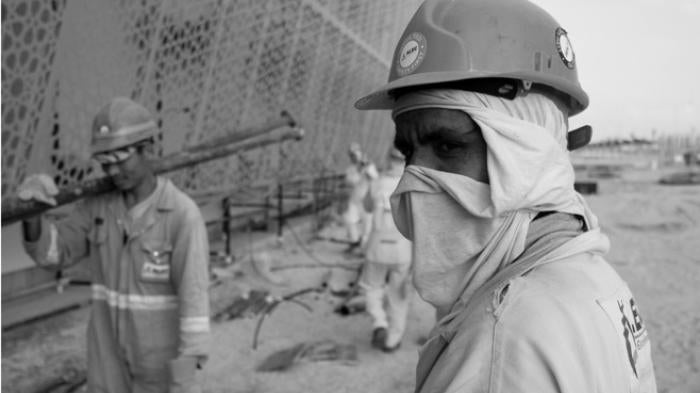
Drawn by the promise of jobs in the United Arab Emirates (UAE), thousands of men from India, Pakistan, Bangladesh, Sri Lanka, Nepal, and Thailand are working on Saadiyat Island. Workers spend up to 12 hours per day on their worksites, often in extreme conditions of heat and humidity with temperatures often exceeding 100 degrees Fahrenheit (38 degrees Celsius). Some workers have been on Saadiyat Island for more than two years, working on massive infrastructure projects, including raising the island's level by trucking in sand and building 10-lane highways and bridges.
Many workers say that "labor supply" agencies in their home countries promised them jobs with UAE construction companies offering good wages and low living expenses. In exchange for providing UAE work visas and in some cases plane tickets, the agencies charged the men fees of up to US $4100 – nine times the average income of some workers' home countries. To pay the agencies' fees, workers borrowed money from relatives, raised cash by selling their farmland, livestock and homes, or took out loans from money lenders at often high interest rates. UAE law prohibits employers from working with agencies that charge workers recruiting fees; but neither the UAE government; or TDIC (a government-owned development company) and their international partners have acted to ensure compliance with the law, and workers employed by the construction companies that are working on Saadiyat Island continue to bear this unlawful, unjust burden on their livelihood.
Because they are often already highly indebted upon arrival in the UAE, many workers have virtually no power to bargain over the terms of the official UAE work contracts their corporate employers require them to sign upon arrival in the UAE. Many workers – often illiterate – did not even understand the terms of these new contracts. Workers said that upon arrival in the UAE, representatives of construction companies told them to sign contracts in Arabic and English, languages most of them could not understand, without explaining the terms of the contracts. Workers were not given a copy of these contracts, as required by UAE law. Some workers say company representatives told them to put their fingerprints on blank pieces of paper, possibly in lieu of signing contracts.
After signing these contracts, many of the workers on Saadiyat Island discovered that their salaries in the UAE were as little as 50 per cent of what the agencies in their home countries had promised, and that their overtime pay, vacation days and other benefits were also greatly reduced. UAE officials have stated that the UAE will not intervene in cases of contract fraud perpetrated by foreign labor agencies outside the country's borders. Embassy officials from labor sending countries in Abu Dhabi said their hands were tied unless workers had written contracts from the labor supply agencies; only two of the 94 Saadiyat Island workers Human Rights Watch spoke to did.
The semi-skilled and unskilled workers Human Rights Watch interviewed on the island received an average daily salary of around US $8.00 per day, for 10 paid hours per day including overtime, although they often spent 12 hours at the jobsite and up to 2 additional hours traveling to and from the island. An estimate of the average yearly salary, including overtime wages, of foreign workers on Saadiyat Island is $2575. By contrast, according to a Guggenheim Foundation press release from 2006, the average per capita annual income of Abu Dhabi is "approximately US $30,000." Workers said several companies paid their overtime wages at the same rate as their normal work hours, in violation of UAE law.
While some Saadiyat Island workers had recently received small pay raises (usually around $5.45 per month), their pay has not kept pace with inflation; rice, for example, has more than doubled in price in the UAE over the past year. Despite requirements in a law dating from 1980, the UAE government has failed to implement a minimum wage or a cost-of-living index.
Due to the combination of large agency fees, loans with usurious interest rates, and low wages, many workers on Saadiyat said that instead of saving money, they will have to work for years simply to pay off their creditors. For example, one man told Human Rights Watch that after 18 months he had paid off the principal of his loan but still owed an even greater amount in interest.
UAE laws prevent workers on Saadiyat Island from improving their financial position. A foreign construction worker's ability to work and live in the UAE depends on the continuing "sponsorship" of a single company. By law, workers who seek a better job at another company – a practice referred to as "absconding" – are subject to deportation and banned from returning to the UAE for one year, except in cases where the original employer has failed to pay them for more than two months. An employer can trigger the deportation of a worker who has left to find a better job by requesting the UAE ministries of labor and interior to cancel his work permit and residency visa, rendering his presence in the UAE illegal.
Companies exercise the excessive control UAE law grants them over foreign workers by confiscating workers' passports. Workers on Saadiyat Island reported that this practice is universal. Some workers, for example, reported that companies refused to return their passports to allow them to attend relatives' weddings or funerals in their home countries. UAE and international law prohibit passport-confiscation as violating the right to freedom of movement. Yet UAE laws also provide a perverse incentive to confiscate passports. Companies face heavy fines if they fail to request the UAE government to cancel "absconding" workers' visas, and the accepted cancellation procedure is for companies to turn in the workers' passports to the Ministry of Interior.
One group of workers on Saadiyat Island said their employer told them that they could not quit their jobs and receive their passports without paying a large fine (which the company would deduct from the workers' legally-mandated bonus, to be paid at the end of their contract).
The insular nature of Saadiyat Island also impacts workers' freedom of movement. The Ministry of Labor has designated Saadiyat Island a "remote area," which requires companies to provide workers there with access to regular transportation. However, many workers said they could only leave the island on Fridays, their only day off, in company-provided buses. As the complaints department of the Ministry of Labor and the Shari`a Court are closed on Fridays, this also means that workers have virtually no access to grievance mechanisms.
In some cases, workers are effectively working in conditions of forced labor: they were fraudulently lured to work in the UAE, had to work in order to pay off debts incurred to obtain their job, cannot flee the country because their employers have confiscated their passports upon arrival in the UAE and threatened them with illegal penalties if they quit their jobs, and because they depend upon their employers for transportation and lacked adequate access to grievance mechanisms. Such conditions of forced labor are prohibited by ILO Convention No. 29, which the UAE ratified in 1982.
All workers interviewed said they were afraid to demand better treatment by filing complaints to the UAE Ministry of Labor or to the courts: they believed that they risked being fired and deported if they did so. Workers on Saadiyat also said they are afraid to unionize or strike and in some cases have been threatened by company representatives not to do so. Workers who attempt to organize, to bargain collectively or to strike to demand their rights are not protected by law and may also face termination and deportation. The UAE government has jailed tens of thousands of striking workers over the past three years, according to news reports, and has deported an unknown number.
Non-union advocacy for workers' rights is virtually non-existent. The UAE does not recognize any non-governmental human rights organizations, apart from the semi-official Emirates Human Rights Association and other groups like the Red Crescent; independent human rights activists commonly face harassment and censorship. Human Rights Watch spoke to representatives of two unrecognized NGOs that try to help foreign workers, one of which was a local chapter of a Philippines-based NGO, but rather than taking the risk of lobbying the UAE government, they instead try to influence their home-country embassies. There is virtually no public discussion of the systemic nature of workers' rights violations. Local news media do report some violent strikes and worker deaths due to unsafe working conditions, but self-censorship appears to prevent robust media coverage of abuses of foreign workers' rights.
Labor reforms
The UAE and Abu Dhabi have taken some important preliminary steps to curb abuses against foreign construction workers, although there have also been broken promises of reforms and failures to enforce the law. The most concrete legislative reform visible in Abu Dhabi remains the 2005 ban on work during the hottest hours of the day in July and August, originally imposed from 12:30 to 4:30 pm, in order to prevent heat exhaustion. After industry lobbying, the government reduced the break to 12:30 to 3:00 p.m. Cases of heat exhaustion reporting to the main Abu Dhabi public hospital during those months have decreased (from 384 cases in 2005 to 140 in 2008). Most workers Human Rights Watch interviewed reported that their companies observed the mandatory break, although some workers said that companies had shifted their work hours to begin at 2 p.m. and end at 2 a.m. during July and August, meaning they began work during the break period. Workers remain on the worksite during the break hours.
On November 7, 2006, the UAE prime minister issued a decree ordering the labour minister to implement immediate reforms in a number of areas, including:
- Adequate housing – with "adequate" defined as consistent with international standards and conventions [...];
- Safe transportation of workers to labour sites-for example, a complete ban on open-air conveyances in extreme weather conditions;
- A recruitment process for at least 2,000 new [labor] inspectors over time to keep pace with the fast growth of the labour sector amid rapidly increasing construction and development;
- New federal labour courts to fast-track labour dispute resolutions [...];
- Workers scheduled for return to their native countries are adequately housed and fed pending their departure; [and]
- Workers who have been cheated on wages or simply not paid for more than two months are granted immediate release from their employer sponsorships if they so choose.
In March 2007, the UAE Ministry of Labor restated many of these directives in an announcement of planned reforms.
Governmental and private authorities have taken some, limited positive steps following the 2006 decree that housing for workers be brought in line with "international standards and conventions." The UAE minister of labor stated on March 25, 2007 that the government had closed 100 Dubai worker accommodations (compounds rented or owned by companies that house hundreds or thousands of workers in shared rooms, commonly referred to as labor camps). TDIC executives told Human Rights Watch that Saadiyat Island's housing facilities will meet or exceed international standards. The company's "CSR [corporate social responsibility] Report 2009" describes accommodations standards that exceed UAE requirements in terms of the numbers of workers housed per room, facilities available on the labor camp site, and in other areas.
Ensuring minimum housing standards for workers on Saadiyat Island will be a welcome and necessary step. However, it is clear that the 2006 decree to improve workers' accommodations remains largely aspirational, at best. In August 2008, for example, public health authorities in Dubai stated that 40 percent of that emirate's 1,033 labor camps violated minimum health and fire safety standards. In June 2008, a chickenpox outbreak in a Sharjah labor camp was linked to unhygienic conditions.In August, 11 construction workers in Dubai died when the 30-room residence where 500 workers were illegally housed caught fire; some had to jump out of windows due to blocked exits. Human Rights Watch observed crowded rooms in several labor camps in Dubai and Abu Dhabi (albeit not those of Saadiyat Island) where new arrivals were required to sleep on the floor rather than on mattresses for days or weeks. Moreover, according to news reports, the economic recession has led to an escalation in overcrowding and other poor treatment of workers at labor camps. In March 2009, the Ministry of Labor's chief inspector said that some companies, to cut costs, have added as much as 40 percent to the population of their labor camps (without increasing space for accommodation), and have cut workers' meals from three a day to one.
The 2006 decree also required employers to provide health insurance for low-skilled workers. As of September 2008, Abu Dhabi mandated such health insurance; Dubai announced plans to phase in mandatory health insurance by 2015. However, as discussed below ("Inadequate Healthcare"), the provision of health care in Abu Dhabi remains inadequate, with some workers reporting that they were required to pay the costs of medication and hospital visits from their salaries, while others complain that except in the case of traumatic injuries, it was difficult to gain access to medical professionals besides the "company nurses" provided at the work-site for treatment.
Improved safety and inspection standards remain problematic, as the government has not met its own goals to improve regulation. The 2006 decree ordered the Ministry of Labor to hire 2,000 more labor inspectors. In March 2007, the Ministry of Labor stated that the inspectors would be hired within "a few months ... an indication of the seriousness with which the Government is tackling this task."However, according to a US State Department report on human rights practices, as of December 31, 2008, the total number of Ministry of Labor health and safety inspectors in the UAE stood at only 48. None of the workers interviewed for this report had seen a labor inspector at a work site or a labor camp. Forty eight labor inspectors cannot possibly be expected to provide meaningful regulation of the thousands of construction sites ongoing in the country.
In February 2007, the government put forward a draft labor law that, although it perpetuated many of the flaws of the current law by failing to guarantee workers' right to form unions, strike and bargain collectively,did require employers to pay the expenses of migrant workers' travel, employment permits, medical examinations, and other required administrative costs as well as the cost of workers' health care, including coverage of migrant workers upon arrival in the country. However, the government withdrew the draft law and has not commented on possible labor law reform since.
Thus, none of the proposed reforms has addressed concretely the fundamental sources of abuse: recruiting fees paid by workers, confiscation of workers' passports, restrictions on workers' movements and employment, coupled with laws and practices that penalize workers who demand better treatment by collectively bargaining, forming unions, or striking.
There is no indication that promises for reform have resulted in any change in the payment of recruiting fees by workers, which remains endemic and lies at the heart of their exploitation. The UAE signed an MOU on Labor and Manpower Sourcing with India in December 2006, which required that the recruitment of "all categories of workers" must "be in conformity with the laws of both countries," and that the "terms and conditionsof employment" offered by agencies to workers in India must conform to the work permitthat the employer obtained from the UAE government; the employer would have no authority to change the contract conditions. On March 25, 2007, the Ministry of Labor stated that it had signed MOUs with labor-sending countries to improve regulation and monitoring of labor recruitment agencies in those countries; that it was considering creating government-run agencies in the UAE; and that it would freeze issuing new licenses for UAE-based recruitment agencies pending a review of the UAE regulatory framework. If implemented, such MOUs would be a first step toward preventing non-UAE-based labor supply agencies from charging workers illegal recruitment fees as well as from, in some cases, promising workers conditions of employment that far exceed their actual terms upon arrival in the UAE (referred to as "contract substitution"). However, although the Ministry of Labor has announced imposing fines on UAE-based recruitment agencies, Human Rights Watch is not aware of any cases where employers have been required to compensate workers for illegal fees they paid to labor supply agencies, and none of the scores of workers we interviewed had been repaid these costs (or knew of any cases of repayment).
Despite promises of reform regarding the prompt payment of wages, the practice in Abu Dhabi remains problematic. UAE legislative reforms require employers to open bank accounts for all foreign workers and to pay their salaries regularly into those accounts, rather than paying workers in cash on the worksite. The reform was intended to combat employers' late payment of wages, which can cause heavily indebted migrant construction workers to miss interest payments and incur further fees. Electronic payment records would also facilitate audits of companies for violations, such as illegal withholding of wages, which Human Rights Watch documented as a widespread and "customary" violation in our 2006 report.
One group of workers on Saadiyat Island, however, had still not been paid more than two and a half months after beginning work. Other workers said their companies had not set up bank accounts for them and continued to pay their wages in cash on dates that varied by a week or more each month. A senior advisor to the Ministry of Labor told Human Rights Watch in November 2008 that the program was not being implemented as quickly as desired because several banks were reluctant to participate in the scheme, as it would require them to set up large numbers of bank accounts where relatively small amounts of money were transferred. According to the chief Ministry of Labor inspector, "late payment and reduction in wages are the most two consistent violations" of workers' rights today, as they were in 2006.
Another area in which the government has made no progress is in allowing workers to form trade unions and to strike. In October 2004, the legislative committee of the Ministry of Justice approved a bill allowing the formation of trade unions in the private sector; despite several announcements that the government would pass the bill, it has not. Instead, workers who go on strike continue to face detention and deportation. Although news reports suggest that recently, the authorities have mostly deported violent protestors, several construction workers and other migrant workers, including taxi drivers, told Human Rights Watch of friends or acquaintances whom police had summarily detained, driven to the airport, and deported after they had gone on strike. The deportee would later call his friends back in the UAE to tell them the story. Workers told Human Rights Watch that there was no administrative or judicial hearing of any kind during these deportations.
The main complaint of migrant construction workers in Abu Dhabi in 2008, as it was for workers in Dubai and Sharjah in 2006, was that they are paid low wages, in many cases after being promised better salaries by labor supply agencies against whom they had no recourse. Establishing a minimum wage in the UAE would help prevent such deceptive practices. In 1980, Federal Law No. 8 on Labor Relations required the government to implement a minimum wage and cost-of-living index. Nearly three decades later, the government still has not done so. In June 2008 the Ministry of Labor said the government was unlikely to adopt a minimum wage in the near future.
The role of international institutions
Since 2005, several international educational and cultural institutions signed agreements to build branches in the "cultural district" of Saadiyat Island, Abu Dhabi, including the Guggenheim, the Louvre, and New York University. Internationally renowned architectural firms are designing each of the six institutions of the cultural district, including Gehry Partners, LLP (the Guggenheim); Ateliers Jean Nouvel (the Louvre); Foster and Partners (the Sheikh Zayed Museum); Tadao Ando Architects and Associates (the Maritime Museum); Zaha Hadid Architects (the performing arts center); and Rafael Vinoly Architects PC (New York University). The Guggenheim Foundation was the first to be affiliated with the project; the Louvre and New York University followed. Human Rights Watch contacted each of these institutions and architects with our concerns, urging them to take proactive steps – at a minimum, obtaining contractual guarantees from their UAE development partner that it will prohibit contractors involved in their projects from practicing the most serious and pervasive abuses, such as confiscating workers' passports and failing to pay recruiting fees, to ensure that their institutions are not beneficiaries of the exploitation of migrant workers in Abu Dhabi.
Human Rights Watch identified several companies operating on Saadiyat Island, including the UAE construction Al Jaber, Arabtec, Saif Bin Darwish, and Abu Dhabi National Hotels / Compass (ADNH), as well as the German company Ed. Zueblin AG and the Australian company Leighton International, which has partnered with the UAE company Al Habtoor to form Al Habtoor Leighton Group.
Some institutions were more forthcoming and cooperative than others in Human Rights Watch's efforts. Of the institutions that discussed workers' rights with us, the Guggenheim and the French Museum Agency (which the French government created to oversee the creation of the Abu Dhabi Louvre) said that they felt hampered by pressure from TDIC to remain silent on the issue, particularly in an economic climate where revenues from the Abu Dhabi project were more needed than ever; NYU has not dealt directly with TDIC but with the Abu Dhabi Executive Affairs Authority, although NYU officials are aware that TDIC is responsible for overseeing construction of Saadiyat Island's infrastructure which will serve the NYU campus.
These three institutions recognized and appreciated the pervasiveness of the problems in Abu Dhabi, but to date appear to be proceeding with their projects notwithstanding the exploitation of workers the projects are likely to entail. Only one, the Agence France-Muséums (which is overseeing the Louvre Abu Dhabi), with whose staff Human Rights Watch met and discussed these issues on a number of occasions, has described how it had obtained any specific contractual promises from TDIC, the development partner in these projects, regarding standards for and independent monitoring of the treatment of migrant workers.
Human Rights Watch met with members of the Guggenheim Foundation in April 2008 and with consultants to the Abu Dhabi Guggenheim project in February 2009. We were told that the Guggenheim had specifically raised Human Rights Watch's reporting on abuses against migrant construction workers to TDIC during initial negotiations in 2006. However, current contractual language contains no concrete human rights monitoring requirements or any specific provisions regarding labor.
Human Rights Watch first contacted New York University with our concerns in September 2007; NYU did not respond until 2009, when officials finally met Human Rights Watch on April 10. University officials at the meeting stated that they had not sought any specific contractual guarantees of workers' rights protections from the Abu Dhabi Executive Affairs Authority (EAA), their development partner, because construction of the campus had not yet begun; there was a "commitment on both our parts to make sure NYU is a model of best practices in Abu Dhabi"; and "we believe them [the EAA] that labor issues are a top priority for them and that they have room to improve." NYU has published, with the EAA, a list of eleven "labor values," which state that the NYU project will comply with UAE laws but which are often vague and do not address the fundamental concerns this report documents. For example, the first "value" states that, "As a floor, workers providing services to NYU Abu Dhabi will be paid wages and benefits which comply with all applicable UAE laws and regulations and which provide for their essential needs and living standards." There is no minimum wage in the UAE.
The British Museum, which according to media reports will establish an unspecified presence in Abu Dhabi, had not responded to a letter Human Rights Watch sent on March 9, 2009 as of April 20.
We conveyed our concerns to the architectural firms that designed the museums, educational and other cultural institutions slated for construction on Saadiyat Island. We supplied Gehry Partners LLC, the architect of the Guggenheim Abu Dhabi, with proposed contractual provisions that we believed would help protect the rights of migrant workers' on the Guggenheim project under international law while not conflicting with domestic UAE legislation.
Human Rights Watch encourages the global vision of these non-profit cultural and educational institutions, but calls on them to ensure their expansion does not come at the cost of abusing migrant workers who may never be able to afford admission to the museums or tuition at the university. These institutions and the other companies engaged in building their new Abu Dhabi branches, could also take steps to show their commitment to human rights. The UN Global Compact, for example, allows companies to pledge their adherence to ten "principles" in the areas of human rights, labour, environment and anti-corruption. Compliance with the principles would, at minimum, require companies to take measures to avoid perpetuating and benefiting from conditions of indentured servitude and other serious rights violations on their own worksites.
Human Rights Watch also has attempted to address these issues of abuse directly with the development company with the greatest responsibility and capacity to influence what happens on all of these work sites: TDIC. We met with officials of TDIC in Abu Dhabi in November 2008, and received a response to a letter we sent requesting further information in January 2009. Our letter to TDIC detailed our specific findings about the ways that construction and other companies currently operating to develop the island, with which TDIC had contracted, were apparently violating workers' rights, including by confiscating their passports, failing to repay the illegal fees charged by labor supply agencies, failing to pay them in a timely fashion, failing to provide adequate health care and health insurance, and threatening to fire them – which would, under UAE laws, trigger their deportation – if they unionized.
TDIC's response included a lengthy list of the contractual provisions it has required of contractors on Saadiyat Island, and the information that it had recently required all contractors to affirm their adherence to these provisions, and had hired an auditor to monitor compliance. These are welcome steps, as is the fact that TDIC subsequently sent a letter to its contractors requiring them to confirm that: "1.you do not engage in or support the use of forced labour; 2. your employees are not required to surrender passports to you on commencing employment; 3. you do not withhold wages from employees."
However, TDIC's response did not address, directly or indirectly, many of our other questions, including with regard to the payment of recruiting fees by workers to labor supply or recruitment agencies; most of the contractual provisions cited were vague, boilerplate obligations requiring contractors to abide by "applicable laws," none specifically addressed the fundamental issues that underlie migrant workers' exploitation. Human Rights Watch's research indicates that TDIC's contractors are in breach of contractual provisions related to workers' rights – as do, in two cases, the statements of the contractors themselves. Ed. Zueblin AG responded to our question regarding the confiscation of passports with the information that "passports are obviously important official documents and we feel it is our duty to ensure that these are protected for our workers. We therefore keep them safe centrally for various reasons [...]. There are no restrictions for workers to have their passports returned at any time." Al Habtoor Leighton responded that "the passports are stored in safe fire-proof security boxes in head office and are available to all staff upon request." Human Rights Watch cannot confirm whether TDIC has implemented a monitoring program focused on workers' rights, or the results of any such program.
We appreciate TDIC's openness to discussing these matters of concern, although we regret that, according to two of the construction companies we contacted, Leighton and Ed. Zueblin AG, TDIC informed them that they should not meet or correspond with Human Rights Watch about their roles in the development of Saadiyat Island.
In this report, Human Rights Watch documents severe exploitation of workers on Saadiyat Island. In some cases, this exploitation amounts to forced labor. Violations against foreign workers are likely to continue in a context where workers are generally not aware of their rights and are afraid of expressing grievances, independent and effective monitoring is lacking, and unions and workers' rights NGOs do not exist. Unless the Guggenheim, the Louvre, NYU, and other institutions urgently insist and ensure that their local development partner protects workers' rights under UAE and international law, these institutions' newest branches may be built by abused workers.
Recommendations
To the Tourism Development and Investment Company of Abu Dhabi:
Ensure that all contractors and subcontractors on TDIC worksites:
- Immediately return all confiscated passports to workers and cease this illegal practice.
- Identify and cease working with any labor supply agencies in labor-sending countries or the UAE that engage in deception regarding contracts; inquire from each worker upon arrival whether they have paid any recruiting or visa fees or travel costs to any labor supply agency and reimburse workers for any such fees or costs.
- Translate and explain UAE contracts into workers' native languages and give workers a meaningful opportunity to review their contracts before signing them, and provide workers with copies of contracts.
- Pay their workers promptly upon starting work, and regularly thereafter, including by complying with UAE legal requirements to set up and pay into workers' bank accounts.
- Provide adequate healthcare to all workers as required by law, including opportunities to seek medical advice and treatment from medical staff not employed by the companies, and inform workers of their rights.
- Provide guarantees that they will respect workers' rights to freedom of association and collective bargaining, by including in their contracts with TDIC, by amendment if necessary, provisions that ban employer interference in union activity; ban employer conduct designed to impede or prevent non-citizens from exercising their right to organize; require employers to grant representatives of workers' organizations access to non-work areas of project property during non-work time; require employers to pledge neutrality on union formation; and require employers to engage in good-faith collective bargaining with workplace or sector-wide unions or labor federations or confederations over terms and conditions of employment.
- Establish, in close consultation with workers, conciliation and mediation proceedings that lead, in the event of deadlock, to binding arbitration with sufficient guarantees of impartiality and rapidity to resolve labor conflicts, as recommended by the ILO Committee of Experts.
Additionally, TDIC should:
- Penalize and terminate relationships with any contractors that continue to work with labor agencies or sub-agencies that charge workers fees and/ or mislead workers regarding conditions of employment upon arrival in the UAE;
- Ensure that workers have access to governmental grievance mechanisms, including access to the appropriate office of the Ministry of Labor, and that workers are clearly instructed about their right to file complaints without fear of reprisal.
- Ensure that workers are informed of their rights under UAE law, including to overtime rates, minimum numbers of days off and to holidays, and to extra compensation.
- Investigate cases where contractors are requiring laborers to work for periods prohibited by law or without adequate overtime or compensatory pay, and ensure workers are compensated and companies penalized.
- Regularly collect and make public data on the number and kinds of occupational injuries and accidents on its worksites.
To the Government of France, Agence France-Muséums, the Solomon R. Guggenheim Foundation, and New York University:
- Publicly pledge that all development partners, contractors, subcontractors and their affiliates involved in the construction of the Abu Dhabi branch of each respective institution will not engage in abusive labor practices, including withholding employee passports and wages, as "security," and doing business with recruiting agents who charge employees work-related fees for their employment. Make public the guarantees and protections you have sought and obtained to protect the rights of workers in the UAE, to reassure the domestic and international public that your project will not be tainted by the prevalent practices of migrant worker abuse.
- Insist that TDIC agrees to obtain contractual commitments from all of the contractors and subcontractors involved in the project to respect the rights of foreign workers' rights under UAE and international law, including a promise to allow workers to retain their passports, reimburse workers for any fees paid in the recruitment process, prompt payment of salaries, and public reporting of deaths and injuries on the worksite.
- Obtain representations from TDIC that it will respect workers' rights to freedom of association and collective bargaining, by including in their contracts with TDIC, by amendment if necessary, provisions that ban employer interference in union activity; ban employer conduct designed to impede or prevent non-citizens from exercising their right to organize; require employers to grant representatives of workers' organizations access to non-work areas of project property during non-work time; require employers to pledge neutrality on union formation; and require employers to engage in good-faith collective bargaining with workplace or sector-wide unions or labor federations or confederations over terms and conditions of employment.
- In light of interpretations of UAE law whereby striking is prohibited, obtain representations from TDIC that it will ensure that all project-related employers establish, in close consultation with workers, conciliation and mediation proceedings that lead, in the event of deadlock, to binding arbitration with sufficient guarantees of impartiality and rapidity to resolve labor conflicts, as recommended by the ILO Committee of Experts.
- Establish, as an integral part of relations with the Abu Dhabi branches of your institution, a mechanism to monitor labor practices within the operations of the new branch as well as those of any subcontractors and their affiliates (including those who provide construction and maintenance services). This monitoring mechanism should oversee how migrant workers are hired and treated during their employment with your Abu Dhabi branches and its subcontractors and affiliates. The committee should make sure that all managers within the Abu Dhabi branch's operations, as well as subcontractors, are specifically trained and informed of a zero-tolerance policy on "customary" labor abuses.
- Take concrete steps to create mechanisms that would encourage compliance by your subcontractors (i.e. retain experienced and reputable labor and construction lawyers and give them a mandate to ensure that all construction and maintenance related contracts entered into by the Abu Dhabi branch of your institution require meaningful compliance with labor laws).
- Urge the UAE government to establish immediately a comprehensive database, accessible to the public but respecting patients' privacy rights, reporting on the cases of injured workers treated at UAE hospitals in connection with the construction and operation of your institutions. This database should include information on the nationality of the workers, the nature of the injuries, whether or not they are work-related, the medical diagnosis, and the employer's role in covering related healthcare costs in each case.
To Ateliers Jean Nouvel, Foster and Partners, Gehry Partners LLP, Rafael Vinoly Architects PC, Tadao Ando Architects and Associates, and Zaha Hadid Architects:
- Publicly pledge that you have obtained guarantees from your development partner that contractors, subcontractors and their affiliates involved in the construction of the Abu Dhabi branch of the institution you are designing will not engage in abusive labor practices, including withholding employee passports and wages, as "security," and doing business with recruiting agents who charge employers work-related fees for their employment; make public the guarantees and protections you have sought and obtained to protect the rights of workers in the UAE, to reassure the domestic and international public that your project will not be tainted by the prevalent practices of migrant worker abuse.
To construction and other companies employing migrant workers engaged in work on Saadiyat Island, including Arabtec, al-Habtoor, al-Jaber, Leighton, Saif bin Darwish, Ed. Zueblin AG and Abu Dhabi National Hotels / Compass:
- Make public any guarantees and protections you have given or sought and obtained from your subcontractors to protect the rights of workers in the UAE, to reassure the domestic and international public that you will not be involved in the prevalent practices of migrant worker abuse.
- Publicly pledge that you or your subcontractors and their affiliates involved in construction in Abu Dhabi will undertake the first seven steps described in the recommendations to TDIC with regard to its contractors.
- Penalize and terminate relationships with any labor agencies or sub-agencies that charge workers fees and/ or mislead workers regarding conditions of employment upon arrival in the UAE.
- Ensure that workers have access to governmental grievance mechanisms, including access to the appropriate office of the Ministry of Labor, and that workers are clearly instructed about their right to file complaints without fear of reprisal.
- Ensure that workers are informed of their rights under UAE law, including to overtime rates, minimum numbers of days off and to holidays, and to extra compensation.
- Consider joining the UN Global Compact and implementing measures to ensure your work conforms to the human rights and labor law based "principles" contained therein.
To the Government of the UAE:
- Establish an independent commission to investigate and publicly report on the situation of migrant workers in the country.
- Prohibit companies from doing business with recruitment agencies, in the UAE and abroad, that charge workers fees for travel, visas, employment contracts, or anything else. Prosecute and implement significant penalties for employers and recruiting agencies that violate the law.
- Aggressively investigate and prosecute employers who violate other provisions of UAE law, including employers who confiscate workers' passports or fail to pay all costs associated with recruiting agents, and amend UAE labor laws to explicitly protect the right of all workers to hold their own passports and other identity documents.
- Amend labor laws to stipulate that employment contracts be entered into and legally enforceable in both Arabic and in a language that the worker understands and speaks fluently; stipulate that instructions issued to workers from government agencies or employers also be available in both Arabic and the worker's language.
- Impose meaningful and consequential penalties on companies that violate workers' rights, to put an end to the present atmosphere of impunity.
- Increase substantially the number of inspectors responsible for overseeing the private sector's treatment of migrant construction workers. Ensure that they carry out their duties to inspect construction sites and worker accommodations to verify that they are safe and meet the requirements of law.
- Take immediate action to inform and educate migrant construction workers arriving for employment in the UAE of their rights under UAE law.
- Abide by the obligation under the UAE labor law of 1980 to implement a minimum wage and cost of living index.
- Allow for the establishment of genuine and independent human rights and workers' rights organizations.
- Amend UAE labor law to guarantee workers' right to strike, including by establishing explicit procedures for workers to exercise this right, such as strike voting requirements and strike notification rules; and to provide for binding arbitration in cases of collective labor disputes only upon workers' request and only in very limited circumstances.
- Ratify the International Labour Organization's Conventions No. 87 and No. 98 on freedom of association and collective bargaining, and amend UAE labor law to incorporate the conventions' protections. The law should provide for the formation of independent unions free from employer and government interference, and explicitly require that upon request of a workers' organization, an employer and the representative labor organization bargain in good faith over terms and conditions of employment, including wages and hours, to reach a collective agreement.
- Ratify the International Labour Organization's Convention No. 155 on occupational safety and health, and establish immediately a comprehensive database to provide quantitative and qualitative data on labor disputes, deaths and injuries at construction sites, and government actions to address these issues.
- Ratify the International Convention on the Protection of the Rights of All Migrant Workers and Members of Their Families.
Methodology
In November 2006, Human Rights Watch released Building Towers, Cheating Workers, a report that documented abusive conditions faced by migrant construction workers in the emirates of Dubai and Sharjah. The report found that migrant workers were indebted to unscrupulous recruiters, exploited by employers, and obliged to work in hazardous, even deadly, conditions, and concluded that the UAE federal government had failed to adequately address these abuses. The workers' most common concern was extremely low wages, which their employers typically withheld for a minimum of two months along with their passports, as "security" to keep them from quitting. Despite this and other rights violations, the workers felt compelled to remain in their jobs, because they had incurred large debts to recruitment agencies in their home countries, which they paid to finance visa and travel costs. UAE federal labor law offered a number of protections, including prohibiting charging workers visa and travel fees, but for migrant construction workers these laws were largely unenforced.
In February 2007, after media reports that the Solomon R. Guggenheim Foundation planned to build a Gehry Partners-designed museum on Saadiyat Island, Human Rights Watch wrote to the Foundation and to the architectural firm to urge the Guggenheim to take steps to counter the likelihood workers on Saadiyat would suffer from widespread abusive labor practices.[2] In April 2008, at a meeting with Human Rights Watch, representatives of the Guggenheim Foundation said local authorities in Abu Dhabi had taken promising steps to improve foreign workers' circumstances, and noted that Human Rights Watch's 2006 report covered only the northern Emirates, implying there was insufficient research to substantiate concerns about abuses in Abu Dhabi.[3] Guggenheim officers argued that Abu Dhabi was an exceptional emirate more amenable to change than others.
To determine whether the abusive circumstances Human Rights Watch documented in Dubai and Sharjah in 2006 was of similar cause for concern in Abu Dhabi in 2008, Human Rights Watch conducted four research trips to Abu Dhabi between July and November 2008, carrying out a wide range of interviews and meetings with the people involved in the construction and development of Saadiyat Island and worker issues in the UAE.
In the course of researching this report, Human Rights Watch spoke to 94 foreign workers who currently work on Saadiyat Island, all of whom were construction workers apart from four security guards and five cleaning or kitchen staff. We conducted the majority of interviews on the island; others were conducted in labor camps elsewhere in Abu Dhabi. Human Rights Watch interviewed an additional 21 foreign workers at labor camps in Abu Dhabi who do not work on the island, including employees of construction, cleaning, and security companies, and labor camp supervisors; as well as seven construction workers at a labor camp in Dubai. Human Rights Watch also interviewed members of two NGOs that work on behalf of foreign workers in the UAE; staff at the UAE embassies of six labor-sending countries; owners or general managers of construction companies (which are not working on Saadiyat Island); officers at the Tourism Development and Investment Company responsible for overseeing the development of Saadiyat Island; a labor lawyer; and UAE Ministry of Labor officials. We also met and corresponded with representatives of the Agence France-Muséums, which oversees the Louvre Abu Dhabi project, and of the French government; and representatives of the Guggenheim museum. We wrote to and met with officials of New York University, and wrote to the architectural firms listed above (see "Recommendations").
Most workers interviewed for this report said they were afraid they their employers might punish them for speaking about their problems; at their request, this report withholds their names. Officials from the embassies of labor-sending countries similarly requested to speak on condition of anonymity, as did the leader of a migrant workers' rights NGO based in Dubai.
Human Rights Watch attempted to interview company officials from a number of construction companies operating on Saadiyat Island, who are directly responsible for securing migrant construction workers, including Zueblin, Al Habtoor, Leighton, Arabtec, and Al Jaber construction companies. Zueblin and Leighton responded positively to requests for interviews, but later declined to meet on the basis that TDIC had insisted that under the terms of their contracts to work on Saadiyat Island, only TDIC should meet with Human Rights Watch.[4] TDIC officials met with Human Rights Watch and said they were not aware of any such terms or correspondence with Leighton or Zueblin.[5] Human Rights Watch contacted all of these companies, as well as Abu Dhabi National Hotels / Compass (which employs migrant workers to operate cleaning and food services at the main labor camp on Saadiyat Island) again in early 2009 with concerns based on our on-site observations and interviews we conducted with their employees on Saadiyat Island or in labor camps in Abu Dhabi. As of April 9, 2009, only Ed. Zueblin AG and Al Habtoor Leighton Group had responded to our questions.[6]
Human Rights Watch requested information on progress on UAE governmental reform efforts – including the revised labor law, increasing the number of labor inspectors, MoUs with labor-sending countries, allowing unionization, and other areas – from the Ministry of Labor.[7] Human Rights Watch sought information about the Ministry's actions to combat the withholding of workers' passports, illegal fees charged to workers and deception regarding conditions of employment by labor supply agencies, illegal deductions from and late payments of salaries, lack of overtime pay, lack of adequate holidays and break hours, health and safety inspections, and coercive contractual circumstances. We also asked the Naturalization and Residency Department of the Ministry of Interior for information regarding the number of migrant workers in Abu Dhabi, and details about the criteria for approving, denying or cancelling work visas, the procedure for deporting workers, efforts to curb illegal visa selling, and inspections of accommodations used to illegally house workers.[8] Neither the Ministry of Labor nor the Ministry of Interior had replied by the time this report went to press.
Abu Dhabi and Saadiyat Island
Bordered by the Sultanate of Oman to the east, Saudi Arabia to the south and west, and by the Arabian Gulf to the north, the United Arab Emirates covers 83,000 square kilometers (32,278 square miles) and has an estimated population of between 4.6 and 5.6 million.[9] The emirates of Abu Dhabi, Dubai, Sharjah, Ajman, Umm Al Qaiwain, Ras Al Khaimah and Fujairah united and declared independence as the UAE in 1971 (previously they had been under British influence and referred to as the "Trucial States"). Arabic is the official language and Islam is the state religion.[10] The website of the ruler of Dubai states that 5.6 million people lived in the UAE in 2007.[11]
Abu Dhabi city, in the emirate of Abu Dhabi, is the capital and the largest city of the federation. The emirate of Abu Dhabi covers 70 per cent of the UAE land area and controls 94 per cent of the country's oil reserves; the UAE, in turn, has eight per cent of the world's proven crude oil reserves and five per cent of its natural gas.[12] In 2006, the Ministry of Economy placed Abu Dhabi's population at 33 per cent of the UAE total,[13] a figure of up to 1.85 million people in 2007. The ruler of Abu Dhabi, Sheikh Khalifa bin Zayed Al Nahyan, is also the president of the UAE; he succeeded his father, Sheikh Zayed, to both positions in 2004.[14]
The government of Abu Dhabi is led by a central Executive Council, chaired by the Crown Prince, Sheikh Mohammed bin Zayed Al Nahyan; a 60-member National Consultative Council, composed of appointees from the emirate's most powerful tribes and families, plays an advisory role. Various departments, equivalent to ministries, fall under the Executive Council, as do a number of autonomous agencies, including the Abu Dhabi Tourism Authority (ADTA).
The emirate is divided into Western and Eastern Regions, headed by Ruler's Representatives. The emirate's main cities are Abu Dhabi on the western gulf coast and Al Ain near the eastern border with Oman; these cities, as well as the Western Region generally, each have a municipal administration headed by a nominated municipal council, which fall under the Department of Municipalities and Agriculture. [15]
The UAE constitution grants the country's federal government primacy in the fields of labor relations, nationality and immigration, among other issues. Individual emirates have also decreed and implemented their own standards in some areas related to foreign workers.[16] Abu Dhabi, for instance, requires construction companies to provide health insurance to all employees, whereas Dubai mandated specialized bodies to protect workers' rights: the Human Rights Department of the Dubai police department or the Permanent Committee for Labor Affairs.[17]
It is not clear how many foreign workers live in the UAE or in the emirate of Abu Dhabi. The UAE Ministry of Labor states that there were 3.1 million foreign workers in the country in 2007.[18] However, the figure may be higher: as interviews with foreign embassy officials suggests that India, Pakistan and Bangladesh alone account for up to 2.95 million UAE residents.[19] Construction workers also come from Sri Lanka, Nepal, Thailand, and elsewhere,[20] and the large population of foreign domestic workers in the UAE comes from the Philippines, Indonesia, Ethiopia, and other countries.
Extrapolating from official figures, a minimum of roughly 900,000 migrant construction workers live in the UAE, although actual numbers may be higher.[21] It is not known how many of these live in Abu Dhabi. Officials at the Embassy of Bangladesh estimate that 30 per cent of the Bangladeshis in the UAE, or roughly 200,000 people, are in Abu Dhabi. It is not clear if this proportion applies to other nationalities.[22]
By law, construction workers are not allowed to bring their families to the UAE.[23] All residents of labor camps in the UAE are male. The average "cycle" of a foreign construction worker in the UAE is "four to five years," according to a senior advisor to the Ministry of Labor.[24]
Saadiyat Island
The government of Abu Dhabi is developing Saadiyat Island as part of an overall attempt to diversify the economy from oil and gas.[25] Saadiyat Island is wholly administered by the Abu Dhabi Tourism Authority (ADTA).[26] In 2005, Sheikh Khalifa established the Tourism Development & Investment Company (TDIC), mandating it to manage the development of the ADTA's assets.[27]
As Saadiyat Island's master developer, TDIC's role is to contract out and oversee the island's phased development. According to a Guggenheim Foundation press release, "Saadiyat Island will be developed in three phases with total completion scheduled for 2018. The masterplan envisages six highly individual districts and includes twenty-nine hotels, including an iconic seven-star property, three marinas with combined berths for around 1,000 boats, museums and cultural centers, two golf courses, civic and leisure facilities, sea-view apartments and elite villas."[28]
In 2005, TDIC commissioned a master plan for Saadiyat Island's "Cultural District," which will be located on the tip of the island closest to the city of Abu Dhabi.[29] TDIC also entered a consultancy agreement that year with the Guggenheim Foundation, which had successfully opened a museum in Bilbao, Spain in 1997.
The cultural district will host six cultural institutions. The Guggenheim museum on Saadiyat Island, which like the Bilbao Guggenheim is designed by Gehry Partners LLC, will cover 41,411 square meters, making it larger than the foundation's flagship museum in New York City.[30] A Louvre museum, designed by Ateliers Jean Nouvel and covering 24,200 square meters, will be located nearby. Foster and Partners' architectural firm won the design contract for the Sheikh Zayed museum, dedicated to Abu Dhabi's cultural heritage. Other institutions planned for the cultural district include a performing arts center designed by Zada Hadid Architects (52,381 square meters), and a Maritime Museum designed by Tadao Ando Architects (10,000 square meters). The first of these institutions scheduled to begin construction is the Louvre, which will break ground in late May 2009, with the Guggenheim and the Sheikh Zayed museum to follow. In November 2008, TDIC was reportedly reviewing planned development projects in places other than Saadiyat Island due to the global economic downturn, but was going ahead with the Louvre and Guggenheim.[31] Saadiyat Island's cultural district was reportedly "on track to be completed on time" as of January 2009.[32]
Saadiyat Island will also host a campus of New York University (NYU), designed by Rafael Vinoly Architects PC, which NYU expects to serve 2,000 students.[33] In October, the CEO of TDIC told news media that the British Museum would be "assisting with [the Saadiyat Island] project" in an undisclosed capacity.[34] Students at New York University have protested that the UAE bans Israelis from entering the country, criminalizes homosexuality, and restricts free speech.[35] NYU responded that it must abide by the laws of any country it operates in, and that the Abu Dhabi government had agreed to designate the university campus as a unique "academic freedom zone" where normal restrictions on speech would not apply.
Abu Dhabi is providing the land and paying the design, construction and operating costs for these institutions. These costs are substantial; building the new Guggenheim museum, for example, is projected to cost roughly $200 million.[36] It will be the largest Guggenheim Foundation facility in the world.[37]Abu Dhabi is also, in some cases, providing large payments to the parent institutions. Abu Dhabi reportedly agreed to pay the French Museum Agency € 1 billion (US $1.4 billion) over 30 years in exchange for the use of the Louvre name and an initial loan of 300 artworks, in addition to other fees; the Agence France-Muséums will require that the Louvre Abu Dhabi meets technical standards and will be involved in training curatorial and other museum staff.[38] According to NYU, "The Abu Dhabi Government has committed to provide land, funding, and financing for the development, construction, equipping, maintenance and operation of the NYU Abu Dhabi campus. It has also made a commitment to NYU that will enhance the University's investment in faculty and programming" at its New York and other campuses.[39] Abu Dhabi reportedly made a US $50 million "down payment" on this commitment.[40] NYU will operate the Abu Dhabi campus as a branch of NYU New York.[41]
Since at least 2006, construction companies under contract with TDIC have undertaken massive backfilling and infrastructure projects on the island.[42] Workers trucked in sand, raising the island's level by four meters in some areas, and shored up parts of its coastline.[43] Other companies have partly completed contracts to build 10-lane bridges and roads linking Saadiyat to Abu Dhabi. TDIC has also awarded large contracts for the development of other districts on the island, such as the residential "Saadiyat Beach" district.[44] Landscaping has begun on a golf course.
Human Rights Watch interviewed workers on Saadiyat Island who came from India, Pakistan, Bangladesh, Sri Lanka, Nepal, and Thailand. The construction workers interviewed worked for Al Jaber, Al Habtoor, Leighton, and Zueblin, on a variety of projects, including landscaping, building bridges and highways. During the four-month period in which Human Rights Watch conducted on-the-ground research, construction companies under contract with TDIC were bussing in hundreds of workers to the island from labor camps elsewhere in Abu Dhabi, including the Commercial and Industrial zones of the Moussafah area, a 45 minute drive away, while hundreds more workers lived in several camps on the island itself. As of July, the main labor camp on the island alone accommodated approximately 1000 workers.[45] Increasingly, the majority of construction workers will live in this central "construction village," which when complete will house up to 40,000 workers. The first phase, with 5,000 beds, has been finished, although not all the beds are occupied. According to a manager of the camp, TDIC subcontracted the operation of the camp to a joint venture of Abu Dhabi National Hotels and Compass Group PLC.[46]
The Exploitation of Foreign Workers on Saadiyat Island
The Sponsorship System
Foreign construction workers in the UAE are subject to a sponsorship (or "kafala") system that places them in a highly dependent relationship to their employers. In conjunction with prohibitions (de facto or de jure) against unions, collective bargaining and striking, the sponsorship system grants employers an extraordinary degree of control over foreign workers, placing the workers at severe risk of exploitation.
The sponsorship process begins when a construction company in the UAE applies to the Work Permit Department of the Ministry of Labor and Social Affairs for work permits for foreign workers it seeks to employ.[47] The company must finalize the application within six months; in the interim, the company approaches the Immigration and Residency Department of the Ministry of Interior. This department, upon being shown that the company has applied for a work permit, will issue the company an employment visa that allows each sponsored worker to enter the UAE for a period of 30 days.[48] The company will then transfer that visa to a labor supply agency, either in the UAE or directly in a labor source country, which the company has contracted to supply the required number and types of workers – for example, unskilled laborers, semi-skilled masons and carpenters and steel fixers, and skilled crane operators, truck drivers, and welders.[49]
Once a worker arrives in the UAE on the basis of his employment visa, the company, as his sponsor, takes his passport and work permit to the Ministry of Interior immigration department. (The common employer practice of confiscating passports, which violates the worker's right to freedom of movement protected under UAE and international law, is discussed below; see "Confiscation of Passports, Freedom of Movement and Forced Labor.") The ministry stamps the worker's passport with a residency visa that includes the visa's date of issuance and validity period of up to three years, the worker's picture, profession, and employer.[50]
A foreign worker's legal ability to enter, live and work in the UAE depends on a single employer. UAE laws make it extremely difficult for workers to escape from this dependency after entering the UAE or beginning employment. If a foreign construction worker in the UAE quits, his employer will request the Ministry of Labor to cancel his labor card; a foreign worker who remains in the UAE more than two months after his labour card is cancelled will be fined.[51] The employer will then take the worker's passport to the Ministry of Interior, which upon being shown the cancelled labor card will cancel the foreign worker's visa, stamp his passport with a six month ban on returning to the UAE, and arrange for his deportation to his home country.[52]
The employer is encouraged to take these steps by a legal framework intended to prevent foreign laborers from working for anyone other than their original sponsors – to the extent that the sponsor bears the cost of repatriating the worker.[53] A worker who leaves his original sponsor and, without the consent of that sponsor and the permission of the UAE government, finds work elsewhere is considered to be in the UAE illegally, an 'offense punishable with deportation and an automatic one year ban from returning to the UAE.[54] The original sponsor who failed to report the "absconding" worker will be fined 50,000 dirhams ($13,624)[55]; the illegal worker's new employer will be fined and banned from obtaining work permits from the Ministry of Labor until the employee is dismissed.[56] Other penalties apply to the sponsor of a worker whose labor card expired before he leaves the country.[57] Human Rights Watch interviewed several "absconded" workers in Dubai and Abu Dhabi who did not work on Saadiyat Island; they said their illegal status made them vulnerable to exploitation because employers knew the workers had no bargaining power to set their wages and no recourse if the company paid them late or withheld their wages.
UAE laws make it extremely difficult for construction workers legally to find new jobs with different employers – a process known as "transferring sponsorship." The federal UAE labor law, dating from 1980, states that workers may quit their jobs without prior notice if employers fail to honor their contractual or legal obligations.[58] Nonetheless, prior to 2005 construction workers were not among the categories of workers allowed to transfer sponsors, leaving it unclear whether they could seek work after quitting an abusive employer.[59] Current law requires foreign workers wishing to transfer sponsorship to obtain their original employer's consent and pay fees far beyond what most construction workers could afford, except where the original employer failed to pay their wages for two months.[60] In this case workers do not need to obtain a "no objection" certificate from their original employer, but the new sponsor must apply to sponsor the worker and the worker must submit a report to the inspection department.[61] The effectiveness of the law is unclear; according to a Dubai-based manpower agency, "it is becoming increasingly difficult to obtain permission from the Ministry of Labour and the Ministry of the Interior for the transfer of sponsorship regardless of the fact that the existing employer agrees to the transfer."[62]
As well, the law excludes workers who suffer other forms of abuse, such as overcrowded, unsanitary and dangerous housing, which continues to be a severe problem.[63] According to news reports, the economic recession has led to an escalation in overcrowding and other poor treatment of workers at labor camps. The Ministry of Labor's chief inspector said that some companies, to cut costs, have added as much as 40 percent to the population of their labor camps (without increasing space for accommodation), and have cut workers' meals from three a day to one.[64] Alex Zalami, senior advisor to the Ministry of Labor, told Human Rights Watch that the UAE was considering proposals to include "housing rights and other" violations as grounds for an "unconditional release" from sponsorship.[65]
In practice, even if some workers might have been eligible for cost-free sponsorship transfers, the foreign workers Human Rights Watch interviewed on Saadiyat Island believed that their only options were to remain in their jobs, or to quit, be deported and banned from returning to the UAE for one year. None were willing to lodge formal complaints against their employers. The reason, in many cases, is that they are deeply indebted and could not afford to lose their jobs.
Labor Supply Agencies
A foreign construction worker's first step on the journey to the UAE is to contact a labor supply agency in his home country. The worker pays fees in exchange for the promise of a job in the UAE – specifically, for access to the labor permits and visas the UAE government issues only through UAE nationals.[66] The local labor supply agency receives these documents directly from a UAE-based company or via a UAE-based agency acting as an intermediary. In cases where the company requires skilled workers, the agency may conduct preliminary interviews and administer tests to applicants in the source country, but where the company is seeking unskilled laborers the transaction is simpler: all workers we interviewed paid the agency a fee and waited for the agency to arrange their employment in the UAE.[67]
The cost to UAE employers of applying for labor permits for foreign workers is 200 dirhams ($54) per worker; within six months, the company must pay another fee of from 1000 to 3000 dirhams ($272 to $814) for the approval of the permits.[68] The price of the latter fee is determined by whether the company abides by UAE guidelines on maintaining a foreign workforce that is not overly-dependent on workers of a single nationality.[69] Employers who do not abide by these guidelines must also pay bank guarantees of 3000 dirhams per new worker, which the Ministry of Labor can liquidate if the employer fails to uphold the worker's legal or contractual rights, as determined by the Ministry or a court, or fails to provide a return ticket to the worker's country of origin at the end of his contract.[70]
According to UAE law, construction companies in the UAE may contract only with licensed employment and labor supply agencies.[71] In order to receive a license, these agencies must "submit an undertaking" to the Ministry of Labor that they will "not accept any commission or financial award from workers in return for employing them within the UAE or bringing them in from abroad."[72] These agencies must charge the construction companies, rather than the foreign construction workers, fees that will cover their costs. UAE laws fail, however, to penalize construction or other companies that continue to do business with agencies and recruiters that charge workers unlawful fees.
Moreover, as is discussed in this section, from the point of view of UAE-based employers, the least expensive agencies to work with would be those that pass on their fees to the workers. Thus construction companies have an incentive to work with agencies that exploit migrants.
Human Rights Watch noted in our 2006 report that despite UAE laws expressly prohibiting UAE recruiters from charging workers any fees, four of five recruiters interviewed admitted to flouting the law, and "every single construction worker interviewed said he had been required to pay up-front travel and visa fees to his recruiting agent."[73]
The same uniform pattern appeared during our research in 2008. Every construction worker Human Rights Watch spoke to in Abu Dhabi reported paying large fees to recruitment agencies. Pakistani, Indian and Bangladeshi workers interviewed by Human Rights Watch paid manpower agencies in their home countries from $1800 to over $4100 – a multiple of two to nine times the home country's per capita income.[74] The labour counselor at the Embassy of Bangladesh in Abu Dhabi said that some Bangladeshi workers paid up to $5000 to agencies to come to the UAE.[75] As noted, in order to sponsor a foreign worker, a UAE company is required to pay work permit fees amounting to roughly 1200 dirhams (US $327), plus refundable bank guarantees in some cases.
Workers who live in remote areas – which are generally more likely to be impoverished than urban centers – go through one or more local agents before they reach the main agency, paying fees at each step. According to the supervisor of a labor camp where around 250 Thai employees of Zueblin lived,
The Thais here mostly paid agents 50,000 Baht ($1450) to get to the UAE, but before that they often had to pay a broker to get to the agent. The main agencies are in Bangkok, but the secondary ones are in the provinces. You might have to pay much more. You might have to pay up to 15 per cent interest a month if you've got no collateral to get a loan to pay the fee.[76]
In our previous report on Dubai, Human Rights Watch found that workers who cannot raise money for the visa fees by borrowing from friends and family or selling land resort to taking loans with exorbitant monthly interest rates as high as 10 or 11 percent. Precisely the same problem persists in Abu Dhabi today. According to the labor counselor at the Bangladesh Embassy in Abu Dhabi, "The agency usually demands its money up front, and won't provide loans, so the workers get the money elsewhere, if they must, from money lenders."[77] Workers Human Rights Watch spoke to said they had sold their farmland, homes, and personal belongings to raise money to pay labor supply agency fees, and a significant proportion of the workers interviewed for the current report also said they were obliged to borrow from money lenders at interest rates of from two to ten percent per month. A Zueblin worker from Madras said that to pay the agency's fee, he had sold part of his land, his wife's gold jewelry, borrowed from relatives, and took out a 90,000 Indian rupee loan ($1800).[78] A Bangladeshi man working for Leighton said, "I took out a loan at five percent interest to pay the agency. I sold my cows and took out a mortgage on my home."[79]
Many workers must work for months or years simply to pay off their loans. A 23 year old Al Habtoor laborer said he still owed 30,000 rupees ($600) on a 120,000 rupee ($2400) loan he had taken out two years ago.[80] Two surveyors from Kerala and Tamil Nadu, India said it had taken them two of the three years they had worked for Al Habtoor, including five months on Saadiyat Island, to pay off their 100,000 rupee ($2000) loans.[81] A Bangladeshi worker, who paid an agency 195,000 taka ($3250) two and a half years ago, told Human Rights Watch, "I sold my land and took out a 100,000 taka ($1650) loan with 10 per cent interest per month. I've paid it back now, but I spent absolutely nothing on myself for a year."[82] Another Bangladeshi man, who had been working for 10 months on Saadiyat, paid 220,000 taka ($3650) to an agency; he sold some of his land, mortgaged the rest, and took out a loan on which he owes 120,000 taka ($2000) annually. "If I only sent money for the loan and none for my family," he said, "it would take me two years to pay off."[83] A Pakistani mason, who had been working for Zueblin for one year on a bridge linking Saadiyat Island to Abu Dhabi, paid an agency 145,000 Pakistan rupees ($2340) "to get my work visa. I paid the fee with a no-interest loan from my relatives. But it's going to be hard to pay off my loan even in two or three years because I need to give money to my family; I can't just put it all into paying back the loan.[84]
Several workers, all of them illiterate, did not know how much of their loans they still had to pay off.[85] An Al Habtoor employee from Andara Pradesh had worked in the UAE for three years after paying an agency 120,000 rupees ($2400) for his work visa and another 5,000 rupees ($100) for a plane ticket. "I took out a loan for the 120,000 at three per cent monthly interest. I paid off my principal but I don't know how much interest I still owe."[86]
According to workers' rights NGOs, news reports, and labor attachés at the embassies of labor-sending countries in Abu Dhabi, many construction companies in the UAE not only fail to pay for foreign workers' work permits and visas, but sell these work documents to labor agencies for a profit. According to the labor counselor at the Embassy of Bangladesh, "The companies sell the work permits to the agencies, and then they bargain over who will pay for the rest of the costs, like the worker's plane tickets." Having purchased the visas from the original sponsors/companies, labor agencies in the UAE or in the labor-supply country may in turn then re-sell them to other agencies or sub-agencies before they reach the worker. In an interview with Gulf News, a UAE newspaper, the director of a Dubai-based manpower supply agency explained that his agency required each laborer to pay a "visa fee" of 4,500 dirhams ($1200), of which roughly half went to the sponsoring company "while the rest is divided between the agents" in the UAE and in the worker's home country.[87]
In some cases, even for construction companies not selling work visas, it is clear to them which agencies are charging unlawful fees and which are not: some "cheap" agencies require only a nominal fee, if anything, from the company for providing them with workers, while others charge a much higher fee, up to $4,000. "It's clear that if we choose the cheaper agency, they're going to get their fee from the other end, from the worker. So it's a cost issue; if we pay the recruiting agency that is charging us, it's going to cost us a lot more for those workers. So sometimes we just close our eyes and go with the cheaper agency, and don't ask any questions."[88] According to media reports, employees of the Abu Dhabi residency and naturalization department of the Ministry of Interior have engaged in selling visas illegally.[89]
Human Rights Watch did not determine whether any of the construction companies with contracts on Saadiyat Island have engaged in selling work visas. Nor was it possible to determine, by interviewing workers, whether the labor-supply agencies they deal with in their home countries were involved with secondary recruitment agencies in the UAE or dealt directly with the construction companies operating on Saadiyat Island.
In response to question from Human Rights Watch, Al Habtoor Leighton Group responded that it does not pay any agency fees itself, but claimed it did not deal with agencies that charge "unreasonable" fees to workers due to awareness of "systemic flaws in many of the systems relating to the international treatment of labor."[90] Al Habtoor Leighton did not state what it considers to be "unreasonable" fees, or how or if it seeks to determine which agencies charge unreasonable fees, or if it has terminated any relationships with agencies on that basis. Ed. Zueblin AG said that it pays all agency and travel fees and does not withhold these costs from workers.[91] None of the other companies we wrote to responded to our questions.
Deception Regarding Conditions of Employment
Heavily-indebted foreign workers have mortgaged their futures for months or years to work in the UAE. Many of the workers on Saadiyat Island were willing to take on large debts because labor supply agencies in their home countries lied about how much their salary would be upon arrival in the UAE. An Indian carpenter from Sindh province, who had been transferred to Saadiyat from another Al Habtoor worksite, said he paid 100,000 rupees ($2000) to an agency in India four years ago. To pay the agency's fee, he took out a 50,000 rupee ($1000) loan from a local money-lender at five per cent per month interest. "I've paid him 95,000 rupees so far, but I still owe 100,000. He has title to my land, and he will keep it if I don't pay off the loan."[92] The agency promised him a basic salary of 750 dirhams, but his actual salary is 500 dirhams. A Bangladeshi worker from Chittagong, who had been working for Al Habtoor on Saadiyat Island for six months, said he paid 200,000 taka ($3300 US at the time) to an agency, for which he had taken out a 100,000 taka ($1650) loan. "If I pay it off within a year, it will cost me 130,000 taka ($2150)," he said, "but if I fail, then the interest doubles."[93] He said the agency promised he would be earning a basic wage of $218, but that he was being paid a basic monthly wage of only $136.
In some cases labor supply agencies promised workers more than double the salary they actually received upon arrival in the UAE. A surveyor's assistant who had been working on Saadiyat for 25 months said he paid an agency 175,000 taka (roughly $2900) in exchange for what he thought would be a good job in the UAE.
I sold land to pay for part of the agent's fee, and had to take out a loan for the rest. The agency said I'd get a basic salary of 700 dirhams ($190) per month, but when I got here my salary was only 350 dirhams ($95)! When I first came here I was going to save money for a house, get married, have a child, but now, this isn't really possible.[94]
Another surveyor's assistant for Al Jaber, from Sharjatpur, Bangladesh, said sold his house to pay an agency 200,000 taka ($3300), on the promise of a job paying 1100 dirhams ($299) a month. When he arrived on Saadiyat 13 months ago, he also earned only 350 dirhams.[95]
The problem extended to every company whose workers Human Rights Watch interviewed on Saadiyat Island. Many workers said their actual wages were roughly 25 to 40 per cent less than what they were promised.[96] A security guard from Kerala, India, working on Saadiyat Island for Group4 Securicor said his monthly wage was 960 dirhams ($260), including overtime.
The agency told me I'd get 1500 dirhams ($410) a month and Fridays off, but I don't get any days off. And I get fined if my necktie isn't tied right, or my socks are the wrong color – that's 100 dirhams. I've been here for a year. When I got here, a bag of rice cost three dirhams, now it's six. I could've earned more money if I'd stayed back home as a Maruti car salesman.[97]
Although the most common deception workers reported related to salaries, some reported other kinds of dishonesty. Three workers for Zueblin from Jaipour, India, said that a labor supply agency promised they would each receive a three year work contract upon arrival in the UAE, but after nine months they had to get a new contract. "We've been in the UAE for ten months," one of the men said, "and our second contract is only valid for six months." A Pakistani man working for Al Habtoor complained that the profession listed in his work permit was "steel fixer," a semi-skilled position, "but I'm being employed as a common laborer putting up scaffolding on the bridge to the island, and making less money."[98]
Workers have virtually no ability to seek redress from labor supply agencies in their home countries after they arrive in the UAE, which is when the agencies' fraud comes to light; and none of the workers interviewed who had complained to their UAE employers said they received any positive response.
In a newspaper interview in 2006, Under-secretary of Labour Hamid bin Demas said that the UAE government is not responsible for any employment contracts made outside the country. "In such cases, the manpower agency responsible can only be tried in the country where the contracts were signed."[99]
According to the Bangladesh Embassy's labor counselor, a major evidentiary difficulty is that few workers had written copies of contracts from the home-country agencies. Without such contracts the embassies could not help workers could pursue remedies in any jurisdiction.[100] With the exception of two security guards, none of the workers Human Rights Watch interviewed had copies of contracts signed with agencies, and many said these contracts were oral.[101]
Lack of Effective Responses to Labor Agency Problems
The UAE should enforce laws requiring agencies to charge their fees to employers rather than to migrant workers and should pass laws that expressly penalize employers who do business with such agencies. The UAE's failure to enforce the laws applying to agencies, and the legal loophole for employers, leaves indebted workers unable to afford to quit their jobs and thus vulnerable to abuse at the hands of their UAE employers. A Pakistani carpenter working for Zueblin told a joke to describe his situation:
A musician sits down next to another man. The musician begins to sing. An audience gathers around him. He keeps singing and singing. Eventually everyone else leaves, but the first man stays. The musician says, "I see you appreciate my singing." The man says, "Would you please get up, you're sitting on my carpet." It's like this for us. We're not staying here because we're happy but because we owe money.[102]
The UAE government has taken several steps in response to the gross abuses of migrant construction workers by labor supply agencies. On the international level, the UAE-led "Abu Dhabi Declaration" states that labor-sending countries in Asia and labor receiving countries in the GCC will work together to protect migrant workers' rights and facilitate migration. Pursuant to the declaration, the UAE, India and the Philippines will be studying small groups of migrant workers to identify best practices to achieving these goals.[103] Apparently the study will focus on 1,500 workers, as some enter and as some leave the UAE and are reintegrated into their communities.[104] The UAE government reportedly has signed memoranda of understanding with labor-source countries, one of the aims of which is to enforce those countries' laws with regard to agencies charging workers excessive fees.[105] The UAE reportedly signed an MOU with India in December 2006, which was supposed to have established a government-run labor supply agency intended to bypass the role of recruiting agents.[106] However, no country has made these memoranda public, nor has any made available any information on their implementation. What does remain clear is that the practice of agencies charging workers fees prohibited by UAE law remains ubiquitous.
Labor-source country agencies are undoubtedly part of the problem, as are UAE-based agencies that act as middlemen for construction companies. However, if construction companies in the UAE fail to pay all labor agency costs, continue to use agencies that charge workers fees, or sell work visas to agencies and allow those costs to be passed on to workers, they would also be responsible for workers' indebtedness – indebtedness which increases workers' vulnerability to exploitation by those same construction companies. Construction companies that fail to take measures to avoid doing business with such labor agencies and sub-agencies, fail to inquire whether workers have paid such fees, or to reimburse workers for such fees, would be similarly participants in the abuse and exploitation of such workers.
Human Rights Watch sought information from construction companies operating on Saadiyat Island, as well as from TDIC, about their policies and practices regarding labor supply agencies that charge workers fees for work visas (or for plane fare, which under UAE law should also be wholly paid for by the employer). As noted, only Ed. Zueblin AG and Al Habtoor Leighton Group responded. Human Rights Watch interviewed numerous workers employed on both contractors' Saadiyat Island projects who said they had been required to pay high fees to agencies and that their employers had not repaid them these costs.
Officials from the embassies of several labor-sending countries said they were working with the UAE to implement a "unified contract" scheme, which would require UAE construction companies to fulfill the same contractual terms that workers agree to with agencies in their home countries.[107] However, such a contract will not necessarily address the fees paid to recruiting agencies.
The experience of several workers in the hospitality industry whom Human Rights Watch interviewed suggested methods for UAE construction companies to avoid working with unscrupulous labor supply agencies. Some hotel workers in Abu Dhabi and in Dubai said that they had applied directly to the hotels from their home countries – usually after learning about job opportunities from friends already employed by the hotel – and avoided the need to pay agencies altogether.[108] Unlike most foreign hotel staff in the UAE, many construction workers are illiterate, but enabling literate construction workers to have direct access to job opportunities via online application forms would nonetheless be a welcome step. Hotel management at the InterContinental Hotels Group (IHG) says IHG requires the labor agencies it contracts with not to charge workers fees, and described a system whereby human resources staff solicit in-person and anonymous feedback from newly-arrived foreign workers at IHG hotels in the UAE to determine if they have paid fees to agencies. As a result of information initially received from workers, IHG has terminated its relationships with several agencies, including one in China.[109]
Coercive Contractual Circumstances
Companies require workers to sign new contracts upon arrival in the UAE. These contracts are based on a Ministry of Labor model contract, written in Arabic and English. Most workers interviewed said they did not understand these languages, and that they signed their contracts without receiving any explanation of the contractual terms. No construction workers we interviewed had copies of their UAE work contracts.
Workers sign these contracts in a coercive atmosphere. Some workers said companies threatened to deport them if they refused to sign. The driver for a road-building crew on Saadiyat Island said that a labor supply agency had promised him and 30 other men from Andra Pradesh jobs with a basic salary of 700 dirhams ($190) in the UAE; when they arrived and the Al Jaber company told them to sign contracts for a basic salary of 350 dirhams ($95), "We refused to sign anything. But after a month we all signed, because they were going to send us back."[110]
Because workers have already paid large fees to manpower agencies, they are not in a position to bargain over these contracts. Many workers interviewed said that their employers instructed them to sign UAE work contracts quickly and under pressure. An Abu Dhabi National Hotels employee said he had to sign his contract immediately after he arrived in the UAE: "they made us sign them on the bus on the way from Dubai airport at four in the morning." [111] A Leighton employee said that when his group of workers arrived in the UAE, "We had to sign three or four copies [of the contract] really fast, they just flipped up the bottom of the pages where we signed," implying that there was no opportunity to read the contracts or ask for the terms to be explained.[112]
Several workers said company representatives told them to sign or fingerprint a blank sheet of paper, and afterwards were told that the company would fill in this sheet. Some workers said they believed this sheet was their contract, whereas others did not know what it was and were afraid it could be used against them. "I didn't see any contract," one worker said. "We just waited in a queue, and the Al Jaber people said that if you're illiterate you put your fingerprint on a blank page; they didn't explain anything."[113] Several other Al Jaber employees also said that after they arrived in the UAE, company officials instructed illiterate workers to put their fingerprints on blank pieces of paper, and did not explain what these papers were for. The workers said they were afraid that the company could somehow use these papers against them if they complained about working conditions or asked for pay increases.[114]
It is not clear how or whether companies use these sheets of paper, but the answer may be related to requirements in UAE labor law. The law requires employers to pay employees an "end of employment gratuity" – a lump sum paid at the end of the employment contract before the worker leaves the UAE, which is calculated based on the time a worker stayed in the job.[115] The worker must sign off upon receiving his gratuity, and his sponsor must present his signature to the Ministry of Labor in order to cancel his work permit. As the labor attaché at the Philippines Embassy noted,
A worker's work permit will be cancelled when the sponsor goes to the Ministry of Labor, but the worker first has to sign off, saying that they've received all of the gratuity that's due to them. But they don't have to be present when the permit is cancelled. Some small businesses have forged the workers' signature.[116]
Thus companies might pay the worker a "gratuity" that is less than what the law requires but use the worker's signature or fingerprint to forge his acceptance of the gratuity. However, a legal researcher at the Ministry of Labor complaints department in Abu Dhabi insisted that she would not terminate the work permit of any employee who did not personally appear to assert that his employer had paid him his entitlements.[117]
In response to Human Rights Watch's questions, Ed. Zueblin AG responded that it provided all workers with copies of their UAE work contracts in English and Arabic; never asked any employee to sign or fingerprint a blank sheet of paper; and that, before the workers' arrival in the UAE, any contracts were translated into the workers' native languages by the labor supply agencies in their home countries.[118] The Al Habtoor Leighton Group responded that it ensures work contracts are given to each employee in his native language before the worker departs for the UAE and that translators are available at the time of signing.[119]
Based on the unanimity of responses on this point from workers we interviewed, it seems clear that companies are failing to adequately explain the terms of workers' contracts in a language the workers can understand and in a non-coercive setting or to provide them with copies of the contracts.
Confiscation of Passports, Freedom of Movement and Forced Labor
In Dubai and Sharjah in 2006, Human Rights Watch found that all 107 migrant workers interviewed, including 60 construction workers, said their employers confiscated their passports upon their arrival in the UAE. Our 2006 report concluded that despite acknowledging the illegality of the practice, the UAE government had "not taken any steps to put an end to it." More than two years later, precisely the same unlawful practice continues in Abu Dhabi. Every worker Human Rights Watch interviewed for the current report said his employer had confiscated his passport.
Confiscating passports violates the right to freedom of movement and is prohibited by UAE law.[120] In 2006, the director of the legal department at the Ministry of Labour told a UAE newspaper, "Retaining workers' passports amounts to forcible work in violation of the ... ILO Convention on the Abolition of Forced Labour, to which the UAE is a signatory." The official, Aref Mirza, added that a worker whose employer withholds his passport and refuses to return it can quit without a notice period and demand compensation for dismissal.[121] Nonetheless, the newspaper noted that the ministries of "Finance and Industry, Interior, Labour and Social Affairs are retaining passports of their expatriate staff. Some ministries keep passports on instructions of the Civil Service Department, others on directives from the Ministry of Finance and Industry, which demand that passports of cashiers must be retained."
The UAE sponsorship system gives employers incentives to control their employees by confiscating their passports. Sponsors may want to control employees to avoid liability, since the sponsor will be fined if one of its workers is discovered working for another employer, unless the sponsor has previously requested the cancellation of his work visa.[122]
Over and above these possible considerations is the desire to guarantee the continued availability of the workers' cheap labor. Some companies confiscate workers' passports in order to "protect their investment," since they have incurred costs for each foreign worker, including work permit and residency visa fees, bank guarantees, recruitment agency fees, transportation, housing, and medical care – although as noted, many companies reportedly never pay agency fees and instead recoup some of these expenses by passing them along to the labor agency that then charges workers for their visas and plane fare.
TDIC wrote to Human Rights Watch that "we require contractors to confirm that they do not engage in or support the use of forced labour and do not withhold employee passports and wages."[123] However, in response to Human Rights Watch's questions, both Ed. Zueblin AG and Al Habtoor Leighton Group stated that they held their workers' passports. Ed. Zueblin AG cited "protection against theft," "centralized monitoring of expiry dates," and "access to passports in case of governmental queries" as its rationale for holding passports.[124] These rationales suggest that government officials are aware that Zueblin requires its workers to surrender their passports, and indeed periodically inspects the passports at the central location where Zueblin is holding them. These rationales do not justify depriving workers of documents which are their personal property and which are needed to realize the right of freedom of movement. Zueblin's response continued, "there were no restrictions for workers to have their passports returned at any time." The Al Habtoor Leighton Group responded to our questions by stating that "while it is not company policy to store passports, it is a common practice in the region. HLG has told Human Rights Watch it believes that the security offered at its head office for such important documentation is superior to that which is available within its construction villages," implying that workers' passports are taken to a location some distance from the labor camps where they live.[125] HLG stated that its workers could "access" their passports if they wished.
An additional freedom of movement concern is that workers have only very limited access to transport to leave and return to Saadiyat Island. In 1991, the Ministry of Labor designated Saadiyat Island as a place "remote from towns and not covered by regular means of transport," in the sense of Article 101 of Labor Law No. 8 of 1980.[126] As such, UAE regulations require "masters" of workers on Saadiyat Island to provide them with, among other facilities, suitable transport from the worksite, such as ensuring the availability of paid buses and shared taxis.[127] Workers already living on Saadiyat Island said their companies provided buses that took them off the island, often on Friday afternoons; some workers said the primary purpose of the trip was to wire their remittance money home.[128] Several workers for Al Jaber said their company provided them only with monthly transport off the island. [129] Other workers say they have left the island only once or twice in months, or not at all.[130]
The lack of access to transportation from Saadiyat Island severely limits workers' ability to seek redress for abuse, because it may render complaints mechanisms inaccessible. The assistant manager of a large labor camp on Saadiyat told Human Rights Watch that "the buses take off once a week" for Abu Dhabi, to allow the workers to remit money home.[131] Many workers confirmed they could leave Saadiyat Island only on Fridays, when their employers provided transportation to Abu Dhabi – but the Ministry of Labor complaints department in Moussafa and the Shari`a Court in Abu Dhabi city, the governmental bodies to which workers may submit complaints of labor rights violations, are not open on Friday, like many other governmental institutions in the UAE.
Moreover, workers whose work permits were originally issued in other emirates, such as Dubai, are required to travel to the Ministry of Labor office in that emirate to file complaints. Such travel would be extremely difficult for workers on Saadiyat Island.[132]
In some cases, the degree of control employers exert over migrant workers amounts to forced labor. Several employees of Abu Dhabi National Hotels Compass (ADNH) on Saadiyat Island told Human Rights Watch they wanted to quit their various jobs, but that their employer had threatened to fine them before returning their passports if they quit before completing two years' service. One of the men summed up their problems:
We arrived in the UAE in June. Before we started working on Saadiyat Island we were kept in a camp in Jebel Ali [near Dubai] for 48 days without work or pay. Then we found that the agent in Nepal lied to us. He said we'd be working at a five star hotel. He told the truth about our basic salary, which is 800 dirhams ($217), but we were counting on getting tips and a service charge. Also, we work 12 hours a day, and he said we'd be working 10 hours total. The recruiter for ADNH interviewed all four of us in Kathmandu, and he also said we'd be working at a business hotel. We looked up ADNH online and were convinced, and we paid 50,000 [Nepalese] rupees ($680) to the agency to get here.
The employee said that upon arrival in Dubai, "we had to sign our contracts on the bus from the airport at 4 in the morning," but that ADNH had not provided him or his coworkers with copies of their contracts. He continued:
We'd like to leave now, but the company said it would cost us a 2000 dirham fine ($540). If we had left the UAE within two months, the company says we could've avoided the fine, because we were still on a temporary permit, but now we have to pay the fine because they say they've done all the work to get the real work permit. The company has all our passports. We can't afford to leave. I went to a manager here and complained, and she said if you don't like it here, you can go home.[133]
These ADNH workers' treatment amounts to forced labor in the following ways: even the option of quitting, which usually carries the penalty of deportation and an automatic ban from working in the UAE, is unavailable, because the employer has threatened the workers with an exorbitant financial penalty in exchange for turning the workers' passports in to the relevant governmental authorities and allowing them to leave the country. The workers' only alternative would be to quit and work illegally for another employer, which could subject them to detention, deportation and a lifetime ban on employment in the UAE.
Article 2(1) of ILO Convention No. 29 defines forced labor as "all work or service which is exacted from any person under the menace of any penalty and for which the said person has not offered himself voluntarily". This encompasses forced labour exacted by public authorities as well as by private persons. States that have ratified the Convention have both an obligation to abstain and an obligation to "suppress the use of forced or compulsory labour in all its forms within the shortest possible period."[134]
According to the ILO, "The extraction of work or services 'under the menace of any penalty' does not mean that some form of penal sanction is applied; the penalty might take the form of a loss of rights or privileges." Among the elements the ILO identifies as pointing to a "forced labour situation," two are particularly relevant to Saadiyat Island:
Retention of passports and identity documents: It is not uncommon, in particular in the case of migrant workers, that the employer takes the worker's identity documents and/or passport ... and refuses to return them to the individual unless he or she continues to work for the employer.
Threat of denunciation to the authorities: This is a form of menace or penalty that applies primarily to irregular migrant workers. A demand with menaces is unwarranted unless the person making it does so in the belief that he or she has reasonable grounds for making the demand and that the use of menaces is a proper means of reinforcing the demand.[135]
Violations Regarding Wages
The main complaint of migrant construction workers in Abu Dhabi in 2008, as it was for workers in Dubai and Sharjah in 2006, was that they are paid low wages, in many cases after being promised better salaries by labor supply agencies against whom they had no recourse. The UAE government has been required by law to establish a minimum wage, which would help prevent such deceptive practices, since 1980. Nearly three decades later, the government still has not done so.[136]
The semi-skilled and unskilled workers Human Rights Watch interviewed on the island received an average daily salary of around US $8.00 per day, for 10 paid hours per day including overtime, although they often spent 12 hours at the jobsite and up to 2 additional hours traveling to and from the island. An estimate of the average yearly salary, including overtime wages, of foreign workers on Saadiyat Island is $2575.[137] According to a Guggenheim Foundation press release, the average per capita annual income of Abu Dhabi was "approximately US $30,000" as of 2006.
While some Saadiyat Island workers had recently received small pay raises (usually around $5.45 per month), their pay has not kept pace with inflation; according to interviews with numerous workers, rice more than doubled in price in the UAE during 2008.
Failure to Pay Required Overtime
Workers' wages are broken down into a basic salary and overtime pay, with some companies also providing food allowances. The basic salary covers eight working hours per day. Workers said that one to two hours of unpaid breaks were interspersed among these eight hours. Most laborers interviewed reported working for an additional two hours per day of overtime, for a total of up to 12 hours at the worksite. Workers who live in labor camps that are not on Saadiyat Island reported driving for up to two hours daily to and from the worksite.
The majority of workers we spoke to fell into the bottom tier of the pay schedule at their respective construction companies.[138] These unskilled laborers or semi-skilled masons and carpenters received basic salaries of between 500 to 650 UAE Dirhams per month, or roughly US $136 to $176 for 26 days' work. Their average basic salary works out to $5.23 to $6.77 per day, or $0.65 to $0.80 per hour.[139] When overtime and the food allowance several companies provide are included, salaries for unskilled or semi-skilled laborers range from 650 to 1050 dirhams per month ($177 to $286).
According to UAE Labor Law, employers should pay overtime at 1.25 times the basic hourly salary, but many employers of workers we interviewed paid overtime at the same or even at a lower rate than the workers' basic salary.[140] For example, workers for Ed. Zueblin AG reported the company paid them just over 3 dirhams per hour during both their regular and their overtime shifts.[141] Some Al Habtoor workers reported receiving overtime at an adequate rate,[142] but three masons working for Al Habtoor said they received 25 dirhams ($6.79) a day in basic salary, or 3.125 dirhams per hour, and that their overtime rate of pay was only three dirhams per hour.[143] Two Al Jaber workers also reported receiving overtime wages at lower rates than their basic salary.[144]
Companies flout legal requirements to pay overtime at a higher rate, but continue to break down workers' salaries into basic and overtime categories. The reason may be that companies are obliged to provide workers with other payments that are calculated based on the basic salary. These required payments include paid annual leave of one month (at the basic salary rate), and an "end of employment gratuity" that is calculated as a fraction of the basic salary that increases with the total number of years a worker has been employed, and which is paid at the end of his contract.
Unpaid and Late Wages
Prompt and regular payments are especially important to many foreign workers who owe large interest payments on debts incurred to work in the UAE. UAE law requires employers to pay the wages of construction workers at least once per month.[145] Laws also allow workers who are not paid for more than two months to seek work with new employers without having to obtain the former employer's consent. In Human Rights Watch's previous report on labor practices in the UAE, nearly every worker interviewed reported having unpaid and late wages, consistent with frequent press accounts of workers protesting the failure of numerous companies to pay wages for several months. It appeared to be the customary practice of employers to withhold the first two months of workers' wages as a "security deposit" to prevent workers from fleeing. According to the chief UAE Ministry of Labor inspector, "late payment and reduction in wages are the most two consistent violations" of workers' rights today.[146]
Unpaid and late wages continue to be a problem on Saadiyat Island. Several workers there told us that their employers had not paid them for more than two months after starting work. A group of eight workers from Bangladesh, who said they were employed by Leighton to build a bridge, had been working for two and a half months on Saadiyat Island without being paid. Three of the men had paid 230,000, 220,000, and 190,000 taka ($3833 to 3166) to the National Golden Life labor agency in Bangladesh, plane tickets included. The first of the three men said,
I took out a loan at five per cent interest to pay the agency, and also sold my cows and took out a mortgage. The agency said we'd get a basic salary of 600 dirhams [$163], but that it would be up to 1500 dirhams a month with overtime. But we haven't been paid yet and have been working on the island for two and a half months. The company hasn't set up any bank accounts. They say our first payment is going to be in cash. We were supposed to be paid today. We found out we're getting 520 dirhams [$141] basic salary and only 700 dirhams [$190] with overtime.[147]
Two ATCO and Al Habtoor workers, both from Bangladesh, told Human Rights Watch that their employers had assigned them to build temporary worker housing on the island. Each man said a labor supply agent had told him his wage would be 750 dirhams($204), but that the real wage was 520 dirhams ($141). According to the Al Habtoor worker,
I paid 250,000 taka ($4100) to the agency; I sold my land for 60,000 taka ($1000) and borrowed the rest. When we got to UAE, we signed 4 papers but they didn't give any to us. First we waited for 14 days, but there was no work. We went for training for steel fixing for 10 days. We've been on the island for two months since then, and we still haven't been paid.[148]
A mason working for Al Habtoor said his employer had transferred him to the island without paying him for the job he did on his previous worksite. "They pay you according to the seniority level on the last job, so I'm still waiting."[149]
As of June 2007, UAE law requires employers to set up bank accounts for workers and transfer workers' salaries directly into these accounts. According to news reports citing the Assistant Undersecretary of the Ministry of Labour, Obaid Rashid Al Zahmi, more than 90 per cent of the 250,000 companies in the UAE had not opened employee bank accounts by January 2008.[150]
Human Rights Watch witnessed a cash pay-day at the construction workers' accommodations on Saadiyat Island on July 24. In interviews in late September and again in November, other Leighton and Al Habtoor workers said they were paid in cash. Several Al Habtoor workers on Saadiyat said that their monthly cash payday could vary by one week or more.
In response to questions from Human Rights Watch, Ed. Zueblin AG stated that all its workers are paid via electronic transfers into bank accounts on the 18th of the following month.[151] The Al Habtoor Leighton Group said that it "is currently trialling a new electronic payment system at one of our camp sites," that it would expand the system "if proven successful," and that "we believe we will be one of the first contractors to do this."[152]
Illegal deductions
Many workers complained that in addition to paying low wages, their employers deducted various amounts from their salaries. Our 2006 report found that some companies illegally charged workers for visa renewal fees or health insurance. Among workers interviewed on Saadiyat Island, three Bangladeshi Al Habtoor employees said that upon arrival in the UAE seven months ago, they spent one month in a labor camp in Moussafa without any work to do and without receiving any salary. The company gave them an allowance of 200 dirhams to pay for food during that month, but deducted the same amount from their salary after they finally began working.[153] Their basic salaries were 598 dirhams ($163) per month, or up to 1000 dirhams ($272) with overtime if they worked on Fridays. Security guards with Group4Securicor also said that the company provided them with a 200 dirham ($54) food allowance when they first arrived in the UAE and were training and studying for six days for a test at the Private Security Business Section, required to work in Abu Dhabi. The company later deducted this food allowance from their salaries, which amounts to 800 dirhams ($217) without overtime, or 1000 dirhams ($272) with overtime.[154]
UAE law does not require employers to provide their workers with food allowances. However, under UAE law, the employer is not permitted to deduct expenses from employees' wages in amounts greater than 10 per cent of the wage.[155] In the cases of these workers, the deduction amounted to more than 20 per cent of their monthly wage.
In response to questions from Human Rights Watch, Ed. Zueblin AG stated that all its workers are provided with food free of charge or receive a food allowance.[156] Al Habtoor Leighton Group did not respond to the question. As noted, no other contractors responded to our questions.
Lack of Rest Days and Annual Leave
Many workers on Saadiyat said they worked long hours, spending up to 14 hours per day in transit to and from the worksite and on the site. An Al Habtoor worker, whom we interviewed in July when the UAE mandates that workers receive a break from 12:30 to 3 pm to avoid extreme heat, told Human Rights Watch, "We leave camp at either 5:15 or 6 am, depending on the buses; we start duty at 7 a.m., and end at 7 p.m. We get eight hours' duty plus three hours overtime, plus another hour's break, or 12 hours total. Then we have to take a bus back to camp."[157] An Indian man working as a mason on Saadiyat Island said that due to a lack of kitchen facilities in his labor camp, "we have to get up at 3:30 or 4 a.m. to cook our food for the day. We have to take a number to cook. If we don't get a good number, we have to wait for sometimes one or two hours. It's the same after we get back from work."[158]
UAE law requires employees to be given unpaid breaks at least every five hours and limits the "maximum normal" working day to eight hours plus two hours overtime, but does not specify how long employees may be required to remain on the work site or in transit.[159] UAE law designates Friday as the weekly rest day for all but daily-paid workers.[160] Some migrant construction workers (who are daily-paid), and virtually all the security guards Human Rights Watch spoke to, complained that they had worked for long periods with no rest days, perhaps implying that some companies interpret UAE law to mean that daily-paid migrant workers are not entitled to any days off.
Some workers said they had worked for weeks or months on end without being given rest days. A Zueblin worker on Saadiyat reported that he had worked 30 days consecutively without a rest day.[161] An Al Habtoor steel fixer on Saadiyat said he had worked for five months without receiving any holidays during that time.[162] All Group4Securicor guards interviewed, including those who worked on Saadiyat Island and elsewhere in Abu Dhabi, said they worked 12 hour daily shifts, seven days a week. A Nepalese guard on Saadiyat Island said he had worked for 21 months in these conditions.[163] Another "G4S" guard from Pakistan said the company did provide one month of paid annual leave per year, as required by law, but that this was the only vacation time he had received.[164] UAE law requires employers to provide ten vacation days annually, but apart from requiring companies to pay their employees overtime, does not strictly limit how many consecutive days an employer can require his "daily-paid" employees to work.[165]
UAE law requires companies to grant paid leave amounting to two days per month worked to workers who have worked more than six months during their first year, and one month annually thereafter.[166] However, many workers reported that their companies would not provide them with legally-required "annual leave" vacations during their first year of work, but that they only became eligible to take this leave after their second year of service. A Punjabi carpenter who had worked on Saadiyat for 15 months told Human Rights Watch that his employer, Zueblin, gave this response when it denied his request to return his passport.[167] Al Habtoor workers also said their employer told them that they were only eligible for their leave after completing two years' work.[168] According to one Al Habtoor worker, "we first get our annual leave after two years. You get two months off and are paid 650 dirhams for each month, but you have to buy your own plane ticket home. The leave is the only time you get your passport."[169]
In response to questions from Human Rights Watch, Ed. Zueblin AG stated that its workers generally work six days per week and may take days off for any full days worked on public holidays during the following week.[170] Al Habtoor Leighton Group did not directly respond to the question; as noted, no other contractors responded to our questions.
Inadequate Healthcare
In 2006 the prime minister of the UAE decreed that employers should be required to provide health insurance for low-skilled workers. As of September 2008, Abu Dhabi mandated such health insurance; Dubai announced plans to phase in mandatory health insurance by 2015.[171] Nonetheless, several workers on Saadiyat Island said they had suffered serious accidents, and virtually all complained of perfunctory medical care for all but the most serious injuries or illnesses.[172] Workers said medical care for heatstroke, fever, and workplace injuries (for instance, a welder whose leg was injured by a grinding machine) consisted of male nurses handing out "Panadol," a generic painkiller. The "camp boss" at an Al Habtoor labor camp in Moussafa told Human Rights Watch that the company provided three male nurses for 640 workers.[173] The head of the emergency department at Abu Dhabi's largest public hospital, Sheikh Khalifa Medical City, told Human Rights Watch, "The adequacy of medical care on worksites is not well developed, and I have had previously inadequately treated people showing up at the hospital."[174]
Many workers complained that they had to pay for medicine or healthcare themselves and have not been reimbursed by their companies. An al Habtoor employee said that when he had a medical problem, "I went two or three times to the male nurse, but each time he said 'today we're not available'." The worker eventually bought medicine for himself, and had not formally requested his company to reimburse him, apparently because he felt the effort would be fruitless.[175] Another Al Habtoor employee working on Saadiyat as a tower crane operator's assistant said that on one occasion, "a block fell from the crane and landed on my leg, and I had to take two days off but I didn't get paid."[176]
Several workers said that in cases of serious injury, the company will provide transportation to a hospital and will pay the hospital bill up front, but would then deduct that amount from the worker's salary. An Arabtec worker said, "The company will pay your medical bills up front, but you have to pay them back."[177]
Workers with medical problems may be undertreated because of the difficulty of obtaining medical treatment beyond what the medical staff directly employed by the workers' own employers provide. Workers said companies required a doctor's certificate in cases of health-related absences from work; several workers said that without a certificate, the company docked them two days' pay for one day's absence. However, workers said doctors were reluctant to sign certificates, or that the out-of-pocket cost of going to a doctor was likely to exceed the salary they would lose. One worker said that he could ask a doctor for a letter stating that he was too sick to work, but that obtaining the letter would require him to leave work for the day. "That means risking a day's pay on whether the doctor is willing to sign my leave sheet or not," the worker said.[178]
A worker for Zueblin reported,
Two months ago I had to buy my own medication. I had a stomach problem. It cost me 70 or 80 dirhams for the medicine. I was off work for two days but my supervisor was friendly; he pretended on the paper that I'd been working; otherwise the company would've deducted my pay, because the doctor refused to give me sick leave. The doctor said companies told him not to be easy on allowing sick leave. Zueblin deducts two days' pay per one unexcused day. We know that doctors won't help us, and we can't afford the pay deduction. Instead we get "doctors" on-site but they just give us Panadol [a generic painkiller].[179]
A second Zueblin worker added,
I was sick and called the foreman; he told me I could take the day off but that I needed a doctor's certificate. But I didn't go to the doctor because I'd have to pay 100 dirhams for the visit and the medicine, and two days' salary is only 50 or 60 dirhams, which is what they'd deduct if they wanted. This happened earlier this month, so I don't know if they've deducted it yet. If I tell the supervisor I need to go to hospital, he'll give me part time off, but he'll only pay me for time I already worked, and there's the danger that I'll get fined two days' if the doctor won't give me a certificate. After being treated liked this, I'm only going to work until the day I pay off my loans.[180]
In response to Human Rights Watch's questions, Zueblin stated that all its employees had health insurance cards that entitled them to free health care at a local hospital, but added that "any relevant additional medical expenses are reimbursed to the worker upon presentation of the receipt."[181] It is not clear what kinds of "additional" expenses are not covered by the health insurance card, or what criteria are used to determine if they are "relevant," or whether the health insurance card is accepted only at one hospital. The Al Habtoor Leighton Group said in a letter that it "pays for all medical care for its workers," has male nurses in each of its "construction villages" and "a qualified doctor dedicated to the construction villages" (the letter did not specify how many workers live in the construction villages this doctor services); and that the company ensures all workers requiring hospital treatment receive it promptly.[182]
Abu Dhabi law requires employers and business owners to provide health insurance coverage for employees, including all non-UAE nationals and their families.[183] Employees of companies that have their own medical institutions licensed by the Abu Dhabi General Authority for Health Services to offer medical services may be exempted from the law's requirements upon a decision by the same authority.[184] As noted, Ed. Zueblin AG and Al Habtoor Leighton Group both stated to Human Rights Watch that they had arrangements with local hospitals.
In an interview, TDIC officials insisted that all workers in Abu Dhabi, including TDIC employees as well as construction workers on Saadiyat Island, were issued national DAMAN health cards that covered all work-related accidents and required small co-payments for medicine and doctor's visits.[185] However, Human Rights Watch interviewed numerous workers who lacked DAMAN health cards, either because they had health cards issued by private companies or because they lacked any health insurance cards at all.
Lack of Health and Safety Information and Enforcement
Human Rights Watch was unable to determine how many workers, if any, have died from work-related accidents on Saadiyat Island. No public figures are available. In response to a written question from Human Rights Watch asking whether it collected or would make public figures on how many workers had died on the island, TDIC stated that it required its contractors to "prepare and submit monthly progress reports which includes safety statistics and details of hazardous incidents and activities," but it did not provide us with any figures or state whether it would make such figures available. No workers interviewed on Saadiyat Island reported seeing workplace deaths, although some reported serious accidents; one had witnessed a man fall off a bridge being built to link the island to Abu Dhabi city.[186]
The head of the Emergency Department at Sheikh Khalifa Medical City in Abu Dhabi said that from 350 to 400 foreign construction workers presented daily to the hospital or its community-based clinic in Khalifa City (also in Abu Dhabi emirate).[187] (Most construction workers with serious injuries in Abu Dhabi city would likely report to that hospital, he added, because it was the only hospital serviced by public ambulances and capable of doing all types of surgery.) Work-related injuries included "pieces of cement and steel chips in their eyes," "hand injuries from grinders or power tools," and falls. "Most of what we see is avoidable," he said. "Workers need more eye care, and more education." Numbers of heat-related cases presenting at the hospital had declined since 2005, when the UAE imposed a ban on work from 12:30 to 3:00 pm during the months of July and August.[188] Human Rights Watch interviewed the hospital official in the presence of an official from the Abu Dhabi ministry of health.
The Bangladesh Embassy in Abu Dhabi estimated that it repatriated the bodies of eight to ten construction workers per month; on average, three were work-related deaths; one was a suicide; one a murder; and the rest were car accidents.[189] Officials at the Embassy of Pakistan offered to provide statistics on worker deaths during a meeting with Human Rights Watch but did not respond to further inquiries. The Embassy of India refused to meet with Human Rights Watch, despite repeated requests.[190]
Volunteers with an NGO that advocates for the rights of construction workers said the NGO received 10 to 15 notifications of "serious" injuries among foreign construction workers per day. Additionally, the NGO confirmed an average of three suicides per week among foreign construction workers in the UAE, because the workers could not pay their debts.[191] The volunteer said that the families of workers who die on the job faced a series of difficulties, including receiving the compensation due to them by law:
Your family gets more compensation money if you die in a road accident than if you die on the job. Usually compensation for workplace death ranges from 18,000 dirhams to a maximum of 35,000, whatever is equivalent to two years' salary. But the problem is that if someone dies, their body is repatriated, and there's no one left here to follow up and get them the compensation. The lawyers here can charge up to 40 or 50 per cent of the settlement once they get the power of attorney from the deceased's family, whom they track down back in India. We need a social security fund here, like there is in Bahrain.[192]
Police officers are stationed at the emergency department of Sheikh Khalifa hospital, and are tasked with reporting certain injuries to their supervisor.[193] However, to Human Rights Watch's knowledge, no information is publicly available from the Abu Dhabi government or UAE federal agencies about the number of workplace accidents, their severity, whether investigations occurred, or the outcome of those investigations in terms of penalties or remedial measures.
In November 2008, the chairman of a consortium of construction companies called Build Safe Dubai (since renamed "Build Safe UAE"), criticized the Dubai Municipality and the UAE government for their failure to publish information about workplace accidents. [194]
Construction Week magazine quoted the chairman as saying,
At the moment nobody is sure of the figures in Dubai or the UAE market ... I'm sure somebody must know, because there is a requirement to inform the [Dubai Municipality] of any major incidents and definitely any fatalities. Without the statistics how do we know the scale of the problem and if the UAE construction market is getting safer?
In 2006, Human Rights Watch found that national UAE figures of workplace deaths among migrant construction workers appeared to indicate a severe under-reporting problem. Construction Week reported that over 880 construction workers from India, Pakistan and Bangladesh had died in the UAE that year, with up to 30 percent of the deaths caused by worksite accidents. That year, 292 Indian construction workers died in Dubai and the northern emirates and 168 in Abu Dhabi, according to Construction Week's research. In contrast, the only municipality to report any official figures at all, Dubai, recorded only 34 deaths of construction workers of all nationalities at their workplaces in 2004 and 39 deaths in 2005.
Under UAE law, Ministry of Labor inspectors are to ensure that employers comply with safety and health regulations.[195] However, the Ministry employs only 425 inspectors to oversee, according to its 2007 figures, over 260,000 businesses employing a total of 3,113,000 foreign workers.[196] A Pakistani man, now working for Zueblin on Saadiyat Island, said, "I've been in the UAE for six years and have never seen a government inspection of anything." Four other Zueblin workers, from Rajasthan, India, said they had been working in the UAE for seven years and had never seen a government inspector at work site or camp.[197]
The owner of a construction company in Dubai told Human Rights Watch that in his experience, although the Dubai Municipality appeared to be inspecting labor accommodations regularly, there was inadequate enforcement of legal standards for health and safety.
We're still building our labor accommodations so in the interim we've rented places [for our workers] at someone else's camp. We had looked at the camp; it looked OK. But after renting for a couple months, our [workers] were complaining that the camp was in bad shape, and we realized they weren't staying where the landlord told us they were staying. So we contacted the Dubai Municipality to ask about the site, and we got a letter from them saying, "these are the violations." So we saw the inspections had been fairly regular and had noted violations. We saw that the landlords had been fined, but the problem is that despite the fines, there was nothing to make them improve conditions. The inspection reports I got were a month apart, so there was frequency; and the first time [the landlord] got fined 13,000 dirhams, but when the same violations persisted, they didn't fine them the second time. It seems people will do just barely enough to keep from getting fined without actually solving any problems.[198]
The federal government's failure to hire an adequate number of labor inspectors, to publicly report occupational accidents and injuries, and to enforce relevant laws continue despite promises of reform dating back several years. In November 2005, the labor undersecretary at the Ministry of Labor admitted to the media that the government had no comprehensive data about numbers, causes of death or injury, or about the identity of those dead or injured.[199] In 2006, noting that only six of 6,000 companies in Dubai reported accidents to the authorities, Human Rights Watch concluded, "The government is clearly not enforcing the [law]" requiring companies to notify the Ministry of Labor and Social Affairs and the police of cases of death and injury of employees at work sites. On September 8, 2006, the government announced plans to increase the number of inspectors to 1,000 within the next 18 months. On November 7, 2006, the prime minister issued a decree ordering that 2,000 more government labor inspectors be hired.[200]The labour minister stated on March 24, 2007 that within a "few months, the number of [labor] inspectors should reach over 2,000 ... an indication of the seriousness with which the Government is tackling this task."[201]
However, the government has failed woefully to even come close to meeting its own target. The US State Department report on human rights practices in the UAE stated that at the end of 2008, the number of health and safety inspectors employed by the Ministry of Labor stood at only 48.[202]
Threats against Freedom of Association of Unions, and the Right to Strike
In 2006, Human Rights Watch noted that the absence of labor unions and of independent workers' rights NGOs "has produced a situation where the government and the business sector are the sole entities deciding on labor-related issues." This remains the case today. Workers were afraid to unionize or strike due to threats they would be fired and deported – threats backed up by laws that do not protect the right to organize and that forbid strikes, in violation of international labor laws.
None of the workers interviewed were members of trade unions.[203] Most workers said they would be fired and deported if they unionized. Some workers said company officers explicitly threatened them if they were to join or form unions. An Al Habtoor employee, who said he had been assigned to work on a Leighton project on Saadiyat (the companies announced a joint venture in 2007), said that when he first arrived in the UAE, "The foreman told us all when we first got here not to try to form any groups because they'd cancel our visas."[204]
Workers also said that company officials threatened them with deportation if they went on strike. A construction worker from Pakistan, who had been working on Saadiyat Island for five months without a holiday for Al Habtoor, said that "people from the company told us that if we went on strike our visas would be terminated."[205] In many cases workers had not been directly threatened but knew the consequences of striking from the numerous strikes and deportations that occurred in the UAE over the past year.
During the past two years, tens of thousands of migrant workers in the UAE have gone on strike to protest low wages or poor treatment; authorities reportedly deported thousands and banned them from returning.[206] In February 2007, a Dubai court sentenced 45 Indian construction workers to six-month jail terms, followed by deportation orders, for violence during a strike. In October, according to news reports, "thousands of construction workers in Dubai's Jebel Ali free-trade zone smashed police cars and blocked traffic. Within weeks, about 40,000 migrants in Dubai had staged strikes to demand pay raises, including for work building Burj Dubai, the world's tallest skyscraper." Workers for Arabtec, a construction company that later won a contract on Saadiyat, were involved in the Burj Dubai strike. On March 18, 2008, roughly 1,500 Egyptian migrant workers at an electromechanical plant in the Salaa area of Sharjah went on strike, destroying a company administration building and setting fire to cars, protesting low wages that failed to keep pace with rapidly increasing food prices. A week later, another violent strike broke out on Al Nahda road, where labourers attacked the police.[207]
UAE law does not protect the right to form or organize a union, or collective bargaining.[208] The federal labor law is silent on the issue of strikes, but allows employers to dismiss workers without notice who are absent from work "without a valid reason" for seven consecutive or 20 non-consecutive days in one year.[209] A Ministry of Labor resolution on labor disputes, issued in 2003, implicitly and expressly forbids strikes and lock-outs in the following articles:
Article Two: The masters and the workers have to solve their collective disputes through direct negotiation, medium, reconciliation and then arbitration according to the procedures mentioned in this resolution.
Article Three: The master or the workers has / have to inform the authorized labour department of a labour dispute on paper in the same day. If it is difficult to do this, then the aforementioned department must be directly informed in the next labour day. Stopping the work or shutting the foundation is not allowed in the violation of the rules of this article.[210]
According to the International Trade Union Confederation, the legislative committee of the UAE Ministry of Justice approved a bill allowing the formation of trade unions in the private sector in October 2004.[211]In May 2006, the minister of labor indicated that the government would enact a law permitting trade union activities by the end of the year.[212] As reported in Building Towers, Cheating Workers, Human Rights Watch asked for but did not receive details of the proposed legislation. There has been no further news on the proposal.
International law guarantees workers' rights to freedom of association and collective bargaining, including the right to organize unions and the right to strike. The UAE, as a member state of the International Labour Organization (ILO), is obligated to promote and protect these rights. The ILO has declared that these "fundamental" principles are binding even on members, like the UAE, that have not ratified the ILO conventions governing those rights (see section on Obligations of companies and UAE authorities, below).
Fear of Expressing Grievances
All workers whom we interviewed said they feared that they would be fired and deported if they used official channels to complain about abuses. None of the 94 foreign workers employed on Saadiyat Island whom Human Rights Watch interviewed had submitted or was considering filing a complaint to the Ministry of Labor, the courts, their own embassies, or any other body.
One worker, who said that a labor supply agency in Pakistan had tricked him to come to the UAE with false promises of high wages, told Human Rights Watch that he chose not to ask the Pakistani embassy for help because "I'm afraid the next day my name would appear in the company records and I'd be terminated."[213] A mason from India who worked for Al Habtoor on Saadiyat Island said he had still not been paid for his work on a previous job, but that "If we complain the camp boss will tell the head office we're lying and making problems. One year ago when I came back from my leave, one guy got fired for complaining. Now we're afraid."[214]Only one group of workers interviewed knew of anyone who had pursued a complaint.[215]
To pursue their cases, workers must submit written complaints in Arabic on official forms; workers, who are often illiterate in any language, must first approach a "typing company" before submitting their complaint. In cases where the complaint relates to breach of contract, the worker may submit it to the complaints office of the Ministry of Labor in the emirate that originally issued his work permit.[216] There is one such complaints office in Abu Dhabi, in Moussafa, roughly an hour's drive from Saadiyat Island, and one more in Dubai, roughly 150 kilometers north east of Saadiyat Island.
In response to questions from Human Rights Watch, Ed. Zueblin AG stated that its workers had formed committees to bring forward complaints to the site management.[217] The Al Habtoor Leighton Group stated that "all grievances are addressed, investigated reported upon [sic] and resolved and workers grievances are heard without fear of retribution," and that it provided its workers with transportation to access public services including courts.[218] The research conducted for this report indicates that any measures companies may be taking to provide workers with access to meaningful and effective grievance mechanisms, while welcome steps, are clearly inadequate.
Entities Involved in the Construction of Saadiyat Island
TDIC, the Louvre, the Guggenheim, New York University, Ed. Zueblin AG, Al Habtoor Leighton, Arabtec, Al Jaber, Saif Bin Darwish, ADNH, and the Architectural Firms Involved in the Maritime and Sheikh Zayid Museums and the Performing Arts Center
Human Rights Watch met with officials of TDIC in Abu Dhabi in November 2008 to discuss concerns arising from our research, and subsequently wrote to TDIC requesting information on how it was addressing those concerns. We raised concerns pertaining to workers on Saadiyat Island including: employers' confiscation of workers' passports; employers' failure to translate contracts into languages workers could understand; labor supply agencies' deception regarding conditions of employment; high fees workers paid to such agencies; employers' late and irregular payments of salaries, and illegal deductions from salaries; lack of adequate rest days and holidays, overtime pay, and rest hours; workers' fear of expressing grievances; workers' complaints that their employers required them to pay for or deducted health care costs; denial of the right to freedom of association; and requests for information about any Ministry of Labor inspections of worksites or accommodations , and any workplace accidents that may have occurred on the Island.
In addition to identifying the pervasive abuses of workers ongoing in Saadiyat Island, we urged TDIC, the cultural institutions, and their architects to include provisions in their contractual agreements for the development and design of these institutions that would ensure the protection of workers employed on their projects.[219] The need for explicit contractual provisions stemmed in large part from the failure of the UAE and Abu Dhabi institutions to enforce existing UAE labor laws, as well as the silence of UAE labor laws on a number of internationally recognized labor rights.
TDIC did not directly answer many of these questions, but noted that, as "the Master Developer of Saadiyat Island ... we engage a number of contractors commissioned to develop the island. Workers employed to work on the island are contractor employees and not employed directly by TDIC. Also, according to the above, we would like to bring to your attention that we can only answer the questions related to TDIC's business. As such we think you need to address some of your questions with the relevant government offices."[220]
TDIC provided Human Rights Watch with some of the standard provisions in its contracts with construction companies operating on Saadiyat Island,[221] and said they had written to their contractors requiring them to state their adherence to these provisions. TDIC said it had also appointed an Employment Practices Compliance Auditor to monitor and ensure contractors' "compliance to our contracts and the law with respect to employment related matters." TDIC would impose penalties up to contract termination if contractors failed to remedy identified breaches after being notified.
TDIC's statement that it has appointed an auditor to ensure contractors' compliance with these provisions is a welcome step, as is the requirement that contractors provide monthly progress reports including safety statistics and details of hazardous incidents. Also noteworthy is the letter TDIC says it sent to all its contractors requiring them to confirm that they do not "engage in or support the use of forced labor", do not require their employees to surrender their passports on commencing employment, and do not withhold wages from employees.[222] TDIC also requested that Human Rights Watch share information as to specific violations and abuses from its own investigations on Saadiyat Island.
However, apart from vague, boilerplate requirements that contractors abide by "applicable laws," TDIC's provisions do not specifically address abuses pertaining to the hiring, contracting and payment of workers, namely the payment of illegal recruiting fees. As well, while welcoming TDIC's letter to its contractors requiring them to affirm their non-use of forced labor, non-confiscation of passports, and non-withholding of wages, our research on Saadiyat Island and elsewhere in Abu Dhabi and Dubai, in both 2008 and previously in 2006, strongly suggests that these problems are virtually endemic to the labor sector in the UAE. Much more than letters should be required before TDIC is satisfied that its contractors are not confiscating passports or withholding wages, and the issue of forced labor requires explanation that the problem includes employers' threats of deducting wages or end-of-employment gratuity payments or imposing any other penalties on employees who wish to quit their jobs at any time. TDIC should, in addition, ensure that workers are fully informed of their rights, and have access to governmental grievance mechanisms without fear of reprisal. The provisions as TDIC included in its contracts with construction companies appeared not to have succeeded in protecting workers' rights. It is not known whether TDIC is currently monitoring compliance with these provisions or whether monitoring has improved working conditions.
TDIC also pointed to its "CSR [corporate social responsibility] Report 2009," which describes accommodations standards that exceed UAE requirements.[223] Human Rights Watch inspected some of the new labor accommodations on the Island, and in another area in Abu Dhabi, during the summer and fall of 2008; rooms did not appear overcrowded. During brief inspections, Human Rights Watch observed small, air conditioned rooms housing four workers each in bunk beds, with lockers for their belongings. Rooms and bathrooms appeared clean, although in one dormitory building on Saadiyat Island only one sink was working in bathroom facilities that workers said were used by some 80 men.
With respect to the international institutions involved, the French agency responsible for the Louvre Abu Dhabi was most responsive to the concerns raised by Human Rights Watch.[224] In meetings in May 2008, Agence France-Muséums provided Human Rights Watch with a copy of a provision in its contracts with TDIC. TDIC has the authority to engage the contractors that will build the Louvre Abu Dhabi, but according to the contract, it shall only engage contractors who implement a quality assurance program that meets or is equivalent to the Social Accountability 8000 standard, which is "an auditable standard for a third-party verification system, setting out the voluntary requirements to be met by employers in the workplace, including workers' rights, workplace conditions, and management systems. The normative elements of this standard are based on national law, international human rights norms and the conventions of the ILO."[225] However, while allowing the Agency to require TDIC to confirm that all contractors working on the project site conformed to these standards, the contract did not contain any guarantees or provisions enabling the Agency to enforce the SA8000 standard.
In December 2008, Human Rights Watch met again with officials from the Agence France-Muséums in Paris to present our research findings about conditions in Abu Dhabi. The officials said they had stressed the importance of monitoring workers' rights on Saadiyat Island to TDIC and had succeeded in obtaining TDIC's agreement to allow them to audit independently conditions at the Louvre Abu Dhabi worksite.
Human Rights Watch also met with French officials, including the Advisor for culture, education, youth and sport at the Presidency of the Republic. The official said he was only slightly involved with the Louvre project but that he would "do my best" to ensure workers' rights were not abused during its construction. Subsequently in response to a detailed letter explaining our concerns, the official wrote that the issue was not his concern. Human Rights Watch met with other French government officials at the Ministry of Culture and the Ministry of foreign Affairs, following up with recommendations that the Agence France-Muséums should pledge that its Louvre project will not employ workers subject to abusive but "customary" labor practices in the UAE, among other steps.
In February 2007, after media reports that the Solomon R. Guggenheim Foundation planned to build a museum on Saadiyat Island, Human Rights Watch wrote to the Foundation and to the architectural firm designing the museum, Gehry Partners LLC, to urge the Guggenheim to take steps to counter the likelihood workers on Saadiyat would suffer from widespread abusive labor practices.[226] In April 2008, at a meeting with Human Rights Watch, the general counsel for the Guggenheim Foundation said local authorities in Abu Dhabi had taken promising steps to improve foreign workers' circumstances, and noted that Human Rights Watch's 2006 report covered only the northern Emirates, implying there was insufficient research to substantiate concerns about abuses in Abu Dhabi.[227] Guggenheim officials also argued that Abu Dhabi was an exceptional emirate more amenable to change than others. As noted in the "Summary," Human Rights Watch met in February 2009 with consultants to the Guggenheim's Abu Dhabi project, and learned that despite the Guggenheim's early concerns at the possibility that migrant construction workers on its UAE project could be abused, there exist no monitoring or specific labor rights provisions in its contracts with TDIC. As of April 7, 2009, after more than two years, we have not been able to meet with any officials who took responsibility for the Guggenheim's project on Saadiyat Island.
Human Rights Watch also wrote to the President of New York University on September 11, 2007, outlining our concerns that, based on our research and reporting, workers employed in the construction of the university's planned Saadiyat Island campus were likely to suffer abuses. NYU did not reply. Human Rights Watch contacted the inaugural president of NYU Abu Dhabi with our concerns on October 2, 2008; again, we received no reply. After other attempts, NYU responded to a letter sent on February 11, 2009, with an offer to meet. Finally, on April 10, we met the dean of NYU Abu Dhabi, the new campus' US public relations director, and NYU's associate general counsel. Our discussion is described in the "Summary," above.[228]
Human Rights Watch has also been involved in efforts to modify NYU's Fair Labor Code of Conduct, to ensure that its provisions will apply to any non-US campuses of the university, such as the planned campus in Abu Dhabi. As of this writing the NYU Senate, composed of faculty and students, was reviewing the revised draft code to vote on its passage and recommendation to the administration.
The British Museum did not respond to our letter expressing in detail our concerns about the exploitation of construction workers in the UAE, which we sent in response to reports that the museum would establish a presence in Abu Dhabi.
Human Rights Watch contacted each of the architectural firms – Ateliers Jean Nouvel, Gehry Partners LLC, Zaha Hadid Architects, Tadao Ando Architects, Foster and Partners, and Rafael Vinoly Architects PC – selected to design high-profile buildings on Saadiyat Island with our concerns.[229] As noted, only Gehry partners and Ateliers Jean Nouvel responded.
Contractors
Construction of museum and university buildings on Saadiyat Island had not begun when this report was completed, but construction companies including Arabtec, Al Habtoor Leighton, Al Jaber, Saif Bin Darwish and Zueblin had already completed massive preliminary and infrastructure work on the island. Like all companies working on Saadiyat, these had won contracts with TDIC. Prior to conducting our research trips in the summer and fall of 2008, Human Rights Watch wrote to each company asking to meet and expressed our concerns about migrant workers' rights; none met with us. During our research we also interviewed workers for Abu Dhabi National Hotels / Compass, who were servicing the main new labor camp being built on Saadiyat Island. In early 2009 we wrote again notifying the companies of our preliminary research findings and asking for further information. As of April 7, only Zueblin and Al Habtoor Leighton Group had responded; their responses are incorporated in the relevant sections of the report.
UAE Authorities
Human Rights Watch requested information from the Ministry of Labor on the UAE's progress on labor-sector reform efforts – including the status of the revised draft labor law, plans to increase the number of labor inspectors, MoUs with labor-sending countries, possible legislative proposals that would allow unionization, and other areas.[230] Human Rights Watch sought information about the Ministry's actions to combat the withholding of workers' passports, illegal fees charged to workers and deception regarding conditions of employment by labor supply agencies, illegal deductions from and late payments of salaries, lack of overtime pay, lack of adequate holidays and break hours, health and safety inspections, and coercive contractual circumstances. We also asked the Naturalization and Residency Department of the Ministry of Interior for information regarding the number of migrant workers in Abu Dhabi, and details about the criteria for approving, denying or cancelling work visas, the procedure for deporting workers, efforts to curb illegal visa selling, and inspections of accommodations used to illegally house workers.[231] Neither the Ministry of Labor nor the Ministry of Interior had replied by the time this report went to press.
Obligations of UAE Authorities under International Law and International Standards of Corporate Responsibility
A comprehensive body of international law protecting workers' rights has been developed over the past 90 years since the establishment of the International Labour Organization. These standards apply to all workers in the country, both foreign and citizens. In most cases, a government's obligation is to ensure that employers respect the rights of workers by law, regulation, investigation, prosecution, and sanction, as appropriate.
International Legal Obligations of UAE Authorities
The UAE is a member of the ILO and has ratified six of the eight core ILO conventions, namely the conventions relating to elimination of forced and compulsory labor, elimination of discrimination in respect of employment and occupation, and abolition of child labor. The UAE has also ratified ILO Convention No. 1 on hours of work, Convention No. 81 on labor inspection, and Convention No. 89 on night work (women).[232]
The UAE should ratify the two core ILO conventions on freedom of association, the right to organize and collective bargaining (No. 87 and 98).[233] Although it has not done so, the UAE is nonetheless obliged, as a member of the ILO, to respect "general rules which have been established for the common good.... Among these principles, freedom of association has become a customary rule above the Conventions."[234] As the ILO emphasized in its 1998 Declaration of Fundamental Principles and Rights at Work:
[A]ll members, even if they have not ratified the Conventions in question, have an obligation arising from the very fact of membership in the Organization, to respect, to promote, and to realize, in good faith and in accordance with the [ILO] Constitution, the principles concerning the fundamental rights which are the subject of those Conventions, namely: (a) freedom of association and the effective recognition of the right to collective bargaining...[235]
The UAE is therefore required to promote and realize the right of "all workers ... freely to form and join groups for the promotion and defence of their occupational interests."[236] As a member of the ILO, the UAE must allow workers' organizations to establish their own rules, operate freely, and elect their representatives in full freedom, and such organizations must be truly independent and free of external interference.[237] In addition, the ILO requires member states to incorporate the right to freedom of association and collective bargaining into their legal frameworks.[238] The UAE therefore needs to ratify the International Labour Organization's Conventions No. 87 and No. 98 on freedom of association and collective bargaining, and amend UAE labor law to incorporate the conventions' protections.
The UAE is also obliged to protect workers' right to strike, which the ILO's Committee of Experts on the Application of Conventions and Recommendations in 1994 described as "an intrinsic corollary of the right to organize."[239]
As a step towards addressing serious concerns regarding the health and safety of workers, the UAE should consider ratifying ILO Convention No. 155 on workers' occupational health and safety.[240] The convention requires government authorities to ensure "the publication, annually, of information on ... occupational accidents, occupational diseases and other injuries to health which arise in the course of or in connection with work." It calls for "the enforcement of laws and regulations concerning occupational safety and health" and urges "the holding of inquiries, where cases of occupational accidents... or any other injuries to health which arise in the course of or in connection with work appear to reflect situations which are serious." The convention also urges states parties to "formulate, implement and periodically review a coherent national policy on occupational safety, occupational health and the working environment."
The UAE should also ratify key human rights treaties, whose provisions protect workers' rights. It is one of a very small group of countries to have ratified neither of the major human rights covenants. The International Covenant on Economic, Social and Cultural Rights (ICESCR) recognizes "the right of everyone to form trade unions and join the trade union of his choice, subject only to the rules of the organization concerned, for the promotion and protection of his economic and social interests" and "the right to strike."[241] The International Covenant on Civil and Political Rights guarantees the right to freedom of association by stating, "Everyone shall have the right to freedom of association with others, including the right to form and join trade unions for the protection of his interests."[242] The ICESCR also specifies "the right of everyone to the enjoyment of just and favorable conditions of work which ensures, in particular... safe and healthy working conditions."[243]
The UAE should also ratify the International Convention on the Protection of the Rights of All Migrant Workers and Members of Their Families, and incorporating the convention's provisions into domestic labor law to provide migrant workers the protections they are due under international law. The convention expressly prohibits employers from confiscating migrant workers' passports or work permits (Article 21).
Corporate Social Responsibility
International human rights instruments, which guarantee all people equal and inalienable rights by virtue of their inherent human dignity, pay particular attention to the role of states, as the primary duty holders under international law, in upholding these rights.[244] The state's role includes protecting individuals and communities from human rights abuses committed by businesses and other non-state actors. Businesses and other actors, however, also have responsibilities. As the preamble of the Universal Declaration of Human Rights (UDHR) phrases it, "every organ of society" does.[245] In addition, companies may be bound by international human rights standards, including labor standards, insofar as such standards have been incorporated into domestic legislation in the countries in whose jurisdictions the companies operate.
The basic principle that companies have a responsibility to respect human rights, including workers' rights, has achieved wide recognition at the international level. For example, it is reflected in the United Nations (UN) Global Compact,[246] the Organization for Economic Cooperation and Development Guidelines for Multinational Enterprises (OECD Guidelines),[247] the ILO Tripartite Declaration of Principles concerning Multinational Enterprises and Social Policy (ILO Tripartite Declaration of Principles),[248] and resolutions of the United Nations Human Rights Council and its precursor, the Commission on Human Rights.[249]
Although an international consensus has taken shape that companies have a responsibility to respect workers' human rights, broad agreement does not extend to the important questions of how to ensure that companies uphold this responsibility in practice and that they do so everywhere they operate.[250] Instead, the UN and other international organizations have developed various norms and guidelines, which draw from international human rights and labor laws, that are intended to guide businesses in their operations and projects. Some of these standards are elaborated here, for the purpose of illustration.
The UN Global Compact is a voluntary initiative under which companies to pledge their adherence to ten "universally accepted principles in the areas of human rights, labour, environment and anti-corruption" deriving from, among other texts, the UDHR and the ILO's Declaration of Fundamental Principles and Rights at Work,[251] and commit to "align their operations and strategies" with these principles.[252] The principles include:
Principle 1: Businesses should support and respect the protection of internationally proclaimed human rights; and
Principle 2: make sure that they are not complicit in human rights abuses.
Principle 3: Businesses should uphold the freedom of association and the effective recognition of the right to collective bargaining;
Principle 4: the elimination of all forms of forced and compulsory labour.
Of the construction companies Human Rights Watch identified as working on Saadiyat Island – Arabtec, al-Habtoor, al-Jaber, Leighton, Saif bin Darwish, and Zueblin – only Arabtec Construction LLC is a member of the UN Global Compact, according to the Compact's searchable database of participants.[253] Abu Dhabi National Hotels / Compass, TDIC, the Guggenheim Foundation, Gehry Partners, Tadao Ando Architects and Associates, Zaha Hadid Architects, Foster and Partners, Ateliers Jean Nouvel are not participants in the Compact, either, according to the Compact's website. New York University is not among the Compact's academic participants.[254] Agence France-Muséums is not a public sector participant (unlike, for example, the Agence Francaise de Developpement).[255] Companies and other institutions operating on Saadiyat Island should consider joining the Compact, and implementing its principles.
The ILO Tripartite Declaration of Principles stands as a further initiative, in its case to recommend standards of conduct for multinational corporations and others "in the fields of employment, training, conditions of work and life and industrial relations" while operating in foreign countries.[256] It addresses conditions of work and life, as well as freedom of association and collective bargaining, among other worker rights.[257] For example, regarding worker safety, the Tripartite Declaration stated: "Multinational enterprises should maintain the highest standards of safety and health, in conformity with national requirements, bearing in mind their relevant experience within the enterprise as a whole, including any knowledge of special hazards."[258]
Another set of principles relevant to multinational construction companies and other businesses operating on are the Organisation for Economic Cooperation and Development (OECD) Guidelines for Multinational Enterprises, which comprise "recommendations on responsible business conduct addressed by governments to multinational enterprises."[259] They apply to companies in or from the 30 member countries of the OECD and 11 additional, non-OECD countries. The guidelines are addressed to all parent and local entities within multinational enterprises (MNEs), which are defined broadly as private or state "companies or other entities established in more than one country and so linked that they may co-ordinate their operations in various ways."[260] MNEs addressed in this report that are based in OECD member countries include architectural firms, museum foundations and agencies, and construction companies.[261]
Although they do not explicitly recognize their human rights responsibilities, many of the cultural and educational institutions involved with the Saadiyat Island development have ethics or mission statements that refer to goals or reflect awareness, to one degree or another, of social responsibilities more generally.[262]
Compliance with human-rights principles would, at minimum, require companies to take measures to avoid perpetuating and benefiting from conditions of indentured servitude and other serious rights violations, including those occurring in the workplace.
Acknowledgments
Bill Van Esveld, a researcher in the Middle East and North Africa (MENA) division, researched and wrote the report, based on preliminary work by Niki Akhavan. M. M., a consultant, conducted initial visits to research sites in the UAE. Sarah Leah Whitson, executive director of the MENA division, Arvind Ganesan, director of the Business and Human Rights (BHR) division, Carol Pier and Lisa Misol, senior researchers in the BHR division, Clive Baldwin, Senior Legal Advisor, and Iain Levine, in the Program office, edited the report. Ayla Qadeer, an intern with Human Rights Watch, provided extensive legal and news-media research assistance, as well as administrative and other support, and Belkis Wille assisted as an intern with research in Abu Dhabi. MENA associate Nadia Barhoum provided administrative support.
[1]Human Rights Watch, Building Towers, Cheating Workers: Exploitation of Migrant Construction Workers in the United Arab Emirates, November 2006, http://www.hrw.org/en/reports/2006/11/11/building-towers-cheating-workers.
[2] Letter from Human Rights Watch to Guggenheim Foundation, February 5, 2007; letter from Human Rights Watch to Gehry Partners LLC, February 8, 2007.In a letter received on December 20, 2007, the Guggenheim Foundation informed Human Rights Watch that the Abu Dhabi museum's employment policies would be in accordance with international museum standards, as well as with the laws of the United Arab Emirates. Human Rights Watch noted in response that UAE laws fell short of or violated international workers' rights laws, and requested clarification as to how international museum standards speak to labor practices. Letter from Human Rights Watch to Guggenheim Foundation, January 29, 2008.
[3] Human Rights Watch meeting with Solomon R. Guggenheim Foundation officials, New York, April 18, 2008.
[4]Letter from Ed. Zueblin AG, to Human Rights Watch, September 19, 2008 (proposing a meeting on September 29 in Abu Dhabi pending TDIC's approval); email from Ed. Zueblin AG to Human Rights Watch, September 24, 2008 (cancelling meeting after having contacted TDIC); email from Leighton International Ltd., to Human Rights Watch, September 17, 2008 ("I am … chasing the approval of … TDIC"); email from Leighton to Human Rights Watch, September 23, 2008 ("As part of our agreement with [TDIC], they reminded us that any queries of this nature must first be directed to them").
[5] Human Rights Watch meeting with TDIC Executive Director and Public Relations Assistant Director, Abu Dhabi, November 4, 2008.
[6]Human Rights Watch letters to these construction and staff services companies are available upon request.
[7]Human Rights Watch letter to senior advisor to the UAE Ministry of Labor, March 20, 2009.
[8] Human Rights Watch letters to head of the General Department of Residency and Naturalization, Ministry of Interior, UAE, November 17, 2008 and March 10, 2009.
[9]The CIA World Factbook estimated the population at 4.6 million in June 2008, based on the results of a 2005 census. "United Arab Emirates," https://www.cia.gov/library/publications/the-world-factbook/geos/ae.html, accessed March 18, 2009. The higher estimate of 5.6 million is according to the official website of Sheikh Mohammed, Prime Minister of the UAE and Ruler of Dubai, "UAE," http://www.sheikhmohammed.co.ae/vgn-ext-templating/v/index.jsp?vgnextoid=ff0c4c8631cb4110VgnVCM100000b0140a0aRCRD (accessed December 23, 2008).
[10] "UAE," http://www.sheikhmohammed.co.ae/vgn-ext-templating/v/index.jsp?vgnextoid=ff0c4c8631cb4110VgnVCM100000b0140a0aRCRD (accessed December 23, 2008).
[11]See "UAE," http://www.sheikhmohammed.co.ae/vgn-ext-templating/v/index.jsp?vgnextoid=ff0c4c8631cb4110VgnVCM100000b0140a0aRCRD (accessed December 23, 2008).
[12]"The UAE pumped around 2.53 million barrels of oil per day (b/d) in 2006 … and has plans to raise its daily production capacity to 3.5 million b/d by 2009…." United Arab Emirates Yearbook 2008, p. 127, available at http://www.uaeinteract.com/uaeint_misc/pdf_2008/index.asp#year (accessed December 21, 2008).
[13]Ministry of Economy, UAE in Numbers 2007. The Ministry's figures state that the total population of Abu Dhabi in 2006 was 1.43 million; the Guggenheim foundation used a figure of 1.6 million that year. Guggenheim Foundation, "Abu Dhabi to Build Gehry-Designed Guggenheim Museum," July 8, 2006, http://www.guggenheim.org/abu-dhabi/press-room/press-releases/1853 (accessed December 28, 2008).
[14] "UAE President Sheikh Zayed dies," Gulf News, November 2, 2004, http://archive.gulfnews.com/profile/shaikh_zayed/more_stories/138232.html (accessed December 21, 2008).
[15]UAE Yearbook 2008, pp. 35-38.
[16]See Articles 120 and 121 of the UAE constitution.
[17]UAE Federal Labor Law requires that employers provide "appropriate safety measures" to prevent work related injuries and illnesses, and also medical facilities that meet prescribed standards; whereas Abu Dhabi law requires the company to provide employees with blanket health coverage. UAE Federal Law No. 8 (1980) on Labor Relations, Articles 91, 96; Abu Dhabi Law No. 32 of 2005, issued on October 9, 2005.
[18]Ministry of Labour and Social Affairs, The Protection of the Rights of Workers in the United Arab Emirates: Annual Report 2007, p. 23.
[19]An estimated 1.4 million Indians live in the UAE. "Expats boost UAE population to 5.6 million," Agence France-Presse, February 25, 2008. The Pakistan Embassy estimated the number of expatriates in the UAE at 850,000. Human Rights Watch interview with labor counselor (name withheld), Embassy of Pakistan, Abu Dhabi, July 23, 2008. The Bangladesh Embassy estimates the number of expatriates at 700,000. Human Rights Watch interview with labor counselor (name withheld), Embassy of Bangladesh, Abu Dhabi, July 14, 2008.
[20]According to the Ministry of Labor, nationals from 202 countries make up the UAE's foreign workforce. The Protection of the Rights of Workers, op. cit., p. 5. The Ministry did not publish the names of these countries. There are 192 members of the United Nations.
[21]The Ministry of Economy stated that 29 per cent of a total UAE labor force of 2.68 million was employed in construction or maintenance in 2006, which would mean roughly 902,000 foreign construction workers in 2007. Ministry of Economy, UAE in Numbers 2007, available at http://www.economy.ae/English/EconomicAndStatisticReports/StatisticReports/Pages/UAEinNumbers.aspx (accessed December 28, 2008).
[22]Human Rights Watch interview with labor counselor (name withheld), Embassy of Bangladesh, Abu Dhabi, July 14, 2008.
[23] Council of Ministers Order No. 4 (1994) enumerates an exhaustive list of the categories of workers allowed to bring their families; even workers in eligible categories must earn more than a minimum salary of 4000 dirhams, far beyond the salary of construction workers.
[24]Human Rights Watch interview with senior advisor to the Ministry of Labor, Manila, Philippines, October 28, 2008.
[25]According to the Abu Dhabi government's Policy Agenda 2007/2008, "Tourism is a critical element in the overall development of Abu Dhabi. It will stimulate and diversify the economy, generate new private sector opportunities, and elevate the Emirate's international standing." In 2006, 1.34 million international tourists came to Abu Dhabi. British nationals accounted for 35 per cent of foreign visitors, Germans for 31 per cent, and Americans for 7 per cent. Tourism in Abu Dhabi increased by 17 per cent (year-on-year) from 1997 to 2006. UAE Yearbook 2008, pp. 146-49.
[26]TDIC is a joint stock company whose shares are fully owned by ADTA. According to a press release by the Guggenheim Foundation, TDIC's activities "include creating development and tourism related concepts for specific sites and locations, disposing of, or repositioning, government-owned tourism related assets, entering into joint ventures with investment partners for assets such as hotels or residential products, as well as serving as the master developer for large scale projects." Guggenheim Foundation, "Abu Dhabi to Build Gehry-designed Guggenheim Museum," July 8, 2006, http://www.guggenheim.org/abu-dhabi/press-room/press-releases/1853 (accessed on December 23, 2008).
[27]TDIC acts as the master developer of Saadiyat Island and other assets of Abu Dhabi. Shaikh Al Nahyan decreed TDIC's establishment with Law No. 12 of 2005. In 2005, two million tourists visited Abu Dhabi. Three million are expected to visit in 2015. "The Cultural District," an exhibition at the Emirates Palace Hotel, Abu Dhabi, viewed by Human Rights Watch on July 18, 2008.
[28]Guggenheim Foundation, "Abu Dhabi to Build Gehry-designed Guggenheim Museum," July 8, 2006, http://www.guggenheim.org/abu-dhabi/press-room/press-releases/1853 (accessed on December 23, 2008).
[29]Thefirm of Skidmore Owings & Merrell provided the master plan. "The Cultural District," an exhibition at the Emirates Palace Hotel, Abu Dhabi, viewed by Human Rights Watch on July 18, 2008.
[30] http://www.designbuild-network.com/projects/guggenheim-uae/
[31]Stanley Carvalho, "Abu Dhabi tourism projects under review," Arabian Business, November 9, 2008, http://www.arabianbusiness.com/537573-abu-dhabi-tourism-projects-under-review (accessed December 28, 2008).
[32] Amena Bakr, "Saadiyat's cultural district on track," January 8, 2009, The National, http://www.thenational.ae/article/20090108/BUSINESS/164108626/1005, accessed April 23, 2009.
[33]http://nyuad.nyu.edu/
[34]Claire Ferris-Lay, "British Museum to work with Abu Dhabi," Arabian Business, October 8, 2008, http://www.arabianbusiness.com/533486-british-museum-to-work-with-abu-dhabi(accessed December 8, 2008).
[35] Israeli passport-holders are seldom allowed to enter the UAE. Article 354 of the UAE Federal Penal Code, Law No. 3 of 1987, prescribes capital punishment for "any individual who forcibly compels a female to carnal copulation or a man to sodomy"; the latter term apparently includes consensual sex between men. On freedom of expression in the UAE, see Human Rights Watch, "UAE," World Report 2008, http://www.hrw.org/en/node/79305.
[36]http://www.designbuild-network.com/projects/guggenheim-uae/
[37] "Guggenheim Abu Dhabi: The Building," http://www.guggenheim.org/abu-dhabi/about/the-building, accessed April 20, 2009.
[38] The Louvre is scheduled to open in 2012 with 300 artworks on loan from France for the first four years; the number will be reduced to 250 for another three years, then to 200. In 2022, the loans will cease. Abu Dhabi is paying € 1 billion over 30 years to a new French body, including €400 million for the use of the Louvre name to Agence France-Muséums, a new body that will administer it for the benefit of a consortium of French institutions. The contract includes Abu Dhabi's promise to spend a minimum of €40 million to acquire a collection and €13 million annually for exhibitions. In addition these costs, Abu Dhabi will also pay the Agence France-Muséum another €165 million for its services. "Revealed: details of contract between Abu Dhabi and France," The Art Newspaper, January 6, 2008, http://www.theartnewspaper.com/article.asp?id=8553 (accessed December 23, 2008). For a description of Agence France-Muséums, see www.agencefrancemuseums.fr (accessed December 23, 2008).
[39] http://www.nyu.edu/public.affairs/releases/detail/1787. Mubadala Development Company, which is wholly owned by the Abu Dhabi government, has been appointed the developer of NYU Abu Dhabi; Mubadala will build, operate and own the campus before transferring it to NYU. http://nyuad.nyu.edu/pdfs/nyuadsite.pdf
[40]New York magazine reported Abu Dhabi gave "a $50 million 'gift' (effectively a down payment) to the university, [and] has promised to finance the entire Middle East campus and a good deal of NYU New York as well." http://nymag.com/news/features/46000/
[41]See "Frequently Asked Questions," NYU Abu Dhabi website, http://nyuad.nyu.edu/about/faq.html, accessed April 20, 2009..
[42]Some workers had been working on Saadiyat Island for 25 months as of July 2008. Human Rights Watch interview with Al Jaber worker, July 20, 2008.
[43]Human Rights Watch interview with assistant camp manager for Abu Dhabi National Hotels Compass, Saadiyat Island (name withheld), July 24, 2008.
[44] Lynne Roberts, "Arabtec lands $544 million Saadiyat beach deal," Arabian Business, May 18, 2008, http://www.arabianbusiness.com/properties/article/519512-arabtec-lands-544mn-saadiyat-beach-deal (accessed December 23, 2008); "Leighton scores Saadiyat link-up road," Arabian Business, September 1, 2007, http://www.arabianbusiness.com/498726-leighton-scores-saadiyat-link-up-road (accessed December 23, 2008).
[45]Human Rights Watch interview with camp manager on Saadiyat Island (name withheld), July 24, 2008.
[46] Ibid.
[47]Labor ministry regulations encourage companies to diversify their workforces by varying the fees companies must pay per work visa; for example, a company with a workforce that is 90 per cent Indian will pay higher fees than a company with 40 per cent Indian, 30 per cent Pakistani, and 30 per cent Bangladeshi wage laborers. CITE
[48]Non-Resident Keralites' Affairs Department, "Special Announcement: Embassy of India, Abu Dhabi, Subject: Update on Changes in UAE Labour Law & other related developments," no date, available at http://www.norka.gov.in/labourlaw.htm (accessed December 3, 2008).
[49]The agency's relationship with the workers will cease once they join the final employer. Article 5, Ministry of Labor and Social Affairs, Ministerial Resolution No. 233 (1998), On Rules of Licensing Employment and Expatriate Manpower Supply Agencies, May 2, 1998.
[50]The immigration department also issues instructions requiring the company to provide for an initial medical check-up for the worker to ensure he not suffering from a list of so-called "deportable diseases," such as tuberculosis or HIV / AIDS, and to provide him with health insurance for the duration of his residency in the UAE. Human Rights Watch interview with labor attaché, Philippines Embassy, Abu Dhabi, November 19, 2008. Where companies have contracted with labor supply agencies that are based in the UAE, it remains the agency's responsibility to have the medical examination administered and to repatriate workers who fail their medical examination or are otherwise found unfit to work. Article 4(b)(7)-(8), Ministry of Labor and Social Affairs, Ministerial Resolution No. 233 (1998), On Rules of Licensing Employment and Expatriate Manpower Supply Agencies, May 2, 1998.
[51] Hamdan al Harmi, "Ask the Law," August 21, 2005, Khaleej Times, http://www.khaleejtimes.com/DisplayArticle.asp?xfile=data/theuae/2005/August/theuae_August605.xml§ion=theuae&col= (accessed December 6, 2008).
[52]Al Tamimi and Company, Labor Law in the UAE (no date), p. 19; and Human Rights Watch interview with labor attaché (name withheld), Philippines Embassy, Abu Dhabi, November 19, 2008.
[53]Article 131, Federal Law No. 8 (1980) on Regulation of Labor Relations.
[54]Human Rights Watch interview with labor attaché (name withheld), Philippines Embassy, Abu Dhabi, November 19, 2008.
[55]Human Rights Watch interview with Mouna Raisi, Ministry of Labor complaints department, Moussafa, Abu Dhabi, November 25, 2008.
[56] Al Tamimi and Company, Labor Law in the UAE (no date), p. 19.
[57]Ministry of Labor and Social Affairs, Ministerial Resolution No. 500 (2005), Article 1 (C)(i).
[58]Article 121 (a), Federal Law No. 8 (1980) on Regulation of Labor Relations.
[59]Council of Ministers' Resolution No. 30 (2001), Regarding Transfer of Sponsorship, Categories Allowed to Transfer Sponsorship, and Pertinent Conditions.
[60]Workers must have spent at least three years working for their sponsor (according to the date their labor card was issued) before becoming eligible to request the sponsor's consent to transfer sponsorship, which they may do only once "during their tenure in the country." Articles 2 (4)(c), Ministerial Decision No. 826 (2005), Regarding the Executive Regulations for Labor Sponsorship Transfer. There are no criteria prohibiting the sponsor from arbitrarily or unreasonably withholding consent, requiring the worker to pay a fee for this consent, or excepting workers whose sponsors cannot be found from the consent requirement. Workers who obtain such consent must pay a fee of between 5000 and 6000 dirhams ($1362 to $1622), the equivalent of roughly seven to 10 months' wages for a construction worker. Article 3. For an additional fee of 3000 dirhams, workers can transfer one year's service. Article 4. The original sponsor's consent is not required only if the new sponsor pays all the required fees and shows that the previous sponsor had not paid the worker for three consecutive months. Article 6. This has now been reduced to two months pursuant to a 2006 prime ministerial decree ordered the minister of labour to pass reforms allowing workers "who have been cheated on wages or simply not paid for more than two months" to be released from their employer sponsorships. See UAE Ministry of Labour and Social Affairs, The Protection of the Rights of Workers in the United Arab Emirates: Annual Report 2007, p. 13.
[61]"Not paid salary for 2 months in UAE? May apply for new job," Economic Times, September 18, 2008, http://economictimes.indiatimes.com/News/International_Business/Not_paid_salary_for_2_months_in_UAE_May_apply_for_new_job/articleshow/3499276.cms
[62]"It appears that sponsorship may not be transferred unless the employee falls into one of the applicable categories for transfer and meets certain requirements laid down by the Ministries. It is difficult to say with any certainty what these categories and requirements are as they are continually being revised and their interpretation and application is subject to the discretion of the Ministries." Clarendon Parker Ltd., "UAE Labor Laws," http://www.clarendonparker.com/web/content/3ab0458a-f84c-444d-acf3-a7d50534867a.aspx (accessed October 1, 2008).
[63]See, e.g.: Salam Hafez, "400 labour camps risk closure for violations," The National, August 29, 2008, http://www.thenational.ae/article/20080828/NATIONAL/80406044, accessed March 23, 2009; Anjana Sankar, "Chickenpox spread like wildfire at labor accommodations," Gulf News, June 6, 2008, http://www.gulfnews.com/Nation/Health/10218831.html, accessed March 16, 2008; Anthony Richardson, Praveen Menon and Greg Aris, "Early morning fire kills 11 men in Dubai," The National, August 26, 2008, http://www.thenational.ae/article/20080826/NATIONAL/344128920/0/FORUMS, accessed March 18, 2009. According to news reports, the problem of overcrowding continued at the time of writing this report. Praveen Menon, "Workers still overcrowd Dubai villas," The National, March 16, 2009, http://www.thenational.ae/article/20090316/NATIONAL/357853389/1010/NEWS, accessed March 18, 2009.
[64] Salam Hafez, "Ministry of Labour targets violations," The National, http://www.thenational.ae/article/20090302/NATIONAL/783004040/1020, March 2, 2009, accessed March 18, 2009. In Sharjah, a northern emirate, some companies stopped providing workers with food, and inspectors found numerous examples of overcrowding, including 80 workers living in one residence. Yasin Kakande, "Firms 'depriving workers of food,"' The National, March 6, 2009, http://www.thenational.ae/apps/pbcs.dll/article?AID=/20090306/NATIONAL/832485990/1010/rss, accessed March 18, 2009.
[65] Human Rights Watch interview with senior advisor to the Ministry of Labor, Manila, Philippines, October 28, 2008.
[66]Article 17, Federal Law No. 8 (1980) On Regulation of Labor Relations. See also Ministerial order No. 57, Article 2 ("In order to be granted permission for mediation in the recruitment and supply of labor from abroad, the following pre-conditions must be met: 1. The applicant must be a U.A.E. National…").
[67]This account is based on interviews with construction workers, two NGOs based in the UAE, and the labor counselors or attaches at the embassies of Pakistan, Bangladesh, and the Philippines.
[68]Procedure Manual for Ministry of Labour, United Arab Emirates, Version 2.6B, prepared by MENA Business Services, [no date], section B-1, "Group Labour Permit," pp. 24, 27. Companies wishing to sponsor more than 50 workers at once may apply for a group labor permit, which expedites the procedure's initial phases, instead of applying for individual labor permits. Ibid. Applying for renewal of a labor permit also costs 200 dirhams. Minister of Labor and Social Affairs, Ministerial Decree No. 88 (2006), January 25, 2006, Article 1.
[69] Pursuant to Cabinet Decision No. 19 of 2005, the Ministry of Labour and Social Affairs classifies companies as "A," "B," or "C", with "A" companies paying the lowest fees. "A" companies have 30 per cent or less of their workers from one nationality, have records clear of any violations, and hire a minimum quota of Emiratis annually. (Companies with more than 50 workers are required to maintain an annual two per cent "emiratization quota," according to Cabinet Decision No. 1/259 of 2005.) "B" companies have from 31 per cent to 74 per cent of staff from one nationality, and have violations in their records or have failed to maintain the emiratization quota. "C" companies have 75 per cent or more workers from one nationality, and have violations in their records or fail to maintain the emiratization quota. Hamdan al Harmi, "Ask the Law," August 21, 2005, Khaleej Times, http://www.khaleejtimes.com/DisplayArticle.asp?xfile=data/theuae/2005/August/theuae_August605.xml§ion=theuae&col=
[70]Article 2, Ministry of Labor and Social Affairs, Ministerial Resolution No. 373 (2004), July 6, 2004, Amending the executive rules of bank guarantees issued under Ministerial Resolution No. 218 (2001). Class "A" companies are exempt from the bank guarantee requirement so long as they maintain themselves in that classification. Article 18, Council of Ministers Resolution No. 19 (2005), Amending Fee, Penalty and Bank Guarantee Regulations Enforced by the Ministry of Labor and Social Affairs. Class "C" companies must pay 3000 dirhams per worker, up to a total of 5 million dirhams. Class B companies pay 3000 dirhams per worker for the first 500 workers, then 1000 dirhams per worker, up to a total of 3 million dirhams.
[71]Article 4(b)(10), Ministry of Labor and Social Affairs, Ministerial Resolution No. 233 (1998), On Rules of Licensing Employment and Expatriate Manpower Supply Agencies, May 2, 1998.
[72]Article 3, Ministry of Labor and Social Affairs, Ministerial Resolution No. 233 (1998), On Rules of Licensing Employment and Expatriate Manpower Supply Agencies, May 2, 1998. See also Article 18,Federal Law No. 8 (1980) on Regulation of Labor Relations ("No licensed employment agent or labour supplier shall demand or accept fromany worker, whether before or after the latter's admission to employment, anycommission or material reward in return for employment, or charge him for anyexpenses thereby incurred, except as may be prescribed or approved by the Ministry of Labour and Social Affairs").
[73] Human Rights Watch, Building Towers, Cheating Workers, p. 28.
[74] Human Rights Watch interviewed many Indian workers who paid labor supply agencies around 125,000 Indian rupees (or $2800 US; according to the IMF, Indian per capita nominal income in 2007 was $978 US); Pakistanis paid the agencies around 125,000 Pakistani rupees (or $1800 US; per capita income was $909); and Bangladeshis paid agencies up to 250,000 taka (ranging from $4166 US to $3676 from December 2007 to December 2008; per capita income was $455). Our 2006 report cites Bangladeshi workers who paid 150,000 taka to agencies, and an Indian worker who paid 85,000 rupees. Thus, the workers we interviewed in Abu Dhabi in 2008 paid around 50% more (not adjusted for inflation) than those we spoke to in Dubai in 2006.
[75]Human Rights Watch interview with labor counselor (name withheld), Embassy of Bangladesh, Abu Dhabi, July 14, 2008.
[76]Human Rights Watch interview with Thai Zueblin camp supervisor, Moussafa Industrial Area, July 22, 2008. Three other Zueblin workers, from Jaipour, India, said that they and 18 others paid around 80,000 rupees to a "sub-agency" in Mumbai. "The sub-agency told us not to tell the mother agency that we paid them 80,000 because the mother agency only got 25,000." Human Rights watch interview with Zueblin workers, Moussafa Commercial Area, July 21, 2008.
[77]Human Rights Watch interview with labor counselor (name withheld), Embassy of Bangladesh, Abu Dhabi, July 14, 2008.
[78]Human Rights Watch interview with Zueblin worker, Saadiyat Island, July 17, 2008.
[79] Human Rights Watch interview with Leighton worker, Saadiyat Island, September 27, 2008.
[80]Human Rights Watch interview with Indian Al Habtoor worker, Moussafa, July 19, 2008.
[81]Human Rights Watch interview with Indian workers for Al Habtoor, Saadiyat Island, July 24, 2008.
[82] Human Rights Watch interview with Bangladeshi worker (gas tank filler) for Al Jaber, Saadiyat Island, July 20, 2008.
[83]Human Rights Watch interview with Bangladeshi worker for Al Habtoor, July 24, 2008.
[84]Human Rights Watch interview with Pakistani worker for Zueblin, July 25, 2008.
[85]Human Rights Watch interview with Pakistani crane assistant for Al Habtoor, July 24, 2008.
[86]Human Rights Watch interview with Al Habtoor worker, September 27, 2008.
[87]Saifur Rahman, "Worker shortage a ticking bomb," Gulf News, October 23, 2007, http://archive.gulfnews.com/indepth/labour/more_stories/10162344.html.
[88]Human Rights Watch interview with CEO and with Director of Facilities Operations of Dubai-based development company, New York City, August 5, 2008, names withheld upon request.
[89]"Ministry uncovers visa abuse," The National, July 2, 2008.
[90] Letter from Al Habtoor Leighton Group to Human Rights Watch, April 7, 2009.
[91]Letter from Ed. Zueblin AG to Human Rights Watch, April 1, 2009.
[92]Human Rights Watch interview with Indian worker for Al Habtoor, July 24, 2008.
[93]Human Rights Watch interview with Bangladeshi worker for Al Habtoor, July 24, 2008.
[94]Human Rights Watch interview with Bangladeshi worker for Al Jaber, Saadiyat Island, July 20, 2008.
[95]Human Rights Watch interview with Bangladeshi worker for Al Jaber, Saadiyat Island, July 20, 2008.
[96] For example, a Zueblin worker was promised a basic salary of 900 dirhams but was paid 630; an Arabtec employee was promised 1,500 dirhams but "I'm getting much less than that" .
[97]Human Rights Watch interview with Group4Securicor guard, Saadiyat Island, July 21, 2008.
[98]Human Rights Watch interview with Pakistani worked for Al Habtoor, Moussafa labor camps, July 19, 2008.
[99]Lily B. Libo-on and Adel Arafa, "Filipinas complain of contract substitution," Khaleej Times, August 11, 2008, http://www.khaleejtimes.com/DisplayArticleNew.asp?section=theuae&xfile=data/theuae/2008/august/theuae_august213.xml (accessed December 27, 2008). In response to questions about workers who refused to sign contracts in the UAE after being lied to by a labor supply company in their homecountry, the only punishment Bin Demas foresaw for theUAE sponsor, if guilty of perpetuating the fraud, was that he would have to repatriate the workers at his expense.
[100] Human Rights Watch interview with labor counselor (name withheld), Embassy of Bangladesh, Abu Dhabi, July 14, 2008.
[101]Human Rights Watch interview with Nepalese security guard working for Group4Securicor, Saadiyat Island, September 24, 2008; Human Rights Watch interview with Pakistani security guard working for Group4Securicor, Moussafa Industrial Area, September 25, 2008. Both men said these contracts accurately reflected their actual wages, but did not mention that they would be required to work 12 hour shifts with few breaks. Human Rights Watch saw and took photographs of the latter contract.
[102]Human Rights Watch interview with Pakistani worker for Zueblin, July 25, 2008.
[103]International Organisation for Migration (IOM), "Labor Mobility in Asia – Managing the Temporary Contractual Employment Cycle," no date, http://www.iom.int/jahia/Jahia/facilitating-migration/labour-migration/pid/2030 (accessed December 1, 2008); IOM, "Abu Dhabi Dialogue Concludes with Declaration Paving the Way for Better Management of Temporary Contractual Labour Mobility," January 23, 2008, http://www.iom.int/jahia/Jahia/pbnAF/cache/offonce?entryId=16435.
[104]Human Rights Watch interview with senior advisor to the Ministry of Labor, Manila, Philippines, October 28, 2008.
[105] According to news reports, the UAE and India signed an MOU on labor regulation on December 14, 2006. Sarikatel, "India and UAE sign landmark MOU on Manpower," December 14, 2006, http://www.sarkaritel.com/news_and_features/dec2006/14ind&uaesignmou.htm, accessed March 15, 2009.
[106]"Worker friendly laws make a difference." January 11, 2007. http://goliath.ecnext.com/coms2/summary_0199-6372350_ITM (accessed on December 27, 2008).
[107]Human Rights Watch interviews with labor attaché, Philippines Embassy, Abu Dhabi, July 23, 2008; labor counselor, Bangladesh Embassy, Abu Dhabi, July 14, 2008; labor counselor, Pakistan Embassy, Abu Dhabi, July 23, 2008.
[108]Human Rights Watch interview with Sri Lankan hotel worker, Novotel Center Hotel, Abu Dhabi, September 29. The worker's salary was 825 dirhams per month; his employer provided his accommodation and food.
[109] Human Rights Watch interview with Pascal Gauvin, VP Operations, UAE, InterContinental Hotels Group, Dubai, November 3, 2008.
[110]Human Rights Watch interview with Al Jaber driver, July 20, 2008.
[111]Human Rights Watch interview with ADNH Compass employee, Saadiyat Island, November 18, 2008.
[112] Human Rights Watch interview with Leighton employee, Saadiyat Island, September 27, 2008.
[113] Human Rights Watch interview with Bangladeshi worker for Al Jaber, Saadiyat Island, July 20, 2008.
[114]Other workers in Abu Dhabi, not employed on Saadiyat Island, reported similar practices. A Sri Lankan employee of a cleaning company said that "the first day when we got here [the UAE], we had to sign a blank paper with nothing on it; we don't know what it is, what can they use it for against us. We signed six other blank papers too, seven in total." Human Rights Watch interview with worker for Al Sadiyat Maint. & Cleaning Est. SMC Camp Moussafa, Abu Dhabi, September 24, 2008.
[115]Federal Law No. 8 (1980) on Labor Relations, Chapter VII.
[116]Human Rights Watch interview with labor attaché, Philippines Embassy, Abu Dhabi, November 19, 2008.
[117]Human Rights Watch interview with Mouna Raisi, Ministry of Labor complaints department, Moussafa, Abu Dhabi, November 25, 2008.
[118] Letter from Ed. Zueblin AG to Human Rights Watch, April 1, 2009.
[119]Letter from Al Habtoor Leighton Group to Human Rights Watch, April 7, 2009.
[120]Dubai Court of Cassation, Appeal No. 301-2003, February 28, 2004. A summary of the case, in which an employee sued his employer seeking an order compelling the latter to release his passport , is available at http://www.tamimi.com/downloads/lawupdates/lu-164nov04.pdf, accessed December 10, 2008.
[121]Samir Salama, "Retaining passports is 'forcible labour'," Gulf News, June 13, 2006, http://archive.gulfnews.com/articles/06/06/13/10046487.html (accessed on December 27, 2008). Regarding the illegality of confiscating passports, the article also refers to unspecified court rulings and a directive issued to all government departments by Lieutenant General Shaikh Saif Bin Zayed Al Nahyan, who was then undersecretary of the Ministry of Interior, on December 25, 2002.
[122]Article 5 of Ministerial Order No. 721 of 2006 states that
if an employee is caught in a situation in breach of conditions of the work permit and his firm failed to inform the Labour Ministry about his absence from work for over three months, the sponsorship of the employee shall be cancelled, he will be banned, and the firm will be compelled to pay the value of an air ticket to his home country and the due fine till the date of visa cancellation. The employer shall also be fined Dh 10,000 [$2717] for the delay in correcting the status of his laborer, and his establishment will be demoted to category C. If the firm knows about the place of the absconding laborer and has applied for registering the absconding notification after the three-month period or more from the date of his absconding, the application will be accepted but the company will have to pay the accumulated fines plus Dh 10,000 - a violation fine - and the employee's sponsorship will be cancelled with a one-year ban on working in the UAE.
"Employees absent over7 days to be listed as absconders," Khaleej Times, September 12, 2006, http://www.khaleejtimes.com/DisplayArticle.asp?xfile=data/theuae/2006/September/theuae_September343.xml§ion=theuae, accessed March 30, 2009. .
[123]Letter from TDIC to Human Rights Watch, January 26, 2009.
[124]Letter from Ed. Zueblin AG to Human Rights Watch, April 1, 2009.
[125]Letter from Al Habtoor Leighton Group to Human Rights Watch, April 7, 2009.
[126] Ministerial Resolution No. 27/1 (1991), Specifying the zones and places far from cities referred to in Law No. 8 Regulating Labor Affairs (1980), Article 1 (Al Saadiyat is the fourteenth location listed in Abu Dhabi). According to Article 101 of the Law Regulating Labor Affairs, " Each employer employing workers in areas remote from towns and not covered by regular means of transport shall provide his workers with the following services:
1- Suitable means of transport.
2- Suitable living accommodation.
3- Drinking water.
4- Adequate food supplies.
5- First-aid facilities.
6- Recreation and sports facilities.
[…] Save for food supplies, the cost of the services referred to in this Article shall be borne by the employer and none of it may be charged to the workers."
[127]The Ministry of Labor specified that any "master" shall make "suitable means of transport," including shared taxis and paid buses, available to workers on a remote location. Ministerial Resolution No. 27/1 (1991), Article 3.
[128]Human Rights Watch interview with Al Jaber workers, Saadiyat Island, July 20, 2008; Human Rights Watch interview with Al Habtoor worker, Saadiyat Island, July 24, 2008 ("I've left this island only two times in the last four months, once for a sightseeing trip to the city, once to send money home").
[129]Human Rights Watch interview with security guard and truck driver for Al Jaber, Saadiyat Island, September 27, 2008.
[130]A Pakistani laborer for Al Habtoor said he had left Saadiyat twice in four months, once "for sightseeing," once to wire money. Human Rights Watch interview, Saadiyat Island, July 24, 2008.
[131]Human Rights Watch interview with assistant camp manager for Abu Dhabi National Hotels Compass, Saadiyat Island, July 24, 2008.
[132]In addition to a UAE-wide information telephone hotline, the Ministry of Labor is reportedly setting up a special hotline in Abu Dhabi that will allow workers to initiate complaints without needing to be physically present at the Ministry of Labor complaints department. However, workers must still present themselves at the relevant Ministry department where their work permits were issued before their cases can be adjudicated. Human Rights Watch interview with Ms. Mouna Raisi, Ministry of Labor complaints department, Moussafa, Abu Dhabi, November 25, 2008.
[133]Human Rights Watch interview with four Nepalese workers for Abu Dhabi National Hotels Compass, Saadiyat Island, November 18, 2008.
[134]ILO: Abolition of forced labour, General Survey of the Report relating to the Forced Labour Convention, 1930 (No. 29), Article 2(1). A second, supplementary ILO instrument on forced labour, Convention No. 105, was adopted in 1957. Abolition of Forced Labour Convention, 1957 (No. 57), Report III (Part 4B); ILC, 65th Session, 1979.
[135]ILO, Human Trafficking and Forced Labor Exploitation: Guidelines for Legislation and Law Enforcement: Special Action Programme to Combat Forced Labor, 2005, Geneva, pp. 17-21.
[136] According to Article 63 of Federal Law No. 5 (1980), "The minimum wage and the cost-of-living index payable to workers in general or in a particular area or occupation shall be fixed by a federal decree based on a proposal to be made by the Minister of Labour and Social Affairs and approved by the Council of Ministers."
[137] Calculated based on an average salary of 800 dirhams per month for 11 months, plus 650 dirhams for the month of Ramadan, and an exchange rate of 3.67 dirhams per US dollar.
[138] Higher-paid workers we spoke to included a crane operator who earned a basic salary of 2000 Dirhams per month, one truck driver who earned 1600 dirhams per month, and one truck driver who earned 1400 dirhams per month. Human Rights Watch interviews with, respectively, Zueblin crane operator, July 21, 2008; Al Jaber truck driver, September 27, 2008; and Al Jaber truck driver, July 20, 2008.
[139]Of the semi-skilled construction workers Human Rights Watch interviewed who provided information about their basic salaries, 15 workers for Zueblin said they were paid 630 dirhams per month; ten workers for Al Habtoor, which the workers said supplies labor on Leighton projects in the UAE,, were paid between 500 and 650 dirhams per month; three workers for Leighton said they received 520 dirhams per month; eight workers for Al Jaber were paid 520 dirhams per month, with a ninth earning 650; and one Arabtec worker received 500 dirhams per month.
[140]Federal Law No. 8 (1980) on Regulation of Labor Relations, Article 67.
[141]Human Rights Watch spoke to 15 Zueblin workers who reported receiving a basic wage of 630 dirhams, a food allowance of 230 or 240 dirhams (around $64), plus overtime of 160 dirhams ($43) per month. If these men work 26 days per month, their basic salary (eight hours/day) and overtime salary (two hours/day) both work out to 3 dirhams ($0.82) per hour.
[142]Human Rights Watch interviewed four masons working with Al Habtoor who received 3.9 dirhams per hour in overtime pay, as compared with 3.125 dirhams ($0.85) per hour basic salary. Human Rights Watch interviews, Moussafa, July 18, 2008.
[143]Human Rights Watch interviews with three Al Habtoor workers, Saadiyat Island, July 24, 2008.
[144]Two Al Jaber workers reported receiving basic salaries of 520 dirhams ($141) a month, or 2.5 dirhams ($0.68) per hour (8 hours daily, 26 days per month); they reported working three hours overtime at two dirhams an hour. Human Rights Watch interview with Al Jaber workers, July 20, 2008.
[145] Ministry of Labor and Social Affairs, Ministerial Resolution no. 156 (2003), Wage Protection, Articles 1 and 2 ("Article One: workers appointed with annual, monthly wages must have their wages at least once in a month. Article Two: the wages of the other employees must be paid at least fortnightly").
[146]Salam Hafez, "Ministry of Labour targets violations," The National, March 2, 2009.
[147] Human Rights Watch joint interview with three Bangladeshi workers for Leighton, Saadiyat Island, September 27, 2008.
[148]Human Rights Watch joint interview with Al Habtoor and ATCO workers, Saadiyat Island, September 24, 2008.
[149] Human Rights Watch interview with mason working for Al Habtoor, Saadiyat Island, September 27, 2008.
[150]Rob Corder, "UAE attacks cash-in-hand culture," Khaleej Times, January 4, 2008, http://www.arabianbusiness.com/index.php?option=com_content&view=article&id=507541&Itemid=1 (accessed December 26, 2008). Khaleej Times cited former Minister of Labor Dr. Al Ka'abi in January 2008 as saying, "…we announced cabinet decision No.1/133 for the year 2007 in June 2007, to transfer the workers' salaries to their bank accounts."
[151] Letter from Ed. Zueblin AG to Human Rights Watch, April 1, 2009.
[152]Letter from Al Habtoor Leighton Group to Human Rights Watch, April 7, 2009.
[153] Human Rights Watch interviews with three Bangladeshi employees of Al Habtoor, Saadiyat Island, November 18, 2008.
[154]Human Rights Watch interviews with two Pakistani guards for Group4Securicor, Moussafa Industrial Area, September 25, 2008.
[155] Article 60 of Federal Law No. 8 (1980) on Labor Relations states, "No amount of money may be deducted from a worker's wage in respect of privateclaims, except in the following cases:
1. Repayment of loans or money advances paid to the worker in excess of his entitlements, provided that the amount deducted in this case shall not exceed 10 per cent of his wage."
[156]Letter from Ed. Zublin AG to Human Rights Watch, April 1, 2009.
[157] Human Rights Watch interview with Al Habtoor employee, Moussafa commercial area, July 19, 2008.
[158] Human Rights Watch interview with Al Habtoor employee, Moussafa commercial area, July 18, 2008.
[159] Federal Law No. 8 (1980) on Labor Relations, Articles 65, 66.
[160]Ibid., Article 70.
[161]Human Rights Watch interview with Zueblin employee, Saadiyat Island, July 17, 2008.
[162] Human Rights Watch interview with Pakistani employee of Al Habtoor, Moussafa Commercial Area, July 19, 2008.
[163] Human Rights Watch interview with Group4Securicor guard, Saadiyat Island, September 24, 2008.
[164]Human Rights Watch interview with Group4Securicor guard, Moussafa Industrial Area, September 25, 2008.
[165] Federal Law No. 8 (1980) on Labor Relations, Article 74.
[166]Federal Law No. 8 (1980) on Labor Relations, Article 75(a)-(b).
[167]Human Rights Watch interview with Zueblin worker, Saadiyat Island, November 18, 2008.
[168]Human Rights Watch with three Al Habtoor workers on a Leighton project, Saadiyat Island, November 18, 2008.
[169]Human Rights Watch interview with Al Habtoor worker, Moussafa commercial area, July 19, 2008.
[170] Letter from Ed. Zueblin AG to Human Rights Watch, April 1, 2009.
[171]Mitya Underwood, "Everyone in Dubai to have health care," The National, June 9, 2008, http://www.thenational.ae/article/20080609/NATIONAL/361590755/1001&profile=1001, accessed March 10, 2009.
[172]Workers are tested for HIV/AIDS, tuberculosis, and other diseases after arriving in the UAE; those who test positive are deported.
[173]Human Rights Watch interview with Al Habtoor camp supervisor, Moussafa, July 18, 2008.
[174]Human Rights Watch interview with emergency department head, Sheikh Khalifa Medical City, Abu Dhabi, November 23, 2008.
[175]Human Rights Watch interview with Al Habtoor employee, Moussafa commercial area, July 18, 2008.
[176] Human Rights Watch interview with Al Habtoor employee, Saadiyat Island, July 24, 2008.
[177] Human Rights Watch interview with Arabtec employee, Moussafa commercial area, July 18, 2008.
[178]Human Rights Watch interview with Al Habtoor employee, Saadiyat Island, July 24, 2008.
[179]Human Rights Watch interview with Zueblin employee, Moussafa industrial area, July 25, 2008.
[180]Human Rights Watch interview with Zueblin employee, Moussafa industrial area, July 25, 2008.
[181]Letter from Ed. Zueblin AG to Human Rights Watch, April 1, 2009.
[182] Letter from Al Habtoor Leighton Group to Human Rights Watch, April 7, 2009.
[183]Sheikh Khalifa issued Health Insurance Law No. 32 of 2005 on October 9, 2005. Implementing regulations were passed on July 1, 2006, as the Abu Dhabi Health Insurance Regulation Bill. Health Authority – Abu Dhabi, "Questions and answers," [no date,] http://www.haad.ae/haad/tabid/137/Default.aspx, accessed March 18, 2009.
[184]Non-Resident Keralites' Affairs Department, "Special Announcement: Embassy of India, Abu Dhabi, Subject: Update on Changes in UAE Labour Law & other related developments," no date, available at http://www.norka.gov.in/labourlaw.htm (accessed December 3, 2008).
[185]Human Rights Watch interview with TDIC Executive Director and Public Relations Assistant Director, Abu Dhabi, November 4, 2008.
[186]"He's an Indian guy who had been working here for three years. The company paid his medical bill. He's in his room now; he can't move. He's getting paid his basic salary." Human Rights Watch interview with Al Habtoor worker, Saadiyat Island, November 18, 2008.
[187]Human Rights Watch interview with emergency department head, Sheikh Khalifa Medical City, Abu Dhabi, November 23, 2008.
[188] According to figures provided by the hospital, "heat related cases" admitted to Sheikh Khalifa Medical City during July and August fell from 229 and 155 in 2005, to 58 and 82 in 2008. Figures on file with Human Rights Watch.
[189]Human Rights Watch interview with labor counselor (name withheld), Embassy of Bangladesh, Abu Dhabi, July 14, 2008.
[190]Human Rights Watch letter to S.K. Nangia, First Secretary, Embassy of India, September 8, 2008. Human Rights Watch also called and emailed other embassy officials, and attempted to arrange meetings in person at the embassy on two occasions.
[191]Human Rights Watch interview with NGO volunteers (names withheld), Dubai, July 26, 2008.
[192]Human Rights Watch interview with NGO volunteer (name withheld), Dubai, July 26, 2008.
[193] Human Rights Watch interview with head of emergency department, Sheikh Khalifa Medical City, Abu Dhabi, November 23, 2008. It was not possible to obtain permission from the police department to interview the police officer stationed in the emergency department during Human Rights Watch's visit to the hospital.
[194]"Dubai municipality must fess up to accident figures, says industry," Construction Week, December 8, 2008, http://www.constructionweekonline.com/article-3964-dubai_municipality_must_fess_up_to_accident_figures_says_industry (accessed December 28, 2008).
[195]Federal Law No. 8 (1980) on Labor Regulation, Article 167.
[196] Ministry of Labour and Social Affairs, The Protection of the Rights of Workers in the United Arab Emirates: Annual Report 2007.
[197] Human Rights Watch interviews with Zueblin workers, Moussafa Industrial Area, July 22, 2008.
[198]Human Rights Watch telephone interview with construction company owner (name withheld), Dubai, September 26, 2008.
[199]Diaa Hadid, "Work-related accidents and deaths 'going unreported,'" Gulf News, November 21, 2005.
[200] Ministry of Labour and Social Affairs, Annual Report 2007.
[201]"Boost Number of Labor Inspectors: UAE tackling labor issues, says Al Ka'abi," UAE government press release, March 25, 2007, http://www.uaeinteract.com/docs/UAE_tackling_labour_issues,_says_Al_Kaabi/24549.htm.
[202]US Department of State, "2008 Human Rights Report: United Arab Emirates," February 25, 2009, Bureau of Democracy, Human Rights and Labor, http://www.state.gov/g/drl/rls/hrrpt/2008/nea/119129.htm, accessed March 18, 2009.
[203]Workers did not admit to being members of self-insurance organizations either. However, news media reported in 2008 that some Pakistani workers in the Moussafa labor camps in Abu Dhabi have created an "illegal … underground insurance scheme based on the tribal structure back home. 'When we come here,' one member of the scheme tells me, ' we register with our tribal elders, and when one of us is injured and is sent home, or dies, the elders collect 30 dirhams from each of us and send the money home to his family.'" Ghaith Abdul-Ahad, "We need slaves to build monuments," Guardian, October 8, 2008.
[204]Human Rights Watch interview with Al Habtoor worker, Moussafa labor camp, Abu Dhabi, July 18, 2005.
[205] Human Rights Watch interview with worker for Al Habtoor, Moussafa labor camp, July 19, 2008.
[206] Most are construction workers. However, in early July, Dubai taxi workers went on strike for 12 hours to protest excessive fines (for example, companies required drivers to pay fines of up to 35,000 dirhams, or $9,529, for a faulty global positioning system). "Drivers claimed that more than 1,000 employees stayed off the roads," according to UAE's National newspaper, but "Ammar bin Tamim, director of Dubai Taxi, said the figure was closer to 150 or 200, while an official Roads and Transport Authority statement said just 50 drivers participated."
[207]Mahmoud Habboush, "Workers' rights concerns lead to labour overhaul," May 17, 2008, The National, http://www.thenational.ae/article/20080517/NATIONAL/532457547/1105/NEWS, accessed April 19, 2009.
[208]The legislative committee of the Ministry of Justice reportedly approved a bill allowing the formation of trade unions in the private sector in October 2004, but this has not been passed despite several announcements that it would be.
[209]Federal Law No. 8 (1980) on Regulation of Labor Relations, Article 120 (10).
[210]Ministry of Labour and Social Affairs, Ministerial Resolution No. 307 (2003), Concerning collective Labour disputes, May 31, 2003, available at www.mol.gov.ae/pages-EN/documents-en/CollectiveLabourDisputes.htm. According to the resolution, "A collective labour dispute is any discord between the master and his workers [relating] to a joint interest for all the workers or some of them in a foundation, an occupation, a craft [or] a specific sector"( Article 1). Federal Law No. 8 (1980) on Regulation of Labor Relations states, "A worker may be temporarily suspended from work if he is accused of committing … an offence associated with [a] strike" (Article 112). This article's vague language is unclear whether striking itself, or only criminal offenses committed during strikes, may be penalized.
[211]International Trade Union Confederation, "United Arab Emirates," 2007 Annual Survey of violations of trade union rights, http://survey07.ituc-csi.org/getcountry.php?IDCountry=ARE&IDLang=EN, accessed March 18, 2009.
[212] Jim Krane, "UAE to give workers right to form unions," Associated Press, March 30, 2006; Wafa Issa, "Revised Labour Law Ready in August," Gulf News, July 9, 2006, http://archive.gulfnews.com/indepth/labour/Emiritisation/10052327.html, accessed March 18, 2009.
[213]Human Rights Watch interview with Zublin worker, Moussafa Industrial Area, Abu Dhabi, July 25, 2008.
[214]Human Rights Watch interview with Al Habtoor worker, Saadiyat Island, September 27, 2008.
[215]Human Rights Watch interview with seven Zueblin workers from the "tribal areas" of Pakistan, Moussafa Industrial Area, Abu Dhabi, July 25, 2008. The men said a Pakistani carpenter named Zulfikar was pursuing a case at the Ministry of Labor's complaints department in Moussafa after his employer informed him that he would not be eligible for his end-of-employment gratuity, equivalent to 21 days' salary per year worked, until he had completed five years' service; legally he has the right to receive it at the expiry of his three year work visa.
[216] Human Rights Watch interview with Labor Attaché, Philippines Embassy, Abu Dhabi, November 19, 2008. For other disagreements that involve money claims, such as a claim for overtime pay that lack no evidence to show the worker did the OT he claims, or health benefits, workers may submit their complaints to the Shari`a Court in Abu Dhabi, or the Ministry of Labor will "elevate" the worker's claim to the Court. The Ministry of Labor and the Shari`a Court will provide interpreters if necessary.
[217] Letter from Ed. Zueblin AG to Human Rights Watch, April 1, 2009.
[218]Letter from Al Habtoor Leighton Group to Human Rights Watch, April7, 2009.
[219] Human Rights Watch correspondence with these companies and institutions is available upon request.
[220]Letter from TDIC to Human Rights Watch, January 26, 2009.
[221]According to TDIC, its contractual provisions require contractors on Saadiyat Island, inter alia, to abide by applicable laws and safety regulations; prepare monthly progress reports which includes safety statistics and details of hazardous incidents and activities; provide and maintain all necessary accommodation and welfare facilities for its personnel; take all reasonable precautions to maintain the health and safety of the contractor's personnel; ensure that medical staff, first aid facilities, sick bay and ambulance service are available at all times at the Site and at any accommodation for contractor's and TDIC's personnel; appoint a suitably qualified accident prevention officer at the site, responsible for maintaining safety and protection against accidents who shall have the authority to issue instructions and take protective measures to prevent accidents; maintain records and make reports concerning health, safety and welfare as reasonably required, and provide details of any accident as soon as practicable after its occurrence. Ibid.
[222]TDIC, "Letter to Contractors re. Staff and Labor Requirements," January 2009, copy on file with Human Rights Watch.
[223] TDIC, "CSR Report 2009," no date, on file with Human Rights Watch.
[224] The agency's mission "is to implement the cooperation agreement signed on March 6, 2007 between France and the United Arab Emirates on the establishment of a world museum in Abu Dhabi." "Constituent general assembly of the Agence France-Museums," July 11, 2007, http://www.diplomatie.gouv.fr/en/article_imprim.php3?id_article=9530, accessed April 22, 2009.
[225] Social Accountability International, SA 8000:2008, "About the Standard," p. 2, available for download at www.sa-intl.org.
[226] Letter from Human Rights Watch to the Solomon R. Guggenheim Foundation, February 5, 2007; letter from Human Rights Watch to Gehry Partners LLC, February 8, 2007.In a letter received on December 20, 2007, the Guggenheim Foundation informed Human Rights Watch that the Abu Dhabi museum's employment policies would be in accordance with international museum standards, as well as with the laws of the United Arab Emirates. Human Rights Watch noted in response that UAE laws fell short of or violated international workers' rights laws, and requested clarification as to how international museum standards speak to labor practices. Letter from Human Rights Watch to the Guggenheim Foundation, January 29, 2008.
[227] Human Rights Watch meeting with Solomon R. Guggenheim Foundation officials, New York, April 18, 2008.
[228] The NYU "Statement of Labor Values," as discussed in the Summary, is available at http://nyuad.nyu.edu/about/labour.values.html.
[229] Human Rights Watch letters to these architects are available upon request.
[230] Human Rights Watch letter to senior advisor to the UAE Ministry of Labor, March 20, 2009.
[231] Human Rights Watch letter to head of the the General Department of Residency and Naturalization, Ministry of Interior,.November 17, 2008 and March 10, 2009.
[232]The UAE ratified Conventions No. 1, 29, 81, and 89 on May 27, 1982; Conventions 100 and 105 on February 24, 1997; Convention 138 on October 2, 1998; and Conventions 111 and 182 on June 28, 2001. See http://webfusion.ilo.org/public/db/standards/normes/appl/index.cfm?lang=EN, accessed February 16, 2009.
[233] ILO Convention No. 87 concerning Freedom of Association and Protection of the Right to Organise, 68 U.N.T.S. 17, entered into force July 4, 1950. ILO Convention No. 98 concerning the Right to Organise and Collective Bargaining Convention, 96 U.N.T.S. 257, entered into force July 18, 1951.
[234] ILO Committee on Freedom of Association, "Fact-Finding and Conciliation Commission Report: Chile," 1975, para. 10.
[235]International Labour Organization, Declaration of Fundamental Principles and Rights at Work, http://www.ilo.org/declaration/thedeclaration/textdeclaration/lang--en/index.htm, accessed February 16, 2009.
[236]International Labour Organization, dedicated webpage about the Declaration of Fundamental Principles and Rights at Work, section on "Freedom of Association and Effective Recognition of the Right to Collective Bargaining," http://www.ilo.org/declaration/principles/freedomofassociation/lang--en/index.htm, accessed February 16, 2009.
[237]Ibid.
[238]Ibid.
[239]The ILO International Labour Conference, 1994, "Freedom of association and collective bargaining: The right to strike, Report of the Committee of Experts on the Application of Conventions and Recommendations," 81st Session, Geneva, 1994, Report III (Part 4B), para. 151. The ILO Committee of Experts is composed of a group of independent experts. Its responsibilities also include reviewing reports submitted by ILO member states on their ratification of and compliance with ILO conventions and recommendations and preparing annual reports on its general observations concerning certain countries.
[240] ILO Convention No. 155 concerning Occupational Safety and Health, adopted June 22, 1981, 1331 U.N.T.S. 279, entered into force August 11, 1983.
[241]International Covenant on Economic, Social and Cultural Rights (ICESCR), adopted December 16, 1966, G.A. Res. 2200A (XXI), 21 U.N. GAOR Supp. (No. 16) at 49, U.N. Doc. A/6316 (1966), 993 U.N.T.S. 3, entered into force January 3, 1976, art. 8(1)(a), (d).
[242] International Covenant on Civil and Political Rights (ICCPR), adopted December 16, 1966, G.A. Res. 2200A (XXI), 21 U.N. GAOR Supp. (No. 16) at 52, U.N. Doc. A/6316 (1966), 999 U.N.T.S. 171, entered into force March 23, 1976, art. 22.
[243]ICESCR, art. 7.
[244]See Human Rights Watch and the Center for Human Rights and Global Justice, On the Margins of Profit: Rights at Risk in the Global Economy, February 2008.
[245]In addition to the UDHR, the preambles of both the ICCPR and ICESCR recognize that others beyond states-specifically individuals-have human rights responsibilities, which may coverjuridical persons (including businesses) as well as natural persons. Moreover, there is a broad consensus that businesses are subject to direct responsibility for human rights abuses that amount to international crimes, including enslavement, genocide, war crimes, and crimes against humanity. See Margins of Profit, note 3, pg. 4.
[246]For information, see UN Global Compact website at www.unglobalcompact.org.
[247]See OECD Guidelines for Multinational Enterprises: Text, Commentary and Clarifications, DAFFE/IME/WPG(2000)15/FINAL, October 31, 2001.
[248]See International Labour Office Governing Body, ILO Tripartite Declaration of Principles concerning Multinational Enterprises and Social Policy, 204th Session, Geneva, November 1977, third edition, 2001.
[249]See United Nations Human Rights Council, Resolution 8/7, "Mandate of the Special Representative of the Secretary-General on the issue of human rights and transnational corporations and other business enterprises," June 18, 2008.
[250] There is as yet no shared understanding of the full scope of businesses' human rights responsibilities (including under the special circumstances in which a company fulfils a public function and/or provides an essential service), whether these are or should be binding under international law, and if so how they can best be enforced. In the past, such issues have proven highly contentious.
[251]"The ten principles of the UN Global Compact," UN Global Compact website, http://www.unglobalcompact.org/AboutTheGC/TheTenPrinciples/index.html, accessed February 16, 2009.
[252] See UN Global Compact Office, "Overview of the UN Global Compact," updated November 6, 2008, http://www.unglobalcompact.org/AboutTheGC/index.html (accessed February 9, 2009). In addition, a participating company is "expected to publicly advocate the Global Compact and its principles via communications vehicles such as press releases, speeches, etc." and is "required to communicate with their stakeholders on an annual basis about progress," specifically regarding implementation of the ten principles and partnership projects that support broad UN goals. UN Global Compact Office, "Frequently Asked Questions," updated November 7, 2008, http://www.unglobalcompact.org/AboutTheGC/faq.html (accessed February 9, 2009).
[253] Arabtec joined the Global Compact on May 8, 2008, but has submitted no "Communications on Progress" in implementing the Compact's principles or relevant "Case Stories" since that time. "Participants and Stakeholders," UN Global Compact website search engine, http://www.unglobalcompact.org/ParticipantsAndStakeholders/search_participant.html, accessed February 16, 2009.
[254]"Academia," http://www.unglobalcompact.org/ParticipantsAndStakeholders/academic_participation.html, accessed February 16, 2009.
[255]"Public Sector Organizations," http://www.unglobalcompact.org/ParticipantsAndStakeholders/public_sector.html, accessed February 16, 2009.
[256] See International Labour Office Governing Body, ILO Tripartite Declaration of Principles concerning Multinational Enterprises and Social Policy, 204th Session, Geneva, November 1977, third edition, 2001, para. 7.
[257] For more information and the full text of the ILO Tripartite Declaration, see the ILO website at http://actrav.itcilo.org/actrav-english/telearn/global/ilo/guide/triparti.htm.
[258]Ibid, at para. 37.
[259]Organisation for Economic Cooperation and Development, OECD Guidelines for Multinational Enterprises, OECD Doc. DAFFE/IME(2000)20 (2000). See http://www.oecd.org/dataoecd/56/36/1922428.pdf (accessed April 7, 2009.)
[260]Ibid, at I.3. OECD's Investment Committee has stated that the Guidelines apply to international investment or other activities that have an "investment nexus," which it has not defined but that, experience shows, can encompass supply and contractor relationships. For further discussion, see OECD Watch, "The Model National Contact Point (MNCP): Proposals for improving and harmonizing the procedures of the National Contact Points for the OECD Guidelines for Multinational Enterprises," September 2007, p. 18.
[261]Relevant Guidelines recommend that MNEs should, "within the framework of applicable law, regulations and prevailing labour relations and employment practices" (which explicitly include international law and standards, as elaborated in commentary to the Guidelines):
Respect the right of their employees to be represented by trade unions and other bona fide representatives of employees, and engage in constructive negotiations, either individually or through employers' associations, with such representatives with a view to reaching agreements on employment conditions;
Take adequate steps to ensure occupational health and safety in their operations; and
Enable authorised representatives of their employees to negotiate on collective bargaining or labour-management relations issues and allow the parties to consult on matters of mutual concern with representatives of management who are authorised to take decisions on these matters.
Ibid, "Commentary on Employment and Industrial Relations," pp. 43-44, at http://www.oecd.org/dataoecd/56/36/1922428.pdf; and OECD Guidelines Rev. 2000, section IV. Employment and Industrial Relations, 1(a), 4(b), and 8, pp. 21-22.
[262] New York University, for example, describes itself as "a private university in the public service." Many of the construction companies involved on the island similarly reflect some awareness of broad social responsibilities. The Al Habtoor Group notes on its "Philanthropy" webpage that the group's chairman "believes in the right of all people to live a decent life and finds serenity through giving and sharing what he has." Al Habtoor Group, "Philanthropy," http://www.habtoor.com/chairman/philanthropy.aspx, accessed March 18, 2009.