Not Yet a Workers’ Paradise
Vietnam’s Suppression of the Independent Workers’ Movement
Map of Vietnam
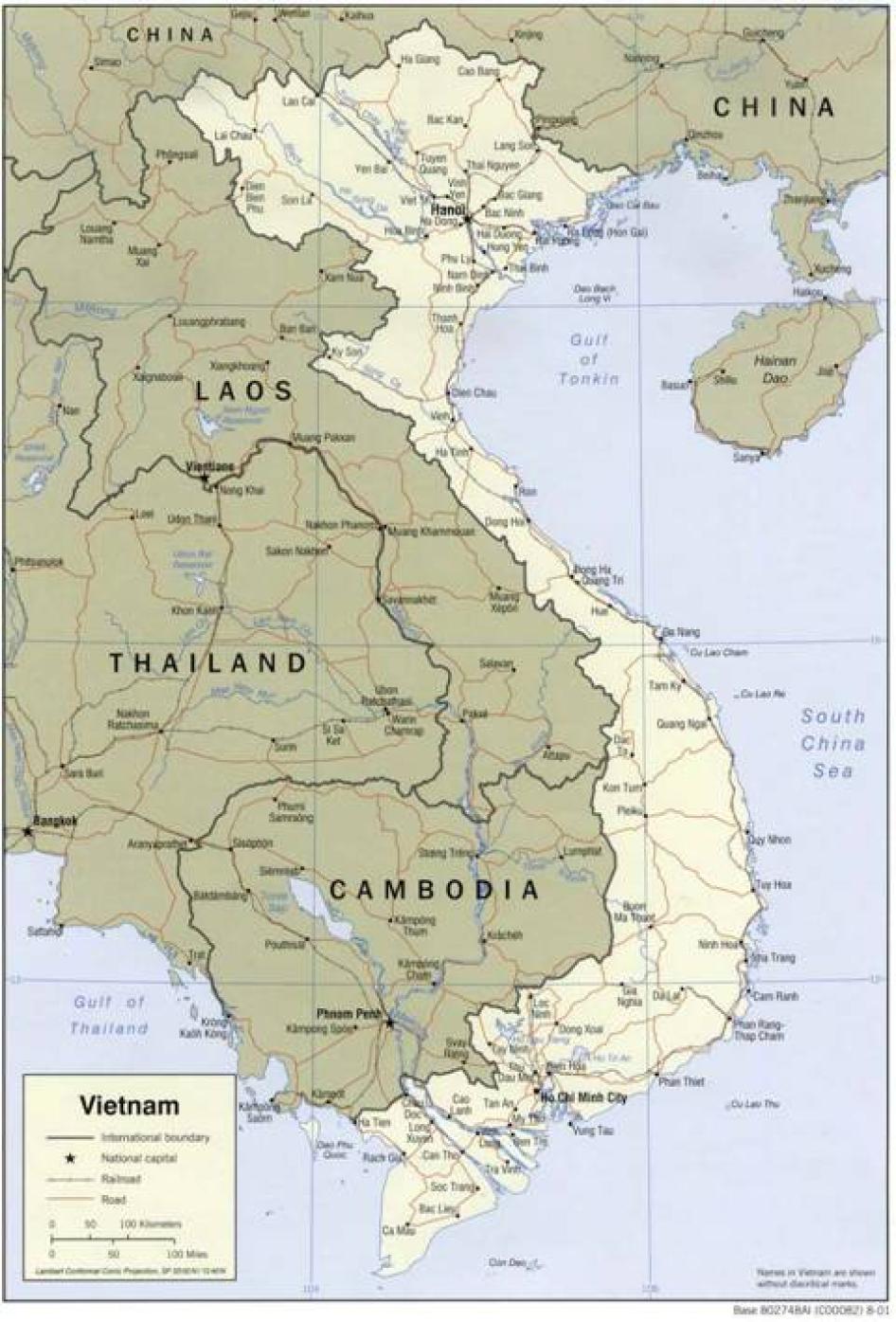
Courtesy of the University of Texas Libraries, The University of Texas at Austin
I. Introduction: The Crackdown on Labor Activists
Under the leadership of the Communist Party of Vietnam, ever since its founding, the Vietnamese trade unions have always been loyal to the interests of the working class and nation; and organized and mobilized workers, office employees and other working people to pioneer in the struggle for the independence and freedom of the homeland and the lawful and legitimate interests of the working people. —The Vietnam General Confederation of Labor[1]
While walking down the main street of Phu Nhuan District, I was approached by two policemen who asked me to come to the police station with them. When I refused, they beat me. I had been beaten many times before by people on the street. The police had told me that they were just locals who hated people who struggled against the government, but I believe that they were secret agents. I was scared so I never told anyone about the beatings. But this was the first time I had been beaten by policemen in uniform. —Le Tri Tue, a Vietnamese labor activist, describing an incident in Ho Chi Minh City in March 2007, two months before he went missing after fleeing to Cambodia
When more than 9,000 workers walked off the job in 2005 at a Hong Kong-owned factory in Vietnam that manufactures toys for McDonald’s, it made international headlines. It was not an isolated incident, however. An unprecedented wave of wildcat strikes in 2006 prompted the Vietnamese government to increase the minimum wage at foreign-owned companies in 2006 and again in 2007, with another wage hike put into place on May 1, 2009. Despite this, labor unrest continues to escalate in Vietnam.[2]
In 2008, at least 650 strikes took place—20 percent more than during 2007.[3] In the midst of the global recession, the number of strikes is likely even higher now.
Though permitted under international law, virtually none of these strikes is considered to be legal by the Vietnamese government. Though the rights of workers are a founding principle of the Communist Party of Vietnam, the government has enacted laws that prohibit workers from forming or joining unions of their choosing. All unions must be approved by and affiliated with the Vietnam General Confederation of Labor (VGCL), which is controlled by the Communist Party.
The government largely attributes the escalation in strikes to violations of Vietnam’s Labor Code by foreign-owned companies, and notes that the Confederation and local People’s Committees often intervene in labor disputes on the side of the workers.[4] At the same time, however, the government continues to wage a repressive campaign to ensure that Vietnamese workers do not organize independent trade unions, using the Confederation and other official institutions to prevent workers from gaining real rights.
This report focuses on the Vietnamese government’s suppression of activists who have been prominent in trying to form independent labor unions and promote workers’ rights in Vietnam. Vietnam’s emerging independent trade union movement was effectively brought to a grinding halt in 2006-2007, with the arrests of proponents and supporters of two independent trade unions who publicly announced their formation at that time. Since 2006, at least eight independent labor activists have been convicted and sentenced to prison terms. Other labor activists have been harassed, intimidated, and forced to cease their activities or flee the country. By arresting the most prominent leaders, the government has attempted to wipe out the independent trade union movement. It continues to target and harass independent labor activists, who are seen as a particular threat to the Communist Party because of their ability to attract and organize large numbers of people.
2006: False opening
For a brief period in 2006, the government of Vietnam—prior to entering the World Trade Organization and normalizing trade relations with the United States—tolerated a budding civil society. Opposition political parties, independent trade unions, underground newspapers, and Vietnam’s first independent human rights organization publicly emerged, a rare situation in the one-party state dominated by the Communist Party of Vietnam. The most well-known effort was by activists who formed a pro-democracy group, Block 8406, whose membership swelled into the thousands through an online petition.[5]
The government’s tolerance of peaceful dissent, however, proved to be short-lived. In the weeks leading up to Vietnam’s hosting of a major international conference in Hanoi in November 2006, the Asia Pacific Economic Cooperation (APEC) summit, the Vietnamese government launched a fresh crackdown on civil society, harassing, threatening, and arresting democracy advocates, labor activists, human rights defenders, opposition party members, and cyber-dissidents. The government also placed a number of activists under house arrest to prevent them from speaking to the international press corps covering the APEC summit. Dozens of activists—including eight independent trade union advocates—were sentenced to prison in 2006-2007 on dubious national security charges, joining more than 350 persons imprisoned for political or religious activity in Vietnam since 2001.[6]
This report does not attempt to cover the wide range of people imprisoned in Vietnam for their political or religious beliefs, but focuses on one critical area of concern: public proponents of labor rights who have been arrested and imprisoned by the Vietnamese government since 2006. In many cases, these activists have also been prominent democracy activists and members of opposition political parties, which are banned in Vietnam. Less well known and beyond the scope of this report are the hundreds of workers throughout Vietnam who have been harassed, detained, dismissed from their jobs, or detained for going on strike or otherwise protesting for better wages and working conditions. The plight of these workers goes largely unnoticed, as their stories—and especially their names and places of detention—are seldom reported by the Vietnamese state media.
Formation of independent unions
The democratization progress in 2006 has focused on two hot spots: human rights and labor rights. As victims of exploitation and injustice, our brother laborers have refused to surrender. Instead, they choose to struggle for their rights and justice, not only for themselves but for the country as a whole. In their struggles, members of the younger generation are standing up as leaders of the democratic movement in Vietnam. The year 2006 will mark breakthroughs in the democratization progress...—Activist Huynh Viet Lang in February 2006, before his arrest and imprisonment in August 2006[7]
In 2006, unprecedented numbers of workers began to join “wildcat” strikes (strikes without the approval of union officials) at foreign-owned factories around Ho Chi Minh City and in surrounding provinces in the south. The workers demanded wage increases—the minimum wage for workers had not been raised for the previous six years—and better working conditions. As the strikes quickly spread to Vietnam’s central and northern provinces, some workers called for broader labor rights such as the ability to form independent unions and the dissolution of the party-controlled labor confederation. More than 350,000 workers participated in 541 strikes during 2006, according to Vietnamese state media.[8]The strikes were deemed illegal, as workers are prohibited from organizing unions or conducting strikes not authorized by the official labor Confederation.
Despite such restrictions, in 2006 democracy and human rights activists inside Vietnam began to publicly advocate for workers’ rights. In February, representatives of striking workers in southern and central Vietnam sent an appeal to Party General Secretary Nong Duc Manh outlining eight demands. They called for dissolution of all state-controlled labor unions and Communist Party-organized cells in factories and worksites and cessation of the practice of deducting mandatory contributions from workers’ wages to support the Confederation.[9] In March 2006, activists issued two public appeals in support of striking workers, calling on the Vietnamese government to release all workers arrested because of their participation in strikes and requesting assistance from the International Labor Organization (ILO), a United Nations agency, to organize independent labor unions.[10]
In October 2006, activists pressed further by announcing the formation of two independent trade unions. Their stated goals were to protect the rights of workers, including the right to form and join independent trade unions, engage in strikes, and collectively bargain with employers without being required to obtain government or party approval. They also planned to disseminate information about workers’ rights and exploitative and abusive labor conditions.
The formation of the first of the two independent unions, the United Worker-Farmers Organization of Vietnam, or UWFO (Hiep Hoi Doan Ket Cong Nong), was announced in September 2006 by Vietnamese-American activist Do Cong Thanh,[11] followed on October 30, 2006 by a public statement by four labor activists in Vietnam.[12]
On October 20, 2006, well-known dissident and former political prisoner Nguyen Khac Toan announced the formation of a second union, the Independent Worker’s Union of Vietnam, or IWUV (Cong Doan Doc Lap ),[13] along with other democracy activists, including Le Tri Tue and Tran Khai Thanh Thuy.
Both unions stressed the link between exploitation of workers and confiscation of farmers’ land in the countryside, noting that increasing landlessness is a factor forcing hundreds of thousands of farmers to urban areas and industrial zones in search of work. In a statement released on January 12, 2007, UWFO activist Tran Quoc Hien said:
Many farmers have lost everything after being forcibly deprived of their land, farms, and houses by corrupt government officials. Many farmers had left their villages for the metropolitan areas, where some have joined the class of labor workers in order to make their daily living, while others have petitioned the government for compensation for the land confiscated from them by corrupt officials.
Vietnamese human rights advocates living abroad have supported the work of trade unionists inside Vietnam. In 2006, members of the Vietnamese diaspora in Europe and North America created the Committee to Protect Vietnamese Workers (CPVW). The group’s website provides Vietnamese-language information about workers’ rights and international human rights law and news stories about strikes and labor conditions throughout the country. It contains articles such as, “CPVW can help you to take your bad employer to court,” “The right to strike under current Vietnamese law,” “Sue the Boss?” and instructions for how to send images to CPVW and use proxy servers to scale government-imposed firewalls in Vietnam.[14]
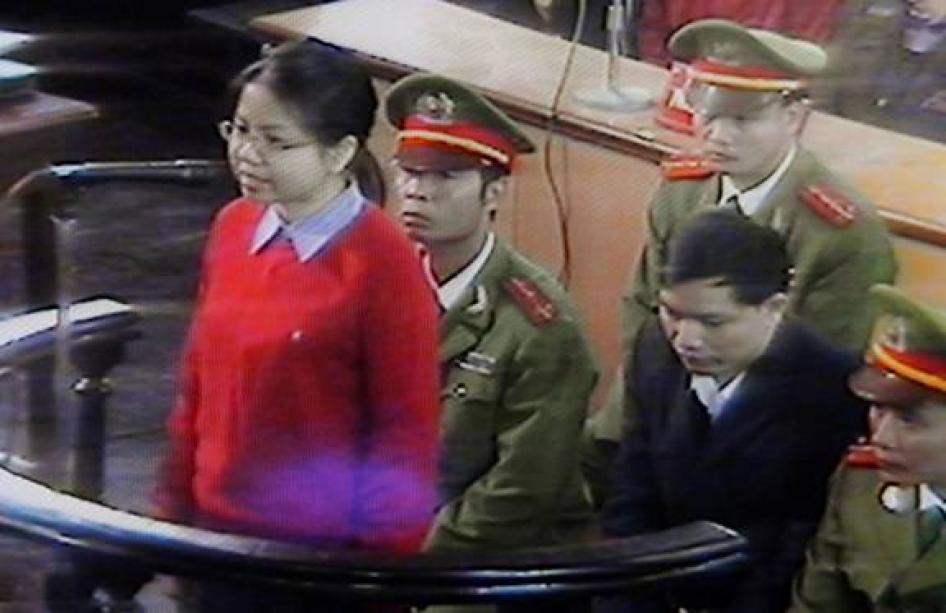
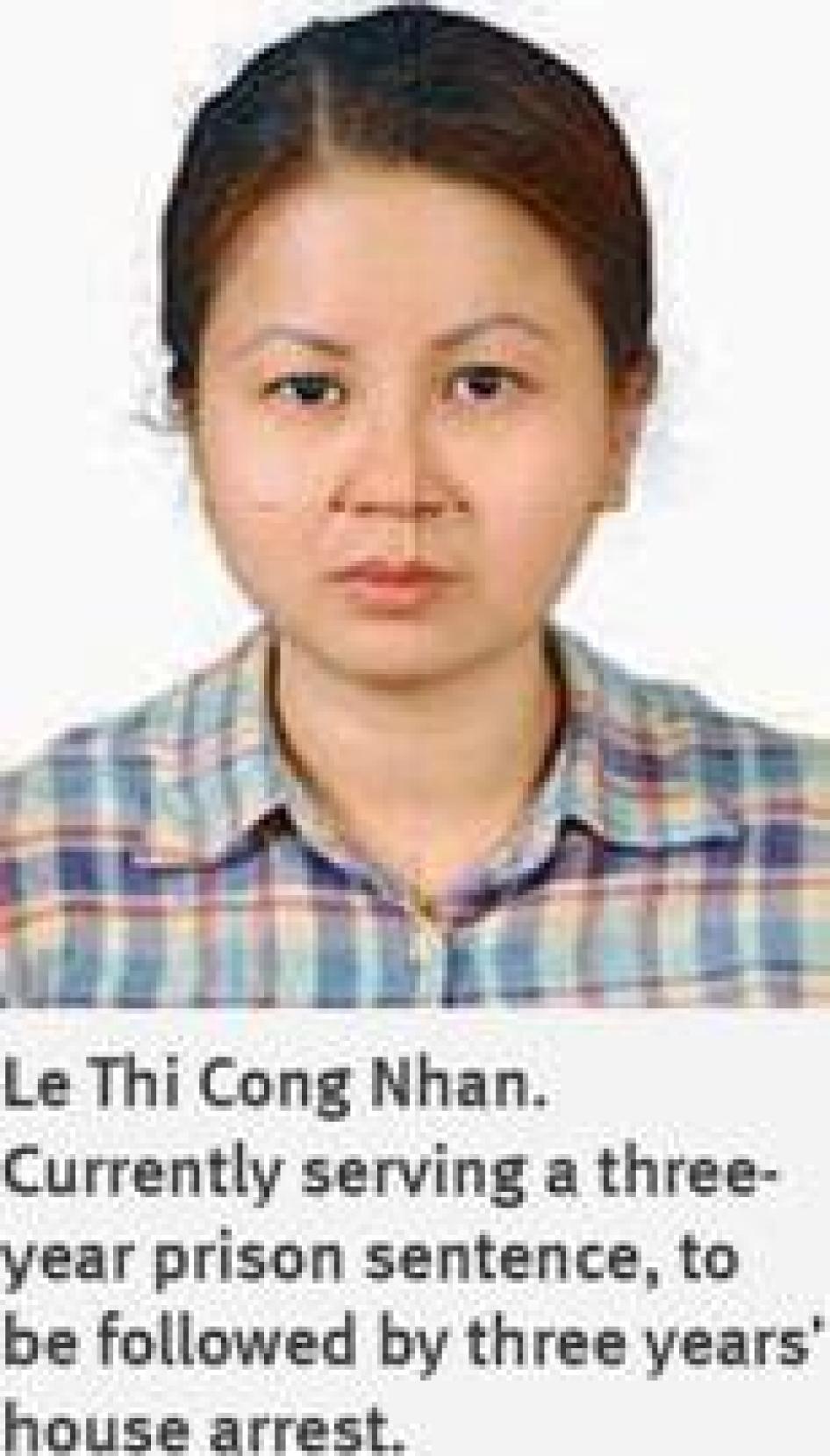
Democracy and labor rights activist Le Thi Cong Nhan, who was prohibited from attending a conference in Warsaw in 2006 on labor rights issues in Vietnam, at her trial in May 2007. © 2007 Reuters
Union activists arrested
The Vietnamese government responded to the surge in strikes and labor activism in 2006 with threats, legal sanctions, and arrests—as well as some reforms, such as wage increases for workers at state- and foreign-invested enterprises as well as government employees.
Fearful of political instability and upsetting foreign investors in advance of the APEC summit, during the latter part of 2006 the Vietnamese government took steps to shut down independent union activities in Vietnam, as well as contacts between Vietnamese activists and their supporters abroad. In August 2006 police in Ho Chi Minh City arrested Huynh Viet Lang, a member of the opposition People’s Democratic Party who had issued a lengthy critique of Vietnam’s violations of labor rights. In October 2006, democracy activist Le Thi Cong Nhan was denied a passport and barred from traveling to Warsaw, Poland to attend a conference on workers’ rights in Vietnam organized by CPVW, where she was to present a paper.
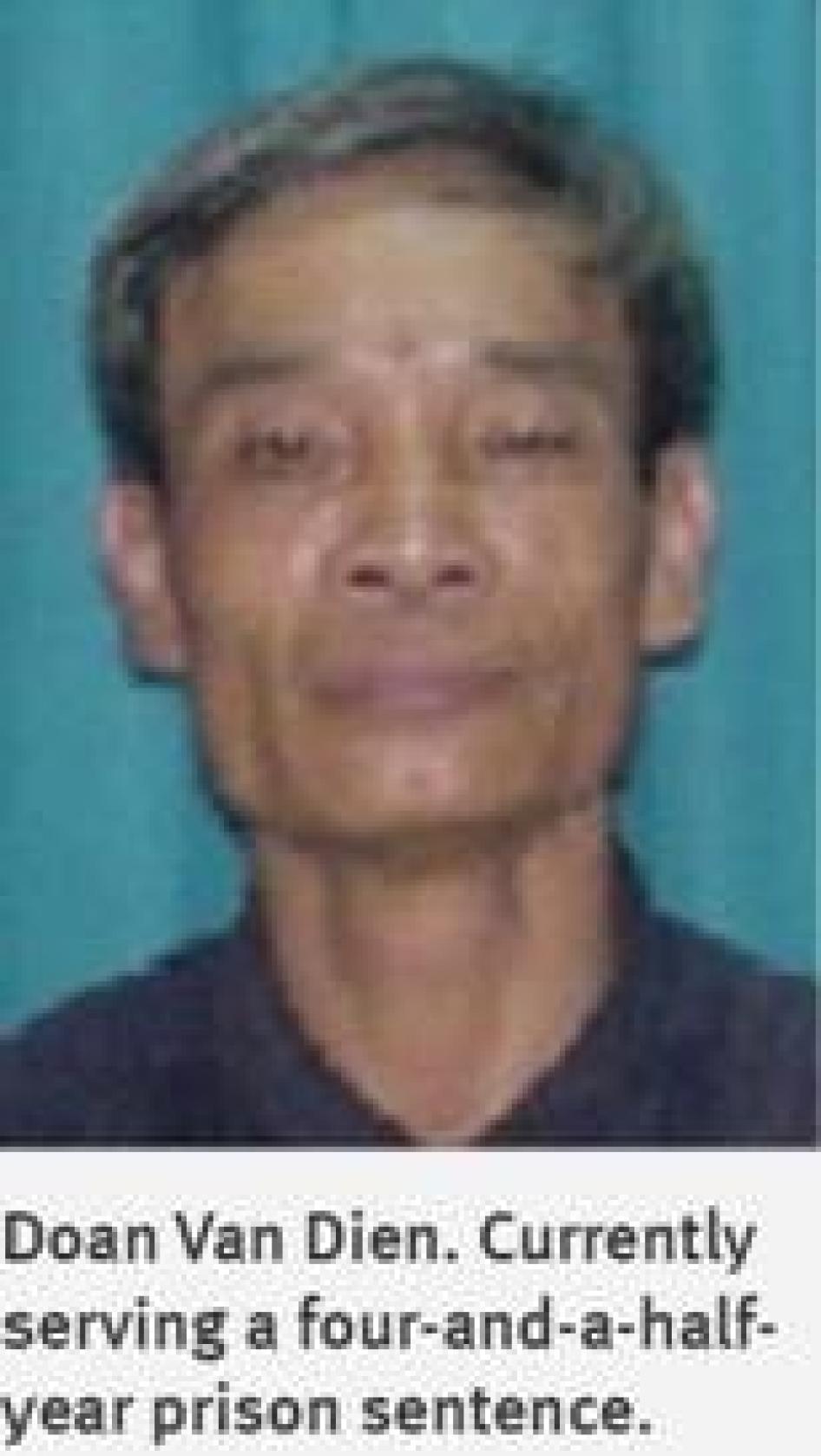
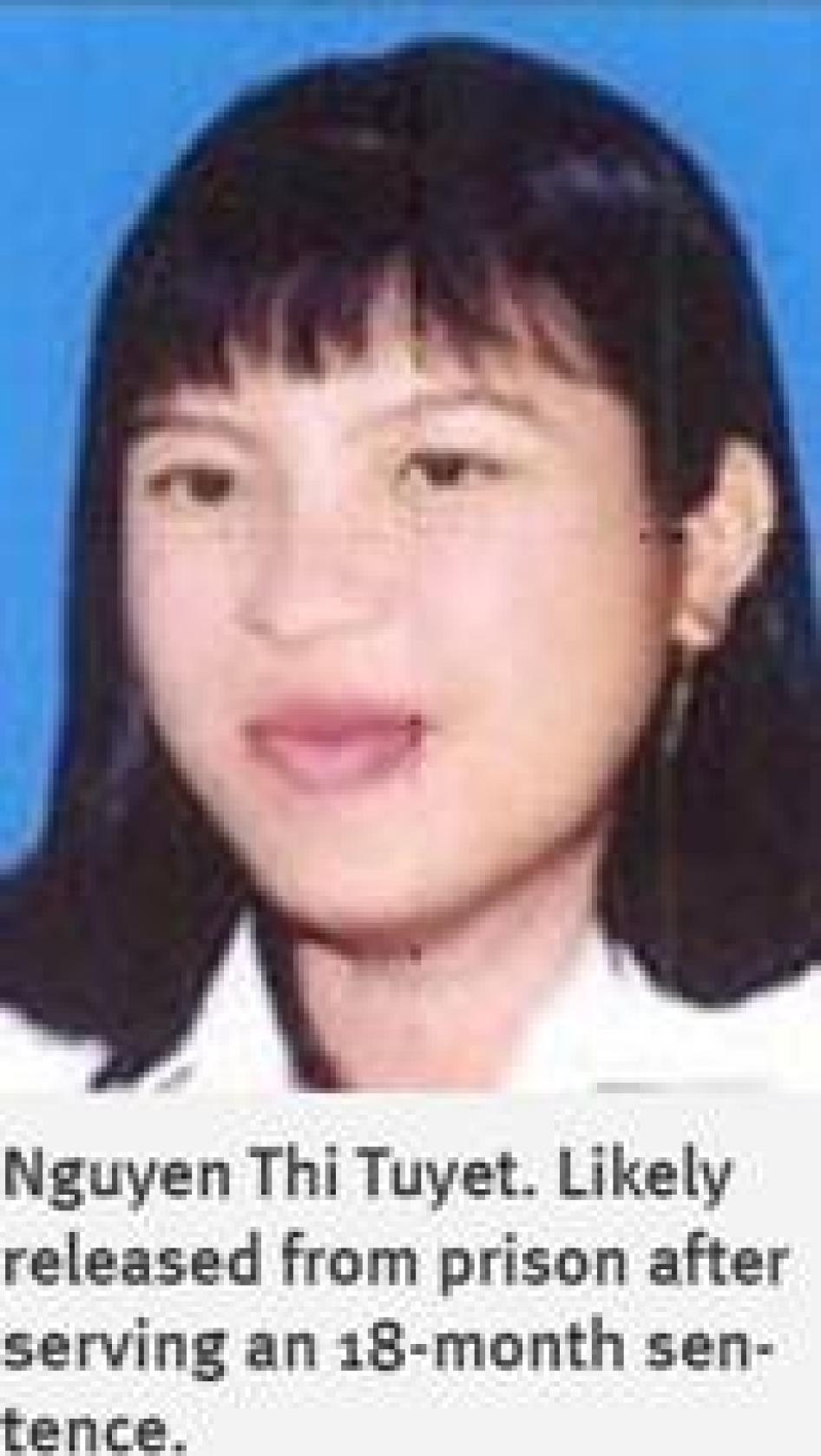
In November 2006 police arrested all of UWFO’s known members in Vietnam, including Doan Huy Chuong, Doan Van Dien, Tran Thi Le Hang, Nguyen Thị Tuyet, Le Ba Triet, Nguyen Tuan, and Ly Van Sy. Police prevented other activists, including Le Thi Cong Nhan and IWUV leaders Nguyen Khac Toan and Tran Khai Thanh Thuy, from leaving their homes or receiving visitors. Police padlocked the back door to Nguyen Khac Toan’s house and guarded the front door, where they placed an English-language sign stating, “Security area. No foreigner allowed.”
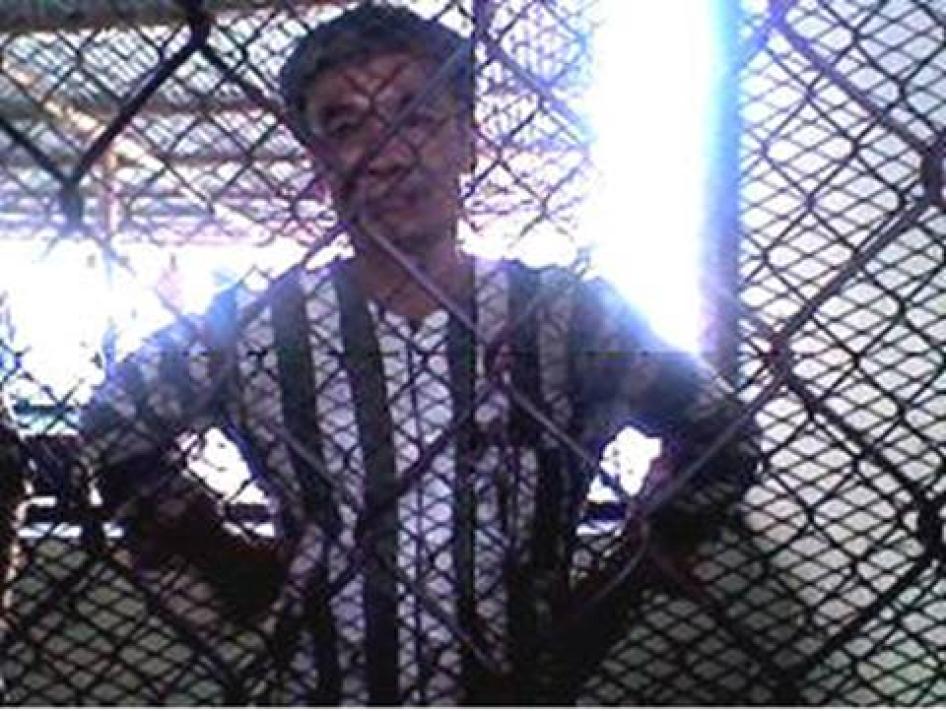
Labor activist Doan Van Dien is currently serving a four-and-a-half-year prison sentence in Dong Nai Province on charges of “abusing democratic freedoms.” © 2009 Private
The arrests and detention of the labor activists were followed by trials in which at least eight were convicted and sentenced to prison for violating national security provisions of Vietnam’s penal code. These prosecutions violated Vietnam’s obligations under international human rights law to uphold the rights to freedom of expression, association, and peaceful assembly.
In December 2007, the Dong Nai Province Peoples’ Court sentenced UWFO leaders Doan Van Dien, Doan Huy Chuong, Tran Thi Le Hong, and Nguyen Thi Tuyet to prison sentences ranging from 18 months to four-and-a-half years under penal code article 258, “abusing democratic freedoms to infringe upon the interests of the state.”[15] They were accused of slandering the Vietnamese government by alleging that it violated workers’ rights and illegally confiscated farmers’ land through articles disseminated on “reactionary” websites and interviews with western news sources.[16]
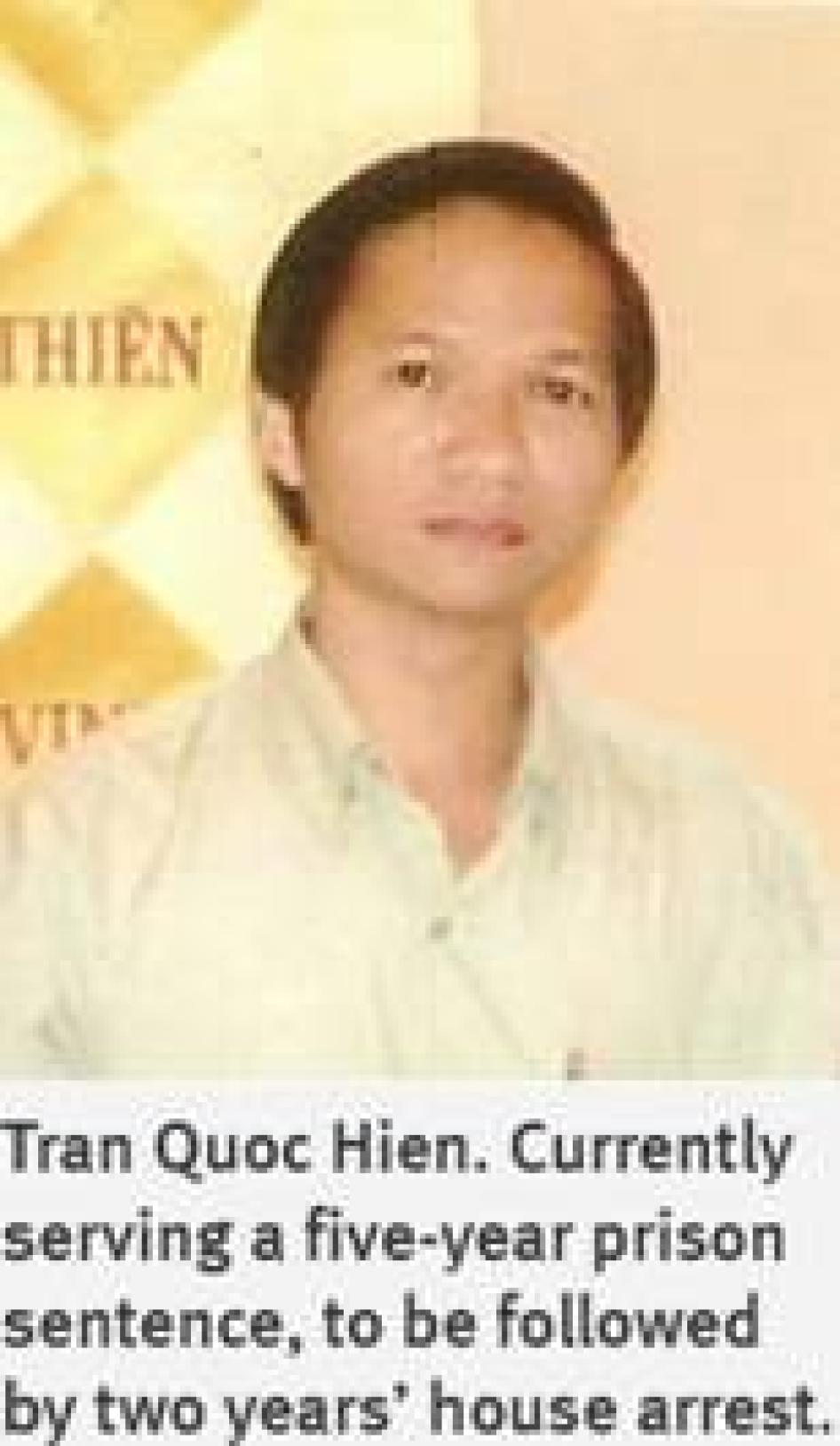
On January 14, 2007, the authorities arrested UWFO activist Tran Quoc Hien, just two days after he issued an appeal on behalf of the jailed labor activists and publicly emerged as UWFO’s spokesperson. The jailing of other labor activists followed, with Tran Khai Thanh Thuy arrested in March 2007 and Le Thi Cong Nhan in April 2007.
Summary of recommendations
As a first step towards addressing inadequate workers’ rights protections in Vietnam, Human Rights Watch urges the Vietnamese government to:
- Immediately and unconditionally release all persons detained for peaceful activities to promote workers’ rights.
- Uphold its international obligations as a member of the International Labor Organization (ILO) and under international covenants to which Vietnam is a party to respect and promote freedom of association and the rights of workers to form independent labor unions, conduct strikes, and collectively bargain with employers.
- Recognize independent labor unions under Vietnamese law.
- Invite ILO officials to investigate and discuss protection and promotion of workers’ rights in Vietnam.
For more detailed recommendations, see Section IV, below.
II. Restrictions on Labor Rights in Vietnam
A trade union is a large political and social organization of the working class voluntarily established under the leadership of the Vietnamese Communist Party. It represents Vietnamese workers, is part of the political system of Vietnam, and brings the benefits of socialism to workers. —Article 1, Vietnam’s Law on Trade Unions
The development policy of the Vietnamese government is based in part on using Vietnam’s hard-working and low-paid work-force as a selling point to attract foreign investors. In Vietnam, minimum monthly wages range from 650,000 dong (US$36) for workers in Vietnamese companies to between 800,000-1 million dong (US$50-62) for workers in foreign-owned companies.[17] As the website of the Vietnam Trade Office in the United States asserts, foreign investors are drawn to Vietnamese “traditions emphasizing learning and respect for authority as well as low wages.”[18] Deputy Prime Minister Nguyen Thien Nhan confirmed the importance of low-cost labor to the economic development of Vietnam: “Over the last 20 years,” he told the state news service in 2008, “Vietnam had successfully attracted foreign investment because of its low cost labor force.”[19]
As a member of the ILO, the Vietnamese government is required to respect and promote the fundamental rights enshrined in the ILO Declaration on Fundamental Principles and Rights at Work.[20] These include the principle of “freedom of association and the effective recognition of the right to collective bargaining.” However, Vietnam has not ratified either of the two ILO conventions concerning this fundamental principle: Convention No. 87, regarding the right to freedom of association and protection of the right to organize; and Convention No. 98, regarding the right to organize and collectively bargain. Even so, as an ILO member, Vietnam is obligated to promote freedom of association, regardless of whether it has ratified the relevant conventions.[21]
Restrictions on freedom of association
With input from the ILO, Vietnam passed a comprehensive Labor Code in 1994. The law sets minimum wages, establishes safety and sanitary conditions, and recognizes the right of workers to strike under certain conditions.[22] However it prohibits workers from freely forming their own trade unions or from joining trade unions of their own choosing.
The Communist Party controls the only official trade union in Vietnam, the Vietnam General Confederation of Labor (VGCL). Headed by a Communist Party Central Committee member, the Confederation is an umbrella organization that oversees and supervises subsidiary labor unions established in different regions and industries across Vietnam.
Any enterprise with more than 10 workers is required to form a trade union approved by, affiliated with, and acting under the authority of the Confederation.[23] The 1990 Trade Union Law defines a union as an organization of the working class “voluntarily established under the leadership of the Vietnam Communist Party.” It requires all unions to inform relevant government organizations at the time of their formation, in order to “establish official relations.”[24] In fact, many joint ventures and foreign-owned companies that have experienced wildcat strikes have not had formal unions,[25] with only about 40 percent of Vietnam’s 16 million wage earners belonging to the Confederation and its ancillary unions.[26]
The Confederation’s website offers the following description of its mandate:
The Vietnamese trade union is an umbrella social-political organization voluntarily formed by working class, intellectualists and workers in order to mobilize, consolidate forces and build a working class strong in all aspects, to represent and protect lawful and legitimate rights and interests of workers, striving for building an independent and unified Vietnam towards socialism.[27]
All activities and objectives of unions in Vietnam must be authorized by the Confederation, providing it effective veto power over unions’ international relations and affiliations.[28] At times the Confederation has advocated for labor reforms, calling for better health, safety, and minimum wage standards and amendments to labor laws.[29] Revisions in the Labor Code approved in 2001, for example, authorize workers in certain enterprises, such as taxi drivers and cooks, to form unofficial “labor associations.” However, these associations lack the authority to bargain with employers or conduct strikes.[30] In 2006, recognizing that many workers are not members of the Confederation, the Labor Code was again amended to allow “relevant entities” to negotiate in labor disputes.[31]
The lack of independence of Confederation representatives from the Communist Party and the enterprises that employ them, as well as the lack of protection for those seeking to organize, undermines any mandate the Confederation has to defend workers rights. Unsure how to address escalating labor unrest, the government has not only tolerated large unsanctioned strikes, but also frank assessments of the Confederation’s shortcomings by its own leadership. In 2008, Confederation Vice President Mai Duc Chin stated in an article in the Vietnamese state press:
There hasn’t been any policy to protect [Confederation] union staff and most employers don’t cooperate with unions... Local union staff at non-state enterprises were not adequately qualified for carrying out their responsibilities. Most of them didn’t devote much time to union activities and some lacked the courage and motivation to fight for labor rights.[32]
Former Confederation President Cu Thi Hau stated that despite restrictions in the Labor Code, during 2005-2006 more than 1,000 strikes deemed illegal took place. “It is thus clear that the Labor Code is not realistic, it must be speedily corrected,” she stated.[33]
Even when Confederation representatives have highlighted violations of labor laws, authorities rarely follow through with action.[34] Part of the problem is that when courts adjudicate labor complaints, including disputes involving thousands of striking workers, they do so on a case-by-case basis.[35]
Restrictions on strikes
Vietnamese laws provide no definition of what constitutes a strike, but they do define what constitutes an illegal strike! —Activist Le Thi Cong Nhan in 2006, currently serving a three-year prison sentence[36]
Vietnam’s Labor Code allows party-controlled unions to strike but imposes strict and cumbersome conditions that must first be met, which effectively nullify this right. In order to receive authorization to strike, workers must first submit their complaints for mediation by local conciliation councils comprised of equal numbers of representatives of workers and employers.[37] If conciliation fails, either party can submit the complaint to a district labor arbitration council established by the provincial People’s Committee, or to the district-level People’s Committee. If the dispute remains unresolved, it can proceed to the provincial labor arbitration council.
All of these steps must be taken before a legal strike can take place.[38] Unions—or groups of workers if no union is present—can contest the ruling of a provincial arbitration council by filing an appeal with the labor court under the Provincial People’s Court, if necessary taking the dispute to the Court of Appeals and the Supreme Court for a final decision.[39] If dissatisfied with the results, in theory the workers can then legally go on strike.
Since the Communist Party controls not only the Confederation but the conciliation and arbitration councils, the People’s Committees, and the People’s Courts, strikes are rarely—if ever—given legal authorization.
Amendments to the Labor Code that came into effect in July 2007 further stiffen restrictions on “illegal” strikes, imposing administrative sanctions and criminal charges against people who “incite, embroil, or force” workers to strike.[40] The amended code defines two types of labor disputes: those over compliance with the law and contracts (“disputes over rights”) and disputes over benefits and demands beyond what the law provides (“disputes over interests”). The amended code establishes different procedures for conciliation of the two types of disputes. Strikes are only authorized for disputes over interests. For disputes over rights, if conciliation fails either party can take the case to court, thereby outlawing rights-related strikes.[41]
The new amendments also set a high bar for worker approval of strikes, requiring that 75 percent of workers at enterprises with more than 300 employees must vote in favor of a strike (or 50 percent for enterprises with less than 300 employees).[42] Some provisions in the amended law protect workers in “legal” strikes from reprisals such as termination of workers’ contracts or unilaterally suspending a business operation in order to thwart a strike.[43]
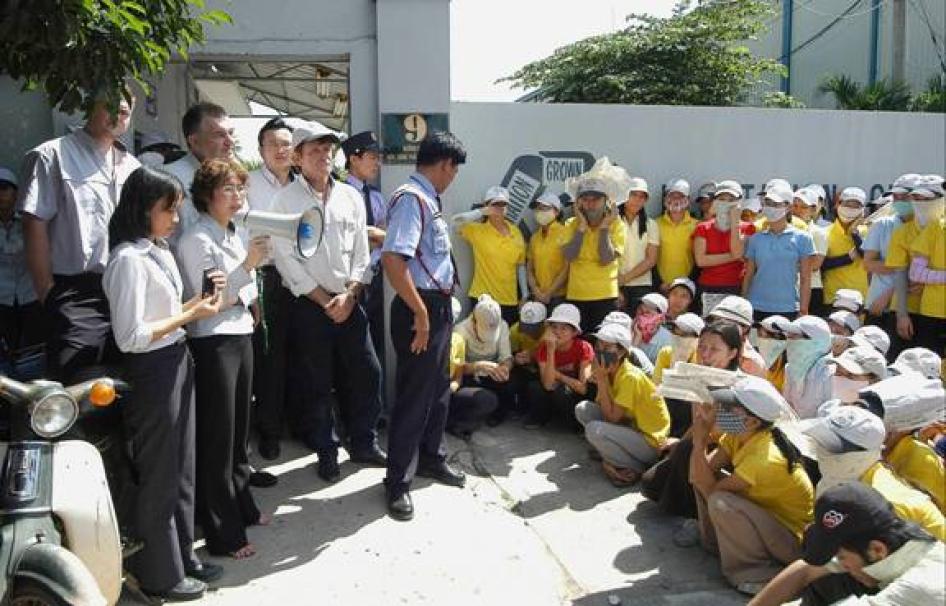
Management talking with workers during a strike at a foreign company in southern Binh Duong Province in January 2006. Foreign companies have flocked to Vietnam, drawn in part by its low daily wages. Waves of strikes in recent years have caused alarm among the business community and the government. © 2006 AFP/Getty Images
Strikes are prohibited in 54 sectors considered to provide essential public services or be important to national security or the national economy, including the transportation, banking, and postal sectors; oil, gas, and forestry enterprises; and power stations.[44] The prime minister can terminate any strike considered to be a threat to public safety or to the national economy.[45] Furthermore, government regulations impose fines of up to three months’ pay on workers who participate in strikes declared unlawful by a People’s Court, to compensate employers for losses incurred as a result.[46]
Despite such restrictions, strikes and other public expression of discontent over wages and working conditions continue to soar in Vietnam, with at least 650 unsanctioned strikes taking place in 2008. This is 20 percent more than during 2007, according to official statistics.[47]All of these strikes have all taken place outside of Vietnam’s legal framework, as outlined above. While wildcat strikes are often tolerated by local officials, the vast majority are in fact in violation of Vietnamese law.[48]
Wages and working conditions
Instead of concentrating on excelling in the legal and banking systems and providing an effective infrastructure to attract foreign investments, the Vietnamese government has blindly grasped cheap labor as the only token in their strategic planning to lure foreign investors.—Activist Huynh Viet Lang in February 2006, prior to his arrest and imprisonment in August 2006[49]
Inflation in Vietnam, which reached 27 percent in the latter half of 2008, and the spiraling costs of food, fuel, and other consumer goods and a devaluing currency, threaten to push low-paid workers and their families further into poverty.[50]
After wildcat strikes began to escalate in 2006, the government increased the minimum monthly wage for workers at foreign-invested companies in most of Vietnam to 710,000 dong (US$44) a month. Wages for those working in foreign-invested companies in Hanoi, Ho Chi Minh City, and other industrial centers were raised to 870,000 dong (US$54)—a 40 percent increase, and the first such increase since 1999. Minimum wages at state-owned enterprises were raised to 450,000 dong (US$28) a month.[51]
The wage increases did not stem labor discontent, as unprecedented numbers of workers—mostly at foreign-owned enterprises operated by South Korean, Japanese, Taiwanese, and Singaporean companies—continued to strike for better pay and working conditions.[52]
In November 2007, the government announced another wage increase.[53] In legislation that came into effect in January 2008, minimum salaries for government workers and members of the armed forces were raised to 540,000 dong (US$33). Salaries for workers in domestic and foreign-invested companies were raised based on their factory’s location and whether investors were foreign or Vietnamese. Minimum monthly wages were increased to 540,000 dong (US$33) for Vietnamese enterprises throughout most of the country and slightly higher for companies in major cities and suburbs. Wages for workers in foreign-owned enterprises ranged from 800,000 dong (US$50) to 1 million dong (US$62) in foreign-owned factories in industrial centers such as Hanoi and Ho Chi Minh City.[54] Yet another wage increase, to 650,000 dong (US$36), went into effect May 1, 2009.[55]
Critics, including the US State Department, noted that the new wages fail to provide a decent standard of living to workers, especially given racing inflation.[56]
In an increasing number of cases, workers are not striking for higher wages, but simply to be paid for work completed. During 2008, thousands of workers in Ho Chi Minh City and surrounding areas lost their jobs when their companies announced bankruptcy or laid off workers to keep costs down. At several factories, the foreign supervisors fled the country without paying workers two or three months worth of salaries owed to them.[57]
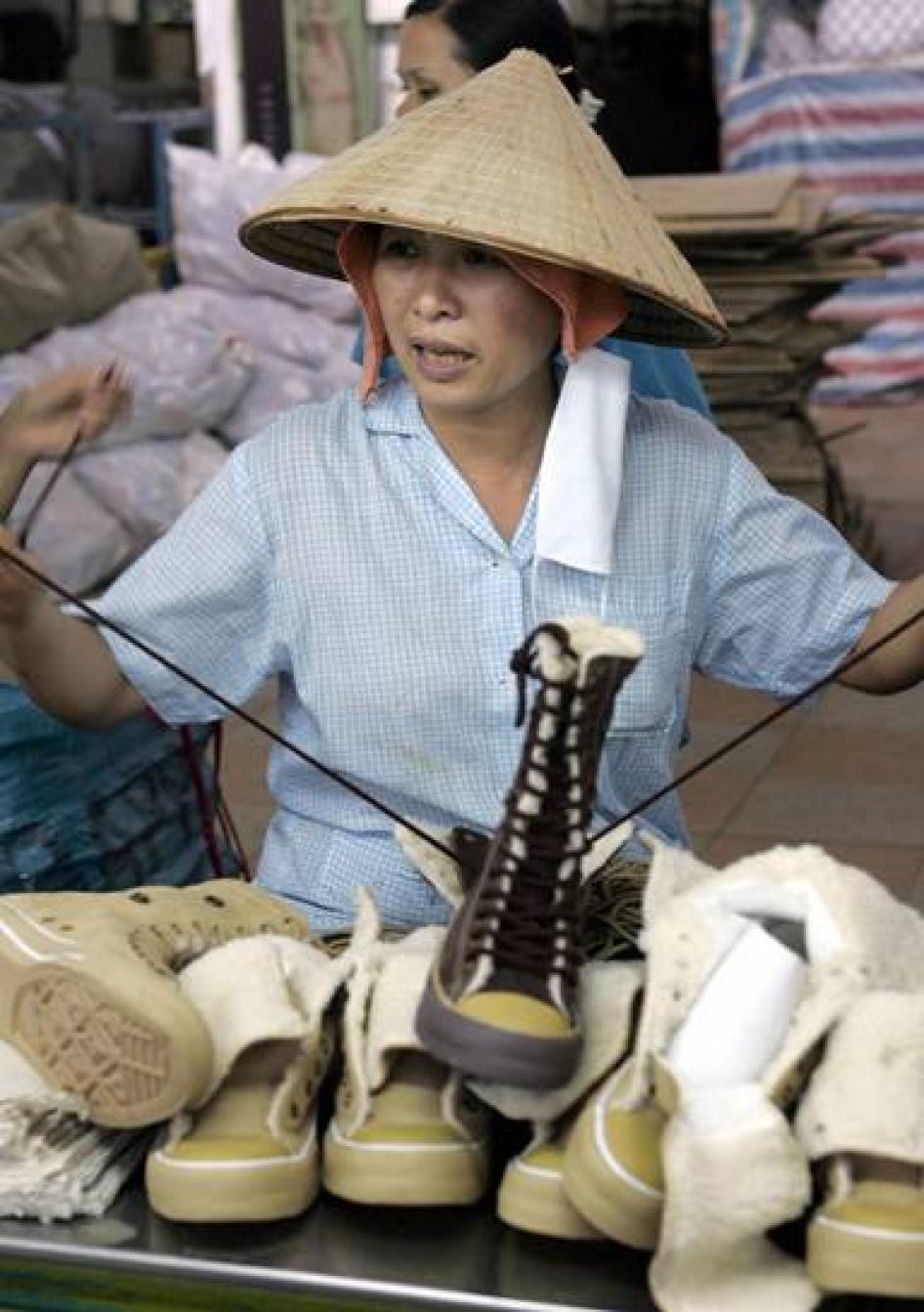
A worker at a South Korean footwear company in southern Dong Nai Province where nearly 14,000 workers went on strike in July 2008 to demand higher salaries. ©2008 AFP
Workers are also striking to express their grievances over poor working conditions, and in some cases, their mistreatment by foreign managers, including physical and verbal abuse and sexual harassment.[58]
Local branches of the Confederation have reportedly tried to intervene in some of these cases, calling on the Vietnamese government to seize the foreign companies’ assets in order to pay the workers’ wages. In addition, the Confederation has advocated for a more streamlined process at the district level for workers to sue the companies. Lacking confidence that these measures will produce adequate or timely compensation, at some of the factories workers have conducted sit-down strikes to prevent the runaway owners from removing assets such as sewing machines.[59] For example, in November 2008 when talks failed between government officials and workers at the Quang Sung Vina Garment Company, striking workers said that if the government could not find a reasonable solution for them they would sell the factory’s machines and furniture to collect their salaries from the proceeds.[60]
III. Trade Unionists Arbitrarily Arrested, Detained, or Imprisoned Since 2006
At least eight trade unionists have been arrested since 2006 and sentenced to prison on national security charges. Of those, three remain in prison and at least two under administrative probation or house arrest imposed on political prisoners upon release from prison. The other three, while released from prison, are subject to regular detention and interrogation by police, intrusive surveillance, and harassment by vigilantes. In addition, other prominent advocates of democratic reforms, labor rights, and religious freedom—such as veteran dissident Thich Quang Do, leader of the banned Unified Church of Vietnam—have been under house arrest for many years. None of these activists should ever have been arrested, detained, or imprisoned.
All have been held under laws that violate fundamental freedoms; those who have been tried have not been afforded internationally recognized due process rights. Some of those arrested were proponents not only of independent trade unions, but democratic reforms in general, with several playing key roles in launching opposition parties. The authorities have charged them with “national security offenses” under the penal code, specifically: “conducting propaganda” against the state (article 88), “abusing democratic freedoms” to infringe upon the interests of the state (article 258), “disturbing social order” (article 245), and “espionage” (article 80).
In one case, Vietnamese agents may have abducted a labor activist who fled to Cambodia to escape persecution in Vietnam. Below we describe the cases of some of the activists who have been arrested, detained, placed under house arrest, imprisoned, or gone missing since 2006 in violation of international law.
Huynh Viet LangHuynh Viet Lang (also known as Huynh Nguyen Dao), 41, a member of the People's Democratic Party (PDP), issued a paper harshly critical of labor rights violations in Vietnam in February 2006 entitled “Stand Up for Democracy in Vietnam.” He was arrested in August 2006 in Ho Chi Minh City for distributing and posting online political documents, along with PDP members Do Thanh Cong, Le Nguyen Sang, and Nguyen Bac Truyen. In May 2007, he was sentenced to three years in prison on charges of conducting “anti-government propaganda.” Huynh’s sentence was reduced upon appeal to 30 months’ imprisonment. He was released in February 2009. |
Doan Huy Chuong (aka Nguyen Tan Hoanh)One of the founders of UWFO, Doan Huy Chuong, 24, worked in a seafood company in Quang Nam Province before moving to Ho Chi Minh City, where he led several labor strikes.He was arrested right before the APEC meetings in Hanoi on November 14, 2006, along his two younger brothers, who were subsequently released. Chuong was accused of “distorting the facts” in interviews with international media, including Radio Free Asia, by charging that the Vietnamese government committed labor rights violations and arrested peaceful protesters. In December 2007 the Dong Nai People’s Court sentenced him to 18 months in prison for “abusing democratic freedoms.” In February 2008, his sentence was upheld upon appeal. He was released on May 13, 2008 after serving his sentence. Chuong reportedly suffered physical and psychological mistreatment during his imprisonment, including placement in solitary confinement for 48 days. Since his release from prison, Chuong has continued to suffer from numbness, migraines, and respiratory problems. His father, Doan Van Dien, who was arrested in November 2006, remains in prison (see below). |
Tran Thi Le Hong (aka Tran Thi Le Hang; Nguyen Thi Le Hong)One of the founders and representatives of the UWFO, Tran Thi Li Hong, 49, was arrested in Ho Chi Minh City in November 2006, after she issued a public appeal on November 14 protesting the arrest of UWFO co-founder Doan Huy Chuong and his two younger brothers. A farmer and a worker, Hong had participated in several labor strikes in Dong Nai Province. She was also a member of the People’s Democratic Party (PDP), which was founded in Vietnam in January 2005 to advocate for democracy and a multi-party political system. In December 2007 Hong was sentenced to three years in prison by the Dong Nai People’s Court for “abusing democratic freedoms.” In February 2008, her sentence was upheld upon appeal. She was reportedly released from B-5 Prison in Dong Nai Province in February 2009. |
Doan Van DienA UWFO member from Dong Nai Province, Doan Van Dien, 54, was arrested on November 15, 2006, after voicing concerns about the arrests of his sons the previous day. Dien was accused of distributing anti-government leaflets and collecting farmers’ complaints about government confiscation of their land, and passing the information to international news sources before the November 2006 APEC summit in Hanoi. In December 2007, Dien was sentenced to four-and-a-half years in prison by the Dong Nai People’s Court on charges of “abusing democratic freedoms.” In February 2008, a Vietnamese court upheld his sentence upon appeal. A member of the Mennonite Church, Dien had previously been arrested in 2006 for his religious activities. He is currently imprisoned at B-5 Prison in Dong Nai Province. |
Nguyen Thi TuyetA worker and member of UWFO, Nguyen Thi Tuyet was arrested on November 15, 2006 after participating in several labor strikes in Dong Nai Province. In December 2007 she was sentenced to 18 months’ imprisonment,upheld upon appeal in February 2008. While it is likely that she has been released for time served, her current whereabouts are unknown. |
Ly Van SyA farmer and member of UWFO, Ly Van Sy was arrested in Ho Chi Minh City in November 2006. There are no details about whether he was tried and on what charges. He was reportedly released from prison in March 2007, but his current whereabouts are unknown. |
Nguyen TuanA UWFO member from Ho Chi Minh City, Nguyen Tuan was arrested on November 18, 2006 and detained at 4 Phan Dang Luu in Ho Chi Minh City. Details about his trial and sentencing are unknown. As of April 2009, his status was unknown. |
Le Ba TrietA UWFO member from Ho Chi Minh City, Le Ba Triet was arrested on November 18, 2006 and detained in 4 Phan Dang Luu in Ho Chi Minh City. Details about his trial and sentencing are unknown. As of April 2009, his status was unknown. |
Tran Quoc HienA lawyer from Ho Chi Minh City, Tran Quoc Hien, 44, was arrested on January 12, 2007, just two days after he publicly emerged as spokesperson for UWFO. As director of a law firm in Ho Chi Minh City, Hien was known for defending farmers whose land was confiscated by the government and for publishing articles online, such as “The Tail,” in which he described life under government surveillance. Tran Quoc Hien was sentenced on May 15, 2007 by the Ho Chi Minh City People’s Court to five years’ imprisonment and two years’ house arrest on release for “spreading anti-government propaganda” and “endangering state security.” Authorities accused him of having “joined reactionary organizations” including Bloc 8406, inciting demonstrations, and posting “distorted” articles on the internet.He is currently imprisoned at Camp Z-30A in Xuan Loc District in Dong Nai Province, one of the main prisons in Vietnam for political prisoners. In February 2009, he joined a three-day hunger strike with other political prisoners to protest harsh conditions. |
Le Thi Cong NhanA human rights lawyer and democracy activist, Le Thi Cong Nhan, 31, was arrested in Hanoi on March 6, 2007. She was a founding member of the Committee for Human Rights in Vietnam and spokesperson for the Vietnam Progressive Party, one of several opposition parties that surfaced during 2006. She was also a vocal advocate for establishment of independent unions in Vietnam and in 2006 wrote a comprehensive essay on the need for protection of labor rights entitled “Legislative Aspects of Industrial Actions and the Need for Independent Unions in Vietnam.” In October 2006, she was denied a passport in order to attend a conference in Warsaw, Poland on workers’ rights in Vietnam. Crimes listed in her indictment include “misinterpreting the state’s policies regarding labor unions and workers in Vietnam,” joining the Block 8406 democracy movement and the Vietnam Progressive Party, conducting human rights seminars, and possessing and distributing documents promoting human rights and democracy. On May 11, 2007, the Hanoi People’s Court sentenced her to four years in prison, later reduced upon appeal in November 2007 to three years, on charges of “disseminating propaganda against the government.” |
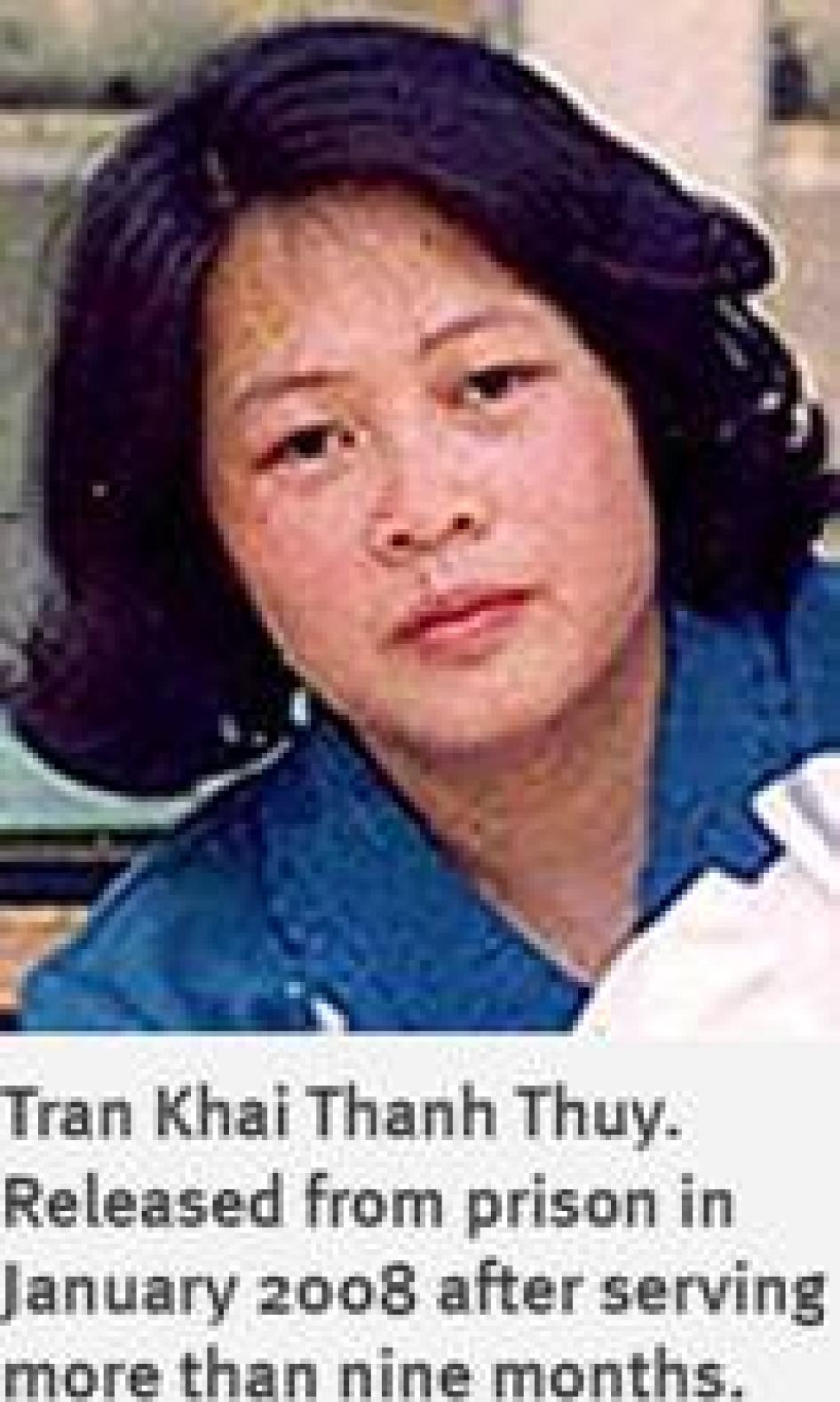
Tran Khai Thanh ThuyA well-known author, poet, and journalist, Tran Khai Thanh Thuy was one of the founders of the Independent Worker’s Union in October 2006. In December 2006, she started an association for victims of land confiscation in Vietnam (Hoi Dan Oan Viet Nam) and she also served on the editorial board of To Quoc (Fatherland) Review, a pro-democracy bulletin printed clandestinely in Vietnam and circulated on the internet. Prior to her arrest in April 2007, Thuy was frequently detained, interrogated, and harassed by authorities. In November 2006, she was dismissed from her job as a journalist. During the APEC meetings that month, she was locked in her house by authorities and remained under effective house arrest afterwards. On March 10, 2007, police searched her home and confiscated her computer, cell phone, and hundreds of complaint letters filed by farmers protesting loss of their land. Thuy was arrested at a bus station in Hanoi in April 2007 and charged with conducting “anti-government propaganda” and “disturbing social order”. During her more than nine months of detention at Thanh Liet Detention Center (known as B14 Camp) in Hanoi, authorities prohibited Thuy from receiving visits or letters from her family. Only the second charge, disturbing social order, was maintained at her trial in January 2008, where she was sentenced to nine months and ten days, or time served, and released. Upon her release, police informed her that she must undergo two-years’ administrative surveillance although this was not included in her court sentencing and prison release documents. As of April 2009 she continued to face intense harassment, with police refusing to intervene when local thugs threw feces and garbage at her house on numerous occasions. |
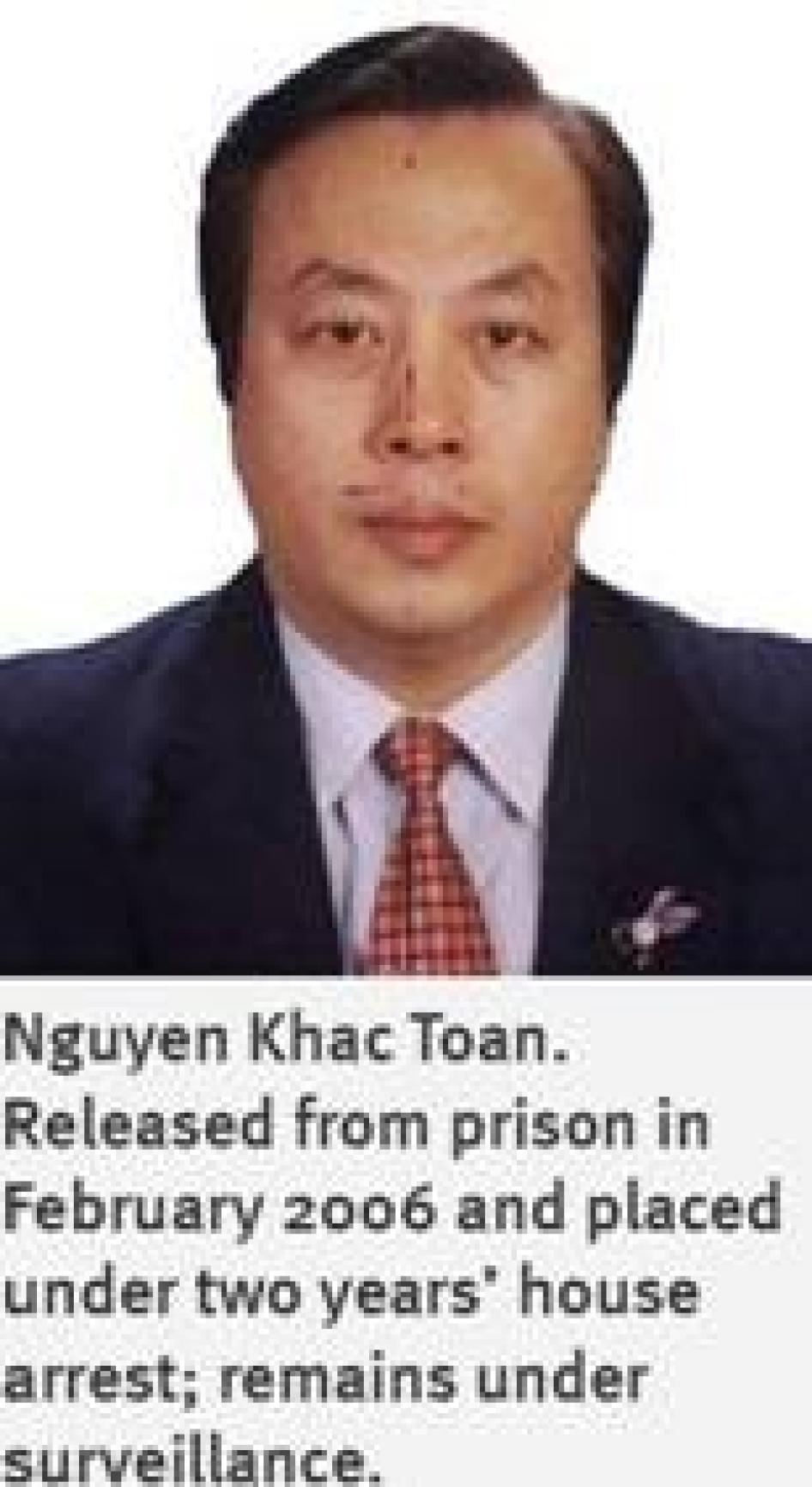
Nguyen Khac ToanOne of the founders of the IWUV, Nguyen Khac Toan, 53, is a democracy activist and former political prisoner. A former soldier in the North Vietnamese army, Toan has drawn the government’s ire since 2000 for launching underground pro-democracy publications, writing about farmer protests against land confiscation and corruption, and attempting to form an anti-corruption association. He was arrested in 2002 at an internet cafe and sentenced to 12 years’ imprisonment on espionage charges. In January 2006, he was released after four years in prison, but placed under two years’ house arrest. Shortly after his release he issued public statements calling for greater freedom of expression, multi-party democracy, and the release of political prisoners. In April 2006 he joined 118 other signatories of the Bloc 8406 democracy petition. In August 2006 as he was preparing to launch a democracy publication (Freedom and Democracy) with other activists, police raided his home, confiscating his computer, books and documents. In October 2006 he announced the formation of the IWUV, along with 13 other activists, in a letter to the president of Vietnam and the Vietnam Confederation of Labor that was posted on the internet. During the November 2006 APEC meeting in Hanoi, police prohibited Nguyen Khac Toan from leaving his house or receiving visitors, placing an English-language sign on his door stating “Security area. No foreigner allowed.” In February 2008 police prevented him from leaving his home to attend the funeral of another prominent dissident. He remains under surveillance, with police regularly summoning him for interrogation and searching his house, and confiscating his computer and personal papers on more than one occasion. |
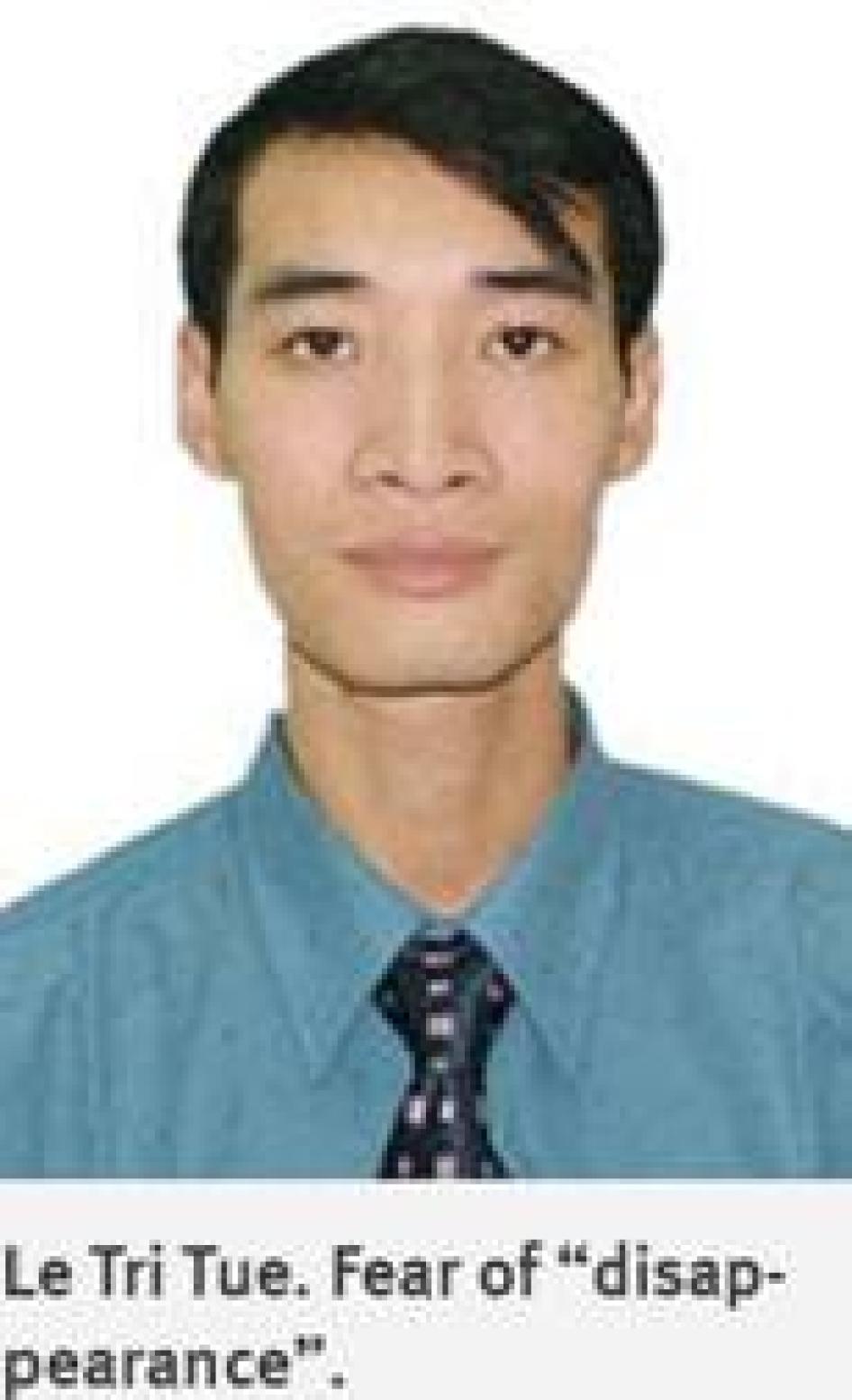
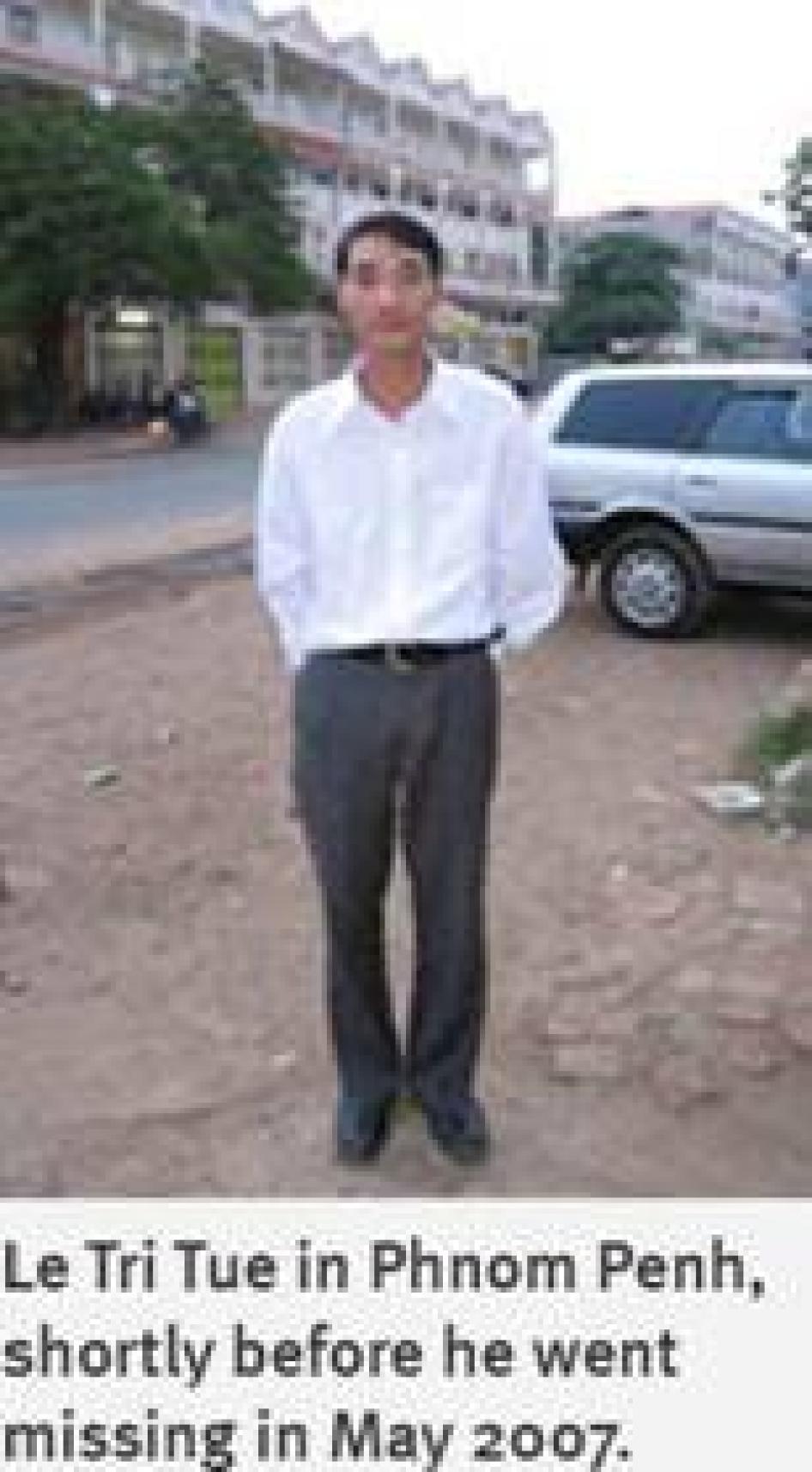
Le Tri TueOne of the founders of the IWUVN, Le Tri Tue, 30, went missing in May 2007 after fleeing to Cambodia to seek political asylum. Human Rights Watch is deeply concerned that he may have been abducted by Vietnamese government security agents—who have unlawfully snatched Vietnamese in Cambodia in the past—and imprisoned in Vietnam or killed. In March 2008 the US State Department report on human rights in Vietnam noted grimly that “Le Tri Tue was still missing... amid rumors that Vietnamese government security agents had killed him.” After serving in the navy for five years, Le Tri Tue worked as a businessman. Le Tri Tue left his business in 2004 to engage in social activism on behalf of people whose land and property had been confiscated by the Vietnamese government. In October 2006 he founded IWUVN together with other Vietnamese activists, serving on a three-person interim executive committee. Le Tri Tue was also one of the 118 founding members of the Bloc 8406 democracy movement. Vietnamese police arrested and interrogated Tue numerous times in 2006 and 2007 and placed him under surveillance
Le Tri Tue was beaten in the street by police and unidentified agents at least two times during 2006 and 2007. In March 2007, police interrogated Tue on two occasions. They threatened to imprison him unless he revealed the names of other Bloc 8406 activists, condemned the democracy movement, and declared publicly and in writing that he would withdraw from Bloc 8406 and IWUV. Tue fled to Cambodia on April 11, 2007, where he registered with the office of the UN High Commissioner for Refugees in Phnom Penh as an asylum seeker. On May 6, 2007, Le Tri Tue went missing from the guesthouse where he was staying in Phnom Penh, and has not been seen or heard from since. Chronology of events preceding the “disappearance” of Le Tri Tue
|
IV. Recommendations
To the government of the Socialist Republic of Vietnam:
- Immediately and unconditionally release all persons detained for peaceful activities to promote the rights of workers to freely associate, including the right to form and join trade unions of their own choice; to peacefully assemble to protect and advance their rights; and to exercise their right to freedom of expression on behalf of workers and their concerns.
- Uphold Vietnam’s obligations under the International Covenant on Civil and Political Rights (ICCPR), the International Covenant on Economic, Social and Cultural Rights (ICESCR), and as a member of the International Labor Organization (ILO) to respect and promote freedom of association and the rights of workers to form independent labor unions, conduct strikes, and collectively bargain with employers.
- Amend all relevant Vietnamese laws and regulations, including the 1994 Labor Code, to bring them into conformity with ICCPR, ICESCR, and ILO requirements. In particular, ratify and implement ILO Convention No. 87, regarding freedom of association, and Convention No. 98, regarding the right to organize and to bargain collectively.
- Ensure the right of individuals to associate and peacefully assemble with others regardless of whether they express views that run counter to the political or ideological views of the Vietnamese government or the Communist Party of Vietnam.
- Recognize independent labor unions under Vietnamese law.
- Ensure that privately owned, state-owned, and foreign-invested companies and enterprises in Vietnam respect international labor standards.
- Invite ILO officials to investigate and discuss protection and promotion of workers’ rights in Vietnam and accept ILO recommendations.
- Actively cooperate with UN human rights special procedures, specifically by issuing standing invitations to the special rapporteur on the promotion and protection of the right to freedom of opinion and expression, the special representative on the situation of human rights defenders and the working group on arbitrary detention and enforced or involuntary disappearances.
- Make public any information in the government’s possession about the whereabouts of labor activist Le Tri Tue, who went missing in May 2007 after seeking political asylum in Cambodia.
To Vietnam’s international donors and trading partners, including Japan, the European Union, and the United States:
- Consistently raise concerns about violations of labor rights in Vietnam at the highest levels and call upon the Vietnamese authorities to cease the harassment and arbitrary arrest, detention, and imprisonment of independent labor activists.
- Ensure that workers’ rights are respected in all internationally funded projects.
- Insist that the Vietnamese government immediately cease the detention, harassment, or arrest of labor activists and others who disseminate information about labor rights.
- Require that the Vietnamese government fully protect in law and in practice internationally recognized workers’ rights, including the right to freedom of association; the right to organize and bargain collectively; prohibitions on forced labor; a minimum age for the employment of children; and acceptable conditions of work with respect to minimum wages, hours, and safety and health.
- For countries negotiating or engaged in preferential trade programs with Vietnam, initiate a regular review of Vietnam’s eligibility, in light of its observance and protection of workers’ rights.
To the International Labor Organization:
- Dispatch a senior-level mission from Geneva to engage with the Vietnamese government on labor rights.
- Call for the unconditional release of labor activists detained, imprisoned, or placed under house arrest for peaceful expression of their views.
- Press for reform of the Labor Code and appropriate actions to bring Vietnam into compliance with its commitments under the ILO Declaration on Fundamental Principles and Rights at Work.
- Seek a time-bound reform program for amending the Labor Code to bring it into compliance with ILO Convention 87 (regarding the right to freedom of association and protection of the right to organize) and Convention 98 (regarding the right to organize and collectively bargain).
- Instruct the ILO Bureau for Workers’ Activities to launch activities, outreach programs, and capacity building programs, starting with ILO conventions 87 and 98, for exiled Vietnam trade union confederations and workers’ rights support groups operating outside of Vietnam.
To foreign companies investing in enterprises in Vietnam:
- Ensure that all workers are fully informed and trained about their rights and how to exercise them, making information about labor rights easily accessible, for example by publicly posting them at the workplace.
To the Association of Southeast Asian Nations (ASEAN):
- Note that Vietnam’s failure to respect labor rights and human rights is in violation of the ASEAN Charter, specifically article 2 (i) regarding respect for fundamental freedoms, the promotion and protection of human rights, and the promotion of social justice, and refer these breaches of the Charter to the ASEAN Summit.
To the Royal Government of Cambodia:
- Conduct a full investigation into the case of Vietnamese labor activist Le Tri Tue, who went missing in May 2007 after seeking political asylum in Cambodia, and act to prevent similar protection issues for asylum seekers and refugees in the future. Make public any information in the government’s possession about the whereabouts of Le Tri Tue.
[1] “Statutes of the Vietnamese Trade Unions,” Vietnam General Confederation of Labor website, http://www.gcongdoanvn.org.vn/english/listnews2.asp?c=226&c2=240&l=1 (accessed March 12, 2009).
[2] At least 2,600 labor strikes have taken place between 1995 and 2008 in Vietnam, according to state media. “Investment: Headaches for Vietnam Top FDI Investor-Media,” Vietnam News Brief Service, Toan Viet Limited Company, November 11, 2008. “Wave of Labor Strikes Surge in Vietnam,” Vietnam News Briefs, January 21, 2008.
[3] “Vietnam Labor News Summary for December 2008,” Committee to Protect Vietnamese Workers, January 25, 2009, http://www.vitudoweb.com/read.asp?Fl=1/20090201141717.txt&lang=en (accessed March 12, 2009).
[4] People’s Committees, established at the provincial, district, and commune levels, are administrative units accountable to the central government and the National Assembly that serve as part of the state apparatus outlined in Vietnam’s 1992 Constitution. David W.H. Koh, Wards of Hanoi (Singapore: ISEAS Publications, 2006), p. 33.
[5] The group was named after the date of its founding, April 4, 2006. “Vietnam: Fledgling Democracy Movement Under Threat; Hundreds Join Groundbreaking Campaign Calling for Basic Rights,” Human Rights Watch press release, May 10, 2006. To read “Manifesto 2006 on Freedom and Democracy for Vietnam” by democracy activists in Vietnam, see: http://www.hrw.org/legacy/pub/2006/manifesto_040606.pdf.
[6] “The United States and Vietnam: Examining the Bilateral Relationship,” Human Rights Watch testimony before the Senate Foreign Relations Subcommittee on East Asian and Pacific Affairs, March 11, 2008, http://www.hrw.org/en/news/2008/03/11/united-states-and-vietnam-examining-bilateral-relationship.
[7] Huynh Viet Lang, “Stand Up for Democracy in Vietnam,” February 14, 2006, http://www.ddcnd.org/main/index.php?Itemid=44&catid=16:news&id=199:workers-and-laborers-stand-up-for-democracy-in-vietnam&option=com_content&view=article (accessed April 19, 2009).
[8] “Investment: Headaches for Vietnam Top FDI Investor-Media,” Vietnam News Brief Service, Toan Viet Limited Company, November 11, 2008; “Wave of Labor Strikes Surge in Vietnam,” Vietnam News Briefs, January 21, 2008.
[9]Pho Van Pham, “Violations of Basic Labor Rights,” December 28, 2006, http://freedom4vietnam.org/eng/index.php?option=com_content&task=view&id=80&Itemid=43 (accessed April 15, 2009).
[10]In addition, on March 30, in advance of the Communist Party’s Tenth National Congress, Thich Quang Do, leader of the banned Unified Buddhist Church of Vietnam, issued a public letter calling on the Vietnamese government to respect workers’ rights, including the right to form independent trade unions. “Buddhist leader Thich Quang Do Calls for the Creation of aFree Trade Union to Protect Worker Rights in Vietnam,” press release by International Buddhist Information Bureau, March 30, 2006;“Statement on Vietnamese Workers’ Rights,” signed by 33 Vietnamese democracy activists in Vietnam and 63 Vietnamese activists abroad, March 24, 2006; “Vietnamese from All over the World Support Workers in Vietnam,” Vietnam Human Rights Network press release, March 24,2006, http://www.vietnamhumanrights.net/website/VNHRN_032406.htm (accessed March 16, 2009).
[11]On August 14, 2006, US citizen Do Cong Thanh, representative of the People’s Democracy Party (Dang Dan Chu Nhan Dan)—which like all opposition parties is banned in Vietnam—was arrested and detained for three weeks in Vietnam on charges of disseminating anti-government information. He was expelled from Vietnam on September 21, 2006. Three other PDP members arrested at the same time as Thanh¾including labor rights activist Huynh Nguyen Dao, profiled in section III below¾were sentenced to prison.
[12]The activists were identified as Nguyen Tan Hoang, Nguyen Thi Le Hong, Hoang Huy Chuong, and Nguyen Thị Tuyet, though most observers now believe that Nguyen Tan Hoanh and Hoang Huy Chuong are the same person.
[13] The Independent Worker’s Union of Vietnam is also known as the Independent Labor Union of Vietnam (IWUV).
[14] See http://www.vitudoweb.com/readfolder.asp?Fldr=1&lang=en (accessed March 12, 2009).
[15] Vietnam Committee on Human Rights, “Political Stability vs Democratic Freedom: Economic Crisis and Political Repression in Vietnam,” Hearing on Cambodia, Laos and Vietnam, Sub-commission on Human Rights, European Parliament, August 25, 2008.
[16] “Vietnam jails four labor activists: report,” Agence France-Presse, December 11, 2007.
[17] “Vietnam to raise minimum wage by 20 percent—Government,” Reuters, April 7, 2009; “Gov’t to increase minimum wage,” Vietnam Economy, November 22, 2007, http://www.vneconomy.com.vn/eng/?param=article&catid=01&id=71c3e6724e1220 (accessed December 12, 2007).
[18] “Labor in Vietnam,” Vietnam Trade Office in the USA website, http://www.vietnam-ustrade.org/index.php?f=news&do=detail&id=35&lang=english (accessed March 4, 2009).
[19] “Nation to boost workforce skills,” Vietnam New Service, January 15, 2008.
[20]Vietnam has ratified ILO conventions on forced labor, equal remuneration, work-place discrimination, child labor, and occupational safety and health.
[21] See “The Declaration,” International Labor Organization (ILO), http://www.ilo.org/declaration/thedeclaration/lang--en/index.htm; “The four fundamental principles and rights at work,” International Labor Organization (ILO), http://www.ilo.org/declaration/principles/freedomofassociation/lang--en/index.htm; List of Ratifications of “International Labor Conventions: Viet Nam,” International Labor Organization (ILO), November 10, 2008, http://webfusion.ilo.org/public/db/standards/normes/appl/index.cfm?lang=EN (accessed April 22, 2009).
[22] Vietnam’s Labor Code, adopted in June 1994, came into effect January 1, 1995.
[23]The Labor Code specifies that employers are bound to recognize unions that are established in accordance with Vietnam’s trade union law, which recognizes only the official Vietnam General Confederation of Labor and requires all unions to be affiliated with it. Vietnam’s Labor Code, article 153; “Vietnam: 2007 Annual survey of violations of trade union rights,” International Confederation of Free Trade Unions, 2007.
[24] Articles 1 and 2, Law on Trade Unions, June 30, 1990, http://www.osh.netnam.vn/html/luatphap/ENG_cd.htm (accessed April 15, 2009).
[25] According to the VGCL, 85 percent of privately-owned businesses and 65 percent of foreign-invested companies in Vietnam lack any union presence. “Vietnam: 2007 Annual survey of violations of trade union rights,” International Confederation of Free Trade Unions, 2007.
[26] US Department of State, Bureau of Democracy, Human Rights, and Labor, “2008 Country Reports on Human Rights Practices: Vietnam,” February 25, 2009.
[27] Vietnam General Confederation of Labor website, http://www.congdoanvn.org.vn/english/listnews2.asp?c=226&c2=240&l=1 (accessed March 12, 2009).
[28] “Vietnam: 2007 Annual survey of violations of trade union rights,” International Confederation of Free Trade Unions, 2007.
[29] US Department of State, Bureau of Democracy, Human Rights, and Labor, “2007 Country Reports on Human Rights Practices: Vietnam,” March 11, 2008.
[30] Mark Manyin, “Vietnam’s Labor Rights Regime: An Assessment,” Congressional Research Service, March 14, 2002.
[31] US Department of State, Bureau of Democracy, Human Rights, and Labor, “2006 Country Reports on Human Rights Practices: Vietnam,” March 6, 2007.
[32] “Illegal strikes increase following new labor law,” Vietnam News Agency, June 19, 2008.
[33] Dinh Tu Thuc, “Trade Unions in the Vietnamese Communist System,” in Tran Nhat Kim, ed., Vietnam: Workers’ Rights in a Democratic Revolution (Warsaw: International Conference on Workers’ Rights in Vietnam, 2006), p. 16.
[34] US Department of State, Bureau of Democracy, Human Rights, and Labor, “2007 Country Reports on Human Rights Practices: Vietnam,” March 11, 2008.
[35] Tran Nhat Kim, ed., Vietnam: Workers’ Rights in a Democratic Revolution, p. 8.
[36] Le Thi Cong Nhan, “The Legitimacy of Labor Strikes and Demand for an Independent Labor Union in Vietnam,” October 2006. Full text in Vietnamese available at http://www.vitudoweb.com/read.asp?Fl=3/20070911103050.txt&lang=vn (accessed April 19, 2009); abridged text in English available at http://www.peaceworkmagazine.org/vietnamese-lawyer-jailed-union-advocacy (accessed April 19, 2009).
[37] Article 162, Law on Amendment to Chapter 14 of the Labor Code.
[38] “Vietnam: 2007 Annual survey of violations of trade union rights,” International Confederation of Free Trade Unions, 2007.
[39] Article 177, Law on Amendment to Chapter 14 of the Labor Code.
[40]Passed by the National Assembly in November 2006 and effective as of July 1, 2007, the Law on Amending and Supplementing a Number of Articles of the Labor Code (“Law on Amendment to Chapter 14 of the Labor Code”) focuses on revising and amending regulations for strikes and other procedures to settle labor disputes outlined in Chapter 14 of the Labor Code. Decree No. 12, which took effect in February 2008, provides implementing guidelines for implementation of Labor Code article 176, as amended by the November 2006 Law. Article 6, Decree No. 12/2008/ND-CP, “Detailing and guiding the implementation of article 176 of the Labor Code on postponement or suspension of strikes and settlement of labor collective interests,” January 30, 2008, http://vbqppl.moj.gov.vn/law/en/2001_to_2010/2008/200801/200801300002_en (accessed April 15, 2009); “Four new laws made public,” Nhan Dan (The People) newspaper, December 20, 2006.
[41] Article 157, Law on Amendment to Chapter 14 of the Labor Code; “Murky regulations may hamper workers ability to strike,” Thanh Nien (Youth) News, September 27, 2006; “Vietnam: 2007 Annual survey of violations of trade union rights,” International Confederation of Free Trade Unions, 2007.
[42] Article 14a-b, Law on Amendment to Chapter 14 of the Labor Code; “Labor Code employed to get firms, staff working toward same goals,” Vietnam Economy, December 7, 2006; “Vietnam: 2007 Annual survey of violations of trade union rights,” International Confederation of Free Trade Unions, 2007.
[43] Article 174d, Law on Amendment to Chapter 14 of the Labor Code.
[44] “Vietnam bans strikes in key economic sectors,” Agence France-Presse, August 1, 2007; Article 175d, Law on Amendment to Chapter 14 of the Labor Code.
[45]Decree No. 12/2008/ND-CP, “Detailing and guiding the implementation of article 176 of the Labor Code on postponement or suspension of strikes and settlement of labor collective interests,” January 30, 2008, http://vbqppl.moj.gov.vn/law/en/2001_to_2010/2008/200801/200801300002_en (accessed April 15, 2009); Article 176, Law on Amendment to Chapter 14 of the Labor Code.
[46]Decree 11/2008/ND-CP, “Providing for compensation for damage caused by unlawful strikes to employers,” January 30, 2008, http://vbqppl4.moj.gov.vn/law/en/2001_to_2010/2008/200801/200801300001_en/view
(accessed April 15, 2009); “Illegal strikers to pay compensation,” Vietnam News, February 1, 2008, http://vietnamnews.vnagency.com.vn/showarticle.php?num=04SOC010208 (accessed January 26, 2009); Article 179, Law on Amendment to Chapter 14 of the Labor Code.
[47] “Vietnam Labor News Summary for December 2008,” Committee to Protect Vietnamese Workers, January 25, 2009, http://www.vitudoweb.com/read.asp?Fl=1/20090201141717.txt&lang=en (accessed March 12, 2009).
[48] Activist Le Thi Cong Nhan estimates that less than 10 percent of strikes in Vietnam can be considered legal. Le Thi Cong Nhan, “The Legitimacy of Labor Strikes and Demand for an Independent Labor Union in Vietnam,” October 2006.
[49] Huynh Viet Lang, “Stand Up for Democracy in Vietnam,” February 14, 2006.
[50] “UN says global turmoil and high prices threaten Vietnam's poor,” Agence France-Presse, October 26, 2008.
[51] US Department of State, Bureau of Democracy, Human Rights, and Labor, “2006 Country Reports on Human Rights Practices: Vietnam,” March 6, 2007.
[52] “The United States and Vietnam: Examining the Bilateral Relationship,” Human Rights Watch testimony before the Senate Foreign Relations Subcommittee on East Asian and Pacific Affairs, March 11, 2008, http://www.hrw.org/en/news/2008/03/11/united-states-and-vietnam-examining-bilateral-relationship.
[53] Ibid.
[54]“Gov’t to increase minimum wage,” Vietnam Economy, November 22, 2007, http://www.vneconomy.com.vn/eng/?param=article&catid=01&id=71c3e6724e1220 (accessed December 12, 2007).
[55] “Vietnam to raise minimum wage by 20 percent—Government,” Reuters, April 7, 2009.
[56] US Department of State, Bureau of Democracy, Human Rights, and Labor, “2008 Country Reports on Human Rights Practices: Vietnam,” February 25, 2009.
[57]“Hundreds queue for unpaid wages,” Vietnam News Service, November 27, 2008; “Korean Bosses Abscond, Workers in Lurch,” Saigon Liberation Daily, November 2008, http://www.saigon-gpdaily.com.vn/National/Society/2008/11/66532/ (accessed March 12, 2009).
[58] “4,500 workers at South Korean factory in Vietnam go on strike,” Associated Press, February 2, 2007; Margie Mason, “Agreement reached after Vietnamese workers strike at plant that makes McDonald’s toys,” Associated Press, May 12, 2005.
[59]“Workers Protest after Korean Boss Flees,” Saigon Giai Phong (Saigon Liberation) newspaper, September 4, 2008, http://www.saigon-gpdaily.com.vn/National/Society/2008/9/65054/ (accessed March 31, 2009). “More Korean Firms Violate Labor Laws, Harass Workers,” Saigon Giai Phong newspaper, November 12, 2008, http://www.saigon-gpdaily.com.vn/Hochiminhcity/2008/11/66450/ (accessed April 1, 2009).
[60]“More Korean Firms Violate Labor Laws, Harass Workers,” Saigon Giai Phong (Saigon Liberation) newspaper, November 12, 2008, http://www.saigon-gpdaily.com.vn/Hochiminhcity/2008/11/66450/ (accessed April 1, 2009.)