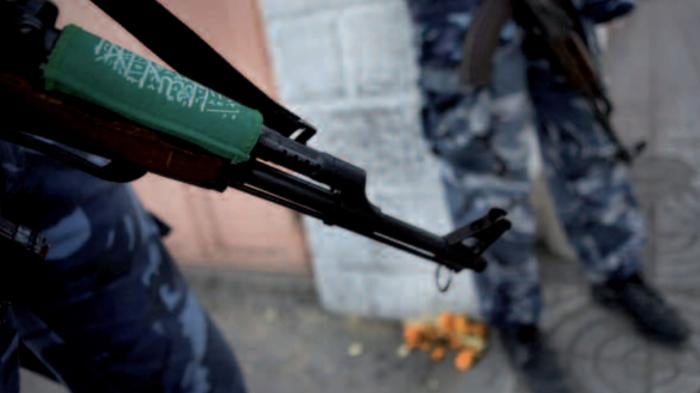
Summary
After Israel began its major military offensive in Gaza on December 27, 2008, Hamas authorities in the territory took extraordinary steps to control, intimidate, punish, and at times eliminate their internal political rivals and those suspected of collaboration with Israel. The attacks continued throughout Israel’s campaign, and have slowed but not stopped since major hostilities ceased on January 18, 2009.
During the chaos of Israel’s offensive, which killed approximately 1,350 Palestinian civilians and combatants and wounded about 5,000, Hamas security forces or masked gunmen believed to be with Hamas extra-judicially executed 18 people, mainly those accused of collaborating with Israel. Masked gunmen also beat and maimed by shooting dozens of Hamas’s political opponents, especially members and supporters of its main political rival, Fatah.
The internal violence in Gaza has continued since Israel withdrew its forces. Palestinian human rights groups in Gaza have reported 14 more killings between January 18 and March 31, 2009.
So far, this violence has gone mostly unpunished. Despite promises to investigate unlawful killings and other abuses, Hamas authorities, to Human Rights Watch’s knowledge, have only investigated one alleged killing by members of their security forces or armed wing.
The majority of Palestinians executed by other Palestinians during Israel’s military operations were men accused of collaboration with Israel. Along with others, they had escaped from Gaza’s main prison compound after Israel bombed the facility on December 28. In addition to the 32 killings mentioned above, the relatives of one suspected collaborator shot him to death “to restore the family’s honor” while Hamas forces failed to intervene.
Hamas security forces have also used violence against known Fatah members, especially those who had worked in the Fatah-run security services of the Palestinian Authority (PA). Of particular concern is the widespread practice of maiming people by shooting them in the legs, which Hamas first used in June 2007, when it seized control inside Gaza from Fatah. According to the Independent Commission for Human Rights (ICHR), the human rights ombudsman organization of the Palestinian Authority, unidentified gunmen in masks deliberately inflicted bullet wounds to the legs of at least 49 people between December 28, 2008 and January 31, 2009.
In January and February 2009 Human Rights Watch interviewed three men who had been shot in the legs, apparently by Hamas security forces, as described below. Two of them were Fatah supporters; one was a former member of the Fatah-led Preventive Security force of the PA. The third man had been overheard on the street criticizing Hamas.
Abductions and severe beatings are another major concern. According to ICHR, unidentified perpetrators physically abused 73 Gazan men from December 28 to January 31, causing broken legs and arms. Human Rights Watch documented three such cases of Fatah supporters assaulted during and after the Israeli offensive, as well as one case of what appeared to be a politically motivated house arrest.
The attacks by Hamas security forces against other Palestinians during and since the recent major hostilities with Israel marked the worst outbreak of internal violence since Hamas took control inside Gaza in June 2007. But the types of violations are not new. Human Rights Watch has previously documented similar abuses by Hamas police and the Internal Security Force, including arbitrary detentions accompanied by severe beatings and gunshots to the legs, and torture, sometimes leading to death.
On the other side of the internal Palestinian divide, the Fatah-run authorities in the West Bank have also increased repressive measures against Hamas members and supporters there. Between December 28, 2008, and February 28, 2009, Palestinian human rights groups recorded 31 complaints of residents who said they had been tortured by Fatah-led security forces. They also recorded one known death in custody and the arbitrary detention of two journalists from a private television station considered pro-Hamas. United States and European Union donors who fund and train these forces have expressed no public criticism of these serious human rights violations.
In both Gaza and the West Bank, these abuses violate Palestinian law. The Palestinian Basic Law, considered the interim constitution, guarantees the right to equal treatment before the law, freedom of expression and association, and fundamental due process rights. It prohibits torture and other mistreatment.
An extensive body of international treaties, notably the International Covenant on Civil and Political Rights and the Convention against Torture and Other Cruel, Inhuman or Degrading Treatment or Punishment, also prohibit these abuses. Both the Hamas and Fatah authorities claim to be the legitimate heads of the Palestinian Authority. Not being a recognized state, the PA cannot ratify these treaties, but PA officials have repeatedly pledged to respect their standards. As a political party, Hamas has publicly indicated on several occasions that it would respect international human rights norms.
Hamas officials have said that they will investigate allegations of abuse by its security forces, and deny that there is any policy to target political opponents or critics. Hamas Interior Ministry spokesman Ihab al-Ghusain told Reuters on January 29 that Hamas was investigating Fatah accusations and would hold any guilty parties accountable.[1] In early February, Hamas spokesman Ghazi Hamad told Al-Jazeera: “I don't ignore that there were some mistakes made by members of Hamas, but I think that is not a policy adopted by the leadership here.”[2]
Hamas officials have stated that on one occasion they disciplined police officers found to be involved in a custodial death. On March 31, the ministry of interior fired 11 police officers and placed them in custody pending a trial before a military court. The police officers stand accused of involvement in the death of Zayed ‘Ayesh Mabrouk Jaradat, 40, who according to Palestinian human rights groups died under torture on March 16. The police in Rafah had reportedly detained Jaradat for drug possession.
It is difficult to determine whether or not the abuses documented in this report resulted from a policy decision by Hamas leaders, but the extent and frequency of the violations strongly suggests such a policy. At the very least, Hamas security forces are not doing enough to prevent or punish these abuses.
During periods of armed conflict, Hamas, as the effective authority in Gaza, is entitled to take appropriate measures to ensure security, including by detaining individuals who pose a genuine security risk. But detentions cannot be arbitrary or target a group or category of persons for political as opposed to security reasons. Physical abuse against detainees, including torture and summary executions, is strictly forbidden under all circumstances.
Methodology
After being denied entry into Gaza by Israel during major hostilities, Human Rights Watch researchers entered Gaza via the Rafah border crossing with Egypt on January 21, 2009, and over the following two weeks conducted 13 interviews with the victims of and witnesses to the abuses documented in this report. Human Rights Watch researchers also spoke with local human rights groups and journalists who had researched these issues, before leaving Gaza on February 4, when Egypt again closed the border. Israel continues to deny Human Rights Watch access to Gaza. An additional victim was interviewed in Egypt on February 10.
On March 5, 2009 Human Rights Watch submitted a list of detailed questions to the government of Ismail Haniya regarding alleged abuses by Hamas security forces. A follow-up letter was sent on March 13. Both letters are provided as an appendix to this report. As of April 10, Human Rights Watch had received no reply.
Unlawful Violence against Political Rivals in Gaza
During Israel’s major military offensive in the Gaza Strip, which resulted in the deaths of approximately 1,350 Palestinian civilians and combatants and wounded about 5,000[3], Hamas authorities there took extraordinary steps to control, intimidate, punish, and at times eliminate their internal political rivals as well as persons suspected of collaboration with Israel. These attacks by Hamas-controlled security forces and the group’s armed wing against other Palestinians during and since the recent fighting marked the worst outbreak of internal violence since Hamas took control inside Gaza in June 2007.[4]
The Hamas internal security forces have two main pillars: the police and the Internal Security Force (al-Amn al-Dakhili), which deals with matters of territorial security and political crimes, similar to the Fatah-run Preventive Security Service in the West Bank. Hamas’s armed wing, the 'Izz-al-Din al-Qassam Brigades, deals primarily with external security, and in particular the hostilities with Israel. In Gaza, Hamas also controls the National Security Force, a PA-wide force with responsibility for border security.
Both the police and Internal Security Force sustained extensive damage during the Israeli offensive. Israeli air strikes on December 27 killed scores of policemen, including police chief Tawfiq Jabber, and subsequently destroyed dozens of police stations and facilities across Gaza. On January 15, an Israeli air attack killed Interior Minister Said Siyam together with nine others. Nonetheless, Human Rights Watch researchers in Gaza after major hostilities had stopped observed that the Hamas government and security forces apparently still had the capacity to maintain internal order. Hamas security forces appeared organized, with visible patrols and police functioning out of makeshift offices. In light of that degree of control, it seems unlikely that other armed groups were able to move freely and carry out many of the beatings, shootings and killings documented in this report.
The unlawful violence by Hamas forces in the Gaza Strip since late December 2008 falls into several categories: killings and maimings by masked gunmen known or suspected to be affiliated with Hamas; executions of suspected collaborators; extra-judicial killings, torture, and other mistreatment; and arbitrary detention.
Killings and Maimings by Masked Gunmen
Local human rights organizations have documented a total of 30 cases of killings and scores of shootings by masked gunmen. According to the ICHR, the human rights ombudsman organization of the Palestinian Authority (PA), masked gunmen killed 28 Palestinians from December 27, 2008 to February 27, 2009.[5] In addition to the 28 deaths that witnesses attributed to masked gunmen, the ICHR reported the death of Hasan Mohamed Hasan Hirz, 39, whose body, showing bruises and signs of torture, was found in Gaza City’s al-Shifa hospital on February 28, a day after he was last seen leaving his home. According to the Palestinian Centre for Human Rights (PCHR), an independent human rights group based in Gaza, Hamas security forces or unidentified gunmen killed at least 29 Gaza residents between the start of Israel’s military operation and February 27; 26 of these cases were also recorded by ICHR.[6]
Human Rights Watch documented one incident in which masked gunmen killed a Gaza resident and three incidents in which they shot and maimed Gazans.
In the case resulting in death, at around 6 p.m. on January 4, 2009, members of the al-Najjar family were sitting outside their home in the Sheikh Radwan neighborhood of Gaza City when four men wearing masks and carrying AK-47 assault rifles approached the house. Two family members who were present told Human Rights Watch that the gunmen wore unmarked black uniforms and ammunition vests, but the family did not identify them as Hamas. When the gunmen ordered everyone to stand up and raise their hands, the head of the household, Hisham al-Najjar, age 55, protested, the two witnesses said. An argument ensued and one of the gunmen fired a shot, hitting no one. At least five women inside the house came rushing out, and in the chaos the gunmen opened fire, killing Hisham al-Najjar and wounding ten members of the family and a family friend. The victims ranged in age from a 12-year old girl, Ahlam Hisham al-Najjar, who was shot in the leg, to Zakkia al-Najjar, 70, Ahlam’s grandmother, who was shot in both legs.[7] Human Rights Watch observed the bandages on both her legs.
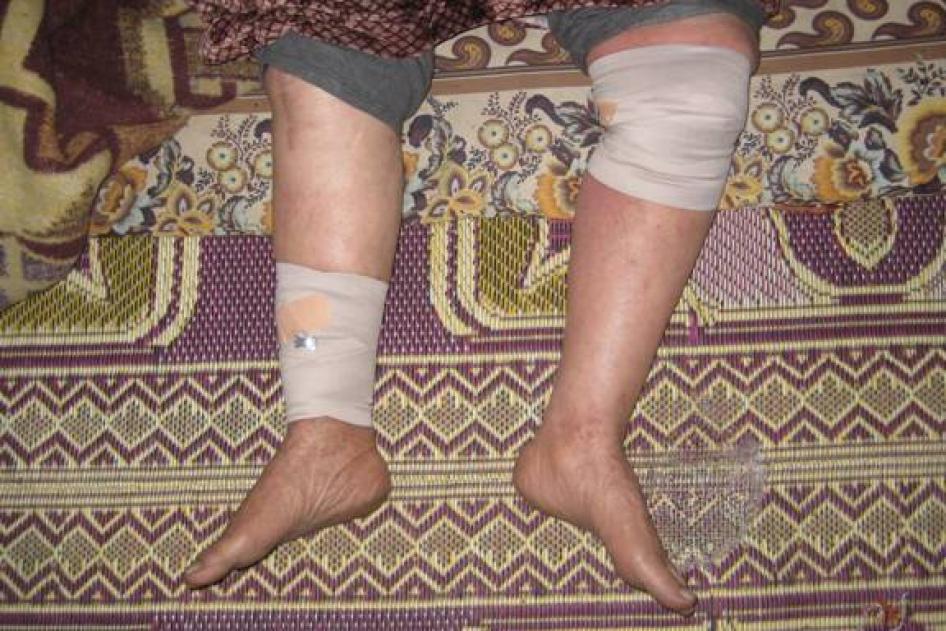
On January 4, 2009, masked gunmen in Gaza City shot and killed Hisham al-Najjar and wounded ten members of the family, plus a family friend. Hisham’s mother, Zakkia al-Najjar, 70, was wounded in both legs.
© 2009 Fred Abrahams/Human Rights Watch
“After the gunmen left, I saw a sea of blood,” said Amar Hisham al-Najjar, 25. He told Human Rights Watch that the gunmen shot his father Hisham in the chest, the abdomen, and the legs.[8] “There was no electricity and no ambulances because of the war, so we tried to stop the bleeding and got our friends to drive the wounded to al-Shifa hospital, where my father died,” he said. “The Hamas police at the hospital questioned me about what happened, and they said they’d get back to me, but there’s been nothing. I’m not accusing anyone, but we demand a real investigation.”
Amar’s cousin, Saleh Sofian al-Najjar, 21, a tailor who was shot in the leg during the attack, confirmed this version of events.[9] Human Rights Watch saw Saleh’s and Amar’s bandaged legs but did not inspect the wounds. Saleh and Amar al-Najjar showed Human Rights Watch seven spent bullets that they said they had collected at the scene. Human Rights Watch identified the cartridges as 5.62 mm rounds for the AK-47 rifle.
Apart from Amar al-Najjar, a former member of the PA Presidential Guard, two others of those shot had worked in the Palestinian Authority’s Preventive Security and National Security forces prior to the Hamas takeover of Gaza in June 2007.
In a second case, at around 7 p.m. on January 26, four masked men wearing dark brown military jackets and carrying automatic weapons grabbed a 38-year-old former member of Fatah’s Preventive Security as he walked near his home in Gaza City. According to the victim, who asked to remain anonymous, the men threw him into the covered back of an Isuzu pickup truck, covered his face with his kaffiyeh (scarf), and drove him to a location he later identified as a Hamas training base around 500 meters from his home. “They took me out of the truck and said, ‘What do you want to do before you die?’” he said.[10]
The men uncovered his face and allowed him to recite the evening prayer, he said, and then covered his face again and drove him to another location where they forced him to sit on the ground with his legs extended. “As soon as I did that, two of them shot me in the left leg,” he said. Human Rights Watch observed his bandaged left leg.
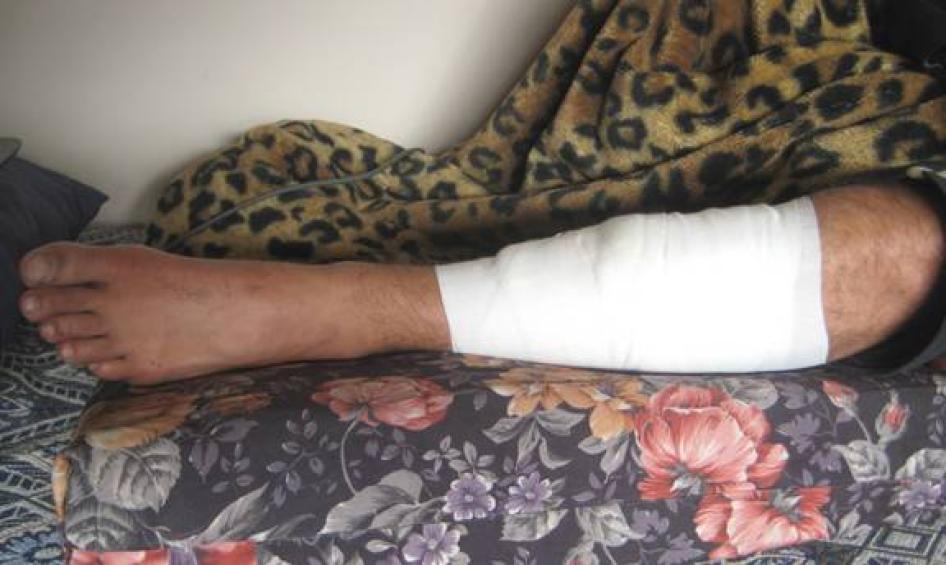
On January 26, 2009, four masked gunmen took this former member of the Fatah-run Preventive Security from his home in Gaza City and shot him twice in the leg. © 2009 Fred Abrahams/Human Rights Watch
In a third case, a man in his 20s who asked not to be identified told Human Rights Watch that he had “made a mistake” in mid-January when he criticized a Hamas leader in a conversation on the street with friends.[11] He believes his remark was overheard by someone in the area. Later that evening, more than a dozen armed men with black masks and red kaffiyeh took him from his home, he said, and brought him to a solitary area where they shot him three times in the lower legs and ankles.
He told Human Rights Watch: “About fourteen of them came for me. They forced me to go from my home to a dark place near a mosque and four of them shot me in the legs, one shot each, but one missed. Hamas pays people to listen for them – we call them ‘drones’[12] – and the drones overheard me. The man added that he was not politically active and was not a member of Fatah. Human Rights Watch observed the man’s heavily bandaged legs.
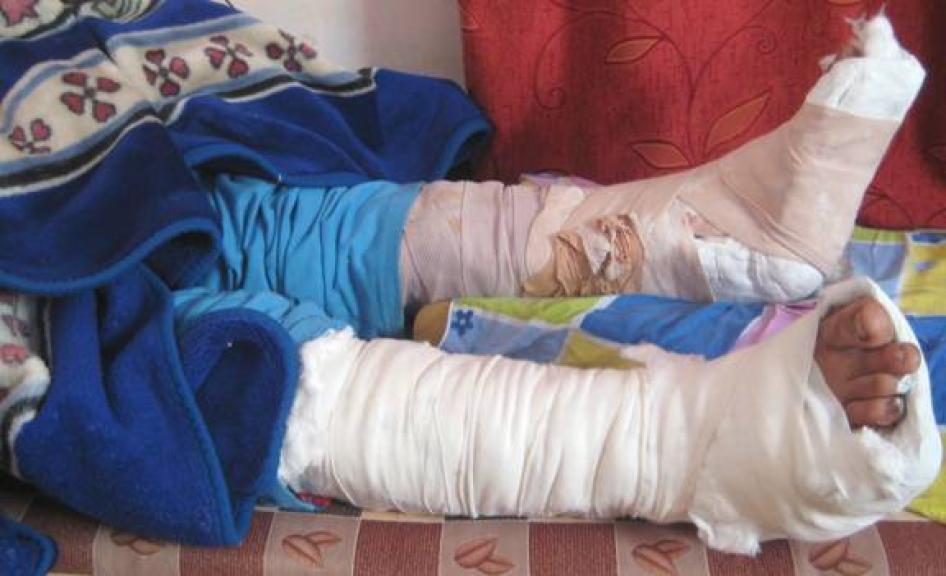
This man said he “made a mistake” when he criticized Hamas on a Gaza City street in mid-January 2009. Later that day masked gunmen took him from his home and shot him twice in the right leg and once in the left.
© 2009 Fred Abrahams/Human Rights Watch
In other cases, Hamas security forces reportedly shot individuals opposed to Hamas rule in Gaza who had openly supported Israel’s attack. Human Rights Watch interviewed one such person, who was recovering in Egypt from multiple gunshot wounds to the left leg. “I was so happy they bombed that I was giving out sweets,” the man said, his injured leg still requiring him to use a wheelchair.[13] According to the man, he was walking home from visiting a friend in Gaza City on January 1 when he saw two young men whom he did not know carrying AK-47 assault rifles. They pointed their weapons at his legs and one of them opened fire, he said. An ambulance took him to al-Shifa Hospital, where he said he shared a room with two other men, whose names he did not know, who said Hamas forces had also shot them in the legs.
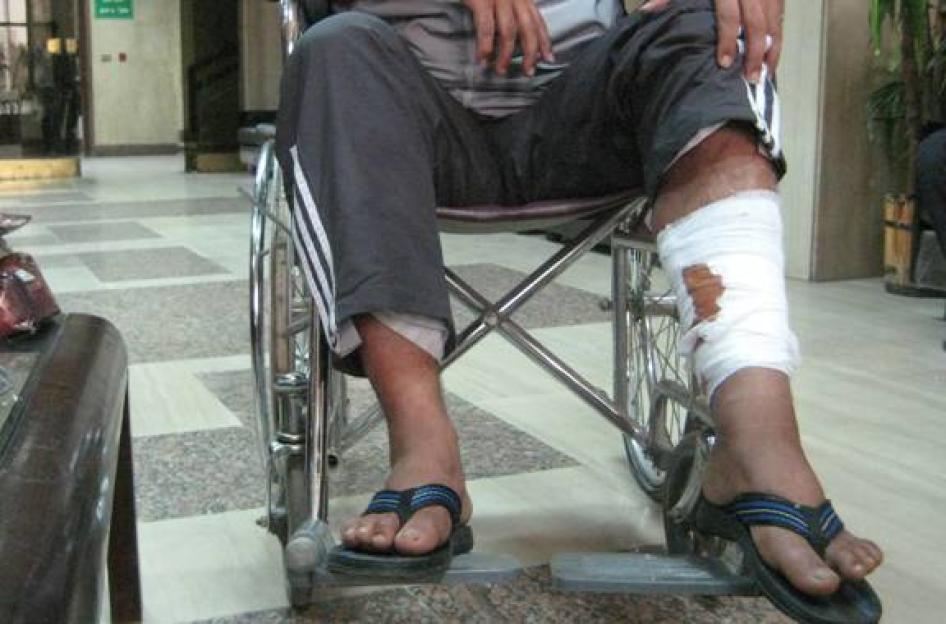
Alleged Hamas gunmen shot this man in the left leg on January 1, 2009, after he had welcomed the Israeli offensive by giving out candy in Gaza City. © 2009 Fred Abrahams/Human Rights Watch
Executions of Suspected Collaborators
Approximately 800 convicted prisoners and persons were being held in pre-trial detention in the central prison in Gaza City when Israeli air strikes began on December 27, 2008, according to the ICHR, which had visited the facility earlier that month. Hamas authorities released about 580 of the prisoners after the bombings started, but kept in custody roughly 115 alleged collaborators with Israel, about 70 Fatah supporters held on various charges, and some persons convicted of criminal offenses who had been sentenced to death.[14] Some of the remaining detainees escaped the following day when Israel bombed the prison, but were subsequently tracked down and killed by masked gunmen. The ICHR documented 20 cases of escaped prisoners being shot and killed by masked gunmen from December 28 to January 31; at least 12 of the victims had been detained in the prison for allegedly “collaborating with the enemy.”[15] Seventeen of the 29 people killed by gunmen that the Palestinian Center for Human Rights (PCHR) reported from December 28 to February 27 were prisoners and detainees who had fled the prison compound after Israel’s attack, including 13 men sentenced to death for collaboration with Israel, three convicted of common crimes, and one man awaiting trial.[16]
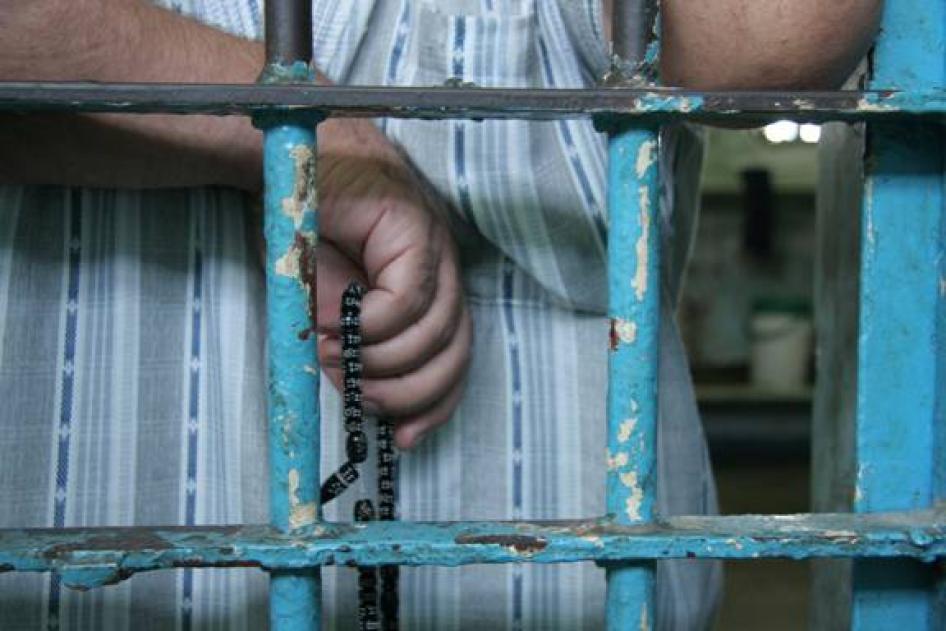
An inmate in Gaza central prison, October 2007. Israel bombed parts of the facility on December 28, 2008.
© 2007 Fred Abrahams/Human Rights Watch
Human Rights Watch interviewed a Fatah member who was still detained at the central prison when Israel bombed the facility on December 28. The prisoners had attempted to escape at around 6 p.m. on December 27, he said, after prison guards left the facility, but detainees who reached the prison yard came under gunfire from buildings surrounding the prison compound. “Two people were shot immediately, one in his head and the second in the chest,” the witness said. “The shooting was coming from everywhere.”[17] An hour and a half later, he said, 30 armed men in police uniforms and civilian clothes entered the compound, firing pistols at inmates’ legs and beating them to force them back to their cells. The witness recognized one of the men as a Hamas Internal Security Force officer.[18] The security forces quickly took control, and punished some prisoners by hitting them on the hands with a thin wooden stick. The security forces then released most of the detainees, including persons detained for drugs offenses, fraud, violating court rulings, and some alleged collaborators. Detainees who were sentenced to death, Fatah members, and most of the alleged collaborators were not released.
Israel bombed the facility at around 10:30 a.m. the following day, December 28, the witness said. “I was coming out of the bathroom and suddenly I saw the wall of a room on the first floor flying away. Two or three bombs hit that place at nearly the same time. The energy of the blast threw us toward the main gate. There was white smoke. I regained consciousness and saw many prisoners wounded due to the shelling and the collapse of the walls.” When he attempted to escape, he came under fire from security forces outside the prison. He said:
I ran to the street, along with tens of prisoners, but we came under fire from the security forces [who had entered the prison the previous night]. I saw three of them chasing down a fleeing prisoner, shooting him in the leg and taking him away in a car. They grabbed anyone they could catch and put him in a car. A friend of mine who is a policeman helped get me out of the area.
A reporter for the New York Times witnessed the killing of one alleged collaborator (whose death was also documented by the PCHR). On December 29, the journalist watched as a group of men pretended to transfer Saleh Hajoj, 32, from one ward of al-Shifa hospital in Gaza City.[19] He and five other alleged collaborators had reportedly been transferred to the hospital from the central prison after Israel bombed the facility. A number of people were watching as one of the men fatally shot Hajoj in the head. The International Crisis Group reported that the man was killed by his own family to “restore its honor.”[20] According to the New York Times, unidentified gunmen executed the five other detainees within 24 hours of Hajoj’s death.
Rather than arrest those responsible for extra-judicial executions, Hamas officials have made statements that appear to justify the killing of alleged collaborators. On February 2, for example, Hamas government spokesman Taher al-Nunu said, “The government will show no mercy to collaborators who stab our people in the back, and they will be held accountable according to the law.”[21] Al-Nunu added, “The government differentiates between violations of the law and those acts undertaken by the resistance during a time of war to protect itself from the danger of collaborators.”
Extra-Judicial Killings, Torture and Other Mistreatment
In addition to shooting deaths and maimings, Hamas security forces and unidentified assailants possibly linked to Hamas were also implicated in custodial killings and torture against perceived political opponents and others.
Human Rights Watch interviewed a Fatah activist who said he was badly beaten by Hamas security forces in the Beach refugee camp on December 29, 2008. “I was sitting with others listening to the radio around the fire at 9 p.m. when three masked men broke in,” he said, recalling that the men wore brown camouflage uniforms. He explained:
There were eight of us sitting there. We were all from Fatah. Then three masked militants broke in. They were dressed in brown camouflage military uniforms; they all had guns. They pointed their guns at us and cursed us, then they began beating us with iron rods, including a 10-year-old boy whom they hit in the face. They said we were “collaborators” and “unfaithful.” Then they took me outside, where there were four more men in masks. They dragged me to a dark place in the vegetable market about 300 meters away. They beat me with iron sticks and gun butts for 15 minutes. They were yelling: “You are happy that Israel is bombing us!” until people came out of their houses, and they withdrew.[22]
In total, Palestinian human rights groups documented nine deaths by torture or severe beating in Gaza in January, February and March 2009. According to both the ICHR and the PCHR:
- A group of armed masked men forced Zahir Ahmad al-Za`anin, 40, from his home in Beit Hanoun on January 14; his body was found the following day at Kamal Adwan Hospital in Beit Lahiya.
- On January 18, gunmen who said they were members of the Hamas-run Internal Security Force arrested Hani Ibrahim Abu Reidah, 25, of Khuza`a. He was found injured in an area east of Khan Younis on January 22, and died after being transferred to Nasser Hospital in Khan Yunis. His body bore marks of torture.
- Armed men wearing masks grabbed Yunis Muhammad Abu Amrah, 36, from his home in Gaza City on January 24; his family found him later that day, severely beaten, in the Tel al-Hawa neighborhood. He died in al-Shifa hospital from his injuries on January 28.[23]
- On January 30, members of the Internal Security Force summoned and detained Jamil Shakura, 51, from Khan Yunis refugee camp. After torturing and beating him on the head and body, security agents transferred Shakura to Nasser Hospital in Khan Yunis, where he died of a stroke on February 6.
- On February 6, masked men whom ICHR identified as Internal Security Force officers abducted Nihad Sa’adi al-Dabbaka, 47, from al-Maghazi refugee camp in central Gaza. He died on February 9, with marks from apparent torture on his body.
- On February 7, ‘Ata Yousef Abdul Wahhab al-Bur’i, 39, from the Beach refugee camp, died after men claiming to be police abducted and beat him severely on January 8.[24]
- On March 8, security forces took Jamil Nasser Assaf, 20, from his Gaza City home on charges of theft. He was tortured at the al-Tufah police station and died on March 24.[25]
PCHR also reported that on the morning of March 15, Rafah police arrested 40-year-old Zayed ‘Ayesh Mabrouq Jaradat, on charges of drug possession. They detained him in the al-Quds Girls’ Secondary School, which became the de facto police headquarters after Israel bombed the Rafah police station. According to PCHR, members of the security services tortured Jaradat during his detention, and he was pronounced dead on arrival at Martyr Mohammed Yousif al-Najjar Hospital in Rafah on March 16. The body was transferred to the forensic department at al-Shifa Hospital in Gaza City, where PCHR examined the body and saw bruising, particularly on the neck and shoulders, and that Jaradat’s toenails had been removed.[26]
Two other Gaza men died in February at the hands of masked gunmen, who in both cases were identified as members of Hamas security forces. The ICHR reported that, according to the victim’s family, Internal Security Force officers took Basheer 'Ilayyan al Zaytouneh, a 41-year-old resident of Gaza City, from his home on January 29. Zaytouneh’s family identified his body in al-Shifa hospital on February 2.[27] On February 26 at roughly 10 p.m., masked gunmen abducted Hamza Mahmoud al-Shoubaki, 40, from the al-Daraj neighborhood in the east of Gaza City; al-Shoubaki’s body was brought to al-Shifa hospital the next morning, with two gunshot wounds to the head, according to the PCHR. His wife identified the men who abducted him as members of the Internal Security Force.[28]
In a case reported in the media, the family of Usama Atallah, a teacher and Fatah supporter, said that gunmen who identified themselves as Hamas abducted Attalah from the family home in Gaza City on January 27.[29] According to the Al-Jazeera English television network, two days later the family retrieved his body from the morgue at al-Shifa Hospital with signs of strangulation, blunt-force trauma to the head, and a gunshot wound to the shoulder.[30]
Human Rights Watch separately interviewed two men who said they had each witnessed unidentified men they believed to be from Hamas badly beat a suspected criminal on a Gaza street. In the first case, men in civilian clothes whom the witness identified as Hamas members badly beat a suspected drug dealer with sticks and metal bars in Gaza City. People on the street watched but did not intervene, the witness said: “What could people do? They are afraid.”[31] In the second case, men whom the witness believed to be Hamas beat a suspected criminal in the Tel al-Hawa neighborhood of Gaza City with sticks and bars.[32] Both men believed the assailants came from Hamas because other armed groups could not operate in such a way publicly.
On March 10, the London-based pan-Arab daily Al-Sharq al-Awsat reported the alleged torture by Hamas police of ten members of Saraya al-Quds, the armed wing of Islamic Jihad.[33] The paper reported that Hamas police detained the ten men, from Khan Yunis, and tortured them in order to coerce them to sign pledges that they would not fire rockets at Israel.
Since the end of December 2008, Fatah-run Palestinian security services in the West Bank have stepped up arbitrary arrests and harassment of Hamas members and supporters there. The ICHR said it received 25 complaints in January 2009, and six complaints in February from West Bank residents who said they had been subjected to torture.[34] On January 24, Palestinian security forces in the West Bank detained two journalists from a pro-Hamas television station, Al-Quds.[35] According to the PCHR, on February 8 West Bank security forces announced the death of Muhammad Abd al-Jamil al-Haj, 30, from Jalqamus, who had been arrested two days earlier. According to the ICHR, the Palestinian Legislative Council has formed an independent committee to investigate his death.[36]
United States and European Union donors who fund and train these forces have expressed no public criticism of these serious human rights violations.
Arbitrary Detention by House Arrests
According to the ICHR, from December 27, 2008, to the end of January, 2009, Hamas police ordered the house arrest of more than 150 Fatah members or supporters. The PCHR said it had documented “hundreds of cases” in which Hamas authorities have imposed house arrest on Fatah activists and persons suspected of having committed a criminal offense.[37]
Human Rights Watch interviewed a student who said Hamas officials placed him under house arrest in late January, after the Israeli offensive had stopped. “I was summoned to the medical clinic next door to the police station – the police use it now that the station was bombed,” the student said.[38] “They told me I was confined to my house for one month. I asked for a paper, because this means I will miss my exams and I need to show something to my university. They refused to give me any paper. They said I was arrested because I was a dishonorable citizen and a member of a dishonorable movement, and that if I leave my house they will not be responsible for my life.”
Legal Standards
The abuses documented in this report, including extrajudicial executions, torture and other cruel and inhuman treatment, and arbitrary detention, are prohibited under international human rights law and international humanitarian law (the laws of war), which were applicable in Gaza during the Israeli military offensive. The human rights abuses documented in this report also violate the Palestinian Basic Law, which states in article 10 that “basic human rights and freedoms shall be binding and respected.”[39]
Customary international human rights law, such as found in the Universal Declaration of Human Rights,[40] and treaty law, including the International Covenant on Civil and Political Rights (ICCPR) and the Convention against Torture and Other Cruel, Inhuman or Degrading Treatment or Punishment, prohibit extra-judicial executions and other deliberate killings, and torture and cruel or inhuman treatment, among other abuses described in this report. These prohibitions apply at all times, even during recognized states of emergency.[41] Likewise, the Palestinian Penal Procedures Law, which elaborates on the conduct of arrests and treatment of persons in custody by the security forces, allows some restrictions of fundamental rights during an officially declared state of emergency, but only “to the level that is necessary to achieve the objective stated in the decree that announces the state of emergency.”[42]
The prohibition of torture is one of the most fundamental in international human rights law. As set out in the Convention against Torture, torture means “any act by which severe pain or suffering, whether physical or mental, is intentionally inflicted on a person… by or at the instigation of or with the consent or acquiescence of a public official or other person acting in an official capacity.” The UN Committee Against Torture, which reviews the compliance of states with the convention, has made it clear that “those exercising superior authority -- including public officials -- cannot avoid accountability or escape criminal responsibility for torture or ill-treatment committed by subordinates where they knew or should have known that such impermissible conduct was occurring, or was likely to occur, and they failed to take reasonable and necessary preventive measures.”[43] No exceptional circumstances whatsoever can justify torture. States are responsible for having effective systems in place for addressing victims’ complaints, and prosecuting those who torture, those who order them to, and those in positions of authority who fail to prevent or punish torture.
The laws of war also prohibit unlawful killings and ill-treatment of persons by a party to the conflict. Article 3 common to the four Geneva Conventions of 1949, applicable to states and non-state armed groups, prohibits, “at any time and in any place whatsoever” with respect to civilians and combatants no longer taking part in the hostilities, “violence to life and person, in particular murder of all kinds, mutilation, cruel treatment and torture” and “the passing of sentences and the carrying out of executions without previous judgment pronounced by a regularly constituted court affording all the judicial guarantees which are recognized as indispensable by civilized peoples.”[44]
International human rights law also prohibits the arbitrary deprivation of liberty. Article 9 of the ICCPR defines as arbitrary and prohibits detention “except on such grounds and in accordance with such procedure as are established by law,” grants detainees the right to judicial review of their detention and compensation if it is found to be unlawful.[45] Even during recognized states of emergency, fundamental guarantees, such as the right to be brought before a judicial authority, still apply.[46] The laws of war also prohibit the arbitrary deprivation of liberty.[47] Security forces may limit the movement of individuals during military operations for specific reasons, however, they may not prohibit persons from leaving their homes solely on the grounds of their affiliation with a political movement.
Hamas, as a non-state armed group, is bound by the laws of war. As a de facto governing authority, Hamas cannot be party to international human rights treaties, but it has publicly indicated it would respect international standards. In a speech in Gaza on June 21, 2006, Prime Minister Ismail Haniya said Hamas was determined “to promote the rule of law, the respect for the judiciary, the separation of powers, the respect for human rights, the equality among citizens; to fight all forms of discrimination; to protect public liberties, including the freedom of the press and opinion.”[48] In the program of the National Unity Government, presented on March 17, 2007, Hamas stated its “respect for international law and international humanitarian law insofar as they conform with our character, customs and original traditions.”[49]
The Gaza authorities consider themselves to be the lawful government of the Palestinian Authority and therefore should be bound by the PA’s repeated commitments to respect international human rights law.[50] In any event, Hamas de facto governs a specific territory and therefore should govern in accordance with international human rights standards.[51]
Recommendations
The Palestinian authorities in the Gaza Strip should take concrete and measurable steps to investigate, prosecute, and appropriately punish members of the security forces or others under their jurisdiction who are responsible for the serious human rights abuses documented in this report.
Human Rights Watch calls on the Palestinian authorities in Gaza to implement the following recommendations:
- Issue clear and public instructions to all members of the security forces prohibiting extrajudicial killings, torture, and other mistreatment, and make clear that violators will be punished to the fullest extent of the law;
- Initiate prompt and impartial investigations into all credible reports of torture or deaths of persons in custody. Discipline or prosecute as appropriate all individuals found responsible, including those persons working for or affiliated with Hamas-run security forces or militia; and
- Provide prompt and adequate compensation to victims of such abuses.
Acknowledgments
This report was researched and written by Human Rights Watch staff Bill van Esveld, researcher, and Fred Abrahams, senior emergencies researcher; and Darryl Li, consultant to Human Rights Watch. It was edited by Joe Stork, deputy director of the Middle East and North Africa division, James Ross, legal and policy director, and Iain Levine, program director.
Human Rights Watch thanks all the victims and witnesses who related their experiences. Thanks also to the human rights organizations who provided assistance, in particular the Independent Commission for Human Rights, the Palestinian Centre for Human Rights and the Al Dameer Association for Human Rights.
Appendix
March 5, 2009
Prime Minister Ismail Haniya Jerusalem Street, Tal al-Hawa Gaza
VIA FACSIMILE: + 970 8282 2159, + 970 8284 5040, + 970 8286 8971
Dear Prime Minister Haniya,
Over the weeks since Israel launched large-scale military operations in Gaza on December 27, Human Rights Watch has issued a number of statements regarding violations of international humanitarian law during the conflict. Our most recent intervention, of March 1, called on the United States, the European Union, and other donors meeting in Sharm al-Sheikh to call upon Israel to open its crossings with Gaza to all humanitarian aid as well as to ordinary imports and exports. That statement can be found at http://www.hrw.org/en/news/2009/02/28/israelgaza-donors-should-press-israel-end-blockade
Human Rights Watch is currently preparing a report on recent human rights violations apparently carried out by forces affiliated with Hamas. We would very much appreciate if your office provided us some information. We are committed to representing the material in a complete and impartial way. Your answers will help ensure that we are able to do so.
Our deadline for finalizing this report is approaching. If you can provide answers to these questions by March 13 we will seek to reflect them in our report. Thank you for your time and assistance, and we look forward to engaging with your further on matters of mutual concern.
Sincerely,
Joe Stork Deputy Director Middle East and North Africa division
Questions for the Government of Ismail Haniya
- Has your government conducted any investigations into allegations that persons affiliated with Hamas security forces were responsible for extrajudicial executions during the recent fighting, including persons suspected of collaboration with Israel who had been held in the Gaza Central Prison but escaped when Israeli warplanes bombed that facility on December 28, 2008? If so, could you inform us which killings have been investigated and the results of those investigations?
- Has your government conducted any investigations into shootings by masked gunmen that killed or wounded persons during or after the Israeli military offensive? Has the government investigated any of the numerous incidents of shootings apparently intended to maim, such as shootings at the legs of persons who are or are suspected of being supporters of Fatah? If so, could you inform us which shooting incidents have been investigated and the results of those investigations?
- Human Rights Watch has information concerning the deaths of Zaher Ahmad al-Za’anin (40), Jamil Shakura (51), Nihad Sa’adi al Dabbaka (47), Ata Yusif Abd al-Wahhab al-Bur’I, all of whom died apparently as the result of torture following their apprehension or abduction by persons claiming to work for Internal Security or other Hamas security forces. Has your government investigated the circumstances surrounding any of these deaths? If so, could you provide information about the results of the investigations? Have the authorities taken into custody anyone suspected of responsibility for any of these deaths?
- Has anyone from the Internal Security Force been held accountable for violating any of the provisions in the Prime Minister’s Order No. 128/2007, which directed the security organs to respect human rights? If so, could you please inform us of the names of the individuals and the current status of those investigations, or prosecutions, or of any disciplinary measures taken?
- With the destruction of Gaza’s prison facilities and most police stations, where are security forces holding those apprehended for, charged with or convicted of a crime?
March 13, 2009
Prime Minister Ismail Haniya Jerusalem Street, Tal al-Hawa Gaza
VIA FACSIMILE: + 970 8282 2159, + 970 8284 5040, + 970 8286 8971
Dear Prime Minister Haniya,
We wrote to your office on March 5 to request information for a report Human Rights Watch is preparing on recent human rights violations apparently carried out by forces affiliated with Hamas.
Because of the deadline for our report, we had asked for your reply by today, March 13. Our report has been finalized and is now being translated.
However, we will still be able to reflect your responses to our questions if we receive them by March 17. Your answers will help ensure that we are able to represent the material in a complete and impartial way.
Thank you once again for your assistance.
Sincerely,
Joe Stork Deputy Director Middle East and North Africa division
[1] Reuters, “Hamas accused of torture death of Gaza critic,” January 29, 2009, http://www.reuters.com/article/latestCrisis/idUSLT773276, accessed February 27, 2009.
[2] Mike Kirsch, “Hamas accused of killing Palestinian opponents - 08 Feb 09,” Al Jazeera English, available at http://www.youtube.com/watch?v=tJCGqQrxCaA, accessed February 27, 2009.
[3] Al-Mezan, an independent human rights organization based in the Gaza Strip, published the names of 1,342 Gazans killed in Israeli attacks during major military operations. “Al Mezan Publishes a List of Palestinians Killed by the IOF during the Israeli "Cast Lead" Operation in Gaza,” March 5, 2009, http://www.mezan.ps/en/details.php?id=8552&ddname=gaza%20destruction&id2=6, accessed March 13, 2009.The Palestinian Center for Human Rights (PCHR), another Gaza-based independent human rights organization, reported that the Israeli attacks had killed 1,434 people. PCHR, “Confirmed figures reveal the true extent of the destruction inflicted upon the Gaza Strip,” March 12, 2009, http://www.pchrgaza.org/files/PressR/English/2008/36-2009.html, accessed March 13, 2009.
[4] Human Rights Watch, Internal Fight: Palestinian Abuses in Gaza and the West Bank, July 29, 2008. This report also documented arbitrary arrests and torture by Fatah-run Palestinian security services in the West Bank.
[5] ICHR, “Monthly Report on Human Rights and Freedoms in the PNA-Controlled Territory, January 2009,” http://www.ichr.ps/pdfs/eMRV-1-09.pdf, accessed February 27, 2009, and “Monthly Report on Human Rights and Freedoms in the PNA-Controlled Territory, February 2009,” http://www.ichr.ps/pdfs/eMRV-2-09.pdf, accessed March 11, 2009.
[6]PCHR Special Report, “Inter-Palestinian Human Rights Violations in the Gaza Strip,” February 3, 2009, p.2, http://www.pchrgaza.org/files/Reports/English/pdf_spec/Increase_rep.pdf, accessed February 27, 2009; “PCHR Demands Investigations into Violent Deaths of Two Civilians in Gaza,” February 10, 2009, http://www.pchrgaza.org/files/PressR/English/2008/26-2009.html, accessed March 8, 2009; and “PCHR Calls for Investigation into Gaza City Murder,” March 1, 2009, http://www.pchrgaza.org/files/PressR/English/2008/32-2009.html, accessed March 9, 2009. The one death ICHR reported in January that was not also documented by PCHR is that of Saleh Salem Jahjouh, 38, of Beit Hanoun; according to the ICHR monthly report, his dead body was found with bullets to the head, chest and legs in al-Shifa hospital on January 21, 2009. PCHR also documented the killing of Saleh Salem al-Hajoj by his own family on December 29 at al-Shifa hospital.
[7] In addition to Hisham, Ahlam and Zakkia al-Najjar, gunshot victims included: Amar Hisham al-Najjar, 25, a former member of the Presidential Guard; Adham Hisham al-Najjar, 20, a house painter who suffered a flesh wound to the leg; Amran Hisham al-Najjar, 21, a former Preventive Security member who lost feeling in his leg after being shot; Riham Hisham al-Najjar, 16; Saleh Sofian al-Najjar, 21, a tailor; Mohamed Sofian al-Najjar, 26, a university student; Ramsi Tawfiq al-Najjar, 36, also a house painter, and his wife, Manal al-Najjar, 31; and a family friend, Khamis Abd el Aziz Abu Nahel, 25, a former National Security Forces member.
[8] Human Rights Watch interview with Amar Hisham al-Najjar, Gaza City, January 29, 2009.
[9] Human Rights Watch interview with Saleh Sofian al-Najjar, Gaza City, January 29, 2009.
[10]Human Rights Watch interview with former Preventive Security member, Gaza City, January 29, 2009.
[11] Human Rights Watch interview with gunshot victim, Gaza City, January 29, 2009.
[12]“Drone” is a reference to the unmanned aerial vehicles frequently used by the Israel Defense Forces, most notably in the recent military operations, for surveillance and attack.
[13]Human Rights Watch interview with Gaza City resident, Cairo, Egypt, February 10, 2009.
[14]Human Rights Watch interview with ICHR staff, Gaza City, January 28, 2009. The International Crisis Group reported that “115 collaborators and 60 political prisoners, were incarcerated in the Saraya, Hamas’s central jail in Gaza City, when Israel bombed the facility.” International Crisis Group, “Ending the War in Gaza,” Policy Briefing No 26, January 5, 2009, p. 9, footnote 62.
[15]A five-page table listing the names of 20 men allegedly killed after escaping from the Gaza Central Prison and the al-Saraya Prison on December 28, 2008, appears at the end of the ICHR report. ICHR, “Monthly Report on Human Rights and Freedoms,” January 2009.
[16] PCHR, “Inter-Palestinian Human Rights Violations,” p.2; “PCHR Demands Investigations into Violent Deaths of Two Civilians”; and “PCHR Calls for Investigation into Gaza City Murder.”
[17] Human Rights Watch interview with former detainee, Gaza City, March 8, 2009.
[18]Hamas created the Internal Security Force in September 2007. In October 2007, Hamas dissolved the Executive Force and absorbed its personnel into the police, and appointed a former Fatah security officer, Tawfiq Jabber, as police chief, reporting to the minister of interior. Said Siyam, the minister of interior, was widely believed to control the police and the Internal Security Force. Human Rights Watch, Internal Fight: Palestinian Abuses in Gaza and the West Bank, July 29, 2008, p. 17. As noted, Israeli airstrikes killed Jabber and Siyam on December 27, 2008 and January 15, 2009, respectively
[19]Ethan Bronner and Taghreed El-Khodary, “No Early End Seen to ‘All-Out War’ on Hamas in Gaza,” December 29, 2008, New York Times, http://www.nytimes.com/2008/12/30/world/middleeast/30mideast.html, accessed February 28, 2009. See also Mike Kirsch, “Hamas accused of killing Palestinian opponents,” Al Jazeera English, http://www.youtube.com/watch?v=tJCGqQrxCaA, accessed February 27, 2009.
[20]Crisis Group, “Ending the War in Gaza,” p. 9, footnote 62.
[21] “Hamas OKs killing of collaborators during war,” Al Arabiya/AFP, February 3, 2009, http://www.alarabiya.net/articles/2009/02/03/65607.html, accessed February 27, 2009.
[22]Human Rights Watch interview with Fatah activist, Gaza City, January 29, 2009.
[23] ICHR, “Monthly Report on Human Rights,” January, p. 4. PCHR, “Inter-Palestinian Human Rights Violations,” pp. 3, 4.
[24]ICHR, “Monthly Report on Human Rights,” February, p. 2; PCHR, “PCHR Demands Investigations into Violent Deaths of Two Civilians in Gaza,” February 10, 2009, http://www.pchrgaza.org/files/PressR/English/2008/26-2009.html, accessed February 27, 2009.
[25]ICHR, “Monthly Report on Human Rights,” February, p. 2; PCHR, “PCHR Demands Investigations into Violent Deaths of Two Civilians in Gaza,” February 10, 2009, http://www.pchrgaza.org/files/PressR/English/2008/26-2009.html, accessed February 27, 2009; PCHR, “PCHR Demands Investigation into Death of a Civilian Tortured by Members of the Intelligence Services in Gaza,” 25 March 2009, http://www.pchrgaza.org/files/PressR/English/2008/42-2009.html, accessed April 4, 2009; ICHR, “ICHR calls for an investigation into the conditions that led to the death of a Palestinian citizen while he was being held by the police of the Deposed Government,” March 24, 2009, http://www.ichr.ps/index.php/etemplate.php?id=139, accessed April 4, 2009.
[26]PCHR, “PCHR Demands Investigation into the Death of a Civilian Detained and Tortured by Security Services in Rafah,” March 18, 2009, http://www.pchrgaza.org/files/PressR/English/2008/37-2009.html, accessed on April 3, 2009.
[27] ICHR, “Monthly Report on Human Rights,” February, p. 2.
[28] PCHR, “PCHR Calls for Investigation into Gaza City Murder,” March 1, 2009, accessed March 3, 2009.
[29] “Hamas accused of torture death of Gaza critic,” Reuters. PCHR also reported this case: “Inter-Palestinian Human Rights Violations,” p. 4.
[30] Mike Kirsch, “Hamas accused of killing Palestinian opponents – 08 Feb 09,” Al Jazeera English.
[31] Human Rights Watch interviews with anonymous witness, Gaza City, January 24, 2009.
[32] Human Rights Watch interview with anonymous witness, Gaza City, February 3, 2009.
[33] Al Sharq al Awsat, “الجهادتتهمحماسباعتقالناشطيهافيغزةوإجبارهمعلىتوقيعتعهدبوقفالصواريخ [Jihad accuses Hamas: activists arrested in Gaza and forced to sign a pledge to stop rockets],” March 10, 2009, http://www.aawsat.com/details.asp?section=4&issueno=11060&article=510382&search=الجهاد%20تتهم%20حماس&state=true, accessed March 13, 2009.
[34] ICHR, “Monthly Report on Human Rights,” January, p.5, and “Monthly Report on Violations of Human Rights,” February 2009, p. 4.
[35] PCHR, “PCHR Condemns Continued Detention of Journalists by Preventive Security Service in the West Bank,” February 12, 2009, http://www.pchrgaza.org/files/PressR/English/2008/28-2009.html, accessed February 24, 2009. The journalists are Samer Khuweireh and Ahmad Bekawi. The ICHR confirmed that both men remained in detention as of February 25. Human Rights Watch telephone interview with ICHR staff, Ramallah, February 25, 2009.
[36]Human Rights Watch telephone interview with ICHR staff, Ramallah, February 24, 2009.
[37] PCHR, “Inter-Palestinian Human Rights Violations,” p. 5.
[38]Human Rights Watch interview with student, Gaza City, January 30, 2009.
[39]The Palestinian Basic Law was intended as a temporary constitution until the establishment of an independent Palestinian state with a permanent constitution. The Palestinian Legislative Council passed the Basic Law in 1997 and President Yasser Arafat ratified it in 2002. It was amended in 2003 to introduce a prime minister and in 2005 it to conform to the new Election Law. (See http://www.palestinianbasiclaw.org/2002-basic-law, accessed June 9, 2008).
[40]Universal Declaration of Human Rights, G.A. res. 217A (III), U.N. Doc A/810 at 71 (1948).
[41]ICCPR, art. 4 (non-derogable rights and states of emergency).
[42]Article 102.
[43]UN Committee Against Torture, General Comment no 2, CAT/C/GC/2, January 24, 2008.
[44]Common Article 3 to the Geneva Conventions of 1949.
[45] ICCPR, Article 9.
[46]See ICCPR, article 9 (prohibition on arbitrary detention) and article 4 (states of emergency); see also Human Rights Committee, General Comment 29, States of Emergency (article 4), U.N. Doc. CCPR/C/21/Rev.1/Add.11 (2001), reprinted in Compilation of General Comments and General Recommendations Adopted by Human Rights Treaty Bodies, U.N. Doc. HRI/GEN/1/Rev.6 at 186 (2003), para. 11 (the ICCPR provisions on states of emergency may not be invokes “as justification for acting in violation of humanitarian law or peremptory norms of international law, for instance by taking hostages, by imposing collective punishments, through arbitrary deprivations of liberty or by deviating from fundamental principles of fair trial, including the presumption of innocence.”).
[47]See International Committee of the Red Cross, “Customary International Humanitarian Law” (Cambridge: Cambridge University Press, 2005), rule 99.
[48]Speech of Prime Minister Ismail Haniya at the conference “The New Government and the Agenda for Human Rights,” Gaza City, June 21, 2006 (as cited by “Human Rights Situation in Palestine and other Occupied Arab Territories,” Human Rights Council, A/HRC/8/17, June 6, 2008,http://www2.ohchr.org/english/bodies/hrcouncil/docs/8session/A.HRC.8.17.doc (accessed June 16, 2008).)
[49] “National Unity Government Program,” presented by Prime Minister Haniya to the Palestinian Legislative Council, March 17, 2007 (as cited by “Human Rights Situation in Palestine and other Occupied Arab Territories,” Human Rights Council).
[50] According to article 10 of the Basic Law, the Palestinian National Authority “shall work without delay to become a party to regional and international declarations and covenants that protect human rights.” The PA has explicit legal obligations from the Oslo Accords, an umbrella term for the series of agreements negotiated between Israel and the Palestine Liberation Organization from 1993 to 1996. Annex I of the Protocol Concerning Redeployment of the Interim Agreement of September 28, 1995, states that the Palestinian police will exercise powers and responsibilities to implement the memorandum “with due regard to internationally accepted norms of human rights and the rule of law.” Article XIV of the 1994 agreement on the Gaza Strip and the Jericho Area stipulates that both Palestine and Israel should respect human rights. The Government of Israel and the Palestine Liberation Organization, “The Israeli-Palestinian Interim Agreement on the West Bank and the Gaza Strip,” Annex I, article XI (1), Washington D.C., September 28, 1995. See “The “Roadmap”: Repeating Oslo’s Human Rights Mistakes,” Human Rights Watch, May 6, 2003, http://www.hrw.org/backgrounder/mena/israelpa050603.htm, and “An Analysis of the Wye River Memorandum,” Human Rights Watch, November 1998, http://www.hrw.org/press98/nov/israel1102.htm.
[51] According to the joint report on Lebanon and Israel issued by four UN Special Rapporteurs, “It is especially appropriate and feasible to call for an armed group to respect human rights norms when it exercises significant control over territory and population and has an identifiable political structure.” (“Mission to Lebanon and Israel,” Report of the Special Rapporteur on extrajudicial, summary or arbitrary executions, Philip Alston; the Special Rapporteur on the right of everyone to the enjoyment of the highest attainable standard of physical and mental health, Paul Hunt; the Representative of the Secretary-General on human rights of internally displaced persons, Walter Kälin; and the Special Rapporteur on adequate housing as a component of the right to an adequate standard of living, Miloon Kothari,UN doc A/HRC/2/7, para. 19.)