Summary
There was jubilation among Eritreans when Eritrea formally gained its independence from Ethiopia in 1993 after a bloody 30-year war. Sixteen years later the dreams that the independent state would be democratic and rights-adhering lie in tatters. Eritrea has become one of the most closed and repressive states in the world. Thousands of political prisoners are detained in prisons and underground cells; there is no independent civil society; all independent media outlets have been shut down; the head of the Eritrean Orthodox Church is in incommunicado detention; and evangelical Christians are rounded up and tortured on a regular basis.
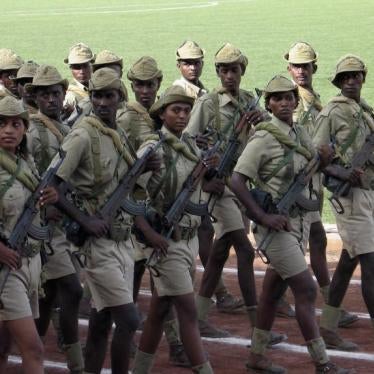
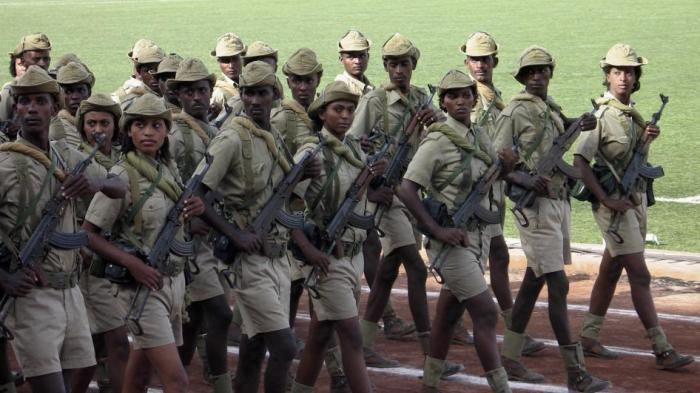
President Isayas Afewerki, who led Eritrea through much of its extraordinary struggle for independence, now uses an unresolved border dispute with Ethiopia to keep Eritrea on a permanent war footing. For much of the adult male and female population, the mandatory 18-month period of national service extends for years, with a large proportion involuntarily serving in the Eritrean army. People under the age of 50 can rarely obtain exit visas to leave the country. Those who try and flee without documentation run the risk of imprisonment and torture—or being shot at the border. The Eritrean government collectively punishes the families of those who desert from national service with exorbitant fines or imprisonment. Despite these risks, Eritrea is now among the highest refugee producing nations in the world.
This report documents the Eritrean government’s responsibility for patterns of serious human rights violations: arbitrary arrest and detention, torture, forced labor, and inhuman conditions in detention; rigid restrictions on freedom of movement and expression; and religious persecution. It also analyzes abuses related to the practice of indefinite conscription into national and military service, the lack of any provision for conscientious objection, and the risks facing refugees even after they flee.
During the first few years of independence the outlook was not so bleak. Independent media flourished, the army began demobilizing some of those who had fought during the long war of liberation from Ethiopia, and in 1997 the National Assembly ratified a new constitution that enshrined democratic principles and fundamental human rights.
Then in 1998 a border dispute with Ethiopia flared up into an extraordinarily bloody and costly two-year war. Elections were postponed, mass conscription was re-instated, and tens of thousands died before the internationally mediated Algiers Agreement brought hostilities to an end in 2000. This provided for the establishment of a neutral Eritrea-Ethiopia Border Commission to determine the border by binding arbitration.
After the war, many expected the stalled democratic transition to revive. Instead, in September 2001, leading members of the government who publicly called for substantial reforms including “free and fair elections” were rounded up and detained. Mass arrests of journalists and perceived opponents of the regime occurred simultaneously, along with the closure of all independent media organizations. As of March 2009, the whereabouts and condition of most of the individuals detained in 2001 remain unknown.
Since 2001 widespread systematic human rights violations have become routine, including arbitrary arrest and detention, torture, extrajudicial killings, and severe restrictions on freedom of expression, freedom of worship, and freedom of movement.
In 2002, with the announcement of the Warsai Yekalo Development Campaign (WDYC), a national social and economic development effort, the statutory national service of 18 months was indefinitely extended so that all male and female adults must be available to work at the direction of the state in various capacities until the age of 40—now often 50 or 55 in practice.
Indefinite national service starts with six months of military training followed by 12 months’ deployment either in military service or working for some other government ministry at the direction of the Ministry of Defense. Some are also drafted to work for the companies owned and operated by the military or ruling party elites that dominate the economy.
National service conscripts are paid a survival wage that is insufficient to meet the basic needs of those with families. Indefinite conscription is massively unpopular and the repressive apparatus required to enforce the policy is national in scope. Since 2003 all secondary school students must complete their final 12th grade year inside Sawa military camp, effectively starting their military training.
A national network of jails and detention facilities holds those who try and avoid national service alongside political prisoners and those imprisoned solely for their religious beliefs. Torture, cruel, and degrading treatment, and forced labor are routine. Detention conditions are inhumane with detainees often held in underground cells or in shipping containers in dangerously high temperatures.
Members of minority Christian churches have faced particular persecution under the Eritrean government. Conscripts found reading the bible or praying in the training camps are detained and often tortured. Police and military regularly round up suspected Christians and raid prayer meetings in private homes. Thousands are now behind bars.
Those who try and flee the country are imprisoned or risk being shot on sight at the border. Refugees who fled to Malta, Sudan, Egypt, Libya, and other countries and were forcibly repatriated have faced detention and torture upon return to Eritrea. Given the pervasive human rights violations in Eritrea and the risk of torture faced by those who are returned, the United Nations High Commissioner for Refugees (UNHCR) has advised against all deportations to Eritrea, including of rejected asylum seekers. All refoulement of Eritrean refugees should end.
Eritrea’s tense relations with Ethiopia continue to be the dominant factor in Eritrean foreign policy and an important element in domestic dynamics. Although both governments agreed in advance to accept the decision of the border commission, Ethiopia reneged and failed to cede control over the village of Badme—awarded to Eritrea in the commission’s final decision—or to allow physical demarcation of the border to proceed without further “dialogue.” Eritrea uses this unresolved dispute to try to justify the mass militarization of society and the suspension of fundamental rights.
Since independence Eritrea has had hostile relations and/or border disputes with all of its neighbors—Djibouti, Ethiopia, Sudan, as well as Yemen across the Red Sea. It has regularly supported armed opposition against governments with whom it has disputes, a common regional strategy also used by Ethiopia and Sudan. Eritrea and Ethiopia’s proxy war in neighboring Somalia has been particularly damaging. Eritrea’s support for the Islamic Courts Union (ICU) and Ethiopian rebel movements was one factor in Ethiopia’s intervention in Somalia in 2006 to oust the ICU and support the Somali Transitional Federal Government. That intervention provoked an increasingly brutal conflict in which thousands of civilians have been killed and more than a million people displaced from Mogadishu. Since the conflict escalated, numerous countries, including Eritrea and Ethiopia, have violated the UN arms embargo on Somalia. Eritrea has helped to strengthen armed groups who have committed serious abuses against civilians, including the militant Islamist al-Shabaab.
With a new administration establishing itself in Washington, DC, and the European Union entering a new phase of development assistance, key governments have an important opportunity to try to resolve the downward spiral in the Horn of Africa. Eritrea plays a critical role in the region and. The United Nations, African Union members, the United States, and the EU should take urgent, coordinated action to defuse regional tensions including demanding meaningful steps towards the restoration of the rule of law in Eritrea and an end to the Eritrean government’s brutal treatment of its own citizens.
Methodology
This report is based on research conducted between September 2008 and January 2009 by several researchers in the Africa division of Human Rights Watch.
Due to severe restrictions on freedom of movement and expression and the serious security risks individuals could face if they communicated with Human Rights Watch staff on the ground in Eritrea, Human Rights Watch decided to conduct most of the research for this report outside Eritrea by interviewing refugees.
Human Rights Watch researchers interviewed 53 Eritrean refugees and asylum seekers in Italy, the United Kingdom, and Djibouti. All interviews with the exception of four were with asylum seekers and refugees who had left Eritrea within the last 18 months, and therefore had the most up-to-date experience of conditions in the country. Most of the refugees were men aged 18 to 50; women constituted only a small proportion of the refugees in Italy and Djibouti.
In order to ensure the confidentiality of the interviews and cross-check information, the interviews were generally conducted in private in a separate room, with only the interviewee, a Human Rights Watch researcher, and a translator present to translate from Tigrinya into English—where translation was necessary. Some interviewees spoke sufficient English for Human Rights Watch to conduct the interview without translation. Human Rights Watch visited five different towns in Italy to interview different groups of refugees and worked with several different translators in an effort to ensure that the translation was unbiased.
Many of the refugees were fearful of describing their experiences in Eritrea because they were concerned that doing so could result in repercussions for their families. After Human Rights Watch explained the confidential nature of the interviews, some interviewees were chosen at random and other people volunteered to speak. Despite the wide variety of research locations, the interviews were consistent in describing patterns of abuses and conditions in various detention facilities. The accounts were also cross-checked with other independent sources to ensure their credibility. In some cases where specific incidents could not be cross-checked with independent sources, we have included descriptions of the abuse if we identified the case as part of a broader pattern independently documented by other credible sources.
Although Human Rights Watch did not conduct a formal fact-finding investigation in Eritrea due to the high risk posed to interviewees, a researcher did visit the country informally to cross-check certain areas of information.
Researchers also interviewed Eritrean academics, NGO activists, and journalists in exile in Italy and the UK as well as seven non-Eritrean academics, journalists, and experts based in London and four diplomats and international officials who live and work in Eritrea. Researchers also drew on medico-legal reports documenting evidence of torture in the cases of people fleeing to the UK prepared by the Medical Foundation for Care of the Victims of Torture, based in the UK. Between 2007 and 2008 the Medical Foundation received more than 150 requests for help from Eritreans claiming to have suffered torture and/or ill-treatment. Human Rights Watch also obtained documents from the Eritrean embassies in London and Washington, DC.
Map of Eritrea
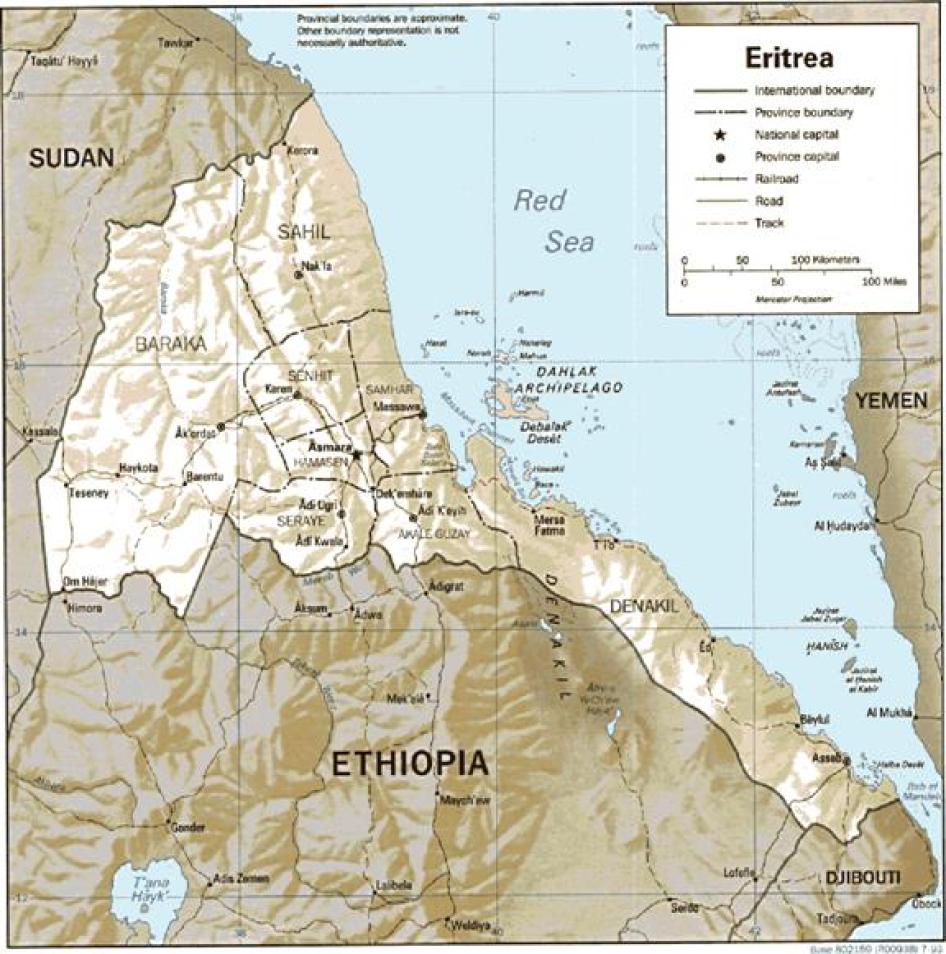
Source: US Central Intelligence Agency. The information on this map, including the location of the Eritrea-Ethiopia border, should not be considered authoritative and does not imply endorsement by Human Rights Watch.
Recommendations
To the Government of Eritrea
· Unconditionally release, or charge and bring before a court of law all persons being detained for political reasons, including the members of the G-15 and imprisoned journalists.
· Issue clear, public orders to the security forces to cease the arbitrary arrest and detention, and torture of people based on their religious beliefs.
· Immediately allow independent monitors access to all known and secret Eritrean detention facilities. Notify family members of the whereabouts of detainees and restore visiting rights, access to legal representation, and respect international standards of law in the treatment of prisoners.
· Investigate and prosecute all government officials, including military officers, suspected of committing murder, rape, torture, or cruel and degrading treatment of detainees and national service conscripts.
· Publicly affirm the rights to freedom of expression, opinion, religion, association, and movement, and publicly state that no one may be imprisoned for exercising his or her non-violent opinions or beliefs. Put an end to discrimination against Jehovah’s Witnesses.
· Rescind the suspension of the private press and permit the establishment of independent media outlets.
· End the practice of indefinite national service and begin a process of phased demobilization for those who have served for more than the statutory 18 months.
· Cease using national service conscripts as forced labor for private enterprises.
· End the requirement of exit visas and travel permits for travel outside and within Eritrea and allow full freedom of movement within Eritrea for Eritrean citizens and for those seeking to work in Eritrea, with due regard to reasonable national security concerns.
· Publicly rescind the shoot-to-kill policy for those suspected of trying to cross Eritrea’s borders without exit visas, and issue orders to military and other security forces to that effect.
· Cease recruitment of any children under the age of 18 into military service and training.
· Implement the 1997 constitution, approve a political party law, and begin preparations for democratic elections with international monitoring throughout the process.
· Invite independent and impartial humanitarian agencies seeking to provide assistance to assess humanitarian needs and facilitate their unhindered access to civilians in need.
To the United States and the European Union
· Insist that Eritrea implement the 1997 constitution, charge or release all political prisoners, end forced labor, and prepare for democratic elections.
To Donors: the European Commission, the World Bank, and UN Agencies
· Condition future development cooperation with Eritrea on progress on fundamental human rights issues such as the release of political prisoners, access by independent monitors to detention facilities, and other benchmarks for progress on human rights in line with article 96 of the European Commission’s Cotonou agreement.
· Stipulate that donor-funded projects should not be implemented by conscripts engaged in forced labor.
To the African Union
- Call for the recommendations of the African Commission on Human and Peoples’ Rights, including the immediate release and compensation of the imprisoned members of the G-15, to be implemented.
To Countries Hosting Eritrean Refugees and Asylum Seekers, in particular Egypt, Sudan, Libya, Malta, Israel, Turkey, Italy, Sweden, and the UK
- Immediately cease any deportations of Eritrean refugees to Eritrea, consistent with guidance from UNHCR, for those countries that do not have functioning asylum procedures according to international standards. Permit UNHCR access to Eritrean asylum seekers in order to screen them for refugee status.
To the United Nations High Commissioner for Refugees
· Intervene in a timely fashion to prevent all instances of refoulement of refugees or asylum seekers to Eritrea and work with governments to find alternative solutions to return if those governments are unwilling to honor their international obligations. Publicly condemn any governments that commit refoulement of Eritrean refugees or asylum seekers.
Part 1: Background
Historical Context
Eritrea, which occupies an area of 120,000 square kilometers, borders Sudan, Ethiopia, and Djibouti. It consists of a high central plateau, lowlands in the west, and a long, strategically important coastline along the Red Sea. Eritrea’s approximately 4 million people are roughly equally divided between Christians, mostly residents of the highlands, and Muslims, largely located in the lowlands. Most Eritreans belong to the Tigre and Tigrinya ethnic groups and are linguistically divided among native Tigrinya and Arabic speakers, with smaller segments of the population speaking a variety of other languages.[1]
Contemporary Eritrea had its genesis in 1890, when Italy consolidated land it had acquired along the Red Sea Coast from Egypt. Between 1900 and 1908, Italy and the Ethiopian Emperor, Menelik II, signed three treaties purporting to establish the boundary between the Italian colony and Ethiopia. Italy’s oppressive colonial rule ended with World War II, when the British assumed interim administration of Eritrea.
Ignoring the pleas of many Eritreans for independence, in 1950 the United Nations General Assembly voted on a US-backed plan to merge Eritrea with Ethiopia as “an autonomous unit federated with Ethiopia under the sovereignty of the Ethiopian crown.”[2]In 1951, a UN-appointed commissioner oversaw the drafting of a constitution and the election of an Eritrean Assembly. British rule ended in 1952, a few months after the Eritrean National Assembly adopted the constitution.
Ethiopia, then ruled by Emperor Haile Selassie, soon encroached on Eritrea’s illusory autonomy and self-government.[3] By 1954 political parties were banned, the only independent Eritrean newspaper was closed, and by the late 1950s the Eritrean Assembly was forced to replace Tigrinya and Arabic, the official and most commonly spoken languages in Eritrea, with Amharic, the official language of Ethiopia.[4]A strike by Eritrean labor unions was violently suppressed. The federation was officially abolished by imperial Ethiopian decree on November 16, 1962.[5] The United Nations remained silent as Ethiopia unilaterally repudiated the 1950 UN resolution.[6]
Ethiopia’s repressive policies provoked a 30-year war of national liberation that continued after Haile Selassie was ousted in 1974 by Mengistu Haile Miriam and his Marxist military government, known as the Derg (“the committee” in Amharic). The conflict killed an estimated 65,000 Eritrean fighters and 40,000 civilians, maimed many times more, and caused perhaps as many as 700,000 Eritreans to flee to Sudan, the Middle East, and elsewhere around the world.[7]During the 1960s and early 1970s, an armed opposition movement called the Eritrean Liberation Front (ELF) led the insurgency against Ethiopia.[8] The Ethiopian military responded with collective punishment of the rural population, including the use of food as a weapon of war, scorched earth campaigns, forced relocation, and mass arrests, torture, unfair trials, and summary executions.[9]
By the 1970s a breakaway faction of the ELF had emerged, splintering the insurgency along ethnic and ideological lines. The breakaway faction became the Eritrean People’s Liberation Front (EPLF), led by Isayas Afewerki. Conflict between the ELF and EPLF inside Eritrea and in neighboring Sudan was at times intense between 1972 and 1975, and sometimes had a brutal impact on civilians.[10]
Unlike the original ELF leaders, who were mostly Muslims from the lowlands focused on independence, the mainly Tigrinya-speaking Christian highlanders who began to join the insurgency in the mid-1960s, and on a much larger scale in the 1970s, were largely secular, better educated, and imbued with Maoist and Marxist-Leninist ideology, intent not only on obtaining independence but on transforming Eritrean society.[11] That was especially true after new members returned from military and other training in Communist or Communist-aligned countries.[12]
The EPLF could be ruthless in dealing with dissenters. In 1974 it executed at least 11 dissidents. The victims, pejoratively known as the manqa (or menkaa) group, objected to the Soviet-style “democratic centralism” used by the leadership to impose policy decisions and to the use of force to suppress criticism.[13]The leadership’s actions, according to one authority, “set the tone for the way in which Eritrean society was mobilized by the leadership both during the armed struggle and after liberation.”[14]
In 1976, 150 EPLF members held an organizational meeting, at which Isayas Afewerki was chosen secretary-general.[15] As Dan Connell, a close observer of the EPLF has noted, a principal difference between the EPLF and its predecessors “was its commitment to simultaneous social and political struggle.... [I]t worked to transform the society it fought to liberate.”[16]In the absence of any major outside assistance, “[t]hroughout, the watchword was self reliance: doing more with less.”[17]
The war in Eritrea contributed to the overthrow in 1974 of Ethiopia’s emperor, Haile Selassie. Mengistu’s Soviet-backed Derg rejected negotiations with the EPLF and ELF and opted for continued warfare and internal repression. But by the late 1970s the Eritrean rebel movements controlled almost 90 percent of Eritrea and an Ethiopian rebel movement called the Tigray People’s Liberation Front (TPLF) was gaining ground in Ethiopia’s own northern Tigray region.[18]The Derg launched massive air and ground offensives in Tigray and Eritrea in response.[19] By 1982 the Derg had instituted tight controls over the civilian population in Eritrea, as well as on Eritreans throughout Ethiopia, including dusk-to-dawn curfews and stringent travel controls.[20] The Derg also encouraged civilians to spy on each other and placed those who made suggestions or protests at neighborhood meetings under surveillance or arrest, torture, or extrajudicial execution.
In early 1988 the EPLF and the TPLF, led by current Ethiopian Prime Minister Meles Zenawi, agreed to coordinate operations in a tactical alliance in spite of ongoing tensions between the two groups. Although the Derg tried to crush the EPLF and TPLF with saturation bombing, massive manpower, and severe famine,[21] by early 1991 the EPLF had defeated the Ethiopian army, which had been dislodged almost everywhere in Eritrea except Asmara. With the defeat of the Derg in May 1991, an EPLF Transitional Government was formed in Eritrea and a provisional government established in Addis Ababa by a coalition of Ethiopian armed movements called the Ethiopian People’s Revolutionary Democratic Front (EPRDF), led by Meles Zenawi, agreed to hold a referendum on Eritrea’s future within two years, by 1993.
The first years of independence
In April 1993 Eritreans living in the country as well as those dispersed in 40 other countries voted overwhelmingly for independence from Ethiopia in a vote certified by both the UN and the Ethiopian government as free and fair.[22] In 1994 the EPLF dissolved itself, voting to transform itself into a mass political party—the People’s Front for Democracy and Justice (PFDJ).[23] There were high hopes in Eritrea and abroad that independence would bring freedom and true self-governance.
In 1994 the Front established a transitional 150-member National Assembly to govern pending adoption of a constitution and elections. The Assembly’s membership was very narrowly based. Half consisted of the PFDJ central committee and the other half of PFDJ members selected by party leaders. The Assembly immediately chose the former EPLF leader and interim President Isayas Afeweki, now the PFDJ’s secretary-general, as Eritrea’s president.[24]
Alarmingly, arbitrary detentions, allegations of summary executions, “disappearances,” and suspicious deaths continued, marring the period between 1991 and 1998. Monitoring groups reported that over 100 political prisoners were detained in 1991 and subsequent years and held without charge or trial.[25]Some died in captivity and some disappeared—presumed to have been executed.[26] In addition, the government revoked the citizenship rights of Jehovah’s Witnesses because they allegedly refused to participate in the liberation struggle and the 1993 referendum, and refused compulsory national military service (see below).[27]Jehovah’s Witnesses were denied business and drivers licenses, passports, marriage certificates, and national identity cards essential for travel within Eritrea.[28]Three Jehovah’s Witnesses arrested in September 1994 for refusing military service remain in incommunicado detention without charge or trial more than 14 years later.[29]
Also alarming was the practice of secret administrative “trials” of opponents and the creation in 1996 of “special courts” outside the normal judicial system.[30] These extrajudicial bodies, staffed largely by military officers untrained in law, meet in secret, have authority to retry cases from civilian courts, are not limited by procedural rules, and issue judgments reviewable only by the president.
By contrast, a promising early development was the country-wide consultation and adoption of a constitution for a multi-party democratic system containing a robust list of human rights.[31] Although the interim National Assembly adopted the constitution in 1997, it has never been promulgated and implemented. On the contrary, in subsequent years, the government systematically denied Eritrean citizens the freedoms and rights embodied in the document. The government claims the border problems with Ethiopia and external interference, particularly from the United States, as the main impediments to political progress.[32]The government relies on similar justifications for never having held multi-party elections initially scheduled for 1997.[33]
The 1998-2000 border war with Ethiopia
Eritrea’s relations with Ethiopia remained relatively close for the first few years after independence. But by 1997 there were increasing tensions over economic and currency issues and disputed pockets of the un-demarcated border. According to a Claims Commission established by treaty at the end of the war, the immediate cause of the intense two-year conflict was a May 12, 1998 attack by two brigades of Eritrean regular troops, supported by tanks and artillery, on the small border town of Badme and nearby areas under Ethiopian administration.[34] Eritrea claimed that its attack was prompted by an earlier attack by Ethiopian Tigrayan militia on an Eritrean border patrol. The Claims Commission held these “minor incidents,” if they occurred as Eritrea claimed, did not justify Eritrea’s full-scale attack.[35]
During the war, Ethiopia expelled most Eritrean residents who had voted in the 1993 referendum and confiscated their property. In turn Eritrea detained thousands of Ethiopians still living in the country in harsh conditions before expelling them.[36]
Fighting was deadly but inconclusive until June 2000 when the two governments agreed to a ceasefire after international—particularly US—pressure on Meles Zenawi.[37] On December 12, 2000, Eritrea and Ethiopia signed an Organisation of African Unity-sponsored peace agreement in Algiers.[38]Among its provisions was the creation of a neutral five-person international boundary commission “to limit and demarcate” the border in accordance with colonial-era maps and treaties.[39]Both governments agreed in advance that the Commission’s conclusions would be final and binding, but when the Commission concluded in April 2002 that Badme would fall on the Eritrean side of the border,[40] Ethiopia reneged and refused to permit demarcation in that sector without prior direct talks between the two governments. Eritrea insisted on implementation of the judgment, including demarcation in the Badme sector, and refused to engage in any further discussion with Ethiopia.[41]
After a four-year impasse, the Commission announced that the boundary would automatically be deemed demarcated by map coordinates as of November 26, 2007.[42] After persistent interference and obstruction from Eritrea,[43] including arrests and harassment of UN staff, a United Nations peacekeeping force (UN Mission in Ethiopia and Eritrea, UNMEE), deployed to patrol a buffer zone along the disputed border in 2000, was terminated by the UN Security Council in July 2008.[44]
Today, tens of thousands of heavily armed Ethiopian and Eritrean troops are still deployed within meters of each other.[45]Even as each government publicly claims it has no intention to reignite the war, fighting could easily resume through accident or design. Neither side shows any sign of compromise on the positions they have taken: Ethiopia insists on further dialogue before demarcation of the border; Eritrea demands that the Commission’s judgment be implemented through demarcation before it will agree to talks with Ethiopia.[46]
Crackdown on internal dissent since 2001
Even as President Isayas insists on scrupulous adherence to law with regard to the border dispute, he has systematically quashed opposition and independent civil society and denied the rule of law within the country. No elections have been held since independence, the interim National Assembly has not been convened since January 2002, and the judicial system has atrophied. As one observer puts it, the formal structures of government and the single ruling party “are window-dressing for a system of carefully circumscribed one-man rule.”[47]
The result has been increasingly oppressive rule unfettered by law or other restraints. In May 2001, 15 members of the 75-member PFDJ central council, including one former minister and one former vice-president, issued an open letter criticizing several of Isayas’s actions as “illegal and unconstitutional.” The “Group of 15” (G-15) letter demanded that the president convene the PFDJ’s governing bodies. He refused.[48]
The government began large-scale arrests of critics in July 2001 with the arrest of University of Asmara student union president Semere Kesete for protesting management of the university’s mandatory summer work program. When other students protested Semere’s arrest, the government rounded up about 400 students, beat them, and trucked them to a work camp in Wi’a, west of Massawa. Another 1,700 university students soon joined them there. Wi’a’s summer daytime temperatures exceed 104°F (40°C) and the camp is a favored place of punishment. Two of the arrested students are reported to have died of heat stroke.[49]
On September 18 and 19, 2001, as the world was preoccupied with the September 11 attacks in the United States, the government arrested 11 of the G-15.[50]On September 19, the second day of the G-15 arrests, the government withdrew the licenses of all of the country’s eight independent newspapers and arrested 10 journalists (others had been warned of the crackdown and managed to escape the country).[51] The government claimed that the newspapers had violated the 1996 press proclamation and had undermined national unity.[52]Although the government announced that it would soon resume licensing of private newspapers, it has never accepted applications and it currently controls all domestic media.
The G-15 members, journalists, and dozens of others arrested in September 2001 remain incarcerated, incommunicado and without charge or trial as of March 2009. There have been detailed but unconfirmed reports that the original group of 31 people was held in isolation cells in a remote jail called Eiraeiro, located northwest of the town of Ghatielay, and built expressly to hold them.[53] At least one of the 31 detainees is believed to have died in captivity as a result of harsh conditions, deliberate ill-treatment, and denial of medical treatment.[54]One of the journalists detained—Dawit Isaak—was reported to have been moved to a hospital in February 2009 due to serious illness.[55]
The arrests of the G-15 members and journalists triggered a wave of mass arrests of suspected critics that has continued until the time of writing. Eritreans from all walks of life have been affected, including government officials, leaders of government-sponsored labor unions, businessmen, and government journalists. Few have been freed—and usually only when extremely ill and likely to die: otherwise they are incarcerated indefinitely with little prospect of release. Estimates of the number of Eritreans who currently languish in jail without charge or trial are difficult to confirm but range from 5,000 to 10,000, excluding national service deserters, who may number in the tens of thousands.[56]
Among those especially vulnerable to arbitrary arrest and detention are Eritreans attempting to practice their religion. In 2002 the government ordered all religious bodies other than those affiliated with the official Eritrean religions—Islam, Eritrean Orthodox, Roman Catholic, and Lutheran Christian churches—to close. Evangelical Christians are regularly rounded up and imprisoned and tortured. And in 2006 the then-septuagenarian Orthodox patriarch had his lifetime appointment rescinded for protesting the arrest of priests belonging to a reformist wing of the Church. He has been detained ever since and his whereabouts are unknown; the priests remain imprisoned.
Eritrea’s Regional Role
The Eritrean government claims that the unresolved border dispute with Ethiopia justifies maintaining the country on a war footing. But in its short history as a state, Eritrea has had tense relations with most of its regional neighbors.[57]The continuing border dispute and resulting state of no-war-no-peace with Ethiopia dominate Eritrea’s domestic and foreign policy.[58] Eritrea does have identifiable security concerns, particularly given that Ethiopia supports Eritrean opposition groups—albeit weak and fractured ones—against the government, but at home President Isayas uses the unresolved border dispute to keep Eritrea on a war footing and justify indefinite mass mobilization and repression.
Eritrea also supports a variety of longstanding Ethiopian armed opposition groups, such as the Oromo Liberation Front (OLF) and the Ogaden National Liberation Front (ONLF), against the Ethiopian government, and generally seeks to undermine Ethiopian influence wherever it can in the region. In Somalia, Eritrea has trained, armed, and financed militias opposed to the Ethiopian-allied Transitional Federal Government. The reports of the UN Monitoring Group on Somalia’s arms embargo consistently list Eritrea (as well as Ethiopia and many other states) among the significant violators of the arms embargo on Somalia.[59]This style of tit-for-tat foreign policy is not new. For years Eritrea’s relations with Sudan were also strained by mutual support for each other’s opposition groups, but relations normalized in 2006.
Ethiopian reliance on the port of Djibouti is one reason why Eritrea and Djibouti engaged in a war of words over their common border in 1996. Friction increased again in 2008 when Eritrea began digging trenches on Ras Doumeira mountain on Djibouti’s side of the border.[60]On June 10, 2008, Eritrean forces clashed with Djiboutian troops while apparently in pursuit of military deserters.[61] The United Nations Security Council issued a presidential statement on June 12, 2008, calling on both sides to commit to a ceasefire and to withdraw troops to the status quo ante. Eritrean troops nonetheless continue to occupy the invaded Djiboutian territory.
In January 2009 the UN Security Council adopted a unanimous resolution demanding that Eritrea withdraw within five weeks and that it attempt to resolve the border issue by diplomatic means.[62]Eritrea immediately rejected the demand, claiming the invaded territory is Eritrean soil and that it therefore cannot accept a resolution demanding “withdrawal of its forces from its own territory.”[63]
The Humanitarian Situation
Both Ethiopia and Eritrea suffered an enormous economic, political, and human toll from their border war and are paying a significant price for the continued deployment of tens of thousands of troops along the border. Along with the rest of the Horn of Africa, famine and drought pose major challenges for Eritrea. Anecdotal evidence suggests that hunger and malnutrition are on the rise.[64] However, little reliable data is available and Eritrea refuses to permit surveys needed to independently assess needs. There are restrictions on the movement of foreigners, making independent monitoring of conditions in the country very difficult.[65]
In a recent visit to the country, members of the European Parliament noted that there is no precise data about the levels of food insecurity in Eritrea.[66]The World Food Program (WFP) suspended food distribution programs after a policy clash: the government monetized all food aid and seized WFP stocks in 2006, stating that it was implementing a cash-for-work program in lieu of food aid distribution.[67]
The Eritrean government has also placed extensive restrictions on the operations of international nongovernmental aid organizations (NGOs). In 2005 it adopted new registration requirements that required international organizations to have US$2 million in capital in Eritrea, imposed taxes on all imports including food, among other provisions,[68] and in 2006 expelled a number of international nongovernmental organizations working in the country.[69] Currently there is only one national nongovernmental organization registered under the 2005 NGO proclamation and the work of the nine remaining international NGOs is extremely circumscribed.[70] The EU report concluded that:
While there are no independent verifications for reports about ‘silent famine’ and extreme malnutrition, several indicators suggest the risk of a humanitarian crisis as in other Horn of Africa countries. Food subsistence has been down from about 70-75 percent in 2007 to 30-35 percent this year due to the drought. Given the high food and fuel prices (Eritrea being 100 percent dependent on oil imports) and the weakness of the economy, it is unclear how additional food imports can be financed. After 60 days of overdue payment of debt obligations, the World Bank had to suspend the payment of new credits end of October 2008 for the first time.[71]
In its Humanitarian Aid Decision of February 2008, the European Commission warned of “a deteriorating humanitarian situation” and “worrying humanitarian indicators” in Eritrea, namely, a Global Acute Malnutrition (GAM) rate for under five children of over 15 percent in some areas of Eritrea, a rate “far above any emergency threshold,” and malnutrition among pregnant women of 35 to 54 percent.[72] In particular, the Commission warned, “with very little food aid being imported, due to the current Government monetization policy, the already fragile food security situation could deteriorate dramatically.”[73]
Part 2: Human Rights Violations
Overview
Eritrea is one of the world’s youngest countries and has rapidly become one of the most repressive. There is no freedom of speech, no freedom of movement, no freedom of worship, and much of the adult male and female population is conscripted into indefinite national service where they receive a token wage. Dissent is not tolerated. Any criticism or questioning of government policy is ruthlessly punished. Detention, torture, and forced labor await anyone who disagrees with the government, anyone who attempts to avoid military service or flee the country without permission, and anyone found practicing or suspected of practicing faiths the government does not sanction. A scholar, friend to and close observer of Eritrea over many years said, “Eritrea is now a very grim place. This is a government that doesn’t trust anybody, least of all its own people.”[74]
Some of the roots of this human rights catastrophe are to be found in the strict discipline of the independence struggle, Eritrea’s fragile regional security situation, and the government’s paranoid and totalitarian response to the situation. The government of Eritrea claims that Eritrea is a victim of international interference and that this explains the suspension of human rights and democratic procedures and the mass militarization of society. In reality most observers think this is President Isayas’s justification for a mode of governance characterized by mistrust, brutality, and presidential whim, in other words, a dictatorship based on denial of basic human rights. Dan Connell, a former supporter of the EPLF, noted, “With no public space for political discussion, let alone protest, and severe constraints on the organizational expression of the most benign social or economic interests—that is, the blanket suppression of civil society—the possibility to contest the PFDJ’s grip on power is nonexistent.”[75]
Like its predecessor the EPLF, the ruling PFDJ party is intensely disciplined and driven by the self-reliance and nationalism forged in the 30-year struggle for independence from Ethiopia, a struggle that succeeded against tremendous odds and with little support from the outside world. The common pattern in the government’s persecution is the perceived threat the victims pose to the PFDJ vision of national unity and national security. Thus, deserters and refugees are particularly singled out as “traitors” or spies, as too are journalists, academics, opposition politicians, and anyone who voices an opinion at variance with accepted propaganda. The regime’s preoccupation with non-traditional Christians, even though they are not politically significant, and increasingly many believers in other organized religions, appears to be rooted in a broader concern over institutions and movements that are potentially uncontrolled—or led by individuals who are not controlled—by the state.
There are also historical dimensions to the regime’s targeting of particular groups. Individuals who are particularly vulnerable include those perceived to be sympathetic to Ethiopia or supportive of the ELF—the rival independence movement crushed by Isayas’s EPLF in the 1970s. This perception on the part of the regime means that people living in the lowlands who originally provided support to the ELF—including Muslims and the Kunama ethnic group, among others—are seen as unreliable and are especially vulnerable to arbitrary arrest and detention, and other abuses.
Unlike earlier military mobilizations for the war of independence and the 1998-2000 war with Ethiopia, the current mass and indefinite mobilization of the population into national service—ostensibly in readiness for a potential Ethiopian invasion—is increasingly unpopular. The repressive apparatus required to keep so many unwilling people conscripted and mobilized is extensive: summary executions, brutal punishments, reprisals against families, and a huge prison infrastructure outside the rule of law in which acts of torture and cruel treatment are commonplace and committed with impunity. National service conscripts serve in the army, work on national development projects, or are loaned to private firms controlled by army officers and government allies for their gain. Compensation is minimal and non-compliance is not an option.
As a result of the multi-faceted repression, Eritreans are increasingly fleeing their country. It should be pointed out that most Eritreans leave with regret the very country that they fought for so long to liberate. Many do so with a deep sense of shame and guilt—some even blame themselves and suggested to Human Rights Watch that talking about human rights in Eritrea to a foreign organization was tantamount to treason. But as one elderly man who fought for the EPLF in the struggle said: “I sacrificed my life for the prosperity, development and freedom of my country but the reverse is true... we did not spend 65,000 martyrs for this!”[76]
Arbitrary Arrest, Detentions, and “Disappearances”
Eritrea routinely arbitrarily detains people who criticize the president, the government, and the military, those who try and evade national service or desert from the army, and those who practice or are perceived to be members of unregistered Christian religions. Once arrested, many detainees “disappear”—their families are unable to ascertain their whereabouts and are only occasionally informed if the individuals die in custody.[77]
Political detentions
The most famous cases of enforced disappearances are the members of the PFDJ ruling council who were arrested on September 18, 2001—the so-called G-15—and the hundreds of other government officials and journalists who were detained alongside them. Eleven of the G-15 are still in incommunicado detention.[78]Dozens more have been detained since.[79]The level of paranoia on the part of the government has reached such a level that, according to one diplomat in Asmara, “people who present no risk to the security of the state are regularly persecuted.”[80]
Those perceived to be a threat to the regime are picked up in house-to-house searches, often at night. Two young refugees described to Human Rights Watch their experience seeing their parents arrested at home during the night by soldiers without any apparent reason.[81]A 26-year-old, serving in the military, having been conscripted at the age of 16, returned home on leave to find that his father had been arrested and taken away by military personnel during the night, apparently for asking questions about the G-15. His father was a leader from the lowlands, near the border with Ethiopia, and had not fled when the Ethiopians controlled his area during the 1998-2000 war. When he himself persisted in questioning his father’s whereabouts, he was jailed in 2005.[82]
In another case, a young man saw his father, a former ELF military leader, taken from their home at night in 2005 by two policemen. He told Human Rights Watch, “After two weeks my mum and I went to the police. They told us, ‘It is not your goddamn business,’ not in a polite way. My father was always disagreeing with [the government] in meetings.”[83]Two months later his father’s body was returned. “They said he had been sick in prison. My mother knows the officers; she was asking among them how he died. I think she asked too many questions because then they came back and arrested me and my mum at night.” He added, “Until now I don’t know where they took my mum. After five months in jail I went to the military prison in Sawa, 6th camp.”
Detention of national and military service conscripts
Deserting from the army or even expressing dissent over the indefinite military service is viewed as a political issue by the government. Therefore, most prisoners held for political reasons are detained without charge or trial for refusing or questioning national service or for offences punishable under military law. Even where detainees may have committed a potential crime under military law, numerous former detainees told Human Rights Watch that there was no system of military justice, that they were simply imprisoned on the orders of their commanders without any courts-martial or other procedure.[84]
Human Rights Watch spoke to over 40 deserters from the national service and the military who had fled the country, all of whom had been thrown in jail multiple times without due process.[85] Their alleged offences ranged from questioning the educational curriculum to being caught in prayer meetings to being suspected of trying to leave national service.
An officer in charge of a military prison who subsequently fled to Djibouti explained that sentencing was completely arbitrary and commanders decide how long people remain in jail. Whether or not the sick are given access to medical treatment is left to the caprice of their superior officers: “There were no rules from Asmara on how long prisoners stay in jail, it depends on individual commanders. Prisoners can be detained up to two years. If someone is sick they usually don’t believe him, he might be trying to escape or does not want to be punished.”[86]
One teacher at Mai Nehfi technical institute said he was jailed for three months because his military supervisors suspected him of trying to flee the country. He described how he was detained and tortured, repeatedly asked questions about who his collaborators were, even though he did not in fact plan on escaping. He later escaped after serving a longer period in jail for having signed a petition complaining about the treatment of higher education students.[87]
A young man who could not take the punishing regime of training and forced labor at Sawa camp tried to kill himself by throwing himself under a water truck. For that, he was imprisoned for six months.[88]
A military driver who was detained multiple times said, “I was detained so many times because I was late coming back from vacation, sometimes I refused when they ordered me to transport something in a bad place... prison, punishment, this is the life of the military.”[89]Another national service soldier was jailed because he too refused to do his job and spent eight months in jail without a hearing as a result:
There’s no trial in Eritrea. There’s no trial, there’s not even any court.... Imagine, 14 years of national service... first they put me in prison without asking any questions. After six months they said ‘Start your work’ and I refused. The response is to send me back to prison. [On release] they gave me a piece of paper and I went to my camp freely. I was tired. They said, rest for three or four days and then start your work. I said ‘No’ and they put me inside for [another] two months.[90]
Detention of conscripts who try to practice unregistered religions is common. Several people who escaped from their military service told Human Rights Watch that they were arbitrarily thrown in jail for secretly reading the Bible in Sawa camp or being caught in prayer meetings.[91] A female conscript, jailed at least three times, was held in a shipping container for three months in 2007 for reading the Bible.[92]Another conscript, a man who was put in jail after a prayer meeting, was just as suddenly released: “After five months and three weeks they just dropped me, with no procedure or decision, on the streets of Asmara, at midnight.”[93]
Because of the secrecy in which political detainees are held—incommunicado, in secret locations, without the right to representation or visits, and without any kind of independent monitoring—they are in effect, “disappeared” and are at high risk of torture or extrajudicial execution.
Torture and Cruel, Inhuman, and Degrading Treatment
The internationally accepted definition of torture includes any act that involves the intentional infliction of severe mental or physical pain or suffering for such purposes as the extraction of information or a confession or as intimidation or punishment.[94]Torture is routine in Eritrea, both for those detained in prisons and as punishment for those in military service.
Political prisoners, including journalists or teachers, interviewed by Human Rights Watch described torture in custody to force them to disclose collaborators, whilst those punished for their religious beliefs described being tortured in order to renounce their faith. In many cases former detainees were beaten or tortured in order to extract information, but in other situations they were simply beaten, tied up, or left to suffer in the sun without any obvious intention to gather information, simply as punishment.
According to eyewitness accounts gathered by Human Rights Watch, torture and cruel, inhuman, and degrading treatment or punishment by military officers and commanders are systematic and “normal.”[95] While some form of discipline or punishment for insubordination or for military crimes such as desertion is usual in a military context, torture is unlawful in any circumstance. In Eritrea, deaths in custody are common as a result of ill-treatment, torture, and denial of medical treatment (see below section “Deaths in Custody”). Some deaths appear to be deliberate killings.
Torture methods
Some of the torture methods are inherited from the Italian period, whilst others are the methods used by successive Ethiopian governments against suspected Eritrean liberation fighters during the struggle. All of the torture methods described in this report are drawn from victim and eyewitness accounts gathered by Human Rights Watch in 2008, from individuals who were interviewed independently in different locations, and with different translators. The methods described below correspond closely to the findings of Amnesty International in 2004 but this is not a comprehensive list.[96]
“Helicopter”: the victim’s hands and feet are tied together behind the back, sometimes opposite limbs, i.e. left hand to right foot, and the victim is left face down, often outside in the hot sun. Detainees described seeing this procedure in most of the prisons mentioned in this report, in particular in Alla prison.[97]
“Otto” or eight: Otto, meaning eight in Italian, is a punishment where the hands are tied together behind the back and victims must lie on their stomachs. This was the most common torture method noted by former conscripts and detainees, practiced in all the prisons and in Wi’a and Sawa military camps.
One man interviewed by Human Rights Watch said he was tied for two weeks in the otto position, even when he slept, because he tried to escape from Wi’a training camp.[98] A soldier deployed to Assab on the coast refused an order and was tortured by being tied in the otto position: “My leader ordered me to go into the sea and I refused because I have problems in my left ear. I was punished with otto for four hours. Four hours of otto in Assab is very bad because it’s so hot,” he said.[99]
“Ferro”: Ferro is an Italian word for iron. The method is similar to otto described above except that the wrists are bound with handcuffs. The prisoner may also be left in the sun.
According to a former army officer detained in Alla, ferro was often the punishment for those suspected of trying to escape from the army. “If someone is suspected of escaping then they are tied up—just hands or hands and feet, or ferro, he said. “Individuals decide what kind of punishment is given, there’s no law. They do not have any crimes but [people are punished because] they hate the military or hate to be a soldier. That is the main reason. Because everyone in Eritrea hates to be in the army.”[100]
“Jesus Christ”: As the name suggests, the victim is crucified by being tied with rope to a tree or a cross and then left to hang, and sometimes beaten while hung.
A conscript who answered back and then struck his commanding officer described being punished in this way:
My leader [of the unit] ordered me to make charcoal that he wanted to take home to his family. But I told him, I am in training, this is not my job, so I told him ‘No.’ He hit me. I said he cannot hit me so I hit him also...That captain together with other leaders beat me. I still have the scars on my head [he has visible wide scars on his head and neck]. They tied me in a crucifix style to a tree, with my hands behind me, for two hours at a stretch, off the ground. We call it a cross—the hands are tied to wood and you are hanging in the air. They left me to sleep outside [on the ground] while tied up. It was hot. I got one cup of water for half a day and bread. They asked me no questions during punishment, there were many other people punished at the same time. Every day people were getting different punishments. In front of everyone, with them all watching.[101]
“Goma”: Goma is a method involving a radial truck tire. The victim is forced to double up inside a tire for long periods of time.
A conscript who was caught fleeing towards the border in 2005 and imprisoned in Prima military camp was suspected of links to the Ethiopian-backed opposition to the Eritrean government because his mother was Ethiopian. He suffered this form of torture:
...[T]he worst is when they put you inside a tire [goma]. You are tied inside the circle of the tire and they [beat you with a stick and] ask who is supporting you [in Asmara], who guided you, what kind of program did you have in Ethiopia... Another way to make you suffer is to tie the hands behind your back, sometimes the legs as well. This is called otto, then you are tied to a tree and punished by hanging from a tree. There are those who died from punishment but I was fortunate. Twice they punished me by goma. They use a Ural truck tire. I was rolled in the tire for six hours... Luckily I am not fat. The fat man suffers even more.[102]
Mock drowning: Called by many different names around the world, in Eritrea this method of torture involves submerging a person’s head in water so that s/he believes s/he will drown and was originally used by the Derg in Eritrea.
A man described to Human Rights Watch his experience in Alla military prison of being put in a barrel head first, upside down and forced to answer questions after he had tried to run away from the army four times:
They hit me everywhere in every prison—on the head, on the feet—sometimes the body swelled. The first time they hit you is when they catch you—they hit me—and after two months my body became weak. They put me in a barrel of water, with the head under water and the legs out. They beat people with electric wire in the barrel of water. After three days when the inspector came and if you didn’t accept or respond to his questions then you’d be punished like this. I was interrogated with questions like: ‘Who is helping you?’; ‘How did you get around without permission?’; ‘How did you reach the border?’; ‘Who had the master plan?’; ‘Who was your guide?’; ‘Are you a soldier?’ I was in the barrel five times.[103]
Beating: Beating is commonplace to the point of “normality” and is often preceded or followed by other torture methods. Nearly every former detainee interviewed by Human Rights Watch described regular beatings, often daily, severe, and resulting in lasting physical damage.
Helen Berhane, a famous Eritrean Christian gospel singer was beaten whilst in detention and warned to renounce her faith. She was eventually released and sought asylum in Denmark but her legs were severely injured as a result of the beatings.[104]
Another conscript who tried to escape described being beaten by intelligence officials: “When I was captured they beat me badly. After three months of beatings they started asking: ‘Whose idea was it to go?’ That was the main reason for the beating. When they are beating people they divide you into three groups: those they believe, those they don’t believe, those they are preparing to beat.”[105]
Another former conscript and detainee told Human Rights Watch he now has problems with incontinence as a result of the beating he received in detention. He said, “Beatings were like food in prison—every day.”[106]
There are myriad ways in which military superiors torture subordinates or try and scare them from escaping military service. One of the most egregious accounts gathered by Human Rights Watch concerned unsuccessful deserters from Sawa camp being tied to a corpse. A witness said: “One had been shot running away, the other two had their hands tied to the feet of the dead person. They were paraded round the camp in the back of a Toyota pick-up truck. The intention was for everyone to see.”[107]
Many political prisoners have suffered the full gamut of torture methods. One government journalist who was arrested and detained in 2004 because of an article he had written raising questions of government policy was punished first in a police station in Asmara before being sent to Dahlak prison—a facility on an island in the Red Sea exclusively for political prisoners (see Prison Conditions below).
I was questioned in police station 6 in Asmara. There are different types of interrogation: physical and psychological. The first step is asking questions if I had a hand in the G-15. Then they change methods, try to get the truth by force. There is a big fence in the back of the 6th police station, with a tree—they tie you up, then throw you down on the ground, again and again. They tie you up in the number eight position. Everybody will taste these kinds of punishment, it is normal, like flu... Before I went to Dahlak I was hung up like Christ for 24 hours. Then after 24 hours I was thrown on the ground and they put milk and sugar on your face and the flies come and eat your face.[108]
Prison Conditions
The prison infrastructure
The total number of prisons in Eritrea is a mystery. Eritrea has a formidable network of detention facilities, some of which are well known, and others secret, some authorized, and others not. Many, if not most political prisoners and those detained for trying to flee the country or for practicing “illegal” religions are held incommunicado in appalling conditions, often underground or in metal shipping containers (see below).
Keeping track of all the detention facilities is extremely difficult because each town and administrative district in Eritrea has a jail; wherever there is a police post is a cell; and each military division has its own prison. In addition, there are secret facilities about which many rumors exist, such as Eiraeiro, where members of the G-15 are thought to be held.
There is a distinction between the kind of treatment in civilian and military prisons, with the latter reported to be worse than the former. As a former officer in charge of a military facility explained, in the military:
Each operation has its own prisons and security and each level of operations has its own prisons. There’s the headquarters prison at operational level, then a division central prison, brigade prisons, battalion prisons...for nine divisions there may be more than 50 prisons. Inside Moasher [military intelligence] there are many prisons. The officer training center has its own prison. When travelling from town to town there are ID checks called kella. Three quarters of these checkpoints also have prisons underground.... For civilians, there’s a high court and ministry of justice in every town. There is a justice and law for civilians. Political prisoners tend to be held at [...] Dahlak, Nakhura Island, and Alla.[109]
One of the most notorious prisons is on Dahlak Kebir island in the Red Sea—a huge jail of iron sheet buildings and shipping containers holding refugees returned from Malta in 2002, journalists, army deserters, and opposition members.
Other prisons frequently mentioned by former detainees were underground military facilities at Track B (also sometimes called Tract B), a former US storage facility near Asmara airport, Adderser, Haddis Ma’asker near Sawa and the Sudanese border in western Eritrea, Mai Serwa, and Enda Shadushay (6th camp), located inside Camp Sawa. All of these hold a similar mix of army deserters, Evangelical Christians, and other political prisoners.
Many former detainees mentioned passing through Adi Abeto—one of the main prisons outside Asmara—on their way to other places. They stated that sometimes there are over 1,000 prisoners detained there.[110]Other prisons are built specifically next to construction sites to house prisoners who are used for forced labor. Detainees described building prisons and then building military facilities or properties for military leaders at Gedem on the coast, Haddis Ma’askar, and Me’eter.[111]
There are also special places for interrogation such as Alla 17, mentioned by the former intelligence official, and 6th police station in Asmara where several interviewees described being interrogated and tortured.[112]
A list of detention facilities known to Human Rights Watch is included in Annex 1 on page 94.
Conditions in detention
Apart from torture and routine punishment, detainees in Eritrea’s huge network of prisons endure terrible conditions, forced labor, and lethal starvation. With the exception of Ethiopian prisoners of war, the International Committee of the Red Cross is not permitted to visit Eritrea’s military or civilian detention facilities. The government appears completely unconcerned about detention conditions and the fate of the people in its custody. Deaths in custody are common. Prison guards are often demoralized and appalled by what they are asked to do—some of them reportedly escape along with the inmates.
Horrendous descriptions of conditions in many of Eritrea’s different prisons have been widely documented by various nongovernmental organizations in recent years.[113]Many detainees are kept in metal shipping containers or in underground pits in overcrowded and dangerously hot conditions for months at a time.[114]
Dahlak prison, located on Dahlak Kebir island in the Red Sea, is one of the most infamous detention facilities in the country, thought to be one of the primary places for long-term detention of political prisoners including those involuntarily repatriated to Eritrea by other countries. Human Rights Watch spoke to several people who had spent more than two years there. Hundreds of prisoners are kept in cells made of zinc sheeting or underground, among them those who had been forcefully returned from Malta in 2002.[115] In either place they described temperatures regularly over 104°F (40°C), and were provided with only 750 milliliters of water a day.[116]
As with all Eritrean prisons, the detention is arbitrary: “In Dahlak there is no time limit,” a former detainee told Human Rights Watch. “You are waiting for two things: either someone is coming to transfer you or to kill you.”[117] This political prisoner, who was eventually released, recalled, “When I left Dahlak I was 44 kilograms. My hemoglobin was nothing. I needed a stick to walk. We were living underground, the temperature was 44°C; it was unbelievable. There is no word to express the inhumanity.”[118]
A man detained in a facility called Halhalas, a sub-provincial prison 45 kilometers from Asmara, said, “How can I describe...it is so bad. We got 300 grams of bread per day, one bread per mealtime, there was no washing. We were taken to the river maybe once a month, surrounded by military, for five minutes in the river.” Compared to reports from Alla prison, where former inmates said they were given one piece of bread per day, this was good.[119]Detainees described poor nutrition and starvation rations in most facilities. A man detained in Asmara’s Track B prison for a day before he was transferred said he received a single biscuit.[120] Others told Human Rights Watch they received one cup of water a day despite hot and overcrowded conditions.[121]
Everyone interviewed by Human Rights Watch who had spent time in detention in Eritrea’s prisons complained of overcrowding. It is such that there is a name for the style of sleeping in detention. “‘Cortielo’ means we were sleeping on our sides—you couldn’t move or change sides or you would wake up your neighbors,” said one former detainee.[122]Similar conditions were reported in Alla and in Prima military camp.[123] A former prisoner described the zinc cell where he was held in Sawa camp as two meters by three meters with 25 to 30 people in it. Later he was moved to Me’eter, another military prison, because the new military camp there needed lots of labor. There, he said, “We were forced to build bridges and a military compound.”[124]A man held in Haddis Ma’asker said, “It was very crowded with no place to sleep. You’re always breathing the smell of other people and most people are sweating because it’s hot. The smell becomes toxic.”[125]
Underground
Detaining people underground appears to be a typical practice of the Eritrean government—much of the liberation struggle was fought from underground bunkers, some of which, it appears, have now become jails for the some of the very people who fought for freedom. Underground facilities were reported at Sawa, Track B, Mai Serwa, Haddis Ma’asker, Aderser, Alla, and Dahlak, among others. There are multiple prisons in Camp Sawa, including several underground cells. One former inmate described “a big hole with trees across the top and then earth on top. They don’t allow you to come out—even for six months. People got those allergies and became sick. I was okay. But some were scratching their skin and bleeding.”[126]
One young conscript who was detained in an underground prison near Wi’a camp met around 30 members of the former Ethiopian Derg regime there who had been held since the war of liberation against Ethiopia ended in 1991—up to 17 years. They had no idea how long they had been there, they had no idea if their children were alive and grown up or dead. The first thing they asked the new arrival was whether he had a razor blade so they could kill themselves. “Their crime was to be in the Derg,” said the young conscript.[127]
Shipping Containers
According to former detainees, shipping containers are frequently used as detention facilities in Sawa, Mai Serwa, Dahlak, and Klima, near Assab. Shipping containers were apparently first used to incarcerate people because of a shortage of detention facilities.[128]
Several national service conscripts interviewed by Human Rights Watch described being held in metal shipping containers in Sawa camp. One of them who was taken there after both his parents had been arbitrarily detained (they were former ELF leaders who had then joined the EPLF) recalled: “There were seven or eight containers, you know for bringing goods from outside. They had cut doors in them made of steel. They put me there because they called me a political prisoner because of my parents. The conditions were cruel, they beat you with a flex, a wire, they beat everyone, every night. They want to make us afraid, just enough beating not to die and not to live.”[129]
One female soldier was held with 14 other women for 24 hours a day, some of whom had refused to have sexual relations with their commanding officers. The only time they were allowed outside was to go to the toilet, “They can hold them there as long as they want, there’s no fixed time,” she said.[130]Helen Berhane, the gospel singer, was held with up to 24 other women in a shipping container for part of the two years she spent in detention in Mai Serwa prison, in unbearable heat.[131]
Extrajudicial Killings and Deaths in Custody
Diaspora websites are full of long lists of “disappeared” individuals, some of whom are believed to have died or been extrajudicially killed in government custody.[132]The accounts of those who have fled the country or escaped from detention are replete with descriptions of people shot whilst trying to escape from national service or whilst trying to cross the border and others who have died in custody from the terrible conditions.[133]
Shot while trying to escape
Dozens of refugees who had escaped from prison or from military service described being shot at without warning while fleeing.[134] In many of these cases the prisoners were clearly unarmed and posed little or no threat to their guards. One man interviewed by Human Rights Watch described how he and his fellow inmates in a container in Sawa camp escaped: “We ran in all directions. After you jump the wall there is barbed wire, more than six feet high. I pulled the wire apart and some soldiers opened fire. I saw three people shot, two on the left and one on the right. I could not help them because the situation does not allow you to help your friend.”[135]
One witness saw two men shot dead trying to escape from Me’eter prison in 2006.[136]Another escaped when all of the people in his work gang decided to run from their armed guards at the same time. “We used to go out to work, loading and unloading grain and other goods, salt, sugar... We broke out of prison when we went out for work. We figured we might get shot at but some would escape.”[137]
Shot for trying to flee Eritrea
Human Rights Watch were told by a number of sources that there is an official “shoot-to-kill” policy in operation against all those trying to cross the border. A former officer in exile told Human Rights Watch that such an order was in effect: “Now the law is killing people for crossing the border. The law changed one year ago.”[138] Another more senior officer, specified: “There was a circular. There has been such a large number of people [crossing] that there was an announcement that anyone who crosses the border will be shot. Whoever tries to cross will be killed immediately and repeat offenders are also killed... those who escape again and again will be shot [even if they are not trying to cross borders]. This was issued by the Ministry of Defense in April 200[7].”[139]
A former intelligence officer described to Human Rights Watch the execution of two men, a soldier and a university student, who he stated were detained and then shot at Alla 17 prison for intending to flee the country.[140]
Deaths in custody
Survivors told Human Rights Watch that many people died in custody from sickness, heat stroke, or from beatings. According to Reporters sans frontières, three of the journalists arrested in the crackdown in 2001 died in custody between 2005 and 2006, a fourth died in January 2007.[141]
The survivors of Dahlak consider themselves to be lucky. As one former inmate said, “In Dahlak, every day someone died. The food was very little and there was no medical attention. No one cares for prisoners. While I was there about 25 percent died from lack of medication and the bad conditions.”[142]
Another man imprisoned in Dahlak said, “People were dying and getting sick and crazy. My group was detained the longest but there were others there who had been returned from Malta, Libya. In 2005 many prisoners were dying because of the heat and overcrowding, so they transferred some of us to Gedem. It was the hot season and we were dying of hunger, plus the brutal beating of the guards was causing many people to die. There were 10 dead in my block.”[143]
In Addenafas prison, near Assab, one witness told of two inmates who died in a cell holding 13 Christians. Two of them became ill but “there were no medical facilities and the nutrition was bad. This was 2006, the deaths.”[144]
At the military camp in Me’eter, “the sleeping was better but there was another problem because we were forced to urinate in corner of the cell, where we were sleeping. Many people got cholera, two in my cell died.”[145] And in the container in Sawa camp, “there are 20 people in a container, it is very hot. One died of heat, one died of sickness in my container.”[146]
In one military camp, Prima, an inmate was detained alongside three people accused of co-operating with the Democracy Movement of Eritrea (DemHaE )[147]who he described as dying as a result of torture in custody: Asmourom Kifle, Tama Kefelay, and Awat Habtezgee. He described seeing Awat, “bleeding from the nose and mouth. Every time they were being hit and finally they died. I was listening to the sound but I didn’t see it... It was hard hitting with a stick or wire on the head and everywhere. They sent Awat to the hospital and he died there.”[148]
A sergeant who had fled to Djibouti and formerly had responsibility for supervising a prison, told Human Rights Watch, “They don’t inform families directly or indirectly if a soldier dies in prison. It doesn’t matter if the death is from disease or hitting, [the soldier is] still a “martyr.” No investigation is made, or questions asked.”[149]
Indefinite Forced Conscription
Enforced indefinite national service is an increasingly important element of Eritrea’s human rights crisis. Conscripts undergo military training, in itself not illegal. However, they are subjected to cruel military punishments and torture, already described above. Many may be deployed in what constitutes illegal forced labor. Those who try and evade national service are treated cruelly. Evaders are detained in terrible conditions, and heavy penalties are imposed on the families of those who evade service or flee the country.
Eritrea’s success in its 30-year armed struggle for independence from Ethiopia was due in some measure to extraordinary discipline on the part of the Eritrean People’s Liberation Front (EPLF) and the effective mobilization of the whole adult population in the service of the liberation war effort.[150] Since the border war with Ethiopia ended in 2000, however, increasing numbers of Eritreans—especially youth—voice frustration with the continuing military mobilization and the fact that the democratic transition has been shelved, along with the population’s human rights.
An officer who fled the country told Human Rights Watch: “In the first war the Eritrean people were coming by themselves [volunteering] to the army and the hope then was to return quickly to civilian life. Then the Ethiopian offensive into Eritrea made all the Eritrean people rise up. But now the reality has changed... Everyone is in national service.”[151]One young man who had recently fled Eritrea told Human Right Watch, “It’s okay to do national service, it’s fair to serve one’s country but not always. It’s not fair when it’s indefinite.”[152]
After peace in 1991 and independence in 1993, the new government formalized its commitment to national service in a 1995 proclamation.[153]According to that proclamation, the objectives of national service are:
The establishment of a strong defence force based on the people to ensure a free and sovereign Eritrea;
To preserve and entrust future generations [with] the courage, resoluteness [and] heroic episodes shown by our people in the past thirty years;
Create a new generation characterized by love of work, discipline, ready to participate and serve in the reconstruction of the nation;
To develop and enforce the economy of the nation by investing in development work our people as a potential wealth;
To develop professional capacity and physical fitness by giving regular military training and continuous practice to participants in Training Centers;
To foster national unity among our people by eliminating sub-national feelings.[154]
The law states that all Eritrean citizens, men and women between the ages of 18 and 50, have the obligation to perform national service. In normal circumstances, national service is supposed to last 18 months (article 8). This consists of six months military training and 12 months deployment either on military duties or some other national development project. However, article 13 (2) states that even after completing the compulsory 18 months, national service can be extended until 50 years of age “under mobilization or emergency situation directives given by the government.”[155]
During the first four rounds of the national service, those who were called up were demobilized after 18 months, but after war broke out with Ethiopia in 1998, everything changed. Former fighters were called up again, reservists who had been demobilized were conscripted, and all national service recruits were retained under emergency directives.
Although the war with Ethiopia ended in 2000, in May 2002 the government introduced the Warsai Yekalo Development Campaign (WYDC), a proclamation that indefinitely extended national service. The government had promised to demobilize thousands of conscripts after the war, and did demobilize some, but by 2007 it reportedly suspended the demobilization program.[156]The WYDC was a national effort in which the generation that had fought for independence would join with new recruits to build the nation. In effect, it meant the forced conscription of every adult male up to the age of 50, although some refugees claim 55 is now the upper limit, with other sources claiming up to 57 for men and 47 for women.[157]
Not all national service is military service, since many conscripts are not deployed in the army but on civilian development projects, or are assigned to commercial enterprises with their salary paid to the Ministry of Defense.[158] However, the Ministry of Defense is in control of the national service program and if someone working on a construction project were to abscond they are still be regarded as a deserter under military law.[159]
Refugees interviewed by Human Rights Watch emphasized that there was no difference between military and civilian national service—conscripts are equally at the mercy of the state.[160] One Eritrean academic notes that, “What people do not realise is that in Eritrea, there is no military service. There is only Hagerawi Agelglot (National Service) which is much more ambitious and broader than common Military Service.”[161] Military duties are only one of a number of different assignments that conscripts can be tasked with, although it is the most common.
At the time of writing, most of the able-bodied adult population is on active, indefinite, compulsory national service or on reserve duty. The only exceptions are on health grounds, or, for women, pregnancy.[162] In discussions with visiting members of the European Parliament, Eritrean government officials, “admitted that military service, although formally to last 18 months, often extends over decades, reducing both the active workforce and the individual freedom and choices of the citizens.”[163]
Eritrea has also used its conscription policy to harass and detain UN and NGO staff, purportedly on the grounds that they have not fulfilled their national service obligations.[164] In 2005, seven Eritrean UNMEE staff were under arrest[165] and the number rose to 27 in early 2006,[166] some of whom were later released.[167]
For a country to enforce conscription laws may not be a violation of human rights. However, the way this is done in Eritrea—the violent methods used, the lack of any right to conscientious objection, and the lack of any mechanism to enable a challenge to the arbitrary enforcement of conscription constitutes abuse. Furthermore, although national service and conscription at times of genuine national emergency may be permitted as a limited exception to the prohibition on forced labor, the indefinite nature of national service in Eritrea, the threat of penalty (and collective punishment of families of those who desert), the use of recruits for forced labor, and the abuses associated with punishing those who do not participate violate Eritreans’ basic human rights, various provisions of the Eritrean constitution, and international human rights law.[168]
The consequences for Eritrea are disastrous in that the more the government seeks to compel the population, the more people flee the country. Eritrea is now in the grip of a refugee crisis with thousands of people fleeing or attempting to flee every month (see below, “The Experience of Refugees.”)[169] And since everyone must serve, no family in Eritrea is unaffected by the consequences of the national service policy.
Collective punishment of deserters’ families
There are strict penalties for those who try and escape national service as well as for any Eritreans who leave the country without government authorization. Families are collectively punished if their relatives flee national service, usually by being jailed or forced to pay fines. An officer formerly responsible for chasing down deserters explained how if the soldier could not be found then the family was arbitrarily detained instead:
If one of the men escapes, you have to go to his home and find him. If you don’t find him you have to capture his family and take them to prison. Since 1998, it’s standard to collect a family member if someone flees. The Administration gives the order to take family members if the national service member is not around. If you disappear inside Eritrea then the family is put in prison for some time and often then the child will return. If you cross the border, then [your family] pays 50,000 Nakfa [about US$3,050]. If there’s no money then it can be a long time in prison. I know people who are in prison for six months.[170]
All of the deserters interviewed by Human Rights Watch were fearful for the safety of their families and anxious that they would face the crippling 50,000 Nakfa fines, detention, or some other retribution such as the denial of business permits or the forfeiting of land in lieu of a cash fine.[171]Three former conscripts said their mothers had been imprisoned for four months, two months, and two weeks respectively because they could not afford to pay the 50,000 Nakfa fine.[172] One man, now in Italy, heard that his family’s farm had been taken because he had fled the army:
All the families of those who fled had to pay 50,000 or have their land taken away. This happened to a lot of people I knew. About half of the town suffered this. The area is usually a vegetable-growing area—tomatoes and spinach. When people lose their land they depend on God. If they pay 50,000 they get their land back. The memehidar [local administration] of the town demands the land. Sometimes security officials also take matters into their own hands.[173]
Abuse of female conscripts
Refugees told Human Rights Watch that women are conscripted less now than previously.[174]However, those who are recruited are more at risk of rights violations, rape, and sexual harassment in particular. As one female recruit who served as a conscript for 10 years explained, “First you do your military training then they hold you forever without your rights. The military leaders can ask you for anything and if you refuse their demands then you can be punished. Almost every woman in the military experiences this kind of problem.”[175] When she was approached by a commanding officer he punished her when she refused his advances:
The officer who asked me [for sex] was married. I said, ‘You are married,’ and he gave me military punishment and made me work without any break. I was tied in otto for three hours in the sun... this disturbed my mind. He was the commander of 100 [a company]. His official rank is marehai. After he untied me he asked, ‘Do you know this is your fault?’ I said, ‘This is not my fault.’ That’s when he made me work.[176]
No right of conscientious objection
The National Service Proclamation of 1995 makes no provision for conscientious objection to military service. Exemptions are provided for disability (article 15), and those considered unfit for military training must serve “in any public and government organ according to their profession.”[177] But in reality, as one Eritrean refugee said, “the only people who don’t go to military service are blind or missing their trigger fingers.”[178]
Human Rights Watch takes no position on conscription; indeed in many countries it is legal and well-regulated. However, the right of conscientious objection to military service has become an established international norm—a legitimate exercise of the right of freedom of thought, conscience, and religion, as laid down in article 18 of the Universal Declaration of Human Rights and article 18 of the International Covenant on Civil and Political Rights.[179] It is possible, acceptable, and, in most other countries, normal, for individuals to undertake non-military forms of national service, such as community work, construction, or service in the health and education sectors. Many national service conscripts go on to do this kind of service in Eritrea, however their national service begins with a mandatory six months military training.
Jehovah’s Witnesses are particularly affected by the lack of a right to conscientious objection because their faith forbids them to bear arms. Since independence adherents of this faith have been systematically persecuted for what the authorities have treated as their questionable commitment to the national struggle.[180]
Some unlucky youths are viewed by the government as, literally, born to fight. During the war for independence, children born to EPLF fighters were given over to the movement to be raised in communal crèches while the parents fought in the army. These children, called “red flowers” or keyahti embaba in Tigrinya, are not only expected to participate in national service, but are apparently given no choice but to join the military in their parents’ footsteps. One man born during the struggle fled Eritrea because he had no future there except as a soldier: “The government says that the children of yekalo [independence fighters] must join the military; they have to follow their fathers.... I told them I don’t want to be a soldier. They told me I must be because my parents died in the war.”[181]
“Psychological derangement” (article 14, 5.1) is also a ground for exemption from military service, and this appears to be a popular way to try and evade service. Recruits who have recently been in Sawa describe a dramatic increase in the number of people in the camp showing signs of severe mental illness. Recruits describe a new disease that has sprung up among young women drafted into Sawa and Wi’a training camps, called “lewt,” and only known in the camps. One male draftee explained: “In every cohort at least 10 girls die. The girls cannot handle the pressure and the punishment. The symptoms are a bent back, walking backwards, and some of them shake and fall down. They become like zombies, they just stare at you.”[182]But as one said, “I’m not sure if they are genuinely crazy or if they are just pretending to be crazy in order to be demobilized.”[183]
“Giffa”: press-ganging conscripts
Conscription is generally managed by local councils, the smallest units of local administration, sometimes referred to as kebelle, sometimes as memehidar, a general word meaning “administration.” These council officials maintain detailed records on the individual families in their area and ensure that those of age are conscripted. But in larger towns, the police or military also try to capture evaders or deserters through ad hoc round-ups. Round-ups of the population in towns and villages—known as giffa in Tigrinya— are common and constitute a kind of modern press-ganging. Anyone of age found without the relevant documents exempting them from national service is taken to the military camps of Sawa and Wi’a for training.[184]
Even aside from evaders and deserters, any civilian who forgets their identification or travel documents is at particular risk of being rounded up in a giffa and arbitrarily detained. As a young student who was put in Adi Abeto prison for 22 days described: “It was a Saturday and I was having coffee with friends. The police came and asked for papers, I said I would return to Mai Nehfi to get them but instead they took me to prison.”[185]
Human Rights Watch spoke to many men who had been apprehended by police or military through giffas.[186]A man who was conscripted in 1998 said he had asked dozens of times to be demobilized. “I have not seen the situation change for 10 years. I asked to leave the military but they tell you, ‘we are at war, you cannot leave.’”[187] He did not return after a scheduled vacation but was caught in a giffa and jailed in Aderser prison.
One young man had absconded from training at Sawa camp but was picked up again during a giffa in Adi Keyh town during 2007:
I remember the day because it was a Saturday, a market day. The soldiers surrounded the town the evening before and on Saturday people came to the market for shopping, around 11 a.m. Many people were caught. They ask you for ID card. I tried to escape but because of the crowd I couldn’t get away. They beat me and put me in a military vehicle. Soldiers don’t have any education, they have no respect, they simply take you away. We waited an hour or so in the truck while the soldiers were catching other people. People were crying.
After an hour or two we were taken to Track B [prison] in Asmara. We spent one day there without food except for a single biscuit. Then [we were] taken to Sawa, about 320 of us, almost all men except two or three women. In Sawa, men and women were divided, we were made to kneel down when we got out of the bus, you do it otherwise you will have the stick.[188]
Conscription from school
The preferred method of the Eritrean government is to conscript students into national service straight from school, unless they are continuing higher education. To this end, the final year of secondary school was moved to Sawa military camp in 2003. This 12th grade takes place only in Sawa, under military authority, and incorporating military training. Although many 12th grade students are 18 years old, or less, some are older because they take longer to finish high school.[189] Each round or intake of students incorporates 8,000 to 9,000 students.[190]
Once they are in the camp, however, military service effectively starts then and there. A teacher whose national service involved teaching in Sawa told Human Rights Watch, “The students could not study. They were always being forced to leave the class for some kind of military service.”[191] A former student said he did not even enter 12th grade but was ordered straight into national service in July 2007 even though he was less than 18 years old.[192]
National service is deeply unpopular, especially because new recruits know that there is no prospect of it ending. Students have started escaping from Sawa camp during their 12th grade year without completing school.[193] Escape is no mean feat, because, as described above, Sawa is in effect a huge prison. Those who made it described braving machine gun fire, barbed wire fences, and several days of walking through the desert without food and water.[194]
Some students, aware of their fate once they reach 12th grade have begun to deliberately fail classes so that they can remain in the lower grades.[195] Government awareness of this practice has been to simply pull anyone of military age—18 and above—out of school altogether, even though it is normal for some students to take extra years to finish school because they are poor or work on family farms. Several students described being taken to a military camp under false pretences.[196] One of them explained:
I was a student in Adi Keyh in 10th grade. The government told me I was overage and I was forced to leave the school in January 2006. They took 200 of us on a bus to Wi’a, telling us that we would continue our education there. They took everyone from all schools, not just those in secondary school but also those from junior and elementary school, everyone above 19 years. But in fact it was military training. The director of the school had told us that we would be going to school in Wi’a. We were surprised, we did not believe that we would be schooling in Wi’a, in the hot desert. When we got there to the camp, everyone was sad. It was very hot, people were dying from the sun, we buried about five. After four months I was deployed near Assab, a place called Klima. It was very hot too and people were dying there. I was given a vacation and then I escaped.[197]
Wi’a is reportedly the camp where the “not so clever” students go. If it appears that a student will not graduate high school anyway, then the government will send him to Wi’a even before he has finished. One former student who was sent to Sawa explained, “In school, if you are absent more than two weeks, you get sent to Wi’a—for whatever reason. Sawa is supposed to be for educated people. If you get kicked out of school, you are not fit for education anyway, so you go to Wi’a.”[198]
Forced Labor
After six months of compulsory military training, national service conscripts are deployed indefinitely in one of several possible activities. Many conscripts are simply drafted into military service and are deployed in regular military units.[199]One refugee interviewed by Human Rights Watch was sent to work as a clerk in a court in Asmara, another was sent to work as a mechanic in a civilian garage repairing trucks in Asmara.[200] Others described working on farms or mines owned by the state or the PFDJ ruling party, or building roads and bridges. Regular military units, conscripted military personnel, and prisoners are all also engaged in similar activities—building, mining, and farming.[201]
According to escaped conscripts, the normal “allowance” during training is 50 Eritrean Nakfa per month (about US$3).[202] After 18 months training while on national service, this is increased to 150 Nakfa a month ($9).[203]This is the same amount paid to former soldiers recalled for service during the 1998-2000 war and still mobilized as well as for the over-50s who have been mobilized to serve in a reserve militia. Some of those conscripted prior to 1998 appear to have been incorporated into the regular army and receive salaries accordingly. Regular soldiers are paid a salary of 330 to 3,000 Nakfa ($20 to $183) depending on rank.[204]
All walks of life have been transformed into national service, so that, in essence, an Eritrean is conscripted, subjected to military training for six months, then assigned to any job by the state. As one young man said, “The government is trying to do every single business in the country. National service people are employed in government enterprises, and every person below 40 is a member of national service. So if I’m assigned to work in a shop, then I’ll be working in a shop and serving my country.”[205]
In another example, a professional footballer was told to report for national service. When he finished six months of military training he was assigned to play football again, but as part of his national service. Before military training he was earning 3,600 Nakfa a month ($220). Afterwards, as part of national service, he was paid an allowance of 400 Nakfa a month ($24).[206] He said, “I kept playing because if I didn’t I would have been taken to the military again.”[207]
For regular recruits on national service, 150 Nakfa does not constitute a living wage, nor is their labor given freely. Refugees interviewed by Human Rights Watch refused to refer to the money they were paid as a salary, preferring instead to call it “pocket money.”[208] All complained that it was insufficient to live on and completely inadequate to feed a family. Western diplomats and UN officials confirmed that making ends meet on such amounts was impossible in Eritrea.[209] Nevertheless, an official with an agency that provides significant development assistance to Eritrea argued that national service labor is not necessarily forced labor, but “mobilizing people in a low wage environment.”[210]
Under international law—the Forced Labour Conventions and ILO Convention 29—the key points when considering the definition of forced labor are the extent to which: “(i) the works or services are exacted involuntarily; (ii) the exaction of labor or services takes place under the menace of penalty; and (iii) these are used as a means of political coercion, education or as a method of mobilising and using labor for purposes of economic development, as well as means of labor discipline.”[211]This is most certainly the case in Eritrea, and it would thus appear that forced labor on the Eritrean scale and for indefinite periods is a gross human rights violation.[212]
Human Rights Watch spoke to dozens of men and one woman who described being forced to do back-breaking work and who were punished when they refused.[213] One man conscripted at the age of 16 in 1996 described doing many different jobs in the military until he fled at the beginning of 2008. After the 1998-2000 war, “when the fighting stopped I did different jobs in the army, planting, agriculture... after that we were collecting stones to build the Asmara-Assab road.”[214]
Another conscript finished his training at Sawa camp and was then deployed in Dekemhare on a construction site building houses for military leaders: “We were paid very little, whereas as a civilian builder you can earn. Some other soldiers refused to work and were jailed. If you don’t work you go to prison. You lose your vacation time and your pay—150 Nakfa—is stopped. If you refuse they see it as a political problem.”[215]
In its report of a mission to Eritrea, the European Parliament noted, “Via the ‘Cash for Work Programme,’ citizens contribute to the public works—such as the building of dams—against payments from the government. While this scheme was described as being voluntary, there is a risk of people being forced to work for the government in order to ensure they can earn their living.”[216] Most conscripts don’t openly refuse to work but they vote with their feet, either escaping from the military camps or waiting until their annual leave and then fleeing the country instead of reporting for duty once more.
Forced labor for private gain
The projects on which conscripts are deployed are not just public works for the national good. They are often sent to work on private construction projects, building houses for military leaders, and working on private farms. Human Rights Watch and Amnesty International have both previously documented the use of conscript labor for the benefit of ranking members of the military and the government.[217]
Diplomats admitted that aid projects are implemented by national service labor working for private construction firms with good connections to the government.[218] “All companies are owned by the military or the party,” said one diplomat, and another complained that aid projects, “are meant to be allocated through an open bidding process, but in reality only those using conscript labor stand a chance.”[219] Several scholars concurred with this analysis.[220]As one wrote:
Since April 2006, only PFDJ construction firms are allowed to engage in construction activities after private firms and individual entrepreneurs were banned from the construction industry as part of the government’s crackdown on the private sector. On 3 April 2006, the government issued a directive ordering all “contractors, consultants, practicing professionals and studio operators” to submit to the Technical Office of the Central Region: their original licenses, detailed accounts, addresses, types and sizes of their projects, owners’ names, estimated total costs, on the day after (4 April 2006) the directive was issued. On 7 April 2006, the government also ordered all of them to cease their activities within ten days. The prohibition is still in force. The major beneficiaries of the ban are the ruling party’s more than forty enterprises which dominate every aspect of the country’s economy, the enterprises of the PFDJ’s mass organizations and the mushrooming construction firms belonging to the Ministry of Defence.[221]
One former EPLF fighter who was in the military administration told Human Rights Watch, “the senior officers have their own capital like shops, bars; they run businesses and the workers are the national service. The conscripts are working for the benefit of the higher ranks: Colonel, Brigadier, Major-General.”[222] A scholar who has conducted research in Eritrea over many years noted, “there is a whole class of people whose wealth rests on National Service labor.”[223]
Dozens of former prisoners who had escaped and fled the country described being put to work on military construction projects; some built military installations such as barracks and ports, others built properties owned by military leaders.[224] The conscripts deployed to work on commercial farms, mines, or construction projects were often housed in appalling conditions with bad nutrition and minimal pay. One national service soldier who had requested to be demobilized many times since independence in 1993 was deployed in a mine for two months. He explained:
Bad things happened. I had to do work on the houses of the leadership, had to collect sand crystals [some kind of crystalline sand], inside the earth. You use a stick to push the earth...The crystal sand is sharp and when you dig it out of the soil it creates infection in the fingers. When I complained that the fingers were injured they said, ‘you have to take punishment for that.’ At one point when I was tired and my fingers were bleeding I stood up and said I couldn’t do more. They asked why I was standing, and took me away. After beating me they asked me ‘Why don’t you work?’ I said, I came here accidentally because I didn’t have my ID card and I can’t do more work because my fingers are injured. At last when I said I had been a fighter, [in the liberation war] they stopped the punishment.[225]
It is not just conscripts who are providing cheap labor for the benefit of military leaders. Prisoners are regularly employed and school children are made to work during their school holidays. The national program for school children is called Mahtot. For two months during the break, children in 9th grade and above must report to work camps where they, “plant trees, clean houses, pick cotton and help with other agricultural projects,” in the words of one student.[226]Normally the children stay in schools in the area. During the two months their compensation is 150 Nakfa ($9) for their family; the fee is euphemistically called “soap money.”[227]
Restrictions on the Freedoms of Expression, Conscience, and Movement
Freedom of expression
Since 2001 Eritrea has been in the grip of a media blackout. All independent newspapers, radio, and television outlets have been shut down. Eritrea is the only country in Africa without an independent media outlet. Many journalists were arrested as part of a general clampdown on dissent in September 2001. Since then, many others have been arbitrarily arrested and detained, the whereabouts of most are unknown and Reporters sans frontières (RSF) believes that at least four have died in custody.[228]The Committee to Protect Journalists believes that as many as 14 journalists and editors are held incommunicado in secret locations; Eritrea is one of four countries in the world which together account for three quarters of all journalists in detention.[229] In its 2008 press freedom index RSF ranked Eritrea last, 173rd, behind North Korea, Turkmenistan, Burma, Cuba, Vietnam, China, and Iran.[230]
In 2006 and 2007, even journalists who worked for the state-run media agency were arrested and detained because some of their colleagues had decided to flee the country rather than continue working for the government.[231]They were suspected of wishing to flee themselves. Paulos Kidane, a popular figure on state television, was among those arrested in 2006. He was detained again in 2007 after he had escaped from jail and was trying to cross the border. He was reportedly arrested at the border and his family was subsequently informed by the authorities that he had “died accidentally.”[232]
In February 2009 RSF reported a new crackdown in which the entire staff of Radio Bana, which produces educational programs for the Ministry of Education, was arrested. Although most were released, a few staff remain in custody.[233]
One journalist who had fled the country told Human Rights Watch how he was arrested and sent to Dahlak prison, then later made to work for the military and after that the state television agency. He fled in 2007, and said, “I was a toy for the government.”[234]
One of the few permanent foreign journalists in Eritrea, the BBC’s Jonah Fisher, was expelled in 2004 following a broadcast on Amnesty International’s last report on human rights conditions in the country.[235]In an interview with Fisher, Eritrean President Isaias Afewerki said, “What is free press? There is no free press anywhere.”[236] A freelance successor, Peter Martell, was also thrown out in March 2008 after he refused to disclose to the government the names of his sources for a report on veterans’ disillusionment with the government.[237]
In 1996 the Eritrean government passed a law governing the press which both guarantees press freedom and also provides for censorship if “the country, or part of it, is faced with a danger threatening public order, security and general peace caused by war, armed rebellion or public disorder or where a natural disaster ensues.”[238]The government has used the standoff with Ethiopia over the border issue as a catch-all justification for restrictions of rights and freedoms in all areas of freedom of expression.
It is not only the press that has been the subject of restrictions on free speech. Soldiers within the military told how they were detained and tortured for questioning the policies of the government in regimental meetings. One man was imprisoned indefinitely for denouncing the government in a military meeting: “In 2001 I told an assembly in the military that the government was illegal. I was sent to prison in Alla for two years. After two years there they transferred me to Dahlak.”[239]
Dozens of former conscripts told Human Rights Watch how they were detained for asking questions about the fate of political prisoners or expressing concern about the policy of indefinite military service.[240]
Teachers and university students who asked questions about the curriculum or who questioned why the authorities were withholding their graduation certificates also faced torture and jail. “Seventy to 80 percent of university students are trying to leave because they feel politically marginalized and they can’t speak freely. If you do they kill or imprison you,” said one teacher, a graduate of Mai Nehfi technical institute.[241]When he questioned the curriculum that he was asked to teach secondary school children in 12th grade in Sawa camp, he was warned by the head of the camp: “You are a teacher. We taught you. You are in the university because we helped you. Now you try to go against our curriculum. If you go on you will be in prison, even you will be killed.”[242] He told Human Rights Watch that the director of Sawa himself, the man in charge of administration for the camp, had made these threats.
In 2007 graduates of Mai Nehfi institute organized a petition calling on the Ministry of Education to issue graduates their degree certificates and for the college to be internationally recognized as the University of Asmara had been. The Ministry withholds certificates as an incentive for graduates to remain in the country, and refuses to give Mai Nehfi international status for the same reason. Eight hundred students reportedly signed the petition.[243]
One man who was among 50 teachers that presented the petition to Dr. Debrabrehane, administrator of Mai Nehfi college, in early 2007 was arrested by the military in the middle of the night, three days later. He spent five months in a military prison:
[There were] no questions just beating...they used to be beat me in the jail, morning and evening, like meals... They were telling us that we are traitors, that we are not ready to help and train the youth throughout the country. They insulted us and told us we were not educated. My family did not know where I was.... I later heard that four or five days later my mum was imprisoned for two weeks, in a civilian prison in Asmara. They asked her for 50,000 Nakfa because she had before signed my wahis [guarantor of good conduct] while I was a teacher. If I make any mistake then she will answer for my conduct.[244]
In December 2008, an Eritrean diaspora website reported that intelligence officers had raided an internet café in Asmara and arrested youth for accessing opposition websites. The article also said that government officials had summoned internet service providers and warned them not to allow customers to access such websites.[245]
Restrictions on religious freedom
In 2002, in a widely documented crackdown, the Eritrean government banned unregistered religious activity, essentially making it illegal for anyone to practice worship of any but four recognized faiths (Catholic, Lutheran, Eritrean Orthodox, and Islam).[246]The unrecognized churches were required to register with a new Department of Religious Affairs, and several reportedly attempted to do so but no registration permits have been authorized.[247]Since then, Evangelical and Pentecostal Christians have continued to be the object of repression and security forces have broken into homes and churches, rounded people up, detained, and tortured them. Admitting to being a Pentecostal Christian or being caught in possession of a Bible is enough to land oneself in jail, be subjected to torture, or denied the right to travel abroad.[248] In 2004, the United States designated Eritrea a country of particular concern because of its repression of freedom of religion.[249]
As mentioned above, Jehovah’s Witnesses have been singled out as a target for repression. After failing to vote in the 1993 referendum on independence and refusing to bear arms during national service they were in effect stripped of their citizenship.[250]Jehovah’s Witnesses cannot access public services or obtain official ID cards or commercial licenses.[251]
Human Rights Watch interviewed 13 Evangelical Christian refugees, all of whom had been imprisoned—and some tortured—for their faith. Evangelical Christians wishing to practice their faith must do so clandestinely. Even then they are not safe from government abuse. Several Christians described holding prayer meetings in private houses during 2006 and 2007 in Asmara, Tesseny, and Senafe. Police or military, possibly acting on information given by informers, disrupted the meetings and arrested those present.[252] One elderly woman who has been a Pentecostal Christian for over 40 years said that because of the threat of informers she has taken to praying with different people, in different places, and different times.[253]
Helen Berhane, a well-known gospel singer, has described publicly several times how she was tortured to renounce her faith while in detention.[254] While holding a Bible-study class for other youth in a secret church outside Asmara, she was arrested and sent to Mai Serwa military prison where she was tortured, beaten, and held in a metal shipping container for over two years.[255] Her experience was typical of many others who have been routinely rounded up since 2002.[256]
According to Christian Solidarity Worldwide (CSW) by June 2007 over 2,000 Christians were in detention in Eritrea.[257] In late 2008, CSW reported house to house searches and a wave of arrests in numerous Eritrean towns, including Asmara. According to the organization 100 people were arrested in the period leading up to December 12, 2008, and detained in military facilities, some of them dying in custody.[258] Compass Direct, a Christian rights organization, estimated that by late 2008 nearly 3,000 Christians were in detention.[259]Compass Direct reported that three Christians had died in custody in the latter part of 2008, and that in June eight others were transferred to medical facilities because they had been tortured in custody.[260]
Persecution of religious conscripts
Many of those in detention in military prisons are there for practicing their faith whilst on national service. One young Pentecostal man who was arrested while praying with 13 others in Sawa military camp in 2006 told Human Rights Watch that he was locked up along with 20 others in an underground prison measuring four square meters. He was let out twice a day to go to the toilet. He said, “The soldiers told us to quit that religion or else we would be in prison our entire life.”[261]
A military policeman in Sawa camp told Human Rights Watch how he was punished for his faith during his lunch-breaks and then ordered back to work. Previously during training for national service, “They punished me for being a Pentecostal Christian: they beat me, handcuffed my hands and feet together, threw water on me... they burned my Bible,” he said. “Every time they saw me reading it, they would beat me, punish me. There were so many people there, not just me, for two weeks, with a policeman guarding you, lying in the sun.”[262]
A young Christian who was caught praying in Sawa camp was put in jail for one year. He was held with 20 others in an underground cell and let out twice a day to go to the toilet.[263]Dozens of Christian refugees described similar experiences. One woman who was caught with a Bible was arrested and tied with her hands and feet tied to opposite limbs behind the back. Her captors told her, “Jesus will save you now.”[264]
In January 2007 a woman on national service in Sawa camp was jailed in a shipping container for three months along with several others for reading the Bible together. She had served in the military for 10 years. She said that, “When I left prison they asked me to sign a paper saying ‘We caught you preaching,’ and I signed it.”[265]
But it is not just Evangelical Christian worshippers who face restrictions in the military. Adherents of all faiths face problems. As one female Christian jailed for reading the Bible in Sawa camp said, “Everyone, even the Orthodox and the Muslims, are not allowed to worship. Only politics is allowed.”[266] A soldier also claimed that no praying of any kind was permitted in the military—whether one was a follower of a Christian faith or Muslim.[267]
Freedom of movement
The Eritrean government’s oppressive behavior and compulsory national service has spawned other restrictions and human rights violations. Severe restrictions on freedom of movement are in place. As more and more of its citizens leave the country, the government’s methods to try and stem the exodus have become more brutal. As described above, a “shoot-to-kill” policy applied to anyone crossing the border without permission is clearly intended to deter movement outside the country. Within Eritrea, movement is equally circumscribed through a variety of mechanisms.
Local government authorities at the village or neighborhood level maintain detailed records of local populations. “They know the exact population, how many children are in the army and so on.”[268]Each zone is controlled by a subcommittee drawn from the local population—in essence civilians are employed to keep an eye on each other.
A visitor to Eritrea in late 2008 described buses being frequently stopped and searched and passengers asked for ID cards: some possessed laminated cards showing that they had completed national service, others had letters authorizing travel to a specific place and for a limited period of time.[269] This echoes the stories told to Human Rights Watch by individuals who were frequently detained for not possessing the relevant papers.[270] As one refugee said, “you cannot walk three hours without being asked for a permit.”[271]All roads in and out of Asmara and the major cities have checkpoints where military stop and check the documents of passengers.[272]
Escaping conscripts described walking around checkpoints in order to avoid detection on their way to the border.[273] A couple told Human Rights Watch, “we were moving during the night because to travel without a permit is difficult. During the day we stayed hidden under trees. We traveled at night because if we were caught then it would be dangerous, five years in prison or they can kill you, especially if you are a soldier or a university student.”[274] One woman who escaped told how she was smuggled over the Sudanese border by a businessman with a permit to travel along the Tesseney-Asmara road.[275]
Denial of exit visas
Due to the large number of people fleeing or refusing to return after being allowed to leave, exit visas are routinely denied for young people who are eligible for national service. Children from the age of 14 are usually denied exit visas but the US State Department has reported exit visas refused for children as young as five.[276] One older woman who had managed to travel to visit her children abroad described the signs in the Foreign Ministry as saying that only men over the age of 54 and women over 47 are eligible for exit visas, she said, “only the old can travel.”[277]
Part 3: The Experience of Eritrean Refugees
Eritrea is currently among the top refugee-producing nations in the world. Fleeing the country is truly a last resort because the conditions facing refugees abroad are appalling and the punishments inflicted on asylum seekers who are forcibly returned are terrible, including torture and death. The Eritrean government considers leaving the country without a valid exit visa a crime, and absconding from national service is viewed as tantamount to treason.
Leaving Eritrea is not an easy undertaking. As described above, heavily patrolled borders, mine-fields, and a shoot-to-kill policy make escape from Eritrea difficult. Despite this, thousands of people are leaving the country. The majority of refugees end up in Ethiopia and Sudan in overcrowded refugee camps. An increasing number try to make it to Europe via Sudan and Libya. They face difficult conditions crossing the Sahara and risk detention and extortion at the hands of Libyan and Sudanese police. Those who elect to take another route to Israel or Egypt run the risk of being forcibly returned without having their asylum claims assessed, as a recent 2008 wave of returns from Israel to Egypt and Egypt to Eritrea has demonstrated (see below).[278] Many others have risked hazardous crossings of the Red Sea to get to Yemen.[279]
The scale of the Eritrean outflux is increasing. In 2007 the US Committee for Refugees and Immigrants estimated around 600 Eritreans were crossing into Ethiopia every month.[280] In January 2009 the Ethiopian government claimed the number had grown to 900 a month.[281]In 2007 the UN said that at least 10,000 Eritrean refugees arrived in Sudan and by 2008 this had apparently increased to at least 13,000 known new arrivals, likely a conservative estimate given that many of them do not apply for refugee status and remain in Sudan illegally, in transit for Libya.[282] According to UNHCR, in 2008 more than 3,000 Eritreans entered Italy, the main entry point for Eritrean asylum-seekers to the European Union, an increase of 50 percent over the 2,000 Eritreans who arrived in 2007.[283]
Lack of Protection and Forced Return of Refugees
The problems facing those who decide to flee Eritrea do not end when they cross the border. Indeed, their problems are only beginning. Despite the terrible human rights record of the Eritrean government, Eritrean refugees are often forcibly returned without regard to their rights under international refugee law and in spite of standing UNCHR guidance that even rejected Eritrean asylum seekers should be provided with some form of alternative protection instead of being forced to return home.[284]
Sudan
After more than a decade of tensions, Eritrea and Sudan normalized diplomatic relations in 2005.[285]The Sudanese government currently has a functional relationship with Asmara and from time to time has forcibly returned refugees to Eritrea.
Sudan has hosted hundreds of thousands of Eritreans over the years, particularly during the 1970s and 1980s when Sudanese relations with Ethiopia were at their most difficult and Eritreans fled Ethiopian government attacks.[286] Although thousands of Eritreans returned to Eritrea voluntarily after independence in 1993, many refugees remained in Sudan, some—such as former ELF members—because they feared persecution despite the amnesty extended to individuals.
These refugees were augmented by new arrivals fleeing the border war with Ethiopia after 1998. In 2002 the UNHCR invoked the “cessation clause”—the end of refugee status—for those Eritrean refugees who had fled to Sudan during the independence struggle and those who had fled the border conflict more recently. UNHCR facilitated a controversial repatriation of tens of thousands of the 300,000 Eritreans then residing in Sudan.[287]
Over the past five years the increasingly cordial relations between the Sudanese and Eritrean governments have resulted in increasing pressure from Sudanese authorities on Eritrean refugees to return to Eritrea, contrary to the longstanding Sudanese reception of Eritrean refugees over the previous decades. According to Amnesty International, some of those returned by Egypt to Eritrea in June 2008 (see below) had previously fled Sudan because they feared being returned to Eritrea by the Sudanese authorities.[288]
Currently most refugees who flee Eritrea to Sudan either settle in refugee camps in eastern Sudan or transit onward within the country or to other countries in search of a safer and more stable existence. Those not in camps in Sudan are extremely vulnerable to abuse, in particular extortion and forcible return by the Sudanese authorities—Sudanese security services have links to Eritrean security agents. One woman who escaped to Libya and then Italy had been detained in Sudan in 2004 when she was caught without papers; she described house-to-house round-ups in Khartoum by Sudanese police.[289]
In Sudan, there are nearly 100,000 Eritreans living in open camps at Kassala, al-Gedaref, Gezira, and Sinar. About 30,000 are said to live in towns in these areas and at least another 30,000 or more are estimated to be living in Khartoum.[290] At least 10,000 new arrivals arrived during 2007.[291] According to a Sudanese official, 13,000 Eritreans arrived in Sudan in 2008. The government says it cannot cope and has asked the UN for help.[292]
Even getting to Sudan is hazardous for Eritreans. Asylum seekers are reportedly robbed and extorted by criminals near the border, as well as by the Sudanese police.[293]Several refugees who had passed through Sudan on their way to Italy told Human Rights Watch that they had been imprisoned upon arrival in Sudan and forced to pay bribes to be released.[294]
Egypt
Egypt has in recent years become a serial offender when it comes to violating the rights of asylum seekers.[295]
In June 2008 Egypt returned to Eritrea up to 1,200 Eritreans who had crossed into Egypt from Sudan. As of late 2008, at least 740 of those returnees were still imprisoned in Wi’a, the military detention facility in Eritrea.[296]
In December 2008 and January 2009 the Egyptian authorities deported dozens more Eritreans who had been detained in the Nakhl detention center in North Sinai and police stations in the nearby city of al-Arish. Around 100 of the Eritreans detained in Nakhl had earlier been returned to Egypt by Israel. While detained in Nakhl the Eritreans were visited and registered by officials from the Eritrean embassy, but UNHCR was denied access to the facility. Groups of Eritrean men, women, and children were then deported on several flights from Cairo to Asmara in late December and early January. At least 74 Eritreans, including 12 women and two children, are known to have been returned to Eritrea on flights from Cairo on December 19, 23, and 28 and January 6, and 11, and January 18. The true number of people deported may be higher.[297]
Under international human rights and refugee law, Egypt is obligated not to return any person to a country where they face the risk of torture, inhuman or degrading treatment, or persecution and should give migrants an opportunity to seek protection. Under a 1954 memorandum of understanding, Egypt devolved responsibility to UNHCR to assess refugee claims.[298]To fulfill that mandate, UNHCR needs access to and information about asylum seekers, however, Egypt has denied UNHCR access to Eritreans in detention since February 2008. An exception was a group of 142 who were subsequently granted refugee status after significant pressure.[299]
UNHCR remains concerned but has been unable to have an impact on Egyptian policy. A UNHCR spokesman told Reuters: “We are concerned because there are serious human rights violations in Eritrea and ... when people are forcibly returned they face detention for long, long periods of time. Months, if not years. And they face torture.”[300]
In addition, Eritreans and other migrants face possible death and mistreatment at the hands of Egyptian border forces when they try to enter Israel. From July 2007 to October 2008, Egyptian border forces killed 34 African migrants and refugees attempting to cross into Israel, including Eritreans.[301]
Israel
Increasing numbers of Eritreans have arrived in Israel in recent years. Israel has provided many of the Eritrean asylum seekers who successfully entered the country with renewable work visas, but does not grant these individuals formal refugee status. Eritreans are also among the dozens of asylum-seekers who have tried to enter Israel from Egypt but have been stopped, temporarily detained at the border, and then forcibly returned to Egypt by the Israeli Defense Forces.[302]Israeli security forces returned hundreds to Egypt in such fashion during 2008 without assessing their claims for protection.[303]Some of the Eritreans refused entry by Israel in 2008 were among those subsequently detained in the Sinai by Egyptian police and then forcibly deported to Eritrea.[304]
Libya
Libya has a well-documented history of abuses against migrants including forcefully returning people to Eritrea. Conditions in detention are terrible, with detainees often subjected to beatings and other abuse and denied access to medical treatment or to the UNHCR.[305] In one well-publicized incident on August 27, 2004, a group of 75 Eritreans hijacked the plane returning them to Eritrea, forcing it to land in Sudan, where 60 of the passengers sought asylum. UNHCR subsequently recognized all 60 as refugees. The attempt to return them took place following a mass deportation of 109 Eritreans several weeks previously.[306]
In July 2008, Libya made plans to return 230 Eritreans, prompting Amnesty International to warn against their deportation.[307]Amnesty reported that up to 700 Eritreans were being held in Misrata prison and were at risk of deportation. In late 2008 refugees who had spent time in Misrata before arriving in Italy told Human Rights Watch researchers of similar numbers of people in detention in Misrata in appalling conditions.[308]They also said that Libya is holding hundreds of Eritrean and other asylum seekers in other locations for extended periods of time.[309]
One such place was a detention facility at Tripoli airport. An Eritrean detained there in 2007 said that Libyan police were holding migrants for ransom. He told Human Rights Watch that after paying US$500, he was dropped by a police car in Tripoli. He had the telephone number of the policeman and said he had helped secure the release of other Eritreans in detention by contacting their relatives to arrange bribes, collecting money wired from Eritrea, and paying off the Libyan police.[310]
Like many others, he had endured terrible ordeals just to get to Libya from Sudan, only to find that Libya is even less hospitable to asylum seekers than Sudan. One woman described her journey to Libya from Sudan:
I walked to Libya after being dropped in the desert. I saw the bodies of Eritreans and their ID cards there in the desert—two ladies and a boy who looked Eritrean. It took 24 days to get through the desert. You go in an old model Toyota Land Cruiser and normally they put gas or benzene in the water so you don’t drink too much. You get out and walk up the hills when it’s too sandy. There were armed people in the desert [bandits] asking for money. In Darfur they asked for one million Sudanese pounds [more than $1,000 at that time].[311]
In Libya she was moved from place to place by traffickers until she was arrested in Tripoli without an ID card and was taken to Felah prison. Later she was transferred to Misrata prison. She continued:
Torture was normal, slapping, kicking. One woman had her arm broken by the Libyan police... At Felah we were separated from the men but not at Misrata. All of the women had problems from the police. The police came at night and chose ladies to violate. There was no treatment for prisoners, no medical attention. Some went mad, some had babies in jail; everyone was suffering from allergies.[312]
Eventually she was resettled in Italy as part of a UNHCR program for women who had been abused in Libyan jails; she had been in detention for over two years.[313]
Malta
A Mediterranean island on the periphery of the European Union, Malta is one of the first countries in Europe reached by migrants from Eritrea who make the trip across Sudan and Libya and then pay smugglers to take them on the boat voyage.
Malta has a bad record of abuses against asylum seekers and of returning people to Eritrea, so it is not a destination of choice for those fleeing repression. In 2002 Malta returned 232 Eritreans who were imprisoned upon their return, and many of them tortured. In 2004 Amnesty International reported that some of them had died in custody.[314]Former detainees from several different prisons, including the prison on Dahlak island, told Human Rights Watch that they had been held, punished, and tortured alongside people who had been returned from Malta in 2002. They said that the group from Malta was the biggest group of detainees in Dahlak.[315]
Since 2002 there have been no reports of Malta returning any other Eritreans. However, according to an aid official, asylum seekers who arrive in Malta, including Eritreans, are detained for long periods in sub-standard conditions.[316] The UN Working Group on Arbitrary Detention visited Malta in January 2009 and raised concerns about Malta’s automatic detention of immigrants, including asylum seekers, for long periods without recourse to a court of law. “We consider that the detention regime applied to them is not in line with international human rights law,” said the Working Group’s Chairperson, Manuela Carmena Castrillo.[317]
Italy
In 2008 a record number of 33,000 asylum seekers arrived in Italy, triple the number of arrivals in 2006.[318] This is up from 20,000 in 2007 and 10,000 in 2006. Many of the new arrivals are from Somalia, Eritrea, and Ethiopia. Conflict and serious abuses in the Horn of Africa are clearly driving increasing numbers of people to make the long, arduous, and expensive journey to try to reach Europe. A large proportion of those coming to Italy, just under 20 percent, are from Eritrea.[319]
Eritrean asylum seekers told Human Rights Watch they had survived terrifying ordeals involving treks though the desert with no water, bandits in Darfur, unscrupulous Libyan traffickers and policemen, detention in Tripoli, and dangerous sea crossings to reach the Italian island of Lampedusa, off the coast of Sicily, all at a cost of up to $3,000 each paid to people smugglers.[320]
In Italy, asylum seekers are registered with UNHCR and the Italian authorities and are fed and housed in government reception centers or—due to the massive influx—temporarily in schools and churches while they await the determination of their status. While they await determination they receive food and shelter. Ninety-nine percent of all Eritreans are granted the right to remain and work in Italy. A small percentage of those—around two percent—are granted asylum under the 1951 refugee convention and are given refugee travel documents and can apply for visas to travel outside Italy. However the vast majority are granted “humanitarian” or “subsidiary” protection for a finite period of time, usually one year. The latter do not necessarily receive travel documents.[321]
Many Eritrean refugees in Italy complained to Human Rights Watch that once they receive their subsidiary protection documents, they are forced to leave the temporary reception centers and many become destitute. They told Human Rights Watch that they had no money, nowhere to go, and no means of getting any money in the difficult labor market.
Human Rights Watch visited a makeshift camp in an olive grove housing about a dozen Eritrean men that offered a stark picture of the plight of some Eritreans in Italy. The men, who had already received refugee status or subsidiary protection documents, told how new arrivals were smuggling food out of the reception centers to give to them. Others were begging in the small seaside towns of southern Sicily, one of Europe’s poorest regions.[322]They had no shelter and no food and believed they had no recourse to aid from the Italian state.
Some of the individuals interviewed by Human Rights Watch wanted to travel to northern Europe—Sweden, Britain, and Germany. Others hoped simply for a “helping hand” of some social assistance to get them back on their feet, while others hoped to study.[323]
Under European law EU countries (except Denmark) are required to “ensure that beneficiaries of refugee status [or subsidiary protection]...receive...the necessary social assistance, as provided to nationals of that Member State.”[324] This is in line with the Refugee Convention which states that “refugees lawfully staying in their territory [should be accorded] the same treatment with respect to public relief and assistance as is accorded to their nationals.”[325]
Other European Union countries (Germany, the UK, and Sweden)
Despite a relatively positive record on accepting Eritrean refugees, some European countries have at times ignored the advice of UNHCR and forcibly returned people to Eritrea whom Amnesty International and other human rights groups, including Human Rights Watch, fear to be at risk of persecution and torture.
For example in May 2008, Germany deported two Eritrean men whom Amnesty now believes are being detained incommunicado.[326] The UK deported Miskir Sermerab Goitom, a 21-year-old woman in October 2007; Amnesty believes she is being held in Adi Abeto military prison and is at risk of torture.[327] Sweden threatened to return an Eritrean asylum seeker in November 2008 but dropped the action after a request from a representative of the UN Committee against Torture.[328]
Coercion of Eritreans in Exile
The tragic reality for Eritreans who flee the country is that once they have escaped, they—and particularly their families—are still not entirely safe from repressive actions by the Eritrean government. In a small country with a relatively small population (4 million), the local administrations in towns and rural areas usually have a clear idea of who is where. And as described, the government has made it clear that it considers every Eritrean who leaves the country illegally to be a traitor to the nation. Once a person leaves the country they are, in effect, treated as fugitives by the government and if returned are treated as criminals who will face detention, torture, and sometimes death.
There are a variety of ways in which the Eritrean government exerts pressure on exiles for both financial and political reasons. The government expects all Eritreans in the diaspora to pay a two percent tax on income. While taxing expatriates may be a legitimate state function, the manner in which the Eritrean government coerces individuals into paying this income presents serious human rights concerns. If refugees or other Eritrean expatriates do not pay the two percent tax then the government typically punishes family members in Eritrea by arbitrarily detaining them, extorting fines, and denying them the right to do business by revoking licenses or confiscating land.
The two percent tax is not only a financial mechanism, however. The government also uses it to consolidate its control over the diaspora population by denying politically suspect individuals essential documents such as passports and requiring those who live in Eritrea to provide ‘clearance’ documents for their relatives who live abroad—essentially coercion to ensure that their relatives have paid the two percent expatriate income tax demanded by the government.[329]
The two percent tax
As well as being a unique method of social control, the expatriate fund-raising operations are a crucial source of revenue for the Eritrean government. In two months in 2003 the Eritrean Embassy in London reported US$3.2 million profit resulting from ‘second round distribution of land’ collected and remitted to Asmara.[330]According to the documents, the annual income of the Embassy in 2003 was $6.2 million. Of this only $74,282 was derived from visa fees while the rest is described as ‘Contribution to draught affected (sic),’ ‘Contribution to Relief Rehabilitation,’ ‘Contribution to National Defence,’ Contribution for Martyrs Children and Disabled,’ Contribution for Rehabilitation of ex-fighters,’ ‘Contribution to Recovery Tax.’[331]Supporting documents showed payments from Eritreans into a UK bank account held by the Embassy.
During the liberation struggle, most Eritreans in exile willingly contributed portions of their income to the EPLF.[332] After independence, the government continued the practice in the name of national development. It is nominally a voluntary contribution. However, as many Eritreans living abroad in Europe and North America explained to Human Rights Watch, payment or non-payment carries consequences for themselves and crucially, for their families who are still in Eritrea.[333]
One man living in the UK, a known critic of the government, said that his family had been denied land that they had applied for in Eritrea, because of his refusal to pay the tax. “My mum begged me to pay the two percent, she was crying on the phone.”[334] Clearance is a process whereby an embassy charges a fee to certify that Eritreans living abroad have paid their dues and are up to date with the two percent tax. The accounts of the embassy in London for 2004 to 2005 are peppered with references to two percent as well as ‘clearance’, for which Eritreans must usually pay UK£30 ($44).[335] A woman living in Eritrea described how several of her neighbors had had their business licenses revoked because their children, residents in the United States, had not paid the two percent and they could not provide clearance certificates.[336]
Embassies have particular leverage over many Eritrean immigrants and refugees who do not have travel documents, and those whose passports require renewing. A refugee living in Rome had his application for a new passport refused. “When I went back they said they had sent my passport to Eritrea, [and I would not get it back]. When I asked why, they said ‘because you are not a good citizen, you do not pay two percent, you do not complete your national obligations.’”[337]He remains without travel documents to date. “If you don’t pay they don’t renew your passport, with no passport, you have no permit to stay in Italy... so directly or indirectly you are obligated to pay.”[338]
Those individuals granted asylum under the 1951 Refugee Convention are generally provided with their travel documents by the host country, but in Italy, for instance, the majority of Eritrean refugees are granted “humanitarian” or “subsidiary” protection, a lesser status usually requiring renewal on an annual basis. This does not automatically provide travel documentation, and so persons in that category need passports. “Those with humanitarian protection, they are vulnerable, many of them go back to the embassy to seek passports...the Eritrean government is a big mafia.”[339]
Even once a refugee makes a decision to approach the embassy and request official assistance for whatever reason, the state requires those who have fled the country illegally or absconded from national service to sign a ‘confession’ admitting to treason and failing to fulfill one’s national duty.[340]
One former political prisoner who had fled the country after he had been released from Dahlak jail, is stuck in Italy with expired documents but refuses to go to the Eritrean embassy, “If I seek a passport from the Eritrean embassy you have to sign a paper saying you are a criminal, I don’t want to do that.”[341]Refugees in London spoke of similar procedures at the London embassy.[342]
Part 4: Eritrea’s Legal Obligations
Eritrean Laws and Constitution
The constitution prepared and approved by the National Assembly after independence—but never implemented—was to be the “supreme law of the country” and “the source of government legitimacy and guarantor for the protection of the rights, freedoms and dignity of citizens and just administration.”[343]The document contains a listing of “Fundamental Rights [and] Freedoms” patterned after the Universal Declaration of Human Rights.
The list of fundamental rights included in the Eritrean constitution is standard: no deprivation of life or liberty is permitted without due process of law.[344] Torture and cruel, inhuman, or degrading treatment or punishment is prohibited.[345] Arrests and detentions must be according to law; no detentions may extend beyond 48 hours without a court order,[346] and the right to petition for a writ of habeas corpus is guaranteed.[347]The presumption of innocence applies and trials must be fair and (normally) public.[348]The constitution recognizes the right to freedom of expression including freedom of the press and other media.[349]Eritreans are given freedom to practice religion and also the right to “manifest such practice,”[350]and they have the right to travel within and outside the country.[351]
The approved constitution allows limitations on most rights to preserve security and public order but laws limiting rights may “not negate the essential content of the right or freedom in question.”[352] The rights to religious freedom and practice may not be abridged under any circumstances.[353]
The constitution was ratified in May 1997 by the Constituent Assembly consisting of the interim National Assembly, members of the six regional assemblies, and diaspora representatives. The democratic provisions it envisaged have not been realized; multi-party elections were postponed because of the war against Ethiopia in 1998 and have not been held since. Other Eritrean laws also safeguard human rights but are in practice ignored. The Press Proclamation purportedly guarantees freedom of expression and the freedom of the press,[354]while according to the US State Department the Eritrean penal code limits pre-charge detention to 30 days.[355]
Eritrea’s International Obligations
In addition to violating the Eritrean constitution and other laws, the conduct of the Eritrean government also violates the established norms of international human rights law, the Universal Declaration of Human Rights and several international treaties and conventions signed or ratified by the government of Eritrea, including the International Convention on Civil and Political Rights (ICCPR) and the African Charter on Human and Peoples’ Rights.[356]
Arbitrary arrest, torture, incommunicado detention and the mistreatment of prisoners in Eritrea are violations of the ICCPR and the UN Standard Minimum Rules for the Treatment of All Prisoners.[357] The government, although signing and ratifying some human rights treaties, has generally failed to comply with the obligations that ensue. Eritrea has met few of the reporting requirements arising from its treaty obligations.[358]
Two formal complaints of a range of human rights violations by the government—arbitrary arrest and detention, the right to freedom of expression, and cruel or degrading punishment—have been made to the African Commission on Human and Peoples’ Rights, to which Eritrea is a state party. In landmark decisions, the African Commission decided that Eritrea was in violation of the African Charter and called for the immediate release of political prisoners.
The first decision involved the G-15 prisoners. The government of Eritrea participated only to the extent of challenging the Commission’s jurisdiction on the grounds that the G-15 group had not exhausted Eritrean remedies. The Commission rejected that argument (as it did in the second decision, below) on the ground that Eritrea’s remedies were not “accessible, effective, or possible.”[359]
On the merits, the Commission held that prolonged incommunicado detention is “a form of cruel, inhuman or degrading punishment and treatment.”[360] Courts must determine whether there is a basis for holding someone in custody, not the executive, and that holding the G-15 members in secret detention without access to family, lawyers, or courts is a “blatant violation of their rights to liberty and recourse to fair trial.”[361]
Although the Eritrean government said that it would bring them before a court as soon as possible, the Commission said it had received no substantiation that they were being held in “appropriate detention facilities.”[362]Finally, the Commission seemed to accept the complainants’ contention that the 11 had been arrested only because they criticized the government’s policies, their arrest and detention therefore interfered with “the 11 persons’ right to free expression.”[363]The Commission found Eritrea to be violating Charter Articles 2, 6, 7(1) & 9(2). It urged immediate release and compensation.
The second African Commission decision was brought by Article 19, an international nongovernmental organization monitoring and promoting freedom of expression, on behalf of 18 of the jailed journalists. In a decision adopted in May 2007,[364] the Commission held that the detentions constituted numerous violations of the African Charter on Peoples and Human Rights, namely arbitrary arrest and detention (Article 6), incommunicado detention (Article 7), cruel and degrading punishment (Article 5), and the freedom of the press (Articles 9).
The Commission called for release or trial of the prisoners, access to them by families and legal representatives, compensation for violation of their rights, and for the lifting of the ban on the private press.[365]
To date the Eritrean government has refused to implement either judgment.[366]
Eritrea acceded to the Optional Protocol to the Convention on the Rights of the Child on the involvement of children in armed conflict on February 16, 2005 and has declared that 18 is the national minimum age for recruitment into the military.[367]
Forced Labor
National service, as discussed above, is practiced in many countries. However, the indefinite extension of national service for all adults, the lack of adequate remuneration, and the threat of penalty mean that the way national service is currently practiced by the Eritrean government is a violation of international law.
Eritrea ratified the Forced Labour Convention, 1930 (No. 29) and the Abolition of Forced Labour Convention, 1957 (No. 105) on 22 February 2000.[368]Prohibitions on forced and compulsory labor are now a norm in customary international human rights law,[369] as well as in the ICCPR (art 5). The 1930 Convention on Forced Labour defines forced or compulsory labor as:
...all work or service which is exacted from any person under the menace of any penalty and for which the said person has not offered himself voluntarily. The involuntary nature of labour and the threat of penalty are the two crucial elements in the definition of forced labour. The 1930 Convention limits the conditions under which forced labour may be exacted from individuals, and commits state parties to abolish its practice within their territories; states should “undertake[s] to suppress the use of forced or compulsory labour in all its forms within the shortest possible period.[370]
More recent international law in this area has been concerned with outlawing forced labor altogether. The Convention Concerning the Abolition of Forced Labour (1957) requires state parties to “suppress and not to make use of any form of forced or compulsory labour: (a) as a means of political coercion or education... (b) as a method of mobilizing and using labour for purposes of economic development; as a means of labour discipline....”[371]
The ICCPR, in art 8(c) allows limited exceptions to the prohibition on forced or compulsory labor, but restricts these to hard labor as part of a punishment for a crime, and:
(i) Any work or service ... normally required of a person who is under detention in consequence of a lawful order of a court, or of a person during conditional release from such detention;
(ii) Any service of a military character and, in countries where conscientious objection is recognized, any national service required by law of conscientious objectors;
(iii) Any service exacted in cases of emergency or calamity threatening the life or well-being of the community;
(iv) Any work or service which forms part of normal civil obligations.
According to the International Labour Organization, the exception for military service is based on the necessity for national defense; it is not intended for public works projects. The exception for emergencies is intended to apply to genuine emergencies and not to public works projects and further, the nature and duration of the compulsory labor must have a direct correlation to the nature of the event and be limited to what is strictly required by the situation and that minor communal services...must be of direct interest to the community and not relate to the execution of works intended to benefit a specific group.[372]
The United States State Department Human Rights Report for 2007 on Eritrea, in its section concerning prohibitions on forced labor, describes the implementation of national service in this way:
The law prohibits forced or compulsory labor, including by children; however, there were unconfirmed reports that it occurred during the year. The government required all men between the ages of 18 and 54 and women between the ages of 18 and 47 to participate in the national service program, which included military training and civilian work programs. Some citizens were reportedly enlisted in the national service for many years with no prospective end date. The government justifies its open-ended draft on the basis of the undemarcated border with Ethiopia. Some national service members were assigned to return to their civilian jobs while nominally kept in the military because their skills were deemed critical to the functioning of the government or the economy. These individuals continued to receive only their national service salary. The government required them to forfeit to the government any money they earned above and beyond that salary. Government employees generally were unable to leave their jobs or take new employment. Draft evaders often were used as laborers on government development projects.[373]
The scale of forced labor in Eritrea has contributed to the rising number of refugees fleeing Eritrea. Therefore the national service policy in Eritrea has direct consequences for the countries hosting asylum seekers from that country.
Part 5: Responding to Eritrea’s Crisis
Eritrea’s occasionally isolationist but always independent behavior is rooted in the history of the EPLF and the independence struggle. The Eritrean people achieved independence against all expectations, defeating a country with a much larger army, which received, at different stages, massive amounts of US and Soviet military assistance.
Since 1962, when the UN failed to condemn Ethiopia’s dissolution of the Eritrean federation, the history of the struggle for Eritrean independence is a singular story of hardship and discipline in the face of international indifference. This history has left a strong attitude of self-reliance which has increasingly led Eritrea to isolate itself from what it views—rightly or wrongly—as an international community tainted by pro-Ethiopian bias. As this attitude deepens in the context of the ‘no war no peace’ stand-off with Ethiopia, it is not just Eritreans but the entire region that suffers.
Eritrean Foreign Policy
Eritrea’s most important relationship is clearly with Ethiopia. For better or for worse, it shapes Eritrea’s policies regionally and beyond. The border war between Eritrea and Ethiopia and the subsequent impasse has not only had serious domestic effects in each country, it has complicated the security situation in the entire region. The search for a solution to the conflict in Somalia is hampered by the way Eritrea and Ethiopia have supported opposing sides in a form of proxy war. In addition, over the past years, Eritrea’s government has had military confrontations with all of its neighbors—not just Ethiopia, but also Yemen, Sudan, and most recently, Djibouti.
Eritrean forces continue to occupy Djiboutian border posts in defiance of a January 2009 UN Security Council resolution calling on the Eritrean troops to withdraw. Tensions are high, and since Eritrea withdrew from the regional Intergovernmental Authority on Development (IGAD), there is no regional forum in which these differences can be articulated. Eritrea suspended its membership of IGAD in April 2007 because of its perceived bias in favor of Ethiopia and its intervention in Somalia to support the TFG—Eritrea had been arming the Islamist groups opposing the TFG, as well as Ethiopian armed opposition groups.[374]Similarly, Eritrea has had tensions with the African Union because of its perceived support of Ethiopia. Isolated from its neighbors and deeply mistrustful of the US, Eritrea has cultivated other international relationships in recent years, notably with China, Libya, Iran, and Qatar. Qatar is reportedly financing a major resort in the Dahlak Islands.
There is no obvious regional leader whom the Eritrean government views as sufficiently impartial to broker a peace with Djibouti or Ethiopia and articulate what regional cooperation might look like. As long as Ethiopia and Eritrea seek to exploit the instability in Somalia rather than reduce or solve it, the whole region—and international shipping—suffers, both in terms of regional security threats from terrorism and piracy but also massive displacement of population, famine, and humanitarian crises all exacerbated by regional mistrust and the proxy war between Ethiopia and Eritrea. As long as the standoff continues, there is little opening to engage with the Eritrean government on human rights issues, since the regime justifies its mass mobilization and repression in terms of national security and emergency.
The US, European Union, the AU, and the UN working together in a coordinated fashion could and should play a role in reducing regional tensions, but doing so will require a marked shift in policy (see below).
The United States
Relations between the US and Eritrea were good during the 1990s, with military cooperation stemming from US interest in using the Red Sea ports of Assab and Massawa. But relations have soured since the border war of 1998-2000, and particularly since the US and the international community more broadly—including the UN Security Council—failed to force Ethiopia to accept the decision of the border commission. After the US chose Djibouti for the site of its Combined Joint Task Force Headquarters, relations went from bad to worse, even as the US was developing closer cooperation with Ethiopia on security matters in the Horn of Africa.[375]
Relations with the US were pushed further towards an impasse when during the G-15 crackdown in 2001 Eritrea arrested two US embassy employees whom it accused of spying. The two Eritrean staff remain in detention up to now. In 2005 Eritrea stopped all USAID programs and arrested two more Eritrean staff of the US embassy, this time on allegations of human trafficking.[376]
In response, the US imposed restrictions on Eritrean diplomatic staff in the US and forced the closure of Eritrea’s only consulate in Oakland, California.[377] In a gradually rising tide of insults, relations with Eritrea have steadily deteriorated. The normalization of diplomatic relations is conditioned on the release of the four US employees.
In the meantime Eritrea continues to support armed opposition groups in Ethiopia, eastern and western Sudan; and anti-Ethiopian forces in Somalia. As a result of its funding and arming of Somali opposition forces, particularly the al-Shabaab, in 2007 the US threatened to put Eritrea on its list of state sponsors of terrorism although it has yet to do so.[378]Instead, in May 2008 the US stated that Eritrea was “not co-operating fully” in the war on terror.[379]Eritrea, for its part, claims the CIA is trying to undermine it and even blamed the US for “meddling” when Eritrean forces attacked Djibouti.[380]
Despite Eritrea’s apparently hostile rhetoric, the US remains a critical player in the Horn of Africa. For years US policy in the Horn of Africa has prioritized security—and particularly its counterterrorism partnership with Ethiopia—above all other concerns. In order for human rights and democratization to gain ground in Eritrea, it is important that policy from Washington becomes more nuanced and balanced, particularly vis-à-vis its relationship with Ethiopia. Unwillingness to criticize Ethiopia over its human rights record or its failure to allow demarcation of the border will undermine US credibility with Eritrea. The very serious human rights human rights concerns in both Eritrea and Ethiopia are linked and should be placed at the forefront of US policy in the Horn.
The European Union
At first sight the EU appears to be in a stronger position to engage with the government of Eritrea on human rights and democracy. The EU recently allocated €122 million of development funds for Eritrea under the 10th European Development Fund (EDF) which spans the period 2008-2013.[381]At the time of writing, however, the funds have yet to be disbursed because of lingering questions from the European Parliament about Eritrea’s human rights record and lack of progress in establishing a democratic framework.
Under the Cotonou Agreement, funds disbursed as part of the EDF are subject to strict human rights clauses. This does not include humanitarian aid which comes from a different budget. Title II of the agreement deals with what is called the “political dimension” of the development partnership between the EU and the African, Caribbean, and Pacific countries that have signed the agreement. Article 8 under this title commits both parties to a “political dialogue” which states, inter alia: “The dialogue shall also encompass a regular assessment of the developments concerning the respect for human rights, democratic principles, the rule of law and good governance.”[382] Article 9 states, “Respect for human rights, democratic principles and the rule of law, which underpin the ACP-EU Partnership, shall underpin the domestic and international policies of the Parties and constitute the essential elements of this Agreement .... The Partnership shall actively support the promotion of human rights, processes of democratization and good governance.”[383]
According to the Commission, the money for 2008-2013 has been allocated but will only be disbursed according to negotiated agreements with the Eritrean government, part of which should involve dialogue on human rights as above.[384] However, spending the money is unlikely to be easy. Only 25 percent of the last tranche of assistance has been paid. The European Commission in its Humanitarian Aid Decision of February 2008 notes that:
Since the interruption of the democratisation process in 2001, EC cooperation with Eritrea has been confronted with major political and technical difficulties. Cooperation was frozen for several years in reaction to the expulsion of the Italian Ambassador, which led to a certain backlog with the 9th EDF funds. Technical hurdles include the limited number of private enterprises able to participate in tenders, restricted access for consultants and even EC staff to projects, and bureaucratic delays. As of 25 September 2008, only half of the 9th EDF had been contracted and 25 percent had been paid.[385]
The response of the Commission to intransigence from the Eritreans was to “reinvigorate” development cooperation and to begin a round of political dialogue to be evaluated at the end of 2008.[386] Diplomats at the European Commission claim that the monthly dialogue on political issues is going well and are reluctant to suspend assistance on human rights grounds.[387] The difficulty in the EU’s relationship with Eritrea is that the Cotonou Agreement envisages teleological progress towards more democracy and stronger respect for human rights, not less.
The human rights environment is deteriorating rapidly in Eritrea, not moving in the other direction. The European Parliament, for its part, has noticed this and has sounded an increasingly critical note on Eritrea’s human rights record. In the report of its mission to Eritrea in 2008 the Parliament said:
As it could be argued for other countries in the Horn, in Eritrea, the current situation is not in conformity with the essential elements of cooperation stated in Article 9 of the Cotonou agreement. Tangible progress in the near future in the field of human rights is critical for the European Parliament, which will follow closely the political dialogue and the process towards adoption of the Country Strategy Paper. As a first step, the Eritrean authorities should enhance transparency about the prison system and allow independent humanitarian organisations, such as the ICRC, to regularly visit all prisoners, including the so-called G11 and the group of journalists arrested in September 2001. Access to families, lawyers and medical treatment must equally be granted in accordance with international human rights standards. Where no charges have been brought against prisoners in a reasonable period of time, they should be unconditionally released. Those with specific charges against them should be brought to a speedy and fair trial. Bodies of prisoners who died in detention should be handed over to their families.”[388]
It is ambitious of the EU—to say the least—to forge ahead with negotiations for further assistance with a country so obviously uninterested in the principles of the Agreement. However, the economy of Eritrea is very weak. The country cannot afford food imports. It defaulted on World Bank credits in October 2008.[389] The cost of massive mobilization and repression is taking its toll on the productive capacity of the nation, not to mention the fact that the manpower is leaving in droves. At such a time, the EU has an opportunity to strengthen its commitment to human rights in Eritrea by conditioning future development assistance on human rights benchmarks. To continue in the current vein, characterized by intransigence and non-cooperation from the Eritrean government, and when it is impossible to tell where EU money is going, is unsustainable. The mere existence of a dialogue is not evidence of concrete improvements in human rights.
Eritrea consistently maintains that the massive mobilization measures and suspension of freedoms are somehow justified by the frozen border dispute with Ethiopia. As a major development partner of both Ethiopia and Eritrea, together with pushing for a resolution of the demarcation standoff, the EU needs to vigorously press for progress on human rights as a basic first step to improving the lives of Eritreans.[390]
Forced labor for development
Testimony from refugees, UN officials and others working in Eritrea suggests that all government development projects are implemented by national service recruits, whose labor is by definition, forced and, often, essentially unpaid.[391] In some cases, professionals with expertise may be deployed to work for other agencies and their salaries paid to the Ministry of Defense, in others prisoners or conscripts are made to do the work and the NGO or UN agency is billed for the labor cost at commercial prices.[392]
Under the second United Nations Development Assistant Framework (2007-2011), the following agencies are active in Eritrea: UNDP, UNICEF, WHO, FAO, UNHCR, UNFPA, ILO, UNIFEM, UNESCO, as well as IFAD.[393] However, a former UN official told Human Rights Watch, “the national service and prison labor are used to implement construction projects. What we [the UN] are interested in is that the project is implemented, we turn a blind eye to how it is done. UN agencies understand that the Eritreans use national service but we don’t care... We give them money, they do the labor, we don’t pay salaries, they ask for a lump sum for each project... the labor cost will be calculated, receipts issued... we don’t go into too much detail otherwise they will kick us out of the country.”[394]
It appears that development projects funded by the European Union are implemented in the same way, with conscript labor organized through the government. The EU has complained about the lack of access to monitor its projects—to check that the money is being spent as agreed.[395] In such circumstances it is impossible for the EU to be able to verify whether its projects are being implemented at all, let alone to see whether forced labor is being used.
In interviews with Human Rights Watch, diplomats in Asmara and at the European Commission in Brussels were open about the use of national service labor in implementing assistance projects, saying that the main concern was the amount people were paid, not the fact that they might face punishment if they did not work. At the Commission, an official acknowledged that conscript labor was used by companies with ties to the military and the party who were tendering for Commission projects, but that the relevant European regulation being violated was one of “fair competition” because low labor costs meant that such companies could undercut others.[396] Forced labor should be on the EU’s agenda for dialogue on human rights, not just fair competition.
An EU spokesman claimed in an article that the Eritrean government does not receive aid directly from the EU.[397] This is a disingenuous claim given that there are so few NGOs and monitoring projects and distribution aid to appropriate standards is impossible. There are no independent private companies in Eritrea therefore any company receiving EU money has ties to the regime and may use forced labor. It is impossible to argue that supporting the military and party elites within a system that impoverishes its own citizens is not supporting the government. As Glenys Kinnock MEP has noted with regard to EU development assistance, “There are no NGOs in Eritrea. So who is distributing the aid? Who is ensuring that it doesn’t go into the wrong hands?”[398]
Monitoring to check where EU money is ending up and to ensure that forced labor is not used to implement EU and UN funded projects should be a priority and a matter of urgency.
The United Nations
The UN was forced to terminate the United Nations Mission to Eritrea and Ethiopia (UNMEE) after its operations were continually frustrated by the Eritrean government (in response to Ethiopia’s adamant refusal to comply with United Nations demands that it permit demarcation of the border in accordance with the Algiers Agreement). The final report of UNMEE was forwarded to the Security Council on October 15, 2008.
The UN agencies working in Eritrea should demand much higher levels of accountability on human rights standards from the Eritrean government. Moreover, the United Nations has a role to play along with the AU, EU, and US in shaping the regional security environment within which human rights can be addressed. This is particularly important given the humanitarian consequences of the border stand-off and Eritrea’s unwillingness to co-operate with independent agencies on emergency relief.
Acknowledgements
This report was researched and written by the Horn of Africa research team in the Africa division of Human Rights Watch. The report was edited by Clive Baldwin, senior legal advisor, and Andrew Mawson, deputy director of the Program office of Human Rights Watch. Bill Frelick, Refugee Policy director, and Heba Morayef, researcher in the Middle East and North Africa division, reviewed sections of the report.
Production assistance was provided by McKenzie Price, associate in the Africa division. Anna Lopriore coordinated photo preparation and Grace Choi prepared the report for publication.
Human Rights Watch would like to thank Dr. Martin Hill for his helpful comments on a draft of the report. We are also grateful to additional experts who requested anonymity but made essential contributions at the research and writing stages.
Above all, we would like to extend our deep gratitude to all of the Eritrean refugees who agreed to be interviewed or otherwise shared their experiences with us in Djibouti, Italy, and elsewhere, sometimes in very difficult circumstances. We recognize just how fearful many of you were about speaking and we hope this report contributes to raising awareness of and alleviating your plight, wherever you are.
Annex: A List of Known Detention Facilities in Eritrea
The following are known detention facilities in Eritrea that have been mentioned in reports about the country and in interviews with Human Rights Watch. This list is not a complete or comprehensive list of Eritrean detention facilities.
Note:
- Each army division and sub-unit has its own prison i.e. division, brigade, and battalion-level prisons.
- Each town has various police stations with detention/interrogation facilities i.e. 1st and 2nd police station in Massawa, and stations 1 to 5 (at least) in Asmara.
- Names are transliterations from the original Tigrinya and Arabic. Transliterations can vary considerably. We use the more common forms.
NAME (alternative spelling) |
LOCATION |
TYPE OF FACILITY |
COMMENTS |
SOURCE |
|
Aderser
In/near Adderser: “Hadishu Ma’asker” or “new camp” |
25 kilometers from Sawa camp, (see below) |
Military camp/training center
underground |
|
US State Dept. Report 2005, HRW interviews |
Adi Abeto (Adi-Abieto) |
10 to 15 kilometers northeast of Asmara off the road to Keren |
Main prison for Asmara; also used as processing center to send prisoners elsewhere |
|
HRW interviews, Amnesty International 2004, US State Dept. Report 2004 |
Adi Nefas |
Assab |
Military detention centre |
|
|
Adi Qala (Adi Quala or Adi Kwala) |
40 kilometers north of Ethiopian border, off main road from Asmara through Mendefera |
Military prison |
|
HRW interviews |
Agip |
Asmara |
Police-run facility |
|
HRW interviews, Reporters sans frontières |
Alla (Ala) |
40 kilometers from Asmara, near Dekemhare town |
|
Old prison from Italian days |
HRW interviews, Amnesty International, 2004 |
|
Assab Front prison also known as “Gimbar” |
Assab |
Military prison |
|
HRW interviews |
Baharia Naval Base |
Massawa |
Military facility |
|
HRW interviews |
Barentu |
Barentu town |
Civilian prison |
|
HRW interviews |
Dahlak Kebir |
Dahlak archipelago, islands in the Red Sea |
Maximum security |
Specifically for “political” prisoners, including those returned from Malta and Egypt |
HRW interviews, Amnesty International, 2004 |
Duarwa |
South of Asmara on the road to Adi Quala before Adi Ugri |
|
|
HRW interviews |
Era Eiro (Eiraeiro) |
Filfil-Selomuna area north of the Asmara-Massawa road |
Secret jail, not acknowledged by the government |
Some of the G15 were reportedly held there |
HRW interviews, awate.com |
Gedem |
Gedem, 40 kilometers south of Massawa |
|
The site of forced prison labor for the construction of a naval base |
HRW interviews, awate.com |
Ghatelay (Ghatielay) |
About 40 to 45 kilometers northwest of Asmara off main road to Massawa |
Military |
Forced labor camp to build a military base there |
HRW interviews |
Halhalas |
Sub-provincial prison 45 kilometers from Asmara (possibly part of Alla) |
|
Specifically for those caught trying to cross the border |
HRW interviews |
Kambo Ndafurstale |
In Sanafe town |
Military jail |
|
HRW interviews |
Klima |
Near Assab |
|
|
HRW interviews |
Mai Daga |
45 kilometers south of Asmara (near Decamhare) |
|
|
HRW interviews, Amnesty International, 2004 |
Mai Duma/Dima/Dyma |
South of Asmara off Mendefera Barentu road about 10 kilometers. West of Areza. |
Military |
|
HRW interviews |
Mai Srwa |
Outside Asmara |
Political prisoners and Pentecostal pastors |
Shipping containers reported |
HRW interviews, Amnesty International, 2005/6 |
Mai Temenei |
|
Military prison |
|
Amnesty International, 2004 |
Metkelabet |
Between Massawa and Asmara |
Military prison belonging to the 32nd division |
|
HRW interviews |
Me’eter |
Between Nakfa and the coast |
|
|
HRW interviews |
Nakhura Island |
Part of the Dahlak complex of prisons |
Maximum security |
First established as colonial prison in 19th century to incarcerate Eritrean objectors to Italian rule |
HRW interviews |
Prima 1+2 |
|
Military prison |
|
HRW interviews |
|
Camp Sawa
In/near Sawa: 6th camp or “Enda Shadushay” and Abi Masker |
Along Sawa river, in far western Eritrea near the border with Sudan, about 10 kilometers south of road midway between Sebderat and Hawashayt |
Military camp/training center
|
Draft evaders, Pentecostal conscripts, and those trying to flee the country |
HRW interviews, Amnesty International 2004, awate.com |
Sembel |
Asmara suburb |
Possibly the normal prison of Sembel town, but also mentioned as a place for political prisoners |
Inmates mixed: civilians, military, and Ethiopians |
HRW interviews, farajat.com |
Tehadasso |
|
Military |
Shipping containers reported |
Amnesty International, 2004 |
Tessenei |
Tessenei |
Military |
|
Amnesty International 2004 |
‘Tract B’ |
Asmara |
Military |
A former US storage facility near Asmara airport |
HRW interviews, Amnesty International, 2004 |
Tsererat |
Asmara |
Military |
Mainly for EPLF veterans, underground cells |
Amnesty International, 2004 |
|
Wi’ya/Wi’a/Wieh Including a particular unit called “Enda commando” |
Red Sea Coast, about 40 kilometers southeast of Massawa, off road to Assab |
Military camp/training center
|
Enda Commando is a zinc unit above ground |
HRW interviews, Amnesty International, US State Dept. Report 2005 |
[1]Other languages include Afar, Kunama, and Tigre. CIA World Factbook, https://www.cia.gov/library/publications/the-world-factbook/geos/er.html. See also David Pool, From Guerillas to Government: The Eritrean People’s Liberation Front (Oxford: James Currey; and Athens, Ohio: Ohio University Press, 2001), pp. 7-11.
[2]Res. 390(v), UN Gen. Assembly, 5th Session at (1950), p. 20. For further details on the history of US policy, and particularly its resistance to Eritrean independence see Dan Connell, Against All Odds: A Chronicle of the Eritrean Revolution (Red Sea Press, 1997).
[3]Africa Watch (now Human Rights Watch/Africa), Evil Days: 30 Years of War and Famine in Ethiopia (New York: Human Rights Watch, 1991), pp. 39-40.
[4]Michela Wrong, I Didn’t Do It For You: How the world betrayed a small African nation, (4th Estate, 2005) p. 181.
[5]Wrong, I Didn’t Do It For You, p. 183, pp. 192-193.
[6]Africa Watch, Evil Days, pp. 42-46.
[7]David Pool, From Guerillas to Government, p. 157. See also Dan Connell, Conversations with Eritrean Political Prisoners (Trenton, NJ: Red Sea Press, 2005) p. 156. The estimate of 700,000 refugees, which is on the high end, comes from Kidane Mengisteab and Okbazghi Yohannes, Anatomy of an African Tragedy: Political, Economic and Foreign Policy Crisis in Post-Independence Eritrea (Trenton, NJ: Red Sea Press, 2005), p. 71. Pool estimates that 50,000 to 60,000 Ethiopian troops were killed and wounded in Eritrea but notes the numbers have not been verified, Pool, p. 146.
[8]Dan Connell, Against All Odds.
[9]Africa Watch, Evil Days, pp. 38–53.
[10]Africa Watch, Evil Days, pp. 47-48. See also Pool, From Guerrillas to Government, pp. 70-71.
[11]Pool, From Guerrillas to Government, pp. 47-56.
[12]See Connell, Against All Odds, and Conversations, p. 141.
[13] Pool, From Guerrillas to Government, pp. 76-79; Kidane & Okbazghi, Anatomy of an African Tragedy, pp. 45-50. Manqa is the Tigrinya word for bat and was given to the group by the EPLF leadership because of the group’s nighttime efforts to recruit followers.
[14] Pool, From Guerrillas to Government, p. 77.
[15]Connell, Conversations, p. 150.
17 Connell, Conversations, p. 140.
[17]See Connell, Against All Odds, and Conversations, p. 155.
[18]Africa Watch, Evil Days, pp. 113-115.
[19]Africa Watch, Evil Days, pp. 113-118.
[20]“Those wishing to travel needed to produce an ID card, an-up-to-date rent book, tax clearance, proof of future return, and (in the case of skilled people) a signed statement by a guarantor who provided a [substantial monetary] bond . . ..” Africa Watch, Evil Days, p. 119.
[21]Human Rights Watch wrote in 1991, “[The] last three years of the war in Eritrea saw no respite from mass abuses of human rights by the Ethiopian army.” Africa Watch, Evil Days, p. 237. For further details, see pp. 237-249.
[22]A 1992 Eritrean Nationality Proclamation, no. 21/1992, defined as Eritrean “any person born to a parent of Eritrean origin in Eritrea or abroad.” The proclamation defined as a person “of Eritrean origin” anyone who was a resident of Eritrea in 1933.
[23]Although the EPLF did not reconcile with the rival ELF and other factions, the new government offered an amnesty to individuals belonging to those groups, which were not allowed to form inside Eritrea.
[24]Eritreans often have three names but are usually known by their first name, the name they are given at birth. The second name is generally the name of the father and the third name is their grandfather’s. In this report Human Rights Watch uses “Isayas” to identify President Isayas Afewerki.
[25]See, Amnesty International, 1997 Annual Report for Eritrea, available at http://www.amnestyusa.org/annualreport.php?id=E9D2FF21FC6AB47C80256A0F005BEB98&c=ERI (accessed December 19, 2008); United States Department of State Eritrea Human Rights Practices, 1995, available at http://dosfan.lib.uic.edu/ERC/democracy/1995_hrp_report/95hrp_report_africa/Eritrea.html (accessed December 19, 2008). Among those arrested before 2001 were at least three journalists,detained for their reporting (Ruth Simon, Zemenfes Haile, and Gebrehiwot Keleta). Zemenfes and Gebrehiwot have never been released.
[26]Ibid. There is circumstantial evidence of executions of men considered collaborators with alleged Islamic jihadist groups on June 18, 1997, “The ‘Executed’: No Smoking Gun, but Plenty of Circumstantial Evidence,” Gedab News, March 13, 2003, http://www.awate.com/artman/publish/printer_1090.shtml (accessed January 15, 2009).
[27]Eritrean Ministry of Internal Affairs, March 4, 1995, available at http://www.awate.com/portal/index2.php?option=com_content&task=view&id=1345&pop=1&page=0&Itemid=11 (accessed December 19, 2008).
[28]Jehovah’s Witnesses Office of Public Information, Jehovah’s Witnesses in Eritrea (Oct. 2008) 5, available at http://www.jw-media.org/region/africa_middle_east/eritrea/english/human_rights/eri_e081021_list.htm (accessed December 19, 2008).
[29]Ibid, p. 6 and p. 9.
[30]Proclamation 85/96 (Apr. 1996); see also Amnesty International, Arbitrary Detention of Government Critics and Journalists, September 18, 2002, http://www.amnesty.org/en/library/info/AFR64/008/2002 (accessed February 26, 2009). See alsoLyda Favali & Roy Pateman, Blood, Land, and Sex: Legal and Political Pluralism in Eritrea (Indiana U. Press, 2003), pp. 65-66.
[31]Constitution, art. 2, §§ 1-2, http://unpan1.un.org/intradoc/groups/public/documents/cafrad/unpan004654.pdf (accessed December 11, 2008).
[32]In an interview with Le Monde in May 2008, Isayas blamed the “interruption of the [Eritrean] political process” on the “abnormal situation” Eritrea has been in for the past 10 years, as well as the interference of the United States. He also accused the international media of “suffocating freedom of expression” in Africa. “President Isayas Afewerki’s Interview with Reuters and Le Monde,” May 13, 2008, http://www.eastafro.com/Post/2008/05/15/eritrea-president-isaias-afwerkis-interview-with-reuters-may-13-2008/ (accessed February 26, 2009).
[33] Ibid.
[34] Eritrea-Ethiopia Claims Commission, Partial Award, Jus Ad Bellum, Ethiopian Claims 1-8 (2005), http://www.pca-cpa.org/upload/files/FINAL%20ET%20JAB.pdf (accessed December 19, 2008), pp. 3-4, 9-12.
[35] Ibid.
[36]Human Rights Watch, The Horn of Africa War: Mass Expulsions and the Nationality Issue June 1998 – April 2002 (2003), pp. 18-30.
[37]There were tens of thousands of casualties during the conflict, mostly troops on both sides. Human Rights Watch, The Horn of Africa War.
[38]Algiers Agreement, available at http://www.pca-cpa.org/upload/files/Algiers%20Agreement(1).pdf (accessed December 19, 2008).
[39]Algiers Agreement, art. 4,15.
[40]Available at http://www.un.org/NewLinks/eebcarbitration/EEBC-Decision.pdf (accessed December 19, 2008).
[41]Eritrea-Ethiopia Boundary Commission, Statement by the Commission (11/27/06), p. 4-7, 9-12, available at http://www.pca-cpa.org/upload/files/Statement%20271106.pdf (accessed December 19, 2008).
[42]Ibid, pp. 9-10.
[43] “United Nations Staff Union Demands Halt to Continued Harassment of UNMEE Staff by Eritrea,” United Nations press release, September 8, 2006, http://www.un.org/News/Press/docs/2006/org1473.doc.htm (accessed March 3, 2009).
[44] UN Security Council Resolution 1827 (2008), July 30, 2008.
[45]Some sources estimate that Eritrea and Ethiopia respectively maintain 124,000 and 100,000 troops along the border. Report of the fact-finding mission of a Delegation of the Development Committee of the European Parliament to the Horn of Africa (Eritrea, Djibouti, Ethiopia) (25 October-2 November 2008), p. 2.</Titre>
[46]Ibid., p. 2.
[47]Connell,Conversations, p. 2.
[48]The correspondence and chronology of events are set out in Connell, Conversations, pp. 20-22, 171-198.
[49]“Students die in Eritrea detention camp,” BBC news online, August 20, 2001, http://news.bbc.co.uk/2/hi/africa/1501092.stm (accessed February 26, 2009).
[50]The incarcerated 11 are Petros Solomon, Ogbe Abraha, Haile Woldetensae, Mahmud Ahmed Sheriffo, Berhane Ghebre Eghzabiher, Astier Feshatsion, Saleh Kekya, Hamid Himid, Estifanos Seyoum, Germano Nati, and Beraki Ghebre Selassie. Three avoided arrest by being abroad and one retracted his signature.
[51]Committee to Protect Journalists, Annual Prison Census 2008 (Eritrea), http://cpj.org/imprisoned/2008.php#erit (accessed December 23, 2008). Those arrested in September and the names of their respective publications are: Amanuel Asrat, Zemen; Medhanie Haile, Keste Debena; Yusuf Mohamed Ali, Tsigenay; Mattewos Habteab, Meqaleh; Temesken Ghebreyesus, Keste Debena; Said Abdelkader, Admas; Dawit Isaak, Setit; Seyoum Fsehaye, freelance; Dawit Habtemichael, Meqaleh; Fesshaye “Joshua” Yohannes, Setit. By 2002, 25 journalists were reportedly jailed or missing. See Kidane & Okbazghi, Anatamy of an African Tragedy, p. 94.
[52]The proclamation empowered the government to punish any publication that “insults, abuses, defames, or slanders the government” or any governmental authority. Proclamation no. 90/1996 (June 10, 1996), http://www.unhcr.org/refworld/publisher,NATLEGBOD,,ERI,48512e992,0.html (accessed December 19, 2008).
[53]“New revelations about Eiraeiro prison camp,” Reporters sans frontières press release, January 30, 2008, http://www.rsf.org/article.php3?id_article=25251 (accessed December 23, 2008).
[54]“In Eritrea a Prominent Journalist Dies in a Government Prison,” Committee to Protect Journalists press release, February 7, 2007, http://cpj.org/2007/02/in-eritrea-a-prominent-journalist-dies-in-a-secret.php (accessed March 3, 2009). See also US Department of State, Country Reports on Human Rights Practices (Eritrea) – 2007 (March 2008) http://www.state.gov/g/drl/rls/hrrpt/2007/100480.htm (accessed December 19, 2008), p. 1.
[55] “Journalist Dawit Isaak held without trial for almost eight years, believed to be seriously ill,” International Federation of Journalists press release, Brussels, February 2009, http://www.protectionline.org/Journalist-Dawit-Isaak-held,7868.html (accessed March 2, 2009).
[56]The US State Department’s annual survey of religious freedom cites NGO reports claiming that 3,225 Christians from unregistered religions are currently detained. US State Department, Bureau of Democracy, Human Rights, and Labor, “International Religious Freedom Report – 2008: Eritrea,” September 19, 2008, http://2001-2009.state.gov/g/drl/rls/irf/2008/108367.htm (accessed February 27, 2009). An independent academic who is an authority on Ethiopia and Eritrea estimated that 5,000-10,000 people are detained for political and religious reasons, excluding national service deserters. Human Rights Watch interview, London, January 11, 2009. See also Christian Solidarity Worldwide, Briefing: Eritrea, June 2007, on file with Human Rights Watch, which claims that up to 40,000 people are in detention, including religious prisoners, journalists, politicians, and national service deserters.
[57]The 1998-2000 war with Ethiopia is not the Eritrean government’s only attempt to resolve border disputes by force. In 1996, Eritrea attacked Yemeni troops on Greater Hanish Island, part of the Hanish archipelago in the Red Sea that both countries claimed. After deaths on both sides, the two countries referred the dispute to the Permanent Court of Arbitration. In 1998 the court awarded Yemen ownership of the larger islands including Greater Hanish and recognized Eritrea’s sovereignty over islets to the south of the main Hanish group. Permanent Court of Arbitration, Eritrea-Yemen Arbitration Award chap. IX, (October 1998), http://library2.lawschool.cornell.edu/pca/ER-YEchap11.htm (accessed December 19, 2008).
[58]See International Crisis Group, “Beyond the Fragile Peace Between Ethiopia and Eritrea: Averting New War,” Africa Report No. 141, June 17, 2008.
[59]Report of the Monitoring Group on Somalia pursuant to Security Council Resolution 1811 (2008), p. 24. The Monitoring Group estimated that the Eritrean government was providing around half a million US dollars a month to militias in Somalia during 2008, and that this was not simply rogue elements within the military but an established policy of the government:
“The Monitoring Group believes that Eritrean arms embargo violations take place with the knowledge and authorization of senior officials within the Eritrean Government and the ruling People’s Front for Democracy and Justice (PFDJ). Operational responsibility, however, lies with the Eritrean intelligence services. According to multiple opposition and Government sources, the senior figure is Colonel Te’ame Goitom. The Monitoring Group is continuing to investigate the alleged involvement of at least five other Eritrean Government officials.”
[60]There is speculation that the Eritrean government chose this location because it is strategically important. It the highest point overlooking the Bab el Mandeb strait, the narrowest point between the Red Sea and Gulf of Aden, and a key shipping passage. Human Rights Watch interview with western diplomats, Djibouti, September 2008.
[61]Omar Hassan, “Two dead in Djibouti, Eritrea border clash,” Reuters, June 11, 2008.Fighting resulted in 35 deaths and dozens of wounded according to a UN fact-finding mission. The mission, banned by President Isayas from access to Eritrea, concluded that Eritrea had been the aggressor. Report of the United Nations Fact-Finding Mission on the Djibouti Eritrea Crisis, Jul 28 – Aug6 2008 (S/2008/602), http://www.securitycouncilreport.org/atf/cf/%7B65BFCF9B-6D27-4E9C-8CD3-CF6E4FF96FF9%7D/Erit%20Djibou%20S%202008%20294.pdf (accessed December 23, 2008). See also: Institute for Security Studies, Situation Report, 15 September 2008, http://www.issafrica.org/index.php?link_id=3&slink_id=122&link_type=12&slink_type=12&tmpl_id=3 (accessed January 26, 2009).
[62]UN Security Council, S/Res/1862 (2009).
[63]Eritrean Ministry of Foreign Affairs, press statement, January 15, 2009, http://www.shabait.com/staging/publish/article_009305.html (accessed Jan. 15, 2009).
[64]Human Rights Watch telephone interviews with diplomats and former UNICEF official, December and January 2009.
[65]US State Department, Bureau of Democracy, Human Rights, and Labor, “Country Reports on Human Rights Practices – 2007: Eritrea,” March 11, 2008, http://www.state.gov/g/drl/rls/hrrpt/2007/100480.htm (accessed January 5, 2009).
[66] Report of the fact-finding mission of a Delegation of the Development Committee of the European Parliament to the Horn of Africa (Eritrea, Djibouti, Ethiopia) (25 October-2 November 2008).
[67] The Eritrea country page of the World Food Program website states that “[…] the Government announced in September 2005 a policy shift away from free food distributions in favor of food-for-work. Pending its proposed shift to food-for-work as opposed to free food hand-outs, the Government suspended general feeding operations in September 2005 except for recently resettled IDPs and IDPs in camps. In April 2006 after WFP attempted to amend its work plan to accommodate the change in policy, the government announced a new policy involving exclusively cash-for-work (participants would be paid a salary in cash for their work to be financed through food-aid monetization).” World Food Program, Eritrea country page, http://www.wfp.org/countries/eritrea (accessed March 3, 2009).
[68]Proclamation No. 145/2005, A Proclamation to Determine the Administration of Non-governmental Organizations [Eritrea]. No. 145/2005. May 11, 2005, available online in UNHCR Refworld at: http://www.unhcr.org/refworld/docid/493507c92.html (accessed March 3, 2009).
[69] Ed Harris, “Eritrea expels six Italian NGOs, aid workers say,” Reuters, February 17, 2006. Eritrea expelled further NGOs, including the International Rescue Committee, in November 2006. See “Expelled NGO Seeks Reconsideration,” IRIN news, November 7, 2006, http://www.irinnews.org/report.aspx?reportid=61499 (accessed March 3, 2009).
[70] Report of the fact-finding mission of a Delegation of the Development Committee of the European Parliament to the Horn of Africa (Eritrea, Djibouti, Ethiopia) (25 October-2 November 2008), p. 6.
[71]Ibid., p. 6.
[72]European Commission, Directorate General for Humanitarian Aid – ECHO, Humanitarian Aid Decision 23 02 01, ECHO/ERI/BUD/2008/0100, February 26, 2008.
[73]Ibid., p. 9.
[74]Human Rights Watch interview with academic, January 11, 2009.
[75]Dan Connell, “Eritrea and the United States: the ‘war on terror’ and the Horn of Africa,” in Richard Reid, ed., Eritrea’s External Relations: Understanding its regional role and foreign policy (Chatham House, 2009), p. 207.
[76]Human Rights Watch interview with former EPLF fighter, now refugee, Sicily, Italy, October 24, 2008.
[77]The UN Declaration on Enforced Disappearances defines “disappeared” persons as those who are “arrested, detained, or abducted against their will or otherwise deprived of liberty by government officials, or by organized groups or private individuals acting on behalf of, or with the direct or indirect support, consent, or acquiescence of the government, followed by a refusal to disclose the fate or whereabouts of the persons concerned or by a refusal to acknowledge the deprivation of their liberty, which places such persons outside the protection of the law.” United Nations Declaration on the Protection of All Persons from Enforced Disappearances (Convention against Enforced Disappearances), adopted December 18, 1992, G.A. res. 47/133, 47 UN GAOR Supp. (No. 49) at 207, UN Doc. A/47/49 (1992), art. 7. In Eritrea, family members do not always enquire after the whereabouts of their relatives due to pervasive fear, and in some cases, first-hand experience that they will be arrested in turn if they make such inquiries. Nonetheless, while technically these cases may not constitute “disappearances,” in most of the cases documented by Human Rights Watch the “disappeared” individuals were last seen when arrested by Eritrean security forces, and the practice of arbitrary arrest and incommunicado detention by the government are widely known by the Eritrean public. Human Rights Watch therefore views these cases as “disappearances.”
[78]See US State Department, Bureau of Democracy, Human Rights, and Labor, “Country Reports on Human Rights Practices – 2008: Eritrea,” February 25, 2009, http://www.state.gov/g/drl/rls/hrrpt/2008/af/119000.htm (accessed February 27, 2009). See also Amnesty International, “Prisoners of Conscience Remembered on 7th Anniversary of Mass Detentions,” September 18, 2008, http://www.amnesty.org/en/library/asset/AFR64/007/2008/en/2eacb4cf-8593-11dd-8e5e-43ea85d15a69/afr640072008en.html (accessed December 17, 2008).
[79]Reporters sans frontières, World Report, 2008 http://www.rsf.org/article.php3?id_article=25386 (accessed December 15, 2008).
[80]Human Rights Watch telephone interview with diplomat, January 13, 2009.
[81] Human Rights Watch interview with former conscripts, Sicily, Italy, October 26, 2008.
[82] He has not seen his father since and was jailed for a year. Human Rights Watch interview with former conscript, Sicily, Italy, October 26, 2008.
[83]Human Rights Watch interview with former prisoner, Sicily, Italy, October 26, 2008.
[84] Human Rights Watch interviews with former military officers, Djibouti, September 16 and 17, 2008.
[85]Human Rights Watch interviews with Eritrean refugees, Sicily, Italy, and London, UK, October and November 2008.
[86]Human Rights Watch interview with former officer, Djibouti, September 17, 2008.
[87]Human Rights Watch interview with national service teacher, Sicily, Italy, October 25, 2008.
[88]Human Rights Watch interview with former conscript, Djibouti, September 18, 2008.
[89] Human Rights Watch interview with former military driver, Sicily, Italy, October 28, 2008.
[90] Human Rights Watch interview with former conscript, Sicily, Italy, October 26, 2008.
[91]Human Rights Watch interview with former conscripts, Sicily, Italy, October 2008.
[92] Human Rights Watch interview with female former conscript, Sicily, Italy, October 26, 2008.
93 Human Rights Watch interview with Pentecostal pastor, Sicily, Italy, October 26, 2008.
[94]See the Convention against Torture and Other Cruel Inhuman or Degrading Punishment or Treatment, art. 1, http://www.unhchr.ch/html/menu3/b/h_cat39.htm (accessed January 28, 2009). Ethiopia acceded to the Convention against Torture on April 13, 1994.
[95]Human Rights Watch interviews with survivors of Sawa and Wi’a camps, Sicily, Italy, October 24-31, 2008.
[96]See Amnesty International, Eritrea: 'You have no right to ask' - Government resists scrutiny on human rights, AI Index: AFR 64/003/2004, May 18, 2004, http://www.amnesty.org/en/library/info/AFR64/003/2004 (accessed February 18, 2009).
[97]Human Rights Watch interview with former inmate of Alla, Sicily, Italy, October 25, 2008.
[98]Human Rights Watch interview with former conscript in Wi’a camp, Djibouti, September 18, 2008.
[99]Human Rights Watch interview with former conscript, Sicily, Italy, October 26, 2008.
[100]Human Rights Watch interview with former officer, Djibouti, September 18, 2008.
[101]Human Rights Watch interview with former conscript, Sicily, Italy, October 28, 2008.
[102]Human Rights Watch interview with former conscript, Djibouti, September 16, 2008.
[103]Human Rights Watch interview with former conscript, Djibouti, September 17, 2008.
[104]Human Rights Watch telephone interview with Helene Berhane, December 19, 2008.
[105]Human Rights Watch interview with former conscript, Djibouti, September 16, 2008.
[106]Human Rights Watch interview with former conscript, Djibouti, September 17, 2008.
[107]Human Rights Watch interview with former student, London, November 13, 2008.
[108]Human Rights Watch interview with former journalist, Italy, October 30, 2008.
[109]Human Rights Watch interview with former officer, Djibouti, September 18, 2008.
[110]Ibid and Human Rights Watch interviews with former detainees, Djibouti and Italy, September and November 2008.
[111]Human Rights Watch interviews with former detainees, Djibouti and Italy, September and October 2008.
[112]Human Rights Watch interviews with former political prisoners, Sicily, Italy, October 26 and 30, 2008.
[113]See US State Department, Bureau of Democracy, Human Rights, and Labor, “Country Reports on Human Rights Practices – 2008: Eritrea,” February 25, 2009, http://www.state.gov/g/drl/rls/hrrpt/2008/af/119000.htm (accessed February 27, 2009). See also Amnesty International, You have no right to ask, reports by Christian Solidarity Worldwide available at www.csw.org.uk, and accounts on www.awate.com and www.delina.org. See also Helen Berhane (former political prisoner, now a refugee in Denmark) interview with BBC World Service, October 24, 2008 http://blip.tv/file/443487 (accessed December 24, 2008).
[114]Human Rights Watch interviews Djibouti and Italy, September and October 2008, and Amnesty International, You have no right to ask.
[115]Human Rights Watch interviewed former detainees in Dahlak who said that they had been detained alongside returnees from Malta.
[116]Human Right Watch interviews with former conscript and journalist, Sicily, Italy, October 30, 2008.
[117] Human Rights Watch interview with former political prisoner, Sicily, Italy, October 30, 2008.
[118]Human Rights Watch interview with former journalist, Sicily, Italy, October 30, 2008.
[119]Human Rights Watch interview with former inmate, Alla prison, Djibouti, September 18, 2008.
[120] Human Rights Watch interview, Sicily, October 24, 2008.
[121] Human Rights Watch interviews, Sicily, September 24-30, 2008.
[122]Human Rights Watch interview with former conscript, Sicily, Italy, October 25, 2008.
[123]Human Rights Watch interviews with former detainees, Djibouti and Italy, September and October 2008.
[124]Ibid.
[125] Human Rights Watch interview, Sicily, October 28, 2008.
[126]Human Rights Watch interview with former conscript, Djibouti, September 16, 2008.
[127] Human Rights Watch interview with former officer, Djibouti, September 18, 2008.
[128]Amnesty, You have no right to ask, pp. 20-21.
[129]Human Rights Watch interview with former prisoner, Sicily, Italy, October 26, 2008.
[130]Human Rights Watch interview with female conscript, Sicily, Italy, October 26, 2008.
[131]Interview with Helen Berhane, by phone, December 19, 2008.
132. See, for example, www.awate.com, www.delina.org, and www.ehrea.org. A defunct website called www.farajat.com had a list of over 800 people who had disappeared at the hands of the EPLF and the PFDJ; the list is on file with Human Rights Watch. A site called www.farajat.net exists but does not have the list posted.
[133]Human Rights Watch interviews, Djibouti and Italy, September and October 2008. See also, Amnesty International, You have no right to ask; Reporters sans frontières, www.rsf.org; and Christian Solidarity Worldwide, www.csw.org.uk.
[134]Human Rights Watch interviews, Sicily, Italy, October 24-30, 2008.
[135]Human Rights Watch interview with former prisoner, Sicily, Italy, October 26, 2008.
[136]Human Rights Watch interview with former prisoner, Sicily, Italy, October 25, 2008.
[137]Human Rights Watch interview with former prisoner, Sicily, Italy, October 26, 2008.
[138]Human Rights Watch interview with former officer, Djibouti, September 16, 2008, see also an article describing the circular from ‘a very reliable source,’ at http://www.awate.com/portal/content/view/4502/3/ (accessed January 26, 2009).
[139]Human Rights Watch interview with former officer, Djibouti, September 16, 2008.
[140]Meginsteab Girmay Ares, November 18, 2008.
[141]Reporters sans frontières, Annual Report 2008 http://www.rsf.org/article.php3?id_article=25386 (accessed December 17, 2008).
[142]Human Rights Watch interview, Sicily, Italy, October 30, 2008.
[143]Human Rights Watch interview with former prisoner, Sicily, Italy, October 30, 2008.
[144]Human Rights Watch interview with former prisoner, Djibouti, September 16, 2008.
[145]Human Rights Watch interview with former conscript, Sicily, Italy, October 25, 2008.
[146]Human Rights Watch interview with former prisoner, Sicily, Italy, October 26, 2008.
[147]Democracy Movement of Eritrea, an opposition group opposed to the ruling PFDJ regime, an offshoot of the Democratic Movement for the Liberation of Eritrea (DMLE).
[148]Human Rights Watch interview with former prisoner, Djibouti, September 16, 2008.
[149]Human Rights Watch interview with former soldier, Djibouti, September 18, 2008.
[150]See Gaim Kibreab, “Forced Labour in Eritrea,” Journal of Modern African Studies, 47, 1 (2009), pp. 41-72, and Pool, From Guerillas to Government.
[151]Human Rights Watch interview with Eritrean military deserter, Djibouti, September 16, 2008.
[152]Human Rights Watch interview, Eritrean refugee, Sicily, Italy, October 29, 2008.
[153]Government of Eritrea, ‘Proclamation of National Service No.82/1995,’ Eritrean Gazette, No.11 October 23, 1995.
[154]Ibid., article 5.
[155]Ibid., article 13 (2).
[156]See Coalition to Stop the Use of Child Soldiers, Child Soldiers Global Report 2008 - Eritrea, 20 May 2008. Online. UNHCR Refworld, available at: http://www.unhcr.org/refworld/docid/486cb0fdc.html (accessed March 3, 2009).
[157]Human Rights Watch interview with academic, London, January 11, 2009, also Human Rights Watch interviews with refugees Djibouti, Italy, and Britain, September, October, and November, 2008. One witness said, “They say 50 but it’s not really,” Djibouti, Italy, September 16, 2008. See also, UK Border Agency, ‘Country of Origin Report,’ Home Office, September 13, 2008, p. 47 for a presentation of some of the source material, at: http://www.homeoffice.gov.uk/rds/country_reports.html#ecuador (accessed January 29, 2009).
[158]Human Rights Watch interviews with diplomat, Asmara, by phone, January 13, 2009; with Gaim Kibreab, London, December 4, 2008; and with Eritrean refugees in Djibouti and Italy, September and October 2008.
[159]Ibid.
[160]Human Rights Watch interviews with Eritrean refugees in Djibouti and Italy, September and October 2008.
[161]Human Rights Watch interview with Gaim Kibreab, London, December 4, 2008.
[162]Human Rights Watch interviews with Eritrean refugees in Djibouti and Italy, September and October 2008. See also Government of Eritrea, ‘Proclamation of National Service No.82/1995,’ Eritrean Gazette, No.11 October 23, 1995, articles 12 and 14. See note 140, above.
[163]Report of the fact-finding mission of a Delegation of the Development Committee of the European Parliament to the Horn of Africa (Eritrea, Djibouti, Ethiopia) (25 October-2 November 2008), p. 5.
[164] United Nations, Report of the Secretary-General on Ethiopia and Eritrea, S/2007/33, January 22, 2007, p. 3.
[165] United Nations, “Safety and Security of humanitarian personnel and protection of United Nations personnel,” A/60/223/Corr.1, November 10, 2005, http://www.iom.ch/jahia/webdav/shared/shared/mainsite/policy_and_research/un/60/A_60_223_corr_1_en.pdf (accessed March 3, 2009).
[166]“UN peacekeeping mission voices hope Eritrea will release 11 arrested local staff,” UN news, May 12, 2006, http://www.globalsecurity.org/military/library/news/2006/05/mil-060512-unnews03.htm (accessed March 3, 2009).
[167] Ibid.
[168]Eritrea ratified the Forced Labour Convention, 1930 (No. 29) and the Abolition of Forced Labour Convention, 1957 (No. 105) on 22 February 2000, The Constitution of Eritrea, Chapter III ‘Fundamental Rights and Freedoms, Articles 13-29.’
[169]It is unclear exactly how many Eritreans are fleeing every month but the numbers have steadily increased over the past few years. See “Sudan asks UN for aid for Eritrean, Somali refugees,’” Reuters, December 22, 2008, http://lite.alertnet.org/thenews/newsdesk/LM314868.htm (accessed March 3, 2009). Ethiopia claims there are more than 30,000 Eritrean refugees in the Shimelba camp but the US Committee for Refugees put the number of Eritreans in Shimelba at 16,800 in 2008. See Ethiopian Ministry of Foreign Affairs, “A Week in the Horn,” Jan. 23, 2009, http://www.mfa.gov.et/Press_Section/Week_Horn_Africa_January_23_2009.htm and United States Committee for Refugees and Immigrants, World Refugee Survey 2008 - Ethiopia, June 19, 2008. Online. UNHCR Refworld, available at: http://www.unhcr.org/refworld/docid/485f50d171.html (accessed March 3, 2009).
[170]Human Rights Watch interview, Djibouti, September 17, 2008.
[171]Human Rights Watch interviews, Djibouti and Sicily, Italy, September and October 2008.
[172]Human Rights Watch interview with refugees, Sicily, Italy, October 24 and 26, 2008.
[173]Human Rights Watch interview with deserter, Italy, October 30, 2008.
[174]Human Rights Watch interview with refugees, Italy and Djibouti, September and October 2008.
[175]Human Rights Watch interview with former conscript, Sicily, Italy, October 26, 2008.
[176]Human Rights Watch interview with former conscript, Sicily, Italy, October 26, 2008.
[177]Government of Eritrea, ‘Proclamation of National Service No.82/1995,’ Eritrean Gazette, No.11 October 23, 1995, article 13 (1).
[178]Human Rights Watch interview with Eritrean refugee, Sicily, Italy, October 25, 2008.
[179]See for example UN Commission on Human Rights Resolution 1989/59.
[180]For further details on the persecution of Christians and Jehovah’s witnesses in Eritrea, see Amnesty International, Eritrea: Religious Persecution, December 7, 2005, at http://asiapacific.amnesty.org/library/Index/ENGAFR640132005?open&of=ENG-ERI (accessed February 26, 2009). See also US State Department, Bureau of Democracy, Human Rights, and Labor, “International Religious Freedom Report – 2008: Eritrea,” http://2001-2009.state.gov/g/drl/rls/irf/2008/108367.htm (accessed February 26, 2009).
[181]Human Rights Watch interview with Eritrean refugee, Sicily, Italy, October 25, 2008.
[182]Ibid.
[183]Human Rights Watch interview with Eritrean refugee, London, November 13, 2008.
[184] Human Rights Watch interviews with refugees, Djibouti and Italy, September and October 2008.
[185]Human Rights Watch interview with former student, Sicily, Italy, October 29, 2008.
[186]Human Rights Watch interviews with Eritrean refugees, Sicily, Italy, October 24-31, 2008.
[187] Human Rights Watch interview with Eritrean refugee, Sicily, Italy, October 25, 2008.
[188]Human Rights Watch interview with Eritrean refugee, Sicily, Italy, October 24, 2008.
[189]Eritrea acceded to the Optional Protocol to the Convention on the Rights of the Child on February 16, 2005, with a declaration that the minimum age for recruitment into the armed forces is 18. http://treaties.un.org/Pages/ViewDetails.aspx?src=TREATY&id=135&chapter=4&lang=en (accessed February 26, 2009).
[190]Human Rights Watch interview with Eritrean refugee, Sicily, Italy, October 30, 2008, see also UK Border Agency, ‘Country of Origin Report: Eritrea,’ Home Office, September 13, 2008, p. 44.
[191]Human Rights Watch interview with Eritrean refugee, Sicily, Italy, October 24, 2008.
[192]Human Rights Watch interview with Eritrean refugee, Sicily, Italy, October 27, 2008.
[193]Human Rights Watch interviews with Eritrean refugees, Sicily, Italy, October 24-31, 2008.
[194]Human Rights Watch interviews with Eritrean refugee, Sicily, Italy, October 24-31, 2008.
[195]Human Rights Watch interview with Eritrean refugee, Sicily, Italy, October 26, 2008.
[196]Human Rights Watch interview with Eritrean refugee, Sicily, Italy, October 25, 2008 and Djibouti, September 19, 2008.
[197]Human Rights Watch interview with Eritrean refugee, Sicily, Italy, October 25, 2008.
[198]Human Rights Watch interview with Eritrean refugee, London, November 13, 2008.
[199]Human Rights Watch interviews with Eritrean refugees, Sicily, Italy, October 24-31, 2008.
[200]Human Rights Watch interviews with Eritrean refugees, Sicily, Italy, October 26 and 29, 2008.
[201]Human Rights Watch interviews with Eritrean refugees, Sicily, Italy, October 24-31, 2008, and Human Rights Watch interviews with diplomats, by phone, January 13 and 22, 2009. See also Amnesty International, You have no right to ask.
[202] At time of writing, the Eritrean Nafka was worth US$0.06.
[203]Human Rights Watch interviews with Eritrean refugees, Sicily, Italy, October 24-31, 2008.
[204]Human Rights Watch interview with former army accountant, Sicily, Italy, October 27, 2008, and with former conscripts, Sicily, Italy, October 24-31, 2008.
[205]Human Rights Watch interview with refugee, Sicily, Italy, October 28, 2008. See above for a discussion about the upper age limits for national service.
[206]Human Rights Watch interview with refugee, Sicily, Italy, October 25, 2008.
[207]Ibid.
[208]Human Rights Watch interviews with refugees, Sicily, Italy, October 2008.
[209]Human Rights Watch interviews by phone, December 19, 2008 and January 12 and 14, 2009.
[210]Human Rights Watch interview with diplomat by phone, January 22, 2009.
[211]See ‘Eritrea’s Legal Obligations’, below.
[212]The ICCPR exemption from the prohibition on “forced or compulsory labour” only applies to service of “a military character”, or that required of conscientious objectors, or “normal civil obligations”. (ICCPR article 8(3)).
[213]Human Rights Watch interviews with former Eritrean conscripts, Sicily, Italy, October 24-31, 2008.
[214]Human Rights Watch interview with former Eritrean conscript (name withheld), Sicily, Italy, October 27, 2008.
[215]Human Rights Watch interview with former Eritrean conscript, Sicily, Italy, October 24, 2008.
[216]Report of the fact-finding mission of a Delegation of the Development Committee of the European Parliament to the Horn of Africa (Eritrea, Djibouti, Ethiopia) (25 October-2 November 2008), p. 5.
[217]Human Rights Watch, World Report 2007, p. 117, Amnesty, You have no right to ask - Government resists scrutiny on human rights, 2004, http://www.amnesty.org/en/library/info/AFR64/003/2004/en (accessed, December 8, 2008).
[218]Human Rights Watch interviews with diplomats by phone, January 12, 14, and 22, 2009.
[219]Ibid.
[220] Human Rights Watch interview with scholar, London, January 11, 2009.
[221]Gaim Kibreab, “Forced Labour in Eritrea,” Journal of Modern African Studies, 47, 1 (2009), pp. 41-72.
[222]Human Rights Watch interview with Eritrean refugee, Sicily, Italy, October 27, 2008.
[223]Human Rights Watch interview with academic, January 11, 2009.
[224]Human Rights Watch interviews with former detainees, Sicily, Italy, October 24-31, 2008.
[225]Human Rights Watch interview with former soldier, Djibouti, September 18, 2008.
[226]Human Rights Watch interview with Eritrean refugee, London, UK, November 13, 2008.
[227]Ibid.
[228] Reporters sans frontières, Eritrea Annual Report 2008, http://www.rsf.org/article.php3?id_article=25386 (accessed March 26, 2009).
[229]Committee to Protect Journalists, 2007 Annual Report: Eritrea, and www.cpj.org, the other three countries are China, Cuba, and Burma.
[230] Reporters sans frontières, Annual Report 2008, http://www.rsf.org/IMG/pdf/rapport_en-2.pdf (accessed March 26, 2009).
[231]Reporters sans frontières, Eritrea Annual Report 2007, http://www.rsf.org/article.php3?id_article=20749 (accessed December 17, 2008).
[232] Reporters sans frontières, “Radio journalist arrested as he tried to flee,” July 2007,
http://www.rsf.org/article.php3?id_article=22432 (accessed December 17, 2008).
[233] RSF urged the European Union to cut development aid to Eritrea. “Plea to EU to suspend development aid in light of fresh crackdown on journalists,” Reporters sans frontières, March 6, 2009, http://www.rsf.org/article.php3?id_article=30491 (accessed March 27, 2009).
[234]Human Rights Watch interview with former journalist, Sicily, Italy, October 30, 2008.
[235]Jonah Fisher, “Quick Exit: BBC expelled from Eritrea,” BBC, September 10, 2004 http://news.bbc.co.uk/2/hi/africa/3644630.stm (accessed December 17, 2008).
[236]Ibid.
[237]Peter Martell, “Not so fond farewell to Eritrea,” BBC online, March 10, 2008, http://news.bbc.co.uk/2/hi/africa/7283293.stm (accessed January 29, 2009).
[238]Government of Eritrea, ‘Proclamation No.90/1996 – the Press Proclamation’, Gazette of Eritrean Laws, Vol.6/1996 Asmara, June 10, 1996. Part II, article 1a, “the freedom of the press is guaranteed pursuant to this Proclamation.”
[239]Human Rights Watch interview with former soldier, Sicily, Italy, October 30, 2008.
[240]Human Rights Watch interviews with former conscripts, Djibouti and Italy, September and October, 2008.
[241] Human Rights Watch interview with refugees, Sicily, Italy, October 24, 2008.
[242]Human Rights Watch interview with former teacher, Sicily, Italy, October 24, 2008.
[243]Ibid.
[244]Human Rights Watch interview with former teacher, Sicily, Italy, October 25, 2008.
[245]http://www.assenna.com/index.php?option=com_content&task=view&id=1302&Itemid=70 (accessed, January 5, 2008).
[246]According to Amnesty International, about 90 percent of the Eritrean population are followers of Sunni Islam or the Eritrean Orthodox church. Five percent are Roman Catholics and two percent are Protestants, belonging to a Lutheran church known as the Evangelical Church of Eritrea, part of the Lutheran World Federation. There are also small numbers of Jehovah’s Witnesses, growing numbers of evangelical or “born again” protestant churches, and a few followers of the Baha’i faith. Amnesty International, Eritrea: Religious Persecution, AF/64/013/2005, December 7, 2005.
[247] Ibid. See also See US State Department, Bureau of Democracy, Human Rights, and Labor, “Country Reports on Human Rights Practices – 2008: Eritrea,” February 25, 2009, http://www.state.gov/g/drl/rls/hrrpt/2008/af/119000.htm (accessed February 27, 2009). See also US State Department, Bureau of Democracy, Human Rights, and Labor, “International Religious Freedom Report – 2008: Eritrea,” September 19, 2008, http://2001-2009.state.gov/g/drl/rls/irf/2008/108367.htm (accessed February 27, 2009).
[248]Human Rights Watch interviews with Pentecostal Christians, Italy, September and October 2008.
[249]See United States Commission on International Religious Freedom, at http://www.uscirf.gov/index.php?option=com_content&task=view&id=154&Itemid=1 (accessed January 28, 2009).
[250]See Amnesty International, Eritrea: Religious Persecution, December 7, 2005.
[251]Ibid. See also Christian Solidarity Worldwide, Briefing: Eritrea, July 2007, on file with Human Rights Watch and Human Rights Watch interview with Jehovah’s Witness refugee, Sicily, Italy, October 30, 2008.
[252]Human Rights Watch interviews with Christian refugees, Sicily, Italy, October 24, 25, and 28, 2008.
[253] Human Rights Watch interview with Pentecostal Christian, by phone, December 19, 2008.
[254] Helen Berhane interview with BBC World Service, October 24, 2007 http://blip.tv/file/443487 (accessed January 5, 2009) and interview with Human Rights Watch, by phone, December 19, 2008.
[255] Human Rights Watch interview with Helen Berhane, by phone, December 19, 2008.
[256]See for example, Amnesty International, ‘Urgent Action Eritrea: Torture/Prisoners of Conscience’ November 3, 2006 which mentions one hundred and sixty members of banned churches arrested on October 15 and 16 2006. http://www.amnesty.org/en/library/info/AFR64/013/2006/en (accessed, December 19, 2008).
[257]Christian Solidarity Worldwide, Briefing, 2007.
[258]Christian Solidarity Worldwide, “Wave of arrests reaches Asmara,” December 19, 2008.
[259]Compass Direct, ‘Christian Deaths Mount in Eritrean Prisons,’ January 23, 2009. The US State Department relied on these reports for its estimate of at least 3,000 individuals in detention at the end of 2008. US State Department, Bureau of Democracy, Human Rights, and Labor, “Country Reports on Human Rights Practices – 2008: Eritrea,” http://www.state.gov/g/drl/rls/hrrpt/2008/af/119000.htm (accessed February 27, 2009).
[260]Compass Direct, ‘Christian Deaths Mount in Eritrean Prisons,’ January 23, 2009.
[261]Human Rights Watch interview with former conscript, Sicily, Italy, October 25, 2008.
[262]Human Rights Watch interview with former conscript, Sicily, Italy, October 26, 2008.
[263]Human Rights Watch interview, Sicily, Italy, October 26, 2008.
[264]Human Rights Watch interview, Rome, Italy, October 23, 2008.
[265]Human Rights Watch interview with former Christian conscript, Sicily, Italy, October 26, 2008.
[266]Human Rights Watch interview with former Christian conscript, Sicily, Italy, October 26, 2008.
[267]Human Rights Watch interview with former soldier, Djibouti, September 18, 2008.
[268]Human Rights Watch interview with Eritrean refugee, Rome, Italy, October 23, 2008.
[269]Human Rights Watch interview with recent visitor, by email, December 12, 2008.
[270]Human Rights Watch interviews, Djibouti and Italy, September and October 2008.
[271]Human Rights Watch interview with Eritrean refugee, Rome, Italy, October 23, 2008.
[272]Ibid. and interview with recent visitor, by email, December 12, 2008.
[273]Human Rights Watch interview with former conscripts, Sicily, October 24 and 26, 2008.
[274]Human Rights Watch interview with refugees, Sicily, October 24, 2006.
[275]Human Rights Watch interview with female refugee, Sicily, Italy, October 26, 2008.
[276]US State Department, Bureau of Democracy, Human Rights, and Labor, “Country Reports on Human Rights Practices – 2004: Eritrea,” February 28, 2005. The report states: “Men under the age of fifty, regardless of whether they had completed National Service; women aged eighteen to twenty seven; members of Jehovah’s Witnesses; and others who are out of favor with or seen as critical of the government, were routinely denied exit visas. In addition the government often refused to issue exit visas to adolescents and children as young as five years of age, either on the grounds that they were approaching the age of eligibility for National Service or because their diaspora parent had not paid the two percent income tax required of all citizens residing abroad. Some citizens were given exit visas only after posting bonds of approximately US$7,300 (100,000 Nakfa).”
[277]Human Rights Watch interview with Eritrean resident, by phone, December 19, 2008.
[278]“Egypt: Don’t Return Eritrean Asylum Seekers at Risk,” Human Rights Watch news release, December 19, 2008, http://www.hrw.org/en/news/2008/12/19/egypt-don-t-return-eritrean-asylum-seekers-risk and “Egypt: Stop Deporting Eritrean Asylum Seekers,” Human Rights Watch news release, January 8, 2009, http://www.hrw.org/en/news/2009/01/08/egypt-stop-deporting-eritrean-asylum-seekers.
[279]Precise numbers are not available from UNHCR but an October 2008 UNHCR statement said that 40,000 refugees had attempted to cross the Red Sea to Yemen in 2008, a large number of them Eritreans. Yemen has become increasingly concerned by the influx of refugees from the Horn of Africa. See “Yemen: Move to stem influx of Ethiopians, Eritreans,” IRIN, October 22, 2008, http://www.irinnews.org/Report.aspx?ReportId=81051 (accessed March 26, 2009).
[280]United States Committee for Refugees and Immigrants, World Refugee Survey 2008 – Ethiopia, http://www.refugees.org/countryreports.aspx?id=2137 (accessed March 2, 2009).
[281]“Ethiopian government, UNHCR appeal for additional assistance to Eritrean refugees,” Ethiopian News Agency, March 10, 2009, http://www.ena.gov.et/EnglishNews/2009/Mar/10Mar09/82527.htm (accessed March 26, 2009).
[282]“Sudan asks UN for aid for Eritrean, Somali refugees,” Reuters, December 22, 2008.
[283] Human Rights Watch interview with UNHCR officials, Rome, October 23, 2008.
[284]UNHCR’s policy paper states: “UNHCR recommends that asylum claims submitted by Eritrean asylum seekers should undergo a careful assessment to determine their needs for international protection. It is also recommended that states refrain from all forced returns of rejected asylum seekers to Eritrea and grant them complementary forms of protection instead, until further notice.” UNHCR, ‘Position on return of rejected asylum seekers to Eritrea,’ January 2004 http://www.unhcr.se/Pdf/Position_countryinfo_papers_06/eritrea04.pdf (accessed January 7, 2009).
[285] “Sudan, Eritrea resume severed diplomatic relations,” http://www.arabicnews.com/ansub/Daily/Day/051210/2005121017.html (accessed March 26, 2009).
[286]Under Mengistu, Ethiopia supported the Sudan People’s Liberation Army/Movement (SPLA/M) against the Sudanese government and allowed the SPLM to establish bases in eastern Ethiopia. Eritrea continued to support Sudanese opposition groups well into the 1990s, including the Sudanese National Democratic Alliance (NDA), a coalition of armed and political opposition groups. The Ethiopia-Eritrea war of 1998-2000 prompted considerable realignment of regional dynamics and in 1999 Sudan and Eritrea signed a reconciliation agreement. “Sudan-Eritrea: Reconciliation Agreement Signed 5/3/99,” IRIN, May 3, 1999 at http://www.africa.upenn.edu/Hornet/irin_5399b.html (accessed February 10, 2009).
[287]UNHCR’s application of the cessation clause did not apply to individuals with a “well-founded fear of persecution.” UNHCR, “Applicability of the “Ceased Circumstances” Cessation Clauses to Eritrean Refugees Who Fled Their Country as a Result of the War of Independence Which Ended in June 1991 or as a Result of the Border Conflict Between Ethiopia and Eritrea Which Ended in June 2000,” February 18, 2002, http://www.unhcr.org/refworld/country,,,COUNTRYPOS,ERI,,4165729f4,0.html (accessed February 10, 2009). The repatriation operation was considered controversial because there were concerns that many Eritreans did not receive adequate information about their ability to apply for asylum despite the cessation clause. See Amnesty, You have no right to ask, p. 32.
[288]Amnesty International, ‘Egypt Continues to Deport Eritrean Asylum Seekers,’ June 13, 2008 http://www.amnesty.org/en/news-and-updates/news/egypt-must-stop-flights-to-torture-in-eritrea-20080613 (accessed January 6, 2009).
[289]Human Rights Watch interview with Eritrean refugee, Rome, October 23, 2008.
[290] “Sudan asks UN for aid for Eritrean, Somali refugees,” Reuters, December 22, 2008.
[291]“UNHCR says Eritrean refugees arriving on Sudanese border,” Reuters, February 6, 2008.
[292]“Sudan asks UN for aid for Eritrean, Somali refugees,” Reuters, December 22, 2008.
[293]Christian Solidarity Worldwide, ‘Briefing: Visit to Eritrean Refugees,’ September 2005, p. 8, on file with Human Rights Watch.
[294]Human Rights Watch interviews with Eritrean refugees, Italy, October 2008.
[295]Human Rights Watch, Sinai Perils: Risks to Migrants, Refugees and Asylum Seekers in Egypt and Israel, November 2008, http://www.hrw.org/en/news/2008/11/12/egypt-end-shoot-stop-practice-sinai-border-crossings. See also other Human Rights Watch documents at www.hrw.org.
[296]“Egypt: Stop Deporting Eritrean Asylum Seekers,” Human Rights Watch news release, January 8, 2009 http://www.hrw.org/en/news/2009/01/08/egypt-stop-deporting-eritrean-asylum-seekers.
[297] “Egypt deports 10 more Eritreans – airport sources,” Reuters, January 18, 2009.
[298] “Egypt: Don’t Return Eritrean Asylum-Seekers at Risk,” Human Rights Watch news release, December 19, 2008, http://www.hrw.org/en/news/2008/12/19/egypt-don-t-return-eritrean-asylum-seekers-risk.
[299]“Egypt is continuing large-scale secret deportations of Eritrean asylum seekers,” Reuters, June 19, 2008. See also UNHCR statement at http://www.unhcr.org/news/NEWS/485b8b032.html (accessed February 10, 2009).
[300]Ibid.
[301]See Human Rights Watch, Sinai Perils.
[302] Ibid.
[303]Ibid. see also Amnesty International, ‘Egypt/Israel: Fear for Safety’ September 3 2008 http://www.amnesty.org/en/library/info/MDE15/038/2008/en (accessed January 7, 2009).
[304]“Egypt: Stop Deporting Eritrean Asylum Seekers,” Human Rights Watch news release, January 8, 2009, http://www.hrw.org/en/news/2009/01/08/egypt-stop-deporting-eritrean-asylum-seekers.
[305]See Human Rights Watch, Stemming the Flow: Abuses against migrants, asylum seekers and refugees, September 12, 2006. It is worth noting that 70 women were re-settled in Italy in 2007 after being repeatedly abused in detention in Libya. Human Right Watch interviews, Italy, October 2008.
[306]See Human Rights Watch, Stemming the Flow: “UNHCR conducted interviews with sixty of the Eritrean passengers after their arrival in Khartoum on 27 August. The group said that they had been detained without charges for a prolonged period of time in the Libyan town of Kufra, and had endured repeated physical abuse. They also said that, despite their request to see UNHCR, they had not been given access to any asylum procedure. Additionally, the group was never informed of the decision to deport them to Eritrea, were forced to board a special charter flight, and only found out after their plane took off that the destination was their country of origin.”
[307]Amnesty International, “Libya: Amnesty warns against deportation of Eritreans,” July 11, 2008, http://www.amnesty.org/en/library/asset/MDE19/007/2008/en/a18438b2-4f5e-11dd-a20f-af4976c1087c/mde190072008eng.html (accessed January 7, 2009).
[308] Human Rights Watch, Stemming the Flow and Human Rights Watch interviews with Eritrean refugees, Sicily, Italy, October 2008.
[309]Human Rights Watch interviews with Eritrean refugees, Italy, October 23-30, 2008.
[310]Human Rights Watch interview with Eritrean refugee, Sicily, Italy, October 28, 2008.
[311]Human Rights Watch interview with Eritrean refugee, Rome, Italy, October 23, 2008.
[312]Ibid.
[313]See Human Rights Watch, Stemming the Flow.
[314]See Amnesty International, You have no right to ask.
[315]Human Rights Watch interviews, former prisoners, Sicily, Italy, October 30, 2008.
[316]Human Rights Watch interview with diplomat, Rome, October 23, 2008.
[317]United Nations, “UN Working Group on Arbitrary Detention Concludes Visit to Malta,” January 26, 2009, at http://www.unhchr.ch/huricane/huricane.nsf/view01/125F21AAD7DCBD1AC125754A0057F318?opendocument.
[318]John Hooper, ‘Thousands more migrants reach Italy’s shores,’ The Guardian, December 30, 2008 http://www.guardian.co.uk/world/2008/dec/30/italy-libya-migration (accessed January 7, 2009).
[319]Human Rights Watch interview with UNHCR officials, Rome, Italy, October 23, 2008.
[320]Human Rights Watch interviews, Sicily, Italy, October 24-31, 2008.
[321] Human Rights Watch interview with UNHCR officials, Italy, October 23, 2008.
[322]Human Rights Watch interviews with Eritrean refugees, October 30, 2008.
[323]Human Rights Watch interviews with Eritrean refugees, Sicily, Italy, October 28-30, 2008.
[324] European Commission, Qualification Directive, (2004/83/EC of 29 April 2004) Article 28,
http://eur-lex.europa.eu/LexUriServ/LexUriServ.do?uri=CELEX:32004L0083:EN:HTML (accessed January 29, 2009).
[325]1951 Refugee Convention, Article 23, see: http://www.unhcr.org/cgi-bin/texis/vtx/protect?id=3c0762ea4 (accessed January 29, 2009). Under EU law, Art. 28 of the Qualification Direction says that “Member States shall ensure that beneficiaries of refugee or subsidiary protection status shall receive, in the Member State that has granted such statuses, the necessary social assistance, as provided to nationals of that Member State.” Art 31 says, “The Member State shall ensure that beneficiaries of refugee or subsidiary protection status have access to accommodation under equivalent conditions as other third country nationals legally resident in their territories.”
[326] Amnesty International, ‘Eritrea/Germany: Fear of torture or ill-treatment/incommunicado detention/forcible return,’ May 29, 2008 http://www.amnesty.org/en/library/info/AFR64/002/2008/en (accessed January 7, 2009).
[327] Amnesty International, ‘Eritrea/UK: Fear of torture/incommunicado detention/forcible return, AFR 64/10/2007, November 29, 2007 http://www.amnesty.org/en/library/info/AFR64/010/2007/en (accessed January 7, 2009).
[328]Amnesty International, ‘Sweden: Further information on forcible return/torture,’ November 12, 2008 http://www.amnesty.org/en/library/info/EUR42/007/2008/en (accessed January 7, 2009).
[329]See for example, Amnesty International’s account of the families of deserters who were rounded up and arrested: ‘AI, ‘Fear of Torture,’ AFR 64/011/2005, July 28, 2005, http://www.amnesty.org/en/library/info/AFR64/011/2005/en (accessed January 5, 2009).
[330]Embassy of the State of Eritrea, Letter from Senait Berhare, Head of Administration and Finance, to Michael Woldemariam, Head of Finance, January 20, 2004, on file with Human Rights Watch.
[331]Embassy of the State of Eritrea, London, Annual Report of the Government’s Income, 2003, on file with Human Rights Watch.
[332]See David Pool, From Guerillas to Government, 2001, pp. 129-130.
[333]Human Rights Watch interviews with refugees in London, October and November 2008, see also Dan Connell, ‘Eritrea and the United States: the ‘war on terror’ and the horn of Africa,’ in Richard Reid (ed.) Eritrea’s External Relations: Understanding its regional role and foreign policy (Chatham House, 2009) p. 203
[334]Human Rights Watch interview with Eritrean refugee, London, November 13, 2008.
[335]Human Rights Watch interviews with Eritrean refugees, London, October 11, 2008 and November 13, 2008.
[336]Human Rights Watch interview with Eritrean resident, by phone, December 19, 2008.
[337]Human Rights Watch interview with Eritrean refugee, Rome, Italy, October 22, 2008.
[338]Ibid.
[339]Ibid.
[340]Human Rights Watch interviews with refugees London and Italy, September and October 2008.
[341]Human Rights Watch interview with former political prisoner, Sicily, Italy, October 30, 2008.
[342]Human Rights Watch interviews with Eritrean refugees, London, October 14, 2008 and November 13, 2008.
[343]Constitution, art. 2, available at: http://unpan1.un.org/intradoc/groups/public/documents/cafrad/unpan004654.pdf (accessed December 15, 2008).
[344] Ibid., art. 15.
[345]Ibid., art. 16
[346]Ibid., art. 17.4.
[347]Ibid., art. 17.5.
[348]Ibid., art. 17.7, 17.6.
[349] Ibid., art. 19. 1, 19.2.
[350]Ibid., art. 19.4.
[351] Ibid., art. 19.7, 19.8.
[352]Ibid., art. 26.2(b).
[353]Ibid.,art. 26.3, 19.4.
[354]Government of Eritrea, ‘Proclamation No.90/1996 – the Press Proclamation’, Gazette of Eritrean Laws, Vol.6/1996 Asmara, June 10, 1996.
[355]US Department of State Country Reports on Human Rights Practices, Eritrea, February 25, 2004, http://www.state.gov/g/drl/rls/hrrpt/2003/27726.htm (accessed March 26, 2009).
[356]Eritrea ratified the ICCPR in 2002. Other international and regional human rights instruments to which Eritrea is a party are as follows: Geneva Conventions and the two additional protocols relating to the Protection of Victims of International Armed Conflicts and Non-International Armed Conflicts (2000), UN Convention on the Rights of the Child (1994), UN Convention on the Elimination of all Forms of Discrimination against Women (1995), International Convention on the Elimination of All Forms of Racial Discrimination (2001), International Covenant on Social, Economic and Cultural Rights (2002), African Charter on Human and Peoples’ Rights (1999), African Charter on the Rights and Welfare of the Child (1999).
[357]Resolution 45/111 on basic principles for the treatment of prisoners, adopted by the UN General Assembly on December 14, 1990.
[358] Eritrea submitted reports to the Committee on the Rights of the Child in 2008 under the country review mechanism. See http://www2.ohchr.org/english/bodies/crc/docs/CRC.C.ERI.3.pdf (accessed March 27, 2009).
[359]Zegveld v. Eritrea, communication 250/2002 (Nov. 2003), Para 39-40, attached to Seventeenth Annual Activity Report of the African Commission on Human and Peoples’ Rights 2003 – 2004, available at www.achpr.org/english/activity_reports/17th%20REPORT%20-FINAL,%20Rev2,15dec2004,%20EN.doc. (accessed December 24, 2008) As part of its procedural argument, Eritrea also said the G15 members had been detained for conspiring to overthrow the legal government . . . colluding with hostile powers [and]. . .undermining Eritrean National Security and endangering Eritrean society and the general welfare of its people.” Para. 47.
[360]Ibid, Para 35.
[361]Ibid, Para 56-58.
[362]Zegveld v. Eritrea, Para 54.
[363]Ibid, Para 62.
[364]Article 19 v. State of Eritrea, communication 275/2003, adopted at the 41st Ordinary Session in May 2007 and issued as Annex II to the Report of the Executive Council, Ex. Cl/364 (XI) in June 2007. http://www.achpr.org/english/activity_reports/activty22_eng.pdf (accessed December 24, 2008).
[365]Article 19 v. Eritrea. Note: in this case, Eritrea presented its arguments on both procedure and the merits. The Commission rejected most procedural arguments and all arguments on the merits.
[366] An opinion by the United Nations Working Group on Arbitrary Detention in November 2007 concluded that the incarceration of the G15 members since September 2001, “at a secret location, during which they have had no access to legal counsel or contact with their families, have not been presented before a judicial authority, and have not been formally charged, seriously contravenes article 9 of the International Covenant on Civil and Political Rights.” UN Working Group on Arbitrary Detention, Opinion 23/2007 (Eritrea), Nov. 27, 2007, ¶26. The Working Group rejected Eritrea’s contention that the prisoners were being held because of grave crimes rather than because of their criticism of Isayas’s governance. It noted that the government had never brought specific charges against them and therefore concluded that their incarceration for exercising their rights to opinion and expression is also a “clear violation” of article 19 of the Covenant. Ibid., 27. The Working Group demanded their immediate release. Ibid., 30.
[367] See status of treaty ratification http://treaties.un.org/Pages/ViewDetails.aspx?src=TREATY&id=135&chapter=4&lang=en#EndDec (accessed March 27, 2009).
[368]See List of Ratifications of International Labour Conventions, Eritrea. Available in http://webfusion.ilo.org/public/db/standards/normes/appl/appl-byCtry.cfm?lang=EN&CTYCHOICE=2100 (accessed January 2, 2009).
[369]See ILO, ‘Forced labour in Myanmar (Burma): Report of the Commission of Inquiry appointed under article 26 of the Constitution of the International Labour Organization to examine the observance by Myanmar of the Forced Labour Convention, 1930 (No. 29),’ Geneva, 1998, Part IV, Examination of the case by the Commission.
[370]Forced Labour Convention discussed in Gaim Kibreab, “Forced Labour in Eritrea,”Journal of Modern African Studies, 47, 1 (2009), pp. 41-72.
[371]Convention Concerning the Abolition of Forced Labour (1957), Art 1 (a-c).
[372]International Labour Organization, General Survey of 1979 on the abolition of forced labour by the Committee of Experts, Paras 36 and 37. The ILO has requested information from Eritrea to clarify its compliance with its treaty obligations several times, see: http://www.ilo.org/ilolex/cgi-lex/pqconv.pl?host=status01&textbase=iloeng&querytype=bool&hitdirection=1&hitstart=0&hitsrange=2000&sortmacro=sortyear&query=Eritrea@ref&chspec=9& (accessed April 1, 2009).
[373]US State Department, Bureau of Democracy, Human Rights, and Labor, “Country Reports on Human Rights Practices – 2007: Eritrea,” March 11, 2008, http://www.state.gov/g/drl/rls/hrrpt/2007/100480.htm (accessed January 29, 2009).
[374] “Eritrea pulls out of African bloc”, Al-Jazeera, April 22, 2007 http://english.aljazeera.net/news/africa/2007/04/2008525144333672612.html (accessed January 5, 2009).
[375]For an excellent analysis of US-Eritrea relations see, Dan Connell, “Eritrea and the United States: the ‘war on terror’ and the Horn of Africa,” in Richard Reid (ed.) Eritrea’s External Relations: Understanding its regional role and foreign policy (Chatham House, 2009).
[376] “Eritrea suspends US aid efforts,” BBC news online, August 26, 2005 at http://news.bbc.co.uk/2/hi/africa/4186728.stm (accessed March 3, 2009).
[377]“Eritrea arrest two US embassy staff accused of human trafficking,” Voice of America, September 15, 2005 at http://www.voanews.com/english/archive/2005-09/Eritrea-Arrests-Two-US-Embassy-Staff-For-Alleged-Human-Trafficking.cfm (accessed January 29, 2009).
[378] Peter Martell, “How Eritrea fell out with the west,” BBC news online, September 11, 2007 at http://news.bbc.co.uk/2/hi/africa/6987916.stm (accessed March 3, 2009).
[379]International Crisis Group, Beyond the fragile peace between Ethiopia and Eritrea: Averting new war, Africa Report No. 141, June 17, 2008, p. 18, http://www.crisisgroup.org/home/index.cfm?id=5490&l=1 (accessed January 8, 2009).
[380]AP, “Eritrea denounces US ‘meddling’ in the Horn of Africa,” International Herald Tribune June 11, 2008 http://www.iht.com/articles/ap/2008/06/13/news/Eritrea-Djibouti-US.php (accessed January 8, 2009).
[381]Stefano Manservisi, Director General, European Commission, Directorate-General Development and relations with African Caribbean and Pacific States, Letter to Elsa Chyrum, June 18, 2007, on file with Human Rights Watch.
[382]The Cotonou Agreement, Article 8 (4) http://ec.europa.eu/development/geographical/cotonouintro_en.cfm (accessed January 7, 2009).
[383]Ibid, Article 9 (2) and (4).
[384]Manservisi to Chyrum, June 18, 2007.
[385]European Commission, Directorate General for Humanitarian Aid – ECHO, Humanitarian Aid Decision 23 02 01, ECHO/ERI/BUD/2008/0100, February 26, 2008.
[386]Ibid.
[387]Human Rights Watch interview with diplomat, European Commission Humanitarian Office (ECHO), Brussels, by phone, January 22, 2009.
[388]Report of the fact-finding mission of a Delegation of the Development Committee of the European Parliament to the Horn of Africa (Eritrea, Djibouti, Ethiopia) (25 October-2 November), p. 11.
[389]Ibid., p. 6.
[390]The report of the fact-finding mission stated in part: “Members of the delegation, while acknowledging the need for a transitional phase after the war and the process character of democratic transition, underlined the need for identifying a perspective for returning to a democratic process and reinstating basic human rights in line with the international commitments of Eritrea. They were very concerned that the “no war no peace situation” was used to justify the upholding of an undemocratic regime.” p. 8.
[391]Human Rights Watch interviews with refugees, UN officials and diplomats, Italy and Asmara, October and December 2008 and January 2009.
[392]Human Rights Watch interview with Gaim Kibreab, London, December 11, 2008; Human Rights Watch interview with former conscript who worked on a private farm, London, November 13, 2008; Human Rights Watch interviews with Eritrean refugees, London, UK, and Sicily, Italy, September and October 2008; Human Rights Watch interview with UN official, by phone, December 19, 2008; and interviews with diplomats, by phone, January 13, 17, and 22, 2009.
[393] Human Rights Watch email communication with UN Resident Representative in Eritrea, January 14, 2009.
[394]Human Rights Watch interview with former UN official, by phone, December 19, 2008.
[395]The Parliament report recommends that, “The Eritrean government should allow the EC unhindered access to EC funded projects and enhance its openness to technical assistance for jointly agreed projects and programmes,” p. 11.
[396]Human Rights Watch telephone interview with ECHO official, January 22, 2009.
[397]David Cronin, “EU cautioned over aid to Eritrea,” Inter Press Service, July 11, 2008.
[398]Ibid.