“You Can Die Any Time”
Death Squad Killings in Mindanao
I. Summary
If you are doing an illegal activity in my city, if you are a criminal or part of a syndicate that preys on the innocent people of the city, for as long as I am the mayor, you are a legitimate target of assassination.
—Davao City Mayor Rodrigo Duterte, February 2009.
At around 6 p.m. on July 17, 2008, 20-year-old Jaypee Larosa left his home in Lanang, a quiet residential neighborhood in Davao City, to go to a nearby Internet cafe. An hour later his family heard six successive gunshots. A neighbor rushed into their house to say one of their sons had been shot in front of the café. Jaypee was taken to a hospital, but was declared dead on arrival.
Eyewitnesses said that Larosa had been shot by three men in dark jackets who had arrived on a motorcycle. After they shot him, one of them removed the baseball cap Larosa was wearing and said, “Son of a bitch. This is not the one,” and they immediately left the scene. It appears that the assailants were seeking to kill another man, a suspected robber. No one has been arrested for Larosa’s murder. His family is unaware of the police having taken any meaningful action in the case.
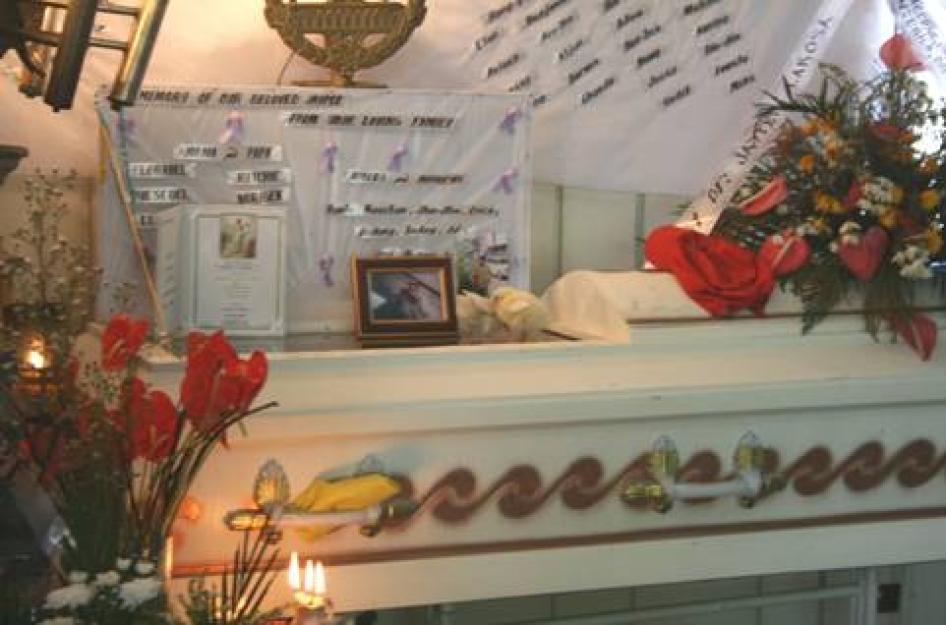
Chicks placed atop the coffin of Jaypee Larosa, who was killed by unidentified gunmen in Davao City on July 17, 2008, to symbolically peck on the conscience of the killers. © 2008 Human Rights Watch
Jaypee Larosa is just one of hundreds of victims of unresolved targeted killings committed over the past decade in Davao City and elsewhere in the Philippines. Dozens of family members have described to Human Rights Watch the murder of their loved ones, all killed in similar fashion. Most victims are alleged drug dealers, petty criminals, and street children, some of whom are members of street gangs. Impunity for such crimes is nearly total—few such cases have been seriously investigated by the police, let alone prosecuted.
Although reports of targeted killings in the Philippines, particularly in Mindanao, are not new, the number of victims has seen a steady rise over many years. In Davao City, the number has risen from two in 1998 to 98 in 2003 to 124 in 2008. In 2009, 33 killings were reported in January alone. In recent years the geographical scope of such killings has expanded far beyond Davao City and other cities on the southern island of Mindanao to Cebu City, the Philippines’ second largest metropolis. An already serious problem is becoming much worse.
This report provides an anatomy of death squad operations. It is based on our investigations of 28 killings, 18 of which took place in 2007 and 2008. The victims include children as young as 14. In researching this report, we found evidence of complicity and at times direct involvement of government officials and members of the police in killings by the so-called Davao Death Squad (DDS). We obtained detailed and consistent information on the DDS from relatives and friends of death squad members with direct knowledge of death squad operations, as well as journalists, community activists, and government officials who provided detailed corroborating evidence.
According to these “insiders,” most members of the DDS are either former communist New People’s Army insurgents who surrendered to the government or young men who themselves were death squad targets and joined the group to avoid being killed. Most can make far more money with the DDS than in other available occupations. Their handlers, called amo (boss), are usually police officers or ex-police officers. They provide them with training, weapons and ammunition, motorcycles, and information on the targets. Death squad members often use .45-caliber handguns, a weapon commonly used by the police but normally prohibitively expensive for gang members and common criminals.
The insiders told Human Rights Watch that the amo obtain information about targets from police or barangay (village or city district) officials, who compile lists of targets. The amo provides members of a death squad team with as little as the name of the target, and sometimes an address and a photograph. Police stations are then notified to ensure that police officers are slow to respond, enabling the death squad members to escape the crime scene, even when they commit killings near a police station.
The consistent failure of the Philippine National Police to seriously investigate apparent targeted killings is striking. Witnesses to killings told Human Rights Watch that the police routinely arrive at the scene long after the assailants leave, even if the nearest police station is minutes away. Police often fail to collect obvious evidence such as spent bullet casings, or question witnesses or suspects, but instead pressure the families of victims to identify the killers.
Our research found that the killings follow a pattern. The assailants usually arrive in twos or threes on a motorcycle without a license plate. They wear baseball caps and buttoned shirts or jackets, apparently to conceal their weapons underneath. They shoot or, increasingly, stab their victim without warning, often in broad daylight and in presence of multiple eyewitnesses, for whom they show little regard. And as quickly as they arrive, they ride off—but almost always before the police appear.
The killings probably have not generated the public outrage that would be expected because most of the victims have been young men known in their neighborhood for involvement in small-scale drug dealing or minor crimes such as petty theft and drug use. Other victims have been gang members and street children.
Frequently, the victims had earlier been warned that their names were on a “list” of people to be killed unless they stopped engaging in criminal activities. The warnings were delivered by barangay officials, police officers, and sometimes even city government officials. In other cases, the victims were killed immediately after their release from police custody or prison, or shortly after they returned from hiding.
Human Rights Watch also investigated a number of cases in which those killed were seemingly unintended targets – victims of mistaken identity, unfortunate bystanders, and relatives and friends of the apparent target. Death squad members also have been victims of death squad killings, possibly because they “knew too much,” failed to perform their tasks, or became too exposed. Some Davao City residents also expressed the belief that some death squad members have become guns-for-hire.
Witnesses and family members who provide information to police on the killings, including the names of suspects, say that police either fail to follow up on the leads, whether they have started a criminal investigation, or if they have made any progress in their investigation. In many cases, witnesses are too afraid to come forward with information, as they believe they could become death squad targets by doing so.
The words and actions of long-time Davao City Mayor Rodrigo Duterte, some of which were quoted at the start of this report, indicate his support for targeted killings of criminal suspects. Over the years, he has made numerous statements attempting to justify the killing of suspected criminals. In 2001-2002, Duterte would announce the names of “criminals” on local television and radio—and some of those he named would later become victims of death squad killings.
Duterte claims that Davao City has achieved peace and order under his rule. But with killers roaming the streets with the comfort of state-protected impunity, the city remains a very unsafe place. Available information points to an increasing number of death squad killings, including of persons such as Jaypee Larosa who appeared to have been in the wrong place at the wrong time.
Duterte and other local officials continue to deny the existence of any death squad. But in recent years, mayors and officials of other cities have made statements attempting to justify similar killings in their own cities. Sadly, Davao City is seen by some as a model for fighting crime.
Just as disappointing, there is an almost complete lack of political will by the government at both local and national levels to address targeted killings and take action against the perpetrators. Based on consistent, detailed, and compelling accounts from families and friends of victims, eyewitnesses of targeted killings, barangay officials, journalists, community activists, and the “insiders,” Human Rights Watch has concluded that a death squad and lists of people targeted for killings exist in Davao City. We also conclude that at least some police officers and barangay officials are either involved or complicit in death squad killings. Human Rights Watch believes that such killings continue and the perpetrators enjoy impunity largely because of the tolerance of, and in some cases, outright support from local authorities.
The failure to dismantle the Davao Death Squad and other similar groups, prosecute those responsible, and bring justice to the families of victims lies not only with local authorities. The administration of Philippine President Gloria Macapagal Arroyo has largely turned a blind eye to the killing spree in Davao City and elsewhere. The Philippine National Police have not sought to confront the problem. And the inaction of the national institutions responsible for accountability, namely the Department of Justice, the Ombudsman’s Office, and the Commission on Human Rights, has fueled widespread impunity.
The continued death squad operation reflects an official mindset in which the ends are seen as justifying the means. The motive appears to be simple expedience: courts are viewed as slow or inept. The murder of criminal suspects is seen as easier and faster than proper law enforcement. Official tolerance and support of targeted killing of suspected criminals promotes rather than curbs the culture of violence that has long plagued Davao City and other places where such killings occur.
Until national authorities take decisive action to disband the Davao Death Squad and all other similar groups that may be operating in other cities, and prosecute perpetrators and complicit officials, the pledges of President Arroyo and other government officials to respect basic human rights and uphold the rule of law will remain hollow.
Key Recommendations
The Philippine government and local authorities in Davao City, General Santos City, Digos City, and Tagum City, as well as other cities believed to be using or tolerating death squads, should urgently take measures to stop the killings and hold perpetrators accountable. More specifically, Human Rights Watch urges that:
- President Arroyo should publicly denounce extrajudicial killings and local anti-crime campaigns that promote or encourage the unlawful use of force. She should order the Philippines National Police, the Ombudsman’s Office, and the National Bureau of Investigation to investigate the targeted killings of alleged drug dealers, petty criminals, and street children, and pledge that state employees who are found to be involved or complicit in such killings will be prosecuted in accordance with the law.
- The Philippine National Police should conduct thorough investigations into targeted killings of alleged drug dealers, petty criminals, and street children in Davao City, General Santos City, Digos City, Tagum City and investigate the alleged involvement and complicity of police officers in such killings, including their failure to investigate the killings rigorously and prepare cases for prosecution.
- The Commission on Human Rights should investigate and report publicly and promptly on the Davao Death Squad and other similar groups and the involvement of the PNP and city governments in Davao City and other cities where death squad activity has been reported.
- As part of its inquiry into the targeted killings of alleged drug dealers, petty criminals, and street children, the Commission on Human Rights should investigate whether Rodrigo Duterte, Mayor of Davao City, and other mayors and governors in the Philippines have been involved or complicit in death squad killings, or whether statements by government officials may have incited violence.
- The mayor of Davao City and other local officials should cease all support, verbal or otherwise, for anti-crime campaigns that entail violation of the law, including targeted killings of alleged drug dealers, petty criminals, and street children. They should arrest and prosecute perpetrators of the killings and state employees, including law enforcement officers, who are found to be involved or complicit in death squad operations.
- The Philippine Congress should conduct hearings on the Davao Death Squad and other similar groups in the Philippines, with special attention paid to whether local officials and police officers are involved or complicit in such killings.
- The United States, European Union, Japan, the World Bank and the Asian Development Bank should keep their pledges on human rights, the rule of law, and good governance, press the Philippine government to initiate investigations into alleged targeted killings in cities, and to publicize the results of its investigations and plans to dismantle the Davao Death Squad and other similar groups.
More detailed recommendations are set forth at the end of this report.
II. Note on Methodology
In July 2008, Human Rights Watch investigated 28 killings in Davao City, General Santos City, and Digos City, focusing on cases where circumstances suggested a death squad might have been involved. Most of the killings we investigated occurred in 2007 and 2008, although a small handful had taken place as long ago as 2001. Human Rights Watch interviewed about 40 family members and friends of victims, as well as eyewitnesses to apparent targeted killings.
Human Rights Watch also interviewed nine people who had insider knowledge of the structure and functioning of the “Davao Death Squad,” because they had family, friends, or neighbors who were members of the DDS, had talked directly to DDS members, or had dealings with them. We also spoke with local human rights activists, lawyers, and journalists, who have been looking into the killings for years and who, in many cases, were able to provide detailed corroborating evidence.
We conducted interviews in English and Cebuano (the predominant local language) with the aid of interpreters. We have withheld the names of many of the people we interviewed for security reasons, using pseudonyms for those repeatedly quoted (we note such use in the relevant citations). Wherever possible and in the majority of cases, interviews were conducted on a one-on-one basis.
In September 2008, Human Rights Watch sent letters to the Philippine officials listed below to obtain data and solicit views on the killing of alleged drug dealers, petty criminals, and street children in Davao City, General Santos City, Digos City, Tagum City, and Cebu City. We sent follow-up letters a month later to those who did not reply.
Human Rights Watch wrote to the following officials:
Rodrigo R. Duterte, Mayor, Davao City
Pedro B. Acharon, Jr., Mayor, General Santos City
Arsenio Latasa, Mayor, Digos City
Rey Uy, Mayor, Tagum City
Tomas R. Osmeña, Mayor, Cebu City
Rodolfo Del Rosario, Governor, Province of Davao del Norte
Douglas R. Cagas, Governor, Province of Davao del Sur
Andres G. Caro II, Regional Director, PNP Regional Office XI
Ramon C. Apolinario, City Director, PNP Davao City
Alberto P. Sipaco, Jr., Regional Director, Commission on Human Rights, Davao City
Humphrey Monteroso, Deputy Ombudsman for Mindanao
Antonio B. Arellano, Regional State Prosecutor, Region XI
Raul D. Bendigo, City Prosecutor, Davao City
At this writing in February 2009, Raul D. Bendigo, Davao city prosecutor, Tomas R. Osmeña, mayor of Cebu City, and Pedro B. Acharon Jr., mayor of General Santos City, had responded. The other officials listed above did not respond or asked Human Rights Watch to contact other government agencies or officials. Some of Human Rights Watch’s letters and Philippine officials’ responses are attached in this report’s appendix. The rest of the letters are posted on the Philippines page of the Human Rights Watch website: www.hrw.org.
III. Map of Mindanao
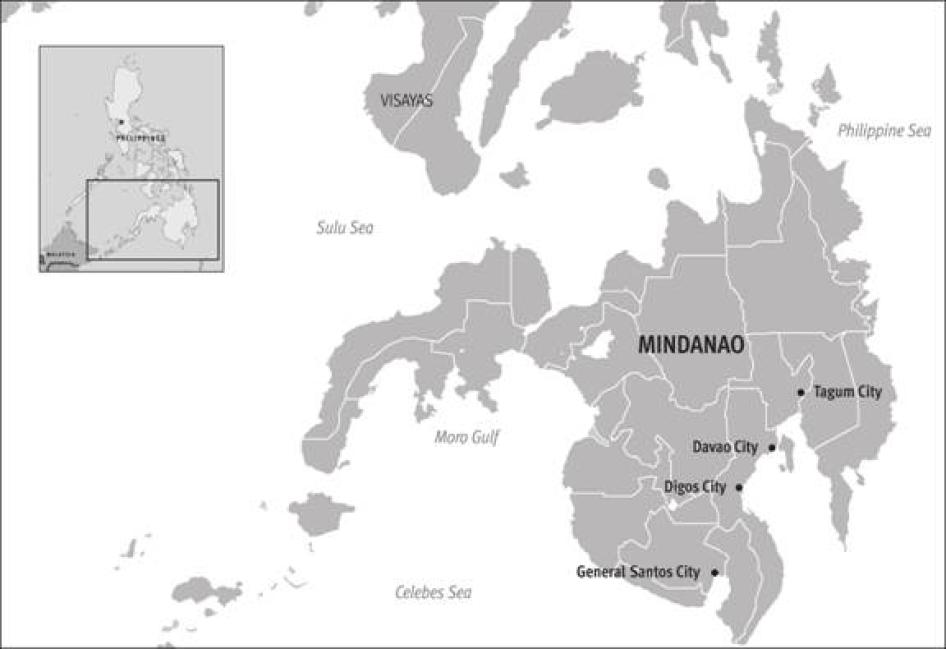
Map of cities in Mindanao with reported targeted killings of suspected criminals. © 2009 Human Rights Watch
IV. Background
Legacy of Violence
Mindanao, the largest of the Philippines’ southern islands, has been a focal point for insurgencies and conflict for decades. Militant Muslim groups, communist insurgents, government security forces, and government-backed militias and “vigilante groups” have all been responsible for numerous serious human rights abuses—including abductions, torture and killings—against suspected adversaries and ordinary civilians.
Since 1969 the New People’s Army (NPA), the armed wing of the Communist Party of the Philippines, has been fighting to topple the Philippine government.[1] The communist insurgency reached its greatest strength in the mid-1980s, prior to the “People Power” revolution of 1986 that removed then President Ferdinand Marcos from power. During that period, Mindanao was one of the hotbeds of the NPA insurgency. NPA forces have been responsible for numerous abuses, including targeted killings of persons whom they identify as “enemies,” and the use of violence to extort businesses and individuals.[2] So-called “sparrow units” have summarily executed those cited for “crimes against people,” such as criminals, military informants and abusive police officers.[3]
Since the early 1970s, the Philippine government also has been engaged in an intermittent armed conflict with Muslim separatist groups in Mindanao.[4] The conflict has resulted in the death of an estimated 120,000 people, mostly civilians, and displacement of some two million more. A shaky peace currently exists. More radical groups such as the Abu Sayyaf Group emerged in the 1990s and have been responsible for numerous bombings and other attacks on civilians, primarily in Mindanao and other southern islands.[5]
The Armed Forces of the Philippines (AFP) and the Philippine National Police (PNP) have for many years been implicated in insurgency-related human rights violations. In a June 2007 report, “Scared Silent: Impunity for Extrajudicial Killings in the Philippines,” Human Rights Watch documented the involvement of government security forces in the extrajudicial killing of leftist politicians and activists, journalists, outspoken clergy, anti-mining activists, and agricultural reform activists. Only a handful of the perpetrators of such killings have ever been convicted.
To fight the NPA insurgents, the government has long relied on the use of poorly trained paramilitary forces such as the Civilian Home Defense Force and its successor, the Citizen Armed Forces Geographical Units (CAFGU). These armed militias have tortured and murdered people they believed support or sympathize with the NPA. By operating outside the military chain of command, they also have given the armed forces a level of “deniability” for serious abuses they commit.[6]
The government has also actively enlisted so-called vigilante groups to fight the NPA. By popular legend, the birth of modern vigilantism in the Philippines traces back to Davao City. In April 1987, in a slum in Davao City, three former rebels shot to death a notorious NPA assassin. This group, called Alsa Masa (“Masses Arise”), prospered thanks to deep public resentment against the NPA, which had killed numerous people, many in error, in a violent internal purge starting in late 1985 and alienated once supportive populations.[7]
With the endorsement of then President Corazon Aquino and under the patronage of a local military commander, Lt. Col. Franco Calida, Alsa Masa rapidly expanded, using coercive recruiting methods and extortion. They required each household to provide a member for their nightly patrols, and painted homes of those who didn’t comply with an “X.” Jun Pala, a radio broadcaster who was an early supporter of Alsa Masa, routinely threatened Alsa Masa critics with retribution.
In many areas throughout the Philippines, local military commanders created and provided arms to vigilante groups, hoping to emulate Davao City’s counterinsurgency experiment with Alsa Masa.[8] A wide variety of vigilante groups were reported in the provinces of North Cotabato, Misamis Occidental, and Zamboanga Del Sur in Mindanao and on the islands of Negros, Cebu, and Leyte, among other areas. When these groups invariably became involved in serious abuses, enthusiasm steadily waned and they disappeared in the 1990s.
Problem of Illicit Drugs
The Philippine government has been battling drug syndicates for decades. The country has the highest estimated methamphetamine prevalence rate in the world, and continues to be a producer, consumer, and transshipment point for methamphetamine.[9] Illicit drug laboratories, which used to be found in or near Metropolitan Manila, are now found in various parts of the country, including Mindanao. In one such discovery, the authorities found a laboratory in Zamboanga City in Mindanao in February 2008 that reportedly had the capacity to produce 1,000 kilograms of methamphetamine each month.[10]
In 2007, the last year for which statistics are available, the authorities identified 249 local drug groups and eight transnational drug groups operating in the country, up sharply from the 149 local and seven transnational groups identified in 2006. There was no reason given for the surge. They also cited “intelligence reports” as indicating that illegal drugs from foreign countries were entering through coastal areas in central and southern Philippines.At the same time, the Philippine Drug Enforcement Agency reported a decreasing number of patients treated at various drug-rehabilitation facilities, again without offering explanation or analysis.[11]
A 2007 US State Department report concluded that “corruption, low morale, inadequate resources and salaries, and lack of cooperation between police and prosecutors” were hampering drug prosecutions in the Philippines. It noted that the slow process of prosecuting cases demoralizes law enforcement personnel and permits drug dealers to continue their drug business while awaiting court dates. It said the leading cause for the dismissal of cases is the non-appearance of prosecution witnesses, including police officers.[12] Davao City, an urban center of Mindanao, is a major market for illicit drugs.
Davao City
In the 1970s and 1980s, Davao City was known as the “murder capital” of the Philippines. Communist insurgents and government security forces killed each other in the daytime on Davao City’s streets. NPA assassins killed corrupt police officers, suspected informants, and drug dealers. The Agdao district of Davao City became a communist bastion known as “Nicaragdao” (after Sandinista-led Nicaragua), where the NPA routinely committed targeted killings.[13]
The NPA was largely driven out of Davao City by the late 1980s. The government claimed that Alsa Masa and other vigilante groups were chiefly responsible, but the NPA’s demise also has been explained as due to a bloody internal purge in the NPA that left its ranks shattered. The NPA’s decline in Davao City was repeated throughout the Philippines in the ensuing decade.[14] In the words of Philippine President Gloria Macapagal Arroyo, the NPA today remains a low-level threat.[15]
In recent years, Davao City has developed into a sprawling urban metropolis of 1.44 million residents, and a business, investment, and tourism hub for the southern Philippines. It has attracted a large number of economic migrants from all over Mindanao and elsewhere in the Philippines. Hundreds of thousands are unable to find stable jobs and end up in crowded slum areas. They include an estimated 3,000 street children[16]—40 to 50 percent of whom are girls—who roam the streets of Davao City to make money and avoid physical abuse at home. Many join youth gangs for bonding and survival.[17]
A resurgence of violence by Islamist groups in Mindanao has left its mark in Davao City. On March 4, 2003, a bomb exploded in a waiting shelter just outside Davao International Airport, killing 22 people and injuring 143 others. Within days, an Abu Sayyaf Group commander claimed responsibility for the attack. On April 2, 2003, a bomb hit the Davao Sasa Wharf, the main dock for Davao City, killing 17 and injuring 56. Several alleged members of the Moro Islamic Liberation Front and the Abu Sayyaf Group were soon arrested.[18]
Southern Mindanao, which includes Davao City, has also seen a resurgence in extrajudicial killings by members of the armed forces and the police against leftist activists, journalists, and others deemed to be NPA supporters, part of a larger nationwide increase in such killings. As elsewhere in the Philippines, impunity for such crimes is the norm: rarely do the authorities prosecute members of the military or police for extrajudicial killings, and few cases result in arrests, even fewer in convictions.
Davao’s Mayor Rodrigo Duterte
Rodrigo Duterte was first elected mayor in 1988 on a campaign to reinstate peace and order in Davao City. Before running for office, Duterte had built his reputation as a city prosecutor by targeting military and rebel abuses with equal fervor. The son of a former provincial governor, Duterte said his father taught him that elected officials must serve the greater good no matter what it takes, like a father protecting and disciplining his family.[19]
Duterte’s rise as a prominent political figure coincided with a significant change in the dynamic between local officials and the police in the Philippines. As discussed in chapter X, two laws enacted in 1990-91 provided city mayors and provincial governors greater operational control over their police forces.
Under Duterte’s rule, crime rates in the city dropped to among the lowest in the country. According to the Davao City official website:
From a 3-digit crime rate per 10,000 people in 1985, Davao has reached an almost Utopian [sic] environment with a monthly crime volume of 0.8 cases per 10,000 persons from 1999 up to 2005. Digging through the records, it would reveal that about 90% of these cases reported are petty crimes that do not in any way threaten the over-all peace and order condition of the city.[20]
These descriptions attempt to conceal a rampant crime wave—namely, the murder of hundreds of alleged drug dealers, petty criminals, and street children.
More importantly, by averaging out years of statistics and omitting most recent years, they belie the city’s sharp upward trend in crime rates over the last decade. According to statistics from the police, between 1999 and 2008, the population in Davao City grew from 1.12 million to 1.44 million, or by 29 percent. Meanwhile, the number of annual crime incidents during this period rose from 975 to 3,391, or by 248 percent.[21] These numbers show that, contrary to the city government’s self-proclaimed success, its tough anti-crime campaign has failed to curve crime rates. An increasing number of death squad killings appears to have contributed to worsening crime rates in the city.
Local activists say death squad killings of alleged drug dealers, petty criminals, and street children in Davao City started sometime in the mid-1990s, during Duterte’s second term as mayor. The group that claimed to be responsible for the killings was called Suluguon sa Katawhan or “Servants of the People,” among other names, but soon the media in Davao City began referring to it the Davao Death Squad (DDS).[22]
By mid-1997, local media already had attributed more than 60 unsolved murders to the group, observing that the death squad had adopted the urban warfare tactics used in the 1980s by NPA “sparrow squad” hit teams. One source revealed that the death squad then had at least 10 members then, mostly former members of the NPA who had surrendered to the government.[23] The death squad grew dramatically since—one insider estimates the number of current members at about 500 (see chapter VIII).[24]
These killings have not been unpopular. According to a local human rights organization, fear and public frustration at “the arduous and ineffective judicial system” have made summary executions seem a “practical resort” to suppress crime in Davao City.[25]
Duterte, who has now been mayor for two decades, with a short interval as a congressman, has been given endearing nicknames by the media, such as “The Punisher,” “The Enforcer,” and “Dirty Harry” for his anti-crime campaign.[26] His policies have garnered public support in Davao City. It is thus perhaps no surprise that in recent years, reports of targeted killings of alleged drug dealers, petty criminals, and street children have emerged in the nearby cities of General Santos City, Digos City, and Tagum City in Mindanao as well as in Cebu City on the central island of Cebu.[27]
Targeted Killings in Mindanao and Beyond
While the focus of this report is on alleged death squad activities in Davao City, Human Rights Watch also conducted field research in Digos City and General Santos City. The research demonstrated that targeted killings in these cities partly started out of efforts by the Davao Death Squad to track down individuals who had left Davao City for the presumed safety of neighboring locales. But such targeted killings —that now involve locally-based killers— appears to reflect local government support and possible direct participation in politically popular if highly abusive anti-crime measures.
Human Rights Watch is also worried by the news of targeted killings of suspected criminals in cities outside of Mindanao. Among the cities of particular concern is Cebu City. The media in Cebu City treat the existence of a death squad in the city as a matter of fact, just as their counterparts in Davao City do. News archives from as early as 2003-2004 show articles on apparent targeted killings of suspected criminals.
In his response to a letter from Human Rights Watch, Cebu City Mayor Tomas R. Osmeña described a pattern of killings in Cebu similar to those in Davao City. In relation to 202 cases[28] registered in the city from December 2004 to September 2008, he noted:
The majority are categorized as “summary/vigilante Style of Killings” for the perpetrators are usually unknown, riding in motorcycles and wearing masks, bonnets or helmets. Information gathered during the investigation revealed that most of the victims are either having criminal records or ex-convicts, fraternity members or suspected to be involved in drug syndicate.[29]
Osmeña emphasized the efforts of law enforcement bodies to investigate and prosecute the cases, but did not provide details of these efforts beyond noting that “some cases were filed in court and now [are] pending ... resolution for the suspects [who] were identified and arrested.”[30]
V. Pattern of Killings
It is very hard to believe there is no death squad. There is a clear pattern, including the profile of victims, the choice of weapons, the use of motorcycles without license plates, and police failure in investigating the cases.
—Reah De La Cruz, reporter with Radyo Totoo, DXCP-CMN, General Santos City, July 18, 2008.
For over a decade, death squad killings have plagued Davao City on the southeastern coast of Mindanao.[31] In recent years, similar targeted killings have been reported in General Santos City, Digos City, and Tagum City in Mindanao and even Cebu City in the central island of Cebu. While the exact number of victims of such killings is hard to establish, available data suggest an alarming trend.
According to the Coalition Against Summary Execution (CASE) and the Tambayan Center for the Care of Abused Children (Tambayan), the number of death squad killings of alleged drug dealers, petty criminals, and street children in Davao City that started in the mid-1990s, has increased dramatically in recent years.
CASE documented 814 death squad killings in Davao City from August 19, 1998 to February 1, 2009, 116 of which happened in 2007, 124 in 2008, and 33 in January 2009 alone. CASE distinguished death squad killings from other killings based on several factors, including whether the victim received a previous warning, the profile of the victim, and the method of killing.[32]
A prominent local journalist who has researched extrajudicial killings in Davao City since 1999 told Human Rights Watch that in the course of a month from mid-June to mid-July 2008, he documented 60 killings and an additional eight attempted murders.[33] Data by CASE show a steadily upward trend in the number of killings in recent years from 65 in 2006 to 116 in 2007 and 124 in 2008.[34]
The reasons for the apparent rise in death squad killings are unclear, although the sharp increase in the number of illicit drug groups identified by the authorities in 2007 may offer one explanation, as many victims are alleged drug dealers or users (see chapter IV). Local activists offer other possible explanations: first, long-lasting impunity may have emboldened death squad killers, encouraging them to expand their operations, and second, the recent economic downturn may have led more poor people to resort to drug dealing and other criminal activities as it became difficult to find or keep stable jobs, giving death squad members more potential targets.[35]
However, the authorities in Davao and other cities, including Davao City Mayor Duterte, continue to deny the existence of any death squad. For example, Davao City police director, Sr. Supt. Ramon Apolinario, told local media that the DDS does not exist, adding that, “there is no community or city that will allow these groups to do things beyond legal means. As a law enforcement officer, I will stick to my mandate to observe due process, respect human rights of the suspect and the victim.”[36]
The city prosecutor of Davao, Raul D. Bendigo, wrote to Human Rights Watch that his office has “no hard evidence... on the existence of the so-called Davao Death Squad (DDS).”[37] These claims contradict consistent, detailed accounts by many individuals who have witnessed such killings, as well as information provided by “insiders,” as detailed below.
The killings documented by Human Rights Watch and by local human rights groups reveal a pattern in the perpetrators’ modus operandi, including commonalities in the profile of the individuals targeted for killings, advance warnings to victims that they would be targeted, the types of vehicles and weapons used by the assailants, and the locations of the killings.
Warnings and Intimidation
Most victims of targeted killings in Davao City, General Santos City, and Digos City receive warnings prior to the killings. The victims (or their families) first hear that their names are on a presumed list of people slated to be killed—the so-called “Order of Battle” or OB. Such lists have long been used by the Philippine military and police to target suspected NPA members and supporters.
As noted above, Davao City Mayor Rodrigo Duterte personally used to announce the names of suspected criminals on local TV or radio in 2001-02, and visited communities to warn delinquent youth and their parents. Local residents say Duterte stopped this practice several years ago, but the practice generated a widely held belief that there was a connection between those publicly named and supposed lists of potential targets.
For instance, prior to the killing of Conrad Dequina in October 2007, a barangay[38] official told Dequina’s family that his name was on a “list,” and advised that he leave town. According to a friend of Dequina’s:
Everybody knew whose names were on the list. I have not seen the list, but a barangay official had the names on a piece of paper, and carried it with him when he visited each house to inform the families.[39]
Accounts of insiders to DDS operations suggest that the police and barangay officials collect the names of drug users, people with a criminal record, and the like. Family members and others personally familiar with the victims of death squad killings consistently told Human Rights Watch that the victim had received clear threats or warnings to stop their criminal activities or other behavior—or face the consequences. Usually, the police or barangay officials delivered the warning, but neighbors and friends also passed on the message. In some cases, people were advised to leave the neighborhood, and a number of people fled after the warning. Others ignored the warnings or returned to the neighborhood after spending some time away, with dire consequences.[40]
For example, Cyrus Gitacaras, a man in his early 20s with a long criminal record, had been jailed as a suspect in a robbery case but was released in August 2007. Gitacaras told friends that a police officer had warned him that, “if he didn’t watch out, he might be killed on the street.”[41] Five days after his release, unidentified assailants murdered Gitacaras in Davao City.
According to Clarita Alia, whose four sons were murdered one after another between July 2001 and April 2007, a local policeman had warned her shortly before the first of her sons to be killed—18-year-old Richard—was stabbed to death. A couple of weeks before his murder, the police tried to arrest him, but his mother resisted, demanding a warrant. Clarita Alia said:
A policeman, who introduced himself as senior police officer [name withheld], told me, “Ok, you don’t want to give your child to me, then watch out because your sons will be killed, one by one!” I was really shocked he mentioned the other sons as they were just little kids then, but he was very angry because I was pushing him out.[42]
Just as the police officer threatened, Christopher Alia, 17, was murdered in October 2001, Bobby Alia, 14, in November 2003, and Fernando Alia, 15, in April 2007.
Locations
Most targeted killings documented by Human Rights Watch were committed in broad daylight in public places. Victims were targeted in front of their houses or in nearby streets, in bars and cafes, in jeepneys or tricycles[43], and in busy markets and shopping areas. In Davao City, death squad killings often occur in certain areas, such as a crowded market in Bankerohan, slums in the Agdao district, and along Bolton Street, a busy street lined with restaurants and cafes.
According to data collected by CASE, out of 814 killings committed in Davao City from August 19, 1998 to February 1, 2009, 57 percent of the incidents took place in areas under the jurisdiction of three police stations: the Santa Ana police station that covers Agdao and Chinatown (21 percent), the Talomo police station that covers communities south of Davao City (20 percent), and the San Pedro police station that covers Davao City’s downtown area including Bolton and Bankerohan (16 percent).[44]
Perpetrators
The perpetrators of targeted killings in Mindanao typically make greater efforts to conceal their weapons than their identity. They are often seen wearing jackets or buttoned-down shirts—apparently to conceal their weapons. Baseball caps are common. In a very small number of cases, eyewitnesses say that the gunmen wear “bonnets” (ski masks) or sunglasses. “Ramon,” a DDS insider, told Human Rights Watch that masks are rare, and usually worn when a hitman operates alone, driving a motorcycle himself.[45]
The presence of multiple eyewitnesses does not seem to restrain the perpetrators. For example, 15-year-old Adon Mandagit was shot dead at around 3 p.m. one day in July 2007 on Bolton Street in Davao City, near a popular Jollibee fast-food outlet.
His friend, who witnessed the killing, told Human Rights Watch:
There were many people in the street—after shooting Adon, the men waived their guns at the crowd, telling people to disperse. Women were shouting, some people hit the ground, and some were running away. I also got scared and hid behind a fruit stand. I could see everything from there.[46]
Witnesses can often clearly see the perpetrators. While perpetrators often wear baseball caps, as noted above, they do not try to hide their faces. In some cases they threaten bystanders before fleeing from the crime scene, waving their guns and telling them to keep quiet.
The UN special rapporteur on extrajudicial executions, Philip Alston, found the lack of effort by the perpetrators of such killings to disguise themselves noteworthy. He stated in his 2008 report:
One fact points very strongly to the officially-sanctioned character of these killings: No one involved covers his face. The men who warn mothers that their children will be the next to die unless they make themselves scarce turn up on doorsteps undisguised. The men who gun down or, and this is becoming more common, knife children in the streets almost never cover their faces.[47]
The gunmen usually arrive on motorcycles, in groups of two or three. In most reported cases, the motorcycles do not have license plates. The most commonly used motorcycles are XRM Honda or a larger, DT-type off-road motorcycle. In most of the cases documented by Human Rights Watch, the gunmen left on their motorcycles immediately after the attack and usually long before the police arrived.
Until 2006, perpetrators primarily used firearms—specifically, .45-caliber handguns, and, in some cases, .38-caliber or 9-mm handguns. The use of such firearms is a strong indicator that the murders were not perpetrated by common gang members. The .45-caliber handguns, for example, cost about 30,000 pesos (about US$625) each.[48] The vast majority of gang members cannot afford such expensive weapons, and mostly use knives or homemade pistols instead.
Several individuals familiar with DDS operations told Human Rights Watch that since 2006, some DDS members have started using knives instead of handguns, and have received training to this end. They say that the DDS now often favors knives because they are cheaper, attract less attention, and stab wounds make it easier for the police to claim that the victim was killed by gang members.[49]
Data compiled by CASE confirms the increasing use of knives in alleged death squad attacks. In 2006, 38 victims were shot and 26 were stabbed. In 2007, 56 were shot, and 59 were stabbed. In 2008, 73 were shot, while 50 others were stabbed. (In one case each in 2006, 2007 and 2008, the method of the killing was not given.) Although the use of knives decreased slightly in 2008, the data still show an overall upward trend in the use of knives. In 2005, for example, the number of victims killed with handguns reached 117, but only nine were killed with knives.[50]
VI. Map of Davao City
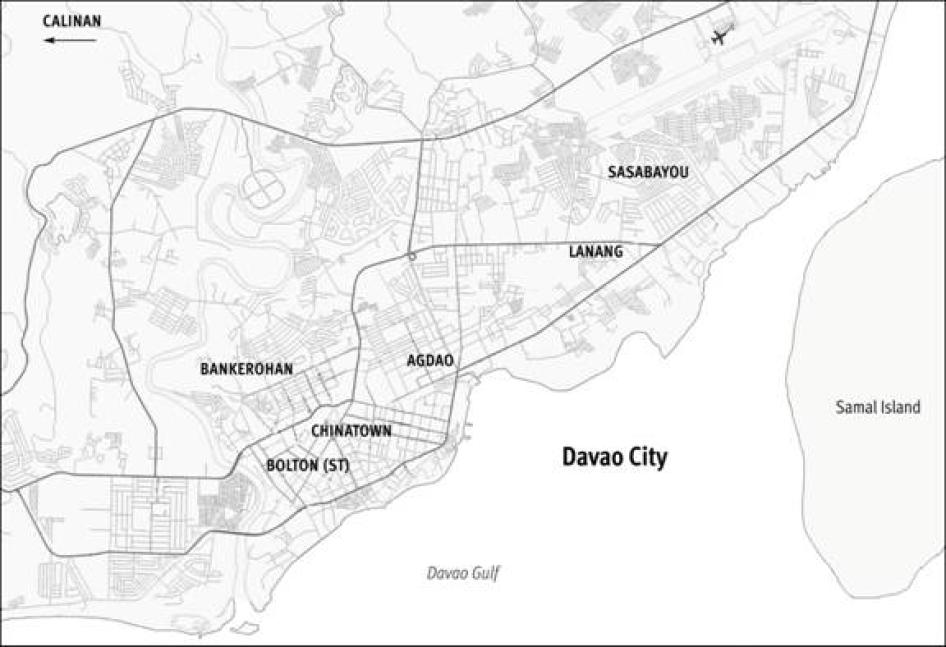
Map of areas in Davao City with reported death squad killings. ©2009 Human Rights Watch
VII. Victims
Targeted Victims
Most victims of death squad killings have been alleged drug dealers, petty criminals, and street children. Mistaken identity victims, bystanders, and family members or friends of intended targets have also been killed in death squad attacks. Data collected by CASE from August 19, 1998, to February 1, 2009 suggest that more than 90 percent of victims in Davao City are male.[51] Of the 28 killings Human Rights Watch documented, all but one were male.
In the majority of cases documented by Human Rights Watch, the victims were young men or youths who had been known in their community for involvement in small-scale drug dealing or petty crimes, such as stealing cell phones, and using drugs. Those targeted included gang members, alleged drug dealers, street children (some of whom are youth gang members), and low-income blue-collar workers such as informal car washers, jeepney and tricycle drivers, construction workers, and fishermen.
Of the 671 cases collected by CASE from the period between August 1998 and May 2008 in Davao City, 295 victims, or 44 percent, are believed to have been gang members or otherwise involved in criminal activities, such as using or dealing drugs, theft, or robbery.[52] CASE notes that 13 are believed to have been “mistaken identity” cases. At least two victims were killed by stray bullets, while one was killed shielding the victim. In 363 cases, or 54 percent, there was no information available on the victims’ involvement in crime.[53]
In a number of the cases documented by Human Rights Watch, police had arrested victims on suspicion of committing a crime and then released them when they did not have sufficient evidence to bring charges. Shortly after their release, these individuals were then shot or stabbed by apparent death squad members.
For example, on November 20, 2005, police arrested 22-year-old Rodolfo More, Jr. for trespassing and theft. They released him two days later, apparently because the evidence against him was not strong enough to prosecute. Soon after a relative picked him up from the police station, an unknown assailant stabbed him to death in a jeepney that was taking them home.[54]
The CASE data also suggest that about a third of the 814 victims in Davao City were young adults, ages 18 to 25, and at least 9 percent were children. In 2008 alone, out of 124 victims, 46 were young adults, and another 14 were children. Another 45 were 26 or older, while there was no information on the age of 20 others.[55] In the cases documented by Human Rights Watch, the majority of victims were teenagers or young men in their 20s.
Unintended Victims
In at least three cases documented by Human Rights Watch, the families believed that the victims were killed because they were mistaken for somebody who had been the intended target.
In one of the cases, 24-year-old Gabriel Sintasas from General Santos City was shot dead on March 19, 2008. His family told Human Rights Watch that the perpetrators seemed to be looking for Gabriel’s cousin, Frederick, an alleged drug dealer whom he resembled. Sintasas’ mother, who witnessed the killing, told Human Rights Watch:
I cried [to the gunman], “You idiot! This is not Eko [Frederick’s nickname]! You got the wrong man!” I knew that these people were looking for Frederick—they just mistook my son for him! The killer didn’t say anything in response, but he looked at Gabriel in shock, apparently realizing he made a mistake.[56]
After Gabriel’s murder, Frederick surrendered to the police, who told him he would have been “the next one” if he had not promptly surrendered.
On January 14, 2008, two gunmen in General Santos City shot dead Allen Conjorado, 23, and his brother Ronaldo, 15, inside a store owned by the brothers’ aunt. The aunt’s six-year-old daughter was also shot, but survived despite a head injury. A relative told Human Rights Watch that Allen was known in the neighborhood for selling drugs, but Ronaldo was not, and never received any warning prior to the killing.[57]
Death Squad Members
Another category of victims includes death squad members themselves—who may be targeted because they have acquired too much information about the squad’s operations, because they fail to perform their tasks, or because they are particularly exposed.
Other Victims
Local activists also say that an increasing number of people are being murdered because some death squad members have become “guns for hire” and are killing people in exchange for payment. A rights activist in Davao explained:
It costs only 5,000 pesos (about US$104) to hire an assassin. If you owe more than 5,000 pesos to someone, would you pay back, or would you hire a killer to take care of the lender? If you have a dispute, it’s so easy and cheap to eliminate the other.
Now the DDS moonlights, and work as “guns for hire” for pretty much anyone willing to pay the price. The targets used to be criminals, but they now include non-criminals. The DDS is expanding their business. The creation of the DDS has made killing a very profitable business. You are not safe, even if you did not commit any crime. You can still become a victim.[58]
VIII. Targeted Killings
The following cases, involving 28 targeted killings, were documented by Human Rights Watch during our research in Davao City, General Santos City, and Digos City in July 2008.
Davao City
Jaypee Larosa, 20, killed on July 17, 2008
Jaypee Larosa, 20, had no criminal record and lived in Lanang, a quiet residential neighborhood in Davao.[59]
At around 6 p.m. on July 17, 2008, Larosa left home, saying he was going to a neighborhood Internet cafe. A relative told Human Rights Watch that at around 7 p.m. the family heard six gunshots. A neighbor then rushed to their house and said that the “twin” had been shot, which the family immediately realized meant Jaypee, as he had a twin brother.
Family members rushed to the Internet cafe, and found Larosa with several bullet wounds in front of the cafe. They took him to a hospital, but he was declared dead on arrival.
According to family members, eyewitnesses told them that Larosa had been shot by three men wearing black and dark blue jackets who arrived on a Honda Wave motorcycle. After they shot him, one of them removed the baseball cap Larosa was wearing, and said, “Son of a bitch. This is not the one,” and they immediately left the scene. The police recovered an empty cartridge from a 9-mm handgun.
The family believes that Larosa was mistaken for someone else.
Shortly before the killing, the family had heard that some twin brothers had committed a robbery in the neighborhood where they used to live. A police officer had mentioned to members of the community the names of the Larosa brothers as potential suspects.
Convinced that the Larosa brothers could not have been involved in the robbery, the family confronted the police officer. On July 15, the police officer filed a libel complaint against the family. On July 16, the Larosa family filed a counter-complaint. The following day, Larosa was killed.[60]
Adon Mandagit, 15, killed in July 2007
Adon Mandagit, 15, used to live in Calinan, south of Davao City, with his family. Several years before he was killed, local police arrested Adon and beat him once for sniffing “rugby” (an industrial solvent commonly used by Filipino youth as an intoxicant) and for an alleged theft. “Ricardo,” a close friend of the Mandagit family, told Human Rights Watch that Adon’s mother then filed a complaint against a Calinan Police Precinct policeman for mistreating her son. As a result, the policeman was removed from the station and the police paid damages to the Mandagit family.[61]
According to Ricardo, after the incident, the Calinan police warned Adon’s mother that unless her son changed his behavior, “Something may happen to him.” The mother then asked Ricardo to take her son to Davao City, and Adon moved there in early 2007.
In Davao City, Adon started working with Ricardo as an informal car washer in the Bolton area of the city.
Ricardo told Human Rights Watch that they were always together, and he tried to keep an eye on Adon, fearing for his safety. Adon’s mother told him that some “men on motorcycles” were looking for Adon in Calinan, coming to the house, and asking the mother for his whereabouts.
In July 2007, Adon was shot dead in front of Ricardo. Ricardo told Human Rights Watch:
It was around 3 p.m. Adon and I were on Bolton street, washing cars near a Jollibee restaurant. I went to buy cigarettes but the moment I left Adon, I heard gunshots and immediately turned around. I saw two men firing at Adon. One of them, short and heavy-built, was two or three meters away from Adon. I believe he fired the first shot. Adon stumbled, and another, taller man finished him off with another two gunshots.
There were many people in the street—after shooting Adon, the men waived their guns at the crowd, telling people to disperse. Women were shouting, some people hit the ground, and some were running away. I also got scared and hid behind a fruit stand. I could see everything from there.[62]
According to Ricardo, the short man was in jeans and black jacket, and the tall one was wearing jeans, an off-white polo shirt, and a baseball cap. After shooting Adon, the men jumped on a waiting motorcycle and took off. Ricardo noticed that the motorcycle was a DT sports model, and the driver had long hair. The gunmen were armed with .45 caliber handguns.[63]
After the gunmen left, Ricardo approached Adon. The boy was already dead—two wounds were visible in his head (one in his forehead and a second in the back of his head), and another bullet wound in the neck. Ricardo then quickly left the scene, fearing for his own life—Adon’s killing was not the first one in the area and he was afraid he might be targeted as well.
Ricardo believes that Adon might also have been killed because a month before his shooting he had witnessed the murder of another car washer in the same area. As a witness to the killing, Adon was then questioned by the police. He also had given an interview about the murder to a local TV channel.
Rolando Jimenes, 50, killed on June 15, 2008
Rolando Jimenes was a retired member of the CAFGU militia and lived in Davao City. In 2003, police arrested him for murder and he served time in prison until July 2007. According to a relative, shortly after his release, Rolando joined the Davao Death Squad and took part in death squad raids along with other members. He did not try to hide his affiliation with the death squad from his family.
On June 15, 2008, Jimenes was drinking with a friend in a bar. An individual present at the bar later told a member of Jimenes’ family that a death squad member, who apparently knew Jimenes, arrived on a motorcycle, came into the bar and told the customers to leave. He then approached Jimenes and shot him several times, first in the side, then in the neck, twice in the head—in the middle of the forehead and in the right cheek—and then in the chest.[64]
After the shooting, the gunman ran out of the bar where an accomplice waited on a motorcycle, and they sped off.
The police arrived at the scene about 30 minutes after the killing and conducted a basic examination of the crime scene, fingerprinting the victim and collecting bullet cartridges. The family did not file a case[65] because, according to the witness interviewed by Human Rights Watch, “They knew about his job and thought it was useless to file.” The witness was not aware of any action taken by the police to further investigate the case.
Nerito Calimbo, 42, killed on May 22, 2008; Jocelyn Calimbo, 44, killed on May 22, 2008; Aaron Sumitso, 26, killed on May 22, 2008
Nerito Calimbo, 42, was a self-employed businessman working in the mining industry, and a former New People’s Army fighter who surrendered to the government and was granted amnesty after serving two months in prison. After his surrender, he held different jobs, including as a bodyguard. Jocelyn Calimbo, 44, Nerito’s wife, was a nurse.[66]
A relative of the Calimbos told Human Rights Watch that on May 21, 2008, dozens of members of the Criminal Investigation and Detection Group (CIDG) from the Davao City police, armed with .45-caliber handguns and wearing bullet-proof vests, entered the Calimbo residence. They searched the house without a warrant.
The officers took Nerito Calimbo to their office for questioning. They accused him of kidnapping and murder, and of being a leader of a well-known gang. The next day, May 22, he was released on bail.
Calimbo’s wife, Jocelyn, and his brother-in-law, Aaron Sumitso, picked him up at the barracks of the Davao City Police Office. They got into a taxi, which soon stopped because of traffic. Two men on a motorcycle approached them, shot the Calimbos and Aaron Sumitso, and fled from the scene. The taxi driver, who was unharmed, drove them to a hospital, but all three were declared dead on arrival.
The Calimbo family decided not to pursue the case with the police, fearing retribution.
In late May 2008, Chief Inspector Antonio Rivera, chief of the Investigation Division and Management Section of the Davao City police, told journalists that they had released a composite sketch of one of the suspects. Senior Superintendent Jaime Morente reportedly said the San Pedro police were investigating the case, and looking at all possible motives behind the killing. Local media reported that Nerito Calimbo was a suspected leader of a well-known gang called the Chigo Robbery Group.[67]
Before Calimbo was released, CIDG-Southern Mindanao chief Jose Jorge Corpuz allegedly had warned the victim that he was being targeted for assassination, but later clarified that his warning was based on the presumption that Calimbo's enemies would take advantage of his release from CIDG detention.[68]
At this writing in February 2009, the police had not reported the arrest of any suspect in the case.
Conrad Dequina, early 20s, killed on October 10, 2007
Conrad Dequina, in his early 20s, lived in Davao City. According to a friend, he was known to sniff rugby and was a suspect in a murder case. Prior to the killing, a barangay official had warned Dequina’s family that his name was “on the list,” and advised that he leave town.[69]
At around 10 p.m. on October 10, 2007, Dequina was hanging out with friends in his neighborhood, when neighbors heard gunshots. Dequina’s friend, who witnessed the killing, told Human Rights Watch that he saw three men wearing baseball caps and denim jackets.
He said that the assailants shot Dequina six times with what appeared to be .45-caliber handguns. They also shot and killed another man who was standing next to Dequina—possibly by accident.
The friend said that after the shooting, the gunmen drove around for some time, as if looking for someone else, but left just before the police arrived. He told Human Rights Watch:
Nobody said anything, because they were all afraid. The police asked who the victim was, and laughed as if they liked what they saw. They didn’t talk to any of the witnesses. And then they left, leaving behind the body and empty shells. They didn’t do anything. They didn’t seem to care about any evidence.
The friend does not believe the police followed up on the case.
With regard to the other victim, the friend said:
We knew the second guy was a mistake, because his name was not on the list. Everybody knew whose names were on the list. I have not seen the list, but a barangay official had the names on a piece of paper, and carried it when he visited each house to inform the families.
Dequina’s friend said that three other friends of his were killed in the neighborhood between June and July 2008. He said that they were gang members and all had received warnings before the killings. All three were killed in the same manner as Dequina, and he knew of no police follow-up on any of the cases.
Jumael Maunte, 24, killed in August 2007; Cyrus Gitacaras, age unknown, killed in August 2007
On August 12, 2007, Jumael Maunte and Cyrus Gitacaras went missing. On August 16, Maunte’s family saw on the TV news that two bodies had been found in Mawab, Davao del Norte, about 90 kilometers northeast of Davao City. Maunte’s mother went to the funeral parlor and identified one of the bodies as her son’s. The body bore many bruises, a large blackened wound in the head, and three gunshot wounds in the chest. The wrists and ankles were tied with thin metal wire. The family, who are Muslims, immediately buried the body.[70]
The second body belonged to Cyrus Gitacaras, a friend of Maunte’s. The body, which had been found beside a highway by a jeepney driver, had gunshot wounds to the right eye and the chest, as well as bruises on the head. The wrists and ankles were tied.
According to Maunte’s relative, Gitacaras had a long history of trouble with the law, including theft, drug use, and robbery. He was a suspect in a robbery case, and the authorities had released him from a city jail only five days before he went missing. Neighbors and barangay officials had told him his name was on a “list.” Gitacaras told his friends that a police officer had warned him to watch out or he might be “killed on the street.”
Maunte was a drug user. To the relative’s knowledge, he had never received any warnings that his name was on a list or that his life was in danger. Fearing for his safety, his family told him to avoid Gitacaras, but Maunte would not listen, as they were close friends.
After the discovery of the bodies, Maunte’s family located an individual who had been with Maunte and Gitacaras at the time of their abduction, but had managed to escape. He told the family that on August 12, the three of them were in Butuan City, which is about 220 kilometers northeast of Davao City, when a group of armed men approached them and took the two away.
The police never contacted Maunte’s family about the case. According to Maunte’s relative, when Maunte’s mother asked the police if they had any leads in the case, they said they could not pursue the case because they did not know who was responsible for the killing. The survivor refused to make a statement to the police, as he was scared for his life.
Danilo Macasero, early 30s, killed in late May 2007
Danilo Macasero was a known drug dealer. According to a neighbor, a barangay official once told Macasero that his name was on the “list.” Neighbors tried to convince him to stop dealing drugs, but he continued.[71]
Macasero’s neighbor, who witnessed the killing, told Human Rights Watch that in late May 2007, four men wearing baseball caps and jackets arrived in Macasero’s neighborhood on two XRM Honda motorcycles. The men appeared to be staking another known drug dealer’s house, and at around 8 p.m., Macasero walked past them.
One of the men then followed Macasero and stabbed him without warning. Macasero tried to run away, but another assailant caught up with him and stabbed him again. The men stabbed him 12 times in total.
The men then pulled out handguns that, according to Macasero’s neighbor, appeared to be .38-caliber silver pistols, and pointed them to those gathered around. Macasero’s neighbor said that one of them said, “Don’t do anything. You are not part of this.” Another one then kicked Macasero’s face as he lay on the ground, and said, “Don’t follow this guy. He is an addict.”
Macasero’s family took him to a hospital, but he was declared dead on arrival.
Richard Alia, 18, killed on July 21, 2001; Christopher Alia, 17, killed on October 20, 2001; Bobby Alia, 14, killed on November 3, 2003; Fernando Alia, 15, killed on April 13, 2007
From July 2001 to April 2007, the four Alia brothers from the Bankerohan area in Davao City fell victim to apparent death squad killings—they were stabbed to death one after another, by unidentified perpetrators.[72]
Richard Alia, 18, was a member of the “Notoryus” gang in Bankerohan and police had arrested him several times for petty crimes. In 2000, he survived a murder attempt when an unidentified perpetrator shot at him.
In early July 2001, the police tried to arrest him again, but his mother resisted. She told Human Rights Watch:
The police from San Pedro police station came to our house to pick him up for an alleged rape, but they didn’t have a warrant. I asked for one, but they didn’t have it and said they didn’t need it. I protested, and then a policeman, who introduced himself as Senior Police Officer [name withheld], told me, “Ok, you don’t want to give your child to me, then watch out because your sons will be killed, one by one!” I was really shocked he mentioned the other sons as they were just little kids then, but he was very angry because I was pushing him out.
On July 17, 2001, at around 4 p.m., Richard left his house to have a drink with a friend. Several hours later, a neighbor, who witnessed the killing, informed his mother that Richard had been stabbed to death. According to Clarita Alia, when she arrived at the scene, Richard was already dead, having sustained a fatal wound on his right side. She was unsure whether police ever opened an investigation into the killing, and she did not try to pursue the case, fearing for the safety of her other children.
Three months later, on October 20, 2001, Richard’s younger brother, Christopher, 17, was also stabbed to death. Clarita Alia said:
When somebody informed me that Christopher had been stabbed, I was startled, shocked—I realized they had started killing my kids one by one. When I got to the market where the killing happened, I saw Christopher being held by his older brother, Arnold. I think that Arnold was probably the target as he is my oldest son. People at the market said that two men were following Arnold that morning, but then apparently lost him and targeted Christopher instead. Christopher suffered one fatal wound in the chest, and had some smaller wounds on his arms—apparently, he was trying to protect himself.
When the police arrived at the scene, they didn’t try to find any witnesses, they just kept asking me, “What happened? Who killed your son?” I was hysterical, and kept telling them, “Why are you asking me? You are the policemen—ask witnesses around here!”
After Christopher’s killing, his mother filed a case with the Commission on Human Rights, but she was not aware of any action taken by the commission. Human Rights Watch sent a letter to the commission with inquiries on the case of the Alia brothers along with some other murder victims in September 2008, and resent the letter a month later, but received no response.
On November 3, 2003, Bobby Alia, 14, was stabbed to death in the Bankerohan market, the same place where Christopher had been killed. Shortly before his killing, police arrested him for allegedly stealing a cell phone. His mother managed to secure his release—she said Bobby complained about police torture as they tried to obtain a confession from him. Two days after he was released, Bobby was stabbed in the back with a butcher’s knife.
This time, witnesses to the incident said they could identify the perpetrator, a known local hitman, allegedly with close ties to the police. Clarita Alia decided not to share this information with the police. “I didn’t tell them,” she said, “Because this person is very close to the police, and the police know full well who the killers of my children were.” She did not know whether the police had investigated Bobby’s killing.
Fearing for the life of her other son, Fernando Alia, Clarita Alia tried to keep him away from Davao City. Fernando attended a boarding school away from Davao City, but, according to Clarita Alia, unidentified people kept approaching Fernando there, saying “He would be next.” In 2006, Fernando returned to Davao, and soon thereafter was arrested for the first time, for sniffing rugby. He survived one murder attempt in November 2006, but unidentified assailants stabbed him to death on April 13, 2007. His mother told Human Rights Watch:
I always kept him at home, never allowed him to go out alone. But that night I was so tired, I went to sleep early and told my daughter to keep an eye on Fernando. But apparently, he told her that he would just go to a neighbor’s house, and she allowed him to leave. Next thing we knew was that he had been stabbed in the morning, by two perpetrators, on a bridge near the market. He did not die on the spot—an ambulance took him to the hospital, and when my daughter got there, the doctors were trying to revive him. But they did not succeed, and several hours later he was pronounced dead.
Clarita Alia said that two minors who allegedly witnessed the killing from a distance were too scared to testify. As with the three other killings, the mother had no information from the police about the progress in the investigation, and to date none of the perpetrators have been arrested.
Jesus Ormido, 18, killed on October 10, 2004; Jay-ar Omido, 20, killed on June 1, 2006
Jesus Ormido, 18, was a tricycle dispatcher in Davao City. In the past, he had been jailed for several months for sniffing rugby and stealing cell phones. A barangay official once told Jesus’ grandmother that Jesus should be careful, adding that he would not want anything to happen to ”any of the family members.”[73]
At around 4 p.m. on October 5, 2004, two men wearing black ski masks and black jackets approached Jesus Ormido at the tricycle terminal where he worked. Without warning, they stabbed him once and shot him four times. According to a relative (who had talked to witnesses), the men rode a black-and-white DT-type Yamaha motorcycle. Jesus’ relative said the witnesses heard them saying, “You will not be the last. We will get another in your family.” Police officers were in the vicinity, but they did not chase the assailants. Scene of Crime Operations (SOCO) officers arrived and collected spent bullet casings. The police later told the family that they could not file a case because no witness could describe the gunmen.
Jesus Ormido did not die on the spot, and the police took him to a hospital. His condition stabilized, but five days later, as his family was waiting outside his ward, they were suddenly called in. By the time they arrived at the ward, Jesus was bleeding profusely from his earlier wound. The doctors performed CPR, but were not able to save him.
A patient on the adjacent bed told the family that a big man had come in, wearing a black shirt and a white doctor’s gown with its hem stuck on his waistband on the back side, “as if he put it on hastily.” He squeezed Jesus’ wound until it bled. Jesus kicked around, but he could not yell, because a tube was blocking his airway. After some time, he was still, and did not move again. The police who arrived at the hospital concluded it was murder, but according to the relative, did not follow up with an investigation.
Jesus’ younger brother, Jay-ar Ormido, 20, also worked as a tricycle dispatcher. On June 1, 2006, Jay-ar went to a neighbor’s wake where he met an acquaintance who was a police officer. Jay-ar stayed overnight, but as he was leaving the next morning, the police officer and another man driving a green DT-type motorcycle approached him.
According to Jesus’ relative, an eyewitness said the policeman shot Jay-ar once, without saying anything. Jay-ar fell on the ground, tried to get up and run, but could not. The policeman then shot Jay-ar, who was lying on the ground, five more times. The witness said that the policeman and the other man drove away aboard a motorcycle.
SOCO officers recovered spent bullet casings from the crime scene, examined the wounds and talked to witnesses. They also took Jay-ar’s body to a funeral parlor.
After learning from a witness that the police officer had been on the motorcycle with the other assailant, Jay-ar’s family filed a complaint against the police officer, only to discover that he was no longer in service and had left Davao City. The family was unaware of any further action being taken in the case.
Rodolfo More, Jr., 22, killed on November 20, 2005
Rodolfo More, Jr. lived in a neighborhood in the Agdao district in Davao City known as Barrio Patay (“Place of Death”), because of the numerous killings that have occurred there over many years.[74]
According to a relative, More’s family heard that he had been “on the list.” On November 20, 2005, More was arrested for trespassing and theft—it was his third arrest. On the afternoon of November 22, a relative picked him up at the Santa Ana police station in Davao. They got in a jeepney a few meters away from the station. The relative sat with her back against him, and turned around when she suddenly heard his scream. Rodolfo was lying on the bench of the jeepney. More had been stabbed in the chest. She saw a man jump out and walk away, as if nothing had happened. The driver seemed too shocked to stop the vehicle, and since More’s relative was also in shock, and didn’t know what to do, she just asked the driver to take them home.
When they arrived at More’s home, his father took him to a hospital, where he was declared dead on arrival. To the family’s knowledge, the police did not investigate the case. The More family did not go to the police as they were concerned they would have to pay to file a complaint and could not afford it.
Kim “Keno” Garcia, 20, killed on November 11, 2005
Kim “Keno” Garcia had been a gang member in Davao City since he was 13-years-old. He was jailed several times for theft, rugby sniffing, and other petty crimes. According to Garcia’s friend, who learned of the details of the killing from an eyewitness, on November 11, 2005, Garcia was waiting for a friend in front of a convenience store when two men on a motorcycle approached him and stabbed him to death. Garcia sustained 14 stab wounds. Prior to the killing, he had once left the city after receiving an anonymous warning. The friend told Human Rights Watch:
In 2004, he received a letter warning him that unless he left, he would be killed. He came back in June 2005 because he wanted to be with his gang. He was handed over to the police by a village watchman shortly after his return. The police asked, “It’s you again? Weren’t you warned already and haven’t you left the place?!”
That’s why we concluded that there was some cooperation between the DDS and the police. Of course, it wasn’t the police that warned him, but they knew about it very well.[75]
Garcia’s friend did not know whether the police ever opened an investigation into the killing.
Romeo Jaca, 17, killed on May 26, 2003
Romeo Jaca, 17, was a leader of a youth gang with several dozen members. The gang members drank and used drugs together, were involved in theft and prostitution, and fought with rival youth gangs. A few months before Jaca’s killing, his mother heard that the barangay office was collecting the names of gang members. She tried to convince him and his older brother to leave the neighborhood.[76]
According to Romeo’s relative who learned the circumstances of the killing from eyewitnesses, late at night on May 26, 2003, a neighbor told Jaca that an official with the Philippine Drug Enforcement Agency wanted to see him. Jaca left home to meet the official, walked past a small alley, and stopped in the middle of the street when he saw someone standing on the other side. He then turned and ran back into the alley but the assailant followed, shooting him while three other men cornered him. He was shot three times, in the head, back, and leg. The gunman and three others fled immediately. Two of them rode in a white van without a license plate. The other two drove a DT-type off-road motorcycle with no license plate.
The police later told the family the cause of death was a gunshot wound in the head inflicted by a .45-caliber handgun. But, according to Jaca’s relative, the family did not file a case and the police did not follow up with any further investigation. The relative said:
A lot of killings happen, but nothing gets resolved. Nobody gets convicted. There is no point in filing a case [complaint]. If we filed a case, we are afraid other men in the family would be targeted next.
General Santos City
Danilo Auges, 38, killed on May 26, 2008; Aldrin Alba, 22, killed on June 10, 2008; Dodon Borga, 17, killed in July 2008; “Kawalyan,” 20, killed in July 2008
Danilo Auges, a construction worker in General Santos City, was a drug user who used to hang out with local drug dealers. His relatives said that he had been arrested once for stealing a cell phone, but released once the phone was returned to the owner. They said that he did not deal drugs himself, although the media tried to portray him this way after the killing.[77]
On May 26, 2008, Auges was grilling fish in the yard of his house with a friend and a nephew. At around 4:30 p.m., a relative of Auges’ came home. She told Human Rights Watch:
I went into the house, and when I came back into the yard some time later, I saw Danilo face-to-face with a gunman. The gunman had dark skin and long hair, and was wearing basketball shorts and a loose T-shirt. I saw his companion on a motorcycle parked a couple of meters away—it was a black XRM motorcycle, and the driver was wearing a military hat.
The gunman, who had a pistol in his hand, was asking Danilo about some other man, Jon-Jon. I came forward and said that there was no one with such name in our block. But the gunman didn’t leave. Danilo apparently sensed that something was wrong and tried to get inside the house, but at that moment the gunman shot him. He first shot him in the back, and then, when Danilo fell on the ground, the gunman kneeled next to him and shot him twice more, in the head, behind both ears.
I was in shock, and just kept shouting, “Dan! Dan! Dan!”
The gunman then jumped on the motorcycle that pulled by and they drove away.
According to the relatives, the police did not arrive until about 30 minutes after the killing even though the police station is located very close to the house and neighbors immediately reported the incident to them. Auges’ relatives provided the police with a description of the gunman. A Scene of the Crime Operatives team took pictures of the crime scene, collected Auges’ fingerprints, and retrieved one of the cartridges, telling the family that the bullet was from a .45 caliber handgun.
At the time they spoke to Human Rights Watch, the relatives were not aware of any progress in the investigation and were scared to inquire with the police, fearing retribution.
Shortly after Auges’ killing, at least three of his close acquaintances also became victims of apparent death squad killings.
According to Auges’ relatives, shortly after her brother’s killing, the family of his friend Aldrin Alba received a text message on a cell phone, which read, “The person who receives this message will be the next one to be killed after Danilo.”
Aldrin Alba was killed on June 10, 2008. Three armed men arrived at Alba’s house on a motorcycle. They first shot him in the legs and then shot at him four more times as he was trying to run out to the street.
Two other friends of Auges’, Dodon Borga and “Kawalyan,” were shot dead in a similar manner in the first week of July 2008. Auges’ relatives told Human Rights Watch that after her brother and Alba were killed, the two men fled the town and went into hiding. However, their families later said that armed men on motorcycles found Borga and Kawalyan and shot them both dead.
Gabriel Sintasas, 24, killed on March 19, 2008
The family of Gabriel Sintasas, a charcoal trader from General Santos City, shared a house with his cousin, Frederick Lanuy. In January 2008, the neighbors told Sintasas’ family that several men on a motorcycle had started coming to the neighborhood looking for Lanuy, who then left town and went into hiding.[78]
In March 2008, Sintasas and his pregnant wife moved to her mother’s house so that the mother could look after the wife.
At around 7 a.m. on March 19, 2008, the family was having breakfast. Gabriel, who finished his meal first, went out to the street and stood near a fence. Almost immediately, an unidentified perpetrator shot him dead. The family believes he was mistaken for Lanuy, whom he resembles. His mother described the incident to Human Rights Watch:
I went outside after him. He was outside with his two-year-old son, helping the child put his shoes on. I turned for a second to go back to the house, but I just made two steps when I heard gunshots. When I turned around, I saw a man holding a gun directed at Gabriel—he was lying on the ground, and my grandson was standing next to him.
The man with a gun was about 25-years-old, handsome, and was wearing a blue baseball cap, blue shorts, and a jacket. I cried, “You idiot! This is not Eko [Frederick’s nickname]! You got the wrong man!” I knew that these people were looking for Frederick—they just mistook my son for him! The killer didn’t say anything in response, but he looked at Gabriel in shock, apparently realizing he’s made a mistake.
There was a motorcycle parked some eight meters away. It was a blue XRM, and the driver was wearing a black jacket, black pants, and a black helmet with white stripes. He pulled over and urged the killer to get away.
Gabriel was still alive when I approached him. He tried to speak and his eyelashes were fluttering. But he was turning pale very fast. There was a bullet wound behind his ear. Just one. But there was a lot of blood.
We were trying to ask the child what happened to his father, but he couldn’t say anything. He was just pointing his finger behind his left ear. There was nothing we could do. We just stayed there, crying.
Sintasas’ relatives told Human Rights Watch that when the police arrived at the crime scene, he was already dead. The police examined the wound and the position of the body, and picked up the spent bullet casings. Sintasas’ wife said that the Scene of the Crime Operatives investigators questioned her but did not take down her statement. The police told the family that Sintasas had been shot with a .45 caliber handgun.
Because it was a Muslim holy week the family hurriedly buried the body. Since then the family has had no further interaction with the police. According to Sintasas’ wife:
We didn’t go to the police to inquire about the case, because we had a strong suspicion that the people who killed my husband were either policemen themselves or well-known to the police. A wife of an officer from the Fermin Lira police camp told me some 10 days after the killing that this murder caused some trouble in the police—they called a meeting where they discussed that it was a mistake and that they felt sorry.
According to the relatives, Frederick Lanuy surrendered to the police shortly thereafter and was charged with drug dealing. When Sintasas’ wife came to visit him in detention, Lanuy said that when he turned himself in the policeman told him he was lucky he surrendered on time as otherwise he “would have been the next one.”
At the time they spoke to Human Rights Watch, the relatives had no further information on any progress in the investigation.
Allen Conjorado, 23, killed on January 14, 2008; Ronaldo Conjorado, 15, killed on January 14, 2008; “Malaya,” 6, shot on January 14, 2008
Allen Conjorado was a fisherman, and his younger brother, Ronaldo Conjorado, worked as a laborer at a company that manufactured fishing bowls. Both lived in General Santos City.[79]
A relative who witnessed the killings told Human Rights Watch that Allen was known in the neighborhood for selling drugs. Neighbors told the family that he was on the list of “people to be executed.” The neighbors repeatedly warned the family that Allen should leave, but he did not take the warning seriously. The family never had any warning regarding their 15-year-old son Ronaldo.
The relative told Human Rights Watch that on January 14, 2008, Allen and Ronaldo were at a small store owned by their aunt. At around 11 a.m., three men on a red-and-white XRM 200 Honda motorcycle appeared outside the store. They parked the motorcycle, and two of them entered the store and shot Allen and Ronaldo, as well as their aunt’s six-year-old daughter. When they walked out, the third man, who was waiting outside, shouted that someone was still alive, and the two gun men returned and shot Ronaldo again.
According to the relative, the motorcycle had no license plate and the two gunmen wore baseball caps, khaki camouflage shirts, and jeans. The police later told the family that the gunmen had used a.45-caliber and a 9-mm handgun.
Immediately after the shooting, their relatives took Allen and Ronaldo to the hospital, but both were pronounced dead on arrival. The aunt’s daughter, who was also taken to the hospital with a head injury, survived.
According to the relative, the police have not contacted the family since, and the family has not been informed whether the police had opened a case.
Digos City
Marco Angelo, 16, killed on March 27, 2003
On March 27, 2003, in Digos City, the family of high school student Marco Angelo waited for his return from school. When he did not come home in the evening, they thought he might have stayed with a friend, but in the morning the family got worried and started searching for him.[80]
At around 8 a.m. on March 28, an acquaintance informed the family that Marco’s body had been found outside the city, and that he had been “salvaged” (Philippine slang for a targeted killing).
According to the family, Marco’s body bore marks of torture—burns on his chest, teeth knocked out—and one bullet wound, under his chin. The body was tied with a rope. The body was found in a secluded place, and the family did not manage to find any direct witnesses to the killing.
The family said that despite their requests, the police did not conduct a thorough investigation into the killing, and instead kept saying that Marco had been killed by members of the gang from his school.
A local community leader, who has been following extrajudicial killings in Digos City, provided Human Rights Watch with further details of the case. He believed that Marco was a suspected drug user and had been killed by the Digos death squad after his classmate, a death squad member, delivered him to the place where the execution took place. The classmate, according to this source, was the son of a policeman who was one of the death squad handlers in the area. Marco may have been tortured because the death squad was trying to get the names of drug dealers from him. A local official, familiar with the Digos death squad operations, confirmed to Human Rights Watch that this was a likely motive for the killing.
Abdul Naser Diamad, 30, killed in 2001
According to a relative, Abdul Naser Diamad dealt drugs and had been arrested before for selling drugs.[81]
Diamad’s relative, who talked to eyewitnesses, told Human Rights Watch that on April 1, 2000, two gunmen aboard a motorcycle shot him twice, on his cheek and neck, in front of his house. He required hospitalization for several weeks, but survived. When the family inquired with the police, the police said he had been shot by other drug dealers, but didn’t explain how they knew that.
Eyewitnesses told the family that the assailants used what appeared to be one .45-caliber handgun and another 9-mm handgun, and were riding an XRM Honda motorcycle. One was wearing a baseball cap, the other a khaki army hat. The family told the police what they heard from witnesses, including that the shooter appeared to be a known police officer, but the police ignored this information.
Diamad’s relative said police neither conducted forensic investigation nor talked to witnesses. The police told the family that they did not file a case because they could not identify the gunmen.
About a year later, Diamad was fatally shot. The relative told Human Rights Watch that he had witnessed the killing. He said that the gunmen, at least one of whom had an automatic rifle, shot Diamad in front of his house. He was first shot in the stomach, and when he fell on the ground, the gunmen shot him again. Diamad’s father rushed him to the hospital, but this time the doctors did not manage to save his life.
The relative told Human Rights Watch that the family was unaware of any progress in the investigation. He mentioned, however, that a police intelligence officer, who was a family friend, told them that Diamad had been shot by members of a death squad.
IX: The Perpetrators: Inside the Davao Death Squad
Neither of [my friends in the death squad] has education, so there aren’t that many choices for them out there. They prefer this job to being involved in ordinary crime because this is the safest illegal activity that also pays well. They are not afraid because the person who would be the one to arrest them is usually their boss, and the rest is coordinated with the police.
—“Anthony” describing friends who are members of the DDS, Davao City, July 27, 2008.
In our research, we spoke with nine persons with insider knowledge of the structure and functioning of the so-called Davao Death Squad (DDS). Some of these “insiders” were relatives or friends of current or former DDS members, others had directly talked to members of the DDS or had dealings with them.[82] Some of the sources also provided information on other similar groups. Their accounts were detailed, internally consistent, and credible, and provide insight into the inner workings of the DDS. This chapter is based on those accounts.
The most detailed account provided to Human Rights Watch was from a young man, Ramon, who claimed that his closest friend has been an active member of the DDS since 2005. Ramon also asserted that he had, on one occasion, personally visited a DDS training compound and on another occasion socialized with a large group of death squad members.[83] Human Rights Watch also interviewed two barangay officials who had detailed knowledge on the functioning of the DDS in their part of Davao City, and explained the role of the police and barangay officials in the killings.
Membership, Structure, and Equipment
Corroborated accounts by several persons interviewed by Human Rights Watch suggest that in recent years the DDS has developed into a well-structured force.
Most members of the DDS fall into two main groups. According to several insiders, the older members, some of whom were recruited back in the early 2000s, were primarily former members of the so-called “sparrow units” of the NPA who surrendered to the government, as well as some former military and police personnel.
One insider said that a high-ranking DDS member in his area had been a member of a “sparrow unit” who surrendered directly to Davao City Mayor Duterte. He then ran a private business while at the same time working for the DDS. In October 2007, this man won an election into a barangay council and became the head of the Peace and Order Committee in the barangay.[84]
“Cecilia” talked to Human Rights Watch about a neighbor of hers—an alleged long-time death squad member. She said:
He was also an employee at the City Hall, and a member of “Guardian.” It’s a fraternal organization for former and current military and police officers, plus some civilians. He told me he had been a driver for the DDS for eight years. Sometimes he was tasked to kill, and he killed a few people.[85]
“Angela” said that an uncle of hers was a retired member of the CAFGU militia. In 2003, he was arrested on murder charges and sentenced to 12 years in prison. However, after serving fewer than five years, he was released on probation and joined the DDS two months later. Angela said, “My uncle told us he was hired as a tirrador (hitman).”[86]
Other recruits are young men and boys, many of whom have no job and no place to live. They often have a criminal record, and were themselves at one time “on the list.” Thus, for them the choice was between being a potential victim of the DDS, or joining the ranks. Ramon told Human Rights Watch that some members of the DDS are as young as 17-years-old, although they are used as look-outs rather than hitmen. A local community leader in Digos City told Human Rights Watch how a high-school student, the son of an alleged death squad member, “delivered” a classmate to the squad for the latter’s torture and execution, suggesting that at least in some cases children play a more active role.[87]
Another insider, “Anthony,” said that four DDS members he knew, between 25- and 35-years-old, were all jobless and were involved “in a bit of drug pushing” before joining the DDS.[88]
The DDS, which according to Ramon currently has more than 500 members, is run by handlers. Such a handler is called the amo (boss).[89]
The amo is usually a policeman or ex-policeman, and in some cases, a barangay official. Ramon mentioned that his friend’s amo was a former policeman. He said this man lived in the Catitipan area of Davao City, which has housing for police officers near a police camp. Two other insiders, “Fernando” and “Anthony,” who knew two and four death squad members respectively, also said that all of their friends’ handlers were acting police officers.[90]
A local journalist, who has been investigating extrajudicial killings in Davao City for almost ten years, believed that all handlers report to the police precinct commander in their area who distributes money for “operations” and reports, in turn, to an official in the city government—“the big boss.”[91] Anthony also said that he was aware of a three-tier system—high-ranking police officials, regular police officers (handlers), and the “personnel” (hitmen, drivers, and look-outs).[92]
Two local barangay officials interviewed by Human Rights Watch said that in their area, the two handlers were the chief of barangay police (“chief of operations”) and a barangay council member, currently the head of barangay Peace and Order Committee.[93]
In one illustrative case, a few months before 21-year-old Noel Minoza was shot dead, the local barangay captain told his mother that he should stop taking drugs, because the “Davao Death Squad was on the watch.” The barangay captain told the mother, “If Noel does not stop, I will give you a coffin.”[94]
Insider accounts suggest that, depending on the area, each amo handles ten to twelve members, sometimes divided into cells of two, three, or four men. For example, Ramon said that his friend was part of a cell of four people, and his amo handled three such cells, which often met together as a group. Fernando also said that each of the cells his friends belongs to had three people—a hitman, a look-out, and a driver. They switch roles from operation to operation.[95]
According to Ramon, the handlers provide members of the group with weapons—handguns and knives—as well as motorcycles for transportation. They also sometimes provide housing and food—especially when new recruits are youth who ran away from home or when members need a temporary hideout.
All insiders interviewed by Human Rights Watch said that the firearms issued to DDS members were mostly .45-caliber handguns.[96] On occasion, DDS members use .38-caliber or 9-mm handguns, typically because they owned the guns prior to joining the DDS.[97] In the cases reported to Human Rights Watch, the perpetrators typically used .45-caliber or .38-caliber handguns.
Ramon explained that the use of .45-caliber guns makes it easy to distinguish the killings committed by the DDS from the ones perpetrated in the course of gang wars. He said that the vast majority of gang members cannot afford .45-caliber guns, which cost about 30,000 pesos (about US$625) each. At best, gang members can afford .38-caliber guns, but would use homemade pistols called sumpak. Ramon added, “My friend’s amo once said that the guns they received were purchased by the city government for the police and then distributed among the [handlers]”—an assertion Human Rights Watch could not verify.[98]
Confirming eyewitness accounts to killings and the statistics gathered by CASE, Ramon said that, in recent years, the DDS started using knives more often. He said that his friend showed him two knives that he received after joining the DDS—one was a so-called Rambo knife (a mid-size, double-bladed saw-tooth knife), and the other was a long knife approximately 40 cm (about 16 inches) in length. He said the DDS started using knives more extensively because they are cheaper and attract less attention. Moreover, stab wounds make it easier for the police to claim that the victim has been killed by gang members or ordinary criminals.[99]
The motorcycles provided to death squad members often do not have license plates, which is a traffic law violation in Davao City.[100] According to Ramon, the police do not stop drivers of such motorcycles because they have “connections with the police.” Fernando said that DDS members sometimes use red “governmental” license plates, which allow unimpeded movement through checkpoints and road police posts, and then the members “simply take them off before the hit.”[101]
According to Ramon, while the group does not have any uniform, they usually wear jackets (even during hot weather) or buttoned shirts, to hide firearms or knives underneath, as well as baseball caps. Ramon said that masks are rare, and usually worn when a hitman operates alone, driving a motorcycle himself.
“Maria,” who said an uncle of hers was a DDS member, told Human Rights Watch:
My uncle owned two guns, one of which appeared to be a .45-caliber gun. He carried them hidden inside his jacket or inside a compartment underneath his XRM motorcycle seat. When he went outside at night, he would wear a black baseball cap, a black or khaki camouflage jacket, and often sunglasses. He would go out two or three times per week, and when he came back home, he would have cash.[102]
Recruitment and Training
Individuals whose friends or relatives were allegedly members of the DDS told Human Rights Watch that people they knew had joined the group to earn easy money, but they did not seem to feel any remorse about the victims, claiming that those killed were the “scum of society anyway.”
Apparently, some also believed that the execution of criminals is the only solution when the legal system is unable to prosecute them. Ramon told Human Rights Watch:
My friend [the DDS member] used to say that while the police sometimes arrest drug dealers or rugby sniffers, eventually they release them, and they go back to their usual business and way of life. They are repeat offenders—so this is simply the “final solution” for them.
Older recruits who come to the DDS with what is considered relevant experience apparently do not receive any additional training. But young recruits, according to Ramon, go through an initiation ritual and training upon joining the DDS, just like school fraternities and military academies. He described the initiation ritual to Human Rights Watch:
Members who’ve been with the group for a while beat you up and ask you, “Why do you want to join the group? What are you going to do with the money that you get?” You are supposed to say, “I want to help my family and I want to help Davao City get rid of criminals.”
The training for new recruits, according to Ramon, takes place in a “DDS compound.” Ramon said he visited the compound once, in January 2008, along with a friend of his and several other DDS members. They drove there on two motorcycles, one of which did not have a license plate.
At the compound, they joined another group of DDS members who arrived there on two motorcycles and two cars. The group’s amo was also there—Ramon described him as a short man with “big tummy” who arrived at the compound in his Toyota pickup truck.
The compound is located in a secluded location in the Calinan area, south of Davao City. Ramon described a big house, which he said he did not enter, and a small hut where they were having a drinking session. The compound was surrounded by a concrete fence with a steel gate. Ramon said he did not notice any sign on the gate.
At the compound, Ramon saw a makeshift shooting range with some wooden installations, soda cans, and coconuts that were being used as targets for shooting practice. Ramon told Human Rights Watch what he knew about the training process:
[The] amo and older recruits conducted the training. The amo explained the goals of the group—to get rid of the criminals in the city—but the training mostly focused on how to stab and how to shoot.
For the stabbing instruction, the amo had a poster with a picture of the human body projected on the wall. He showed the vital points on the human body, which have to be targeted to cause fatal wounds.... The amo also showed how to hold the knife and how to strike to ensure most impact. There was also a stuffed dummy there to practice on.[103]
Ramon’s account was accompanied by expressive gestures that imitated the process of instruction. He showed the “right” and “wrong” ways to hold the knife, and pointed to different parts of the body where the strikes had to be directed.
Identifying the Targets
In many of the cases reported to Human Rights Watch, victims’ families had learned one way or another that their relatives had been on a “list,” or an “order of battle” or OB, before they were murdered.
Accounts of persons familiar with current operations of the DDS confirm that police and barangay officials still take the initiative to compile the “lists.”
One DDS insider told Human Rights Watch that he currently works as an informant for the barangay police chief who is also a DDS member. He said his job was to inform the police chief about “suspicious individuals” in the barangay, some of whom would be then added to the “order of battle.”[104]
Another insider, a local official, said that he used to receive the “order of battle” from the Philippine Drug Enforcement Agency (PDEA). His job was to convince the people on the list to surrender, and those who did not later fell victim to killings. Before the 2007 general election in the Philippines, barangay officials requested that he compile and submit a list of drug users and other individuals involved in criminal activities.[105]
Accounts of other insiders confirmed the existence of these lists, which are ultimately used to determine the targets for the DDS. A well-respected man in his barangay told Human Rights Watch:
Once, my motorcycle got stolen. A barangay intelligence official quickly contacted me, saying they have found the guy who stole it. He said that the man has been on the DDS list already and barangay officials suggested that now they should “get him.” The intelligence official, however, advised them against it, knowing that I wouldn’t approve of the killing. He said they would arrest the guy, but eventually he managed to flee. [106]
Several other insiders also believe that, in recent years, death squad handlers have started to demonstrate more initiative in determining targets, rather than just going through the lists compiled by the police or barangay officials. Knowing the general categories of persons sought, (drug dealers, thieves, repeat offenders, gang members, and the like), the handlers now more actively identify specific individuals as targets.
Ramon said that handlers use an “errand runner” in each group to collect information from the police and barangay officials on individuals involved in criminal activities.
The amo then calls for a meeting where he assigns the targets to different cells. Such meetings usually take place in unofficial “safe houses.” Human Rights Watch obtained a description of one such safe house in Davao City. According to “Grace,” in October 2007, her father visited a DDS safe house to deliver certain items for the DDS members. Some of her family members had fallen victim to DDS killings, and her father had genuine interest in finding out as much as possible about the DDS. Grace said:
He saw lists with photos posted on the wall, some with “X” marks, others with future dates marked. He also stumbled on a list that contained names of victims, killers, and the amount of money paid for each killing. He wrote down the information about [his relatives]—it said, for one of them, 30,000 pesos (about US$625) were paid. For the other—10,000 pesos (about US$208). Outside the hideout, there were quite a few motorcycles of different kinds, including XRM and DT-types, mostly without license plates.[107]
According to Ramon, each cell usually gets three names every “quincina” (15 days). That does not mean, however, that all three would be killed in this period of time. First, Ramon explained, “you have to work like a policeman—gather intelligence, ask around, conduct surveillance, and maybe even pay an informant in the community if you don’t know the target.”
Other insiders indicated that the targets are assigned through a “bidding” process. During the meeting, an amo announces the names of the targets and corresponding prices for each, and the cells “bid” to determine who gets to carry out which operation. Usually, the cell that already knows the target, or at least has access to the community, gets “the job.”[108] Fernando described the “bidding” process to Human Rights Watch:
The handler calls a meeting for the group—usually, one representative from each cell. The handler announces the names and the bidding price, and then a cell offers its services. If several cells want the job, they would discuss which cell can do it better—for example, based on their knowledge of the area or familiarity with the target.[109]
Anthony provided a similar account:
When choosing a hitman for a particular operation, the handler does that based on the classification of the target, determining what kind of skills the operation would require. If the subject is a low-level criminal, they don’t really care, they can do it openly, and the hitman can be less experienced. But if the target is high-profile, maybe has bodyguards—it becomes more complicated and covert, and requires more people and better skill.[110]
Fernando said that when the target has a long record of criminal activity, the cell is instructed to carry out the killing immediately. However, if it is a first-time offender, they communicate a warning to the target or the family first.
Operations
According to Ramon, upon assigning an operation to one of the cells, the amo gives them the name of the target, sometimes the address or other available intelligence, and even a photo. He said that during his visit to the DDS compound he saw one of these photos—which happened to be, to his horror, of one of his friends who had been killed some time before.[111] Ramon said that the photo was a standard police mugshot with his friend’s name and the crime for which he was accused.
Anthony also confirmed that his friends’ amo “gives them names, some intelligence, and partial payment.”[112]
An “operation” or a “hit” is usually carried out by three people. According to Ramon, one person drives the motorcycle and acts as a look-out, while the other two carry out the killing. Anthony said:
It depends on the classification of the target. If it’s a “big fish,” there will be more support—a look-out, or sometimes, several of them. If it’s a “small fish”it can be two people, a driver and a hitman, or even one person who would drive a motorcycle and carry out the hit.
Angela, whose uncle was allegedly a DDS member, described to Human Rights Watch how her uncle usually left for “operations”:
Every time they had an operation, they would pick him up from our house or my aunt’s store at the market. That was usually twice a month. My father and uncle used to drink together and then some men would arrive on a big motorcycle. They were armed with .45-caliber pistols. My father used to ask, “Where are you going?” And in response my uncle would make a throat-cutting gesture with his hand.[113]
According to Ramon, once the group arrives at their destination on their motorcycle, they try to make themselves visible to police mobile units patrolling the area. This serves as a signal that the operation is about to begin and the police should leave the area, which they do.
Ramon said that cells tend to rotate from one area to another, trying to avoid carrying out two consecutive hits in the same place. Most operations take place in Davao City, although, according to Ramon, they also reach other locations, including Digos City, General Santos City, and Tagum City, and locations in Davao Oriental province. Ramon mentioned that these cities now have their own death squads, so the DDS members only go there in pursuit of a target who has left Davao City for one of those places, especially if the target is a “big fish.”
The insiders believe that most of the killings in General Santos City and Digos City are carried out by local groups using the Davao Death Squad as a model. One of the insiders in Digos City noted that the DDS used to come to Digos City to carry out killings, but then a local death squad was formed with training provided by gunmen from the DDS.[114]
Financing
According to various insiders, the payment for each “successful” operation ranges from 5,000 to 50,000 pesos (about US$104 to US$1,041), and may go as high as 100,000 pesos (about US$2,082). The money is divided between the members of the cell who carry out the operation. One of the journalists interviewed by Human Rights Watch said that, according to his sources, the price for the “operation” depends on the target, with larger rewards promised for more serious criminals, known gangsters, and leaders of drug distribution networks.[115]
For working class Filipinos, the payment offered to DDS members is a huge amount of money, which, according to several insiders, is one of the main reasons why people join the DDS.
Ramon, for example, believes that it was the money that made his friend join the DDS. He said that the friend, a car washer, used to make 70-200 pesos (about $1.5 to $4) a day, while his work with the DDS paid him almost ten times that. Ramon, who also worked as a car washer, admitted that when the DDS tried to recruit him, he found the offer very tempting, but decided to “continue earning an honest living.”
Angela said that her uncle also joined the DDS to make money. She explained:
They made, I think, 50,000 pesos (about US$1,042) per operation, split between those involved. I know because my uncle once asked my brother to drive the motorcycle, so that they could split the money just between the two of them, without having to share with someone else. But my brother refused. My uncle knew he was doing the wrong thing, but he said he had no other job.[116]
Killings of Death Squad Members
Death squad members themselves fall victim to targeted killings. Several persons familiar with DDS operations said that the members are sometimes killed by their own men, “when they make a mistake and target a wrong person, fail to carry out an operation, or when they get to know too much.”[117]
A local journalist told Human Rights Watch that he interviewed many relatives of the early recruits to the DDS—former NPA rebels who surrendered to the government—who had been killed because they “have been with the group for a while and knew too much.”[118] He added that some DDS members move to another area or leave Davao City altogether after six or so hits to avoid being killed.[119]
Ramon also said that the fear of being eventually executed was one of the reasons he decided to refuse the DDS recruitment offer. He explained:
I heard that after you work there for some time, you also get executed. That is because you know too much, and the amo doesn’t want to be implicated later on, in case you get caught or decide to quit. There are lots of stories about hitmen being executed.
Human Rights Watch documented at least two cases of death squad killings where the victims, according to their families, were members of the DDS. One such case was that of Rolando Jimenes, 50, a retired member of CAFGU who lived in Davao City. According to a family member, shortly after his release from prison on a murder conviction in July 2007, Jimenes joined the DDS and took part in killings. He did not try to hide his affiliation with the DDS from his family. On June 15, 2008, he was shot dead by another DDS member, who apparently knew him.[120]
X. Failure to Investigate and Prosecute the Perpetrators
When the police arrived at the scene, they didn’t try to find any witnesses. They just kept asking me, “What happened? Who killed your son?” I was hysterical, and kept telling them, “Why are you asking me? You are the policemen—ask witnesses around here!”[121]
—Clarita Alia, Davao City, July 19, 2008.
Human Rights Watch’s investigations in Davao City, General Santos City, and Digos City found that local police are not conducting serious investigations into the killings. Many families of victims told Human Rights Watch that the police always arrived at the scene of crime too late to arrest the perpetrators, even when the killings took place very close to a police station.
The police often did not talk to eyewitnesses to the killings, neglected to collect the most obvious pieces of evidence, such as spent bullet casings, and later failed to inform the families of victims of any progress in their investigation. Instead, they often pressured the families of victims to identify the perpetrators, but when they offered leads, the police ignored such information.
In none of the 28 killings documented by Human Rights Watch were families of victims aware of any arrests or prosecutions of perpetrators.
Duties of Law Enforcement Officials
By law, members of the Philippine National Police (PNP) have a duty to protect lives and property, investigate and prevent crimes, arrest criminal offenders, bring offenders to justice and assist in their prosecution, and exercise powers of arrest, search, and seizure in accordance with the law, among others.[122] PNP guidelines further detail the duties of police officers in crime scene investigations, including cordoning off the crime scene, evacuating injured persons to the nearest hospital, interviewing witnesses, gathering physical evidence, and arresting suspects, among other tasks.[123]
The Code of Conduct and Ethical Standards for Public Officials and Employees (Republic Act No. 6713) mandates that all government employees, including police officers, must attend to the problems of the public promptly. The code further specifies that public officials have a duty to respond to letters and requests by the public within 15 working days of receipt.[124]
As a state party to the International Covenant on Civil and Political Rights (ICCPR), the Philippines also has obligations to ensure that victims of human rights violations have an effective remedy. The ICCPR obligates governments to ensure that any person whose rights are violated: “shall have an effective remedy,” including when the violation has been committed by government officials or agents, shall have this right determined by competent judicial, administrative or legislative authorities, and shall have the remedies enforced by competent authorities when granted.[125]
Guarantees of Impunity
According to death squad “insiders,” most of the death squad amo or handlers are former or active police officers themselves, and they make sure that local police stations are familiar with the gunmen operating in a particular area of the city. Police mobile units are either informed in advance and do not patrol the area where the operation is about to take place, or simply leave the area as soon as a squad arrives.
Two local officials told Human Rights Watch said that death squad operations are always coordinated with the police—who arrive only “after the hitmen leave”—and with local officials. Said one, “Since I am a local official, the DDS coordinates with me before someone in my area is about to be hit.”[126]
The police apparently serve as a guarantor of impunity. “Anthony” said about his friends who joined the DDS:
They are not afraid because the person who would be the one to arrest them is usually their boss, and the rest is coordinated with the police. It happens that they get caught but they have their men in the system, so eventually everybody gets out. [127]
Ramon told Human Rights Watch:
My friend said they were told not to worry about the operations, because everything is coordinated, and even if something goes wrong, the amo would help them out. If someone accidentally gets caught—the amo will get him out of jail, usually through intermediaries. Of course, there is coordination! ... Otherwise, how come someone gets arrested after an unsuccessful hit and so easily gets released?! My friend said the arrangements were always made to get the members out. The amo would also arrange for such members to leave town for a while, to unwind.
A journalist told Human Rights Watch that the DDS members he interviewed “did not seem to worry about being arrested—they knew they would be able to get out.” However, they said they were, “instructed to always ensure that the target is dead after the attack—because if there are survivors, it would be harder for the police to protect them.”[128]
Such accounts were corroborated by victims’ families and witnesses to the killings. In virtually every case documented by Human Rights Watch, eyewitnesses talked about the failure of the police to take even the most basic investigative measures that could lead to the identification and arrest of the perpetrators.
While many of the killings were committed near police stations and in areas regularly patrolled by the police, witness statements suggest that the police were never there to prevent or stop the killings. A journalist investigating death squad killings in Davao City told Human Rights Watch:
Only in 60 percent of the cases police actually come to the crime scene. In several incidents I witnessed the police would come, and wait for an investigator from SOCO [Scene of Crime Operations], while the victim, still alive at the time of their arrival, would just die from the loss of blood. In a couple of cases we had to get the victims into our radio car and drive them to the hospital.[129]
A number of witnesses told Human Rights Watch that in cases where the police arrived at the scene, they often failed to take even the most basic steps, such as examining the body, questioning witnesses, or collecting and examining material evidence, including bullet casings.
As already noted, a witness to the killing of Conrad Dequina, a young man shot dead in October 2007, told Human Rights Watch that the police who came to the scene did not appear to be interested in gathering any evidence. He said:
Nobody said anything, because they were all afraid. The police asked who the victim was, and laughed as if they liked what they saw. They didn’t talk to any of the witnesses. And then they left, leaving behind the body and empty shells. They didn’t do anything. They didn’t seem to care about any evidence.[130]
Witnesses also said the police pressured the family to identify the perpetrators, saying that otherwise the family would not be able to file a complaint. In many instances, families of victims could not identify the killers and thus chose not to pursue the cases, unaware that it was not their responsibility—but that of the police—to find the suspects.
In the cases we investigated where family members provided police with information that could lead to the identification of the perpetrators, including, sometimes, the names or detailed descriptions of the suspects, police either did not follow up on such leads or did not inform the family if they had done so.
In most of the cases documented by Human Rights Watch, the victims’ families were not aware of any progress in police investigation into the killings. The police did not get back to the families with any follow-up inquiries or updates, and the families’ efforts to obtain information from the police proved futile.
Given the poor—and perhaps intentionally poor—police response to the killings, it is not surprising that virtually none of the targeted killings in Davao City or neighboring cities gets resolved and the perpetrators are almost never identified.
Lack of Witness Testimony
In July 2008, Davao City Police director, Sr. Supt. Ramon Apolinario, told the media that the police’s efforts to investigate targeted killings were hampered by the unwillingness of witnesses to testify to the police: “We can produce cartographic sketch of the perpetrators, gather evidence from the crime scene, but as long as we do not have the testimonies of the witnesses, we can never ... file the formal charges.”[131]
As Apolinario points out, witnesses often refuse to give statements to the police, making it difficult for the police to carry out effective investigation. But he neglects to mention that the police are largely the reason behind such reluctance. Witnesses have little faith that the police will properly investigate these killings, let alone protect the witnesses from the assailants. In fact, many believe the police are part of death squad operations, hence reporting to them would only endanger themselves.
The authorities appear to be well aware of witnesses’ fear of coming forward. In response to a Human Rights Watch query, Raul D. Bendigo, City Prosecutor of Davao City, wrote:
The main reason for the poor “solution” rate of these killings is the non-availability of witnesses. Indeed, witnesses are afraid to come out and testify. Some of the reported killings were done in broad daylight and in front of many persons. Some suspect that the witnesses’ fear may be due to the fact this it is perceived that the government cannot protect the witnesses. We have heard of some who suspect that witnesses fear to come out due to their perception that some of the killings are sanctioned or committed by lawmen or men in government.To date, this suspicion has remained that, and not supported by evidence.[132]
The case of the Alia brothers illustrates the difficulties in investigating death squad killings when the police are seen as part of the problem and not part of the solution. Clarita Alia, the brothers’ mother, said she was too scared to share the information she had with the police, believing they were involved in the killings and might harm her other children. She told Human Rights Watch that after the killing of her son Bobby, the witnesses were able to identify the perpetrator and knew his name. But she chose not to share this knowledge with the police. She explained:
I did not tell this to the police because the killer is very close with the police. In fact, he had been seen drinking in the company of the police officer who threatened to kill my children. The police know full well who the killers of my sons are. They don’t need to hear these names from me.[133]
The memorandum by the Davao City Police Office Precinct No. 2 on the killing of Richard Alia stated:
[The killing of Alia brothers] could have been due to several circumstances involving internal conflict of gang members ... The investigation leading to the solution of the case lies mainly to the participation of the victims’ parents for they surely know the peers—gang members—of their sons but for unknown reasons they vehemently refused to cooperate. Investigators of this precinct had a hard time dealing with them.[134]
To date, the Alia family is not aware of any progress in the investigation and no suspects have been apprehended by the police.
Clarita Alia’s concerns were echoed by many other persons interviewed by Human Rights Watch. They said that even the witnesses to the killings were not willing to testify out of fear, believing that the police work hand-in-hand with death squad members.
The police, however, do little to encourage witnesses to come forward by offering them protection—instead, they use the reluctance of witnesses as an excuse for inaction.
A local journalist who has been closely following extrajudicial killings in Davao City told Human Rights Watch that he often tries to follow up with the police to collect information about investigations, but has had no success. He said:
I followed up with the police on every case. For weeks and months after the killings, we keep asking the police for information, but they just get irritated with me and say “The investigation is ongoing.” It’s always the same answer—they simply brush me off.
When we ask the police, they just smile and say, “No case will go forward if there are no witnesses.” But they know full well that the witnesses are terrified and wouldn’t come forward because the police wouldn’t protect them.[135]
Police response to death squad killings is worse than police response to other crimes. As one Davao-based lawyer explained to Human Rights Watch:
There is a double standard. The standard procedure is to gather evidence, talk to witnesses, and investigate the case. It’s the job of the police, not the families, to find witnesses. In all murder cases they do open files, but in the case of extrajudicial killings they then simply throw it into the “unresolved cases” pile.[136]
Role of Prosecutors
Prosecutors have also largely failed to successfully prosecute death squad killings. In a letter responding to a Human Rights Watch inquiry, Davao City Prosecutor Raul D. Bendigo listed 10 cases of “execution-style” killings processed by his office since 2005.[137] Of them, only one case resulted in the conviction of a suspect. The prosecutor notes that, “judging from the number of what appear to be execution-style killings reported in the media in the city, more have remained ‘unsolved.’”[138]
Bendigo, however, questioned the very existence of a death squad, noting in his letter that while, “some of the reported killings do reveal patterns,” his office had, “no hard evidence ... on the existence of the so-called Davao Death Squad (DDS).”[139]
Role of the Commission on Human Rights in Davao City
The widespread impunity enjoyed by perpetrators of targeted killings is exacerbated by the ineffectiveness of institutions charged with promoting human rights and accountability, such as the Commission on Human Rights in Davao City.
Several family members of victims, including Clarita Alia, told Human Rights Watch that they tried to seek justice through the Commission on Human Rights in Davao City. Yet their efforts did not lead to any tangible results, and Commission representatives, just like the police, kept saying that they could not take action unless the families were able to produce witnesses willing to testify.
The Commission’s failure to adequately respond to the pattern of killings came under harsh criticism from the UN special rapporteur on extrajudicial, summary or arbitrary executions. In his 2008 report, the rapporteur noted:
If it were not for the fact that the local office of the CHRP [Commission on Human Rights of the Philippines] denies the existence of a death squad, it should be capable of conducting an effective investigation. There are many witnesses who would provide information anonymously or who would testify were they to receive a credible protection arrangement.[140]
Only recently, and in response to a public dialogue between local authorities and members of the civil society on a series of targeted killings of alleged drug dealers, petty criminals, and street children in Davao City, the Commission decided to hold a public hearing.[141] At this writing in February 2009, the hearing is scheduled for the end of March 2009 in Davao City.
Role of Ombudsman
In 2005, the deputy ombudsman for the Military and Other Law Enforcement Offices suspended four top police officials for six months without pay, citing their failure to solve a series of vigilante killings in their jurisdiction since 1998. In his order, issued on June 16, 2005, the deputy ombudsman said:
The inability of the respondent police officers to prevent the summary killing in Davao City is an indication of gross neglect of duty and inefficiency and incompetence in the performance of official functions.[142]
Mayor Rodrigo Duterte quickly responded to this order by directing the four officials to file a petition for certiorari, saying the order would demoralize the police. "I have pledged to help [the police] especially when they are prosecuted for simply performing their duties," Duterte reportedly said.[143] The suspension order was then reversed by the Court of Appeals after the police officers filed a petition questioning the propriety of their suspension.[144]
XI. The Role of Government
If you are doing an illegal activity in my city, if you are a criminal or part of a syndicate that preys on the innocent people of the city, for as long as I am the mayor, you are a legitimate target of assassination.[145]
—Davao City Mayor Rodrigo Duterte, February 2009.
The mayor’s positioning is frankly untenable: He dominates the city so thoroughly as to stamp out whole genres of crime, yet he remains powerless in the face of hundreds of murders committed by men without masks in view of witnesses.
—Philip Alston, UN special rapporteur on extrajudicial, summary or arbitrary executions, April 16, 2008.
Human Rights Watch’s research establishes that one reason for police failure to adequately investigate the targeted killings is that at least some police officers are involved in targeted killings and some local officials directly or tacitly support their activities. These officials place a greater premium on appearing “tough” on crime than on upholding the right to life, the rule of law, and ensuring justice for the families of the victims.
Death squad insiders told Human Rights Watch that death squad members felt protected at a higher level. Ramon said that his friend used to boast that “the mayor supports them.” Local barangay officials interviewed by Human Rights Watch confirmed this, saying that at least in their area, DDS members do not hide their affiliation with the group and even “boast” about it, knowing that “it is a mayor’s project, and the police are part of it,” so they would not be held accountable.[146]
Local Government
The relationship of longtime Davao City Mayor Rodrigo Duterte to the Davao Death Squad is unclear. While Duterte himself claims not to be involved with targeted killings of alleged drug dealers, petty criminals, and street children, and indeed even questions the very existence of a death squad, his statements and actions feed a widespread belief in Davao City—expressed by the journalists, lawyers, human rights defenders, eyewitnesses, death squad insiders, and families of victims with whom Human Rights Watch spoke—that he plays an important, and perhaps the most important role, in the group’s ongoing reign of death.
Years ago, Duterte personally visited certain crime-prone neighborhoods and announced the names of “criminals” on local TV and radio. CASE reported an incident on October 21, 2001, in which Duterte read names on his “anti-narcotic list” during his Sunday morning TV program. The day before, Joel Alburo, a man on probation for drug related charges and one of those named on the list, had been shot dead.[147] In another case, Duterte allegedly warned 19-year-old Alexander Buenaventura on his TV show in March 2002, saying their “paths will cross one day.” Buenaventura was shot dead in December that year, shortly after his release from the San Pedro Police Precinct.[148]
In a similar incident documented by Human Rights Watch, a relative of Noel Minoza said that Duterte, in a visit to Minoza’s Davao City neighborhood in early 1999, told a group of local residents that they should be held responsible for the behavior of their children. To Minoza, who was known in the community for using drugs, Duterte allegedly said, “Do you want to stay inside a coffin? If you don’t change, you will go straight underground.” Minoza was sent away by his parents, but later returned, and was shot dead by unidentified gunmen in July that year.[149]
Angela told Human Rights Watch about a visit by the mayor to her neighborhood:
About six years ago, the mayor came to our barangay. We all gathered in the basketball court to listen to his speech. He told the people not to do bad things, and then he held a balloon in one hand and pierced it with a knife—saying that this would happen to people who commit bad things. Next day, he spoke on TV.... He showed a long list of names—they scrolled it on the screen very slowly. There were 30 people on the list from our barangay. To date, 12 of them have been killed.[150]
In recent years Duterte appears to have become more careful in his public statements and media interviews, yet he has continued to deliver the same message, at times all but admitting a role in the death squad killings. In a November 2003 article in The Washington Post, Duterte was quoted as saying:
I don't mind us being called the murder capital of the Philippines as long as those being killed are the bad guys. From day one, I said henceforth Davao [City] will be very, very dangerous for criminals. I've been telling criminals it’s a place where you can die any time. If that’s a cue for anybody, that’s fine.[151]
After an election eve press conference in 2004, Duterte allegedly told the crowd:
If I win, more criminals will get killed because I have vowed to protect the people of this city. It’s true that there have been killings. But who were those killed? Weren’t they criminals? They were all fools. Now if you tell me you won’t vote for me because I’ve killed many people, then don’t vote for me.[152]
In January 2007, he told The SunStar Davao, “I am sure these are not killings sponsored by the City Government. Maybe on serious crimes like drugs and kidnappings but not on thieves and gang members.”[153]
In a 2007 meeting with Philip Alston, UN special rapporteur on extrajudicial, summary or arbitrary executions, Duterte insisted that such statements were for public consumption and would have no effect on police conduct.[154] Yet in reality, Duterte has not only publicly encouraged extra-judicial measures and tolerated police inaction vis-à-vis the perpetrators of death squad killings, but has also effectively shielded the police from accountability.
In an August 2008 interview with the Mindanao Times, Duterte started by saying, “there is no such thing as government-sponsored killings. We have our oath to protect the lives of our people.” But then he again added that Davao City is “definitely not safe for criminals.”[155]
In a public meeting in February 2009, hosted by the Integrated Bar of the Philippines and the Davao City Council’s committee on human rights, Duterte reportedly said:
What I want is to instill fear.... If it will send the wrong signals, then I am sorry. But what wrong did I commit? The problem comes if we get the wrong people.... I have children. And if you give drugs to my children, I will not go to the police and report you. What I will do is to grab a gun and go to you and kill you.[156]
Following the Duterte model, the mayors of General Santos City and Digos City appear to have adopted a similarly “tough” approach to crime. General Santos City Mayor Pedro Acharon reportedly told reporters, “I hope the illegal drug traffickers will take the government deadline seriously because we will run after them at all costs.” The day before this warning, a government deadline for the crackdown on illegal drugs expired and two suspected drug pushers were shot dead by unidentified gunmen.[157]
Arsenio Latasa, mayor of Digos City, reportedly told a local newspaper, "We could no longer take this as a joke [referring to robberies in his city]. It means that if we need to kill them [criminals], kill them.”[158] In Digos City, an individual closely affiliated with the city government told Human Rights Watch that a local official “hired a so-called Digos Death Squad to kill drug pushers, and offered the price of 5,000 pesos (about $104) for each hit, plus another 5,000 pesos if the victim’s ear is presented.”[159]
Similarly, Cebu City Mayor Tomas Osmeña reportedly said of a series of killings of suspected criminals, “I’m not behind it. I will say I inspired it. I don’t deny that.”[160] On another occasion, he said, “As a matter of fact, I’m happy some of those killed are robbers. I’m not ashamed to admit that. ...To me, as long as there’s fewer robberies and snatching, it’s not so bad.”[161]
Human Rights Watch submitted written requests for information to the mayors of Davao City, General Santos City, Digos City, and Tagum City. Of them, only Pedro B. Acharon Jr., mayor of General Santos City, replied to Human Rights Watch.
In his response, Acharon categorically denied the existence of a death squad:
Let me begin by denying the existence of “a pattern of execution-style killings” of suspected petty criminals, street children or journalists, as well as existence of “death squads” in General Santos City. I, as elected City Mayor for the last seven years have not tolerated nor will tolerate or condone any instance of summary execution of individuals, suspects or not, petty criminals or otherwise.[162]
He also emphasized that firearms of high caliber were available to anyone who can afford to own one, but he failed to address the point that the price of such firearms is prohibitively high for most common criminals. Acharon wrote, however, that police forces in the city are “overstretched” and lack “the manpower to singularly focus on individual incidences of criminality, extra-judicial or not.”[163]
A major issue that remains unanswered is the financing of DDS operations. As discussed above, DDS members who carry out the killings receive substantial payments for their participation. The sources of this funding are not clear, but two areas require further investigation.
One possible source is city and province budgets. The Local Government Act of 1990 gave mayors and governors operational supervision and control over the police in their respective jurisdictions. This included the authority to “employ and deploy” units of the PNP, discipline police officers for certain offenses, and choose the chief of police among candidates recommended by provincial police directors.[164]
According to a PNP spokesperson, although the PNP headquarters provide the police across the country with funds to pay salaries and other expenses, local authorities can choose to, and often do, use part of their regular budget in supporting police forces in their jurisdiction by providing them with computers, stationery, vehicles, gasoline, and firearms, among other necessities.[165] Human Rights Watch does not have information on whether such funds are being diverted to death squad operations.
A second possible source is the city government’s Peace and Order Fund. The Peace and Order Fund is allocated by the president to governors and mayors to spend in their discretion for counterinsurgency and anti-crime programs. Various sources in Davao City, who believe that local authorities financially support death squad killings, told Human Rights Watch that they believe DDS operations are financed from the city government’s Peace and Order Fund because it is a very large fund and not all draw-downs in any given year are properly accounted for.[166] Human Rights Watch has insufficient information to verify or discount such claims.
The Peace and Order Fund includes the mayor’s discretionary fund for security and intelligence operations. In the city’s proposed 2009 budget, it reportedly accounts for 450 million pesos (about US$9.4 million) of the overall 3.2 billion pesos (about US$67 million) budget.[167]
Several insiders told Human Rights Watch that they believe additional funds are provided by local businessmen who are both interested in keeping the criminals off the streets and want to demonstrate their support for the “mayor’s initiatives.”[168]
National Government
Successive Philippine governments, including the current administration of President Gloria Macapagal Arroyo, have largely turned a blind eye to targeted killings of alleged drug dealers, petty criminals, and street children, and the role of local governments and law enforcement in such killings in Davao City and other cities.
One of the few public statements of concern came from an advisor to President Arroyo, Jesus Dureza, in 2004. He criticized the pattern of death squad killings in Davao City, saying:
This is not the system of our laws. Hence, I am calling the attention of all concerned government agencies to immediately solve the series of killings in the city. There is no substitute for the normal procedures of our laws. If we want to run after criminal elements, the police must double their efforts in running after them and drag them to jail and charges could be filed against them for their offenses. Killing them would not serve the purpose. And the end does not justify the means.”[169]
In February 2008, Dureza repeated that “no one can play God” in Davao City or elsewhere.[170]
Such statements from the national government, however, are rare and so far have little effect on the situation in Davao City and neighboring cities where the killings take place—largely because they are not backed by action against the officials directly or indirectly responsible for the spree of killings.
XII. Recommendations
To the President of the Philippines
- Publicly denounce extrajudicial killings and local anti-crime campaigns that promote or encourage the unlawful use of force, starting in Davao City, and pledge that state employees who are found to be involved or complicit in such killings shall be prosecuted in accordance with the law.
- Order the Ombudsman’s Office, and the National Bureau of Investigation to conduct an inquiry and report promptly and publicly on the involvement of the Philippine National Police and city governments in targeted killings of alleged drug dealers, petty criminals and street children in Davao City, General Santos City, Digos City, Tagum City, and Cebu City, and recommend a specific plan of action for the criminal investigation and prosecution of individuals involved in such activity. Individuals identified as participating in targeted killings or failing to investigate such killings should be reprimanded or prosecuted as appropriate.
- Order the Philippines National Police to conduct thorough investigations into individual cases of targeted killings of alleged drug dealers, petty criminals, and street children in Davao City, General Santos City, Digos City, and Tagum City.
- Order an appropriate government agency, such as the Commission on Audit, to investigate whether the Peace and Order fund or other public monies have been used directly or indirectly for death squad activities in the aforementioned cities.
- Invite the United Nations Office of the High Commissioner for Human Rights to assist with investigations.
To the Philippine Congress
- Conduct hearings on the Davao Death Squad and similar groups elsewhere in the Philippines, with special attention paid to whether local officials and police officers are involved in such killings.
To the Philippine National Police
- Conduct thorough investigations into targeted killings of alleged drug dealers, petty criminals, and street children in Davao City, General Santos City, Digos City, and Tagum City.
- Open hotlines or comparable lines of communication to receive anonymous information on targeted killings of alleged drug dealers, petty criminals, and street children, including from eyewitnesses, in Davao City, General Santos City, Digos City, and Tagum City.
- Investigate the alleged participation and complicity of police officers in targeted killings, including officials who fail to rigorously investigate cases, and reprimand them or hand them over for prosecution as appropriate.
- Educate police officers on issues affecting street children, and train them to ensure that rights accorded to children are protected.
- Include targeted killings as a separate category in the National Crime History Registry, and make it easily accessible to the public.
- Make PNP operational procedures, the investigators’ manual, and other guidelines setting out duties of police officers easily accessible to the public. Ensure that the guidelines place a duty on law enforcement officers to protect the fundamental rights of criminal suspects and the security of witnesses.
To the Department of Justice
- Give priority to investigating alleged extrajudicial killings, including targeted killings, and other serious crimes that may involve security forces or government officials.
- Conduct broader investigations into killings that appear linked or to have been carried out according to a similar modus operandi, with particular attention to targeted killings.
- Ensure the safety of witnesses and families of victims during and after trial.
- Institute measures for witnesses to offer testimonies safely, for example by using videotaped testimonies, a closed courtroom, or by deposition.
- Set up a witness protection program that is safeguarded by an agency other than the PNP. Ensure that the program provides protection for witnesses from the onset of the filing of a relevant case to its closure, and after the trial, if necessary.
- Implement mechanisms for witnesses to change identity, transfer to locations other than their places of residence, including to other provinces, pending trial and, if necessary, after trial.
To the Commission on Human Rights
- Investigate and report publicly and promptly on the Davao Death Squad and similar groups and the involvement of the PNP and city governments in Davao City and other cities where death squad activity has been reported.
- Identify CHR officials in Mindanao who have failed to respond appropriately to petitions or complaints from families of victims of targeted killings, and reprimand them in accordance with the law.
To the Ombudsman’s Office
- Investigate law enforcement officers and other government officials suspected of involvement or complicity in death squad activity, including officials who fail to adequately investigate targeted killings, and seek reprimands or prosecutions as appropriate.
To the National Bureau of Investigation
- Investigate allegations of the involvement or complicity of law enforcement officials in death squad activity and prosecute officials as warranted by the facts.
- Conduct a thorough investigation into the operation of the Davao Death Squad and similar groups in General Santos City, Digos City, and Tagum City.
- Publicize the results of such investigations, including informationon the structure and operation of the Davao Death Squad and similar groups, their activities, and the participation or complicity of law enforcement officers and government officials in such activities.
- Produce and disseminate information for victims of crime that explain their legal rights, such as their right to have the state pay for autopsies in alleged murder cases and their right to be informed of the status of relevant investigations. Adopt mechanisms to encourage the filing of complaints by those whose rights have been infringed by law enforcement officers.
To the Mayors of Davao City, General Santos City, Digos City, and Tagum City
- Cease all support for anti-crime measures, including death squad activity, that entail the violation of the law.
- Investigate the involvement or complicity of law enforcement officers and other government officials in targeted killings, and reprimand them in accordance with the law.
- Direct local police to open hotlines or comparable lines of communication to receive anonymous information on targeted killings, including from eyewitnesses.
- Direct local police to conduct thorough investigations into all alleged targeted killings.
- Consult with local child rights advocates to design and implement programs to improve social service programs and shelters for street children.
- Consult with local human rights activists to design and implement rehabilitative programs for drug users, including children.
To Major Donors and External Partners, Including the United States, European Union, Japan, the World Bank and the Asian Development Bank
- To keep its pledges on human rights, the rule of law, and good governance, press the Philippine government to initiate investigations into alleged targeted killings in cities, and to publicize the results of its investigations and plans to dismantle the Davao Death Squad and other similar groups or revoke technical assistance provided to security forces in the Philippines.
- Publicly criticize statements by Philippine government officials that appear to support killings and other unlawful means in combating crime.
- Consider giving financial support to local nongovernmental organizations that provide legal and other services to street children and families of victims of death squad and other extrajudicial killings, and those who provide rehabilitative programs to drug users, including children.
- Offer to provide or fund external law enforcement assistance with investigations.
To the United States Government
- Instruct the Manila-based Senior Law Enforcement Advisor of the US Department of Justice’s Criminal Division’s International Criminal Investigative Training Assistance Program (ICITAP) to press the Philippine National Police to conduct investigations into targeted killings. ICITAP should work with the PNP to expand its model police stations program to Mindanao, and publicly clarify that its crime scene investigation programs are not open to law enforcement officers implicated in death squad activity.
- Encourage the Millennium Challenge Corporation to specifically include the Philippines’ track record in prosecuting targeted killings as one of the indicators in determining the country’s progress in the areas of civil liberties, political rights, accountability, and the rule of law. The Millennium Challenge Corporation should condition future funding to the Ombudsman’s Office on the latter’s prosecution of government officials, including law enforcement officers, for involvement or complicity in targeted killings and other extrajudicial killings.
- The United Pacific Command in Hawaii, the United States Agency for International Development (USAID), the Federal Bureau of Investigation (FBI), the Drug Enforcement Agency (DEA), ICITAP, and all other US agencies that work with the PNP should vet all police officers enrolling in US-funded programs in accordance with the Leahy amendment to ensure that participants have not been implicated or complicit in targeted killings or other extrajudicial killings.
XIII. Appendix
Letters to the Mayors of cities with reported targeted killings, the Davao City prosecutor, and the Davao City Director of the Philippine National Police, with their replies where received.
August 21, 2008
Hon. Rodrigo R. Duterte Mayor, Davao City City Hall Drive 8000 Davao City Philippines
Fax: +63-82-224-5885
Dear Mayor Duterte,
Human Rights Watch is a nongovernmental organization based in New York that monitors violations of human rights by states and non-state actors in more than 80 countries around the world.
I am writing to solicit your views for our research on the pattern of execution-style killings of suspected petty criminals and street children in Davao City in recent years. Human Rights Watch is committed to producing material that is well-informed and objective. We hope you or your staff would answer the attached questions so that your views are accurately reflected in our reporting. In order for us to take your answers into account in our forthcoming report, we would appreciate a written response by September 10, 2008.
Separately, I would like to request that you meet with Kay Seok, our researcher on the Philippines, on September 3 or 4 in Davao City to discuss relevant issues. She will contact your office directly to arrange a day and time.
Thank you very much.
Brad Adams
Executive Director, Asia Division
Cc: Hon. Gloria Macapagal Arroyo President, Republic of the Philippines Malacañang Palace, JP Laurel Street, San Miguel Manila NCR 1005 Philippines Fax: +63-2-936-1107 (Records Section), +63-2-733-7446 (Executive Secretary)
Cc: Hon. Sara Duterte-Carpio Vice Mayor/Presiding Officer Davao City Council, SP Building Davao City Philippines Fax: +63-82-222-0855
Questions for Mayor Duterte
- How many homicides have been registered in Davao City over each of the last three years? Databases compiled by local human rights groups and journalists in Davao contain the names of more than 600 victims of alleged “execution-style killings” of petty criminals and street children. Do you believe the 600 figure is roughly accurate? Does your department attempt to tabulate a category of homicides that would fit this characterization? If so, what are the criteria used? How many such cases occurred over each of the past three years?
- How many homicide investigations have been opened by the Davao City police in the past three years? How many of these investigations have resulted in prosecutions? Of these, how many resulted in convictions and in acquittals? In how many of the above cases were perpetrators members of the police? Military? Individuals acting as agents of governments officials? Are any such cases currently pending?
- What steps has the city government taken to address the problem of crime in Davao City? To what extent have they been successful or not?
- Has street crime increased or decreased in Davao City over the past three years? Can you provide statistics on crime in Davao City over this period? What factors do you believe are responsible for this change?
- Please provide figures for the past three years on funds provided to the Davao City police by the city government’s Peace and Order Fund. For what purposes were these funds allocated?
- What is your response to accusations by families of victims and some journalists that you are behind the operation of the DDS, either directly or indirectly?
August 21, 2008
Hon. Tomas R. Osmeña Mayor, Cebu City Cebu City Hall, M.C. Briones St., Brgy. Sto. Niño Cebu City Philippines Fax: +63-32-253-0358
Dear Mayor Osmeña,
Human Rights Watch is a nongovernmental organization based in New York that monitors violations of human rights by states and non-state actors in more than 80 countries around the world.
I am writing to solicit your views for our research on the pattern of execution-style killings of suspected petty criminals and street children in Cebu City in recent years. Human Rights Watch is committed to producing material that is well-informed and objective. We hope you or your staff would answer the attached questions so that your views are accurately reflected in our reporting. In order for us to take your answers into account in our forthcoming report, we would appreciate a written response by September 10, 2008.
Thank you very much.
Brad Adams
Executive Director, Asia Division
Cc: Hon. Gloria Macapagal Arroyo President, Republic of the Philippines Malacañang Palace, JP Laurel Street, San Miguel Manila NCR 1005 Philippines Fax: +63-2-936-1107 (Records Section), +63-2-733-7446 (Executive Secretary)
Questions for Mayor Osmeña
- How many homicides have been registered in Cebu City over each of the last three years? Local human rights groups and journalists in Cebu City have reported on “execution-style killings” of petty criminals and street children. Does your office or the Cebu police attempt to tabulate a category of homicides that would fit this characterization? If so, what are the criteria used? How many such cases occurred over each of the past three years?
- How many homicide investigations have been opened by the Cebu City police in the past three years? How many of these investigations have resulted in prosecutions? Of these, how many resulted in convictions and in acquittals? In how many of the above cases were perpetrators members of the police? Military? Individuals acting as agents of governments officials? Are any such cases currently pending?
- What steps has the city government taken to address the problem of crime in Cebu City? To what extent have they been successful or not?
- Has street crime increased or decreased in Cebu City over the past three years? Can you provide statistics on crime in Cebu City over this period? What factors do you believe are responsible for this change?
- Please provide figures for the past three years on funds provided to the Cebu City police by the city government’s Peace and Order Fund. For what purposes were these funds allocated?
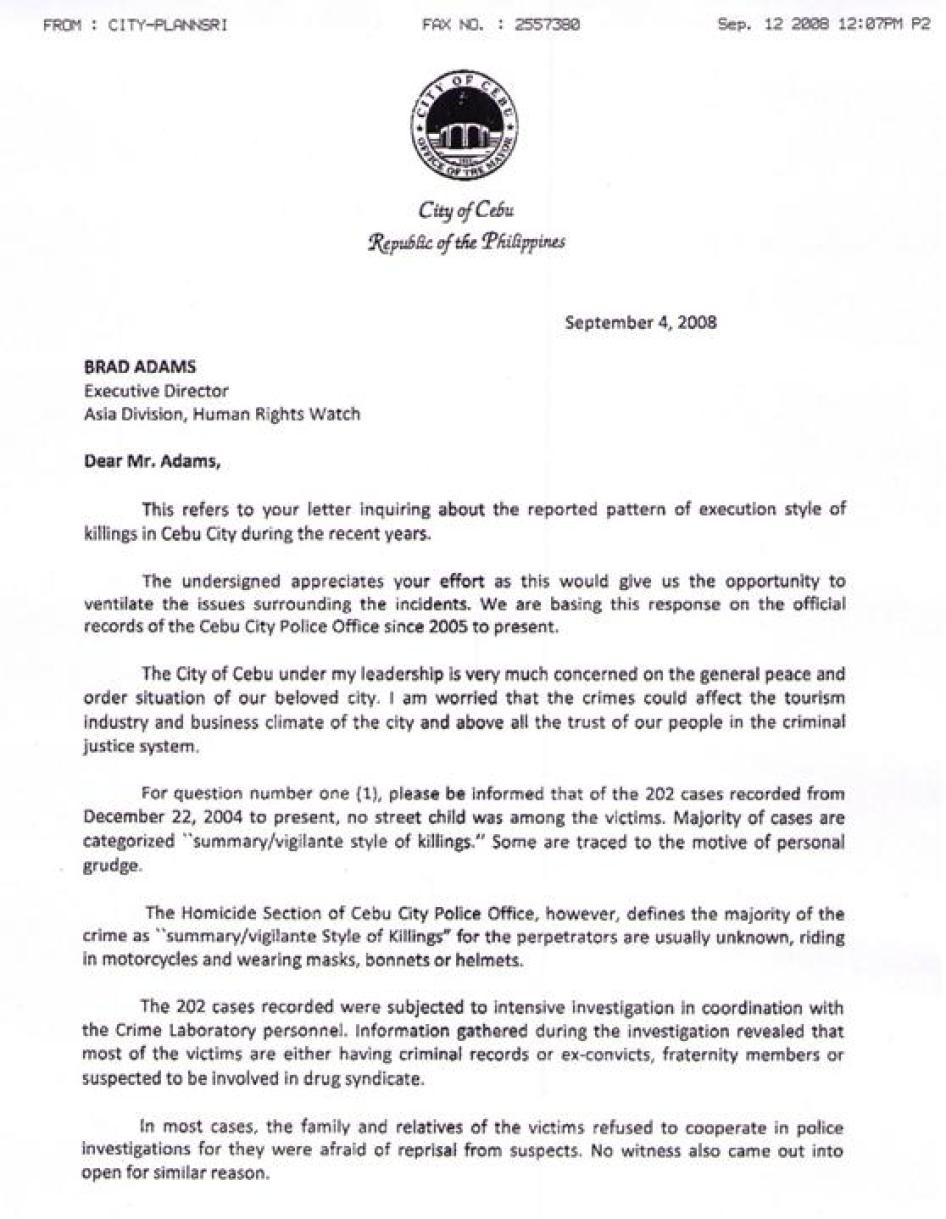
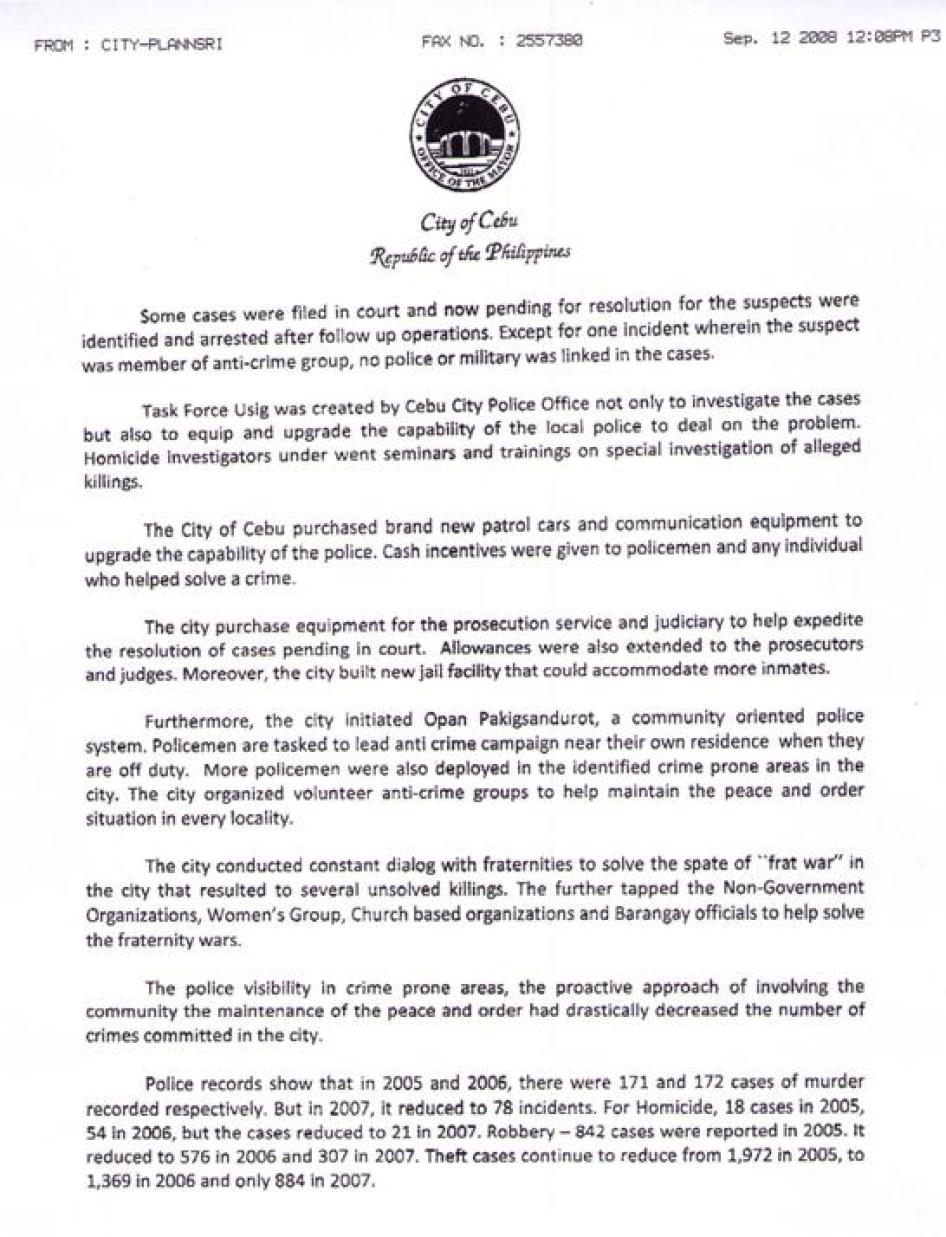
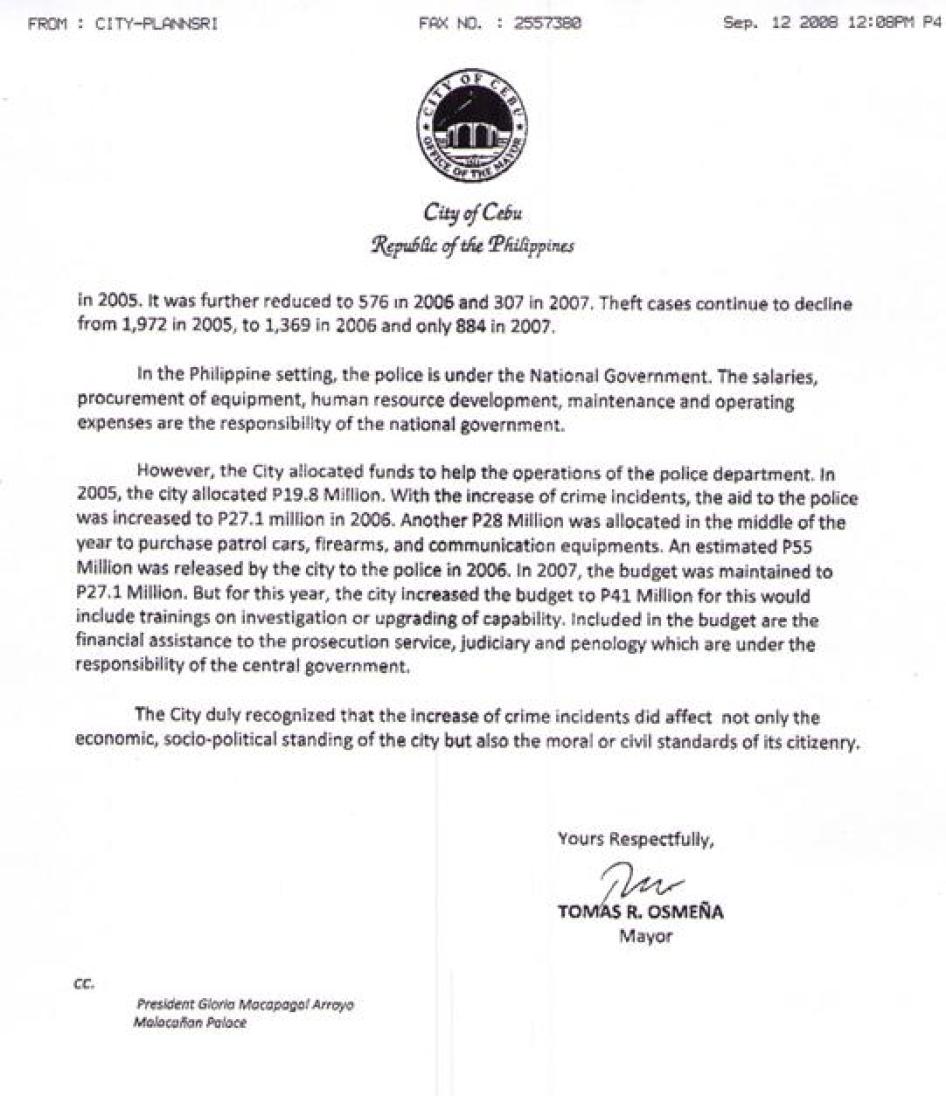
August 27, 2008
Hon. Pedro B. Acharon, Jr. Mayor, General Santos City Left wing, Ground Level, City Hall 9500 General Santos City Philippines
Dear Mayor Acharon,
Human Rights Watch is a nongovernmental organization based in New York that monitors violations of human rights by states and non-state actors in more than 80 countries around the world.
I am writing to solicit your views for our research on the pattern of execution-style killings of suspected petty criminals and street children in General Santos City in recent years. Human Rights Watch is committed to producing material that is well-informed and objective. We hope you or your staff would answer the attached questions so that your views are accurately reflected in our reporting. In order for us to take your answers into account in our forthcoming report, we would appreciate a written response by September 10, 2008.
Separately, I would like to request that you meet with Kay Seok, our researcher on the Philippines, on September 3 or 4 in General Santos City to discuss relevant issues. She will contact your office directly to arrange a day and time.
Thank you very much.
Brad Adams
Executive Director, Asia Division
Cc: Hon. Gloria Macapagal Arroyo President, Republic of the Philippines Malacañang Palace, JP Laurel Street, San Miguel Manila NCR 1005 Philippines Fax: +63-2-936-1107 (Records Section), +63-2-733-7446 (Executive Secretary)
Questions for Mayor Acharon
- How many homicides have been registered in General Santos City over each of the last three years? Local human rights groups and journalists in General Santos have reported on “execution-style killings” of petty criminals and street children. Does your office or the General Santos police attempt to tabulate a category of homicides that would fit this characterization? If so, what are the criteria used? How many such cases occurred over each of the past three years?
- How many homicide investigations have been opened by the General Santos City police in the past three years? How many of these investigations have resulted in prosecutions? Of these, how many resulted in convictions and in acquittals? In how many of the above cases were perpetrators members of the police? Military? Individuals acting as agents of governments officials? Are any such cases currently pending?
- Have the General Santos City police ever investigated the widespread allegations about a death squad? If so, what conclusions have the police reached? Please provide information on the size, composition and organizational structure of the death squad.
- How many General Santos City police officers in recent years have been disciplined or prosecuted for their involvement with the death squad or with execution-style killings? Please provide information on specific cases, including the role played by the police officers.
- Does the wide use in execution-style killings of .45 caliber pistols, a weapon normally available only to the police, suggest a police role in those killings? If not, why not?
- Have the General Santos police cooperated with the office of the Ombudsman in General Santos or the CHR office in General Santos concerning execution-style killings in General Santos City? What is the nature of this cooperation?
- Please provide figures for the past three years on funds provided to the General Santos City police by the city government’s Peace and Order Fund. For what purposes were these funds allocated?
- Please provide information regarding the status of police investigations into the following alleged homicides, all of which occurred in General Santos City. For each case please provide the names of any perpetrators identified, arrested or prosecuted, and any affiliation they might have. For investigations that have been suspended or discontinued, kindly provide the reasons for the suspension/discontinuation.
List of Cases (ages at the time of their death)
- Rolando Botel , 18, shot dead by men on motorcycle, January 14, 2008
- Rolando Concorado (or Conjorado), 18, shot dead by men on motorcycle, January 14, 2008
- Allen Concorado (or Conjorado), 23, shot dead by men on motorcycle, January 14, 2008
- Gabriel Sintasas, 24, shot dead by two men on motorcycle, March 19, 2008
- Marcos Uyanguren, 40, stabbed on the street by three men on a motorcycle, March 20, 2008
- Danilo Auges, 38, shot dead by men on a motorcycle, March 26, 2008
- German Sanches, 27, shot dead by one, May 24, 2008
- Jerry Baluno, 54, shot dead by two men on a motorcycle, June 7, 2008
- Aldrin Alba, 22, shot dead by men on a motorcycle, June 10, 2008
- Dodon Borga, 17, shot dead, first week of July, 2008
- Albin Basas, 22, shot dead by two men on a motorcycle, July 14, 2008
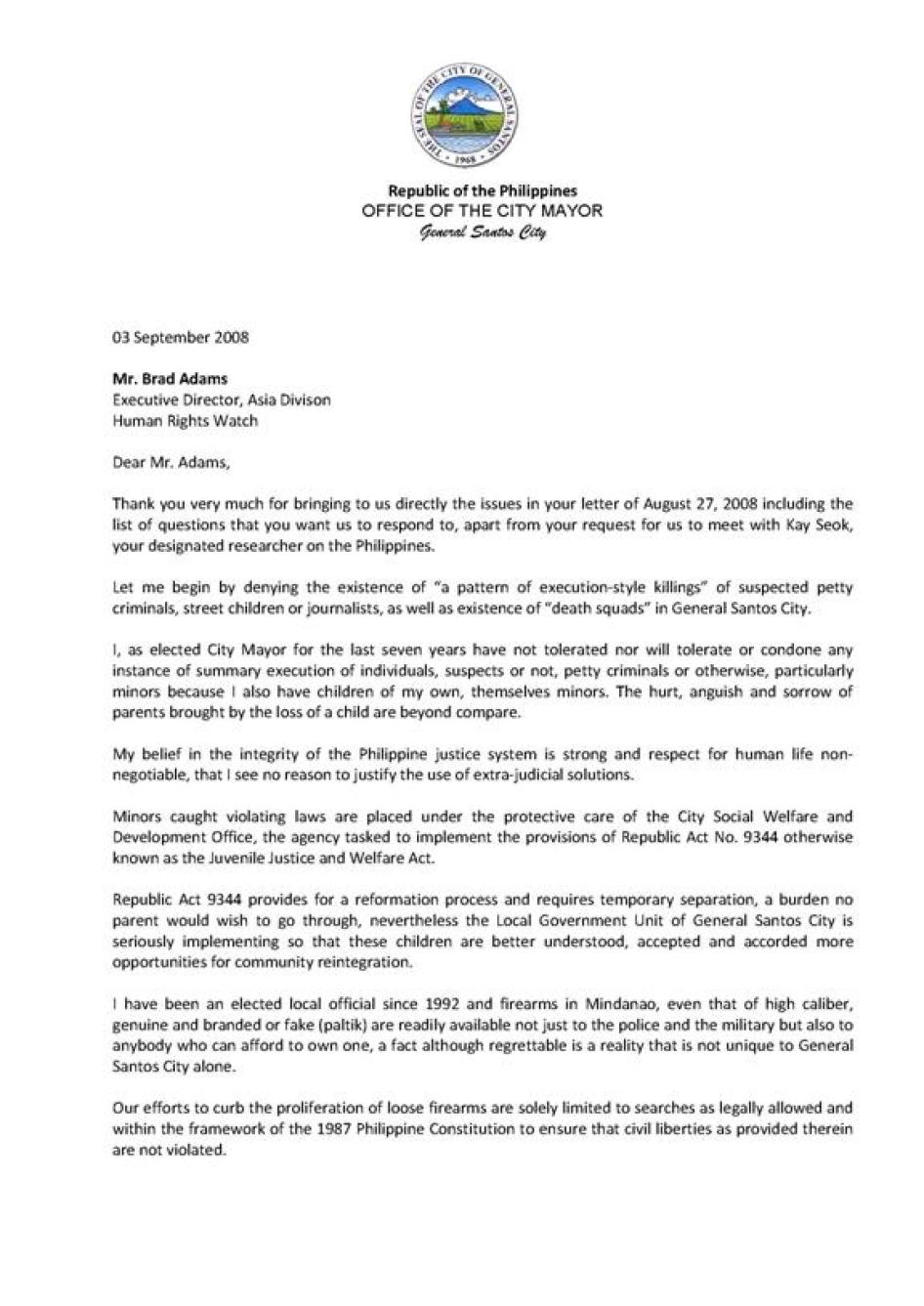
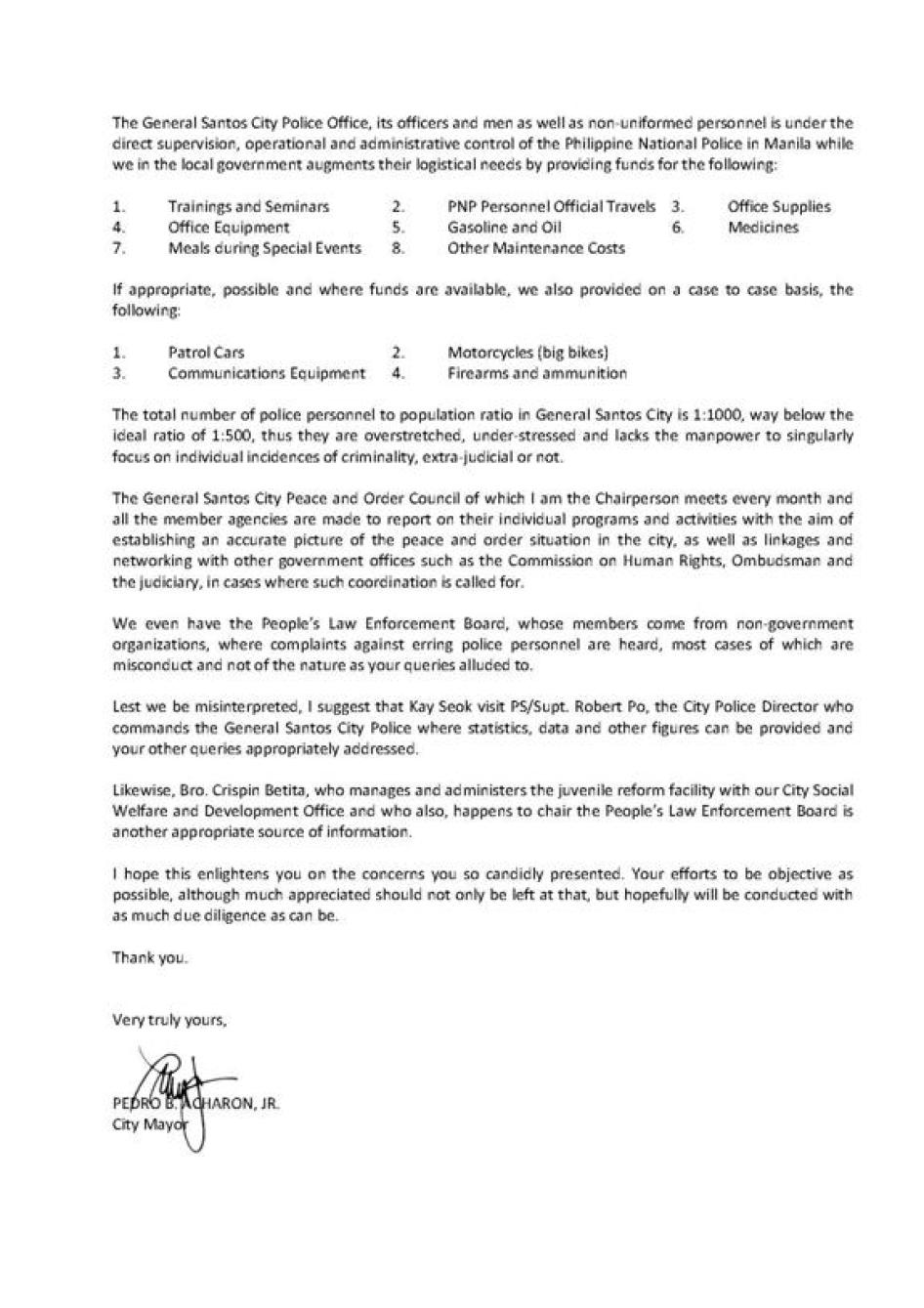
August 27, 2008
Atty. Raul B. Bendigo City Prosecutor City Prosecution’s Office, Hall of Justice, Ecoland Davao City Philippines
Dear Atty. Bendigo,
Human Rights Watch is a nongovernmental organization based in New York that monitors violations of human rights by states and non-state actors in more than 80 countries around the world.
I am writing to solicit your views for our research on the pattern of execution-style killings of suspected petty criminals and street children in Davao City in recent years. Human Rights Watch is committed to producing material that is well-informed and objective. We hope you or your staff would answer the attached questions so that your views are accurately reflected in our reporting. In order for us to take your answers into account in our forthcoming report, we would appreciate a written response by September 10, 2008.
Separately, I would like to request that you meet with Kay Seok, our researcher on the Philippines, on September 3 or 4 in Davao City to discuss relevant issues. She will contact your office directly to arrange a day and time.
Thank you very much.
Brad Adams
Executive Director, Asia Division
Cc: Sec. Raul M. Gonzalez Department of Justice, DOJ Building, Padre Faura Manila Philippines
Questions for Atty. Bendigo
- What are the responsibilities and the authority of the Prosecutor’s office vis-à-vis homicide cases committed in Davao City?
- How many cases of execution-style killings have been prosecuted in Davao city in the last three years? How many cases have reached the trial phase? How many convictions have been recorded? Please provide any detailes of such cases. What have been the main obstacles to successful prosecution of such cases?
- Does your office have a witness protection program? Has such a program ever been used to protect the witnesses in cases of execution-style killings?
- Has your office been satisfied with the effectiveness of police investigations into the execution-style killings? If not, what do you believe to be the main reasons for the ineffectiveness of police investigations which in turn prevents successful prosecution of such cases?
- Based on the evidence available to your office, do you believe that there is an organized force behind the spree of execution-style killings in Davao city? Have you ever addressed the allegation made by the local media as well as local and international human rights groups against the so-called “Davao Death Squad” (DDS)? If so, what conclusions have you reached?
- Are you aware of any cases where police officers were suspected of being involved in recruiting or training members of the so-called “Davao Death Squad,” providing them with information on suspected criminals, or making payment to them? If so, have there been any investigations into such cases? Have any police officers been arrested, charged, prosecuted and convicted as a result?
- Has your office ever received any inquiries from the office of the Ombudsman in Davao or CHR office in Davao in relation to the pattern of killings in the city or specific cases? Please provide any details of such inquiries and action taken by your office in response.
- What is the level of cooperation between your office and the Davao city government? Has the issue of execution-style killings and problems related to the prosecution of such cases ever been discussed between your office and the city government? If so, at what level? What was the outcome of such discussions?
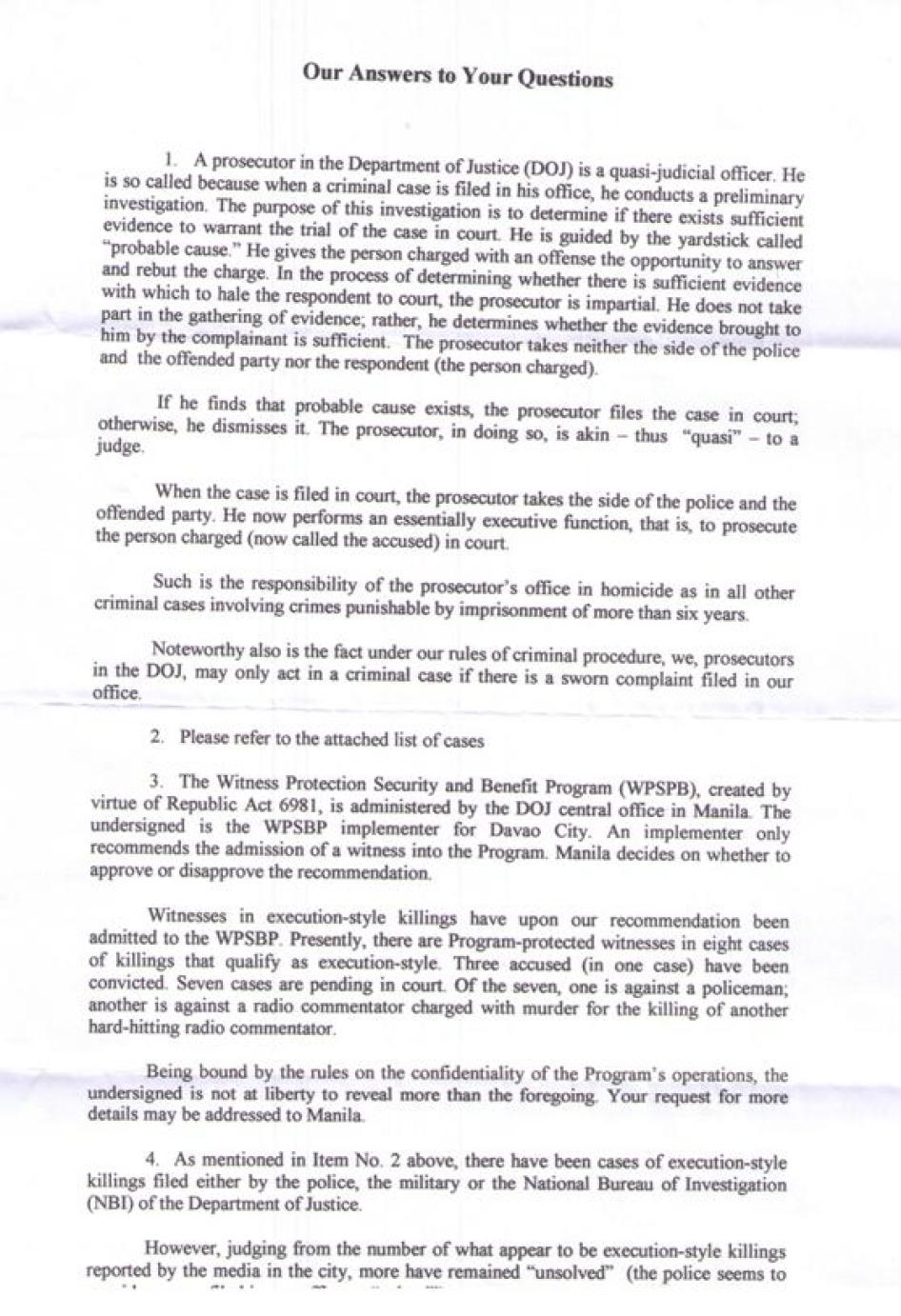
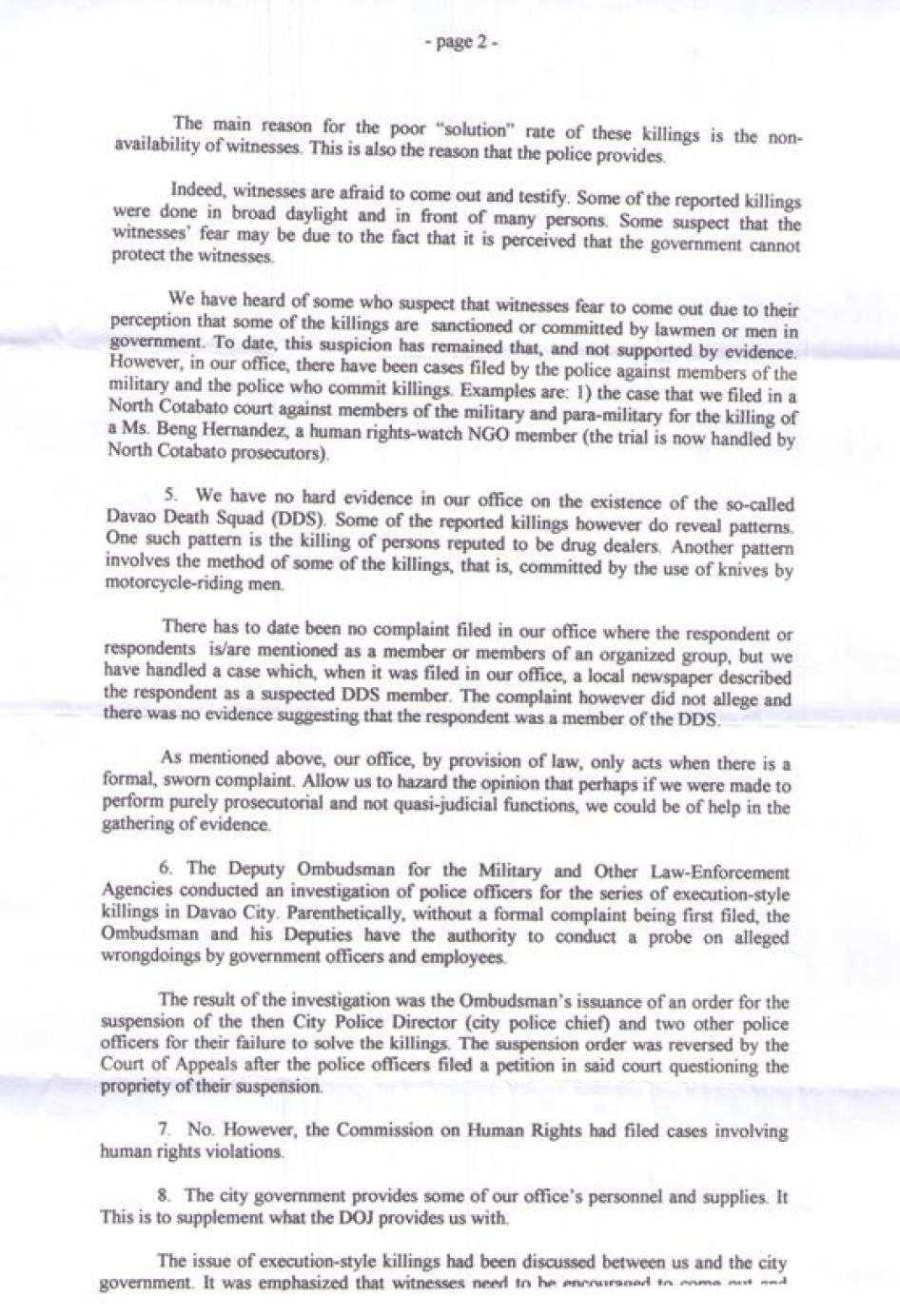
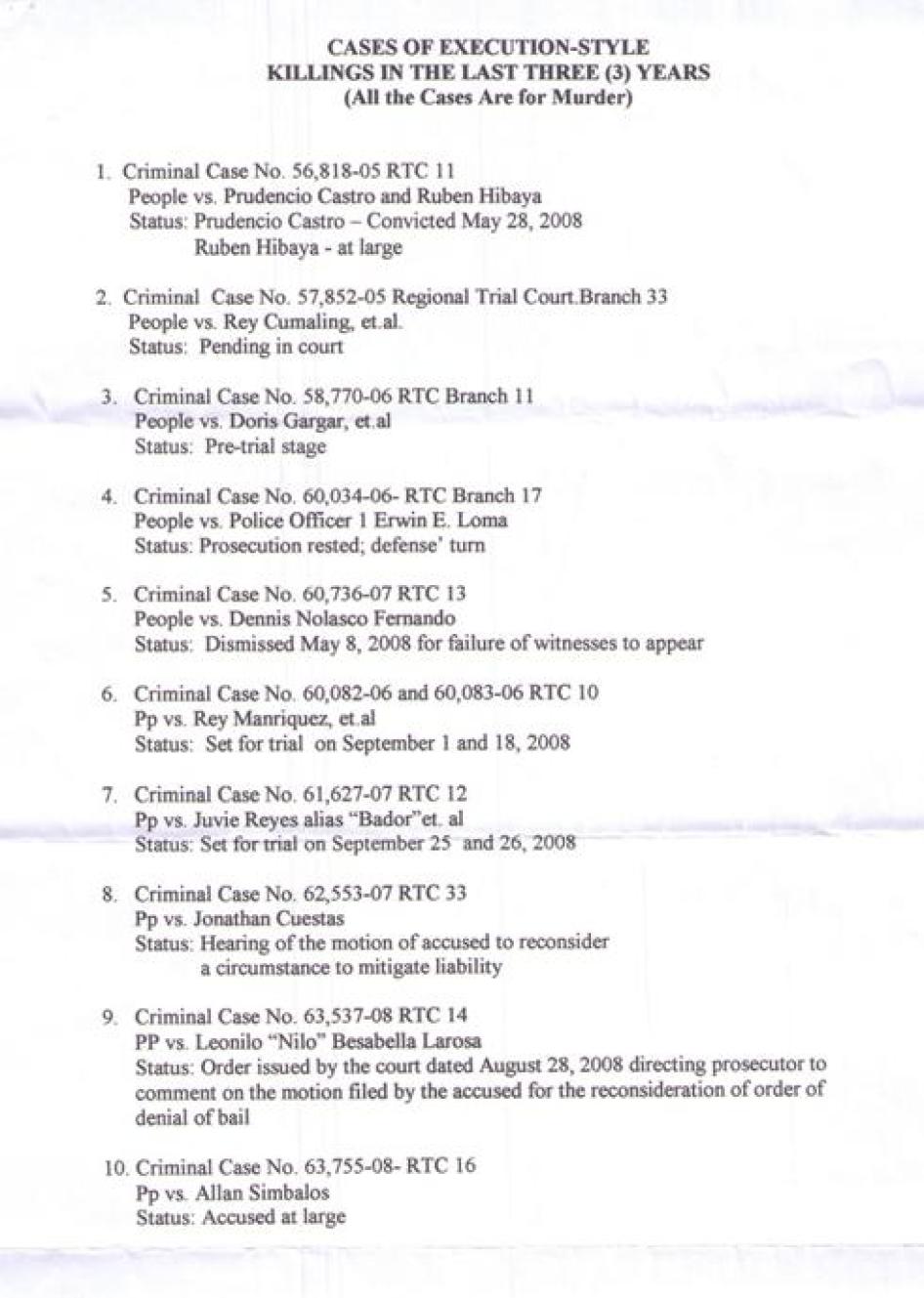
August 21, 2008
P/SSUPT. Ramon C. Apolinario City Director, Philippine National Police Davao City Police Office Camp Domingo Leonor, San Pedro St., 8000 Davao City Philippines Fax: +63-82-224-1313
Dear P/SSUPT. Apolinario
Human Rights Watch is a nongovernmental organization based in New York that monitors violations of human rights by states and non-state actors in more than 80 countries around the world.
I am writing to solicit your views for our research on the pattern of execution-style killings of suspected petty criminals and street children in Davao City in recent years. Human Rights Watch is committed to producing material that is well-informed and objective. We hope you or your staff would answer the attached questions so that your views are accurately reflected in our reporting. In order for us to take your answers into account in our forthcoming report, we would appreciate a written response by September 10, 2008.
Separately, I would like to request that you meet with Kay Seok, our researcher on the Philippines, on September 3 or 4 in Davao City to discuss relevant issues. She will contact your office directly to arrange a day and time.
Thank you very much.
Sincerely,
Brad Adams
Executive Director, Asia Division
Cc: Avelino Ignacio Razon Jr. Police Director General, Office of the Chief, PNP Camp Crame, Quezon City Philippines Telefax: +63-2-724-8763
Questions for P/SSUPT. Apolinario
- How many homicides have been registered in Davao City over each of the last three years? Databases compiled by local human rights groups and journalists in Davao contain the names of more than 600 victims of alleged “execution-style killings” of petty criminals and street children. Do you believe the 600 figure is roughly accurate? Does your department attempt to tabulate a category of homicides that would fit this characterization? If so, what are the criteria used? How many such cases occurred over each of the past three years?
- How many homicide investigations have been opened by the Davao City police in the past three years? How many of these investigations have resulted in prosecutions? Of these, how many resulted in convictions and in acquittals? In how many of the above cases were perpetrators members of the police? Military? Individuals acting as agents of governments officials? Are any such cases currently pending?
- Have the police ever investigated the widespread allegations about the so-called “Davao Death Squad” (DDS)? If so, what conclusions have the police reached? Please provide information on the size, composition and organizational structure of the DDS.
- How many police officers in recent years have been disciplined or prosecuted for their involvement with the DDS or with execution-style killings? Please provide information on specific cases, including the role played by the police officers.
- Does the widespread use in execution-style killings of .45 caliber pistols, a weapon normally available only to the police, suggest a police role in those killings? If not, why not?
- Have the Davao police cooperated with the office of the Ombudsman in Davao or the CHR office in Davao concerning execution-style killings in Davao City? What is the nature of this cooperation?
- Please provide figures for the past three years on funds provided to the Davao City police by the city government’s Peace and Order Fund. For what purposes were these funds allocated?
- Please provide information regarding the status of police investigations into the following alleged homicides, all of which occurred in Davao City. For each case please provide the names of any perpetrators identified, arrested or prosecuted, and any affiliation they might have. For investigations that have been suspended or discontinued, kindly provide the reasons for the suspension/discontinuation.
List of Cases (ages at the time of their death)
- Richard Alia, 17, stabbed to death, July 27, 2001
- Christopher Alia, 16, stabbed to death, October 20, 2001
- Bobby Alia, 14, stabbed to death, November 3, 2002
- Fernando Alia, 15, stabbed to death, April 13, 2007
- Jay-ar Ormido, 20, shot dead by three men on motorcycle, January 10, 2007
- Danilo Macasero, early 30s, stabbed to death by four men on two motorcycles, May 30 or 31, 2007
- Renante Lagarit, 20s, stabbed by two men on motorcycle, June 2007
- Adon Mandagit, 15, shot dead by three men on motorcycle, July 2007
- Cyrus Gitacaras, 20s, abducted in Davao City together with Jumael Maunte and found dead in Mauuab, August 2007
- Jumael Maunte, 24, abducted in Davao City together with Cyrus Gitacaras and found dead in Mauuab with gunshot wounds, August 2007
- Conrad Dequina, early 20s, shot dead by three men on motorcycle, October 10, 2007
- Nerito Calimbo, shot dead by men on motorcycle, May 22, 2008
- Jocelyn Calimbo, shot dead by men on motorcycle, May 22, 2008
- Aaron Sumitso, shot dead by men on motorcycle, May 22, 2008
- “Loloi” Rosales, 18, abducted and found dead with stab wounds, June 2008
- Rolando Jimenes, 50, shot dead by two men on motorcycle, June 15, 2008
- Jaypee Larosa, shot dead by men on motorcycle, July 17, 2008
Acknowledgements
This report was written by Anna Neistat, senior researcher in the Emergencies Division, and Kay Seok, researcher in the Asia Division, based on research conducted by the authors in July 2008.
Elaine Pearson, deputy director of the Asia Division, edited the report. James Ross, legal and policy director for Human Rights Watch, provided legal review. Program review was done by Joseph Saunders, deputy program director of Human Rights Watch. Specialist review was done by Bede Sheppard, researcher in the Children's Rights Division. Pema Abrahams, associate for the Asia Division, provided administrative and technical assistance. Fitzroy Hepkins and Grace Choi provided production assistance to the report. Portia Reyes, an intern, provided research assistance.
We also would like to thank the families and eyewitnesses who agreed to talk to us for this report. We are indebted to the nongovernmental organizations, lawyers, activists and journalists who generously assisted us in the course of our research and often provided comments and feed-back on our work.
[1] Since 1969, the New People’s Army has engaged in a rebellion with the goal of establishing a Marxist state. See Human Rights Watch, Scared Silent: Impunity for Extrajudicial Killings in the Philippines, vol. 19, no. 9(C), June 2007.
[2] Human Rights Watch, Scared Silent: Impunity for Extrajudicial Killings in the Philippines, Volume 19, No. 9(C), June 2007.
[3] Coalition Against Summary Execution, “Summary Executions in Davao City, August 1998 to February 2007,” undated, copy on file with Human Rights Watch. The “sparrow units” are NPA hit squads in charge of assassinating members of the police, military, and civilians.
[4] Because the Philippines was a Spanish colony for nearly 400 years, the vast majority of the country’s 90 million people are Roman Catholic. Most of the country’s roughly five million Muslims, who call themselves Moros, live in the southern islands.
[5] See Human Rights Watch, Lives Destroyed: Attacks Against Civilians in the Philippines, July 2007.
[6] Human Rights Watch/Asia, Bad Blood: Militia Abuses in Mindanao, the Philippines (New York: Human Rights Watch, 1992).
[7] Lawyers Committee for Human Rights, Vigilantes in the Philippines: A Threat to Democratic Rule (New York, 1988).
[8] Ibid.
[9] United Nations Office on Drugs and Crime, “Amphetamines and Ecstasy, 2008 Global ATS Assessment,” http://www.unodc.un.or.th/publications/Global-ATS-Assessment-2008.pdf (accessed February 24, 2009).
[10] Ibid.
[11] Philippine Drug Enforcement Agency, “2007 Annual Report,” http://www.pdea.gov.ph/publication.php#2007 (accessed January 13, 2009).
[12] The US Department of State, Bureau of International Narcotics and Law Enforcement Affairs, “The 2007 International Narcotics Control Strategy Report.”
[13] See Gregg R. Jones, Red Revolution: Inside the Philippine Guerrilla Movement (Boulder: Westview Press, 1989) pp. 133-43.
[14] Ibid.
[15] Manny Mogato, “Philippines declares holiday truce with NPA rebels,” Reuters, December 13, 2007
[16] Human Rights Watch uses the term "street children" to refer to anyone under the age of 18 who spends most of their time on the street or other public areas such as parks and markets without adult protection or supervision, and who regularly earns money through casual, street-based work. In accordance with the Convention on the Rights of the Child, this reports uses the definition that “a child means every human being below the age of eighteen years.” Convention on the Rights of the Child (CRC), adopted November 20, 1989, G.A. Res. 44/25, annex, 44 U.N. GAOR Supp. (No 49) at 167, U.N. Doc. A/44/49 (1989), art. 1. The Philippines ratified the convention on August 21, 1990.
[17] Tambayan-Center for the Care of Abused Children, Inc., “In the Shadows of Davao,” 2004, ISBN #971-92968-0-1.
[18] Human Rights Watch, Lives Destroyed: Attacks on Civilians in the Philippines, July 2007. At this writing in February 2009, no suspect has been convicted for either attack.
[19] Phil Zabriskie, “The Punisher,” Time Magazine, June 24, 2002.
[20] The Official Website of Davao City, Achievements and Recognition, “Most Peaceful City in East and Southeast Asia, 1998-2005,” http://www.davaocity.gov.ph/about/awards.htm (accessed February 24, 2009).
[21] Philippine National Police, “Annual Comparison of Crime Statistics, Period Covered: CY 1999 – CY 2008.” A copy of the document is on file with Human Rights Watch. The document contains only statistics, without any explanation or analysis.
[22] Several DDS “insiders” interviewed by Human Rights Watch suggested that “the DDS” is a term invented by the media and widely used in the community but not by the group members themselves. The group members do not appear to use a particular name for the group.
[23] Task Force Detainees of the Philippines, World Organisation Against Torture, Women's Education, Development, Productivity and Research Organisation & PREDA Foundation, “State Sponsored Violence against Children in Philippines,” an alternative report to the UN Human Rights Committee, October 2003.
[24] Human Rights Watch interview with “Ramon,” a pseudonym, Davao City, July 24, 2008.
[25] Coalition Against Summary Execution, “Summary Executions in Davao City, August 1998 to February 2007,” undated, copy on file with Human Rights Watch.
[26] Phil Zabriskie, “The Punisher,” Time Magazine, June 24, 2002.
[27] Although there have been frequent media reporting on death squad killings of drugs dealers, petty criminals, and street children in the above-mentioned cities, reliable statistics are not available.
[28] It was not clear what the number referred to, as in the same letter, the mayor said that from 2005 to 2007, 421 murder cases were registered in the city (171 in 2005, 172 in 2006, and 78 in 2007).
[29] Letter from Tomas R. Osmeña, mayor of Cebu City, to Human Rights Watch, September 4, 2008.
[30] Ibid.
[31] The surge in the number of killings in 2007-2008 has not been fully explained. However, the phenomenon may be at least partly explained in a Philippine Drug Enforcement Agency report that the number of local drug groups they identified in 2007 was sharply higher than in 2006. Such findings might have led authorities to identify members of drug syndicates previously unknown to them and consequently an increased number of arrests and killings. For more detail on the PDEA report, see chapter IV.
[32] Coalition Against Summary Execution, Davao City, Philippines, August 19, 1998 to February 1, 2009, untitled, copy on file with Human Rights Watch.
[33] Human Rights Watch interview, Davao City, July 28, 2008.
[34] Coalition Against Summary Execution, untitled document, February 1, 2009, on file with Human Rights Watch. The number of victims CASE documented for 2006 is much lower than 2005 or 2007. A spokesperson for CASE said they had difficulty collecting data in 2006, with many more cases where knives were used instead of guns.
[35] Human Rights Watch telephone interview with a Davao-based human rights activist, February 4, 2009. Human Rights Watch email correspondence with a Davao-based human rights activist, February 4, 2009.
[36] Dennis Jay Santos, “Police deny vigilantes exist in Davao,” Philippine Daily Inquirer, January 31, 2009.
[37] Letter from Raul D. Bendigo, City Prosecutor of Davao City, to Human Rights Watch, September 5, 2008.
[38] A barangay, a village or city district, is the smallest administrative unit in the Philippines.
[39] Human Rights Watch interview with a friend of Conrad Dequina, Davao City, July 22, 2008. For a detailed case description, see chapter VII.
[40] In six of the 28 cases Human Rights Watch documented persons personally familiar with the case specifically said the name of the victim had been on a list of people to be executed. In many other cases, they said that the victims had been warned prior to the killing.
[41] Human Rights Watch interview with an acquaintance of Cyrus Gitacaras, Davao City, July 19, 2008. For a detailed case description, see the case of Cyrus Gitacaras in chapter VII.
[42] Human Rights Watch interview with Clarita Alia, Davao City, July 19, 2008. For a detailed case description, see the cases of the Alia brothers in chapter VII.
[43] A jeepney is a popular means of public transportation, originally made from US military jeeps left over from World War II. They are usually lined with a couple of benches along the sides of the rear compartment, without a door, and spectacularly painted. A “tricycle” is a motorized three-wheeled vehicle also used for public transport.
[44] Coalition Against Summary Execution, untitled document, February 1, 2009, on file with Human Rights Watch.
[45] Human Rights Watch interview with Ramon, Davao City, July 24, 2008.
[46]Human Rights Watch interview with an eyewitness to the Adon Mandagit killing, Davao City, July 21, 2008. For a detailed case description, please see the case of Adon Mandagit in chapter VII.
[47] Philip Alston, “Report of the Special Rapporteur on extrajudicial, summary or arbitrary executions,” addendum, Mission to the Philippines, A/HRC/8/3/Add.2, April 16, 2008.
[48] The exchange rate in late February 2009 was 48 pesos for one US dollar.
[49] Human Rights Watch interview with “Ramon,” Davao City, July 24, 2008. Human Rights Watch interview with a freelance journalist, Davao City, July 24, 2008.
[50] Coalition Against Summary Execution, untitled document, February 1, 2009, copy on file with Human Rights Watch. In 2005, there were additional 28 cases for which there was no information on the method of killing.
[51] Coalition Against Summary Execution, untitled document, February 1, 2009, copy on file with Human Rights Watch.
[52] CASE’s data on victims by year, gender, age, methods, and location of killings are updated as of February 1, 2009, but its data on the profile of victims were last updated in May 2008.
[53] Coalition Against Summary Execution, “Summary Executions in Davao City, August 1998 to February 2007,” undated, copy on file with Human Rights Watch. CASE analysis on “reasons given for execution” was last updated in May 2008, although the rest of the data was updated as of February 1, 2009.
[54] Human Rights Watch interview, Davao City, July 22, 2008. For a detailed case description, see the case of Rodolfo More in chapter VII.
[55] Coalition Against Summary Execution, untitled document, February 1, 2009, copy on file with Human Rights Watch.
[56] Human Rights Watch interview with relatives, General Santos City, July 17, 2008. For a detailed case description, see the case of Gabriel Sintasas in chapter VII.
[57] Human Rights Watch interview with a relative, General Santos City, July 17, 2008.
[58]Human Rights Watch interview, Davao City, July 28, 2008.
[59] Human Rights Watch interview with a relative, Davao City, July 23, 2008.
[60] Jaypee Larosa is a nephew of Leonilo Larosa, a suspect in the killing of radio broadcaster Ferdie Lintuan in December 2007. The family, however, does not believe Jaypee’s killing was linked to Lintuan’s murder. Human Rights Watch talked to a close friend of the Larosa family who said he knew of no connection between the two killings.
[61] Human Rights Watch interview with “Ricardo,” a pseudonym, Davao City, July 21, 2008.
[62]Ibid.
[63] Ricardo said that his neighbor, a policeman, had this type of gun and he immediately recognized it.
[64] Human Rights Watch interview with a relative, Davao City, July 19, 2008.
[65] After investigation, the police can file a complaint before the City Prosecution’s Office, which then conducts its own investigation. If the prosecutor’s office concludes that there is probable cause, it files the corresponding information in the proper court. Witnesses who talked to Human Rights Watch sometimes said they “filed a case” when they instead appear to have “filed a complaint” with law enforcement or other offices.
[66] Human Rights Watch interview with a relative, Davao City, July 27, 2008. Investigative Report, Davao City Police, Police Station No. 2, May 29, 2008. A copy of the memorandum is on file with Human Rights Watch. Affidavit (on the killing of Richard and Christopher), City of Davao, October 24, 2001. A copy of the affidavit is on file with Human Rights Watch..
[67]Grace L. Plata and Rex C. Otero, “Cops release cartographic sketch of 1 suspect,” SunStar Davao, May 29, 2008.
[68] Ben O. Tesiorna, “Gang leader killed by own colleagues,” SunStar Davao, May 30, 2008.
[69] Human Rights Watch interview with a friend of Conrad Dequina, Davao City, July 22, 2008.
[70]Human Rights Watch interview with a relative of Jumael Maunte, Davao City, July 19, 2008.
[71] Human Rights Watch interview with a neighbor of Danilo Macasero, Davao City, July 19, 2008.
[72]Human Rights Watch interview with Clarita Alia, the mother of the victims, Davao City, July 19, 2008. Investigative Report, Davao City Police, Police Precinct No. 2, August 11, 2003. A copy of the memorandum is on file with Human Rights Watch.
[73] Human Rights Watch interview with a relative of the Ormido brothers, Davao City, July 19, 2008.
[74] Human Rights Watch interview with a relative of Rodolfo More, Jr., Davao City, July 22, 2008.
[75] Human Rights Watch interview with a friend of Kim Garcia, Davao City, July 21, 2008.
[76]Human Rights Watch interview with a relative of Romeo Jaca, Davao City, July 19, 2008.
[77]Human Rights Watch interview with two relatives of Danilo Auges, General Santos City, July 18, 2008.
[78] Human Rights Watch interview with two relatives of Gabriel Sintasas, General Santos City, July 17, 2008.
[79] Human Rights Watch interview with a relative of the Conjorados, General Santos City, July 17, 2008. The relative said three cousins of the Conjorado brothers have also received warnings from neighbors, and two of them left town. More than five years ago, the two had voluntarily surrendered themselves to barangay officials and police officers for dealing drugs and signed a “commitment letter” pledging to stop.
[80]Human Rights Watch interview with two relatives of Marco Angelo, Digos City, July 25, 2008.
[81]Human Rights Watch interview with a relative of Abdul Naser Diamad, Digos City, July 25, 2008.
[82] “Ramon” claimed his closest friend has been a death squad member since 2005. “Cecilia” talked of a neighbor, an alleged long-time death squad member. “Angela” said one of her uncles was a death squad member. “Anthony” said he had four friends who were death squad members. “Maria” claimed she had an uncle who was a death squad member. “Fernando” said he knew two death squad members. “Grace” said her father once visited a DDS safe house. One barangay police chief and another barangay official mentioned in this chapter had direct dealings with death squad members.
[83] Human Rights Watch interview with Ramon, Davao City, July 24, 2008. Other persons familiar with Ramon believed that he himself was a member of the DDS. Ramon told Human Rights Watch that the DDS had tried to recruit him, but claimed that he had refused the offer. His detailed description of the structure and functioning of the DDS suggest, however, that he may have had more direct knowledge of the group.
[84]Human Rights Watch interview, Davao City, July 27, 2008. Under Executive Order No. 366, peace and order councils are organized on the national, regional, provincial, city, and municipal levels of the Philippine government. The National Peace and Order Council is composed of top officials of various state agencies, including the Interior Department, Local Government Department, National Defense, Justice, the National Police Commission, and Dangerous Drugs Board, among others. The regional, provincial, and municipal peace and order councils are composed of officials from the corresponding level in each agency or institution. The City/Municipal and Barangay Government appropriate the necessary funds for the operation of the Barangay Peace and Order Committee from any available local funds. Peace and Order Committees are defined as “implementing arms” of the Peace and Order Councils. Among their tasks are gathering information on “criminal elements,” identifying “barangay constituents with strong deviant behavior for referral to appropriate authorities,” and monitoring, coordinating and supervising the operation of “all community-based anti-crime movements within the barangay.”
[85]Human Rights Watch interview with “Cecilia,” a pseudonym, Davao City, July 22, 2008.
[86] Human Rights Watch interview with “Angela,” a pseudonym, Davao City, July 19, 2008.
[87]Human Rights Watch interview with relatives of Marco Angelo, Digos City, July 25, 2008. For a detailed description of the case, see the case of Marco Angelo in chapter VII.
[88]Human Rights Watch interview with “Anthony,” a pseudonym, Davao City, July 27, 2008.
[89] The number may seem high, but the members supposedly include not only hitmen, but also drivers, lookouts, and errand-runners. Human Rights Watch cannot verify the number.
[90] Human Rights Watch interview with “Fernando,” a pseudonym, Davao City, July 23, 2008. Human Rights Watch interview with Anthony, Davao City, July 27, 2008.
[91]Human Rights Watch interview, Davao City, July 28, 2008.
[92]Human Rights Watch interview with Anthony, Davao City, July 27, 2008.
[93]Human Rights Watch interview, Davao City, July 27, 2008.
[94] Human Rights Watch interview with a relative of Noel Minoza, Davao City, July 21, 2008.
[95] Human Rights Watch interview with Fernando, Davao City, July 23, 2008.
[96] Although .45 caliber handguns are mostly used by law enforcement officials in the Philippines, civilians can acquire and register .45 caliber guns if they are members of a gun club. Once a civilian acquires a .45 caliber handgun from a gun store, the store in turn process the licensing and membership with a gun club.
[97]Human Rights Watch interview with Angela, July 19, 2008. Human Rights Watch interview with two local officials, Davao City, July 27, 2008. A balisong, otherwise known as a butterfly knife or a Batangas knife, is a Philippine folding pocket knife with two handles counter-rotating around the blade such that, when closed, the blade is concealed within grooves in the handles. Standard Batangas knives are 29 cm in length.
[98] A local journalist in General Santos City echoed Ramon’s account, saying that while it is possible for civilians to procure .45-caliber guns, most gang members cannot afford them and carry home-made guns instead.Human Rights Watch interview with a local journalist, General Santos City, July 18, 2008.
[99]Human Rights Watch interview with Ramon, Davao City, July 24, 2008.
[100] By law, motorcycle riders in Davao City must have a license plate and wear helmets. Violations are subject to heavy fines. Davao City Ordinance No. 0189-06, March 2006. Administrative Order No. AHS-2008-015, May 2008, Section III.
[101]Human Rights Watch interview with Fernando, Davao City, July 23, 2008.
[102] Human Rights Watch interview with “Maria,” a pseudonym, Davao City, July 24, 2008.
[103] Human Rights Watch interview with Ramon, Davao City, July 24, 2008. Human Rights Watch interview with a freelance journalist , Davao City, July 24, 2008.
[104]Human Rights Watch interview with a barangay police chief, Davao City, July 27, 2008.
[105] Human Rights Watch interview with a local official, Davao City, July 27, 2008.
[106]Human Rights Watch interview with a local resident, Davao City, July 26, 2008.
[107] Human Rights Watch interview with “Grace,” a pseudonym, Davao City, July 19, 2008.
[108]Human Rights Watch interview with a Davao-based freelance journalist, Davao City, July 24, 2008.
[109]Human Rights Watch interview with Fernando, Davao City, July 23, 2008.
[110]Human Rights Watch interview with Anthony, Davao City, July 27, 2008.
[111] Ramon provided the name of the executed man to Human Rights Watch. He said that the man who showed the photo asked him whether he knew the person in the photograph, and when Ramon confirmed that he did, the man said that it was he who had killed him. Human Rights Watch also received information about this killing from another person, interviewed independently.
[112]Human Rights Watch interview with Anthony, Davao City, July 27, 2008.
[113]Human Rights Watch interview with Angela, Davao City, July 19, 2008.
[114]Human Rights Watch interview, Digos City, July 25, 2008.
[115]Human Rights Watch interview, Davao City, July 24, 2008.
[116] Human Rights Watch interview with Angela, Davao City, July 19, 2008.
[117] Human Rights Watch interview with two local officials, Davao City, July 27, 2008. Another witness interviewed independently repeated this account almost verbatim. Human Rights Watch interview with Anthony, Davao City, July 27, 2008.
[118] Human Rights Watch interview, Davao City, July 28, 2008.
[119]Human Rights Watch interview, Davao City, July 28, 2008.
[120]Human Rights Watch interview with a relative of Rolando Jimenes, Davao City, July 21, 2008. For a detailed case description, see the case of Rolando Jimenes in chapter VII.
[121] Human Rights Watch interview with Clarita Alia, Davao City, July 19, 2008. For a detailed case description, see the case of the Alia brothers in chapter VII.
[122] Republic Act No. 6975 of the Philippines, Chapter III, sec. 24.
[123] PNP Operational Procedures, Rule 13. Crime Scene Investigation.
[124] Republic Act No. 6713 of the Philippines, sec 5: Duties of Public Officials and Employees. “In the performance of their duties, all public officials and employees are under obligation to (a) Act promptly on letters and requests. All public officials and employees shall, within fifteen (15) working days from receipt thereof, respond to letters, telegrams or other means of communications sent by the public. The reply must contain the action taken on the request.”
[125] International Covenant on Civil and Political Rights (ICCPR), adopted December 16, 1966, G.A. Res. 2200A (XXI), entered into force March 23, 1976, art. 2. The Philippines ratified the ICCPR in October, 1986.
[126]Human Rights Watch interview with local officials, Davao City, July 27, 2008.
[127]Human Rights Watch interview with Anthony, Davao City, July 28, 2008.
[128]Human Rights Watch interview, Davao City, July 28, 2008.
[129] Human Rights Watch interview, Davao City, July 28, 2008.
[130] Human Rights Watch interview, Davao City, July 22, 2008. For a detailed case description, see the case of Conrad Dequina in chapter VII.
[131] Jose G. Dalumpines, “Police doing its best on killings: DCPO director,” Mindanao Times, July 29, 2008.
[132] Letter from Raul D. Bendigo, City Prosecutor of Davao City, to Human Rights Watch, September 5, 2008.
[133] Human Rights Watch interview with Clarita Alia, Davao City, July 19, 2008. For a detailed case description, see the case of the Alia brothers in chapter VII.
[134] Investigation Report, Davao City Police, Police Precinct No. 2, August 11, 2003. A copy of the memorandum is on file with Human Rights Watch.
[135] Human Rights Watch interview with a local journalist, Davao City, July 28, 2008.
[136] Human Rights Watch interview with Manuel P. Quibod, a Davao City-based lawyer with Free Legal Assistance Group, Davao City, July 25, 2008.
[137] The Rule of Court explains the role of prosecutors in prosecution of offenses. Section 5 of Rule 100 reads, “all criminal actions commenced by a complaint or information shall be prosecuted under the direction and control of the prosecutor.”
[138] Ibid.
[139] Letter from Raul D. Bendigo, City Prosecutor of Davao City, to Human Rights Watch, September 5, 2008.
[140]Philip Alston, “Report of the Special Rapporteur on extrajudicial, summary or arbitrary executions,” addendum, Mission to the Philippines, A/HRC/8/3/Add.2, April 16, 2008.
[141] Jeffrey M. Tupas, “Where crime suspects live dangerously,” Philippine Daily Inquirer, February 15, 2009.
[142]“Top cops face suspension for failing to solve vigilante killings,” Philippine News Agency, July 1, 2005.
[143]Letter from Raul D. Bendigo, City Prosecutor of Davao City, to Human Rights Watch, September 5, 2008. In the Philippines, governors and mayors have the authority to “direct, superintend, and oversee the day-to-day functions of police investigation of crime, crime prevention activities, and traffic control,” select the chief of police, and “inspect police forces and units, conduct audit, and exercise other functions.” See Republic Act No. 8551 of the Philippines, Title VIII, Sec. 62-64.
[144]Letter from Raul D. Bendigo, City Prosecutor of Davao City, to Human Rights Watch, September 5, 2008.
[145] Jeffrey M. Tupas, “Where crime suspects live dangerously,” Philippine Daily Inquirer, February 15, 2009.
[146] Human Rights Watch interview with local officials, Davao City, July 27, 2008.
[147] Coalition Against Summary Execution, “Summary Executions in Davao City, August 1998 to February 2007,” undated, on file with Human Rights Watch.
[148] Carlos H. Conde, Philippine Center for Investigative Journalism, “Teenagers perish in Davao's killing fields,” December 23-24, 2002.
[149] Human Rights Watch interview with a relative of Noel Mendoza, Davao City, July 21, 2008.
[150]Human Rights Watch interview with Angela, Davao City, July 19, 2008.
[151] Alan Sipress, “Vigilante killings alarm Philippines citizens,” The Washington Post, November 30, 2003.
[152] Kathy Marks, PREDA Foundation, Inc., “Philippines city flourishes under rule of the gun,” May 20, 2004, http://www.preda.org/archives/2004/r04052002.html (accessed February 24, 2009).
[153]Ben O. Tesiorna, “Media urged to probe 'vigilante' killings,” SunStar Davao, January 22, 2007.
[154]Philip Alston, “Report of the Special Rapporteur on extrajudicial, summary or arbitrary executions,” addendum, Mission to the Philippines, A/HRC/8/3/Add.2, April 16, 2008.
[155] Editha Z. Caduaya, “Duterte frustrated at “DDS brain” tag,” The Mindanao Daily Mirror, August 12, 2008.
[156] Jeffrey M. Tupas, “Where crime suspects live dangerously,” Philippine Daily Inquirer, February 15, 2009.
[157]Edwin G. Espejo, “Mayor issues warning to drug pushers anew,” SunStar General Santos, September 16, 2003.
[158] Open letter from Asia Human Rights Commission to Commissioner Leila De Lima of the Commission on Human Rights of the Philippines, June 4, 2008.
[159] Human Rights Watch interview , Digos City, July 25, 2008, In Digos City, the death squad is called the Dalunggan Death Squad, or the DDS. Dalunggan means “ear” in Visayan, the local dialect.
[160]“Tomas admits: I inspired killings,” SunStar Cebu, January 8, 2005.
[161]“Police not to blame for rash of murders: mayor,” SunStar Cebu, October 4, 2005.
[162] Letter from Pedro B. Acharon Jr., mayor of General Santos City, to Human Rights Watch, September 3, 2008.
[163] Ibid.
[164] See Republic Act No. 6975, sec. 51-52, and The Local Government Code of 1991.
[165] Human Rights Watch telephone interview with Police Superintendent Walfredo G. Pornillos, Assistant Chief, Foreign Liaison Division, PNP, February 3, 2009.
[166]Human Rights Watch interview with an NGO worker, Davao City, July 23, 2008. Human Rights Watch telephone interview with a human rights activist, February 4, 2009. Human Rights Watch interview with an individual close to the Digos City government, Digos City, July 25, 2008. Generally, it is the office of the local chief executive (the office of the City Mayor in the case of Davao City) that proposes an annual budget, which includes the budget for the Peace and Order Fund, and submits the same to the local legislative council for scrutiny and passage into an ordinance. Once the legislative council passed the annual budget, it is then returned to the office of the mayor, for the latter’s signature of approval, or, in very rare instances, veto or disapproval. The mayor has the sole discretion then on where to spend that portion of the Peace and Order fund that is not subject to audit, such as the intelligence fund.
[167]“P450M of Davao City 2009 budget goes to peace and order programs,” Philippine News Agency, November 3, 2008.
[168]Human Rights Watch interview with Ramon, Davao City, July 24, 2008. Human Rights Watch interview with a freelance journalist, Davao City, July 24, 2008.
[169] Eldie S. Aguirre, “More officials air concern over outcry to end vigilante killings,” Manila Bulletin, August 4, 2004.
[170]“Death squads terrorise southern Philippine city: UN monitors,” Agence France Presse, February 12, 2008.