No Direction Home
Returns from Guantanamo to Yemen
Map of Yemen
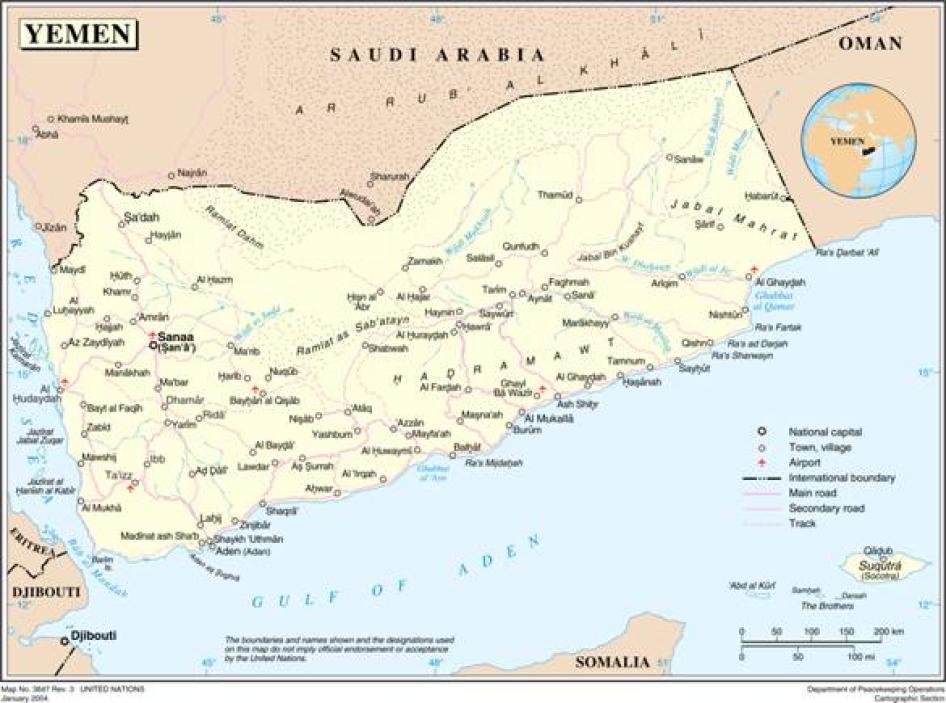
Yemen, no. 3847, Rev. 3 © 2004, UN Cartographic Section
Summary
People are losing hope day by day. We've been promised release so many times, but it hasn't happened.
-Said Hatimof Yemen, who has been imprisoned at Guantanamo since 2002[1]
The United States and Yemen are stalled on the fate of an estimated 99 Yemenis locked inside the US military prison at Guantanamo Bay, Cuba, some of whom are in their eighth year of detention without charge. Hundreds of prisoners have been sent home from Guantanamo in recent years, but only 14 of them were from Yemen. Now the largest single group among the 241 prisoners remaining at Guantanamo, the Yemenis represent one of the main challenges to President Barack Obama's pledge to close the controversial outpost by January 2010.
For more than a year, both Yemeni and US authorities have said they want many of the Yemeni detainees to return home as soon as possible. Yet by the end of the Bush presidency in January 2009, the two countries had only agreed on the most rudimentary elements of a repatriation agreement: what one US diplomat called "not even a shell." Even detainees who have long been cleared for return to Yemen remain in US custody.
The United States does not intend to repatriate those Yemenis it plans to prosecute. Thus terror suspects such as Ramzi bin al-Shibh-charged before the US military commissions with conspiring in the September 11 attacks-will not be leaving US custody anytime soon. In addition, both countries want Yemenis suspected of violating Yemeni law to be prosecuted upon return. US fears about the Yemenis in US custody, however, extend even to those whom it has no grounds to prosecute. Having held them for years as "enemy combatants," US officials are now worried that the men will "return to the fight."
As the diplomatic impasse continues, many Yemenis at Guantanamo have joined a hunger strike to protest their continuing detention without charge.
Unless the two countries agree on a repatriation plan that ensures the detainees' rights, the men's prospects are bleak. For now they endure continuing arbitrary detention at Guantanamo, and upon return they face the possibility of further abuses. There is even talk of sending some of them to Saudi Arabia. Two Yemeni detainees whom US authorities have held for years without charge at Bagram Air Base in Afghanistan are in similar straits.
In their public comments, the United States and Yemen agree that repatriated detainees should receive counseling, job training, and rehabilitation. But negotiators seem to have made little progress resolving who should fund such programs and, of particular concern to US officials, how to ensure that former prisoners stay away from armed militancy.
The problem, from the US perspective, is the environment to which the men will return more than it is the men themselves. Yemeni prisoners have languished at Guantanamo and Bagram longer than other nationalities not because they are, as a group, deemed to be more of a threat, but rather because the United States views their country with serious concern. An impoverished, politically volatile nation on the Arabian Peninsula, Yemen has seen a dramatic surge in armed violence in the past few years. Al Qaeda and its followers have been linked to numerous recent attacks there, including a double-suicide bombing outside the US Embassy in Sanaa that killed 18 people in September 2008. More directly, at least two Saudis released from Guantanamo in 2007 have slipped into Yemen to join al Qaeda.
In interviews with Human Rights Watch in December 2008, US and Yemeni officials spoke of their security concerns, their bilateral negotiations, and their views on how to handle repatriated prisoners. Senior Yemeni officials described their proposed detainee rehabilitation center, and later provided Human Rights Watch with a brief written summary of the plan (see the appendix).
While Human Rights Watch recognizes that the United States has legitimate questions regarding security, there is reason for concern about the direction of US-Yemeni negotiations. Without proper safeguards, Yemen's proposed rehabilitation center could become a proxy Guantanamo, indefinitely detaining suspects on the unproven chance they may cause harm in the future. As a US Embassy official told Human Rights Watch, the United States would like Yemen to place repatriated detainees in "basically a prison facility with a programmatic aspect," provided Yemen finds a legal framework to do so.
The Yemeni authorities have sought to minimize the detention aspect, saying that the proposed rehabilitation center would be similar to a "camp." Their written summary states that participants would be rehabilitated "religiously, culturally, vocationally and medically" in a setting complete with sports, cultural activities, and family visits. The government would hire specialists to evaluate each detainee and analyze "the causes that have contributed to their joining terrorist groups."
The summary gives no indication, however, of how long authorities would hold repatriated detainees, or of what criteria and procedures they would use to determine whether the returnees are ready for release. Yemeni officials told Human Rights Watch that the repatriated men could spend anywhere from a week to a year or more in custody upon their return. Human Rights Watch is particularly concerned that under US pressure, that period could be extended further.
Equally troubling, the summary's language makes a sweeping assumption that all the detainees were militants, although none who would be sent home has yet been charged with or convicted of any offense. Although the Bush administration repeatedly stigmatized the detainees at Guantanamo as terrorists-the "worst of the worst"-there has been no fair legal process by which such claims have been tested. To treat returnees as criminals who pose a threat of recidivism ignores the circumstances of their capture and detention at Guantanamo, even if it assuages US security concerns.
Finally-and most practically-the proposed rehabilitation center has yet to be built. Given the January 2010 deadline for Guantanamo's closure, this may increase the odds that future returnees will end up in a rehabilitation program in Saudi Arabia, where they could also face prolonged detention without charge, or, like previous returnees, in what is clearly the default solution: the jails and prisons run by Yemen's security services.
The experience of "Fahmi Muhammad," who was repatriated from Guantanamo in 2004, underscores this risk.[2]He told Human Rights Watch that upon his arrival in Yemen the authorities threw him into a political security prison and tried to beat him into falsely confessing that he was acting as a US spy.
As he described it:
I was tortured for five days, from nine in the morning until dawn. The cell was dark. They beat me with shoes. There were insults, bad words and threats to do bad things to my female relatives and to imprison my father. I told them, "If you're going to torture me, it won't be anything new. The Americans already put me through torture."
Although Muhammad endured the worst treatment by far, other returnees and their lawyers also told Human Rights Watch of abuse. All 14 of the former Guantanamo detainees who have been returned to Yemen were detained by Yemeni security services, most for two to three months. Some of them claim to have been held in squalid conditions, in at least two cases underground, with no access to legal counsel and only sporadic family visits. The Yemeni authorities did not free them until they had secured a guarantor: a relative, tribesman, or prominent businessman who faces fines or imprisonment if the released man misbehaves.
Notably, the former detainees have received no counseling, job training, financial assistance, or other help reintegrating into Yemeni society. To the contrary, they are required to report regularly to local security officials, and are branded as terror suspects, a near-insuperable obstacle to finding employment. "I can't get a job, not when people know I've been in Guantanamo and Political Security," said Muhammad, noting that most Yemenis dread the security services' attention. "People are afraid."
Muhammad's situation is illustrative on many fronts. Penniless and depressed, he also cannot get a loan, and has no access to medical care. With no money to afford a home for his family, he lives away from his wife and child. "If our brothers at Guantanamo knew of these conditions," he told Human Rights Watch, "they would not want to return."
In fact, unlike citizens of certain other countries at Guantanamo and Bagram, nearly all of the Yemenis are eager to go home. But if they return to continued abuse in detention, and face bleak reintegration prospects upon release, they may become the security risks that US policy-makers fear.
A comprehensive reintegration program that respects detainees' rights and helps them build productive lives could well cost millions of dollars, a sum that Yemen, the poorest country in the Middle East, can hardly afford. In keeping with its international obligations to provide an effective remedy to victims of human rights violations, the United States should provide most of the funding and oversight for such a program.
In certain circumstances, it may be appropriate for Yemen to monitor the movement and associations of returned detainees. The government should not, however, impose restrictions that would be equivalent to a punishment resulting from a conviction on a criminal charge. Any restrictions require a fair legal process-one that relies on evidence brought before a court, with a right to contest the evidence and to appeal the ruling-not just a presumption of guilt stemming from the returnee's previous detention at Guantanamo.
The United States and Yemen should act swiftly to reenergize negotiations and organize the return of Yemeni detainees. Crafting a fair, humane, and immediate solution for these men is a strategic necessity as well as a legal and moral imperative. Violating the rights of individuals-whether at Guantanamo or Bagram, in Saudi Arabia or Yemen-spurs terrorist recruitment, giving groups like al Qaeda a powerful tool for persuading disaffected youths to join their cause. By contrast, making an unqualified break with the Bush administration's abusive detention practices will help President Obama wield the moral authority that the United States needs to effectively fight terrorism both at home and abroad.
Recommendations
To the Government of the United States
- Prosecute in US federal court any Yemenis held at Guantanamo and Bagram who are implicated in terrorism-related offenses.
- Promptly repatriate any Yemenis who will not be prosecuted in the United States and who do not express a credible fear of torture or persecution at home.
- Resettle in a safe third country any Yemeni who cannot be repatriated due to a credible fear of torture or persecution at home.
- Fund comprehensive job training, education, counseling, and other rehabilitation services for repatriated detainees, many of whom are in their eighth year of unlawful US custody.
- Share any credible evidence implicating former detainees in criminal acts with the appropriate Yemeni authorities.
- Do not pressure the Yemeni government to hold repatriated detainees without charge, or to impose other restrictions without due process.
- Apologize and provide suitable compensation to detainees arbitrarily detained, tortured or otherwise mistreated in US custody.
- Create a non-partisan investigatory body (a truth commission) with subpoena power to investigate allegations of abuse of Yemenis and other nationals as a result of US counterterrorism policies and practices. The panel should address who should be held criminally accountable for these abuses and how such accountability can be achieved.
- Protest publicly and at the diplomatic level any mistreatment in Yemen of former detainees.
To the Government of Yemen
- Provide returnees from Guantanamo and Bagram with access to medical care, psychological and religious counseling, job training, education, and financial assistance.
- Do not use rehabilitation as a justification for indefinite detention without charge. Offer reintegration programs in the least restrictive settings possible.
- Conduct thorough and impartial criminal investigations of any repatriated detainees suspected of criminal offenses.
- Prosecute those charged with crimes in proceedings that meet international fair trial standards. These standards include holding trials before impartial and independent courts, ensuring that defendants have access to counsel and adequate time and facilities to prepare a defense, and prohibiting the use of evidence obtained through torture. Persons incarcerated after conviction should be imprisoned in facilities that meet international standards.
- Do not impose arbitrary restrictions on released detainees' movements and associations. Security restrictions that fall short of criminal sanctions should only be imposed according to law and after a fair and transparent process that offers the detainee a fair opportunity to challenge them.
- Allow impartial and independent nongovernmental organizations, both national and international, to monitor repatriation, detention, and reintegration procedures to evaluate their effectiveness and safeguard the rights of persons subject to them.
- Enforce bans on torture codified in Yemeni law and in the Convention against Torture and Other Cruel, Inhuman or Degrading Treatment or Punishment.
- Do not hold hostage the relatives of former detainees for the purpose of compelling the former detainees' surrender.
- Establish independent, judicial oversight over the Political Security Organization and National Security Bureau, particularly their powers of arrest and places of detention.
- Grant UN human rights monitoring bodies and independent local and international human rights organizations regular access to all prisoners in Yemen, including any prisoners repatriated from Guantanamo and Bagram.
To the League of Arab States, Member States of the European Union, and United Nations Specialized Programs
- Provide political and economic support for efforts to rapidly and humanely repatriate Yemenis from Guantanamo, provide rehabilitation services, and address security concerns while protecting the right to due process and other fundamental rights of returned detainees.
Methodology
This report is based on interviews with three Yemenis formerly detained at Guantanamo, relatives of current and former Yemeni prisoners at Guantanamo and Bagram Air Base, and more than two dozen Yemeni and US lawyers, human rights activists, political analysts, legislators and journalists. Human Rights Watch also interviewed a number of US State Department officials and senior Yemeni officials.
Two Human Rights Watch staff members conducted most of the interviews during a two-week mission to Yemen in December 2008. Human Rights Watch supplemented field research with telephone and e-mail interviews, court papers, US and Yemeni government documents, and media reports.
Human Rights Watch has used pseudonyms for former detainees and omitted some details of their experiences to protect them from possible retaliation.
Background
An impoverished, politically volatile nation on the southwest tip of the Arabian Peninsula, Yemen is caught between increasing Islamist violence and the US-led "global war on terror." The country is also grappling with armed conflict in the north, separatist campaigns in the south, and a flood of refugees from war-torn Somalia, which lies across the pirate-infested Gulf of Aden. Rampant corruption, chronic hunger, and high unemployment fuel alienation within the country's burgeoning youth population.[3]
Yemen is also a nexus for international weapons trafficking, particularly to Somalia, and is awash in firearms, which are said to outnumber its 22.2 million inhabitants nearly three to one.[4] Tribes control much of the territory outside major cities, and some of them routinely kidnap Yemeni officials and foreign tourists in order to press demands on the government. Adding to the country's bleak outlook, Yemen is running low on both water and oil, which provides 75 percent of the government's revenue.[5]
A Resurgent al Qaeda
Al Qaeda's presence in Yemen has surged in the past two years, compounding US concerns about repatriating detainees from Bagram and Guantanamo. In September 2008, an al Qaeda-coordinated suicide bombing at the gates of the US Embassy in the capital of Sanaa killed 18 people-17 Yemenis and one Yemeni-American. It was the deadliest single strike against a US target outside Iraq or Afghanistan since September 11, 2001.[6]
Al Qaeda announced in January 2009 that it would merge with militant groups from neighboring Saudi Arabia and would henceforth call itself "al Qaeda in the Arabian Peninsula." Saudi officials said that month that they believe many of the 85 al Qaeda fugitives they were seeking were in Yemen.[7]The new group has said its goals include training recruits to fight Israel in Gaza and using Yemen as a base to stage attacks in the Arabian Peninsula and the Horn of Africa.[8]
Al Qaeda's activities in Yemen form part of a broader pattern of Islamist armed militancy in the overwhelmingly Muslim country, which is Osama bin Laden's ancestral homeland.[9] In the 1980s, the Yemeni government reportedly recruited fighters for the US-backed war against the Soviet occupation of Afghanistan, and welcomed other foreign fighters from that conflict to settle in Yemen.[10] In the 1990s, Yemenis continued to train in Afghanistan under Taliban rule. After thousands of fighters returned home in the early 1990s, President Ali Abdullah Saleh, who has led Yemen for three decades, incorporated many of them into his security forces.[11]
Among other campaigns, President Saleh has enlisted veterans of the Afghan war in numerous battles against an armed movement of influential Shia Zaidis in the north.[12] He also used these so-called Afghan Arab fighters to win a 1994 civil war in the south, which had been a separate, socialist state until 1990.[13]
Many Yemeni Afghan war veterans remain entrenched in the country's political and military apparatus, and belong to influential tribes whose sheikhs form an integral part of President Saleh's power base, complicating counterterrorism efforts.
Some al Qaeda elements are further insulated by a fundamentalist Islamic movement that has spread south from Saudi Arabia and helped make the powerful Islah (Reform) Party the second-largest party in Yemen. Although Islah includes substantial moderate elements, one of its prominent figures is Sheikh Abdul Majeed al-Zindani, who allegedly is bin Laden's erstwhile spiritual leader, an allegation al-Zindani denies.[14]
After the al Qaeda-linked bombing of the US Navy destroyer USS Cole in 2000, which killed 17 sailors, Saleh's government engaged al Qaeda suspects and sympathizers in religious dialogue. Saleh reportedly allowed graduates of the dialogue program to move freely provided they abstained from violent acts inside Yemen.[15]
But counterterrorism sweeps over the past three years, in which Yemeni security forces killed some al Qaeda fugitives and detained hundreds of suspects, angered a new generation of armed insurgents who fought in Iraq and reject the Afghan war veterans' marriage of convenience with authorities. Younger al Qaeda members or suspected affiliates have been implicated in a series of ensuing attacks, including the US Embassy bombing in 2008. The new generation operates from rugged, tribal hinterlands beyond the central government's reach and its attacks are increasingly sophisticated.[16]
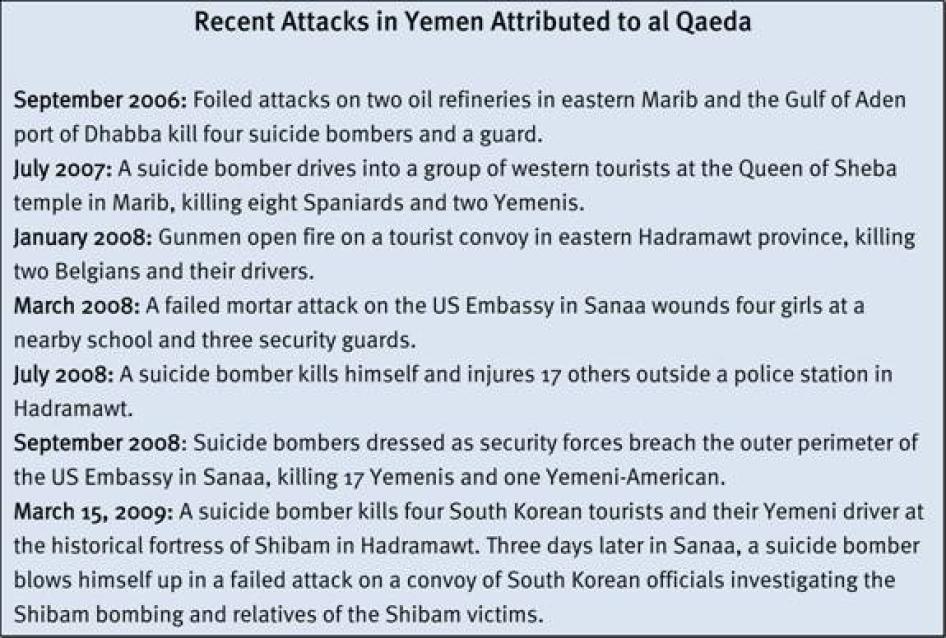
Al Qaeda in Yemen issues statements and recruits through the internet, particularly via an online journal it launched in January 2008 named Sada al-Malahem, or The Echo of Battles. It reportedly has used the journal to woo al Qaeda members fleeing counterterrorism crackdowns in Saudi Arabia. "Come to Yemen," a fugitive al Qaeda leader believed to be hiding in Yemen was quoted as saying in The Echo of Battles in March 2008.[17]
Disaffected Yemenis often glamorize al Qaeda, according to Murad Zafir, deputy director of the Yemen office of the National Democratic Institute, a nonprofit organization whose donors include the US Agency for International Development. Said Zafir:
Al Qaeda is no longer a structure; it's more of an ideology for the young, the marginalized, the idealistic. It has become to the current generation what the Red Star or Che Guevara used to be in years past.[18]
The US-Yemeni Relationship
US officials describe counterterrorism as "the first among equals" of US priorities in Yemen.[19] Although the US State Department calls Yemen "an important partner in the global war on terrorism,"[20] bilateral relations have been strained by the country's mixed record on combating al Qaeda.
Al Qaeda's first major strike against the United States in Yemen was the 2000 bombing of the USS Cole. Initially, the US government faulted Yemen's probe of the attack.[21] Two months after the September 11 attacks, however, President Saleh visited Washington to pledge cooperation in fighting terrorism.
Since then, the president's security forces have frequently partnered with US officials on counterterrorism initiatives and say they have rounded up hundreds of alleged terrorist suspects, including 50 in the first six weeks of 2009.[22] The United States, in turn, has given Yemen more than US$90 million for military programs since 2002, including funds that go to the Interior Ministry's Anti-Terrorism Unit.[23]
To the United States' dismay, however, President Saleh has earned a reputation for cracking down on terrorist suspects with one hand while striking deals with them with the other.In what US diplomats acknowledge is a strain on relations, Yemen has rebuffed US requests to extradite Yemeni-American Jaber al-Banna and Jamal Muhammad al-Badawi, who are convicted of al Qaeda-related activities in Yemen and are on the US Federal Bureau of Investigation's (FBI) most-wanted terrorists list.[24] As Yemeni citizens, both are protected from extradition under Yemen's constitution. US authorities have indicted al-Banna for providing material support to al Qaeda and al-Badawi for the 2000 bombing of the USS Cole.
Exacerbating US frustration, a Yemeni court in November 2008 halved al-Banna's 10-year sentence on terrorism-related charges. Both men were part of a spectacular jailbreak in 2006 in which 23 al Qaeda members or alleged affiliates tunneled their way out of a maximum-security prison; three are still on the loose and 10 are free on security guarantees.[25] Many political analysts and journalists suspect the jail breakers had help from some government officials.
In the first two months of 2009, President Saleh released 112 prisoners, as many as 34 of whom are believed to have been suspected al Qaeda members or associates, although Saleh denies any were militants.[26]
Counterterrorism Abuses
Yemen's erratic approach to fighting terrorism is coupled with a tenuous respect for the rule of law and significant human rights violations.[27] Although the Yemeni government denies any abuses, it increasingly appears to be using counterterrorism tactics as a tool to silence journalists and political opponents.[28] US Embassy officials say they have voiced disapproval of these practices to Yemeni officials.[29]
Yemeni human rights groups believe government security forces have arbitrarily arrested hundreds of alleged terrorist suspects in the past eight years, holding many of them without charge for days, months, or years. Suspects are often held incommunicado in degrading conditions in unregistered detention facilities.[30] In many cases, if the suspects themselves cannot be found, the security forces detain their male relatives as hostages.
Yemen's Code of Criminal Procedures stipulates that individuals cannot be arrested unless apprehended in a criminal act or served with an arrest warrant. Detainees must be arraigned within 24 hours of arrest or be released. The law also states that a detainee may not be held longer than seven days without a court order. It prohibits incommunicado detention, provides detainees with the right to inform their families of their arrests, and to decline to answer questions without an attorney present.[31]
However, Yemen's fragile judicial system provides scant oversight over the arrest and detention of alleged terrorists. In part, that is because most such arrests are made by the Political Security Organization and the National Security Bureau, which were established by decree and answer directly to the president, making them virtually immune from judicial oversight. Their jails are not listed as official places of detention as required by the Yemeni constitution.[32]
When terrorist cases are prosecuted, they go before the Specialized Criminal Court (SCC), which President Saleh created in 1999 to prosecute national security crimes.[33] But this court falls short of international fair trial standards and local human rights groups consider it unconstitutional. Defense lawyers say they are often denied access to their clients' files, and that judges have ignored complaints of forced confessions, torture, and other violations.[34]
In January 2009, the SCC upheld a six-year terrorism-related sentence against prominent journalist Abdel Karim al-Khaiwani, ignoring a presidential pardon he had received four months earlier. President Saleh pardoned him again in March 2009. Local human rights groups interpreted the moves as a way to intimidate al-Khaiwani into silence. An outspoken critic of the government, al-Khaiwani had been jailed in 2008 for membership in a terrorist cell linked to a Shia rebellion in the north (not to al Qaeda), but the public evidence against him consisted of photographs of the fighting, an interview with a rebel leader, and an article critical of President Saleh.[35]
Three draft laws currently pending before the Yemeni Parliament, which is dominated by Saleh loyalists, would vastly expand the government's powers to arrest and detain individuals as terrorist suspects. The abusive arrest and detention practices the government has used against political opponents give good reason to fear that the vaguely worded proposals, if adopted into law, would be used to repress legitimate dissent as well as to target suspected terrorists.[36] Among other measures, the laws would expand the scope of the death penalty and allow warrantless wiretapping and property seizures for up to 90 days.[37]
The Yemeni Detainee Population
An estimated 99 Yemenis remain at the Guantanamo Bay detention facility, the vast majority of whom have been held for years without charge. While Afghan and Saudi detainees outnumbered Yemenis during Guantanamo's early years, about 90 percent of detainees from those two countries were sent home in a steady flow of repatriations from 2003 to 2007.[38] As of this writing, Yemenis were by far the largest single group at Guantanamo, constituting more than two-fifths of the prison population. If Guantanamo is to close by January 2010, as President Obama has promised, a solution must be found to their illegal detention.[39]
Confusion over the nationalities of some Guantanamo detainees has led to disagreements over the exact number of Yemenis at the camp.[40] In particular, certain prisoners are listed as Saudi in military documents but as Yemeni by Yemen. Some of the confusion reflects long-standing population flows between Yemen and Saudi Arabia. A number of detainees are of Yemeni heritage, but were born and have spent most of their lives in Saudi Arabia.[41] Detainee Abdul Rahman al-Qyati, for example, is listed as Yemeni but was born in Saudi Arabia to Yemeni parents. "He has never set foot inside Yemen," said his lawyer, Darold Killmer. "He is as Saudi as you get."[42]
Yemeni officials believe some of these men, including those who are Yemeni by law, will want to return to Saudi Arabia.[43]
Most of the Yemenis were among the earliest arrivals to Guantanamo in 2002, although some were sent to the detention facility in 2003 and 2004, and two others were transferred from CIA custody to Guantanamo in September 2006.[44] Some had been taken into custody in Afghanistan; another large group was rounded up in Pakistan; others were picked up in locales as varied as Iran, Dubai, and Egypt.[45]
Yemenis are the largest single group to have been "disappeared" in CIA custody. A number of those so-called ghost prisoners were subsequently transferred to Guantanamo or the US-run prison at Bagram Air Base in Afghanistan, where two Yemenis are still being held.[46] At least two of them-Ali al-Hajj al-Sharqawi and Hassan bin Attash-were transferred by the CIA to Jordan for periods of proxy detention, and subsequently returned to US custody and brought to Guantanamo in September 2004.[47]
Only four Yemeni detainees at Guantanamo have ever faced charges before the camp's military commissions, whose operations have been suspended pending a review led by the attorney general.[48] Salim Hamdan, who served as a driver for Osama bin Laden, was sentenced to five-and-a-half years of imprisonment, minus five years time served, and returned to Yemen in December 2008; Ali Hamza Ahmed Suleiman al-Bahlul, an al Qaeda propagandist, was convicted and is serving a life sentence at Guantanamo.[49] They represent two of only three detainees at Guantanamo to have been convicted by the military commissions. Two other Yemenis-Ramzi bin al-Shibh and Walid bin Attash-have been charged with helping plan and organize the September 2001 attacks.[50] Both face the death penalty if convicted.
Although it is likely that additional Yemenis will be criminally charged, perhaps in US federal court, most of the Yemeni detainees probably will not be prosecuted by the United States.[51] The attorneys for the majority of the Yemenis contend that their clients neither planned nor committed any crimes against the United States and are no more of a threat than any other detainees who have been released.[52] A US Defense Department official told Human Rights Watch, however, that the Pentagon still considered the majority of Yemenis "high risk."[53] Documents relating to the military status review proceedings against some of them make strong claims, including allegations of membership in al Qaeda, but the non-classified documents often cite little meaningful evidence to support the allegations. Furthermore, even US federal judges who have examined the classified information behind such allegations have in many cases dismissed the evidence as compromised or flimsy.[54]
Many Yemenis at Guantanamo contend that they were arrested on the barest of circumstantial evidence, or simply because of their nationality. Hussein Almerfedi, who grew up in southern Yemen and was arrested in Iran, for example, has long claimed that he was merely trying to sneak into Europe to look for work.[55] Almerfedi was reportedly cleared for release in early 2009.[56]
Several Yemenis suffer from severe depression or other psychological problems that their lawyers argue either stem from or were exacerbated by indefinite detention and harsh treatment at Guantanamo.[57] One Yemeni died in Guantanamo in an apparent suicide.[58]
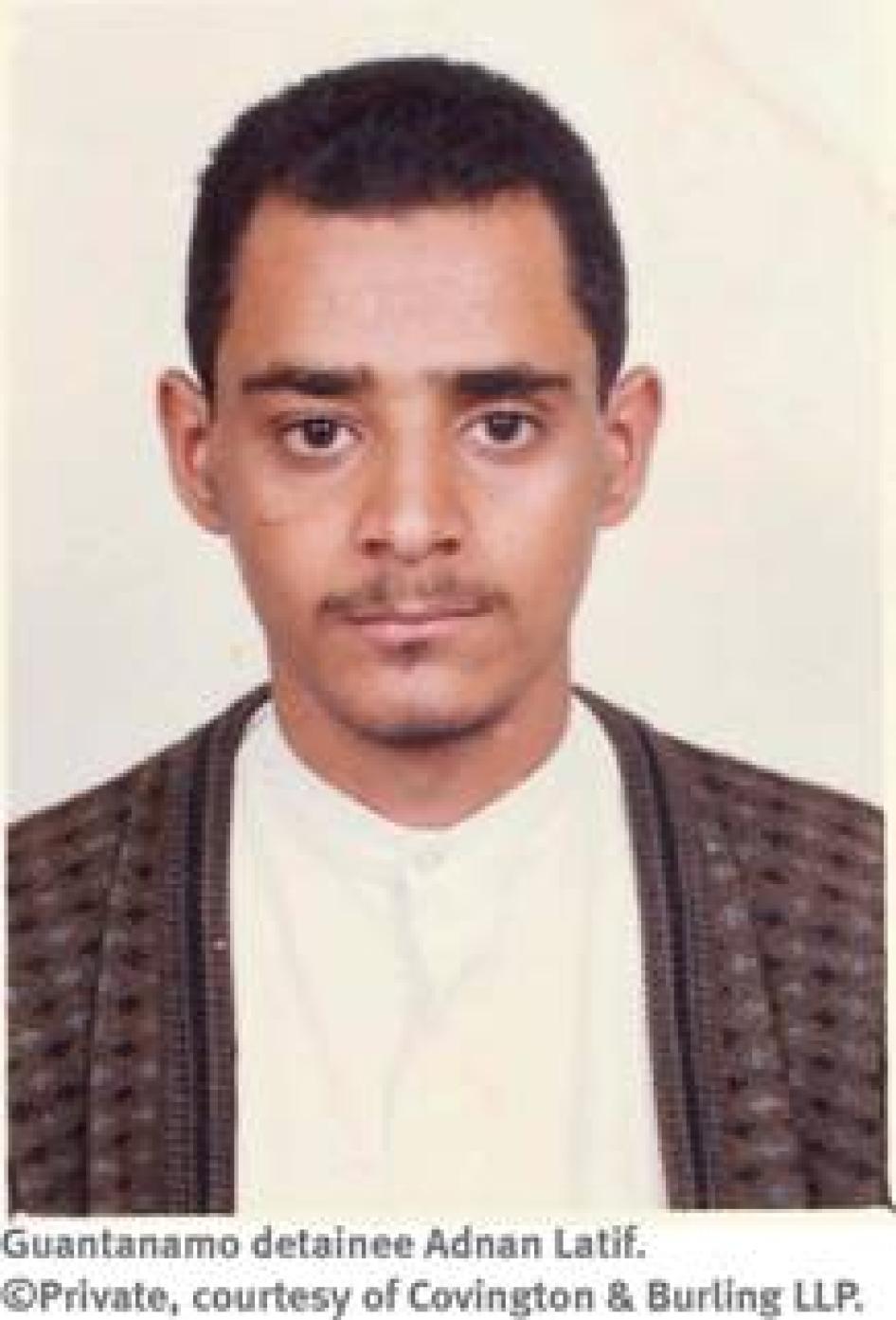
"There is no benefit in living like this anymore in this frightening prison that kills me a thousand deaths daily," Adnan Latif, 33, who is in a Guantanamo psychiatric ward, wrote his lawyers in January 2009. "Ask the judge that he issues an order of death sentence to execute me."[59]
Like detainees from other countries, nearly all the Yemenis at Guantanamo have filed habeas corpus petitions in US federal court to challenge the legality of their imprisonment. It was only with the US Supreme Court's June 2008 ruling in the Boumediene case, however, that the lower courts began to address these claims on the merits.[60] In Yemeni petitions decided so far, a federal judge ruled that the United States had met its burden of proof to continue holding at least two men as "enemy combatants." One ruling, in December 2008, involved Moath Hamza Ahmed al-Alwi, whom the government describes as a bin Laden bodyguard.[61] The other, in January 2009, involved Ghaleb al-Bihani, who according to his lawyers was a cook for the Taliban in Afghanistan. ("An army marches on its stomach," Judge Richard Leon reasoned, quoting Napoleon.[62]) The same month, another federal judge delayed a ruling in another pending habeas case because government lawyers had withheld classified documents from the court.[63]
Yemenis at Bagram
Two Yemenis are known to be in US custody at the military detention facility in Bagram, Afghanistan, which holds nearly three times the number of prisoners currently at Guantanamo. Unlike prisoners at Guantanamo, whose access to the US courts is now constitutionally guaranteed, detainees at Bagram are still litigating for the right to challenge their detention in US court. The two Yemenis are among four Bagram prisoners whose families have brought a potentially landmark case in federal court in Washington, DC.[64]
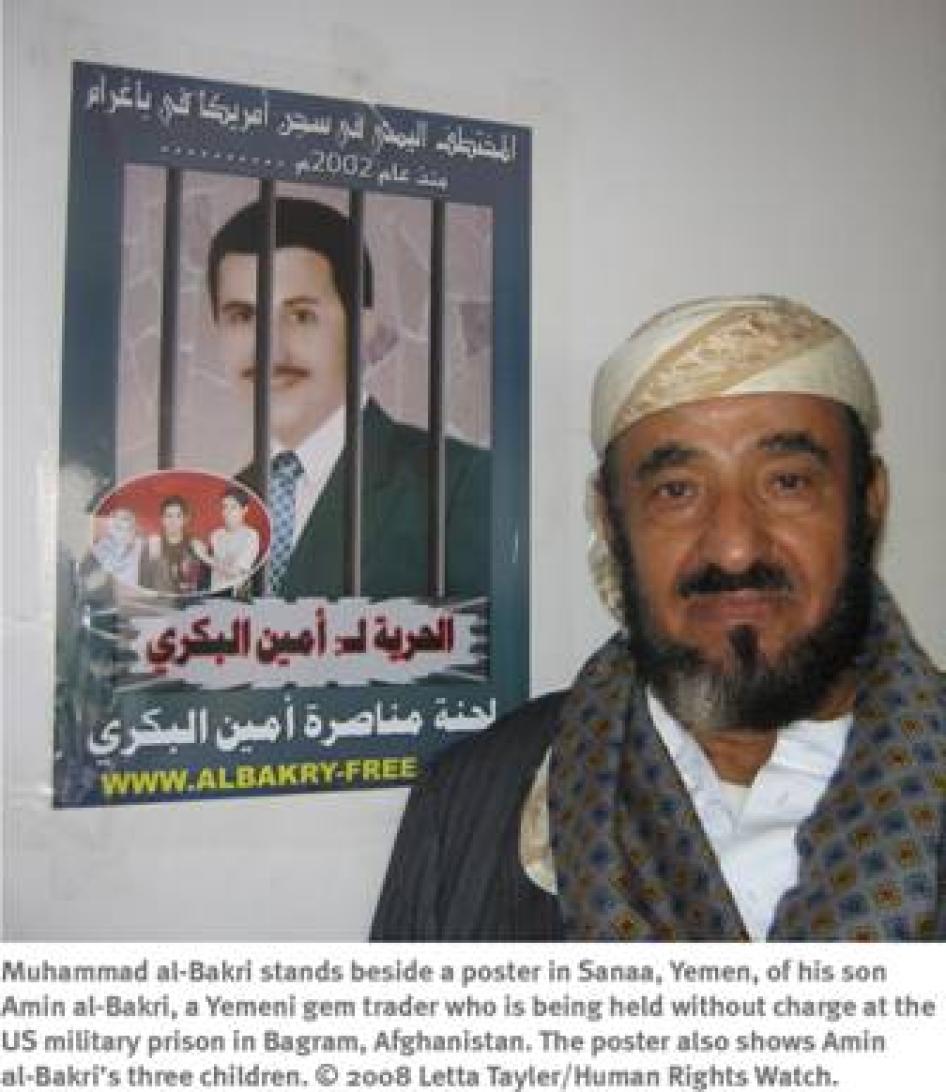
The father of Amin al-Bakri, one of the two detainees, said he had to hire a private detective to learn that his son, a gem trader and father of three, had been seized in late 2002 during what he says was a business trip to Thailand. He said he did not receive a letter from his son for a full year after his arrest.[65]
"We have never before been exposed to such injustice," said the father, Muhammad al-Bakri, who collected 50,000 signatures for a petition, plastered 2,000 posters across Yemen, and persuaded nearly 350 sultans and sheikhs to request the Yemeni president to help free his son. "Our family has been through such torture . . . . We go to sleep remembering him and we wake up remembering him."[66]
Attorneys for the Yemenis at Bagram say their clients should be included in any US-Yemeni release agreement. "There is really no difference between Guantanamo and Bagram from the perspective of repatriation," said Tina Foster, an attorney who represents the two prisoners. "It is the same issue of people being held for unspecified reasons and ofbeing denied basic human rights for many, many years."[67]
Roadblocks to Repatriation
Only 14 Yemeni detainees who have been detained at Guantanamo since 2002 have been repatriated. While many of the estimated 99 Yemenis who remain are entering their eighth year in captivity, US-Yemeni negotiations on their fate seem to have stalled. Except for Salim Hamdan, sent home in November 2008 after his conviction by a US military commission, no one has been repatriated to Yemen in the past one-and-a-half years.
The first Yemeni was repatriated in 2004, with several others following in the three subsequent years. But with al Qaeda activity in Yemen on the increase, and US-Yemeni relations worsening over Yemen's refusal to extradite two accused al Qaeda suspects to the United States, returns stopped in late 2007.[68]
Attorneys who met with Yemeni clients at Guantanamo in January 2009 describe collective weariness and despair. Yemenis had become the majority of participants in a long-running hunger strike, swelling the numbers that month to at least 40 and possibly 70. It was the biggest hunger strike at the prison in three years.[69]
The Yemenis were upset that Hamdan is the only recent repatriation. "The men think it is the cruelest unfairness," said attorney David Remes, who represents 16 Yemenis at Guantanamo. Describing his clients' thinking, he said, "'This guy was convicted of aiding terrorism and now he is a free man, while I'm still here even though I haven't been charged with anything.'"[70]
Underscoring the arbitrary impact of the impasse on returns is the fact that at least 11 Yemenis who remain at Guantanamo were cleared for return to Yemen as long ago as 2005.[71]
They include Fahd Ghazy, who was picked up in Pakistan when he was 17 and was one of the earliest arrivals at the camp in 2002. Told in late 2007 that he was going home, Fahd was "very excited," said his lawyer Julia Symon. A model prisoner who passed 20 lie detector tests and got on well with the guards, "he thought his good behavior paid off."[72]
But as the months passed, Ghazy became "incredibly frustrated," and his anguish increased after President Obama's pledges to close the prison still brought no news of a release date. In February, he was asking, "Why am I still here?" Symon said. "Why am I not going home?"[73]
Not Even a Shell of an Agreement
Publicly, both Yemen and the United States have stated that they want most of the Yemenis to return home as soon as possible. Four days after President Obama took office, Yemeni President Saleh said his government would have a rehabilitation center ready in three months to receive Yemeni returnees.[74]
In reality, however, the two countries have only settled on the most basic elements of a repatriation agreement: what an official at the US Embassy in Yemen told Human Rights Watch was "not even a shell."[75] Each government has blamed the other for the lack of progress.
"The obstacles are generally from the US side," said Yemeni Interior Minister Mutahar Rashad al-Masri, in a December 2008 interview with Human Rights Watch. He arched one brow and held up his palms in a gesture of helplessness. "I wonder, do the Americans have a real will to release the Yemenis from Guantanamo?"[76]
"Is it a will issue or a capacity issue?" a US Embassy official asked in turn, referring to the Yemenis.[77]
The two countries do agree on certain points. Both say that repatriated detainees should receive counseling and job training, and should participate in a religious dialogue aimed at dissuading them from violence. Negotiators also concur that returned captives suspected of violating Yemeni law should be investigated and prosecuted in the Yemeni courts. And, notably, both sides agree that detainees should continue to be held for some unspecified period upon return for what they describe as rehabilitation.[78]
Beyond that, the two governments have yet to resolve key issues, including some with serious human rights implications. These include who will fund the planned rehabilitation center, how long people will be held, what criteria and procedures will be used to determine release, and what restrictions, if any, should be imposed on released prisoners who are still considered a potential threat.[79]
Security Concerns
The Yemenis at Guantanamo and Bagram who are alleged to be most dangerous are not likely to be sent home. Men like Ramzi bin al-Shibh, implicated in the September 11 terrorist attacks, will probably be criminally prosecuted, perhaps in US federal courts.
But the US government is worried that there are some prisoners at Guantanamo-including Yemenis-who cannot be prosecuted and yet still pose a threat. These fears have sparked public discussion of delaying Guantanamo's closure or of establishing a similar preventive-detention regime on US soil.[80] They also raise the prospect that the United States would like at least some prisoners to continue to be detained in their home countries.[81]
As pressure to speed returns has increased, the Pentagon has highlighted these concerns, declaring days before President George W. Bush left office in January 2009 that 61 of the 525 Guantanamo detainees released so far have "returned to the fight."[82] Significantly, the Defense Department has failed to provide information to refute widespread claims that its figure appears to have been vastly inflated. Among many causes for skepticism, the number apparently includes former detainees who have engaged in "propaganda warfare" by speaking out publicly about the abuses they suffered at Guantanamo.[83] Nevertheless, the figure continues to be relied upon in public discussion. A small number of high-profile cases have given further ammunition to these arguments.[84]
For several overlapping reasons, US fears of recidivism are particularly acute with regard to Yemen. Most important are the country's strong al Qaeda presence and historical connection to prominent al Qaeda figures, the government's perceived lenience toward elements of the group, and the existence of tribal areas outside of government control where its members can easily operate. US officials also worry that even suspects who are convicted of terrorist crimes upon return could find their way free, in light of the suspicious breakout of 23 al Qaeda members and suspected affiliates from a high-security prison in Sanaa in 2006.
US Deputy National Security Advisor John Brennan, who is President Obama's top counterterrorism official, met with President Saleh in Yemen in March 2009 to personally relay the Obama administration's preoccupations about repatriating the detainees.[85] That same month, US negotiators reiterated those concerns in meetings with Yemeni diplomats in Washington, DC.[86]
Further complicating discussions over security risks is recent, negative publicity about a Saudi religious "re-education" program for former detainees that US and Yemeni negotiators had considered a model for repatriating Yemenis. The rehabilitation program had widely been touted as an effective "soft" strategy to combat terrorism.[87]
The Saudis reported in January 2009 that 11 former Guantanamo detainees who went through the rehabilitation program had joined armed militant groups, including two who traveled to Yemen and joined al Qaeda (one of those two has since been rearrested[88]). Those still in hiding include Said al-Shihri, whom al Qaeda describes as the new deputy commander of al Qaeda in the Arabian Peninsula.
"Imprisonment made us more determined in our conviction . . . and today God has blessed us with immigration to the land of jihad, Yemen," al-Shihri declared in a video, clutching an assault rifle and sporting a bandolier over his camouflage tee-shirt.[89]
Noting that no rehabilitation model is free of recidivism, the United States still supports the Saudi program. Underscoring its wariness about Yemen, US officials have even proposed transferring an undisclosed number of Yemeni detainees from Guantanamo to the Saudi program, particularly those with Saudi family ties.[90] President Saleh has publicly protested the proposal.[91]
Commentators have also noted that four Yemenis are related to suspected or known al Qaeda members.[92] Attorneys for those detainees bristle at the notion of guilt by association. "The fact that someone has a relative who is perceived to be dangerous does not speak at all to the detainee's future dangerousness," said Sarah Havens, an attorney whose Guantanamo client Ali Yahya Mahdi al-Raimi is the brother of Qasim al-Raimi, a ranking al Qaeda member. "And it is not something that we as a society built on the rule of law accept, that you can hold somebody based on the crimes of their relatives."[93]
To be sure, the United States runs the risk that some repatriated Yemenis may turn out to be dangerous. But continuing to detain these men without charge creates a potentially greater risk. Those on the front line understand this well. As the US Army's new Field Manual on Counterinsurgency Operations explains, rather than trying to achieve the impossible by detaining every possible armed insurgent, the United States must undercut the militant groups' appeal.
"Dynamic insurgencies can replace losses quickly," explains the Army Field Manual. The way to win, therefore, is to "cut off the sources of that recuperative power" by diminishing the enemy's legitimacy, while increasing one's own. The manual cautions that the United States loses its legitimacy, and therefore its ability to win the fight against al Qaeda, if it engages in illegitimate actions such as "unlawful detention" and "punishment without trial."[94]
Proxy Guantanamo?
While Yemeni officials have said they would put on trial any repatriated detainees accused of violating Yemeni law, US and Yemeni officials often use terms like rehabilitation and job training when they describe their plans for the rest. At other times, however, their language leaves open the risk of a proxy Guantanamo in Yemen, where former prisoners could be indefinitely detained on the unproven chance they may cause harm in the future.
The fact that detainees who have already been repatriated to Yemen have been held without charge-most for two or three months but one for up to two years, reportedly at the behest of the United States-is cause for concern that many of their countrymen still at Guantanamo could face a similar fate, and potentially a worse fate if the US presses Yemen to find a way to hold them for longer periods.
In a December 2008 meeting with Human Rights Watch, an official at the US Embassy in Yemen said the United States would like the Yemeni government to place the repatriated detainees in "basically a prison facility with a programmatic aspect to it."[95] The goal, he explained, is "to rehabilitate them and reintroduce them to society in a way that the threat that they pose has been mitigated to the largest extent possible."[96] The Obama administration has signaled that it would not expect the Yemenis to hold detainees without either charging them or finding an incentive for them to remain in rehabilitation. However, it has not distanced itself from the idea that for an undisclosed number of detainees, rehabilitation would be under lock and key.
Col. Amar Muhammad Saleh, deputy chief of Yemen's National Security Bureau and the president's nephew, who is involved in the negotiations, minimized the detention aspect. The still-unbuilt rehabilitation center, he said, will resemble a "camp."[97]
Saleh said the center would cater to the detainees' needs, offering psychological evaluation and treatment for trauma, job training, sports, and workshops where teachers will engage participants "in a dialogue to correct their ideas." Families will be able to visit repatriated detainees, and "we'll give them jobs."[98]
A brief, written summary of Yemen's rehabilitation proposal that government officials provided Human Rights Watch in February 2009 offered additional details which, if taken at face value, sound promising. The document (see Appendix below) pledges that Yemen will train the detainees for a range of jobs, from computer programming to carpentry, blacksmithing, and woodworking. It states that religious dialogue coaches will instruct detainees on Islamic tenets that reject violence in the aim of persuading them to "accept the concepts of good citizenship, tolerance and coexistence with others." It acknowledges that Yemen will need specialists to individually evaluate detainees in the context of their social backgrounds, and to assist communities in accepting the repatriated men upon their release. It also promises follow-up treatment.
Human Rights Watch is concerned, however, that the proposal is based on an underlying presumption of guilt. Instruction will be aimed at "preventing" detainees from "returning to their previous lives," and members of the center's Department of Social and Health Rehabilitation will "analyze . . . the causes that have contributed to their joining terrorist groups," the document states.
That presumption of guilt against men who have not been charged with an offense, let alone convicted, and who have already been held captive for years in abusive circumstances, could easily backfire. "I don't care if the prison looks like a five-star hotel," said Khaled al-Anisi, executive director of the National Organization for Defending Rights and Freedom (HOOD), a group close to the Islah Party that advocates for detainees. "When you are dealing with persons who have never been charged with a crime, rehabilitating them as if they were criminals doesn't work."[99]
Equally troubling, the summary of the rehabilitation proposal does not explain how long authorities would hold repatriated detainees or how they would determine whether they are ready for release. Nor does it outline any fair and transparent process for detainees to appeal their continued detention.
Government officials' comments on that subject were not particularly reassuring. Saleh said the government anticipated holding detainees for anywhere from a month to a year or more until they had determined whether they had been rehabilitated. He agreed with the United States that some repatriated detainees might pose a security threat, but insisted that Yemeni authorities would not arbitrarily detain any of them without evidence. Indeed, he said, Yemen had already resisted US proposals for preventive detention. "The Americans want us to keep some of them in jail but unfortunately we don't have the files with any evidence. That is why we have refused," he said. "We say, 'If you want them locked up, send us the files and we will send them to court.'"[100]
Unfortunately, history suggests Yemen may not be as unyielding as Saleh insists. Yemen detained all 14 men repatriated from Guantanamo thus far in its Political Security Organization prisons, most without charge. In 2005, Amnesty International reported that the head of political security in Sanaa said authorities were holding them at the behest of the United States.[101] In addition, the Yemeni government's practice of detaining hundreds of people for months or years without charge is well documented, making the prospect that it could arbitrarily hold repatriated Guantanamo detainees all too plausible.[102]
The fact that Yemen and the United States view the Saudi rehabilitation as a model-and that the United States might try to send an unknown number of Yemeni detainees to the Saudi program-is also troubling because of the Saudi government's record of prolonged detention without charge. While Guantanamo detainees generally spent two to six months in the Saudi program, Human Rights Watch was told that 10 Guantanamo returnees remained in Saudi rehabilitation as of this writing.[103] Moreover, a Human Rights Watch investigation found that authorities had kept other participants in "rehabilitation" without charge or trial long after their supervisors had recommended their release, in some cases for years.[104]
Human Rights Watch is also concerned that former detainees may be at risk of torture or ill-treatment on return. One repatriated Guantanamo detainee told Human Rights Watch that Yemeni interrogators had tortured him after the United States sent him home, and Yemeni human rights groups have repeatedly accused the government of torturing other prisoners.[105] Senior Yemeni officials denied that Yemen tortures prisoners or holds them indefinitely without charge.[106]
Restrictions upon Release
Foreign Minister Abu Bakr al-Qirbi told Human Rights Watch that Yemen might monitor returned Yemenis and impose restrictions on their movements that were similar to those imposed on detainees repatriated in the past.[107] Restrictions on previous detainees included confiscating the men's passports, making them obtain permission to travel inside Yemen, and requiring that they report regularly to security officials.
We recognize that the Yemeni government may have ongoing security concerns regarding some of the repatriated prisoners. Monitoring the movement and associations of some of them may be appropriate.
The government should not, however, impose serious restrictions that are functionally equivalent to punishments normally imposed only following the determination of criminal guilt.
Human Rights Watch considers the following safeguards necessary to bring such security restrictions into line with human rights law: the measures should be provided for in Yemeni law and ordered by a court, with full judicial safeguards; there should bean effective opportunity to challenge the evidence with the right of appeal; individuals should have the right to request that the restrictions be lifted or modified upon presentation of new evidence; and the restrictions should not impede individuals from working or maintaining privacy and a family life.
Without these safeguards, the government's restrictions will be yet another unlawful restriction on these individuals' liberty, and will hinder their reintegration into Yemeni society.
Disputes over Funding
Negotiations over the Yemenis' return have been further complicated by disputes over funding a rehabilitation program, which could cost millions of dollars.
Yemeni officials contend that the United States should provide most of the money. "We are a poor country," Saleh noted. "We say, 'Okay, you want to close Guantanamo? Transfer the budget [from Guantanamo] and we'll run the program.'"
US officials say the United States is committed to "kicking in" but is wary of pouring millions of dollars into a government that has a reputation for corruption. It also is hoping Arab nations will share the costs.[108]
Human Rights Watch appreciates US government concerns about ensuring that government funds spent on rehabilitation programs are properly used. However, having detained these men for years without charge, the United States has a responsibility recognized under international law to assist their reintegration.[109]
There are practical reasons to do so as well: recent research suggests that many armed insurgents were vulnerable to recruitment not because of ideology or violent tendencies, but for lack of other ways to earn a living.[110] Poorly funded rehabilitation programs are likely to exacerbate that problem, serving as little more than window dressing. Yemen once before set up a rehabilitation program to dissuade former or suspected armed militants from violence and that experience also serves as a warning call. Though hailed after its inception in 2002 as a revolutionary approach to countering terrorist tendencies, the program was quietly shelved three years later after a few embarrassing incidents of recidivism.[111] Many political analysts believe the program faltered in large part because of inadequate funding and lack of follow-up care.[112]
Rather than withhold funding, the United States should establish a monitoring mechanism for its disbursement. It also should make the aid contingent upon Yemen refraining from torture and other abusive practices and on allowing an independent monitor to evaluate the men's treatment.
Detainees' Return and Yemen's Clout and Commitment
The Yemeni government's apparent inability or perhaps even unwillingness to expedite the return of the detainees has also slowed negotiations. Unlike many other countries that could leverage their influence with the US government to speed returns, Yemen has relatively little political clout. As many Guantanamo observers have noted, returns to date have largely been determined by nationality-and, in particular, the arm-twisting power of the detainees' country of citizenship-not by factors specific to individual detainees.
Pardiss Kebriaei, an attorney with the US-based Center for Constitutional Rights, put it bluntly: "If the Yemeni detainees had come from a more powerful country, they'd be out."[113] Kebriaei contrasted Yemen with Saudi Arabia, which, as a US ally sitting atop the world's largest oil reserves, secured the release of hundreds of its citizens even though 15 of the 19 September 11 hijackers were Saudi. Others have noted how Western European countries, longtime allies, and Russia, a formidable power, have secured the release of their citizens.
Some US officials, Yemeni opposition lawmakers, and political analysts also question Yemen's commitment to bringing the detainees home, noting that their presence could further complicate President Saleh's delicate balancing act with armed militants and the powerful tribal leaders who support them. As Showqi al-Qathi, an opposition member of Parliament and a moderate imam whose message is "make dialogue, not jihad," observed:
We have a saying in Arabic that if something is stuck in your throat, you want to get rid of it. Guantanamo is stuck in the Americans' throat . . . . But Yemen doesn't want it stuck in its throat, either. [114]
Some political analysts also suspect President Saleh is grandstanding on the detainees' return to gain support from the United States and international donors.
Domestically, President Saleh has little to gain from the detainees' return. Though many Yemenis are angry at what they perceive as US adventurism in Muslim lands, they are-like their US counterparts-far less concerned about the fate of prisoners at Guantanamo than they are about the collapsing economy.[115] "The people in Yemen are fighting for food," one repatriated detainee told us. "They don't think about Guantanamo."
Abuses against Repatriated Detainees
To date, 18 Yemenis have been repatriated-14 from Guantanamo and four from CIA prisons. The difficulties that many of the men have faced upon their return bode poorly for future repatriations. They attest to the need for a genuine rehabilitation effort that facilitates rather than hinders former detainees' reintegration.
In interviews with Human Rights Watch, three repatriated detainees and lawyers for several more described extended, unlawful detention, psychological trauma, and difficulties finding work or reconnecting with families and communities. Their experiences fit into a broader pattern of emotional, physical, and social problems that researchers have documented among repatriated Guantanamo detainees in various countries.[116]
Yemen's Public Security Organization, which reports directly to President Saleh, detained all repatriated detainees upon their return, some in degrading, underground facilities, even though only two Guantanamo prisoners and three former prisoners held by the CIA were ever charged with crimes.[117] Yemeni authorities denied many detainees access to lawyers and, in some cases, arbitrarily restricted visits with relatives. One detainee was held for a week and most were held for two to three months.
One man, "Fahmi Muhammad" (a pseudonym), was held for two years without charge in Yemen and says he was tortured in an effort to make him confess he was a spy. "If our brothers at Guantanamo knew of these conditions," he told Human Rights Watch, "they would not want to return."[118]
Government officials denied any torture of detainees. Walid Alshahari, a political officer at the Yemeni Embassy to the United States, said that the returnees were held for varying periods of time because the authorities needed to investigate whether they were a security risk and had no files from the United States to guide them.[119]
In addition, three former CIA detainees were held for more than nine months without charge upon their return in 2005 to Yemen, reportedly at the behest of the United States, before being convicted of falsifying identification documents.[120] The Yemeni human rights group HOOD, which monitored the trials, said the evidence against them was tainted and in some cases nonexistent. The conviction of Muhammad al-Asad, for example, was based on accusations that he altered his Tanzanian passport two decades earlier, but prosecutors never produced the passport.[121]
The Yemeni government did not free repatriated Guantanamo detainees until they had secured a guarantor: a relative, tribesman, or prominent businessman who promises to pay a fine or in some cases go to jail if the released prisoner disappears. This practice is widely accepted in Yemen and is part of tribal tradition, but is not codified in law.
After serving the final month of his US-imposed sentence in Yemen, former bin Laden driver Salim Hamdan was detained for an additional two weeks, until January 10, 2009, while relatives found a guarantor who satisfied the Yemeni authorities.[122]
Yemeni security agents routinely take hostage male relatives of fugitive suspects even if they aren't guarantors. In January 2009, authorities allegedly held the brother of Ali Mohsen Salih, one of the Guantanamo returnees who disappeared that month, for 10 days.[123]
Hostage taking amounts to an arbitrary deprivation of liberty that is prohibited under all circumstances by the International Covenant on Civil and Political Rights.[124]
Released detainees claim that they have received no medical care, job training, psychological counseling, or financial assistance such as micro-loans from the government. The only help the detainees said they received came from non-governmental organizations such as the International Committee for the Red Cross, primarily for medicaltreatment. Many said they suffered flashbacks of abuse. Branded as criminals even if they were never even charged with a crime, many said they cannot find jobs.
"Guantanamo destroyed a big part of my life," said former detainee "Omar Fawza" (a pseudonym). "People treat me differently. I used to be close with friends and relatives but now they keep their distance. They say, 'You were in a suspicious place.' They don't trust me. . . . But I did nothing wrong."[125]
Individual Cases
"Fahmi Muhammad"
I was tortured for five days from nine in the morning until dawn. The cell was dark. They beat me with shoes and there were insults, bad words, and threats to do bad things to my female relatives and to imprison my father. I told them, "If you're going to torture me, it won't be anything new. The Americans already put me through torture." [126]
During more than a year in US-run prisons in Afghanistan, Fahmi Muhammad said, he was chained naked to a ceiling swing, crammed into a 2-by-2 meter cell with nine other men, and taunted with barking dogs while he was shackled and blindfolded. Moved to Guantanamo, he was detained for another year without charge-a month of it in solitary confinement-along with hundreds of others the Bush administration branded "the worst of the worst."
Even his trip home from Guantanamo in 2004 was brutal, Muhammad told Human Rights Watch. He said his captors drugged him, causing him to slip in and out of consciousness on the flight to Sanaa. When he came to, he said, he was behind bars in Yemen, wearing civilian clothes instead of his prison jumpsuit, and hallucinating, with no idea where he was. His hallucinations were terrifying and lasted four days, he said.
None of that, he said, was as bad as what happened to him after his return. He was imprisoned for two more years without access to a lawyer, nearly half the time in an underground cell. He said authorities barred his relatives' visits for the first six months.
"It's even worse here," said Muhammad, who was arrested in Iran in late 2001 and turned over to US authorities three months later. At least in US custody, he said, his abusers weren't fellow Yemenis. "If our brothers at Guantanamo knew of these conditions," he added, "they would not want to return."
According to Muhammad, Yemeni authorities suspected he was a spy for the United States because he was the first detainee to be released.
For ten months it was the same question: "Why are you the only Yemeni to come back?"
I grew tired of the pressure. I said, "If you think I'm a spy, okay, I'm a spy."
. . . . They said, "They brought you here to work against us."
I said, "Okay." They started to be afraid of me. Then I told them the truth: "I'm not a spy." They started to get angry with this.
At one point, he recalled, he admonished his interrogator, saying:
"I came to my own country expecting sympathy but you received me with insults and torture. Shame on you." The interrogator didn't care. He treated me worse.
Since his release, Muhammad's situation has remained difficult. Penniless and depressed, he is branded as a suspect and cannot find work, even though he was never charged with a crime. "I can't get a job, not when people know I've been in Guantanamo and Political Security," he said. "People are afraid."
Muhammad had hoped to become a driver upon his release, but said no one will hire him or give him a loan to buy a car because they fear the attention of the Yemeni security services. Authorities have taken his passport and require him to sign in with them once a month.
He lives at home but said his father has kicked him out twice, calling him a burden. He is married with one son and a second child on the way, but his wife and child are forced to live separately from him, since he cannot afford his own home. "I wouldn't have gotten married if I had known how things would turn out," he told Human Rights Watch. "I thought I would have a new life. I told my wife we should get divorced but she loves me."
"Malek al-Dhabi"
Malek al-Dhabi says that he set out for Pakistan in September 2001 to seek heart surgery.[127] En route, he says, he was sold for bounty as a terrorist suspect, tortured in three US-run prisons in Afghanistan and dumped in Guantanamo, where he was detained for nearly four years without being charged with a crime. He describes himself as "a very simple person" who had no involvement in al Qaeda.
When he met with Human Rights Watch, al-Dhabi sported a hennaed beard and a curved, Yemeni dagger in his belt that is a traditional symbol of male prowess. But he sounded defeated as he spoke of his difficulties adjusting to Yemeni society after years in US custody. Arriving home in December 2006, he felt that the world that had passed him by.
When he arrived, his wife was on her deathbed. Two of his children were gravely ill and had no money for treatment. Two others had married, and the two youngest, who were children when he left, had grown so much he hardly recognized them.
For two months after his return, the Yemeni government kept him in detention. Al-Dhabi said the reason for his imprisonment was that he could not find a guarantor to take responsibility if he fled or misbehaved.Finally freed, he found his wife and 12 children living hand to mouth, supported only by the meager earnings of one son, who had left his studies to provide for the family. His neighbors welcomed him back, but he was not at ease. "I felt strange," he said. "I felt something had changed. I don't know what it is but the people there had changed and I had changed, too."
He had only a few months with his wife before she died. Feeling further alienated, he moved to a different town. He lives off the money his children send him but it is not always enough to pay his rent and medical bills. If he could regain his health and get a job, he told Human Rights Watch, "I wouldn't feel like such a burden on my children."
Traumatized by flashbacks and still suffering from the heart condition that prompted him to leave Yemen more than seven years ago, Al-Dhabi says he lacks the concentration to return to his old job as an electrician or to learn a new trade. But neither the United States nor Yemen has provided him with medical care, job training, or compensation. Summing it up, he said, "It's a catastrophe. I have lost a lot of things-my health, my kids' childhoods, my career, and many years of my life."
Al-Dhabi wants financial compensation and an apology for his time in US custody. As a young man working in Saudi Arabia as an electrician, he said he had formed a positive opinion of Americans:
I met a lot of Americans then and I knew them as good people and practical and hard working, and I truly liked them. But after my capture, my view of Americans completely changed. Americans sometimes say they believe in human rights. . . . But what I see is that this concept of human rights is not applied in reality.
"Omar Fawza"
Guantanamo destroyed a big part of my life. People treat me differently. I used to be close with friends and relatives but now they keep their distance. They say, "You were in a suspicious place." They don't trust me. . . . But I did nothing wrong. I don't want what happened to me to happen to the others when they come back from Guantanamo.[128]
After his capture in Pakistan in December 2001 and subsequent transfer to Guantanamo, Omar Fawza told a US military panel that he had traveled to Afghanistan the previous year to fight with the Taliban against the opposition Northern Alliance. He said he never saw combat and did not go to fight the United States.
The United States held Fawza for five years in Afghanistan and Guantanamo as an "enemy combatant." He was never charged with an offense. Under international humanitarian law, as a captured fighter, Fawza should have been repatriated to Yemen after US forces defeated the Taliban government and a new Afghan government under President Hamid Karzai took office in 2002. Instead, he was not released until the end of 2006.
The reasons for his release remain classified. But factors listed in his favor at his 2004 status review proceedings at Guantanamo included good behavior and his insistence that he considered his time in Afghanistan a mistake and Osama bin Laden a "criminal."
A round-faced man with a short beard, Fawza declined to discuss his time in Afghanistan.
During his military review at Guantanamo, he said that after fleeing to Pakistan, he gave up his assault rifle and asked police for help in contacting Yemeni authorities. Instead, the police turned him over to US officials. Taken to the US-run prison, in Kandahar, Afghanistan, he said he was held in bitter cold, awakened on the hour every night, and pushed "like I was a dog."
At Guantanamo, he said, US military personnel would punish him when he refused to answer questions he had already answered by turning the air conditioning to its coldest level and leaving him shivering alone in a room for seven to eight hours, chained to a chair in his lightweight jumpsuit and slippers. By the time he left, he said, "I had lost all feeling."
Upon learning he would go home, Fawza said, he was filled with relief. But since his return, he said, he has been treated as if he were a terrorist. Yemeni authorities detained him in an underground prison for six weeks. Since then, like other former Guantanamo detainees, he has had to report regularly to authorities and cannot leave the country or travel inside Yemen without advance permission.
The hardships extend beyond the official sanctions. He says that because of his incarceration at Guantanamo, he has been unable to make friends, get a job, or arrange a marriage, a costly but critical milestone in a man's life in Yemen. Fawza said:
There is a girl I am interested in, but I can't ask her father for her hand because I don't have bride money or a way to support her. Her father wouldn't dismiss me if I had a job. I just want to be self-sufficient.
Should their allegations of mistreatment by US forces be true, the Yemenis are entitled to a remedy.But unlike some Yemenis, Fawza has no interest in a US apology; he just wants compensation. "An official apology is not important," he told Human Rights Watch. "I can't support myself on an apology."
International Legal Standards
The treatment of Yemeni detainees at Bagram, at Guantanamo, and upon their return to Yemen has violated fundamental human rights guarantees.
The United States and Yemen are party to the International Covenant on Civil and Political Rights (ICCPR) and the Convention against Torture and Other Cruel, Inhuman or Degrading Treatment or Punishment (Convention against Torture).[129] These treaties prohibit arbitrary detention, torture and cruel, inhuman or degrading treatment, and unfair trials. They also require that victims of government abuse shall be entitled to an effective remedy, including compensation.[130]
Various treaty bodies of the United Nations have addressed the failure of the United States to provide redress and adequate compensation to individuals who were subjected to torture and other cruel, inhuman or degrading treatment in detention facilities in Guantanamo, Afghanistan, Iraq and other overseas locations. In its Concluding Observations to the submission of the United States in 2006, the Human Rights Committee, the international body of experts that monitors compliance with the ICCPR, stated that the US government "should ensure that the right to reparation of the victims" of "enhanced interrogation techniques" and other mistreatment be respected.[131] Likewise, in 2006 the Committee against Torture, which addresses state compliance with the Convention against Torture, concluded that the United States "should ensure, in accordance with the Convention, that mechanisms to obtain full redress, compensation and rehabilitation are accessible to all victims of acts of torture or abuse. . . perpetrated by its officials."[132]
The United States subjected the Yemenis detained at Guantanamo and Bagram to long-term arbitrary detention without charge, torture, and cruel, inhuman or degrading treatment, and unfair trials. The Yemeni government is responsible for similar violations against some of the returnees.
It remains unclear how the Yemeni government will treat future returnees from Guantanamo and Bagram. Human Rights Watch is concerned that they, too, will be subjected to detention without charge in abusive conditions. We are also concerned that they may be tried before Yemen's Specialized Criminal Court, which fails to guarantee defendants' basic rights to due process[133]
Finally, former detainees who have sent back to Yemen are entitled under international law to a remedy for the violations of human rights they endured while in US custody. Such a remedy could take the form of compensation or reintegration. President Obama should ensure that both future and past returnees are provided fair redress.
Appendix: Yemeni Government Summary of Repatriation Plan
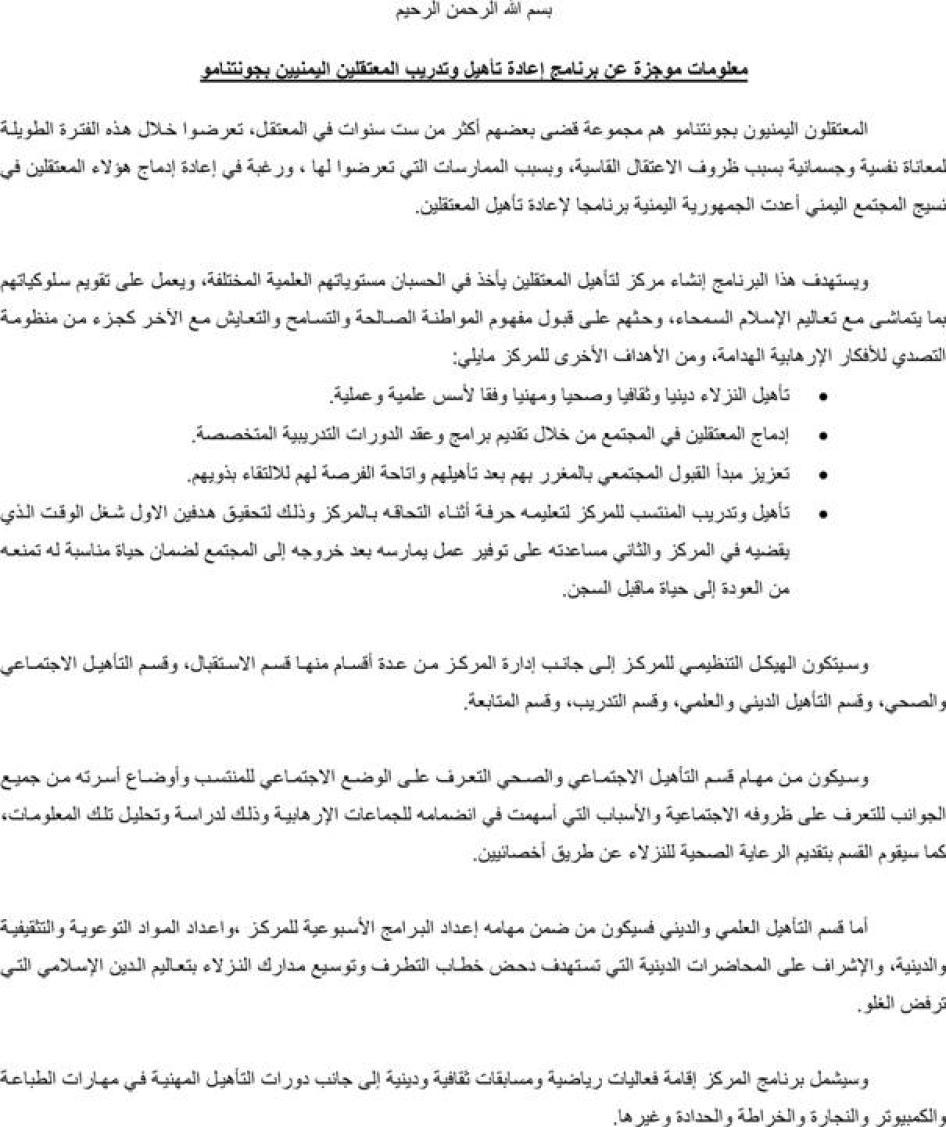
In the name of Allah, Most Gracious, Most Merciful
Summary of Information on the Program for Rehabilitating and Training Yemeni Detainees at Guantanamo[134]
The group of Yemeni detainees at Guantanamo includes members who have spent more than six years in prison. During this long period of time, they were subjected to physical and psychological suffering due to harsh conditions of detention. As a result of the practices they experienced and the desire to reintegrate the detainees into the fabric of Yemeni society, the Republic of Yemen has prepared a program for the detainees' rehabilitation.
The program intends to establish a center for the rehabilitation of prisoners, taking into account their different levels of education. The center will work on rectifying their behavior in line with the tolerant teachings of Islam and will urge them to accept the concepts of good citizenship, tolerance, and coexistence with others, as a way to challenge destructive, terrorist ideas. Other objectives of the center include:
- Rehabilitating residents religiously, culturally, vocationally, and medically, using both scientific and practical approaches.
- Integrating detainees into society by providing programs and specialized training courses.
- Promoting the principle of community acceptance of detainees whose behaviour has been rectified and providing them with the opportunity to meet their family members.
- Rehabilitating associates of the center and teaching them craftsmanship during their enrolment in order to achieve two goals: the first aim is to occupy them while they are at the center; the second aim is to help them find a job after their release to ensure a decent life and prevent them from returning to their life before imprisonment.
The organizational structure of the center, in addition to its administrative branch, will consist of several sections, including Reception, the Department of Social and Health Rehabilitation, the Department of Religious and Educational Rehabilitation, the Training Division, and the Follow-Up Division.
The function of the Department of Social and Health Rehabilitation will be to identify the social status of members and their overall family conditions, in order to analyze and determine their social circumstances and the causes that contributed to their joining terrorist groups. The department will also provide specialists for inmates' health care.
The functions of the Department of Educational and Religious Rehabilitation will include preparing the center's weekly programs, preparing awareness raising, educational and religious materials, and supervising lectures that aim to refute religious extremism and deepen the knowledge of inmates about the teachings of Islam that reject extremism.
The center's program will include sports and cultural and religious activities, in addition to vocational training in typing and computer skills, carpentry, blacksmithing, woodworking, and other trades.
Acknowledgments
This report was written by Letta Tayler, terrorism and counterterrorism researcher at Human Rights Watch, with portions contributed by Joanne Mariner, terrorism and counterterrorism director. It is based on research conducted by Tayler and Mariner.
The report was reviewed and edited by Mariner, Joseph Saunders, deputy program director, and James Ross, legal and policy director. Jennifer Daskal and Julia Hall, senior counsels with Human Rights Watch's Terrorism and Counterterrorism Program, Christoph Wilcke, senior researcher with the Middle East and North Africa Division, and Joe Stork, deputy Middle East director, provided additional, substantive guidance.
Katharine Wies, associate in the Terrorism and Counterterrorism Program, provided production assistance, as did Grace Choi, publications director, Jim Murphy, online editor, Anna Lopriore, photography specialist, Ella Moran, multimedia specialist, and Fitzroy Hepkins, production manager.
We thank Khalid al-Anisi and Ahmed Arman of the National Organization for Defending Rights and Freedoms (HOOD), Radhia al-Mutawakil and Abd al-Rashid al-Faqih of the Dialogue (Hewar) Forum, and Shiekh Abd al-Wahab al-Humaidan and Muhammad Ahmadi of Al-Karama for their defense of the rights of detainees and for their assistance. We also thank the Yemeni ministers of interior and foreign affairs and the deputy chief of national security for receiving us. We would especially like to express our gratitude to the former detainees and relatives of current detainees at Guantanamo and Bagram who spoke with Human Rights Watch.
[1] Email communication from attorney David Remes to Human Rights Watch, February 9, 2009, containing declassified comments from a meeting with his client Said Hatim at Guantanamo on December 17, 2008.
[2]Human Rights Watch has changed this detainee's name and withheld other details to protect him from potential retaliation.
[3] Yemen ranked 141st out of 180 countries in Transparency International's "2008 Corruption Perceptions Index," September 23, 2008, http://www.transparency.org/news_room/in_focus/2008/cpi2008/cpi_2008_table (accessed January 21, 2009). The US government says Yemeni officials "frequently engage in corrupt practices with impunity:" US State Department, Bureau of Democracy, Human Rights, and Labor, "Country Reports on Human Rights Practices – 2008: Yemen," February 25, 2009, http://www.state.gov/g/drl/rls/hrrpt/2008/nea/119130.htm (accessed February 25, 2009) sec. 3. Yemen also is the poorest country in the Middle East, and ranks 153rd out of 177 countries in the 2007 United Nations Development Program's Human Development Index. Approximately 42 percent of its people live in poverty, one in five are malnourished, and 35 percent of its workers are unemployed, according to the World Bank, "Yemen," http://web.worldbank.org/WBSITE/EXTERNAL/COUNTRIES/MENAEXT/YEMENEXTN/0,,menuPK:310170~pagePK:141159~piPK:141110~theSitePK:310165,00.html (accessed January 21, 2009).
[4] "Security Council Re-Establishes Panel Monitoring Somalia Arms Embargo," UN press release, SC/9546, December 19, 2008, http://www.un.org/News/Press/docs/2008/sc9546.doc.htm (accessed January 20, 2009). Yemen has an estimated 60million weapons, according to Jeremy M. Sharp, "Yemen: Background and US Relations," Congressional Research Service, RL34170, January 22, 2009, http://www.fas.org/sgp/crs/mideast/RL34170.pdf (accessed February 26, 2009), p. 5.
[5] Sheba Center for Strategic Studies, "Yemen: Bell Tolls for Water Catastrophe," news release, August 12, 2008, http://shebacss.com/en/news.php?id=1443 (accessed February 10, 2009). See also Ginny Hill, Yemen, Fear of Failure,Chatham House briefing paper, November 2008, http://www.chathamhouse.org.uk/publications/papers/view/-/id/677/ (accessed December 8, 2008), pp. 7-8.
[6] Michael Isikoff and Mark Hosenball, "Deadly Training Ground: Are Al Qaeda fighters returning homefrom Iraq to launch new attacks against US targets?"Newsweek, September17, 2008, http://www.newsweek.com/id/159420 (accessed January 21, 2009).
[7]In addition, the deputy commander of al Qaeda on the Arabian Peninsula reportedly told a Yemeni journalist that several other Saudis had come to Yemen to join al Qaeda, according to Maggie Michael, "Report: Ex-Gitmo detainee joins al Qaeda in Yemen," Associated Press, January 23, 2009, http://www.miamiherald.com/news/world/story/870457.html (accessed January 23, 2009).
[8] In February 2009, US Director of National Intelligence Dennis C. Blair said that "Yemen is reemerging as a jihadist battleground and potential regional base of operations for al Qaeda to plan internal and external attacks, train terrorists, and facilitate the movement of operatives." Al Qaeda could use Yemen "to supplement its external operations agenda, promote turmoil in Saudi Arabia, and weaken the Saleh regime," he added. US Senate Select Committee on Intelligence, "Intelligence Community Annual Threat Assessment," February 11, 2009, http://www.dni.gov/testimonies/20090212_testimony.pdf (accessed February 26, 2009), p. 7.
[9]An estimated 53 percent of Yemenis are Sunni Muslims and another 45 percent are followers of the Zaidi branch of Shi'ism that ruled Yemen for a millennium until an Army-led revolution in 1962, according to the United Nations Refugee Agency. Integrated Regional Information Networks (IRIN), Yemen: The conflict in Saada Governorate-analysis, 24 July 2008, http://www.unhcr.org/refworld/docid/488f180d1e.html (accessed 16 March 2009).
[10]Siddharth Ramana, "Yemen: Al Qaeda's Homecoming," Middle East Strategic Information, October 13, 2008, http://mesi.org.uk/ViewBlog.aspx?ArticleId=35 (accessed December 8, 2008), para. 18; Christopher Boucek, Shazadi Beg, and John Horgan, "Opening up the Jihadi Debate: Yemen's Committee for Dialogue," in Leaving Terrorism Behind: Disengagement from Political Violence,Tore Bjørgo and John Horgan, eds. (New York: Routledge, September 2008), p. 189.
[11] Boucek, Beg, and Horgan, "Opening up the Jihadi Debate: Yemen's Committee for Dialogue," p. 182.
[12] Ibid.
[13] Ibid.
[14] Al-Zindani is the founder of Iman University in Sanaa, which the United States has accused of being a recruiting area for armed militants, though defenders say the school neither sponsors nor condones insurgency. The United States placed al-Zindani on its terrorist list in 2004. "United States Designates bin Laden Loyalist," US Treasury Department press release, February 24, 2004, http://www.ustreas.gov/press/releases/js1190.htm (accessed January 22, 2009). The United Nations also has placed al-Zindani on a list of al Qaeda members or associates. "Security Council Al Qaeda, Taliban Sanctions Committee," UN Security Council press release, SC/8785/Rev. 1, July 26 2006, http://www.un.org/News/Press/docs/2006/sc8785.doc.htm (accessed January 22, 2009). President Saleh publicly supports al-Zindani.
[15] Boucek, Beg, and Horgan, "Opening up the Jihadi Debate: Yemen's Committee for Dialogue," p. 182; Gregory Johnsen, "Al Qaeda's generational split," The Boston Globe, November 9, 2007, http://www.boston.com/bostonglobe/editorial_opinion/oped/articles/2007/11/09/al_qaedas_generational_split/ (accessed December 8, 2008).
[16]Central Intelligence Agency, "Transcript of Remarks by Central Intelligence Agency Director Michael Hayden at the Atlantic Council," November 13, 2008, https://www.cia.gov/news-information/speeches-testimony/speeches-testimony-archive-2008/directors-remarks-at-the-atlantic-council.html (accessed January 24, 2009).
[17]Nicole Stracke, "Al Qaeda in Yemen appeals to 'Saudi Brothers,'" Gulf Research Center newsletter, May 8, 2008, http://www.grc.ae/index.php?frm_action=view_newsletter_web&sec_code=grcanalysis&frm_module=contents&show_web_list_link=1&int_content_id=49636&, para. 1 (accessed January 24, 2009).
[18] Human Rights Watch interview with Murad Zafir, deputy director, National Democratic Institute, Yemeni office, Sanaa, Yemen, December 14, 2008.
[19] Human Rights Watch interview with a US Embassy official, Sanaa, Yemen, December 14, 2008.
[20] US State Department, Bureau of Near Eastern Affairs, "Background Notes – Yemen," December 2007, http://www.state.gov/r/pa/ei/bgn/35836.htm (accessed January 21, 2009).
[21]Alfred B. Prados and Jeremy M. Sharp, "Yemen: Current Conditions and US Relations," Congressional Research Service Report, RS21808, January 4, 2007, http://www.fas.org/sgp/crs/mideast/RS21808.pdf (accessed January 20, 2009), p. 2.
[22] "Yemeni-Saudi al Qaeda Combination Media Propaganda, Minister," Saba Net, Yemen, February 10, 2009, http://www.sabanews.net/en/news175793.htm.
[23] US State Department, Congressional Budget Justification, Foreign Operations, Near East, Yemen: FY 2009, http://www.state.gov/documents/organization/101368.pdf, pp. 577-78; FY 2008, http://www.state.gov/documents/organization/84462.pdf, pp. 524-26, FY 2007, http://www.state.gov/documents/organization/60641.pdf, pp. 480-81, FY 2006, http://www.state.gov/documents/organization/42258.pdf, pp. 463-65, FY 2005, http://www.state.gov/documents/organization/28978.pdf, pp. 436-36, FY 2004, http://www.state.gov/documents/organization/17788.pdf, pp. 415-16 (retrieved February 11, 2009).
[24] Human Rights Watch interviews with two US Embassy officials, Sanaa, Yemen, December 14, 2008.
[25]Seven other escapees were killed-two in suicide bombings, four in clashes with the Yemeni government, and one from rounds fired in a sea-to-ground attack by the USS Chafee warship in Somalia-and one was released from prison in February 2009 after extradition from Kenya, according to Gregory Johnsen, a Ph.D. candidate in Near Eastern Studies at Princeton University and co-editor of a forthcoming book on Islam and armed insurgency in Yemen. Email communication from Johnsen to Human Rights Watch, February 29, 2009.
[26]Email communication from Johnsen, February 26, 2009, and interview with anonymous Yemen analyst, February 25, 2009.
[27]The US State Department's "Country Reports on Human Rights Practices – 2008: Yemen," http://www.state.gov/g/drl/rls/hrrpt/2008/nea/119130.htm, sec. 1 (c), cites "significant human rights problems" including "irregular and in some cases . . . non-existent" application of laws governing arrests and detainment, credible reports of torture, and detention of terrorist suspects without due process. The Yemeni government is also responsible for widespread enforced disappearances and arbitrary arrests since 2004 in connection with the recurring armed conflict in northern Sa'da governorate. See Human Rights Watch, Disappearances and Arbitrary Arrests in the Armed Conflict with Huthi Rebels in Yemen, http://www.hrw.org/en/reports/2008/10/24/disappearances-and-arbitrary-arrests-armed-conflict-huthi-rebels-yemen-0, pp. 2-8.
[28]Human Rights Watch interviews with members of the Yemeni nongovernmental organizations National Organization for Defending Rights and Freedom (HOOD), the Yemeni Observatory for Human Rights, and the Yemen chapter of al-Karama for Human Rights, Sanaa, Yemen, December 13-20, 2008.
[29] Human Rights Watch interview with a US Embassy official, December 14, 2008.
[30] Human Rights Watch interviews with HOOD, Yemeni Observatory for Human Rights, and Al-Karama, Sanaa, Yemen, December 13-20, 2008. HOOD's Executive Secretary Ahmed Arman estimated that, at that time, Yemeni authorities were holding more than 300 people without charge as terrorist suspects.
[31]Republican Decree, By Law No. 13 for 1994, Concerning the Criminal Procedures[Yemen].No. 13 for 1994.12 October 1994, available online in UNHCR Refworld at: http://www.unhcr.org/refworld/docid/3fc4bc374.html, (accessed February 9, 2009), arts. 7, 73, 76, 77, 176, 190.
[32] "Republican Decision on Law no. 13 of Year 1994 Regarding Criminal Procedures," President of the Republic, art. 84.9. Yemen's Constitution prohibits detention "in any place not authorized under the Prisons Administration law," Constitution of the Republic of Yemen, 2001, art. 48.b.
[33]Republican Decision on Law no 391 for the Year 1999 Regarding the Specialized Criminal Court, art. 3; Republican Decision on Law no. 8 for the Year 2004 Regarding the Specialized Criminal Court, art. 1.
[34] Human Rights Watch interviews with Muhammad al-Makhlafi and Muhammad al-Maqtari, lawyers with the Yemeni Observatory for Human Rights, Sanaa, Yemen, December 15, 2008; and with Ahmed Arman of HOOD , Sanaa, Yemen, December 20, 2008. Also see US State Department, "Country Reports on Human Rights Practices – 2008: Yemen," http://www.state.gov/g/drl/rls/hrrpt/2008/nea/119130.htm, sec. e., and Amnesty International, "Yemen: Submission to the UN Universal Periodic Review," http://www.amnesty.org/en/library/asset/MDE31/012/2008/en/28b002a7-b259-11dd-8634-af6d09acdcad/mde310122008en.html, (accessed December 8, 2008), sec. e.
[35]Alice Hackman, "Al-Khaiwani found guilty in a court session he was not informed about," Yemen Times, January 28, 2009, http://www.yementimes.com/article.shtml?i=1229&p=local&a=1 (accessed February 10, 2009); Committee to Protect Journalists, "Yemeni editor given six-year term," June 9, 2008.
[36]Human Rights Watch interviews with al-Makhlafi and al-Maqtari, December 15, 2008, and Arman, December 20, 2008. Also see Amnesty International, "Yemen: Amnesty International Submission to the UN Universal Periodic Review," May 2009, http://www.amnesty.org/en/library/asset/MDE31/012/2008/en/28b002a7-b259-11dd-8634-af6d09acdcad/mde310122008en.html.
[37]The law lists the death penalty for six crimes including heading a kidnapping or theft ring. Draft Law on Countering Terrorism, art. 4. Article 19 would allow the attorney general to authorize wiretaps without a court order. (Copy on file with Human Rights Watch). Human Rights Watch opposes the death penalty in all circumstances because of its inherent cruelty and finality.
[38]Some 120 prisoners from Saudi Arabia and about 220 from Afghanistan were repatriated during that period, leaving a dozen from the former country and fewer than three dozen from the latter. Other countries with 10 or more citizens in detention at Guantanamo as of early 2009 include Algeria, Tunisia, and China (17 ethnic Uighurs who would face persecution if returned home). More than 525 prisoners have been released or transferred out of Guantanamo in the last seven years.
[39] Just after taking office, President Obama issued an executive order setting out a one-year deadline for the closure of the detention facility at Guantanamo. Executive Order, "Review and Disposition of Individuals Detained at the Guantanamo Bay Naval Base and Closure of Detention Facilities," January 22, 2009, http://www.whitehouse.gov/the_press_office/ClosureOfGuantanamoDetentionFacilities (accessed February 27, 2009).
[40] The Yemeni Embassy in Washington, DC, told Human Rights Watch there are 99 Yemenis at Guantanamo. Attorneys representing Yemenis said that they believe 94 to 97 of the detainees are Yemeni. The US State Department and Defense Department told Human Rights Watch there are "about 100" of them. Human Rights Watch telephone interviews, Washington, DC, February 2009. The National Organization for Defending Rights and Freedom (HOOD), a prominent Yemeni human rights group, released a list of Yemeni detainees on January 11, 2009, that included 104 names, but told Human Rights Watch the true number is between 95 to 99 after accounting for discrepancies in names and nationalities.
A senior Yemeni official told Human Rights Watch in December 2008 that a Yemeni government delegation had traveled to Guantanamo to assess the citizenship of the purportedly Yemeni detainees, and found three who were not, in fact, Yemeni. (He said that one was Saudi, one was Sudanese, and one was Libyan.) He estimated there were 102 Yemeni detainees held at Guantanamo. Human Rights Watch interview with Amar Saleh, deputy chief of Yemen's National Security Bureau, Sanaa, December 21, 2008.
[41]Walid and Hassan bin Attash, for example, were both born in Saudi Arabia, but their family is from Yemen.
[42]Human Rights Watch telephone interview with Darold Killmer, attorney, Denver, Colorado, March 9, 2009.
[43] Human Rights Watch interview with Saleh, December 21, 2008. Yemenis serve as a large pool of migrant labor in Saudi Arabia.
[44] At least six Yemenis-Mahmoud Abd Al Aziz Abd Al Mujahid, ISN 31, Abdul Malik Abdul Wahab Al Rahbi, ISN 37, Ali Hamza Ahmed Suleiman Al Bahlul, ISN 39, Samir Naji Al Hasan Moqbel, ISN 43, Muhammad Rajab Sadiq Abu Ghanim, ISN 44, and Ali Ahmad Muhammad Al Razehi ISN 45-were on the very first flight, on January 11, 2002, that brought detainees from Afghanistan to Guantanamo. Other Yemenis arrived on additional flights that same month. See Reprieve, "The Journey of Death-Over 700 Prisoners Illegally Rendered to Guantanamo Bay with the Help of Portugal," January 28, 2008, http://www.reprieve.org.uk/documents/08.01.28FINALTheJourneyofDeath-Over700PrisonersIllegallyRenderedtoGuantanamoBaywiththeHel.pdf (accessed February 27, 2009).
At the other end of the spectrum, Yemenis were also among the very last prisoners to end up at Guantanamo. Four Yemenis-Sanad Ali Tislam al-Kazimi, ISN 1453, Hassan Bin Attash, ISN 1456, Al Hajj Abdu Ali Sharqawi, ISN 1457, and Abdul Salam al-Hela, ISN 1463-were transferred to Guantanamo along with several other prisoners on September 17, 2004, the last detainee transfer to the facility for nearly two years. In September 2006, two more Yemenis-Ramzi bin al-Shibh, ISN 10013, and Walid bin Attash, ISN 10014-were among a group of 14 prisoners transferred from secret CIA prisons to military custody at Guantanamo.
[45] Salim Hamdan, for example-who was sent to Guantanamo in May 2002-was arrested at a roadblock near Kandahar, Afghanistan, in late November 2001. Carol J. Williams, "Bin Laden's Driver Is Going Home," Los Angeles Times, November 25, 2008. Hamdan was the named petitioner in the case of Hamdan v. Rumsfeld, in which the US Supreme Court in 2006 ruled that the executive branch had no authority to establish the system of military commissions at Guantanamo without legislation from Congress.
A number of Yemenis were picked up in Karachi, Pakistan, most of them in September 2002. The group includes Ayoub Murshid Ali Saleh, ISN 836, Bashir Nasir Ali al-Marwalah, ISN 837, Shawki Awad Balzuhair, ISN 838, Musab Omar Ali al-Mudwani, ISN 839, Ha Il Aziz Ahmed al-Maythali, ISN 840, and Hassan Bin Attash, ISN 1456. The US government claims that many of the men were arrested during raids on a militant safehouse. See, for example, US Department of Defense, "Unclassified Summary of Evidence for Administrative Review Board in the case of Bin Attash, Hassan Muhammad Salih," October 31, 2005, http://www.dod.mil/pubs/foi/detainees/csrt_arb/ARB_Round_1_Factors_000895-000943.pdf#1, (accessed February 19, 2009).
[46] The CIA has held at least 20 Yemenis in secret detention at various points since 2001, which makes Yemenis the largest single group to have been "disappeared" into CIA custody. All of the Yemenis who were transferred to Guantanamo in September 2004 and September 2006 had previously been held in CIA custody, some of them for years. While in CIA custody, they are known to have been subject to a range of serious abuses. See, for example, Amnesty International, "USA/Yemen: Secret Detention in CIA 'Black Sites,'" November 2005.
[47] Both al-Sharqawi and bin Attash were arrested in Pakistan in 2002. In a note that al-Sharqawi wrote while detained by the Jordanian intelligence services, he said that he was beaten "in a way that does not know mercy." There is also evidence that Yemeni detainee Ramzi bin al-Shibh was rendered by the CIA to Jordan and detained there for a time before being returned to CIA custody. See Human Rights Watch, Double Jeopardy: CIA Renditions to Jordan, April 2008, http://www.hrw.org/en/node/62263/section/5, pp. 22-23. See also Joanne Mariner (Human Rights Watch), "We'll make you see death," commentary, Salon.com, April 10, 2008, http://www.hrw.org/en/news/2008/04/09/well-make-you-see-death.
[48] The executive order that set the one-year deadline for Guantanamo detention facility's closure also suspended the operation of the military commissions. The order specifically requires US officials to assess "whether it is feasible to prosecute [detainees at Guantanamo] before a court established pursuant to Article III of the United States Constitution," that is, before a regular federal court. Executive Order, "Review and Disposition of Individuals Detained at the Guantanamo Bay Naval Base," http://www.whitehouse.gov/the_press_office/ClosureOfGuantanamoDetentionFacilities, sec. 4(c) (3).
[49] Hamdan, whom the presiding officer at his trial called a "small player," was convicted on July 21, 2008, of providing material support to al Qaeda. The court ruled that his sentence would include the five years that he had spent in US custody awaiting trial. He was repatriated in November 2008 to serve the final month of his prison term in Yemen.
Al-Bahlul was convicted on November 3, 2008, of conspiring with al Qaeda, soliciting murder and providing material support for terrorism, including a recruitment video he made that spliced bin Laden speeches with footage of the USS Cole bombing. Two prosecutors resigned from his case because of suspicions that his captors had tortured him to obtain evidence.
[50]Neither bin al-Shibh nor bin Attash deny their guilt. Indeed, bin al-Shibh told a military judge in January 2009 that he was "proud of September 11." "9/11 Suspects Face New Hearing," Aljazeera.net, January 20, 2009, http://english.aljazeera.net/news/americas/2009/01/2009119172511702723.html (accessed January 20, 2009).
[51]As of February 2009, the US Department of Defense had brought charges against a total of 27 detainees at Guantanamo, although in a few cases the charges had been dropped. The military has long said that only 60 to 70 detainees would ever be charged under the commissions, and many experts thought even that estimate was probably too high.
[52] Telephone interviews and email communications with attorneys including David Remes, Sarah Havens, and Pardiss Kebriaei, Washington, DC, and New York, February 2-9, 2009.
[53]Human Rights Watch interview with a US Defense Department official close to Guantanamo issues, February 18, 2009.
[54]For example, in November 2008, US federal judge Richard Leon ordered the immediate release of five Algerian-born Bosnian prisoners at Guantanamo after concluding the government's evidence was "not sufficient" to detain them as enemy combatants. "To allow enemy combatancy to rest on so thin a reed would be inconsistent with this Court's obligation," Leon declared. Boumediene v. Bush, US District Court, Washington, DC, No. 01-1166, memorandum order, November 20, 2008, https://ecf.dcd.uscourts.gov/cgi-bin/show_public_doc?2004cv1166-276 (accessed March 11, 2009).
Five months earlier, the US Court of Appeals for the DC Circuit rejected the US government's designation of another Guantanamo detainee as an "enemy combatant" because of evidence it described as unreliable and insufficient. The decision involved Houzaifa Parhat, one of 17 Guantanamo detainees who are Uighurs, an ethnic minority group in China. The United States conceded the decision would apply to all the Uighurs, although it is still holding them. See Parhat v. Gates, US Court of Appeals, Washington, DC, No. 06-1937, June 20, 2008, http://pacer.cadc.uscourts.gov/common/opinions/200806/06-1397-1124487.pdf (accessed March 11, 2009).
In an important 2005 case, federal judge Joyce Hens Green concluded that German-born Murat Kurnaz was being illegally held at Guantanamo, writing that even the classified portion of his file was "rife with hearsay." Kurnaz was repatriated to Germany in July 2006. See Mark Landler and Souad Mekhennet, "German Detainee Questions His Country's Role," The New York Times, November 4, 2006, http://www.nytimes.com/2006/11/04/world/europe/04germany.html?scp=1&sq=nurat%20kurnaz&st=cse (accessed March 11, 2009).
[55]US Department of Defense, Combatant Status Review Tribunal, Hussein Almerfedi (name transliterated as Muhammad Hussein Salem), December 8, 2004, http://projects.nytimes.com/Guantánamo/detainees/1015-hussein-salem-Muhammad (accessed February 6, 2009), pp. 1-13.
[56]Email communications from Remes to Human Rights Watch, February 6, 2009.
[57] President Obama's executive order of January 22, 2009, required humane standards of confinement at Guantanamo and conformity with "all applicable laws governing the conditions of such confinement." Human Rights Watch and other rights groups question a Pentagon report released a month later in response to that order by Adm. Patrick M. Walsh, the vice chief of US Naval Operations, that concludes conditions at Guantanamo complied with the Geneva Conventions, which among other things bar "humiliating and degrading treatment." See US Defense Department, "Review of department compliance with president's executive order on detainee conditions of confinement," February 23, 2009, http://www.defenselink.mil/pubs/pdfs/review_of_department_compliance_with_presidents_executive_order_on_detainee_conditions_of_confinementa.pdf (accessed March 11, 2009).
Since Walsh's report was released, several Guantanamo lawyers have told Human Rights Watch that their Yemeni and other clients continue to receive degrading treatment. Furthermore, a report released by the Center for Constitutional Rights the same day as Walsh's report concludes that the detainees continue to suffer from solitary confinement, psychological abuse, abusive force-feeding of hunger strikers, religious abuse, physical abuse, and threats of violence from their captors, and that this has jeopardized their mental health. Among other abuses, the report describes a brutal beating of a Yemeni detainee, Yasin Ismael, for reportedly throwing his shoe against the inner mesh of a cage in which he was held. The Pentagon denies Ismael's allegation. See CCR, "Conditions of Confinement at Guantánamo: Still in Violation of the Law," http://ccrjustice.org/learn-more/reports/current-conditions-confinement-guantanamo (accessed March 10, 2009).
[58] The Pentagon says Yemeni Salah Ali Abdullah Ahmed al-Salami, who was arrested in Pakistan in March 2002, committed suicide inside Guantanamo in June 2006, but his family alleges he died from abuse and has filed a lawsuit alleging government negligence in his death. Al-Salami's brother Muhammad Ahmed Taher remains in detention at Guantanamo.
[59] Letters from Adnan Latif to attorneys David Remes and Marc Falkoff, January 8, 2009.Latif, who has been held at Guantanamo for seven years, told a military review board in 2004 that he went to Afghanistan for a charity-funded operation to treat head injuries from a car accident. The panel's judge rejected his plea to check hospital records that would support his story. The hospital records, later obtained by his lawyers and sent to Human Rights Watch, described acute injuries from the accident and recommended he seek surgery at a specialized clinic.
[60] In Boumediene v. Bush, 553 U.S. __ (2008), the Supreme Court ruled that the US Constitution guarantees detainees held at Guantanamo a right of access to federal court. As discussed below, detainees held at Bagram are still litigating the question of federal court jurisdiction over their claims.
[61] "Judge Denies Release For 2 at Guantanamo," December 31, 2008, The Washington Post,http://www.washingtonpost.com/wp-dyn/content/article/2008/12/30/AR2008123003031.html (accessed March 16, 2009).
[62]Al-Bihani v. Obama, US District Court, Washington, DC, no. 05-1312, January 28, 2009, https://ecf.dcd.uscourts.gov/cgi-bin/show_public_doc?2005cv1312-89 (accessed March 12, 2009).
[63] "Judge: Government hiding evidence in Gitmo case," Associated Press, January 6, 2009, http://www.miamiherald.com/news/americas/Guantánamo/story/840163.html (accessed January 29, 2009). The petitioner in the case is alleged Taliban doctor Aymen Saeed Batarfi.
[64]The US government claims that because the men are being held in an "active theater of war," they can be held until the end of hostilities without judicial review of the grounds for their detention. The petitioners counter that the men were picked up in four different countries and transferred to Bagram, where they have been held for years without charge or access to counsel. In a short document filed in federal court on February 20, 2009, the Obama administration adopted the position previously set out under the Bush presidency, arguing that the detainees should have no right of access to court. "Having considered the matter, the government adheres to its previously articulated position," the new administration's court filing stated. Charlie Savage, "Obama Upholds Detainee Policy in Afghanistan," The New York Times, February 22, 2009.
[65]Human Rights Watch interview with Muhammad al-Bakri, Sanaa, Yemen, December 18, 2008. The US government claims that Fadi al-Maqaleh, the other Yemeni held at Bagram, was taken into custody in southern Afghanistan; al-Maqaleh's lawyers deny this. See First Amended Petition for Writ of Habeas Corpus, Al-Maqaleh v. Gates, Case No. 1:06-cv-01669 (JDB), February 12, 2007, http://graphics8.nytimes.com/packages/pdf/topics/bagram/Petition1.pdf (accessed February 26, 2009).
Abdulsalam al-Hela, a Yemeni detainee who was picked up in Egypt, was held with al-Bakri at Bagram prior to his transfer to Guantanamo in September 2004. It is not known why the military chose to send al-Hela to Guantanamo while keeping al-Bakri at Bagram. See Human Rights Watch, Cairo to Kabul to Guantanamo, March 28, 2005, http://www.hrw.org/en/reports/2005/03/30/cairo-kabul-guantanamo (quoting a letter from al-Hela that describes being held with "a [Yemeni] merchant, who was arrested in Thailand and brought to Afghanistan").
[66] Human Rights Watch interview with al-Bakri, December 18, 2008.
[67] Human Rights Watch telephone interview with Tina Foster, executive director, International Justice Network, New York, February 2, 2009.
[68] As described in the background section above, the two suspects-Jaber al-Banna and Jamal al-Badawi-both have Yemeni citizenship, and are thus protected from extradition under Yemen's constitution.
[69] The Pentagon put the number of hunger strikers at 42 on January 12, 2009, but the Center for Constitutional Rights (CCR), a group spearheading legal challenges to Guantanamo, estimated the number at 70.By early March 2009, at least 50 detainees were still on a hunger strike, attorney Ramzi Kassem told Human Rights Watch in an email communication on March 9, 2009.
[70] Human Rights Watch telephone interview with David Remes, attorney, Washington, DC, February 2, 2009.
[71]Thirteen Yemenis have been cleared for transfer or release, according to the CCR, although other sources say at least 11 and the Pentagon told Human Rights Watch "fewer than 15." Of those, the CCR says six were cleared in 2005, one in 2006, and two in 2007. The other four were cleared sometime between 2006 and 2008. The Obama administration is reviewing the clearance status of all detainees, and lawyers say the previous system was haphazard, with some detainees released without formal clearance and others who had been cleared remaining in detention for no apparent reason.
[72]Human Rights Watch telephone interview with Julia Symon, Washington, DC, March 10, 2009.
[73]Ibid. Another Yemeni, Suleiman al-Nahdi, was cleared for release in February 2008 and was even photographed and given a hair-cut in preparation for his departure but also remains in prison, said his lawyers Kristin Wilhelm of Atlanta, Georgia, and Richard Murphy of Washington, DC, in telephone interviews with Human Rights Watch on March 9-10, 2009. After learning he'd be released, "he was elated. There was laughter and tears," Wilhelm said. But after months passed, he became so despondent that twice he refused to meet his lawyers. In a meeting in January 2009, "he was somber," Wilhelm said. "I sensed a definite frustration."
[74] "Yemen says awaiting 94 Guantanamo Returnees," Reuters, January 24, 2009, http://uk.reuters.com/article/globalNews/idUKTRE50N1OQ20090124?sp=true (accessed January 24, 2009).
[75] Human Rights Watch interview with a US Embassy official, December 14, 2008.
[76]Human Rights Watch interview with Yemeni Interior Minister Mutahar Rashad al-Masri, Sanaa, Yemen, December 17, 2008.
[77] Human Rights Watch interview with a US Embassy official, December 14, 2008.
[78] Human Rights Watch interviews with US Embassy officials, December 14, 2008, with al-Masri, December 20, 2008, and with Foreign Minister Abu Bakr al-Qirbi and Saleh, Sanaa, Yemen, December 21, 2008.
[79] Ibid. In addition, negotiators will have to find a solution for the one Yemeni who claims that he fears return to his home country. Yasim Muhammed Basardah said he believes that he will be killed if he returns to Yemen because he informed on other prisoners at Guantanamo. See US Defense Department, "Summary of Administrative Review Board Proceedings for ISN 252," November 11, 2005, http://www.dod.mil/pubs/foi/detainees/csrt/ARB_Transcript_Set_5_20000-20254.pdf#233 (accessed February 11, 2009), p. 11; Del Quentin Wilber, "Detainee-Informer Presents Quandary for Government," The Washington Post, Tuesday, February 3, 2009.
[80] See, for example, Jack L. Goldsmith and Newl Katyal, "The Terrorists' Court," The New York Times, July 11, 2009, http://www.nytimes.com/2007/07/11/opinion/11katyal.html?scp=1&sq=goldsmith%20and%20katyal&st=cse, and David B. Rivkin and Lee A. Casey, "Closing Guantanamo Will Damage the War Effort," The Washington Post, February 21, 2009,
http://newsweek.washingtonpost.com/postglobal/needtoknow/2009/02/closing_guantanamo_will_damage.html, (accessed March 12, 2009). For a more extensive argument against preventative detention, see David Fathi (Human Rights Watch), "Dangers of a Preventative Detention Law," commentary, January 3, 2009, http://www.hrw.org/en/news/2009/01/03/dangers-preventive-detention-law.
[81] This was a prospect in Afghanistan, where the United States is battling the Taliban. US negotiators worked out an agreement by which detainees were transferred from Guantanamo to an Afghan prison and are being held while their cases are reviewed. The Pentagon reportedly requested but did not get the Guantanamo-style facility it had sought. Tim Golden, "Foiling US Plan, Prison Expands in Afghanistan," The New York Times, January 7, 2008, http://www.nytimes.com/2008/01/07/world/asia/07bagram.html?n=Top/Reference/Times%20Topics/People/G/Golden,%20Tim (accessed December 8, 2008). The Bush administration often insisted on subsequent detention or prosecution when it sent detainees home from Guantanamo, according to Human Rights Center and International Human Rights Law Clinic (University of California, Berkeley) and CCR, "Guantanamo and Its Aftermath: U.S. detention and interrogation practices and their impact on former detainees," November 2008, p. 61.
[82]US Defense Department news briefing with spokesman Geoff Morrell, January 13, 2009, http://www.defenselink.mil/transcripts/transcript.aspx?transcriptid=4340 (accessed March 12, 2009).
[83] The Defense Department's number is proven false by its own data and prior reports, according to a report by the Seton Hall Law Center for Policy and two Guantanamo detainees' attorneys. Among the report's objections: in each of 43 attempts to provide the numbers of the recidivist detainees, the Pentagon has provided figures that are inconsistent with its own data; it provides no names, places, or incidents to back up its latest number; in the past, the Pentagon has classified activities such as possession or distribution of "anti-US propaganda" or having "spoken critically of the government's detention policy" as a "return to the fight." The report accepts only five named instances of recidivism as plausible and finds even those problematic. Members of the Subcommittee on International Organizations, Human Rights and Oversight of the House Foreign Affairs Committee also expressed skepticism of the Pentagon's numbers during a hearing on May 20, 2008, the report notes. Mark Denbeaux, Joshua Denbeaux, and David Gratz, "Released Guantanamo Detainees and the Department of Defense: Propaganda by the Numbers?" Seton Hall Law Center for Policy and Research, January 15 2009, http://law.shu.edu/center_policyresearch/reports/propaganda_numbers_11509.pdf (accessed February 12, 2009).
[84]See Rajiv Chandrasekaran, "A 'Ticking Time Bomb' Goes Off," The Washington Post, February 23, 2009 (describing the case of a Kuwaiti former detainee who became a suicide bomber in Iraq). http://www.washingtonpost.com/wp-dyn/content/article/2009/02/22/AR2009022202384_pf.html (accessed February 27, 2009). Although none of the 14 repatriated Yemenis is known to have joined militant groups, the human rights group HOOD says three dropped from sight in January 2009.
[85]"U.S. Counterterrorism Official Discusses Yemeni Guantanamo Detainees with President Saleh," US Embassy, press release, March 16, 2009, http://yemen.usembassy.gov/ctgd.html (accessed March 18, 2009).
[86] Human Rights Watch telephone interview with Yemeni diplomat, Yemeni Embassy, Washington, DC, March 18, 2009.
[87] For more detail, see Christopher Boucek, "Saudi Arabia's 'Soft' Counterterrorism Strategy: Prevention, Rehabilitation, and Aftercare," Carnegie Endowment for International Peace, paper No. 97, September 2008.
[88] The Saudis also have rearrested a dozen former Guantanamo detainees whom they allege were either trying to leave the country or associating with persons they were barred from seeing as a condition of their release from the rehabilitation program, or because officials decided they posed a risk, Boucek told Human Rights Watch in a telephone interview on March 11, 2009. Without seeing evidence to support the Saudis' claims, it is impossible to assess their validity.
[89] The NEFA Foundation, "Al Qaidat al Jihad Organization in the Arabian Peninsula: From Here We Will Begin and in al Aqsa We Shall Meet," January 23, 2009, http://www.nefafoundation.org/miscellaneous/FeaturedDocs/nefaqaidayemen0209.pdf (accessed February 9, 2009). Al-Shihri was released to Saudi Arabia in 2007.
[90] Human Rights Watch telephone interview with a Yemeni diplomat, Washington, DC, March 18, 2009. The diplomat said the United States did not specify a number. The Wall Street Journal has reported that about 20 Yemenis with Saudi ties could be sent to the Saudi program. See Jay Solomon, "U.S. Arranging to Send Prisoners to Saudi Arabia," The Wall Street Journal, March 13, 2009.
[91] Human Rights Watch telephone interview with Yemeni diplomat, Yemeni Embassy, Washington, DC, March 18, 2009.
[92] See, for example, Jackie Northam, "Debate Rages Over Those Still At Guantanamo," National Public Radio, November 20, 2008, http://www.npr.org/templates/story/story.php?storyId=97230217 (accessed December 8, 2008).
[93]Human Rights Watch telephone interview with Sarah Havens, attorney, New York, February 2, 2009.
[94]US Army, "Field Manual on Counterinsurgency Operations," Field Manual No. 3-24, December 15, 2006, http://www.fas.org/irp/doddir/army/fm3-24.pdf (accessed February 26, 2009), pp. 23-24.
[95] Human Rights Watch interview with a US Embassy official, December 14, 2008.
[96]Ibid.
[97] Human Rights Watch interview with Saleh, December 21, 2008.
[98] Ibid.
[99]Human Rights Watch interview with Khaled al-Anisi, executive director of the National Organization for Defending Rights and Freedom (HOOD), Sanaa, Yemen, December 13, 2008.
[100]Human Rights Watch interview with Saleh, December 21, 2008.
[101] Amnesty International, "USA: Torture and secret detention: Testimony of the 'disappeared' in the 'war on terror,'" http://www.amnesty.org/en/library/asset/AMR51/108/2005/en/dom-AMR511082005en.html (accessed January 20, 2009).
[102] Also see US State Department, Bureau of Democracy, Human Rights, and Labor, "Country Reports on Human Rights Practices – 2008: Yemen," http://www.state.gov/g/drl/rls/hrrpt/2008/nea/119130.htm, sec. 1.
[103] Human Rights Watch telephone interview with Boucek, Washington, DC., March 11, 2009. Because the last group of Saudis left Guantanamo in December 2007, it is likely that the 10 men have been detained in the program for at least 14 months.
[104]Human Rights Watch, Precarious Justice – Arbitrary Detention and Unfair Trials in the Deficient Criminal Justice System of Saudi Arabia, March 24, 2008, http://www.hrw.org/en/reports/2008/03/24/precarious-justice-0.
[105] Human Rights Watch interview with detainee, Yemen, December 2008; Human Rights interviews with al-Anisi and Arman of HOOD, December 13, 2008; US State Department, "Country Reports on Human Rights Practices – 2008: Yemen," http://www.state.gov/g/drl/rls/hrrpt/2008/nea/119130.htm, sec. 1(c); Amnesty International, "Yemen: Amnesty International Submission to the UN Universal Periodic Review," May 2009, http://www.amnesty.org/en/library/asset/MDE31/012/2008/en/28b002a7-b259-11dd-8634-af6d09acdcad/mde310122008en.html (accessed December 8, 2008).
[106]Human Rights Watch interviews with Saleh and al-Masri, December 19-21, 2009.
[107] Human Rights Watch interview with al-Qirbi, December 21, 2008.
[108] Human Rights Watch interview with two US Embassy officials, Sanaa, Yemen, December 14, 2008.
[109] International Covenant on Civil and Political Rights (ICCPR), adopted December 16, 1966, G.A. Res. 2200A (XXI), 21 U.N. GAOR Supp. (No. 16) at 52, U.N. Doc. A/6316 (1966), 999 U.N.T.S. 171, entered into force March 23, 1976, art. 2(3) (right to an effective remedy); see also, Human Rights Committee, General Comment 31 Nature of the General Legal Obligation on States Parties to the Covenant, U.N. Doc. CCPR/C/21/Rev.1/Add.13 (2004),
para. 16. According to the Human Rights Committee, "In addition to the explicit reparation required by [the ICCPR for violations of covenant rights], … the Committee considers that the Covenant generally entails appropriate compensation. The Committee notes that, where appropriate, reparation can involve restitution, rehabilitation and measures of satisfaction."
[110]Matthew Alexander and John Bruning, How to Break a Terrorist: The US Interrogators Who Used Brains, Not Brutality, to Take Down the Deadliest Man in Iraq (New York: Free Press, 2008), p. 119. A Yemeni government-sponsored film aimed at helping youths rebuff al Qaeda overtures makes the same argument: Ginny Hill, "Yemen's Fight Against Resurgent al Qaeda," Christian Science Monitor, August 29, 2008, http://www.csmonitor.com/2008/0829/p04s03-wome.html (accessed February 8, 2009).
[111] The Saudis had actually modeled their program on Yemen's, which used discussions on the teachings of the Quran to try to dissuade repatriated Guantanamo detainees from battling the United States. Hundreds of participants were released after forswearing violence and promising loyalty to the government. But Yemen closed its program in 2005 after a pan-Arab newspaper reported that a pair of graduates had since gone to Iraq to launch a suicide attack against US forces. Intelligence officials also allegedly suspect three graduates may have played a role in the September 2009 bombing of the US Embassy. Some graduates of the Yemeni program, including bin Laden's former bodyguard Nasser al-Bahri, have said they simply repeated what teachers wanted to hear. "We understood what the judge wanted and he understood what we wanted from him," al-Bahri was quoted as telling BBC News in 2005, referring to the program's supervisor. "There was no long or complex dialogue." See Tim Whewell, "Yemeni Anti-Terror Scheme in Doubt," BBC News international version, October 11, 2005, http://news.bbc.co.uk/2/hi/programmes/crossing_continents/4328894.stm (accessed December 5, 2008.)
[112] Human Rights Watch interviews with political analysts including a telephone interview with Gregory Johnsen of Princeton University, January 23, 2009.
[113] Human Rights Watch telephone interview with Pardiss Kebriaei, attorney, Center for Constitutional Rights, New York, February 3, 2009. The Center for Constitutional Rights has spearheaded litigation on behalf of prisoners at Guantanamo. Commentator Benjamin Wittes made a related point in his recent book on detention. Although he attributed the disparity in treatment to the disparity in countries' abilities to manage security risks, he pointed out the large number of Yemeni detainees who remain at Guantanamo, "even some who seem to pose a less obvious threat than some of the Saudis and British who have gone home." Benjamin Wittes, The Long War: The Future of Justice in the Age of Terror (New York: Penguin Press, 2008), p. 100.
[114] Human Rights Watch interview with Showqi al-Qathi, imam and Islah Party parliamentarian, Sanaa, Yemen, December 15, 2008.
[115] Yemenis rank terrorism fifth among problems facing their country after the cost of living, poverty, the economy in general, and unemployment, according to a poll published October 29, 2008 by the Yemen Polling Center in Sanaa.
[116]Almost two-thirds of repatriated Guantanamo detainees have reported difficulties including flashbacks, disturbing dreams, and other "lasting emotional and psychological scars," according to Human Rights Center and International Human Rights Law Clinic ( University of California, Berkeley) and CCR, "Guantanamo and Its Aftermath," November 2008, pp. 61-68, 75. Many are also grappling with physical problems they developed in abusive detention settings. "Stigmatized by their imprisonment, a significant number of these detainees now face difficulties finding employment," the report adds, p. 75. The study calls for an independent, nonpartisan commission to investigate and report on the treatment of detainees in US custody in the "war on terror" and upon their release.
[117]One repatriated Yemeni from Guantanamo and three former detainees held by the CIA were convicted of making false identity documents. Another former Guantanamo detainee was found not guilty of a drug trafficking charge.
[118]Human Rights Watch interview with "Fahmi Muhammad," a pseudonym for a former Yemeni detainee, Yemen, December 2008.
[119] Human Rights Watch telephone interview with Walid Alshahari, political officer, Yemeni Embassy, Washington, DC, February 2, 2009.
[120] Amnesty International, "Below the Radar: Secret Flights to Torture and Disappearance," AR51, April 5, 2006, p. 2. In February 2006, a Yemeni court tried the men on forgery charges and sentenced them to time served in CIA detention and Guantanamo. They were released the following month.
[121] Human Rights Watch interview with Ahmed Arman of HOOD, New York, February 25, 2009.
[122]Abdul-Aziz Oudah, "Former bin Laden Driver Hamdan Released," Yemeni Observer, January 13, 2009, http://www.yobserver.com/front-page/10015537.html (accessed February 10, 2009).
[123]Email communications from Arman to Human Rights Watch, February 2-6, 2009.
[124]International Covenant on Civil and Political Rights (ICCPR), adopted December 16, 1966, G.A. Res. 2200A (XXI), 21 U.N. GAOR Supp. (No. 16) at 52, U.N. Doc. A/6316 (1966), 999 U.N.T.S. 171, entered into force March 23, 1976, art.9 (1).
[125] Human Rights Watch interview with "Omar Fawza," a pseudonym for a former detainee, Yemen, December 2008.
[126] The account in this section is based on a Human Rights Watch interview with a former Guantanamo detainee in Yemen, December 2008. The detainee's identity has been changed and other details withheld to protect him from possible retaliation.
[127]The account in this section is based on a Human Rights Watch interview with a former Guantanamo detainee in Yemen in December 2008. Human Rights Watch changed the detainee's name and other details to protect him from possible retaliation.
[128]The account in this section is based on a Human Rights Watch interview with a repatriated Guantanamo detainee in Yemen in December 2008. Human Rights Watch changed the detainee's name and some details of his story to protect him from possible retaliation.
[129]International Covenant on Civil and Political Rights (ICCPR), G.A. Res. 2200A (XXI), 21 U.N. GAOR Supp. (No. 16) at 52, U.N. Doc. A/6316 (1966), 999 U.N.T.S. 171, entered into force March 23, 1976; Convention against Torture and Other Cruel, Inhuman or Degrading Treatment or Punishment (Convention against Torture), G.A. res. 39/46, annex, 39 U.N. GAOR Supp. (No. 51) at 197, U.N. Doc. A/39/51 (1984), entered into force June 26, 1987. The United States has been a party to the ICCPR since 1992 and to the Convention against Torture since 1994. Yemen has been a party to the ICCPR since 1987 and to the Convention against Torture since 1991.
[130]ICCPR, arts. 2(3), 7, 9, 10 and 14; Convention against Torture, arts. 2, 12, 14, and 16.
[131]Concluding Observations of the Human Rights Committee, United States of America, September 15, 2006, U.N. Doc. CCPR/C/USA/CO/3 (2006), paras. 13 and 14.
[132]Conclusions and recommendations of the Committee against Torture, United States of America, U.N. Doc. CAT/C/USA/C/2 (2006).
[133] Respected human rights groups including the Yemen Observatory for Human Rights, HOOD, and Amnesty International say the Yemeni courts fall short of international fair trial standards. Also see US State Department, "Country Reports on Human Rights Practices – 2008: Yemen," http://www.state.gov/g/drl/rls/hrrpt/2008/nea/119130.htm, sec. e., and Amnesty International, "Yemen: Submission to the UN Universal Periodic Review," http://www.amnesty.org/en/library/asset/MDE31/012/2008/en/28b002a7-b259-11dd-8634-af6d09acdcad/mde310122008en.html.
[134]Human Rights Watch translation of the Yemeni government's Summary of Information on the Rehabilitating and Training Yemeni Detainees at Guantánamo, an undated document sent by email from the office of Yemen's deputy prime minister for foreign affairs to Human Rights Watch, February 14, 2009.