I. Summary
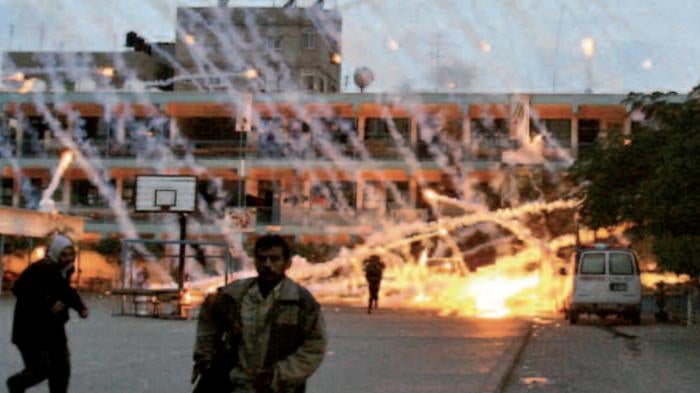
This report documents Israel's extensive use of white phosphorus munitions during its 22-day military operations in Gaza, from December 27, 2008 to January 18, 2009, named Operation Cast Lead. Based on in-depth investigations in Gaza, the report concludes that the Israel Defense Forces (IDF) repeatedly exploded white phosphorus munitions in the air over populated areas, killing and injuring civilians, and damaging civilian structures, including a school, a market, a humanitarian aid warehouse and a hospital.
White phosphorus munitions did not kill the most civilians in Gaza – many more died from missiles, bombs, heavy artillery, tank shells, and small arms fire – but their use in densely populated neighborhoods, including downtown Gaza City, violated international humanitarian law (the laws of war), which requires taking all feasible precautions to avoid civilian harm and prohibits indiscriminate attacks.
The unlawful use of white phosphorus was neither incidental nor accidental. It was repeated over time and in different locations, with the IDF "air-bursting" the munition in populated areas up to the last days of its military operation. Even if intended as an obscurant rather than as a weapon, the IDF's repeated firing of air-burst white phosphorus shells from 155mm artillery into densely populated areas was indiscriminate and indicates the commission of war crimes.
The dangers posed by white phosphorus to civilians were well-known to Israeli commanders, who have used the munition for many years. According to a medical report prepared during the hostilities by the ministry of health, "[w]hite phosphorus can cause serious injury and death when it comes into contact with the skin, is inhaled or is swallowed." The report states that burns on less than 10 percent of the body can be fatal because of damage to the liver, kidneys and heart.
When it wanted an obscurant for its forces, the IDF had a readily available and non-lethal alternative to white phosphorus-smoke shells produced by an Israeli company. The IDF could have used those shells to the same effect and dramatically reduced the harm to civilians.
Using white phosphorus in densely populated areas as a weapon is even more problematic. Human Rights Watch found no evidence that Israeli forces fired ground-burst white phosphorous at hardened military targets, such as Palestinian fighters in bunkers, but it may have air-burst white phosphorous for its incendiary effect. Fired from artillery and air-burst to maximize the area of impact, white phosphorous munitions will not have the same lethal effect as high-explosive shells, but will be just as indiscriminate.
The IDF's deliberate or reckless use of white phosphorus munitions is evidenced in five ways. First, to Human Rights Watch's knowledge, the IDF never used its white phosphorus munitions in Gaza before, despite numerous incursions with personnel and armor. Second, the repeated use of air-burst white phosphorus in populated areas until the last days of the operation reveals a pattern or policy of conduct rather than incidental or accidental usage. Third, the IDF was well aware of the effects white phosphorus has and the dangers it can pose to civilians. Fourth, if the IDF used white phosphorus as an obscurant, it failed to use available alternatives, namely smoke munitions, which would have held similar tactical advantages without endangering the civilian population. Fifth, in one of the cases documented in this report – the January 15 strike on the UN Relief and Works Agency for Palestine Refugees in the Near East (UNRWA) headquarters in Gaza City – the IDF kept firing white phosphorus despite repeated warnings from UN personnel about the danger to civilians. Under international humanitarian law, these circumstances demand the independent investigation of the use of white phosphorus and, if warranted, the prosecution of all those responsible for war crimes.
The IDF at first denied using white phosphorus in Gaza, and then said it was using all weapons in compliance with international law. It now says it is conducting an investigation, reportedly run by a colonel, into the use of white phosphorus. Given the IDF's record on previous internal investigations, and the relatively low rank of the reported investigation leader, the inquiry's objectivity remains in doubt.
White Phosphorus Use in Gaza
White phosphorus is a chemical substance dispersed in artillery shells, bombs, rockets, or mortars, used primarily to obscure military operations on the ground. When released upon ground contact or air-burst, it emits a dense white smoke that militaries use to screen the movement of troops. The smoke also interferes with infra-red optics and weapon-tracking systems, thus protecting military forces from guided weapons such as anti-tank guided missiles. Its use in open areas is permissible under international law, but air-bursting white phosphorus over populated areas is unlawful because it places civilians at unnecessary risk and its wide dispersal of burning wedges may amount to an indiscriminate attack.
White phosphorus can also be used as a weapon against hardened military targets, such as bunkers. However, it may not be used as an anti-personnel weapon when a weapon less likely to cause unnecessary suffering is available.
White phosphorus is not considered a chemical weapon and is not banned per se. But like all weapons its use is restricted by the fundamental principles of international humanitarian law: it must be used in a manner that adequately distinguishes between combatants and civilians, and it may never target the latter.
In Gaza, the IDF most frequently air-burst white phosphorus in 155mm artillery shells. Each air-burst spread 116 burning white phosphorus wedges in a radius extending up to 125 meters from the blast point, depending on conditions and the angle of attack.
White phosphorus ignites and burns on contact with oxygen, and continues burning at up to 1500 degrees Fahrenheit (816 degrees Celsius) until nothing is left or the oxygen supply is cut. When white phosphorus comes into contact with skin it creates intense and persistent burns, sometimes to the bone. Infection is common and the body's absorption of the chemical can cause serious damage to internal organs, as well as death.
In its Gaza operations, the IDF apparently used white phosphorus in three ways. First, on at least three occasions the IDF air-burst white phosphorus in densely populated areas. In the crowded Gaza City neighborhood of Tel al-Hawa, for example, Israeli forces on January 15 fired air-burst white phosphorus directly over homes and apartment buildings where civilians were living or taking shelter, killing at least four civilians from one family. On that day, white phosphorus shells struck the al-Quds Hospital and its administration building run by the Palestinian Red Crescent Society, setting parts of the hospital on fire and forcing the evacuation of about 50 patients and 500 neighborhood residents who had taken refuge there.
Also on January 15, at least three white phosphorus shells struck the main UNRWA compound in the Rimal neighborhood of central Gaza City, wounding three and starting fires that gutted four buildings and destroyed more than US$3.7 million worth of medical supplies. According to UNRWA officials, they had been speaking with IDF officers throughout the morning as the shells landed progressively closer to the compound, asking them to halt fire. About 700 civilians were sheltering in the UN compound at the time.
At another well-marked UN facility – a school in Beit Lahiya sheltering roughly 1,600 displaced persons – the IDF air-burst at least three white phosphorus shells on January 17, the day before the cessation of major hostilities. One discharged shell landed in a classroom, killing two brothers who were sleeping and severely injuring their mother and a cousin. The attack wounded another 12 people and set a classroom on fire. As with all of its facilities in Gaza, the UN had provided the IDF with the GPS coordinates of the school prior to military operations.
In the attacks on the UNRWA compound and the UN Beit Lahiya school, Human Rights Watch's investigation revealed no military justification for using white phosphorus as an obscurant because Israeli forces were not on the ground in those areas at the time of the attacks. When queried by Human Rights Watch by letter about these incidents, the IDF declined to respond, citing its ongoing investigation.
Second, the IDF used air-burst white phosphorus on the edges of populated areas, perhaps as an obscurant to mask the movement of its forces. In some of these cases, such as in Siyafa village near Beit Lahiya on January 4 and Khuza'a village east of Khan Yunis on January 10 and 13, substantial amounts of white phosphorus landed up to a few hundred meters inside residential areas, killing at least six civilian and wounding dozens. The use of white phosphorus in these residential areas violated the obligation to take all feasible measures during military operations to minimize civilian harm.
Third, the IDF apparently used air-burst white phosphorus in open areas along the 1948 armistice line separating Israel and Gaza, perhaps to screen troop movements and to burn shrubs and trees that might serve as cover for Palestinian armed groups, as well as to set off landmines and improvised explosive devices. Human Rights Watch was not able to investigate whether this use resulted in the destruction of civilian objects in excess of the expected military gain because security concerns prohibited travel to the area.
In all of these cases, if smoke-screening was the intended aim, then the IDF possessed alternatives to the highly incendiary white phosphorus; namely, 155mm smoke projectiles, which produce the equivalent visual screening properties without the incendiary and destructive effects. Smokescreens generated by smoke artillery can be deployed more easily over a wider area than white phosphorus with no risk of fires or burns to civilians. Israel Military Industries (IMI) manufactures such shells. While smoke shells do not block infra-red optics and weapon-tracking systems, the IDF consistently used white phosphorus during the day, obviating the need to block night vision, and Human Rights Watch found no evidence that Hamas fired anti-tank guided missiles. Even if Israeli soldiers or armor in need of cover had been on the ground in the areas where white phosphorus was used, air-bursting the munition creates a less effective smokescreen than ground-bursts because the smoke is more widely dispersed. Ground-burst white phosphorus, targeted properly, is less likely to harm civilians because the burning wedges stay more contained.
The consistent use of air-burst white phosphorus instead of smoke projectiles, especially where no Israeli forces were on the ground, strongly suggests that the IDF was not using the munition for its obscurant qualities, but rather for its incendiary effect. Indeed, Human Rights Watch is not aware of the IDF using its white phosphorus in Gaza before, despite numerous incursions with personnel and armor.
In order to explain the high number of civilian casualties from the fighting in Gaza, Israeli government and IDF officials have repeatedly blamed Hamas for using civilians as "human shields" and for fighting from civilian objects. In the cases documented in this report, Human Rights Watch found no evidence of Hamas using human shields in the vicinity at the time of the attacks. In some areas Palestinian fighters appear to have been present, such as in Khuza'a and the Tel al-Hawa neighborhood of Gaza City, but this does not justify the indiscriminate use of white phosphorus in a populated area.
Human Rights Watch has long criticized the IDF for firing 155mm high explosive shells into or near densely populated areas as indiscriminate attacks in violation of the laws of war. Using the same artillery to fire air-burst white phosphorus munitions, which send burning phosphorus wedges 125 meters in all directions, is similarly unlawful when used in populated areas.
The total number of Palestinians killed and injured by white phosphorus is not known and will likely remain so. Hospitals in Gaza were unable to provide statistics on white phosphorus casualties because they lacked the diagnostic tools to determine the cause of burns. Medical records from the time are also poor because hospitals were overwhelmed by the numbers of injured and dead.
Still, the serious impact on civilians and civilian objects is clear. In the six cases documented in this report alone, which represent a selection of white phosphorus attacks in Gaza, white phosphorus shells, burning white phosphorus wedges, or the resulting fires killed 12 civilians, including three women and seven children, one of them a fifteen-month-old baby. Dozens were wounded by burns or smoke inhalation. Human Rights Watch encountered cases of civilians who were injured from stepping on white phosphorus remains up to 12 days after major hostilities had stopped.
Palestinian and foreign doctors who treated burn victims told Human Rights Watch about seeing intense and very deep burns. On some occasions the wounds began to burn again when cleaned, which is consistent with white phosphorus igniting on contact with oxygen. "For the first time I'm seeing strange kinds of burns, very deep to the bone," one doctor at al-Shifa Hospital in Gaza City told Human Rights Watch. "And they cause a bacterial infection unlike anything else."
Some seriously burned patients were evacuated to Egypt for treatment, especially if they needed skin grafts, because Gazan hospitals could not offer proper care. "We have a lot of burns, actually chemical burns," a doctor in Cairo treating Gazans told Human Rights Watch. "Most are third degree burns, which look like chemical burns and not ordinary burns. There is no skin and sometimes even no muscle."
During eleven days of research from January 21 to 31, 2009, Human Rights Watch researchers found 24 spent white phosphorus 155mm shells in civilian areas of Gaza, apparently in the places where they had fallen, including in homes and on streets in residential neighborhoods. The shells and the canisters they contained were colored a distinctive light green, which identifies them as having held white phosphorus.
Palestinian de-miners showed Human Rights Watch an additional 48 shells that they said they had removed from civilian areas, although the precise location where they found these shells is unclear. It is unlikely that the de-miners collected any of these shells from open areas near the Gaza-Israel armistice line due to the security concerns of entering those areas; Israeli forces have repeatedly opened fire on anyone who gets within a few hundred meters of Israeli territory.
Human Rights Watch also found canister liners and dozens of burnt felt wedges containing white phosphorus on streets, roofs, private courtyards, and the UN school in Beit Lahiya. Many of them reignited when kicked or prodded, thereby exposing the white phosphorus to oxygen. When lit and smoking, they emitted a strong odor similar to garlic, which is typical of white phosphorus.
All of the white phosphorus shells that Human Rights Watch found came from the same lot manufactured in the United States in 1989 by Thiokol Aerospace, which was running the Louisiana Army Ammunition Plant at the time. In addition, on January 4, 2009, Reuters photographed IDF artillery units handling projectiles whose markings indicate that they were produced in the United States at the Pine Bluff Arsenal in September 1991.
Israel's willingness to investigate its use of white phosphorus is welcome, but history suggests that the likelihood of an objective examination is slim. Previous IDF investigations have failed to look objectively at alleged laws of war violations by Israeli soldiers and commanders. In the case of Operation Cast Lead, military investigators have already suggested that soldiers and commanders did no wrong, even before the investigations are complete.
"Commanders during the fighting shouldn't be losing sleep because of the investigations," said Col. Liron Liebman, who became head of the IDF's international law department after the major fighting ended in January. "It's impossible not to make mistakes in such a crowded environment, under pressure."[1] Colonel Liebman added that war crimes charges brought against Israeli soldiers and commanders are "legal terrorism."
The United States government, which supplied Israel with its white phosphorus munitions, should also conduct an investigation to determine whether Israel used it in violation of international humanitarian law.
Methodology
During major military operations, from December 27, 2008 to January 18, 2009, Israel banned access to Gaza for all media and human rights monitors. Access via Rafah in Egypt was also blocked. Unable to enter Gaza, Human Rights Watch researchers spent time on the Israeli side of the 1948 armistice line with northern Gaza. On January 9, 10 and 15, they watched IDF artillery repeatedly fire air-burst white phosphorus above civilian areas, including what appeared to be Gaza City and Jabalya. Israeli forces fired these shells from a 155mm artillery battery east of Highway 232 in Israel. The distinctive burst, sending burning wedges down, was consistent with media photographs taken since the start of the ground invasion on January 3. Barred by Israel from entry into Gaza, the researchers were unable to determine precisely where the white phosphorus landed and what effect it had on the civilian population.
Human Rights Watch researchers entered Gaza via the Rafah border crossing with Egypt on January 21, three days after major military operations had ceased, and spent the next 10 days investigating many of the sites where white phosphorus had been used, and the resultant harm to civilians and civilian objects. During this time, Human Rights Watch researchers conducted 29 interviews with the victims and witnesses of white phosphorus use, as well as with ambulance drivers and doctors who treated people with burns. Interviews with doctors who treated burn patients, as well as with another witness of a white phosphorus attack, were conducted in Cairo, Egypt on February 9 and 10.
On February 1, 2009 Human Rights Watch submitted a list of detailed questions about white phosphorus to the IDF, provided as an appendix to this report. On February 15 the IDF replied by letter, also an appendix, that it could not provide answers within the requested time-frame of two weeks. "The IDF has established an investigative team in the Southern Command to look into issues which you have raised, and our reply will be made on the basis of their findings," the letter said.
II. Recommendations
To the Government of Israel
- Immediately appoint an independent commission of inquiry to investigate all credible allegations of serious violations of international humanitarian law by Israeli forces in Gaza between December 27 and January 18, including the use of white phosphorus. The investigation's findings should be made public and should include recommendations for disciplinary measures or criminal prosecutions, as appropriate.
- Order the IDF to cease any use of white phosphorus munitions in populated areas, in Gaza and elsewhere.
- Ratify the Protocol on Prohibitions or Restrictions on the Use of Incendiary Weapons (Protocol III), of the Convention on Conventional Weapons.
- Provide victim assistance and compensation for deaths, injuries, and property damage and destruction caused by the IDF's unlawful use of white phosphorus in populated areas of Gaza.
- Allow entry into Gaza for medical experts and specialized medical supplies and equipment needed to treat persons injured by white phosphorus.
- Facilitate the evacuation out of Gaza of white phosphorus victims for whom proper treatment is not available there. Help provide treatment for these people in Israel or elsewhere.
To the United Nations
- Examine the use of white phosphorus by the IDF as part of UN investigations into the conduct of hostilities in Gaza by the Human Rights Council and the Secretary General-appointed Board of Inquiry, as well as any future inquiries.
- Make public the results of all UN investigations into the conduct of the armed conflict in Gaza and southern Israel.
- The UN Security Council or Secretary-General should appoint an independent international commission of inquiry to investigate credible allegations of violations of international humanitarian law in Gaza and southern Israel by the IDF and Hamas forces between December 27, 2008 and January 18, 2009, including the use of white phosphorus. The commission should establish key facts and recommend mechanisms to hold violators accountable and provide compensation to victims.
To the United States
- Investigate whether Israel used U.S.-manufactured white phosphorus in Gaza in violation of international humanitarian law or any arms transfer agreements or policies.
- Cease all transfers of white phosphorus munitions to Israel until the above investigation is complete.
III. What is White Phosphorus?
White phosphorus is a chemical substance that ignites and burns on contact with oxygen, generating a dense white smoke that lasts about seven minutes, with a distinctive garlic-like odor.
Militaries use white phosphorus munitions primarily as an "obscurant" to provide visual cover for ground operations, masking the movement of troops and armor. It can also be used as an incendiary weapon to burn or "smoke out" enemy personnel or to set fire to military targets. White phosphorus can be dispersed by artillery shells, bombs, rockets, or grenades.
White phosphorus is not banned by international treaty, as is mustard gas and anti-personnel landmines. It is not considered a chemical weapon, but an incendiary munition – one that causes fires.
When set to burst in mid-air, the 116 white phosphorus-coated felt wedges in a typical 155mm artillery shell can fall over an area up to 250 meters in diameter. In total, one air-burst shell releases 12.74 pounds (5.78kg) of burning white phosphorus.
When white phosphorus comes into contact with people or objects, it creates an intense and persistent burn, emitting heat and absorbing liquid. It is soluble in organic material and fat, but not in water, which neutralizes it by cutting off the oxygen supply.
In addition to causing intense burns, white phosphorus can also penetrate the body and poison internal organs. According to a report prepared during the recent fighting by the office of IDF chief medical officer, "kidney failure and infections are characteristic long-term outcomes." The report concludes that "a wound caused by explosive ordnance containing phosphorus is potentially extremely destructive to tissue."[2]
A report by the Israeli Ministry of Health is equally stark in its assessment of white phosphorus's medical risks. Entitled "Exposure to White Phosphorus," the report states that "[w]hite phosphorus can cause serious injury and death when it comes into contact with the skin, is inhaled or is swallowed." It continues: "[b]ecause it is very soluble in fat, it quickly penetrates the skin from the surface or from an embedded fragment. Most of the tissue damage is cause by the heat accompanying the continuing oxidation of the phosphorus, and from the product of the oxidation – phosphoric acid." The report also mentions the "systemic poisoning" that can result:
In addition to its "usual" burn effects, white phosphorus is poisonous, and has serious consequences that intensify the effects of the injury. Many laboratory studies have shown that burns covering a relatively small area of the body – 12-15% in laboratory animals and less than 10% in humans – may be fatal because of their effects on the liver, heart and kidneys. Additional effects include serious hypocalcemia and delayed healing of wounds and burns.[3]
Israel's Use of White Phosphorus
The Israel Defense Forces (IDF) has used white phosphorus in the past, notably in the wars in Lebanon in 1982 and 2006.[4] The IDF uses indirect-fire systems to launch white phosphorus munitions, meaning that the firing unit does not see the target, but relies on spotters to provide targeting information. To fire white phosphorus in Gaza, the IDF used 155mm artillery shells and 120mm mortar shells; Human Rights Watch researchers found the remnants of both in Gaza, many of them in residential areas. The use of air-burst white phosphorus delivered by 155mm artillery shells in populated civilian areas caused the casualties and damage that is the focus of this report.
Each 155mm shell contains a light green canister marked "WP CANISTER" that holds four metal liners. The liners hold the 116 felt wedges soaked in phosphorus. When air-burst, the canisters explode in mid-air, ejecting the felt wedges from the shell casing and scattering them over a wide area, leaving the empty shell casing to land separately. When exposed to oxygen, the wedges ignite. Human Rights Watch researchers found shell casings, unexploded white phosphorus canisters, canister liners, and felt wedges from inside the canisters in multiple sites in the Gaza Strip. Researchers saw felt wedges igniting when agitated or exposed to oxygen up to two weeks after they had landed.
All of the white phosphorus shells Human Rights Watch found in Gaza are from the same lot, manufactured in the United States and marked: THS89D112-003 155MM M825E1. THS89D is the manufacturer identification code denoting that the shells and contents were produced in April 1989 by Thiokol Aerospace, which operated the Louisiana Army Ammunition Plant at the time; 112-003 are the interfix and sequence numbers, which denote that several lots of the same ammunition were being produced simultaneously; 155mm stands for the caliber of the artillery shell. M825E1 is the US military designation for an older remanufactured M825 white phosphorus shell that has been brought up to the current M825A1 standard.[5]
Additionally, Reuters news agency photographed an IDF artillery unit in Israel near Gaza handling M825A1 projectiles on January 4, 2009 with the lot number PB-91J011-002A, indicating that these shells were produced in the United States at the Pine Bluff Arsenal in September 1991.
One alternative to using white phosphorus as an obscurant is 155mm smoke projectiles, which also produces equivalent visual screening properties without incendiary and destructive effects.[6] Moreover, smokescreens generated by smoke artillery can be deployed more easily over a wider area than white phosphorus. The IDF possesses smoke artillery; Israel Military Industries (IMI) manufactures the M116A1 155MM shell.[7]
In some cases documented in this report, the evidence suggests that the IDF air-burst white phosphorus for its incendiary effect, perhaps to detonate Hamas arms caches or improvised explosive devices.
Human Rights Watch interviewed one IDF soldier who participated in Operation Cast Lead as a medic on reserve duty and had served in Gaza for more than two years prior to disengagement in 2005. He spent the last eight days of the operation in Gaza, he said, based near Zeitoun, southeast of Gaza City.
Regarding white phosphorus, the soldier, who requested anonymity, said that he saw the IDF air-burst it at an angle of about 30 degrees from 155mm artillery above houses that they suspected of being booby-trapped, based on intelligence.
"I don't know why the angle was low, but it was used to burn a house," he said. "We were told it was an empty house. We knew it was mined. It blew up [after being hit with the white phosphorus] and there were several explosions [perhaps of weapons stored there].[8]
He continued: "I also saw conscripts using white phosphorus in Zeitoun. It was used there too at low angles. There was no specific briefing about it. But as part of our medical training we did go through the scenario of how to deal with it."
The use of air-burst white phosphorus to destroy houses suspected of having weapons or booby-traps is highly questionable when the IDF possess more effective precision weapons designed to minimize collateral damage, such as the GBU-39, a 250-pound (113 kg) guided bomb.
Hamas's Alleged Use of White Phosphorus
On January 14, Israeli police claimed that Hamas had fired a single mortar shell with white phosphorus from Gaza into Israel. Police spokesman Micky Rosenfeld said the shell had landed in a field near Sderot that morning, causing no injuries or damage.[9] Haaretz newspaper reported that it hit an open field in the Eshkol area in the western Negev.[10]
A Human Rights Watch researcher went to Sderot the next day to investigate, but local authorities said they were unaware of the attack. One Sderot resident said he had heard about a mortar shell, possibly with white phosphorus, landing in a field outside of town, but he did not know where. When asked for details, police spokesman Micky Rosenfeld told Human Rights Watch that "all I have is what's in the press release."[11]
IV. White Phosphorus Attacks in Populated Areas
Human Rights Watch investigated six cases in Gaza where the IDF used white phosphorus munitions in populated areas. Two of these were in villages near Gaza's armistice line with Israel: in Siyafa, in the north, and Khuza'a, in the south. As the IDF escalated its ground campaign, it fired white phosphorus shells into even more densely populated urban areas, including in the Rimal and Tel al-Hawa neighborhoods of Gaza City, as well as central Beit Lahiya.
Attacks on Urban Areas
Tel al-Hawa Neighborhood, Gaza City
The Tel al-Hawa neighborhood in southeastern Gaza City is a relatively affluent residential area with wide streets and multi-story apartment buildings inhabited mostly by professionals and their families-what one resident called "a secular stronghold." IDF air strikes hit select sites in the area, such as a ministry of interior administrative building and a facility used by the customs department of the ministry of finance, since early in the operation. Ground fighting commenced when IDF troops began to enter the neighborhood from the south for limited periods around January 11, reportedly facing heavy mortar and gunfire from Palestinian armed groups.[12]
The fighting intensified around midnight on January 14-15, when Israeli forces advanced into Tel al-Hawa with troops and tanks, their furthest push towards the city's center to date. According to residents and media reports, they took up positions in parts of the neighborhood, with tanks positioned on Industrial Street, after more armed encounters with Hamas. Around 7 a.m. on January 15, the IDF began to fire high-explosive and white phosphorus artillery shells in the area. According to three local residents, interviewed separately, the shelling lasted for approximately three hours, and during that time white phosphorus killed four civilians, all members of the same family who were traveling in a car. The shelling resumed early the next morning, at approximately 1:15 a.m., and lasted until at least 10 p.m. that day.
Human Rights Watch visited the area on January 22 to examine where white phosphorus had been used. On the roof of a residential apartment building, researchers saw a hole where a shell had struck and penetrated the building. On that roof, and in an open area across the street, lay eight pieces of phosphorus-soaked felt, which residents had covered with sand to stop the burning. When uncovered and kicked, the pieces reignited and released a pungent smoke. When asked, residents showed two spent light green 155mm white phosphorus artillery shells in the apartment of Fathi Sabbah, 46, a journalist for Al-Hayat newspaper. Both came from the same lot, produced in 1989 by Thiokol Aerospace at the Louisiana Army Ammunition Plant. A third shell with the same marking was located one block away in an open lot, as was a light green canister from a white phosphorus shell marked in red lettering "WP CANISTER," and dozens of pieces of felt.
Residents of the neighborhood told Human Rights Watch what occurred when the shells exploded on January 15. According to Fathi Sabbah, multiple explosions around 7 a.m. startled his family as they slept in their second-floor apartment. About three hours later, a shell exploded over their building, he said, followed by fire and smoke. He explained:
I woke up at 7 a.m. to the sound of heavy bombing in the area. The shells were falling around once a minute. I was watching and I saw white smoke and flames all over the sandy road, for a distance of 200 meters. When we saw the shelling was heavy we asked the residents of the building to go downstairs, women in the basement and men on the second floor. At around 10 a.m. a shell hit this building. After ten minutes the owners of the apartments on the top floors went up to inspect. Two apartment owners on the south side said shells had hit their apartments. After an hour we smelled something. We went up later and found that a bedroom on the fifth floor was on fire. We called the fire department and the ICRC. They said the IDF was not allowing them to come.[13]
At that point, Sabbah said, neighbors came to the building to ask for help: a family was trapped in a car that had caught fire in the most recent shelling. Another neighborhood resident interviewed separately, 55-year-old Muhammad al-Sharif, a paint factory owner, told Human Rights Watch what he knew about the burning car:
My daughter told me there was a car on fire with people in it. I looked out and saw a young man who had lost control of himself trying to push his way into the burning car. When I got to the car he had fallen down and he was on fire. The shelling was ongoing and I dragged him to an alley and tried to talk to him, but he couldn't talk. One of his eyes had burned away and he was horribly injured.[14]
According to al-Sharif, he and the man were stuck in the alley for 90 minutes as the shelling continued, and because they feared Israeli snipers in the area. Once the shelling subsided, he and two young men carried the wounded man to a neighbor's car and then drove him to al-Shifa hospital. At 2:30 p.m. al-Sharif returned to the car and found that it had partially melted and the gas tank had exploded.
Around that time, Fathi Sabbah also arrived at the car, where he met a neighbor and an ambulance that had come to take the dead bodies away for burial. In the smoking wreckage, he said, they found only a few bones of the four occupants. A piece of a skull and some teeth lay next to the vehicle, al-Sharif said.
Those killed were:
'Uday al-Haddad, 55, branch manager for Palestine Bank
Ihsan, 44, ('Uday's wife)
Hatim, 24, accounting student at Islamic University ('Uday and Ihsan's son)
Ala`a, 14, pupil ('Uday and Ihsan's daughter)
The wounded man who tried to push his way back into the burning car was another of 'Uday and Ihsan's sons, Mohammad al-Haddad, 25. Human Rights Watch spoke to al-Haddad in the burn unit at al-Shifa Hospital on January 27, and he corroborated the facts as presented by Sabbah and al-Sharif.
According to Mohammad al-Haddad, the IDF started shelling Tel al-Hawa at 7 a.m. on January 15. He and his family waited in their home on Islamic University Street until 11 a.m., he said, when Israel announced it would begin a temporary unilateral ceasefire. At that point, they got into their gray 1996 Volkswagen Golf. He explained what happened next:
We drove about 100 meters to the intersection at the end of our street, when we were hit. The power of the explosion threw me from the car. I lost consciousness, but then I went back to the car, and that's where Mr. al-Sharif said he found me. After that I woke up in the hospital.[15]
In addition to losing his left eye, al-Haddad suffered third-degree burns to his legs, hands and forehead, and a broken jaw. The only other surviving member of his immediate family, his younger brother Salam, 18, had left the family's house at 10 a.m., before the ceasefire began.
Dr. Nafiz Abu Sha'baan, head of the burn and plastic surgery unit at al-Shifa Hospital, treated Mohammad al-Haddad upon arrival. Dr. Abu Sha`baan said that he had not treated any white phosphorus wounds prior to Operation Cast Lead and that the hospital did not classify injuries as caused by white phosphorus due to a lack of diagnostic tools to make that assessment. However, Dr. Abu Sha'baan told Human Rights Watch that Mohammad's injuries appeared consistent with wounds caused by white phosphorus. "We think it's from white phosphorus because the burns are very deep," he said. "We already excised burnt tissue and now his wounds are getting worse. When we saw him the first time the wounds were more superficial than they are now. We've got to operate again tomorrow to excise more tissue."[16]
On January 28, Human Rights Watch inspected the remains of the al-Haddad family's vehicle, which still lay on the street where it had been struck. The car's metal frame and interior were thoroughly burned, the wheels had melted off, and the metal around them was deformed. The rear of the car had been blown open, apparently by the force of the exploding gas tank.
The IDF shelling of Tel al-Hawa with white phosphorus continued early the next morning, January 16, although civilian casualties are not known. "Pieces of something hit the kitchen window and burned through the glass, starting fires," the journalist Fathi Sabbah said he saw around 1:15 a.m. "We threw water on them but they would not stop burning so we pushed them out the window." White smoke billowed in, he said, filling the apartment and choking the family: "We did not know what to do. We were afraid the area was under attack and so we took refuge in the center of the building, at the elevator, thinking it was the safest place because it was away from the windows." Eleven members of the family stood choking as smoke poured up the central staircase that wound its way around the elevator. "We feared to leave the building even though there was no fighting so I called the ICRC [International Committee of the Red Cross] on my radio but they couldn't come as ambulances were barred from the area by the IDF," he said. According to Sabbah, the fire burned for several minutes and then dissipated. "When I went to the roof it was covered with burning embers, as were the streets." he said.
Al-Quds Hospital, Tel al-Hawa Neighborhood, Gaza City
The January 15 shelling of Tel al-Hawa also struck the compound of the al-Quds Hospital, run by the Palestine Red Crescent Society. The hospital was treating about 50 patients at the time, and sheltering roughly 500 local residents who had gone there to seek shelter from the fighting.
The administration building and top two floors of the main hospital building were gutted by fire caused by air-burst white phosphorus munitions. The hospital is clearly marked and there does not appear to have been fighting in that immediate area at the time, although the IDF was present in Tel al-Hawa.
The IDF had been shelling in the area throughout the morning of January 15, and at 9 a.m. the administration building started smoking. "I saw pieces of flaming shrapnel falling," Muhammad Abu Musabbih, 28, the Director of Disaster Management Services for the hospital, told Human Rights Watch. He said:
Flaming pieces fell one and a half meters from the oxygen station; many fragments fell around the compound. More flaming fragments fell near the electricity generator where we store 20,000 liters of fuel. We used water and sand to put the fires out. We feared that if the fire spread to the oxygen and fuel it would lead to an explosion.[17]
Medical personnel began to fight the fire in the administration building along with members of the hospital's emergency medical team, using bucket brigades to relay water and sand. They found that fire extinguishers made the fire worse, so they tried to create a firebreak by cutting in two a second-story walkway that linked the administration building and the hospital. Shortly thereafter, another white phosphorus shell hit the hospital itself and the roof burst into flame. The hospital staff abandoned the administration building and focused on the hospital. Several tank shells also hit the hospital, including one that struck the pharmacy on the second floor at around 9:30 a.m., but the fire was the staff's most pressing concern. Two hours later, the civil defense and firefighters arrived and began to fight the fires spreading from the roof of the hospital to the floors below.
"As firefighters contained one area and moved to another the wind would reignite the fire and they had to rush back to places they had already finished," Abu Musabbih said. "It was not until 6 a.m. the next day that the fire was completely extinguished." He added that the fire destroyed two ambulances and a medical storage area about 200 meters from the hospital's main building.[18]
With the hospital on fire, doctors decided to evacuate the building. According to Abu Musabbih and Dr. Jamal al-Safadi, 36, an orthopedic surgeon, the hospital called the ICRC to coordinate an initial evacuation of the approximately 500 residents from the neighborhood who had taken refuge in the hospital from the fighting.[19] That group could move more quickly than the hospital's roughly 50 patients, hospital staff thought, and it would take time to prepare the wounded. At around 3 p.m., two ICRC vehicles arrived to lead a convoy of civilians, who relocated to a nearby UNRWA school. The ICRC told the hospital that it was not possible to coordinate another move with the IDF until the next day.
Dr. al-Safadi told Human Rights Watch that, at the time, the hospital was treating 40 injured adults, seven newborns in incubators, and four patients in intensive care. While the local residents were evacuated from the hospital, hospital staff relocated approximately 30 patients to the hospital operating rooms, which they considered safer.
Between 8:00 and 8:30 p.m., according to Abu Musabbih and Dr. al-Safadi, another shell believed to be white phosphorus exploded near the hospital, causing more flaming fragments to land on the roof. As fire broke out again, the hospital director Dr. Khalid Jouda and director of emergency services, Dr. Bashar Murad, decided everyone must be evacuated.
One of those evacuated from the hospital was Tariq al-Baradei, 24, an information technology student at the Islamic University, who said he was in the hospital getting treatment for multiple fractures and shrapnel wounds he had sustained from an air strike on his home in Tel al-Hawa on January 4. The same strike killed his 12-year-old brother, Omar, he said.
During the evacuation of al-Quds Hospital, al-Baradei said he lay on a gurney in an ambulance. He described the drive to al-Shifa hospital:
I got into an ambulance with an 8-year-old girl who was bleeding from the head. I looked out the window and saw a group of injured people walking on the street; there were so many. I could not recognize the streets of Gaza. I saw it burning but I didn't believe it could be the hospital building.[20]
According to Dr. Safadi, the girl died after transit to al-Shifa hospital.
Human Rights Watch surveyed the damage at al-Quds hospital and found physical evidence consistent with personal accounts of a white phosphorus attack. The top two floors of the hospital's main building were gutted by fire, and a third was severely damaged. Extra patient rooms on the fourth floor, not occupied during the attack, were charred on the ceilings and walls. The fifth floor children's playroom was totally destroyed, with charcoal beams littering the jungle-gym and small merry-go-round. The sixth floor gymnasium was also burned and was open to the sky when Human Rights Watch examined the site.
About 100 meters down the street to the south, separated by a low building, stands the hospital's six-story administration office. This entire building was gutted by fire and all that remained were the walls. On the exterior, windows had black smoke stains extending upwards.
Human Rights Watch examined two light green 155mm white-phosphorus shell casings in the office of the hospital director. Hospital officials said one of the shells had been removed from the top floor of the hospital's main building and another had fallen adjacent to the hospital. The tops of the shells had blown off, removing the markings, but the shells were clearly the same as the other white phosphorus shells that Human Rights Watch found throughout Gaza, with their signature light green paint.
UNRWA Headquarters Compound, Gaza City
The UNRWA compound covers roughly four hectares at the edge of Gaza's wealthiest neighborhood, Rimal, enclosed by concrete walls at least three meters high. The compound contains the headquarters for all of UNRWA's operations throughout the Middle East and its field office for Gaza operations, including logistical facilities such as warehouses and garages.
Around 7:30 a.m. on January 15, IDF artillery shells started landing near the compound, despite calls to IDF officers from UNRWA staff, asking the IDF to stop. At approximately 10 a.m., six shells landed in the compound, at least three of which contained white phosphorus, as well as shrapnel from at least one high explosive artillery round. Three people were wounded and the white phosphorus caused extensive fires. About 700 civilians were sheltering in the compound at the time.[21]
According to an UNRWA statement, "Shells of white phosphorus – a highly incendiary material – set ablaze the [vehicle] workshop and two vast warehouses containing humanitarian food and medical supplies."[22] The densely packed sacks of flour continued to burn for 12 days, until January 27.
Human Rights Watch visited the UNRWA compound on January 28 and saw four buildings-two large warehouses, a vehicle bay, and a workshop-that were destroyed by fire. UNRWA staff said that rebuilding and re-supplying the warehouses would cost US$10 million, including US$3.7 million for medical supplies that were burned.[23] The fire also destroyed blankets, mattresses, hygiene kits, tinned meat and bags of wheat flour. Three vehicles were completely burned and 15 were damaged.
According to UNRWA, the attack wounded one UN worker and two civilians who had sought shelter in the compound.[24]
According to Israel, the IDF opened fire at the UNRWA headquarters only after Hamas had attacked its soldiers from within the compound. "We do not want such incidents to take place and I am sorry for it but I don't know if you know, but Hamas fired from the UNRWA site," Prime Minister Ehud Olmert told United Nations Secretary General Ban Ki Moon, who was visiting Israel at the time of the attack. "This is a sad incident and I apologize for it."[25]
UNRWA's Gaza director John Ging adamantly denied that any Palestinian fighters had entered the compound, let alone fired from it at IDF soldiers.[26] UN officials said they made dozens of increasingly frantic phone calls with IDF officers as the shells got closer, asking them to stop, and the IDF did not warn UNRWA about Hamas activity in or near the compound. "They should tell us if there are militants operating in our compound or in our area," Ging said. "The fact that they don't, we take that as indicative of the fact that there wasn't."[27]
Muhammad Abu Shamla, 46, arrived for his job as an UNRWA security guard at 7:30 that morning. He told Human Rights Watch that he heard explosions from artillery from shortly thereafter until 9 a.m.:
At first I didn't know where the shells were falling but the walls were shaking. After about 30 minutes we moved [to another building] because we thought it would be safer there. Then a colleague told us there was fire inside the compound threatening fuel trucks. We went out to help. The smell was terrible, like garbage. There was fire in the garage. We started moving the cars that hadn't caught fire. There were clouds of black smoke everywhere. I saw one shell in the ground that hadn't exploded. I didn't sleep at all that night; I kept running around to fight the fire. The fires were still raging on and off when I left the compound the next morning at 9 a.m.[28]
UNRWA Gaza Field Administration Officer Scott Anderson told Human Rights Watch that he was in the compound when the shelling started:
I don't know when exactly the first shell hit us, but the shells were getting close by 8 a.m., and I called the IDF coordination unit at Erez to try to get them to stop it. The pattern of shelling was that it started over the Gaza Training College, in the western part of the UNRWA compound, and then the shelling moved to the west and walked its way over the whole compound. It was hitting the compound itself for around an hour.[29]
Anderson, a retired US Army officer, speculated that the IDF was "walking" the artillery fire across the area – firing shells along an arc at evenly spaced intervals. He showed Human Rights Watch researchers three spent artillery shell casings, all of them light green to indicate white phosphorus, which he said had landed in the compound, as well as six impact holes inside the compound, apparently where the spent shells had landed.[30] Human Rights Watch recorded four of the six impacts: one through a warehouse roof; one through a metal wall and fence; one in a manhole in the parking lot; and one in the corner of the parking lot.
According to Anderson, the shell that hit the parking lot manhole failed to explode, leaving the canister with white phosphorus still inside. A UN de-mining team later removed the shell from the area, he said.
Human Rights Watch also viewed photographs of the spent artillery shells and unexploded ordnance that the UN reportedly recovered at the UNRWA compound after it had been struck. The light green 155mm shells were correctly marked for white phosphorus. According to the photos, white phosphorus wedges also landed inside the compound, as had shrapnel from at least one high explosive artillery shell.
Anderson had no doubt that white phosphorus had hit the compound. "It looked like phosphorus, it smelled like phosphorus, and it burned like phosphorus," he said.
According to Anderson, the main concern just after the attack was that the compound's 100,000-liter diesel fuel depot[31] and six fuel tanker trucks, two of them full at the time, might catch on fire:
Two of the fuel tankers were parked right next to the wall of one of the warehouses that caught fire. I saw a burning fragment land under one of the trucks, and I and a colleague ran out with fire extinguishers, thinking we could put it out, but we couldn't. So we had to bat it away from under the truck with sticks. We figured we'd be dead anyway if the truck went up. Then there was another shell, I saw that one myself, right overhead, and the shell landed just at the end of the parking lot. After that we evacuated everyone, and we drove the fuel trucks around 800 meters down the road to an empty lot that had already been shelled. The people here only had light injuries, we were lucky.
Human Rights Watch saw a small crater, which Anderson said was made by a spent artillery shell, roughly 10 meters from where the fuel tanker trucks had been parked.
According to Claire Mitchell, UNRWA field legal officer, five senior UNRWA staff made dozens of phone calls to the IDF during the attack, and she compiled a log of UNRWA's communications with the IDF at the time.
"Scott [Anderson] started calling at around 8 a.m. to Major Aviad Silberman at Erez [crossing]," she said. "Aidan O'Leary making calls regularly from shortly before 9 a.m. to Uri Singer and [retired Brigadier-] General [Baruch] Spiegel [head of the IDF's Humanitarian Coordination Cell] in Tel Aviv."[32]
Anderson confirmed the multiple phone calls to the IDF. "I was calling the IDF guys at Erez all the time," he said. "They said they were trying to stop the shelling. It looks like there was nothing they could do." He added, "I know that in the US Army it would not take that long to get the artillery fire to stop."
UNRWA Gaza director John Ging said that he too had spoken with the IDF at the time of the attack.[33] He and other UNRWA staff said they had given the IDF the GPS coordinates of all UN installations in Gaza before Operation Cast Lead began. Speaking at a press conference on January 15, Ging said that after the first shells hit the compound, UNRWA alerted the IDF of the exact location of its fuel trucks. He insisted that "there were no militants in the compound; there was no firing from the compound."[34]
According to the IDF's chief spokesman, Brig. Gen. Avi Beneyahu, the IDF has started an investigation. "If it becomes clear that we returned shots at the source of fire, we will say so, and if it turns out we operated by mistake, we will not hesitate to confess," he said.[35]
Beit Lahiya UNRWA School
Around 6 a.m. on Saturday, January 17, the IDF starting firing at least three artillery shells, which Human Rights Watch determined to be white phosphorus, over and in the immediate vicinity of a UN-run elementary school in Beit Lahiya. At the time, the school was housing roughly 1,600 people, who had sought refuge there from neighboring areas. Human Rights Watch found no indication that IDF units or Palestinian armed groups were operating in the area at the time.
The attack killed two young brothers when an already-detonated white phosphorus shell landed in a classroom on the top floor of the school; the shell also severely injured their mother and a cousin. The shelling also spread burning white phosphorus wedges all over the school and surrounding area, wounding 12 other people, setting fire to a classroom where displaced persons were sheltering, and damaging a nearby market.[36] Human Rights Watch visited the site on January 23, six days after the attack, and saw white phosphorus wedges still burning when children dug them out of the sand.
According to two witnesses, around 3 a.m. the IDF began firing shells that appear to have been white phosphorus some 600 meters north of the school. Nimr al-Maqusi, 50, an unemployed civil servant who lives across the street from the school, said he saw the shells explode above northern Beit Layiha every few minutes. "Wherever the pieces of the shells landed, fires would suddenly ignite," he recalled, reckoning that the shells were coming from the southeast.[37] Yusuf Daoud, 45, an unemployed electrician who lives on the same street, also across from the school, was watching the same explosions. Interviewed separately, he told Human Rights Watch: "None of us at home were sleeping. We were all afraid of the shelling that was coming in."[38]
Around 6 a.m., for unknown reasons, Israeli forces started shelling the Beit Lahiya UN school. According to three witnesses – the two men who live across the street from the school and another man who was inside the school at the time – no IDF forces were in the area at the time. All of the witnesses said they saw at least three shells explode above the school.
'Ali al-Shamali, 46, who works as an attendant at the school and is also a volunteer with the local committee for displaced persons, said he saw a shell crash through the school roof and land in a classroom on the top floor. "Less than ten minutes later, another phosphorus[39] shell hit the school, and we rushed upstairs," he said. "Then another three or four white phosphorus shells hit, and one hit the market next to the school."[40]
The shell that hit the classroom immediately killed two young brothers and severely wounded their mother, al-Shamali said. The Al-Mezan Center for Human Rights, based in Gaza City, identified the two children as Bilal al-Ashqar, 5, and Muhammad al-Ashqar, 4.[41] According to a relative of the victims, Azhar al-Ashqar, the boys' mother, Nujud, 28, was wounded in the head and right hand, which was later amputated at the hospital. The boys' cousin Mona, 18, was wounded in the leg and had it later amputated.[42]
Dozens of burning wedges landed in the courtyard and a classroom on the second floor caught on fire, all of the witnesses said. On January 23, Human Rights Watch saw the scorched classroom with burned clothes and other personal items inside.
The attack continued as ambulances and a fire engine arrived at the scene, the witnesses said, while the displaced persons who had been staying in the school escaped to the streets and nearby homes. Yusuf Daoud said he watched as more shells exploded over the school, causing pieces of debris and flaming fragments to land on his balcony. "The smoke was white with some yellow, and the odor was awful," he said. "It seems to affect little children and older people, especially."
According to Nimr al-Maqusi, some shells landed in the school while others landed in the street nearby. "The scene was beyond description," he recalled. "The people in the school were running around in a panic. They had left their homes and sought shelter in the school but now this shelter, too, was not immune. Some of the people were on fire and parts of their bodies were melting away."
A fourth witness, Ra'fat Shamiyya, 34, arrived at the scene approximately 50 minutes after the shelling began to help evacuate the wounded. "I got there and there were pieces of phosphorus around in the courtyard," he said. "There was one shell that hit the bathroom area after I arrived."[43] He shared with Human Rights Watch the videos that he said he had recorded of the incident on his mobile phone, beginning at 6:55 a.m. The videos show dozens of burning wedges around the school compound, producing heavy smoke, as well as the second-floor classroom on fire. The sound of a powerful crack is audible, apparently from a spent shell hitting the school. According to al-Shamali, the last round in the attack hit the bathrooms of the school.
Many of the air-burst shells also sent flaming wedges onto the market next to the school, the witnesses said. The market was badly damaged when Human Rights Watch visited the site on January 23.
Al-Shamali told Human Rights Watch that no Palestinian fighters were present in the school. "No one holding any weapon is allowed into the school. Even in regular circumstances, civilian cars are not allowed inside the compound," he said. "I know about the school. That's my job. No shooting was coming from the school."
As with all the UNRWA sites that came under Israeli attack, the UN had transmitted the GPS coordinates of the Beit Lahiya school to the IDF before the military operation began.
"The Israeli army knew exactly our GPS coordinates and they would have known that hundreds of people had taken shelter there," said UNRWA spokesman Christopher Gunness. "When you have a direct hit into the third floor of a UN school, there has to be an investigation to see if a war crime has been committed."[44]
To Human Rights Watch's knowledge, the IDF did not conduct ground operations in the vicinity of the school at any time during Operation Cast Lead. Human Rights Watch's investigations in the area did not uncover any physical evidence to suggest a confrontation with Palestinian armed groups, such as bullet holes, bullet casings or tank tracks.
Attacks on Outlying Communities
Siyafa Village, Beit Lahiya
Israeli forces had bombed the open areas in Gaza's north since the military operation began on December 27, but they had not struck any of the residential areas north of Beit Lahiya, including the village of Siyafa, just north of Atatra. Residents there, who mostly work the nearby fields, say they stayed in their homes, not fearing much for their safety because of the absence of Palestinian armed groups. Some of them had regular contact with Israelis, with whom they traded strawberries and other goods.
Siyafa village became more dangerous on January 3, when the IDF intensified its shelling and aerial bombing in the north, in apparent preparation for the ground offensive that was to begin that night. According to a local resident and chairman of the Agricultural Cooperative for Farmers of Strawberries, Vegetables and Flowers, Mahmoud Khalael, "they were sending a message to evacuate."[45] According to other residents, the IDF dropped leaflets from the air warning civilians to leave the area, but residents did not leave because, they said, there were no fighters in the area and they thought they would be safe.[46]
According to Khaleal, at around 10 pm that night he got a telephone call from an Israeli officer named Balad, whom he knew from business-related coordination with the IDF. Balad told him to warn the residents of the area to evacuate, especially the al-Ghoul family and Bedouins in the area.[47] IDF tanks began to approach shortly thereafter, Khaleal said, under air cover. Around 1:30 a.m. on January 4, he said, the IDF fired three missiles at the northern end of his house. Human Rights Watch researchers who inspected the house on January 23 saw extensive damage to its northern end that was consistent with a missile strike, although how many missiles was unclear. According to Khaleal, the Israeli officer Balad called him again around 7 a.m., telling everyone not to leave the area, but rather to stay in their homes.
The shelling and bombing in the open areas around Siyafa continued throughout the day, and also further south as IDF forces approached the village of Atatra about 500 meters away, which they eventually occupied. Residents of Siyafa told Human Rights Watch that they sheltered in their homes, hoping the attacks would stop, and that they neither saw nor heard any Palestinian fighters in the area.[48] Among them were 14 members of the Abu Halima family, who gathered in the home of Sa`dallah and Sabah Abu Halima, mostly in the central hallway.
The house, visited by Human Rights Watch on January 23, was the second structure in from open fields, from which one has sweeping views of Beit Lahiya and the Jabalya refugee camp. Visible tank tracks and dug-up berns indicated that IDF tanks had positioned themselves in the nearby field between 100 and 120 meters from the Abu Halima house after the family left the area on January 4.
In separate interviews, three members of the family told Human Rights Watch what happened that afternoon, around 4 pm, when an artillery shell containing white phosphorus directly hit their house, killing five members of the family and wounding five. The testimony is consistent with accounts given to journalists and the Israel-based human rights group B'Tselem.
Ahmad Abu Halima, the 22-year-old son of Sa`dallah and Sabah Abu Halima, who was inside the house at the time of the attack, told Human Rights Watch what he saw:
I was talking with my father when the shell landed. It hit directly on my father and cut his head off. The explosion was large and the smell unbearable. It caused a big fire. The pieces [from the shell] were burning and we could not put them out… We ran outside, the four of us who were unharmed. My brother's wife and daughter, Ghada and Farah, came down with no clothes [because they were burned off]. My brothers Yusif and Ali too. Yusif was burned on his face and Ali on his back[49]
Ahmed's brother Omar Abu Halima, 18 years old, was next door at his uncle's house when the shell struck:
I heard the sound of an explosion. We ran into the street and saw that it had hit our house. We ran upstairs and when we arrived I found my father and four others dead. We took them out and then dealt with the four wounded.
The stairs were very smoky. We went inside and it smelled very strange. We had never experienced that before. It was difficult to go forward. First I saw my mother with burns coming out of the house. We found her at the entrance. She told us to go in and get my injured brothers. But when we got inside we saw nothing because of the smoke and dust, and we couldn't breathe. We found my brother's wife, Ghada, she was burning in flames, and also her daughter Farah, also burning. There were also my brothers Yusif and Ali. All of them were burning badly; their clothes were melting. They were all burned but Abd al-Rahim and my father had their heads cut from their bodies too. We took the wounded in two tractors, with my mother in the first one. We tried to call an ambulance but they said they couldn't come.[50]
Those killed in the attack are:
Sa'dallah Abu Halima, 45, father (husband of Sabah)
'Abdel Rahim, 14, son
Zeid, 11, son Hamza, 10, son
Shahid, 15 months, daughter.
Those wounded are:
Sabah Abu Halima, 44, mother (wife of Sa'dallah)
Yusif, 16, son
'Ali, 5, son
Ghada, 21, wife of son Mohammad
Farah, 2, daughter of Ghada and Mohammad
On January 23, Human Rights Watch investigated the Abu Halima house. In the ceiling above the hallway where the family said it had been sheltering, researchers saw a hole approximately one meter in diameter, apparently caused by the shell. The hallway beneath was badly charred and the remaining furniture burnt. The rooms around the hallway had black burns on the walls and the plastic light switches and electrical outlets had melted. The wood around the doors and windows of the house was charred. On the wall in one bedroom, someone had written in lipstick, in Arabic with some misspellings: "From the Israel Defense Forces, we are sorry."[51] Residents do not know if IDF forces entered the houses of the neighborhood because they all fled, but the tank positions about 100 meters to the east of the Abu Halima house indicate that the forces were nearby.
Amid the debris of the family's possessions, Human Rights Watch found two 155mm artillery shell fragments, painted the light green color that militaries use to identify white phosphorus shells, as well as the base plate from the shell. Two canisters of the sort used to hold white phosphorus in artillery shells were found outside the house. Another white phosphorus shell and canister were found about 20 meters to the west of the house, and a third shell was about 50 meters from the house in the same direction. Human Rights Watch does not know if any of the shells struck at precisely those spots or whether they had been moved.
The following day, Human Rights Watch visited Sabah Abu Halima, the mother, who was being treated for serious burns at al-Shifa Hospital in Gaza City. Sabah Abu Halima had her feet and right arm bandaged. She was visibly in shock and Human Rights Watch did not seek to interview her. "They're taking my children," she kept repeating. Earlier, however, she had spoken with the media about what happened to her family. "The children were screaming, 'Fire! Fire!' and there was smoke everywhere and a horrible, suffocating smell," she told the New York Times. "My 14-year-old cried out, 'I'm going to die. I want to pray.' I saw my daughter-in-law melt away."[52]
Human Rights Watch spoke with Dr. 'Alaa 'Ali from the al-Shifa Hospital burn unit, where Sabah Abu Halima was getting care. He said that she had been admitted on January 4 at 5:05 p.m., and he showed hospital entry records confirming that date and time. "Sabah had very deep burns that reached the bone, and in some places even burned the bone," he said.[53]
Seventeen days later, at the military hospital in Cairo, Human Rights Watch interviewed another member of the family, Mohamed Abu Halima, 24 years old, who was accompanying his badly burned wife Ghada and daughter Farah. His account of what happened on January 4 was consistent with the accounts of his brothers. "The attack on my house was all of a sudden, they hit the neighbor and then us," he said. "We're farmers and there were no fighters around."[54]
According to Mohammad Abu Halima, his wife Ghada was burned on 40 percent of her body and his daughter on 45 percent. Doctors at the hospital did not allow Human Rights Watch to see Ghada or Farah because they were still getting treatment in the intensive care unit but photographs of the two patients taken at the hospital revealed extensive burns on Ghada's back and on Farah's chest and legs. According to Physicians for Human Rights-Israel, which is following this case, Sabah Abu Halima was also transferred to Egypt for medical care in mid-February, because al-Shifa Hospital could not properly care for her wounds.[55]
In testimony given to B'Tselem on January 8 from al-Shifa Hospital in Gaza City, Ghada Abu Halima gave details of the attack that were consistent with what her relatives later told Human Rights Watch. She also said that the first ambulance taking her and Farah to the Rafah border crossing with Egypt had come under fire by the IDF. "The driver was slightly wounded in the face and he drove back to the hospital," she said.[56]
The shelling of the Abu Halima family with white phosphorus was not the end of the family's ordeal. According to Omar, Ahmad and Mohammad Abu Halima, as well as three other witnesses from the area interviewed separately, Israeli forces fired on the family as they tried to evacuate the wounded and dead to the hospital on tractors and in a car, killing two cousins, Mohammad and Mattar.
Khuza'a Village
Situated to the east of Khan Yunis, approximately 500 meters from the Israel-Gaza armistice line, the village of Khuza'a is one of the closest Palestinian residential areas to Israel, in sight of IDF watchtowers. Open fields separate it from the armistice line.
In a series of ground incursions between January 11 and 13, Israeli forces engaged Palestinian fighters, apparently killing three of them. At the same time, local officials said, 16 civilians died and dozens more were wounded, many by smoke inhalation from the extensive use of white phosphorus.[57] On two separate occasions the IDF heavily used air-burst white phosphorus, artillery fired, killing one woman and injuring dozens of others, including one boy who burned his foot on a buried white phosphorus wedge 12 days after the attack.
Residents and local human rights activists told Human Rights Watch that Palestinian fighters were active in the area, and an Islamic Jihad commander told the media that about one dozen fighters had directly engaged the IDF in Khuza'a.[58] But these engagements appear to have been minimal, with the fighters mostly retreating whenever Israeli forces advanced. Even with the presence of these fighters, the IDF's extensive use of air-burst white phosphorus in a populated area was unlawful due to the munition's indiscriminate effects. In addition, if the purpose of the white phosphorus was to mask approaching troops, it is unclear why the IDF air-burst the white phosphorus over the neighborhood instead of ground-bursting it, which causes a denser smoke.
The IDF's assault on Khuza'a began around 9:30 pm on January 10, with an intense artillery barrage in the area, including white phosphorus shells bursting over the al-Najjar district, inhabited primarily by a family of that name.[59] According to three residents, interviewed separately, white phosphorus shells exploded above private homes, showering the area with burning wedges. Some homes in the area caught on fire, and neighbors helped each other to extinguish the flames.
Local resident Iman al-Najjar, 30, told Human Rights Watch how white phosphorus shells struck around her house:
That night, starting around 9:30, they began to fire phosphorus randomly. Almost all the houses here got their share… We thought it was fog but it was smoke. It was hard to breath. We tried to put out the fire. The whole neighborhood came out… Two phosphorus pieces landed in my house and it was on fire. People were choking, so we went to the neighbor's house.[60]
A few hundred meters from Iman al-Najjar's house, a shell burst through the roof of a house, killing Hanan al-Najjar, 47, and injuring her four children inside. Based on Human Rights Watch's inspection of shell remnants found in the house, it was a white phosphorus shell.[61]
Hanan's husband, Majid al-Najjar, was in an adjacent house when white phosphorus wedges began falling in the area, setting some structures on fire. He left the house where he was staying to help an elderly couple escape the flames, he said, and at that point he saw an artillery shell strike his house:
First the phosphorus pieces landed. We evacuated the old couple and then the shell hit the house… I saw and I heard the sound of the shell so I went back. I saw the children and men coming out, some of them were injured. My little girl Aya got burned and her right arm was broken. My son Ahmad burned his right foot. My other son Moaz scratched his wrist and head – he is 12 years old.[62]
When Majid al-Najjar went inside his house he saw that a shell had struck his wife Hanan directly in the chest. He showed Human Rights Watch a photo of Hanan that he had taken on his mobile phone, in which her chest had been cut open. Human Rights Watch also saw his injured daughter Aya, who had a cast on her right arm.
"We took them to Nasser Hospital in Khan Yunis," Majid al-Najjar said. "The ambulance came after one hour. We were 10 people in the ambulance, and my dead wife too."
Human Rights Watch examined the house on January 24 and saw the hole in the roof where the shell had entered. Although Hanan al-Najjar was apparently directly hit by the empty shell, evidence of white phosphorus lay all around. Burn marks apparently from white phosphorus wedges stained some outside walls and the ground around the house. On the roof lay a white phosphorus canister and the remains of unburned wedges, which ignited when kicked.
The day after the attack, January 11, IDF forces moved into the al-Najjar district of Khuza'a for the first time. From approximately 5 a.m. to 11 p.m. they stayed on the edge of the village, residents and local human rights activists said, and several homes were bulldozed. The IDF returned around 3 a.m. on January 12 and destroyed some more homes, but withdrew again around noon.
The next assault took place around midnight on January 13, with heavy shelling, including the extensive use of air-burst white phosphorus. Ismail Khadr, a 50-year-old farmer, described what happened during the attack. "When the phosphorus landed we were on an island of smoke," he said. "Fires were everywhere and reached waist high. The pieces were like foam. Some of my farm was burned."[63] Khadr showed Human Rights Watch a small onion field next to his home, where he had buried some white phosphorus wedges to stop them from burning. When exposed to air, they reignited and produced a garlic-smelling smoke.
In the residential area around Majid al-Najjar's house, Human Rights Watch found extensive and irrefutable evidence of white phosphorus use, although it was not clear if the wedges had landed on January 10 or 13. Shell remains marked THS89D112-003 155MM M825E1lay inside a burned multi-story home with a hole in the ceiling next to a mosque. In another burned home, lay a white phosphorus canister and the base of a white phosphorus shell. A white phosphorus shell marked THS89D112-003 155MM M825E1 was found between two homes, one of which was completely burned. Lastly, the house of Abdul Hadi Qudeh, 88 years old, had a hole in the roof where a shell had apparently entered. A white phosphorus canister lay inside and felt wedges were on the roof. Three canister liners were outside, as well as more white phosphorus felt wedges.
The widespread use of white phosphorus in the area caused many injuries from smoke inhalation, residents and local human rights activists said. This was confirmed by Dr. Yusuf Abu Rish, the director of Nasser Hospital in nearby Khan Yunis, where many of the wounded were taken. He told Human Rights Watch that the hospital received more than 150 patients on January 13, and most of them were suffering from smoke inhalation. "Even the ambulance bringing the victims was full of a foul odor," he said. "Many of the victims suffered from a shortness of breath, hysteria and muscle spasms."[64] Twelve patients arrived at the hospital dead that day, Dr. Abu Rish said, but that was from all attacks in the Khan Yunis area and not just from white phosphorus.
Human Rights Watch reviewed the hospital's records and found that on January 13 doctors there had treated 13 persons for what the hospital called chemical burns. Two of these patients required transfer to Egypt for treatment. Dr. Abu Rish also showed Human Rights Watch seven samples of white phosphorus in glass jars, which he said a resident of Khuza'a had collected on January 13.
V. Israel's Shifting Statements on White Phosphorus
Since the media first reported the IDF's use of white phosphorus in Gaza on the tenth day of military operations, the IDF and Israeli government have shifted their public positions on the issue, from outright denial, to justifying its use, to announcing an internal investigation.
The Times of Londonfirst reported white phosphorus use in Gaza on January 5. The next day, an IDF spokesman contacted by Human Rights Watch at first said the IDF was using white phosphorus to mark targets and then denied that white phosphorus was being used.[65] He claimed that the media had mistakenly identified a shell used to mark targets as white phosphorus. The denials to the media continued. On January 7, an IDF spokesman told CNN, "I can tell you with certainty that white phosphorus is absolutely not being used."[66]
Reporters inside Gaza and in Israel quickly contradicted the IDF's claim. On January 8, the Times published photographs of white phosphorus munitions on pallets next to IDF artillery batteries outside of the Gaza Strip.[67] Based on these images, Human Rights Watch identified the munitions as M825A1 white phosphorus artillery shells. On January 9 and 10, 2009, Human Rights Watch researchers on the Gaza-Israel armistice line just south of Sderot observed multiple air-bursts of artillery-fired white phosphorus over what appeared to be the Gaza City/Jabalya area. On January 10, Human Rights Watch issued a press release, calling on Israel to "stop using white phosphorus in military operations in densely populated areas of Gaza."[68]
Media photographs of what appeared to be air-burst white phosphorus made the IDF's denials increasingly untenable. Still, on January 13, IDF Chief-of-Staff Lt.-Gen. Gabi Askenazi told the Knesset Foreign Affairs and Defense Committee that "[t]he IDF acts only in accordance with what is permitted by international law and does not use white phosphorus."[69] That same day, however, other IDF officials began to backtrack on their position, ceasing to deny the use of white phosphorus and claiming that the IDF "uses weapons in compliance with international law."[70]
Also on January 13, an Associated Press report quoted Peter Herby, head of the Arms Unit at the International Committee of the Red Cross (ICRC), as saying that white phosphorus use to create a smokescreen or illuminate a target is not prohibited under international law, and that the ICRC had "no evidence to suggest it's being used in any other way."[71] Two days later, on January 15, following news reports that the IDF had hit the UNRWA compound in Gaza City with white phosphorus shells, Israeli government spokesperson Mark Regev used the ICRC's statement to justify the IDF's attack. "I would point you to the statement yesterday of the International Committee of the Red Cross," he told CNN. "After looking into the issue [of whether the IDF was using white phosphorus], they found absolutely no wrongdoing on Israel's part."[72]
On January 17, however, the ICRC publicly disputed this interpretation of its position. "We have not commented publicly on the legality of the current use of phosphorus weapons by Israel, contrary to what has been attributed to us in recent media reports," Herby said in an official statement.[73] Nevertheless, the Israeli government continued to misstate the ICRC's position to justify its use of white phosphorus.[74]
In response to media requests, the ICRC further clarified its position. "The fact that International Humanitarian Law does not specifically prohibit phosphorous weapons does not imply that any specific use of weapons containing this substance is legal," Peter Herby told the Christian Science Monitor in early February. "The legality of each incident of use has to be considered in light of all of the fundamental rules I have mentioned. It may be legal or not, depending on a variety of factors."[75]
According to the newspaper, Herby also said: "The use of such white phosphorous weapons against any military objective within concentrations of civilians is prohibited unless the military objective is clearly separated from the civilians. The use of air-dropped incendiary weapons against military objectives within a concentration of civilians is simply prohibited. These prohibitions are contained in Protocol III of the Convention on Certain Conventional Weapons."
In the face of ongoing criticism about the IDF's use of white phosphorus, on January 19 IDF Chief-of-Staff Ashkenazi announced that he had requested the Military Advocate General to investigate allegations that the IDF had used white phosphorus in Gaza. "In response to the claims of NGOs and claims in the foreign press relating to the use of phosphorus weapons, and in order to remove any ambiguity, an investigative team has been established in southern command to look into the issue," an army statement said.[76] According to Haaretz, the army appointed an artillery officer, Col. Shai Alkalai, to investigate a reserve paratroop brigade that might have fired white phosphorus into crowded areas of Beit Lahiya. The brigade fired about 20 such shells in the densely populated area of northern Gaza, the newspaper said.[77]
On January 23, The Times quoted Yigal Palmor, an Israeli Foreign Ministry spokesman, as saying, "Yes, phosphorus was used but not in any illegal manner. Some practices could be illegal but we are going into that. The IDF is holding an investigation concerning one specific incident."[78] An unnamed Israeli defense official told the newspaper that, "at least one month before [white phosphorus] was used a legal team had been consulted on the implications."[79]
In response to written questions about white phosphorus use in Gaza from Human Rights Watch, the IDF said on February 15 that it had "established an investigative team in the Southern Command to look into issues which you have raised, and our reply will be made on the basis of their findings."
VI. Legal Standards
International humanitarian law-the laws of war-does not ban white phosphorus munitions either as an "obscurant" to hide military operations or as an incendiary weapon. Its use nonetheless remains regulated by laws-of-war rules on the conduct of hostilities, restrictions that limit the use of all weapons in order to minimize harm to civilians and civilian property. Moreover, particular aspects of white phosphorus munitions-its incendiary effect that causes horrific burns and its wide dispersal when air-burst-raises additional international law concerns.
Human Rights Watch's investigation of Israel's use of white phosphorus munitions during the recent Gaza hostilities determined that, in violation of the laws of war, the IDF generally failed to take all feasible precautions to minimize civilian harm when using white phosphorus, and that, in specific cases, the IDF used white phosphorus in an indiscriminate manner causing civilian death and injury. Individuals who plan, order or conduct indiscriminate attacks willfully-that is, deliberately or recklessly-are responsible for war crimes. The widespread and repeated use of white phosphorus in an unlawful manner-air-burst over densely populated areas when the alternative of non-lethal smoke was available-is indicative of criminal intent.
White Phosphorus Use and the Conduct of Hostilities
The conduct of hostilities in the Gaza Strip is regulated primarily by customary international law, as expressed in the First Additional Protocol of 1977 to the 1949 Geneva Conventions (Protocol I) and the 1907 Hague Regulations.[80] Most of the relevant provisions of both treaties are considered reflective of customary international law, rules of law that are based on established state practice and are binding on all parties to an armed conflict, whether they are states or non-state armed groups, such as Hamas and other Palestinian armed groups.
International humanitarian law places restrictions on the means and methods of warfare by parties to an armed conflict and requires them to respect and protect civilians and captured combatants. The fundamental tenets of this law are "civilian immunity" and "distinction,"[81] While humanitarian law recognizes that some civilian casualties are inevitable, it imposes a duty on warring parties at all times to distinguish between combatants and civilians, and to target only combatants and other military objectives. Deliberate attacks against civilians are prohibited.[82] Civilians lose their immunity from attack when and only for such time that they are directly participating in hostilities.[83]
International humanitarian law also protects civilian objects, which are defined as anything not considered a military objective.[84] Prohibited are direct attacks against civilian objects, such as homes, apartments, places of worship, schools, and hospitals-unless they are being used for military purposes.[85] Should a hospital be used for military purposes, it may still only be attacked after a warning with a reasonable time-limit has been issued and gone unheeded.[86]
The laws of war prohibit indiscriminate attacks. Indiscriminate attacks are of a nature to strike military objectives and civilians or civilian objects without distinction. Examples of indiscriminate attacks are those that are not directed at a specific military objective or that use weapons that cannot be directed at a specific military objective. Thus, if a party launches an attack without attempting to aim properly at a military target, or in such a way as to hit civilians without regard to the likely extent of death or injury, it would amount to an indiscriminate attack. Prohibited indiscriminate attacks also include area bombardment, which are attacks by artillery or other means that treat as a single military objective a number of clearly separated and distinct military objectives located in an area containing a concentration of civilians and civilian objects.[87]
Also prohibited are attacks that violate the principle of proportionality. Disproportionate attacks are those that are expected to cause incidental loss of civilian life or damage to civilian objects that would be excessive in relation to the concrete and direct military advantage anticipated from the attack.[88]
Humanitarian law requires that the parties to a conflict take constant care during military operations to spare the civilian population and to "take all feasible precautions" to avoid or minimize the incidental loss of civilian life and damage to civilian objects.[89] These precautions include doing everything feasible to verify that the objects of attack are military objectives and not civilians or civilian objects,[90] and giving "effective advance warning" of attacks when circumstances permit.[91]
International humanitarian law does not prohibit fighting in urban areas, although the presence of civilians places greater obligations on warring parties to take steps to minimize harm to civilians. Forces deployed in populated areas must avoid locating military objectives near densely populated areas,[92] and endeavor to remove civilians from the vicinity of military objectives.[93] Belligerents are prohibited from using civilians to shield military objectives or operations from attack. "Shielding" refers to purposefully using the presence of civilians to render military forces or areas immune from attack.[94] However, even if one party considers opposing forces responsible for having located legitimate military targets within or near populated areas, it is not relieved from the obligation to take into account the risk to civilians when conducting attacks.
White Phosphorus and Law on Incendiary Weapons
Protocol III to the Convention on Conventional Weapons (CCW) regulates the use of incendiary weapons.[95] The protocol defines incendiary weapons as "any weapon or munition which is primarily designed to set fire to objects or to cause burn injury to persons through the action of flame, heat, or combination thereof, produced by a chemical reaction of a substance delivered on the target."[96] White phosphorus is an incendiary weapon.[97]
The primary innovation of Protocol III is to prohibit the use of air-delivered incendiary weapons against military objectives located within a concentration of civilians.[98] Customary laws of war also prohibit the anti-personnel use of incendiary weapons so long as weapons less likely to cause unnecessary suffering are available.[99]
Israel is a party to the CCW but not Protocol III. However, a 1998 Israeli military manual states:
Incendiary arms are not banned…. Nevertheless, because of their wide range of cover, this protocol of the CCW is meant to protect civilians and forbids making a population center a target for an incendiary weapon attack. Furthermore, it is forbidden to attack a military objective situated within a population center employing incendiary weapons. The protocol does not ban the use of these arms during combat (for instance, in flushing out bunkers).[100]
Human Rights Watch opposes any use of incendiary weapons that would result in unnecessary suffering.[101]
Israel's Use of White Phosphorus under International Law
Israel's use of white phosphorus munitions during the armed conflict in Gaza violated international humanitarian law in two distinct ways. First, the IDF's general use of air-burst white phosphorus as an apparent obscurant in densely populated areas of Gaza violated the obligation to take all feasible precautions to minimize harm to civilians and to civilian objects. Second, the IDF's use of air-burst white phosphorus in specific incidents causing civilian casualties violated the prohibition against indiscriminate or disproportionate attacks.
The use of white phosphorus as an obscurant in densely populated areas of Gaza violated the requirement under international humanitarian law to take all feasible precautions to avoid civilian injury and loss of life. This concern is amplified given the method of use observed by Human Rights Watch and evidenced in media photographs of air-bursting white phosphorus projectiles. Air-bursting spreads burning wedges in a radius up to 125 meters from the blast point, thereby exposing more civilians and civilian objects to potential harm than a localized ground burst.
In incidents investigated by Human Rights Watch, Israeli forces used white phosphorus munitions in an indiscriminate or disproportionate manner in violations of the laws of war. In these incidents, even if the intended use of the white phosphorus was as an obscurant, it had the effect on the ground as a weapon. The rationale for an obscurant seems doubtful because there were either no Israeli forces in the vicinity to screen or such forces were for a considerable period in a stationary deployment. And if the purpose was to obscure military maneuvers, the IDF could have achieved similar obscuring effects through use of smoke artillery without causing the same degree of civilian harm. Israel has not asserted that it used white phosphorus as a weapon, but the apparent absence of nearby Hamas fighters in cases investigated by Human Rights Watch, as well as the legal limitations placed on the use of white phosphorus weapons in populated areas, would not justify its use in this manner. That would remain true even if Hamas forces were deployed among civilians or using civilians as "shields," as Israel has asserted, because Israel would still have a duty to attack Hamas in a more discriminate way so as to minimize civilian casualties.
In the cases investigated, Israeli forces fired air-burst white phosphorus munitions from 155mm artillery. Human Rights Watch has long criticized the IDF's use of high explosive M107 shells in densely populated areas as being indiscriminate.[102] During the recent fighting in Gaza, as in the past, the IDF fired an Israeli modified version of the US M109A3 howitzer called the Doher. It is normally fired as an indirect fire weapon, that is, out of the line of sight. M107 shells have an expected casualty radius between 100 and 300 meters.[103] Air-burst white phosphorus munitions are similarly indiscriminate in their wide dispersal-an area between 63 and 125 meters in radius, depending on the altitude of the burst. The fact that white phosphorus is not as lethal as high explosive M107 shells is irrelevant to the question of whether or not they are being used in an indiscriminate manner in violation of the laws of war.
The IDF's use of white phosphorus munitions may also have violated the prohibition on attacks that are expected to cause civilian harm which is excessive compared to the expected military gain. In cases investigated by Human Rights Watch, the military value of white phosphorus fired as an apparent obscurant appeared to be minimal given the absence of Israeli forces in the vicinity. By comparison, the expected harm to civilians and civilian objects by using white phosphorus was often high, and thus disproportionate in violation of the laws of war. As the incendiary effects of white phosphorus on civilians are well known, the civilian harm caused by white phosphorus use in populated areas was foreseeable.
White Phosphorus Use in Populated Areas and Individual Criminal Responsibility
Serious violations of international humanitarian law committed willfully, that is deliberately or recklessly, are war crimes, and give rise to individual criminal responsibility.[104] War crimes include intentional or indiscriminate attacks on civilians, as well as attacks in which the expected civilian loss is disproportionate compared to the anticipated military gain. Individuals may also be held criminally liable for attempting to commit a war crime, as well as assisting in, facilitating, and aiding or abetting a war crime. Responsibility may also fall on persons planning or instigating the commission of a war crime. Commanders and civilian leaders may be prosecuted for war crimes as a matter of command responsibility when they knew or should have known about the commission of war crimes and took insufficient measures to prevent them or punish those responsible.
Even if intended as an obscurant rather than as a weapon, the IDF's firing of air-burst white phosphorus shells from 155mm artillery into densely populated areas was indiscriminate or disproportionate, and indicates the commission of war crimes.
The IDF's deliberate or reckless use of white phosphorus munitions is evidenced in five ways. First, to Human Rights Watch's knowledge, the IDF never used its white phosphorus munitions in Gaza before, despite numerous incursions with personnel and armor. Second, the repeated use of air-burst white phosphorus in populated areas until the last days of the operation reveals a pattern or policy of conduct rather than incidental or accidental usage. Third, the IDF was well aware of the effects white phosphorus has and the dangers it can pose to civilians. Fourth, if the IDF used white phosphorus as an obscurant, it failed to use available alternatives, namely smoke munitions, which would have held similar tactical advantages without endangering the civilian population. Fifth, in at least one of the cases documented in this report – the January 15 strike on the UNRWA compound in Gaza City – the IDF kept firing white phosphorus despite repeated warnings from UN personnel about the danger to civilians. Under international humanitarian law, these circumstances demand the independent investigation of the use of white phosphorus and, if warranted, the prosecution of all those responsible for war crimes.
Acknowledgements
This report was researched and written by Human Rights Watch staff Marc Garlasco, senior military analyst, Fred Abrahams, senior emergencies researcher, Bill van Esveld, researcher, Fares Akram, research consultant, and Darryl Li, consultant to Human Rights Watch. It was edited by Joe Stork, deputy director of the Middle East and North Africa division, James Ross, legal and policy director, and Iain Levine, program director.
Human Rights Watch thanks all the victims and witnesses of white phosphorus attacks who took the time to relate their experiences. Thanks also to the human rights organizations who provided assistance, in particular: the Al-Mezan Center for Human Rights, Breaking the Silence, B'Tselem, the Palestinian Centre for Human Rights, and Physicians for Human Rights-Israel.
Appendices
HRW letter to the IDF
Brig.-Gen. Avi Benayahu
IDF Spokesperson Unit
International Organization Desk
Phone: 03 569 1842
Fax: 03 569 3971
February 1, 2009
Dear General Benayahu,
We would very much appreciate it if your office could provide us with responses to the questions listed below, which relate to the IDF's use of white phosphorus (WP) during "Operation Cast Lead." We would appreciate it if you could provide us with a reply by February 15, 2009.
General questions:
- What is the policy of the IDF with regard to the use of WP in military operations?
- What is the IDF's policy and practice regarding the use of WP in populated areas?
- For what purposes did the IDF use WP in the course of "Operation Cast Lead"? Did the IDF use WP as an obscurant? Did the IDF consider the use of alternatives to WP for obscurant purposes, such as 155mm smoke projectiles?
- Did the IDF use WP for its incendiary effects?
- Some Israeli officials have publicly indicated that the IDF was using a substance other than WP but with similar properties and effects. Can you please clarify?
- IDF officials have stated that it will conduct an investigation into the use of WP during "Operation Cast Lead." Which individual or office will conduct this investigation and what are the terms of the investigation? Will the investigation's findings be made public?
Incident questions:
1.On the afternoon of January 4, the IDF launched artillery strikes on and around the village of Sifaya, in an agricultural area northwest of Beit Lahiya. Fourteen members of the Abu Halima family had gathered in their house, one house in from the open fields [31.56306N/03448942E]. At around 4 p.m., an artillery shell landed directly on the Abu Halima house, detonating inside the house and dispersing what our field inquiry has determined were white phosphorus wedges into various rooms, killing five persons and badly wounding four others. Was WP used in the Sifaya attack and for what purpose?
2.Beginning on the evening of January 10, the IDF launched several attacks on the village of Khuza'a, east of Khan Yunis. On at least two occasions, on January 10 and January 13, the IDF allegedly fired WP shells for extended periods in populated areas, especially on January 13, causing fires in homes and civilian casualties. Residents said no Palestinian armed groups were fighting at the time from the area. In one house [31.30582N/034.35833E] an IDF artillery shell that our field inquiry determined contained WP penetrated the roof, killing Hana al-Najjar and wounding several of her children. In the immediate area Human Rights Watch also found other artillery shells with markings indicating that they contained WP inside a multi-story house next to a mosque [31.30916N/034.36479E], and shells or canisters so marked in or near houses at these GPS coordinates: [31.30927N/034.36466E; 31.30968N/034.36353E; 31.30976N/034.36367E, 31.30580N/034.35873E]. Was WP used in Khuza'a on January 10 or 13 and, if so, for what purpose in the attacks on Khuza'a?
3.The IDF allegedly launched high-explosive and WP artillery shells on the Tel al-Hawa neighborhood in Gaza City on the morning of January 15 for about three hours, and in the afternoon and evening of January 16 over a period of about eight hours. Human Rights Watch found two light-green 155mm artillery shells used to deliver WP in the apartment of Fathi Sabbah, a journalist with Al-Hayat newspaper [31.51243N/034.45655E]. Human Rights Watch also examined the remains of an automobile nearby [31.50971/034.43843E] that appeared to have been struck by a shell containing WP, killing Uday al-Haddad, his wife, son, and daughter, and badly wounding another son. Was WP used and for what purpose in the attacks in Tel al-Hawa?
4.On January 15, an alleged air-burst WP ignited a blaze that gutted the top two floors of the main building of al-Quds Hospital, in the midst of a densely populated neighborhood of Garden City. The hospital was clearly marked as such. Israeli armor was operating in the area at the time but, according to hospital personnel andlocal residents, no Palestinian fighters were in the area at that time. The attack forced the evacuation of some 47 patients, including four who were in intensive care, as well as some 500 neighborhood residents who had sought shelter there from the fighting. Was WP used and for what purpose in the neighborhood of al-Quds Hospital?
5.The UNRWA headquarters compound covers about four hectares in the Gaza City neighborhood of Rimal. On the morning of January 15 the compound took direct IDF artillery hits, including what UNRWA officials described as WP. Human Rights Watch examined photos of the shells UNRWA staff had collected following the attack, which bore clear markings consistent with shells containing WP. The resulting blazes gutted four buildings including a vehicle workshop and two large warehouses containing medical and other humanitarian supplies. UNRWA officials say that five senior UNRWA staff madedozens of calls during the attack to the IDF, including the following officers: Maj. Aviad Silberman, Uri Singer, and Brig-Gen (ret) Baruch Spiegel. UNRWA officials have denied assertions by IDF spokespersons that Palestinian fighters were operating inside the compound. What was the purpose for the IDF attack on the UNRWA compound? Was WP used and for what purpose?
6.On the early morning of January 17, the IDF allegedlyfired multiple WP shells at an UNRWA elementary boys and girls school on the northeastern edge of Beit Lahiya. Human Rights Watch later observed remnants of the shells inthe school compound, as well as apparent WP wedges buried in the sand, which reignited when exposed to air. At the time of the attack the school housed over 1,900 persons seeking refuge from the fighting. To the knowledge of Human Rights Watch, no IDF units or Palestinian armed groups were operating in the area at the time. The shelling killed two young brothers, ages 4 and 5, and severely wounded their mother. UNRWA officials have publicly said that they had transmitted the GPS of this school, as well as all other UNRWA structures to the IDF. Several eyewitnesses identified the shelling as coming from IDF positions to thesoutheast, near Jabaliya, about a kilometer away. IDF units were also positioned at the time in the al-`Atara area, about four kilometers to the north. What was the purpose for the IDF shelling of the UNRWA school at Beit Lahiya? Was WP used and for what purpose?
Thank you for your attention to this request. We would appreciate it very much if you could respond by February 15.
Sincerely,
Joe Stork
Deputy Director
Middle East and North Africa division
IDF response to HRW
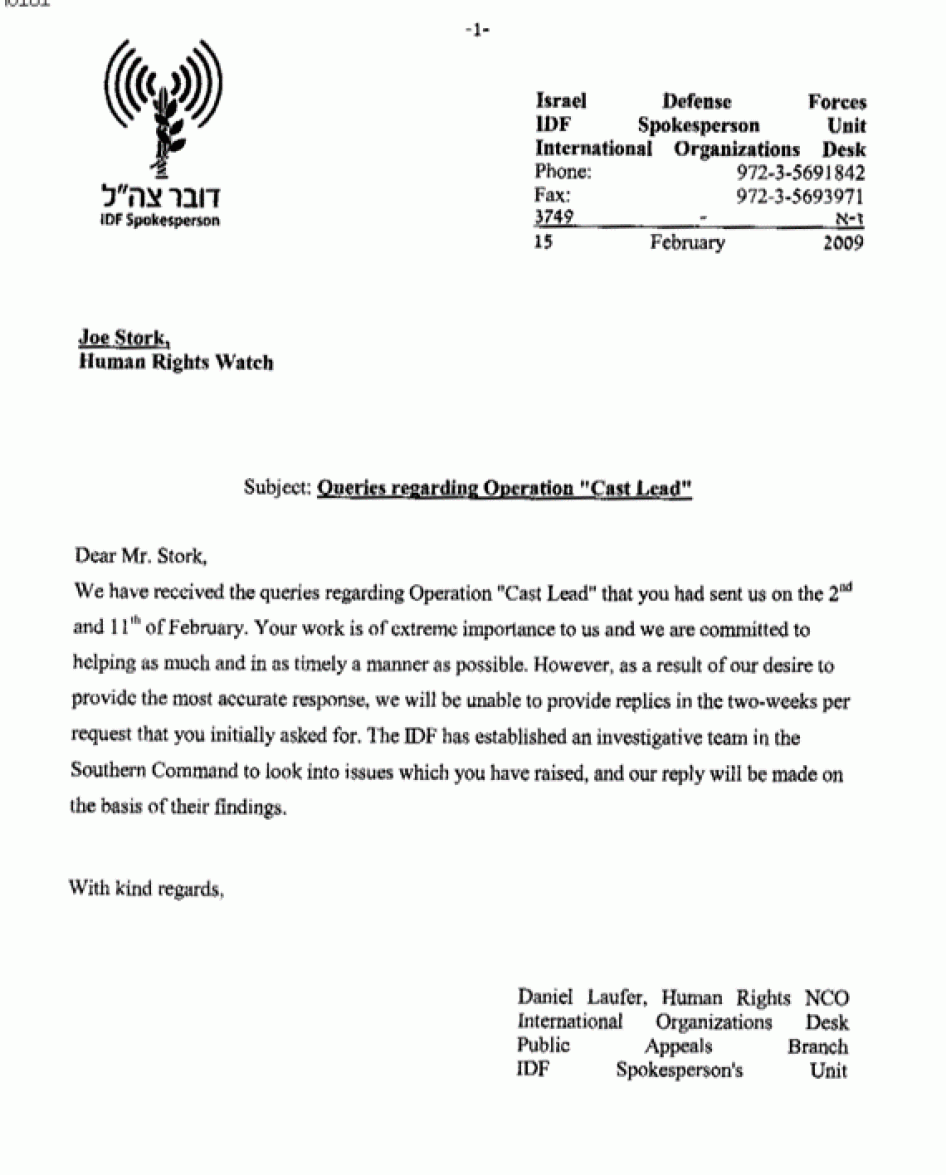
[1] Tomer Zarchin, "War Crime Charges Over Gaza Offensive are 'Legal Terror,''' Haaretz, February 19, 2009, http://www.haaretz.com/hasen/spages/1065338.html, accessed March 7, 2009.
[2] "Identification of Explosive White Phosphorus Injury and Its Treatment," signed by Dr. Gil Hirshorn, Colonel, Head of the Trauma Unit, Headquarters of the Chief Military Medical Officer, Ref . Cast Lead SH9 01293409. Original Hebrew on file at Human Rights Watch.
[3] "Exposure to White Phosphorus," signed by Dr. Leon Fulls, Ministry of Health War Room, January 15, 2009, Ref. Cast Lead SH9 01393109. Original Hebrew on file at Human Rights Watch.
[4] In the 2006 war, Israel said it used phosphorus shells "against military targets in open ground," although Lebanese officials claimed civilians had been casualties of its use; see Meron Rapoport, "Israel Admits to Using Phosphorus Bombs in Recent Lebanon War," Haaretz, October 22, 2006, http://www.haaretz.com/hasen/objects/pages/PrintArticleEn.jhtml?itemNo=777560, accessed February 4, 2009. In the 1982 war, Lebanese medical doctors and western reporters said that white phosphorus shells had killed and wounded civilians, particularly in Beirut. See William E. Farrell, "Battered Beirut Burying Its Dead as Latest Truce Appears to Hold," New York Times, June 27, 1982, http://query.nytimes.com/gst/fullpage.html?sec=health&res=9C0CE1D7153BF934A15755C0A964948260 , accessed February 4, 2009, and Robert Fisk, Pity the Nation (New York: Atheneum, 1990), pp. 282-85.
[5]Jane's Ammunition Handbook 2007-2008,Leland S. Ness and Anthony g. Williams, eds., (Surrey, UK: Jane's Information Group Limited, 2007), p. 644. See http://www.janes.com/extracts/extract/jah/jah_0461.html, accessed March 6, 2009. The original M825 suffered from flight instability, requiring the new A1 version. The E1 brings the old shells to A1 standard.
[6] The only unique benefit provided by white phosphorus is the ability to interfere with the infra-red spectrum, thus impeding the use of night vision and infra-red tracking systems used in anti-tank guided missiles (ATGMs). However, the IDF extensively used white phosphorus during the day, obviating the need to block night vision, and Human Rights Watch found no evidence that Hamas fired ATGMs.
[7]Jane's Ammunition Handbook 2007-2008, Leland S. Ness and Anthony g. Williams, eds., (Surrey, UK: Jane's Information Group Limited, 2007), p. 644. See http://www.janes.com/extracts/extract/jah/jah_0462.html, accessed March 6, 2009.
[8] Human Rights Watch interview with IDF reservist, Jerusalem, February 11, 2009.
[9] "Israel: Hamas Fires Phosphorus Shell," Associated Press, January 14, 2009.
[10] Yanir Yagna, "For the First Time, Gaza Militants Fire Phosphorus Shells at Israel," Haaretz, January 14, 2009, http://www.haaretz.com/hasen/spages/1055472.html, accessed March 6, 2009.
[11] Human Rights Watch interview with Israeli police spokesman Micky Rosenfeld, Sderot, January 15, 2009.
[12] Sakher Abu El Oun, "Israel Says Gaza War Nearing End as Fighting Rages," Agence France-Presse, January 11, 2009, Adel Zaanoun, "Gaza City Pounded by Air Strikes, Tank Fire: Witness," Agence France-Presse, January 12, 2009, and Richard Boudreaux and Rushdi abu Alouf, "Israeli Offensive Presses into Gaza City," Los Angeles Times, January 12, 2009.
[13] Human Rights Watch interview with Fathi Sabbah, Gaza City, January 26, 2009.
[14] Human Rights Watch interview with Muhammad al-Sharif, Gaza City, January 27, 2009.
[15] Human Rights Watch interview with Muhammad al-Haddad, January 27, 2009.
[16] Human Rights Watch interview with Dr. Nafiz Abu Sha`baan, Shifa Hospital, Gaza City, January 29, 2009.
[17] Human Rights Watch interview with Muhammad Abu Musabbih, Gaza City, January 27, 2009.
[18] According to the Palestinian Red Crescent Society (PRCS), Israeli military operations in Gaza destroyed three PRCS ambulances and damaged another 16. Human Rights Watch did not investigate the circumstances of each incident. Palestinian Red Crescent Society, http://www.palestinercs.org/news_details.aspx?nid=158, accessed March 6, 2009.
[19] Human Rights Watch interview with Dr. Jamal al-Safadi, Gaza City, January 27, 2009.
[20] Human Rights Watch interview with Tariq al-Baradei, Gaza City, January 27, 2009.
[21]"Attacks Against the UN in Gaza Must Be Investigated," UNRWA statement, January 24, 2009, http://www.un.org/unrwa/refugees/stories/2009/attacks_un_in_gaza_jan09.html, accessed January 26, 2009.
[22] Ibid.
[23] Human Rights Watch interview with Scott Anderson, UNRWA headquarters, Gaza City, January 28, 2009.
[24] "Secretary-General Outraged at Shelling of UN Building in Gaza," United Nations Secretary-General's Statements, January 15, 2009, http://www.un.org/unrwa/news/statements/SecGen/2009/headquarters_15jan09.html, accessed March 6, 2009.
[25] Barak Ravid, "Olmert to Ban: Gunmen Fired at IDF Troops from UN Gaza Compound," Haaretz, January 15, 2009, http://www.haaretz.com/hasen/spages/1055761.html, accessed February 24, 2009.
[26] Ibrahim Barzak and Christopher Torchia, "Israeli Shells Hit UN Headquarters in Gaza Strip; Airstrike Kills top Hamas Figure," Associated Press, January 15, 2009.
[27] Isabel Kershner and Taghreed el-Khodary, "Israel Shells U.N. Site in Gaza, Drawing Fresh Condemnation," New York Times, January 16, 2009.
[28] Human Rights Watch interview with Muhammad Abu Shamla, UNRWA headquarters, Gaza City, January 28, 2009.
[29] Human Rights Watch interview with Scott Anderson. On December 27, the first day of Israel's air offensive, an Israeli drone-fired missile struck a group of students outside the Gaza Training College in central Gaza City, across the street from the UNRWA headquarters, killing at least eight. See "Israel/Gaza: Civilians Must Not Be Targets," Human Rights Watch news release, December 30, 2008, http://www.hrw.org/en/news/2008/12/30/israelgaza-civilians-must-not-be-targets.
[30] The markings, partially unreadable, on the three shells viewed by Human Rights Watch in the UNRWA compound were: PB91KO1B-035; 155 H/…OJ M…825A1/PB 91…011 0…5A; and …H018-02….
[31] The amount of fuel in the depot at the time of the attack is not known.
[32] Human Rights Watch interview with Claire Mitchell, UNRWA headquarters, Gaza City, January 28, 2009.
[33] Ibrahim Barzak and Christopher Torchia, "Israeli Shells Hit UN Headquarters in Gaza Strip; Airstrike Kills top Hamas Figure," Associated Press, January 15, 2009.
[34] Press conference with UN Emergency Relief Coordinator John Holmes and UNRWA Director of Operations in Gaza John Ging, January 15, 2009, http://www.unmultimedia.org/tv/unifeed/detail/10679.html, accessed February 24, 2009.
[35] Tovah Lazaroff and Yaakov Katz, "UNRWA to Keep Up Aid Flow Despite IDF Fire," Jerusalem Post, January 16, 2009.
[36] "Field Update on Gaza from the Humanitarian Coordinator, 17-18 January 2009," UN Office for the Coordination of Humanitarian Affairs, January 18, 2009, http://www.ochaopt.org/documents/ocha_opt_gaza_humanitarian_situation_report_2009_01_18_english.pdf, accessed March 2, 2009.
[37] Human Rights Watch interview with Nimr al-Maqusi, Beit Lahiya, January 27, 2009.
[38] Human Rights Watch interview with Yusuf Daoud, Beit Lahiya, January 27, 2009.
[39] Interviewees consistently referred to "phosphorus" munitions but said they were unfamiliar with the weapon at the time of the attack; they learned that it was white phosphorus from the media and other sources afterwards.
[40] Human Rights Watch interview with 'Ali Shamali, Beit Lahiya, January 27, 2009.
[41] "IOF Attacks 3rd UNRWA Shelter; Kills more Civilian Refugees, Including Children," Al-Mezan Center for Human Rights press release, January 17, 2009, http://www.mezan.org/site_en/press_room/press_detail.php?id=956, accessed January 27, 2009.
[42] Human Rights Watch telephone interview with Azhar al-Ashqar, March 21, 2009.
[43] Human Rights Watch interview with Ra'fat Shamiyya, Beit Lahiya, January 27, 2009. Videos on file with Human Rights Watch.
[44] "Israel Shells UN School in Gaza," Al-Jazeera.net (English edition), January 17, 2009, http://english.aljazeera.net/news/middleeast/2009/01/20091177657498163.html, accessed February 3, 2009.
[45] Human Rights Watch interview with Mahmoud Khalael, Siyafa, January 23, 2009.
[46] To view and listen to the various warnings issued by the IDF, see the Israel Ministry of Foreign Affairs website, http://www.mfa.gov.il/MFA/Government/Communiques/2009/IDF_warns_Gaza_population_7-Jan-2009.htm, accessed March 6, 2009.
[47] Six hours prior to the reported phone call, an F-16 air strike a few kilometers from Mahmoud Khaleal's house killed two members of the al-Ghoul family: Akram al-Ghoul, 48, and Mahmoud Salah Ahman al-Ghoul, 17, the father and cousin of Human Rights Watch's research consultant in Gaza. "Israel: Investigate Former Judge's Killing in Gaza," Human Rights Watch news release, January 9, 2009, http://www.hrw.org/en/news/2009/01/09/israel-investigate-former-judge-s-killing-gaza.
[48] A media investigation into Atatra south of Siyafa revealed that Hamas fights did engage the IDF there, wounding at least four Israeli soldiers. (Ethan Bronner and Sabrina Tavernise, "In Shattered Gaza Town, Roots of Seething Split," New York Times, February 3, 2009.)
[49] Human Rights Watch interview with Ahmad Abu Halima, Siyafa, January 23, 2009.
[50] Human Rights Watch interview with Omar Abu Halima, Siyafa, January 23, 2009.
[51] The writing on the wall said: "min jaysh difa' isra'il nahnu asifun." The writing was there at least as early as January 20, when it was viewed by a reporter from the Associated Press (Alfred de Montesquiou, "Gaza Family Returns Home After Phosphorus Blast," Associated Press, January 20, 2009.)
[52] Ethan Bronner, "Outcry Erupts Over Reports That Israel Used Phosphorus Arms on Gazans," New York Times, January 21, 2009.
[53] Human Rights Watch interview with Dr. 'Alaa 'Ali, Shifa Hospital, Gaza City, January 24, 2009.
[54] Human Rights Watch interview with Mohamed Abu Halima, Cairo, Egypt, February 10, 2009.
[55] Human Rights Watch telephone interview with Ran Yaron, Physicians for Human Rights-Israel, February 24, 2009.
[56] "Testimony: Members of Abu Halima family killed and burned in army's bombing of their house, 3 January 2009," testimony of Ghada Riad Rajab Abu Halima taken by B'Tselem on January 8, 2009,http://www.btselem.org/English/Testimonies/20090104_Abu_Halima_home_set_on_fire_by_shelling.asp, accessed February 24, 2009.
[57] Ashraf Khalil, "In Gaza Town, A Bitter Aftermath," Los Angeles Times, February 15, 2009.
[58] Ibid.
[59] On January 10, an IDF spokesperson, Capt. Guy Spiegelman, denied that the IDF conducted operations "in the area of Khuzaa" on that day, and said "there is no use of white phosphorus." (Adel Zaaanoun, "Three Palestinians killed, dozens hurt in Gaza," Agence France-Presse, January 10, 2009.)
[60] Human Rights Watch interview with Iman al-Najjar, Khuza'a, January 24, 2009.
[61] Human Rights Watch also found an artillery-fired illumination round outside the home. That shell bore the markings TZ 1-81 155MM 485A2 ILLUMINATION ROUND, THS89D112-003 155MM M825E1.
[62] Human Rights Watch interview with Majid al-Najjar, Khuza'a, January 24, 2009.
[63] Human Rights Watch researchers also found an illumination round just outside the house, marked ILLUM T2 1/84 155 M485A2.
[64] Human Rights Watch interview with Dr. Yusif Abu Rish, Nasser Hospital, Khan Yunis, January 24, 2009.
[65] Human Rights Watch telephone interview with IDF spokesman, January 6, 2009.
[66] "Group Accuses Israel of Firing White Phosphorus into Gaza," CNN, January 12, 2009, http://edition.cnn.com/2009/WORLD/meast/01/12/white.phosphorus/index.html, accessed January 28, 2009.
[67] Michael Evans and Sheera Frenkel, "Victims' Strange Burns Increase Concern Over Phosphorus Shells," The Times, January 8, 2009, http://www.timesonline.co.uk/tol/news/world/middle_east/article5470047.ece, accessed March 2, 2009.
[68] "Israel: Stop Unlawful Use of White Phosphorus in Gaza," Human Rights Watch news release, January 10, 2009, http://www.hrw.org/en/news/2009/01/10/israel-stop-unlawful-use-white-phosphorus-gaza.
[69]Robert Marquand and Nicholas Blanford, "Gaza: Israel Under Fire for Alleged White Phosphorus Use," Christian Science Monitor, January 14, 2009.
[70] Bradley S. Klapper, "Red Cross Says Israel Firing White Phosphorus in Gaza, But No Evidence of Improper Use," Associated Press, January 13, 2009.
[71] Ibid.
[72] Mark Regev's CNN interview can be viewed at http://www.youtube.com/watch?v=9KXlv-FGDa4 (accessed February 4, 2009). His reference to the ICRC statement occurs about two minutes into the interview.
[73] International Committee of the Red Cross, "Phosphorus weapons – the ICRC's view," January 17, 2009, available at http://www.icrc.org/Web/Eng/siteeng0.nsf/html/weapons-interview-170109, accessed January 28, 2009.
[74] See "FAQ - Answers and Questions on the Operation in Gaza," Israel Ministry of Foreign Affairs website, http://www.mfa.gov.il/MFA/Terrorism-+Obstacle+to+Peace/Hamas+war+against+Israel/FAQ_Operation_Gaza_Jan_2009.htm, accessed January 29, 2009.
[75] Ilene R. Prusher, "After the War, Gazans Seek Answers on White Phosphorus," Christian Science Monitor, February 5, http://www.csmonitor.com/2009/0205/p04s01-wogn.html, accessed February 24, 2009.
[76] Luke Baker, "Amnesty Accuses Israel of Crimes Over White Phosphorus," Reuters, January 19, 2009.
[77] Amos Harel, "IDF Probes Improper Use of Phosphorus Shells in Gaza Strip," Haaretz, January 21, 2009, http://haaretz.com/hasen/spages/1057361.html, accessed March 6, 2009. According to Israeli army sources quoted in the article, aside from this case, the IDF used white phosphorus sparingly and in accordance with international law.
[78] James Hider and Sheera Frenkel, "Israel Admits Using White Phosphorus in Attacks on Gaza," The Times, January 24, 2009, http://www.timesonline.co.uk/tol/news/world/middle_east/article5575070.ece, accessed February 24, 2009.
[79] Ibid.
[80] See generally, Protocol Additional to the Geneva Conventions of 12 August 1949, and Relating to the Protection of Victims of International Armed Conflicts (Protocol I), 1125 U.N.T.S. 3, entered into force Dec. 7, 1978; Hague Convention IV - Laws and Customs of War on Land: 18 October 1907, 36 Stat. 2277, 1 Bevans 631, 205 Consol. T.S. 277, 3 Martens Nouveau Recueil (ser. 3) 461, entered into force Jan. 26, 1910.JT
[81]See Protocol I, arts. 48, 51(2), and 52(2).
[82]Article 48 of Protocol I states, "Parties to the conflict shall at all times distinguish between the civilian population and combatants and between civilian objects and military objectives and accordingly shall direct their operations only against military objectives."
[83] Protocol I, art. 51(3).
[84] Ibid., article 52(1). Military objectives are combatants and those objects that "by their nature, location, purpose or use make an effective contribution to military action and whose total or partial destruction, capture or neutralization, in the circumstances ruling at the time, offers a definite military advantage." Ibid., art. 52(2).
[85] Protocol I, art. 52(2).
[86] Fourth Geneva Convention, art. 19; Protocol I, art. 13(1).
[87] Articles 51(4) and 51(5) of Protocol I enumerate five kinds of indiscriminate attacks: those that 1) are not directed at a "specific military objective," 2) cannot be directed at "a specific military objective," 3) have effects that violate the Protocol, 4) treat separate urban military objectives as one (carpet bombing), or 5) violate the principle of proportionality.
[88]Ibid., art. 51(5)(b). The expected danger to the civilian population and civilian objects depends on various factors, including their location (possibly within or near a military objective), the accuracy of the weapons used (depending on the trajectory, the range, environmental factors, the ammunition used, etc.), and the technical skill of the combatants (which can lead to random launching of weapons when combatants lack the ability to aim effectively at the intended target). ICRC, Commentary on the Additional Protocols, p. 684.
[89]Protocol I, art. 57. The ICRC Commentary to Protocol I states that the requirement to take "all feasible precautions" means, among other things, that the person launching an attack is required to take the steps needed to identify the target as a legitimate military objective "in good time to spare the population as far as possible." ICRC, Commentary on the Additional Protocols, p. 682.
[90]If there are doubts about whether a potential target is of a civilian or military character, it "shall be presumed" to be civilian. Protocol I, art. 52(3). The warring parties must do everything feasible to cancel or suspend an attack if it becomes apparent that the target is not a military objective. Ibid., art. 57(2).
[91]Ibid., art. 57(2).
[92]Ibid., art. 58(b).
[93]Ibid., art. 58(a).
[94]Ibid., art. 51(7).
[95]Protocol on Prohibitions or Restrictions on the Use of Incendiary Weapons (Protocol III to the CCW), 1342 U.N.T.S. 171, 19 I.L.M. 1534, entered into force Dec. 2, 1983.
[96] Protocol III to the CCW, art. 1(1).
[97] Protocol III does not include munitions that "may have incidental incendiary effects," such as smoke artillery.
[98] Protocol III to the CCW, art. 2(2).
[99]See International Committee of the Red Cross (ICRC), Customary International Humanitarian Law (Cambridge: Cambridge University Press, 2005), rule 85.
[100] Israel, Military Advocate General Headquarter, Laws of War in the Battlefield, 1998, p. 23.
[101] Various armed forces prohibit the use of incendiary weapons where it would cause unnecessary suffering. See US Army, Field Manual 27-10 (1956) (the use of incendiary weapons "is not a violation of international law. They should not, however, be employed in such a way as to cause unnecessary suffering to individuals") sec. 36; UK Ministry of Defence, The Manual of the Law of Armed Conflict (Oxford: Oxford University Press, 2004) (white phosphorus "should not be used directly against personnel"), p. 112.
[102] "Indiscriminate Fire: Palestinian Rocket Attacks on Israel and Israeli Artillery Shelling in the Gaza Strip," Human Rights Watch report, June 30, 2007.
[103] The expected casualty radius is the radius in which people are likely to be injured by a weapon. The IDF has not to Human Rights Watch's knowledge published its figures for 155mm artillery shells, but press reports give the numbers listed in the text. (Peter Beaumont, "How Israel Put Gaza Civilians in Firing Line," The Guardian, November 12, 2006 and "Gaza's Kids Collect a Different Sort of Shell," Agence France-Presse, May 29, 2006.)
[104]See ICRC, Customary International Humanitarian Law, pp. 568-74.