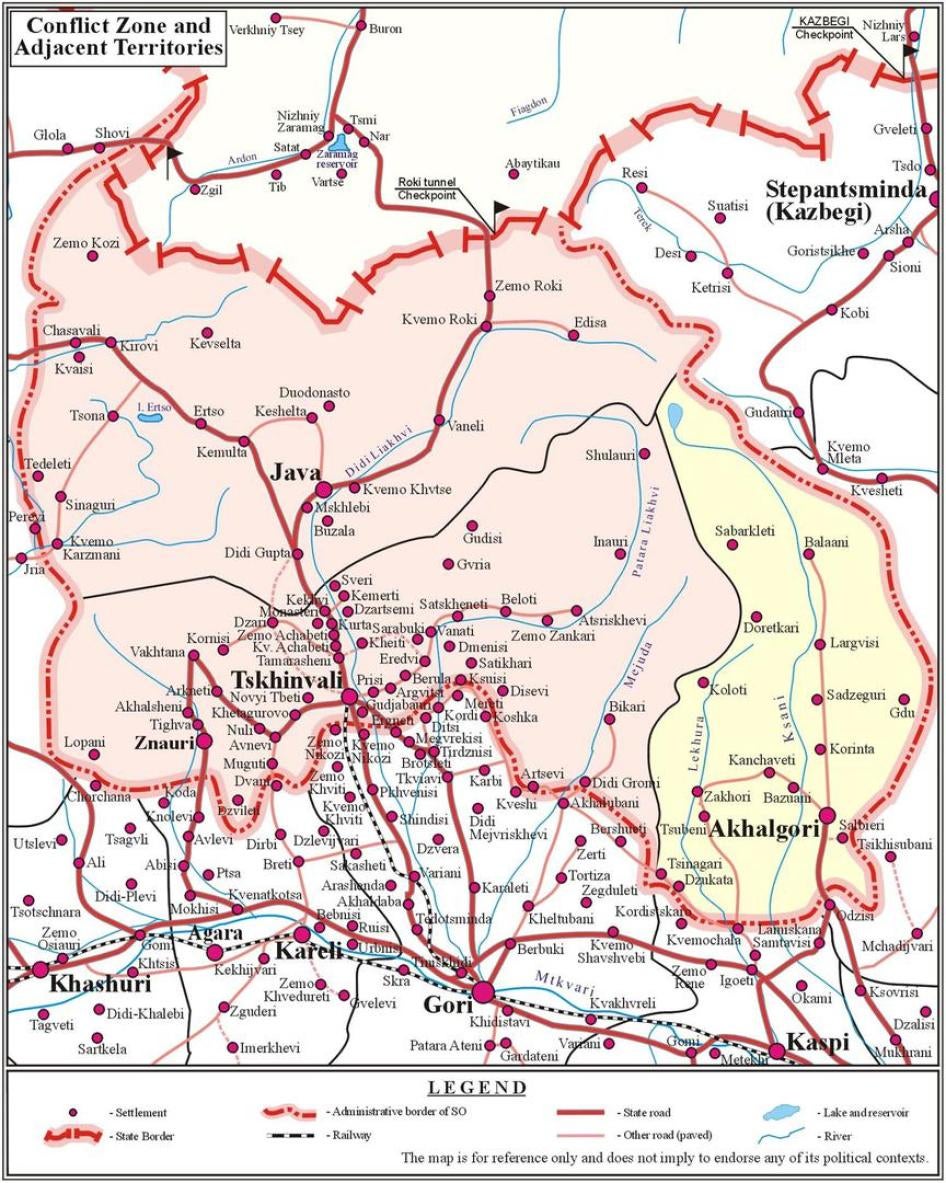
Map of South Ossetia
Executive Summary
Overview
The armed conflict over South Ossetia lasted one week in August 2008 and will have consequences for lifetimes and beyond. The conflict and its aftermath have seen lives, livelihoods, homes, and communities devastated in South Ossetia and bordering districts of Georgia. A significant casualty of the conflict was all sides' respect for international humanitarian law.
South Ossetia is a breakaway region of Georgia that shares a border and has very close ties with Russia. The armed conflict, in the making since spring 2008, started August 7 with Georgia's military assault in South Ossetia and Russia's military response the following day, and lasted until a ceasefire on August 15, with Georgian forces in retreat and Russian forces occupying South Ossetia and, temporarily, undisputed parts of Georgia.[1] The week of open conflict, and the many subsequent weeks of rampant violence and insecurity in the affected districts, took a terrible toll on civilians, killing hundreds, displacing tens of thousands, and causing extensive damage to civilian property. Today, there is an acute need for accountability for all perpetrators of violations of human rights and humanitarian law, and for security conditions to allow all displaced persons to return in safety and dignity to their homes.
Human Rights Watch carried out a series of research missions in Russia and Georgia, including in South Ossetia, focusing on violations by all parties to the conflict. We interviewed more than 460 victims, witnesses, and others, and looked at reporting (and misreporting) of the conflict in Russia and in Georgia. The international legal framework within which Human Rights Watch examined the conflict includes international humanitarian law-chiefly the Geneva Conventions-relating to the conduct of hostilities, humane treatment, and occupation; and international human rights law, including international law concerning displaced persons and the right to return.
Human Rights Watch found:
- In a number of instances Georgian forces used indiscriminate and disproportionate force in artillery assaults on South Ossetia, and in some cases used disproportionate force in their ground assault. The majority of these instances derived from Georgia's use of multiple rocket launching systems, which cannot distinguish between civilian and military objects, in areas populated by civilians. Many civilians were killed or wounded.
- In a number of instances in South Ossetia and in undisputed Georgian territory Russian forces violated international humanitarian law by using aerial, artillery, and tank fire strikes that were indiscriminate, killing and wounding many civilians.
- Cluster munitions were used by Russian and Georgian forces, causing civilian deaths and putting more civilians at risk by leaving behind unstable "minefields" of unexploded bomblets. Their use and impact on civilians in the conflict demonstrates why in December 2008, 94 governments signed up to a comprehensive treaty to ban cluster munitions, which had been negotiated just months before the conflict commenced.
- As an occupying power in Georgia, Russia failed overwhelmingly in its duty under international humanitarian law to ensure, as far as possible, public order and safety in areas under its effective control, instead allowing South Ossetian forces, including volunteer militias, to engage in wanton and widescale pillage and burning of Georgian homes and to kill, beat, rape, and threaten civilians.
- After Georgian forces withdrew from South Ossetia on August 10, South Ossetian forces over a period of weeks deliberately and systematically destroyed ethnic Georgian villages in South Ossetia that had been administered by the Georgian government. They looted, beat, threatened, and unlawfully detained numerous ethnic Georgian civilians, and killed several, on the basis of the ethnicity and imputed political affiliations of the residents of these villages, with the express purpose of forcing those who remained to leave and ensuring that no former residents would return. From this, Human Rights Watch has concluded that South Ossetian forces attempted to ethnically cleanse these villages. Approximately 22,000 villagers, the majority of whom had fled South Ossetia before the conflict started, remain displaced.
- In committing this violence, South Ossetian forces egregiously violated multiple obligations under humanitarian law, for which there must be individual criminal accountability and prosecution for war crimes where appropriate. To the extent that a number of these prohibited acts were committed as part of a widespread or systematic attack directed against the civilian population, they may be prosecuted as crimes against humanity.
- Residents of Akhalgori district-an area in the east of South Ossetia populated mostly by ethnic Georgians and currently occupied by Russian forces-face threats and harassment by militias and anxiety about a possible closure of the district's administrative border with the rest of Georgia. Both factors have caused great numbers of people to leave their homes for undisputed Georgian territory.
- During the time when Russian forces occupied Georgian territory south of the South Ossetian administrative border, Ossetian militias looted, destroyed, and burned homes on a wide scale, deliberately killed at least nine civilians, and raped at least two. Russian forces were at times involved in the looting and destruction, either as passive bystanders, active participants, or by providing militias with transport into villages.
- Georgian forces beat and ill-treated at least five of the 32 Ossetians detained in August in the context of the armed conflict.
- After the withdrawal of Georgian forces from South Ossetia, South Ossetian forces, at times together with Russian forces, arbitrarily detained at least 159 ethnic Georgians. South Ossetian forces killed at least one detainee and subjected nearly all of them to inhuman and degrading treatment and conditions of detention. They also tortured at least four Georgian prisoners of war and executed at least three. All of these acts are war crimes, for which individual criminal accountability must be established.
This report measures each party's compliance with obligations under international law, rather than measure it against the conduct of the other party. Exposing violations committed by one party does not excuse or mitigate violations committed by another party. Which party started the conflict has no bearing on parties' obligations to adhere to international humanitarian and human rights law and to hold violators accountable. Those seeking answers to questions about who committed worse, or more violations, or who bears responsibility for starting the conflict, will not find them in this report.
* * *
Human Rights Watch urges the Georgian and Russian governments to investigate and hold accountable those from their respective forces responsible for international humanitarian law violations, including war crimes. As it exercises in effective control over South Ossetia, Russia should investigate and hold accountable South Ossetian forces responsible for war crimes and other violations of international humanitarian and human rights law. The Russian and Georgian governments should provide compensation for civilian damage and destruction caused by violations of international humanitarian law for which they are respectively responsible.
The permanent forced displacement of thousands of people cannot be countenanced. As it exercises effective control over South Ossetia, Russia has an obligation to provide security to all persons living there, regardless of ethnicity; this is especially urgent in Akhalgori district. Ethnic Georgians displaced from South Ossetia should be allowed to voluntarily return. Russia should publicly promote and implement the right of all persons displaced by the conflict, without regard to their ethnic background or imputed political affiliations, to return and live in their homes in South Ossetia in safety and dignity. Russia should prevail on South Ossetian authorities to publicly acknowledge this and to facilitate returns.
Brief Chronology of the Armed Conflict
After months of escalating tensions between Russia and Georgia and following skirmishes between Georgian and South Ossetian forces, on August 7, 2008, Georgian forces launched an artillery assault on Tskhinvali, South Ossetia's capital, and outlying villages. Assaults by Georgian ground and air forces followed. Russia's military response began the next day, with the declared purpose of protecting Russian peacekeepers stationed in South Ossetia and residents who had become Russian citizens in recent years. Beginning on August 8, Russian ground forces from the 58th Army crossed into South Ossetia and Russian artillery and aircraft hit targets in South Ossetia and undisputed Georgian territory. South Ossetian forces consisting of several elements-South Ossetian Ministry of Defense and Emergencies, South Ossetian Ministry of Internal Affairs, South Ossetian Committee for State Security, volunteers, and Ossetian peacekeeping forces-also participated in the fighting.
Georgian commanders ordered their troops to withdraw from South Ossetia on August 10, and two days later Russian forces moved into and occupied undisputed Georgian territory south of the administrative border with South Ossetia, including the city of Gori. In a separate operation from the west, moving through the breakaway region of Abkhazia (also supported by Russia), Russian forces also occupied the strategically important cities of Poti, Zugdidi, and Senaki in western Georgia.
Russia said that its forces completed their withdrawal from undisputed Georgian territory on October 10, in accordance with an August 15 ceasefire agreement between Russia and Georgia brokered by the French European Union presidency. The Georgian government disputes this, pointing to Russian forces' presence in Perevi, a village on the South Ossetian administrative border, as well as Akhalgori.
Violations by Georgian Forces
Indiscriminate and disproportionate use of force
During the shelling of Tskhinvali and neighboring villages and the ground offensive that followed, Georgian forces frequently failed to abide by the obligation to distinguish between military targets that can be legitimately attacked, and civilians, who may not be targeted for attack. This was compounded by Georgia's failure to take all feasible measures to avoid or minimize civilian casualties. While Human Rights Watch found no evidence that Georgian forces sought to deliberately target civilians, from our research Human Rights Watch concluded that Georgian forces demonstrated disregard for the protection of civilians during the shelling campaign, resulting in large-scale damage to civilian objects and property, and civilian casualties.
The sole fact of civilian casualties or destruction of civilian objects is not an indication that a violation of international humanitarian law occurred. What is important to seek to determine is whether there was evidence of a legitimate military target in the attack area at the time, and how that target was attacked. Circumstances did not always allow such a determination. Yet many of the attacks on South Ossetia during the brief conflict can be clearly attributed to Georgian forces-based on witness accounts, the direction of the attack, and the timing of the damage in light of the advance of Georgian forces.
In many cases Human Rights Watch researchers found no evidence of military objectives in the area under attack, while in many others we found that Georgian attacks struck legitimate military targets, causing combatant and, in some cases, collateral civilian casualties. In some cases we investigated, evidence suggests that the Georgian attacks against lawful military objectives may have been disproportionate, as the expected loss of civilian life or destruction of civilian property would have have expected to exceed any anticipated military gain.
The massive shelling of Tskhinvali and neighboring villages by Georgian forces was indiscriminate because, at the very least, the Georgian military effectively treated a number of clearly separated and distinct military objectives as a single military objective in an area that contained a concentration of civilians and civilian objects. In a number of artillery attacks Georgian forces failed to take all feasible precautions to minimize loss of life or injury to civilians.
Georgia's use of multiple rocket launching systems, such as BM-21s ("Grads") in civilian populated areas violated international humanitarian law's principle of distinction. These weapons cannot be targeted with sufficient precision to be accurate against military targets, and their broad area effect makes their use incompatible with the laws of war in areas where civilians or civilian objects (such as schools or hospitals) are located. The use of such weapons in populated areas is indiscriminate by nature and thus prohibited under international humanitarian law.
Georgian forces attacked vehicles in which many Ossetian civilians were trying to flee the conflict zone on August 8–10, which resulted in death and injuries. The cases Human Rights Watch describes in this report indicate that-in those cases at least-disproportionate force was used and precautions were not taken to avoid or minimize loss of civilian life.
Conduct of ground troops
During Georgian forces' ground offensive there were also attacks which, Human Rights Watch's investigation suggests, failed to respect the principle of proportionality: attacks such as when Georgian tanks targeted buildings in which Ossetian fighters may at times have been present, but where there were also many civilians sheltering in the basement. Several Ossetian civilians reported looting by Georgian ground forces but otherwise generally did not report other specific incidents of abusive treatment during the ground offensive by Georgian troops. Those detained by Georgian forces, however, reported they were ill-treated when taken into custody.
Violations by Russian Forces
Indiscriminate and disproportionate use of force
Russian forces attacked areas in undisputed Georgian territory and in South Ossetia with aerial, artillery, and tank fire strikes, some of which were indiscriminate, killing and injuring civilians. With regard to many aerial and artillery attacks Russian forces failed to observe their obligations to do everything feasible to verify that the objects to be attacked were military objectives (and not civilians or civilian objects) and to take all feasible precautions to minimize harm to civilians. In one case, Russian forces attacked medical personnel, a grave breach of the Geneva Conventions and a war crime.
As noted above, the mere fact of civilian casualties or destruction of civilian objects does not mean that a humanitarian law violation occurred. In each attack examined, Human Rights Watch sought to determine whether there was evidence of a legitimate military target in the attack area, and if so how that target was attacked.
Between August 8 and 12, Russian forces attacked Georgian military targets in Gori city and in ethnic Georgian villages in both South Ossetia and undisputed Georgian territory, often causing civilian casualties and damage to civilian objects such as houses or apartment blocks. The proximity of these military targets to civilian objects varied. In several cases, the military targets were within meters of civilians and civilian homes, and the attacks against them resulted in significant civilian casualties.
In other cases the apparent military targets were located as far as a kilometer away from civilian objects, and yet civilian casualties also resulted. In attacking any of these targets the Russian forces had an obligation to strictly observe the principle of proportionality, and to do everything feasible to assess whether the expected civilian damage from the attack would likely be excessive in relation to the direct military advantage anticipated. In many cases the attacks appear to have violated this proportionality principle. In yet other cases, Human Rights Watch investigated-but was not able to identify-any legitimate military targets in the immediate vicinity at the time of the attacks. The absence of a military target in the vicinity of an attack raises the possibility that Russian forces either failed in their obligation to do everything feasible to verify that the targets were military and not civilian, that they were reckless toward the presence of civilians in their target zone, or that Russian forces deliberately targeted civilian objects.
In several incidents involving military force against civilian vehicles, Russian forces may have intentionally targeted civilians. Deliberate attacks on civilians amount to war crimes.
Conduct of ground troops Several local residents told Human Rights Watch that many of the Russian servicemen who occupied undisputed Georgian territories behaved in a disciplined manner and in some cases even protected the civilian population from Ossetian forces, militia members, or looters. Nevertheless Russian forces played a role in the widespread looting of Georgian homes by Ossetian forces. Russian forces facilitated and participated in these war crimes, albeit in less prominent roles than South Ossetian forces, but we identified four cases in which Russian forces played an active and discernable role in looting.
Human Rights Watch also documented incidents in which Russian tanks fired at close range into civilian homes.
Russia's responsibility as occupying power
When Russian forces entered Georgia, including South Ossetia, which is de jure part of Georgia, they did so without the consent or agreement of Georgia. International humanitarian law on occupation therefore applied to Russia as it gained effective control over areas of Georgian territory. Russia failed overwhelmingly in its duty as an occupying power to ensure, as far as possible, public order and safety in areas under its effective control in South Ossetia. This allowed South Ossetian forces to engage in wanton and widescale pillage and burning of Georgian homes and to kill, beat, rape, and threaten civilians. Roadblocks set up by Russian forces on August 13 effectively stopped the looting and torching campaign by Ossetian forces, but the roadblocks were inexplicably removed after just a week.
Violations by South Ossetian Forces
In South Ossetia
Beginning just after the withdrawal of Georgian troops from South Ossetia, South Ossetian forces, including volunteer militias, embarked on a campaign of deliberate and systematic destruction of the Georgian government-administered villages in South Ossetia. This involved the widespread and systematic pillage and torching of houses, and beatings and threats against civilians. Starting August 10, after Russian ground forces had begun to fully occupy South Ossetia and were moving onward into undisputed Georgian territory, Ossetian forces followed closely behind them and entered the ethnic Georgian villages.
Upon entering these villages, Ossetian forces immediately began going into houses, searching for Georgian military personnel, looting property, and burning homes. They also physically attacked many of the remaining residents of these villages, and detained dozens of them. Human Rights Watch received uncorroborated reports of at least two extrajudicial killings of ethnic Georgians in South Ossetia that took place amidst the pillage. In most cases, Russian forces had moved through this set of Georgian villages by the time South Ossetian forces arrived. In other cases, Russian forces appeared to give cover to South Ossetian forces while they were committing these offenses.
By August 11 the attacks intensified and became widespread. Looting and torching of most of these villages continued intermittently through September, and in some through October and November.
Ossetian forces rounded up at least 159 ethnic Georgians (some of whom were abducted from undisputed Georgian territory), killing at least one and subjecting nearly all of them to inhuman and degrading treatment and conditions of detention. They also tortured at least four Georgian prisoners of war and executed at least three.
Human Rights Watch's observations on the ground and dozens of interviews conducted led us to conclude that the South Ossetian forces sought to ethnically cleanse this set of Georgian villages: that is, the destruction of the homes in these villages was deliberate, systematic, and carried out on the basis of the ethnic and imputed political affiliations of the residents of these villages, with the express purpose of forcing those who remained to leave and ensuring that no former residents would return.
In undisputed Georgian territory
Beginning with the Russian occupation of Georgia and through the end of September, Ossetian forces, often in the presence of Russian forces, conducted a campaign of deliberate violence against civilians, burning and looting their homes on a wide scale, and committing execution-style killings, rape, abductions, and countless beatings.
Crimes against humanity
In both locations South Ossetian forces, including volunteer militias, egregiously violated multiple obligations under humanitarian law. Murder, rape, acts of torture, inhuman or degrading treatment, and wanton destruction of homes and property are all strictly prohibited under both humanitarian law and serious violations of human rights law, and the perpetrators of such acts should be held criminally responsible for them. To the extent that any of these prohibited acts was committed as part of a widespread or systematic attack directed against any civilian population, they may be prosecuted as a crime against humanity. Where any of these acts, as well as acts such as imprisonment, unlawful detention of civilians, pillaging and comprehensive destruction of homes and property, were carried out with discriminatory intent against a particular group, in this case ethnic Georgians, they also constitute the crime of persecution, a crime against humanity, prosecutable under the statute of the International Criminal Court.
Use of Cluster Munitions
During the armed conflict both Georgian and Russian forces used cluster munitions, which are munitions that release dozens or hundreds of bomblets, or submunitions, and spread them over a large area. Because cluster munitions cannot be directed at specific fighters or weapons, civilian casualties are virtually guaranteed if cluster munitions are used in populated areas. For this reason, using cluster munitions in populated areas should be presumed to be indiscriminate attack, which is a violation of international humanitarian law. Cluster munitions also threaten civilians after conflict: Because many submunitions fail to explode on impact as designed, a cluster munitions strike often leaves a high number of hazardous unexploded submunitions-known as duds-that can easily be set off upon contact.
Human Rights Watch was not able to conduct adequate research to establish whether Georgia's use of cluster munitions was indiscriminate. Due to either malfunction or human error, Georgian cluster munitions landed in undisputed Georgian territory on days prior to the arrival of Russian forces there, killing at least one civilian and wounding two others. The report documents how at least three people were killed and six wounded by cluster duds that exploded upon contact in three villages in undisputed Georgian territory.
Georgia has acknowledged its use of clusters, and conducted a campaign following the armed conflict to warn civilians of the dangers posed by unexploded submunitions.
Russia has not acknowledged its own use of cluster munitions. Russian forces used cluster munitions in strikes against targets in populated areas in the Gori and Kareli districts just south of the South Ossetian administrative border, killing at least 12 civilians and injuring at least 46 at the time of attack. All of these strikes amounted to indiscriminate attacks.
The Russian and Georgian governments should join the 95 nations that have signed the Convention on Cluster Munitions, which imposes a comprehensive ban on the use of these weapons. Russia should make every effort to assist demining organizations with clearance and risk education in contaminated areas currently under effective Russian control, and Georgia should expand its cooperation with these organizations.
International Responses to the Conflict
Since the end of the conflict the European Union, the Organization for Security and Co-operation in Europe (OSCE), and the Council of Europe have put in place mechanisms to monitor the human rights situation and promote security and stability near and in South Ossetia. Russia and Georgia should fully cooperate with these initiatives. The Russian government in particular should provide full, unimpeded access to South Ossetia to these intergovernmental organizations so that they may fully implement these initiatives.
At the end of 2008 Russia refused to approve budgetary support for the OSCE's presence in Georgia, claiming that the organization had to separate its work on Georgia's two breakaway regions-Abkhazia and South Ossetia-from work on other parts of Georgia. At this writing the OSCE was in the process of closing its offices in Georgia. Human Rights Watch urges the Russian government to reconsider its objections and to facilitate OSCE access to South Ossetia.
The United States government, a close ally of Georgia, should press the Georgian government to investigate and hold accountable violations of humanitarian law, and should prevail on the Georgian government to cooperate with various intergovernmental inquiries. The European Union and the United States, as participants in ongoing talks on security and returns of displaced persons, should urge Russia to uphold its responsibility to facilitate returns of all displaced persons to South Ossetia.
Methodology
A team of Human Rights Watch researchers conducted a number of research missions from August to November 2008 in South Ossetia and in undisputed parts of Georgia, and in August in North Ossetia (in the Russian Federation), to document violations of international humanitarian law and human rights law committed by all sides in the conflict.
Human Rights Watch researchers conducted three approximately one-week missions in South Ossetia beginning on August 10, and again in September and November. One of these missions was carried out jointly with Human Rights Centre Memorial, a Russian nongovernmental human rights organization.
Human Rights Watch researchers conducted research in undisputed parts of Georgia continuously from August 11 to 28, and again for one week in mid-September and one week in mid-October. Extensive research was conducted in the Gori and Kareli districts of undisputed Georgian territory while those districts were under Russian occupation. Human Rights Watch experts on armaments, including cluster munitions, participated in research missions in August and October. Human Rights Watch's Tbilisi-based researcher conducted follow up research after fact-finding missions.
Human Rights Watch researchers conducted over 460 in-depth interviews with victims and witnesses of abuses committed by all parties to the conflict. Interviewees included persons residing in towns and villages of South Ossetia and undisputed Georgian territory; persons displaced from South Ossetia and undisputed parts of Georgia living in displaced person shelters in various parts of Georgia; persons displaced from the conflict and temporarily staying in North Ossetia; persons formerly detained by Russian and Ossetian forces; persons formerly detained by Georgian forces; former prisoners of war detained by Georgian forces; former prisoners of war detained by Russian and Ossetian forces; Georgian soldiers participating in active combat in South Ossetia; and members of South Ossetian militia and other forces.
In the course of their research, Human Rights Watch staff visited the following places in South Ossetia: Tskhinvali, Khetagurovo, Dmenisi, Sarabuki, Gromi, Tbeti, Novyi Tbet, Gudzhabauri, Muguti, Ubiati, Batatykau, Kohat, Bikari, Zonkar, Zakori, Ahalgori, Kanchaveti, Znauri, Alkhasheni, Archneti, Sinaguri, Kekhvi, Kurta, Kvemo Achabeti, Zemo Achabeti, Tamarasheni, Eredvi, Disevi, Beloti, Satskheneti, Atsriskhevi, Avnevi, Nuli. In undisputed Georgian territory Human Rights Watch visited: Gori city, Karbi, Tortiza, Kheltubani, Tkviavi, Akhaldaba, Variani, Ruisi, Dzlevijvari, Pkhvenisi, Tedotsminda, Karaleti, Tirdznisi, Koshka, Ergneti, Karaleti, Knolevi, Avlevi Ptsa, Khashuri, and Tseronisi.
Interviews with victims and witnesses in South Ossetia were conducted in Russian by native Russian speakers. Interviews in Georgia with victims and witnesses were in some cases conducted in Russian by native or fluent Russian speakers; in some cases in Georgian by a native Georgian speaker; and in other cases in Georgian with the assistance of an interpreter translating from Georgian to English. The majority of interviews were conducted in private; a small proportion were conducted in groups. Before being interviewed, interviewees were told of the purpose of the interview, informed what kinds of issues would be covered, and asked whether they wanted to proceed. No incentives were offered or provided to persons interviewed. (More detail on the methodology used for particular aspects of the research is included in the relevant chapters below.)
We have indicated where the names of individuals interviewed by Human Rights Watch (and in some cases, other identifying information) were changed to protect their security.
As part of our research, we also sought to meet with government officials representing each party to the conflict. In Georgia we held meetings with the National Security Council, the Ministry of Defense, the Ministry of Interior, the Ministry of Foreign Affairs, the Ministry of Justice, and the Office of the Prosecutor General. The Georgian government also provided written responses to Human Rights Watch letters of August 29 and November 12, 2008.
Human Rights Watch requests for meetings in Russia with the Ministry of Defense, the Ministry of Interior, the Ministry of Emergency Situations, and the Office of the President went unanswered. Human Rights Watch letters of October 13, 2008-sent repeatedly to the Ministry of Defense, the Ministry of Emergency Situations, and the Office of the President requesting answers to specific questions-also went unanswered. (See Appendix) The Office of the Prosecutor General replied on December 21, 2009 to our request for information by stating that the request had been forwarded to the Investigative Committee under the Procuracy of the Russian Federation and the General Prosecutor of the Republic of South Ossetia. (See Appendix).
In South Ossetia, we met with de facto authorities, including the deputy prosecutor general, the South Ossetia Committee for Print and Information, and the South Ossetia human rights ombudsman.
* * *
Our research endeavored to identify violations of international humanitarian law irrespective of which party to the conflict may have been responsible. Issues related to the causes and origins of the conflict, as well as responsibility for starting the conflict, are not within Human Rights Watch's mandate and therefore were not part of our research.
The issue of civilian casualties is of great concern to Human Rights Watch, particularly when these casualties are caused by violations of international humanitarian law. However, Human Rights Watch did not have the capacity or expertise to carry out research to determine a conclusive number of civilian casualties.
A note on geographical and family names
The names of towns and villages in South Ossetia differ in the Georgian and Ossetian languages. Most Georgian nomenclature ends in the letter "i," whereas Ossetian nomenclature does not. For example, Tskhinvali, the Georgian name for the capital of South Ossetia, is known as Tskhinval in Ossetian. The Alkhagori district is known by Ossetians by its Russian nomenclature, Leningori.
This report's use of the Georgian nomenclature has no political significance or implications.
In a number of Georgian villages numerous people who are not related have the same family name.
Part 1: Background
1.1 Background on South Ossetia
South Ossetia is located along Georgia's northern frontier in the Caucasus Mountains, bordering North Ossetia, a republic of the Russian Federation. The region is surrounded to the south, east, and west by undisputed Georgian territories. Prior to the August 2008 conflict, South Ossetia's population consisted of ethnic Ossetians and Georgians and numbered some 70,000 people, 20 to 30 percent of whom were ethnic Georgians.[2] South Osseti a's capital, Tskhinvali, had a population of about 30,000. A number of villages in South Ossetia were overwhelmingly populated by ethnic Georgians, principally in three valleys: Didi Liakhvi (directly north of Tskhinvali and including Kekhvi, Kurta, Zemo Achabeti, Kvemo Achabeti, and Tamarasheni);[3] Patara Liakhvi (northeast of Tskhinvali and including Eredvi, Vanati, Beloti, Prisi, Satskheneti, Atsriskhevi, Argvitsi, Berula, and Disevi); and Froni (west of Tskhinvali and including Avnevi, Nuli, and Tighva). A large part of the Akhalgori district was also overwhelmingly Georgian-populated.[4] With a handful of exceptions in the west of South Ossetia, villages inhabited mainly or exclusively by ethnic Georgians were administered by Tbilisi, while Tskhinvali and Ossetian-inhabited villages were under the administration of the de facto South Ossetian authorities.
1991-92 Conflict in South Ossetia
During the Soviet era, South Ossetia was an autonomous oblast, or region, of the Georgian Soviet Socialist Republic. It sought greater autonomy from Tbilisi in the period before the breakup of the Soviet Union. In autumn 1990 South Ossetia proclaimed full sovereignty within the USSR and boycotted the election that brought the political party of Zviad Gamsakhurdia, a Georgian nationalist, to power in Georgia. Gamsakhurdia's government responded fiercely to those developments and abolished the autonomous oblast status of South Ossetia in December 1990,[5] leading to increased tensions and armed conflict in 1991-92. Direct military confrontation between South Ossetian separatists and Georgian police and paramilitaries started in January 1991, leading to a year of skirmishes and guerrilla warfare with sporadic Russian involvement overwhelmingly in support of the separatists. The conflict resulted in some 1,000 dead, 100 missing, extensive destruction of property and infrastructure, as well as thousands of displaced people, including ethnic Georgians from South Ossetia and ethnic Ossetians from other parts of Georgia.[6]
(Another conflict in Georgia was fought in the early 1990s in Abkhazia, a former Autonomous Republic of Soviet Georgia located in northwestern Georgia between the Black Sea and the Caucasus Mountains. The 1992-93 military confrontation there led to some 8,000 deaths, 18,000 wounded, and the forced displacement of over 200,000 ethnic Georgians.[7])
The first conflict in South Ossetia culminated in the region's de facto secession from Georgia in 1992. On June 24, 1992, in the Russian city of Sochi, Russian and Georgian leaders Boris Yeltsin and Eduard Shevardnadze signed an agreement that brought about a ceasefire.[8] The Sochi Agreement established the Joint Control Commission (JCC), a body for negotiations composed of Georgian, Russian, North Ossetian, and South Ossetian representatives, and the Joint Peacekeeping Forces (JPKFs), a trilateral peacekeeping force with Georgian, Russian, and Ossetian units.[9] These units operated under a joint command, the JPKF commander being nominated by the Russian Ministry of Defence and appointed by the JCC. Battalion commanders were directly appointed by each side. Although the JPKF were meant as a joint force, in reality they were three separate battalions, deployed in different locations andmore loyal to their respective sides than to the JPKF commander.
2003-06: New Leadership in Georgia, New Agenda for Recovering South Ossetia
The peacekeeping and conflict settlement process evolved slowly over the years, with lengthy periods of inactivity. For 12 years there was no military confrontation. After his election in January 2004, President Mikheil Saakashvili made the restoration of Georgia's territorial integrity one of his top priorities. Tbilisi's initial approach to recovering South Ossetia was to simultaneously launch a large-scale anti-smuggling operation, aimed at undermining the major source of income for the de facto South Ossetian leadership, as well as a humanitarian aid "offensive" in an attempt to win the loyalty of Ossetians.[10] The anti-smuggling operation was focused primarily on closing a wholesale market near Tskhinvali, a hub for goods smuggled from Russia that entered Georgia's internal markets without proper customs clearance.[11] Saakashvili's government also initiated economic and cultural projects, including an Ossetian-language television station, pensions, free fertilizer, and humanitarian aid.[12]
In the late 1990s the Russian government began proactively to offer to residents of South Ossetia and Abkhazia Russian citizenship and to facilitate their acquisition of Russian passports for foreign travel; by the end of 2007, according to the South Ossetian authorities, some 97 percent of residents of South Ossetia had obtained Russian passports.[13] As Russia imposed a visa regime with Georgia in 2000, Russian passports allowed Ossetians and Abkhaz to cross freely into Russia and entitled them to Russian pensions and other social benefits.[14]
2004 spike in tensions
As part of the anti-smuggling campaign, in May 2004 several Georgian Ministry of Interior units landed by helicopter in the three Gori district villages adjacent to the South Ossetian administrative border, and one Tbilisi-administered village inside South Ossetia. The units proceeded to set up roadblocks that restricted traffic from South Ossetia. This move led to renewed hostilities in the following months that resulted in dozens of casualties, but stopped short of warfare.[15] The parties of the JCC agreed on a new ceasefire in August 2004.
Following the August 2004 crisis, the security situation in South Ossetia remained tense, with frequent exchanges of fire between the sides that occasionally resulted in deaths, and increased the rate of crime.[16] In another bid to alter the status quo peacefully, in late 2006 the Georgian government began strongly supporting an alternative South Ossetian administration led by Dmitry Sanakoev.[17] Following parallel presidential elections in November 2006, two competing governments existed in South Ossetia: the secessionist de facto government headed by Eduard Kokoity in Tskhinvali and a pro-Tbilisi government headed by Sanakoev, based in Kurta, an ethnic Georgian village five kilometers from Tskhinvali.[18] The Sanakoev administration maintained authority over the ethnic Georgian villages and a large part of the Akhalgori district of South Ossetia, while Tskhinvali administered the rest of South Ossetia.
Instability and occasional skirmishes persisted,[19] and negotiations between Tbilisi and Tskhinvali within the JCC framework stalled. Georgia pushed for a change in the JCC format, as it saw the JCC as a "three against one" arrangement: Tbilisi called for limiting Russia's role and insisted on participation of the European Union, United States, and Organization for Security and Co-operation in Europe (OSCE) in the talks.[20] Tskhinvali opposed any format change and instead pushed for a formal agreement on the non-use of force, with strong Russian support.[21] Russia, which has considered itself a guarantor of stability in the region, since August 2004 also began to emphasize an obligation to protect the large number of Ossetians to whom it had given Russian passports.[22]
2006-08: Tensions Rise between Russia and Georgia
An increasingly strained relationship between Georgia and Russia compounded rising tensions between Tskhinvali and Tbilisi. The relationship between Moscow and Tbilisi was completely severed in September 2006 when Russia, in response to Georgia's detention of four alleged Russian spies, halted all air, land, and sea traffic with the country, and began a widespread crackdown on ethnic Georgians. During this time, Russia expelled more than 2,300 Georgians from Russia.[23]
By April 2008 communication between Russia and Georgia was being restored, but Russia, angered by Western countries' recognition of Kosovo's independence in February 2008 and by Georgia's continued efforts to join NATO, moved to deepen its cooperation with the breakaway administrations in Abkhazia and South Ossetia.[24] Georgia responded by blocking further negotiations over Russia's accession to the World Trade Organization.[25] Georgian use of unmanned reconnaissance drones in the airspace above the breakaway republics and the downing of one such drone by a Russian airplane on April 20 strained the relationship further.[26]
The Lead-up to the August 2008 War
In the months preceding the August war, tensions in South Ossetia steadily escalated as Georgian and South Ossetian forces engaged in violent attacks and mutual recriminations. In July Georgian forces hit nine residential homes in Tskhinvali and a nearby village with artillery fire, resulting in two dead and 11 wounded. Georgia said it had been forced to return fire after an attack. In response, South Ossetia announced a general mobilization, but halted it within hours when Georgian forces ceased firing.[27] A week later, Russia confirmed Georgian allegations that four Russian air force jets had conducted overflights over Tskhinvali in violation of Georgia's airspace, a move that caused Georgia to recall its ambassador to Russia. Russia stated that the overflights had been necessary to "cool hot heads in Tbilisi" and prevent attempts to settle the dispute over South Ossetia through military means.[28]
Military exercises conducted by both sides also contributed to rising tensions. On July 15, the Fourth Infantry Brigade of the Georgian Army conducted an exercise near Tbilisi with US forces, called "Immediate Response 2008."[29] On the same day, the Russian military launched "Caucasus 2008," a military exercise involving 8,000 troops not far from the Roki tunnel connecting Russia and South Ossetia. While the main stated goal of the exercise was to evaluate capacity for joint operations in connection with the terrorist threat in southern Russia, the Russian Ministry of Defense announced that, in connection with the deteriorating situation in Georgia, it would also address issues of peace enforcement in conflict zones.[30] Upon completing its military exercise, Georgia concentrated its entire artillery brigade in the city of Gori, just 30 kilometers from Tskhinvali.[31]
Toward the end of July, violent skirmishes between Georgian and South Ossetian forces became more frequent. On July 29, Georgian and South Ossetian each accused the other of firing on the other side. On August 1, several Georgian police officers were injured in a bomb attack in South Ossetia.[32] Later that day snipers shot and killed six South Ossetian police officers. The next morning automatic weapon and mortar fire resumed between the southwest side of Tskhinvali and the Georgian settlement of Zemo Nikozi.[33] The renewed violence prompted several hundred civilians, mostly women and children, to evacuate to Russia.[34]
Over the next few days, the sides exchanged fire, but apparently without casualties. Tbilisi continued to amass forces close to the South Ossetia administrative border. According to some accounts, by the morning of August 7 there were 12,000 Georgian troops and 75 tanks and armored personnel carriers gathered not far from the South Ossetian border.[35]
Fighting intensified toward the evening on August 6 and throughout August 7. Georgian authorities claim that its forces opened fire in response to the Ossetian side firing mortars on villages inhabited by ethnic Georgians. The de facto South Ossetian authorities claim that Georgian forces were trying to capture a strategic hill overlooking a road connecting Tskhinvali and several Ossetian villages.[36] On the evening on August 7 President Saakashvili announced a unilateral ceasefire.[37] Hours later, however, he rescinded the ceasefire, citing continued Ossetian shelling of Georgian villages.[38]
The Fighting and Immediate Political Aftermath
Late in the evening of August 7, Georgian forces initiated massive shelling of Tskhinvali and surrounding villages in an attack that is widely considered the start of the war. The Georgian government says its forces launched the attack to suppress firing positions from which South Ossetian militia had attacked Georgian peacekeeping forces and Georgian villages. Georgian authorities also claim that they had received information that Russian forces were moving south through the Roki tunnel in the early morning of August 7, and that they launched the attack to prevent a full-scale Russian invasion of their country.[39] Russian authorities, however, contend that the movements at the Roki tunnel were part of normal rotation of Russian peacekeeping troops stationed in South Ossetia,[40] and that the Georgian attack on Tskhinvali was an act of aggression against Russian peacekeeping forces and the civilian population.[41]
Throughout the night between August 7 and 8, Georgian forces shelled Tskhinvali, using, among other weapons, BM-21 "Grad," a multiple rocket launcher system capable of firing 40 rockets in 20 seconds. Attacks intensified overnight and into the morning of August 8 as Georgian ground forces moved toward Tskhinvali. Around 8 a.m. Georgian ground forces entered Tskhinvali and street fighting erupted between Georgian forces and groups of South Ossetian forces, mainly militia, who tried to stop the Georgian offensive. In the course of the day, several villages in South Ossetia fell under Georgian forces' control.[42]
During the day on August 8, regular Russian ground forces moved through the Roki tunnel toward Tskhinvali while Russian artillery and aircraft subjected Georgian ground forces in Tskhinvali and other places to heavy shelling and bombardment. Georgian forces bombed and shelled Russian military targets as Russian forces moved toward Tskhinvali.[43] By the evening of August 8, Russian authorities declared that units of the 58th Army were deployed in the outskirts of Tskhinvali and that their artillery and combat tanks had suppressed Georgian firing positions in Tskhinvali.[44] At the same time, Georgia's President Saakashvili declared that Georgian forces completely controlled Tskhinvali and other locations.[45]
Russian aircraft also attacked several targets in undisputed Georgian territory beginning on August 8. Starting from around 9:30 a.m. on August 8, Russian aircraft attacked targets in several villages in the Gori district, Gori city, and, in the afternoon, Georgian military airports near Tbilisi.[46]
Over the next two days, Russian forces continued to move into South Ossetia, eventually numbering by some estimates 10,000 troops with significant artillery force.[47] Georgian armed forces persisted with attempts to take Tskhinvali, twice being forced back by heavy Russian fire and fire from South Ossetian forces, including volunteer militias.Early in the morning of August 10, Georgian Defense Minister Davit Kezerashvili ordered his troops to withdraw from Tskhinvali and fall back to Gori city.[48]
Even though the Russian Ministry of Defense announced that Russian forces had ended all combat operations at 3 p.m. on August 12 and that all units had received an order to remain in their positions,[49] Russian armed forces crossed the South Ossetian administrative border on August 12 and moved toward Gori city.[50] The exact time when Russian forces occupied Gori city is disputed. The Russian authorities admitted that they were removing military hardware and ammunition from a depot in the vicinity of Gori on August 13,[51] but denied that there were any tanks in the city itself.[52] Russian tanks blocked roads into Gori city on August 14.[53] By August 15, Russian troops had advanced past Gori city as far as the village of Igoeti, 45 kilometers west of Tbilisi.[54] In a separate operation from the west, moving through Abkhazia, Russian forces occupied the strategically important cities of Poti, Zugdidi, and Senaki in western Georgia, establishing checkpoints and roadblocks there.
By August 16, President Saakashvili and his Russian counterpart President Dmitry Medvedev had signed a six-point ceasefire agreement brokered by French President Nikolas Sarkozy in his capacity as leading the French European Union presidency. The ceasefire agreement called for cessation of hostilities and the withdrawal of all forces to their pre-August 6 positions, while allowing Russian peacekeeping forces to implement additional security measures until an international monitoring mechanism would be in place.[55]
Beginning August 15, the Russian authorities started a gradual pull-back of Russian forces from undisputed Georgian territory, with withdrawal accelerating by August 20. Russian troops left Gori city on August 22, but established military checkpoints in the villages of Variani and Karaleti, just a few kilometers north of the city. This created what the Russian authorities called a security zone and what commonly became known as a "buffer zone," approximately 20 kilometers wide and controlled by Russian forces. Although civilians were allowed to enter and exit the zone, subject to document and vehicle inspections, Russian forces denied access to Georgian police. Russian troops finally withdrew to South Ossetia in early October, although Russian troops still occupy a village on the border.[56]
As Russian forces withdrew, the EU deployed a mission under the European Security and Defense Policy, and the OSCE deployed military observers in undisputed Georgian territory adjacent to the South Ossetian border. Both sets of observers have been denied access to South Ossetia, however. On December 23 Russia refused to approve budgetary support for the OSCE's presence in Georgia, requesting separate OSCE missions in Georgia's breakaway regons. At this writing the OSCE was in the process of closing its offices in Georgia, including monitoring activities in the undisputed Georgian territories adjacent to South Ossetia.
On August 26, the Russian authorities recognized the independence of Abkhazia and South Ossetia[57] in a move widely criticized by the EU, the Council of Europe, NATO, and the OSCE (Russia's move has gone almost completely unmatched internationally-the only country to have followed suit in recognizing Abkhazia and South Ossetia as independent states is Nicaragua). Moscow says it will keep a total of 7,600 troops in Abkhazia and South Ossetia.[58]
The EU, OSCE, and United Nations have co-hosted a series of talks between Georgian, Russian, and de facto South Ossetian authorities, focusing on stability and displaced persons. The first round of talks, held in mid-October, stalled over the issue of the status of the delegations from South Ossetia and Abkhazia. One of the two subsequent rounds, held in December, resulted in an oral agreement between the Russian and Georgian sides to prevent and investigate security incidents that have plagued the ceasefire.[59]
1.2 International Legal Framework
This chapter addresses the general international legal issues related to the August 2008 conflict in Georgia. This includes international humanitarian law relating to the conduct of hostilities, humane treatment, and occupation; international human rights law; and international law concerning displaced persons and the right to return. Discussion of specific violations of International humanitarian law and human rights law are found within the relevant chapters below.
International Humanitarian Law Governing Hostilities
The conduct of the armed conflict in Georgia and South Ossetia is primarily governed by international humanitarian law, also known as the laws of war. International humanitarian law imposes upon parties to a conflict legal obligations to reduce unnecessary suffering and protect civilians and other non-combatants, or those hors de combat, such as prisoners. It does not regulate whether states and armed groups can engage in armed conflict, but rather how they engage in hostilities.[60] All armed forces involved in the hostilities, including non-state armed groups, must abide by international humanitarian law.[61] Individuals who violate humanitarian law with criminal intent may be prosecuted in domestic or international courts for war crimes.[62]
Under international humanitarian law, the hostilities that occurred between Russia and Georgia constitute an international armed conflict-a conflict between two states. The law applicable to international armed conflict includes treaty law, primarily the four Geneva Conventions of 1949 and its First Additional Protocol of 1977-Protocol I-and the Hague Regulations of 1907 regulating the means and methods of warfare, as well as the rules of customary international humanitarian law.[63] Both Georgia and Russia are parties to the 1949 Geneva Conventions and Protocol I.[64]
Since South Ossetia is recognized as part of Georgia, fighting between the non-state South Ossetian forces and militia and Georgian forces falls under the laws applicable to non-international (internal) armed conflict.[65] Internal armed conflicts are governed by article 3 common to the four Geneva Conventions of 1949 (Common Article 3), the Second Additional Protocol of 1977 to the Geneva Conventions (Protocol II, to which Georgia is a party), as well as customary international humanitarian law.[66]
Customary humanitarian law as it relates to the fundamental principles concerning conduct of hostilities is now recognized as largely the same whether it is applied to an international or a non-international armed conflict.
International human rights law also continues to be applicable during armed conflicts.[67] Georgia and Russia are both parties to the major international and regional human rights treaties, including the International Covenant on Civil and Political Rights (ICCPR) and the European Convention on Human Rights (ECHR).[68] These treaties guarantee all individuals their fundamental rights, many of which correspond to the protections afforded under international humanitarian law including the prohibition on torture, inhuman and degrading treatment, nondiscrimination, and the right to a fair trial for those charged with criminal offenses.[69]
Basic Principles of International Humanitarian Law
The fundamental tenets of international humanitarian law are "civilian immunity" and "distinction,"[70] While humanitarian law recognizes that some civilian casualties are inevitable, it imposes a duty on warring parties at all times to distinguish between combatants and civilians, and to target only combatants and other military objectives.[71]Civilians lose their immunity from attack when and only for such time that they are directly participating in hostilities.[72]
Civilian objects, which are defined as anything not considered a military objective, are also protected.[73]Direct attacks against civilian objects, such as homes, businesses, places of worship, hospitals, schools, and cultural monuments are prohibited -unless the objects are being used for military purposes.[74]
Humanitarian law further prohibits indiscriminate attacks. Indiscriminate attacks are of a nature to strike military objectives and civilians or civilian objects without distinction. Examples of indiscriminate attacks are those that are not directed at a specific military objective, or that use weapons that cannot be directed at a specific military objective or that use weapons that cannot be limited as required by humanitarian law. Prohibited indiscriminate attacks include area bombardment, which are attacks by artillery or other means that treat as a single military objective a number of clearly separated and distinct military objectives located in an area containing a concentration of civilians and civilian objects.[75]
Also prohibited are attacks that violate the principle of proportionality. Disproportionate attacks are those that are expected to cause incidental loss of civilian life or damage to civilian objects that would be excessive in relation to the concrete and direct military advantage anticipated from the attack.[76]
Humanitarian law requires that the parties to a conflict take constant care during military operations to spare the civilian population and "take all feasible precautions" to avoid or minimize the incidental loss of civilian life and damage to civilian objects.[77]These precautions include doing everything feasible to verify that the objects of attack are military objectives and not civilians or civilian objects,[78] and giving "effective advance warning" of attacks when circumstances permit.[79]
International humanitarian law does not prohibit fighting in urban areas, although the presence of civilians places greater obligations on warring parties to take steps to minimize harm to civilians. Forces deployed in populated areas must avoid locating military objectives near densely populated areas,[80]and endeavor to remove civilians from the vicinity of military objectives.[81]Belligerents are prohibited from using civilians to shield military objectives or operations from attack-"shielding" refers to purposefully using the presence of civilians with the intent to render military forces or areas immune from attack.[82]At the same time, the attacking party is not relieved from the obligation to take into account the risk to civilians on the grounds that it considers the defending party responsible for having located legitimate military targets within or near populated areas.
With respect to persons within the control of a belligerent party's forces, humanitarian law requires the humane treatment of all civilians and captured combatants. It prohibits violence to life and person, particularly murder, mutilation, cruel treatment, and torture.[83]It is also unlawful to commit rape and other sexual violence; to carry our targeted killings of civilians, including government officials and police, who are not participating in the armed conflict; and to engage in pillage and looting.[84]
Captured members of the Russian and Georgian armed forces are considered prisoners-of-war and fall under the extensive provisions of the Third Geneva Convention. For captured members of South Ossetian militias to qualify as prisoners of war would require that militia members had a regular chain of command; wore distinct insignia or uniforms; carried arms openly; and conducted operations in accordance with the laws of war.[85] As discussed below, the South Ossetian militias did not meet all four conditions and so must be detained, along with other civilians who are taken into custody, in accordance with the Fourth Geneva Convention on the protection of civilian persons.
Individual Criminal Responsibility
With respect to individual responsibility, serious violations of international humanitarian law, including deliberate, indiscriminate, and disproportionate attacks harming civilians, when committed with criminal intent, are considered war crimes.[86] An act is carried out with criminal intent if it is done deliberately or recklessly. For example, a commander who knew that civilians remained in an area but still indiscriminately bombarded that area would be criminally responsible for ordering an unlawful attack.
Individuals may also be held criminally liable for attempting to commit a war crime, as well as assisting in, facilitating, aiding or abetting a war crime. Responsibility may also fall on persons planning or instigating the commission of a war crime.[87]
Commanders and civilian leaders may be prosecuted for war crimes as a matter of command responsibility when they knew or should have known about the commission of war crimes or serious violations of human rights and took insufficient measures to prevent them or punish those responsible.[88]
States have an obligation under the Geneva Conventions and customary humanitarian law to investigate alleged war crimes committed by their nationals and members of their armed forces, or which were committed on territory that they control, and appropriately prosecute.[89]
Position of Peacekeepers under International Humanitarian Law
The Sochi agreement of 1992 established the Joint Peacekeeping Forces in South Ossetia (see Chapter 1.1).[90]
Under international humanitarian law, as long as peacekeepers remain neutral and do not participate in hostilities they are to be treated as civilians who enjoy protection from attacks.[91] While peacekeepers may on occasion be required to resort to use of force, such force must be strictly limited to actions that are necessary for self defense or defense of any civilian objects that they have a mandate under the peacekeeping agreement to protect. Force used in this way must be strictly proportionate to that goal.
Attacks directed against peacekeepers who are not participating in hostilities would be a serious violation of international humanitarian law and a war crime.
If peacekeepers act in a manner that is not neutral, for example by facilitating combat forces from one side, or engaging in hostile acts of firing, they lose the protection afforded them as civilians and may lawfully be subject to attack. The attacks, however, must also comply with the requirements of international humanitarian law regarding means and methods of warfare and the treatment of enemy combatants. Peacekeepers who use their protected status to carry out attacks are acting perfidiously, which is a serious violation of international humanitarian law.
During the conflict peacekeeping posts manned by Russian and/or Ossetian forces were targeted and Human Rights Watch witnessed the extensive damage caused to the peacekeepers' posts by Georgian attacks.[92] Both Russia and Georgia have made serious allegations with respect to attacks on or by peacekeeping forces, none of which Human Rights Watch was able to corroborate or refute. Georgian authorities claimed that South Ossetian forces fired artillery from peacekeeping posts, rendering them a legitimate target. Russian officials have claimed that Georgian troops deliberately and brutally killed members of peacekeeping troops, which would be a war crime whether the peacekeepers were entitled to civilian status or had participated in hostilities.[93]
Law on Occupation and Effective Control
Under international humanitarian law territory is considered "occupied" when it is under the control or authority of foreign armed forces, whether partially or entirely, without the consent of the domestic government. This is a factual determination, and the reasons or motives that lead to the occupation or are the basis for continued occupation are irrelevant. Even should the foreign armed forces meet no armed resistance and there is no fighting, once territory comes under their effective control the laws on occupation become applicable.[94]
International humanitarian law on occupation applies to Russia as an occupying power wherever Russian forces exercised effective control over an area of Georgian territory, including in South Ossetia or Abkhazia, without the consent or agreement of the Georgian government.[95] Russia also assumed the role of an occupying power in the Kareli and Gori districts of undisputed Georgian territory until the Russian withdrawal from these areas on October 10, 2008, because Russian presence prevented the Georgian authorities' full and free exercise of sovereignty in these regions.
Occupying powers are responsible for security and well-being of protected persons-those who find themselves in the hands of a party to the conflict or occupying power of which they are not a national.
Once an occupying power has assumed authority over a territory, it is obliged to restore and maintain, as far as possible, public order and safety.[96] Ensuring local security includes protecting individuals from reprisals and revenge attacks.Military commanders on the spot must take all measures in their power to prevent serious public order violations affecting the local population.[97] In practice this may mean that occupying forces should be deployed to secure public order until the time police personnel, whether local or international, can be mobilized for such responsibilities. An occupying power may take such measures of control and security as may be necessary as a result of the war.[98]
Under the Fourth Geneva Convention, the occupying power must also respect the fundamental human rights of the territory's inhabitants and ensure sufficient hygiene and public health standards, as well as the provision of food and medical care to the population under occupation.[99] Collective punishment and reprisals are prohibited.[100] Personnel of the International Red Cross/Red Crescent Movement must be allowed to carry out their humanitarian activities.[101] Everyone shall be treated with the same consideration by the occupying power without any adverse distinction based, in particular, on race, religion, or political opinion.[102] A party has a duty to protect property in areas that its forces exercise control over or occupy. Private property may not be confiscated.[103] Pillage is prohibited, and the destruction of any real or personal property is only permitted where it is rendered absolutely necessary by military operations.[104]
The Fourth Geneva Convention requires an occupying power to investigate "grave breaches" of the convention.[105] Customary international law further obliges states to investigate and prosecute serious violations of international humanitarian law, including launching deliberate attacks against civilians, and attacks causing indiscriminate or disproportionate civilian loss.
Under international law, the law of occupation is no longer in effect when the hostile armed forces cease to control the occupied territory, either because of a voluntary or forced withdrawal, or as the result of a peace treaty or other agreement. The law of occupation also will no longer be in effect upon agreement between states that leaves the occupying government present or in control of the territory, but no longer as a belligerent force.[106] At this writing, Russia remains an occupying power in South Ossetia.
Right to Return
As this report documents, as many as 20,000 ethnic Georgians displaced from their homes in South Ossetia by the fighting are currently not able to return to their homes. International law provides various protections to persons displaced from their homes, including the right to return.[107]
People who flee their homes as a result of war are entitled to return to their home areas and property, a right known as the "right to return." The right to return to one's former place of residence is related to the right to return to one's home country, which is expressly recognized in the Universal Declaration of Human Rights and international human rights conventions.[108] The right to return to one's place of origin within one's country, or at least the obligation of states not to impede the return of people to their places of origin, is implied. For example, article 12 of the International Covenant on Civil and Political Rights recognizes the right to choose freely one's own place of residence, which incorporates the right to return to one's home area.[109] In some cases, the right to return to one's former place of residence is also supported by the right to family reunification and to protection for the family.
Of both direct and indirect relevance to the displacement of ethnic Georgians is article 49 of Geneva Convention IV, which maintains that civilians who have been evacuated during an occupation "shall be transferred back to their homes as soon as the hostilities in the area in question have ceased." This provision is directly relevant to persons evacuated as a result of international armed conflict; it is indirectly relevant to persons displaced as a result of internal armed conflict insofar as it reflects the principle that parties responsible for breaches of international humanitarian law (in those cases where evacuation or forced displacement did not occur for imperative military reasons or for the safety of the affected population) are responsible for redressing such violations.
Recognizing these various rights, the UN Sub-Commission on the Promotion and Protection of Human Rights has reaffirmed "the right of all refugees ... and internally displaced persons to return to their homes and places of habitual residence in their country and/or place of origin, should they so wish."[110] Numerous resolutions of the UN General Assembly and of the Security Council as well as several international peace agreements also recognize the right to return to one's home or property.[111]
In reference to previous displacement of civilians in Georgia, the UN Security Council passed Resolution 876 on October 19, 1993, in response to the situation in Abkhazia, which "affirmed the right of refugees and displaced persons to return to their homes."[112]
The UN Guiding Principles on Internal Displacement, which reflect existing international human rights and humanitarian law, restate and clarify the rights of displaced persons.[113] This includes the rights to freedom of movement and to choose their place of residence,[114] as well as the responsibility of competent authorities to establish the conditions and provide the means for internally displaced persons to return voluntarily to their homes or places of habitual residence or to resettle voluntarily in another part of the country.[115] The Guiding Principles also set out the prohibition on arbitrary deprivation of property through pillage, direct or indiscriminate attacks or other acts of violence, using internally displaced persons as shield for military operations or objectives, as well as making them object of reprisal.[116] The property of displaced persons should not be destroyed or appropriated as a form of collective punishment. The Guiding Principles also clarify the obligation of the authorities to protect the property of internally displaced persons from such acts as well as from arbitrary and illegal appropriation, occupation or use,[117] to assist displaced persons with recovery, to the extent possible, of their lost properties and possessions or to ensure compensation or other just reparation.[118]
Part 2: Violations by Georgian Forces
2.1 Overview
Human Rights Watch's investigation concluded that Georgian forces committed violations of the laws of war during their assault on South Ossetia. Our research shows that during the shelling of Tskhinvali and neighboring villages and the ground offensive that followed, Georgian forces frequently failed to abide by the obligation to distinguish between military targets that can be legitimately attacked, and civilians, who may not be targeted for attack. This was compounded by Georgia's failure to take all feasible measures to avoid or minimize civilian casualties. While we found no evidence that Georgian forces sought to deliberately target civilians, Human Rights Watch research concludes that Georgian forces demonstrated disregard for the protection of civilians during the shelling campaign, causing large-scale damage to civilian objects and property, and civilian casualties.
In the course of three missions to South Ossetia in August, September, and November 2008, Human Rights Watch interviewed more than 150 witnesses and survivors of the attacks on Tskhinvali and the ethnic Ossetian villages of Khetagurovo, Dmenisi, Sarabuki, Satikari, Gromi, Tbeti, Novyi Tbeti, Nizhnii Gudjabauri, Muguti, Monasteri, Batatykau, Kohat, Bikar, Tsinagari and Tsairi. Human Rights Watch researchers also examined the majority of sites where attacks took place, and gathered information from public officials, hospital personnel, and public activists.
The mere fact of civilian casualties or destruction of civilian objects does not mean that a violation of international humanitarian law occurred. Where civilian loss or damage occurred, what was important to seek to determine was whether there was evidence of a legitimate military target in the attack area, and how that target was attacked. In many cases Human Rights Watch researchers found no evidence of military objectives in the area under attack; other attacks did strike legitimate military targets, causing combatant and, in some cases, collateral civilian casualties.
In a number of cases, moreover, there were no direct witnesses and no reliable information regarding the circumstances of the attack. Also, since Georgian and Russian forces use some identical Soviet-era weapons systems including main battle tanks, Grad multiple-launch rockets, BMP infantry fighting vehicles, and tube artillery, Human Rights Watch could not always conclusively attribute specific battle damage to a particular belligerent, especially for the attacks that happened on and after the evening hours of August 8 when both Russian and Georgian troops were present in Tskhinvali. Human Rights Watch did not include such incidents in this report.
Yet many of the attacks on South Ossetia during the brief conflict can be clearly attributed to Georgian forces-based on witness accounts, the direction of the attack, and the timing of the damage in light of the advance of Georgian forces. Human Rights Watch has concluded that a number of these attacks were indiscriminate.
The massive shelling of Tskhinvali was indiscriminate because, as will be described below, at the very least the Georgian military effectively treated a number of clearly separated and distinct military objectives as a single military objective in an area that contained a concentration of civilians and civilian objects.
In some of the attacks investigated by Human Rights Watch, evidence suggests that the Georgian forces targeted lawful military objectives (that is, objects or persons making effective contribution to the military action) but the attacks may have been disproportionate, because they could have been expected to cause loss of civilian life or destruction of civilian property that was excessive compared to the anticipated military gain. In others, Georgian forces carried out a number of artillery attacks in which they failed to take all feasible precautions to minimize the likely extent of loss or injury to civilians.[119]
Georgia's use of multiple rocket launching systems, such as BM-21s ("Grads") in civilian populated areas violated international humanitarian law's principle of distinction. These weapons cannot be targeted with sufficient precision to be accurate against military targets, and their broad area effect makes their use incompatible with the laws of war in areas where civilians or civilian objects (such as schools or hospitals) are located. The use of such weapons in populated areas is indiscriminate by nature and thus prohibited under international humanitarian law.
Several Ossetian civilians reported looting by Georgian ground forces but otherwise generally did not complain of other abusive treatment during the ground offensive by Georgian troops.[120] Those detained by Georgian forces, however, reported they were ill-treated when taken into custody (see Chapter 2.8).
2.2 Indiscriminate Shelling of Tskhinvali and Outlying Villages
On the night of August 7-8, Georgian forces subjected the city of Tskhinvali and several nearby Ossetian villages, including Nizhnii Gudjabauri and Khetagurovo, to heavy shelling. That night other villages were also shelled, though less heavily, including Tbeti, Novyi Tbeti, Sarabuki, Dmenisi, and Muguti. Tskhinvali was heavily shelled during daytime hours on August 8. Shelling resumed at a smaller scale on August 9, when Georgian forces were targeting Russian troops who by then had moved into Tskhinvali and other areas of South Ossetia.
Based on numerous interviews with survivors and witnesses, and on an examination of the scene of the attacks, Human Rights Watch concluded that Georgian forces used Grad rockets, self-propelled artillery, mortars, and Howitzer cannons.
Tskhinvali
In Tskhinvali, the most affected areas were the city's south, southeast, southwest, and central parts. Georgian authorities later claimed that their military was targeting mostly administrative buildings in these areas.[121] The shells hit and often caused significant damage to multiple civilian objects, including the university, several schools and nursery schools, stores, and numerous apartment buildings and private houses. Such objects are presumed to be civilian objects and as such are protected from targeting under international law; but as described below, at least some of these buildings were used as defense positions or other posts by South Ossetian forces (including volunteer militias), which rendered them legitimate military targets.[122]
Human Rights Watch examined damage caused by shelling, including by Grad rockets, and interviewed witnesses from houses and apartment buildings located on numerous streets in different parts of the city.[123]
Grad rocket attacks on Tskhinvali and outlying villages
One of the civilian objects hit by the Grad rockets in Tskhinvali was the South Ossetian Central Republican Hospital (Tskhinvali hospital)-the only medical facility in the city that was assisting the wounded, both civilians and combatants, in the first days of the fighting.
One of the hospital's doctors told Human Rights Watch that the hospital came under fire for 18 hours, and that hospital staff had to take all of the wounded into the hospital basement because of this. Human Rights Watch documented the damage caused to the hospital building by a rocket believed to have been fired from a Grad multiple rocket launcher: the rocket had severely damaged treatment rooms on the second and third floors. Aivar Bestaev, the chief of the surgery department in the hospital, told Human Rights Watch,
I came to work on August 7, and couldn't leave the hospital for almost a week. We treated all of the wounded in the basement, because they were shelling the hospital non-stop. We were very short-staffed, and I conducted surgery after surgery in terrible conditions, on the cold floor in the basement. Initially, we only had candlelight, then somebody brought a small generator… It's a miracle that all of the wounded (almost 280 people!) whom we treated there survived. The majority had shell wounds, some very serious, and some had bullet wounds as well.
On August 8, my neighbor rushed to the hospital and told me that my house was hit and was on fire-I knew my wife was there, but I couldn't do anything, I was in the middle of a surgery. I had to stay in the hospital. My wife survived-she and other women found shelter in a different house, but for several days I didn't know what happened to her. Everything we had burned in the fire-clothes, furniture, everything![124]
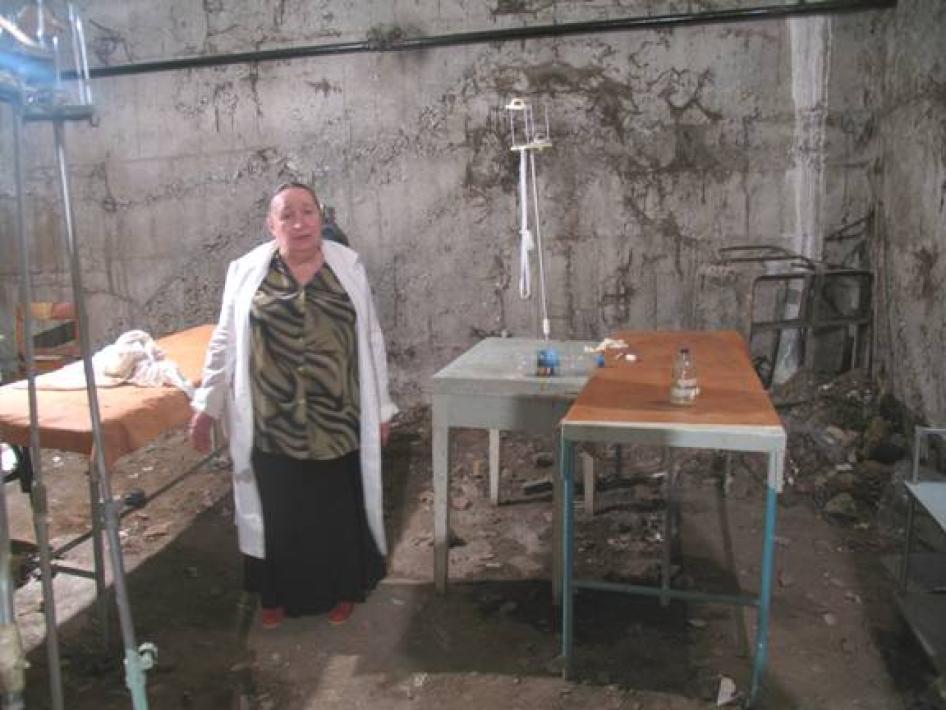
A doctor in the basement of the Tskhinvali hospital where, despite poor lighting and inadequate equipment, medical personnel managed to save, during the fighting, all 273 of their wounded patients. © 2008 Human Rights Watch
Hospitals enjoy a status of special protection under humanitarian law beyond their immunity as civilian objects, and the presence of wounded combatants there does not turn them into legitimate targets.[125]
Vladimir, age 36, showed Human Rights Watch the ruins of his house on Abaev Street in Tskhinvali. He said that five Grad rockets hit his yard and his neighbor's yard on August 7, and he showed Human Rights Watch researchers fragments of the rockets that exploded in his yard. Vladimir and his family had already fled Tskhinvali, but friends were staying in his house on the night of August 7, who told him what happened. Vladimir told Human Rights Watch,
When the shelling started, [my friends] rushed to the basement, removed a water tank and hid in the pit where it used to stand. They spent two days and two nights there, in this pit, unable to get out. On August 10, when the shelling subsided a bit, they went out-and just in time, because the house totally collapsed on the same day!
As I was getting ready to return here, my kids were asking me, "Daddy, can you please check on our toys, see if they're all right?" What am I going to tell them now? Sorry, children, not only your toys are gone but you don't have a home any longer?[126]
Human Rights Watch saw several other houses on the same street destroyed or significantly damaged by Grad rockets or artillery shells.
Another area heavily hit by the Grad rockets was the southern part of Stalin Street. There, several apartment buildings in a row sustained multiple hits on their southern facades. One of the residents of 96 Stalin Street told Human Rights Watch that the building was hit by three Grad rockets almost simultaneously at around 4:20 a.m. on August 8. One of the rockets hit an apartment on the third floor. Two of the apartment's residents, both women, survived with non-life-threatening injuries.[127] The residents of the neighboring house, No. 98, showed Human Rights Watch several large fragments of Grad rockets that they collected in and around the buildings.[128]
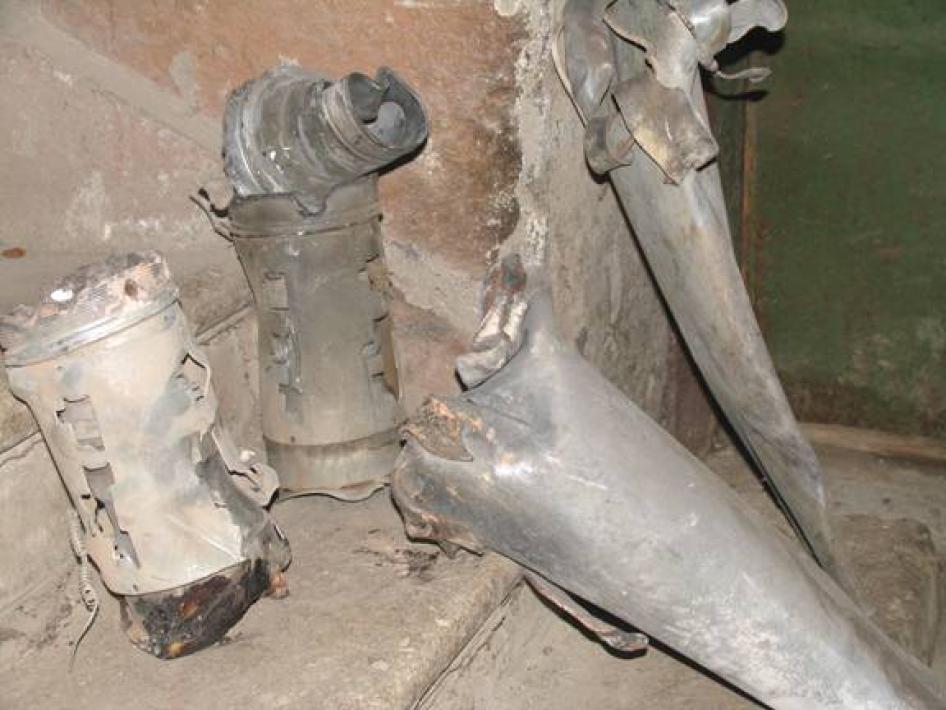
Components of BM-21 Grad rockets recovered in an apartment building in Tskhinvali. © 2008 Human Rights Watch
The above are only a few of the examples of damage caused to the South Ossetian capital by Grad attacks.
Several villages to the west and east of Tskhinvali were also subjected to Grad shelling and heavy artillery fire by the Georgian forces.
In the village of Khetagurovo-especially in its southern part, close to the Georgian artillery positions-Human Rights Watch saw many houses completely destroyed or significantly damaged by the shelling. For example, one house on Alanskaia Street on the southern outskirts of the village was hit by four Grad rockets and three mortar shells, and the neighboring house was hit by five mortar shells. Human Rights Watch saw the fragments of the rockets and the shell craters in the yards.
Madina Dzhioeva, age 32, one of the villagers who stayed in Khetagurovo during the attack, described the night of August 7-8 to Human Rights Watch:
At night the shelling started … My mother is very ill and bedridden. So, I had to stay with her. When the shelling started, we spent that first night at home. It was absolutely horrifying. Very early in the morning we carried Mother to the house of our neighbors across the street because there is no basement in our house, and we knew we would have been killed within hours if we stayed at home any longer. We spent three days in our neighbors' basement-there was no food, nothing.[129]
According to Georgian authorities, and one Ossetian interviewee we spoke with, Ossetian forces had firing positions in Khetagurovo.[130] While these firing positions were legitimate targets, given the indiscriminate nature of Grad rockets, using them to hit such targets in an area populated by civilians may constitute an indiscriminate attack. Although the Ossetian forces bear responsibility for endangering civilians by locating military objectives near or among populated areas, Georgia is not relieved from its obligation to take into account the risk to civilians when it attacks the targets.
Human Rights Watch documented similar accounts by the residents of Nizhnii Gudjabauri, Sarabuki, Muguti, Dmenisi, and Novyi Tbeti. For example, in Dmenisi 12 houses were destroyed or severely damaged by the shelling. In Sarabuki a Human Rights Watch researcher saw five houses severely damaged by artillery hits, and others with lesser damage. In both villages Human Rights Watch saw ample evidence of the use of Grad rockets.
Civilians Killed in Shelling
Georgian forces' indiscriminate use of force, using Grad and other weapons, led to civilian deaths and injuries.[131]
In one example, Anisim Dzhagaev, age 74, was killed by what witnesses believed to be a Grad rocket during the shelling of Tskhinvali. On the night of August 7-8 Dzhagaev was with his wife in the basement of their house on Kulaev Street in the southern part of the city. His daughter Dzarisa Dzhagaeva told Human Rights Watch,
He stepped out of the basement during the shelling to see what was happening and saw that the roof of the house had caught fire. He fetched some water and tried to put the fire out. And then he was hit in his right leg.
Mother could hear how those multiple rockets were flying at the same time-she described the sound of multiple explosions and everything.
He was bleeding very heavily and there was just no one to help. He was dying slowly from the loss of blood. Mother helped him make it back into the basement and spent the whole night sitting by his side while he was dying. She had nothing to properly bandage the wound with, soon she ran out of rags, and he was just bleeding away … When he died we could not bury him properly. I made a grave for him right in the vegetable patch. I buried him myself-but only on August 10, when the fighting subsided and I could get out of the basement.[132]
Another interviewee told Human Rights Watch that his mother and aunt were killed on August 9, during one of the last rounds of Georgian shelling. Both women were in their home, located near School No. 6 in Tskhinvali, when a rocket hit their yard. The interviewee, Alan Sipols, age 38, was abroad at the time of the Georgian offensive, but reconstructed the sequence of events based on his telephone conversations with his mother just before her death and on accounts by neighbors. A shell landed in the middle of the garden, leaving a crater some 3.5 meters in diameter:
When it hit, all the sharp, scorching fragments flew into the house, penetrating the walls as if it was paper. When such a fragment hits a person, it just shreds you apart, and I cannot describe what they turned the people I loved most into.
God save you from ever having to collect into a bag the fragments of your loved ones' bodies…
Sipols, who said he had had artillery training in the military, told Human Rights Watch he believed, judging by the fragment and the crater, that the shell had been "a large-caliber shell, some 122 mm or more," fired from a howitzer.[133]
Telman Street, located in southern Tskhinvali, was almost completely destroyed by Georgian shelling, which Sonya Gagloeva said killed one of her neighbors and wounded another. Gagloeva, age 69, said that she was sheltering in a large basement along with many of her neighbors. When she ran out at one point to grab her identity papers from her house, she herself suffered a contusion and minor shrapnel wounds when a shell hit the ground right next to her.
She said the shelling was virtually incessant during the first day, and people in the basement had no food or water. The men tried to get out from time to time to fetch water. One of them was killed as he was on his way out of the basement. Gagloeva said,
Our neighbor, Vasily Bazaev, he was 53 or 54 years old, tried to step outside during that first night, close to dawn [August 8]. He made it halfway up the staircase when a shell hit … When we came up he was still alive. We dragged him down the stairs and he died 10 minutes later. And then we stayed in the same basement next to his body till the afternoon of August 9, when some relatives came to pick up the body.
Another neighbor, Natela-she's 45 or so-got wounded. It was on August 8. She was staying somewhere further down the street and she knew our basement was safer, so she decided to risk it … She almost made it to us but got hit by some fragments of shells just a few steps away from our basement. So, we dragged her into the basement and the poor woman was all covered in blood. We watched over her till the evening of August 9 when some of the guys [militias] finally picked her up and took her to the hospital.[134]
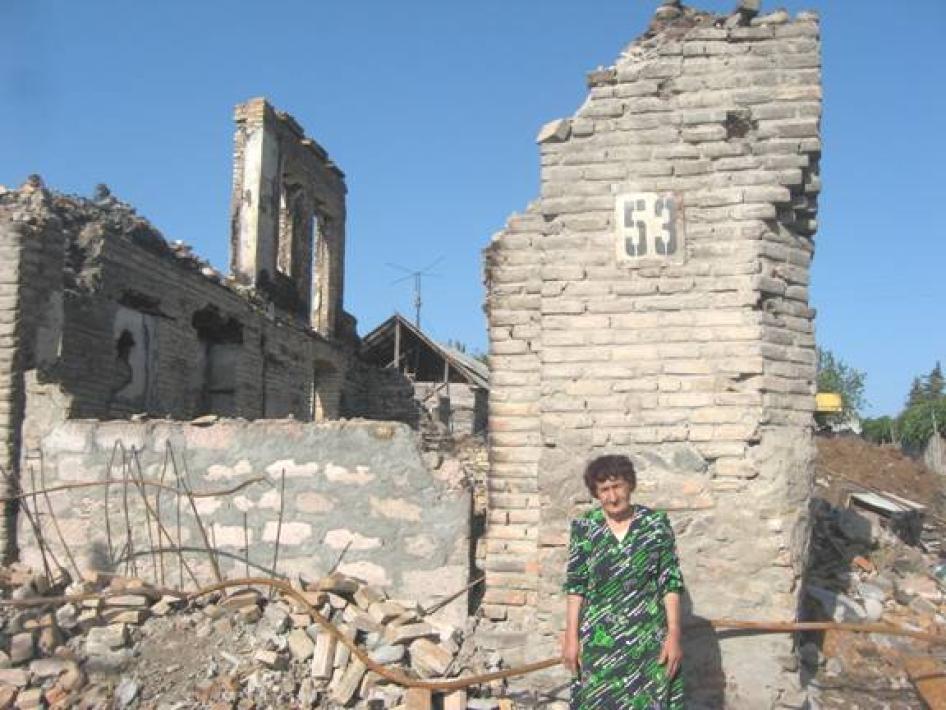
Sonya Gagloeva in front of her destroyed house on Telman Street, in Tskhinvali. © 2008 Human Rights Watch
The number of civilians at risk-and thus the number of casualties-was significantly reduced because many residents of Tskhinvali and neighboring villages, especially women and children, were evacuated or managed to flee their homes before the fighting began, many of them on August 6 and 7. The majority of the remaining civilians spent several days in the basements of their houses to seek shelter from Georgian forces' heavy shelling and ground offensive.
This, however, by no means relieves the Georgian side of responsibility to minimize the risk to civilians when launching an attack and to abide by the principles of distinction.
In addition, warring parties have a responsibility where possible to give advance warning of an attack that might affect civilians.
No such warning was given by the Georgian side. On the contrary, before the shelling started on the night of August 7-8, President Saakashvili said in a televised statement that "Georgia has unilaterally ceased fire in the current fighting with separatist rebels in the region of South Ossetia" and that his government would engage in direct negotiations to end the conflict.[135]
A number of witnesses told Human Rights Watch that this announcement influenced their decision to stay in the city, which put them at greater risk.
The positioning of Ossetian combatants
The Georgian authorities have claimed that the strikes on Tskhinvali and neighboring villages were legitimate as they targeted Ossetian military positions and not at civilians. In his testimony to the parliamentary commission studying the August war, Zaza Gogava, chief of staff of the Georgian armed forces, said that "Georgian forces used precision targeting ground weapons only against several administrative buildings, where headquarters of militias were located; these strikes did not cause any destruction of civilians' houses."[136]
Alexander Lomaia, the secretary of the Georgian National Security Council, told the same commission that the goal of the attacks was only to "neutralize firing positions from whereGeorgian positions were being targeted," and that Grad rockets were only used on "Verkhny Gorodok district of Tskhinvali, where [separatist] artillery was deployed," while the city center was hit with "modern, precision targeting weapons."[137]
Numerous witnesses interviewed by Human Rights Watch, including members of South Ossetian militias, indicated that South Ossetian forces were not only present in Tskhinvali and neighboring villages, but also actively participating in the fighting, including by launching artillery attacks against Georgian forces. The witnesses also made it clear that South Ossetian forces set up defensive positions or headquarters in civilian infrastructure, thus turning them into legitimate military targets.
These locations included some administrative buildings hit by the Georgian artillery, such as the Ossetian parliament building, as well as several schools and nursery schools. For example, witnesses told Human Rights Watch that militias had taken up positions in School No. 12 in the southern part of Tskhinvali, which was seriously damaged by the Georgian fire. Another witness said South Ossetian fighters were co-mingled with civilians in the basement of Tskhinvali School No 6, which drew Georgian tank fire. No civilian casualties resulted.[138]
Yet another witness, a 50-year-old kindergarten teacher who showed Human Rights Watch the fragments of Grad rockets that hit her kindergarten building on Isak Kharebov Street, also said that volunteer militias had been "hiding" in the building.[139] Several members of the Ossetian militia interviewed by Human Rights Watch confirmed that many of the school and nursery school buildings were used as gathering points and defense positions by the militias.
In some of the villages, such as Khetagurovo, Human Rights Watch was able to establish that the positions of Ossetian militias were in close proximity to the civilian homes hit by the Georgian artillery.[140] Georgian forces said they came under heavy fire from Khetagurovo.
However it is questionable whether the large-scale shelling carried out by Georgian forces against Tskhinvali and outlying villages could be considered a proportionate attack against Ossetian forces, including volunteer militias present in these areas. In some cases, as mentioned above, the very choice of indiscriminate weapons or weapons that cannot be targeted with precision (such as Grad launchers) would make attacks unlawful in populated areas. Even though the presence of the Ossetian forces may have made the area a prima facie legitimate target, the Georgian forces were still obliged to calculate whether the risk of harming civilians with the Grad rockets was too high to justify the military advantage sought.
It is also not clear to Human Rights Watch to what extent the Georgian command had the necessary intelligence to establish the exact location of the South Ossetian forces at any given moment, in part because the forces were very mobile. At the same time, Georgian military command was clearly aware of the presence of civilians in Tskhinvali and other areas subjected to artillery strikes.[141]
International humanitarian law places clear obligations on warring parties to take all possible steps to minimize harm to civilians and not to attack civilian objects. If any doubt exists as to whether a civilian object is being used for military purposes, "it shall be presumed not to be so used."[142] When a legitimate target exists within a building, the attacking party must still make a proportionality assessment, ensuring that the expected value of destroying the military object outweighs the likely impact of the attack on civilians and civilian infrastructure.
2.3 Attacks by Georgian Forces on Civilians Fleeing the Conflict Zone
Many Ossetian civilians who did not manage to leave South Ossetia before the fighting attempted to flee to North Ossetia on August 8–10. Human Rights Watch received a number of disturbing reports of Georgian attacks on civilian vehicles fleeing the conflict zone, resulting in death and injuries. The cases described below indicate that-in these cases at least-the attacks caused excessive civilian loss and that precautions were not taken to protect civilian life.
Attack on the Dzhusoev family, August 8
An elderly resident of Tskhinvali, Zaur Dzhusoev, lost his son, Mairbek, and two of his teenage grandchildren, Dina and Aslambek, in one such attack. Dzhusoev told Human Rights Watch that on the morning of August 8, when the shelling of the city subsided for a while, his son decided to take his family out of the city. The civilian car (a Zhiguli Semerka) was packed with civilians-in addition to Mairbek Dzhusoev, who was driving, there were five children (Mairbek's two teenagers, a six-month-old baby, a two-year-old, and a seven-year-old), Mairbek's wife, and another female relative. Mairbek Dzhusoev was wearing civilian clothes. Zaur Dzhusoev, who learned the details of the incident from eyewitnesses, told Human Rights Watch,
I didn't want to let them go, but my son said, "Dad, not to worry, I'll get through!" It was around 9 a.m. He promised to call when they got out of the city, and I was waiting and waiting for his call. I didn't know that my children were no longer alive …
I only found out around 4 p.m., but then I couldn't do anything. Later I learned from our militias who were in the area that it happened at the intersection of Geroev and Isaaka streets. The militias noticed his car and tried to make signals for him to turn around because there was a Georgian tank. My son turned the car, but it was too late-the tank fired at the car, and that was it …
Later, I saw the car-it was apparently hit by a very big shell. The two women managed to get out with the three younger kids, but my son and grandchildren couldn't. Maybe they were killed instantly or maybe they died from the wounds-no one could approach the car to help them, because Georgians were shooting all the time. They just burned in the car-the only remains I could retrieve and bury were just ashes! That's all I have left from my family ….[143]
Attacks on civilian cars on the Dzara road
A number of interviewees told Human Rights Watch that they tried to flee north out of Tskhinvali along the Dzara road, hoping to get to safety in North Ossetia, when they came under Georgian fire.[144]
Petr Petaev, a resident of Tskhinvali, was trying to flee the city with his wife and son on August 9. A grenade hit Petaev's car, killing his wife and injuring Petaev and his son. Petaev told Human Rights Watch,
For two nights and one day I was hiding in the basement with my wife and son and then, on the 9th we could not take it anymore and decided to leave. We got into our car in the evening and drove out of the city. Some militias told us that a humanitarian corridor was opening up that evening and everyone should try to leave. So, there we were driving through Tbet [Tbeti] onto the Zar [Dzara] road.
And we were shot at right there. My wife was killed by the very first shot. My son and I just sat in the car next to her dead body for another half-hour or so. And they just continued shooting! My son got wounded in the head and I was wounded in my leg. Before we reached that place where we got shot at we saw 10 burning cars.[145]
Another civilian killed during evacuation along the Dzara road was 54-year-old Diana Kodjaeva, who tried to flee Tskhinvali with her neighbors on the night of August 7-8. Kodjaeva's cousin, who learnt about her death the next day, told Human Rights Watch that the car in which they had been traveling came under heavy fire on the Dzara road and "burnt to ashes." He did not know the circumstances of how the car came under fire, and found only the burnt remains of his cousin and two of her neighbors. He said,
I immediately went there and found what remained of the car. It was a burnt wreck. And I could not even bury [my cousin] properly. I just picked up a few handfuls of dust from the car and pretended these were her ashes. But I don't know whether they were really hers or [those of the two other people in the car]. I needed to bury something, right? And this just had to do.[146]
Another interviewee recounted to Human Rights Watch how his brother tried to evacuate his wife and eight-year-old son from Tskhinvali on the night of August 7. He said,
On the detour [Dzara] road, the car came under heavy fire from the Georgian troops. My brother first pushed his wife and son out of the car and they hid in a ditch on the side of the road. He drove further, trying to lead the fire away from his family. Then he jumped out of the car, and managed to crawl back to where he left his wife and child. Georgians continued to fire at the car, and it burnt almost completely. My brother and his family spent the night in the ditch, and in the morning managed to get to Java, where they got some help. The child was seriously traumatized and is now undergoing rehabilitation in Vladikavkaz.[147]
(An unverified claim that Georgian forces used cluster munitions in their attacks on the Dzara road is discussed in Chapter 2.4).
Attacks on vehicles and international humanitarian law
Human Rights Watch was not able to conclude whether the civilian deaths that resulted from the attacks on the vehicles were the consequence of acts contrary to the laws of war, and believes that the circumstances of these killings warrant further investigation.
At least two factors suggest the presence of legitimate military targets. First, starting early on the evening of August 8, Russian forces and armaments were moving south from the Roki tunnel on the Dzara road: In a letter to Human Rights Watch, the Georgian government stated that its forces "fired on armor and other military equipment rolling from the Roki Tunnel along the Dzara Road, not at civilian vehicles."[148] Second, as one witness recounted to Human Rights Watch, Ossetian forces had an artillery storage facility and firing position on a hill about one kilometer from the Dzara road.[149]
Both Russian forces moving south on the Dzara road and the Ossetian firing position were legitimate military targets. But in carrying out these attacks Georgian forces had a duty to take precautions to minimize civilian harm and to ensure these attacks conformed to the principle of proportionality.
The Georgian government has said that "during movement of military columns, particularly during combat, all movement of civilian vehicles was halted. Consequently, there were no civilian vehicles present during [Georgian armed forces] fire against the mouth of the Roki Tunnel and along the Dzara Road."[150] It appears, however, that Russian columns moving south did not preclude civilian vehicles' moving north. Indeed, Georgian forces should have been fully aware that in the first days of the conflict the Dzara road was the only way out of Tskhinvali that civilians could use.
Information collected by Human Rights Watch suggests that many of the cars were driven by South Ossetian militiamen who were trying to get their families, neighbors, and friends out of the conflict zone. A militia fighter is a combatant and a legitimate target when he or she is directly participating in hostilities.
It is not inconceivable that some of the militia fighters driving civilians to safety were wearing camouflage, were armed, or in other ways appeared to pose a legitimate threat to Georgian forces. But it was the responsibility of the Georgian troops to determine in each case whether the vehicle was a civilian object or not, and if it was believed to be a legitimate military target, whether the anticipated military advantage gained from an attack on such vehicles would outweigh the expected harm to civilians.
2.4 Georgian Forces' Ground Offensive
In the early hours of August 8, Georgian ground troops, including tank columns and infantry, entered South Ossetian villages to the west of Tskhinvali and then proceeded into the city. While in some villages and in parts of Tskhinvali South Ossetian militias seemed to put up armed resistance and defend their positions, by the afternoon of August 8, Georgian authorities claimed to have complete control of the city. In Tskhinvali the exchange of fire between Georgian forces and South Ossetian forces supported by the Russian army and air force continued until August 10, when the Georgian command ordered withdrawal of troops from South Ossetia.
The presence of South Ossetian combatants throughout Tskhinvali and in some villages in many cases makes it difficult for Human Rights Watch to assess the legality of some of Georgia's attacks during the ground offensive. Armed with automatic weapons, the militias targeted Georgian military vehicles and infantry moving through the city. Numerous witnesses confirmed to Human Rights Watch that virtually all able-bodied males joined the volunteer militias, often after moving their families to safety in North Ossetia.[151]
Human Rights Watch believes that, particularly during the attempt to take Tskhinvali, on a number of occasions Georgian troops acted with disregard to the protection of civilians by launching attacks where militias were positioned that may have predictably caused excessive civilian loss compared to the anticipated military gain. Some of the Georgian soldiers interviewed by Human Rights Watch confirmed that while they were targeting Ossetian fighters who were shooting at them from apartment buildings, they were fully aware of the presence of civilians in these buildings. One soldier said,
We entered Tskhinvali in the morning of August 8. There was a street fight. Ossetians were mostly in the buildings, in apartments, and shot at us from the buildings. We could see civilians in the basements. Some would come up and peek out to see what was happening on the street level. Then they would go back down. The fighters were also in the basements and would fire at us from the basements.[152]
Human Rights Watch researchers saw multiple apartment buildings in Tskhinvali hit by tank fire. In some cases, it was clear that the tanks and infantry fighting vehicles fired at close range into basements of buildings. Human Rights Watch interviewed several people who were sheltering in these basements at the time of the attack.
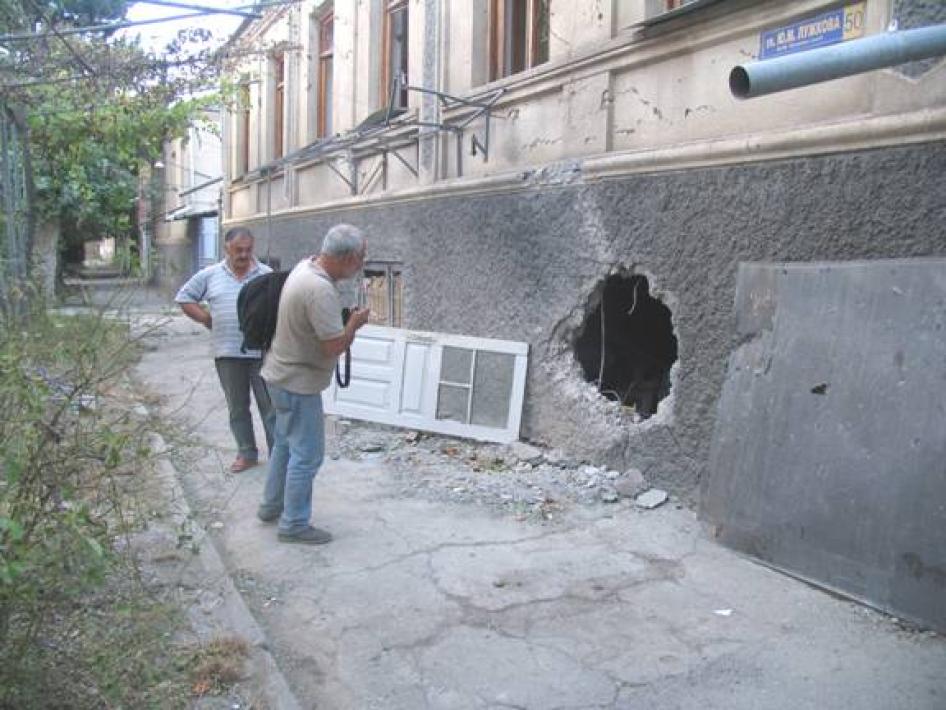
Human Rights Watch examining the basement of an apartment building on Luzhkov Street, in Tskhinvali, which was hit by Georgian tank fire. © 2008 Human Rights Watch
Giorgi G. took Human Rights Watch researchers to his apartment building at 50 Luzhkov Street, Tskhinvali, which he explained suffered severe damage during the Georgian ground offensive. The wall of the building had a gaping hole at the basement level, apparently from a shell fired at close range. Giorgi G. said,
When the fighting started, everyone who remained in the building rushed to the basement. We stayed there for the next two days, unable to step outside because the shelling was so heavy. On August 9 a BMP [infantry fighting vehicle] fired right into the basement, leaving a gaping hole in the wall. The noise was deafening and debris was flying all over the place. My neighbor's elderly father-in-law was so scared that he started running away, slipped and broke his legs. No one was killed because everyone was in the adjacent room.[153]
Even when the presence of Ossetian militias meant that apartment buildings could be legitimate targets, it was not apparent from the evidence of the aftermath of the attack that the Georgian military had taken all feasible precautions to minimize the harm to civilians.[154] It is clear, however, that the military tactics they used caused civilian casualties and significant damage to civilian property.
For example, residents of Tselinnikov Street in Tskhinvali told Human Rights Watch that at around 3:30 p.m. on August 8 a Georgian tank opened fire at their apartment building, after a group of Ossetian militia started withdrawing through the neighborhood. Six tank shells hit the building, destroying five apartments, and killing an elderly man, Erdish Kulumbegov. Building residents told Human Rights Watch,
We all rushed to the basement, but an elderly man, some 80 years old, who lived on the fourth floor, didn't manage to make it to the basement in time. His apartment was hit by a shell and caught fire. When the attack was over, we went upstairs and saw that the old man burned to ashes. We … buried [his] remains in the yard.[155]
Neighborhood residents told Human Rights Watch that the attack did not result in any casualties among the militia, with whom they were all acquainted.[156]
Similarly, in some villages, the Georgian offensive seemed to have been carried out with little regard to the safety of civilians. Ossetian militias fled their positions in villages as Georgian ground troops started their offensive. Human Rights Watch has no information about street fighting that ensued between these Ossetian fighters and Georgian forces.
Ossetian forces left the village of Khetagurovo, where they had firing positions, just prior to Georgian ground forces' entry into the village on August 8. Human Rights Watch researchers learned that as the Georgian infantry entered the village they were spraying the gates and fences of homes with bullets, demanding that the militias surrender. Hundreds of bullet holes were clearly visible on fences and gates. According to witnesses, on August 8 one of the stray bullets killed an elderly woman, Anastasia Dzhioeva, as she went to feed the chickens in her yard.[157] One villager, Mokhmed Maldigov, told Human Rights Watch,
At dawn, around 5 a.m. or so, the Georgians entered the village-first the tanks, and then the infantry. They were shooting in all directions. One [tank] shell hit my house. People were so frightened. Many started running, women and kids in particular. And they just continued shooting.[158]
Novyi Tbeti, a village of about nine houses on the outskirts of Tskhinvali, was almost completely destroyed by Georgian artillery and tank fire. One villager, 63-year-old Izolda Galieva, told Human Rights Watch that all of the young men, including her sons, had joined the militia and gone to the city, and only women and elderly stayed in the village when the Georgian army entered it on August 8. Galieva described the ordeal she and her neighbors suffered:
On Friday [August 8] at around 6:30 in the morning I saw two Georgian tanks on the street and one car full of gunmen. Then one of those tanks fired for the first time-right at my house, and I just dropped to the floor and crawled to the basement. The Georgians were shooting from machine guns and submachine guns, and screaming obscenities. When a tank [shell] hit my house directly the house just fell apart, and I got shrapnel wounds on my neck and arms. I was flat on the basement floor, bleeding and afraid to move …
The neighboring house was also destroyed by tank fire on that day, and my neighbors, the Makaevs, husband and wife, both got shrapnel wounds. The tanks fired 15 times or so-and now, as you can see, the whole village is gone … It all happened in one day … I just stayed in the basement until Monday afternoon [August 11], when some neighbors looked into the basement and found me. They told me that the Georgians had all fled, and dragged me out. Then, an ambulance came for me and took me to the hospital.[159]
The Conduct of Georgian Troops during the Ground Offensive
The majority of witnesses interviewed by Human Rights Watch did not complain about other types of violations against them by the Georgian forces. Judging by their statements, in most cases the troops entering the villages did not deliberately cause physical harm to civilians. Several Ossetian interviewees said that Georgian soldiers told them they were under orders to look for and pursue Ossetian militias, but to spare women, children and elderly during the ground offensive.
Zareta Z., from the village of Sarabuki, said that when Georgian soldiers entered the basement where she was hiding with her husband, they told them, "Now you'll live with us, with Georgians, and we'll live in peace. Misha [Saakashvili] told us not to touch women and children. We're instructed to kill the young guys [fighters] only. And that's what we'll do. You are not to worry."[160] Another woman from the same village, "Svetlana S.," also said that the Georgian soldiers were telling the residents, "We have not killed any residents and we are not going to! Everyone is safe!"[161]
Madina M. from Khetagurovo said that she was terrified when Georgian troops entered the village, but to her surprise they were "polite" and did not harm her. She said,
They were going from yard to yard and looking for young guys. They did not know our guys weren't around anymore. I was so frightened … I thought they'd be doing cruel things to women and to the elderly, like during the first war, back in 1992. But they were … polite, really. They kept saying that they had an order not to touch women, children, and old people, and we had nothing to fear from them. They were so young-seemed to be 19 or 20, no more than that. Those who came into our basement even told us, "We don't want to die either."[162]
Several women from five mountain villages in Akhalgori district populated mainly by Ossetians also confirmed that the Georgian forces did not harm civilians when they entered the villages on the night of August 7-8.[163] A woman from Tsinagari told Human Rights Watch,
They told us not to be afraid and said that if our men wouldn't shoot, they wouldn't shoot either. They shot in the air-probably trying to frighten us. They entered the houses, checked identification documents, even some of our neighbors' passports. They also looked for young guys and for the men. But all our men were already gone by then-they joined the militia and hid in the woods. The Georgians were also looking for firearms but our men had taken their weapons with them, so there was nothing much to find.[164]
A small number of witnesses from different villages complained, however, that the Georgian forces ransacked their houses as they were looking for Ossetian fighters, and in a few cases took money, valuables, Russian identification documents, or other things from the residents. For example, Slavik Gabuzov, age 71 and disabled, told Human Rights Watch that when Georgian ground forces arrived in Znauri on August 8 they came to his home looking for fighters and arms. They treated him roughly and stole money:
All my family left on the 7th but I stayed behind because I cannot walk properly and traveling is pretty much impossible. The Georgians came in the morning of the 8th. Their tanks were all over the place. Three of them came to my place and said, "Are you Georgian?" I said, "No, I'm Ossetian." So they pointed their submachine guns at me and put me against the wall, with my crutches and all.
They demanded that I give my weapons to them. But what kinds of weapons were they thinking of finding, an old handicapped man like me? When I told them I had no weapons they ordered me to drop flat on the ground. They yelled all kinds of obscenities and mocked me. They searched my place and found this cashbox where I keep all of the family savings. They forced me to open it for them and took all the money. [165]
A young woman from the village of Tsair told Human Rights Watch that Georgian soldiers stole whatever money she had at the house, as well as the passports of the residents, all of whom have Russian passports.[166] A resident of Muguti, 75-year-old Fenya Dzhioeva, said that when Georgian forces searched her home they "tore everything apart." She managed to retrieve money she had hidden under her mattress, but as she was putting it into her pocket, "they still noticed and took [it] from me."[167]
International humanitarian law applicable to the conflict prohibits looting or pillaging, and individuals and commanders involved in such acts may be responsible for war crimes.[168]
2.5 Georgia's Use of Cluster Munitions
The Georgian military attacked Russian forces with cluster munitions to stop their forward advance into South Ossetia. Human Rights Watch has no information about the impact of these attacks on civilians in South Ossetia.
Human Rights Watch did find that M85 cluster munitions hit nine villages in undisputed Georgian territory, which killed at least four people and injured eight. In addition, unexploded M85s have prevented civilians from tending or harvesting their crops, causing them to lose a source of income and subsistence. Human Rights Watch has concluded that these cluster munitions were fired by Georgian forces. Several factors suggest that Georgian forces did not target these villages, but rather that the submunitions landed on these villages due to a massive failure of the weapons system (see below). Even though injuries that result from failure of a weapons system do not mean that there has been a violation of humanitarian law, the incidents demonstrate the excessive and indiscriminate harm that can be caused to civilians, and why therefore progress is being made to ban the use of cluster munitions as a means of warfare.[169]
Cluster munitions are large, ground-launched or air-dropped weapons that eject, depending on their type, dozens or hundreds of bomblets, or submunitions, and spread them over a large area. Because cluster munitions cannot be directed at specific fighters or weapons, civilian casualties are virtually guaranteed if cluster munitions are used in populated areas. Cluster munitions also threaten civilians after conflict: because many submunitions fail to explode on impact as designed, a cluster munitions strike often leaves a high number of hazardous unexploded submunitions-known as duds-that can easily be set off upon contact.
In a letter to Human Rights Watch on August 31, 2008, the Georgian Ministry of Defense acknowledged that it had used cluster munitions against Russian military equipment and armaments as they were moving south from the Roki tunnel. The ministry insisted, however, that cluster rockets "were never used against civilians, civilian targets and civilian populated or nearby areas."[170]
The Georgian Ministry of Defense identified the type of cluster munitions used as the GRAD-LAR 160 multiple launch rocket system with Mk-4 rockets with M85 submunitions: In a document sent to Human Rights Watch on November 18, the ministry reported, "Georgian Armed Forces used 24 packages (13 shots in each) of GRAD-LAR munitions during the Georgian-Russian August war."[171] First Deputy Minister of Defense Batu Kutelia told Human Rights Watch that these weapons, bought from Israel, are the only cluster munitions in Georgia's possession.[172] M85 submunitions are not reported to be part of Russia's arsenal, and international deminers refer to the M85s they found in Gori and Karaleti districts as "Georgian."[173] Notwithstanding the cluster munition hits in Gori district, Kutelia expressed satisfaction with how the munitions performed and said that they delayed Russian troop advances by several days.[174]
One witness interviewed by Human Rights Watch claimed that Georgian forces used cluster munitions in their attacks on the Dzara road in South Ossetia. The witness, a member of the Ossetian militia who had been assisting in the evacuation of civilians on that road, described seeing "a rocket which exploded in the air, and then small clusters started exploding."[175] Human Rights Watch was not able to independently verify this claim, yet such allegations need to be further investigated.
The Russian authorities did not respond to a written request from Human Rights Watch for information about Georgian use of cluster munitions in South Ossetia (See letter in appendix).
How Georgian Clusters Landed in Gori District
Human Rights Watch researchers found unexploded M85 submunitions, ribbons from detonated submunitions, and Mk-4 rockets in Gori district. They interviewed villagers who had fallen victim to M85 submunitions, deminers who work in the area, and senior government officials. Through these sources, researchers gathered evidence of M85s in a band of nine villages in the north of the Gori-Tskhinvali corridor: Brotsleti, Ditsi, Kvemo Khviti, Megvrekisi, Pkhvenisi, Shindisi, Tirdznisi, Zemo Khviti, and Zemo Nikozi.[176]
Georgian First Deputy Minister of Defense Batu Kutelia told Human Rights Watch that the presence of M85 submunitions in villages in the Gori district remained a mystery to the Georgian authorities. According to Kutelia, Georgia will conduct an investigation into the situation and seek the assistance of the company that sold it the M85s-presumably Israel Military Industries, the only Israeli manufacturer of M85s.[177] One theory is that the M85 submunitions landed in these villages because of a massive system failure. Based on Kutelia's description of the incidents, the rockets fell short of their minimum range. The failure theory would explain why they landed where they did (witnesses did not report Russian troops in the area at the time of attack), and why the dud rate was so high.
Civilian Casualties from M85s
M85 submunitions are Dual Purpose Improved Conventional Munitions (DPICM) whose purpose is to injure or kill persons and pierce armor. It is an unguided weapon that poses grave danger to civilians in part because of its inaccuracy and wide dispersal pattern. These submunitions are cylinder-shaped; civilians often describe them as resembling batteries or light sockets. Connected to the top of each of these submunitions is a white or red ribbon that unfurls when the submunition is released.
At least one civilian was killed and two wounded as the M85 submunitions landed in Gori district villages. On the afternoon of August 9, Vano Gogidze, age about 40, was killed and his brother, Ketino, 38, was injured when M85 submunitions exploded as they landed in the village of Shindisi.[178]
Alexander Zerekhidze told Human Rights Watch that he was injured in his village of Tirdznisi when M85 submunitions landed around 3:30 a.m. on August 9:
I heard some noise. I came out of my front door. There was a loud shooting noise and I came out to see what was happening. I heard screams and came out to see if someone was wounded. As soon as I came out, something exploded. I turned back and shrapnel hit my back, stomach, leg. I started bleeding. My kids were inside the house. I tried to cover them. My wife treated me first and stopped the bleeding. In the morning I went to … Tbilisi. I was released [from the hospital] in a couple days.[179]
Zerekhidze showed Human Rights Watch three small craters and a fragmentation ring that he had found in front of his house. The craters were consistent with a submunition explosion, and Human Rights Watch identified the ring as belonging to an M85 submunition.
Casualties from unexploded duds
There are at least two versions of the M85 submunition: one with a self-destruct device and one without.[180] The unexploded M85 submunitions that Human Rights Watch discovered in Gori district villages did not have a self-destruct device. First Deputy Minister Kutelia told Human Rights Watch that he was surprised about this finding and similar findings by his own engineers. According to Kutelia, Georgian authorities had been told that the munitions that they had bought had self-destruct devices.[181]
Human Rights Watch has documented that at least three people were killed and six wounded by M85 duds that exploded upon contact in Shindisi, Pkhvenisi, and Brotsleti.
On August 10, several men from Shindisi decided to inspect one of the sites where the strike had landed the previous day. They found a piece of unexploded ordnance with a red ribbon, which they brought back to the village. When they tried to disassemble it the submunition exploded, killing Ramaz Arabashvili, age around 40, and wounding four others.[182]

An unexploded M85, an anti-personnel and anti-armor submunition found in Shindisi in October 2008. M85s caused civilian deaths and injuries in Shindisi both at the time of attack and afterwards. Bought from Israel and launched by Georgia, this submunition is carried in an Mk-4 160 mm rocket. © 2008 Human Rights Watch
On August 14, around 1-2 p.m., Alika Kikvilashvili, 48, was on his way to the fields in Brotsleti with Amiran Khaduri and Tero Surameli, 46. Surameli was holding in his hands two small items that to Kikvilashvili looked like light sockets. One had a white ribbon and one a red ribbon. When Kikvilashvili's cellphone rang and he stepped away, the cluster duds exploded, fatally wounding Surameli and injuring Kikvilashvili and Khaduri. Alika Kikvilashvili told us,
I had shrapnel all around and it is still inside-stomach, right and left arms, right and left legs. I felt it only later. For four days I got no help. In particular my left leg had a hole. I poured vodka inside so there would be no infection. Four days later the Russians came. They had a field hospital here. Someone told them I needed help and they took me to the field hospital. I was taken back and forth and treated.
Kikvilashvili was later told that Surameli died an hour after the explosion.[183]
On August 18 Veliko Bedianashvili, age 72, found an unexploded M85 submunition in a field close to his house in Pkhvenisi. As he was trying to remove the red ribbon from the dud, it exploded and killed him. His son, Durmiskhan Bedianashvili, told Human Rights Watch, "There are so many of those lying around. The fields are full of them."[184]
In addition to posing a threat to civilian lives, unexploded M85 submunitions littering fields in the northern part of Gori district prevented many farmers from harvesting their crops, thereby throwing already struggling farmers into deep economic distress. Alika Kikvilashvili told us, "I am not going to my fields. The harvest is now ready, but there is grass and it is hard to notice anything so I am not going there. I hope there will be some deminers. My harvest includes apples and corn, which I sell. That's how we survive. That's how people live here. My peaches were lost completely, now my apples are in danger as well.[185]
2.6Russian Allegations against Georgia of Genocide and Other War Crimes
Political Statements and Russian Criminal Investigation
From the very beginning of the conflict, Russian authorities put significant effort into documenting alleged violations by Georgian forces. An investigation is being conducted by the Investigative Committee of the Russian Federation Prosecutor's Office (Sledstvennyi Komitet Prokuratury, or SKP).
During his August 10, 2008 meeting with the head of the SKP, President Dmitry Medvedev stated that "the actions of the Georgian side cannot be called anything other than genocide," and ordered the SKP to document the evidence of crimes committed by Georgian forces in South Ossetia in order to create a "necessary basis for the criminal prosecution of individuals responsible for these crimes."[186] The SKP then opened a criminal investigation under article 357 of the Russian Criminal Code ("genocide"), having already initiated an investigation under article 105 ("premeditated murder of one or more persons").[187] The SKP deployed over 200 investigators and 29 forensic experts to conduct an investigation in South Ossetia. On September 25 the head of the SKP reported that the evidence-gathering phase of the investigation had been completed and that "[t]he investigative work allowed us to come to an unequivocal conclusion that the goal of the aggressors was the total annihilation of the national group of Ossetians residing in South Ossetia."[188]
Human Rights Watch does not have access to the SKP's investigative files and thus cannot assess the evidence gathered and the validity of these allegations. Human Rights Watch's written requests to the Russian government to meet with the prosecutor's office went unanswered.
Russia's Allegations Not Supported by Available Evidence
Information collected by Human Rights Watch suggests that while the actions by the Georgian forces clearly violated international humanitarian law, they did not amount to the crime of genocide.[189] This opinion seemed to be shared by the rapporteurs of the Committee on the Honouring of Obligations and Commitments by Member States of the Council of Europe (Monitoring Committee), who visited Georgia and Russia at the end of September and prepared a report to the Parliamentary Assembly of the Council of Europe (PACE). During the hearing, Rapporteur of the Committee on Legal Affairs and Human Rights Christos Pourgourides noted,
The facts do not seem to support the genocide allegations against Georgia: the number of Ossetian (civilian) victims of the Georgian assault ("thousands" according to early numbers cited by the Russian authorities relying on "provisional data") seem to be much exaggerated; … Individual atrocities such as those described in certain Russian media and submissions to the Committee of Ministers would be serious crimes in their own right, but not attempted genocide.[190]
Some statements attributed to SKP representatives also raise serious concerns about the accuracy and thoroughness of the investigation. For example, reporting on the findings of the SKP on August 21, Rossiiskaya Gazeta (the main official Russian newspaper) wrote,
In the village of Tsinagar[i], the aggressors executed all civilians in a church where they tried to find refuge. According to Archbishop Feofan of Stavropol and Vladikavkaz, Georgian soldiers were dragging pregnant women out of houses and beating and killing them for delectation of the crowd. One Tskhinvali resident was trying to protect her child from the Georgians, but the baby was shot dead right in her lap.[191]
Human Rights Watch interviewed a resident of Tsinagari who said that no such thing happened in his village.[192] In a letter to Human Rights Watch, the Russian Foreign Ministry attributed the same incident to the village of Dmenisi instead.[193] However, numerous Ossetian villagers interviewed by Human Rights Watch in that village said they never heard about, let alone witnessed, such an incident.[194]
Human Rights Watch researchers were told similar hearsay accounts of atrocities allegedly committed by Georgian troops in other villages of South Ossetia, but our follow-up research did not confirm these allegations. For example, in August, right after the end of hostilities, several people told Human Rights Watch that civilians were burned to death in a church in Khetagurovo. When Human Rights Watch visited Khetagurovo, local residents vehemently denied such allegations. A staff member of the South Ossetia Committee for Press and Information told Human Rights Watch that the incident actually happened in Sarabuki.[195] Our researchers immediately traveled to Sarabuki, only to discover that local residents had not even heard that story.[196]
Similarly, hearsay allegations of rape circulated widely in South Ossetia, but no leads provided to Human Rights Watch produced credible results.
Accusations of atrocities and genocide allegedly committed by the Georgian troops were also widely publicized by the Public Commission for Investigating War Crimes in South Ossetia, a group of Russian and South Ossetian public activists working with the prosecutor's office of the de facto South Ossetian authorities.[197] The commission was created on August 12, 2008, and immediately went to Tskhinvali and started interviewing witnesses and collecting other evidence of violations committed by Georgia.
A report published by the commission shortly thereafter contained numerous statements by survivors and witnesses of Georgia's assault against South Ossetia. However, in many cases, especially the ones describing deaths or injuries, the necessary details and analysis were missing that would have allowed determination of whether the victims were civilians or combatants (especially in the cases of male victims), and whether the circumstances of their death suggested violations of the laws of war by Georgian forces.[198]
Human Rights Watch asked the Public Commission for the names of witnesses who could confirm the stories of specific egregious acts by the Georgian forces, including the burning of civilians in a village church (the alleged Khetagurovo/Sarabuki incident mentioned above). Commission representatives promised to provide this information, but at this writing they have not done so.[199]
2.7 The Issue of Civilian Casualties in South Ossetia
From the very beginning of the conflict, controversy has surrounded the issue of the numbers of civilian casualties resulting from the Georgian forces' assault.
Early Figures from Russian and South Ossetian Officials not Borne out
From August 8, 2008, the day after the conflict started, Russian and South Ossetian officials repeatedly cited figures of civilian deaths ranging from 1,400 to more than 2,000. For example:
- On August 8 President of South Ossetia Eduard Kokoity said that "slightly more than 1,400 people have been killed," claiming that the figure was based on reports from relatives;
- On August 9 Russian Ambassador to Georgia Vyacheslav Kovalenko said that "at least 2,000 residents of Tskhinvali have died";
- On August 10 Russian Deputy Minister of Foreign Affairs Grigory Karasin said that "according to the latest data, as a result of Georgia's assault against South Ossetia at least 2,000 people, most of them Ossetians, have died";
- On August 11 Russian Foreign Ministry official Boris Malakhov said that "as a result of Georgia's armed assault on South Ossetia about 1,600 civilians were killed";
- On August 20 Irina Gagloeva, a spokesperson for the de facto South Ossetian authorities, said that "according to refined data, 1,492 residents of South Ossetia died as a result of Georgia's assault."[200]
These early, high casualty figures grounded the genocide claims Russia adduced to justify its military intervention. They also significantly influenced public sentiment in South Ossetia. For example, some of the local residents interviewed by Human Rights Watch justified the torching and looting of the ethnic Georgian enclave villages by referring to "thousands of civilian casualties in South Ossetia," as reported by Russian federal TV channels.
To date, neither Russian nor South Ossetian officials have made clear how these figures were compiled and what evidence supports them. Nor have they acknowledged that later assessments by Russian officials and international monitors are far lower than these early estimates. The various later figures include the following:
- The Investigative Committee of the Russian Federation Prosecutor's Office (SKP) announced on August 21 that it had documented the deaths of 133 individuals,[201] increased the figure to 159 as of October 12,[202] and to 162 as of December 23, 2008.[203]
- Following his visit to the region, Luc Van den Brande, the chairperson of the Ad Hoc Committee established by PACE to study the situation in Russia and Georgia, stated on September 29, 2008 that "independent reports put the total number of deaths at between 300 and 400, including the military," adding that "these figures are far lower than those initially advanced in particular by Russia," and suggested that "all sides agree that the initial high numbers were inflated."[204]
- Christos Pourgourides, the rapporteur of the PACE's Committee on Legal Affairs and Human Rights, also reported on October 1, 2008 that "the number of Ossetian (civilian) victims of the Georgian assault ('thousands' according to early numbers cited by the Russian authorities relying on 'provisional data') seem to be much exaggerated."[205]
- The Public Commission for Investigating War Crimes in South Ossetia maintains a list of people killed in the conflict that, as of November 8, contained the names of 365 individuals.[206]
Civilian versus combatant unclear in Russian figures
It is not clear whether the SKP's investigation is distinguishing between civilians and volunteer Ossetian militias, and if so, how (Ossetian peacekeepers and servicemen of the South Ossetian Ministry of Internal Affairs, Ministry of Defense and Emergencies, and Committee for State Security are explicitly excluded). According to Olga Kostina, the key spokesperson for the Public Investigation Commission on War Crimes in South Ossetia, the commission list does not distinguish between civilian and combatant casualties.[207]
During our research in South Ossetia, Human Rights Watch found that witnesses often referred to the members of the militias as "civilians," meaning that they were volunteer fighters, as opposed to servicemen of the South Ossetian Ministry of Internal Affairs, Ministry for Defense and Emergencies, and other agencies. However, under international humanitarian law, they are combatants and not civilians.
The Public Commission's list contains 74 women (including elderly women), 37 elderly men (age 60 or over), and seven minors (under age 18). One can reasonably conclude that many of these individuals were individuals who did not take part in the hostilities. The status of the remaining 247 needs to be verified. The list does not contain dates and times of death, place (in most cases), and includes very limited information regarding the cause of death (for example, "killed during hostilities," or "killed by shrapnel").
Erroneous Georgian Figures for South Ossetian Civilian Casualties
The Georgian government, for its part, inaccurately and repeatedly stated that a total of 44 civilians had been killed during Georgia's military assault. Georgian officials, including President Saakashvili, incorrectly attributed this figure to a Human Rights Watch press release (see below). These attributions ceased after Human Rights Watch sent letters to the Washington Post (where one such attribution appeared) and to President Saakashvili explaining that we had made no such assessment.[208]
Human Rights Watch and Casualty Figures
Human Rights Watch does not have the capacity to make a definitive estimate as to the number of civilian casualties. Moreover, though the number of civilian dead and injured in a conflict is an issue of great importance, Human Rights Watch's major concern in any conflict setting is to establish whether and how civilians have been killed or injured and, more particularly, whether this was the result of violations of international humanitarian law.
During our first investigation in South Ossetia Human Rights Watch collected some figures on individuals killed and wounded as a result of the conflict-both through interviews with relatives of the victims and by obtaining data from hospitals and local officials.
For example, in August Human Rights Watch interviewed a doctor at Tskhinvali hospital who said that the hospital received 44 bodies, of fighters and civilians, between August 6 and 11, all from Tskhinvali. The hospital had the only morgue in the city.[209] The doctor told us that between August 6 to 12 the hospital treated 273 wounded, both militias and civilians, brought from the city and some neighboring villages. She said her hospital was the only medical facility treating the wounded in Tskhinvali. The doctor said there were more South Ossetian forces than civilians among the wounded, and added that all of the wounded were later transferred (to North Ossetia). As of August 13, there were no wounded left in Tskhinvali hospital.[210]
The 44 figure became the subject of controversy as some mistakenly characterized this as Human Rights Watch's definitive figure on civilian casualties, and others used this as evidence of bias. We were fully aware and noted in media statements that the figures provided from Tskhinvali hospital were not a comprehensive tally. Some of the residents killed in Tskhinvali and especially in the outlying villages were never brought to the hospital; instead, a number of people were buried beside their homes.[211]
At the same time, Human Rights Watch continues to question the initial 1,400-2,000 figures and the methodology used to arrive at them. We have emphasized that these were not reliable figures because it was not clear how such figures were compiled so quickly, as early as August 8 and 9, under chaotic circumstances. We also expressed concerns about the effect these announcements had on public sentiment in South Ossetia.
Finally, and most importantly, Human Rights Watch believes that this issue requires further research, as new information might reasonably come to light about whether deaths were the result of humanitarian law violations, about deaths not reported previously (including deaths in the intervening period from wounds inflicted during the conflict), and might also identify people who were assumed dead but were in fact missing and resurfaced, and people who were inadvertently counted twice.
It is the obligation of the Russian investigative authorities to ensure transparency on this matter and provide both the Russian public and the international community with the latest accurate information-if necessary, by correcting the statements made by government officials at the beginning of the conflict.
2.8 Georgian Detentions and Ill-Treatment of Ossetians
The Georgian military during active combat in South Ossetia detained at least 32 Ossetians. These 32 were released between August 21 and 27, in exchange for Georgian civilian detainees. At the request of the South Ossetian authorities, nine Ossetians previously convicted of crimes and held in Georgian prisons were also exchanged for Georgian civilians.[212]
Human Rights Watch interviewed five of the 32, whom the Georgian military had detained on August 8 and 9.[213] All five detainees reported having been beaten by Georgian soldiers at the moment of their detention, and receiving poor and inadequate food while in detention.
The Georgian government maintains that all 32 Ossetians were militia fighters and were detained for their participation in hostilities.[214] Human Rights Watch cannot definitively determine whether the Ossetians detained by the Georgian military were civilians or were participating in hostilities. The Georgian authorities have not presented evidence that all of the Ossetians whom they detained were in fact combatants. At least one case investigated by Human Rights Watch, that of an elderly man who said he was a pacifist on religious grounds, calls into question the Georgian government's blanket determination about those whom its forces detained. One interviewee, however, made no effort to conceal that he was a combatant-he told Human Rights Watch that he was from North Ossetia and traveled to South Ossetia to join the militia forces as a volunteer immediately before the Georgian military attacked Tskhinvali.
Under the Fourth Geneva Convention, civilians are considered to be protected persons. The Convention requires that "persons taking no active part in the hostilities, … shall in all circumstances be treated humanely, without any adverse distinction founded on race, color, religion or faith, sex, birth or wealth, or any other similar criteria." [215] During hostilities and occupation, the Fourth Geneva Convention permits the internment or assigned residence of protected persons for "imperative reasons of security."[216] In the case of detention of civilians on reasonable security grounds, detentions must be carried out in accordance with a regular procedure permissible under international humanitarian law. Those detained have a right to appeal their internment and have their case reviewed every six months.The Fourth Geneva Convention provides detailed regulations for the humane treatment of internees. The International Committee of the Red Cross (ICRC) must be given access to all protected persons, wherever they are, whether or not they are deprived of their liberty.[217]
Under international humanitarian law Ossetians who were not members of any regular forces, but members of militias or otherwise took up arms against the Georgian military, are not entitled to POW status, but are detained as non-privileged combatants, and should be treated in accordance with the protections guaranteed to civilians under the Fourth Geneva Convention.
In its detentions of Ossetians, regardless of combatant or civilian status, Georgia had the obligation to guarantee protections set out in the International Covenant on Civil and Political Rights and the European Convention on Human Rights. Both the ICCPR and ECHR provide an absolute prohibition on torture and other degrading or inhuman treatment.[218] In cases documented by Human Rights Watch, the Georgian authorities' ill-treatment of Ossetian detainees violated this prohibition. The provisions of the ICCPR and ECHR banning arbitrary detention are also applicable, as during the conflict Georgia did not derogate from those convention obligations, although limited derogations in times of war are permitted.[219]
Human Rights Watch has received allegations from both Ossetian and Georgian authorities about instances of hostage-taking during the conflict and since the end of hostilities.[220] International humanitarian law strictly forbids hostage-taking, which is defined as holding or threatening someone to compel another party to do or not do something.[221] Hostage-taking is a crime of a self-perpetuating nature, which makes it a serious concern for some time to come. Human Rights Watch documented extensive hostage-taking following the 1991-92 conflict in South Ossetia.[222]
Ill-Treatment at the Time of Arrest
Detentions in Khetagurovo
Oleg Tikaev, age 51, the deputy head of the South Ossetia traffic police, told Human Rights Watch that Georgian military forces detained him on August 9 at approximately 9 a.m. in the village of Khetagurovo. He described his detention:
They surprised me in the street, threatened to kill me, shot in the air several times, and pointed their guns at me. I had no other choice but to surrender. They took my car, two cellphones, and all the cash that I had on me: 10,320 [Russian] roubles [US$380]. I was armed and in my police uniform … but I tried to explain that … I had nothing to do with the armed fighting.… They just started beating me.[223]
The Ministry of Defense of Georgia maintains that Tikaev was one of three Ossetian field commanders detained by the Georgian military.[224]
When a Russian military convoy began to approach Khetagurovo, the Georgian military forced Tikaev and several other detainees to walk to Avnevi. Tikaev described to us his transfer from Avnevi to Gori and Tbilisi:
In Avnevi they put me and [another detainee] Leonid Dzhioev into a truck, tied us to the seat and handcuffed us to a side rail. The truck took us to Gori, where we were handed over to the military police. From there we were transported to Tbilisi. They were beating me over and over before the [military] police claimed us. They were really beating me all the time in Avnevi, in Karteli, on the way to Gori. My right hand is still all numb and does not work properly [as a result of the beating].[225]
Sergei Lokhov told Human Rights Watch that he was detained on August 9 in Khetagurovo. He said that he was unarmed, but Georgian soldiers ignored his efforts to explain that he was a civilian. Lokhov said Georgian soldiers beat him at the moment of his detention, and described the beating to Human Rights Watch:
They asked me, "Why are the Russians bombing us?" … [and], "Who's your president?" I said, "Kokoity?" They hit me and asked again. And I said, "Do you mean Putin?" So they hit me again. It's only later that I realized they wanted me to say "Saakashvili."[226]
Tikaev confirmed that when he saw Lokhov in detention at the Vasiani military base, Lokhov bore signs of beating. Tikaev told Human Rights Watch, "There was another man from Khetagurovo held with me, Sergei Lokhov. He is in his late forties ... Sergei was treated worst of all. When I saw him [in detention] … I was so scared. His jaw was dislocated from the beating, and he was in a very bad state."[227]
Diana Dzhabieva, interviewed by Human Rights Watch in the village of Muguti, stated that one of her neighbors, Nodar Butlotaev, also reported having been beaten by Georgian soldiers when they detained him in Khetagurovo on August 8 (Dzhabieva spoke with Butlotaev following his release on August 22). Butlotaev told Dzhabieva that Georgian forces beat him, including in the head with the butt of an automatic weapon, resulting in an open head wound.[228]
Detention near Tskhinvali
Ivan Bosikov told Human Rights Watch that Georgian forces detained him near Tskhinvali on August 8. Bosikov identified himself as a volunteer fighter from North Ossetia. Bosikov stated that he and other detainees were held in the prosecutor's office in Gori on August 8-9 and beaten. Bosikov was eventually transferred to a temporary detention facility in Borjomi.[229]
Detentions in the Znauri district
Human Rights Watch interviewed two individuals who were detained on August 8 in the Znauri district, west of Khetagurovo. Tengiz Bakaev, age 66, from Batatykau, stated that Georgians entered the village in the early morning, shooting and entering houses searching for fighters and weapons. The village was nearly deserted except for Bakaev and his wife. Both Bakaev and his wife stressed that he did not take part in the hostilities because of his age and religious convictions. Bakaev described his detention to Human Rights Watch:
When the Georgians entered the house … my wife hid somewhere in the yard.… I told them weapons were wrong and fighting was wrong. I am a Christian, a Pentecostal, and we abhor fighting. And they asked what kind of passport I have, and I told them, "A Russian one and an Ossetian one." They said, "You'll be coming with us." I said, "I won't go," and they hit me in the head and dragged me off… On the way to Kareli I was beaten, but not as badly as the other guys who were … with me. Probably because I was older … But they did beat me on my face and on my back with their fists and gun butts.[230]
Georgian forces detained Zaza Lakhtilashvili, who is half Georgian, in Znauri on August 8. Those who know him told Human Rights Watch that Lakhtilashvili is mentally disabled, and although Human Rights Watch is not qualified to make assessments about an individual's medical state, our impression of him was consistent with what his acquaintances said.[231]
When Georgian forces asked for his name, Lakhtilashvili became confused and, thinking the soldiers were Russian, gave the name Gobozov, his Ossetian mother's maiden name, rather than his Georgian last name. After Lakhtilashvili told the soldiers that he had killed four Georgians, the soldiers beat and detained him. He described his ill-treatment to Human Rights Watch: "[The Georgian soldiers] beat me up first and took me away with them. They hit me and hit me again.… They took me away and held me someplace."[232]
Conditions of Detention
The Georgian authorities held Tikaev and Lokhov together with other detainees at the Vasiani military base, near Tbilisi. Other Ossetian detainees were held in facilities under the jurisdiction of the Ministry of Justice, including four pretrial detention facilities, Prison No. 8 in Tbilisi, and the central prison hospital.[233] The Georgian government maintains that persons detained in the context of the conflict were placed separately from other prisoners in newly constructed or newly renovated facilities. It has stated that detainees had three meals daily, which met "accepted nutritional requirements," unlimited access to water, and access to medical services when needed or requested.[234] The government also told Human Rights Watch that the ICRC had unimpeded access to the facilities in which Ossetian detainees were kept, and visited two: the Vaziani base and Prison No. 8.[235] The government stated on December 3, 2008, that to date it had received no complaints of abuse from Ossetian detainees.[236]
In interviews with Human Rights Watch, former detainees complained chiefly about inadequate food in detention. Tikaev briefly described to us his detention at the Vasiani military base:
I was held in … Vasiani on their military base. They have a sort of a guardhouse there and that is where they held [us]. There were 18 of us altogether. They fed us very poorly. We were hungry all the time. They only gave us a piece of bread, a quarter of a chicken or a piece of sausage a day, plus water and dried crusts.[237]
Bakaev similarly told Human Rights Watch that Georgian authorities provided little to eat during his two-week detention, stating that he received only bread. He did not know the specific location of his detention, which he described only as a "prison."[238] None of the detainees complained of ill-treatment while in detention facilities.[239]
Tengiz Bakaev and Zaza Lakhtilashviili were exchanged by the Georgian authorities for Georgian detainees held by Ossetians on August 21. Sergei Lokhov was exchanged on August 24. Oleg Tikaev was one of three Ossetians released to Ossetian authorities on August 25, although not in exchange for any Georgian detainees still held by Ossetians.[240]
Possible Enforced Disappearance
Human Rights Watch received allegations that at least one Ossetian detainee in Georgian custody "disappeared."[241] The Georgian government denies that any Ossetians detained during and immediately after the conflict remain in Georgian custody.[242]
According to Zoya Kabisova, her son, 29-year-old Tomaz Kabisov, was last seen in the village of Tbeti on August 8, as Georgian tanks entered the village from nearby Khetagurovo. Kabisov's family had no information about his whereabouts until August 21, when they received a phone call from Ivan Bosikov,[243] the fighter from North Ossetia whose detention is described above.
Bosikov told Human Rights Watch that he first saw Tomaz Kabisov when Kabisov was brought on August 8 to the prosecutor's office in Gori, where several Ossetian detainees were held overnight. Bosikov said that the next day he and several other detainees, including Kabisov, were taken to a detention facility in Khashuri, a town west of Gori. He told Human Rights Watch that he last saw Kabisov on the evening of August 10 in Khashuri, when Bosikov served as an interpreter during Georgian authorities' interrogation of Kabisov, who said he did not speak sufficient Russian or Georgian. Bosikov stated that Kabisov managed to give him his sister's phone number and asked Bosikov to call her upon his release.[244]
Kabisov was not among the Ossetian detainees exchanged for Georgian detainees in August 2008, and his whereabouts remain unknown.[245] South Ossetian Ombudsman David Sanakoev told Human Rights Watch that Georgian authorities deny that Kabisov is in their custody.[246]
Part 3: Violations by Russian Forces
3.1 Overview
Human Rights Watch has concluded that Russian forces committed violations of international humanitarian law during their attacks and hostilities in South Ossetia and in undisputed Georgian territory. Russian forces attacked areas in undisputed Georgian territory and South Ossetia with aerial, artillery, and tank fire strikes, some of which were indiscriminate, killing and injuring civilians. All Russian strikes using cluster munitions were indiscriminate. With regard to many aerial and artillery attacks, Russian forces failed to observe the obligations to do everything feasible to verify that the objects to be attacked were military objectives (and not civilians or civilian objects) and to take all feasible precautions to minimize harm to civilians. In one case, Russia attacked medical personnel, a grave breach of the Geneva Conventions which is a war crime.
In several incidents involving military force against civilian vehicles, Russian forces may have intentionally targeted civilians. Deliberate attacks on civilians amount to war crimes.
In many of the incidents of aerial and artillery attacks documented in the next chapter Human Rights Watch found evidence of violations of humanitarian law. The mere fact of civilian casualties or destruction of civilian objects does not mean that a humanitarian law violation occurred. In each case, Human Rights Watch sought to determine whether there was evidence of a legitimate military target in the attack area, and if so how that target was attacked. In many cases Human Rights Watch researchers found no evidence of military objectives in the area under attack; other attacks did strike legitimate military targets, causing combatant and, in some cases, collateral civilian casualties.
With regard to attacks on ethnic Georgian villages in South Ossetia, since Georgian and Russian forces use some identical Soviet-era weapons systems including main battle tanks, Grad rockets, BMP infantry fighting vehicles, and tube artillery, Human Rights Watch could not always definitively attribute specific battle damage to a particular belligerent, especially for the attacks that happened on and after the late afternoon of August 8, when both Russian and Georgian troops were present in Tskhinvali. Human Rights Watch did not include such incidents in this report.
Several local residents told Human Rights Watch that many of the Russian servicemen who occupied Georgia behaved in a disciplined manner and in some cases even protected the civilian population from Ossetian forces, militia members, or looters. Nevertheless, Human Rights Watch documented four incidents in which Russian servicemen committed such violations as pillaging, destruction of civilian property, and using violence against civilians; we documented four cases where they did so jointly with Ossetian forces.
Russia failed in its duty as an occupying power to ensure as far as possible public safety and order in areas under its effective control in South Ossetia.[247] This allowed South Ossetian forces, including volunteer militias, to engage in wanton and widescale pillage and burning of Georgian homes and to kill, beat, rape, and threaten civilians. This violence is documented in Chapter 4.
3.2 Aerial Bombardments, Shelling, and Artillery Attacks
Between August 8 and 12, Russian forces attacked Georgian military targets in Gori city and in ethnic Georgian villages in both South Ossetia and undisputed Georgian territory, often causing civilian casualties and damage to civilian objects such as houses or apartment blocks. The proximity of these targets to civilian objects varied. In several cases, the military targets that were within meters of civilians and civilian homes, and the attacks against them resulted in significant civilian casualties. In other cases the apparent military targets were located as far as a kilometer away from civilian objects, and yet civilian casualties also resulted. In attacking any of these targets the Russian forces had an obligation to strictly observe the principle of proportionality, and to do everything feasible to assess whether the expected civilian damage from the attack would likely be excessive in relation to the direct and concrete military advantage to be gained. In many cases the attacks appear to have violated the principle of proportionality. In yet other cases, Human Rights Watch investigated but was not able to identify any legitimate military targets in the immediate vicinity. The absence of a military target in the vicinity of an attack raises the possibility that Russian forces either failed in their obligation to do everything feasible to verify that the targets were military and not civilian; that they were reckless toward the presence of civilians in their target zone, or that Russian forces deliberately targeted civilian objects.
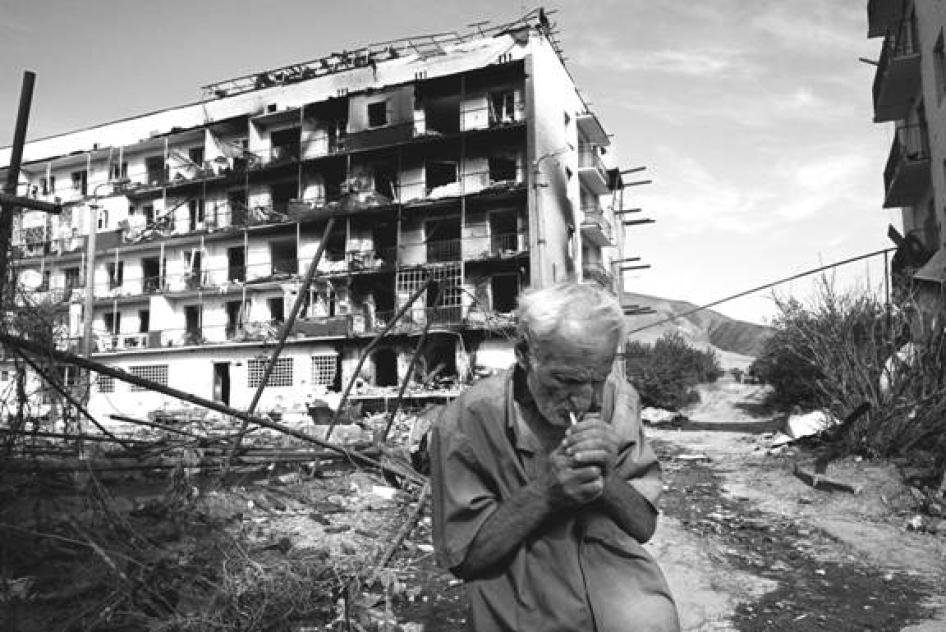
A man stands in front of an apartment building on Sukhishvili Street in Gori, bombed by Russian forces prior to their advance into Gori district. © 2008 Marcus Bleasdale/VII
In some cases in South Ossetia, civilian casualties and damage to civilian property in Georgian villages were caused by artillery shelling. Because both Russian and South Ossetian forces possessed artillery capacity, Human Rights Watch was not always able to establish with certainty whether responsibility for indiscriminate artillery attacks lay with Russian or South Ossetian forces. In these cases further investigation is required to determine specific responsibility for violations of international humanitarian law.
Attacks on Ethnic Georgian Villages in South Ossetia
Residents of several ethnic Georgian villages in South Ossetia said their villages had been shelled intermittently by South Ossetian forces in the days leading up to the conflict. From August 8 (after the Georgian assault started) until August 10, the villages were subjected to more intense artillery shelling-by either Russian or South Ossetian forces-and to Russian aerial bombardments. Because of the attacks, many villagers fled in the early stages of the conflict. In most villages, however, some elderly and infirm people remained. Even though Georgian military forces reportedly remained deployed in some of these villages until August 9, the attacks warrant further investigation to determine whether the attacks were indiscriminate and therefore in violation of international humanitarian law.
Kekhvi
Four Kekhvi residents described a mix of artillery shelling and aerial bombing of the village lasting from August 7 to 9.[248] Tamara Mamagulashavili, 41, told Human Rights Watch,
The shelling started on August 7, at 11:30 p.m. There were no gunshots, just the blast. It was from artillery and it blew out the windows. My husband and I lay down on the floor. Then we went with six others to our neighbor's basement [to hide]. The shelling lasted the entire night; it was only artillery. There was about 10-30 minutes between each blast. It came from different directions.
At 6 a.m. the aerial bombing started. These bombs made more noise and you could hear them as they were coming in. There was aerial bombing until 3 p.m. Then it stopped until 6 p.m., but the artillery shelling continued. At about 6 p.m. on August 8 we decided to leave the village.[249]
Three other residents of Kekhvi interviewed by Human Rights Watch also described heavy bombing and shelling of the village.[250]One of them, Slava Melanashvili, 32, a construction worker, told Human Rights Watch,
On August 9 massive bombing started and the village administration and hospital buildings were destroyed. Bombing took place day and night. It seemed like they were targeting a local school and other large buildings; maybe they thought there were troops hiding there. My house was hit and completely destroyed during the bombing in the afternoon of August 9. My house was next to the village school.[251]
The village school was destroyed. Kekhvi residents named at least three villagers killed by shrapnel during the attacks.[252]
Kvemo Achabeti and Kheiti
The village of Kvemo Achabeti was shelled on August 8 and 9. Vazha Lazagashvili, 58, told Human Rights Watch that four houses were hit:
On August 8 our house was bombed, it left a very big crater. The bomb fell into the yard, about two to three meters away from the house. The windows, doors blew in and the wall partly collapsed. There were shrapnel holes in the house. The pressure blew everything in the house against the back wall. We were hiding in the basement, which is concrete. The concrete on top of the basement protected us. My son was in the yard when the bomb hit. Shrapnel hit him on the back.[253]
In the village of Kheiti, Nugzar Bugianishvili died during a Russian aerial attack on August 9. His brother, Omar Bugianishvili, 65, told Human Rights Watch,
It was about 10 a.m. We put food on the table to eat together. That's when the first bomb exploded. It fell on our neighbor's house. I got up from the table and went to the basement. That's when a bomb hit [our house] and shrapnel hit my brother in the neck and in the head. My 92-year-old mother-in-law stood next to him. She was not injured.
When I checked on my brother, he was already dead. His head was fractured and his eyeballs dropped out. I buried him myself in the yard.
Georgian military units were not present in the village at that time. I could see planes flying, dropping the bombs.[254]
Attacks in Undisputed Georgian Territory
Gori city
Gori city is the administrative center for the Gori district. Gori's military base and Georgian military reservists located in one part of the city became targets of Russian air strikes. Also, as noted in Chapter 1.1, in mid-July 2008 Georgia concentrated its entire artillery brigade in Gori city.[255] As a result of the airstrikes and advancing Russian and Ossetian forces, civilians began to flee Gori around August 11.
Attack on Apartment Buildings on Sukhishvili Street
On the morning on August 9, Russian aircraft targeted and destroyed a military base located on Sukhishvili Street on the outskirts of Gori city.
However, in the attack the forces also hit three five-story apartment buildings also on Sukhishvili Street near the base, killing 14 and wounding dozens.[256] Each of the three apartment buildings was hit directly in the center of the building, suggesting that the Russian aircraft specifically targeted these buildings in addition to the military base.[257] Georgian authorities had a duty to the extent feasible not to place a military base in close proximity to civilian areas. However, Russian forces still had a duty to take into account the effect on the civilian population of their attack and to observe the laws of war in relation to targeting and proportionality. Russian forces therefore had an obligation to do everything feasible to verify whether the apartment buildings, which should be presumed to be civilian objects, were in fact military targets. The circumstances of the attack raise doubts as to whether this determination was made.
Elene Zerekidze, age 85, told Human Rights Watch that the first bomb hit one apartment building at approximately 11:30 a.m:
I was walking down the stairs when I heard a loud explosion. I live in the third entryway [in Russian, podezd] and the bomb hit the first one. I cried, "They are bombing us!" and ran outside. There was a lot of debris, destruction, and blood. People were screaming for help.[258]
A couple identified to us as Zviad, age 28, and his pregnant wife Manana, 27, were killed as they were trying to flee the bombing. Tina Khanishvili, 75, who lived in one of the Sukhishvili Street apartment buildings, and witnessed the incident, told Human Rights Watch,
A young couple was getting into a car to run away after the first bomb hit the apartment. But as they were preparing to flee a second bomb fell and they were hit by shrapnel and died. She was pregnant. Their six-year-old-son was badly wounded, but survived.[259]
Lia Kobesashvili, 45, worked as a nurse for an ambulance dispatch service that was located in one of the apartment buildings. She told Human Rights Watch, "People were thrown out of the windows. There was complete panic. Many people were wounded. One nurse who lived at 10 Sukhishvili Street, Maia Vazagashvili, was killed when the pressure threw her out of the window."[260]
Attack on School No. 7
At about 11 a.m. on August 9, Russian aircraft made several strikes on and near School No. 7 in Gori city. According to one eyewitness, Givi Melanashvili, 60, who was at the school when the bombing took place, about one hundred Georgian military reservists were in the yard of the school when it was attacked. To his knowledge none of the reservists was injured.[261] The reservists as combatants were a legitimate target, and it is possible that the school was deemed as being used for military purposes. In such circumstances, it would lose its status as a protected civilian object. In the attack, one strike hit an apartment building next to the school, killing at least five civilians and wounding at least 18, and another hit a second building adjacent to the school causing damage, but no civilian casualties.
There were civilians also taking shelter in the school, as Melanashvili, who was looking for temporary shelter in Gori having had fled South Ossetia a day earlier, told Human Rights Watch,
I was told that I could find shelter in School No. 7. My wife and I went there in the morning. I got there around 11 a.m. and saw that there were Georgian reservist forces in the yard. Suddenly a bomb hit the building next to the school. There was a loud explosion and complete chaos. A large part of the building was destroyed. The school building was damaged.[262]
While the reservists' presence in the school yard rendered it a legitimate target for the Russian forces, questions may be raised as to the proportionality of the attack. Where an object, which is by its nature normally civilian, becomes used for military purposes, it can be attacked, but only by means that will avoid or minimize harm to civilians and damage to civilian objects. All feasible measures should be taken to cancel or suspend an attack if it becomes apparent that the expected civilian casualties would outweigh the importance of the military objective.[263]
Attack on Gori Military Hospital
By August 12, many of Gori's inhabitants had fled the city. Staff at the Gori Military Hospital remained in the city to take care of the hospital's remaining patients.[264]
At around 2 a.m. on August 13 a Russian military helicopter fired a rocket toward a group of hospital staff members who were on break in the hospital yard. The rocket hit Giorgi Abramishvili, an emergency room physician in his forties. Abramisvhili, who had spent the previous four days operating on people wounded during the war, died from head injuries.
Human Rights Watch researchers saw that the roof of the hospital building is clearly marked with a red cross, the "distinctive emblem" indicating medical personnel or facilities and entitled to specific protection under the Geneva Conventions.
This attack was a serious violation of international humanitarian law. Hospitals, even military hospitals such as the one in Gori, are not legitimate military targets. The wounded and sick, and medical personnel, even if they are members of the armed forces, are protected persons and attacks directed against them are war crimes.[265]
Karbi
On the morning of August 9 Russian air and artillery attacks struck the village of Karbi. At about 7 a.m. an airstrike killed one villager.[266] Two hours later, as residents started gathering in one part of the village in preparation to flee, another round of aerial-burst artillery shells killed at least seven and injured at least 10.[267]
Avto Unapkoshvili, 48, was wounded during the first attack, when a bomb struck his house. The bomb killed Unapkoshvili's relative, Dodo Unapkoshvili, age 60, who was asleep in the house. Avto Unapkoshvili told Human Rights Watch, "My brother and I were standing outside the gates [to our house], smoking, around 6:30 a.m. It was completely quiet; then I heard an explosion and saw yellow smoke. The pressure from the explosion was so strong that it lifted me up, and then I fell to the ground."[268]
Tsiala Bidzinashvili, 50, was killed by shrapnel from the artillery attack two hours later. Her husband, Gaioz Bidzinashvili, who was wounded during the attack, told Human Rights Watch,
I was sitting near my house, together with several other villagers. Some residents were gathering [there] to flee. Someone had a small radio and we were trying to listen to the news. We knew that one person died as a result of the morning aerial bombing and we wanted to know what to expect.
All of a sudden I heard numerous large explosions. I was wounded in the stomach. It all happened in a flash. Four people died around me. I ran into the yard, shouting for my wife to help me, but she was already dead in the yard.
Bidzinashvili was treated in hospital for multiple shrapnel wounds.[269]
Tengiz Tevdorashvili, 69, was also wounded during the second attack and corroborated Gaioz Bidzinashvili's story.[270] Eighty-year-old Rusiko Rcheulishvili and her son were also wounded during the attack. She told Human Rights Watch, "I went to buy bread. On the way, I saw men gathered in the neighborhood center, listening to the radio. My son was also there. When I approached them, I heard loud explosions and I was wounded. My arms, stomach and leg were bleeding. My son was also wounded."[271]
Vasiko Tevdorashvili, the village administrator, described to Human Rights Watch the aftermath of the second attack: "There were many wounded. I had to decide who had better chances of survival and stuff them into the ambulance. We buried the dead in the yards of houses and fled the village."[272]
According to Vasiko Tevdorashvili and two other villagers, there was no Georgian military base in the village and there were no Georgian military forces present at the time of the attack. Two other villagers, interviewed separately, told Human Rights Watch that while there were no Georgian troops in the village itself, there was Georgian artillery in fields about three kilometers from the village.[273]
The distance of the village from the Georgian artillery, combined with the fact that the village was hit twice in two separate attacks, suggests that the village may have been deliberately targeted, or at a minimum that the village was hit as part of an indiscriminate attack on the area, and the Russian forces failed to direct the attack solely at the military targets located at some distance from the populated areas. In either event the civilian casualties in Karbi appear to be the result of serious violations of humanitarian law.
Tortiza
Tortiza is a small village situated several kilometers from a main road connecting Gori and Tskhinvali (see map on page 1). Many civilians fleeing bombing and shelling in other villages in the area went to Tortiza. Both Tortiza residents and those arriving from other villages reported to Human Rights Watch that they believed the village's location away from the main road meant that it was of no strategic importance and that it therefore would not be targeted.[274] However, on August 12, at around 9:45 a.m. Russian aircraft fired S-8 rockets at Tortiza, killing three civilians, injuring dozens, and damaging nearly every house in the village.[275]
Among those killed was 15-year-old Nugzar Akhalkatsi, who was at home with his family when the attack started. His grandmother, Natia, told Human Rights Watch,
There were loud explosions from other parts of town. We were sitting in the house, but we ran out when the windows broke. It felt like the house would fall apart so we wanted to get out and get to shelter. A bomb hit the house. He [Nugzar] turned around and shrapnel hit him. He said, "I think I'm wounded," and that's it. He lost consciousness.
We took him to Gori, but Gori was also bombed that day. No one was in the hospital there either. He was taken to Tbilisi but on the way he died.[276]
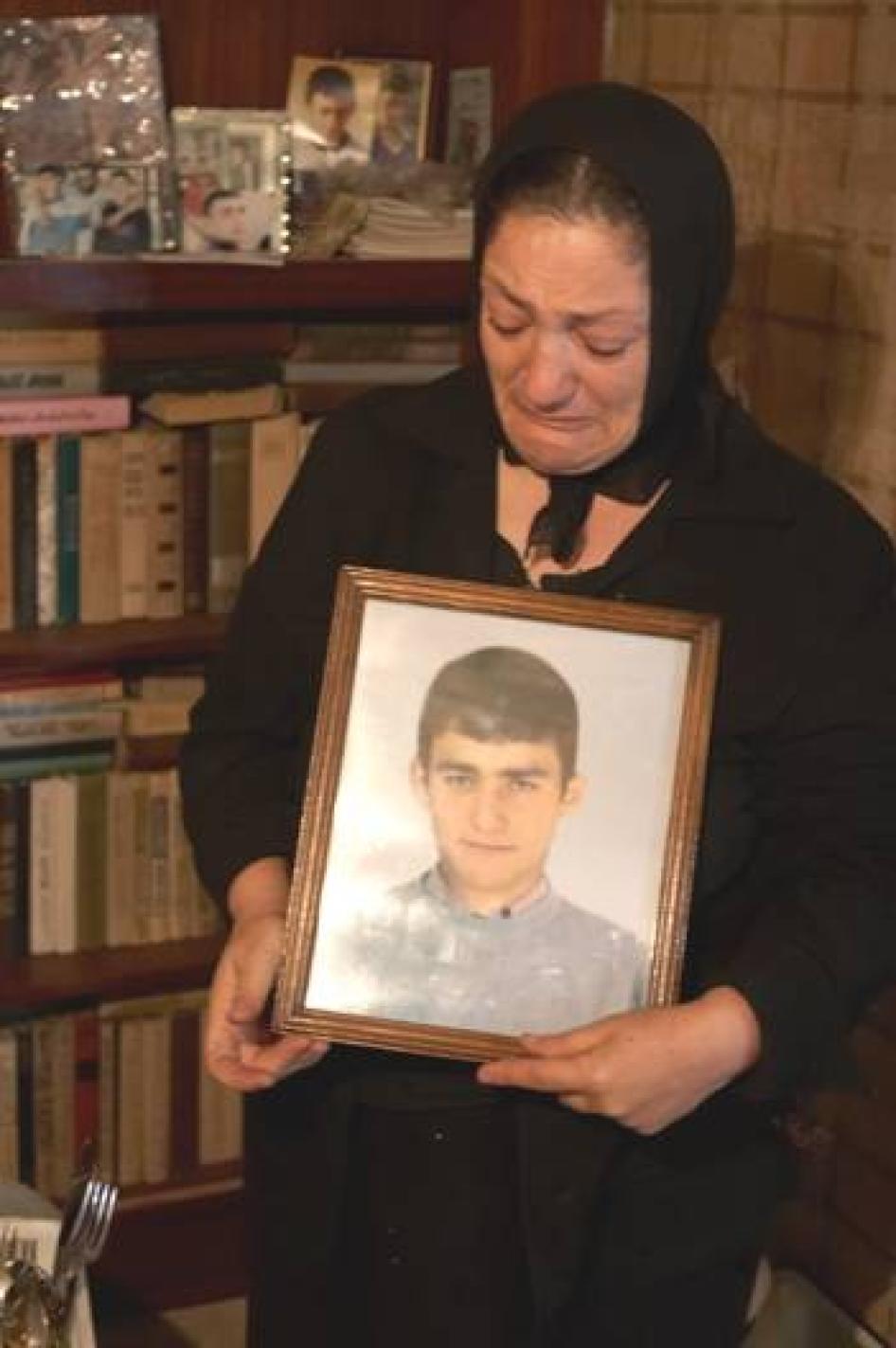
Natia Akhalkatsi clutching the photo of her grandson, who was killed by a Russian S-8 rocket attack on Tortiza. © 2008 Human Rights Watch
Kristina Merabashvili, 47, was taking her calf to a field when the attack started. Afterwards her son found her unconscious in the field and took her to a hospital in Gori city. She was later taken to Gudushauri hospital in Tbilisi where she underwent a series of operations. She described how the bombing injured her:
It happened in a second. It became dark all of a sudden. Apparently bombs fell somewhere else and it was very smoky. It was like a wave lifted me up and threw me down again. I fell, was not feeling my right leg and it was all torn apart. I had small bits of shrapnel in my arm. I still can't feel my leg. My right thigh is entirely shattered.
Maxim Akopian, 74, was walking nearby and was also hit and wounded.[277]
Raisa Ketiladze's 43-year-old son Zaza was wounded during the bombing. She recounted,
I was sitting in the yard of my house eating ice cream when I heard noise from flying jets. We did not expect them to bomb us as our village is located far from the conflict zone and away from the main road. But rockets started flying, hitting one house after another. I heard my son screaming for help, shouting that he was wounded. I could not see him as the air was full of debris.
When we found him he was wounded in the leg. My neighbors helped me carry him first to the fields to hide. When the bombing stopped we took him to the hospital in Rustavi where they operated on him.[278]
While it has not been possible to establish the total number of rockets Russian forces fired in their attack, villagers told Human Rights Watch that a demining organization had cleared 148 S-8 rockets, many of them unexploded, in Tortiza during the first weeks of October. Lali Masuradze, 45, told Human Rights Watch, "In every house, they cleared stuff."[279] Zina Ketiladze, 72, told Human Rights Watch that four rockets fell in her house alone. She showed Human Rights Watch researchers the remaining craters and described the attack:
I heard jets flying over. I was alone at home and decided to run away, and that's when the first one fell in my yard. It broke the windows and doors. The debris was so thick in the air that nothing was visible. I started screaming for help and ran to the fields. Later I found out that four rockets fell in my yard.[280]
Villagers told Human Rights Watch that there were no Georgian military or police forces in the area. Human Rights Watch examined the damage to many houses in the village which, together with witness accounts, provided compelling evidence that Russian aircraft fired at civilian houses.
This direct attack on what appears to have been a purely civilian target constitutes a serious violation of humanitarian law and a war crime.
Tkviavi and Akhaldaba
On August 11, at approximately 4 p.m., a Russian aircraft bombed a neighborhood in the village of Tkviavi, destroying several homes and wounding two civilians. Residents told Human Rights Watch that the Georgian military had not been in the vicinity, but only in a neighboring village close to the Liakhvi River, approximately two kilometers away. It is not known whether Russian strikes hit these troops.
Zina Merabashvili, 66, was in the village at the time of the bombing and told Human Rights Watch,
Jets had been flying over the village for some time that day. At about 4 p.m. I went out to the kiosk on the corner to buy some beer. Then one jet flew over and dropped four bombs. One bomb fell on a [nearby] house and a fire started. Some debris fell on me, and I ran home to see my house damaged and my neighbor's house almost completely destroyed.[281]
The top floor of Merebashvili's house was damaged.
Roza Okruashvili, a 58-year-old grandmother of six, was at home alone when a Russian bomb struck her house. Okruashvili told Human Rights Watch what she could remember of the bombing: "I had finished washing the dishes and I went upstairs to turn on the television. The picture hadn't even come up yet, when I heard a jet fly over. Then I felt pain, and I was screaming and I lost consciousness."[282] Okruashvili suffered shrapnel wounds to her left leg and hip, her right foot, and her abdomen. She spent over a month in hospital being treated for her wounds. The bomb completely destroyed Okruashvili's house.
Akhaldaba is a village on one of the two main roads between Gori and Tskhinvali, about six kilometers west of Tortiza. Russian aircraft fired S-8 rockets on Akhaldaba on August 12 at around 10 a.m., injuring five people, at approximately the same time as the attacks on Tortiza took place. The attack on Akhaldaba lasted for about 10 minutes before the aircraft flew towards the river and the fields where Georgian forces were present at the time. Human Rights Watch does not have information about whether Russian airstrikes hit these forces. Villagers told Human Rights Watch that there were no Georgian military forces in the village at the time of the attack.
Ketevan Tanderashvili, 56, was at home when the attack started. She told Human Rights Watch,
I was near my house, in the yard, when one rocket hit the house. Several others fell in my yard. Other houses in the southern part of the village were also hit. Nobody understands how I survived. They were firing from planes, and there were also helicopters near the village, above the river.[283]
As in Tortiza, these attacks on Tkviavi and Akhaldaba may have been a direct attack on what were purely civilian targets. If so, these would be war crimes. At a minimum they appear to have been indiscriminate attacks in that if the attacks were directed at forces outside of either village all feasible measures were not taken so as to target only the military objects, and the attacks were not carried out in such a way as to avoid or minimize civilian casualties.
3.3 Russia's Use of Cluster Munitions
In the course of three missions to Georgia in August, September, and October 2008, Human Rights Watch researchers found that Russian forces used cluster munitions against targets in populated areas in the Gori and Kareli districts just south of the South Ossetian administrative border, killing at least 12 civilians and injuring at least 46 at the time of attack. Unexploded cluster submunitions in the contaminated areas have prevented many farmers from harvesting, throwing already struggling farmers into deep economic distress.
Because cluster munitions cannot be directed at specific fighters or weapons and because cluster duds will likely injure or kill whoever disturbs them, combatant or civilian, using cluster munitions in populated areas, as Russia did, should be presumed to be indiscriminate attack, which is a violation of international humanitarian law.[284]
The lawfulness of a military strike may also be determined by whether the effects on civilians are excessive in relation to any direct military advantage gained. As noted elsewhere in this report, a cluster strike will be an unlawfully disproportionate attack if the expected civilian harm outweighs anticipated military advantage. The expected civilian harm is not limited to immediate civilian losses, but also encompasses casualties over time. There is greatly increased likelihood that the loss will be excessive in relation to the military advantage when taking into account both strike and post-strike civilian harm, especially if an attack occurred in a populated area or an area to which people might return. Based on its field research in the former Yugoslavia, Afghanistan, Iraq, and Lebanon, as well as in Georgia, Human Rights Watch believes that when cluster munitions are used in any type of populated area, there should be a strong, if rebuttable, presumption that the attack is disproportionate.
Finally, parties to a conflict are under the obligation to take "all feasible precautions in the choice of means and methods" of warfare so as to avoid and in any event minimize "incidental loss of civilian life, injury to civilians and damage to civilian objects." The indiscriminate nature of cluster munitions makes it impossible for a party using cluster munitions in populated areas to observe this principle.
Evidence of Russian Cluster Use
Russian authorities have not acknowledged using cluster munitions during the August war with Georgia. On August 15 the deputy chief of the General Staff of the Armed Forces of the Russian Federation, Anatoly Novogitsyn, stated that Russia had not used cluster munitions "in the area of the Georgian-Ossetian conflict."[285] Responding to a question from a journalist in October, a spokesman for the Russian Ministry of Foreign Affairs did not deny that Russian forces had used cluster munitions, but instead pointed out that "the Georgian side has cluster warheads in service."[286]
However, Human Rights Watch researchers gathered overwhelming evidence that several villages in Gori and Kareli districts had been hit by air-dropped RBK-500s and RBK-250s carrying AO-2.5 RTM submunitions and by Hurricane missiles carrying 9N210 submunitions. Human Rights Watch also found that Gori city had been struck by an Iskander SS-26 ballistic missile carrying submunitions.
Human Rights Watch has concluded that these strikes were Russian. The weapons systems in question are produced in Russia and are known to be in Russia's arsenal. Even though Georgia possesses cluster munitions (see Chapter 2.5, Georgia's Use of Cluster Munitions), there have been no reports that Georgia possesses these particular weapons systems. While the Georgian authorities admit to possessing the GRAD-LAR 160 multiple launch rocket system with Mk4 rockets with M85 submunitions, they deny that they are in possession of any other cluster munitions.[287] Finally, witnesses told Human Rights Watch that Georgian troops, likely targets for a Russian cluster munitions strike, were or had been passing through the area of the strike, although they were not in the immediate vicinity of the strike. Conversely, no Russian troops, likely targets for a Georgian strike, were reported in the area. International deminers working in the area concurred with Human Rights Watch's conclusion that the cluster munitions strikes in question were Russian.[288]
Human Rights Watch documented three cluster munition strikes that resulted in civilian casualties. In two cases (Gori city and Variani), the cluster munition strikes were directed against public squares where numerous civilians had gathered. In a third case (Ruisi), the strike was directed against the center of a town. In these three cases, the cluster munition strikes killed at least 12 civilians and injured at least 46.
Even though Georgian troops were moving through the general area, Human Rights Watch has not been able to identify any potentially legitimate military targets in the immediate vicinity of these strikes. All witnesses interviewed by Human Rights Watch insisted that there were no Georgian troops in the immediate vicinity at the time of the strikes. In the absence of military targets in the immediate vicinity, Human Rights Watch has concluded that the use of cluster munitions against targets in these populated areas constitutes at best indiscriminate use of force.
The military advantage achieved by the strikes is also questionable because Georgian military troops were already retreating at the time of the strikes. As a result, Russian use of cluster munitions was likely disproportionate and therefore illegal under international humanitarian law.
Although Human Rights Watch has not documented any casualties from unexploded Russian cluster submunitions, using such a weapon indiscriminately against troops in populated areas posed-and because of the presence of unexploded submunitions, continues to pose-foreseeable threats to civilian lives.
Variani-RBK-500 cluster munitions with AO-2.5 RTM submunitions
At least two cluster munition strikes hit the village of Variani during the conflict, killing three people and injuring 16. Variani is situated along one of the two main roads between Tskhinvali and Gori city. Based on statements from victims and witnesses and physical evidence gathered on the ground in the form of unexploded submunitions, remnants of delivery rockets, and numerous fragments from the weapons system (including the submunitions' signature ring of "fins"), Human Rights Watch has concluded that Variani was struck by RBK-500 cluster munitions loaded with AO-2.5 RTM submunitions.[289]
The first attack struck in the center of Variani around 10:30 a.m. on August 8. Teimuraz Khizanishvili, 70, was one of more than a dozen civilians who were in the public square for a daily gathering when the attack occurred. He told Human Rights Watch that Malkhaz Bedoshvili, age about 31, who was standing a few meters away from him, died immediately while his father, Omar Bedoshvili, about 65, was wounded and died several hours later in hospital. Khizanishvili was himself injured during the attack: "The bomb fell from the air and it exploded. It happened in seconds and we all fell down. Both my legs were broken. There was shrapnel everywhere in my body-my forehead, hand, legs, torso, back."[290] When he spoke to Human Rights Watch Khizanishvili was sitting in a wheelchair with his legs in large casts.
Three children were also among the wounded. Beka Giorgishvili, 13, was playing with his friend Valiko Urjumelashvili, 12, when the attack occurred. They were both injured together with Urjumelashvili's nine-year-old sister Tsira. Valiko Urjumelashvili lost part of his skull in the explosion, and when Human Rights Watch spoke with his mother in October she said he still had shrapnel in his head and had difficulties speaking.[291]
In all, 14 people were injured in the first strike.
The second strike occurred on the morning of August 12. Suliko Zubashvili, 59, was outside chatting with his friends Gaioz Kebadze, 78, and Zakro Buzaladze when the strike occurred. Zubashvili and Buzaladze were injured and Kebadze killed. Zubashvili said,
I heard a jet. The bomb fell and exploded. I was wounded in the leg, chest, back, fingers. I don't remember how many explosions there were. I fell down and got up. I was bleeding and when I looked back, Gaioz was dead. Nobody was here to help, so I went home and tried to stop the bleeding. I couldn't stop it myself so went to my brother's wife. She called the nurse who somehow bandaged me. The next day I walked to Gori because there was no ambulance. I was transferred to Tbilisi. I spent about 10 to 12 days in the hospital in Tbilisi.[292]
Several villagers showed Human Rights Watch unexploded submunitions and other physical remnants of the attack. In August, 79-year-old Galaktion Zubashvili showed Human Rights Watch researchers in Variani two unexploded AO-2.5 RTM submunitions that had landed in his house, and which he had carried outside and placed under a tree in his garden. Several villagers also showed Human Rights Watch the AO-2.5 RTM signature ring of "fins" that they had discovered after the strikes. During Human Rights Watch's October 2008 visit, Lia Kereselidze, 48, showed Human Rights Watch a canister with the inscription RBK-500/AO-2.5 RTM in cyrillic. Kereselidze had seen two more canisters nearby, but they had been removed by the time of Human Rights Watch's visit. Kereselidze also found four unexploded AO-2.5 RTM submunitions in her garden. Also on that visit we found three unexploded AO-2.5 RTMs and the separation rings of two more. We heard reports of an additional 50 individual submunitions that had exploded on impact or had been destroyed by deminers in Variani and the fields just outside it.[293]
Georgian ground troops had just entered Tskhinvali when the first cluster munition attack occurred in Variani on August 8. On August 12, at the time of the second attack, Georgian troops had retreated from Tskhinvali and reportedly had left Gori city, located several kilometers south of Variani, already the night before. While some villagers with whom Human Rights Watch spoke said Georgian troops might have been in the fields surrounding Variani, they said there were none in the town at the time of the attacks.[294]
Unexploded submunitions from Russian cluster attacks have prevented farmers from harvesting their crops, the only or primary livelihood for many residents of Gori and Kareli districts. Tamar Eremov, a 68-year-old farmer in Variani, was looking for walnuts on her land when she found an unexploded AO-2.5 RTM. "[Contamination] has interfered with my harvest. I couldn't collect because I couldn't get into my fields because they were occupied [by troops]. Now I'm afraid to go in because of the ordnance."[295] Eremov worried that the submunitions would soon prevent her from harvesting her tomatoes, beans, and corn.
Russian forces also hit Akhaldaba and Varianis Meurneoba, just outside Variani, with AO-2.5 RTMs. Human Rights Watch heard statements about AO-2.5 RTM submunitions in the former[296] and found physical evidence of RBK-250 canisters that carry AO-2.5 RTMs in the latter.
Ruisi-Uragan (Hurricane) rockets with 9N210 submunitions
Russian forces struck the villages of Ruisi on August 12 using Uragan rockets carrying 9N210 submunitions.[297] This conclusion by Human Rights Watch is based on numerous interviews with witnesses and victims, as well as physical examination of the contaminated areas by Human Rights Watch researchers who found remnants of delivery rockets, unexploded 9N210 submunitions, and numerous fragments from exploded 9N210 submunitions. We made the same conclusion about the villages of Dzlevijvari (struck on August 11, around 11 a.m.)[298] and Pkhvenisi,[299]based on a witness account from the former and physical evidence of 9N210s we found in both.
In Ruisi, the cluster munition strike occurred between 11 a.m. and 2 p.m. on August 12, killing three civilians and injuring six others.
On the morning of August 12, Suliko Goginashvili, 65, took his cattle to the field to graze. His wife, Iza Goginashvili, 57, who found Suliko in the field after the cluster strike, told Human Rights Watch, "When we found him he had numerous wounds. His head was broken. His brains were out. His legs and hand were sliced off."[300]Kvicha Saatashvili, a 45-year-old carpenter who lives in Ruisi, showed Human Rights Watch a canister for 9N210 that he found about 100 meters from the place where Goginashvili died. He also found identical small cylindrical fragments in his home.[301]Natela Guraspashvili, about 75, died in the same field as Goginashvili.[302]
That morning, Ushangi Beruashvili, 68, had just left Ruisi to go to Kareli. When the bombing started Beruashvili decided to return to Ruisi to seek cover in a house about 300 meters from the place where Goginashvili died. He recounted,
I saw the rocket was shot and fell not far away from where I was. I was going down to a basement to hide. Something hit me in the stomach…. I didn't lose consciousness. When it started, something exploded in the air and spread like hail. It was white. It hit the ground and sprung up.[303]
Beruashvili spent several days in hospital with other cluster munition victims from Ruisi.[304]
On the other side of Ruisi, not far from the village church, Amiran Vardzelasvhili, 79, father of seven, was also killed in the cluster strike. His daughter Marine was at home when the strike occurred:
Planes were flying around and dropping bombs, like that: "boom, boom, boom"-we heard bombs exploding in different places. People were screaming and crying. We could feel the blast waves from the explosions-it was right near our house. There weren't any troops in the village at that moment, they were just bombing the village. Suddenly, we heard our father screaming, "Gela!"-he was calling for his son. We ran out and saw him-my father was on the ground, all covered in blood. He died on the spot from shrapnel wounds.[305]
The same attack injured four women who had moved toward the church and the cemetery, in the belief that the church would not be targeted. All four women were injured. The injured women and neighbors showed Human Rights Watch an Uragan rocket and 9N210 fragments that they had found in or near the cemetery.[306]
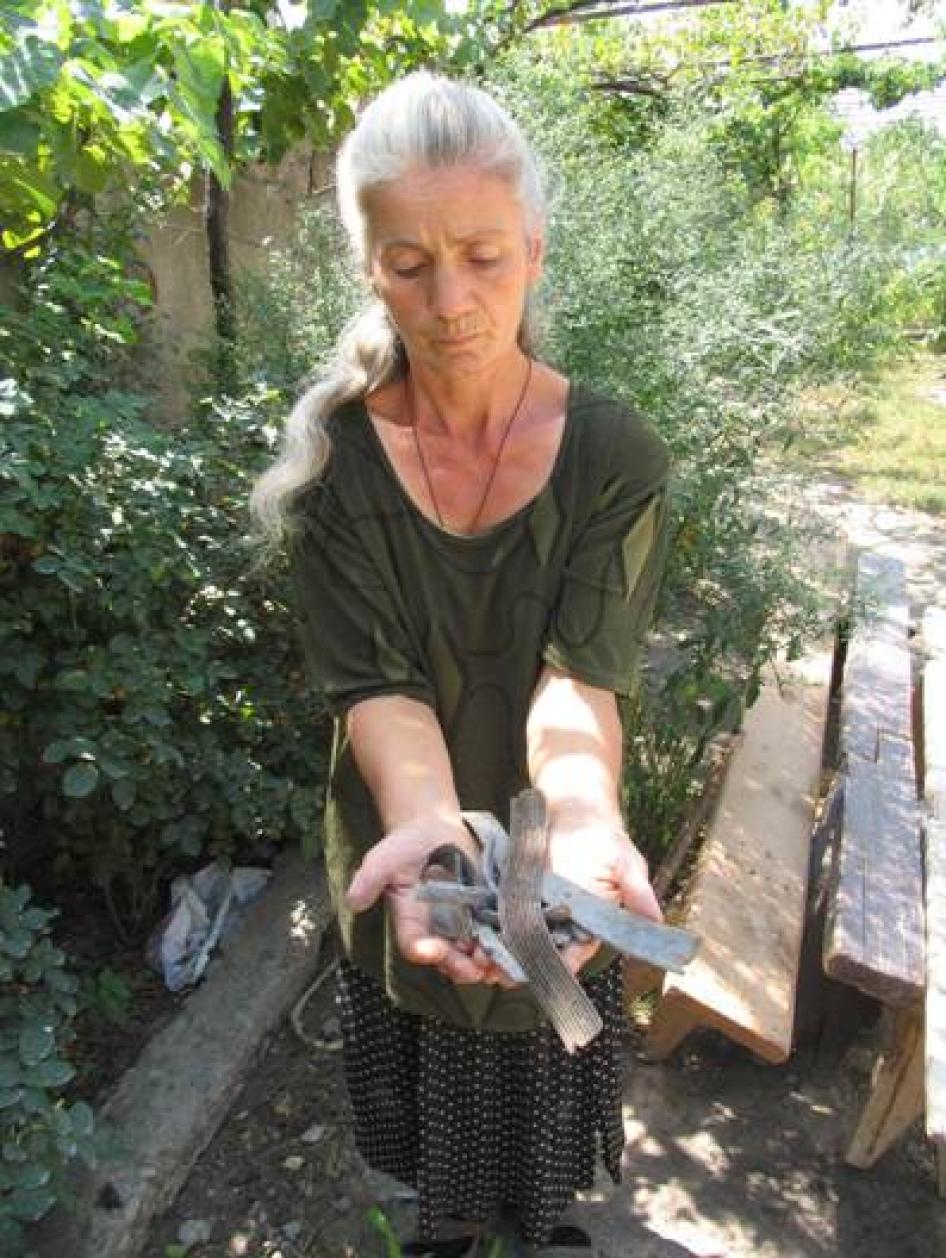
Marine Vardzelashvili holds pieces of the same shrapnel that killed her father Amiran, 79, in the village of Ruisi on August 12, 2008. © 2008 Human Rights Watch
Most villagers who spoke to Human Rights Watch said that Georgian troops had moved through the village the previous day, and that they in some cases had stayed in people's yards or houses, but that on the day of the attack all Georgian troops had left the village and were deployed a few kilometers outside it. One villager did say that Georgian troops were in the village at the time of the attack.[307]
Gori city-Iskander SS-26 missile with submunitions
On the morning of August 12 several dozen civilians gathered on the main square in Gori city, anticipating food distribution from local officials in the Gori municipal administration building located on the square.[308] A car accident on the square attracted even more civilian onlookers, and a group of journalists had stopped on the square to ask for directions. One victim estimates that there were at least 40 civilians on the square when the cluster munitions attack took place.[309]
According to Paata Kharabadze, chief doctor of the Gori civilian hospital, six people were killed during the attack.[310] The injured were initially taken to the Gori civilian hospital but were evacuated to Tbilisi due to the deteriorating security situation in Gori. The Gudushauri National Medical Center of Tbilisi admitted 24 civilians from Gori that day, many of them injured in the morning's attack.
Victims of the attack described to Human Rights Watch how they saw numerous small explosions within seconds before they fell to the ground. Keti Javakhishvili, 25, told Human Rights Watch that she went with her neighbors to get bread and was injured in the attack: "There was a big explosion above us and the next moment there were many smaller explosions everywhere."[311] Dr. Merab Kiladze, head of the surgery department of the Gudushauri National Medical Center, told Human Rights Watch that Javakhishvili suffered massive trauma to her liver, stomach, and intestines, as well as hemorrhagic shock.[312]
Nodar Mchedlishvili, 54, told Human Rights Watch that he went to the municipality building to get food to feed eight people displaced from South Ossetian villages: "In a couple of seconds from everywhere I heard what sounded like massive gunfire. We fell on the ground and some people never got up." Mchedlishvili sustained shrapnel wounds to his left leg and knee. Giorgi Malkhaziani, 59, whose right leg was shredded as a result of the attack, corroborated Mchedlishvili's account of the events.[313]
The Gori city square is a large open space with a statue of Stalin (who was born in Gori) at the center. On one side of the square is the municipal administration building, and on the other sides are apartment buildings with shops on the ground floor. Even though the main command center for the Georgian military operation in South Ossetia was located in Gori, all Georgian troops had left the city by the evening of August 11, according to witnesses. All witnesses said that there were no military forces on the square when it was attacked.
One of those killed in the August 12 cluster munitions strike on Gori's main square was Stan Storimans, a cameraman for the Dutch television station RTL. On August 29 the Dutch Ministry of Foreign Affairs dispatched an investigative commission consisting of military and diplomatic experts to Gori to investigate Storimans's death. The commission writes in its report,
During the on-site investigation, the mission was able to establish that the entire square and several nearby streets had been hit in the same manner. An area of about 300 by 500 metres was struck by small metal bullets [fragments] measuring about 5 mm. It was deduced from the entry holes that the bullets were from multiple explosions, both on the ground and in the air.[314]
Having analyzed video material taken by Reuters and security cameras at two banks by the square, the commission concluded that "the square and surrounding area were hit by about 20 explosions at around 10:45 a.m., and that each explosion scattered a large number of bullets. The explosions can be seen to occur both in the air and on the ground."[315] Based on visual characteristics, the serial numbers found on the missile pieces and the nature of the strike, the commission concluded that Russian forces had hit the square with an Iskander SS-26 missile carrying cluster munitions.[316]
The information gathered by Human Rights Watch researchers on the ground supports the Dutch investigation's conclusions. In addition to the victims' and witnesses' descriptions of the strike, Human Rights Watch discovered and documented missile remnants that had landed in a backyard nearby, and damage we saw to the square and the surrounding area is consistent with the conclusion that Russian forces used cluster munitions.
The Russian Ministry of Defense has denied that it used the missile system Iskander in South Ossetia, though this would not preclude that it had been used against a target in another part of Georgia, such as Gori.[317] Presented with the findings of the Dutch investigative commission, the Russian authorities asserted that there was not enough evidence to conclude that Storimans had been killed as a result of the use of weapons by the Russian side.[318]
3.4 Tank Attacks on Civilian Homes
Villagers from Tamarasheni (in South Ossetia) described how Russian tanks fired on villagers' homes.[319] Witnesses told Human Rights Watch that there were no Georgian military personnel in their houses at the time that the tank fire took place.[320]
One witness described an incident in which tanks methodically moved through the streets, firing on numerous houses in a row, suggesting that the fire was not directed at specific military targets and that such attacks were indiscriminate.
According to Manana Gogidze, 48, of Tamarasheni, on August 9 at around 10 a.m. Russian soldiers entered the house where she and nine others were hiding, checked for armed men and left. Soon after, she saw Russian tanks roll down the street. "Three tanks would stand one after another, point their barrels in different directions and start shooting at houses," Gogidze told Human Rights Watch. "They would shoot at houses … and then would move on down the street, doing the same."[321]
Around the same time that day, 65-year-old Luiza Nasuashvili was in her home in Tamarasheni when a Russian tank fired on it. Nasuashvili told Human Rights Watch that soon after Russian troops had entered Tamarasheni, "All of a sudden I heard a big explosion and a big hole appeared in my house. I think it was tank fire. Debris fell on my head as I lay down on the floor."[322] Nasuashvili fled her house and was immediately detained by a member of the Ossetian forces.
3.5 Attacks by Russian Forces on Civilians Fleeing the Conflict Zone
Several attacks by Russian forces on civilians fleeing the conflict zone or from areas under bombardment showed a failure to verify whether the target was military, and perhaps even intentional firing on civilian vehicles that posed no apparent military threat.
Aerial attacks on civilian convoys near Eredvi, South Ossetia
Human Rights Watch interviewed several civilians who fled from different villages in South Ossetia on August 8 in convoys of civilian cars traveling south in the direction of undisputed Georgian territory. The convoys came under aerial bombardment by military aircraft that was possibly Russian near the village of Eredvi, along a road that bypasses Tskhinvali.
Witnesses traveling in one convoy of several dozen cars told Human Rights Watch that on August 8, around 4 p.m., five Russian aircraft flew over the convoy, then returned and opened fire. According to witnesses, there were no military objects, military personnel, or military vehicles on the road at the time of the attack.
Temo Kasradze, from the village of Kemerti, who was fleeing with his grandson, described the attack: "There were five people in our car. Suddenly [there was an] explosion. Perhaps four or five cars were hit... I saw that people were injured and killed. There was blood."[323] Jemal Maisuradze, 45, travelling in the same convoy, described the attack similarly: "It was an aerial attack. There were five [Russian] planes. They first flew over once, then came back and opened fire, before they left... There were no military troops around. All the vehicles were civilian."[324]
Maisuradze, Kasradze, and one other witness described seeing two women killed in the attack, traveling in a white Niva car.[325] According to Maisuradze, the women were Tina and Marika Kakhniashvili, from Kekhvi.[326]
Several hours later, at around 7 p.m., Tengiz Magaldadze, 41, also from Kemerti, was driving the same route in a minivan with 20 other people. Just after they had turned onto the main road in Eredvi, Magaldadze saw three explosions about 20 to 25 meters in front of the vehicle. Magaldadze did not remember hearing any aircraft, but, because there were three explosions shortly after each other, he concluded the explosives had been fired from a jet.[327]
At the time of these attacks Georgian forces were deployed in South Ossetia and Georgian military aircraft had not yet been grounded. Russian forces have not acknowledged carrying out these attacks. However, Human Rights Watch has concluded that these attacks were more than likely carried out by Russian forces. The attacks occurred on cars moving south towards undisputed Georgian territory along a road bypassing Tskhinvali and running through Eredvi, an ethnic Georgian village, and in the area of several other ethnic Georgian villages (prior to the conflict, ethnic Georgians regularly utilized this road in order to avoid Ossetian villages and checkpoints around Tskhinvali, and continued to do so during the conflict). Witnesses stated that there were no Ossetian or Russian military positions in that area that would have been targeted by the Georgian military.
There can also be little doubt that the attacks on the civilian convoys near Eredvi violated international humanitarian law. Human Rights Watch is not aware of further information that would indicate the presence of legitimate Georgian military targets in the vicinity of the attacks described above, making them indiscriminate. It also cannot be excluded that the attacking forces deliberately targeted civilians, which would constitute a war crime.
Ground force attacks in undisputed Georgian territory
Unlawful shooting of neighbors from Pkhvenisi, August 11
On August 11 Nunu Chlaidze, a schoolteacher, fled Pkhvenisi with her husband, Amiran Razmadze, 56, and their neighbor, Durmishkhan Bedianashvili, after Russian forces attacked military targets in and around the village earlier that day, causing collateral damage to civilian homes. They decided to turn back, however, after seeing television news reports that civilians in Gori district were not being attacked.
As they approached a Russian military roadblock at an intersection near the gas station in Variani, their car, with Amiran Razmadze at the wheel, came under fire. Bedianashvili told Human Rights Watch,
When we entered Variani I told Amiran to be careful because there were tanks in front. Then they started shooting at us. There was massive gunfire. [Amiran] was wounded and he ran into the tank. I was hiding behind the seat. They thought that I was dead. Then I ran away.[328]
Chlaidze was shot twice in the back, and Russian soldiers took her to a field hospital where she was treated. She felt unsafe at the hospital and ran away. When Human Rights Watch spoke to her in hospital in Tbilisi she had no information about her husband's fate.[329]
Attack on taxi in Tedotsminda, August 12
On August 12 two women, Dodo Garsevanishvili and Nino Arabashvili, were killed when Russian forces fired on the taxi in which they were riding. Mamuka Berkatsishvili, the taxi driver, was driving the two women in his blue Opel from Gori city north toward Shindisi so that Garsevanishvili could check on her house (she had fled several days earlier). Berkatsishvili later told Nino Garsevanishvili, Dodo's daughter, what happened:
They got to Tedotsminda, and started going up the hill when they saw Russians coming the other way. Mamuka told me that Russians fired without any kind of warning. Mamuka fell from the car. The car turned over, but Russians still shot anti-tank missiles on it. The car was almost completely destroyed.
Then Mamuka was beaten, he was begging for his life. The Russians … left him there. He crawled all the way to the village of Ortasheni. And then he was taken to hospital … in Tbilisi. I saw him on August 17 or 18. He was still very ill.[330]
An eyewitness to the attack confirmed Berkatsishvili's account. Vakhtang Gagnidze, 20, was walking from Gori city to Tedotsminda with two others to check on Gagnidze's grandmother when they witnessed the incident:
We were walking to the railway stop when we saw an Opel taxi pass by, heading in the direction of at least one and perhaps a few more Russian tanks on the hill. The tank apparently fired on the car, and the car went off the road, exploded and caught fire. We ran away...
We could hear shooting, something firing and passing us in our direction so we again ran away … [A] week later [the car] was still sitting there and it was beginning to smell because of the decomposing bodies.[331]
According to Nino Garsevanishvili, Russian troops denied an ambulance access to the area to collect the two women's remains. Russian troops later informed a priest who was passing through the village about the dead bodies, and they were eventually buried.
Attack on civilian car in Akhaldaba, August 12
Around 9 a.m. on August 12 Merab Khekhelashvili, 41, and Moris Papuashvili, 33, were working their shift at the television tower near the village of Akhaldaba when Russian aircraft started attacking the Karaleti and Shindisi areas.
As the aircraft started attacking the tower as well, the director of the television tower, Vakhtang Shavdatuashvili, and a relative decided to drive Khekhelashvili and Papuashvili back to the village. As recounted by Khekhelashvili, on the way the car (a white Zhiguli) came upon three tanks-each with about eight soldiers sitting on top-driving toward them:
When we reached parallel with one of the tanks, without any warning a soldier sitting on the tank opened fire on us with his gun. I felt a bullet skim the top of my head. Someone shouted, "Get down!" and we all bent over and put our heads down.
The first tank passed us by and then a second tank approached us and they were also shooting. I felt something hit me in my right hip. I wanted to get out of the car. I was sitting on the side closest to the tanks. I shouted at Moris to open the door and jump out, but he didn't react. So I reached across and opened the door, pushed him out and I followed. The others got out as well as the third tanked passed by, also shooting at us.
When the third tank had passed by, Khekhelashvili tried to get Papuashvili to run with him to seek cover:
I said to Moris, "Let's go and hide." I saw that he was bleeding heavily from the neck. There was so much blood and gushing out like a fountain. There was no sign of life in him. Vakhtang [the driver] was wounded in the hand. His relative, like me, also took a bullet in the buttocks. I had lost feeling in my right leg.
The three wounded men eventually managed to get to Akhaldaba, which was occupied by Russian forces. Some of the villagers went back to collect Papuashvili's body. Khekhelashvili told Human Rights Watch, "When they brought the body back we saw that there was a bullet wound to his forehead that had not been there when we left him-apparently a control shot."[332]
3.6 Pillaging, Destruction, Violence, and Threats against Civilians
As described in Chapter 4, Ossetian militias would in some cases arrive in villages together with Russian forces, and the latter at the very least provided cover for the burning and looting of homes. While some civilians described the conduct of Russian ground forces as disciplined, Human Rights Watch documented several cases in which Russian forces, together with Ossetian militias, used or threatened violence against civilians or looted and destroyed civilian property. Some of these cases are described in Chapter 4.2; several additional cases are highlighted here because of the active and discernable role played by Russian forces. Acts of pillage are prohibited under customary international law and violate article 33 of the Fourth Geneva Convention relating to the protection of civilians in armed conflict. Pillaging is a grave breach of the Geneva Conventions and a war crime. The cases involve villages in South Ossetia and in undisputed Georgian territory.
Ilia Chulukidze, 84, a resident of Kvemo Achabeti north of Tskhinvali, told Human Rights Watch about how Russian forces, acting alone, beat him:
Around 6:30 a.m. on August 11 I was home alone when three Russian soldiers burst into my house. They broke the door and one put a weapon in my face; others ran upstairs looking for something. They broke all the doors and turned everything upside down, asking for weapons and rifles. I did not have any and could not give them any. Because of that they started beating me.
They were beating me with the butts of their automatics, particularly on the head. My entire head was swollen. One of them hit me on the chest so hard that I fell down and I could hardly stand up again. They demanded guns. I've never had one. I was beaten until I lost consciousness. Then two of them picked me up and put me on a bed and poured some water on me to bring me round. They could not find anything and left.[333]
Ossetian forces came later, looted and burned Chulukidze's house, and took him to the detention center in Tskhinvali (see Chapters 4.2 and 4.4).
Tamaz Sukhitashvili, 51, told Human Rights Watch about how on August 13, men in camouflage-presumably Ossetian militia fighters-arrived on Russian tanks in his village, Karaleti (in Gori district), and torched his house:
I was hiding in my backyard … when I saw people from the tanks entering my yard. They wore military camouflage uniforms. They entered my yard and started shooting in the air. They had some kind of weapon that they aimed at the house and it set the house on fire.[334]
On August 15, armed Ossetians together with Russian forces looted and torched the homes of Marine Tetunashvili, 73, and her neighbor, Teimuraz Tetunashvili, 78. Teimuraz Tetunashvili described how, at around noon that day, he heard gunshots:
I was in the street. Five men, Ossetians and Russians, came on a BMP [infantry fighting vehicle]. They jumped off and started shooting at the house. They said, "Give us your cow and money." I said, "Here is one cow, take it!" They said, "That's it?! Just one? And why don't you have more?" They hit me and pushed me to the ground, and started kicking me. They did not find anything in the house, just burnt it. And they took the cow.[335]
Marine Tetunashvili was sleeping in a small cottage in the yard next to her main house when she heard shooting from the street.[336] She told Human Rights Watch,
Three Ossetians then entered the yard, armed, in camouflage fatigues. They went into the house, and pointed their guns at me, asking, "Where is your son? Get out or we will burn you alive!" I told them, "I am alone, everyone is in Tbilisi, what do you want from me?!" And I was just begging them, "Don't kill me, take whatever you want, but don't kill me!"
When I got out of the little house in the yard, our house was already on fire. I ran into the pigsty, and watched my house being burnt to ashes. When I tried to come out, they pointed their guns at me and yelled, "Go back, or we'll kill you!"[337]
The soldiers carried things out of the house and stole a car and two cows. Both Marine's and Teimuraz's houses were burnt to the ground. Human Rights Watch saw the remains of both houses.
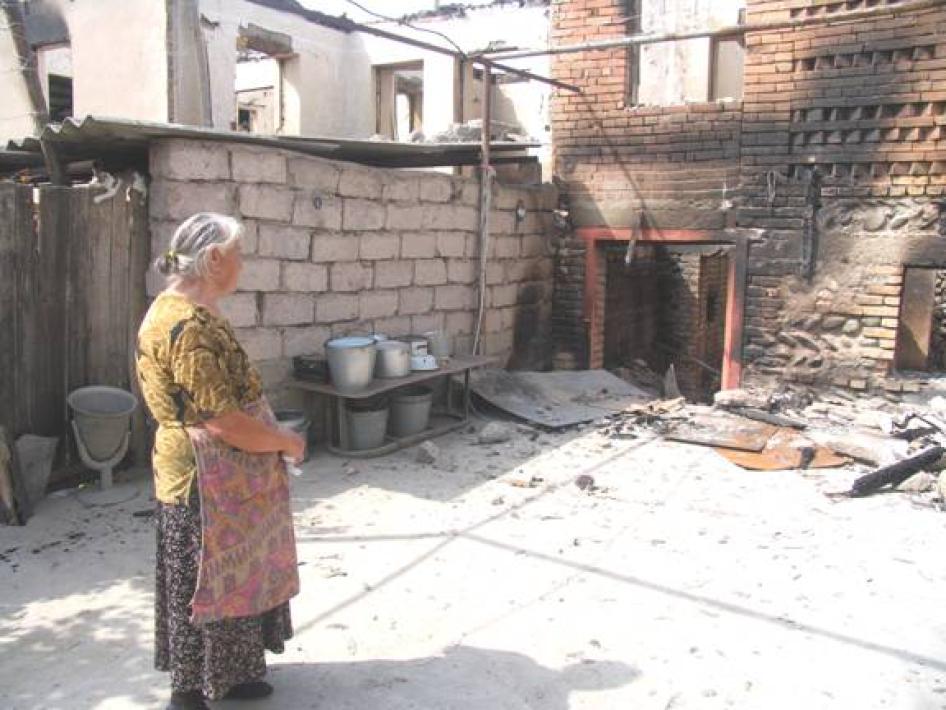
Marine Tetunashvili in the remains of her house, which armed Ossetians, together with Russian forces, looted and burned on August 15, 2008. © 2008 Human Rights Watch
Arkadi A., a resident of Koshka (in Gori district, just outside the South Ossetia administrative border), told Human Rights Watch that looters, both Russian and Ossetian, entered the village on August 9 and 10 after the village had been shelled. According to Arkadi A., they moved around in groups of 15 and stole everything from a number of houses before setting fire to them. He witnessed some of them.[338]
3.7 Russia's Responsibility as Occupying Power
When Russian forces entered Georgia, including South Ossetia and Abkhazia, which are de jure parts of Georgia, they did so without the consent or agreement of Georgia. International humanitarian law on occupation therefore applied to Russia as an occupying power as it gained effective control over areas of Georgian territory (see above, Chapter 1.2). Tskhinvali and the rest of South Ossetia must be considered under Russian control from August 10, when Georgian forces officially retreated, through the present. Villages in Gori district fell under Russian control as Russian forces moved through them on August 12. Gori city must be considered under effective Russian control at least from August 12 or 13 until August 22, when Russian troops pulled back further north toward South Ossetia.[339] Russia's occupation of the area adjacent to South Ossetia ended when its forces withdrew to the South Ossetia administrative border on October 10.[340]
Human Rights Watch documented one occasion when Russian forces intervened to help a civilian who was the victim of a crime in progress, and two distinct occasions when Russian forces temporarily set up roadblocks to prevent looting. Yet overall, Russian authorities did not take measures to stop the widespread campaign of destruction and violence against civilians in villages in South Ossetia (see below, Chapters 4.2 and 4.3) and in the buffer zone in undisputed Georgian territory. They allowed these areas to become a virtual no-man's land where individuals were able to commit war crimes-to kill, loot, and burn homes-with impunity. This deliberate violence against civilians started in the immediate aftermath of Georgian forces' withdrawal from South Ossetia and continued in waves in the weeks that followed; concomitantly, Russian forces' failure to ensure protection of civilians in territories under their control was persistent. Russian forces therefore violated their obligation as an occupying power to "ensure public order and safety" and to provide security to the civilian population in the territory under its control. This is a serious violation of international humanitarian law.[341]
Russia bore responsibility but took no discernable measures on behalf of protected individuals, including prisoners of war, at least several of whom were executed or tortured, ill-treated, or subjected to degrading treatment by South Ossetian forces, at times with the participation of Russian forces.
The Russian Ministry of Defense has not responded to Human Rights Watch's request for information about the Russian military's mandate, measures taken, and instructions issued to protect civilians in areas of Georgia under Russia's effective control. In October an official from the Council of Europe who requested anonymity told Human Rights Watch that a senior member of the Russian military in the region said that the military was given no mandate for protection of civilians.[342]
Russian authorities have also not responded to Human Rights Watch's request for information about any measures taken to hold responsible perpetrators of the grave breaches of the Geneva Conventions by Russian forces described in the chapters above.
In South Ossetia
On August 13, following several media reports about the massive looting and burning in ethnic Georgian villages in South Ossetia, Russian Minister of Internal Affairs Rashid Nurgaliev stated that looting in South Ossetia "shall be decisively stopped.[343] That day Russian forces established checkpoints at both ends of a key road connecting the town of Java to Tskhinvali, thus preventing access to five ethnic Georgian villages along that road. At the checkpoint near the village of Kekhvi the commanding officer, a Russian lieutenant colonel, told Human Rights Watch: "We're now trying to stop the looters. They steal and set fire to things … I see no end to this."[344]
Human Rights Watch observed that the checkpoints significantly reduced the pillaging and destruction in the villages and that Russian servicemen at the roadblocks approached their duties conscientiously despite the evident and, at times, aggressive resentment of Ossetian militias.[345] About a week later, however, without any explanation, the checkpoints were removed and the pillaging and destruction resumed, as described below in Chapters 4.2 and 4.3. Russian authorities have not responded to Human Rights Watch's request for information about why the roadblocks were removed.
In an interview with the BBC in October, Russian Minister of Foreign Affairs Sergei Lavrov at first denied and then attempted to explain away the destruction of ethnic Georgian villages: "No, this is not ethnic cleansing. This was also the area of the war. When I say that the Georgians were moving their artillery and tanks closer to Tskhinvali, this also included the Georgian enclaves in South Ossetia, where they secretly organized strongholds."[346] The correspondent stressed to Lavrov that Ossetian militias told the BBC directly that they were burning civilian houses, and suggested that Russia should have "prevented that from happening."[347] Lavrov notably did not respond to this point about Russia's duty and capacity to prevent the destruction. He acknowledged that the destruction was regrettable, but offered a dismissive explanation: "Well, of course, when your city is attacked, when your loved ones, when your relatives, when your children, when your parents, brothers and sisters are being killed, brutally, you can go emotional and you can go really [emotional] in a very unwanted way."[348]
Several people told Human Rights Watch that Russian ground forces in general did not attack local residents and in some cases tried to protect the civilian population from Ossetian forces, militia members, or criminal elements.
For example, late in the evening on August 11, Gocha Demetrashvili, 44, drove to South Ossetia to evacuate his parents. After he passed through Eredvi, two UAZ military vehicles started following him. The vehicle's occupants, whom Demetrashvili described as Ossetians in camouflage, fired at his car, shooting out the two rear tires. Demetrashvili continued on, hoping to get to the Russian military checkpoint in Dmenisi. As he approached Dmenisi, he got out and began to run towards the Russian checkpoint, shouting, "I am a civilian. I need help!" Several of the Ossetians got out of their cars and chased Demetrashvili. He described to Human Rights Watch what happened next:
The Ossetians caught up to me and began beating me their fists and their gun butts and kicking me.… They had me at gunpoint, and I thought they wanted to shoot me. That's when some of the Russian soldiers came up to us and took me away from the Ossetians.
The Ossetians drove off with Demetrashvili's car, and the Russian soldiers kept Demetrashvili at their checkpoint for three nights, apparently reluctant to let him go for fear that Ossetians might again attack him. On the third day, Russian troops escorted Demetrashvili through the nearby Ossetian villages from where he walked on his own approximately 30 kilometers back to Gori.[349] (It bears noting, however, that Russian forces did not apprehend the assailants, and allowed them to drive off with Demetrashvili's car.)
In Gori District
As Russian forces established control in portions of Gori district, they set up checkpoints in the south of the district and strictly limited entry and exit from the south. While in most cases Russian forces permitted civilians to pass through the checkpoints after checking identification documents and inspecting vehicles for weapons, they refused access to Georgian police, preventing them from maintaining law and order in these areas.
Two residents of Tkviavi, a village 12 kilometers south of Tskhinvali that was particularly hard hit by looters from South Ossetia, told Human Rights Watch that the looting decreased when the Russian forces maintained a checkpoint in the village, although the marauders kept coming during the night.[350]
Several Tkviavi villagers told Human Rights Watch that they believed that more frequent patrolling by the Russian forces or Georgian police would have improved security in the area. One told Human Rights Watch that looters "seemed to be afraid to encounter the Russians, and were hiding from them," suggesting that had Russian forces taken more preventive measures to stop violence against civilians these measures would have been effective.[351]
Part 4. Violations by South Ossetian Forces
4.1 Overview
Human Rights Watch found that South Ossetian forces and militias committed serious violations of international humanitarian law, including war crimes, in South Ossetia and undisputed Georgian territory controlled by Russian forces.
South Ossetian forces and militias embarked on a campaign of deliberate and systematic destruction of the Tbilisi-backed villages in South Ossetia, which involved the widespread and systematic pillage and torching of houses, and beatings and threats against civilians. In undisputed parts of Georgian territory they conducted a campaign of deliberate violence against civilians, burning and looting their homes, and committing execution-style killings, rape, abductions, and countless beatings. They rounded up at least 159 ethnic Georgians, killing at least one and subjecting nearly all of them to inhuman and degrading treatment and inhuman conditions of detention. They also tortured at least four Georgian prisoners of war and executed at least three.
In engaging in the violence summarized above, South Ossetian forces and militias egregiously violated multiple obligations under humanitarian law with respect to treatment of protected persons, including civilians and others hors de combat. Murder, rape, acts of torture, inhuman or degrading treatment, and wanton destruction of homes and property are all strictly prohibited under both humanitarian law and human rights law, and the perpetrators of such acts should be held criminally responsible for them. To the extent that any of these prohibited acts was committed as part of a widespread or systematic attack directed against any civilian population, they may be prosecuted as a crime against humanity. Where any of these acts, as well as acts such as imprisonment, unlawful detention of civilians, pillaging, and comprehensive destruction of homes and property, were carried out with discriminatory intent against a particular group, in this case ethnic Georgians, they also constitute the crime of persecution, a crime against humanity, prosecutable under the statute of the International Criminal Court.[352]
South Ossetian forces include South Ossetian Ministry of Defense and Emergencies servicemen, riot police (known by the Russian acronym OMON), and several police companies, working under the South Ossetian Ministry of Internal Affairs, and servicemen of the South Ossetian State Committee for Security (KGB).[353] Many interviewees told Human Rights Watch that most able-bodied men in South Ossetia took up arms to protect their homes.[354] As South Ossetia has no regular army its residents tend to refer to the members of South Ossetian forces as militias (opolchentsy) unless they can be distinctly identified as policemen or servicemen of the Ministry of Defense and Emergencies. Credible sources also spoke about numerous men from North Ossetia and several other parts of Russia who fought in the conflict in support of South Ossetia and who were involved in the crimes against civilians that followed.
In some cases, it is difficult to establish the exact identity and status of the Ossetian perpetrators because witnesses' common description of their clothing (camouflage uniform, often with a white armband) could apply to South Ossetian Ministry of Defense and Emergencies, South Ossetian Ministry of Internal affairs, volunteer fighters, or even common criminal looters. Several factors, however, indicate that in many cases the perpetrators belonged to South Ossetian forces operating in close cooperation with Russian forces. The perpetrators often arrived in villages together with or shortly after Russian forces passed through them; the perpetrators sometimes arrived on military vehicles; and the perpetrators seem to have freely passed through checkpoints manned by Russian or South Ossetian forces.
Witnesses sometimes also referred to the perpetrators as Chechens and Cossacks; whether this was an accurate identification is not clear, although there were media reports of Chechens and Cossacks participating in the conflict.[355] In some cases, witnesses claimed that the groups of perpetrators consisted of both Ossetians and Russians. These incidents also demonstrate Russia's failure to protect civilians in areas under its effective control (as discussed in Chapter 3.7).
4.2 Attacks on Georgian Civilians and Their Villages in South Ossetia
Looting and Burning of Villages
Basic chronology
As tensions mounted in the first week of August 2008, some inhabitants of ethnic Georgian villages that had Tbilisi-backed administrations fled to undisputed Georgian territory.[356] Most of the others fled on the first day of the hostilities. Ethnic Georgians who remained did so either because they were infirm, because they wanted to protect their homes, or simply because they could not bring themselves to leave their homes.
Beginning August 10, after Russian ground forces had begun to fully occupy South Ossetia and were moving onward into undisputed Georgian territory, Ossetian forces followed closely behind them and entered the ethnic Georgian villages. Upon entering these villages, Ossetian forces immediately began going into houses, searching for Georgian military personnel, looting property, and burning homes. They also physically attacked many of the remaining residents of these villages, and detained dozens of them. Human Rights Watch received uncorroborated reports of at least two extrajudicial killings of ethnic Georgians in South Ossetia that took place amidst the pillaging. In most cases, Russian forces had moved through the Georgian villages by the time South Ossetian forces arrived. In other cases, Russian forces appeared to give cover to South Ossetian forces while they were committing these offenses.
By August 11, the attacks intensified and became widespread.[357] Looting and torching of most of these villages continued intermittently through September, and in some through October and November.
Extent and deliberate nature of the destruction as investigated by Human Rights Watch
When Human Rights Watch visited Tamarasheni, Zemo Achabeti, Kvemo Achabeti, Kurta, and Kekhvi in August, our researchers saw first-hand these villages being looted and torched. When our researchers returned in September, the villages had been almost fully destroyed; in Kekhvi the debris of some houses along the road appeared to have been bulldozed. Also in September Human Rights Watch visited Eredvi, Vanati, Avnevi, and Nuli, which by that time had been almost completely destroyed by burning. In November Human Rights Watch visited Beloti, Satskheneti, Atsriskhevi, and Disevi, also almost fully destroyed.
Human Rights Watch researchers conducted a total of 57 interviews with people from the villages mentioned above and from Dzartsemi, Kheiti, Prisi, and Kemerti; these 17 villages account for most of the areas in South Ossetia that had been controlled by Tbilisi prior to the war. Our researchers also interviewed members of Ossetian militias and the Russian military. Human Rights Watch's observations on the ground and from these interviews have led us to conclude that the South Ossetian forces sought to ethnically cleanse these villages: that is, the destruction of the homes in these villages was deliberate, systematic, and carried out on the basis of the ethnic and imputed political affiliations of the residents of these villages, with the express purpose of forcing those who remained to leave and ensuring that no former residents would return.
International humanitarian law prohibits collective punishment,[358] acts of reprisal against civilians,[359] pillage,[360] and deliberate destruction of civilian property.[361] Violations of these prohibitions are grave breaches of the Fourth Geneva Convention, or war crimes.
The interviews and ground observations by Human Rights Watch indicate that these villages were looted and burned by Ossetian militias and common criminals. With a few exceptions of looting and beatings of civilians, Russian forces did not participate directly in the destruction of villages and attacks on civilians but, aside from a brief period in mid-August, did not interfere to stop them (see Chapter 3.7, Russia's Responsibility as Occupying Power).
Didi Liakhvi valley
On August 12, Human Rights Watch researchers traveling on the TransCam road from Java to Tskhinvali witnessed terrifying scenes of destruction in Kekhvi, Kurta, Zemo Achabeti, Kvemo Achabeti, and Tamarasheni. Dozens of houses had been freshly burned down and remnants of houses and household items were still smoldering. Many other houses were aflame and appeared to have been just torched. Human Rights Watch also saw and photographed Ossetian militias as they moved along the road next to Russian tanks and armored personnel carriers, entered the houses that remained intact, and loaded furniture, rugs, televisions, and other valuables onto their vehicles. Attempting to justify the looters' actions, an Ossetian man traveling on the same road told Human Rights Watch, "Of course, they are entitled to take things from Georgians now-because they lost their own property in Tskhinvali and other places."[362]
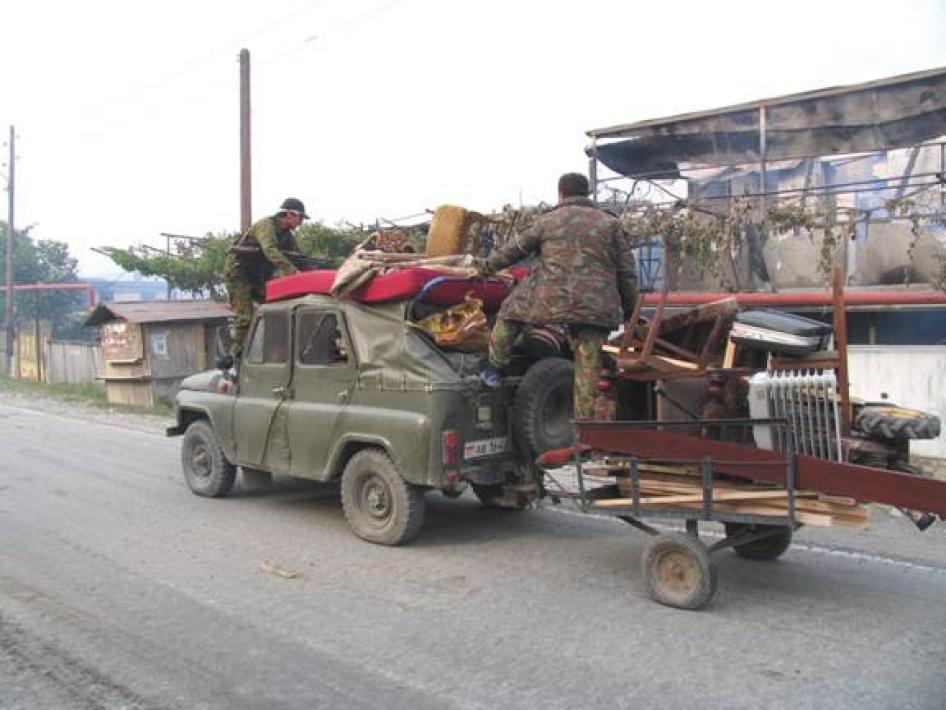
Armed looters take household items from the ethnic Georgian village of Kvemo Achabeti. © 2008 Human Rights Watch
The villages were virtually deserted, with the exception of a few elderly and incapacitated people who stayed behind either because they were unable to flee or because they were trying to save their property and livestock.
Zemo and Kvemo Achabeti According to witnesses, Russian forces moved into Zemo Achabeti on August 9 and were followed on August 10 by Ossetian militias, who acted under the cover of Russian soldiers with tanks who remained in the village.[363] Ilia Chulukidze, an 84-year-old resident, told Human Rights Watch that on August 11
Russians and Ossetians and other irregulars … took carpets, televisions, clothes, everything … The next day they took wine, vodka, jams, canned food, two cows, and a calf. They were taking everything from everyone. The entire village was looted and emptied.
After they took everything from my house, the Ossetians brought petrol. They put me into a car and [made me] watch them … pour petrol everywhere in the rooms and outside and then set the house on fire. I saw them torch my neighbors' houses. They did not even allow me to get some clothes out and change. I was begging them for it, but in vain.[364]
Chulukidze also said that before this, Russian soldiers beat him (as described in Chapter 3.6).
Armed Ossetians entered the neighboring village, Kvemo Achabeti, on August 11, following Russian tanks, and started looting immediately. Mamuka N., a 74-year-old villager, told Human Rights Watch that several members of the militia came to his house on August 11, and tried to steal some household items. When he protested, they set the house on fire and left. When Human Rights Watch spoke to Mamuka N. he was trying to put out the fire, still burning a day later; his hands were burned, his hair was singed, and he appeared to be in shock. Mamuka N. told Human Rights Watch that the vast majority of local villagers, including his family, had fled Kvemo Achabeti when active fighting broke out on August 8, but he had decided to stay to look after the cattle. He said that roughly five to 10 elderly and sick people remained in the village, all in a similarly desperate condition, and that many of the houses were burned.[365] The ICRC evacuated Mamuka N. to undisputed Georgian territory soon thereafter.
Another resident of Kvemo Achabeti, 80-year-old Rezo Babutsidze, told Human Rights Watch that after the Russian tanks entered the village,
[they] were followed by Ossetians who were looting and then burning houses. They came several times to my house, taking everything they liked. Once they looted everything they liked they poured petrol and set the house on fire. I watched how they burned my house and neighbors' houses. They warned me to leave or they would shoot me.[366]
Babutsidze eventually fled to Tbilisi.
Kekhvi
In Kekhvi about a dozen houses were set ablaze between 6:30 and 7:30 p.m. on August 12.[367]Two elderly women from Kekhvi wept as two days later they told Human Rights Watch about what had happened. One of them explained that South Ossetian militias passed through the village, stopped at her house, and "threw something" that set it on fire.[368] The house was still burning as Human Rights Watch spoke to her.
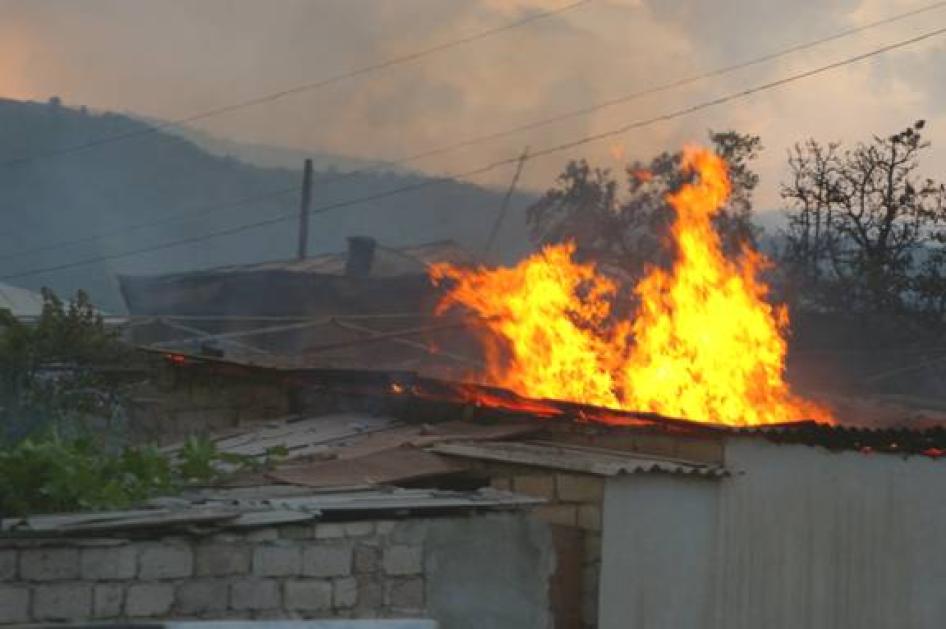
A torched house ablaze in Kekhvi, August 12, 2008. © 2008 Human Rights Watch
Another Kekhvi resident, 71-year-old Shermadin Nebieridze, told Human Rights Watch that on August 11, five Ossetian men entered and looted his house, taking a cellphone, clothing, and other items. He and other villagers fled to nearby Dzartsemi, where for several hours they sought shelter from intense gunfire and shelling. Later in the evening Nebieridze could see, from a hill in Dzartsemi overlooking Kekhvi, at least a dozen houses on fire in Kekhvi, including his own. Nebieridze began to weep as he described to Human Rights Watch returning to his burning home to try to save his cattle:
When I got to my house I saw that it was already half burned. The roof and second floor were on fire; the bed, the windows, the door were already destroyed. The house was still burning. I didn't go in. I couldn't stop it. There was nothing I could do.[369]
Nebieridze saw Ossetian forces preparing to burn his neighbor's house. The Ossetians spotted Nebieridze, dragged him into the neighbor's yard, and beat him before detaining him, yelling, "Why are you here? … It's not your house anymore. It's ours. Why don't you understand this already?"[370] (The beating and detention of Shermadin Nebieridze is described in Chapter 4.4.)
Tamarasheni
Tamarasheni is the ethnic Georgian village closest to Tskhinvali. This is how 69-year-old Tamar Khutsinashvili, described the looting and burning of her family's home:
Ossetians came to my house on August 10, three or four of them. They first looted everything they could, including my car. They put hay in the house and set it on fire and burned the house. We had to watch it but could not do anything. They did not allow us to take anything from the house, not even our identity documents.[371]
Rusudan Chrelidze, 76, also described burning and looting in Tamarashani:
Several people from my neighborhood tried to flee together to Achabeti, but I could not run fast enough. I heard shooting from that direction so I returned to Tamarasheni in the evening. I saw that my house was burning. By the time I got there it was almost completely burned. I also saw that my three children's houses were burning.
I went to my neighbor, who is missing a leg and so could not flee. Her house was also burned, but she had a basement where she was hiding. We hid in the basement together. We saw that our neighbor's pigs had been slaughtered and taken away. We saw that many things had been taken from houses.[372]
Evidence of the burning of villages in Didi Liakhvi is also provided by images taken by a commercial satellite on August 19 and analyzed by experts of the Geneva-based UNOSAT program.[373] UNOSAT experts identified visible structures on the images that were likely to have been either destroyed or severely damaged. The expert analysis indicated clear patterns of destruction that were consistent with the data gathered by Human Rights Watch.
UNOSAT provided a map that marked satellite-detected active fire locations in the ethnic Georgian villages around Tskhinvali, including those described above.[374] The map shows active fires in the ethnic Georgian villages on August 10, 12, 13, 17, 19 and 22.[375]
UNOSAT also released a set of six high-resolution satellite images of Didi Liakhvi stretching 9 kilometers north from Tskhinvali, showing that the majority of villages along this stretch were destroyed. The images strongly indicate that the majority of the destruction in five of the villages-Tamarasheni, Kekhvi, Kvemo Achabeti, Zemo Achabeti, and Kurta-was caused by intentional burning and not shelling or bombardment.[376]
The damage shown in the ethnic Georgian villages is massive and concentrated. By August 22, in Tamarasheni, UNOSAT's experts counted a total of 177 buildings destroyed or severely damaged,[377] accounting for almost all of the buildings in the village. In Kvemo Achabeti they counted 87 destroyed and 28 severely damaged buildings (115 total); in Zemo Achabeti, 56 destroyed and 21 severely damaged buildings (77 total); in Kurta, 123 destroyed and 21 severely damaged buildings (144 total); in Kekhvi, 109 destroyed and 44 severely damaged buildings (153 total); in Kemerti, 58 destroyed and 20 severely damaged buildings (78 total); and in Dzartsemi, 29 destroyed and 10 severely damaged buildings (39 total)[378].
Patara Liakhvi valley
Eredvi and Vanati
When Human Rights Watch went to Eredvi on September 6, the village was deserted except for looters. Human Rights Watch witnessed two active fires and saw that every house in the village had fire damage. A Human Rights Watch researcher saw six looters going through the houses and loading property onto two vehicles. Two of the looters were armed and wearing fatigues.
In the neighboring village of Vanati on the same day Human Rights Watch found that practically all the houses were burned (some were still burning), with the exception of those that allegedly belonged to the few Ossetian villagers (houses that were intact had signs on that identified their Ossetian ownership). There appeared to be no ethnic Georgians left in the village.
Disevi
The torching of Disevi-an ethnic Georgian village of about 300 families that borders on three ethnic Ossetian villages-appeared to start around August 11, after Ossetian and Russian forces entered the village the previous day, and continued through October.[379] Its residents were gradually driven out by the torching and looting.
A 56-year-old woman who fled Disevi, Tamar Okhropiridze, told Human Rights Watch that half of the houses in the village were burnt in one day soon after Russian and Ossetian forces entered the village around August 10. She described in detail the torching of her own home,
I was hiding in the backyard of my house. Six men entered my yard. One was in civilian clothes; another was in military camouflage pants but a colorful shirt. They put together a heap of furniture and other household items, linens, and clothes. They poured something on it, probably kerosene, and set it on fire.I saw them go to my neighbor's house and set it on fire in the same way. I thought I could save it. I tried to pour water on the bed that was on fire…[380]
On September 13 Human Rights Watch spoke by telephone with Ia Khetaguri, 50, who was still living in a hillside neighborhood of Disevi despite the security challenges. Khetaguri said that only about 30 villagers remained and that most of the village had been burned.[381] She said that eight or nine houses were burned in Disevi on September 12,[382] and two on September 13.[383] Two days later Khetaguri had to flee the village as houses in her neighborhood were also torched.[384] Another Disevi resident, who was living in a facility for the displaced but maintained telephone contact with relatives remaining in Disevi, also reported that three houses were burning on September 15;[385] it is not known whether these accounts overlap.
When Human Rights Watch visited Disevi on November 24, the village appeared destroyed and completely deserted.
One villager who had fled Disevi would venture back periodically as far as a neighboring village, on the Gori district side of the administrative border, to see his house, which had been burned by Ossetian militias in mid-August. The man told Human Rights Watch in November,
I do not dare to go further than this [Georgian] checkpoint roadblock but I can clearly see my house from here. It's this one, barely 500 meters from us, on that small hill. It was such a wonderful house and nothing but charred walls are left of it. But somehow, something draws me here. I cannot stop coming to this place and looking at what used to be my and my children's home. We are all refugees now, we lost everything. And Disevi is like a desert. The very last family left the village yesterday. I spoke to them. They're saying that only 10 houses in the village escaped burning so far. Everything else is gone. The militias are roaming around non-stop, even though there must be nothing left to steal by now.[386]
Beloti, Satskheneti, and Atsriskhevi
Ossetian militias started looting and torching Beloti on August 12, two days after Russian forces arrived.[387] A 79-year-old resident displaced by the violence provided us with a detailed description of the abuses she saw perpetrated in Beloti before her evacuation to Gori by the ICRC in September:
Looting was going on all the time up until we left. One group would come and leave, then another would come and then leave. They took whatever they liked. Sometimes they would come into the yard and start shooting in the air. Some were very aggressive and yelling. One time, one Ossetian came in and had a huge knife and threatened to kill me. Another was more considerate … But in any case they just took whatever they wanted.
Sometimes people in civilian clothes from neighboring Ossetian villages would also come and loot. They took our seven cows, and one pig. We had 19 beehives-they were all taken and all the equipment for the beekeeping. They also took … a television. Some houses were burned, but I begged them in Ossetian not to burn ours. Our daughter's house [also in Beloti] was burned.[388]
When Human Rights Watch visited Beloti in November, the village appeared almost completely destroyed by burning. One of the three remaining residents of Satskheneti, another ethnic Georgian village close to Beloti, confirmed our assessment of Beloti as fully deserted.[389]
In November Human Rights Watch also saw that most of the houses in Satskheneti had been burned, with only a few still intact. Most residents had fled either right before or at the start of the armed conflict. Vladimir K., 73, remained in his home because he "spent a whole life building [it]."According to him, the looters, most of them armed and dressed in fatigues, started robbing and burning homes around August 10. Militias looted Vladimir K.'s home several times and set fire to it twice, but he had been able to put the fires out. When we spoke to him he expressed fear that it was only a matter of time before his house would be burned down; at this writing we do not know whether his fears have been realized.[390]
Atsriskhevi, a small, remote mountain village beyond Beloti, was fully deserted and almost completely destroyed, with only two houses still intact when Human Rights Watch was there in November.
Froni valley
Avnevi and Nuli
The village of Avnevi has two parts, one populated prior to the conflict mainly by ethnic Georgians and administered by Tbilisi, and the other populated mainly by ethnic Ossetians and administered by Tskhinvali. Widescale looting and torching in the Tbilisi-administered part began around August 12, and continued at a lesser scale at least until early September, causing most villagers to flee; by November looters were hauling bricks and piping from the remains of the houses.[391]
When Human Rights Watch visited Avnevi on September 4, its Tbilisi-administered part was almost fully destroyed by fire and looting. A Human Rights Watch researcher also saw and photographed two active fires in this part of the village.
Several days prior, militias burned the house of 86-year-old Elena Zoziashvili, who was then forced to live in a shed in her yard, with nothing to eat except what was in her vegetable patch. Zoziashvili is half blind and nearly deaf, and appeared to be in shock when Human Rights Watch spoke to her.[392] Several days later, the ICRC evacuated Zoziashvili to Tbilisi, where she had relatives.
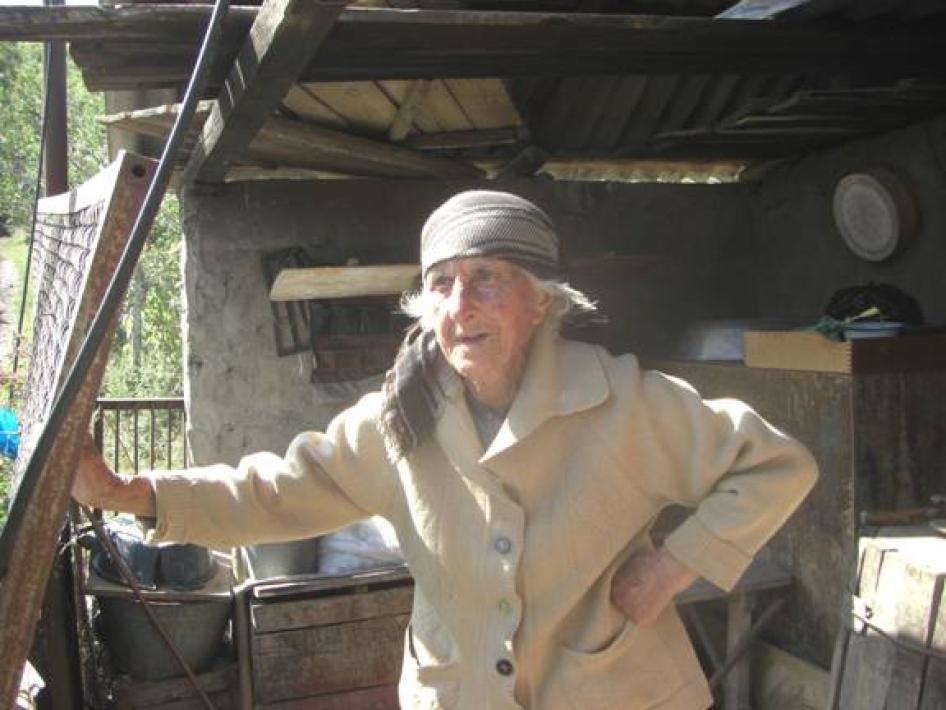
Elena Zoziashvili, 86, speaking with Human Rights Watch after her house in Avnevi was torched. © 2008 Human Rights Watch
When we visited, several of the homes in the Tbilisi-administered part of Avnevi had been looted but not burned, though militias threatened to torch them. The home of Vakhtang Durglishvili, an elderly Georgian whose family had fled, was intact because, he thought, an Ossetian acquaintance from the Ossetian part of the village took Durglishvili under his protection, including by bringing him food on a regular basis.[393]
Nuli is the next village to Avnevi. A Human Rights Watch researcher who walked through Nuli on September 4, 2008, saw that most of its houses had been burned and found the village deserted.
Alleged Extrajudicial Killings in the Course of Village Burnings
An Ossetian taxi driver, Leonid L., told Human Rights Watch that his friend Omar Chovelidze, a resident of Kvemo Achabeti, and his wife were shot dead by unknown persons at some point between August 13 and 16.[394] Leonid said that once the hostilities ended he decided to check on Chovelidze, and found him and his wife at home in Kemo Achabeti on August 13, amid scenes of ongoing destruction in the village:[395]
When I saw Omar on the 13th in the middle of that burning village I could hardly believe it! I said, "Are you crazy? You must get out of here! Let me take you to Georgia." But he refused flatly. He said he had a Russian passport and that'd protect him from the militias. When I returned three days later I found his body and that of his wife in the yard. [The house had been burned down.] I felt so awful I jumped in the car and drove away. But I did come back the next day to bury their bodies. I made a grave for them right in the yard and put a wooden cross on it.[396]
Tamar Okhropiridze, whose description of the burning of Disevi is given above, said that she witnessed Ossetian militias burn the house of 70-year-old Elguja Okhropiridze and shoot him dead. She also claimed to have seen an old woman burned to death in Disevi:
On the second day [of looting and burning]… Nato Okhropiridze, age 70, was burned in her house. I saw that Nato's house was on fire and I went to her house. When I arrived I saw that something had fallen on her and burned her. She had a bucket in her hand, as if she was trying to put out the fire in her house.[397]
Some Ossetian Villagers Not Immune from Looters
In some communities where Ossetians lived side-by-side with Georgians, or in mixed marriages, the Ossetians were also targeted for looting, harassment, and accusations of collaboration.
On August 11 Ossetian militias began looting and burning homes in Zonkar, a tiny Tskhinvali-administered hamlet in the Patara Liakhvi valley surrounded by ethnic Georgian villages.[398] Human Rights Watch spoke to the only two remaining villagers, ethnic Ossetians Aza Valieva and her distant cousin Tamaz Valiev. Ossetian forces targeted them repeatedly because they believed either that the Valievs were ethnic Georgians or were collaborating with the Georgian authorities. At one point the attackers included men dressed in uniforms with insignia worn by Ossetian peacekeepers.
The attackers stole 8,000 roubles, a television, a VCR, three chainsaws, cattle, and other valuables from Tamaz Valiev.[399] They looted Aza Valieva's house, including taking 28,000 roubles.[400] Both Valievs said they repeatedly explained to the looters and militias that they were Ossetian and even showed their passports. The perpetrators, however, ignored their pleas or said that because they lived in this village in the middle of a Georgian enclave, they must either be Georgian or have had something to do with the Georgians.
Aza Valieva said that men dressed in Ossetian peacekeeper uniforms tried to set fire to her house. Although she reported the incident to the police, no officials from the South Ossetia prosecutor's office came to her house to investigate. She told Human Rights Watch,
On August 23 several servicemen came in a Kamaz-truck and not only took some things from my house but actually tried to burn it. They were Ossetian peacekeepers. This I know for sure because they had those two letters, MS [the Russian acronym for Mirotvorscheskie Sily, or Peackeeping Forces] on their uniforms. They were shooting at the windows, saying obscene things. One of them aimed his sub-machine gun at me and yelled, "You just know how to speak Ossetian but in reality you're Georgian! Get the hell out of here!" Finally, they threw some blankets and clothes on the floor and set them on fire. I managed to [put out the fire] and then ran for the police. I showed them everything, explained the situation, and even told them the license plate number of the truck. They said I should not touch anything in the room because there would be an investigation but it's been three months and no one has done anything.[401]
In the mixed village of Vanati three local elderly villagers, all of them Ossetian, complained to Human Rights Watch about the burning and looting and expressed fear for their own security and the safety of their home. According to them, the looters had already stolen everything valuable they could find in the Georgian households and had begun to harass the remaining Ossetian residents. They expressed their frustration with the authorities for failing to provide security.[402]
Most residents of Beloti (see above), which had about 50 families, were ethnic Georgians but some were Ossetian, mainly women married to Georgians.[403] Militias and common criminals looted and burned Georgian and mixed households alike.
In the Froni valley village of Avneni Human Rights Watch found mixed-marriage households similarly at the mercy of looters. The house of one elderly couple, Zalina Bestaeva and Durmishkhan Sikturashvili, remained intact but had been looted. Bestaeva and Sikturashvili were afraid that their house would be torched in the near future. "They [armed looters] almost set fire to the house!" said Bestaeva to Human Rights Watch. "We were kissing their hands, anything, as long as they left us in peace. But they keep coming back and take first one thing, then another. Our neighbor lost all her money to them, down to the last penny."[404]
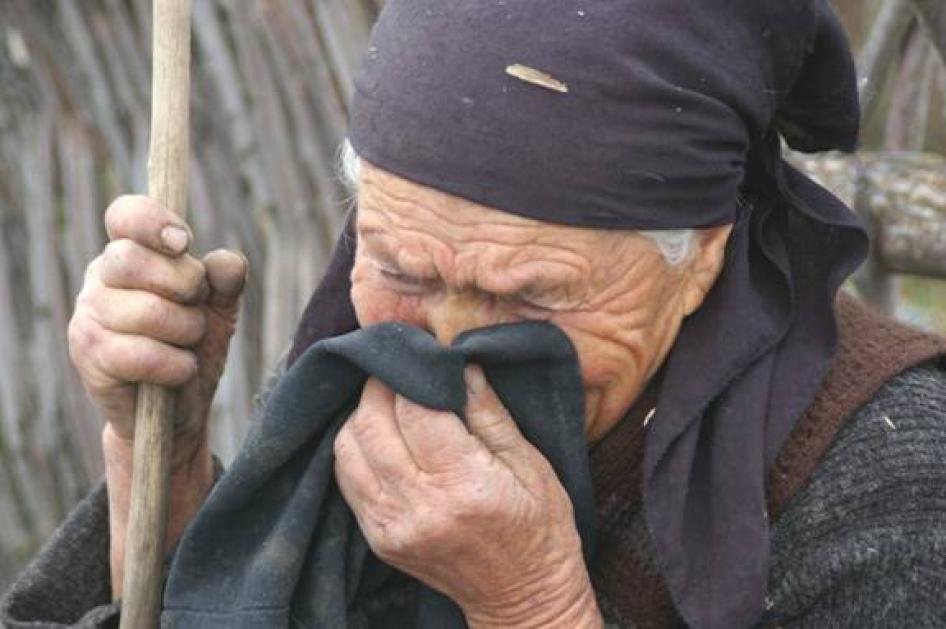
Maria Ch., an elderly Ossetian woman from Satskheneti, describes to Human Rights Watch frequent attacks by looters. ©Human Rights Watch 2008
Bestaeva's neighbor is Anna Kokoeva, an Ossetian married to an ethnic Georgian. Kokoeva's husband fled at the start of the fighting but she stayed behind to watch over their house. She was able to convince the looters not to burn the house but they robbed her of money and valuables several days prior to Human Rights Watch's visit on September 8. Kokoeva told Human Rights Watch,
I had been saving for a year to pay for crowns on my teeth and saved up 1,500 roubles [approximately US$60], but then the looters, the militias, came and they took it all! I was pleading with them but they yelled at me and even threatened to burn down my house. They were saying that my husband was a Georgian and we deserved this.[405]
Human Rights Watch interviewed two other Ossetian women, Tamara Tibilova and Elizaveta Dzioeva, both of them married to Ossetians but living in the Tbilisi-administered part of Avnevi,[406] and sharing the same fate as the villagers in the Zonkar exclave. Tibilova told Human Rights Watch,
The looters come every day. They took everything valuable that was in my house. Nothing is left. I keep telling them I'm Ossetian and so is my husband, but what do they care? They've appropriated everything of any value that belonged to Georgians and now they're after our property. And if you try to argue with them, they threaten to burn your house. They know they can do what they want in this village and no one will ever punish them![407]
Elizaveta Dzhioeva described to Human Rights Watch that the looters were "completely ruthless" and her own and her husband's Ossetian ethnicity did not protect them from looting:
I'm scared to go to the city [to buy food] because the looters are likely to burn my home if I leave even for a few hours. They've already burnt my daughter's house [also in this part of the village]. They come every day and they really don't care if you are an Ossetian. I was once away from the house for a short while and they literally stole everything that we had there! When the burning started some Ossetian fighters were telling me not to worry. They were saying that we wouldn't be touched or suffer in any way because we were Ossetian. How wrong they were! The looters don't give a damn who you are, as long as you live here![408]
Situation in Akhalgori District
Akhalgori district, in the east of South Ossetia, has practically no communication lines with the rest of the territory.[409] There were no hostilities there during the August conflict, but following the conflict Russian forces occupied the district, prompting the dismissal of the Tbilisi-backed administration. This facilitated the appointment, by Tskhinvali, of an Ossetian administration for the district on September 3, 2008.[410] At this writing, the Russian military presence in Akhalgori is substantial, with two bases in the district.[411] However, according to the head of Akhalgori's district administration and local residents, Russian servicemen mainly keep to their bases. The Ossetian police, including OMON and KGB personnel, are deployed to the region from Tskhinvali on a rotating basis.[412]
In contrast to the villages in the Didi Liakhvi, Patara Liakhvi, and Froni valleys, villages in Akhalgori district have not been burned by Ossetian militias. However, its ethnic Georgian residents are threatened and harassed by militias, and frightened by the possible closure of the district's administrative border with the rest of Georgia. The harassment and anxiety have caused great numbers of people to leave for undisputed Georgian territory.[413]
Nuzgar N., age 48, an ethnic Georgian resident of Akhalgori town, summarized these anxieties and their consequences:
Thousands of people used to live here before August and now this place is like a desert. And how else can it be? There are all those armed people who frighten the locals by their mere presence.
Residents who could leave have mostly left. Families with young girls were afraid their daughters would be harassed by Ossetians. And the parents were no less concerned for the boys. They can easily be harassed. As a result, it's mostly elderly people that stayed, or those who have no place to go. I stayed because of my elderly mother first and foremost. But if they close the border everyone [Georgian] who's still here will pick up and leave. And so will I.[414]
Ossetian militia violence and intimidation
At least two people were beaten by Ossetian militias in separate incidents in Akhalgori district in November 2008, causing the death of one and severe injury to the other.
Akhalgori town hospital staff told Human Rights Watch that around November 5 they treated Kanchaveti resident Givi Tetunashvili, age 76. Tetunashvili was brought to the hospital bleeding, with multiple bruises, a fractured arm and severe injury to his genitals. Tetunashvili told the doctors that he had been watching over his grazing sheep when several armed men in camouflage uniforms tried to steal one of them. When he protested, they started beating him.[415] Tetunashvili was in critical condition and was transferred for further treatment to Tbilisi, where he died approximately two weeks later.
When Human Rights Watch researchers visited Kanchaveti on November 21, they happened upon a crowd of local residents going to Tetunashvili's wake. Tetunashvili's wife, Rusiko, who was among the crowd, told Human Rights Watch that she was with her husband on the day he was assaulted and witnessed the incident. The assailants also threatened her, but did not beat her. She recognized one assailant as a member of the Ossetian militia and a resident of a neighboring Ossetian village.[416]
As Human Rights Watch was talking to Tetunashvili's relatives and neighbors, aggressive and apparently intoxicated armed militia members arrived in a military truck and chased the crowd away, preventing them from talking to Human Rights Watch. Human Rights Watch and Human Rights Centre Memorial reported Tetunashvili's case to the authorities in Tskhinvali. In December 2008 a leading Russian human rights activist, Svetlana Gannushkina of Memorial and the Civic Assistance Committee, told Human Rights Watch that on December 19, during her visit to Tskhinvali, she was informed by the deputy prosecutor of South Ossetia that "three perpetrators are held in custody" facing trial for "infliction of severe bodily harm" to Tetunashvili.[417] At this writing, the trial has not taken place.
Akhalgori town hospital staff also told Human Rights Watch that on November 16 they treated an 83-year-old resident of Korinta, Nestor Tinikashvili, who was severely bruised and had a fractured arm. The doctor said Tinikashvili told him that four Ossetians in camouflage uniforms had beaten him up because he had a photograph of Mikheil Saakashvili on his wall and admitted to them that he considered Saakashvili to be his president.[418]
Three members of the Ossetian police interviewed by Human Rights Watch in Akhalgori town confirmed the details of this incident and said that one of the perpetrators had been apprehended and transferred to the police in Tskhinvali. Human Rights Watch has not been able to confirm whether the suspect remains in custody and whether the de facto South Ossetian authorities conducted a criminal investigation.[419]
Anxiety about border closure
At this writing Akhalgori's administrative border with the rest of Georgia border is open, though residents must pass through Russian-Ossetian checkpoints, where their identification documents are thoroughly checked and vehicles searched.
The new head of the Akhalgori district administration, Anatoly Margiev, told Human Rights Watch that the border was not likely to close, though not all of his staff shared this view.[420] Margiev also told Human Rights Watch that as of January 2009 the administration would start processing South Ossetian passports for all residents of Akhalgori, "in order to be able to move freely in North and South Ossetia. Following that, they will be also given Russian citizenship." Margiev tried to reassure Human Rights Watch that the residents would be permitted to keep their Georgian passports. However, Russian citizenship law does not provide for dual citizenship, and it remains unclear how those promises could be fulfilled in practice, and whether Russian authorities in South Ossetia will respect Georgian passports as valid for travel or other purposes.
The administration has not succeeded in reassuring Akhalgori residents, including their own employees, for whom the prospect of an imminent closure of Akhalgori's administrative border is a source of tremendous anxiety. Natela N., an ethnic Georgian staff-member of the Akhalgori district administration, shared with Human Rights Watch her despair at not being able to see her first grandchild, who was due in December: "My three daughters all live in Tbilisi. How in the world am I going to see them? I already know [the baby] is going to be a girl. But will I ever see her?"[421] Several civil servants (who were still receiving salaries from Tbilisi) and other ethnic Georgian residents interviewed by Human Rights Watch all expressed profound concern that if the border were to close all remaining Georgians would have no choice but to leave.
Position of de facto South Ossetian Officials toward Looting and House Burning
The de facto South Ossetian authorities were unrepentant about the destruction of ethnic Georgian villages and took no effective steps to prevent their destruction, protect civilians, and hold perpetrators accountable. On August 13, Anatoly Barankevich, then-head of the Security Council for South Ossetia, told a correspondent of the Russian official daily Rossiiskaya Gazeta that looting was indeed an issue, but largely dismissed it, "Unfortunately, war is war."[422]
Eduard Kokoity, de facto president of South Ossetia, was straightforward about the purpose of the destruction in the villages. On August 15, in response to a question by Kommersant Daily, an independent Russian newspaper, about the situation in the "Georgian enclaves" in South Osseti a, Kokoity replied, "We practically have flattened everything there." When Kommersant inquired whether the villages in those areas were fully destroyed, Kokoity confirmed this, asking, "So, you mean we should have allowed them [Georgians] to keep shooting at us and make fools of us?" [423]
According to Barankevich, the de facto South Ossetian authorities created a special committee to combat looting in the republic and armed patrols to prevent looting in the evening and at night.[424] These patrols did not operate effectively,if at all. Moreover, as observed by Human Rights Watch, widespread looting and torching visibly took place during daylight hours. The few remaining residents of ethnic Georgian villages whom Human Rights Watch interviewed in situ also complained that the looters were pervasive and acted freely during daylight hours. Additionally, in August and September Human Rights Watch researchers saw numerous houses freshly set on fire in Tbilisi-backed villages, which testifies to the fact that the torching of houses was also occurring during the day.
In September 2008 the head of the South Ossetia Committee for Press and Information, Irina Gagloeva, told the Human Rights Centre Memorial in response to a question about the situation in ethnic Georgian villages, "The looters aren't really punished. If they're caught by police at all this is processed as an administrative infraction. So, they need to pay a 2,500 rouble fine [approximately US$100], and off they go. And for someone who stole five cows paying this fine is not a big deal." Gagloeva expressed hope that local police would resume regular work in the near future and learn to do work diligently. She attempted to justify the abuses in the ethnic Georgian villages by stressing that they cooperated with Tbilisi and with the Georgian military and therefore-in contrast to those villages where ethnic Georgians lived that were under Ossetian administration and remained intact-they "received exactly what they've been preparing for 18 years [of the Georgia-Ossetia conflict]."[425]
The Displaced Georgian Population's Right to Return
As many as 20,000 ethnic Georgians cannot return to their homes in South Ossetia.
In mid-August 2008 Kokoity said that Ossetian authorities did not intend to let the Georgians return to the destroyed villages.[426] By the end of August 2008, he changed his position and assured the UN High Commissioner for Refugees that the displaced Georgians willing to return to South Ossetia would face no discrimination and have their security fully guaranteed.[427] In his September 2008 report, the human rights commissioner of the Council of Europe, Thomas Hammerberg, "notes that the de facto Ossetian authorities expressed to him their commitment to the right of return, including for ethnic Georgians who fled during the hostilities."[428]
A key step to implementing this commitment would be to create security conditions that would make ethnic Georgians feel safe upon return. But as noted above, no effective measures were taken to stop the looting. Moreover, neither Ossetian nor Russian authorities have taken concrete measures to hold accountable those who intentionally destroyed the Georgian villages in the republic. Finally, Human Rights Watch is not aware of any steps taken by the Ossetian authorities to enable the displaced to return.
4.3 South Ossetian Abusesin Undisputed Georgian Territory
Summary Executions
During and in the immediate aftermath of the war, at least 14 people were deliberately killed by Ossetian militias in territory controlled by Russian forces. Human Rights Watch documented six deliberate killings in undisputed Georgian territory controlled by Russian forces, and received credible allegations of another six cases. As described above, Human Rights Watch also heard allegations of two such killings in South Ossetia. In addition, Human Rights Watch documented the execution of one Georgian detainee and three Georgian prisoners of war by Ossetian forces, as described in Chapters 4.4 and 4.5. Extrajudicial killings constitute murder as prohibited under article 3 common to the Geneva Conventions, and "willful killings" of protected persons as prohibited under the four Geneva Conventions. Willful killings of protected persons constitute grave breaches of the Geneva Conventions and war crimes.[429]
Killing of civilians in Tkviavi
On August 12, Russian forces passed through Tkviavi, 12 kilometers south of Tskhinvali. Shortly thereafter, several armed groups started to systematically loot the village. Villagers described to Human Rights Watch the killing of three people by armed groups during the looting spree, and named six others who they said were also killed.[430]
Among those killed were Mikheil Melitauri, age 76, and his brother, Shakhro. Mikheil Melitauri's widow, Gulnara, said that around noon on August 12 several armed men broke into her house. According to Melitauri, two people speaking Ossetian entered the house while several people speaking Russian detained her husband and brother-in-law in the yard. Even though the perpetrators held Gulnara Melitauri separately, she could see the people in her yard beating her husband and his brother with their weapons. She told Human Rights Watch, "They really beat them mercilessly."
The armed men demanded the keys to the garage, money, and gold. They took the family's tractor, sprayed the house with bullets, and then attempted to burn the house by setting fire to some books on the balcony. Gulnara Melitauri told Human Rights Watch,
When I saw them leaving with the tractor, I ran into the bathroom to get water in a bucket to put out the fire. With that, I saved the house. [Then] I went out to find my husband. I found him and his brother lying next to each other. There was blood everywhere. They had been shot. They both had huge awful bruises on their faces.
Later that day a neighbor came and helped me move the bodies into the house, but then he left the village. I could not bury the bodies myself and there was no one there to help me. I had some apple vinegar, and I soaked cloths in vinegar and put them on the bodies to try to preserve them. For five days and nights, I was alone in the house. I sat with the bodies because I feared that dogs and cats would try to eat them.[431]
Melitauri eventually approached Russian peacekeepers stationed in the village who helped her bury the bodies in the backyard.
Another Tkviavi resident, Givi Chikhladze, age 62, witnessed the murder of his brother, Gela, by Ossetian militias on August 12. That evening, Givi Chikhladze and his 82-year-old father-in-law fled to Gela's house after six armed Ossetians had stolen Givi's tractor at gunpoint. Shortly after arriving at Gela's house, however, another group of Ossetians started banging on the gate and shooting in the air. Givi Chikhladze told Human Rights Watch,
They broke into the yard, they shot through the lock. My brother went to ask them to not burn down the house … And then I heard them shoot and they shot him.
Two armed Ossetians took Givi Chikhladze and his father-in-law to a pigsty in the backyard, made them lie down, and held them at gunpoint:
One pointed a machine gun at me and the other pointed a machine gun at my father-in-law. For 40 minutes they held us like that. They themselves were trembling, holding the guns. I was begging, "Please shoot us, please just finish this off!" I was so terrified. I was crying.
When the two Ossetians went into the house, Givi crawled through the bushes after them to see what was going on.
The Ossetians were still inside. I could hear my brother coughing, gasping for air. It was a horrible sound. The sound of death.
Chikhladze remained hidden until around 10 p.m. When he emerged, he "smelled something horrible" near his house, but did not return. He later learned that neighbors had found his brother burned on the floor, apparently set on fire by the looters. Some women who were neighbors buried him.[432]
Chikhladze and another villager named another six people-Nodar Batauri, Koba Jashiashvili, Shamil Orkopiridze, Lasha Basharauli, Soso Otiashvili, and Jaba Jabaladze-who were killed in Tkviavi on August 12 or shortly thereafter.[433]
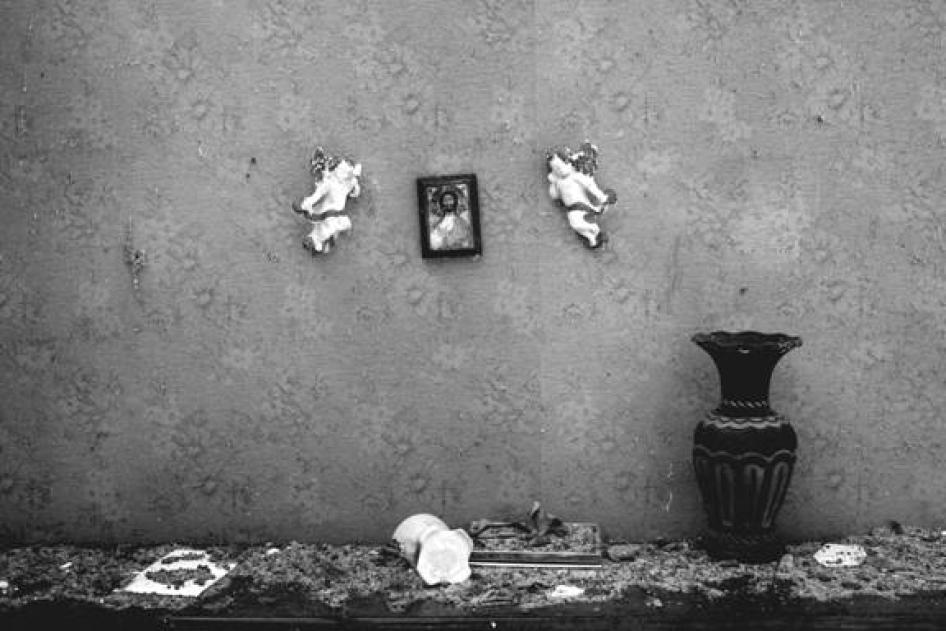
Interior of the home of Gela Chikhladze, age 55, burned down on August 12 by Ossetian militia in Tkviavi, August 19, 2008. © 2008 Marcus Bleasdale/VII
The killing of Viktor Gagoshvili in Ergneti
One day in mid-August (the exact date is unclear) Viktor Gagoshvili was shot and killed in Ergneti, a Gori district village right on the South Ossetian administrative border. That day, two Ossetian men with automatic weapons broke open the gate and entered the yard of Zuriko Kasradze, age 54. Kasradze managed to run away and headed toward another house, where about 10 other villagers were hiding. He told Human Rights Watch,
When I got there I saw an old man hunched over and running toward the house, so I also ran in. As the man ran in and sat down, we could see he was bleeding and had been shot in the back. He rolled over and died right there. His name was Viktor Gagoshvili.[434]
When four villagers tried to take Gagoshvili to his house to bury him that evening, however, they were apprehended by about 10 Ossetians who pointed and cocked their guns at them. One of the Ossetians who knew Kasradze intervened, and in the end no one was shot. Zuriko Kasradze fled the village. Neighbors told Kasradze that his house was burned that night.
The killing of Aliko Bibilashvili in Karaleti
About 4 or 5 p.m. on August 12, Nikoloz Bazandarashvili, age 78, Vlasiko Zaalishvili, and Aliko Bibilashvili were sitting by the main road from Tskhinvali to Gori city in the village of Karaleti. Ossetian militia driving by shot at Bibilashvili, killing him. Bazandarashvili told Human Rights Watch,
A white Zhiguli came down the central street. There were two guys in front and guys in the back. One of the guys in the front had a white armband. Someone from the back seat fired shots out the window.
They didn't stop [the car]. They fired at us and hit Aliko. Aliko fell and died soon after.[435]
The killing of Nora Kvinikadze in Abanoskoda
Raul Kvinikadze, a 22-year-old from Abanoskoda, a village in Kareli district on the administrative border with South Ossetia, described to Human Rights Watch the killing of his 75-year-old grandmother, Nora Kvinikadze, on September 6. On September 5 Raul Kvinikadze was in the village to check on his grandmother and help with the harvest.
My father and I were harvesting crops in my grandmother's field. As I approached the house, two Ossetians in camouflage, armed with machine guns, stopped me and asked me who I was. One of them cocked his gun and demanded that I give him my cellphone, so I did.
The next evening, after going into the village, I returned to my grandmother's house and found that my father was being held by four armed men in masks, wearing camouflage uniforms. They tried to take me and my father away. My grandmother was protesting and pulling on my father to keep him from being taken. One of them grabbed her to pull her away, and we all began to struggle. The assailants shot me twice in the right leg. They shot my father … and he immediately fell down. I don't know how my grandmother was shot, but when I was able to look at her I saw that she was dead.[436]
Raul Kvinikadze sustained a knee fracture, and his father was treated for a wound to the abdomen.
Rape
Human Rights Watch received numerous reports of rape of ethnic Georgian women during the August 2008 war. The Fourth Geneva Convention obliges parties to a conflict to protect women from "attacks on their honour, especially rape,[437] and rape is considered an act of "willfully causing great suffering or serious injury to body or health" that is a grave breach of the Geneva Conventions, and a war crime. [438]
Due to the sensitive nature of the crime, rape is frequently under-reported, and it is particularly difficult to document cases during conflict. Human Rights Watch was able to document two cases of rape in undisputed areas of Georgia under Russian control. Several factors suggest that the perpetrators were members of South Ossetian forces or militia. In both cases, the perpetrators wore military uniforms and white armbands, usually worn by South Ossetian forces to identify them to the Russian army as friendly forces. In both cases, the perpetrators spoke Ossetian. In one case, the perpetrators handed the victim over to the South Ossetian police in Tskhinvali, who later included her with other detainees in a prisoner exchange with Georgian authorities.
On August 13, Mariam C., in her 20s, left Tbilisi on a minibus with about 15 other passengers. Near Gori city, around 1:30 p.m., the minibus had to turn back because the road was blocked by Russian military troops.
As the driver turned the minibus around, four armed men in a black jeep drove up to it and started shooting in the air, forcing the minibus to stop. The armed men, dressed in black T-shirts, camouflage pants, and white armbands, ordered all the passengers out of the minibus and confiscated their cellphones. They took the minibus and then let all of the passengers go, except Mariam C. She described to Human Rights Watch the terror she felt during the abduction,
As one of the assailants took my cellphone he looked me in the eye, and I immediately felt that something terrible was going to happen. I just saw it in his eyes. Everyone was released but me. I begged them to let me go, but instead they dragged me and stuffed me into the jeep.
One of the assailants drove in the jeep with Mariam C., and three others rode in the minivan in the direction of Tskhinvali. Before reaching Tskhinvali the driver stopped the car, telling Mariam C. that it had broken down. They got out of the car on the edge of a deserted field and the driver asked Mariam C. whether she was married and had children. She told Human Rights Watch,
I sensed something terrible.… I immediately panicked. I was begging him not to do it, not to touch me. He just forced me onto the ground, slapped me several times, and raped me. The other three did the same.
At some point I must have lost consciousness. I saw them all before I fainted. I was thinking that they would kill me afterwards because I saw their faces. All I was thinking about-and waiting for-was when they would kill me.
When she regained consciousness she was surrounded by four or five men in military camouflage uniforms-apparently servicemen-and three of her attackers. They placed her in a Niva jeep and drove her to Tskhinvali. Mariam C. remembered feeling ill and in pain after her attack. "I felt sick. I had a terrible headache, and my back was aching," she told Human Rights Watch.
In Tskhinvali, the servicemen first took her to a school or a kindergarten where an Ossetian man in green military uniform gave her some medicine, including what she thought was a tranquilizer. Around 5 p.m. Mariam C.'s captors brought her to the Tskhinvali police station where she was interrogated. She told them what had happened to her. According to Mariam C., the police officers did not write down the information but confiscated her gold ring, earrings, and money, which they never returned. The police officers then took her to the basement where she was put in a cell with 13 other women.[439] (For a description of the conditions of detention, see section below on Detention of Georgians).
One of the women who shared a cell with Mariam C. described to Human Rights Watch the young woman's condition when she arrived at the police station:
At one point they brought in a young girl. Her name was [Mariam C.]. When they brought her in she immediately kneeled down on the floor and started crying. I said, "What happened to you my daughter?" She said, "I was taken away by some men." I asked, "Did they treat you badly?" And she said, "Yes, very much so," and continued to cry.[440]
On August 19 an unknown man arrived at the police station and promised to take Mariam C. home. Instead, however, he took her to an apartment where a woman was living with her two daughters. They gave her a separate room and meals, and treated her well. On August 22 Mariam C. was handed over to Georgian authorities during an exchange of prisoners, and she sought and received medical care. She described to Human Rights Watch the trauma she continued to suffer as a result of the rape: "Once back in Tbilisi, I was in shock and I could not sleep for three nights. I now take strong tranquilizers to sleep. I have nightmares and frequent headaches."[441]
On the morning of August 13, 18-year-old Eliso E. and her family learned that Ossetian looters were entering nearby villages (an uncle had phoned to say that looters had just stolen his car and had shot his friend who had refused to hand over a truck). The family began packing to leave their Gori district village,[442] but as they were doing so seven men in camouflage uniforms with white armbands arrived at their house in a Willys jeep. According to Eliso E., the men were heavily armed with automatic weapons, grenades, and large knives.
The armed men forced Eliso E. and her mother to the second floor of the house at gunpoint. They searched through the family's clothes, apparently looking for military uniforms. Some of the men beat Eliso E. on the shoulder and back with the butts of their guns and one slapped her in the face. The intruders stole several items of electronic equipment as well as gold jewelry and money (in the interests of protecting this young woman's identity, the details she gave have not been included with other accounts of looting featured below).
The armed men then took her mother downstairs and forced Eliso E. to stay in her room, with one armed man guarding the door. She told Human Rights Watch,
I started crying and praying. I was very scared. Then one man came back to my room. He was the one person who knew Russian, Ossetian, and Georgian. He asked me, "Where is your husband?" I said that I don't have one. He ordered me to take off my clothes. I resisted, but I couldn't stop him. He tore my clothes off of me. He told me in Georgian, "You'd better do it yourself or we will kill you and we'll still do what we want with you."
He asked me if I was a virgin and I said yes. He was the only one of them who had a mask on his face. He started to really struggle with me, and I pulled the mask off and I saw his face. This infuriated him and he started beating me. Then he raped me and told me that if I told anyone, he would kill me.
Before they left, the armed men beat Eliso E.'s brother and cousin on the head, shoulder, and back. She and her family left for Tbilisi. One month after the rape, Eliso E. told Human Rights Watch that she continued to suffer from her attack. "One month has passed. I have headaches, fever. I have terrifying nightmares, thinking that they are coming up the steps to take me," she said. "I don't want to go back to that place where I lived before."
Eliso did not immediately report the rape to a doctor, fearing the stigma attached to it, but eventually sought medical assistance.[443]
Abductions
Human Rights Watch documented many incidents of unlawful detention by Ossetian forces in which the victims were taken into Ossetian police custody (see below); we also received reports of Georgians who were abducted by Ossetians and not handed over to the police. Abductions violate the ban, contained in article 147 of the Fourth Geneva Convention, on unlawful confinement of a protected person and are considered grave breaches, or war crimes.
Lia B., 76, tearfully told Human Rights Watch on September 10 how she witnessed two Ossetian men abduct her 17-year-old granddaughter, Natia B., on August 13 in the middle of the day. She remembered,
We had left our village and spent a few nights in [a village in the Gori district]. We were walking back to our home in [South Ossetia]. Two men in a Zhiguli [car] … in camouflage uniforms with white armbands pulled up next to us. One of them was Ossetian … They were armed with automatic weapons and a big knife. The men didn't get out of the car. They grabbed Natia by her hair and dragged her into the car into the front seat. I begged them not to kill her. I screamed, "Help me they are taking my child away!" … They drove off in the direction of Tskhinvali.[444]
Soon after this interview, having had no information on her granddaughter's fate for four weeks, Lia B. learned that her granddaughter had been released from her captors sometime in September. Natia B. told her grandmother that she had been kept alone in a run-down deserted building and given bread and water daily, but did not report other abuse. She had no idea where this building was located.[445]
Zura Kareli told Human Rights Watch that he was in Karaleti on August 19 or 20 on his way home to Tkviavi together with his wife, son, and another relative. An Ossetian man wearing camouflage and with an automatic weapon attempted to detain him, his family, and 10-12 residents of Karaleti. After some of the Karaleti villagers fled, the Ossetian man shot Kareli in the hand in order to take the keys to Kareli's car, and then drove off in the car with four villagers in the back seat. Kareli did not know the names of those abducted and has no information about their whereabouts since the abduction.[446]
Pillage and Destruction of Civilian Property
Ossetian militias looted, destroyed, and burned homes on a wide scale in undisputed Georgian territory south of the South Ossetian administrative border. As noted above (Chapter 3, Violations by Russian Forces), Russian forces were in many instances involved in these actions, either as active participants, passive bystanders, or by providing transportation to militias into villages. The Geneva Conventions prohibit pillage and destruction of civilian property, and the deliberate nature of this violation against protected persons makes it a war crime.[447]
Pillage is prohibited, and the destruction of any real or personal property is only permitted where it is rendered absolutely necessary by military operations.[448]
Villages close to the South Ossetian administrative border such as Koshka, Ergneti, Nikozi, Megvrekisi, Tirdznisi, and Tkviavi in Gori district, and Dvani, Knolevi, Avlevi, and Tseronisi in the Kareli district were particularly hard hit by destruction and pillage.[449] Though the looting and torching was ongoing, two waves are discernable: the first just after Russian troops began the occupation of Gori and Kareli districts, and the second in the last week of August.
As noted above, in some incidents looters killed residents during the pillaging.
Gori district
Tkviavi
On August 12 several groups of armed Ossetians arrived in Tkviavi with Russian forces and stayed to loot and burn civilian property after Russian forces passed through the village. Luiza L., a Tkviavi resident who stayed in the village during the conflict, described to Human Rights Watch,
Three people came to my house. I can't remember the date, but it was after the bombing [on August 11].[450] They asked, "Where are the cars? Where are the people? Where are the big houses in the village?" I just said, "Take anything you want, but please don't shoot." If someone tried to say something, to prevent the looting, they would start shooting. They came to my house three times-first Ossetians, then Russians. Russians just asked if the "bandits" were here and asked for cigarettes.[451]
Other Tkviavi residents, Salome S. and Sofiko S., told Human Rights Watch, "The looters were mostly taking away cars, and money from some well-to-do houses as well. After Russian checkpoints were established here, the massive looting stopped, but they kept coming during the night."[452]
Toma T., an ethnic Russian who is a long-time Tkviavi resident, told Human Rights Watch, "They came on a tank. If a family wasn't home, they would break the gates of the house with a tank, enter the houses-they were mainly looking for arms and ammunition. At that point, they were taking away cars, not household items. The looters took almost every car in the village-the ones that they couldn't take away, they burned."[453]
Tirdznisi
A Tirdznisi village administrator told Human Rights Watch that Ossetian looters had deliberately burned 16 houses in the village; Human Rights Watch saw the remains of many of these houses.[454] A witness to at least one of the burnings, Julieata Tetunashvili, described to Human Rights Watch seeing militias shoot "a sort of rocket" into some of the houses, which would set them on fire: "They were shooting at houses from a long weapon and immediately after, the house would catch fire. It was Ossetians, not Russians, who set houses on fire."[455]
On August 15, the home of Elizabeta Naskidashvili, age 78, was set on fire presumably by militias. Naskidashvili was not at home when the militias set fire to her house, but she arrived home to find thick smoke billowing out of the doors, which had been broken down. A neighbor helped her extinguish the fire. Her house had been ransacked, but nothing was missing.[456]
On August 12, Ossetian militia assaulted Leila Tetunashvili, age 65, and looted her house. She told Human Rights Watch,
At about 5 p.m. three Ossetians in camouflage uniforms and armed with automatic guns [broke] in, taking the door down. One of them stood there, raising his hand, saying that I had five minutes, then he would bend one finger, saying four minutes and so on … they were counting the time that I had left before they would shoot me unless I gave them money and gold. The same guy called his friend to bring the gun to shoot me. I got really scared and gave them all the money I had-40 lari [about US$28].
My grandson, who was not home, has a corner in the house with icons and he also had a Georgian flag hung there. The Ossetian found it and brought it down and started cursing at me. He slapped me on the face, shouting, "What is this?" And then he twisted it and … started strangling me with it. I started suffocating and turning red. Then he released me. They stayed for 20-25 minutes and took everything they wanted.
The next day other Ossetians came and took two cows. The day after that only one came, saying that he was a Russian soldier, then he pointed a gun at my husband, but I begged him on my knees not to shoot him and he left.[457]
Seventy-year-old Izolda Samadashvili described a similar experience to Human Rights Watch:
Ossetians came, three of them, all armed with automatic guns. They pointed the gun at our head and demanded our car keys. We had a Zhiguli and we had to obey; we feared they would shoot us.
The second time they came, they asked for weapons. Then they asked for my son, who lives in Tbilisi. Then they entered the house and started looting. They took everything they liked, clothes, fur coats, 300 lari [US$210]. They also broke into a small shop we had in our house and took food and cigarettes.[458]
Dvani
According to one villager, Russian troops, followed by Ossetian militia and Cossacks, passed through Dvani on August 8. The villager, Vasili Otiashvili, said his neighbor's house was looted that day; two days later Otiashvili fled.[459] When he returned on August 27 his house had been burned to the ground. Otiashvili estimated that at least 30 houses had been burned in the village, although it is not clear how he made this estimate.
Koshka
As described in Chapter 3.6, Russian and Ossetian forces began looting Koshka on August 9 and 10. Because Russian forces failed to provide security in the areas under their effective control, the residents remaining in Koshka also became victims to common criminal groups operating in the area in the weeks following these initial attacks. On August 24, four armed Ossetians returned to the village and forced Arkadi A. to help them loot his neighbor's house. Arkadi A. knew the men and told Human Rights Watch that they were not members of the South Ossetian forces, but simply robbers from the ethnic Ossetian village of Khelchua, in South Ossetia. He told Human Rights Watch,
I stood in the street with three neighbors. They approached us, shooting in the air, and said, "You weren't happy with a peaceful life-now we're going to show you!" They asked for money, but what kind of money do we have? Then they started beating us with their gun butts. One neighbor had his collarbone broken as a result of the beating. They hit me and another neighbor in the face, on the ribs, and in the kidney area. Then they went to the house next door and looted it. I saw them take away a fridge, clothes, and other things. They loaded the loot onto a cart and forced me at gunpoint to push it.[460]
When Human Rights Watch interviewed Arkadi and his neighbor, the two men were visibly in pain, and were transported to a hospital shortly thereafter.
Megvrekisi and Nikozi
On August 26 and 27, numerous residents fled the villages of Megvrekisi and Nikozi because on the previous days Ossetian militias had been looting and burning houses. Nanuli Maisuradze, a 52-year-old resident of Megvrekisi, told Human Rights Watch that she stayed in the village during most of the fighting, occupation, and looting that followed but that the deteriorating security situation eventually forced her to flee: "I left the village [on August 26]. We left because [on August 24] Ossetians came into the village, beat one person and killed another one. The Russians were not doing anything, but did not stop the Ossetians either."[461]
Karaleti
Izolda Tedliashvili, age 66, was in Karaleti on August 13. She told Human Rights Watch,
I saw how three houses were burned. Within one hour they were completely burned. The fire started from the inside, then the roof would collapse, and then smoke and fire would come up. We were hiding in the yard and we would peek out and see that the [assailants] were still there. We only know that they were in camouflage uniforms, we could not see their faces.[462]
Human Rights Watch saw the burned houses and has photographs of them on file.
Kareli district
Knolevi, Avlevi, and Tseronisi
Knolevi, Avlevi, and Tseronisi are neighboring villages in Kareli district, close to the South Ossetian administrative border. Dmitri Abukidze, 24, described how he saw Ossetian militias fire grenade launchers at homes, setting them on fire and how the soldiers stole livestock from the local residents. Abukidze had been detained with his father in Tseronisi on August 13 and placed in an armored personnel carrier. Abukidze recounted that while he was being transported to Tskhinvali,[463] he observed in and near Tseronisi that "[the Ossetians] just fired from their grenade launcher at the houses, from a distance, and the houses would immediately catch fire. They mostly targeted big, wealthy-looking houses. They also took the cattle away. The elderly were forced to accompany the cattle to the border, and [the looters] went behind, holding them at gunpoint."[464]
Inhabitants of Knolevi told Human Rights Watch that after Russian troops moved through their village on their way south, Ossetian looters followed in their own cars, looting and burning houses. The few remaining residents we found in Knolevi on August 23 told Human Rights Watch that Ossetians had looted and burned 29 houses in Knolevi, 6 in Avlevi and about 42 in Tseronisi.[465] One of the residents remarked,
They are still coming-yesterday [August 22], for example, they were here. They are taking away cars, cattle, and valuable things like fridges. There is no order, no law enforcement here. Just an Ossetian checkpoint nearby. Russians used to patrol, but now they are gone. There were also peacekeepers, but they don't come anymore either.[466]
Russian forces maintained a checkpoint just outside these villages at the time the looting took place.
4.4. Execution, Illegal Detentions, Ill-Treatment, and Degrading Conditions of Detention by Ossetian Forces, at times with Russian Forces
As Russian forces began to occupy South Ossetia on August 8 and 9, South Ossetian forces traveled with them or followed them into ethnic Georgian villages in South Ossetia and then into Gori and Kareli districts. Most of the able bodied and younger residents had fled just before the start of hostilities or in the initial days of fighting. Most of the residents who remained in the villages had chosen to stay behind to look after their homes and property or were unable to flee. Ossetian forces, at times together with Russian forces, detained some of the residents they found remaining in these villages, particularly in the ethnic Georgian villages of South Ossetia; in most cases, detentions took place in the context of the campaign of looting and destruction described above. Detainees told Human Rights Watch that they were not given reasons for their detention and did not have access to lawyers or any opportunity to challenge their detention.
As Russian and Ossetian forces entered Georgian villages in South Ossetia and the Gori district, they detained at least 159 people,[467] primarily ethnic Georgians as well as at least one Ossetian and one ethnic Russian married to an ethnic Georgian. Forty-five of the detained were women. At least 76 were age 60 or older, and at least 17 were age 80 or older.[468] There was one child, a boy, about eight years old.[469] Human Rights Watch interviewed 29 of the detained, all post-release. Many detainees described ill-treatment during detention, during transfer to custody, and in custody. Most detainees were held in the basement of the South Ossetian Ministry of Interior building in Tskhinvali for approximately two weeks in conditions that amounted to degrading treatment. Some of these detainees were forced to work clearing the Tskhinvali streets of decomposing bodies of Georgian soldiers, and debris. At least one man was executed while in Ossetian custody during his transfer to the Ministry of Interior. All of these actions are grave breaches of the Geneva Conventions and amount to war crimes. To the extent that Russia exercised effective control in the territory where these detentions took place, the Russian government is liable for these acts, which also amount to violations of its human rights obligations under the ICCPR and the ECHR.
In some instances, Russian forces directly participated in the detention of ethnic Georgians, and detainees held in the Ministry of Interior reported being interrogated by people who introduced themselves as members of Russian forces. Russian and Ossetian forces also held at least six Georgians at what appeared to be a military field base and beat them before handing them over to Ossetian police.
Legal Status of and Protections for Individuals Detained by Ossetian and Russian Forces
All of those detained by Ossetian and Russian forces and interviewed by Human Rights Watch stated that they were civilians not participating in the hostilities and had not taken up arms against Ossetian and Russian forces. Under the Fourth Geneva Convention, which defines the protections afforded to civilians during wartime, civilians are considered to be protected persons. The Convention requires that persons "taking no active part in the hostilities, … shall in all circumstances be treated humanely, without any adverse distinction founded on race, color, religion or faith, sex, birth or wealth, or any other similar criteria."[470] Grave breaches of the Fourth Geneva Convention, including willful killing, torture and inhuman treatment, and willfully causing great suffering or serious injury to body or health, are war crimes.[471]
The protections guaranteed by the International Covenant on Civil and Political Rights and the European Convention on Human Rights are also applicable with respect to Ossetian and Russian detention of Georgians. Since Russia at the time had effective control over the areas where the detentions described in this section took place, it is Russia as the state party to both instruments that bears responsibility for protecting individuals' rights under the convention. The ICCPR and ECHR provide an absolute prohibition on torture and other degrading or inhuman treatment.[472] The provisions of the ICCPR and ECHR banning arbitrary detention are also applicable, and Russia did not derogate from those convention obligations, although limited derogations in times of war are permitted.[473]
During hostilities and occupation, the Fourth Geneva Convention permits the internment or assigned residence of protected persons such as civilians for "imperative reasons of security."[474] However, unlawful confinement of a protected person is a war crime.[475]
Human Rights Watch has not been presented with evidence that there were reasonable security grounds for the detention of the 159 persons detained by Ossetian and Russian forces. Many of those detained were very elderly, and one was a small child. Most were detained in circumstances that strongly suggest that they were not taking up arms, not participating in hostilities, and not otherwise posing a security threat, as described below.
If, among the detained, there were Georgians who participated in hostilities against Ossetian or Russian forces, but who were not members of the Georgian military, under international humanitarian law such persons would be considered non-privileged combatants.[476] Georgians who took up arms to defend their lives or property from advancing Ossetian or Russian forces would be considered armed civilians. In both cases, detention of such persons would be considered reasonable on security grounds. Such persons are entitled to the protections guaranteed to civilians under the Fourth Geneva Convention. Detentions must be carried out in accordance with a regular procedure permissible under international humanitarian law. Those detained have a right to appeal their internment and have their case reviewed every six months.The Fourth Geneva Convention provides detailed regulations for the humane treatment of internees. The International Committee of the Red Cross must be given access to all protected persons, wherever they are, whether or not they are deprived of their liberty.[477]
Given their particular vulnerability, children are afforded special protections under the Geneva Conventions. Protocol I states, "Children shall be the object of special respect … Parties to the conflict shall provide them with the care and aid they require, whether because of their age or for any other reason."[478]
Ossetian President Eduard Kokoity has stated that "ethnic Georgians were detained for their personal safety" and that "the Ministry of Interior [was] protecting them and saving their lives."[479] While the Geneva Conventions allow for internment in order to provide for the security of civilians, Human Rights Watch has not found evidence that the detentions by Russians and Ossetians had this purpose or were justified on these grounds. The fact that the majority of individuals were detained as Georgian soldiers were retreating and in areas in which Russian and Ossetians exercised effective control suggests that in most cases civilians were not likely to be threatened by armed combat. Furthermore, Russian and Ossetian forces apprehended most individuals in a violent and threatening manner and subjected them to inhuman and degrading treatment and conditions of detention, and forced labor, reflecting no intent on the part of these forces to provide for the personal safety and well-being of those detained.
Ill-treatment at the Time of Arrest and during Transfer to Custody, and an Execution
Human Rights Watch interviewed several Georgian detainees from South Ossetia and the Gori district who reported ill-treatment, including beatings, humiliation, threats of killing, and mock executions when Ossetians detained them. Some also reported ill-treatment during transfer to the Ministry of Interior in Tskhinvali. Human Rights Watch documented the execution of one man during his transfer to the Ministry of Interior. Willful killing and ill-treatment of protected persons constitute war crimes.[480]
Detentions in South Ossetia
After Ossetian forces entered Kekhvi on August 11, Shermadin Nebieridze, age 71, fled to a neighboring village and then returned to his home in Kekhvi that evening, where his house was burning (as described in Chapter 4.2). The next day, August 12, he was in his yard when Ossetian forces armed with automatic weapons and wearing camouflage uniforms with white armbands spotted him and forced him into a neighbor's yard at gunpoint. Nebieridze described to Human Rights Watch his treatment as the men detained him:
One of them loaded his weapon and pointed it at me. He said, "I'll kill you, you motherfucker!" I begged them, "Please don't kill me. I haven't done anything. I am an elderly man." A second fighter came and pushed the gun away and said, "Don't kill him." The first then kicked me in the chest and I fell back on the concrete. I must have hit my head because I lost consciousness. When I woke up I struggled to get up. The second fighter kicked me in the neck and I fell back down. They picked me up and walked [me] out of the yard.[481]
Husband and wife Ilo Khabareli, 73, and Salimat Bagaeva, 69, from Zemo Achabeti, described to Human Rights Watch the ill-treatment they each endured during detention by South Ossetian forces. Ossetian forces entered the village on August 10. Bagaeva, who is an ethnic Ossetian, had gone next door to her son's house to check on it when 15 armed Ossetian militia entered the house, pointed their guns at her and cursed her, saying, "Why the fuck are you not leaving this place!?"[482] When Khabareli, who is an ethnic Georgian, came to the house to help her, they again yelled at Bagaeva saying, "Why did you marry this Georgian pig?" One of the Ossetians then kicked Khabareli in the chest, knocking him down. When he tried to stand, a second soldier hit him with the butt of a gun in the neck, knocking him down again. When he was finally able to get up, one of the Ossetians punched him in the face, causing Khabareli to lose several teeth. The Ossetian forces forced Khabareli and his wife and daughter to stand facing the wall of their house while they shot at their feet and in the air.[483]
The Ossetians gathered Bagaeva, Khabareli, and about 10 or 15 other Zemo Achabeti residents and forced them to walk one kilometer toward Kvemo Achabeti. According to Bagaeva, one of the soldiers told the group, "Come with us now, or you will all be killed. No one is allowed to stay here overnight."[484] The group was put into a minivan and taken to the Ministry of Interior building in Tskhinvali.[485]
Nunu Gogidze, 60, described how, on August 10, two Russian soldiers and two Ossetian soldiers entered her yard in Tamarasheni while she was home alone and demanded that she come with them. When she asked them to let her get her documents, "they shot at the ground in front of my feet."[486] On that same day in Tamarasheni, three or four Ossetians looted the house of Tamar Khutsinashvili and set it on fire (see Chapter 4.2).[487] The Ossetians directed Khutsinashvili, 69, and her 73-year-old husband to the side of the road where they had gathered numerous other Tamarasheni residents. Khutsinashvili recalled, "I was terrified. I told them, 'Kill us here if you want.' One Ossetian hit me on the head with a gun butt and cursed me and said, 'Stop speaking the language of dogs [Georgian]!'"[488] Ossetian forces then took Gogidze, Khutsinashvili and several of their neighbors to the South Ossetian Ministry of Interior.[489]
Detentions in Gori district
On August 10 Tamaz Chalauri, 60, fled his home in Mereti and boarded a white minivan in Tkviavi. As the van approached the center of Tkviavi, Ossetians on an armored personnel carrier stopped it and forced the passengers out. Chalauri told Human Rights Watch, "I got out and they hit me in the stomach with the butt of a gun. They were swearing at us … saying, "You pigs, you killed so many of our people. Now we will kill you."
The Ossetians forced the minivan's male passengers, as well as the male passengers from a car they had stopped in the same location, back into the minivan. An Ossetian drove the van, but lost control of the wheel on the outskirts of Tirdznisi, and the van rolled over several times. Chalauri told Human Rights Watch, "Most people got out of the van, but there was one person left inside. The Ossetians then sprayed the van with gunfire. The man inside was then dead, but I'm not sure whether it was from the accident or from the shooting." Chalauri was injured, and complained to us of pain in his head and back.[490] Another man who had been in the van, but managed to escape in the chaos immediately following the accident, believed that the Ossetian driver was also killed.[491]
Another minivan arrived and the Ossetians forced the remaining 10 Georgians (at least four had escaped) into it. Chalauri described the ill-treatment he and others suffered in the van and the execution of one of the passengers:
We were made to lie on the floor face down [the van had no seats]. They yelled at us, "Don't lift your heads!" One big Ossetian man in heavy boots was stomping on my ankle in order to try to force me to raise my head.
There was one young man, about 25, lying next to me. He raised his head several times and was hit several times. Then all at once one of them loaded his gun and shot the young man twice in the head to kill him and then shot a third "control" shot just to make sure [he was dead]. The young man's brains came out of his head and onto my body. For 11 days I had to wear those same clothes with his blood and brains on them. They … threw the body out somewhere between Brotsleti and Megvrekisi.[492]
The Ossetians then took the remaining nine men to school No. 6 in Tskhinvali, which Ossetian forces were using as an improvised base and where they had also held Georgian prisoners of war. Ossetian captors again threatened to beat and kill the detainees. A doctor treated two or three of the detainees who had been injured in the road accident, and gave the group water. Later that evening they transferred seven of the men to the South Ossetian Ministry of Interior. Two of the detainees were separated from the group and were not seen again.[493]
Dmitri Abukidze, 24, from Tirdznisi, told Human Rights Watch that on August 13, Ossetians in camouflage uniforms entered the village and began demanding that the residents provide information about three Ossetians whom they claimed were detained by Georgian military, saying, "Where are our three people, from Znauri? If you don't find them, we'll take you to Tskhinvali." They then detained Abukidze, his father, and several of their neighbors and forced them onto an armored personnel carrier. According to Abukidze, "They started moving, and some 30 minutes later I managed to jump off. They fired at me from an automatic gun, and hit me in the leg. Then they let all of us go."[494] The group was released apparently because the Ossetian captors seemed reluctant to take a wounded detainee and several witnesses to the shooting into detention.
Ill-treatment in detention and degrading conditions of detention at the South Ossetian Ministry of Interior, Tskhinvali
All of the detainees interviewed by Human Rights Watch described appalling conditions of detention in small, overcrowded basement cells of the South Ossetian Ministry of Interior building in Tskhinvali. Many detainees described degrading treatment, particularly upon arrival at the facility. Material conditions in Tskhinvali at the time of these detentions were dire: the city had no electricity, very little food, and very little water. Irrespective of these conditions, Russian and Ossetian authorities had an obligation to provide humane conditions of detention in accordance with international standards. Ill-treatment and willfully causing great suffering or serious injury to body or health constitute war crimes.[495] Several detainees told Human Rights Watch that Russian Federation officials were present at certain times at the Ministry of Interior during their detention.[496]
Ill-treatment in detention
Tamaz Chalauri described treatment by Ossetian forces upon his arrival at the Ministry of Interior building in Tskhinvali on August 10: "They lined us up facing the wall. They wrote down our names, searched us, took everything we had with us. They were hitting us, kicking us, cursing us the whole time, and calling us, 'You Georgian pigs, you motherfuckers.'"[497] Others also described searches, which sometimes involved beatings or stripping of clothes, as well as confiscation of money, cellphones, jewelry, and identity documents. Nothing was returned to the detainees upon their release, except identity documents in some cases.[498]
Some detainees reported that Ossetian forces forced them to walk across or spit on a Georgian flag placed on the ground near the Ministry of Interior building.[499] When Ilo Khabareli refused to step or spit on the flag and said, "Kill me here because I won't do that," an Ossetian fighter hit him on the head, forcing him into a wall, where he hit his head again.[500] Vazha Lagazashivili told Human Rights Watch that when he tried to walk around the flag, Ossetians hit him with the butt of a gun on the back and neck.[501]
Human Rights Watch did not interview anyone who was beaten at the detention facility, except in those cases when the interviewee was beaten upon arrival as described above. However, former detainees told Human Rights Watch that many of the men, particularly the young men, were beaten, and that some were beaten frequently. They described consistently how men would be taken out of their cells and out of the basement, and how, when they were returned, they showed clear signs of beatings.[502] Manana Gogidze, 48, from Tamarasheni, told Human Rights Watch that she witnessed young men regularly being beaten:
We saw them being taken upstairs and we could hear their screams. When they were brought back, they would bear clear signs of beating.… I saw the bruises myself as I was trying to help them. There was a young man from Tirdznisi who was beaten several times. I saw large dark bruises mostly on his back … There was one [elderly] detainee … who spoke no Ossetian despite having an Ossetian name. He was hit once by the guards for not speaking Ossetian.[503]
Salimat Bagaeva told Human Rights Watch, "[Y]oung men would be taken out and then badly beaten. I saw them. Their bodies would be covered in bruises. There was one who had a broken nose."[504]
Several, although not all, detainees reported that they were interrogated during their detention. One reported being insulted by an Ossetian police officer, but none of those interviewed by Human Rights Watch reported ill-treatment during interrogation.
Degrading conditions of detention
Detainees stated that the basement contained five dark, dirty, poorly ventilated cells without windows, designed for short-term detentions. Women and men were held in separate cells. The cells quickly became overcrowded and the guards eventually opened the doors of the cells and detainees could move into the hall or the small, fenced-in, outdoor exercise yard accessible from the basement.[505] These areas quickly also became full as more detainees were brought to the basement. According to one detainee, "There wasn't even space to walk around in the corridor or in the exercise yard" due to the large number of people.[506]
With many more detainees in the cells than there were bunk beds for them, most were forced to sleep sitting up or lying on the floors of the cells, halls, or exercise yard.[507] One detainee, 76-year-old Rusudan Chrelidze, remarked that in her cell, "the women were sleeping like herrings in a tin."[508] A 47-year-old detainee from Karaleti reported that in his cell people slept in shifts because there was not enough space for people to lie down.[509]
Detainees described being given small quantities of water that contained sand and was frequently undrinkable, and insufficient food.[510] During the initial days of detention, detainees received only bread. Guards would throw four to five loaves of bread into the cells, saying "Eat, you pigs!"[511] Detainees stated that later they were given slightly more and better food, including buckwheat cereal, more servings of bread, and tea. Detainees reported losing significant weight during their two weeks of detention.[512]
There was one toilet for all detainees covered with a plastic sheet that the detainees put up themselves. The toilet smelled terribly and frequently overflowed because it did not have water.[513] When asked what had been the most difficult part of her experience in detention, Rusudan Chrelidze said, "The toilet was a big problem. There was only one and there was always a long line for it."[514]
Forced labor Ossetian forces forced many of the male detainees to work, which included recovering decomposing bodies from the streets of Tskhinvali, digging graves, and burying bodies, as well as clearing the streets of building debris from the hostilities.[515] Two detainees interviewed by Human Rights Watch stated that they volunteered to work on some days in order to be out of the overcrowded cells for a few hours. None of the workers received any compensation for this work. Under the Fourth Geneva Convention, adults (individuals age 18 or older) may be required to work as is necessary to maintain public utilities, and to meet needs of the army and humanitarian needs, such as activities related to feeding, sheltering, clothing, and health care of the civilian population. People must be appropriately compensated for their work, and there can be no obligation to work based on any form of discrimination. Unpaid or abusive forced labor, or work that amounts to partaking in military operations, is strictly prohibited.[516]
Vazha Lagazashivili, age 58, told Human Rights Watch that he was forced to work every day of his 20-day detention:
They would take us out at 9 a.m. until late evening. We were cleaning the streets. They told me that I must go. We had to clear dead bodies from the street. We had to pick them up and put them into body bags. Some had limbs missing. [We also] collected the body parts.
I was taken out sometimes to do other work, like unload trucks full of humanitarian aid from Russia… They would give us one tin of food per person and some bread after we unloaded the trucks. We could only rest when we were given some food, for about half an hour. Of course I was not paid.[517]
Revaz R., 36, from Zemo Achabeti, confirmed that he was among 30 men who were forced to work from early morning until 7 or 8 p.m. "We cleaned the street, threw out garbage, and removed and buried the dead. We buried about 44 people. Most of the corpses were already decaying," he told Human Rights Watch. He also stated that while they worked they received better food, such as canned meat.[518] After about a week in detention, Ossetian forces also forced 70-year-old Gaioz Babutsidze to work for two days lifting coffins off trucks and placing them in graves. He estimates that they buried 50 bodies.[519]
Those who worked were also subjected to degrading treatment as they were taken from their work locations to the Ministry of Interior building. "Sometimes they would make us walk back to the police station … accompanied by four soldiers… People on the streets would yell at us, insult us. They were cursing, swearing, calling us sons of bitches, pigs, whores," Vazha Lazagashivili told Human Rights Watch.[520]
ICRC, journalist visits to the facility
Detainees reported that the International Committee of the Red Cross visited the facility in mid-August.
Journalists also visited the facility. David Giunashvili stated that he spoke to a journalist from the Moscow newspaper Nezavisimaya Gazeta.[521] Tamaz Chalauri told Human Rights Watch that he was forced to give an interview to Russian television.[522] Emilia Lapachi, age 51, recalled being pressured to speak positively about her detention experience for Russian journalists:
One day Russian journalists came to interview us. We were told by the guards that … if we wanted to be released, we should tell them that we had been treated well and that we had no complaints. We were told to say that we had been taken to custody for our own safety and security. We discussed it among ourselves and decided to say anything to be released from there.[523]
Release of civilian detainees Ossetian forces released one group of 61 detainees, including most of the elderly and all of the women, on August 21, in exchange for eight detainees whom the Georgian Ministry of Defense described as militia fighters. Other civilians were released on subsequent days, including a final group of 81 civilians on August 27, who, according to the Georgian Ministry of Defense, were exchanged for four people detained during active fighting and described as "militants," as well as nine Ossetians previously convicted for crimes and serving sentences in Georgian prisons.[524] While prisoner exchanges are a recognized and legitimate process to facilitate repatriation of prisoners who are in the hands of the enemy, it is prohibited to use the mechanism of prisoner exchanges as a means of effecting population transfer.[525] It is also prohibited to use prisoners as hostages-that would be to unlawfully detain persons with the intent of using them to compel the enemy to do or abstain from doing something as a condition of their release.
Detentions by Russian and Ossetian forces in other locations
Four Georgian men who had been working on construction sites in Java for several weeks prior to the outbreak of hostilities on August 8 described their detention at two different military bases prior to being transferred to the Ministry of Interior building in Tskhinvali. Human Rights Watch interviewed separately two of the four, Gogita Kotuashvili, age 30, and David Giunashvili, age 47, who described how the four fled Java on foot when Georgian bombing of the town started on August 7. The men walked south hoping to reach a Georgian village, but mistakenly entered an Ossetian village in the Znauri district in South Ossetia. A group of armed Ossetian men in civilian clothes and several men in military uniforms, apparently members of Russian and Ossetian forces, detained the four men. Upon detention they beat the four, kicking them and hitting them in the back of the head with rifle butts. They also confiscated the men's identity documents, tied their hands behind their backs, and blindfolded them before putting them into a car and driving them to what the men described as a military base, consisting of a military tent as well as at least one tank.
The four men were questioned upon their arrival, including being asked whether they were in the Georgian military. With their hands still tied, but their blindfolds off, the men were then put into a hole dug out in the ground, approximately 1.5 meters deep, where they were held for three days. They were given food packaged in military green boxes with Russian labels, and saw cars with Russian license plates arrive at the base and heard Russian being spoken in the tent. On August 9, two men wearing camouflage took the four detainees out of the hole, again blindfolded them and tied their hands, and told them they were being taken to Tskhinvali to be handed over to a Russian and Ossetian military base. When they arrived, their blindfolds were removed, and the men could see a large amount of heavy military equipment, including tanks, on the base. The two detainees interviewed by Human Rights Watch said that many of the soldiers were Russian and Chechen members of the Russian federal forces as well as other irregular fighters from Russia.
Upon arrival at this base, the captors, together with 10 to 15 military servicemen, forced the four detainees to kneel down next to the bodies of two Georgian men lying on the ground. They ordered David Giunashvili to shoot one of his fellow detainees, and Gogita Kotuashvili to shoot the fourth detainee. However, when Giunashvili refused to shoot, the captors did not do anything in retribution, other than forcing the detainees to place the two dead bodies in a car.[526]
The Ossetian and Russian forces then forced the men to sit near the edge of a swimming pool, and beat them. Gogita Kotuashvili stated that he was beaten with rifle butts.[527] The detainees were placed in what appeared to them to be a guardhouse, with two beds. The detainees were taken to eat meals in the canteen and were regularly cursed by the soldiers on the base. After two to three days, on August 11 or 12, two men wearing blue and white camouflage uniforms took the detainees to the South Ossetian Ministry of Interior in Tskhinvali.[528]
Nikoloz Eremov, age 40, and Vazha Kebadze, both from Variani (in Gori district), were held a few days later at what is clearly the same Russian-Ossetian military base in Tskhinvali where the four Georgians had been held. According to Eremov, men who appeared to be Russian military detained him and Kebadze in Variani on August 16, drove them to the base, and immediately placed them in the empty swimming pool. Eremov told Human Rights Watch that at the base he saw Russians, Chechens, and Cossacks and a large amount of heavy military equipment. Russian and Ossetian forces forced the detained men to remove all of their clothes and stand facing the pool wall, with their hands tied behind their backs with rope.
Eremov described how one Russian soldier questioned him while three Ossetians beat him: "The [Russian] officer wasn't beating me but the others were. The Ossetians would beat me on the legs and on the shoulders with their gun butts, and the Russian officer would ask questions." Eremov heard other soldiers questioning and beating Kebadze, who shouted out, "Just kill me! Don't beat me anymore!" After three hours they allowed Eremov to dress and released him by leading him to the woods and telling him, "Get the hell out of here and go home!" Vazha Kebadze remained in the pool. At the time we interviewed Eremov, a week later, Eremov had no information of what had become of Kebadze.[529]
On August 12, Sergo Mindiashvili fled Nikozi, right on the administrative border, because the village was being bombed. He began walking to Gori, but was detained at an Ossetian checkpoint in Shindisi. As six or seven Ossetians detained him, they kicked and punched Mindiashvili and beat him with the butts of their rifles for approximately 20 minutes. Then, they forced him to get in a car. "They threatened to kill me if I didn't do as they said. They pointed a gun at me. [In the car] they continued to beat me all over," Mindiashvili told Human Rights Watch.
The Ossetian forces drove Mindiashvili to a location that he described as a base near Tskhinvali, possibly the same base as described in the cases above. Mindiashvili described his short detention there:
They started questioning me, but I was beaten good first. They didn't explain why I had been detained. They took me to … a sort of storage room. There were about 10 to 15 Ossetians, all in camouflage uniforms. They kicked and punched me and beat me with rifles... They asked whether I had served [in the military], where the Georgian forces were located, … I knew one of them, Alan, … he also beat me. … They decided I should be executed... They loaded their guns and one person lifted his arms [to take aim]. I started crying.
Alan then intervened to stop the execution and the Ossetian forces placed Mindiashvili in a small room. Mindiashvili told Human Rights Watch, "Anyone who wanted could come and beat me. I spent two to three hours there. I was beaten several times."
The Ossetians then took Mindiashvili to Variani and handed him over to Russian soldiers at the checkpoint there. Two other Georgians were being held there; the Russian soldiers treated one of the men's wounds and gave all three men food and water. A Russian officer questioned Mindiashvili and told the soldiers to "do away with him," but once the officer left the other soldiers released Mindiashvili.[530]
4.5 Execution, Torture, and Other Degrading Treatment of Georgian Prisoners of Warby Ossetian Forces, at times with Russian Forces
Russian and Ossetian forces detained at least 13 Georgian military servicemen during active fighting. All these detainees were entitled to prisoner of war (POW) status and should have been treated as such. Human Rights Watch interviewed four, post-release, all of whom had been captured in Tskhinvali by Ossetian militias on August 8. Human Rights Watch also interviewed one of the Ossetian militia fighters responsible for holding the Georgian soldiers for the first three days following their capture. All four Georgian military servicemen were held in informal places of detention, including a dormitory and schools, for several days, and were then transferred to Ossetian police. Ossetian police held several Georgian soldiers for six days, including three of the four interviewed by Human Rights Watch. They transferred one of the Georgian serviceman interviewed by Human Rights Watch to Russian custody, where he was treated for wounds. Georgian soldiers reported that they had been subjected to severe torture and ill-treatment throughout their detention by Ossetian forces. Human Rights Watch documented the execution of three Georgian servicemen while in the custody of Ossetian forces.
Ossetian forces eventually transferred 13 Georgian prisoners of war to Russian forces, and Russian authorities exchanged them for five Russian prisoners of war on August 19.[531]
Russian forces had or ought to have had full knowledge that Ossetians detained Georgian servicemen. They apparently participated in the execution of two Georgian soldiers, as well as in interrogations of Georgian POWs in Ossetian custody. Furthermore, the Georgian soldiers were held in Tskhinvali, over which Russia exercised effective control from August 9, and therefore are to be regarded as having fallen into Russia's power. Russia was therefore obligated to afford them POW status and to treat them in conformity with the protections of the Third Geneva Convention, which include absolute prohibitions on ill-treatment and require POWs to be treated humanely and kept in good health.[532] The execution, torture, and ill-treatment of prisoners of war are grave breaches of the Third Geneva Convention and constitute war crimes.[533] The ICCPR and ECHR also provide an absolute prohibition on torture and other degrading or inhuman treatment and an obligation to protect the right to life of those in detention.[534]
Beatings and Humiliation during Initial Days of Detention
Three Georgian servicemen interviewed by Human Rights Watch-Davit Malachini, Imeda Kutashvili, and Kakha Zirakishvili-were detained together by Ossetian forces on the afternoon of August 8.[535]
The three were among a group of seven Georgian soldiers Ossetian forces took to the basement of a four-story building, where Ossetian women and elderly as well as wounded Ossetian militia fighters were hiding.[536] Although some soldiers described the building as an apartment block, an Ossetian militia fighter interviewed by Human Rights Watch and involved in the detentions stated that the building was actually a dormitory of the agricultural technical institute.[537] The Georgian soldiers were given some food, water, and cigarettes on the first day of detention.[538] That evening additional men arrived at the building, including some wearing helmets with plastic masks. According to Davit Malachini, a 26-year-old sergeant, "They kicked us, cursed us, and beat us with the butts of their guns. They spoke Russian and Ossetian."[539] Imeda Kutashvili, 21, who had been serving in the military for only nine months, recalled, "They were beating us and swearing at us, saying, 'You pigs, why did you come here [to Tskhinvali]?'"[540]
The fourth Georgian soldier Human Rights Watch interviewed was Zaza Kavtiashvili. On August 9 Kavtiashvili, 32, who had been shot in the knee during street fighting in Tskhinvali that day and had been hiding on the ground floor of the dormitory, crawled down to the basement to seek shelter for the night. He had no idea that Ossetian forces and others, including the group of Georgian POWs, were there. Ossetian forces captured him and held him with the others. Kavtiashvili recalled the moment of his detention:
They were as surprised as I was that I crawled right to them. But there was nothing I could do. I could not walk. My leg was numb. They started beating me as soon as they detained me. They beat me on the head with the butt of a gun. They stood on my wounded leg and demanded to know where I had dropped my flak jacket.[541]
The Ossetian captors held the POWs in the dormitory for two nights. On the morning of August 10 they transferred all eight POWs to a school, possibly School No. 6, on the outskirts of Tskhinvali. The Ossetians forced the POWs to walk approximately two kilometers through Tskhinvali; the others had to carry Kavtiashvili because he could not walk. On the way, Russian troops, Ossetian forces, and civilians beat and humiliated the group.[542] According to Kavtiashvili, "Anyone who wanted to beat us, beat us. I fainted several times because I had already lost so much blood. I was in a lot of pain. Some people attacked us and grabbed dirt and shoved it into the mouths of the guys carrying me, saying, 'You wanted this land, well here it is!'"[543] Their route took them through Tskhinvali central square. Davit Malachini told Human Rights Watch, "When we got to the square, whoever wanted to beat us, beat us … They kicked and punched us, and those who were armed hit us with gun butts. We fell to the ground. They threatened us, saying, 'Let's kill them. Let's execute them.'"[544] Kakha Zirakishvili, age 33, recalled,
They took us to the very center of the city, where many people beat us: Ossetian militia, local residents, Ossetian troops, anyone who wanted to… They beat us with gun butts, iron bars, whatever they had: wooden sticks, chairs, even. Some of us lost consciousness. When we lost consciousness [some of the attackers] would urinate on our faces to wake us up and began beating us again.[545]
From the central square the men were then taken to the school, which was apparently functioning as a makeshift base. According to Zaza Kavtiashvili, as many as a few hundred Ossetian fighters were at the school, where they would eat and rest before going back outside.[546] Ossetian forces and civilians again beat the POWs upon their arrival at the school. According to Davit Malachini, "First they beat us outside of the school. Ten or fifteen people would come and beat us, then another group. Someone broke my rib. I couldn't breathe normally. They beat me on the eyes, back, legs, and head."[547]
Execution of Three Georgian POWs
The Ossetian captors took the Georgian POWs into a small room that led off from a gymnasium, where Russian federal forces were among those present.[548] The Ossetians and Russians inspected each of the Georgian soldiers' hands, apparently in an attempt to determine whether any of them bore the calluses characteristic of artillerists or tank gunners. The captors singled out one of the men as a tank gunner and ordered him into a small shower room next door. The other POWs identified the tank driver as Sopromadze but did not know his first name.[549]
In describing what happened next, Davit Malachini told Human Rights Watch, "They called the tank gunner out into a small room and then we heard shooting. Quite a lot of machine gun fire." Malachini, Zirakishvili, Kutashvili and one other Georgian POW were then also called into the room. "The tank gunner was lying face down. They had shot him in the back of the head. We saw that his head was open and his brain was exposed. It looked like a watermelon cut in half."[550]
Although the Ossetian captors claimed that they had shot the tank gunner because he was trying to escape, both Zirakishvili and Kutashvili described the scene in the room as one in which some hasty preparation had apparently taken place. "Some kind of tarp or tent lay on the floor and, from the position of the body lying on the tarp, it seemed that he had been kneeling at the edge of the tarp when they shot him," said Zirakishvili.[551] An Ossetian militia fighter, who was among the captors, confirmed that the tank gunner was singled out and taken away deliberately. "One [of the prisoners], a tank gunner, was taken away by some of our own [Ossetians] and Russians. I don't know what happened to him but we had seven prisoners again," he told Human Rights Watch.[552]
The four POWs were then made to carry the body outside into a courtyard,[553] while the Ossetian captors threatened to kill them.[554] Kutashvili stated that Russian federal troops were also in this yard, and one Russian soldier with a gun, whom, based on his appearance, Kutashvili believed was ethnic Russian, approached him saying, "I'm going to kill you now." However, another Russian federal soldier, whom Kutashvili described as "a large man with a full beard," and whom he believes was possibly Chechen, intervened to stop the shooting, claiming that Kutashvili reminded him of his own son who also had been wounded in battle. The first soldier pushed the bearded soldier aside and again made as if to shoot Kutashvili. The bearded soldier punched the first soldier, and then protected Kutashvili from further threats or beatings that night.[555]
The other POWs were beaten again after moving the body outside. Two POWs were made to clean up the blood and remains in the shower room.[556] The Georgian soldiers then carried the body of the tank gunner to a location near a railway line where they were ordered to dig a grave.[557] According to Malachini, by the time they finished digging the grave, it was dark, and so they wrapped the body in the tarp with a rope and left it unburied.[558]
The next day, August 11, the POWs witnessed one of their group, whom they identified only as 21-year-old Khubulov, being singled out and led away, apparently because his surname was Ossetian and he claimed to be ethnic Ossetian. Khubulov was beaten and dragged away from the others, while the captors yelled at him, saying, "You will die! You are a traitor."[559] The Georgian POWs we interviewed never saw Khubulov again. When Zaza Kavtiashvili asked some of his Ossetian captors about Khubulov's fate, one of them replied, "We [killed him] because he was an Ossetian traitor."[560]
The Ossetian militia fighter who was among the captors and was interviewed by Human Rights Watch apparently corroborated Khubulov's execution. He told us, "And then a Chechen fighter [possibly from the Russian Ministry of Defense's Vostok battalion], who came to us with some Russians and Chechens realized that one of our prisoners was an ethnic Ossetian. He could not believe it at first, and then got very angry. He said that traitors had to be punished, and took him out in the yard and just shot him."[561]
Human Rights Watch documented a third extrajudicial killing of a Georgian soldier, which also took place on August 11. A law enforcement officer of the South Ossetian forces described to us how they had executed a Georgian armed man:
The day before yesterday [August 11, 2008], the Georgians killed two of my soldiers in the village of Tamarasheni. We had been conducting a sweep operation there. We detained three of them. Two of them didn't do anything to us so we just let them go-we couldn't take them anywhere as I had to take care of my own men first. The third one seemed to be high on something-a normal person would have surrendered, and this one was shooting at us instead. We questioned him. He was the one who killed our guys. We executed him.[562]
Torture and Ill-Treatment by Ossetian Police
The Ossetian captors transferred the group to what was apparently Ossetian police custody. According to one of the Ossetian militia captors, "We did not know what to do with all these prisoners and just passed them on to the [Ossetian] Ministry of Interior on August 11."[563] The POWs described these Ossetian forces as all having identical "star-shaped badges on their belts," as being "physically big and strong," and possibly being Ossetian special forces.[564]
Although Ossetian forces eventually transferred the injured Zaza Kavtiashvili to Russian forces that day, they first interrogated him and beat and humiliated him. He described the ordeal:
They separated us in the yard. [They] started interrogating us. They would beat me, question me, then beat me, all the while also insulting and humiliating me. They brought a Georgian flag into the yard and ordered me to spit on it. I refused. One of the Ossetians put a Makarov gun into my mouth and threatened to kill me if I would not spit. One of the Ossetians also put his foot on my wounded knee and pressed hard on it. Someone from the second floor of the building ordered them to stop this and then they took us inside the building to a room. There they beat me with chairs, metal sticks, and the butts of guns. They broke my right arm. After all this they handed me over to the Russian forces.
After being transferred to Russian military custody, Kavtiashvili underwent surgery on his leg at a Russian Ministry of Emergency Situations hospital in Tskhinvali, and after several days was taken to Java and from there flown to a military hospital in Vladikavkaz, North Ossetia, for further treatment. Kavtiashvili was exchanged with other Georgian POWs on August 19.[565]
Several Georgian POWs, including three interviewed by Human Rights Watch, were held in Ossetian police custody until August 17, when they were handed over to Russian troops. Ossetian police held the Georgian POWs in degrading conditions and subjected them to torture and severe ill-treatment. The soldiers were held in pairs in small cells and given very little water and almost no food for six days. Ossetian police interrogated the soldiers a number of times. One Georgian POW stated that Russian military forces visited them while in detention several times and also sometimes interrogated them.[566] Although both Imeda Kutashvili and Kakha Zirakishvili had been wounded during the Russian aerial bombardment, they received no medical care during their 12 days in Ossetian detention.[567]
Kakha Zirakishvili told Human Rights Watch about his experience in police detention, saying that the previous days' beatings "were nothing compared to what we faced at this place":
They put us into cells and gave us only 100 grams of water for two people per day. They beat us regularly. Five or seven guys would come into the cell, beat us, get tired, go out, rest, come back, beat us. They would beat us until we were unconscious. They punched us, kicked us, hit us with hammers and with gun butts. They hit my hands with a hammer. They broke a bone in my right hand, as well as in [my fingers]. They also beat me a lot in my face and head with a hammer and even in the mouth. I lost one tooth on the bottom as a result of the beating. Sometimes, two people would stand on my arm, while another burned my hands with a lighter.… They gave us bread once … but they gave us so little water for six days that I couldn't eat anything.[568]
Davit Malachini and Imeda Kutashvili were held in the same cell and described similar treatment. Malachini told Human Rights Watch,
Three Ossetians would come regularly, beat us for five, ten, fifteen minutes, leave, come back again. They would beat us from morning until late at night. This went on for six days. They tortured us. They put a bucket on my head and would beat a stick against the bucket. Two guys would stand on my arm and a third guy would burn my finger with a lighter. The skin was totally burned through to the bone. They beat my ankles with iron rods and broke one bone on my foot. They beat me on the head with butts of Makarov pistols.
We were only given a small amount of water and some bread and once some buckwheat. But I could not eat because I was in so much pain. My jaw had been beaten. They swore at us and cursed at us saying, "Did you want our land? Did you want our money? If you wanted our land you can go and dig your own grave here."[569]
Imeda Kutashvili also stated that the Ossetians gave him very little water and almost no food, and beat him regularly with hammers on his hand as well as by placing a bucket on his head and hitting it. He also described beatings by Ossetian police using "anything they had on hand." "They beat us with chairs, belts, and ropes, and when the shovel broke, they used the handle," he said. "They beat me on the arms and on the soles of my feet with an iron rod. While they were beating me I tried to cover my head, and they broke my hand. Sometimes I lost consciousness and they would put water in my face to wake me up."[570] Davit Malachini stated that while in Ossetian police detention he witnessed police urinating on another soldier's face to wake him up in order to begin beating him again.[571]
The physical and psychological consequences of this treatment are described below.
At some point during the detention of Georgian POWs by Ossetian police, Russian journalists were allowed to film the Georgian soldiers and asked them their names, ages, and how they were being treated.[572] Some of this video was placed on the internet and included images of Malachini, Kutashvili, and Zirakishvili.[573]
Transfer to Russian custody and release
On August 17, Ossetian police transferred Malachini, Kutashvili, and Zirakishvili to Russian forces, who took them to a base. The Georgian soldiers were in very poor physical condition: Davit Malachini said, "By that time I couldn't really even move my arms. My feet dragged. My legs and arms were so swollen. I was trembling all over. I couldn't control it."[574] Kakha Zirakishvili said, "We couldn't even really stand or walk. We leaned on each other in order to move."[575]
The Russian forces questioned the three men and then placed them in a basement together with five or six other Georgian soldiers who had been detained separately. The Russian forces did not physically ill-treat the three. They allowed the Georgian soldiers to wash, shave, and rinse their uniforms and gave them food, water, and some basic medical treatment.[576]
Malachini, Zirakishvili, and Kutashvili, together with 10 others, were transferred to Georgian custody on August 19 in exchange for Russian POWs.
Consequences of ill-treatment and torture
All of the former POWs suffered serious medical complications following their detention and ill-treatment. Imeda Kutashvili said, "I don't sleep at night. I have nightmares. I wake up and think that this will happen to me again. I have problems walking, I am dizzy. My spine is damaged, my ribs are bruised, and my heels are split open."[577] He spent approximately one week in hospital following his release. When Human Rights Watch interviewed Kutashvili, he walked with a severe limp and had visible scars on his head.
Kakha Zirakishvili and Davit Malachini also had medical complications. Malachini stayed in hospital for approximately one week. He had a broken rib and damage and swelling to one lung. He also complained of pain in his ankles, back, sides, and chest, as well as from his severely burned finger.[578] Kakha Zirakishvili was still in hospital at the time of his interview with Human Rights Watch, more than three weeks following his release. He told Human Rights Watch,
Before this, I weighed 78 kilos. When they weighed me [in hospital after my release] I weighed only 52 kilos. I have a broken rib. I have a broken bone in my right hand and [two broken bones] in my fingers. I have a lot of bruising, internal bruising in my chest and abdomen. I have pain in my joints, where they beat me. My eardrum is broken. I will have surgery to repair it. I also have a lot of problems with my head now. I lose sense of reality, a sense of where I am. The doctors say there may be some serious head trauma.[579]
When Human Rights Watch interviewed Zaza Kavtiashvili on September 11, 2008, he had been in a Georgian hospital since he was exchanged. He could not walk, and doctors had told him that he will eventually need to receive an artificial knee replacement for the kneecap shattered when he was shot during the street fighting in Tskinvali on August 9. His arm, broken as a result of the beatings by Ossetian police, required an additional operation, having been improperly set during initial medical treatment. Kavtiashvili also had many bruises and several head wounds from the beatings.[580]
Part 5: International Scrutiny of Rights Violations in the Conflict
International Inquiry Commissioned by the European Union
In December 2008 the European Union commissioned a broad, six-month inquiry into the conflict. Headed by a former head of the United Nations Observer Mission in Georgia (UNOMIG), Heidi Tagliavini, the inquiry is to examine "the origins and the course of the conflict ... with regard to international law, humanitarian law and human rights, and the accusations made in that context."[581] An EU diplomat told Human Rights Watch that the August war will only be a small part of the final report, which will look also at the events of the early 1990s, and the historical context.[582] The final report is due to be presented to the EU, the UN, the OSCE, Russia, and Georgia on November 30, 2009.
The Council of Europe commissioner for human rights published three reports on visits-in August, September, and November-to Georgia and Russia to assess the human rights situation with respect to the conflict. The commissioner's September 2008 report set out six principles for the protection of human rights in the context of the conflict, which focused on the right of all persons displaced by the conflict to return, the need for demining, and end to the torching and looting of civilian property, the need for protection of prisoners of war and other detained individuals, and the need for international agencies to be engaged in human rights protection in the region.[583] The two subsequent reports followed up on developments under these six principles.[584]
Complaints to International Courts
In addition to carrying out its own investigation, the Russian Prosecutor's Office has assisted South Ossetia residents in preparing complaints against Georgia to international and regional courts. On August 12, 2008, the prosecutor general of the Russian Federation, Yury Chaika, announced that he had created "a special brigade of prosecutors that would provide legal assistance in preparing appeals and complaints to the European Court of Human Rights and the Hague International Criminal Court."[585] While individual complaints can be lodged with the European Court of Human Rights, it is a matter for the Prosecutor of the International Criminal Court to determine whether there will be any cases opened against individuals in any given situation. Individuals, governments, or organizations can submit information to the Prosecutor about alleged crimes.
As a result, in the following two months, hundreds of complaints were submitted to the European Court of Human Rights and cases for investigation sent to the ICC Prosecutor.
European Court of Human Rights
On October 9, 2008, the European Court of Human Rights announced that it had received 2,729 applications from South Ossetians. According to the Court's communiqué,
These applicants allege that, in connection with the intervention of Georgian armed forces last August, they have been the victims of violations of the rights guaranteed by Articles 2 (right to life), 3 (prohibition of inhuman or degrading treatment), 8 (right to respect for private and family life), 13 (right to an effective remedy) and 14 (prohibition of discrimination) of the European Convention on Human Rights and by Article 1 of Protocol No. 1 (protection of property) to the Convention. Among other complaints, they claim that they have sustained damage to their health and breaches of their property rights.[586]
On January 14, 2009, the court announced that it had examined seven applications against Georgia, and that it had received a total of 3,300 cases "with a similar factual background."[587]
Several Georgian nongovernmental organiations, including the Georgian Young Lawyers' Association and the Human Rights Information and Documentation Centre are preparing about 180 cases, some of which unite the complaints of multiple individuals from specific villages.[588] The complaints are expected to concern articles 2, 3, 5, 6, 8, 13, and 14.[589]
International Criminal Court
In addition, nongovernmental organization Residents of South Ossetia against Genocide, appealed to the ICC chief prosecutor to investigate the crimes committed by Georgian citizens on the territory of South Ossetia. Shortly after the end of hostilities, the organization submitted to the ICC several hundred appeals from the residents of South Ossetia; the head of the organization said she was convinced that Georgian forces had committed crimes which "fall under the jurisdiction of the International Criminal Court."[590]
On August 20 the prosecutor of the ICC confirmed that in "light of information related to the alleged commission of crimes under ICC jurisdiction," the situation was "under analysis by his office," but since then has not provided any further comments on the matter.[591]
By September 11, according to the Russian official publication Rossiiskaya Gazeta, 2,500 South Ossetia residents submitted complaints of violations by Georgian forces to the ICC.[592]
International Court of Justice
The first case to be filed on the conflict was an interstate complaint the Georgian government lodged against Russia at the International Court of Justice. In its complaint the Georgian government sought from the court a declaration that Russia was in violation of its obligations under the International Convention on the Elimination of Racial Discrimination (ICERD) and asked for compensation.[593] The complaint claims that Russia, acting through its own agencies and "separatist Abkhaz and South Ossetian forces under its direction and control has practiced, sponsored or supported racial discrimination through attacks against and mass explusions of ethnic Georgians … in South Ossetia and Abkhazia." It also accused Russia of trying to change or consolidate changes in the ethnic composition of Abkhazia and South Ossetia by preventing forcibly displaced people from returning to their homes in these territories.
During the conflict the court made no conclusive ruling on jurisdiction or the merits of the case. On October 15, 2008, it issued an order on provisional measures calling on Russia and Georgia to observe their legal obligations under the ICERD to prevent "irreparable prejudice" to the rights of persons before the court could rule on the merits of the case.
Recommendations
To the Georgian Government
Accountability
- Investigate and hold accountable those among Georgian forces responsible for violations of international human rights and humanitarian law. In accordance with international standards, investigations should be prompt, thorough, independent, impartial, and open to public scrutiny.
- Provide compensation for damage and destruction caused by Georgian forces' violations of international humanitarian law.
Cooperation with and access for international organizations
- Cooperate fully with the international inquiry commissioned by the European Union, including by providing full, unimpeded access to Georgia and access to all relevant persons and information for all of the inquiry's experts and staff.
- Continue to cooperate fully with the European Union and OSCE monitoring missions for as long as they operate in undisputed territories of Georgia.
- Cooperate fully with the European Court of Human Rights concerning potential applications brought against Georgia regarding violations committed during the August 2008 war.
- Fully implement the guarantees urged by the Council of Europe commissioner for human rights.
Banning cluster munitions
·Sign and ratify the Convention on Cluster Munitions.
- In the interim period prior to ratification of the Convention on Cluster Munitions, take measures to protect civilian lives, including by prohibiting the use of cluster munitions in populated areas, placing a ban or moratorium on production and trade of cluster munitions, and starting to destroy stockpiles.
- Make every effort to expand assistance to demining organizations with clearance and risk education in contaminated areas, including by providing unfettered access and providing strike data, to prevent injuries and casualties among the civilian population.
- Continue to conduct public information campaigns regarding unexploded ordnance.
Protection and assistance for displaced persons
- Take all measures to ensure the protection of and continued assistance to all persons displaced as a result of the conflict. This includes, but is not limited to:
- Providing adequate housing, nutrition, access to medical care, access to education for children, and other support for those displaced;
- Taking concrete steps to guarantee that the displaced participate in decisions affecting them;
oInforming the displaced of their rights to return, to resettlement, or integration with local society if they so wish, and facilitating the realization of those rights to the extent possible.
To the Russian Government
Return of all displaced persons
- Publicly promote and implement the right of all persons displaced by the conflict, including ethnic Georgians, to return and live in their homes in South Ossetia in safety and dignity, and take measures to ensure that they may return.
- Prevail on the de facto authorities in South Ossetia to publicly acknowledge the right of all people, without regard to their ethnic background or imputed political affiliations, to safe and dignified return to their homes in South Ossetia, and to facilitate their return. This includes individuals from the villages of South Ossetia that had been administered by Tbilisi prior to the conflict.
- Adopt measures to facilitate the return of all persons displaced by the conflict, including all inhabitants of villages of South Ossetia administered by Tbilisi prior to the conflict, including by ensuring security as outlined below and by providing reparations for damage and destruction caused by violations of international humanitarian law by Russian and South Ossetian forces.
Security and accountability
- Ensure that Russian forces provide security to all persons, regardless of ethnicity, living in areas in South Ossetia that are under Russia's effective control. Specifically, put an immediate end to South Ossetian militia attacks and looting against ethnic Georgians in Akhalgori district in South Ossetia.
- Ensure that those responsible for crimes against all persons, including ethnic Georgians, in South Ossetia are held accountable.
- Investigate and hold accountable those among Russian and Ossetian forces responsible for the violations of international human rights and humanitarian law under areas of effective Russian control that are documented in this report. In accordance with international standards, investigations should be prompt, independent, impartial, thorough, and open to public scrutiny.
Cooperation with and access for international organizations
- Cooperate fully with the international inquiry commissioned by the European Union, including by providing full, unimpeded access to South Ossetia and access to all relevant persons and information for all of the inquiry's experts and staff.
- Provide full access to South Ossetia and cooperate with the European Union Monitoring Mission.
- Reconsider the objections to OSCE activities in Georgia and facilitate OSCE monitoring in South Ossetia and undisputed parts of Georgia.
- Fully implement the guarantees urged by the Council of Europe commissioner for human rights.
- Cooperate fully with the European Court of Human Rights concerning potential applications brought against Russia regarding violations committed during the August 2008 war.
Banning cluster munitions
- Sign and ratify the Convention on Cluster Munitions.
oIn the interim period prior to ratification of the Convention on Cluster Munitions, take measures to protect civilian lives, including by prohibiting the use of cluster munitions in populated areas, placing a ban or moratorium on production and trade of cluster munitions, and starting to destroy stockpiles.
·Make every effort to assist demining organizations with clearance and risk education in contaminated areas currently under effective Russian control, including by providing unfettered access and providing strike data, to prevent injuries and casualties among the civilian population.
To the de facto South Ossetian Authorities
·Publicly acknowledge, and respect and implement, the right of all people displaced by the conflict, including all ethnic Georgians, to the safe and dignified return to their homes in South Ossetia, and facilitate their return.
- Ensure equal access to financial and material assistance to all residents, irrespective of ethnicity.
- Ensure the security of all persons, regardless of ethnicity, living in South Ossetia. Specifically, put an end to South Ossetian militia attacks and looting against ethnic Georgians in Akhalgori district.
- Cooperate with Russia and Georgia to ensure that all those responsible for violations are brought to justice.
- Cooperate fully with the international inquiry commissioned by the European Union, including by providing full, unimpeded access to South Ossetia and access to all relevant persons and information for all of the inquiry's experts and staff.
- Provide full access to South Ossetia and cooperate with all monitoring missions, including the mission led by the European Union, currently operating in undisputed territories of Georgia.
·Fully implement the guarantees urged by the Council of Europe commissioner for human rights.
To the International Inquiry Commissioned by the European Union
- Make every effort to gain access to all regions affected by the conflict. Publicize, where necessary, parties' refusal to cooperate with the commission
- Ensure that witnesses and victims and any other individuals who provide information to the inquiry are protected from reprisals.
- Ensure that the inquiry's final report includes detailed recommendations to all parties to the conflict aimed at preventing further human rights violations and ensuring justice and reparation for victims.
·Actively seek the input and expertise of local and international nongovernmental organizations, as well as local lawyers and other experts, throughout the course of the inquiry's work.
To the Council of Europe
- The Parliamentary Assembly of the Council of Europe (PACE) should monitor closely Russia's and Georgia's obligations under the European Convention on Human Rights, paying particular attention to the human rights violations committed during the August 2008 war and its aftermath, as well as Russia's and Georgia's compliance with the recommendations set forth in PACE resolution 1633.[594]
- In accordance with PACE resolution 1633, the PACE Bureau should ensure that the Assembly remains seized of the human rights implications of the August 2008 war through its competent committees, including the Monitoring, Legal Affairs and Human Rights, Political Affairs, and Migration and Refugees committees, and step up its monitoring procedure with respect to both Russia and Georgia.
- In accordance with PACE resolution 1633, the secretary general of the Council of Europe should consider the establishment, possibly in consultation with the commissioner for human rights, of a special human rights field mission of the Council of Europe with unhindered access to all areas affected by the war.
- The Council of Europe commissioner for human rights should continue to conduct regular missions to Georgia, including to South Ossetia, to assess all parties' compliance with the September 2008 recommendations set forth in the commissioner's principles for urgent protection of human rights after the Georgia-Russia armed conflict. These principles call on all parties to guarantee: the right to return of those who fled or were displaced; adequate housing and other support for those displaced; protection for civilians from physical attacks and looting; and cooperation with and support for international agencies working in the conflict zone.
To the European Union
- Continue to provide full political and material support to the international commission of inquiry, including by calling on all parties to the conflict to cooperate fully with the inquiry and providing the inquiry with adequate resources to conduct a thorough and comprehensive investigation.
- Prevail upon the Russian and Georgian governments and South Ossetian de facto administration to implement the recommendations outlined above. Condition deepening of relations with Russia and Georgia on their fulfillment of their obligations under international humanitarian and human rights law.
- In the context of the Geneva talks hosted jointly by the European Union, OSCE, and United Nations, prioritize the creation of security and monitoring mechanisms to facilitate return to South Ossetia of all persons displaced by the conflict and its aftermath.
- Make Georgia's cooperation with the international commission of inquiry examining the conflict in South Ossetia a precondition for providing financial and other assistance designated for Georgia.
·Make Georgia's progress on investigations into allegations of abuses committed during the conflict in South Ossetia as well as on substantive progress on other human rights concerns a precondition for providing financial and other assistance designated for Georgia.
- Ensure that states exercise jurisdiction, including, where necessary, universal jurisdiction, over suspects of crimes under international law, including war crimes committed during the conflict.
·Support the Convention on Cluster Munitions: end the use, stockpiling and transfer of all cluster weapons, by private companies and individuals as well as states.
To the United States Government
- Continue to provide full support to the international commission of inquiry, including by calling on all parties to the conflict to cooperate fully with the inquiry and providing the inquiry with adequate resources to conduct a thorough and comprehensive investigation.
- Make Georgia's cooperation with the international commission of inquiry examining the conflict in South Ossetia a precondition for receiving financial and other assistance designated for Georgia.
- Make Georgia's progress on investigations into allegations of abuses committed during the conflict in South Ossetia as well as on substantive progress on other human rights concerns a precondition for providing financial and other assistance designated for Georgia.
Acknowledgements
This report was written jointly by Jane Buchanan, Human Rights Watch researcher for the Europe and Central Asia Division, Giorgi Gogia, Caucasus researcher, Tanya Lokshina, deputy director of the Moscow office, Anna Neistat, senior researcher for the Emergencies Division, and Ole Solvang, consultant for the Europe and Central Asia Division. It was edited by Rachel Denber, acting director of the Europe and Central Asia Division. Jane Buchanan, Giorgi Gogia, Tanya Lokshina, Anna Neistat, Ole Solvang, as well as Marc Garlasco, senior military analyst for the Emergencies Division, Bonnie Docherty, researcher for the Arms Division, and Alexander Mnatsakanyan, a researcher with Demos, a Russian nongovernmental organization, conducted the research for this report. Alexander Cherkasov, researcher with the Memorial Human Rights Centre in Moscow, provided additional assistance on a field mission. Background research was conducted by Sasha Petrov, consultant for the Europe and Central Asia Division, Tatyana Cooper, Sonya Kleshik, Kathryn Koonce, associates in the Europe and Central Asia Division, Ksenia Khmeleva, intern in the Emergencies Division, and Cosima Schultz von Siemens, intern in the Europe and Central Asia Division.
The report was reviewed by Aisling Reidy, senior legal advisor, and Ian Gorvin, senior program officer at Human Rights Watch. Parts were also reviewed by Veronika Szente Goldston, advocacy director of the Europe and Central Asia Division, Liesl Gerntholtz, director of the Women's Rights Division, and Steve Goose, director of the Arms Division.
Production assistance was provided by Veronica Matushaj, Anna Lopriore, Grace Choi, and Fitzroy Hepkins. The translation of the report was prepared by Igor Gerbich.
The photos in the report were taken by Human Rights Watch researchers as well as Marcus Bleasdale.
Human Rights Watch expresses its sincere gratitude to the many individuals who shared their stories with us, and hope that it will lead to an increased understanding of the events and how civilians were affected.
Appendix
Letters are available at www.hrw.org
Human Rights Watch letter of October 10, 2008 to President of Georgia Mikheil Saakashvili
Human Rights Watch letter of October 13, 2008 to Minister of Emergency Situations of the Russian Federation Sergey Shoygu
Human Rights Watch letter of October 13, 2008 to Prosecutor General of the Russian Federation Yuri Chaika
Human Rights Watch letter of October 13, 2008 to Russian Federation Minister of Defense Anatoly Serdyukov
Human Rights Watch letter of October 13, 2008 to President of the Russian Federation Dmitri Medvedev
Human Rights Watch letter of November 12, 2008 to Minister of Defense of Georgia David Kezerashvili
Human Rights Watch letter of November 12, 2008 to Minister of Justice of Georgia Zurab Adeishvili
Human Rights Watch letter of November 12, 2008 to Minister of Internal Affairs of Georgia Ivane Merabishvili
Response from the Georgian government of December 2, 2008
Response from A.S. Kypriyanov, Director of Legal Aid, Headquarters of International Legal Cooperation, Office of the Prosecutor General of the Russian Federation, December 12, 2008
[1] The term 'undisputed' is used to refer to any part of Georgia, except South Ossetia and Abkazia, both areas which are subject to dispute over their sovereignty and have made bids for independence.
[2]"Facts about South Ossetia," International Herald Tribune, August 8, 2008, http://www.iht.com/articles/ap/2008/08/08/news/Georgia-South-Ossetia-Glance.php (accessed November 19, 2008); and Eka Tsamalashvili and Brian Whitmore, "Eyewitness Accounts Confirm Shelling of Georgian Villages," RFE/RL, November 19, 2008. http://www.rferl.org/content/Eyewitness_Accounts_Confirm_Shelling_Of_Georgian_Villages/1349256.html (accessed November 19, 2008).
[3]The Didi Liakhvi valley villages were located along the strategic TransCam highway between Tskhinvali and Java. Tamarasheni and Kekhvi mark the valley's boundaries, located 1 and 8 kilometers north of Tskhinvali, respectively. See the map on page 1.
[4] Prior to the conflict, the Akhalgori district, which borders the Mskheta district of undisputed Georgia and is about 59 kilometers north of Tbilisi, was administered by Tbilisi and had no ties with the South Ossetian capital. The only main road from Akhalgori leads via Mskheta to Tbilisi.
[5]See Julian Birch, "Ossetia – land of uncertain frontiers and manipulative elites," Central Asia Survey, 18(A), 1999; and Nikola Svetkovsky, Danish Association for Research on the Caucasus, "The Georgian-South Ossetia Conflict," http://www.caucasus.dk/publication5.htm (accessed December 20, 2008).
[6]On humanitarian law violations during the 1991-92 conflict in South Ossetia, see Helsinki Watch (now Human Rights Watch, Europe and Central Asia Division), Bloodshed in the Caucasus: Violations of Humanitarian Law and Human Rights in the Georgia-South Ossetia Conflict, March 1992.
[7]On humanitarian law violations during the 1992-1993 conflict in Abkhazia, see Human Rights Watch/Helsinki, Georgia/Abkhazia: Violations of the Laws of War and Russia's Role in the Conflict, vol. 7, no. 7, March 1, 1995, http://www.hrw.org/legacy/reports/1995/Georgia2.htm.
[8]Agreement on the Principles of Settlement of the Georgian-Ossetian Conflict, June 24, 1992,http://rrc.ge/law/shetanx_1992_06_24_r.htm?lawid=368&lng_3=ru (in Russian) (accessed December 23, 2008).
[9]Ibid. art. 3. The Organization for Security and Co-operation in Europe (OSCE) also participated in JCC meetings.
[10]International Crisis Group (ICG), "Georgia: Avoiding War in South Ossetia," Europe Report No. 159, November 26, 2004, http://www.crisisgroup.org/home/index.cfm?l=1&id=3128 (accessed December 23, 2008).
[11]The most frequently smuggled commodities included wheat flour, dairy products, cigarettes, gasoline, and kerosene. Alexandre Kukhianidze, Aleko Kupatadze, and Roman Gotsiridze, "Smuggling through Abkhazia and Tskhinvali Region/South Ossetia," Report for the American University's Transnational Crime and Corruption Centre (TRACC), 2003, pp. 8, 27, 38; and "Governor Blows up By-Roads to Prevent Smuggling," Civil Georgia, December 28, 2003, http://www.civil.ge/eng/article.php?id=5904&search=Ergneti%20market (accessed November 17, 2008).
[12]ICG, "Georgia: Avoiding War in South Ossetia," p. 12.
[13] "Interview with the President of Unrecognized South Ossetia, Eduard Kokoity," (in Russian), RIA Novosti, November 29, 2007, http://www.rian.ru/interview/20071129/90125886.html (accessed January 13, 2009).
[14] Possession of a Russian passport for foreign travel confers citizenship and voting rights, but does not automatically confer such privileges as registering births and marriages, the right to residence, and other benefits, which require possession of an internal passport.
[15]"South Ossetia Crisis Abates," Institute for War and Peace Reporting (IWPR), Caucasus Reporting Service No. 236, June 3, 2004; "South Ossetia Tensions Still High," IWPR, Caucasus Reporting Service No. 242, July 14, 2004; and "South Ossetia Conflict Heats Up," IWPR, Caucasus Reporting Service No. 246, August 12, 2004.
[16]"Georgian Police Targeted on Smuggling Faultlines," Civil Georgia, February 1, 2005, http://www.civil.ge/eng/article.php?id=8937&search=Georgian%20Police%20Targeted%20on%20Smuggling%20Faultlines (accessed November 19, 2008); "Five Die in South Ossetia Shootout," Civil Georgia, May 30, 2005, http://www.civil.ge/eng/article.php?id=10000&search=Five%20Die%20in%20South%20Ossetia%20Shootout (accessed November 19, 2008).
[17]"Staging 'Alternative Choice' for South Ossetia," Civil Georgia, November 7, 2006, http://www.civil.ge/eng/article.php?id=14030&search=Sanakoev (accessed on October 30, 2008); "Signs of Status Quo Change in South Ossetia," Civil Georgia, November 14, 2006, http://www.civil.ge/eng/article.php?id=14082 (accessed October 30, 2008). Dmitri Sanakoev had served in the previous Tskhinvali administration of de facto president Ludvig Chibirov (1996-2001).
[18]"Simultaneous Polls in South Ossetia," Civil Georgia, November 12, 2006, http://www.civil.ge/eng/article.php?id=14061&search=Sanakoev (accessed October 30, 2008).
[19] "Four Die in South Ossetia Skirmish," Civil Georgia, September 8, 2006, http://www.civil.ge/eng/article.php?id=13498&search=Five%20Die%20in%20South%20Ossetia%20Shootout (accessed November 19, 2008); "Two Die in South Ossetia Shooting," Civil Georgia, March 25, 2007, http://www.civil.ge/eng/article.php?id=14857&search=Two%20Die%20in%20South%20Ossetia%20Shooting (accessed November 19, 2008).
[20]"Tbilisi Proposes New Negotiating Format for South Ossetia," Civil Georgia, March 1, 2008, http://www.civil.ge/eng/article.php?id=17244 (accessed October 30, 2008).
[21] See "Russian Foreign Ministry calls on Georgia to Sign Agreement on Non-Use of Force" ("МИДРФпризвалГрузиюподписатьсАбхазиейдоговоронеприменениисилы"),RIA Novosti, February 21, 2008, http://www.rian.ru/politics/20080221/99807286.html (accessed December 21, 2008); and "Tskhinvali Insists on Talks in Frames of JCC," Civil Georgia, July 24, 2008, http://www.civil.ge/eng/article.php?id=18841&search= (accessed November 20, 2008).
[22]"On the meeting with Russian State Secretary and First Deputy Minister of Foreign Affairs V.V. Loshchinin and leader of South Ossetia E. D. Kakoity," ("О встрече статс-секретаря – первого заместителя Министра иностранных дел России В.В.Лощинина с руководителем Южной Осетии Э.Д. Кокойты"), Ministry of Foreign Affairs of the Russian Federation press release, July 30, 2004, http://www.mid.ru/brp_4.nsf/sps/350A468FEDAB61E3C3256EE10028CB43; and "Russian Foreign Minister Warned Tbilisi Against Attempting on Russian Peacekeepers' Lives," Regnum, July 20, 2006, http://www.regnum.ru/english/676284.html (accessed January 13, 2009). See also Paul A. Goble, "Russian 'Passportization,'" New York Times, September 9, 2008, http://topics.blogs.nytimes.com/2008/09/09/russian-passportization/ (accessed November 17, 2008).
[23]Human Rights Watch, Singled Out: Russia's Detention and Expulsion of Georgians, vol. 19, no. 5(D), October 2007, http://hrw.org/reports/2007/russia1007/.
[24]"Information for the Media: About the President's Orders to the Government of the Russian Federation in Relation to Abkhazia and South Ossetia," Ministry of Foreign Affairs of the Russian Federation, 501-16-04-2008, April 16, 2008, http://www.mid.ru/brp_4.nsf/sps/FD56A80A7198CD7CC325742D003F807C (accessed November 12, 2008).
[25]"Tbilisi Suspends Talks on Russia WTO Entry Terms," Civil Georgia, April 29, 2008, http://www.civil.ge/eng/article.php?id=17710&search=WTO (accessed November 12, 2008).
[26]"UNOMIG Issues Report of Georgian UAV Downing Incident," Civil Georgia, reproduced on UNOMIG website, May 26, 2008, http://www.unomig.org/media/headlines/?id=10677&y=2008&m=05&d=26 (accessed November 12, 2008).
[27]"EU Calls for Calm After Clash in Georgia Rebel Region," Reuters, July 4, 2008, http://uk.reuters.com/article/homepageCrisis/idUKL04712416._CH_.242020080704 (accessed November 12, 2008).
[28]"Russian MFA Information and Press Department Commentary Concerning the Situation in South Ossetia," Ministry of Foreign Affairs of the Russian Federation, July 10, 2008, http://www.un.int/russia/new/MainRoot/docs/off_news/100708/newen3.htm (accessed November 12, 2008).
[29]"U.S. Troops Start Training Exercise in Georgia," Reuters, July 15, 2008, http://wiredispatch.com/news/?id=252675 (accessed November 12, 2008).
[30]"'Kavkaz-2008,' a Major Joint Exercise, Started in the North Caucasus Military District," Ministry of Defense of the Russian Federation news release, July 15, 2008, http://www.mil.ru/info/1069/details/index.shtml?id=47490 (accessed November 12, 2008).
[31]Normally the brigade is divided between the cities of Senaki and Gori. "The Chronicle of a Caucasian Tragedy Part 2: Practicing for War," Spiegel Online International, August 25, 2008, http://www.spiegel.de/international/world/0,1518,574812-2,00.html (accessed November 12, 2008).
[32] "M.I.A.: Five Policeman Injured in S. Ossetia Blast," Civil Georgia, August 1, 2008, http://www.civil.ge/eng/article.php?id=18868&search= (accessed November 12, 2008).
[33] "M.I.A.: Seven Georgians Injured in S. Ossetia Shootout," Civil Georgia, August 2, 2008, http://www.civil.ge/eng/article.php?id=18872&search= (accessed November 12, 2008).
[34]"More than 800 People Taken Out from Tskhinvali to North Ossetia" ("ИзЦхинвалавСевернуюОсетиювывезеныболее 800 человек"), Regnum, August 5, 2008, http://www.regnum.ru/news/1036345.html (accessed November 12, 2008).
[35] "The Chronicle of a Caucasian Tragedy Part 2: Practicing for War," Spiegel Online International.
[36]"Intensive Shootout Reported in S. Ossetia," Civil Georgia, August 6, 2008, http://www.civil.ge/eng/article.php?id=18909&search= (accessed November 12, 2008); see also "Chronicle of the Georgia-Ossetia Conflict-Background" ("Хроника грузино‑осетинского конфликта. Справка"), RIA-Novosti, August 8, 2008, http://www.rian.ru/osetia_spravki/20080808/150186831.html (accessed December 21, 2008)
[37]"President Orders Immediate Cease Fire, Says Russian Peacekeepers Acknowledge Having Lost Control over Separatist Rebels," Georgia Update, Government of Georgia, August 7, 2008, http://georgiaupdate.gov.ge/doc/10003551/20080807,%20Cease%20Fire.pdf (accessed November 12, 2008).
[38]See for example, "National Security Council Chief Testifies Before War Commission," Civil Georgia, October 28, 2008, http://www.civil.ge/eng/_print.php?id=19845 (accessed November 12, 2008).
[39] During a hearing before a Georgian parliamentary commission studying the causes of the August war, several high-ranking officials stated that President Saakashvili gave three orders at 11:35 p.m. on August 7: 1. Stop all military movement from Russia to Georgia; 2. Suppress firing positions from which Georgian peacekeeping forces and villages were being attacked; 3. Protect the civilian population in implementing these orders. Georgian officials further insist that Tskhinvali was not a target per se, but that it was necessary to suppress firing positions in Tskhinvali and that Georgian forces needed to take control of Tskhinvali to evacuate civilians located in villages to the north of Tskhinvali. See for example, "Chief of Staff Testifies Before War Commission", Civil Georgia, October 29, 2008, http://www.civil.ge/eng/article.php?id=19851&search=chief%20of%20staff%20 (accessed November 12, 2008). Georgia later released recordings of intercepted phone conversations between members of the South Ossetian border guard to prove that Russian forces were moving through the Roki tunnel early on the morning of August 7. See "Georgia Offers Fresh Evidence on War's Start," New York Times, September 15, 2008, http://www.nytimes.com/2008/09/16/world/europe/16georgia.html?scp=1&sq=roki%20tunnel&st=cse (accessed November 12, 2008).
[40] "Georgia Offers Fresh Evidence on War's Start," New York Times.
[41] "Statement in connection with the situation in South Ossetia" ("ЗаявлениевсвязисситуациейвЮжнойОсетии"), press service of the President of the Russian Federation, August 8, 2008, http://www.kremlin.ru/appears/2008/08/08/1522_type63374type63378type82634_205027.shtml (accessed November 17, 2008). The veracity of the Georgian government's claims was also disputed by a former OSCE military observer stationed in South Ossetia at the time. See Jon Swain, "Georgia fired first shot, say UK monitors," TimesOnline, http://www.timesonline.co.uk/tol/news/world/europe/article5114401.ece (accessed December 20, 2008). See also Ellen Barry and C.J. Chivers, "Georgia Claims on Russia War Called into Question," New York Times, November 6, 2008, http://www.nytimes.com/2008/11/07/world/europe/07georgia.html?_r=2&pagewanted=1&ref=europe (accessed December 21, 2008).
[42]"Official: Georgian Forces Capture Five Villages," Civil Georgia, August 8, 2008, http://www.civil.ge/eng/article.php?id=18946&search= (accessed November 12, 2008); and "Russian Peacekeepers Say Georgian War Planes Strike S. Ossetia," Civil Georgia, August 8, 2008, http://www.civil.ge/eng/article.php?id=18951&search= (accessed November 12, 2008).
[43]Georgian authorities insist that aerial attacks were directed against only legitimate military targets including the Gupta Bridge linking northern and southern portions of South Ossetia, and that the Georgian Air Force did not attack any targets in Tskhinvali. See, for example, "Chief of Staff Testifies Before War Commission," Civil Georgia, http://www.civil.ge/eng/_print.php?id=19851 (accessed January 15, 2009). Russian authorities, however, claim that Georgian air attacks were used against targets in Tskhinvali as well. See, for example, "Main points of the presentation by Deputy Chief of the General Staff of the Armed Forces of the Russian Federation General-Lieutenant A.A. Nogovitsyn before representatives of the press on August 9, 2008" ("ТезисывыступлениязаместителяначальникаГенеральногоштабаВооруженныхСилРФгенерал-полковникаА.А. НоговицынапередпредставителямиСМИ 9 августа 2008 года"), Ministry of Defense of the Russian Federation news release, http://www.mil.ru/info/1069/details/index.shtml?id=49318 (accessed November 17, 2008).
[44]"Units of the 58th Army, having previously occupied positions on the outskirts of Tskhinvali, suppressed with tank fire and shelling firing positions of the Georgian forces, from which they shelled the city of Tskhinvli and positions of the peacekeeping forces," Ministry of Defense of the Russian Federation news release, August 8, 2008, http://www.mil.ru/info/1069/details/index.shtml?id=49292 (accessed November 17, 2008).
[45] "Saakashvili confirms that Georgian forces control Tskhinvali and speaks of 30 casualties" ("Саакашвили утверждает, что Цхинвали контролируется грузинскими войсками, и говорит о 30 погибших"), Regnum, August 8, 2008, http://www.regnum.ru/news/1038629.html (accessed November 17, 2008).
[46]For an overview over Russian aircraft attacks in undisputed Georgian territory recorded by Georgian authorities, see "Russian Invasion of Georgia," Georgia Update, Government of Georgia, October 8, 2008, http://georgiaupdate.gov.ge/doc/10006697/Microsoft%20Word%20-%201%20Russian%20Attacks%20Summary.pdf (accessed November 12, 2008).
[47]"The five-day war" ("Пятидневнаявойна"), Kommersant Vlast, August 18, 2008, http://www.kommersant.ru/doc.aspx?DocsID=1011909 (accessed November 17, 2008). Georgian sources put the number higher. See, for example, "A Two-Sided Descent Into Full-Scale War," Washington Post , August 17, 2008, http://www.washingtonpost.com/wp-dyn/content/article/2008/08/16/AR2008081600502_pf.html (accessed November 12, 2008). Russian forces in South Ossetia reportedly consisted of units from the 58th Army of the North Caucasus military district, the 76th Airborne Division from Pskov, the 98th Airborne Division from Ivanovo, and Special Forces from the Moscow-based 45th Detached Reconnaissance Regiment. See, for example, "Chronology of the War in South Ossetia: Second Day" ("ХроникавойнывЮжнойОсетии: деньвторой"), Lenta.ru, August 10, 2008, http://www.lenta.ru/articles/2008/08/09/ossetia/(accessed November 21, 2008).
[48]"A Two-Sided Descent Into Full-Scale War," Washington Post.
[49]"The Russian Army does not conduct active military activities from 15:00 Tuesday" ("Российскаяармияс 15:00 вторниканеведетактивныхбоевыхдействий"), Ministry of Defense of the Russian Federation news release, August 13, 2008, http://www.mil.ru/info/1069/details/index.shtml?id=49435 (accessed November 17, 2008).
[50] See, for example, witness testimony from the village of Tkviavi in Chapter 3.2.
[51] "Russia Says Removing Ammo from Near Gori," Civil Georgia, August 13, 2008, http://www.civil.ge/eng/article.php?id=19101&search=Gori (accessed November 12, 2008).
[52] "There are no Russian tanks in Gori" ("ВГоринетроссийскихтанков"), Ministry of Defense of the Russian Federation news release, August 13, 2008, http://www.mil.ru/info/1069/details/index.shtml?id=49429 (accessed November 17, 2008).
[53]"Russia, Georgia Negotiate Handover of Key Town," Reuters UK, August 14, 2008, http://uk.reuters.com/article/latestCrisis/idUKLE9710420080814 (accessed November 12, 2008).
[54]"Russia Convoy Moves Deeper Inside Georgia: Witness," Reuters, August 15, 2008, http://www.reuters.com/article/GCA-Georgia/idUSLF9676120080815# (accessed November 12, 2008). Russian forces only briefly occupied Igoeti on August 15, withdrawing to just outside the village on the same day.
[55]"Georgia: the 6 Points Plan," Embassy of France in Washington, August 14, 2008, http://ambafrance-us.org/spip.php?article1101 (accessed November 12, 2008).
[56]"Russian Compliance in Georgia is Disputed," New York Times, October 10, 2008, http://www.nytimes.com/2008/10/11/world/europe/11georgia.html?scp=5&sq=georgia%20gori&st=cse (accessed November 12, 2008).
[57]"Statement from the Ministry of Foreign Affairs of the Russian Federation," Ministry of Foreign Affairs of the Russian Federation, 1246-26-08-2008, August 26, 2008, http://www.mid.ru/brp_4.nsf/sps/6E758FAF78A475AFC32574B100545BD9 (accessed November 17, 2008).
[58]"Russia Plans 7,600 force in Georgia Rebel Regions," Reuters, September 9, 2008, http://www.reuters.com/article/topNews/idUSL272497420080909 (accessed November 12, 2008).
[59]"Russia/Georgia talks advance, but no agreement," Reuters AlertNet, December 18, 2008, http://alertnet.org/thenews/newsdesk/LI633254.htm (accessed December 21, 2008).
[60]See International Committee of the Red Cross (ICRC), Commentary, IV Geneva Convention (Geneva: International Committee of the Red Cross, 1958), pp. 16-17.
[61]See generally the discussion of the applicability of international humanitarian law to non-state armed groups in ICRC, Customary International Humanitarian Law (Cambridge, UK: Cambridge University Press, 2005), pp. 497-98.
[62]See provisions on grave breaches in the four Geneva Conventions of 1949; see also ICRC, Customary International Humanitarian Law, rule 158.
[63] Geneva Convention for the Amelioration of the Condition of the Wounded and Sick in Armed Forces in the Field, adopted August 12, 1949, 75 U.N.T.S. 31, entered into force October 21, 1950; Geneva Convention for the Amelioration of the Condition of Wounded, Sick and Shipwrecked Members of Armed Forces at Sea, adopted August 12, 1949, 75 U.N.T.S. 85, entered into force October 21, 1950; Geneva Convention relative to the Treatment of Prisoners of War, adopted August 12, 1949, 75 U.N.T.S. 135, entered into force October 21, 1950; Geneva Convention relative to the Protection of Civilian Persons in Time of War, adopted August 12, 1949, 75 U.N.T.S. 287, entered into force October 21, 1950; Protocol Additional to the Geneva Conventions of 12 August 1949, and Relating to the Protection of Victims of International Armed Conflicts (Protocol I), adopted June 8, 1977, 1125 U.N.T.S. 3, entered into force December 7, 1978; Convention (IV) Respecting the Laws and Customs of War on Land and the Annexed Regulations Concerning the Laws and Customs of War on Land of 18 October 1907 (Hague Regulations), 3 Martens Nouveau Recueil (ser. 3) 461, 187 Consol. T.S. 227, entered into force January 26, 1910.
[64] The authoritative Commentary to the Geneva Conventions of 1949 by the International Committee of the Red Cross (ICRC) notes that the determination of the existence of an armed conflict between states in which the conventions apply does not depend on a formal declaration of war or recognition of a state of hostilities. Rather, the factual existence of armed conflict between two states party automatically brings the Conventions into operation. Thus any hostilities between Georgian and Russian forces would fall within the full Geneva Conventions. See ICRC, Commentary, IV Geneva Convention.
[65]The ICRC Commentary to the Geneva Conventions lists a set of conditions that provide guidance in defining an internal armed conflict, foremost among them whether the insurgent party "possesses an organized military force, an authority responsible for its acts, [is] acting within a determinate territory and [is] having means of respecting and ensuring respect for the conventions." Ibid. South Ossetian forces clearly meet these criteria.
[66] Protocol Additional to the Geneva Conventions of 12 August 1949, and Relating to the Protection of Victims of Non-International Armed Conflicts (Protocol II), 1125 U.N.T.S. 609, entered into force December 7, 1978.
[67]See the judgments of the International Court of Justice, Legality of the Threat or Use of Nuclear Weapons, Advisory Opinion, 1996, ICJ Reports (July 8, 1996) para. 25; Legal Consequences of the Construction of a Wall in the Occupied Palestinian Territory, Advisory Opinion, 2004, ICJ Reports (July 9, 2004), paras. 106-113; Armed activities on the territory of the Congo (Democratic Republic of the Congo v. Uganda), ICJ Reports ( December 19, 2005), para. 216. The UN Human Rights Committee has also held that the International Covenant on Civil and Political Rights "applies also in situations of armed conflict to which the rules of international humanitarian law are applicable. While, in respect of certain Covenant rights, more specific rules of international humanitarian law may be specially relevant for the purposes of the interpretation of Covenant rights, both spheres of law are complementary, not mutually exclusive." Human Rights Committee, General Comment 31, Nature of the General Legal Obligation on States Parties to the Covenant, U.N. Doc. CCPR/C/21/Rev.1/Add.13 (2004), para. 11.
[68]International Covenant on Civil and Political Rights (ICCPR), adopted December 16, 1966, G.A. Res. 2200A (XXI), 21 U.N. GAOR Supp. (No. 16 at 52, U.N. Doc. A/6316 (1966), 999 U.N.T.S. 171, entered into force March 23, 1976; European Convention for the Protection of Human Rights and Fundamental Freedoms, 213 U.N.T.S. 222, entered into force September 3, 1953, as amended by Protocols Nos 3, 5, 8, and 11 which entered into force on September 21, 1970, December 20, 1971, January 1, 1990, and November 1, 1998, respectively.
[69]While in a time of war or public emergency restrictions on and derogations from many of these rights are permitted (for example, restrictions on freedom of assembly and right to privacy), such restrictions are limited to those strictly required by the necessity of the situation and which are compatible with obligations under international humanitarian law.
[70]See Protocol I, arts. 48, 51(2), and 52(2).
[71]Article 48 of Protocol I states, "Parties to the conflict shall at all times distinguish between the civilian population and combatants and between civilian objects and military objectives and accordingly shall direct their operations only against military objectives."
[72]Protocol I, art. 51(3).
[73]Ibid., art. 52(1). Military objectives are combatants and those objects that "by their nature, location, purpose or use make an effective contribution to military action and whose total or partial destruction, capture or neutralization, in the circumstances ruling at the time, offers a definite military advantage." Ibid., art. 52(2).
[74]Ibid., art. 52(2).
[75]Ibid., art. 51(4). Similarly, if a combatant launches an attack without attempting to aim properly at a military target, or in such a way as to hit civilians without regard to the likely extent of death or injury, it would amount to an indiscriminate attack. Ibid. art. 51(5)(a).
[76]Ibid., art. 51(5)(b). The expected danger to the civilian population and civilian objects depends on various factors, including their location (possibly within or near a military objective), the accuracy of the weapons used (depending on the trajectory, the range, environmental factors, the ammunition used, etc.), and the technical skill of the combatants (which can lead to random launching of weapons when combatants lack the ability to aim effectively at the intended target). ICRC, Commentary on the Additional Protocols of 8 June 1977 to the Geneva Conventions of 12 August 1949, (Geneva: Martinus Nijhoff Publishers, 1987),p. 684.
[77]Protocol I, art. 57. The ICRC Commentary to Protocol I states that the requirement to take "all feasible precautions" means, among other things, that the person launching an attack is required to take the steps needed to identify the target as a legitimate military objective "in good time to spare the population as far as possible." ICRC, Commentary on the Additional Protocols, p. 682.
[78] If there are doubts about whether a potential target is of a civilian or military character, it "shall be presumed" to be civilian. Protocol I, art. 52(3). The warring parties must do everything feasible to cancel or suspend an attack if it becomes apparent that the target is not a military objective. Ibid., art. 57(2).
[79]Ibid., art. 57(2).
[80] Ibid., art. 58(b).
[81]Ibid., art. 58(a).
[82]Ibid., art. 51(7).The prohibition on shielding is distinct from the requirement that all warring parties take "constant care" to protect civilians during the conduct of military operations by, among other things, taking all feasible precautions to avoid locating military objectives within or near densely populated areas. Ibid., arts. 57, 58. It is shielding only when there is a specific intent to use the civilians to deter an attack.
[83]See generally, Article 3 common to the four Geneva Conventions of 1949, which is binding on all parties to a non-international armed conflict.
[84]See, for example, ICRC, Customary International Humanitarian Law, "Fundamental Guarantees," rules 87-105.
[85]Third Geneva Convention, art. 4(A)(2).
[86]See grave breaches provisions of the 1949 Geneva Conventions and Protocol I; see also ICRC, Customary International Humanitarian Law, "War Crimes," rule 156.
[87]See ICRC, Customary International Humanitarian Law, p. 554.
[88]See Protocol I, art. 86(2); see also ICRC, Customary International Humanitarian Law, rule 153.
[89]See ICRC, Customary International Humanitarian Law, rule 158; see also Rome Statute of the International Criminal Court (Rome Statute), A/CONF.183/9, July 17, 1998, entered into force July 1, 2002, art. 21., preamble (noting "the duty of every State to exercise its criminal jurisdiction over those responsible for international crimes"), http://untreaty.un.org/cod/icc/index.html.
[90]Agreement on the Principles of Settlement of the Georgian-Ossetian Conflict, June 24, 1992, http://rrc.ge/law/shetanx_1992_06_24_r.htm?lawid=368&lng_3=ru (in Russian).
[91] See ICRC, Customary International Humanitarian Law, rule 33. The scope of application of the rule is explicitly limited to peacekeeping forces, and not forces engaged in peace enforcement operations, who are to be considered combatants bound by international humanitarian law.
[92]These posts were in Tskhinvali and near the village of Khetagurovo.
[93]A representative of the Russian prosecutor's office claimed that the Georgian troops "finished off wounded peacekeepers," and that an investigation found bodies of peacekeepers bearing execution-style wounds to the head, tied-up and burnt bodies, and bodies "crushed by heavy military vehicles." "Wounded Peacekeepers were Finished-off in Cold Blood," interview with Aleksandr Sorochkin, head of the military investigative department of the investigative committee of the Prosecutor's Office, Izvestia, September 11, 2008, http://www.sledcomproc.ru/interview/652/?phrase_id=1401 (accessed November 10, 2008).
[94]The primary treaty sources of the modern law of occupation are the Hague Regulations of 1907, the Fourth Geneva Convention of 1949, and certain provisions of Protocol I. Much of occupation law is also a matter of customary humanitarian law. According to the ICRC Commentary to the Geneva Conventions, the obligations of the Fourth Geneva Convention do not require a "state of occupation," but are in place for all relations between the civilian population of a territory and troops advancing into that territory, that is, at the soonest possible moment. ICRC, Commentary, IV Geneva Convention, p. 60. See also, Daniel Thürer, ICRC statement, "Current challenges to the law of occupation," November 21, 2005, http://www.icrc.org/web/eng/siteeng0.nsf/html/occupation-statement-211105 (accessed January 15, 2009).
[95]Applying the law of occupation, or deeming Russia an occupying power for the purposes of international humanitarian law, does not in any way affect the sovereignty of the territory. Sovereignty is not transferred to the occupying power.
[96]Hague Regulations, art. 43.
[97]Protocol 1, art. 87. See also ICRC, Commentary, First Additional Protocol, p.1020, para. 3555.
[98]Fourth Geneva Convention, art. 27.
[99]Ibid., arts. 29, 47, 55 and 56.
[100] Protocol I, art. 75.
[101]Fourth Geneva Convention, art. 63.
[102] Ibid., art. 27.
[103]Hague Regulations, art. 46.
[104]Fourth Geneva Convention, arts. 33, 53.
[105]Ibid., art. 146.
[106]Ibid, art. 6; Protocol I, art. 3(b).
[107]See ICRC, Customary International Humanitarian Law, rule 132: "Displaced persons have a right to voluntary return in safety to their homes or places of habitual residence as soon as the reasons for their displacement cease to exist. This is a rule of customary international law in both international and non-international conflicts."
[108]Article 13(2) of the 1948 Universal Declaration of Human Rights states that "Everyone has the right to leave any country, including his own, and to return to his country." Universal Declaration of Human Rights, G.A. res. 217A (III), U.N. Doc A/810 at 71 (1948). This language is reflected in article 5 of the 1965 International Convention on the Elimination of all Forms of Racial Discrimination, which guarantees "the right of everyone, without distinction as to race, colour, or national or ethnic origin, to equality before the law, notably in the enjoyment of the following rights: . . ." These include in article 5 (d) (ii) "The right to leave any country, including one's own, and to return to one's country." International Convention on the Elimination of All Forms of Racial Discrimination, 660 U.N.T.S. 195, entered into force Jan. 4, 1969. This language is further reflected in article 3(2) of the Fourth Protocol to the European Convention on Human Rights, which states, "No one shall be deprived of the right to enter the territory of the State of which he is a national."
[109]ICCPR, art. 12.
[110]See Sub-Commission on the Promotion and Protection of Human Rights, Housing and Property Restitution in the Context of the Return of Refugees and Internally Displaced Persons, Resolution 1998/26.
[111]With regard to Bosnia, see UN Security Council resolutions 947 (1994) and 859 (1993). See also Report of the Committee on the Elimination of Racial Discrimination, UN Doc. A/50/18 (1995) (requiring that "persons be given opportunity to safely return to the places they inhabited before the beginning of the conflict."). With regard to Kosovo, see UN Security Council resolutions 1199 (1998), 1203 (1998), 1239 (1999), and 1244 (1999). With regard to Israel, see UN General Assembly resolutions 3236 (1974), 3089(D) (1974). With regard to Cyprus, see UN General Assembly resolutions 253 (1983), 30 (1979), 3212 (1974), and UN Security Council resolutions 774 (1992), 361 (1974). With regard to Cambodia, see Agreements on a Comprehensive Political Settlement of the Cambodia Conflict (1991). With regard to Guatemala, see Agreement on Identity and Rights of Indigenous Peoples (1995) and Agreement on Resettlement of the Population Groups Uprooted by the Armed Conflict (1994). With regard to Rwanda, see Arusha Peace Agreement (1993).
[112]United Nations Security Council Resolution 876 of October 19, 1993, reproduced at http://se2.isn.ch/serviceengine/FileContent?serviceID=23&fileid=9868F720-BD13-E947-0C48-77F7888ECBFD&lng=en (accessed January 15, 2009).
[113]See UN Guiding Principles on Internal Displacement, U.N. Doc. E/CN.4/1998/53/Add.2 (1998), noted in Comm. Hum. Rts.res. 1998/50, "Scope and Purpose."
[114]Ibid., principle, 14.
[115]Ibid., principle 28.
[116]Ibid., principle 21.
[117]Ibid.
[118]Ibid., principle 29.
[119]Protocol Additional to the Geneva Conventions of 12 August 1949, and Relating to the Protection of Victims of International Armed Conflicts (Protocol I), adopted June 8, 1977, 1125 U.N.T.S. 3, entered into force December 7, 1978, article 51(5)(a).
[120]They did repeat hearsay allegations of atrocities that Human Rights Watch investigated but did not corroborate. See Chapter 2.6.
[121] According to Zaza Gogava, chief of the Joint Staff of Georgian Armed Forces, there were Ossetian militias harboured in those administrative buildings. Stanogram of the Session of the Parliamentary ad hoc Commission on Military Aggression and Acts of Russia against the Territorial Integrity of Georgia, Session of October 28, 2008, http://www.parliament.ge/index.php?lang_id=ENG&sec_id=1329&info_id=21212 (accessed January 13, 2009).
[122] See ICRC, Customary International Humanitarian Law, rule 8.
[123]These include: Isak Kharebov Street, Abaev Street, Geroev Street, Telman Street, Shkolnaia Street, Zavodskaia Street, Dzhabiev Street, Ustaev Street, Koblov Street, the Shankhai area (southwest part of the city- Tsereteli Street and Gertzin streets), Lenin Street, Mansurov Street, Luzhkov Street, Stalin Street, Molodezhnaya Street and the Tsarz area (southeast part of the city-Komarov Street).
[124]Human Rights Watch interview with Aivar Bestaev, Tskhinvali, August 17, 2008.
[125]See in particular, Geneva IV, article 19 which states that the "fact that sick or wounded members of the armed forces are nursed in these hospitals, or the presence of small arms and ammunition taken from such combatants and not yet handed to the proper service, shall not be considered to be acts harmful to the enemy." Additionally, should the hospitals be used forcommitting acts harmful to the enemy outside their humanitarian duties, protection may cease "only after due warning has been given, naming, in all appropriate cases, a reasonable time limit, and after such warning has remained unheeded."
[126]Human Rights Watch interview with Vladimir (real name withheld), Tskhinvali, August 16, 2008.
[127]Human Rights Watch interview with residents of 96 Stalin Street, Tskhinvali, August 15, 2008.
[128] Human Rights Watch interview with residents of 98 Stalin Street, Tskhinvali, August 15, 2008.
[129]Human Rights Watch interview with Madina Dzhioeva, Khetagurovo, August 24, 2008.
[130]According to Vano Merabishvili, minister of interior of Georgia, Georgian police posts were often fired at from the villages of Khetagurovo and Ubaiti. Stanogram of the Session of the Parliamentary ad hoc Commission on Military Aggression and Acts of Russia against the Territorial Integrity of Georgia, Session of November 26, 2008, http://www.parliament.ge/index.php?lang_id=ENG&sec_id=1329&info_id=21751 (accessed January 13, 2009); Human Rights Watch interview with Ruslan B. who had been to this facility regularly, Dzara road, November 24, 2008.
[131]See above section, Tskhinvali, for a fuller discussion of this issue. The Public Commission for Investigation of War Crimes in South Ossetia, a group of public activists working with the prosecutor's office of the de facto South Ossetian government, has claimed that 34 people were killed by Grad rockets or other artillery, as included on its list of 365 people killed during the conflict. Another 65 deaths on the list are attributed to obstrel, which can mean shelling or simply "firing." See Public Commission for investigating war crimes in South Ossetia, "List of the Killed Residents of South Ossetia," http://www.osetinfo.ru/spisok (accessed November 8, 2008). As explained below, the list does not distinguish between civilians and combatants.
[132] Human Rights Watch interview with Dzarisa Dzhagaeva, Tskhinvali, August 14, 2008.
[133]Human Rights Watch email correspondence with Alan Sipols, August 25-26, 2008.
[134]Human Rights Watch interview with Sonya Gagloeva, Tskhinvali, September 7, 2008.
[135]"President Orders Immediate Cease Fire, Says Russian Peacekeepers Acknowledge Having Lost Control Over Separatist Rebels," Georgia Update, http://georgiaupdate.gov.ge/doc/10003551/20080807,%20Cease%20Fire.pdf.
[136] "Chief of Staff Testifies before War Commission," Civil Georgia, http://www.civil.ge/eng/article.php?id=19851.
[137]National Security Council Chief Testifies before War Commission, Civil Georgia, October 29, 2008, http://www.civil.ge/eng/article.php?id=19845 (accessed November 5, 2008).
[138]Human Rights Watch interview with Nar N., Tskhinvali, September 7, 2008. Nar N. (real name withheld) said that the fighters in the basement peeked out of the basement but did not open fire at Georgian forces. If true, this would not change the status of the basement as a legitimate military target.
[139]Human Rights Watch interview with Marina M. (real name withheld), Tkshinvali, August 13, 2008.
[140] Human Rights Watch interviews with Anna A. and Ruslan B. (real names withheld), Dzara Road, November 24, 2008.
[141]The Georgian army chief of staff, Zaza Gogava, made this fact clear in his testimony to a parliamentary commission examining the conduct of the war. See "Chief of Staff Testifies before War Commission," Civil Georgia,http://www.civil.ge/eng/article.php?id=19851.
[142] Protocol I, art. 52(3), states, "In case of doubt whether an object which is normally dedicated to civilian purposes, such as a place of worship, a house or other dwelling or a school, is being used to make an effective contribution to military action, it shall be presumed not to be so used."
[143] Human Rights Watch interview with Zaur Dzhusoev, Tskhinvali, August 17, 2008.
[144]The main road north out of Tskhinvali is the TransCam, which goes through ethnic Georgian villages administred by Tbilisi, and was closed by the de facto authorities in South Ossetia several years earlier. Since then and until the end of the August hostilities, Tskhinvali residents wishing to travel in the direction of Java had to take a detour through the village of Zar, along the Zarskaya road, known in Georgian as the Dzara road. Nearly one-seventh of the 365 deaths listed by the Public Commission for Investigation of War Crimes in South Ossetia allegedly occurred "on the Zarskaya [Dzara] road." As noted elsewhere in this report, it is not known whether the deceased on this list were civilians or combatants, where they were killed, and under what circumstances. Public Commission for Investigating War Crimes in South Ossetia, "List of the Killed Residents of South Ossetia," http://www.osetinfo.ru/spisok (accessed November 8, 2008).
[145]Human Rights Watch interview with Petr Petaev, Tskhinvali, September 8, 2008.
[146] Human Rights Watch interview with Diana Kodjaeva's cousin (name withheld), Tskhinvali, September 8, 2008.
[147]Human Rights Watch email correspondence with Alan Sipols, August 25-26, 2008.
[148]Letter from Alexander Lomaia, secretary of the Georgian National Security Council, to Human Rights Watch, December 3, 2008.
[149]Human Rights Watch interview with Ruslan B., November 24, 2008.
[150]Letter from Alexander Lomaia to Human Rights Watch, December 3, 2008.
[151] For example, Human Rights Watch interview with Alexander A. (real name withheld), Tskhinvali, August 14, 2008.
[152] Human Rights Watch interview with a soldier from the 4th brigade (name and battalion withheld), Tbilisi, date withheld.
[153] Human Rights Watch interview with Giorgi G. (real name withheld), Tshkinvali, August 13, 2008.
[154]Parties are required to take all feasible precautions to avoid or to minimize incidental loss of civilian life, injury to civilians, and damage to civilian objects. Protocol I, art. 57 (2) (a) (ii).
[155] Human Rights Watch interviews with Tselinnikov Street residents, Tskhinvali, August 14, 2008.
[156]Ibid.
[157]Human Rights Watch interviews with residents, Khetagurovo, August 14, 2008.
[158]Human Rights Watch interview with Mokhmed Maldigov, Khetagurovo, August 14, 2008.
[159]Human Rights Watch interview with Izolda Galieva, Novyi Tbeti, September 4, 2008.
[160] Human Rights Watch interview with Zareta Z. (real name withheld), Sarabuki, September 6, 2008.
[161] Human Rights Watch interview with Svetlana S. (real name withheld), Sarabuki, September 6, 2008.
[162]Human Rights Watch interview with Madina M. (real name withheld), Khetagurovo, August 14, 2008.
[163]These were Tsinagari, Monasteri, Zakhori, Tsubeni, and Tsairi.
[164] Human Rights Watch interview with a group of displaced women from Akhalgori district, Java, August 12, 2008.
[165] Human Rights Watch interview with Slavik Gabuzov, Znauri, November 23, 2008.
[166]Human Rights Watch interview with a group of displaced women from Akhalgori district, August 12, 2008.
[167]Human Rights Watch interview with Fenya Dzhioeva, Muguti, September 4, 2008.
[168] Pillage is not limited to the acquisition of assets by force-it may also include the acquisition of property under threats, intimidation, pressure, or a position of power derived from the surrounding armed conflict.
[169]In May 2008, 107 nations meeting in Dublin, Ireland, adopted a new international treaty, the Convention on Cluster Munitions, which comprehensively bans the use, production, trade, and stockpiling of the weapon. The new treaty opened for signing on December 3 and 4, 2008, and by the close of the signing conference in Oslo, Norway, 94 nations had done so. It will become binding international law six months after 30 signatories have ratified it. Even though neither Georgia nor Russia was part of the process developing the treaty, the use of cluster munitions is strictly limited by previously existing international humanitarian law on indiscriminate and disproportionate attacks.
[170] Response to Human Rights Watch inquiry about use of M85 bomblets, also posted on the Georgian Ministry of Foreign Affair's website, http://georgiamfa.blogspot.com/2008/09/response-to-human-rights-watch-inquiry.html (accessed November 10, 2008).
[171] "Some Facts," document from Georgian Ministry of Defense emailed to Human Rights Watch, November 18, 2008.
[172]Human Rights Watch interview with First Deputy Minister of Defense Batu Kutelia, Tbilisi, October 21, 2008.
[173] Human Rights Watch interviews with Joseph Huber, program manager, Norwegian People's Aid, Tbilisi, October 13 and 16; and Mick McDonnell, operations manager, Information Management and Mine Action Planning, Tbilisi, October 17, 2008. Based on the timing and location of the M85 cluster strikes, the presence of Georgian troops in the area at the time of the strikes, and the fact that Russian troops entered the area contaminated with unexploded M85 submunitions only days after the M85 strike, Human Rights Watch initially attributed the strikes to Russian forces. On September 3, after the submunitions were conclusively identified as M85s by the Norwegian Defense Research Establishment (NDRE), Human Rights Watch issued a statement withdrawing that attribution.
[174]Human Rights Watch interview with Batu Kutelia, October 21, 2008.
[175] Human Rights Watch interview with Mokhar N., August 14, 2008.
[176] A villager also showed Human Rights Watch an Mk-4 rocket and red ribbon in Variani, but because the town is further south and does not fit the geographic pattern of the other findings, Human Rights Watch has not determined whether the rocket actually landed in Variani.
[177]Human Rights Watch interview with Batu Kutelia, October 21, 2008.
[178] Human Rights Watch interview with wife of Ketino Gogidze, Shindisi, October 18, 2008.
[179]Human Rights Watch interview with Alexander Zerekhidze, Tirdznisi, October 17, 2008.
[180] Although the reported failure rate under test conditions for the M85 submunition with a self-destruct device is 1.3 to 2.3 percent, weapons experts and the UN Mine Action Coordination Centre South Lebanon (MACC SL), looking at strike locations where the self-destruct models landed during the 2006 war between Israel and Lebanon, estimated a failure rate of 10 percent. For a detailed discussion of the M85 with self-destruct device and its failure in Lebanon, see C. King Associates, Ltd., Norwegian Defence Research Establishment, and Norwegian People's Aid, M85: An Analysis of Reliability (Norway: Norwegian People's Aid, 2007). See also information provided by Ove Dullum, chief scientist, NDRE, April 19, 2007; Chris Clark, program manager, MACC SL, "Unexploded Cluster Bombs and Submunitions in South Lebanon: Reliability from a Field Perspective," paper presented at ICRC Expert Meeting, Montreux, Switzerland, April 18-20, 2007, http://www.icrc.org/web/eng/siteeng0.nsf/htmlall/cluster-munition-montreux-310507 (accessed April 30, 2007); and email communication from Dalya Farran, media and post clearance officer, MACC SL, to Human Rights Watch, January 16, 2008.
[181]Human Rights Watch interview with Batu Kutelia, October 21, 2008.
[182]Human Rights Watch interview with Ilya Arabashvili, Shindisi, August 27, 2008.
[183] Human Rights Watch interview with Alika Kikvilashvili, Brotsleti, October 16, 2008.
[184]Human Rights Watch interview with Durmiskhan Bedianashvili, Pkhvenisi, August 20, 2008.
[185] Human Rights Watch interview with Alika Kikvilashvili, October 16, 2008.
[186]"SKP RF Opened a Criminal Investigation into the Killings of Russian Citizens in South Ossetia," Kommersant Online, August 14, 2008, http://www.kommersant.ru/doc.aspx?DocsID=1011523&ThemesID=301 (accessed November 8, 2008).
[187]The Military-Investigative Committee of the Prosecutor's Office opened a separate criminal investigation into the killing of Russian peacekeepers in South Ossetia.
[188] Investigative Committee of the Prosecutor's Office of Russian Federation, "Investigative Evidence-Gathering Activities on the Territory of South Ossetia have been completed," September 25, 2008, http://www.sledcomproc.ru/news/762/?phrase_id=1401 (accessed November 8, 2008).
[189]Genocide is defined in international law as acts-such as killings, causing serious bodily or mental harm, deliberately inflicting on a group conditions of life calculated to bring about its physical destruction in whole or in part, imposing measures intended to prevent births within the group, or forcibly transferring children of the group to another group-committed with intent to destroy, in whole or in part, a national, ethnical, racial or religious group. See Convention on the Prevention and Punishment of the Crime of Genocide, adopted December 9, 1948, G.A. Res. 260 (III) A, entered into force January 12, 1951.
[190]Parliamentary Assembly of the Council of Europe (PACE), Committee on Legal Affairs and Human Rights, "The consequences of the war between Georgia and Russia," Opinion by rapporteur Christos Pourgourides, Doc. 11732 rev, October 1, 2008.
[191]Vladimir Bogdanov, "The Investigation Has Established That…," Rossiiskaya Gazeta, August 21, 2008, http://www.rg.ru/2008/08/21/sledstvie.html (accessed November 8, 2008). The article alleged another atrocity: "The investigators established that, having captured part of Tskhinvali, Georgian soldiers were committing unthinkable [crimes] there. For example, they annihilated a kindergarten. Witnesses were found who confirmed that these "warriors" raped several little girls." It is unclear what "annihilated" means in this context, and to Human Rights Watch's knowledge, no corroborating evidence of the rape allegations has come to light.
[192]Human Rights Watch interview with "Galina G." (real name withheld), Akhalgori, November 21, 2008.
[193]Facsimile from Ilya Rogachev, deputy permanent representative of the Russian Federation to the United Nations, to Human Rights Watch regarding conduct of Georgian troops in South Ossetia , September 19, 2008.
[194] Human Rights Watch interviews with residents of Dmenisi, September 6, 2008.
[195] Human Rights Watch conversation with a staff member of the South Ossetia Committee for Press and Information (name withheld), Tskhinvali, September 5, 2008.
[196] Human Rights Watch interviews with residents of Sarabuki, September 6, 2008.
[197] Public Commission for investigation of war crimes in South Ossetia and assistance to civilian population, "Aleksandr Bastrykin: The Goal of the Aggressors was the Total Annihilation of Ossetians as a National Group," September 25, 2008, http://www.osetinfo.ru/comments/59/page/8 (accessed November 8, 2008).
[198] See "South Ossetia: A Chronicle of Assassination," 2008, http://www.osetinfo.ru/book (accessed January 13, 2009).
[199]The Commission representatives mentioned the church incident during two meetings with Human Rights Watch-on November 6, 2008, in New York, and November 11, 2008, in Moscow. At both meetings they said they would provide more information on the incident as well as the names of witnesses in South Ossetia.
[200]The first four quoted statements were reported by Interfax news agency. The fifth is cited in "South Ossetian Authorities Reported that 1,492 People Have Been Killed as a Result of Georgia's Assault," Kavkazskii Uzel, August 20, 2008.
[201]Bogdanov, "The Investigation Has Established That…," Rossiikaya Gazeta. For unclarity as to whether these are all civilians, see the next section of this chapter.
[202]Sonja Zekri, "Im Auftrag des Kreml," Suedeutche Zeitung, October 12, 2008, http://www.sueddeutsche.de/politik/746/313652/text/ (accessed December 4, 2008).
[203] "Identities of 162 People Killed in South Ossetia have been established," RIA Novosti, December 23, 2008, http://www.rian.ru/society/20081223/157895855.html (accessed January 12, 2009).
[204]PACE, Ad hoc Committee of the Bureau of the Assembly, "The situation on the ground in Russia and Georgia in the context of the war between those countries," Memorandum by Luc Van den Brande, chairperson of the Ad Hoc Committee of the Bureau of the Assembly, Doc. 11720 Addendum II, September 29, 2008.
[205]PACE, Committee on Legal Affairs and Human Rights, "The consequences of the war between Georgia and Russia."
[206]Public Commission for investigating war crimes in South Ossetia, "List of the Killed Residents of South Ossetia," http://www.osetinfo.ru/spisok (accessed November 8, 2008). The commission uses figures and names provided by the prosecutor's office of the de facto South Ossetian government. According to a leading member of the public commission who met with Human Rights Watch, the prosecutor's office received information from individuals about 1,692 "missing people" who may have been killed in hostilities. As of November 8, the prosecutor's office had verified that 365 of these 1,692 were deaths. The public commission member noted that the figure could be expected to change as more information gradually became available about the remaining 1,327. The commission also receives information updating its list through calls to its hotline. Human Rights Watch interview with Olga Kostina, representative of the Public Commission for investigating war crimes in South Ossetia and member of the Public Chamber of the Russian Federation, Moscow, November 11, 2008.
[207]Human Rights Watch interview with Olga Kostina, November 11, 2008.
[208]Mikheil Saakashvili, "Answering Russian Aggression," Washington Post, September 23, 2008, http://www.washingtonpost.com/wp-dyn/content/article/2008/09/22/AR2008092202581.html (accessed December 21, 2008). Saakashvili also inaccurately stated in a television interview that Tskhinvali had been "flattened" by Russian forces, incorrectly citing Human Rights Watch as a source.
[209] Human Rights Watch interview with a doctor (name withheld) in Tskhinvali hospital, August 13, 2008.
[210] Ibid.
[211]Human Rights Watch documented a number of such cases. For example, the relatives of Alan Sipols and the father of Dzarisa Dzhagaeva, whose interviews are quoted in Chapter 2.2, were initially buried in their respective yards.
[212]Human Rights Watch interview with Mamuka Mujiri, deputy minister of defense, Tbilisi, September 15, 2008.
[213]Several other Ossetians Human Rights Watch interviewed told us they believed they were detained or held hostage by Georgian forces, whereas they had actually been evacuated by Georgian military for medical assistance. By the interviewees' own account there were no indications that their liberty was restricted.
[214]Human Rights Watch interview with Mamuka Mujiri, deputy minister of defense, Tbilisi, September 15, 2008.
[215]Fourth Geneva Convention, art. 3.
[216]Fourth Geneva Convention.
[217]Ibid., arts. 78, 76.
[218] ICCPR, art. 7, and ECHR, art. 3.
[219]ICCPR, art. 4 (on derogations in a time of public emergency) and art. 9 (right to liberty and security of person); and ECHR, art. 5 (right to liberty and security of person) and art. 15 (on derogations in a time of emergency).
[220]Human Rights Watch interview with David Sanakoev, ombudsman of South Ossetia,Tskhinvali, November 24, 2008. Human Rights Watch interview with Mamuka Mujiri, September 15; and National Security Council of Georgia letter to Human Rights Watch, December 3, 2008.
[221] Fourth Geneva Convention, art. 34; Article 3 common to the Geneva Conventions; Protocol I, art. 75(2c); and Protocol II, art. 75(2c).
[222]Helsinki Watch (now Human Rights Watch, Europe and Central Asia Division), Bloodshed in the Caucasus.
[223]Human Rights Watch interview with Oleg Tikaev, Khetagurovo, September 4, 2008.
[224]Human Rights Watch interview with Mamuka Mujiri, September 15, 2008.
[225]Human Rights Watch interview with Oleg Tikaev, September 4, 2008.
[226] Human Rights Watch interview with Sergei Lokhov, Khetagurovo, September 4, 2008.
[227]Human Rights Watch interview with Oleg Tikaev, September 4, 2008.
[228] Human Rights Watch interview with Diana Dzhabieva, Muguti, September 5, 2008.
[229] Human Rights Watch telephone interview with Ivan Bosikov, November 23, 2008.
[230]Human Rights Watch interview with Tengiz Bakaev, Batatykau village, Znauri district, November 26, 2008.
[231] Human Rights Watch interview with Slavik Gabuzov, Znauri, November 24, 2008.
[232]Human Rights Watch interview with Zaza Lakhtilashviili, Znauri, November 23, 2008. Human Rights Watch has no way of knowing whether the killings Lakhtilashvili claimed to have committed ever took place.
[233]Human Rights Watch interview with Mamuka Mujiri, September 15; and National Security Council of Georgia letter to Human Rights Watch, December 3, 2008.
[234]National Security Council of Georgia letter to Human Rights Watch, December 3, 2008.
[235] Ibid.
[236]Ibid.
[237]Human Rights Watch interview with Oleg Tikaev, September 4, 2008.
[238]Human Rights Watch interview with Tengiz Bakaev, November 26, 2008. Human Rights Watch has documented poor conditions as a generalized problem in Georgian prisons and places of detention, and has called on the government to ensure conditions meet international standards. See Human Rights Watch, Undue Punishment: Abuses against Prisoners in Georgia, vol. 18, no. 8(D), September 2006, http://www.hrw.org/reports/2006/georgia0906/.
[239]Human Rights Watch interviews with Oleg Tikaev, September 4; Sergei Lokhov, September 4; Zaza Lakhtilashviili, November 23; and Tengiz Bakaev, November 26, 2008.
[240]Human Rights Watch interviews with Oleg Tikaev, September 4, and Mamuka Mujiri, September 15, 2008.
[241]David Sanakoev, the ombudsman of South Ossetia, told Human Rights there were four such individuals. Human Rights Watch received corroborating information about one of these cases, that of Tomaz Kabizov, described in this section. Human Rights Watch interview with David Sanakoev, Tskhinvali, November 24, 2008.
[242]Human Rights Watch interview with Mamuka Mujiri, September 15; and National Security Council of Georgia letter to Human Rights Watch, December 3, 2008.
[243] Human Rights Watch interview with Zoya Kabisova, Tbeti, November 23, 2008.
[244]Human Rights Watch telephone interview with Ivan Bosikov, November 23, 2008.
[245] Human Rights Watch interview with David Sanakoev, November 24, 2008.
[246] Ibid.
[247]For a discussion of the obligations of the law of occupation, see Chapter 3.7, Russia's responsibility as occupying power.
[248]The Georgian government pointed to the shelling of Kekhvi in the days prior to August 7 to explain its military intervention in South Ossetia. See, Conclusion of the Parliamentary Ad Hoc Commission on Minitary Aggression and Acts of Russia Against The Terrorial Integrity of Georgia, December 18, 2008, http://www.parliament.ge/index.php?lang_id=GEO&sec_id=1329&info_id=22127 (accessed January 14, 2009).
[249]Human Rights Watch interview with Tamara Mamagulashvili, Tbilisi, August 15, 2008.
[250] Human Rights Watch separate interviews with Slava Melanashvili, Givi Melanashvili, and Otar Kakhniashvili, Tbilisi, August 14-15, 2008.
[251] Human Rights Watch interview with Slava Melanashvili, August 14, 2008.
[252]Human Rights Watch interviews with Keti Otinashvili, Tbilisi, August 15; and Otar Meranashvili, Tbilisi, August 29, 2008. They named the dead as Grisha Kakhniashvili, age about 65, Vaso Kahniashvili, about 80, and Murman Khetereli.
[253]Human Rights Watch interview with Vazha Lazagashvili, Tbilisi, September 12, 2008.
[254]Human Rights Watch interview with Omar Bugianishvili, Tbilisi, August 29, 2008.
[255] "The Chronicle of a Caucasian Tragedy Part 2: Practicing for War," Spiegel Online International, http://www.spiegel.de/international/world/0,1518,574812-2,00.html.
[256]Human Rights Watch interview with Nukri Jokhadze, chief physician, Gori Military Hospital, August 19, 2008. A list of those killed and wounded is on file with Human Rights Watch.
[257]For media reports, see for example: "Eyewitness: Scenes of Panic in Gori," BBC News Online, August 9, 2008, http://news.bbc.co.uk/2/hi/europe/7550965.stm (accessed November 20, 2008); "Russian bombs spread panic in Georgia," Reuters, August 9, 2008, http://www.reuters.com/article/GCA-Georgia/idUSL934889020080809 (accessed November 20, 2008).
[258]Human Rights Watch interview with Elene Zerekidze, Gori, August 19, 2008. At the time of the interview Zerekidze lived in a garage behind the apartment building together with her 75-year-old neighbor Tina Khanishvili.
[259] Human Rights Watch interview with Tina Khanishvili, Gori, August 19, 2008.
[260]Human Rights Watch interview with Lia Kobesashvili, Tbilisi, August 18, 2008.
[261]Human Rights Watch interview with Givi Melanashvili, IDP shelter in Tbilisi, August 15, 2008.
[262]Ibid.
[263]This principle of customary law is codified in article 57 of Protocol 1.
[264]Although the majority of patients in Gori Military Hospital are members of the Georgian armed forces, about 25 percent of the patients being treated at the hospital at any one time are civilians. Most of the civilians injured in Gori city or the Gori district were initially taken to Gori Military Hospital for treatment.
[265] Fourth Geneva Convention, art. 19.
[266]Human Rights Watch interviews with Vasiko Tevdorashvili, village administrator, Tbilisi, August 16; Levan Bidzinashvili, Tbilisi, August 17; and Lado Bidzinashvili, Karbi, October 17, 2008.
[267]Human Rights Watch interviews with Lado Bidzinashvili and Gaioz Bidzinashvili, Karbi, October 17, 2008. A list of village residents killed in Karbi on August 9 is on file with Human Rights Watch.
[268] Human Rights Watch interview with Avto Unapkoshvili, Karbi, October 17, 2008.
[269]Human Rights Watch interview with Gaioz Bidzinashvili, Karbi, October 17, 2008.
[270]Human Rights Watch interview with Tengiz Tevdorashvili, Karbi, October 17, 2008.
[271]Human Rights Watch interview with Rusiko Rcheulishvili, Karbi, October 17, 2008.
[272]Human Rights Watch interview with Vasiko Tevdorashvili, August 16, 2008.
[273]Human Rights Watch separate interviews with two villagers (names withheld), Karbi, August 16 and October 17, 2008.
[274]According to one witness, "We felt the territory was very safe. We are not on the main road. We are in the middle of nowhere. On some maps of Gori district you might not even find Tortiza. Displaced people from other conflict zone villages came to this village [for safety]." Human Rights Watch interview with Lali Maisuradze, Tortiza, October 19, 2008.
[275]An S-8 rocket is a Russian-produced 80 mm aerial-launched rocket used by fighter aircraft and helicopters.
[276]Human Rights Watch interview with Natia Akhalkatsi, Tortiza, October 19, 2008.
[277]Human Rights Watch interview with Kristina Merabashvili, Tortiza, October 19, 2008.
[278]Human Rights Watch interview with Raisa Ketiladze, Tortiza, October 19, 2008. Zaza Ketiladze still had problems walking when Human Rights Watch visited him in October.
[279]Human Rights Watch interview with Lali Masuradze, Tortiza, October 19, 2008.
[280]Human Rights Watch interview with Zina Ketiladze, Tortiza, October 19, 2008.
[281]Human Rights Watch interview with Zina Merabashvili, Tkviavi, September 14, 2008.
[282]Human Rights Watch interview with Roza Okruashvili, Tkviavi, September 14, 2008.
[283]Human Rights Watch interview with Ketevan Tanderashvili, Akhaldaba, August 24, 2008.
[284]For a decription of cluster munitions, see Chapter 2.5, "Georgia's Use of Cluster Munitions".
[285]"Russia did not use cluster bombs in the zone of the Georgian-South Ossetian conflict zone" ("Россия не использовала кассетные бомбы в зоне грузино-осетинского конфликта"), Ministry of Defense of the Russian Federation news release, August 15, 2008, http://www.mil.ru/info/1069/details/index.shtml?id=49501 (accessed November 14, 2008). Notably, the ministry statement does not explain what is included in the Georgian-South Ossetian conflict zone and whether this includes undisputed Georgian territory.
[286]"Response by the Russian Foreign Ministry's Spokesman to a Media Question About the Death in Gori, Georgia, of a Netherlands Citizen in August 2008," Ministry of Foreign Affairs of the Russian Federation, 1663-23-10-2008, October 23, 2008, http://www.mid.ru/brp_4.nsf/e78a48070f128a7b43256999005bcbb3/e3a99a770e271085c32574ec003fe5e5?OpenDocument (accessed November 14, 2008).
[287]Human Rights Watch interview with First Deputy Minister of Defense Batu Kutelia, Tbilisi, October 21, 2008.
[288]Human Rights Watch interviews with Joseph Huber, program manager, Norwegian People's Aid, Tbilisi, October 13 and 16; and Mick McDonnell, operations manager, Information Management and Mine Action Planning, Tbilisi, October 17, 2008.
[289]RBK-500 is an air-dropped cluster munition that carries 108 AO-2.5 RTM anti-personnel and anti-materiel submunitions. The AO-2.5 RTM submunition is roughly oval in shape and has a distinctive ring of "fins" around its middle. Human Rights Watch cannot exclude that other air-dropped munitions may also have been dropped in Variani.
[290]Human Rights Watch interview with Teimuraz Khizanishvili, Variani, October 18, 2008.
[291]Human Rights Watch interview with Khatuna Giorgishvili, Variani, October 18, 2008.
[292]Human Rights Watch interview with Suliko Zubashvili, Variani, October 18, 2008.
[293]Human Rights Watch interviews with Tengo Kebadze (reporting deminers cleared 27 submunitions from his cherry orchard), Lia Kereselidze (reporting deminers had cleared four submunitions from her garden), Teimuraz Khizanishvili (reporting deminers had cleared two submunitions from his home), Nukri Stepanishvili (reporting two submunitions had been removed from his home), Anzor Zubashvili (who reported two explosions and six duds in his yard), and Galaktion Zubasvhili (who reported four explosions and three duds in his and his neighbor's yard), Variani, October 18, 2008.
[294]Human Rights Watch interviews with Archil Khizanishvili (saying there were troops in town at other times, but not at the time of this incident), Teimuraz Khizanishvili (saying that Georgian troops were not in town at the time of this attack, but could have been outside it), and Galaktion Zubasvhili (saying that Georgian troops were by a river outside town), Variani, October 18, 2008.
[295]Human Rights Watch interview with Tamar Eremov, farmer, Variani, October 18, 2008.
[296]Human Rights Watch interview with Amiran Natsvlishvili, Akhaldaba, October 18, 2008.
[297]The Hurricane MRLS contains 16 220 mm rockets that are fired from a ground-based vehicle. Each warhead contains 30 9N210 submunitions. The 9N210 is an anti-personnel and anti-materiel submunition consisting of a cylindrical core with "tail fins" at the base. Its core is surrounded by identical, small cylindrical metal fragments, encased in rubber, that shoot out in every direction.
[298]Human Rights Watch interviews with Ilia Chagalishvili, Dzlevijvari, October 21, 2008.
[299]In Pkhvenisi Human Rights Watch found remnants of 9N210 submunitions, but no witness to the strike.
[300]Human Rights Watch interview with Iza Goginashvili, Ruisi, October 15, 2008.
[301]Human Rights Watch interview with Kvicha Saatashvili, Ruisi, October 15, 2008.
[302]Human Rights Watch interviews with Iza Goginashvili and Shota Chkhikvadze, Ruisi, October 15, 2008.
[303]Human Rights Watch interview with Ushangi Beruashvili, Ruisi, October 15, 2008.
[304]Ibid.
[305]Human Rights Watch interview with Marine Vardzelashvili, Ruisi, August 22, 2008.
[306]Human Rights Watch interview with Tinatin Beruashvili, Tsiori Khanisvhili, Tsiala Beruashvili, and Maya Beruashvili, Ruisi, October 15, 2008.
[307]Human Rights Watch interview with Ruisi villager (identity withheld), October 15, 2008.
[308]This was to assist people who had been displaced from South Ossetia.
[309]Human Rights Watch interviews with Nodar Mchedlishvili and Giorgi Malkhaziani, Gudushauri National Medical Center, Tbilisi, August 13, 2008.
[310]Human Rights Watch telephone interview with Paata Kharabadze, November 4, 2008.
[311]Human Rights Watch interview with Keti Javakhishvili, Gudushauri National Medical Center, August 13, 2008.
[312]Human Rights Watch interview with Dr. Merab Kiladze, Gudushauri National Medical Center, August 13, 2008.
[313]Human Rights Watch interviews with Nodar Mchedlishvili and Giorgi Malkhaziani, August 13, 2008.
[314]"Report of the Storimans investigative mission," October 20, 2008, http://www.minbuza.nl/binaries/en-pdf/scannen0001.pdf (accessed November 14, 2008).
[315]Ibid.
[316]Ibid. The Iskander is a short-range, solid fuel propelled, theater quasiballistic missile system produced in Russia. The missile is designed for mobile, autonomous operation and is capable of striking point and area targets at ranges of 50–280 kilometers. It can be loaded with cluster, blast-fragmentation, or penetration warheads.
[317]"Russian forces did not use the "Iskander"-system in South Ossetia" ("Российские войска не применяли комплекс "Искандер" в Южной Осетии"), Ministry of Defense of the Russian Federation news release, August 16, 2008, http://www.mil.ru/info/1069/details/index.shtml?id=49537 (accessed November 14, 2008).
[318]"Response by the Russian Foreign Ministry's Spokesman to a Media Question About the Death in Gori, Georgia, of a Netherlands Citizen in August 2008," Ministry of Foreign Affairs of the Russian Federation.
[319]Human Rights Watch separate interviews with Zhuzhuna Chulukhadze and Nunu Gogidze, Tbilisi, August 26, 2008.
[320]If there were such forces present, their presence would render civilian objects such as houses legitimate military targets. But even in such circumstances, the presence of any Georgian military would not relieve Russia of its obligation under international humanitarian law to take all feasible precautions to minimize the harm to civilians, and to verify that the particular objects were legitimate military targets. This principle of customary international law is codified in Protocol I of the Geneva Conventions, art. 57 (2). Russia also had an obligation to do everything feasible to assess whether the expected incidental loss of civilian life or damage to civilian property of an attack would be excessive with respect to the direct and concrete military advantaged to be gained.
[321]Human Rights Watch interview with Manana Gogidze, Rustavi, August 23, 2008.
[322]Human Rights Watch interview with Luiza Nasuashvili, Tbilisi, August 26, 2008.
[323]Human rights Watch interview with Temo Kasradze, Tbilisi, August 17, 2008.
[324]Human Rights Watch interview with Jemal Maisuradze, Tbilisi, August 17, 2008.
[325]Human rights Watch separate interviews with Temo Kasradze, Jemal Maisuradze, and Nodar Kakhniashvili, Tbilisi, August 17, 2008.
[326]Human Rights Watch interview with Jemal Maisuradze, August 17, 2008.
[327]Human Rights Watch interview with Tengiz Magaldadze, Tbilisi, August 15, 2008.
[328]Human Rights Watch interview with Durmishkhan Bedianashvili, August 20, 2008. Chlaidze, interviewed separately, also said her husband was shot and lost control of the car, which then hit the Russian tank. Human Rights Watch interview with Nunu Chlaidze, Gudushauri National Medical Center, Tbilisi, August 15, 2008.
[329]Human Rights Watch interview with Nunu Chlaidze, August 15, 2008.
[330]Human Rights Watch interview with Nino Garsevanishvili, August 30, 2008.
[331]Human Rights Watch interview with Vakhtang Gagnidze, Tedotsminda, September 14, 2008.
[332]Human Rights Watch interview with Merab Khekhelashvili, Gori civilian hospital, September 13, 2008.
[333]Human Rights Watch interview with Ilia Chulukidze, Tbilisi, August 26, 2008.
[334]Human Rights Watch interview with Tamaz Sukhitashvili, Gori, September 13, 2008.
[335]Human Rights Watch interview with Teimuraz Tetunashvili, Tirdznisi, August 24, 2008.
[336]On the property of many rural homes in the Caucasus there is a main house, a garden, a courtyard, and often a shed or a small cottage for members of the extended family.
[337]Human Rights Watch interview with Marine Tetunashvili, Tirdznisi, August 24, 2008.
[338]Human Rights Watch interview with Arkadi A. (real name withheld), Tkviavi, August 26, 2008.
[339]"Russian troops withdraw from Gori," Washington Post, August 23, 2008. Russian forces withdrew from the western Georgian towns of Poti, Zugdidi, and Senaki on September 13. "Russian troops withdraw in western Georgia," Agence France-Presse, September 13, 2008, http://afp.google.com/article/ALeqM5ibFa1Sf1kjjhfn6YITWrbZMyx3bw (accessed January 14, 2009).
[340]At this writing Russian troops have continued to occupy at least one villiage right on the border that Georgia argues are not on the South Ossetian side.
[341]Hague Conventions, art. 43.
[342] Human Rights Watch interview with Council of Europe official who requested anonymity, Strasbourg, October 1, 2008.
[343]"Looting in South Ossetia will be Decisively Stopped" ("МародерствовЮжнойОсетиибудетжесткопресекаться"),Rosbalt, August 13, 2008, http://www.rosbalt.ru/2008/08/13/513055.html (accessed December 15, 2008).
[344]Human Rights Watch anonymous interview with Russian lieutenant colonel responsible for a roadblock near Kekhvi, August 13, 2008.
[345]Human Rights Watch researchers witnessed numerous confrontations between Russian servicemen and Ossetian militias at the roadblocks, including an incident when a South Ossetian militia fighter attempted to strangle a Russian commanding officer near Tamarasheni.
[346]Tim Whewell, "What really happened in South Ossetia?" "Newsnight," BBC2 television, October 28, 2008, http://news.bbc.co.uk/2/hi/programmes/newsnight/review/7695956.stm (accessed October 28, 2008).
[347] Ibid.
[348] Ibid.
[349] Human Rights Watch interview with Gocha Demetrashvili, Gori, September 10, 2008.
[350]Human Rights Watch interview with Salome S and Sofiko S., Tkviavi, August 22, 2008. Both names are pseudonyms.
[351] Human Rights Watch interview with Toma (full name withheld), Tkviavi, August 22, 2008.
[352] Article 7(2)(g) of the Rome Statute, defines "persecution" as "the intentional and severe deprivation of fundamental rights contrary to international law by reason of the identity of the group or collectivity." UN Doc. A/CONF. 183/9; 37 ILM 1002 (1998); 2187 UNTS 90.
[353]Human Rights Watch interviews with Alexander X. (real name withheld), Tskhinvali, September 4; and Kazbek Z (real name withheld), Tskhinvali, September 6, 2008.
[354]Many of those volunteer fighters who took up arms in the August 2008 conflict were offered to and joined the forces of the Ministry of Defense and Emergencies and Ministry of Internal Affairs.
[355]Chechens and Cossacks fought against Georgian troops during the war in Abkhazia in the early 1990s. The Chechen Vostok (East) battalion sent one company to South Ossetia during the 2008 conflict. See Milana Shaikhaeva, "Sulim Yamadaev is waiting for a summons in South Ossetia" ("СулимЯмадаевждетповесткивЮжнойОсетии"), Gazeta (Moscow), August 11, 2008, http://www.gzt.ru/incident/2008/08/11/223022.html (accessed November 24, 2008). Cossacks-the descendants of Tsarist-era runaway serfs and outlaws who in the past were employed to protect the country's southern border-and other volunteers from Russia also reportedly participated. See Tom Parfitt, "Armed Cossacks pour in to fight Georgians," The Guardian (London), August 9, 2008, http://www.guardian.co.uk/world/2008/aug/09/russia.georgia1 (accessed November 24, 2008).
[356]The Tbilisi-backed administration of at least one village, Avnevi, suggested that residents leave in light of the rising tensions. Human Rights Watch interview with Zalina Bestaeva, Avnevi villager, September 8, 2008. Villages in the Akhalgori district did not flee prior to the August conflict. See "Situation in Akhalgori district" in this chapter of the report.
[357]This conclusion is based on interviews with numerous civilians whose accounts feature in this chapter. It is also based on comment from several Russian military servicemen and members of Ossetian militias whose names we have withheld: Human Rights Watch interviews with Alan N. (August 13, Transcam road), Russian lieutenant colonel X. (August 13, Transcam road), Russian major Y. (August 13, Transcam road), Russian soldier Z. (August 13, Transcam road), Mokhar N. (August 14, Tskhinvali), Alexander X.. (September 3, Tskhinvali), Ruslan G., (September 4, Tskhinvali), Boris B., ("Boris B.." Is a pseudonym and location of interview withheld, September 4), and Andrei B. (September 7, Tskhinvali).
[358] See ICRC, Customary International Humanitarian Law, rule 103; Fourth Geneva Convention, art. 33.
[359] Fourth Geneva Convention, art. 33.
[360] Ibid.
[361]Ibid., art. 53. Also article 147 of the Fourth Convention holds that "extensive destruction and appropriation of property, not justified by military necessity and carried out unlawfully and wantonly" is a grave breach.
[362]Human Rights Watch interview with Kazbek K. (real name withheld), Zemo Achabeti, August 12, 2008.
[363]Human Rights Watch separate interviews with Ilo Khabareli and Salimat Bagaeva, Tbilisi, September 12, 2008.
[364] Human Rights Watch interview with Ilia Chulukidze, Tbilisi, August 26, 2008.
[365] Human Rights Watch interview with Mamuka N. (real name withheld), Kvemo Achabeti, August 12, 2008.
[366]Human Rights Watch interview with Rezo Babutsidze, Tbilisi, August 26, 2008.
[367] The houses were intact when Human Rights Watch drove by the village at 6:30 p.m. and were on fire when we drove by again one hour later.
[368] Human Rights Watch interview with Manana X. (real name withheld), Kekhvi, August 14, 2008.
[369]Human Rights Watch interview with Shermadin Nebieridze, Tbilisi, September 12, 2008.
[370]Ibid.
[371]Human Rights Watch interview with Tamar Khutsinashvili, Tbilisi, August 26, 2008.
[372]Human Rights Watch interview with Rusudan Chrelidze, Tbilisi, September 1, 2008. She could not specify the date on which she witnessed her and other houses burning. However, other witness testimony strongly suggests that these attacks also took place on August 10.
[373]UNOSAT is part of the UN Institute for Training and Research and produces satellite-derived mapping in support of UN agencies and the international humanitarian community. See http://unosat.web.cern.ch/unosat/.
[374]Ibid.
[375]On these dates the lack of cloud cover allowed the satellites to view those locations.
[376]Only along the main road through Tamarasheni are a number of homes visible with collapsed exterior walls, which may have been caused by tank fire. This is consistent with testimony provided by villagers about how tanks fired on their homes. The high-resolution images of these villages show no impact craters from incoming shelling or rocket fire, or aerial bombardment. The exterior and interior masonry walls of most of the destroyed homes are still standing, but the wood-framed roofs are collapsed, indicating that the buildings were burned.
[377] See UNOSAT map, "Satellite Damage Assessment for Tskhinvali, South Ossetia, Georgia," 22 August 2008, http://unosat.web.cern.ch/unosat/freeproducts/Georgia/Russia_ConflictAug08/UNOSAT_GEO_Tskhinvali_Damage_Overview_19aug08_Lowres.pdf.
[378] See UNOSAT map, "Satellit Damage Assessment for Kekhvi Area, South Ossetia, Georgia, 25 August 2008, http://unosat.web.cern.ch/unosat/freeproducts/Georgia/Russia_ConflictAug08/UNOSAT_GEO_Kekhvi_Damage_Overview_19aug08_Lowres.pdf.
[379]Human Rights Watch interview with a man from Disevi who did not provide his name, border of Disevi and Koshka, November 24, 2008.
[380] Human Rights Watch interview with Tamar Okhropiridze, Gori tent camp, September 13, 2008.
[381] Human Rights Watch telephone interview with Ia Khetaguri, September 13, 2008. Human Rights Watch could not independently confirm how many houses in Disevi were burnt and how many remained intact by mid-September.
[382]Ibid.; and Human Rights Watch interview with Tamar Okhropiridze, September 13, 2008.
[383]Human Rights Watch telephone interview with Ia Khetaguri, September 13, 2008.
[384]Human Rights Watch interview with Ia Khetaguri, Gori tent camp, September 15, 2008.
[385]Human Rights Watch Interview with Dali Okhropiridze, Gori tent camp, September 13, 2008.
[386] Human Rights Watch interview with a man from Disevi who did not provide his name, border of Disevi and Koshka, November 24, 2008.
[387]Human Right Watch Interview with Nadia Terashvili, Gori tent camp, September 10, 2008.
[388]Ibid.
[389] Human Rights Watch interview with Maria C. (surname withheld), Satskheneti, November 25, 2008.
[390]Human Rights Watch interview with Vladimir K. (surname withheld), Satskheneti, November 25, 2008.
[391]Human Rights Watch field observation when driving through the village of Avnevi on the evening of November 23, 2008.
[392]Human Rights Watch interview with Elena Zoziashvili, Avnevi, September 4, 2008.
[393]Human Rights Watch interview with Vakhtang Durglishvili, Avnevi, Septtember 8, 2008. Because Durglishvili had a tube in his throat from a tracheotomy, he could not speak but instead communicated in writing.
[394]The last name of Omar Chovelidze's wife was Babutidze. Leonid L. could not recall her first name.
[395]Leonid L. confirmed that many houses in the village had been burned, other houses were being torched, and looting was extensive.
[396]Human Rights Watch interview with Leonid L. (real name withheld), Kvemo Achabeti, November 25, 2008. Leonid L. accompanied Human Rights Watch researchers to Kvemo Achabeti to photograph the grave. However, it appeared to have been dug up and the bodies were missing. To date, Human Rights Watch has been unable to establish what happened to them.
[397]Human Rights Watch interview with Tamar Okhropiridze, September 13, 2008. It is not uncommon for many residents of the same village to share a surname.
[398] After the 1992 conflict, only three families-two Ossetian and one ethnically mixed-remained in Zonkar. When the looting started in August 2008 the ethnically mixed family fled to undisputed Georgia.
[399]Human Rights Watch interview with Tamaz Valiev, Zonkar, November 25, 2008.
[400]Human Rights Watch interview with Aza Valieva, Zonkar, November 25, 2008.
[401]Ibid.
[402]Human Rights Watch interviews with David D., Anna X. and Grigori D. (real names withheld), Vanati, September 6, 2008.
[403]Human Right Watch Interview with Tengiz Terashvili, Gori tent camp, September 10, 2008.
[404]Human Rights Watch separate interviews with Zalina Bestaeva and Durmishkhan Sikturashvili, Avnevi, September 8, 2008.
[405]Human Rights Watch interview with Anna Kokoeva, Avnevi, September 8, 2008.
[406] Tibilova told Human Rights Watch that her husband was wounded by a shell fragment around August 9 and Georgian servicemen took him with them to be hospitalized in Gori. At the time of the interview Tibilova had no information about the state of health or whereabouts of her husband.
[407]Human Rights Watch interview with Tamara Tibilova, Avnevi, September 8, 2008.
[408] Human Rights Watch interview with Elizaveta Dzhioeva, Avnevi, September 8, 2008.
[409]After the end of fighting in August, Russian authorities began constructing a road from Tskhinvali to Akhalgori through the mountains. However, at this writing the construction has not been completed and traveling to and from the South Ossetian capital is extraordinarily difficult.
[410]According to the head of the new administration, Anatoly Margiev, a decree appointing the new administration was signed by President Kokoity on September 3, 2008. By the end of November 2008, no village administrations have been appointed. The new district administration seems to enjoy no authority in Akhalgori, and Margiev acknowledged having no capacity to fulfill its administrative functions. Human Rights Watch interview with Anatoly Margiev, Akhalgori town, November 20, 2008.
[411]Conclusion made by Human Rights Watch based on observations on the ground on November 20-21, 2008.
[412]Conclusion made by Human Rights Watch based on observations on the ground on November 20-21, 2008.
[413] Human Rights Watch cannot confirm the exact number of the remaining residents. The newly appointed Ossetian administration told Human Rights Watch that 8,836 people out of the pre-August population of approximately 13,000 remain in Akhalgori district, although according to Georgian government data the pre-war population was 7,894 and as of October 7, 2009, 3,597 people had been displaced and were staying in camps for displaced persons in Gori. See Government of Georgia, "Georgia Update:: Russian Invasion Facts---October 15, 2008" http://georgiaupdate.gov.ge/doc/10006704/Microsoft%20Word%20-%20Ethnic%20cleansing%20last.pdf (accessed January 17, 2008). To take one village, Kvanchivetti, as an example, according to residents the village population comprised approximately 200 families before the August conflict and only about 20 families remained as of November 21, 2008. Human Rights Watch interview with Giorgi X. corroborated by a dozen local residents, Kvanchavetti, November 21, 2008. Though the exodus from the smaller villages appears more dramatic than from the regional center, Akhalgori town itself also looked largely abandoned by its residents.
[414]Human Rights Watch interview with Nugzar N. (name withheld), Akhalgori town, November 21, 2008.
[415]Human Rights Watch interview with a doctor and two nurses at Akhalgori town hospital, November 21, 2008.
[416] Human Rights Watch interview with Rusiko Tetunashvili, Kanchaveti, November 21, 2008.
[417] Human Rights Watch telephone interview with Svetlana Gannushkina, December 29, 2008. According to Gannushkina, the South Ossetian prosecutor's office neither gave her the names of the perpetrators nor informed her of the date of the prospective trial.
[418] Human Rights Watch interview with a doctor and two nurses at Akhalgori town hospital, November 21, 2008.
[419]Human Rights Watch interviews with three members of the South Ossetian police force (names not disclosed), Akhalgori, November 21, 2008.
[420]Human Rights Watch interviews with Anatoly Margiev, head of the Akhalgori district administration, Tomaz Chitashvili, member of the Ahalgori commission on humanitarian aid, Rosa Doguzova, member of the Akhalgori commission on humanitarian aid, Natela N. (not her real name) staff-member of the Akhalgori district administration, Inal D. (not his real name), staff-member of the Akhalgori district administration, Akhalgori, November 21, 2008.
[421]Human Rights Watch interview with Natela N. (real name withheld), Akhalgori town, November 20, 2008.
[422] "South Ossetian authorities acknowledged cases of looting: 'a war is a war'" ("ЮжнаяОсетияпризналафактымародерства: 'Навойнекакнавойне'"), Newsru.com, August 13, 2008, http://www.newsru.com/world/13aug2008/maroderstvo.html (accessed November 14, 2008).
[423]"Eduard Kokoity: We flattened practically everything there" ("Эдуард Кокойты: мы там практически выровняли все"),
Kommersant.ru, August 15, 2008, http://www.kommersant.ru/doc.aspx?DocsID=1011783 (accessed November 14, 2008).
[424]"South Ossetian authorities acknowledged cases of looting: 'a war is a war'" ("Южная Осетия признала факты мародерства: 'На войне как на войне'"), Newsru.com, http://www.newsru.com/world/13aug2008/maroderstvo.html.
[425]Human Rights Centre Memorial interview with Irina Gagloeva (with Human Rights Watch in attendance), Tskhinvali, September 8, 2008. One of the Tskhinvali-administered villages with ethnic Georgian residents was Alkhasheni, however, where (in an exception that was in apparent contradiction to Gagloeva's assertion) the local Georgian school was burned by alleged militias on September 1, the first day of classes after the summer break. Though classes are still held in two small houses next to the school, the number of pupils had decreased from 50 to 15 by November. Human Rights Watch interview with Guram Buzoladze, school principal in Alkhasheni, November 23, 2008.
[426]"Eduard Kokoity: We flattened practically everything there," Kommersant.ru, http://www.kommersant.ru/doc.aspx?DocsID=1011783.
[427] See, for example, "Kokoity: Georgians face no threat of discrimination in South Ossetia," ["Кокойты: В Южной Осетии грузинам дискриминация не грозит], Korrospondent.net, August 23, 2008 http://korrespondent.net/world/562867 (accessed January 17, 2009.)
[428] Thomas Hammerberg, "Special Follow Up Mission to the Areas Affected by the South Ossetia Conflict: Implementation of the Commissioner's six principles for urgent human rights and humanitarian protection," September 25-27, 2008, http://www.coe.int/t/commissioner/CommDH_2008_33_GeorgiaVisit-full_report-21-10-2008.pdf (accessed November 14, 2008).
[429] Fourth Geneva Convention, arts. 32, 147,
[430]See also Sabrina Tavernise, "Survivors in Georgia Tell of Ethnic Killings," New York Times, August 19, 2008, http://www.nytimes.com/2008/08/20/world/europe/20refugee.html?pagewanted=2&sq=tkviavi&st=cse&scp=1 (accessed on November 23, 2008).
[431]Human Rights Watch interview with Gulnara Melitauri, Tbilisi, September 15, 2008.
[432]Human Rights Watch interview with Givi Chikhladze, Tkviavi, September 15, 2008.
[433]Ibid.; and Human Rights Watch interview with Toma T., Tkviavi, August 22, 2008.
[434]Human Rights Watch interview with Zuriko Kasradze, Gori, September 14, 2008.
[435] Human Rights Watch interview with Nikoloz Bazandarashvili, Karaleti, September 14, 2008.
[436]Human Rights Watch interview with Raul Kvinikadze, Gori Military Hospital, September 13, 2008.
[437]Fourth Geneva Convention, art. 27.
[438]Ibid., art. 147.
[439]Human Rights Watch interview with "Mariam" (not her real name), place and date withheld to protect her identity.
[440]Human Rights Watch interview with former detainee. Name, place and date withheld.Human Rights Watch interviews with two other women also confirm Mariam C's condition when she was brought to detention. Human Rights interviews with former detainees. Names, place and date withheld.
[441]Human Rights Watch interview with Mariam C.
[442] Name and exact location of her home withheld.
[443]Human Rights Watch interview with Eliso E.location withheld, September 11, 2008.
[444] Human Rights Watch interview with Lia B., (name withheld), September 10, 2008, location withheld to protect her granddaughter's identity.
[445]Human Rights Watch interview with Natia B. (real name withheld), location withheld, September 15, 2008.
[446] Human Rights Watch interview with Zura Kareli, Tkviavi, August 22, 2008.
[447] Fourth Geneva Convention, arts. 33, 53.
[448] Ibid., art. 53.
[449]Although Human Rights Watch did not visit Megvrekisi, a village bordering South Ossetia, because of the precarious security situation, local residents provided detailed statements about the looting and destruction of property in that village.
[450] Russian military aircraft bombed a neighborhood in Tkviavi on August 11. See above, Chapter 3.2.
[451]Human Rights Watch interview with Luiza L., Tkviavi, August 22, 2008.
[452]Human Rights Watch interview with Salome S. and Sofiko S., Tkviavi, August 22, 2008.
[453]Human Rights Watch interview with Toma T., Tkviavi, August 22, 2008.
[454] Human Rights Watch interview with Zaira Tetunashvili, village administrator, Tirdznisi, August 24, 2008.
[455]Human Rights Watch interview with Julieta Tetunashvili, Tirdznisi, August 24, 2008.
[456]Human Rights Watch interview with Elizabeta Naskidashvili, Tirdznisi, August 27, 2008.
[457] Human Rights Watch interview with Leila Tetunashvili, Tirdznisi, August 24, 2008.
[458]Human Rights Watch interview with Izolda Samadashvili, Tirdznisi, August 24, 2008.
[459]Human Rights Watch interview with Vasili Otiashvili, shelter for internally displaced persons, Gori, September 10, 2008.
[460] Human Rights Watch interview with Arkadi A. (full name withheld), Tkviavi, August 26, 2008.
[461] Human Rights Watch interview with Nanuli Maisuradze, Gori, August 27, 2008. We have no other information about the beating and killing she mentioned.
[462]Human Rights Watch interview with Izolda Tedliashvili, Karaleti, September 14, 2008.
[463]Abukidze managed to escape while be was being taken to Tskhinvali (see Chapter 4.4).
[464] Human Rights Watch interview with Dmitri Abukidze, Tirdznisi, August 23, 2008.
[465] Human Rights Watch interview Tseronisi resident, August 23, 2008. Human Rights Watch did not ask the interviewee's name due to his anxiety about security.
[466]Human Rights Watch interview, Knolevi, August 23, 2008. Human Rights Watch did not ask the interviewees name due to his anxiety about security.
[467]National Security Council of Georgia letter to Human Rights Watch, December 3, 2008.
[468]Official protocols of Georgian, Ossetian, and Russia prisoner exchange, on file with Human Rights Watch.
[469]Two detainees interviewed separately by Human Rights Watch stated that a young boy named Giorgi, detained together with his father, was held with them in the South Ossetian Ministry of Interior building in Tskhinvali. Human Rights Watch interviews with Tamaz Chalauri, Gori, September 10; and Gogita Kotuashvili, Gori, September 15, 2008.
[470] Fourth Geneva Convention, art. 3.
[471] Ibid., art. 147.
[472] ICCPR, art. 3; and ECHR, art. 3.
[473] ICCPR, art. 4 (on derogations in a time of public emergency) and art. 9 (right to liberty and security of person); and ECHR, art. 5 (right to liberty and security of person) and art. 15 (on derogations in a time of emergency).
[474]Fourth Geneva Convention.
[475]Ibid., article 147.
[476]Human Rights Watch did not document such cases, but we cannot exclude that they may exist.
[477]Fourth Geneva Convention, arts. 76, 78.
[478]Protocol 1, article 77.
[479]The quote in Russian: "…этническиегрузиныбылиарестованыдляихжесобственнойбезопасности, аневрамкахкампаниипоэтническойчистке. "МВДзащищаетихисохраняетимжизнь," as reported in "The Work of Journalist Yuri Karmanov was Recognized as the Best Reporting of the Week from the Georgian Conflict," Khai-Bei reporting service, October 4, 2008, http://h.ua/story/140015/ (accessed January 14, 2009).
[480]Fourth Geneva Convention, art. 147.
[481]Human Rights Watch interview with Shermadin Nebieridze, Tbilisi, September 12, 2008.
[482]Human Rights Watch interview with Salimat Bagaeva, September 12, 2008.
[483]Human Rights Watch interview with Ilo Khabareli, September 12, 2008.
[484]Human Rights Watch interview with Salimat Bagaeva, September 12, 2008.
[485]Human Rights Watch separate interviews with Salimat Bagaeva and Ilo Khabareli, Tbilisi, September 12, 2008.
[486]Human Rights Watch interview with Nunu Gogidze, Tbilisi, August 26, 2008.
[487]Human Rights Watch interview with Tamar Khutsinashvili, Tbilisi, August 26, 2008.
[488]Ibid.
[489]Human Rights Watch separate interviews with Nunu Gogidze and Tamar Khutsinashvili, August 26, 2008.
[490]Human Rights Watch interview with Tamaz Chalauri, Gori, September 10, 2008.
[491]Human Rights Watch interview with Koba Kebadze, Gori, September 6, 2008.
[492]Human Rights Watch interview with Tamaz Chalauri, Gori, September 10, 2008.
[493]Ibid.
[494]Human Rights Watch interview with Dmitri Abukidze, Tirdznisi, August 25, 2008.
[495]Fourth Geneva Convention, art. 147.
[496]Human Rights Watch interviews with David Giunashvili, Gori, September 20 (stating men in uniforms with Russian Prosecutor General insignia questioned him on August 19 or 20); Tamaz Chalauri, September 10 (stating that on or around August 20 he was questioned by people who spoke only Russian, some of whom were in military uniform); and Emilia Lapachi, Rustavi, August 23, 2008 (stating she was detained on August 11 and kept at a Russian military base for a few hours before being transferred to the Ministry of Interior building, where she was interrogated on August 12 by someone introducing himself as a Russian vice-colonel).
[497]Human Rights Watch interview with Tamaz Chalauri, September 10, 2008.
[498]Human Rights Watch interviews with Ilia Chulukidze, Tbilisi, August 26; Ilo Khabareli, September 12; Shermadin Nebieridze, September 12; and Salimat Bagaeva, September 12, 2008.
[499]Human Rights Watch interviews with Revaz R. (real name wittheld), Rustavi, August 28-29; Salimat Bagaeva, September 12; and Vazha Lagazashvili, Tbilisi, September 12, 2008.
[500]Human Rights Watch interview with Ilo Khabareli, September 12, 2008.
[501]Human Rights Watch interview with Vazha Lazagashivili, September 12, 2008.
[502]Human Rights Watch interviews with Nadia Gogidze, Rustavi, August 28; and Levan L., August 29, 2008.
[503]Human Rights Watch interview with Manana Gogidze, Rustavi, August 23, 2008.
[504]Human Rights Watch interview with Salimat Bagaeva, September 12, 2008.
[505]Human Rights Watch interviews with Ilia Chulukidze, August 26; Ilo Khabareli, September 12; Shermadin Nebieridze, September 12; Salimat Bagaeva, September 12; and Manana Gogidze, August 23, 2008.
[506]Human Rights Watch interview with Salimat Bagaeva, September 12, 2008.
[507]Human Rights Watch interviews with Rusudan Chrelidze, September 12; Tamaz Chalauri, September 10; and Shermadin Nebieridze, September 12, 2008.
[508]Human Rights Watch interviews with Rusudan Chrelidze, September 12, 2008.
[509]Human Rights Watch interview with David Giunashvili, September 20, 2008.
[510]Human Rights Watch interviews with Revaz R., August 28-29; Gaioz Babutsidze, Tbilisi, August 29; Ilo Khabareli, September 12; Salimat Bagaeva, September 12; Shermadin Nebieridze, September 12; and Rusudan Chrelidze, September 12, 2008.
[511]Human Rights Watch interviews with Manana Gogidze, August 23; and Ilo Khabareli, September 12, 2008.
[512]Human Rights Watch separate interviews with Salimat Bagaeva and Shermadin Nebieridze, September 12, 2008.
[513]Human Rights Watch interviews with Manana Gogidze, August 23; and Shermadin Nebieridze, September 12, 2008.
[514]Human Rights Watch interview with Rusudan Chrelidze, September 12, 2008.
[515]Human Rights Watch interviews with Gaioz Babutsidze, August 29; Otar Mernashvili, August 29; and Vazha Lazagashivili, September 12, 2008.
[516]See ICRC, Customary International Humanitarian Law, rule 95 and Fourth Geneva Convention, art. 51.
[517]Human Rights Watch interview with Vazha Lazagashivili, September 12, 2008.
[518]Human Rights Watch interviews with Revaz R., August 28-29, 2008.
[519]Human Rights Watch interview with Gaioz Babutsidze, August 29, 2008.
[520] Human Rights Watch interview with Vazha Lazagashivili, September 12, 2008. Gaioz Babutsidze described similar treatment. Human Rights Watch interview with Gaioz Babutsidze, August 29, 2008.
[521] Human Rights Watch interview with David Giunashvili, September 20, 2008.
[522] Human Rights Watch interview with Tamaz Chalauri, September 10, 2008.
[523] Human Rights Watch interview with Emilia Lapachi, August 23, 2008.
[524] Human Rights Watch interview with Mamuka Mujiri, deputy minister of defense, Tbilisi, September 15, 2008.
[525]Population transfers are prohibited under international law. See ICRC Customary International Humanitarian Law rule 129, and Fourth Geneva Convention, art. 147, and codified in Additional Protocol I, art. 85(4) (a).
[526]Human Rights Watch interviews with Gogita Kotuashvili, September 15; and David Giunashvili, September 20, 2008.
[527]Human Rights Watch interview with Gogita Kotuashvili, September 15, 2008.
[528]Human Rights Watch interviews with Gogita Kotuashvili, September 15; and David Giunashvili, September 20, 2008.
[529]Human Rights Watch interview with Nikoloz Eremov, Variani, August 24, 2008.
[530]Human Rights Watch interview with Sergo Mindiashvili, Ruisi, August 18, 2008.
[531] Two people whom Georgian authorities claim were civilians were handed over for exchange, together with the 13 POWs. Human Rights Watch interview with Mamuka Mujiri, September 15, 2008.
[532] Other protections include: the obligation of POWs to give only name, rank, serial number and birthdate, and the repatriation of all PoWs "without delay after the cessation of active hostilities." POWs are entitled to visits by the ICRC. While POWs can be prosecuted for war crimes before a court martial, they cannot be tried for taking part in the hostilities. Geneva Convention relative to the Treatment of Prisoners of War, adopted August 12, 1949, 75 U.N.T.S. 135, entered into force October 21, 1950, article 3.
[533]Ibid., art. 130.
[534]ICCPR, art. 3 and ECHR, art. 3.
[535]Human Rights Watch interviews with Davit Malachini, Ruisi, September 10; Kakha Zirakishvili, Gori, September 10; and Imeda Kutashvili, Tbilisi, September 11, 2008.
[536]Ibid.
[537]Human Rights Watch interview with Boris B., location of interview withheld, September 4, 2008.
[538]Human Rights Watch interviews with Davit Malachini and Kakha Zirakishvili, September 10, 2008.
[539]Human Rights Watch interview with Davit Malachini, September 10, 2008.
[540]Human Rights Watch interview with Imeda Kutashvili, September 11, 2008.
[541]Human Rights Watch interview with Zaza Kavtiashvili, September 11, 2008.
[542]Ibid., and Human Rights Watch interviews with Davit Malachini, September 10; Kakha Zirakishvili, September 10; Imeda Kutashvili, September 11, 2008.
[543]Human Rights Watch interview with Zaza Kavtiashvili, September 11, 2008.
[544]Human Rights Watch interview with Davit Malachini, September 10, 2008.
[545]Human Rights Watch interview with Kakha Zirakishvili, September 10, 2009.
[546]Human Rights Watch interview with Zaza Kavtiashvili, September 11, 2008.
[547]Human Rights Watch interview with Davit Malachini, September 10, 2008.
[548]Human Rights Watch interview with Boris B., location withheld, September 4, 2008.
[549]Human Rights Watch interviews with Davit Malachini, September 10; Kakha Zirakishvili, September 10; Imeda Kutashvili, September 11; and Zaza Kavtiashvili, September 11, 2008.
[550]Human Rights Watch interview with Davit Malachini, September 10, 2008.
[551]Human Rights Watch interview with Kakha Zirakishvili, September 10, 2009.
[552]Human Rights Watch interview with Boris B., name and location withheld, September 4, 2008.
[553]Human Rights Watch interviews with Kakha Zirakishvili, September 10; Imeda Kutashvili, September 11; and Zaza Kavtiashvili, September 11, 2008.
[554]Human Rights Watch interviews with Kakha Zirakishvili, September 10; and Imeda Kutashvili, September 11, 2008.
[555]Human Rights Watch interview with Imeda Kutashvili, September 11, 2008.
[556]Human Rights Watch interview with Davit Malachini, September 10, 2008.
[557]Human Rights Watch interviews with Davit Malachini and Kakha Zirakishvili, September 10, 2009.
[558]Human Rights Watch interview with Davit Malachini, September 10, 2008.
[559]Human Rights Watch interview with Imeda Kutashvili, September 11, 2008.
[560]Human Rights Watch interview with Zaza Kavtiashvili, September 11, 2008.
[561]Human Rights Watch interview with Boris B., location withheld, September 4, 2008.
[562]Human Rights Watch interview with Alan N. (real name withheld), on the road between Tskhinvali and Java, August 13, 2008.
[563]Human Rights Watch interview with Boris B., location withheld, September 4, 2008.
[564]Human Rights Watch interview with Kakha Zirakishvili, September 10, 2009.
[565]Human Rights Watch interview with Zaza Kavtiashvili, September 11, 2008.
[566]Human Rights Watch interview with Kakha Zirakishvili, September 10, 2008.
[567]Ibid., and Human Rights Watch interview with Imeda Kutashvili, September 11, 2008.
[568]Ibid.
[569]Human Rights Watch interview with Davit Malachini, September 10, 2008.
[570] Human Rights Watch interview with Imeda Kutashvili, September 11, 2008.
[571]Human Rights Watch interview with Davit Malachini, September 10, 2008.
[572]Ibid., and Human Rights Watch interviews with Kakha Zirakishvili, September 10; and Imeda Kutashvili, September 11, 2009.
[573]Footage on file with Human Rights Watch.
[574]Human Rights Watch interview with Davit Malachini, September 10, 2008.
[575]Human Rights Watch interview with Kakha Zirakishvili, September 10, 2008.
[576]Ibid.,and Human Rights Watch interview with Davit Malachini, September 10, 2008.
[577]Human Rights Watch interview with Imeda Kutashvili, September 11, 2008.
[578]Human Rights Watch interview with Davit Malachini, September 10, 2008.
[579]Human Rights Watch interview with Kakha Zirakishvili, September 10, 2008.
[580]Human Rights Watch interview with Zaza Kavtiashvili, September 11, 2008.
[581]Phillippa Runner, "Swiss diplomat outlines Georgia war probe," EU Observer, December 3, 2008, http://euobserver.com/24/27221 (accessed December 21, 2008).
[582]Human Rights Watch interview with an EU diplomat (name withheld), Tbilisi, December 18, 2008.
[583]Thomas Hammerberg, "Human Rights in Areas Affected by the South Ossetia Conflict. Special Mission to Georgia and Russian Federation," September 8, 2008, CommDH(2008)22. https://wcd.coe.int/ViewDoc.jsp?id=1338365&Site=CommDH&BackColorInternet=FEC65B&BackColorIntranet=FEC65B&BackColorLogged=FFC679#P72_923 (accessed January 14, 2009).
[584]Thomas Hammerberg, "Special Follow Up Mission to the Areas Affected by the South Ossetia Conflict: Implementation of the Commissioner's six principles for urgent human rights and humanitarian protection September 25-27, 2008, and Thomas Hammerberg, "Special Follow-Up Mission to the Areas Affected by the South Ossetia Conflict: Implementation of the Commissioner's six principles for urgent human rights and humanitarian protection (12-14 November 2008, Tbilisi, Tskhinvali and Gori)" CommDH(2008)37 December 16, 2008. https://wcd.coe.int/ViewDoc.jsp?id=1386877&Site=CommDH&BackColorInternet=FEC65B&BackColorIntranet=FEC65B&BackColorLogged=FFC679 (accessed January 14, 2009).
[585] Vladimir Shishlin, "Prosecutor General Chaika will Help the Victims of the War to Obtain Justice," Interfax, August 12, 2008, http://www.interfax.ru/print.asp?sec=1484&id=26795 (accessed November 8, 2008).
[586]European Court of Human Rights, "2,700applications received by the Court from South Ossetians against Georgia," Press release by the Registrar, October 10, 2008, http://cmiskp.echr.coe.int/tkp197/view.asp?action=html&documentId=841889&portal=hbkm&source=externalbydocnumber&table=F69A27FD8FB86142BF01C1166DEA398649 (accessed November 8, 2008).
[587] European Court of Human Rights, "Seven applications against Georgia Concerning hostilities in South Ossetia, Press-release by the Registrar, January 14, 2009, http://cmiskp.echr.coe.int/tkp197/view.asp?item=1&portal=hbkm&action=html&highlight=&sessionid=18135459&skin=hudoc-pr-en (accessed January 17, 2009).
[588] Human Rights Watch interview with the Georgian Young Lawyers' Association and the Human Rights Information and Documentation Centre, January 15, 2009.
[589] Human Rights Watch email correspondence with Levan Meskhoradze, government agent of Georgia to the European Court of Human Rights of the Ministry of Justice of Georgia, January 18, 2009.
[590]"'Residents of South Ossetia against Genocide' Appealed to the International Criminal Court," Kavkazskii Uzel, September 20, 2008, http://kavkaz-uzel.ru/newstext/news/id/1229292.html (accessed November 8, 2008).
[591]"ICC Prosecutor Confirms Situation in Georgia under Analysis," International Criminal Court press release, August 20, 2008, http://www.icc-cpi.int/press/pressreleases/413.html (accessed November 8, 2008).
[592]Nadezhda Sorokina, "It Makes Take Years to Investigate Crimes Committed in South Ossetia," Rossiskaya Gazeta, September 11, 2008, http://www.rg.ru/2008/09/11/osetia-mucihin.html (accessed November 8, 2008).
[593]Case Concerning Application of the International Convention on the Elimination of All Forms of Racial Discrimination (Georgia v. Russian Federation), International Court of Justice, General List 140, Request for the Indication of Provisional Measures, October 15, 2008.
[594]Parliamentary Assembly of the Council of Europe, "The Consequences of the War between Georgia and Russia," Resolution 1633 (2008), http://assembly.coe.int/Mainf.asp?link=/Documents/AdoptedText/ta08/ERES1633.htm (accessed December 23, 2008).